Constantine Canyon and Bridges – Constantine, Algeria
The city of Constantine is dramatically perched on a rocky plateau surrounded by deep gorges carved by the Rhumel River. The steep canyon walls have made the city one of the most visually striking urban landscapes in North Africa.
Several remarkable bridges span the canyon, connecting different sections of the city high above the river below. Among the most famous is the Sidi M’Cid suspension bridge, which offers sweeping views across the dramatic cliffs and valleys.
These bridges and canyon landscapes give Constantine its distinctive character and have long defined the city’s geography.

The Monument aux Morts rises above Constantine as a monumental stone arch framed by paired columns and crowned by a winged figure. Seen from low on the approach steps, the symmetrical façade and deep central opening dominate the composition, emphasizing the memorial’s triumphal-arch form and elevated position above the city.
Caption
The Monument aux Morts rises above Constantine as a monumental stone arch framed by paired columns and crowned by a winged figure. Seen from low on the approach steps, the symmetrical façade and deep central opening dominate the composition, emphasizing the memorial’s triumphal-arch form and elevated position above the city.

Across the gorge, a narrow roadway runs along the base of a broad rocky plateau, with retaining walls and cut slopes negotiating the broken terrain. The distant valley and scattered development beyond the escarpment expand the view from the immediate canyon into Constantine’s larger highland setting.
Caption
Across the gorge, a narrow roadway runs along the base of a broad rocky plateau, with retaining walls and cut slopes negotiating the broken terrain. The distant valley and scattered development beyond the escarpment expand the view from the immediate canyon into Constantine’s larger highland setting.

The Rhumel River winds between large pale boulders and dense vegetation at the bottom of Constantine’s gorge. Seen from high above, the narrow channel and steeply enclosed setting emphasize the natural ravine that shaped the city’s dramatic topography and made its bridges essential links between the cliffs.
Caption
The Rhumel River winds between large pale boulders and dense vegetation at the bottom of Constantine’s gorge. Seen from high above, the narrow channel and steeply enclosed setting emphasize the natural ravine that shaped the city’s dramatic topography and made its bridges essential links between the cliffs.

The Monument aux Morts rises behind oversized white letters spelling CONSTANTINE, combining civic memorial architecture with a contemporary city landmark. The memorial’s arched stone mass and winged figure crown the rocky hill, while visitors and vegetation at the base give scale to the summit setting.
Caption
The Monument aux Morts rises behind oversized white letters spelling CONSTANTINE, combining civic memorial architecture with a contemporary city landmark. The memorial’s arched stone mass and winged figure crown the rocky hill, while visitors and vegetation at the base give scale to the summit setting.

A broad natural rock arch spans the Rhumel corridor at the base of Constantine’s gorge, with water and pale boulders visible beneath it. Seen from high above, the arch reads as part of the canyon’s eroded limestone structure, while the distant suspension bridge and cliff-top development place the geological feature within the urban landscape.
Caption
A broad natural rock arch spans the Rhumel corridor at the base of Constantine’s gorge, with water and pale boulders visible beneath it. Seen from high above, the arch reads as part of the canyon’s eroded limestone structure, while the distant suspension bridge and cliff-top development place the geological feature within the urban landscape.

A slender minaret rises between closely packed buildings in Constantine, its cylindrical upper section ringed by a balcony and capped by a dark domed roof with crescent finial. Loudspeakers mounted around the balcony and the tight residential setting distinguish this as a neighborhood religious landmark rather than a monumental mosque complex.
Caption
A slender minaret rises between closely packed buildings in Constantine, its cylindrical upper section ringed by a balcony and capped by a dark domed roof with crescent finial. Loudspeakers mounted around the balcony and the tight residential setting distinguish this as a neighborhood religious landmark rather than a monumental mosque complex.

A visitor stands centered at a metal railing above the fast-moving Rhumel River, with a tall natural rock opening receding into the gorge behind him. Dense shrubs soften the lower cliff edges while the narrow river channel draws the eye into the darker passage, producing a portrait that also records the canyon’s confined interior space.
Caption
A visitor stands centered at a metal railing above the fast-moving Rhumel River, with a tall natural rock opening receding into the gorge behind him. Dense shrubs soften the lower cliff edges while the narrow river channel draws the eye into the darker passage, producing a portrait that also records the canyon’s confined interior space.

From the riverbed, a large natural opening pierces the rock wall ahead while a high bridge spans the canyon near the skyline. Shallow water courses across broad stone slabs in the foreground, giving this view a strong sense of the gorge’s internal scale and the erosional processes that carved passages through the layered rock.
Caption
From the riverbed, a large natural opening pierces the rock wall ahead while a high bridge spans the canyon near the skyline. Shallow water courses across broad stone slabs in the foreground, giving this view a strong sense of the gorge’s internal scale and the erosional processes that carved passages through the layered rock.

A suspension bridge stretches between sheer cliffs high above the Rhumel Gorge, supported by a pale masonry tower at the left rim. Its narrow deck and hanging cables cross an immense open void, while the canyon walls drop toward a distant valley. The low viewpoint turns the bridge into a dramatic skyline element and clearly shows the scale of the gorge beneath it.
Caption
A suspension bridge stretches between sheer cliffs high above the Rhumel Gorge, supported by a pale masonry tower at the left rim. Its narrow deck and hanging cables cross an immense open void, while the canyon walls drop toward a distant valley. The low viewpoint turns the bridge into a dramatic skyline element and clearly shows the scale of the gorge beneath it.

A road clings to the face of a massive stratified cliff in Constantine, passing beneath the hilltop Monument aux Morts. The monument’s tower rises among trees above the precipice while the roadway traces a narrow ledge across exposed rock, linking civic memorial architecture with the city’s extreme canyon topography.
Caption
A road clings to the face of a massive stratified cliff in Constantine, passing beneath the hilltop Monument aux Morts. The monument’s tower rises among trees above the precipice while the roadway traces a narrow ledge across exposed rock, linking civic memorial architecture with the city’s extreme canyon topography.

A natural rock arch spans the narrow floor of Constantine’s gorge, with the Rhumel River threading through boulders beneath it. Sheer, horizontally bedded cliffs rise on both sides while roads and buildings occupy the upper rim, making the photograph a strong geological overview of the canyon’s vertical depth and the city’s close relationship to the ravine.
Caption
A natural rock arch spans the narrow floor of Constantine’s gorge, with the Rhumel River threading through boulders beneath it. Sheer, horizontally bedded cliffs rise on both sides while roads and buildings occupy the upper rim, making the photograph a strong geological overview of the canyon’s vertical depth and the city’s close relationship to the ravine.

A smartphone map screen identifies Pont Sidi M’Cid in Constantine, pairing its mapped position with a preview photograph of the suspension bridge. The screen serves as location evidence for the bridge sequence in this portfolio rather than as an architectural view, anchoring the photographed crossing to its named site above the gorge.
Caption
A smartphone map screen identifies Pont Sidi M’Cid in Constantine, pairing its mapped position with a preview photograph of the suspension bridge. The screen serves as location evidence for the bridge sequence in this portfolio rather than as an architectural view, anchoring the photographed crossing to its named site above the gorge.

From the rocky edge above Constantine, the view opens over a broad green valley threaded by a narrow watercourse and scattered development. Dense vegetation fills the lower ground while drier plateaus and neighborhoods extend toward the horizon, revealing the sharp contrast between the gorge-fed landscape and the surrounding highland terrain.
Caption
From the rocky edge above Constantine, the view opens over a broad green valley threaded by a narrow watercourse and scattered development. Dense vegetation fills the lower ground while drier plateaus and neighborhoods extend toward the horizon, revealing the sharp contrast between the gorge-fed landscape and the surrounding highland terrain.

Layered rock, sparse shrubs, and a rough open slope dominate this view of the plateau above Constantine’s gorge. A small structure and trees sit near the upper edge, while the foreground reveals fractured stone and erosion surfaces characteristic of the high, dry terrain surrounding the city’s deeply incised canyon.
Caption
Layered rock, sparse shrubs, and a rough open slope dominate this view of the plateau above Constantine’s gorge. A small structure and trees sit near the upper edge, while the foreground reveals fractured stone and erosion surfaces characteristic of the high, dry terrain surrounding the city’s deeply incised canyon.

A narrow roadway enters a tunnel cut directly through the exposed rock of Constantine’s gorge rim. Whitewashed lower walls, a red-and-white curb, and the rough natural ceiling show how the route is fitted into the cliff rather than carried on a freestanding structure, with the city spreading across the distant slope.
Caption
A narrow roadway enters a tunnel cut directly through the exposed rock of Constantine’s gorge rim. Whitewashed lower walls, a red-and-white curb, and the rough natural ceiling show how the route is fitted into the cliff rather than carried on a freestanding structure, with the city spreading across the distant slope.

Several multistory buildings stand on a steep, sparsely vegetated slope above a winding road in Constantine. Their pale façades and red tile roofs contrast with the exposed earth and rock around them, illustrating how construction occupies small terraces and road ledges along the city’s broken canyon topography.
Caption
Several multistory buildings stand on a steep, sparsely vegetated slope above a winding road in Constantine. Their pale façades and red tile roofs contrast with the exposed earth and rock around them, illustrating how construction occupies small terraces and road ledges along the city’s broken canyon topography.

A long stone building with many small openings sits among mature trees at the base of a steep slope, accompanied by a tall, narrow brick or masonry stack. Seen from above, the complex appears embedded in the ravine landscape, where industrial or service structures occupy land far below the city’s cliff-top streets.
Caption
A long stone building with many small openings sits among mature trees at the base of a steep slope, accompanied by a tall, narrow brick or masonry stack. Seen from above, the complex appears embedded in the ravine landscape, where industrial or service structures occupy land far below the city’s cliff-top streets.

A small stone overlook projects from the cliff edge above Constantine, its large arched opening framing the steep drop and city beyond. Visitors stand along the parapet while the gorge-side masonry follows the irregular rock, showing how pedestrian viewpoints are built directly into the city’s dramatic escarpment.
Caption
A small stone overlook projects from the cliff edge above Constantine, its large arched opening framing the steep drop and city beyond. Visitors stand along the parapet while the gorge-side masonry follows the irregular rock, showing how pedestrian viewpoints are built directly into the city’s dramatic escarpment.

Inside a road tunnel cut through Constantine’s cliff, rough natural rock forms the ceiling and upper walls while white-painted masonry or rock lines the lower passage. The roadway curves into the dim interior, making the tunnel’s close relationship to the gorge geology especially visible at pedestrian scale.
Caption
Inside a road tunnel cut through Constantine’s cliff, rough natural rock forms the ceiling and upper walls while white-painted masonry or rock lines the lower passage. The roadway curves into the dim interior, making the tunnel’s close relationship to the gorge geology especially visible at pedestrian scale.

Constantine’s Monument aux Morts rises as a monumental stone arch topped by a winged victory figure. Classical architectural details, paired columns, and the sculptural figure give the memorial a ceremonial silhouette above the city, while trees partially screen its lower base from this upward-looking viewpoint.
Caption
Constantine’s Monument aux Morts rises as a monumental stone arch topped by a winged victory figure. Classical architectural details, paired columns, and the sculptural figure give the memorial a ceremonial silhouette above the city, while trees partially screen its lower base from this upward-looking viewpoint.

The Monument aux Morts stands on a rocky hill above large freestanding letters spelling CONSTANTINE. Trees cluster around the memorial while the exposed cliff below reinforces the landmark’s elevated setting, turning the civic memorial and city name into a highly legible skyline marker above the gorge.
Caption
The Monument aux Morts stands on a rocky hill above large freestanding letters spelling CONSTANTINE. Trees cluster around the memorial while the exposed cliff below reinforces the landmark’s elevated setting, turning the civic memorial and city name into a highly legible skyline marker above the gorge.

Seen from the mouth of a rock-cut passage, the approach to Sidi M’Cid Bridge opens suddenly onto its stone suspension tower and deck. A large pine tree fills the center of the scene, while pedestrians, railings, and the roadway place the bridge within the everyday circulation network around Constantine’s gorge.
Caption
Seen from the mouth of a rock-cut passage, the approach to Sidi M’Cid Bridge opens suddenly onto its stone suspension tower and deck. A large pine tree fills the center of the scene, while pedestrians, railings, and the roadway place the bridge within the everyday circulation network around Constantine’s gorge.

Sidi M’Cid Bridge spans the gorge beside a curving cliff road, its stone tower and suspension cables rising above a masonry parapet. Cars and pedestrians show the active urban setting, while the bridge’s narrow deck and vertical hangers trace a delicate line across the deep break in Constantine’s terrain.
Caption
Sidi M’Cid Bridge spans the gorge beside a curving cliff road, its stone tower and suspension cables rising above a masonry parapet. Cars and pedestrians show the active urban setting, while the bridge’s narrow deck and vertical hangers trace a delicate line across the deep break in Constantine’s terrain.

A sweeping view across Constantine’s gorge follows a road carved into the opposing cliff below the hilltop Monument aux Morts. The sheer rock face, tunnel opening, retaining walls, and distant city all appear in one frame, revealing the compressed relationship between transportation routes and the canyon’s vertical geology.
Caption
A sweeping view across Constantine’s gorge follows a road carved into the opposing cliff below the hilltop Monument aux Morts. The sheer rock face, tunnel opening, retaining walls, and distant city all appear in one frame, revealing the compressed relationship between transportation routes and the canyon’s vertical geology.

A close oblique view isolates one masonry tower of Sidi M’Cid Bridge, showing its pointed lower arch, paired upper openings, and dense web of suspension cables and vertical hangers. The bridge deck crosses the frame behind foliage, emphasizing the structural vocabulary that carries the roadway across Constantine’s gorge.
Caption
A close oblique view isolates one masonry tower of Sidi M’Cid Bridge, showing its pointed lower arch, paired upper openings, and dense web of suspension cables and vertical hangers. The bridge deck crosses the frame behind foliage, emphasizing the structural vocabulary that carries the roadway across Constantine’s gorge.

The roadway of Sidi M’Cid Bridge passes through a monumental stone tower whose pointed main arch is surmounted by three smaller openings. Heavy suspension cables sweep over the tower while pedestrians gather along the deck, giving a street-level sense of the bridge’s scale and its blend of masonry and metal engineering.
Caption
The roadway of Sidi M’Cid Bridge passes through a monumental stone tower whose pointed main arch is surmounted by three smaller openings. Heavy suspension cables sweep over the tower while pedestrians gather along the deck, giving a street-level sense of the bridge’s scale and its blend of masonry and metal engineering.

From the bridge deck, a visitor stands near the roadway edge as heavy suspension cables descend toward the stone tower. The oblique angle brings the cable bundles and metal side truss into the foreground, emphasizing the engineering system more than the canyon itself while preserving a clear sense of pedestrian scale.
Caption
From the bridge deck, a visitor stands near the roadway edge as heavy suspension cables descend toward the stone tower. The oblique angle brings the cable bundles and metal side truss into the foreground, emphasizing the engineering system more than the canyon itself while preserving a clear sense of pedestrian scale.

A mounted stone plaque records the Pont de Sidi M’Cid and lists officials and engineers associated with its construction. The inscribed panel provides direct documentary identification for the suspension bridge photographed throughout this sequence, making the bridge name and historical construction context visible within the built fabric itself.
Caption
A mounted stone plaque records the Pont de Sidi M’Cid and lists officials and engineers associated with its construction. The inscribed panel provides direct documentary identification for the suspension bridge photographed throughout this sequence, making the bridge name and historical construction context visible within the built fabric itself.

A blue-and-white bilingual street sign identifies Pont Sidi M’Cid in Arabic and Latin script. Mounted on the bridge’s stonework, the sign provides unambiguous place identification and complements the nearby commemorative plaque documenting the same crossing over Constantine’s gorge.
Caption
A blue-and-white bilingual street sign identifies Pont Sidi M’Cid in Arabic and Latin script. Mounted on the bridge’s stonework, the sign provides unambiguous place identification and complements the nearby commemorative plaque documenting the same crossing over Constantine’s gorge.

A visitor stands at the center of Sidi M’Cid Bridge, framed by the suspension cables and pointed stone portal at the far end of the deck. The view along the roadway highlights the bridge’s narrow crossing, metal truss railings, and rhythmic hangers while giving a strong human scale to the structure.
Caption
A visitor stands at the center of Sidi M’Cid Bridge, framed by the suspension cables and pointed stone portal at the far end of the deck. The view along the roadway highlights the bridge’s narrow crossing, metal truss railings, and rhythmic hangers while giving a strong human scale to the structure.

Vertical hangers line both sides of Sidi M’Cid Bridge as the roadway leads directly toward its masonry tower. The pointed central arch and paired upper openings dominate the view, while the repeating cables create a strong perspective that reveals how the deck is suspended between the gorge-side towers.
Caption
Vertical hangers line both sides of Sidi M’Cid Bridge as the roadway leads directly toward its masonry tower. The pointed central arch and paired upper openings dominate the view, while the repeating cables create a strong perspective that reveals how the deck is suspended between the gorge-side towers.

A massive masonry tower anchors Sidi M’Cid Bridge as its deck and main cables sweep across the gorge toward the opposite cliff. The side view makes the relationship between the pointed stone portal, metal truss deck, suspension hangers, and deep canyon especially clear, with dense city buildings beyond the crossing.
Caption
A massive masonry tower anchors Sidi M’Cid Bridge as its deck and main cables sweep across the gorge toward the opposite cliff. The side view makes the relationship between the pointed stone portal, metal truss deck, suspension hangers, and deep canyon especially clear, with dense city buildings beyond the crossing.

Sidi M’Cid Bridge stretches across the deep gorge between dense cliff-top neighborhoods, its slender roadway suspended from stone towers and sweeping main cables. Vehicles on the deck give scale to the crossing, while the exposed rock beneath shows the dramatic chasm the bridge was built to overcome.
Caption
Sidi M’Cid Bridge stretches across the deep gorge between dense cliff-top neighborhoods, its slender roadway suspended from stone towers and sweeping main cables. Vehicles on the deck give scale to the crossing, while the exposed rock beneath shows the dramatic chasm the bridge was built to overcome.

From across the canyon, Sidi M’Cid Bridge appears as a narrow link between the high built-up plateau and the rocky escarpment. The broad view emphasizes the bridge’s setting more than its structural details, placing the suspended span against sheer cliffs, cliff-top buildings, and the hazy highland landscape beyond Constantine.
Caption
From across the canyon, Sidi M’Cid Bridge appears as a narrow link between the high built-up plateau and the rocky escarpment. The broad view emphasizes the bridge’s setting more than its structural details, placing the suspended span against sheer cliffs, cliff-top buildings, and the hazy highland landscape beyond Constantine.

Seen from behind, the monumental CONSTANTINE lettering becomes a grid of green metal supports, braces, and pale letter backs overlooking the hazy landscape. Two benches occupy the paved viewpoint, turning a familiar city sign into a study of its practical construction and its placement at a scenic overlook.
Caption
Seen from behind, the monumental CONSTANTINE lettering becomes a grid of green metal supports, braces, and pale letter backs overlooking the hazy landscape. Two benches occupy the paved viewpoint, turning a familiar city sign into a study of its practical construction and its placement at a scenic overlook.

Constantine spreads across the highland beyond the gorge rim in a dense mix of apartment blocks, houses, roads, and green corridors. The rocky foreground drops sharply toward lower neighborhoods, while the broad urban panorama shows how the city expands outward from its historic cliff-bound core into the surrounding plateau landscape.
Caption
Constantine spreads across the highland beyond the gorge rim in a dense mix of apartment blocks, houses, roads, and green corridors. The rocky foreground drops sharply toward lower neighborhoods, while the broad urban panorama shows how the city expands outward from its historic cliff-bound core into the surrounding plateau landscape.

A close view isolates the winged female figure crowning Constantine’s Monument aux Morts. Her outstretched wings, long drapery, and raised hands form the memorial’s most recognizable sculptural element, seen here against a clouded sky rather than in the wider architectural context of the triumphal-arch structure below.
Caption
A close view isolates the winged female figure crowning Constantine’s Monument aux Morts. Her outstretched wings, long drapery, and raised hands form the memorial’s most recognizable sculptural element, seen here against a clouded sky rather than in the wider architectural context of the triumphal-arch structure below.

A visitor stands on the broad steps beneath the central arch of Constantine’s Monument aux Morts, giving human scale to the memorial’s massive masonry. Fluted columns, carved capitals, and the winged figure above remain visible while the low viewpoint concentrates attention on the depth of the arch and the monument’s imposing vertical proportions.
Caption
A visitor stands on the broad steps beneath the central arch of Constantine’s Monument aux Morts, giving human scale to the memorial’s massive masonry. Fluted columns, carved capitals, and the winged figure above remain visible while the low viewpoint concentrates attention on the depth of the arch and the monument’s imposing vertical proportions.

From a metal-railed overlook, a visitor photographs the broad, stratified cliff opposite Constantine’s gorge. A narrow road traces the rock face and the Monument aux Morts sits on the distant summit, while the high viewpoint makes the scale of the eroded plateau and the drop into the canyon immediately apparent.
Caption
From a metal-railed overlook, a visitor photographs the broad, stratified cliff opposite Constantine’s gorge. A narrow road traces the rock face and the Monument aux Morts sits on the distant summit, while the high viewpoint makes the scale of the eroded plateau and the drop into the canyon immediately apparent.

A visitor turns toward the camera at a railing above Constantine’s gorge, holding a phone with the weathered rock face filling the background. The cliff road and hilltop memorial remain visible across the canyon, combining a personal travel moment with a clear record of the city’s steep, geologically defined setting.
Caption
A visitor turns toward the camera at a railing above Constantine’s gorge, holding a phone with the weathered rock face filling the background. The cliff road and hilltop memorial remain visible across the canyon, combining a personal travel moment with a clear record of the city’s steep, geologically defined setting.

An oblique close view of the Monument aux Morts reveals the depth of its stonework, including tall engaged columns, carved capitals, layered cornices, and the voussoirs around the principal arch. The upward angle suppresses the surrounding landscape and turns the memorial into a study of mass, surface, and classical architectural detail.
Caption
An oblique close view of the Monument aux Morts reveals the depth of its stonework, including tall engaged columns, carved capitals, layered cornices, and the voussoirs around the principal arch. The upward angle suppresses the surrounding landscape and turns the memorial into a study of mass, surface, and classical architectural detail.

Cliff-top buildings line the rim of Constantine’s gorge above a dark cavern-like opening at the base of the rock. A road curves along the opposite wall while vegetation clings to ledges and gullies, showing the dramatic vertical separation between the city’s built edge and the deeply incised Rhumel corridor below.
Caption
Cliff-top buildings line the rim of Constantine’s gorge above a dark cavern-like opening at the base of the rock. A road curves along the opposite wall while vegetation clings to ledges and gullies, showing the dramatic vertical separation between the city’s built edge and the deeply incised Rhumel corridor below.

Sidi M’Cid Bridge crosses the gorge in a long, slender line beneath the hilltop Monument aux Morts. Suspension cables rise toward the stone tower at left while a cliff road winds far below, placing the bridge, memorial, and canyon walls in one contextual view of Constantine’s layered transportation landscape.
Caption
Sidi M’Cid Bridge crosses the gorge in a long, slender line beneath the hilltop Monument aux Morts. Suspension cables rise toward the stone tower at left while a cliff road winds far below, placing the bridge, memorial, and canyon walls in one contextual view of Constantine’s layered transportation landscape.

A modern cable-car station projects above Constantine’s urban fabric, with enclosed gondola cabins visible beneath a curved metal-and-glass canopy. The elevated machinery and suspended vehicles illustrate another way the city negotiates steep terrain, complementing the bridges and cliff roads that connect districts separated by the gorge.
Caption
A modern cable-car station projects above Constantine’s urban fabric, with enclosed gondola cabins visible beneath a curved metal-and-glass canopy. The elevated machinery and suspended vehicles illustrate another way the city negotiates steep terrain, complementing the bridges and cliff roads that connect districts separated by the gorge.

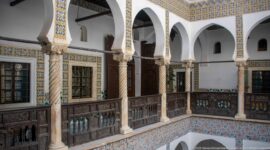
The entrance to the Cultural Islamic Center of Constantine is framed by striped horseshoe arches in white and green, with patterned tilework covering the wall surfaces behind them. A bilingual sign above the central doorway names the institution, providing direct identification while the decorative façade records an explicitly Islamic architectural vocabulary.
Caption
The entrance to the Cultural Islamic Center of Constantine is framed by striped horseshoe arches in white and green, with patterned tilework covering the wall surfaces behind them. A bilingual sign above the central doorway names the institution, providing direct identification while the decorative façade records an explicitly Islamic architectural vocabulary.

A closer view looks directly into the natural rock arch in Constantine’s gorge, where the Rhumel River threads through pale boulders beneath the span. Vertical fractures, weathered ledges, and vegetation on the canyon walls make the erosional form especially legible, with the arch occupying nearly the full width of the ravine.
Caption
A closer view looks directly into the natural rock arch in Constantine’s gorge, where the Rhumel River threads through pale boulders beneath the span. Vertical fractures, weathered ledges, and vegetation on the canyon walls make the erosional form especially legible, with the arch occupying nearly the full width of the ravine.

Vegetation fills the lower slopes of Constantine’s gorge beneath a distant suspension bridge, while the Monument aux Morts crowns the opposing cliff. Buildings cling to the near rim and the ravine narrows toward the center, creating a layered view of urban construction, memorial architecture, and the canyon’s steep natural relief.
Caption
Vegetation fills the lower slopes of Constantine’s gorge beneath a distant suspension bridge, while the Monument aux Morts crowns the opposing cliff. Buildings cling to the near rim and the ravine narrows toward the center, creating a layered view of urban construction, memorial architecture, and the canyon’s steep natural relief.

A small landscaped garden occupies a terrace on Constantine’s steep terrain, with curving paths converging among palms and mature trees. White edging and evenly spaced light poles organize the green space, offering a softer counterpoint to the surrounding rocky gorge and illustrating how public landscaping is fitted into the city’s broken topography.
Caption
A small landscaped garden occupies a terrace on Constantine’s steep terrain, with curving paths converging among palms and mature trees. White edging and evenly spaced light poles organize the green space, offering a softer counterpoint to the surrounding rocky gorge and illustrating how public landscaping is fitted into the city’s broken topography.

A visitor stands beside a roadway passing through a tunnel cut directly into Constantine’s bedrock. The lower walls are whitewashed while the rough, dark natural rock remains exposed above, clearly showing the interface between road engineering and the gorge geology that constrains movement through the city.
Caption
A visitor stands beside a roadway passing through a tunnel cut directly into Constantine’s bedrock. The lower walls are whitewashed while the rough, dark natural rock remains exposed above, clearly showing the interface between road engineering and the gorge geology that constrains movement through the city.

A visitor poses against the opposite cliff where the Monument aux Morts rises above large white CONSTANTINE letters. The shallow foreground portrait and distant civic landmarks compress two scales into one frame, linking a personal viewpoint with the city’s prominent memorial and cliff-top identity.
Caption
A visitor poses against the opposite cliff where the Monument aux Morts rises above large white CONSTANTINE letters. The shallow foreground portrait and distant civic landmarks compress two scales into one frame, linking a personal viewpoint with the city’s prominent memorial and cliff-top identity.

Two visitors pose at a metal railing beside the exposed rock of Constantine’s gorge. Behind them, fractured limestone walls, ledges, and a small dark opening reveal the canyon at close range, shifting attention from the distant cityscape to the immediate texture and vertical scale of the cliff face.
Caption
Two visitors pose at a metal railing beside the exposed rock of Constantine’s gorge. Behind them, fractured limestone walls, ledges, and a small dark opening reveal the canyon at close range, shifting attention from the distant cityscape to the immediate texture and vertical scale of the cliff face.

A broad view of Constantine’s plateau centers on the weathered cliff beneath the Monument aux Morts. The roadway follows a narrow bench across the rock face, while horizontal strata and eroded ledges dominate the foreground, making the city’s geology as visually prominent as its civic landmark on the skyline.
Caption
A broad view of Constantine’s plateau centers on the weathered cliff beneath the Monument aux Morts. The roadway follows a narrow bench across the rock face, while horizontal strata and eroded ledges dominate the foreground, making the city’s geology as visually prominent as its civic landmark on the skyline.

The Rhumel River passes through a large natural rock arch at the bottom of Constantine’s gorge, where pale boulders and dark water contrast with warm stratified cliffs. The wider angle includes cliff-top buildings and vegetation, connecting the erosional feature to the densely built city rising above it.
Caption
The Rhumel River passes through a large natural rock arch at the bottom of Constantine’s gorge, where pale boulders and dark water contrast with warm stratified cliffs. The wider angle includes cliff-top buildings and vegetation, connecting the erosional feature to the densely built city rising above it.

From high on the canyon rim, the Rhumel River winds through a rocky valley below Constantine, crossed by a narrow lower bridge and followed by a road along the slope. Scattered houses, trees, and dry uplands extend into the distance, showing how the gorge opens outward from the city into a broader valley landscape.
Caption
From high on the canyon rim, the Rhumel River winds through a rocky valley below Constantine, crossed by a narrow lower bridge and followed by a road along the slope. Scattered houses, trees, and dry uplands extend into the distance, showing how the gorge opens outward from the city into a broader valley landscape.

Sidi M’Cid Bridge spans Constantine’s gorge on a slender suspended deck carried between tall masonry towers. Main cables sweep over the towers while vertical hangers rhythmically support the roadway, and the cliff road, tunnels, and city buildings below and beyond reveal the bridge’s place within a dense network of canyon crossings.
Caption
Sidi M’Cid Bridge spans Constantine’s gorge on a slender suspended deck carried between tall masonry towers. Main cables sweep over the towers while vertical hangers rhythmically support the roadway, and the cliff road, tunnels, and city buildings below and beyond reveal the bridge’s place within a dense network of canyon crossings.

A road curves along the exposed face of Constantine’s gorge beneath the Monument aux Morts and large city-name letters on the summit. The broad cliff wall, retaining structures, and distant neighborhoods emphasize the extraordinary vertical separation between the upper plateau and routes engineered along the canyon edge.
Caption
A road curves along the exposed face of Constantine’s gorge beneath the Monument aux Morts and large city-name letters on the summit. The broad cliff wall, retaining structures, and distant neighborhoods emphasize the extraordinary vertical separation between the upper plateau and routes engineered along the canyon edge.

Constantine’s buildings crowd the rim of the Rhumel Gorge above a large dark opening in the canyon floor. The walls drop nearly vertically through layered rock and scattered vegetation, while a road and small bridge in the middle distance show how the urban fabric threads across and around the ravine.
Caption
Constantine’s buildings crowd the rim of the Rhumel Gorge above a large dark opening in the canyon floor. The walls drop nearly vertically through layered rock and scattered vegetation, while a road and small bridge in the middle distance show how the urban fabric threads across and around the ravine.

The deck of Sidi M’Cid Bridge cuts horizontally across the frame above the Rhumel valley, its main cable and repeating vertical hangers silhouetted against the sky. Pedestrians appear as small figures on the crossing while the river and lower roads recede far below, stressing the bridge’s elevation and slender structural profile.
Caption
The deck of Sidi M’Cid Bridge cuts horizontally across the frame above the Rhumel valley, its main cable and repeating vertical hangers silhouetted against the sky. Pedestrians appear as small figures on the crossing while the river and lower roads recede far below, stressing the bridge’s elevation and slender structural profile.

A visitor leans on the overlook railing in front of a close oblique view of Sidi M’Cid Bridge. The masonry tower, arched opening, converging main cables, and metal deck are especially legible here, turning the portrait into a detailed record of the bridge’s stone-and-steel structural system.
Caption
A visitor leans on the overlook railing in front of a close oblique view of Sidi M’Cid Bridge. The masonry tower, arched opening, converging main cables, and metal deck are especially legible here, turning the portrait into a detailed record of the bridge’s stone-and-steel structural system.

A loose flock of large birds circles high against a clear blue sky above Constantine. Broad wings and dark silhouettes dominate the frame, with individuals banking at different angles and distances; the photograph isolates aerial movement rather than the cityscape, and the proof-sheet scale does not support a reliable species identification.
Caption
A loose flock of large birds circles high against a clear blue sky above Constantine. Broad wings and dark silhouettes dominate the frame, with individuals banking at different angles and distances; the photograph isolates aerial movement rather than the cityscape, and the proof-sheet scale does not support a reliable species identification.

A visitor stands at a stone-and-metal overlook with Sidi M’Cid Bridge stretching across the gorge behind him. The bridge’s masonry tower, suspended deck, and opposite urban rim are all visible, while the elevated viewpoint provides a clear sense of the crossing’s length and its position between steep cliff walls.
Caption
A visitor stands at a stone-and-metal overlook with Sidi M’Cid Bridge stretching across the gorge behind him. The bridge’s masonry tower, suspended deck, and opposite urban rim are all visible, while the elevated viewpoint provides a clear sense of the crossing’s length and its position between steep cliff walls.

A visitor poses at the overlook while Sidi M’Cid Bridge crosses behind him toward Constantine’s fortified-looking cliff edge and dense upper-city buildings. The composition places the human figure against the city’s defining vertical relationships: suspended roadway, sheer rock, masonry retaining walls, and architecture gathered along the rim.
Caption
A visitor poses at the overlook while Sidi M’Cid Bridge crosses behind him toward Constantine’s fortified-looking cliff edge and dense upper-city buildings. The composition places the human figure against the city’s defining vertical relationships: suspended roadway, sheer rock, masonry retaining walls, and architecture gathered along the rim.

Warm late light strikes the upper cliffs and buildings around Constantine’s Rhumel Gorge while the ravine below falls into shadow. A large dark opening marks the base of the canyon, and the contrast between illuminated urban rim and shaded rock walls accentuates the gorge’s depth and irregular vertical form.
Caption
Warm late light strikes the upper cliffs and buildings around Constantine’s Rhumel Gorge while the ravine below falls into shadow. A large dark opening marks the base of the canyon, and the contrast between illuminated urban rim and shaded rock walls accentuates the gorge’s depth and irregular vertical form.

From a higher viewpoint, the pedestrian suspension bridge angles across Constantine’s gorge toward a cluster of buildings on the opposite rim. The deep channel and wooded slopes fill the center of the frame, while a larger multi-arch bridge and modern pylons appear farther away, layering several generations of crossings within one urban landscape.
Caption
From a higher viewpoint, the pedestrian suspension bridge angles across Constantine’s gorge toward a cluster of buildings on the opposite rim. The deep channel and wooded slopes fill the center of the frame, while a larger multi-arch bridge and modern pylons appear farther away, layering several generations of crossings within one urban landscape.

A natural rock arch spans the lower Rhumel channel beneath a broad, weathered cliff in Constantine. The wider composition shows the arch as one element within a complex erosional landscape of layered rock, scattered shrubs, cliff roads, and plateau development, emphasizing geology over the denser urban views elsewhere in the sequence.
Caption
A natural rock arch spans the lower Rhumel channel beneath a broad, weathered cliff in Constantine. The wider composition shows the arch as one element within a complex erosional landscape of layered rock, scattered shrubs, cliff roads, and plateau development, emphasizing geology over the denser urban views elsewhere in the sequence.

A narrow pedestrian suspension bridge crosses the gorge between rocky terraces and urban buildings. People walking along its deck provide scale for the slender cables and metal railings, while the dry, deeply incised channel below contrasts with the developed plateau beyond. The bridge is shown here primarily as a pedestrian link embedded in Constantine’s rugged canyon landscape.
Caption
A narrow pedestrian suspension bridge crosses the gorge between rocky terraces and urban buildings. People walking along its deck provide scale for the slender cables and metal railings, while the dry, deeply incised channel below contrasts with the developed plateau beyond. The bridge is shown here primarily as a pedestrian link embedded in Constantine’s rugged canyon landscape.

The Rhumel River drops in a broad, low cascade over smooth, pale bedrock at the bottom of Constantine’s gorge. Darker water channels converge along the rock surface before spilling into white water, while small patches of vegetation cling to the margins. The close view concentrates on the erosional landscape rather than the bridges and buildings above.
Caption
The Rhumel River drops in a broad, low cascade over smooth, pale bedrock at the bottom of Constantine’s gorge. Darker water channels converge along the rock surface before spilling into white water, while small patches of vegetation cling to the margins. The close view concentrates on the erosional landscape rather than the bridges and buildings above.

A compact masonry bridge carries a road across the rocky riverbed on four rounded arches. Below it, water spreads over pale bedrock in shallow cascades before dropping through the gorge. The low bridge and exposed channel create a close study of how transportation infrastructure follows the Rhumel River at the canyon floor rather than high above it.
Caption
A compact masonry bridge carries a road across the rocky riverbed on four rounded arches. Below it, water spreads over pale bedrock in shallow cascades before dropping through the gorge. The low bridge and exposed channel create a close study of how transportation infrastructure follows the Rhumel River at the canyon floor rather than high above it.

Four tall masonry arches carry a road across the Rhumel River as the water breaks into foaming cascades over exposed rock below. A small structure and cliff-side retaining walls occupy the far bank, while the opposite hillside rises beyond. This wider view places the low bridge within the active river landscape at the base of Constantine’s canyon.
Caption
Four tall masonry arches carry a road across the Rhumel River as the water breaks into foaming cascades over exposed rock below. A small structure and cliff-side retaining walls occupy the far bank, while the opposite hillside rises beyond. This wider view places the low bridge within the active river landscape at the base of Constantine’s canyon.

A paved walkway follows the canyon floor beneath towering, horizontally layered rock walls. High above, a slender bridge crosses the opening between cliffs, reduced to a narrow line by the depth of the gorge. The low viewpoint emphasizes the canyon’s scale and the dramatic vertical separation between pedestrian space along the river and the transportation routes overhead.
Caption
A paved walkway follows the canyon floor beneath towering, horizontally layered rock walls. High above, a slender bridge crosses the opening between cliffs, reduced to a narrow line by the depth of the gorge. The low viewpoint emphasizes the canyon’s scale and the dramatic vertical separation between pedestrian space along the river and the transportation routes overhead.

Two visitors stand at a riverside railing at the bottom of Constantine’s gorge, framed by the natural rock opening and a bridge high overhead. The portrait places people directly against the canyon’s immense walls, making the depth of the ravine and the scale of the geological opening especially legible while retaining the river as an active foreground element.
Caption
Two visitors stand at a riverside railing at the bottom of Constantine’s gorge, framed by the natural rock opening and a bridge high overhead. The portrait places people directly against the canyon’s immense walls, making the depth of the ravine and the scale of the geological opening especially legible while retaining the river as an active foreground element.

Two visitors pose on the canyon-floor path with the Rhumel River and a large natural opening immediately behind them. A bridge crosses high between the cliffs, emphasizing the extraordinary vertical distance from the riverbed to the gorge rim. The composition combines a human-scale portrait with a clear record of Constantine’s geological and engineered landscape.
Caption
Two visitors pose on the canyon-floor path with the Rhumel River and a large natural opening immediately behind them. A bridge crosses high between the cliffs, emphasizing the extraordinary vertical distance from the riverbed to the gorge rim. The composition combines a human-scale portrait with a clear record of Constantine’s geological and engineered landscape.

A narrow passage has been cut directly through solid rock, creating a rough-walled tunnel with a small daylight opening at the far end. The irregular ceiling, bare floor, and tool-marked surfaces contrast sharply with the open canyon views outside, documenting one of the intimate pedestrian-scale routes through Constantine’s rocky gorge environment.
Caption
A narrow passage has been cut directly through solid rock, creating a rough-walled tunnel with a small daylight opening at the far end. The irregular ceiling, bare floor, and tool-marked surfaces contrast sharply with the open canyon views outside, documenting one of the intimate pedestrian-scale routes through Constantine’s rocky gorge environment.

A visitor stands inside a rough tunnel carved through the gorge rock, making the confined scale of the passage immediately apparent. Loose stones line the floor and the uneven ceiling bears the irregular profile of excavated bedrock, while a dim opening beyond suggests the route continuing through the cliff.
Caption
A visitor stands inside a rough tunnel carved through the gorge rock, making the confined scale of the passage immediately apparent. Loose stones line the floor and the uneven ceiling bears the irregular profile of excavated bedrock, while a dim opening beyond suggests the route continuing through the cliff.

A monumental natural opening cuts through the layered cliff at the bottom of Constantine’s gorge, framing a darker continuation of the canyon beyond. Boulders and rushing water fill the foreground, while the nearly vertical walls show pronounced horizontal bedding. The view isolates the erosional geometry of the gorge without the distraction of nearby urban structures.
Caption
A monumental natural opening cuts through the layered cliff at the bottom of Constantine’s gorge, framing a darker continuation of the canyon beyond. Boulders and rushing water fill the foreground, while the nearly vertical walls show pronounced horizontal bedding. The view isolates the erosional geometry of the gorge without the distraction of nearby urban structures.

A visitor stands on the rocky riverbed beneath the towering natural opening of the Rhumel Gorge. The vertical framing emphasizes the height of the layered cliff walls, while bluish light recedes through the opening behind him. Compared with the wider portrait beside it, this view concentrates more strongly on the canyon’s height and enclosed spatial character.
Caption
A visitor stands on the rocky riverbed beneath the towering natural opening of the Rhumel Gorge. The vertical framing emphasizes the height of the layered cliff walls, while bluish light recedes through the opening behind him. Compared with the wider portrait beside it, this view concentrates more strongly on the canyon’s height and enclosed spatial character.

A visitor stands with folded arms among pale boulders directly before the great natural opening in Constantine’s gorge. The dark arch fills most of the background, while angled sunlight filters into the passage behind him. The composition uses the figure as scale, conveying both the breadth of the opening and the rugged character of the river-worn canyon floor.
Caption
A visitor stands with folded arms among pale boulders directly before the great natural opening in Constantine’s gorge. The dark arch fills most of the background, while angled sunlight filters into the passage behind him. The composition uses the figure as scale, conveying both the breadth of the opening and the rugged character of the river-worn canyon floor.

A broad horizontal view places two visitors beneath the full sweep of a natural rock arch at the canyon floor. Layered stone curves overhead from wall to wall, dwarfing the figures and revealing the opening’s substantial span. The low, rocky foreground and dim blue interior beyond give the scene a strong sense of depth within the Rhumel Gorge.
Caption
A broad horizontal view places two visitors beneath the full sweep of a natural rock arch at the canyon floor. Layered stone curves overhead from wall to wall, dwarfing the figures and revealing the opening’s substantial span. The low, rocky foreground and dim blue interior beyond give the scene a strong sense of depth within the Rhumel Gorge.

From the canyon floor, a high bridge appears near the skyline above a broad natural rock opening and massive layered walls. The Rhumel River runs through the shadowed lower gorge while the bridge occupies only a thin band overhead, demonstrating the extreme vertical separation between the canyon floor and Constantine’s upper transportation routes.
Caption
From the canyon floor, a high bridge appears near the skyline above a broad natural rock opening and massive layered walls. The Rhumel River runs through the shadowed lower gorge while the bridge occupies only a thin band overhead, demonstrating the extreme vertical separation between the canyon floor and Constantine’s upper transportation routes.

Two visitors stand together on the uneven, boulder-strewn floor of Constantine’s gorge, backed by the large natural opening through the cliff. Their placement near the base of the arch makes the rock formation’s scale especially evident, while sparse shrubs and exposed bedding preserve the rugged, minimally built character of this section of the canyon.
Caption
Two visitors stand together on the uneven, boulder-strewn floor of Constantine’s gorge, backed by the large natural opening through the cliff. Their placement near the base of the arch makes the rock formation’s scale especially evident, while sparse shrubs and exposed bedding preserve the rugged, minimally built character of this section of the canyon.

Two visitors stand together near the Rhumel River with the tall natural opening of the gorge rising behind them. Pale boulders, flowing water, and dense green shrubs occupy the lower canyon, while the dark opening draws attention to the river’s passage through the cliff. The portrait combines human scale with a clear record of the gorge’s geology.
Caption
Two visitors stand together near the Rhumel River with the tall natural opening of the gorge rising behind them. Pale boulders, flowing water, and dense green shrubs occupy the lower canyon, while the dark opening draws attention to the river’s passage through the cliff. The portrait combines human scale with a clear record of the gorge’s geology.

A four-arch masonry road bridge crosses the Rhumel River immediately above a broad waterfall, where water plunges over a dark rock ledge into the gorge. The elevated viewpoint reveals both the bridge piers and the stepped bedrock channel, allowing the built crossing and the river’s erosional landscape to be read together in a single composition.
Caption
A four-arch masonry road bridge crosses the Rhumel River immediately above a broad waterfall, where water plunges over a dark rock ledge into the gorge. The elevated viewpoint reveals both the bridge piers and the stepped bedrock channel, allowing the built crossing and the river’s erosional landscape to be read together in a single composition.

A wide canyon view places the four-arch masonry bridge and waterfall below an immense rocky cliff. The Rhumel River spills over exposed bedrock beneath the crossing, while green vegetation fills the lower valley and a residential district spreads across the distant slope. The broader composition situates the river infrastructure within Constantine’s steep, layered highland landscape.
Caption
A wide canyon view places the four-arch masonry bridge and waterfall below an immense rocky cliff. The Rhumel River spills over exposed bedrock beneath the crossing, while green vegetation fills the lower valley and a residential district spreads across the distant slope. The broader composition situates the river infrastructure within Constantine’s steep, layered highland landscape.

Shallow water spreads across the rocky floor of the Rhumel Gorge beneath immense layered cliffs. A high bridge is visible near the upper right edge, while a natural opening sits in shadow at the base of the rock wall. This low, wide view emphasizes the canyon’s geology and riverbed, with human infrastructure reduced to a distant element above.
Caption
Shallow water spreads across the rocky floor of the Rhumel Gorge beneath immense layered cliffs. A high bridge is visible near the upper right edge, while a natural opening sits in shadow at the base of the rock wall. This low, wide view emphasizes the canyon’s geology and riverbed, with human infrastructure reduced to a distant element above.

A visitor stands on the rocky edge of the Rhumel River beside a massive natural opening in the gorge wall. The arch curves behind him beneath deeply layered rock, while shallow water moves across the exposed channel. His position at the base of the cliff gives a direct sense of the formation’s scale and the narrowness of the canyon floor.
Caption
A visitor stands on the rocky edge of the Rhumel River beside a massive natural opening in the gorge wall. The arch curves behind him beneath deeply layered rock, while shallow water moves across the exposed channel. His position at the base of the cliff gives a direct sense of the formation’s scale and the narrowness of the canyon floor.

A visitor stands near the river beneath a broad natural rock arch while a high bridge spans the canyon far above. The composition connects three scales at once: the person at ground level, the immense geological opening in the middle distance, and the engineered crossing at the skyline. Layered cliffs enclose the scene on both sides.
Caption
A visitor stands near the river beneath a broad natural rock arch while a high bridge spans the canyon far above. The composition connects three scales at once: the person at ground level, the immense geological opening in the middle distance, and the engineered crossing at the skyline. Layered cliffs enclose the scene on both sides.

A rough tunnel cut through bedrock extends toward a small, bright rectangular opening at the far end. Warm light reveals irregular wall surfaces, a low uneven ceiling, and a worn dirt floor, giving a clearer structural reading than the darker view earlier in the sequence. The photograph documents the passage itself without assigning an unsupported date or original function.
Caption
A rough tunnel cut through bedrock extends toward a small, bright rectangular opening at the far end. Warm light reveals irregular wall surfaces, a low uneven ceiling, and a worn dirt floor, giving a clearer structural reading than the darker view earlier in the sequence. The photograph documents the passage itself without assigning an unsupported date or original function.

A large dark opening pierces the layered rock at the bottom of Constantine’s gorge, where angular boulders and broken stone cover the ravine floor. A visitor standing before the opening provides scale for the massive limestone walls, making this close ground-level view especially effective at conveying the depth, erosion, and physical enclosure of the canyon.
Caption
A large dark opening pierces the layered rock at the bottom of Constantine’s gorge, where angular boulders and broken stone cover the ravine floor. A visitor standing before the opening provides scale for the massive limestone walls, making this close ground-level view especially effective at conveying the depth, erosion, and physical enclosure of the canyon.

A visitor stands close to the camera beneath the vast natural opening of Constantine’s gorge. The dark arch forms a monumental frame around his upper body, while pale boulders and filtered blue light remain visible behind him. The tighter portrait shifts attention from the river landscape to the contrast between human scale and the massive rock formation.
Caption
A visitor stands close to the camera beneath the vast natural opening of Constantine’s gorge. The dark arch forms a monumental frame around his upper body, while pale boulders and filtered blue light remain visible behind him. The tighter portrait shifts attention from the river landscape to the contrast between human scale and the massive rock formation.

Two visitors stand shoulder to shoulder beneath the broad natural arch in Constantine’s gorge. Their full-length figures are framed against the shadowed opening, with pale boulders and layered stone extending around them. The paired portrait provides a strong scale reference for the arch while preserving the rugged riverbed setting at the canyon floor.
Caption
Two visitors stand shoulder to shoulder beneath the broad natural arch in Constantine’s gorge. Their full-length figures are framed against the shadowed opening, with pale boulders and layered stone extending around them. The paired portrait provides a strong scale reference for the arch while preserving the rugged riverbed setting at the canyon floor.

A visitor stands centered beneath the massive natural arch, his full-length figure set against the darker interior of the gorge. The nearly symmetrical framing turns the rock opening into a natural portal, while warm foreground stone and cool light beyond create strong depth. The photograph is primarily a human-scale study of the canyon’s monumental erosional form.
Caption
A visitor stands centered beneath the massive natural arch, his full-length figure set against the darker interior of the gorge. The nearly symmetrical framing turns the rock opening into a natural portal, while warm foreground stone and cool light beyond create strong depth. The photograph is primarily a human-scale study of the canyon’s monumental erosional form.

Closely packed buildings rise directly above the sheer rock wall of Constantine’s gorge, their pale façades and red-tiled roofs forming an irregular skyline along the precipice. Sunlit upper stories contrast with the shadowed ravine below, clearly illustrating the city’s extraordinary vertical relationship between dense urban fabric and exposed canyon geology.
Caption
Closely packed buildings rise directly above the sheer rock wall of Constantine’s gorge, their pale façades and red-tiled roofs forming an irregular skyline along the precipice. Sunlit upper stories contrast with the shadowed ravine below, clearly illustrating the city’s extraordinary vertical relationship between dense urban fabric and exposed canyon geology.

A large white civic or institutional building dominates the cliff-side district, its symmetrical towers and central domed pavilion rising above a narrow pedestrian bridge. Warm-toned residential blocks climb the hillside behind it, while the bridge and retaining walls reveal how Constantine’s architecture and circulation are fitted into the steep margins of the gorge.
Caption
A large white civic or institutional building dominates the cliff-side district, its symmetrical towers and central domed pavilion rising above a narrow pedestrian bridge. Warm-toned residential blocks climb the hillside behind it, while the bridge and retaining walls reveal how Constantine’s architecture and circulation are fitted into the steep margins of the gorge.

A narrow metal pedestrian bridge crosses a rocky cut below Constantine’s densely built hillside, with the large white domed building rising prominently beyond. The lateral viewpoint shows the bridge’s slender deck, supporting structure, and relationship to masonry retaining walls, vegetation, and buildings perched immediately above the gorge.
Caption
A narrow metal pedestrian bridge crosses a rocky cut below Constantine’s densely built hillside, with the large white domed building rising prominently beyond. The lateral viewpoint shows the bridge’s slender deck, supporting structure, and relationship to masonry retaining walls, vegetation, and buildings perched immediately above the gorge.

Seen from behind, the large hillside letters spelling CONSTANTINE frame an expansive view over the city’s plateau and gorge. Their green support structure occupies the foreground while bridges, institutional buildings, neighborhoods, and distant highlands spread across the horizon, turning the sign itself into a foreground device for a broad urban panorama.
Caption
Seen from behind, the large hillside letters spelling CONSTANTINE frame an expansive view over the city’s plateau and gorge. Their green support structure occupies the foreground while bridges, institutional buildings, neighborhoods, and distant highlands spread across the horizon, turning the sign itself into a foreground device for a broad urban panorama.

A suspension bridge crosses the gorge in the foreground, its stone tower, main cables, and vertical hangers standing against Constantine’s dense urban plateau. Beyond the span, a large white institutional building, additional bridge structures, and roads occupy successive levels of the city, creating a layered view of how transportation infrastructure negotiates the canyon landscape.
Caption
A suspension bridge crosses the gorge in the foreground, its stone tower, main cables, and vertical hangers standing against Constantine’s dense urban plateau. Beyond the span, a large white institutional building, additional bridge structures, and roads occupy successive levels of the city, creating a layered view of how transportation infrastructure negotiates the canyon landscape.