Banff Town Introduction
Banff occupies an unusual place in the Canadian Rockies: a mountain town that grew not at the edge of a national park, but within the landscape that gave birth to Canada’s national park system. Indigenous peoples had traveled, hunted, gathered, and visited the thermal springs of the Bow Valley for thousands of years before the arrival of the Canadian Pacific Railway in the early 1880s. After railway workers brought national attention to the hot springs near Sulphur Mountain in 1883, the federal government created a protected reserve around them in 1885. The settlement of Banff followed soon afterward, established in 1886 as a transportation and service center for the visitors the new park was expected to attract.
The railway shaped Banff from the beginning. Canadian Pacific recognized that the spectacular scenery surrounding its transcontinental line could itself become a destination, and Banff developed alongside the station, the hot springs, and the great Banff Springs Hotel. What began as a railway outpost evolved into one of Canada’s best-known resort communities, with Banff Avenue forming the commercial heart of a town framed almost theatrically by the surrounding peaks. The historic railway station, hotels, shops, civic buildings, and residential streets preserve pieces of that development, while the Bow River and the mountains remain visible reminders that the town exists within a protected landscape rather than apart from it.
Modern Banff is therefore both a functioning community and one of the principal gateways to the Canadian Rockies. Its compact townsite occupies just 3.93 square kilometers, surrounded by Banff National Park and the larger Canadian Rocky Mountain Parks UNESCO World Heritage Site. Although the streets can be crowded with visitors, walking beyond Banff Avenue reveals a more layered place: historic buildings, railway remnants, parks and trails, views across the Bow Valley, and the everyday infrastructure of a small mountain community. Banff was formally incorporated in 1990 as Canada’s first municipality within a national park, giving civic form to a settlement whose history has always been inseparable from the extraordinary landscape surrounding it.
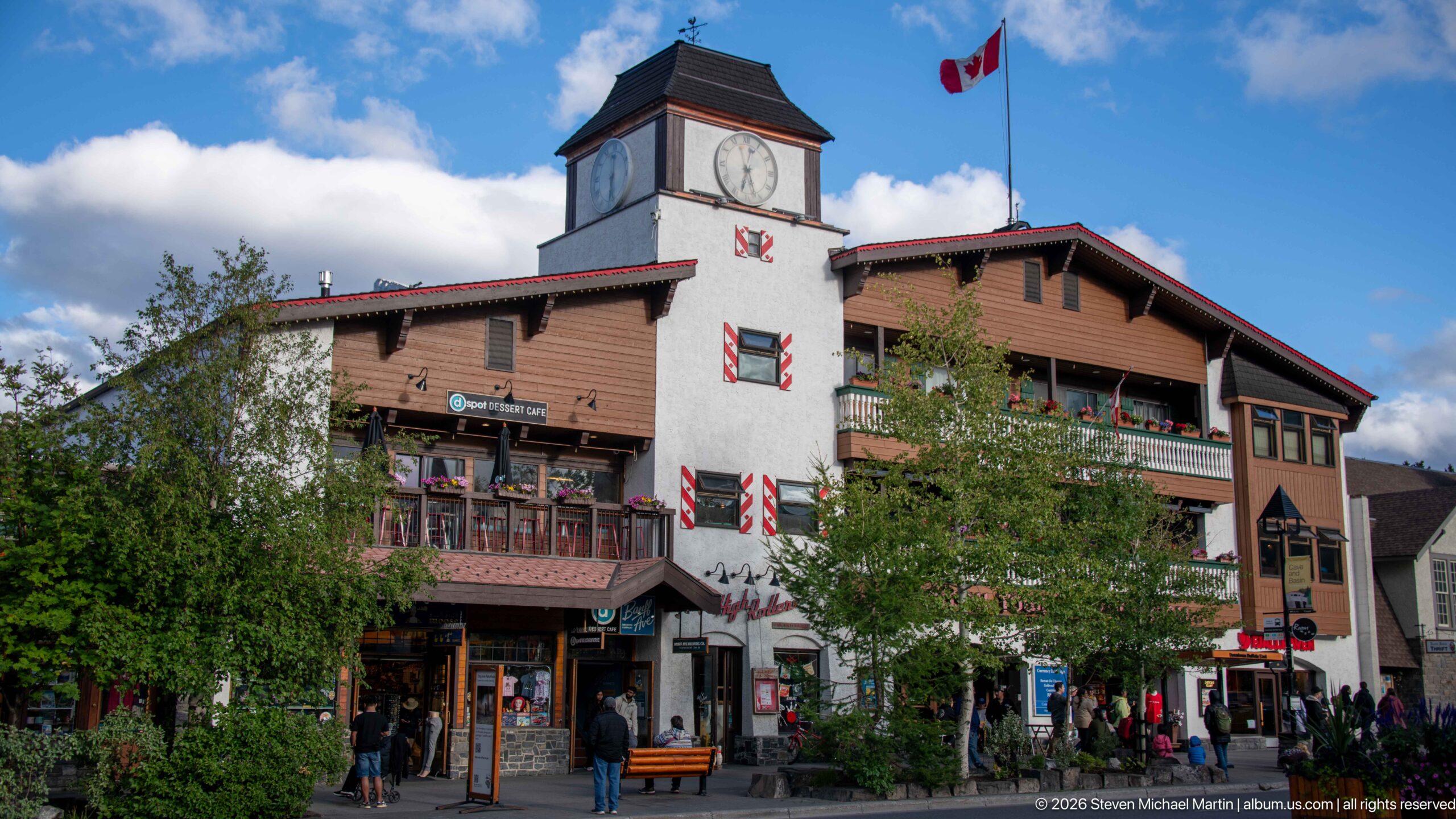
A prominent commercial block is organized around a white clock tower capped by a dark hipped roof and Canadian flag. Red-and-white shutters, broad wooden balconies, shops at street level, and pedestrians at the base create a highly theatrical alpine-town façade, with the clock providing a vertical focal point above the surrounding retail streetscape.
Caption
A prominent commercial block is organized around a white clock tower capped by a dark hipped roof and Canadian flag. Red-and-white shutters, broad wooden balconies, shops at street level, and pedestrians at the base create a highly theatrical alpine-town façade, with the clock providing a vertical focal point above the surrounding retail streetscape.
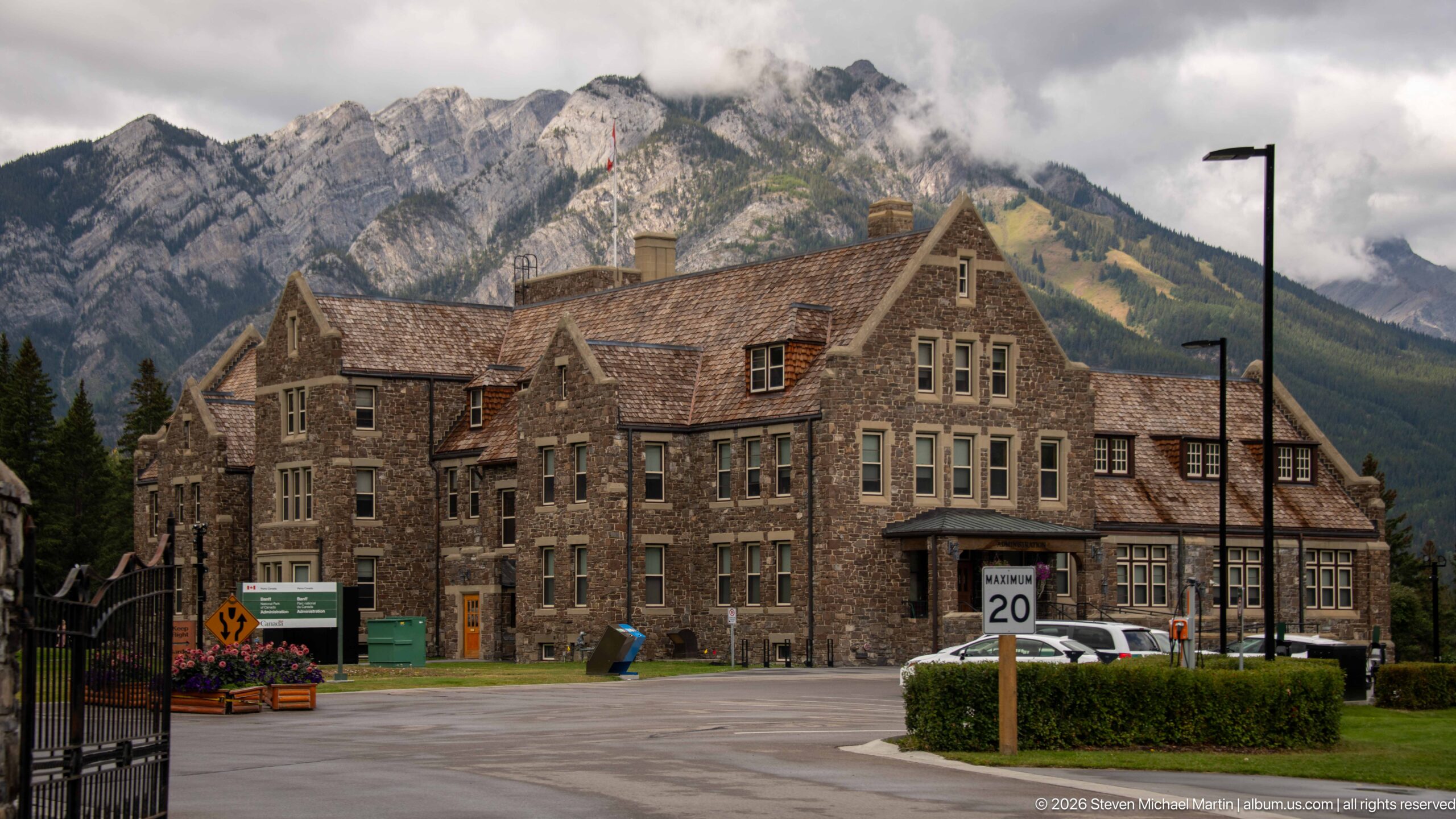
The stone Banff Park Administration Building rises before the mountain wall at the edge of the townsite. Steep gables, multi-pane windows, a shingled roof, and locally expressive masonry give the large institutional structure a picturesque mountain character. The broad approach and open foreground reveal the building’s scale and formal presence within Banff’s civic landscape.
Caption
The stone Banff Park Administration Building rises before the mountain wall at the edge of the townsite. Steep gables, multi-pane windows, a shingled roof, and locally expressive masonry give the large institutional structure a picturesque mountain character. The broad approach and open foreground reveal the building’s scale and formal presence within Banff’s civic landscape.
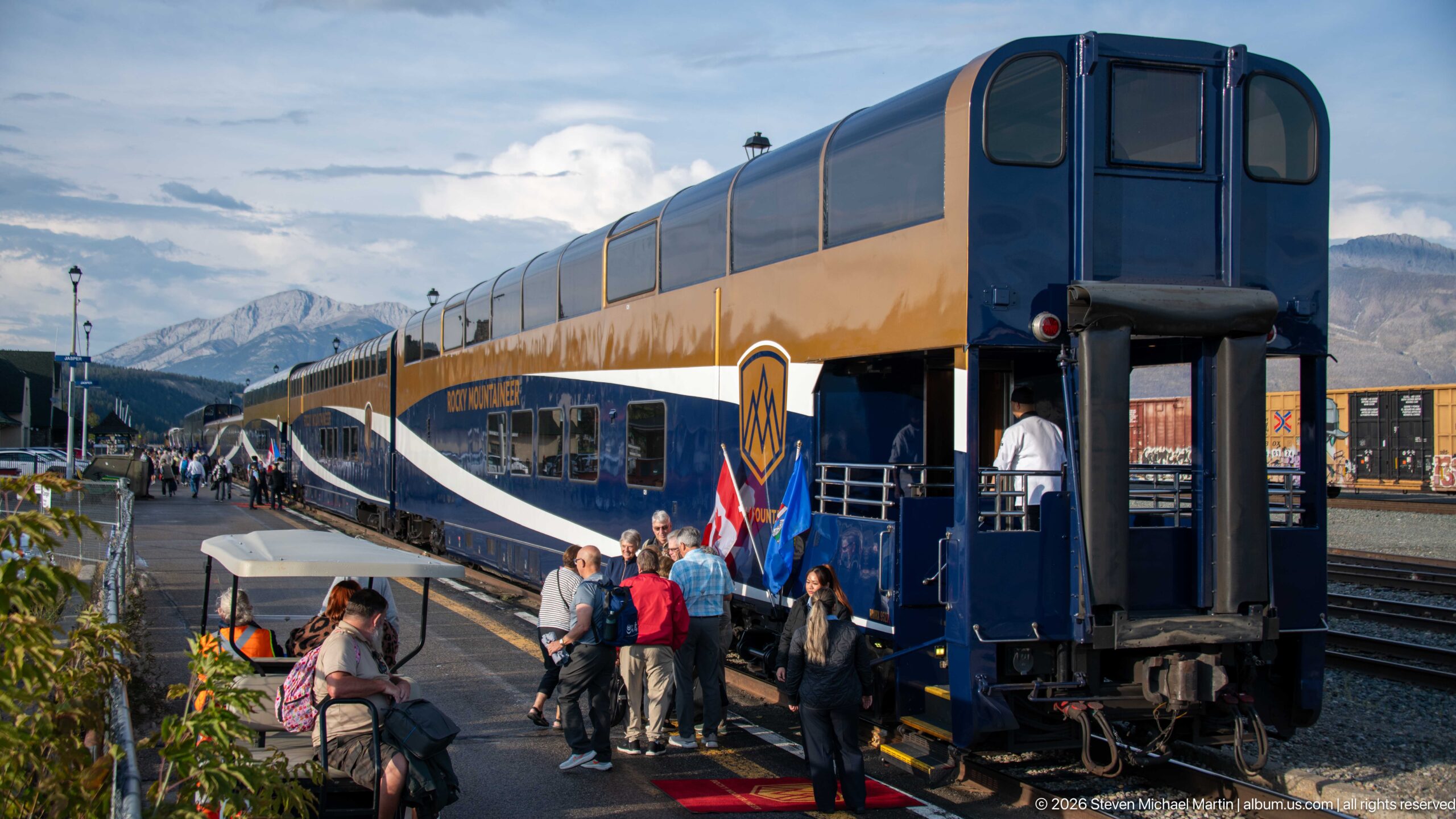
Passengers gather at the open rear end of a Rocky Mountaineer car as boarding or platform activity continues in Banff. The squared observation end, exterior steps, Canadian flag, and long glass-dome consist lead the eye toward the station area and mountains beyond. Human activity distinguishes this view from the adjacent studies of the train’s livery and profile.
Caption
Passengers gather at the open rear end of a Rocky Mountaineer car as boarding or platform activity continues in Banff. The squared observation end, exterior steps, Canadian flag, and long glass-dome consist lead the eye toward the station area and mountains beyond. Human activity distinguishes this view from the adjacent studies of the train’s livery and profile.
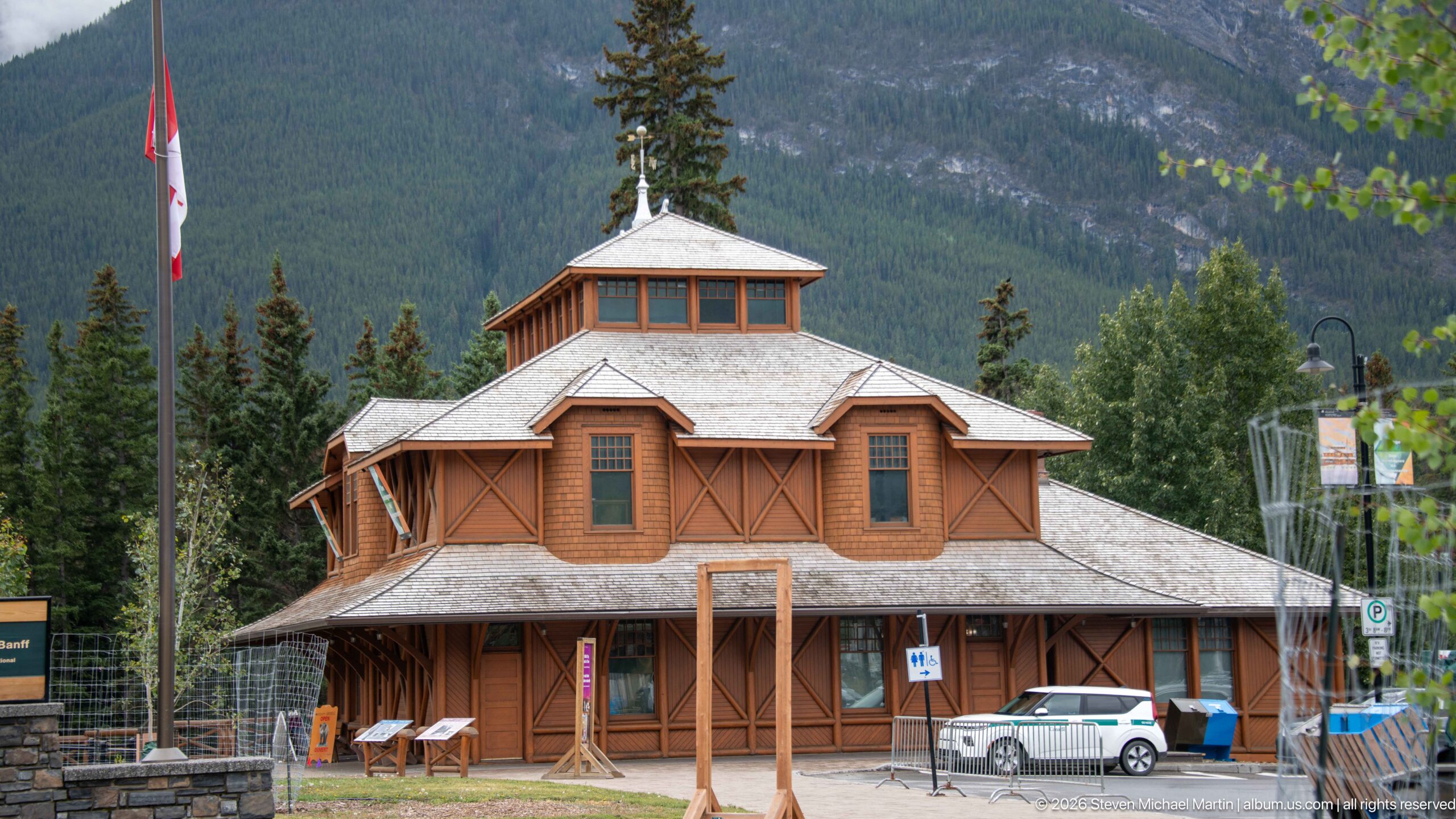
The Banff Park Museum is viewed from another side, where its broad hipped roof, raised central monitor, paired projecting bays, and timber wall panels become especially clear. Construction fencing and a parked vehicle introduce the working context of the site, while conifers and the mountain slope rise immediately behind. This view documents the museum’s less ceremonial elevation and complex roof geometry.
Caption
The Banff Park Museum is viewed from another side, where its broad hipped roof, raised central monitor, paired projecting bays, and timber wall panels become especially clear. Construction fencing and a parked vehicle introduce the working context of the site, while conifers and the mountain slope rise immediately behind. This view documents the museum’s less ceremonial elevation and complex roof geometry.
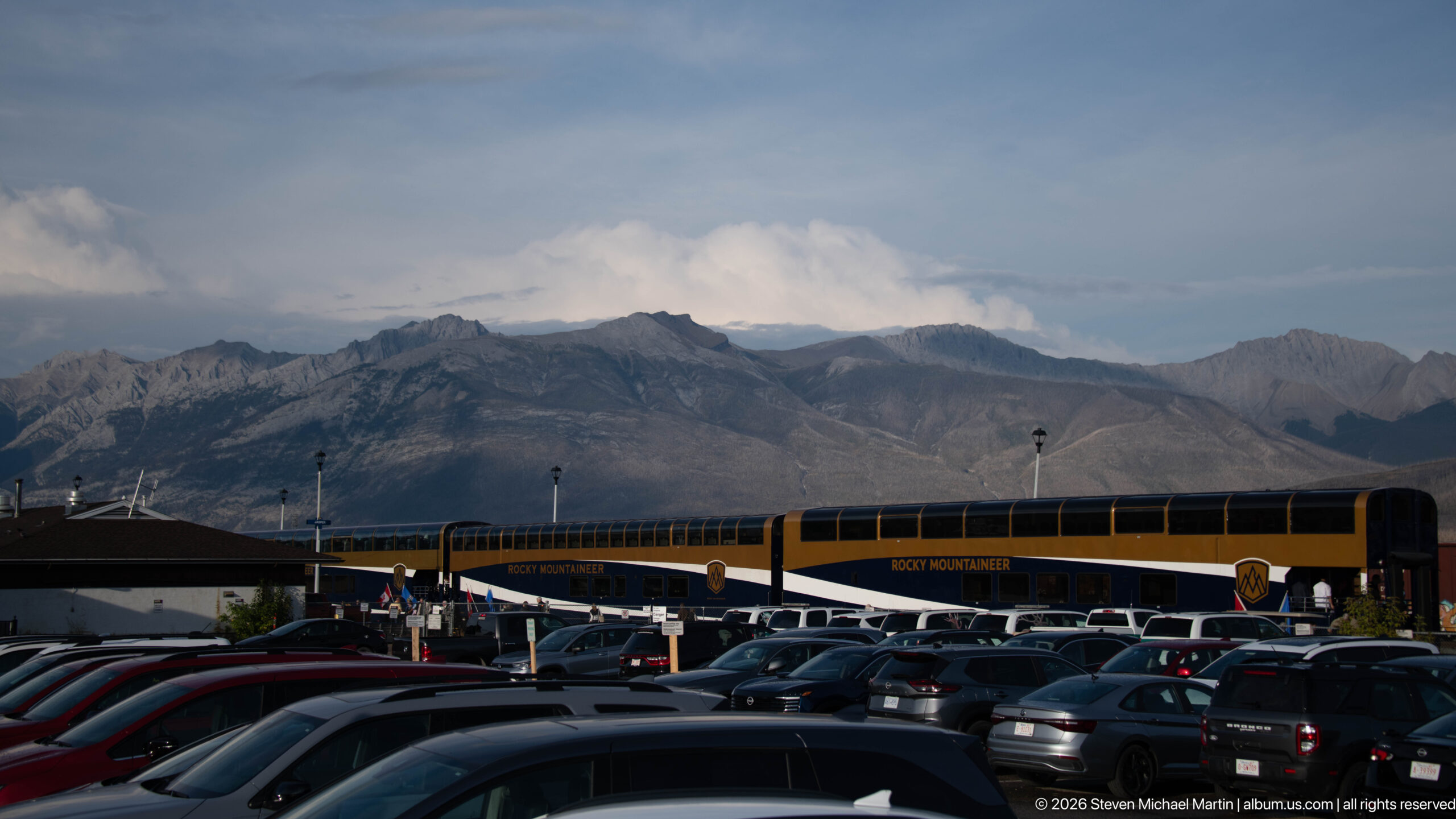
The Rocky Mountaineer forms a narrow gold-and-navy band across the base of the Canadian Rockies, seen beyond a foreground parking area near the Banff station. By pulling back from the platform, the composition shifts emphasis from individual railcars to the relationship between railway infrastructure, the town, and the immense mountain setting that defines travel through Banff.
Caption
The Rocky Mountaineer forms a narrow gold-and-navy band across the base of the Canadian Rockies, seen beyond a foreground parking area near the Banff station. By pulling back from the platform, the composition shifts emphasis from individual railcars to the relationship between railway infrastructure, the town, and the immense mountain setting that defines travel through Banff.
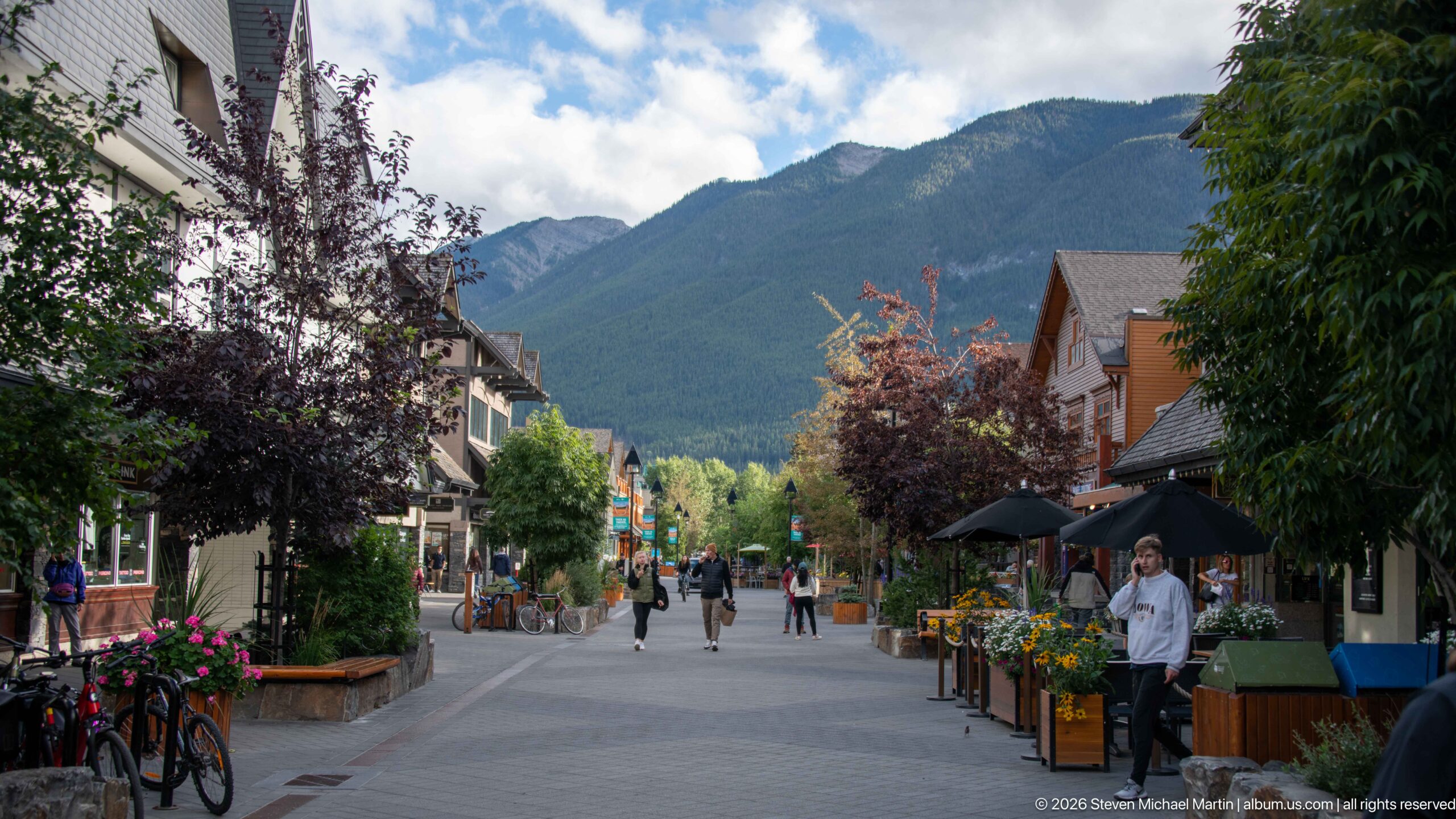
The pedestrian corridor opens directly toward the mountains, creating a strong visual axis between Banff’s commercial streets and the surrounding national-park landscape. Restaurant terraces, bicycles, flower planters, trees, and strolling visitors line both sides, while the low building heights preserve an unusually immediate relationship between town and mountain.
Caption
The pedestrian corridor opens directly toward the mountains, creating a strong visual axis between Banff’s commercial streets and the surrounding national-park landscape. Restaurant terraces, bicycles, flower planters, trees, and strolling visitors line both sides, while the low building heights preserve an unusually immediate relationship between town and mountain.
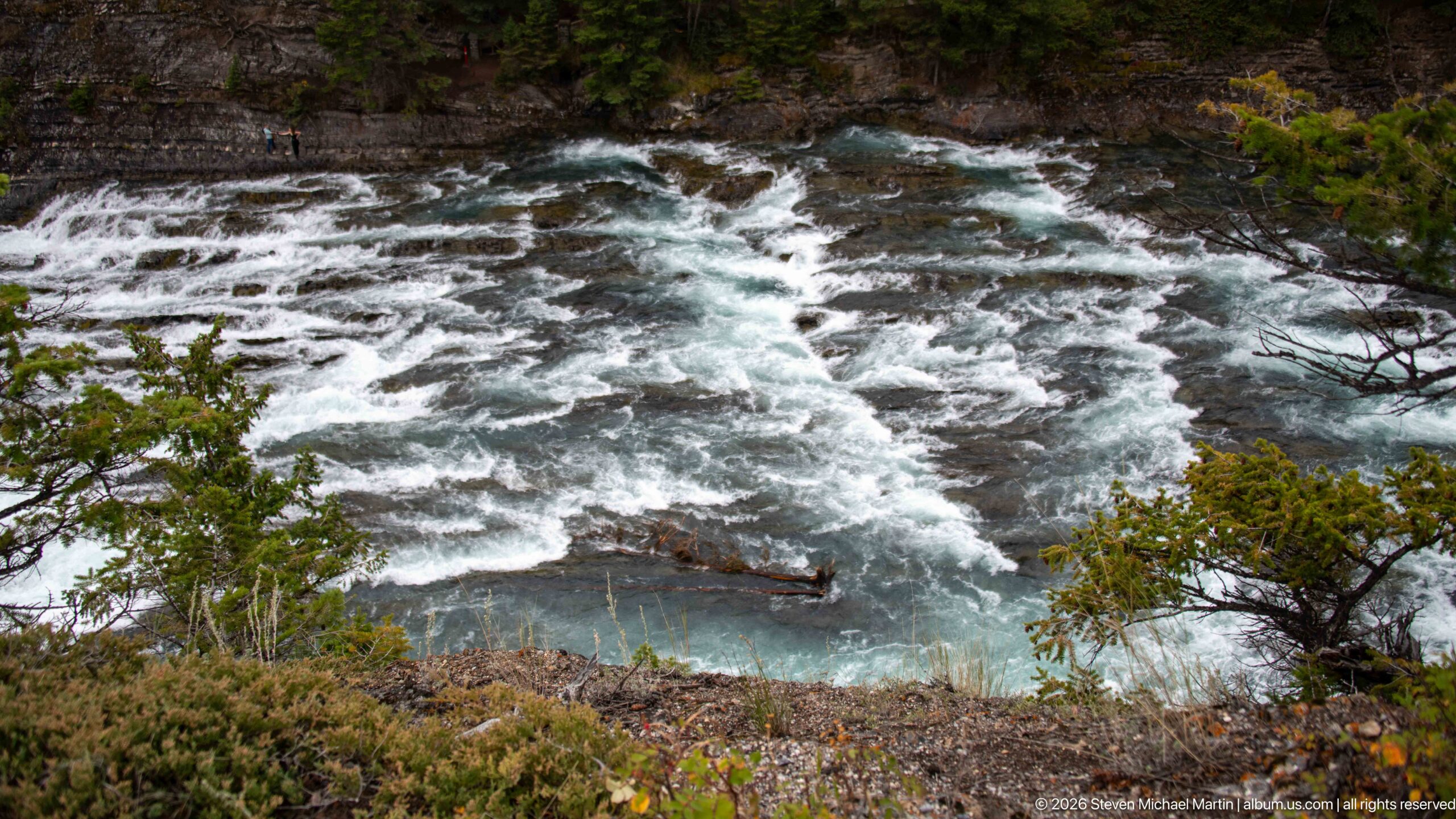
Fast water breaks into whitewater across a shallow, rock-strewn channel near Banff, its blue-green current divided by submerged ledges and boulders. Conifers and low vegetation crowd the banks, giving the scene a distinctly mountain-river character. The close viewpoint concentrates on the force and texture of the current rather than the broader valley setting.
Caption
Fast water breaks into whitewater across a shallow, rock-strewn channel near Banff, its blue-green current divided by submerged ledges and boulders. Conifers and low vegetation crowd the banks, giving the scene a distinctly mountain-river character. The close viewpoint concentrates on the force and texture of the current rather than the broader valley setting.
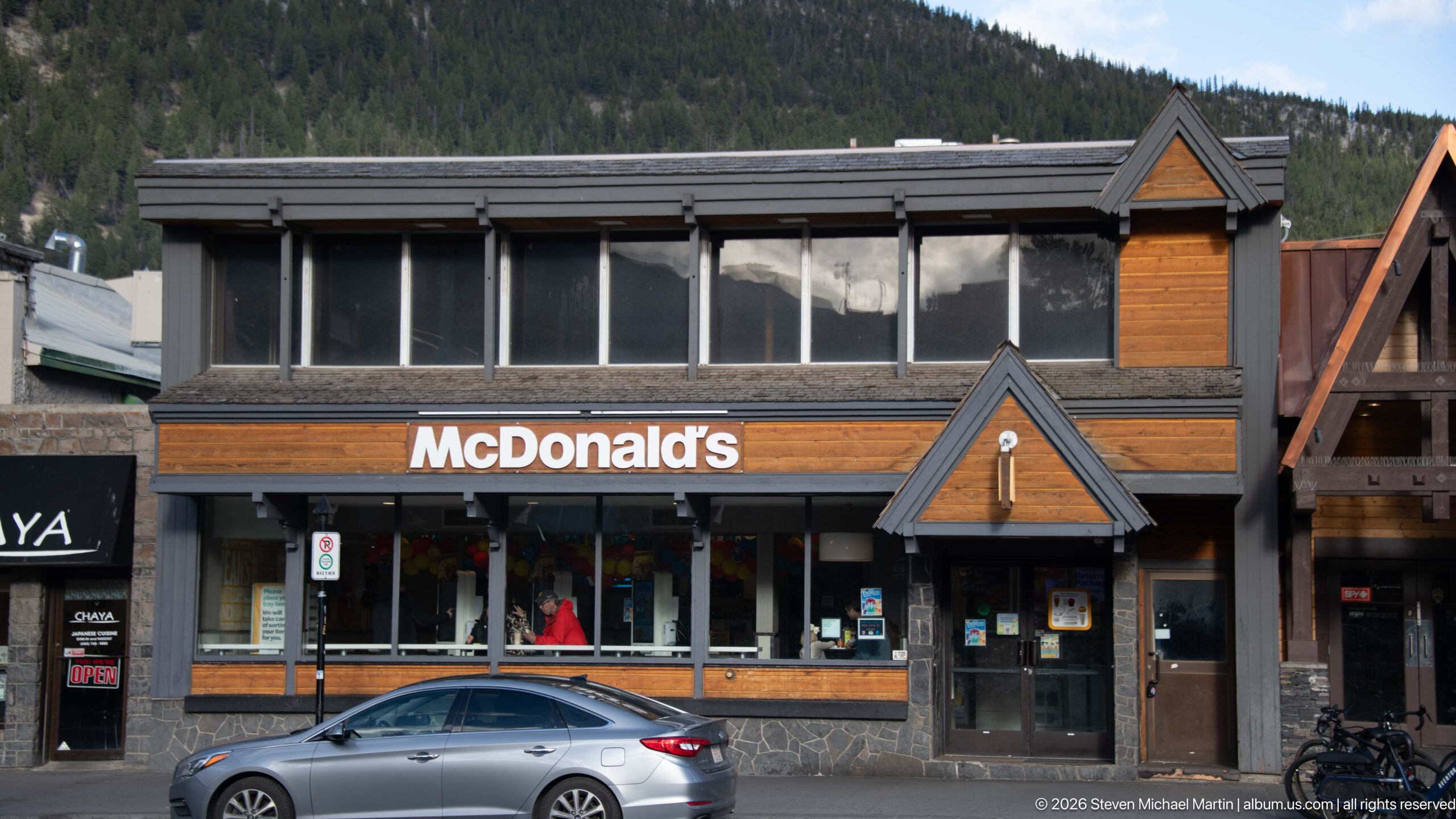
McDonald’s occupies a low commercial frontage adapted to Banff’s mountain-town streetscape, with wood siding, stone at the base, dark trim, and a small gabled entrance rather than the chain’s more typical freestanding format. A parked car and neighboring storefronts reinforce the building’s integration into a continuous pedestrian commercial block.
Caption
McDonald’s occupies a low commercial frontage adapted to Banff’s mountain-town streetscape, with wood siding, stone at the base, dark trim, and a small gabled entrance rather than the chain’s more typical freestanding format. A parked car and neighboring storefronts reinforce the building’s integration into a continuous pedestrian commercial block.
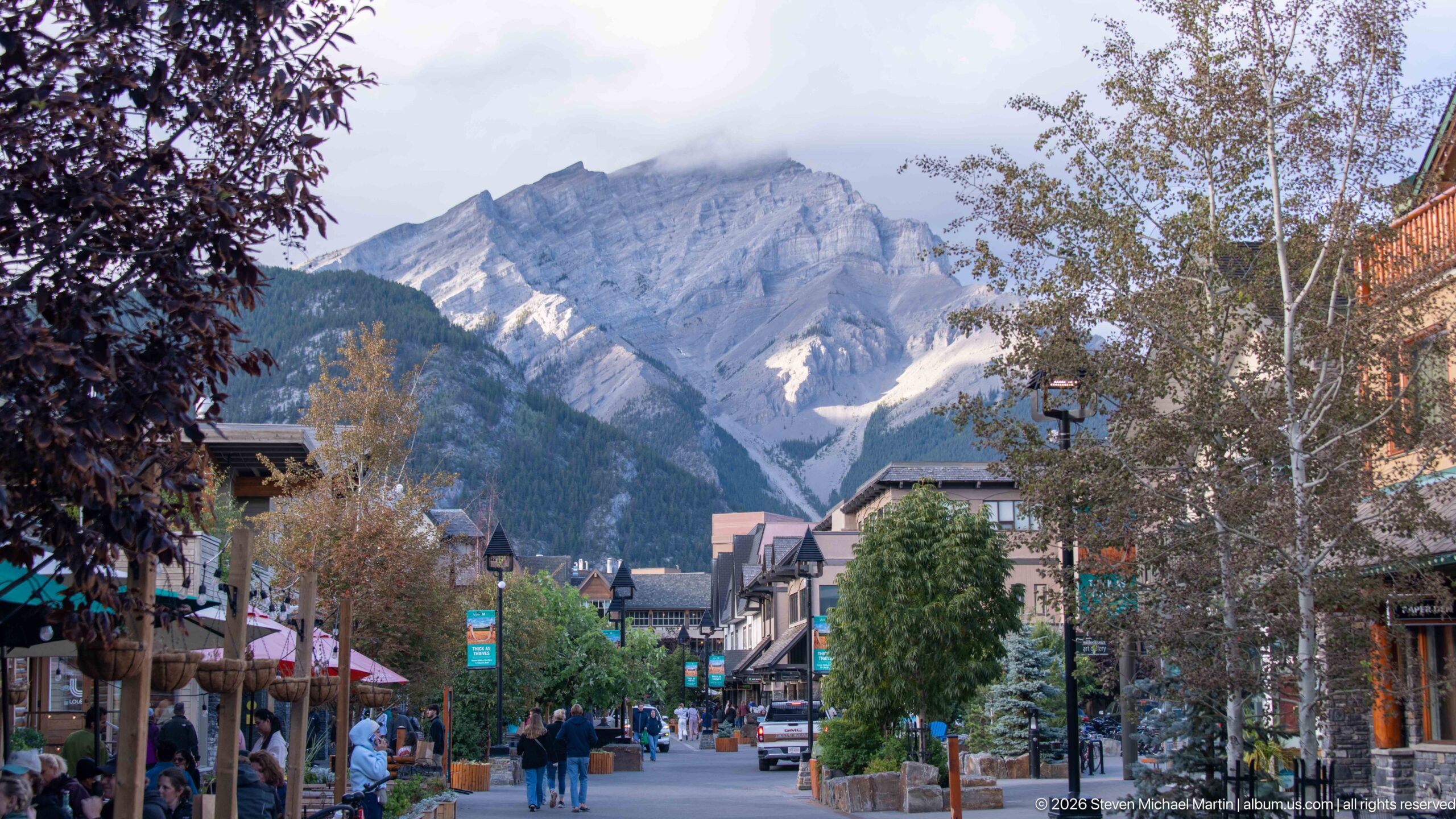
A pedestrian-oriented commercial street leads toward the monumental limestone face of Cascade Mountain, partially veiled by cloud. Shopfronts, trees, hanging banners, outdoor seating, and people walking through the center create a layered townscape in which Banff’s compact retail district is visually enclosed by the mountain immediately beyond.
Caption
A pedestrian-oriented commercial street leads toward the monumental limestone face of Cascade Mountain, partially veiled by cloud. Shopfronts, trees, hanging banners, outdoor seating, and people walking through the center create a layered townscape in which Banff’s compact retail district is visually enclosed by the mountain immediately beyond.
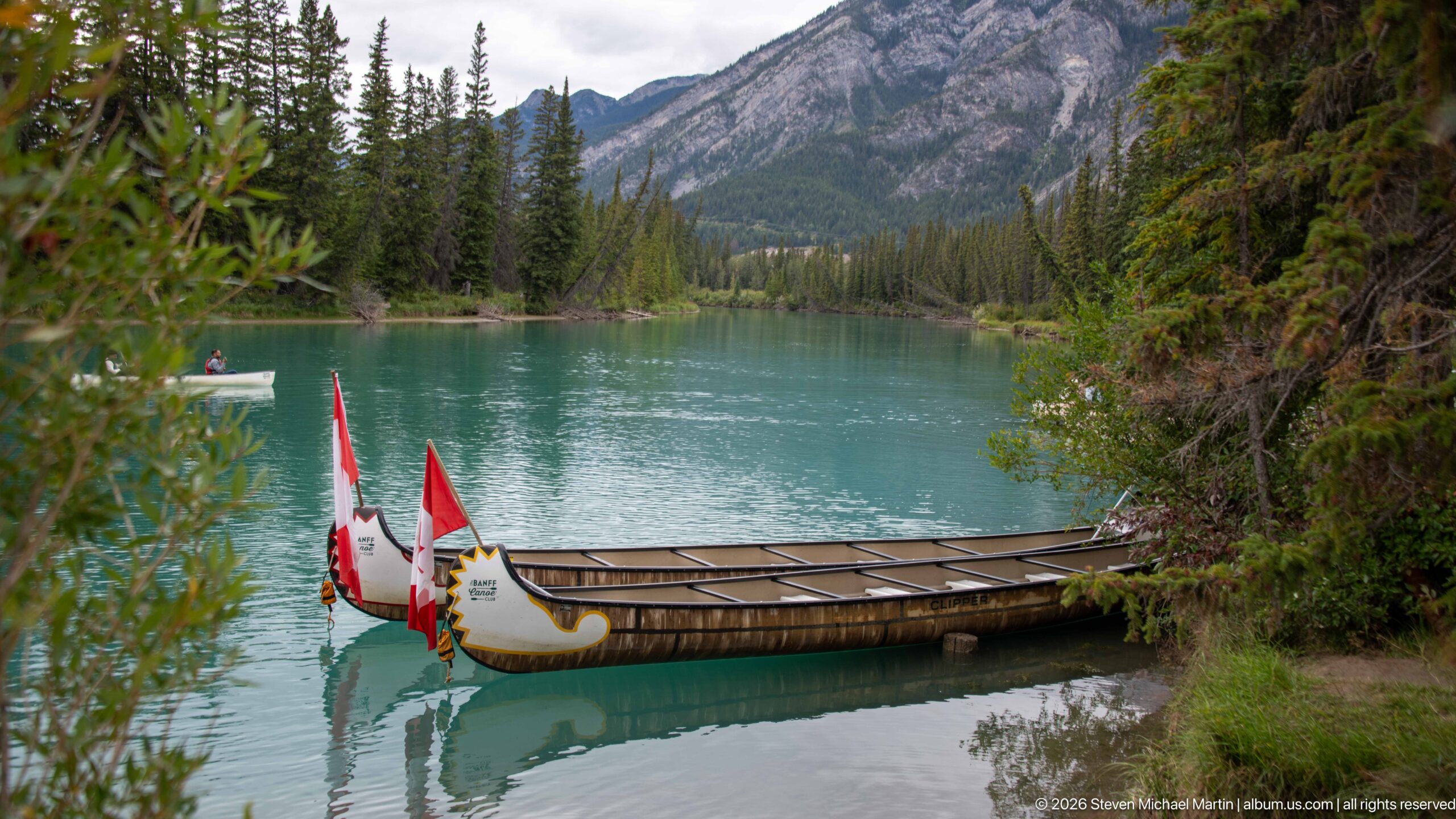
Decoratively painted canoes rest at the Banff Canoe Club dock on turquoise water, their high curved ends carrying Canadian flags and the club name. The boats’ reflections ripple beneath them while forested banks and a mountain ridge close the view. The composition introduces the recreational waterfront through its most distinctive equipment rather than through the dock facilities themselves.
Caption
Decoratively painted canoes rest at the Banff Canoe Club dock on turquoise water, their high curved ends carrying Canadian flags and the club name. The boats’ reflections ripple beneath them while forested banks and a mountain ridge close the view. The composition introduces the recreational waterfront through its most distinctive equipment rather than through the dock facilities themselves.
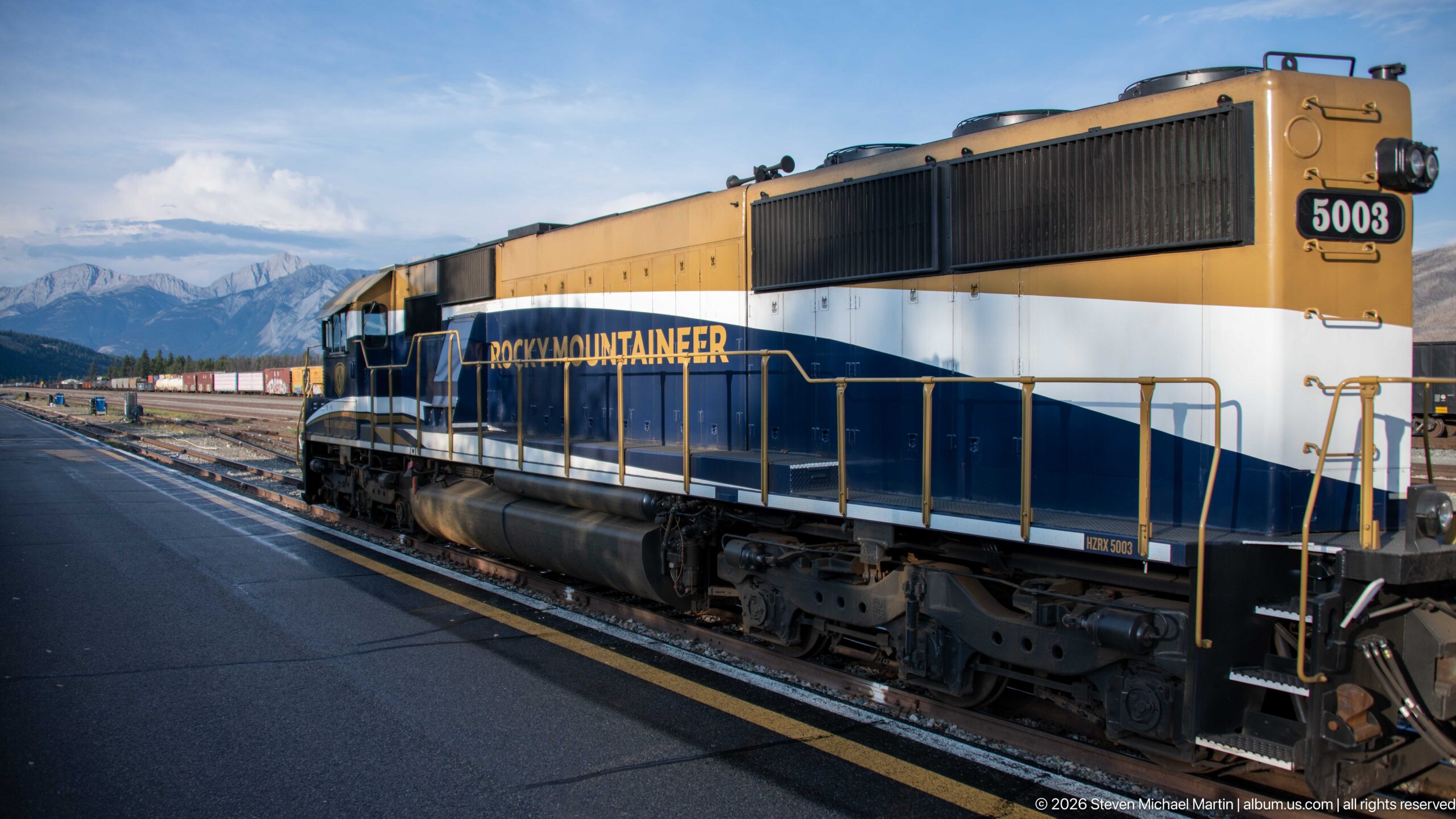
Rocky Mountaineer locomotive 5003 stands beside the platform in Banff, its blue, white, and gold livery set against the rail yard and distant mountains. The close three-quarter view emphasizes the locomotive’s scale, vents, running gear, and branded bodywork, linking Banff’s present-day tourism directly to its continuing railway setting.
Caption
Rocky Mountaineer locomotive 5003 stands beside the platform in Banff, its blue, white, and gold livery set against the rail yard and distant mountains. The close three-quarter view emphasizes the locomotive’s scale, vents, running gear, and branded bodywork, linking Banff’s present-day tourism directly to its continuing railway setting.
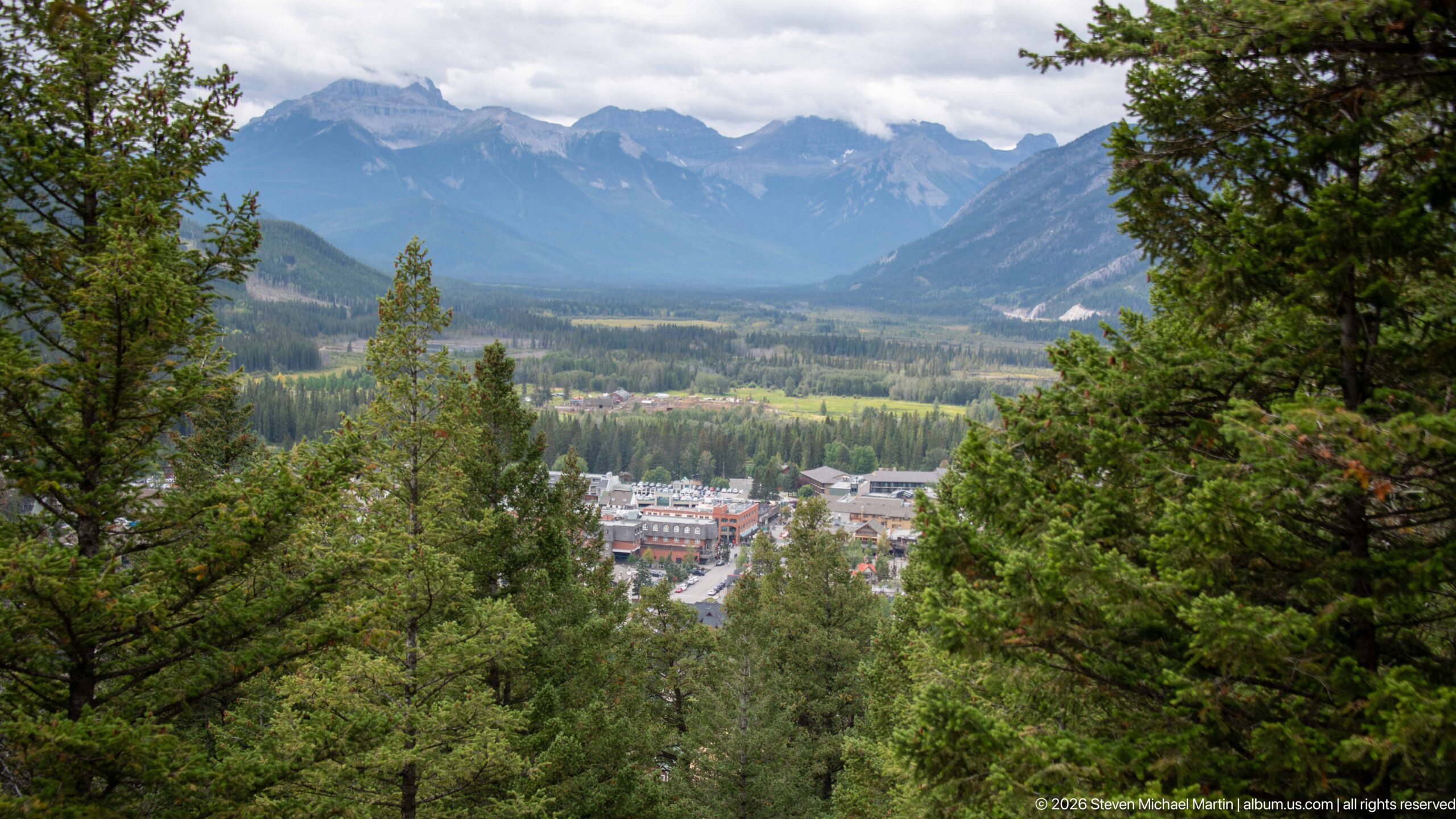
An elevated view looks through lodgepole pines toward the Banff townsite spread across the Bow Valley. Streets and buildings occupy the valley floor beneath steep, layered peaks, while low clouds soften the higher ridges. The framing emphasizes Banff’s unusual relationship between a compact urban center and the mountain landscape of Banff National Park.
Caption
An elevated view looks through lodgepole pines toward the Banff townsite spread across the Bow Valley. Streets and buildings occupy the valley floor beneath steep, layered peaks, while low clouds soften the higher ridges. The framing emphasizes Banff’s unusual relationship between a compact urban center and the mountain landscape of Banff National Park.
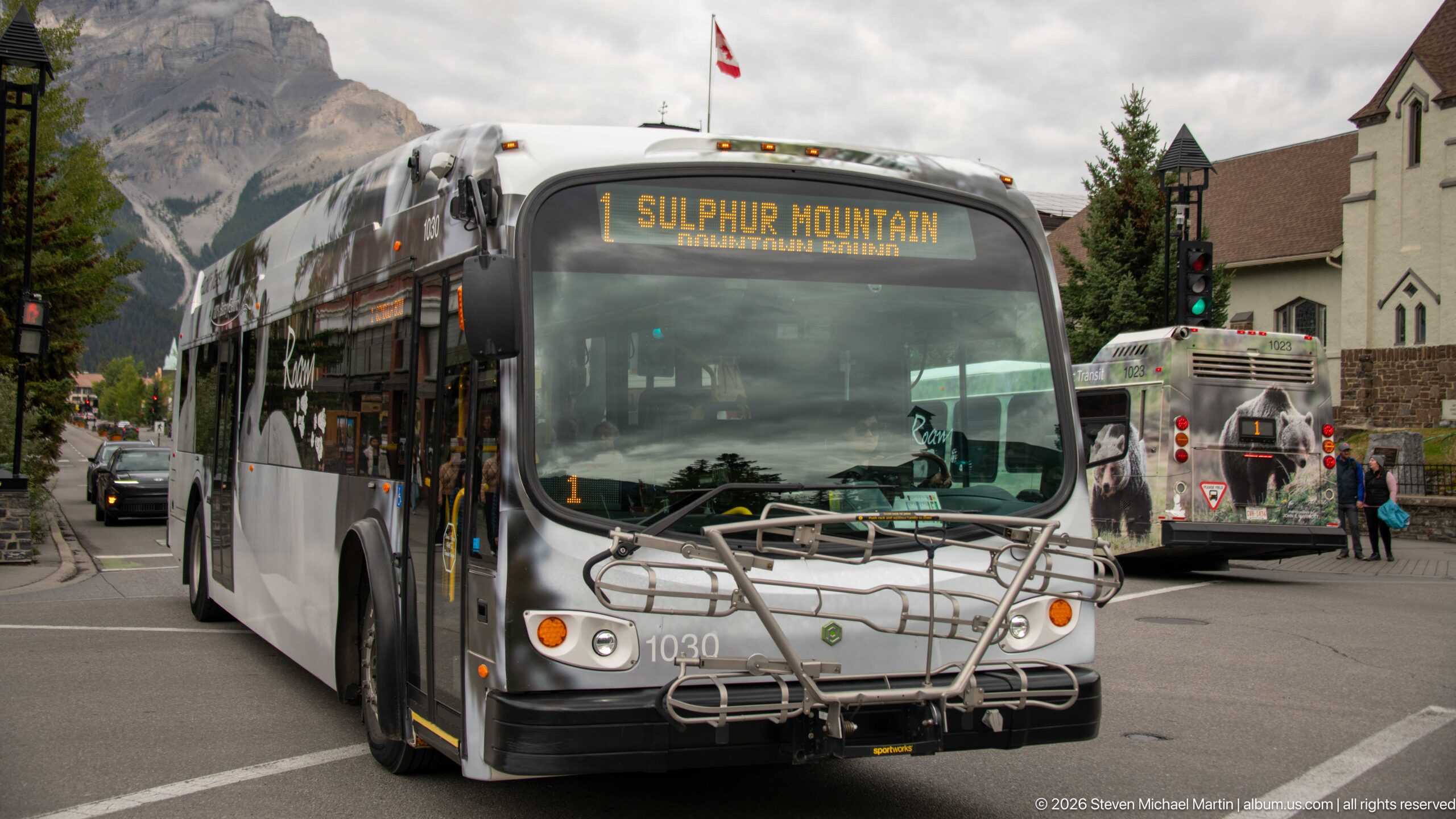
A Roam public transit bus displays Route 1 for Sulphur Mountain while stopped on a Banff street. The front bicycle rack, low-floor transit body, and mountain destination sign show the practical transportation system serving visitors and residents within the national park. Storefronts, pedestrians, and a second bus place the vehicle firmly in the active town center.
Caption
A Roam public transit bus displays Route 1 for Sulphur Mountain while stopped on a Banff street. The front bicycle rack, low-floor transit body, and mountain destination sign show the practical transportation system serving visitors and residents within the national park. Storefronts, pedestrians, and a second bus place the vehicle firmly in the active town center.
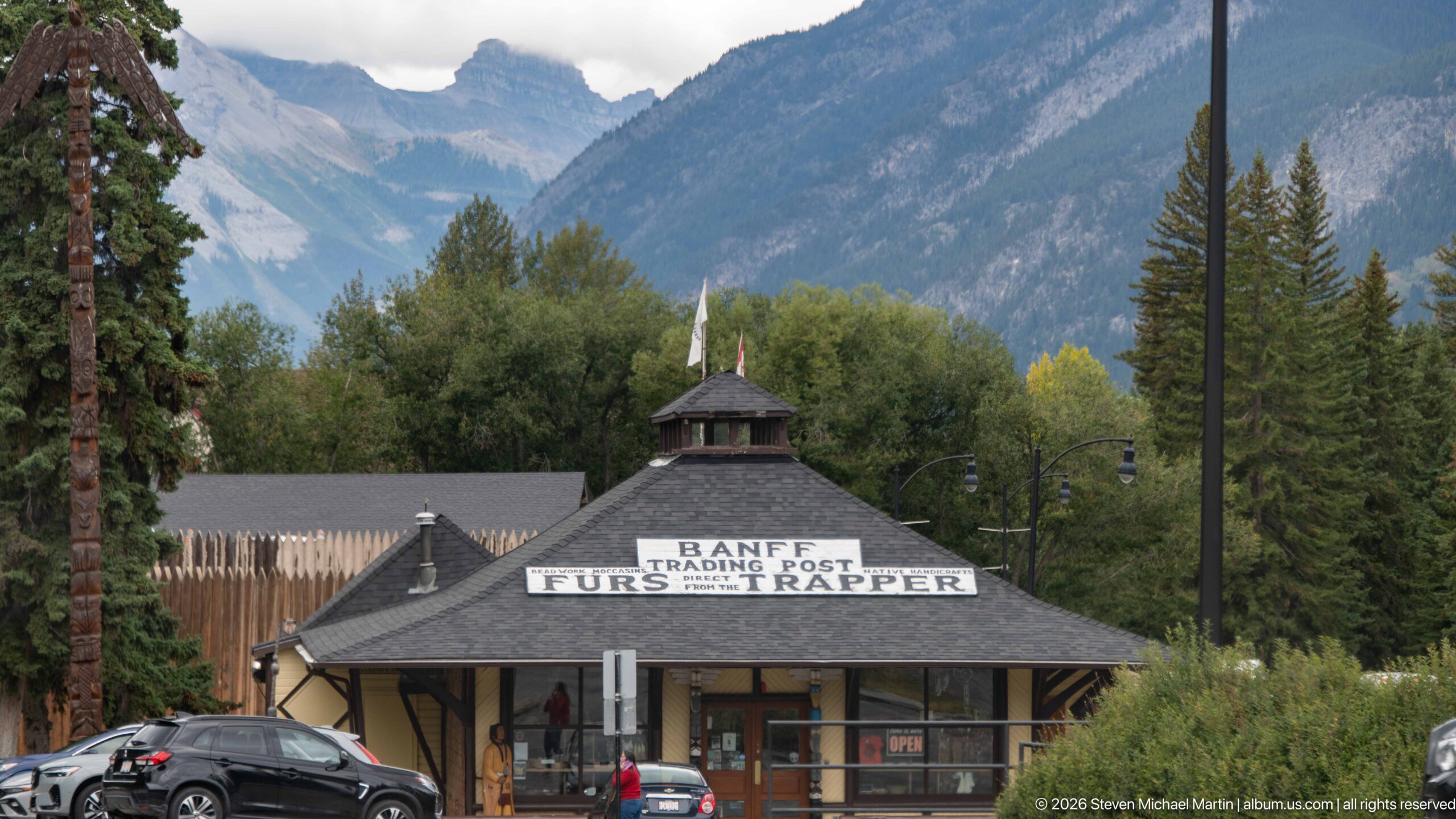
The low, rustic Banff Trading Post stands against a steep mountain backdrop, its roof sign advertising “Furs & Trapper.” The small commercial building, deep eaves, timber details, and prominent signage evoke the frontier imagery long used in Rocky Mountain tourism. Parked cars and roadside vegetation situate the shop within the contemporary Banff townsite.
Caption
The low, rustic Banff Trading Post stands against a steep mountain backdrop, its roof sign advertising “Furs & Trapper.” The small commercial building, deep eaves, timber details, and prominent signage evoke the frontier imagery long used in Rocky Mountain tourism. Parked cars and roadside vegetation situate the shop within the contemporary Banff townsite.
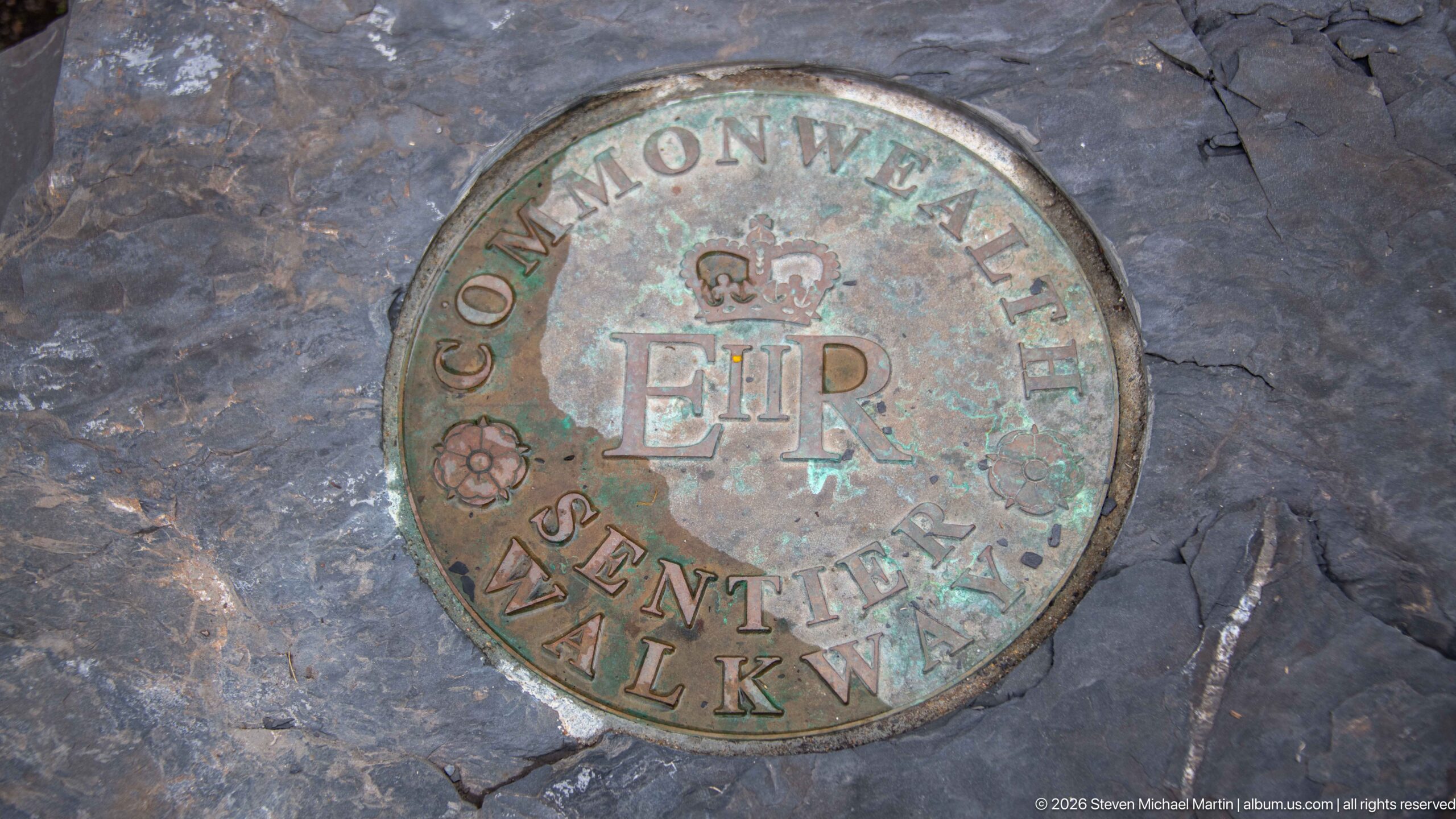
A circular bronze-colored medallion set directly into dark paving bears the words “COMMONWEALTH WALKWAY” around a crowned “ER” monogram. Weathering and green patina mark the metal surface, contrasting with the rough surrounding stone. The close detail records one of the small civic markers encountered at pedestrian level in Banff rather than a conventional architectural landmark.
Caption
A circular bronze-colored medallion set directly into dark paving bears the words “COMMONWEALTH WALKWAY” around a crowned “ER” monogram. Weathering and green patina mark the metal surface, contrasting with the rough surrounding stone. The close detail records one of the small civic markers encountered at pedestrian level in Banff rather than a conventional architectural landmark.
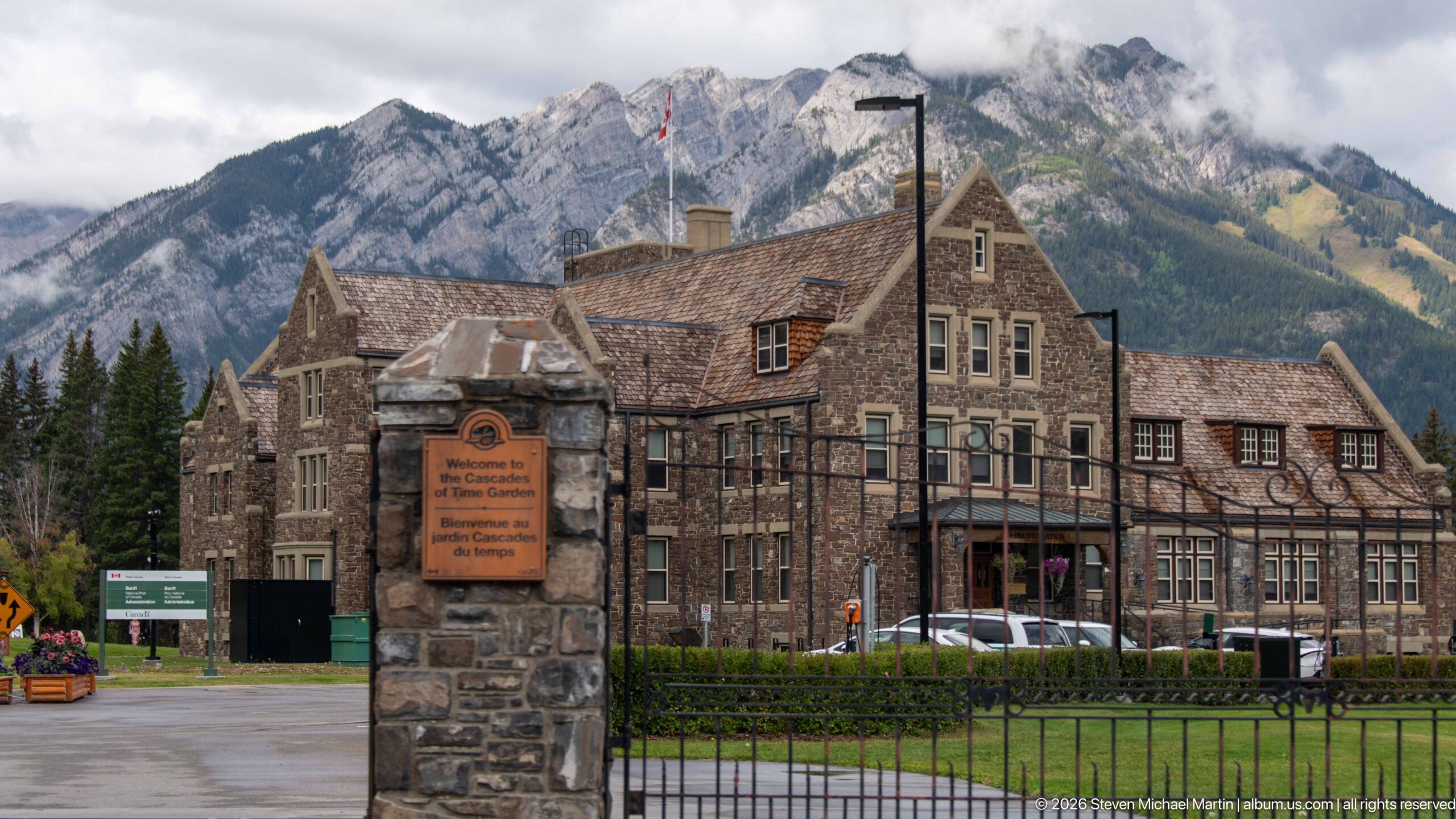
A stone entrance pier and iron fence frame an oblique view of the Banff Park Administration Building. Beyond the foreground marker, the building’s irregular gables, stone walls, and long window bands extend across the site, backed by cloud-wrapped mountains. The composition links the formal landscaped grounds with the historic administrative complex rather than isolating the building as a façade study.
Caption
A stone entrance pier and iron fence frame an oblique view of the Banff Park Administration Building. Beyond the foreground marker, the building’s irregular gables, stone walls, and long window bands extend across the site, backed by cloud-wrapped mountains. The composition links the formal landscaped grounds with the historic administrative complex rather than isolating the building as a façade study.
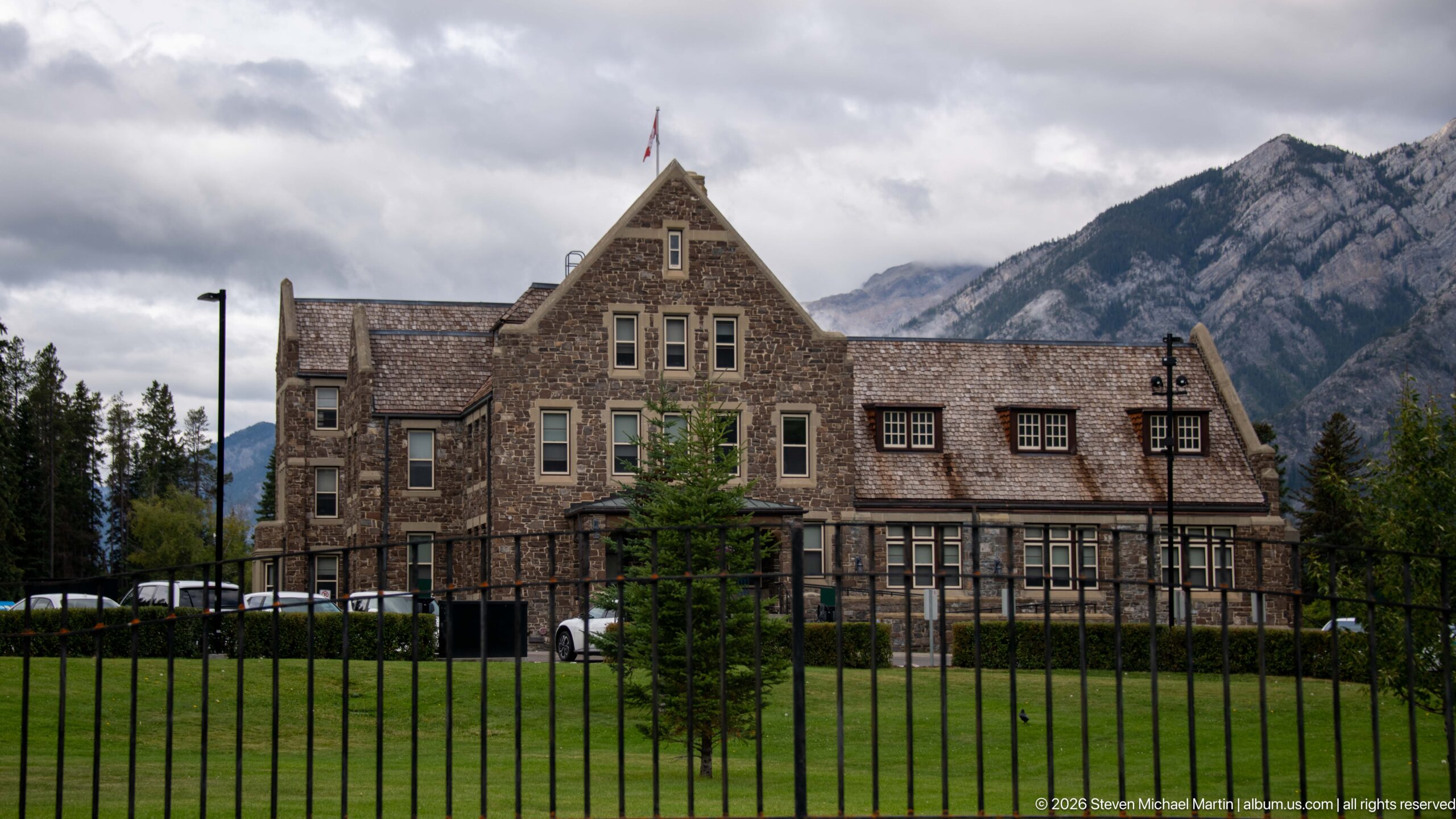
The side elevation of the Banff Park Administration Building is seen across a clipped lawn and black iron fence. A tall central gable, stone walls, and grouped rectangular windows create a restrained institutional composition, while mountains rise immediately beyond the roofline. This lateral view clarifies the building’s massing and its placement within landscaped grounds at the southern end of Banff Avenue.
Caption
The side elevation of the Banff Park Administration Building is seen across a clipped lawn and black iron fence. A tall central gable, stone walls, and grouped rectangular windows create a restrained institutional composition, while mountains rise immediately beyond the roofline. This lateral view clarifies the building’s massing and its placement within landscaped grounds at the southern end of Banff Avenue.
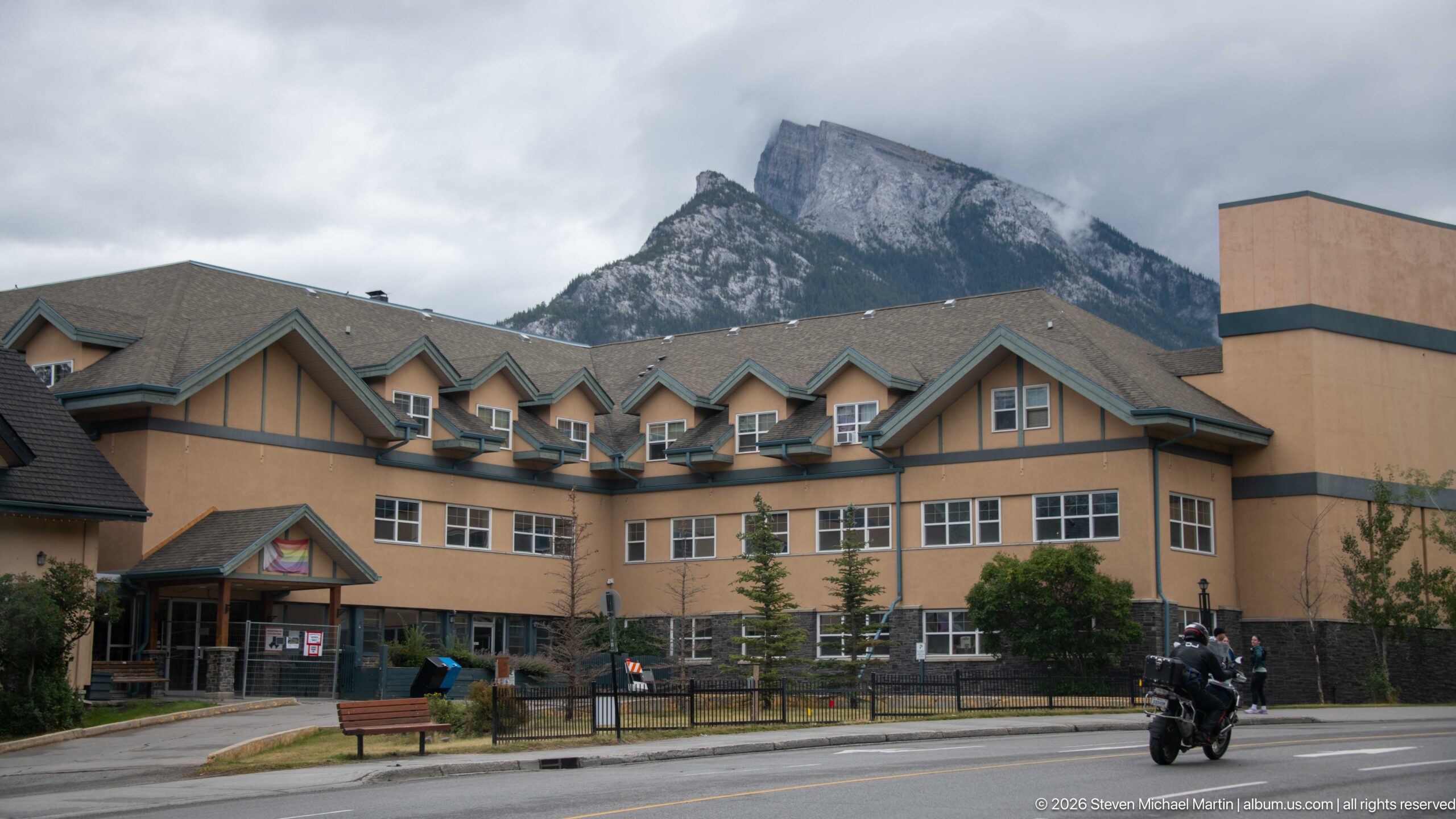
A multi-story building with repeated gabled dormers and balconies occupies a Banff street beneath a dramatic mountain ridge. Tan walls, timber-colored trim, and a broad sloping roof adapt a contemporary institutional or lodging form to the mountain setting. The street-level viewpoint emphasizes the contrast between everyday town architecture and the abrupt scale of the surrounding Rockies.
Caption
A multi-story building with repeated gabled dormers and balconies occupies a Banff street beneath a dramatic mountain ridge. Tan walls, timber-colored trim, and a broad sloping roof adapt a contemporary institutional or lodging form to the mountain setting. The street-level viewpoint emphasizes the contrast between everyday town architecture and the abrupt scale of the surrounding Rockies.
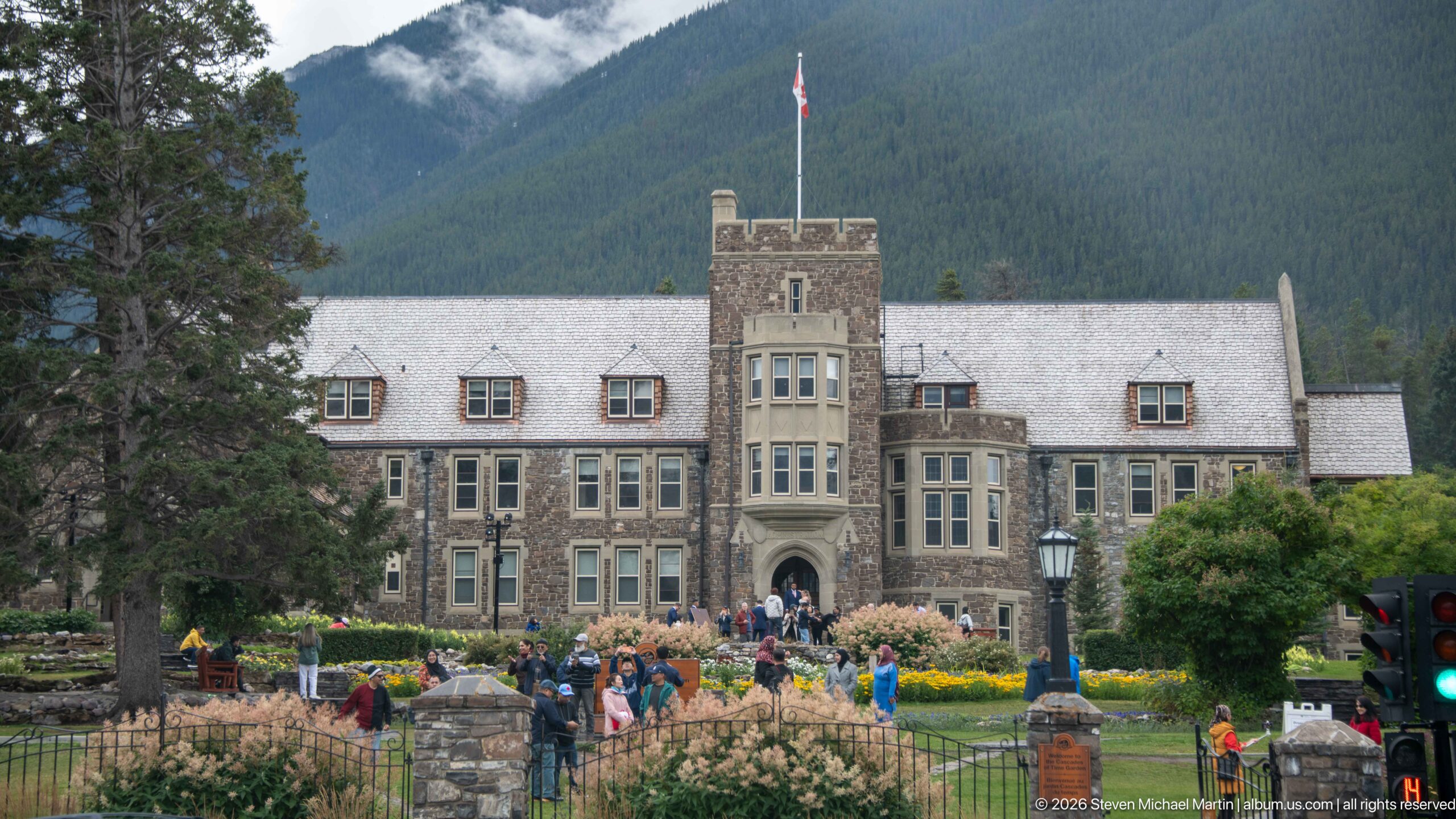
The symmetrical front of the Banff Park Administration Building anchors a formal garden axis, with a central tower and arched entrance projecting from the stone façade. Visitors gather among flower beds and paths in the foreground, while a Canadian flag rises above the roof. The frontal viewpoint presents the building as the architectural focus of Banff’s landscaped civic precinct.
Caption
The symmetrical front of the Banff Park Administration Building anchors a formal garden axis, with a central tower and arched entrance projecting from the stone façade. Visitors gather among flower beds and paths in the foreground, while a Canadian flag rises above the roof. The frontal viewpoint presents the building as the architectural focus of Banff’s landscaped civic precinct.
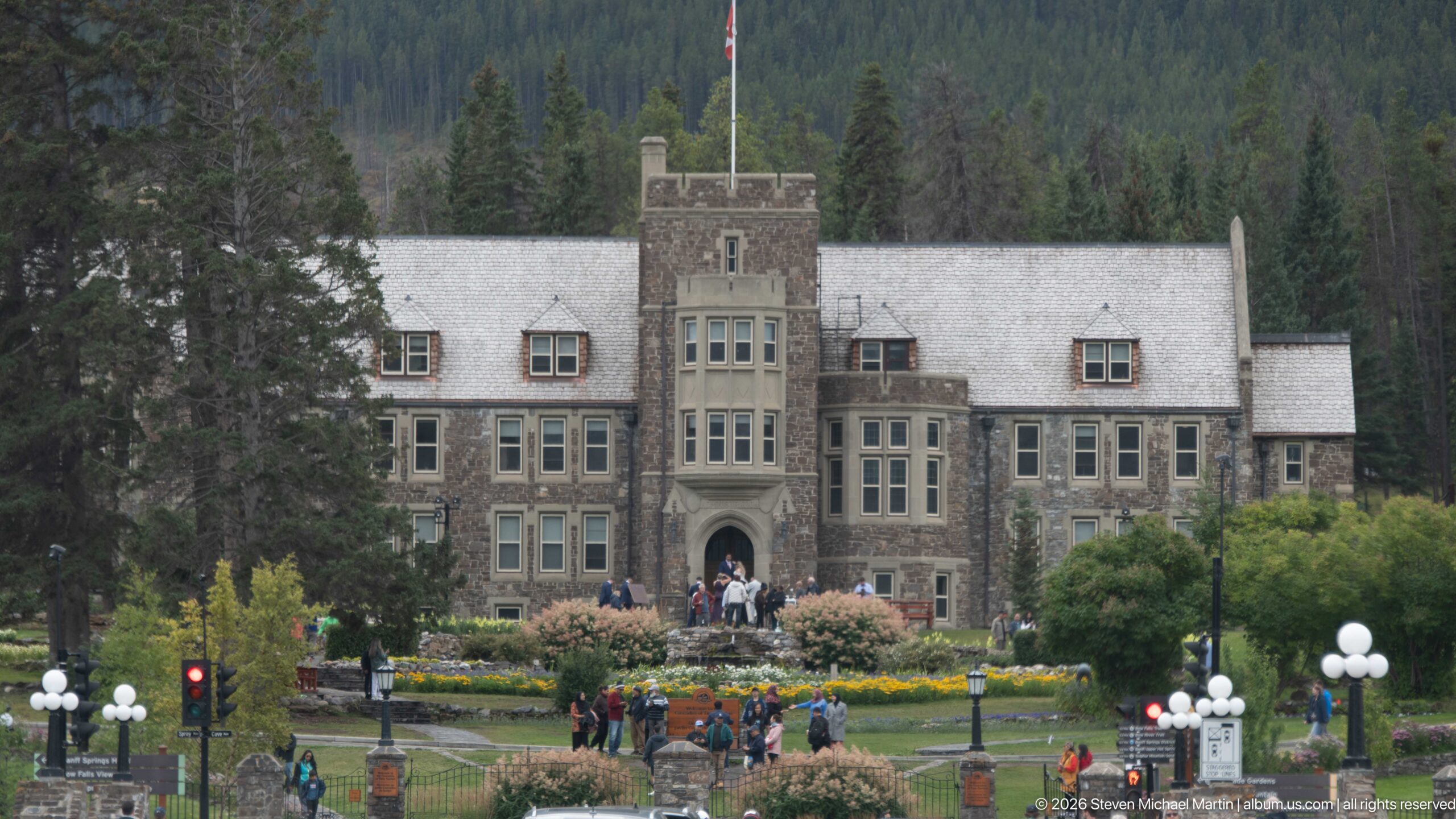
Flower beds, lawns, paths, and ornamental plantings lead toward the Banff Park Administration Building at the head of the Cascade of Time Garden. The long axial view places strolling visitors within the landscaped approach, while the building’s central tower and pale roof form a strong terminus against the forested mountainside. The composition emphasizes the designed relationship between garden and civic architecture.
Caption
Flower beds, lawns, paths, and ornamental plantings lead toward the Banff Park Administration Building at the head of the Cascade of Time Garden. The long axial view places strolling visitors within the landscaped approach, while the building’s central tower and pale roof form a strong terminus against the forested mountainside. The composition emphasizes the designed relationship between garden and civic architecture.
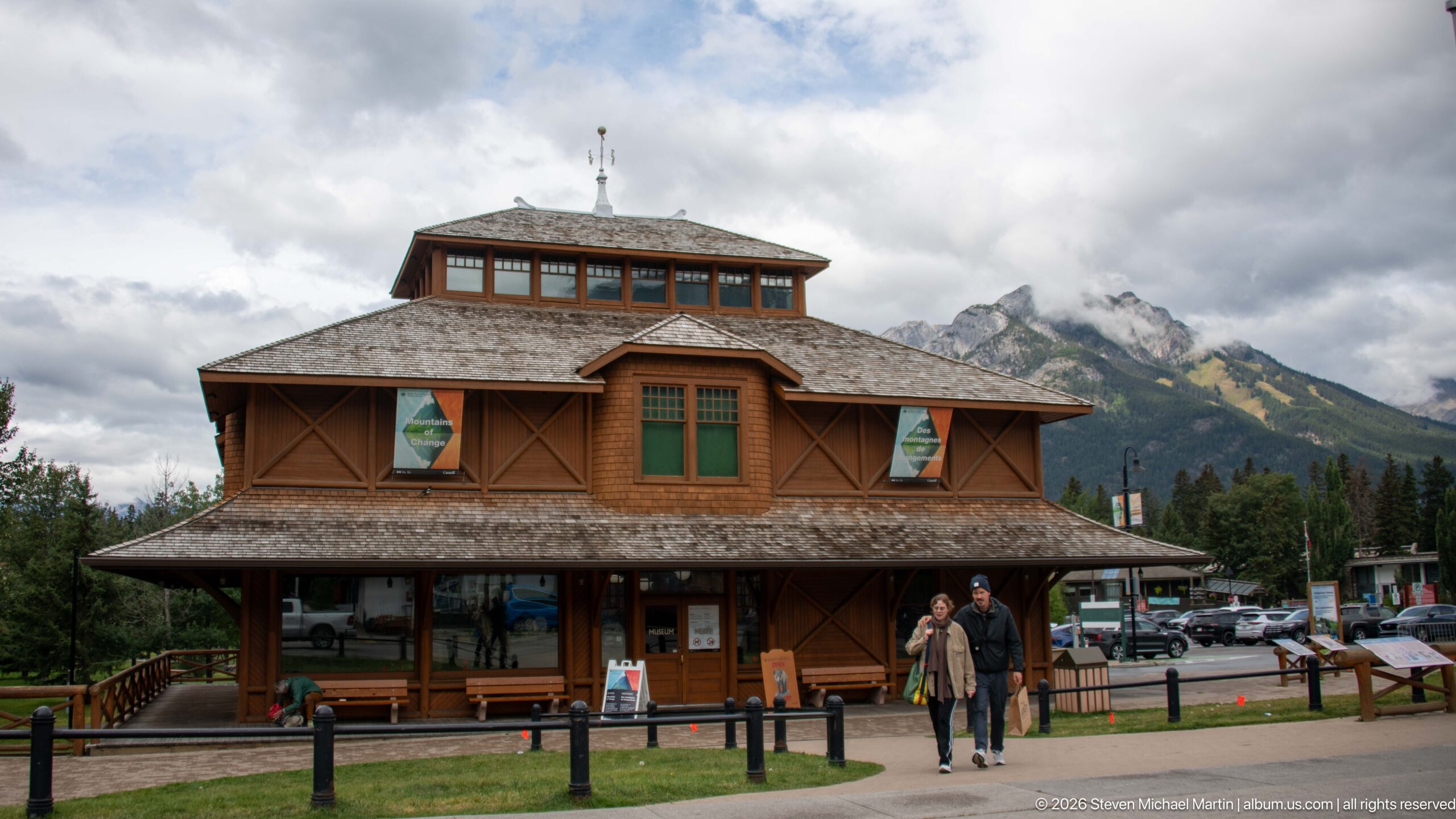
The wood-framed Banff Park Museum presents its broad veranda, shingled roof, and elevated central clerestory against a backdrop of Rocky Mountain peaks. Warm brown siding and exposed timber bracing give the building a distinctive early park character. Interpretive panels and visitors around the perimeter show the historic structure continuing to function as a public museum within the Banff townsite.
Caption
The wood-framed Banff Park Museum presents its broad veranda, shingled roof, and elevated central clerestory against a backdrop of Rocky Mountain peaks. Warm brown siding and exposed timber bracing give the building a distinctive early park character. Interpretive panels and visitors around the perimeter show the historic structure continuing to function as a public museum within the Banff townsite.
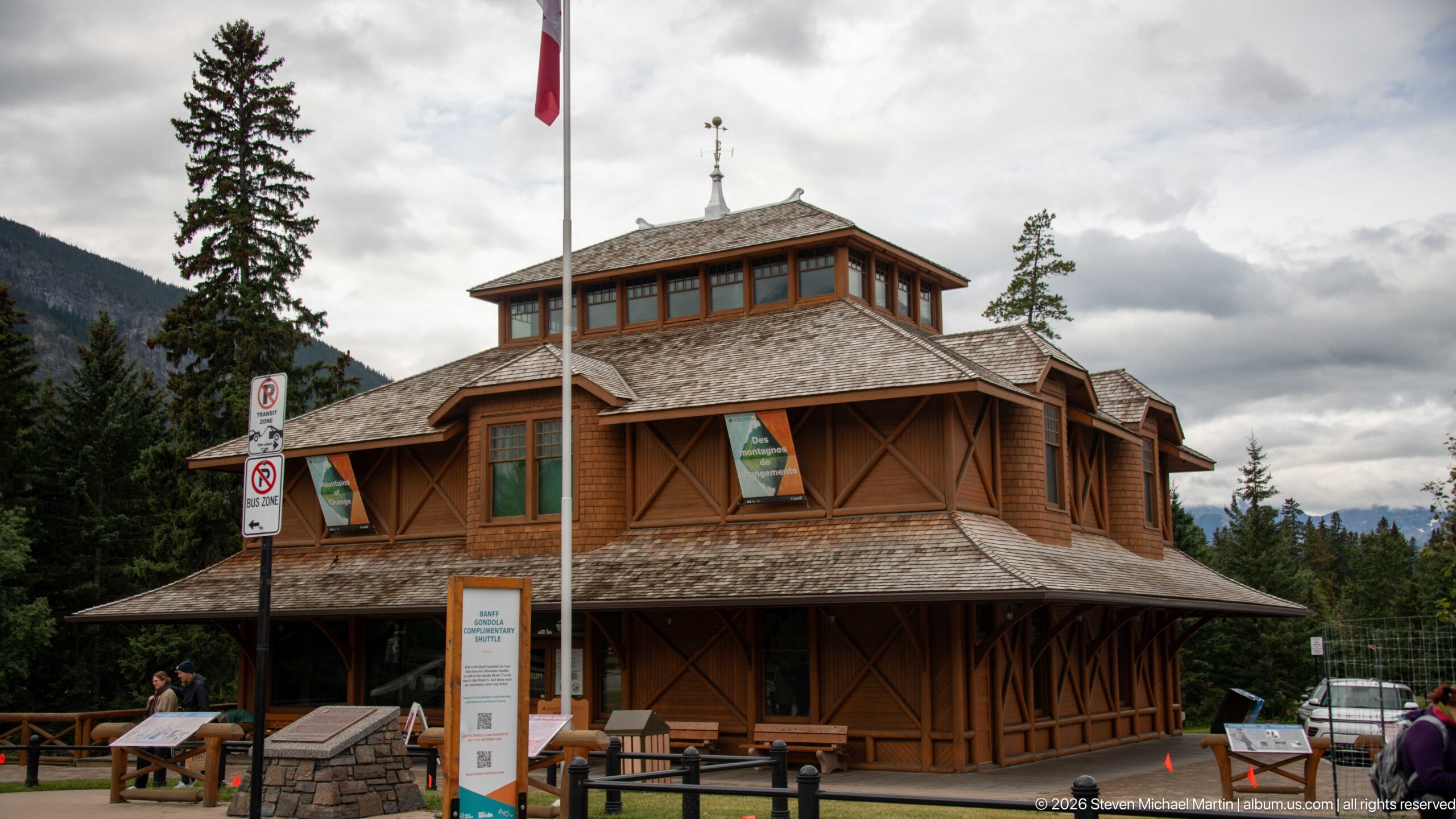
A closer corner view of the Banff Park Museum reveals the deep wraparound veranda, diagonal timber bracing, wood siding, and layered shingle roofs. A Canadian flagpole and interpretive displays occupy the foreground, while the raised central roof admits light above the main exhibition hall. The angle highlights the building’s construction and sheltered perimeter rather than its overall setting.
Caption
A closer corner view of the Banff Park Museum reveals the deep wraparound veranda, diagonal timber bracing, wood siding, and layered shingle roofs. A Canadian flagpole and interpretive displays occupy the foreground, while the raised central roof admits light above the main exhibition hall. The angle highlights the building’s construction and sheltered perimeter rather than its overall setting.
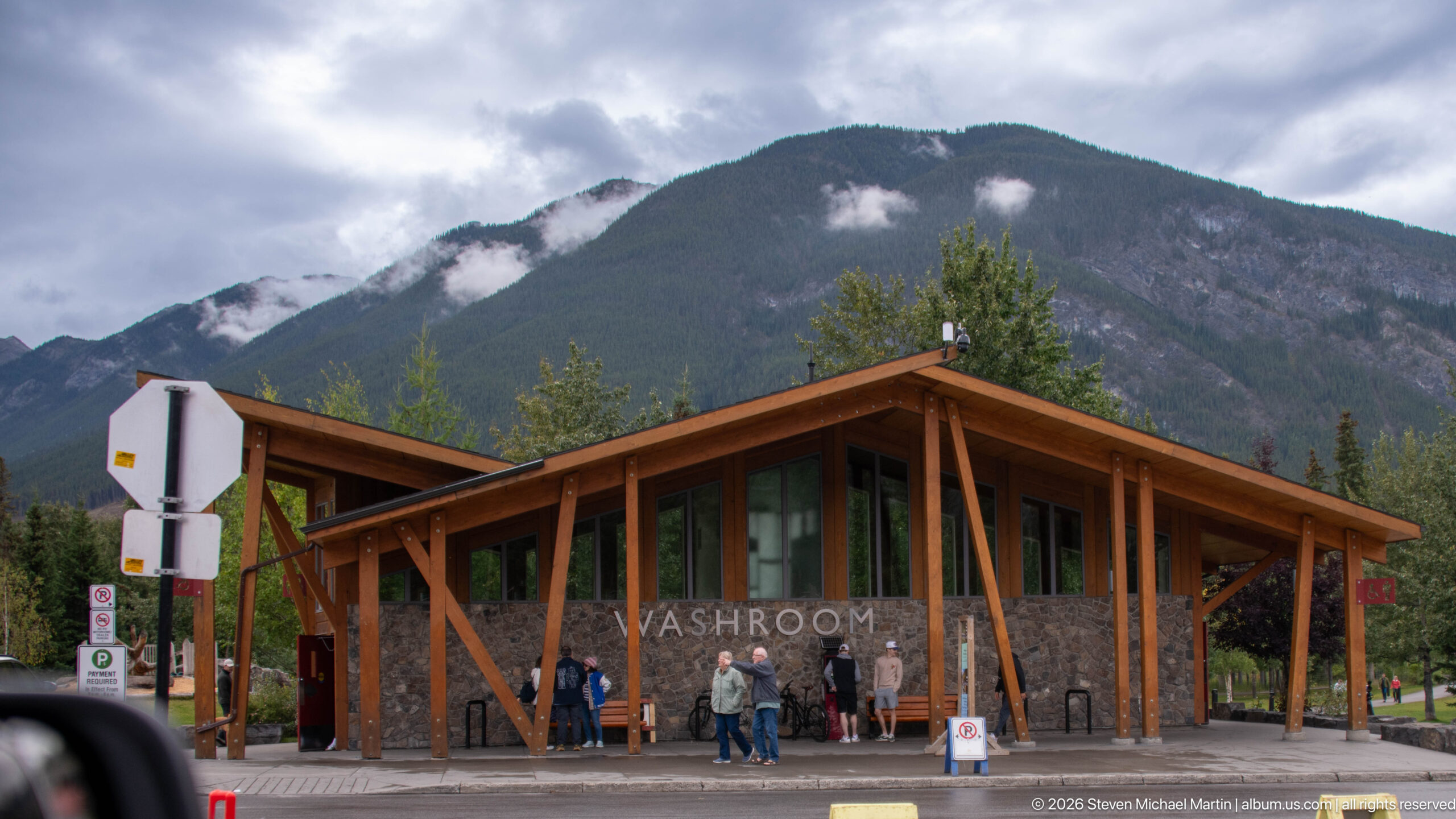
A modern public washroom building uses heavy timber posts, broad overhanging roofs, dark stone walls, and extensive glazing to echo materials associated with Rocky Mountain architecture. The word “WASHROOM” is visible across the glass entrance, where several visitors gather. Low clouds cling to the forested mountain behind, reinforcing the close connection between municipal amenities and Banff’s dramatic setting.
Caption
A modern public washroom building uses heavy timber posts, broad overhanging roofs, dark stone walls, and extensive glazing to echo materials associated with Rocky Mountain architecture. The word “WASHROOM” is visible across the glass entrance, where several visitors gather. Low clouds cling to the forested mountain behind, reinforcing the close connection between municipal amenities and Banff’s dramatic setting.
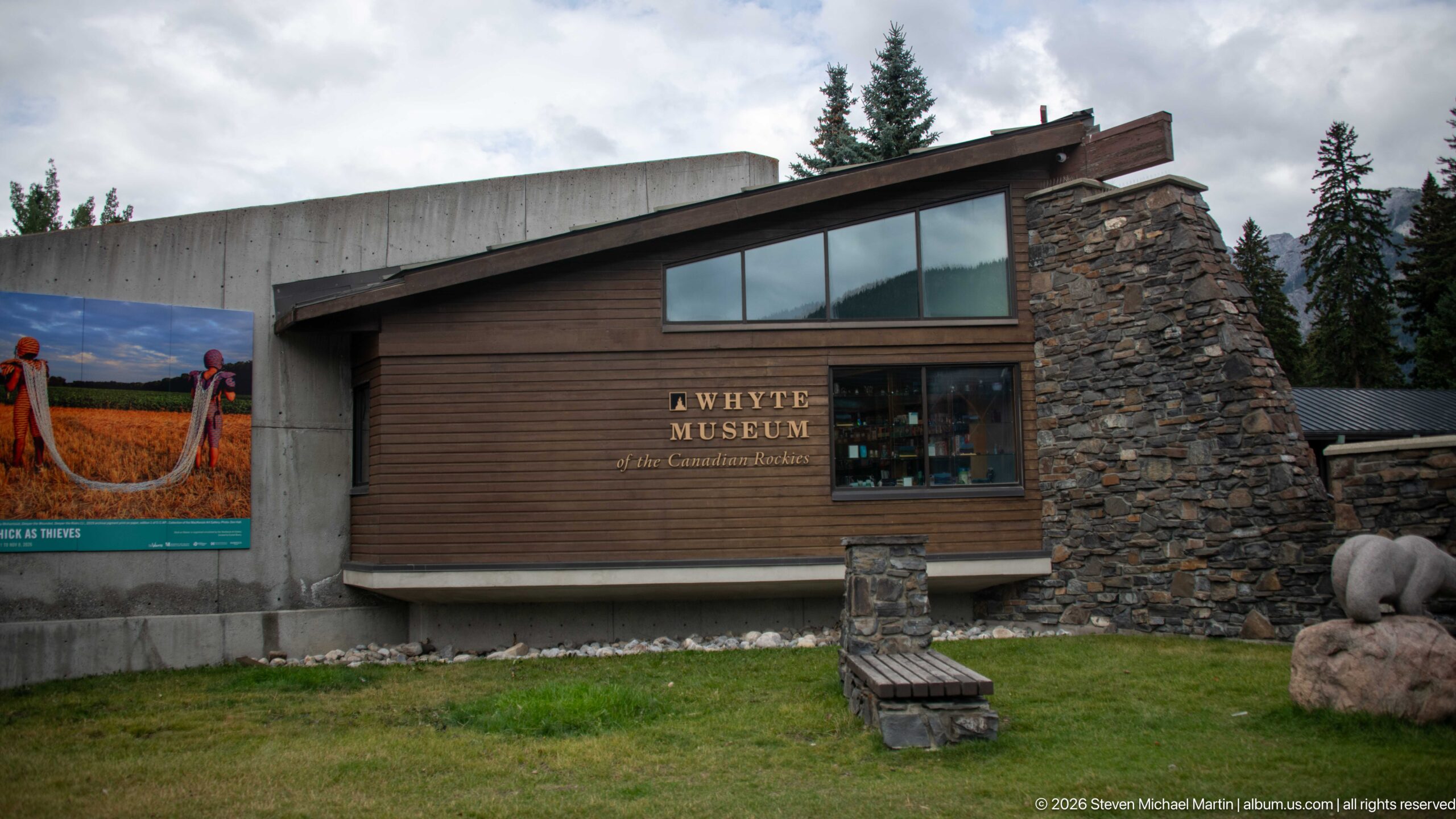
The Whyte Museum of the Canadian Rockies combines dark wood siding, broad glazing, concrete wall planes, and a rugged stone chimney in a low modern composition. Gold lettering identifies the museum on the façade, while a sculptural animal form and bench occupy the lawn at right. The building’s materials bridge modern design and the stone-and-timber vocabulary associated with Banff.
Caption
The Whyte Museum of the Canadian Rockies combines dark wood siding, broad glazing, concrete wall planes, and a rugged stone chimney in a low modern composition. Gold lettering identifies the museum on the façade, while a sculptural animal form and bench occupy the lawn at right. The building’s materials bridge modern design and the stone-and-timber vocabulary associated with Banff.
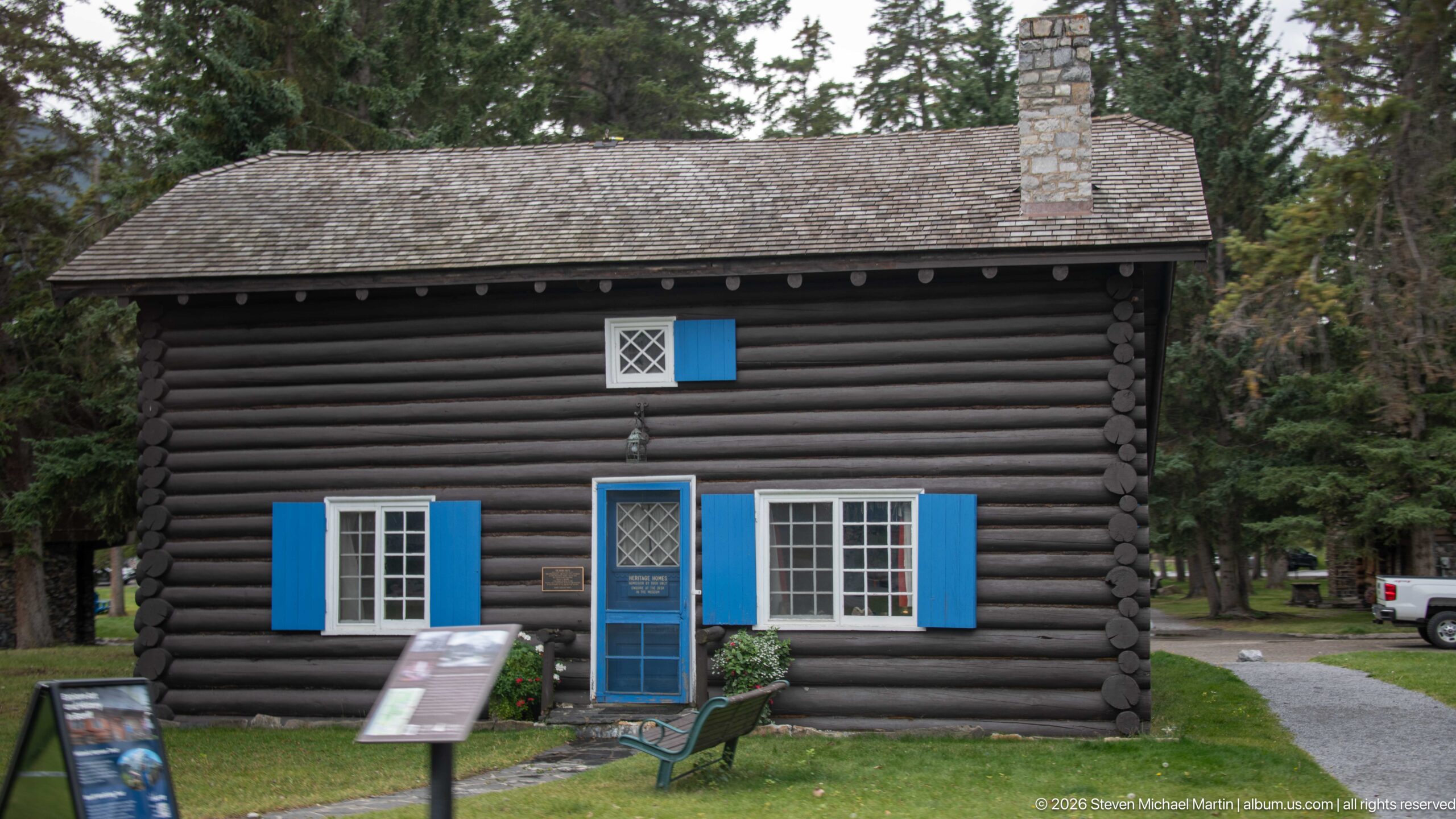
A compact historic log building stands among conifers, distinguished by dark horizontal logs, a stone chimney, white multi-pane windows, and vivid blue shutters and door trim. Interpretive panels in front indicate its preserved heritage role. The close architectural view records the cabin as an individual historic structure within Banff’s museum landscape without relying on an uncertain personal association.
Caption
A compact historic log building stands among conifers, distinguished by dark horizontal logs, a stone chimney, white multi-pane windows, and vivid blue shutters and door trim. Interpretive panels in front indicate its preserved heritage role. The close architectural view records the cabin as an individual historic structure within Banff’s museum landscape without relying on an uncertain personal association.
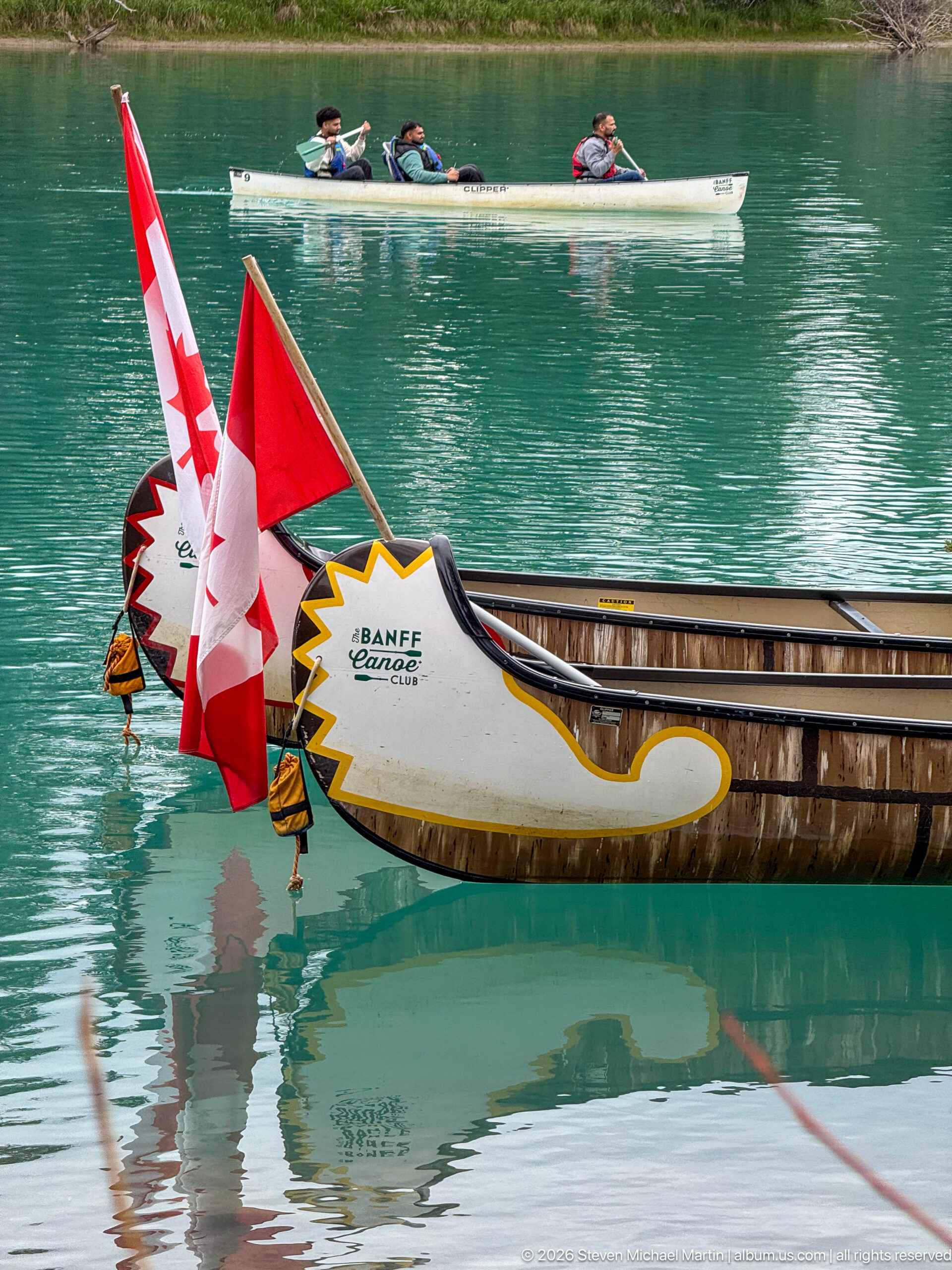
Two Banff Canoe Club canoes float side by side at the dock, their white hull ends painted with bold yellow, black, and red motifs and topped by Canadian flags. A separate canoe with paddlers crosses the calm turquoise water behind them. The layered composition contrasts the stationary rental craft in the foreground with active recreation farther across the river.
Caption
Two Banff Canoe Club canoes float side by side at the dock, their white hull ends painted with bold yellow, black, and red motifs and topped by Canadian flags. A separate canoe with paddlers crosses the calm turquoise water behind them. The layered composition contrasts the stationary rental craft in the foreground with active recreation farther across the river.
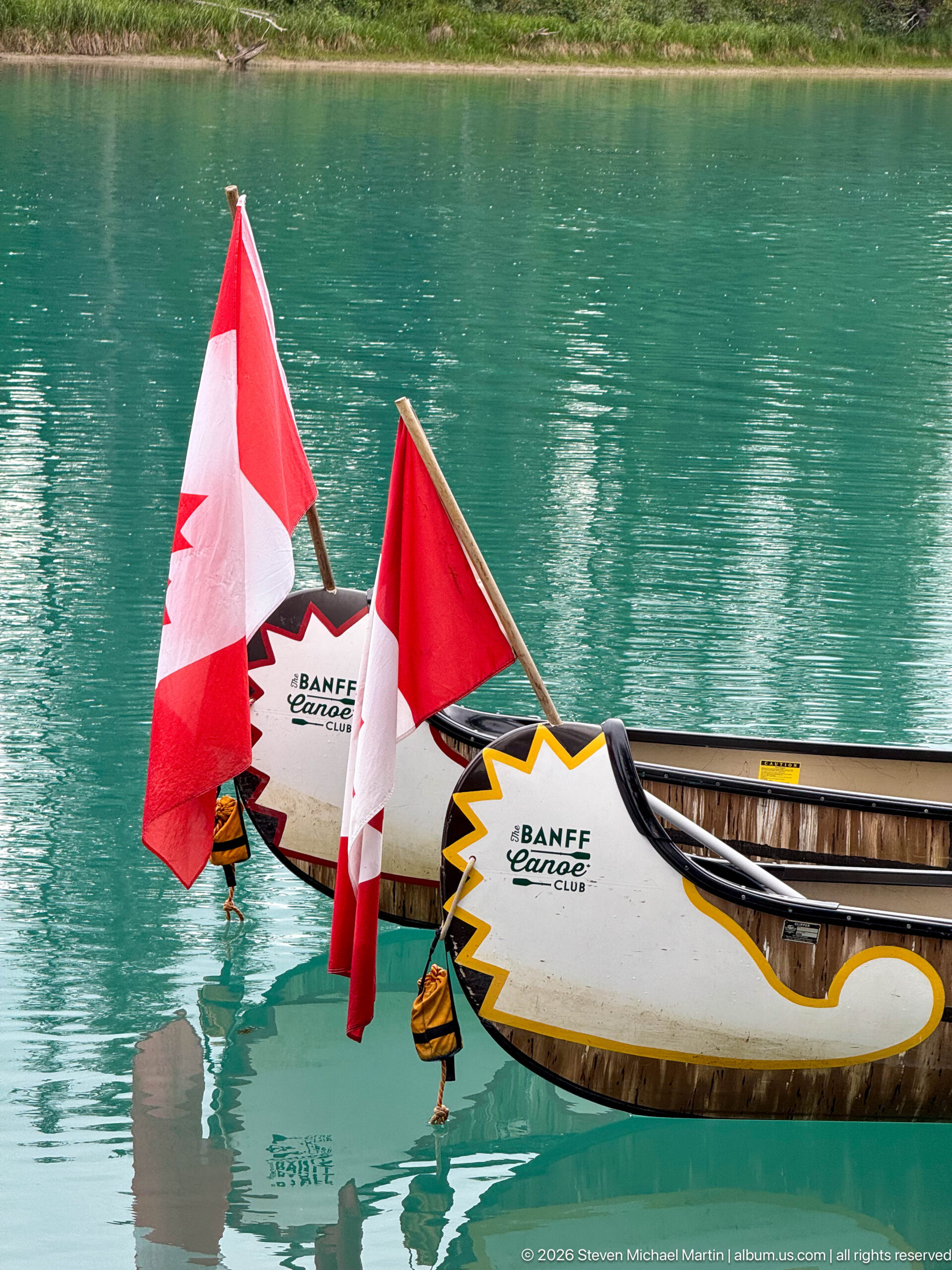
A tight study isolates the painted ends of Banff Canoe Club canoes against luminous blue-green water. Red-and-white Canadian flags rise above the boats, while stylized geometric decoration traces the high curved bows and their reflections. By excluding most of the shore and surrounding mountains, the frame turns the club’s distinctive rental craft into a graphic study of color, pattern, and national symbols.
Caption
A tight study isolates the painted ends of Banff Canoe Club canoes against luminous blue-green water. Red-and-white Canadian flags rise above the boats, while stylized geometric decoration traces the high curved bows and their reflections. By excluding most of the shore and surrounding mountains, the frame turns the club’s distinctive rental craft into a graphic study of color, pattern, and national symbols.
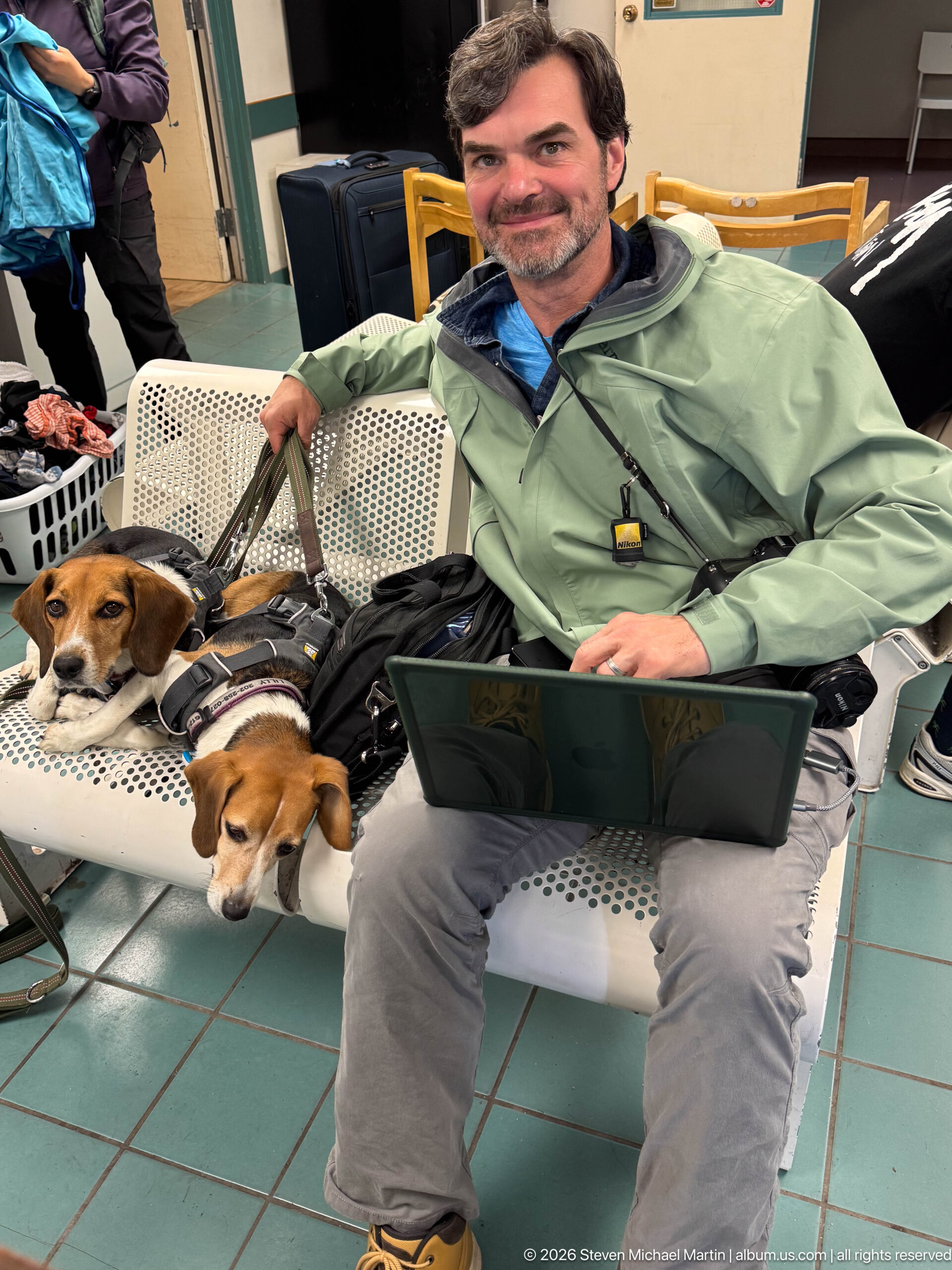
A seated visitor rests indoors with two beagles stretched across the adjoining perforated-metal seats. The dogs wear harnesses and remain leashed, while the traveler holds their leads and a dark bag rests across his lap. The informal scene adds a personal record of traveling through Banff with dogs, contrasting with the preceding architectural and landscape views.
Caption
A seated visitor rests indoors with two beagles stretched across the adjoining perforated-metal seats. The dogs wear harnesses and remain leashed, while the traveler holds their leads and a dark bag rests across his lap. The informal scene adds a personal record of traveling through Banff with dogs, contrasting with the preceding architectural and landscape views.
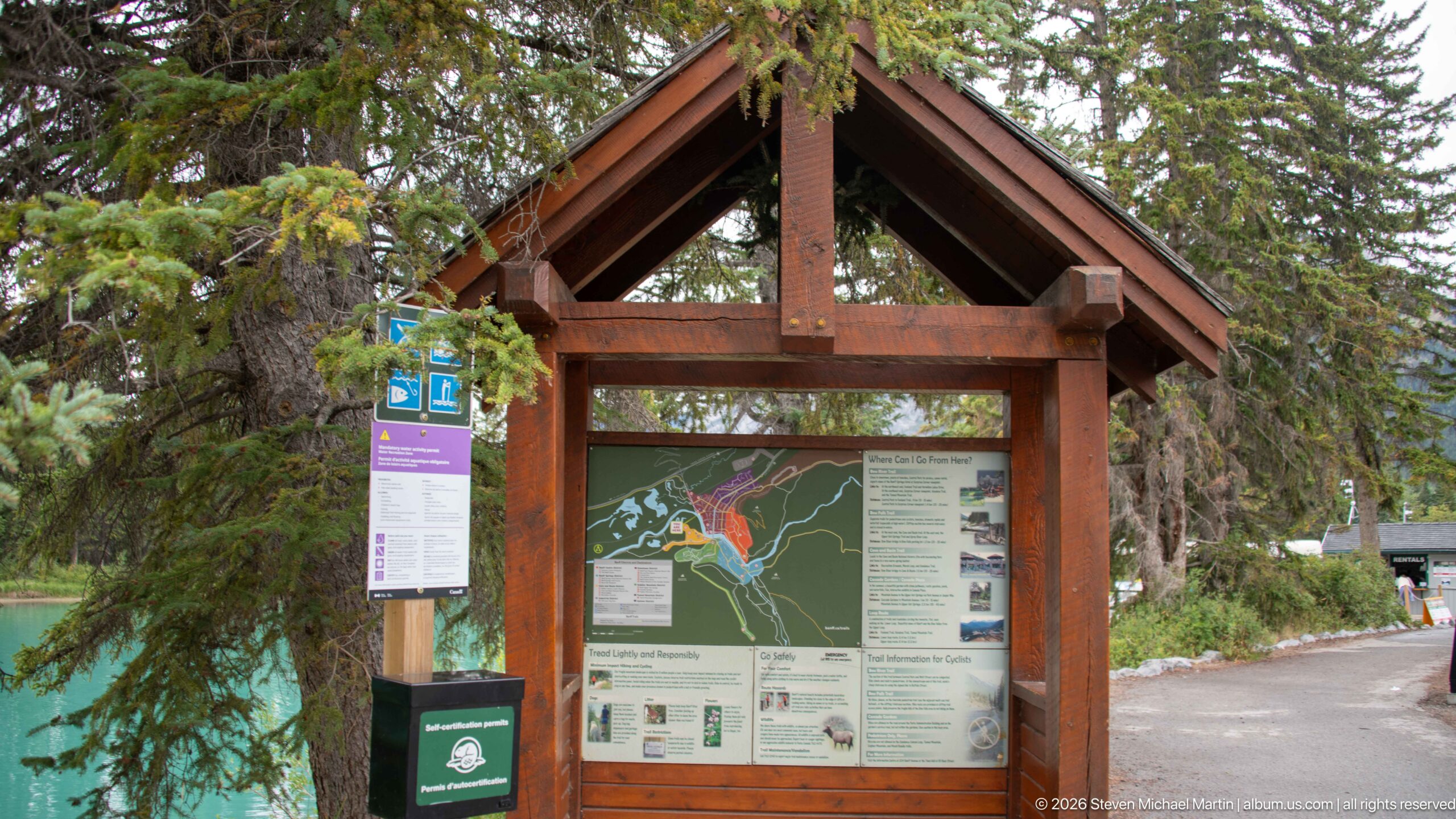
A timber-framed information kiosk presents a large map and visitor guidance beside the waterfront recreation area. Its steep protective roof and heavy wood posts shelter multiple panels, while glimpses of turquoise water and forest appear beyond. The photograph records the practical wayfinding infrastructure that connects Banff’s townsite with nearby trails, river access, and outdoor activities.
Caption
A timber-framed information kiosk presents a large map and visitor guidance beside the waterfront recreation area. Its steep protective roof and heavy wood posts shelter multiple panels, while glimpses of turquoise water and forest appear beyond. The photograph records the practical wayfinding infrastructure that connects Banff’s townsite with nearby trails, river access, and outdoor activities.
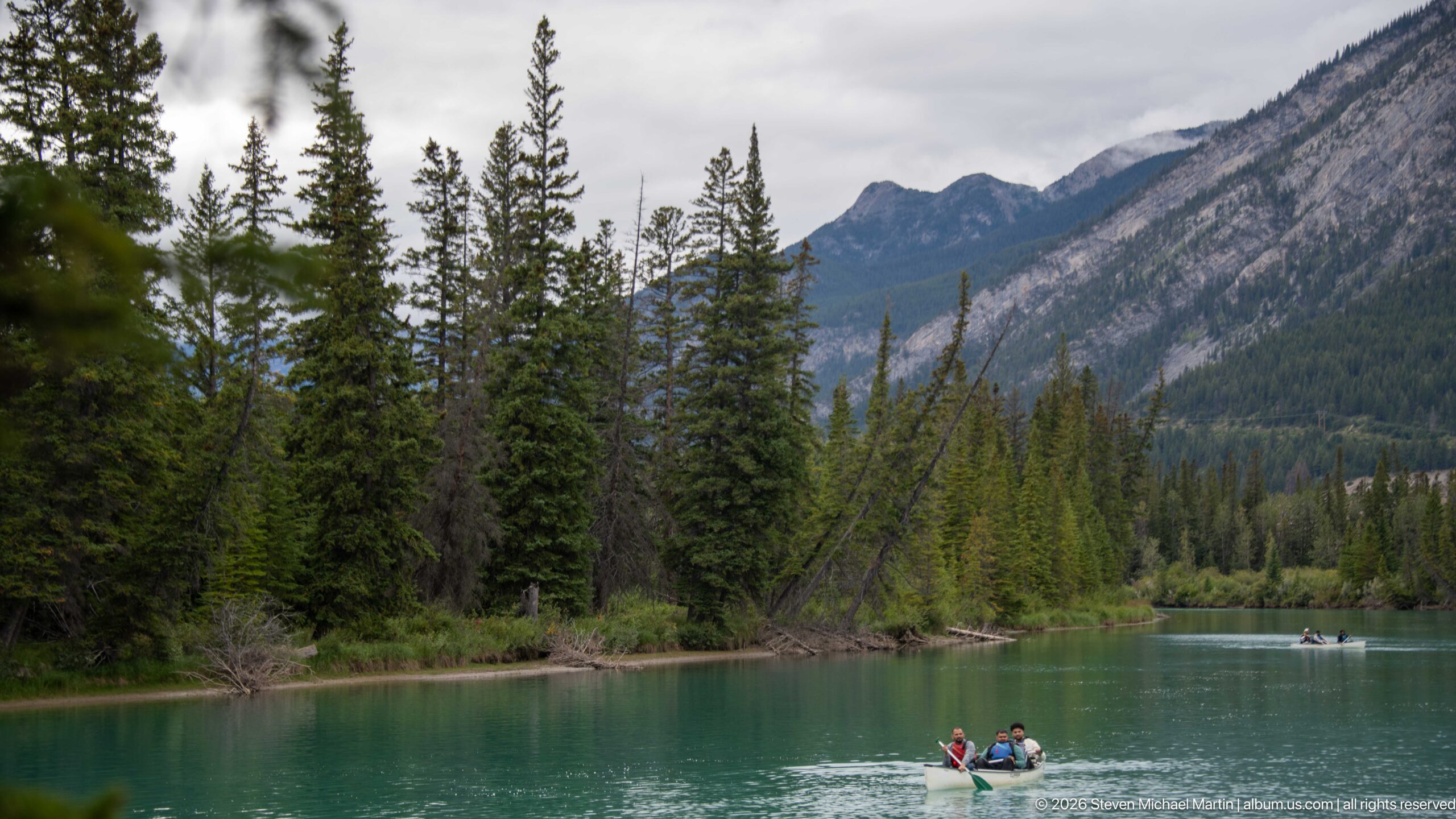
A small canoe carrying two paddlers moves across calm turquoise water beneath dense conifers and steep mountain slopes. Another craft is visible farther along the channel, giving scale to the broad, quiet reach. The scene shifts attention from the canoe club’s decorated boats to the surrounding landscape and the low-impact recreation available immediately beside the Banff townsite.
Caption
A small canoe carrying two paddlers moves across calm turquoise water beneath dense conifers and steep mountain slopes. Another craft is visible farther along the channel, giving scale to the broad, quiet reach. The scene shifts attention from the canoe club’s decorated boats to the surrounding landscape and the low-impact recreation available immediately beside the Banff townsite.
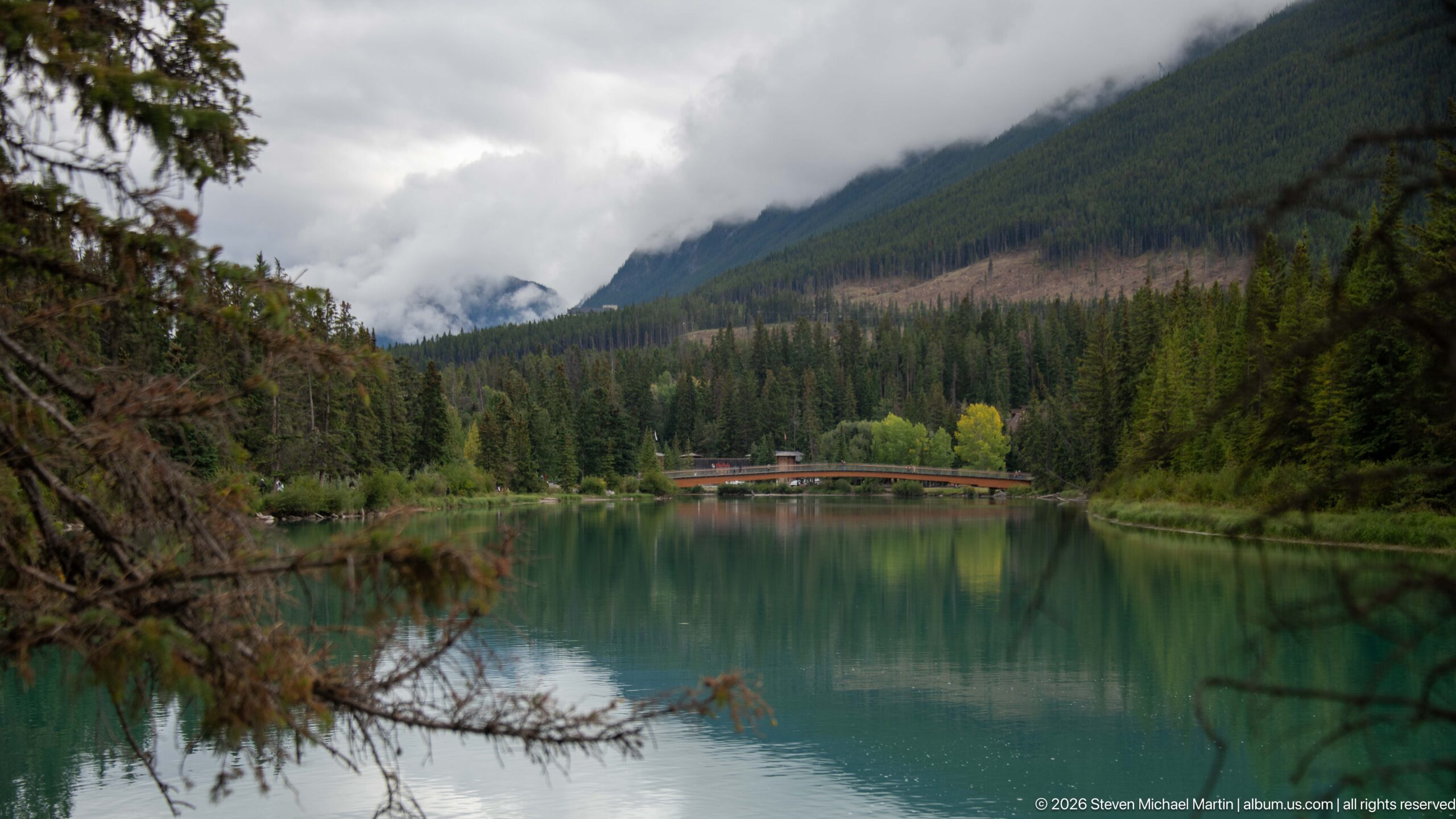
Calm green-blue water reflects a forested mountain slope beneath low clouds, while a low pedestrian bridge spans the channel in the middle distance. Branches and shoreline vegetation frame the scene from a quiet bank. The view emphasizes the sheltered waterways and riparian landscape near Banff Canoe Club, where the town quickly gives way to forest and mountain terrain.
Caption
Calm green-blue water reflects a forested mountain slope beneath low clouds, while a low pedestrian bridge spans the channel in the middle distance. Branches and shoreline vegetation frame the scene from a quiet bank. The view emphasizes the sheltered waterways and riparian landscape near Banff Canoe Club, where the town quickly gives way to forest and mountain terrain.
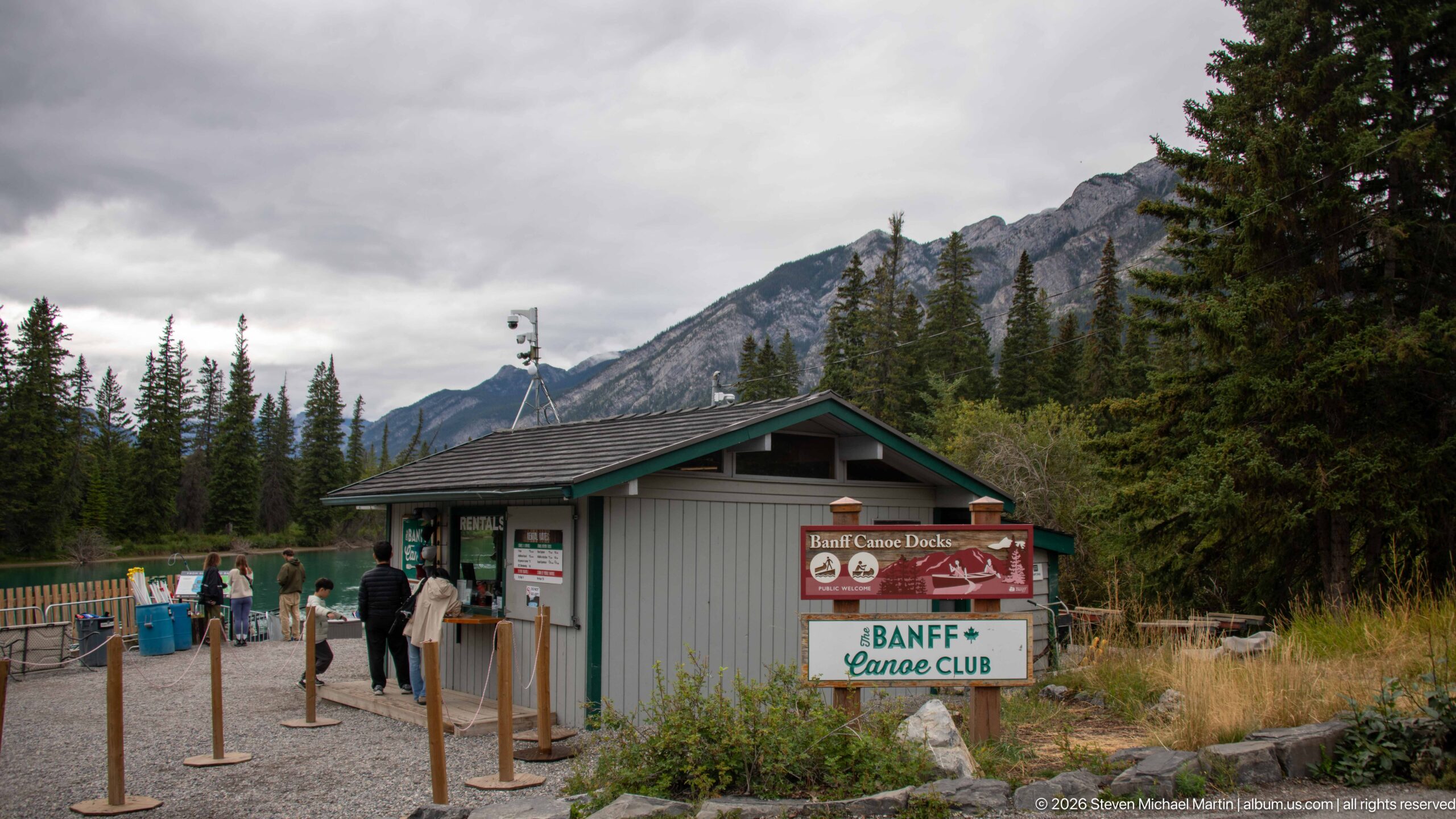
The Banff Canoe Club rental kiosk stands beside the water with visitors gathered at its service window. A large sign identifies the club, while a second panel advertises rental canoes and kayaks. The modest building, queue rails, surrounding conifers, and mountain backdrop present the operational side of a recreation business closely integrated with Banff’s riverfront landscape.
Caption
The Banff Canoe Club rental kiosk stands beside the water with visitors gathered at its service window. A large sign identifies the club, while a second panel advertises rental canoes and kayaks. The modest building, queue rails, surrounding conifers, and mountain backdrop present the operational side of a recreation business closely integrated with Banff’s riverfront landscape.
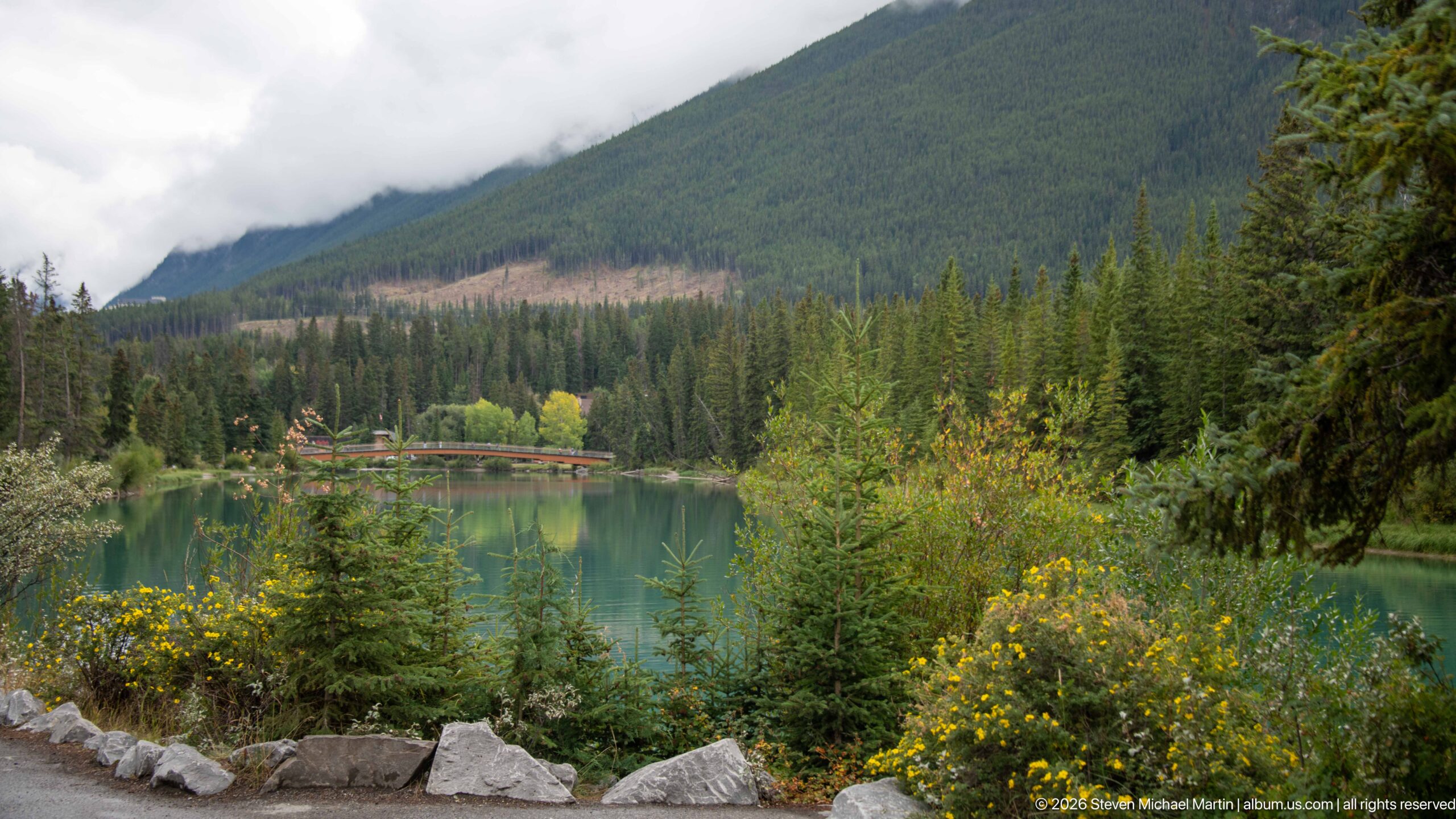
A tranquil green-blue channel curves through dense conifer forest, with a low bridge crossing in the middle distance and cloud hanging over the mountain slope beyond. Yellow wildflowers and young evergreens brighten the rocky foreground. The composition broadens the canoe-club sequence into a landscape study, emphasizing the sheltered riparian environment immediately adjacent to Banff.
Caption
A tranquil green-blue channel curves through dense conifer forest, with a low bridge crossing in the middle distance and cloud hanging over the mountain slope beyond. Yellow wildflowers and young evergreens brighten the rocky foreground. The composition broadens the canoe-club sequence into a landscape study, emphasizing the sheltered riparian environment immediately adjacent to Banff.
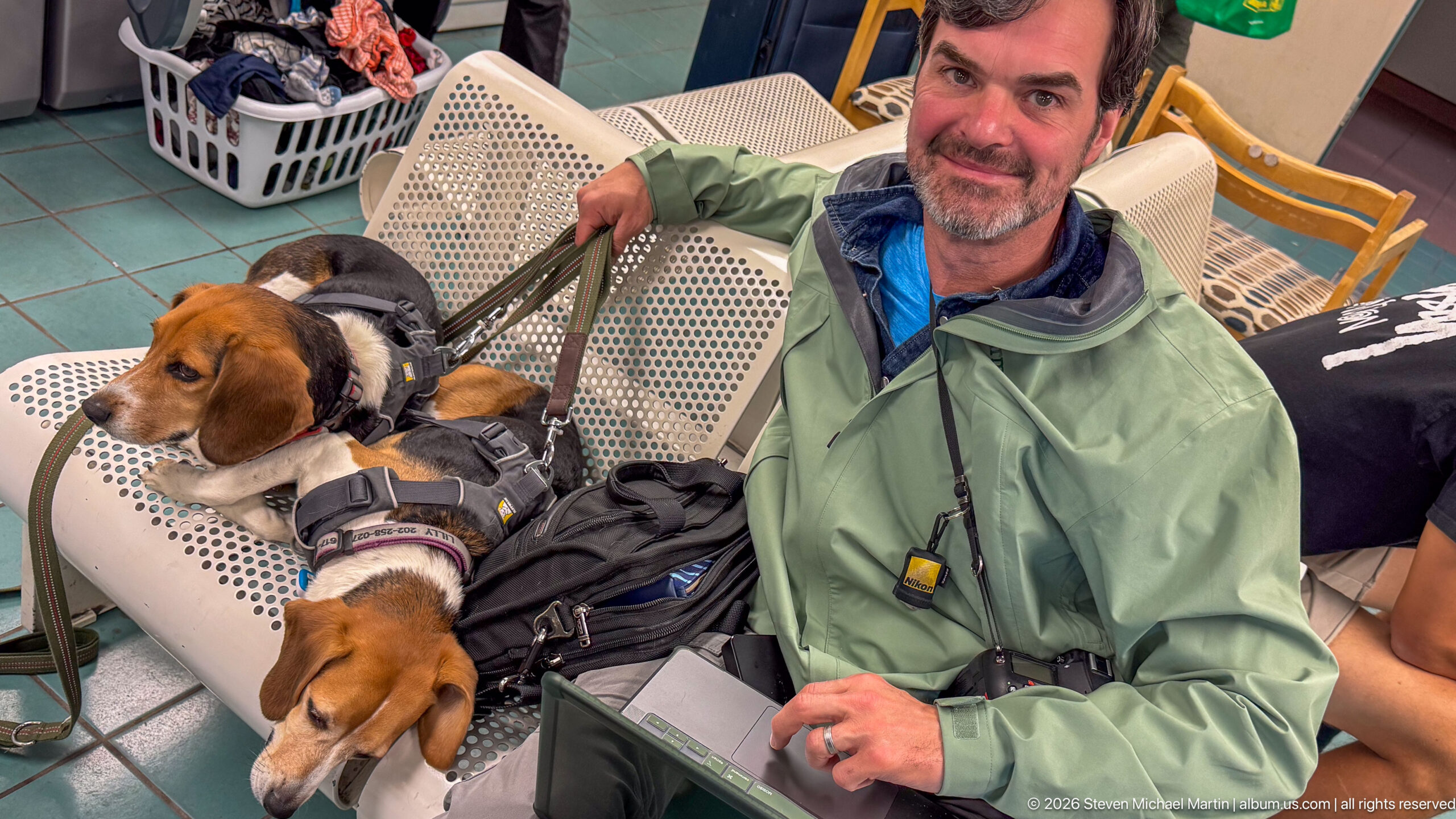
From a higher angle, a visitor sits beside two harnessed beagles resting on perforated-metal seats. The elevated viewpoint shows the dogs’ leashes, travel harnesses, and relaxed positions more clearly, while bags and surrounding chairs suggest a temporary waiting area. The photograph functions as a candid travel interlude within the Banff sequence rather than a formal portrait.
Caption
From a higher angle, a visitor sits beside two harnessed beagles resting on perforated-metal seats. The elevated viewpoint shows the dogs’ leashes, travel harnesses, and relaxed positions more clearly, while bags and surrounding chairs suggest a temporary waiting area. The photograph functions as a candid travel interlude within the Banff sequence rather than a formal portrait.
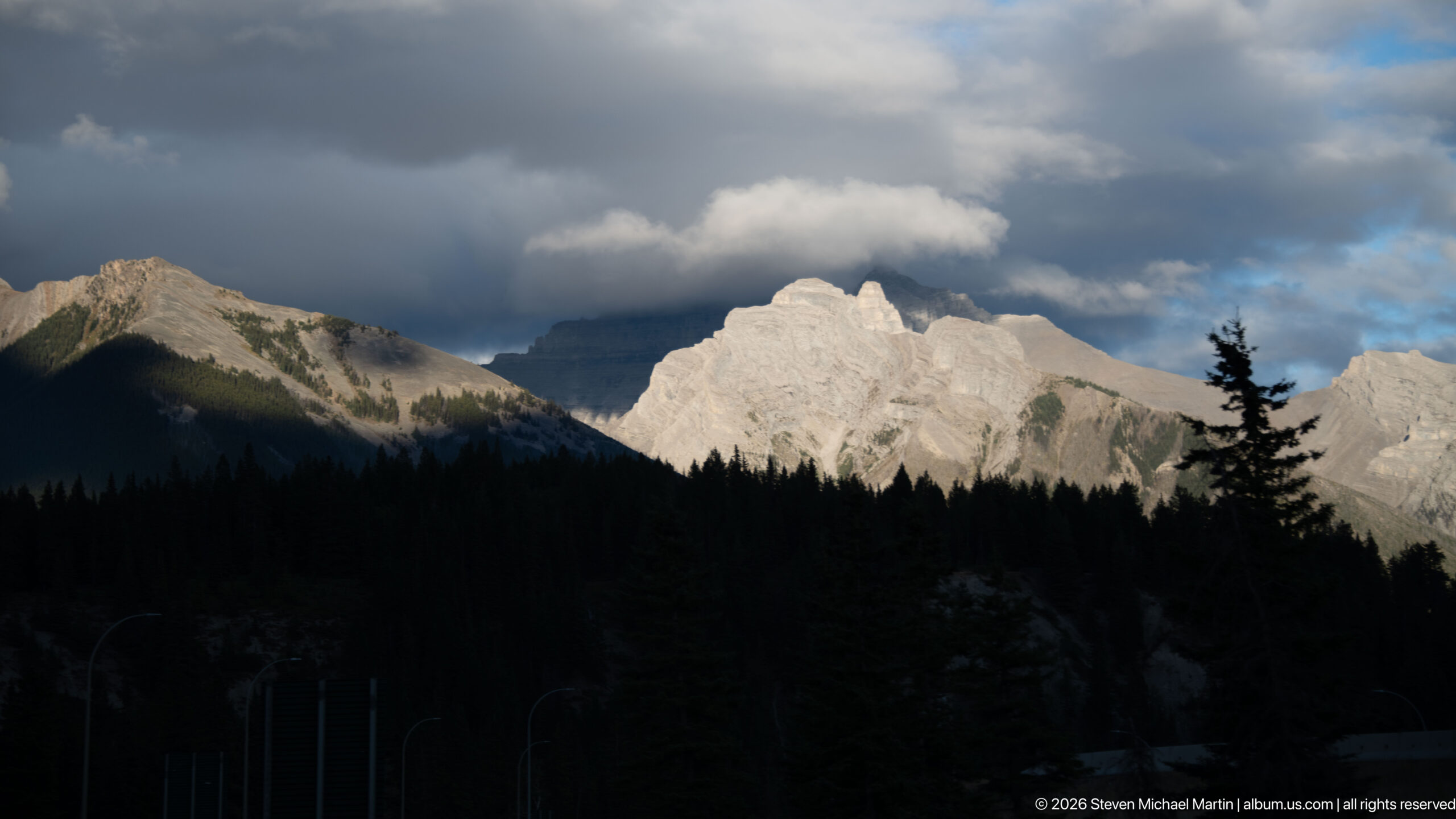
Bright limestone peaks emerge from deep shadow beneath a turbulent ceiling of cloud near Banff. Sunlight isolates the pale rock faces and sharp ridgelines, while the lower forest remains almost silhouetted. The dramatic contrast turns the surrounding Canadian Rockies into the primary subject, recording the rapidly changing mountain light that can transform views from the townsite.
Caption
Bright limestone peaks emerge from deep shadow beneath a turbulent ceiling of cloud near Banff. Sunlight isolates the pale rock faces and sharp ridgelines, while the lower forest remains almost silhouetted. The dramatic contrast turns the surrounding Canadian Rockies into the primary subject, recording the rapidly changing mountain light that can transform views from the townsite.
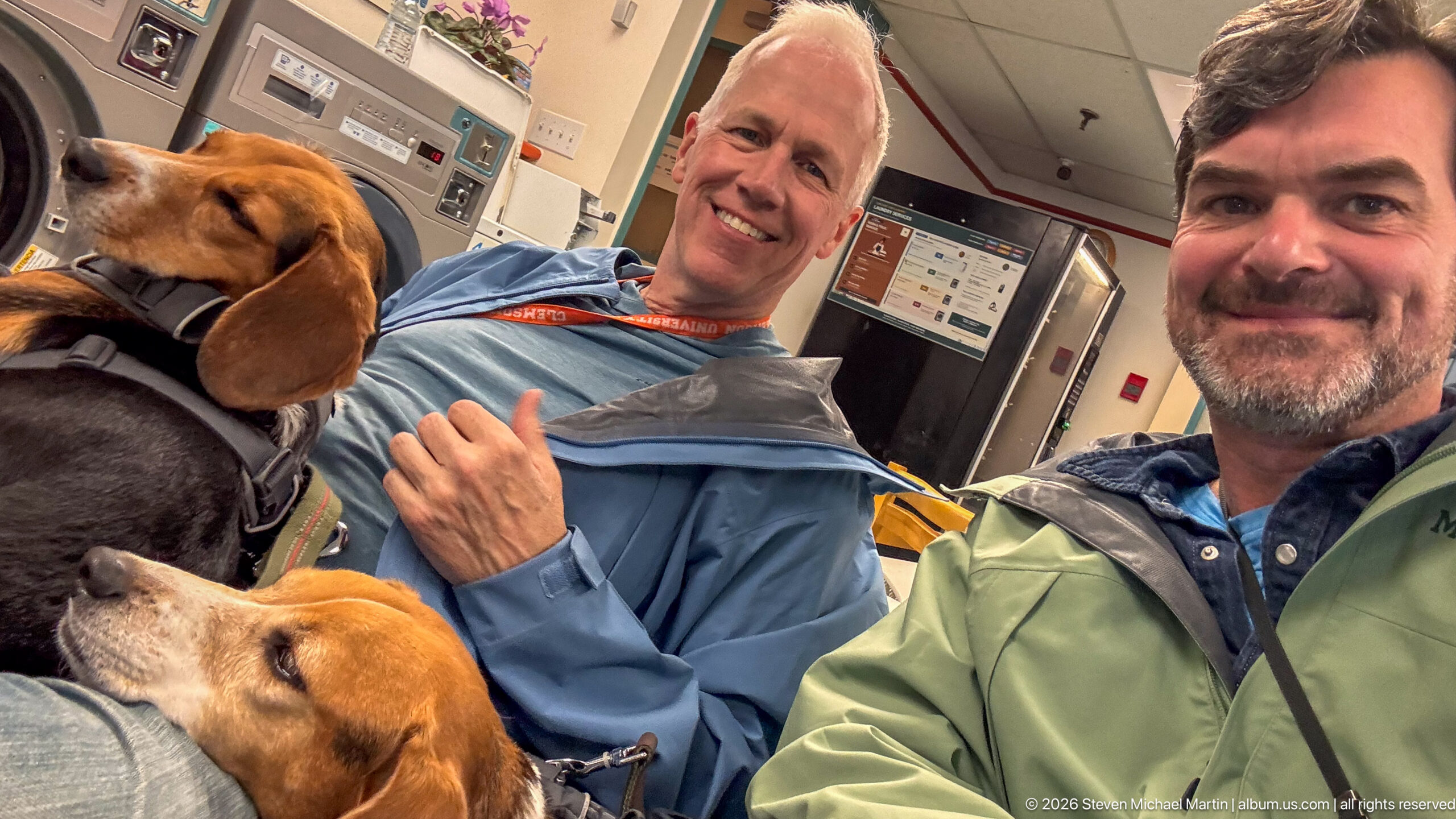
Two travelers sit closely together with two beagles in the foreground, one dog looking upward while the other rests partly out of frame. Jackets, dog harnesses, and the compact interior suggest a pause between outdoor activities or transportation. The casual group portrait records the human-and-canine side of the Banff visit without shifting attention to a specific landmark.
Caption
Two travelers sit closely together with two beagles in the foreground, one dog looking upward while the other rests partly out of frame. Jackets, dog harnesses, and the compact interior suggest a pause between outdoor activities or transportation. The casual group portrait records the human-and-canine side of the Banff visit without shifting attention to a specific landmark.
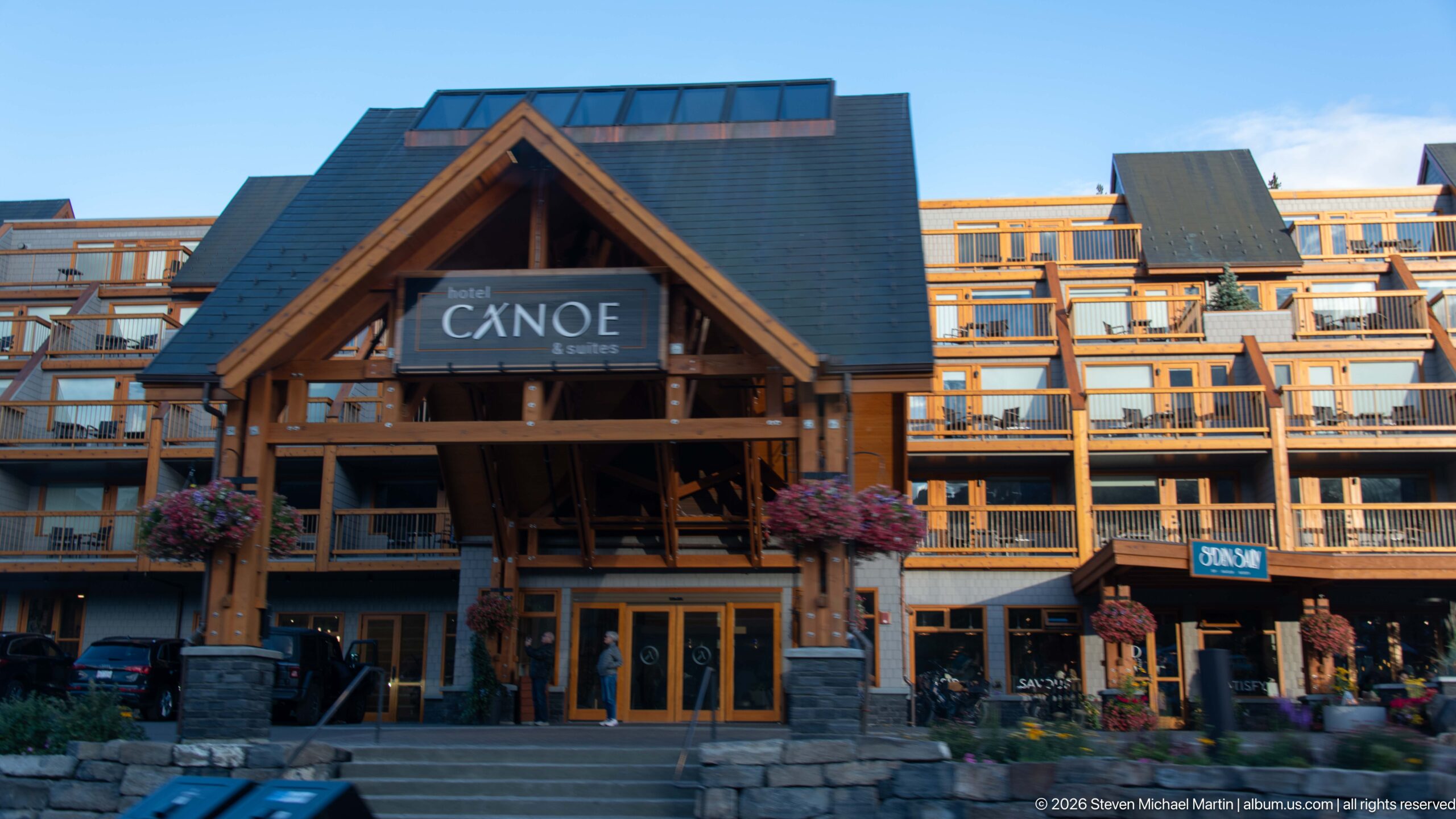
Hotel Canoe & Suites presents a contemporary mountain-lodge façade with a tall timber-framed entrance gable, stone base, balconies, and dark roof forms. Large signage names the property above the main doors, while hanging flower baskets and street-level businesses animate the frontage. The symmetrical entrance composition shows how newer Banff lodging continues to draw on timber-and-stone architectural motifs.
Caption
Hotel Canoe & Suites presents a contemporary mountain-lodge façade with a tall timber-framed entrance gable, stone base, balconies, and dark roof forms. Large signage names the property above the main doors, while hanging flower baskets and street-level businesses animate the frontage. The symmetrical entrance composition shows how newer Banff lodging continues to draw on timber-and-stone architectural motifs.
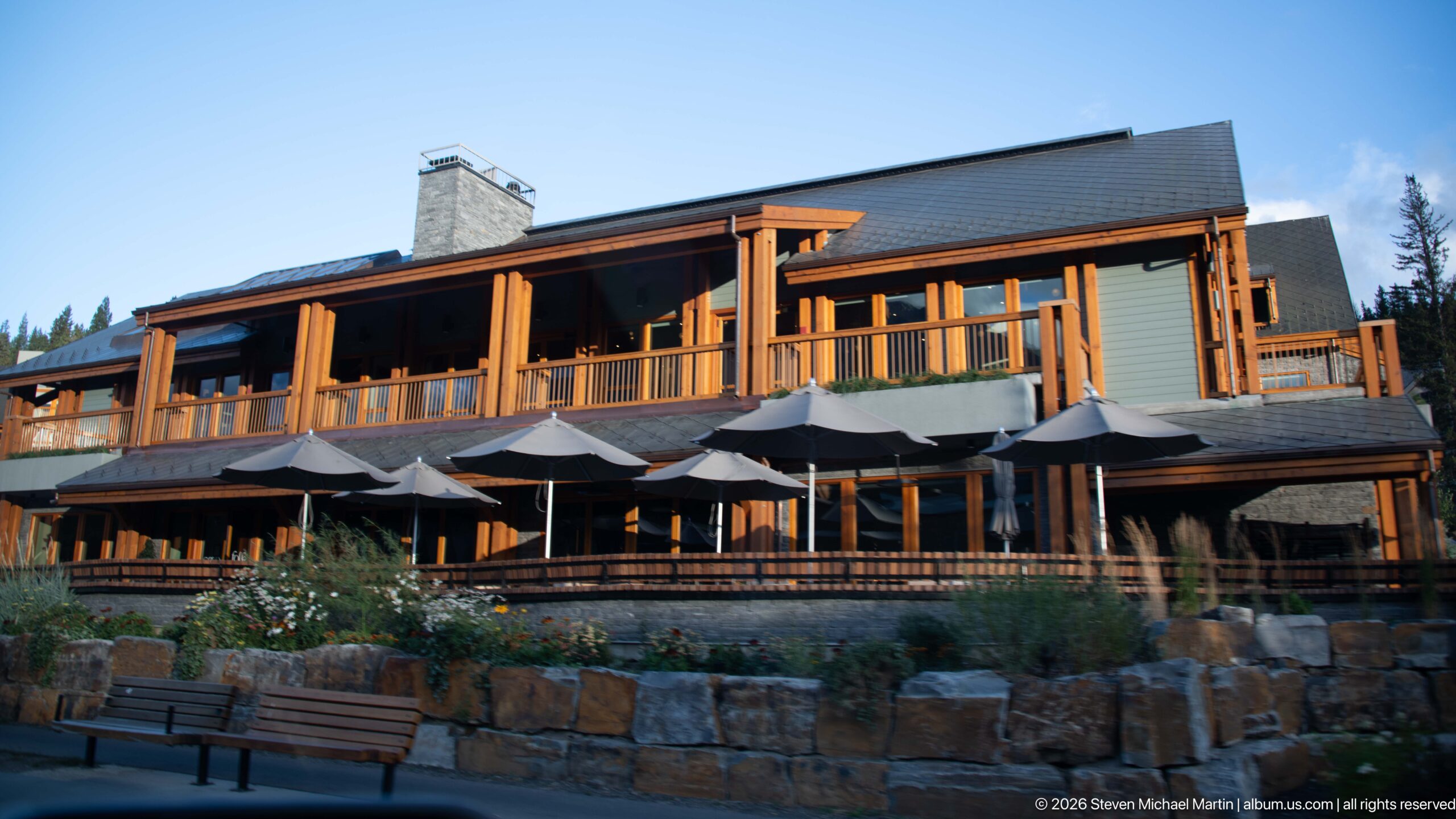
A large timber-trimmed building presents deep balconies, broad eaves, stonework, and a street-level terrace in Banff Town. The composition records how rustic materials and chalet-inspired forms shape the townscape, with outdoor seating and landscaped stone retaining walls bringing the commercial frontage directly into the pedestrian realm.
Caption
A large timber-trimmed building presents deep balconies, broad eaves, stonework, and a street-level terrace in Banff Town. The composition records how rustic materials and chalet-inspired forms shape the townscape, with outdoor seating and landscaped stone retaining walls bringing the commercial frontage directly into the pedestrian realm.
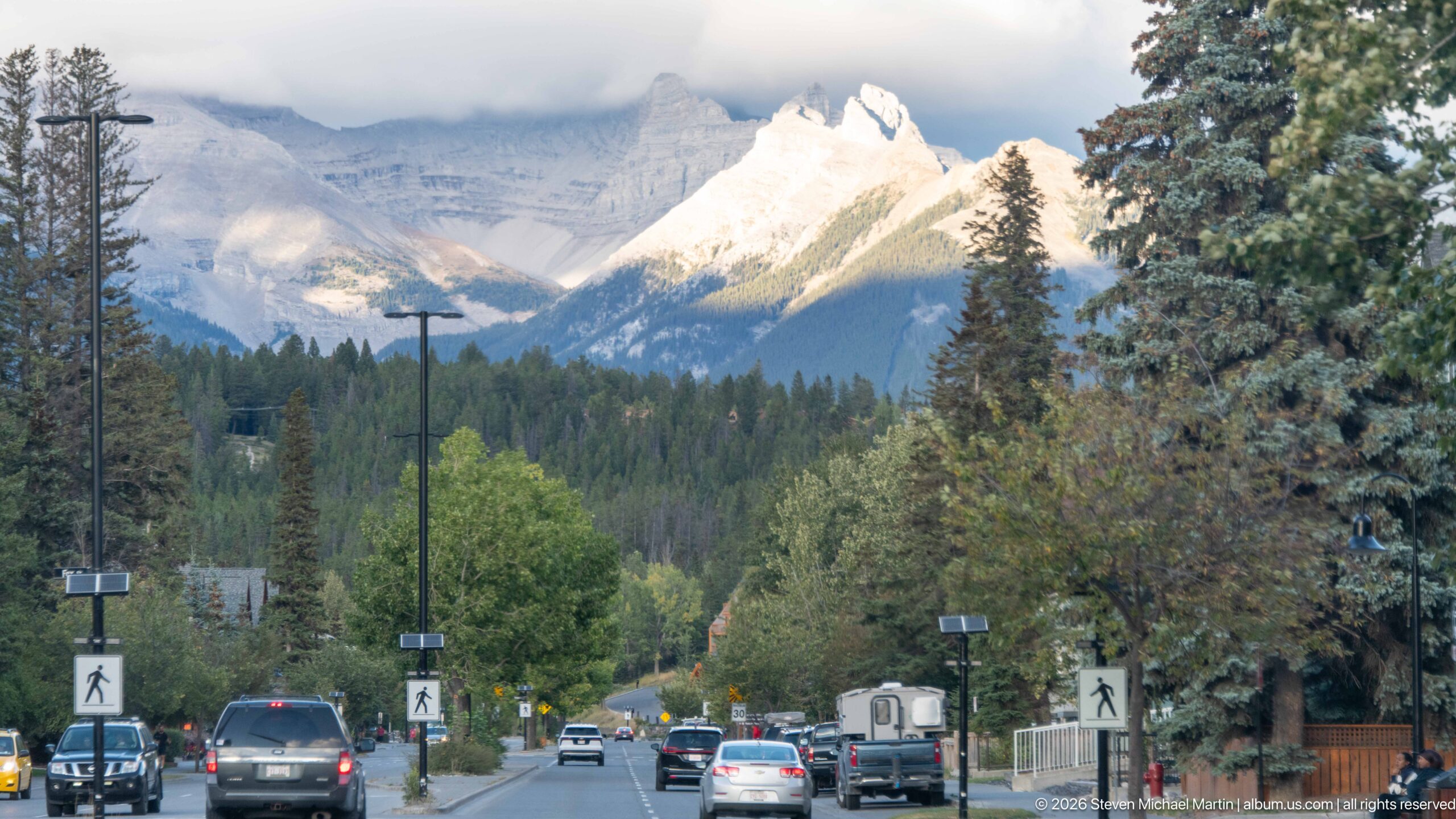
Traffic moves along a Banff street aligned toward the steep limestone mass of Cascade Mountain, its upper slopes partly wrapped in cloud. Streetlights, pedestrian crossings, trees, and vehicles establish the scale of the town below the mountain, illustrating the unusually immediate relationship between Banff’s everyday circulation and the surrounding Canadian Rockies.
Caption
Traffic moves along a Banff street aligned toward the steep limestone mass of Cascade Mountain, its upper slopes partly wrapped in cloud. Streetlights, pedestrian crossings, trees, and vehicles establish the scale of the town below the mountain, illustrating the unusually immediate relationship between Banff’s everyday circulation and the surrounding Canadian Rockies.
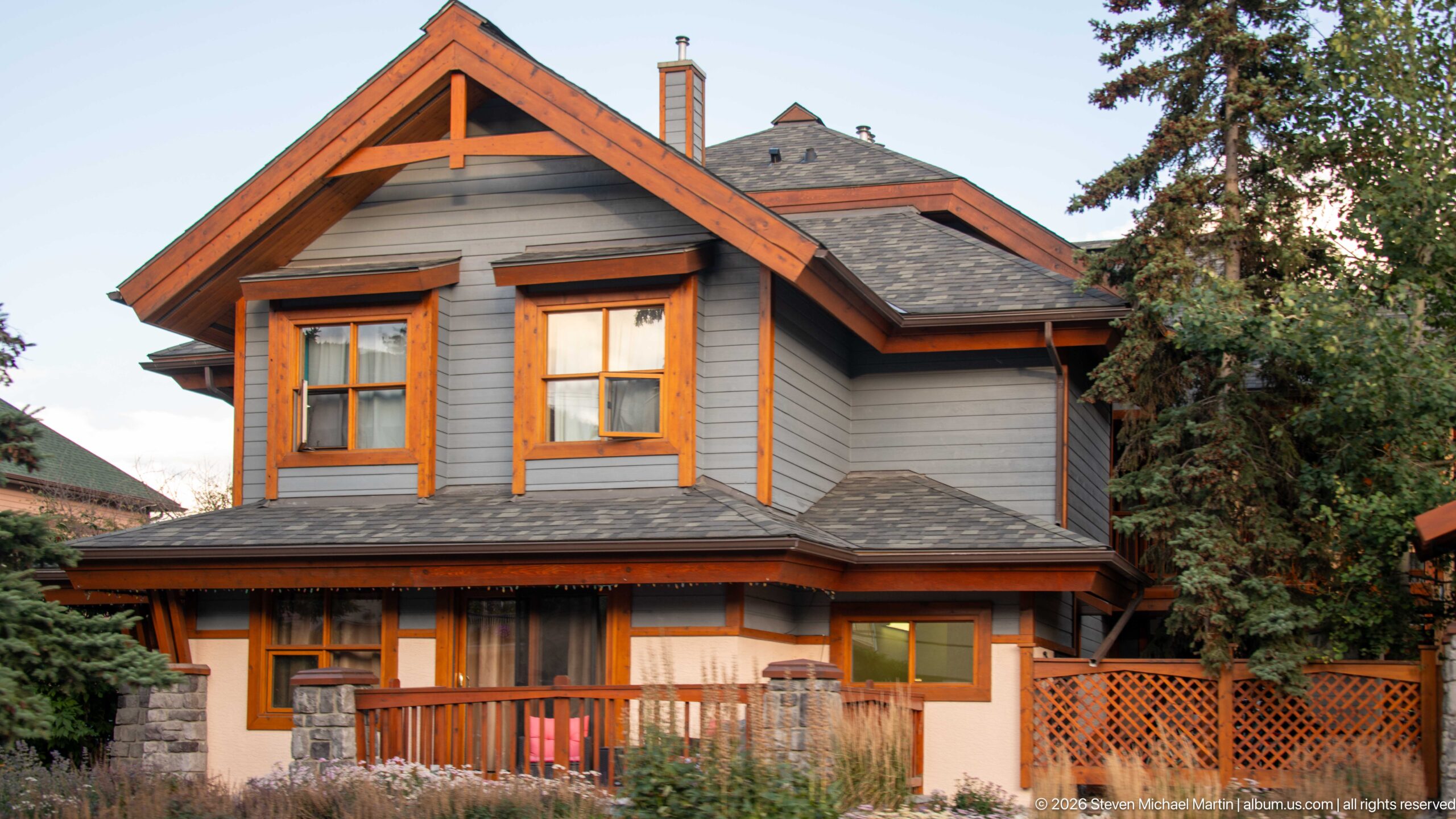
Warm evening light catches the orange-trimmed windows and projecting gables of a two-story Banff residence. Gray horizontal siding, shingled roofs, a stone base, and a sheltered porch combine domestic forms with materials suited to the mountain setting, while mature trees and grasses soften the close street-side view.
Caption
Warm evening light catches the orange-trimmed windows and projecting gables of a two-story Banff residence. Gray horizontal siding, shingled roofs, a stone base, and a sheltered porch combine domestic forms with materials suited to the mountain setting, while mature trees and grasses soften the close street-side view.
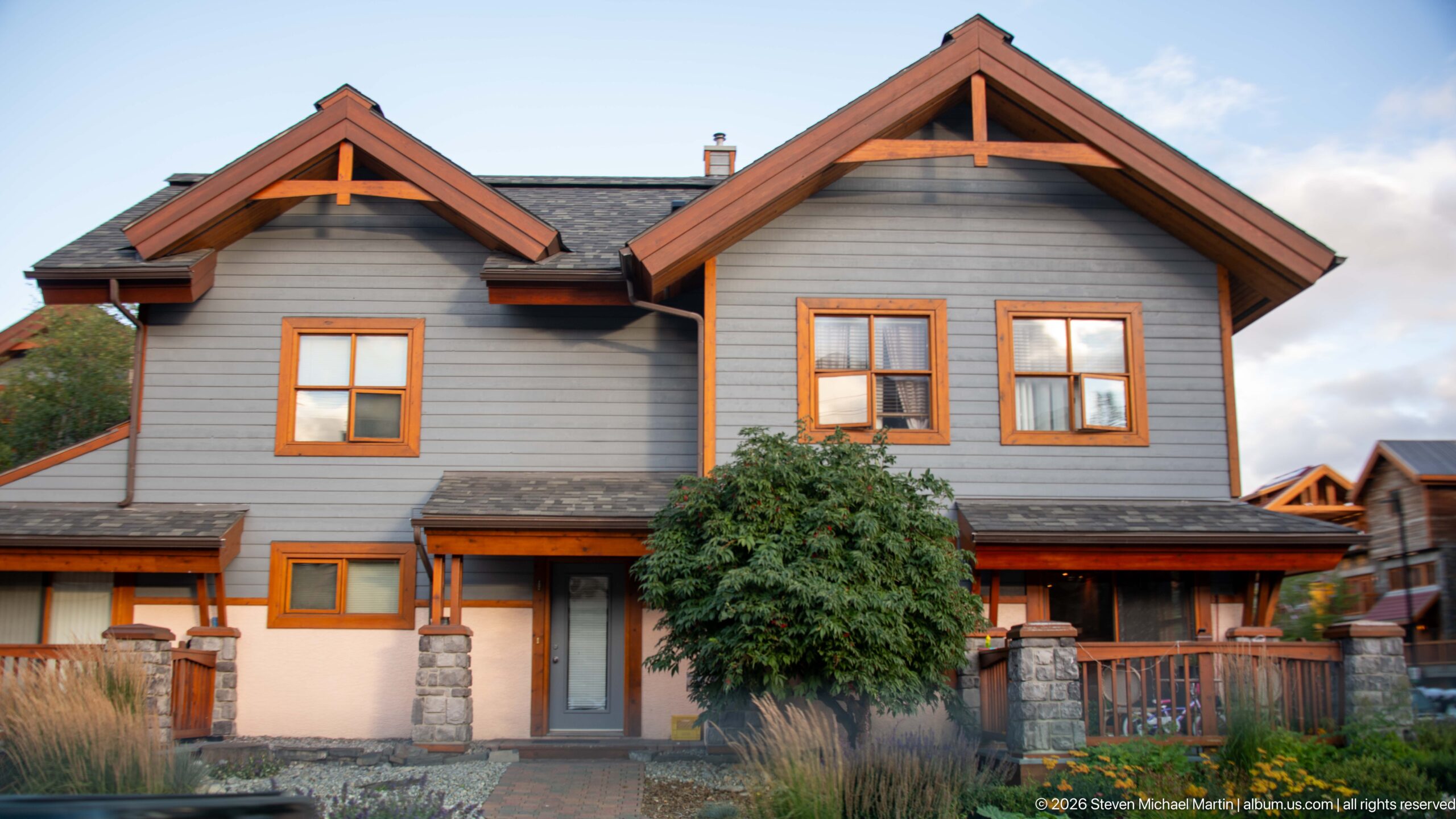
A nearly frontal view isolates the balanced gables and orange window surrounds of a gray-sided Banff house. Stone porch piers, a recessed central entrance, low railings, and ornamental plantings organize the lower façade, while exposed timber braces beneath the gable peaks give the residence a distinctly mountain-town vocabulary.
Caption
A nearly frontal view isolates the balanced gables and orange window surrounds of a gray-sided Banff house. Stone porch piers, a recessed central entrance, low railings, and ornamental plantings organize the lower façade, while exposed timber braces beneath the gable peaks give the residence a distinctly mountain-town vocabulary.
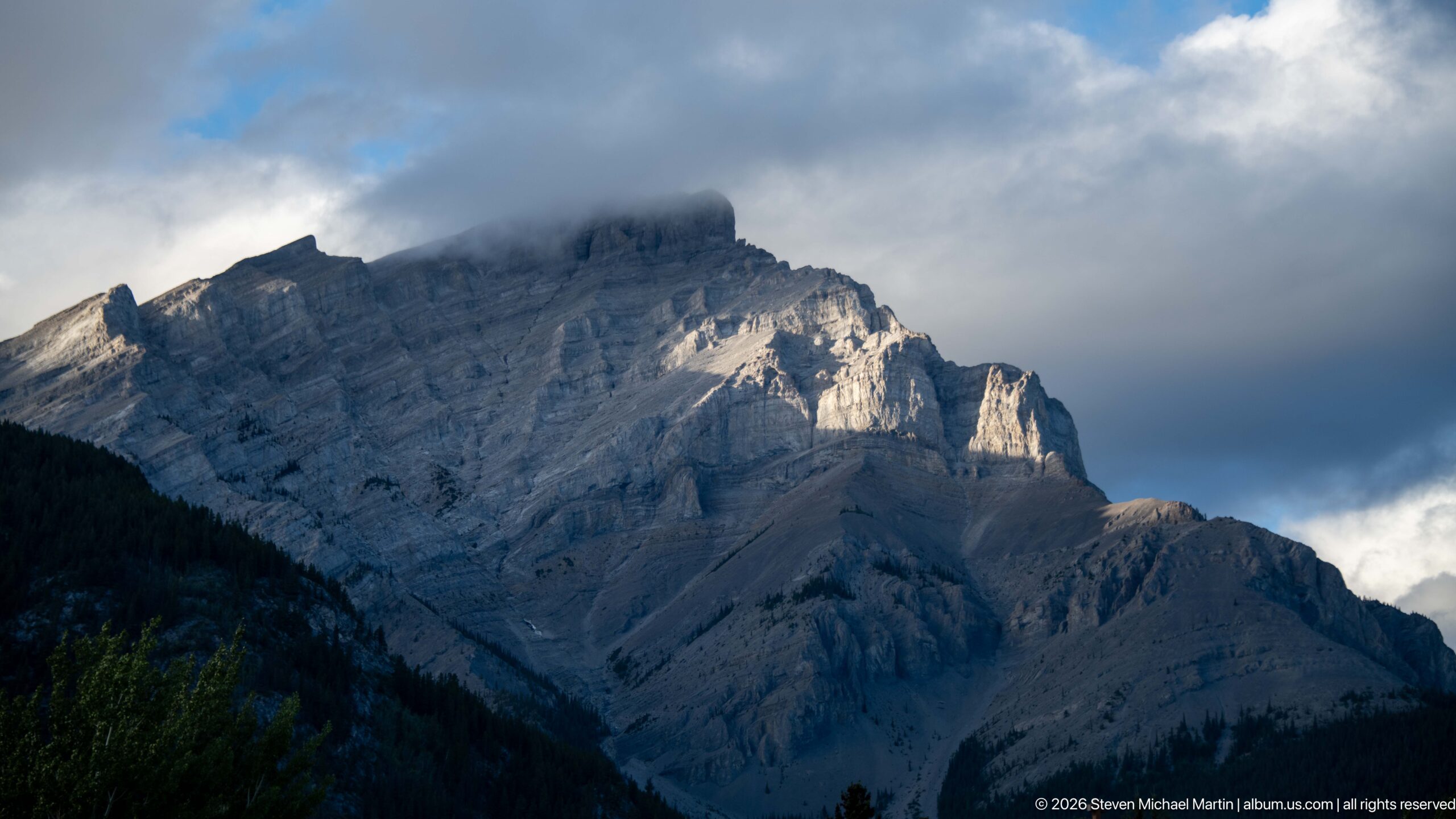
Low clouds skim the summit ridge of Cascade Mountain as late light picks out its pale, sharply bedded limestone cliffs. The darker forested foothills below deepen the contrast between town-level vegetation and the exposed rock above, creating a close study of the mountain that dominates many views from Banff.
Caption
Low clouds skim the summit ridge of Cascade Mountain as late light picks out its pale, sharply bedded limestone cliffs. The darker forested foothills below deepen the contrast between town-level vegetation and the exposed rock above, creating a close study of the mountain that dominates many views from Banff.
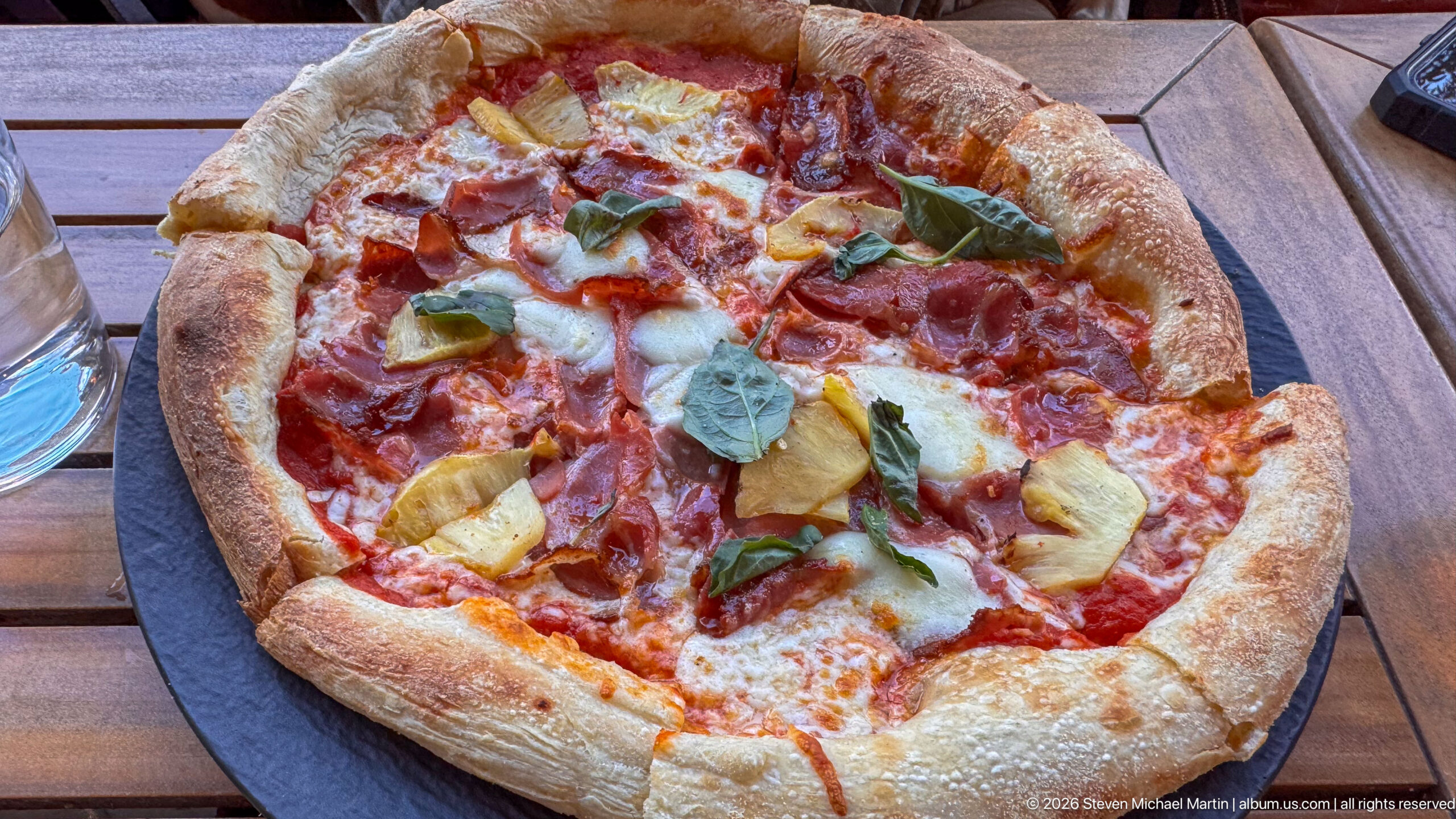
A freshly baked pizza fills the frame at an outdoor table, topped with tomato, melted cheese, cured meat, artichoke pieces, and fresh basil. The blistered, deeply browned crust and irregular topping arrangement make this a close culinary detail within the Banff Town sequence, shifting attention from streets and architecture to the visitor dining experience.
Caption
A freshly baked pizza fills the frame at an outdoor table, topped with tomato, melted cheese, cured meat, artichoke pieces, and fresh basil. The blistered, deeply browned crust and irregular topping arrangement make this a close culinary detail within the Banff Town sequence, shifting attention from streets and architecture to the visitor dining experience.

A colorful rice bowl is arranged in distinct sections of diced raw tuna, avocado, edamame, shredded vegetables, watermelon radish, crisp chips, and sesame-topped sauce. Seen directly from above on a wooden table, the composition emphasizes ingredients and presentation, providing a precise record of contemporary casual dining in Banff.
Caption
A colorful rice bowl is arranged in distinct sections of diced raw tuna, avocado, edamame, shredded vegetables, watermelon radish, crisp chips, and sesame-topped sauce. Seen directly from above on a wooden table, the composition emphasizes ingredients and presentation, providing a precise record of contemporary casual dining in Banff.
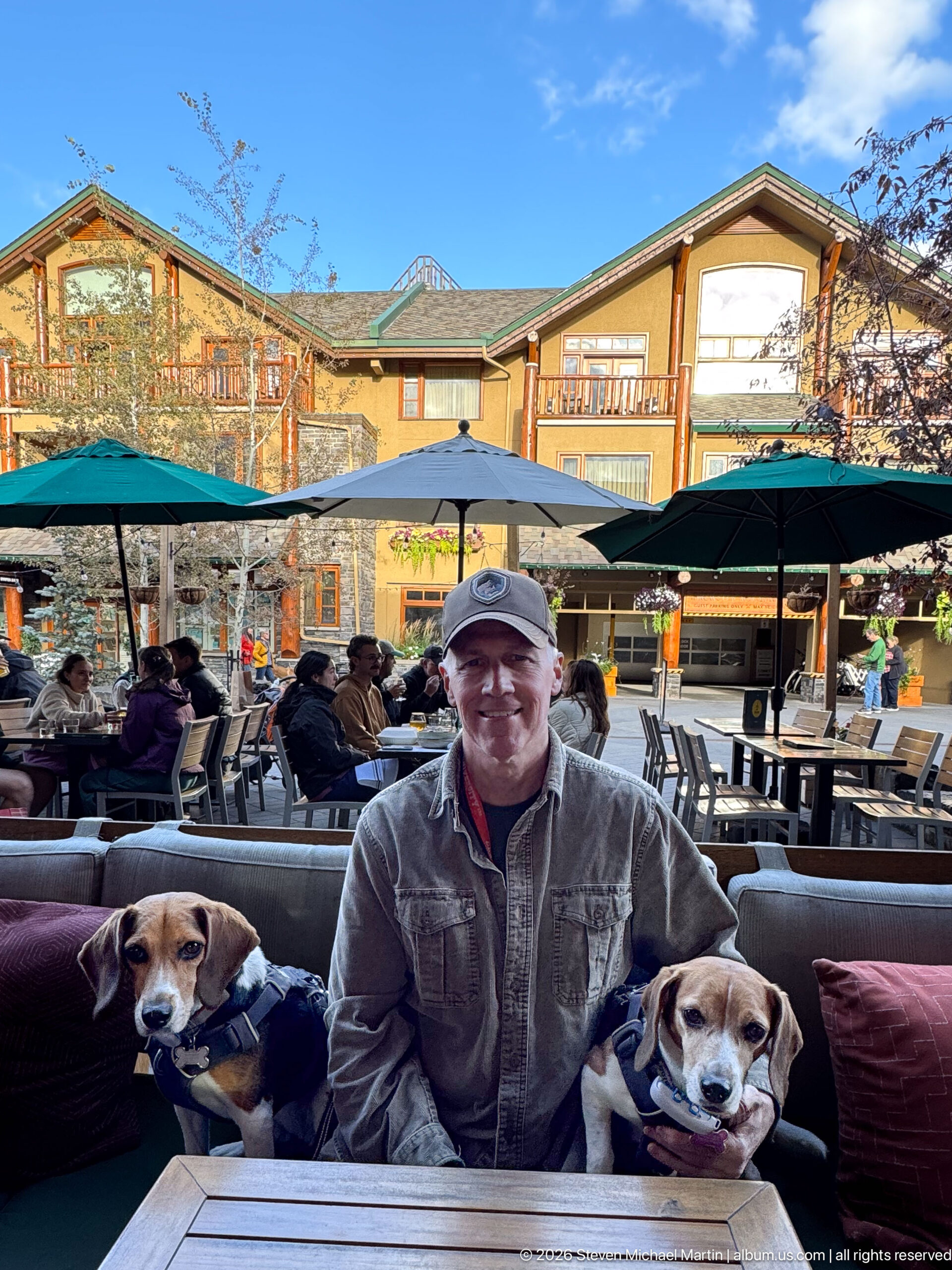
A man sits between two beagles on cushioned patio seating in central Banff, with umbrellas, diners, and lodge-style commercial buildings behind him. The relaxed portrait places companion animals within the town’s outdoor dining scene and records the social use of a pedestrian-oriented commercial courtyard rather than presenting the setting only as architecture.
Caption
A man sits between two beagles on cushioned patio seating in central Banff, with umbrellas, diners, and lodge-style commercial buildings behind him. The relaxed portrait places companion animals within the town’s outdoor dining scene and records the social use of a pedestrian-oriented commercial courtyard rather than presenting the setting only as architecture.
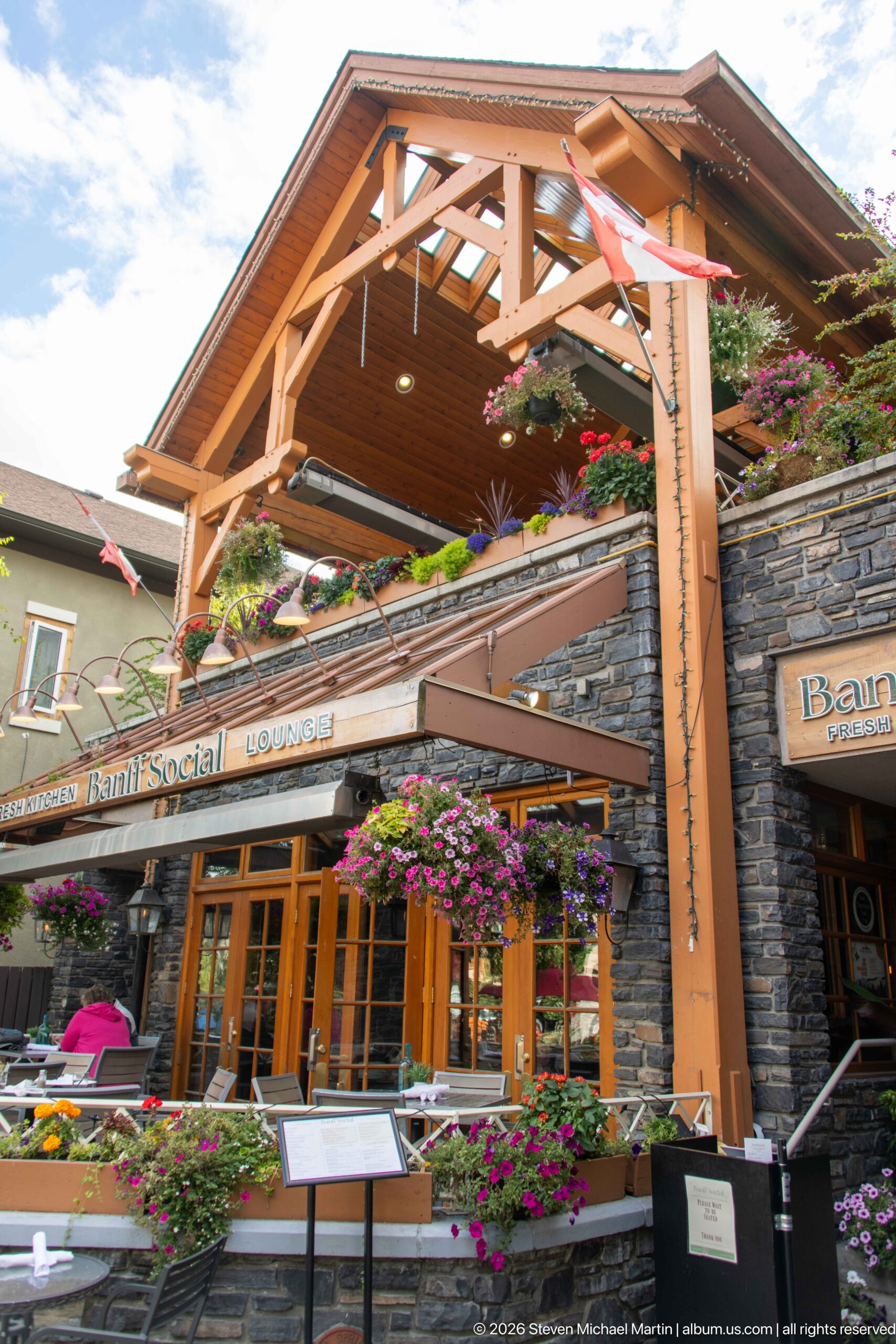
Heavy timber framing, stonework, flower baskets, and a sheltered upper terrace define the Banff Social restaurant façade. The upward viewpoint concentrates on the building’s mountain-resort vocabulary, while the Canadian flag, abundant seasonal flowers, menu stands, and street-level entrance establish its active commercial use in central Banff.
Caption
Heavy timber framing, stonework, flower baskets, and a sheltered upper terrace define the Banff Social restaurant façade. The upward viewpoint concentrates on the building’s mountain-resort vocabulary, while the Canadian flag, abundant seasonal flowers, menu stands, and street-level entrance establish its active commercial use in central Banff.
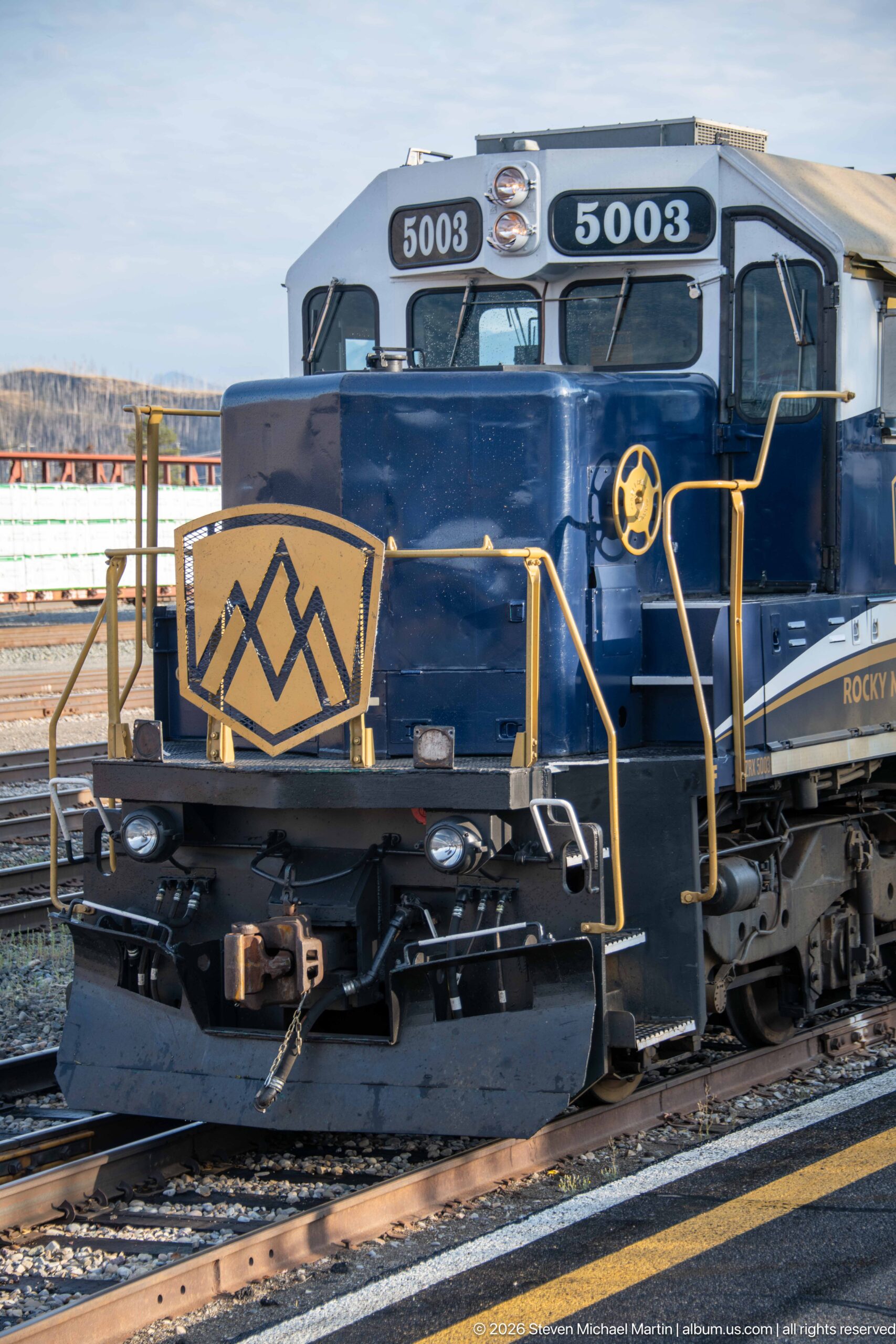
The blunt nose and cab of Rocky Mountaineer locomotive 5003 fill the frame, with twin number boards, yellow safety rails, coupler, and mountain emblem clearly exposed. Seen nearly broadside at the front, the photograph records the working details of the passenger locomotive rather than the larger train consist.
Caption
The blunt nose and cab of Rocky Mountaineer locomotive 5003 fill the frame, with twin number boards, yellow safety rails, coupler, and mountain emblem clearly exposed. Seen nearly broadside at the front, the photograph records the working details of the passenger locomotive rather than the larger train consist.

Two beagles flank a seated man in a close portrait on a busy Banff restaurant patio. Their harnesses and attentive poses fill the foreground, while green umbrellas, tables, and other diners remain legible behind them, making the photograph as much a record of dog-friendly outdoor activity as a personal travel portrait.
Caption
Two beagles flank a seated man in a close portrait on a busy Banff restaurant patio. Their harnesses and attentive poses fill the foreground, while green umbrellas, tables, and other diners remain legible behind them, making the photograph as much a record of dog-friendly outdoor activity as a personal travel portrait.
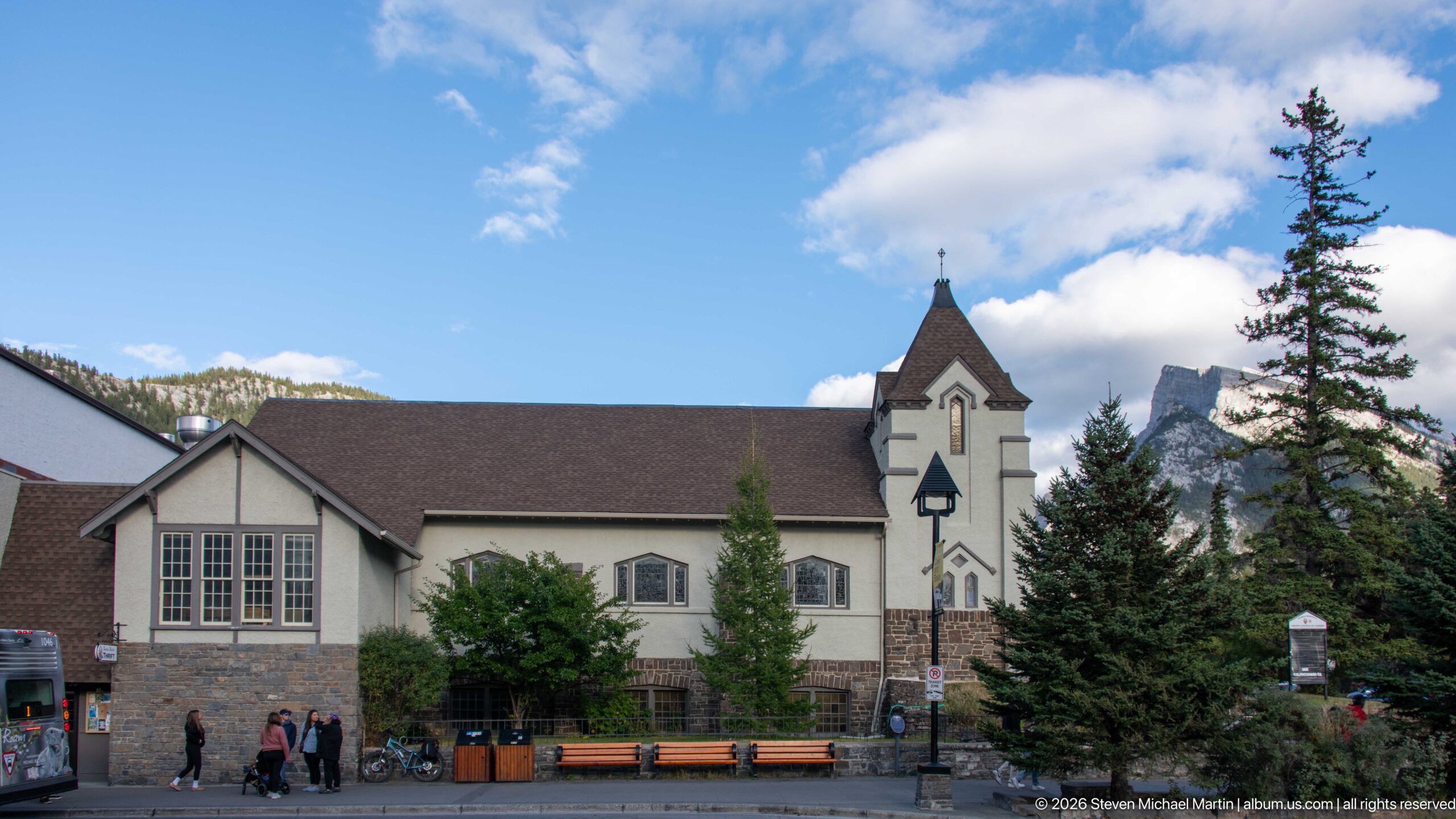
A modest stucco church stands behind a small landscaped forecourt, its long gabled nave joined by a square corner tower with a steep pyramidal roof. Multi-pane windows, stonework at the base, and restrained detailing distinguish the building from Banff’s surrounding commercial architecture while preserving a small-scale institutional presence in the town center.
Caption
A modest stucco church stands behind a small landscaped forecourt, its long gabled nave joined by a square corner tower with a steep pyramidal roof. Multi-pane windows, stonework at the base, and restrained detailing distinguish the building from Banff’s surrounding commercial architecture while preserving a small-scale institutional presence in the town center.
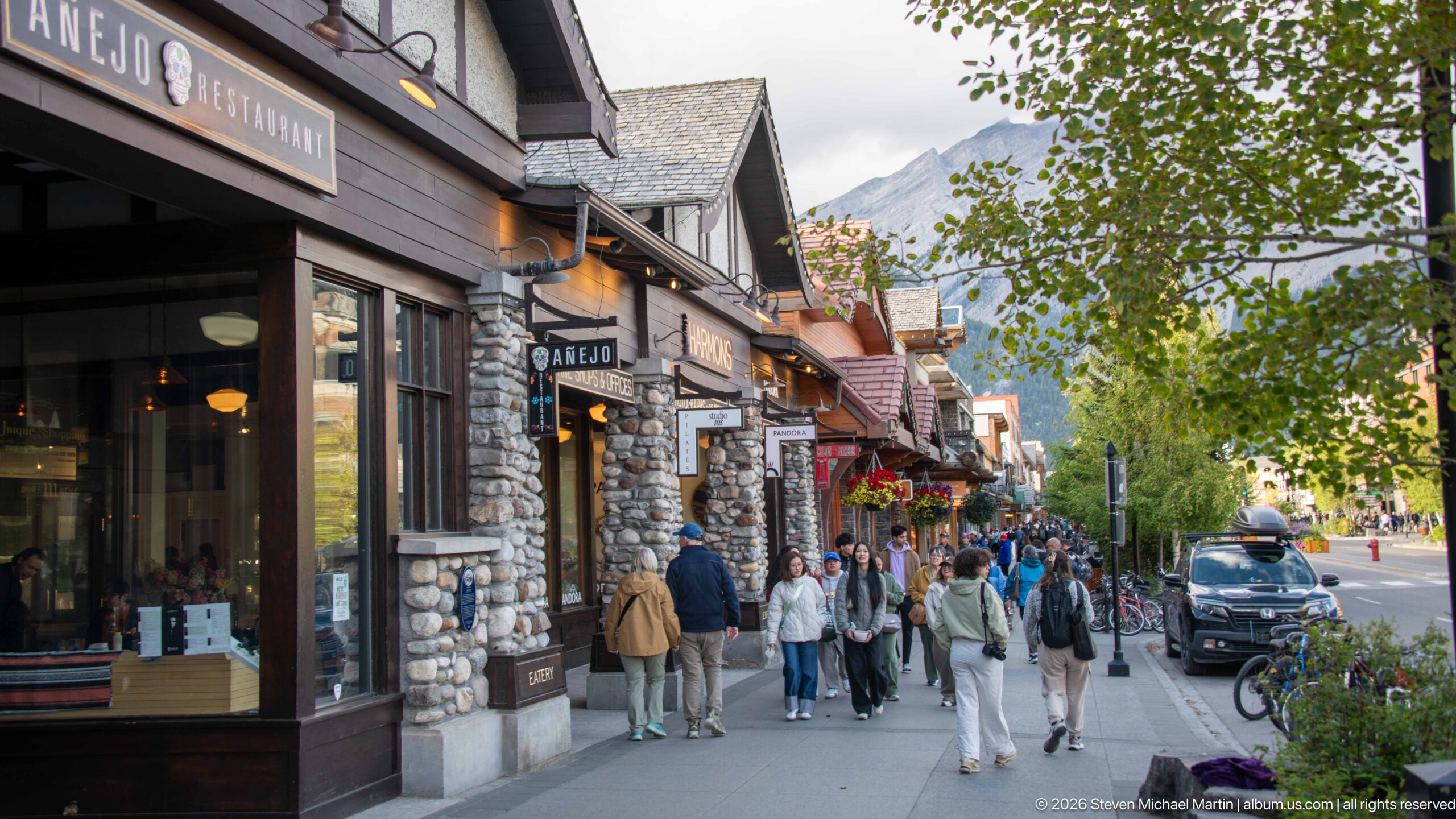
Pedestrians fill a Banff sidewalk lined with stone-faced and timber-trimmed shops, hanging signs, flower baskets, bicycles, and closely spaced display windows. The oblique view emphasizes the density of the retail frontage and the steady flow of foot traffic, with a mountain slope appearing beyond the buildings at the end of the block.
Caption
Pedestrians fill a Banff sidewalk lined with stone-faced and timber-trimmed shops, hanging signs, flower baskets, bicycles, and closely spaced display windows. The oblique view emphasizes the density of the retail frontage and the steady flow of foot traffic, with a mountain slope appearing beyond the buildings at the end of the block.
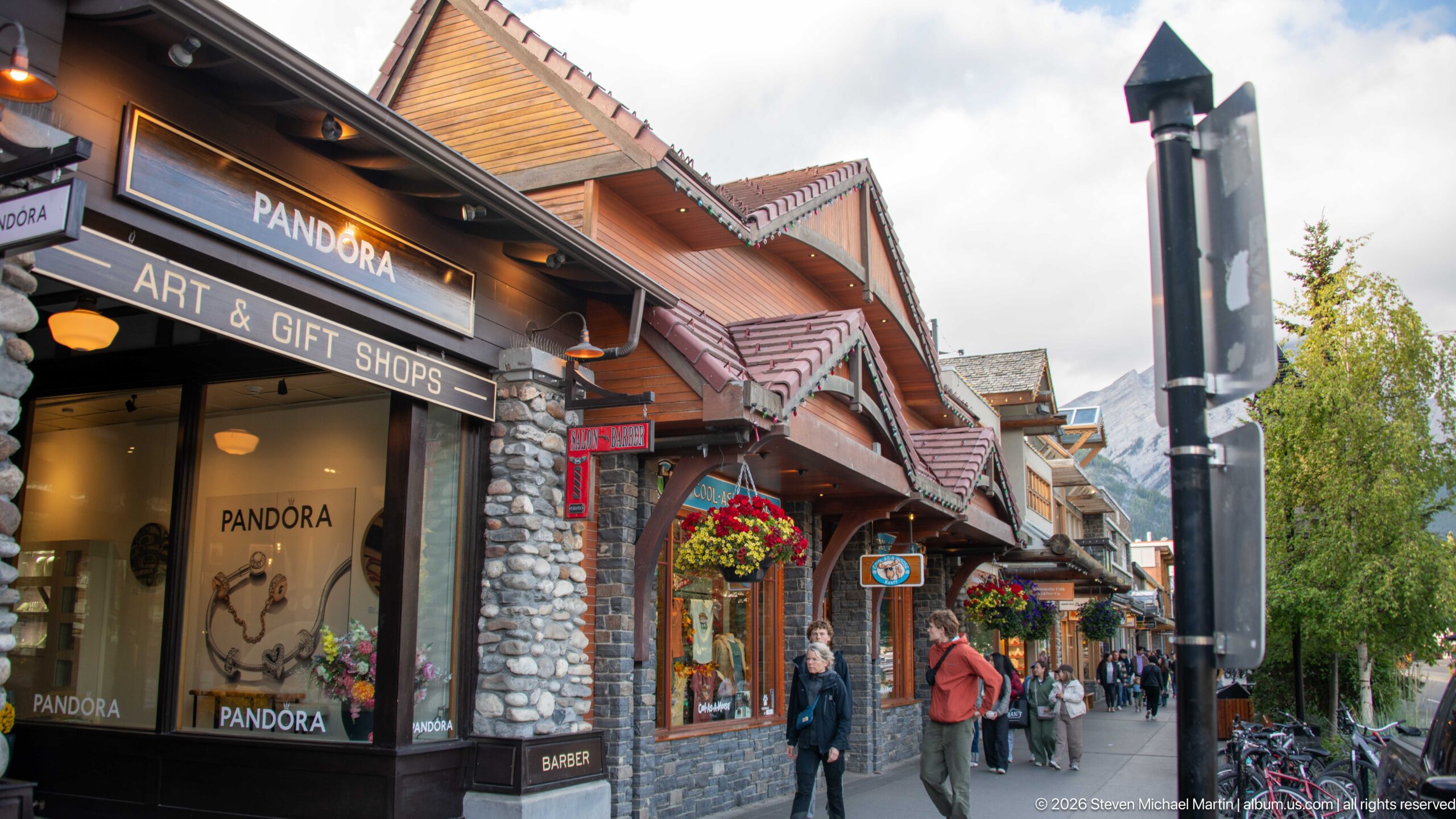
A Pandora storefront anchors a row of closely packed Banff shops built with fieldstone piers, dark wood trim, steep projecting roofs, and hanging flower baskets. Pedestrians move through the narrow sidewalk corridor while bicycles collect near the curb, illustrating how international retail branding is fitted into the town’s deliberately rustic commercial architecture.
Caption
A Pandora storefront anchors a row of closely packed Banff shops built with fieldstone piers, dark wood trim, steep projecting roofs, and hanging flower baskets. Pedestrians move through the narrow sidewalk corridor while bicycles collect near the curb, illustrating how international retail branding is fitted into the town’s deliberately rustic commercial architecture.
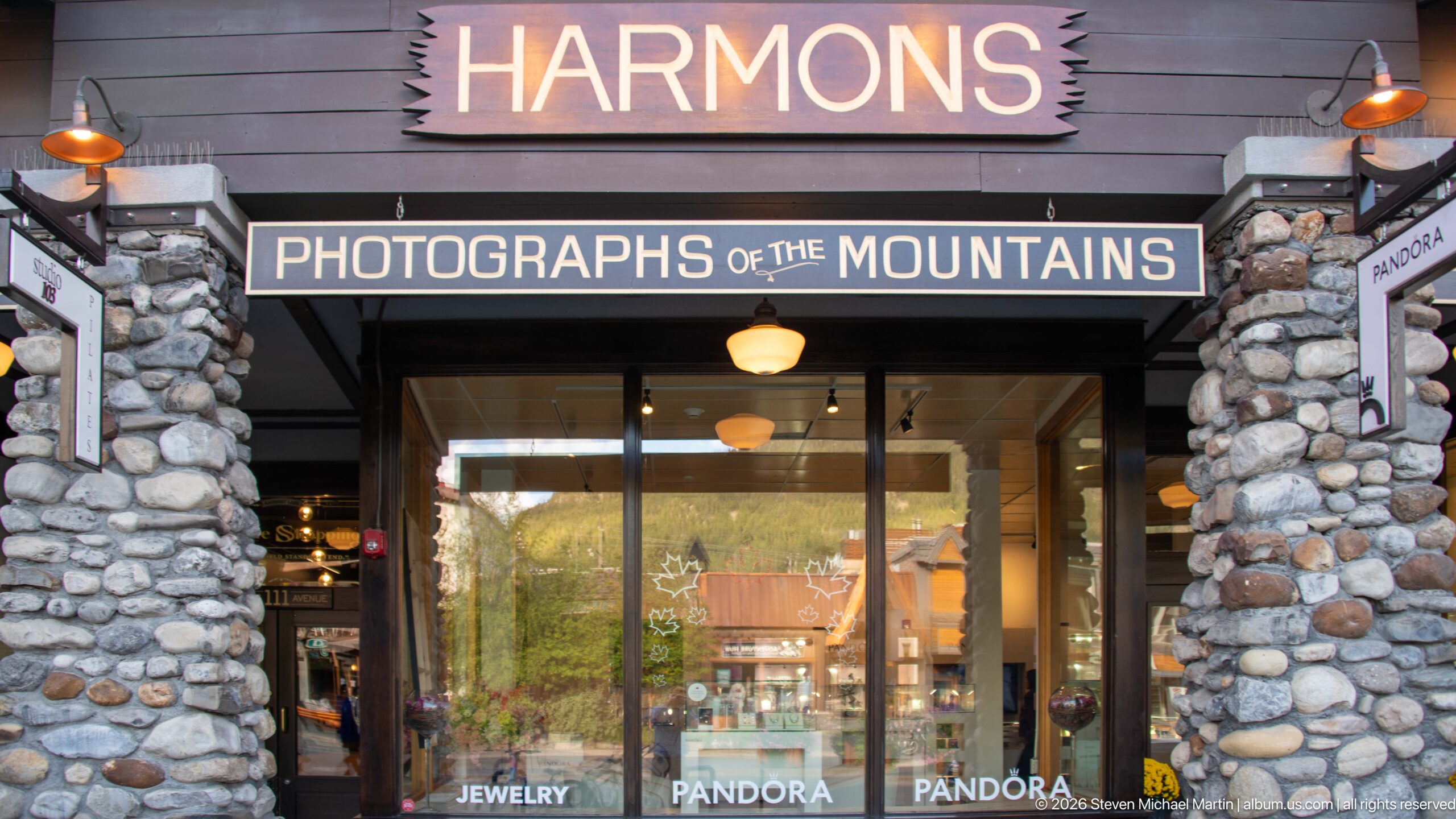
The entrance to Harmons is framed by rounded fieldstone columns and dark timber, with a prominent sign advertising “Photographs of the Mountains” above the doorway. Jewelry and Pandora branding appear at window level, but the mountain-photography sign gives the storefront a specifically Banff identity rooted in the visual consumption of Rocky Mountain scenery.
Caption
The entrance to Harmons is framed by rounded fieldstone columns and dark timber, with a prominent sign advertising “Photographs of the Mountains” above the doorway. Jewelry and Pandora branding appear at window level, but the mountain-photography sign gives the storefront a specifically Banff identity rooted in the visual consumption of Rocky Mountain scenery.
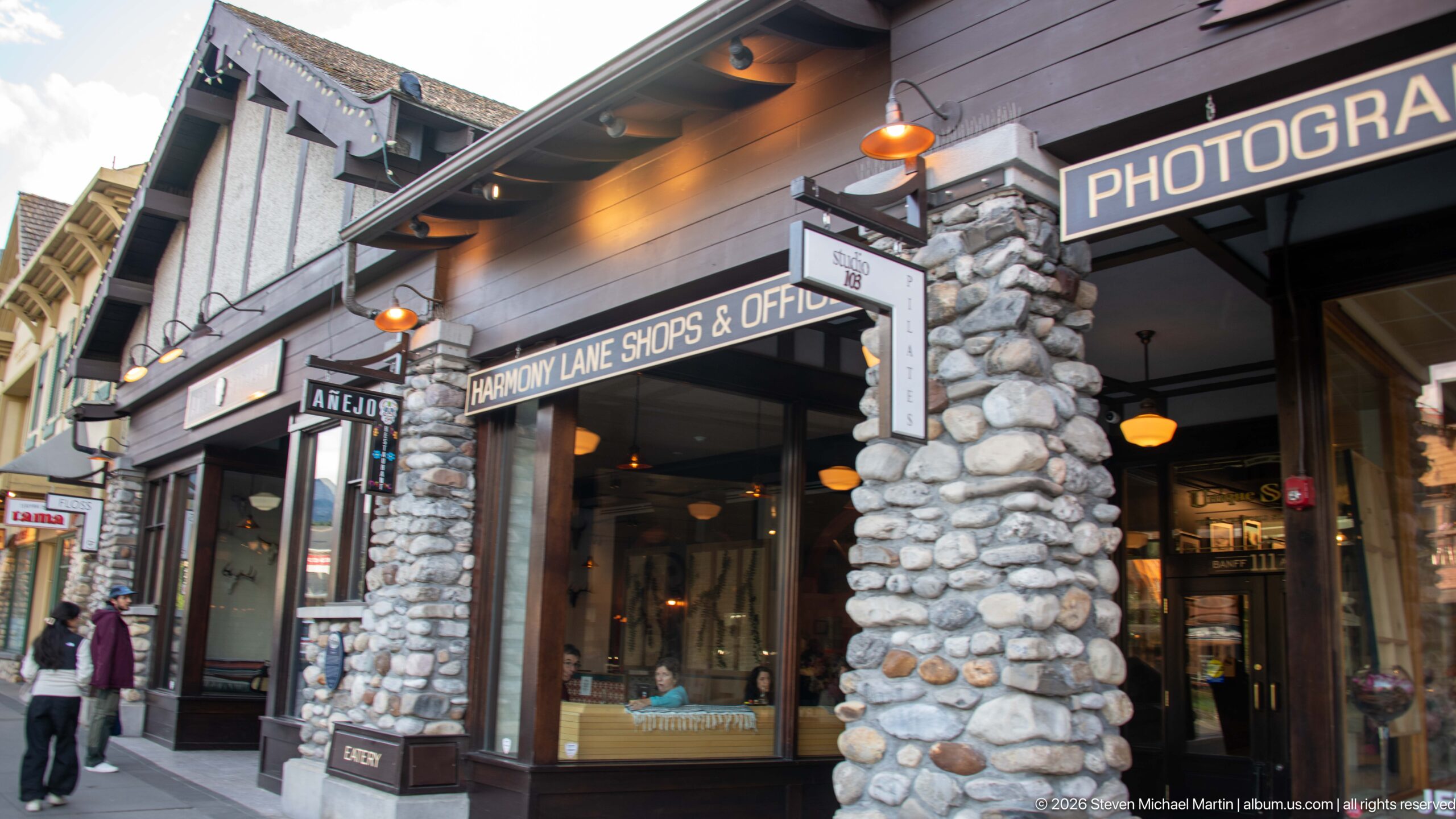
Rounded fieldstone piers and heavy timber frame the entrance to Harmony Lane Shops & Offices, where projecting signs and recessed retail windows create a layered passage off the main sidewalk. The close architectural view records the textured stone-and-wood vocabulary repeatedly used in Banff’s commercial core and the way small shopping lanes are announced from the street.
Caption
Rounded fieldstone piers and heavy timber frame the entrance to Harmony Lane Shops & Offices, where projecting signs and recessed retail windows create a layered passage off the main sidewalk. The close architectural view records the textured stone-and-wood vocabulary repeatedly used in Banff’s commercial core and the way small shopping lanes are announced from the street.
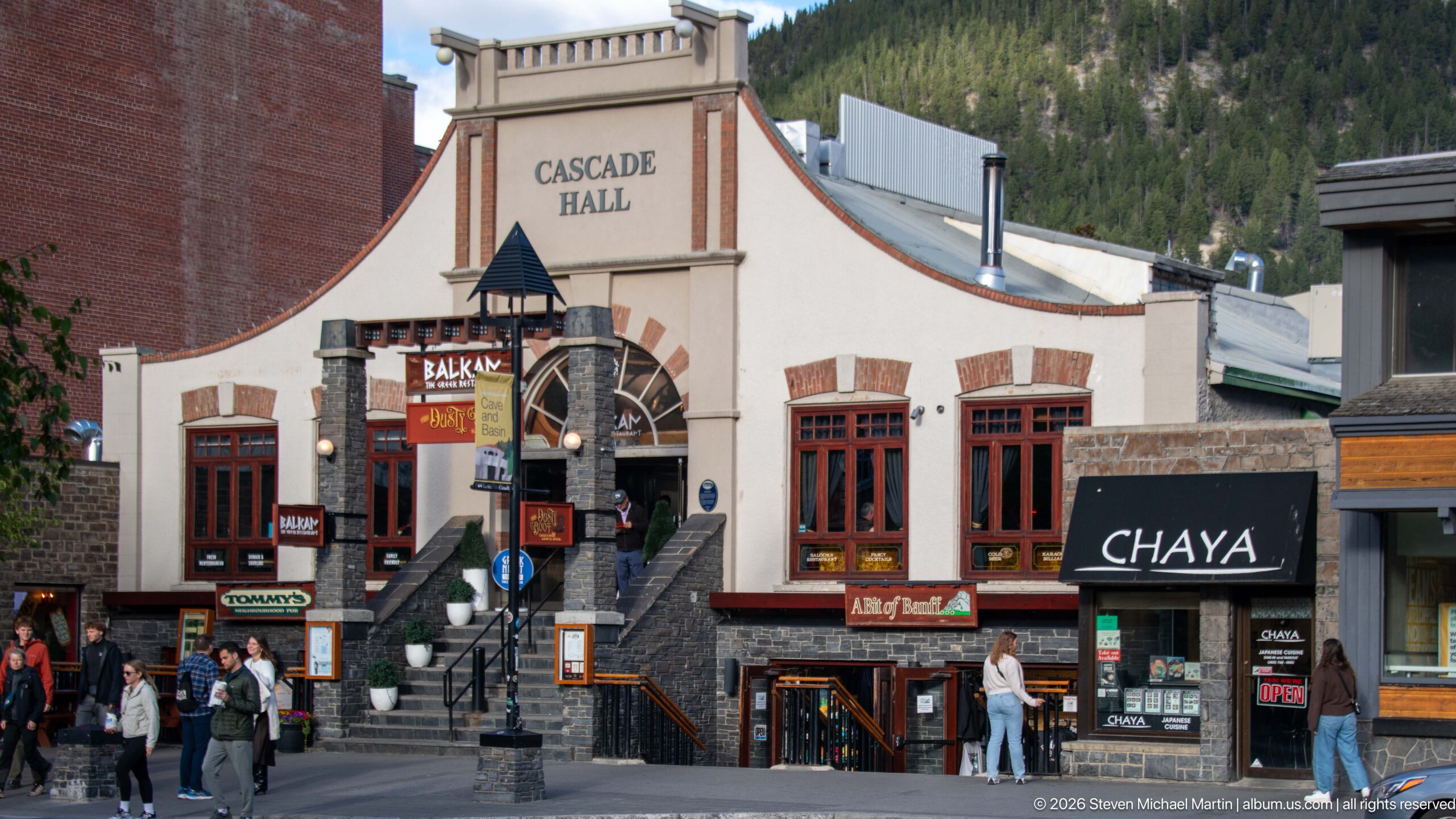
Cascade Hall presents a distinctive curved parapet above a symmetrical cream-and-brick façade, with a broad arched central window and stairway rising to the principal entrance. Contemporary restaurants and shops occupy the lower level, making the view a clear example of an older civic-scale building incorporated into Banff’s active commercial streetscape.
Caption
Cascade Hall presents a distinctive curved parapet above a symmetrical cream-and-brick façade, with a broad arched central window and stairway rising to the principal entrance. Contemporary restaurants and shops occupy the lower level, making the view a clear example of an older civic-scale building incorporated into Banff’s active commercial streetscape.
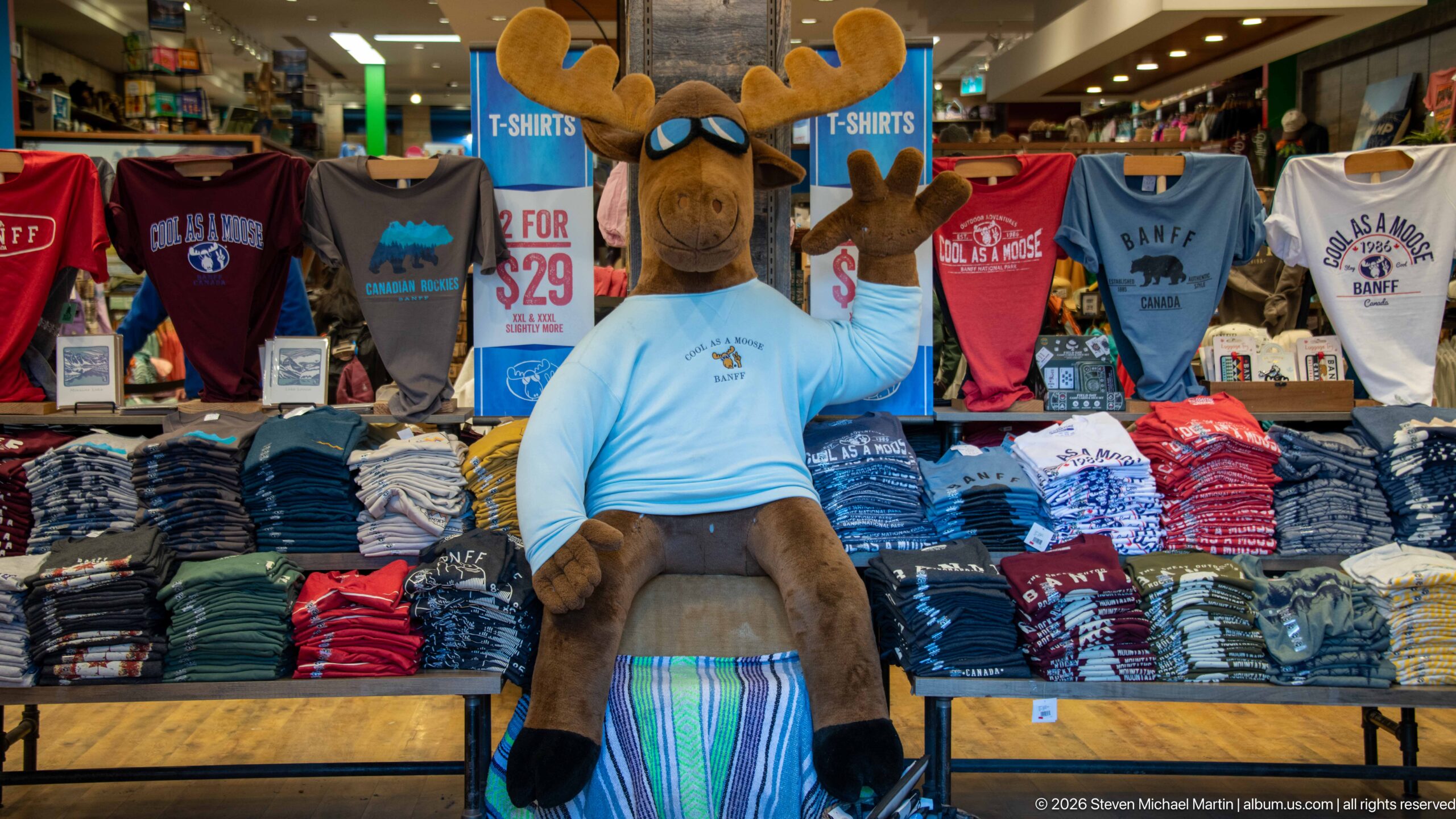
A large plush moose mascot sits amid tightly stacked and hanging Banff souvenir T-shirts, turning the shop display into a playful concentration of Rocky Mountain tourism imagery. Repeated place names, wildlife graphics, bright colors, and sale signage show how local identity is packaged for visitors through wearable souvenirs and familiar Canadian animal motifs.
Caption
A large plush moose mascot sits amid tightly stacked and hanging Banff souvenir T-shirts, turning the shop display into a playful concentration of Rocky Mountain tourism imagery. Repeated place names, wildlife graphics, bright colors, and sale signage show how local identity is packaged for visitors through wearable souvenirs and familiar Canadian animal motifs.
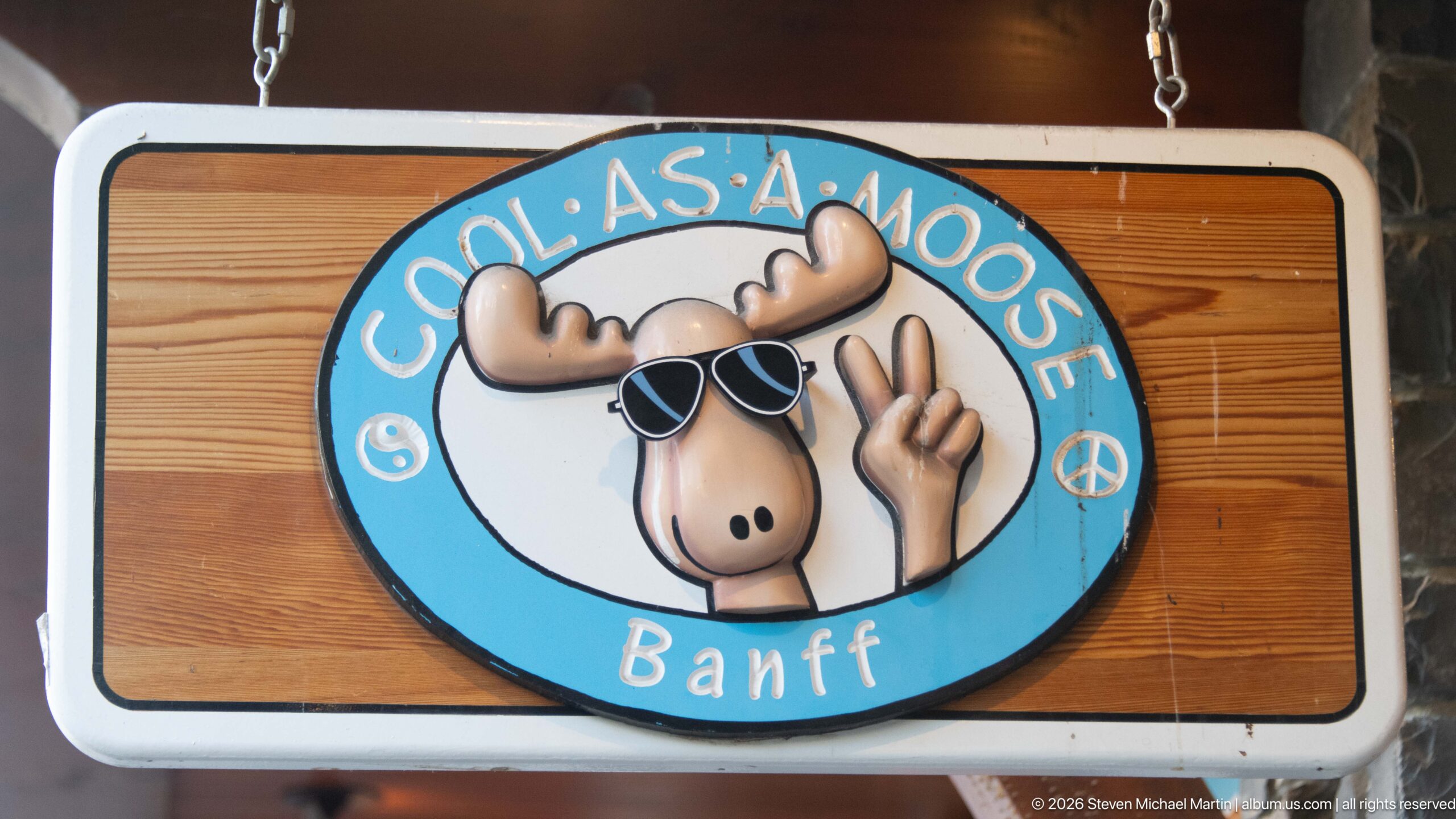
A turquoise-and-wood sign for “Cool As A Moose Banff” features a cartoon moose in sunglasses flashing a peace sign. The close framing isolates the playful branding from the surrounding storefront, preserving a small but distinctive example of the wildlife-themed visual language common to Banff’s souvenir trade.
Caption
A turquoise-and-wood sign for “Cool As A Moose Banff” features a cartoon moose in sunglasses flashing a peace sign. The close framing isolates the playful branding from the surrounding storefront, preserving a small but distinctive example of the wildlife-themed visual language common to Banff’s souvenir trade.
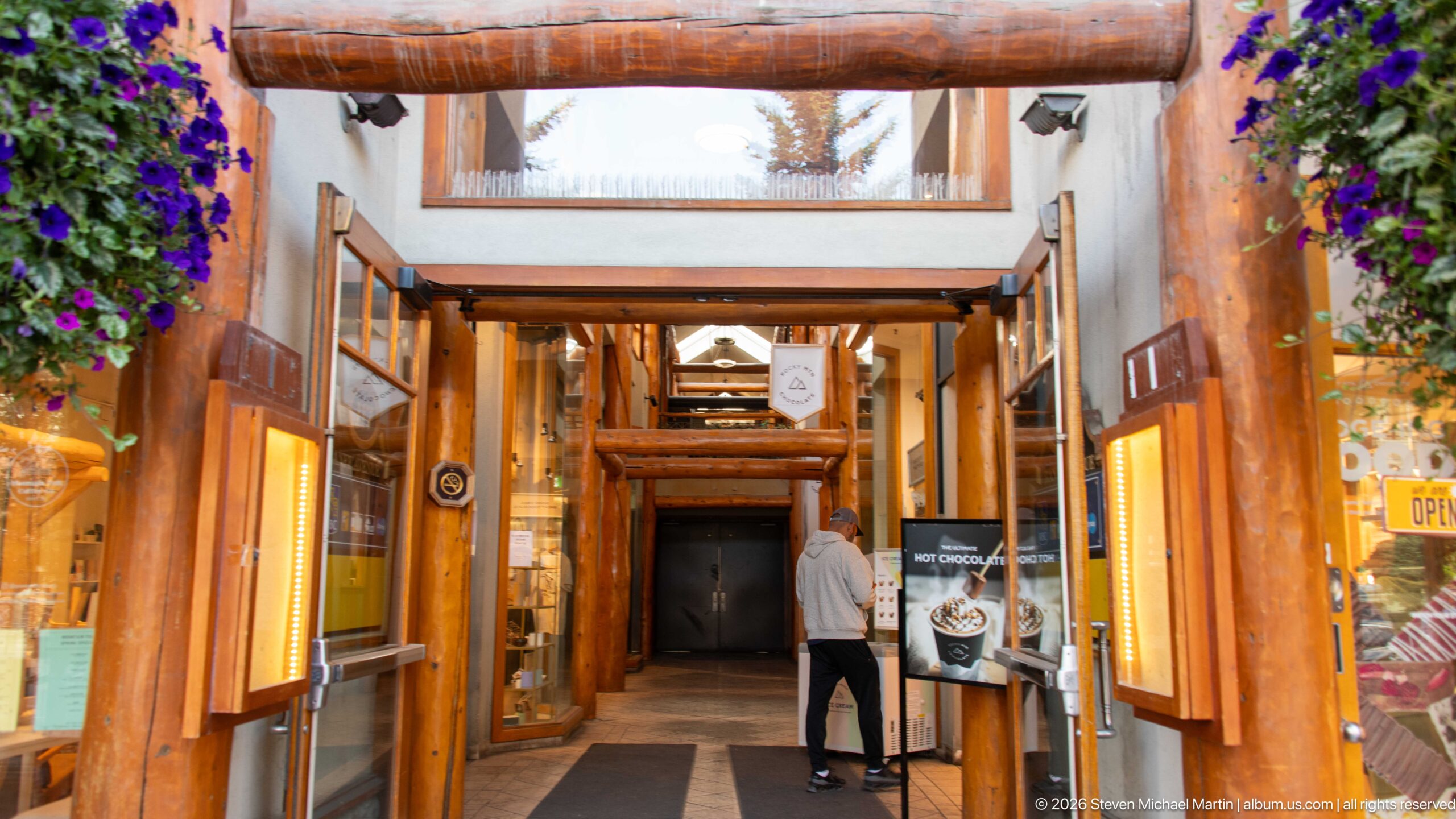
Heavy peeled-log beams frame a narrow, warmly lit shopping passage decorated with hanging flowers and illuminated display cases. A person stands near the far end beneath a skylit opening, giving scale to the layered timber construction and emphasizing the passage-like character of this interior commercial space in central Banff.
Caption
Heavy peeled-log beams frame a narrow, warmly lit shopping passage decorated with hanging flowers and illuminated display cases. A person stands near the far end beneath a skylit opening, giving scale to the layered timber construction and emphasizing the passage-like character of this interior commercial space in central Banff.
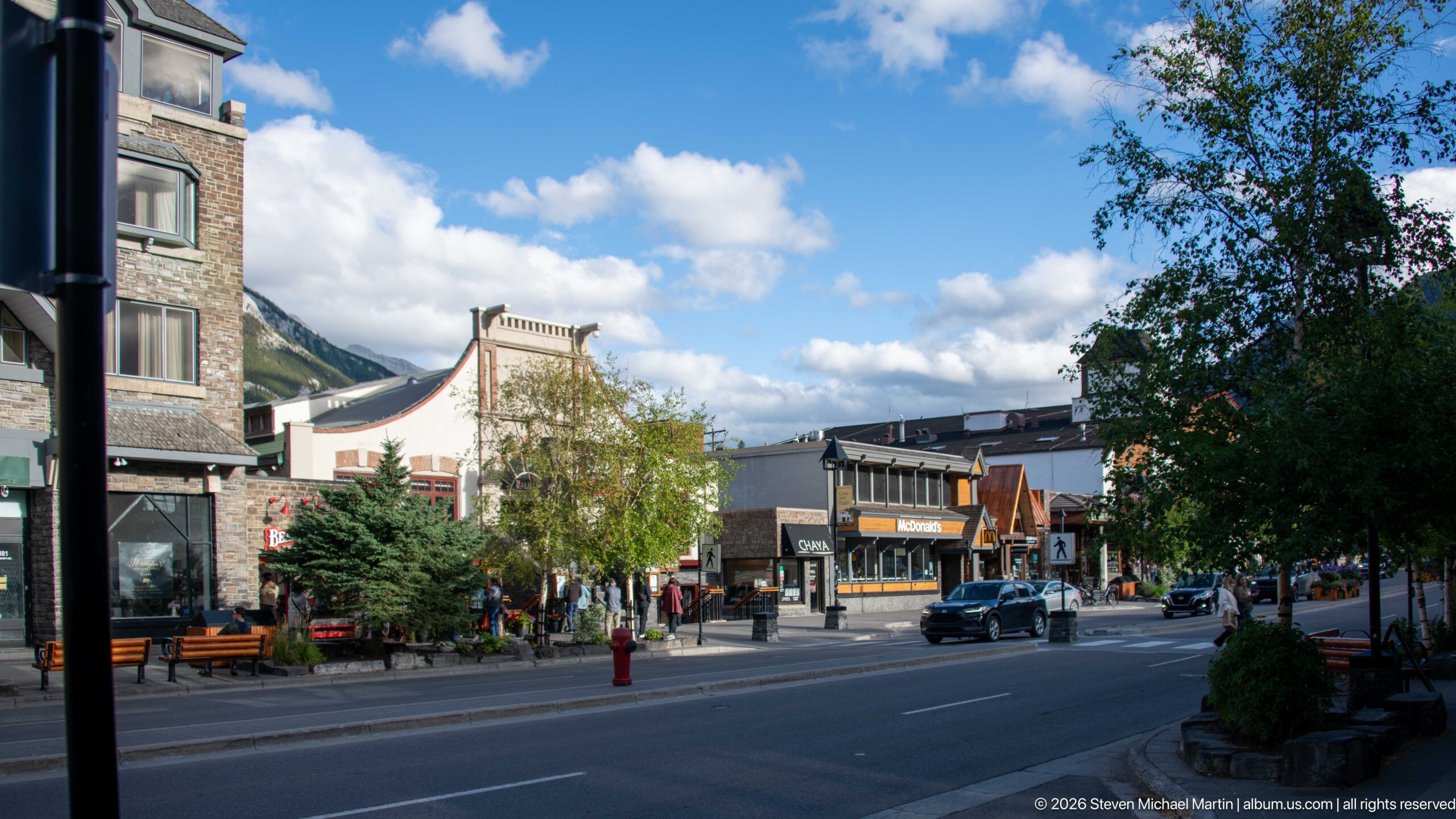
Low-rise shops and restaurants line a broad Banff street beneath a bright sky, with trees and mountain slopes closing the view at either end. The wider composition steps back from individual storefronts to show the scale of the town center: compact buildings, generous sidewalks, street furniture, pedestrians, and vehicles sharing a corridor within the mountain valley.
Caption
Low-rise shops and restaurants line a broad Banff street beneath a bright sky, with trees and mountain slopes closing the view at either end. The wider composition steps back from individual storefronts to show the scale of the town center: compact buildings, generous sidewalks, street furniture, pedestrians, and vehicles sharing a corridor within the mountain valley.
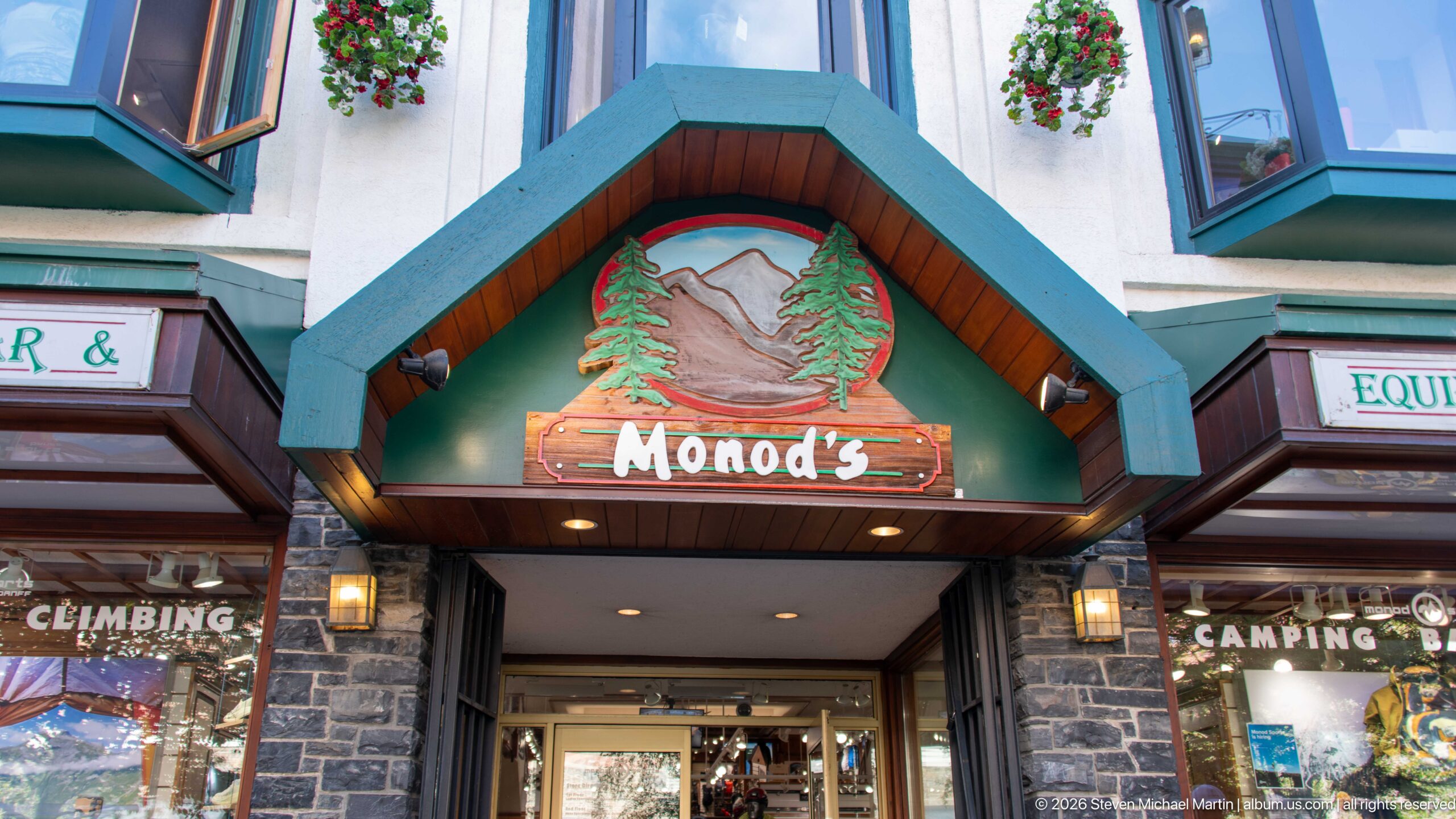
The entrance to Monod’s is marked by a carved mountain-and-evergreen emblem beneath a small projecting gable. Stone facing, dark wood, and outdoor-equipment displays flank the doorway, giving the specialized retailer a façade closely tied to Banff’s hiking and climbing culture while remaining visually integrated with neighboring mountain-town shops.
Caption
The entrance to Monod’s is marked by a carved mountain-and-evergreen emblem beneath a small projecting gable. Stone facing, dark wood, and outdoor-equipment displays flank the doorway, giving the specialized retailer a façade closely tied to Banff’s hiking and climbing culture while remaining visually integrated with neighboring mountain-town shops.
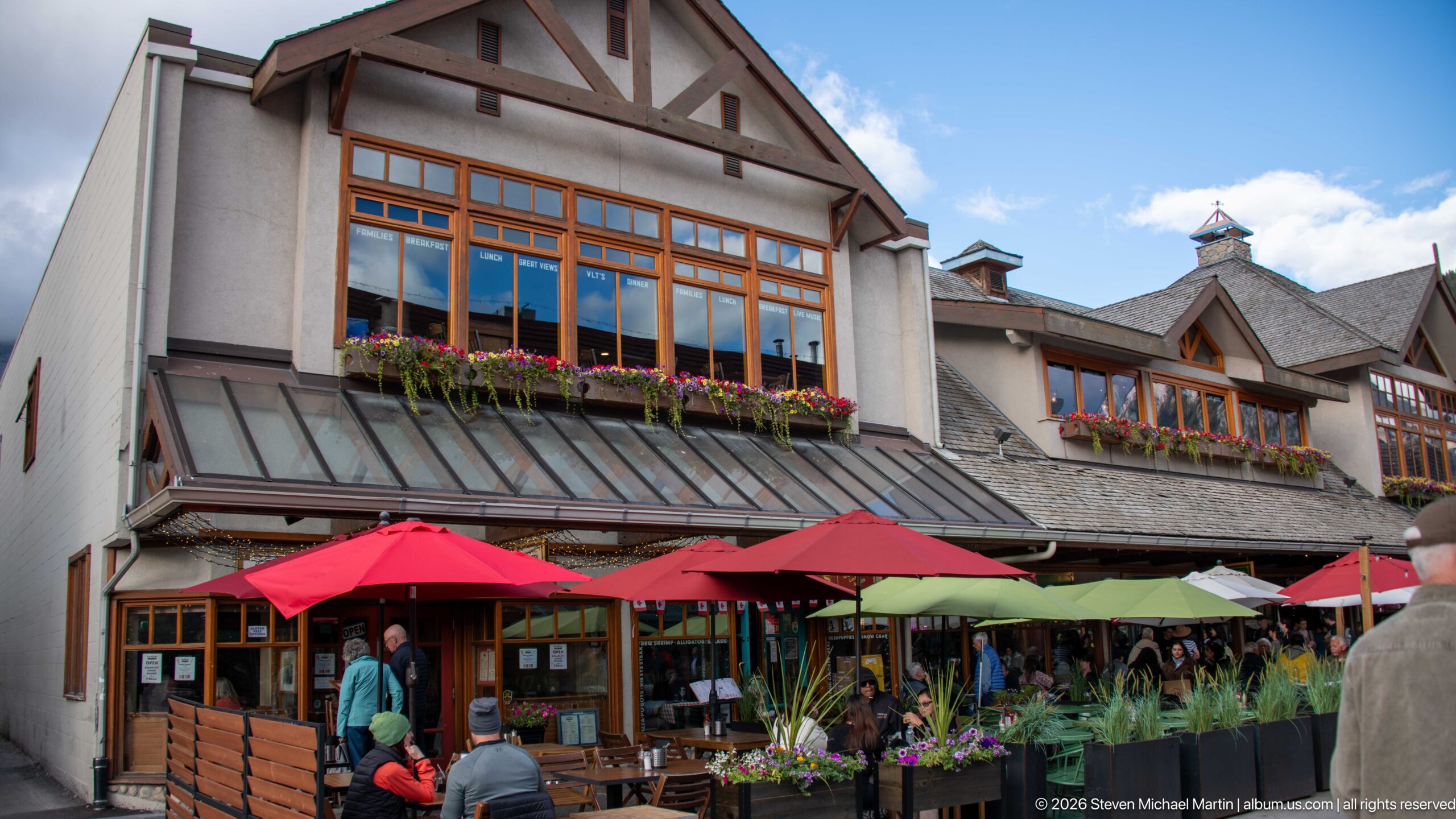
Red umbrellas and planted barriers define a busy restaurant terrace beneath a broad upper story of timber-framed windows and flower boxes. The building’s steep gables, half-timber accents, stone base, and dark metal awning contribute to the historicizing alpine character of Banff’s commercial core, while diners animate the street-level edge.
Caption
Red umbrellas and planted barriers define a busy restaurant terrace beneath a broad upper story of timber-framed windows and flower boxes. The building’s steep gables, half-timber accents, stone base, and dark metal awning contribute to the historicizing alpine character of Banff’s commercial core, while diners animate the street-level edge.
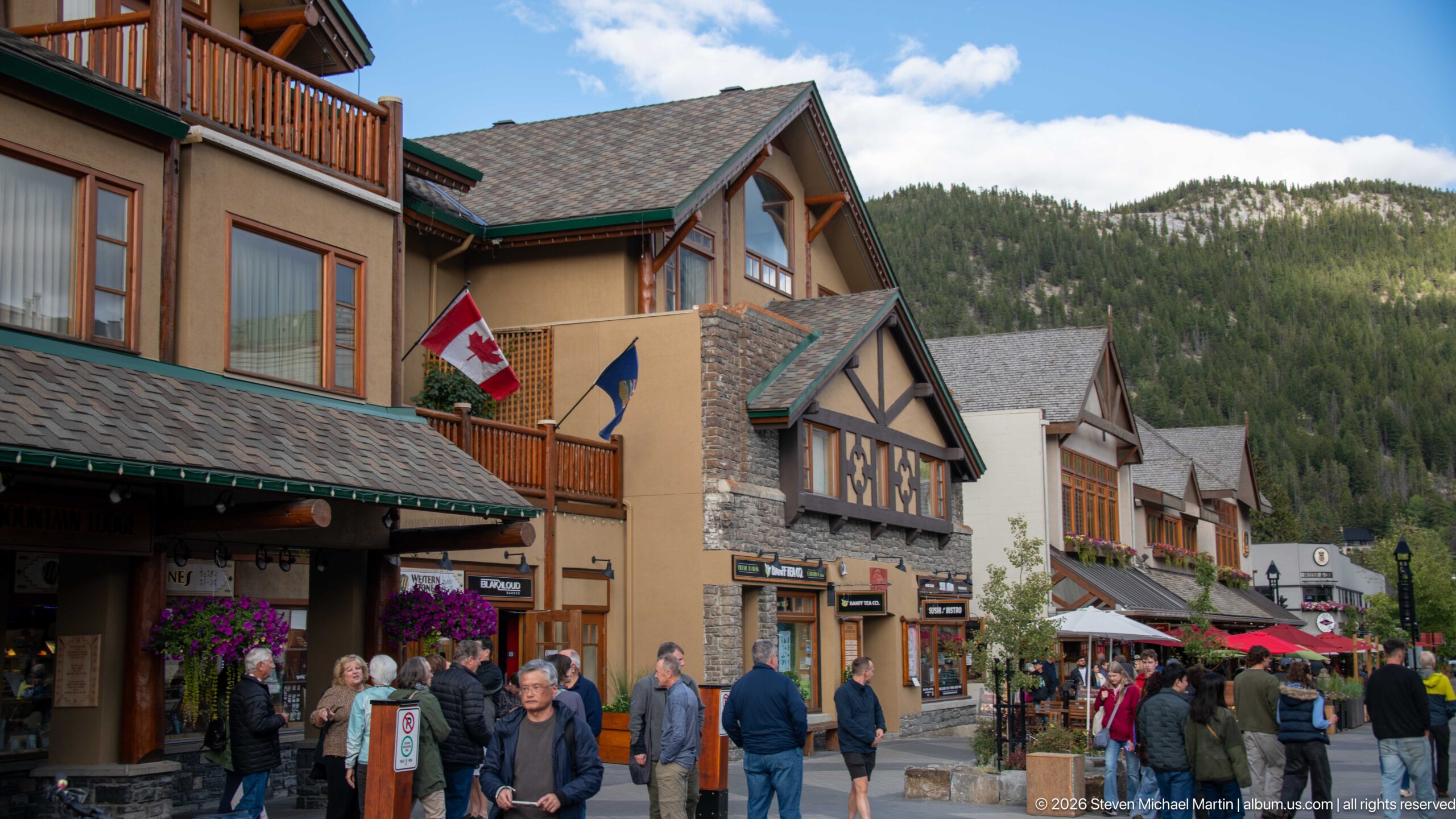
Canadian and Alberta flags hang from a lodge-style commercial building as pedestrians move through a busy Banff shopping street. Stone piers, wood siding, projecting gables, restaurant patios, and the forested mountain slope behind the block combine civic symbolism, tourism, and regional architectural styling in a single town-center view.
Caption
Canadian and Alberta flags hang from a lodge-style commercial building as pedestrians move through a busy Banff shopping street. Stone piers, wood siding, projecting gables, restaurant patios, and the forested mountain slope behind the block combine civic symbolism, tourism, and regional architectural styling in a single town-center view.
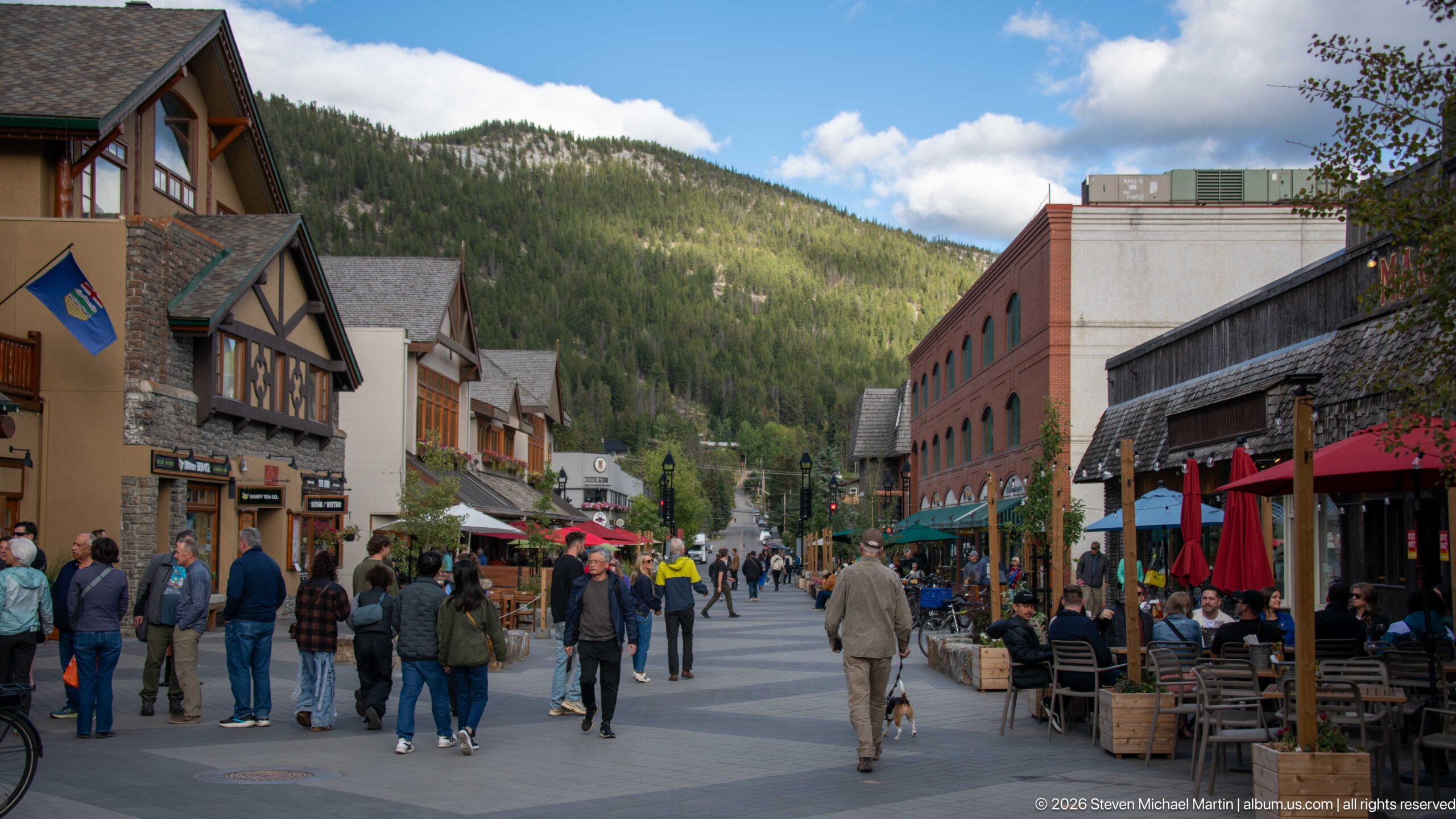
A broad pedestrian lane draws walkers between restaurants and shops toward a forested mountain slope at the end of the street. Outdoor tables and red umbrellas line one side while lodge-style façades line the other, showing the dense mixture of dining, shopping, and foot traffic that characterizes Banff’s central commercial district.
Caption
A broad pedestrian lane draws walkers between restaurants and shops toward a forested mountain slope at the end of the street. Outdoor tables and red umbrellas line one side while lodge-style façades line the other, showing the dense mixture of dining, shopping, and foot traffic that characterizes Banff’s central commercial district.
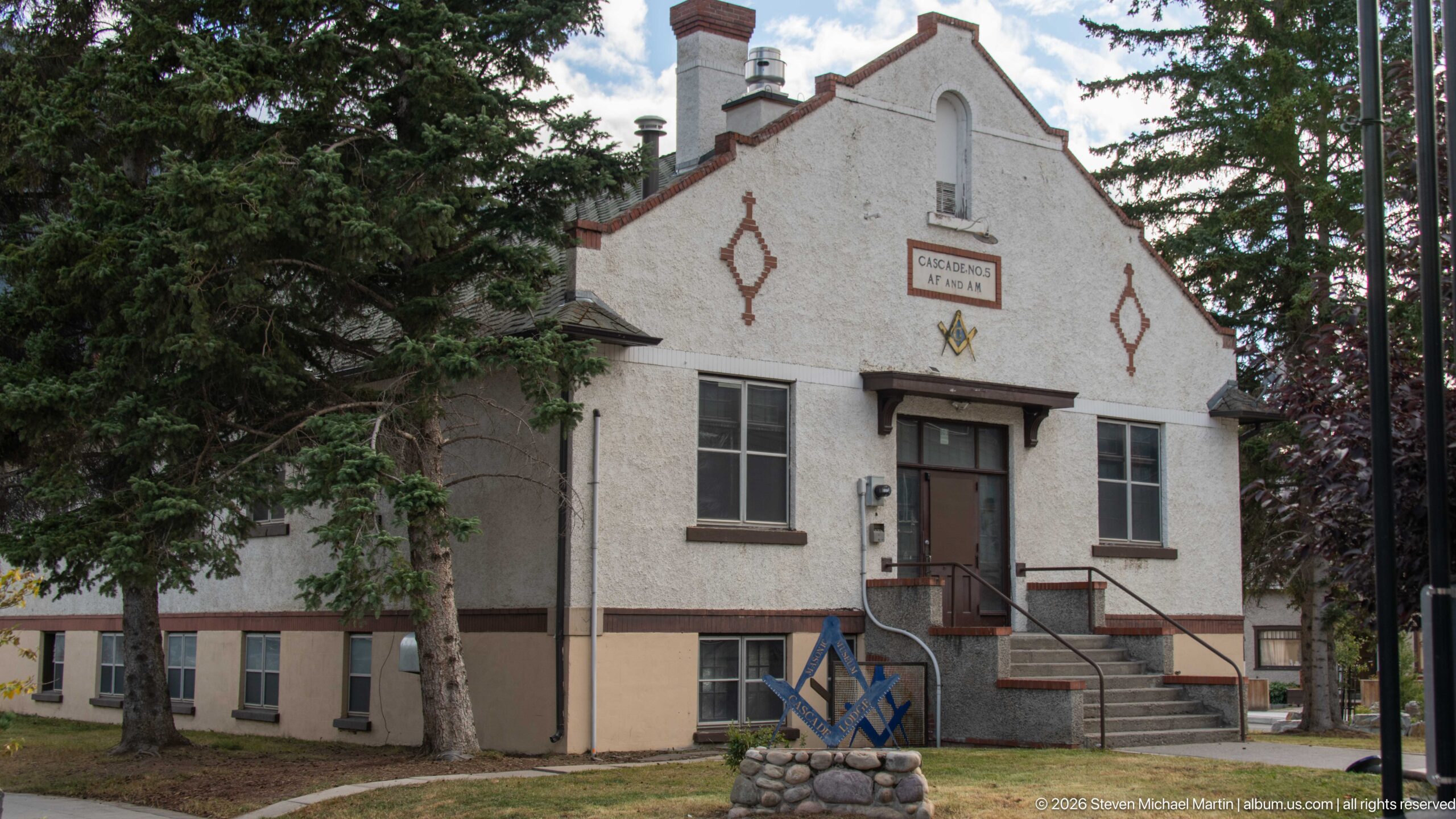
Cascade Lodge No. 5 occupies a restrained stucco building with a shaped front gable, central stair, and Masonic symbols displayed on the façade and in the foreground. Its modest institutional architecture contrasts sharply with Banff’s more elaborate retail buildings, preserving a quieter layer of civic and fraternal history within the town.
Caption
Cascade Lodge No. 5 occupies a restrained stucco building with a shaped front gable, central stair, and Masonic symbols displayed on the façade and in the foreground. Its modest institutional architecture contrasts sharply with Banff’s more elaborate retail buildings, preserving a quieter layer of civic and fraternal history within the town.
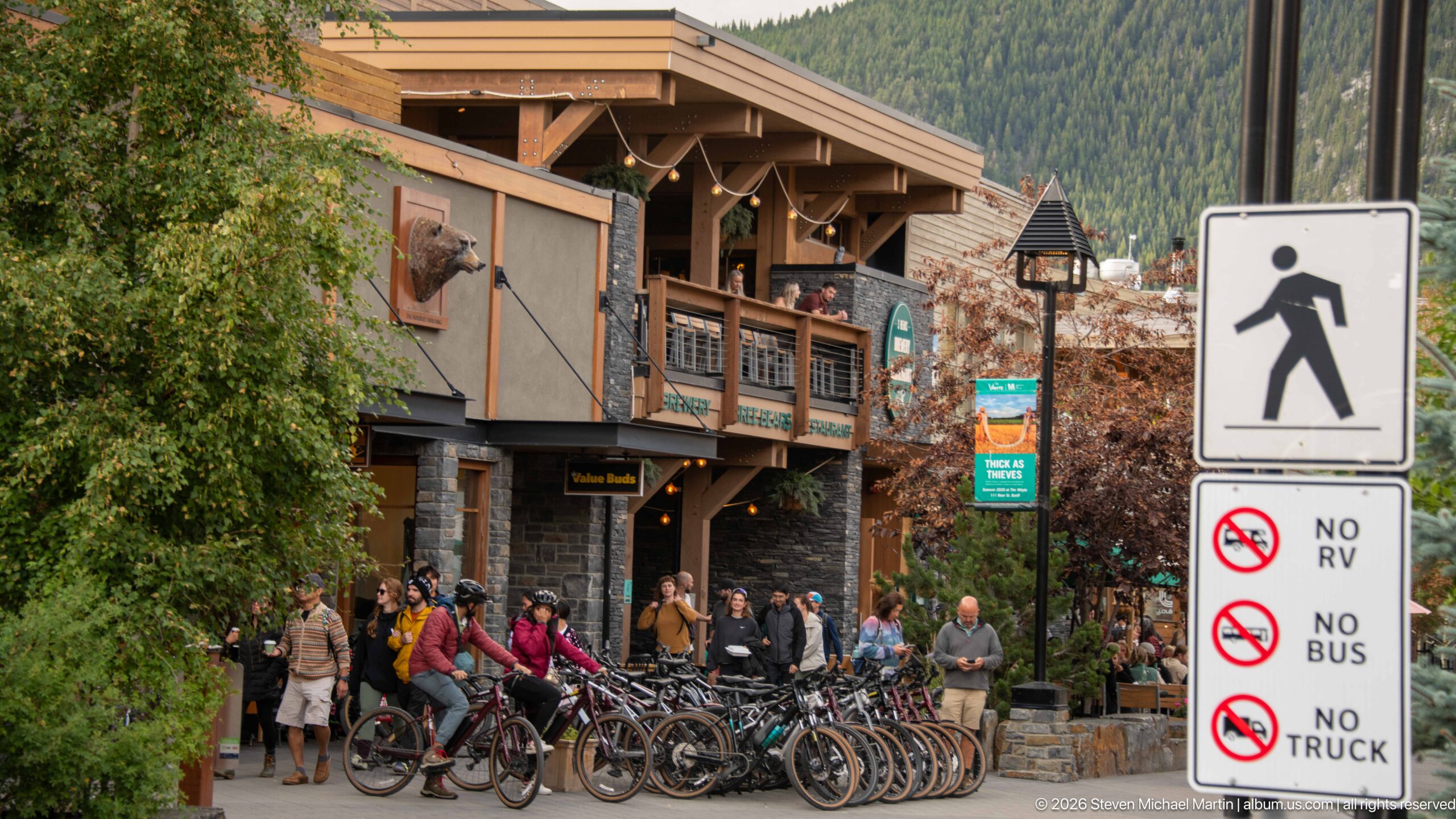
A dense row of bicycles fills the curb outside a timber-and-stone commercial building as pedestrians gather around the entrance. A large pedestrian sign and a restriction panel excluding recreational vehicles, buses, and trucks underscore the street’s people-oriented circulation, while the bicycles point to another common way visitors move through Banff.
Caption
A dense row of bicycles fills the curb outside a timber-and-stone commercial building as pedestrians gather around the entrance. A large pedestrian sign and a restriction panel excluding recreational vehicles, buses, and trucks underscore the street’s people-oriented circulation, while the bicycles point to another common way visitors move through Banff.
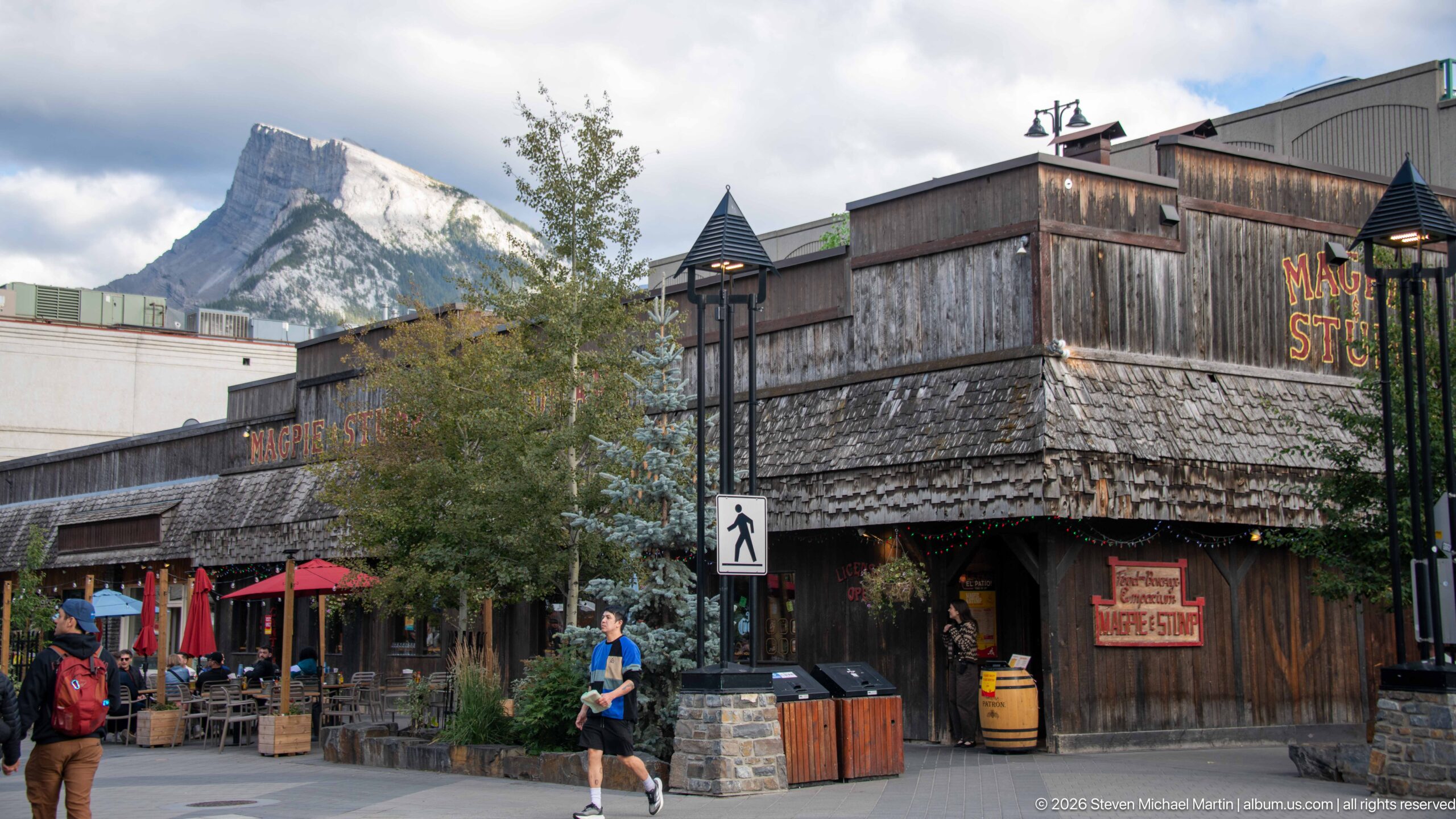
Wild Bill’s Legendary Saloon occupies a deliberately rustic corner building faced with weathered wood and a rough shingle band, with outdoor dining extending along the neighboring frontage. A steep mountain rises behind the commercial block, reinforcing the contrast between Banff’s themed entertainment architecture and the natural landscape immediately surrounding the town.
Caption
Wild Bill’s Legendary Saloon occupies a deliberately rustic corner building faced with weathered wood and a rough shingle band, with outdoor dining extending along the neighboring frontage. A steep mountain rises behind the commercial block, reinforcing the contrast between Banff’s themed entertainment architecture and the natural landscape immediately surrounding the town.
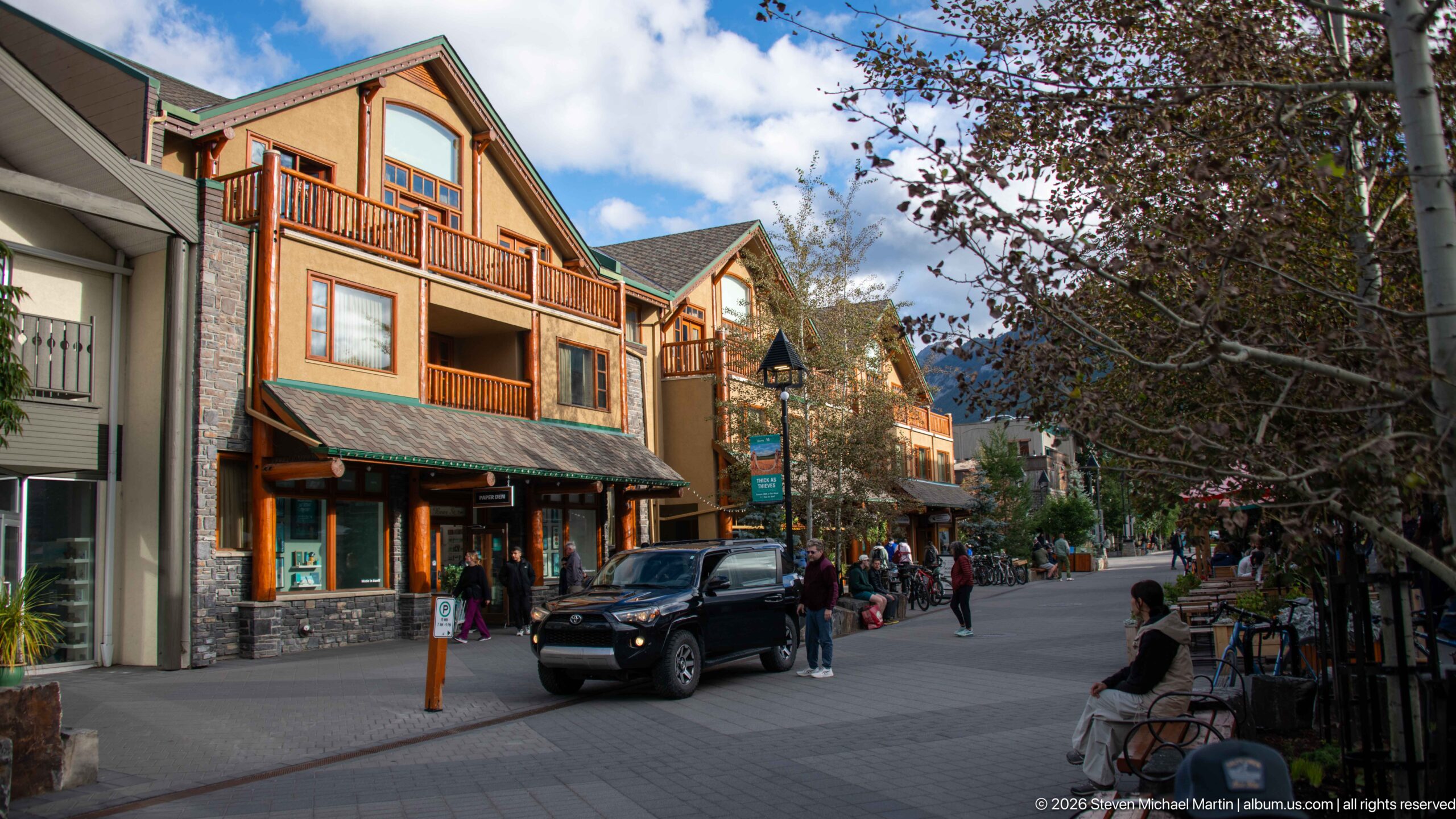
A black pickup threads slowly through a pedestrian-heavy Banff lane lined with timber balconies, stone-faced storefronts, restaurant seating, and mature trees. The view looks along the commercial corridor rather than toward a single landmark, recording the intimate scale of the street and the close coexistence of vehicles, walkers, shops, and mountain-town architecture.
Caption
A black pickup threads slowly through a pedestrian-heavy Banff lane lined with timber balconies, stone-faced storefronts, restaurant seating, and mature trees. The view looks along the commercial corridor rather than toward a single landmark, recording the intimate scale of the street and the close coexistence of vehicles, walkers, shops, and mountain-town architecture.
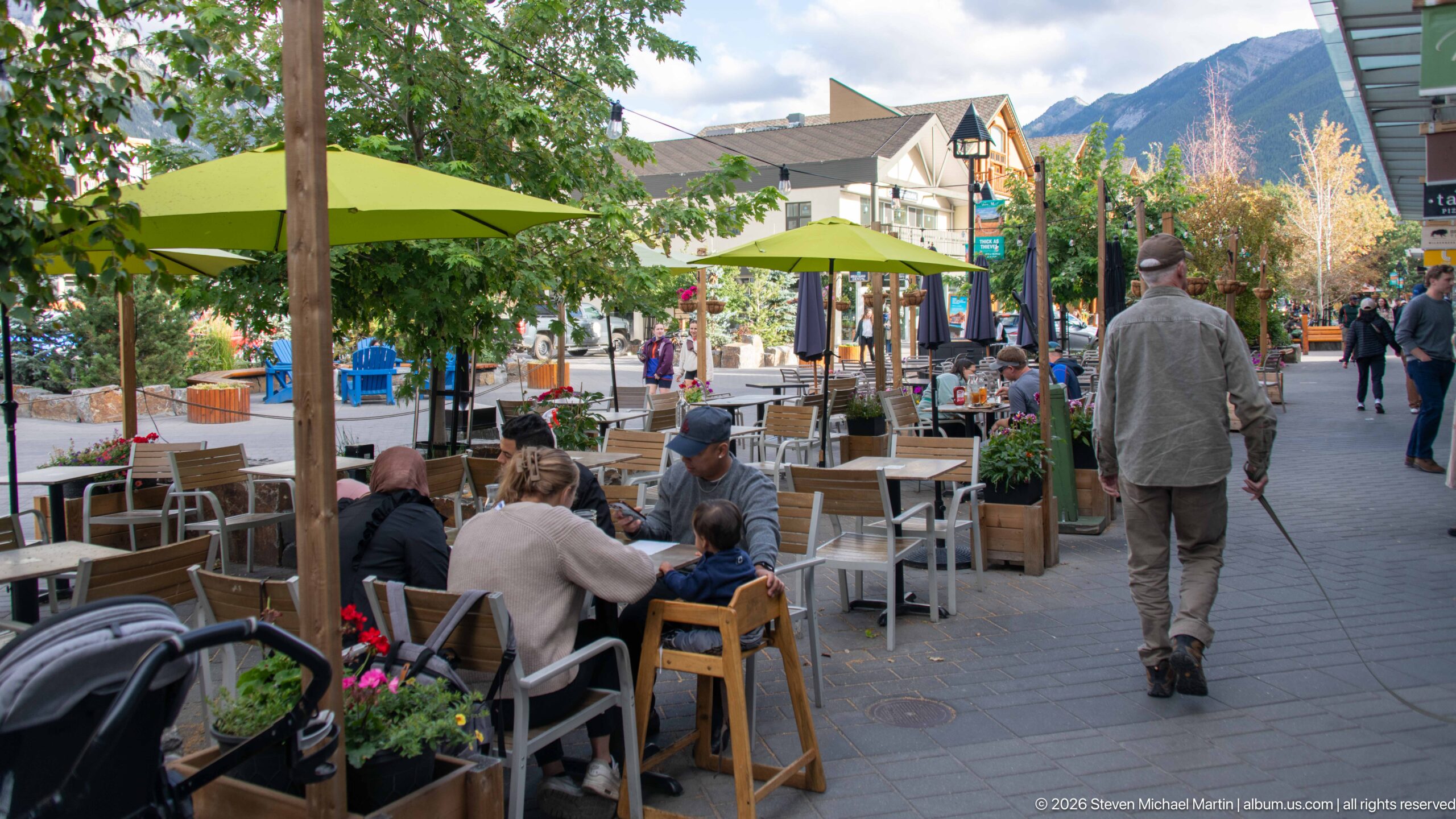
Outdoor café tables, umbrellas, planters, and strolling pedestrians animate a pedestrian-oriented commercial street in Banff Town. The view emphasizes the compact scale of the town center, where restaurant terraces occupy the foreground while chalet-influenced façades and a steep Rocky Mountain slope frame the street beyond.
Caption
Outdoor café tables, umbrellas, planters, and strolling pedestrians animate a pedestrian-oriented commercial street in Banff Town. The view emphasizes the compact scale of the town center, where restaurant terraces occupy the foreground while chalet-influenced façades and a steep Rocky Mountain slope frame the street beyond.
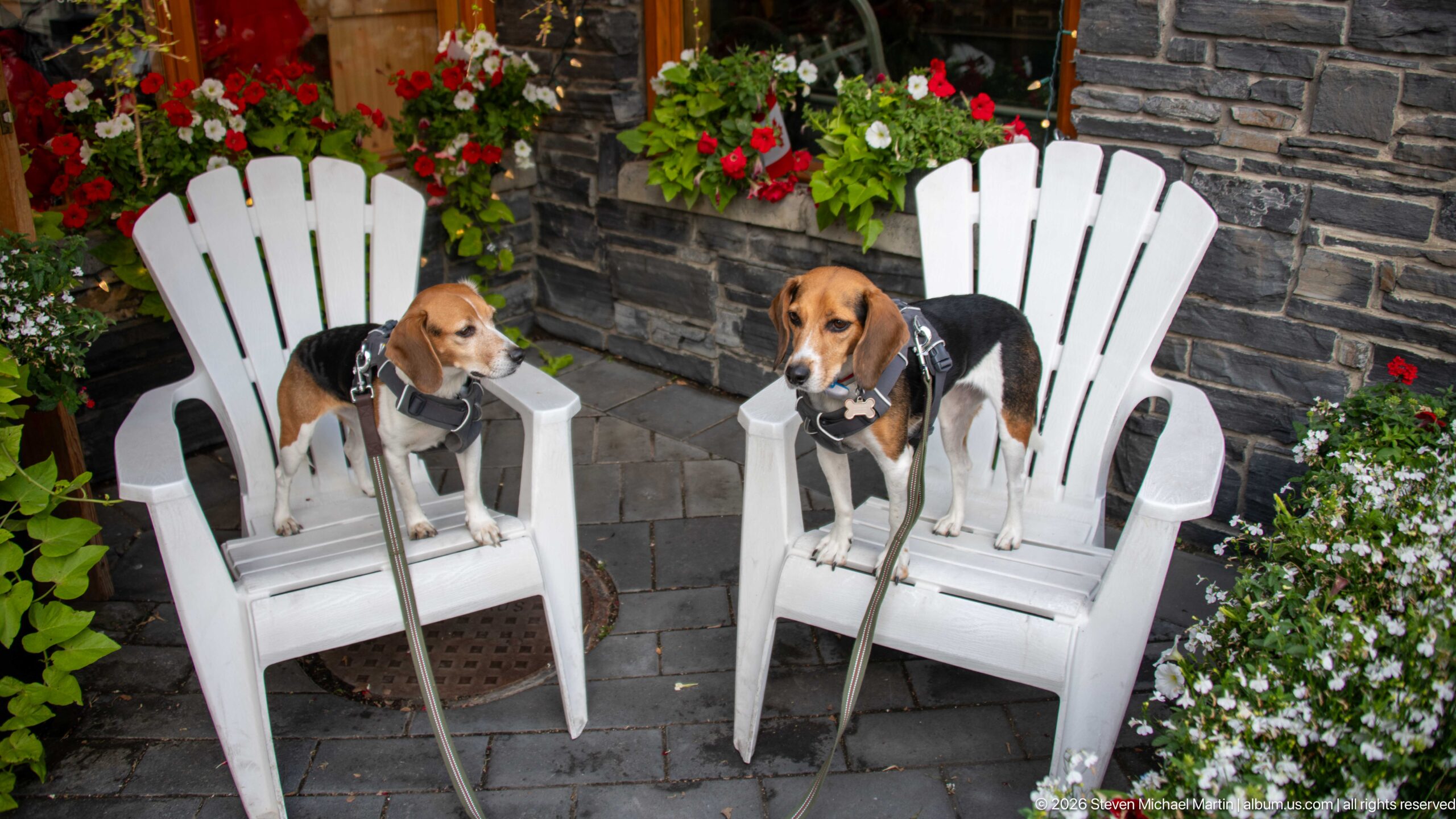
Two beagles occupy separate white Adirondack chairs beside a stone wall and dense summer flower displays. Their leashes trail toward the foreground, turning a small commercial courtyard into an informal portrait setting; the paired chairs, matching posture, and surrounding red, white, and green plantings give the scene a deliberately balanced composition.
Caption
Two beagles occupy separate white Adirondack chairs beside a stone wall and dense summer flower displays. Their leashes trail toward the foreground, turning a small commercial courtyard into an informal portrait setting; the paired chairs, matching posture, and surrounding red, white, and green plantings give the scene a deliberately balanced composition.
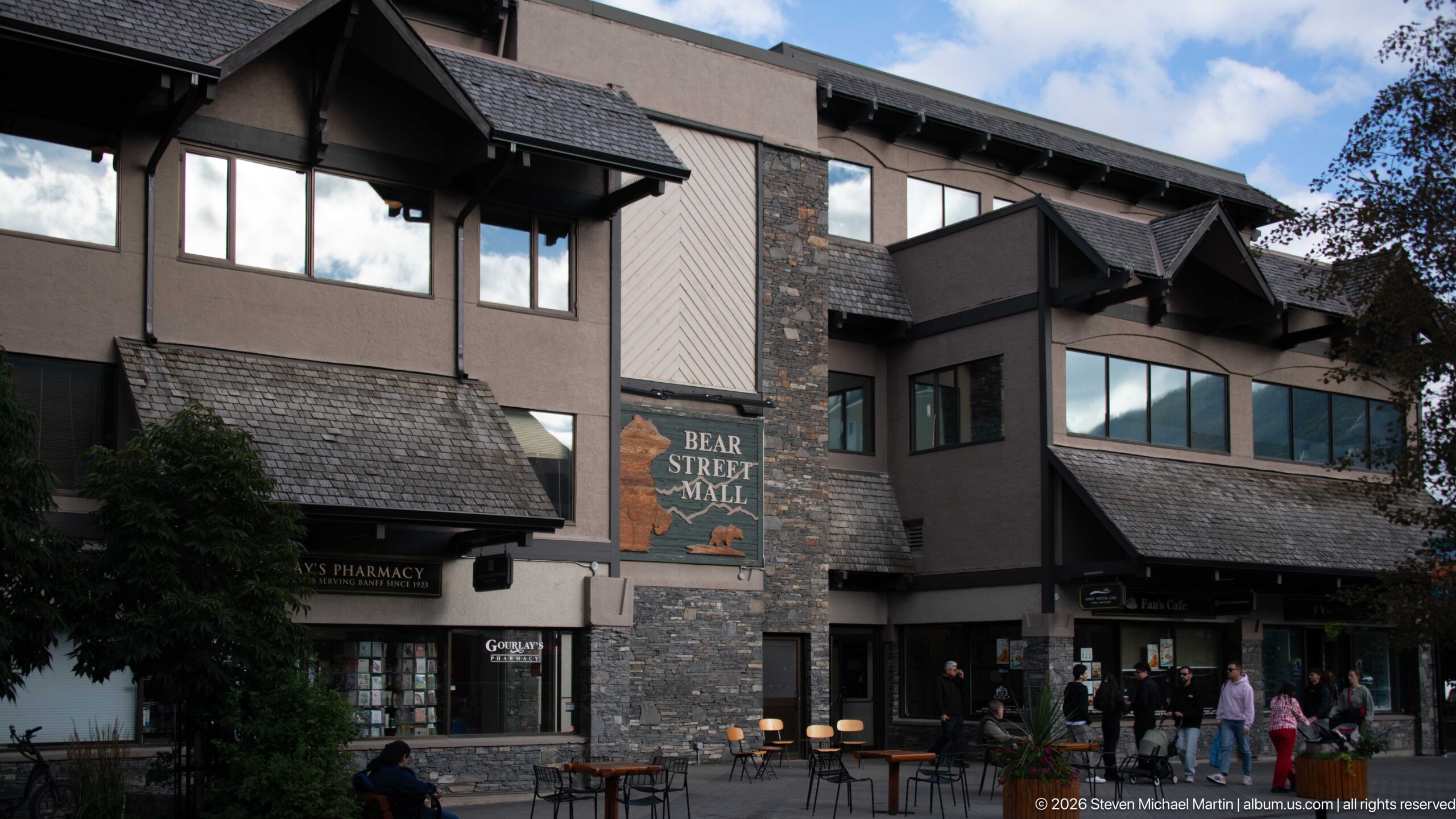
The Bear Street Mall presents a layered façade of dark shingles, stone piers, projecting roofs, and broad windows along Banff’s commercial core. A vertical wooden sign identifies the complex, while storefronts, outdoor tables, and pedestrians at ground level show the building functioning as a mixed retail and gathering space.
Caption
The Bear Street Mall presents a layered façade of dark shingles, stone piers, projecting roofs, and broad windows along Banff’s commercial core. A vertical wooden sign identifies the complex, while storefronts, outdoor tables, and pedestrians at ground level show the building functioning as a mixed retail and gathering space.
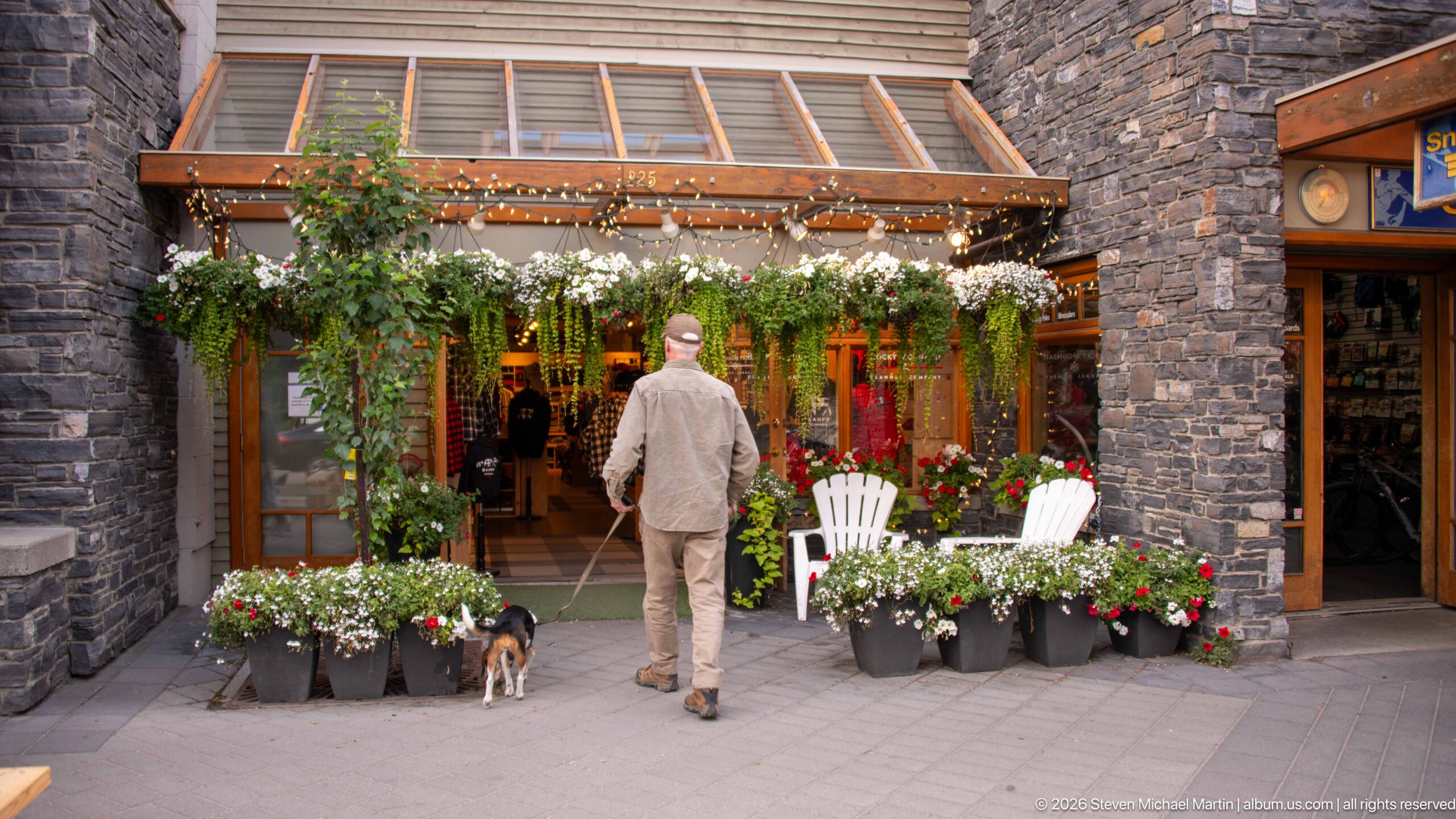
A narrow commercial passage opens beneath hanging baskets and dense planters, with dark stone walls enclosing the entrance on both sides. A pedestrian and small dog move toward the brightly lit interior, while two white Adirondack chairs and cascading flowers connect this intimate view to the landscaped pedestrian spaces of central Banff.
Caption
A narrow commercial passage opens beneath hanging baskets and dense planters, with dark stone walls enclosing the entrance on both sides. A pedestrian and small dog move toward the brightly lit interior, while two white Adirondack chairs and cascading flowers connect this intimate view to the landscaped pedestrian spaces of central Banff.
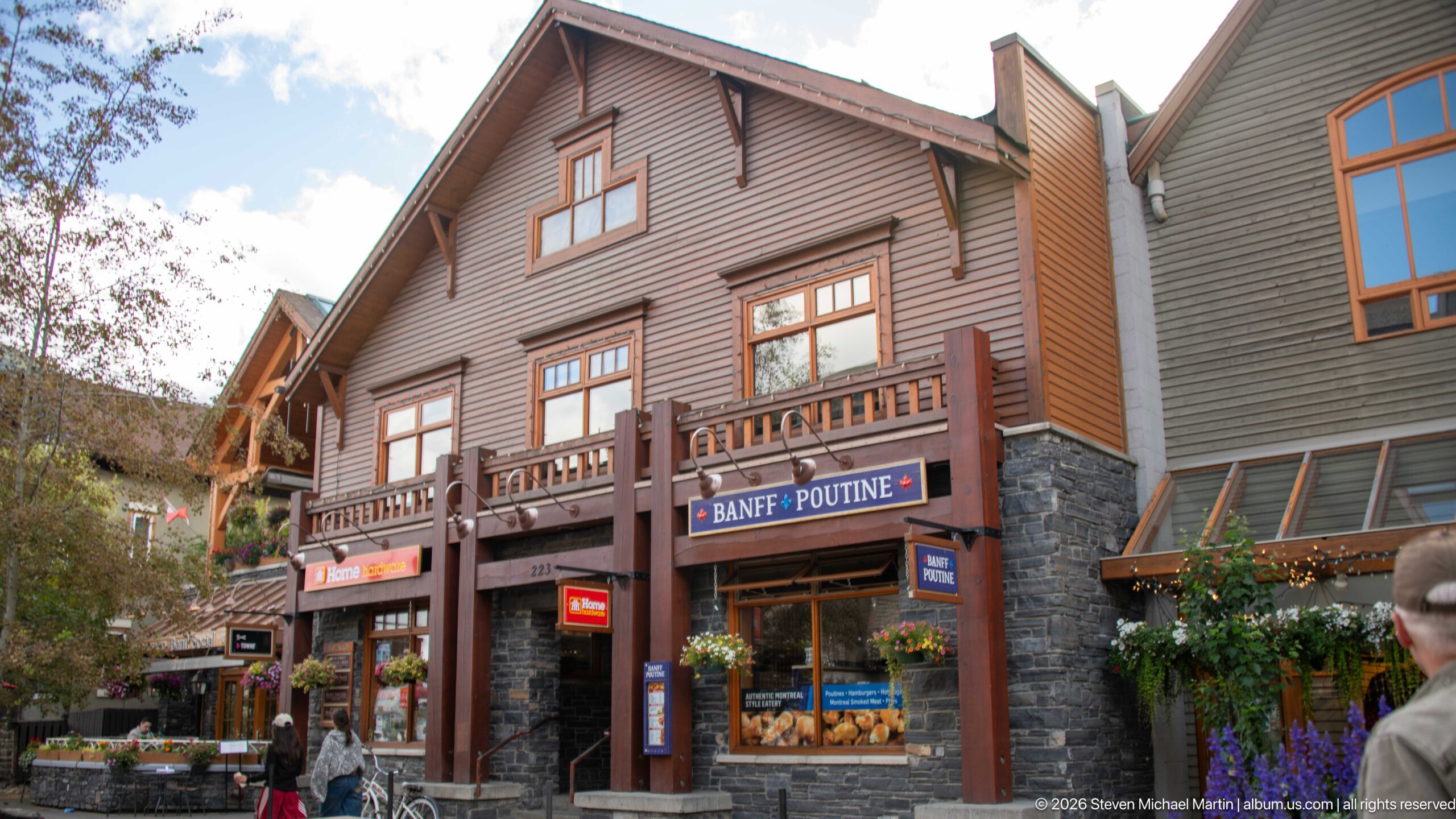
A steep-gabled commercial building combines brown siding, stone at street level, timber balconies, and rows of black awnings. The “Banff Poutine” sign anchors the central storefront, while adjacent businesses and upper-story windows illustrate the dense mixture of retail and lodging or office space characteristic of Banff’s town center.
Caption
A steep-gabled commercial building combines brown siding, stone at street level, timber balconies, and rows of black awnings. The “Banff Poutine” sign anchors the central storefront, while adjacent businesses and upper-story windows illustrate the dense mixture of retail and lodging or office space characteristic of Banff’s town center.
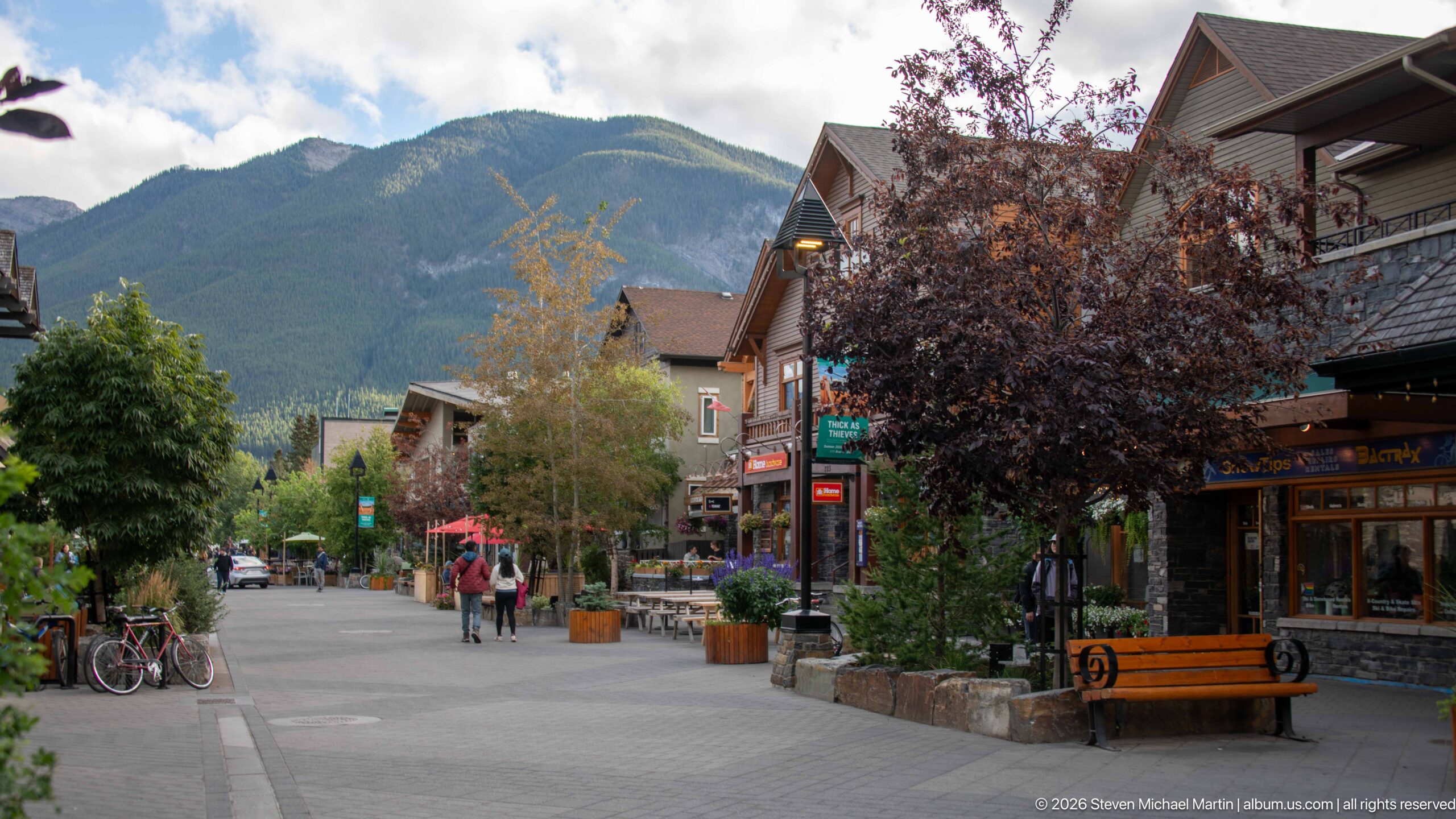
A broad pedestrian street leads through Banff’s compact commercial center toward a forested mountain wall. Benches, bicycles, restaurant seating, trees, and low-rise gabled buildings soften the paved corridor, while scattered walkers provide scale and reinforce the town center’s emphasis on movement on foot and by bicycle.
Caption
A broad pedestrian street leads through Banff’s compact commercial center toward a forested mountain wall. Benches, bicycles, restaurant seating, trees, and low-rise gabled buildings soften the paved corridor, while scattered walkers provide scale and reinforce the town center’s emphasis on movement on foot and by bicycle.
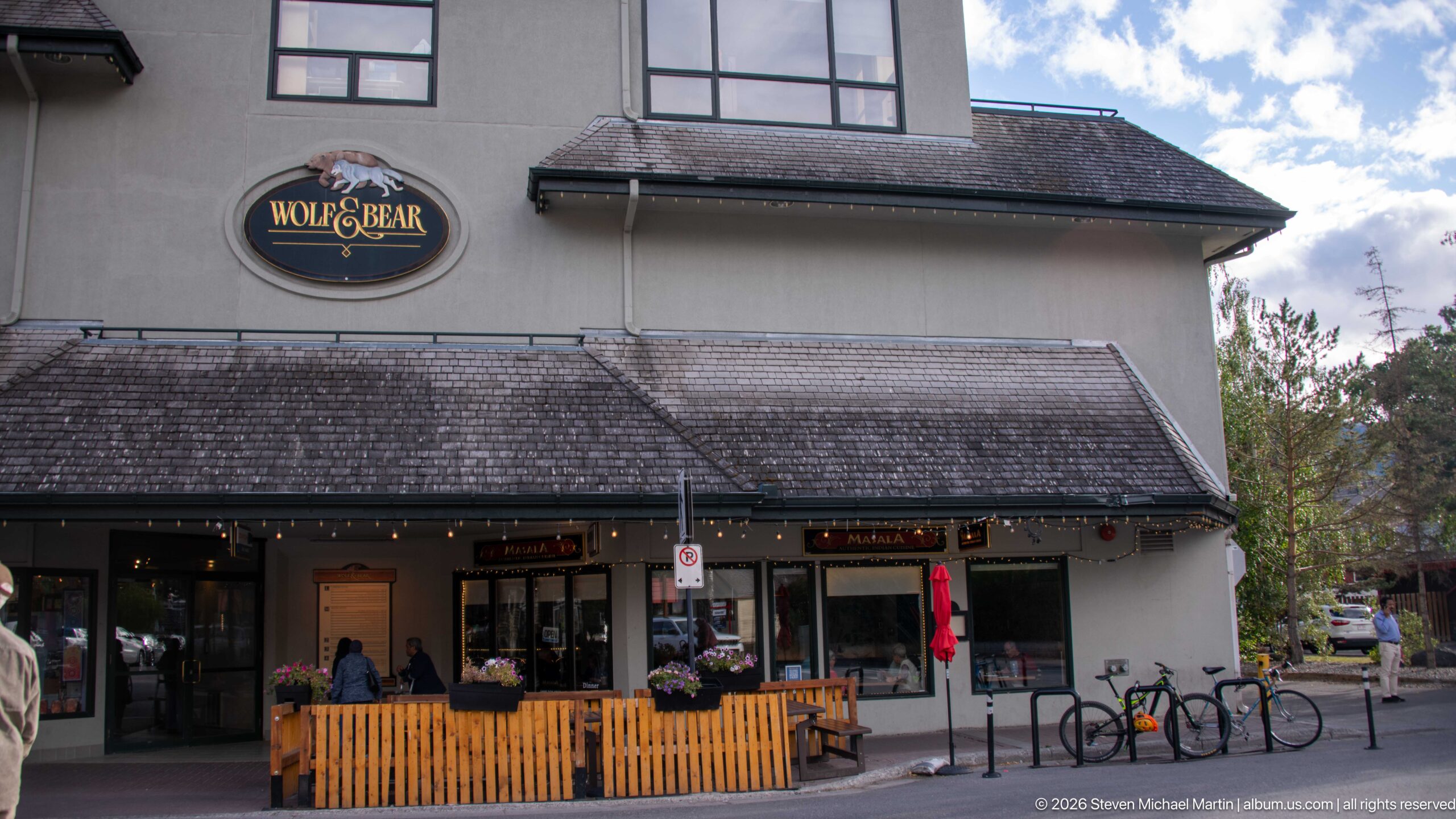
The Holy Bear occupies the ground floor beneath a broad shingled canopy, its oval bear-logo sign mounted high on the pale façade. A fenced outdoor seating area, bicycles, flower boxes, and neighboring shop entrances give the view a street-level record of one of Banff’s contemporary commercial façades.
Caption
The Holy Bear occupies the ground floor beneath a broad shingled canopy, its oval bear-logo sign mounted high on the pale façade. A fenced outdoor seating area, bicycles, flower boxes, and neighboring shop entrances give the view a street-level record of one of Banff’s contemporary commercial façades.
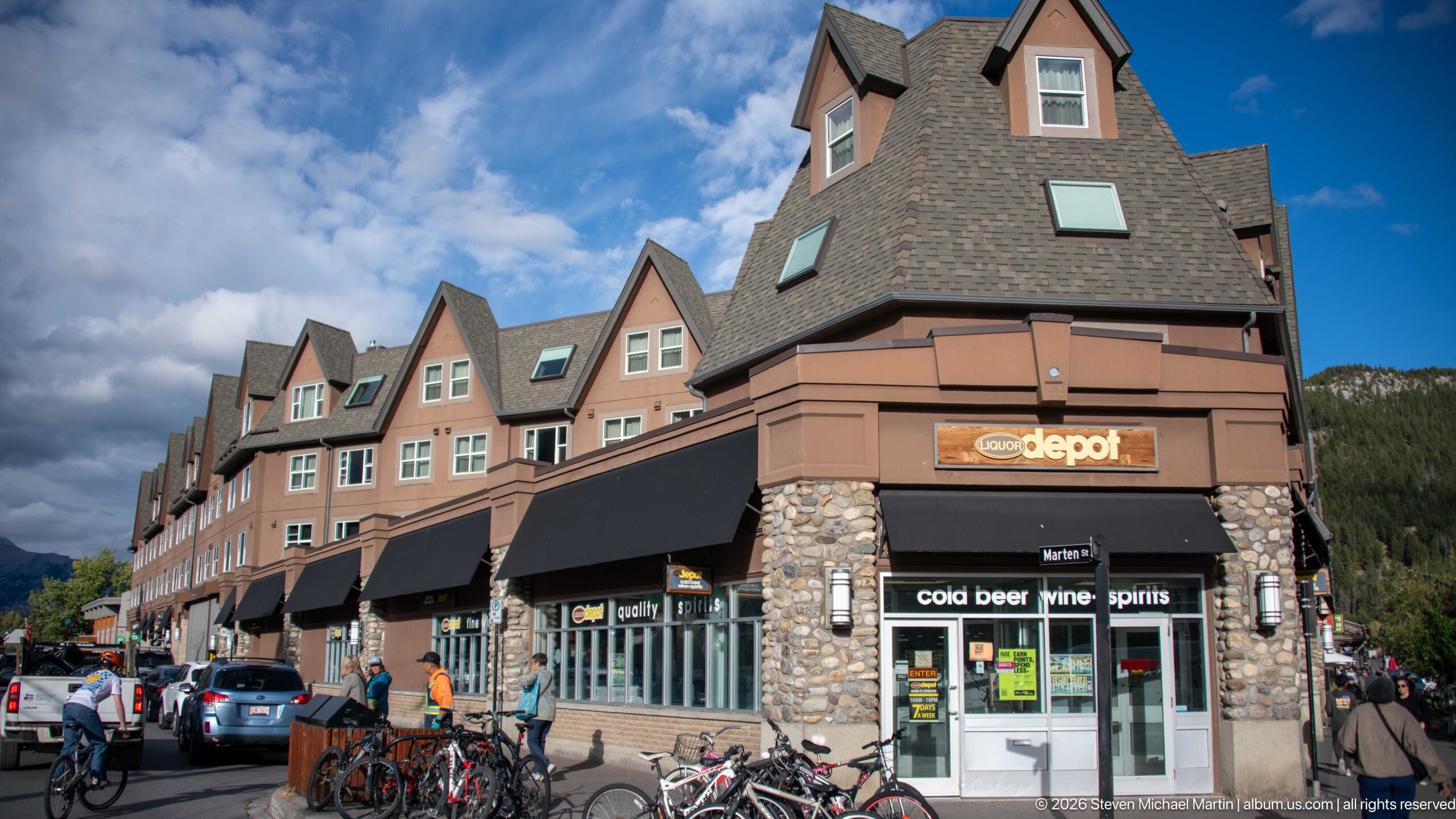
A sharply pointed corner turret rises above the Cool Depot storefront, terminating a long block of repeating dormers and black awnings. Stone cladding at the base, brown upper walls, bicycles, parked cars, and pedestrians combine mountain-resort architectural motifs with the everyday density of Banff’s central retail district.
Caption
A sharply pointed corner turret rises above the Cool Depot storefront, terminating a long block of repeating dormers and black awnings. Stone cladding at the base, brown upper walls, bicycles, parked cars, and pedestrians combine mountain-resort architectural motifs with the everyday density of Banff’s central retail district.
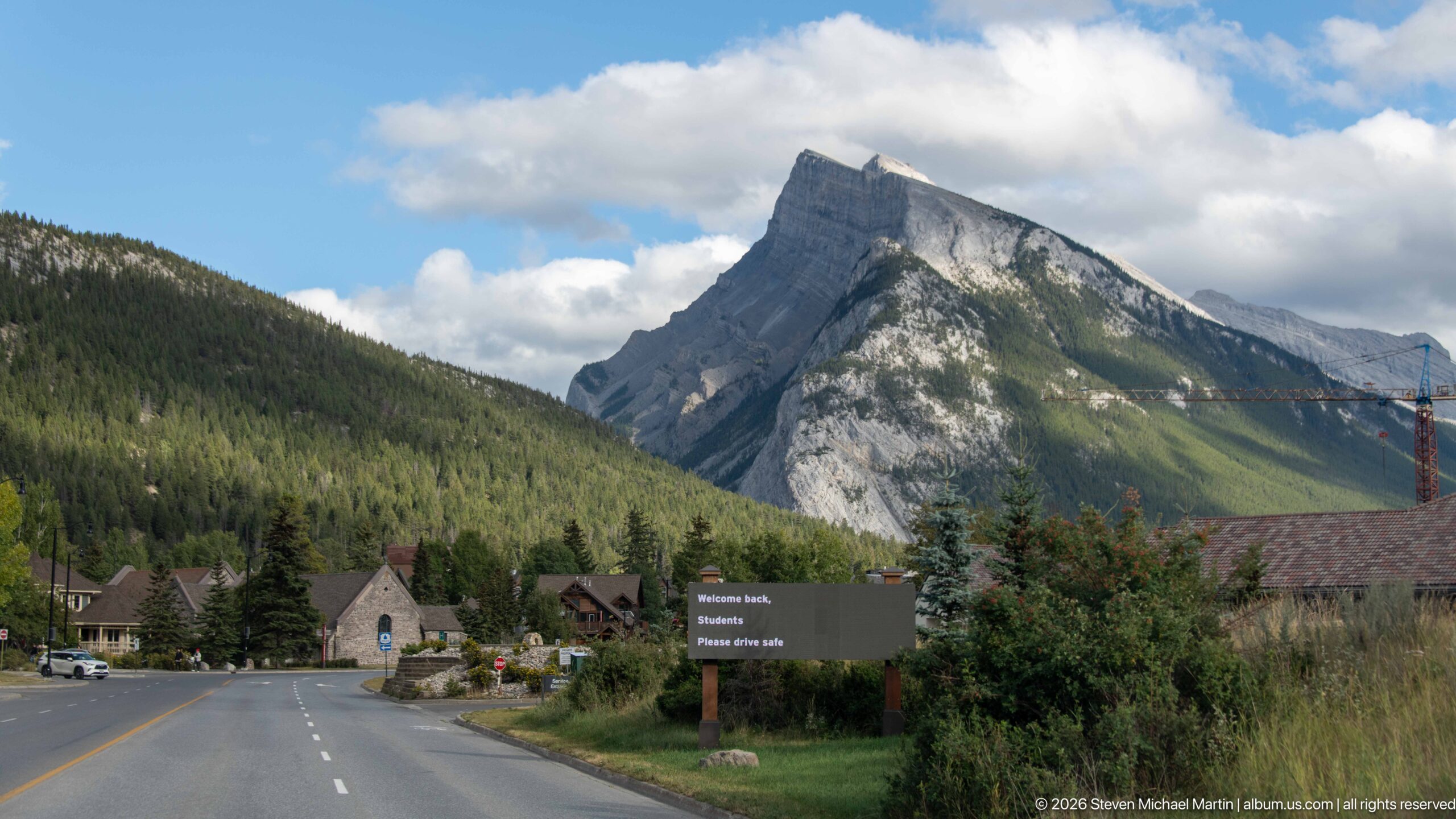
Cascade Mountain rises abruptly beyond the roadway, its tilted limestone strata and pale cliff bands standing above forested lower slopes. Buildings and a roadside sign at the base provide scale and locate the view within the developed Banff area, while the mountain’s distinctive profile dominates the composition under broken cloud.
Caption
Cascade Mountain rises abruptly beyond the roadway, its tilted limestone strata and pale cliff bands standing above forested lower slopes. Buildings and a roadside sign at the base provide scale and locate the view within the developed Banff area, while the mountain’s distinctive profile dominates the composition under broken cloud.
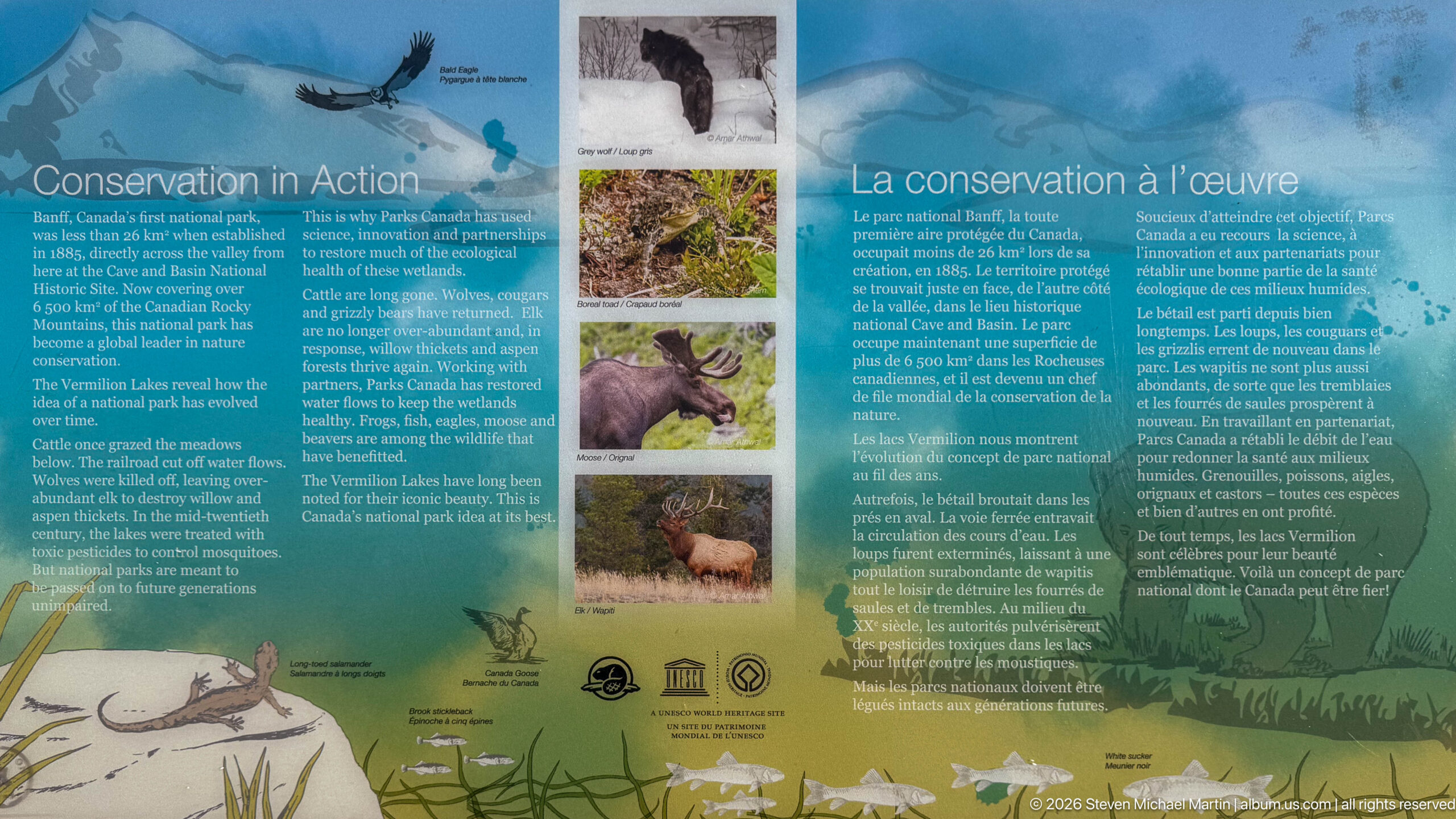
A bilingual Parks Canada panel titled “Conservation in Action” explains wildlife conservation around the Banff area. Photographs and illustrations of large mammals accompany English and French text, presenting conservation as an active response to pressures on species and habitat rather than as scenery alone.
Caption
A bilingual Parks Canada panel titled “Conservation in Action” explains wildlife conservation around the Banff area. Photographs and illustrations of large mammals accompany English and French text, presenting conservation as an active response to pressures on species and habitat rather than as scenery alone.
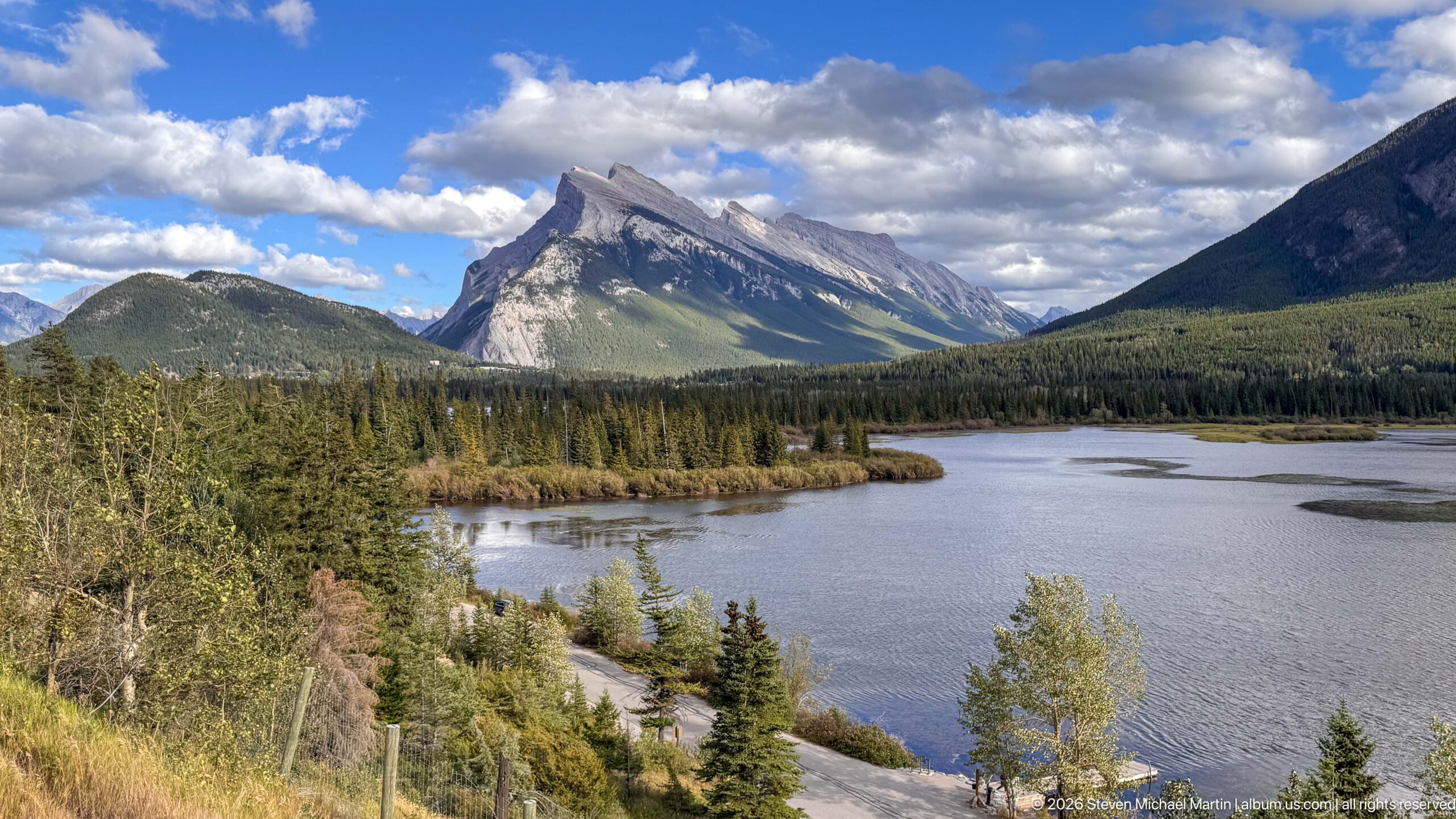
Mount Rundle’s long, tilted limestone profile rises beyond the calm wetlands of the Vermilion Lakes. Reeds, low islands, conifers, and reflective water occupy the foreground, presenting the lake system as both a scenic viewpoint and a wetland habitat immediately west of Banff Town.
Caption
Mount Rundle’s long, tilted limestone profile rises beyond the calm wetlands of the Vermilion Lakes. Reeds, low islands, conifers, and reflective water occupy the foreground, presenting the lake system as both a scenic viewpoint and a wetland habitat immediately west of Banff Town.
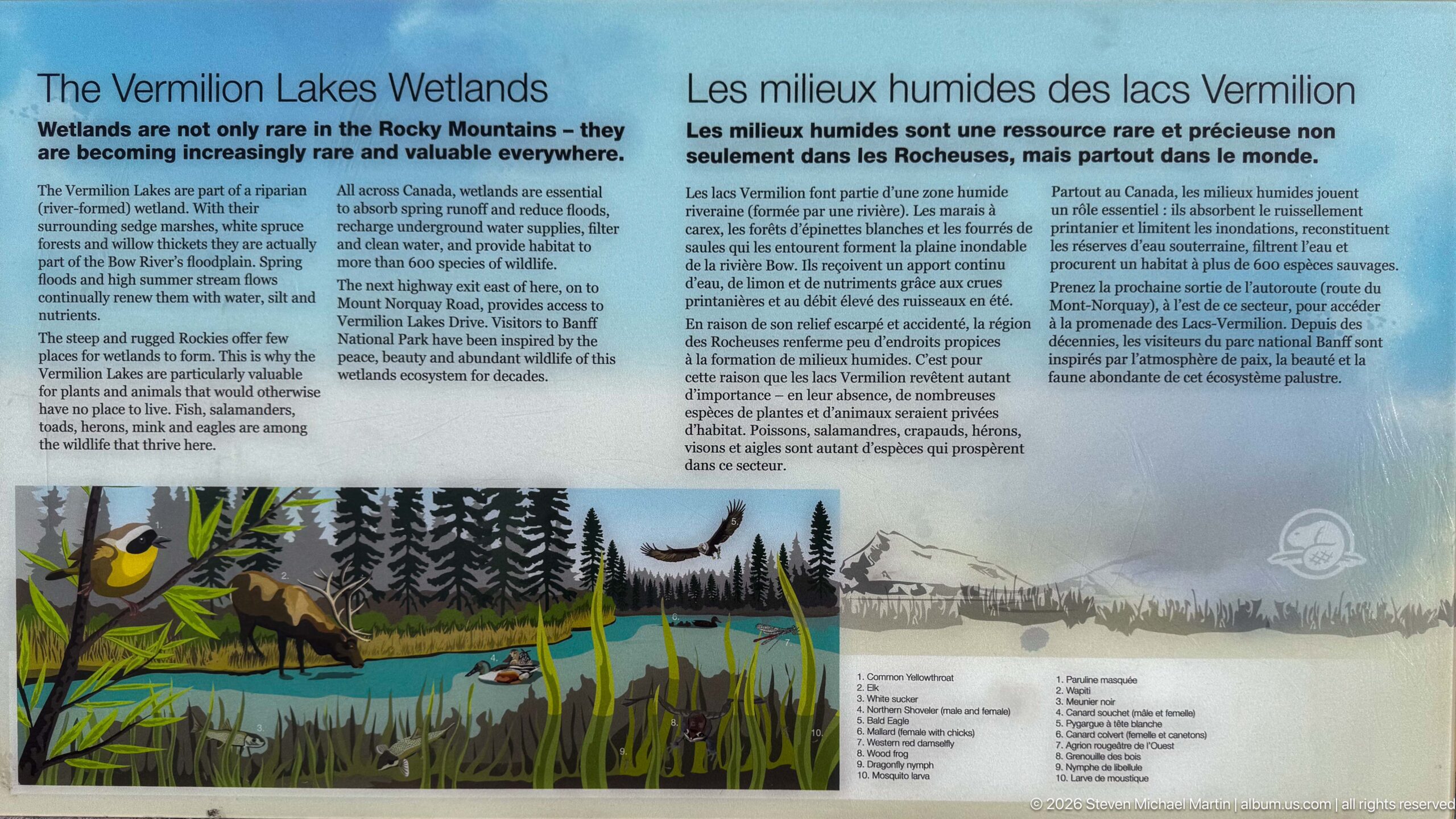
A bilingual interpretive panel describes the Vermilion Lakes as ecologically rich wetlands rather than simply mountain scenery. Text, a cross-section illustration, and drawings of birds and mammals explain the interdependence of water, vegetation, and wildlife within the lake system near Banff.
Caption
A bilingual interpretive panel describes the Vermilion Lakes as ecologically rich wetlands rather than simply mountain scenery. Text, a cross-section illustration, and drawings of birds and mammals explain the interdependence of water, vegetation, and wildlife within the lake system near Banff.
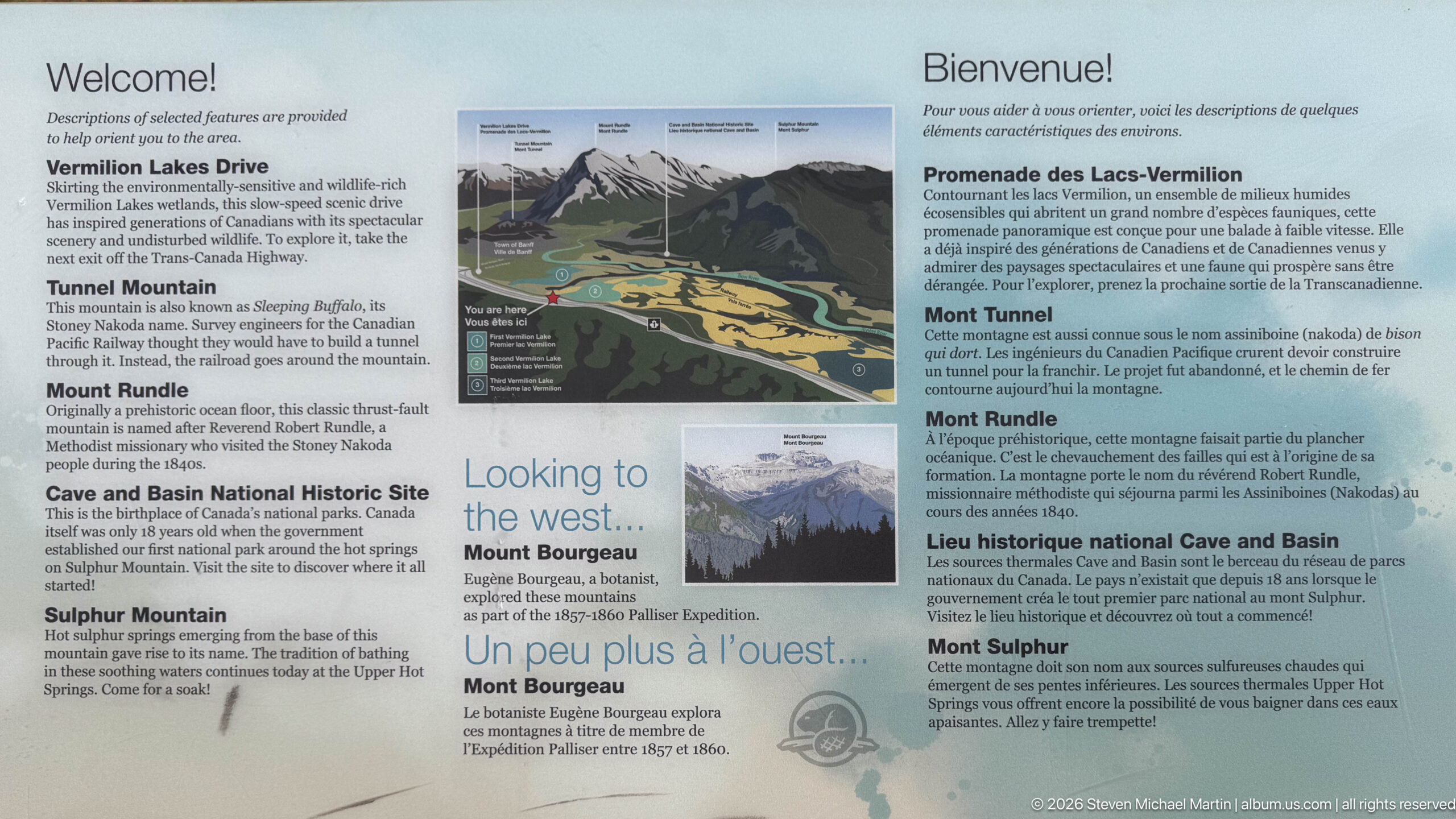
An orientation panel introduces Vermilion Lakes Drive and places the lakes within the larger Banff landscape. A map and mountain diagrams accompany short entries on nearby peaks and historic sites, helping visitors read the route not only as a scenic drive but as a sequence of natural and cultural viewpoints.
Caption
An orientation panel introduces Vermilion Lakes Drive and places the lakes within the larger Banff landscape. A map and mountain diagrams accompany short entries on nearby peaks and historic sites, helping visitors read the route not only as a scenic drive but as a sequence of natural and cultural viewpoints.
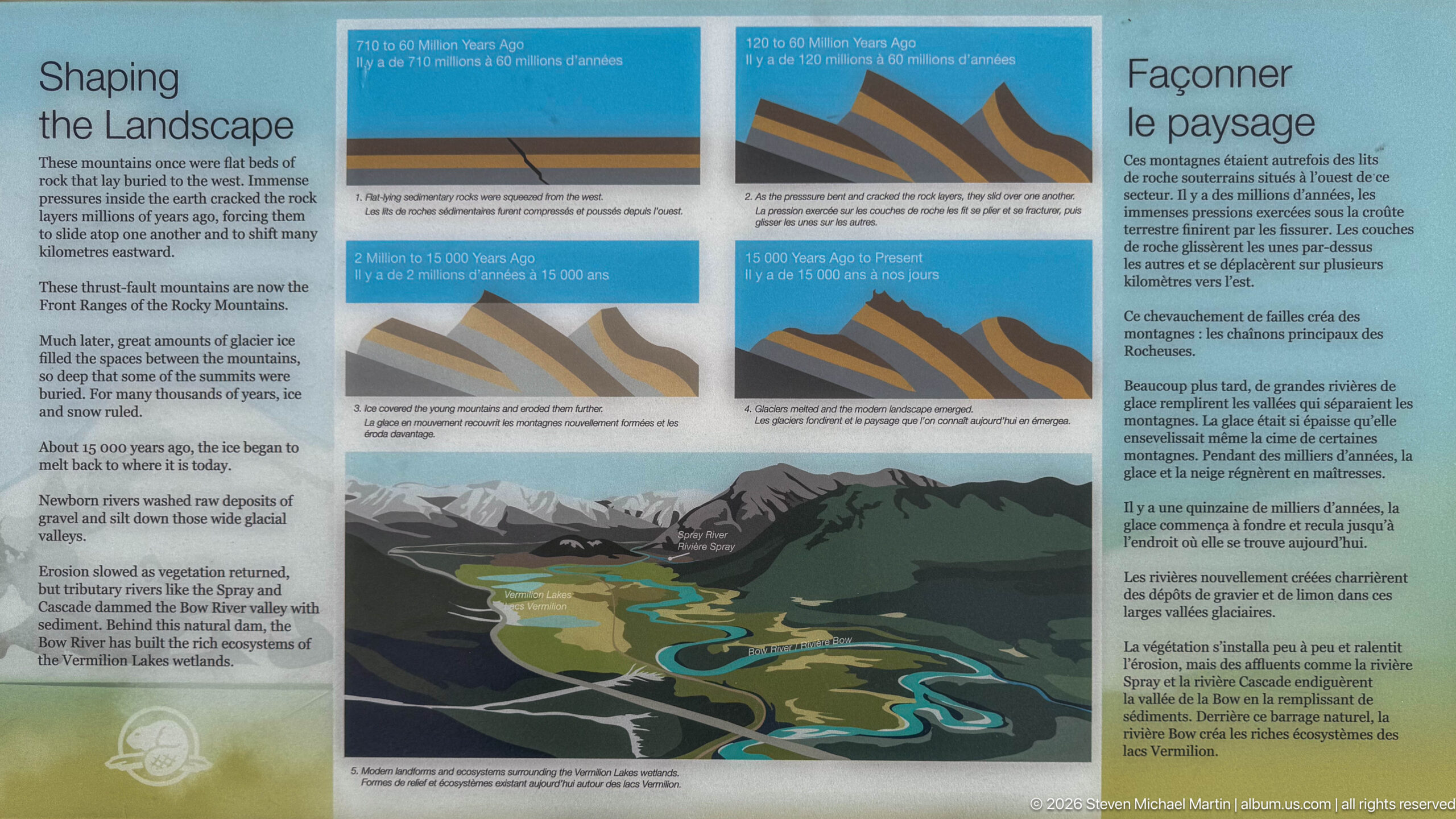
Diagrams on this bilingual panel trace the geological processes that shaped the Vermilion Lakes landscape. Sequential illustrations move from ancient rock deposition and mountain building to glaciation and the modern wetland basin, connecting the present view with the much longer geological history of the Bow Valley.
Caption
Diagrams on this bilingual panel trace the geological processes that shaped the Vermilion Lakes landscape. Sequential illustrations move from ancient rock deposition and mountain building to glaciation and the modern wetland basin, connecting the present view with the much longer geological history of the Bow Valley.
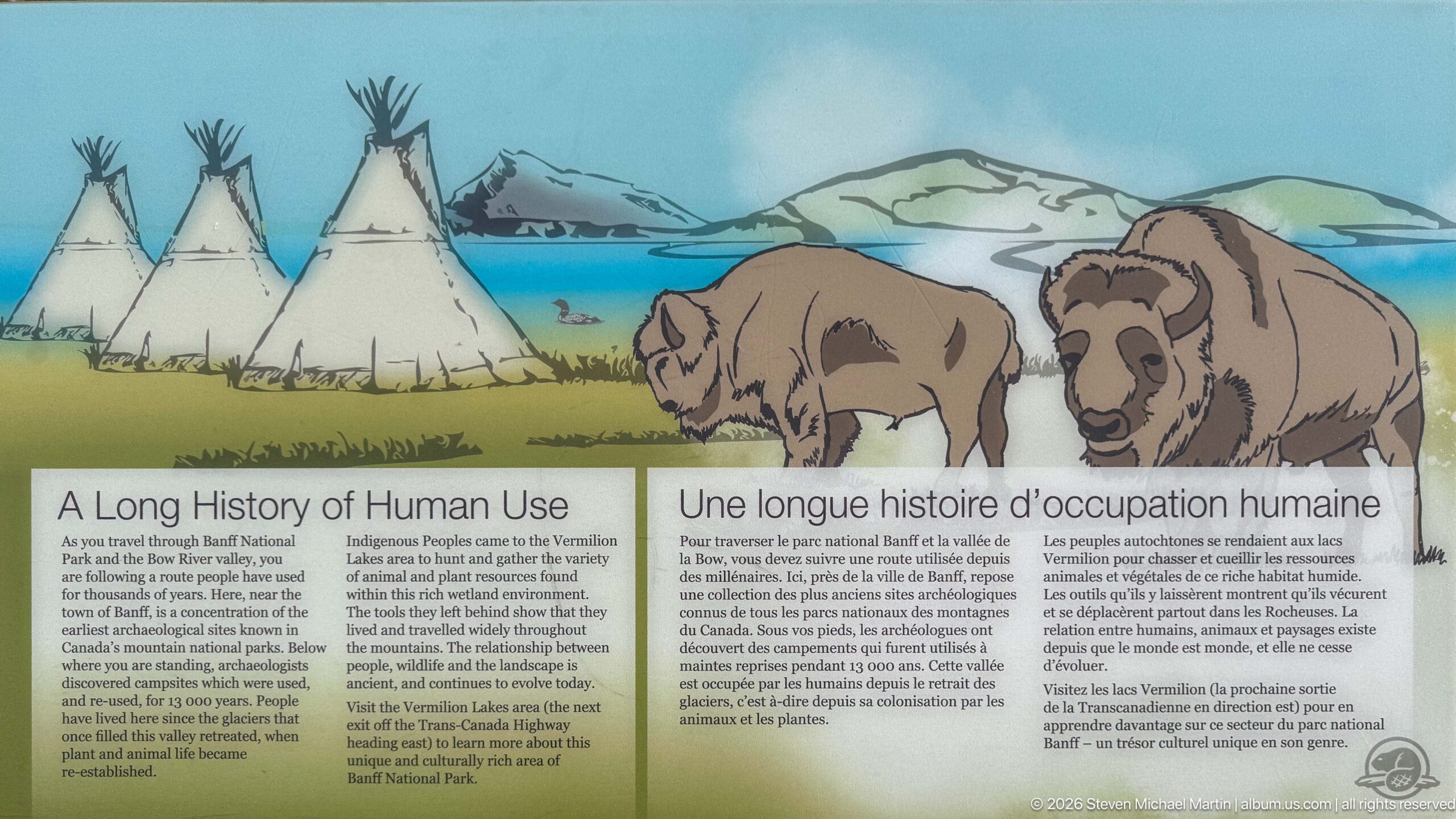
A bilingual panel titled “A Long History of Human Use” places Indigenous presence at the Vermilion Lakes within a much deeper chronology than the modern town. Stylized tipis, bison, mountains, and water accompany text describing long-standing human use of the Bow Valley landscape and its resources.
Caption
A bilingual panel titled “A Long History of Human Use” places Indigenous presence at the Vermilion Lakes within a much deeper chronology than the modern town. Stylized tipis, bison, mountains, and water accompany text describing long-standing human use of the Bow Valley landscape and its resources.
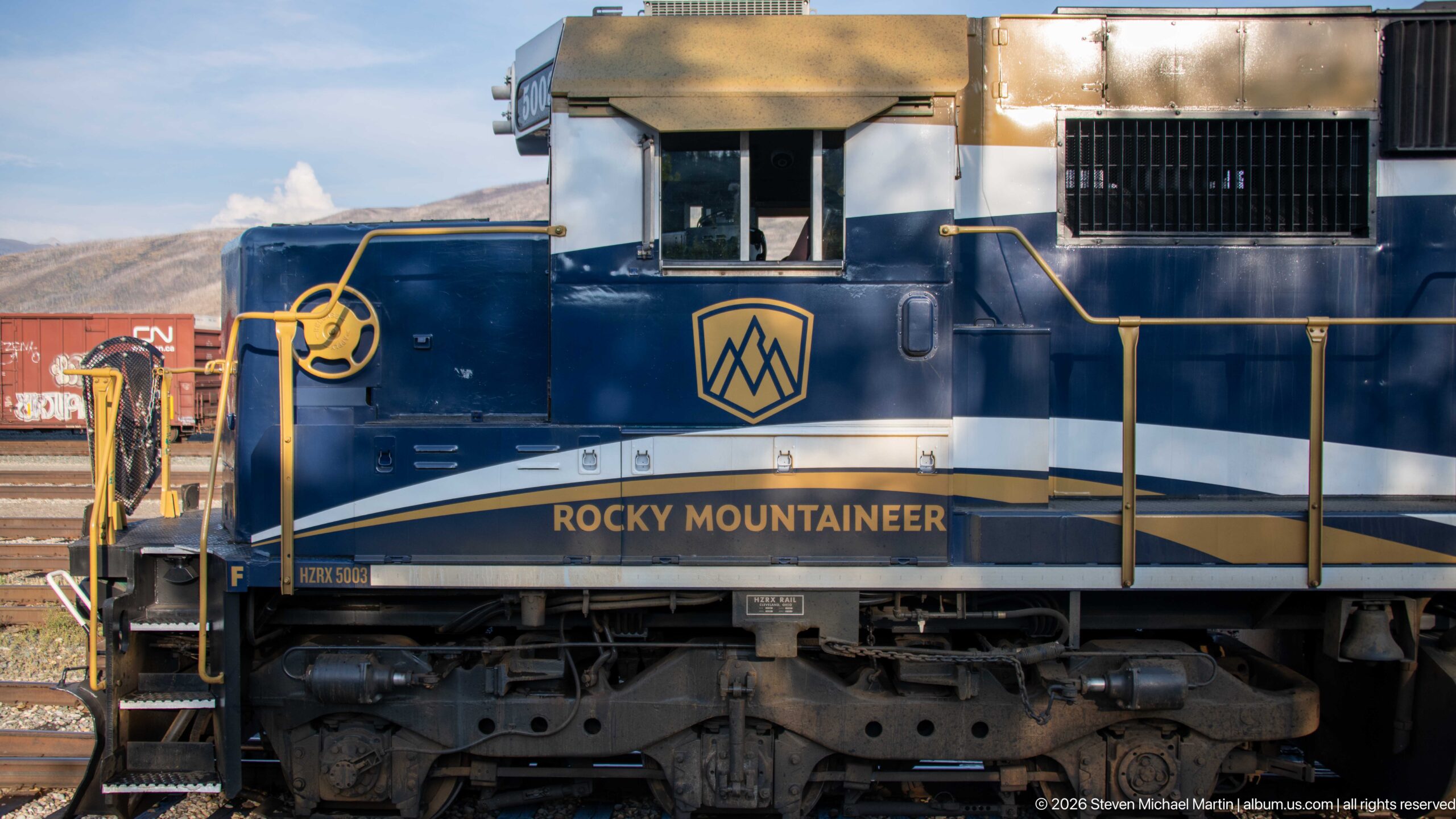
A tight side view of Rocky Mountaineer locomotive 5003 isolates the cab, blue-and-gold mountain emblem, handrails, and exposed running gear. Cropping away most of the train shifts attention from the railway scene to the locomotive’s branding and heavy mechanical structure, with freight cars and mountains only briefly visible beyond.
Caption
A tight side view of Rocky Mountaineer locomotive 5003 isolates the cab, blue-and-gold mountain emblem, handrails, and exposed running gear. Cropping away most of the train shifts attention from the railway scene to the locomotive’s branding and heavy mechanical structure, with freight cars and mountains only briefly visible beyond.
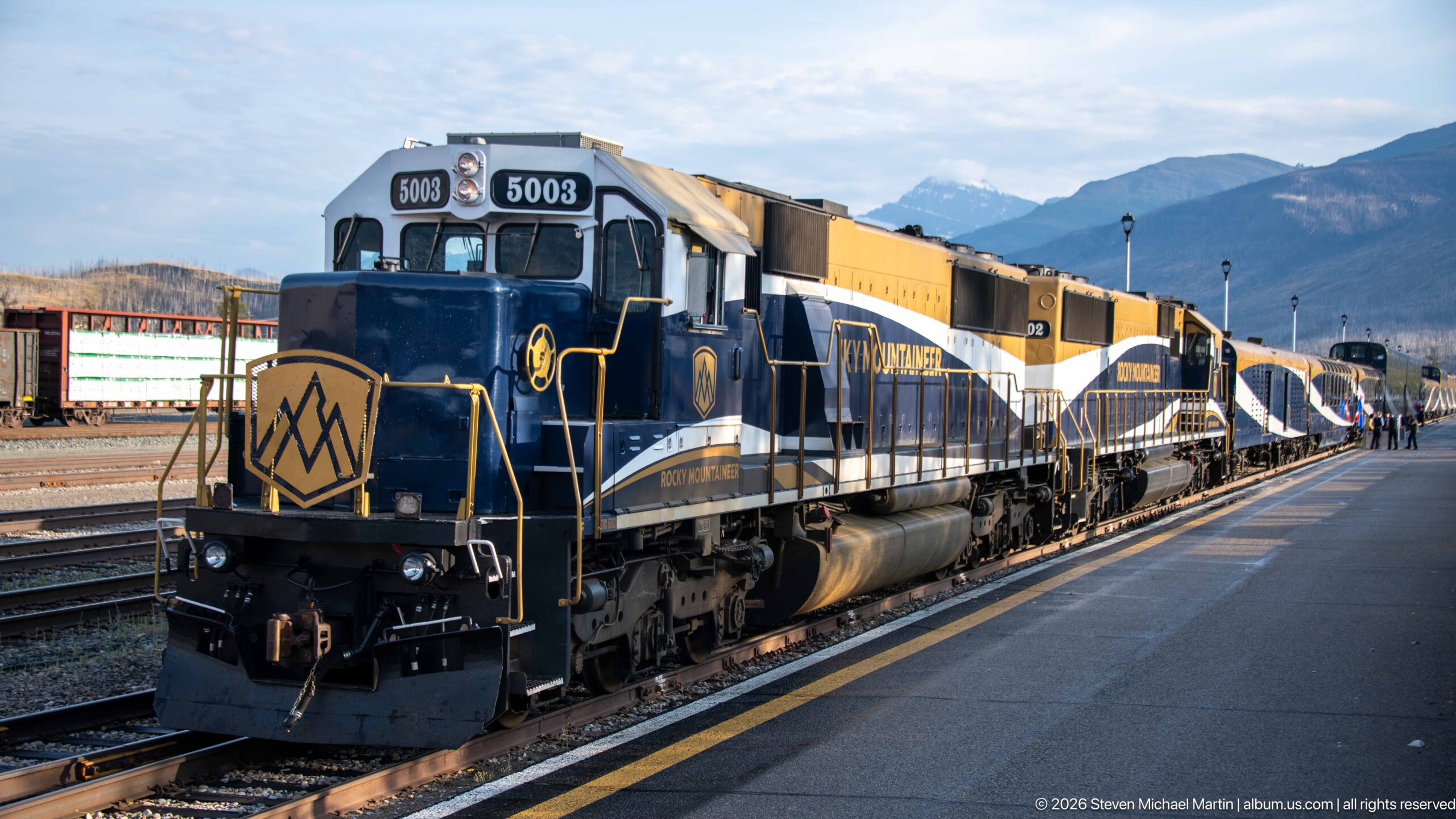
Locomotive 5003 leads a Rocky Mountaineer passenger consist along the Banff platform, with additional locomotives and cars extending into the distance. The wider viewpoint restores the railway setting around the engine, including tracks, station infrastructure, and the mountain horizon that forms the scenic context for the service.
Caption
Locomotive 5003 leads a Rocky Mountaineer passenger consist along the Banff platform, with additional locomotives and cars extending into the distance. The wider viewpoint restores the railway setting around the engine, including tracks, station infrastructure, and the mountain horizon that forms the scenic context for the service.
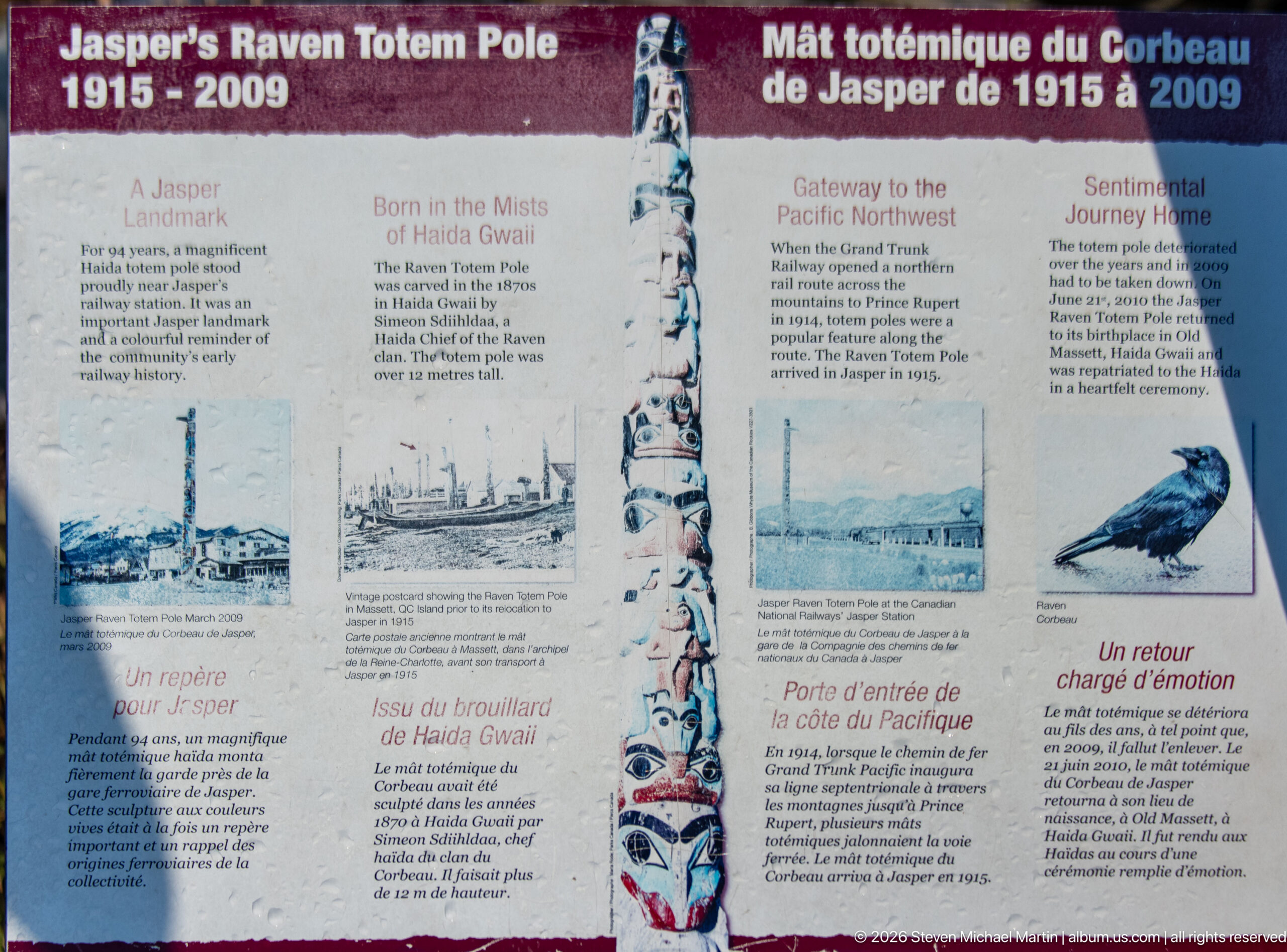
An interpretive panel recounts the history of Jasper’s Raven Totem Pole, explicitly dating the earlier pole from 1915 to 2009. Historic photographs, a central rendering of the carved pole, and bilingual text trace its origins in Haida Gwaii, its railway-era arrival in Jasper, and its later significance as a community landmark.
Caption
An interpretive panel recounts the history of Jasper’s Raven Totem Pole, explicitly dating the earlier pole from 1915 to 2009. Historic photographs, a central rendering of the carved pole, and bilingual text trace its origins in Haida Gwaii, its railway-era arrival in Jasper, and its later significance as a community landmark.

The circular smokebox front of Canadian National locomotive 6015 is shown in close detail, centered on its headlight and orange-and-cream number plate. Bolts, hinges, piping, and the dark painted steel surface reveal the locomotive as preserved industrial machinery while the tight framing suppresses nearly all surrounding context.
Caption
The circular smokebox front of Canadian National locomotive 6015 is shown in close detail, centered on its headlight and orange-and-cream number plate. Bolts, hinges, piping, and the dark painted steel surface reveal the locomotive as preserved industrial machinery while the tight framing suppresses nearly all surrounding context.
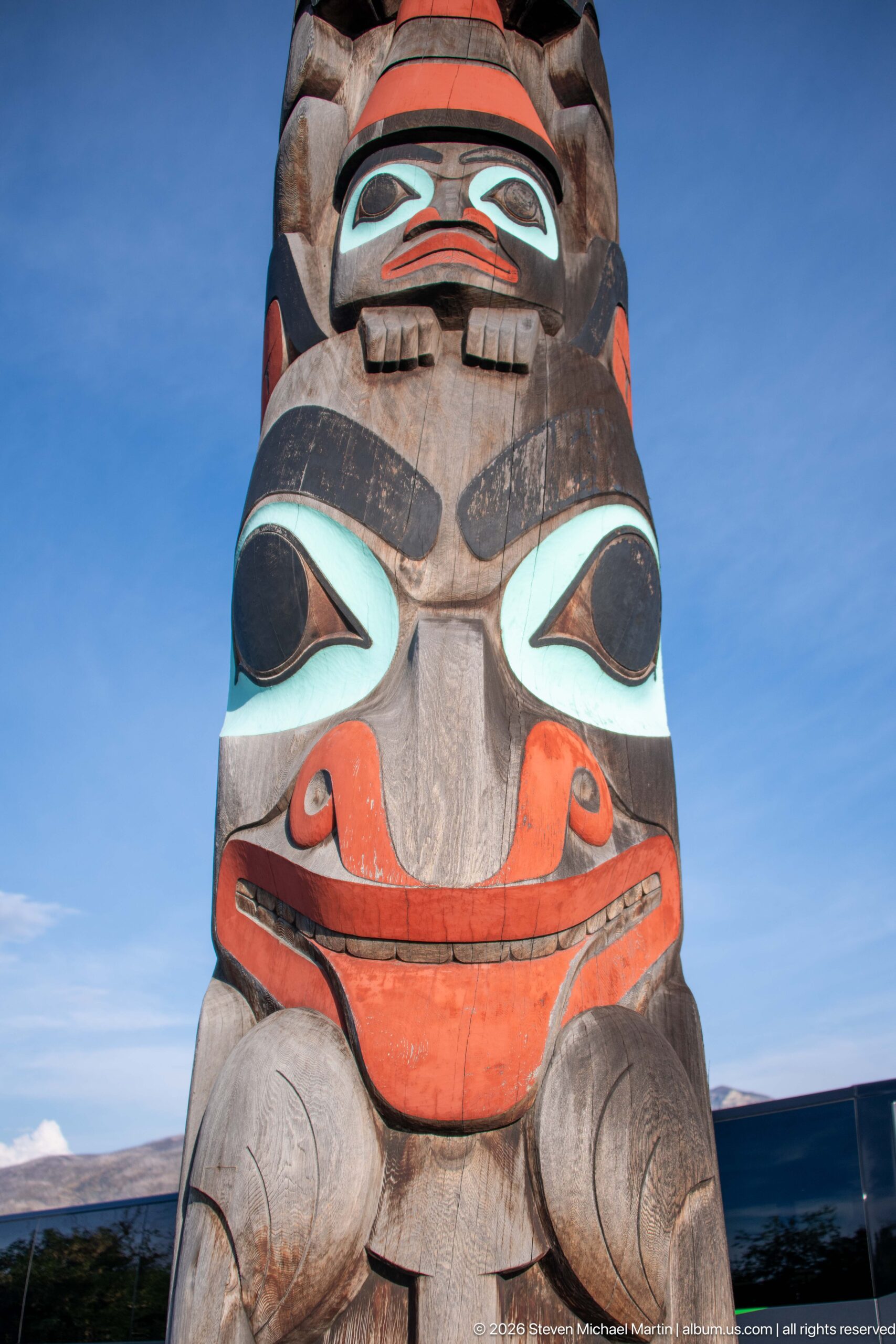
A low-angle close view isolates one large carved figure on a painted totem pole against a clear blue sky. Broad black eyebrows, pale blue eye forms, a red mouth, and projecting carved elements reveal the strong graphic treatment of the wood surface while deliberately excluding most of the pole’s full vertical composition.
Caption
A low-angle close view isolates one large carved figure on a painted totem pole against a clear blue sky. Broad black eyebrows, pale blue eye forms, a red mouth, and projecting carved elements reveal the strong graphic treatment of the wood surface while deliberately excluding most of the pole’s full vertical composition.
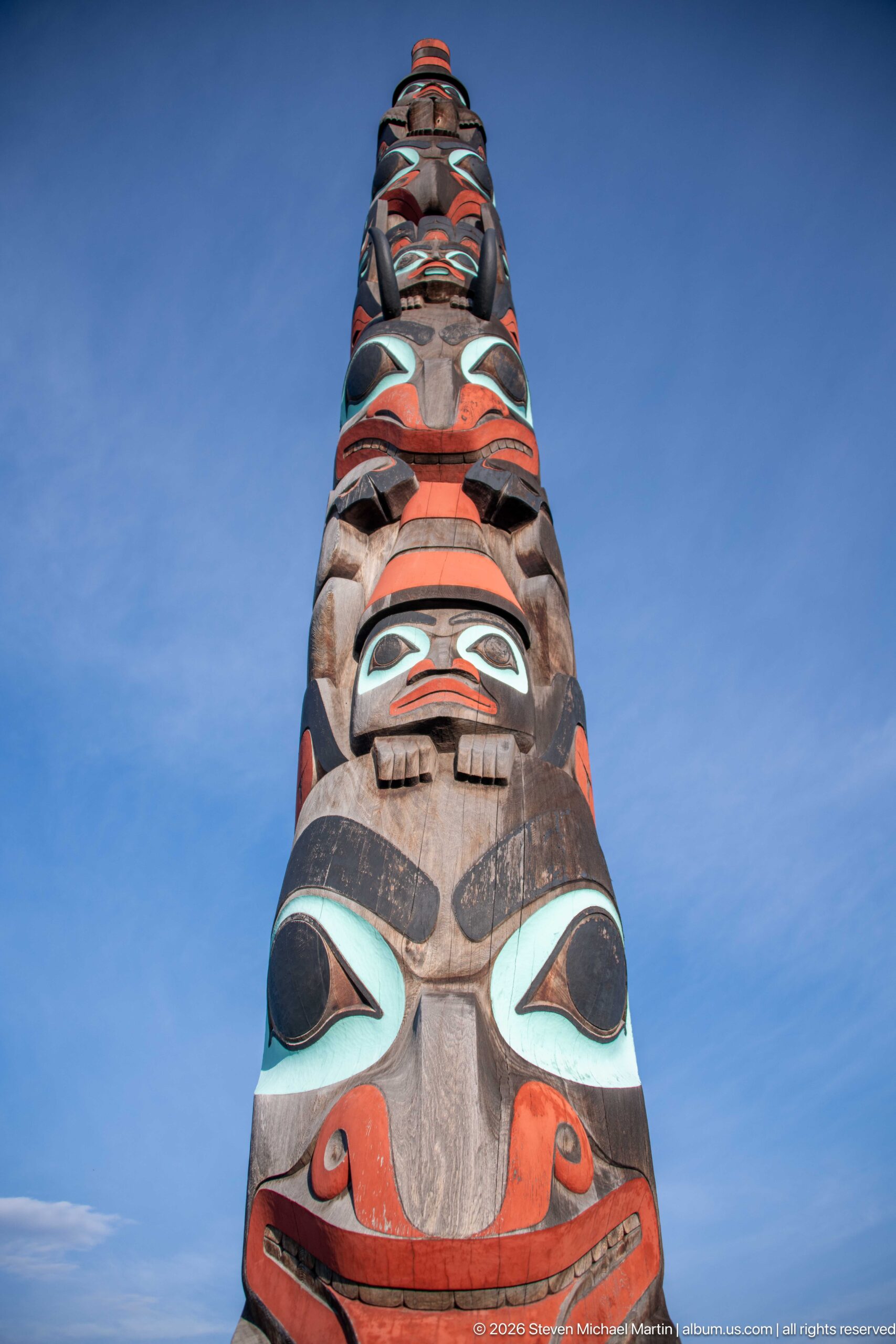
Seen from close to its base, the totem pole rises sharply into the blue sky, stacking multiple carved and painted figures along its vertical shaft. The low perspective exaggerates its height and allows the lower figure’s broad face and projecting forms to dominate while successive figures recede overhead.
Caption
Seen from close to its base, the totem pole rises sharply into the blue sky, stacking multiple carved and painted figures along its vertical shaft. The low perspective exaggerates its height and allows the lower figure’s broad face and projecting forms to dominate while successive figures recede overhead.
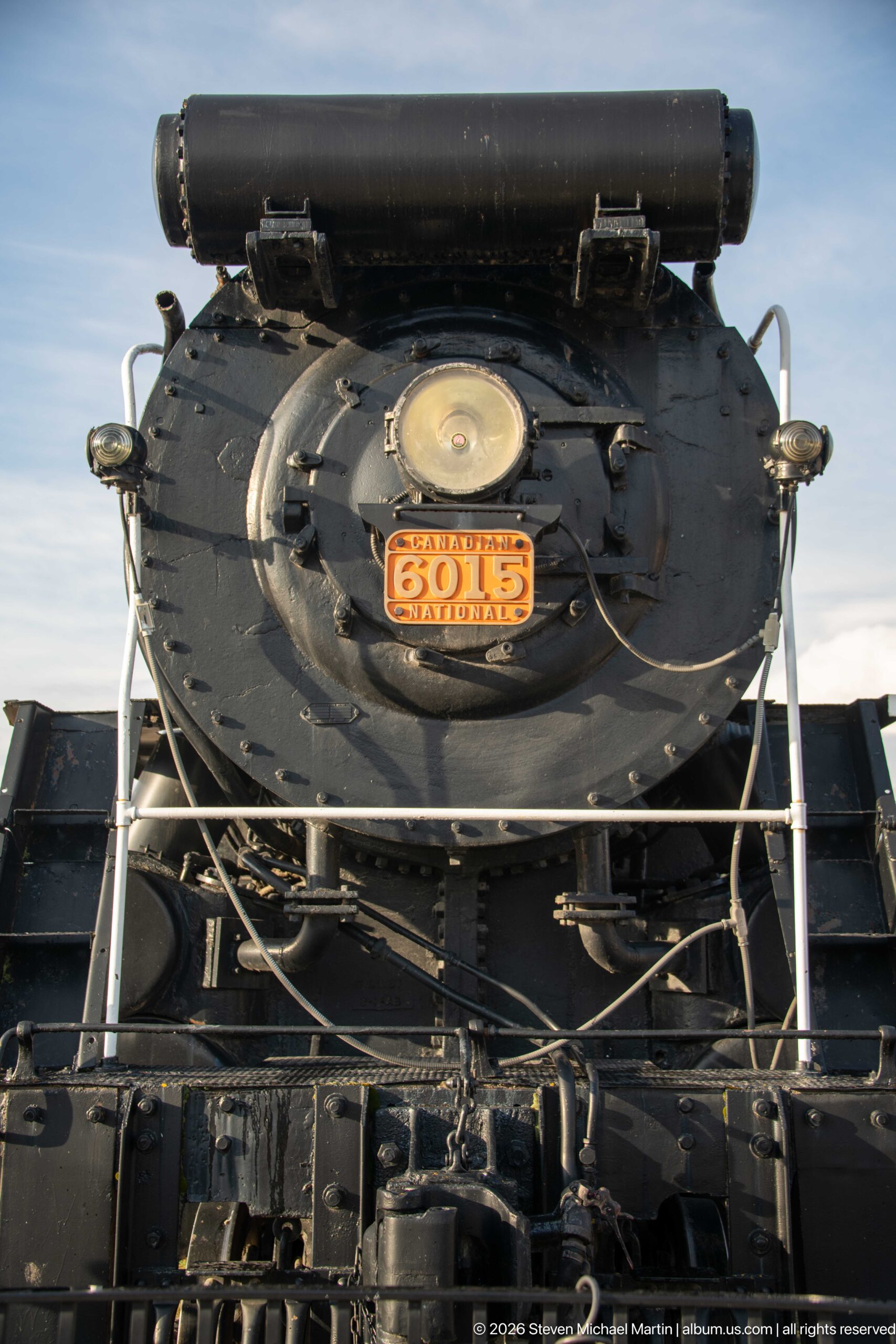
Canadian National 6015 faces the camera in a tight frontal view, revealing the circular smokebox door, central headlight, number plate, handrails, piping, and portions of the running gear below. The near-symmetrical composition emphasizes the dense mechanical fittings of the preserved steam locomotive rather than its overall length.
Caption
Canadian National 6015 faces the camera in a tight frontal view, revealing the circular smokebox door, central headlight, number plate, handrails, piping, and portions of the running gear below. The near-symmetrical composition emphasizes the dense mechanical fittings of the preserved steam locomotive rather than its overall length.

The cast number plate of Canadian National steam locomotive 6015 fills the frame, its raised cream numerals and lettering standing against an orange field. Isolating this identification plate turns a small mechanical detail into a direct archival record of the preserved locomotive’s railway number and operator.
Caption
The cast number plate of Canadian National steam locomotive 6015 fills the frame, its raised cream numerals and lettering standing against an orange field. Isolating this identification plate turns a small mechanical detail into a direct archival record of the preserved locomotive’s railway number and operator.
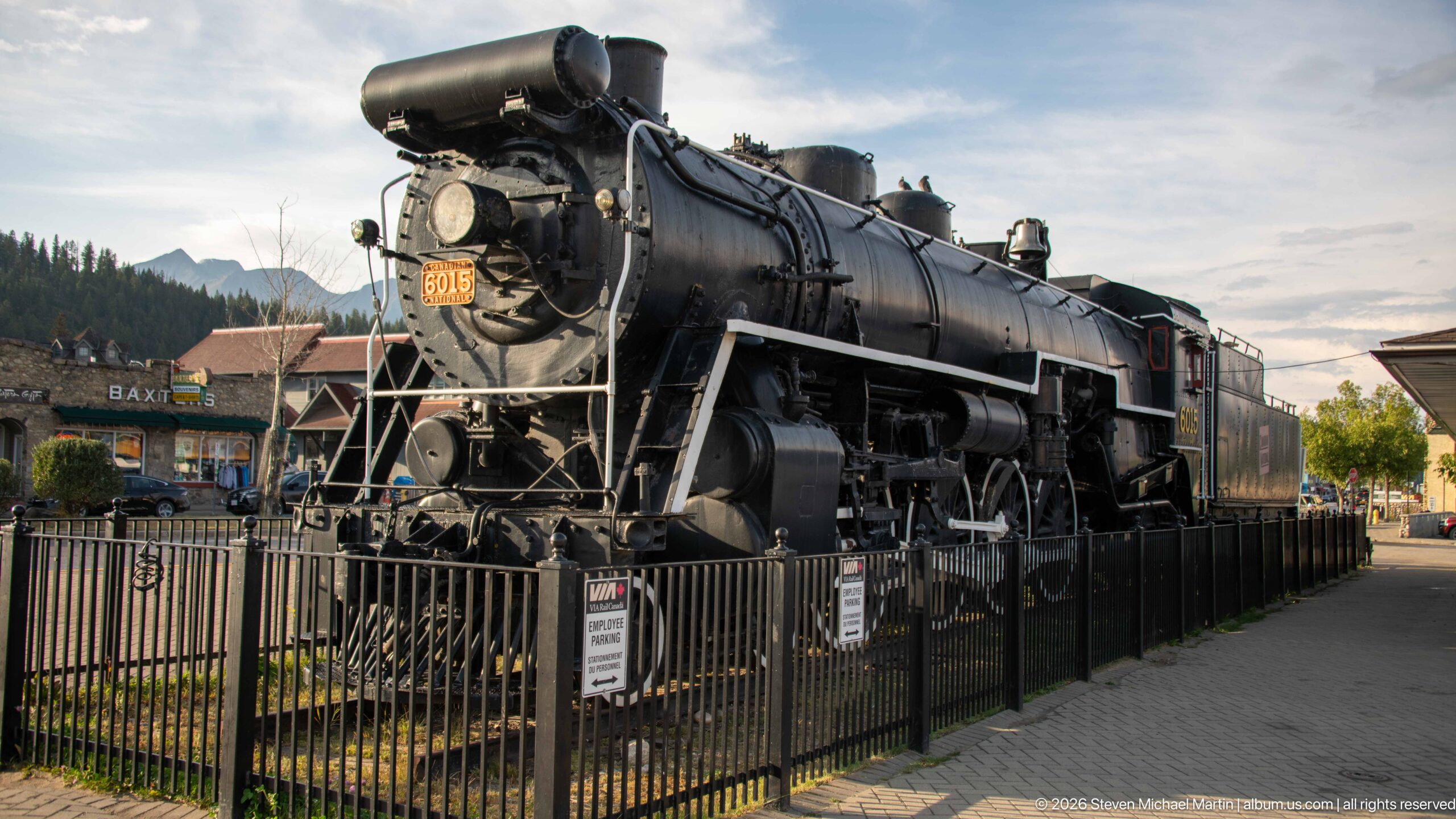
A three-quarter side view shows the preserved Canadian National 6015 as a complete steam locomotive, from smokebox and headlight to boiler, driving wheels, cab, and tender. The surrounding fence and pedestrian paving identify it as a static heritage display, allowing its full industrial profile to be read at close range.
Caption
A three-quarter side view shows the preserved Canadian National 6015 as a complete steam locomotive, from smokebox and headlight to boiler, driving wheels, cab, and tender. The surrounding fence and pedestrian paving identify it as a static heritage display, allowing its full industrial profile to be read at close range.
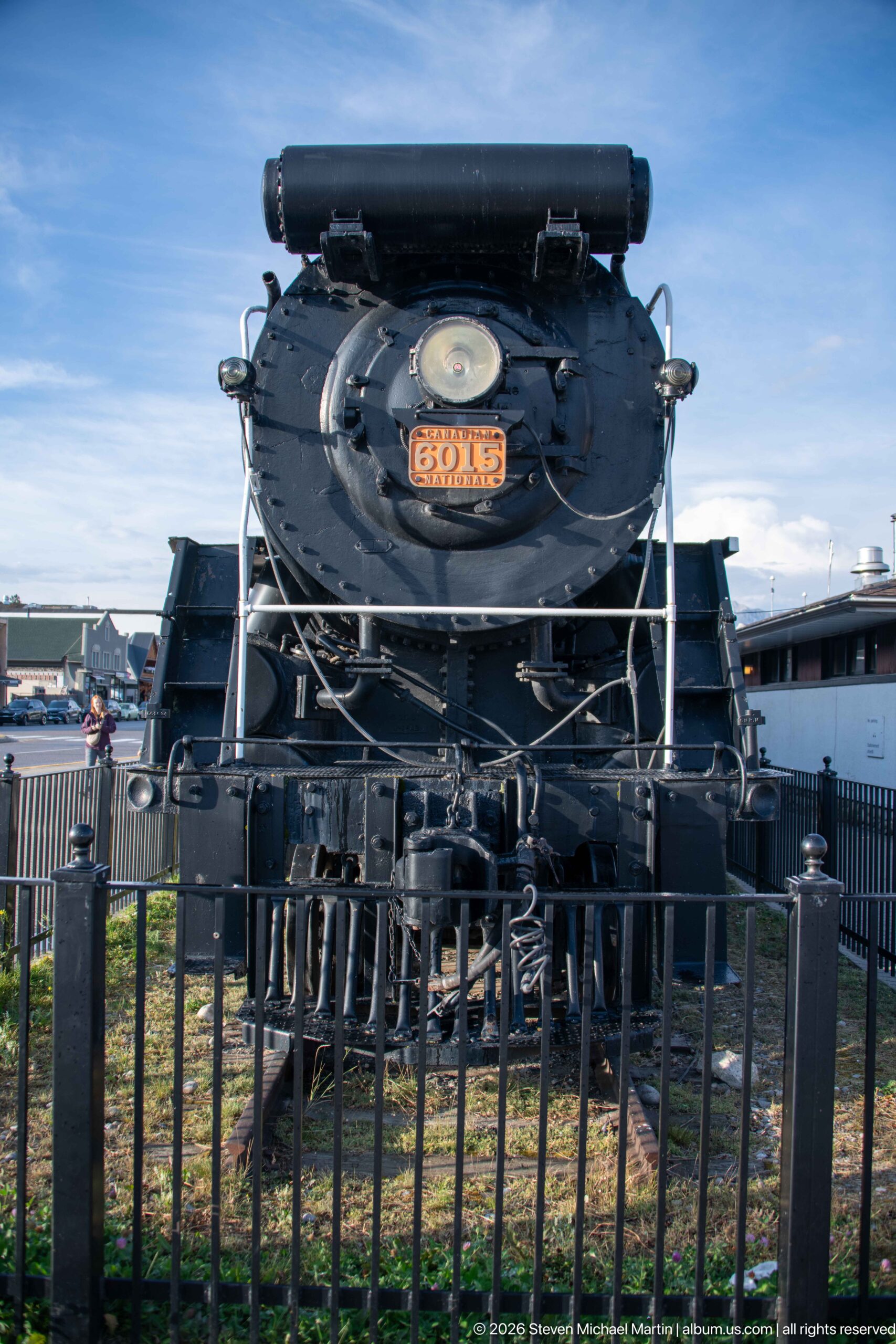
Canadian National steam locomotive 6015 is displayed head-on behind a black protective fence near the Banff railway grounds. The view places the preserved engine in its exhibition setting, with the smokebox, headlight, number plate, pilot, and surrounding rail infrastructure visible against open sky.
Caption
Canadian National steam locomotive 6015 is displayed head-on behind a black protective fence near the Banff railway grounds. The view places the preserved engine in its exhibition setting, with the smokebox, headlight, number plate, pilot, and surrounding rail infrastructure visible against open sky.
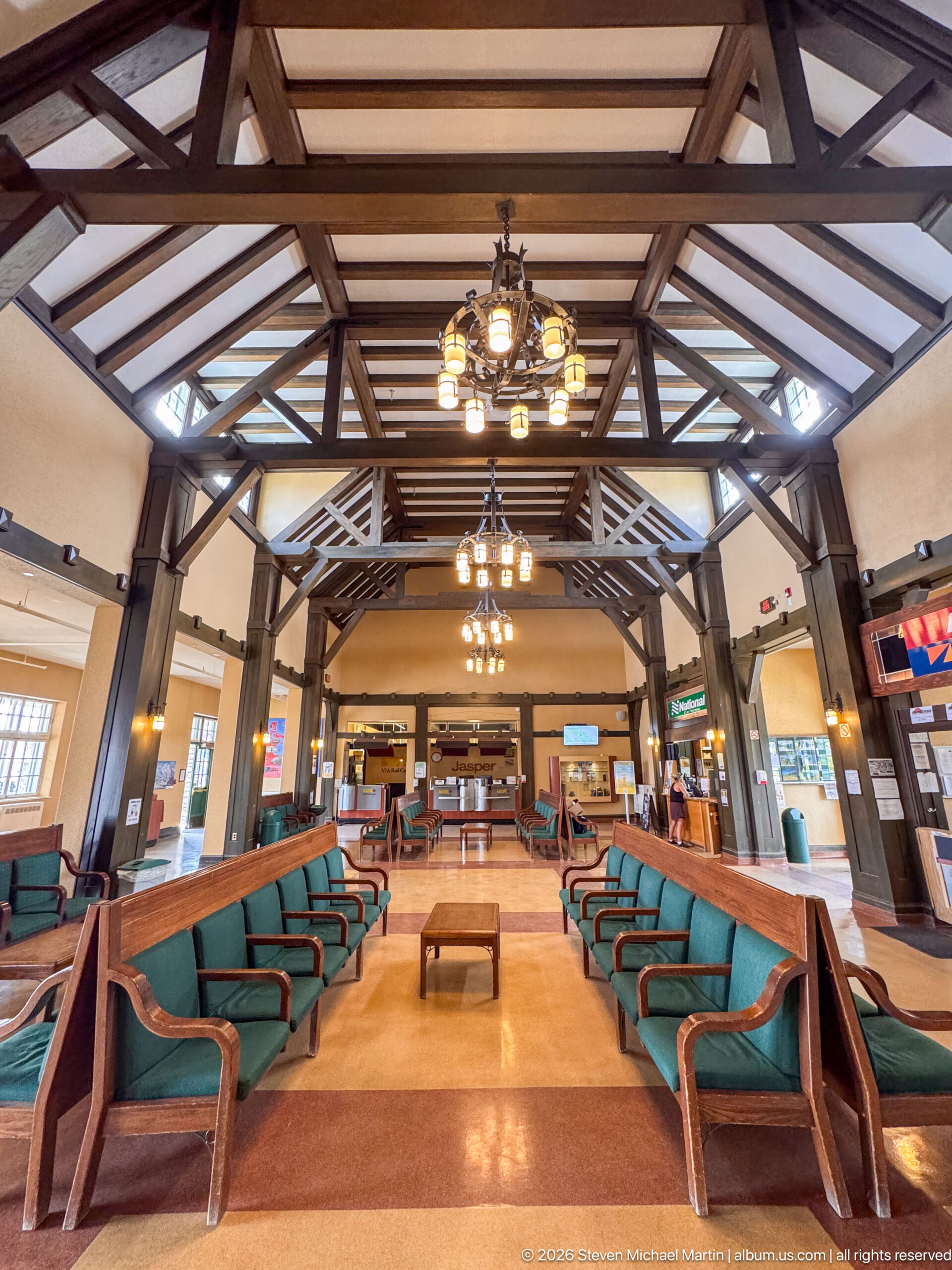
Heavy timber trusses, clustered pendant lights, and rows of green upholstered wooden benches define the spacious waiting room of Banff’s railway station. The symmetrical view looks down the central aisle toward service counters, emphasizing the hall’s exposed structural frame and lodge-like character. The interior provides an architectural counterpart to the Rocky Mountaineer platform scenes immediately preceding it.
Caption
Heavy timber trusses, clustered pendant lights, and rows of green upholstered wooden benches define the spacious waiting room of Banff’s railway station. The symmetrical view looks down the central aisle toward service counters, emphasizing the hall’s exposed structural frame and lodge-like character. The interior provides an architectural counterpart to the Rocky Mountaineer platform scenes immediately preceding it.
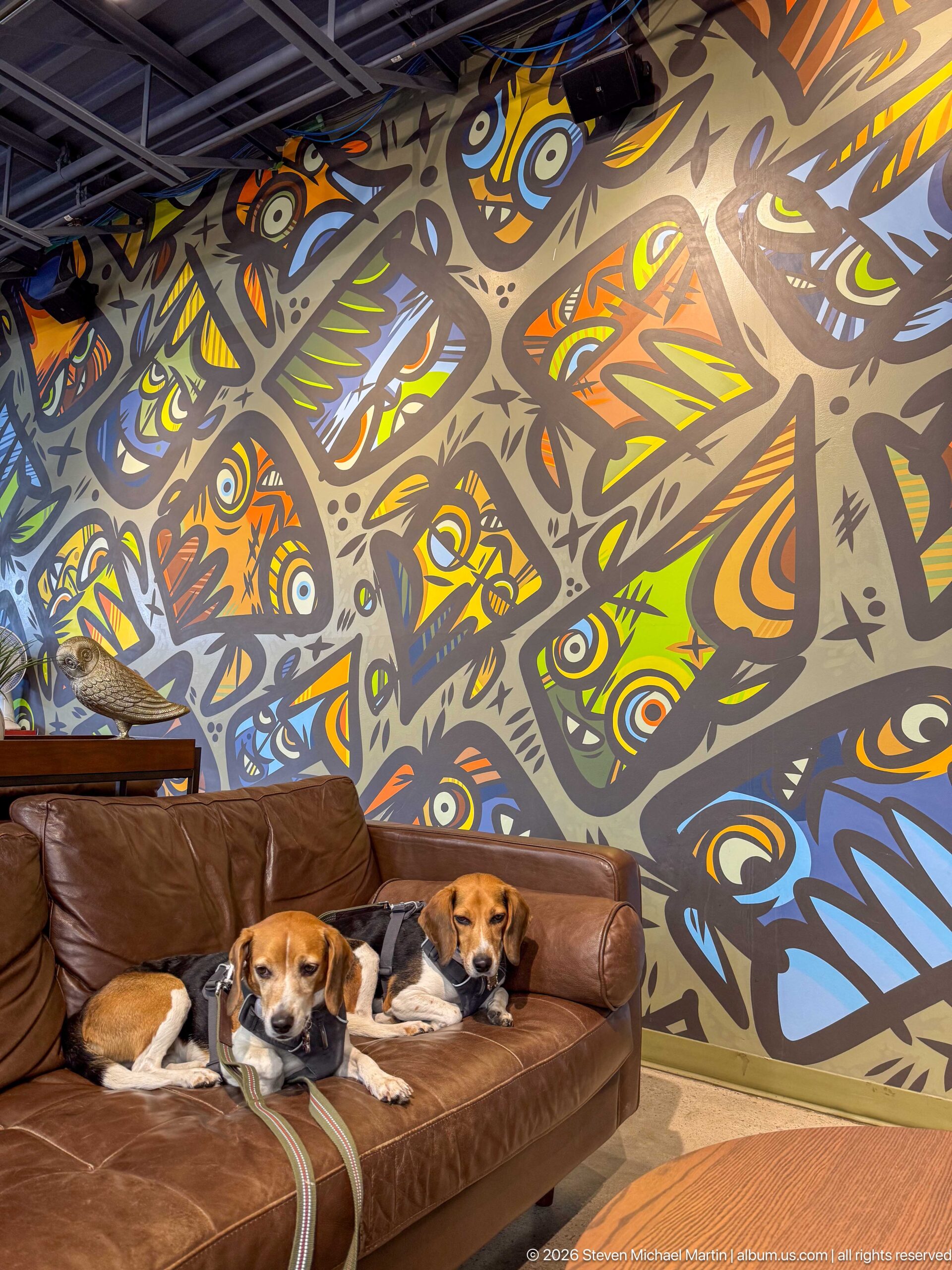
Two beagles rest together on a brown leather sofa beneath an expansive abstract mural filled with interlocking eyes, angular faces, and bright passages of blue, orange, yellow, and green. Their leashes trail across the cushions, grounding the energetic wall painting with a quiet travel-day moment. The frame shifts the portfolio from Banff’s public streets and railway spaces to an intimate indoor pause.
Caption
Two beagles rest together on a brown leather sofa beneath an expansive abstract mural filled with interlocking eyes, angular faces, and bright passages of blue, orange, yellow, and green. Their leashes trail across the cushions, grounding the energetic wall painting with a quiet travel-day moment. The frame shifts the portfolio from Banff’s public streets and railway spaces to an intimate indoor pause.
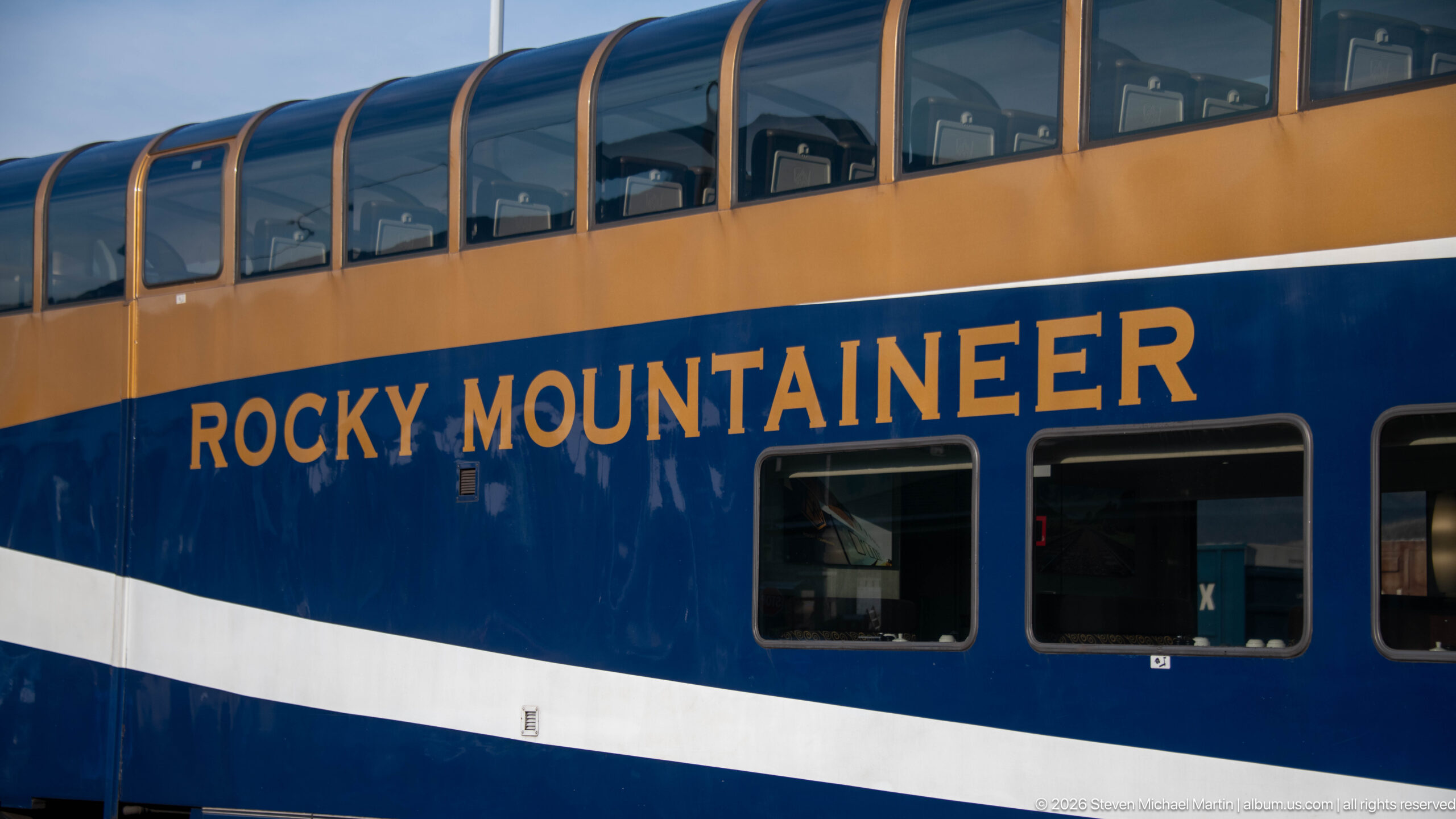
The side of a Rocky Mountaineer bi-level passenger car fills the frame, its blue, white, and gold livery dominated by large upper panoramic windows. The elevated glazing reveals rows of observation seats designed for landscape viewing, while the bold company name turns the car itself into a recognizable element of contemporary rail tourism in the Canadian Rockies.
Caption
The side of a Rocky Mountaineer bi-level passenger car fills the frame, its blue, white, and gold livery dominated by large upper panoramic windows. The elevated glazing reveals rows of observation seats designed for landscape viewing, while the bold company name turns the car itself into a recognizable element of contemporary rail tourism in the Canadian Rockies.

The Rocky Mountaineer emblem fills the frame in gold and navy, reducing the luxury rail service to its distinctive mountain monogram and bold color scheme. Seen on the side of a passenger car at Banff, the close detail introduces the train through its graphic identity rather than its full form, contrasting with the wider platform views that follow.
Caption
The Rocky Mountaineer emblem fills the frame in gold and navy, reducing the luxury rail service to its distinctive mountain monogram and bold color scheme. Seen on the side of a passenger car at Banff, the close detail introduces the train through its graphic identity rather than its full form, contrasting with the wider platform views that follow.
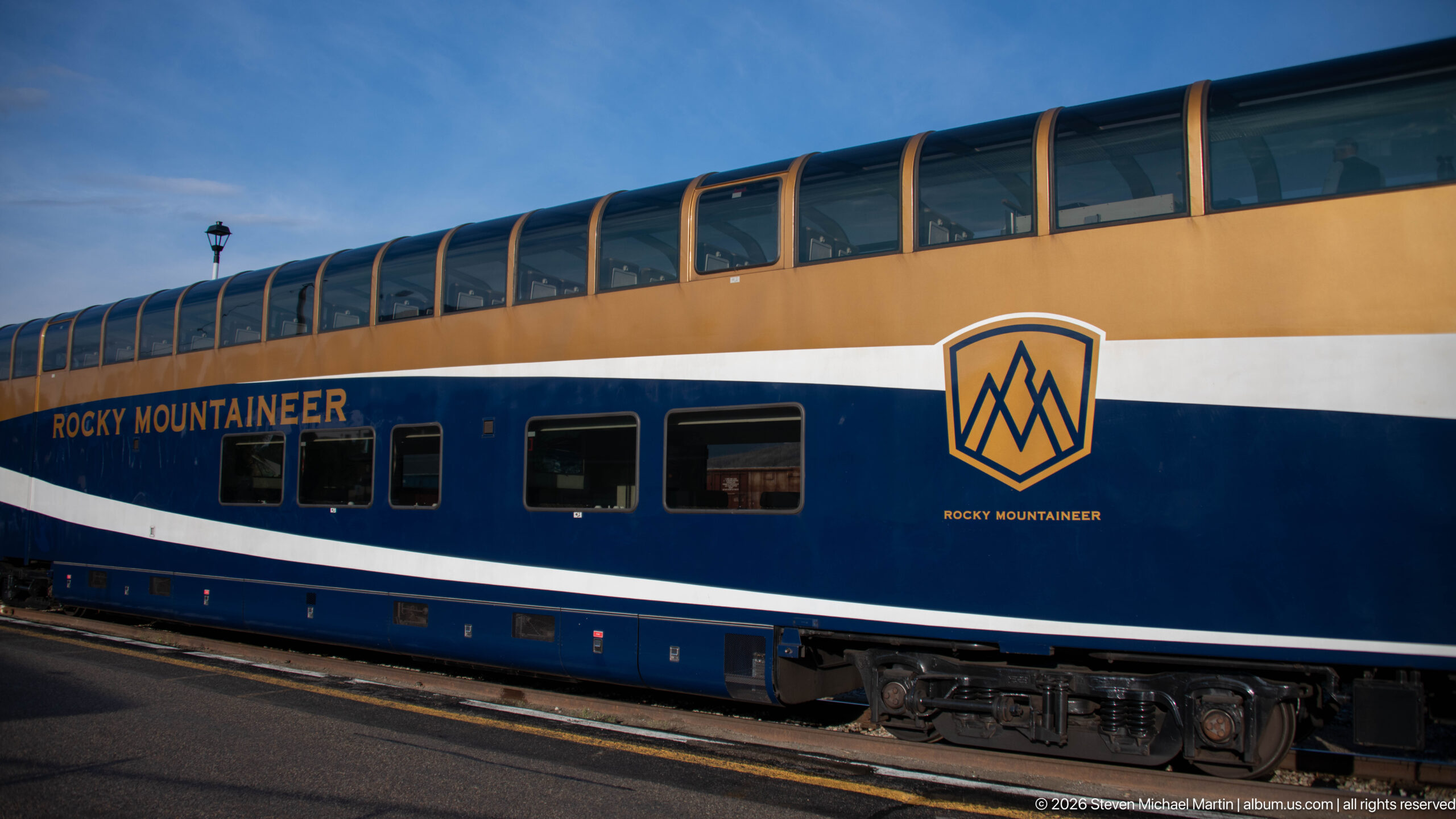
A Rocky Mountaineer glass-dome passenger car stands beside the platform in Banff, its long band of curved upper-level windows designed to open mountain scenery to passengers. The navy, white, and gold livery and prominent emblem make the train immediately identifiable, while the close side view records the specialized sightseeing car more clearly than the broader station scenes.
Caption
A Rocky Mountaineer glass-dome passenger car stands beside the platform in Banff, its long band of curved upper-level windows designed to open mountain scenery to passengers. The navy, white, and gold livery and prominent emblem make the train immediately identifiable, while the close side view records the specialized sightseeing car more clearly than the broader station scenes.
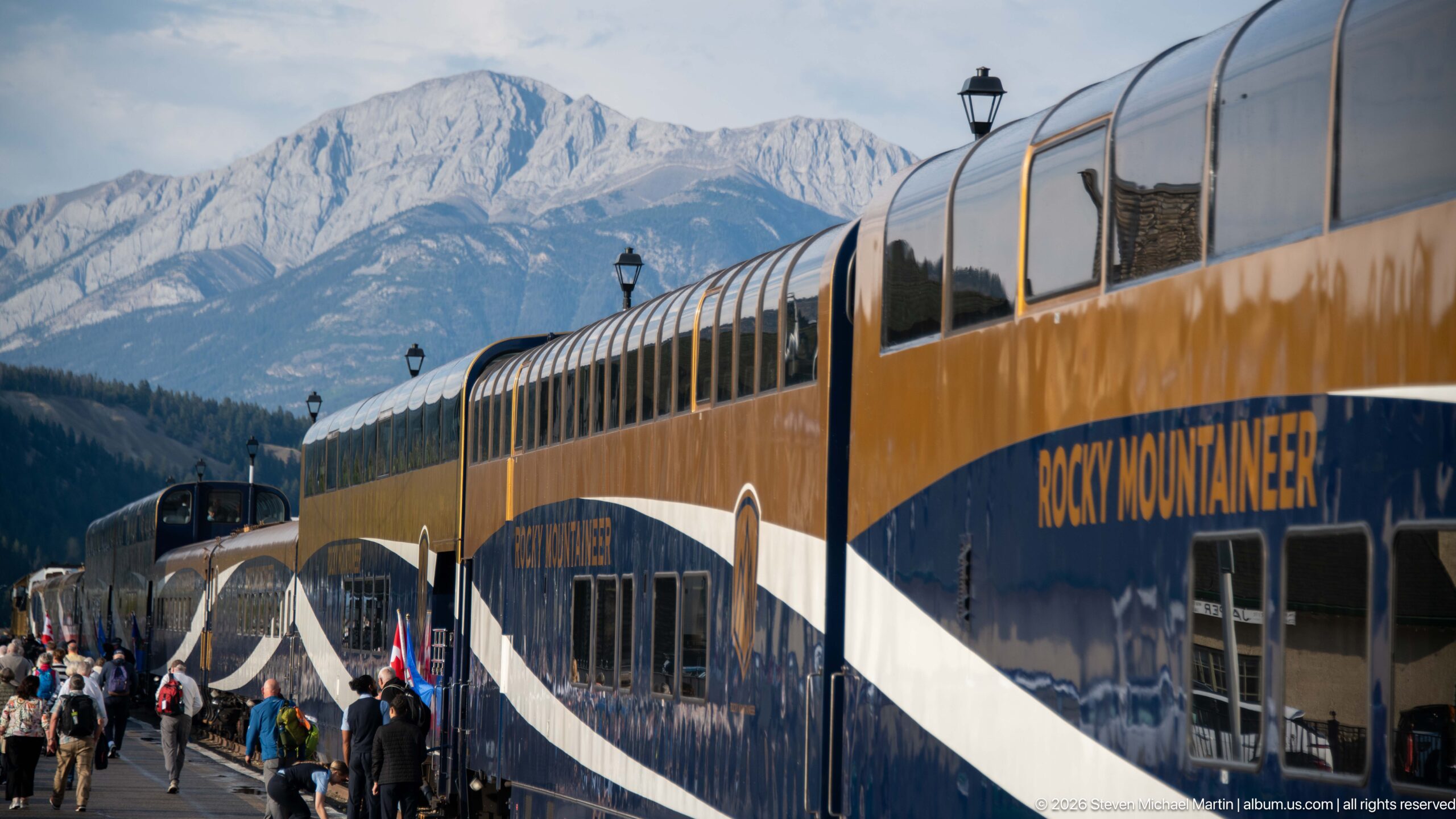
A line of Rocky Mountaineer glass-dome cars stretches along the Banff platform beneath the steep mountain wall beyond town. Passengers and staff gathered beside the train give the scene its operating scale, while the repeated curved windows and reflective gold-and-navy sides create a strong perspective down the consist. The view places the tourist railway directly within its Canadian Rockies setting.
Caption
A line of Rocky Mountaineer glass-dome cars stretches along the Banff platform beneath the steep mountain wall beyond town. Passengers and staff gathered beside the train give the scene its operating scale, while the repeated curved windows and reflective gold-and-navy sides create a strong perspective down the consist. The view places the tourist railway directly within its Canadian Rockies setting.
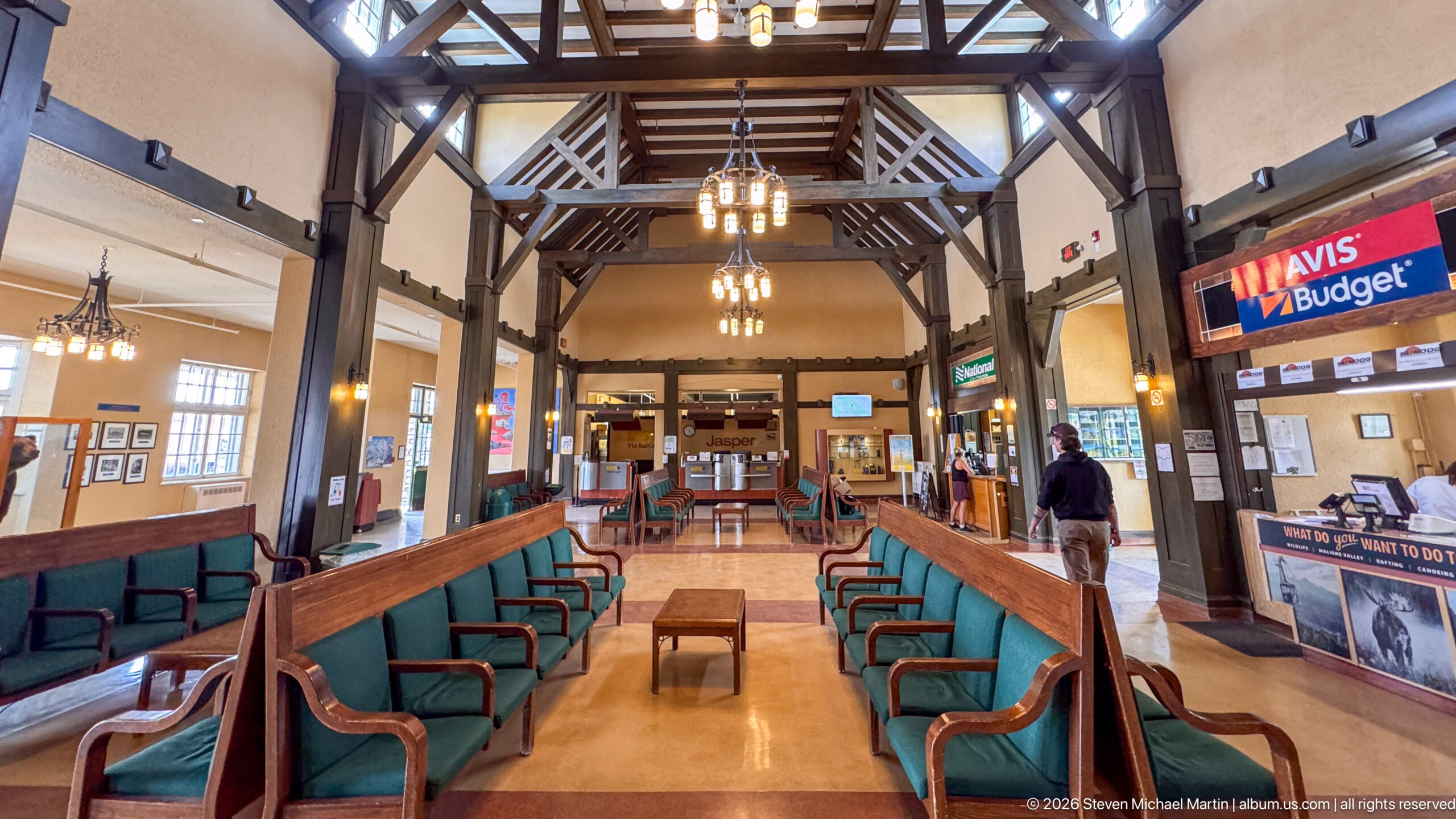
Rows of green upholstered benches frame the central aisle of Banff’s railway station waiting room, where exposed timber trusses and pendant fixtures give the hall a distinctly lodge-like rhythm. An Avis Budget rental counter occupies the right side, showing how the historic passenger space accommodates contemporary travel services while retaining its broad open plan and substantial wooden structure.
Caption
Rows of green upholstered benches frame the central aisle of Banff’s railway station waiting room, where exposed timber trusses and pendant fixtures give the hall a distinctly lodge-like rhythm. An Avis Budget rental counter occupies the right side, showing how the historic passenger space accommodates contemporary travel services while retaining its broad open plan and substantial wooden structure.
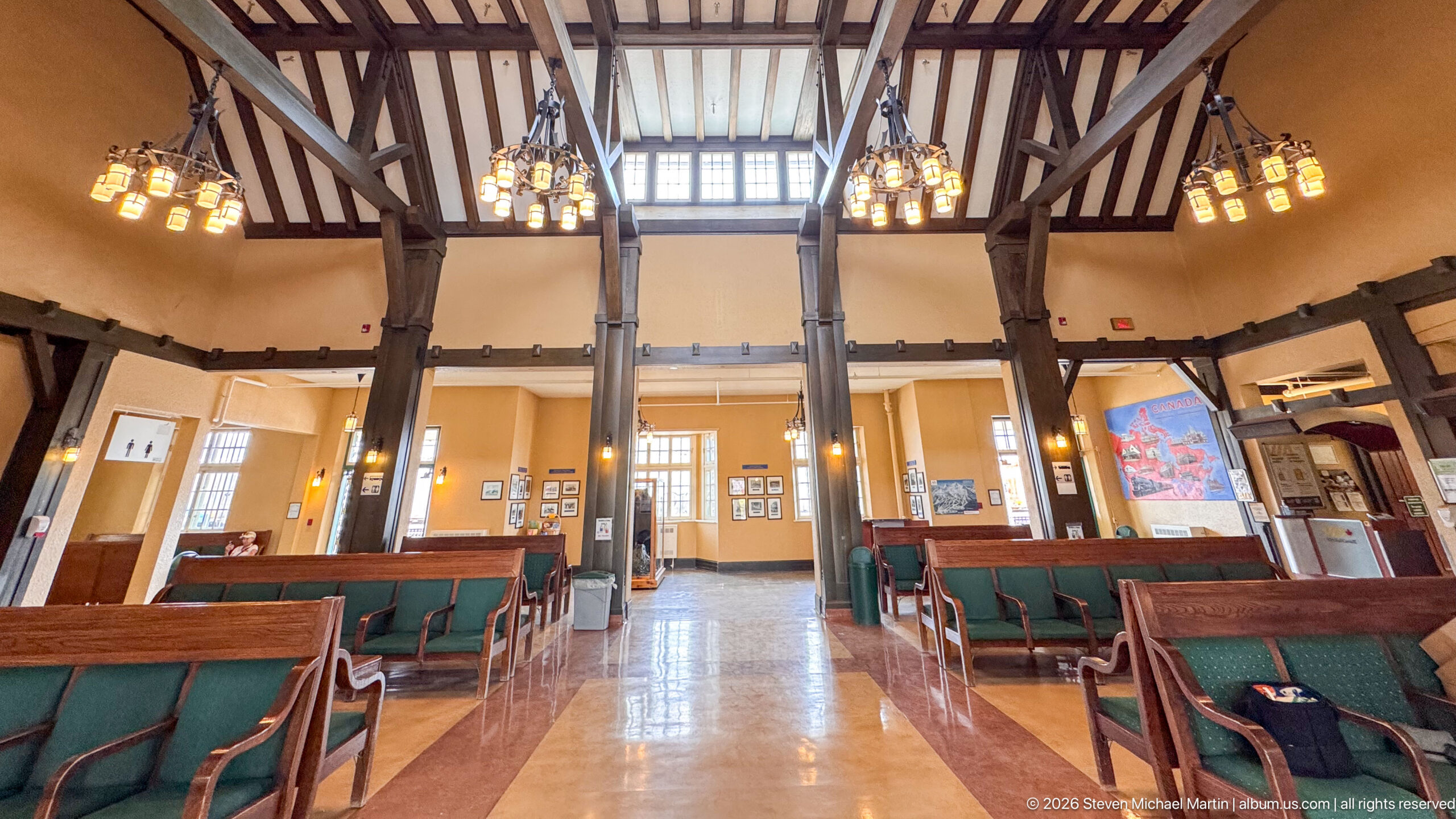
A transverse view across Banff’s railway station waiting room centers the tall timber posts and roof trusses that organize the hall. Green upholstered benches form parallel seating bays beneath clustered pendant lights, while wall displays and doorways remain secondary around the perimeter. The composition is especially useful for reading the interior’s structural grid and generous central circulation space.
Caption
A transverse view across Banff’s railway station waiting room centers the tall timber posts and roof trusses that organize the hall. Green upholstered benches form parallel seating bays beneath clustered pendant lights, while wall displays and doorways remain secondary around the perimeter. The composition is especially useful for reading the interior’s structural grid and generous central circulation space.
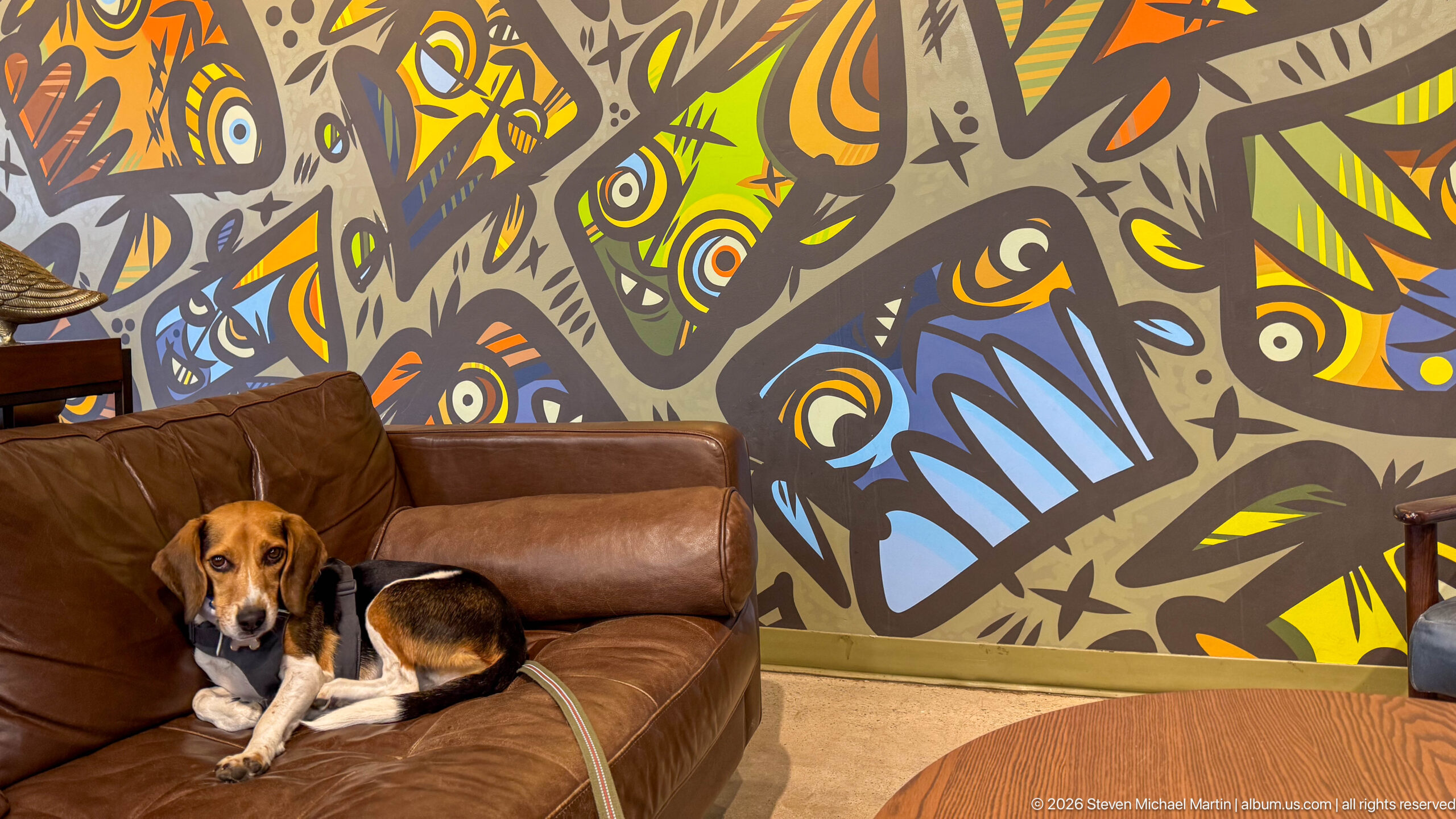
A single beagle sits alert on a brown leather sofa, framed against the same vivid abstract mural of eyes, teeth-like forms, and sweeping graphic lines. The tighter composition isolates the dog from its companion and gives greater prominence to the mural’s blue, yellow, orange, black, and gray shapes. A leash draped across the cushion keeps the scene connected to travel with pets.
Caption
A single beagle sits alert on a brown leather sofa, framed against the same vivid abstract mural of eyes, teeth-like forms, and sweeping graphic lines. The tighter composition isolates the dog from its companion and gives greater prominence to the mural’s blue, yellow, orange, black, and gray shapes. A leash draped across the cushion keeps the scene connected to travel with pets.
🏞️ National Park Field Guide
📍 Overview
Banff Town occupies an unusual place within Banff National Park: a compact urban center set directly against the immense physical scale of the Canadian Rockies. From elevated viewpoints, streets and buildings spread across the Bow Valley beneath steep mountain walls, while within the town itself Cascade Mountain repeatedly closes the view at the ends of streets. The portfolio follows this relationship from riverbanks and gardens to museums, commercial streets, hotels, railway spaces, and residential buildings, showing a community whose everyday architecture and movement remain visually inseparable from the protected landscape around it.
🏔️ Landscape
The Bow Valley gives Banff its broad physical setting, but the portfolio often experiences that landscape at close range. Blue-green water, rocky channels, conifer-lined banks, low clouds, and steep mountain slopes appear only minutes from busy sidewalks and commercial buildings. Around the Banff Canoe Club, calm waterways and riparian vegetation create a sheltered counterpoint to the town center, while elsewhere the Bow River moves through shallow rock-strewn channels as whitewater. Cascade Mountain provides the most persistent landmark, rising abruptly above streets, houses, and public buildings and making the surrounding mountain terrain a constant part of the townscape.
🪨 Geology
Exposed mountain rock gives Banff’s setting much of its visual power. Cascade Mountain is repeatedly seen as a steep mass of pale, sharply bedded limestone above darker forested slopes, sometimes with its summit ridge disappearing into low cloud. Changing light can isolate individual rock faces and ridgelines, revealing the layered structure of the mountain even from within town. Along the river, rock ledges and boulders divide the current and produce stretches of whitewater, providing a smaller-scale expression of the hard landscape through which the Bow Valley’s water moves.
🌿 Ecology
Conifer forest forms the principal natural frame around Banff Town, descending mountain slopes and reaching the edges of waterways, roads, buildings, and recreation areas. Along quieter channels near the canoe club, shoreline vegetation, young evergreens, wildflowers, and reflective green-blue water create a distinctly riparian environment. The portfolio also records how quickly developed space gives way to forest and water: a visitor can move from dense retail streets and civic architecture to riverbank vegetation and mountain habitat within a short distance. Domestic beagles appear repeatedly as travel companions, but the photographic evidence does not document a living wild animal encounter.
🦌 Wildlife
Wildlife imagery is present in Banff’s cultural landscape through signs, sculpture, decorative motifs, interpretation, and other representations, reflecting the importance of animals to the identity of the national park. The photographs themselves, however, distinguish those references from direct encounters with wild animals. The animals repeatedly photographed during the visit are two companion beagles, seen in waiting areas, outdoor dining spaces, and other travel settings. The portfolio therefore approaches wildlife primarily through the broader relationship between town, habitat, interpretation, and the protected mountain environment rather than through a documented wildlife sighting.
🧭 Human History
Banff’s human story is visible in a layered collection of civic, cultural, transportation, commercial, and recreational places. The stone Banff Park Administration Building and its formal landscaped approach establish a strong civic presence, while the timber Banff Park Museum preserves an architectural language of broad verandas, shingled roofs, exposed bracing, and a raised central roof form. The Whyte Museum and historic log structures add another cultural dimension, and the railway station retains substantial timber trusses and an expansive passenger hall while accommodating contemporary travel services. Alongside these institutions, trading posts, churches, hotels, residences, shops, public transit, and pedestrian streets show a functioning town whose architecture repeatedly adapts stone, timber, steep roofs, deep eaves, and other mountain-associated forms to changing uses.
🥾 Visitor Experience
Banff is experienced as much through movement as through individual landmarks. Pedestrian-oriented commercial streets lead directly toward mountain faces; buses connect the town with destinations such as Sulphur Mountain; paths and gardens organize approaches to civic buildings; and the riverfront opens onto canoeing and quieter waters beside the townsite. Restaurants, outdoor patios, museums, shops, hotels, public amenities, and the railway station add the practical rhythms of a working visitor center within a national park. The portfolio also records traveling with two beagles, including pauses in waiting areas and dog-friendly outdoor dining, giving the sequence a personal counterpoint to its architectural and landscape documentation.
📷 Photography Notes
The strongest photographs exploit Banff’s compressed relationship between town and mountain. Street axes place Cascade Mountain behind traffic, pedestrians, and storefronts; wider views use gardens, rivers, and buildings to establish scale; and tighter studies isolate timber framing, stone masonry, canoe decoration, civic markers, food, and other details that might disappear in a purely scenic treatment. Low cloud and rapidly changing light repeatedly alter the mountains, from muted ridges to brightly illuminated limestone above dark forest. Together, establishing views, architectural elevations, close details, candid travel scenes, and landscape studies create a fuller visual account of Banff than either mountain scenery or town architecture could provide alone.