Amazon River – Peru
The immense Amazon River is the largest river system on Earth and the defining feature of the Amazon Basin. Flowing across the northern regions of Peru, the river gathers water from countless tributaries before continuing eastward across the continent toward the Atlantic Ocean.
The river supports a vast network of rainforest ecosystems that sustain extraordinary biodiversity. Riverboats and small motorized canoes travel along its waters connecting remote communities and rainforest lodges throughout the region.
The Amazon River remains one of the most powerful natural forces shaping the landscapes of South America.
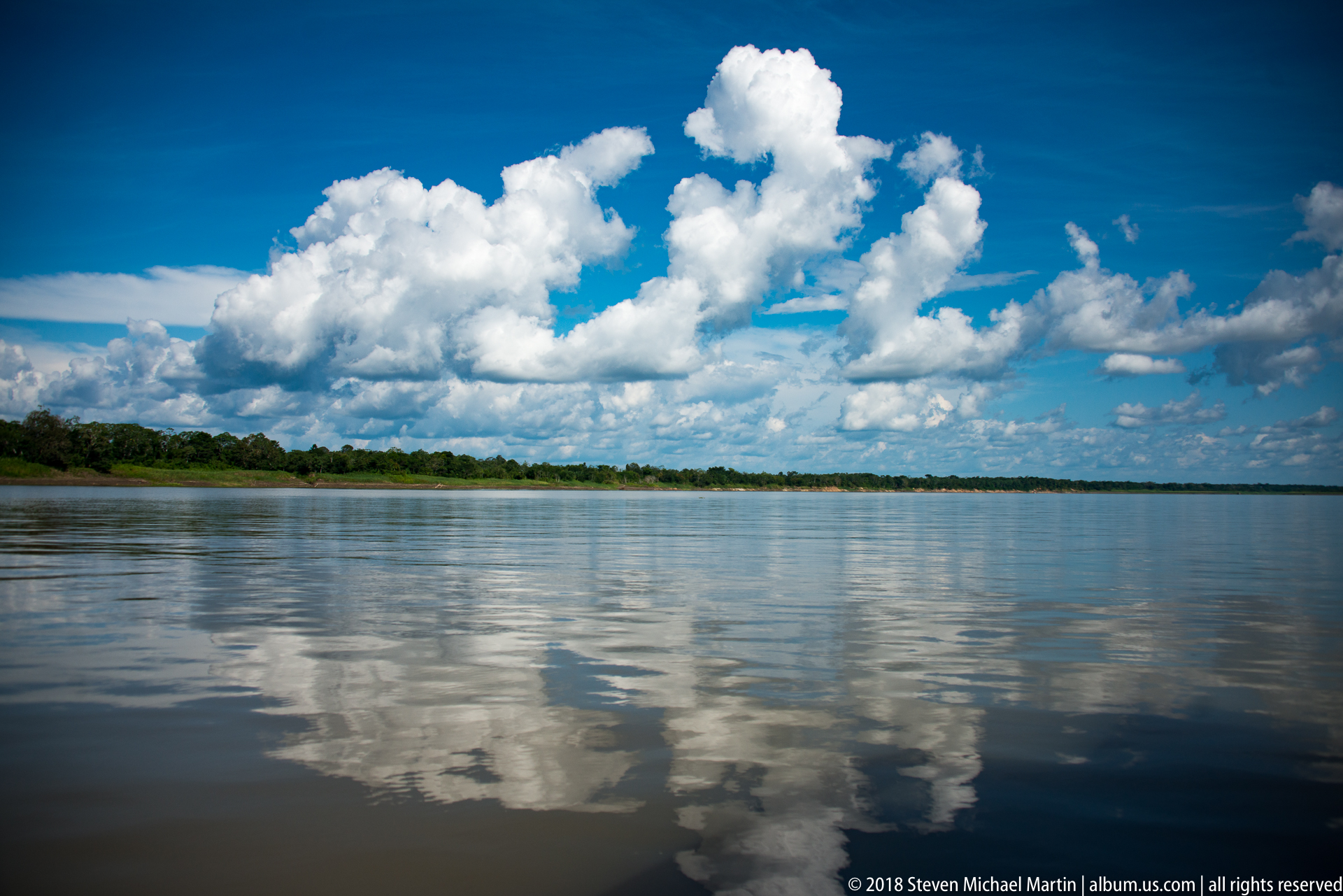
The Amazon River stretches across the frame as a broad, calm sheet of water beneath brilliant tropical cumulus clouds. Reflections repeat the cloud forms across the darker foreground while a nearly continuous band of forest defines the distant horizon. With no boat or settlement dominating the scene, the photograph functions as an expansive environmental view of the Peruvian Amazon waterway.
Caption
The Amazon River stretches across the frame as a broad, calm sheet of water beneath brilliant tropical cumulus clouds. Reflections repeat the cloud forms across the darker foreground while a nearly continuous band of forest defines the distant horizon. With no boat or settlement dominating the scene, the photograph functions as an expansive environmental view of the Peruvian Amazon waterway.
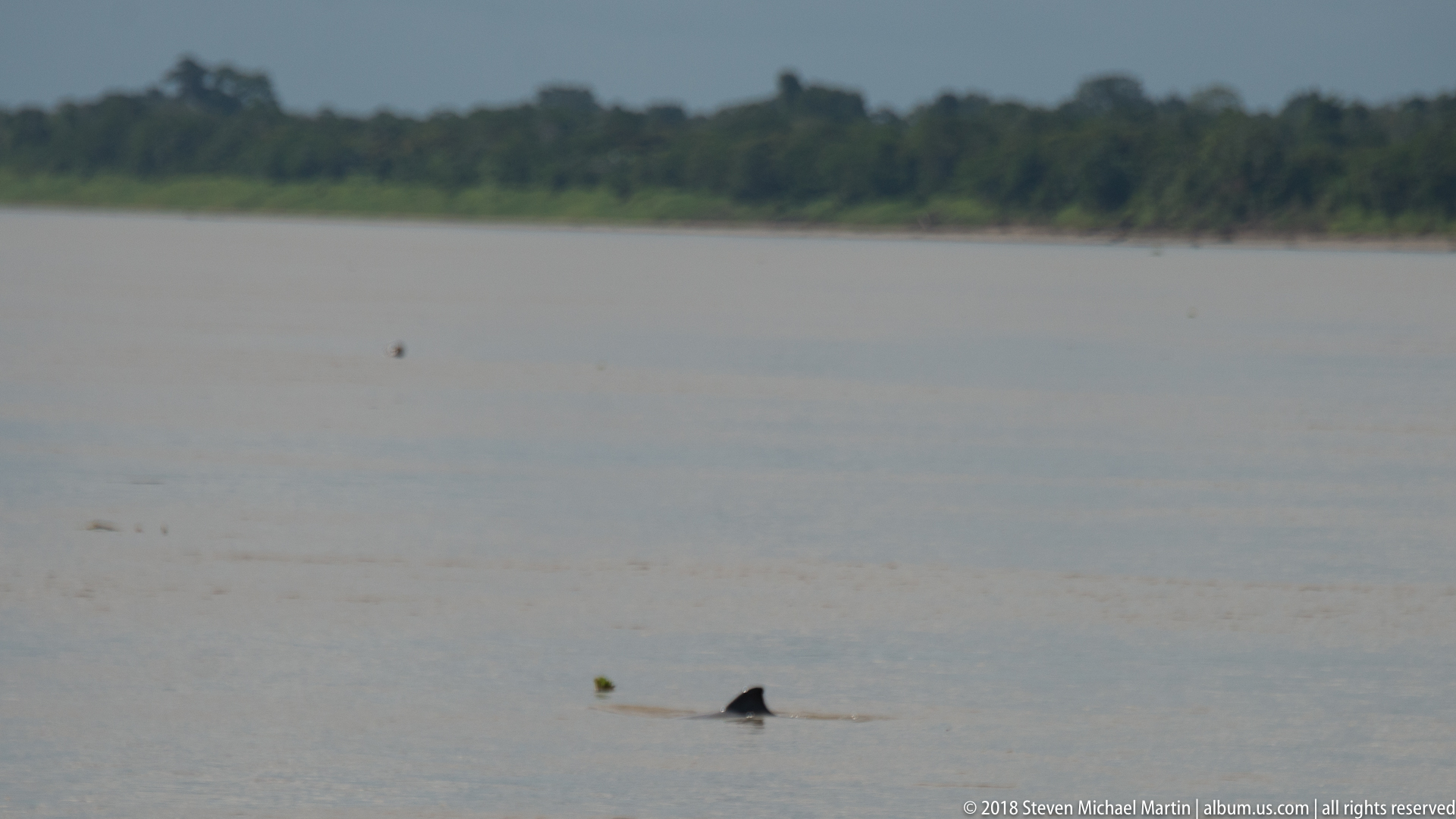
A river dolphin surfaces near the lower edge of a broad Amazon River view, dwarfed by open water and a distant green shoreline. Scattered floating vegetation punctuates the river surface. The composition shifts attention from the animal itself to habitat and scale, showing the dolphin as one small element within the wide tropical river corridor.
Caption
A river dolphin surfaces near the lower edge of a broad Amazon River view, dwarfed by open water and a distant green shoreline. Scattered floating vegetation punctuates the river surface. The composition shifts attention from the animal itself to habitat and scale, showing the dolphin as one small element within the wide tropical river corridor.
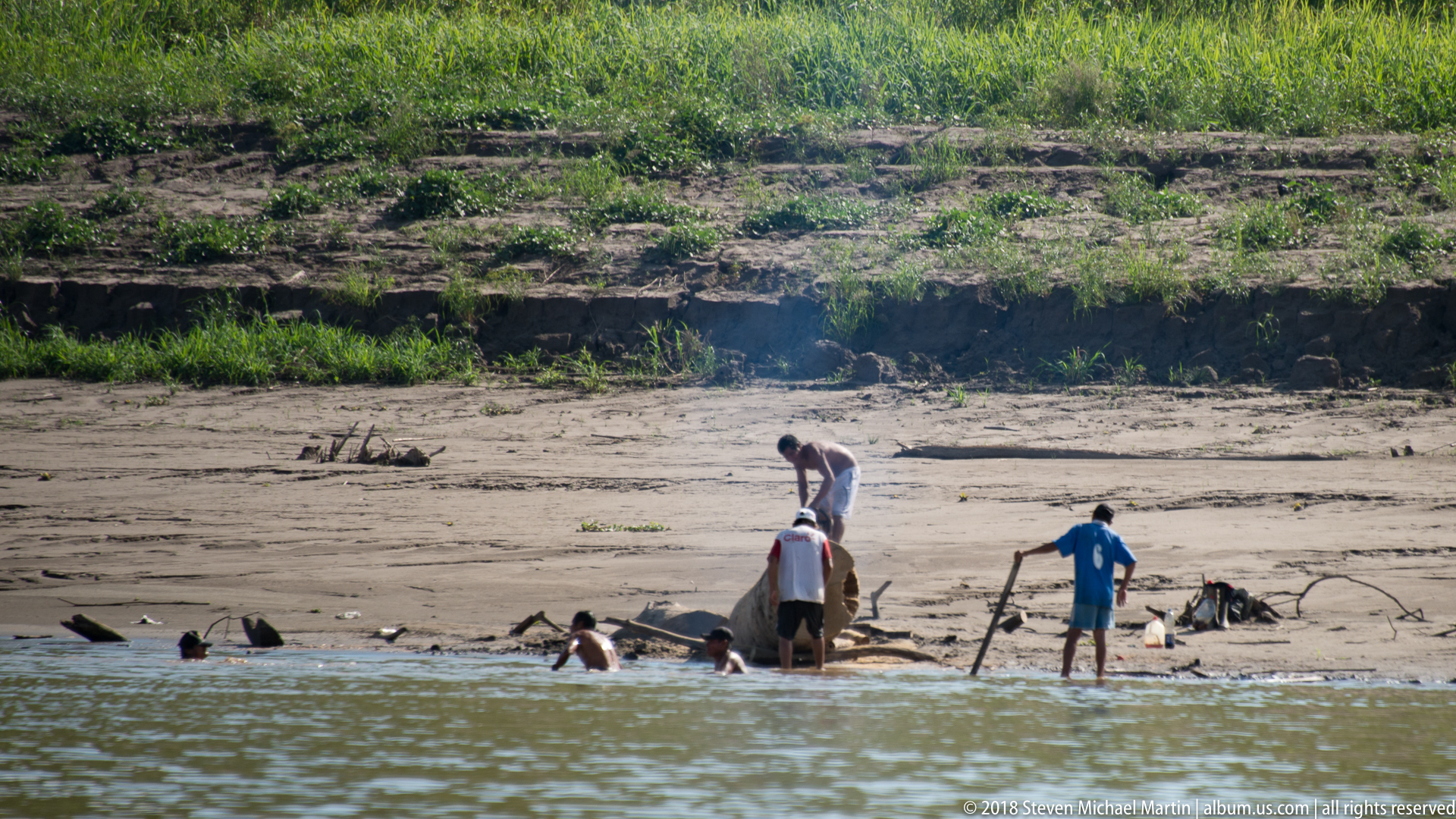
Several people work at the water's edge on a broad sandy Amazon River bank, bending over a low craft or equipment partly in the shallows. Their activity is framed by exposed sediment and a steep vegetated bank behind them. The scene documents the river as a working transportation corridor, with everyday movement and maintenance occurring directly at an informal landing.
Caption
Several people work at the water's edge on a broad sandy Amazon River bank, bending over a low craft or equipment partly in the shallows. Their activity is framed by exposed sediment and a steep vegetated bank behind them. The scene documents the river as a working transportation corridor, with everyday movement and maintenance occurring directly at an informal landing.
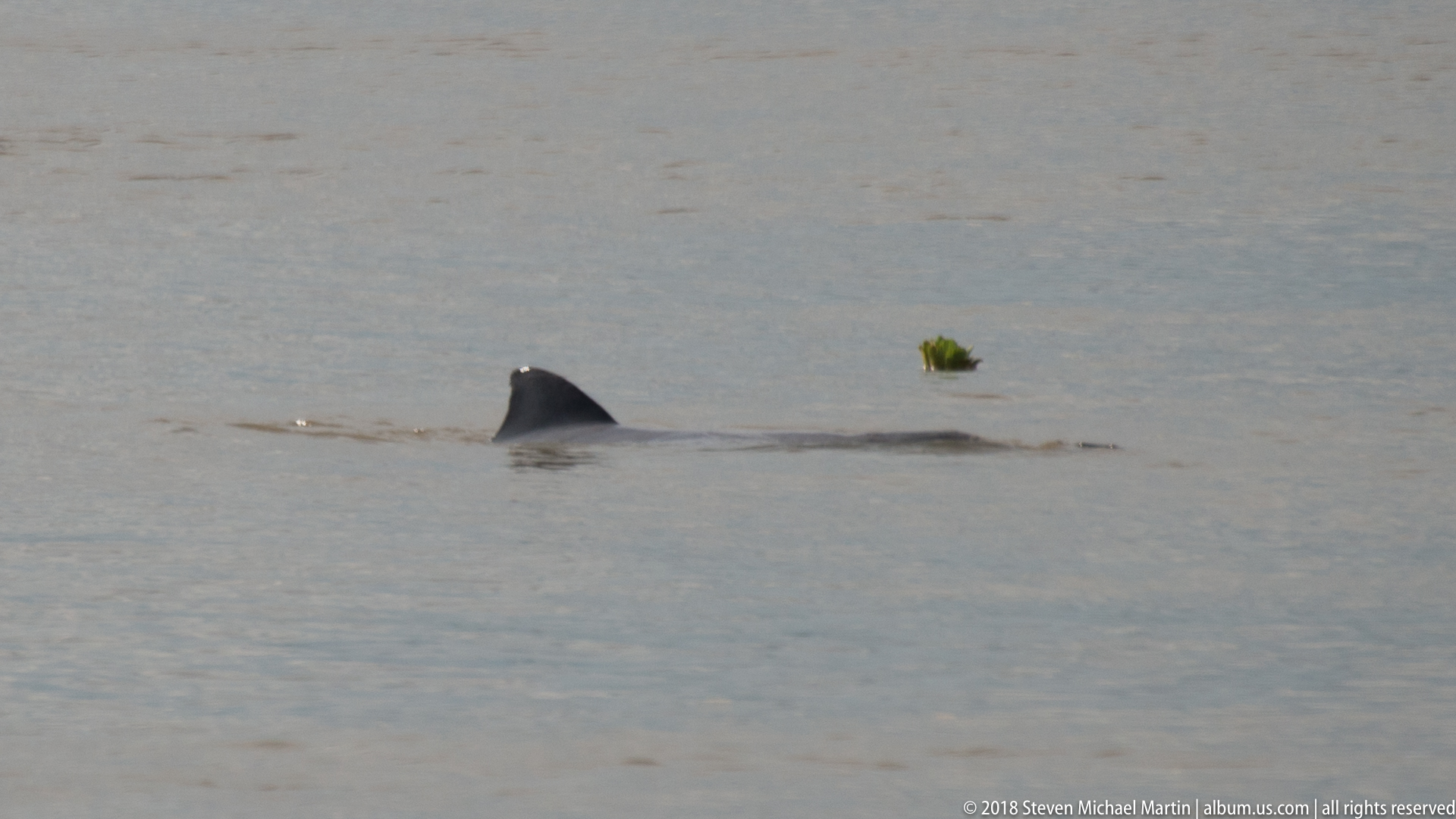
Only the dorsal fin and a narrow wake betray a river dolphin moving just under the Amazon River surface. A small patch of floating vegetation sits nearby, while the rest of the frame is uninterrupted silty water. The spare composition focuses on the fleeting trace of the animal rather than its full body, making this the most minimal wildlife view in the sequence.
Caption
Only the dorsal fin and a narrow wake betray a river dolphin moving just under the Amazon River surface. A small patch of floating vegetation sits nearby, while the rest of the frame is uninterrupted silty water. The spare composition focuses on the fleeting trace of the animal rather than its full body, making this the most minimal wildlife view in the sequence.
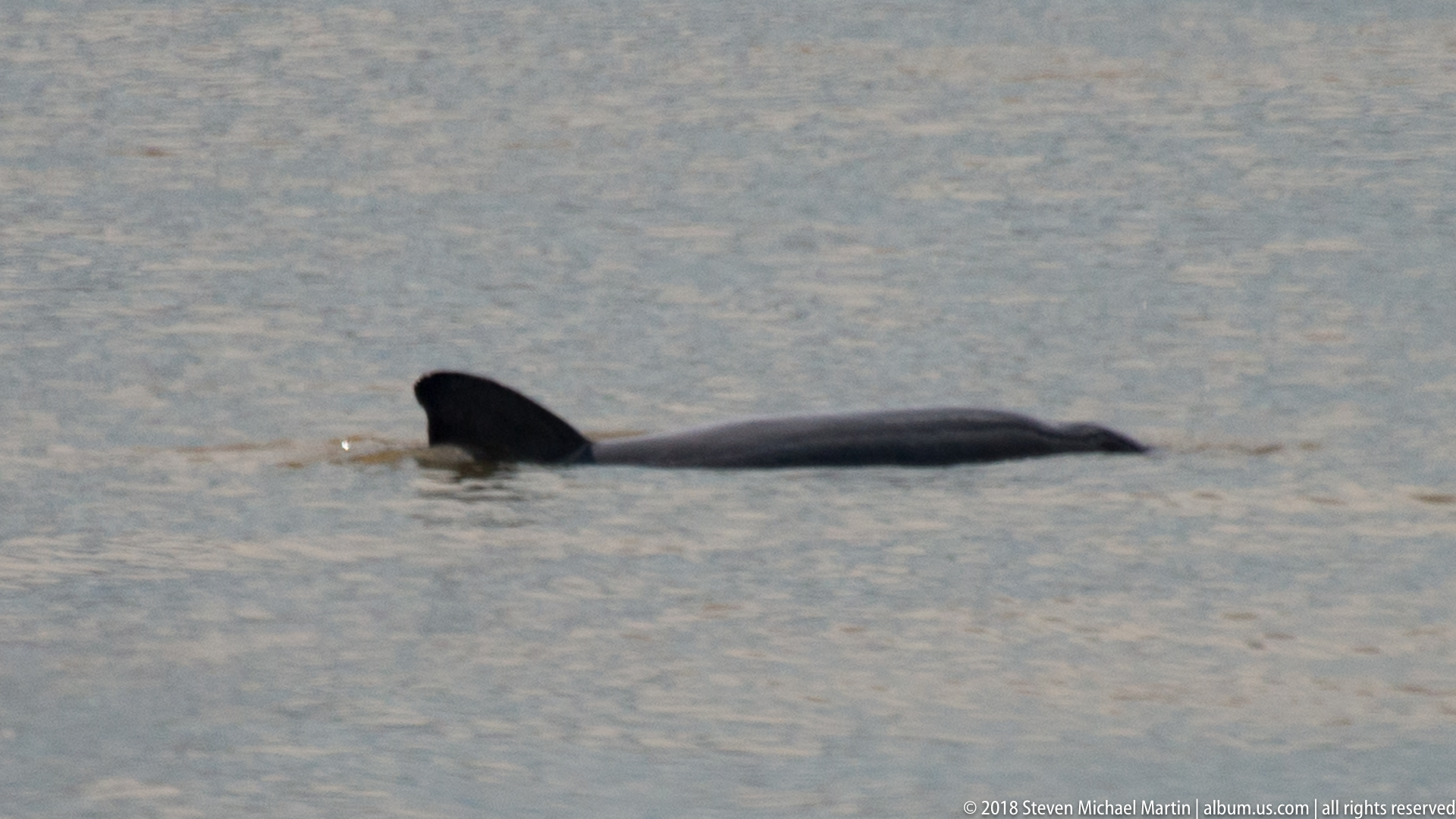
A dark river dolphin moves just beneath the Amazon River surface, with its triangular dorsal fin and long arc of back visible in side profile. The animal occupies the center of a quiet field of silty water, allowing its streamlined form to read more clearly than in the more distant frames. Diagnostic features remain too limited for a confident species-level identification.
Caption
A dark river dolphin moves just beneath the Amazon River surface, with its triangular dorsal fin and long arc of back visible in side profile. The animal occupies the center of a quiet field of silty water, allowing its streamlined form to read more clearly than in the more distant frames. Diagnostic features remain too limited for a confident species-level identification.
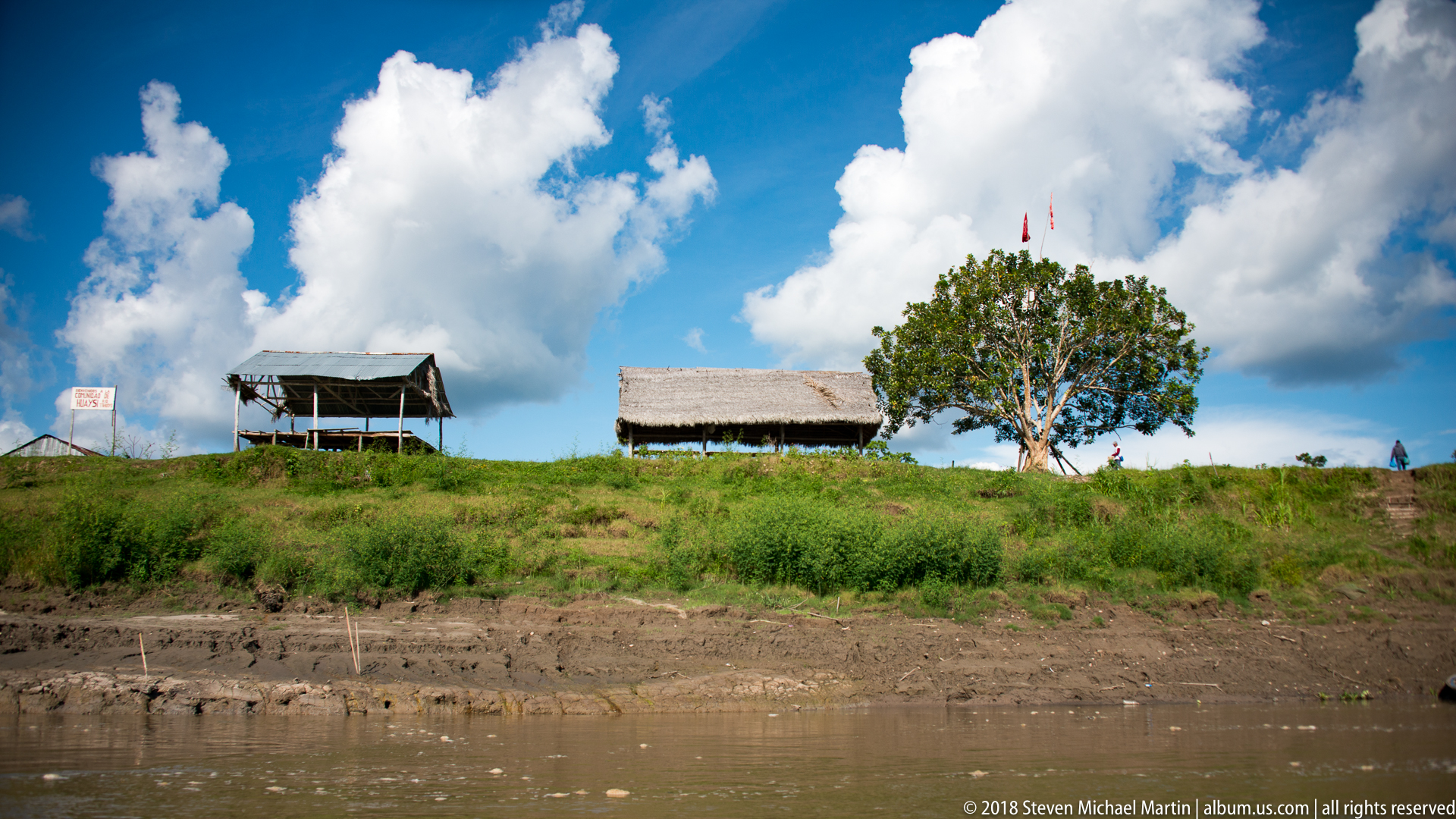
Open-sided shelters with lightweight roofs stand on a grassy rise above the muddy Amazon River, accompanied by a broad-canopied tree and small flags. The exposed, eroded bank in the foreground makes the seasonal relationship between settlement and river especially legible, while towering cumulus clouds emphasize the low, expansive horizon of the Peruvian Amazon.
Caption
Open-sided shelters with lightweight roofs stand on a grassy rise above the muddy Amazon River, accompanied by a broad-canopied tree and small flags. The exposed, eroded bank in the foreground makes the seasonal relationship between settlement and river especially legible, while towering cumulus clouds emphasize the low, expansive horizon of the Peruvian Amazon.
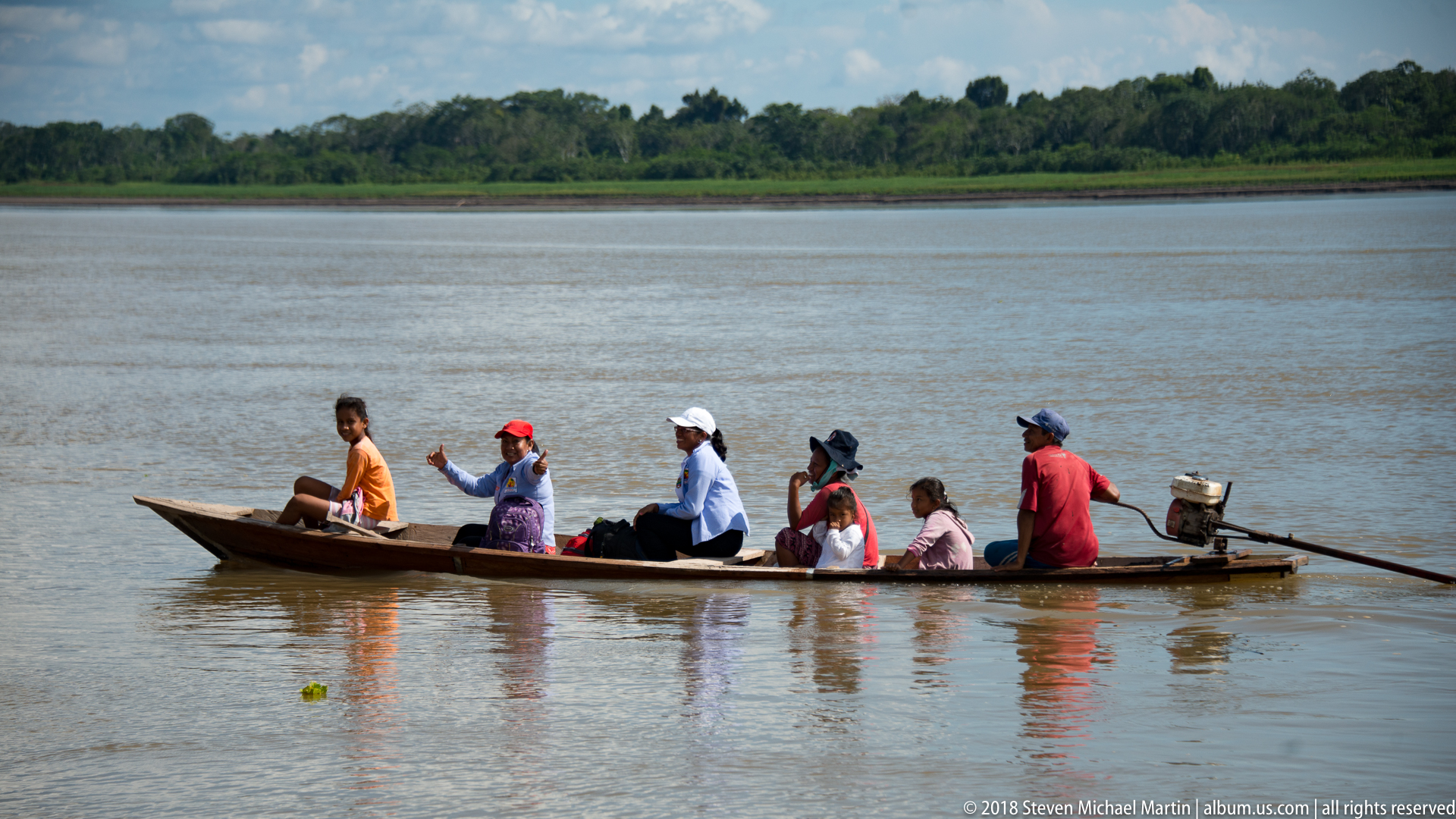
A group of passengers rides low across the broad river in a long, narrow wooden canoe. The occupants sit in a single line while a small motor at the stern propels the craft toward the forested opposite bank. The distant viewpoint emphasizes the canoe’s slight profile against the wide expanse of brown water and low green shoreline.
Caption
A group of passengers rides low across the broad river in a long, narrow wooden canoe. The occupants sit in a single line while a small motor at the stern propels the craft toward the forested opposite bank. The distant viewpoint emphasizes the canoe’s slight profile against the wide expanse of brown water and low green shoreline.
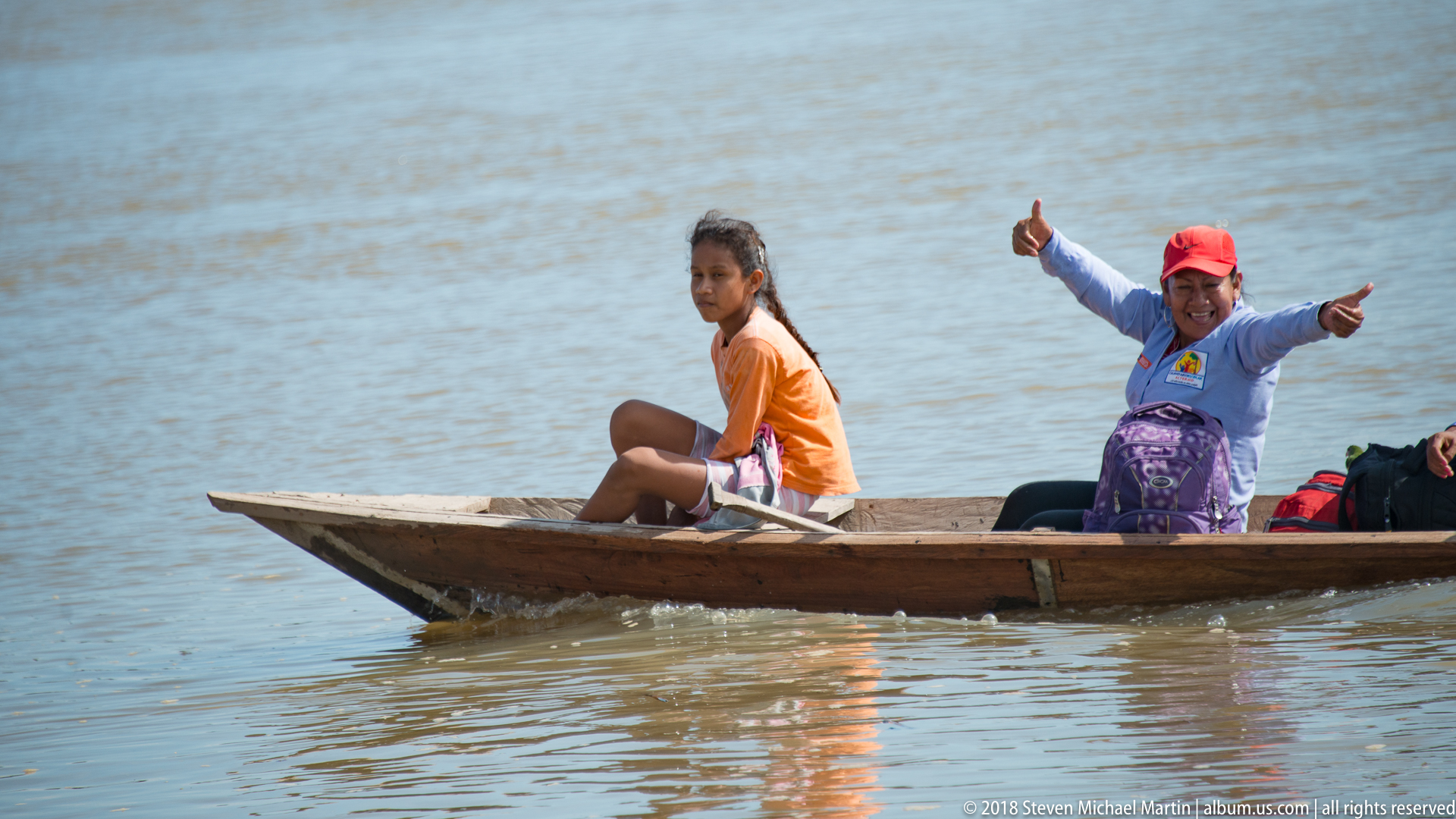
Two passengers occupy the bow section of a narrow wooden canoe as it moves across the Amazon River. A woman in a red cap raises both arms in an animated gesture while the younger passenger ahead of her sits facing forward. The tight composition isolates their expressions and body language against rippled water, giving the river journey a distinctly personal scale.
Caption
Two passengers occupy the bow section of a narrow wooden canoe as it moves across the Amazon River. A woman in a red cap raises both arms in an animated gesture while the younger passenger ahead of her sits facing forward. The tight composition isolates their expressions and body language against rippled water, giving the river journey a distinctly personal scale.
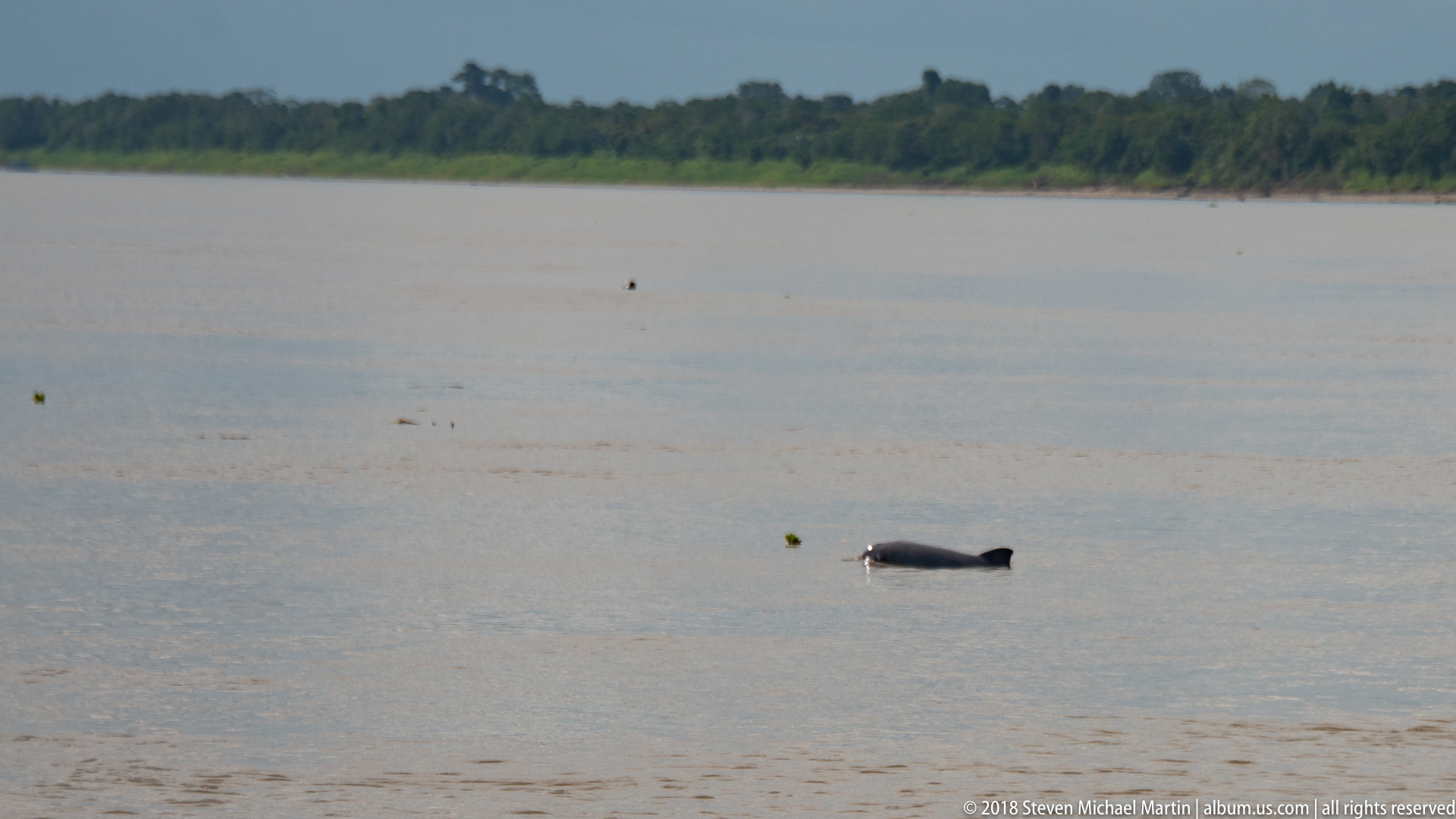
A low dark profile marks a river dolphin surfacing across the lower right of the frame, with floating vegetation scattered across the broad water and dense forest lining the horizon. The animal's understated presence and the large surrounding river emphasize habitat rather than portrait detail. Only a small portion of the body is visible, so the record remains deliberately nonspecific at species level.
Caption
A low dark profile marks a river dolphin surfacing across the lower right of the frame, with floating vegetation scattered across the broad water and dense forest lining the horizon. The animal's understated presence and the large surrounding river emphasize habitat rather than portrait detail. Only a small portion of the body is visible, so the record remains deliberately nonspecific at species level.

A large dark bird perches on the exposed upper branches of a riverside tree in the Peruvian Amazon. Seen at a distance against a pale sky, the bird's upright posture and elevated lookout distinguish it from the dense foliage below. The view records wildlife using the forest canopy along the Amazon River corridor without forcing a species identification that the silhouette cannot securely support.
Caption
A large dark bird perches on the exposed upper branches of a riverside tree in the Peruvian Amazon. Seen at a distance against a pale sky, the bird's upright posture and elevated lookout distinguish it from the dense foliage below. The view records wildlife using the forest canopy along the Amazon River corridor without forcing a species identification that the silhouette cannot securely support.
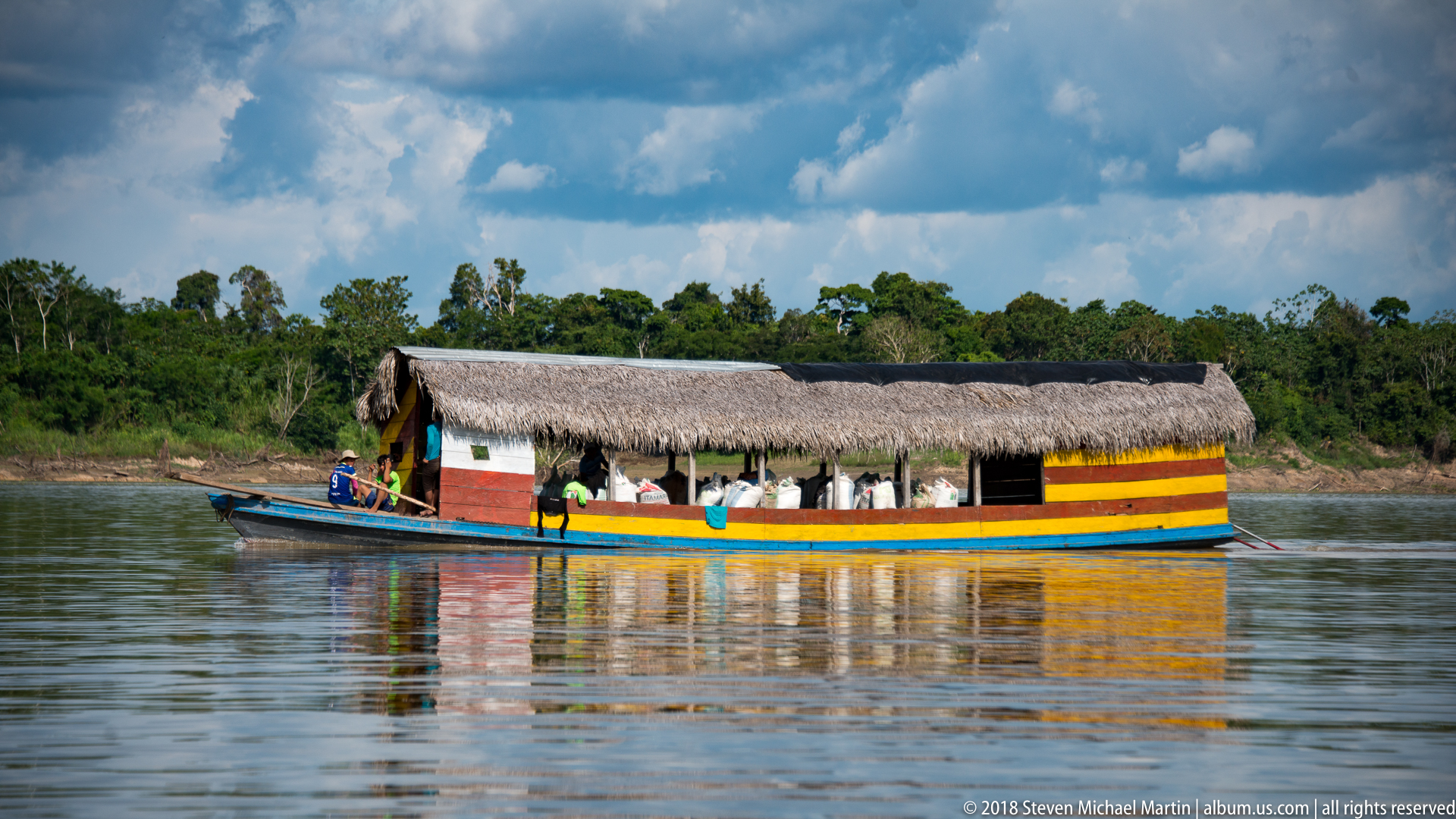
A long passenger boat with a palm-thatch canopy travels across the Amazon River, its hull painted in vivid bands of red, yellow, blue, and green. Passengers sit within the shaded open-sided cabin while a crew member occupies the bow. The vessel's elongated form and lightweight roof reflect the practical river transport that connects communities along waterways in the Peruvian Amazon.
Caption
A long passenger boat with a palm-thatch canopy travels across the Amazon River, its hull painted in vivid bands of red, yellow, blue, and green. Passengers sit within the shaded open-sided cabin while a crew member occupies the bow. The vessel's elongated form and lightweight roof reflect the practical river transport that connects communities along waterways in the Peruvian Amazon.
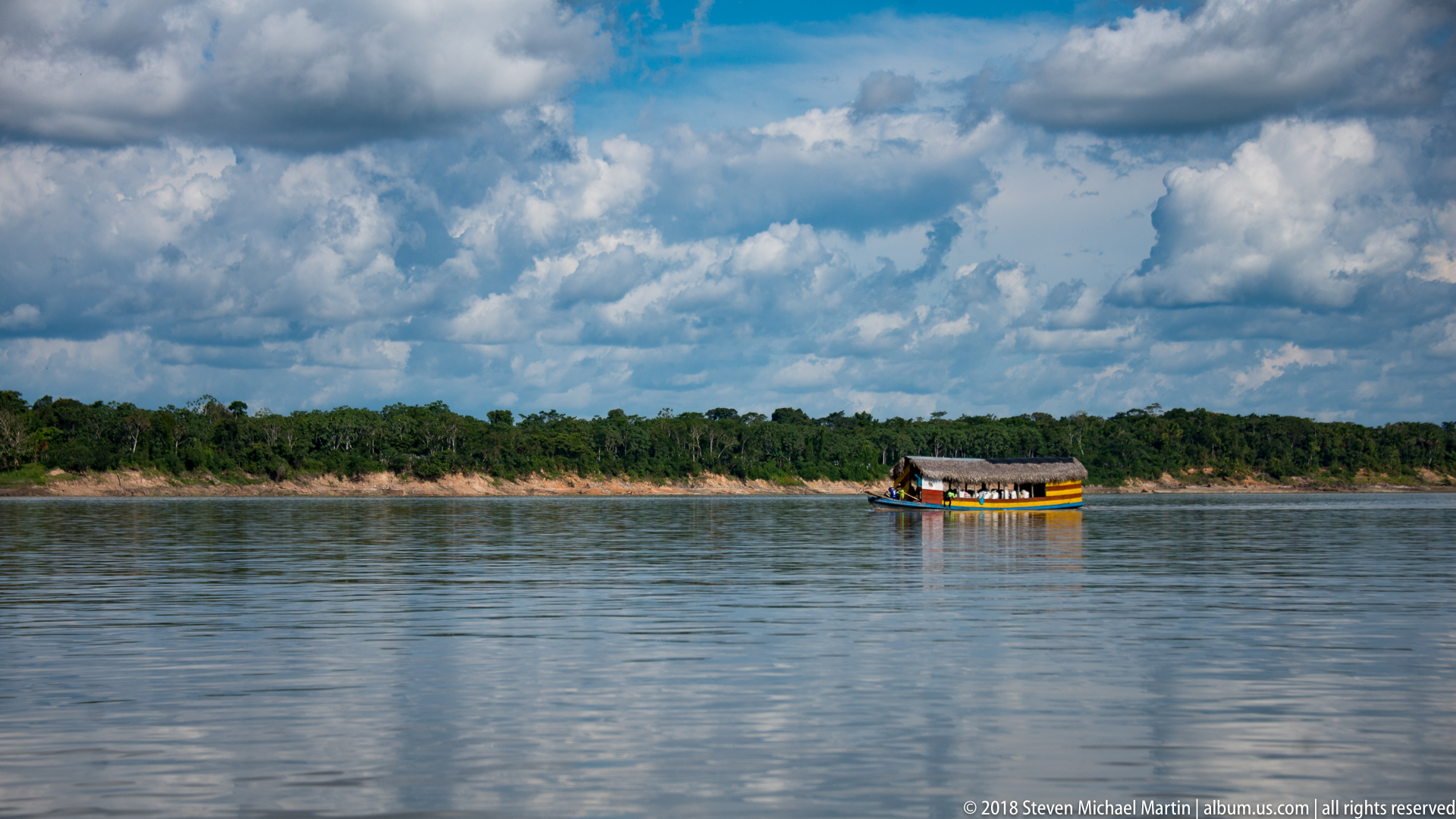
A thatch-roofed passenger boat appears small against the immense width of the Amazon River, moving near a low forested bank beneath towering clouds. Unlike the closer vessel view, this composition stresses scale: open water occupies most of the frame and the boat becomes a compact marker of human movement within the river landscape.
Caption
A thatch-roofed passenger boat appears small against the immense width of the Amazon River, moving near a low forested bank beneath towering clouds. Unlike the closer vessel view, this composition stresses scale: open water occupies most of the frame and the boat becomes a compact marker of human movement within the river landscape.
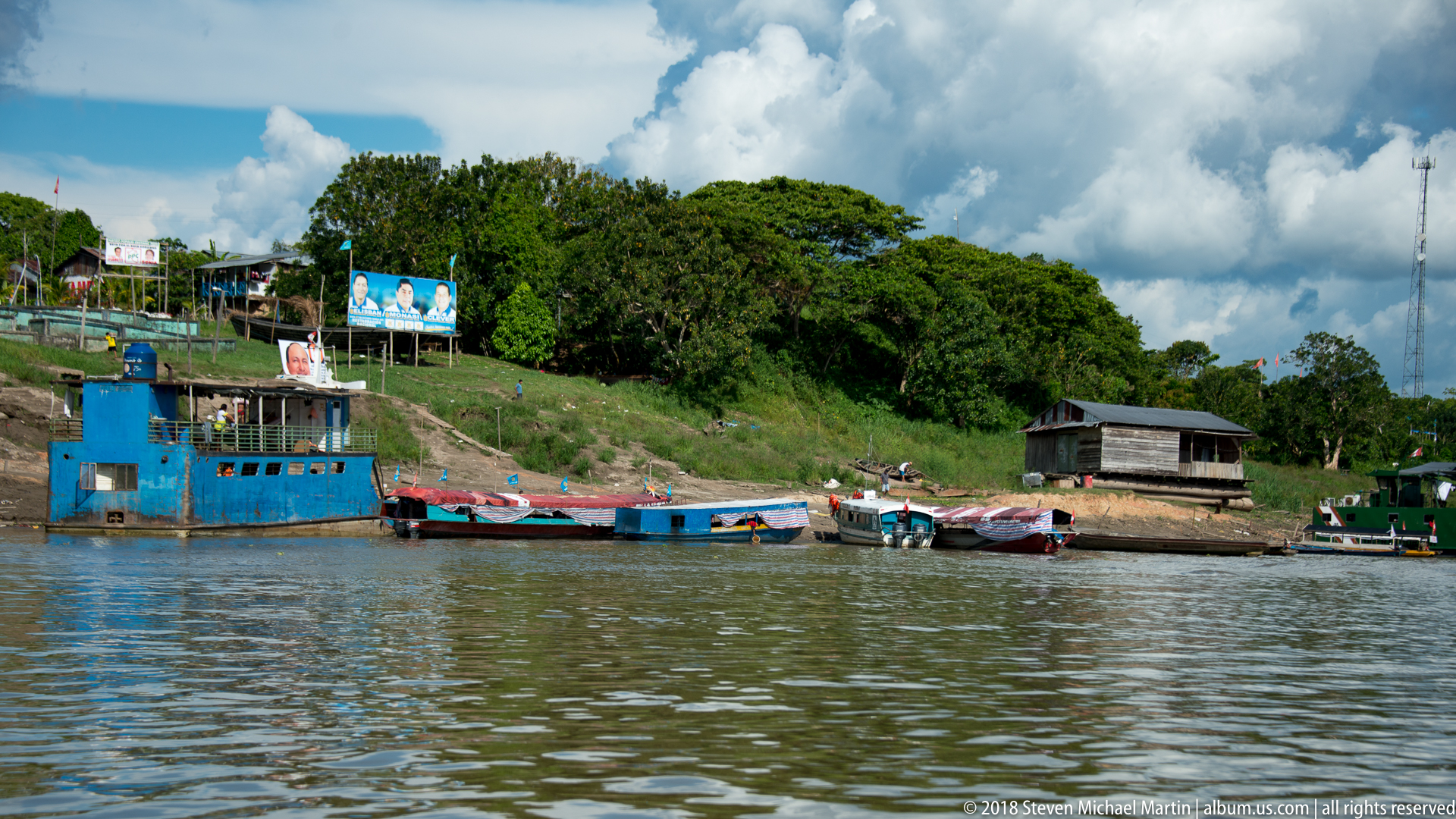
Boats cluster along the sloping riverfront at Tamshiyacu, where a blue work vessel, long narrow craft, and smaller covered boats occupy the muddy water below a green bluff. Buildings, signs, and trees rise behind the landing. The varied vessels make this a useful contextual view of a community whose everyday circulation and commerce are closely tied to the Amazon River system.
Caption
Boats cluster along the sloping riverfront at Tamshiyacu, where a blue work vessel, long narrow craft, and smaller covered boats occupy the muddy water below a green bluff. Buildings, signs, and trees rise behind the landing. The varied vessels make this a useful contextual view of a community whose everyday circulation and commerce are closely tied to the Amazon River system.
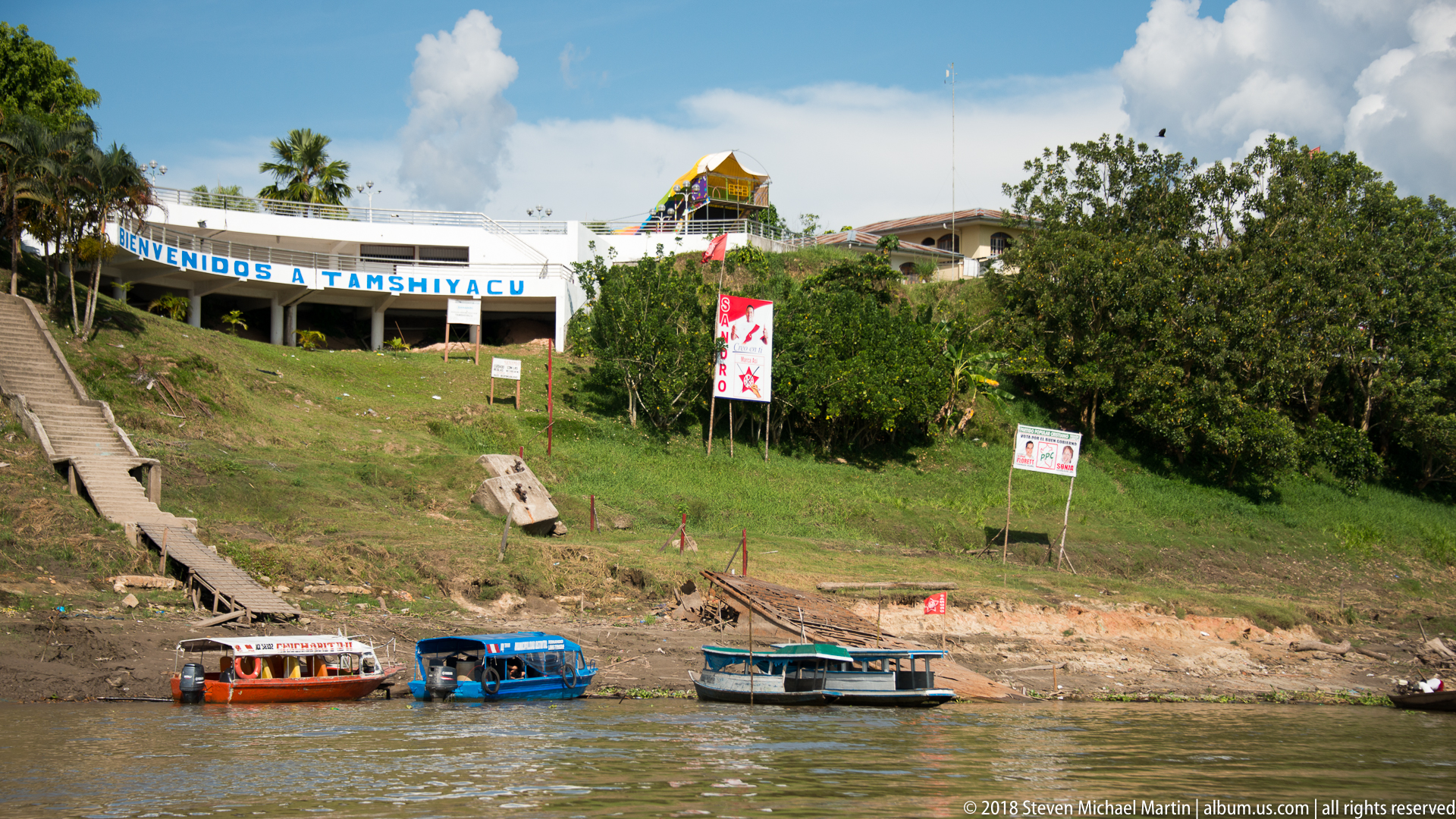
A large hillside sign reading “Bienvenidos a Tamshiyacu” identifies the community above a steep river landing. Wooden stairs descend the grassy bank to several narrow covered boats, while a Peruvian flag and other signs punctuate the slope. The composition directly links the town entrance to river transport, showing how arrival from the water is organized along the Amazonian bank.
Caption
A large hillside sign reading “Bienvenidos a Tamshiyacu” identifies the community above a steep river landing. Wooden stairs descend the grassy bank to several narrow covered boats, while a Peruvian flag and other signs punctuate the slope. The composition directly links the town entrance to river transport, showing how arrival from the water is organized along the Amazonian bank.
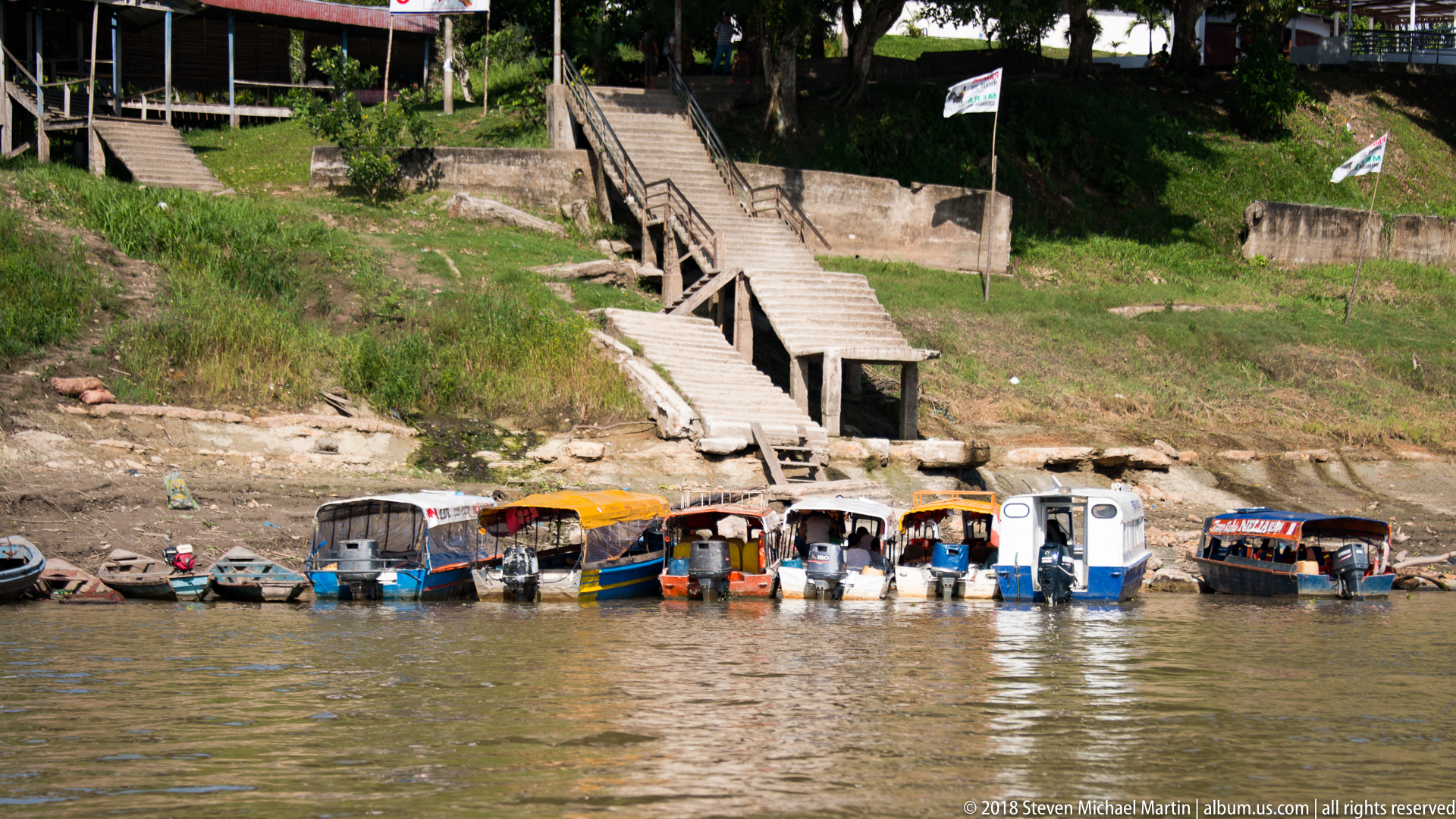
A row of small covered motorboats is tied bow-to-bank at the Tamshiyacu riverfront, directly below a long wooden stairway climbing the bluff. Brightly painted canopies and hulls distinguish individual boats along the muddy shoreline. This closer view concentrates on the transport infrastructure itself: compact river craft gathered where passengers and goods move between the water and the settlement above.
Caption
A row of small covered motorboats is tied bow-to-bank at the Tamshiyacu riverfront, directly below a long wooden stairway climbing the bluff. Brightly painted canopies and hulls distinguish individual boats along the muddy shoreline. This closer view concentrates on the transport infrastructure itself: compact river craft gathered where passengers and goods move between the water and the settlement above.
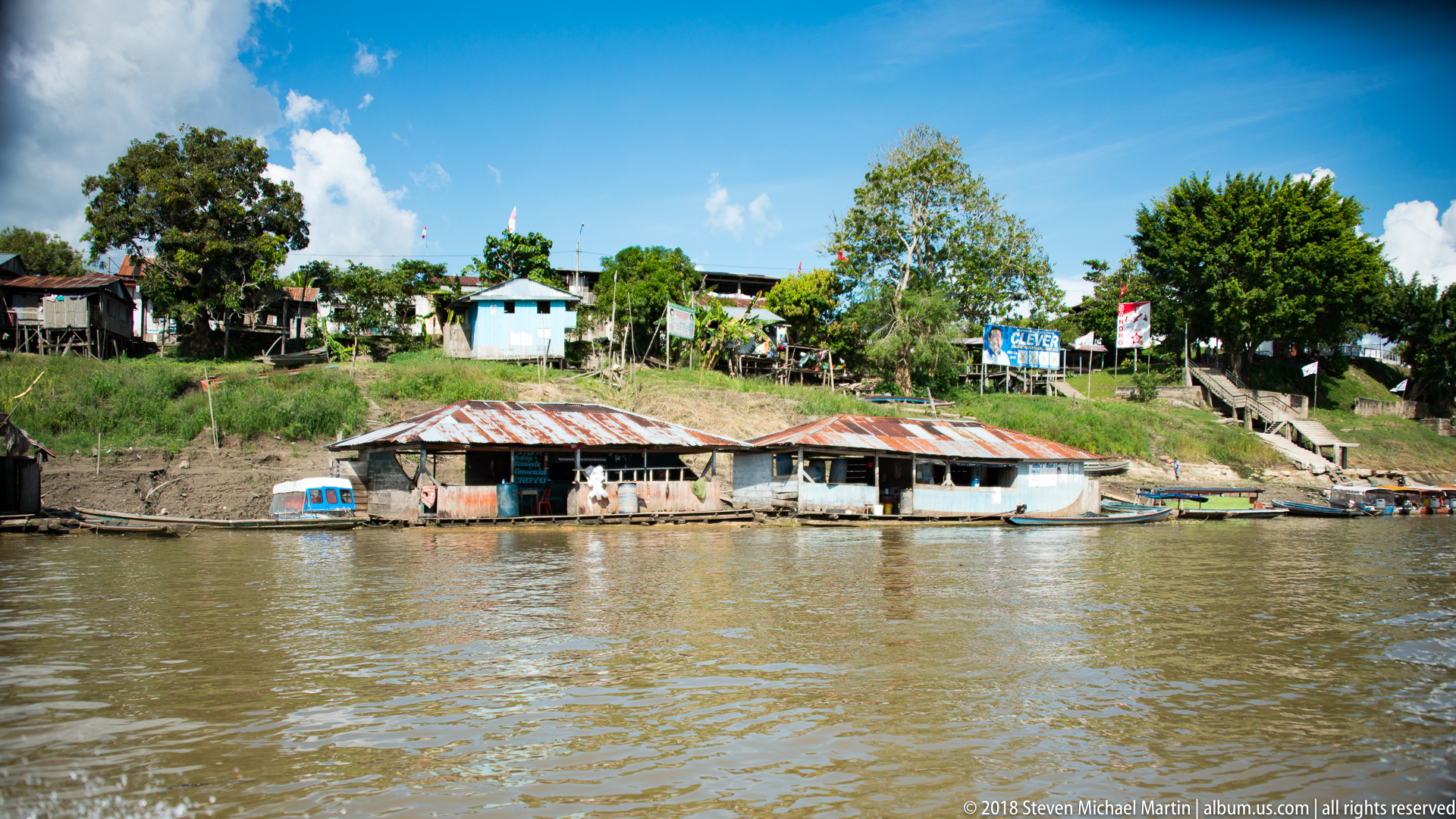
Low floating structures with weathered corrugated-metal roofs sit at the waterline below Tamshiyacu's higher riverbank settlement. Small boats are drawn alongside, while houses and trees occupy the bluff above. The layered composition shows two adaptations to the river edge at once: floating or water-level structures below and more permanent buildings set back on higher ground.
Caption
Low floating structures with weathered corrugated-metal roofs sit at the waterline below Tamshiyacu's higher riverbank settlement. Small boats are drawn alongside, while houses and trees occupy the bluff above. The layered composition shows two adaptations to the river edge at once: floating or water-level structures below and more permanent buildings set back on higher ground.
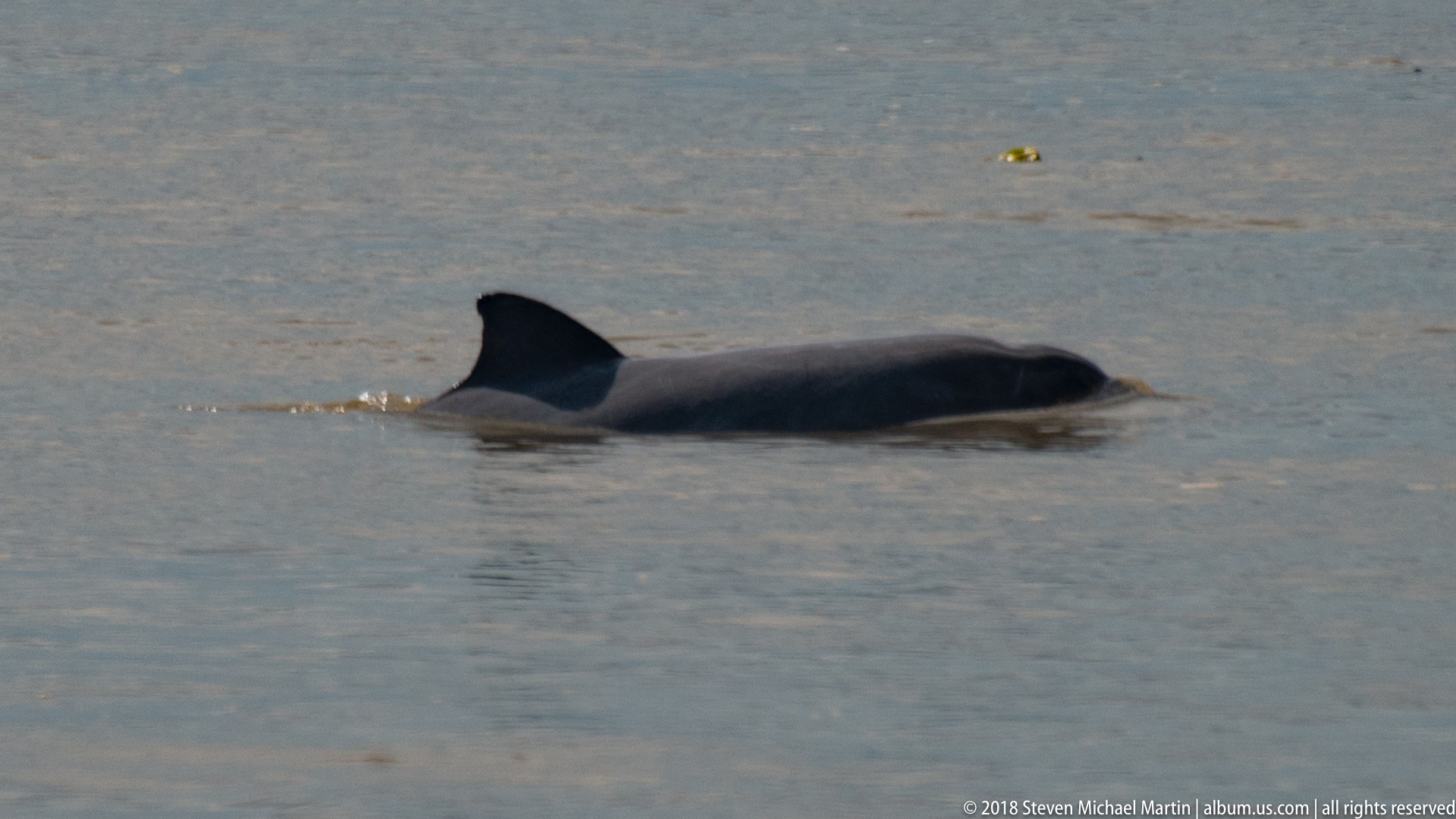
A dark gray river dolphin breaks the surface of the Amazon River, exposing a curved back and prominent triangular dorsal fin before submerging again. The tight crop isolates the animal against silty water and records the brief, low profile typical of a surfacing cetacean. Species is left unresolved because the visible body section does not show diagnostic head or coloration details securely enough.
Caption
A dark gray river dolphin breaks the surface of the Amazon River, exposing a curved back and prominent triangular dorsal fin before submerging again. The tight crop isolates the animal against silty water and records the brief, low profile typical of a surfacing cetacean. Species is left unresolved because the visible body section does not show diagnostic head or coloration details securely enough.
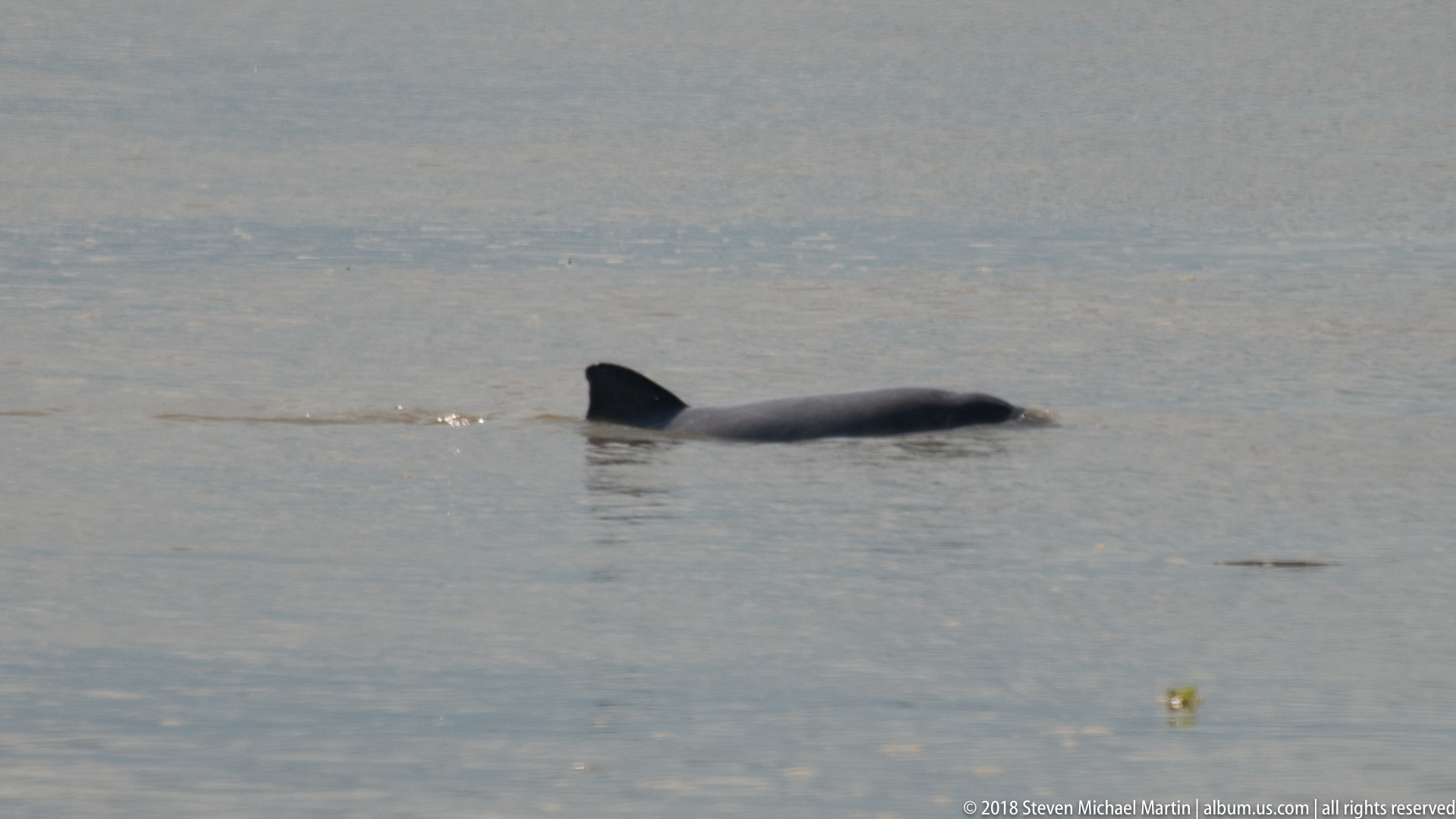
A river dolphin surfaces at a greater distance, its dorsal fin and a narrow section of back rising just above the silty water. The restrained composition leaves the animal surrounded by open river, emphasizing how fleeting such wildlife sightings can be on the Amazon. The limited visible anatomy supports a general river-dolphin identification rather than a specific species assignment.
Caption
A river dolphin surfaces at a greater distance, its dorsal fin and a narrow section of back rising just above the silty water. The restrained composition leaves the animal surrounded by open river, emphasizing how fleeting such wildlife sightings can be on the Amazon. The limited visible anatomy supports a general river-dolphin identification rather than a specific species assignment.
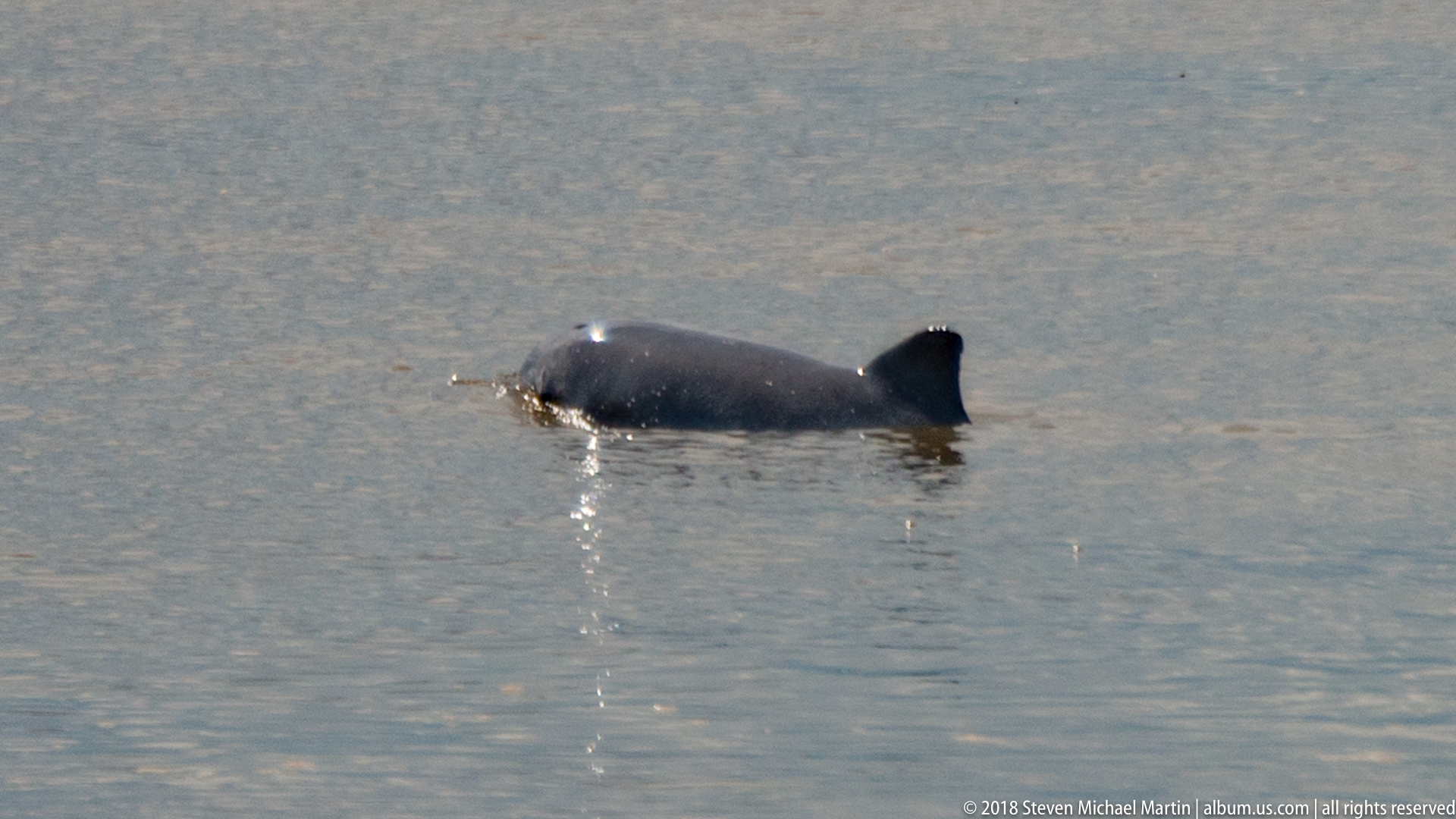
A river dolphin rolls through the surface, the rounded back catching a bright highlight while the dorsal fin rises sharply behind it. Ripples and a small splash mark the animal's forward motion. This moment differs from the flatter side profiles by showing the body at the crest of a surfacing cycle, but the partial view still does not justify a species-specific label.
Caption
A river dolphin rolls through the surface, the rounded back catching a bright highlight while the dorsal fin rises sharply behind it. Ripples and a small splash mark the animal's forward motion. This moment differs from the flatter side profiles by showing the body at the crest of a surfacing cycle, but the partial view still does not justify a species-specific label.
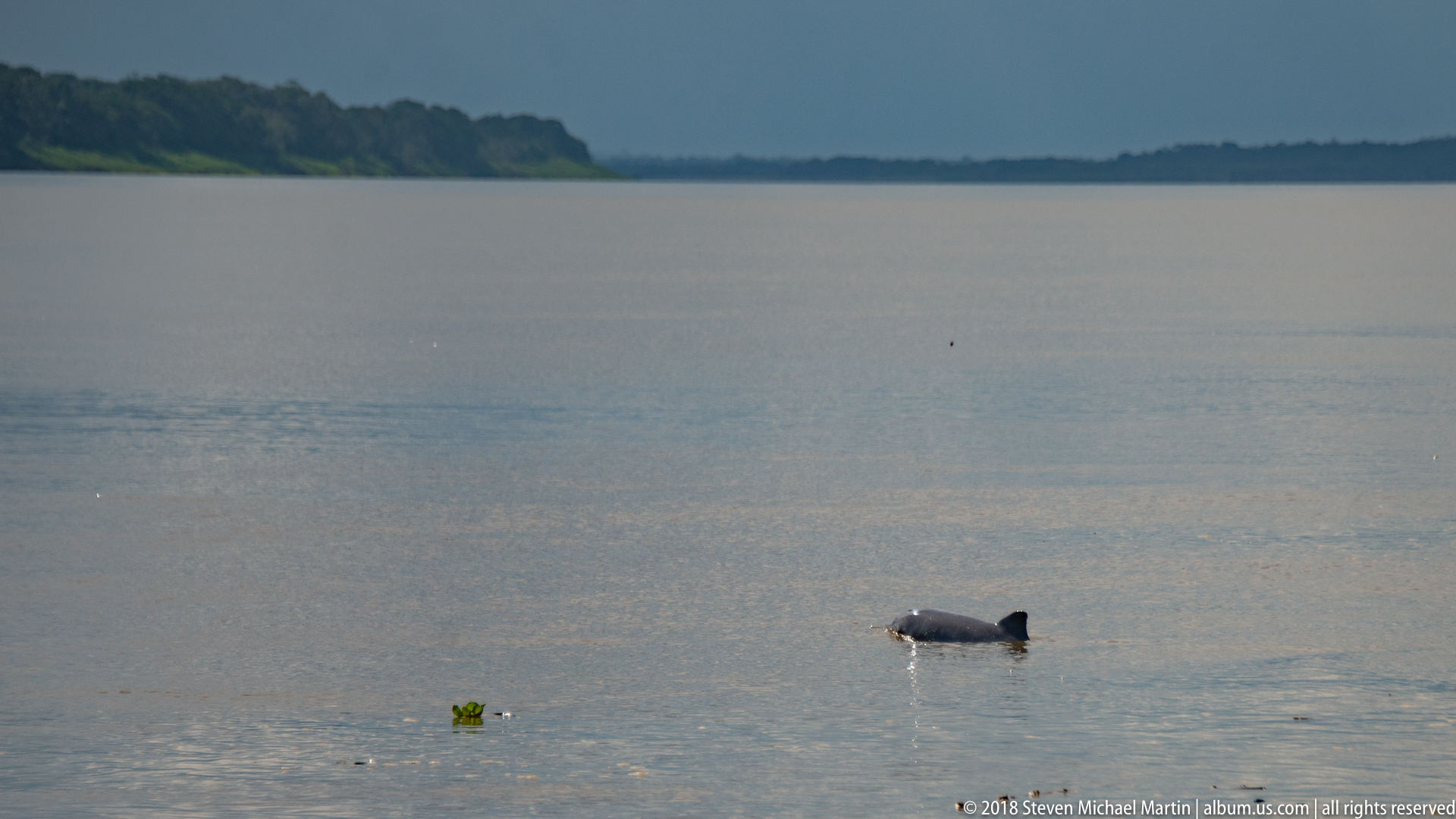
A small river dolphin surfaces far from the camera in a broad expanse of Amazon River water, with a low forested shoreline receding across the horizon. Floating vegetation nearby provides a second scale cue. Here the wildlife is deliberately contextual rather than close: the dolphin appears as a small moving presence within the immense river environment.
Caption
A small river dolphin surfaces far from the camera in a broad expanse of Amazon River water, with a low forested shoreline receding across the horizon. Floating vegetation nearby provides a second scale cue. Here the wildlife is deliberately contextual rather than close: the dolphin appears as a small moving presence within the immense river environment.
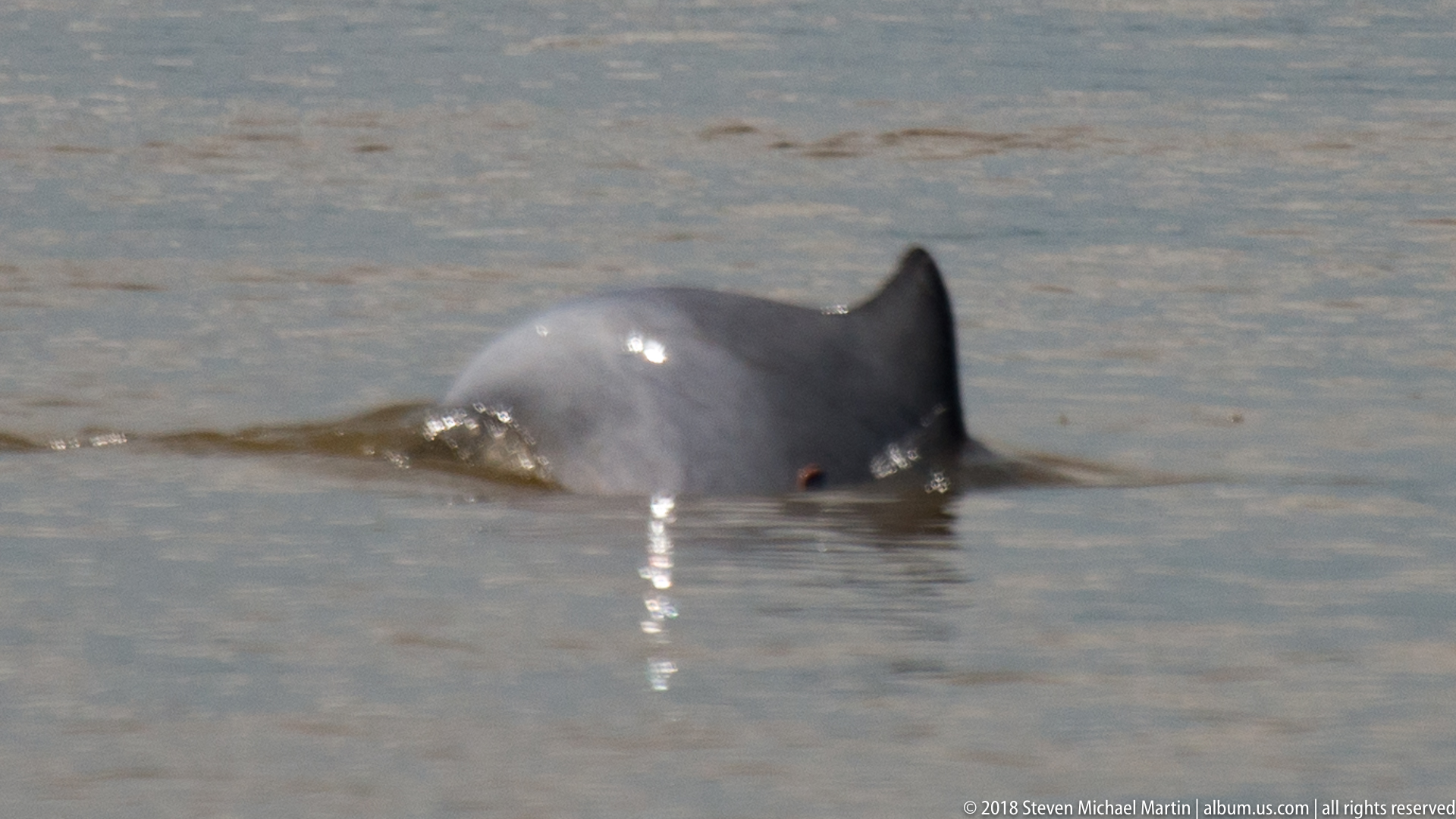
A gray river dolphin rises close to the camera, bringing the rounded upper body and a steep fin-like profile above the muddy water. A small reddish-brown spot near the waterline may be an eye or surface detail, but the angle obscures the head shape. The unusually close encounter provides strong texture and form while still leaving species identification uncertain.
Caption
A gray river dolphin rises close to the camera, bringing the rounded upper body and a steep fin-like profile above the muddy water. A small reddish-brown spot near the waterline may be an eye or surface detail, but the angle obscures the head shape. The unusually close encounter provides strong texture and form while still leaving species identification uncertain.
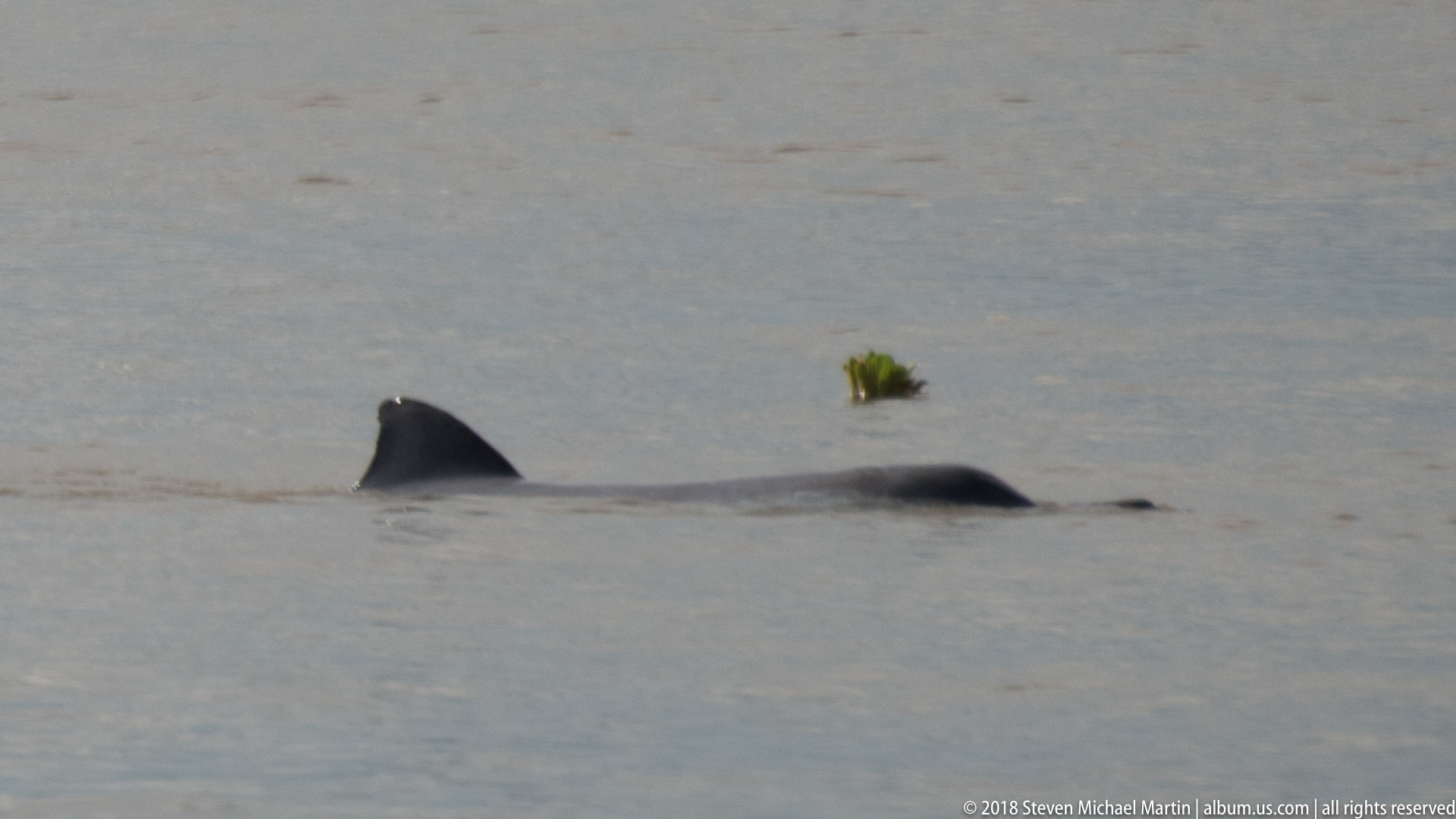
A river dolphin glides at the surface with its dorsal fin rising ahead of a low, elongated back. A small clump of floating vegetation drifts beyond the animal, adding a characteristic river detail to the otherwise minimal composition. The photograph records the dolphin in a shallow surfacing phase, when only a narrow portion of its body clears the water.
Caption
A river dolphin glides at the surface with its dorsal fin rising ahead of a low, elongated back. A small clump of floating vegetation drifts beyond the animal, adding a characteristic river detail to the otherwise minimal composition. The photograph records the dolphin in a shallow surfacing phase, when only a narrow portion of its body clears the water.
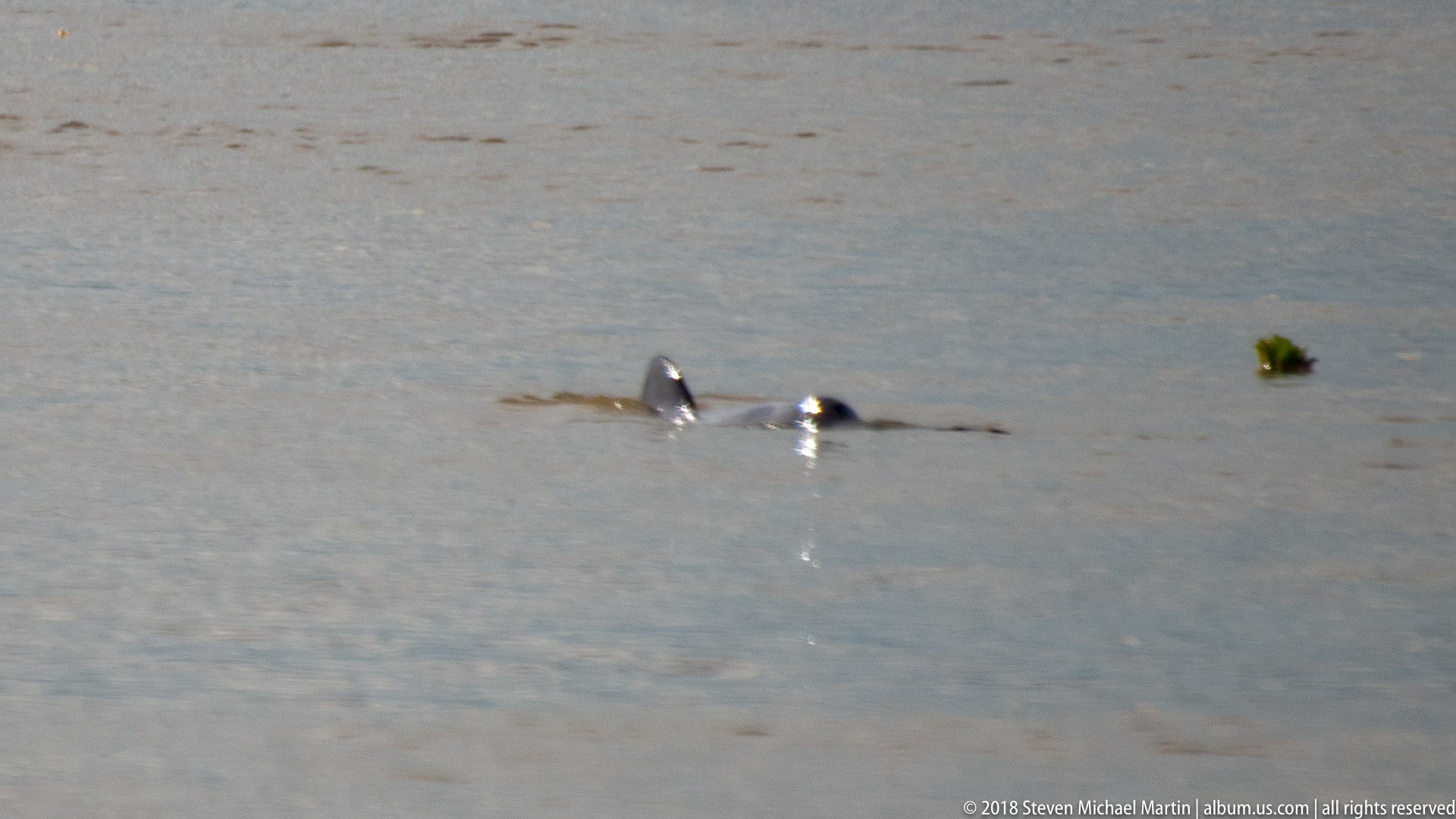
Two river dolphins surface close together, each exposing a small dark portion of the body above the Amazon River. Their paired appearance distinguishes this frame from the preceding solitary sightings, while a clump of floating vegetation drifts to the right. The brief surfacing moment is clear, although neither animal reveals enough anatomy for secure species identification.
Caption
Two river dolphins surface close together, each exposing a small dark portion of the body above the Amazon River. Their paired appearance distinguishes this frame from the preceding solitary sightings, while a clump of floating vegetation drifts to the right. The brief surfacing moment is clear, although neither animal reveals enough anatomy for secure species identification.
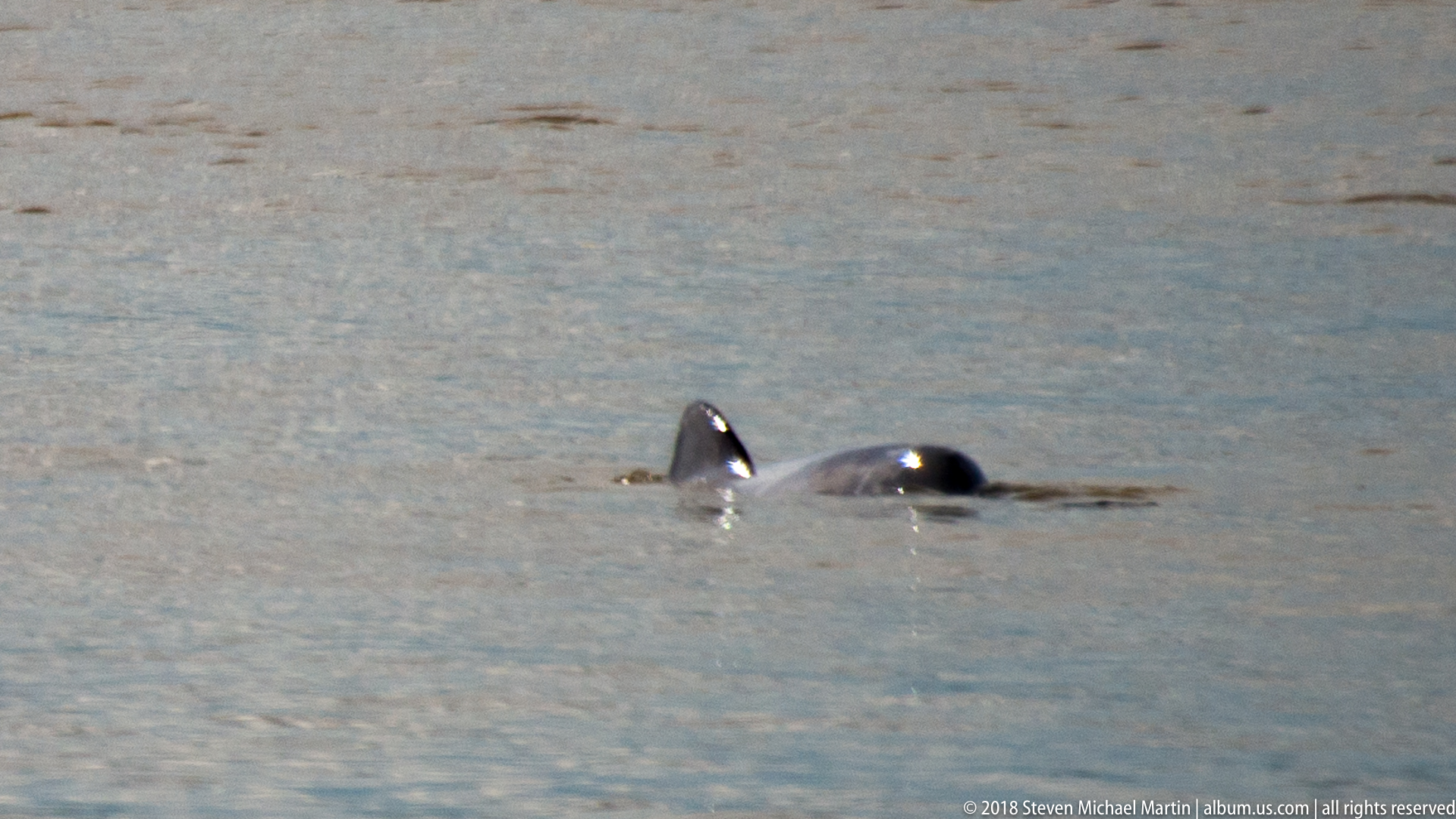
A pair of river dolphins rises side by side, their smooth rounded backs catching small highlights as they break the surface. One animal shows a narrow upright profile while the second forms a lower arc behind it. The tighter grouping provides a clearer sense of coordinated movement than the preceding frame, though species-specific features remain concealed by the water.
Caption
A pair of river dolphins rises side by side, their smooth rounded backs catching small highlights as they break the surface. One animal shows a narrow upright profile while the second forms a lower arc behind it. The tighter grouping provides a clearer sense of coordinated movement than the preceding frame, though species-specific features remain concealed by the water.
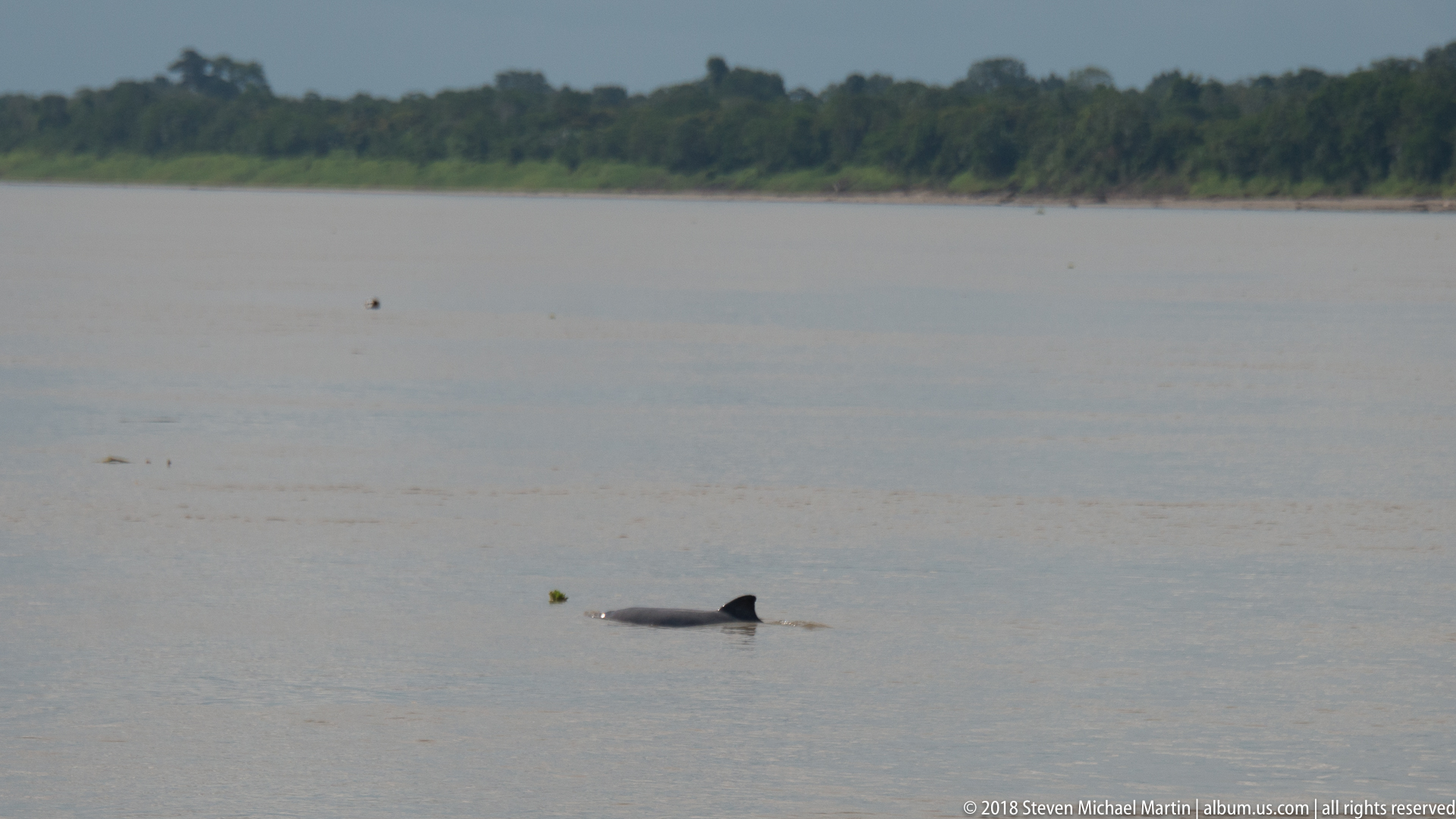
A distant river dolphin exposes its dorsal fin and a short section of back in open Amazon River water. The forested bank occupies only a narrow strip at the top of the frame, leaving the animal surrounded by the river's muted brown surface. This mid-distance view balances habitat context with a more readable surfacing profile.
Caption
A distant river dolphin exposes its dorsal fin and a short section of back in open Amazon River water. The forested bank occupies only a narrow strip at the top of the frame, leaving the animal surrounded by the river's muted brown surface. This mid-distance view balances habitat context with a more readable surfacing profile.

Two boys stand together near the river wearing white Peru national football jerseys with the team's red diagonal sash. One smiles broadly while the other looks directly toward the camera, with softly blurred water behind them. The portrait shifts the portfolio from wildlife to community life, recording the visual presence of national football culture along the Peruvian Amazon.
Caption
Two boys stand together near the river wearing white Peru national football jerseys with the team's red diagonal sash. One smiles broadly while the other looks directly toward the camera, with softly blurred water behind them. The portrait shifts the portfolio from wildlife to community life, recording the visual presence of national football culture along the Peruvian Amazon.

A riverboat worker rests his arm along the metal edge of an open-sided vessel, framed by worn equipment and the shaded interior behind him. The close viewpoint emphasizes the working environment rather than the boat's exterior: scuffed surfaces, mechanical controls, cables, and stored gear surround the seated figure. The portrait conveys the practical, heavily used character of local river transport.
Caption
A riverboat worker rests his arm along the metal edge of an open-sided vessel, framed by worn equipment and the shaded interior behind him. The close viewpoint emphasizes the working environment rather than the boat's exterior: scuffed surfaces, mechanical controls, cables, and stored gear surround the seated figure. The portrait conveys the practical, heavily used character of local river transport.
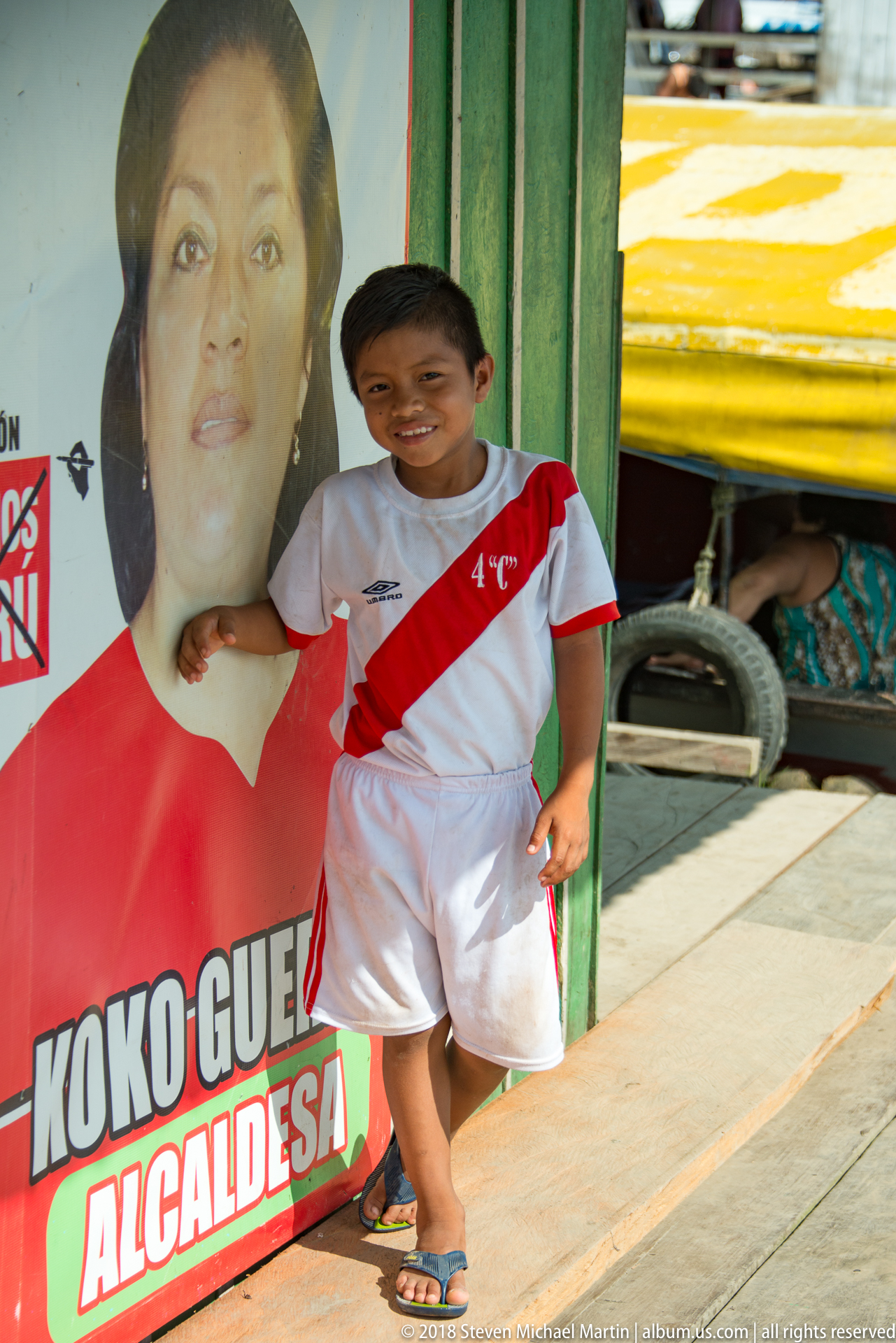
A boy in a white Peru football kit stands beside a large campaign poster reading “Koko Guerra Alcaldesa.” The candidate's portrait fills much of the sign behind him, creating a layered street-side image of childhood, football identity, and local political messaging. The photograph records the visible campaign material without inferring the office, election result, or the boy's relationship to the candidate.
Caption
A boy in a white Peru football kit stands beside a large campaign poster reading “Koko Guerra Alcaldesa.” The candidate's portrait fills much of the sign behind him, creating a layered street-side image of childhood, football identity, and local political messaging. The photograph records the visible campaign material without inferring the office, election result, or the boy's relationship to the candidate.
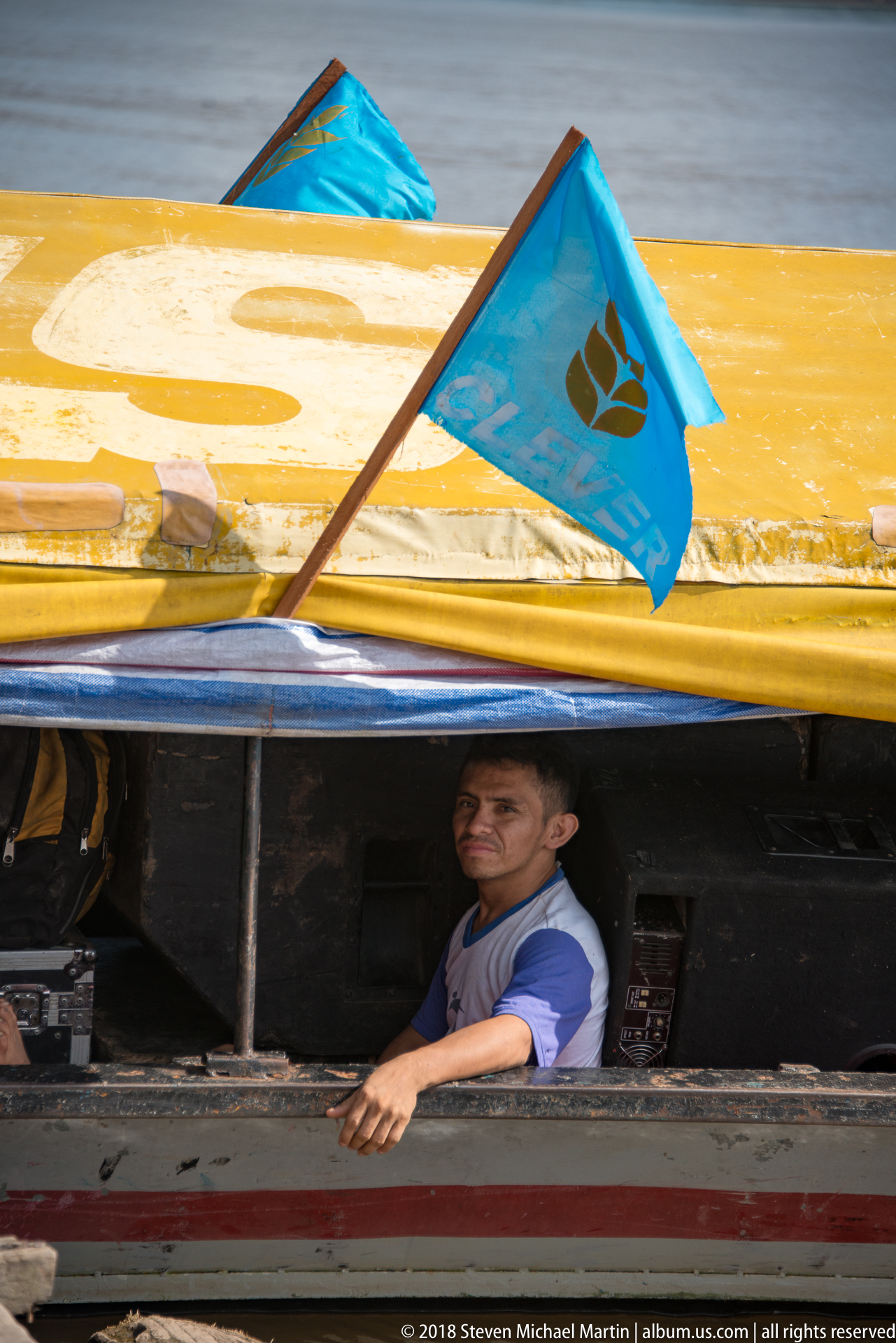
A man leans from the open side of a passenger boat beneath a yellow canopy, looking outward as blue flags flutter above the roofline. The close crop reveals the dark interior of the vessel and the practical open window used for ventilation and communication at the riverfront. It is a human-scale detail of the boats that serve settlements along the Peruvian Amazon.
Caption
A man leans from the open side of a passenger boat beneath a yellow canopy, looking outward as blue flags flutter above the roofline. The close crop reveals the dark interior of the vessel and the practical open window used for ventilation and communication at the riverfront. It is a human-scale detail of the boats that serve settlements along the Peruvian Amazon.

A Cristal beer can, shortened or crushed into a squat cylindrical form, rests on a worn green-painted wooden surface. The label retains the brand's red diagonal graphic, blue-and-gold Cristal emblem, and the phrase “La Cerveza del Perú.” Isolated at close range, the everyday object becomes a small material detail of the river journey and contemporary Peruvian consumer culture.
Caption
A Cristal beer can, shortened or crushed into a squat cylindrical form, rests on a worn green-painted wooden surface. The label retains the brand's red diagonal graphic, blue-and-gold Cristal emblem, and the phrase “La Cerveza del Perú.” Isolated at close range, the everyday object becomes a small material detail of the river journey and contemporary Peruvian consumer culture.
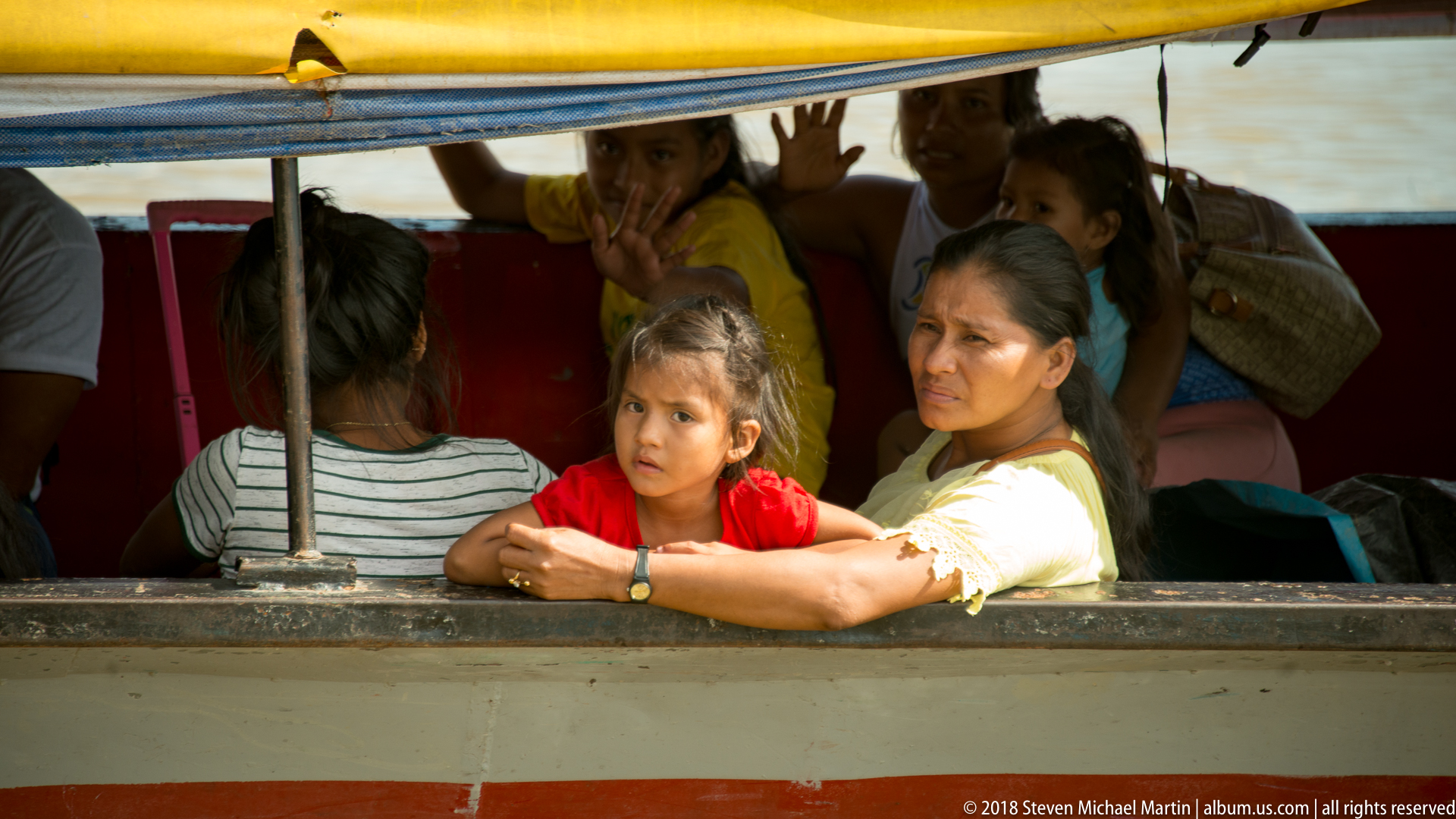
Passengers crowd the shaded interior of an open-sided riverboat, where a woman holds a young child at the window while other adults and children sit behind them. Several passengers look toward the camera and one child raises a hand. The close view records the social density of local river travel, with families sharing a compact cabin protected by the boat's low canopy.
Caption
Passengers crowd the shaded interior of an open-sided riverboat, where a woman holds a young child at the window while other adults and children sit behind them. Several passengers look toward the camera and one child raises a hand. The close view records the social density of local river travel, with families sharing a compact cabin protected by the boat's low canopy.

A weathered covered motor launch marked “JAGUAR” lies alongside the muddy bank at a small Amazon River landing. Its enclosed passenger cabin, patched paintwork, metal foredeck, and neighboring narrow boats show the practical mix of vessels used for everyday river transport. Buildings and additional craft occupy the steep, eroded shore behind the boat.
Caption
A weathered covered motor launch marked “JAGUAR” lies alongside the muddy bank at a small Amazon River landing. Its enclosed passenger cabin, patched paintwork, metal foredeck, and neighboring narrow boats show the practical mix of vessels used for everyday river transport. Buildings and additional craft occupy the steep, eroded shore behind the boat.
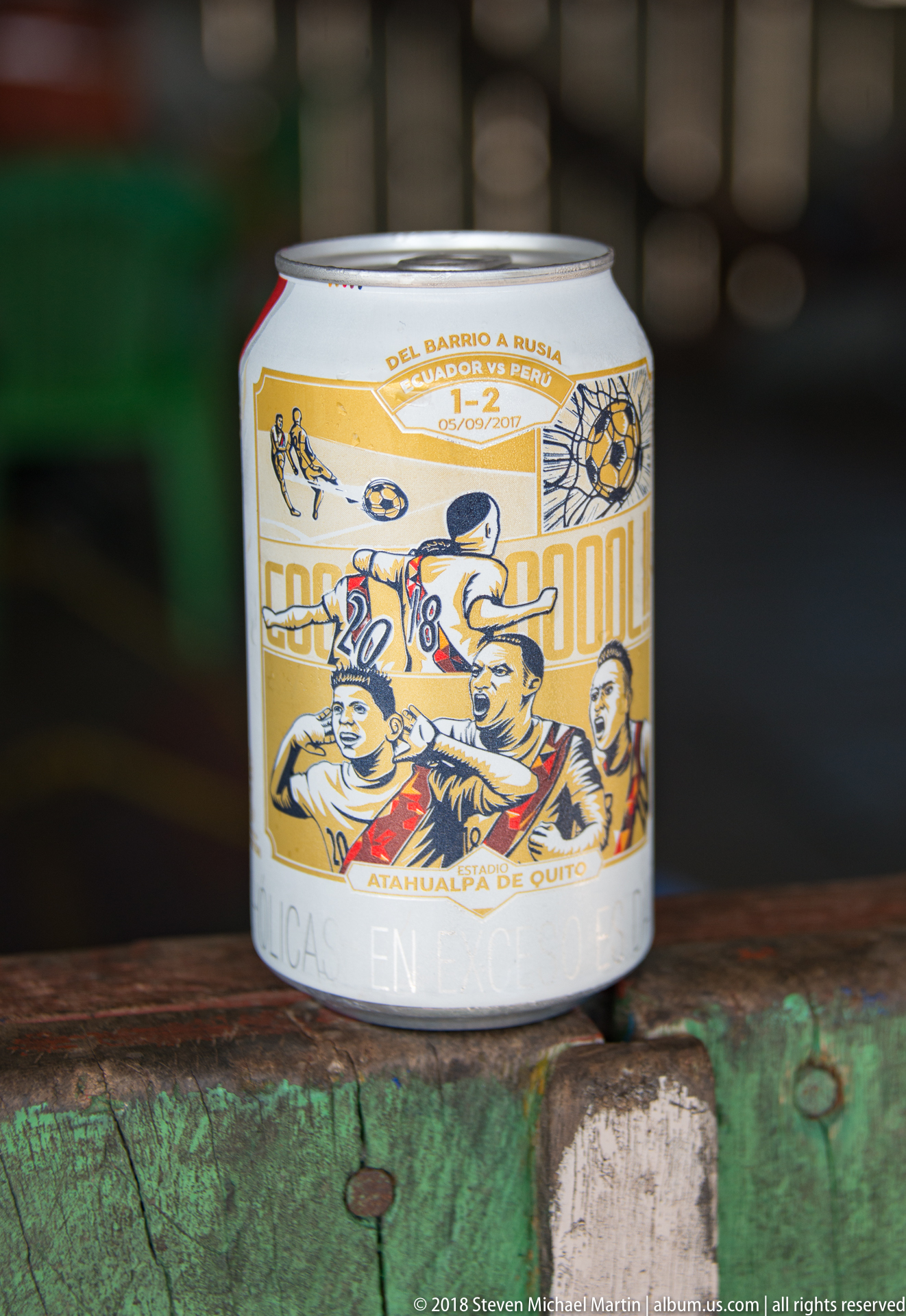
A small decorated beverage can sits on a worn green wooden ledge, covered with football-themed illustrations and Spanish promotional text referring to Russia and 2018. The design includes cartoon figures, a soccer ball, and celebratory graphics, tying the package to the 2018 World Cup moment. The underlying brand is not sufficiently legible in this proof-sheet view to identify confidently.
Caption
A small decorated beverage can sits on a worn green wooden ledge, covered with football-themed illustrations and Spanish promotional text referring to Russia and 2018. The design includes cartoon figures, a soccer ball, and celebratory graphics, tying the package to the 2018 World Cup moment. The underlying brand is not sufficiently legible in this proof-sheet view to identify confidently.
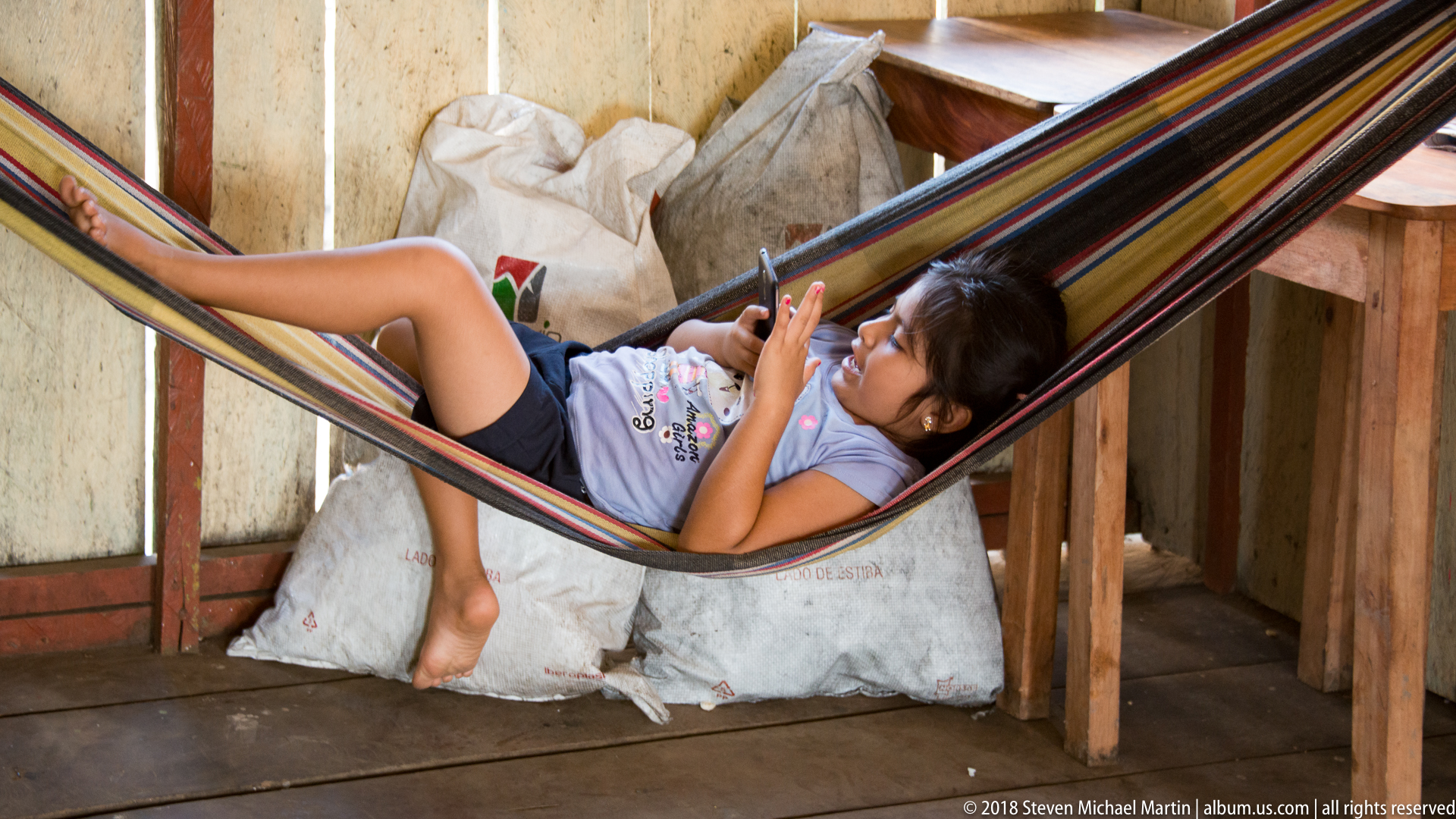
A young girl reclines diagonally across a brightly striped hammock inside a simple wooden interior, absorbed in a handheld electronic device. Sacks are stacked beneath and behind the hammock, while a plain table and plank walls frame the domestic scene. The informal arrangement suggests a resting place integrated into a working or household space near the river.
Caption
A young girl reclines diagonally across a brightly striped hammock inside a simple wooden interior, absorbed in a handheld electronic device. Sacks are stacked beneath and behind the hammock, while a plain table and plank walls frame the domestic scene. The informal arrangement suggests a resting place integrated into a working or household space near the river.
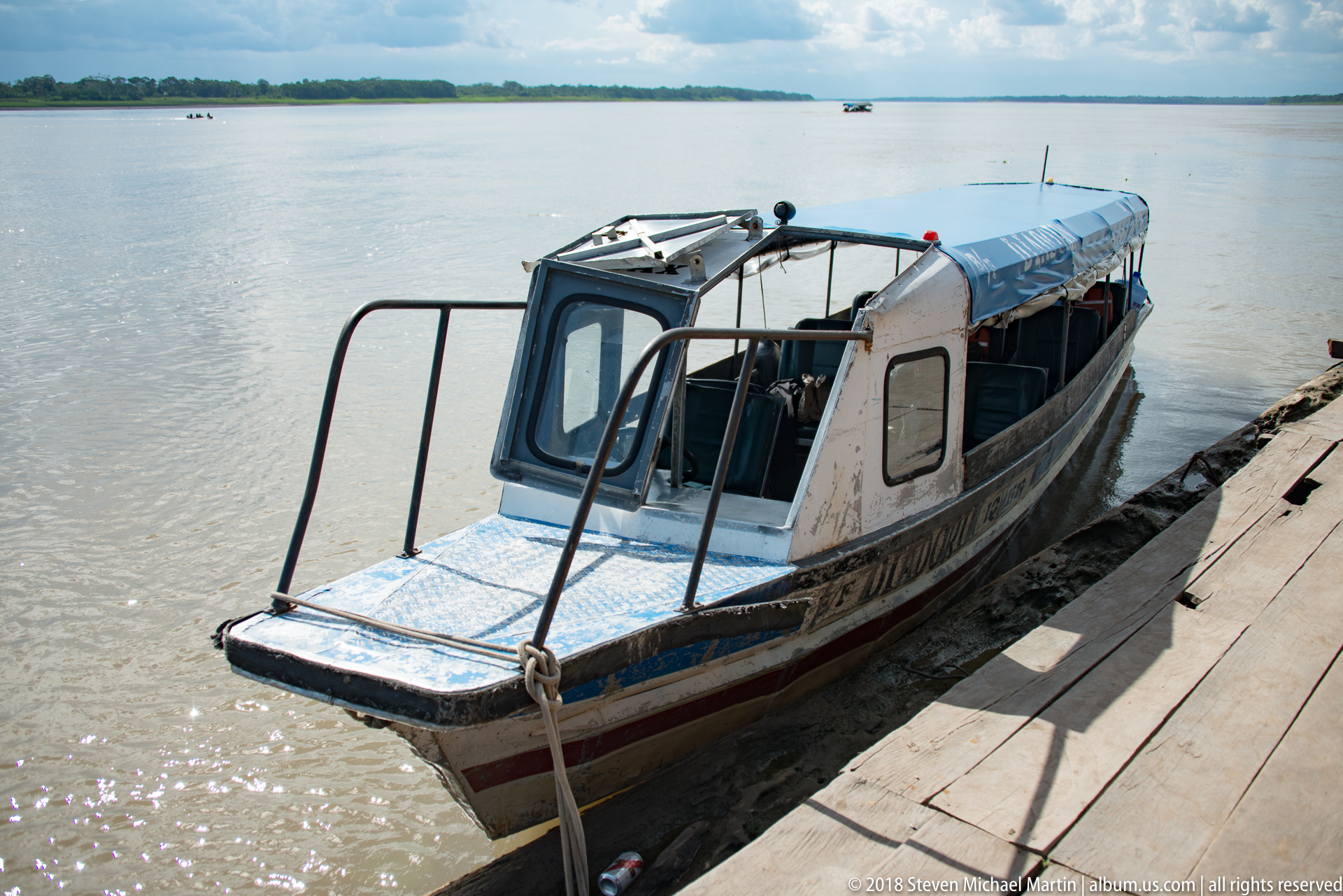
A compact cabin-style motorboat is tied directly to a wooden riverside landing, its bow platform and protective railings facing the camera. The enclosed wheelhouse and covered passenger area distinguish it from the narrow open canoes seen nearby in the portfolio. Open water and a low forested shoreline stretch across the background under a broad sky.
Caption
A compact cabin-style motorboat is tied directly to a wooden riverside landing, its bow platform and protective railings facing the camera. The enclosed wheelhouse and covered passenger area distinguish it from the narrow open canoes seen nearby in the portfolio. Open water and a low forested shoreline stretch across the background under a broad sky.
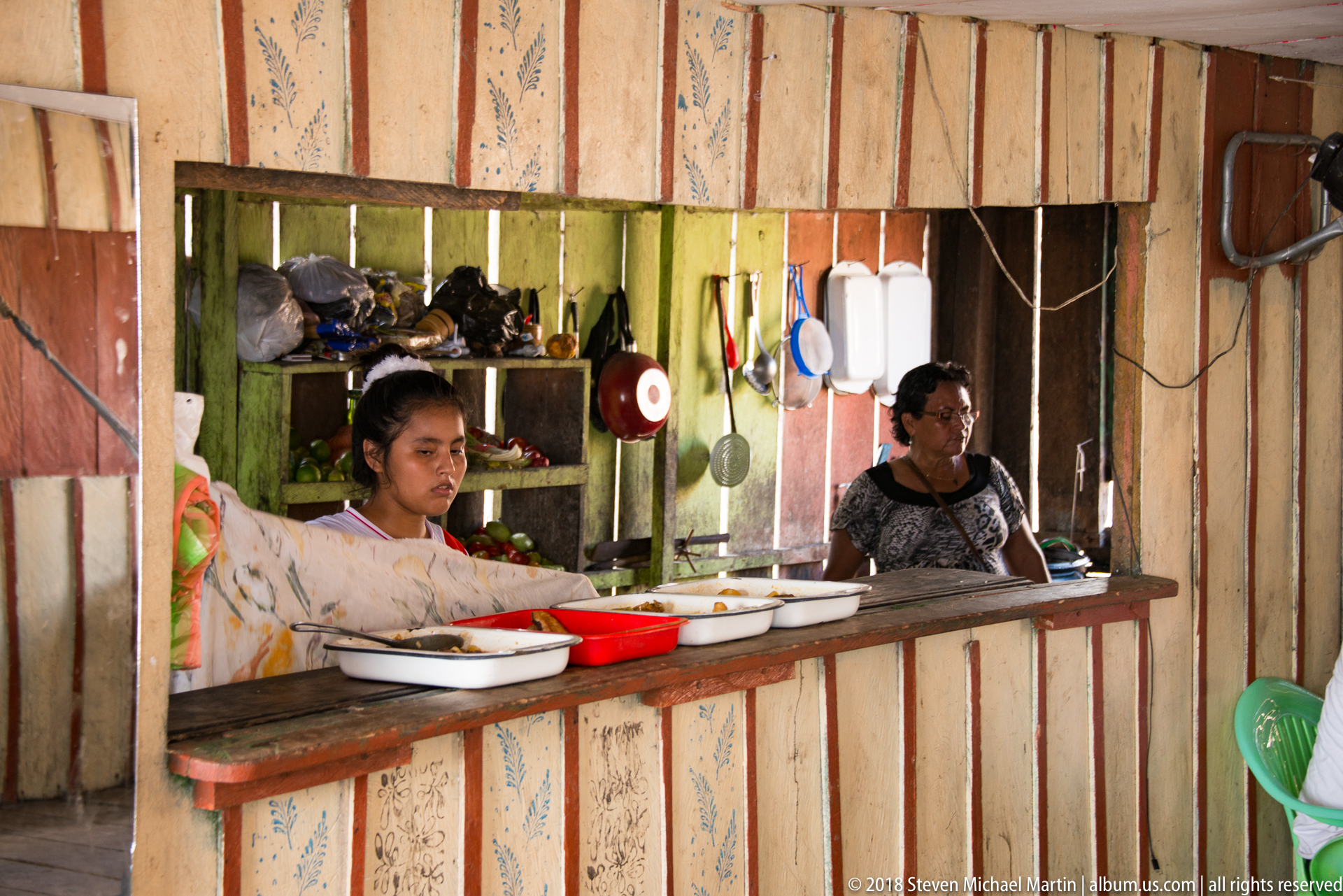
Two women stand behind the open counter of a rustic wooden food stall, where bowls, pans, and cooking utensils are arranged across the serving surface and rear wall. Mismatched boards and patterned wall panels give the interior a handmade character. The close view records everyday commerce and food preparation within a small Amazon River community.
Caption
Two women stand behind the open counter of a rustic wooden food stall, where bowls, pans, and cooking utensils are arranged across the serving surface and rear wall. Mismatched boards and patterned wall panels give the interior a handmade character. The close view records everyday commerce and food preparation within a small Amazon River community.
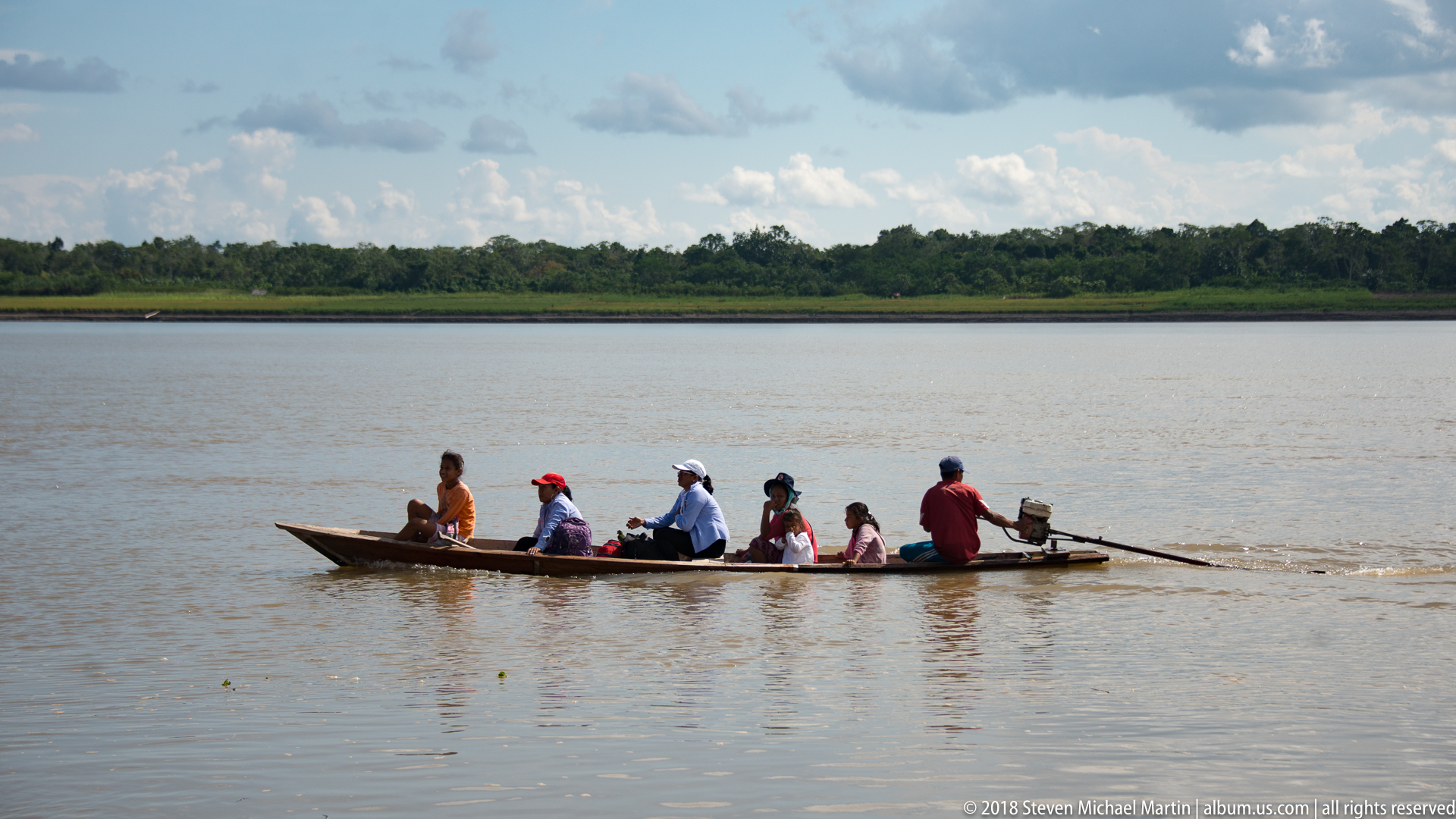
A long wooden canoe carrying several passengers travels across open Amazon River water, leaving a faint wake behind the stern. Viewed from farther away than the preceding close scene, the boat appears small against the broad channel and continuous green bank. The composition stresses the scale of routine river travel within a landscape where waterways function as primary transportation routes.
Caption
A long wooden canoe carrying several passengers travels across open Amazon River water, leaving a faint wake behind the stern. Viewed from farther away than the preceding close scene, the boat appears small against the broad channel and continuous green bank. The composition stresses the scale of routine river travel within a landscape where waterways function as primary transportation routes.
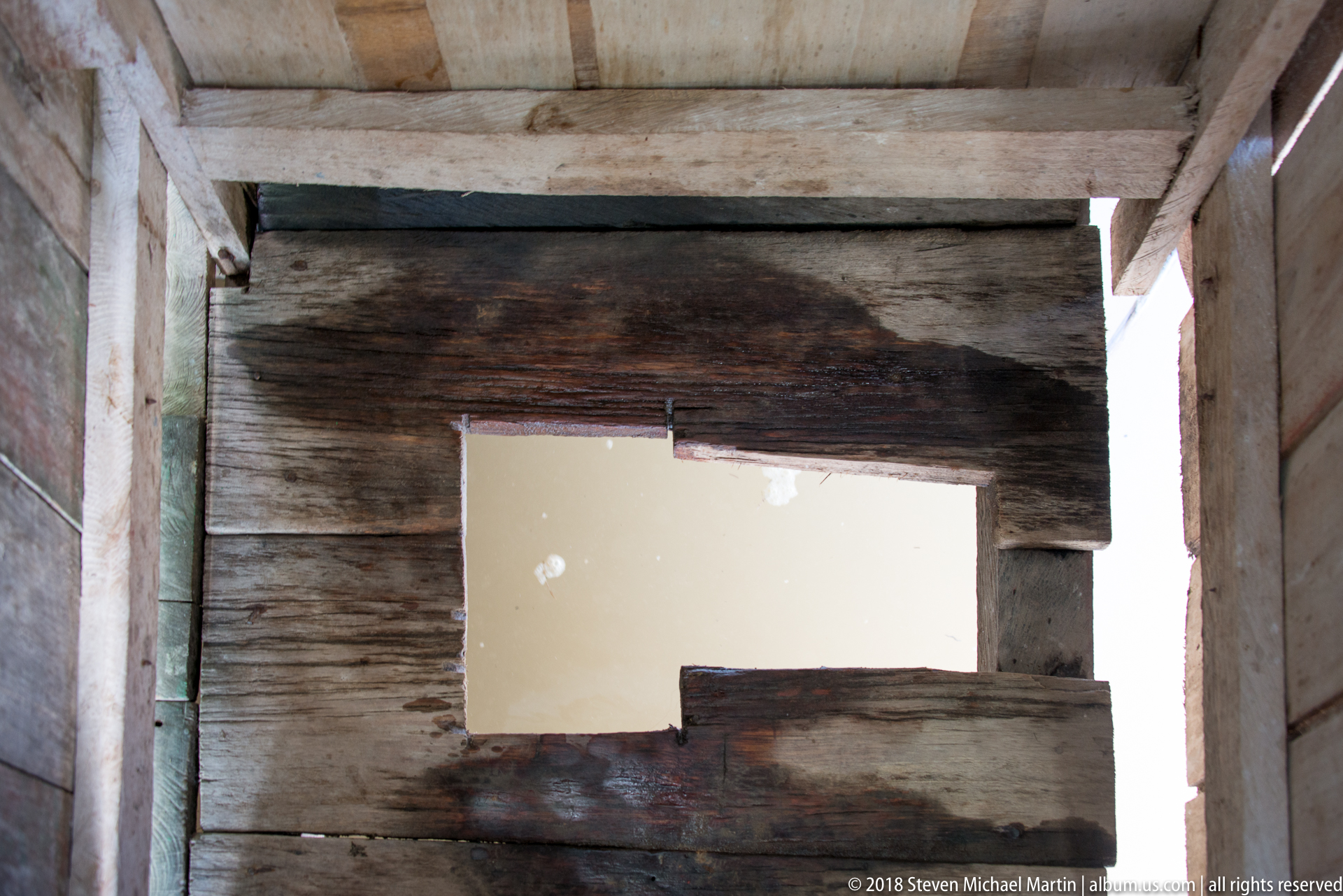
Rough, dark wooden planks form an irregular rectangular opening in the wall of a riverside structure, revealing pale river water beyond. The close framing concentrates on the uneven boards, heavy beams, weathered surfaces, and improvised construction rather than on the larger building. Light entering through the opening sharply contrasts with the shadowed timber interior.
Caption
Rough, dark wooden planks form an irregular rectangular opening in the wall of a riverside structure, revealing pale river water beyond. The close framing concentrates on the uneven boards, heavy beams, weathered surfaces, and improvised construction rather than on the larger building. Light entering through the opening sharply contrasts with the shadowed timber interior.
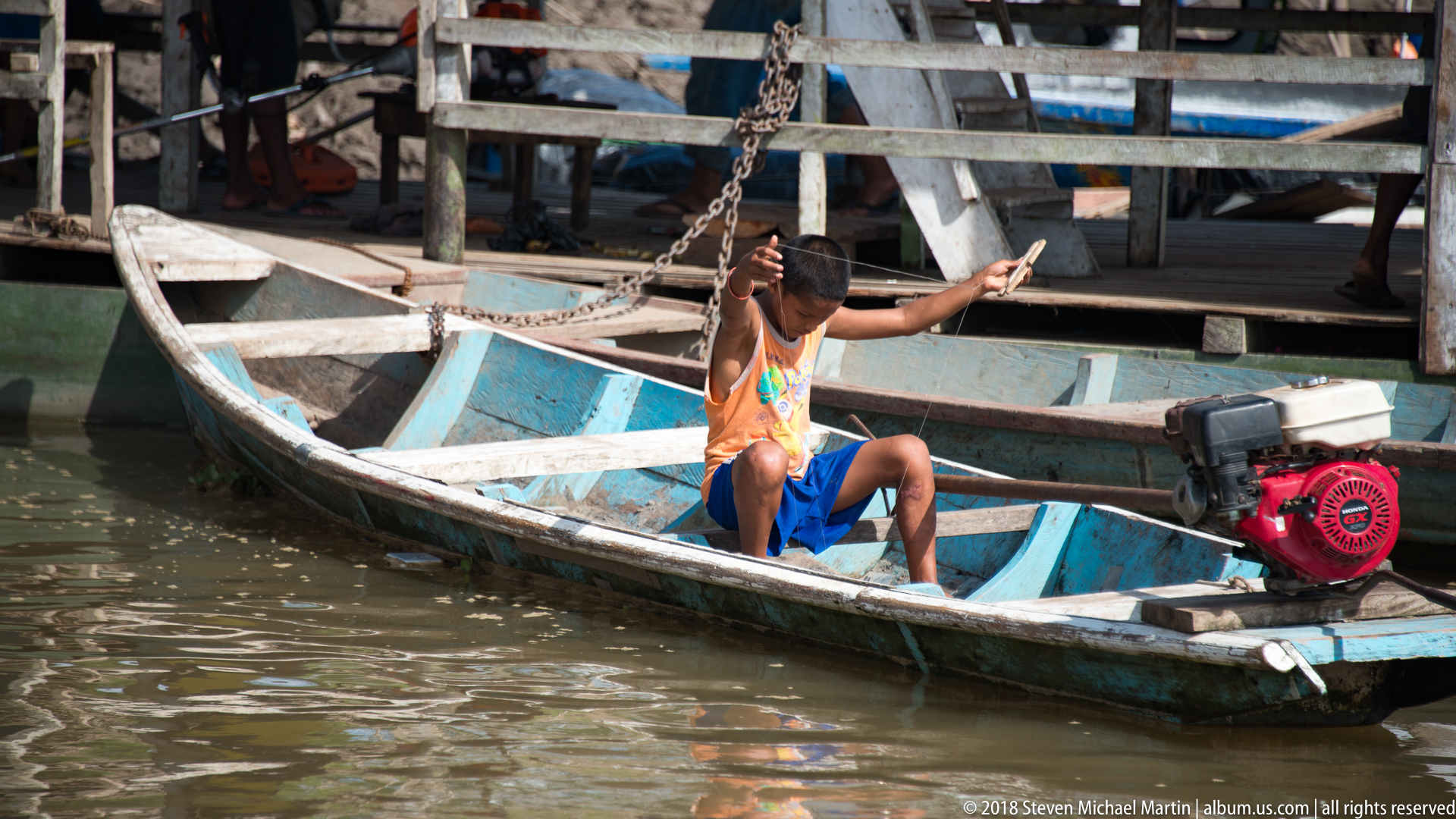
A man sits low in a narrow wooden canoe fitted with an exposed red gasoline engine, guiding the craft alongside a larger riverside landing. Chains, timber beams, and neighboring boats crowd the background, placing the small vessel within a busy working waterfront. The photograph offers a close look at the compact machinery used to propel local river craft.
Caption
A man sits low in a narrow wooden canoe fitted with an exposed red gasoline engine, guiding the craft alongside a larger riverside landing. Chains, timber beams, and neighboring boats crowd the background, placing the small vessel within a busy working waterfront. The photograph offers a close look at the compact machinery used to propel local river craft.
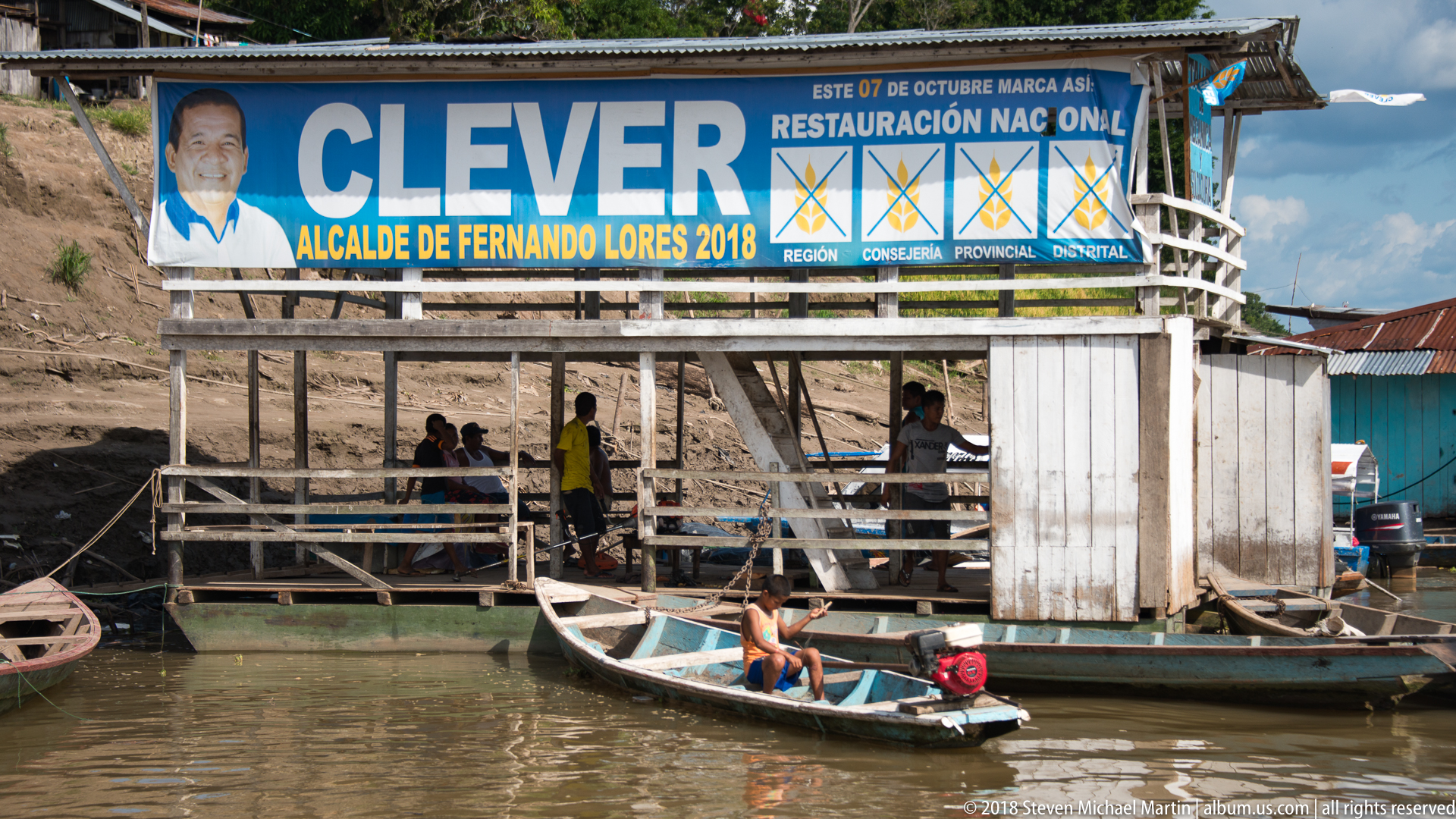
A stilted wooden waterfront structure stands above the river beneath a large political sign reading “CLEVER” and “ALCALDE DE FERNANDO LORES 2018.” People gather in the shaded lower level while a small motorized canoe passes in front. The layered scene combines campaign advertising, informal architecture, and daily river traffic along the settlement edge.
Caption
A stilted wooden waterfront structure stands above the river beneath a large political sign reading “CLEVER” and “ALCALDE DE FERNANDO LORES 2018.” People gather in the shaded lower level while a small motorized canoe passes in front. The layered scene combines campaign advertising, informal architecture, and daily river traffic along the settlement edge.
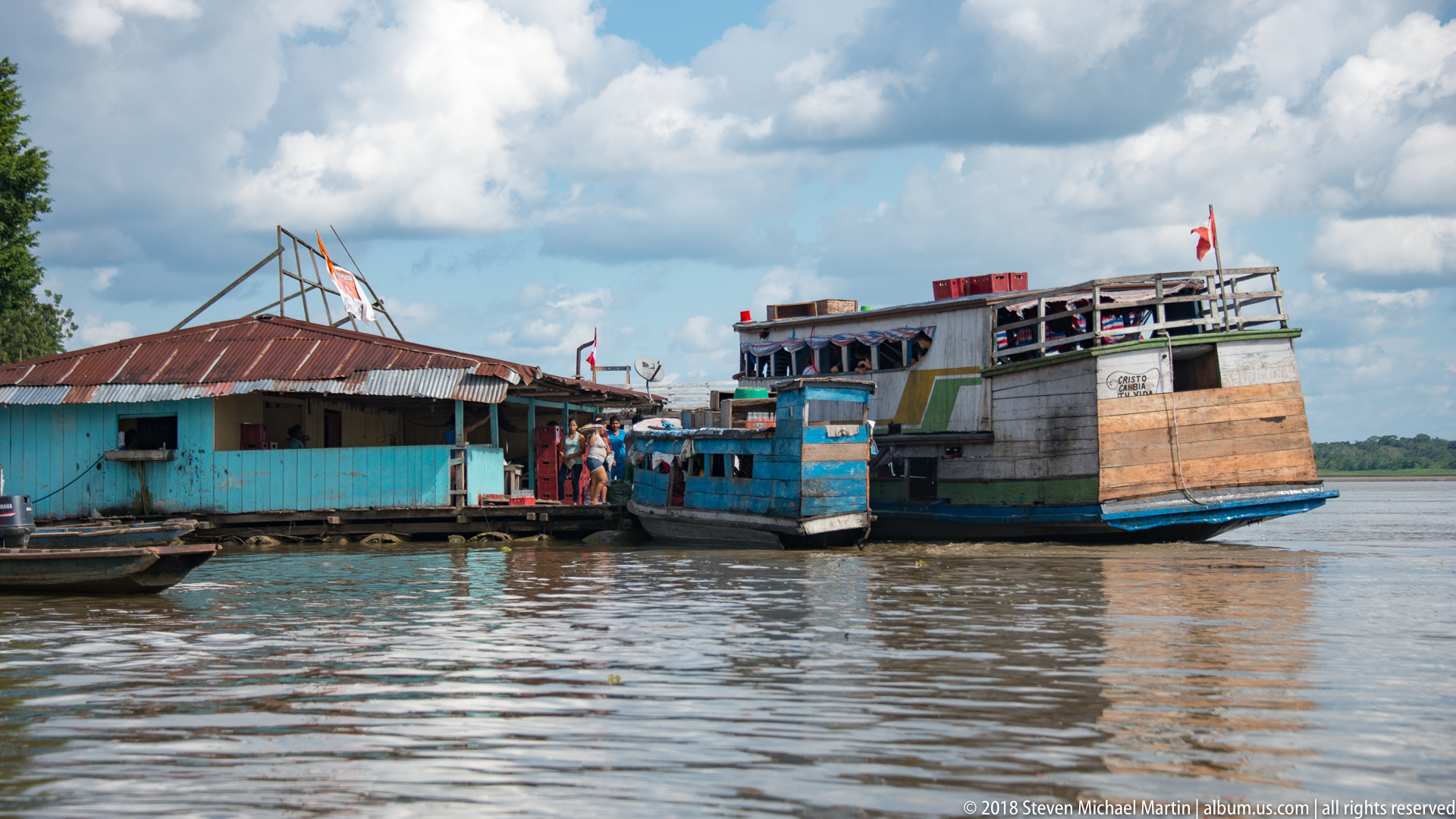
Two large, boxy riverboats are moored alongside a low wooden building at the settlement’s edge. Their high superstructures, broad hulls, and layered decks contrast with the smaller canoes used for short local journeys. Red-and-white flags rise above the waterfront, while figures near the landing provide scale for the substantial vessels and improvised shore facilities.
Caption
Two large, boxy riverboats are moored alongside a low wooden building at the settlement’s edge. Their high superstructures, broad hulls, and layered decks contrast with the smaller canoes used for short local journeys. Red-and-white flags rise above the waterfront, while figures near the landing provide scale for the substantial vessels and improvised shore facilities.
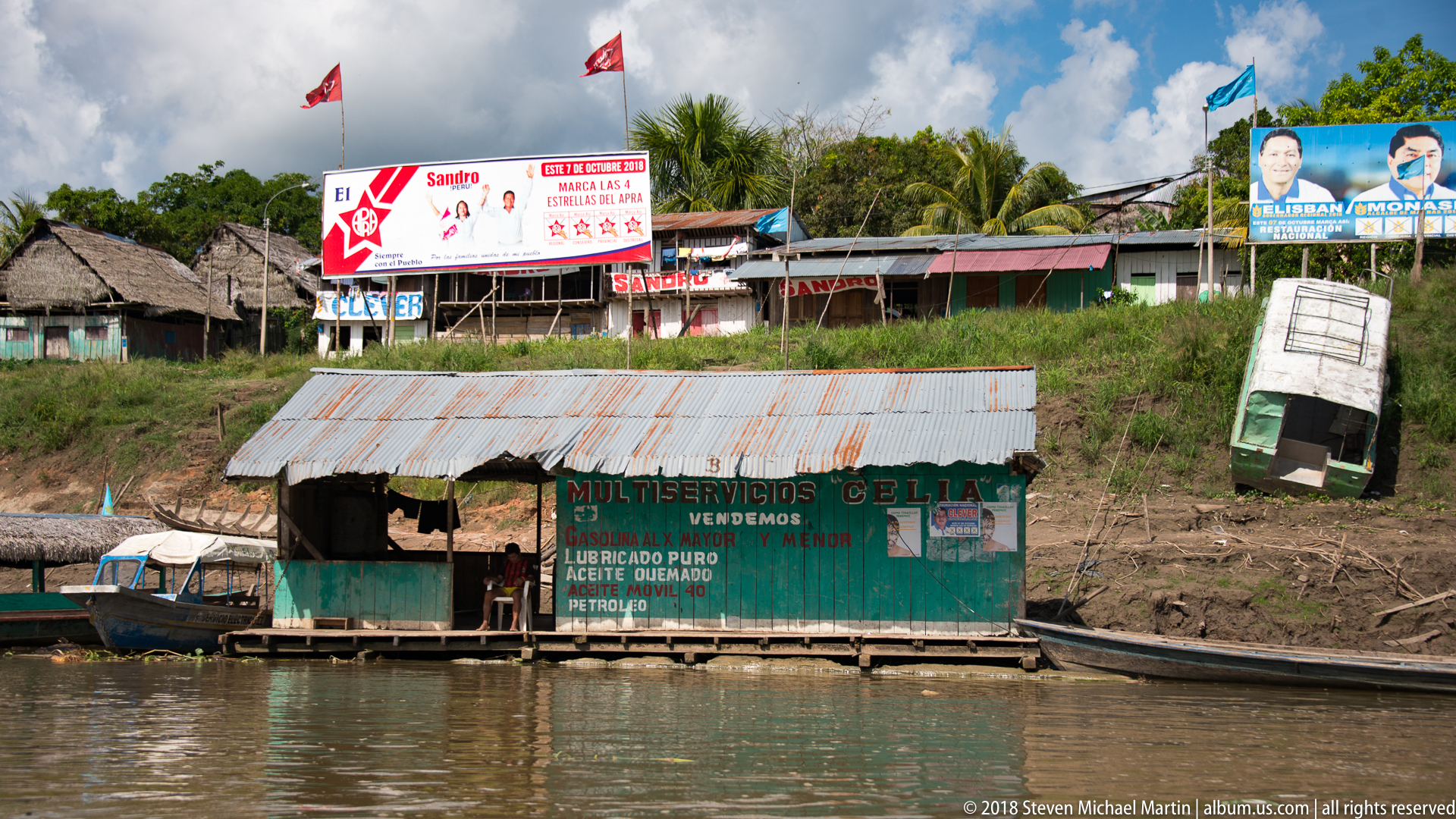
A small riverside structure with a corrugated-metal roof carries the painted words “MULTISERVICIOS CELIA,” with smaller service listings covering its green wall. Behind it, larger red, blue, and white political signs rise along the bank. Boats tied at the waterline and the steep exposed slope connect this modest business directly to river traffic and the settlement above.
Caption
A small riverside structure with a corrugated-metal roof carries the painted words “MULTISERVICIOS CELIA,” with smaller service listings covering its green wall. Behind it, larger red, blue, and white political signs rise along the bank. Boats tied at the waterline and the steep exposed slope connect this modest business directly to river traffic and the settlement above.
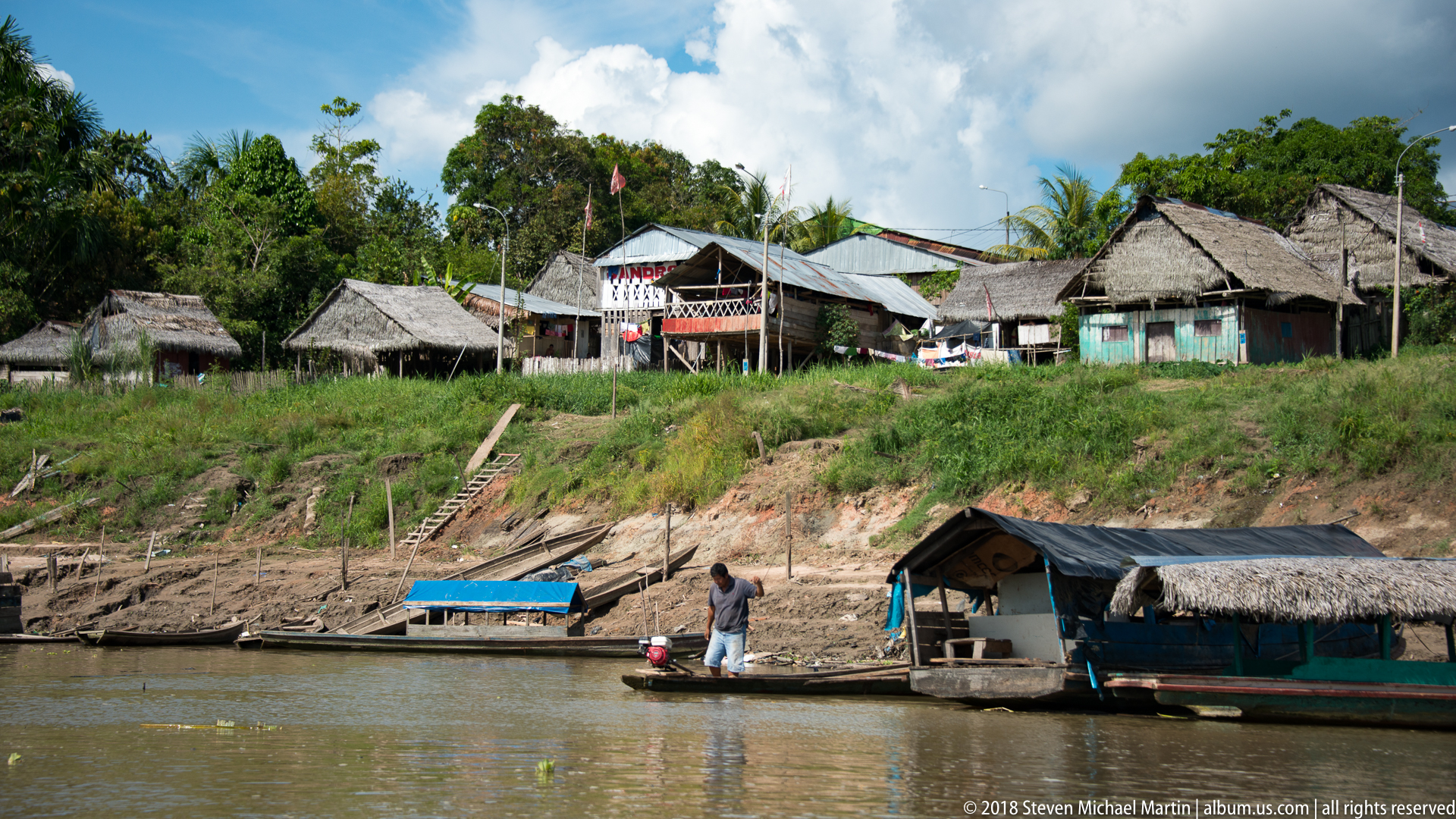
Timber houses and thatch-roofed dwellings line the top of a steep, eroded Amazon River bank, with several small boats moored below. A person stands at the water’s edge beside one craft, linking the elevated settlement to its river access. The mixture of raised wooden construction, metal roofing, palm thatch, and exposed soil records the varied building fabric of the community.
Caption
Timber houses and thatch-roofed dwellings line the top of a steep, eroded Amazon River bank, with several small boats moored below. A person stands at the water’s edge beside one craft, linking the elevated settlement to its river access. The mixture of raised wooden construction, metal roofing, palm thatch, and exposed soil records the varied building fabric of the community.
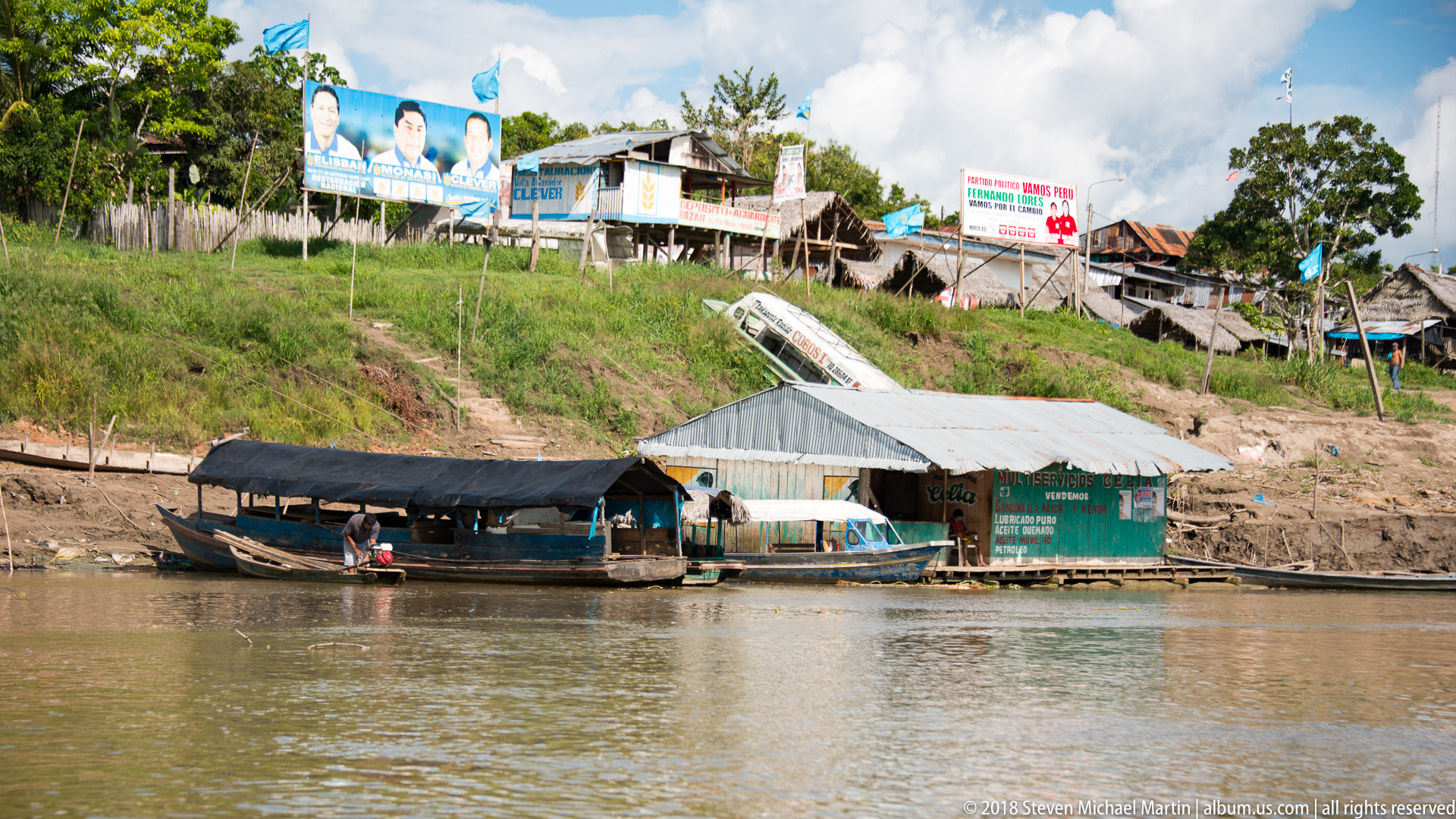
A long covered riverboat and a low green waterfront building sit at the base of a steep bank crowned by houses and political advertisements. Additional craft are pulled up the slope or tied along the water. The view compresses transport, commerce, domestic architecture, and campaign messaging into a single section of the Amazon River settlement.
Caption
A long covered riverboat and a low green waterfront building sit at the base of a steep bank crowned by houses and political advertisements. Additional craft are pulled up the slope or tied along the water. The view compresses transport, commerce, domestic architecture, and campaign messaging into a single section of the Amazon River settlement.
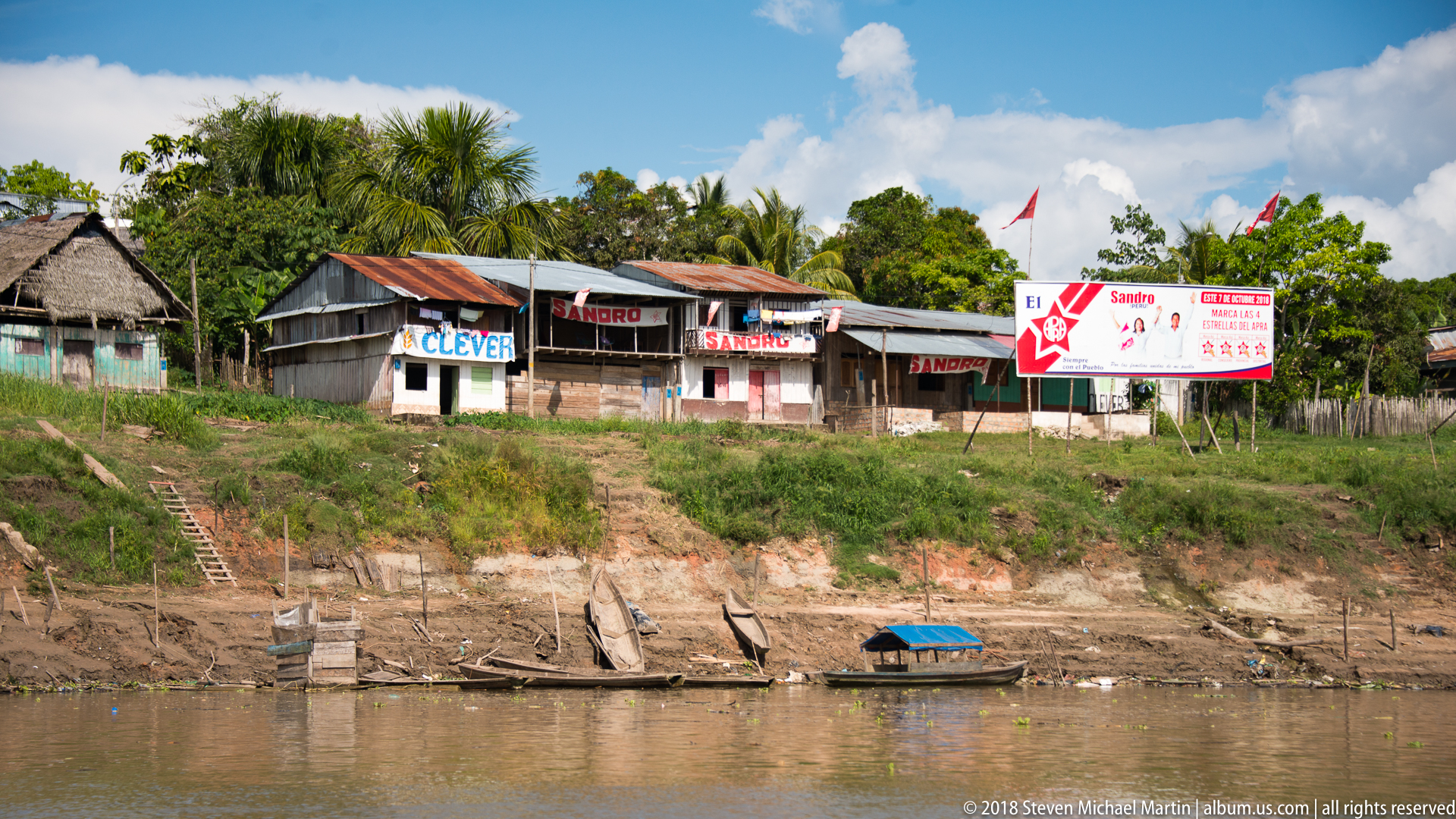
Riverside houses above the exposed bank have been turned into large campaign surfaces, with façades and signs prominently marked “CLEVER” and “SANDRO.” A red-and-white billboard dominates the right side while ladders, rough steps, and a small boat lead down toward the water. The scene shows electoral graphics integrated directly into the built fabric of the settlement.
Caption
Riverside houses above the exposed bank have been turned into large campaign surfaces, with façades and signs prominently marked “CLEVER” and “SANDRO.” A red-and-white billboard dominates the right side while ladders, rough steps, and a small boat lead down toward the water. The scene shows electoral graphics integrated directly into the built fabric of the settlement.
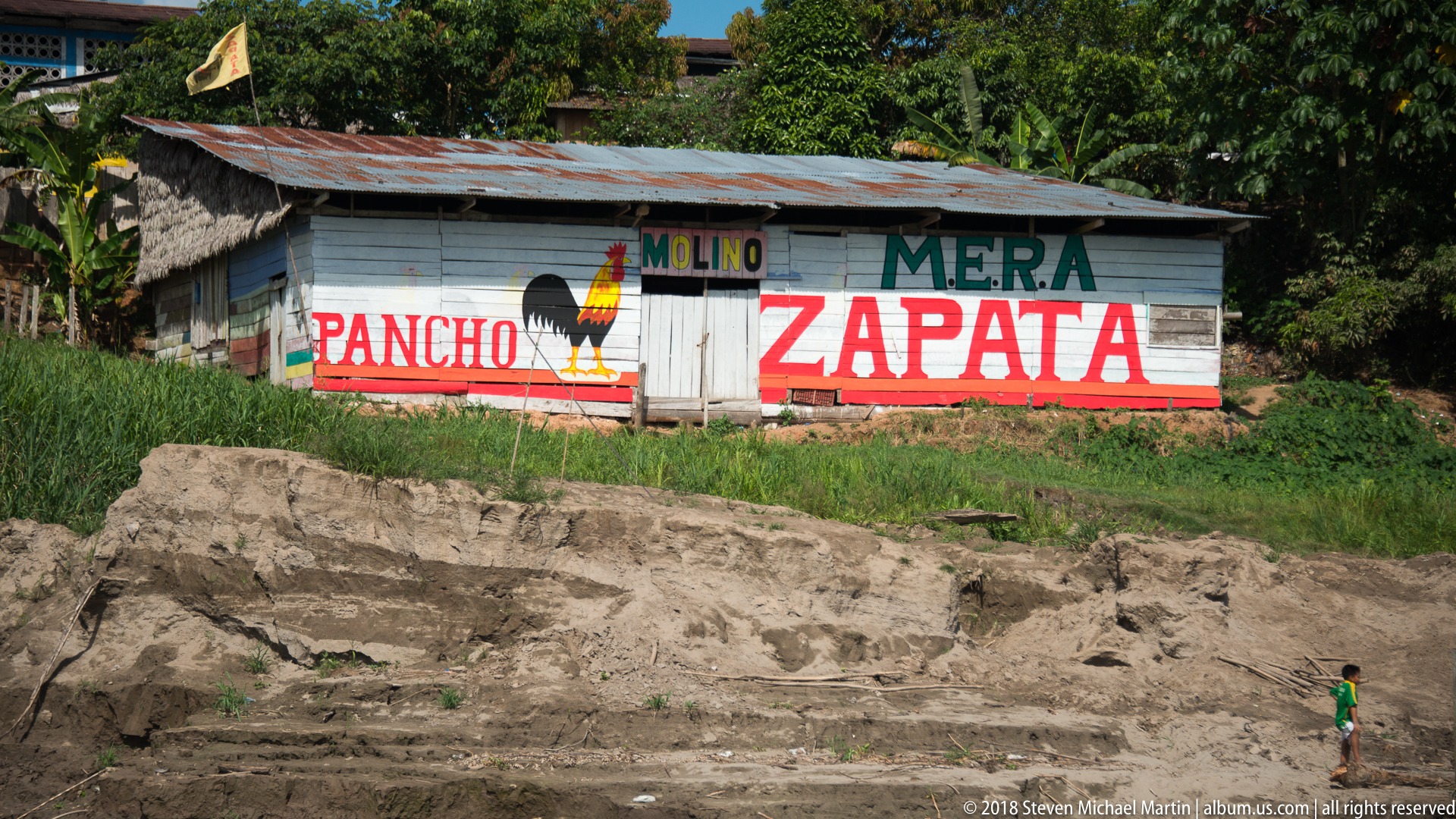
A long wooden riverside building is painted with bold red and green lettering reading “MOLINO MERA,” “PANCHO,” and “ZAPATA,” accompanied by a rooster emblem. The graphic treatment transforms the pale plank façade into a highly visible sign facing the river. An eroded sandy slope fills the foreground, emphasizing the building’s position above the fluctuating waterline.
Caption
A long wooden riverside building is painted with bold red and green lettering reading “MOLINO MERA,” “PANCHO,” and “ZAPATA,” accompanied by a rooster emblem. The graphic treatment transforms the pale plank façade into a highly visible sign facing the river. An eroded sandy slope fills the foreground, emphasizing the building’s position above the fluctuating waterline.
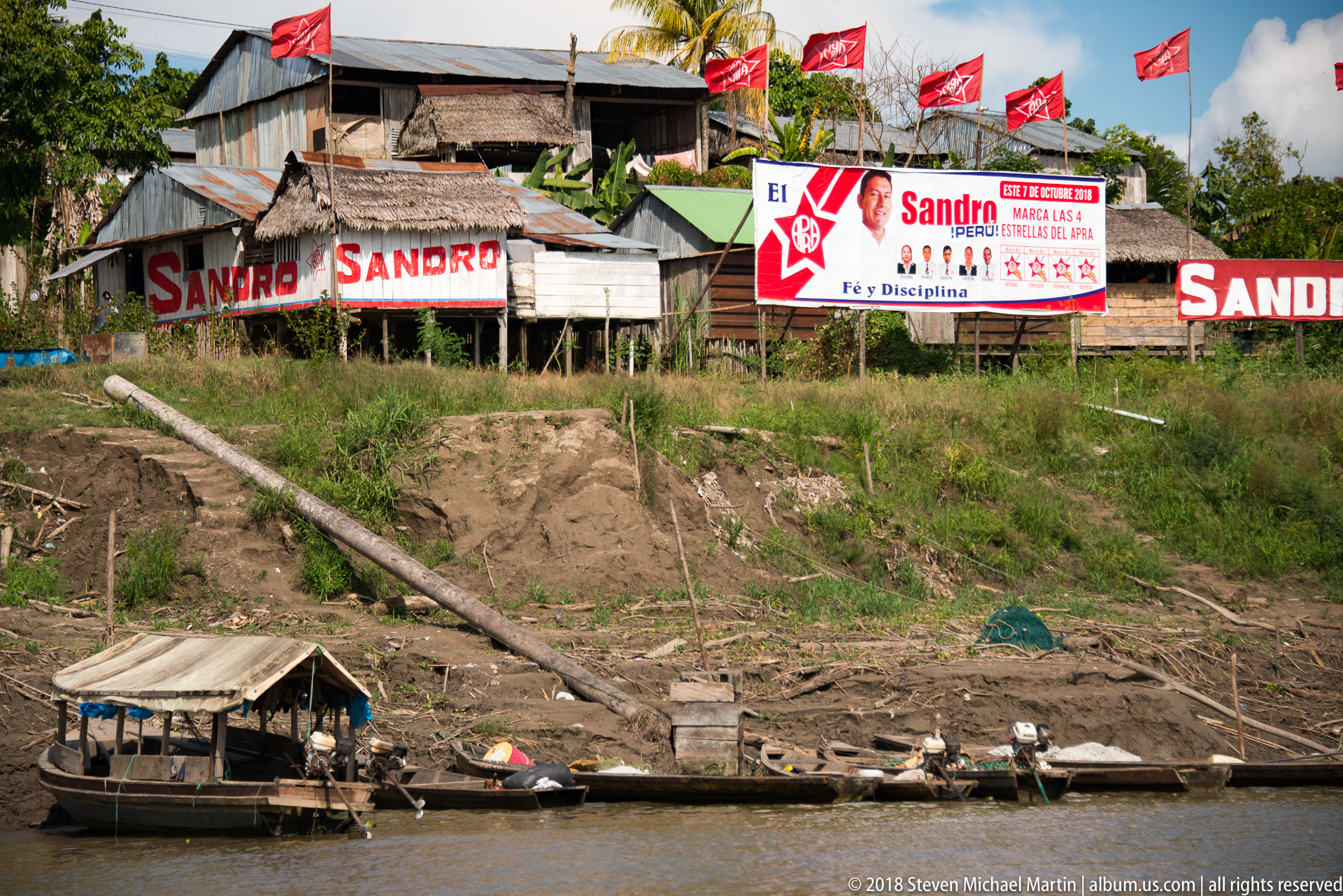
Red “SANDRO” lettering, flags, and a large candidate billboard cover a cluster of wooden buildings above the riverbank. The repetition of the name across façades and banners creates a concentrated political display visible from the water. At the bottom of the slope, narrow boats and a small roofed craft remain tied along the muddy shoreline.
Caption
Red “SANDRO” lettering, flags, and a large candidate billboard cover a cluster of wooden buildings above the riverbank. The repetition of the name across façades and banners creates a concentrated political display visible from the water. At the bottom of the slope, narrow boats and a small roofed craft remain tied along the muddy shoreline.
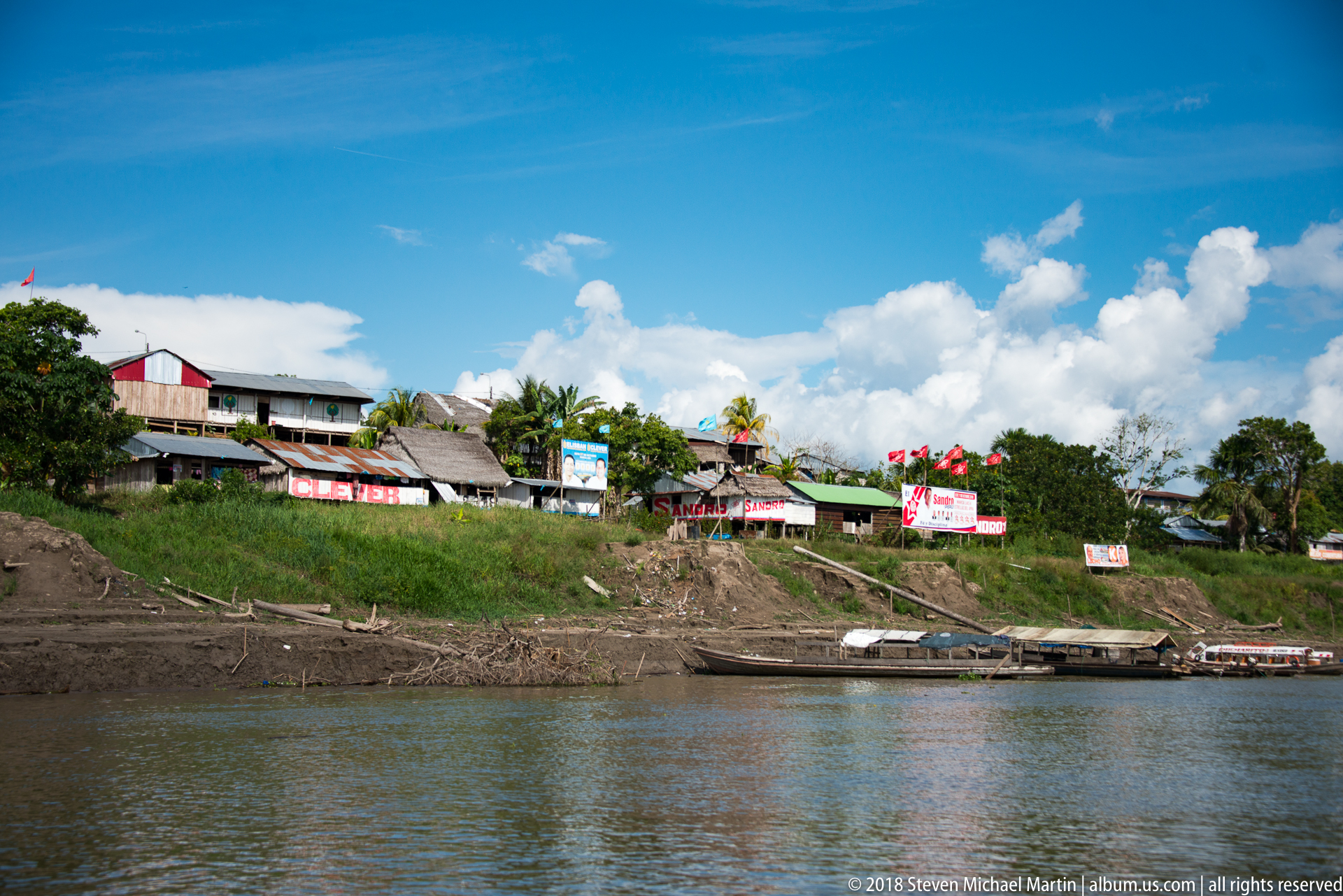
A broad view across the river places the settlement along a low, uneven bank beneath a vivid blue sky. Houses, small businesses, and political signs form a thin band above the grass and exposed soil, while boats and a landing occupy the waterline. The distant perspective clarifies the settlement’s linear relationship to the river better than the closer campaign-sign views.
Caption
A broad view across the river places the settlement along a low, uneven bank beneath a vivid blue sky. Houses, small businesses, and political signs form a thin band above the grass and exposed soil, while boats and a landing occupy the waterline. The distant perspective clarifies the settlement’s linear relationship to the river better than the closer campaign-sign views.
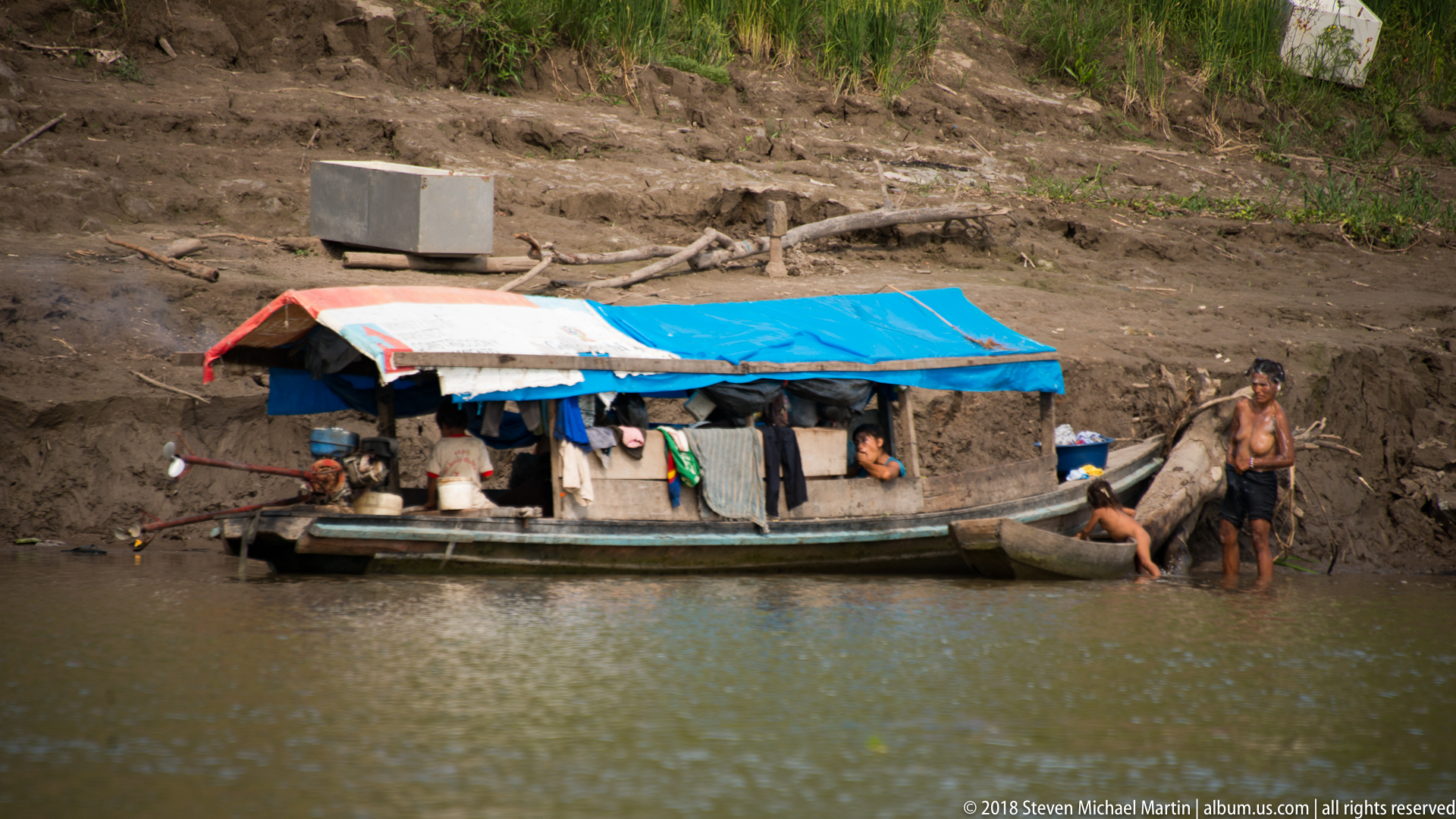
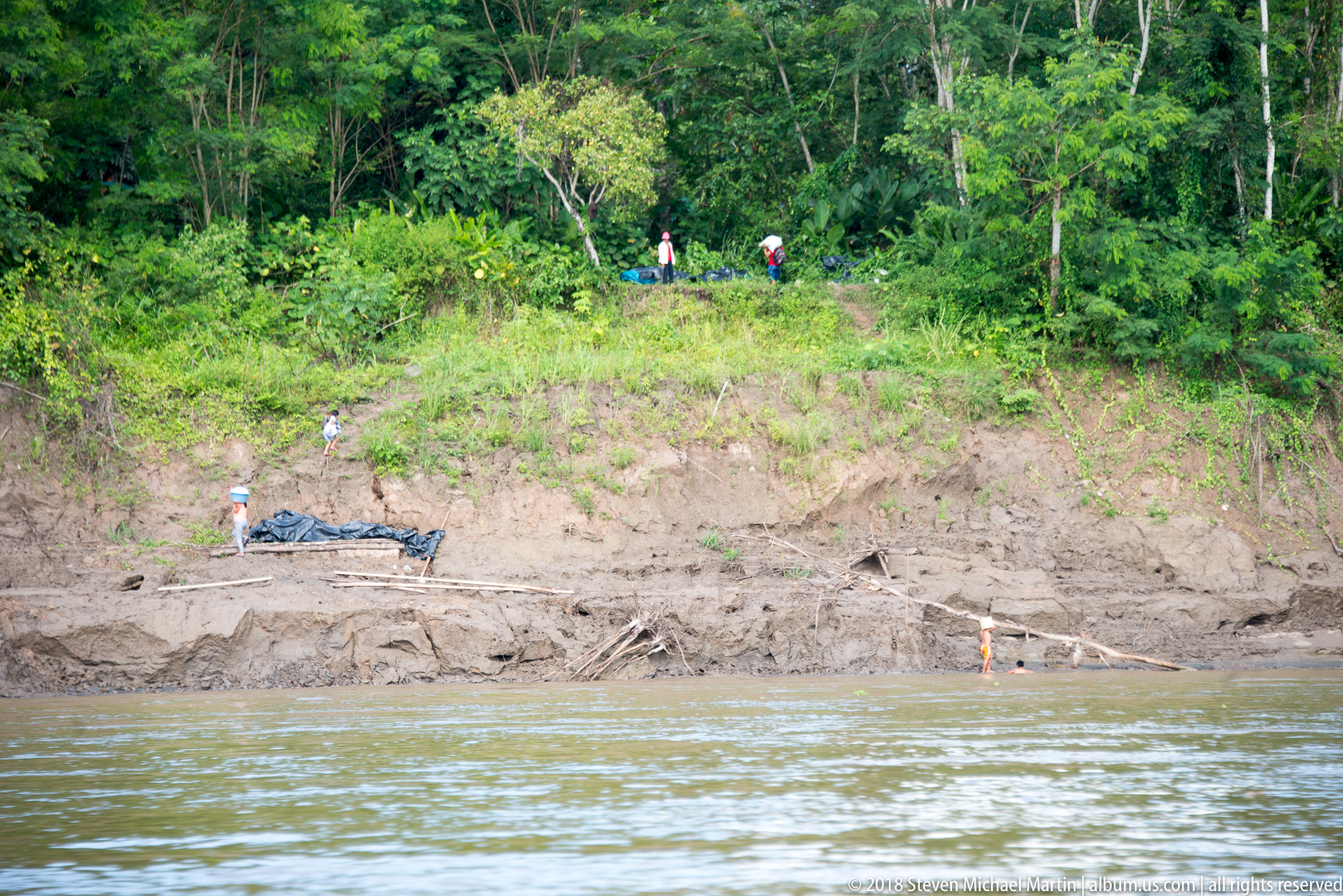
A small wooden river craft sits close to the muddy bank beneath improvised blue and white tarpaulin roofing. Clothing, containers, and household or working items hang beneath the shelter while several people occupy the boat and shoreline beside it. The compact vessel appears adapted for extended everyday use rather than simply for carrying seated passengers.
Caption
A small wooden river craft sits close to the muddy bank beneath improvised blue and white tarpaulin roofing. Clothing, containers, and household or working items hang beneath the shelter while several people occupy the boat and shoreline beside it. The compact vessel appears adapted for extended everyday use rather than simply for carrying seated passengers.
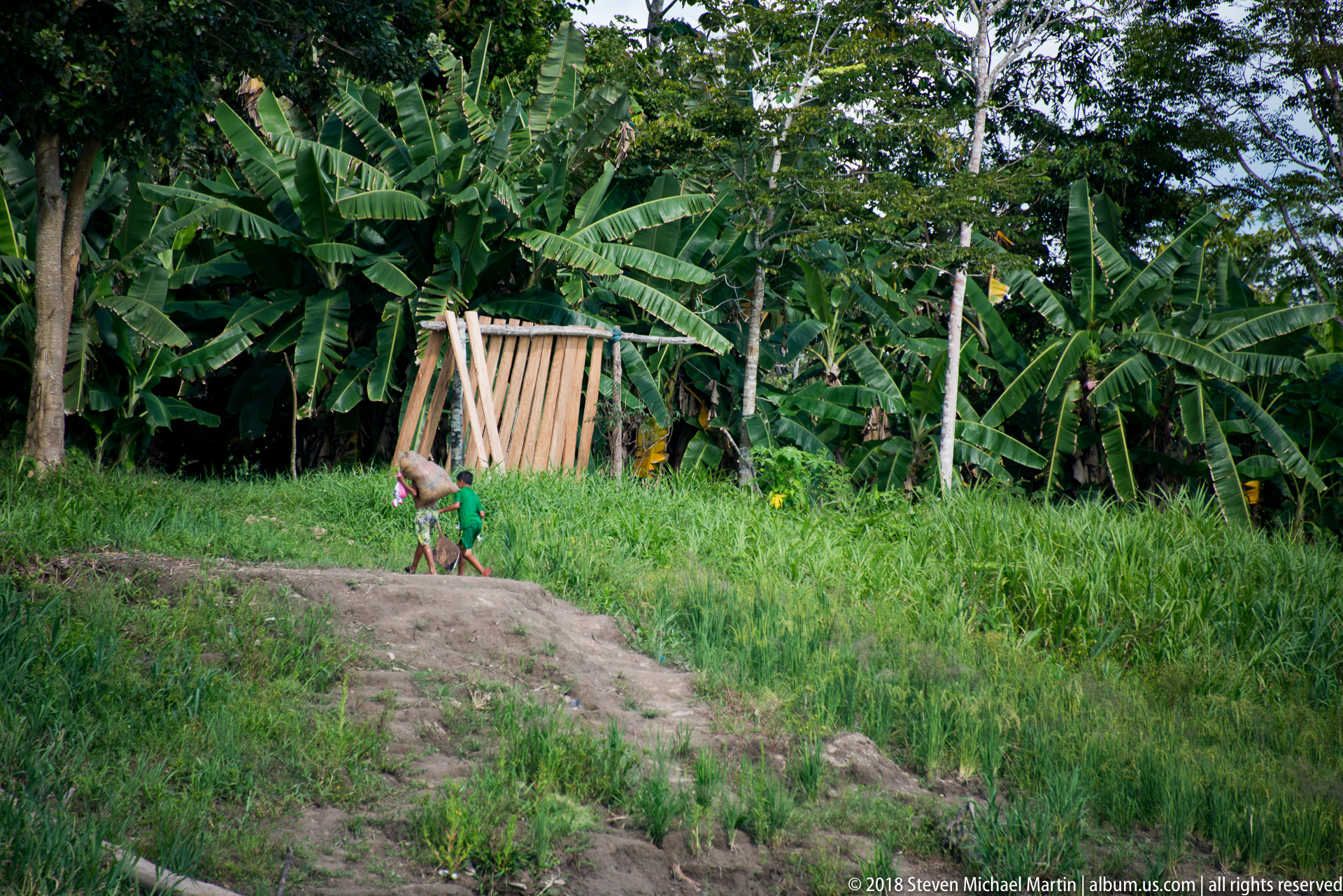
A small child walks along a grassy rise at the edge of dense banana vegetation, carrying a bright green object near a simple upright wooden panel. The river itself is out of frame, shifting attention inland from the waterfront to the cultivated or domestic vegetation immediately behind it. Broad banana leaves and humid tropical growth dominate the setting.
Caption
A small child walks along a grassy rise at the edge of dense banana vegetation, carrying a bright green object near a simple upright wooden panel. The river itself is out of frame, shifting attention inland from the waterfront to the cultivated or domestic vegetation immediately behind it. Broad banana leaves and humid tropical growth dominate the setting.
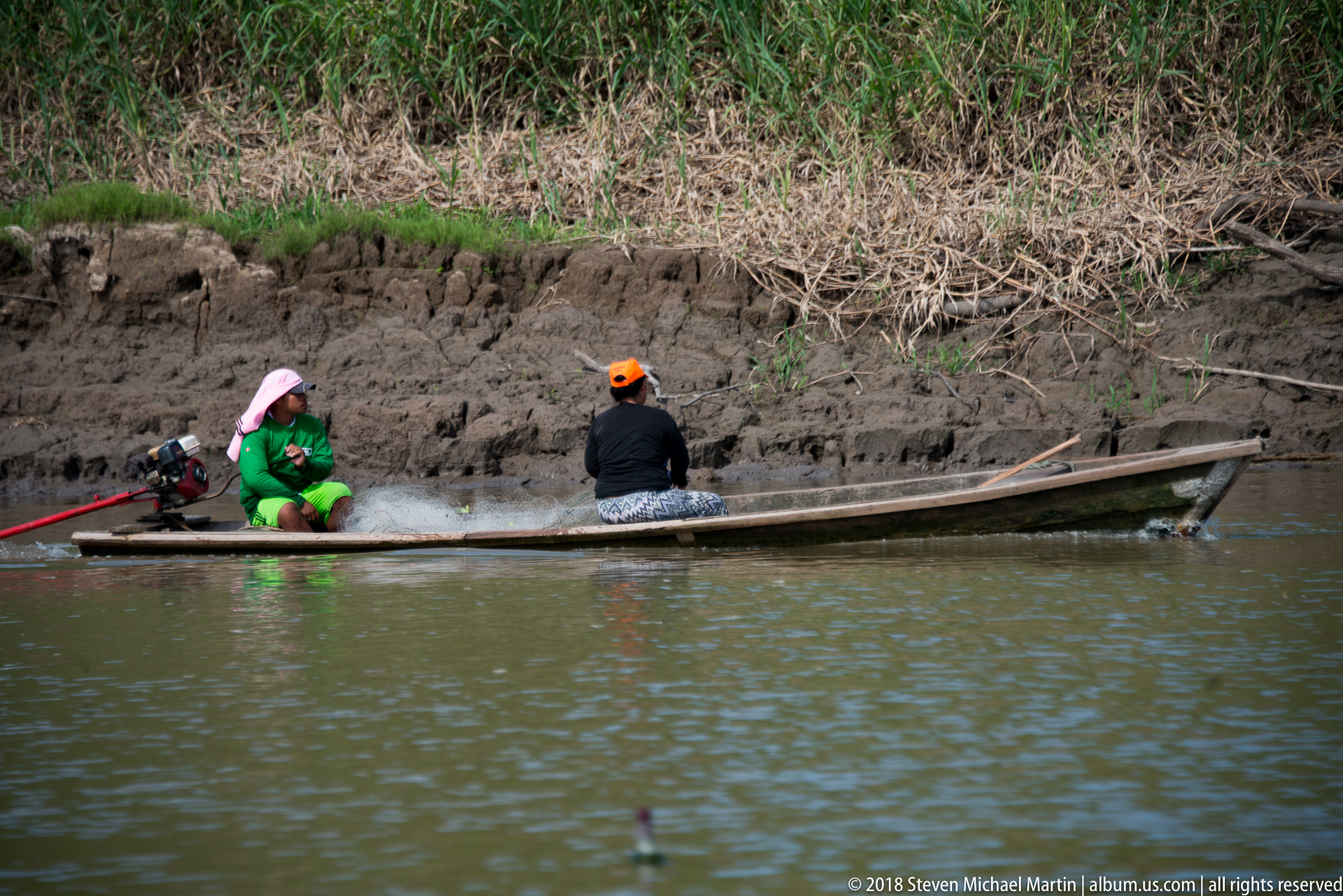
Two people travel in a long, narrow wooden canoe close to a deeply exposed muddy riverbank. One passenger wears bright green and a pale pink sun hat, while the person at the stern faces away in dark clothing and an orange cap. The low viewpoint and stripped-back composition emphasize the slender hull and the seasonal-looking margin between water and vegetation.
Caption
Two people travel in a long, narrow wooden canoe close to a deeply exposed muddy riverbank. One passenger wears bright green and a pale pink sun hat, while the person at the stern faces away in dark clothing and an orange cap. The low viewpoint and stripped-back composition emphasize the slender hull and the seasonal-looking margin between water and vegetation.
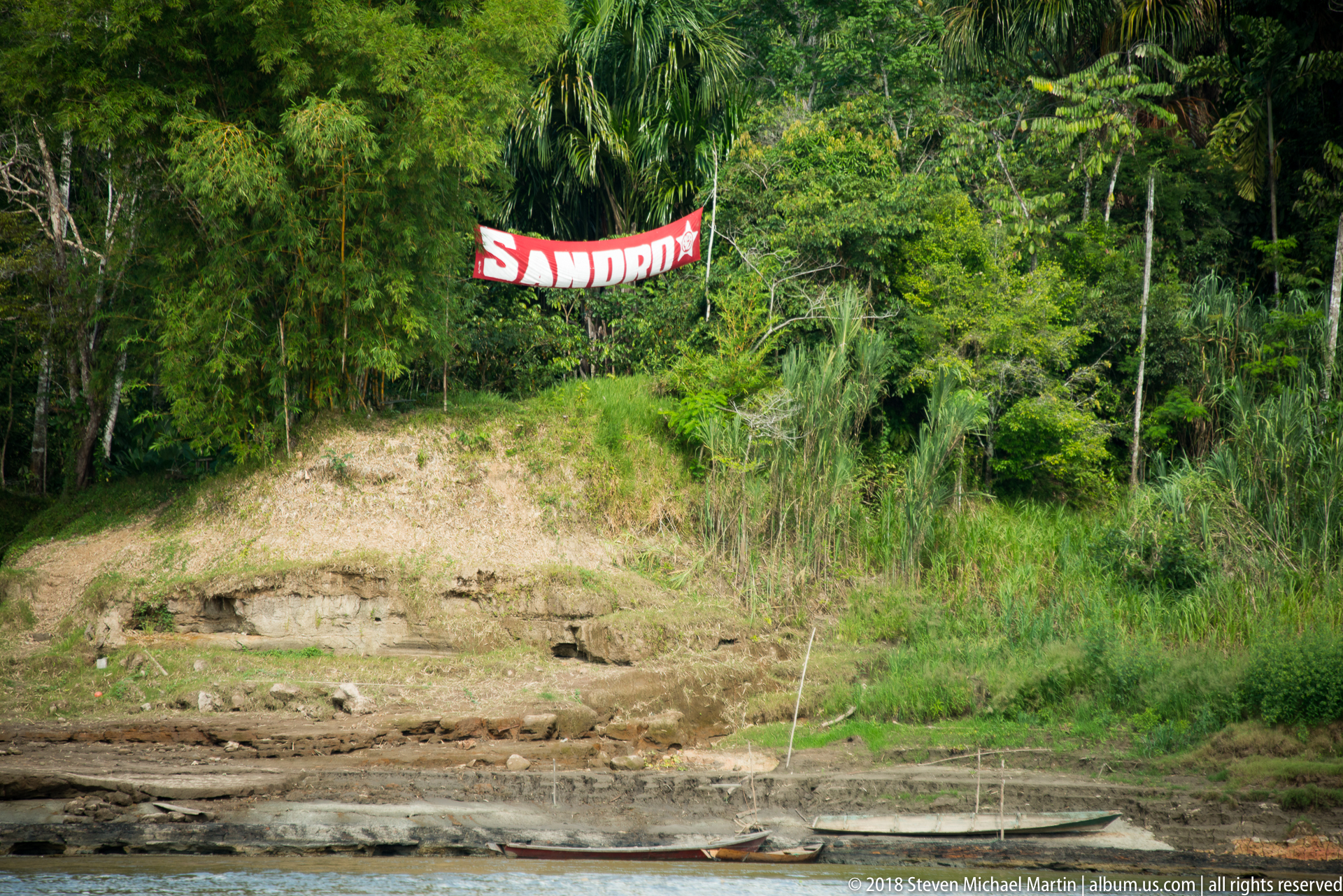
A red “SANDRO” banner is strung across a small clearing at the edge of dense tropical vegetation, facing the river from above an exposed muddy bank. Unlike the densely built campaign scenes nearby, this sign stands almost alone against palms and forest. A narrow boat rests along the shoreline, tying the political message to riverborne viewers and travelers.
Caption
A red “SANDRO” banner is strung across a small clearing at the edge of dense tropical vegetation, facing the river from above an exposed muddy bank. Unlike the densely built campaign scenes nearby, this sign stands almost alone against palms and forest. A narrow boat rests along the shoreline, tying the political message to riverborne viewers and travelers.

Several dark pigs forage across a rough, cleared slope immediately above the river, dispersed among bare soil, cut vegetation, and scattered debris. A narrow wooden canoe lies along the shoreline below them. The scene records livestock using the open margin between settlement land and the water rather than the denser forest visible elsewhere in the portfolio.
Caption
Several dark pigs forage across a rough, cleared slope immediately above the river, dispersed among bare soil, cut vegetation, and scattered debris. A narrow wooden canoe lies along the shoreline below them. The scene records livestock using the open margin between settlement land and the water rather than the denser forest visible elsewhere in the portfolio.
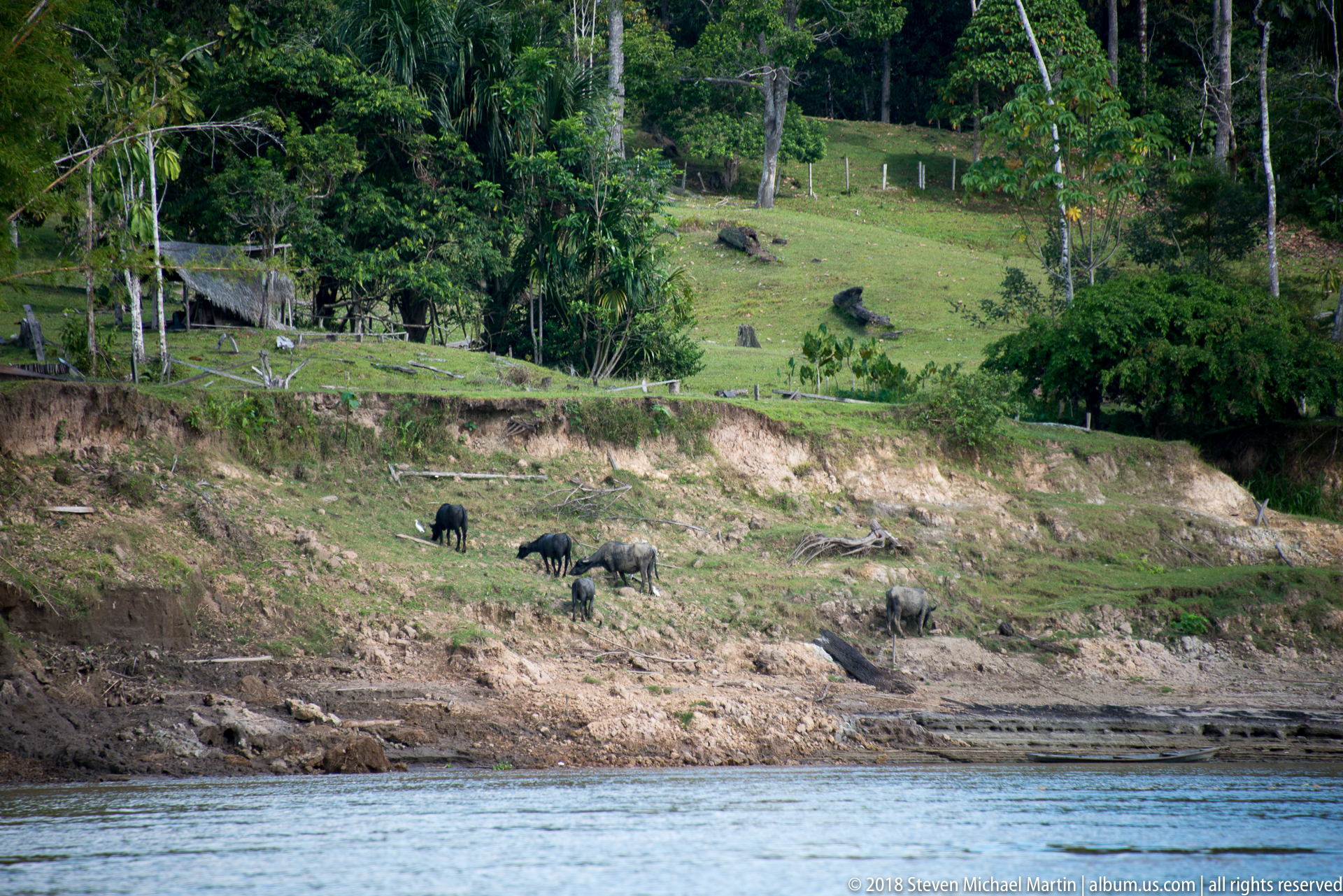
A wider view shows dark pigs foraging along the exposed riverbank below a grassy clearing and dense forest edge. Stumps, simple fencing, and scattered structures or materials suggest a managed patch of land above the slope, while the river occupies the foreground. Compared with the closer livestock view, this frame places the animals within the broader riverside landscape.
Caption
A wider view shows dark pigs foraging along the exposed riverbank below a grassy clearing and dense forest edge. Stumps, simple fencing, and scattered structures or materials suggest a managed patch of land above the slope, while the river occupies the foreground. Compared with the closer livestock view, this frame places the animals within the broader riverside landscape.