Kanazawa
Kanazawa developed as an important cultural and administrative center during Japan’s Edo period under the governance of the Maeda clan. The city became known for its preservation of traditional arts including lacquerware, ceramics, and textile production. Its relative protection from wartime destruction allowed many historic districts to remain intact.
Traditional neighborhoods, temples, and merchant districts illustrate architectural styles associated with early modern Japanese urban design. Kanazawa’s development reflects the influence of feudal governance on economic and cultural life. The city remains recognized for its historical continuity and artistic heritage.
Kanazawa represents the preservation of regional identity within Japan’s historical development. Its historic districts provide insight into the social organization and cultural traditions of the Edo period.
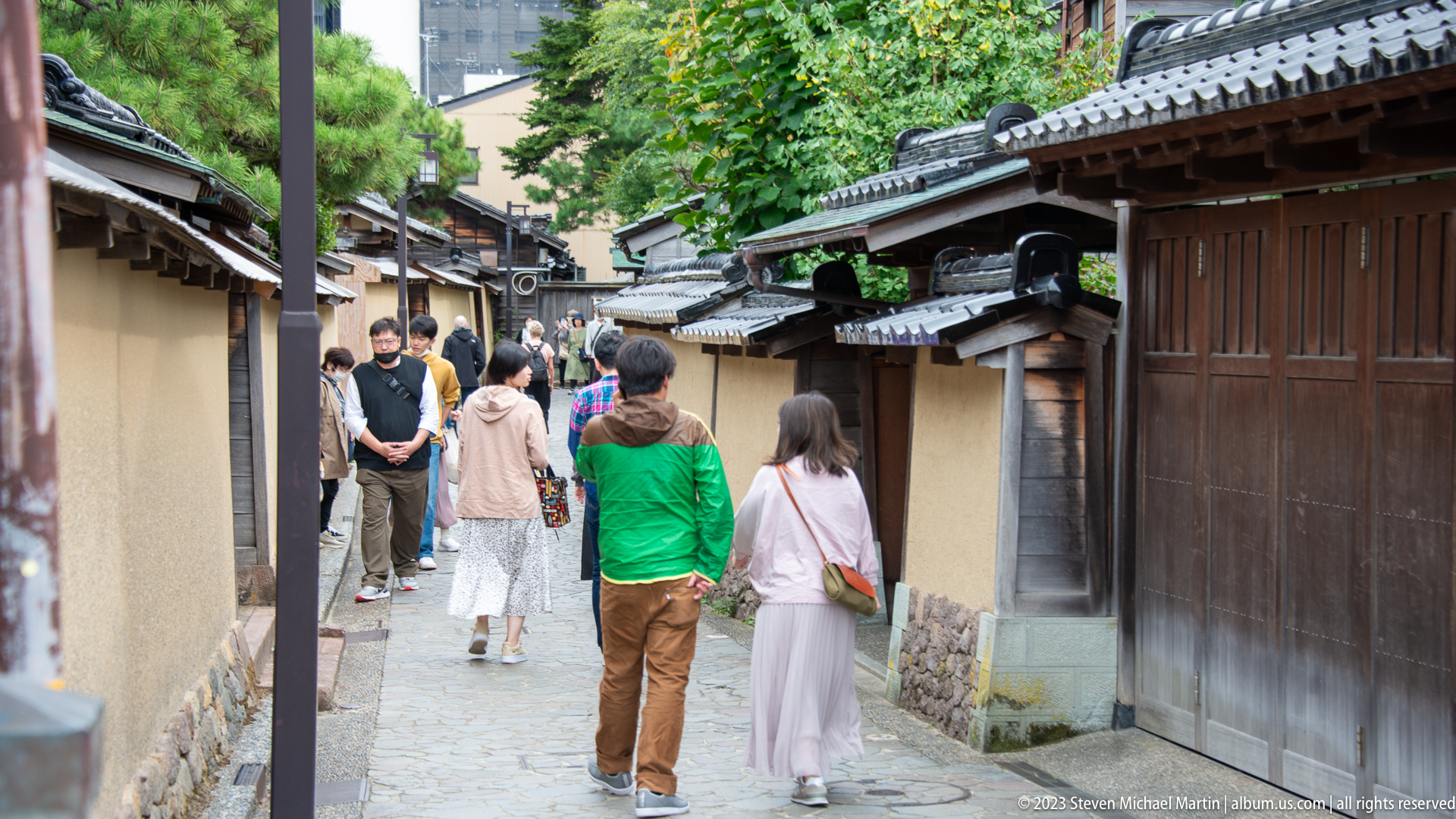
Visitors move along a narrow paved lane bordered by plaster walls, tiled eaves, timber gates, and mature greenery. The compressed passage and repeated wall lines convey the intimate scale of Kanazawa’s preserved residential quarters, where private compounds present restrained façades to the street.
Caption
Visitors move along a narrow paved lane bordered by plaster walls, tiled eaves, timber gates, and mature greenery. The compressed passage and repeated wall lines convey the intimate scale of Kanazawa’s preserved residential quarters, where private compounds present restrained façades to the street.
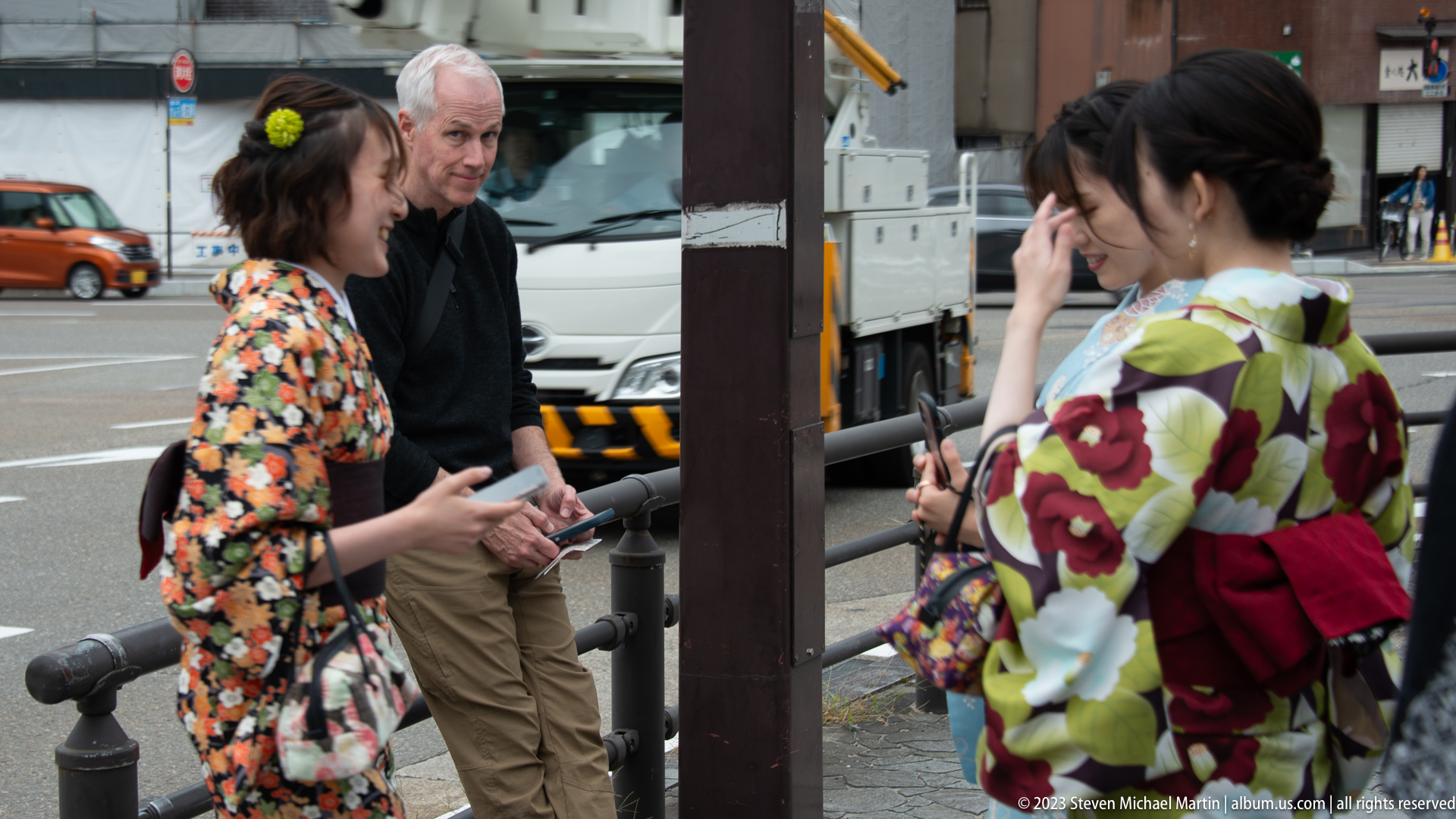
Two women wearing colorful floral kimono converse beside the street, one holding a small patterned bag while adjusting her hair. A casually dressed visitor stands between them in the background, and vehicles establish the active urban setting. The image records traditional dress as part of contemporary social life rather than a staged costume display.
Caption
Two women wearing colorful floral kimono converse beside the street, one holding a small patterned bag while adjusting her hair. A casually dressed visitor stands between them in the background, and vehicles establish the active urban setting. The image records traditional dress as part of contemporary social life rather than a staged costume display.
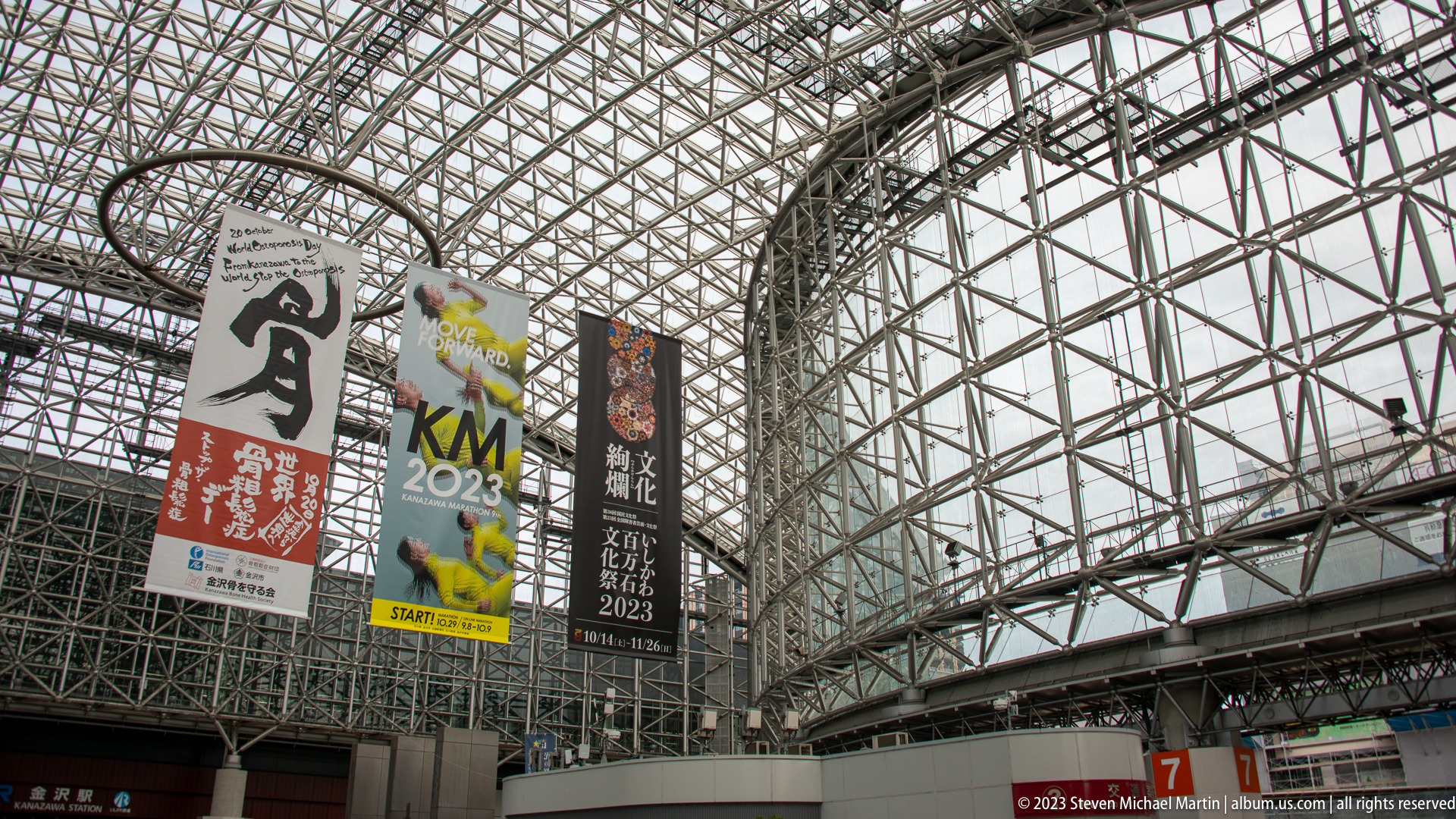
Suspended banners advertising cultural events hang within the Motenashi Dome’s transparent steel lattice. The view emphasizes the canopy’s layered curvature and open engineering, with circulation infrastructure and a platform marker visible below, situating the display within the active Kanazawa Station complex.
Caption
Suspended banners advertising cultural events hang within the Motenashi Dome’s transparent steel lattice. The view emphasizes the canopy’s layered curvature and open engineering, with circulation infrastructure and a platform marker visible below, situating the display within the active Kanazawa Station complex.
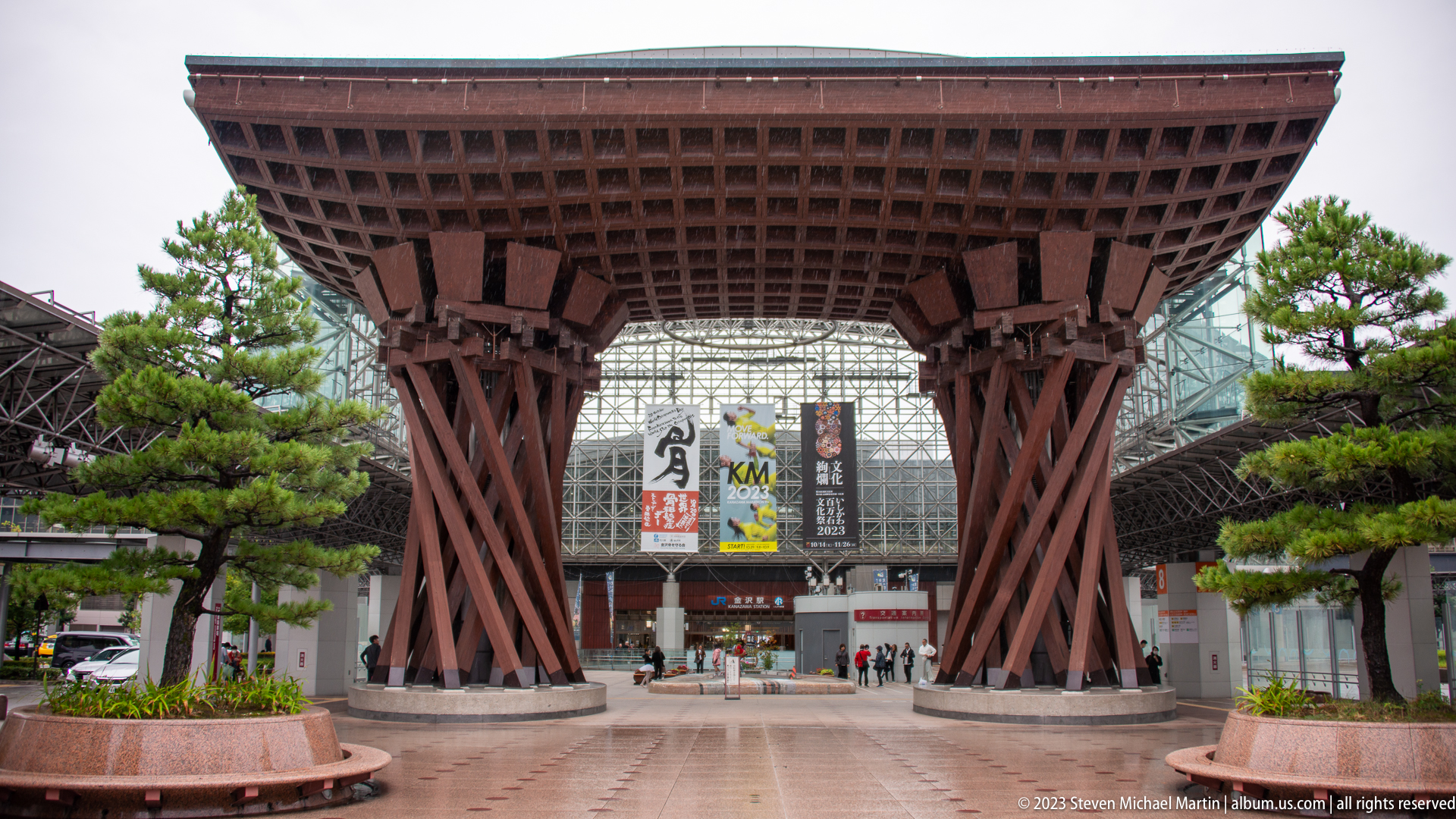
Tsuzumi-mon Gate stands symmetrically before Kanazawa Station, its paired timber supports flaring outward beneath a broad gridded canopy. Wet paving and sparse pedestrians create a calm forecourt, allowing the gate’s structural rhythm to dominate. The transparent station hall behind it layers contemporary steel and glass against the warm-toned timber landmark.
Caption
Tsuzumi-mon Gate stands symmetrically before Kanazawa Station, its paired timber supports flaring outward beneath a broad gridded canopy. Wet paving and sparse pedestrians create a calm forecourt, allowing the gate’s structural rhythm to dominate. The transparent station hall behind it layers contemporary steel and glass against the warm-toned timber landmark.
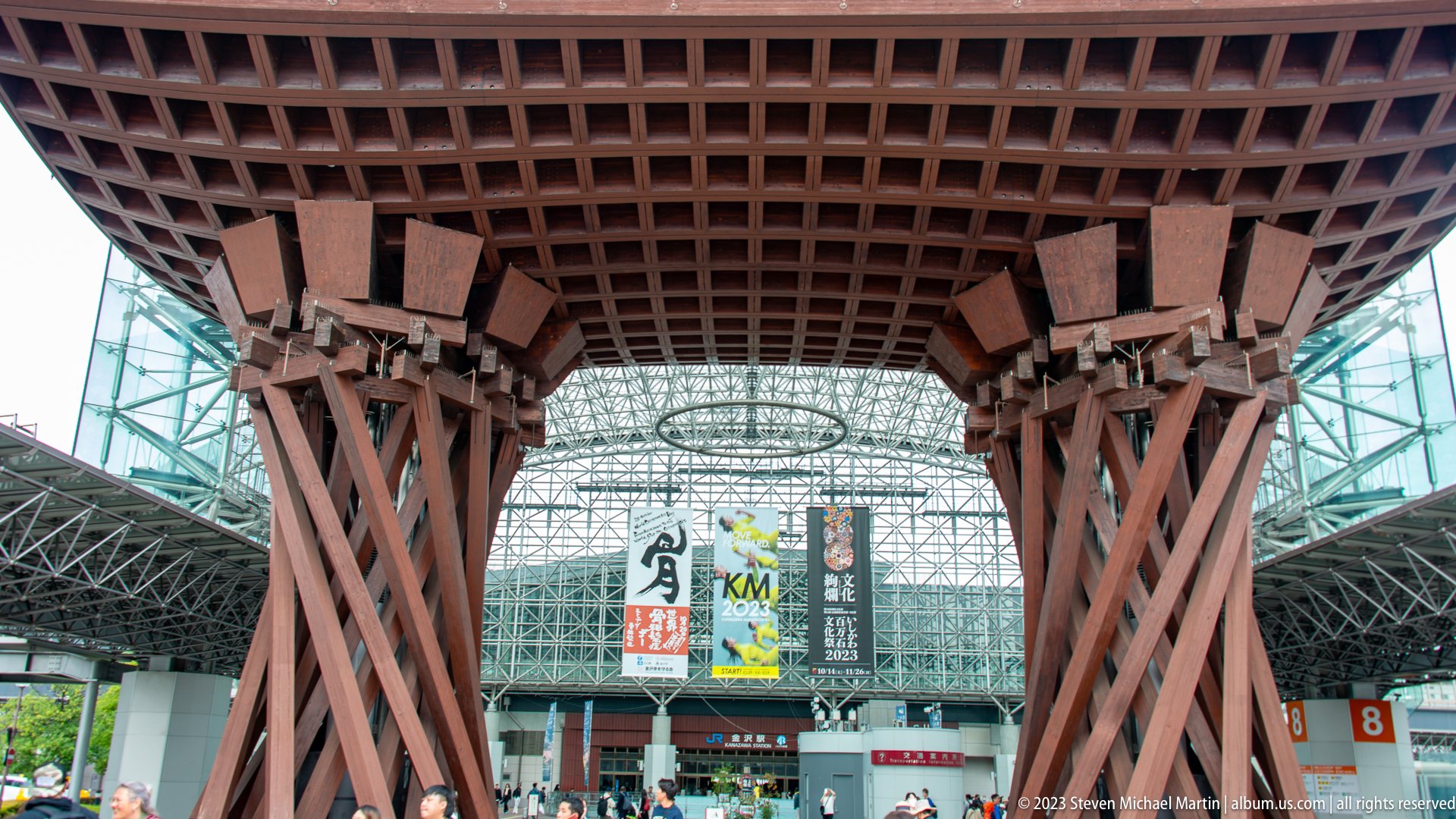
Viewed from beneath its deep gridded roof, the Tsuzumi-mon Gate displays paired bundles of curving timber columns that flare outward before supporting the broad canopy. The Motenashi Dome’s transparent lattice fills the background, making the gate’s warm wood construction stand out against the station’s lighter contemporary engineering.
Caption
Viewed from beneath its deep gridded roof, the Tsuzumi-mon Gate displays paired bundles of curving timber columns that flare outward before supporting the broad canopy. The Motenashi Dome’s transparent lattice fills the background, making the gate’s warm wood construction stand out against the station’s lighter contemporary engineering.
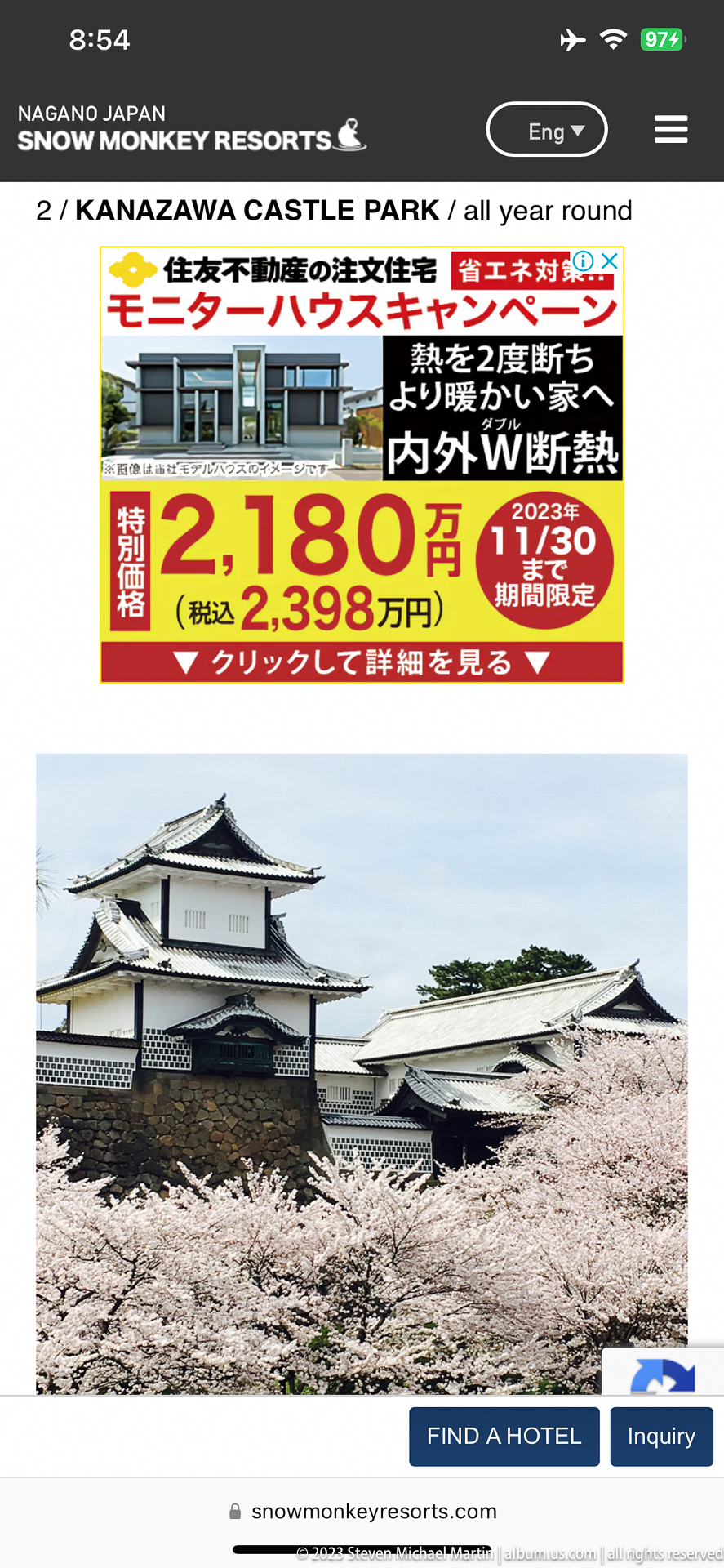
A smartphone screen shows a tourism page for Kanazawa Castle Park, combining a promotional banner with a daylight photograph of the white castle complex and cherry blossoms. The image documents how the site is presented digitally through travel marketing, lodging links, and destination imagery.
Caption
A smartphone screen shows a tourism page for Kanazawa Castle Park, combining a promotional banner with a daylight photograph of the white castle complex and cherry blossoms. The image documents how the site is presented digitally through travel marketing, lodging links, and destination imagery.
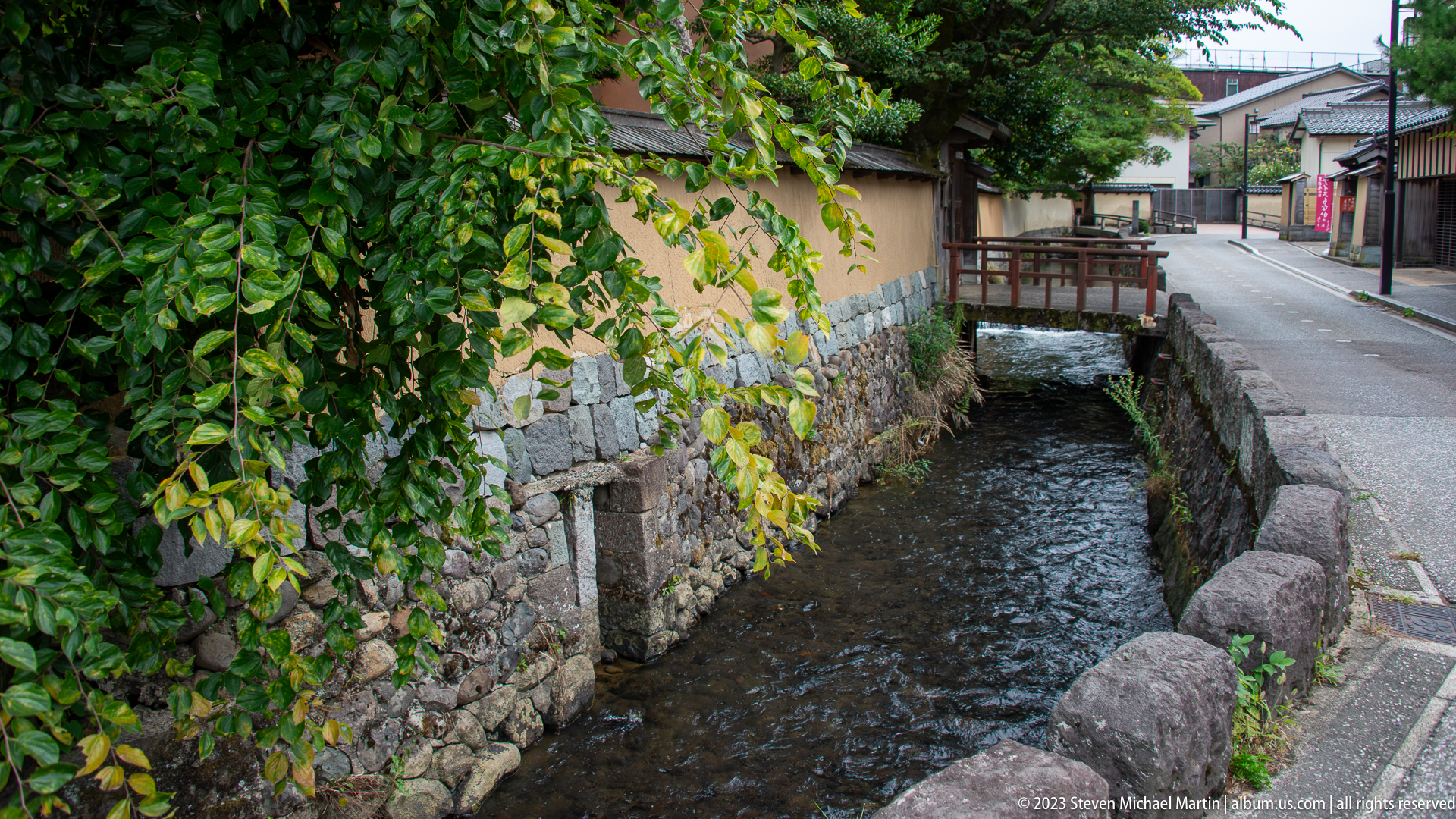
Flowing water passes between stone embankments beneath overhanging vines, with a traditional plaster wall on one side and a residential lane on the other. The compact canal, bridge, and close-set buildings illustrate how waterways remain woven into Kanazawa’s historic urban fabric.
Caption
Flowing water passes between stone embankments beneath overhanging vines, with a traditional plaster wall on one side and a residential lane on the other. The compact canal, bridge, and close-set buildings illustrate how waterways remain woven into Kanazawa’s historic urban fabric.
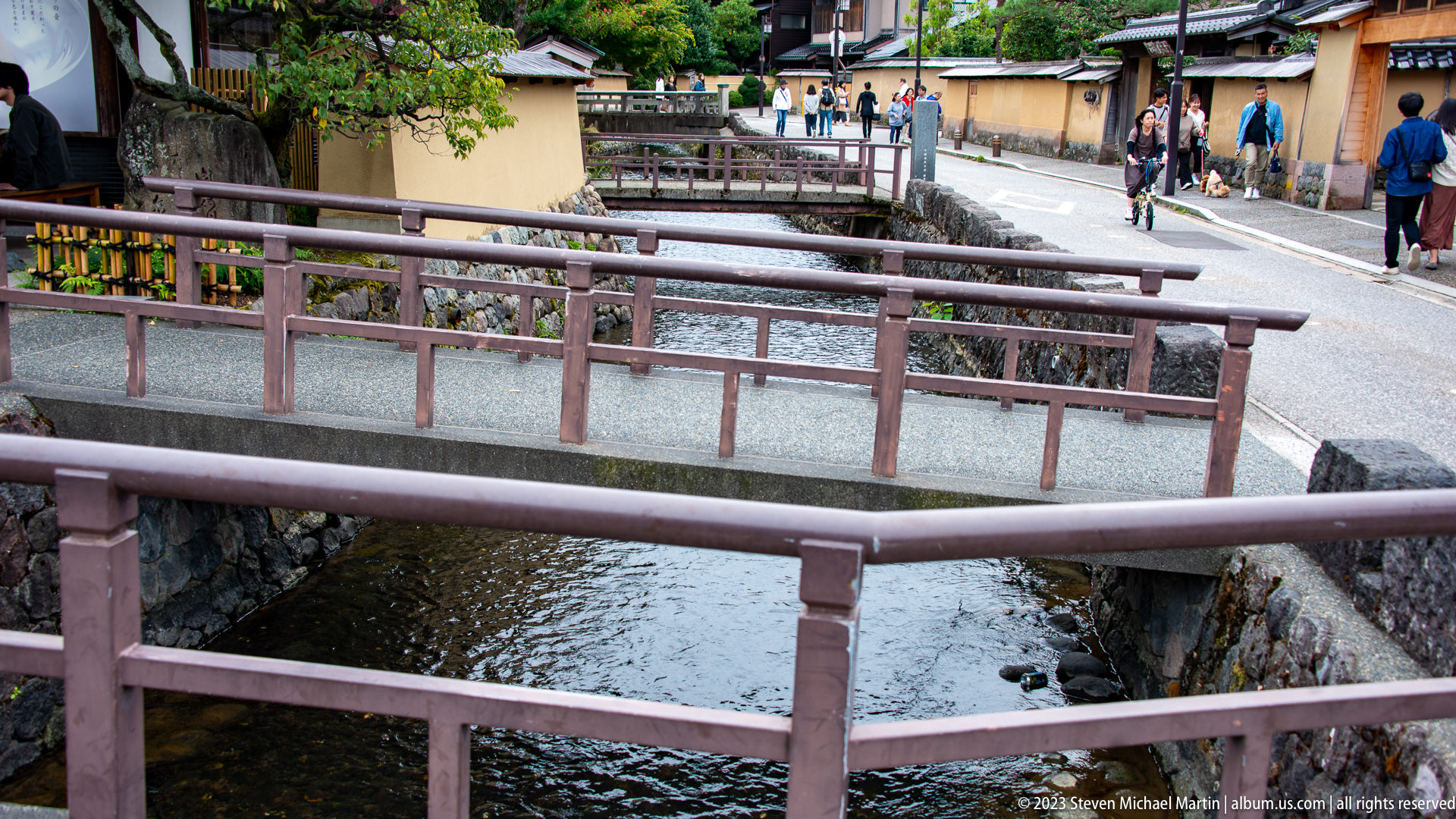
Several modest bridges cross the same narrow canal at close intervals, creating overlapping rail lines above the water. The elevated viewpoint emphasizes the dense pedestrian connections of the neighborhood, while stone embankments, plaster walls, and nearby visitors situate the bridges within a preserved historic streetscape.
Caption
Several modest bridges cross the same narrow canal at close intervals, creating overlapping rail lines above the water. The elevated viewpoint emphasizes the dense pedestrian connections of the neighborhood, while stone embankments, plaster walls, and nearby visitors situate the bridges within a preserved historic streetscape.
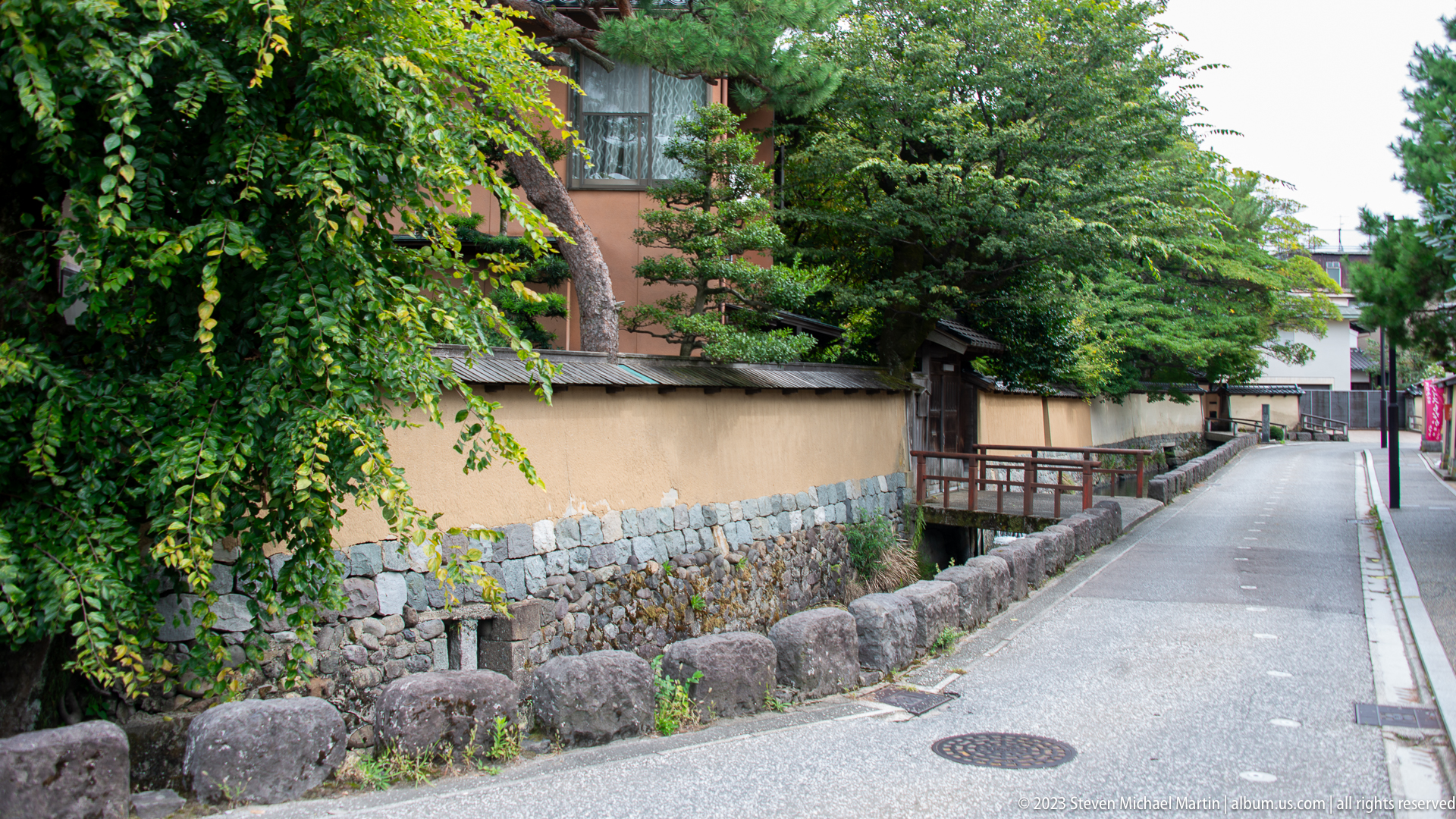
A narrow lane follows a shallow water channel beside an earthen-colored plaster wall set on a rough stone base. Dense greenery spills over the wall and a small wooden bridge crosses the channel ahead, creating a quiet transition from the station area into one of Kanazawa’s preserved historic neighborhoods.
Caption
A narrow lane follows a shallow water channel beside an earthen-colored plaster wall set on a rough stone base. Dense greenery spills over the wall and a small wooden bridge crosses the channel ahead, creating a quiet transition from the station area into one of Kanazawa’s preserved historic neighborhoods.
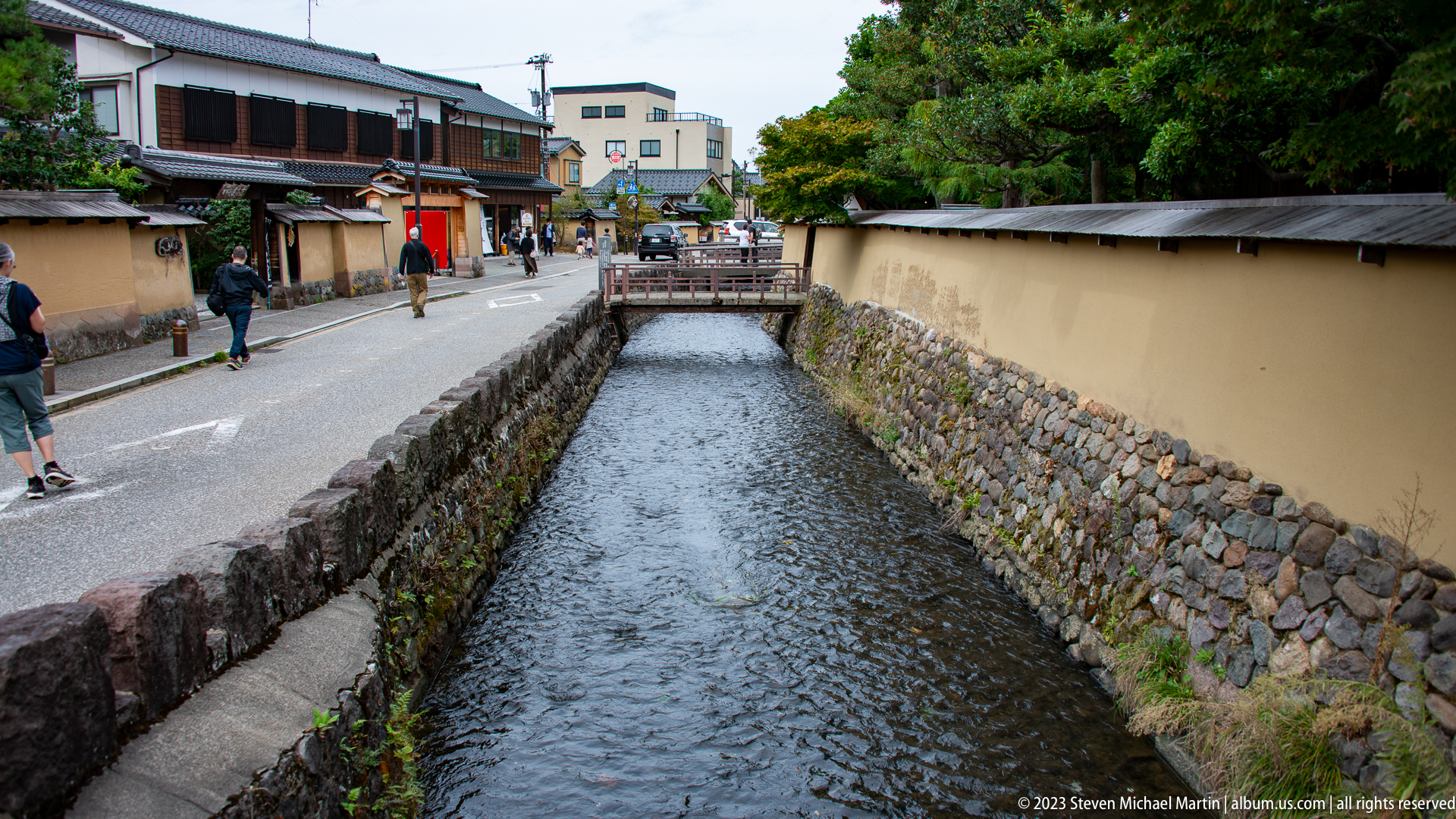
A straight water channel recedes between stone-lined banks and long ochre plaster walls, with a simple wooden bridge crossing near the center. The low walls and tightly bounded watercourse create a strong linear perspective through the historic streetscape, while pedestrians on the left provide scale.
Caption
A straight water channel recedes between stone-lined banks and long ochre plaster walls, with a simple wooden bridge crossing near the center. The low walls and tightly bounded watercourse create a strong linear perspective through the historic streetscape, while pedestrians on the left provide scale.
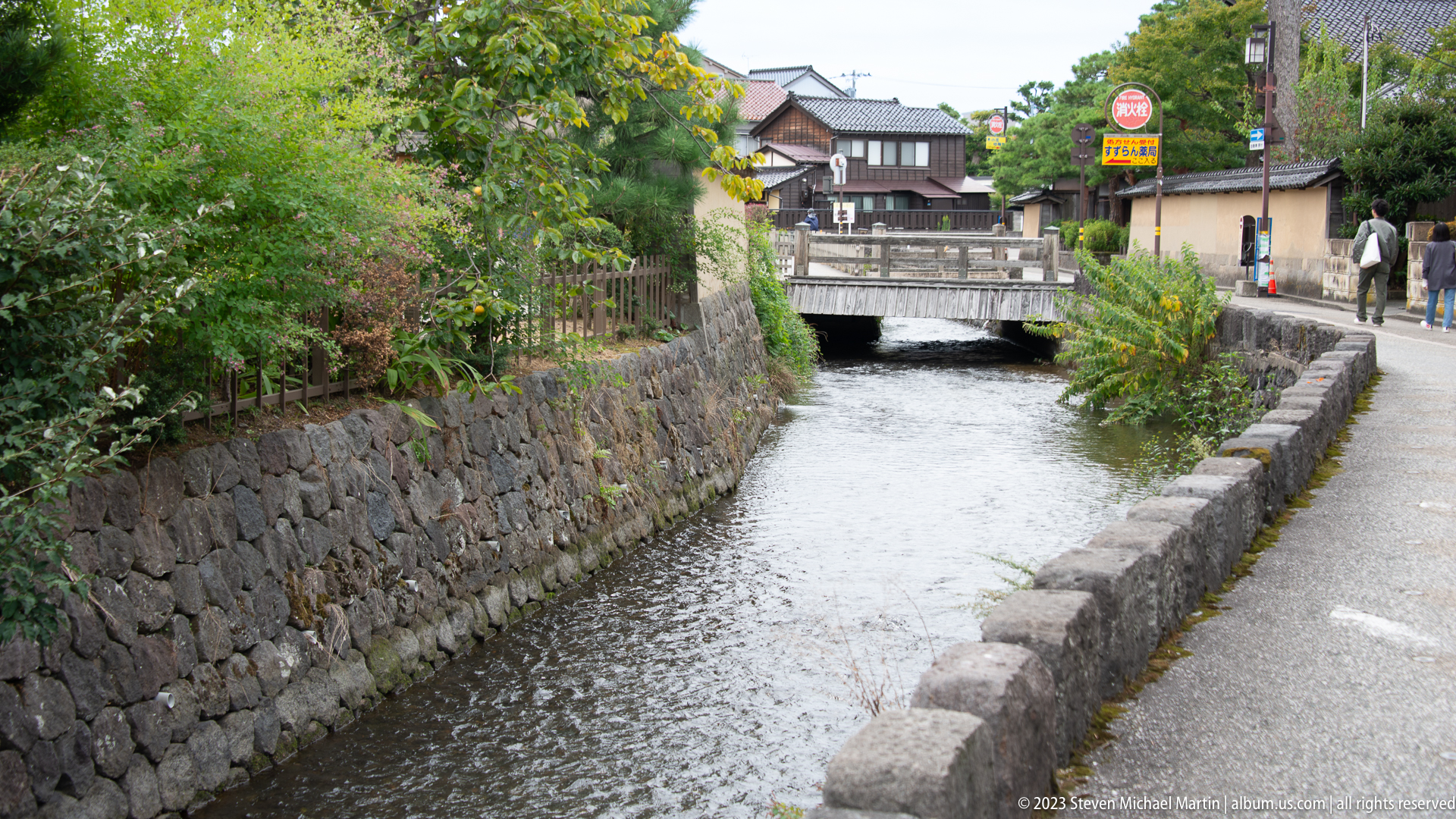
A narrow canal curves between rough stone embankments softened by grasses, shrubs, and overhanging trees. A small bridge and traditional buildings close the view, showing how planted edges, flowing water, and historic architecture coexist along Kanazawa’s compact neighborhood waterways. today.
Caption
A narrow canal curves between rough stone embankments softened by grasses, shrubs, and overhanging trees. A small bridge and traditional buildings close the view, showing how planted edges, flowing water, and historic architecture coexist along Kanazawa’s compact neighborhood waterways. today.
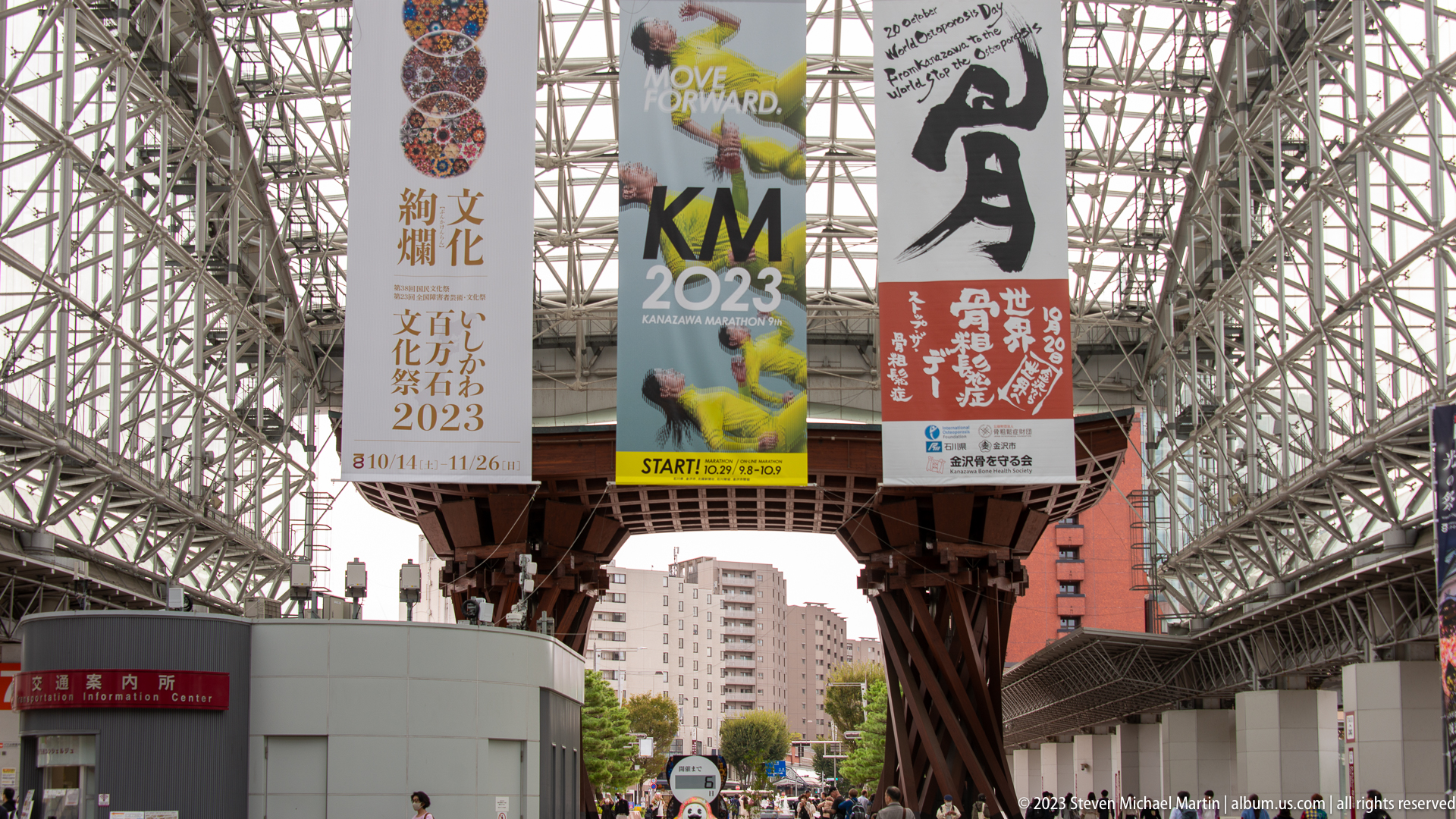
The glass-and-steel lattice of Kanazawa Station’s Motenashi Dome frames hanging cultural-event banners above the pedestrian approach. At the right, the massive timber members of the Tsuzumi-mon Gate begin to rise beside the station entrance, linking a contemporary transport hub with a design inspired by traditional Japanese drum forms.
Caption
The glass-and-steel lattice of Kanazawa Station’s Motenashi Dome frames hanging cultural-event banners above the pedestrian approach. At the right, the massive timber members of the Tsuzumi-mon Gate begin to rise beside the station entrance, linking a contemporary transport hub with a design inspired by traditional Japanese drum forms.
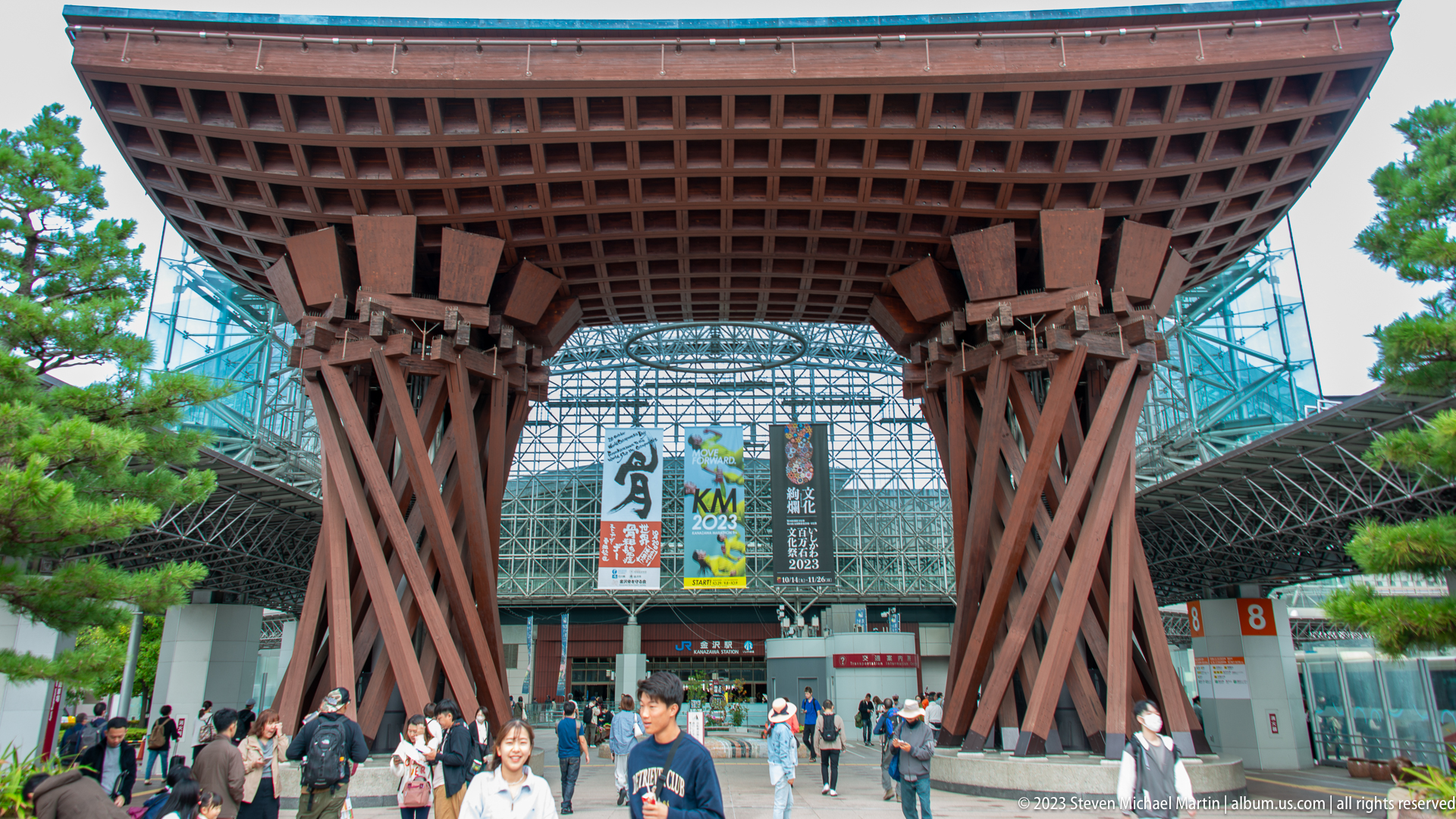
The Tsuzumi-mon Gate stands as a monumental threshold before Kanazawa Station, its two sculptural timber supports opening onto the glass-covered concourse beyond. Pedestrians at ground level establish the gate’s scale, while clipped pines soften the transition between the station plaza and the expansive modern canopy.
Caption
The Tsuzumi-mon Gate stands as a monumental threshold before Kanazawa Station, its two sculptural timber supports opening onto the glass-covered concourse beyond. Pedestrians at ground level establish the gate’s scale, while clipped pines soften the transition between the station plaza and the expansive modern canopy.
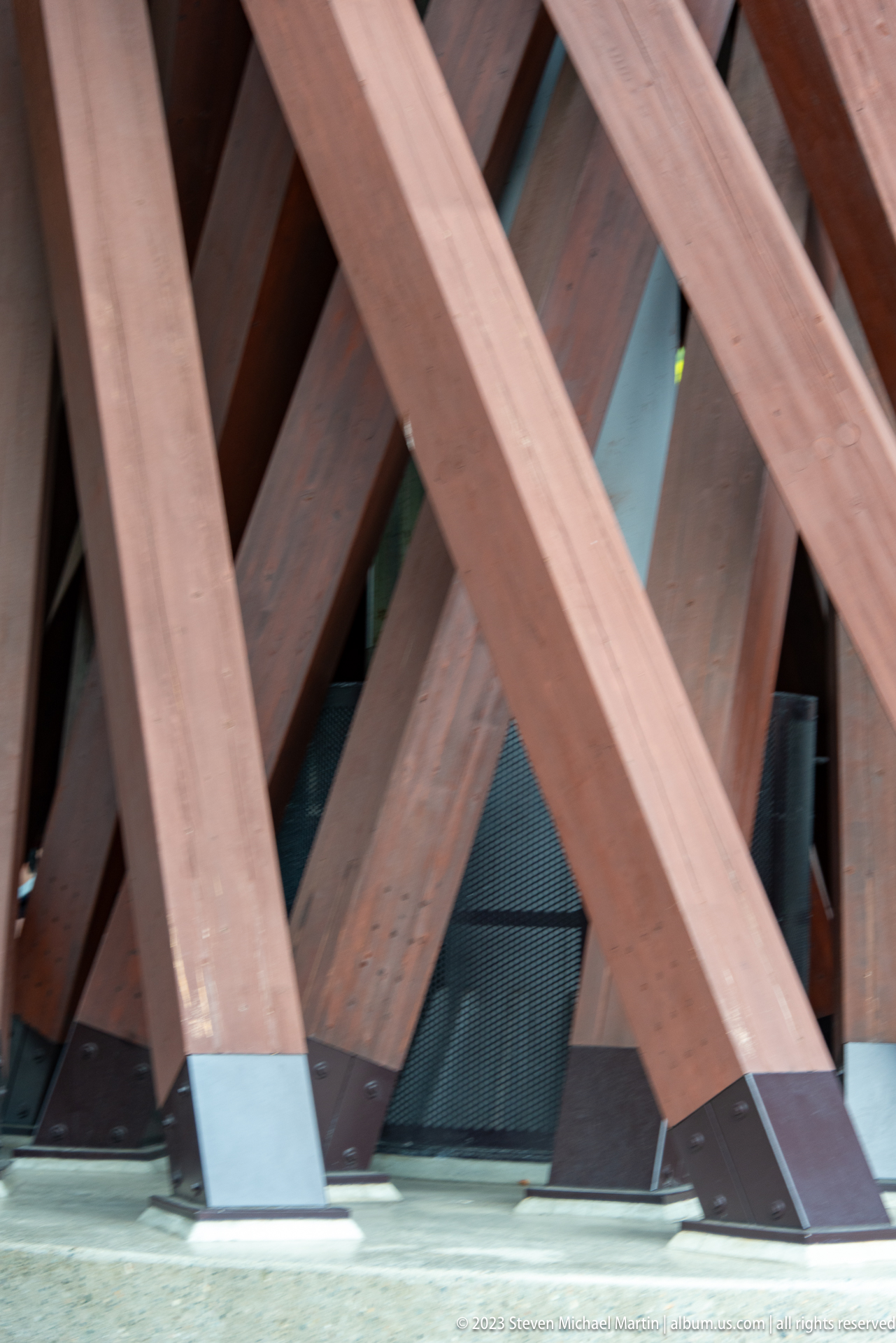
A close view isolates the lower diagonal members of the Tsuzumi-mon Gate, where heavy laminated timbers cross in a dense structural web and terminate in metal-clad feet. The cropped composition shifts attention from the landmark’s overall silhouette to its load-bearing geometry, joinery, and material contrast.
Caption
A close view isolates the lower diagonal members of the Tsuzumi-mon Gate, where heavy laminated timbers cross in a dense structural web and terminate in metal-clad feet. The cropped composition shifts attention from the landmark’s overall silhouette to its load-bearing geometry, joinery, and material contrast.
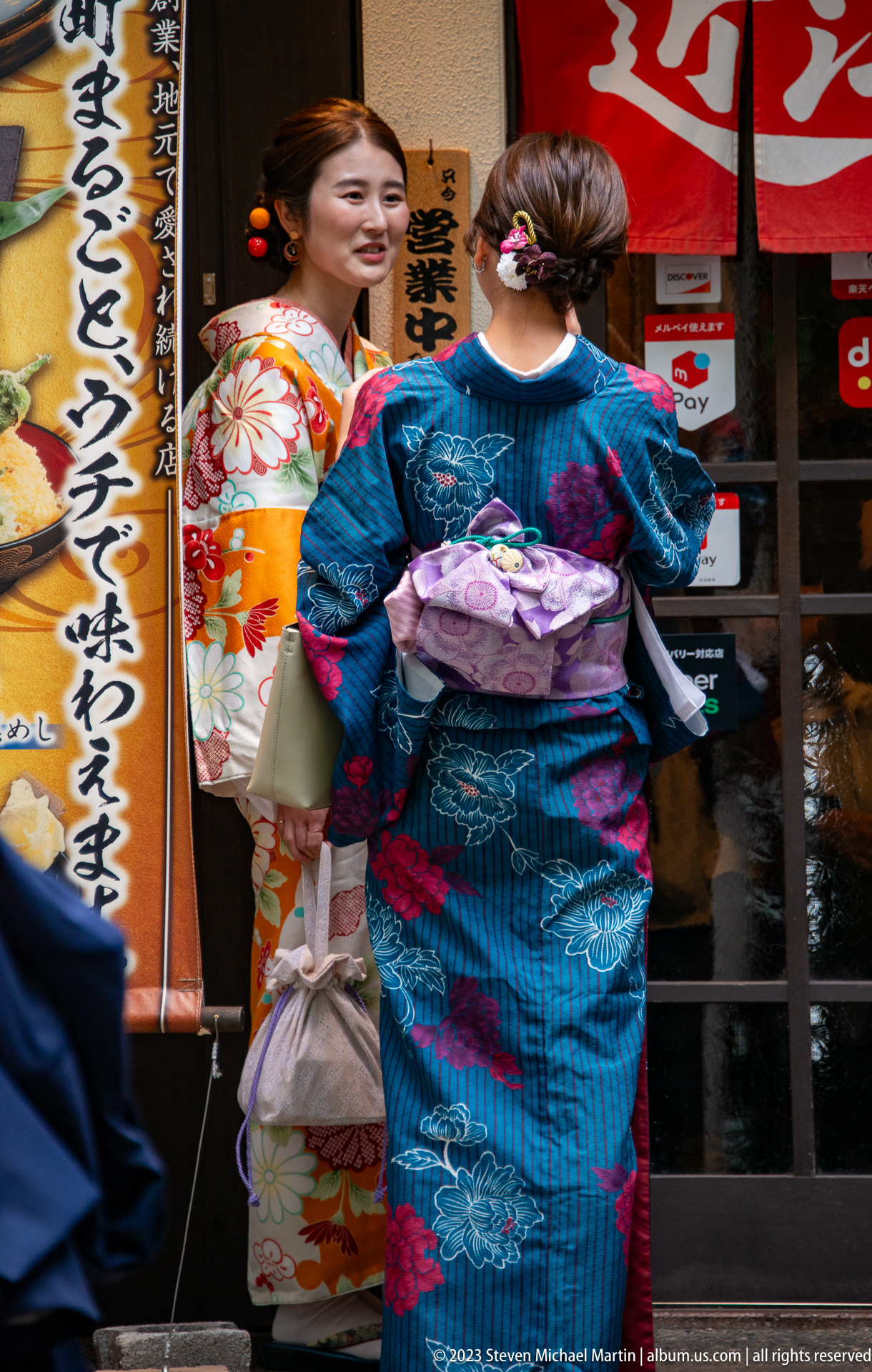
A woman in a blue floral kimono is seen from behind as she faces another woman in a pale patterned kimono at a restaurant doorway. Their obi and coordinated hair ornaments stand out against red fabric signage and vertical menu boards, making the encounter a vivid study of dress within the market setting.
Caption
A woman in a blue floral kimono is seen from behind as she faces another woman in a pale patterned kimono at a restaurant doorway. Their obi and coordinated hair ornaments stand out against red fabric signage and vertical menu boards, making the encounter a vivid study of dress within the market setting.
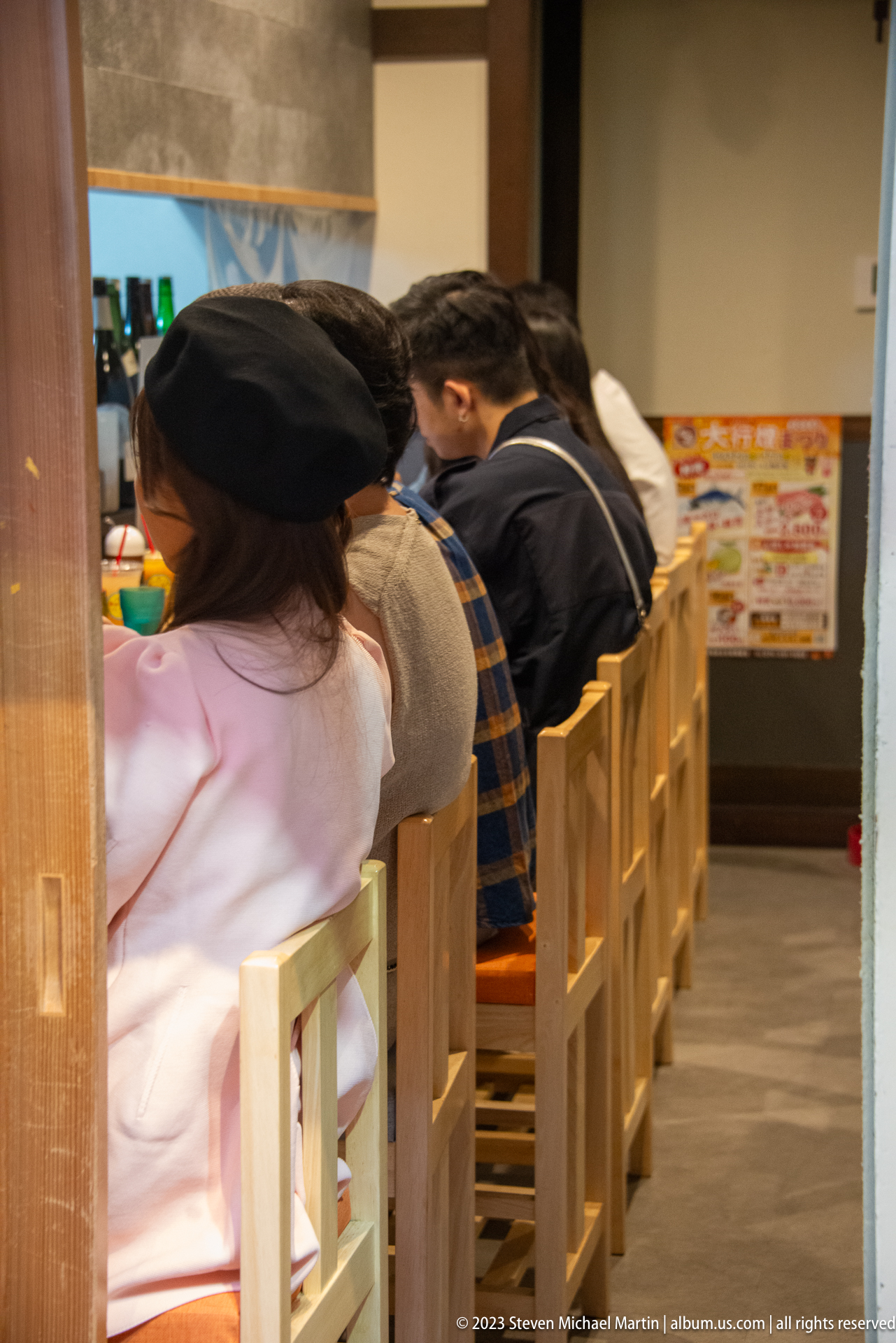
Diners sit shoulder to shoulder on light wooden chairs at a narrow restaurant counter, viewed through a doorway or partition. The compact arrangement, warm interior lighting, and close spacing convey the efficient, informal dining environment of a small eatery serving shoppers within the covered market.
Caption
Diners sit shoulder to shoulder on light wooden chairs at a narrow restaurant counter, viewed through a doorway or partition. The compact arrangement, warm interior lighting, and close spacing convey the efficient, informal dining environment of a small eatery serving shoppers within the covered market.
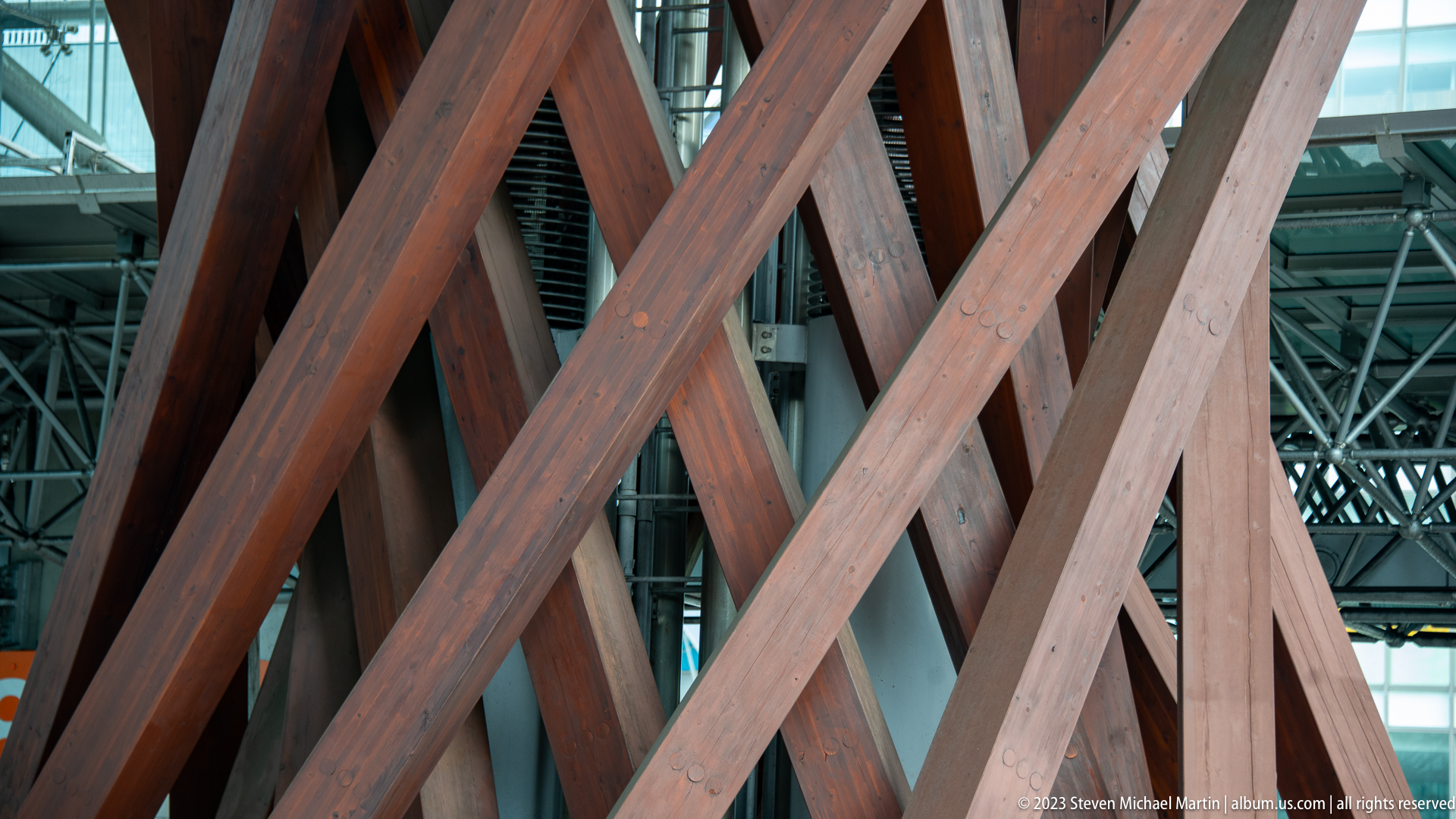
Massive timber members intersect in layered X-shaped braces along one support of the Tsuzumi-mon Gate. Seen at close range, the gate reads less as a single sculptural form than as an assembly of repeated wooden elements, with the station’s steel and glass construction glimpsed through the openings.
Caption
Massive timber members intersect in layered X-shaped braces along one support of the Tsuzumi-mon Gate. Seen at close range, the gate reads less as a single sculptural form than as an assembly of repeated wooden elements, with the station’s steel and glass construction glimpsed through the openings.
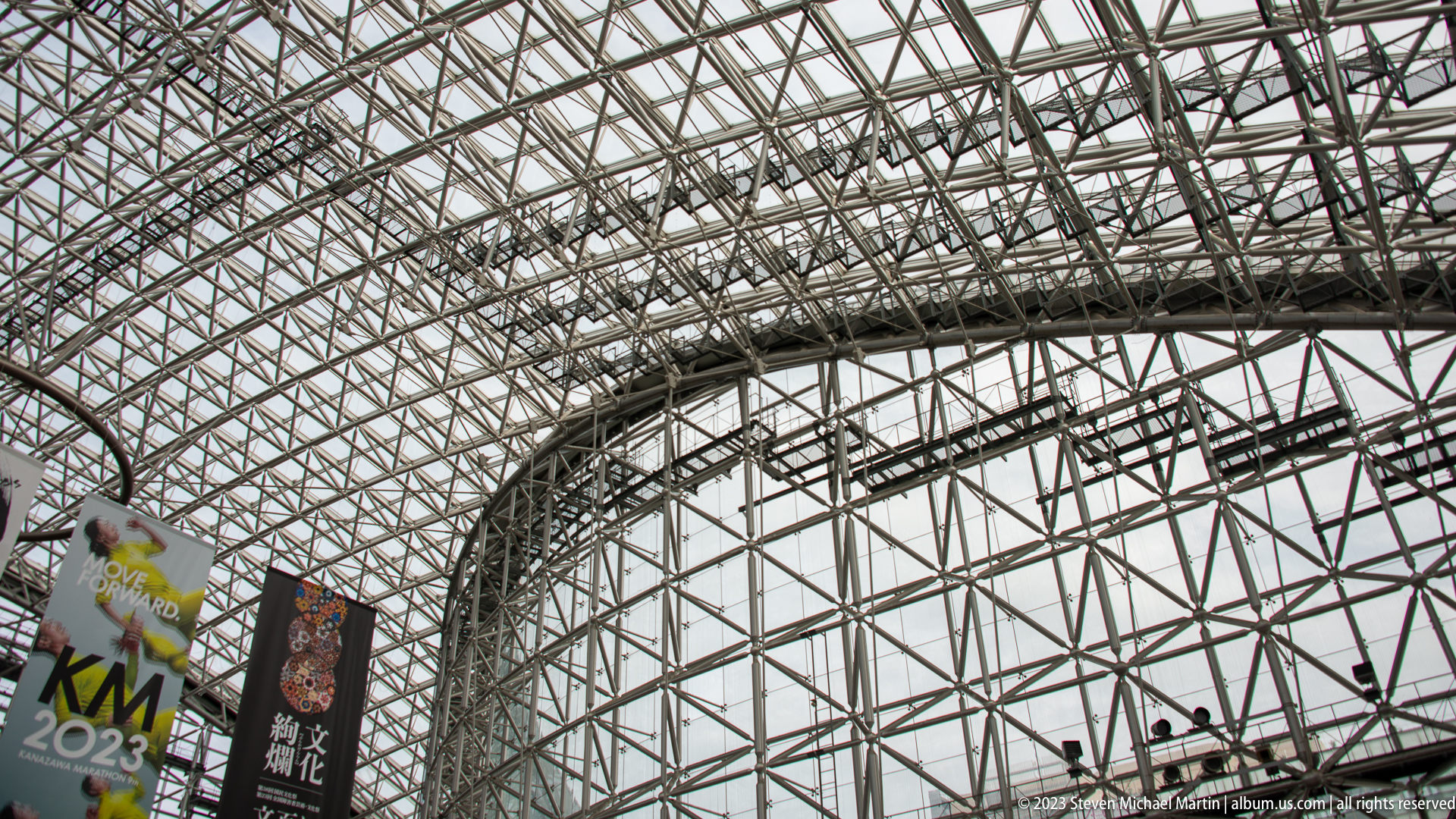
The Motenashi Dome’s sweeping roof is reduced to a dense pattern of steel ribs, trusses, and glazed panels above Kanazawa Station. Hanging banners occupy the lower edge of the frame, while the curving structural grid demonstrates how the canopy encloses the station forecourt without visually separating it from the sky.
Caption
The Motenashi Dome’s sweeping roof is reduced to a dense pattern of steel ribs, trusses, and glazed panels above Kanazawa Station. Hanging banners occupy the lower edge of the frame, while the curving structural grid demonstrates how the canopy encloses the station forecourt without visually separating it from the sky.
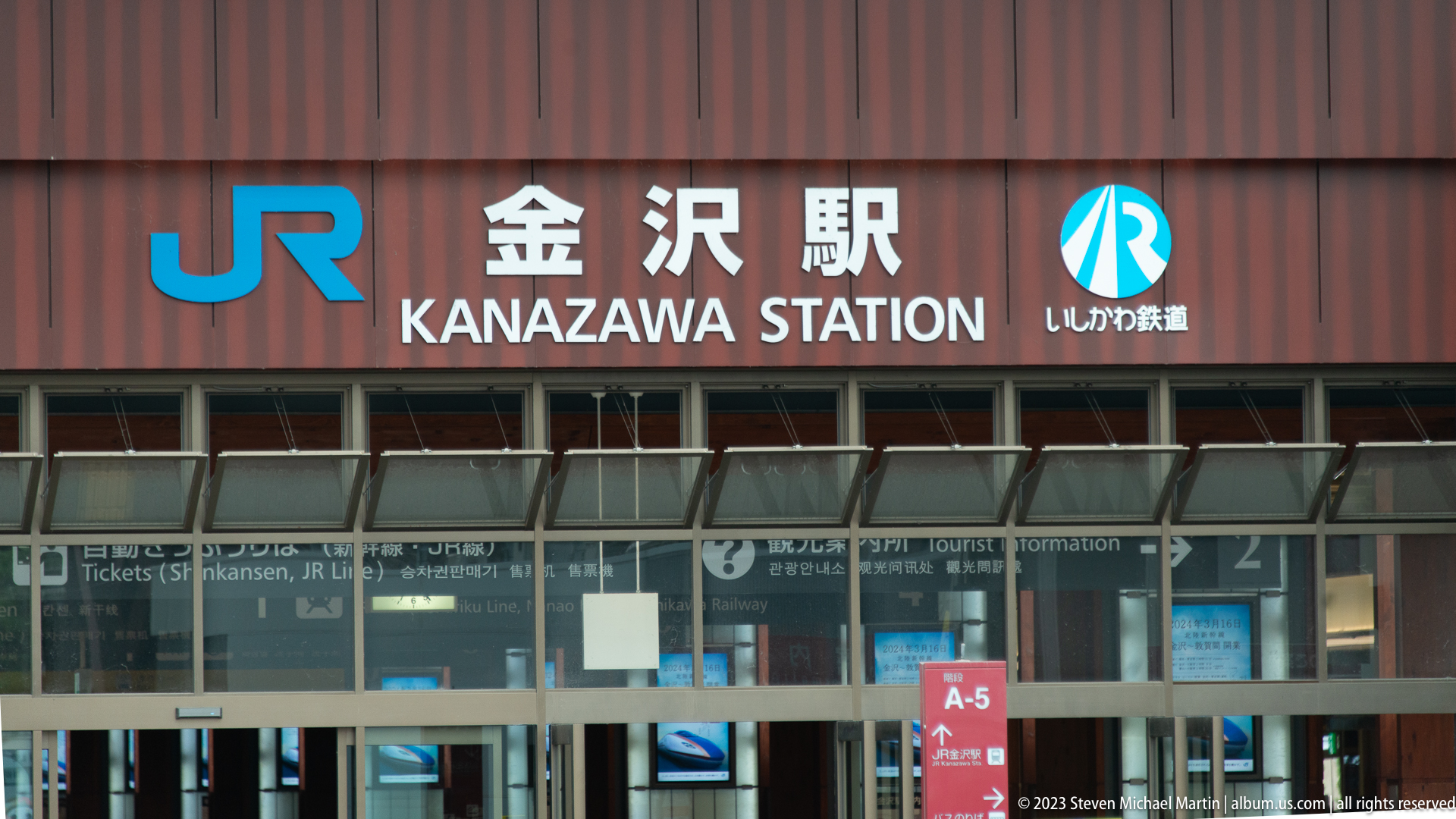
Large Japanese and English lettering marks the entrance to Kanazawa Station beneath the JR and IR Ishikawa Railway logos. Ticket, tourist-information, and directional signs are visible through the glazed façade, presenting the station as a shared regional transport gateway rather than only an architectural landmark.
Caption
Large Japanese and English lettering marks the entrance to Kanazawa Station beneath the JR and IR Ishikawa Railway logos. Ticket, tourist-information, and directional signs are visible through the glazed façade, presenting the station as a shared regional transport gateway rather than only an architectural landmark.
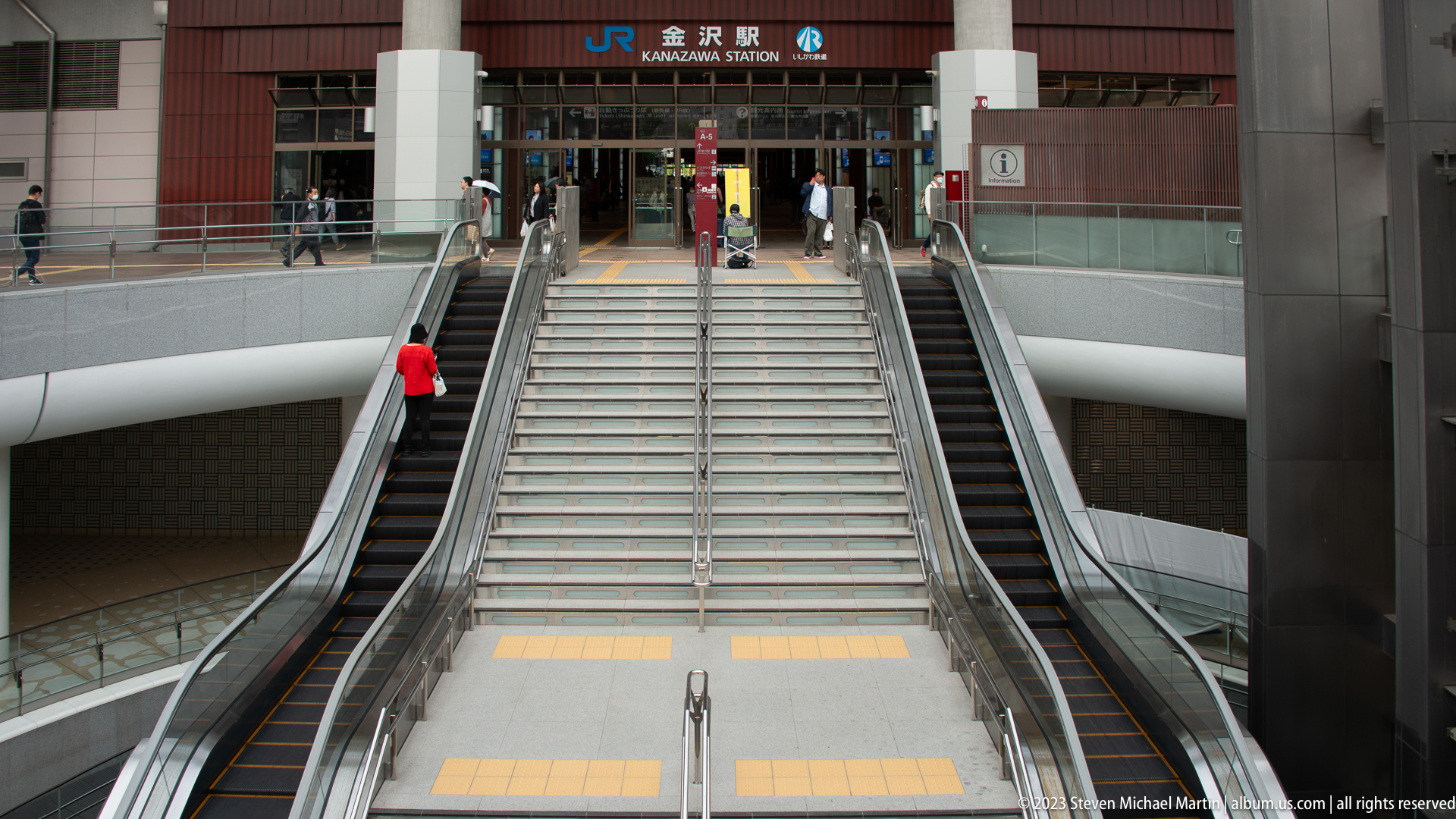
A broad central staircase rises between two escalators toward the Kanazawa Station entrance. Yellow tactile paving marks the landing and stair head, while pedestrians, information symbols, and the bilingual station sign establish the setting as a carefully organized public circulation route.
Caption
A broad central staircase rises between two escalators toward the Kanazawa Station entrance. Yellow tactile paving marks the landing and stair head, while pedestrians, information symbols, and the bilingual station sign establish the setting as a carefully organized public circulation route.
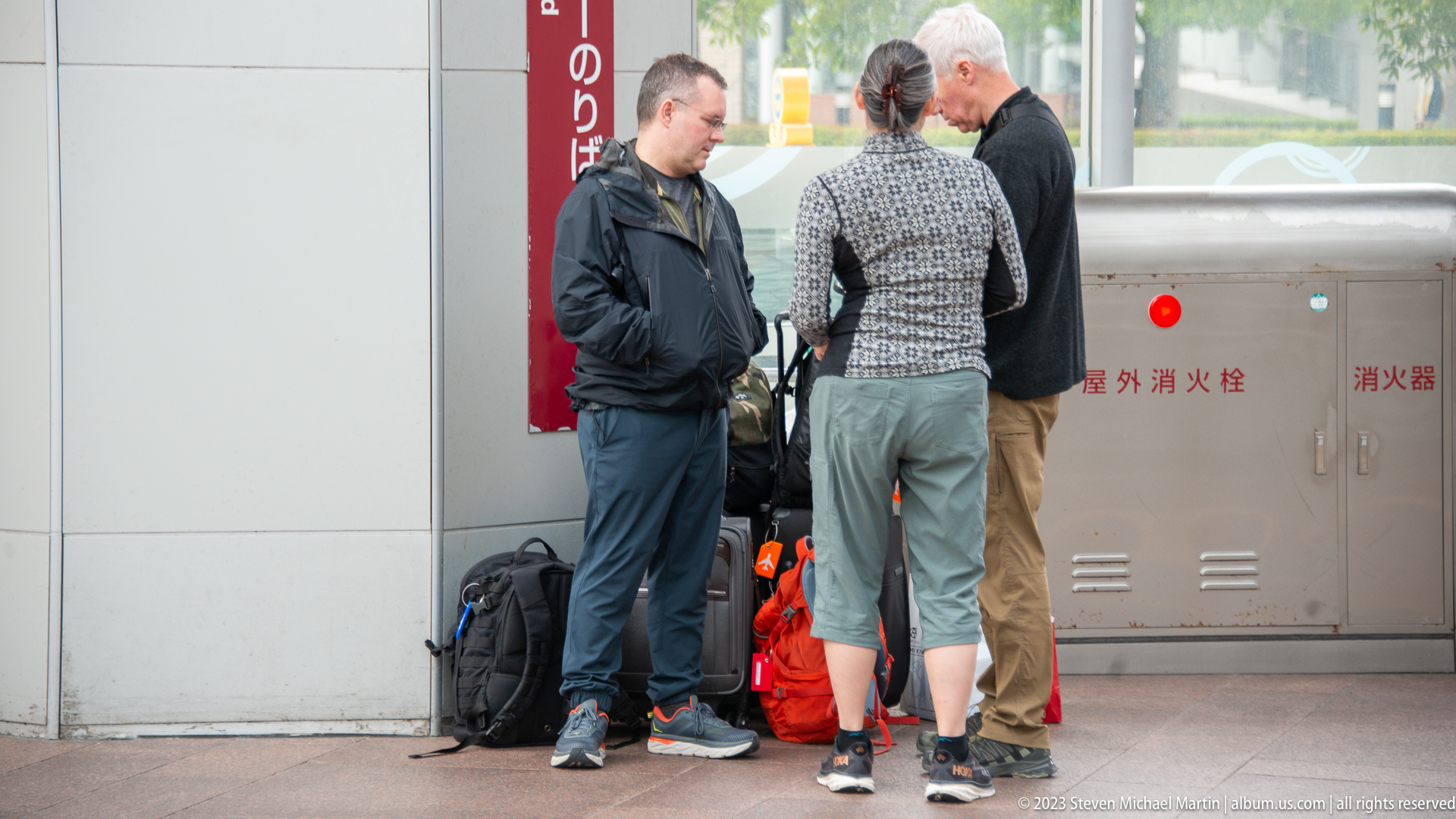
Three travelers stand in conversation beside their bags outside Kanazawa Station, apparently organizing belongings before continuing their journey. A red vertical sign and utility cabinet anchor the group against the station wall, while their clustered luggage makes the image primarily a record of travel activity rather than architecture.
Caption
Three travelers stand in conversation beside their bags outside Kanazawa Station, apparently organizing belongings before continuing their journey. A red vertical sign and utility cabinet anchor the group against the station wall, while their clustered luggage makes the image primarily a record of travel activity rather than architecture.

A low plaster wall and stone foundation follow the canal beneath a traditional building with dark timber trim and tiled eaves. A Japanese shop sign projects under the roof, while a small bridge and pedestrians beyond connect the commercial frontage to the surrounding historic neighborhood.
Caption
A low plaster wall and stone foundation follow the canal beneath a traditional building with dark timber trim and tiled eaves. A Japanese shop sign projects under the roof, while a small bridge and pedestrians beyond connect the commercial frontage to the surrounding historic neighborhood.
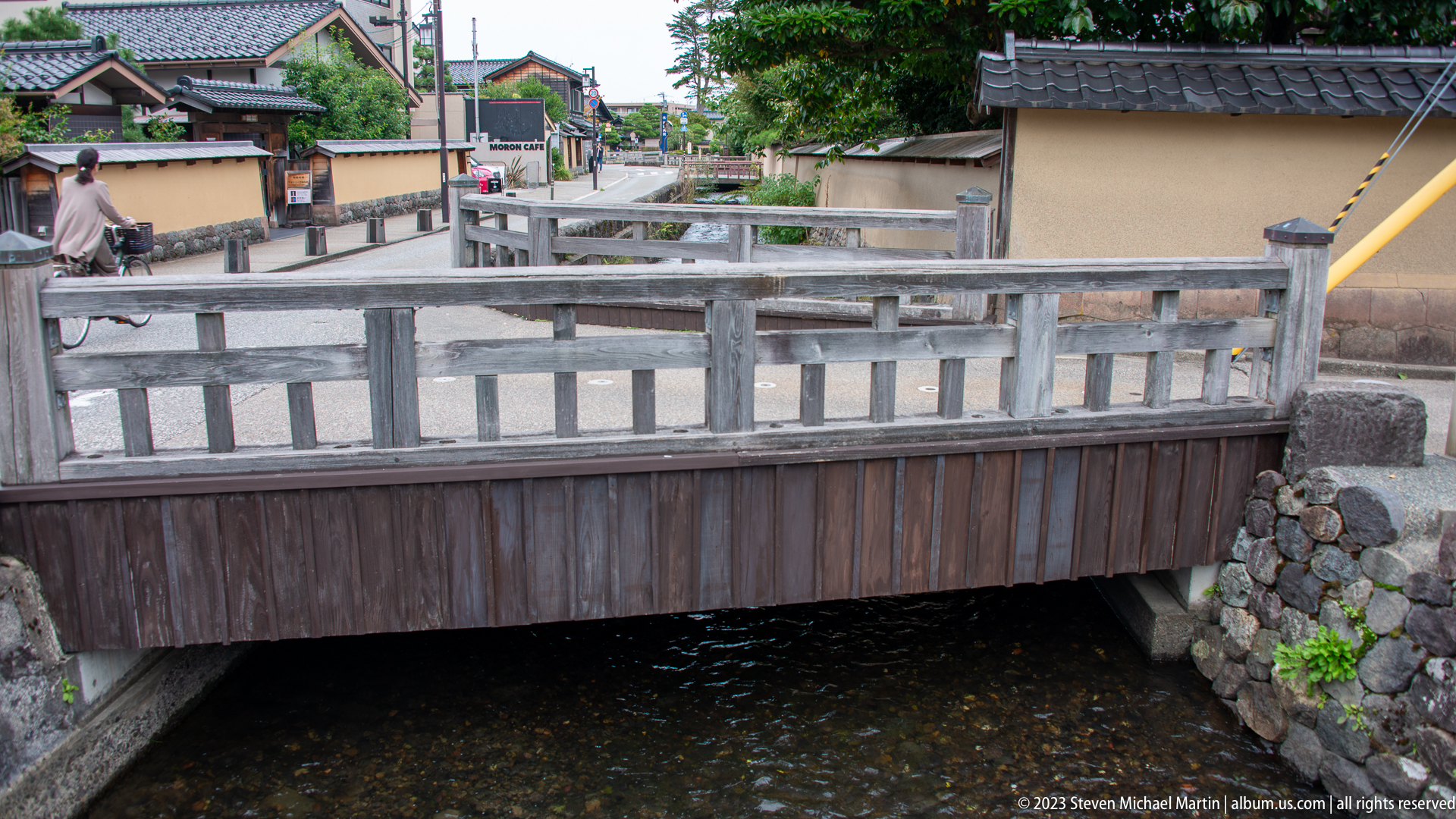
A simple timber bridge spans the narrow canal between stone retaining walls and earthen-colored plaster boundaries. Its weathered rails and deck form a practical neighborhood crossing, while the close view reveals how small bridges stitch together lanes on opposite sides of Kanazawa’s historic waterways.
Caption
A simple timber bridge spans the narrow canal between stone retaining walls and earthen-colored plaster boundaries. Its weathered rails and deck form a practical neighborhood crossing, while the close view reveals how small bridges stitch together lanes on opposite sides of Kanazawa’s historic waterways.
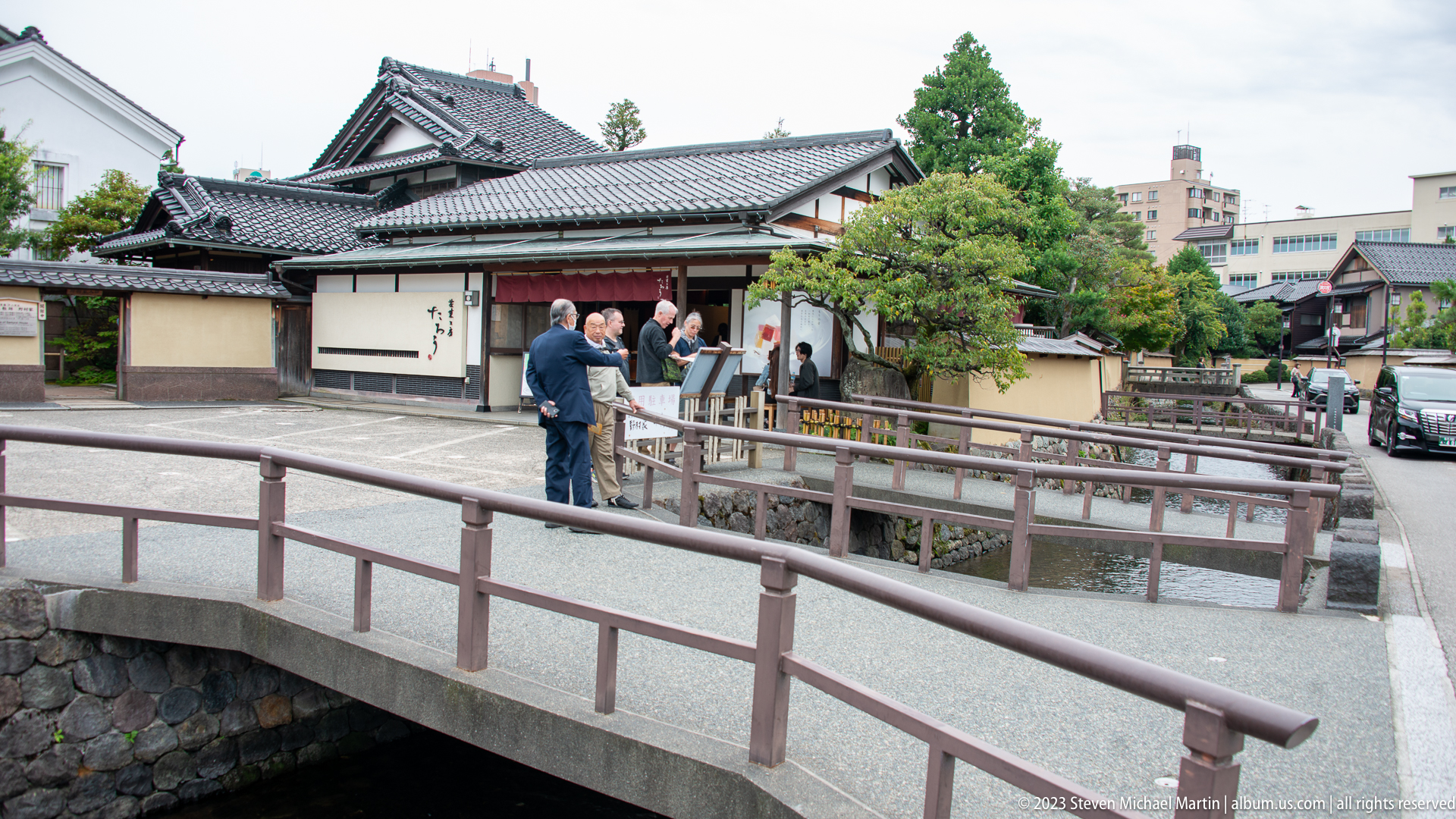
A broad pedestrian bridge leads toward a low traditional building with white plaster walls, dark timber framing, and a tiled roof. Visitors gather near the entrance, and the adjacent canal and additional bridge place the building within the neighborhood’s network of waterways and crossings.
Caption
A broad pedestrian bridge leads toward a low traditional building with white plaster walls, dark timber framing, and a tiled roof. Visitors gather near the entrance, and the adjacent canal and additional bridge place the building within the neighborhood’s network of waterways and crossings.
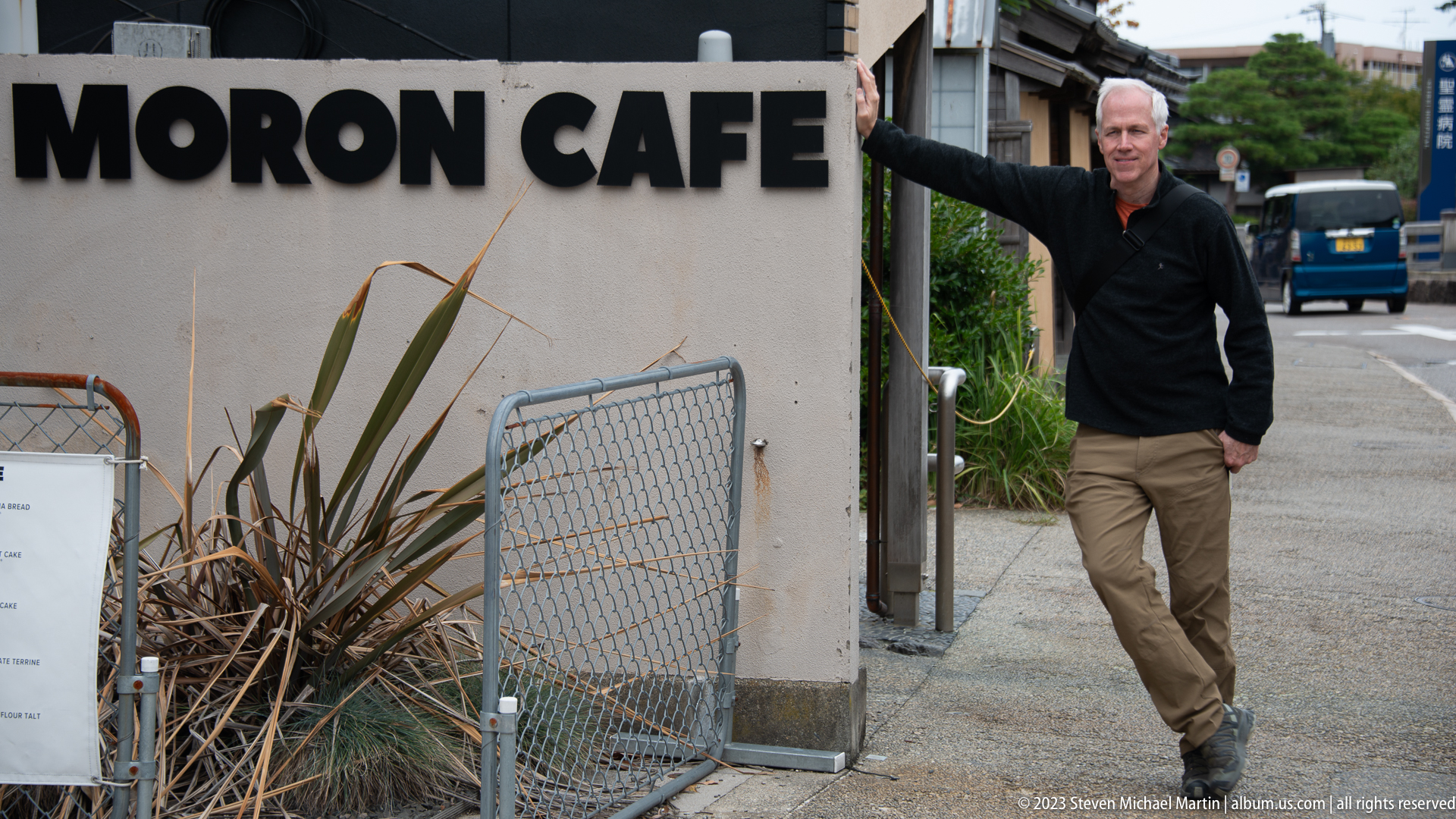
A visitor pauses beside a large cropped MACHI CAFE wall sign, raising one arm toward its upper edge. The casual gesture and close framing turn the scene into a personal travel moment, with a quiet street, planted verge, fencing, and a small vehicle extending into the background.
Caption
A visitor pauses beside a large cropped MACHI CAFE wall sign, raising one arm toward its upper edge. The casual gesture and close framing turn the scene into a personal travel moment, with a quiet street, planted verge, fencing, and a small vehicle extending into the background.
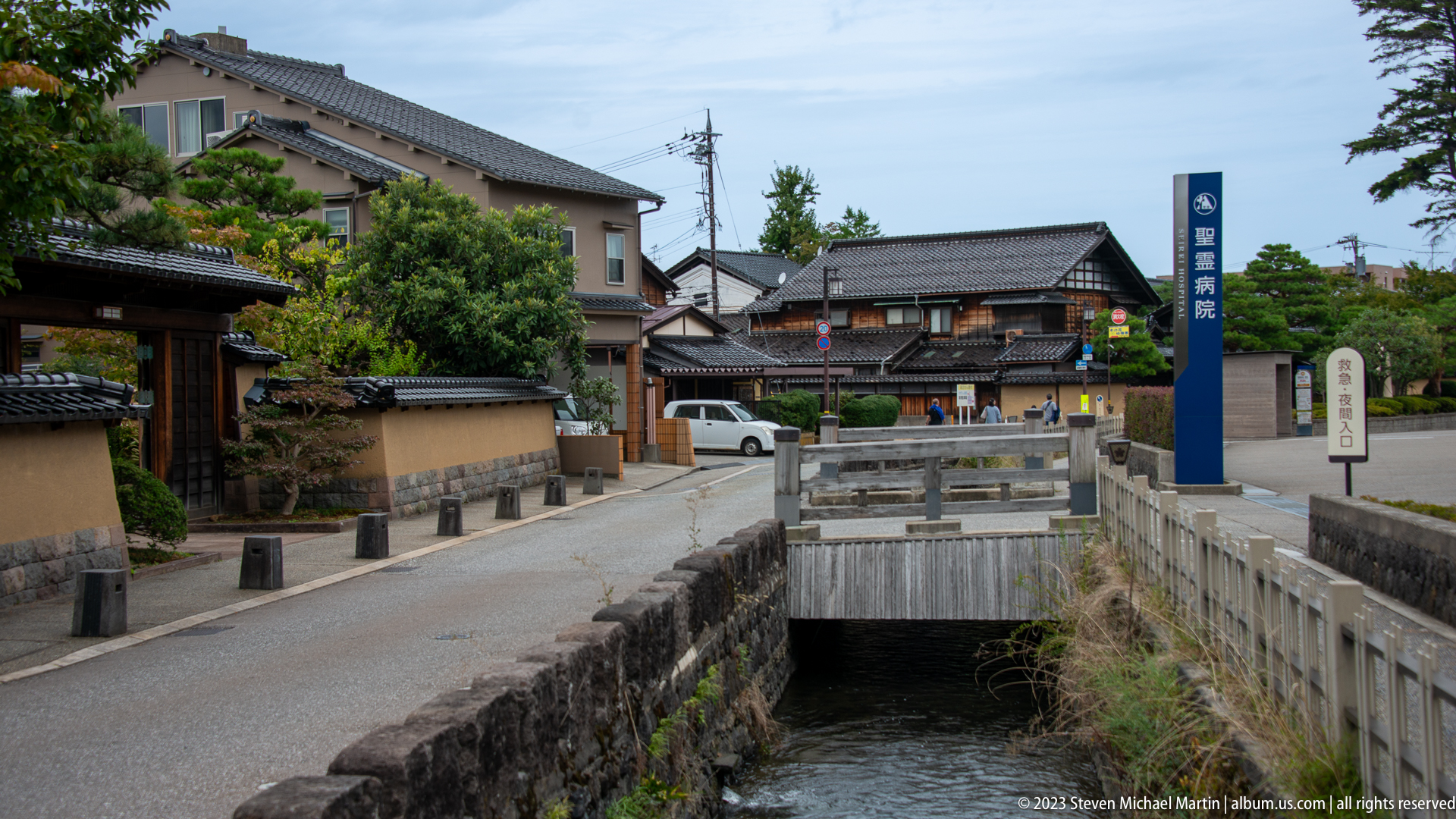
A stone-lined canal runs toward a low bridge beside traditional residences with tiled roofs, timber façades, and garden walls. A tall blue sign marks an institutional or religious entrance on the right, adding a formal destination to the otherwise quiet neighborhood waterway.
Caption
A stone-lined canal runs toward a low bridge beside traditional residences with tiled roofs, timber façades, and garden walls. A tall blue sign marks an institutional or religious entrance on the right, adding a formal destination to the otherwise quiet neighborhood waterway.
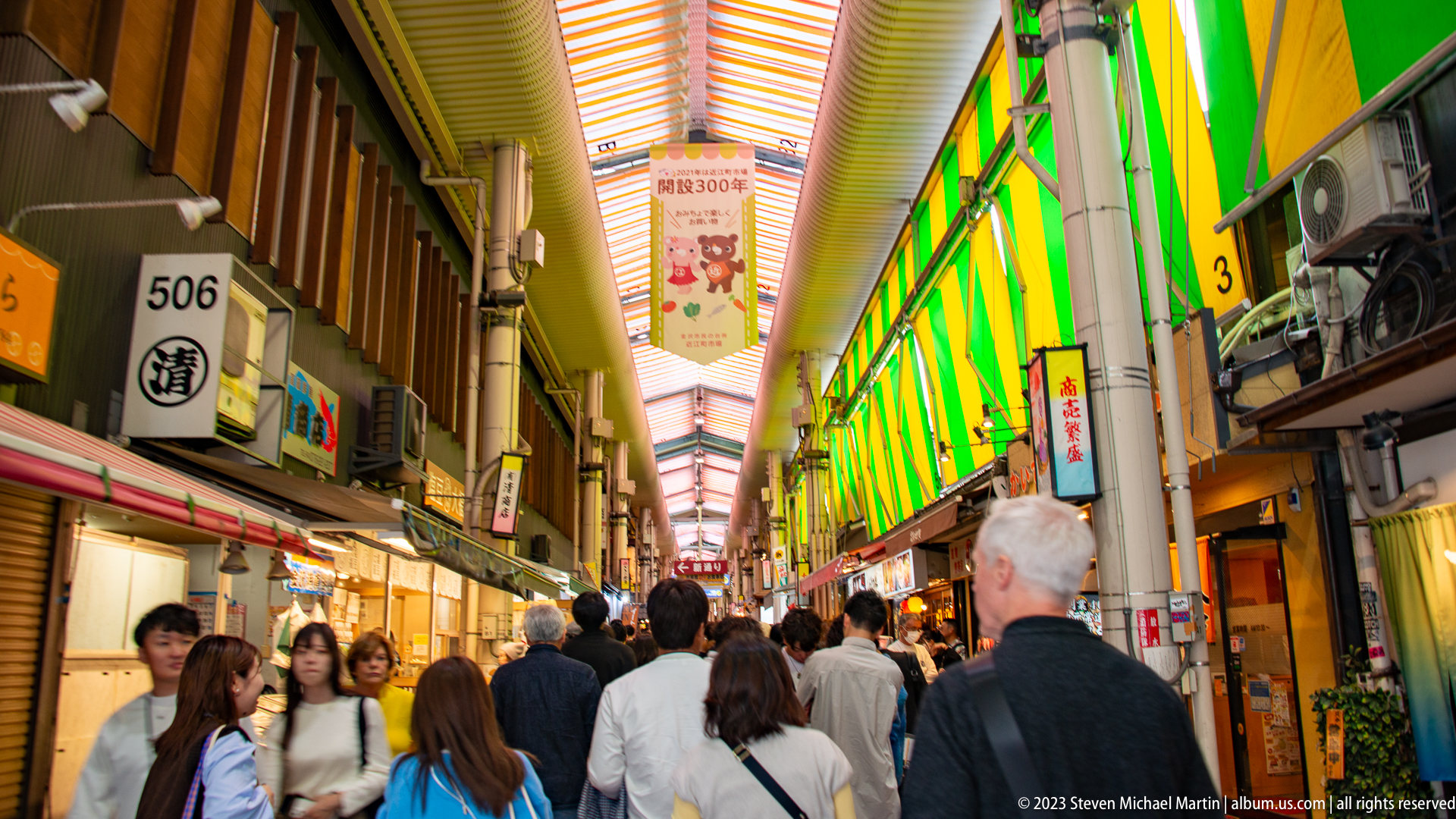
Shoppers fill a long covered arcade beneath bright striped roofing and vivid green-and-yellow side panels. Numbered shop bays, hanging signs, lanterns, and closely packed storefronts create the dense visual rhythm associated with Omicho Market, Kanazawa’s central food marketplace and a major center of everyday commerce.
Caption
Shoppers fill a long covered arcade beneath bright striped roofing and vivid green-and-yellow side panels. Numbered shop bays, hanging signs, lanterns, and closely packed storefronts create the dense visual rhythm associated with Omicho Market, Kanazawa’s central food marketplace and a major center of everyday commerce.
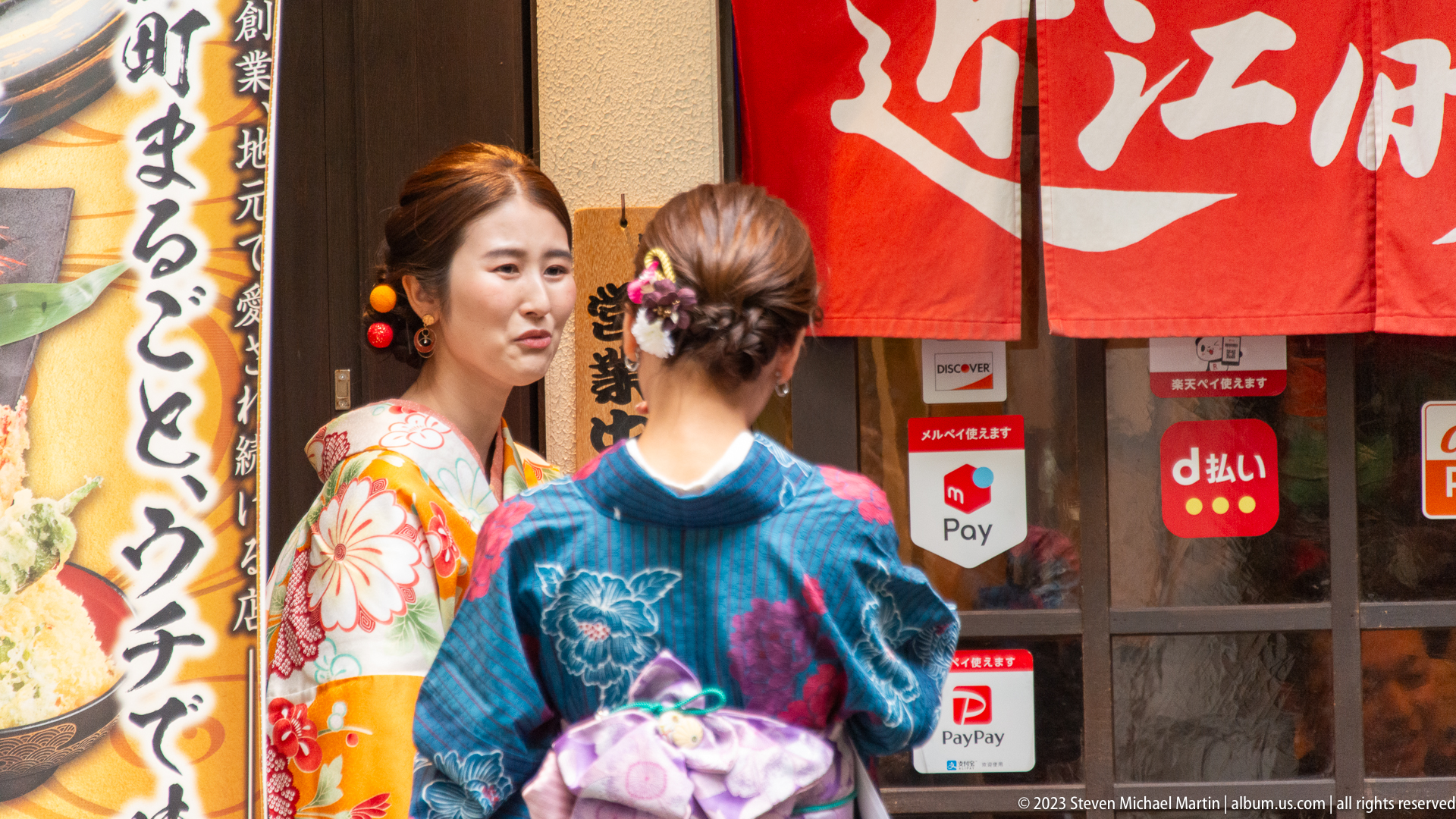
Two women wearing colorful patterned kimono pause outside a market restaurant beneath red noren curtains and vertical food signs. One is seen in profile while the other faces away, allowing the layered obi, floral hair ornament, and contrasting textile patterns to become the principal visual details.
Caption
Two women wearing colorful patterned kimono pause outside a market restaurant beneath red noren curtains and vertical food signs. One is seen in profile while the other faces away, allowing the layered obi, floral hair ornament, and contrasting textile patterns to become the principal visual details.
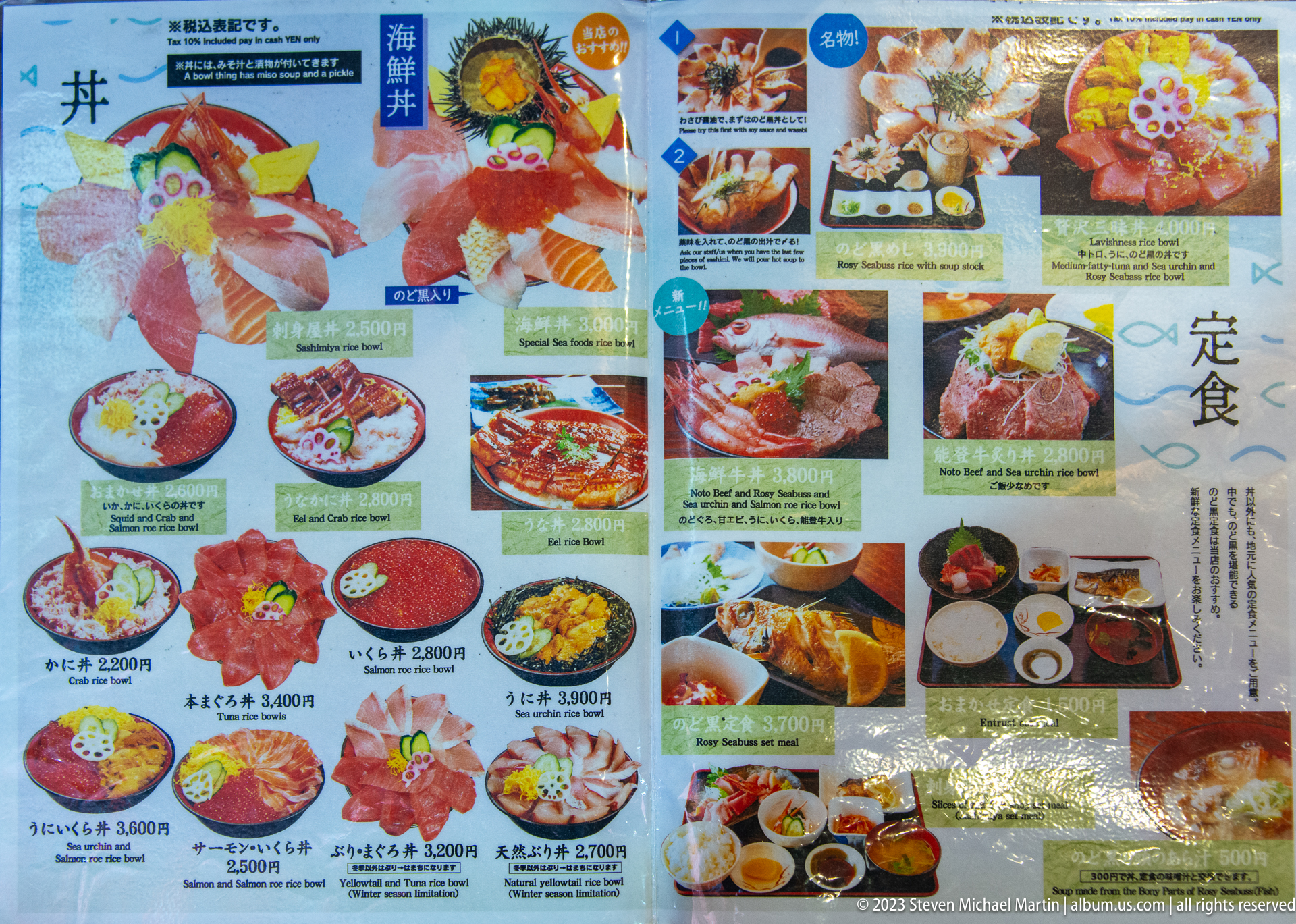
A large illustrated menu presents bowls, sushi, sashimi, and set meals with Japanese labels, prices, and some English descriptions. The dense collage of plated seafood options functions as both advertising and orientation for visitors choosing among Omicho Market’s many restaurants.
Caption
A large illustrated menu presents bowls, sushi, sashimi, and set meals with Japanese labels, prices, and some English descriptions. The dense collage of plated seafood options functions as both advertising and orientation for visitors choosing among Omicho Market’s many restaurants.
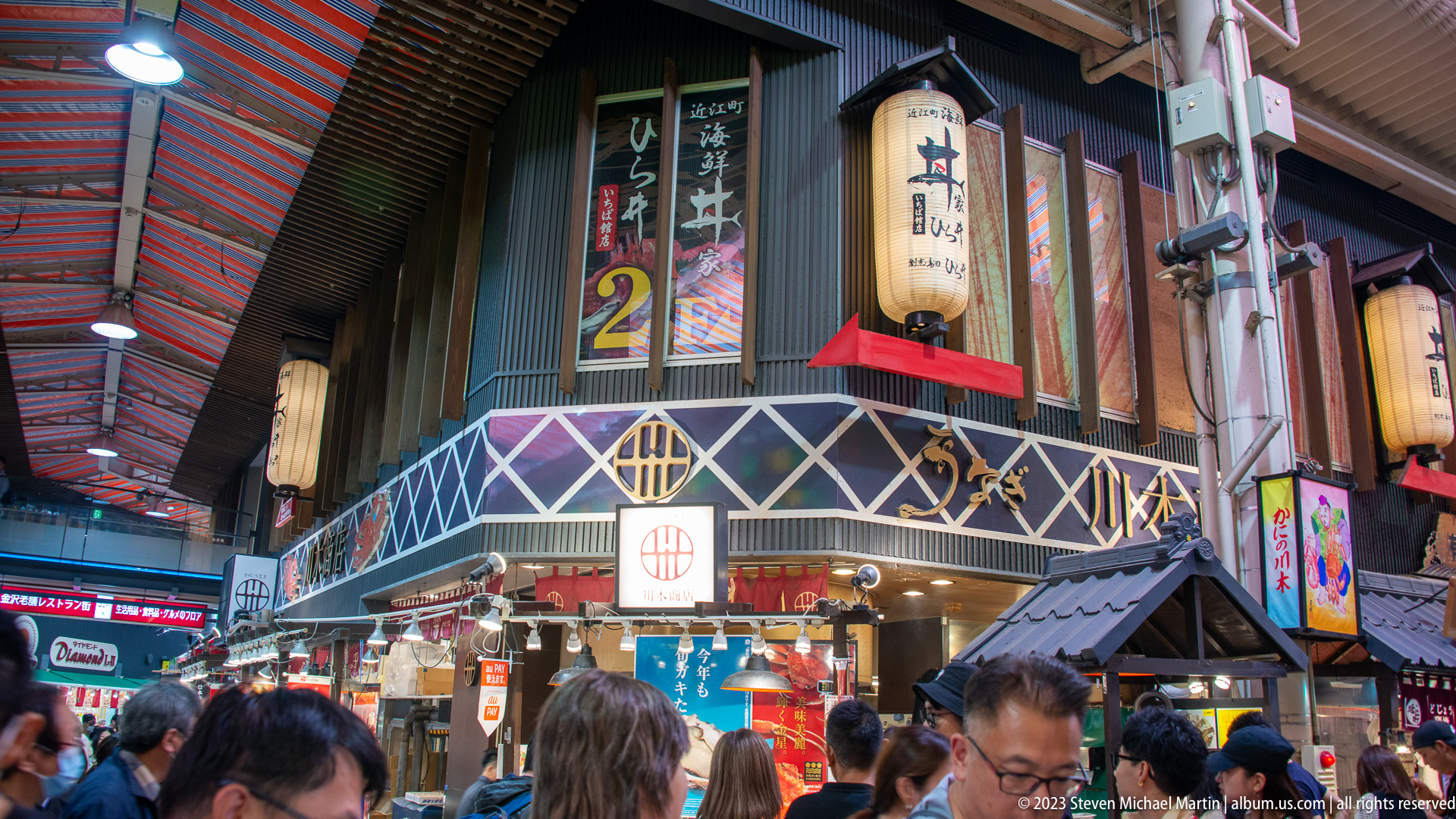
A busy junction within Omicho Market brings together wooden shopfronts, lanterns, hanging banners, numbered bay signs, and streams of shoppers. The layered signage and intersecting aisles reveal the market’s maze-like organization, where restaurants and food stalls compete for attention within the covered arcade.
Caption
A busy junction within Omicho Market brings together wooden shopfronts, lanterns, hanging banners, numbered bay signs, and streams of shoppers. The layered signage and intersecting aisles reveal the market’s maze-like organization, where restaurants and food stalls compete for attention within the covered arcade.
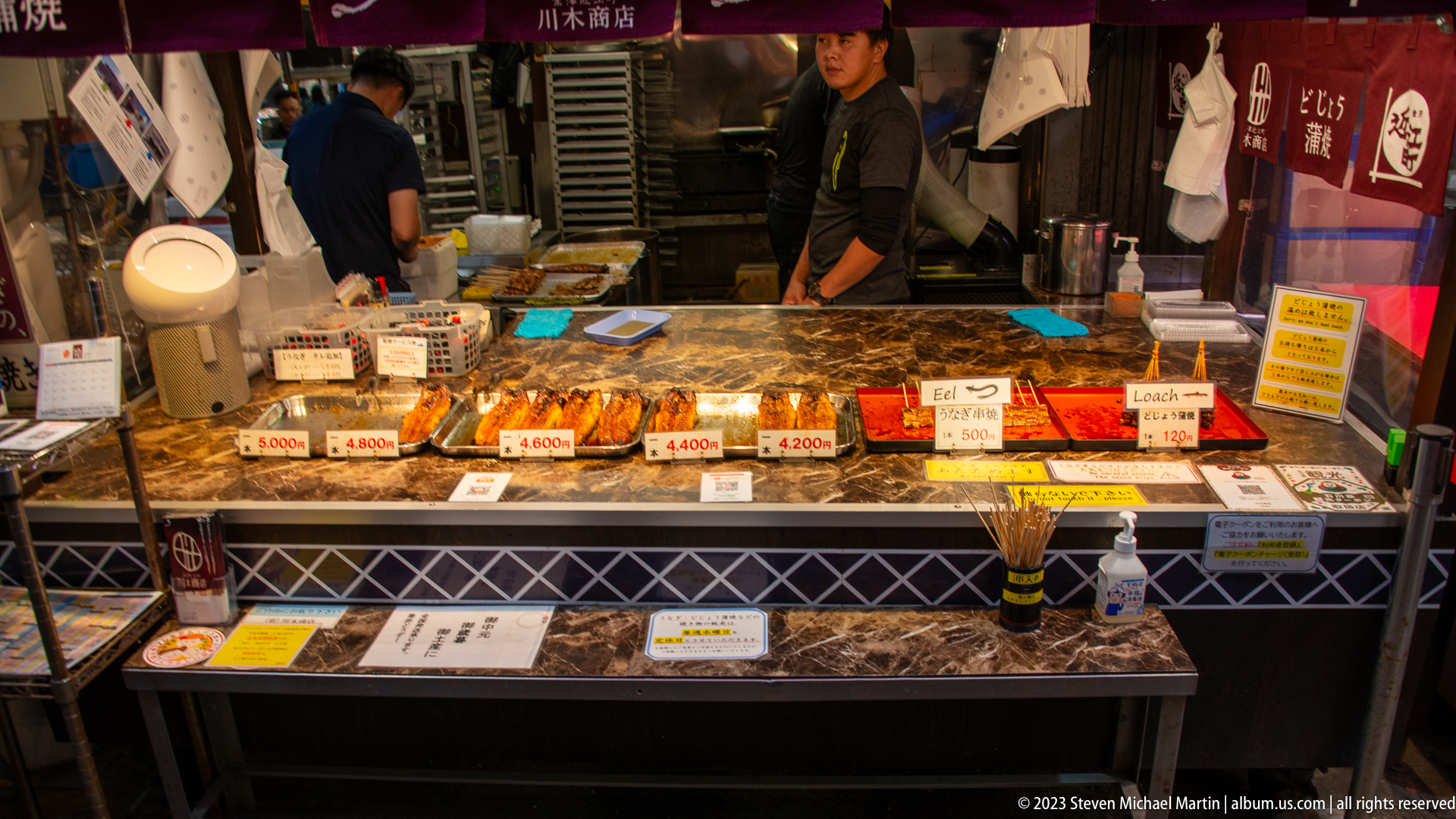
Large crabs are arranged across a seafood counter beneath handwritten price cards, with a vendor standing behind the display. The stall’s open presentation allows shoppers to compare size and price directly, highlighting the market’s emphasis on fresh regional seafood and face-to-face sales.
Caption
Large crabs are arranged across a seafood counter beneath handwritten price cards, with a vendor standing behind the display. The stall’s open presentation allows shoppers to compare size and price directly, highlighting the market’s emphasis on fresh regional seafood and face-to-face sales.
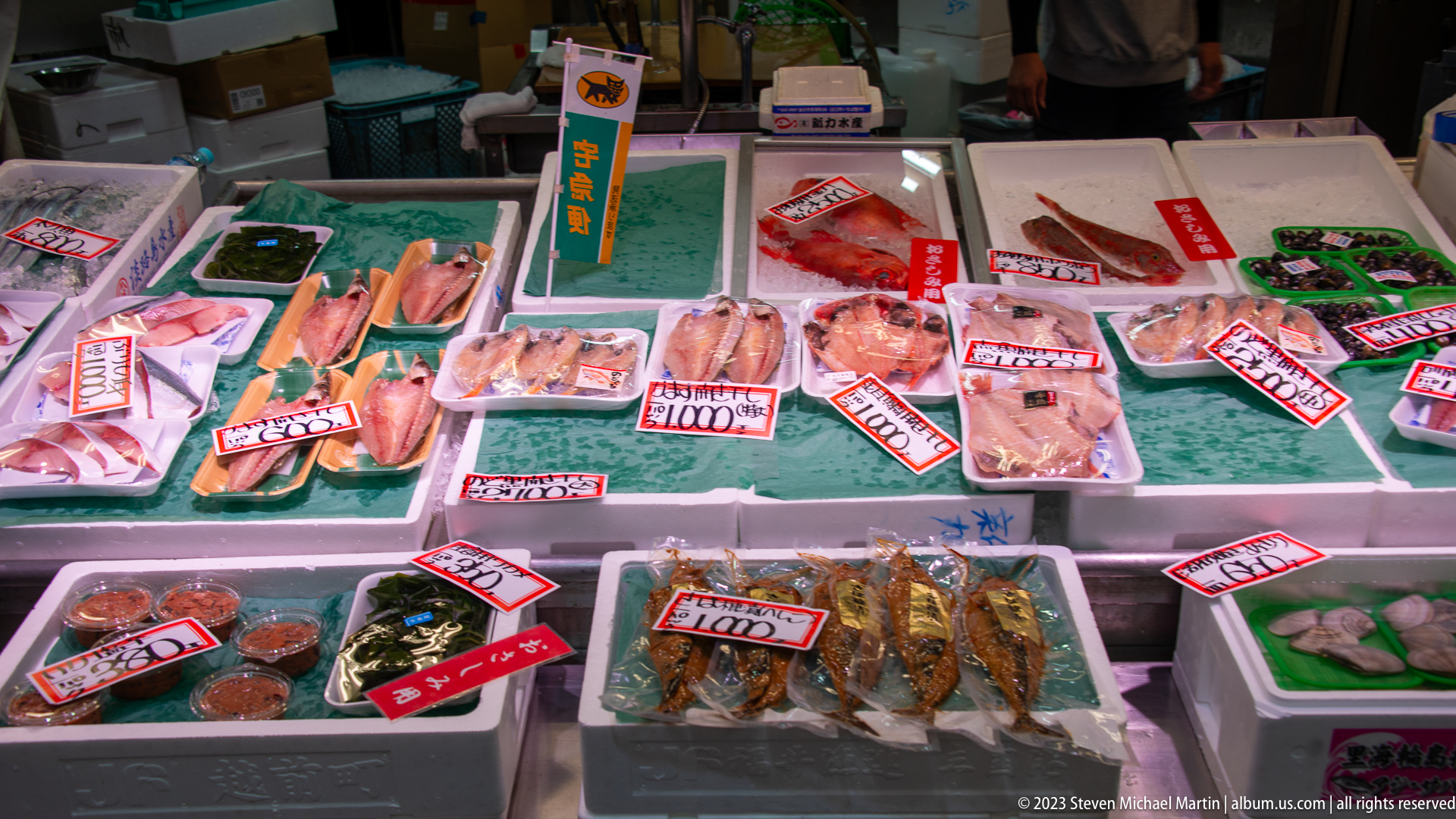
Trays of fish and prepared seafood fill a chilled market counter, each package marked with handwritten Japanese labels and prices. The angled view surveys the range of cuts and whole products available, emphasizing retail presentation and variety rather than a single featured species.
Caption
Trays of fish and prepared seafood fill a chilled market counter, each package marked with handwritten Japanese labels and prices. The angled view surveys the range of cuts and whole products available, emphasizing retail presentation and variety rather than a single featured species.
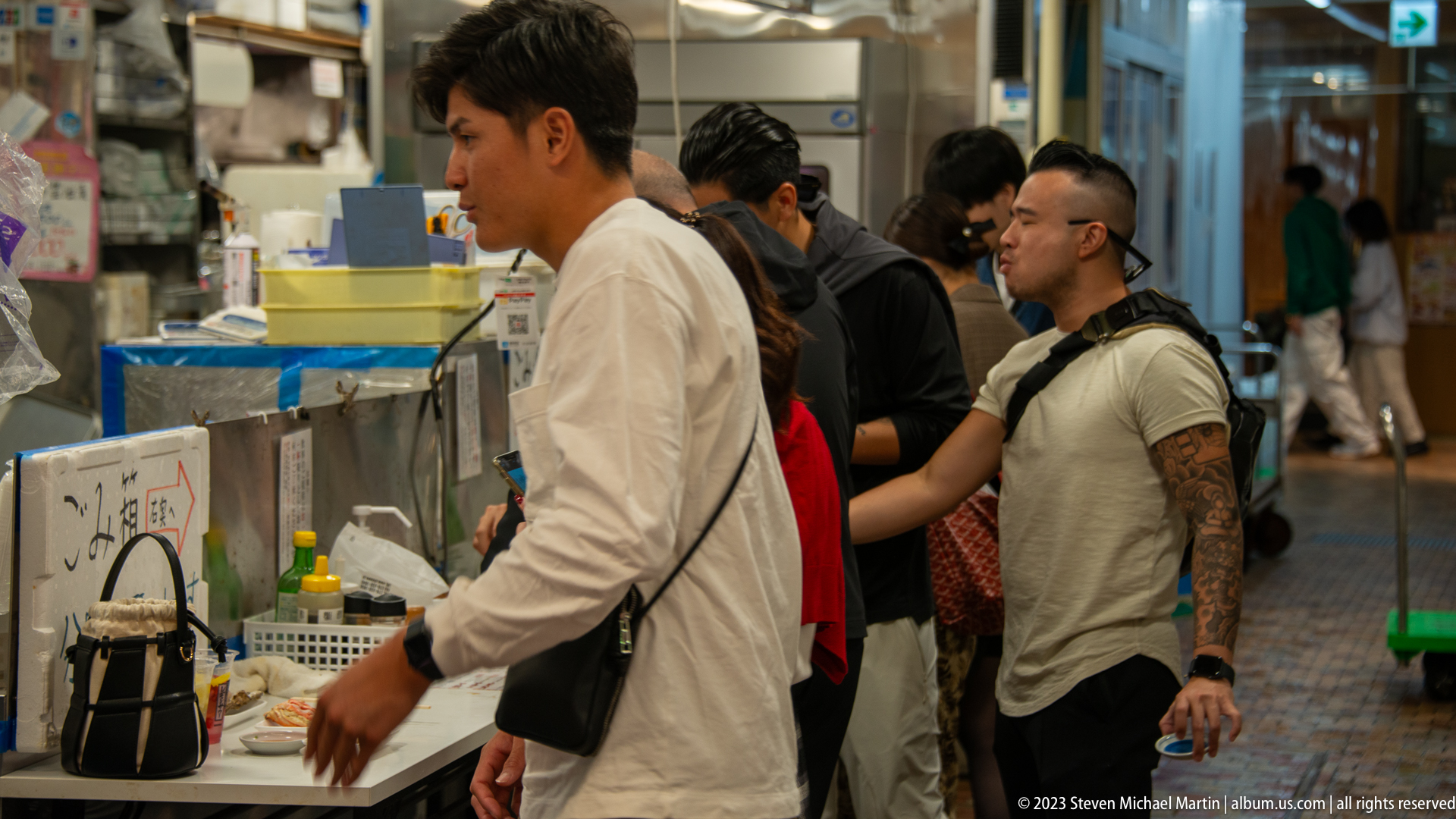
Workers and shoppers move through a narrow aisle beside a seafood counter, creating a layered scene of service, browsing, and circulation. The foreground worker turns across the frame while others stand behind him, conveying the brisk pace and close human interaction of the covered market.
Caption
Workers and shoppers move through a narrow aisle beside a seafood counter, creating a layered scene of service, browsing, and circulation. The foreground worker turns across the frame while others stand behind him, conveying the brisk pace and close human interaction of the covered market.
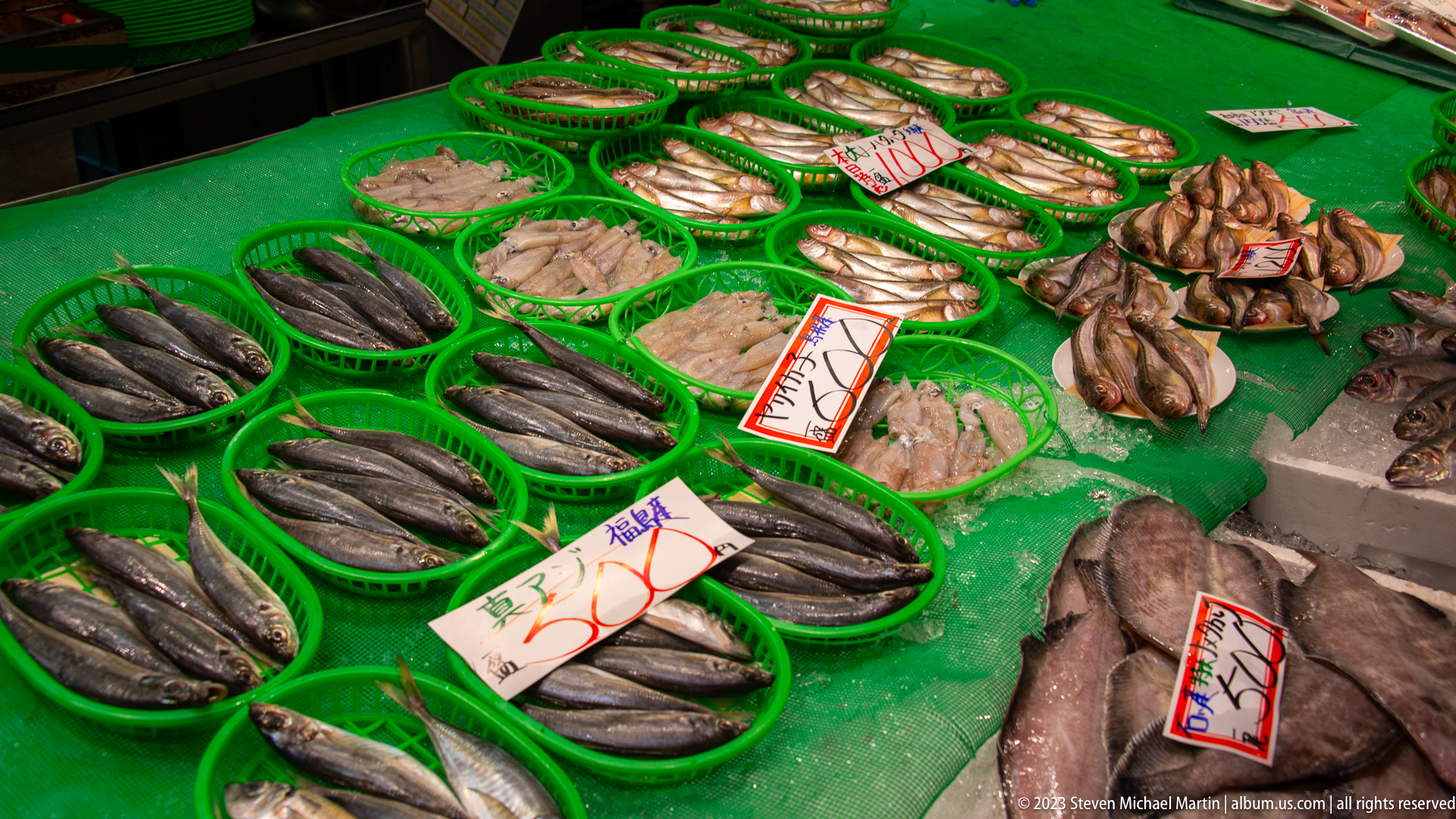
Whole fish, shellfish, and other fresh seafood fill green plastic baskets across a market counter in Kanazawa. Handwritten Japanese price cards identify individual offerings, while the dense arrangement emphasizes the variety and direct visual merchandising characteristic of a working seafood market. The close viewpoint records both the products and the practical display system used by vendors.
Caption
Whole fish, shellfish, and other fresh seafood fill green plastic baskets across a market counter in Kanazawa. Handwritten Japanese price cards identify individual offerings, while the dense arrangement emphasizes the variety and direct visual merchandising characteristic of a working seafood market. The close viewpoint records both the products and the practical display system used by vendors.
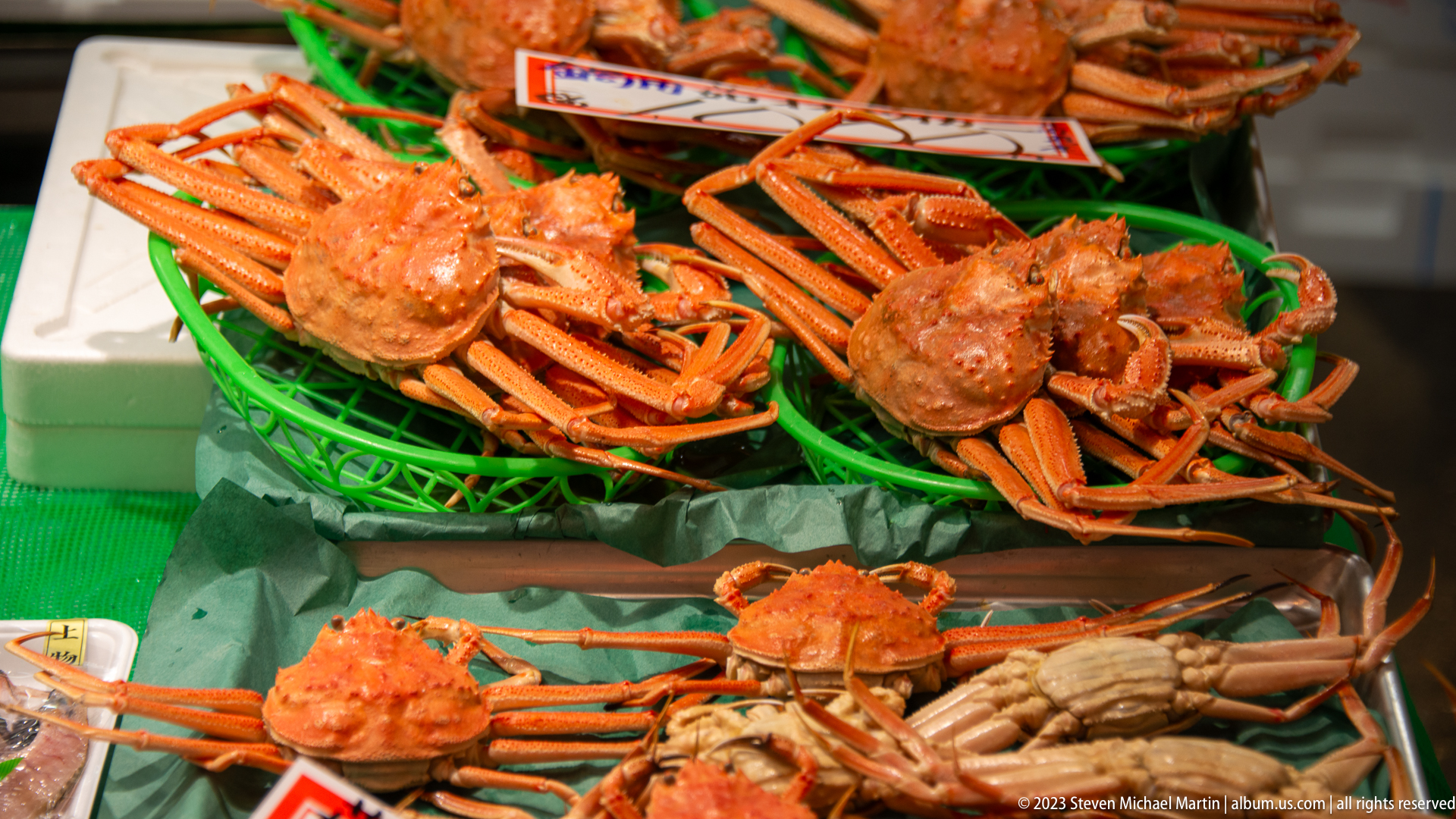
Large orange-red crabs are stacked across green market trays, their long legs and spined shells creating a dense pattern across the counter. The display presents the catch as both food and spectacle, drawing attention to size, abundance, and freshness. Closely framed details place the viewer at the vendor’s stall rather than offering a broader market overview.
Caption
Large orange-red crabs are stacked across green market trays, their long legs and spined shells creating a dense pattern across the counter. The display presents the catch as both food and spectacle, drawing attention to size, abundance, and freshness. Closely framed details place the viewer at the vendor’s stall rather than offering a broader market overview.
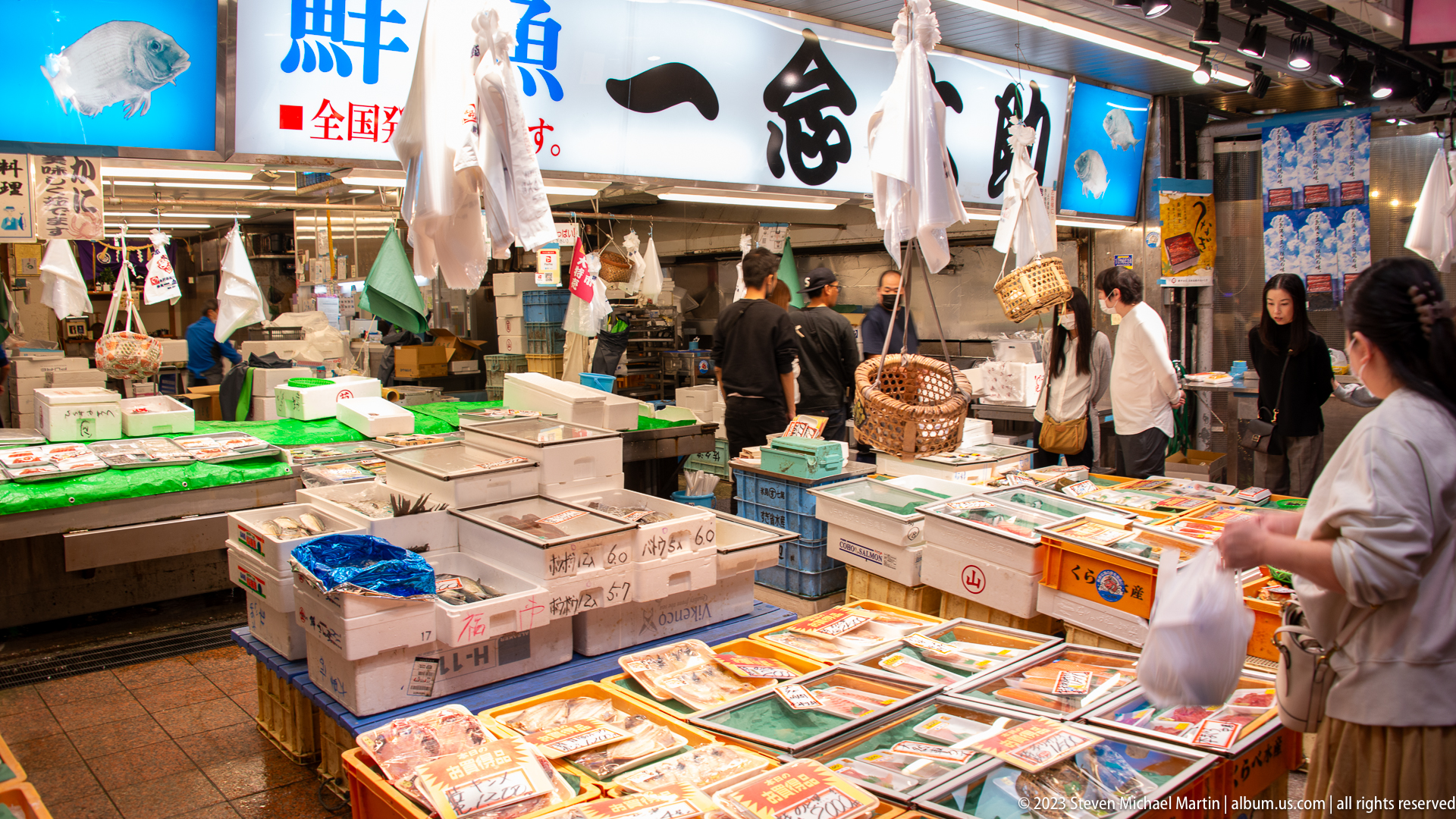
Customers and vendors move through a brightly lit seafood stall lined with refrigerated cases, boxed products, handwritten labels, and hanging fabric banners. The layered composition records the market as an active commercial environment rather than a static display, showing how merchandise, signage, staff, and pedestrian circulation share a compact interior space in central Kanazawa.
Caption
Customers and vendors move through a brightly lit seafood stall lined with refrigerated cases, boxed products, handwritten labels, and hanging fabric banners. The layered composition records the market as an active commercial environment rather than a static display, showing how merchandise, signage, staff, and pedestrian circulation share a compact interior space in central Kanazawa.
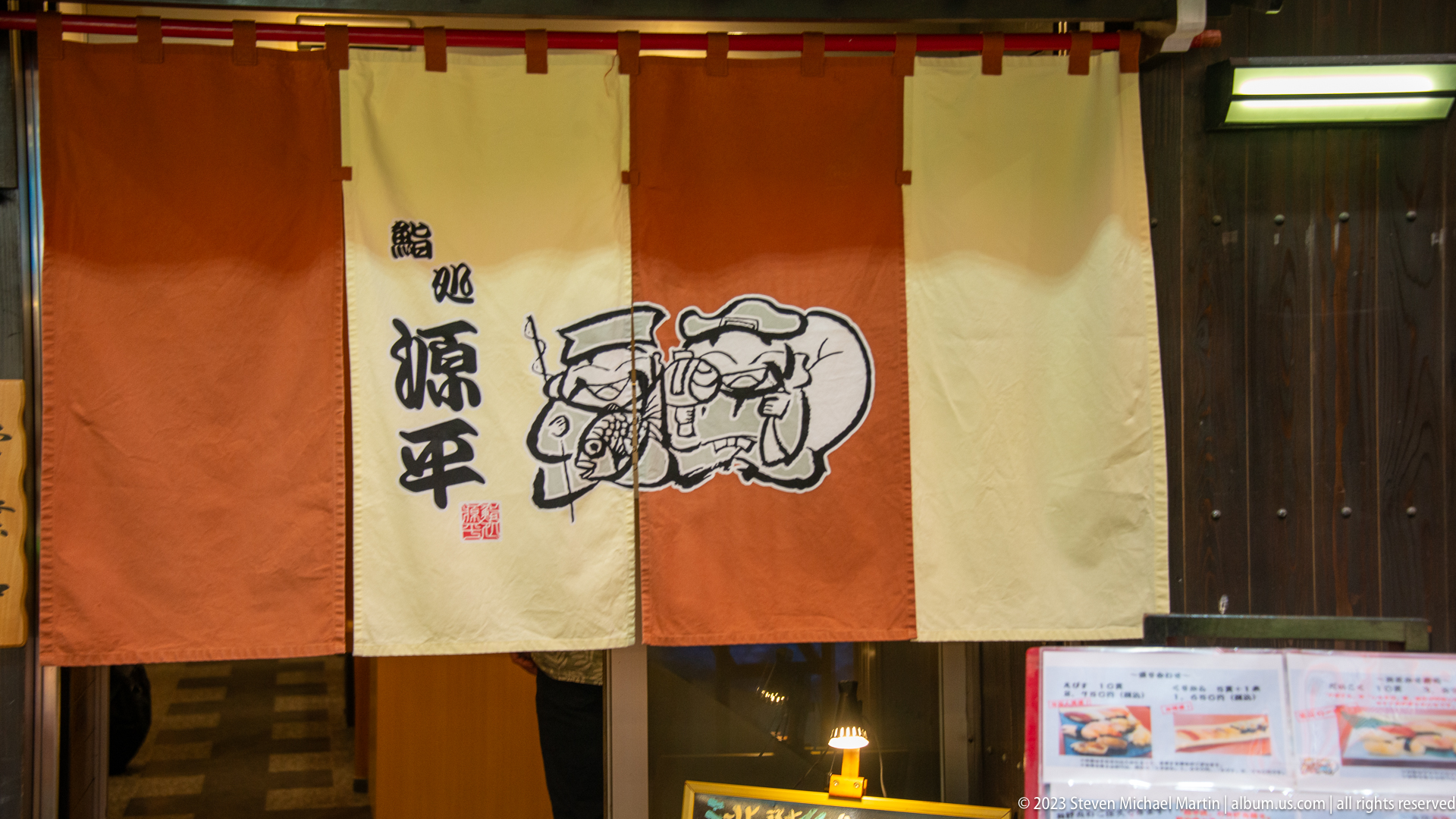
A three-panel noren marks the entrance to a Kanazawa food business, combining bold Japanese calligraphy with a cartoon-like emblem of two figures. The warm orange and cream textile creates a clear threshold between the street and interior, while a menu display at lower right reinforces the storefront’s commercial function. The image focuses on graphic identity and traditional entrance design.
Caption
A three-panel noren marks the entrance to a Kanazawa food business, combining bold Japanese calligraphy with a cartoon-like emblem of two figures. The warm orange and cream textile creates a clear threshold between the street and interior, while a menu display at lower right reinforces the storefront’s commercial function. The image focuses on graphic identity and traditional entrance design.
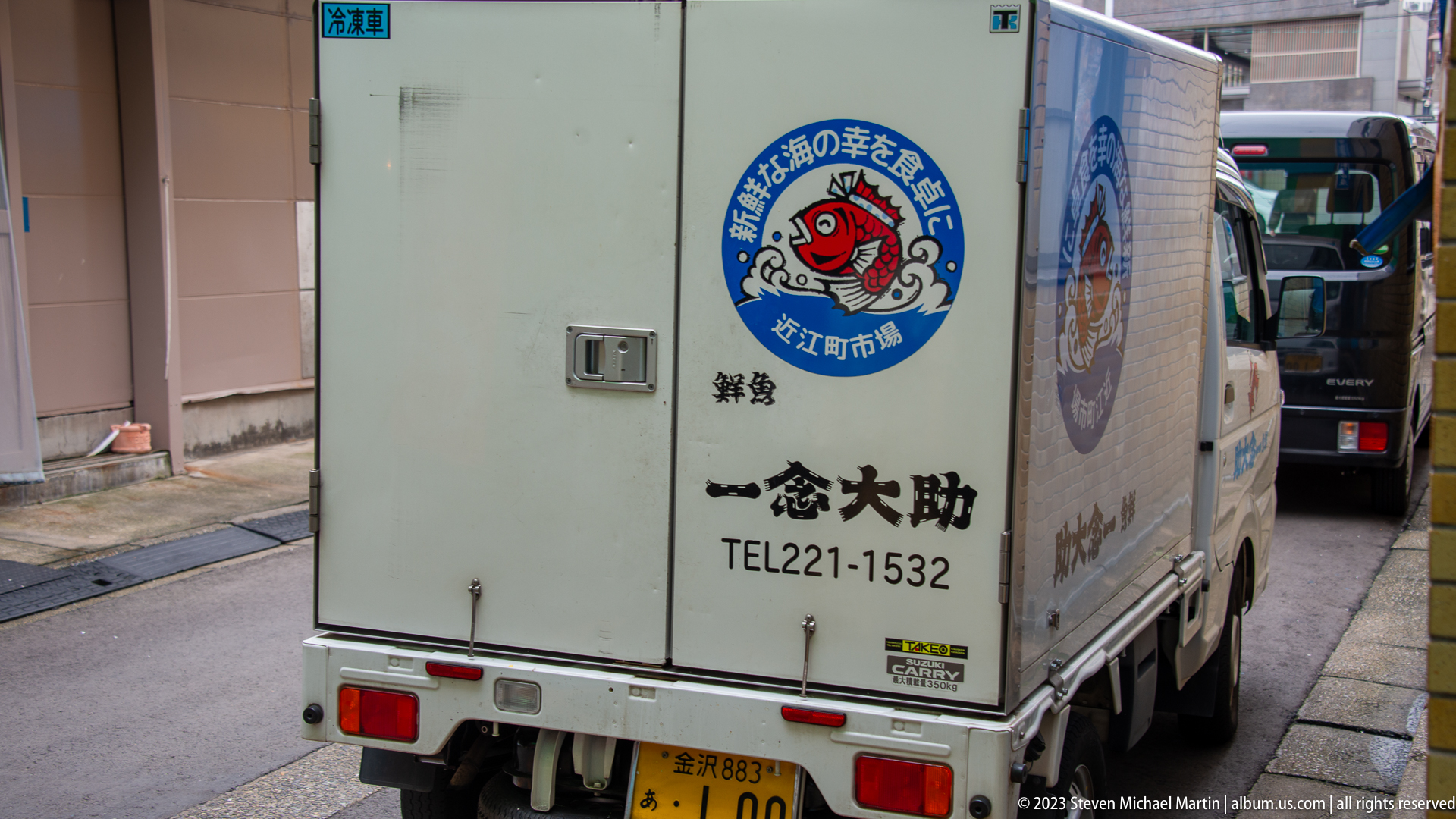
A compact commercial truck is parked in a narrow service lane, its rear doors carrying Japanese company lettering and a circular fish-themed logo. The vehicle’s small scale suits the confined streets and delivery spaces of a dense urban market district. Rather than depicting merchandise directly, the photograph records the logistical network that supports Kanazawa’s food trade.
Caption
A compact commercial truck is parked in a narrow service lane, its rear doors carrying Japanese company lettering and a circular fish-themed logo. The vehicle’s small scale suits the confined streets and delivery spaces of a dense urban market district. Rather than depicting merchandise directly, the photograph records the logistical network that supports Kanazawa’s food trade.
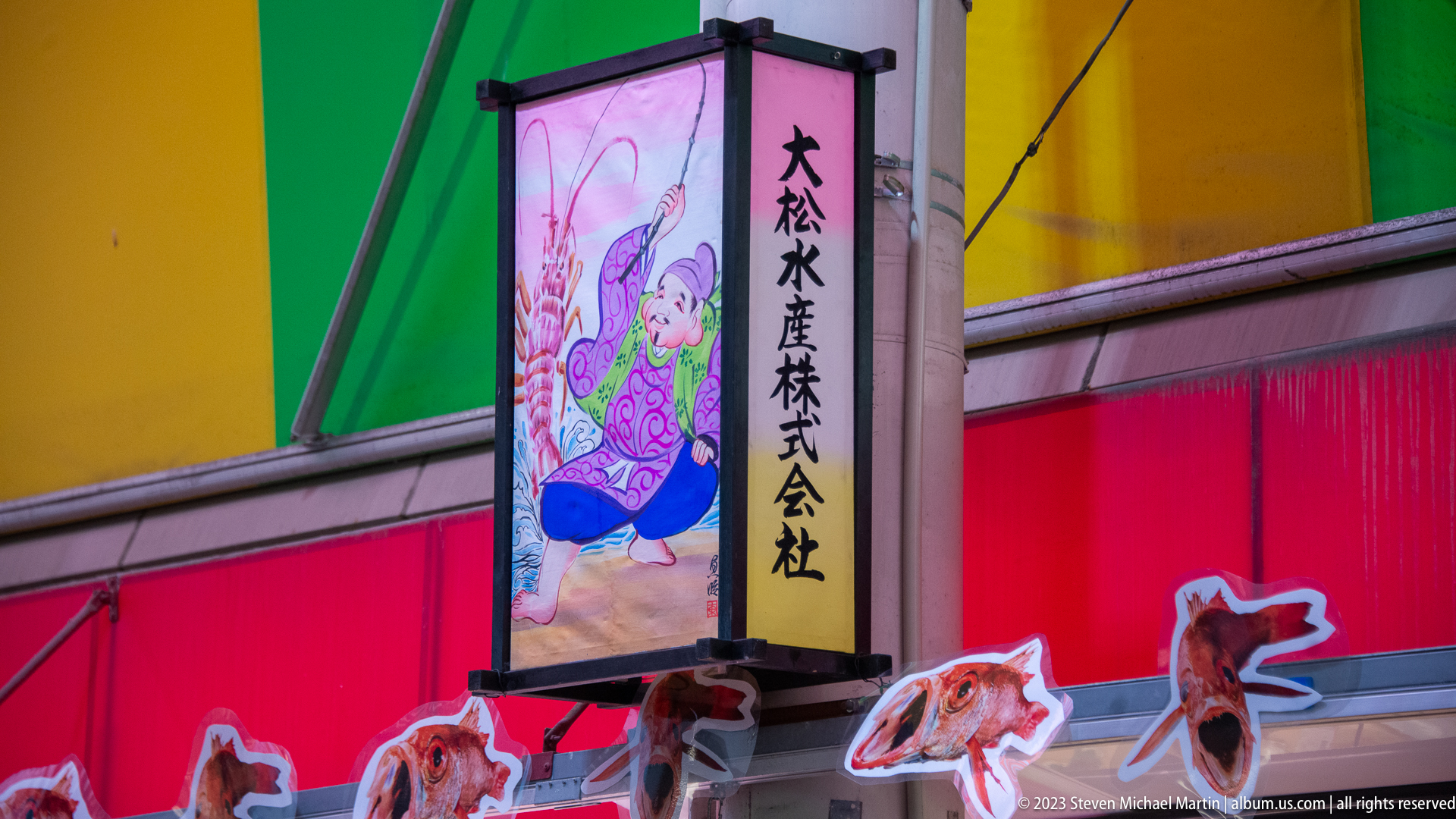
A vertical illuminated sign projects from a brightly colored storefront, pairing Japanese company lettering with a painted figure carrying or presenting seafood. The traditional illustration contrasts with the vivid green, yellow, and red awning behind it, creating a distinctive commercial landmark after dark. The sign demonstrates how local food businesses combine text, character imagery, and light to attract attention.
Caption
A vertical illuminated sign projects from a brightly colored storefront, pairing Japanese company lettering with a painted figure carrying or presenting seafood. The traditional illustration contrasts with the vivid green, yellow, and red awning behind it, creating a distinctive commercial landmark after dark. The sign demonstrates how local food businesses combine text, character imagery, and light to attract attention.
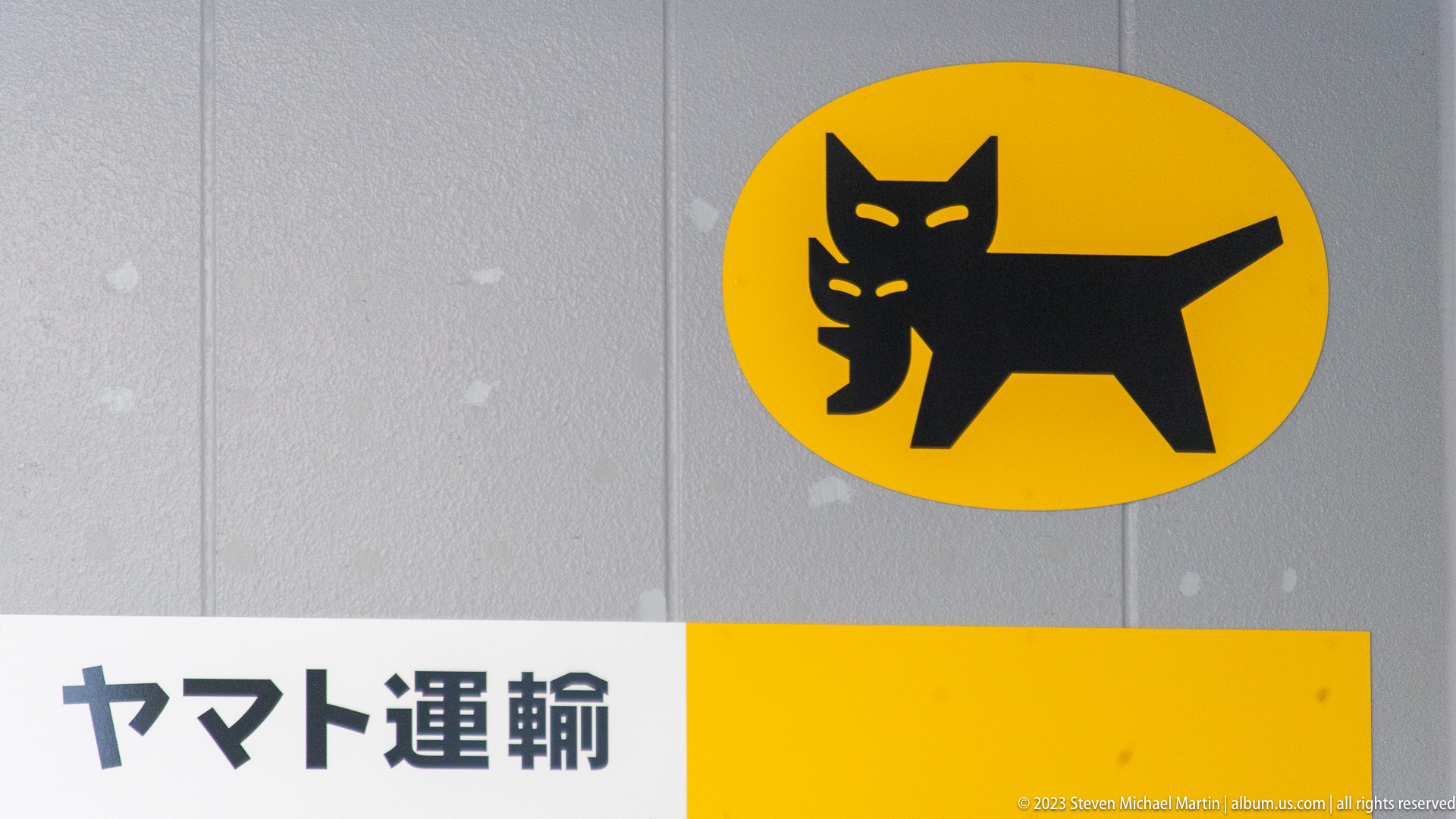
The black-cat-and-kitten emblem of Yamato Transport appears inside a yellow oval above the Japanese name Yamato Unyu. Reduced to a bold silhouette and two-color palette, the mark is immediately legible at a distance and has become a familiar feature of Japanese streets and delivery vehicles. The tight composition isolates the visual identity from its surrounding commercial context.
Caption
The black-cat-and-kitten emblem of Yamato Transport appears inside a yellow oval above the Japanese name Yamato Unyu. Reduced to a bold silhouette and two-color palette, the mark is immediately legible at a distance and has become a familiar feature of Japanese streets and delivery vehicles. The tight composition isolates the visual identity from its surrounding commercial context.
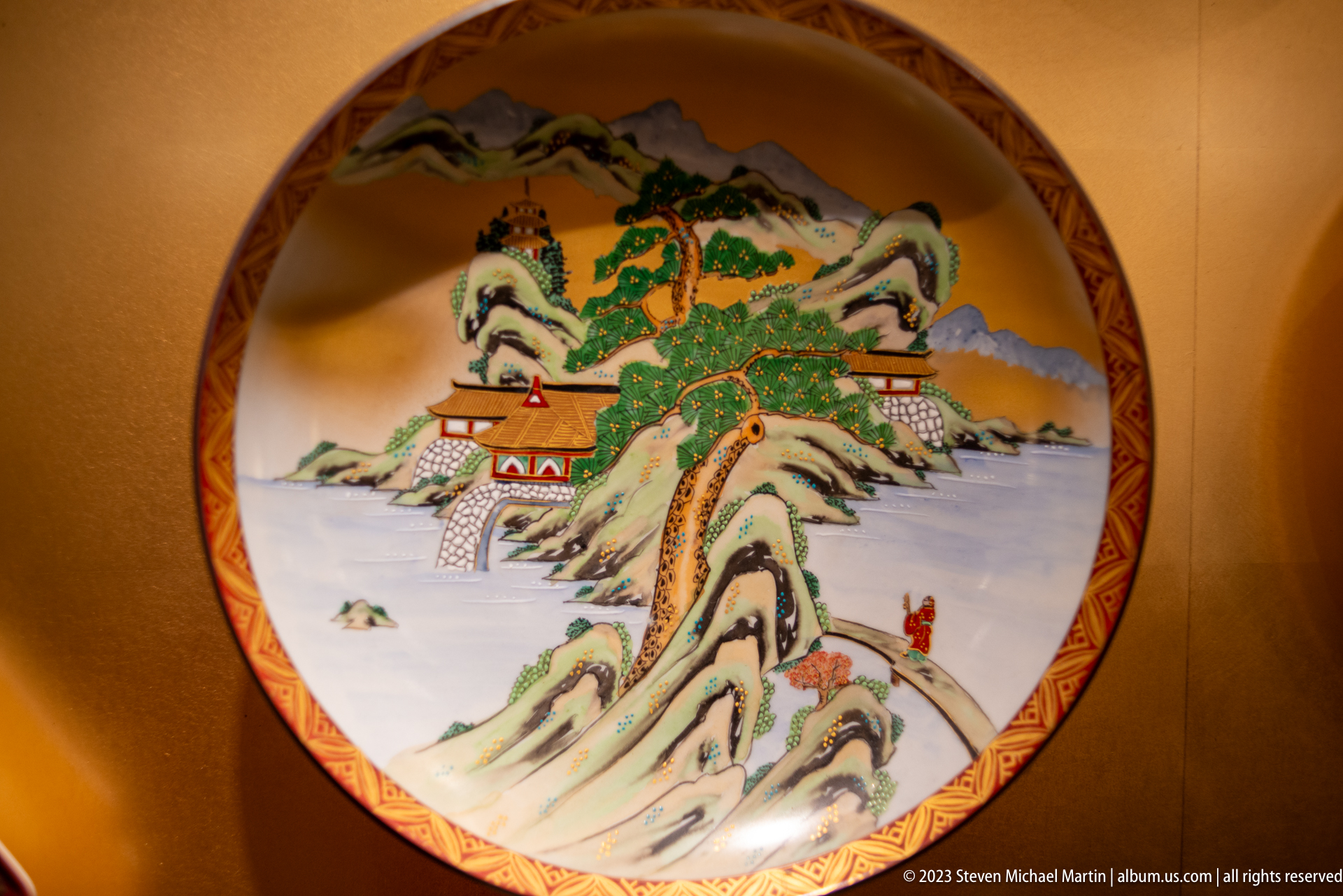
A large porcelain charger presents a castle complex rising through stylized mountains, pine trees, clouds, and water. The circular border frames the landscape like a self-contained pictorial world, while colored enamels and fine linework organize architecture and terrain into layered depth. Displayed under warm gallery lighting, the object foregrounds the narrative and decorative possibilities of regional ceramic painting.
Caption
A large porcelain charger presents a castle complex rising through stylized mountains, pine trees, clouds, and water. The circular border frames the landscape like a self-contained pictorial world, while colored enamels and fine linework organize architecture and terrain into layered depth. Displayed under warm gallery lighting, the object foregrounds the narrative and decorative possibilities of regional ceramic painting.
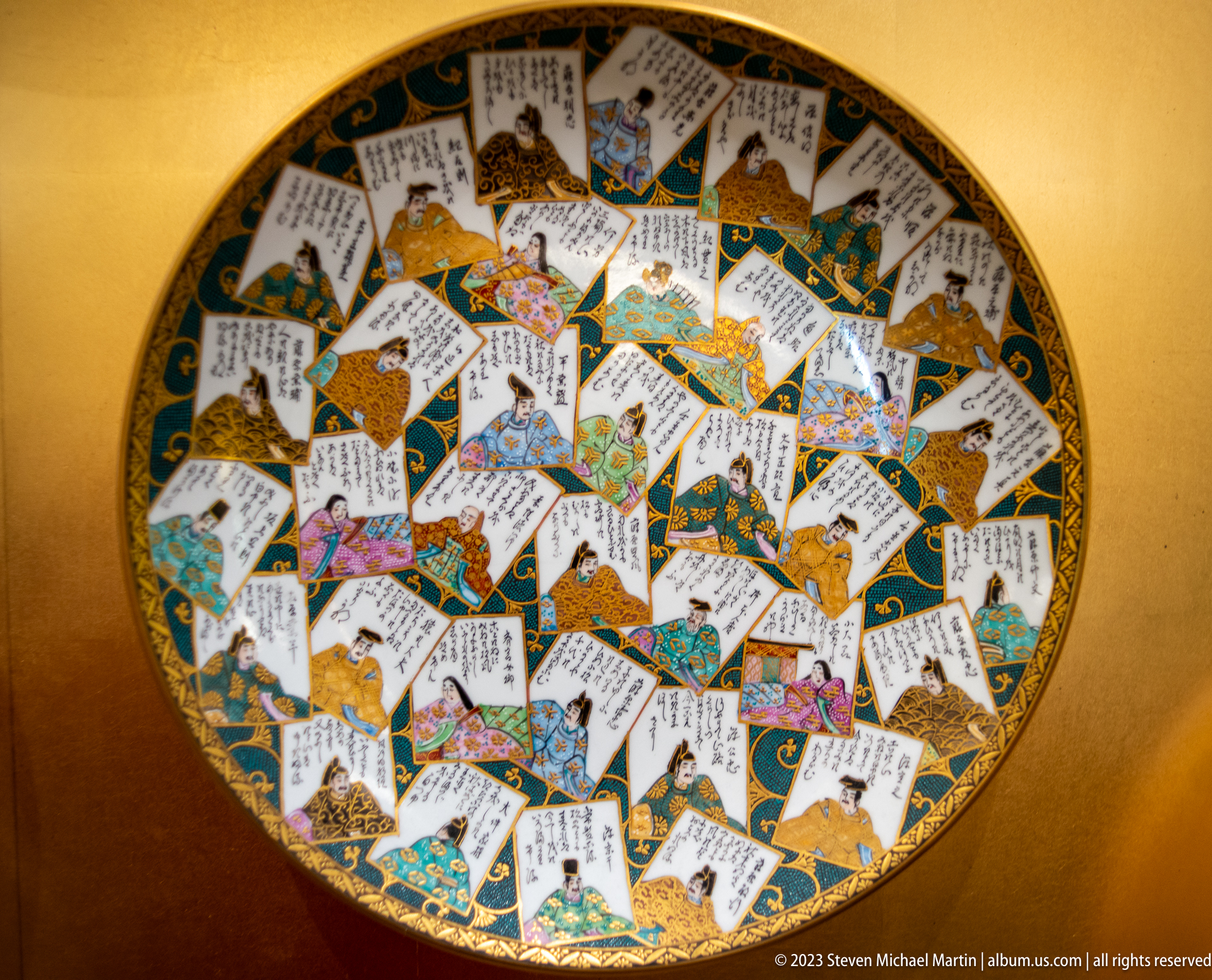
Dozens of overlapping cards fill this circular ceramic composition, each carrying calligraphy, small figures, landscapes, or decorative motifs. The arrangement evokes Japanese poetry-card traditions while transforming a familiar paper format into painted porcelain ornament. A dark patterned border contains the visual abundance, and the overhead viewpoint allows the individual cards to be read as both separate scenes and a unified design.
Caption
Dozens of overlapping cards fill this circular ceramic composition, each carrying calligraphy, small figures, landscapes, or decorative motifs. The arrangement evokes Japanese poetry-card traditions while transforming a familiar paper format into painted porcelain ornament. A dark patterned border contains the visual abundance, and the overhead viewpoint allows the individual cards to be read as both separate scenes and a unified design.
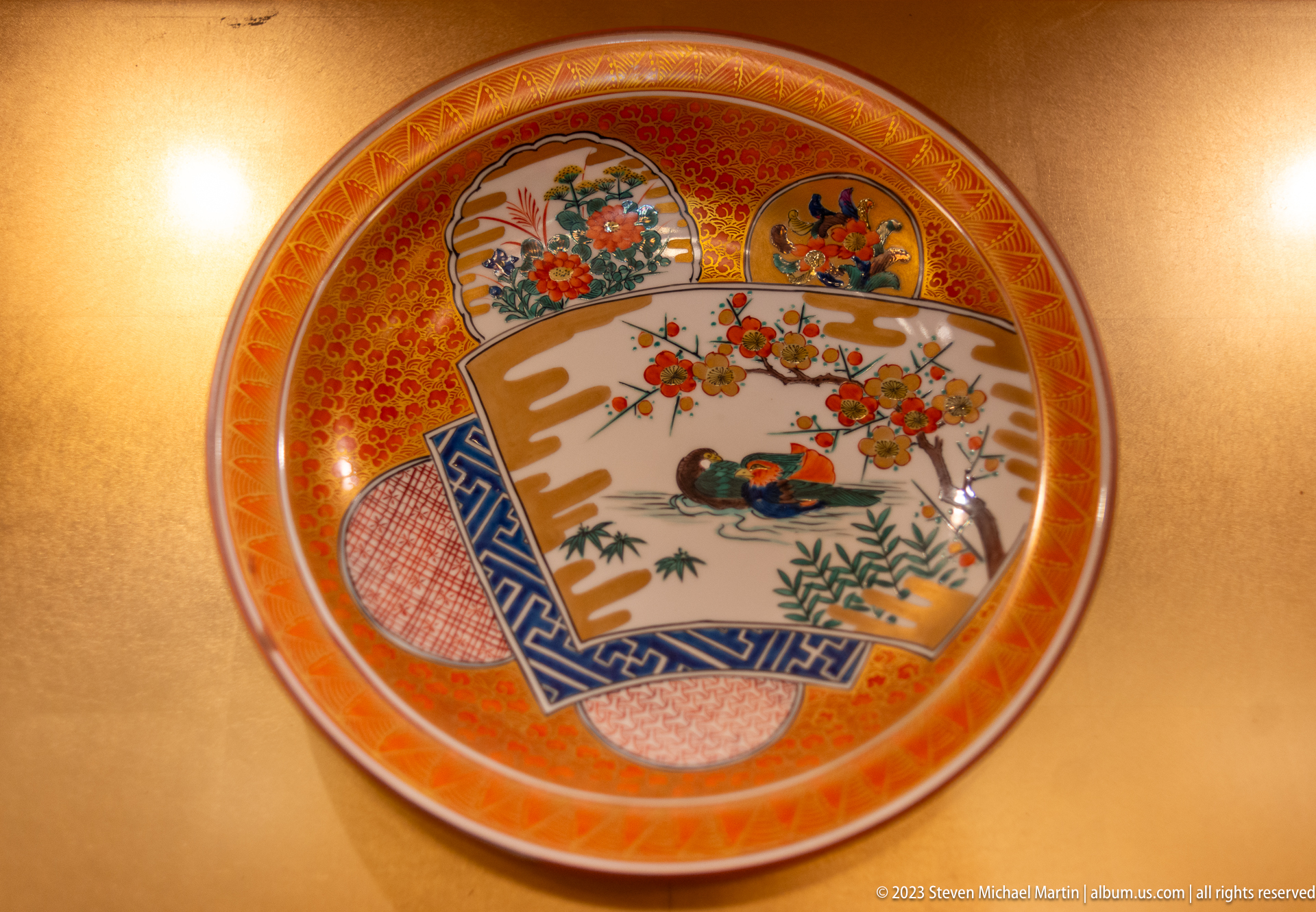
Floral sprays, small figures, geometric borders, and textile-like patterns divide this porcelain charger into multiple decorative zones. Warm orange-red grounds dominate the palette, balanced by blue, green, and gilded details. The segmented composition rewards close viewing, as each panel offers a different motif while remaining integrated within the broad circular form of the plate.
Caption
Floral sprays, small figures, geometric borders, and textile-like patterns divide this porcelain charger into multiple decorative zones. Warm orange-red grounds dominate the palette, balanced by blue, green, and gilded details. The segmented composition rewards close viewing, as each panel offers a different motif while remaining integrated within the broad circular form of the plate.
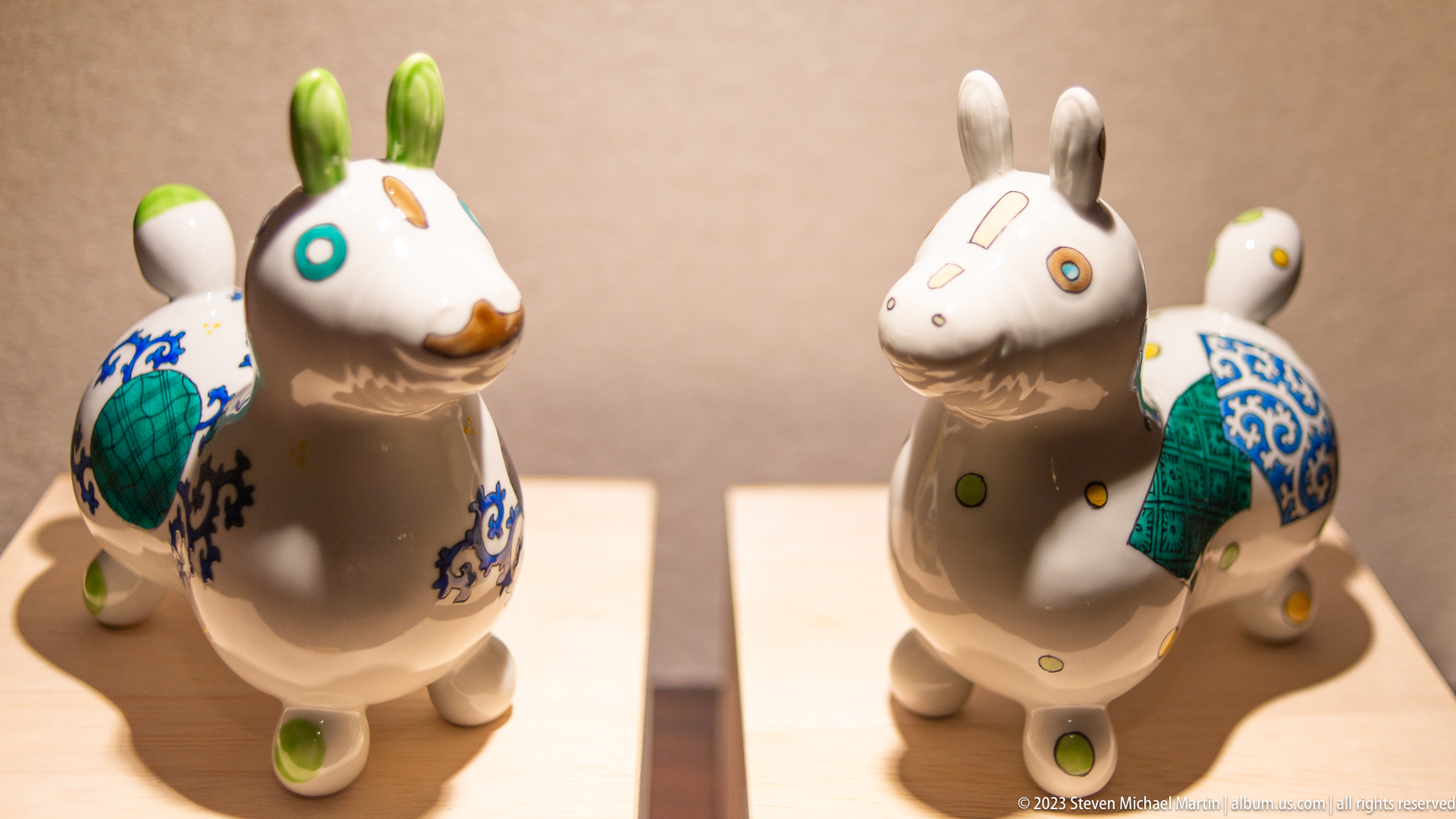
Two white ceramic rabbits stand side by side on separate display blocks, their rounded bodies animated by blue, green, turquoise, and orange painted motifs. Each figure combines an approachable animal form with carefully placed ornamental details, allowing the pair to read as related but individually decorated works. The neutral gallery setting concentrates attention on silhouette, surface, and playful character.
Caption
Two white ceramic rabbits stand side by side on separate display blocks, their rounded bodies animated by blue, green, turquoise, and orange painted motifs. Each figure combines an approachable animal form with carefully placed ornamental details, allowing the pair to read as related but individually decorated works. The neutral gallery setting concentrates attention on silhouette, surface, and playful character.
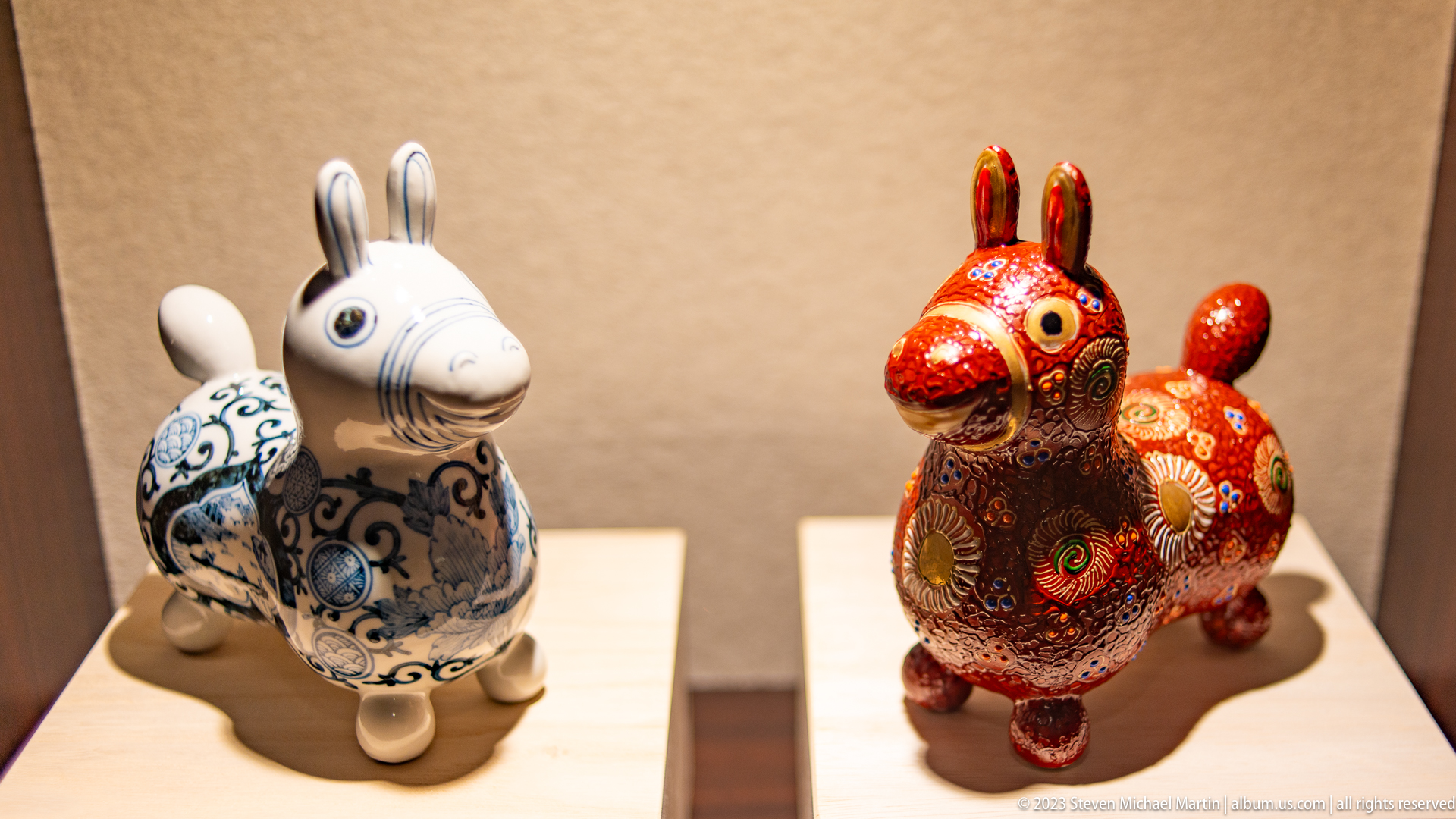
A blue-and-white rabbit and a richly patterned red rabbit form a contrasting pair on adjacent display blocks. Both use the same compact animal silhouette, yet their surfaces produce very different effects: one restrained and porcelain-like, the other dense with red, gold, and multicolored ornament. The pairing highlights how a repeated form can support distinct approaches to color and decoration.
Caption
A blue-and-white rabbit and a richly patterned red rabbit form a contrasting pair on adjacent display blocks. Both use the same compact animal silhouette, yet their surfaces produce very different effects: one restrained and porcelain-like, the other dense with red, gold, and multicolored ornament. The pairing highlights how a repeated form can support distinct approaches to color and decoration.
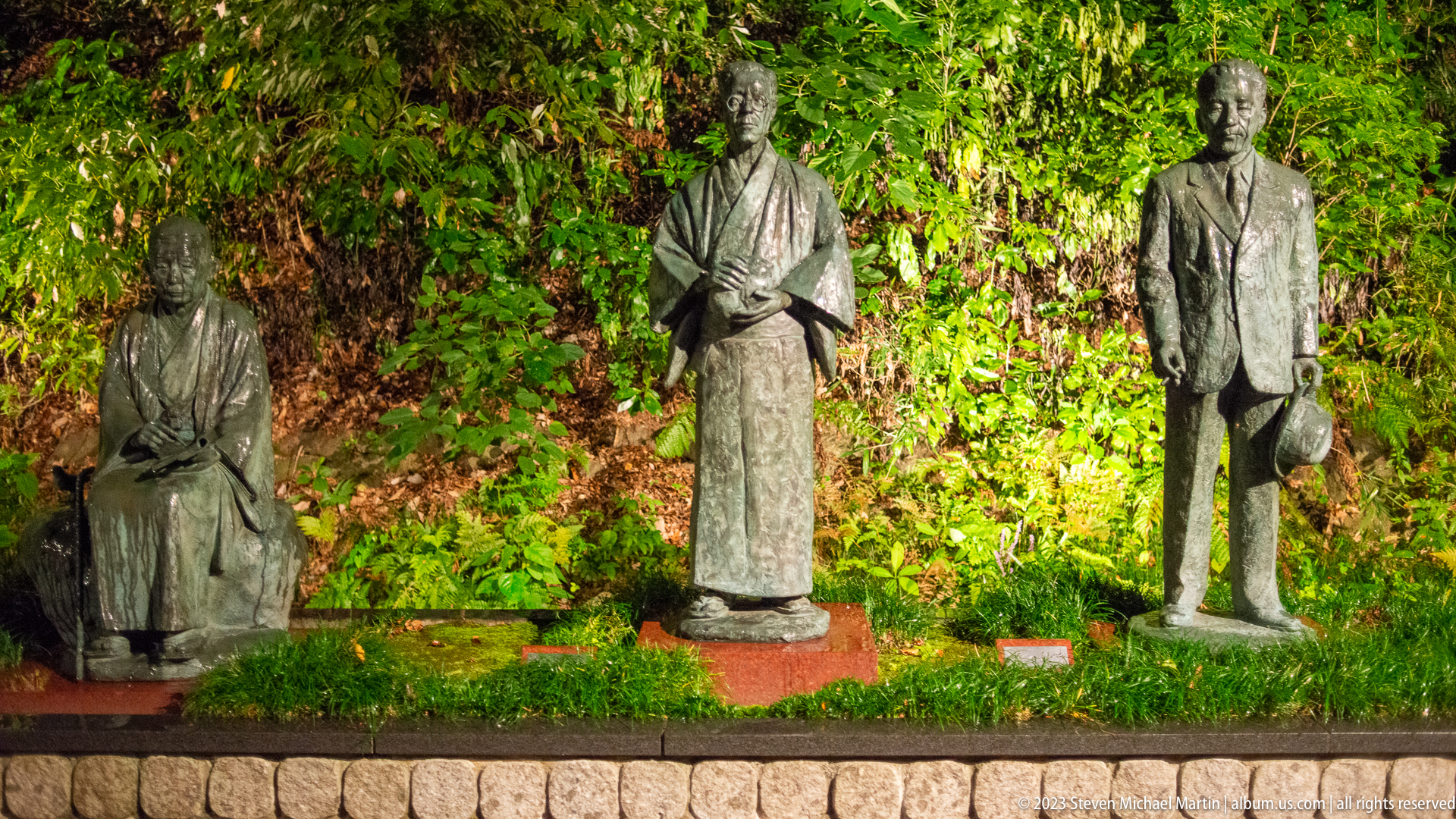
Three bronze figures stand in a row against a foliage-covered wall, presenting contrasting forms of dress and social identity. One wears traditional Japanese clothing, while another appears in a modern suit and holds a hat. The frontal nighttime view treats the installation almost as a historical lineup, emphasizing costume, posture, and the relationship among the three separately modeled figures.
Caption
Three bronze figures stand in a row against a foliage-covered wall, presenting contrasting forms of dress and social identity. One wears traditional Japanese clothing, while another appears in a modern suit and holds a hat. The frontal nighttime view treats the installation almost as a historical lineup, emphasizing costume, posture, and the relationship among the three separately modeled figures.
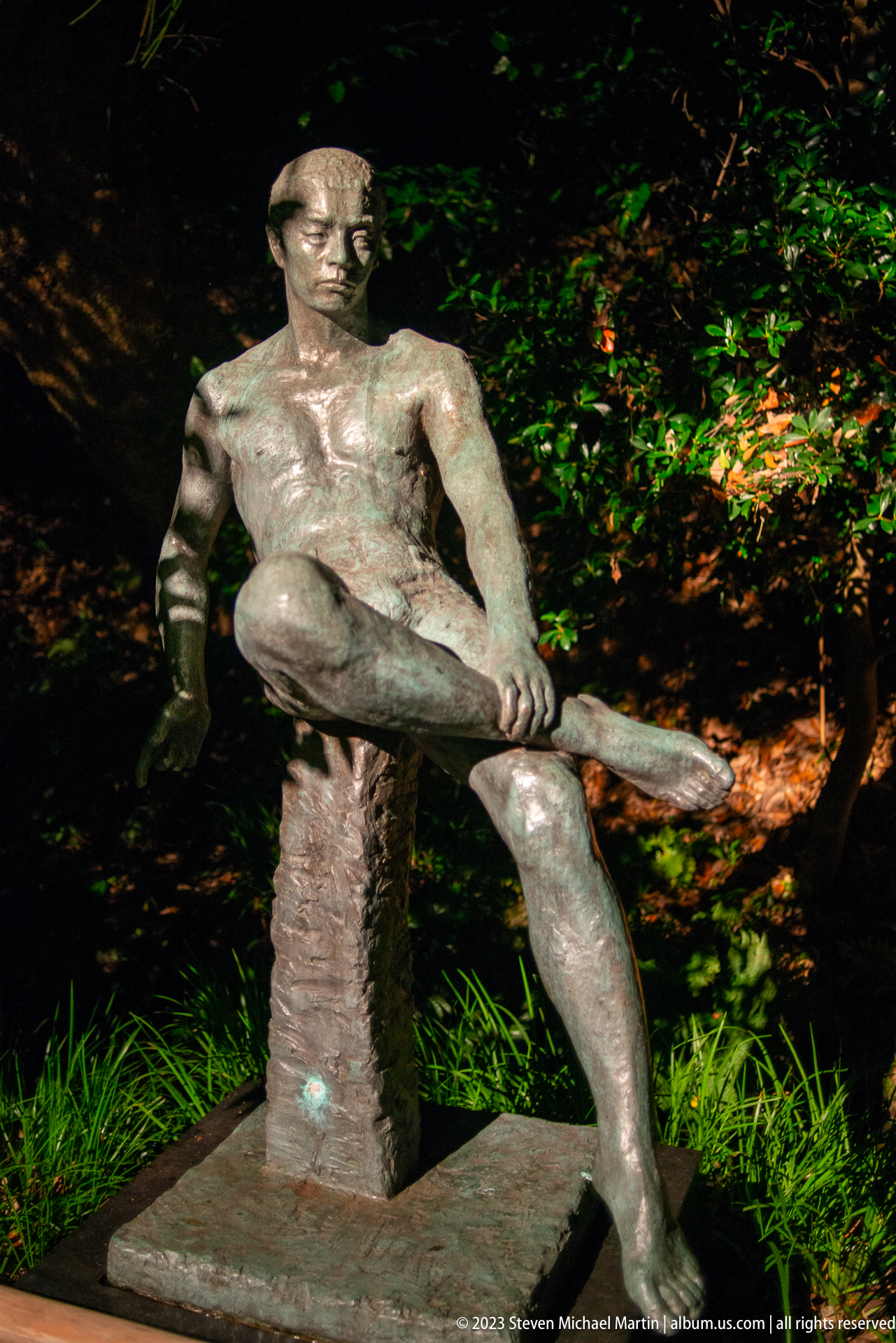
A bronze male figure sits with one leg raised and an arm resting across the knee, creating a compact, self-contained pose. Artificial illumination catches the face, torso, and bent limbs while the surrounding garden recedes into darkness. The low nighttime viewpoint emphasizes the sculpture’s modeled anatomy, reflective patina, and relationship to its stone or metal support.
Caption
A bronze male figure sits with one leg raised and an arm resting across the knee, creating a compact, self-contained pose. Artificial illumination catches the face, torso, and bent limbs while the surrounding garden recedes into darkness. The low nighttime viewpoint emphasizes the sculpture’s modeled anatomy, reflective patina, and relationship to its stone or metal support.
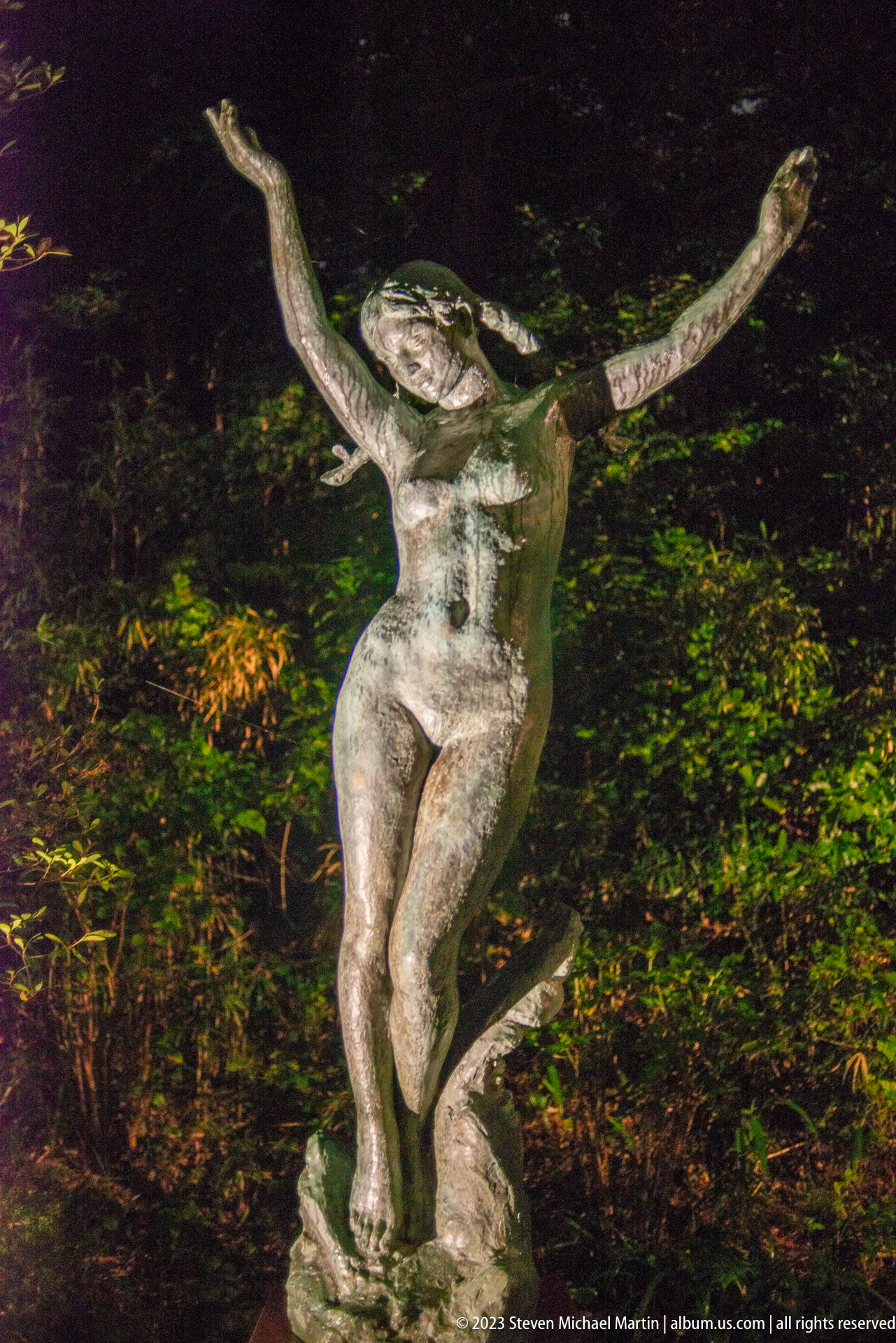
A bronze female figure lifts both arms in a broad upward gesture, giving the body an open, celebratory movement. Night lighting isolates the pale metallic surface against dark foliage, sharpening the outline of the extended limbs and turning torso. The sculpture’s expressive pose contrasts with the still garden setting and becomes the primary source of visual energy.
Caption
A bronze female figure lifts both arms in a broad upward gesture, giving the body an open, celebratory movement. Night lighting isolates the pale metallic surface against dark foliage, sharpening the outline of the extended limbs and turning torso. The sculpture’s expressive pose contrasts with the still garden setting and becomes the primary source of visual energy.
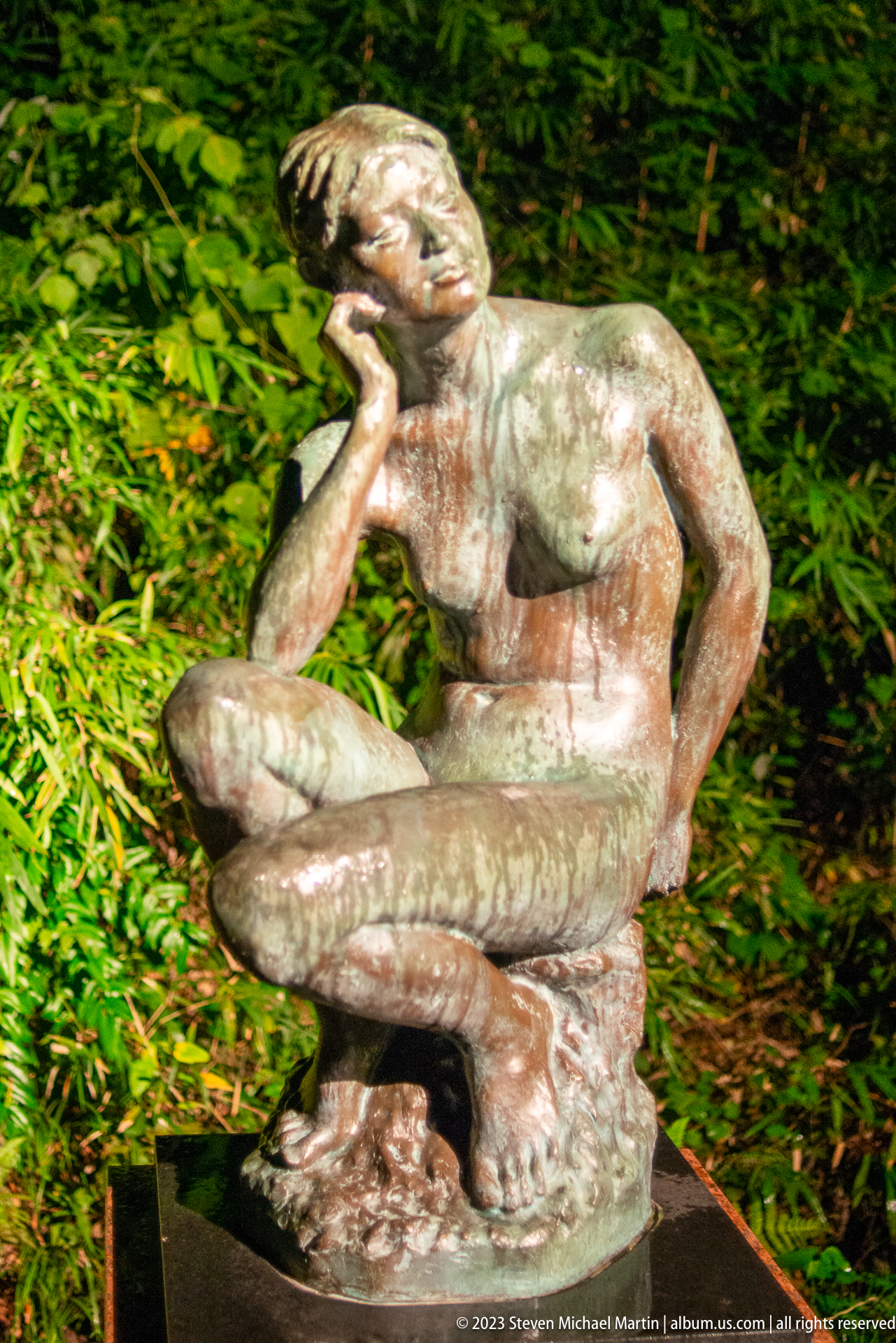
A seated bronze woman leans her head into one hand while the other arm braces against her bent leg, creating an introspective pose. Strong artificial light reveals the figure’s modeled surface and green-brown patina, while leaves and groundcover frame the base. The close composition emphasizes bodily weight, gesture, and quiet psychological presence rather than the wider installation.
Caption
A seated bronze woman leans her head into one hand while the other arm braces against her bent leg, creating an introspective pose. Strong artificial light reveals the figure’s modeled surface and green-brown patina, while leaves and groundcover frame the base. The close composition emphasizes bodily weight, gesture, and quiet psychological presence rather than the wider installation.
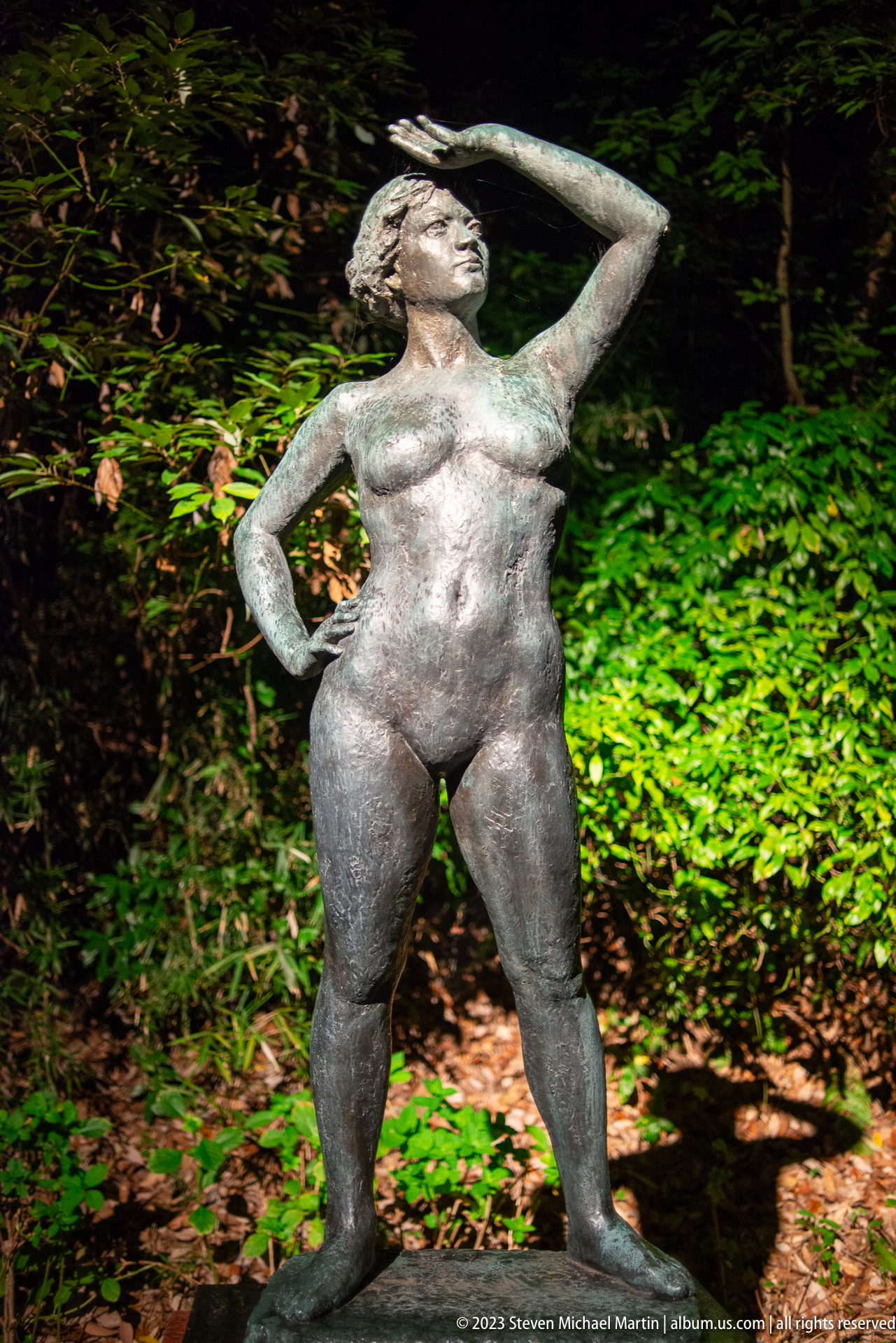
A standing bronze woman places one hand at her forehead and the other at her hip, suggesting a searching or shielding gesture. The frontal pose is set against dense green foliage, with directional lighting defining the torso and legs while leaving portions of the surface in shadow. The stance gives the figure a strong vertical presence within the nighttime garden.
Caption
A standing bronze woman places one hand at her forehead and the other at her hip, suggesting a searching or shielding gesture. The frontal pose is set against dense green foliage, with directional lighting defining the torso and legs while leaving portions of the surface in shadow. The stance gives the figure a strong vertical presence within the nighttime garden.
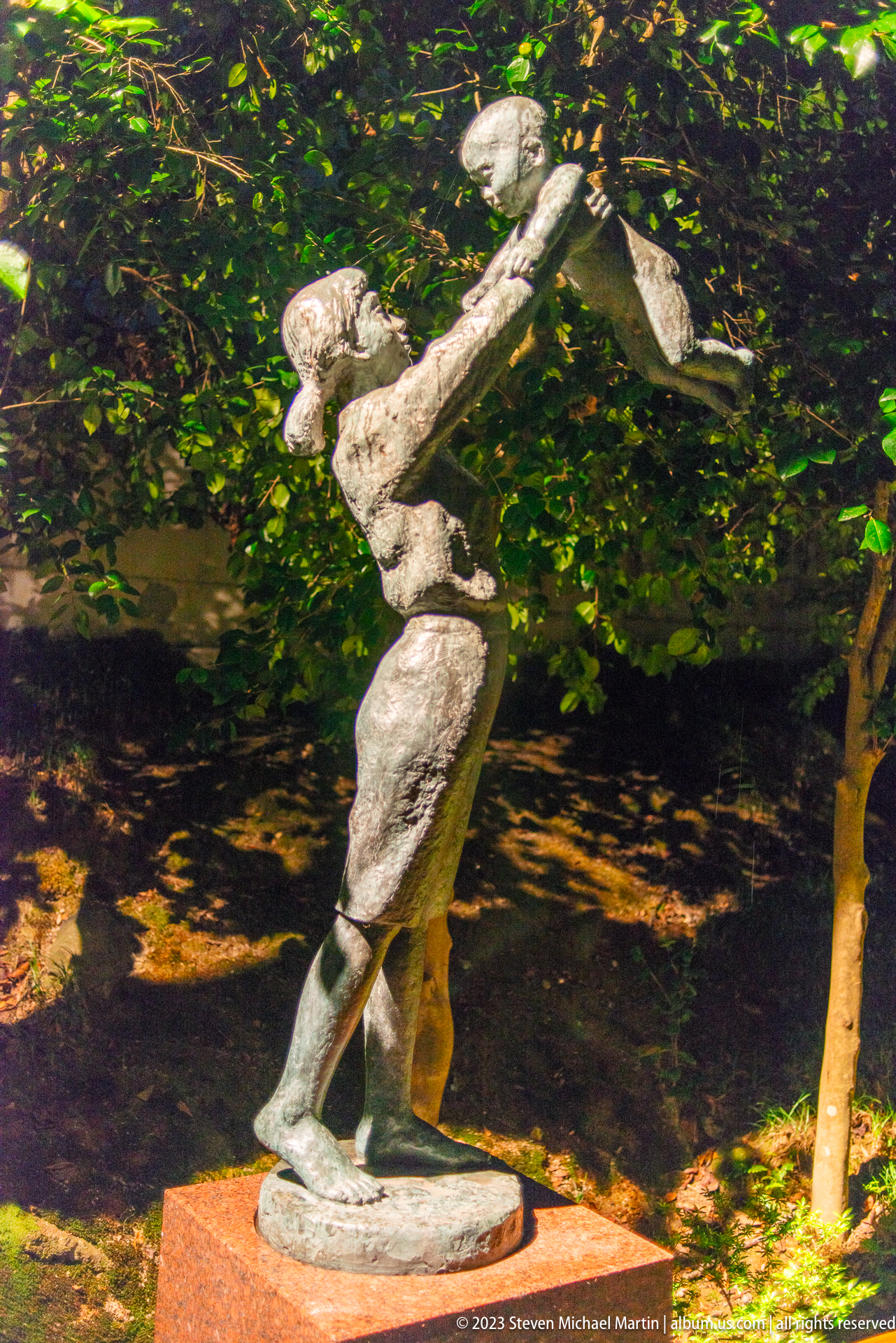
An adult bronze figure reaches upward to lift a smaller figure above the head, creating a strong diagonal movement through the composition. Night illumination highlights the upward gesture and separates the figures from the dark trees behind them. The interaction introduces a narrative element absent from the neighboring solitary statues, centering the work on support, play, or familial connection.
Caption
An adult bronze figure reaches upward to lift a smaller figure above the head, creating a strong diagonal movement through the composition. Night illumination highlights the upward gesture and separates the figures from the dark trees behind them. The interaction introduces a narrative element absent from the neighboring solitary statues, centering the work on support, play, or familial connection.
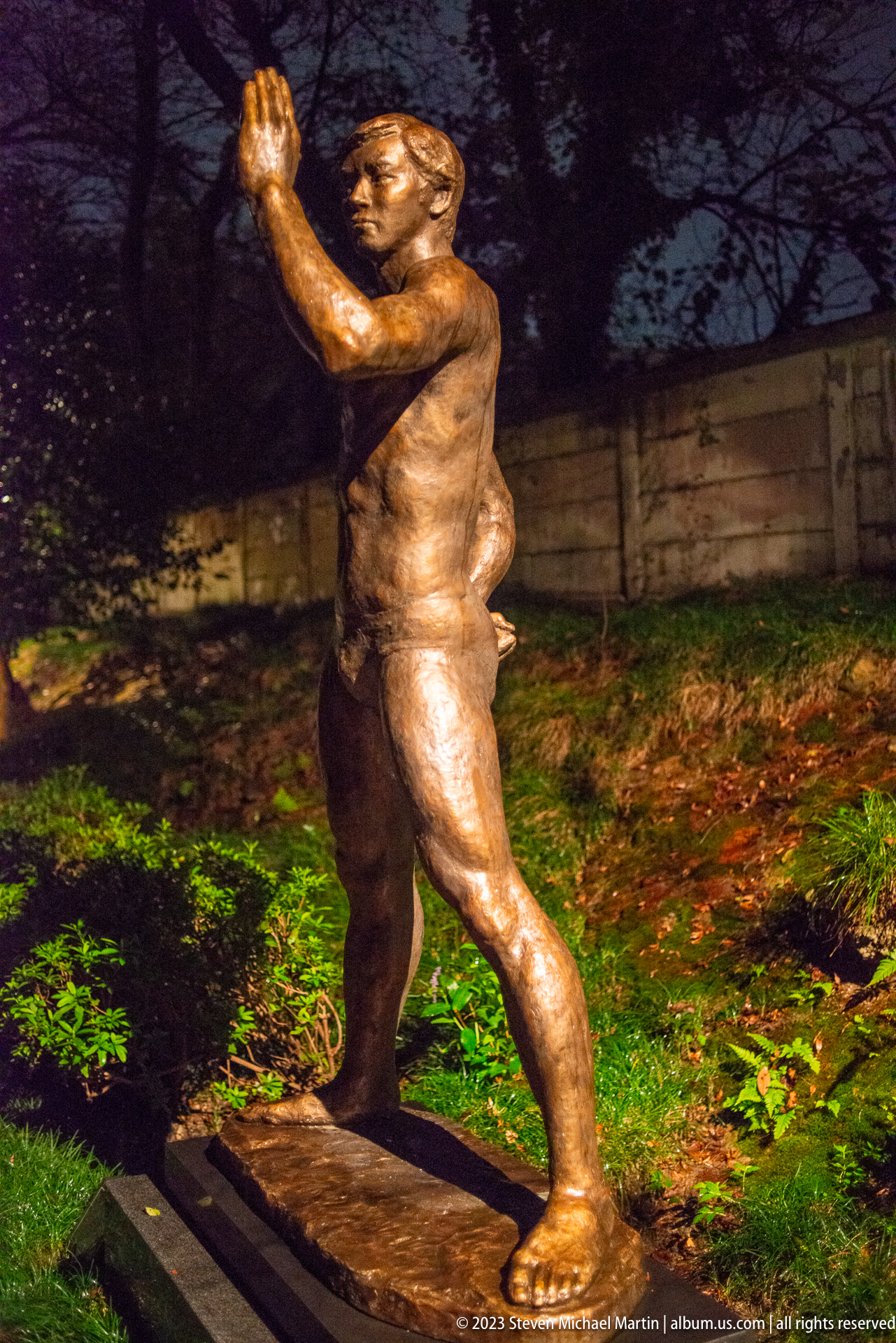
A bronze male figure twists through the torso while lifting one arm, producing a forceful, athletic silhouette. The sculpture is photographed from the side under warm artificial light, which accentuates the modeled musculature and reddish-brown surface. A low base and dark garden background make the body’s rotation and extended gesture the dominant visual features.
Caption
A bronze male figure twists through the torso while lifting one arm, producing a forceful, athletic silhouette. The sculpture is photographed from the side under warm artificial light, which accentuates the modeled musculature and reddish-brown surface. A low base and dark garden background make the body’s rotation and extended gesture the dominant visual features.
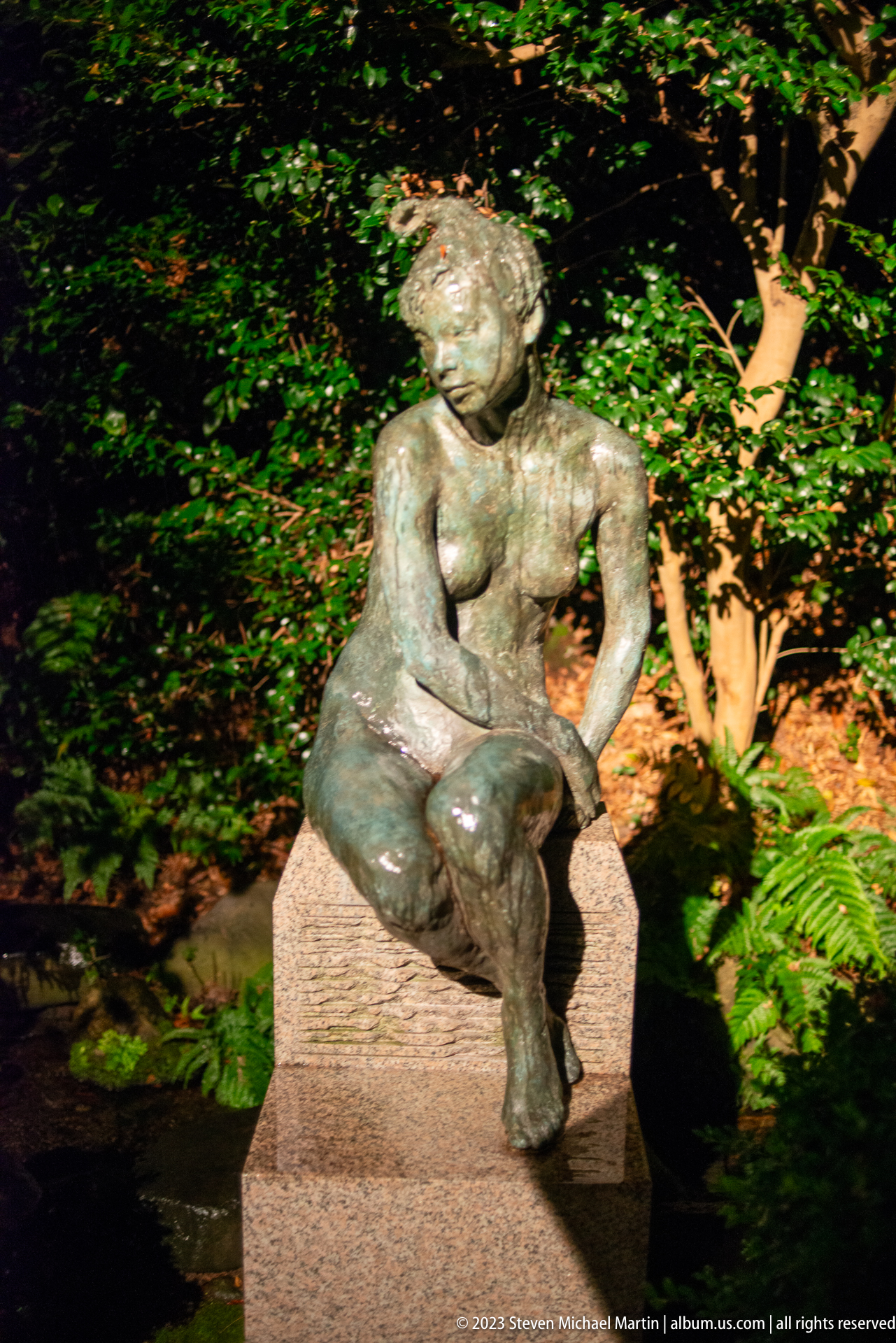
A bronze woman sits forward on a rectangular stone pedestal, her bent posture and downward gaze giving the figure a quiet, reflective character. Warm artificial light catches the head, shoulders, and knees while the surrounding garden remains dark. The elevated block separates the sculpture from the foliage and focuses attention on the compact geometry of the seated pose.
Caption
A bronze woman sits forward on a rectangular stone pedestal, her bent posture and downward gaze giving the figure a quiet, reflective character. Warm artificial light catches the head, shoulders, and knees while the surrounding garden remains dark. The elevated block separates the sculpture from the foliage and focuses attention on the compact geometry of the seated pose.
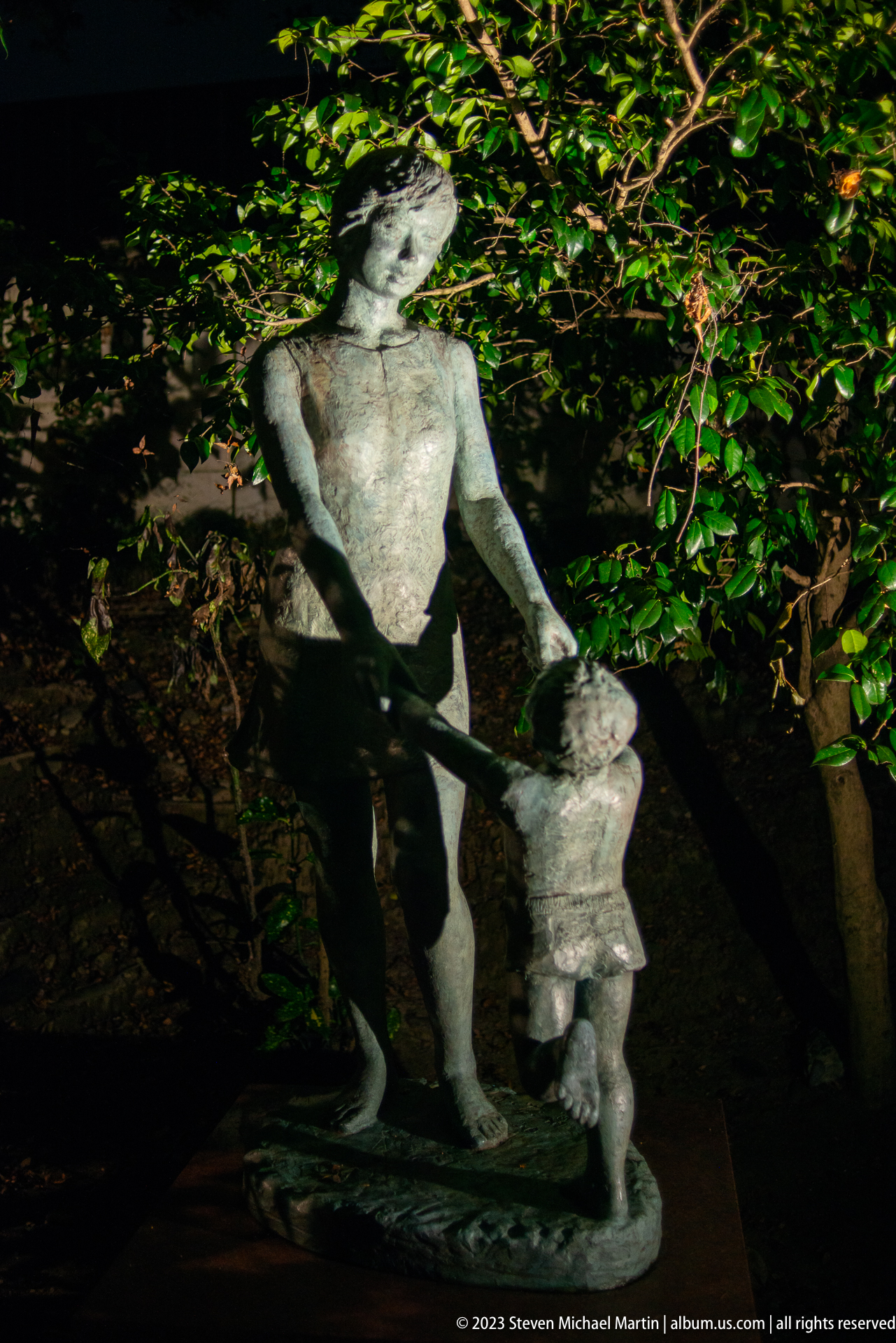
A standing adult figure bends toward a small child, extending an arm as the child reaches upward from below. The sculpture’s diagonal gestures create an intimate exchange between the two figures, partly silhouetted against dense foliage. Photographed at night, the work is defined less by facial detail than by posture, scale, and the visible relationship between adult and child.
Caption
A standing adult figure bends toward a small child, extending an arm as the child reaches upward from below. The sculpture’s diagonal gestures create an intimate exchange between the two figures, partly silhouetted against dense foliage. Photographed at night, the work is defined less by facial detail than by posture, scale, and the visible relationship between adult and child.
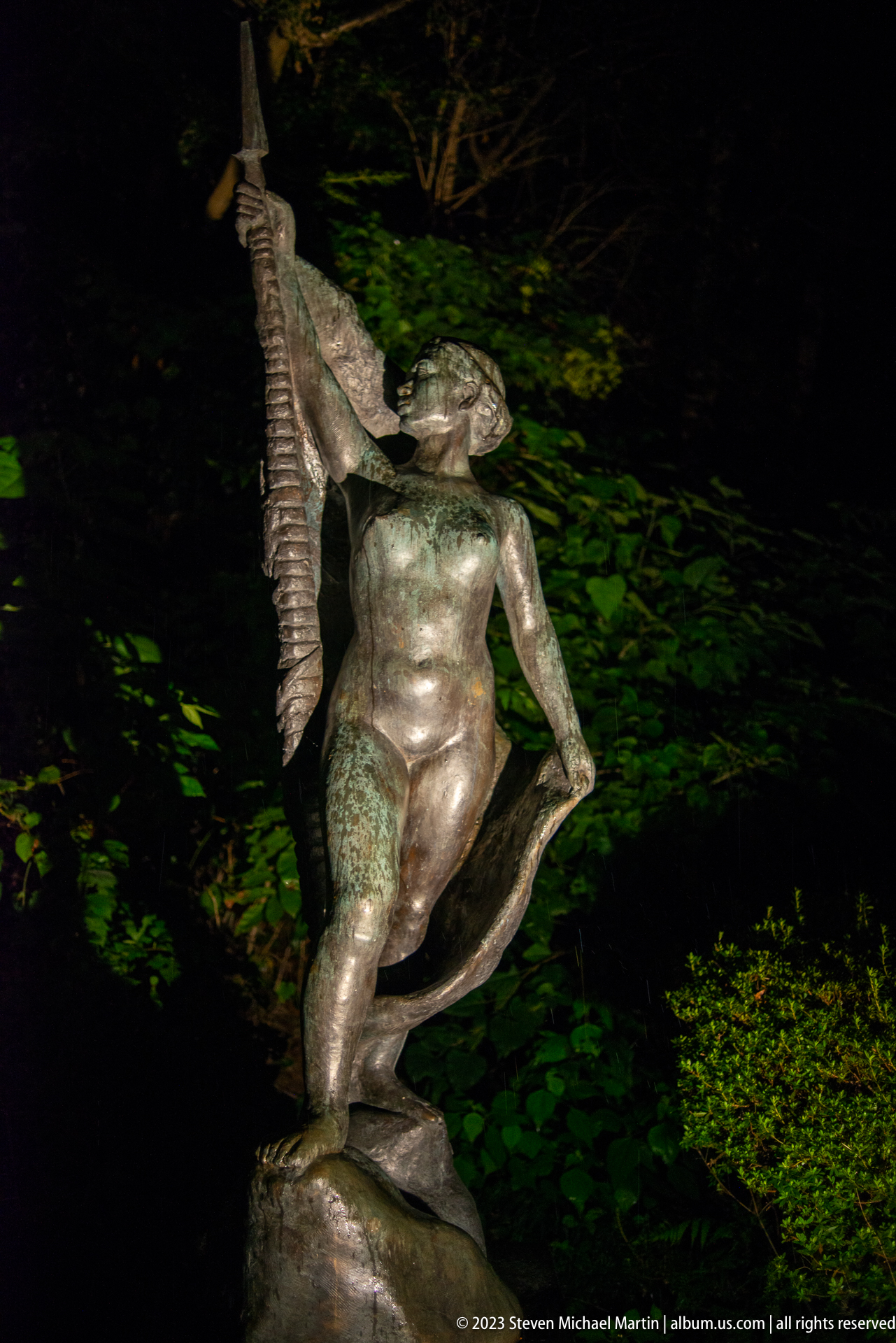
A bronze woman raises a large fish beside her shoulder, combining a vigorous human pose with an unmistakable maritime or fishing motif. The figure twists through the torso while one leg extends outward, creating a sense of motion despite the heavy material. Night lighting isolates the fish, face, and upper body against a nearly black garden background.
Caption
A bronze woman raises a large fish beside her shoulder, combining a vigorous human pose with an unmistakable maritime or fishing motif. The figure twists through the torso while one leg extends outward, creating a sense of motion despite the heavy material. Night lighting isolates the fish, face, and upper body against a nearly black garden background.
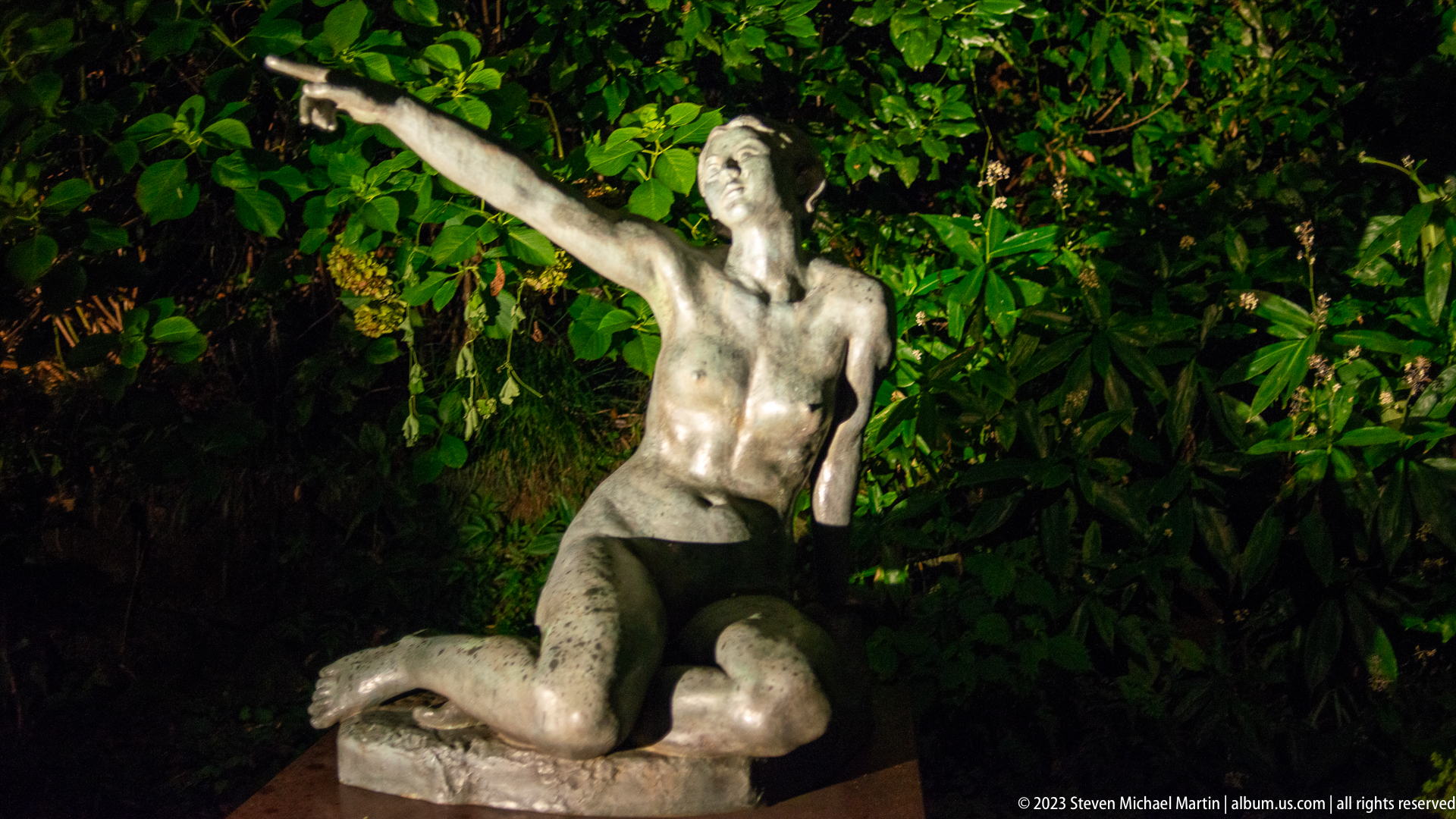
A bronze female figure reclines or kneels across a low base while extending one arm diagonally upward. The elongated gesture pulls the eye from the bent legs through the torso toward the raised hand, giving the sculpture a theatrical sense of reach. Strong nighttime illumination separates the pale metallic surface from the dark leaves behind it.
Caption
A bronze female figure reclines or kneels across a low base while extending one arm diagonally upward. The elongated gesture pulls the eye from the bent legs through the torso toward the raised hand, giving the sculpture a theatrical sense of reach. Strong nighttime illumination separates the pale metallic surface from the dark leaves behind it.
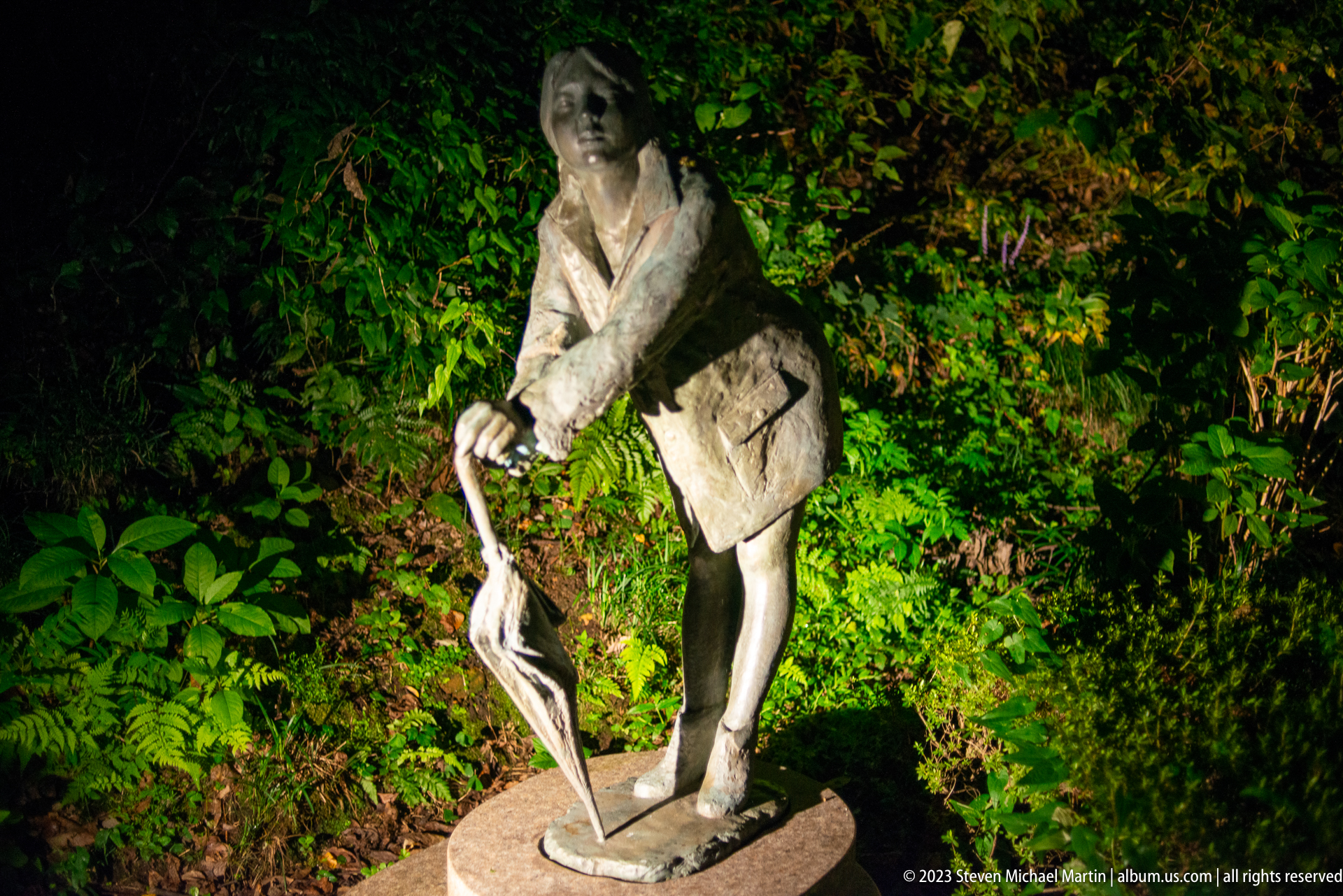
A bronze pedestrian leans forward while holding a closed umbrella, with a rectangular shoulder bag hanging at one side. The everyday clothing and practical accessories distinguish this figure from the neighboring nude or allegorical sculptures, grounding the work in modern urban life. Night illumination highlights the face, coat, hands, umbrella, and sharply angled posture against dense greenery.
Caption
A bronze pedestrian leans forward while holding a closed umbrella, with a rectangular shoulder bag hanging at one side. The everyday clothing and practical accessories distinguish this figure from the neighboring nude or allegorical sculptures, grounding the work in modern urban life. Night illumination highlights the face, coat, hands, umbrella, and sharply angled posture against dense greenery.
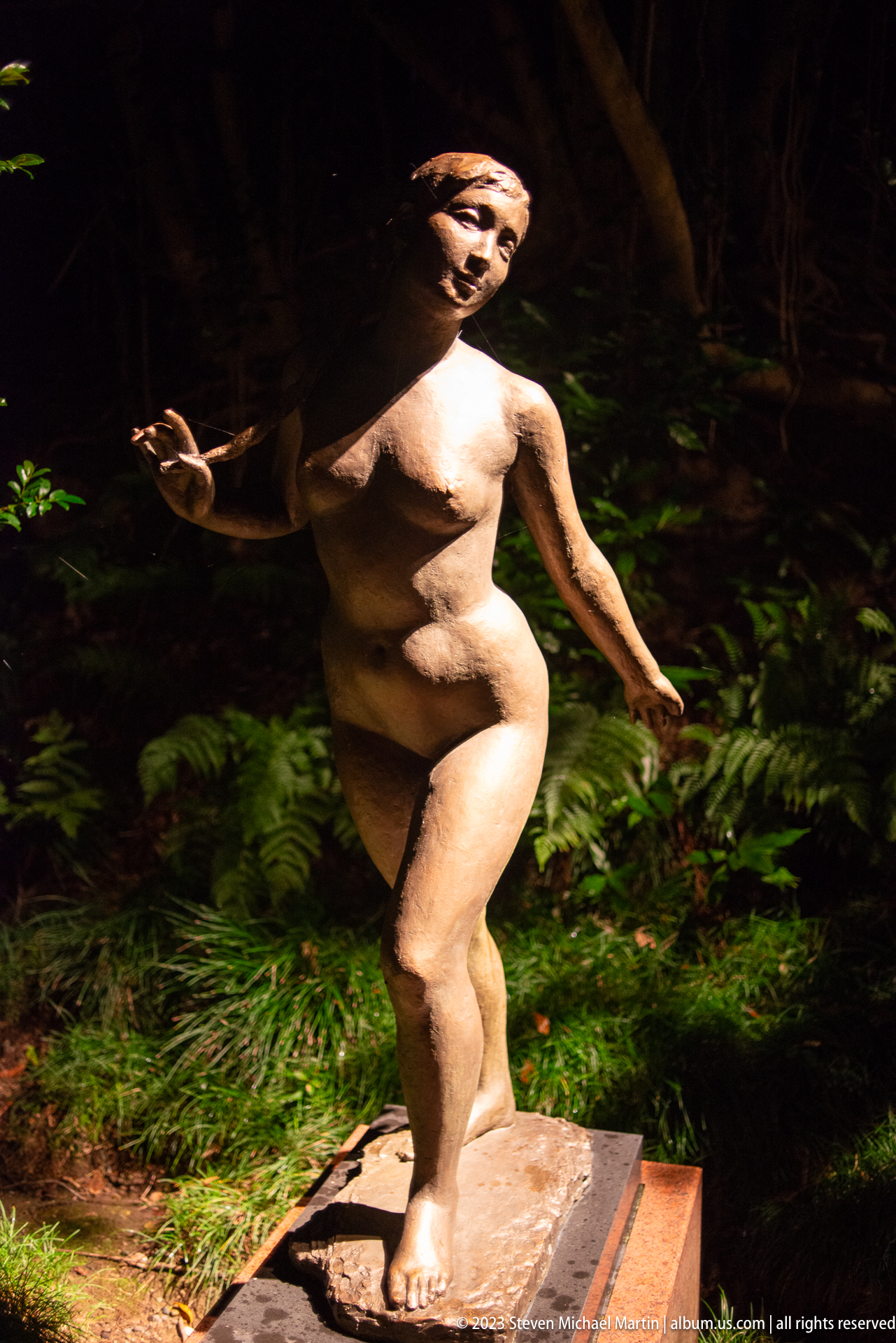
A life-size female figure stands on a low stone base amid dense garden planting, dramatically lit from below against the night. The twisting pose, extended arm, and modeled surface give the sculpture a sense of movement, while the surrounding foliage turns the installation into a theatrical garden encounter rather than an isolated gallery object.
Caption
A life-size female figure stands on a low stone base amid dense garden planting, dramatically lit from below against the night. The twisting pose, extended arm, and modeled surface give the sculpture a sense of movement, while the surrounding foliage turns the installation into a theatrical garden encounter rather than an isolated gallery object.
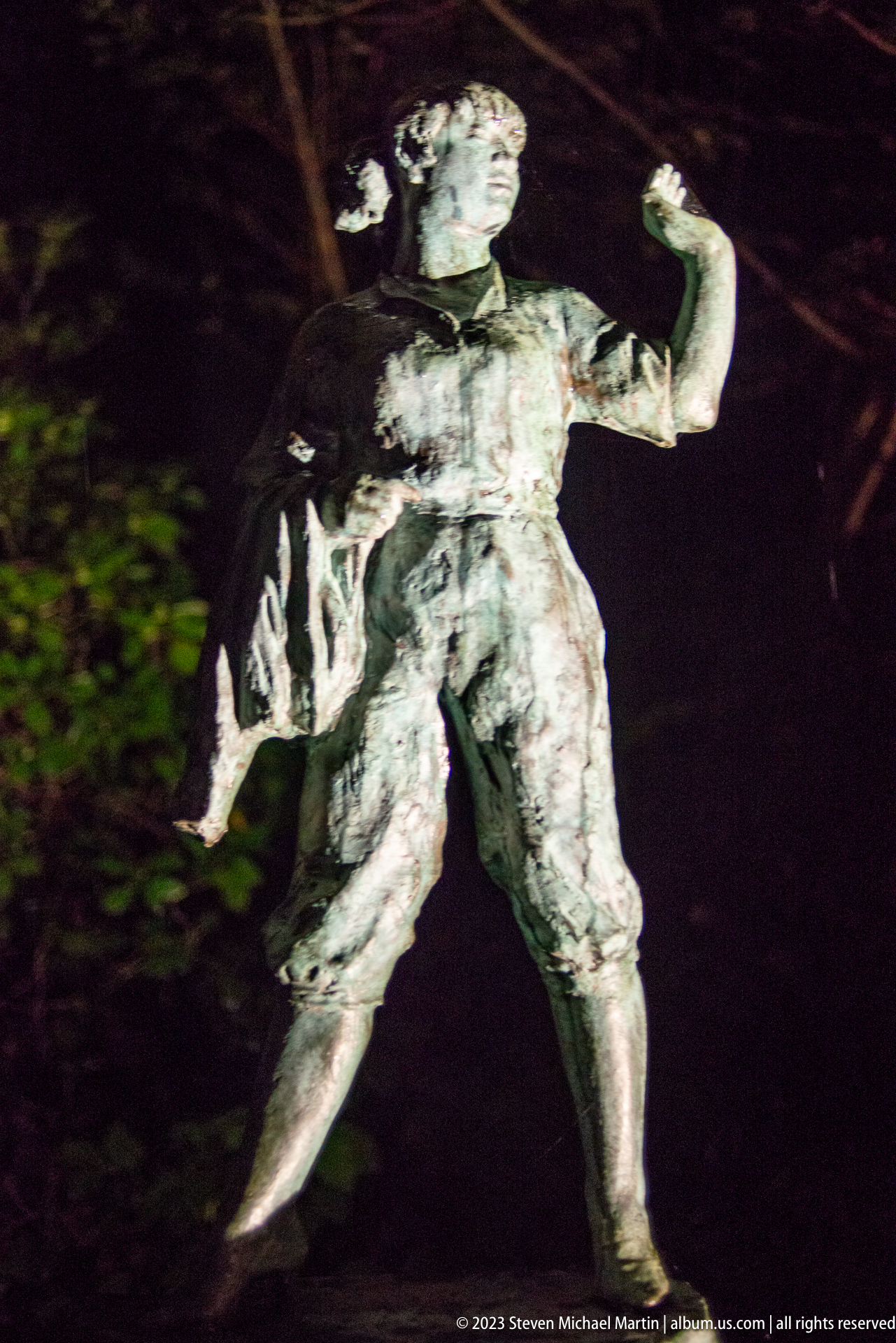
An expressive male figure is shown in a wide-legged stance with both arms lifted, its pale, textured surface catching strong artificial light. The sculptural pose suggests exertion or performance, while the dark garden background and blurred greenery heighten the contrast between the animated body and its nighttime setting.
Caption
An expressive male figure is shown in a wide-legged stance with both arms lifted, its pale, textured surface catching strong artificial light. The sculptural pose suggests exertion or performance, while the dark garden background and blurred greenery heighten the contrast between the animated body and its nighttime setting.
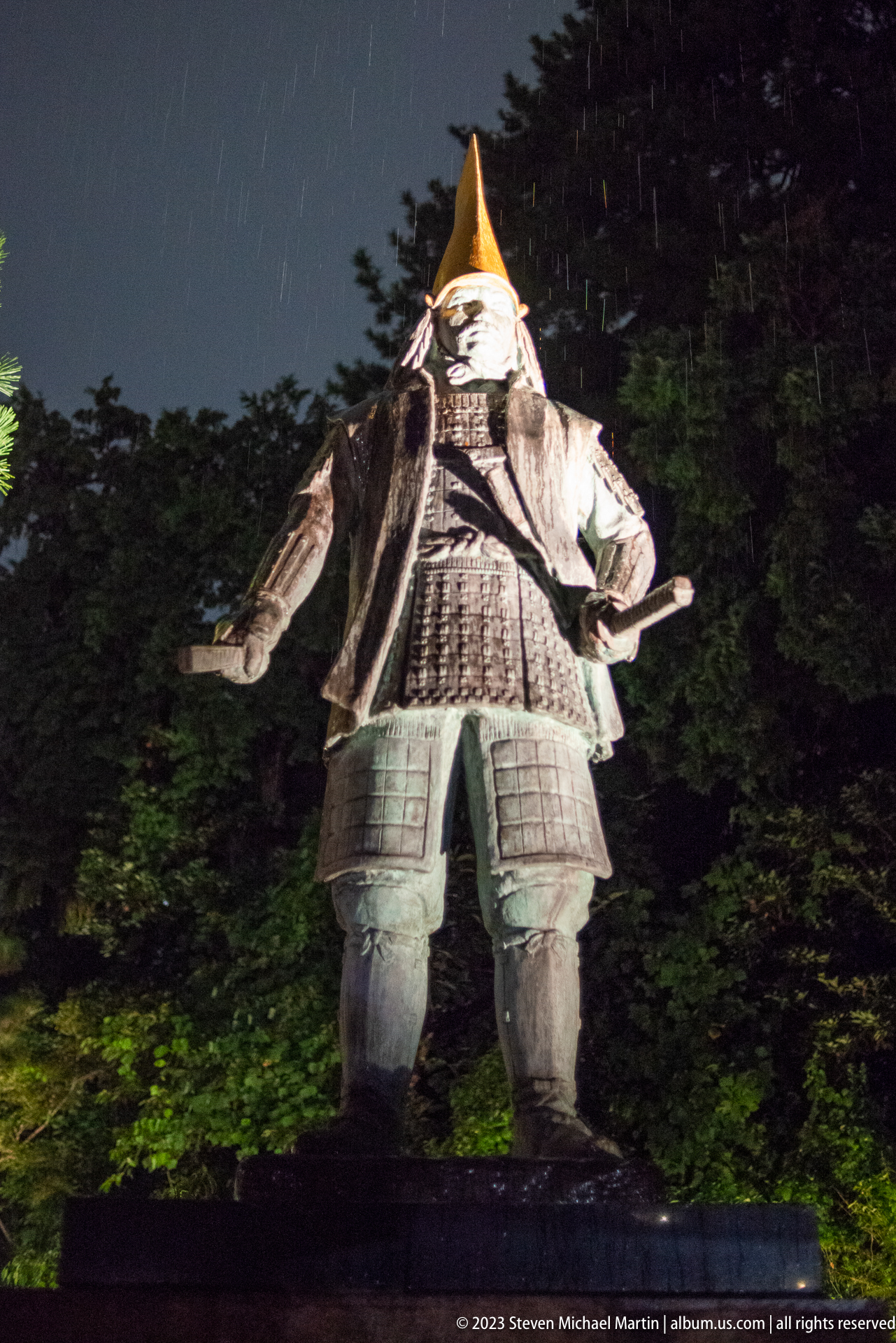
A monumental armored warrior towers above the viewer, seen from a low angle with layered cuirass, broad sleeves, and a sharply projecting helmet. Upward lighting exaggerates the figure’s scale and martial silhouette, turning the sculpture into a dramatic nighttime landmark against the surrounding trees.
Caption
A monumental armored warrior towers above the viewer, seen from a low angle with layered cuirass, broad sleeves, and a sharply projecting helmet. Upward lighting exaggerates the figure’s scale and martial silhouette, turning the sculpture into a dramatic nighttime landmark against the surrounding trees.
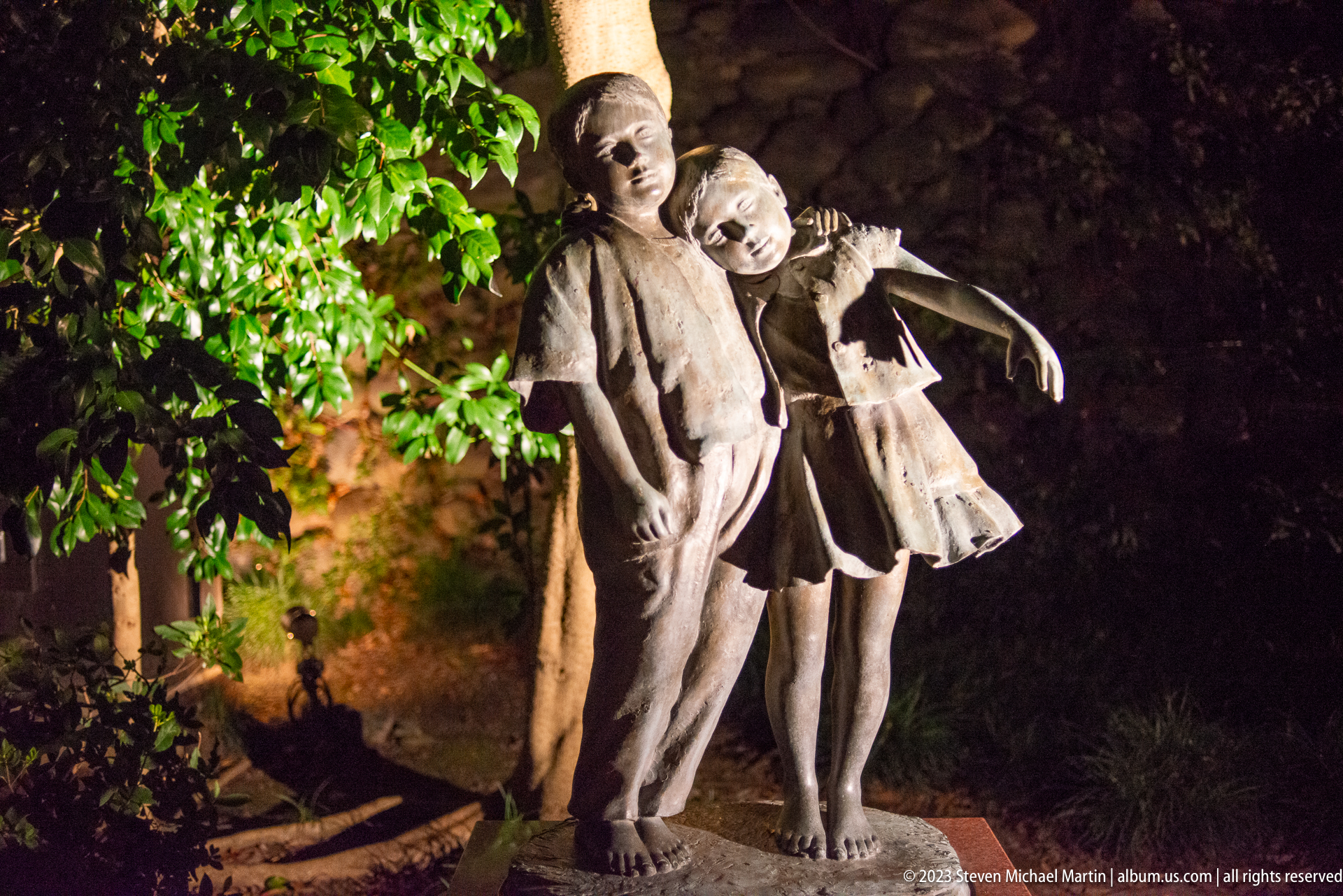
Two child figures lean into one another in a tender, slightly playful grouping, their heads tilted and bodies joined through overlapping gestures. Warm night lighting reveals the modeled faces and clothing, while surrounding leaves and a dark garden wall frame the sculpture as an intimate vignette within the landscaped setting.
Caption
Two child figures lean into one another in a tender, slightly playful grouping, their heads tilted and bodies joined through overlapping gestures. Warm night lighting reveals the modeled faces and clothing, while surrounding leaves and a dark garden wall frame the sculpture as an intimate vignette within the landscaped setting.
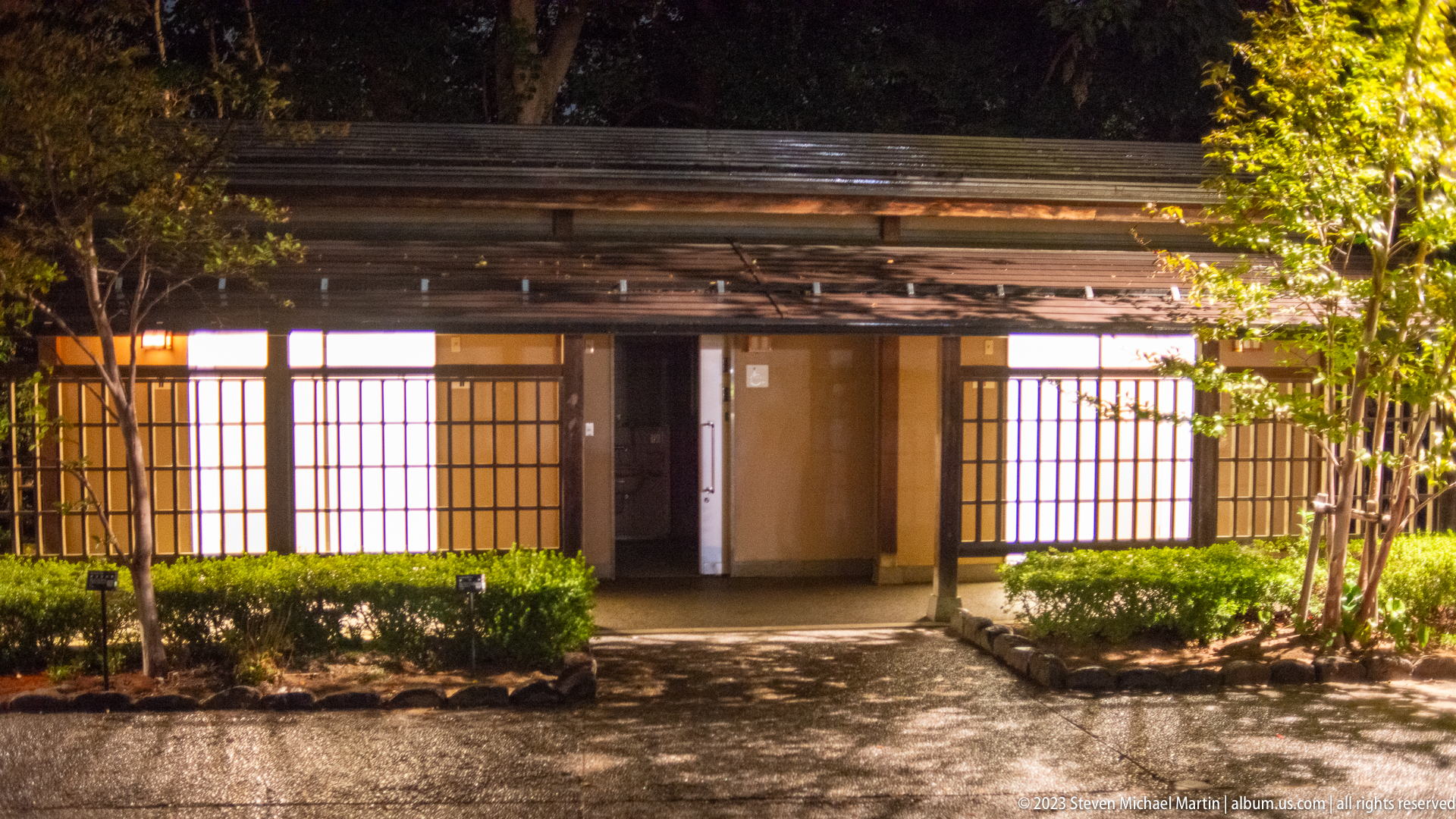
A low wooden building opens toward a stone path through glowing shoji-like screens and a central entrance. Deep eaves, exposed timber, clipped shrubs, and carefully placed garden lighting create a restrained nighttime composition characteristic of a traditional Japanese residential or garden setting.
Caption
A low wooden building opens toward a stone path through glowing shoji-like screens and a central entrance. Deep eaves, exposed timber, clipped shrubs, and carefully placed garden lighting create a restrained nighttime composition characteristic of a traditional Japanese residential or garden setting.
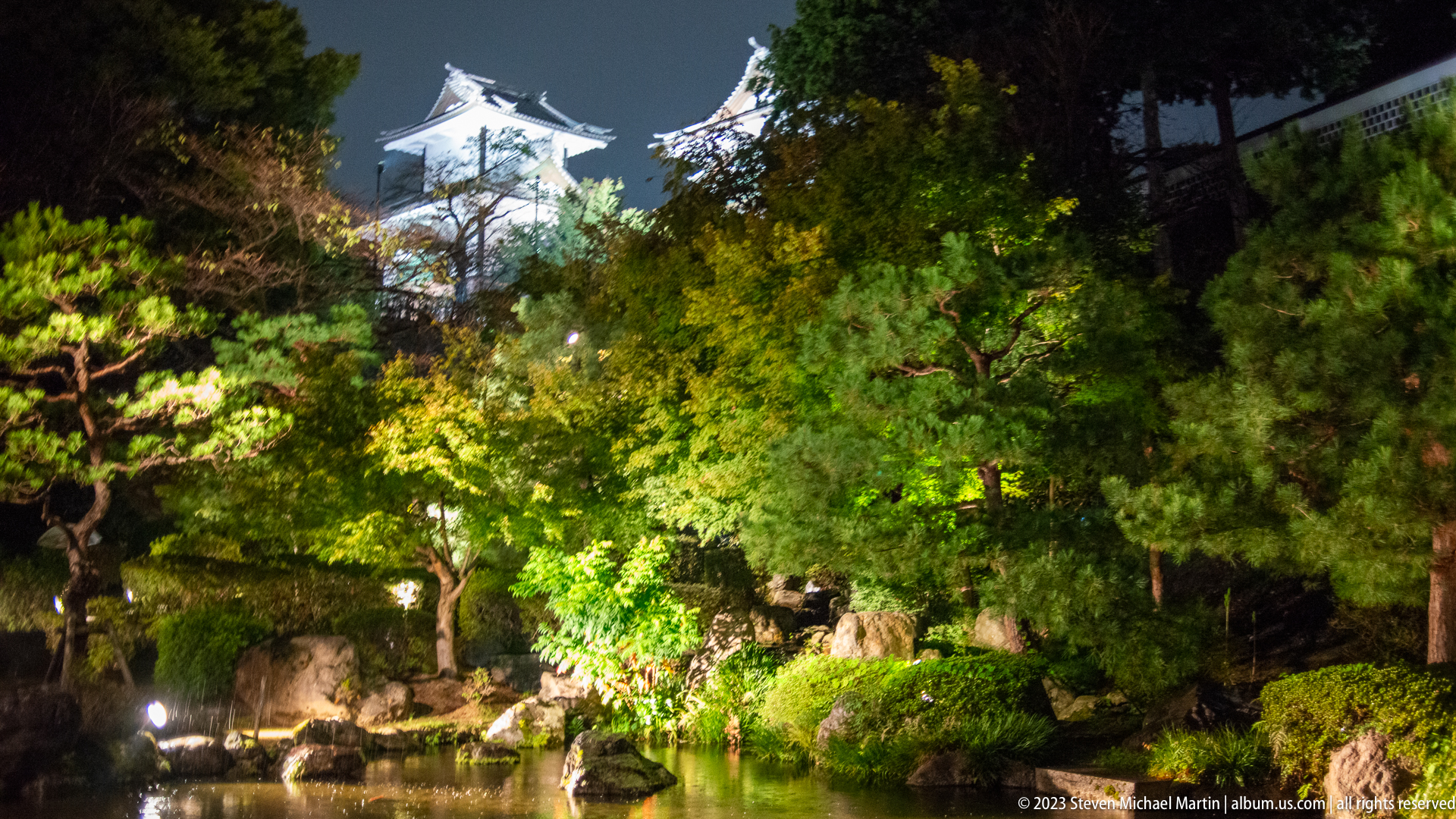
A still pond reflects carefully placed lights among pines, rocks, and clipped shrubs, while a white, tiled-roof castle structure rises above the garden in the distance. The composition links Kanazawa’s formal landscape tradition with its fortified architecture through layered vegetation, water, and nighttime illumination.
Caption
A still pond reflects carefully placed lights among pines, rocks, and clipped shrubs, while a white, tiled-roof castle structure rises above the garden in the distance. The composition links Kanazawa’s formal landscape tradition with its fortified architecture through layered vegetation, water, and nighttime illumination.
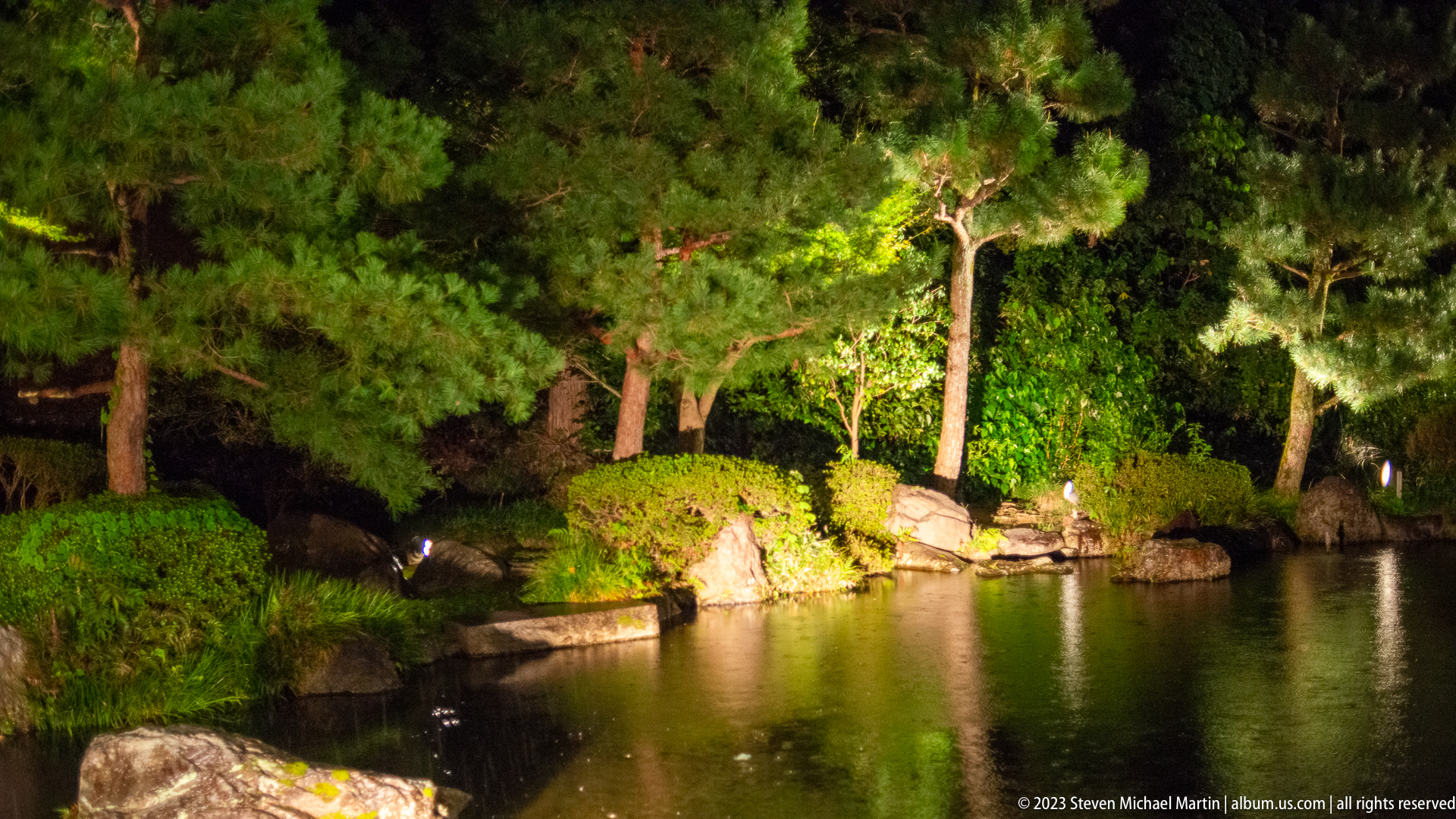
Artificial light picks out pines, clipped shrubs, and large stones along the edge of a calm garden pond. Reflections soften the boundary between water and planting, while the carefully controlled arrangement of vegetation and rock emphasizes the composed, maintained character of the landscape.
Caption
Artificial light picks out pines, clipped shrubs, and large stones along the edge of a calm garden pond. Reflections soften the boundary between water and planting, while the carefully controlled arrangement of vegetation and rock emphasizes the composed, maintained character of the landscape.
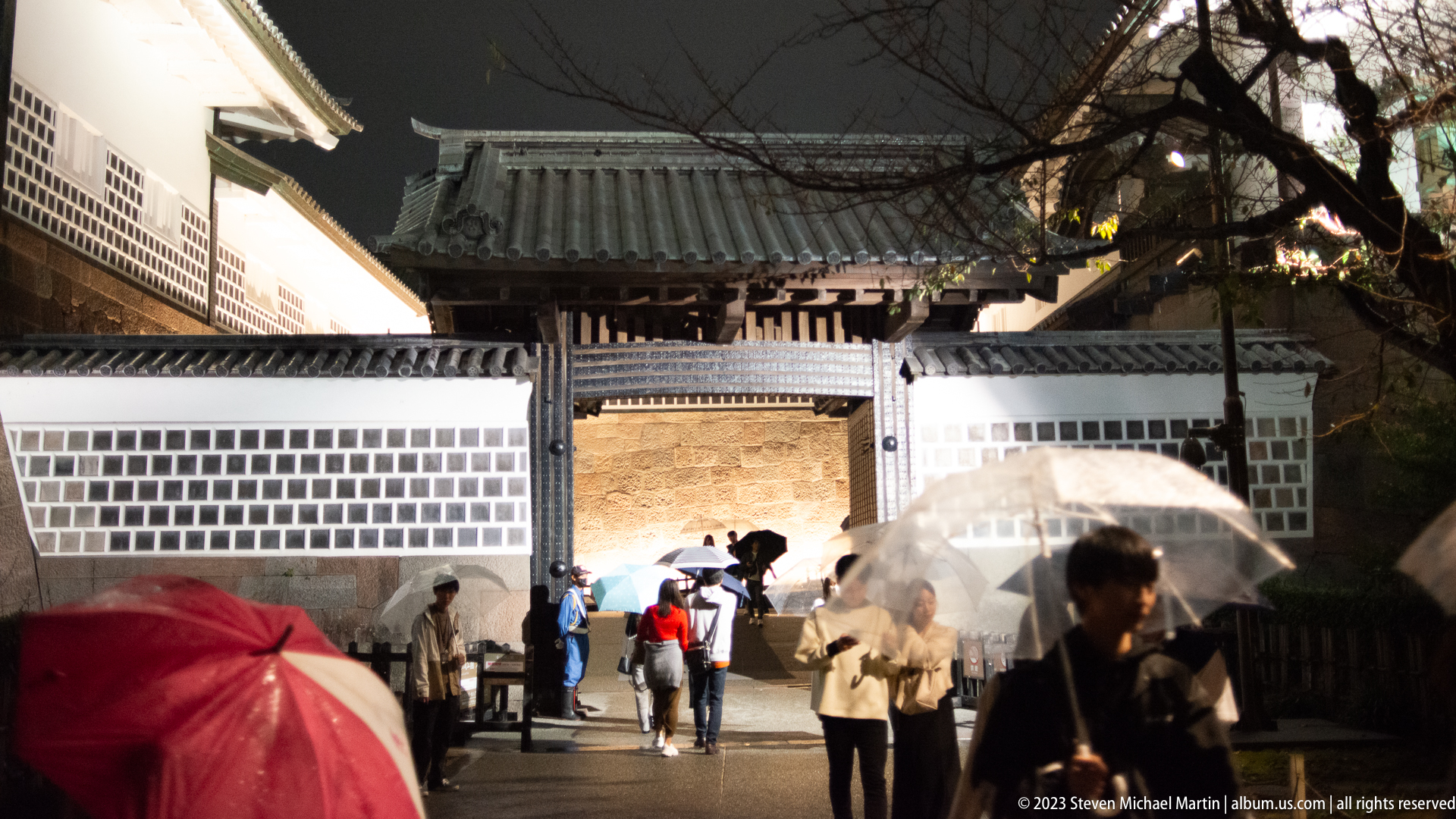
Rain-soaked visitors pass beneath umbrellas toward a timber gate set within white plaster walls patterned with dark stonework. The wet pavement, subdued crowd, and illuminated entrance give the fortified threshold a vivid sense of contemporary use, showing historic architecture experienced as an active public site.
Caption
Rain-soaked visitors pass beneath umbrellas toward a timber gate set within white plaster walls patterned with dark stonework. The wet pavement, subdued crowd, and illuminated entrance give the fortified threshold a vivid sense of contemporary use, showing historic architecture experienced as an active public site.
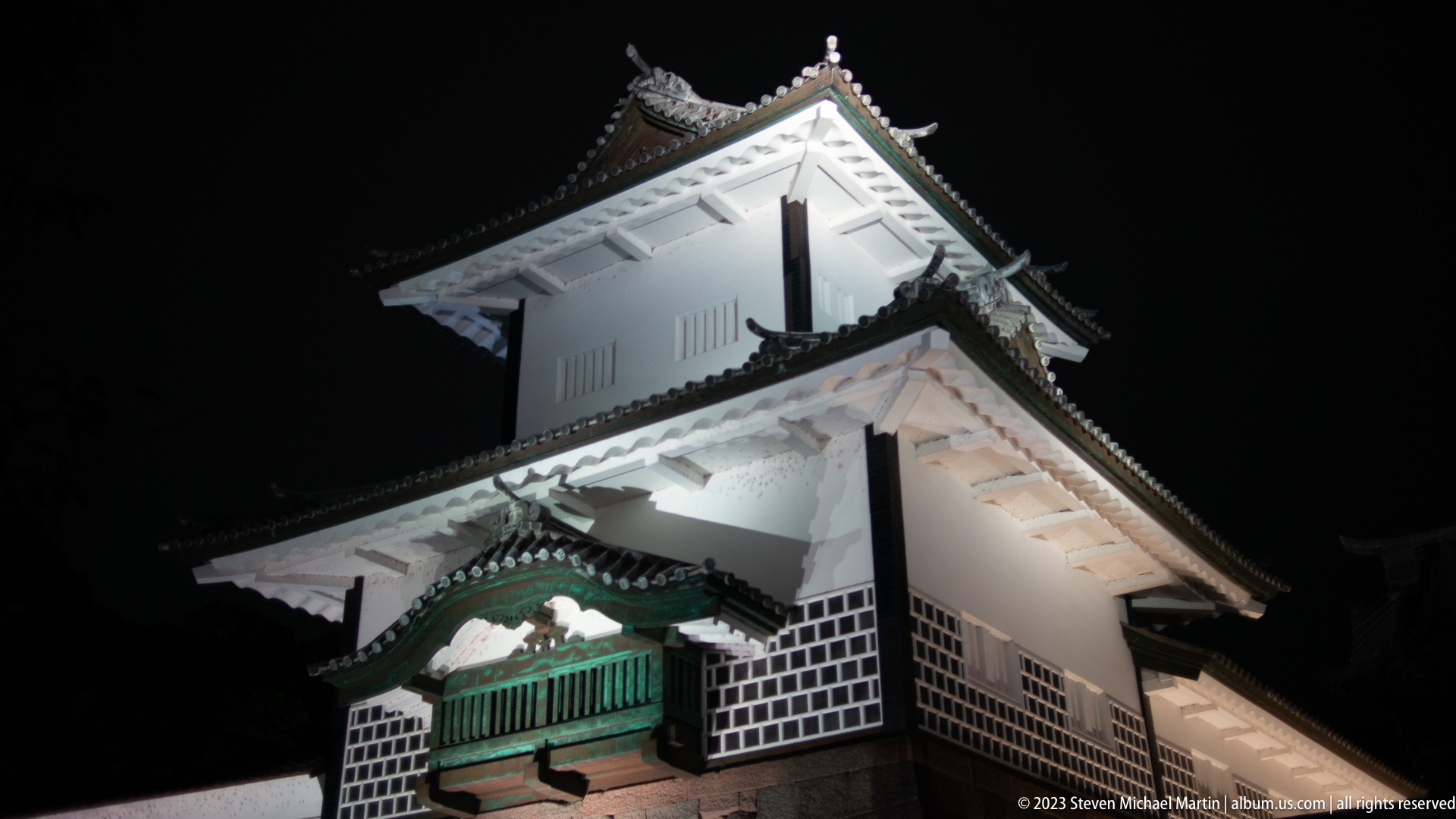
Layered roofs stack dramatically above a white corner wall in this steep upward view of Kanazawa’s castle architecture. Floodlights isolate the crisp plaster surfaces, dark roof tiles, and green railing against the black sky, emphasizing the interplay of defensive bulk and refined carpentry.
Caption
Layered roofs stack dramatically above a white corner wall in this steep upward view of Kanazawa’s castle architecture. Floodlights isolate the crisp plaster surfaces, dark roof tiles, and green railing against the black sky, emphasizing the interplay of defensive bulk and refined carpentry.
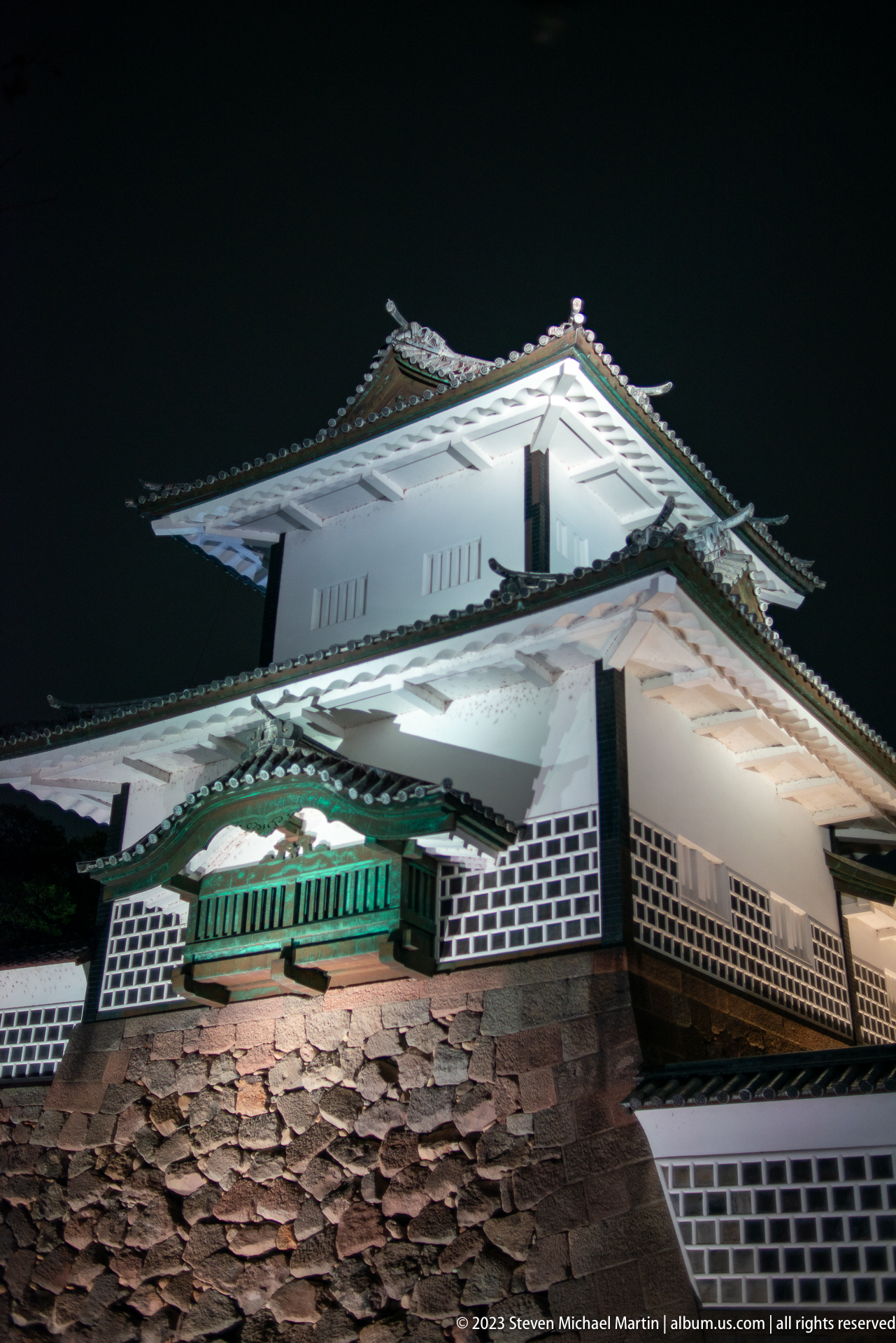
A white plaster castle turret rises above a rough stone base, its layered tiled roofs and projecting eaves sharply defined by floodlighting. Seen from below, the structure’s corner geometry and defensive massing dominate the frame, while a green-railed opening adds a small accent within the otherwise monochrome façade.
Caption
A white plaster castle turret rises above a rough stone base, its layered tiled roofs and projecting eaves sharply defined by floodlighting. Seen from below, the structure’s corner geometry and defensive massing dominate the frame, while a green-railed opening adds a small accent within the otherwise monochrome façade.
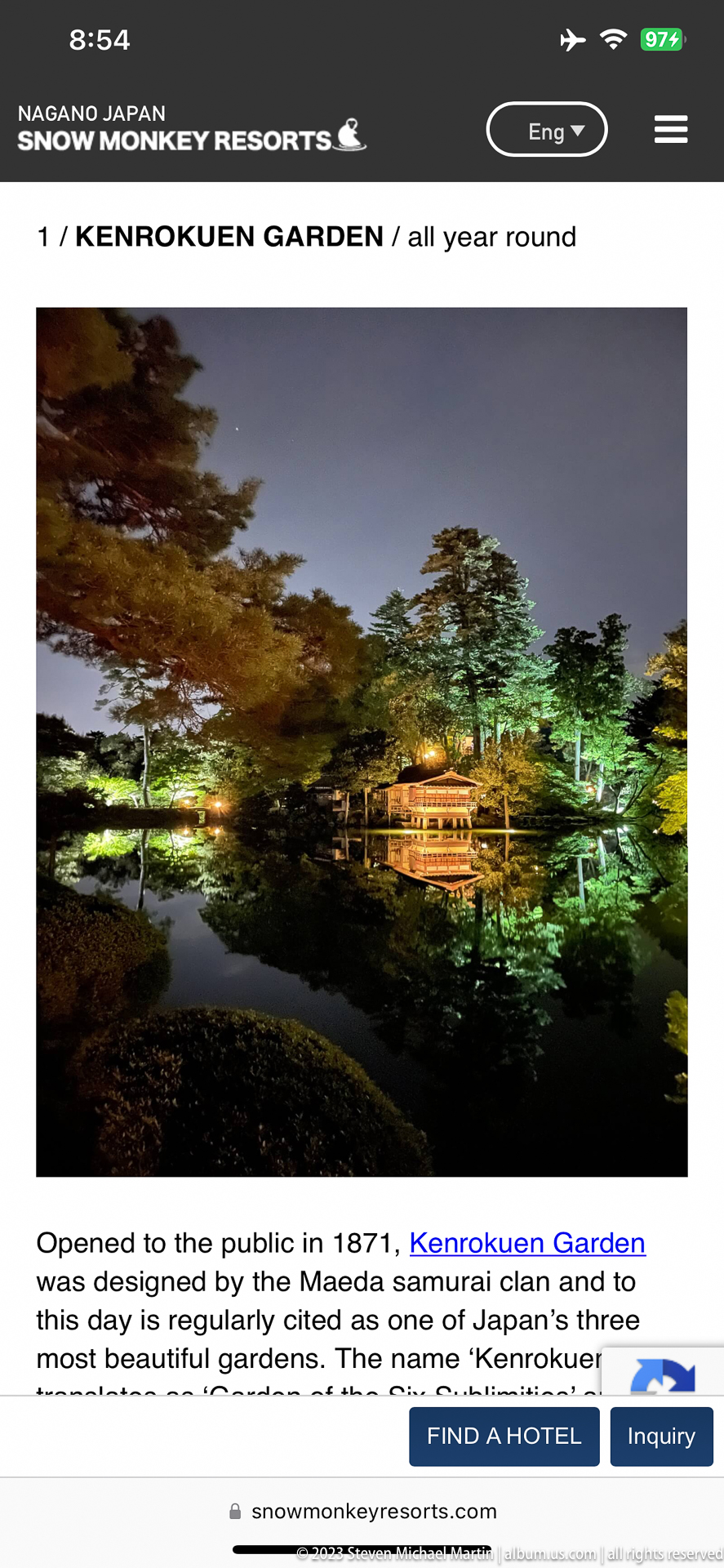
A smartphone screen displays a travel-information page promoting Kenrokuen Garden, with a nighttime garden photograph, descriptive text, navigation controls, and booking links. As a documentary image, it records the digital interpretation of Kanazawa’s heritage rather than the garden itself. The close framing preserves the individual arrangement, color relationships, and spatial details that distinguish this view from neighboring photographs in the sequence.
Caption
A smartphone screen displays a travel-information page promoting Kenrokuen Garden, with a nighttime garden photograph, descriptive text, navigation controls, and booking links. As a documentary image, it records the digital interpretation of Kanazawa’s heritage rather than the garden itself. The close framing preserves the individual arrangement, color relationships, and spatial details that distinguish this view from neighboring photographs in the sequence.

A tourism webpage presents the Nagamachi district through a street view lined with earthen walls and traditional buildings. The accompanying text highlights the area’s samurai history, while the smartphone interface, navigation bar, and booking controls frame the district as a digitally mediated travel destination.
Caption
A tourism webpage presents the Nagamachi district through a street view lined with earthen walls and traditional buildings. The accompanying text highlights the area’s samurai history, while the smartphone interface, navigation bar, and booking controls frame the district as a digitally mediated travel destination.
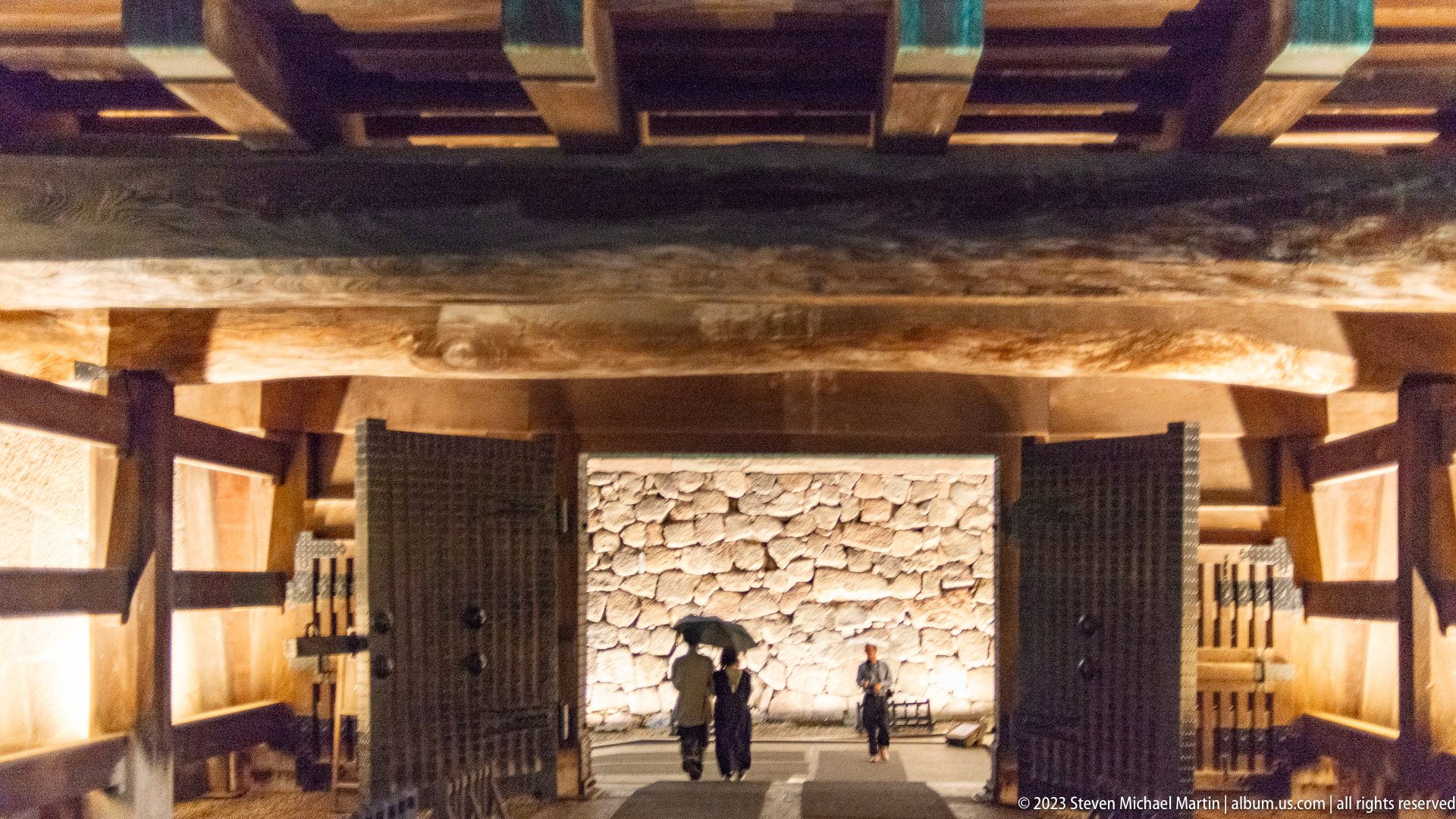
Heavy timber beams and open wooden doors frame visitors moving through a castle gateway toward a massive stone wall beyond. Warm interior lighting reveals the gate’s structural joinery, while the centered perspective turns the passage into a sequence of wood, people, and masonry.
Caption
Heavy timber beams and open wooden doors frame visitors moving through a castle gateway toward a massive stone wall beyond. Warm interior lighting reveals the gate’s structural joinery, while the centered perspective turns the passage into a sequence of wood, people, and masonry.
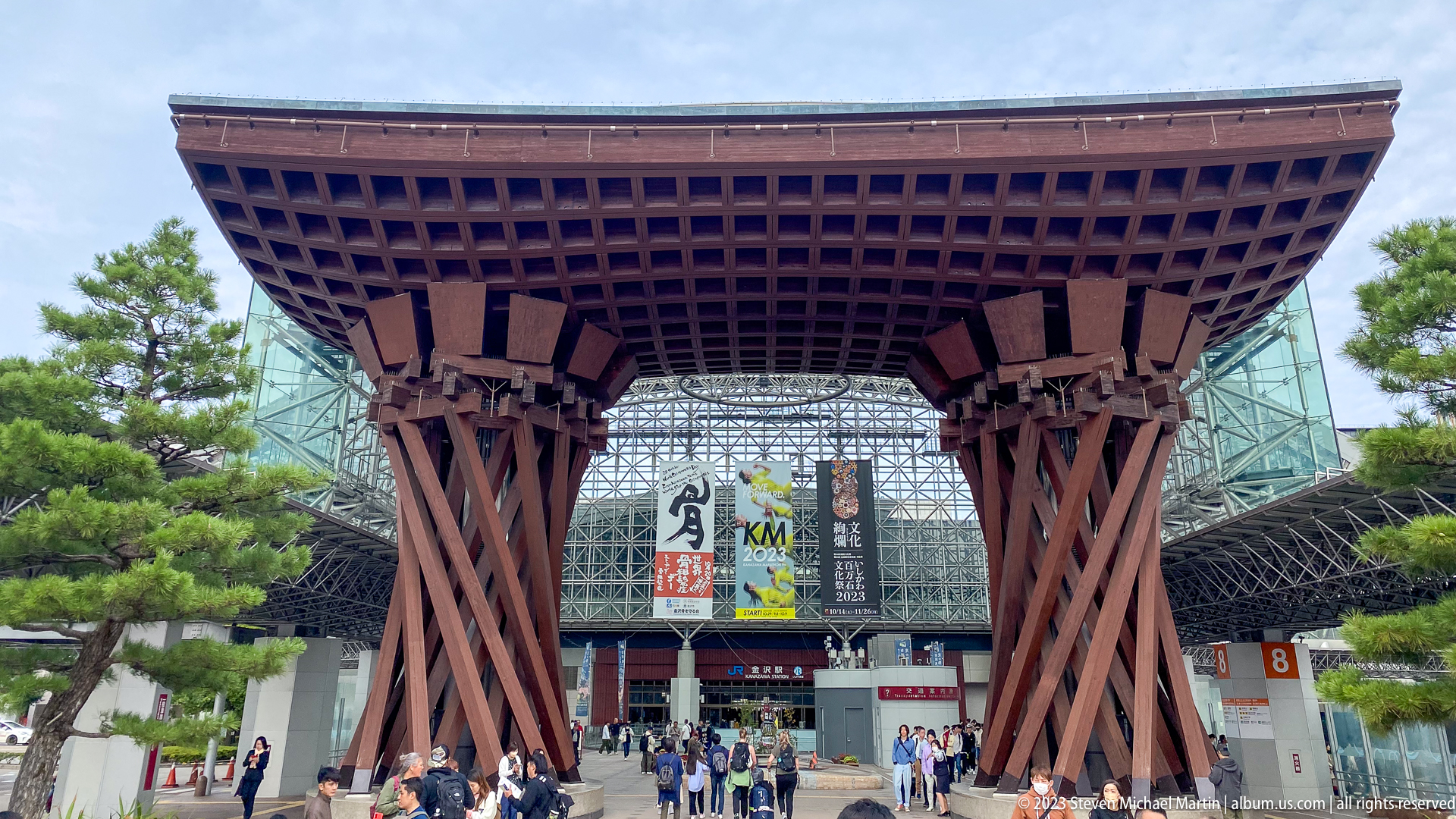
Kanazawa Station’s Tsuzumi-mon Gate fills the frame with its immense interlocking timber columns and broad lattice canopy. The contemporary structure references the form of a traditional hand drum while functioning as a ceremonial urban threshold, with travelers moving beneath it toward the glass-and-steel station hall.
Caption
Kanazawa Station’s Tsuzumi-mon Gate fills the frame with its immense interlocking timber columns and broad lattice canopy. The contemporary structure references the form of a traditional hand drum while functioning as a ceremonial urban threshold, with travelers moving beneath it toward the glass-and-steel station hall.
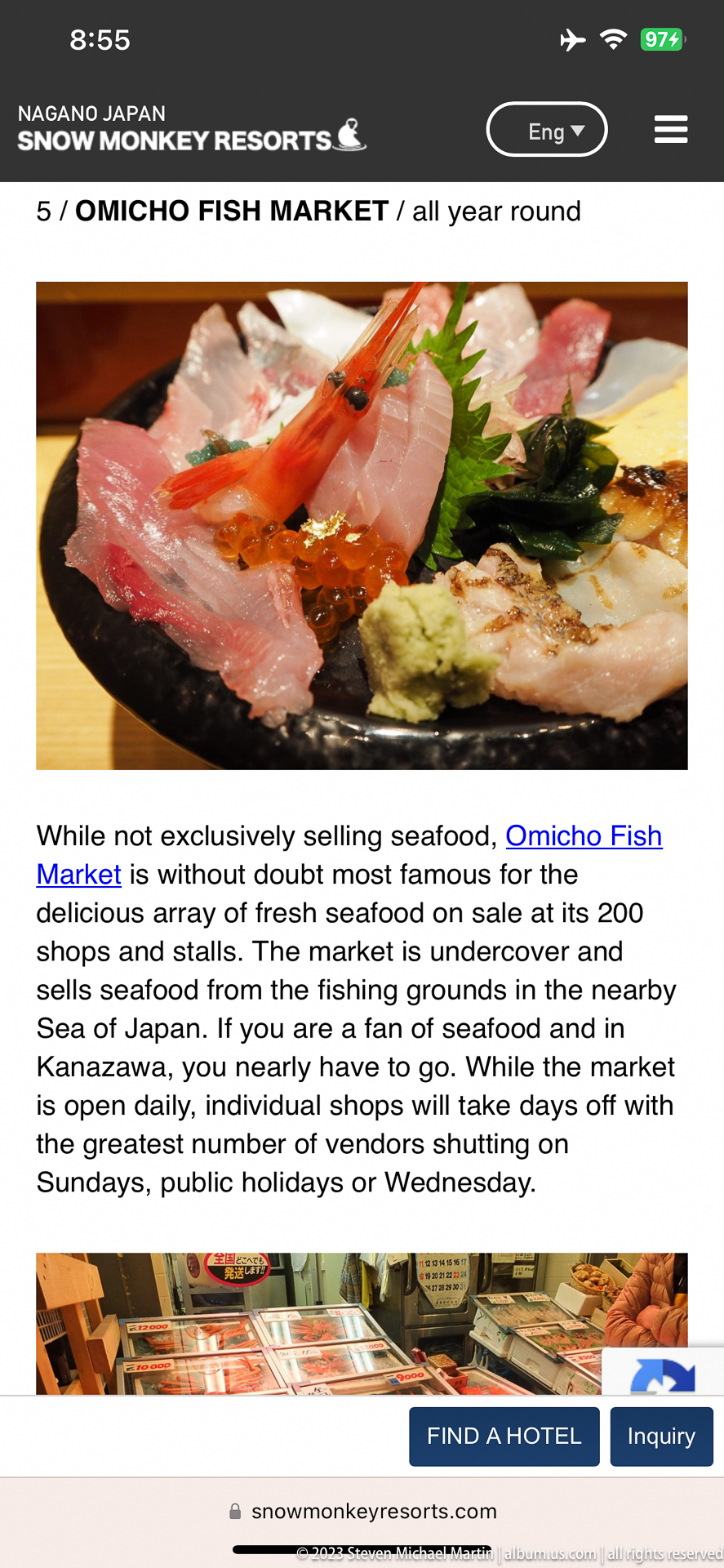
A smartphone screen displays a guide to Omicho Fish Market, led by a close view of sashimi and seafood arranged over garnish. The article text describes the market’s long history and local food culture, while hotel and inquiry buttons reveal the commercial structure of the travel website.
Caption
A smartphone screen displays a guide to Omicho Fish Market, led by a close view of sashimi and seafood arranged over garnish. The article text describes the market’s long history and local food culture, while hotel and inquiry buttons reveal the commercial structure of the travel website.
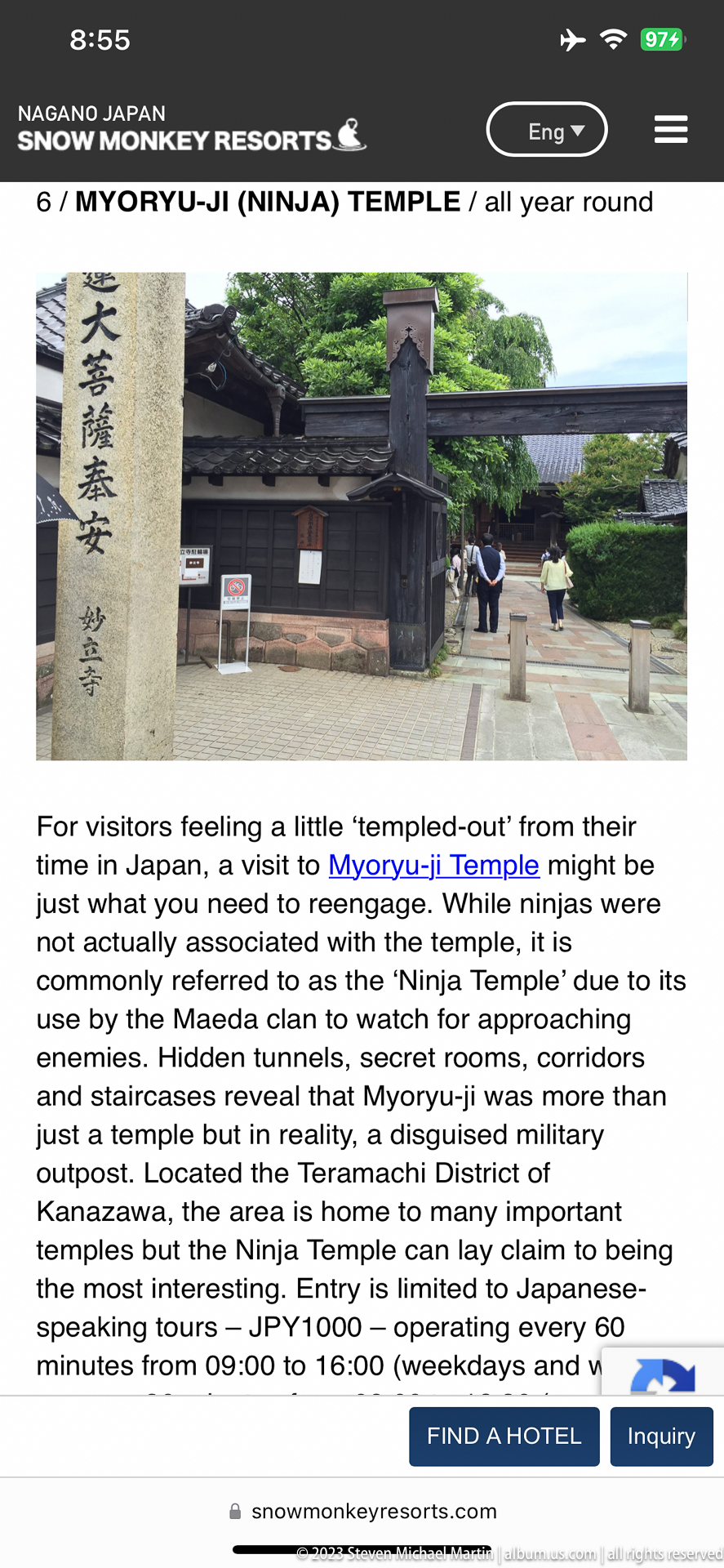
A travel webpage introduces Myoryuji, commonly promoted as Kanazawa’s “Ninja Temple,” with a photograph of its entrance and text explaining the popular nickname. The smartphone screenshot captures the tension between visitor branding and historical clarification by noting that the temple was not actually associated with ninja.
Caption
A travel webpage introduces Myoryuji, commonly promoted as Kanazawa’s “Ninja Temple,” with a photograph of its entrance and text explaining the popular nickname. The smartphone screenshot captures the tension between visitor branding and historical clarification by noting that the temple was not actually associated with ninja.
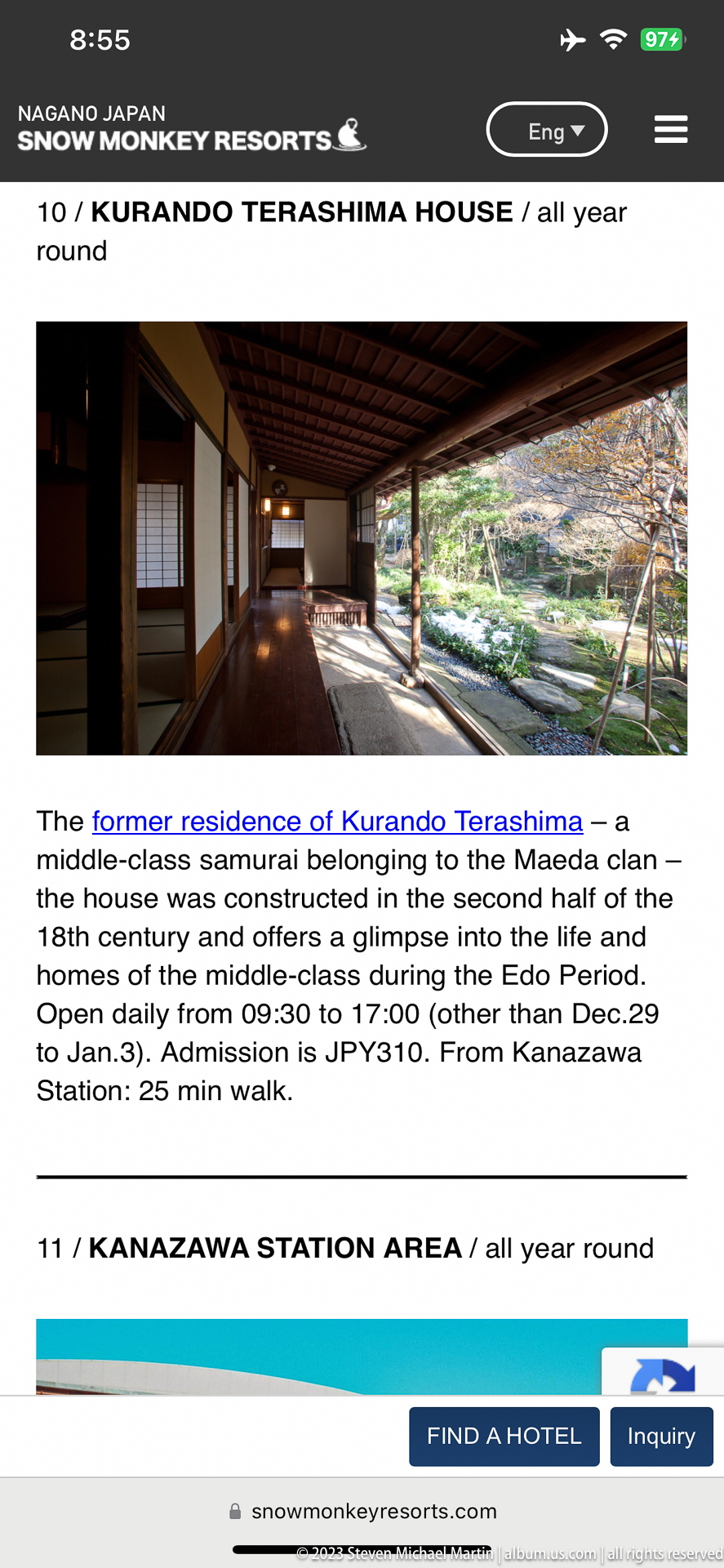
A smartphone screen presents the former residence of Kurando Terashima, illustrated by a timber veranda opening toward a garden. The text identifies the site as a restored middle-class samurai residence, while the webpage layout combines heritage interpretation with practical visitor information.
Caption
A smartphone screen presents the former residence of Kurando Terashima, illustrated by a timber veranda opening toward a garden. The text identifies the site as a restored middle-class samurai residence, while the webpage layout combines heritage interpretation with practical visitor information.
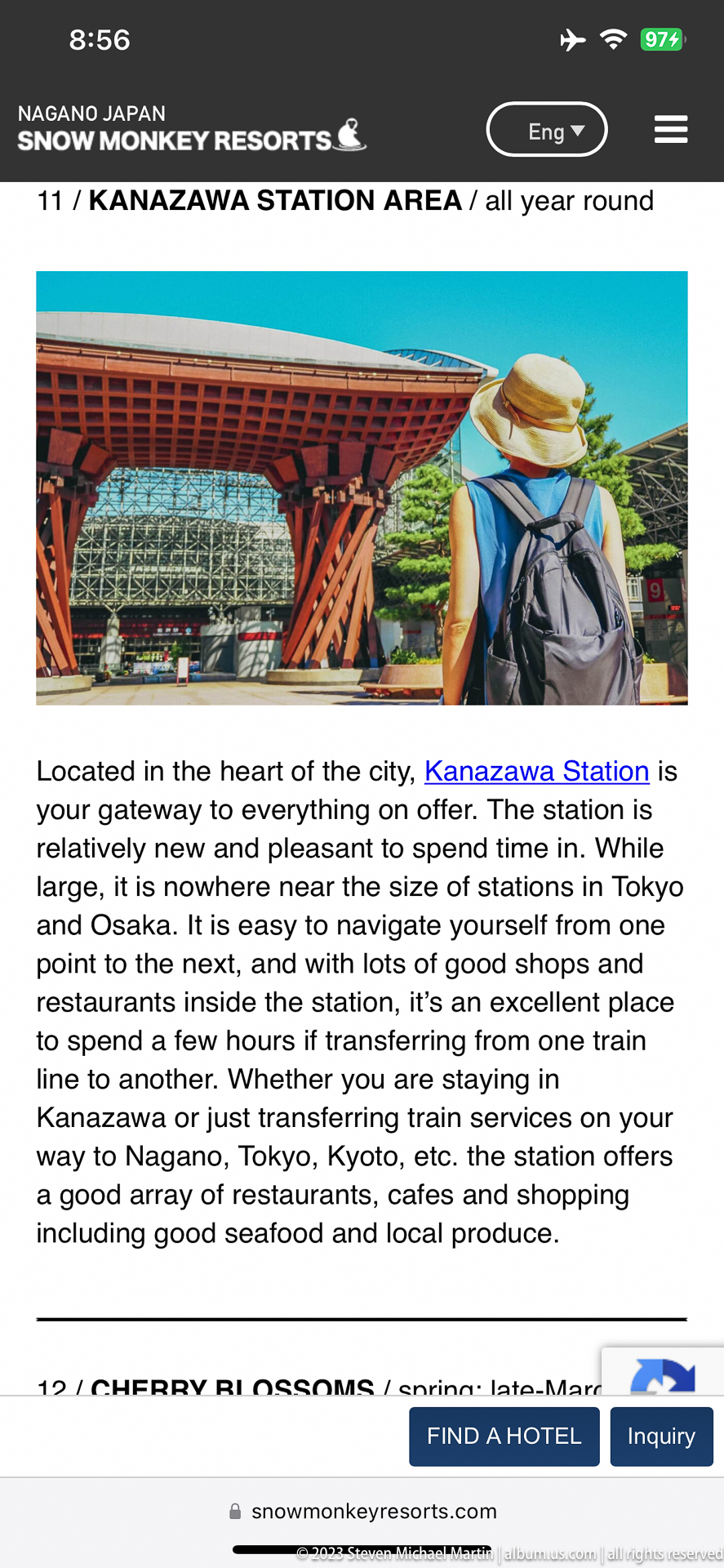
A tourism webpage highlights the Kanazawa Station area with a photograph of the station’s monumental red timber gate and a visitor in the foreground. The accompanying text promotes the station as a transport and shopping hub, while the smartphone interface records the destination through a commercial travel guide.
Caption
A tourism webpage highlights the Kanazawa Station area with a photograph of the station’s monumental red timber gate and a visitor in the foreground. The accompanying text promotes the station as a transport and shopping hub, while the smartphone interface records the destination through a commercial travel guide.
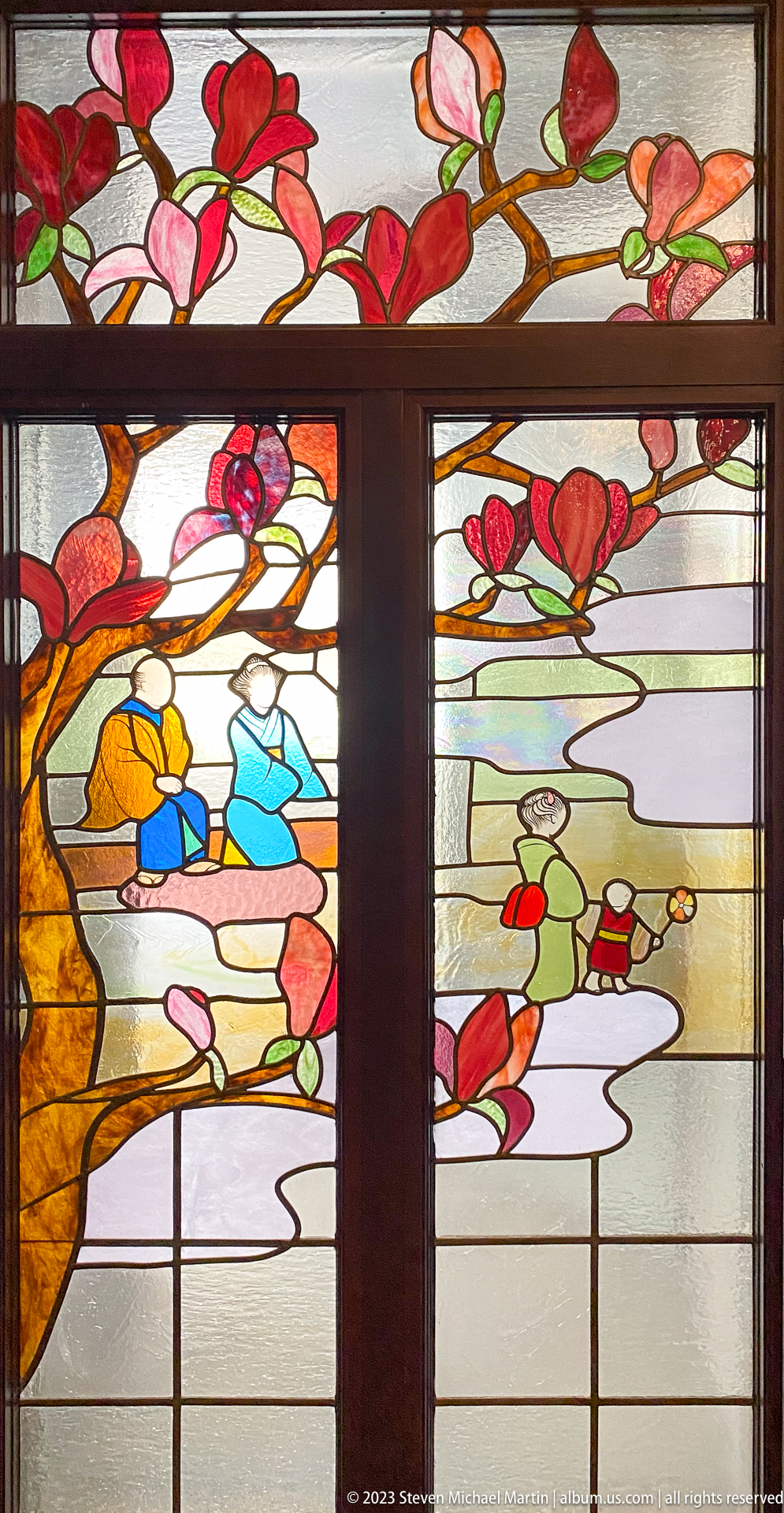
A decorative stained-glass panel combines pink magnolia blossoms with small robed figures moving through a stylized landscape. Lead lines divide the scene into flowing branches, pale sky, and watery ground, translating a traditional seasonal motif into luminous architectural ornament. The close framing preserves the individual arrangement, color relationships, and spatial details that distinguish this view from neighboring photographs in the sequence.
Caption
A decorative stained-glass panel combines pink magnolia blossoms with small robed figures moving through a stylized landscape. Lead lines divide the scene into flowing branches, pale sky, and watery ground, translating a traditional seasonal motif into luminous architectural ornament. The close framing preserves the individual arrangement, color relationships, and spatial details that distinguish this view from neighboring photographs in the sequence.
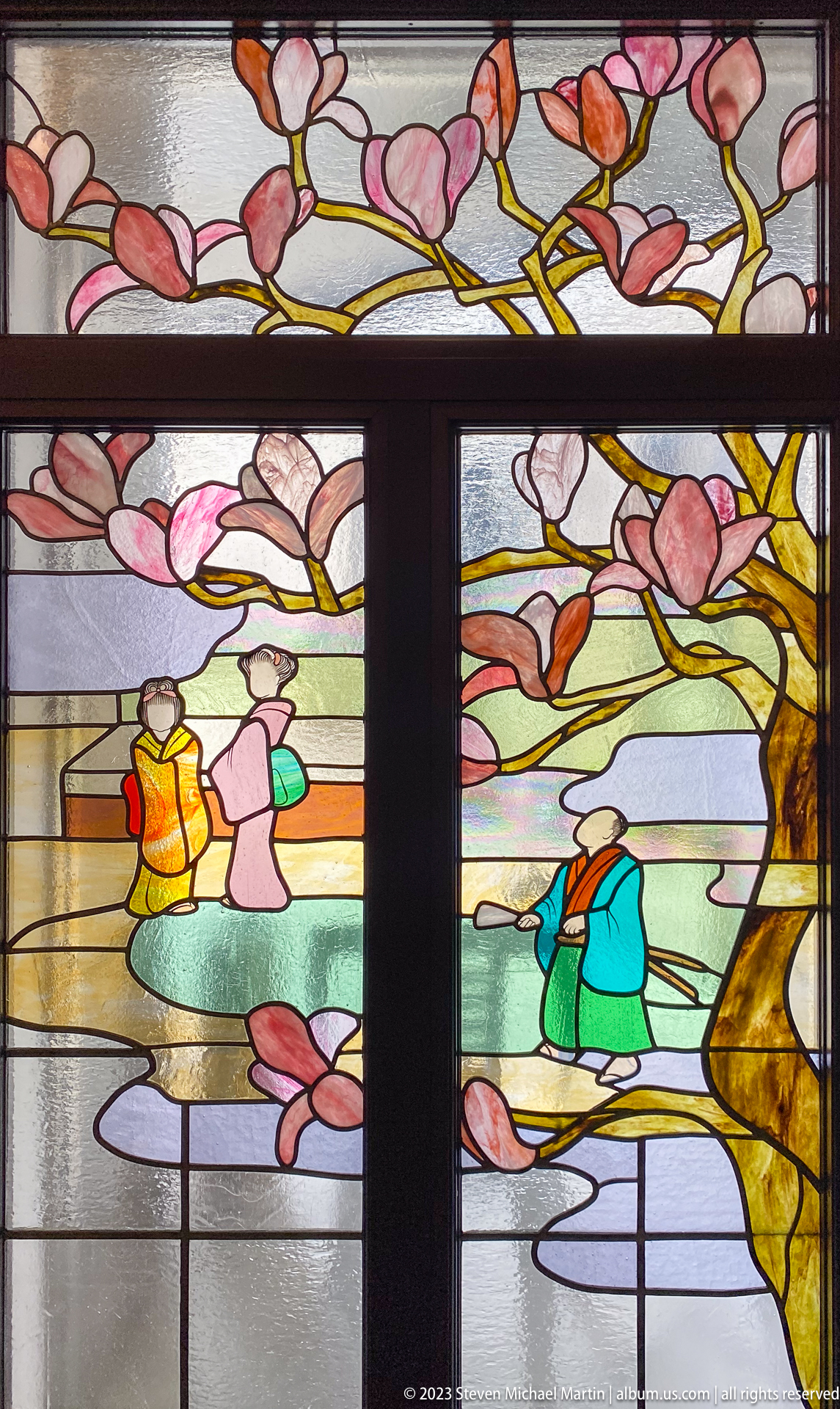
Figures in brightly colored garments stand beneath arching pink blossoms in this stained-glass composition. The scene is organized through bold lead outlines and broad areas of translucent color, creating a decorative interpretation of seasonal viewing and social gathering. The close framing preserves the individual arrangement, color relationships, and spatial details that distinguish this view from neighboring photographs in the sequence.
Caption
Figures in brightly colored garments stand beneath arching pink blossoms in this stained-glass composition. The scene is organized through bold lead outlines and broad areas of translucent color, creating a decorative interpretation of seasonal viewing and social gathering. The close framing preserves the individual arrangement, color relationships, and spatial details that distinguish this view from neighboring photographs in the sequence.
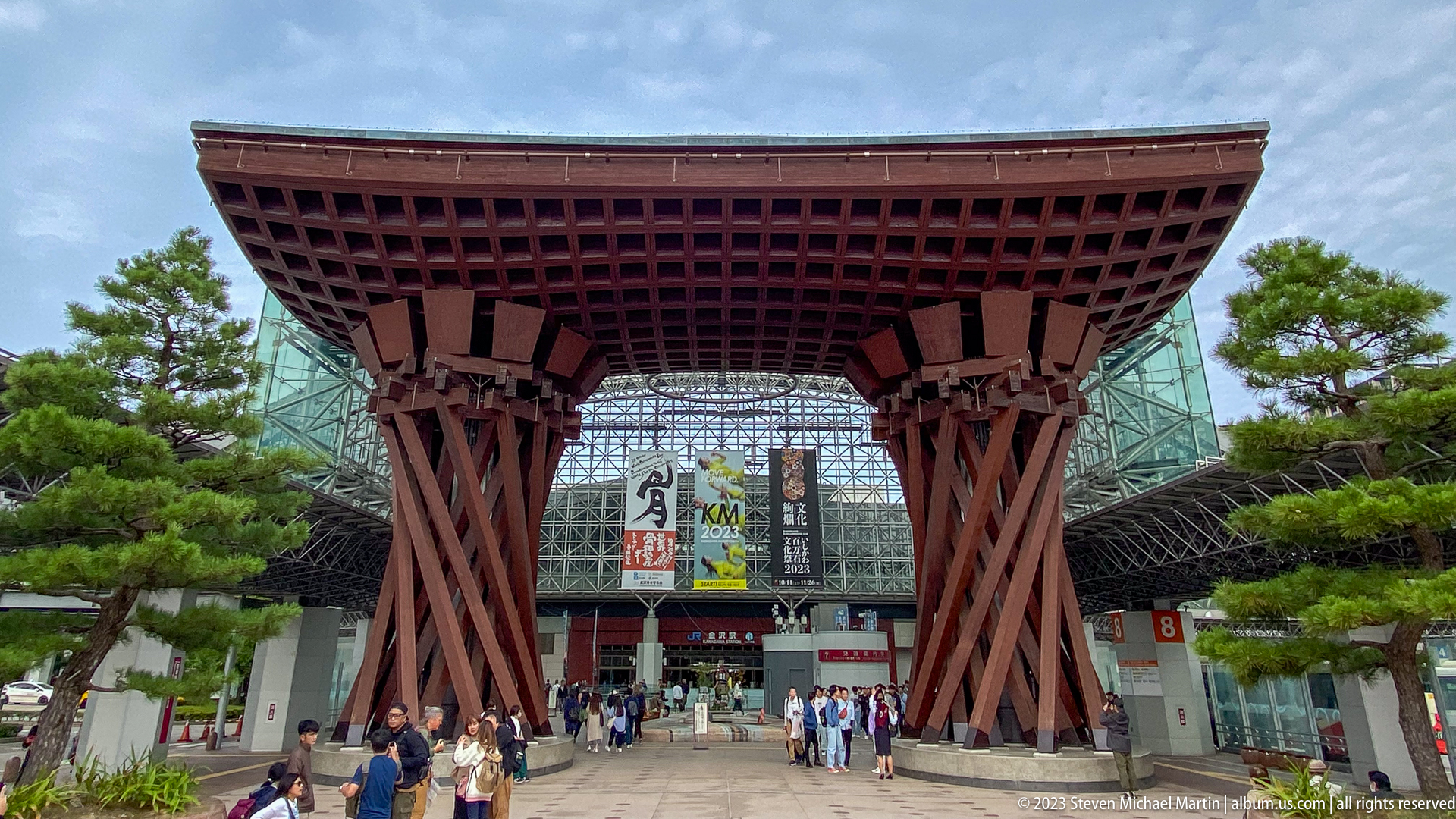
A slightly wider frontal view shows the Tsuzumi-mon Gate as both sculpture and infrastructure. Its splayed timber legs frame the station entrance, while banners, trees, and groups of pedestrians establish the scale of the structure within the active forecourt. The close framing preserves the individual arrangement, color relationships, and spatial details that distinguish this view from neighboring photographs in the sequence.
Caption
A slightly wider frontal view shows the Tsuzumi-mon Gate as both sculpture and infrastructure. Its splayed timber legs frame the station entrance, while banners, trees, and groups of pedestrians establish the scale of the structure within the active forecourt. The close framing preserves the individual arrangement, color relationships, and spatial details that distinguish this view from neighboring photographs in the sequence.
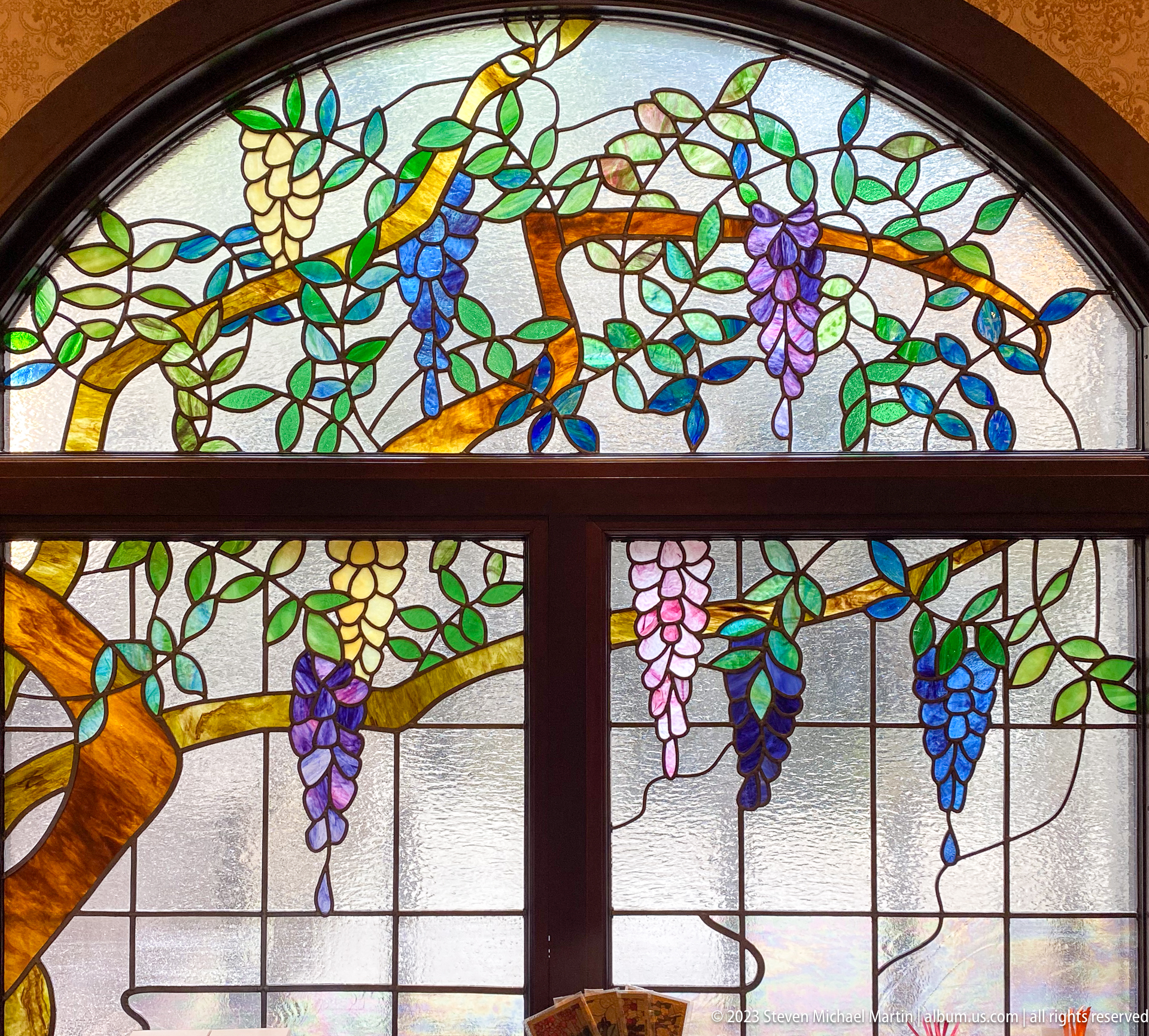
A closer frontal view isolates the upper and central sections of the grapevine window. Blue, purple, pink, and pale grape clusters hang among dense green leaves, while a thick golden-brown trunk curves across the arch. The dark timber frame provides a strong geometric counterpoint to the organic vine, revealing how the stained glass was fitted into the architectural opening.
Caption
A closer frontal view isolates the upper and central sections of the grapevine window. Blue, purple, pink, and pale grape clusters hang among dense green leaves, while a thick golden-brown trunk curves across the arch. The dark timber frame provides a strong geometric counterpoint to the organic vine, revealing how the stained glass was fitted into the architectural opening.

Twisting brown branches spread across a pale ground, carrying white and pink blossoms among vivid green leaves. The close framing suppresses the larger narrative and focuses attention on the craft of leaded glass: irregular panes, strong contour lines, and layered translucent color.
Caption
Twisting brown branches spread across a pale ground, carrying white and pink blossoms among vivid green leaves. The close framing suppresses the larger narrative and focuses attention on the craft of leaded glass: irregular panes, strong contour lines, and layered translucent color.
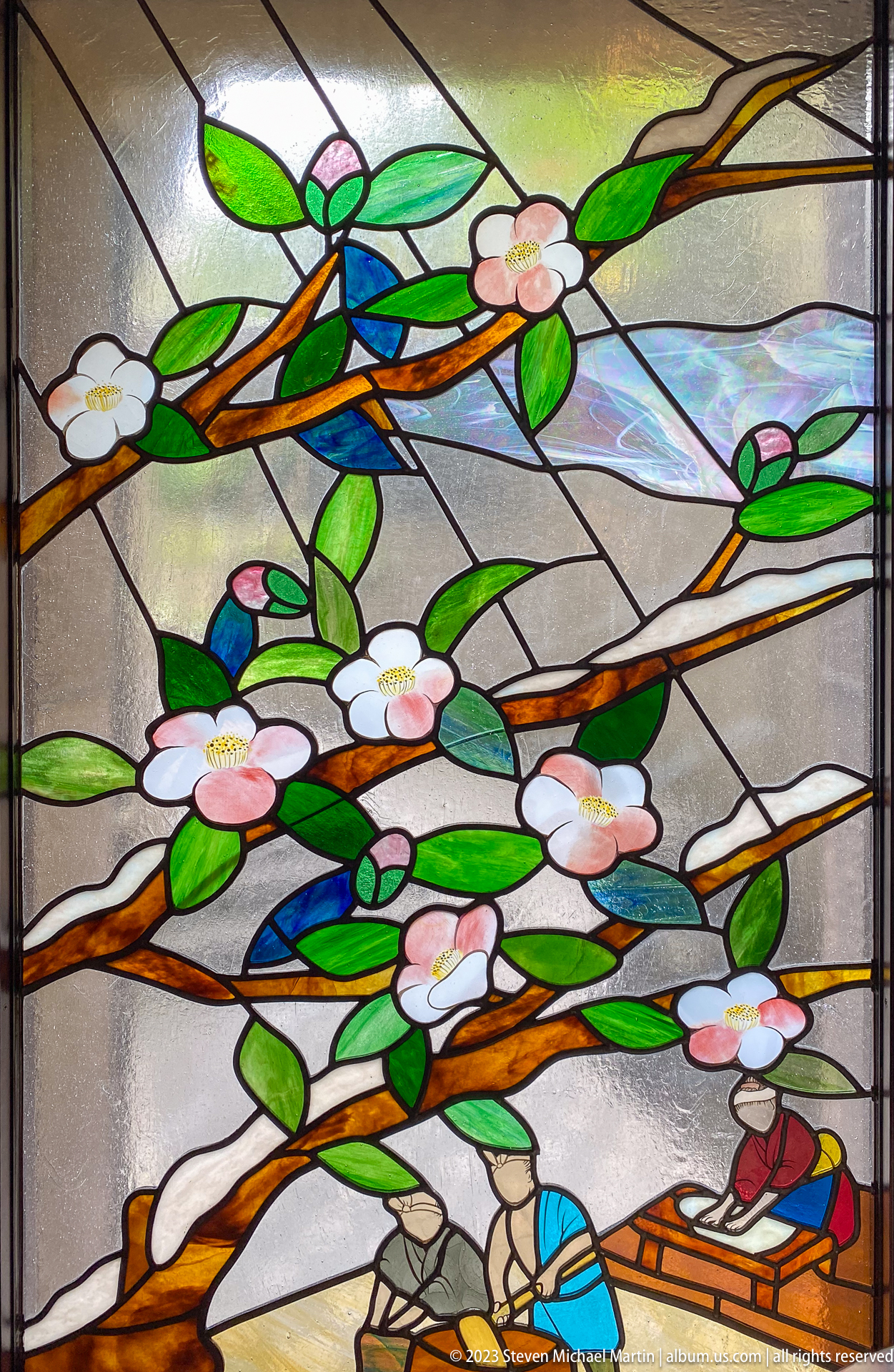
A flowering tree spreads across the upper field while small figures gather beneath its branches, rendered in saturated blue, red, and yellow glass. The composition layers botanical detail over human activity, using translucent panes and dark lead lines to create a vivid seasonal tableau.
Caption
A flowering tree spreads across the upper field while small figures gather beneath its branches, rendered in saturated blue, red, and yellow glass. The composition layers botanical detail over human activity, using translucent panes and dark lead lines to create a vivid seasonal tableau.
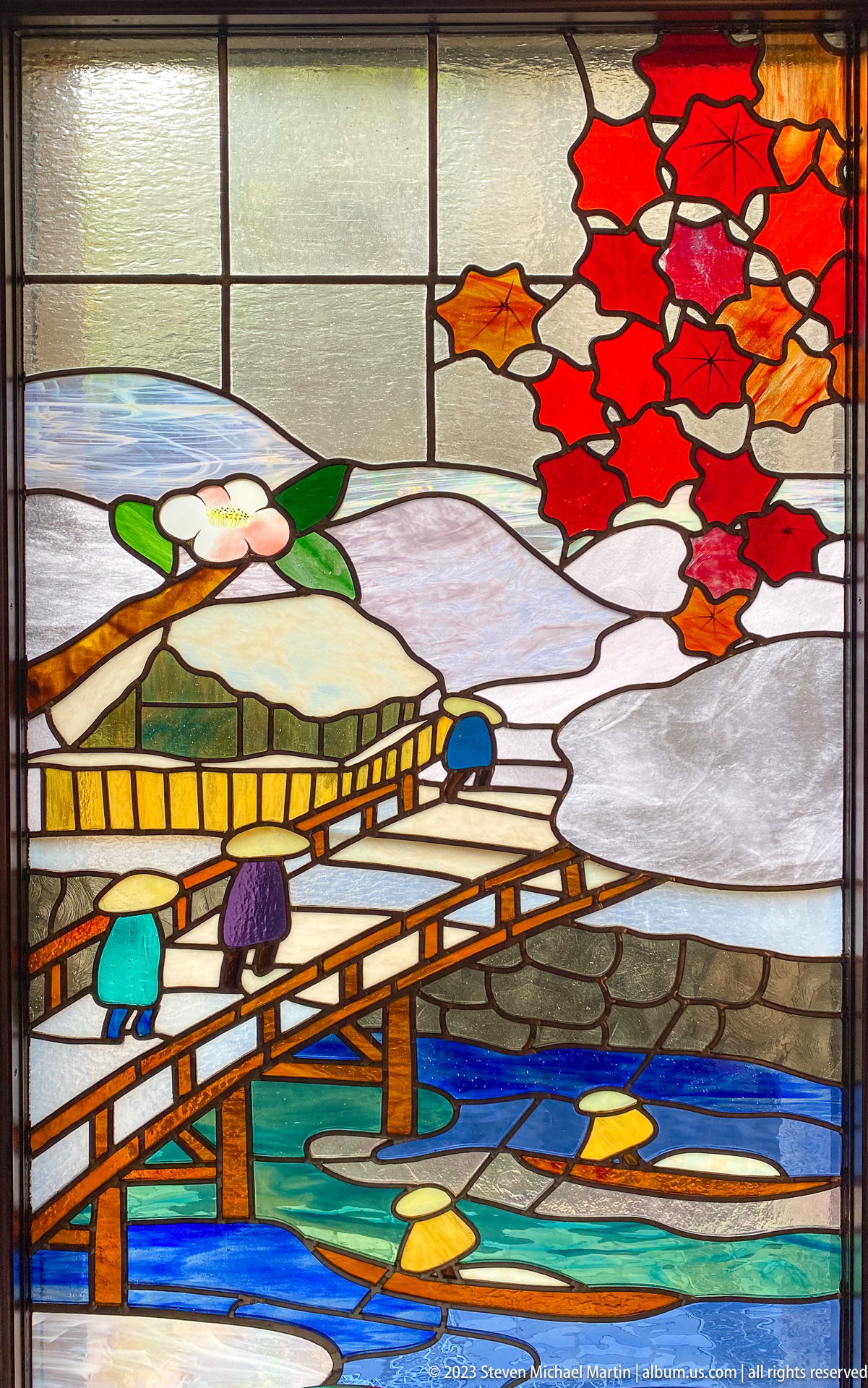
Two figures cross a long wooden bridge beneath red maple leaves in a stylized autumn landscape. Blue water, pale mountains, and scattered stones create depth through broad color fields, while the lead network turns the scene into a graphic pattern of seasonal movement.
Caption
Two figures cross a long wooden bridge beneath red maple leaves in a stylized autumn landscape. Blue water, pale mountains, and scattered stones create depth through broad color fields, while the lead network turns the scene into a graphic pattern of seasonal movement.
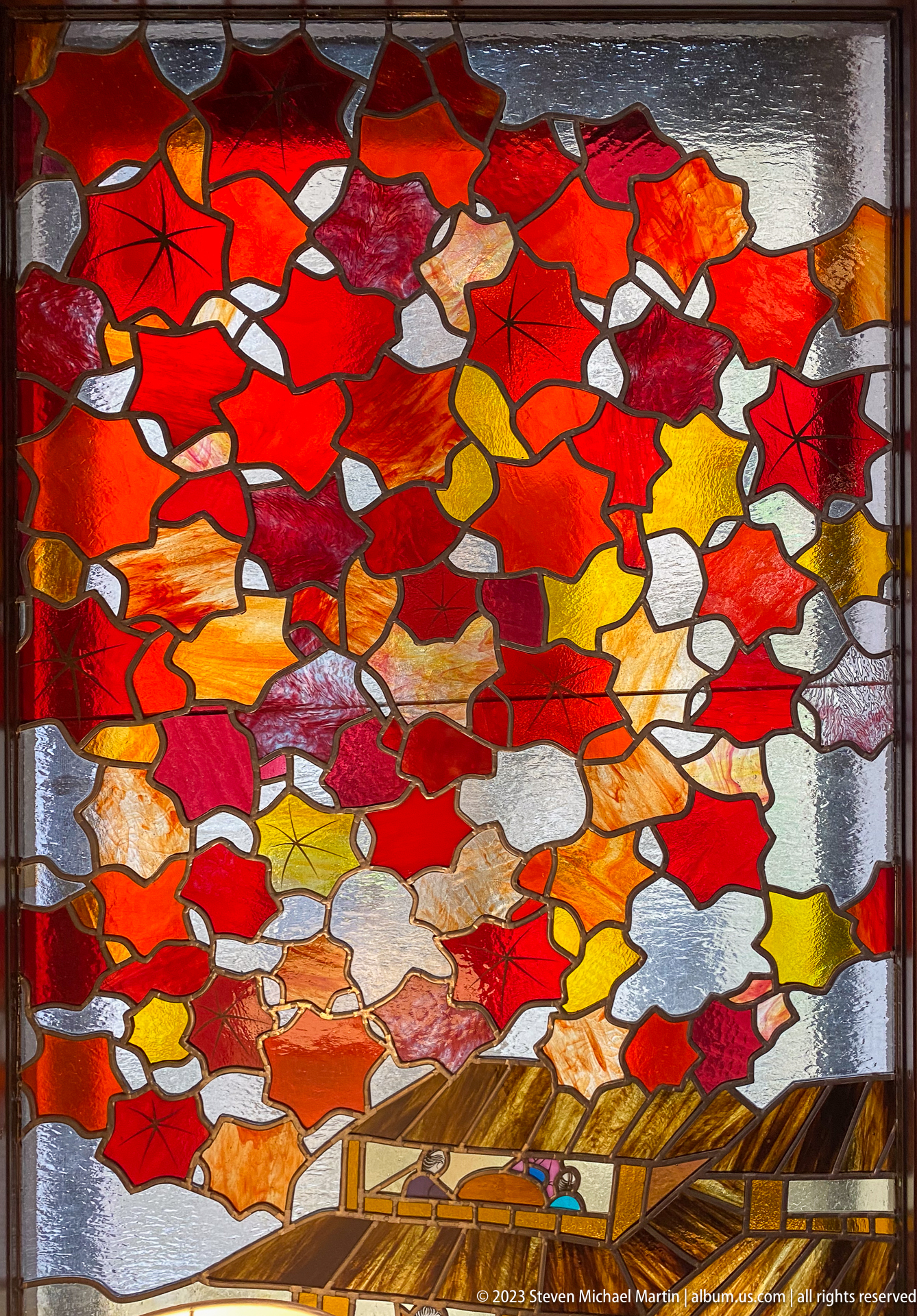
A dense canopy of red, orange, and yellow maple leaves fills most of the panel, opening near the bottom to reveal a small wooden bridge and figures. The close, immersive composition makes autumn foliage the principal subject, with irregular panes intensifying the mosaic-like effect.
Caption
A dense canopy of red, orange, and yellow maple leaves fills most of the panel, opening near the bottom to reveal a small wooden bridge and figures. The close, immersive composition makes autumn foliage the principal subject, with irregular panes intensifying the mosaic-like effect.
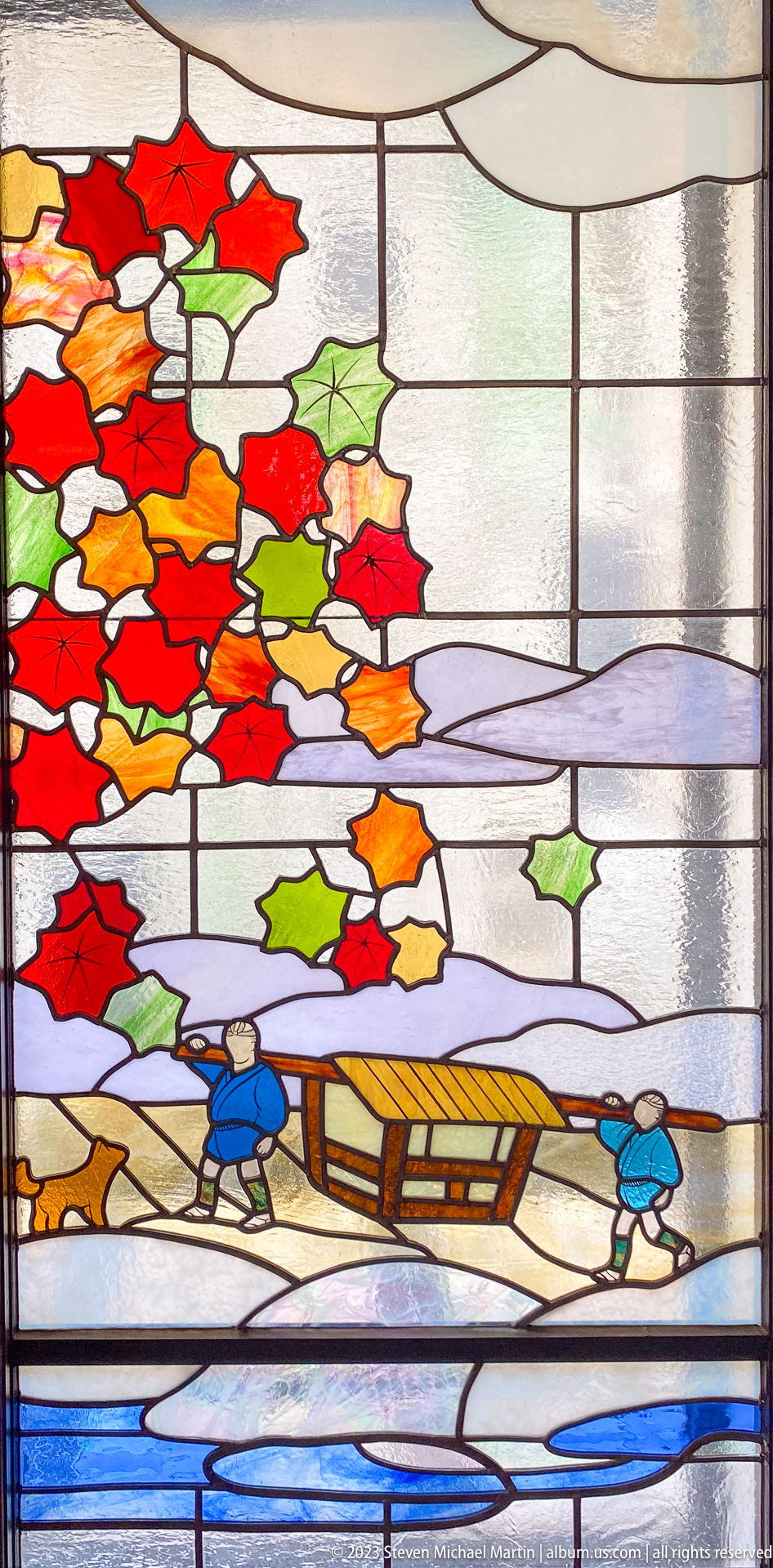
A pale, wintry landscape is crossed by a wooden bridge carrying small figures, while a cluster of red maple leaves remains at the upper left. Blue water and restrained gray-white panes create a cool atmosphere, contrasting with the saturated foliage and clothing.
Caption
A pale, wintry landscape is crossed by a wooden bridge carrying small figures, while a cluster of red maple leaves remains at the upper left. Blue water and restrained gray-white panes create a cool atmosphere, contrasting with the saturated foliage and clothing.
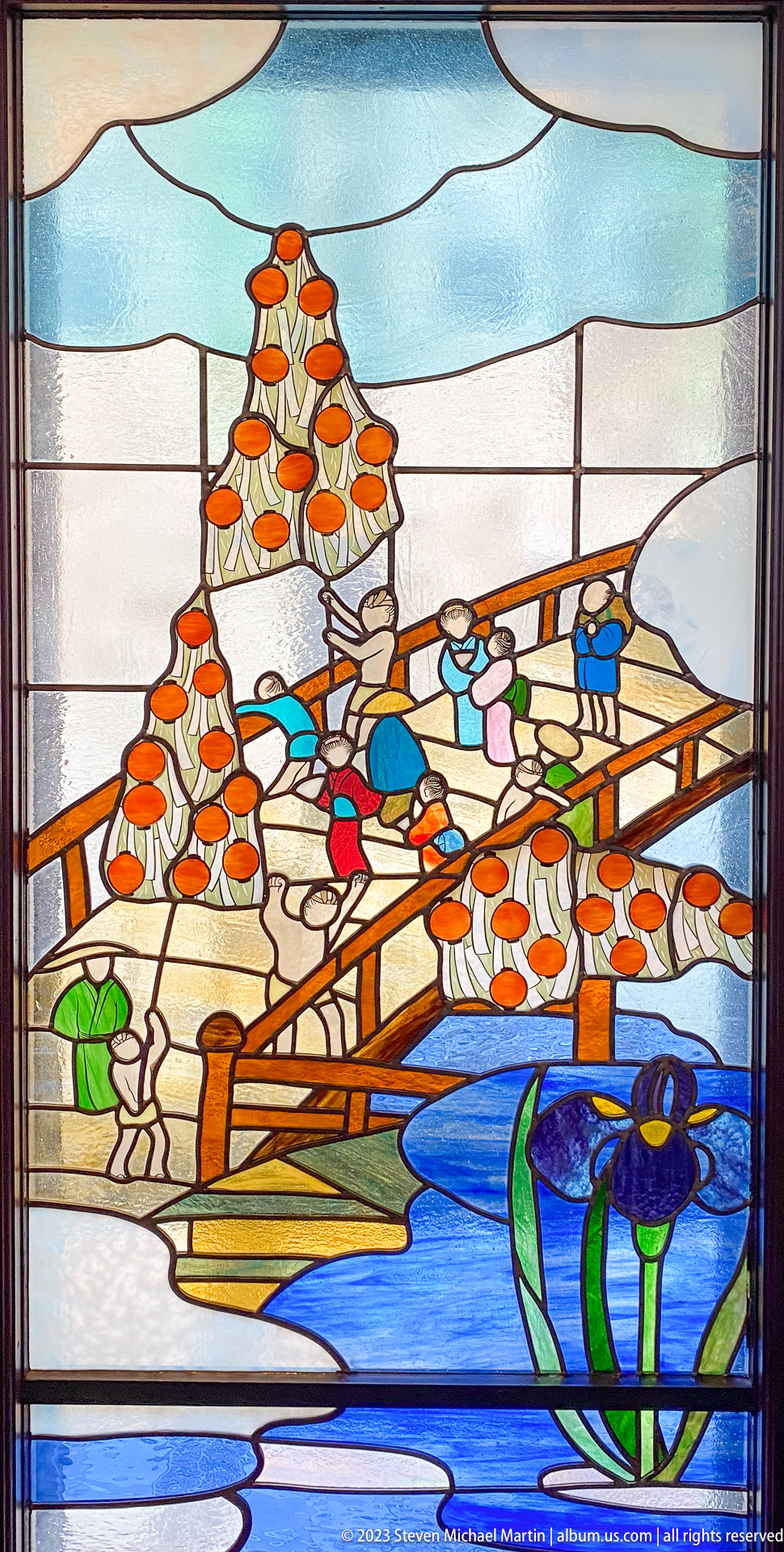
Workers gather on a wooden platform beside stacked conical baskets or bundles, while a narrow boat cuts through vivid blue water in the foreground. The stained-glass scene emphasizes labor, transport, and river activity through compact figures and strongly outlined forms.
Caption
Workers gather on a wooden platform beside stacked conical baskets or bundles, while a narrow boat cuts through vivid blue water in the foreground. The stained-glass scene emphasizes labor, transport, and river activity through compact figures and strongly outlined forms.
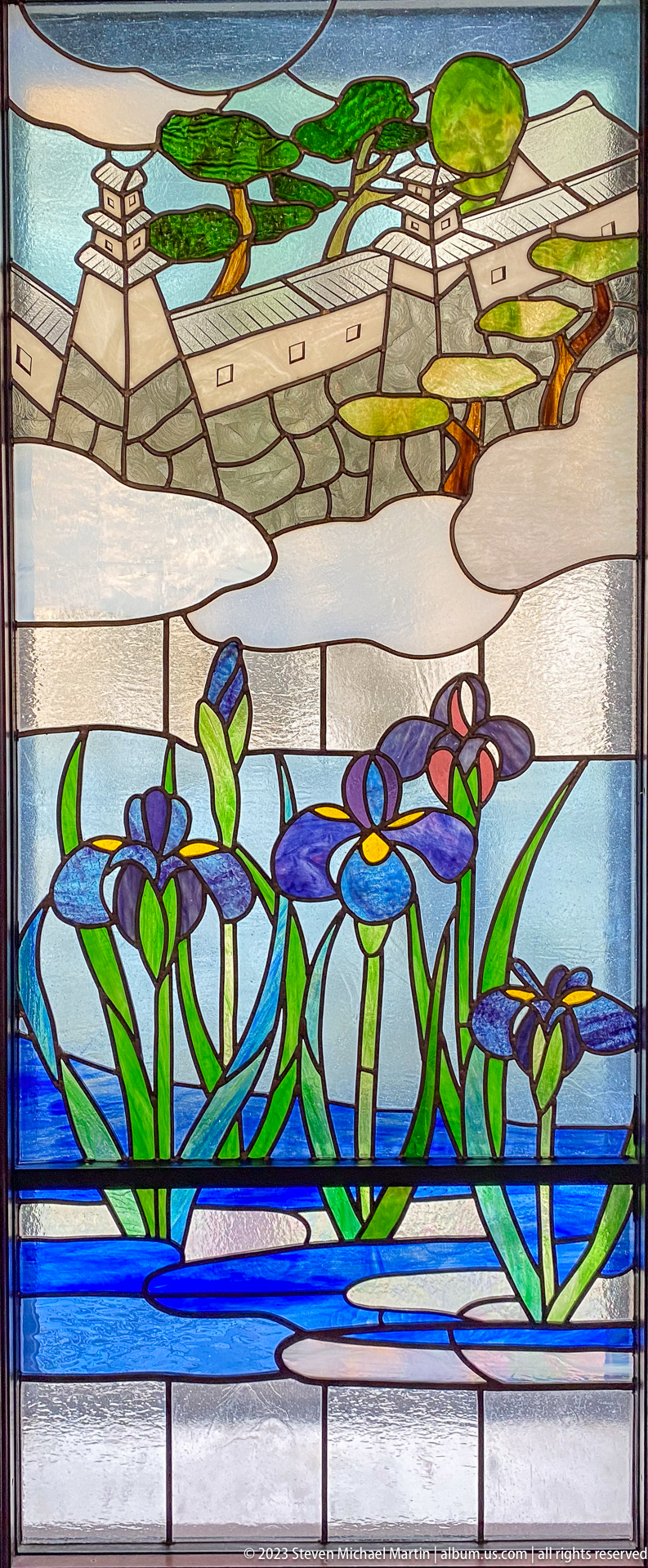
Purple irises rise from blue water across the lower portion of the panel, while a pale, lightly drawn architectural landscape recedes behind them. The composition gives botanical detail priority, using saturated petals and green leaves against muted buildings and sky.
Caption
Purple irises rise from blue water across the lower portion of the panel, while a pale, lightly drawn architectural landscape recedes behind them. The composition gives botanical detail priority, using saturated petals and green leaves against muted buildings and sky.
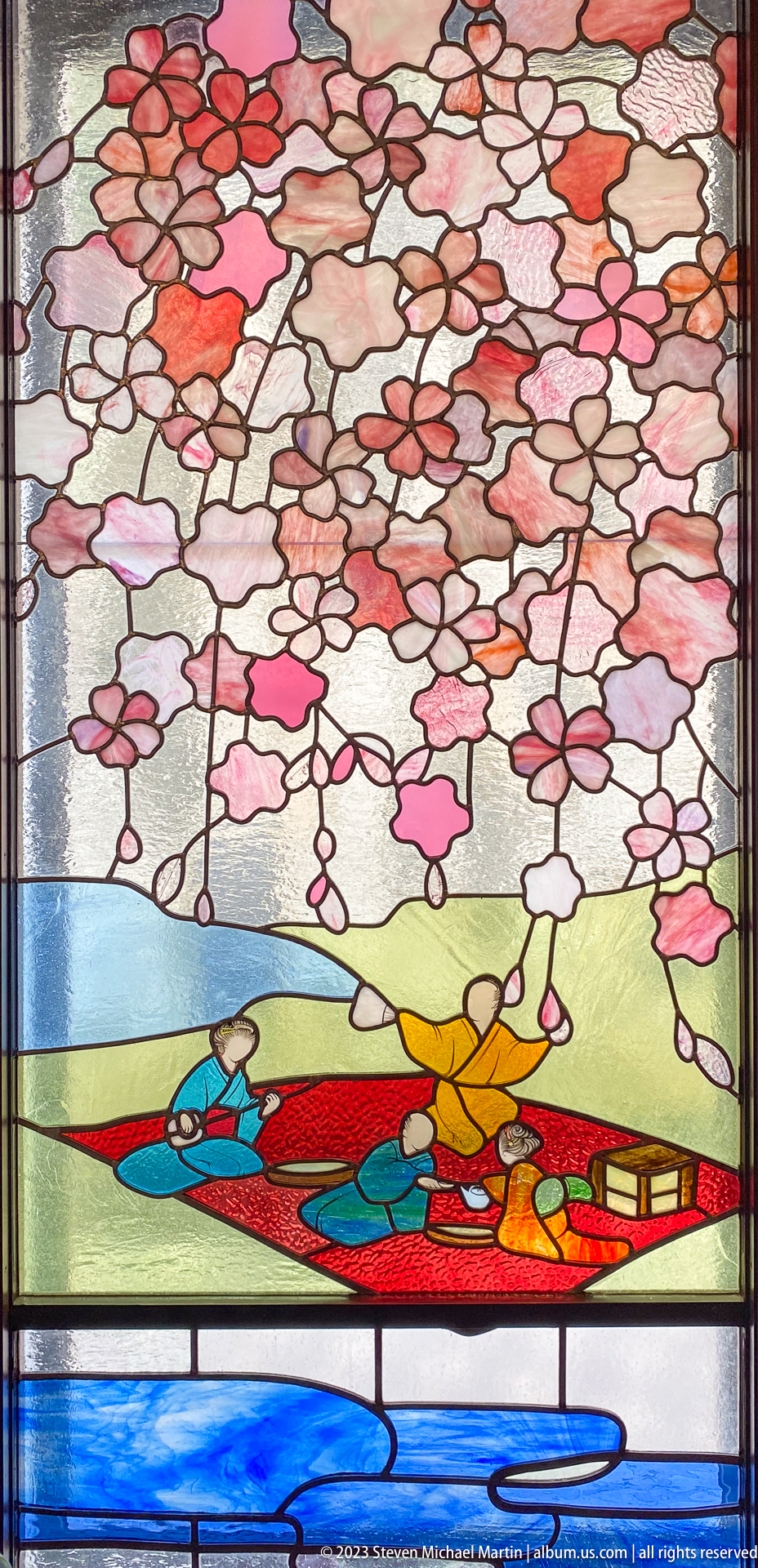
Drooping pink cherry blossoms fill the upper half of the panel above three figures seated in a long boat on blue water. The low horizon and broad floral canopy create a serene spring composition, with saturated garments and blossoms set against pale translucent glass.
Caption
Drooping pink cherry blossoms fill the upper half of the panel above three figures seated in a long boat on blue water. The low horizon and broad floral canopy create a serene spring composition, with saturated garments and blossoms set against pale translucent glass.
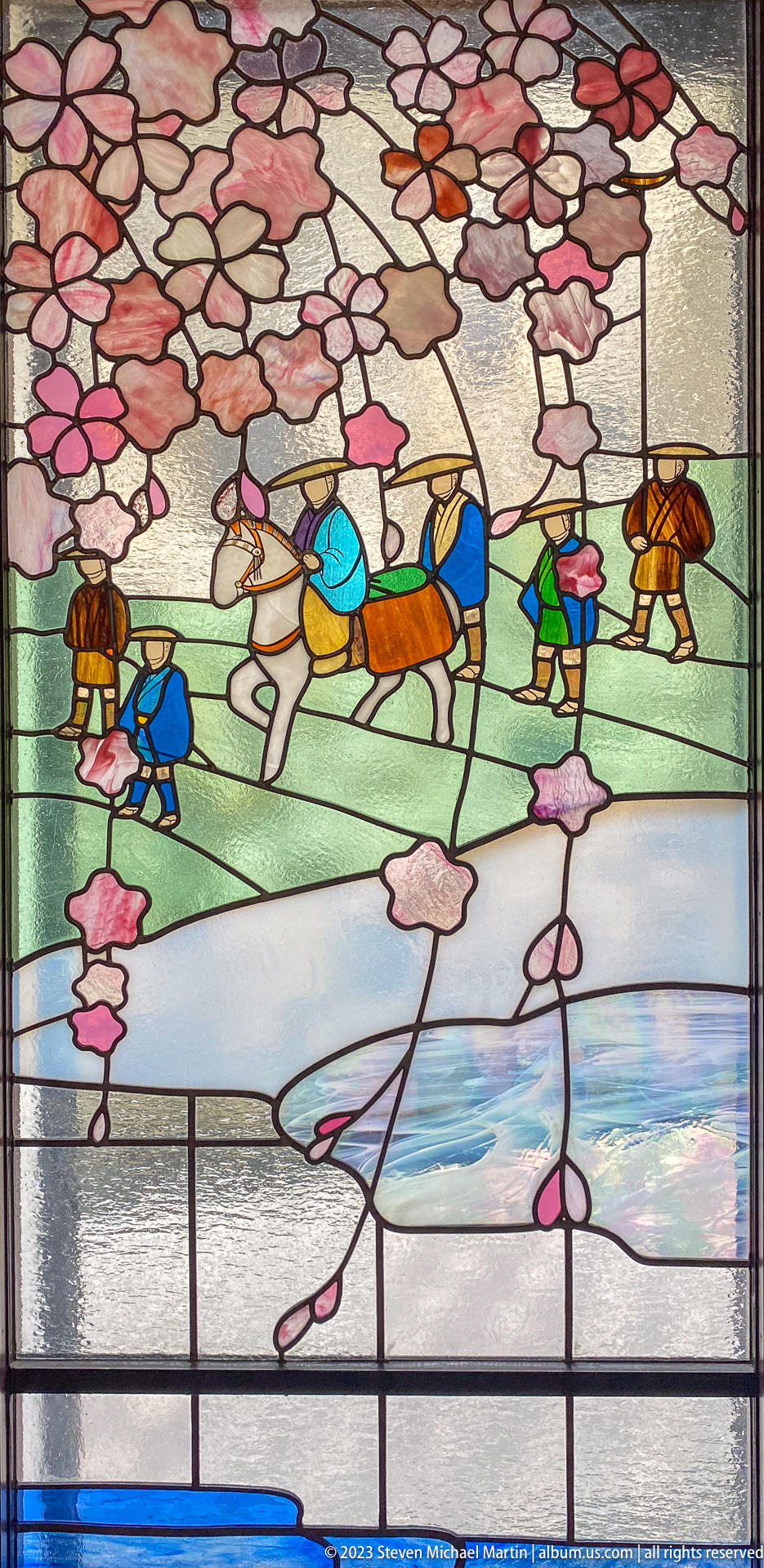
Pink cherry blossoms arch across a leaded-glass landscape where several small figures travel on foot and horseback. The scene combines seasonal imagery with movement through open ground, while the large flowering branches and pale water below divide the panel into layered bands. Bright clothing and simplified silhouettes give the procession a narrative presence without identifying a specific event.
Caption
Pink cherry blossoms arch across a leaded-glass landscape where several small figures travel on foot and horseback. The scene combines seasonal imagery with movement through open ground, while the large flowering branches and pale water below divide the panel into layered bands. Bright clothing and simplified silhouettes give the procession a narrative presence without identifying a specific event.
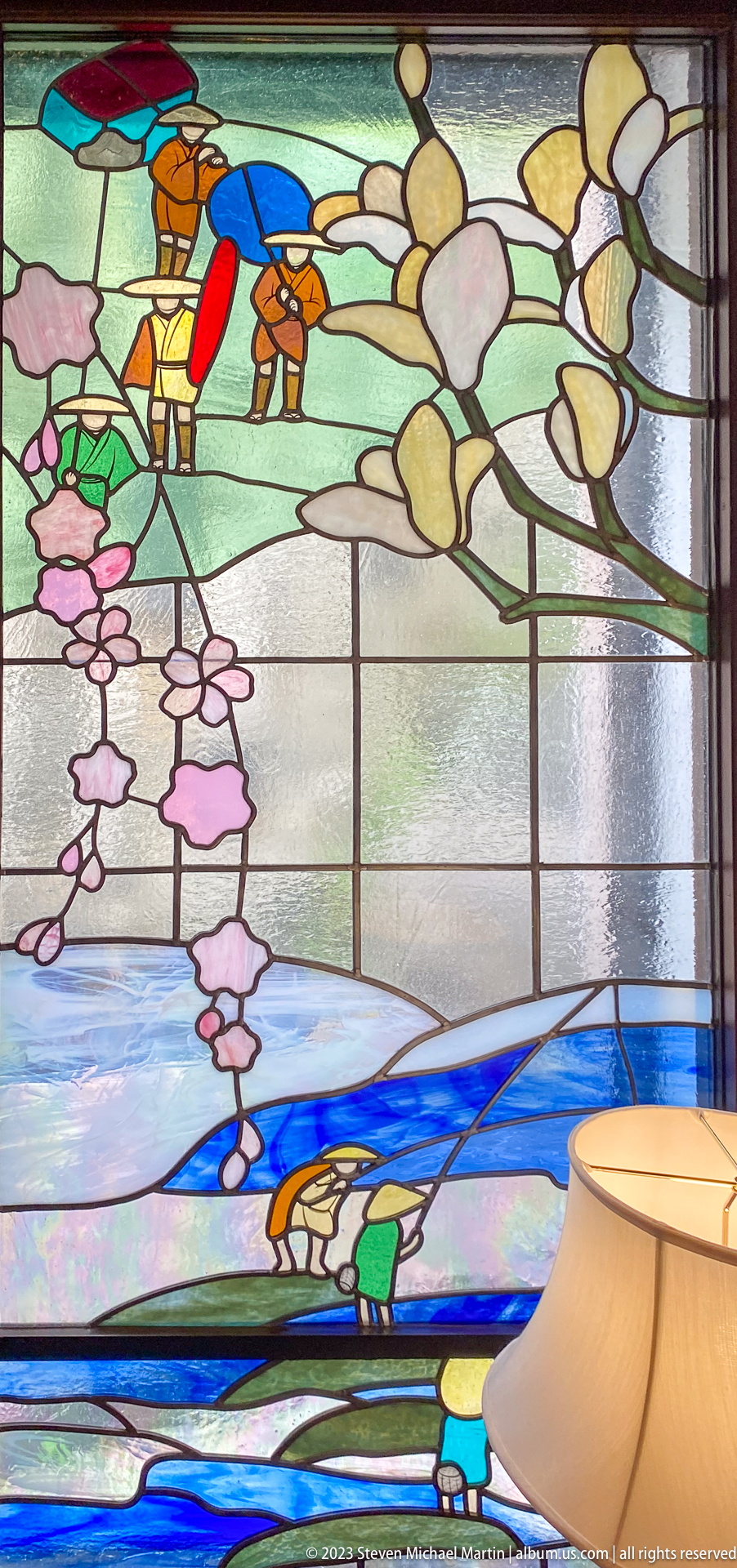
Cascading wisteria blossoms frame a broad blue-water scene divided between distant figures on the bank and workers bending beside a narrow boat in the foreground. The panel uses large areas of translucent blue and pale glass to create depth, while flowering vines link the separate activities into a unified seasonal landscape. A lamp partly obscures the lower-right corner of the installation.
Caption
Cascading wisteria blossoms frame a broad blue-water scene divided between distant figures on the bank and workers bending beside a narrow boat in the foreground. The panel uses large areas of translucent blue and pale glass to create depth, while flowering vines link the separate activities into a unified seasonal landscape. A lamp partly obscures the lower-right corner of the installation.
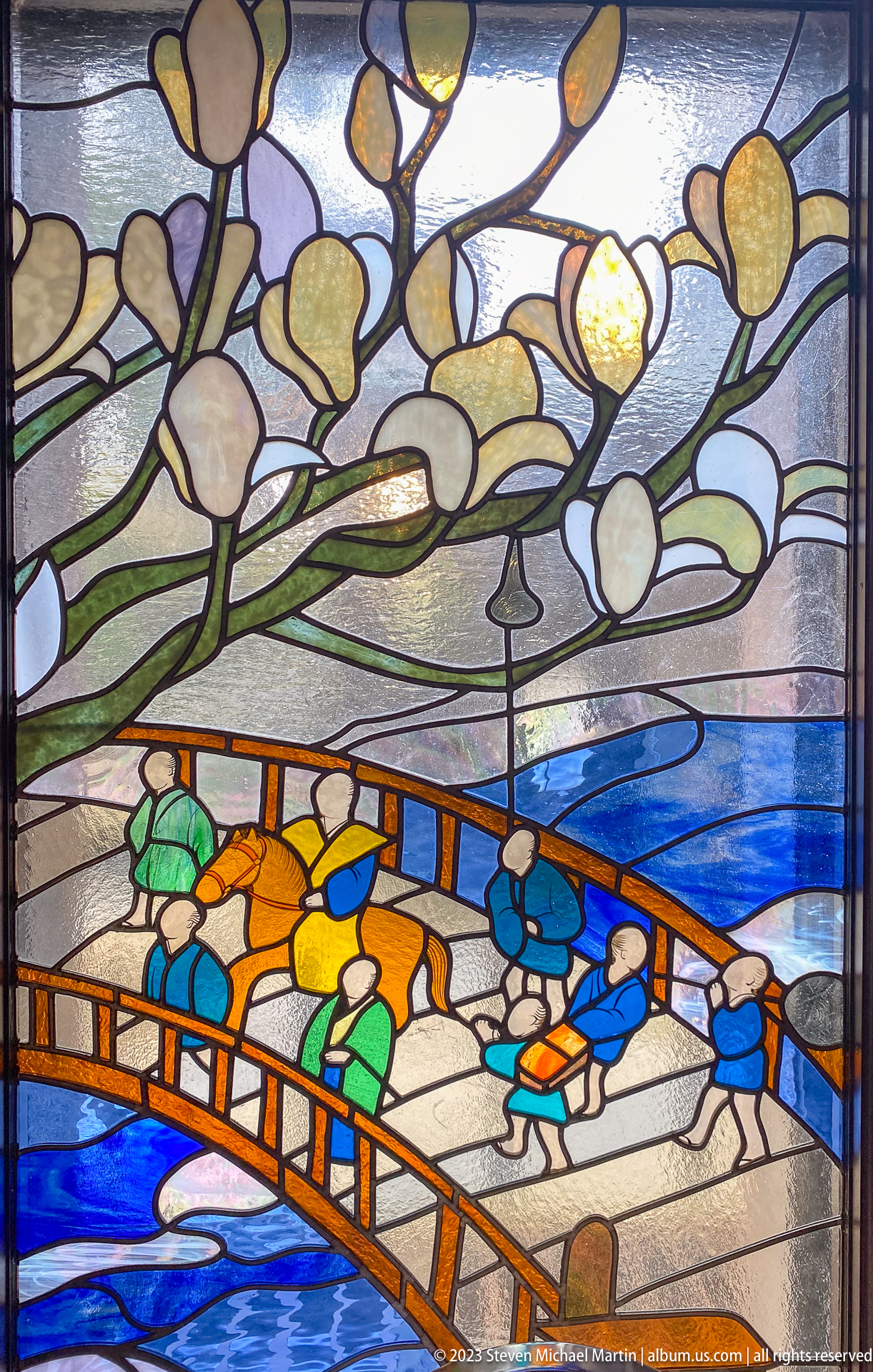
A crowd crosses a wooden bridge beneath pale clusters of wisteria rendered in textured glass. The diagonal railing organizes the procession of brightly dressed figures, while deep blue water fills the surrounding field. By compressing many people into a narrow crossing, the panel emphasizes shared movement and social activity within a flowering seasonal landscape.
Caption
A crowd crosses a wooden bridge beneath pale clusters of wisteria rendered in textured glass. The diagonal railing organizes the procession of brightly dressed figures, while deep blue water fills the surrounding field. By compressing many people into a narrow crossing, the panel emphasizes shared movement and social activity within a flowering seasonal landscape.
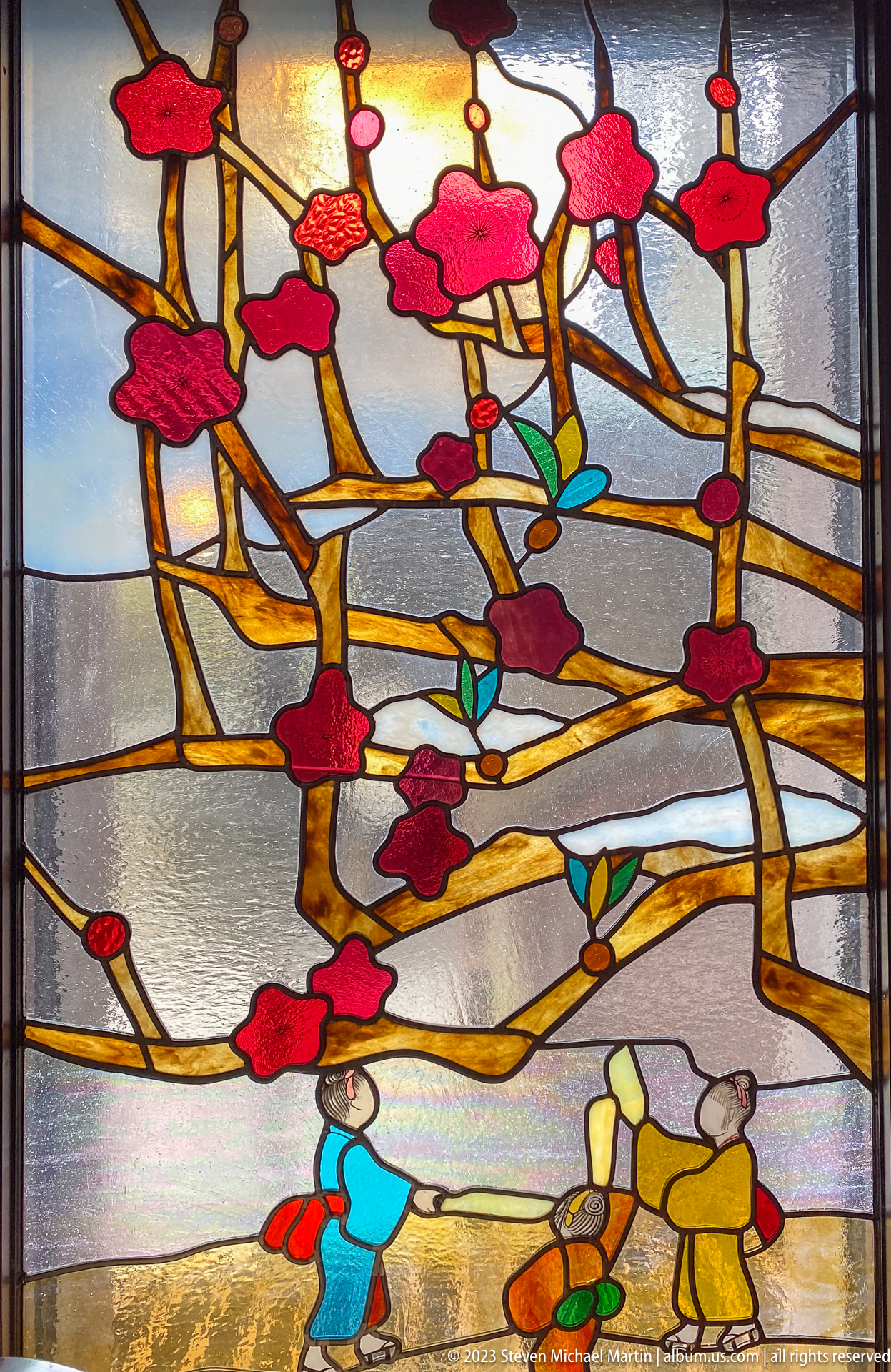
Angular brown branches carry vivid red blossoms across a pale leaded-glass ground. Below, a woman in blue and red stands near a stone lantern or garden ornament, introducing a small human scale beneath the spreading tree. The restrained background allows the saturated flowers and branching structure to dominate the composition as a winter-to-spring seasonal motif.
Caption
Angular brown branches carry vivid red blossoms across a pale leaded-glass ground. Below, a woman in blue and red stands near a stone lantern or garden ornament, introducing a small human scale beneath the spreading tree. The restrained background allows the saturated flowers and branching structure to dominate the composition as a winter-to-spring seasonal motif.
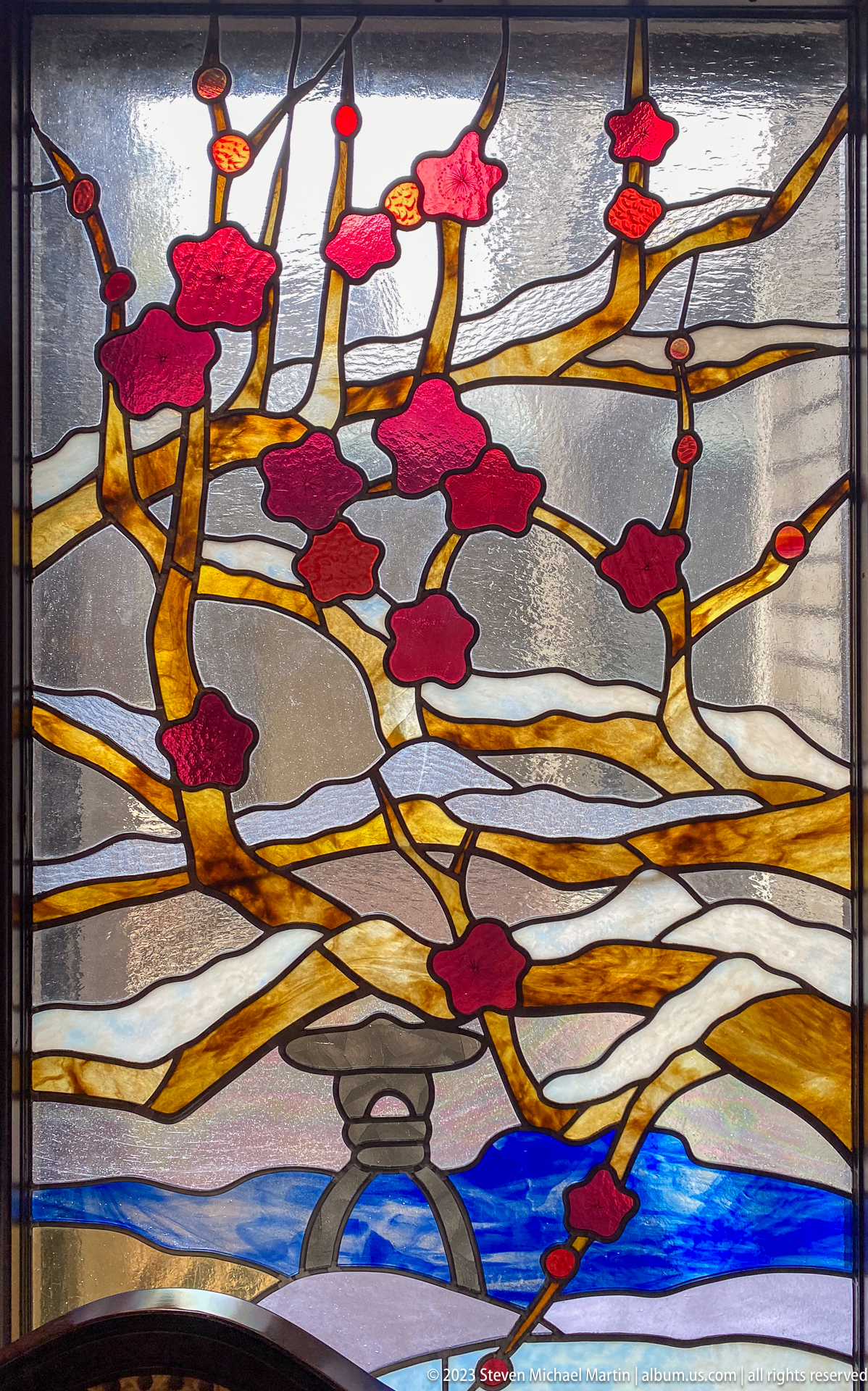
Red blossoms punctuate a network of gold-brown branches that stretches across the panel above blue water and a gray arched garden feature. Unlike the neighboring narrative scenes, this close composition largely excludes people and concentrates on branching rhythm, saturated color, and the relationship between vegetation and constructed landscape elements.
Caption
Red blossoms punctuate a network of gold-brown branches that stretches across the panel above blue water and a gray arched garden feature. Unlike the neighboring narrative scenes, this close composition largely excludes people and concentrates on branching rhythm, saturated color, and the relationship between vegetation and constructed landscape elements.
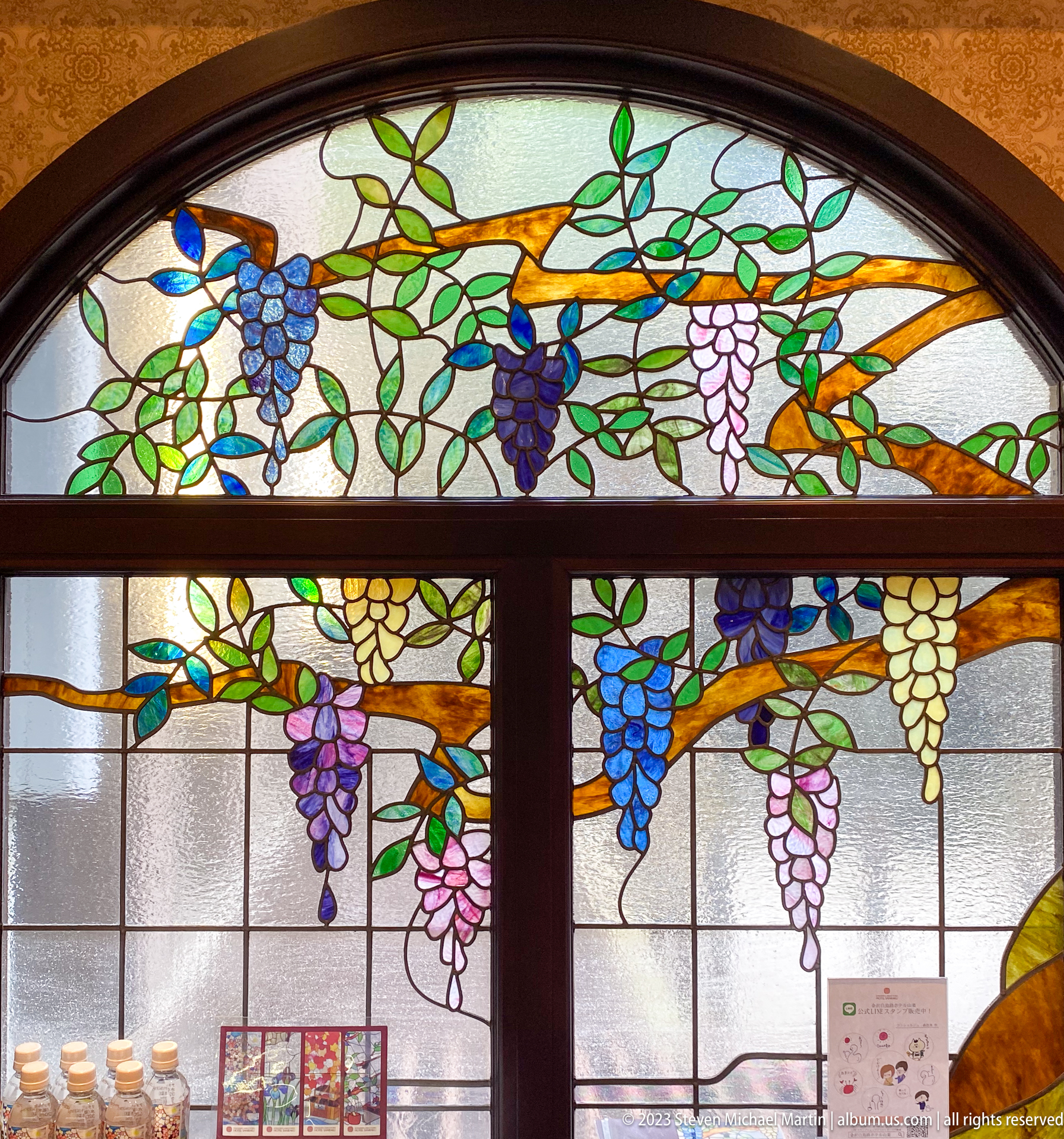
An arched stained-glass window is filled with twisting grapevines, green leaves, and hanging clusters in blue, purple, pink, and cream. Dark wooden framing divides the composition into an upper lunette and rectangular lower panels, making the botanical design part of the room’s architecture. The repeated fruit clusters create a rich, symmetrical canopy across the opening.
Caption
An arched stained-glass window is filled with twisting grapevines, green leaves, and hanging clusters in blue, purple, pink, and cream. Dark wooden framing divides the composition into an upper lunette and rectangular lower panels, making the botanical design part of the room’s architecture. The repeated fruit clusters create a rich, symmetrical canopy across the opening.
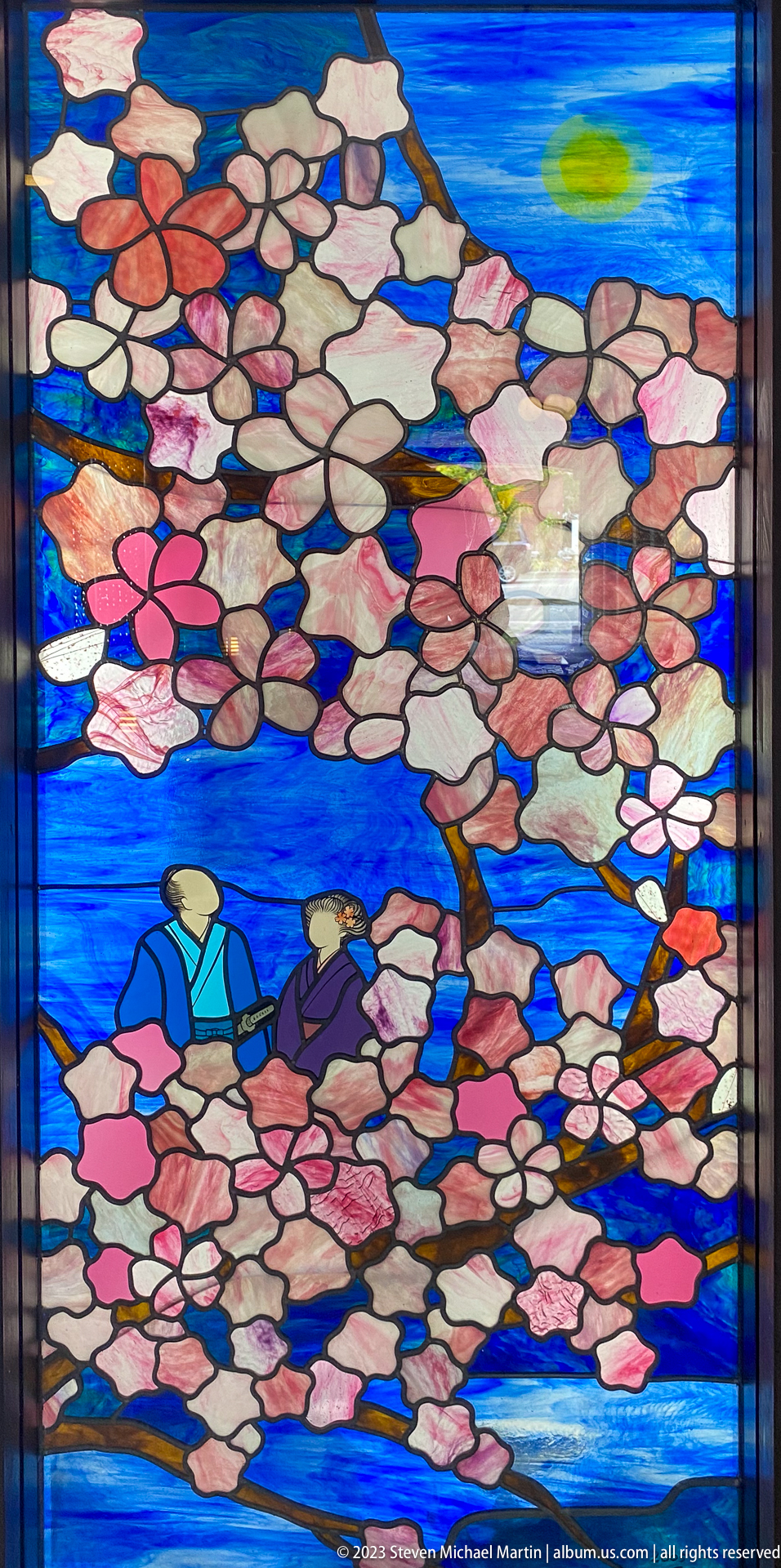
Large pink blossoms spread across a brilliant blue field while two small figures move beneath the flowering branches. Irregular panes and heavy lead lines give the composition a mosaic-like surface, and the saturated water or sky creates a striking contrast with the pale flowers. The scene favors color and pattern over naturalistic depth.
Caption
Large pink blossoms spread across a brilliant blue field while two small figures move beneath the flowering branches. Irregular panes and heavy lead lines give the composition a mosaic-like surface, and the saturated water or sky creates a striking contrast with the pale flowers. The scene favors color and pattern over naturalistic depth.
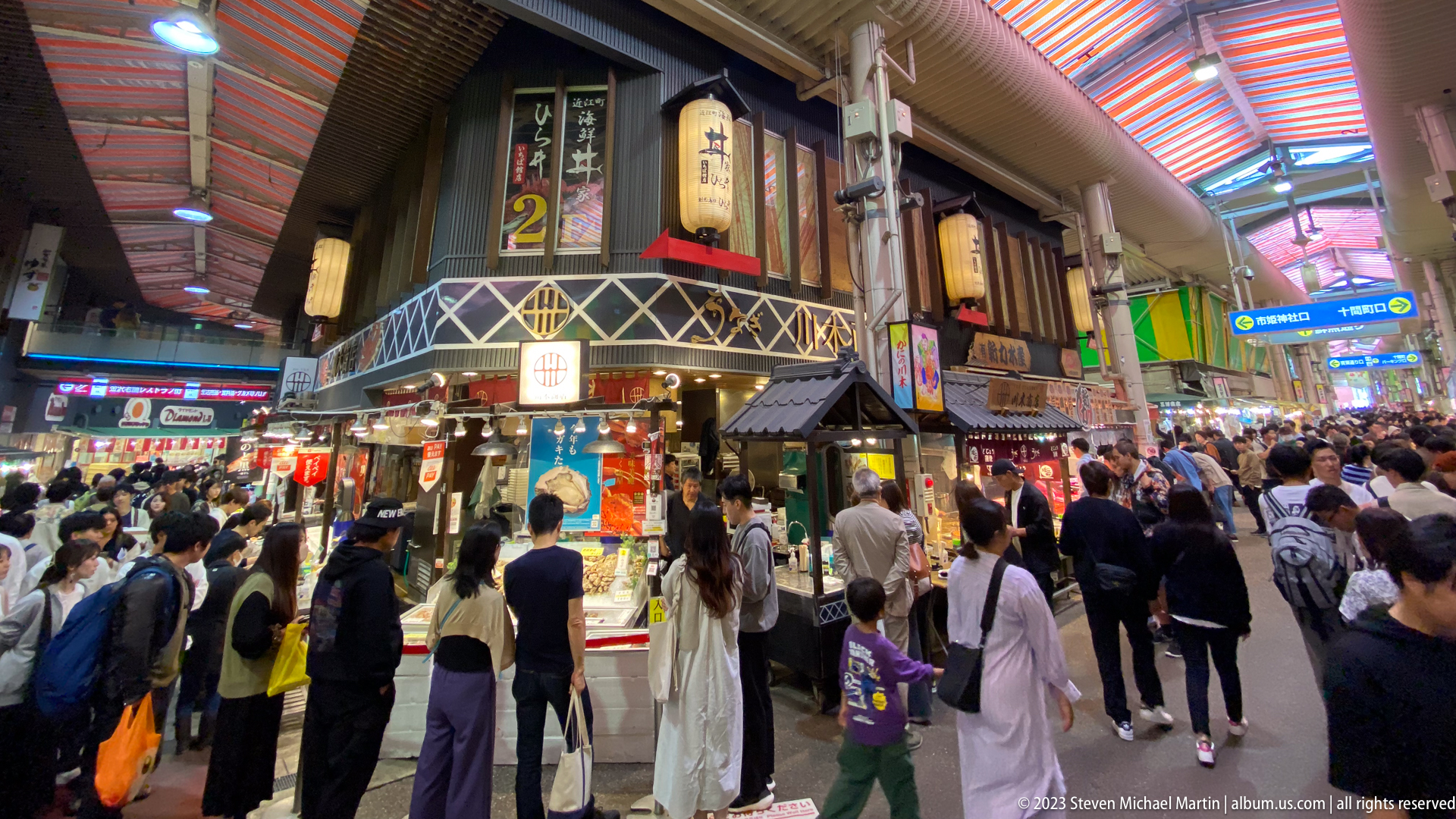
Shoppers fill a brightly lit covered arcade lined with food stalls, hanging signs, lantern-like fixtures, and projecting shopfronts. The deep perspective records Omicho Market as an active urban interior, where narrow circulation space, layered advertising, and dense pedestrian traffic bring vendors and customers into close contact. The colorful roof panels intensify the lively commercial atmosphere.
Caption
Shoppers fill a brightly lit covered arcade lined with food stalls, hanging signs, lantern-like fixtures, and projecting shopfronts. The deep perspective records Omicho Market as an active urban interior, where narrow circulation space, layered advertising, and dense pedestrian traffic bring vendors and customers into close contact. The colorful roof panels intensify the lively commercial atmosphere.
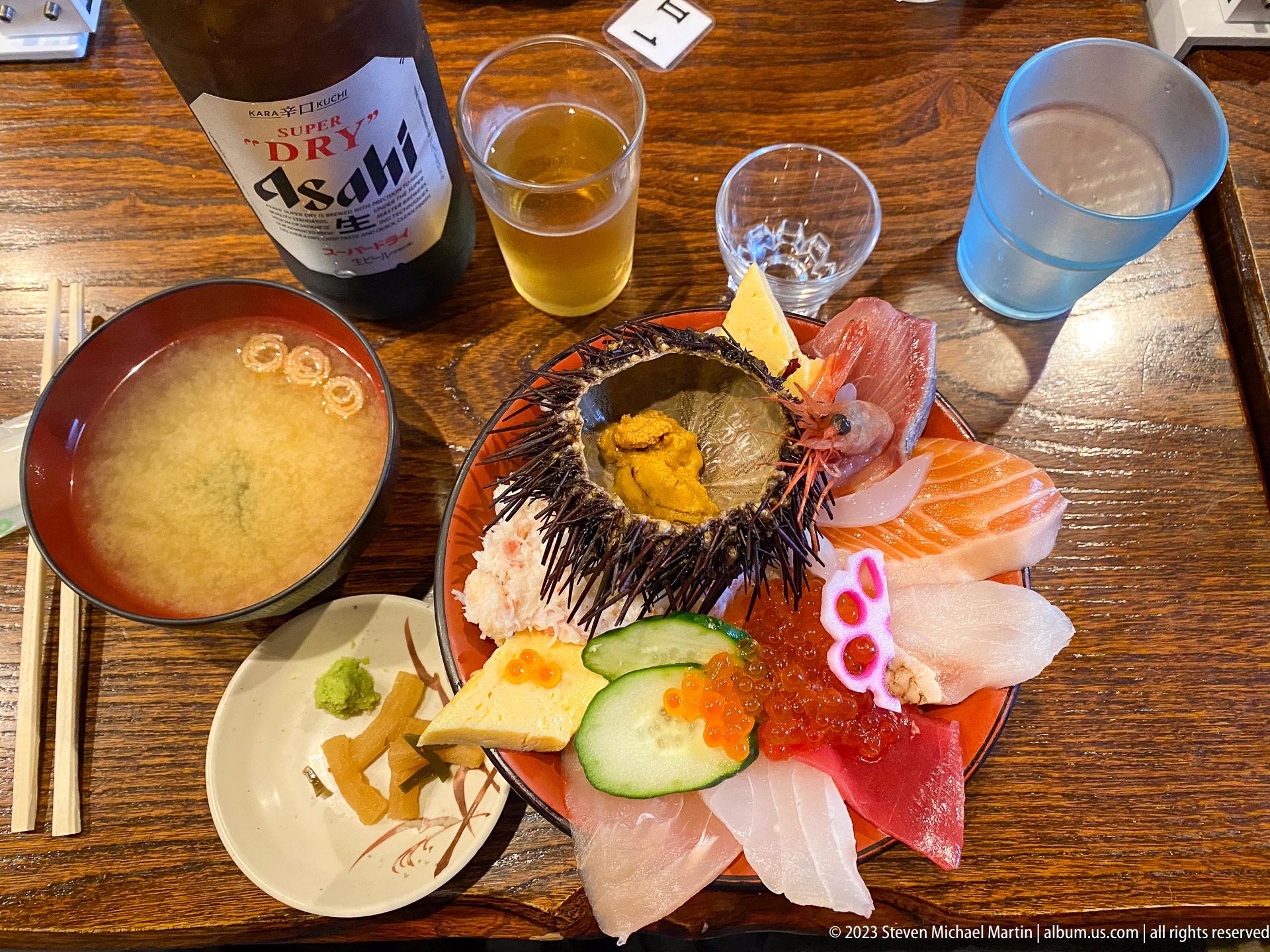
A seafood meal centers on sliced fish, salmon, octopus, roe, cucumber, and sea urchin presented in a spiny shell. Miso soup, pickles, sake, water, and small dishes surround the platter on the wooden table. The arrangement records both the variety of raw seafood and the careful separation of colors, textures, and garnishes in restaurant presentation.
Caption
A seafood meal centers on sliced fish, salmon, octopus, roe, cucumber, and sea urchin presented in a spiny shell. Miso soup, pickles, sake, water, and small dishes surround the platter on the wooden table. The arrangement records both the variety of raw seafood and the careful separation of colors, textures, and garnishes in restaurant presentation.
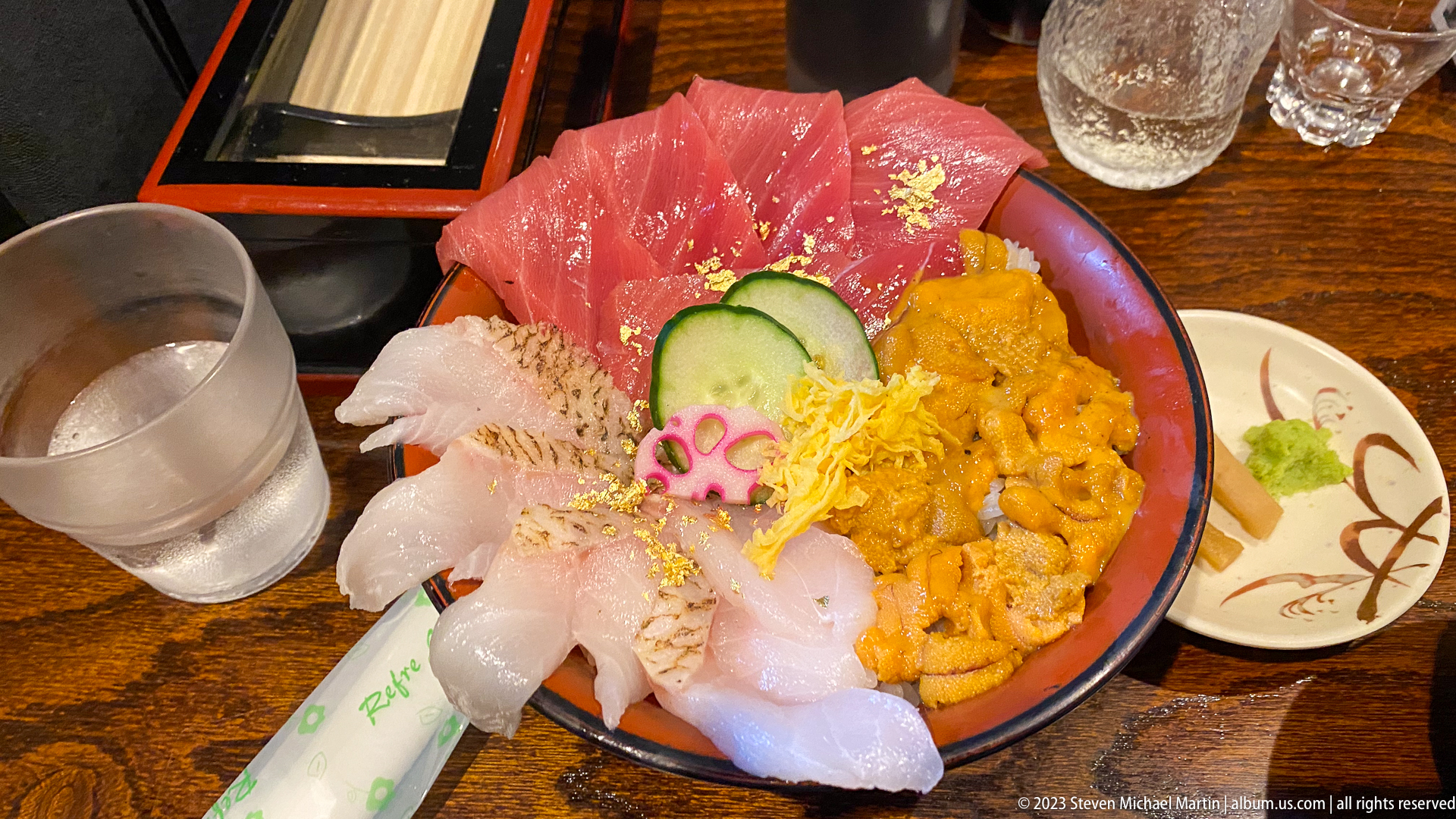
A large seafood rice bowl is topped with thick tuna slices, translucent white fish, generous portions of sea urchin, cucumber, lotus root, shredded garnish, and gold-colored flakes. The overhead viewpoint emphasizes abundance and contrasting textures, while water and condiments remain visible around the bowl. The dish presents Kanazawa’s seafood culture through a composed restaurant serving.
Caption
A large seafood rice bowl is topped with thick tuna slices, translucent white fish, generous portions of sea urchin, cucumber, lotus root, shredded garnish, and gold-colored flakes. The overhead viewpoint emphasizes abundance and contrasting textures, while water and condiments remain visible around the bowl. The dish presents Kanazawa’s seafood culture through a composed restaurant serving.
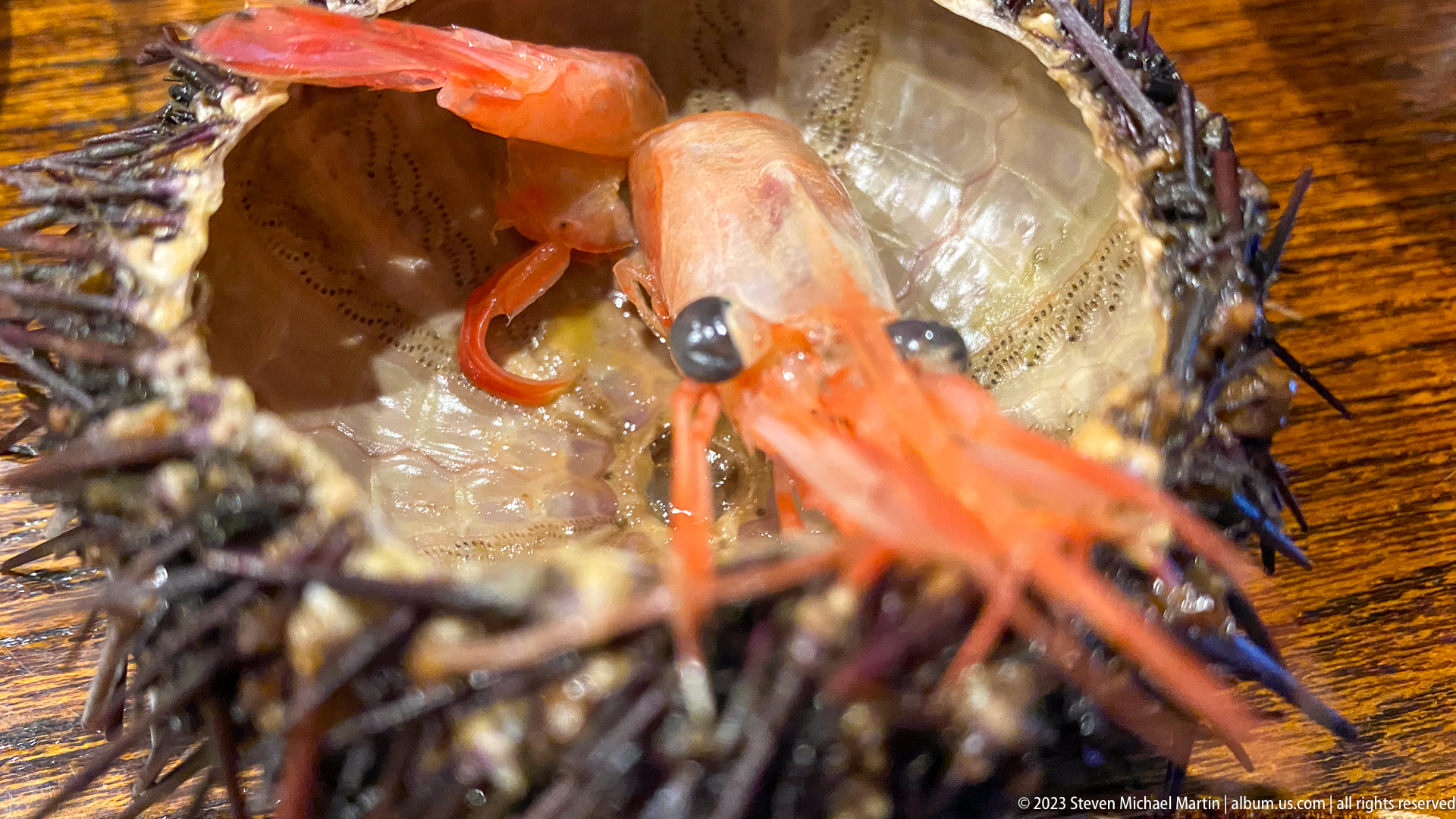
An extreme close-up peers into a spiny sea urchin shell where a translucent orange shrimp rests among exposed interior surfaces. The shallow focus brings the shrimp’s eyes, antennae, and segmented body forward while the dark spines create a rough circular frame. The image turns a plated seafood component into a study of texture, color, and anatomical detail.
Caption
An extreme close-up peers into a spiny sea urchin shell where a translucent orange shrimp rests among exposed interior surfaces. The shallow focus brings the shrimp’s eyes, antennae, and segmented body forward while the dark spines create a rough circular frame. The image turns a plated seafood component into a study of texture, color, and anatomical detail.
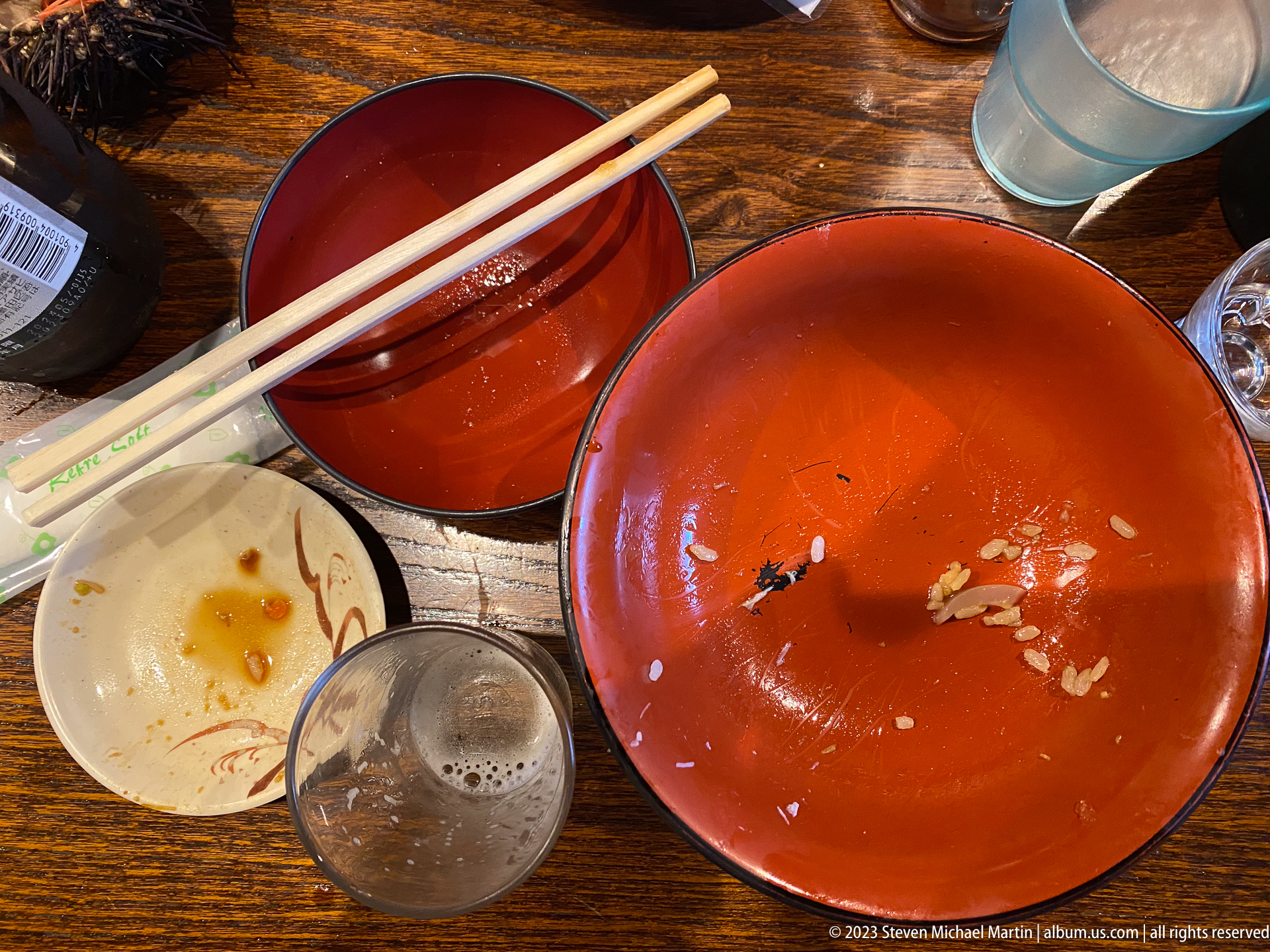
Red lacquer bowls, chopsticks, a drinking glass, and a small side dish remain after the meal has been finished. Scattered rice grains and traces of sauce mark the central bowl, transforming the place setting into evidence of consumption rather than presentation. The overhead composition provides a quiet conclusion to the preceding sequence of elaborate seafood dishes.
Caption
Red lacquer bowls, chopsticks, a drinking glass, and a small side dish remain after the meal has been finished. Scattered rice grains and traces of sauce mark the central bowl, transforming the place setting into evidence of consumption rather than presentation. The overhead composition provides a quiet conclusion to the preceding sequence of elaborate seafood dishes.

An unfolded English-language leaflet introduces Kanazawa Myoryuji, commonly known to visitors as the Ninja Temple. Text describes its construction under the Tokugawa shogunate and lists visitor rules, while photographs show the temple roof and entrance. The creased paper records both historical interpretation and the practical management of access to a closely regulated heritage site.
Caption
An unfolded English-language leaflet introduces Kanazawa Myoryuji, commonly known to visitors as the Ninja Temple. Text describes its construction under the Tokugawa shogunate and lists visitor rules, while photographs show the temple roof and entrance. The creased paper records both historical interpretation and the practical management of access to a closely regulated heritage site.

An English-language brochure titled “An Introduction to the Ancient Site of a Samurai House” presents the Nomura family residence through historical text, a line drawing of the building, and preservation information. The unfolded document combines scholarly explanation with visitor orientation, making it an interpretive object associated with Kanazawa’s Nagamachi samurai district.
Caption
An English-language brochure titled “An Introduction to the Ancient Site of a Samurai House” presents the Nomura family residence through historical text, a line drawing of the building, and preservation information. The unfolded document combines scholarly explanation with visitor orientation, making it an interpretive object associated with Kanazawa’s Nagamachi samurai district.

The reverse or interior spread of the Nomura house brochure pairs a family history with a description of the Jodan-no-ma chamber. A small drawing of a garden lantern and a sepia photograph of the garden accompany dense English text. The layout extends the visitor narrative from family lineage to architecture, room hierarchy, and garden design.
Caption
The reverse or interior spread of the Nomura house brochure pairs a family history with a description of the Jodan-no-ma chamber. A small drawing of a garden lantern and a sepia photograph of the garden accompany dense English text. The layout extends the visitor narrative from family lineage to architecture, room hierarchy, and garden design.
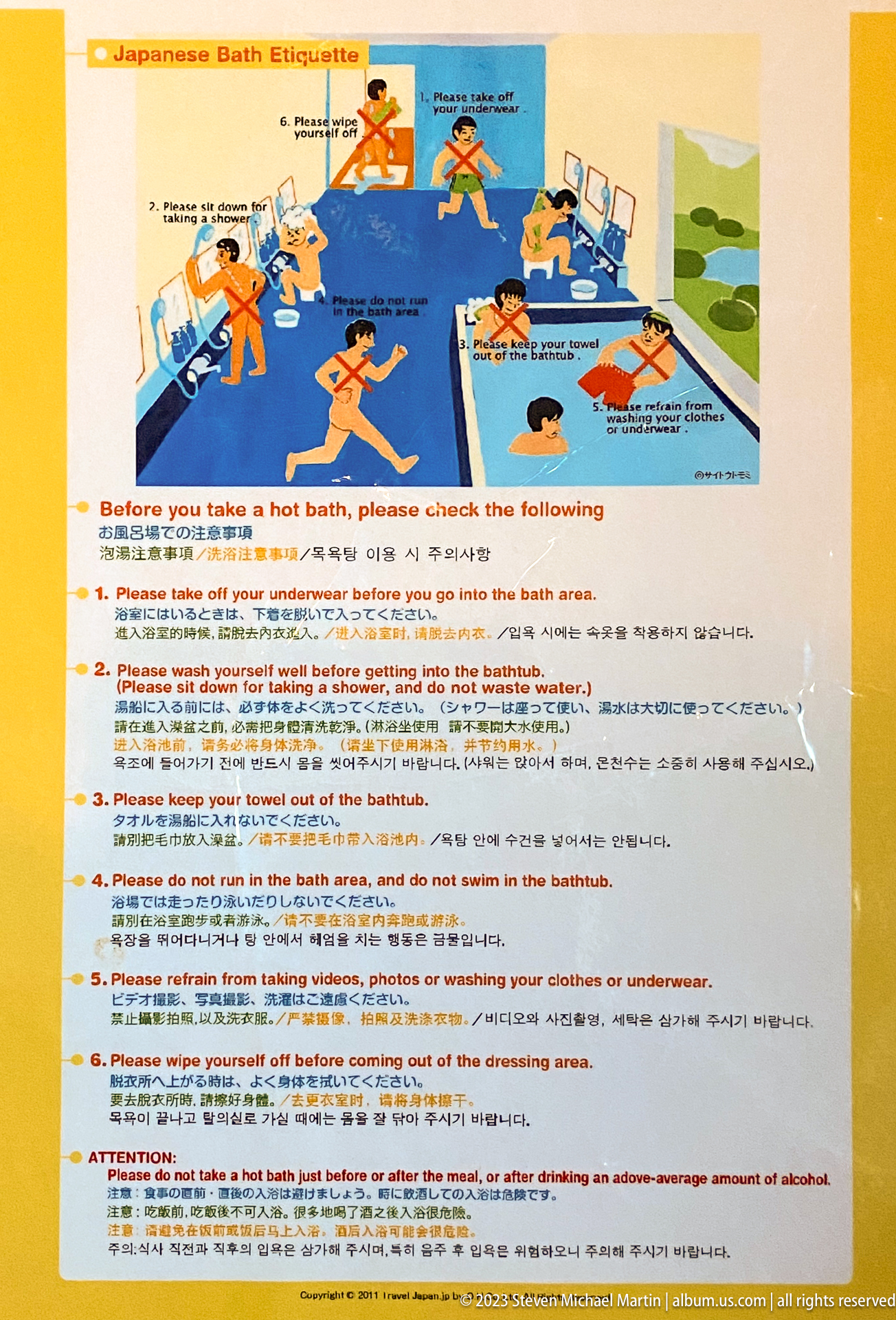
A laminated instruction panel uses cartoon figures and multilingual text to explain expected behavior before entering a Japanese public bath. The illustrated sequence covers undressing, washing, keeping towels out of the bath, and other etiquette. Its bright graphics translate rules of shared bathing into an accessible visual guide for international visitors.
Caption
A laminated instruction panel uses cartoon figures and multilingual text to explain expected behavior before entering a Japanese public bath. The illustrated sequence covers undressing, washing, keeping towels out of the bath, and other etiquette. Its bright graphics translate rules of shared bathing into an accessible visual guide for international visitors.
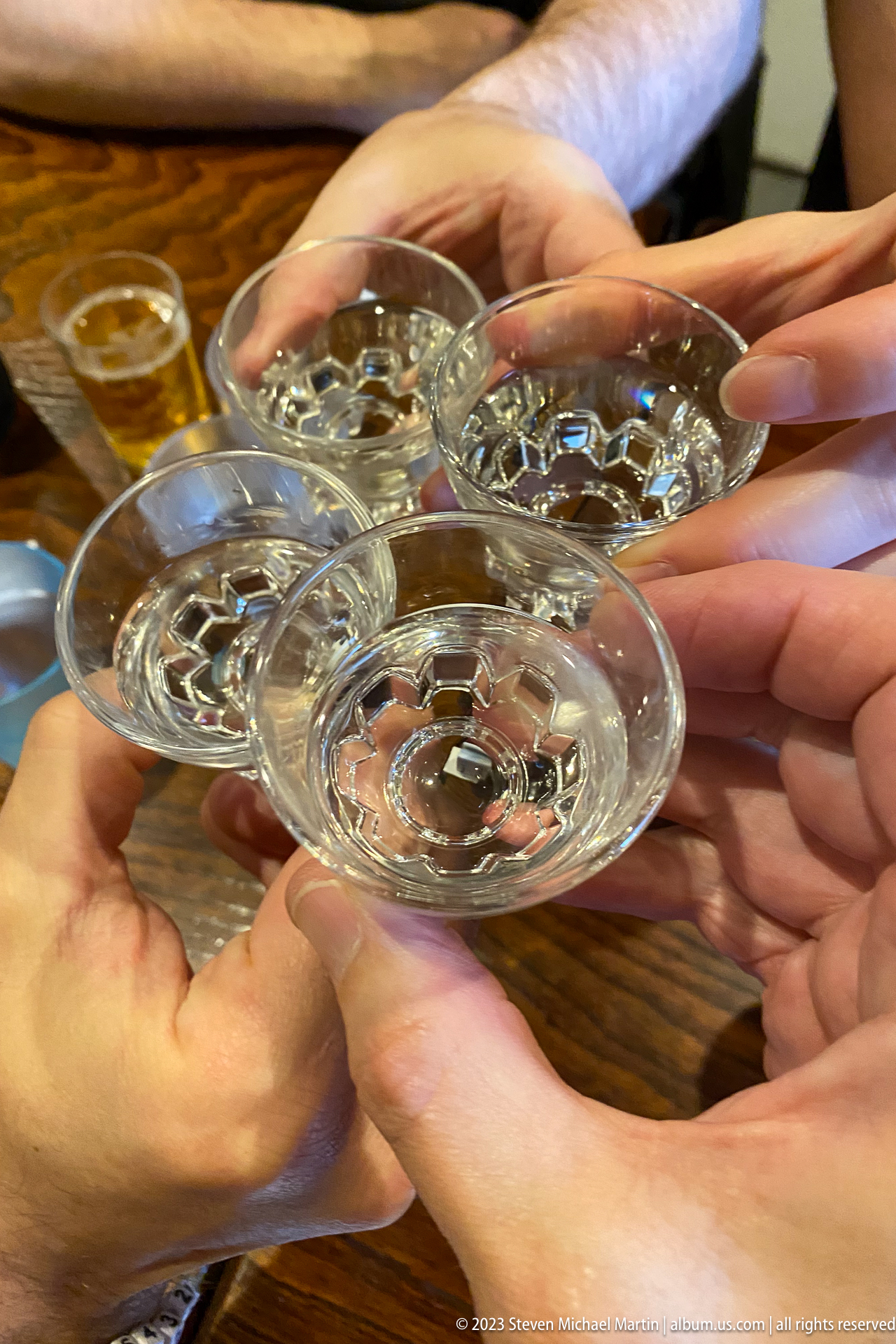
Several diners bring shallow glass sake cups together in a communal toast above a restaurant table. Hands enter from every side, creating a circular composition around the overlapping transparent vessels. Reflections in the clear liquid and glass rims emphasize the shared gesture, documenting sociability and ritual at the meal rather than the food itself.
Caption
Several diners bring shallow glass sake cups together in a communal toast above a restaurant table. Hands enter from every side, creating a circular composition around the overlapping transparent vessels. Reflections in the clear liquid and glass rims emphasize the shared gesture, documenting sociability and ritual at the meal rather than the food itself.
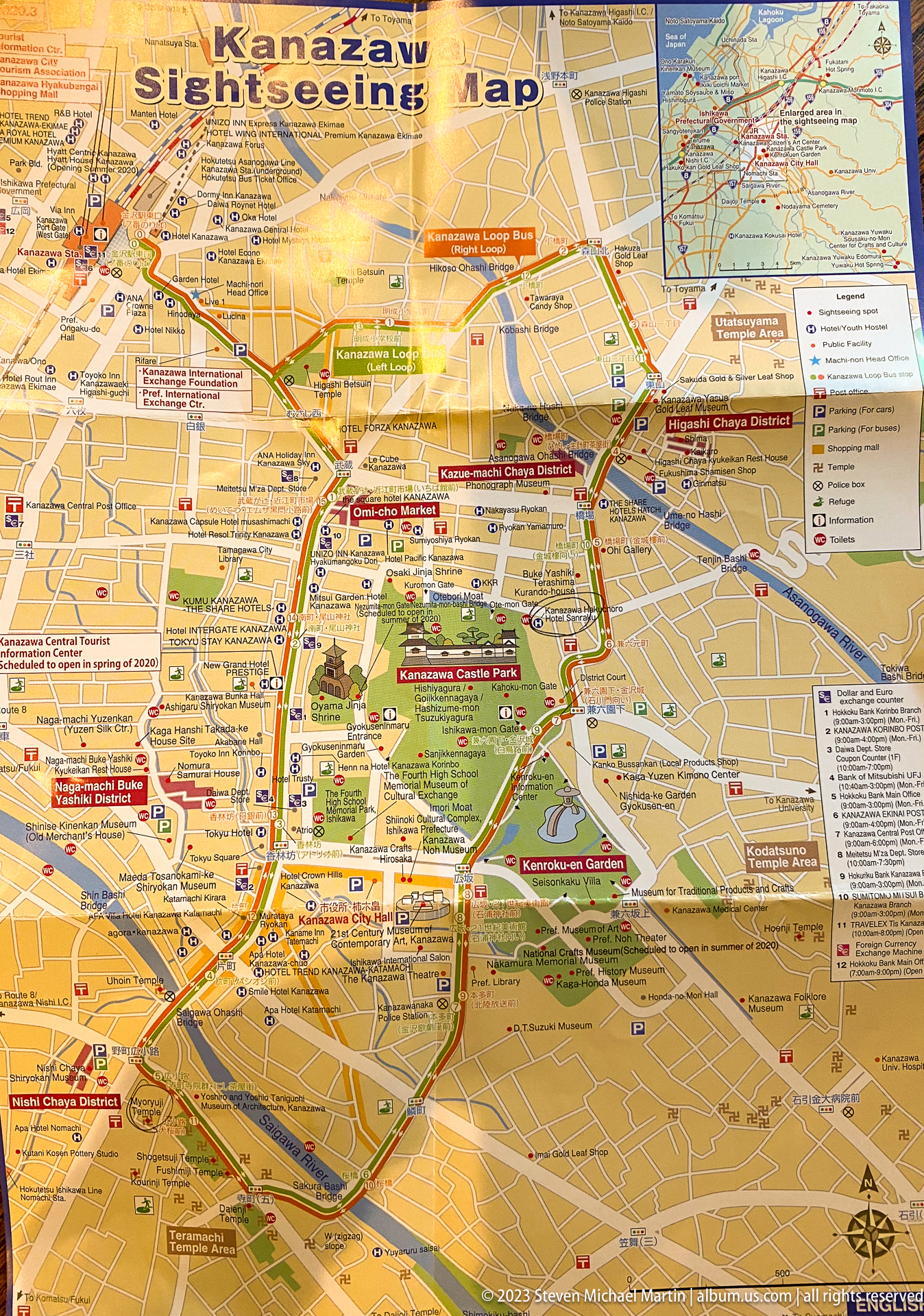
A brightly colored “Kanazawa Feelings Map” spreads across the frame, combining a street plan with illustrated attractions, route markings, and multilingual visitor information. Dense labels and pictorial symbols turn the city into a navigable cultural itinerary. The photograph preserves the practical graphic design used to orient travelers among Kanazawa’s districts and landmarks.
Caption
A brightly colored “Kanazawa Feelings Map” spreads across the frame, combining a street plan with illustrated attractions, route markings, and multilingual visitor information. Dense labels and pictorial symbols turn the city into a navigable cultural itinerary. The photograph preserves the practical graphic design used to orient travelers among Kanazawa’s districts and landmarks.
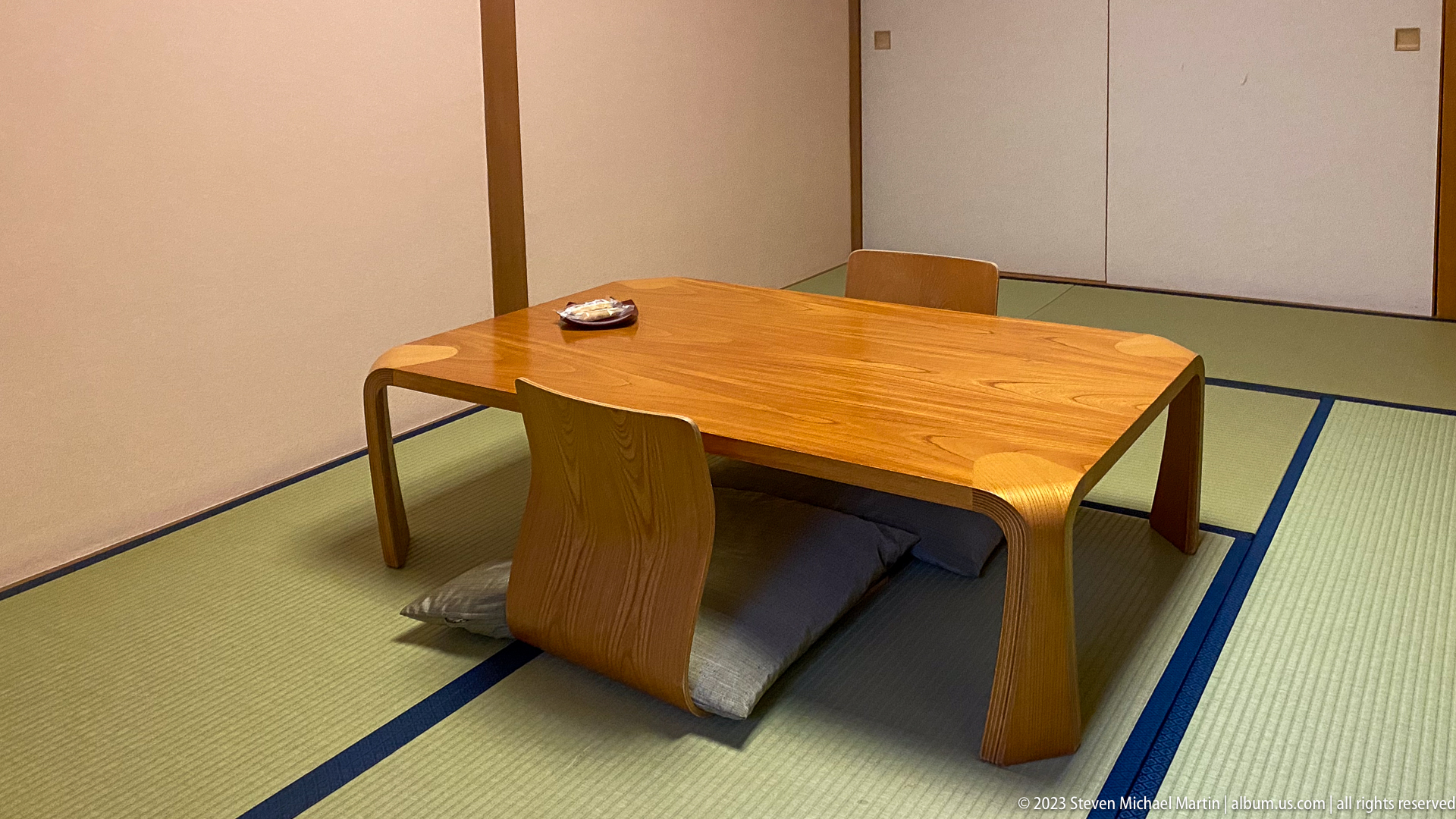
A compact Japanese-style room is furnished with tatami mats, a low wooden table, two legless floor chairs, and dark cushions. Plain sliding wall panels and restrained decoration keep attention on the floor-level arrangement. The uncluttered interior demonstrates how furniture, seating posture, and woven mat proportions organize domestic or guest-room space.
Caption
A compact Japanese-style room is furnished with tatami mats, a low wooden table, two legless floor chairs, and dark cushions. Plain sliding wall panels and restrained decoration keep attention on the floor-level arrangement. The uncluttered interior demonstrates how furniture, seating posture, and woven mat proportions organize domestic or guest-room space.
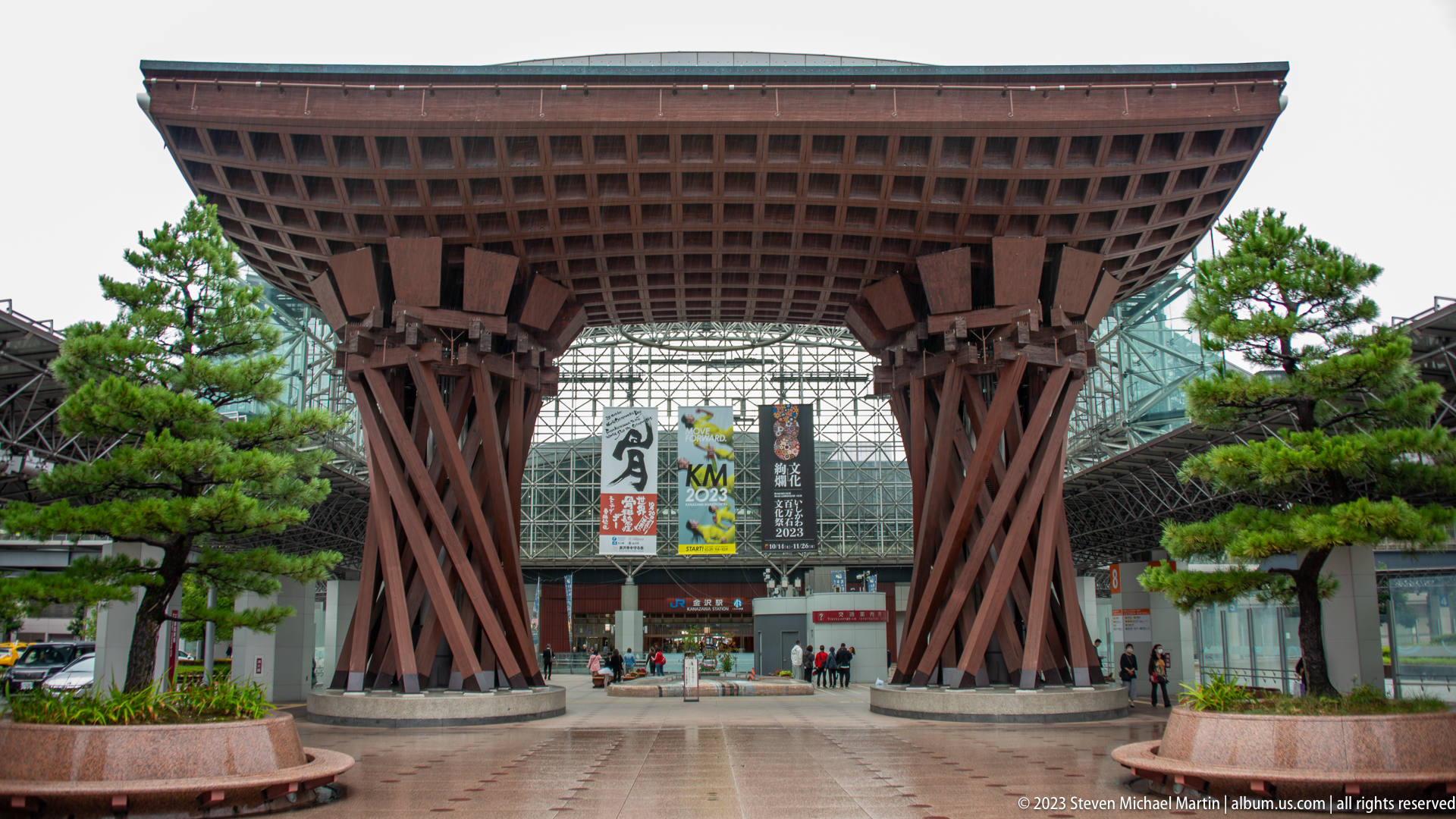
A second frontal composition places the immense timber gate squarely against the station’s glass façade. The open space between the supports frames banners and distant travelers, while clipped pines soften the hard geometry at both sides. Subtle differences in viewpoint and pedestrian placement distinguish this documentary view from the adjacent photograph.
Caption
A second frontal composition places the immense timber gate squarely against the station’s glass façade. The open space between the supports frames banners and distant travelers, while clipped pines soften the hard geometry at both sides. Subtle differences in viewpoint and pedestrian placement distinguish this documentary view from the adjacent photograph.
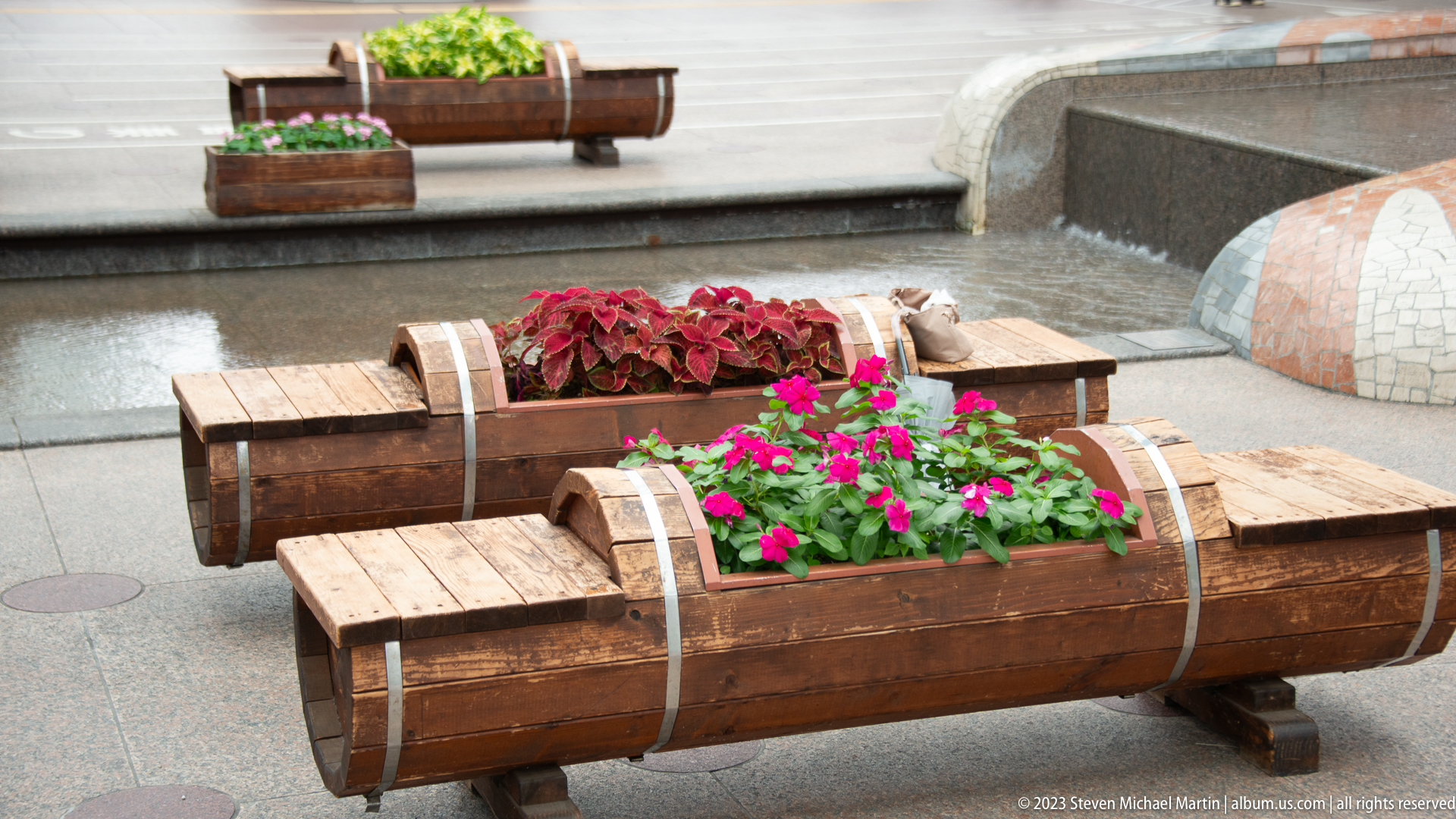
Two rustic planters made from heavy log-like timbers hold bright pink and red flowers beside a paved public space. Pale bands wrap the wooden containers at intervals, reinforcing their barrel-like construction. The close view emphasizes how natural materials and seasonal planting are used as small-scale urban decoration near the station.
Caption
Two rustic planters made from heavy log-like timbers hold bright pink and red flowers beside a paved public space. Pale bands wrap the wooden containers at intervals, reinforcing their barrel-like construction. The close view emphasizes how natural materials and seasonal planting are used as small-scale urban decoration near the station.
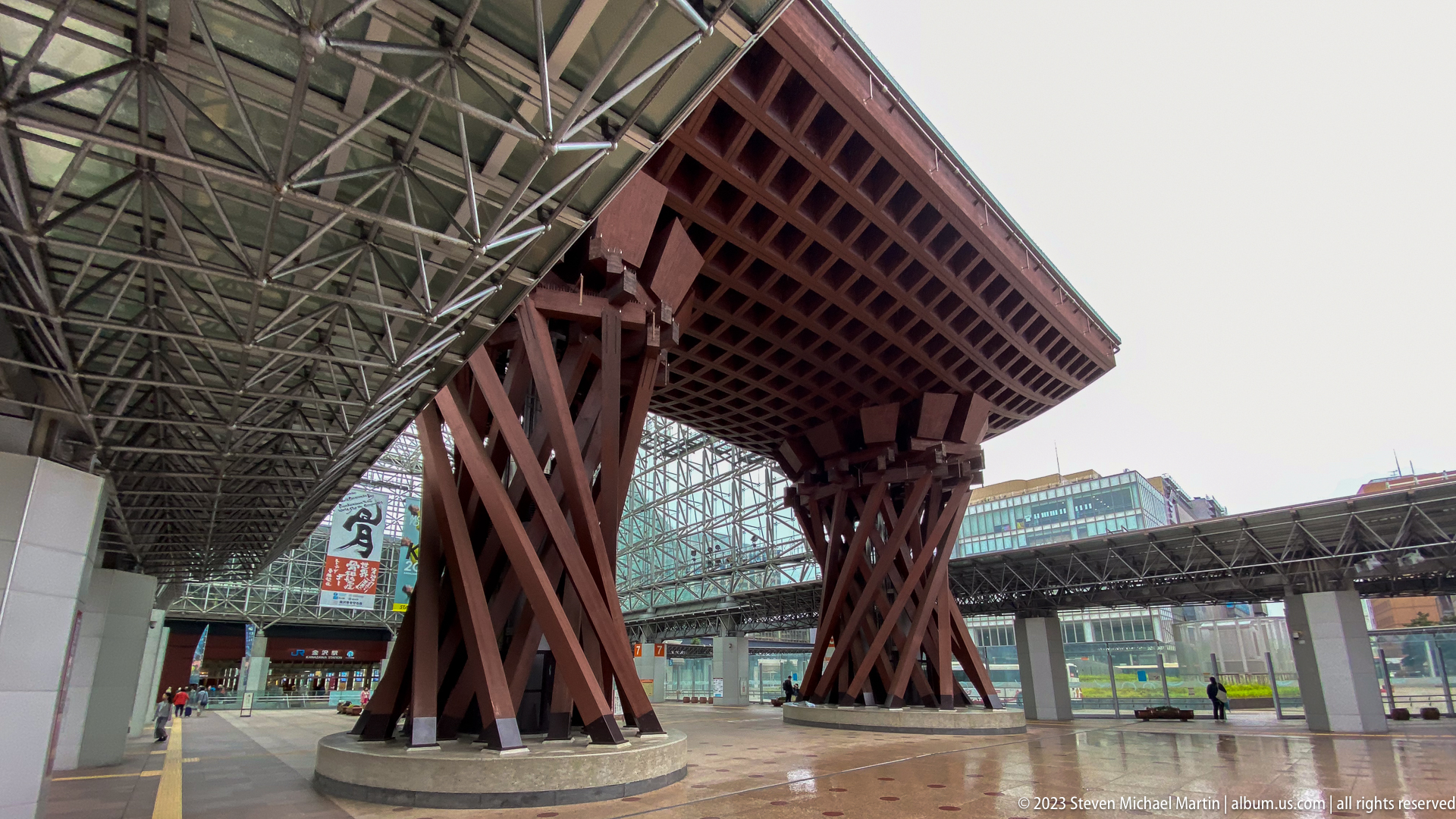
Seen obliquely from beneath the station canopy, one massive timber support of Tsuzumi-mon Gate rises toward the broad roof while its paired structure recedes across the plaza. Steel trusses and glass enclosures surround the gate, revealing the deliberate contrast between its sculptural woodwork and the station’s contemporary transport architecture.
Caption
Seen obliquely from beneath the station canopy, one massive timber support of Tsuzumi-mon Gate rises toward the broad roof while its paired structure recedes across the plaza. Steel trusses and glass enclosures surround the gate, revealing the deliberate contrast between its sculptural woodwork and the station’s contemporary transport architecture.
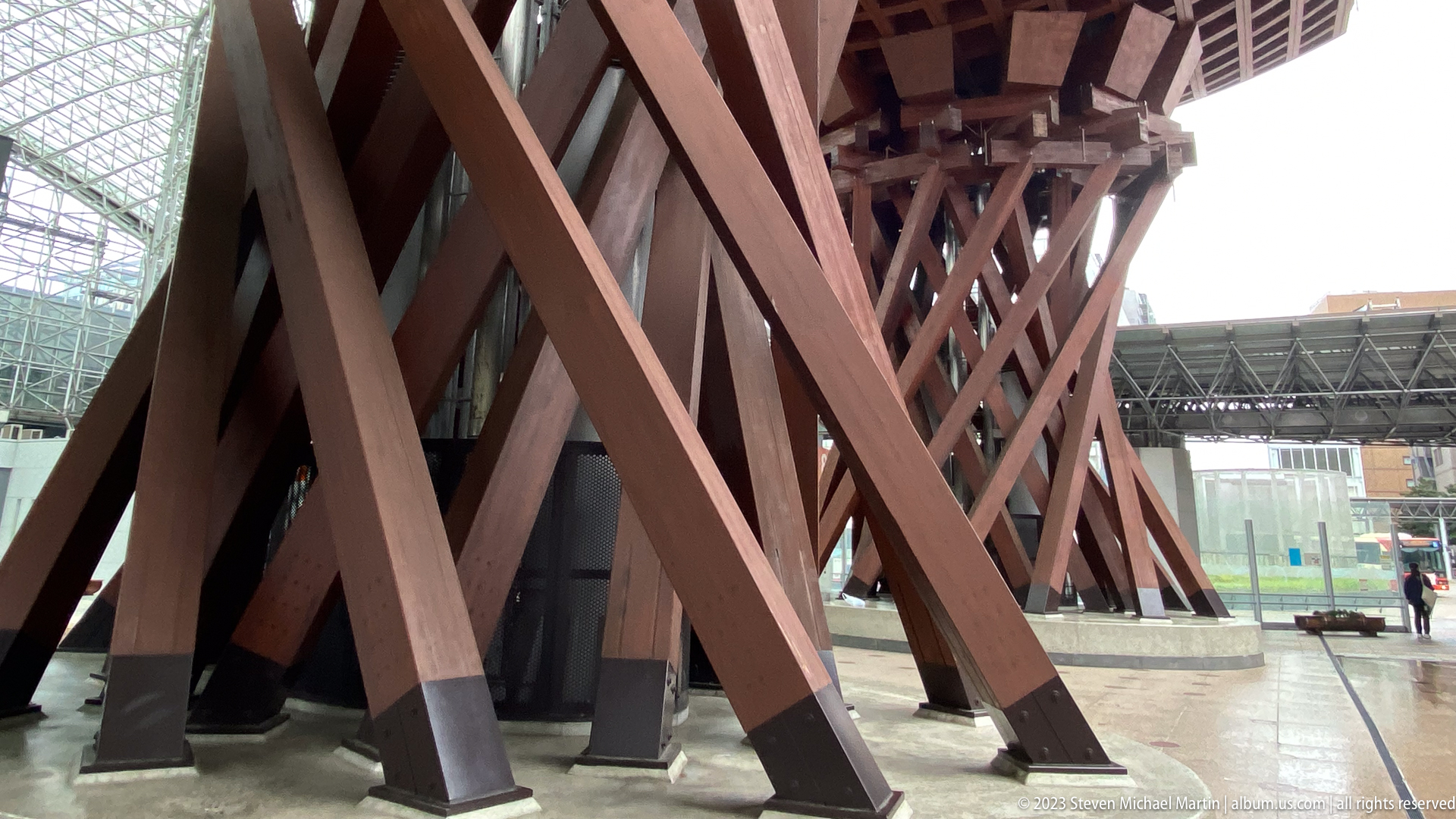
A close architectural study isolates the bundled timber members that form one support of Tsuzumi-mon Gate. Inclined beams overlap and cross before meeting the broad canopy above, exposing the gate’s sculptural engineering at pedestrian scale. Dark metal bases protect the wood where it meets the wet plaza, while the station’s glass framework remains visible behind.
Caption
A close architectural study isolates the bundled timber members that form one support of Tsuzumi-mon Gate. Inclined beams overlap and cross before meeting the broad canopy above, exposing the gate’s sculptural engineering at pedestrian scale. Dark metal bases protect the wood where it meets the wet plaza, while the station’s glass framework remains visible behind.
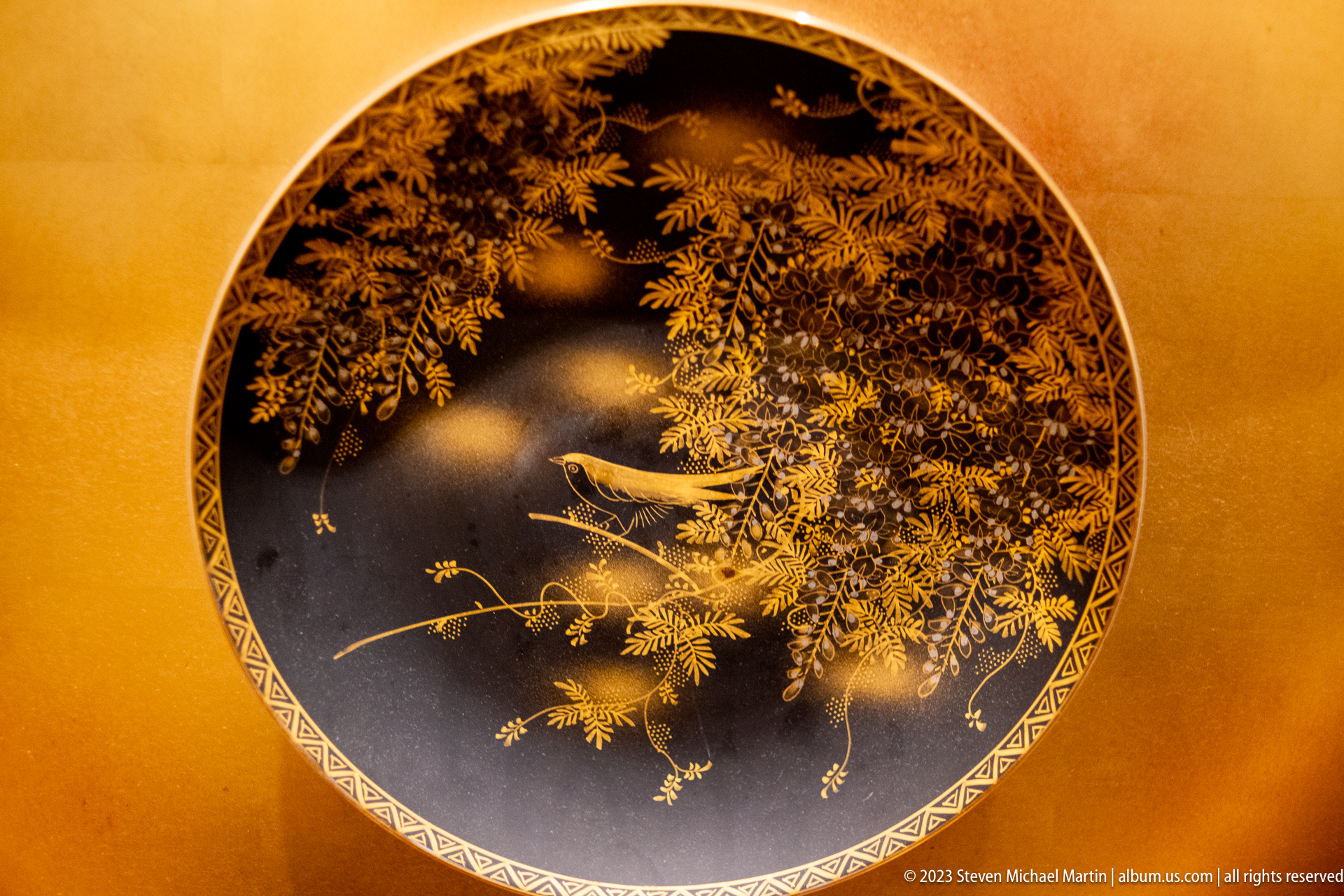
A circular black field is decorated with fine gold foliage and two pale birds perched among delicate branches. The surrounding gold-toned surface and narrow patterned border heighten the contrast between the dark center and intricate botanical work. The refined surface resembles Japanese lacquer decoration, although the exact technique and maker are not visible in the photograph.
Caption
A circular black field is decorated with fine gold foliage and two pale birds perched among delicate branches. The surrounding gold-toned surface and narrow patterned border heighten the contrast between the dark center and intricate botanical work. The refined surface resembles Japanese lacquer decoration, although the exact technique and maker are not visible in the photograph.
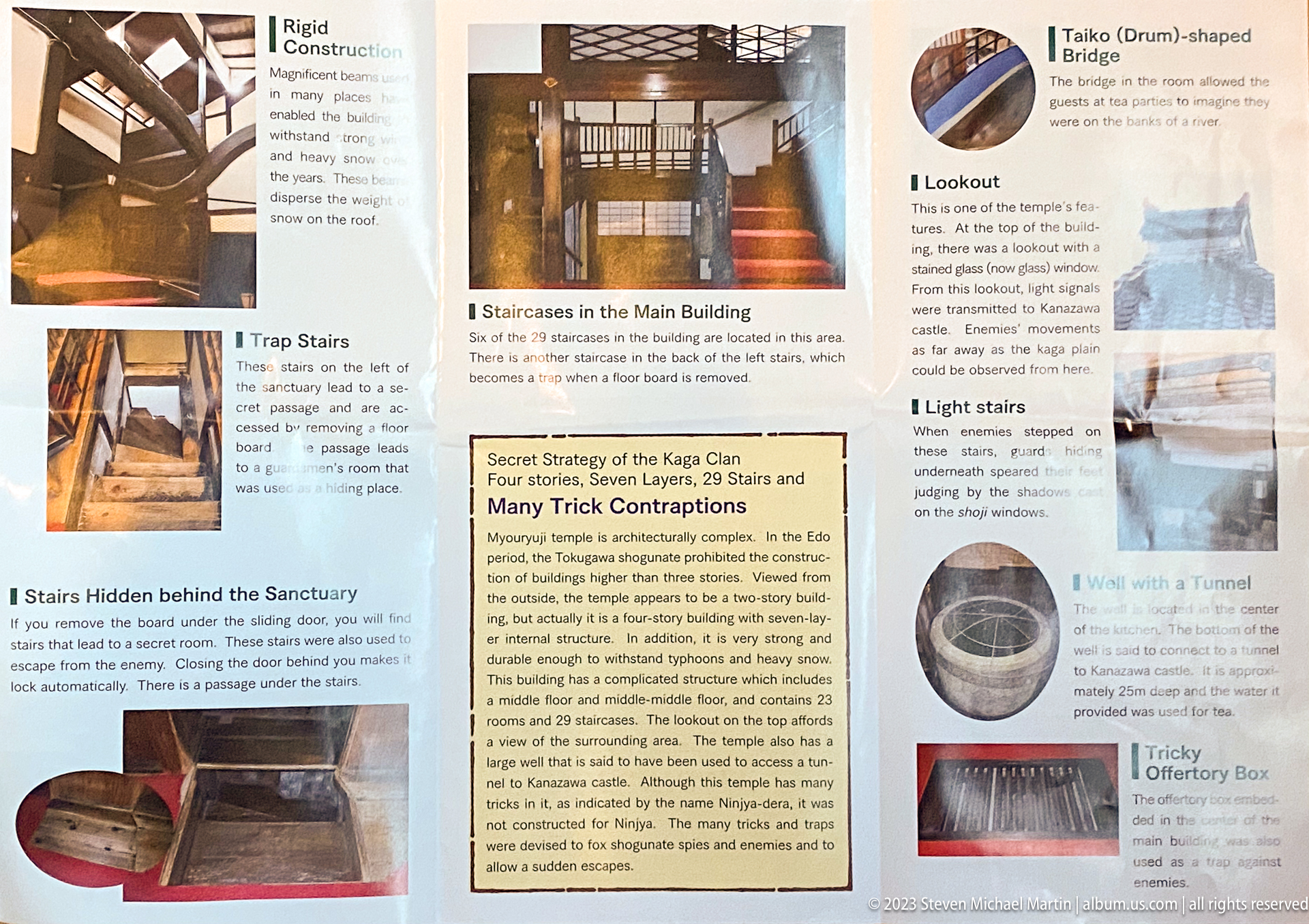
An open illustrated guide explains architectural devices associated with Myoryuji, including hidden stairs, trap stairs, a lookout, a drum-shaped bridge, a light stair, a well with a tunnel, and a tricky offertory box. Photographs and diagrams accompany English descriptions, presenting the temple’s complex circulation and concealed features as a carefully interpreted visitor narrative.
Caption
An open illustrated guide explains architectural devices associated with Myoryuji, including hidden stairs, trap stairs, a lookout, a drum-shaped bridge, a light stair, a well with a tunnel, and a tricky offertory box. Photographs and diagrams accompany English descriptions, presenting the temple’s complex circulation and concealed features as a carefully interpreted visitor narrative.