Québec City – Québec, Canada
Québec City stands on the high cliffs overlooking the St. Lawrence River, where the river narrows as it flows inland from the Gulf of St. Lawrence toward the heart of North America. Founded by Samuel de Champlain in 1608, the city became the center of French colonial power in North America and later played a pivotal role in the struggle between France and Britain for control of the continent.
The historic district known as Old Québec (Vieux-Québec) is surrounded by stone fortifications and is the only walled city north of Mexico. Narrow cobblestone streets wind between historic buildings, churches, and public squares that preserve the character of a European colonial city.
From the elevated terrace below the Château Frontenac, sweeping views extend across the broad St. Lawrence River and the surrounding hills, highlighting the strategic location that made Québec one of the most important fortified cities in North America.
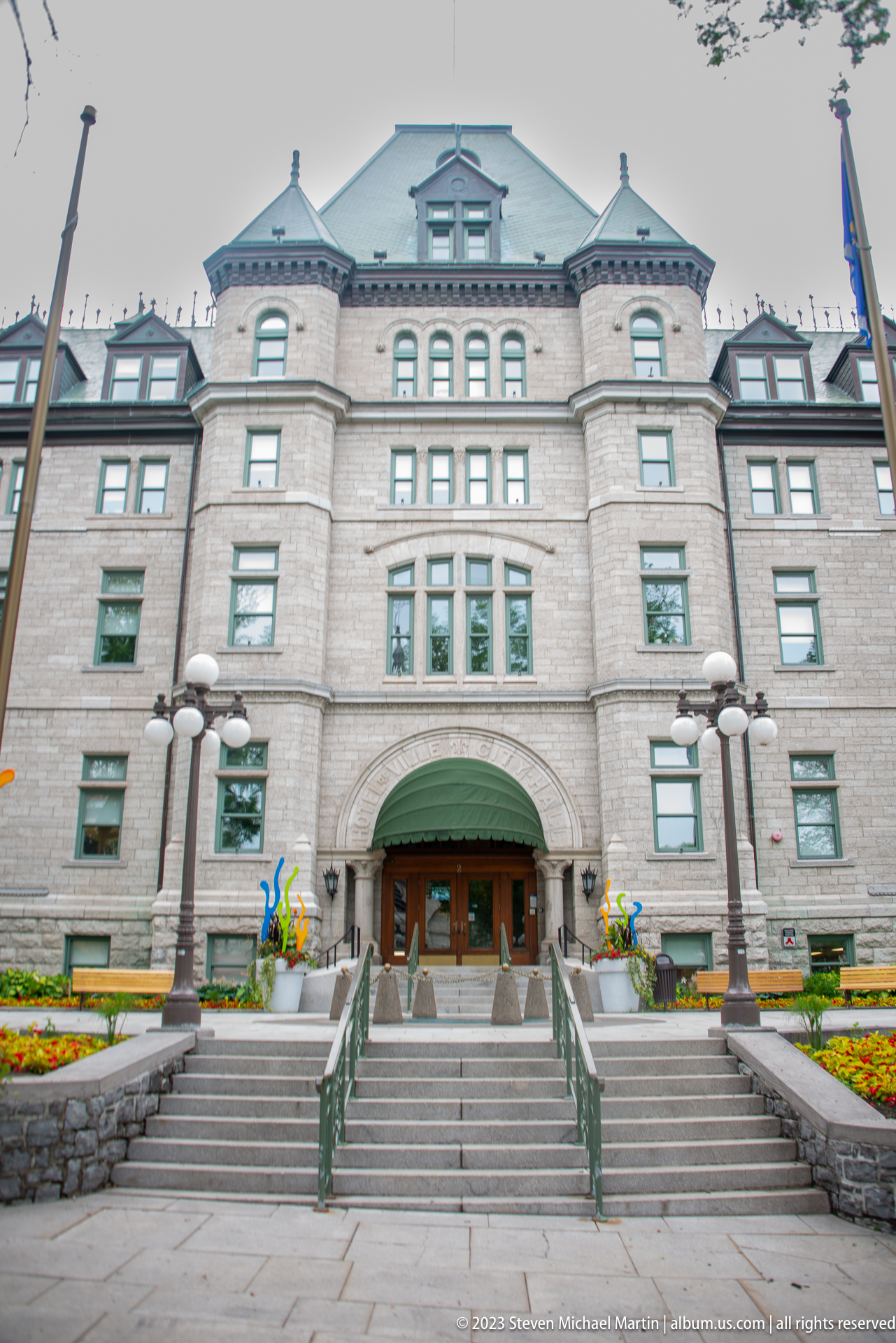
Quebec City Hall presents a broad symmetrical stone façade above a formal stair and central arched entrance. The steep roof, dormers, corner pavilions, and carefully ordered windows give the civic building a monumental presence, while flower beds and flagpoles soften the forecourt. The frontal viewpoint records the principal public elevation and its relationship to the landscaped approach.
Caption
Quebec City Hall presents a broad symmetrical stone façade above a formal stair and central arched entrance. The steep roof, dormers, corner pavilions, and carefully ordered windows give the civic building a monumental presence, while flower beds and flagpoles soften the forecourt. The frontal viewpoint records the principal public elevation and its relationship to the landscaped approach.
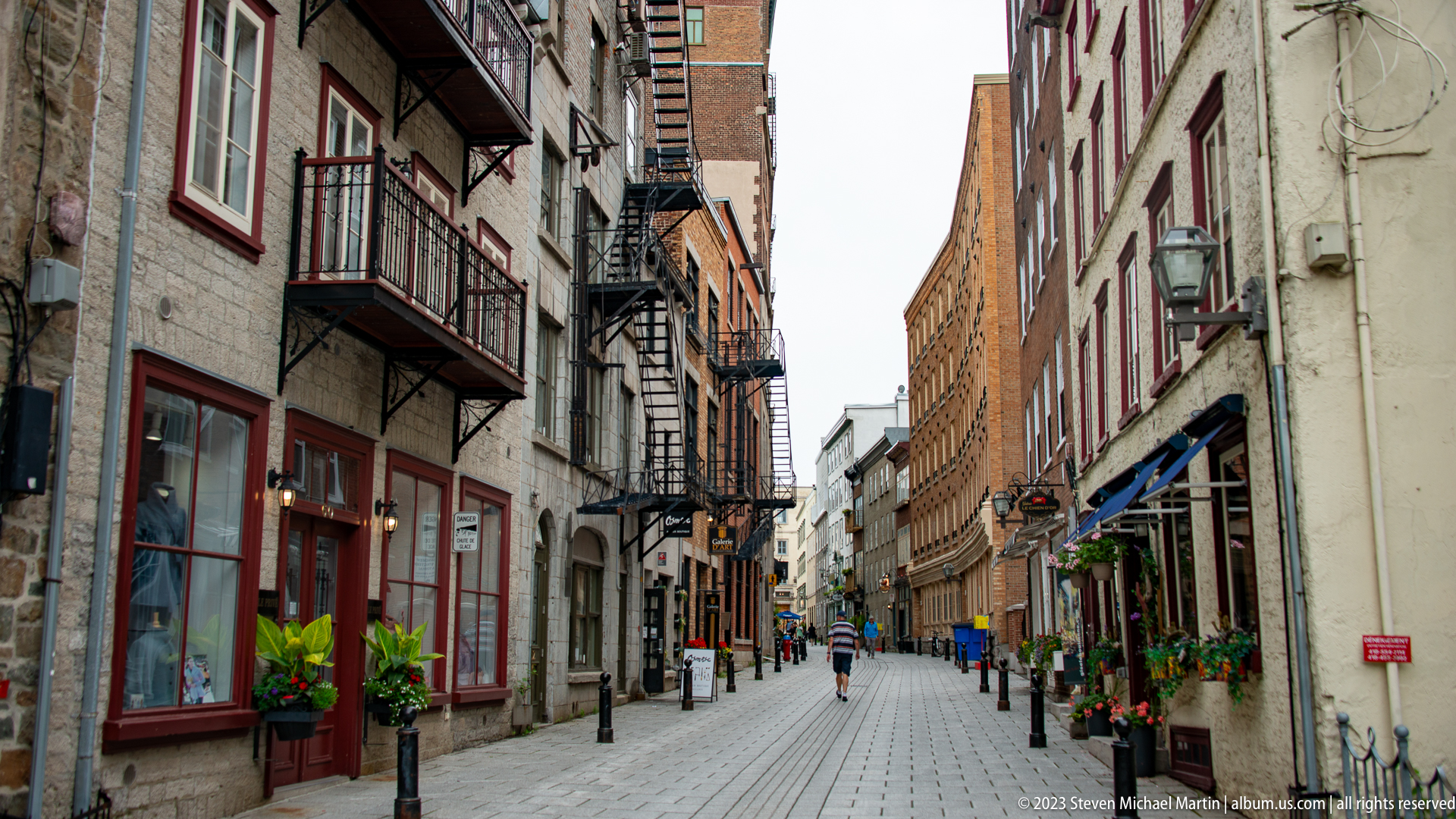
Stone and brick buildings form a tight corridor along this pedestrian-oriented lane, where projecting balconies, exterior fire escapes, shopfronts, bollards, and planters layer several periods of urban use. The long perspective draws the eye through the historic commercial fabric toward the busier street beyond.
Caption
Stone and brick buildings form a tight corridor along this pedestrian-oriented lane, where projecting balconies, exterior fire escapes, shopfronts, bollards, and planters layer several periods of urban use. The long perspective draws the eye through the historic commercial fabric toward the busier street beyond.
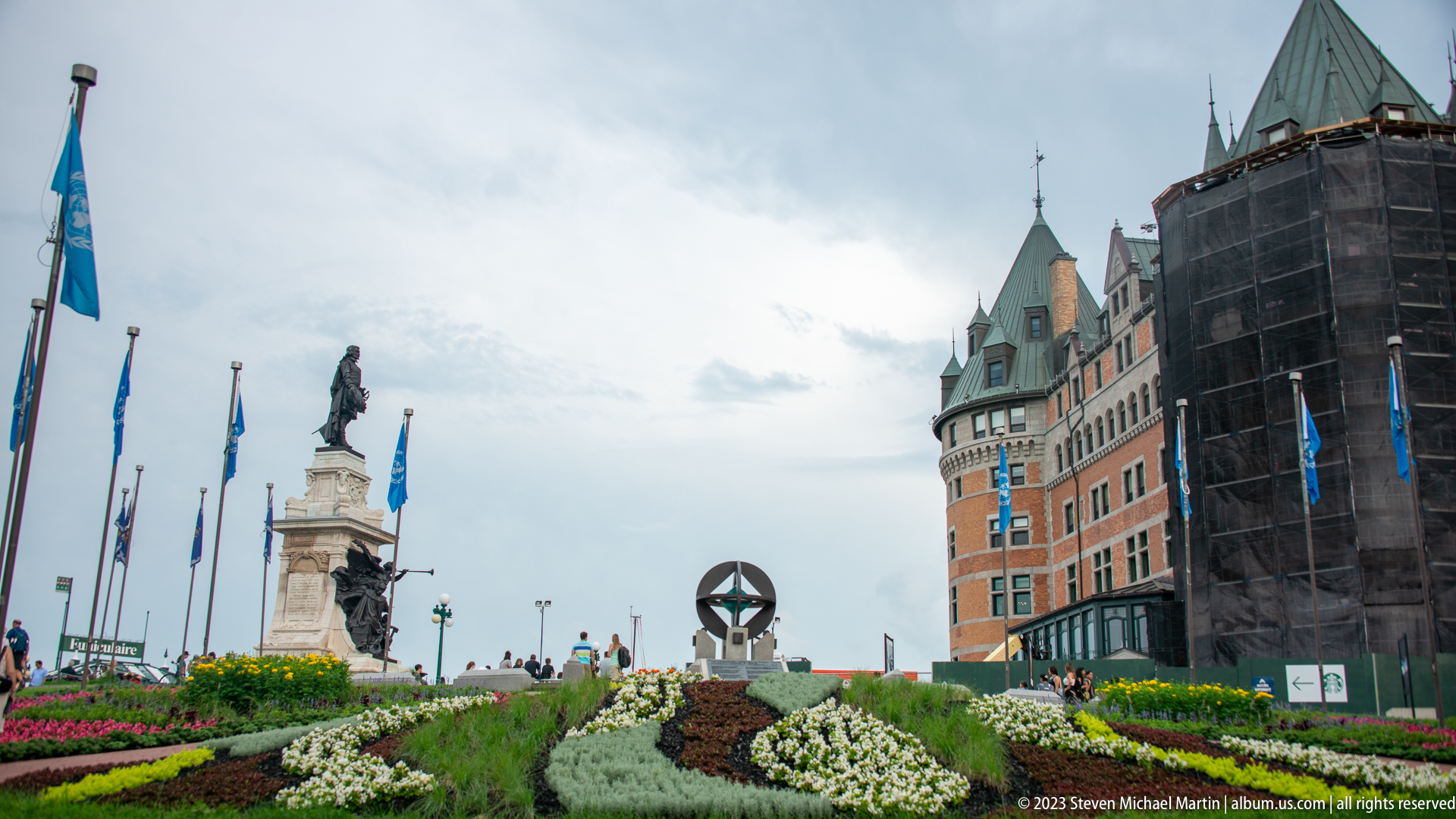
Formal flower beds lead toward a tall stone monument while the Château Frontenac rises at right, its copper-roofed towers defining the skyline. Flags and public sculpture punctuate the open space between the gardens and hotel. The composition links landscaped civic space with one of Old Québec’s most recognizable architectural silhouettes without losing the scale of pedestrians gathered along the terrace.
Caption
Formal flower beds lead toward a tall stone monument while the Château Frontenac rises at right, its copper-roofed towers defining the skyline. Flags and public sculpture punctuate the open space between the gardens and hotel. The composition links landscaped civic space with one of Old Québec’s most recognizable architectural silhouettes without losing the scale of pedestrians gathered along the terrace.
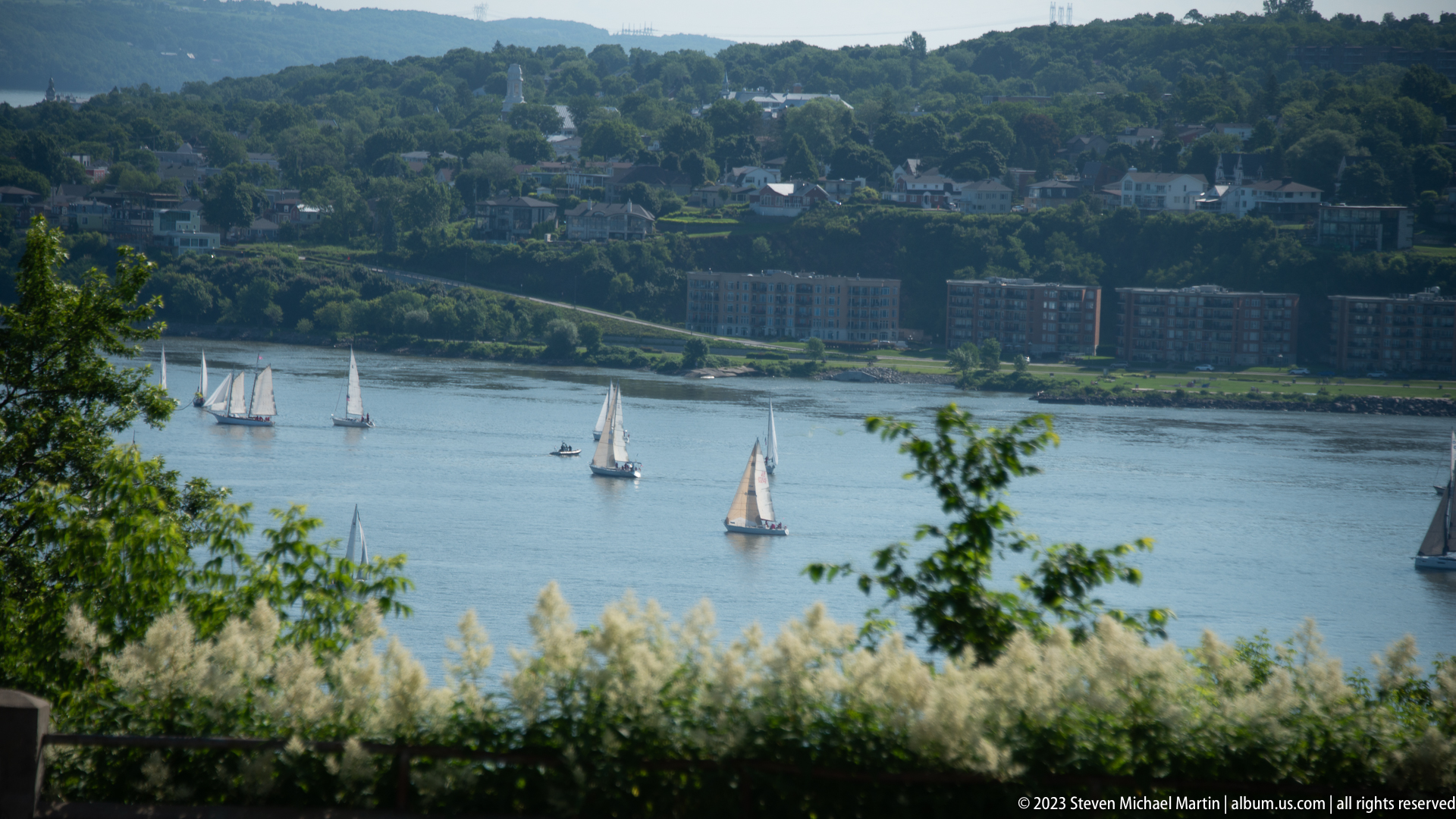
Several white sailboats move across the broad St. Lawrence River below a wooded residential hillside. Apartment blocks and houses line the opposite shore, while foreground foliage frames the elevated viewpoint. The final view shifts from Quebec City’s stone fortifications to the river corridor they overlook, emphasizing the open waterway and settled landscape beyond the historic center.
Caption
Several white sailboats move across the broad St. Lawrence River below a wooded residential hillside. Apartment blocks and houses line the opposite shore, while foreground foliage frames the elevated viewpoint. The final view shifts from Quebec City’s stone fortifications to the river corridor they overlook, emphasizing the open waterway and settled landscape beyond the historic center.
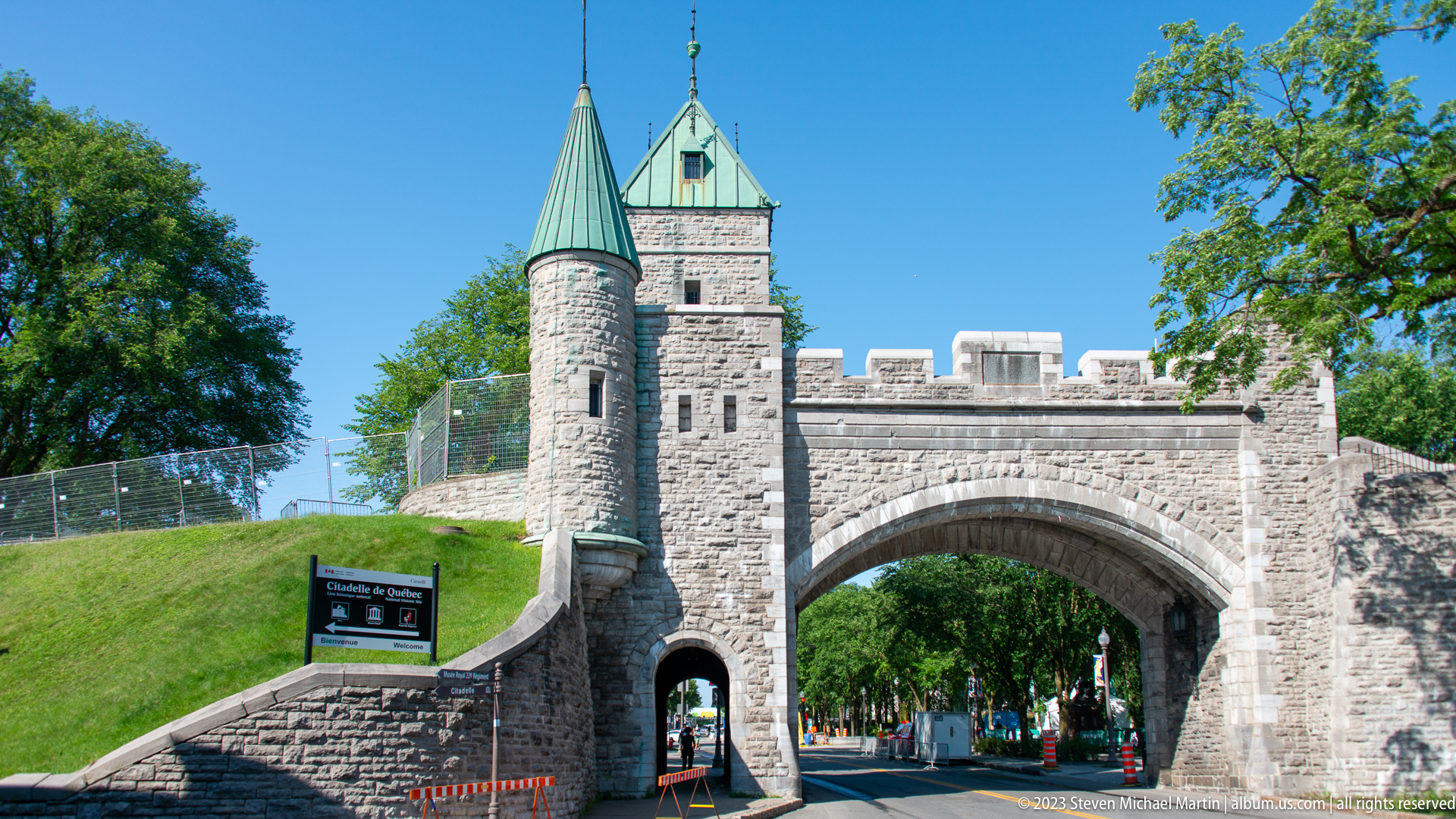
Seen more frontally, the fortified gateway combines a broad roadway arch with a narrow pedestrian opening at the base of a round turret. A square tower and crenellated wall rise behind, their pale stone sharply defined against the blue sky. Grassy earthworks climb along the left side, revealing how masonry and landscaped ramparts work together as a continuous defensive system.
Caption
Seen more frontally, the fortified gateway combines a broad roadway arch with a narrow pedestrian opening at the base of a round turret. A square tower and crenellated wall rise behind, their pale stone sharply defined against the blue sky. Grassy earthworks climb along the left side, revealing how masonry and landscaped ramparts work together as a continuous defensive system.
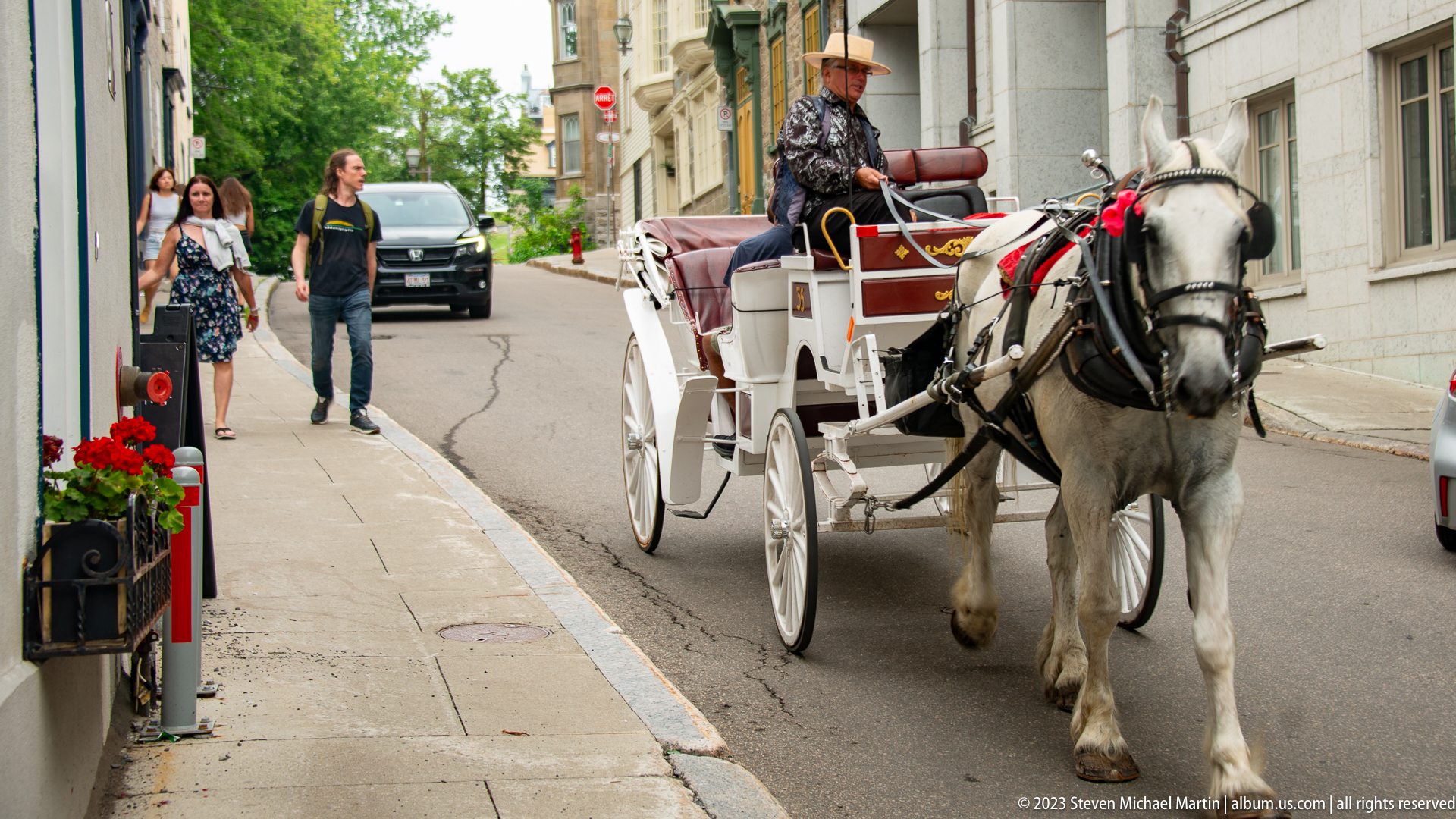
A white horse pulls a traditional open carriage along a narrow Old Quebec street as pedestrians pass on the sidewalk. The driver sits high beneath a broad hat, and red harness accents stand out against the pale horse and carriage. The scene records the horse-drawn sightseeing carriages that remain a conspicuous part of the historic district’s visitor landscape.
Caption
A white horse pulls a traditional open carriage along a narrow Old Quebec street as pedestrians pass on the sidewalk. The driver sits high beneath a broad hat, and red harness accents stand out against the pale horse and carriage. The scene records the horse-drawn sightseeing carriages that remain a conspicuous part of the historic district’s visitor landscape.
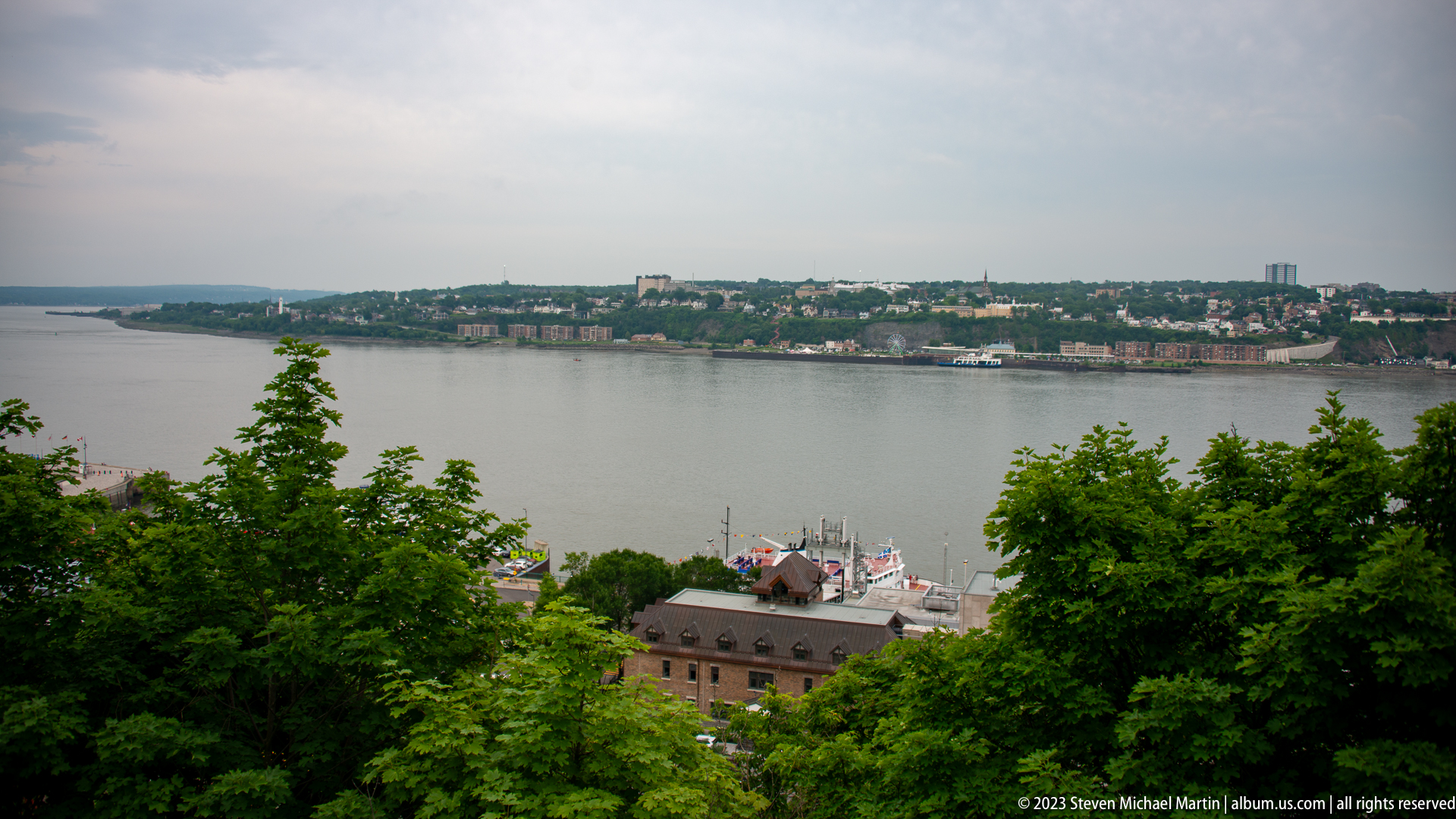
The St. Lawrence River spreads across a broad overlook from Quebec City’s Upper Town, with leafy trees and rooftops descending toward the waterfront in the foreground. Development lines the opposite shore beneath a pale overcast sky. The elevated viewpoint emphasizes the river corridor that has long shaped the city’s geography and strategic setting.
Caption
The St. Lawrence River spreads across a broad overlook from Quebec City’s Upper Town, with leafy trees and rooftops descending toward the waterfront in the foreground. Development lines the opposite shore beneath a pale overcast sky. The elevated viewpoint emphasizes the river corridor that has long shaped the city’s geography and strategic setting.
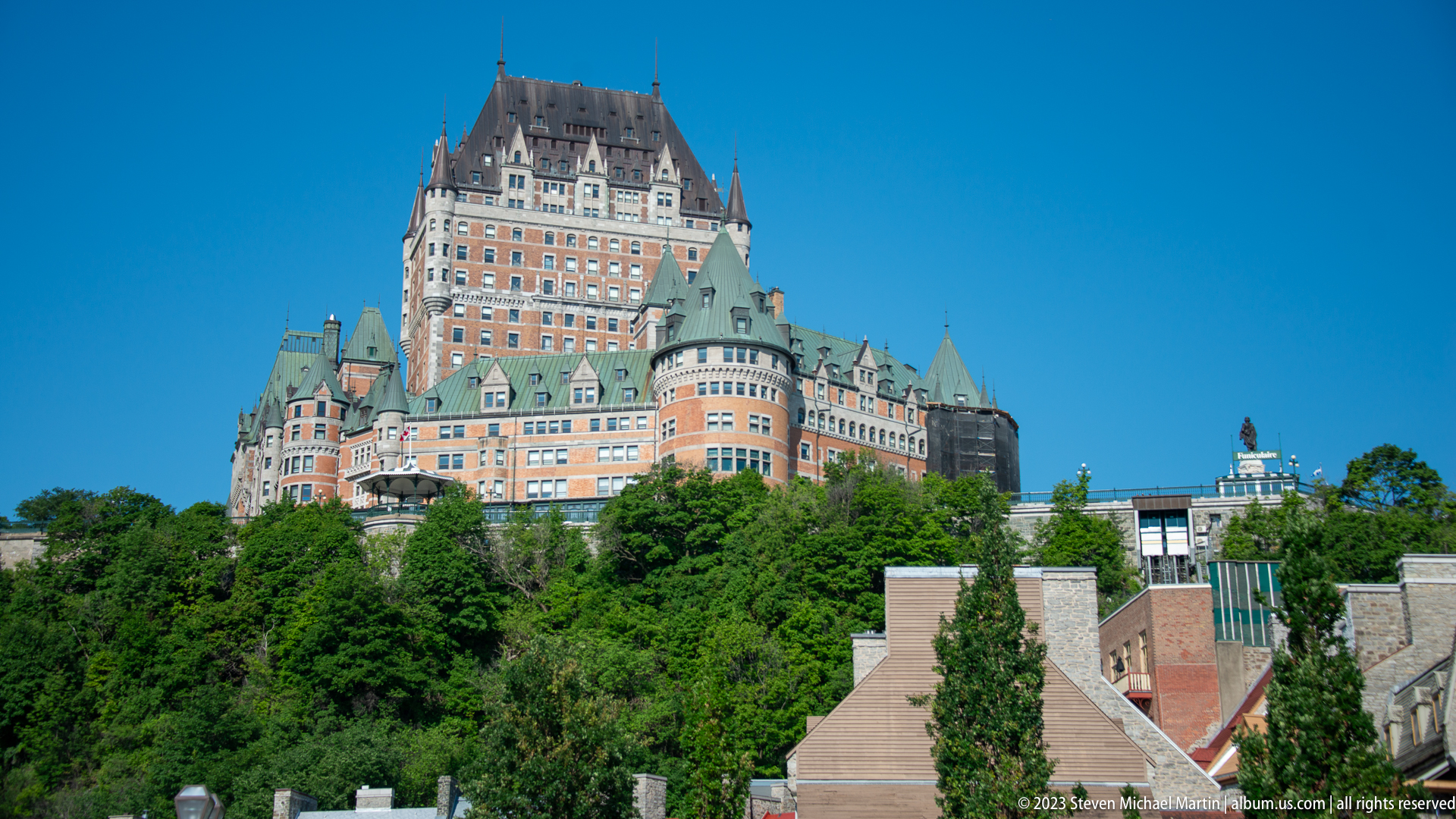
The Château Frontenac dominates a close upward view from below the bluff, its tall central block and clustered copper-roofed turrets rising above dense green trees. A few smaller rooftops occupy the lower foreground, reinforcing the scale difference between neighborhood buildings and the hotel. The clear sky and direct light reveal the complex layering of towers, dormers, and steep roof planes.
Caption
The Château Frontenac dominates a close upward view from below the bluff, its tall central block and clustered copper-roofed turrets rising above dense green trees. A few smaller rooftops occupy the lower foreground, reinforcing the scale difference between neighborhood buildings and the hotel. The clear sky and direct light reveal the complex layering of towers, dormers, and steep roof planes.
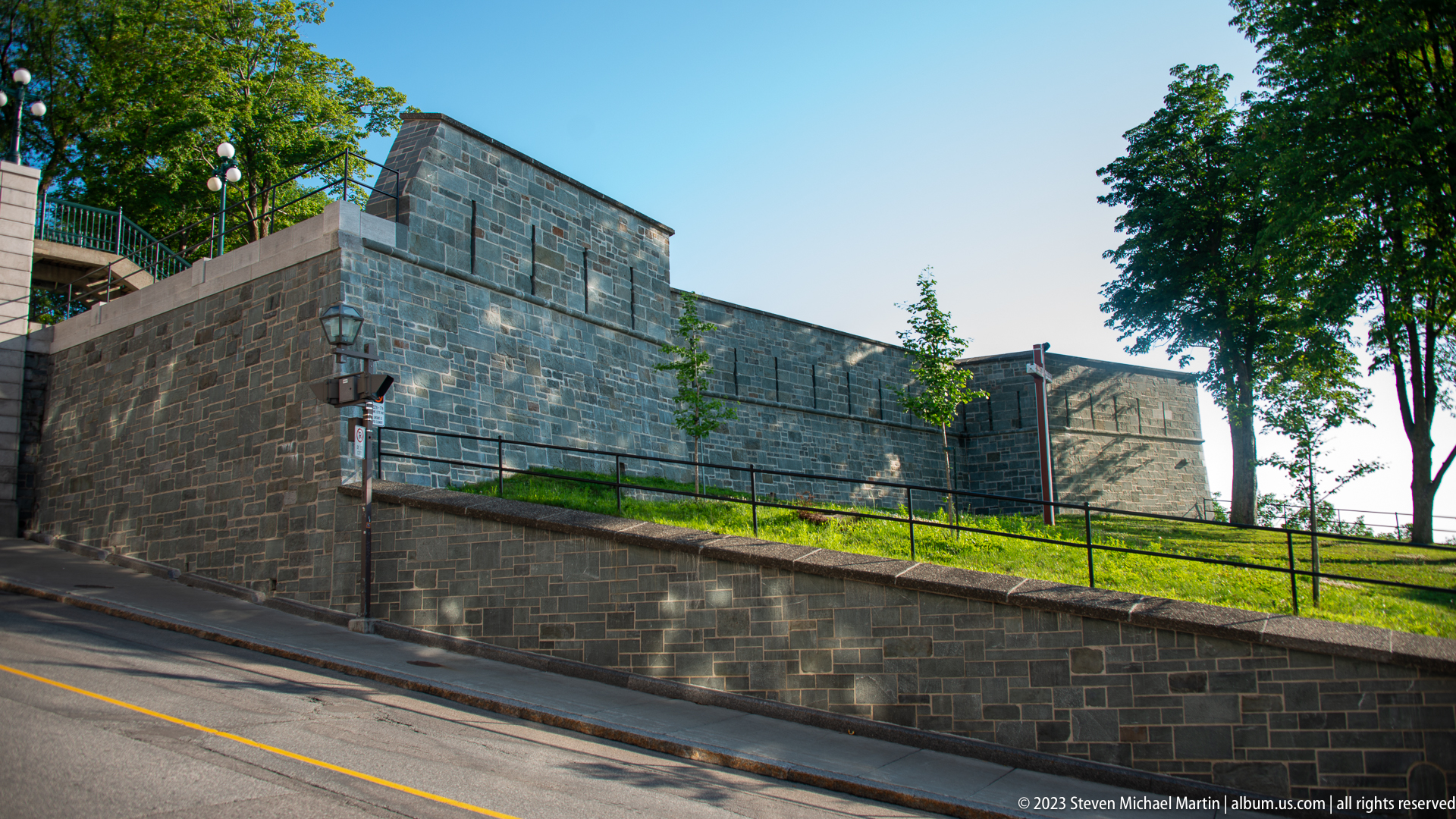
A massive stone fortification wall follows the slope of a city street, rising in broad stepped planes above a lower retaining wall and narrow strip of grass. Small openings and sharply angled masonry surfaces reveal its defensive construction, while mature trees soften the upper edge. The street-level perspective emphasizes the thickness, height, and continuous barrier created by Quebec City’s preserved fortifications.
Caption
A massive stone fortification wall follows the slope of a city street, rising in broad stepped planes above a lower retaining wall and narrow strip of grass. Small openings and sharply angled masonry surfaces reveal its defensive construction, while mature trees soften the upper edge. The street-level perspective emphasizes the thickness, height, and continuous barrier created by Quebec City’s preserved fortifications.
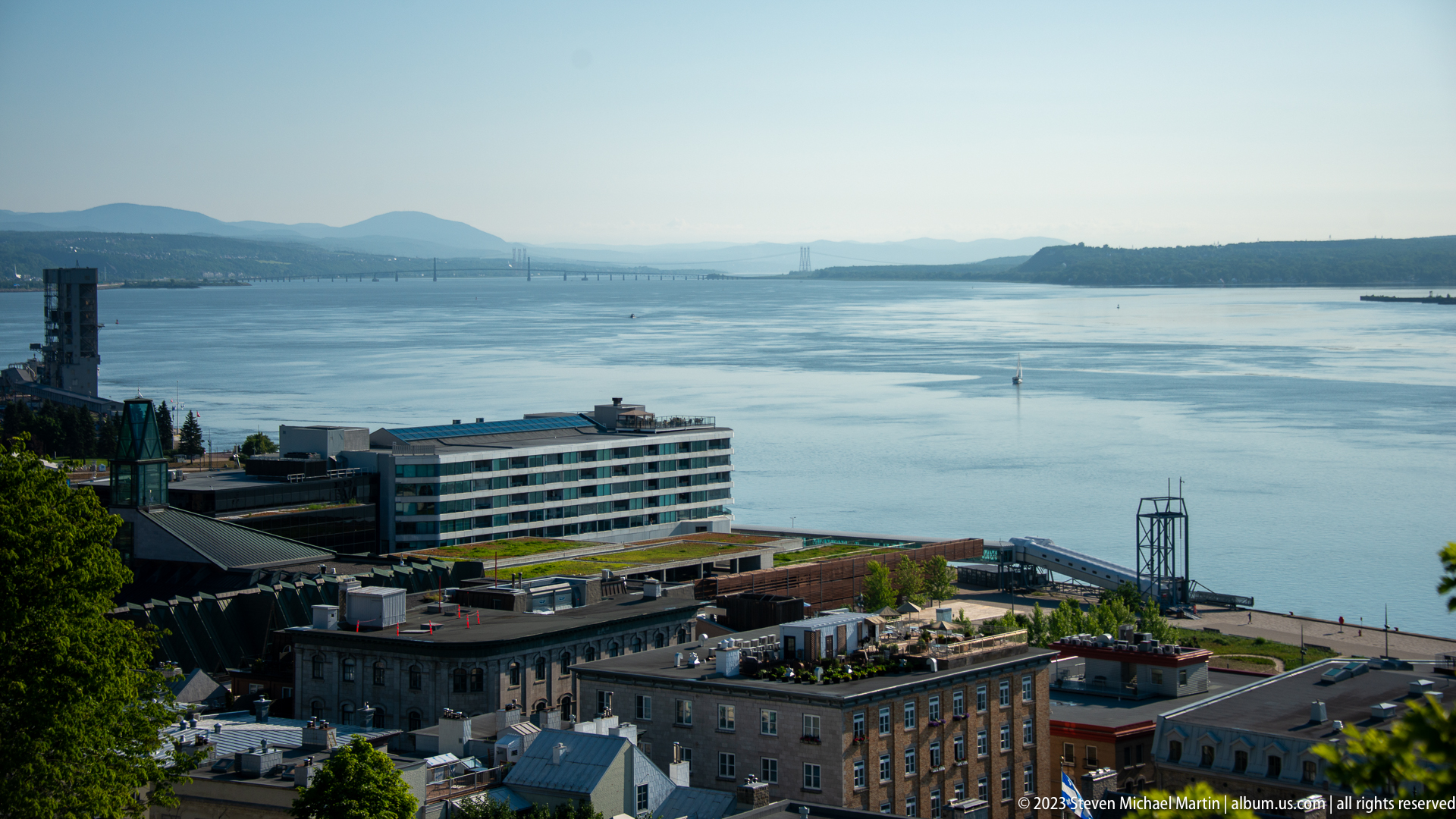
The St. Lawrence River stretches across a broad panorama below Upper Town, with waterfront buildings and industrial structures occupying the near shore and hazy hills beyond. A long bridge is faintly visible in the distance. The elevated viewpoint emphasizes Quebec City’s commanding position above the river corridor and the scale of the waterway relative to the built waterfront.
Caption
The St. Lawrence River stretches across a broad panorama below Upper Town, with waterfront buildings and industrial structures occupying the near shore and hazy hills beyond. A long bridge is faintly visible in the distance. The elevated viewpoint emphasizes Quebec City’s commanding position above the river corridor and the scale of the waterway relative to the built waterfront.
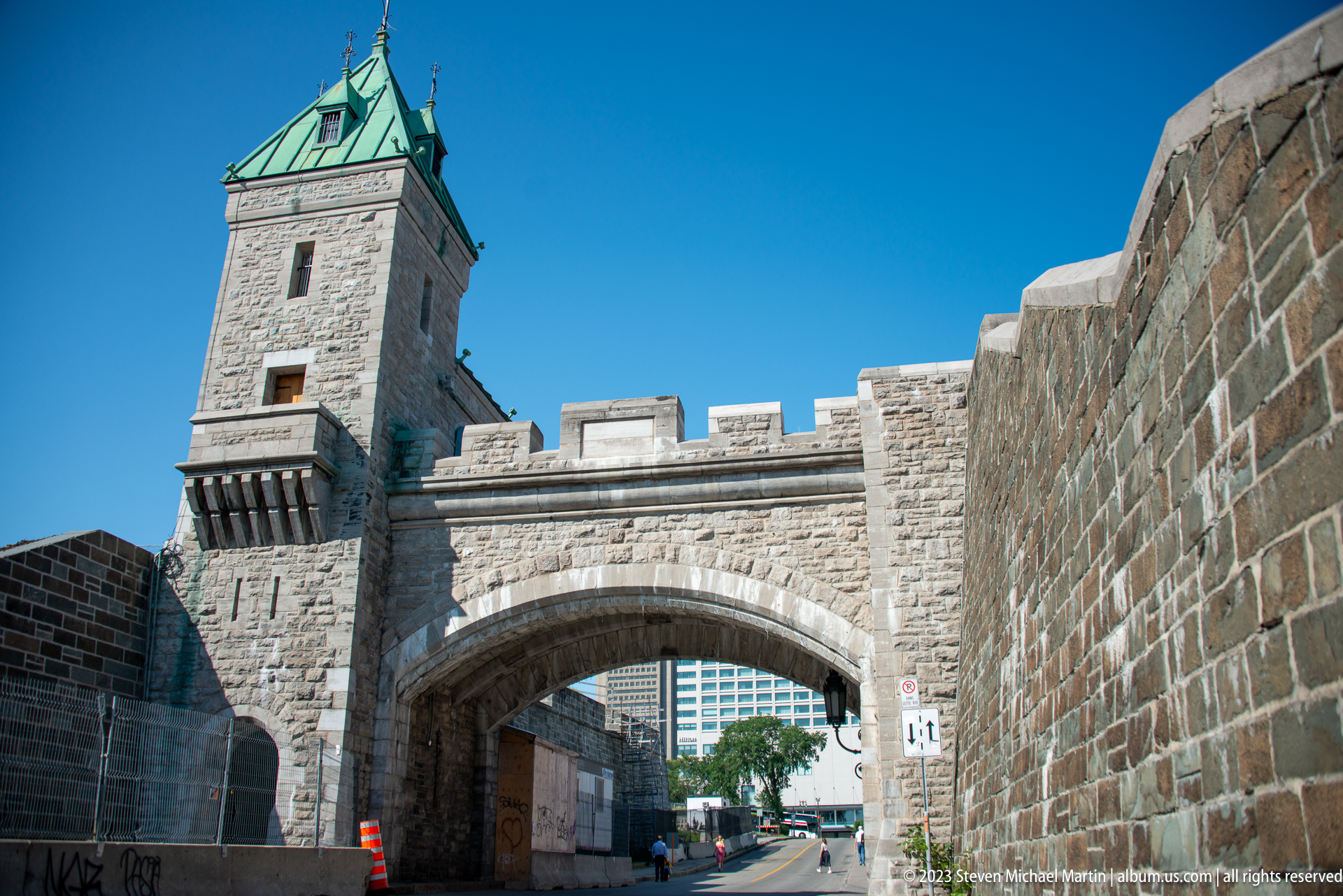
A broad stone arch opens through Quebec City’s fortifications beneath a square tower and crenellated parapet. Massive masonry walls extend toward the camera on both sides, creating a narrow defensive passage that now carries a modern roadway. The low frontal viewpoint emphasizes the thickness of the walls, the commanding tower, and the continued integration of the historic gate into the contemporary street network.
Caption
A broad stone arch opens through Quebec City’s fortifications beneath a square tower and crenellated parapet. Massive masonry walls extend toward the camera on both sides, creating a narrow defensive passage that now carries a modern roadway. The low frontal viewpoint emphasizes the thickness of the walls, the commanding tower, and the continued integration of the historic gate into the contemporary street network.
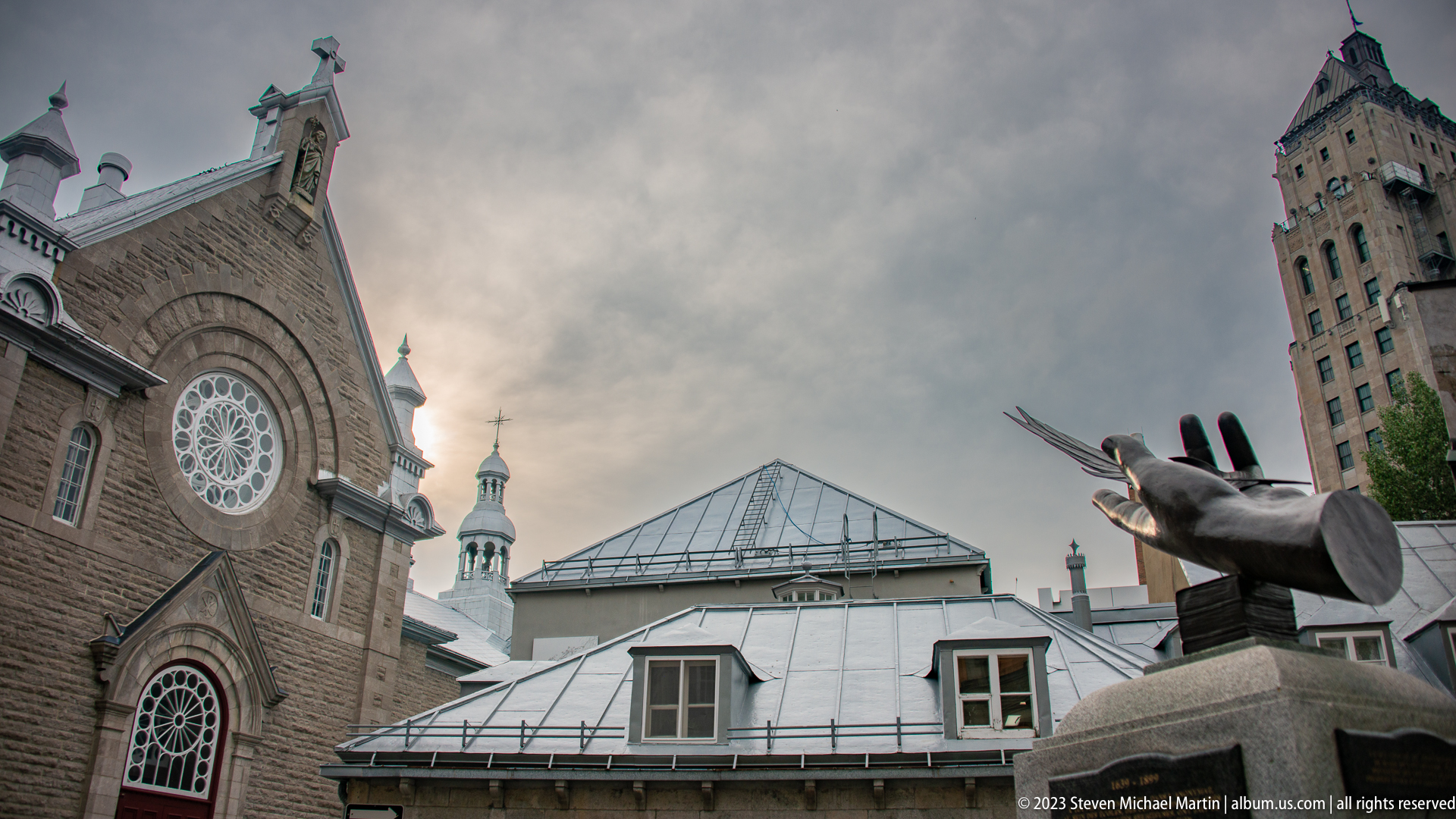
A layered view of Old Quebec brings together a stone church wall with rose window, a dark public sculpture, steep metal roofs, and the tall Price Building rising at right. The low viewpoint compresses religious, civic, and commercial architecture into one frame, illustrating the dense vertical character of the historic upper town.
Caption
A layered view of Old Quebec brings together a stone church wall with rose window, a dark public sculpture, steep metal roofs, and the tall Price Building rising at right. The low viewpoint compresses religious, civic, and commercial architecture into one frame, illustrating the dense vertical character of the historic upper town.
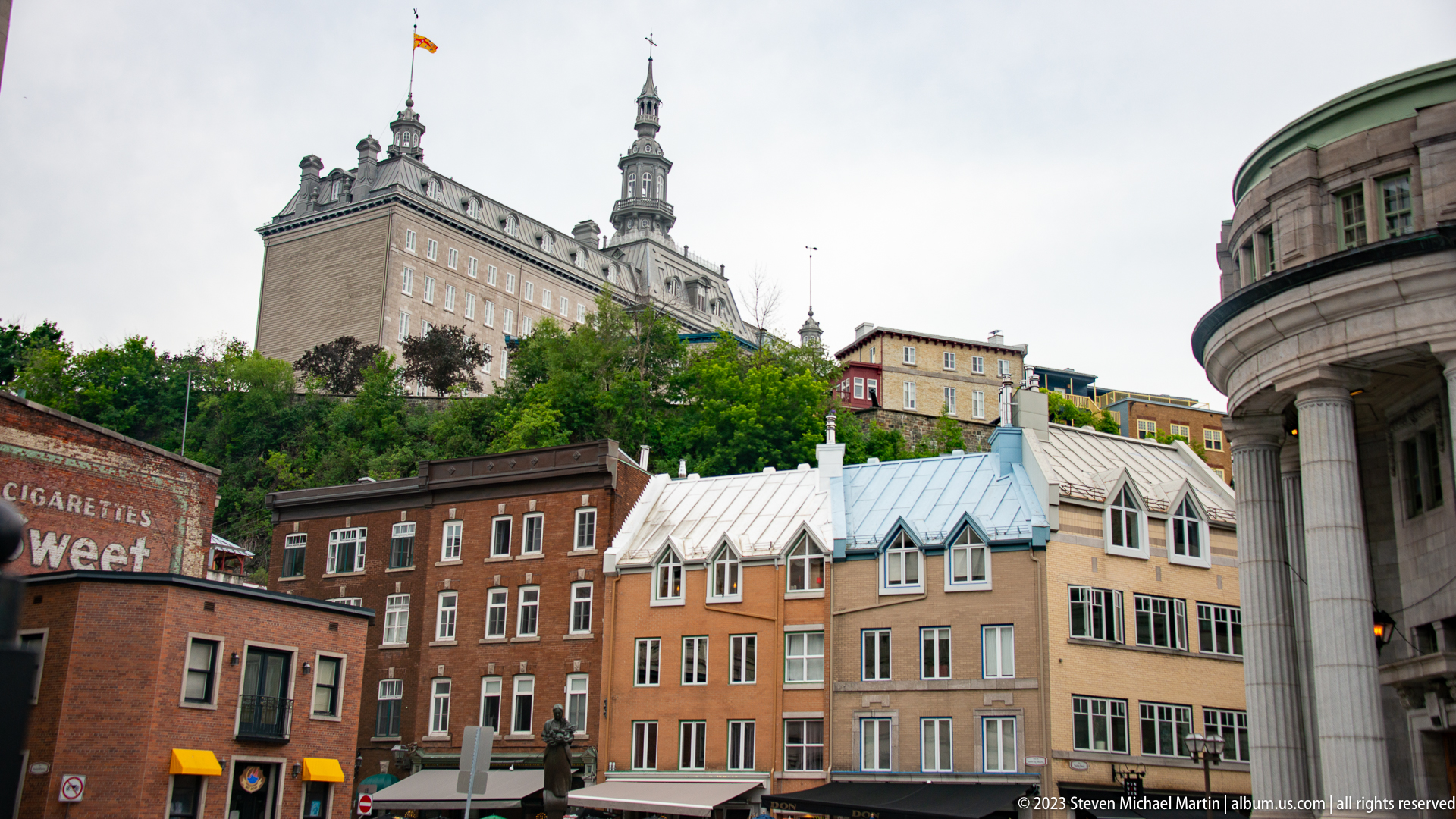
A layered Quebec City streetscape rises from compact brick and stone buildings toward a prominent civic or institutional tower on the upper slope. The composition makes the city’s dramatic change in elevation immediately legible, while varied rooflines, masonry façades, and the curved classical building at right convey the dense architectural fabric of the historic center.
Caption
A layered Quebec City streetscape rises from compact brick and stone buildings toward a prominent civic or institutional tower on the upper slope. The composition makes the city’s dramatic change in elevation immediately legible, while varied rooflines, masonry façades, and the curved classical building at right convey the dense architectural fabric of the historic center.
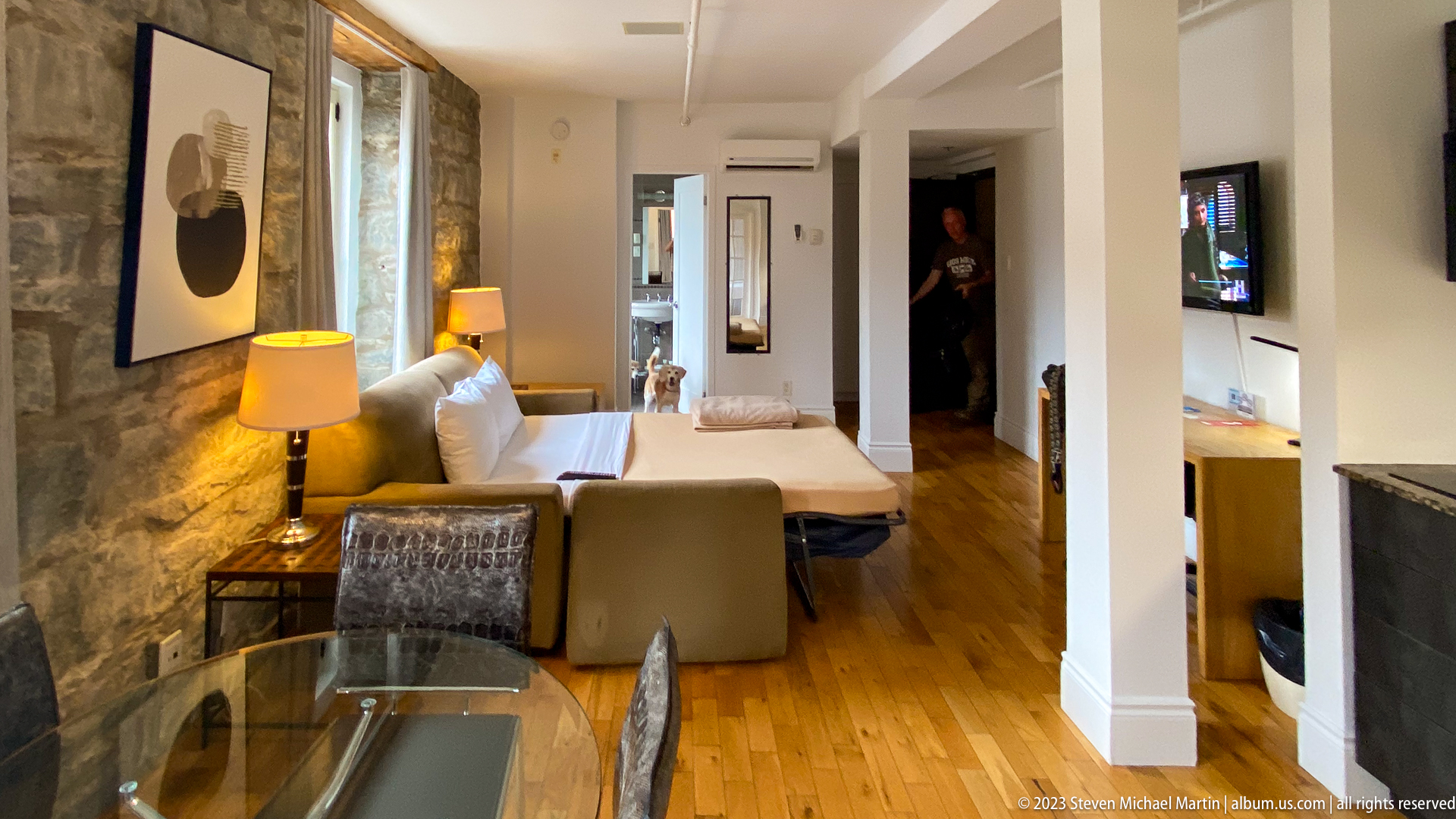
A contemporary hotel room is fitted within an older masonry shell, pairing exposed stone walls and wood flooring with modern furniture, lighting, and media. The view looks across a sitting area toward the bed and rear doorway, showing how historic building fabric has been adapted for present-day lodging in Quebec City.
Caption
A contemporary hotel room is fitted within an older masonry shell, pairing exposed stone walls and wood flooring with modern furniture, lighting, and media. The view looks across a sitting area toward the bed and rear doorway, showing how historic building fabric has been adapted for present-day lodging in Quebec City.
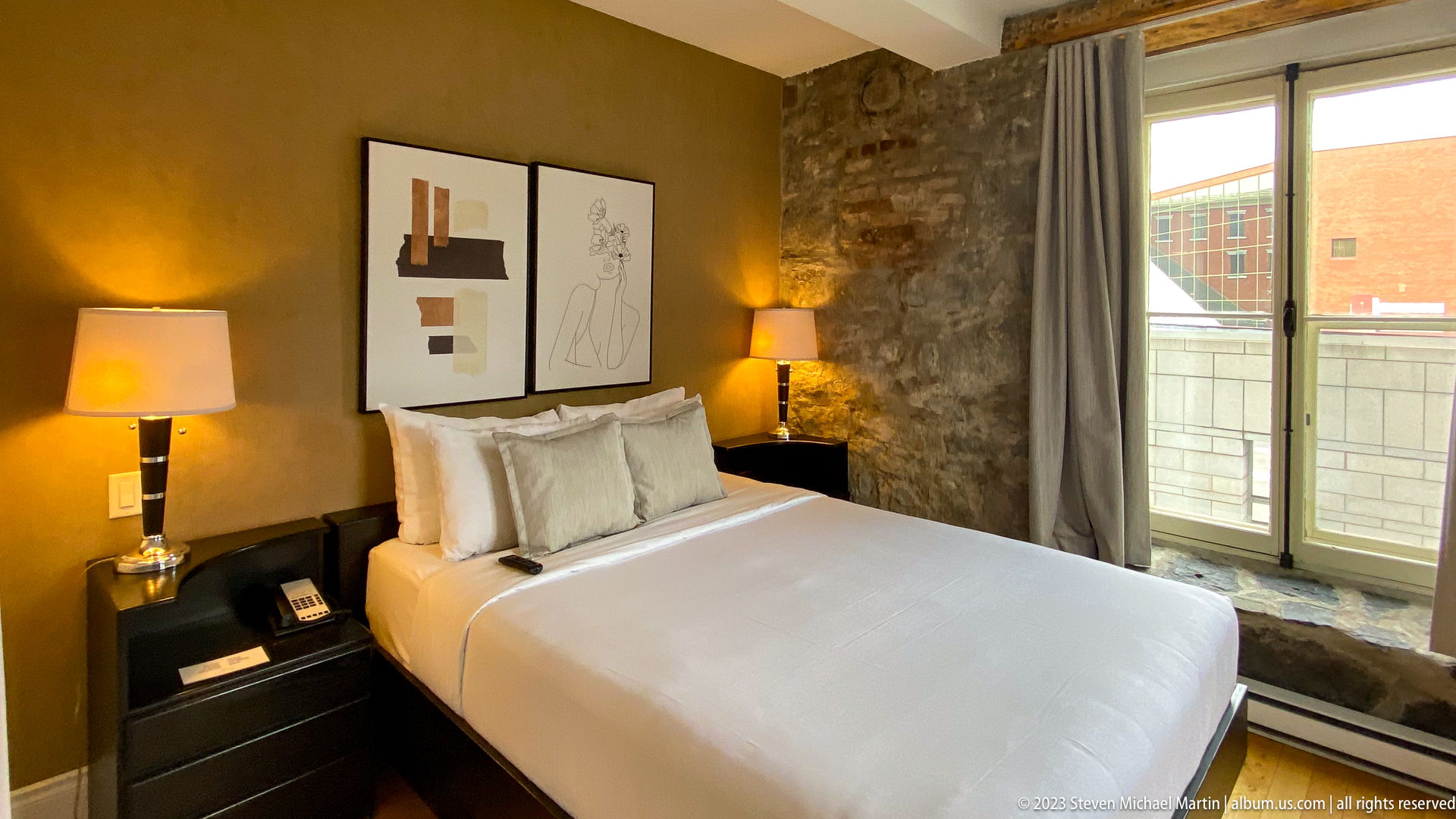
Warm bedside lighting frames a neatly made bed against a modern wall, while an exposed stone section beside the window preserves the texture of the older structure. The compact composition emphasizes the contrast between contemporary hotel furnishings and the irregular masonry fabric characteristic of many adapted buildings in historic Quebec City.
Caption
Warm bedside lighting frames a neatly made bed against a modern wall, while an exposed stone section beside the window preserves the texture of the older structure. The compact composition emphasizes the contrast between contemporary hotel furnishings and the irregular masonry fabric characteristic of many adapted buildings in historic Quebec City.
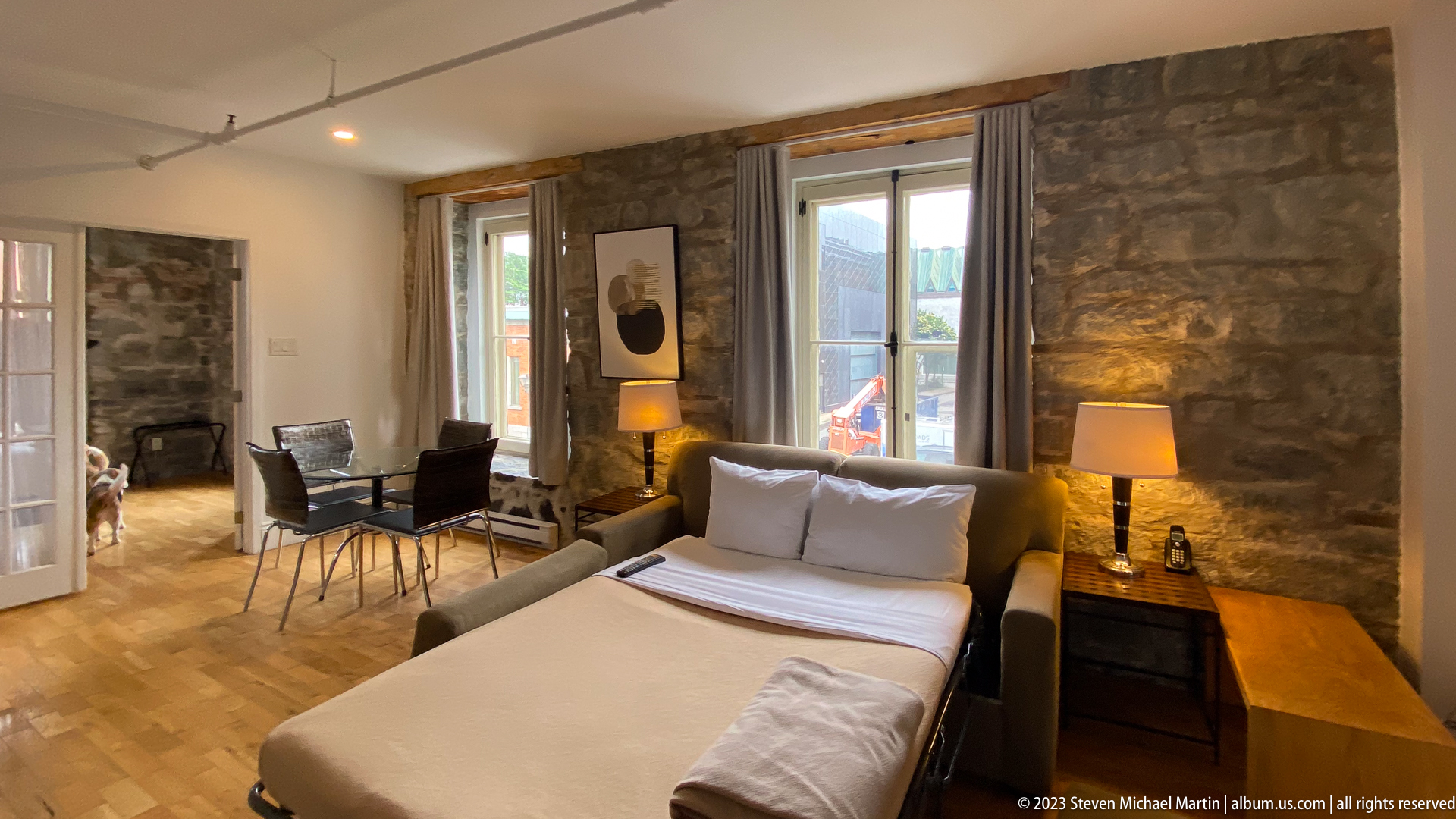
Exposed stone walls define this Quebec City hotel room, where a bed in the foreground opens toward a small seating area beside tall windows. Modern lamps, chairs, artwork, and wood flooring soften the historic masonry envelope, creating a clear interior study of adaptive reuse rather than a conventional standardized hotel room.
Caption
Exposed stone walls define this Quebec City hotel room, where a bed in the foreground opens toward a small seating area beside tall windows. Modern lamps, chairs, artwork, and wood flooring soften the historic masonry envelope, creating a clear interior study of adaptive reuse rather than a conventional standardized hotel room.
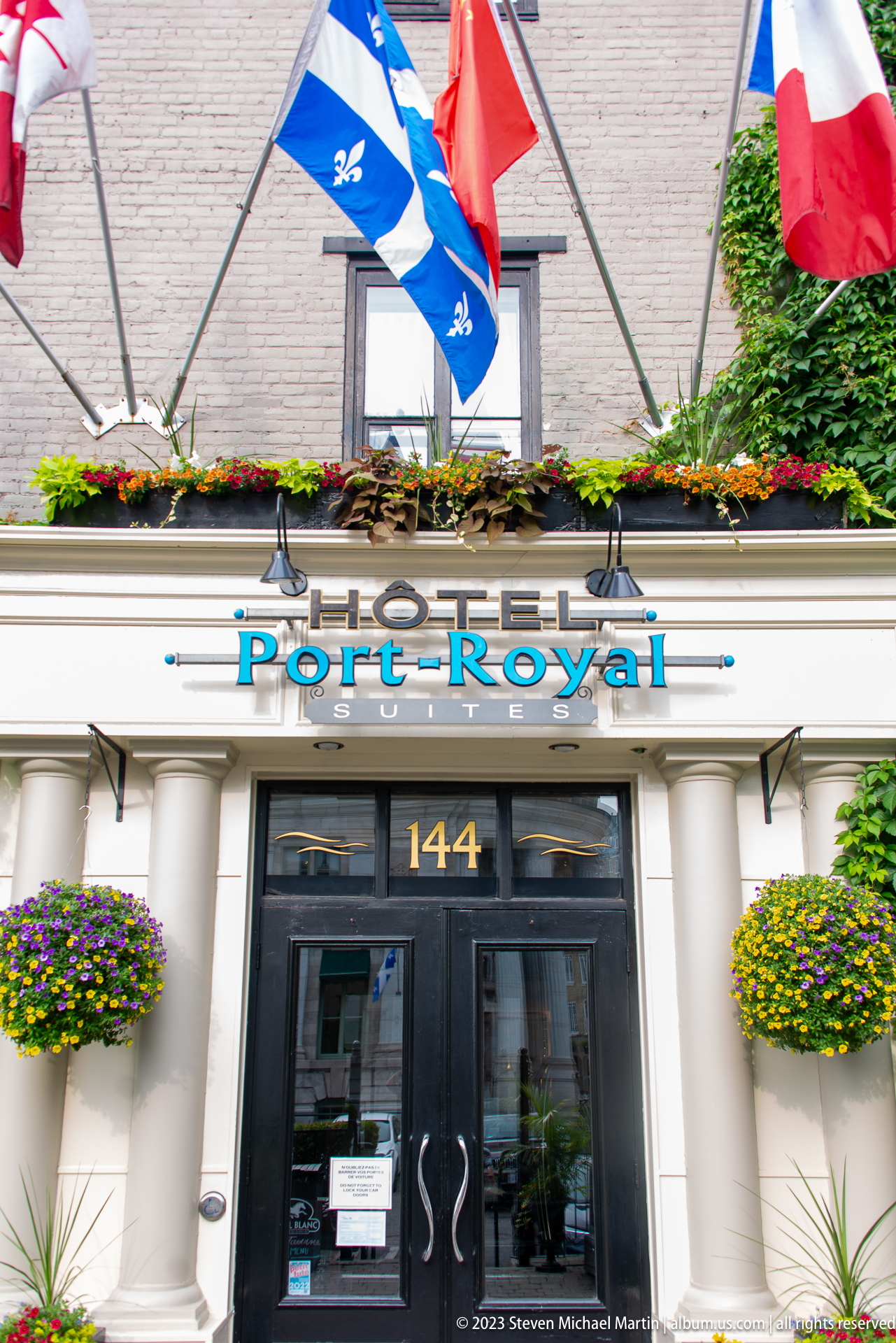
The entrance of Hôtel Port-Royal is dressed with Quebec and Canadian flags, hanging flower baskets, and a restrained classical façade. The hotel name and street number 144 are prominently displayed above the doorway, turning the image into a precise record of a hospitality property within Quebec City’s historic urban fabric.
Caption
The entrance of Hôtel Port-Royal is dressed with Quebec and Canadian flags, hanging flower baskets, and a restrained classical façade. The hotel name and street number 144 are prominently displayed above the doorway, turning the image into a precise record of a hospitality property within Quebec City’s historic urban fabric.
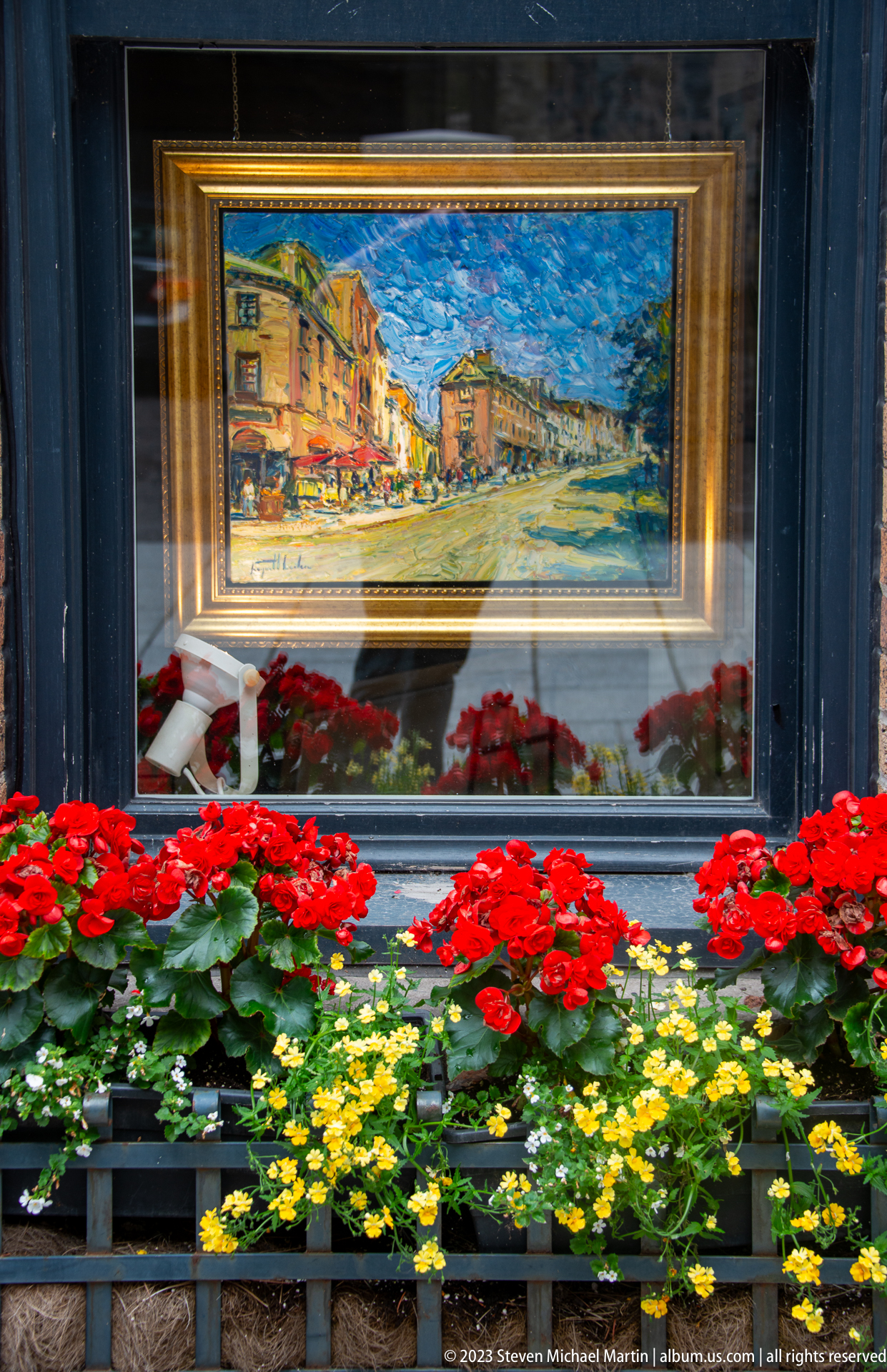
A framed painting of a colorful urban waterfront or street scene fills a shop or gallery window behind dense boxes of red and yellow flowers. Reflections in the glass merge the artwork with the surrounding streetscape, producing a layered detail of Quebec City’s gallery and retail environment.
Caption
A framed painting of a colorful urban waterfront or street scene fills a shop or gallery window behind dense boxes of red and yellow flowers. Reflections in the glass merge the artwork with the surrounding streetscape, producing a layered detail of Quebec City’s gallery and retail environment.
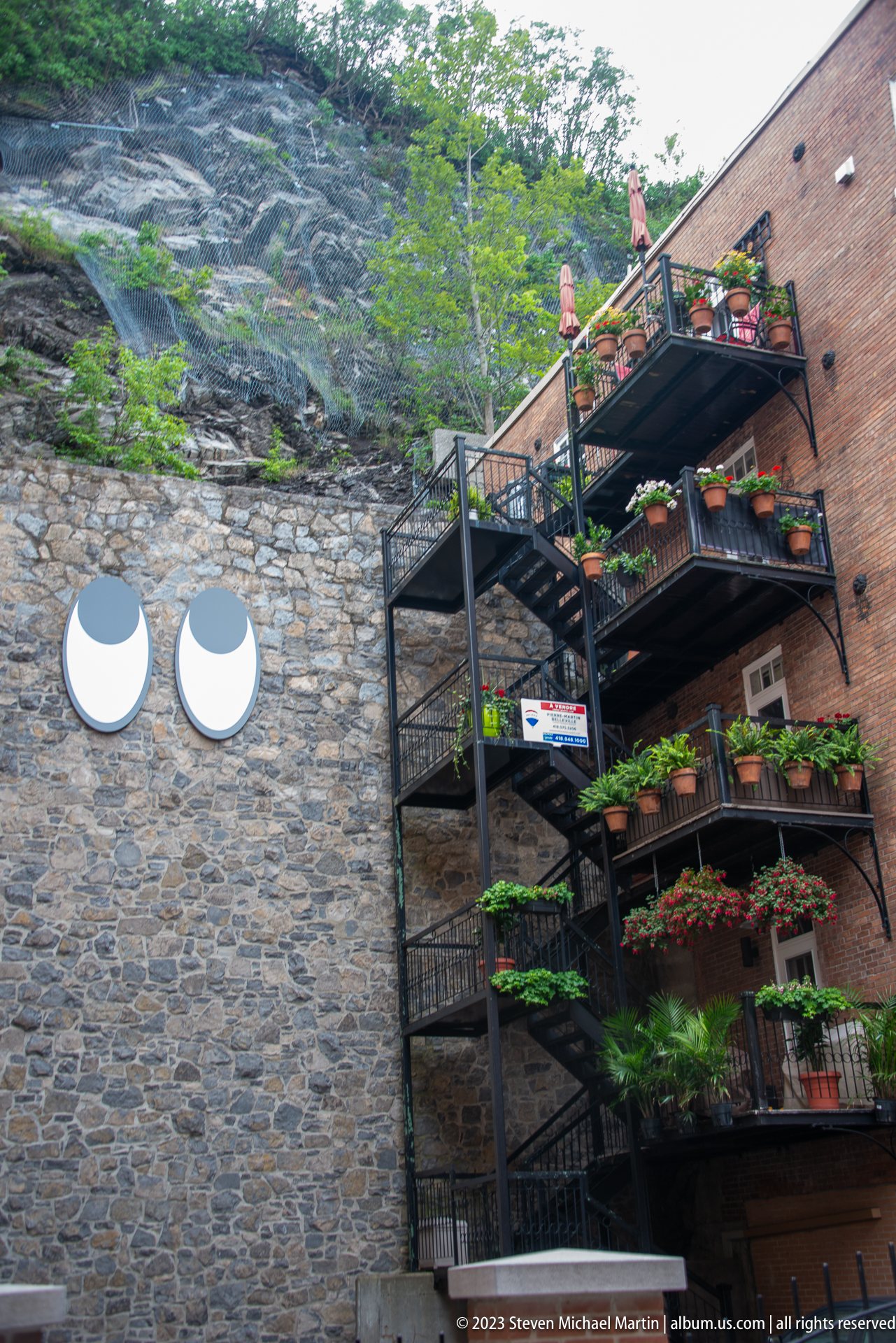
A black metal exterior staircase climbs in several flights between a rough stone retaining wall and a brick building. Planters and greenery soften the industrial geometry, while two circular wall elements and people at the upper landing add visual markers to this unusual vertical passage through the dense historic city.
Caption
A black metal exterior staircase climbs in several flights between a rough stone retaining wall and a brick building. Planters and greenery soften the industrial geometry, while two circular wall elements and people at the upper landing add visual markers to this unusual vertical passage through the dense historic city.
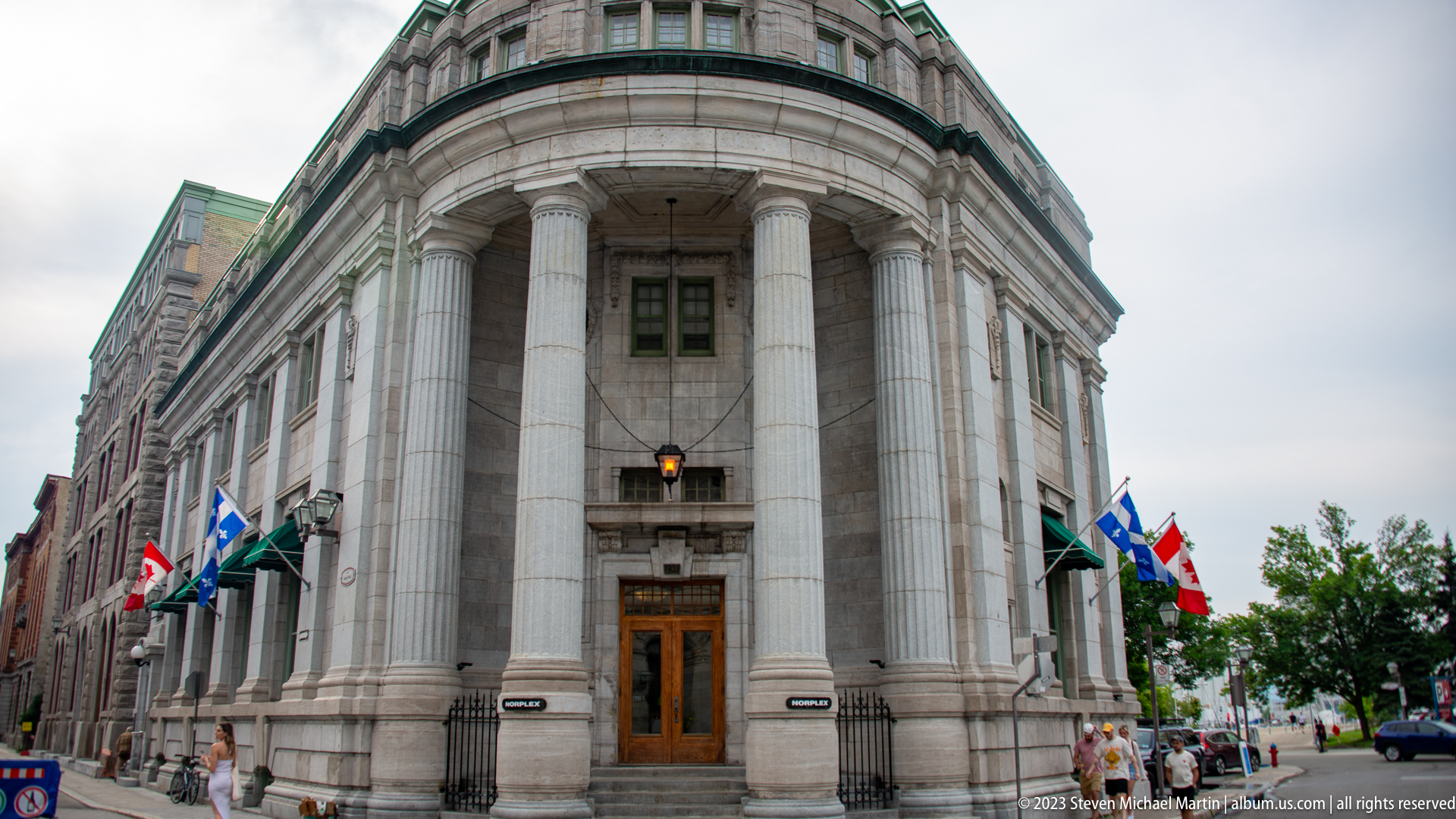
A monumental stone building turns the street corner with a rounded, columned entrance bay rising beneath a heavy cornice. Tall fluted columns, rusticated masonry, bronze-toned doors, and rows of flags give the façade a formal civic character, while pedestrians at street level provide scale.
Caption
A monumental stone building turns the street corner with a rounded, columned entrance bay rising beneath a heavy cornice. Tall fluted columns, rusticated masonry, bronze-toned doors, and rows of flags give the façade a formal civic character, while pedestrians at street level provide scale.
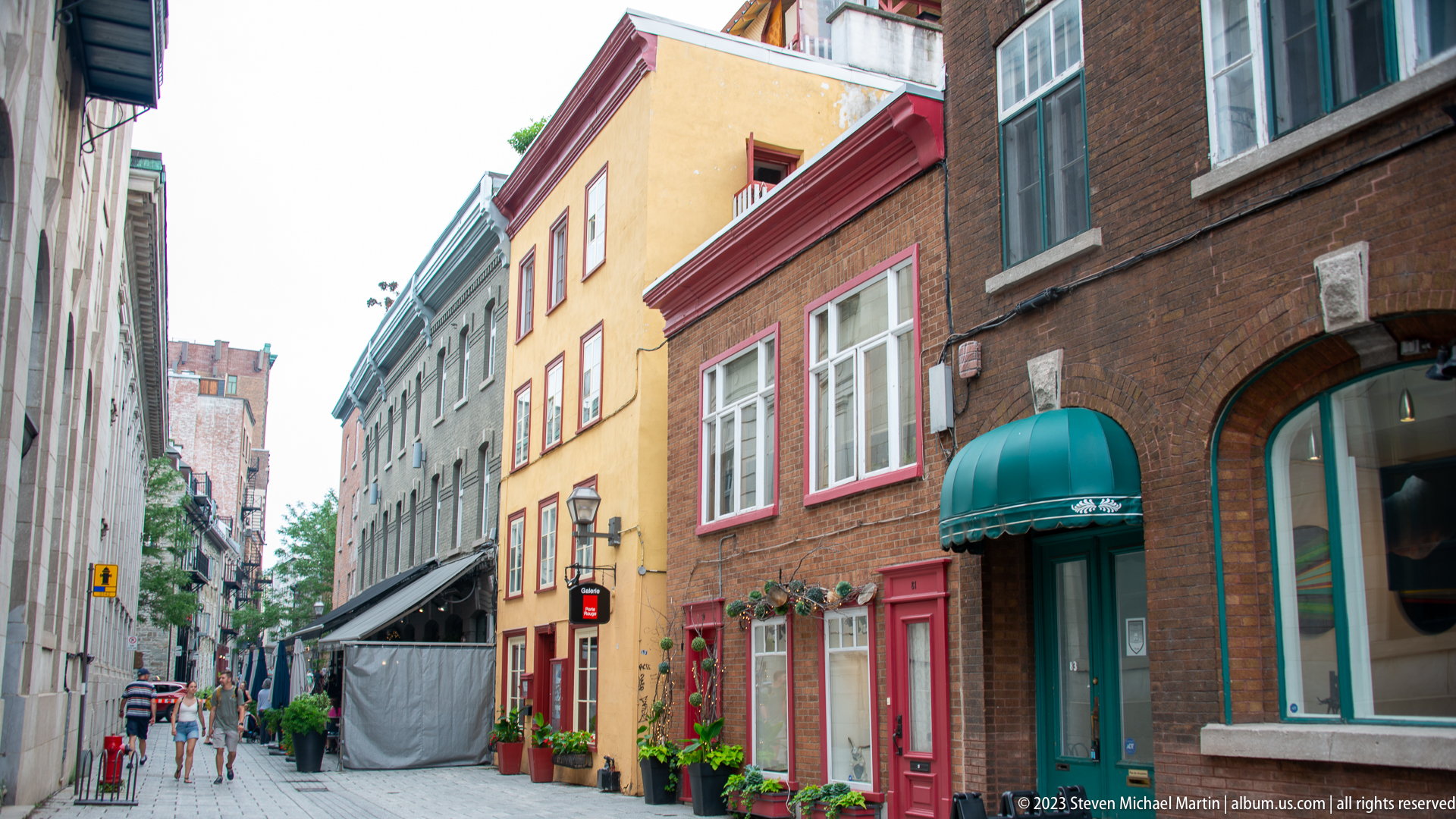
A narrow Old Quebec street is lined with closely spaced façades in brick, stucco, and painted trim. Bright yellow and red storefronts punctuate the muted masonry, while awnings, flower boxes, and pedestrians create a lived-in commercial streetscape that reflects the fine-grained scale of the historic quarter.
Caption
A narrow Old Quebec street is lined with closely spaced façades in brick, stucco, and painted trim. Bright yellow and red storefronts punctuate the muted masonry, while awnings, flower boxes, and pedestrians create a lived-in commercial streetscape that reflects the fine-grained scale of the historic quarter.
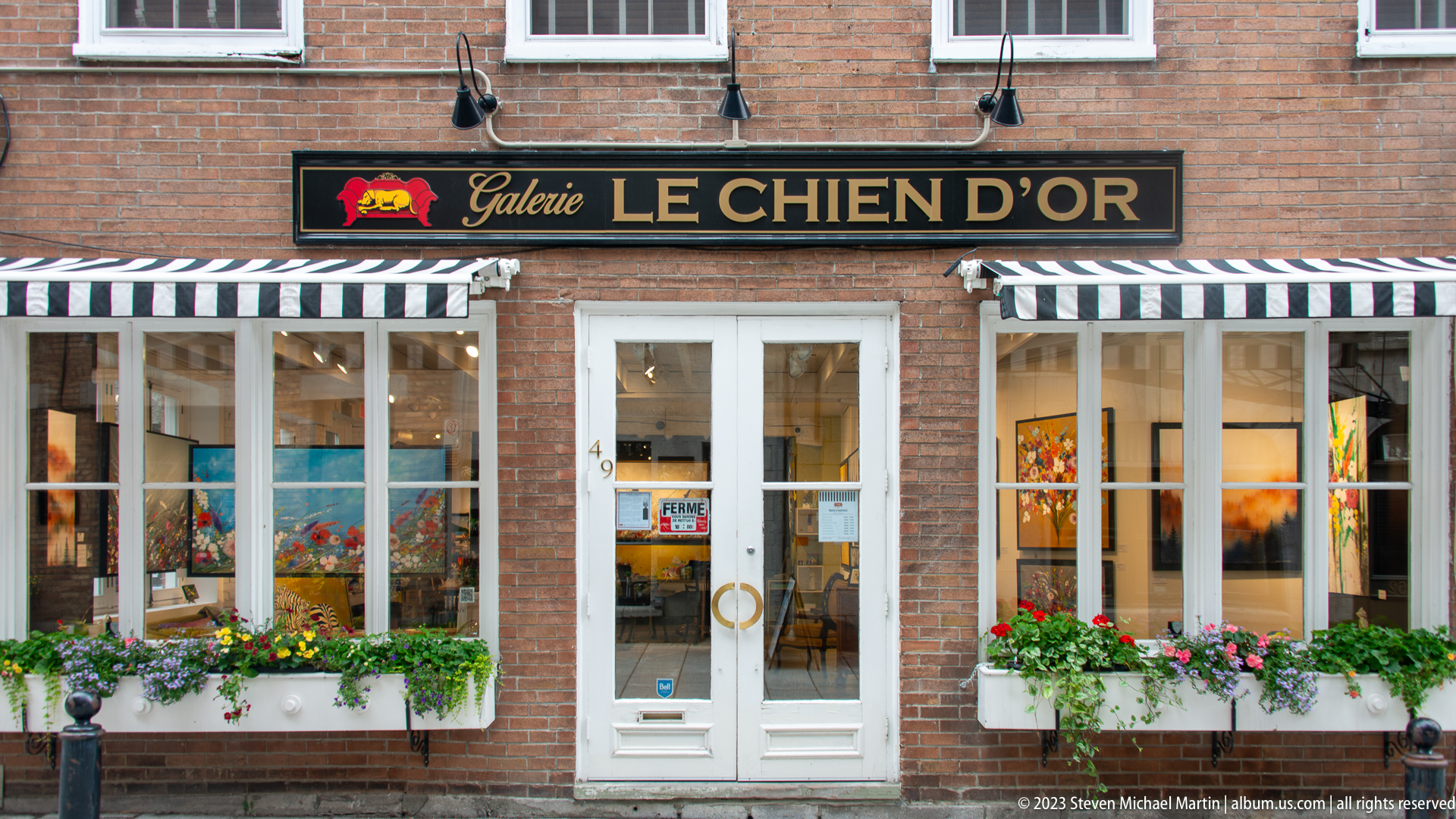
Galerie Le Chien d’Or presents a symmetrical brick storefront with striped awnings, white-framed windows, flower boxes, and artwork visible inside. The bold sign above the entrance supplies the gallery’s identity, while the carefully maintained façade illustrates the mix of cultural retail and historic architecture found in central Quebec City.
Caption
Galerie Le Chien d’Or presents a symmetrical brick storefront with striped awnings, white-framed windows, flower boxes, and artwork visible inside. The bold sign above the entrance supplies the gallery’s identity, while the carefully maintained façade illustrates the mix of cultural retail and historic architecture found in central Quebec City.
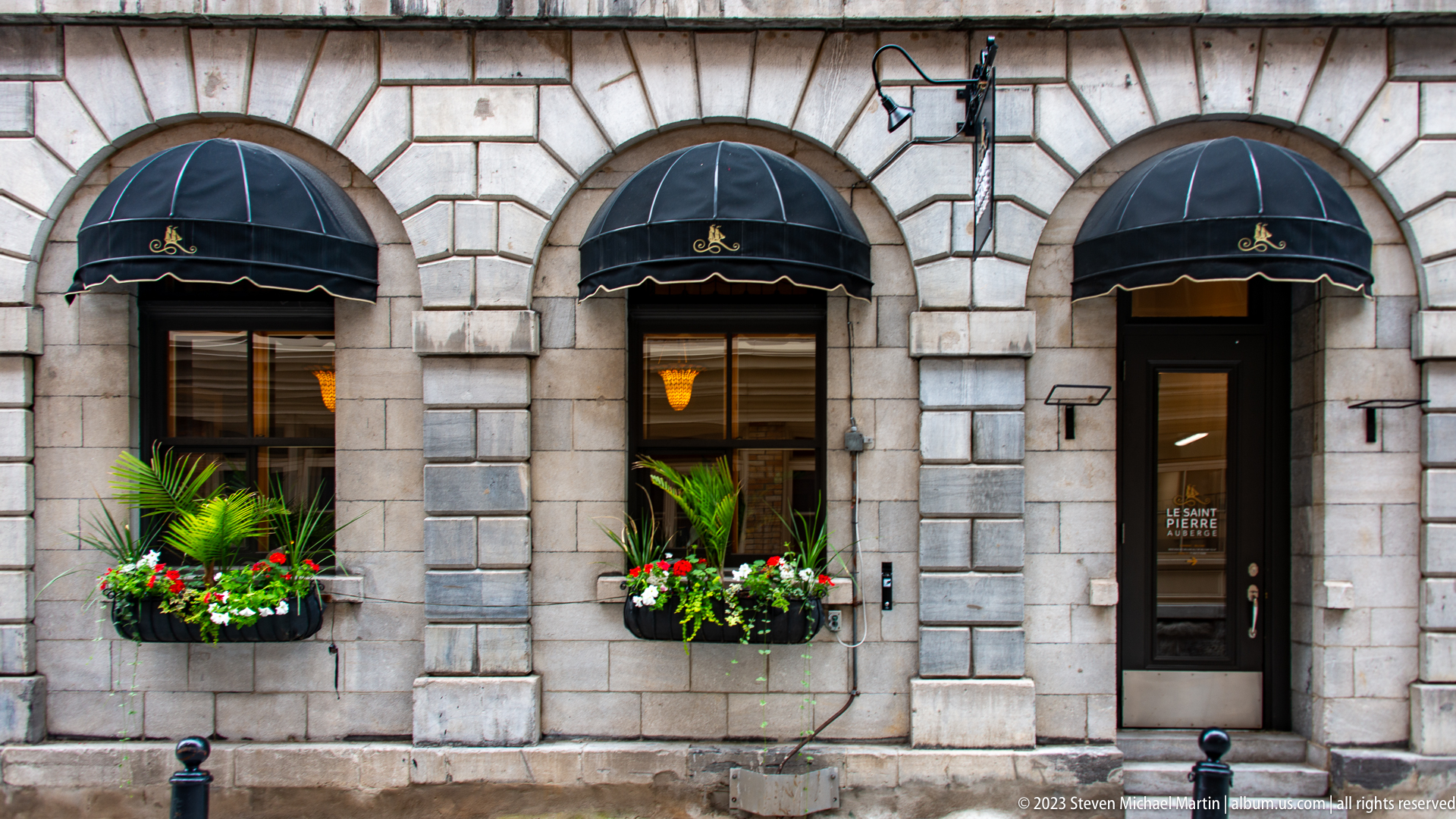
Three tall arched openings rhythmically divide a dressed-stone façade, each shaded by a black awning with small gold emblems. Flower boxes beneath the windows introduce palms and red-and-white blooms, giving the restrained masonry frontage a seasonal decorative layer along the Quebec City streetscape.
Caption
Three tall arched openings rhythmically divide a dressed-stone façade, each shaded by a black awning with small gold emblems. Flower boxes beneath the windows introduce palms and red-and-white blooms, giving the restrained masonry frontage a seasonal decorative layer along the Quebec City streetscape.
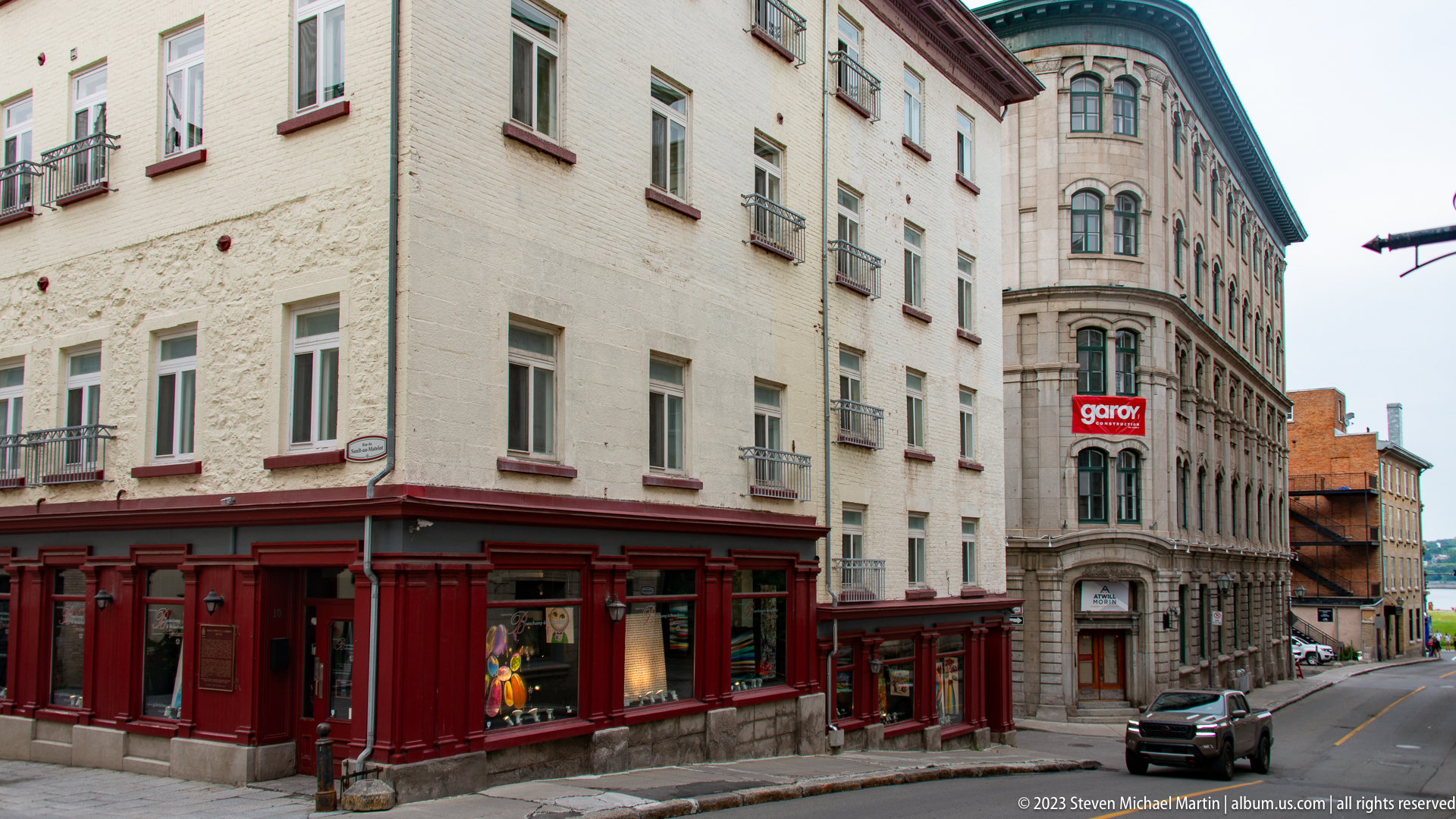
A pale masonry corner building with deep red storefront trim faces a more ornate rounded stone façade across the street. Sparse traffic and closely spaced upper-story windows emphasize the compact scale of the historic district, while the contrasting façades show the architectural variety packed into a single Quebec City intersection.
Caption
A pale masonry corner building with deep red storefront trim faces a more ornate rounded stone façade across the street. Sparse traffic and closely spaced upper-story windows emphasize the compact scale of the historic district, while the contrasting façades show the architectural variety packed into a single Quebec City intersection.
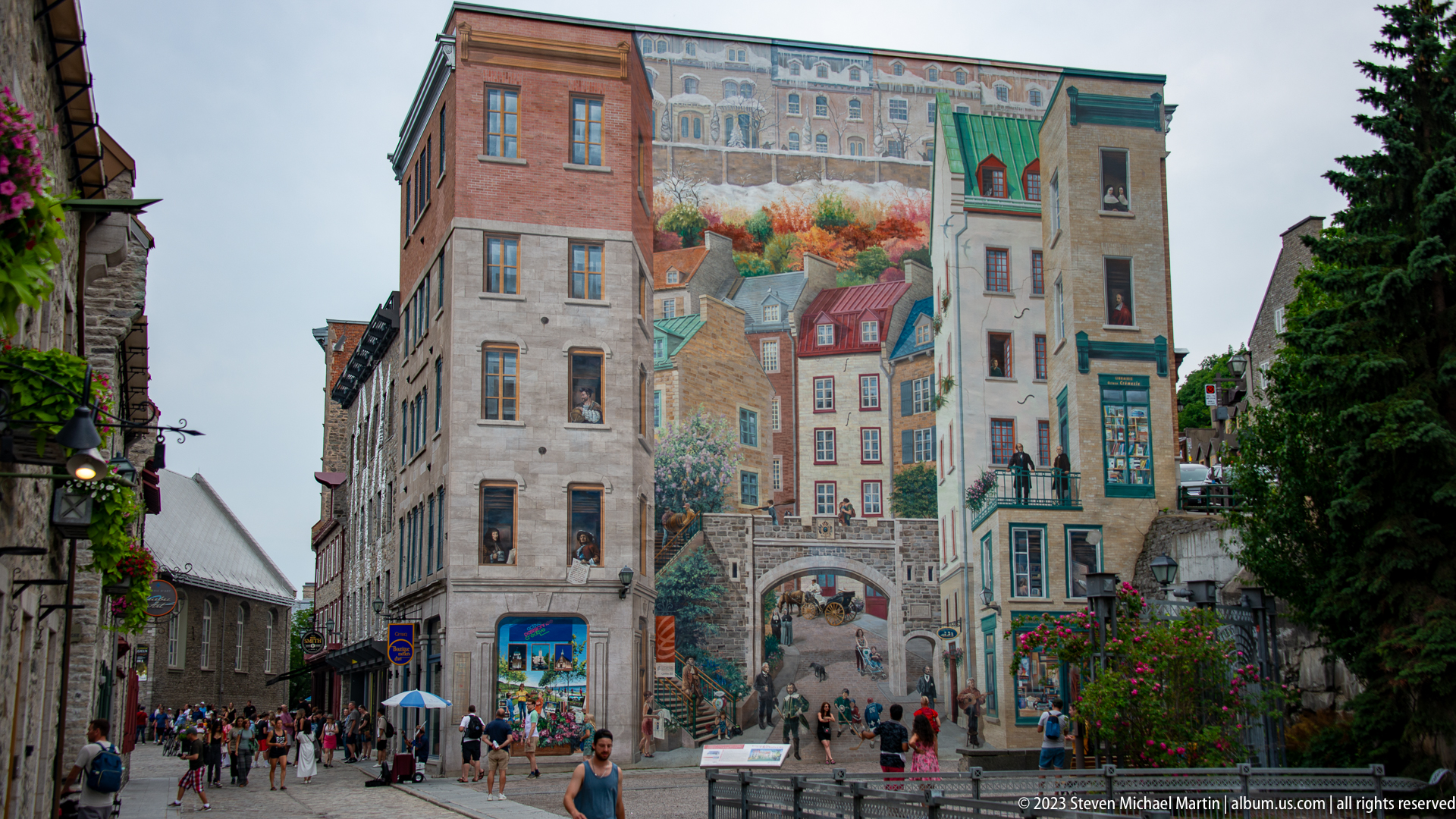
The large Fresque des Québécois transforms a blank building wall into an illusionistic architectural scene populated with figures and references to Quebec’s history. Painted windows, stonework, roofs, and an arched passage visually extend the surrounding streetscape, while visitors gather at the base of the mural in Old Quebec.
Caption
The large Fresque des Québécois transforms a blank building wall into an illusionistic architectural scene populated with figures and references to Quebec’s history. Painted windows, stonework, roofs, and an arched passage visually extend the surrounding streetscape, while visitors gather at the base of the mural in Old Quebec.
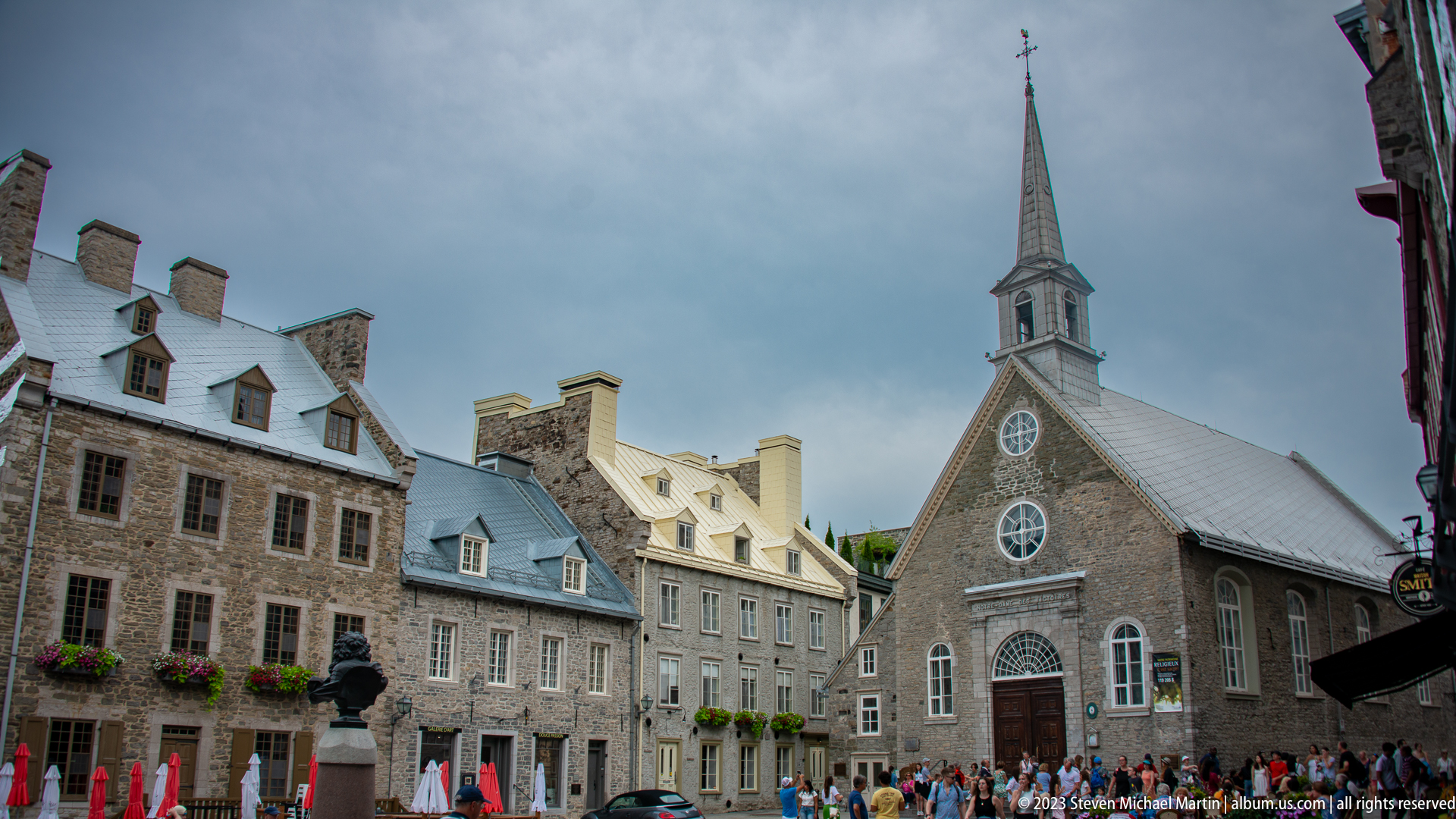
Notre-Dame-des-Victoires anchors Place Royale with its compact stone façade, steep metal roof, circular windows, and slender spire. Historic stone houses frame the church at left, while visitors gather across the square, showing the intimate scale of one of Old Quebec’s most recognizable ensembles.
Caption
Notre-Dame-des-Victoires anchors Place Royale with its compact stone façade, steep metal roof, circular windows, and slender spire. Historic stone houses frame the church at left, while visitors gather across the square, showing the intimate scale of one of Old Quebec’s most recognizable ensembles.
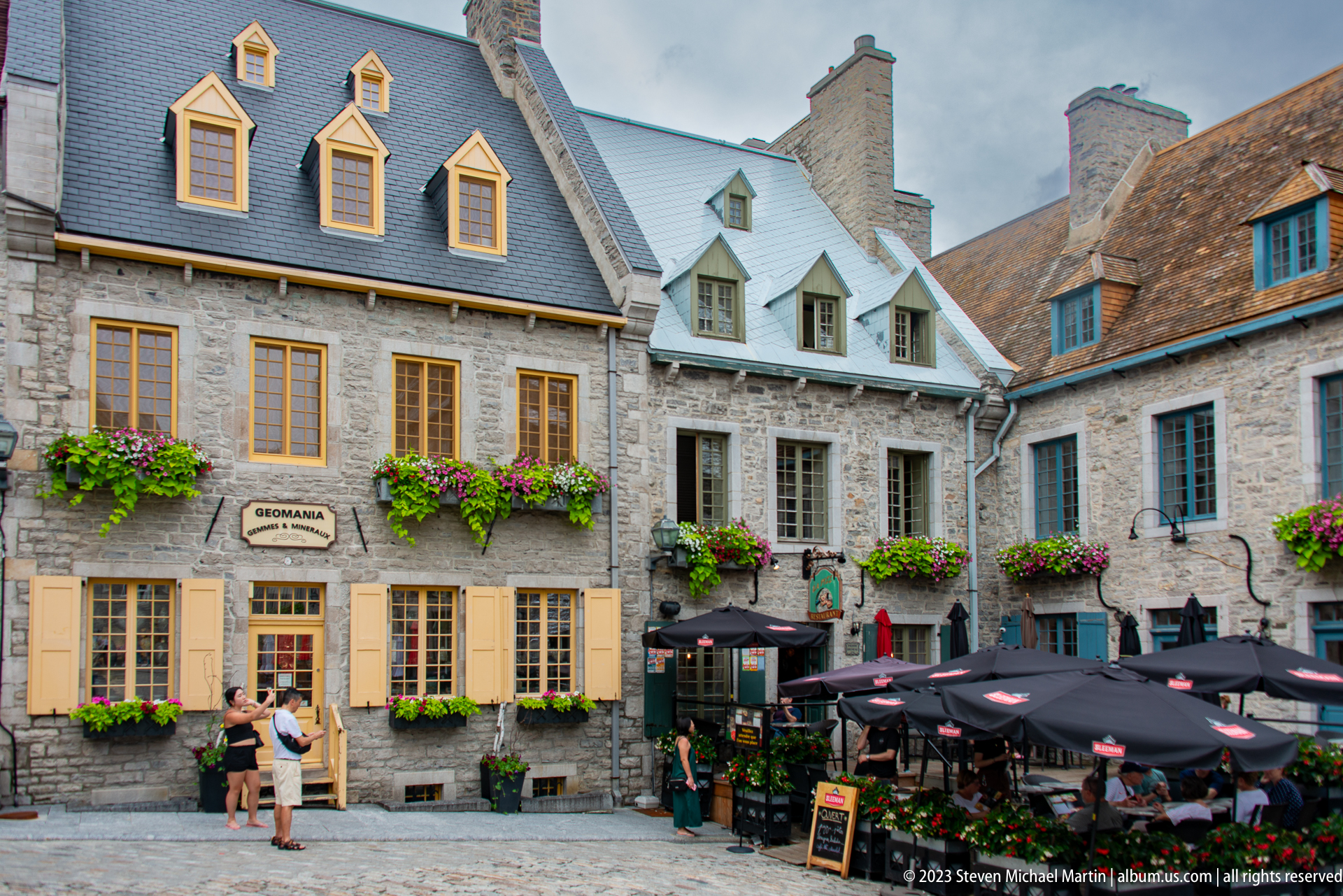
Stone houses with steep roofs, dormers, brightly painted window trim, and abundant flower boxes line the edge of Place Royale. A restaurant terrace fills the lower foreground beneath dark umbrellas, illustrating how the preserved residential-scale architecture of Old Quebec now accommodates active commercial use.
Caption
Stone houses with steep roofs, dormers, brightly painted window trim, and abundant flower boxes line the edge of Place Royale. A restaurant terrace fills the lower foreground beneath dark umbrellas, illustrating how the preserved residential-scale architecture of Old Quebec now accommodates active commercial use.
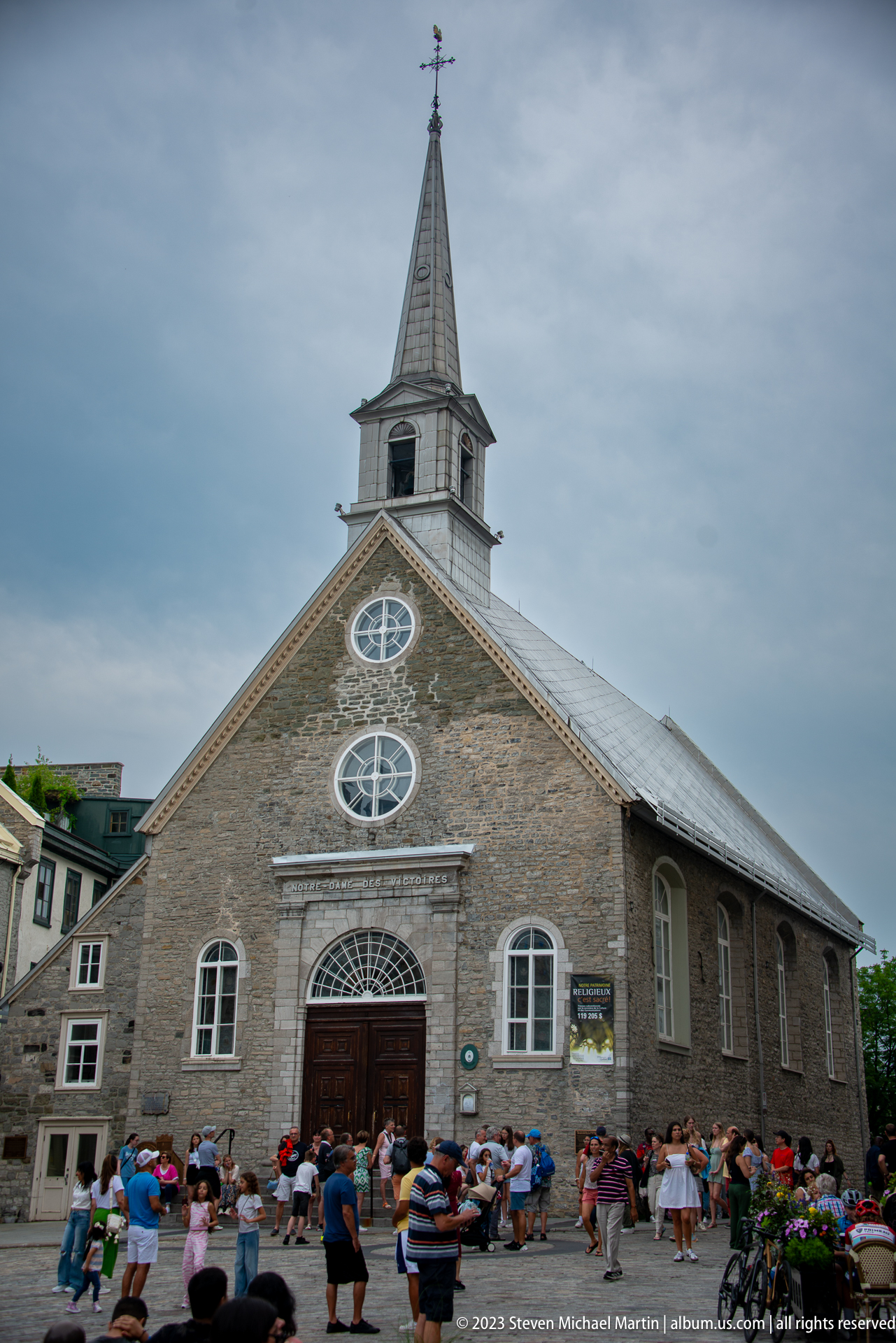
Viewed squarely from Place Royale, the façade of Notre-Dame-des-Victoires is reduced to its essential geometry: rough stone walls, an arched central doorway, paired circular windows, and a steep roof rising to the bell tower and spire. A crowd gathered across the foreground underscores the church’s modest scale within the historic square.
Caption
Viewed squarely from Place Royale, the façade of Notre-Dame-des-Victoires is reduced to its essential geometry: rough stone walls, an arched central doorway, paired circular windows, and a steep roof rising to the bell tower and spire. A crowd gathered across the foreground underscores the church’s modest scale within the historic square.
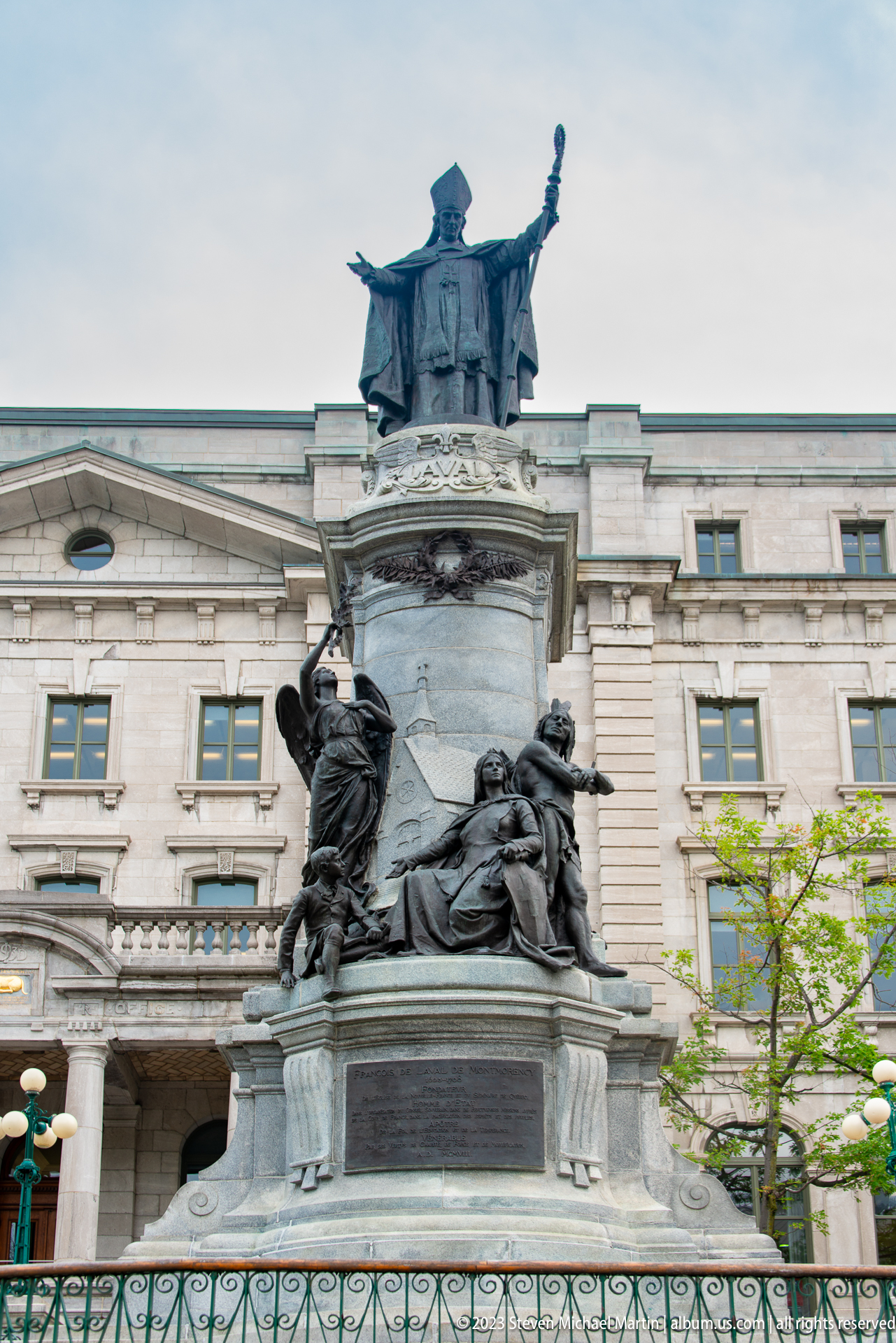
A monumental bronze-and-stone composition stands before a large institutional façade, combining a commanding figure at the summit with a clustered group of sculpted figures around the base. The upward viewpoint emphasizes the monument’s layered narrative design and its prominent placement in Quebec City’s civic landscape.
Caption
A monumental bronze-and-stone composition stands before a large institutional façade, combining a commanding figure at the summit with a clustered group of sculpted figures around the base. The upward viewpoint emphasizes the monument’s layered narrative design and its prominent placement in Quebec City’s civic landscape.
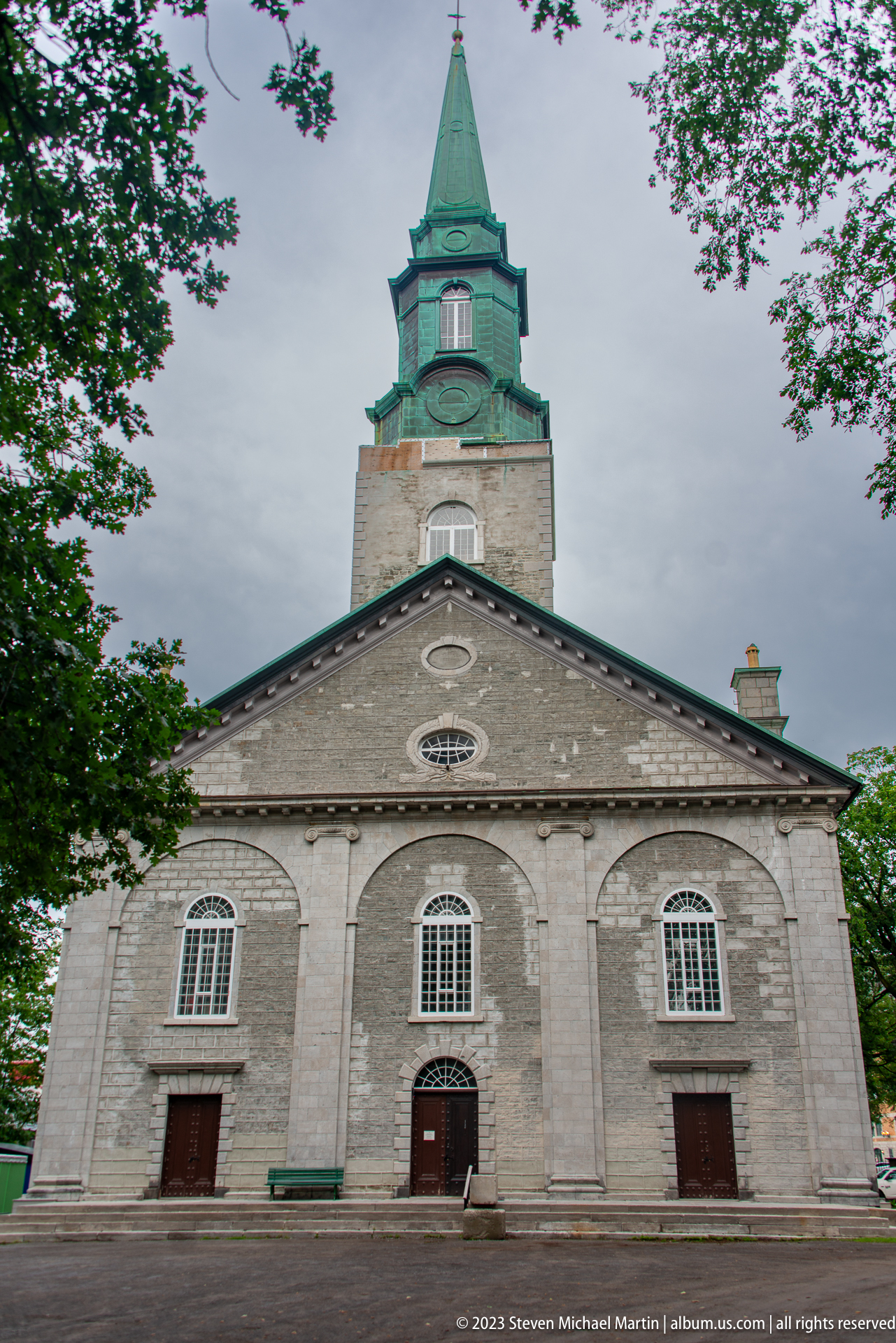
A restrained stone church façade is organized around three ground-level doors, round-arched windows, a classical pediment, and a tall central tower capped by a green metal spire. Seen from slightly below, the symmetrical elevation stands against an overcast sky and conveys the compact vertical massing typical of Quebec City’s historic religious architecture.
Caption
A restrained stone church façade is organized around three ground-level doors, round-arched windows, a classical pediment, and a tall central tower capped by a green metal spire. Seen from slightly below, the symmetrical elevation stands against an overcast sky and conveys the compact vertical massing typical of Quebec City’s historic religious architecture.
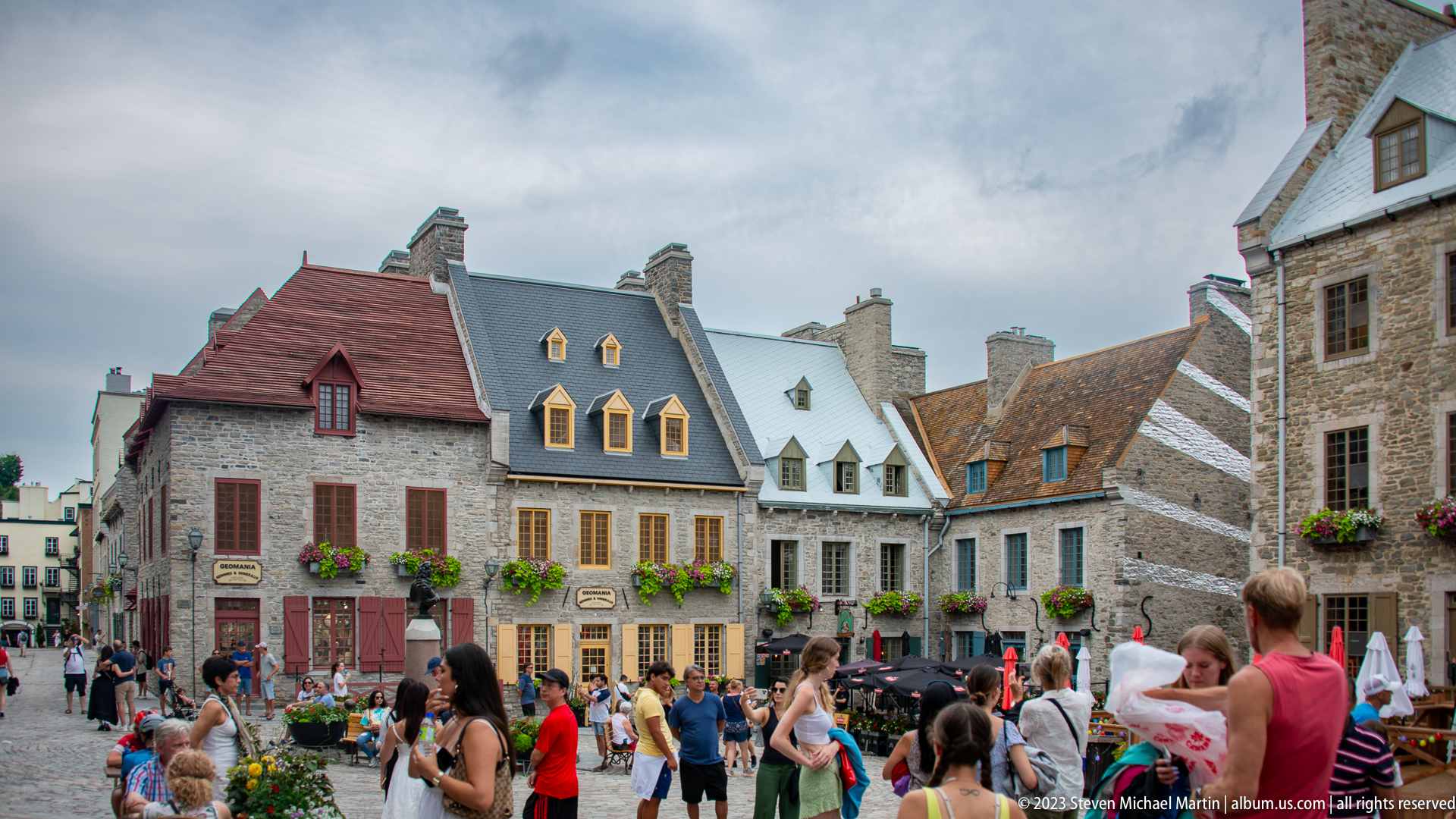
Visitors fill Place Royale in front of a tightly grouped row of stone buildings with steep roofs, dormers, colorful shutters, and flower boxes. The broad view shifts attention from a single façade to the square as a social space, where preserved architecture forms an active backdrop for pedestrians and outdoor dining.
Caption
Visitors fill Place Royale in front of a tightly grouped row of stone buildings with steep roofs, dormers, colorful shutters, and flower boxes. The broad view shifts attention from a single façade to the square as a social space, where preserved architecture forms an active backdrop for pedestrians and outdoor dining.
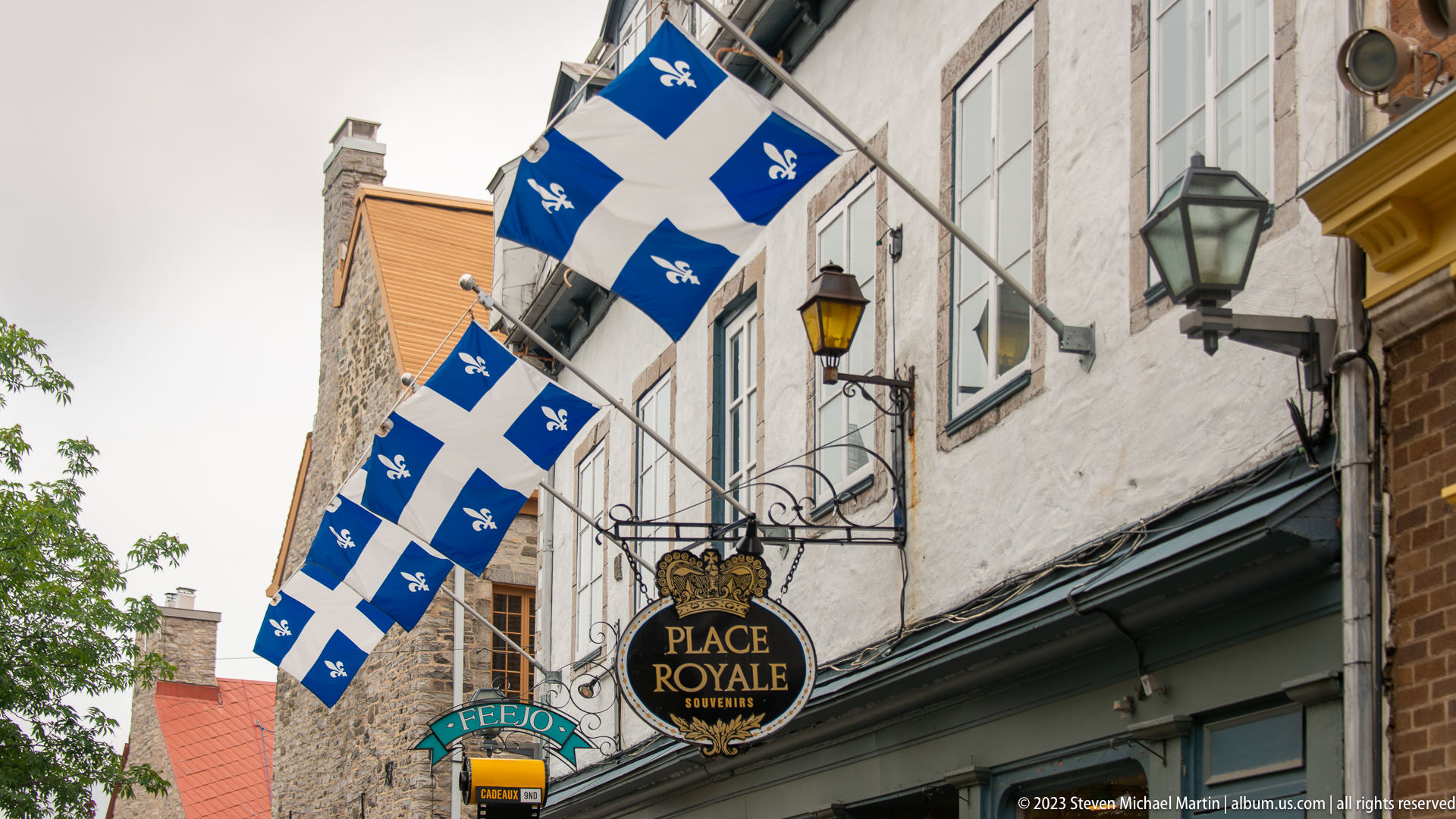
A row of Quebec flags projects from an upper façade above a hanging sign reading “Place Royale Souvenirs.” The close street-level view combines provincial symbols, traditional wall-mounted lanterns, and commercial signage, recording how the historic district’s narrow façades are animated by contemporary retail.
Caption
A row of Quebec flags projects from an upper façade above a hanging sign reading “Place Royale Souvenirs.” The close street-level view combines provincial symbols, traditional wall-mounted lanterns, and commercial signage, recording how the historic district’s narrow façades are animated by contemporary retail.
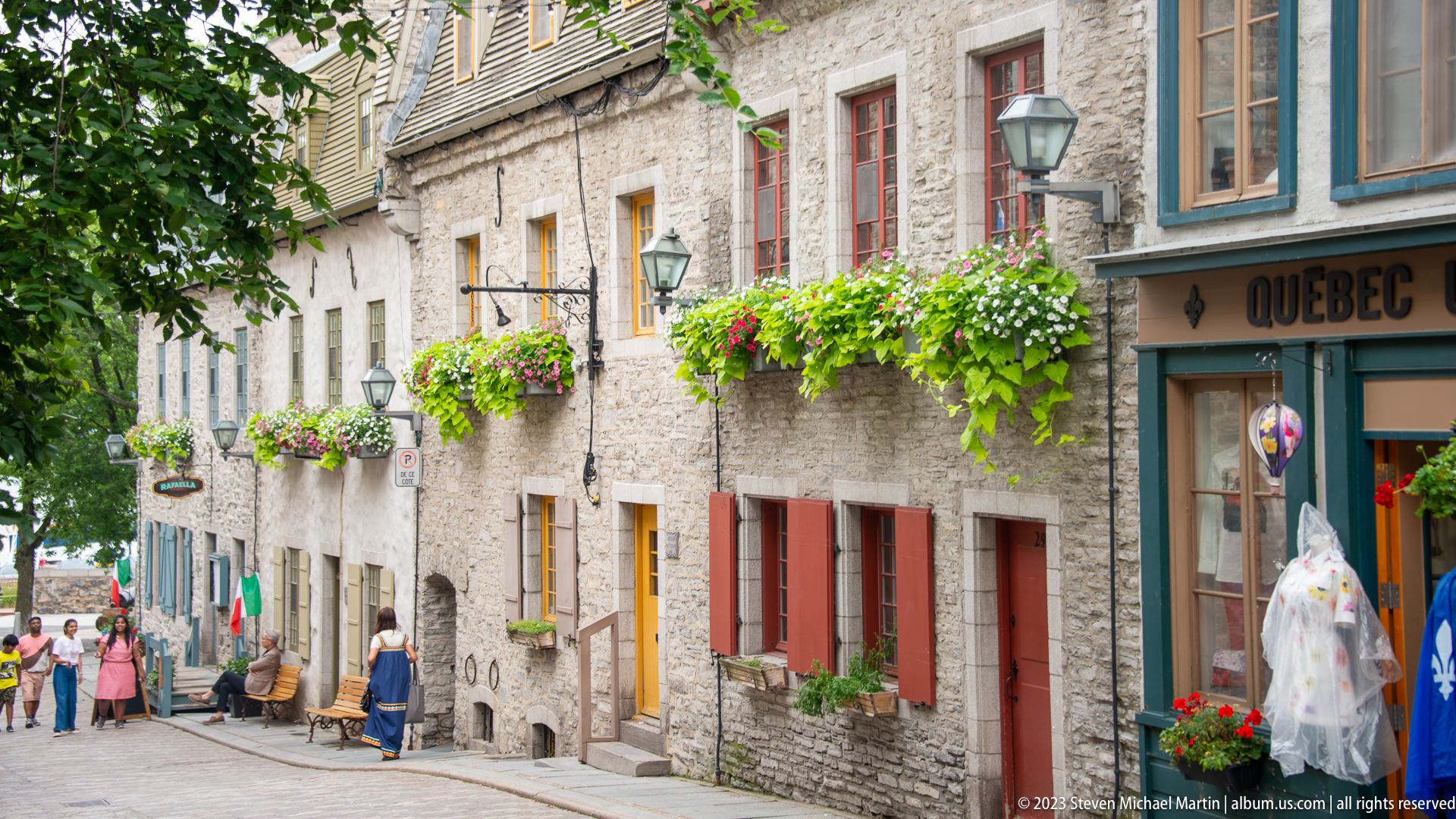
Rough stone façades line a gently descending Old Quebec street, their small windows accented by red and blue trim and overflowing flower boxes. Traditional wall lanterns and a shop entrance at right reinforce the pedestrian scale, while figures farther down the street provide depth and everyday activity.
Caption
Rough stone façades line a gently descending Old Quebec street, their small windows accented by red and blue trim and overflowing flower boxes. Traditional wall lanterns and a shop entrance at right reinforce the pedestrian scale, while figures farther down the street provide depth and everyday activity.
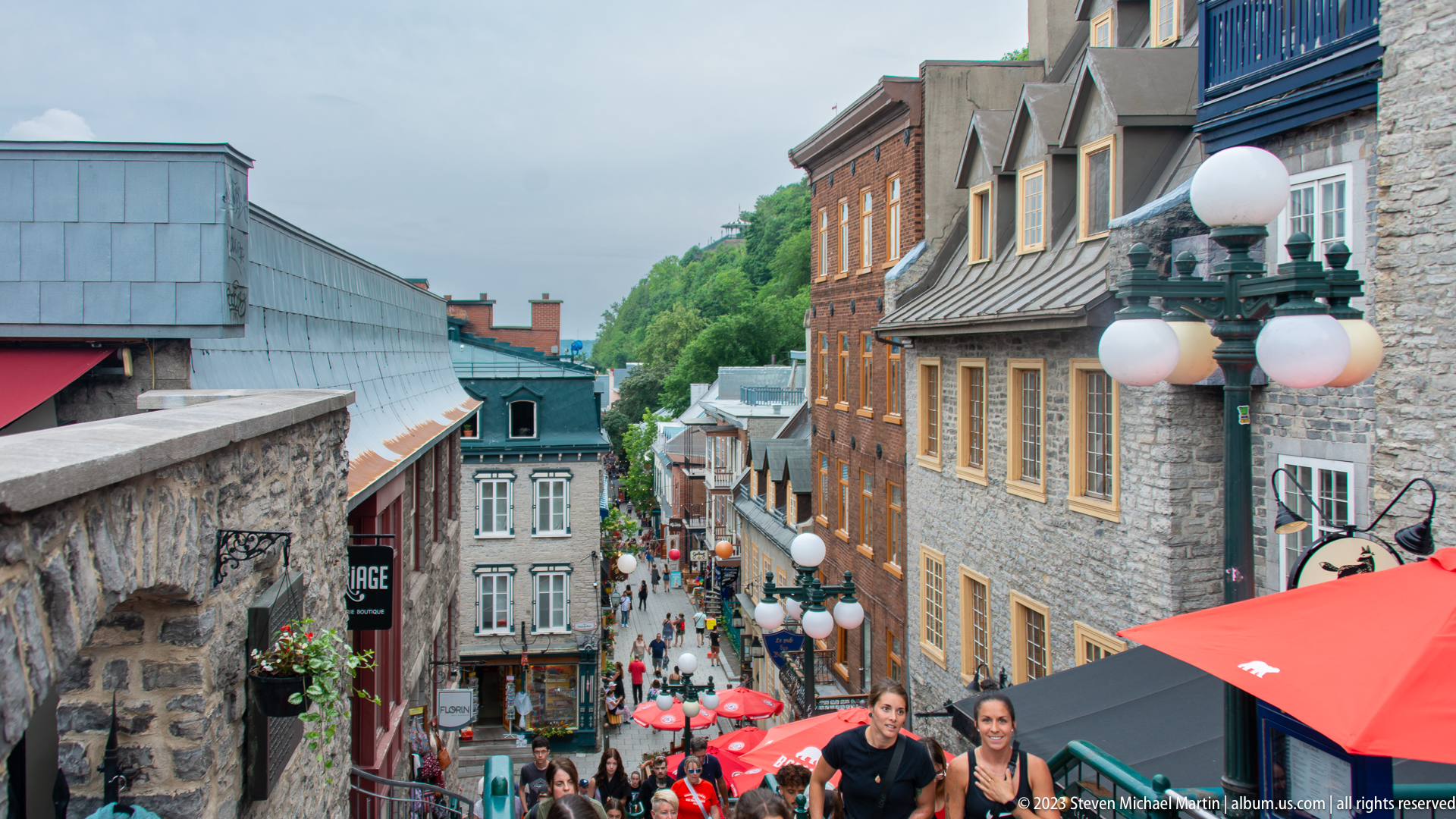
A steep stairway descends through a dense corridor of historic buildings and restaurants, with globe-topped streetlamps and bright café umbrellas stepping down the slope. The elevated viewpoint makes Quebec City’s dramatic topography especially apparent, compressing roofs, façades, pedestrians, and commercial activity into a narrow vertical streetscape.
Caption
A steep stairway descends through a dense corridor of historic buildings and restaurants, with globe-topped streetlamps and bright café umbrellas stepping down the slope. The elevated viewpoint makes Quebec City’s dramatic topography especially apparent, compressing roofs, façades, pedestrians, and commercial activity into a narrow vertical streetscape.
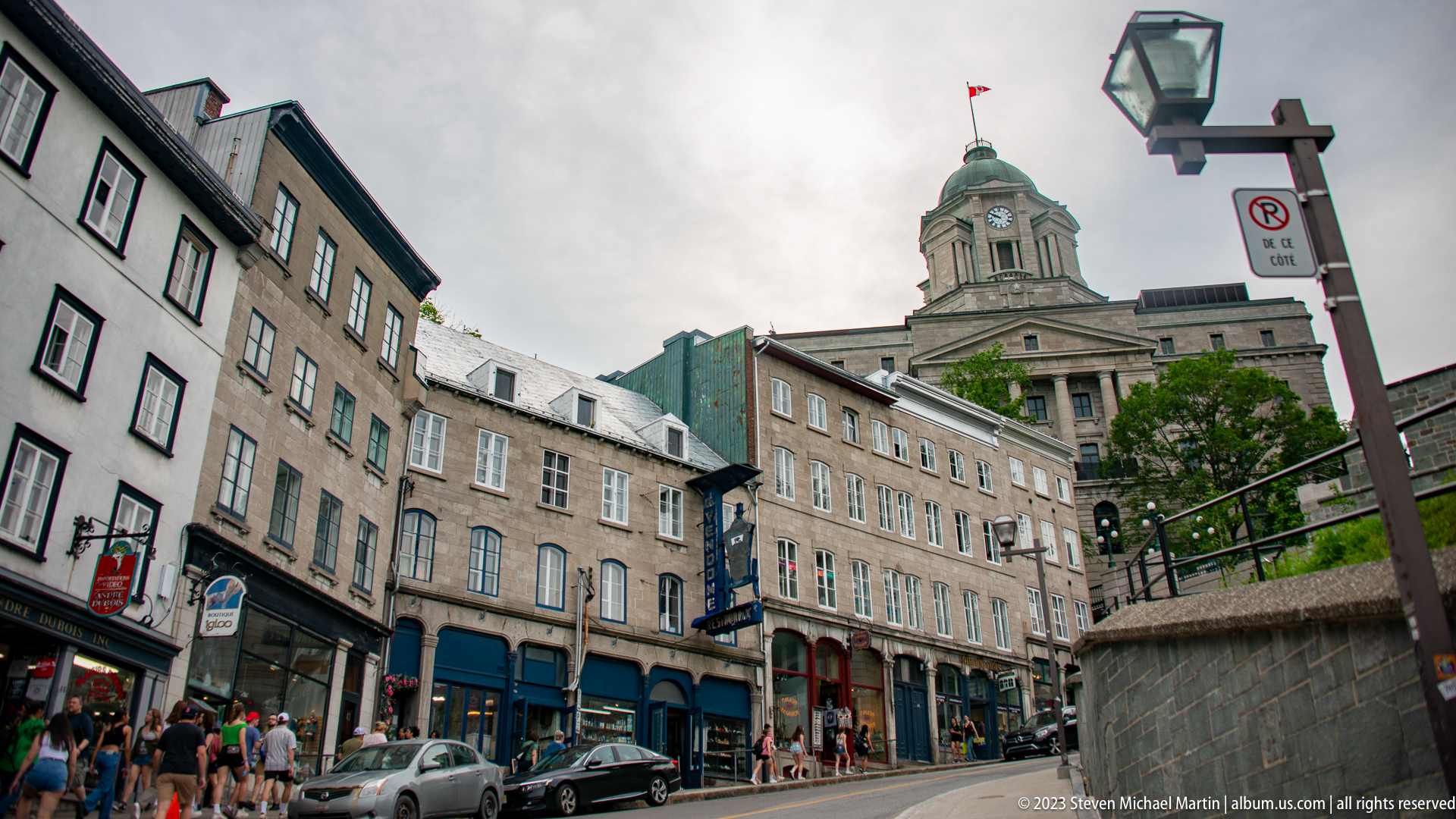
The tower of Quebec City Hall rises above a row of historic commercial buildings, its greenish roof and flag visible beyond the street façades. Cars, pedestrians, shop signs, and the elevated stone edge at right place the civic landmark within the everyday circulation of Old Quebec rather than isolating it as a formal architectural portrait.
Caption
The tower of Quebec City Hall rises above a row of historic commercial buildings, its greenish roof and flag visible beyond the street façades. Cars, pedestrians, shop signs, and the elevated stone edge at right place the civic landmark within the everyday circulation of Old Quebec rather than isolating it as a formal architectural portrait.
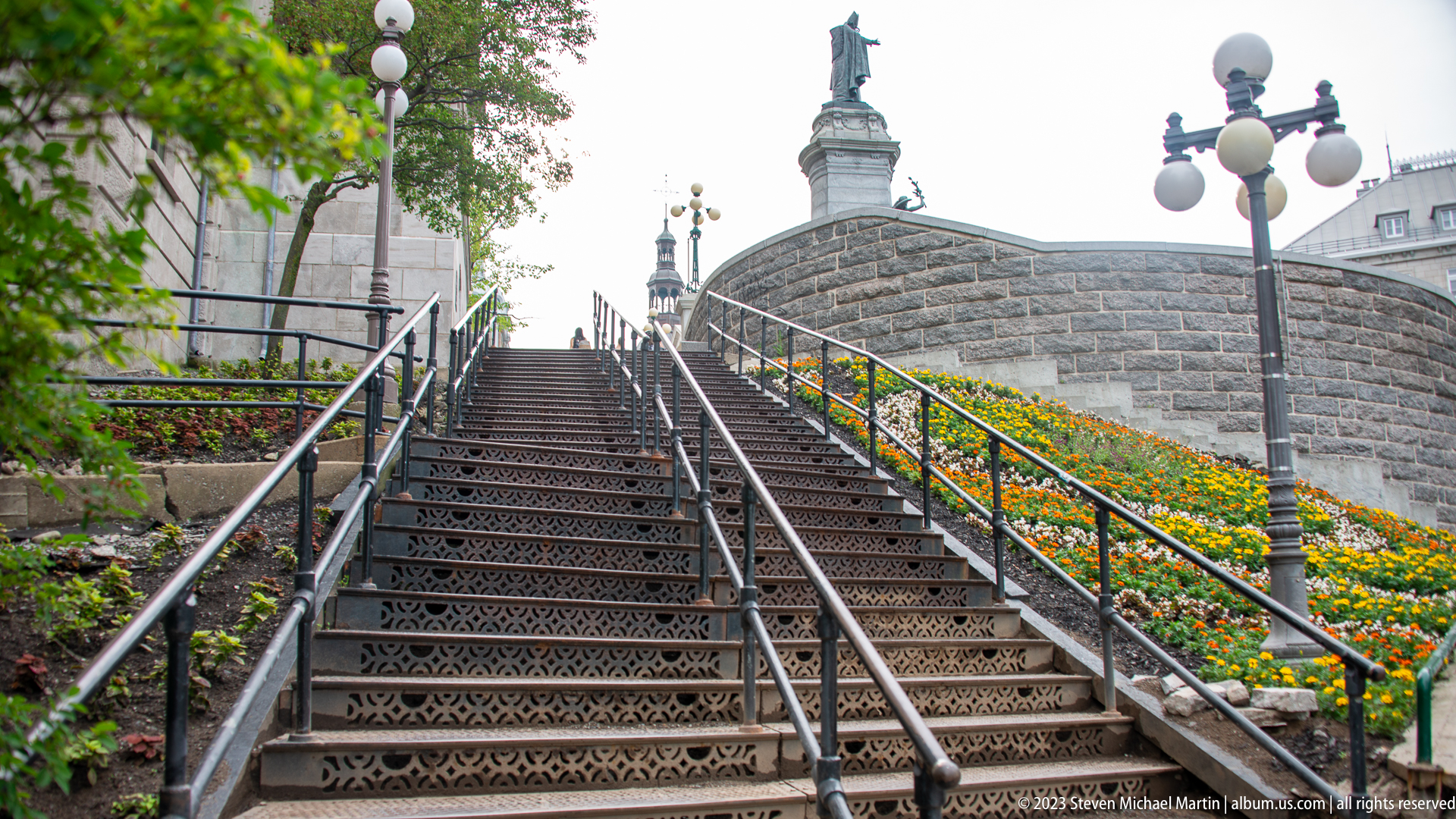
An ornate metal staircase climbs beside a massive stone retaining wall planted with dense bands of orange and yellow flowers. Decorative globe streetlamps and a monument visible at the upper landing turn the utilitarian change in grade into a carefully composed civic passage through central Quebec City.
Caption
An ornate metal staircase climbs beside a massive stone retaining wall planted with dense bands of orange and yellow flowers. Decorative globe streetlamps and a monument visible at the upper landing turn the utilitarian change in grade into a carefully composed civic passage through central Quebec City.
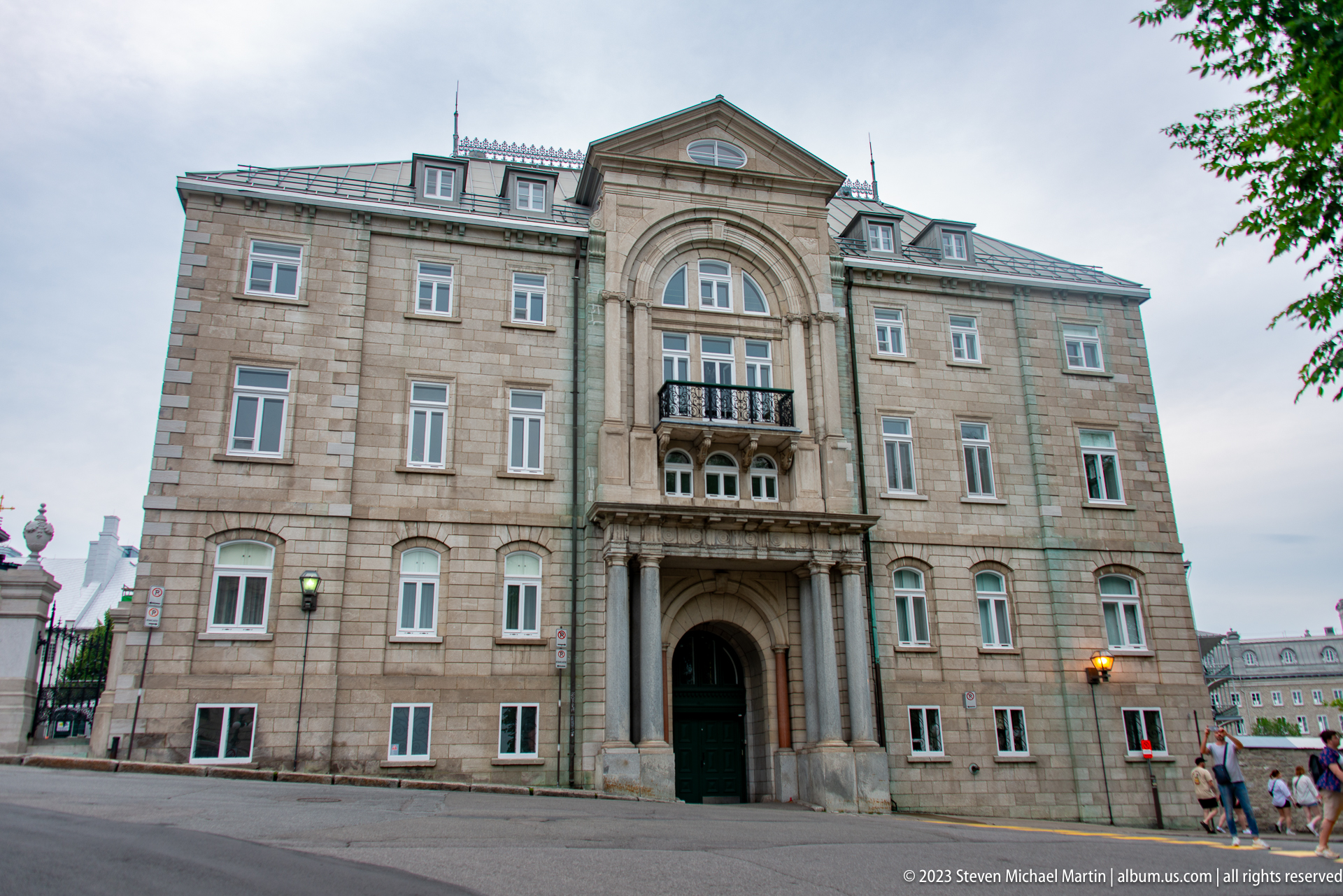
A symmetrical institutional building presents a restrained stone façade centered on a deeply arched entrance and a tall window bay framed by classical detailing. Regular sash windows and a low roofline give the structure a formal civic presence, while the nearly frontal viewpoint records the entire principal elevation.
Caption
A symmetrical institutional building presents a restrained stone façade centered on a deeply arched entrance and a tall window bay framed by classical detailing. Regular sash windows and a low roofline give the structure a formal civic presence, while the nearly frontal viewpoint records the entire principal elevation.
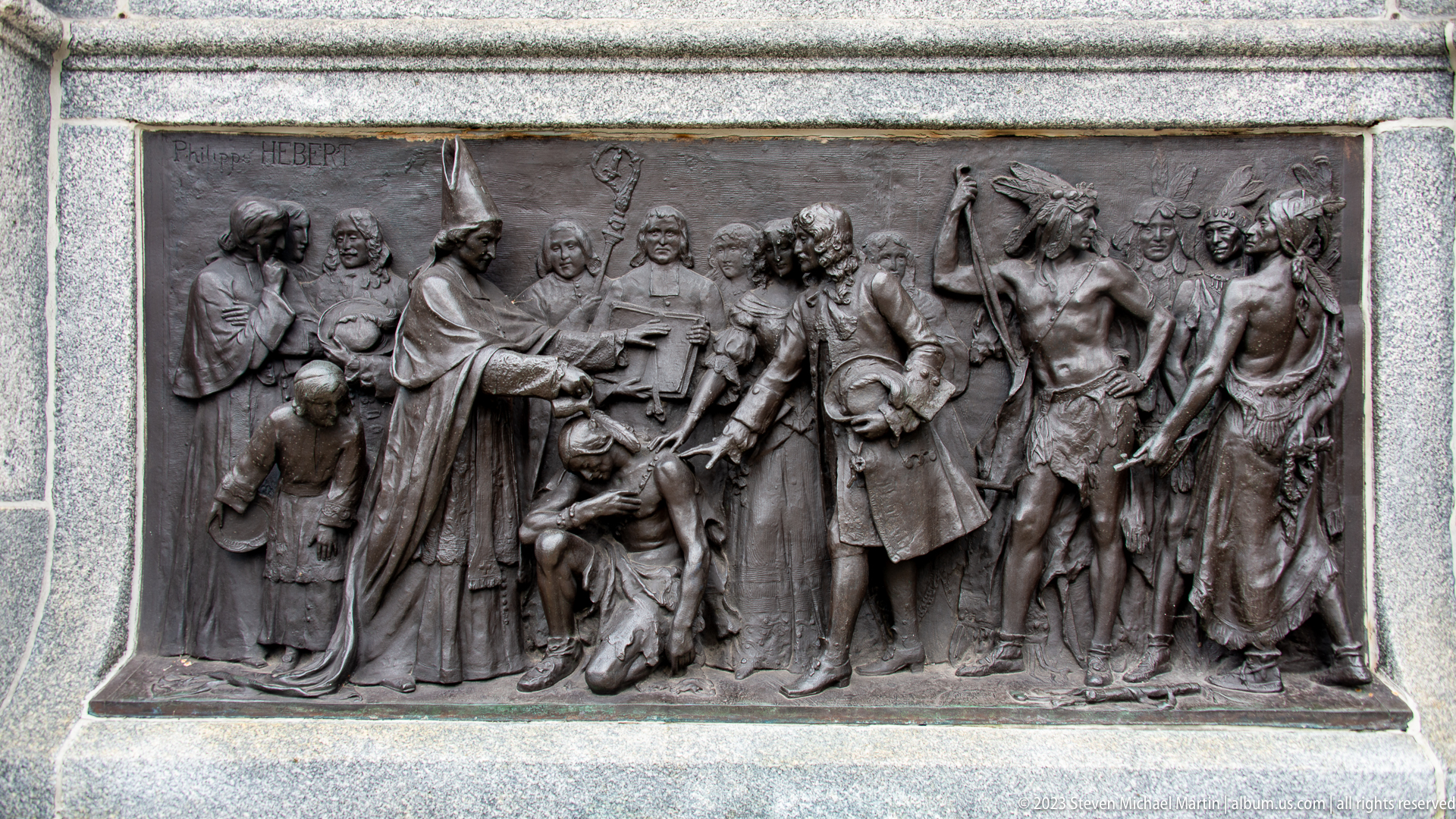
A bronze bas-relief presents a dense gathering of historical figures in varied dress, arranged around a central interaction and extending across a rectangular stone-framed panel. The shallow sculptural depth, overlapping bodies, gestures, and flags create a continuous narrative scene intended to be read across the surface.
Caption
A bronze bas-relief presents a dense gathering of historical figures in varied dress, arranged around a central interaction and extending across a rectangular stone-framed panel. The shallow sculptural depth, overlapping bodies, gestures, and flags create a continuous narrative scene intended to be read across the surface.
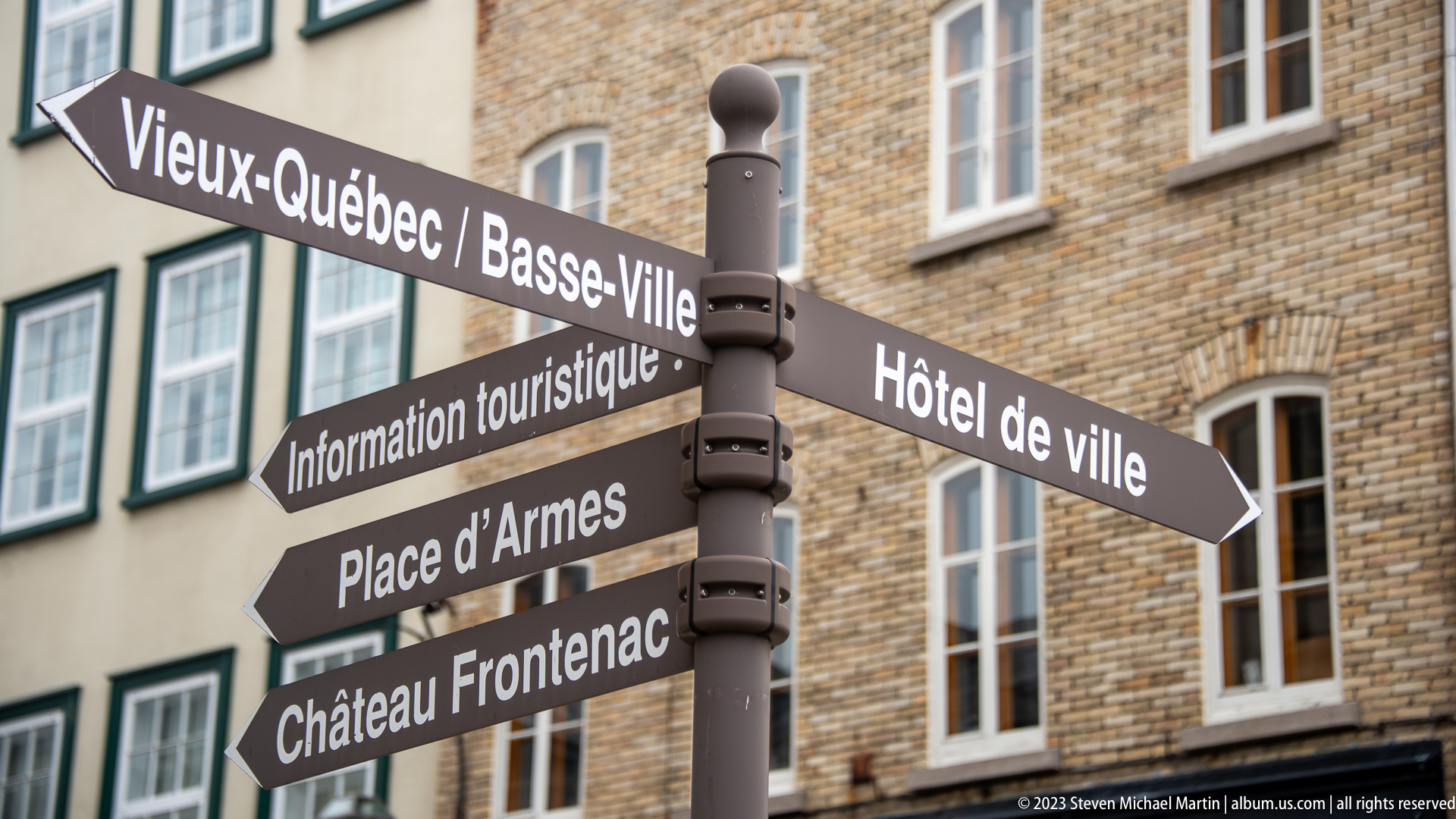
A multi-arm wayfinding sign points visitors toward Vieux-Québec/Basse-Ville, Hôtel de ville, tourist information, Place d’Armes, and Château Frontenac. Isolated against brick and painted façades, the sign functions as a concise map of several major destinations within the historic center.
Caption
A multi-arm wayfinding sign points visitors toward Vieux-Québec/Basse-Ville, Hôtel de ville, tourist information, Place d’Armes, and Château Frontenac. Isolated against brick and painted façades, the sign functions as a concise map of several major destinations within the historic center.
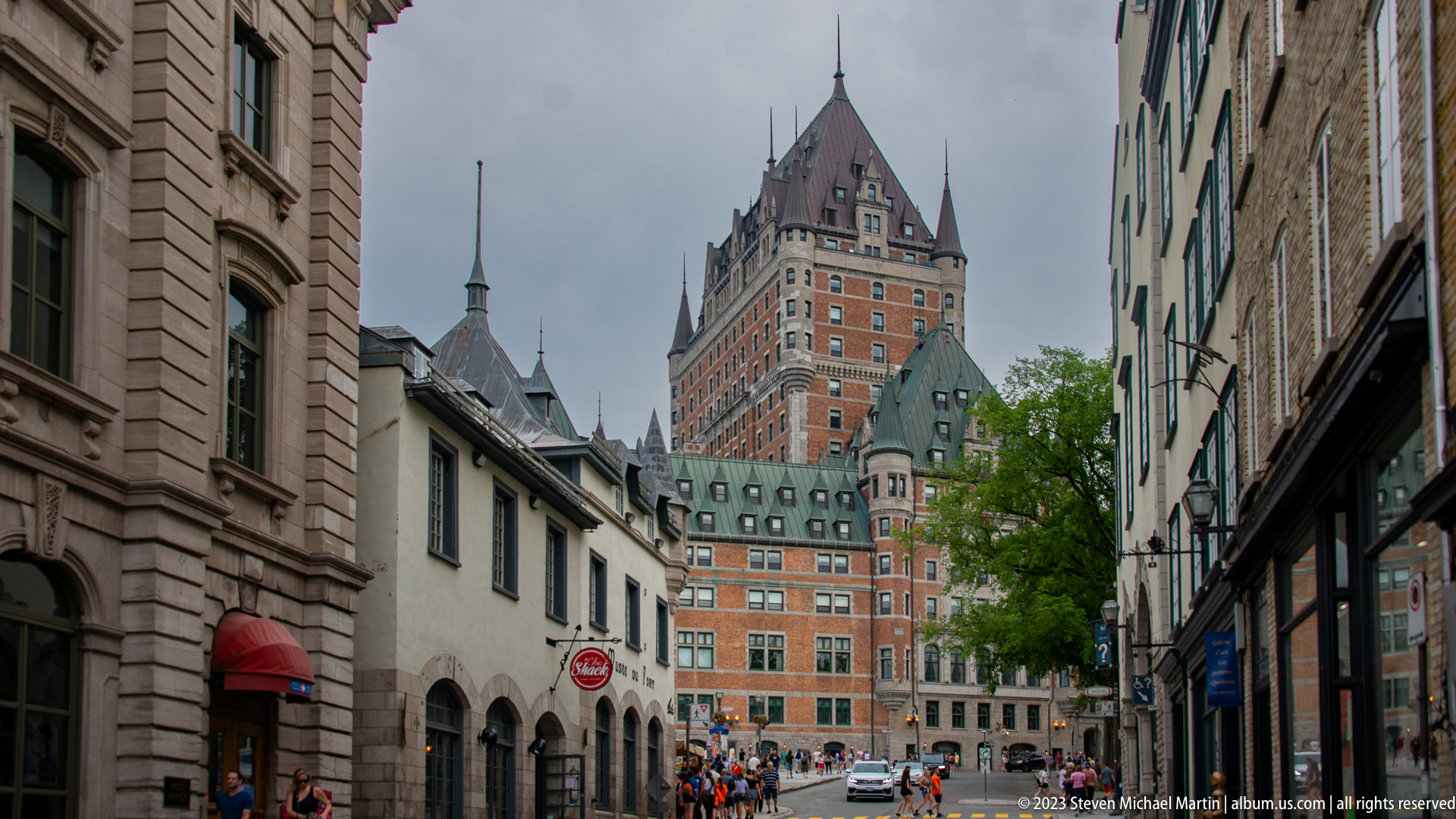
Fairmont Le Château Frontenac rises at the end of a narrow Old Quebec street, its steep copper roofs, turrets, and tall central mass appearing above lower stone and stucco buildings. The street-level approach emphasizes the hotel’s commanding relationship to the surrounding historic fabric rather than presenting the landmark in isolation.
Caption
Fairmont Le Château Frontenac rises at the end of a narrow Old Quebec street, its steep copper roofs, turrets, and tall central mass appearing above lower stone and stucco buildings. The street-level approach emphasizes the hotel’s commanding relationship to the surrounding historic fabric rather than presenting the landmark in isolation.
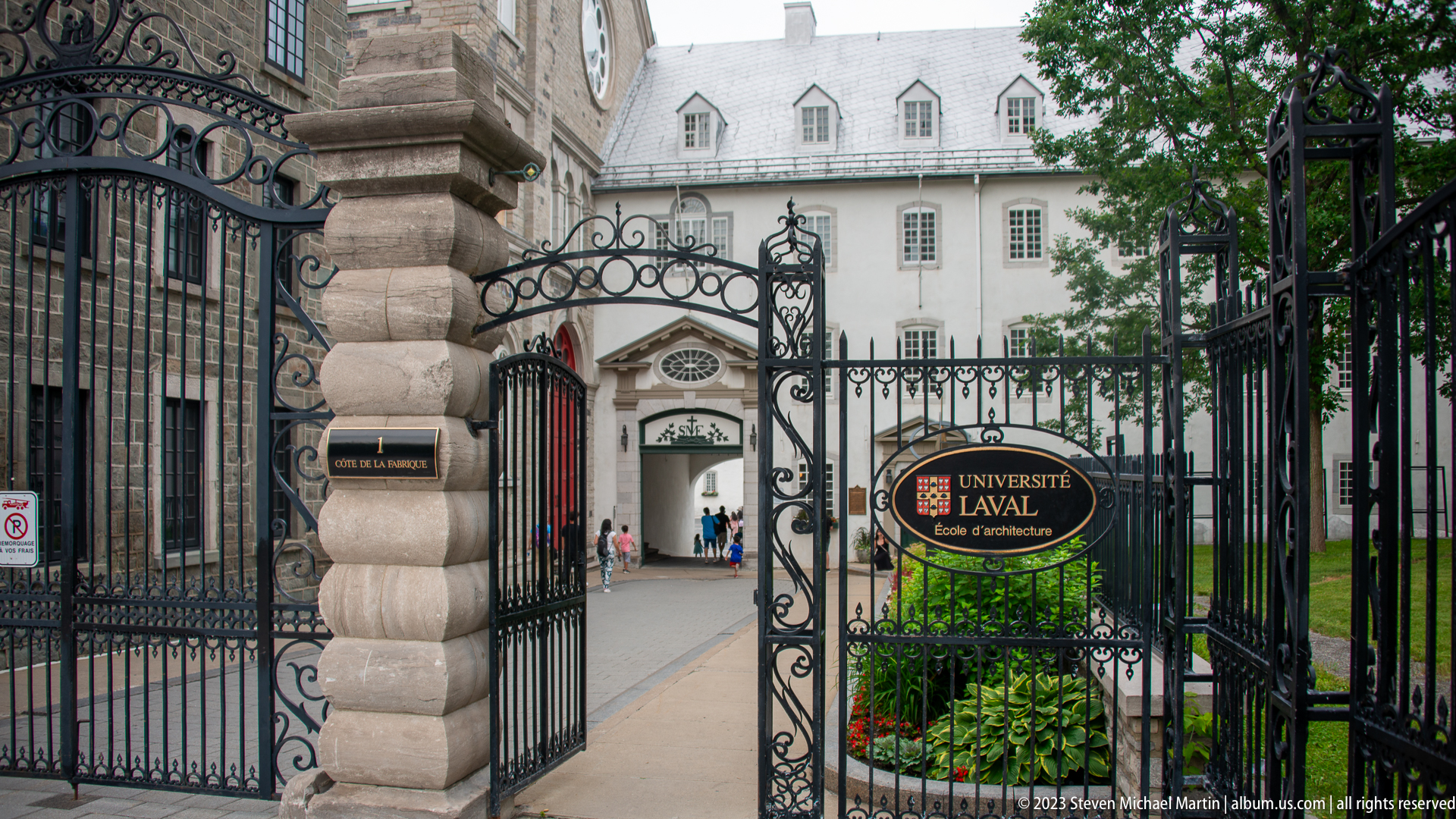
Ornamental iron gates open onto a courtyard entrance marked by a sign for “Université Laval — École d’architecture.” Heavy stone gateposts and a pale historic building beyond frame the institutional approach, linking a contemporary university program with the architectural fabric of Old Quebec.
Caption
Ornamental iron gates open onto a courtyard entrance marked by a sign for “Université Laval — École d’architecture.” Heavy stone gateposts and a pale historic building beyond frame the institutional approach, linking a contemporary university program with the architectural fabric of Old Quebec.
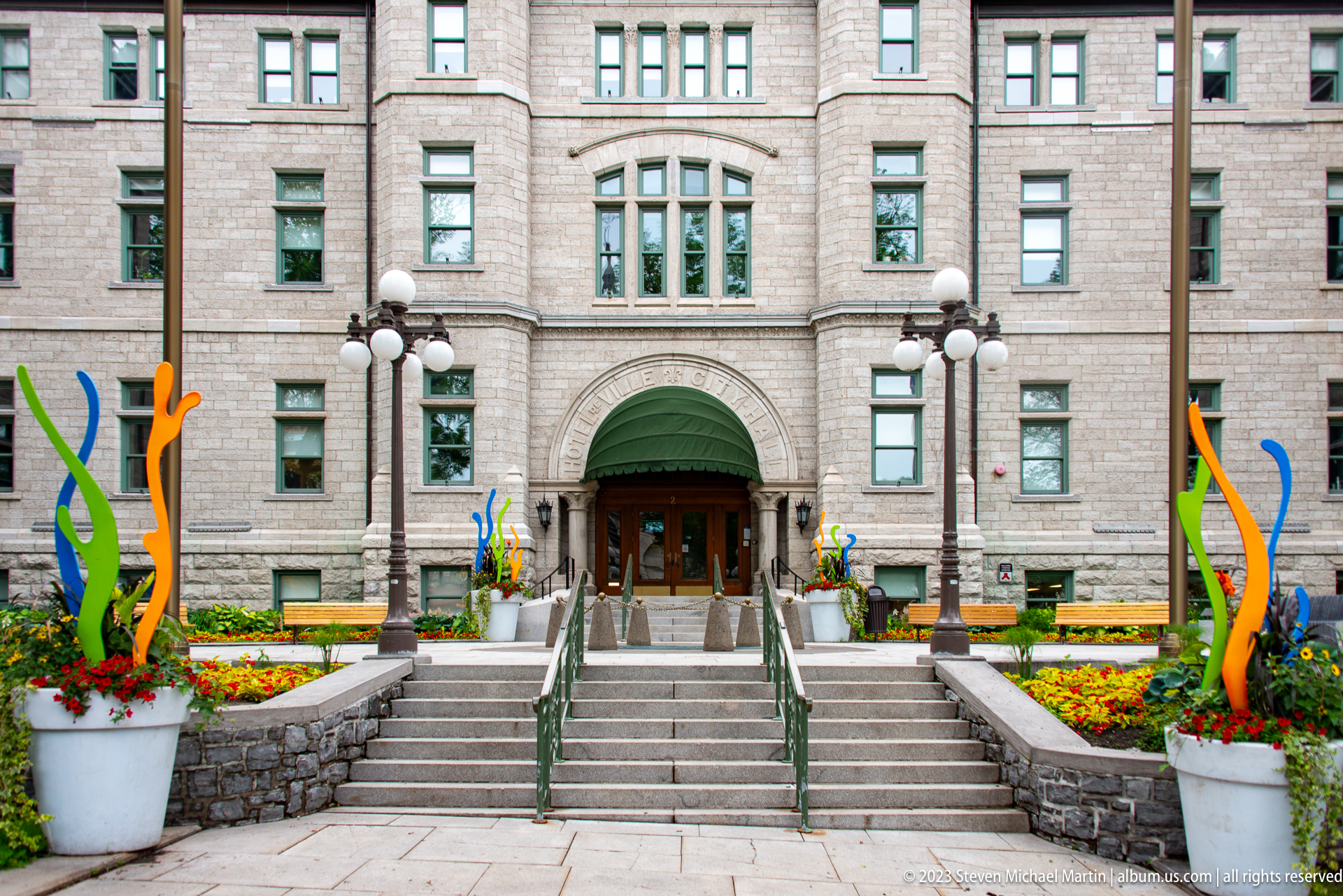
A broad stair and central arched entrance organize the symmetrical stone façade of this institutional building. Globe lamps, formal flower beds, clipped landscaping, and brightly colored abstract sculptures create a ceremonial forecourt, while the frontal composition records the relationship between architecture and seasonal public-space design.
Caption
A broad stair and central arched entrance organize the symmetrical stone façade of this institutional building. Globe lamps, formal flower beds, clipped landscaping, and brightly colored abstract sculptures create a ceremonial forecourt, while the frontal composition records the relationship between architecture and seasonal public-space design.
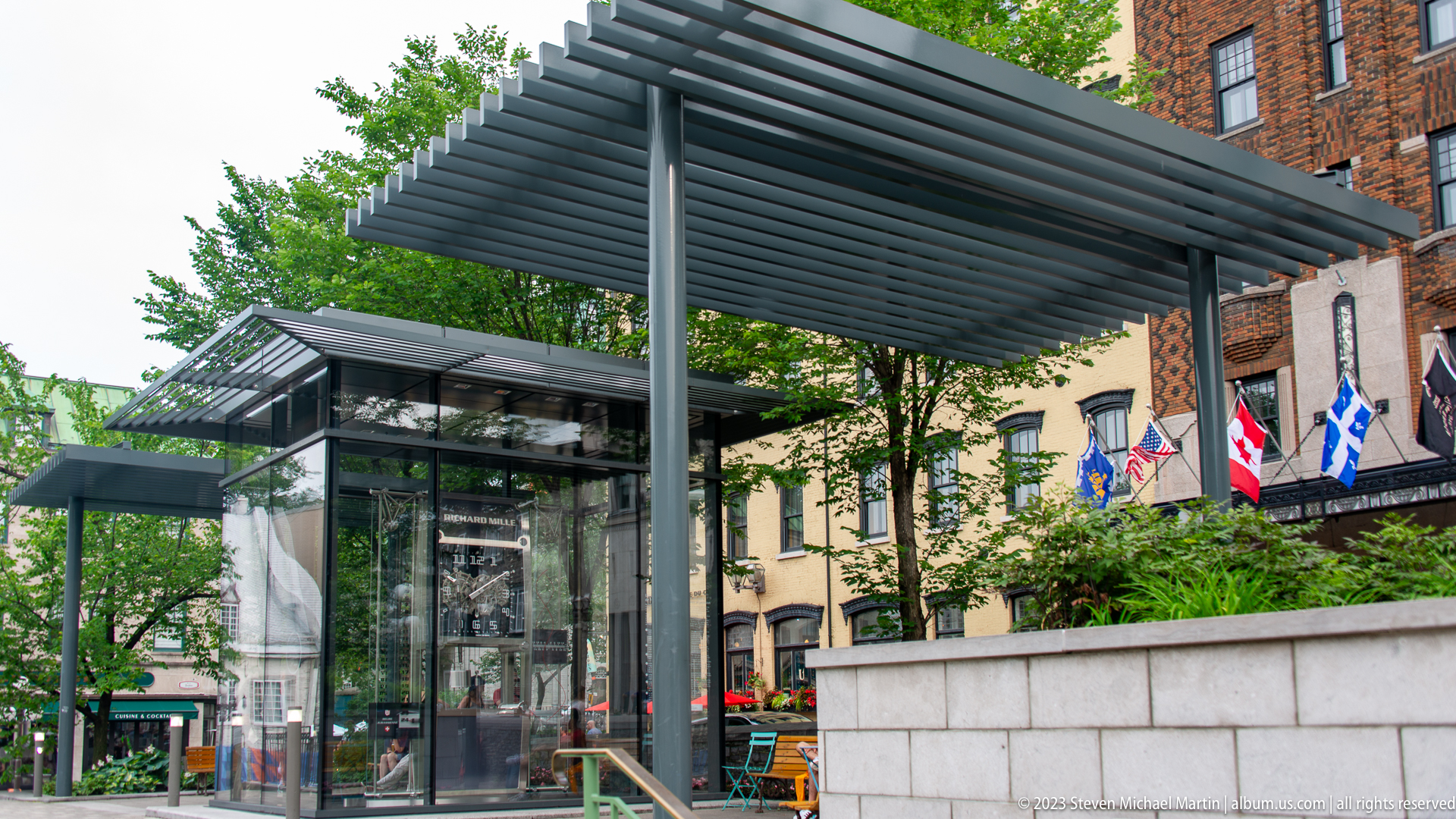
A compact glass-and-steel pavilion stands beneath a broad slatted canopy in the historic core of Quebec City. Transparent walls reveal the structure within, while mature trees, stone retaining walls, flags, and older masonry buildings frame the contemporary intervention. The contrast between lightweight modern construction and the surrounding traditional streetscape is the defining visual subject.
Caption
A compact glass-and-steel pavilion stands beneath a broad slatted canopy in the historic core of Quebec City. Transparent walls reveal the structure within, while mature trees, stone retaining walls, flags, and older masonry buildings frame the contemporary intervention. The contrast between lightweight modern construction and the surrounding traditional streetscape is the defining visual subject.
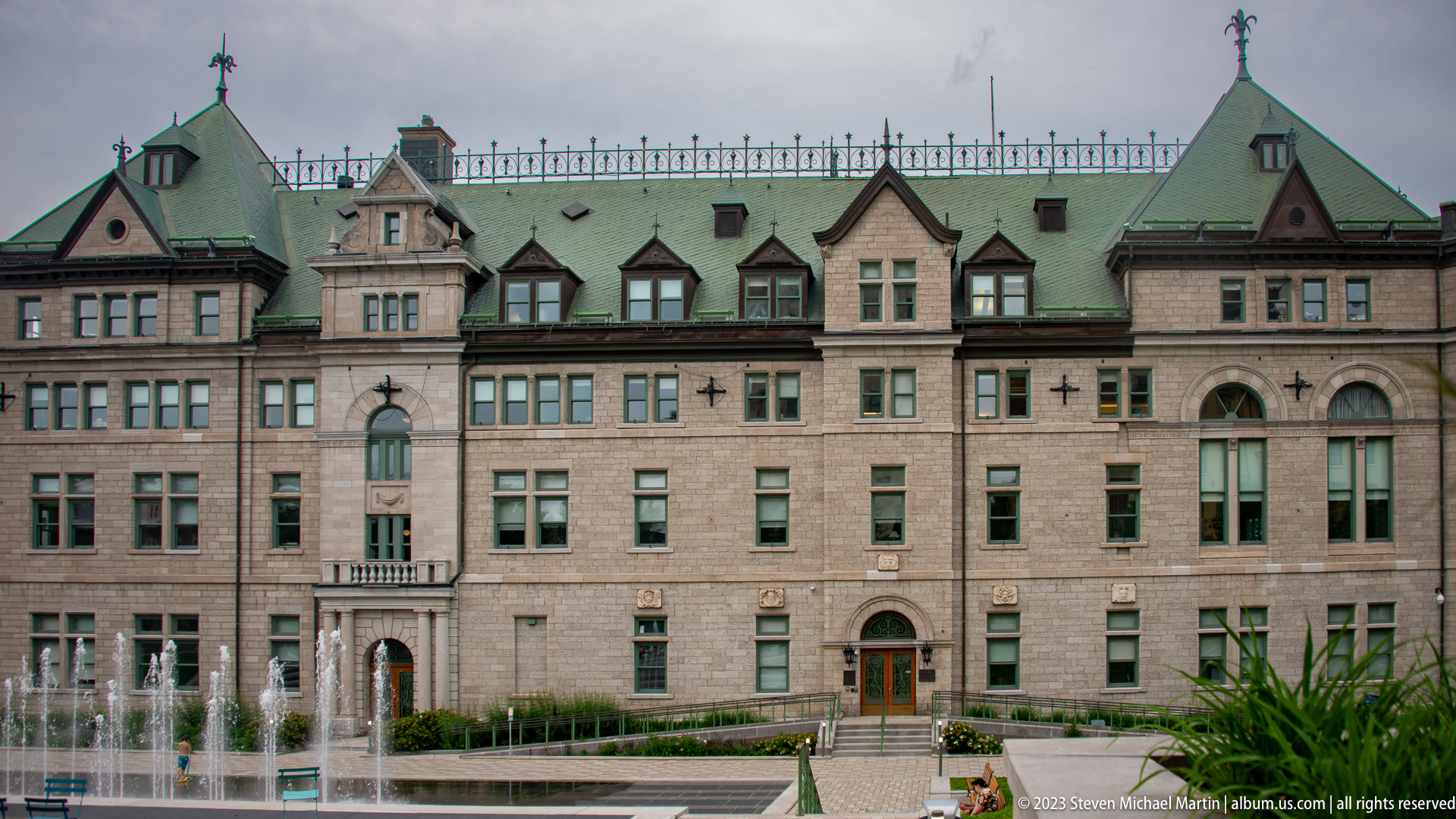
A long historic stone institutional building rises behind a foreground fountain, its façade articulated by gabled bays, tall windows, dormers, and green metal roofing. The centered composition stresses the building’s horizontal scale and repeated architectural rhythm, while water jets and plantings establish a landscaped civic setting in front.
Caption
A long historic stone institutional building rises behind a foreground fountain, its façade articulated by gabled bays, tall windows, dormers, and green metal roofing. The centered composition stresses the building’s horizontal scale and repeated architectural rhythm, while water jets and plantings establish a landscaped civic setting in front.
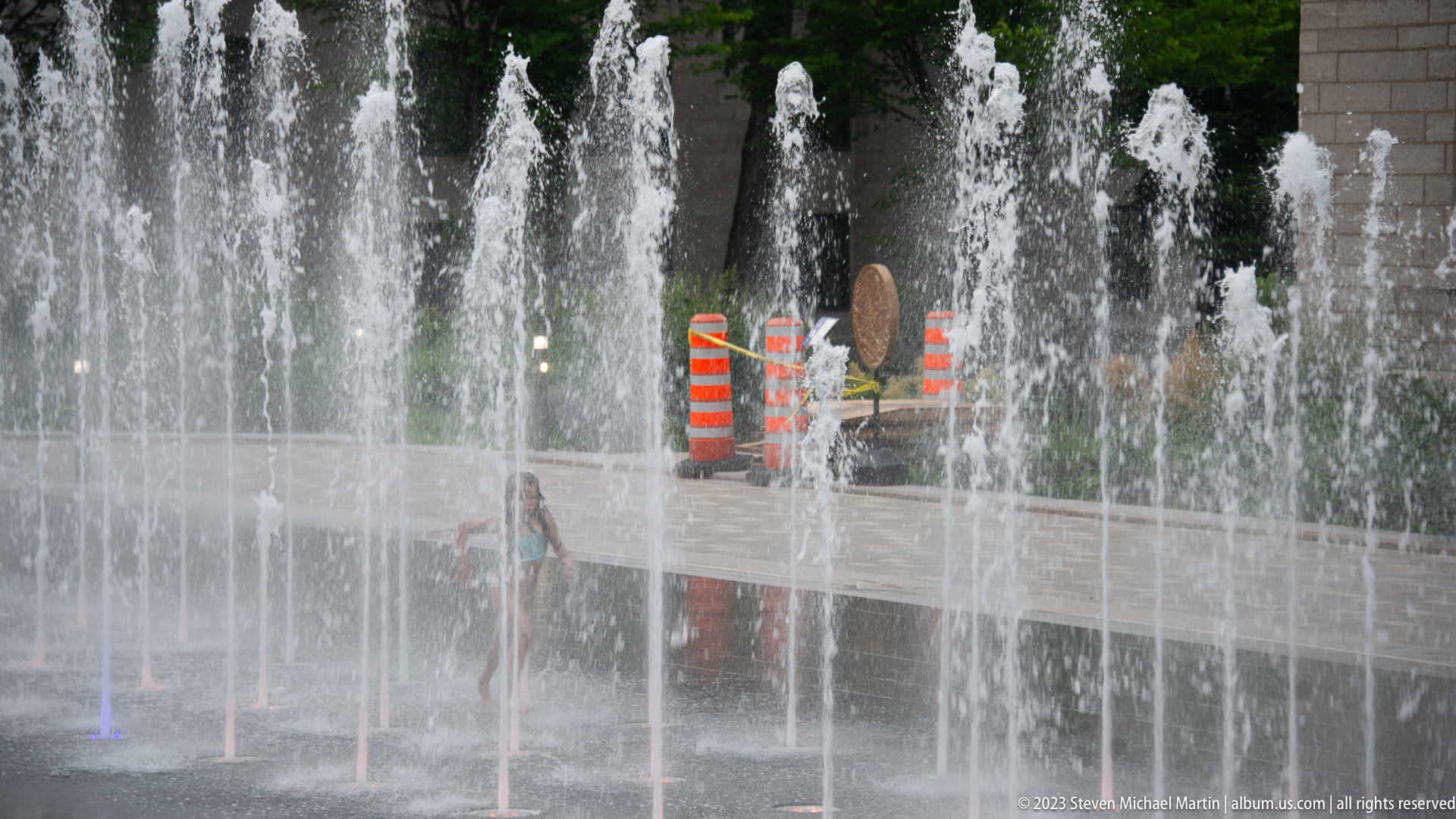
Vertical jets surge from a ground-level fountain, forming a shifting screen of water across a Quebec City public space. Through the spray, a pedestrian and bright construction barrels are partly visible, adding scale and everyday urban activity. The close framing makes the moving water rather than the surrounding architecture the principal subject.
Caption
Vertical jets surge from a ground-level fountain, forming a shifting screen of water across a Quebec City public space. Through the spray, a pedestrian and bright construction barrels are partly visible, adding scale and everyday urban activity. The close framing makes the moving water rather than the surrounding architecture the principal subject.
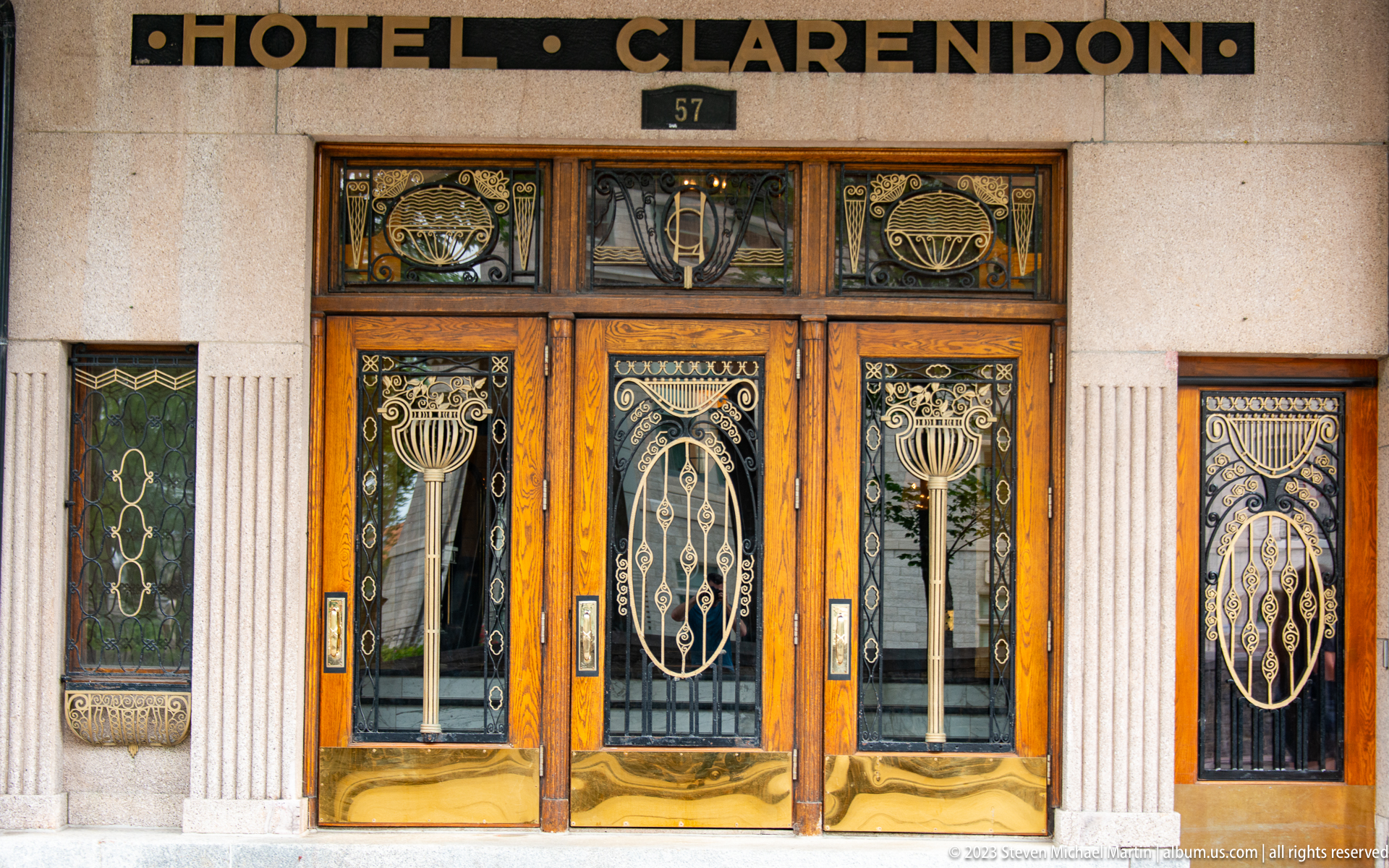
The Hôtel Clarendon entrance combines warm wooden doors with elaborate decorative glazing and metalwork beneath the prominent CLARENDON name and street number 57. Repeated oval and floral motifs fill the transoms, sidelights, and door panels, creating a richly ornamented threshold. The tight frontal view records craftsmanship and signage rather than the hotel’s full exterior.
Caption
The Hôtel Clarendon entrance combines warm wooden doors with elaborate decorative glazing and metalwork beneath the prominent CLARENDON name and street number 57. Repeated oval and floral motifs fill the transoms, sidelights, and door panels, creating a richly ornamented threshold. The tight frontal view records craftsmanship and signage rather than the hotel’s full exterior.
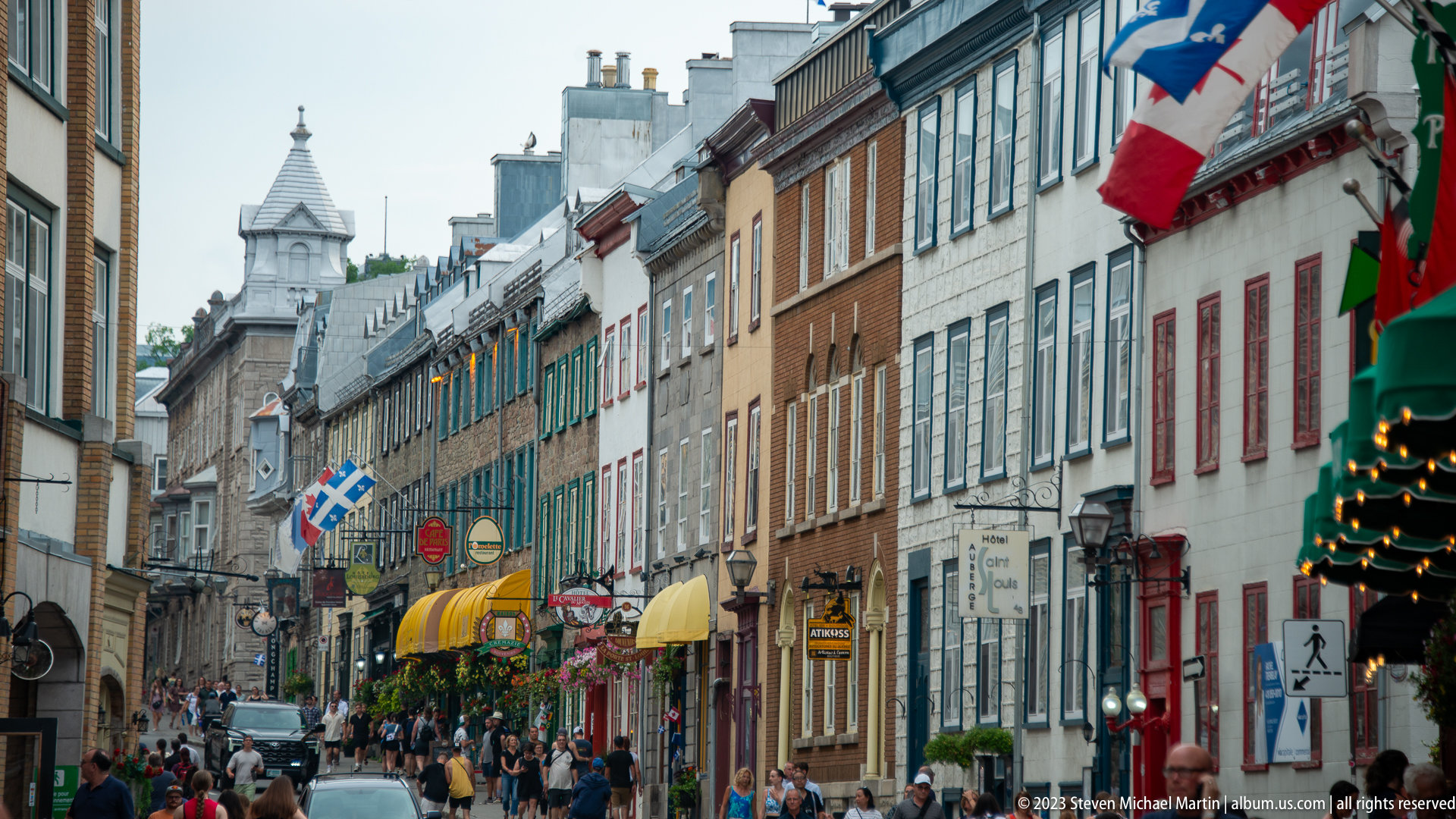
A narrow Old Quebec street is lined with closely spaced multistory façades in stone, brick, stucco, and painted trim. Shop awnings, hanging signs, Quebec flags, pedestrians, and slow traffic animate the corridor, while the receding perspective emphasizes the tight urban grain and mixed-use character of the historic district.
Caption
A narrow Old Quebec street is lined with closely spaced multistory façades in stone, brick, stucco, and painted trim. Shop awnings, hanging signs, Quebec flags, pedestrians, and slow traffic animate the corridor, while the receding perspective emphasizes the tight urban grain and mixed-use character of the historic district.
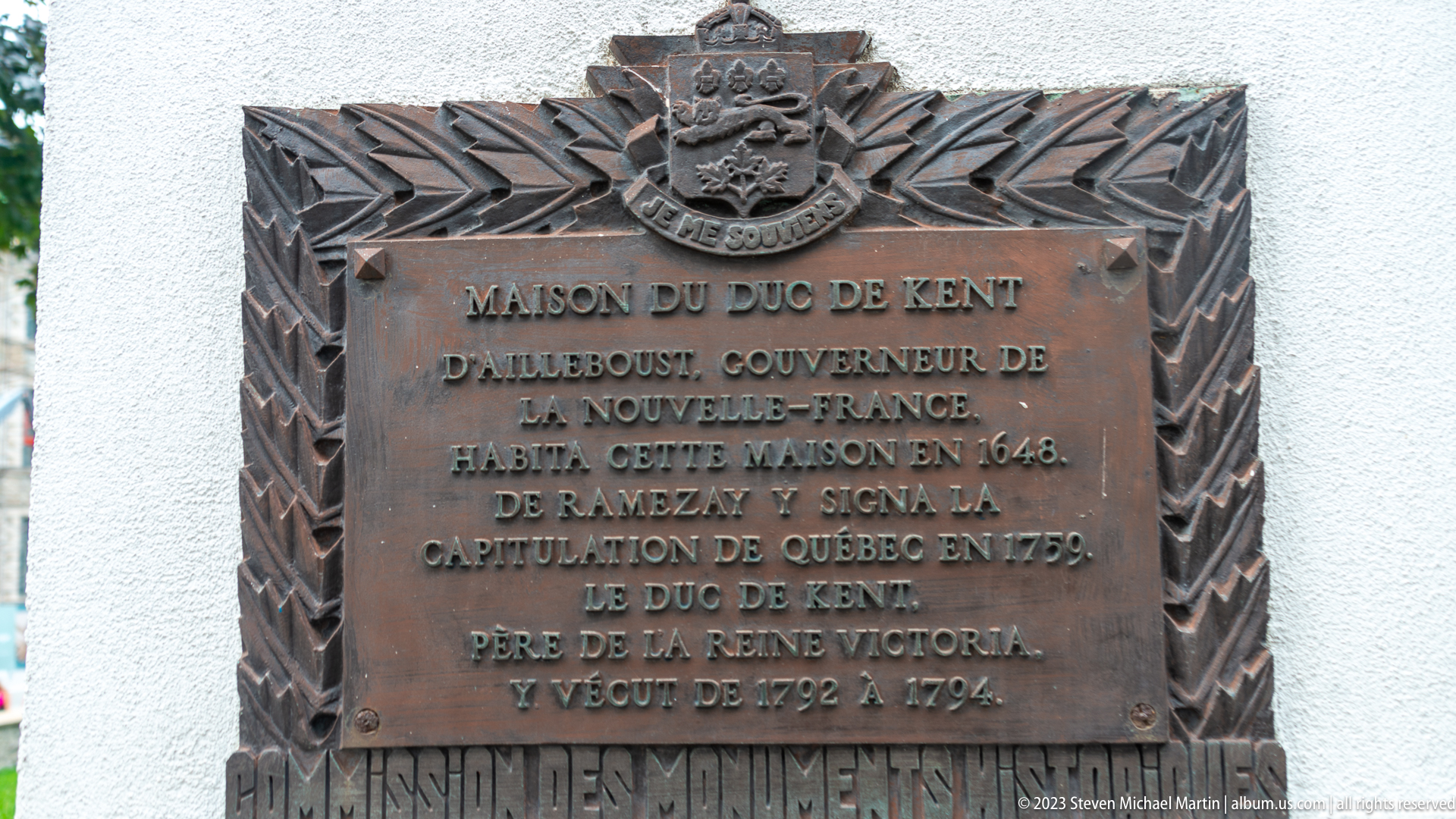
A bronze commemorative plaque marks the Quebec residence associated with Prince Edward, Duke of Kent. Its French inscription states that the Duke of Kent, father of Queen Victoria, lived in the house from 1792 to 1794 and notes the building’s earlier association with the Duke of Aiguillon. A crown and heraldic ornament frame the text.
Caption
A bronze commemorative plaque marks the Quebec residence associated with Prince Edward, Duke of Kent. Its French inscription states that the Duke of Kent, father of Queen Victoria, lived in the house from 1792 to 1794 and notes the building’s earlier association with the Duke of Aiguillon. A crown and heraldic ornament frame the text.
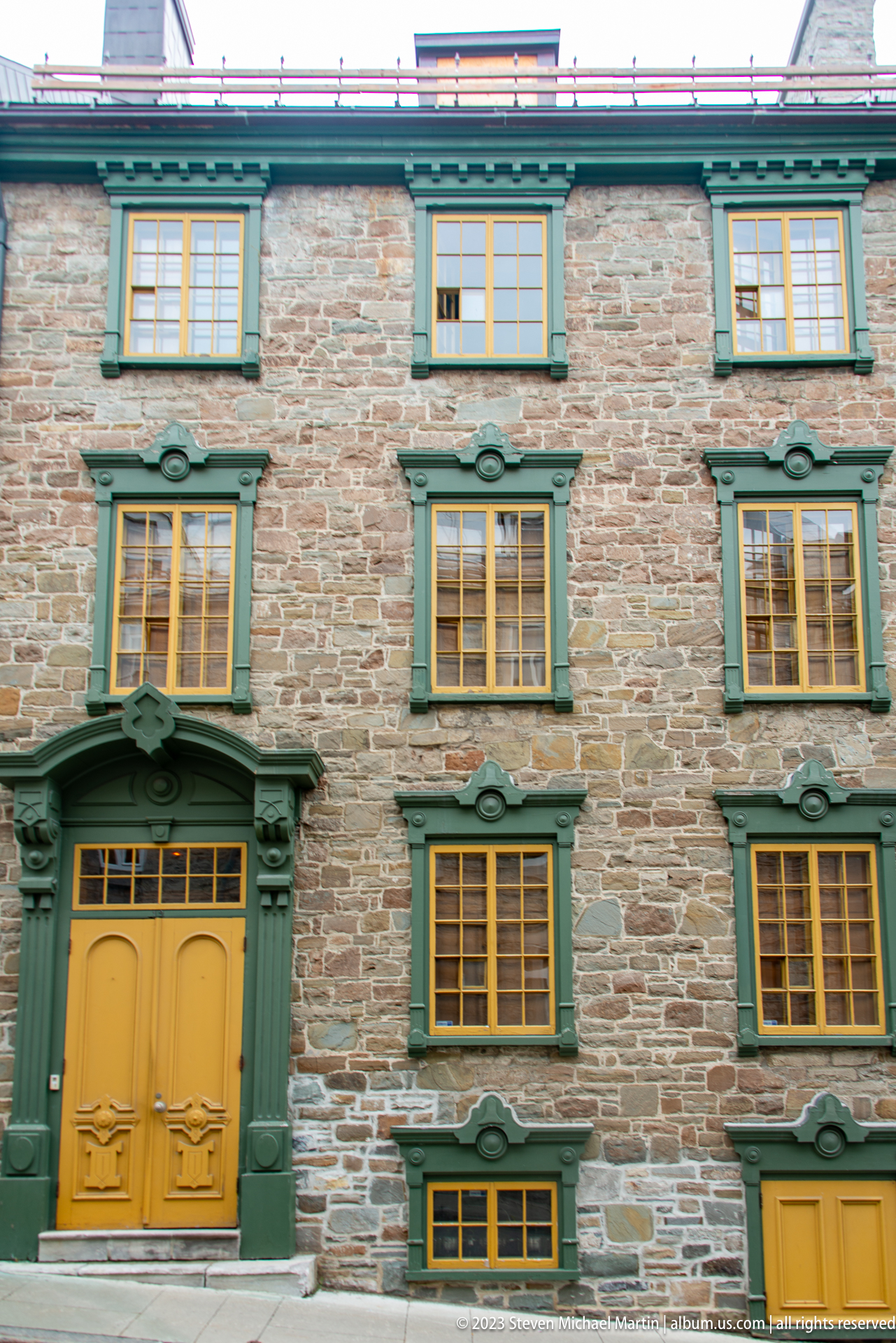
Rough-cut stone masonry, deep green painted trim, and ochre-yellow doors give this Quebec City townhouse façade a strongly patterned character. Small-paned windows are arranged in regular bays, each framed by molded lintels and decorative green surrounds. The frontal crop concentrates on traditional materials, color, and the repetition of openings across the narrow urban elevation.
Caption
Rough-cut stone masonry, deep green painted trim, and ochre-yellow doors give this Quebec City townhouse façade a strongly patterned character. Small-paned windows are arranged in regular bays, each framed by molded lintels and decorative green surrounds. The frontal crop concentrates on traditional materials, color, and the repetition of openings across the narrow urban elevation.
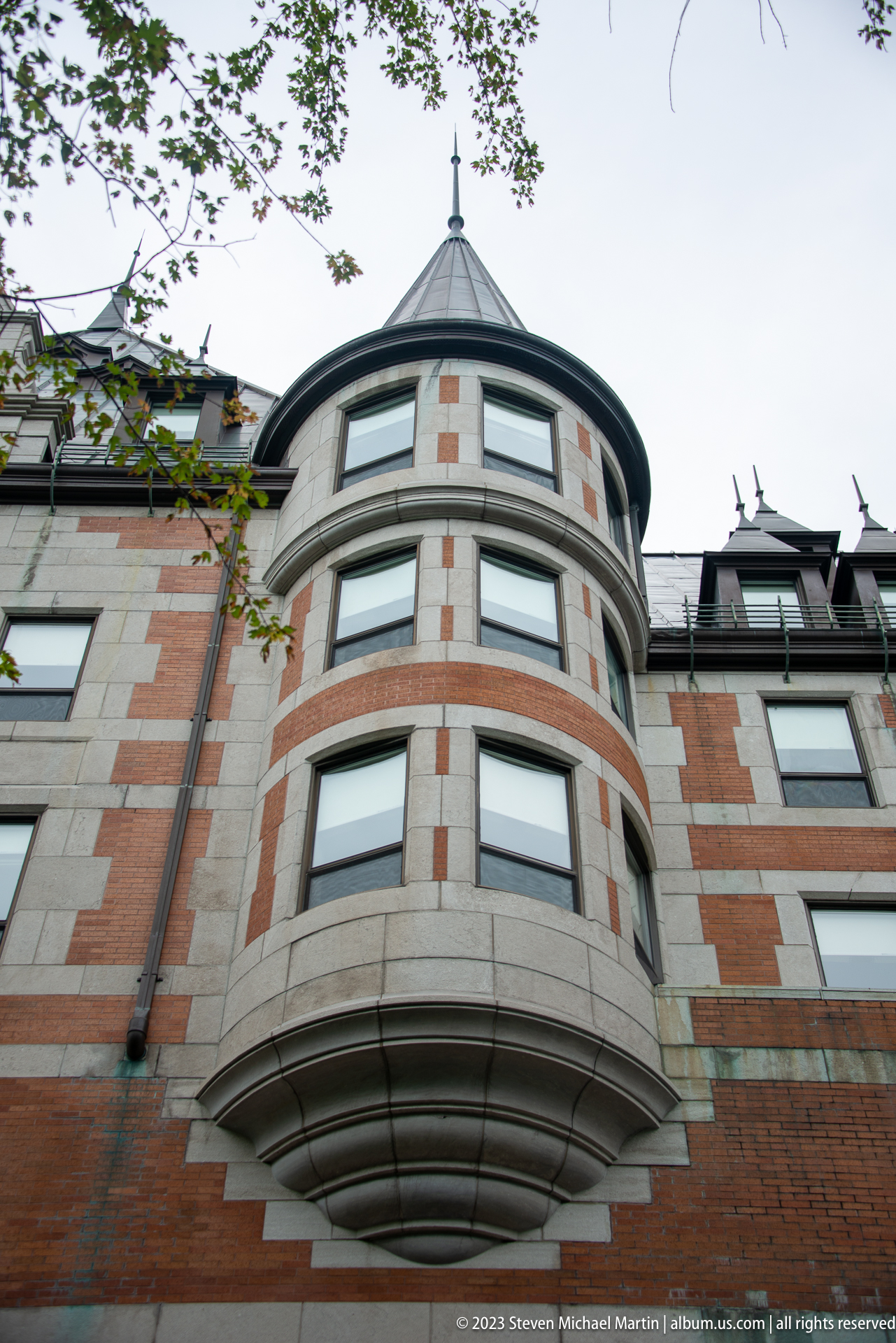
A rounded corner bay projects dramatically from a brick-and-stone façade, rising through several stories beneath a shallow conical metal roof. Horizontal bands of pale stone define each level and contrast with red brick panels. The upward-looking composition isolates the turret-like feature and emphasizes its curvature, masonry pattern, and projecting base.
Caption
A rounded corner bay projects dramatically from a brick-and-stone façade, rising through several stories beneath a shallow conical metal roof. Horizontal bands of pale stone define each level and contrast with red brick panels. The upward-looking composition isolates the turret-like feature and emphasizes its curvature, masonry pattern, and projecting base.
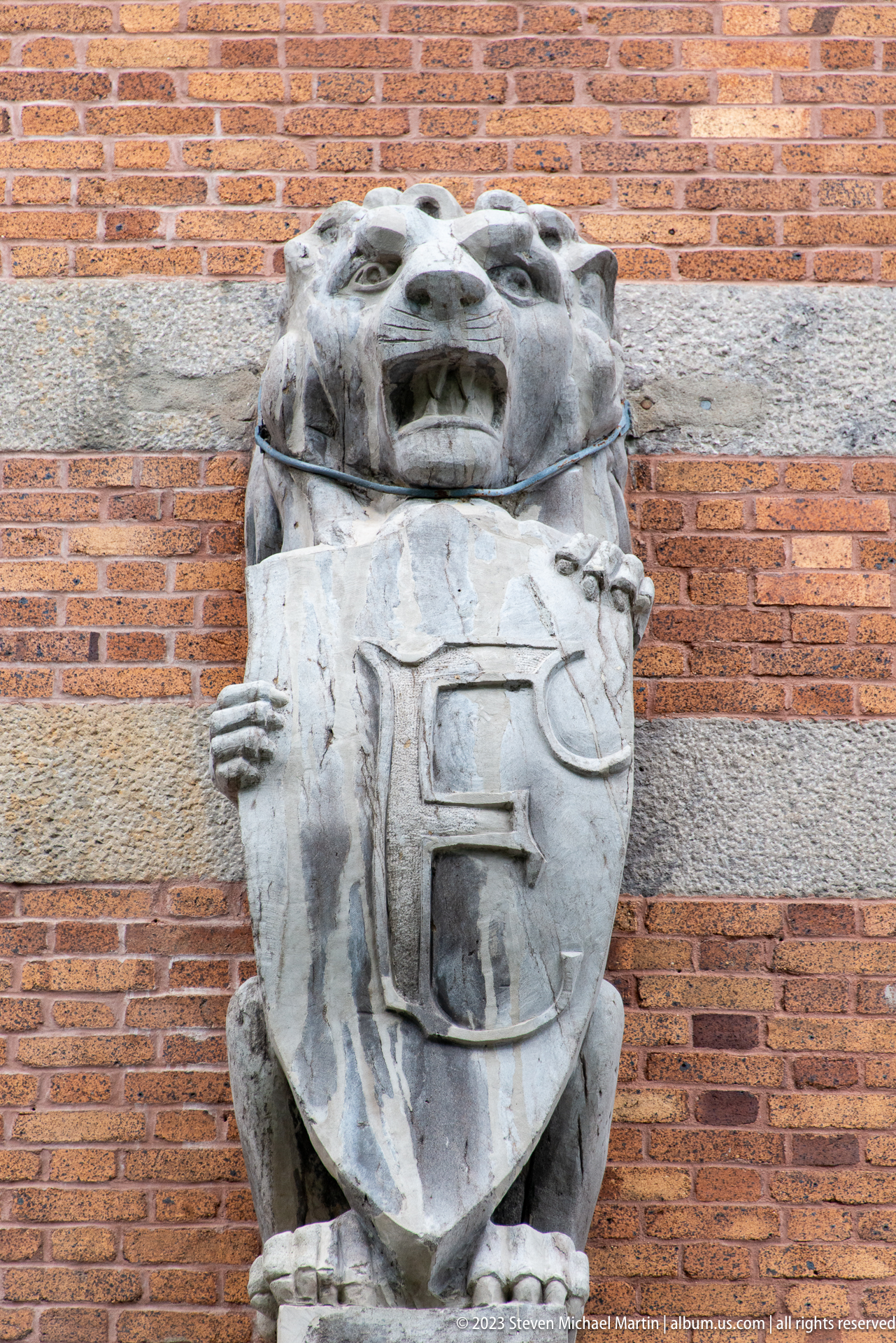
A weathered stone heraldic ornament projects from a brick wall, with a central shield supported by crouching grotesque or beast-like figures. Deep carving creates pronounced shadows around the heads, hands, and shield edge. The tight crop isolates the sculptural detail and shows the erosion and discoloration accumulated on the pale stone surface.
Caption
A weathered stone heraldic ornament projects from a brick wall, with a central shield supported by crouching grotesque or beast-like figures. Deep carving creates pronounced shadows around the heads, hands, and shield edge. The tight crop isolates the sculptural detail and shows the erosion and discoloration accumulated on the pale stone surface.
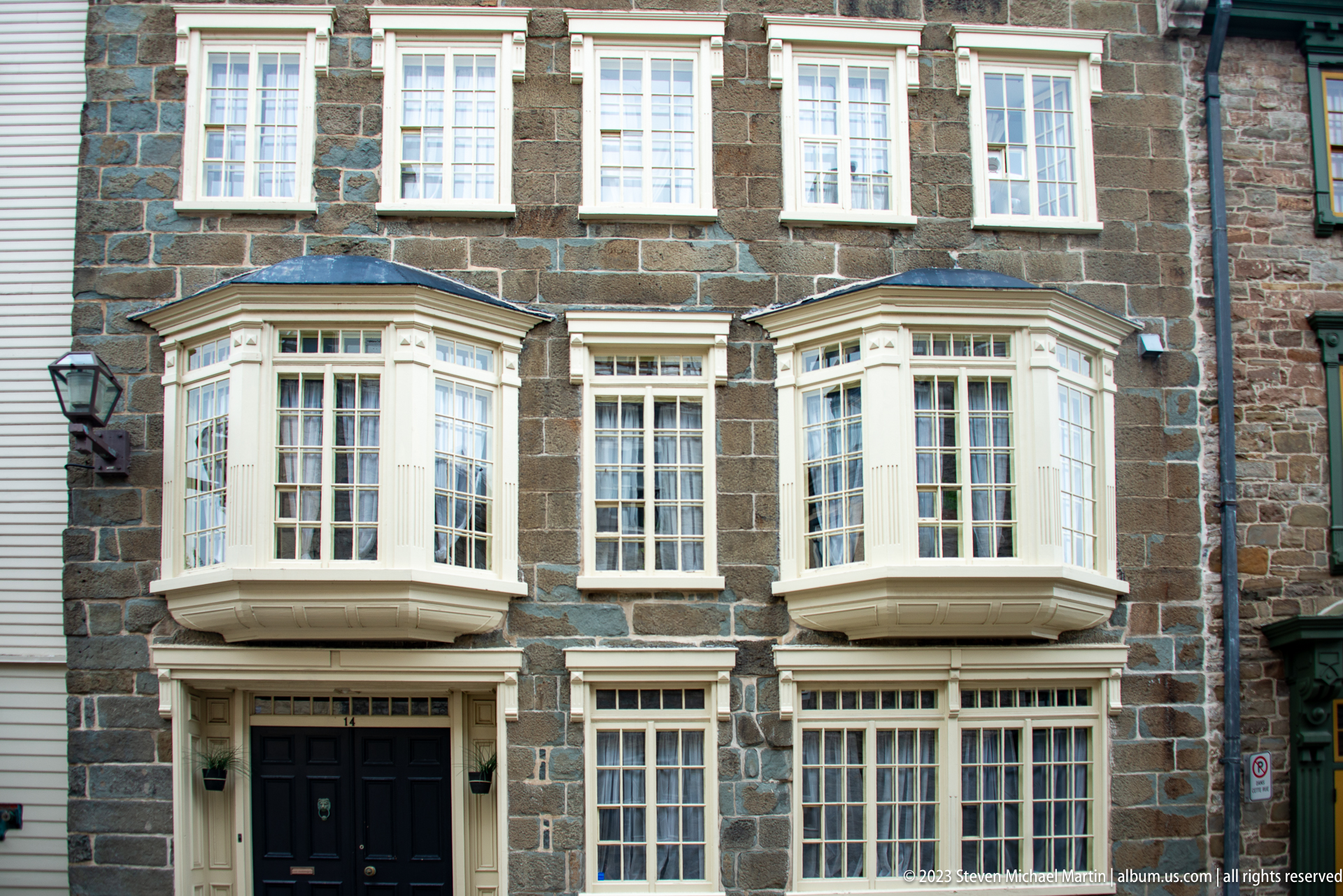
Two pale projecting bay windows punctuate a dark stone townhouse façade, contrasting with the heavy masonry and black entrance below. Rows of white-framed multi-pane windows continue across the upper stories. The close architectural view highlights how enclosed bays increase light and interior space while adding depth to an otherwise planar historic façade.
Caption
Two pale projecting bay windows punctuate a dark stone townhouse façade, contrasting with the heavy masonry and black entrance below. Rows of white-framed multi-pane windows continue across the upper stories. The close architectural view highlights how enclosed bays increase light and interior space while adding depth to an otherwise planar historic façade.
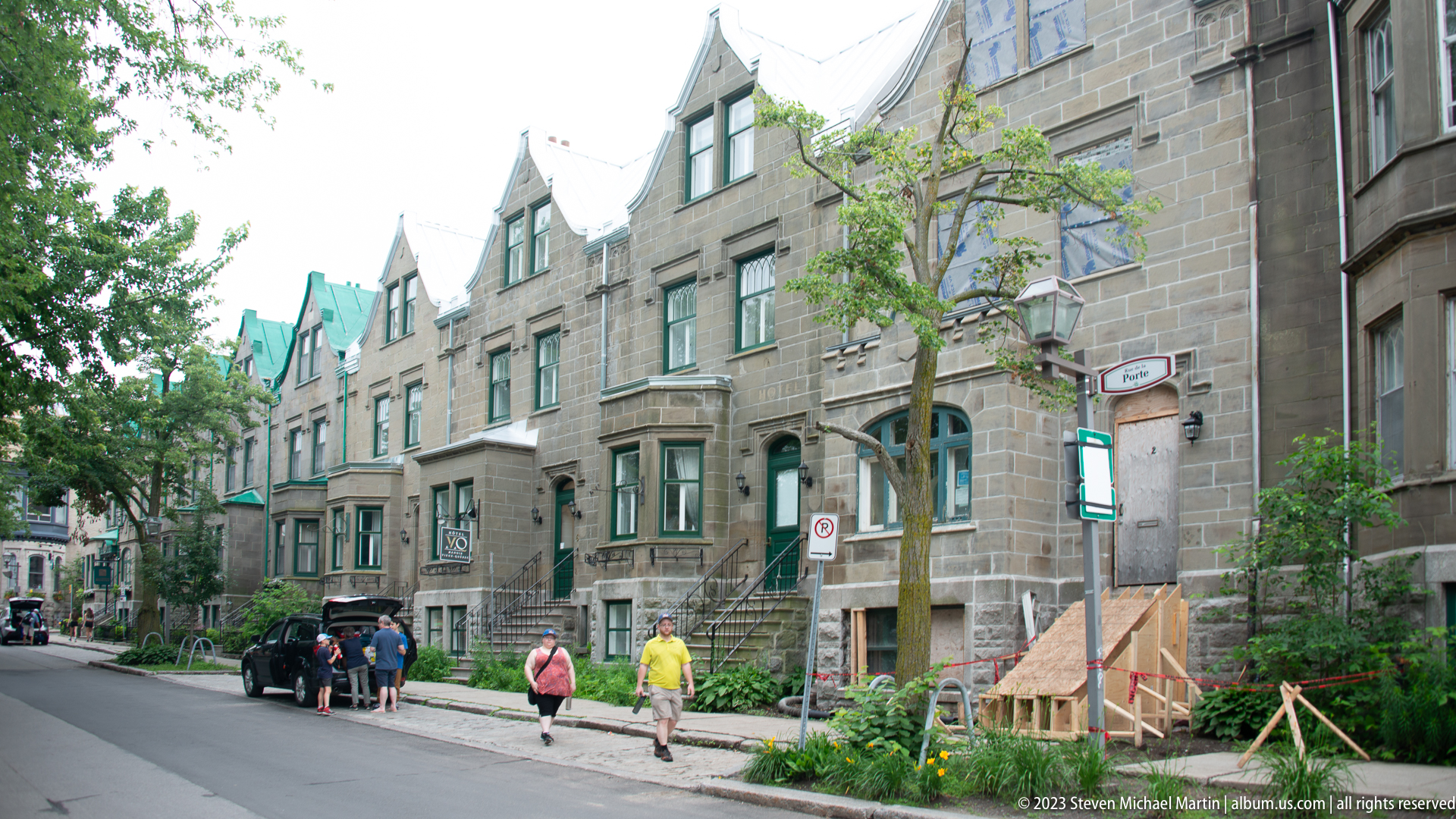
A quiet Quebec City street follows a row of attached and closely spaced stone houses with steep gables, bay windows, stoops, and varied rooflines. Pedestrians and a small group near a parked vehicle provide scale, while young street trees and temporary wooden supports suggest ongoing care within the historic residential fabric.
Caption
A quiet Quebec City street follows a row of attached and closely spaced stone houses with steep gables, bay windows, stoops, and varied rooflines. Pedestrians and a small group near a parked vehicle provide scale, while young street trees and temporary wooden supports suggest ongoing care within the historic residential fabric.
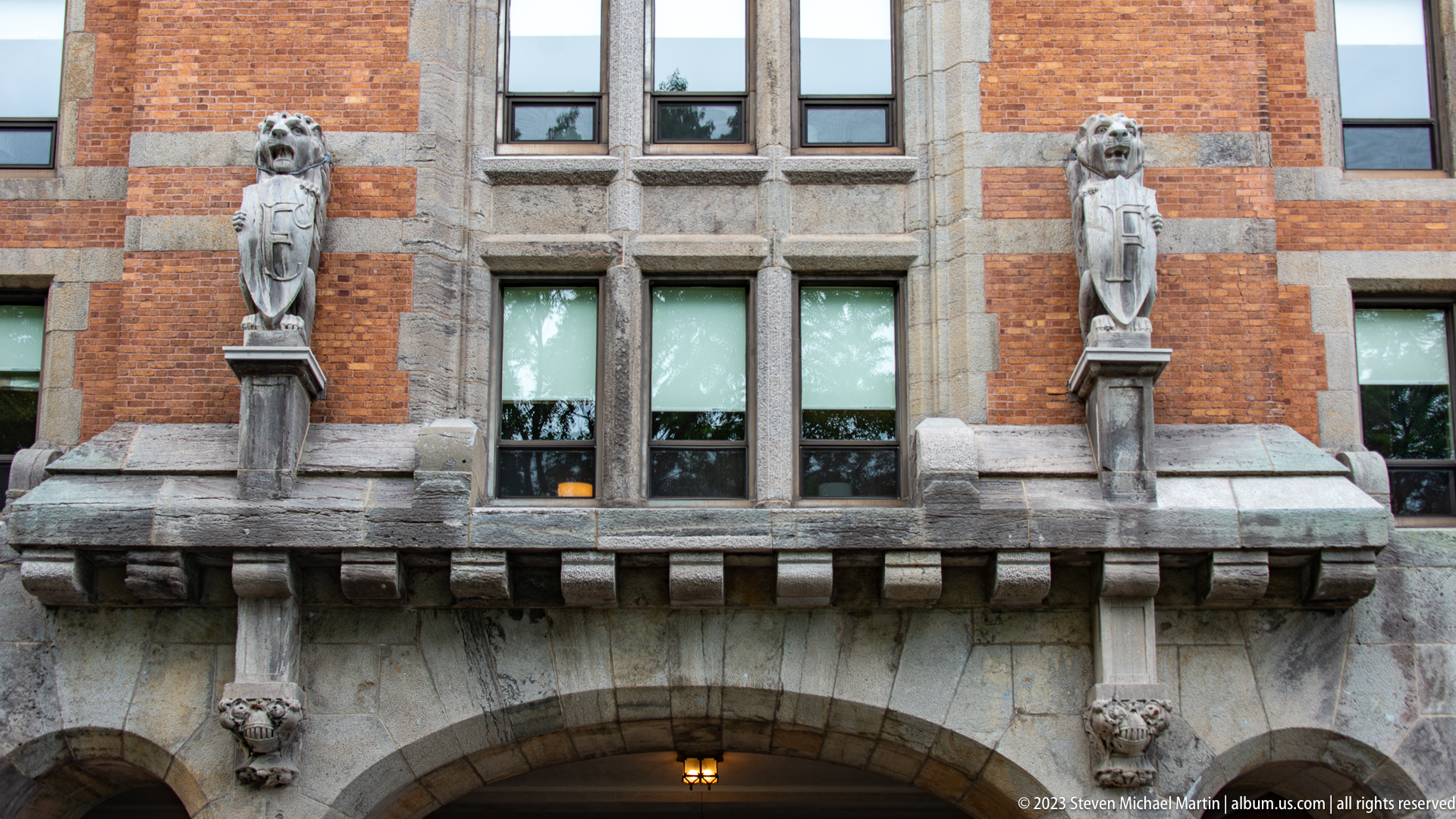
Two carved stone figures stand on brackets beside a tall central window group on a red-brick and stone façade. Below, a broad masonry arch and projecting cornice create a layered entrance composition, with a smaller carved head centered beneath the windows. The close view records sculptural ornament integrated directly into the building’s exterior.
Caption
Two carved stone figures stand on brackets beside a tall central window group on a red-brick and stone façade. Below, a broad masonry arch and projecting cornice create a layered entrance composition, with a smaller carved head centered beneath the windows. The close view records sculptural ornament integrated directly into the building’s exterior.
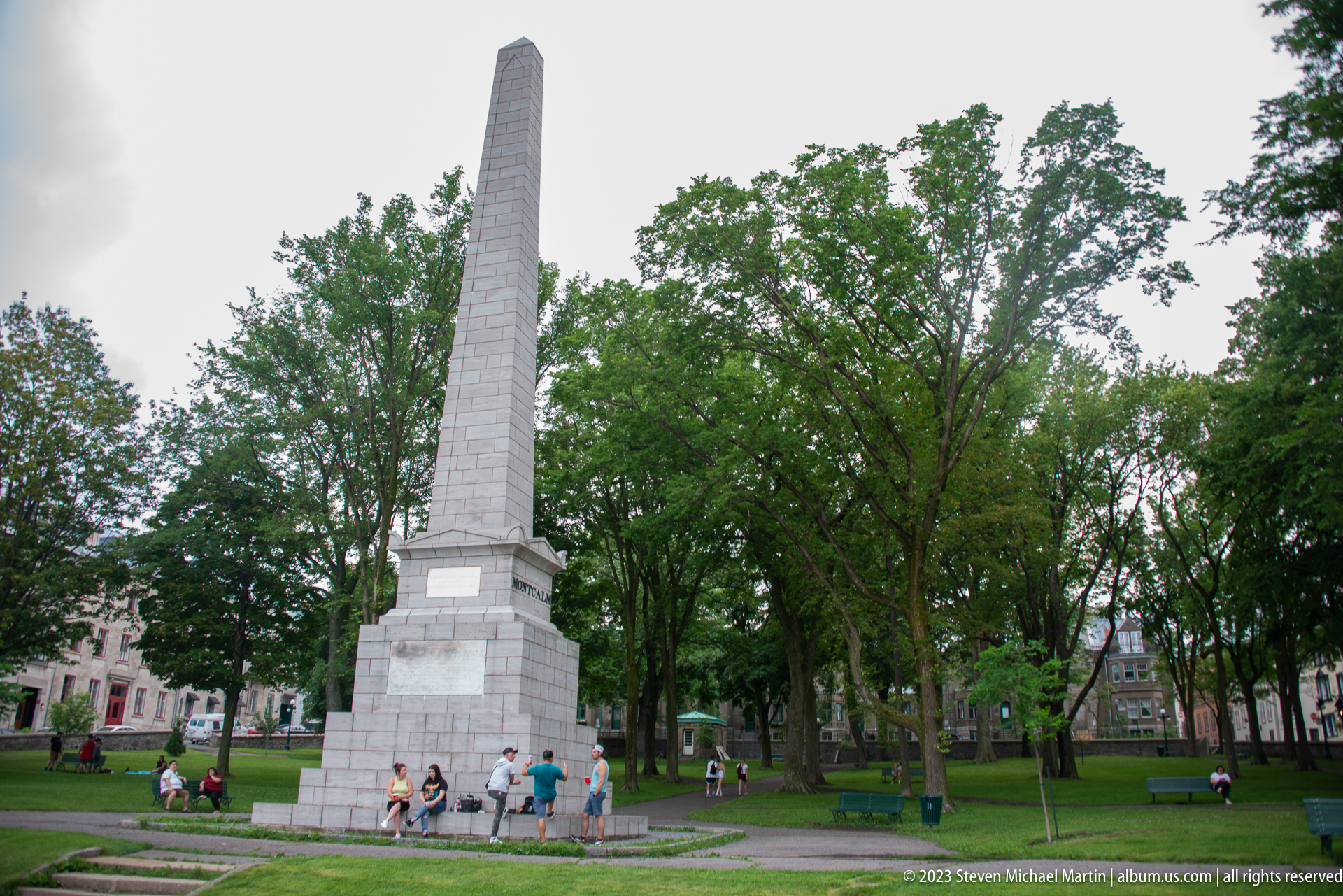
The tall stone obelisk of the Wolfe-Montcalm Monument rises from Governors Garden amid mature trees and open lawn. Visitors gather near the stepped base while benches and paths establish the monument’s park setting. The vertical composition emphasizes the memorial’s slender form and its prominent placement within the historic landscape of Upper Town.
Caption
The tall stone obelisk of the Wolfe-Montcalm Monument rises from Governors Garden amid mature trees and open lawn. Visitors gather near the stepped base while benches and paths establish the monument’s park setting. The vertical composition emphasizes the memorial’s slender form and its prominent placement within the historic landscape of Upper Town.
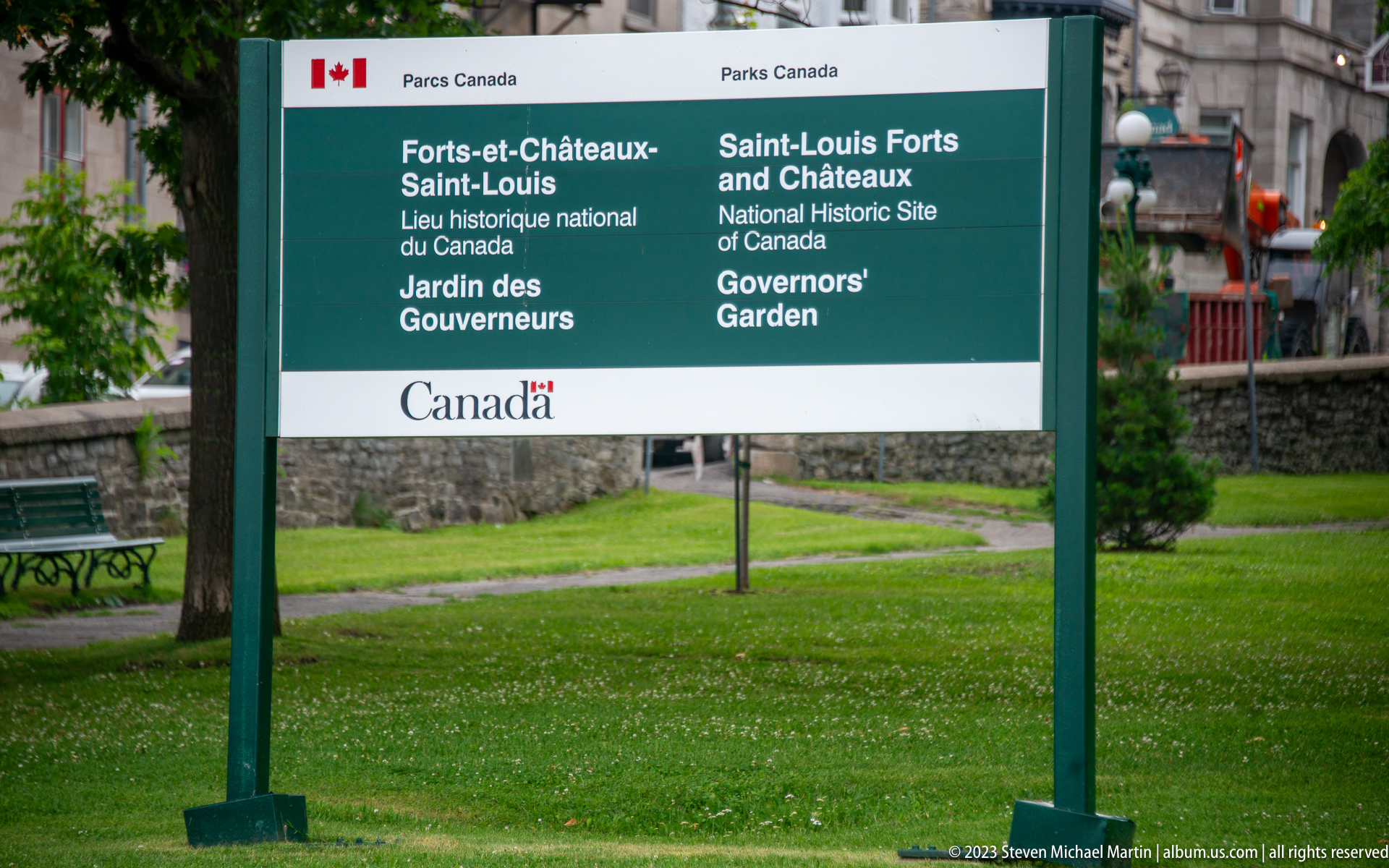
A bilingual Parks Canada sign identifies the Saint-Louis Forts and Châteaux National Historic Site of Canada and the Governors Garden. Set against lawn, stone walls, and garden paths, the sign provides direct orientation within the fortified historic core. Its French and English text links the landscaped space to the archaeological and defensive heritage preserved nearby.
Caption
A bilingual Parks Canada sign identifies the Saint-Louis Forts and Châteaux National Historic Site of Canada and the Governors Garden. Set against lawn, stone walls, and garden paths, the sign provides direct orientation within the fortified historic core. Its French and English text links the landscaped space to the archaeological and defensive heritage preserved nearby.
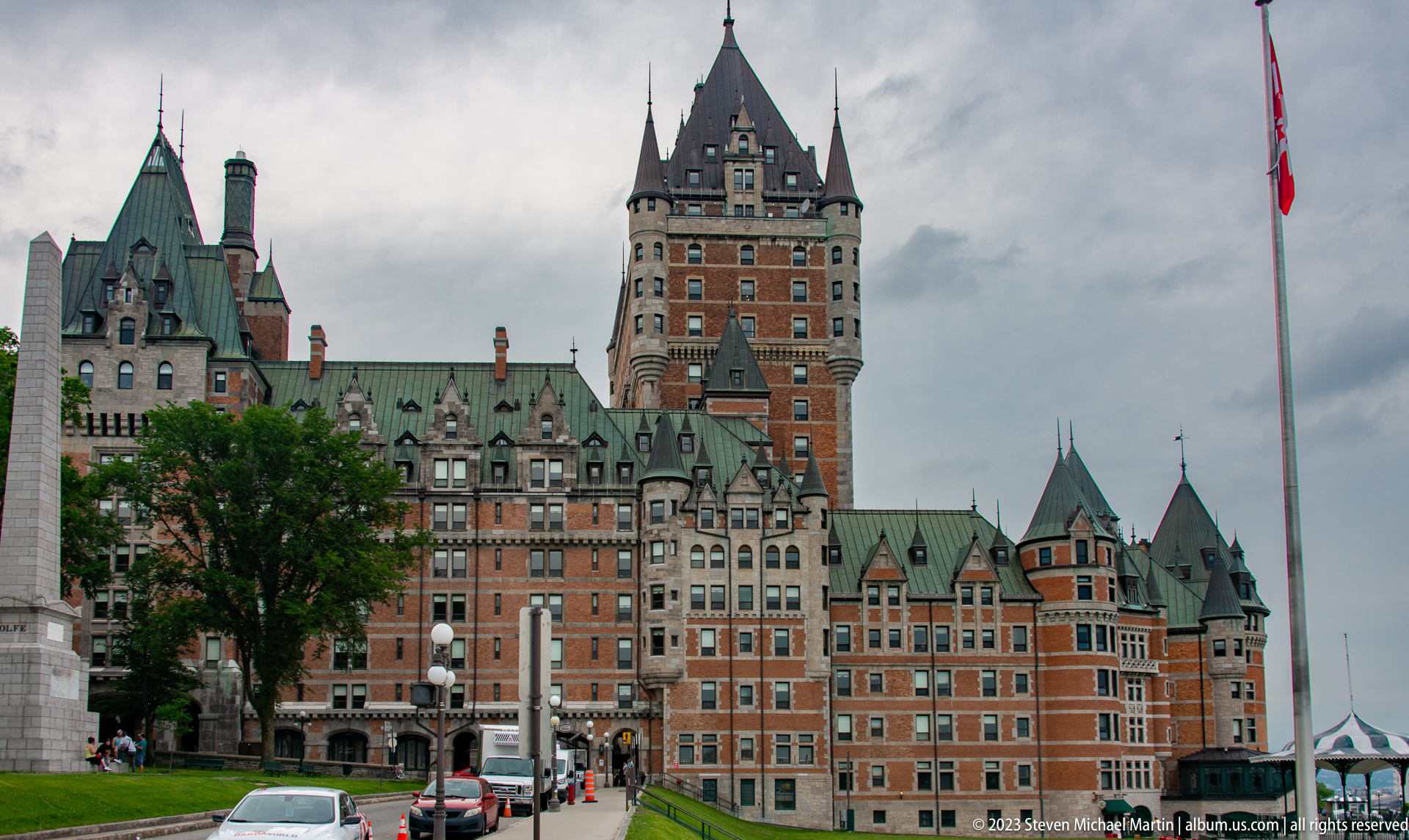
Fairmont Le Château Frontenac dominates the view with its steep copper roofs, turrets, dormers, and tall central tower rising above the approach to Dufferin Terrace. The monumental hotel’s château-style massing fills most of the frame, while cars, pedestrians, and a flagpole at street level convey its scale within Upper Town.
Caption
Fairmont Le Château Frontenac dominates the view with its steep copper roofs, turrets, dormers, and tall central tower rising above the approach to Dufferin Terrace. The monumental hotel’s château-style massing fills most of the frame, while cars, pedestrians, and a flagpole at street level convey its scale within Upper Town.
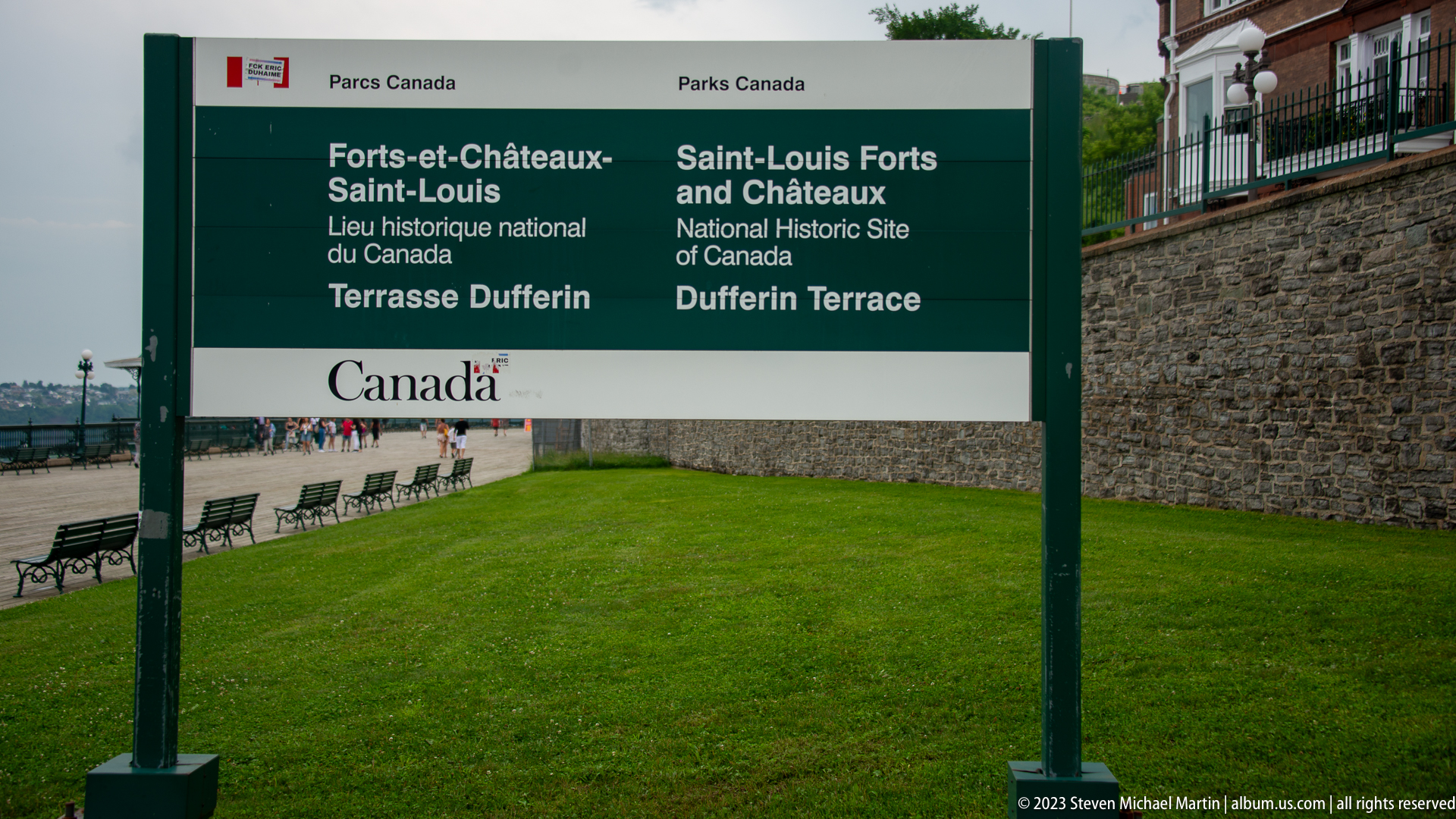
A bilingual Parks Canada sign identifies Dufferin Terrace as part of the Saint-Louis Forts and Châteaux National Historic Site of Canada. Beyond it, the long boardwalk, benches, lawn, and stone retaining wall extend through the frame. The sign anchors the photograph geographically and connects the public promenade with the nationally recognized historic site beneath and around it.
Caption
A bilingual Parks Canada sign identifies Dufferin Terrace as part of the Saint-Louis Forts and Châteaux National Historic Site of Canada. Beyond it, the long boardwalk, benches, lawn, and stone retaining wall extend through the frame. The sign anchors the photograph geographically and connects the public promenade with the nationally recognized historic site beneath and around it.
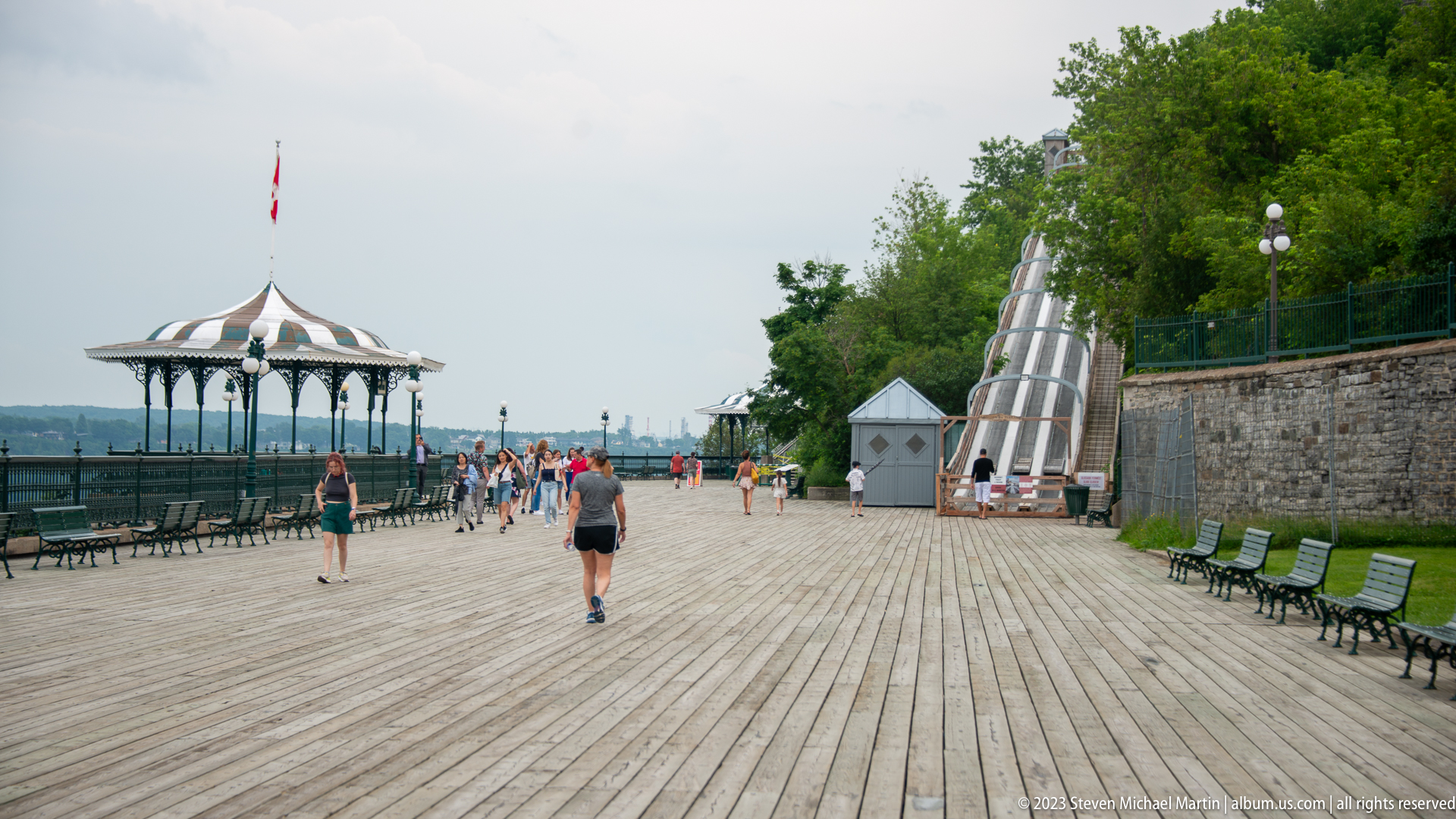
The broad wooden deck of Dufferin Terrace stretches toward a striped-roof gazebo overlooking the St. Lawrence River. Visitors walk along the promenade between benches and the high stone wall of Upper Town, while a conical contemporary installation punctuates the route. The long perspective emphasizes the terrace as both a scenic overlook and a major pedestrian space.
Caption
The broad wooden deck of Dufferin Terrace stretches toward a striped-roof gazebo overlooking the St. Lawrence River. Visitors walk along the promenade between benches and the high stone wall of Upper Town, while a conical contemporary installation punctuates the route. The long perspective emphasizes the terrace as both a scenic overlook and a major pedestrian space.
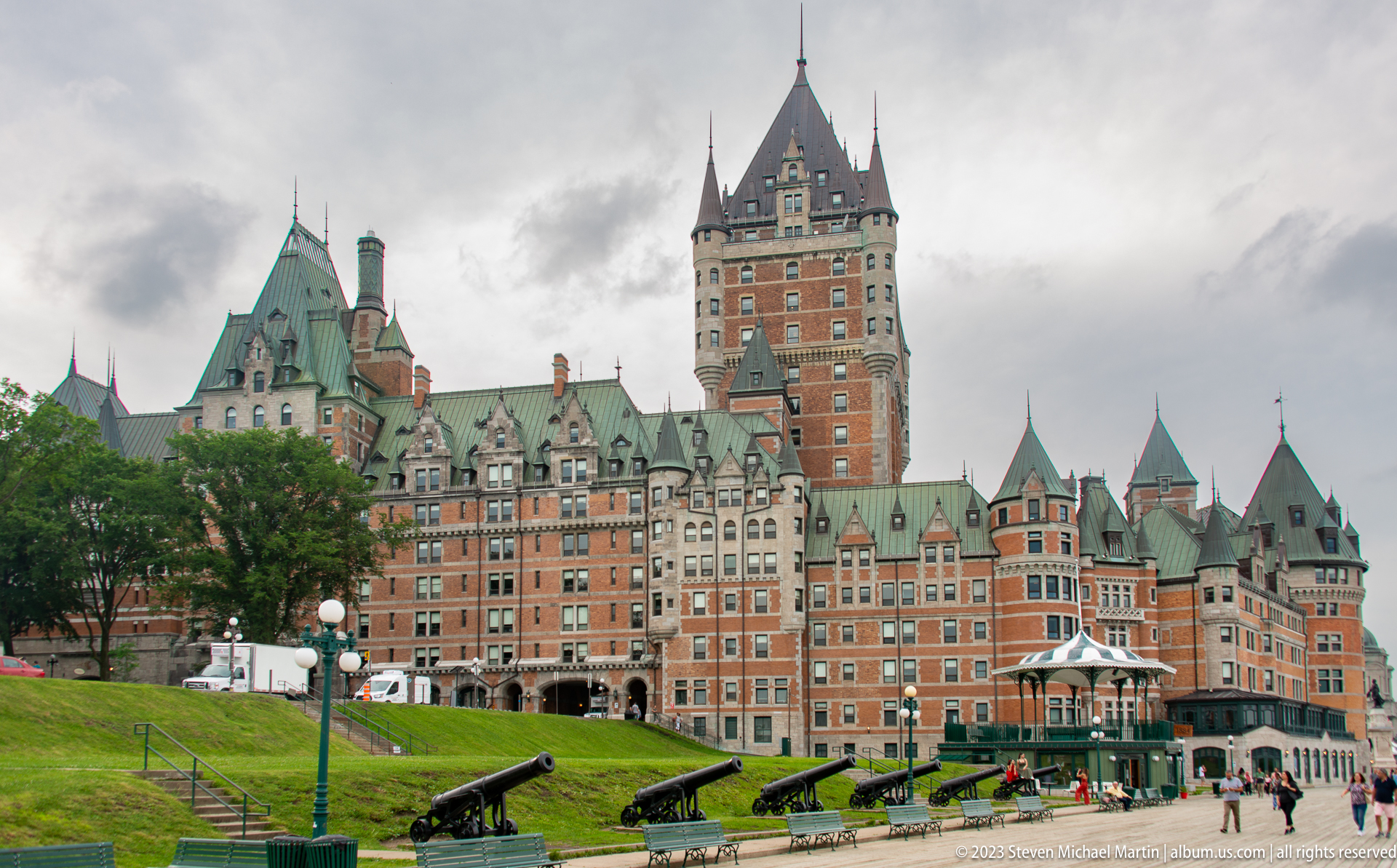
Château Frontenac rises behind the grassy edge of Dufferin Terrace, its copper-roofed towers and brick-and-stone wings forming a dramatic backdrop to a line of historic cannons. The wider view places the hotel within the fortified landscape, combining a signature civic landmark with visible reminders of Quebec City’s military history.
Caption
Château Frontenac rises behind the grassy edge of Dufferin Terrace, its copper-roofed towers and brick-and-stone wings forming a dramatic backdrop to a line of historic cannons. The wider view places the hotel within the fortified landscape, combining a signature civic landmark with visible reminders of Quebec City’s military history.
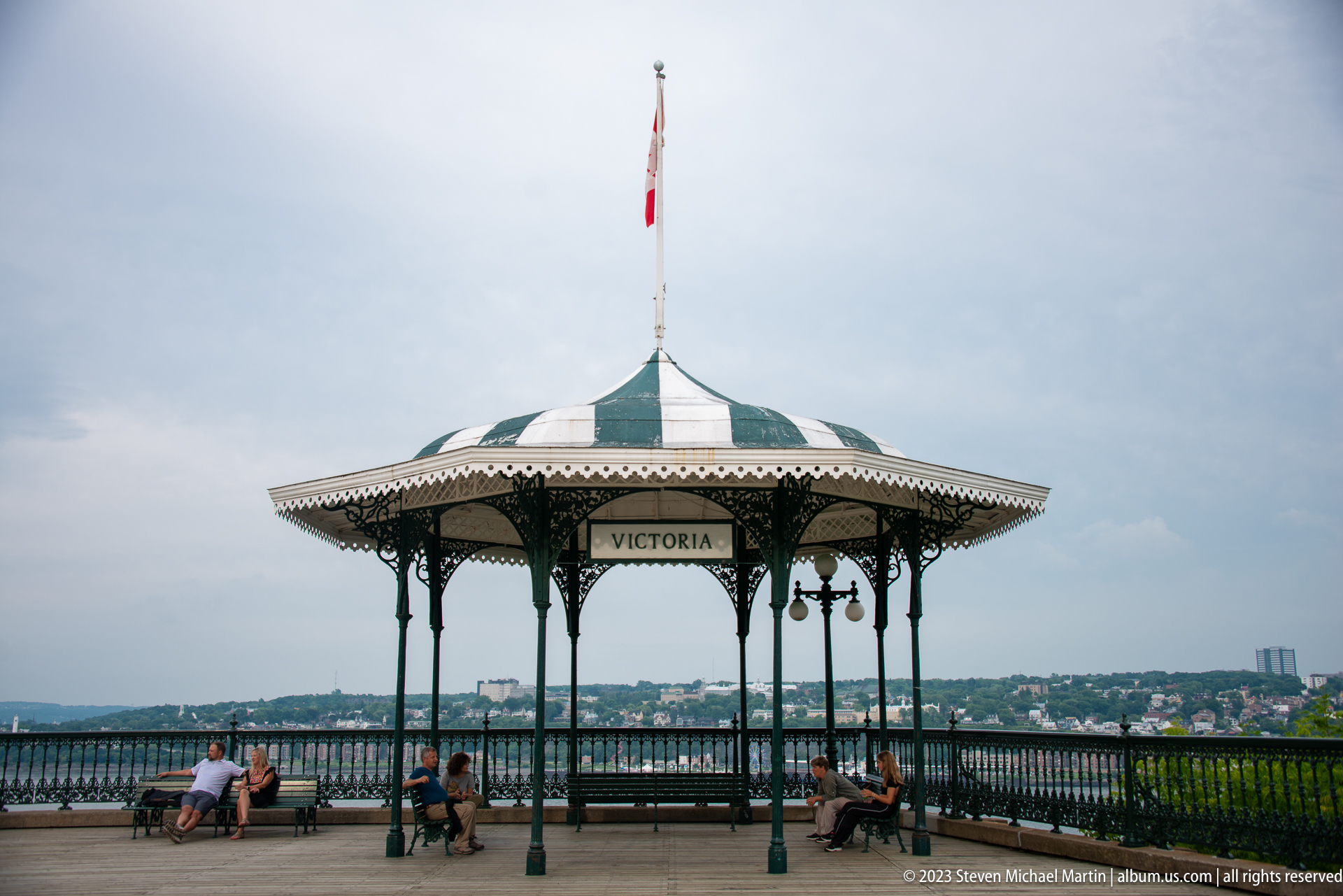
The ornate Victoria kiosk on Dufferin Terrace frames views across the St. Lawrence River with slender iron columns, decorative brackets, and a striped polygonal roof. Visitors sit in its shade while the Canadian flag rises above the roofline. The centered composition highlights the light Victorian-era pavilion as a social and scenic feature of the waterfront promenade.
Caption
The ornate Victoria kiosk on Dufferin Terrace frames views across the St. Lawrence River with slender iron columns, decorative brackets, and a striped polygonal roof. Visitors sit in its shade while the Canadian flag rises above the roofline. The centered composition highlights the light Victorian-era pavilion as a social and scenic feature of the waterfront promenade.
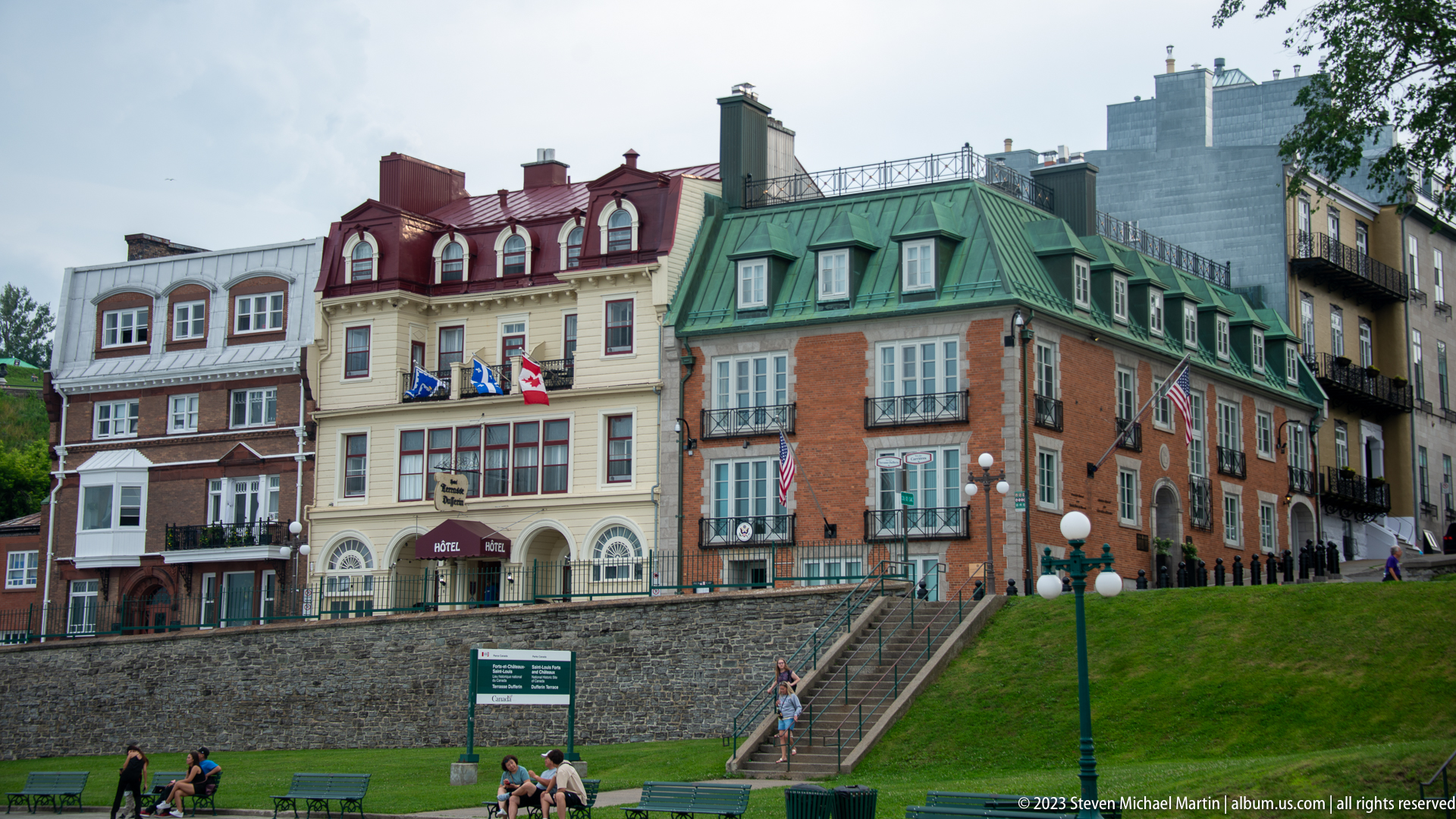
A compact group of historic buildings rises above the stone retaining wall beside Dufferin Terrace. Brick, stucco, dormered roofs, bay windows, and green metal roofing create a varied Upper Town streetscape, while a broad stair climbs from the lawn toward the buildings. Flags and pedestrians add scale to the layered urban edge.
Caption
A compact group of historic buildings rises above the stone retaining wall beside Dufferin Terrace. Brick, stucco, dormered roofs, bay windows, and green metal roofing create a varied Upper Town streetscape, while a broad stair climbs from the lawn toward the buildings. Flags and pedestrians add scale to the layered urban edge.
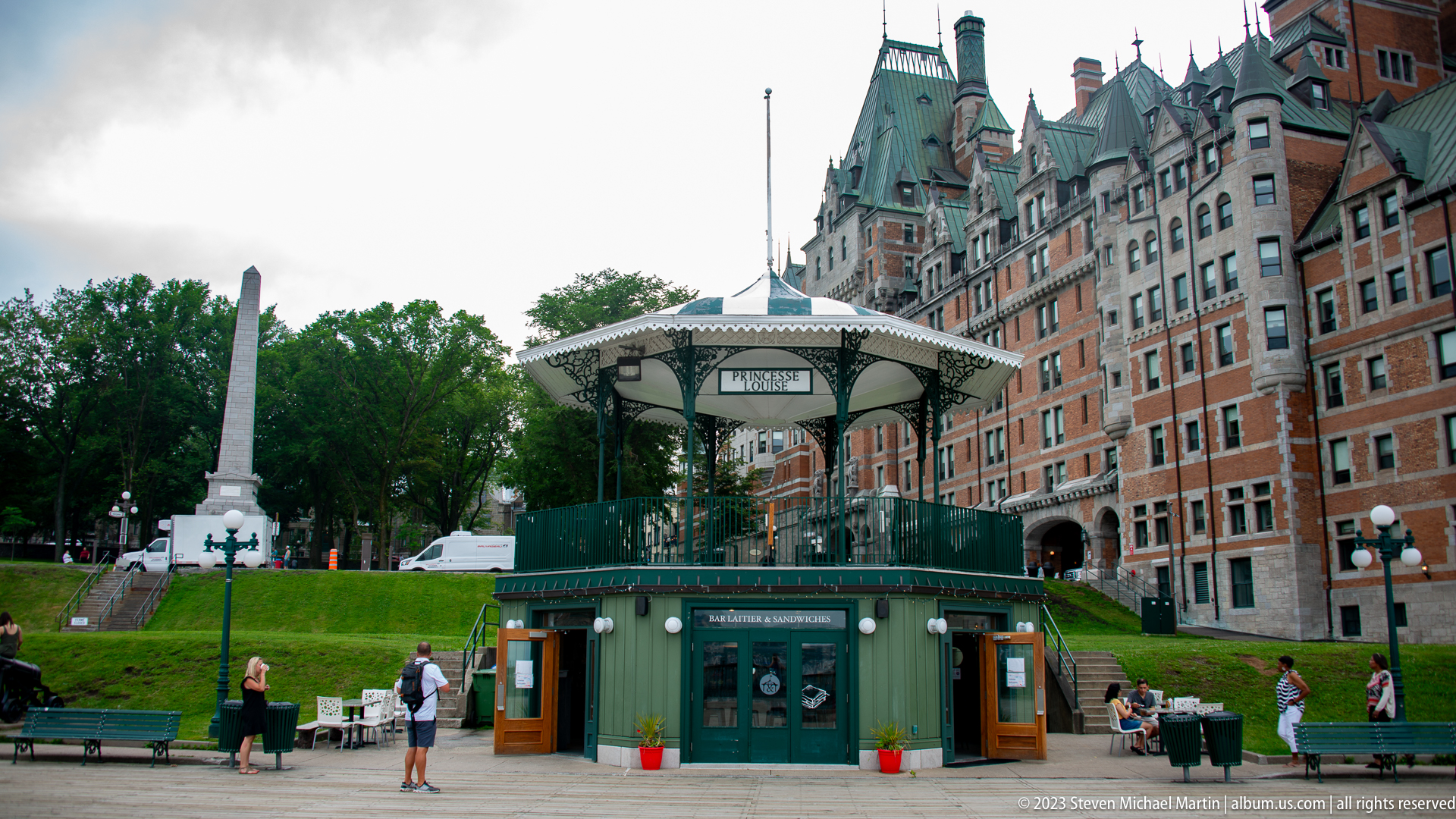
A green-and-white kiosk on Dufferin Terrace stands in front of Château Frontenac, whose steep roofs and brick-and-stone walls rise behind it. The lower structure incorporates an entrance beneath the elevated pavilion, while visitors gather across the paved foreground. The composition shows how small promenade architecture is layered against Quebec City’s most prominent hotel landmark.
Caption
A green-and-white kiosk on Dufferin Terrace stands in front of Château Frontenac, whose steep roofs and brick-and-stone walls rise behind it. The lower structure incorporates an entrance beneath the elevated pavilion, while visitors gather across the paved foreground. The composition shows how small promenade architecture is layered against Quebec City’s most prominent hotel landmark.
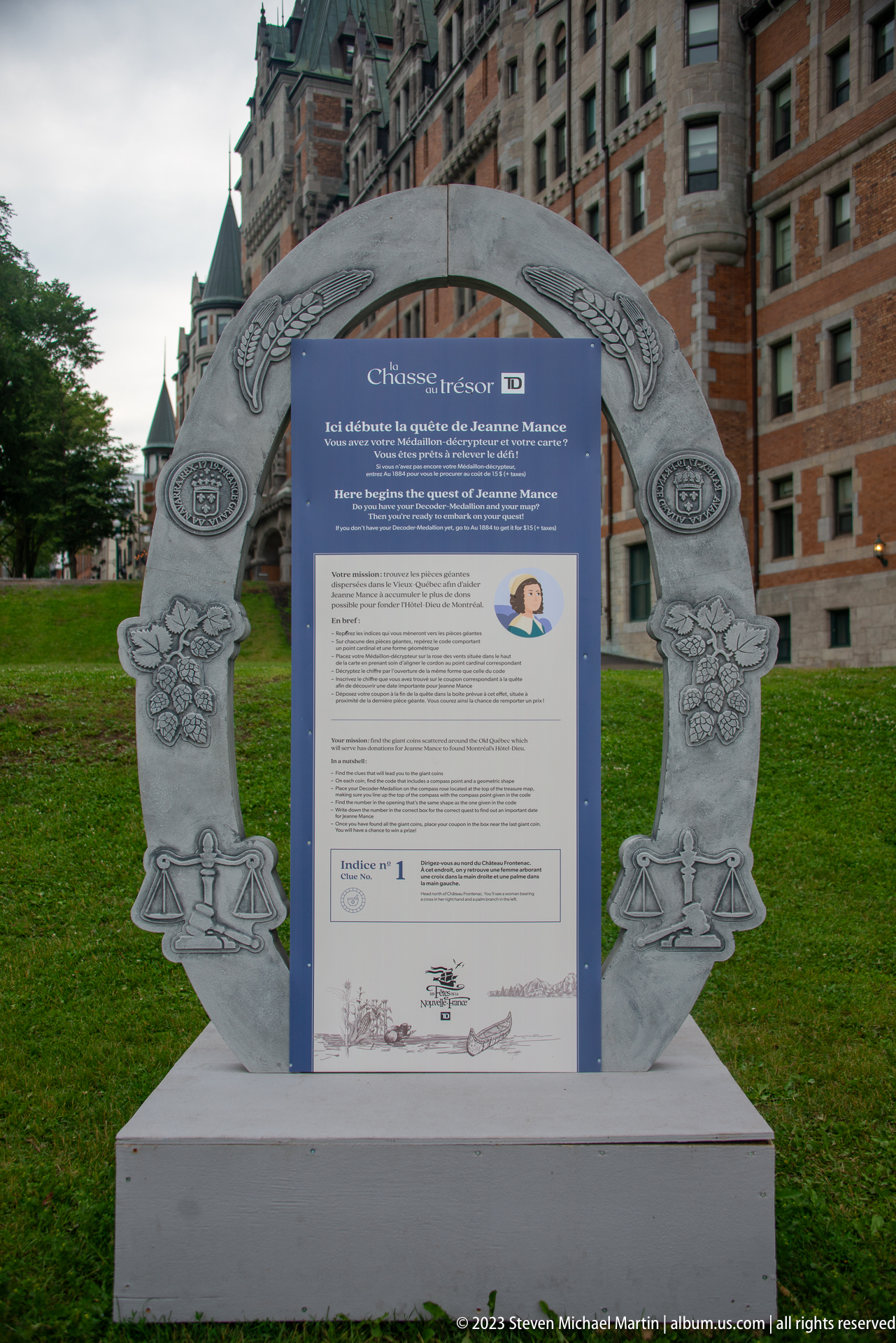
A freestanding interpretive panel is framed by a large decorative gray surround on the lawn near Château Frontenac. The bilingual display presents historical information and a portrait, while the hotel’s brick-and-stone façade fills the background. The photograph records one of the heritage interpretation elements installed along the Dufferin Terrace landscape.
Caption
A freestanding interpretive panel is framed by a large decorative gray surround on the lawn near Château Frontenac. The bilingual display presents historical information and a portrait, while the hotel’s brick-and-stone façade fills the background. The photograph records one of the heritage interpretation elements installed along the Dufferin Terrace landscape.
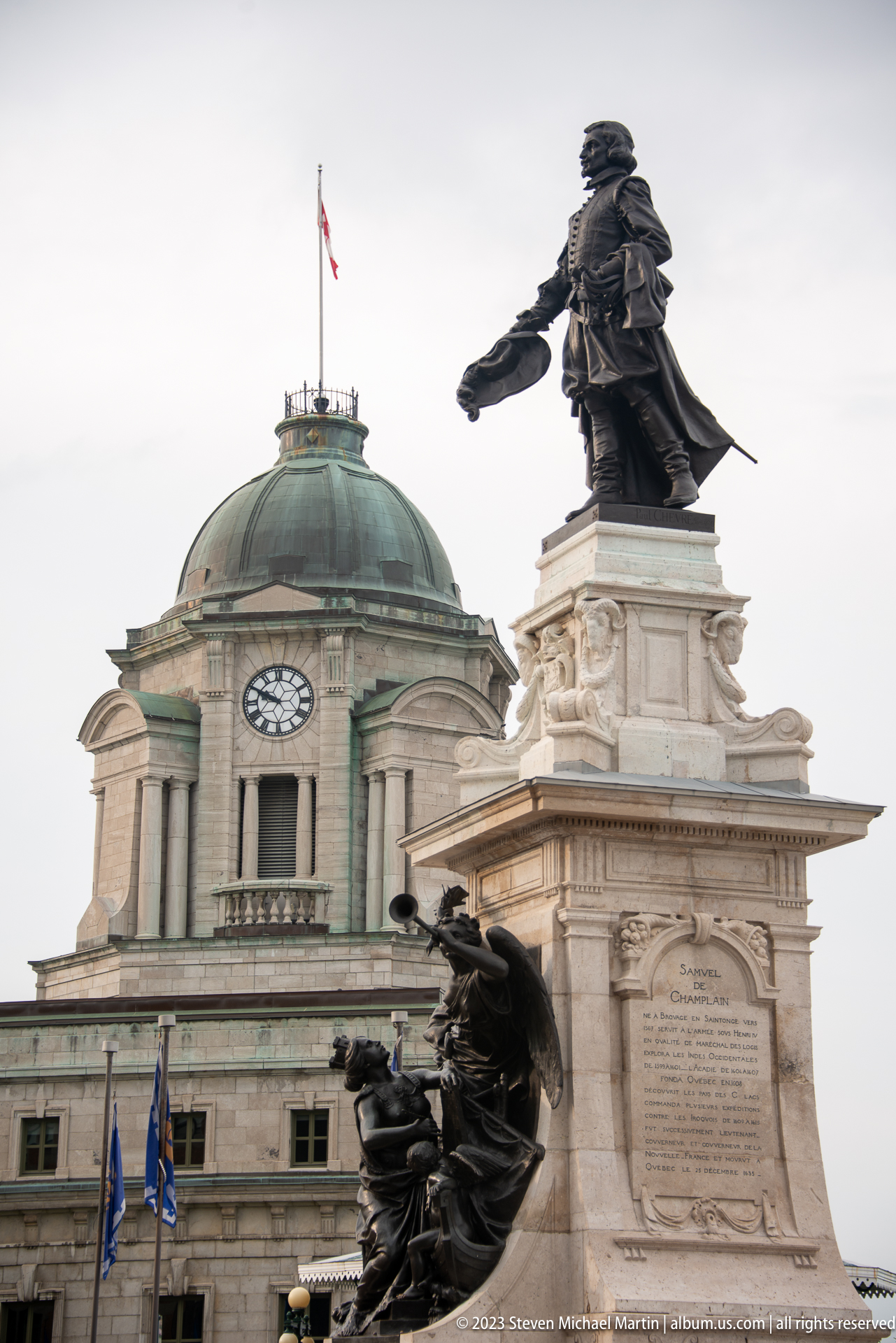
The Monument to Samuel de Champlain rises in front of a domed historic building near Dufferin Terrace. Champlain’s standing bronze figure crowns a pale stone pedestal, while additional bronze allegorical sculpture projects from the base. The close urban view emphasizes the monument’s layered sculptural program and prominent placement beside Quebec City’s historic core.
Caption
The Monument to Samuel de Champlain rises in front of a domed historic building near Dufferin Terrace. Champlain’s standing bronze figure crowns a pale stone pedestal, while additional bronze allegorical sculpture projects from the base. The close urban view emphasizes the monument’s layered sculptural program and prominent placement beside Quebec City’s historic core.
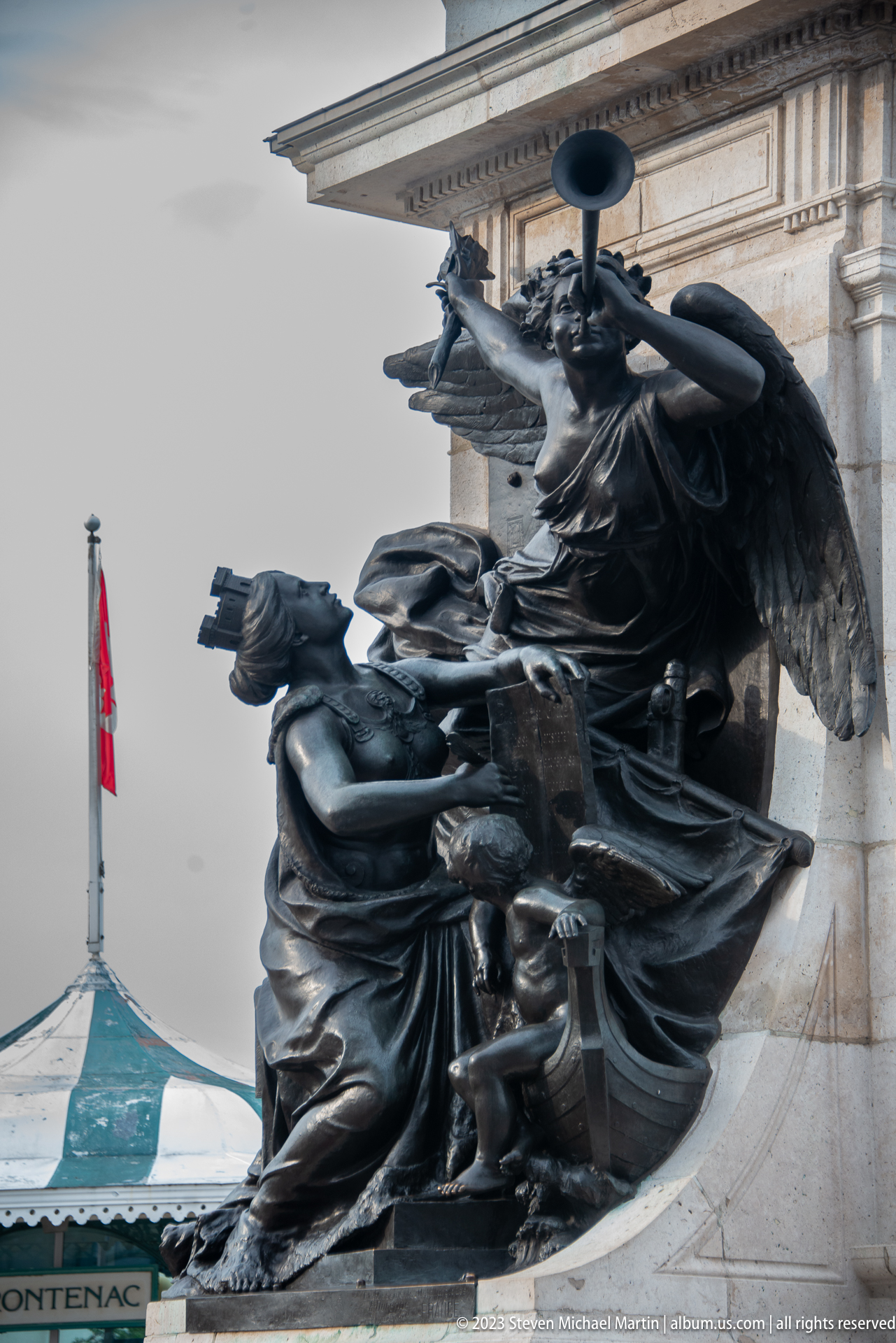
A close view isolates the bronze allegorical group at the base of the Samuel de Champlain monument. Seated and reclining figures, drapery, a winged female figure, and symbolic objects form a dense sculptural composition against the pale stone pedestal. The tighter framing shifts attention from Champlain’s standing figure to the monument’s elaborate secondary iconography and modeling.
Caption
A close view isolates the bronze allegorical group at the base of the Samuel de Champlain monument. Seated and reclining figures, drapery, a winged female figure, and symbolic objects form a dense sculptural composition against the pale stone pedestal. The tighter framing shifts attention from Champlain’s standing figure to the monument’s elaborate secondary iconography and modeling.
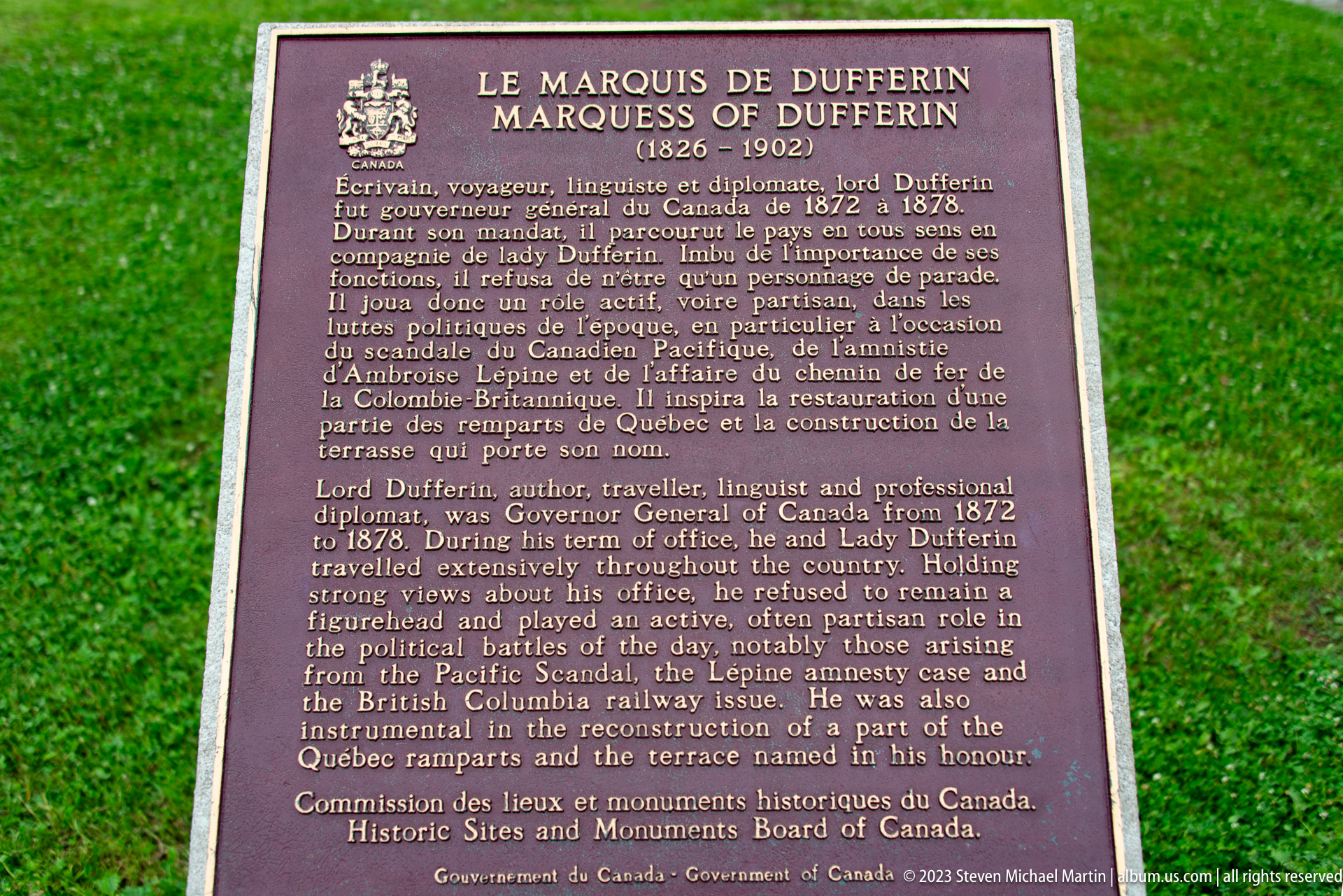
A bilingual plaque honors Frederick Temple Blackwood, Marquess of Dufferin and Ava, Governor General of Canada from 1872 to 1878. The text credits Dufferin and his wife with championing preservation of Quebec City’s fortifications and helping shape the terrace that bears his name. Set flush in the grass, the marker provides direct historical interpretation beside Dufferin Terrace.
Caption
A bilingual plaque honors Frederick Temple Blackwood, Marquess of Dufferin and Ava, Governor General of Canada from 1872 to 1878. The text credits Dufferin and his wife with championing preservation of Quebec City’s fortifications and helping shape the terrace that bears his name. Set flush in the grass, the marker provides direct historical interpretation beside Dufferin Terrace.
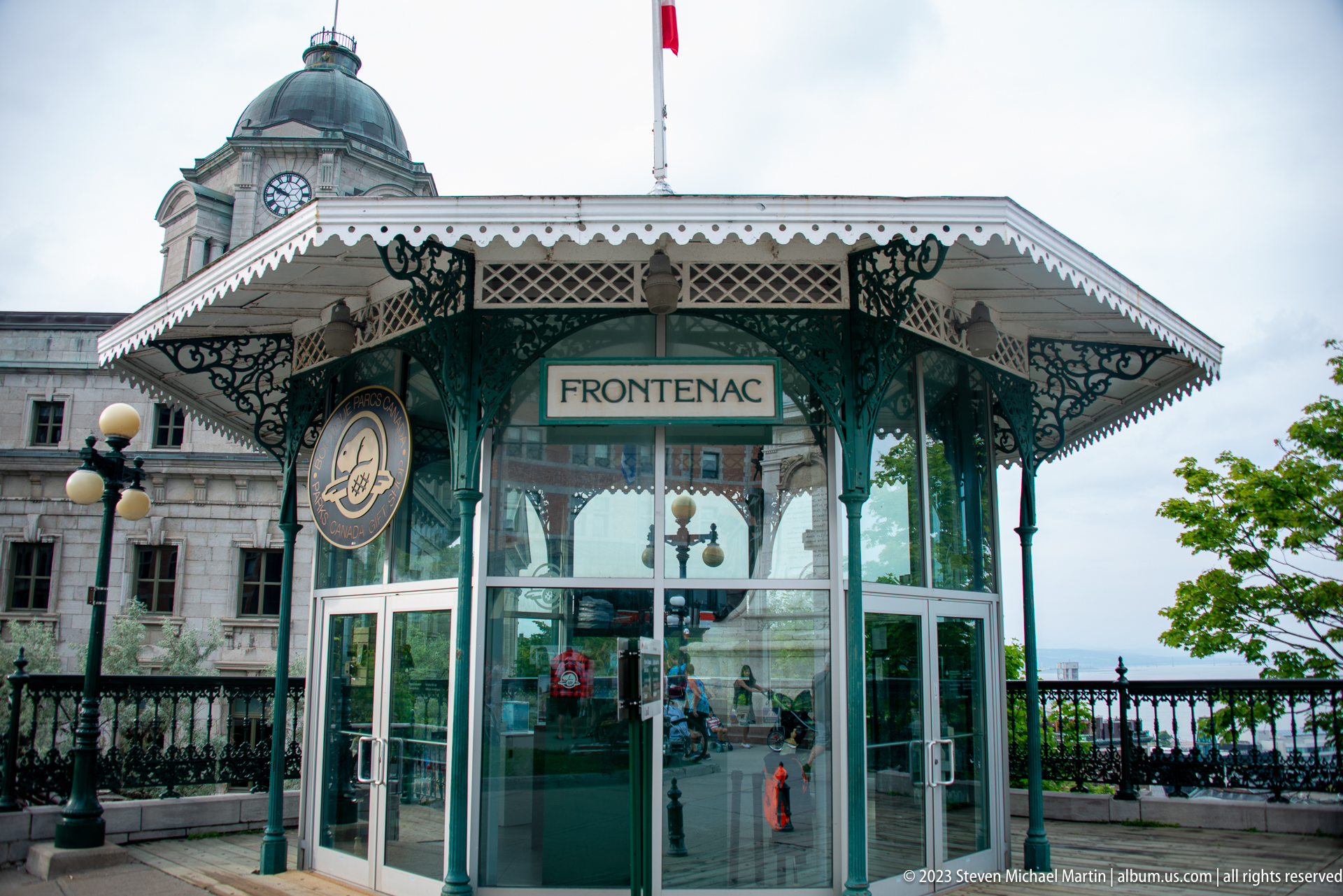
The glass-and-iron pavilion marked “FRONTENAC” serves as a compact transit entrance beside the elevated promenade in Quebec City. Ornamental metal brackets, a deep roof canopy, and transparent walls give the structure a light Victorian character, while the Canadian flag and nearby historic masonry place the modern access point within the dense architectural setting of the old city.
Caption
The glass-and-iron pavilion marked “FRONTENAC” serves as a compact transit entrance beside the elevated promenade in Quebec City. Ornamental metal brackets, a deep roof canopy, and transparent walls give the structure a light Victorian character, while the Canadian flag and nearby historic masonry place the modern access point within the dense architectural setting of the old city.
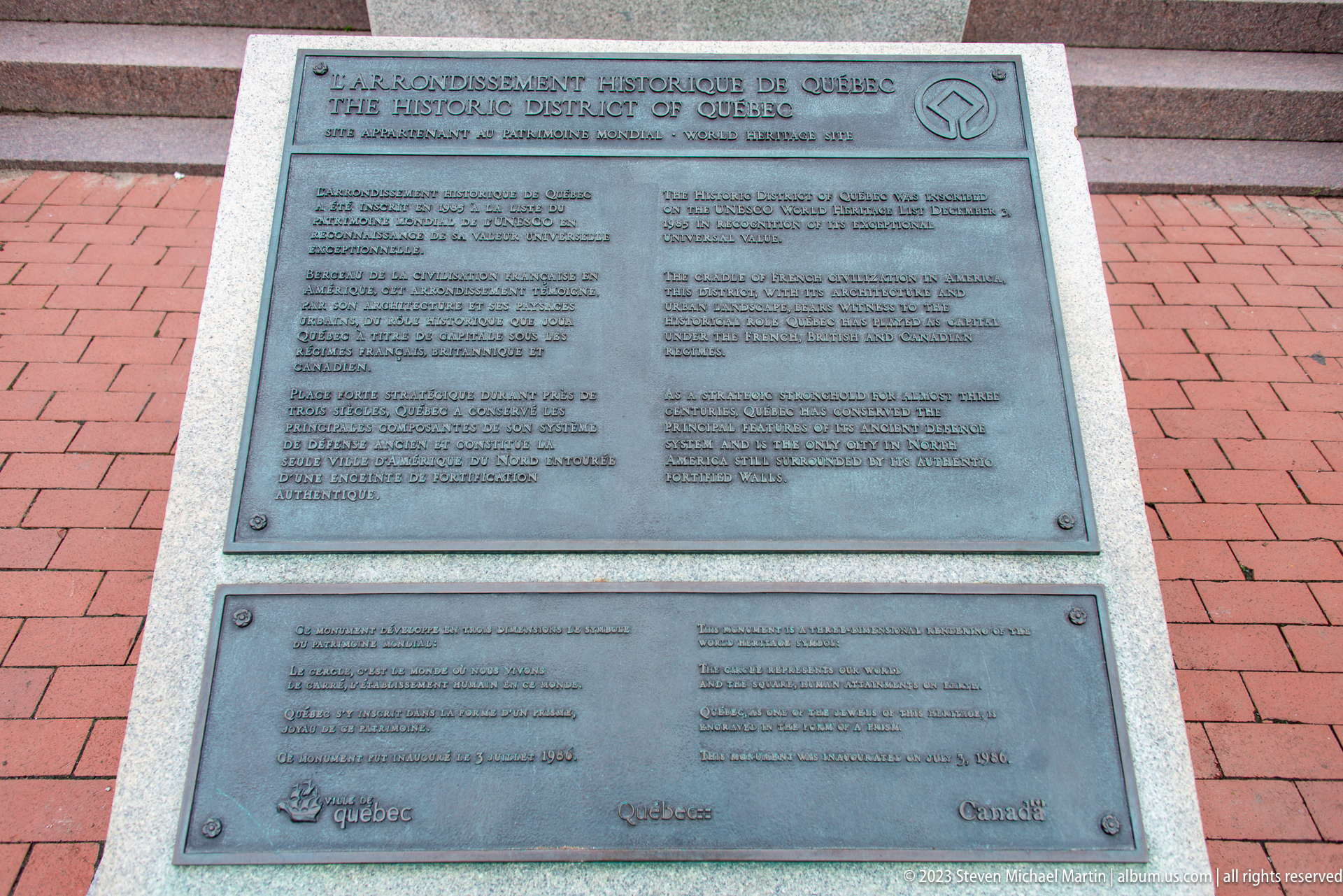
A bronze plaque set into a granite surround commemorates the Historic District of Québec and its recognition as a World Heritage site. Bilingual text occupies the upper panel, accompanied by the World Heritage emblem, while a second plaque below records institutional acknowledgments. The ground-level memorial turns the international designation into a tangible element of the city’s public realm.
Caption
A bronze plaque set into a granite surround commemorates the Historic District of Québec and its recognition as a World Heritage site. Bilingual text occupies the upper panel, accompanied by the World Heritage emblem, while a second plaque below records institutional acknowledgments. The ground-level memorial turns the international designation into a tangible element of the city’s public realm.
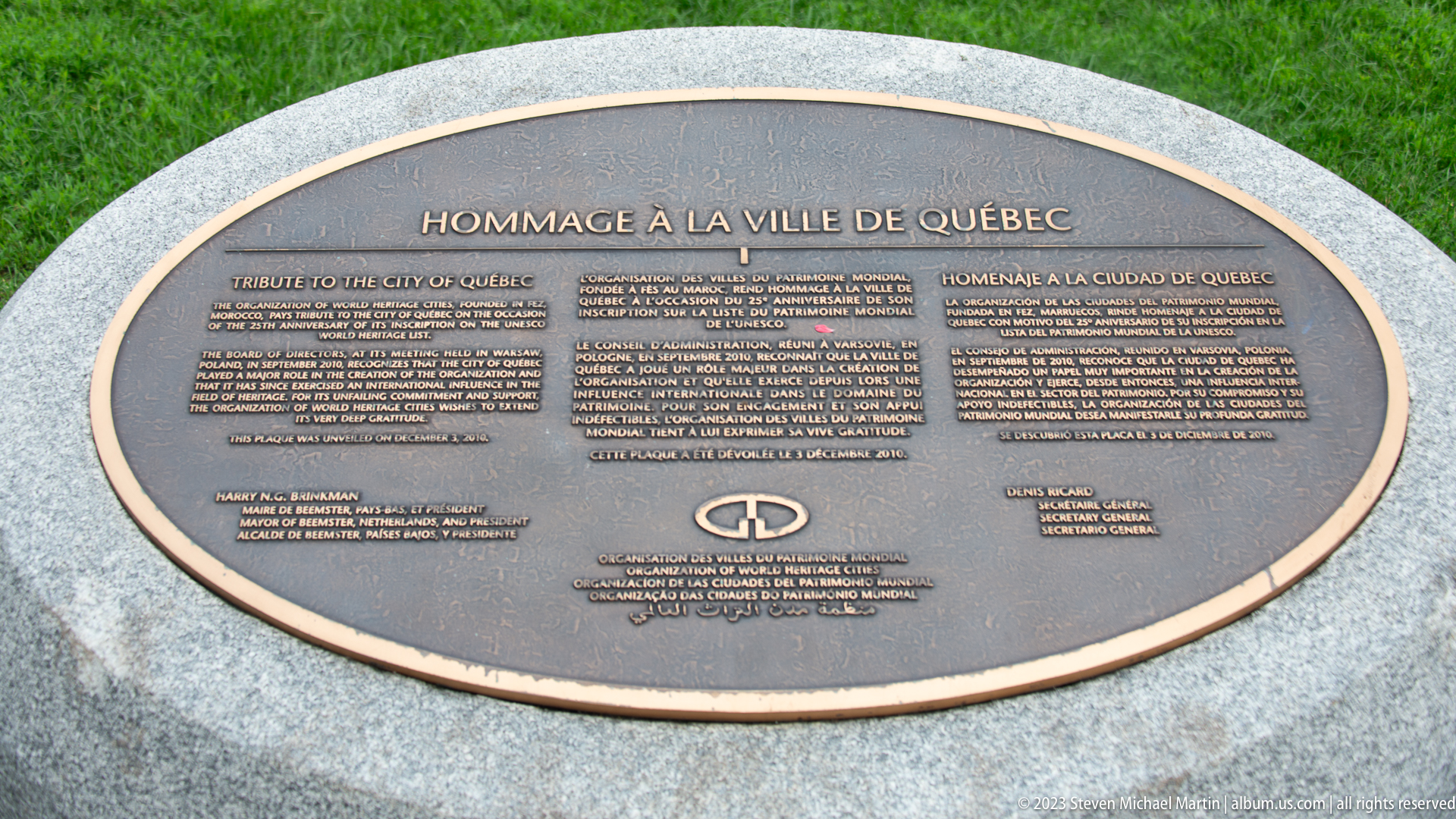
The oval bronze plaque titled “Hommage à la Ville de Québec” presents a multilingual tribute to the city in a formal civic setting. Raised lettering is organized in several text blocks across the patinated metal surface, with institutional marks below. Its low placement on a stone base encourages close reading and contrasts with the surrounding lawn.
Caption
The oval bronze plaque titled “Hommage à la Ville de Québec” presents a multilingual tribute to the city in a formal civic setting. Raised lettering is organized in several text blocks across the patinated metal surface, with institutional marks below. Its low placement on a stone base encourages close reading and contrasts with the surrounding lawn.
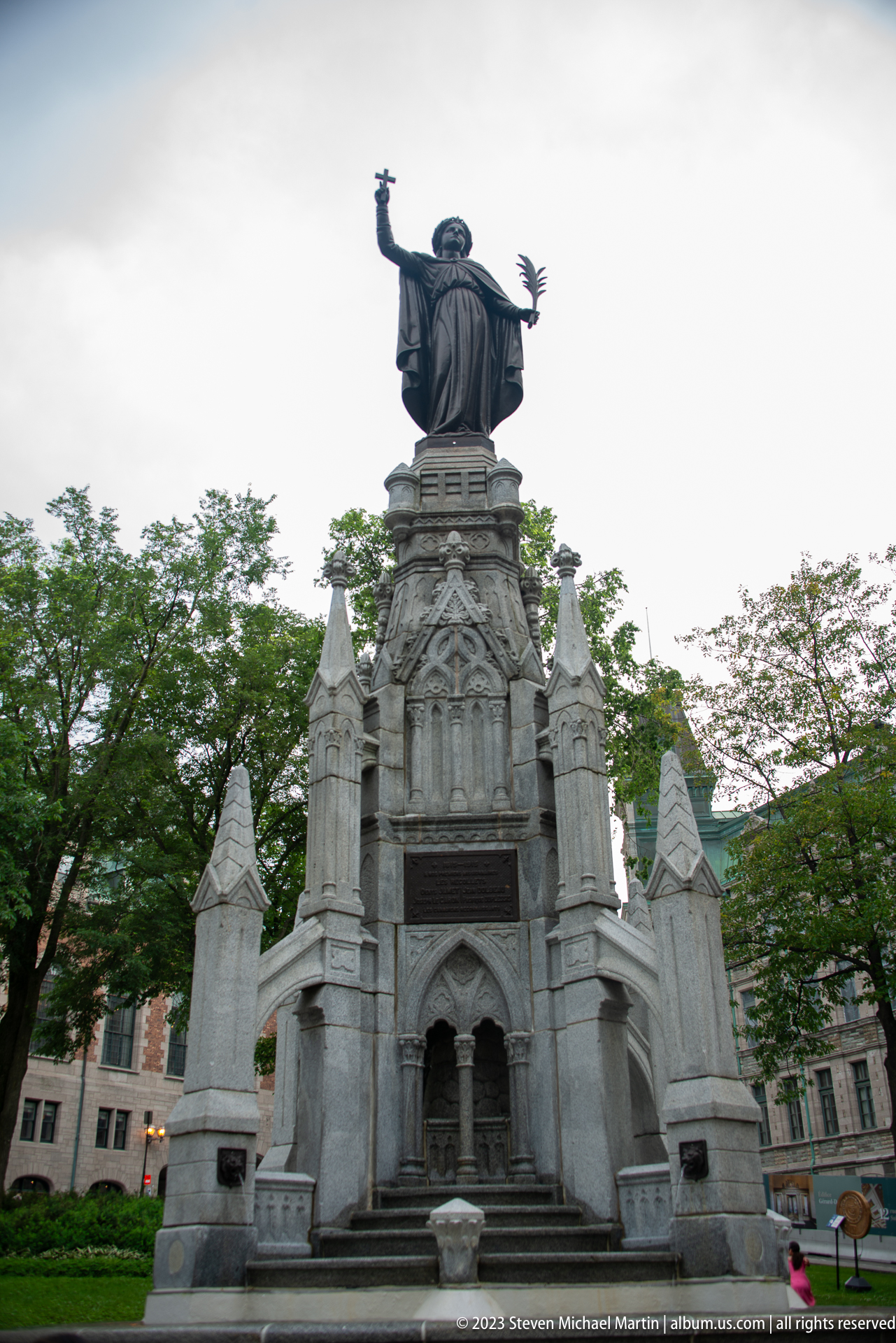
A monumental stone base rises from a landscaped square, crowned by a robed bronze figure extending one arm outward. Gothic-inspired arches, pinnacles, and carved panels articulate the pale masonry pedestal, while mature trees and surrounding historic buildings frame the memorial. The low viewpoint emphasizes the vertical progression from architectural base to the dark sculptural figure above.
Caption
A monumental stone base rises from a landscaped square, crowned by a robed bronze figure extending one arm outward. Gothic-inspired arches, pinnacles, and carved panels articulate the pale masonry pedestal, while mature trees and surrounding historic buildings frame the memorial. The low viewpoint emphasizes the vertical progression from architectural base to the dark sculptural figure above.
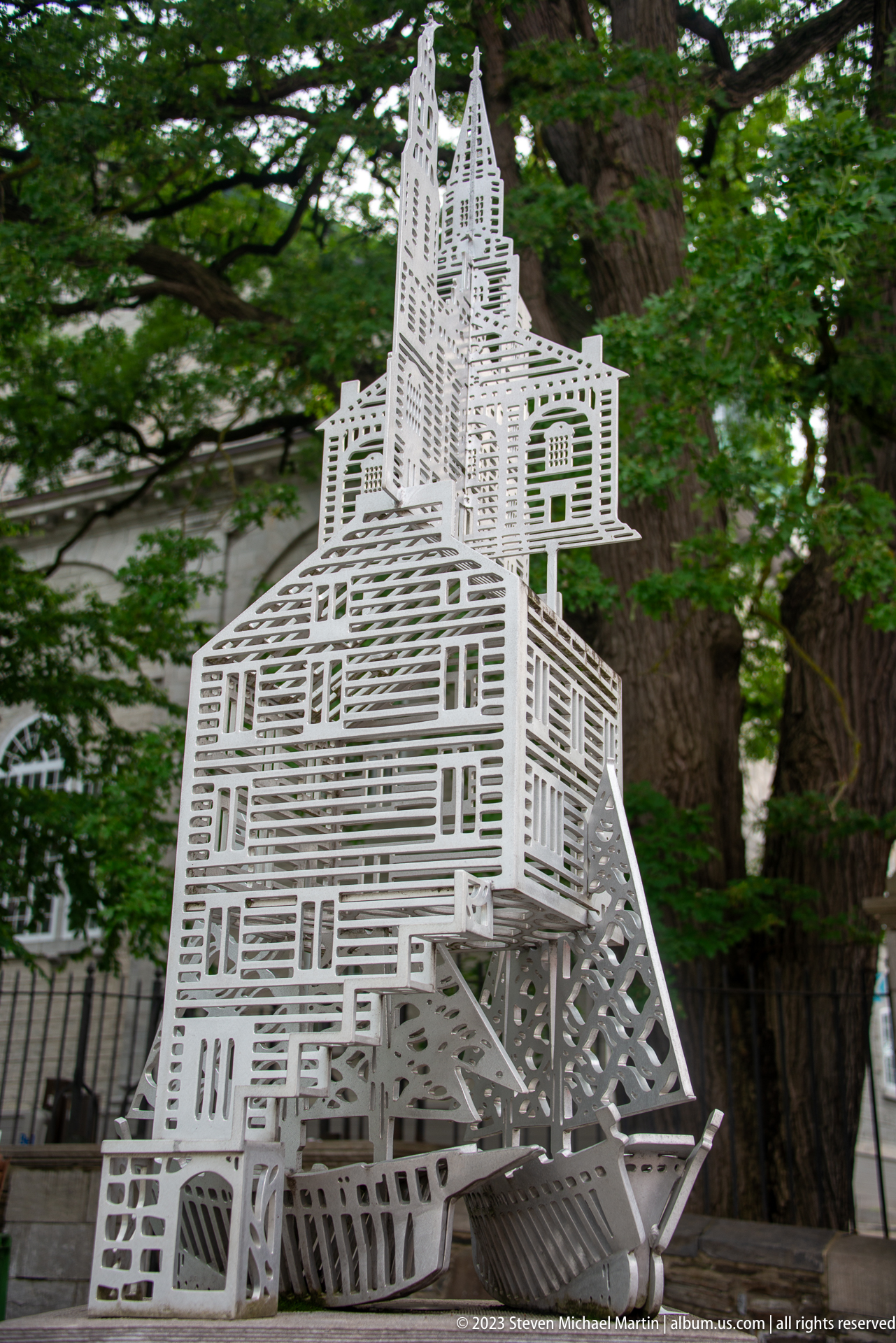
A white openwork sculpture translates the profile of a tall historic building into stacked linear frameworks. Set outdoors among mature trees, the piece combines recognizable architectural silhouettes with a deliberately skeletal, geometric construction. Its layered latticework allows foliage and surrounding space to remain visible through the form, creating a contemporary counterpoint to Quebec City’s dense historic architecture.
Caption
A white openwork sculpture translates the profile of a tall historic building into stacked linear frameworks. Set outdoors among mature trees, the piece combines recognizable architectural silhouettes with a deliberately skeletal, geometric construction. Its layered latticework allows foliage and surrounding space to remain visible through the form, creating a contemporary counterpoint to Quebec City’s dense historic architecture.
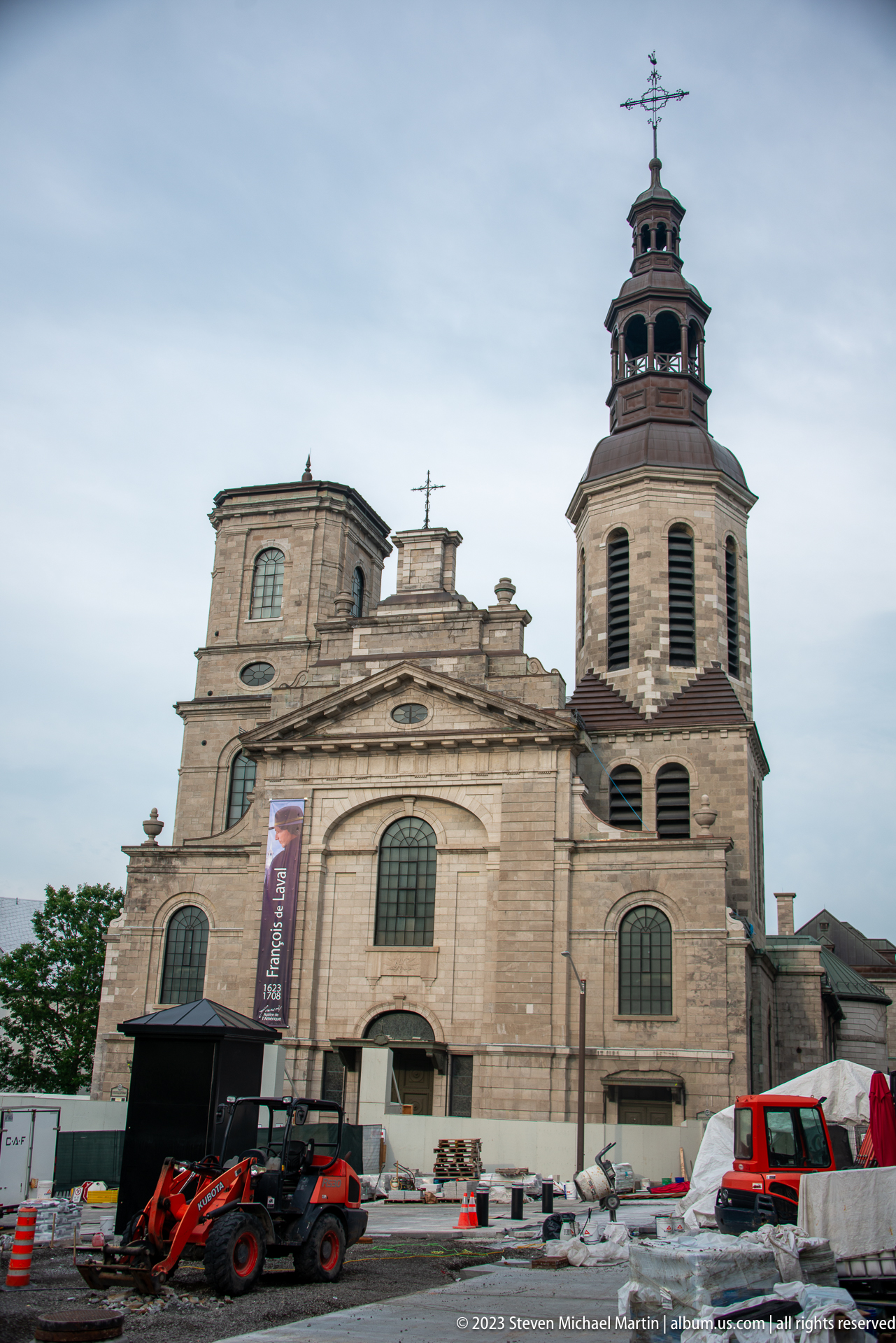
A substantial stone church fills the frame with a broad classical façade and a tall open belfry rising at right. Construction equipment and temporary barriers occupy the foreground, documenting active exterior work around the historic structure. Arched openings, a cross on the roofline, and the multi-stage bell tower identify the building’s ecclesiastical function even though its exact name is not legible here.
Caption
A substantial stone church fills the frame with a broad classical façade and a tall open belfry rising at right. Construction equipment and temporary barriers occupy the foreground, documenting active exterior work around the historic structure. Arched openings, a cross on the roofline, and the multi-stage bell tower identify the building’s ecclesiastical function even though its exact name is not legible here.
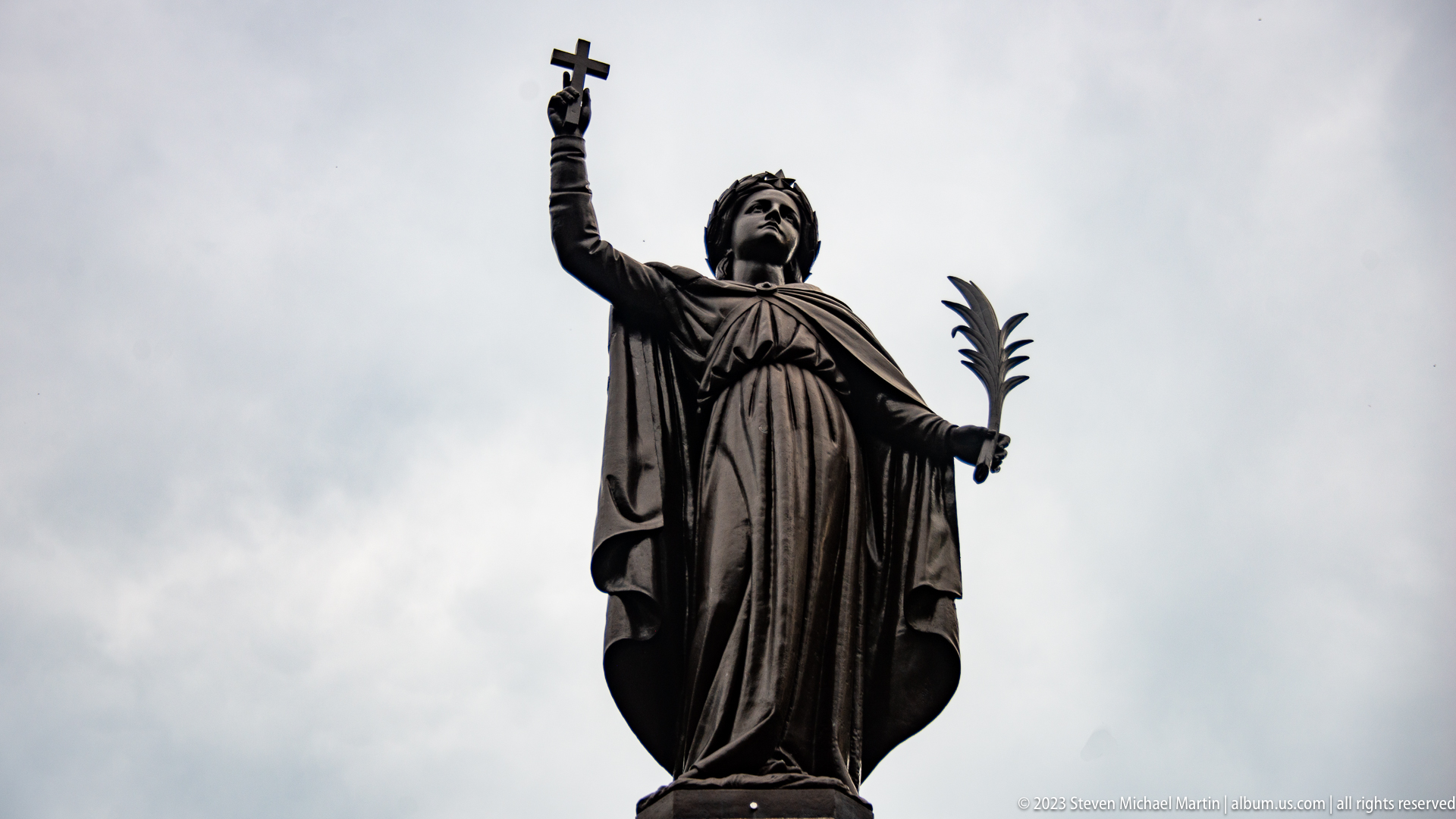
A dark bronze figure is isolated against the cloudy sky, raising a small cross in one hand and holding a palm frond in the other. The long drapery and symbolic attributes give the sculpture a formal commemorative character. Cropped tightly above the pedestal, the view concentrates attention on gesture, costume, and the paired emblems rather than the larger monument.
Caption
A dark bronze figure is isolated against the cloudy sky, raising a small cross in one hand and holding a palm frond in the other. The long drapery and symbolic attributes give the sculpture a formal commemorative character. Cropped tightly above the pedestal, the view concentrates attention on gesture, costume, and the paired emblems rather than the larger monument.
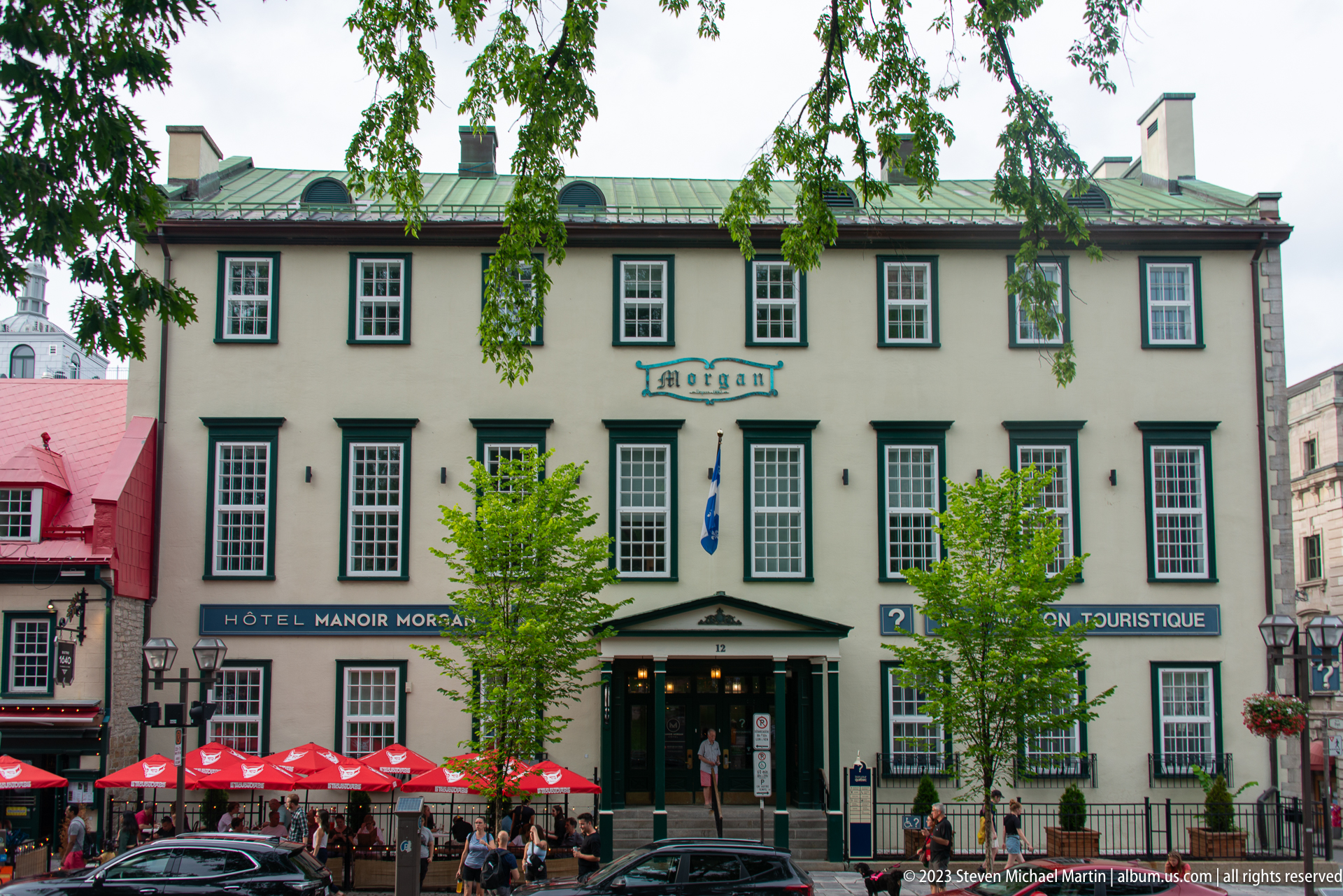
The restrained stone façade of Hôtel Manoir Morgan faces a busy street in Old Québec, with dark-trimmed sash windows arranged in regular bays beneath a green metal roof. Ground-floor signage identifies the hotel and tourist information services, while café umbrellas, pedestrians, and parked cars animate the frontage. The view records the continuing commercial use of a historic-scale urban building.
Caption
The restrained stone façade of Hôtel Manoir Morgan faces a busy street in Old Québec, with dark-trimmed sash windows arranged in regular bays beneath a green metal roof. Ground-floor signage identifies the hotel and tourist information services, while café umbrellas, pedestrians, and parked cars animate the frontage. The view records the continuing commercial use of a historic-scale urban building.
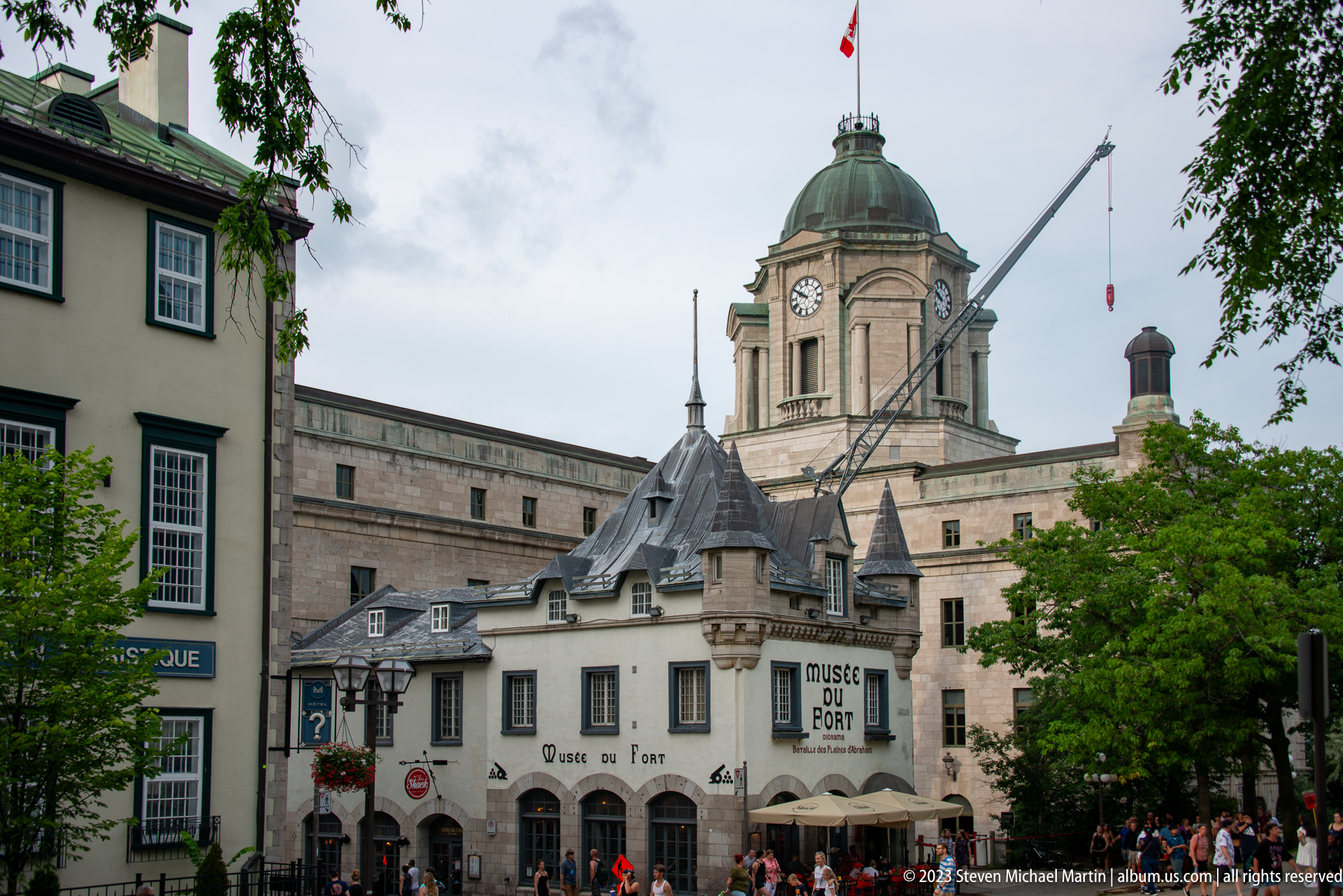
A domed clock tower rises behind a cluster of steep-roofed historic buildings and a lively pedestrian street in Old Québec. Pale masonry, dormers, chimneys, and varied rooflines create a layered urban profile, while shopfronts and visitors fill the foreground. The composition emphasizes how monumental civic architecture and smaller commercial buildings occupy the same compact historic core.
Caption
A domed clock tower rises behind a cluster of steep-roofed historic buildings and a lively pedestrian street in Old Québec. Pale masonry, dormers, chimneys, and varied rooflines create a layered urban profile, while shopfronts and visitors fill the foreground. The composition emphasizes how monumental civic architecture and smaller commercial buildings occupy the same compact historic core.
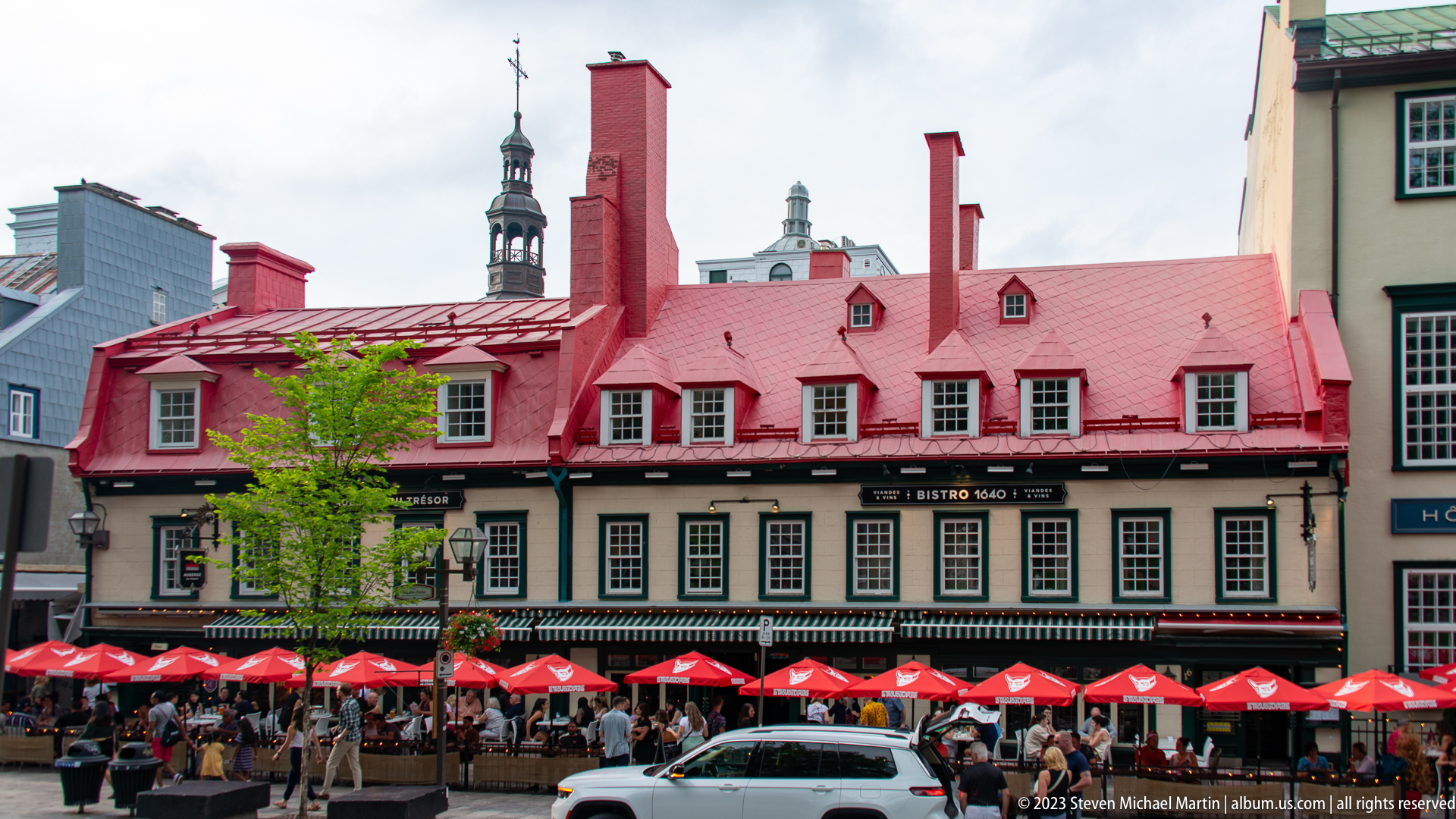
A long historic commercial building presents a vivid red metal roof, multiple dormers, tall chimneys, and dark-trimmed windows above a crowded restaurant terrace. Red umbrellas extend along the sidewalk as diners gather below the low stone-and-plaster façade. The repeated roof elements and active ground floor illustrate the intimate scale of hospitality businesses in Old Québec’s tourist district.
Caption
A long historic commercial building presents a vivid red metal roof, multiple dormers, tall chimneys, and dark-trimmed windows above a crowded restaurant terrace. Red umbrellas extend along the sidewalk as diners gather below the low stone-and-plaster façade. The repeated roof elements and active ground floor illustrate the intimate scale of hospitality businesses in Old Québec’s tourist district.
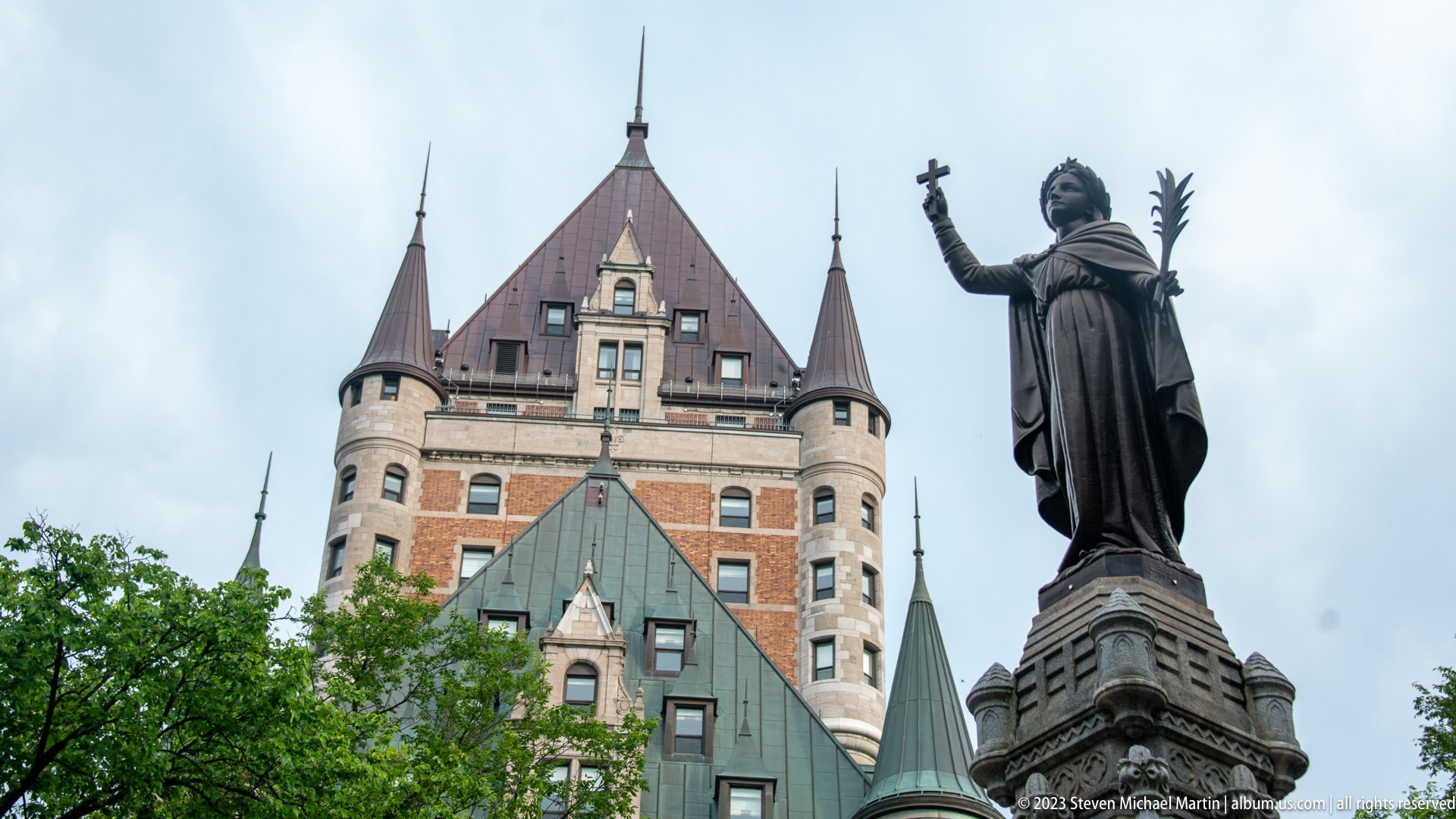
A robed bronze figure holding symbolic objects stands prominently before the steep roofs and turrets of the Château Frontenac. Seen from below, the sculpture occupies the right side of the frame while the hotel’s brick-and-stone mass rises behind it. The juxtaposition connects public commemoration with the monumental architecture that dominates the Upper Town skyline.
Caption
A robed bronze figure holding symbolic objects stands prominently before the steep roofs and turrets of the Château Frontenac. Seen from below, the sculpture occupies the right side of the frame while the hotel’s brick-and-stone mass rises behind it. The juxtaposition connects public commemoration with the monumental architecture that dominates the Upper Town skyline.
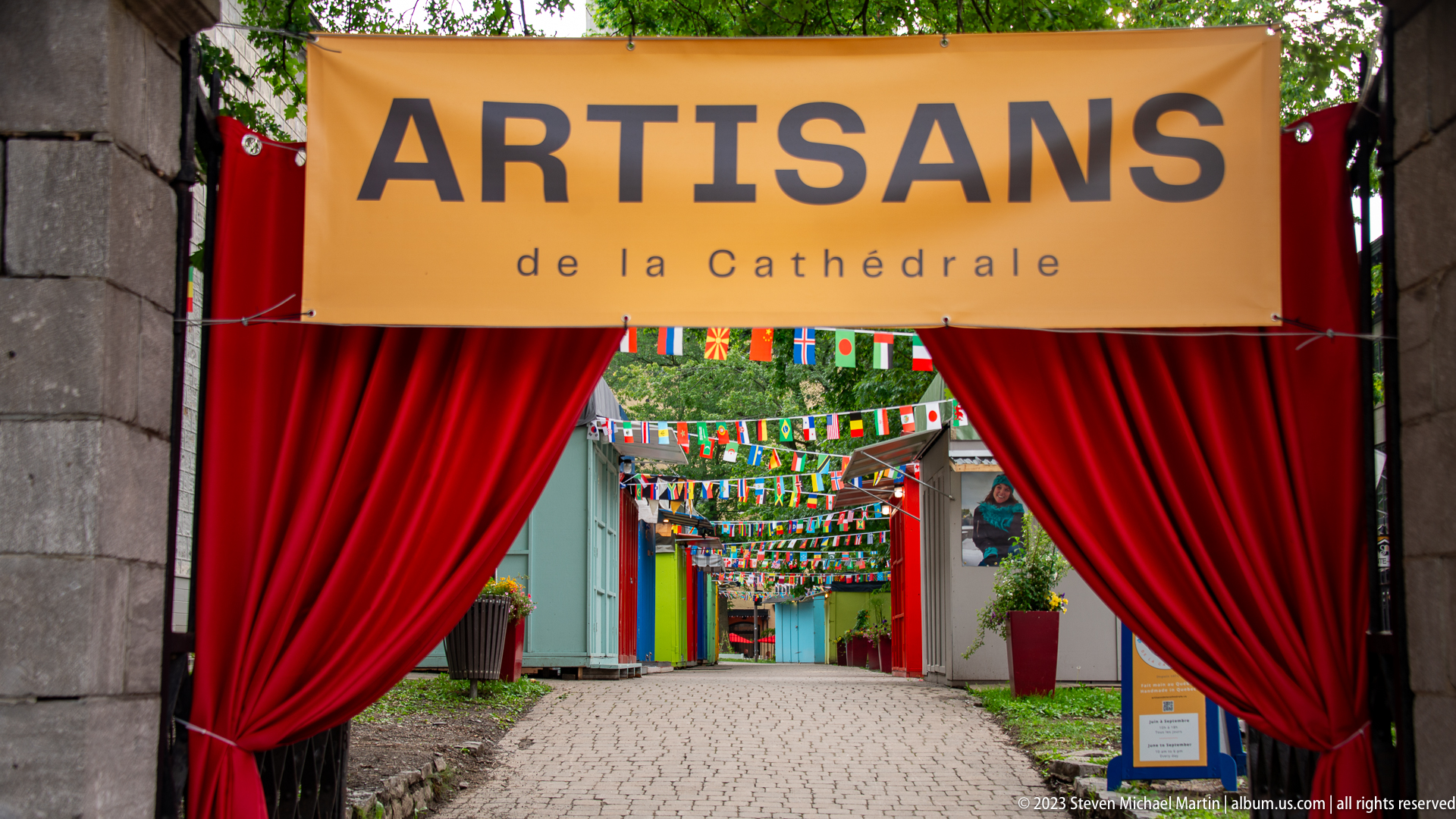
Red curtains frame the entrance to “Artisans de la Cathédrale,” opening onto a narrow lane decorated with rows of colorful overhead pennants. Brightly painted stalls or doors recede along the cobbled passage, turning the entry into a theatrical threshold between the stone street wall and an enclosed craft-market setting. The visible sign provides a clear name for the destination.
Caption
Red curtains frame the entrance to “Artisans de la Cathédrale,” opening onto a narrow lane decorated with rows of colorful overhead pennants. Brightly painted stalls or doors recede along the cobbled passage, turning the entry into a theatrical threshold between the stone street wall and an enclosed craft-market setting. The visible sign provides a clear name for the destination.
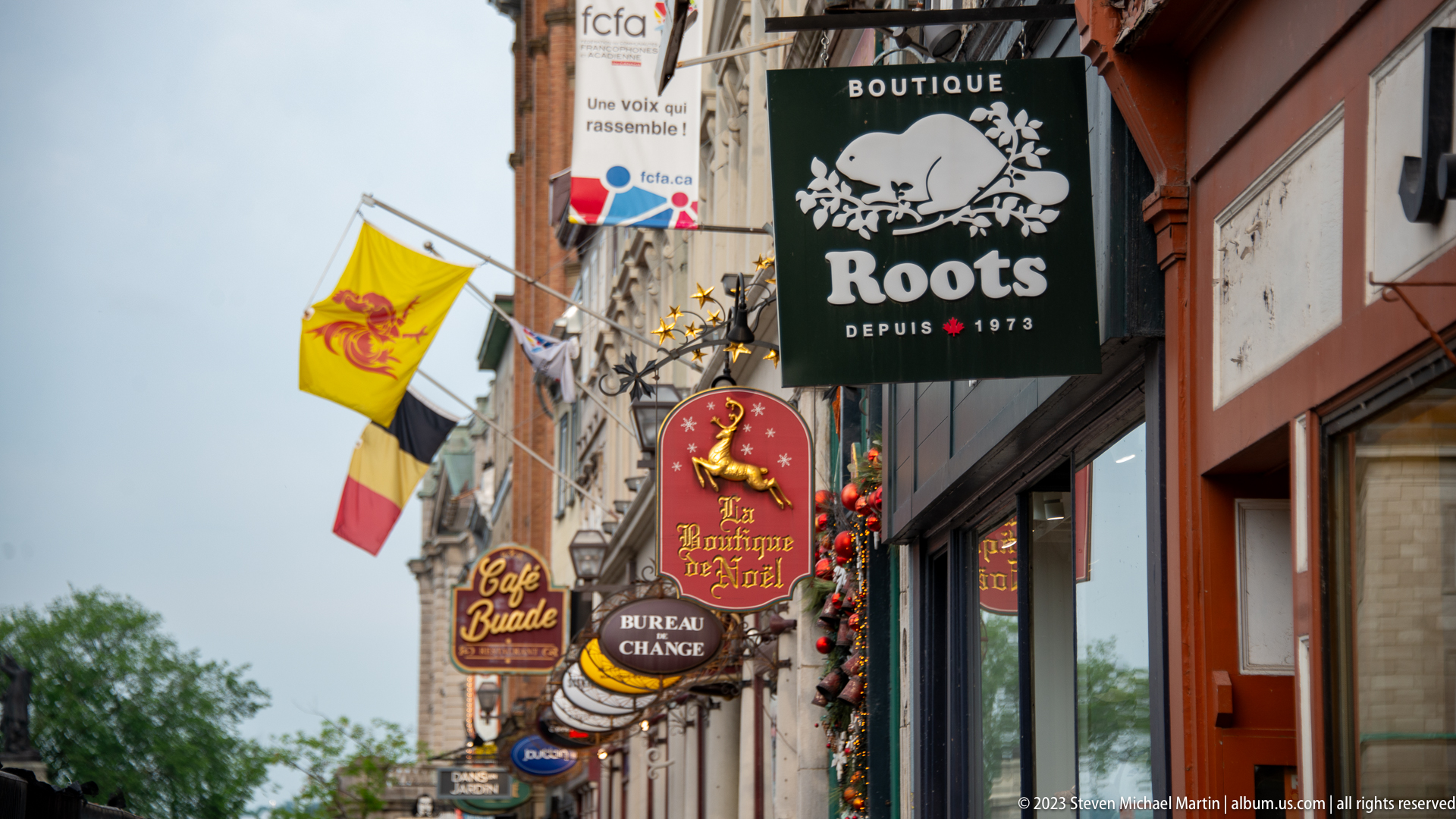
A dense row of hanging signs projects from historic façades along a commercial street in Old Québec. The clearly visible Roots sign shares the view with smaller boutique and exchange signs, while a yellow-and-red flag extends above the sidewalk. The compressed perspective emphasizes the layered signage that guides pedestrians through the narrow retail corridor.
Caption
A dense row of hanging signs projects from historic façades along a commercial street in Old Québec. The clearly visible Roots sign shares the view with smaller boutique and exchange signs, while a yellow-and-red flag extends above the sidewalk. The compressed perspective emphasizes the layered signage that guides pedestrians through the narrow retail corridor.
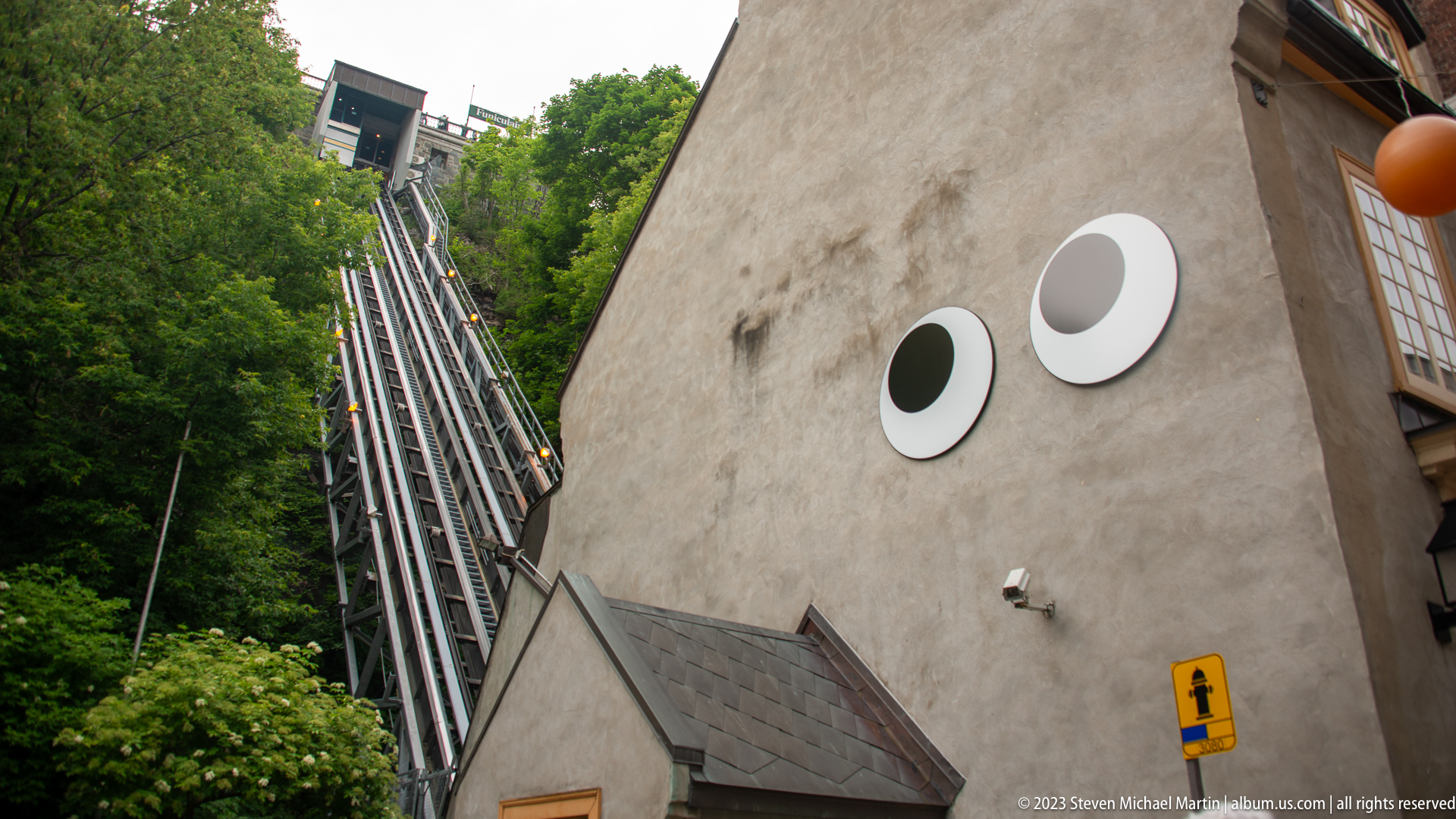
An inclined metal rail structure climbs steeply beside a pale historic building, revealing the engineered connection between different elevations of Quebec City. Two circular wall features punctuate the otherwise plain façade, while dense vegetation rises behind the track. The tight upward angle emphasizes the grade and mechanical character of the transport corridor rather than a panoramic city view.
Caption
An inclined metal rail structure climbs steeply beside a pale historic building, revealing the engineered connection between different elevations of Quebec City. Two circular wall features punctuate the otherwise plain façade, while dense vegetation rises behind the track. The tight upward angle emphasizes the grade and mechanical character of the transport corridor rather than a panoramic city view.
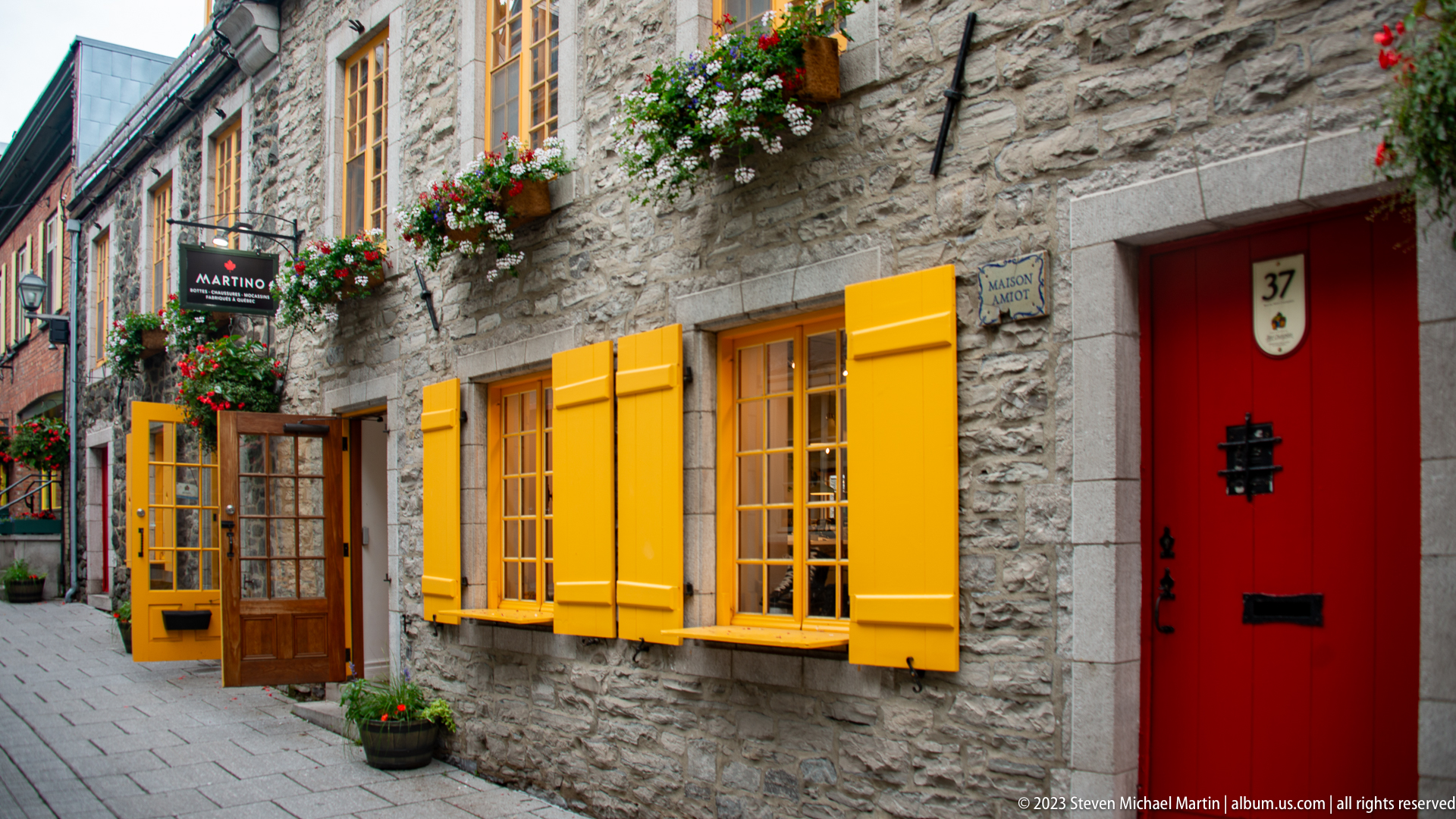
Bright yellow shutters and window frames animate a rough stone façade on a narrow pedestrian lane, while a deep red door marked 37 anchors the right edge. Flower boxes and small planters soften the masonry, and an open glazed door draws attention toward the interior. The close street-level view highlights the vivid color accents used against traditional stone construction in Old Québec.
Caption
Bright yellow shutters and window frames animate a rough stone façade on a narrow pedestrian lane, while a deep red door marked 37 anchors the right edge. Flower boxes and small planters soften the masonry, and an open glazed door draws attention toward the interior. The close street-level view highlights the vivid color accents used against traditional stone construction in Old Québec.
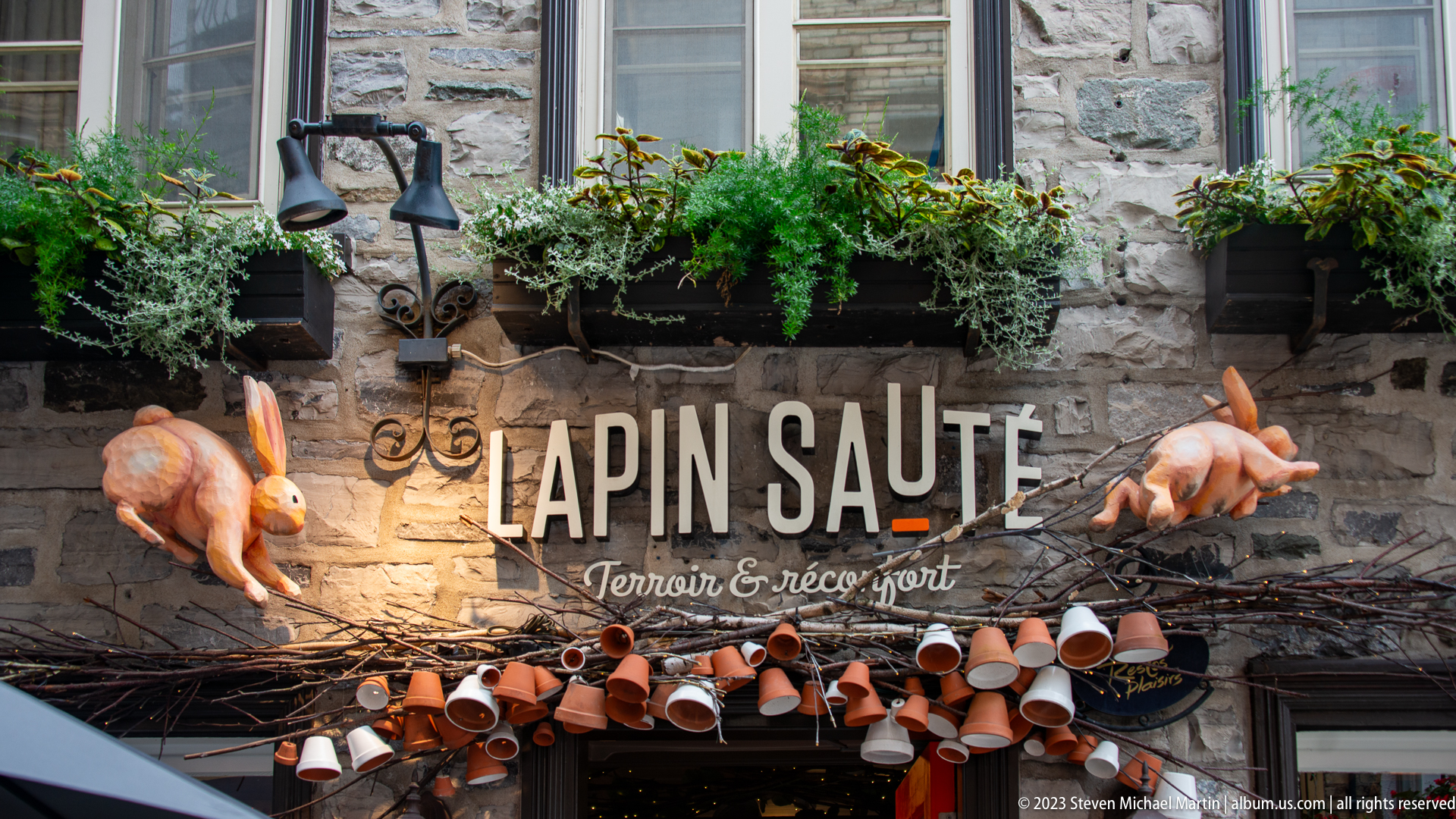
The Lapin Sauté storefront uses sculptural rabbits, greenery, branches, and rows of small terracotta pots to turn its sign into an elaborate decorative installation. Large white lettering stands out against the stone wall beneath window boxes filled with plants. The playful rabbit motif reinforces the restaurant’s name while contributing to the highly ornamented commercial character of the surrounding lane.
Caption
The Lapin Sauté storefront uses sculptural rabbits, greenery, branches, and rows of small terracotta pots to turn its sign into an elaborate decorative installation. Large white lettering stands out against the stone wall beneath window boxes filled with plants. The playful rabbit motif reinforces the restaurant’s name while contributing to the highly ornamented commercial character of the surrounding lane.
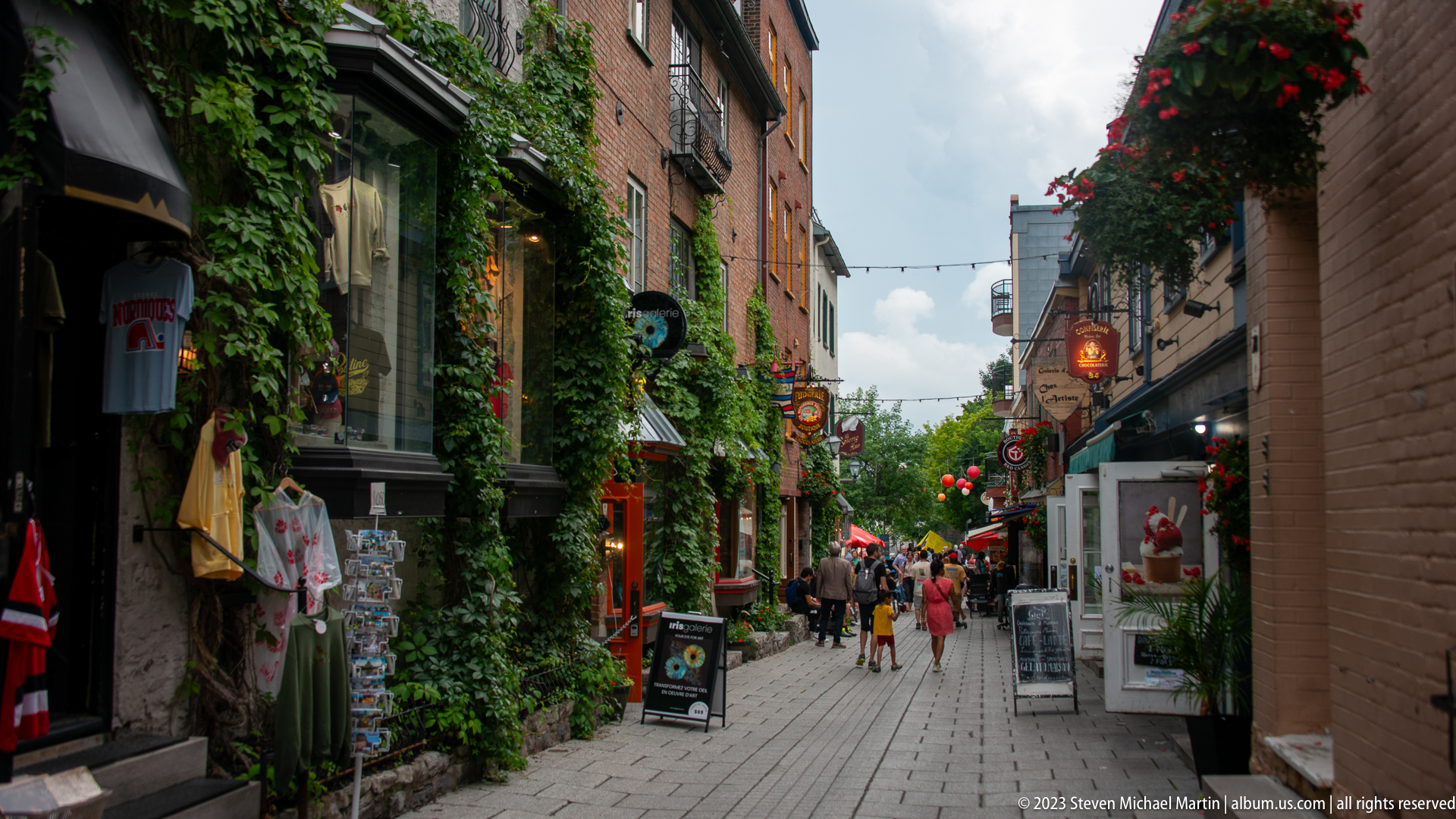
A narrow pedestrian lane recedes between closely spaced historic buildings, its shopfronts softened by climbing greenery and hanging flowers. Projecting signs, display racks, and small groups of visitors create a layered retail streetscape, while the stone paving guides the eye toward the brighter opening in the distance. The view emphasizes the intimate scale and dense commercial use of Old Québec’s historic core.
Caption
A narrow pedestrian lane recedes between closely spaced historic buildings, its shopfronts softened by climbing greenery and hanging flowers. Projecting signs, display racks, and small groups of visitors create a layered retail streetscape, while the stone paving guides the eye toward the brighter opening in the distance. The view emphasizes the intimate scale and dense commercial use of Old Québec’s historic core.
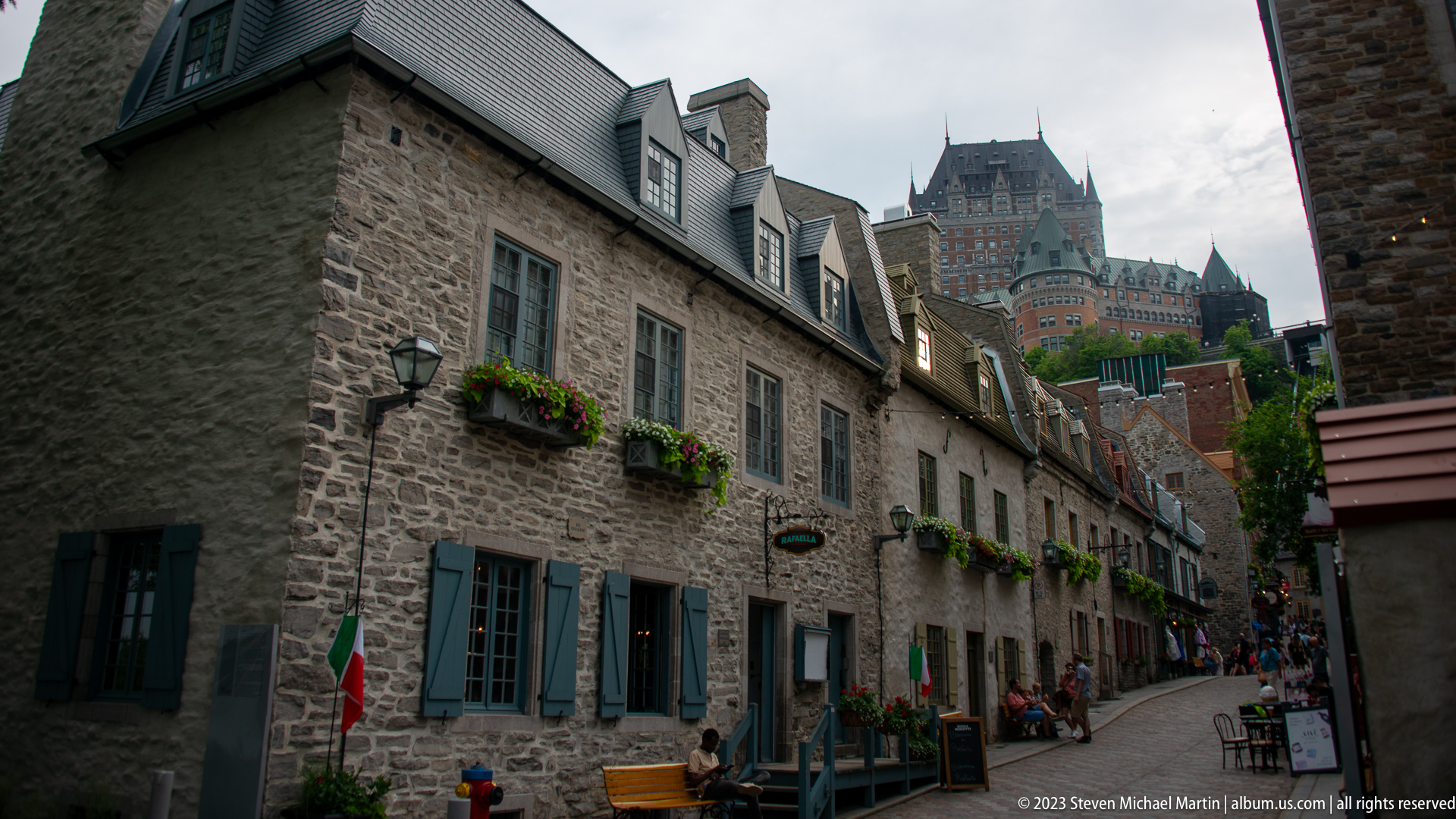
A long row of stone buildings follows a narrow Lower Town street while the Château Frontenac rises dramatically on the bluff above. Flower boxes, shutters, dormers, and small storefronts animate the lower façades, contrasting with the hotel’s monumental silhouette in the distance. The layered view makes Quebec City’s steep topography legible by placing intimate street architecture directly beneath the Upper Town landmark.
Caption
A long row of stone buildings follows a narrow Lower Town street while the Château Frontenac rises dramatically on the bluff above. Flower boxes, shutters, dormers, and small storefronts animate the lower façades, contrasting with the hotel’s monumental silhouette in the distance. The layered view makes Quebec City’s steep topography legible by placing intimate street architecture directly beneath the Upper Town landmark.
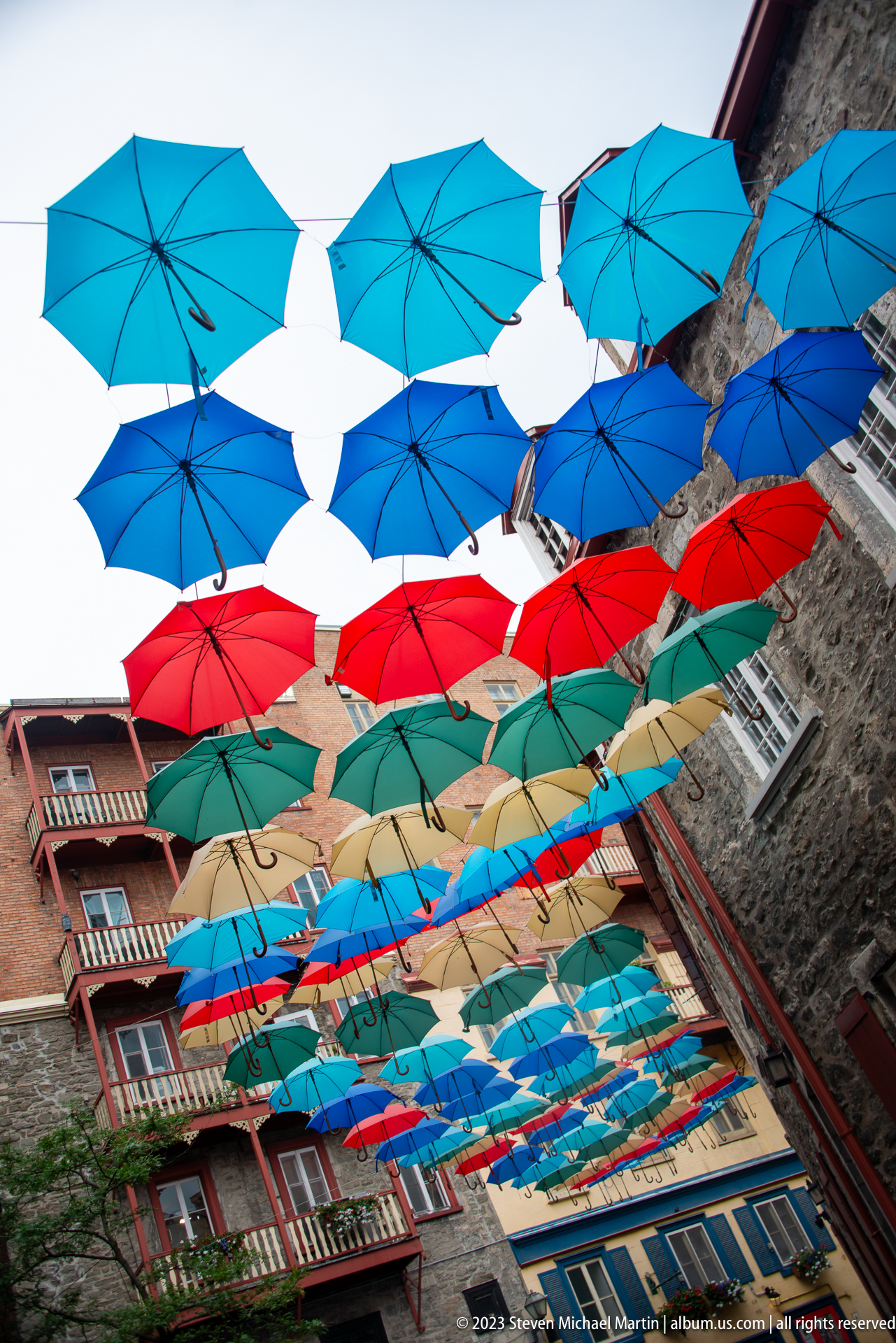
Rows of open umbrellas in blue, red, green, and turquoise form a suspended canopy above a narrow historic street. Seen at an angle between stone and brick façades, the installation creates a vivid overhead pattern while leaving fragments of windows and rooflines visible below. The temporary decorative intervention transforms the street’s vertical space without obscuring its compact architectural enclosure.
Caption
Rows of open umbrellas in blue, red, green, and turquoise form a suspended canopy above a narrow historic street. Seen at an angle between stone and brick façades, the installation creates a vivid overhead pattern while leaving fragments of windows and rooflines visible below. The temporary decorative intervention transforms the street’s vertical space without obscuring its compact architectural enclosure.
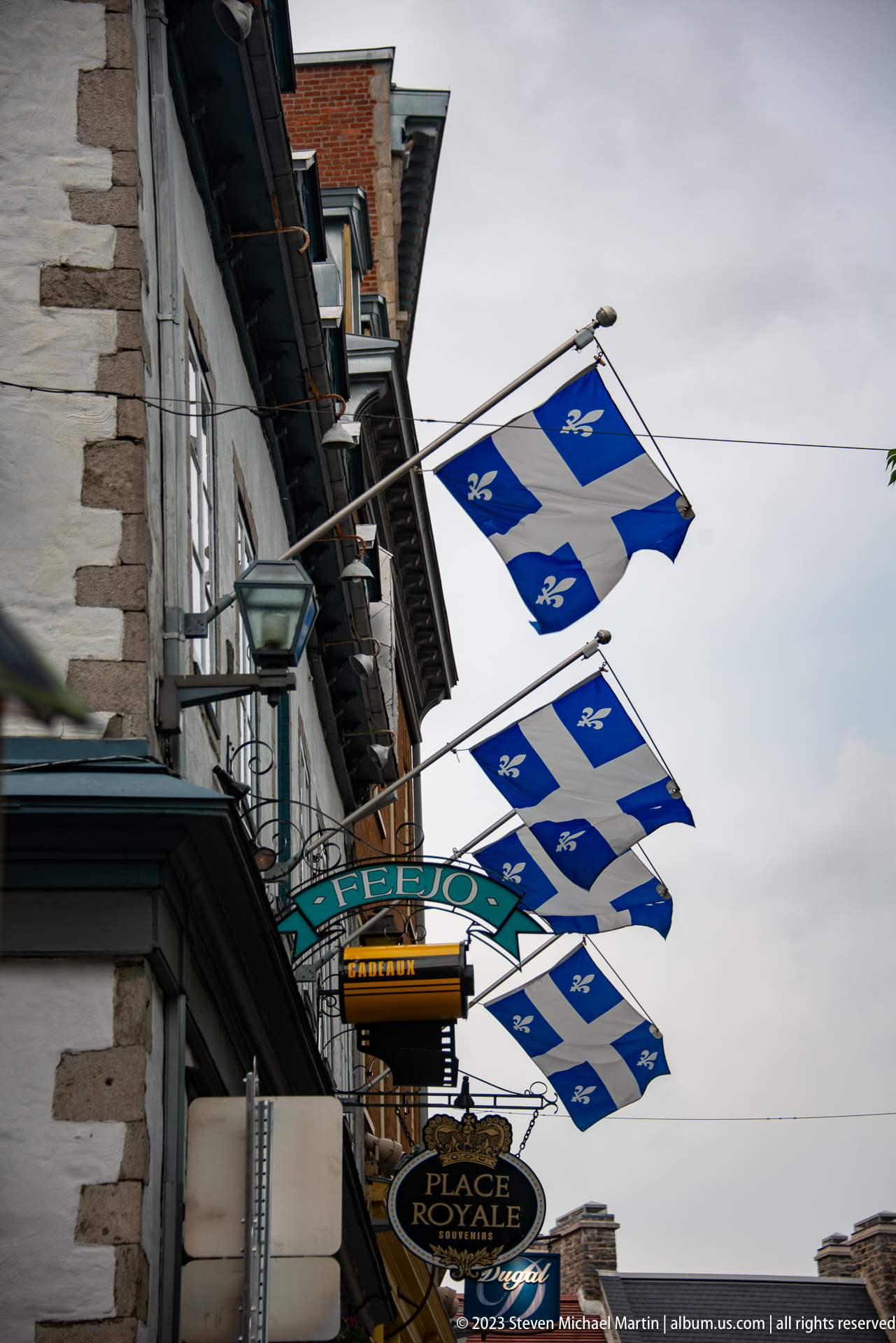
Blue-and-white Québec flags extend in repeated rows above a street corner marked by a “Place Royale” sign. Historic stone façades and traditional projecting shop signs frame the display, while the flags create a strong rhythmic pattern against the gray sky. The view uses civic symbolism and commercial signage to locate the streetscape within the historic Place Royale area.
Caption
Blue-and-white Québec flags extend in repeated rows above a street corner marked by a “Place Royale” sign. Historic stone façades and traditional projecting shop signs frame the display, while the flags create a strong rhythmic pattern against the gray sky. The view uses civic symbolism and commercial signage to locate the streetscape within the historic Place Royale area.
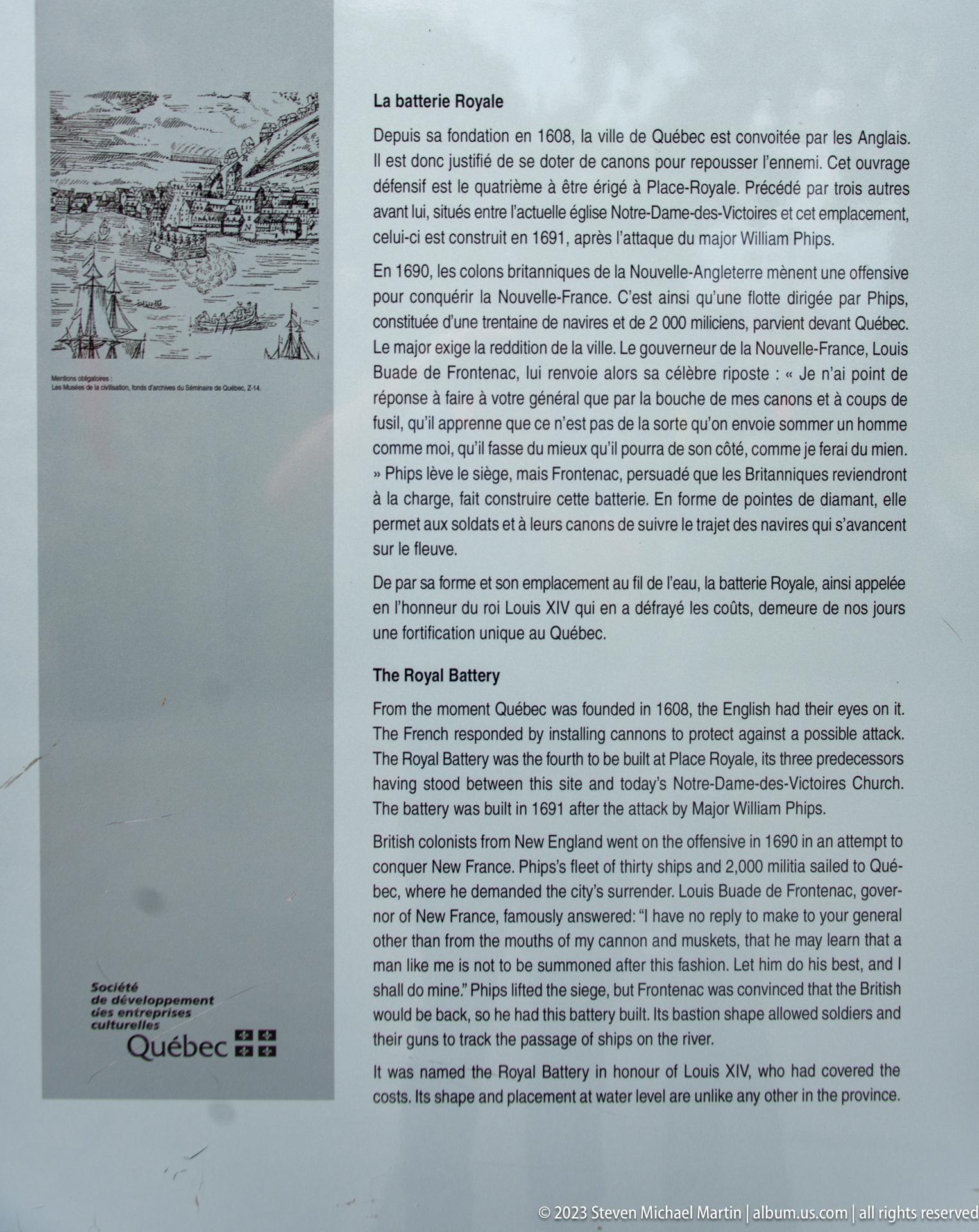
The interpretive panel titled “La batterie Royale” explains the Royal Battery in French and English, pairing historical text with a small plan or illustration. The bilingual presentation describes the site’s defensive role and later restoration, making the panel itself a useful record of how Quebec City interprets its fortified past for visitors. Institutional marks at the bottom identify municipal stewardship.
Caption
The interpretive panel titled “La batterie Royale” explains the Royal Battery in French and English, pairing historical text with a small plan or illustration. The bilingual presentation describes the site’s defensive role and later restoration, making the panel itself a useful record of how Quebec City interprets its fortified past for visitors. Institutional marks at the bottom identify municipal stewardship.
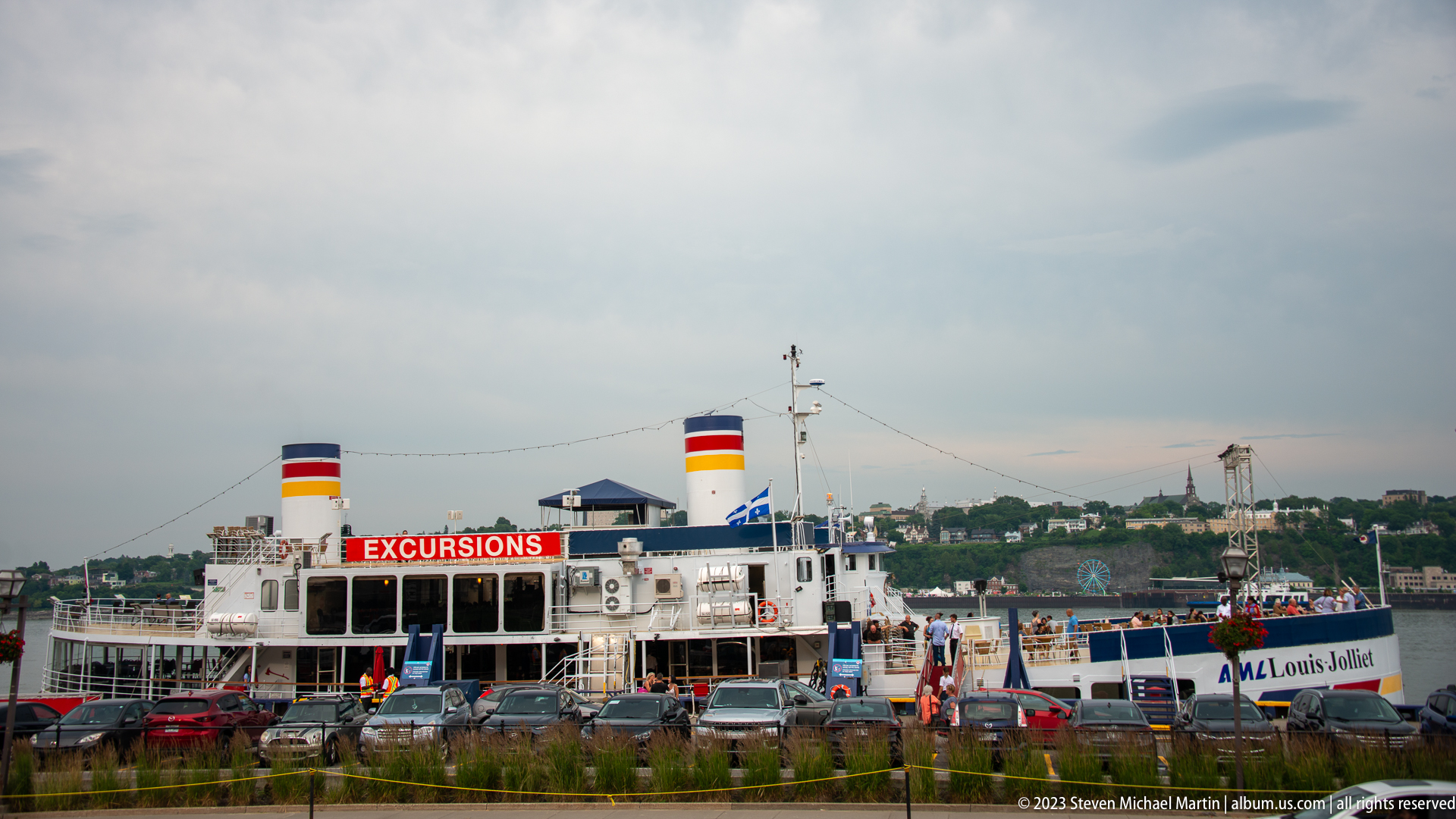
The AML Louis Jolliet sits at the waterfront with an illuminated “EXCURSIONS” sign above its decks. Twin funnels with colored bands, railings, and passenger spaces give the vessel a distinctive sightseeing-boat profile, while parked vehicles occupy the foreground and the opposite riverbank stretches behind. The scene records the tourism infrastructure connecting Quebec City’s historic center with the St. Lawrence River.
Caption
The AML Louis Jolliet sits at the waterfront with an illuminated “EXCURSIONS” sign above its decks. Twin funnels with colored bands, railings, and passenger spaces give the vessel a distinctive sightseeing-boat profile, while parked vehicles occupy the foreground and the opposite riverbank stretches behind. The scene records the tourism infrastructure connecting Quebec City’s historic center with the St. Lawrence River.
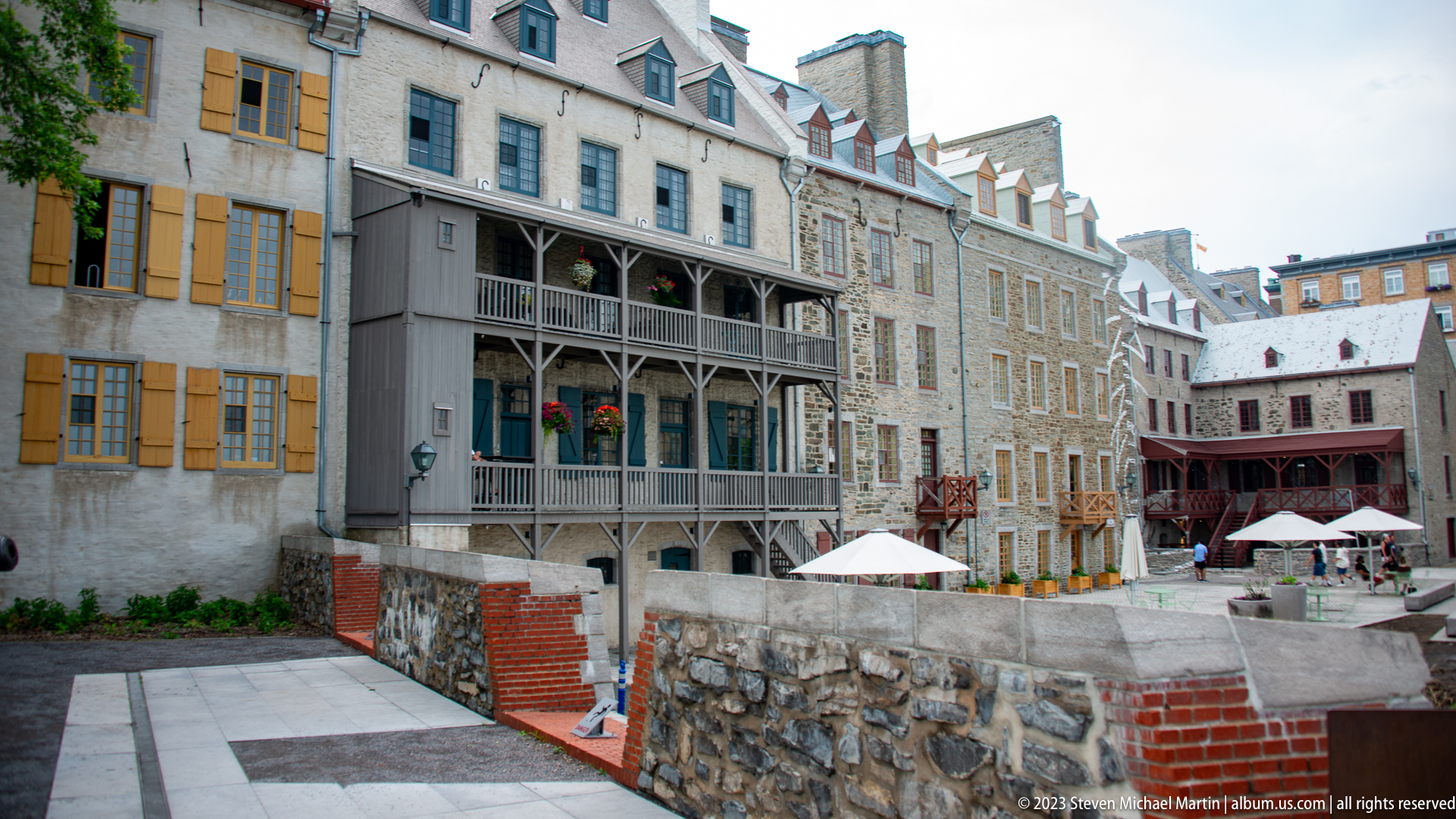
Historic stone buildings enclose a paved courtyard arranged at several levels, with wooden galleries, dormer windows, shutters, and café seating adding texture to the compact space. Exposed stone and brick retaining walls reveal changes in elevation within the site. The absence of through traffic gives the ensemble an inward-looking character distinct from Quebec City’s busier commercial streets.
Caption
Historic stone buildings enclose a paved courtyard arranged at several levels, with wooden galleries, dormer windows, shutters, and café seating adding texture to the compact space. Exposed stone and brick retaining walls reveal changes in elevation within the site. The absence of through traffic gives the ensemble an inward-looking character distinct from Quebec City’s busier commercial streets.
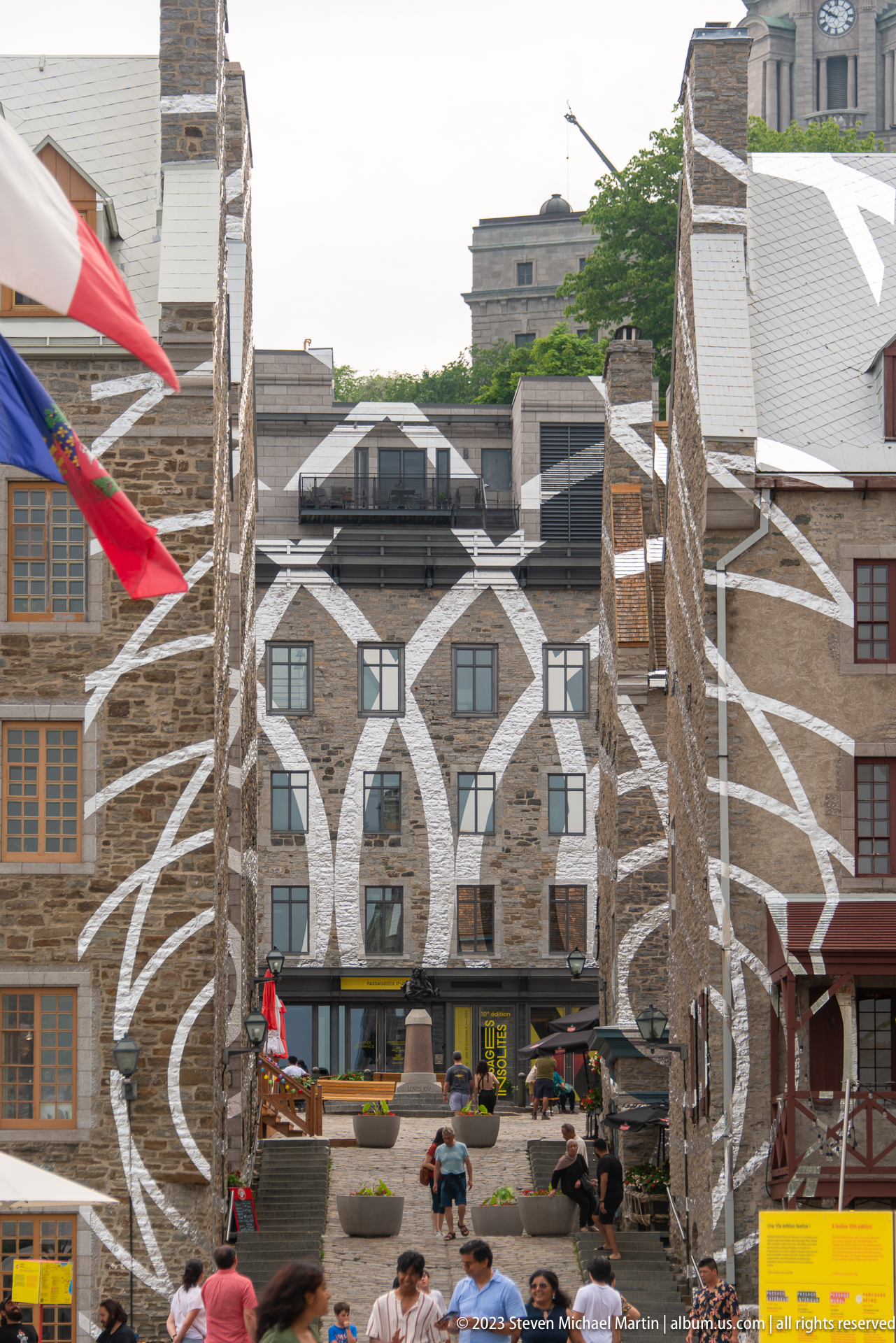
Bold white lines sweep across several dark stone façades, forming a large black-and-white mural that incorporates windows and building edges into its design. People gather in the open space below, providing scale for the work’s architectural reach. Rather than occupying a single wall, the graphic intervention spreads across multiple connected surfaces and reshapes the visual unity of the courtyard.
Caption
Bold white lines sweep across several dark stone façades, forming a large black-and-white mural that incorporates windows and building edges into its design. People gather in the open space below, providing scale for the work’s architectural reach. Rather than occupying a single wall, the graphic intervention spreads across multiple connected surfaces and reshapes the visual unity of the courtyard.
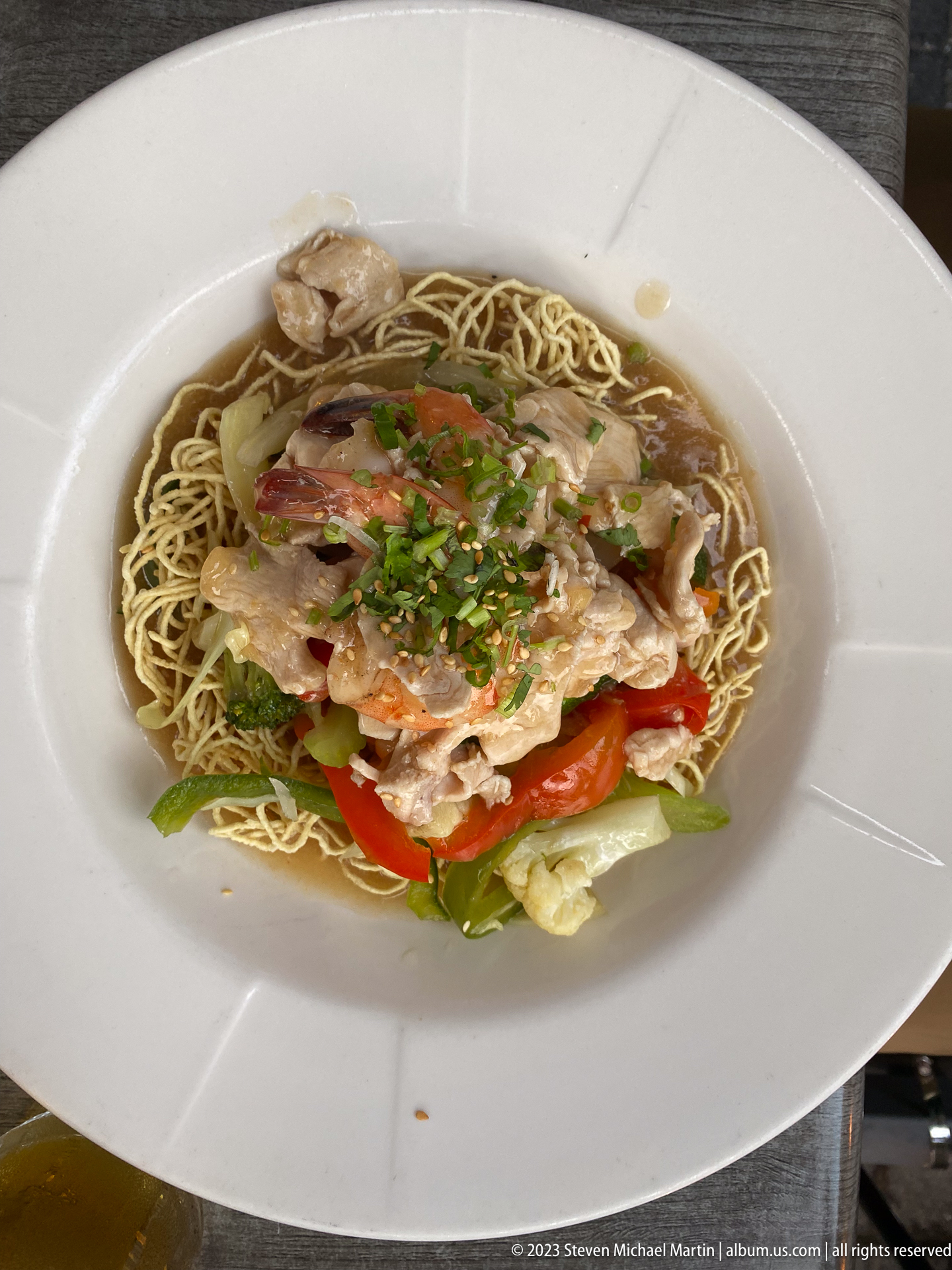
Sliced chicken and mixed vegetables are arranged over a bed of fine crisp noodles in a broad white bowl. Red pepper and pale cabbage add color beneath the meat, while chopped herbs and sesame seeds are scattered across the top. Compared with the preceding closer view, this wider composition shows the complete plating and generous white rim surrounding the food.
Caption
Sliced chicken and mixed vegetables are arranged over a bed of fine crisp noodles in a broad white bowl. Red pepper and pale cabbage add color beneath the meat, while chopped herbs and sesame seeds are scattered across the top. Compared with the preceding closer view, this wider composition shows the complete plating and generous white rim surrounding the food.
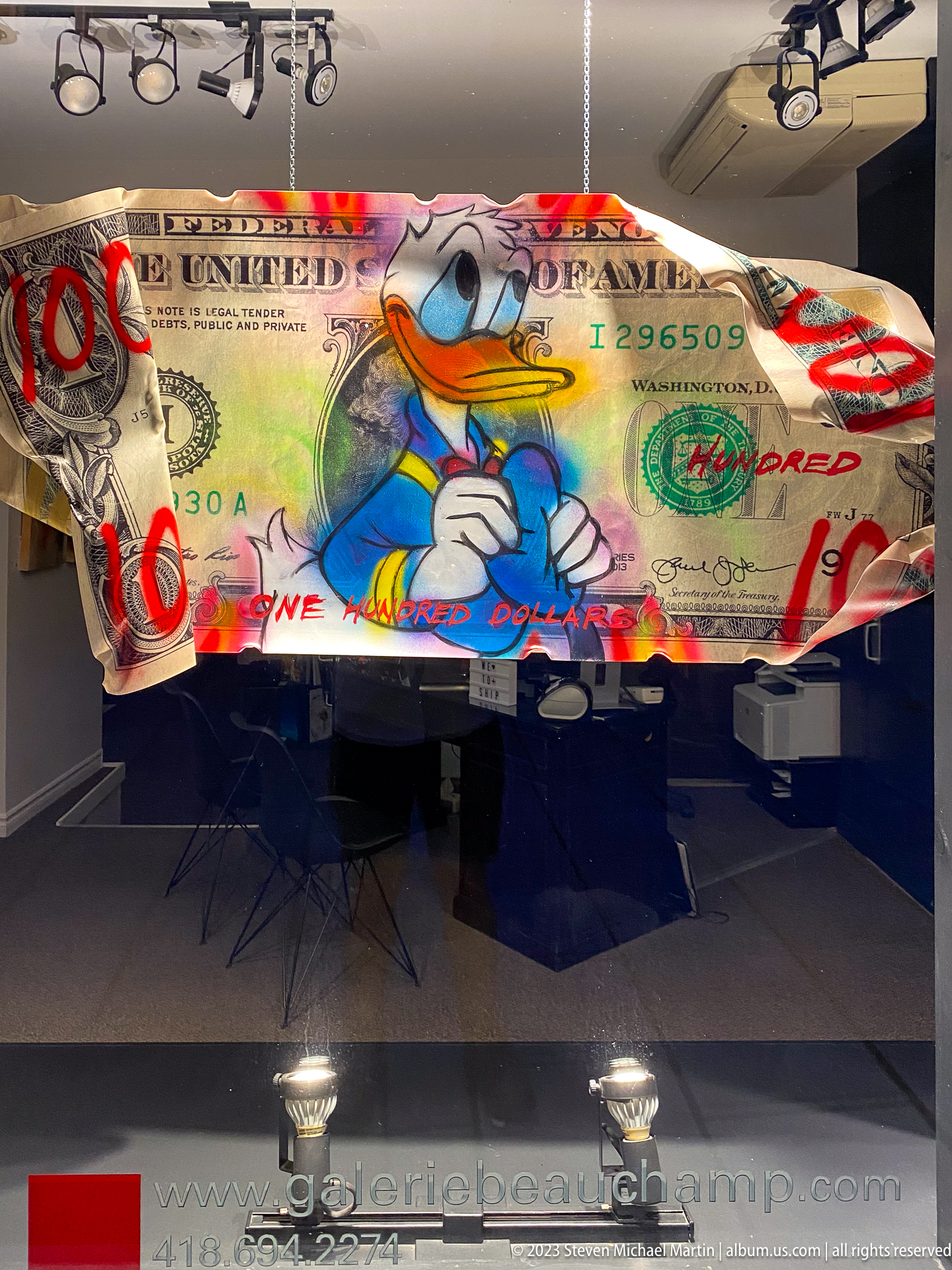
An oversized representation of a U.S. hundred-dollar bill is transformed into pop art with Donald Duck, spray-painted marks, handwritten words, and bright color. Displayed horizontally in a gallery interior, the work combines familiar currency imagery with cartoon iconography and graffiti-like interventions. The photographed installation emphasizes the altered banknote’s scale and its deliberately irreverent treatment of symbols of money and popular culture.
Caption
An oversized representation of a U.S. hundred-dollar bill is transformed into pop art with Donald Duck, spray-painted marks, handwritten words, and bright color. Displayed horizontally in a gallery interior, the work combines familiar currency imagery with cartoon iconography and graffiti-like interventions. The photographed installation emphasizes the altered banknote’s scale and its deliberately irreverent treatment of symbols of money and popular culture.
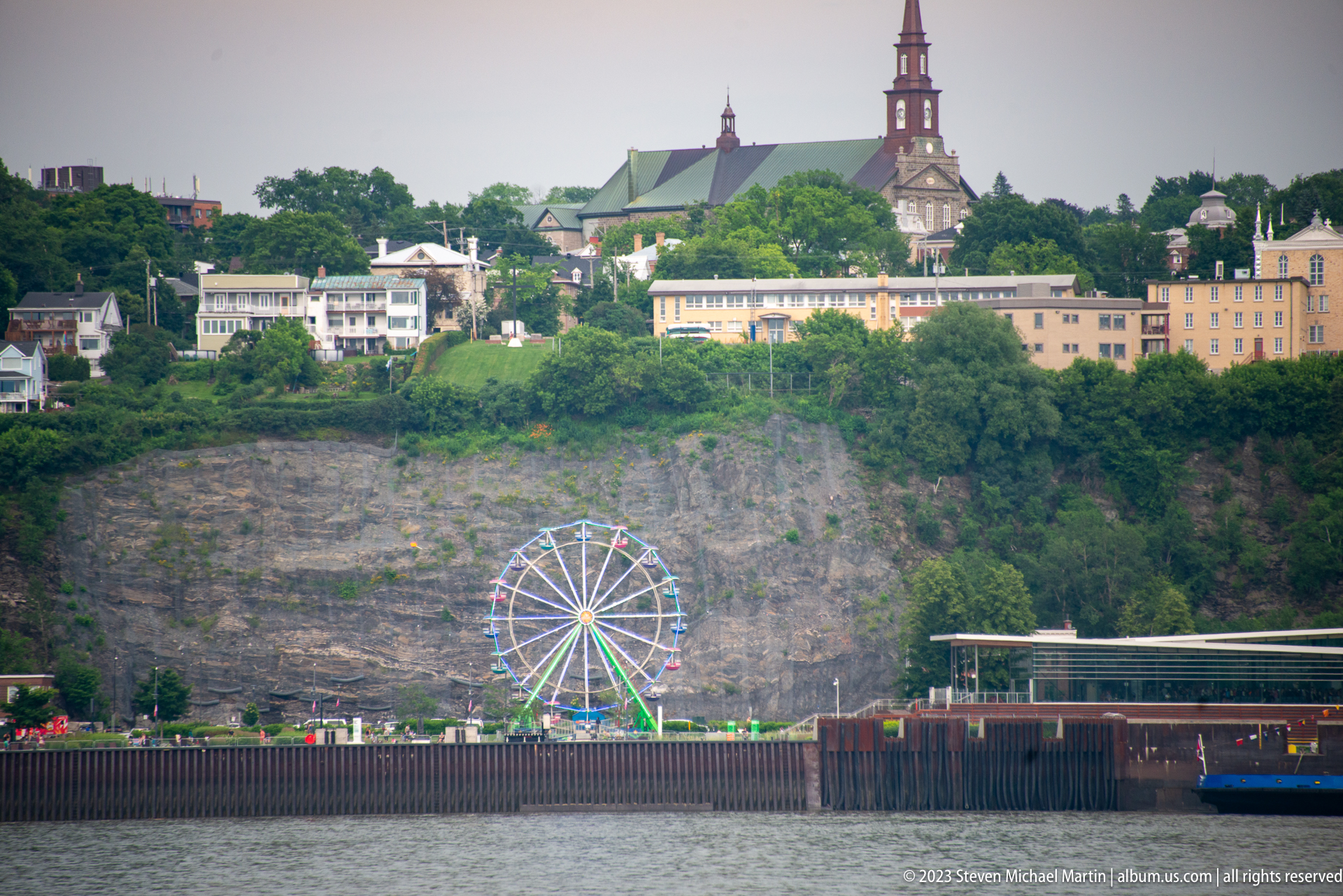
Across the St. Lawrence River, a Ferris wheel stands at the base of a steep exposed bluff while a large church and other buildings occupy the green ridge above. The layered shoreline separates waterfront recreation from the elevated residential and religious architecture behind it. Water fills the foreground, making the topographic rise from river level to the upper settlement especially clear.
Caption
Across the St. Lawrence River, a Ferris wheel stands at the base of a steep exposed bluff while a large church and other buildings occupy the green ridge above. The layered shoreline separates waterfront recreation from the elevated residential and religious architecture behind it. Water fills the foreground, making the topographic rise from river level to the upper settlement especially clear.
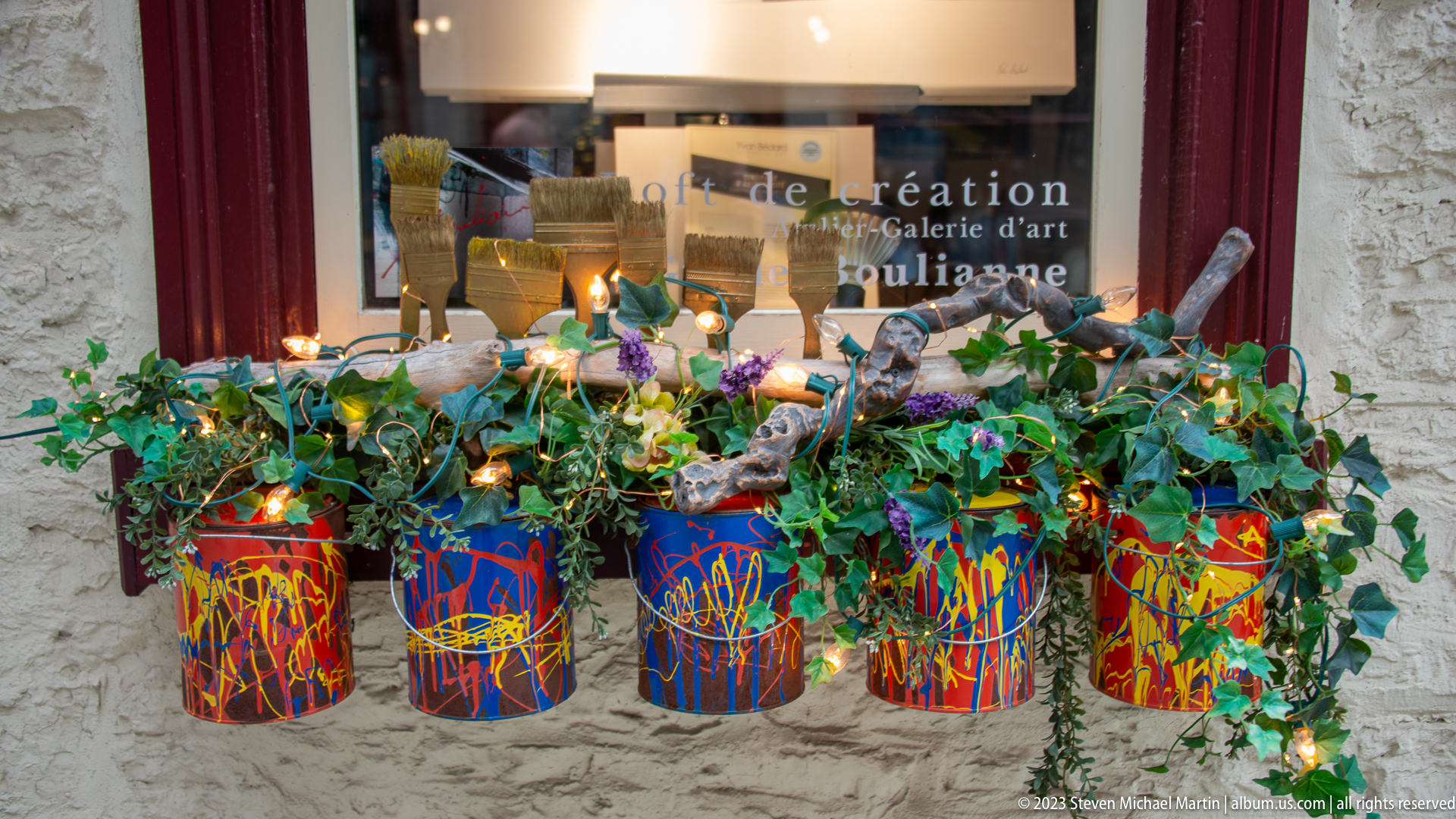
Five brightly painted cylindrical planters form a colorful window-box display beneath the glass of an art gallery. Green foliage, flowers, small decorative objects, and string lights spill across the containers, contrasting with the pale stone wall and dark red window frame. Partial French lettering on the glass identifies the creative retail setting without requiring a more specific gallery attribution.
Caption
Five brightly painted cylindrical planters form a colorful window-box display beneath the glass of an art gallery. Green foliage, flowers, small decorative objects, and string lights spill across the containers, contrasting with the pale stone wall and dark red window frame. Partial French lettering on the glass identifies the creative retail setting without requiring a more specific gallery attribution.
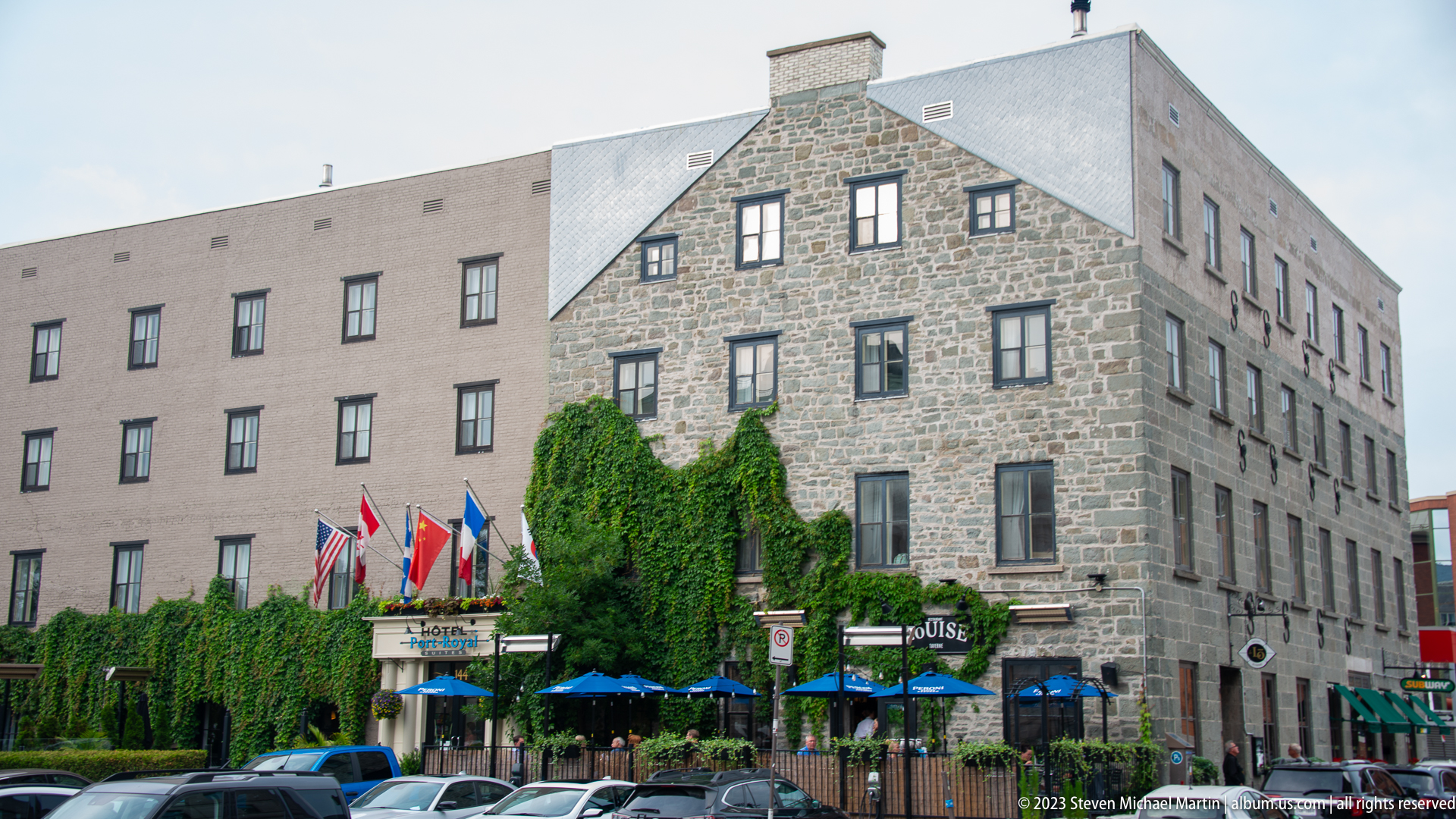
A substantial stone hotel building combines an older gabled façade with a larger, plainer multi-story wing behind it. Ivy covers much of the lower masonry, while flags, blue café umbrellas, parked cars, and ground-floor hospitality signage mark the active entrance zone. The juxtaposition of historic stonework and later expansion illustrates the adaptive commercial use of Quebec City’s built fabric.
Caption
A substantial stone hotel building combines an older gabled façade with a larger, plainer multi-story wing behind it. Ivy covers much of the lower masonry, while flags, blue café umbrellas, parked cars, and ground-floor hospitality signage mark the active entrance zone. The juxtaposition of historic stonework and later expansion illustrates the adaptive commercial use of Quebec City’s built fabric.
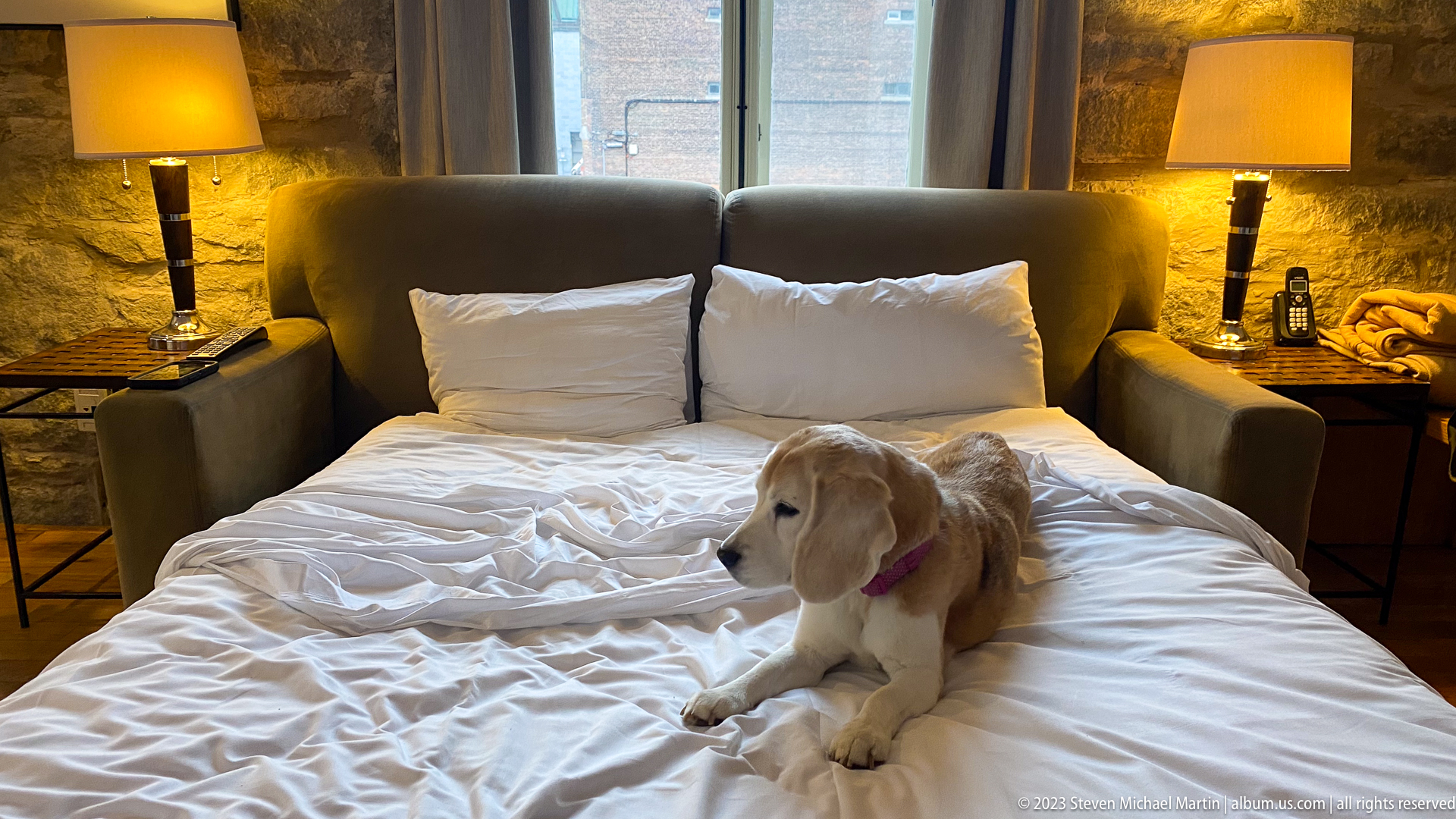
A light-colored dog rests near the center of a rumpled white bed in a warmly lit stone-walled room. Two white pillows, a broad upholstered headboard, matching bedside lamps, and dark side tables frame the animal symmetrically. The intimate interior view shifts the portfolio away from public monuments and streets toward the quieter experience of lodging in the historic city.
Caption
A light-colored dog rests near the center of a rumpled white bed in a warmly lit stone-walled room. Two white pillows, a broad upholstered headboard, matching bedside lamps, and dark side tables frame the animal symmetrically. The intimate interior view shifts the portfolio away from public monuments and streets toward the quieter experience of lodging in the historic city.
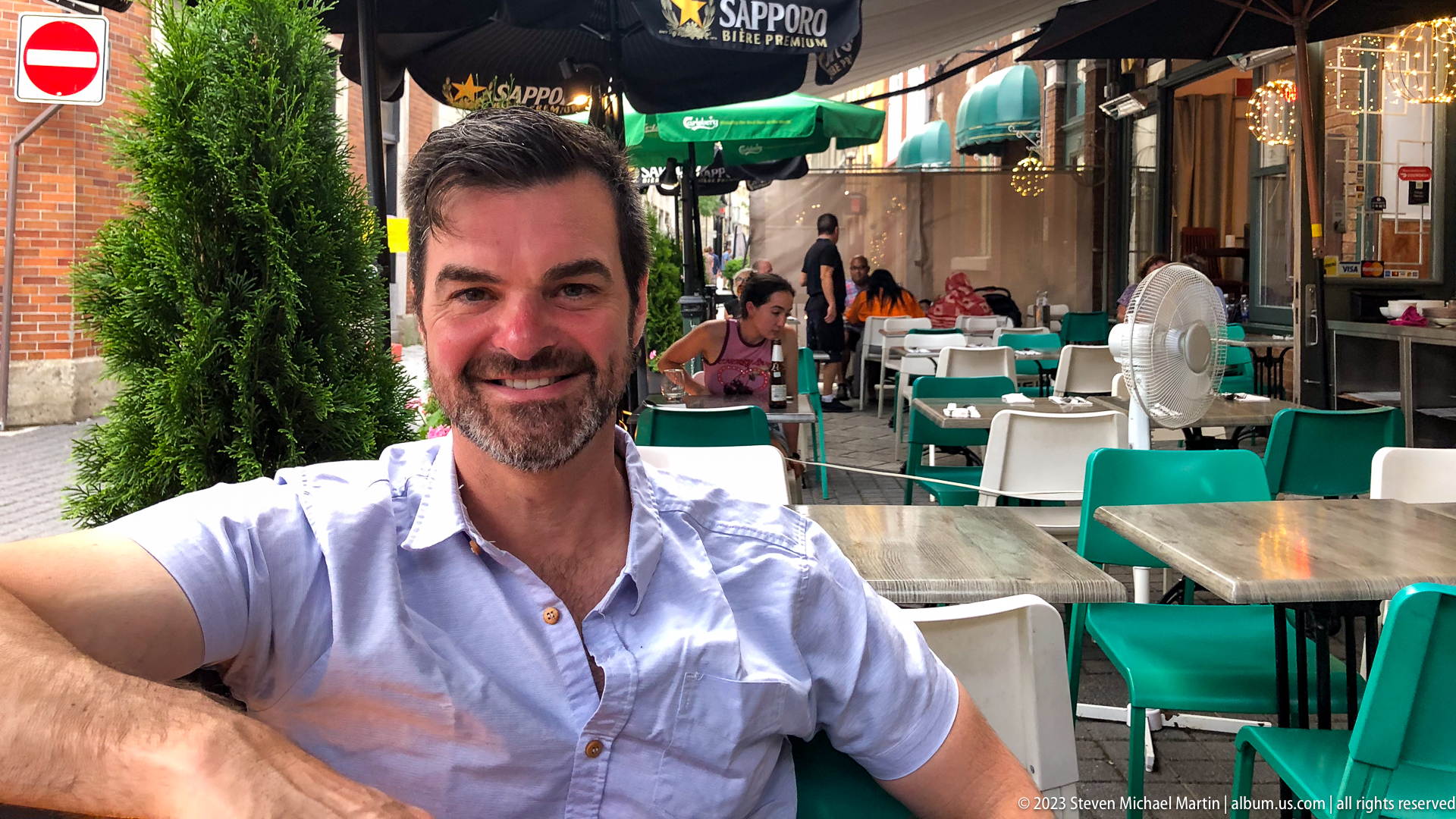
A man sits close to the camera at an outdoor restaurant terrace, with turquoise chairs, café tables, umbrellas, and other diners extending behind him along the narrow passage. Brick and storefront façades enclose the seating area, while overhead signs and awnings reinforce the commercial setting. The casual portrait records the human scale of dining within Quebec City’s compact historic streets.
Caption
A man sits close to the camera at an outdoor restaurant terrace, with turquoise chairs, café tables, umbrellas, and other diners extending behind him along the narrow passage. Brick and storefront façades enclose the seating area, while overhead signs and awnings reinforce the commercial setting. The casual portrait records the human scale of dining within Quebec City’s compact historic streets.

A mound of crisp noodles supports sliced chicken, red pepper, leafy vegetables, and pale cauliflower in a shallow white bowl. Chopped green herbs and sesame seeds finish the dish, while a light sauce softens portions of the noodles beneath the toppings. The close overhead view isolates the meal and records the contrasting textures and colors of a restaurant serving in Quebec City.
Caption
A mound of crisp noodles supports sliced chicken, red pepper, leafy vegetables, and pale cauliflower in a shallow white bowl. Chopped green herbs and sesame seeds finish the dish, while a light sauce softens portions of the noodles beneath the toppings. The close overhead view isolates the meal and records the contrasting textures and colors of a restaurant serving in Quebec City.
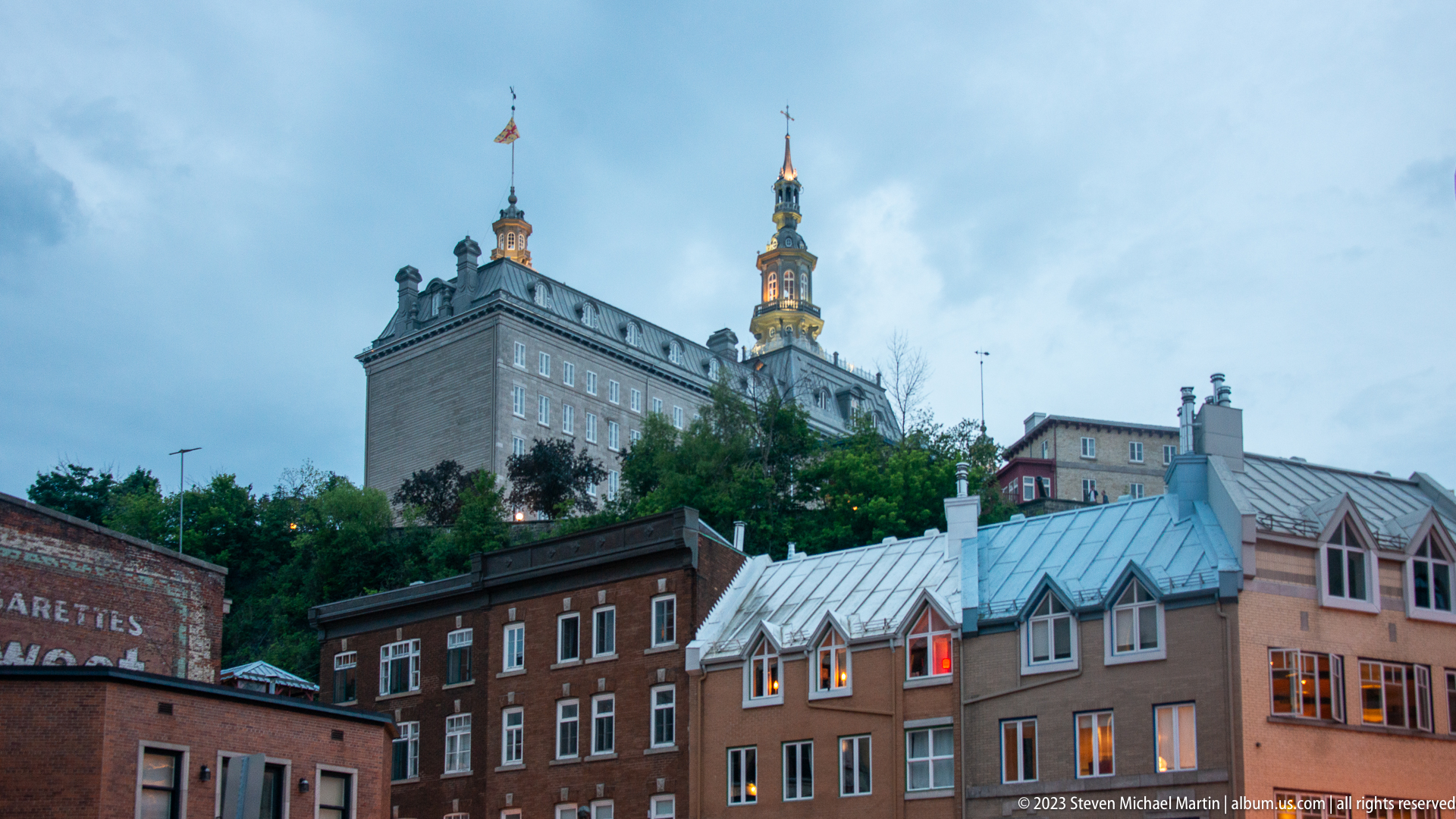
A large historic stone complex rises above brick and metal-roofed buildings at dusk, its clock face and slender illuminated tower standing against the blue evening sky. Warm light in scattered windows contrasts with the cooler façades below. The elevated viewpoint makes the steep relationship between Quebec City’s institutional architecture and the tightly packed buildings of the lower slope especially apparent.
Caption
A large historic stone complex rises above brick and metal-roofed buildings at dusk, its clock face and slender illuminated tower standing against the blue evening sky. Warm light in scattered windows contrasts with the cooler façades below. The elevated viewpoint makes the steep relationship between Quebec City’s institutional architecture and the tightly packed buildings of the lower slope especially apparent.
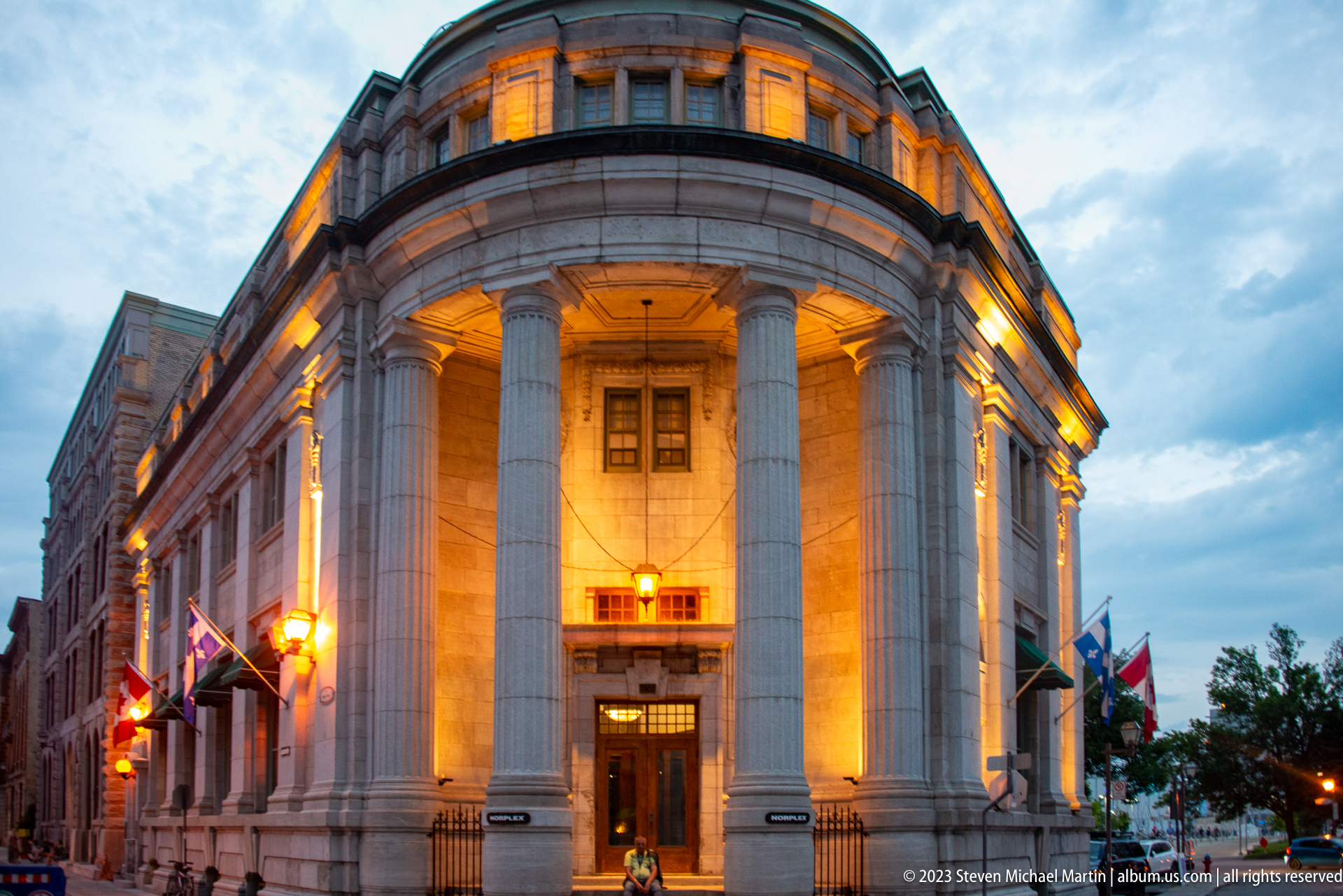
A monumental curved stone façade is illuminated from within and below at twilight, with giant fluted columns framing a recessed entrance. A heavy cornice and continuous upper windows follow the building’s rounded corner, while flags and streetlights mark the public entrance. The low-angle composition concentrates attention on the classical scale and ceremonial character of the architecture rather than the surrounding street.
Caption
A monumental curved stone façade is illuminated from within and below at twilight, with giant fluted columns framing a recessed entrance. A heavy cornice and continuous upper windows follow the building’s rounded corner, while flags and streetlights mark the public entrance. The low-angle composition concentrates attention on the classical scale and ceremonial character of the architecture rather than the surrounding street.
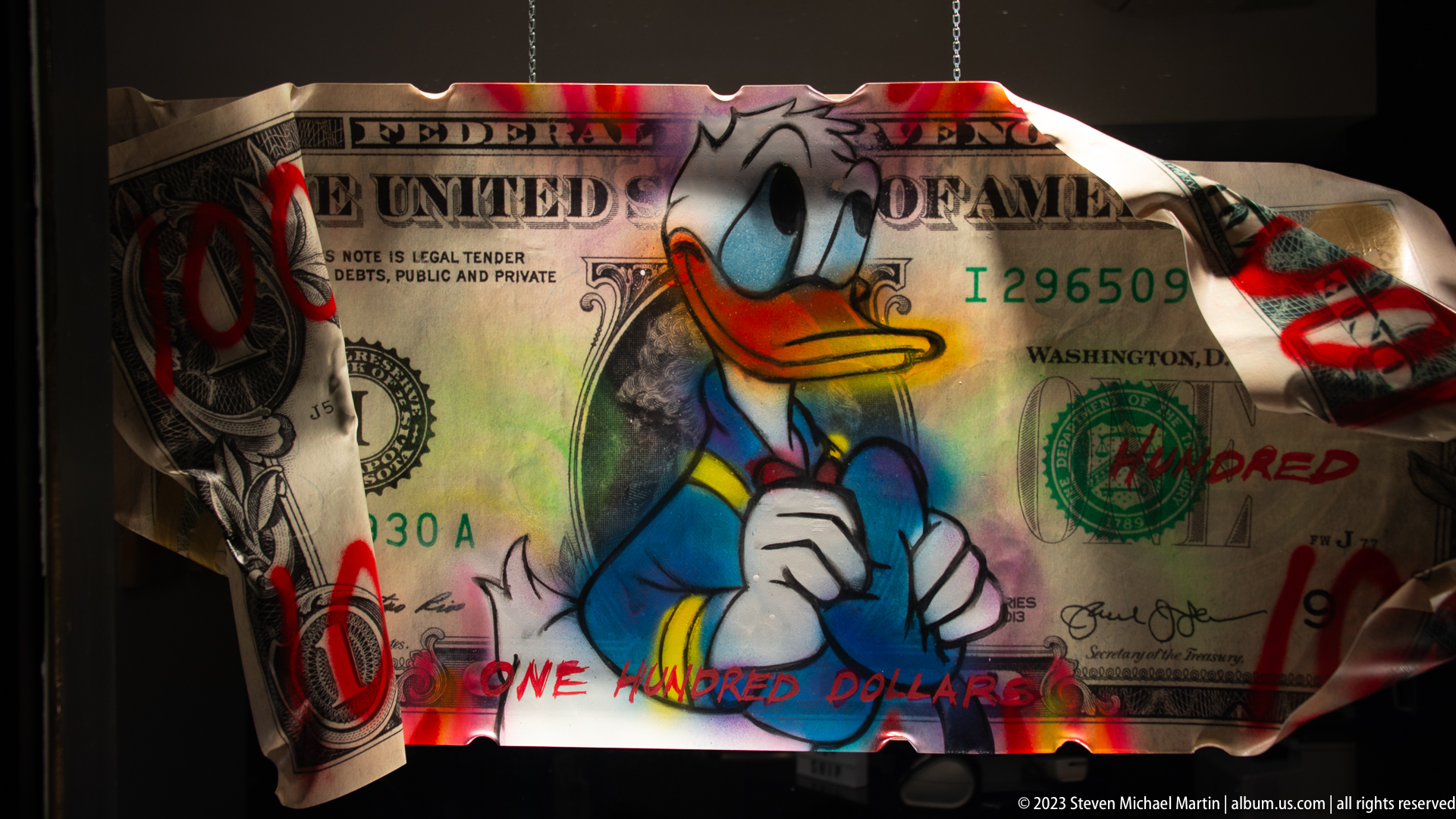
A tighter view of the altered hundred-dollar bill centers Donald Duck against the printed currency design. Red circles, black strokes, green spray paint, and handwritten phrases cross the banknote, while the words “ONE HUNDRED DOLLARS” remain visible near the lower edge. Cropping away most of the gallery setting turns this frame into a study of the work’s layered cartoon, monetary, and graffiti imagery.
Caption
A tighter view of the altered hundred-dollar bill centers Donald Duck against the printed currency design. Red circles, black strokes, green spray paint, and handwritten phrases cross the banknote, while the words “ONE HUNDRED DOLLARS” remain visible near the lower edge. Cropping away most of the gallery setting turns this frame into a study of the work’s layered cartoon, monetary, and graffiti imagery.
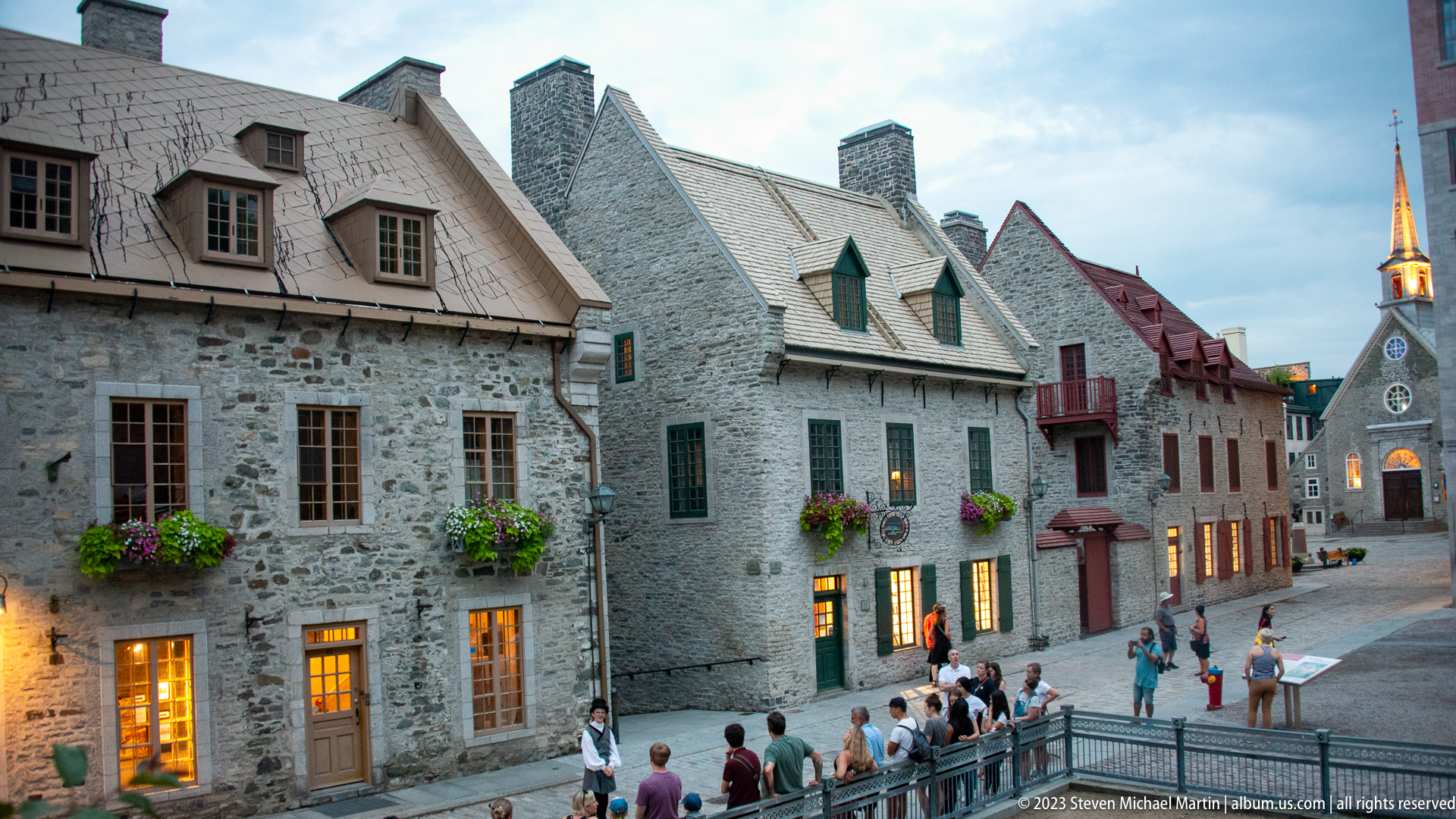
Flower boxes brighten gray stone houses along a gently descending street in Place Royale, where pedestrians gather near the railings and the church of Notre-Dame-des-Victoires closes the view. Steep roofs, dormers, shutters, and warm interior lights reinforce the historic character of the square. The composition uses the church spire as a visual anchor beyond the domestic-scale masonry façades.
Caption
Flower boxes brighten gray stone houses along a gently descending street in Place Royale, where pedestrians gather near the railings and the church of Notre-Dame-des-Victoires closes the view. Steep roofs, dormers, shutters, and warm interior lights reinforce the historic character of the square. The composition uses the church spire as a visual anchor beyond the domestic-scale masonry façades.
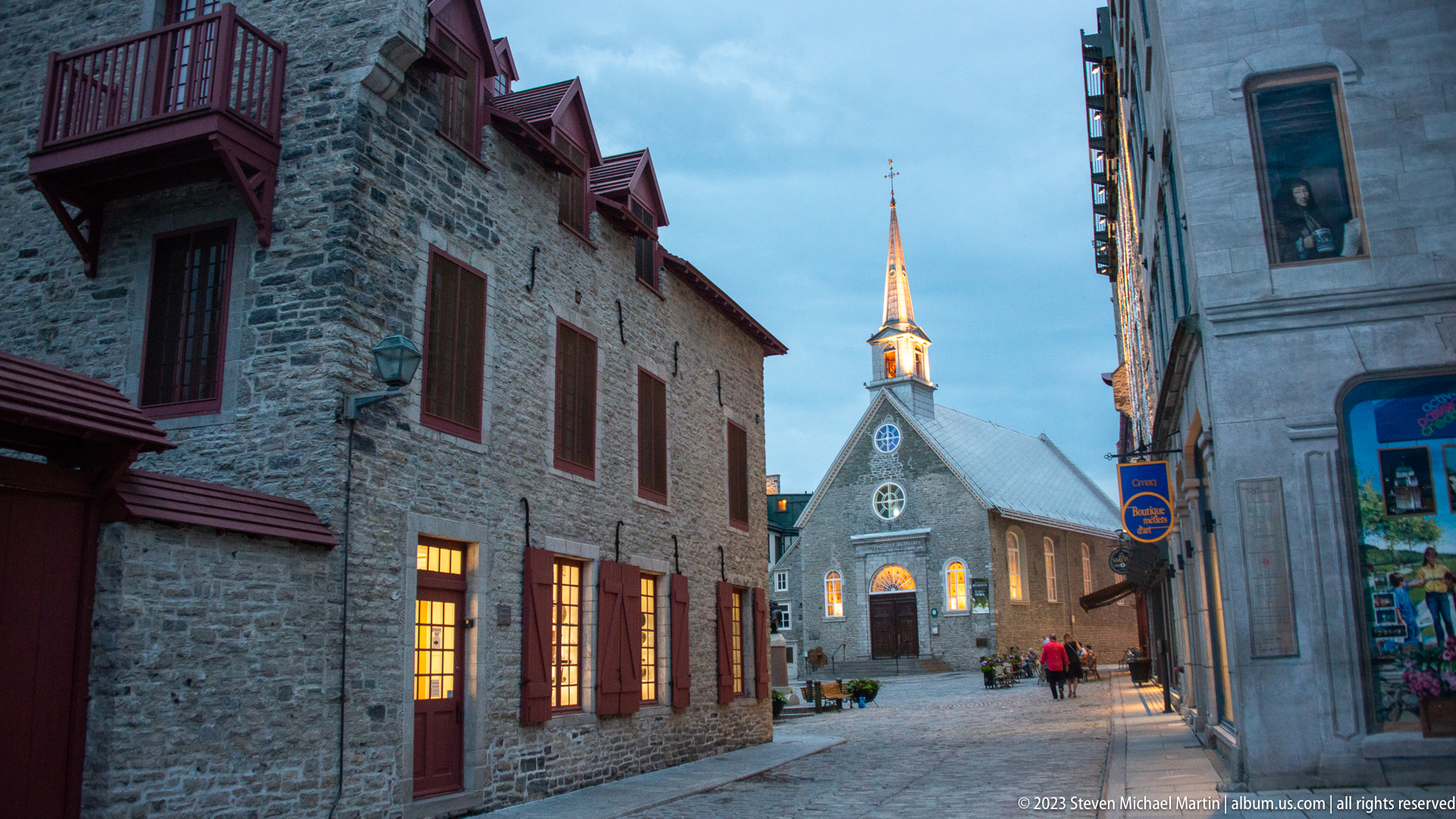
Notre-Dame-des-Victoires stands at the end of a narrow stone-lined street, its simple gabled façade centered beneath a tall slender spire. Warm light glows through the round and arched windows while pedestrians cross the open space before the church. Closely flanking masonry buildings compress the approach, emphasizing the intimate scale of Place Royale at dusk.
Caption
Notre-Dame-des-Victoires stands at the end of a narrow stone-lined street, its simple gabled façade centered beneath a tall slender spire. Warm light glows through the round and arched windows while pedestrians cross the open space before the church. Closely flanking masonry buildings compress the approach, emphasizing the intimate scale of Place Royale at dusk.
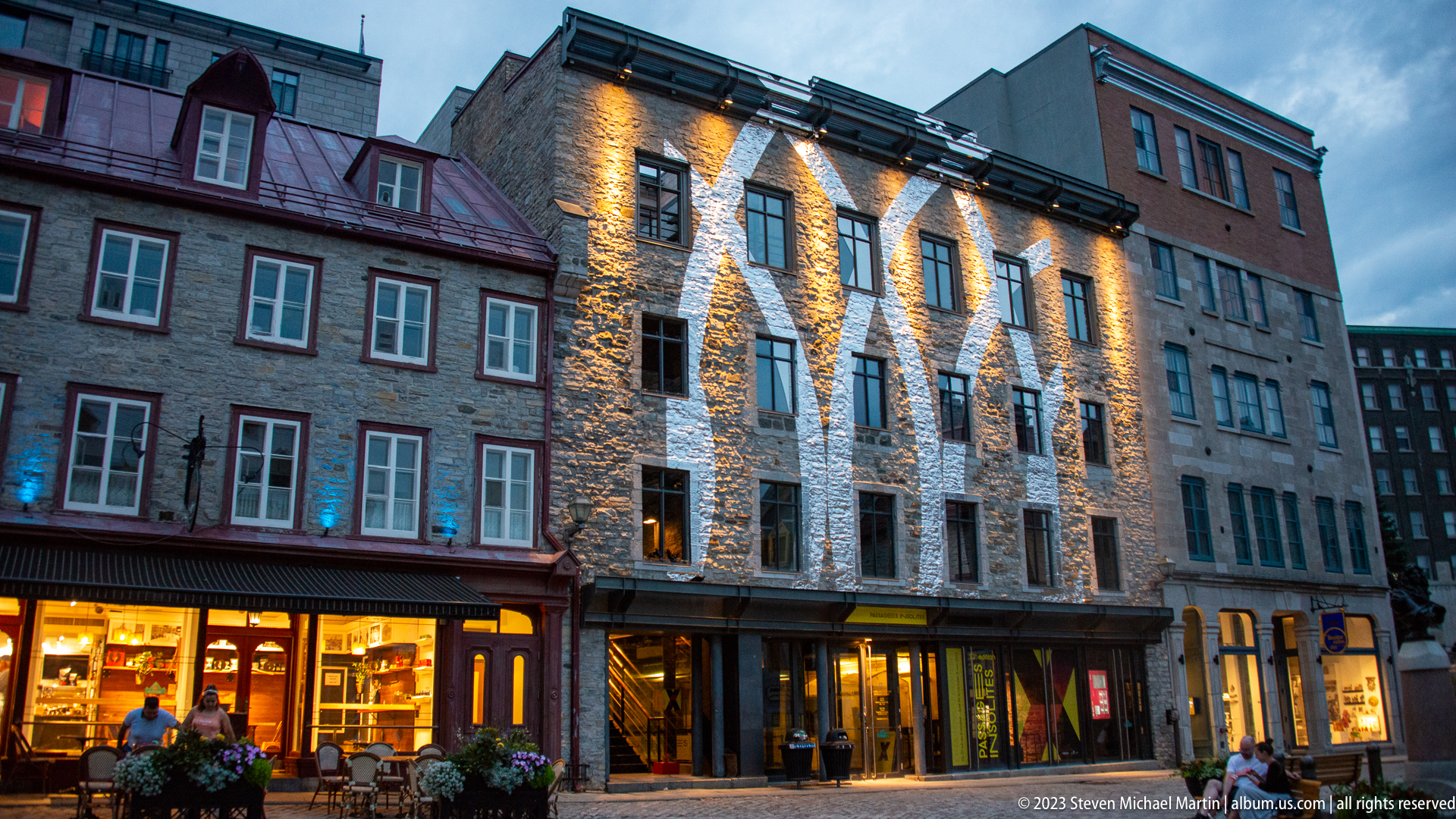
Warm architectural lighting washes the rough stone façade of a multi-story commercial building, picking out its tall windows and irregular masonry at dusk. Neighboring brick and stone façades continue the street wall on both sides, with shop windows glowing at ground level. The view emphasizes material contrasts and the adaptation of historic-scale buildings to contemporary retail and hospitality uses.
Caption
Warm architectural lighting washes the rough stone façade of a multi-story commercial building, picking out its tall windows and irregular masonry at dusk. Neighboring brick and stone façades continue the street wall on both sides, with shop windows glowing at ground level. The view emphasizes material contrasts and the adaptation of historic-scale buildings to contemporary retail and hospitality uses.
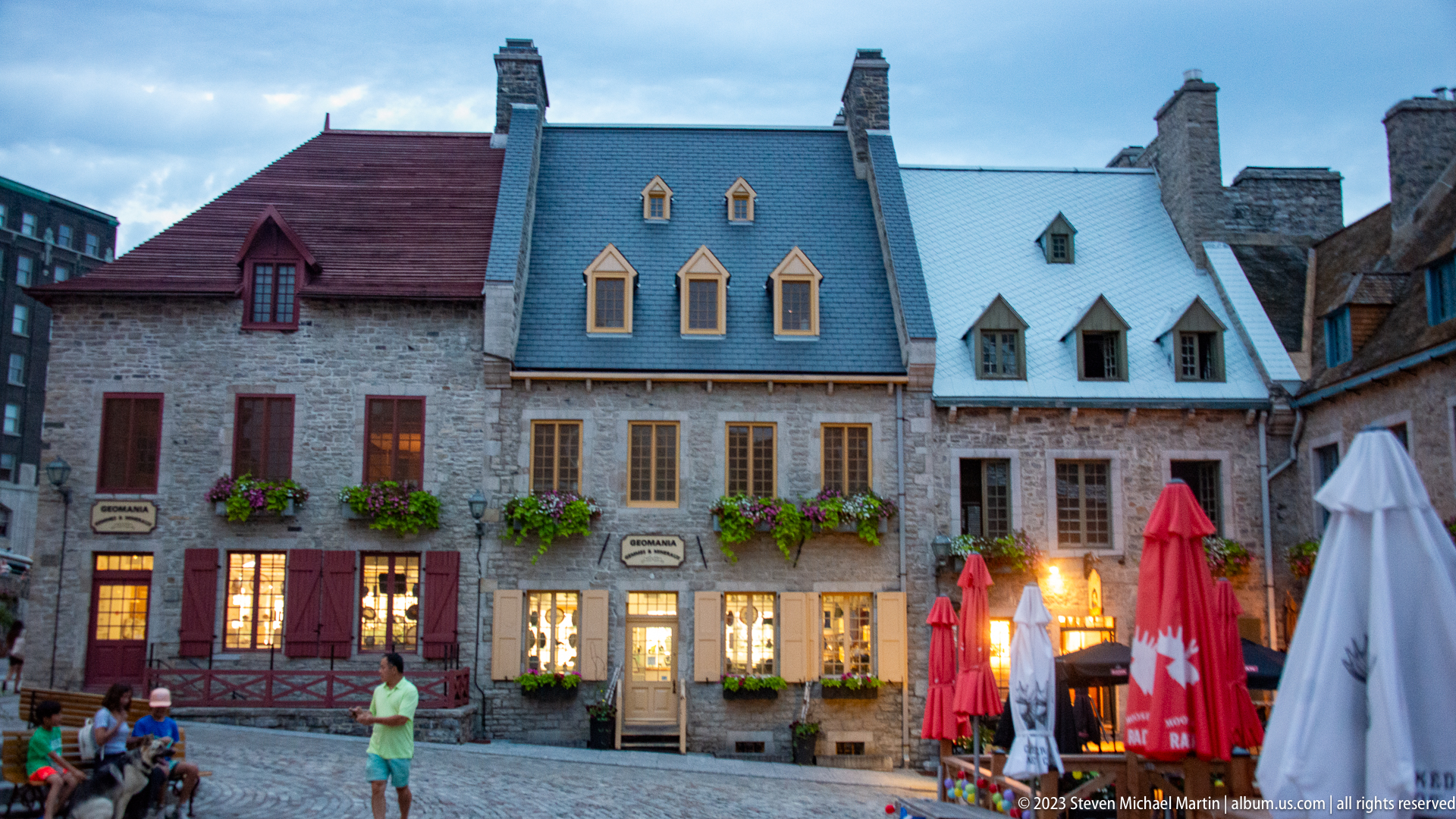
Three adjoining stone houses present contrasting red, blue-gray, and pale roofs along Place Royale, with dormers, tall chimneys, shutters, and flower boxes enlivening the façades. Café umbrellas and visitors occupy the foreground, adding contemporary street life to the carefully preserved architectural ensemble. The frontal view is especially useful for comparing roof forms, window patterns, and the narrow widths of the historic properties.
Caption
Three adjoining stone houses present contrasting red, blue-gray, and pale roofs along Place Royale, with dormers, tall chimneys, shutters, and flower boxes enlivening the façades. Café umbrellas and visitors occupy the foreground, adding contemporary street life to the carefully preserved architectural ensemble. The frontal view is especially useful for comparing roof forms, window patterns, and the narrow widths of the historic properties.
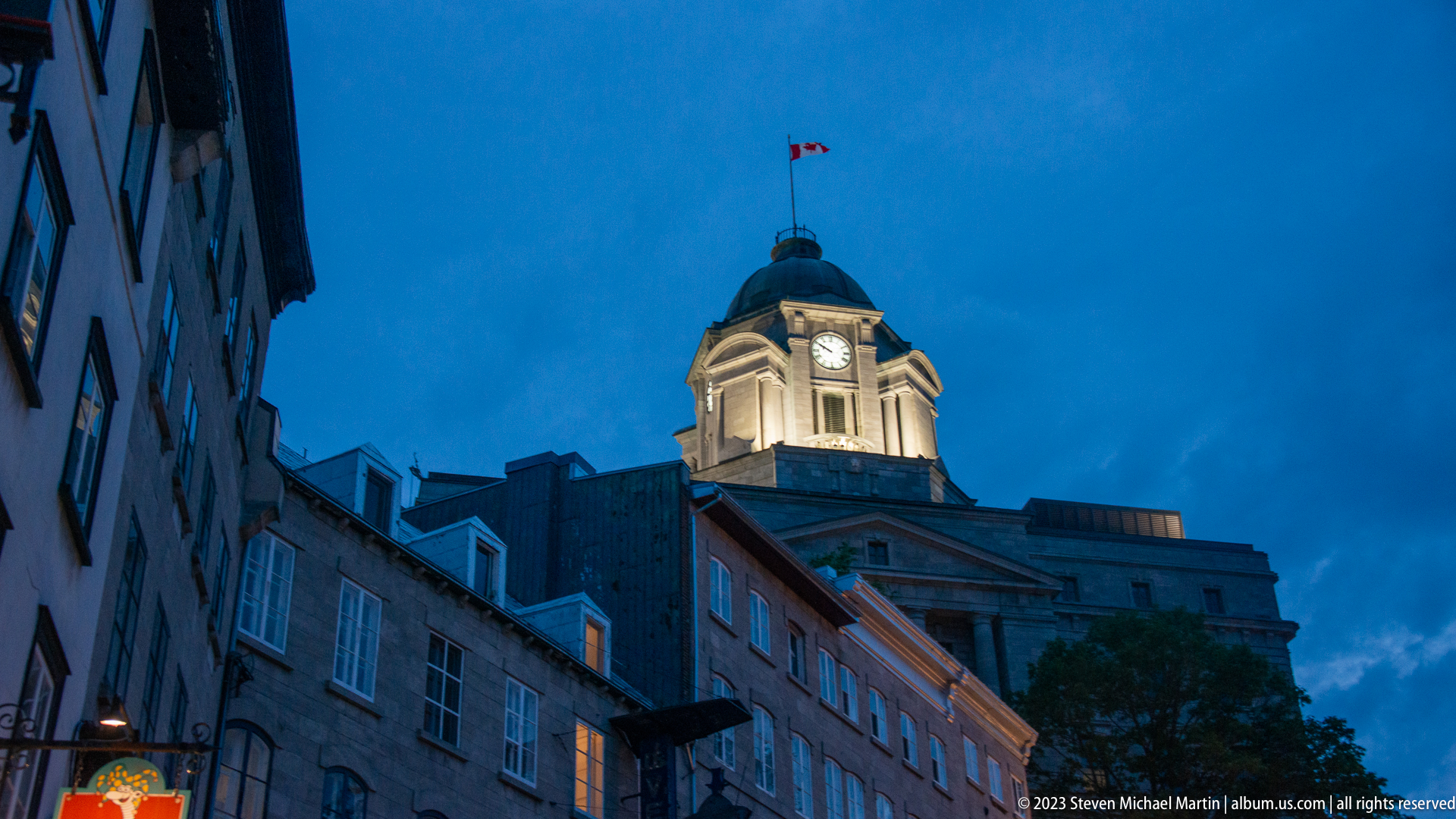
A domed clock tower rises above shadowed stone façades at blue hour, its illuminated clock face and lantern forming a bright focal point against the deepening sky. A Canadian flag flies from the cupola while the narrow street below remains mostly in silhouette. The upward view separates the tower from the dense roofscape and highlights its civic presence after dark.
Caption
A domed clock tower rises above shadowed stone façades at blue hour, its illuminated clock face and lantern forming a bright focal point against the deepening sky. A Canadian flag flies from the cupola while the narrow street below remains mostly in silhouette. The upward view separates the tower from the dense roofscape and highlights its civic presence after dark.
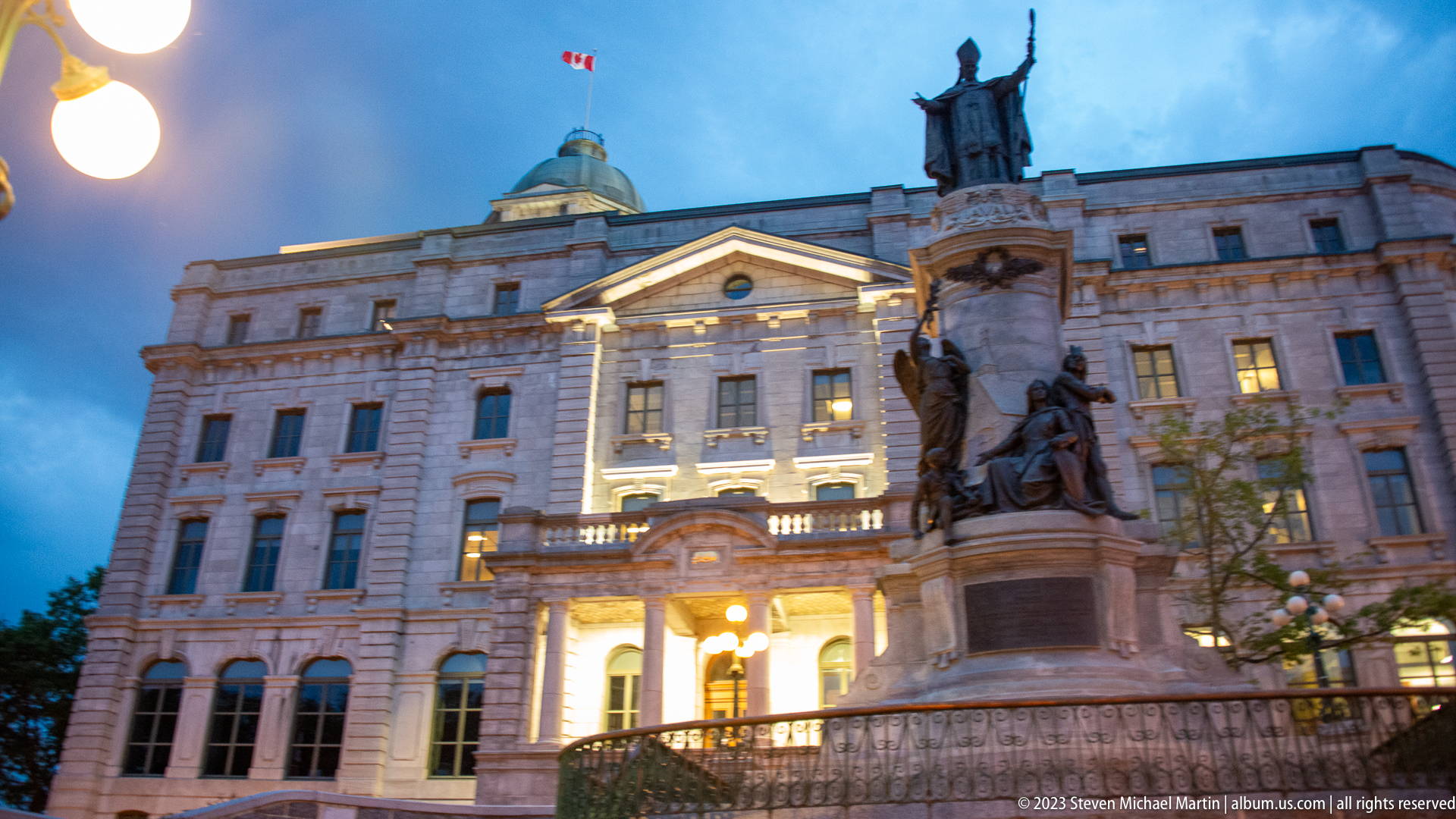
A tall sculptural monument occupies the foreground of a formal civic square, backed by a brightly illuminated stone building with a central pediment, columned entrance, and domed roof element. Figures arranged around the monument’s pedestal create a layered silhouette against the façade. Evening lighting accentuates the ceremonial relationship between public sculpture and monumental government architecture.
Caption
A tall sculptural monument occupies the foreground of a formal civic square, backed by a brightly illuminated stone building with a central pediment, columned entrance, and domed roof element. Figures arranged around the monument’s pedestal create a layered silhouette against the façade. Evening lighting accentuates the ceremonial relationship between public sculpture and monumental government architecture.
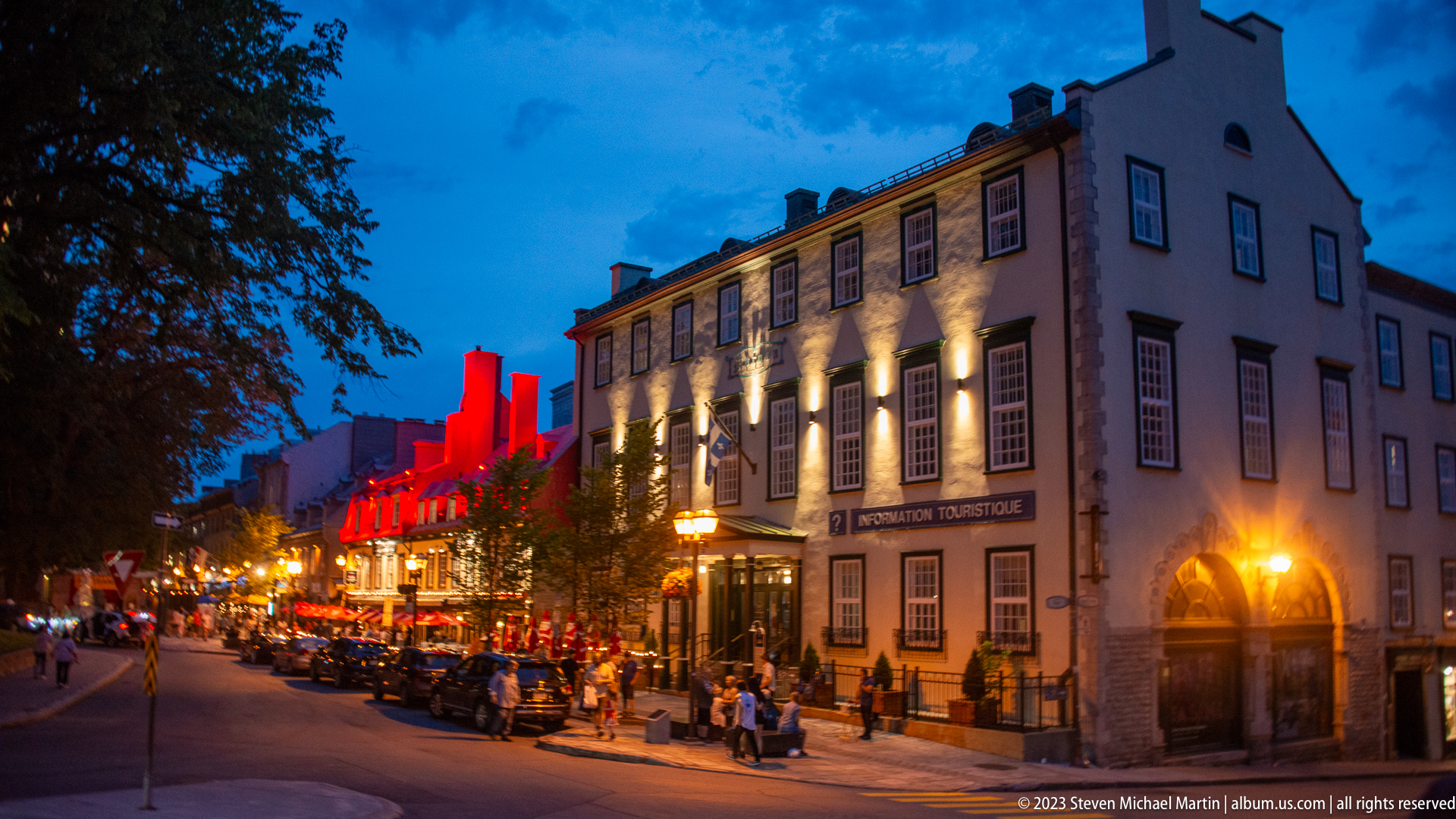
Hôtel Clarendon anchors a lively evening streetscape, its pale corner façade lit by regularly spaced wall lights while restaurants and storefronts continue down the block in warmer colors. Red architectural lighting draws attention to buildings farther along the street, and groups of diners and pedestrians fill the sidewalks. The scene records the transition of Old Québec’s historic architecture into an active nighttime hospitality district.
Caption
Hôtel Clarendon anchors a lively evening streetscape, its pale corner façade lit by regularly spaced wall lights while restaurants and storefronts continue down the block in warmer colors. Red architectural lighting draws attention to buildings farther along the street, and groups of diners and pedestrians fill the sidewalks. The scene records the transition of Old Québec’s historic architecture into an active nighttime hospitality district.
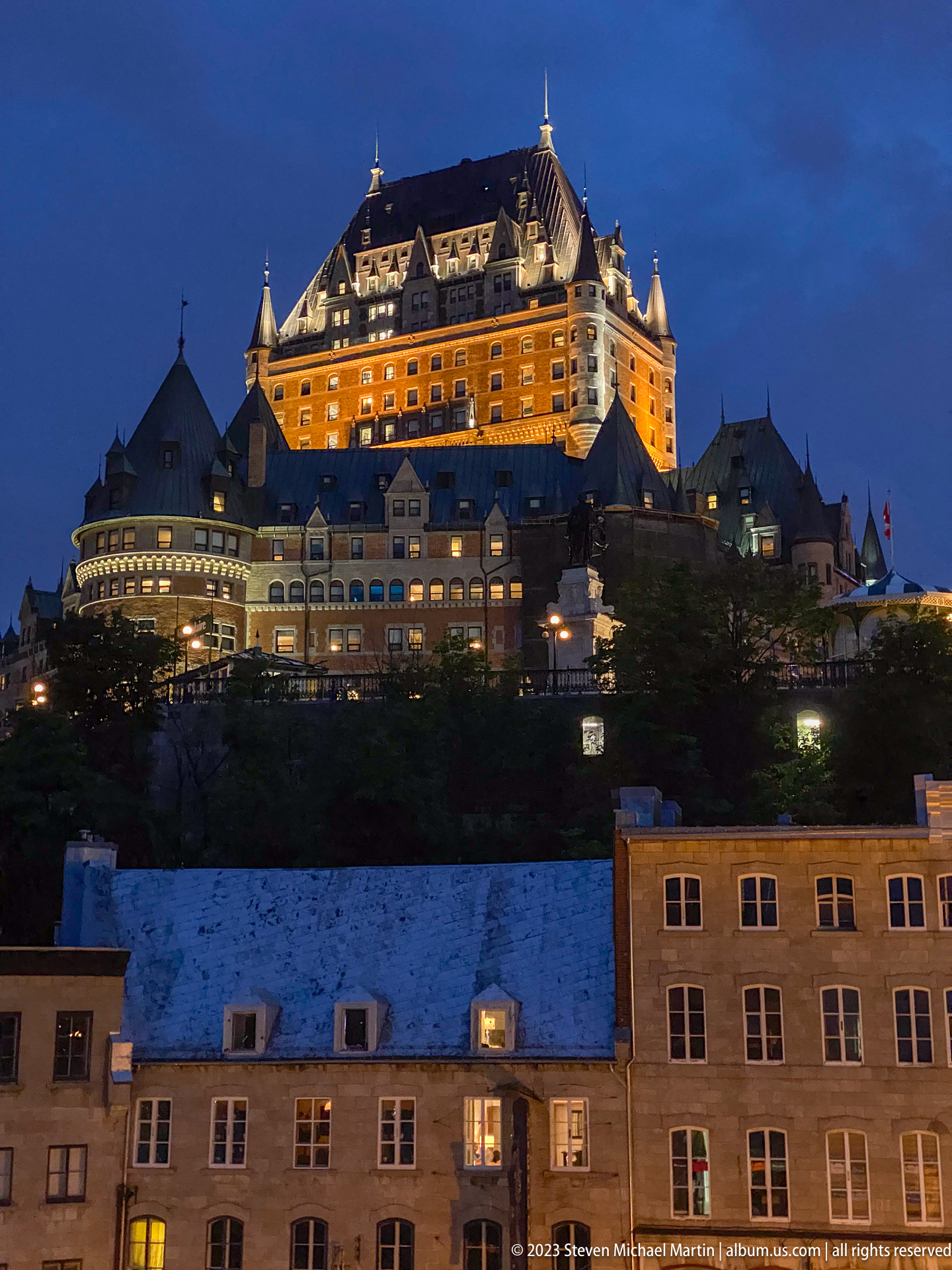
The Château Frontenac glows above Quebec City at night, its orange-lit central block and steep copper roofs dominating the ridge. Darker terraces and lower wings step down the slope toward a band of modest buildings in the foreground. The long horizontal view emphasizes the hotel’s commanding position over Lower Town and the dramatic contrast between illuminated landmark and blue evening sky.
Caption
The Château Frontenac glows above Quebec City at night, its orange-lit central block and steep copper roofs dominating the ridge. Darker terraces and lower wings step down the slope toward a band of modest buildings in the foreground. The long horizontal view emphasizes the hotel’s commanding position over Lower Town and the dramatic contrast between illuminated landmark and blue evening sky.
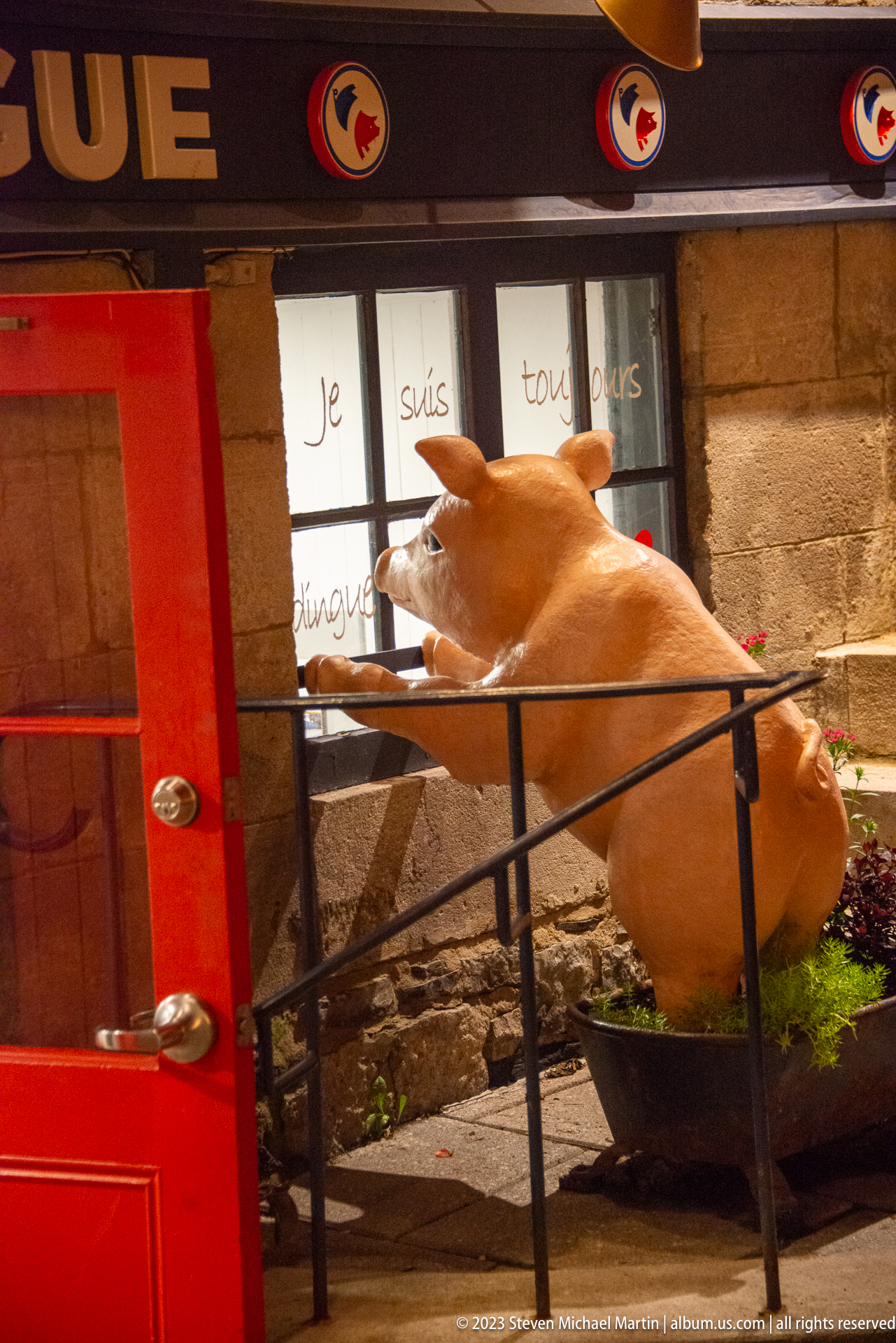
A life-size pig sculpture stands behind a black railing beside a vivid red doorway, facing a window marked with handwritten French words. Warm interior light and small circular signs above the window add to the playful storefront setting. The animal figure is presented as a conspicuous decorative element rather than a naturalistic street scene, inviting attention to the business façade and its whimsical character.
Caption
A life-size pig sculpture stands behind a black railing beside a vivid red doorway, facing a window marked with handwritten French words. Warm interior light and small circular signs above the window add to the playful storefront setting. The animal figure is presented as a conspicuous decorative element rather than a naturalistic street scene, inviting attention to the business façade and its whimsical character.
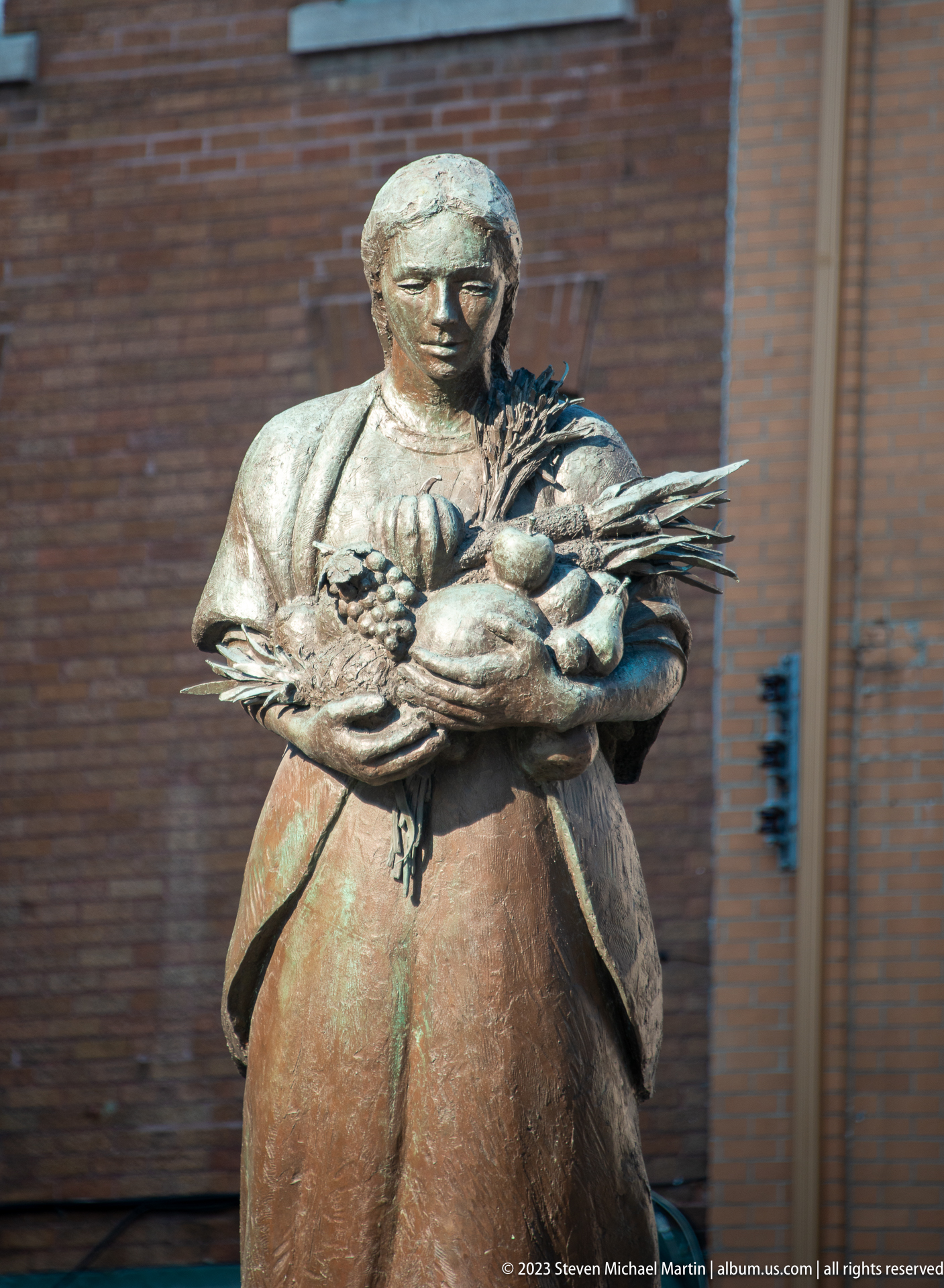
A bronze woman holds a large basket overflowing with vegetables, fruit, and leafy produce against her body. Her plain clothing and downward gaze give the figure the character of a working market vendor rather than an idealized allegory. The tight portrait isolates the sculpture from its setting, emphasizing the modeled hands, facial expression, and abundance of produce gathered in the basket.
Caption
A bronze woman holds a large basket overflowing with vegetables, fruit, and leafy produce against her body. Her plain clothing and downward gaze give the figure the character of a working market vendor rather than an idealized allegory. The tight portrait isolates the sculpture from its setting, emphasizing the modeled hands, facial expression, and abundance of produce gathered in the basket.
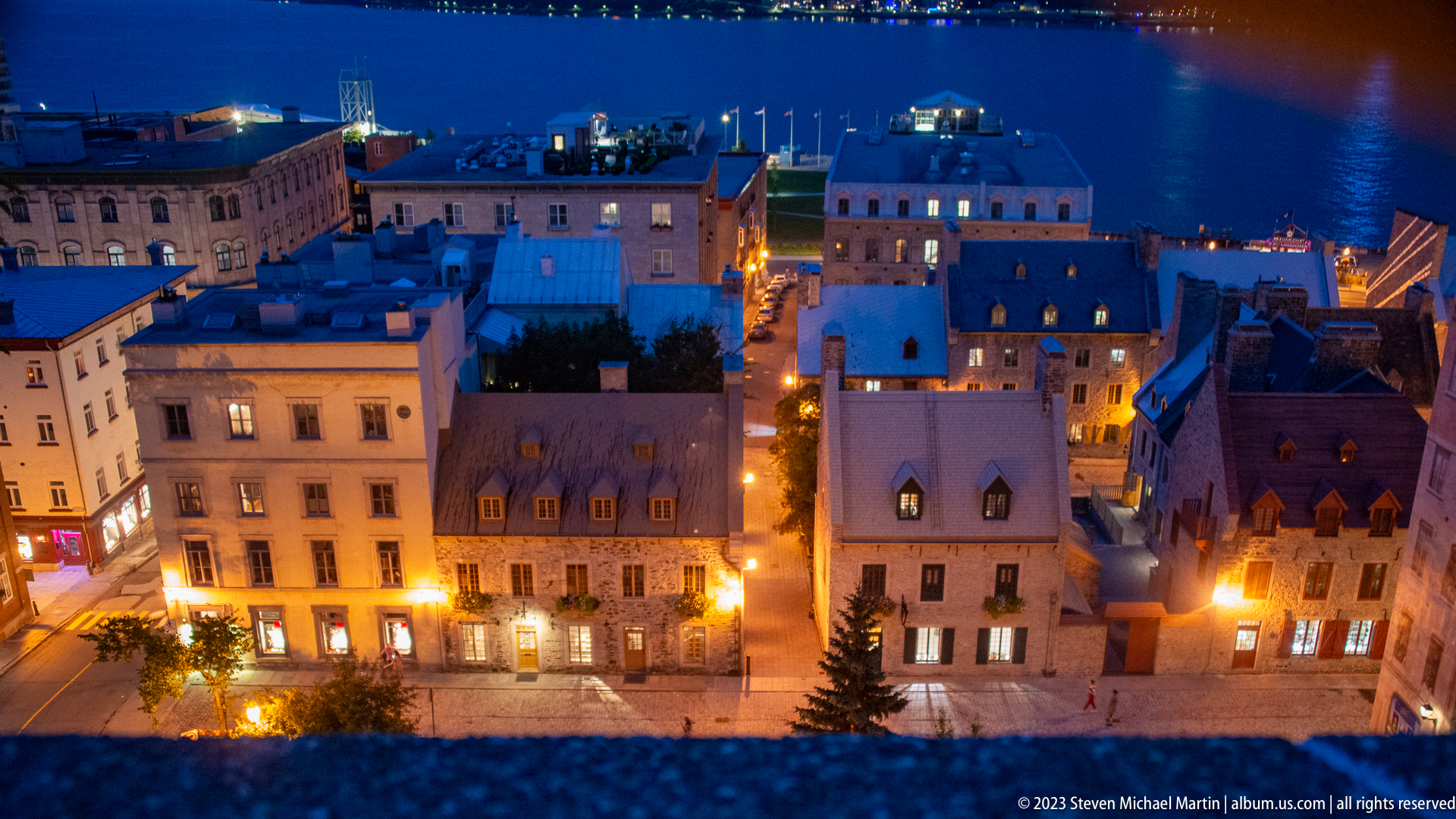
An elevated nighttime view looks down across tightly packed Lower Town buildings toward the dark St. Lawrence River. Warm streetlights trace narrow lanes between pale stone and brick façades, while roof shapes and dormers form a dense patchwork below. The high vantage point clarifies the compact urban grain between the riverfront and the steep rise toward Upper Town.
Caption
An elevated nighttime view looks down across tightly packed Lower Town buildings toward the dark St. Lawrence River. Warm streetlights trace narrow lanes between pale stone and brick façades, while roof shapes and dormers form a dense patchwork below. The high vantage point clarifies the compact urban grain between the riverfront and the steep rise toward Upper Town.
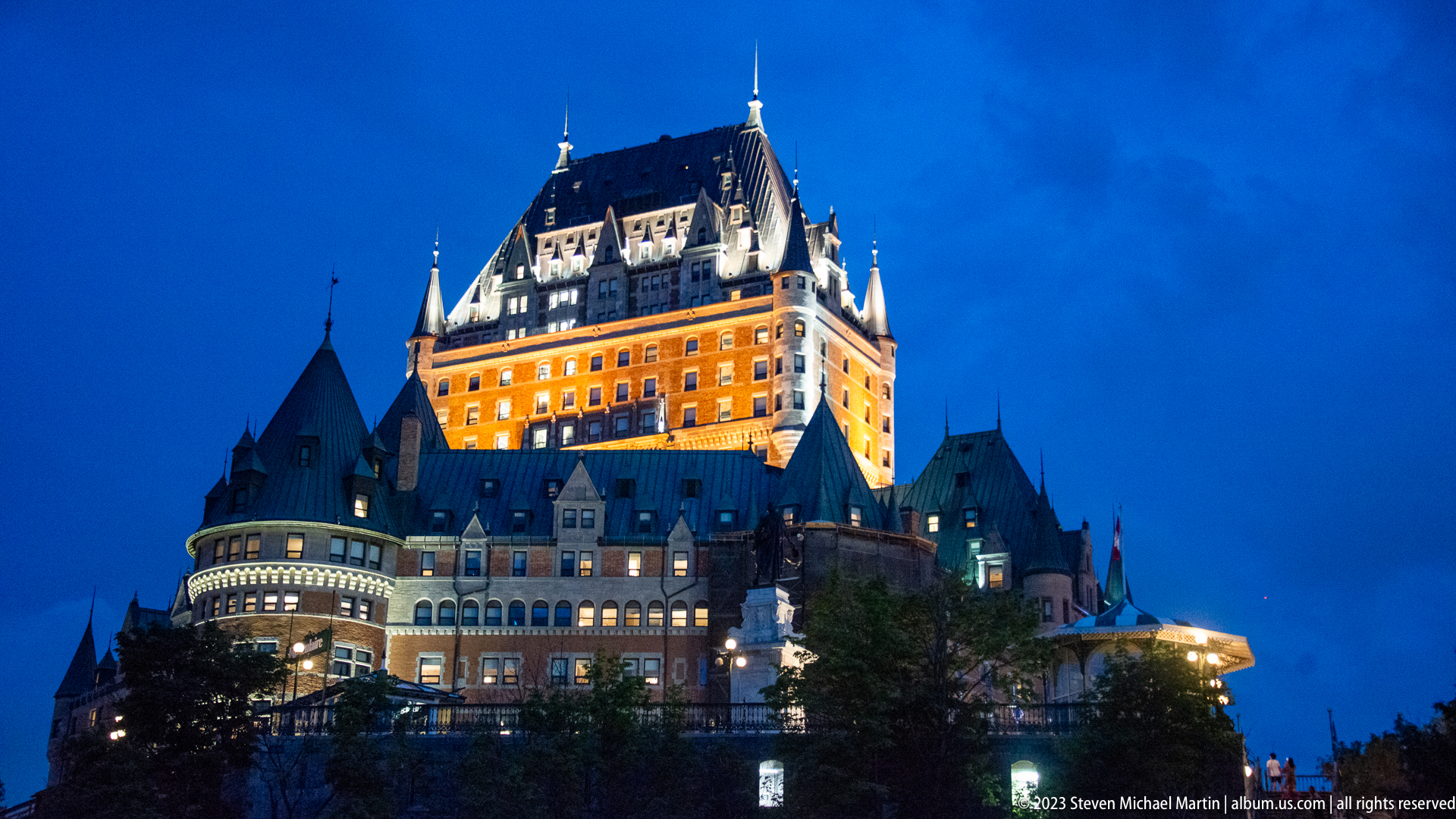
Seen against a saturated blue night sky, the Château Frontenac fills the frame with illuminated brick walls, steep roofs, turrets, and pointed dormers. Bright white architectural lighting outlines the upper roofline while warmer orange light washes the central façade. The tighter composition minimizes surrounding buildings and presents the hotel primarily as a layered silhouette of towers, roofs, and terraces.
Caption
Seen against a saturated blue night sky, the Château Frontenac fills the frame with illuminated brick walls, steep roofs, turrets, and pointed dormers. Bright white architectural lighting outlines the upper roofline while warmer orange light washes the central façade. The tighter composition minimizes surrounding buildings and presents the hotel primarily as a layered silhouette of towers, roofs, and terraces.
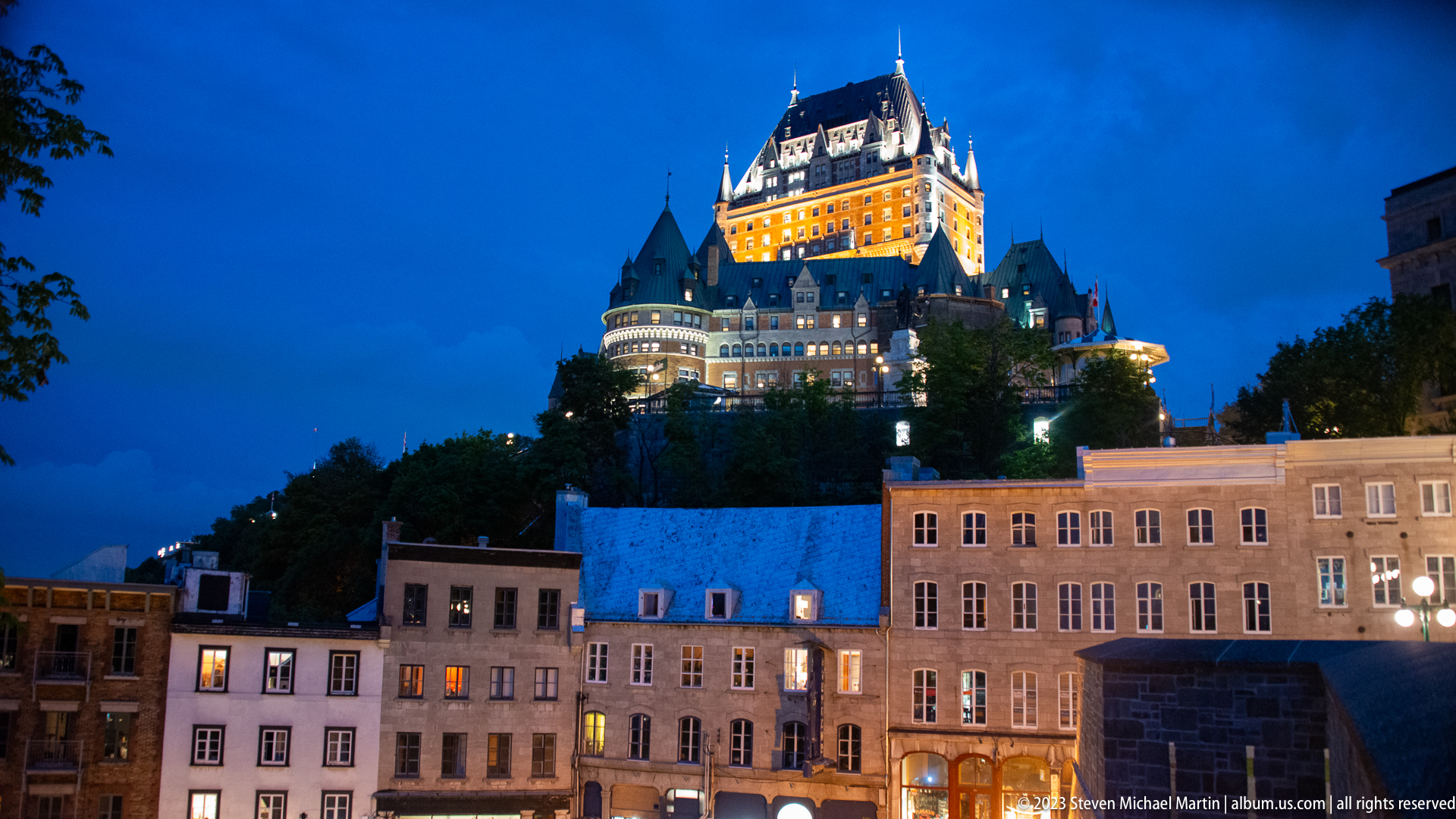
The illuminated Château Frontenac rises beyond a layered foreground of Lower Town buildings, linking the landmark to the smaller-scale historic city below. Warm windows and streetlights punctuate pale façades at the base of the slope while trees form a dark band beneath the hotel. This wider night view emphasizes the vertical separation between Upper Town’s monumental skyline and the compact neighborhood below.
Caption
The illuminated Château Frontenac rises beyond a layered foreground of Lower Town buildings, linking the landmark to the smaller-scale historic city below. Warm windows and streetlights punctuate pale façades at the base of the slope while trees form a dark band beneath the hotel. This wider night view emphasizes the vertical separation between Upper Town’s monumental skyline and the compact neighborhood below.
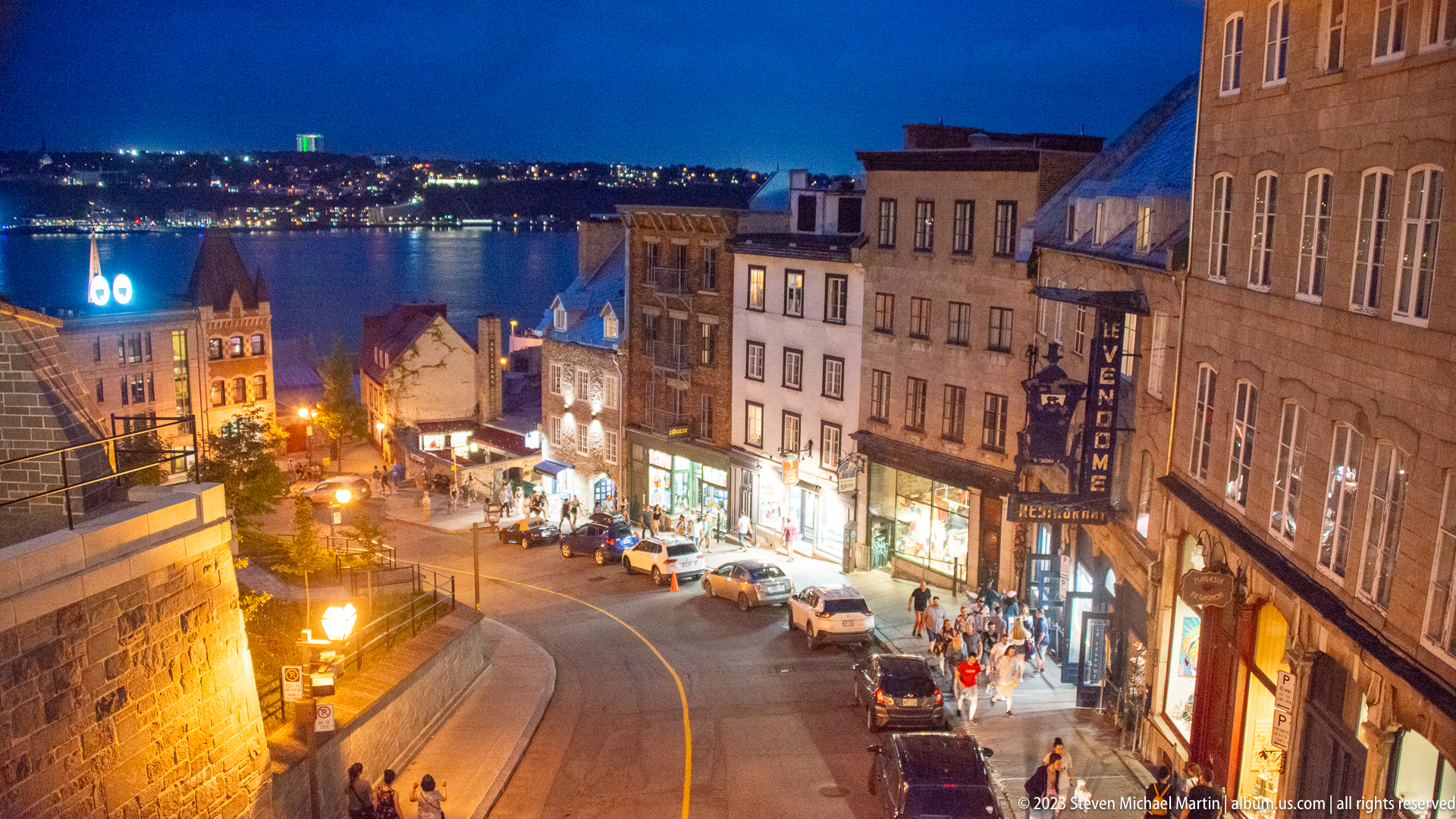
A curving street descends through Lower Town toward the St. Lawrence River, with warm lamps and storefronts illuminating pedestrians, parked cars, and stone façades. The river opens beyond the buildings as a broad dark-blue surface edged by distant lights. Viewed from above, the scene combines the neighborhood’s steep street geometry with its immediate connection to the waterfront.
Caption
A curving street descends through Lower Town toward the St. Lawrence River, with warm lamps and storefronts illuminating pedestrians, parked cars, and stone façades. The river opens beyond the buildings as a broad dark-blue surface edged by distant lights. Viewed from above, the scene combines the neighborhood’s steep street geometry with its immediate connection to the waterfront.
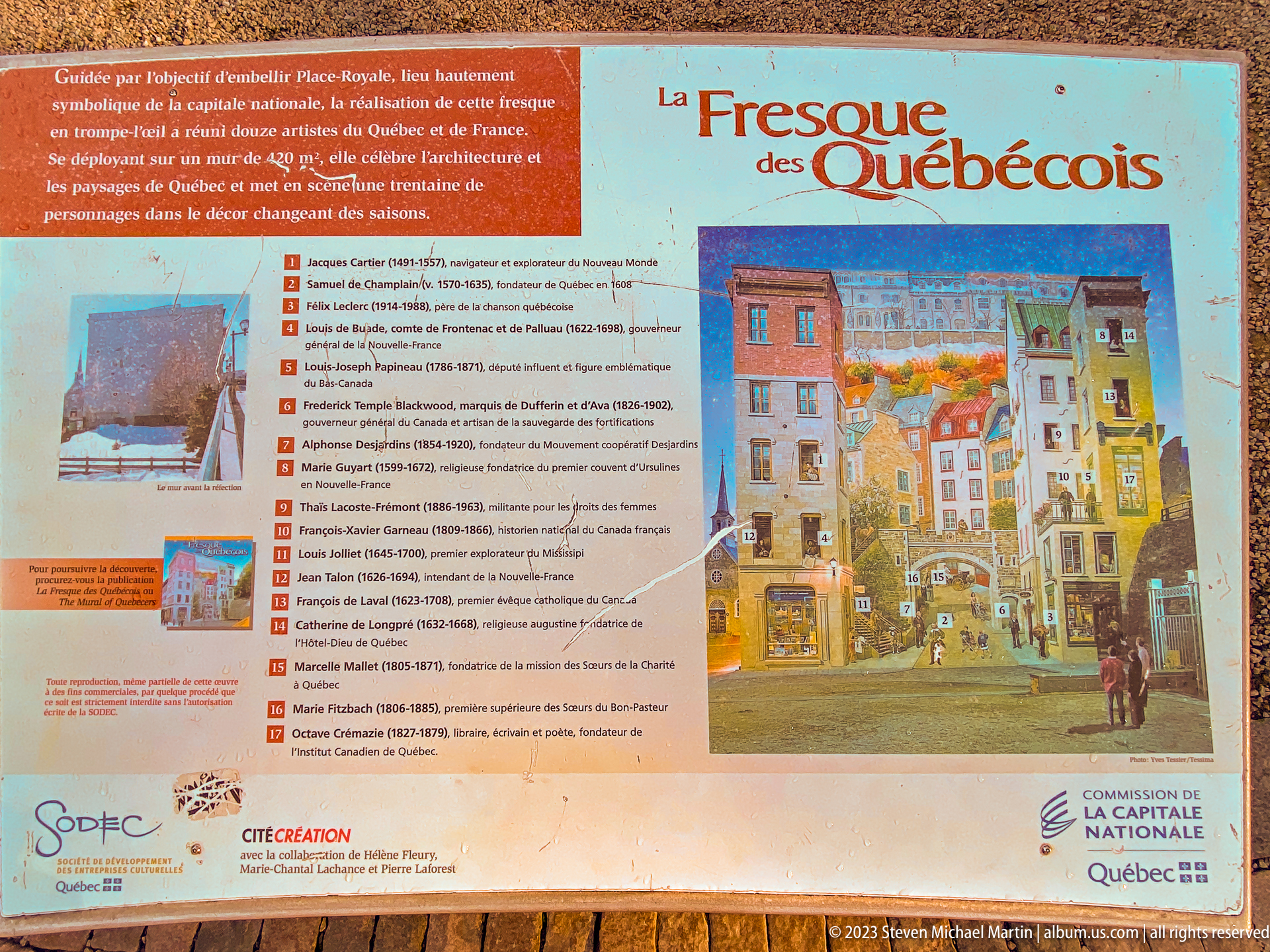
An interpretive panel titled “La Fresque des Québécois” reproduces the mural and provides a numbered guide to historical figures represented within it. French explanatory text, a list of names, and institutional logos surround the color illustration. The panel functions as an on-site key, linking the monumental trompe-l’œil mural to the people and historical references embedded in its painted architecture.
Caption
An interpretive panel titled “La Fresque des Québécois” reproduces the mural and provides a numbered guide to historical figures represented within it. French explanatory text, a list of names, and institutional logos surround the color illustration. The panel functions as an on-site key, linking the monumental trompe-l’œil mural to the people and historical references embedded in its painted architecture.
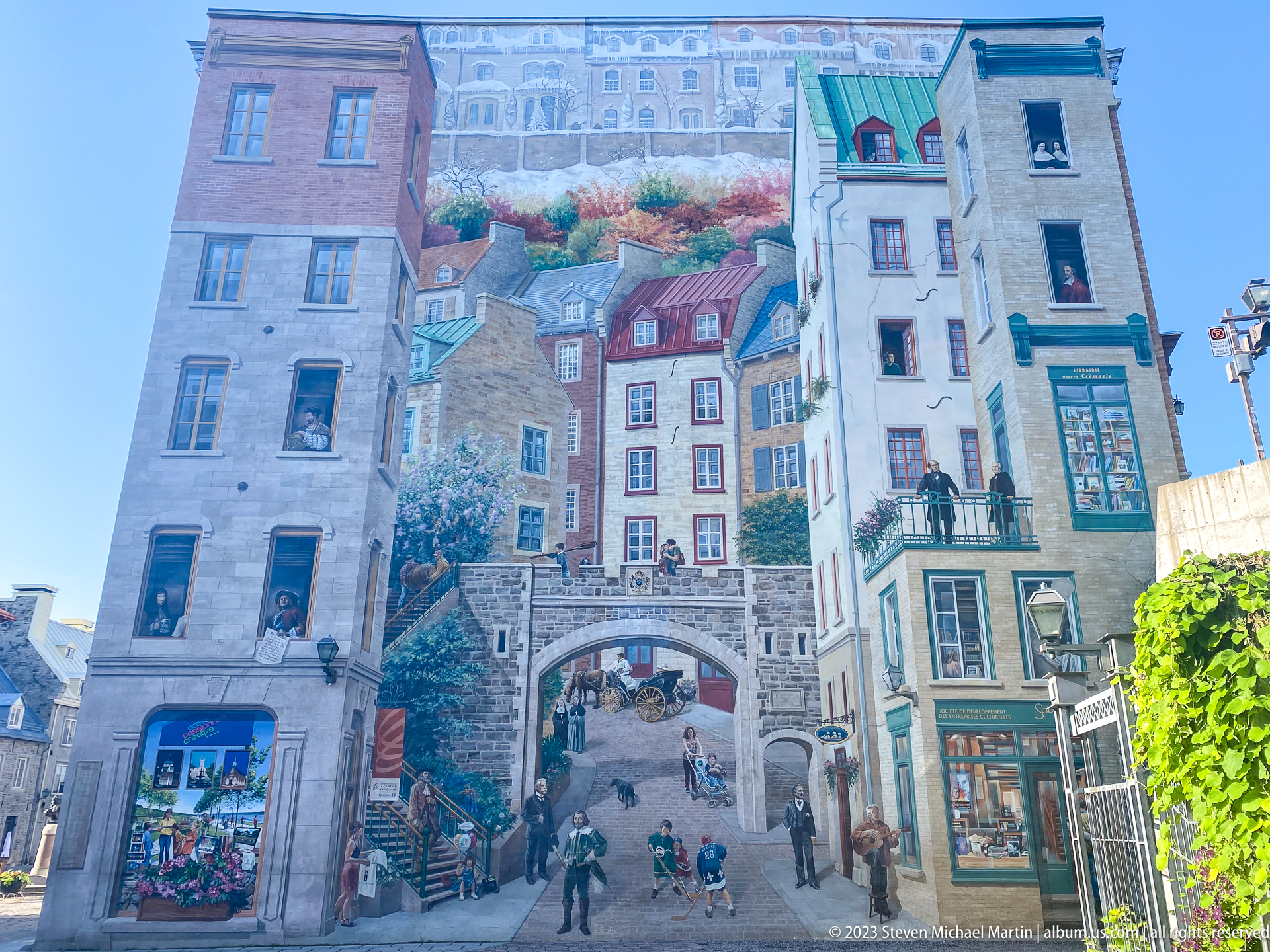
The Fresque des Québécois transforms a tall building wall into an illusionistic extension of Old Québec, with painted houses, stairways, windows, gardens, and figures arranged around a central arch. Real neighboring façades frame the mural, strengthening the trompe-l’œil effect. The frontal view shows how the artwork uses architectural perspective to merge painted history with the surrounding streetscape.
Caption
The Fresque des Québécois transforms a tall building wall into an illusionistic extension of Old Québec, with painted houses, stairways, windows, gardens, and figures arranged around a central arch. Real neighboring façades frame the mural, strengthening the trompe-l’œil effect. The frontal view shows how the artwork uses architectural perspective to merge painted history with the surrounding streetscape.
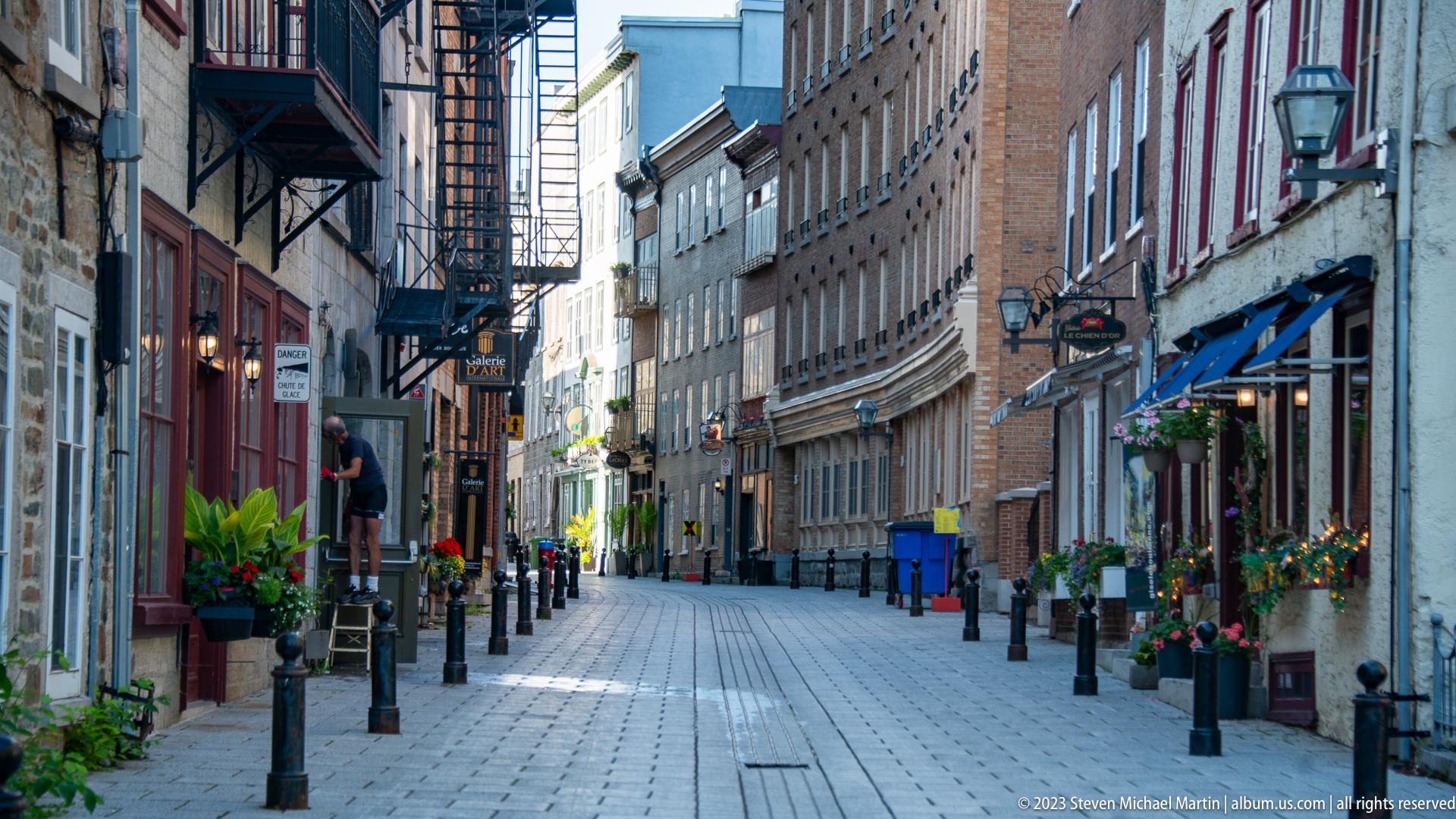
A narrow paved lane extends between closely spaced brick and stone buildings, lined with shop entrances, hanging signs, flower planters, and black bollards. A few pedestrians occupy the middle distance while awnings and exterior stairways add layers to the façades. The long perspective emphasizes the intimate width and mixed architectural textures of a quieter commercial street in Old Québec.
Caption
A narrow paved lane extends between closely spaced brick and stone buildings, lined with shop entrances, hanging signs, flower planters, and black bollards. A few pedestrians occupy the middle distance while awnings and exterior stairways add layers to the façades. The long perspective emphasizes the intimate width and mixed architectural textures of a quieter commercial street in Old Québec.
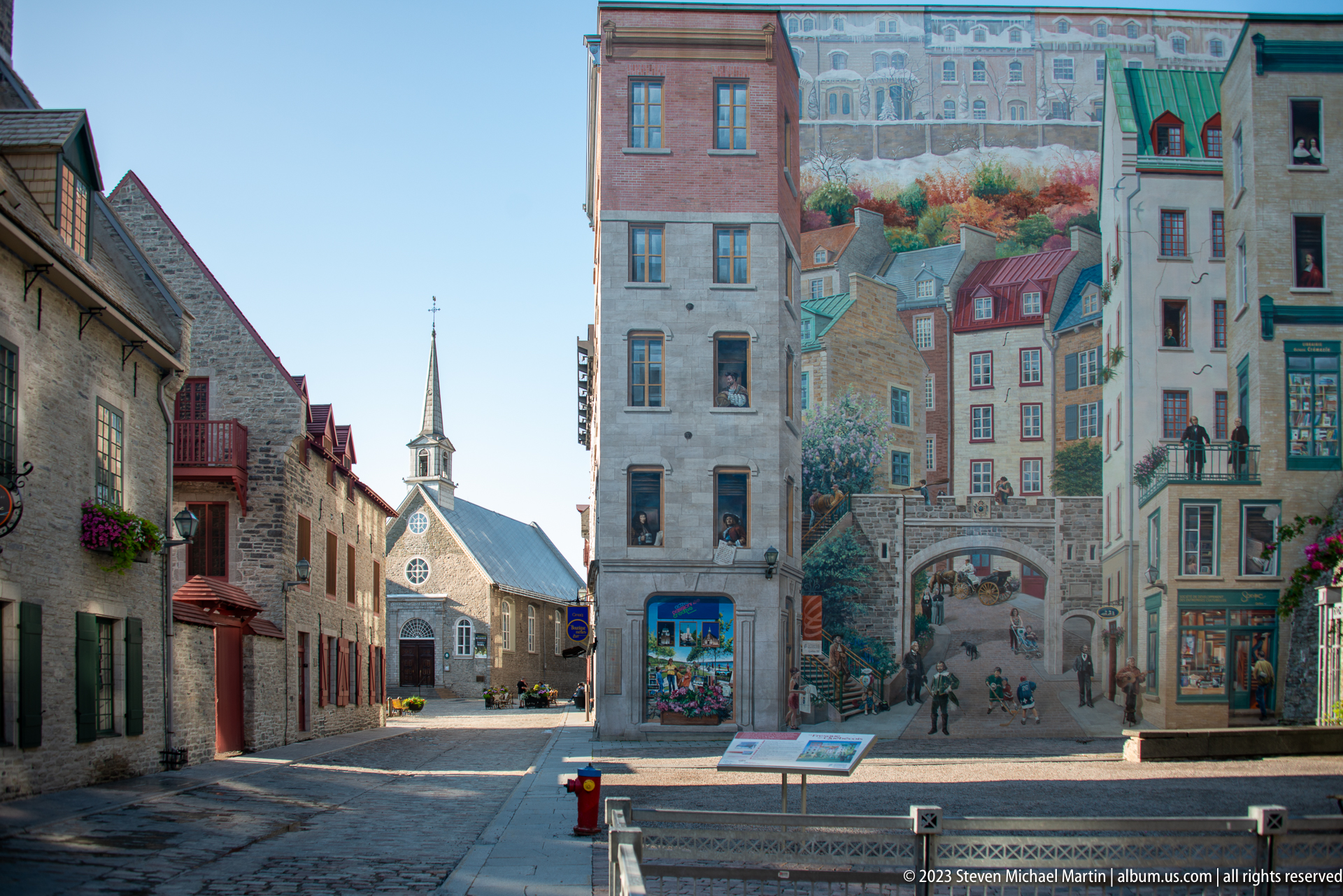
The Fresque des Québécois fills the right-hand façade while Notre-Dame-des-Victoires rises farther down the open space at left, bringing two major visual elements of Lower Town into one composition. Historic stone buildings line the approach between them. The broad view demonstrates how the contemporary mural is embedded within the preserved architectural fabric of Place Royale rather than experienced as an isolated artwork.
Caption
The Fresque des Québécois fills the right-hand façade while Notre-Dame-des-Victoires rises farther down the open space at left, bringing two major visual elements of Lower Town into one composition. Historic stone buildings line the approach between them. The broad view demonstrates how the contemporary mural is embedded within the preserved architectural fabric of Place Royale rather than experienced as an isolated artwork.
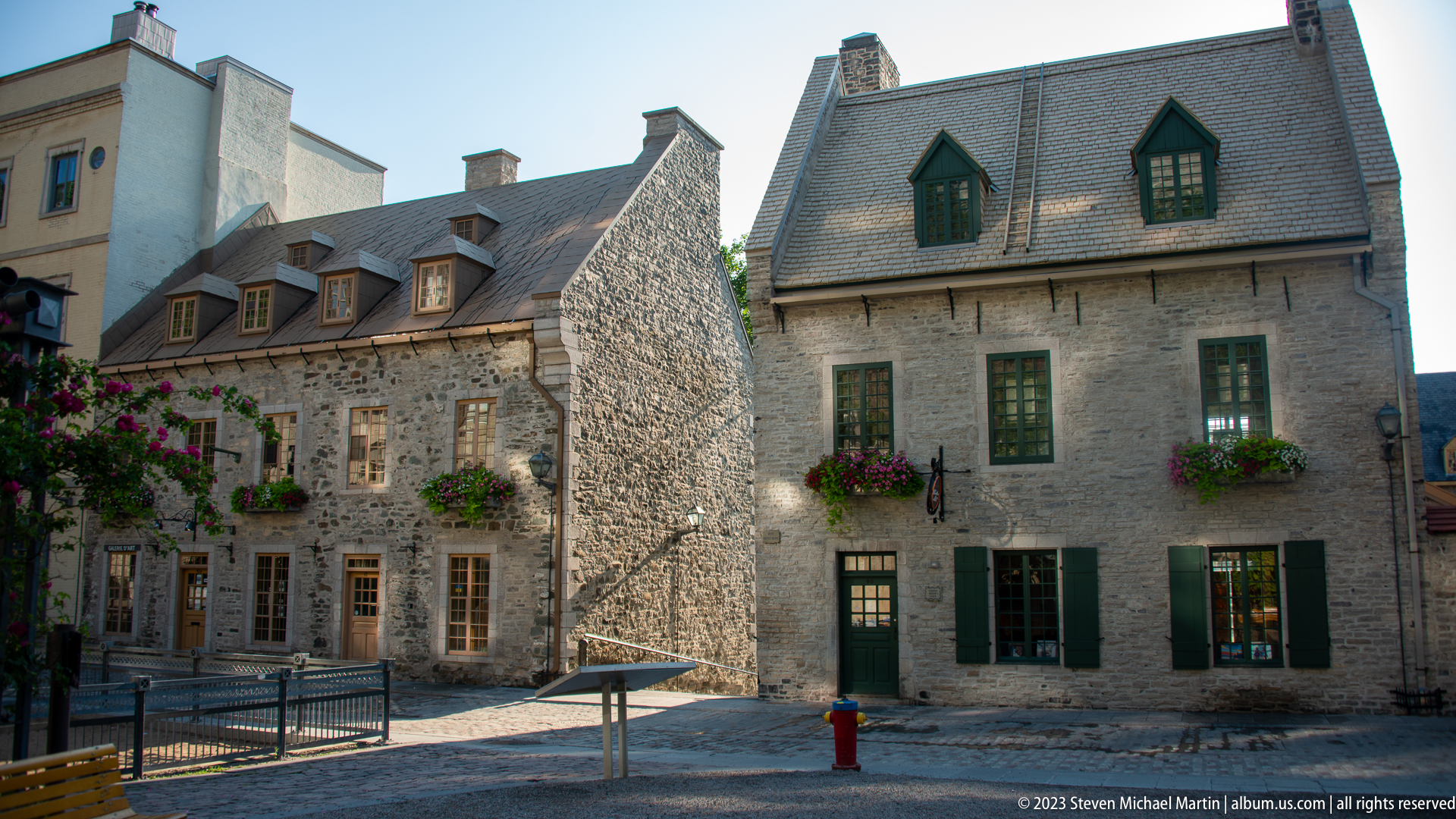
Two adjoining stone houses face Place Royale with steep roofs, dormers, tall chimneys, green-painted shutters, and flower boxes. The left building extends in a long row of repeated windows while the taller central house presents a broad gable wall and symmetrical façade. Morning light reveals the varied masonry textures and restrained domestic scale of the historic ensemble.
Caption
Two adjoining stone houses face Place Royale with steep roofs, dormers, tall chimneys, green-painted shutters, and flower boxes. The left building extends in a long row of repeated windows while the taller central house presents a broad gable wall and symmetrical façade. Morning light reveals the varied masonry textures and restrained domestic scale of the historic ensemble.
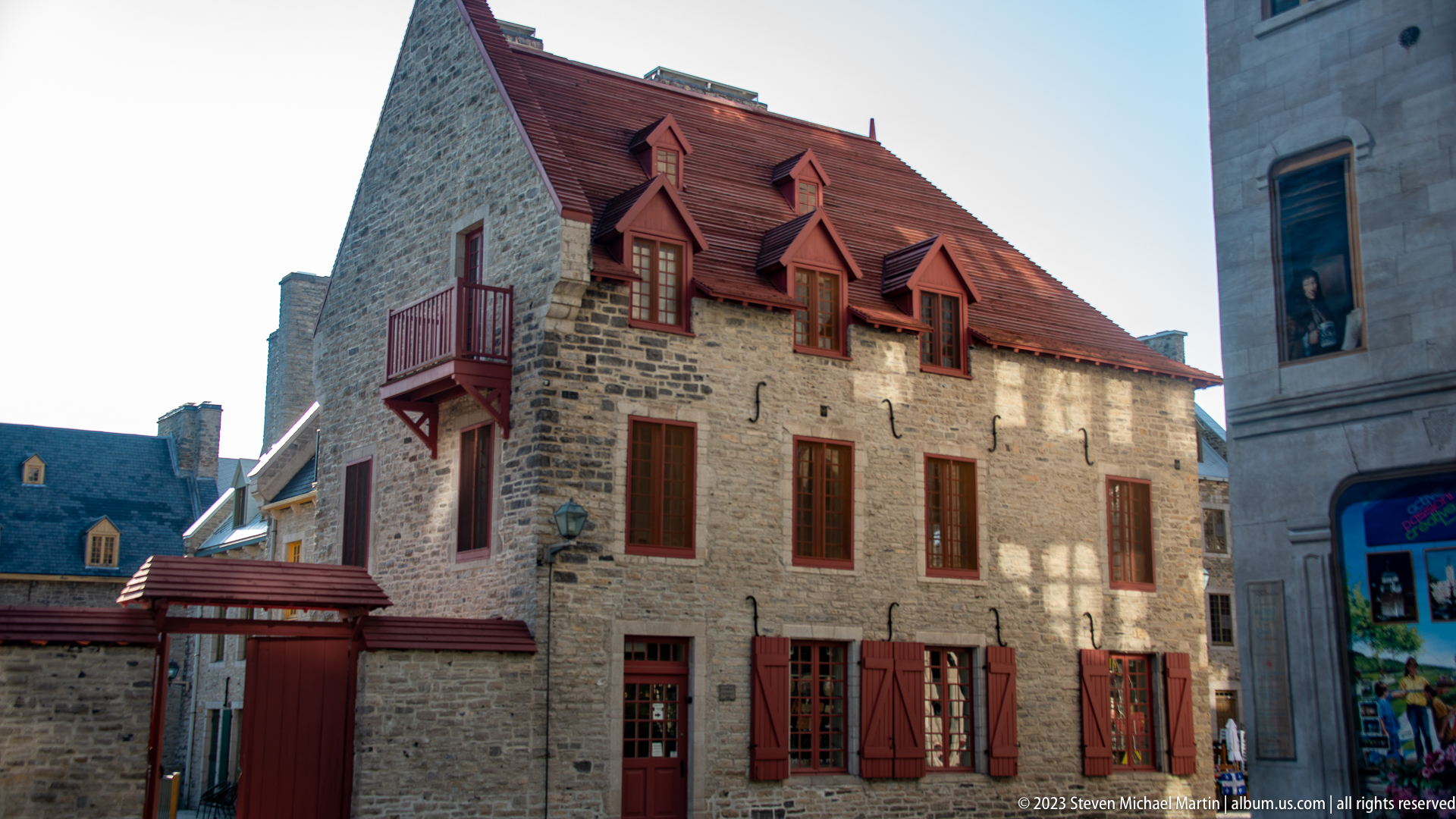
A substantial stone house is capped by a steep red metal roof punctuated by three prominent dormers, with matching red shutters and a small projecting balcony on the gable wall. Heavy masonry and simple rectangular openings contrast with the bright painted woodwork. The angled view records both the principal façade and the building’s depth along the narrow Place Royale streetscape.
Caption
A substantial stone house is capped by a steep red metal roof punctuated by three prominent dormers, with matching red shutters and a small projecting balcony on the gable wall. Heavy masonry and simple rectangular openings contrast with the bright painted woodwork. The angled view records both the principal façade and the building’s depth along the narrow Place Royale streetscape.
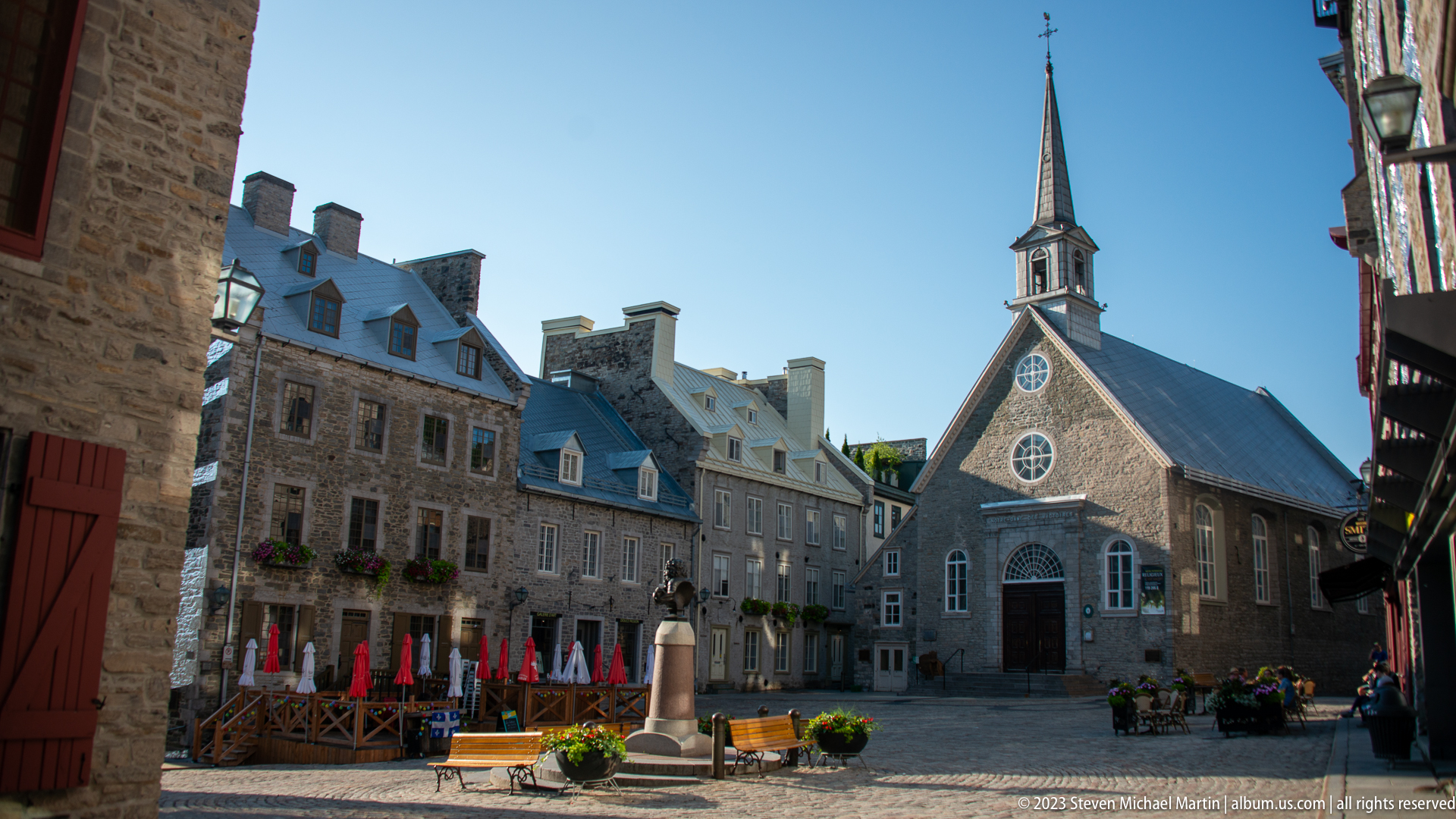
Notre-Dame-des-Victoires anchors Place Royale in bright daylight, its compact stone façade centered beneath a slender spire and cross. Circular windows punctuate the gable above the arched entrance, while historic houses, café umbrellas, planters, and a small monument occupy the surrounding square. The open frontal view clearly presents the church as the architectural focus of the enclosed civic space.
Caption
Notre-Dame-des-Victoires anchors Place Royale in bright daylight, its compact stone façade centered beneath a slender spire and cross. Circular windows punctuate the gable above the arched entrance, while historic houses, café umbrellas, planters, and a small monument occupy the surrounding square. The open frontal view clearly presents the church as the architectural focus of the enclosed civic space.
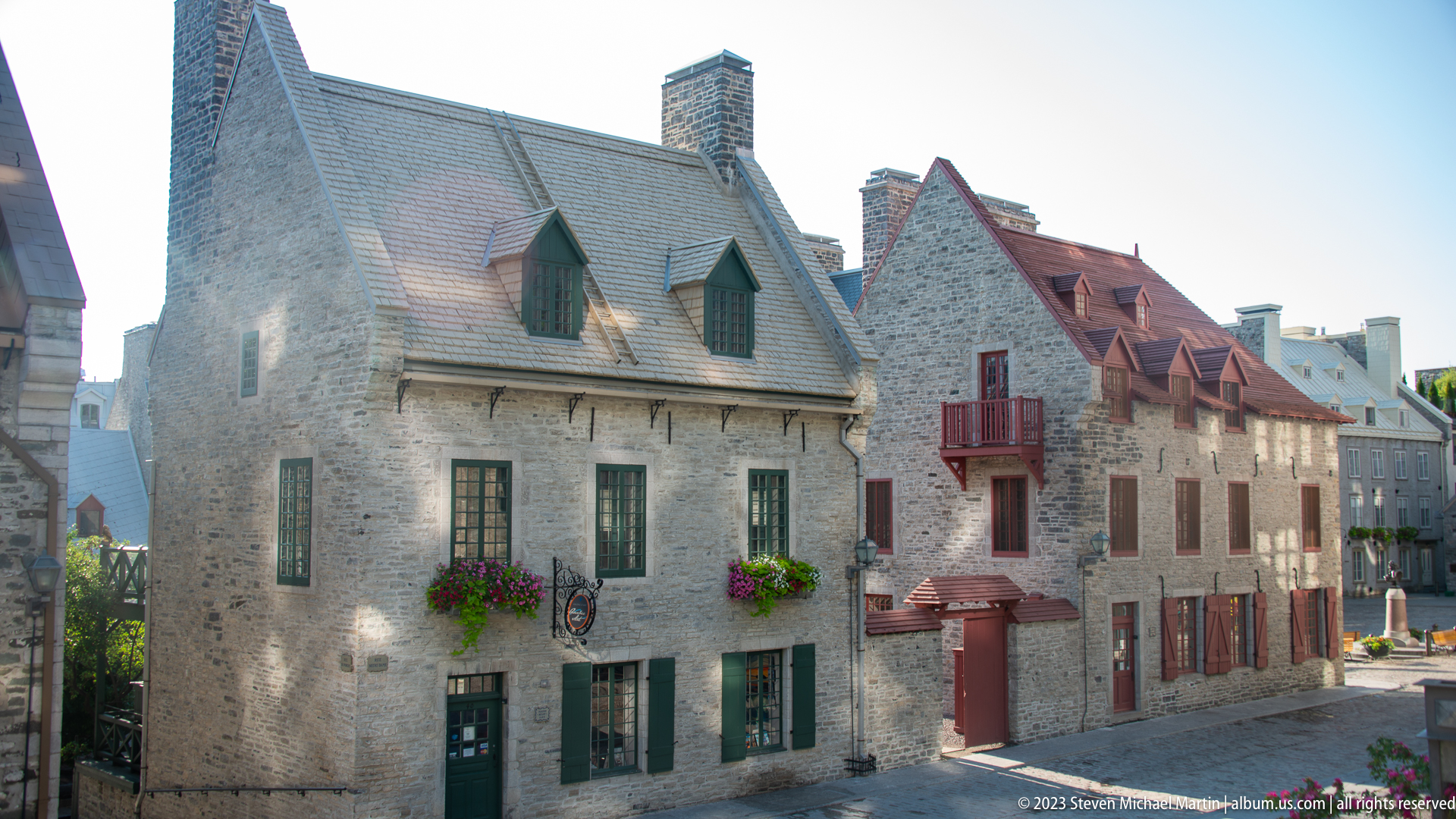
Two historic stone houses stand side by side in Place Royale, one with a gray roof and green trim and the other with a red roof and red-painted shutters. Dormers, chimneys, flower boxes, and a projecting wooden balcony differentiate the façades despite their shared masonry construction. The oblique view highlights the close spacing and individual color schemes within the preserved ensemble.
Caption
Two historic stone houses stand side by side in Place Royale, one with a gray roof and green trim and the other with a red roof and red-painted shutters. Dormers, chimneys, flower boxes, and a projecting wooden balcony differentiate the façades despite their shared masonry construction. The oblique view highlights the close spacing and individual color schemes within the preserved ensemble.
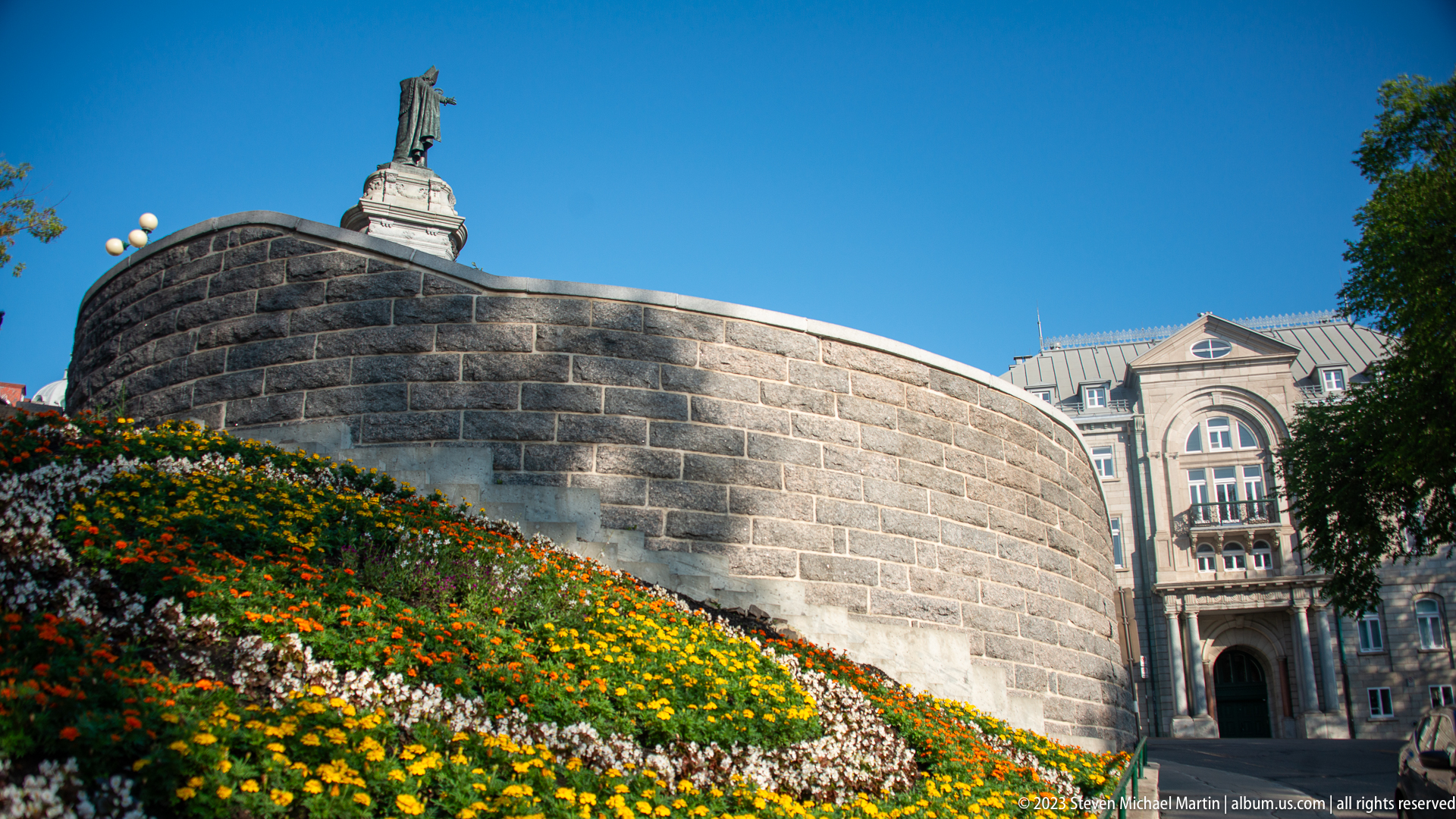
A broad curved stone rampart rises behind a densely planted bed of orange, yellow, white, and red flowers. The smooth arc of heavy masonry contrasts with the colorful sloping garden, while an ornate institutional façade appears beyond the wall at right. The composition presents Quebec City’s defensive architecture not as an isolated ruin but as an integrated element of the maintained urban landscape.
Caption
A broad curved stone rampart rises behind a densely planted bed of orange, yellow, white, and red flowers. The smooth arc of heavy masonry contrasts with the colorful sloping garden, while an ornate institutional façade appears beyond the wall at right. The composition presents Quebec City’s defensive architecture not as an isolated ruin but as an integrated element of the maintained urban landscape.
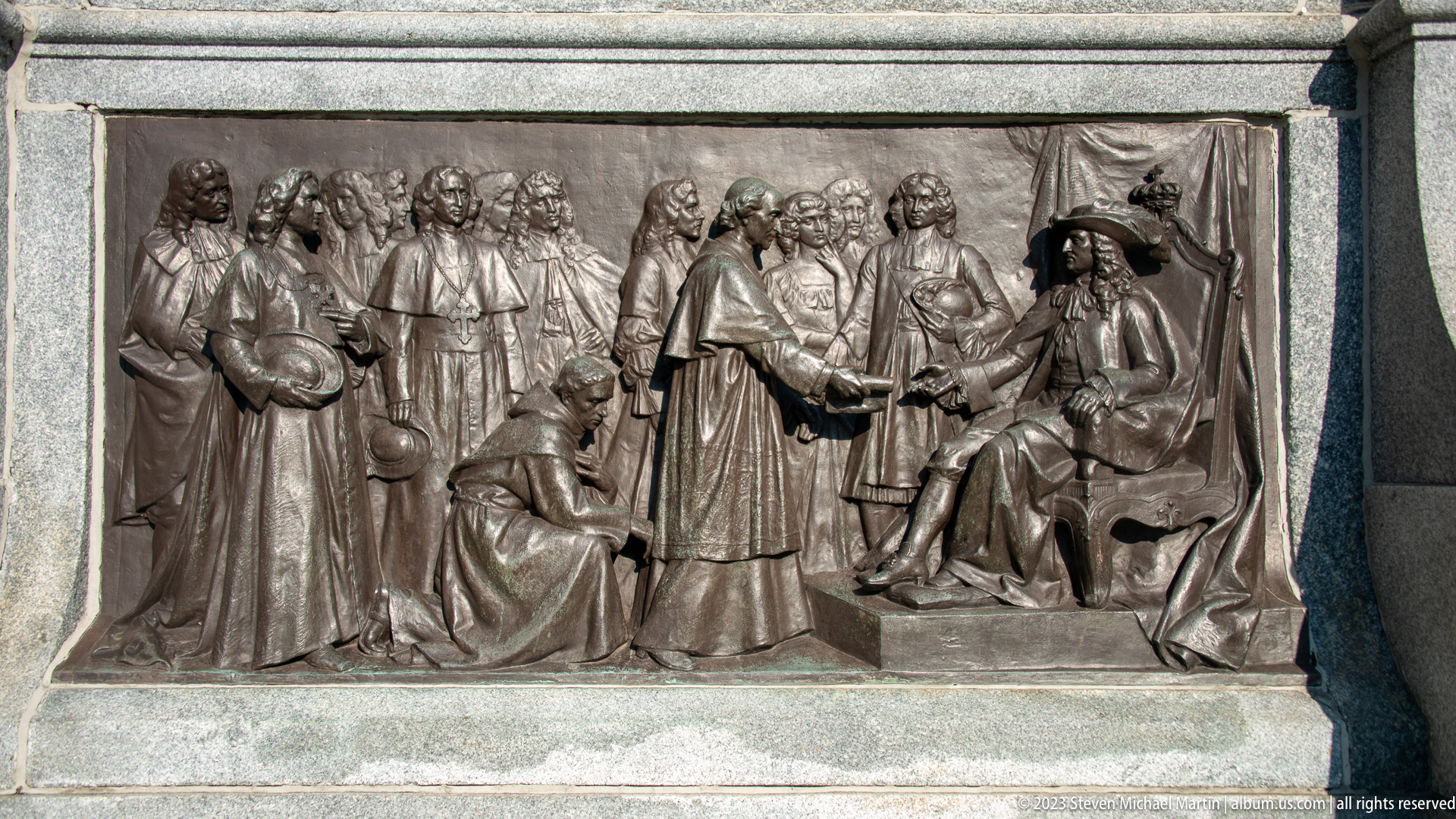
A bronze relief presents a formal historical encounter, with a central cleric extending a hand toward a seated man while groups of robed and formally dressed figures witness the exchange. Modeled in high relief against a shallow architectural background, the scene forms part of a larger commemorative monument. The close view emphasizes costume, gesture, and the ceremonial character of the represented event.
Caption
A bronze relief presents a formal historical encounter, with a central cleric extending a hand toward a seated man while groups of robed and formally dressed figures witness the exchange. Modeled in high relief against a shallow architectural background, the scene forms part of a larger commemorative monument. The close view emphasizes costume, gesture, and the ceremonial character of the represented event.
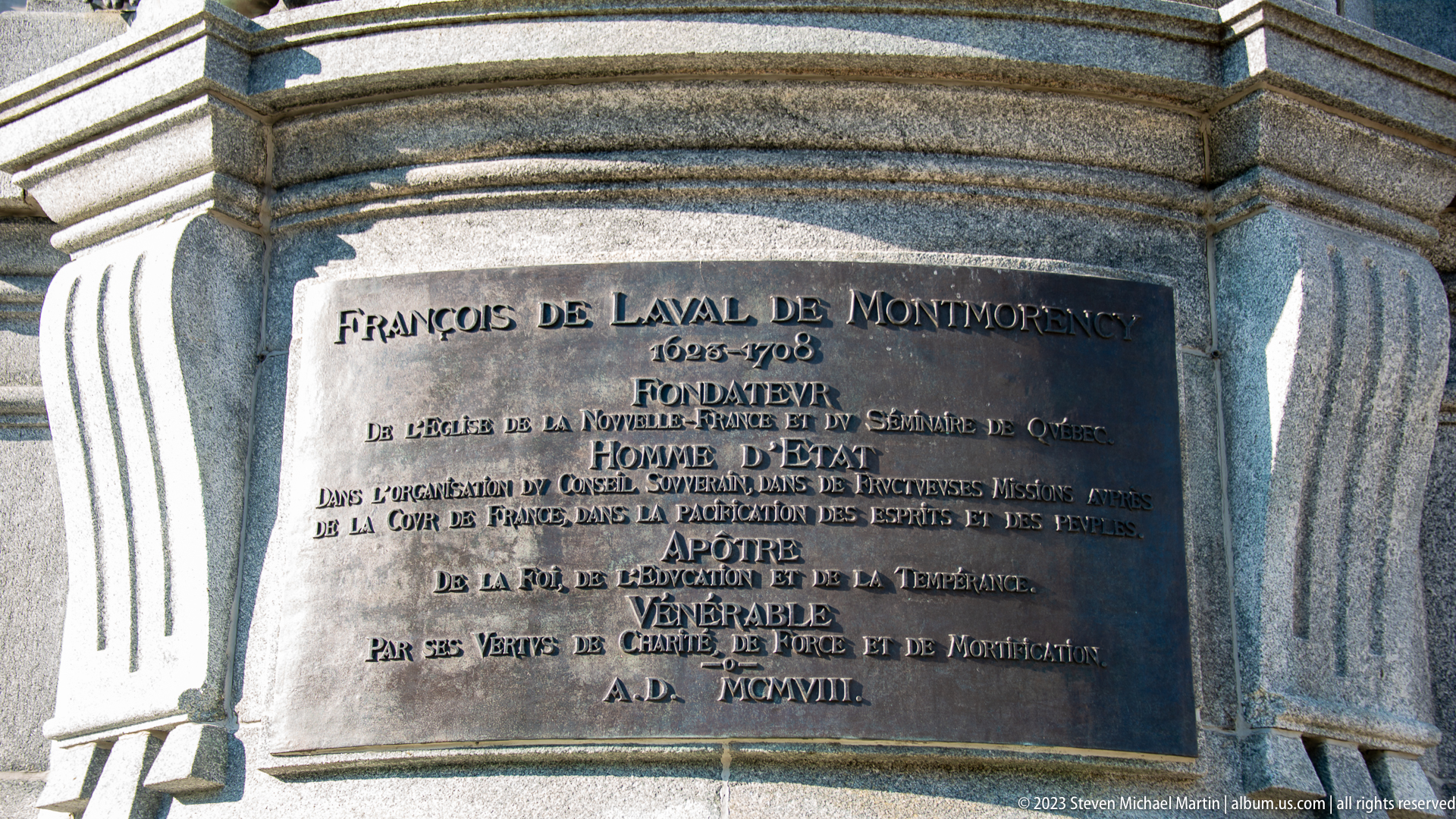
A bronze inscription plaque identifies François de Laval de Montmorency, 1623–1708, as founder of the Church of Canada and first bishop of Québec. Additional French text records his roles and reputation, set within a carved stone monument. The close framing preserves the monument’s own wording and provides direct documentary evidence for the historical figure commemorated by the surrounding sculpture.
Caption
A bronze inscription plaque identifies François de Laval de Montmorency, 1623–1708, as founder of the Church of Canada and first bishop of Québec. Additional French text records his roles and reputation, set within a carved stone monument. The close framing preserves the monument’s own wording and provides direct documentary evidence for the historical figure commemorated by the surrounding sculpture.
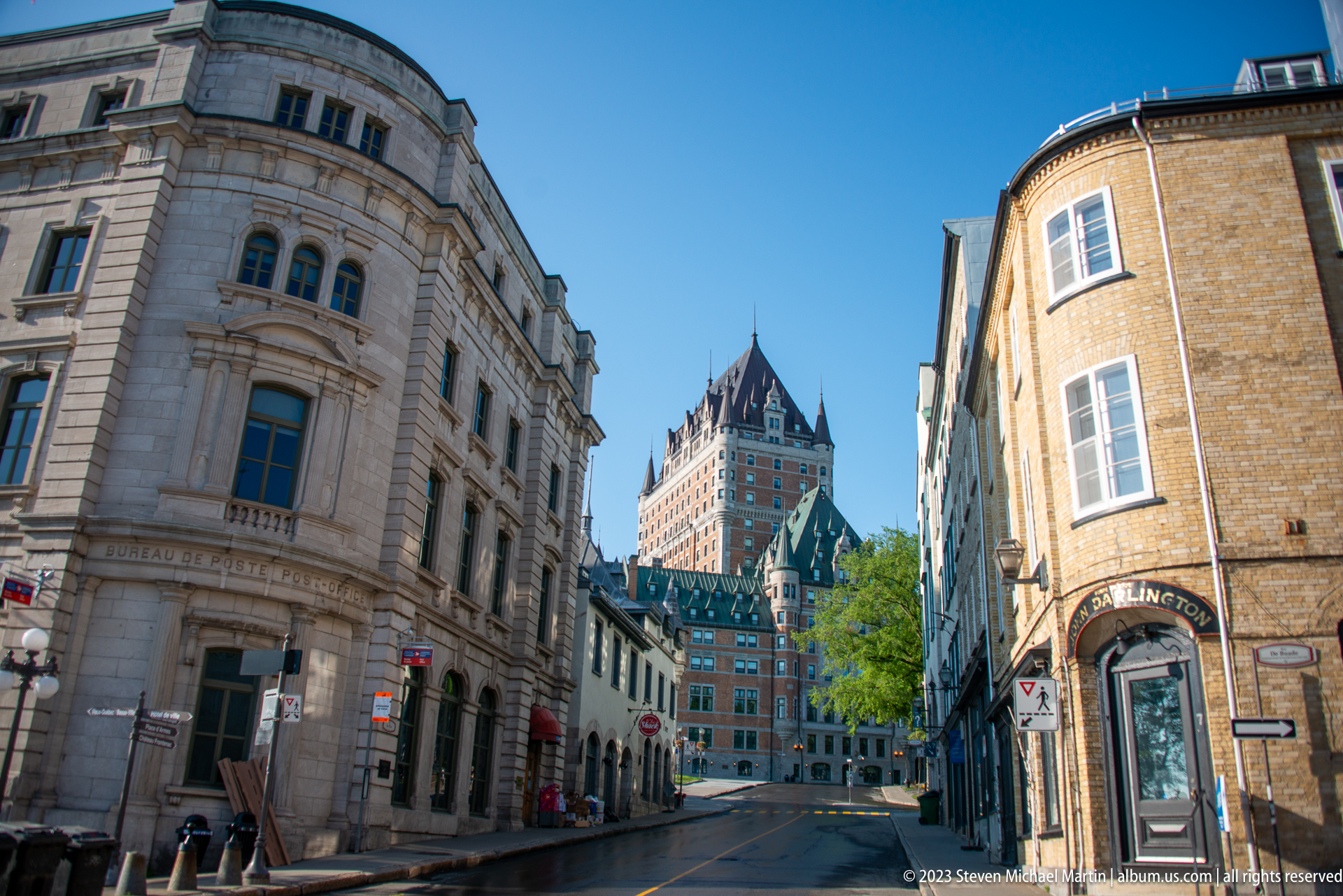
A quiet Old Québec street leads toward the Château Frontenac, whose steep roofs and towers rise at the end of the corridor. Historic stone and brick commercial buildings frame the road, including a rounded corner façade with shop signage. The clear morning light and sparse traffic make the street’s gentle grade, narrow width, and architectural enclosure especially legible.
Caption
A quiet Old Québec street leads toward the Château Frontenac, whose steep roofs and towers rise at the end of the corridor. Historic stone and brick commercial buildings frame the road, including a rounded corner façade with shop signage. The clear morning light and sparse traffic make the street’s gentle grade, narrow width, and architectural enclosure especially legible.
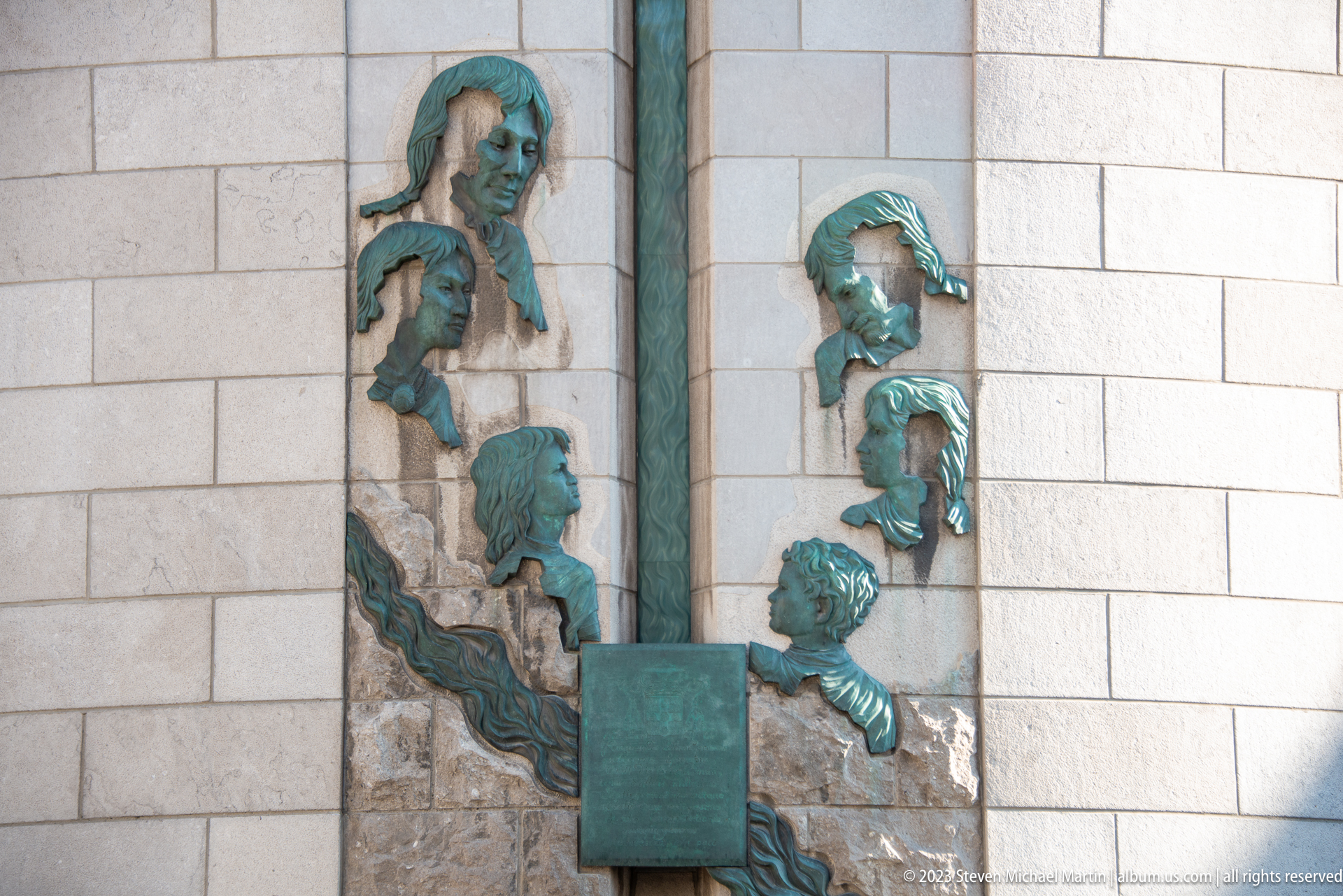
Patinated bronze heads in profile emerge from a pale stone wall in an irregular vertical grouping, connected visually by flowing bronze forms. The faces vary in age, hairstyle, and orientation, creating a sculptural procession rather than a single portrait. A rectangular bronze plaque occupies the lower center, but its text is not legible at proof-sheet scale.
Caption
Patinated bronze heads in profile emerge from a pale stone wall in an irregular vertical grouping, connected visually by flowing bronze forms. The faces vary in age, hairstyle, and orientation, creating a sculptural procession rather than a single portrait. A rectangular bronze plaque occupies the lower center, but its text is not legible at proof-sheet scale.
A simplified black emblem of a cannon and six round cannonballs is mounted on a pale wall, reducing military artillery to a bold graphic sign. The cannon barrel angles upward while the stacked circles form a compact ammunition motif beside it. The austere symbol provides a contemporary visual cue to the defensive and military history embedded in Quebec City’s fortified urban landscape.
Caption
A simplified black emblem of a cannon and six round cannonballs is mounted on a pale wall, reducing military artillery to a bold graphic sign. The cannon barrel angles upward while the stacked circles form a compact ammunition motif beside it. The austere symbol provides a contemporary visual cue to the defensive and military history embedded in Quebec City’s fortified urban landscape.
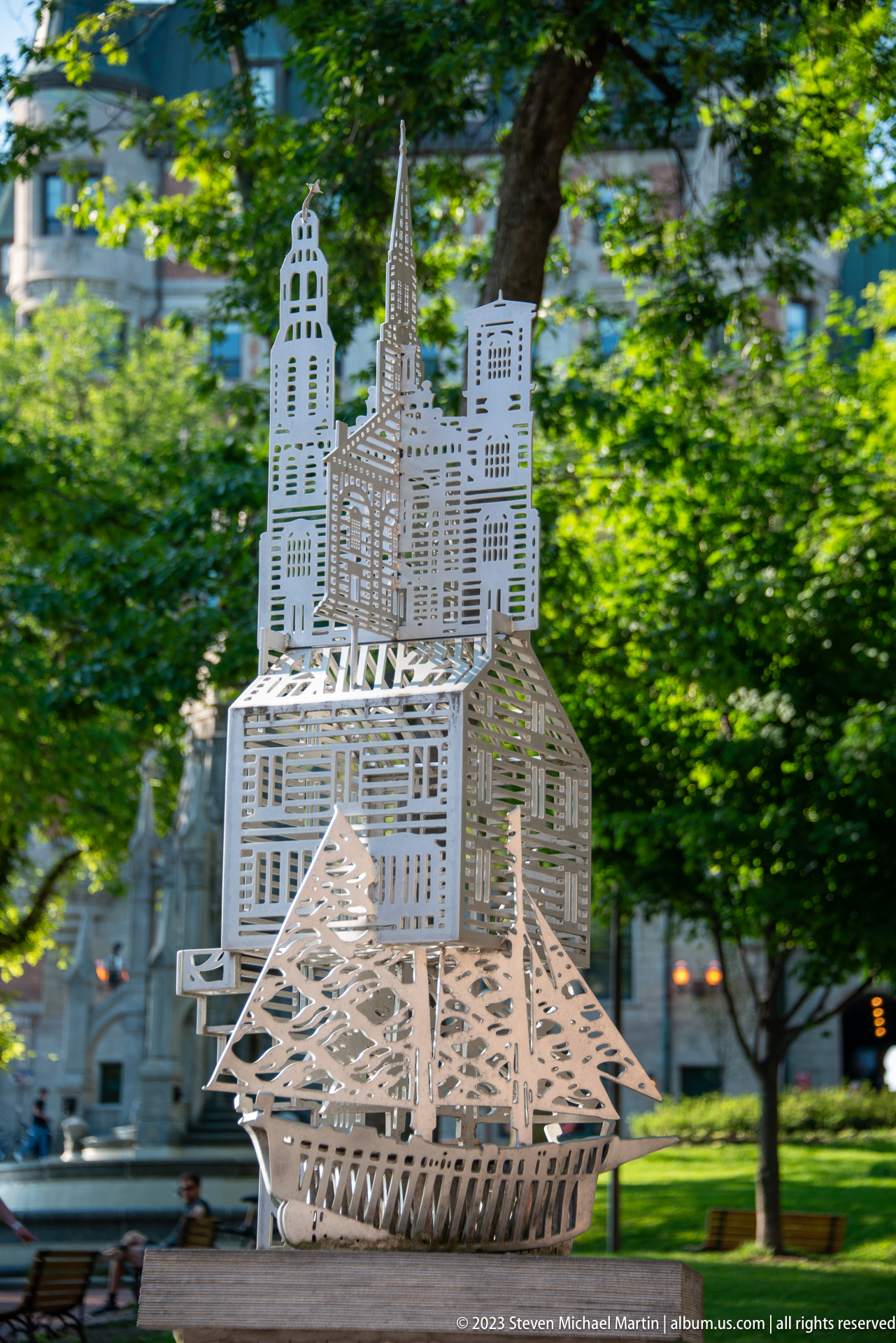
A white openwork sculpture reconstructs a church, tower, and surrounding historic buildings as a lattice of linear structural outlines. Set on a pedestal in a leafy public space, the work reduces solid masonry architecture to an airy skeletal model. The oblique view reveals multiple façades and roof forms, emphasizing the sculpture’s combination of recognizable urban silhouette and contemporary fabrication.
Caption
A white openwork sculpture reconstructs a church, tower, and surrounding historic buildings as a lattice of linear structural outlines. Set on a pedestal in a leafy public space, the work reduces solid masonry architecture to an airy skeletal model. The oblique view reveals multiple façades and roof forms, emphasizing the sculpture’s combination of recognizable urban silhouette and contemporary fabrication.
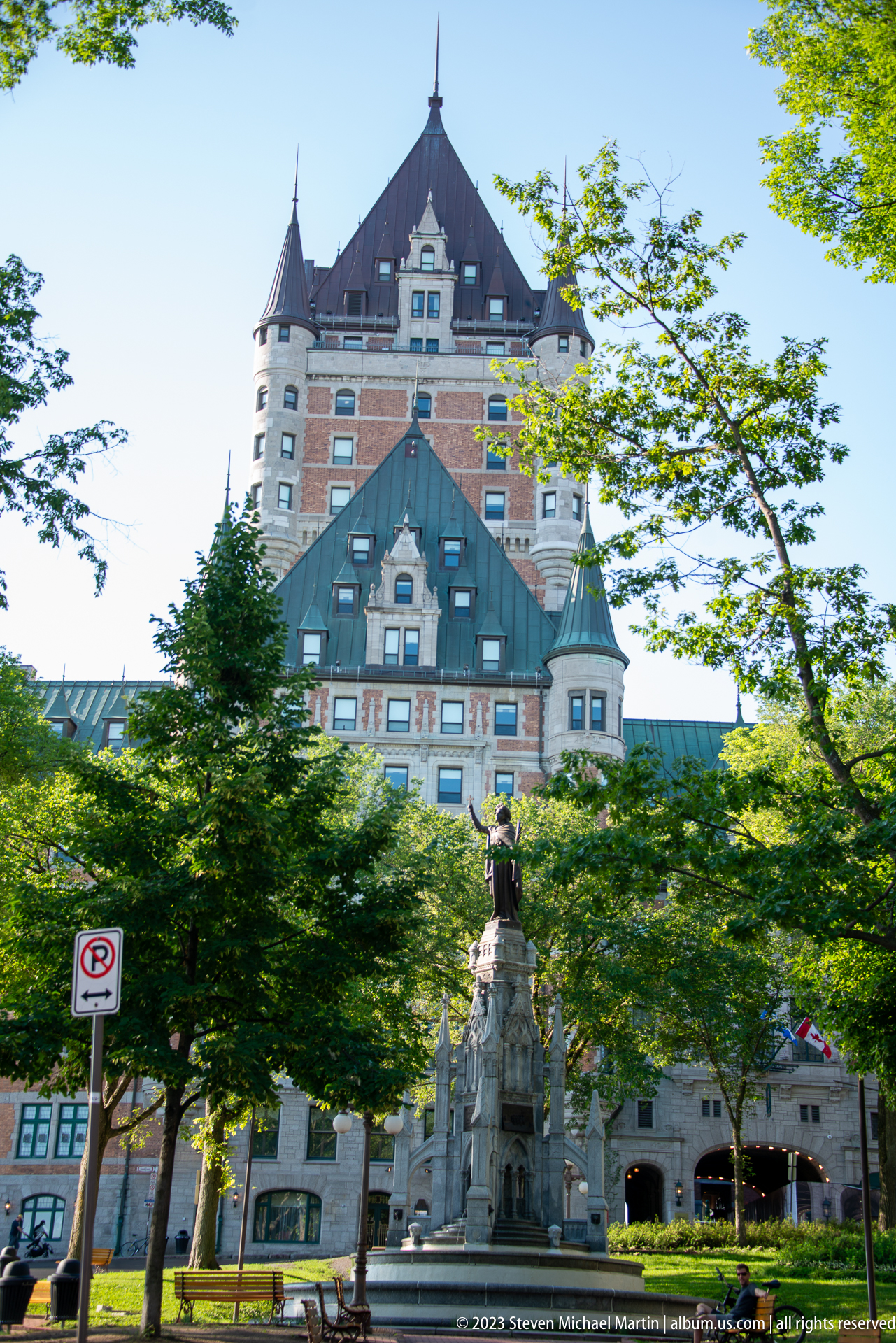
The Château Frontenac rises above trees and a formal public monument, its copper roofs, turrets, and tall central block dominating the background. The monument’s sculpted figure and elaborate stone pedestal occupy the lower center, while benches and a quiet roadway establish the scale of the landscaped civic setting. The view links the hotel’s monumental skyline with the commemorative landscape below.
Caption
The Château Frontenac rises above trees and a formal public monument, its copper roofs, turrets, and tall central block dominating the background. The monument’s sculpted figure and elaborate stone pedestal occupy the lower center, while benches and a quiet roadway establish the scale of the landscaped civic setting. The view links the hotel’s monumental skyline with the commemorative landscape below.
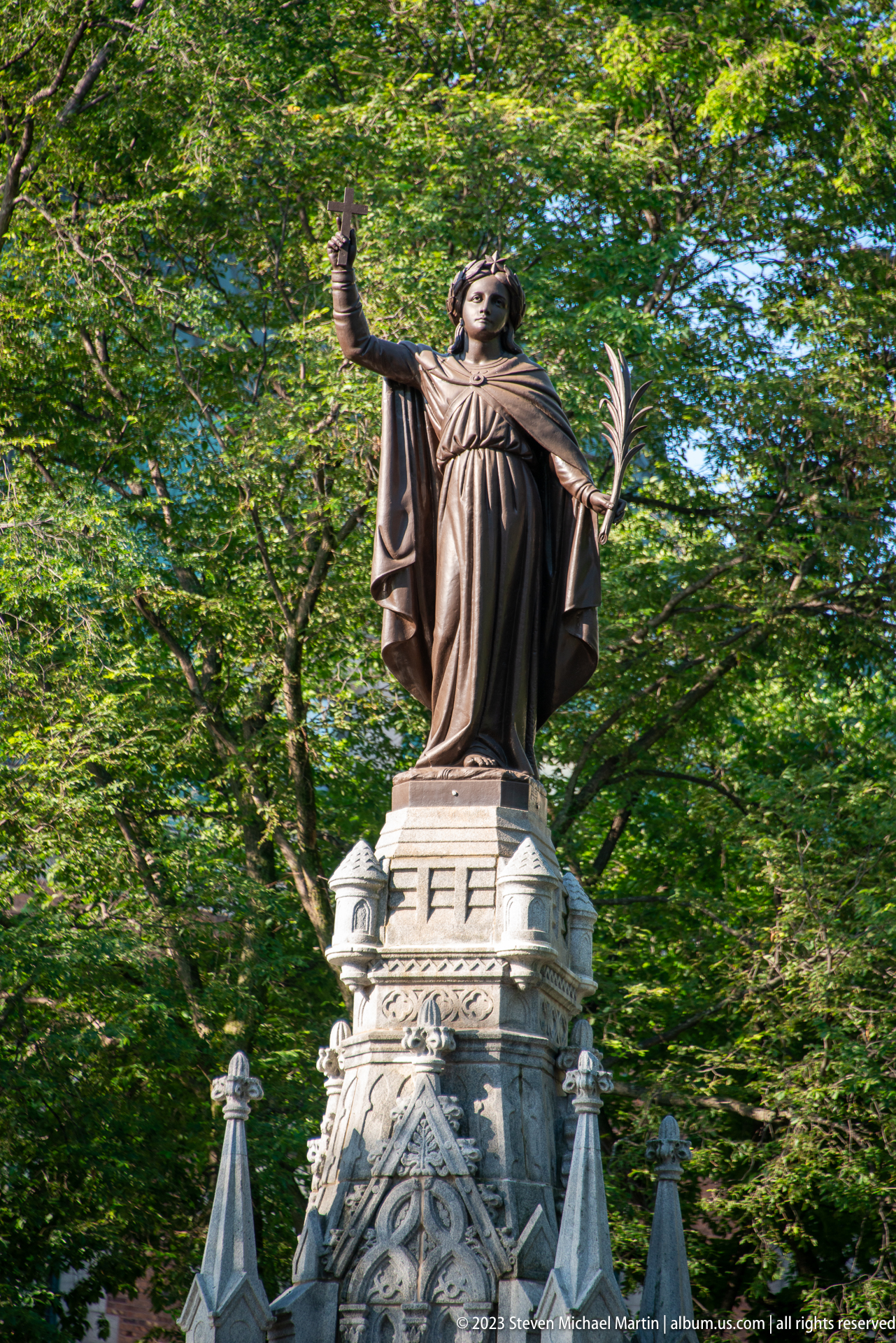
A robed bronze woman stands atop an elaborate pale stone monument, raising one hand while holding a palm frond in the other. Seen closely against dense green foliage, the sculpture’s drapery, gesture, and symbolic attribute are more legible than the larger setting. The upward viewpoint emphasizes the figure’s elevated commemorative role and the contrast between dark bronze and carved stone.
Caption
A robed bronze woman stands atop an elaborate pale stone monument, raising one hand while holding a palm frond in the other. Seen closely against dense green foliage, the sculpture’s drapery, gesture, and symbolic attribute are more legible than the larger setting. The upward viewpoint emphasizes the figure’s elevated commemorative role and the contrast between dark bronze and carved stone.
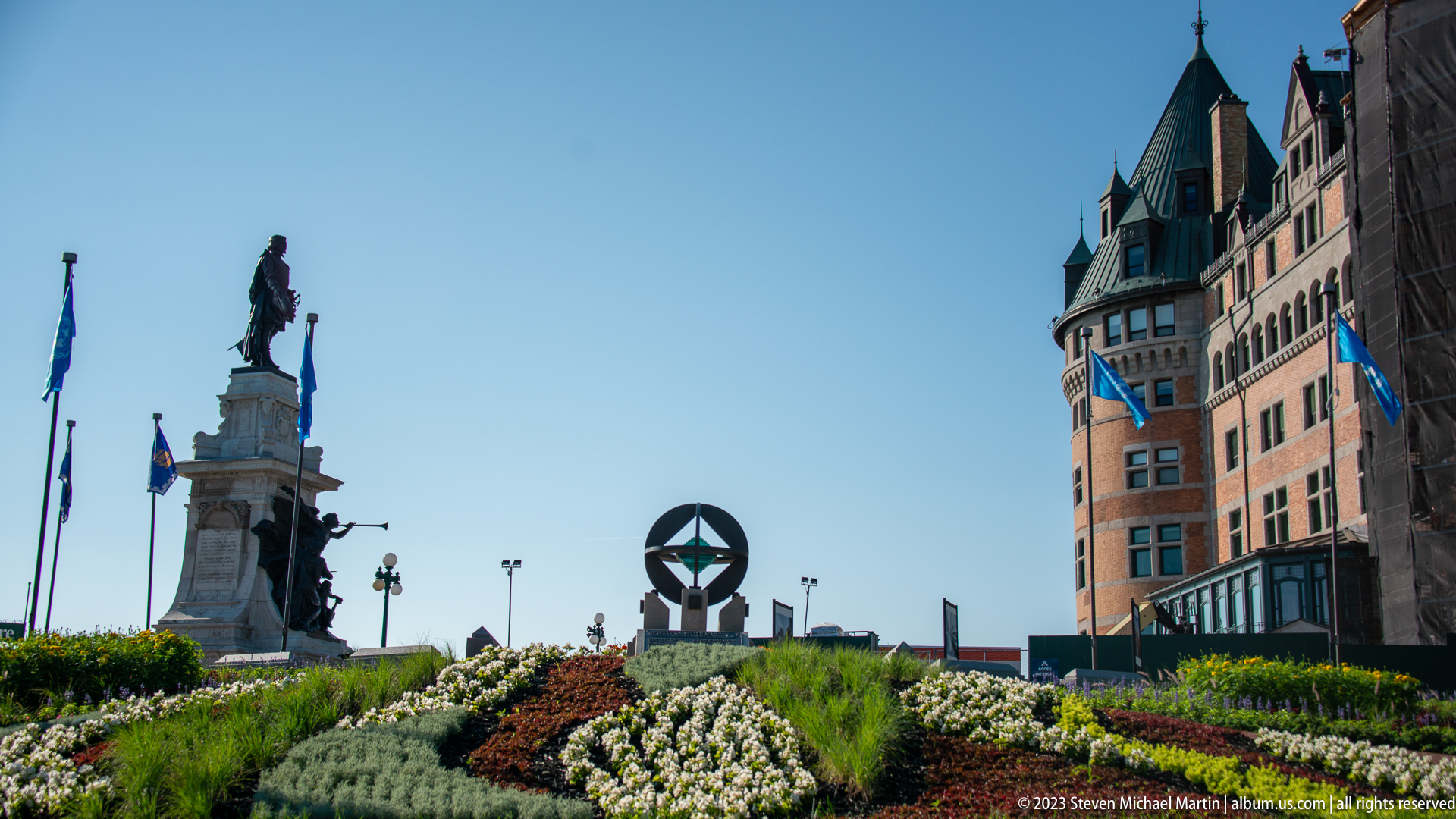
A formal garden links a tall figurative monument at left with a circular geometric sculpture and the Château Frontenac at right. Flags rise above patterned flower beds, while the hotel’s brick walls and copper roofs frame the civic landscape. The broad composition records the interplay of commemorative sculpture, contemporary public art, horticulture, and monumental architecture in Upper Town.
Caption
A formal garden links a tall figurative monument at left with a circular geometric sculpture and the Château Frontenac at right. Flags rise above patterned flower beds, while the hotel’s brick walls and copper roofs frame the civic landscape. The broad composition records the interplay of commemorative sculpture, contemporary public art, horticulture, and monumental architecture in Upper Town.
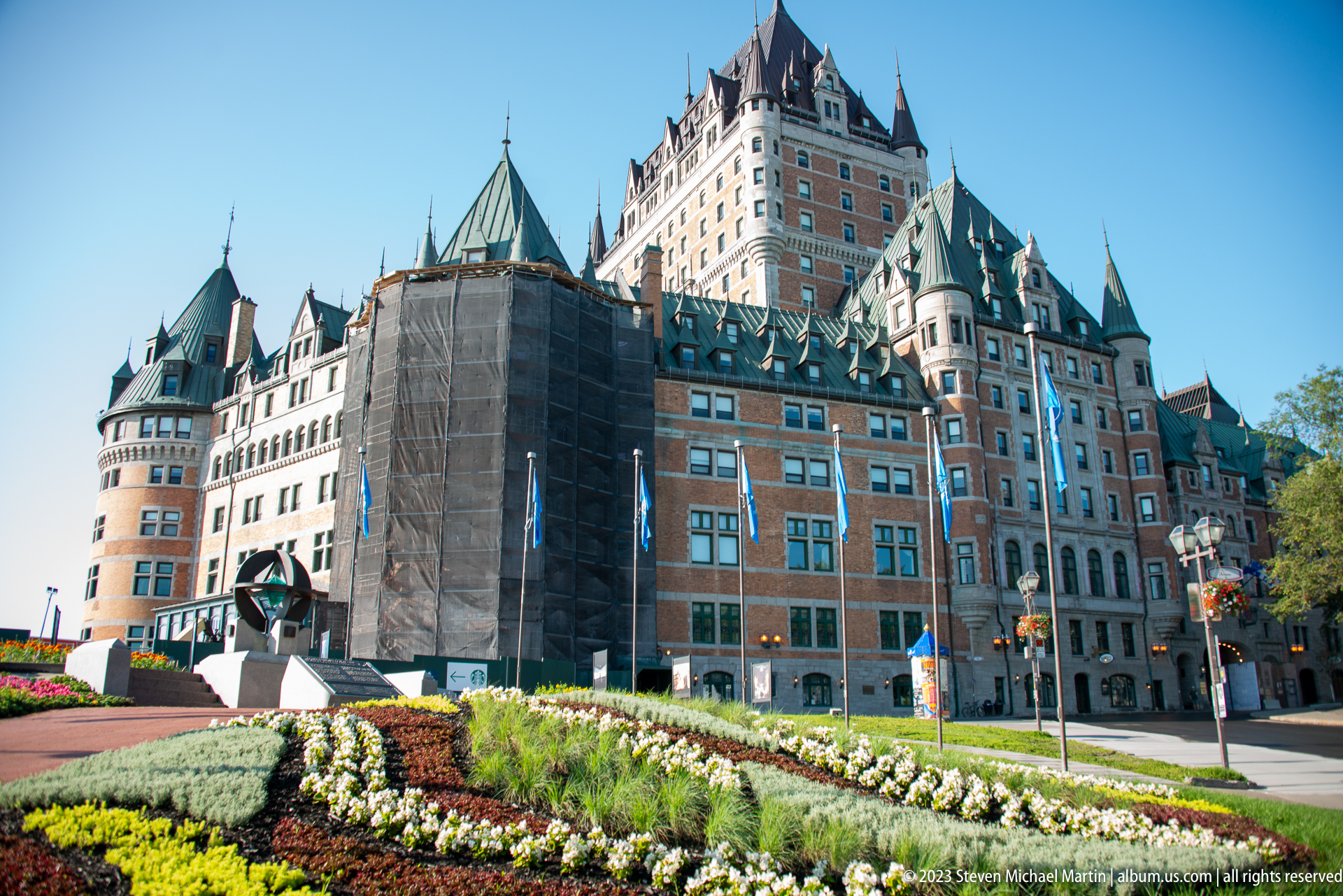
The Château Frontenac fills the skyline above patterned flower beds, its copper-roofed turrets and tall central tower rising in strong morning light. A section of the lower façade is covered by construction mesh, recording ongoing exterior work without obscuring the hotel’s recognizable massing. The landscaped foreground provides a low horizontal counterpoint to the building’s vertical towers and steep rooflines.
Caption
The Château Frontenac fills the skyline above patterned flower beds, its copper-roofed turrets and tall central tower rising in strong morning light. A section of the lower façade is covered by construction mesh, recording ongoing exterior work without obscuring the hotel’s recognizable massing. The landscaped foreground provides a low horizontal counterpoint to the building’s vertical towers and steep rooflines.
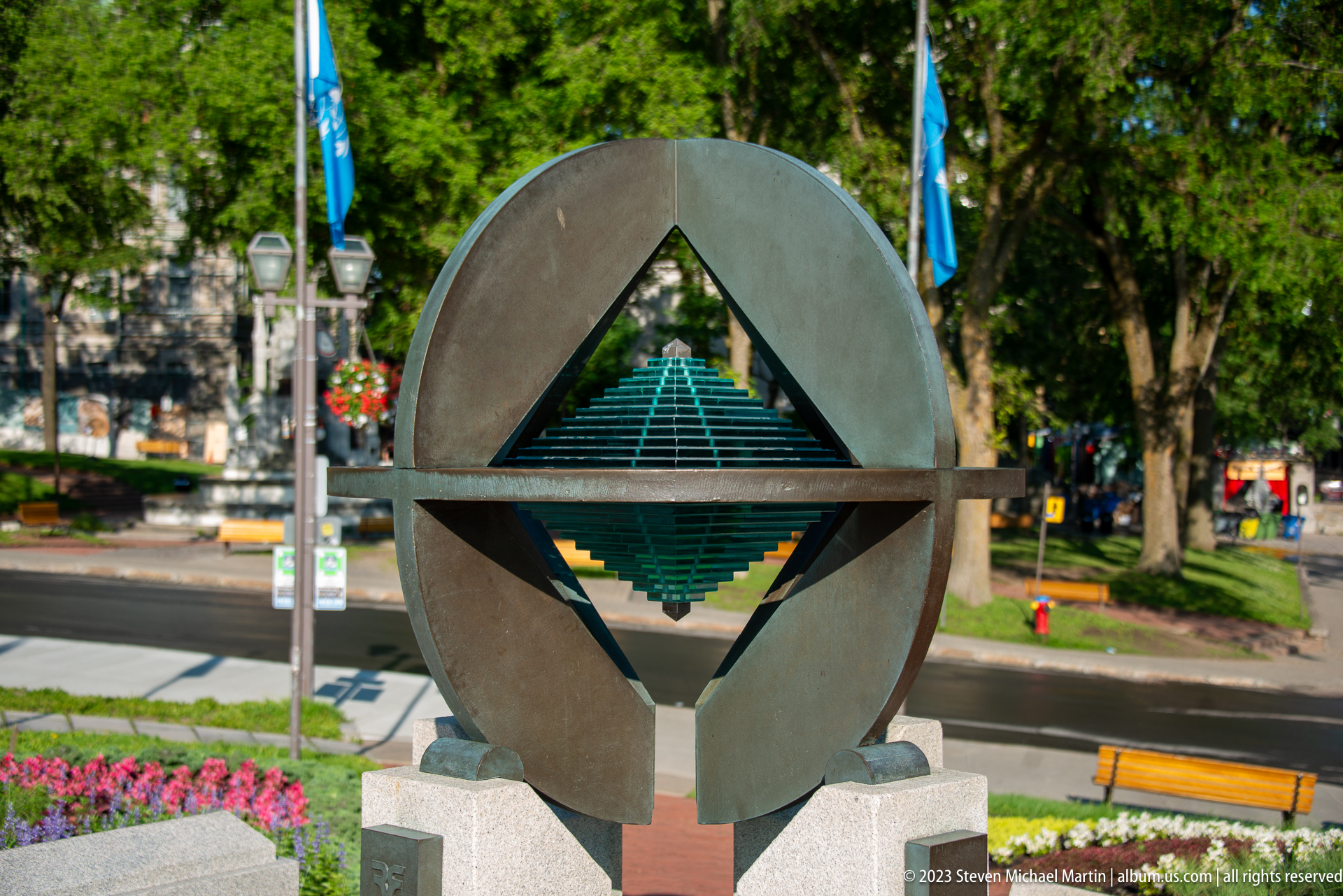
A circular dark-metal sculpture frames a suspended geometric form composed of horizontal green elements, creating a diamond-like shape within the ring. Set on a stone base beside gardens and a city street, the work uses negative space to reveal trees, lamps, and urban activity through its center. The close view emphasizes symmetry, layered geometry, and the contrast between metal surfaces and greenery.
Caption
A circular dark-metal sculpture frames a suspended geometric form composed of horizontal green elements, creating a diamond-like shape within the ring. Set on a stone base beside gardens and a city street, the work uses negative space to reveal trees, lamps, and urban activity through its center. The close view emphasizes symmetry, layered geometry, and the contrast between metal surfaces and greenery.
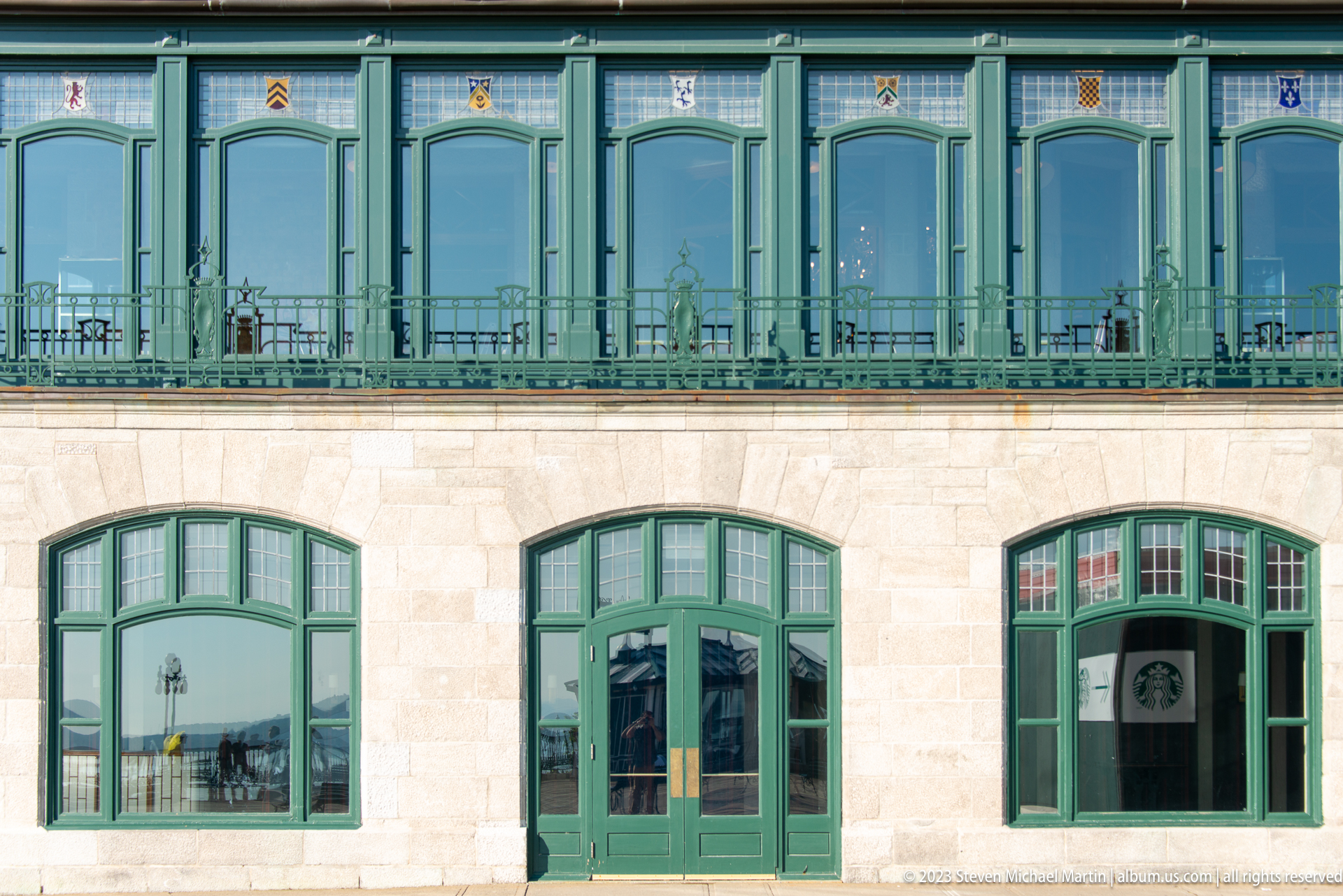
A pale stone façade on Dufferin Terrace is articulated by large green-framed arched windows at street level and a continuous glazed gallery above. Decorative panels and slender green structural members give the upper story a lighter, pavilion-like character. The frontal composition emphasizes the carefully repeated bays and the contrast between solid masonry below and transparent enclosure above.
Caption
A pale stone façade on Dufferin Terrace is articulated by large green-framed arched windows at street level and a continuous glazed gallery above. Decorative panels and slender green structural members give the upper story a lighter, pavilion-like character. The frontal composition emphasizes the carefully repeated bays and the contrast between solid masonry below and transparent enclosure above.
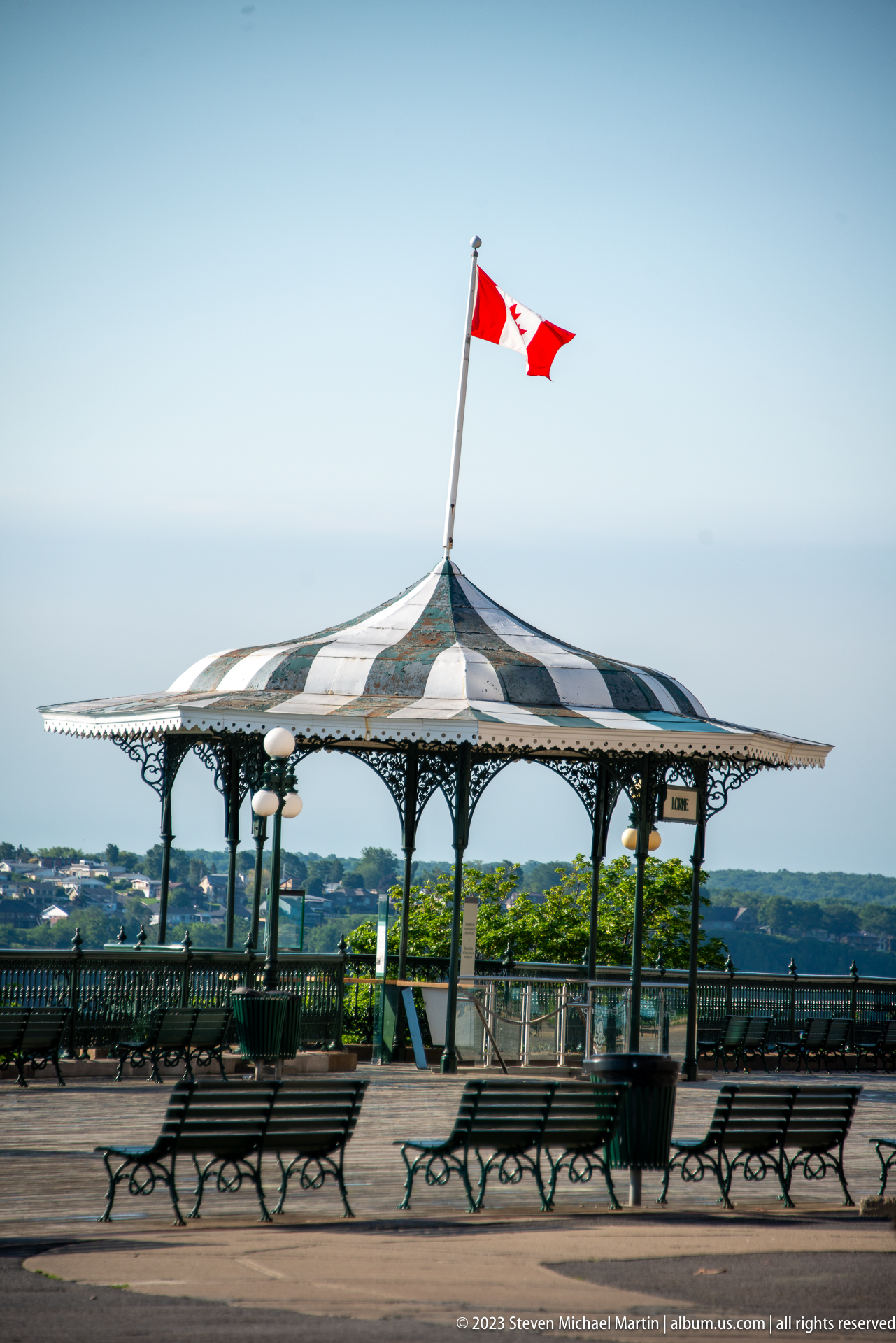
An ornate open pavilion stands on Dufferin Terrace, its striped metal roof crowned by a Canadian flag and supported by slender decorative columns. Rows of empty benches face the river overlook beyond the railing. The airy structure, patterned roof, and expansive horizon give the terrace a formal promenade character while providing shelter and a focal point along the elevated public walk.
Caption
An ornate open pavilion stands on Dufferin Terrace, its striped metal roof crowned by a Canadian flag and supported by slender decorative columns. Rows of empty benches face the river overlook beyond the railing. The airy structure, patterned roof, and expansive horizon give the terrace a formal promenade character while providing shelter and a focal point along the elevated public walk.
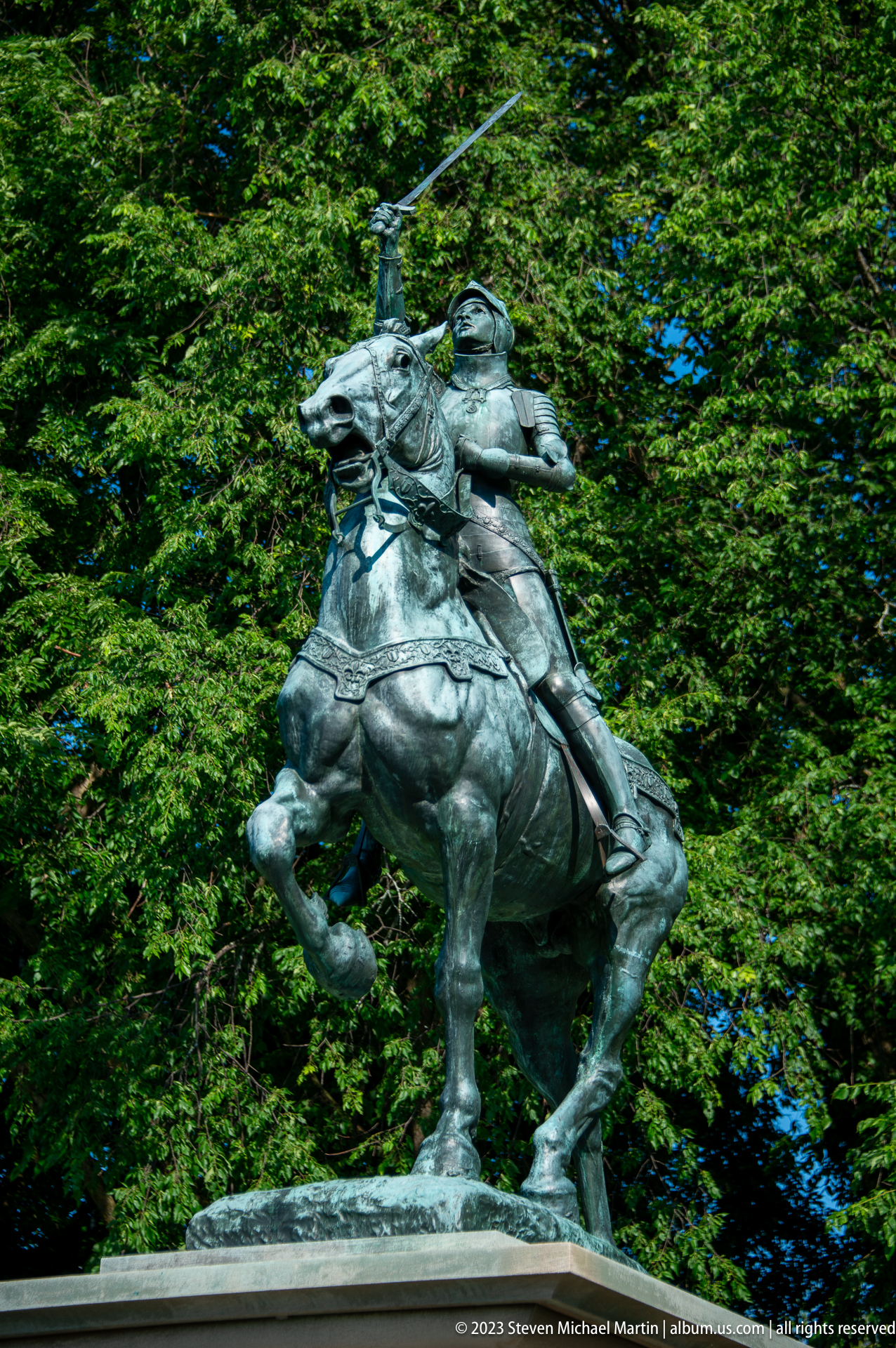
A bronze equestrian monument depicts an armored rider on a rearing horse, thrusting a long sword upward as the animal lifts its forelegs. Dense green foliage isolates the dark sculptural group and heightens the sense of motion. The side view clearly reveals the rider’s armor, the horse’s tense posture, and the dramatic diagonal of the weapon.
Caption
A bronze equestrian monument depicts an armored rider on a rearing horse, thrusting a long sword upward as the animal lifts its forelegs. Dense green foliage isolates the dark sculptural group and heightens the sense of motion. The side view clearly reveals the rider’s armor, the horse’s tense posture, and the dramatic diagonal of the weapon.
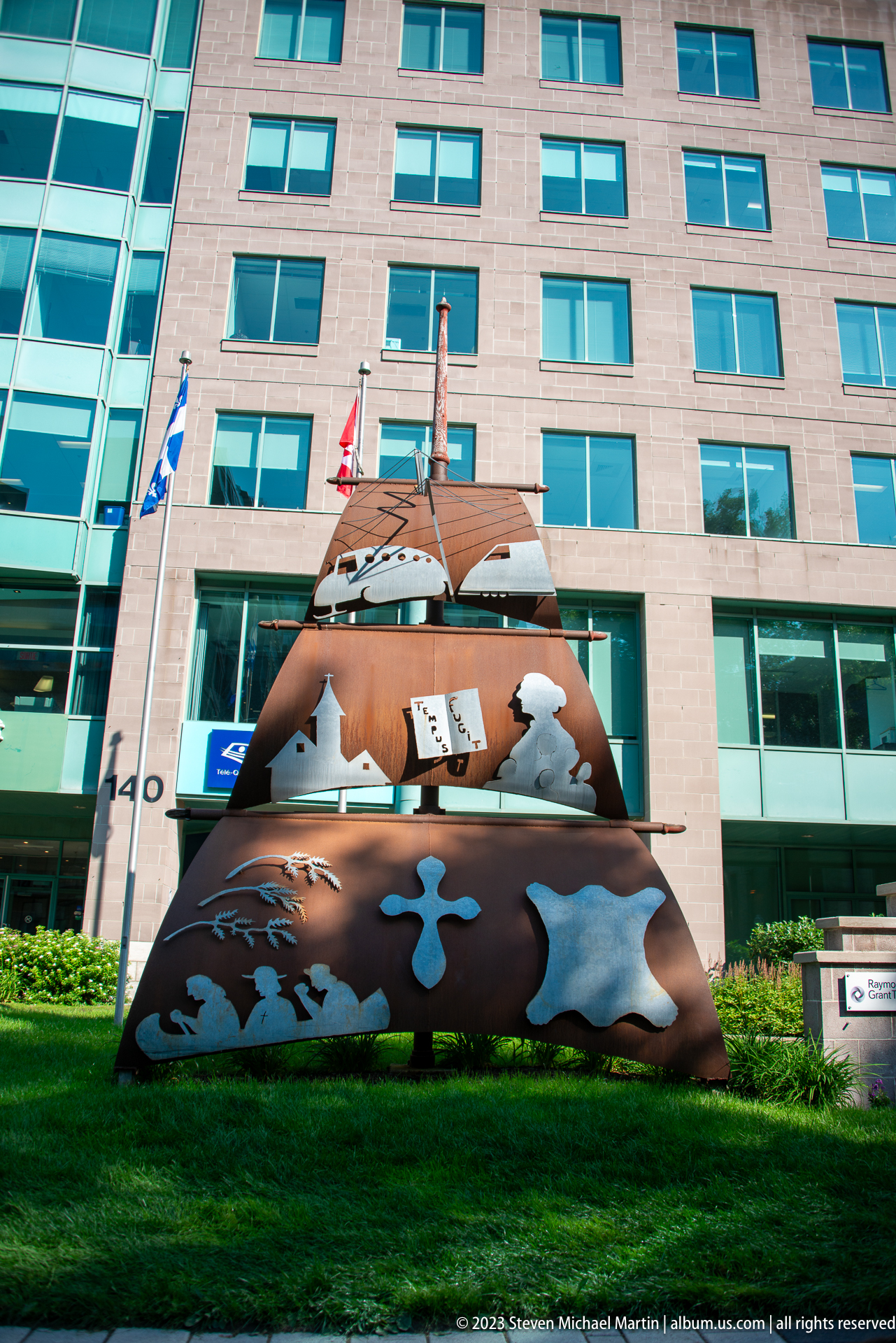
A rust-colored pyramidal steel sculpture rises from a lawn before a modern institutional building. Curving cutouts and pale inset shapes interrupt the stacked triangular planes, creating changing silhouettes across the broad metal surfaces. Flags behind the work and the formal landscaped setting place the sculpture within a civic or institutional precinct rather than an isolated gallery environment.
Caption
A rust-colored pyramidal steel sculpture rises from a lawn before a modern institutional building. Curving cutouts and pale inset shapes interrupt the stacked triangular planes, creating changing silhouettes across the broad metal surfaces. Flags behind the work and the formal landscaped setting place the sculpture within a civic or institutional precinct rather than an isolated gallery environment.
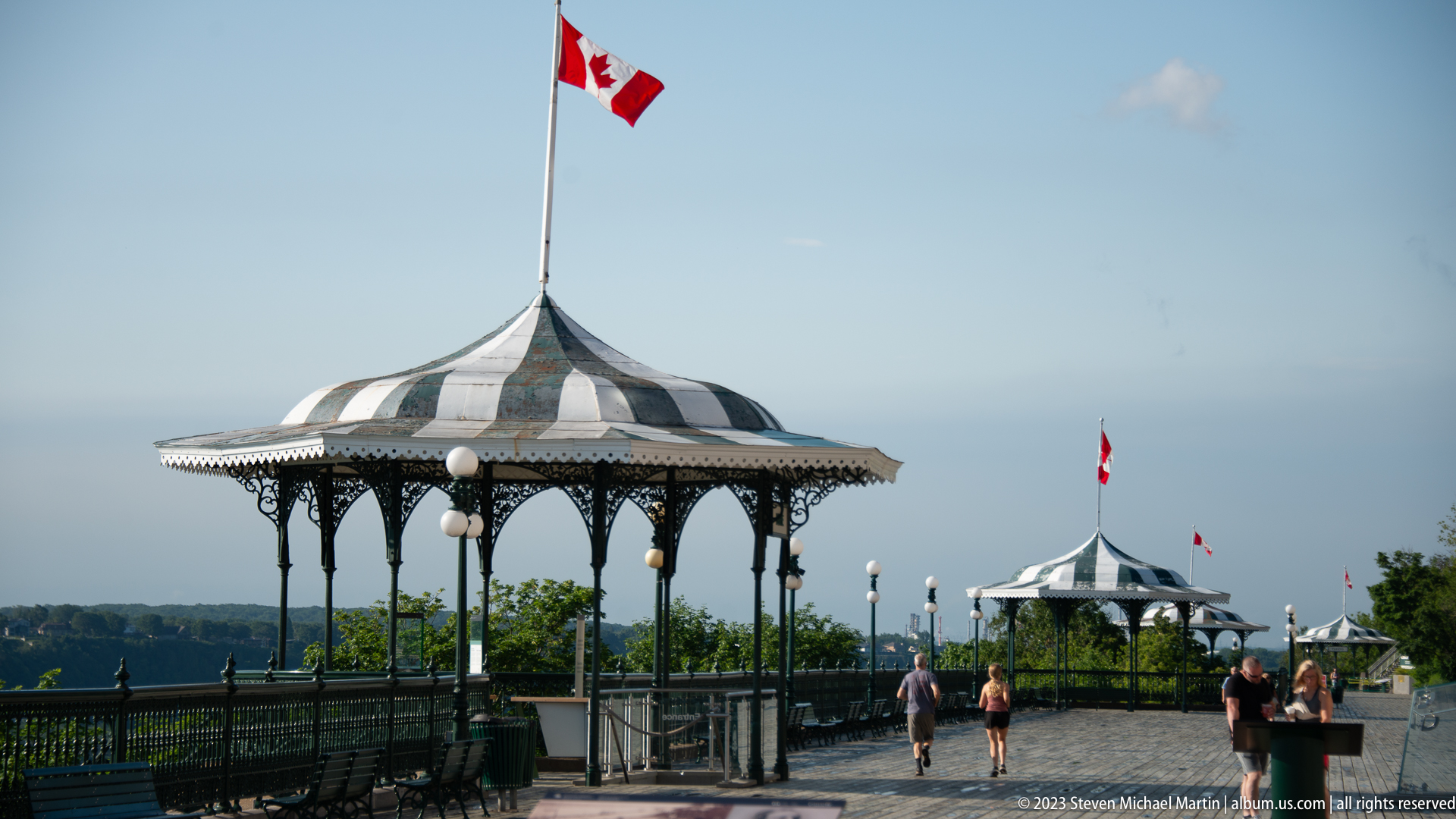
Several ornate striped-roof pavilions recede along Dufferin Terrace, each topped by a Canadian flag and linked by the promenade’s decorative railing and lamp posts. Visitors walk between the shelters while the distant landscape opens beyond the overlook. The repeated structures create a rhythmic sequence that defines the terrace as both a scenic viewpoint and a formally designed public promenade.
Caption
Several ornate striped-roof pavilions recede along Dufferin Terrace, each topped by a Canadian flag and linked by the promenade’s decorative railing and lamp posts. Visitors walk between the shelters while the distant landscape opens beyond the overlook. The repeated structures create a rhythmic sequence that defines the terrace as both a scenic viewpoint and a formally designed public promenade.
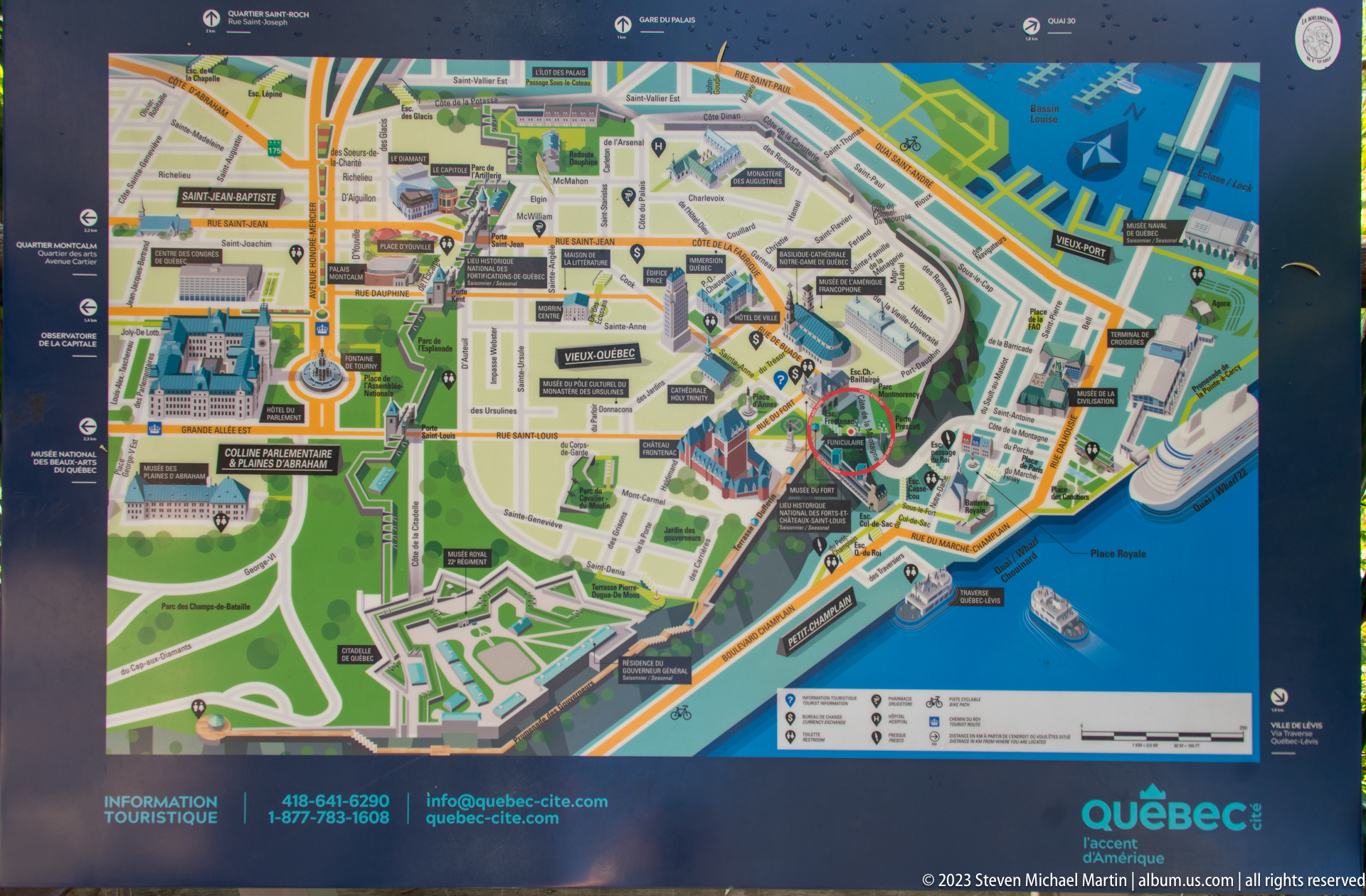
A large illustrated visitor map presents central Quebec City with major attractions, streets, fortified areas, parks, and waterfront facilities rendered in color. Labels and icons organize the historic core for pedestrian orientation, while tourism contact information and the Québec cité branding appear along the lower edge. The map serves as practical wayfinding infrastructure within the heritage district.
Caption
A large illustrated visitor map presents central Quebec City with major attractions, streets, fortified areas, parks, and waterfront facilities rendered in color. Labels and icons organize the historic core for pedestrian orientation, while tourism contact information and the Québec cité branding appear along the lower edge. The map serves as practical wayfinding infrastructure within the heritage district.
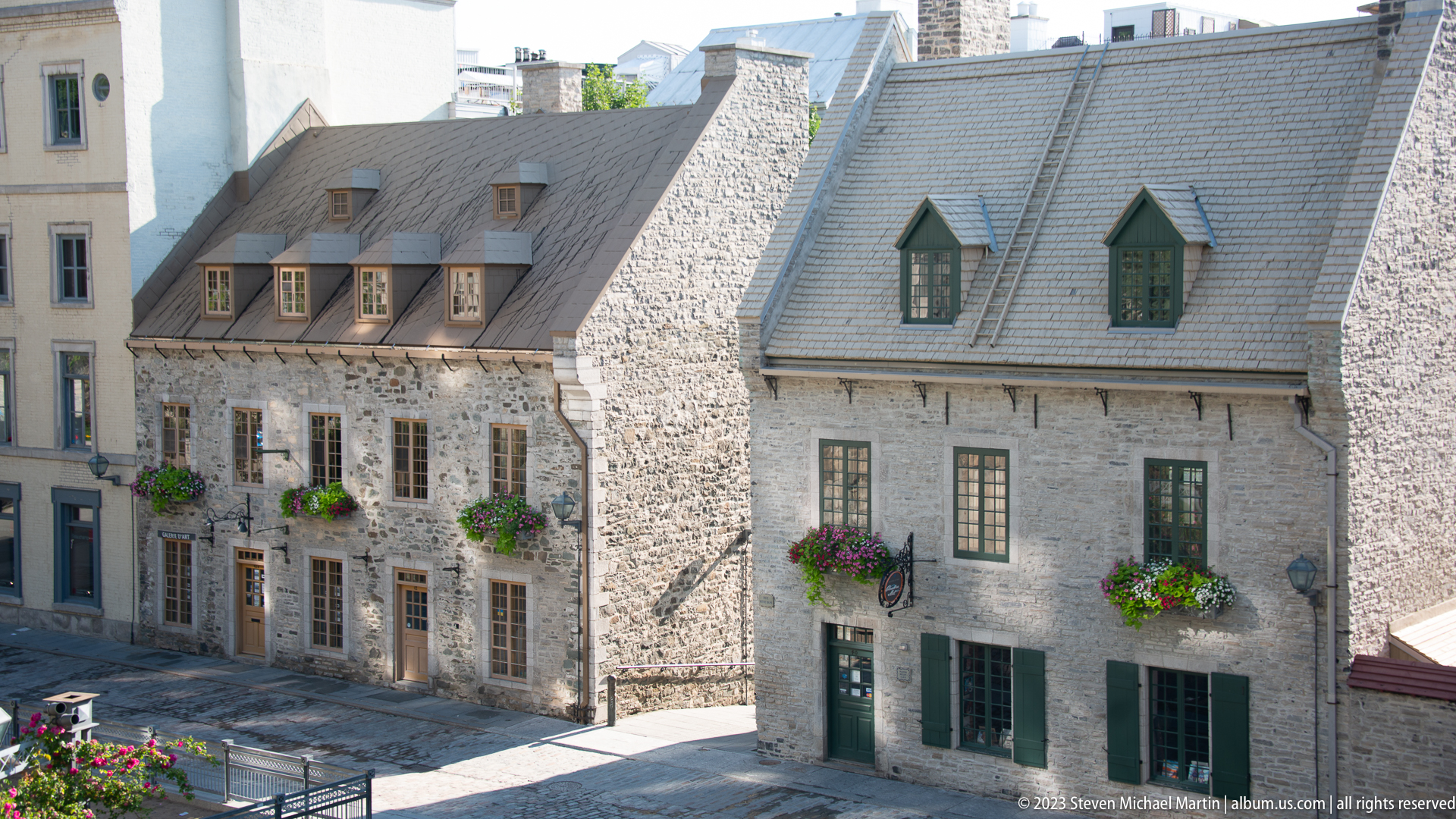
Two adjoining stone houses present steep gray roofs, tall masonry chimneys, small dormers, and green-painted windows along a quiet Old Québec street. Flower boxes brighten several openings, while the rough exposed masonry reveals variations in stone size and construction. The oblique view shows the houses as a connected historic ensemble rather than isolated façades.
Caption
Two adjoining stone houses present steep gray roofs, tall masonry chimneys, small dormers, and green-painted windows along a quiet Old Québec street. Flower boxes brighten several openings, while the rough exposed masonry reveals variations in stone size and construction. The oblique view shows the houses as a connected historic ensemble rather than isolated façades.
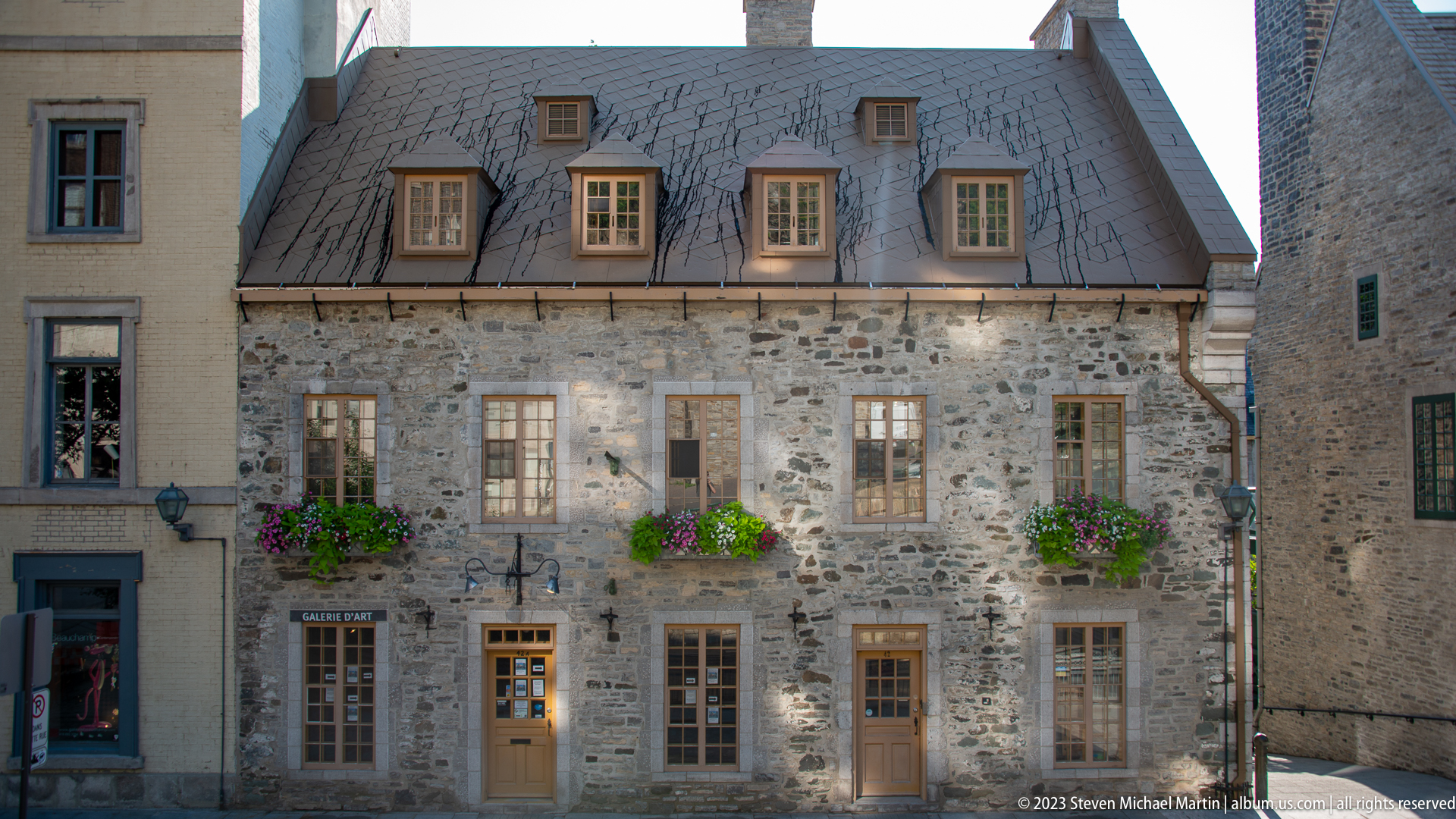
A broad historic stone house presents a nearly symmetrical façade of tall multi-pane windows and three ground-floor doors beneath a steep gray roof. Four small dormers punctuate the roofline, while vivid flower boxes add color to the pale irregular masonry. The frontal view makes the orderly fenestration and restrained domestic proportions especially clear.
Caption
A broad historic stone house presents a nearly symmetrical façade of tall multi-pane windows and three ground-floor doors beneath a steep gray roof. Four small dormers punctuate the roofline, while vivid flower boxes add color to the pale irregular masonry. The frontal view makes the orderly fenestration and restrained domestic proportions especially clear.
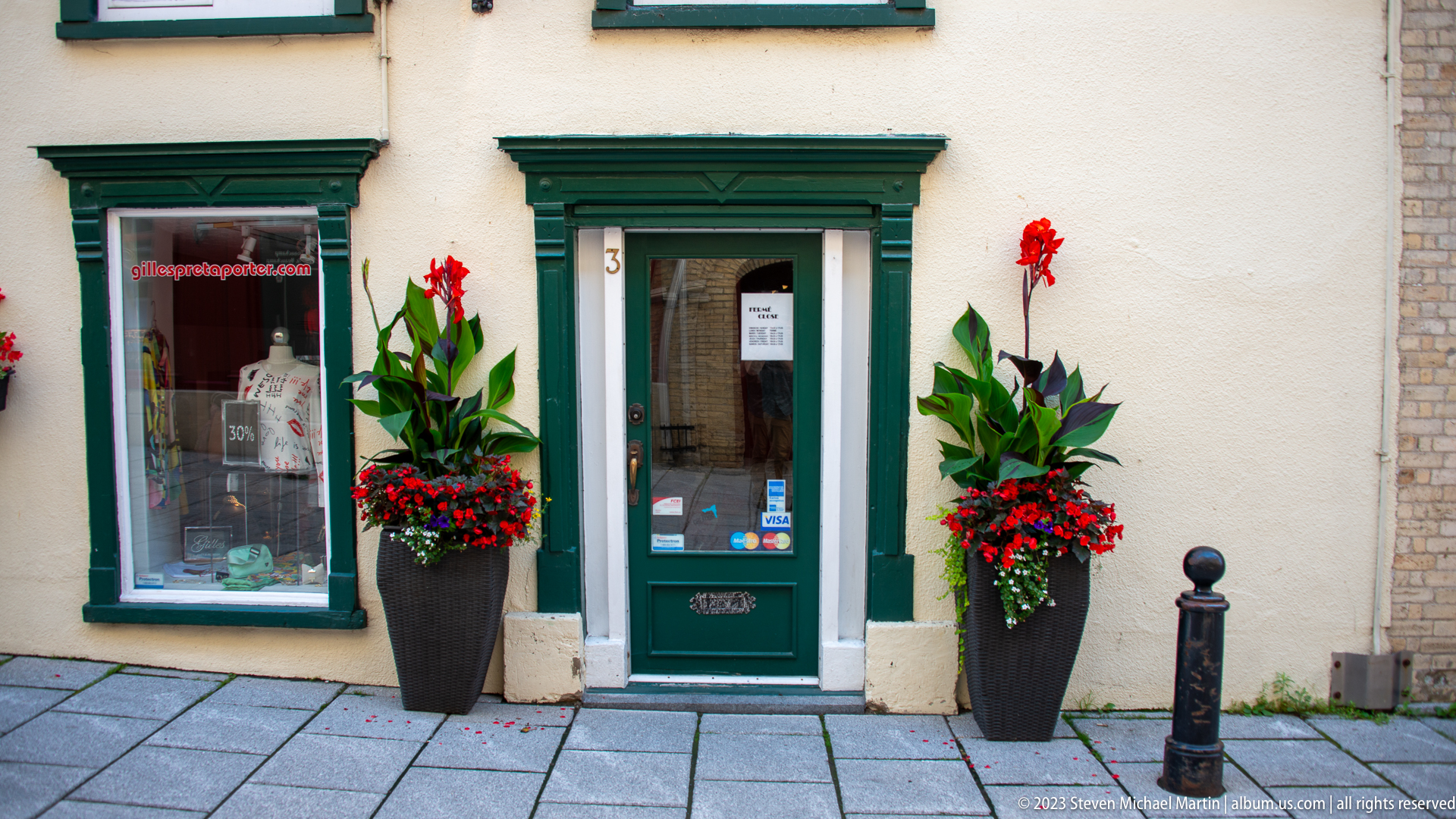
A compact storefront is framed in dark green against a pale stucco wall, with a glazed door numbered 3 and a display window beside it. Tall black planters overflow with red flowers and broad green leaves, creating a symmetrical accent around the entrance. The close street-level view records the careful decorative treatment of a small commercial façade in Old Québec.
Caption
A compact storefront is framed in dark green against a pale stucco wall, with a glazed door numbered 3 and a display window beside it. Tall black planters overflow with red flowers and broad green leaves, creating a symmetrical accent around the entrance. The close street-level view records the careful decorative treatment of a small commercial façade in Old Québec.
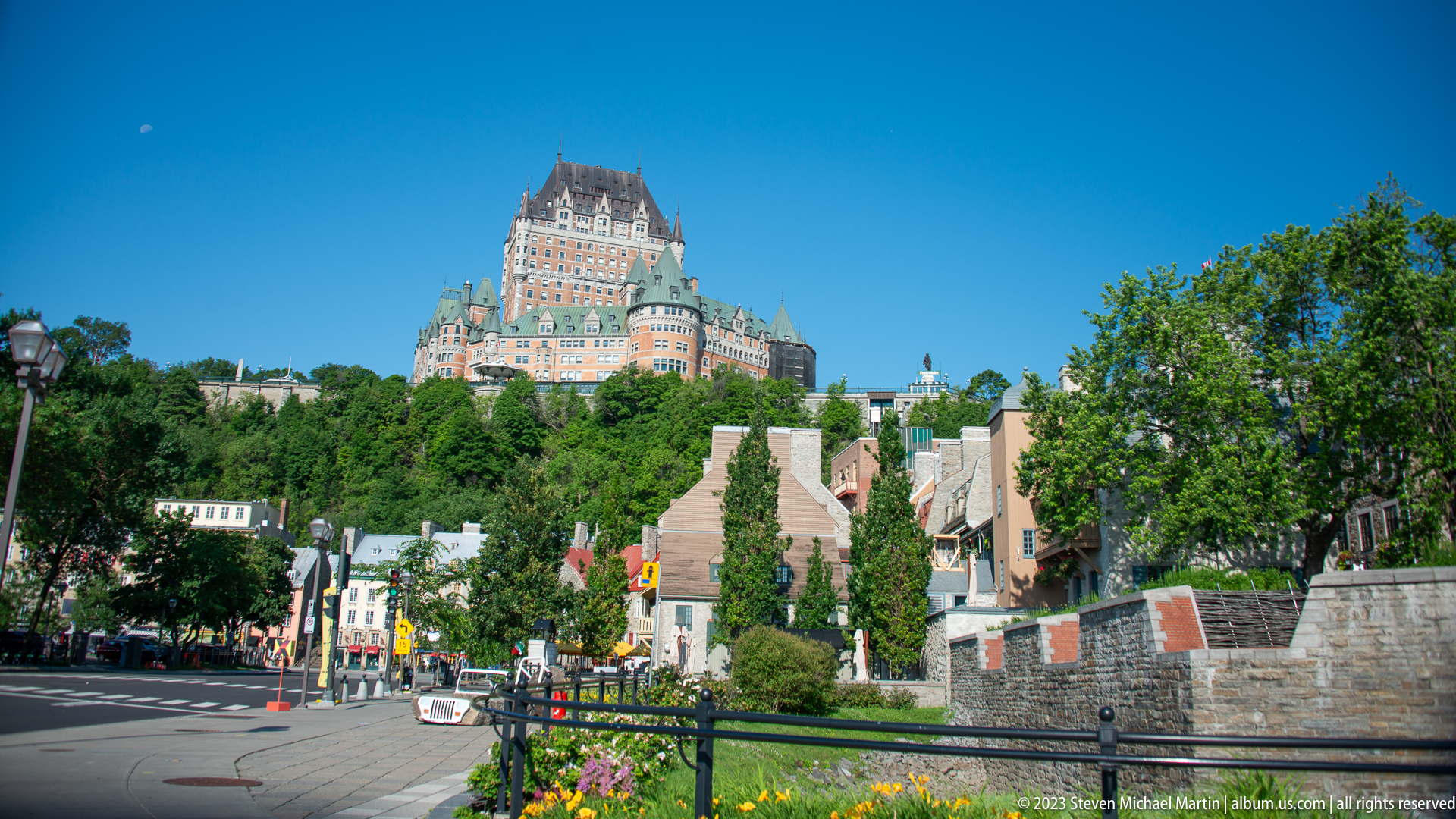
The Château Frontenac crowns the wooded bluff above a sloping street, rising dramatically over smaller houses, stone walls, gardens, and trees below. Bright summer light separates the hotel’s copper roofs and brick walls from the deep blue sky. The long perspective demonstrates Quebec City’s pronounced vertical structure, with the monumental Upper Town landmark visibly dominating the neighborhood beneath it.
Caption
The Château Frontenac crowns the wooded bluff above a sloping street, rising dramatically over smaller houses, stone walls, gardens, and trees below. Bright summer light separates the hotel’s copper roofs and brick walls from the deep blue sky. The long perspective demonstrates Quebec City’s pronounced vertical structure, with the monumental Upper Town landmark visibly dominating the neighborhood beneath it.
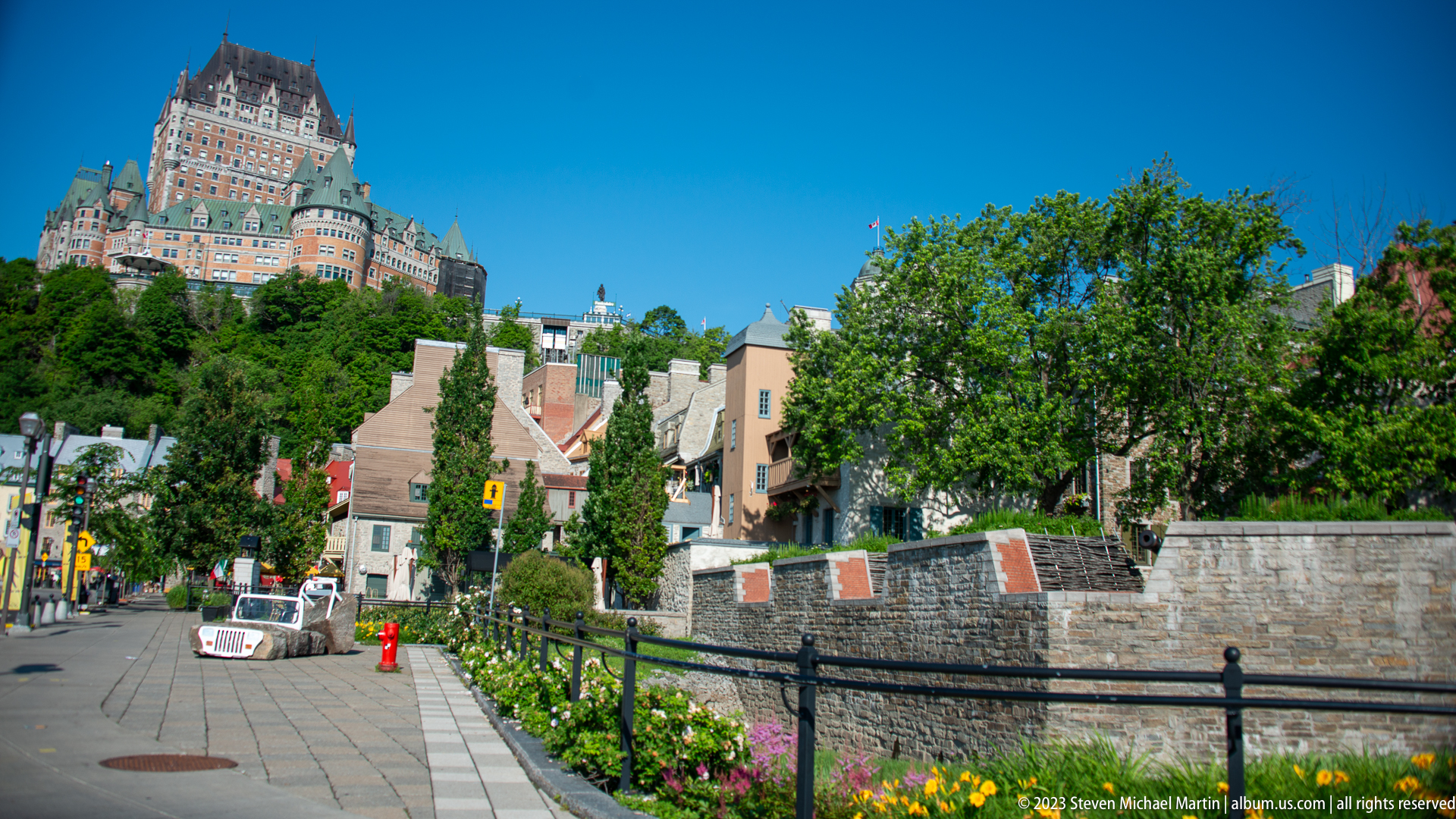
A landscaped street descends between low buildings and stone walls while the Château Frontenac appears high above the treetops at upper left. Flower beds and a black railing border the walkway, softening the transition between roadway and historic masonry. Compared with the wider preceding view, this composition gives greater emphasis to the pedestrian-scale garden and neighborhood below the landmark.
Caption
A landscaped street descends between low buildings and stone walls while the Château Frontenac appears high above the treetops at upper left. Flower beds and a black railing border the walkway, softening the transition between roadway and historic masonry. Compared with the wider preceding view, this composition gives greater emphasis to the pedestrian-scale garden and neighborhood below the landmark.
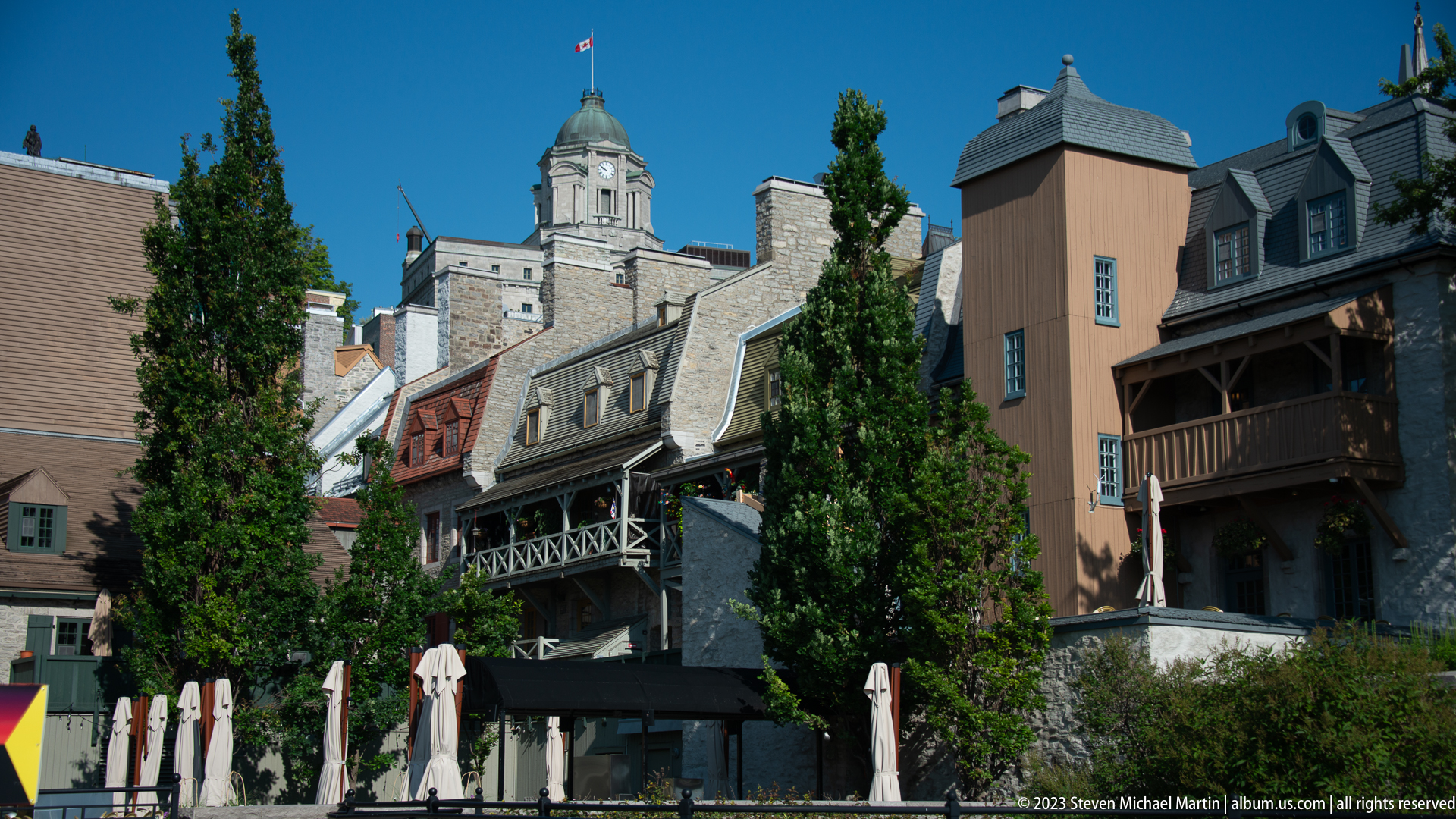
A dense cluster of historic buildings combines steep roofs, dormers, chimneys, wooden galleries, and varied stone and wood façades. A pale domed tower topped by a Canadian flag rises behind the roofline, while café umbrellas occupy the lower foreground. The layered view emphasizes the architectural variety and compressed vertical relationships characteristic of Quebec City’s historic core.
Caption
A dense cluster of historic buildings combines steep roofs, dormers, chimneys, wooden galleries, and varied stone and wood façades. A pale domed tower topped by a Canadian flag rises behind the roofline, while café umbrellas occupy the lower foreground. The layered view emphasizes the architectural variety and compressed vertical relationships characteristic of Quebec City’s historic core.
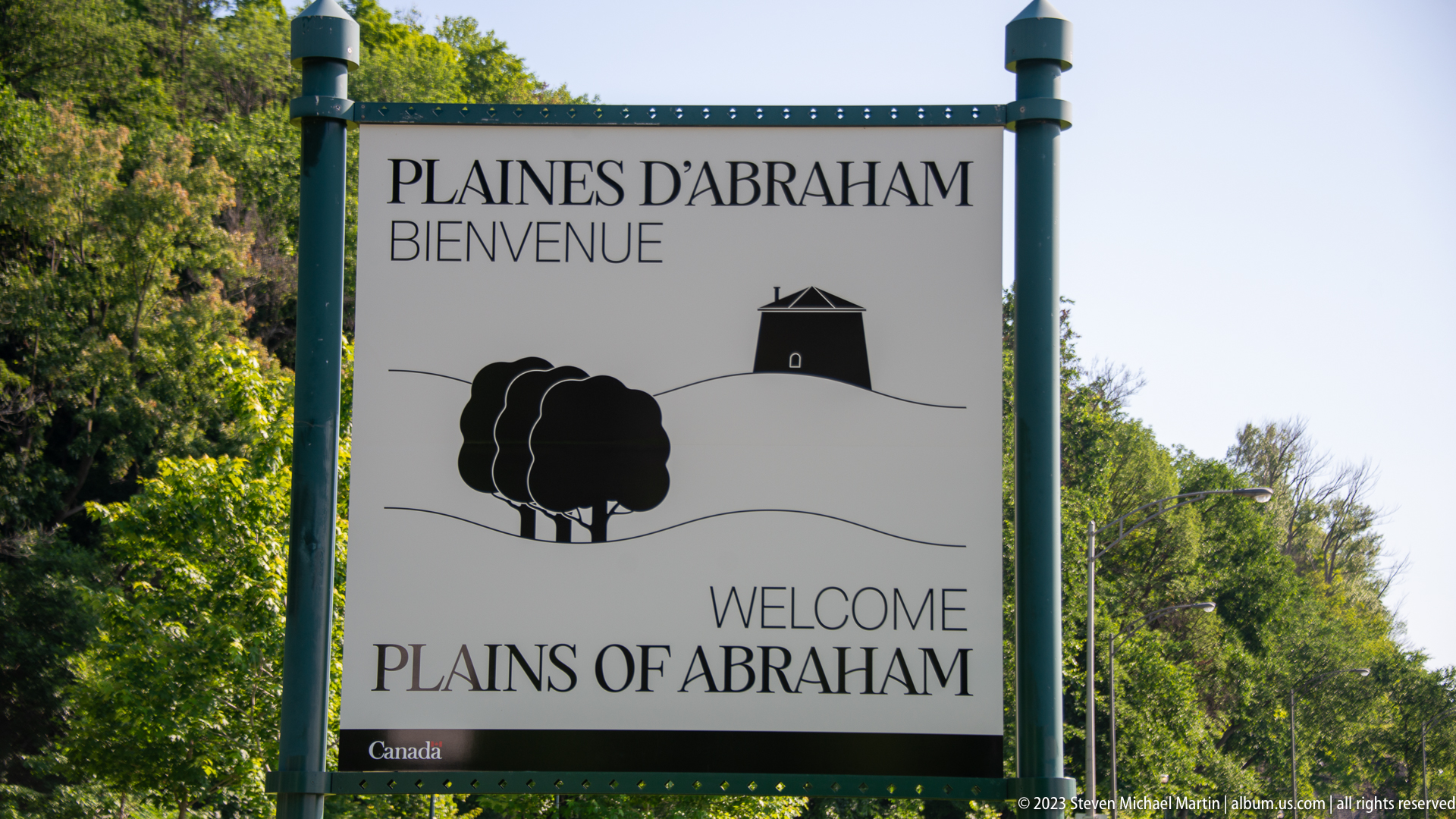
A bilingual sign announces “Plaines d’Abraham — Bienvenue / Welcome — Plains of Abraham” in a restrained black-and-white design. Stylized trees and a small historic structure appear between the French and English text, while federal branding occupies the lower edge. Set against dense greenery, the sign marks the transition from Quebec City’s urban core to the nationally significant historic landscape.
Caption
A bilingual sign announces “Plaines d’Abraham — Bienvenue / Welcome — Plains of Abraham” in a restrained black-and-white design. Stylized trees and a small historic structure appear between the French and English text, while federal branding occupies the lower edge. Set against dense greenery, the sign marks the transition from Quebec City’s urban core to the nationally significant historic landscape.
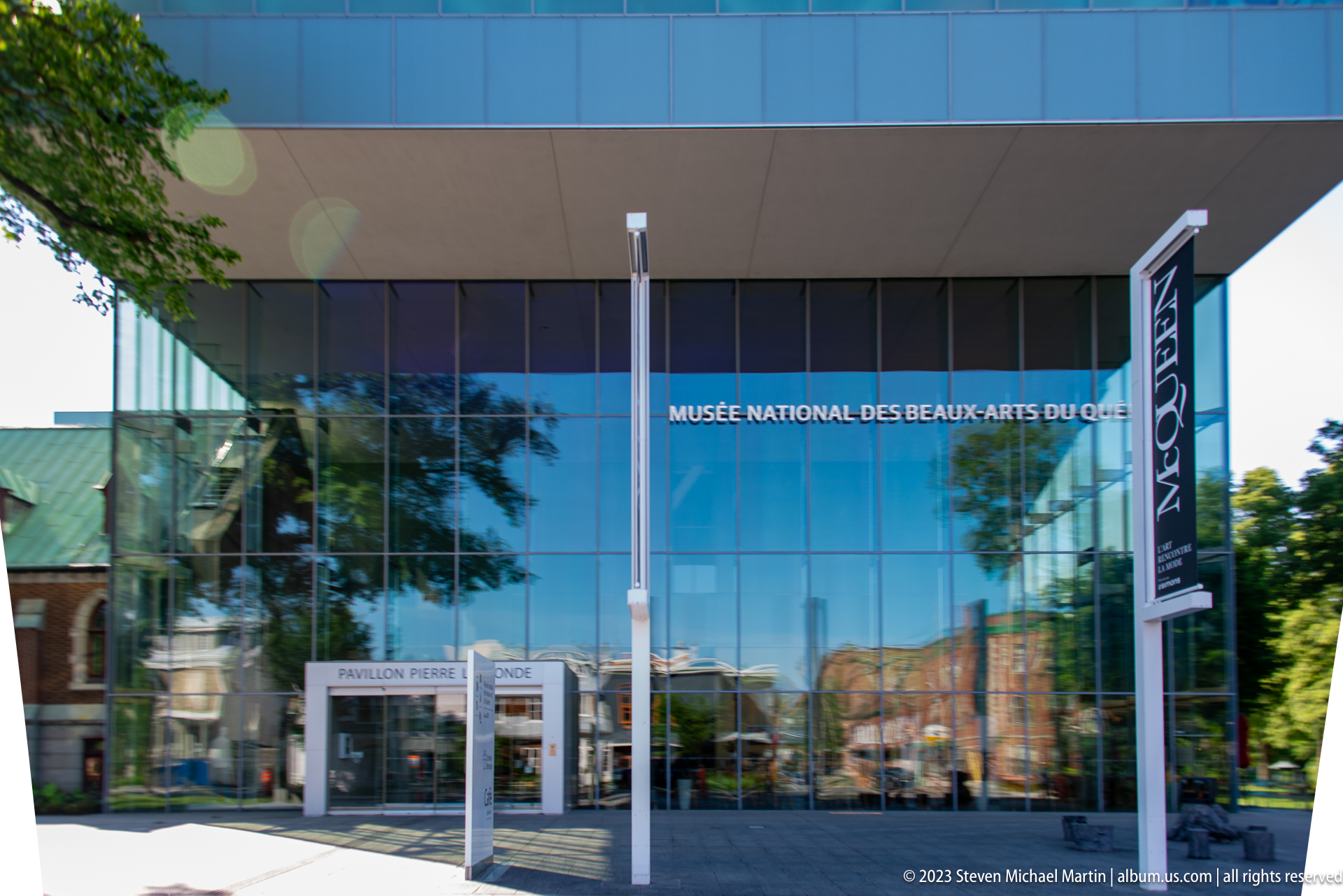
The modern glass entrance of the Musée national des beaux-arts du Québec presents a transparent façade beneath a broad projecting roof. The museum name spans the glazing, while signage at the doors identifies the Pavillon Pierre Lassonde. Reflections of trees and surrounding buildings animate the glass surface, contrasting the contemporary pavilion with the historic architecture visible nearby.
Caption
The modern glass entrance of the Musée national des beaux-arts du Québec presents a transparent façade beneath a broad projecting roof. The museum name spans the glazing, while signage at the doors identifies the Pavillon Pierre Lassonde. Reflections of trees and surrounding buildings animate the glass surface, contrasting the contemporary pavilion with the historic architecture visible nearby.
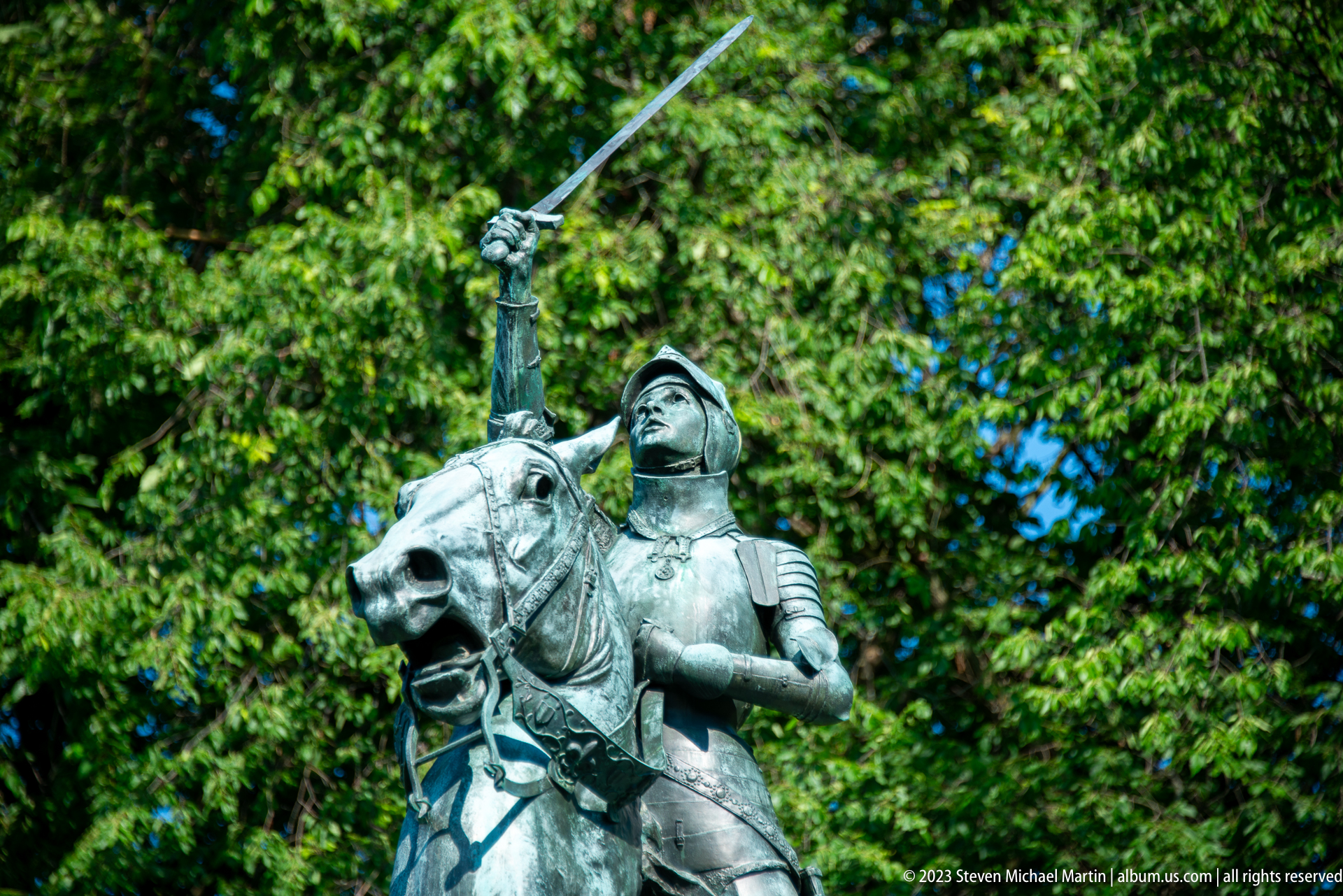
A closer upward view isolates the armored rider and the horse’s head from the larger equestrian monument. The rider looks skyward while extending a long sword diagonally above the composition; modeled armor plates and the horse’s bridle become especially prominent. Cropping the body of the horse concentrates attention on expression, military costume, and the sculpture’s forceful gesture.
Caption
A closer upward view isolates the armored rider and the horse’s head from the larger equestrian monument. The rider looks skyward while extending a long sword diagonally above the composition; modeled armor plates and the horse’s bridle become especially prominent. Cropping the body of the horse concentrates attention on expression, military costume, and the sculpture’s forceful gesture.
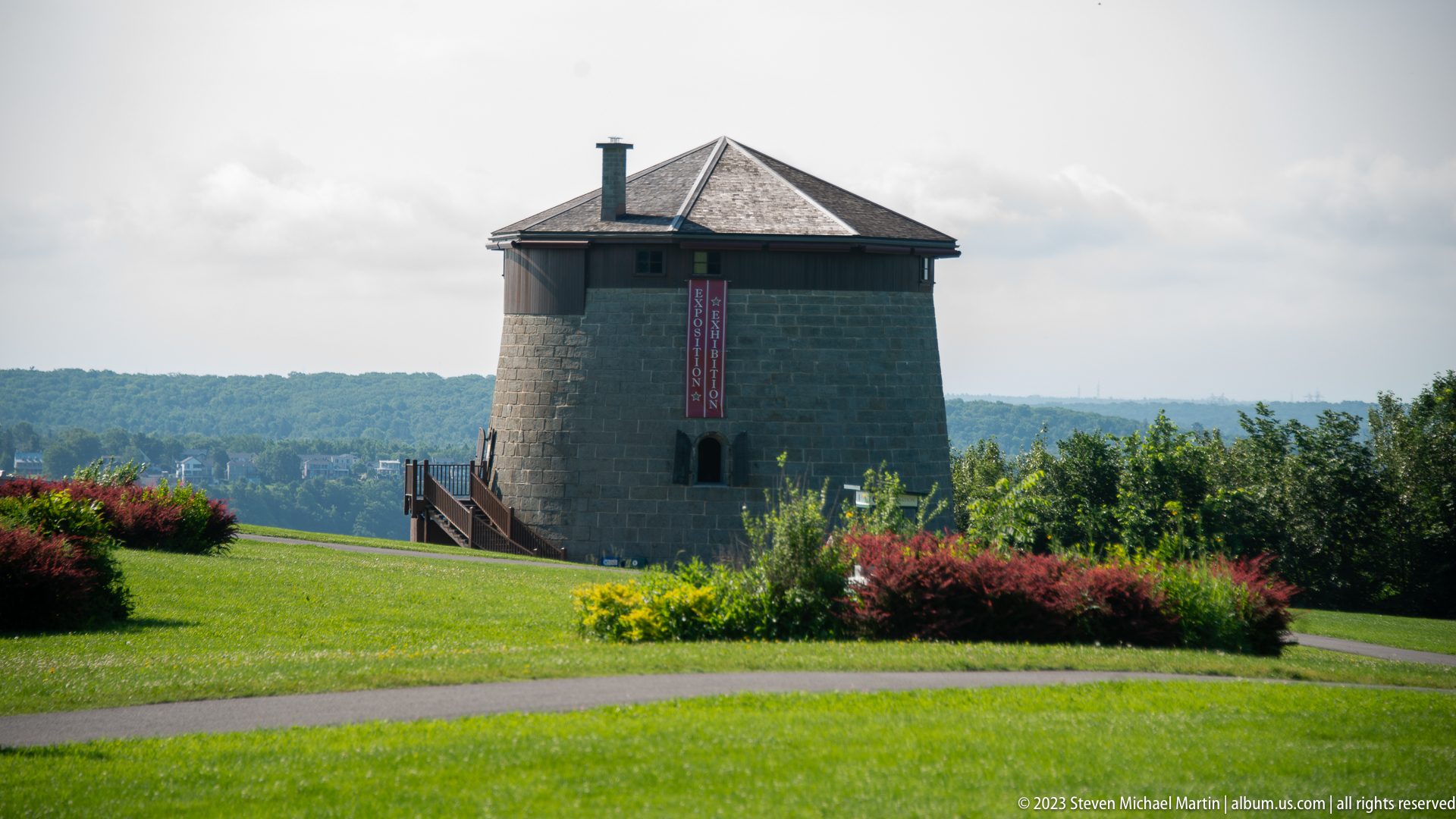
A squat circular stone tower stands within the manicured landscape of the Plains of Abraham, its thick masonry walls capped by a broad polygonal roof. A small elevated entrance platform and narrow openings reinforce the building’s defensive character, while flower beds and open lawn now surround the former military structure. The isolated setting makes the compact fortification form easy to read.
Caption
A squat circular stone tower stands within the manicured landscape of the Plains of Abraham, its thick masonry walls capped by a broad polygonal roof. A small elevated entrance platform and narrow openings reinforce the building’s defensive character, while flower beds and open lawn now surround the former military structure. The isolated setting makes the compact fortification form easy to read.
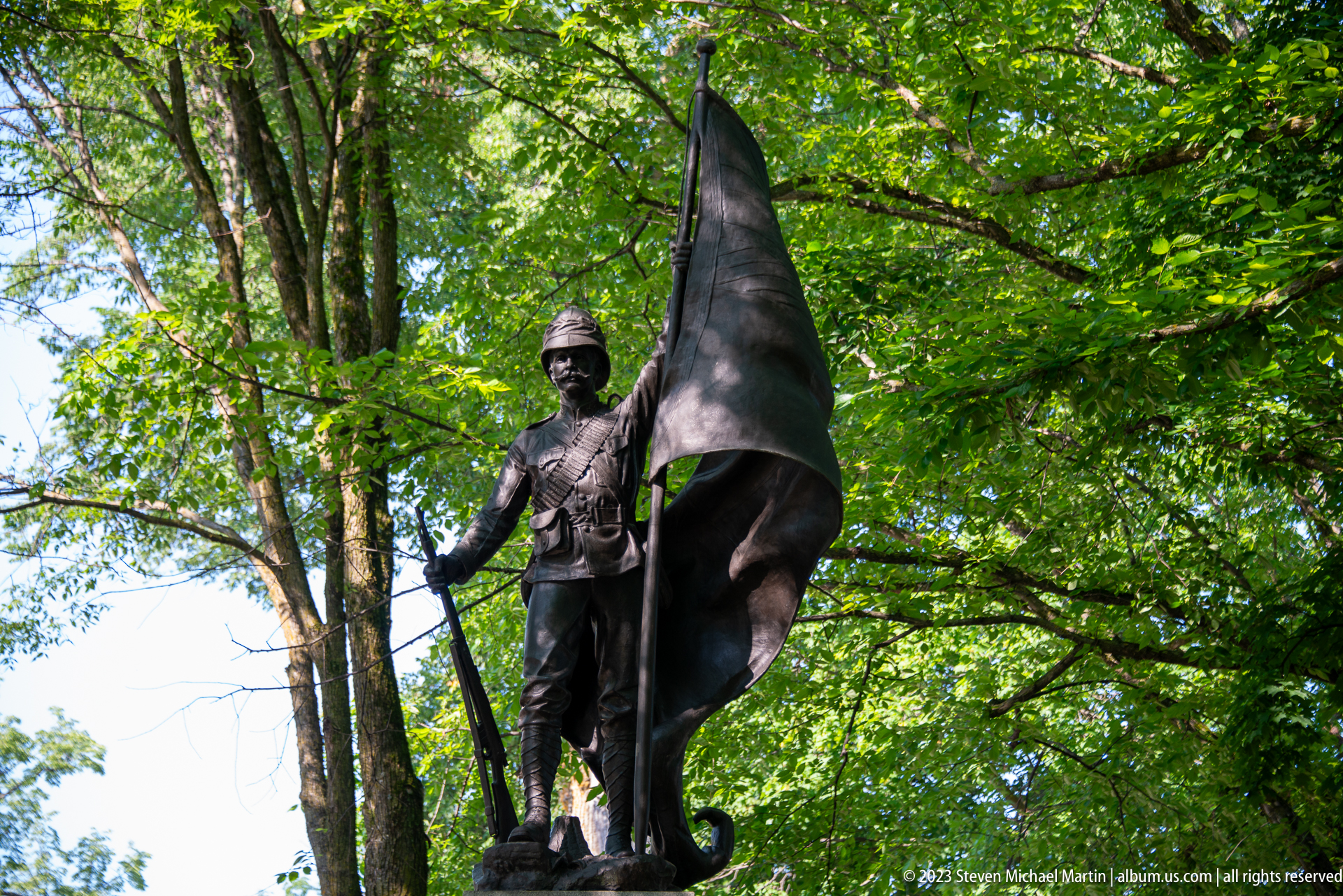
A bronze soldier stands beneath leafy trees with a large flag rising beside him, one hand gripping the staff and the other resting near a long weapon. Period military dress, equipment, and the assertive stance give the figure a commemorative character. The close, shaded view isolates the monument from surrounding architecture and concentrates attention on the soldier’s uniform, posture, and sweeping flag.
Caption
A bronze soldier stands beneath leafy trees with a large flag rising beside him, one hand gripping the staff and the other resting near a long weapon. Period military dress, equipment, and the assertive stance give the figure a commemorative character. The close, shaded view isolates the monument from surrounding architecture and concentrates attention on the soldier’s uniform, posture, and sweeping flag.
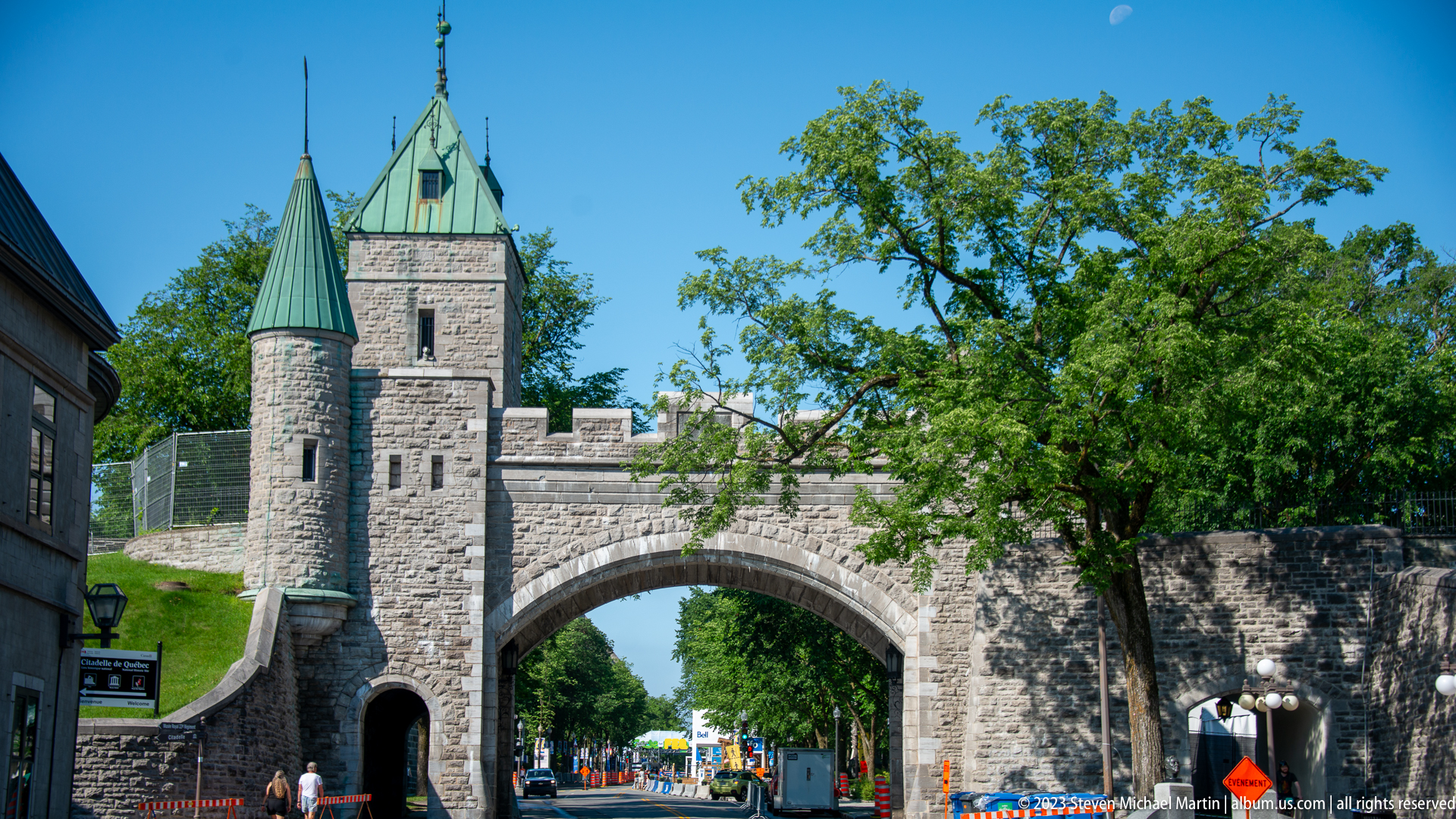
A monumental stone gateway spans a roadway beneath crenellated walls, flanked by a round turret and a taller square tower capped with green metal roofs. The arched opening carries modern traffic through the historic defensive line, while grassy ramparts rise behind the masonry. A nearby sign references the Citadelle de Québec, placing the gate within the fortified Upper Town landscape.
Caption
A monumental stone gateway spans a roadway beneath crenellated walls, flanked by a round turret and a taller square tower capped with green metal roofs. The arched opening carries modern traffic through the historic defensive line, while grassy ramparts rise behind the masonry. A nearby sign references the Citadelle de Québec, placing the gate within the fortified Upper Town landscape.
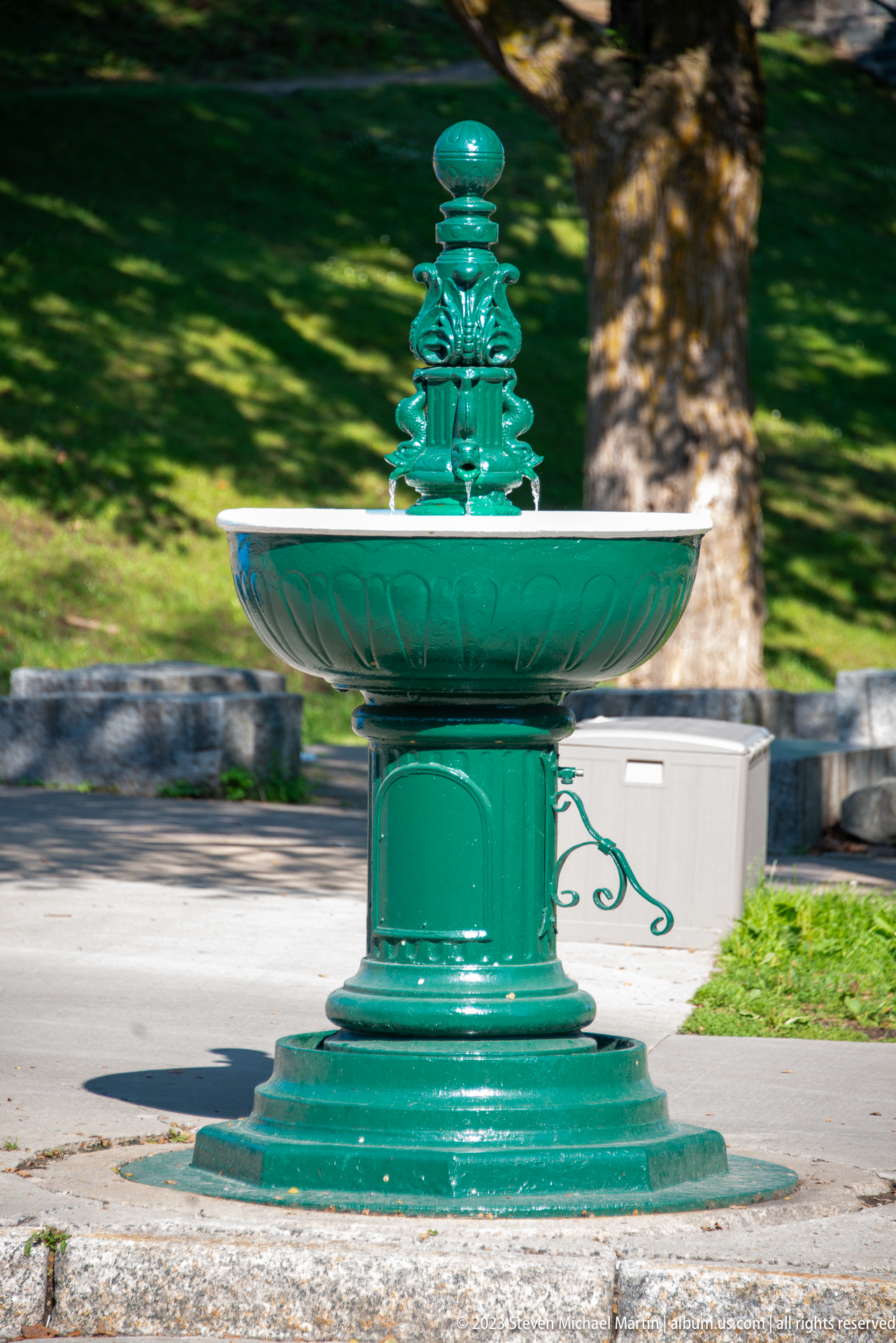
An ornamental green cast-metal fountain stands beside a shaded roadway, its broad circular basin supported by a substantial pedestal and topped by a decorative finial. Embossed patterns ring the basin, while a small projecting fixture extends from the side. The close view records a utilitarian piece of street furniture treated with the elaborate metalwork characteristic of historic public landscapes.
Caption
An ornamental green cast-metal fountain stands beside a shaded roadway, its broad circular basin supported by a substantial pedestal and topped by a decorative finial. Embossed patterns ring the basin, while a small projecting fixture extends from the side. The close view records a utilitarian piece of street furniture treated with the elaborate metalwork characteristic of historic public landscapes.
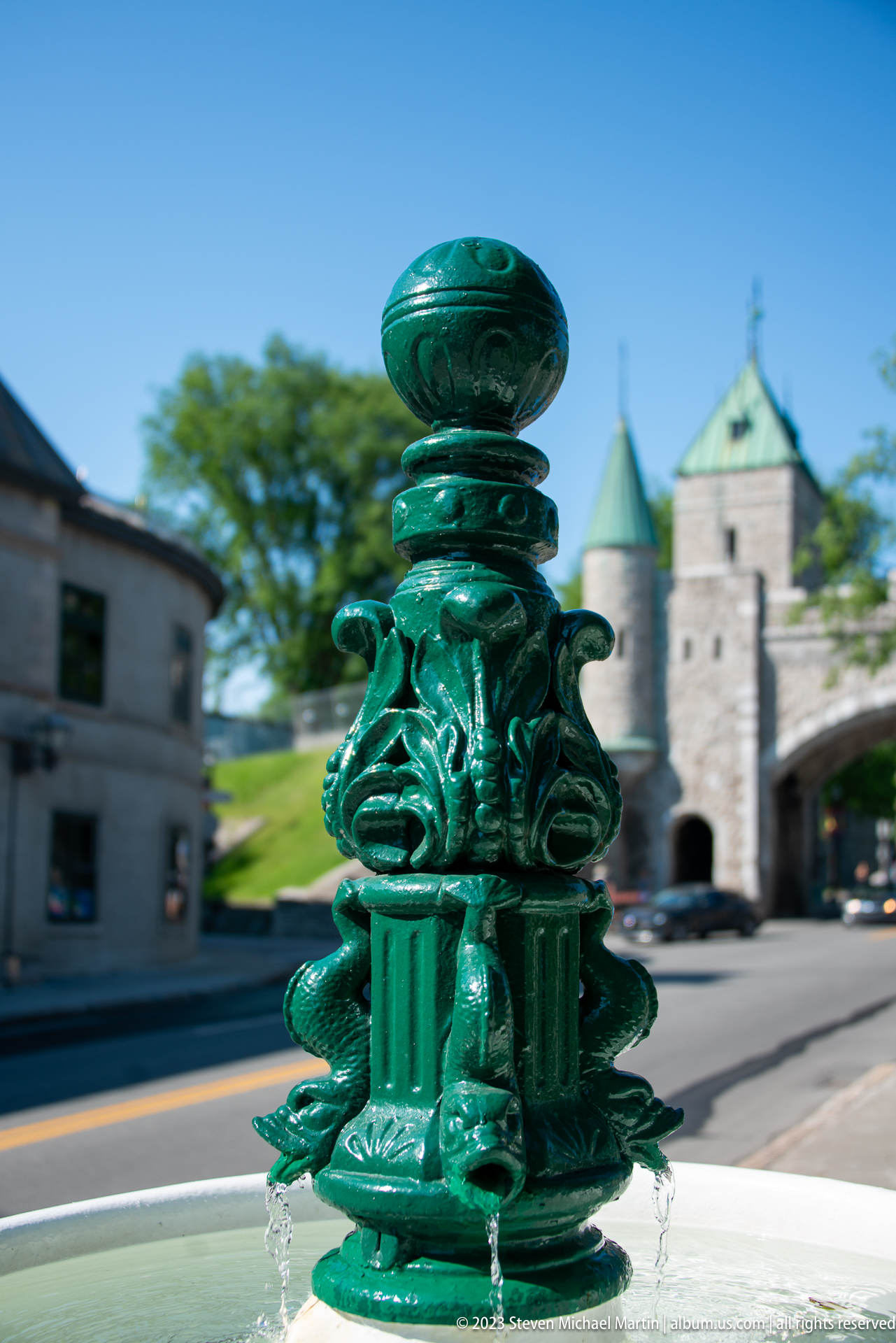
A tight detail isolates the upper fittings of the green cast-metal fountain, revealing scrolling relief ornament, small projecting spouts, and a rounded finial above the basin rim. The fortified gateway falls softly out of focus in the background, linking the decorative street fixture to its historic urban setting. Shallow depth of field shifts attention from architecture to the fountain’s modeled metalwork.
Caption
A tight detail isolates the upper fittings of the green cast-metal fountain, revealing scrolling relief ornament, small projecting spouts, and a rounded finial above the basin rim. The fortified gateway falls softly out of focus in the background, linking the decorative street fixture to its historic urban setting. Shallow depth of field shifts attention from architecture to the fountain’s modeled metalwork.
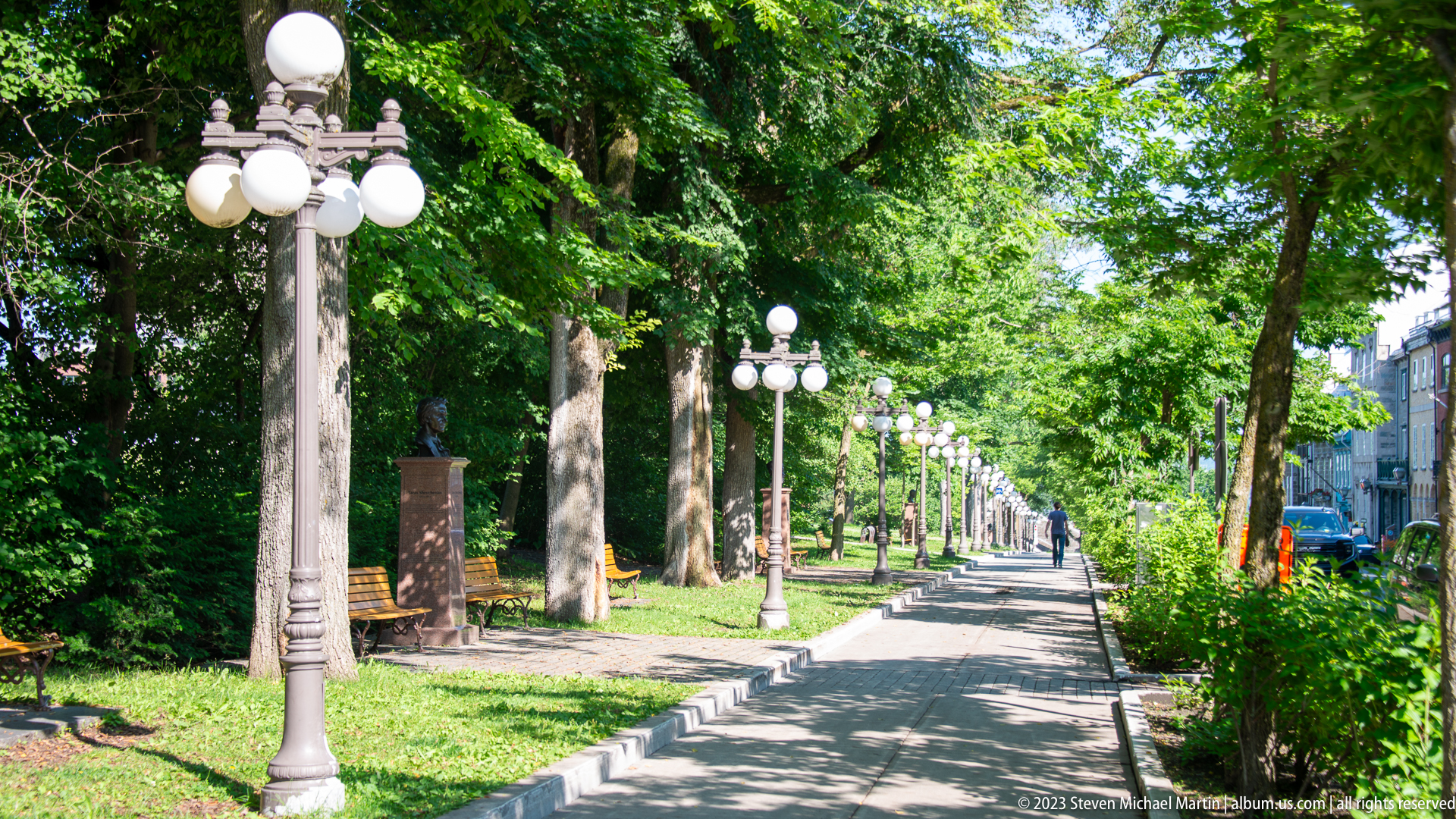
A long pedestrian promenade extends beneath a dense canopy of mature trees, lined at regular intervals by pale posts carrying clusters of spherical lamps. Benches, lawn, and a low curb define the shaded walkway, while the strong central perspective draws the eye toward distant pedestrians. The ordered lighting and continuous tree cover create a formal park-like corridor within Quebec City’s historic urban landscape.
Caption
A long pedestrian promenade extends beneath a dense canopy of mature trees, lined at regular intervals by pale posts carrying clusters of spherical lamps. Benches, lawn, and a low curb define the shaded walkway, while the strong central perspective draws the eye toward distant pedestrians. The ordered lighting and continuous tree cover create a formal park-like corridor within Quebec City’s historic urban landscape.
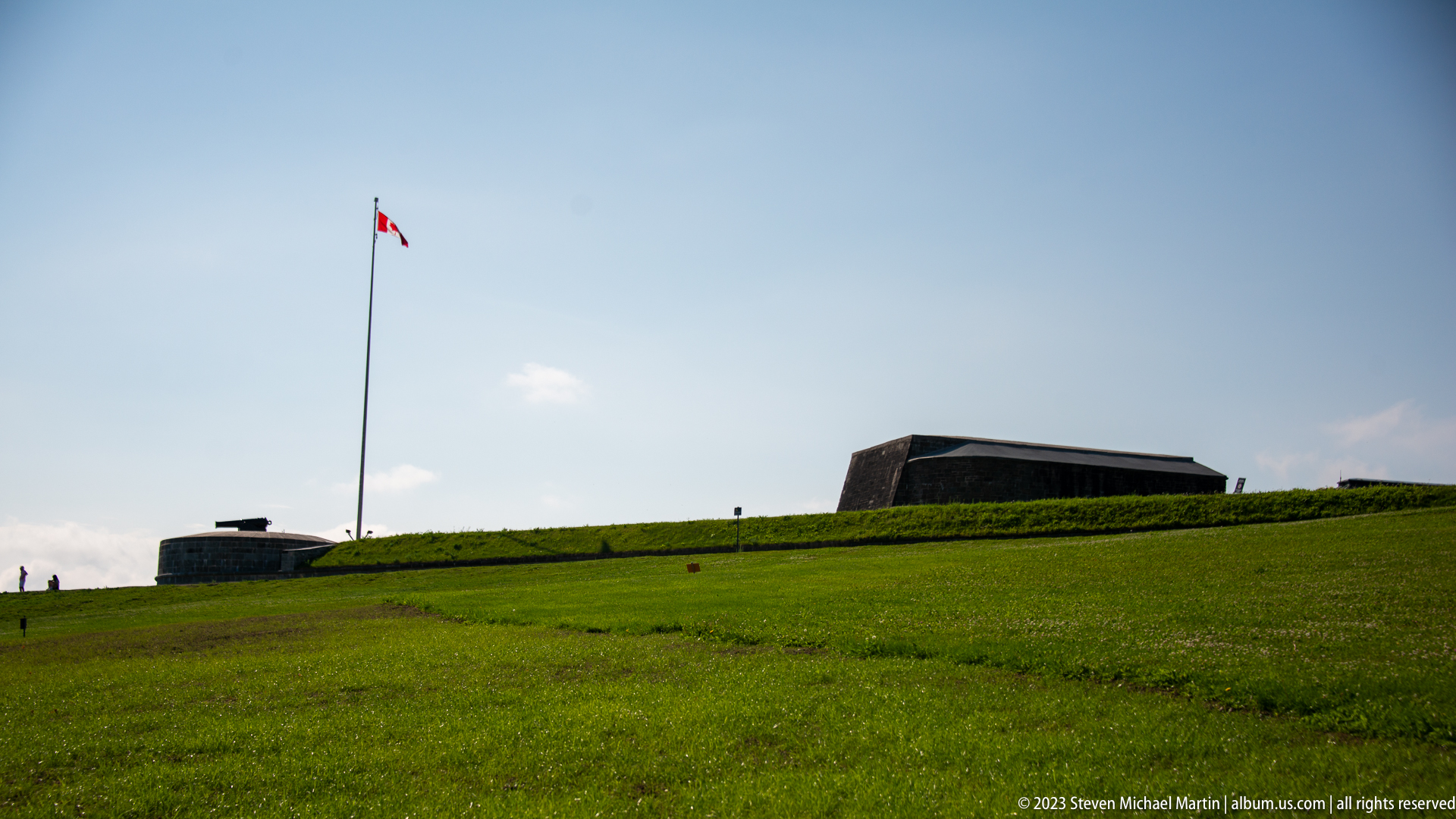
Low, angular fortification structures emerge from the broad grassy earthworks of the Citadelle, while a tall flagpole carrying the Canadian flag rises against the open sky. The restrained composition emphasizes the horizontal mass of the defensive landscape rather than ornate architecture. Sloping turf conceals much of the masonry, illustrating how earthworks and low-profile structures were integrated into the fortified terrain.
Caption
Low, angular fortification structures emerge from the broad grassy earthworks of the Citadelle, while a tall flagpole carrying the Canadian flag rises against the open sky. The restrained composition emphasizes the horizontal mass of the defensive landscape rather than ornate architecture. Sloping turf conceals much of the masonry, illustrating how earthworks and low-profile structures were integrated into the fortified terrain.
⭐ Highlights
- Old Québec (Vieux-Québec): A UNESCO World Heritage district and the most intact fortified city in North America.
- Château Frontenac: The iconic hotel overlooking the St. Lawrence River and one of the most photographed landmarks in the world.
- Dufferin Terrace: A scenic boardwalk offering sweeping views of the river and surrounding landscape.
- Petit-Champlain District: A historic lower town neighborhood known for its narrow streets and preserved colonial architecture.
- City Ramparts: The only remaining fortified city walls in North America north of Mexico.
- Place Royale: The historic heart of French North America and one of the oldest commercial districts on the continent.
🏙️ Québec City Field Guide
Major features observed during this visit:
Québec City is one of the oldest European settlements in North America, founded in 1608 by Samuel de Champlain. Its historic district, Old Québec, is a UNESCO World Heritage Site and the only fortified city north of Mexico whose walls still remain intact. The Upper Town, built along the cliffs, served as the administrative and religious center, while the Lower Town developed as a hub of trade and commerce along the St. Lawrence River. Today, the city preserves a remarkable continuity of architecture, urban form, and cultural identity.
🏛️ Signature Landmarks
- Château Frontenac – A grand hotel perched above the river, dominating the skyline of Old Québec.
- Dufferin Terrace – A wide promenade offering expansive views of the St. Lawrence River.
- Place Royale – The historic center of early French settlement in North America.
- Petit-Champlain – A preserved district of narrow streets, shops, and stone buildings.
- City Ramparts – Fortified walls and gates that once protected the city and still define its character today.
🧠 Historical Significance
- Founded in 1608 – Established by Samuel de Champlain as one of the earliest permanent European settlements in North America.
- Capital of New France – Served as the administrative and cultural center of French colonial North America.
- UNESCO World Heritage Site – Recognized for its preserved architecture and fortified structure.
- French and British Influence – Reflects layers of colonial history shaped by shifting control in the 18th century.
🌄 Urban Landscape & Setting
- Cliffside Location – Built along Cap Diamant, overlooking the St. Lawrence River.
- Upper and Lower Town – A natural division reflecting administrative and commercial functions.
- Cobblestone Streets – Preserved streets and buildings dating back centuries.
- European Character – Often described as the closest experience to Old Europe in North America.