
Okaukuejo – Morning – Etosha National Park
At sunrise the plains surrounding Okaukuejo Camp awaken as wildlife begins to move across the open landscapes of Etosha National Park. Early morning light reveals herds of antelope, zebras, and giraffes traveling between grazing areas and waterholes.
Birdlife becomes particularly active during the cooler morning hours, while predators returning from nighttime hunts may still be seen along the roads and nearby grasslands.
Morning game drives around Okaukuejo offer some of the best opportunities to observe the diverse wildlife of Etosha in the soft light of the Namibian dawn.
Photos:

A line of African savanna elephants reaches the edge of Okaukuejo Waterhole, adults and calves spread across the rocky bank with their reflections extending into the still foreground water. The broad view connects the herd to the water source itself, showing how the permanent waterhole draws wildlife across Etosha’s dry, pale landscape during the morning.
Caption
A line of African savanna elephants reaches the edge of Okaukuejo Waterhole, adults and calves spread across the rocky bank with their reflections extending into the still foreground water. The broad view connects the herd to the water source itself, showing how the permanent waterhole draws wildlife across Etosha’s dry, pale landscape during the morning.

Several giraffes advance across the rocky Etosha plain, their bodies overlapping as they angle toward the waterhole. A large adult at left is partly cropped, while three smaller giraffes occupy the center and right. The close grouping emphasizes differences in height and body size, and the reticulated coat patterns remain distinct against the pale, sparsely vegetated background.
Caption
Several giraffes advance across the rocky Etosha plain, their bodies overlapping as they angle toward the waterhole. A large adult at left is partly cropped, while three smaller giraffes occupy the center and right. The close grouping emphasizes differences in height and body size, and the reticulated coat patterns remain distinct against the pale, sparsely vegetated background.

A herd of plains zebras crosses the stony Etosha ground toward Okaukuejo Waterhole, forming a loose procession from the background into the middle of the frame. Several animals are broadside while others angle toward the water, creating a layered view of the herd’s movement. Sparse shrubs and pale stones emphasize the dry setting in which the zebras gather to drink.
Caption
A herd of plains zebras crosses the stony Etosha ground toward Okaukuejo Waterhole, forming a loose procession from the background into the middle of the frame. Several animals are broadside while others angle toward the water, creating a layered view of the herd’s movement. Sparse shrubs and pale stones emphasize the dry setting in which the zebras gather to drink.

A group of giraffes moves across the open, rocky ground near Okaukuejo, with one large adult dominating the left foreground and several smaller animals following behind. The long legs and necks stand out against the pale Etosha plain, while the staggered spacing gives the scene depth. The frame records a mobile group approaching the waterhole area rather than animals already drinking.
Caption
A group of giraffes moves across the open, rocky ground near Okaukuejo, with one large adult dominating the left foreground and several smaller animals following behind. The long legs and necks stand out against the pale Etosha plain, while the staggered spacing gives the scene depth. The frame records a mobile group approaching the waterhole area rather than animals already drinking.

Warm sunrise light spreads across the flat Etosha horizon as a broad road junction leads away from Okaukuejo into low scrub. Camp roofs and trees frame the foreground, but the eye follows the pale roads toward the open landscape and distant tree line. The high viewpoint and clear morning light make this a strong establishing view of the routes radiating from the camp.
Caption
Warm sunrise light spreads across the flat Etosha horizon as a broad road junction leads away from Okaukuejo into low scrub. Camp roofs and trees frame the foreground, but the eye follows the pale roads toward the open landscape and distant tree line. The high viewpoint and clear morning light make this a strong establishing view of the routes radiating from the camp.

Seen from farther back, the Okaukuejo stone tower anchors a quiet camp road under the last warm band of dawn. Its round masonry walls and crenellated parapet stand above scattered trees and low buildings, while the roadway leads directly toward the structure. This wider view places the tower in its functional camp setting rather than isolating it as an architectural detail.
Caption
Seen from farther back, the Okaukuejo stone tower anchors a quiet camp road under the last warm band of dawn. Its round masonry walls and crenellated parapet stand above scattered trees and low buildings, while the roadway leads directly toward the structure. This wider view places the tower in its functional camp setting rather than isolating it as an architectural detail.

Stone crenellations fill the immediate foreground of this elevated view from the Okaukuejo tower, opening onto low camp roofs, trees, roads, and the flat Etosha landscape beyond. Morning haze softens the horizon, while the masonry parapet makes the vantage point explicit. Unlike the wider landscape views, this frame emphasizes the physical experience of looking outward from the tower itself.
Caption
Stone crenellations fill the immediate foreground of this elevated view from the Okaukuejo tower, opening onto low camp roofs, trees, roads, and the flat Etosha landscape beyond. Morning haze softens the horizon, while the masonry parapet makes the vantage point explicit. Unlike the wider landscape views, this frame emphasizes the physical experience of looking outward from the tower itself.

A black rhinoceros lowers its head to drink from Okaukuejo Waterhole, placing its muzzle just above the reflective surface while standing among pale limestone rocks. The side-on view shows the animal’s two horns, compact body, and pointed upper lip. Its posture links the species directly to the water source, while the sparse shoreline conveys the dry Etosha environment surrounding the morning gathering.
Caption
A black rhinoceros lowers its head to drink from Okaukuejo Waterhole, placing its muzzle just above the reflective surface while standing among pale limestone rocks. The side-on view shows the animal’s two horns, compact body, and pointed upper lip. Its posture links the species directly to the water source, while the sparse shoreline conveys the dry Etosha environment surrounding the morning gathering.

Giraffes spread their forelegs wide to lower their long necks to the water at Okaukuejo, displaying the distinctive drinking posture required by their height. Three animals occupy the near shore while another giraffe stands upright behind them; plains zebras are scattered across the background. Their reflections appear in the water, linking the dramatic stance to the quiet morning surface.
Caption
Giraffes spread their forelegs wide to lower their long necks to the water at Okaukuejo, displaying the distinctive drinking posture required by their height. Three animals occupy the near shore while another giraffe stands upright behind them; plains zebras are scattered across the background. Their reflections appear in the water, linking the dramatic stance to the quiet morning surface.

A heavily equipped overland expedition truck stands in camp before the morning wildlife outing, its high-clearance chassis, protective grille, auxiliary lights, rooftop gear, and open side ladder emphasizing the self-contained character of long-distance safari travel in Namibia. Folding camp chairs and service equipment beside the vehicle place the scene firmly in the practical routines of an Etosha stopover.
Caption
A heavily equipped overland expedition truck stands in camp before the morning wildlife outing, its high-clearance chassis, protective grille, auxiliary lights, rooftop gear, and open side ladder emphasizing the self-contained character of long-distance safari travel in Namibia. Folding camp chairs and service equipment beside the vehicle place the scene firmly in the practical routines of an Etosha stopover.

Two white pickup trucks are prepared for independent safari travel, each carrying elevated canvas rooftop tents above enclosed cargo canopies. The paired vehicles, spare tire, storage compartments, and raised sleeping platforms show a compact alternative to the larger overland truck, while the dry woodland and camp structures situate the morning departure in the Okaukuejo area of Etosha.
Caption
Two white pickup trucks are prepared for independent safari travel, each carrying elevated canvas rooftop tents above enclosed cargo canopies. The paired vehicles, spare tire, storage compartments, and raised sleeping platforms show a compact alternative to the larger overland truck, while the dry woodland and camp structures situate the morning departure in the Okaukuejo area of Etosha.

A G Adventures coach is surrounded by travelers and luggage during the morning activity at camp. Open side compartments, bags on the ground, and people moving around the vehicle suggest loading or departure preparations, contrasting organized group travel with the self-drive safari vehicles seen nearby. Trees shade the busy staging area against Etosha’s otherwise dry setting.
Caption
A G Adventures coach is surrounded by travelers and luggage during the morning activity at camp. Open side compartments, bags on the ground, and people moving around the vehicle suggest loading or departure preparations, contrasting organized group travel with the self-drive safari vehicles seen nearby. Trees shade the busy staging area against Etosha’s otherwise dry setting.

A safari traveler stands ready with a long-lens camera beside the stone-and-thatch architecture of the Okaukuejo rest camp. The camera, broad-brimmed hat, and field clothing signal a morning wildlife outing, while the low stone walls, railings, palms, and shaded lodge structures provide a human-scale introduction to the facilities surrounding Etosha’s celebrated waterhole.
Caption
A safari traveler stands ready with a long-lens camera beside the stone-and-thatch architecture of the Okaukuejo rest camp. The camera, broad-brimmed hat, and field clothing signal a morning wildlife outing, while the low stone walls, railings, palms, and shaded lodge structures provide a human-scale introduction to the facilities surrounding Etosha’s celebrated waterhole.

The curved swimming pool at Okaukuejo lies quiet in the early part of the day, bordered by pale paving, lounge chairs, palms, and small thatched shade structures. With no swimmers present, the orderly resort space offers a calm counterpoint to the wildlife gathering beyond the camp, documenting the visitor facilities that support extended stays inside Etosha National Park.
Caption
The curved swimming pool at Okaukuejo lies quiet in the early part of the day, bordered by pale paving, lounge chairs, palms, and small thatched shade structures. With no swimmers present, the orderly resort space offers a calm counterpoint to the wildlife gathering beyond the camp, documenting the visitor facilities that support extended stays inside Etosha National Park.

A loose herd of springbok crosses the pale, stony ground near Okaukuejo, several animals pausing with their dark, lyre-shaped horns and contrasting flank stripes visible. Their tawny-and-white coats blend with the dry Etosha plain, while scattered scrub and distant camp roofs establish the open habitat around the waterhole during the cooler morning hours.
Caption
A loose herd of springbok crosses the pale, stony ground near Okaukuejo, several animals pausing with their dark, lyre-shaped horns and contrasting flank stripes visible. Their tawny-and-white coats blend with the dry Etosha plain, while scattered scrub and distant camp roofs establish the open habitat around the waterhole during the cooler morning hours.

Three plains zebras graze across the mineral-pale ground, their heads lowered in parallel as they crop sparse vegetation between stones. The staggered spacing reveals individual stripe patterns while keeping all three animals visually distinct. In Etosha’s dry season landscape, such grazing around dependable water sources concentrates herbivores in otherwise austere habitat.
Caption
Three plains zebras graze across the mineral-pale ground, their heads lowered in parallel as they crop sparse vegetation between stones. The staggered spacing reveals individual stripe patterns while keeping all three animals visually distinct. In Etosha’s dry season landscape, such grazing around dependable water sources concentrates herbivores in otherwise austere habitat.

Four plains zebras cluster on the open ground, three feeding while the nearest animal lifts its head and faces the camera. The alert foreground zebra breaks the repeated grazing posture and gives a clear view of the upright mane, facial striping, and rounded ears. The group’s close spacing reflects the social presence typical around Etosha’s water-dependent gathering places.
Caption
Four plains zebras cluster on the open ground, three feeding while the nearest animal lifts its head and faces the camera. The alert foreground zebra breaks the repeated grazing posture and gives a clear view of the upright mane, facial striping, and rounded ears. The group’s close spacing reflects the social presence typical around Etosha’s water-dependent gathering places.

A compact elephant family gathers on the rocky margin near Okaukuejo, with several adults surrounding smaller calves. The arrangement places young animals within the protection of larger bodies, while trunks hang toward the ground as the herd pauses near the waterhole. Their immense ears, columnar legs, and gray, dust-coated hides are characteristic of African savanna elephants.
Caption
A compact elephant family gathers on the rocky margin near Okaukuejo, with several adults surrounding smaller calves. The arrangement places young animals within the protection of larger bodies, while trunks hang toward the ground as the herd pauses near the waterhole. Their immense ears, columnar legs, and gray, dust-coated hides are characteristic of African savanna elephants.

A small zebra herd stands among broken limestone and sparse brush near Okaukuejo, with animals oriented in several directions rather than feeding in unison. The mixed poses—side-on, frontal, and rear views—show how disruptive striping changes across bodies and individuals, while the open, leaf-sparse background conveys the severity of Etosha’s dry-season conditions.
Caption
A small zebra herd stands among broken limestone and sparse brush near Okaukuejo, with animals oriented in several directions rather than feeding in unison. The mixed poses—side-on, frontal, and rear views—show how disruptive striping changes across bodies and individuals, while the open, leaf-sparse background conveys the severity of Etosha’s dry-season conditions.

A map of southern Africa provides geographic orientation for the Etosha journey, with a green marker positioned over Namibia. The country’s Atlantic coast and its relationship to Angola, Botswana, South Africa, and the wider subcontinent are visible at a glance, shifting the sequence briefly from wildlife observation to the regional scale of the safari itinerary.
Caption
A map of southern Africa provides geographic orientation for the Etosha journey, with a green marker positioned over Namibia. The country’s Atlantic coast and its relationship to Angola, Botswana, South Africa, and the wider subcontinent are visible at a glance, shifting the sequence briefly from wildlife observation to the regional scale of the safari itinerary.

A white Toyota Hilux stands at a paved pickup area as two men attend to the open passenger-side door. The high-clearance pickup, covered bed, and robust front end suit the long road distances and gravel routes of a Namibian self-drive safari. Its South African registration plate adds a visible detail to the practical logistics behind reaching Etosha.
Caption
A white Toyota Hilux stands at a paved pickup area as two men attend to the open passenger-side door. The high-clearance pickup, covered bed, and robust front end suit the long road distances and gravel routes of a Namibian self-drive safari. Its South African registration plate adds a visible detail to the practical logistics behind reaching Etosha.

A black rhinoceros moves through the pale limestone rubble near Okaukuejo, its massive body angled away while the head turns into profile. Two horns rise prominently above the muzzle, and the compact head and browsing-adapted mouth are visible against deadwood and sparse grass. The close view conveys both the animal’s bulk and the harsh texture of Etosha’s dry-season terrain.
Caption
A black rhinoceros moves through the pale limestone rubble near Okaukuejo, its massive body angled away while the head turns into profile. Two horns rise prominently above the muzzle, and the compact head and browsing-adapted mouth are visible against deadwood and sparse grass. The close view conveys both the animal’s bulk and the harsh texture of Etosha’s dry-season terrain.

In a broad side profile, a black rhinoceros steps across the stony ground with both horns, thick folded skin, rounded ears, and powerful shoulder line clearly defined. The lowered head brings the muzzle close to sparse vegetation among the rocks, while weathered branches frame the animal without obscuring its form. This view is especially useful for studying rhinoceros morphology.
Caption
In a broad side profile, a black rhinoceros steps across the stony ground with both horns, thick folded skin, rounded ears, and powerful shoulder line clearly defined. The lowered head brings the muzzle close to sparse vegetation among the rocks, while weathered branches frame the animal without obscuring its form. This view is especially useful for studying rhinoceros morphology.

A tight portrait isolates the rhinoceros’s head, bringing the paired horns, rounded ear, small eye, and deeply textured muzzle into close view. The longer front horn dominates the profile while the shorter rear horn rises behind it. Fine skin folds and dust on the face give this frame a more anatomical emphasis than the wider habitat views surrounding it.
Caption
A tight portrait isolates the rhinoceros’s head, bringing the paired horns, rounded ear, small eye, and deeply textured muzzle into close view. The longer front horn dominates the profile while the shorter rear horn rises behind it. Fine skin folds and dust on the face give this frame a more anatomical emphasis than the wider habitat views surrounding it.

The rhinoceros fills the frame from shoulder to muzzle, creating a detailed profile of the two horns and heavy, wrinkled facial skin. Its eye sits beneath the base of the rear horn, while the front horn projects sharply upward from the nose. The intimate framing removes most habitat context and concentrates attention on the animal’s distinctive defensive and feeding anatomy.
Caption
The rhinoceros fills the frame from shoulder to muzzle, creating a detailed profile of the two horns and heavy, wrinkled facial skin. Its eye sits beneath the base of the rear horn, while the front horn projects sharply upward from the nose. The intimate framing removes most habitat context and concentrates attention on the animal’s distinctive defensive and feeding anatomy.

An adult African savanna elephant walks beside a small calf across the white, rock-strewn ground near Okaukuejo. Their parallel direction and close spacing emphasize the calf’s much smaller scale, while the adult’s broad ear and hanging trunk contrast with the youngster’s compact proportions. The pair offers an intimate family moment within Etosha’s austere dry-season landscape.
Caption
An adult African savanna elephant walks beside a small calf across the white, rock-strewn ground near Okaukuejo. Their parallel direction and close spacing emphasize the calf’s much smaller scale, while the adult’s broad ear and hanging trunk contrast with the youngster’s compact proportions. The pair offers an intimate family moment within Etosha’s austere dry-season landscape.

Several African savanna elephants move together across the rocky plain, adults and calves forming a loose procession through the bright Etosha landscape. Two young animals are protected within the group, while the adults’ larger bodies and long trunks establish a steady directional rhythm. A springbok at the far edge adds scale and hints at the multi-species congregation around Okaukuejo.
Caption
Several African savanna elephants move together across the rocky plain, adults and calves forming a loose procession through the bright Etosha landscape. Two young animals are protected within the group, while the adults’ larger bodies and long trunks establish a steady directional rhythm. A springbok at the far edge adds scale and hints at the multi-species congregation around Okaukuejo.

Four elephants walk along the waterhole margin, two adults alternating with two smaller calves as their elongated reflections fall across the greenish water. The tighter composition emphasizes family scale and synchronized movement more than the preceding panorama, with the stony bank forming a bright band between the animals and their mirrored silhouettes.
Caption
Four elephants walk along the waterhole margin, two adults alternating with two smaller calves as their elongated reflections fall across the greenish water. The tighter composition emphasizes family scale and synchronized movement more than the preceding panorama, with the stony bank forming a bright band between the animals and their mirrored silhouettes.

An African savanna elephant surges into the shallows, thrusting its trunk forward as muddy water erupts around its chest and forelegs. The extended ears and explosive splash transform the waterhole from a quiet drinking site into a place of active bathing and cooling. Suspended droplets freeze the motion and reveal the force of the animal’s entry.
Caption
An African savanna elephant surges into the shallows, thrusting its trunk forward as muddy water erupts around its chest and forelegs. The extended ears and explosive splash transform the waterhole from a quiet drinking site into a place of active bathing and cooling. Suspended droplets freeze the motion and reveal the force of the animal’s entry.

With its trunk curled high, an African savanna elephant churns the shallows into a cloud of muddy spray. Water and sediment explode across the foreground and speckle the animal’s face and ears, capturing a vigorous phase of bathing. The frontal angle makes the spread ears, curved trunk, and dense curtain of droplets the dominant features of the frame.
Caption
With its trunk curled high, an African savanna elephant churns the shallows into a cloud of muddy spray. Water and sediment explode across the foreground and speckle the animal’s face and ears, capturing a vigorous phase of bathing. The frontal angle makes the spread ears, curved trunk, and dense curtain of droplets the dominant features of the frame.

An African savanna elephant powers through the shallows as a dense fan of brown water rises beside its body. The side angle reveals the wet, darkened hide and partially extended ear while the splash masks the lower legs. Against the pale limestone bank, the muddy plume becomes a vivid record of how elephants use water for cooling and bathing.
Caption
An African savanna elephant powers through the shallows as a dense fan of brown water rises beside its body. The side angle reveals the wet, darkened hide and partially extended ear while the splash masks the lower legs. Against the pale limestone bank, the muddy plume becomes a vivid record of how elephants use water for cooling and bathing.

The elephant drops low into the water, its broad back and ear nearly horizontal as a sheet of spray sweeps across the frame. This moment records a deeper, more immersive phase of bathing than the upright splashing views, with much of the animal temporarily obscured by water. The blurred droplets convey rapid movement at the waterhole surface.
Caption
The elephant drops low into the water, its broad back and ear nearly horizontal as a sheet of spray sweeps across the frame. This moment records a deeper, more immersive phase of bathing than the upright splashing views, with much of the animal temporarily obscured by water. The blurred droplets convey rapid movement at the waterhole surface.

An extreme close view of a black rhinoceros concentrates on the head, horns, eye, ear, and thick folds of gray skin. The longer front horn dominates the foreground, while the second horn and pointed upper lip remain visible along the animal’s profile. With most of the surrounding habitat excluded, the frame functions as a detailed morphological portrait of the species.
Caption
An extreme close view of a black rhinoceros concentrates on the head, horns, eye, ear, and thick folds of gray skin. The longer front horn dominates the foreground, while the second horn and pointed upper lip remain visible along the animal’s profile. With most of the surrounding habitat excluded, the frame functions as a detailed morphological portrait of the species.

A black rhinoceros bends low over the rocky shore, its legs flexed and body compressed as if settling, rising, or negotiating uneven ground. The unusual posture brings the head and horns close to the stones, while the waterhole remains softly visible behind. The photograph stands apart from the drinking sequence by emphasizing locomotion, balance, and the animal’s powerful compact build.
Caption
A black rhinoceros bends low over the rocky shore, its legs flexed and body compressed as if settling, rising, or negotiating uneven ground. The unusual posture brings the head and horns close to the stones, while the waterhole remains softly visible behind. The photograph stands apart from the drinking sequence by emphasizing locomotion, balance, and the animal’s powerful compact build.

A high curtain of muddy droplets nearly engulfs an African savanna elephant during an energetic bath at Okaukuejo Waterhole. Only the upper body, ear, and curled trunk remain clearly legible behind the spray, making the airborne water itself the dominant visual element. The frame continues the bathing sequence at its most exuberant and physically immersive moment.
Caption
A high curtain of muddy droplets nearly engulfs an African savanna elephant during an energetic bath at Okaukuejo Waterhole. Only the upper body, ear, and curled trunk remain clearly legible behind the spray, making the airborne water itself the dominant visual element. The frame continues the bathing sequence at its most exuberant and physically immersive moment.

A group of African savanna elephants gathers on the bank after bathing, several hides darkened by wet mud in irregular patches. The nearest animals walk shoulder to shoulder while others cluster behind them, creating a layered view of the herd’s return to dry ground. Their wet coats visibly record the recent waterhole activity even after the splashing has stopped.
Caption
A group of African savanna elephants gathers on the bank after bathing, several hides darkened by wet mud in irregular patches. The nearest animals walk shoulder to shoulder while others cluster behind them, creating a layered view of the herd’s return to dry ground. Their wet coats visibly record the recent waterhole activity even after the splashing has stopped.

A rhinoceros crosses the rocky foreground while a mud-darkened African savanna elephant stands behind it, bringing two of Etosha’s largest herbivores into the same frame. The rhino’s paired horns and compact profile contrast with the elephant’s towering legs, broad ears, and trunk. Their overlap provides a striking comparison of body form at the shared Okaukuejo water source.
Caption
A rhinoceros crosses the rocky foreground while a mud-darkened African savanna elephant stands behind it, bringing two of Etosha’s largest herbivores into the same frame. The rhino’s paired horns and compact profile contrast with the elephant’s towering legs, broad ears, and trunk. Their overlap provides a striking comparison of body form at the shared Okaukuejo water source.

A rhinoceros pauses beside the base of a tree as two African savanna elephants occupy the rocky background, one still marked by dark wet mud. The rhino’s horns project clearly in profile while the tree trunk divides the larger animals behind it. This layered composition shows different species using the same limited shade and waterhole environment at close range.
Caption
A rhinoceros pauses beside the base of a tree as two African savanna elephants occupy the rocky background, one still marked by dark wet mud. The rhino’s horns project clearly in profile while the tree trunk divides the larger animals behind it. This layered composition shows different species using the same limited shade and waterhole environment at close range.

A rhinoceros strides across the pale rubble in a clean side profile, its two horns sharply silhouetted while elephants pass behind the nearby tree. The separation between foreground rhino and background herd gives this frame a stronger species portrait than the preceding overlap, while still preserving the crowded ecological context of animals converging around Okaukuejo Waterhole.
Caption
A rhinoceros strides across the pale rubble in a clean side profile, its two horns sharply silhouetted while elephants pass behind the nearby tree. The separation between foreground rhino and background herd gives this frame a stronger species portrait than the preceding overlap, while still preserving the crowded ecological context of animals converging around Okaukuejo Waterhole.

A mud-coated African savanna elephant stands in profile at the edge of the waterhole, its trunk curled inward and dark wet patches streaking the head, shoulder, flank, and legs. Springbok and zebra appear softly behind it, placing the solitary elephant within the broader morning congregation. The mottled hide records the animal’s recent bathing more quietly than the preceding action frames.
Caption
A mud-coated African savanna elephant stands in profile at the edge of the waterhole, its trunk curled inward and dark wet patches streaking the head, shoulder, flank, and legs. Springbok and zebra appear softly behind it, placing the solitary elephant within the broader morning congregation. The mottled hide records the animal’s recent bathing more quietly than the preceding action frames.

A black rhinoceros stands at the rocky edge of Okaukuejo Waterhole, its hooked upper lip and paired horns clearly visible in morning light. The animal is shown in three-quarter profile beside shallow water, with the pale, stone-strewn Etosha terrain forming a stark backdrop. The close view emphasizes the rhino’s massive shoulders, folded skin, alert ears, and characteristic browsing muzzle.
Caption
A black rhinoceros stands at the rocky edge of Okaukuejo Waterhole, its hooked upper lip and paired horns clearly visible in morning light. The animal is shown in three-quarter profile beside shallow water, with the pale, stone-strewn Etosha terrain forming a stark backdrop. The close view emphasizes the rhino’s massive shoulders, folded skin, alert ears, and characteristic browsing muzzle.

A black rhinoceros pauses on the rocky margin of Okaukuejo Waterhole, its full side profile mirrored in the calm water below. The animal’s hooked lip, two horns, and compact, powerful build are visible against a pale field of stones. This wider composition places the rhino within the shoreline setting and gives equal visual weight to the animal and its reflection.
Caption
A black rhinoceros pauses on the rocky margin of Okaukuejo Waterhole, its full side profile mirrored in the calm water below. The animal’s hooked lip, two horns, and compact, powerful build are visible against a pale field of stones. This wider composition places the rhino within the shoreline setting and gives equal visual weight to the animal and its reflection.

A lone black rhinoceros stands at the far edge of Okaukuejo Waterhole, seen in a broader landscape composition that emphasizes the open, stony terrain around it. Its reflection stretches across the water in the foreground, while scattered rocks and dry ground fill the background. The animal’s horns and browsing-type muzzle remain visible despite the greater viewing distance.
Caption
A lone black rhinoceros stands at the far edge of Okaukuejo Waterhole, seen in a broader landscape composition that emphasizes the open, stony terrain around it. Its reflection stretches across the water in the foreground, while scattered rocks and dry ground fill the background. The animal’s horns and browsing-type muzzle remain visible despite the greater viewing distance.

A small herd of African bush elephants moves away across the pale, rocky ground near Okaukuejo, with several adults grouped tightly and a smaller calf partly sheltered among them. One elephant walks separately to the right, its back to the camera. The rear view highlights the herd’s social spacing and the scale of the animals against Etosha’s dry, open terrain.
Caption
A small herd of African bush elephants moves away across the pale, rocky ground near Okaukuejo, with several adults grouped tightly and a smaller calf partly sheltered among them. One elephant walks separately to the right, its back to the camera. The rear view highlights the herd’s social spacing and the scale of the animals against Etosha’s dry, open terrain.

A black rhinoceros drinks at the near edge of Okaukuejo Waterhole beneath a tall, spreading tree, creating an environmental portrait rather than a close wildlife study. The rhino occupies the lower right of the frame while dry woodland, stones, and open ground extend behind it. The composition shows how the waterhole functions as a focal point within Etosha’s arid morning landscape.
Caption
A black rhinoceros drinks at the near edge of Okaukuejo Waterhole beneath a tall, spreading tree, creating an environmental portrait rather than a close wildlife study. The rhino occupies the lower right of the frame while dry woodland, stones, and open ground extend behind it. The composition shows how the waterhole functions as a focal point within Etosha’s arid morning landscape.

A black rhinoceros walks toward the camera over the pale, angular stones surrounding Okaukuejo Waterhole. Its head is held forward, bringing the two horns, hooked upper lip, rounded ears, and heavy shoulder line into clear view. The frontal three-quarter angle differs from the earlier drinking scenes, concentrating attention on the animal’s facial structure and deliberate movement across the rough terrain.
Caption
A black rhinoceros walks toward the camera over the pale, angular stones surrounding Okaukuejo Waterhole. Its head is held forward, bringing the two horns, hooked upper lip, rounded ears, and heavy shoulder line into clear view. The frontal three-quarter angle differs from the earlier drinking scenes, concentrating attention on the animal’s facial structure and deliberate movement across the rough terrain.

A tight portrait isolates the head and shoulder of a black rhinoceros, revealing the textured horn surfaces, rounded ears, small eye, wrinkled skin, and pointed browsing lip in unusually fine detail. The shallow background reduces the rocky waterhole setting to soft shapes, shifting the emphasis from habitat to morphology. Dust and wear on the face reinforce the tactile character of the close view.
Caption
A tight portrait isolates the head and shoulder of a black rhinoceros, revealing the textured horn surfaces, rounded ears, small eye, wrinkled skin, and pointed browsing lip in unusually fine detail. The shallow background reduces the rocky waterhole setting to soft shapes, shifting the emphasis from habitat to morphology. Dust and wear on the face reinforce the tactile character of the close view.

A black rhinoceros stands broadside among the pale rocks bordering Okaukuejo Waterhole, turning its head slightly toward the camera. The pose exposes the full body profile while keeping the horns, ears, and hooked lip legible. Dry grasses and scattered stones fill the foreground and background, situating the animal within the hard, mineral surface characteristic of the waterhole’s immediate surroundings.
Caption
A black rhinoceros stands broadside among the pale rocks bordering Okaukuejo Waterhole, turning its head slightly toward the camera. The pose exposes the full body profile while keeping the horns, ears, and hooked lip legible. Dry grasses and scattered stones fill the foreground and background, situating the animal within the hard, mineral surface characteristic of the waterhole’s immediate surroundings.

A black rhinoceros advances over the uneven shoreline with Okaukuejo Waterhole visible behind it. One foreleg is lifted mid-step, giving the portrait a sense of movement, while the animal faces almost directly forward. The paired horns and pointed upper lip remain prominent, and a pale branch crosses the lower foreground, adding depth to the close environmental view.
Caption
A black rhinoceros advances over the uneven shoreline with Okaukuejo Waterhole visible behind it. One foreleg is lifted mid-step, giving the portrait a sense of movement, while the animal faces almost directly forward. The paired horns and pointed upper lip remain prominent, and a pale branch crosses the lower foreground, adding depth to the close environmental view.

The black rhinoceros fills the frame as it walks directly toward the viewer across the rocky ground at Okaukuejo. Its front-facing posture aligns the horns along the center of the head and accentuates the broad chest, thick legs, rounded ears, and folded skin. A blurred branch passes across the lower foreground, while water and stones remain softly visible behind the animal.
Caption
The black rhinoceros fills the frame as it walks directly toward the viewer across the rocky ground at Okaukuejo. Its front-facing posture aligns the horns along the center of the head and accentuates the broad chest, thick legs, rounded ears, and folded skin. A blurred branch passes across the lower foreground, while water and stones remain softly visible behind the animal.

A black rhinoceros stands almost square to the camera among pale shoreline rocks, its heavy body and broad shoulders filling the frame. The front horn rises prominently above the muzzle while the smaller rear horn, rounded ears, and pointed upper lip remain visible. Morning light reveals rib contours and folds in the gray hide, producing a detailed full-body field-guide view.
Caption
A black rhinoceros stands almost square to the camera among pale shoreline rocks, its heavy body and broad shoulders filling the frame. The front horn rises prominently above the muzzle while the smaller rear horn, rounded ears, and pointed upper lip remain visible. Morning light reveals rib contours and folds in the gray hide, producing a detailed full-body field-guide view.

A black rhinoceros drinks at the left edge of Okaukuejo Waterhole while a large herd of plains zebras lines the opposite shallows. The mixed-species scene shows contrasting use of the same limited water source: the solitary rhinoceros occupies the near bank as dozens of zebras cluster tightly across the water. The broad view emphasizes both abundance and interspecies proximity in the morning gathering.
Caption
A black rhinoceros drinks at the left edge of Okaukuejo Waterhole while a large herd of plains zebras lines the opposite shallows. The mixed-species scene shows contrasting use of the same limited water source: the solitary rhinoceros occupies the near bank as dozens of zebras cluster tightly across the water. The broad view emphasizes both abundance and interspecies proximity in the morning gathering.

Plains zebras crowd the shallow margin of Okaukuejo Waterhole, forming a dense horizontal band of striped bodies along the water’s edge. Many lower their heads simultaneously to drink while others remain upright behind them. The repeated vertical stripes and closely packed legs create a strong graphic pattern, while the pale rocky bank above the herd anchors the scene in Etosha’s arid landscape.
Caption
Plains zebras crowd the shallow margin of Okaukuejo Waterhole, forming a dense horizontal band of striped bodies along the water’s edge. Many lower their heads simultaneously to drink while others remain upright behind them. The repeated vertical stripes and closely packed legs create a strong graphic pattern, while the pale rocky bank above the herd anchors the scene in Etosha’s arid landscape.

A closer view of the zebra herd isolates several plains zebras standing knee-deep at the edge of Okaukuejo Waterhole. Multiple animals bend their necks to drink, while others remain upright and partly overlap in the tightly packed group. The tighter framing makes individual stripe patterns, manes, ears, and drinking postures more legible than in the preceding wide herd views.
Caption
A closer view of the zebra herd isolates several plains zebras standing knee-deep at the edge of Okaukuejo Waterhole. Multiple animals bend their necks to drink, while others remain upright and partly overlap in the tightly packed group. The tighter framing makes individual stripe patterns, manes, ears, and drinking postures more legible than in the preceding wide herd views.

Several plains zebras drink together in the shallow water at Okaukuejo, their heads lowered and bodies overlapping in a tight cluster. The near animals fill most of the frame, allowing the contrasting black-and-white stripes, upright manes, and pale underparts to be studied in detail. Ripples around their legs provide the principal cue to the ongoing drinking activity.
Caption
Several plains zebras drink together in the shallow water at Okaukuejo, their heads lowered and bodies overlapping in a tight cluster. The near animals fill most of the frame, allowing the contrasting black-and-white stripes, upright manes, and pale underparts to be studied in detail. Ripples around their legs provide the principal cue to the ongoing drinking activity.

A black rhinoceros walks from left to right across the pale stone field near Okaukuejo, away from the immediate waterline. Its head is lowered slightly, showing the long front horn, shorter rear horn, and pointed upper lip in profile. The uninterrupted side view also reveals the rounded back, thick legs, and tail, with another antelope-like animal blurred in the background.
Caption
A black rhinoceros walks from left to right across the pale stone field near Okaukuejo, away from the immediate waterline. Its head is lowered slightly, showing the long front horn, shorter rear horn, and pointed upper lip in profile. The uninterrupted side view also reveals the rounded back, thick legs, and tail, with another antelope-like animal blurred in the background.

Giraffes and plains zebras share the rocky open ground near Okaukuejo, with a tall giraffe centered in the foreground and several more giraffes gathered to the left. Zebras graze or stand farther back, adding a second species layer to the scene. The mixed herd creates a broad ecological context for the waterhole, where different large herbivores converge within the same arid landscape.
Caption
Giraffes and plains zebras share the rocky open ground near Okaukuejo, with a tall giraffe centered in the foreground and several more giraffes gathered to the left. Zebras graze or stand farther back, adding a second species layer to the scene. The mixed herd creates a broad ecological context for the waterhole, where different large herbivores converge within the same arid landscape.

An adult giraffe and a smaller juvenile drink side by side at Okaukuejo Waterhole, each spreading its forelegs to lower the long neck to the surface. Their contrasting scale is especially clear in this tight pairing, while a plains zebra stands on the rocky bank behind them. The composition provides a direct comparison of body size and the characteristic drinking stance at different ages.
Caption
An adult giraffe and a smaller juvenile drink side by side at Okaukuejo Waterhole, each spreading its forelegs to lower the long neck to the surface. Their contrasting scale is especially clear in this tight pairing, while a plains zebra stands on the rocky bank behind them. The composition provides a direct comparison of body size and the characteristic drinking stance at different ages.

Four giraffes occupy the rocky edge of Okaukuejo Waterhole in different postures: two drink with their forelegs spread, one stands upright, and another leans toward the shore. Their arrangement forms a compact behavioral sequence within a single frame. Zebras and sparse woodland appear farther back, showing the broader multispecies setting around the morning water source.
Caption
Four giraffes occupy the rocky edge of Okaukuejo Waterhole in different postures: two drink with their forelegs spread, one stands upright, and another leans toward the shore. Their arrangement forms a compact behavioral sequence within a single frame. Zebras and sparse woodland appear farther back, showing the broader multispecies setting around the morning water source.

A giraffe drinks at the edge of Okaukuejo Waterhole with its forelegs spread wide and neck extended steeply downward. The tight framing removes most other animals, focusing attention on the mechanics of the drinking posture and the patterned coat. Pale rocks behind the giraffe and the reflective water below create a simple setting for this clear behavioral field-guide view.
Caption
A giraffe drinks at the edge of Okaukuejo Waterhole with its forelegs spread wide and neck extended steeply downward. The tight framing removes most other animals, focusing attention on the mechanics of the drinking posture and the patterned coat. Pale rocks behind the giraffe and the reflective water below create a simple setting for this clear behavioral field-guide view.

A springbok lowers its muzzle to the shallow water at Okaukuejo while a plains zebra drinks behind it on the opposite side of the frame. The antelope’s white face, dark facial stripe, tan back, white belly, and lyre-shaped horns are visible in profile. The layered composition contrasts two characteristic Etosha herbivores sharing the same water source at close range.
Caption
A springbok lowers its muzzle to the shallow water at Okaukuejo while a plains zebra drinks behind it on the opposite side of the frame. The antelope’s white face, dark facial stripe, tan back, white belly, and lyre-shaped horns are visible in profile. The layered composition contrasts two characteristic Etosha herbivores sharing the same water source at close range.

A Cape ground squirrel sits on the dry ground in a tight portrait, twisting its body as it brings a forepaw across its chest in a grooming motion. The close view shows the short rounded ears, dark eye, grizzled coat, pale belly, strong claws, and bushy tail. Compared with the preceding upright pose, this frame emphasizes relaxed behavior and anatomical detail at ground level.
Caption
A Cape ground squirrel sits on the dry ground in a tight portrait, twisting its body as it brings a forepaw across its chest in a grooming motion. The close view shows the short rounded ears, dark eye, grizzled coat, pale belly, strong claws, and bushy tail. Compared with the preceding upright pose, this frame emphasizes relaxed behavior and anatomical detail at ground level.

A safari traveler stands outdoors at Okaukuejo wearing a broad-brimmed field hat and bright red shirt, with a DSLR and long lens in one hand and a cross-body camera bag at his side. The portrait records the human side of wildlife observation, showing the equipment and clothing used during an early-day excursion rather than an animal or landscape subject.
Caption
A safari traveler stands outdoors at Okaukuejo wearing a broad-brimmed field hat and bright red shirt, with a DSLR and long lens in one hand and a cross-body camera bag at his side. The portrait records the human side of wildlife observation, showing the equipment and clothing used during an early-day excursion rather than an animal or landscape subject.

A Cape ground squirrel stands erect on its hind legs on dry, pebbly ground near Okaukuejo, holding its forepaws close to its chest. Its mottled gray-brown coat, pale underside, small rounded ears, and long bushy tail are visible, with the tail stretched along the ground behind it. The upright sentinel-like posture gives a clear field-guide view of this small arid-country mammal.
Caption
A Cape ground squirrel stands erect on its hind legs on dry, pebbly ground near Okaukuejo, holding its forepaws close to its chest. Its mottled gray-brown coat, pale underside, small rounded ears, and long bushy tail are visible, with the tail stretched along the ground behind it. The upright sentinel-like posture gives a clear field-guide view of this small arid-country mammal.

Safari vehicles fitted with rooftop tents stand among trees and marked campsites at Okaukuejo. The utilitarian campground setting, pale sandy ground, shade trees, and clustered overland vehicles place the morning wildlife excursion within the practical rhythm of an Etosha stay, where visitors can move directly between camp facilities and nearby game-viewing areas.
Caption
Safari vehicles fitted with rooftop tents stand among trees and marked campsites at Okaukuejo. The utilitarian campground setting, pale sandy ground, shade trees, and clustered overland vehicles place the morning wildlife excursion within the practical rhythm of an Etosha stay, where visitors can move directly between camp facilities and nearby game-viewing areas.

A large dark bird perches in profile on a weathered branch, its heavy bill, long legs, and layered black plumage sharply isolated against a pale sky. The uncluttered composition turns a common camp-side wildlife encounter into a close field-guide study, emphasizing posture, feather texture, and the substantial bill rather than the broader Etosha landscape.
Caption
A large dark bird perches in profile on a weathered branch, its heavy bill, long legs, and layered black plumage sharply isolated against a pale sky. The uncluttered composition turns a common camp-side wildlife encounter into a close field-guide study, emphasizing posture, feather texture, and the substantial bill rather than the broader Etosha landscape.

The cylindrical stone tower at Okaukuejo rises in silhouette against a vivid orange-pink dawn sky, with one small window glowing from within. Crenellations ring the top of the masonry shaft, while low camp buildings and trees remain subdued at its base. The strong backlight makes the tower a vertical landmark within the otherwise low, open settlement.
Caption
The cylindrical stone tower at Okaukuejo rises in silhouette against a vivid orange-pink dawn sky, with one small window glowing from within. Crenellations ring the top of the masonry shaft, while low camp buildings and trees remain subdued at its base. The strong backlight makes the tower a vertical landmark within the otherwise low, open settlement.

An elevated dawn view looks beyond Okaukuejo toward a pale road junction and the flat, scrub-covered Etosha landscape. Low camp roofs and vegetation occupy the foreground, while the roads divide and recede across open ground beneath a layered blue, pink, and orange sky. The photograph emphasizes the transition from the enclosed camp to the broad game-viewing terrain beyond.
Caption
An elevated dawn view looks beyond Okaukuejo toward a pale road junction and the flat, scrub-covered Etosha landscape. Low camp roofs and vegetation occupy the foreground, while the roads divide and recede across open ground beneath a layered blue, pink, and orange sky. The photograph emphasizes the transition from the enclosed camp to the broad game-viewing terrain beyond.

Two turquoise swimming pools curve through the landscaped grounds at Okaukuejo, bordered by paving, palms, mature shade trees, and low lodge structures. Viewed from above in early light, the scene contrasts the irrigated green interior of the camp with the dry, muted woodland beyond, documenting the visitor facilities that sit beside Etosha's much harsher natural environment.
Caption
Two turquoise swimming pools curve through the landscaped grounds at Okaukuejo, bordered by paving, palms, mature shade trees, and low lodge structures. Viewed from above in early light, the scene contrasts the irrigated green interior of the camp with the dry, muted woodland beyond, documenting the visitor facilities that sit beside Etosha's much harsher natural environment.

The round stone tower at Okaukuejo is seen in full morning light beside a directional sign reading 'OUTJO' and 'FILLING STATION.' Crenellations crown the pale masonry cylinder, while a safari vehicle and low camp structure provide scale. The roadside signage places the tower within the everyday circulation network of the rest camp rather than presenting it only as a scenic landmark.
Caption
The round stone tower at Okaukuejo is seen in full morning light beside a directional sign reading 'OUTJO' and 'FILLING STATION.' Crenellations crown the pale masonry cylinder, while a safari vehicle and low camp structure provide scale. The roadside signage places the tower within the everyday circulation network of the rest camp rather than presenting it only as a scenic landmark.

A closer ground-level view shows the Okaukuejo tower's rough stone masonry, narrow rectangular openings, and arched doorway. A safari vehicle sits at its base, while a roadside sign points toward Halali and the filling station. The tighter framing reveals more of the tower's construction and entrance while still preserving its role as a recognizable orientation point inside the camp.
Caption
A closer ground-level view shows the Okaukuejo tower's rough stone masonry, narrow rectangular openings, and arched doorway. A safari vehicle sits at its base, while a roadside sign points toward Halali and the filling station. The tighter framing reveals more of the tower's construction and entrance while still preserving its role as a recognizable orientation point inside the camp.
Field Guide
Overview
The Okaukuejo Waterhole is one of the most dependable wildlife viewing locations in Etosha National Park. Located directly beside Okaukuejo Rest Camp, this permanent water source attracts a steady flow of animals, particularly during the dry season when water becomes scarce across the surrounding plains.
Morning light provides softer contrast and calmer conditions, allowing animals to approach gradually as the day begins. During this visit, elephant, rhinoceros, giraffe, zebra, and antelope gathered at the waterhole, illustrating how essential water sources concentrate wildlife within Etosha’s arid landscape.
Location
- 📍 Okaukuejo Rest Camp, Etosha National Park, Namibia
- Habitat: dry savanna surrounding the Etosha salt pan
- Water source: permanent waterhole with reliable wildlife activity
Wildlife
- 🦏 White rhinoceros moving carefully along the rocky shoreline
- 🐘 African elephant drinking, bathing, and interacting socially
- 🦒 Giraffe spreading legs to reach water surface
- 🦓 Zebra gathering in groups at the water’s edge
- 🦌 Springbok and antelope sharing access to water
- 🐿️ Ground squirrel pausing upright to observe surroundings
- 🪶 Birdlife active near water and camp structures
Behavior
- Animals approach slowly, pausing before drinking
- Multiple species share the same water source
- Elephants often bathe or spray water to cool themselves
- Giraffe adopt a wide stance to lower their heads safely
- Morning activity increases steadily as temperatures rise
Best Time of Day
- Morning provides softer light and moderate temperatures
- Wildlife movement builds gradually after sunrise
- Dry season concentrates animals near permanent water
Photography Notes
- Soft morning light produces natural color tones
- Long lenses help isolate animals within larger groups
- Patience allows capture of interactions between species
- Reflections are possible when water remains still
- Behavior changes as new animals arrive
Why This Stop is Special
Etosha’s waterholes provide rare opportunities to observe multiple species interacting in a shared environment. The steady rhythm of arrivals and departures creates a constantly changing scene, offering both photographic variety and insight into how wildlife adapts to dry conditions.
Guide Book
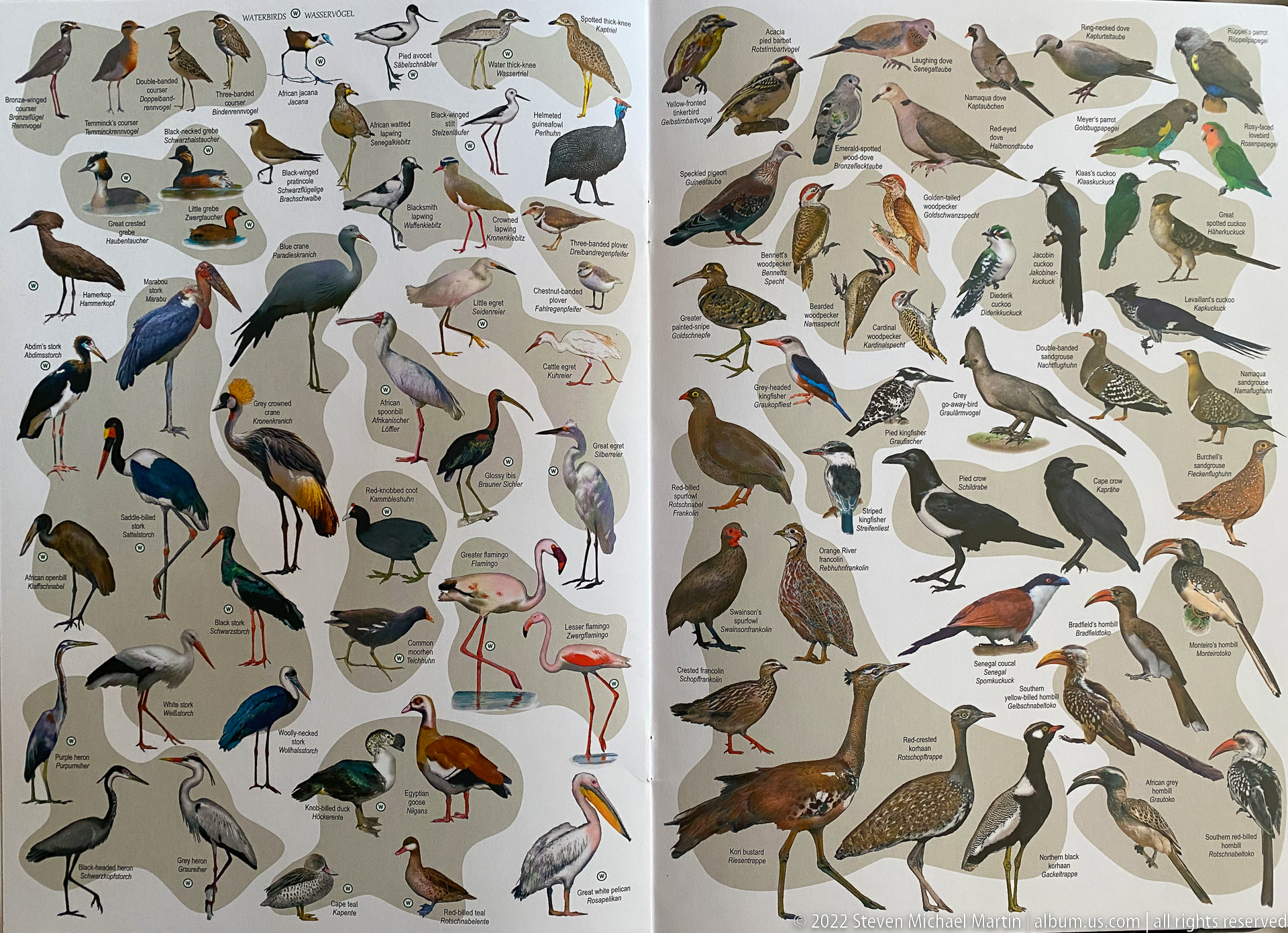
Two densely illustrated bird-identification plates present a wide range of Etosha avifauna in profile. The left page is dominated by long-legged waterbirds and waders, including crane-, stork-, and flamingo-like forms, while the facing page shifts to a broader assortment of terrestrial and wetland birds. Individual labels turn the spread into a compact visual key for field recognition.
Caption
Two densely illustrated bird-identification plates present a wide range of Etosha avifauna in profile. The left page is dominated by long-legged waterbirds and waders, including crane-, stork-, and flamingo-like forms, while the facing page shifts to a broader assortment of terrestrial and wetland birds. Individual labels turn the spread into a compact visual key for field recognition.

The cover of an Etosha wildlife-identification guide combines illustrated mammals and birds with the bilingual title “Map of Etosha / Karte von Etoscha.” A lower panel centers elephants and other animals at a waterhole, signaling the guide’s field-identification purpose. The photographed publication provides contextual reference material for recognizing species and navigating wildlife encounters across the Etosha landscape.
Caption
The cover of an Etosha wildlife-identification guide combines illustrated mammals and birds with the bilingual title “Map of Etosha / Karte von Etoscha.” A lower panel centers elephants and other animals at a waterhole, signaling the guide’s field-identification purpose. The photographed publication provides contextual reference material for recognizing species and navigating wildlife encounters across the Etosha landscape.
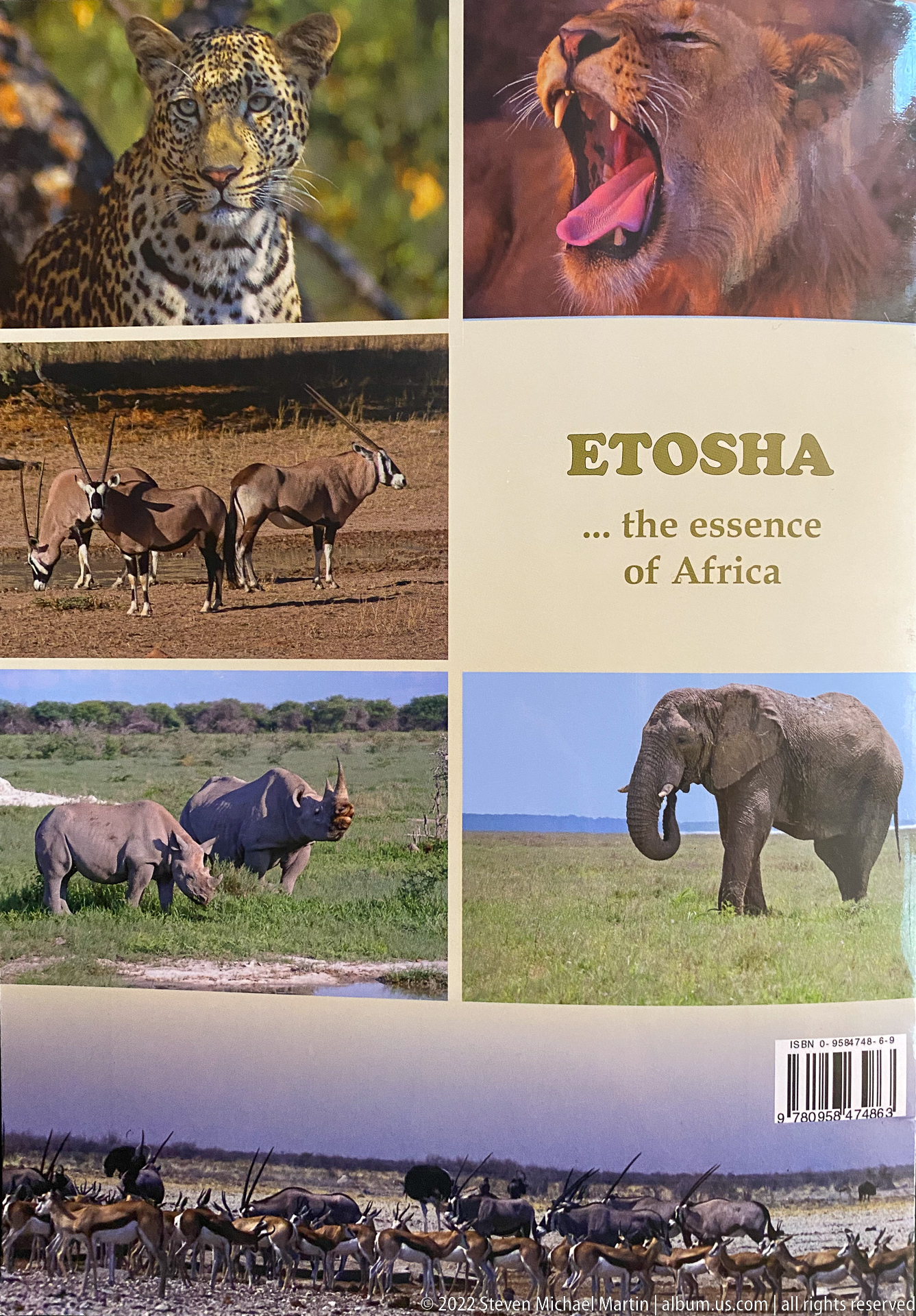
The closing cover of the Etosha guide uses a wildlife collage beneath the phrase “ETOSHA — the essence of Africa.” Separate panels feature close and contextual views of prominent African animals, while a panoramic strip along the bottom shows a large concentration of wildlife across open terrain. The design concludes the field guide by presenting Etosha through the abundance and variety of its fauna.
Caption
The closing cover of the Etosha guide uses a wildlife collage beneath the phrase “ETOSHA — the essence of Africa.” Separate panels feature close and contextual views of prominent African animals, while a panoramic strip along the bottom shows a large concentration of wildlife across open terrain. The design concludes the field guide by presenting Etosha through the abundance and variety of its fauna.

An information spread from the Etosha guide assembles practical park material with natural-history reference: visitor information, timetables, a table of distances, wildlife illustrations, and a color-coded vegetation map. The dense layout shows how field guides integrate route planning with ecological orientation, allowing travelers to relate roads and facilities to the broad vegetation zones that structure wildlife habitat in Etosha.
Caption
An information spread from the Etosha guide assembles practical park material with natural-history reference: visitor information, timetables, a table of distances, wildlife illustrations, and a color-coded vegetation map. The dense layout shows how field guides integrate route planning with ecological orientation, allowing travelers to relate roads and facilities to the broad vegetation zones that structure wildlife habitat in Etosha.
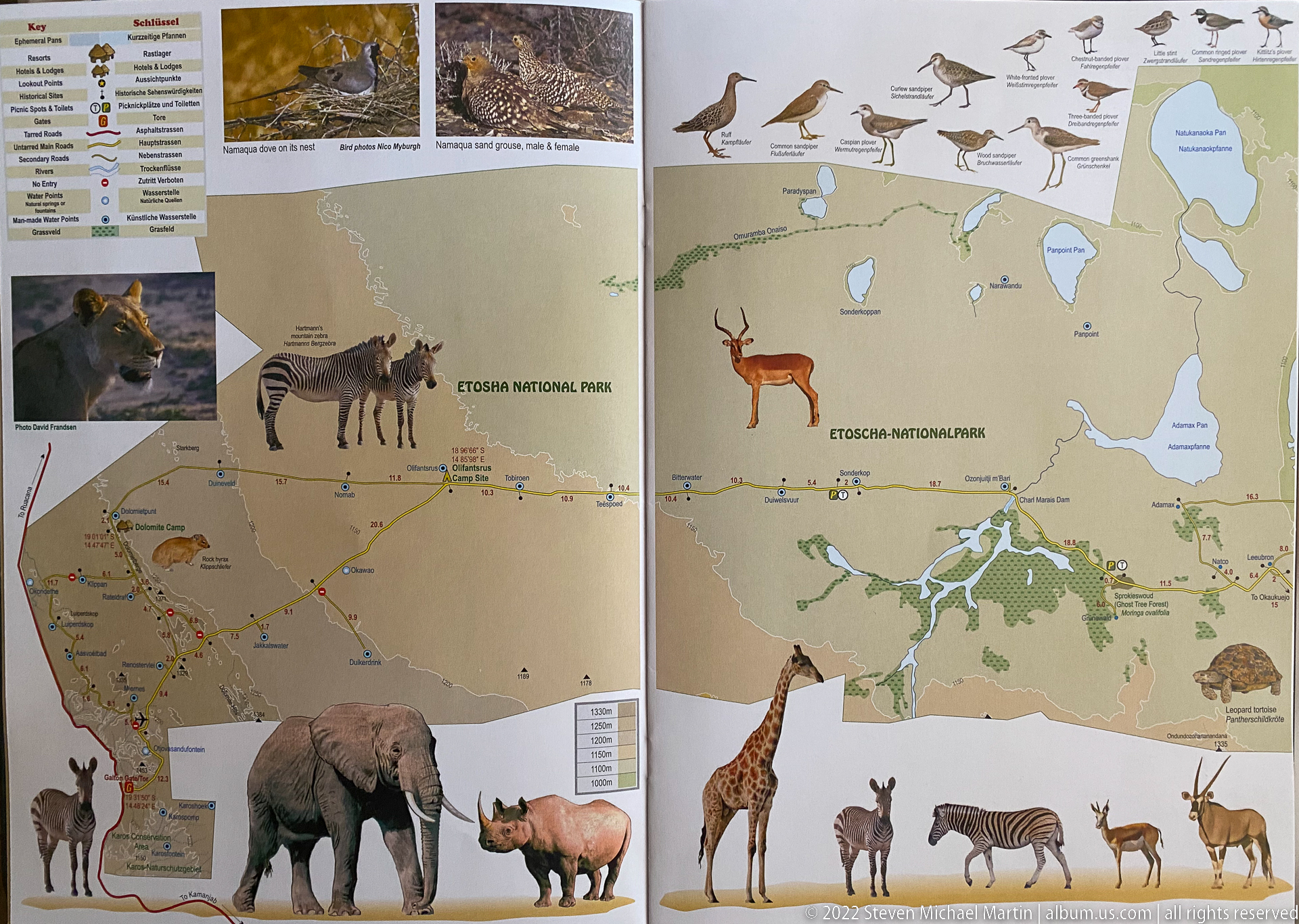
Two facing map pages place Etosha National Park’s road network and water features beneath rows of illustrated wildlife. Large figures of zebra, elephant, rhinoceros, giraffe, antelope, and other species turn the map into a combined navigation and identification aid. The spread visually links animal recognition with the geography of the park, including the broad pale expanse of the Etosha Pan.
Caption
Two facing map pages place Etosha National Park’s road network and water features beneath rows of illustrated wildlife. Large figures of zebra, elephant, rhinoceros, giraffe, antelope, and other species turn the map into a combined navigation and identification aid. The spread visually links animal recognition with the geography of the park, including the broad pale expanse of the Etosha Pan.

A detailed Etosha National Park map spread traces roads, waterholes, settlements, and the margins of the pan across two pages. Wildlife illustrations—including large herbivores and predators—frame the cartography and reinforce the guide’s dual role as route reference and species primer. The layout emphasizes the scale of the protected landscape and the importance of mapped water points to safari movement.
Caption
A detailed Etosha National Park map spread traces roads, waterholes, settlements, and the margins of the pan across two pages. Wildlife illustrations—including large herbivores and predators—frame the cartography and reinforce the guide’s dual role as route reference and species primer. The layout emphasizes the scale of the protected landscape and the importance of mapped water points to safari movement.
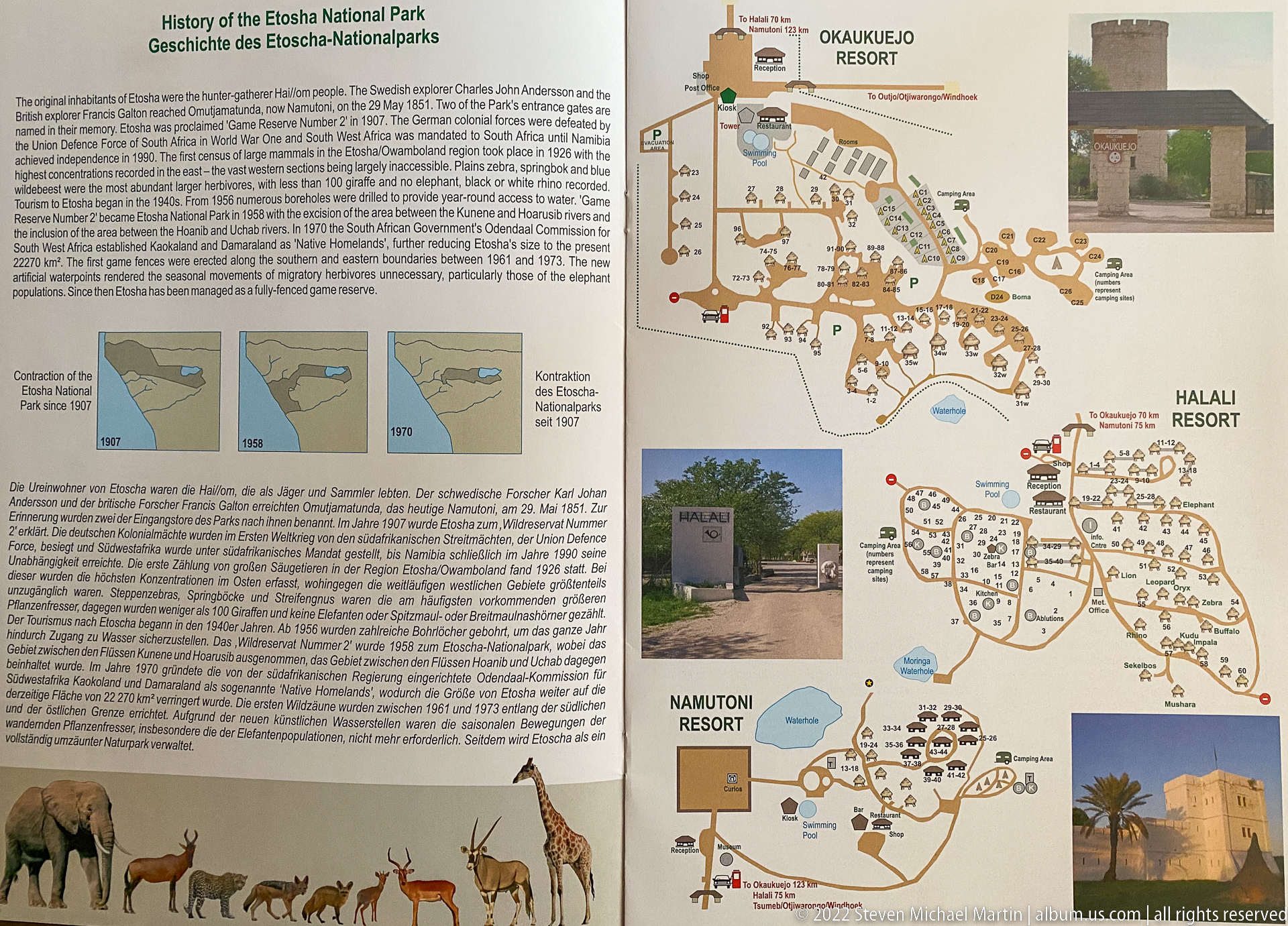
This guide spread pairs a text history of Etosha National Park with schematic plans of three major park resorts: Okaukuejo, Halali, and Namutoni. Small historic and site photographs accompany the maps, while animal illustrations run along the lower margin. The page connects the park’s administrative history with the visitor infrastructure from which many wildlife drives and waterhole observations are organized.
Caption
This guide spread pairs a text history of Etosha National Park with schematic plans of three major park resorts: Okaukuejo, Halali, and Namutoni. Small historic and site photographs accompany the maps, while animal illustrations run along the lower margin. The page connects the park’s administrative history with the visitor infrastructure from which many wildlife drives and waterhole observations are organized.

Photographs and descriptive text survey accommodation and camping facilities associated with Etosha National Park. Separate sections present resort or campsite settings with pools, buildings, shaded grounds, and entrances, giving the spread the character of a practical lodging directory. Rather than wildlife identification, these pages document the visitor infrastructure that supports multi-day travel through the Etosha region.
Caption
Photographs and descriptive text survey accommodation and camping facilities associated with Etosha National Park. Separate sections present resort or campsite settings with pools, buildings, shaded grounds, and entrances, giving the spread the character of a practical lodging directory. Rather than wildlife identification, these pages document the visitor infrastructure that supports multi-day travel through the Etosha region.
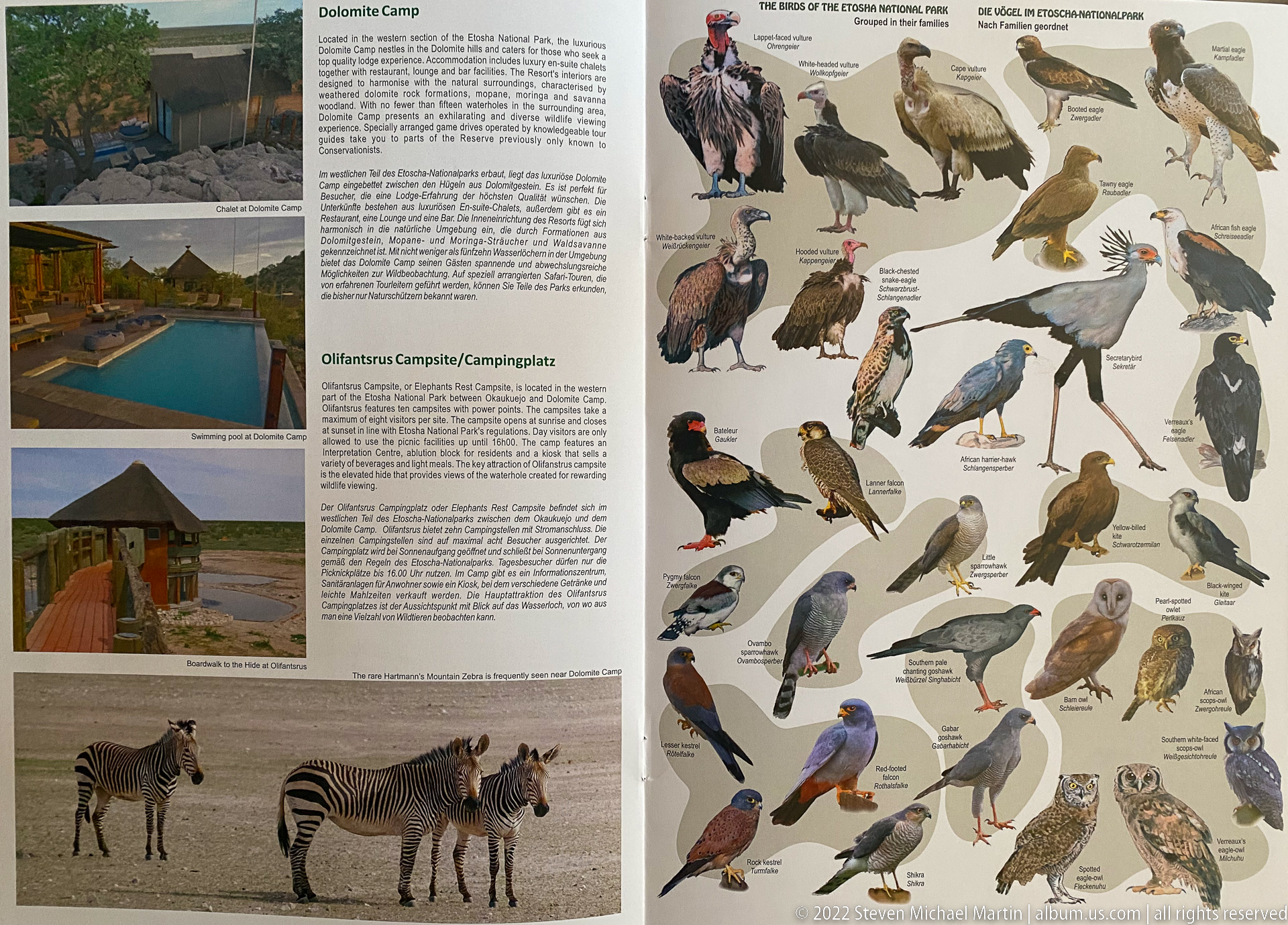
A practical campsite page faces a dense identification plate devoted to birds of prey recorded in the Etosha region. Photographs of lodging, a pool, and zebras occupy the left page, while the right arranges illustrated vultures, eagles, owls, and other raptors with labels. The juxtaposition reflects the guide’s broad scope, moving directly from visitor logistics to field identification.
Caption
A practical campsite page faces a dense identification plate devoted to birds of prey recorded in the Etosha region. Photographs of lodging, a pool, and zebras occupy the left page, while the right arranges illustrated vultures, eagles, owls, and other raptors with labels. The juxtaposition reflects the guide’s broad scope, moving directly from visitor logistics to field identification.
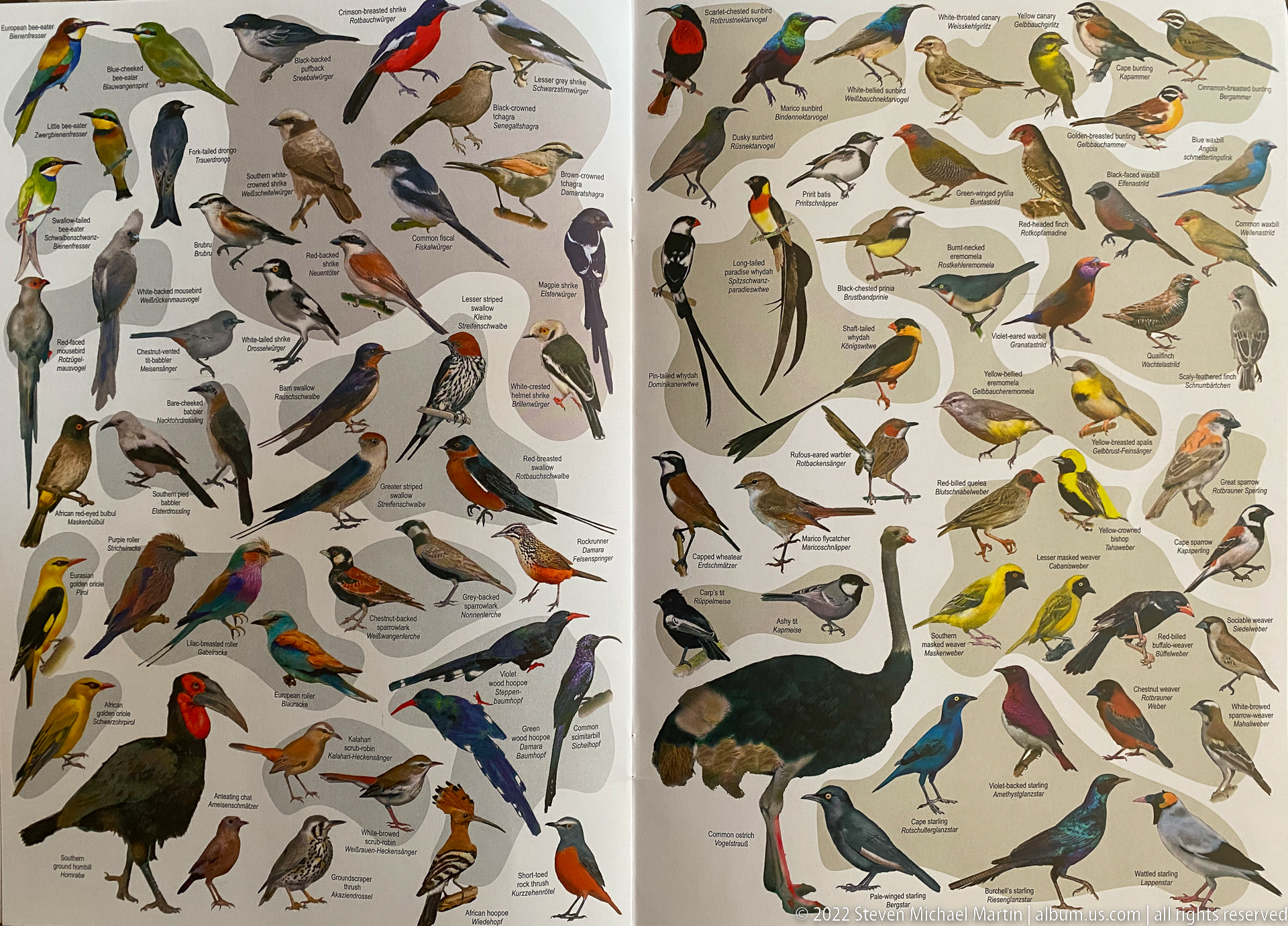
Colorful land birds fill this two-page identification spread, with dozens of labeled species arranged against a pale background. Perching forms dominate, joined by conspicuous larger birds and several vividly patterned species. The compact plate format is designed for visual comparison of plumage, body shape, bill form, and relative proportions—features central to identifying Etosha’s diverse birdlife in the field.
Caption
Colorful land birds fill this two-page identification spread, with dozens of labeled species arranged against a pale background. Perching forms dominate, joined by conspicuous larger birds and several vividly patterned species. The compact plate format is designed for visual comparison of plumage, body shape, bill form, and relative proportions—features central to identifying Etosha’s diverse birdlife in the field.
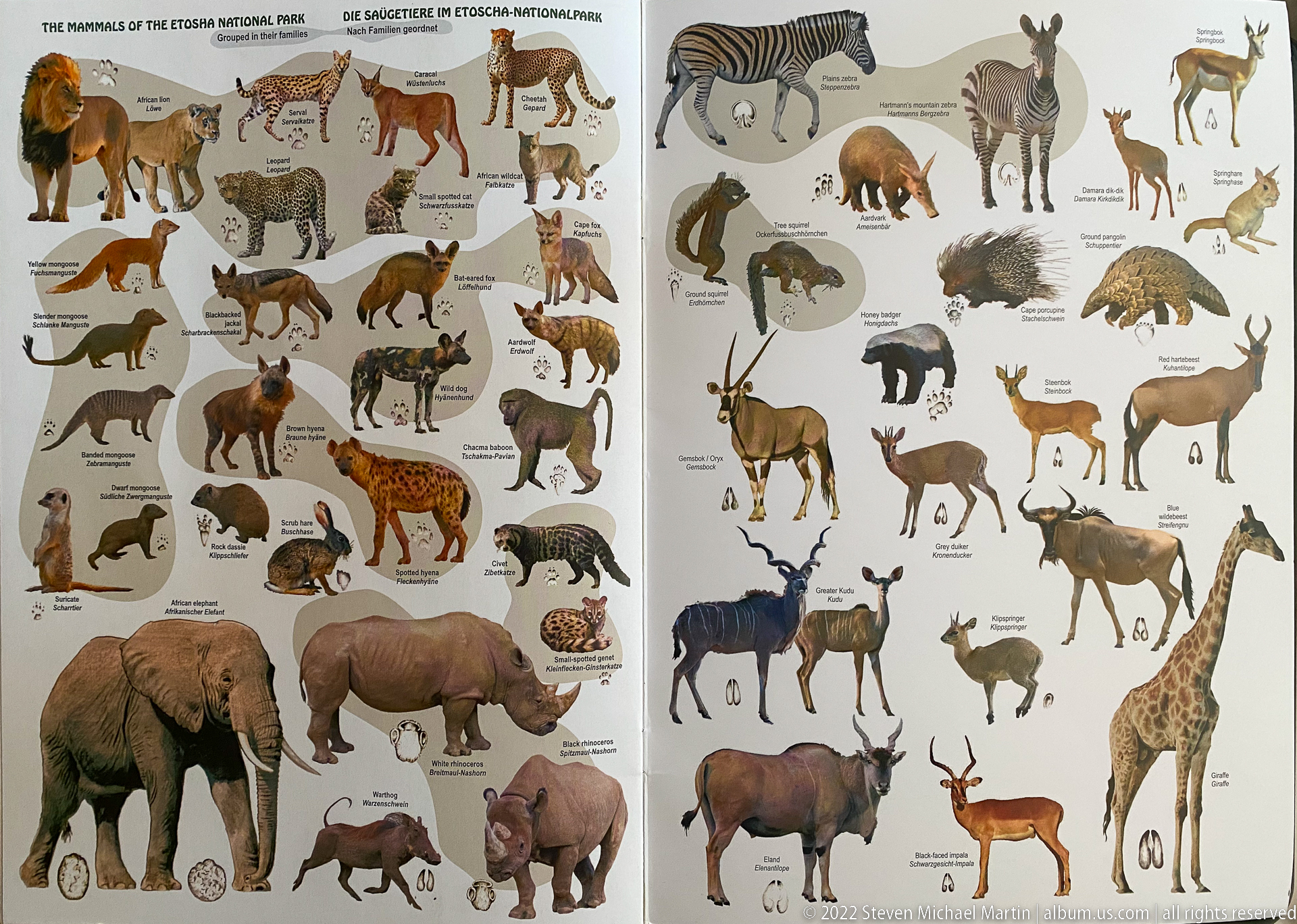
A two-page mammal plate gathers many of Etosha’s characteristic species into a single comparative reference. Carnivores, antelope, equids, primates, small mammals, and large herbivores are shown at differing scales, with elephant, rhinoceros, giraffe, zebra, and wildebeest among the most conspicuous forms. Labeled illustrations emphasize silhouette, coat pattern, horns, and body proportions used in field identification.
Caption
A two-page mammal plate gathers many of Etosha’s characteristic species into a single comparative reference. Carnivores, antelope, equids, primates, small mammals, and large herbivores are shown at differing scales, with elephant, rhinoceros, giraffe, zebra, and wildebeest among the most conspicuous forms. Labeled illustrations emphasize silhouette, coat pattern, horns, and body proportions used in field identification.


