Vianden – Luxembourg
The town of Vianden lies along the Our River in northern Luxembourg, surrounded by the forested hills of the Ardennes region. Overlooking the town from a steep ridge is the impressive Vianden Castle, one of the most remarkable medieval castles in Europe.
Constructed between the 11th and 14th centuries, the castle served as the residence of the powerful Counts of Vianden, whose influence extended across much of the region during the Middle Ages. The fortress combines Romanesque and Gothic architectural elements and dominates the surrounding valley.
Today the restored castle and its picturesque setting make Vianden one of the most scenic historic towns in Luxembourg.
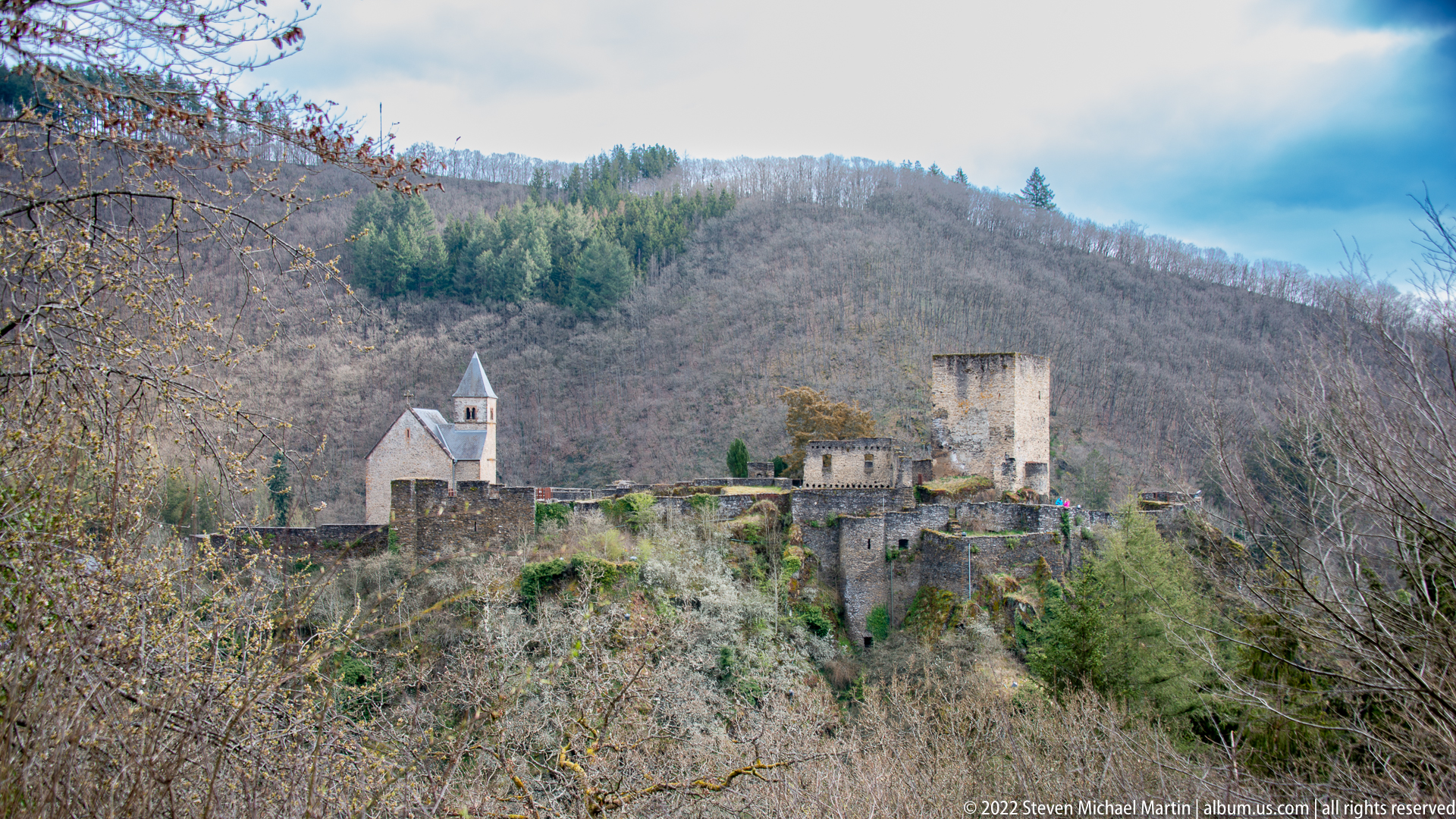
Esch-sur-Sûre Castle occupies a narrow rocky spur above the valley, with the restored castle chapel at left and surviving stone towers and walls stepping across the ridge. Leafless woodland rises immediately behind the ruins, emphasizing how the fortified site was fitted to steep terrain and commanded the confined approach through the Sûre valley.
Caption
Esch-sur-Sûre Castle occupies a narrow rocky spur above the valley, with the restored castle chapel at left and surviving stone towers and walls stepping across the ridge. Leafless woodland rises immediately behind the ruins, emphasizing how the fortified site was fitted to steep terrain and commanded the confined approach through the Sûre valley.

Vianden Castle appears at greater distance, set high above a wooded fold in the Our valley under broken clouds. The main palace roofs and towers remain legible, while the surrounding hills dominate more of the frame than in the preceding views. This wider perspective restores the strategic landscape context of the fortified residence and its commanding elevation over Vianden.
Caption
Vianden Castle appears at greater distance, set high above a wooded fold in the Our valley under broken clouds. The main palace roofs and towers remain legible, while the surrounding hills dominate more of the frame than in the preceding views. This wider perspective restores the strategic landscape context of the fortified residence and its commanding elevation over Vianden.
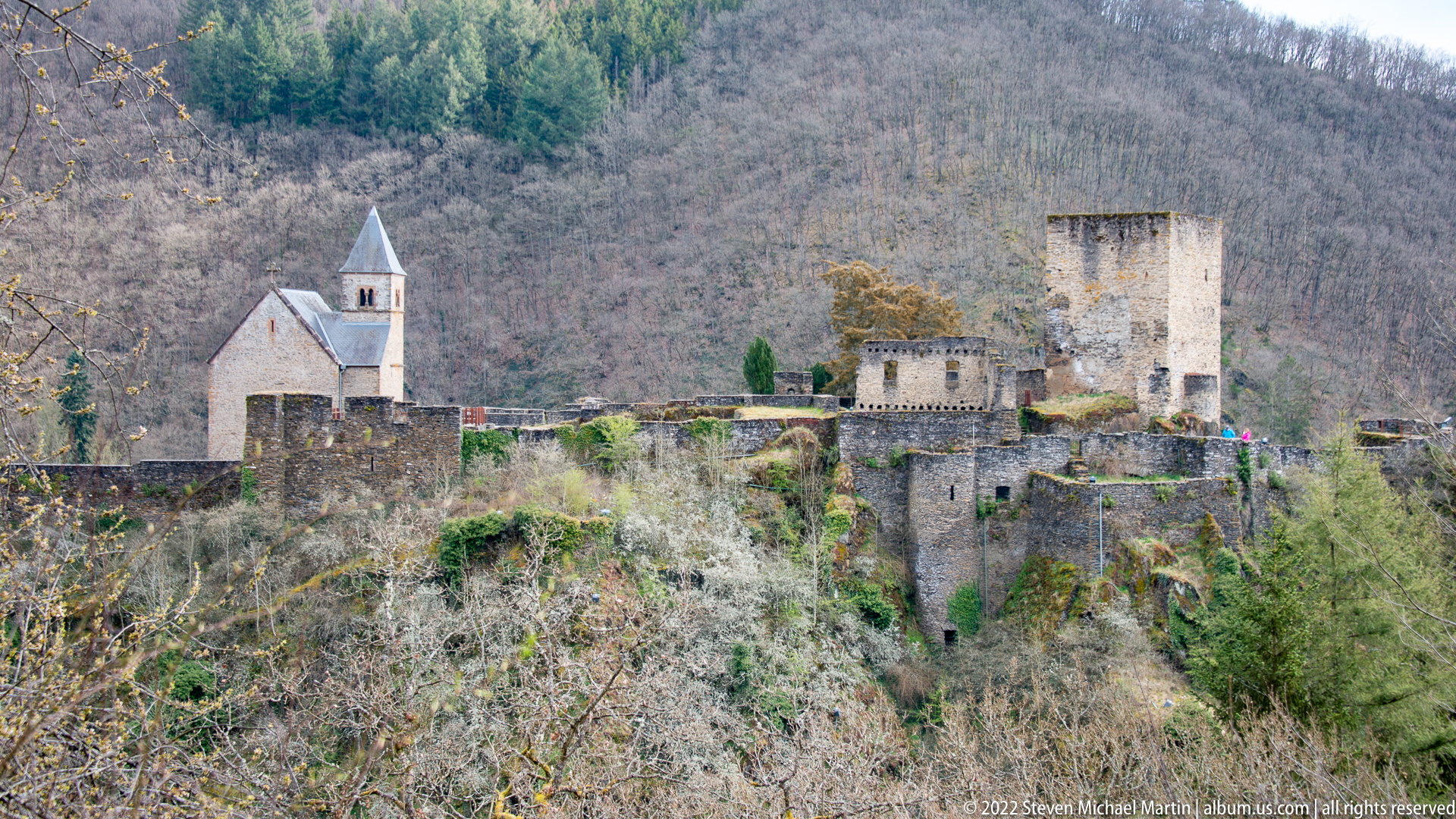
A tighter view of Esch-sur-Sûre Castle separates the rebuilt chapel from the taller, roofless medieval tower and the lower wall system between them. The steep exposed rock face below the fortification is prominent in the foreground, making the defensive advantage of the ridge legible while also distinguishing the restored religious structure from the surviving ruins.
Caption
A tighter view of Esch-sur-Sûre Castle separates the rebuilt chapel from the taller, roofless medieval tower and the lower wall system between them. The steep exposed rock face below the fortification is prominent in the foreground, making the defensive advantage of the ridge legible while also distinguishing the restored religious structure from the surviving ruins.
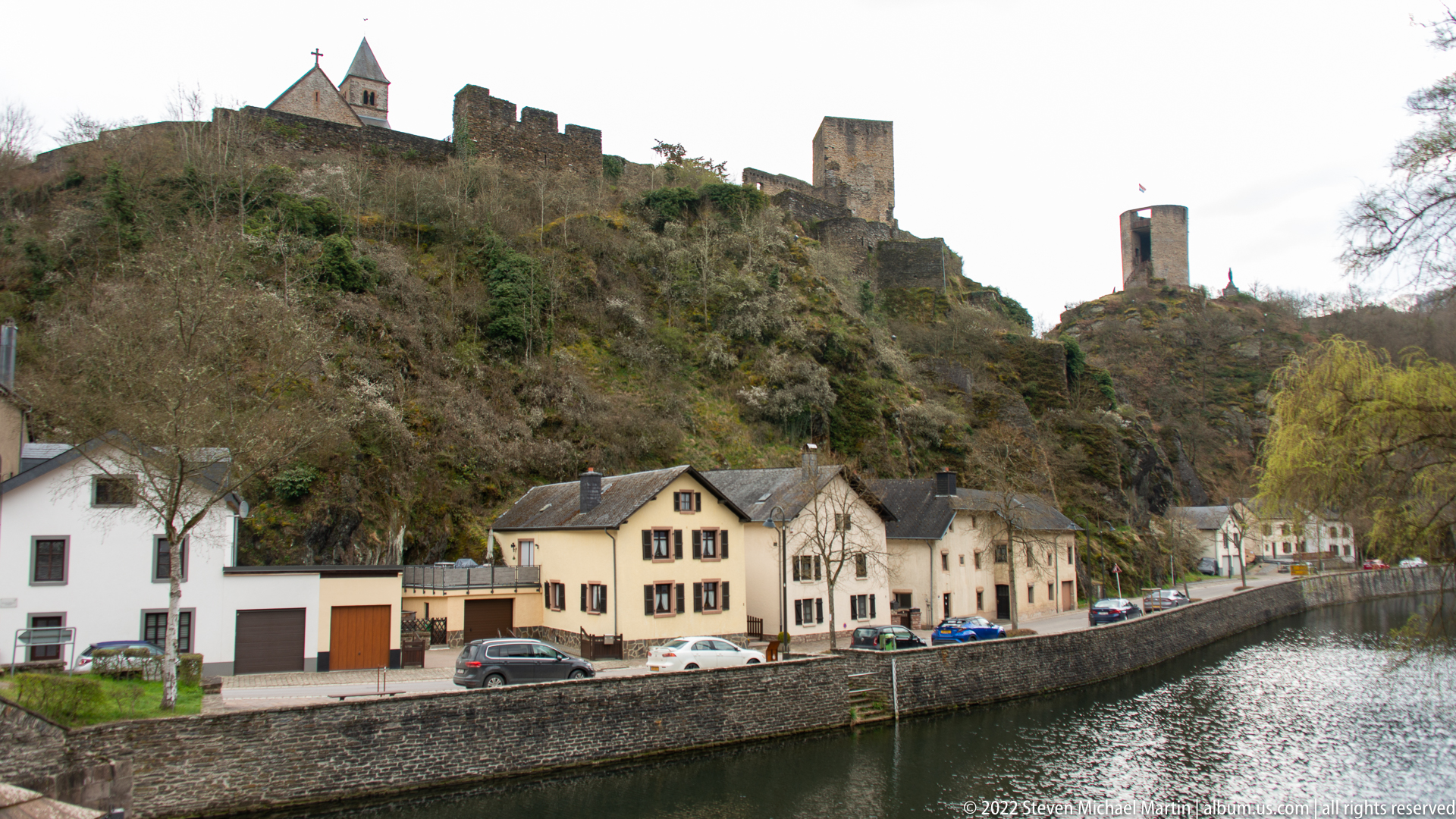
Esch-sur-Sûre Castle crowns the rocky slope above a quiet bend of the Sûre, while houses and a road occupy the narrow strip of land at water level. The ruined towers and wall fragments remain silhouetted along the ridge, visually explaining the settlement's unusual form: a compact village constrained between river, rock, and fortification.
Caption
Esch-sur-Sûre Castle crowns the rocky slope above a quiet bend of the Sûre, while houses and a road occupy the narrow strip of land at water level. The ruined towers and wall fragments remain silhouetted along the ridge, visually explaining the settlement's unusual form: a compact village constrained between river, rock, and fortification.
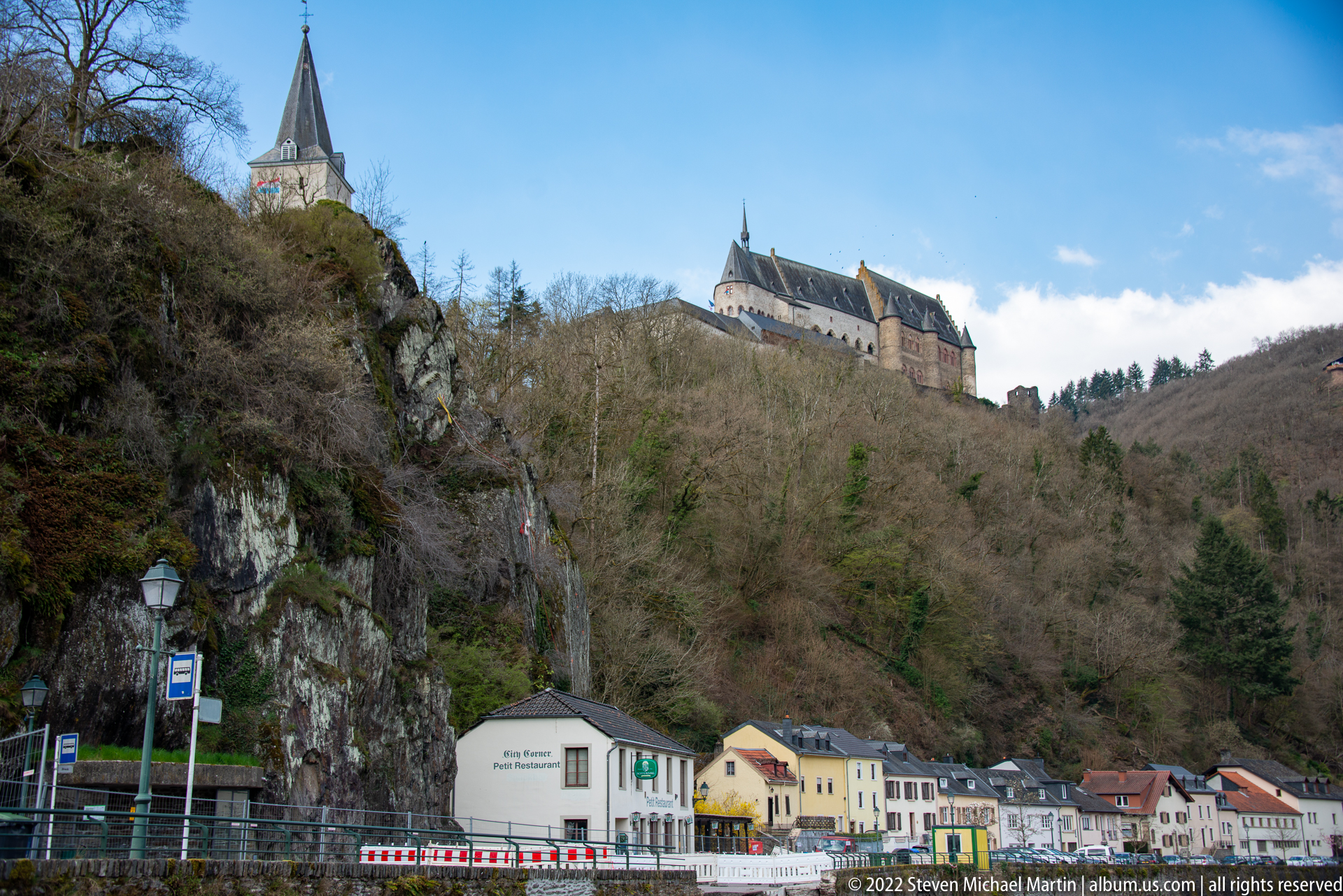
Vianden Castle crowns the ridge high above a small cluster of buildings at the base of the rocky slope. Seen from the valley, the composition reveals the dramatic vertical relationship between settlement and fortification: roadside structures occupy the foreground, exposed rock and woodland climb through the middle distance, and the castle’s long roofline and towers command the skyline.
Caption
Vianden Castle crowns the ridge high above a small cluster of buildings at the base of the rocky slope. Seen from the valley, the composition reveals the dramatic vertical relationship between settlement and fortification: roadside structures occupy the foreground, exposed rock and woodland climb through the middle distance, and the castle’s long roofline and towers command the skyline.
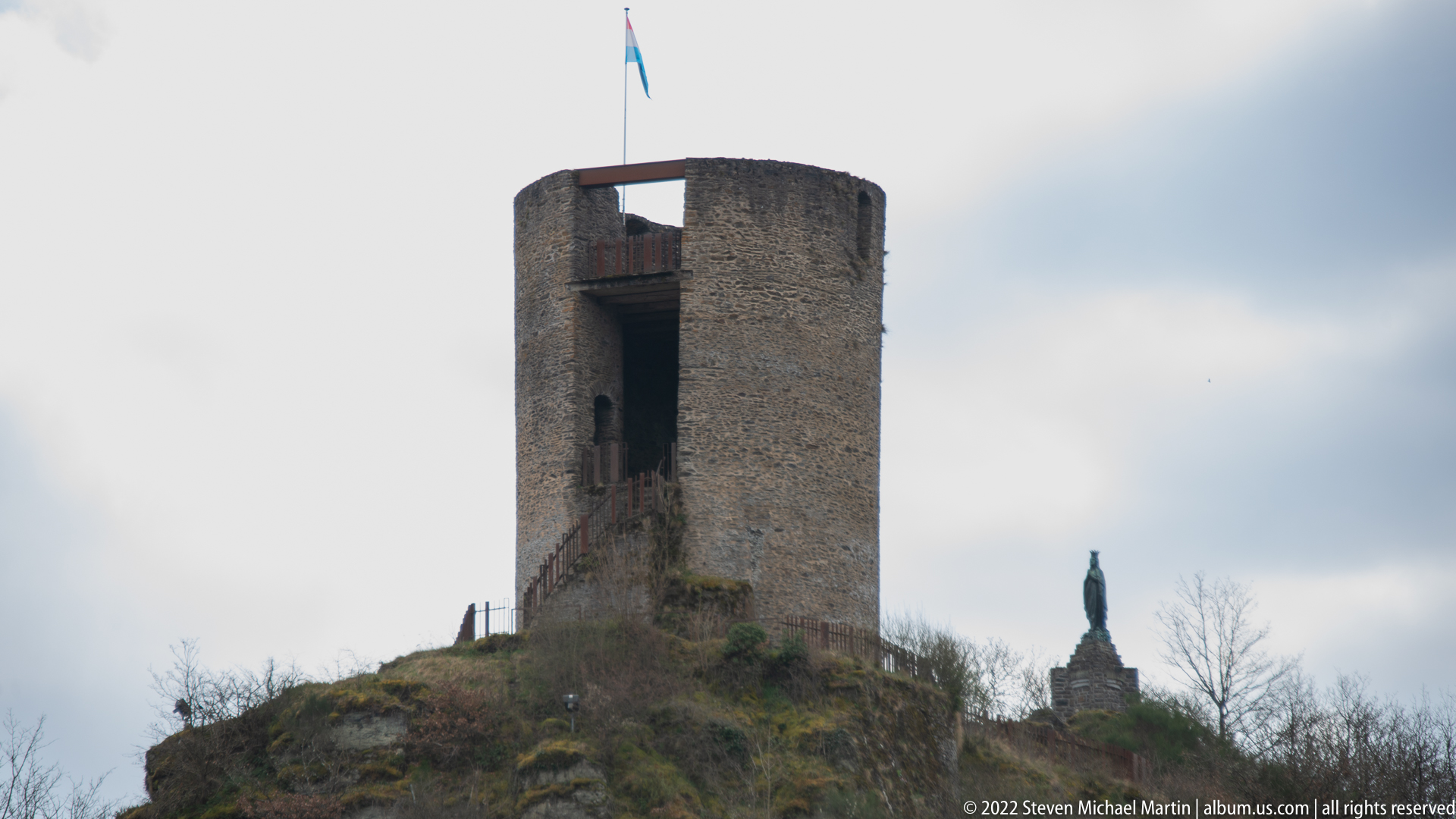
The Lochturm rises alone on the castle ridge, its thick masonry shell pierced by a large vertical opening beneath the Luxembourg flag. Seen against open sky, the detached watchtower reads as a distinct defensive element rather than part of the chapel complex, while the rocky crest below reinforces its exposed lookout position over Esch-sur-Sûre.
Caption
The Lochturm rises alone on the castle ridge, its thick masonry shell pierced by a large vertical opening beneath the Luxembourg flag. Seen against open sky, the detached watchtower reads as a distinct defensive element rather than part of the chapel complex, while the rocky crest below reinforces its exposed lookout position over Esch-sur-Sûre.
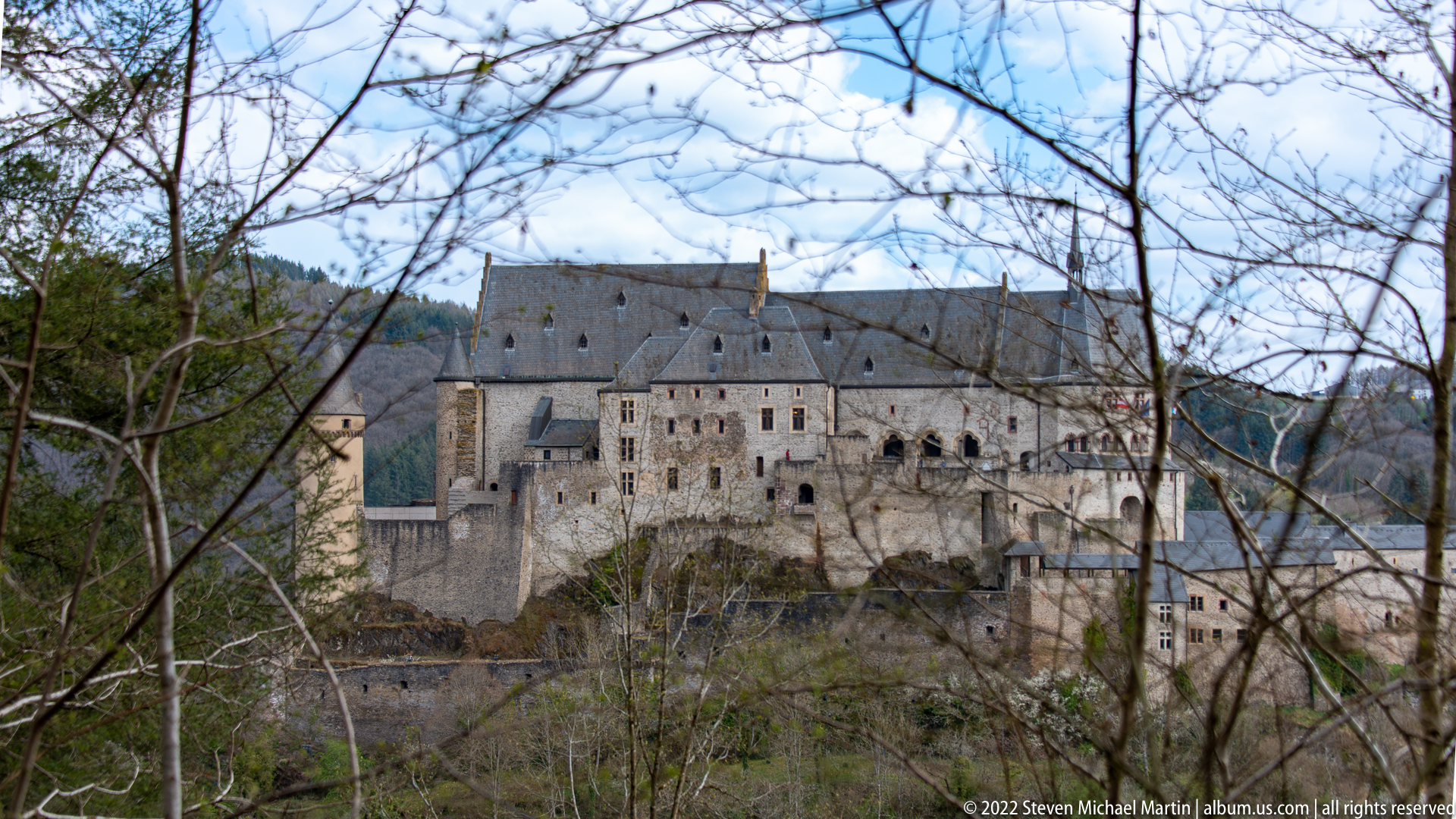
Vianden Castle stretches along its rocky hilltop above the Our valley, with steep slate roofs, tall gables, fortified walls, and projecting towers forming a continuous medieval silhouette. Leafless branches partially screen the foreground, but the elevated mass of the restored complex remains dominant, marking the transition in the portfolio from Esch-sur-Sûre to Vianden.
Caption
Vianden Castle stretches along its rocky hilltop above the Our valley, with steep slate roofs, tall gables, fortified walls, and projecting towers forming a continuous medieval silhouette. Leafless branches partially screen the foreground, but the elevated mass of the restored complex remains dominant, marking the transition in the portfolio from Esch-sur-Sûre to Vianden.
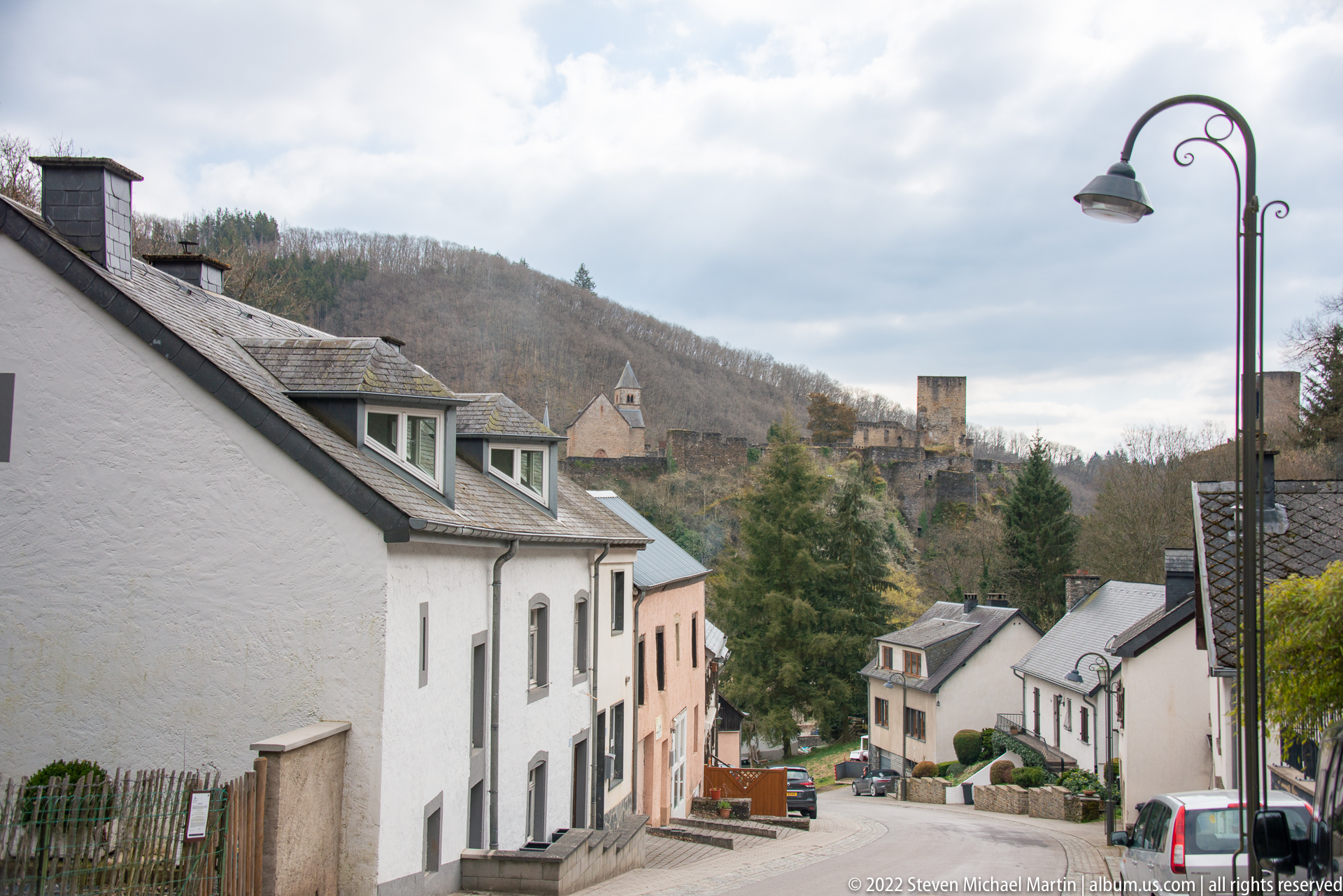
A descending residential street in Esch-sur-Sûre opens toward the castle ridge, where a roofed chapel and square ruined tower appear between village roofs and trees. Whitewashed and pastel houses occupy the foreground, creating a layered view that links the compact settlement directly to the elevated fortification above it.
Caption
A descending residential street in Esch-sur-Sûre opens toward the castle ridge, where a roofed chapel and square ruined tower appear between village roofs and trees. Whitewashed and pastel houses occupy the foreground, creating a layered view that links the compact settlement directly to the elevated fortification above it.

A substantial pale building anchors the riverfront of Esch-sur-Sûre while the restored castle chapel and ruined wall system rise immediately behind it. The parish church's narrow spire appears at the far right. By bringing the lower village and upper fortification into one compressed frame, the photograph shows how little horizontal space separates everyday buildings from the castle slope.
Caption
A substantial pale building anchors the riverfront of Esch-sur-Sûre while the restored castle chapel and ruined wall system rise immediately behind it. The parish church's narrow spire appears at the far right. By bringing the lower village and upper fortification into one compressed frame, the photograph shows how little horizontal space separates everyday buildings from the castle slope.

A blue Luxembourg border sign stands beside a wooded road, placing the sequence at the national boundary. The country name is centered within the familiar circle of European Union stars, while bare trunks and a narrow strip of roadside vegetation frame the sign and give the view a distinctly overland, arrival-oriented character.
Caption
A blue Luxembourg border sign stands beside a wooded road, placing the sequence at the national boundary. The country name is centered within the familiar circle of European Union stars, while bare trunks and a narrow strip of roadside vegetation frame the sign and give the view a distinctly overland, arrival-oriented character.
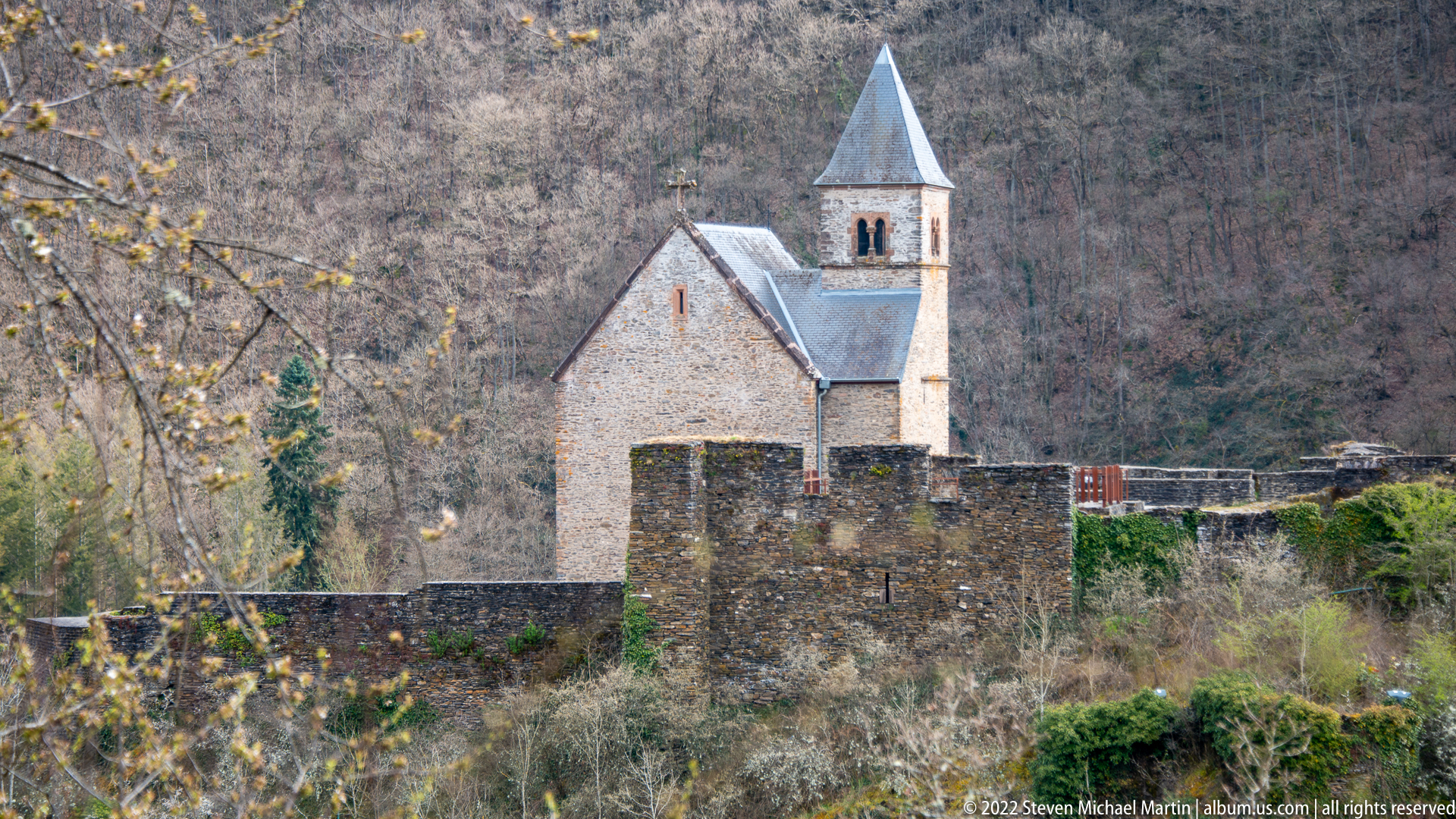
The restored chapel at Esch-sur-Sûre Castle rises behind a low belt of ruined masonry, its pale stone nave and tall, pointed-roof bell tower standing out against the brown woodland. Seen in relative isolation, the building illustrates the contrast between the roofed early-twentieth-century restoration and the fragmentary medieval defensive fabric that still surrounds it.
Caption
The restored chapel at Esch-sur-Sûre Castle rises behind a low belt of ruined masonry, its pale stone nave and tall, pointed-roof bell tower standing out against the brown woodland. Seen in relative isolation, the building illustrates the contrast between the roofed early-twentieth-century restoration and the fragmentary medieval defensive fabric that still surrounds it.

A narrow roadway crosses between stone parapets toward a cluster of traditional buildings in Esch-sur-Sûre, including the prominently signed Hôtel de la Sûre ahead. The composition compresses the village against the wooded valley wall, with varied rooflines, shuttered windows, and pale façades illustrating the intimate scale of the settlement beside the river.
Caption
A narrow roadway crosses between stone parapets toward a cluster of traditional buildings in Esch-sur-Sûre, including the prominently signed Hôtel de la Sûre ahead. The composition compresses the village against the wooded valley wall, with varied rooflines, shuttered windows, and pale façades illustrating the intimate scale of the settlement beside the river.
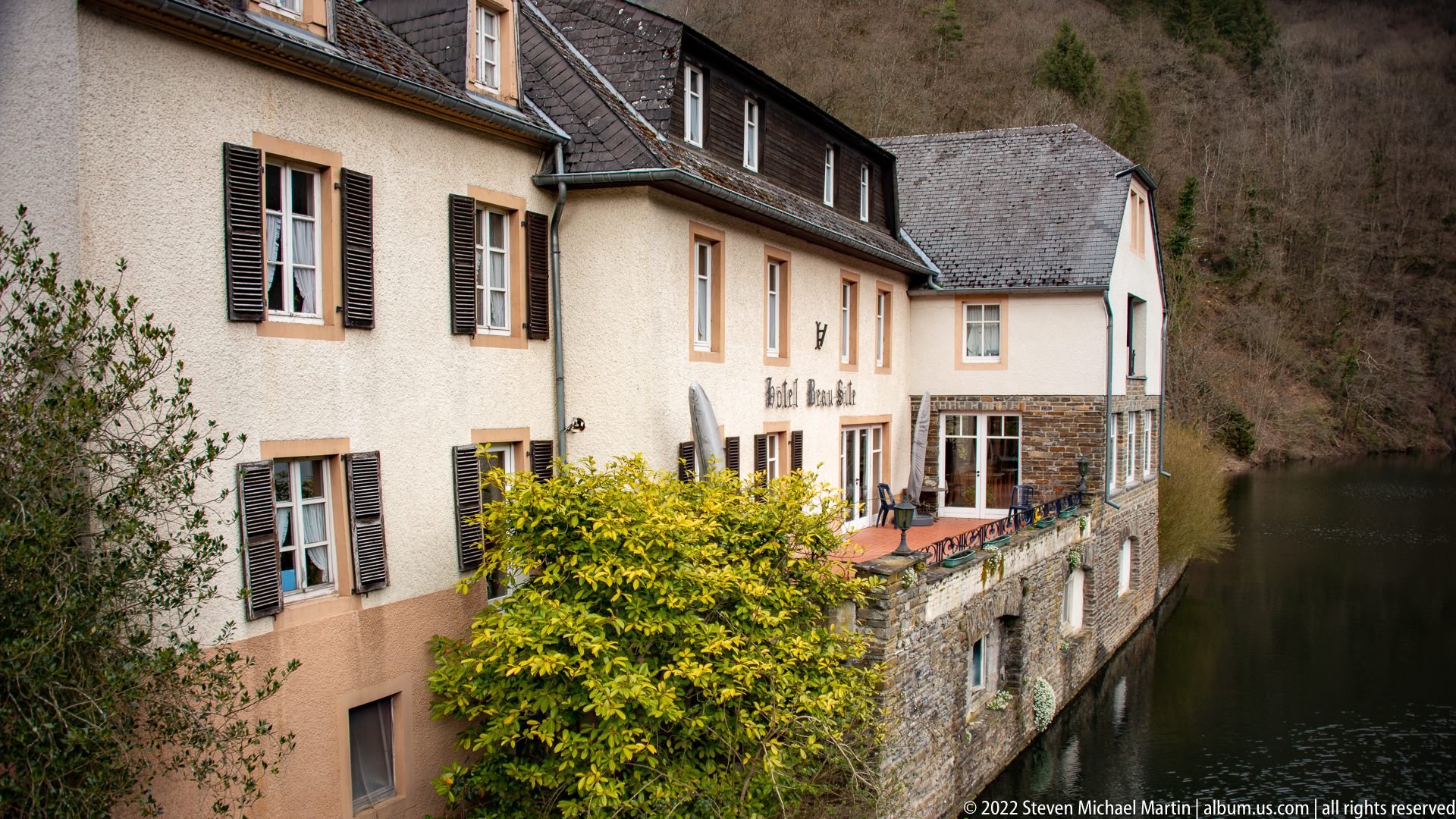
A multi-story house stands directly against the Sûre, its pale rendered walls, dark shutters, and slate roof reflected in the narrow channel below. A terrace and stone retaining wall meet the water at the building's base, showing how Esch-sur-Sûre's architecture adapts to the confined space between river and steep valley sides.
Caption
A multi-story house stands directly against the Sûre, its pale rendered walls, dark shutters, and slate roof reflected in the narrow channel below. A terrace and stone retaining wall meet the water at the building's base, showing how Esch-sur-Sûre's architecture adapts to the confined space between river and steep valley sides.
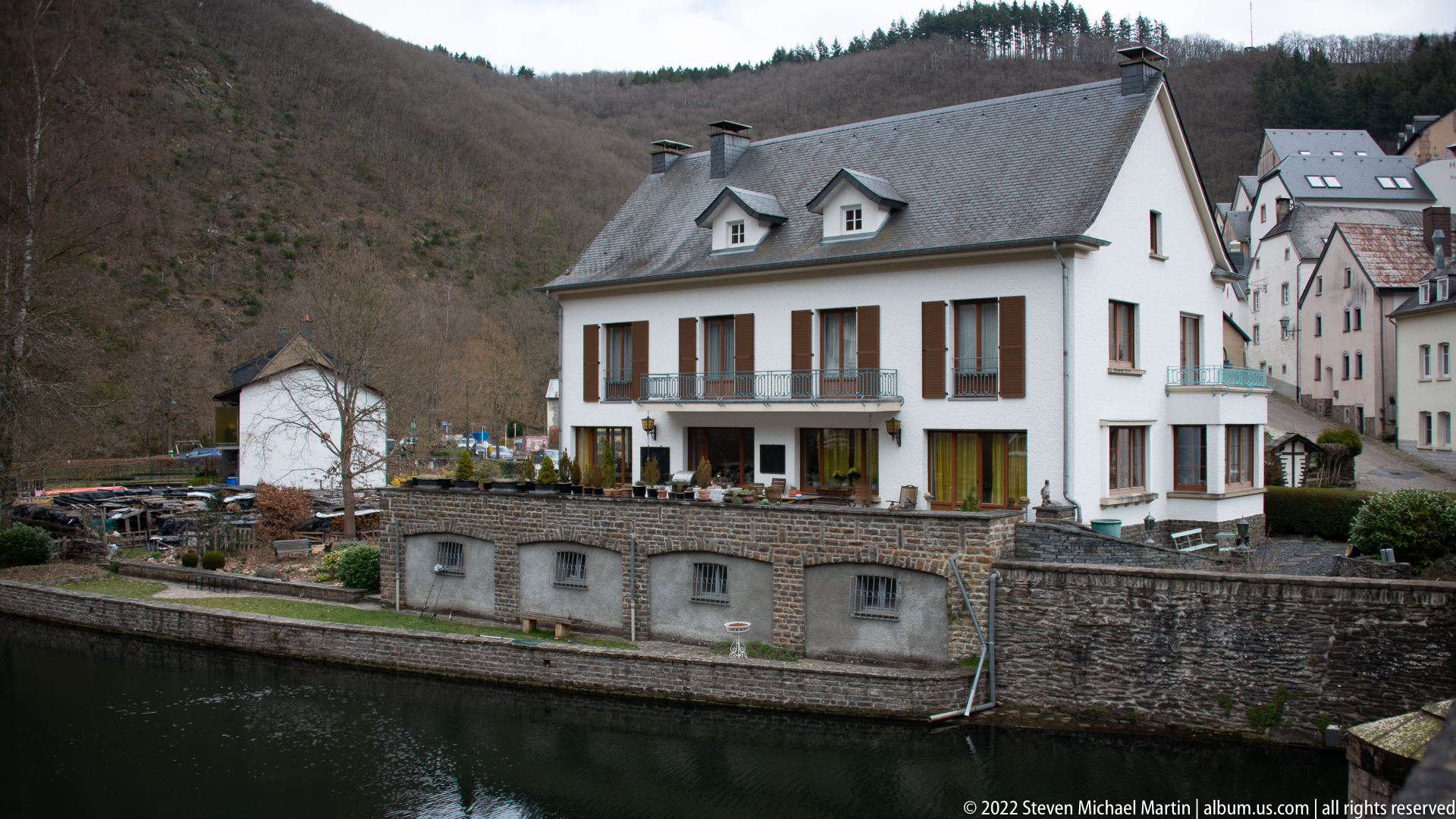
The riverside hotel complex in Esch-sur-Sûre presents a broad white façade above a stone embankment, with rows of dark shutters, dormer windows, and a terrace facing the water. Its restrained proportions and slate roof echo neighboring village architecture, while the tight river edge demonstrates how substantial buildings were fitted into the narrow valley floor.
Caption
The riverside hotel complex in Esch-sur-Sûre presents a broad white façade above a stone embankment, with rows of dark shutters, dormer windows, and a terrace facing the water. Its restrained proportions and slate roof echo neighboring village architecture, while the tight river edge demonstrates how substantial buildings were fitted into the narrow valley floor.
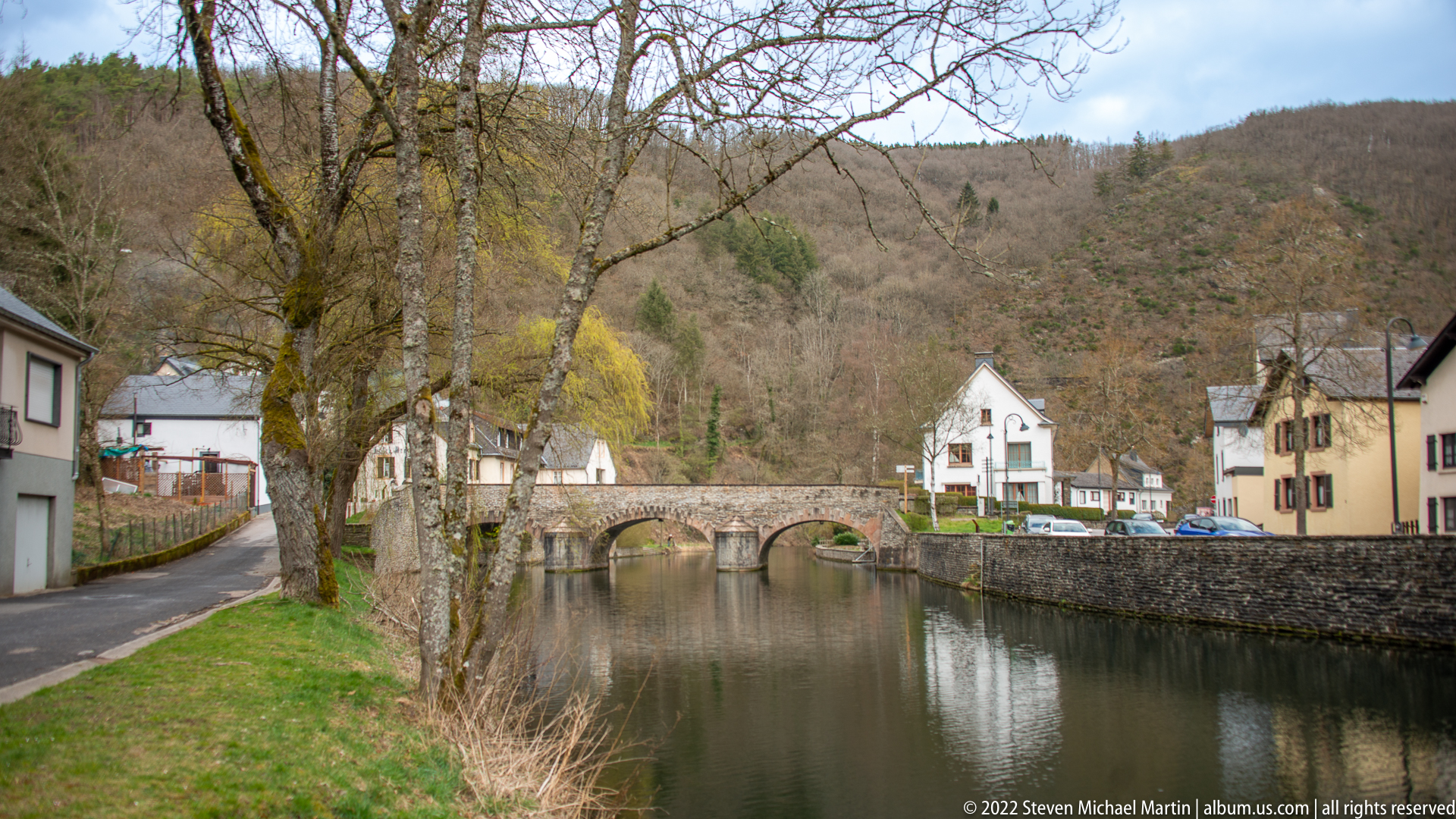
A low stone bridge crosses the Sûre at the edge of Esch-sur-Sûre, its multiple rounded arches reflected in calm water. Bare trees line the left bank and compact houses gather beyond the crossing, producing a quieter civic landscape than the castle views while still showing the masonry infrastructure that links both sides of the constrained river settlement.
Caption
A low stone bridge crosses the Sûre at the edge of Esch-sur-Sûre, its multiple rounded arches reflected in calm water. Bare trees line the left bank and compact houses gather beyond the crossing, producing a quieter civic landscape than the castle views while still showing the masonry infrastructure that links both sides of the constrained river settlement.
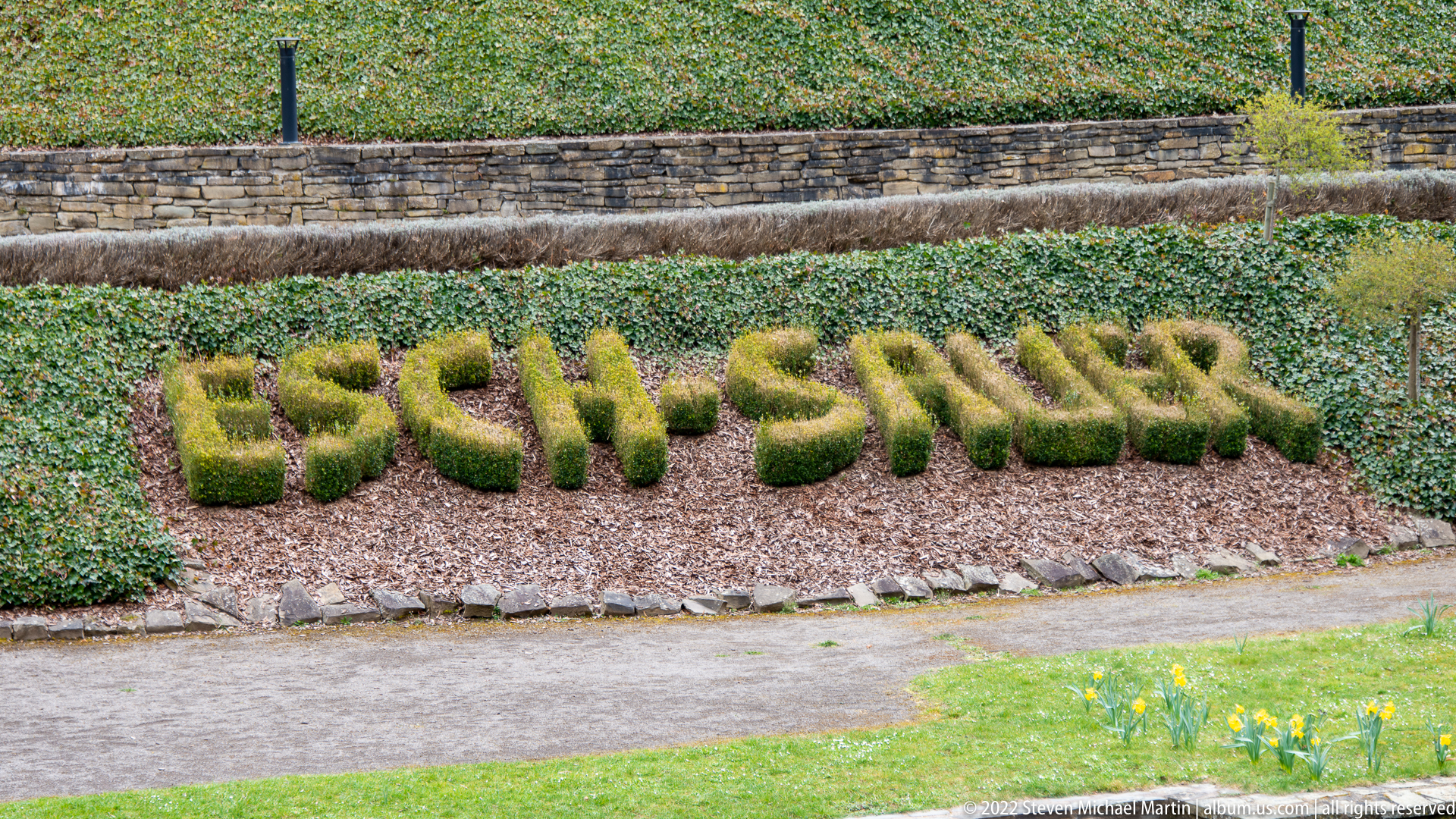
Clipped hedge letters spell ESCH-SUR-SURE across a planted slope, functioning as a landscaped place marker for the village. The dark green topiary contrasts with reddish mulch and low groundcover, while a retaining wall behind the planting situates the sign within a carefully maintained public landscape rather than the medieval fabric seen elsewhere in the portfolio.
Caption
Clipped hedge letters spell ESCH-SUR-SURE across a planted slope, functioning as a landscaped place marker for the village. The dark green topiary contrasts with reddish mulch and low groundcover, while a retaining wall behind the planting situates the sign within a carefully maintained public landscape rather than the medieval fabric seen elsewhere in the portfolio.
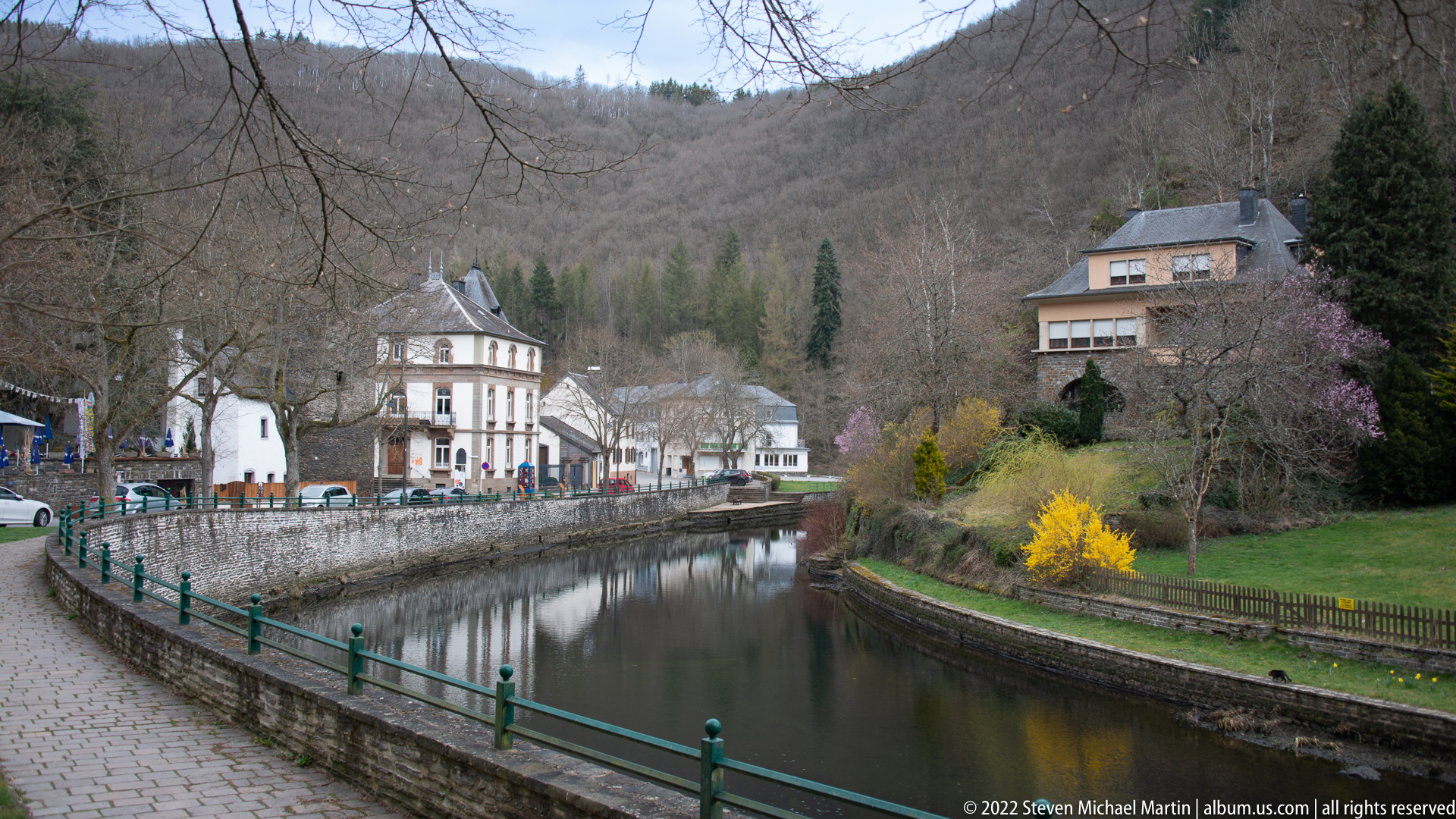
The Sûre curves through Esch-sur-Sûre between stone embankments, with a paved riverside walk on one bank and gardens rising toward houses on the other. Traditional buildings cluster at the bend beneath wooded slopes, giving a clear sense of the village's compact valley setting and the river's role in shaping its street pattern and built form.
Caption
The Sûre curves through Esch-sur-Sûre between stone embankments, with a paved riverside walk on one bank and gardens rising toward houses on the other. Traditional buildings cluster at the bend beneath wooded slopes, giving a clear sense of the village's compact valley setting and the river's role in shaping its street pattern and built form.
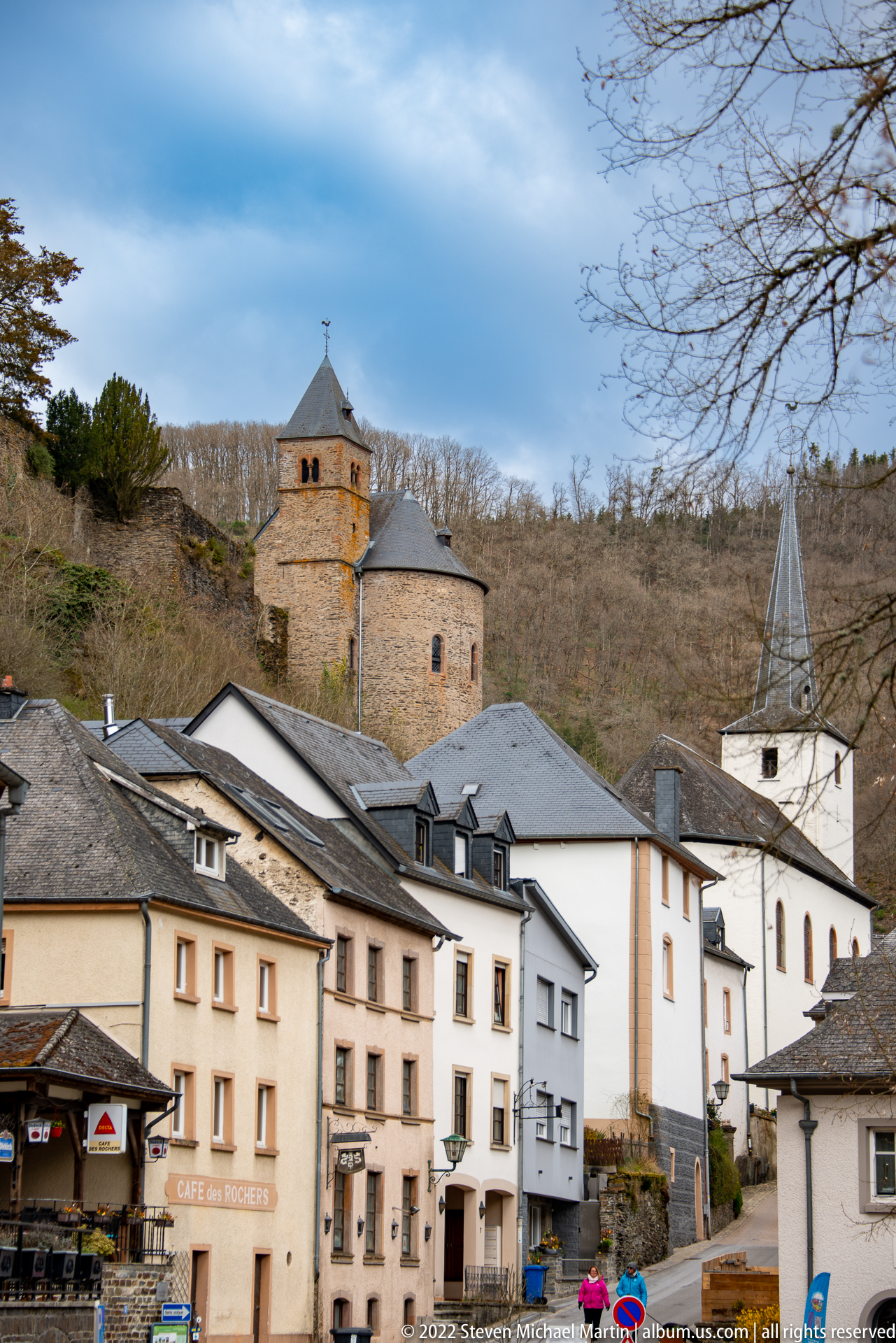
Two religious landmarks rise above Esch-sur-Sûre's close-set houses: the restored castle chapel, with its rounded apse and stone tower, occupies the higher slope, while the white parish church spire stands to the right. Their overlapping silhouettes show how the castle complex and the village's later ecclesiastical center share the same steep, densely built setting.
Caption
Two religious landmarks rise above Esch-sur-Sûre's close-set houses: the restored castle chapel, with its rounded apse and stone tower, occupies the higher slope, while the white parish church spire stands to the right. Their overlapping silhouettes show how the castle complex and the village's later ecclesiastical center share the same steep, densely built setting.
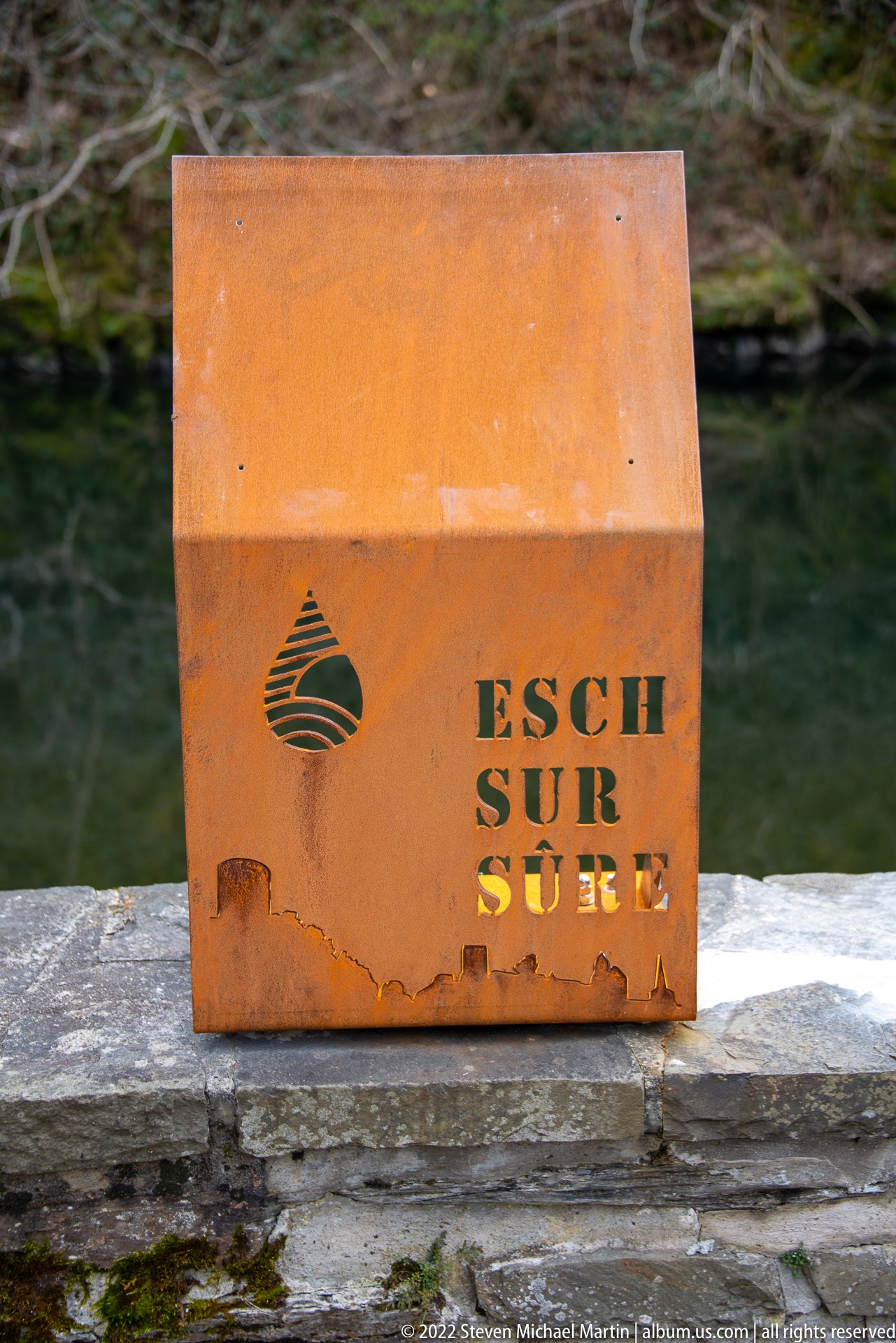
A rust-colored metal block bears a cut-out landscape emblem and the words ESCH SUR SURE, serving as a compact contemporary place marker. Set on a stone wall with dark water and vegetation behind, the object contrasts deliberately with the natural and medieval surroundings through its geometric form, weathered steel surface, and stencil-like lettering.
Caption
A rust-colored metal block bears a cut-out landscape emblem and the words ESCH SUR SURE, serving as a compact contemporary place marker. Set on a stone wall with dark water and vegetation behind, the object contrasts deliberately with the natural and medieval surroundings through its geometric form, weathered steel surface, and stencil-like lettering.
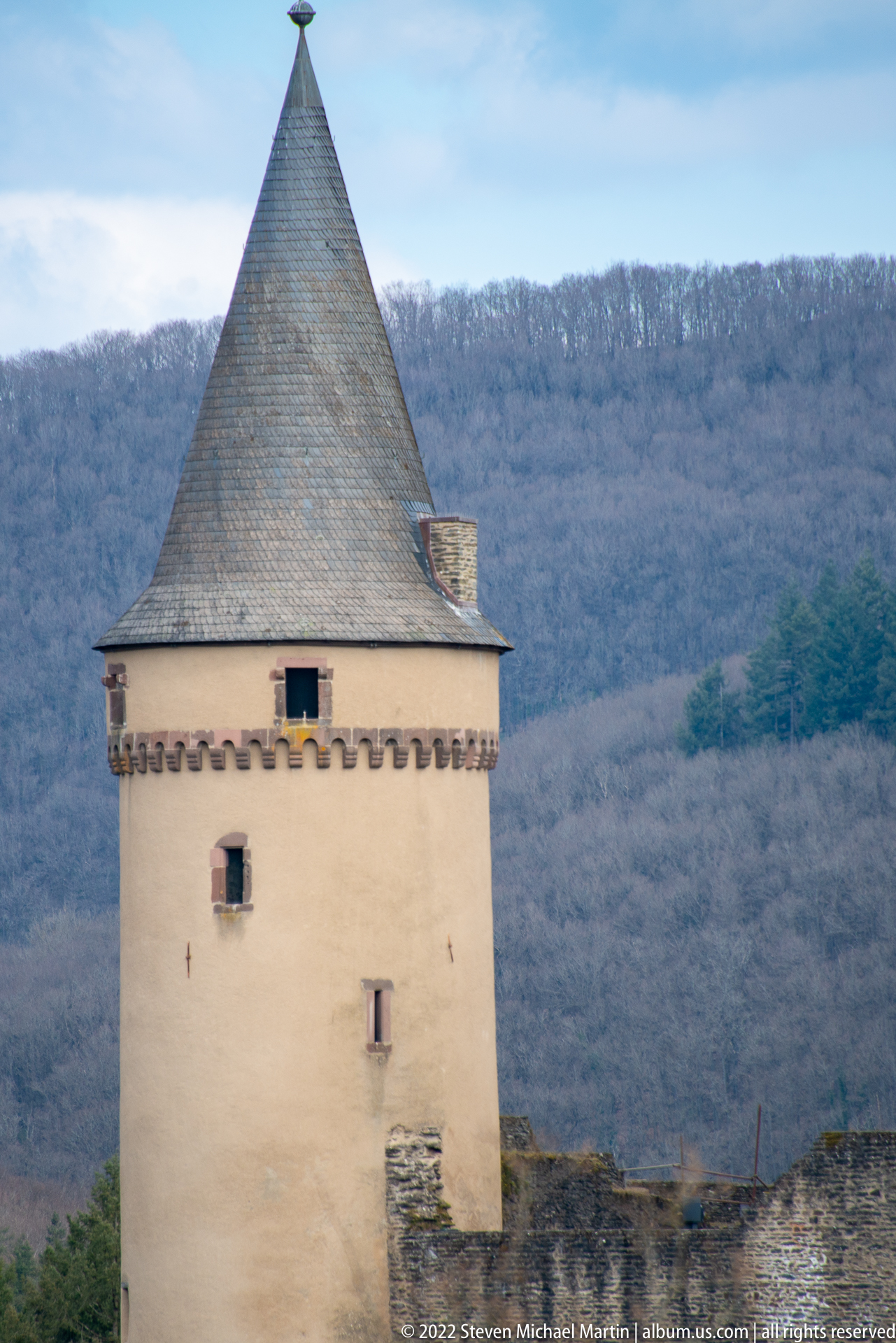
A pale rectangular defensive tower stands above a surviving stretch of rough stone wall at Vianden Castle. Its steep pyramidal slate roof, small square openings, and projecting corbel-like masonry create a markedly more utilitarian profile than the castle's ornate palace ranges. The wooded hillside behind isolates the tower's compact geometry and makes its defensive character especially readable.
Caption
A pale rectangular defensive tower stands above a surviving stretch of rough stone wall at Vianden Castle. Its steep pyramidal slate roof, small square openings, and projecting corbel-like masonry create a markedly more utilitarian profile than the castle's ornate palace ranges. The wooded hillside behind isolates the tower's compact geometry and makes its defensive character especially readable.
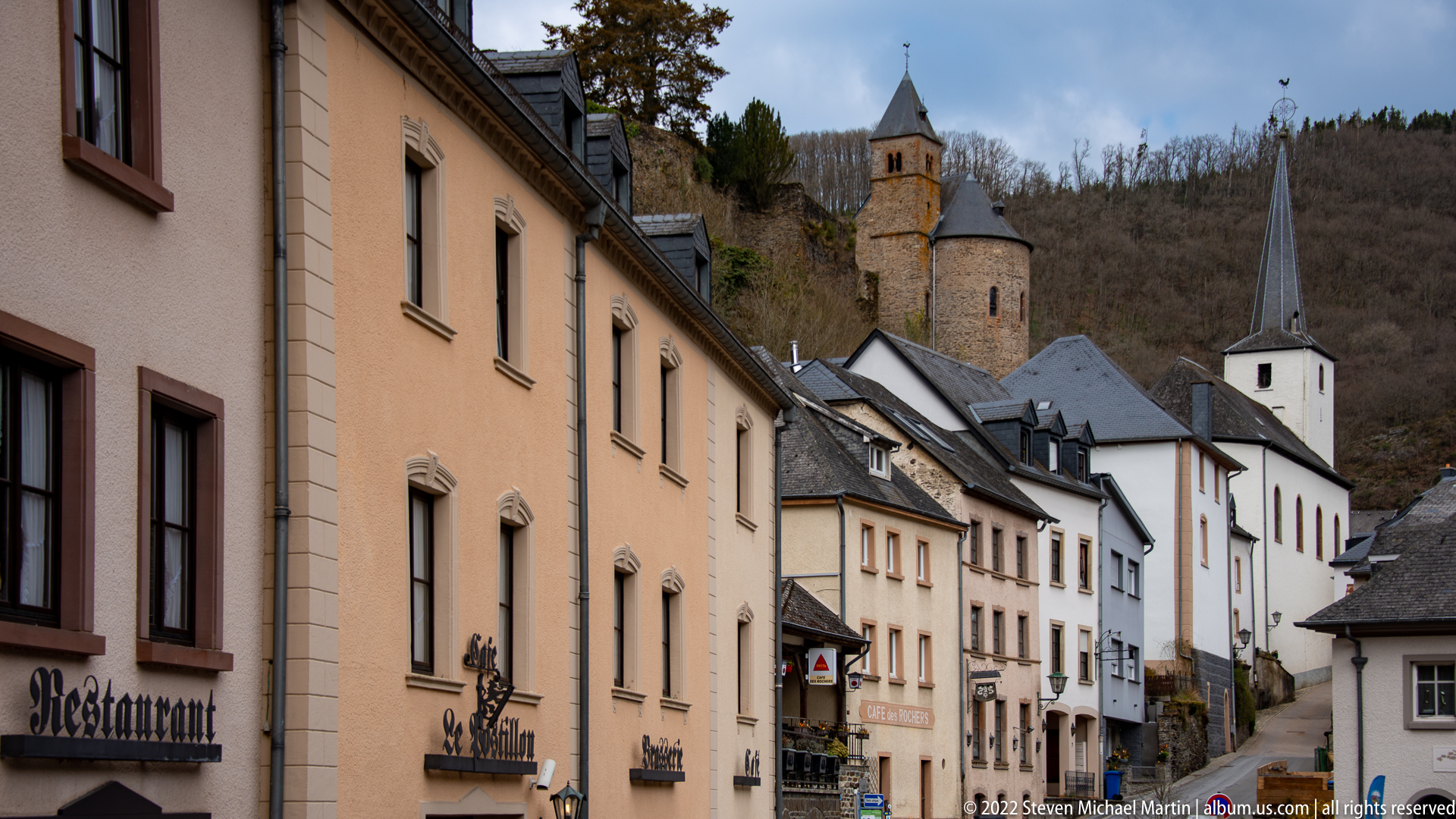
A narrow street of rendered houses leads the eye toward Esch-sur-Sûre's paired religious landmarks. The stone castle chapel and its tower rise behind the roofline, while the white spire of the Church of the Nativity of the Blessed Virgin Mary punctuates the right side. The compressed perspective emphasizes the village's steep terrain and unusually close relationship between domestic and fortified architecture.
Caption
A narrow street of rendered houses leads the eye toward Esch-sur-Sûre's paired religious landmarks. The stone castle chapel and its tower rise behind the roofline, while the white spire of the Church of the Nativity of the Blessed Virgin Mary punctuates the right side. The compressed perspective emphasizes the village's steep terrain and unusually close relationship between domestic and fortified architecture.
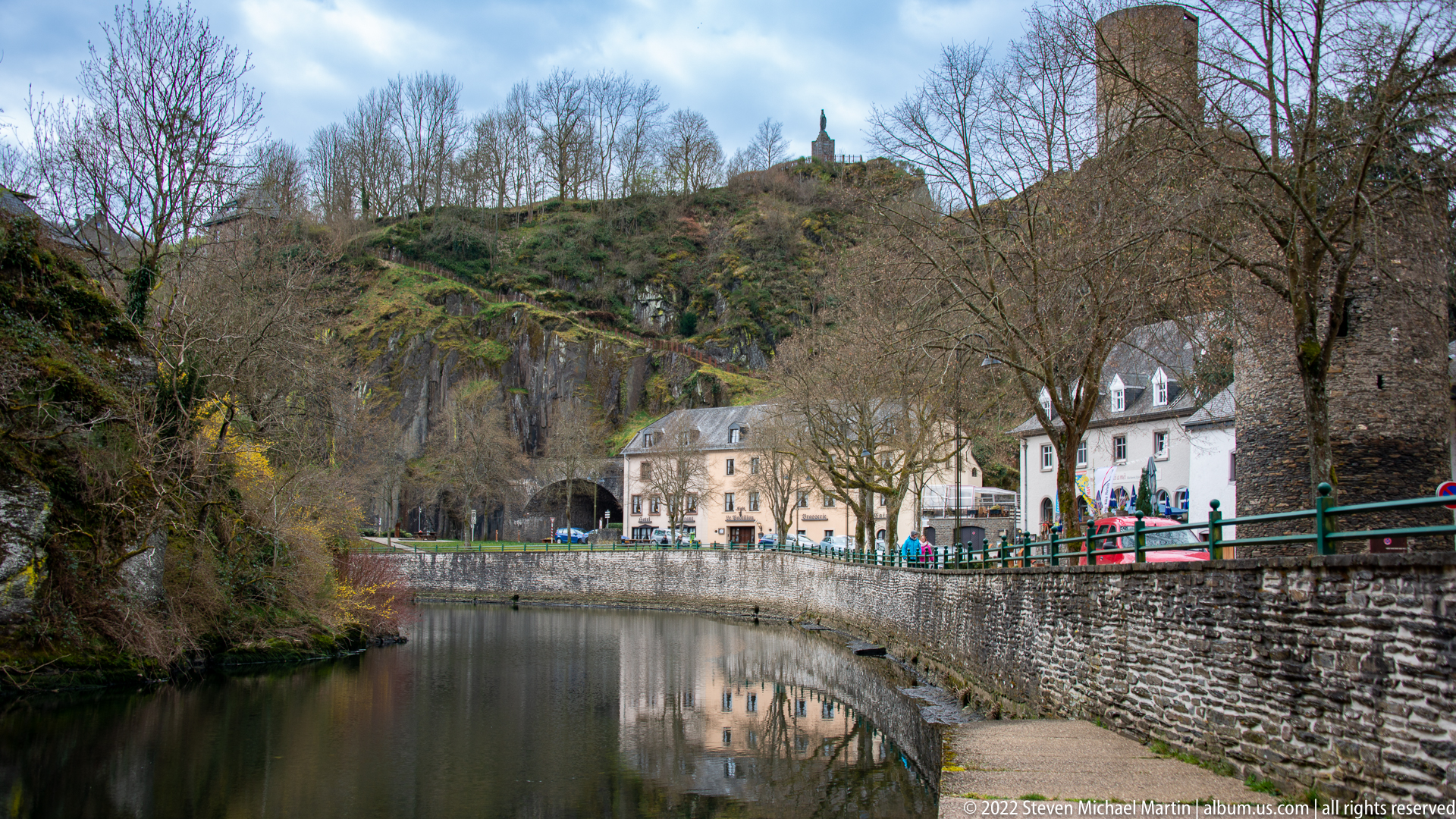
The Sûre runs beneath a dark rock face at Esch-sur-Sûre, with riverside buildings and a stone embankment compressed between the water and cliff. Above the trees, fragments of the castle occupy the ridge crest. The view stresses the dramatic vertical layering of river, settlement, rock, and fortification that defines the site.
Caption
The Sûre runs beneath a dark rock face at Esch-sur-Sûre, with riverside buildings and a stone embankment compressed between the water and cliff. Above the trees, fragments of the castle occupy the ridge crest. The view stresses the dramatic vertical layering of river, settlement, rock, and fortification that defines the site.
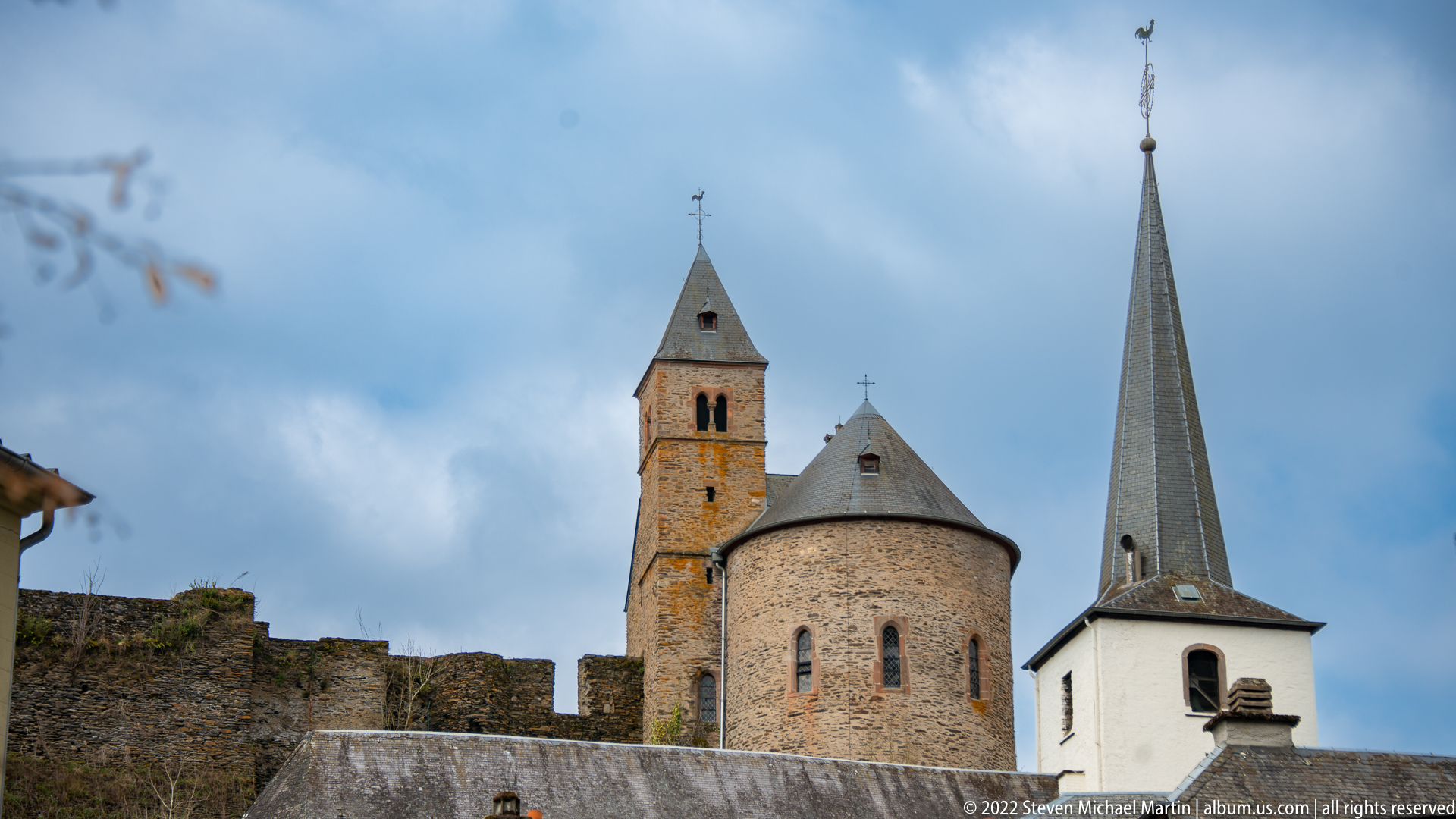
The restored castle chapel and the Church of the Nativity of the Blessed Virgin Mary appear side by side against the sky, revealing their contrasting masonry and roof forms. The chapel's rounded stone apse and square bell tower occupy the left, while the parish church's white tower and slender slate spire rise at right above the surviving castle wall.
Caption
The restored castle chapel and the Church of the Nativity of the Blessed Virgin Mary appear side by side against the sky, revealing their contrasting masonry and roof forms. The chapel's rounded stone apse and square bell tower occupy the left, while the parish church's white tower and slender slate spire rise at right above the surviving castle wall.
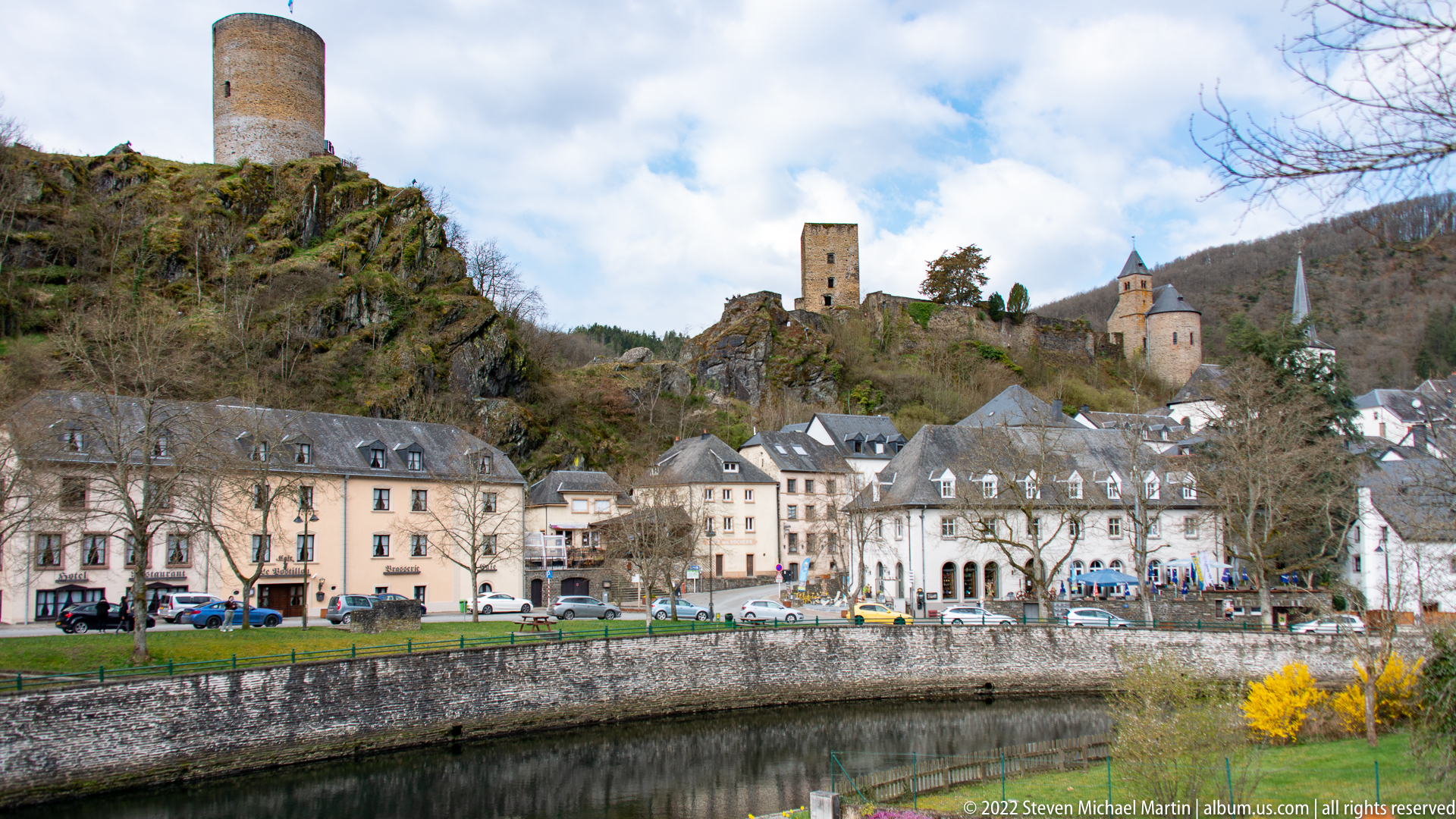
A broad view across the Sûre gathers Esch-sur-Sûre's riverfront buildings beneath the castle ridge. The square ruined tower stands left of the restored chapel, while the parish church spire rises farther right. The arrangement makes the village's defensive topography especially clear, with civic and domestic buildings occupying the narrow floor below the fortified heights.
Caption
A broad view across the Sûre gathers Esch-sur-Sûre's riverfront buildings beneath the castle ridge. The square ruined tower stands left of the restored chapel, while the parish church spire rises farther right. The arrangement makes the village's defensive topography especially clear, with civic and domestic buildings occupying the narrow floor below the fortified heights.
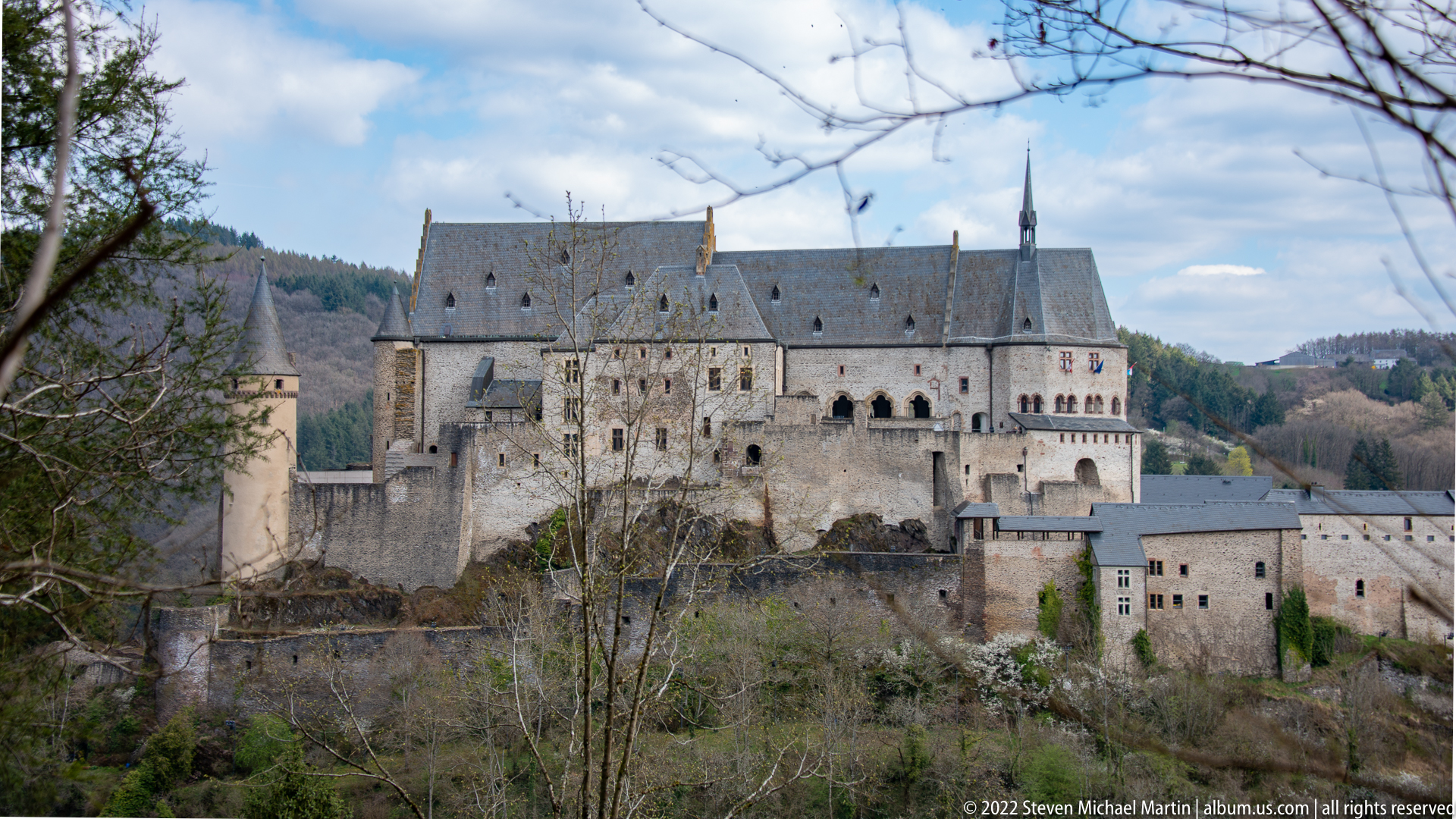
Vianden Castle fills the frame in a clear profile view, exposing the layered relationship between its high-roofed palace buildings, round towers, lower defensive walls, and service ranges. The pale stone masonry stands out against the wooded hills, while the staggered structures descending the slope demonstrate how the residence expanded across the narrow rocky platform.
Caption
Vianden Castle fills the frame in a clear profile view, exposing the layered relationship between its high-roofed palace buildings, round towers, lower defensive walls, and service ranges. The pale stone masonry stands out against the wooded hills, while the staggered structures descending the slope demonstrate how the residence expanded across the narrow rocky platform.
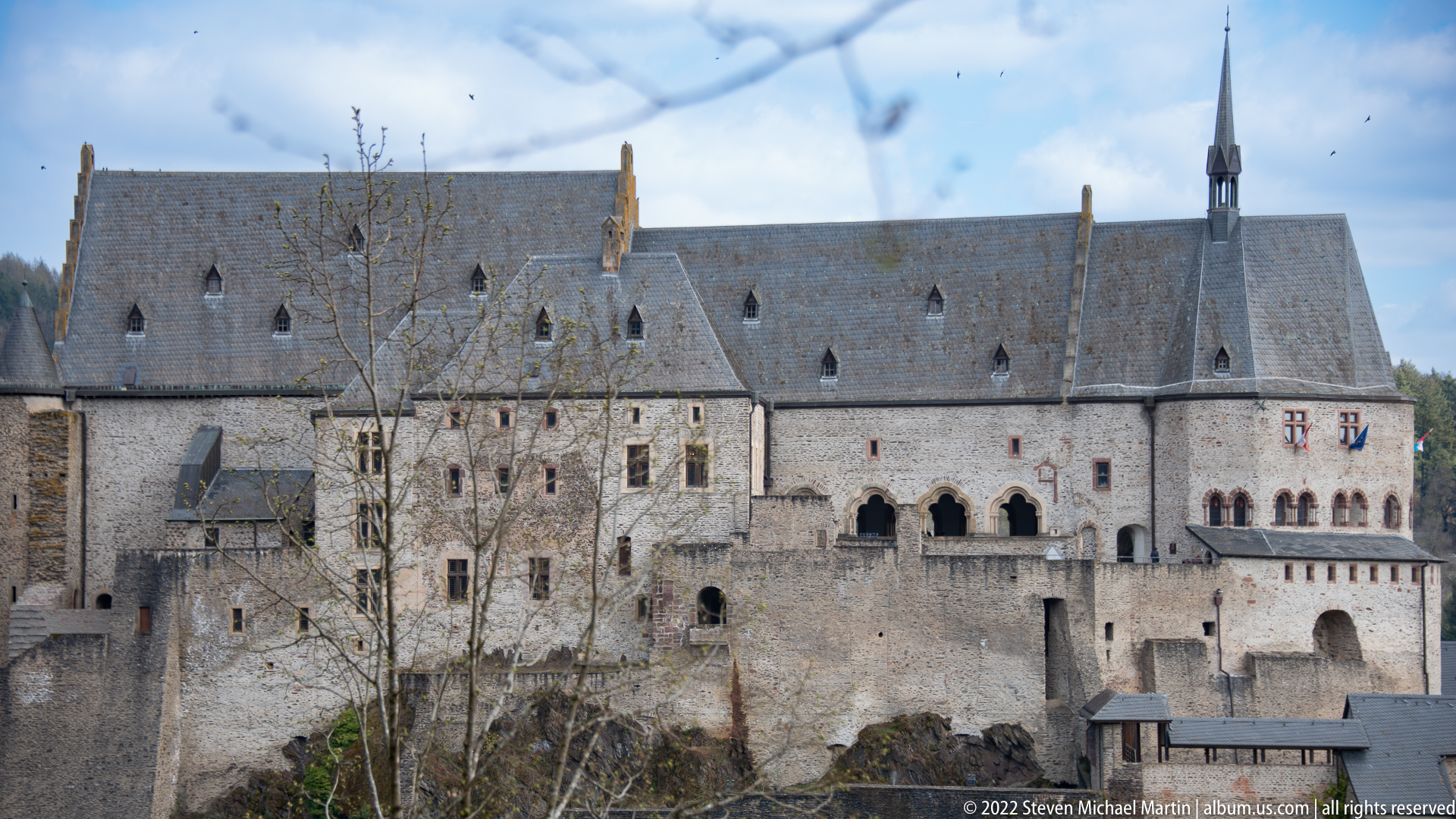
A closer view isolates the central mass of Vianden Castle, where tall slate roofs, steep gables, rows of small openings, arcaded windows, and heraldic panels animate the pale stone façade. The lower wall and entrance structures remain visible beneath the main range, allowing the residential architecture to be read together with the fortress envelope that supports it.
Caption
A closer view isolates the central mass of Vianden Castle, where tall slate roofs, steep gables, rows of small openings, arcaded windows, and heraldic panels animate the pale stone façade. The lower wall and entrance structures remain visible beneath the main range, allowing the residential architecture to be read together with the fortress envelope that supports it.

Vianden Castle rises dramatically above the camera, with a round corner tower, steep gables, high slate roofs, and massive lower masonry stacked on the rocky slope. The low viewpoint accentuates the vertical separation between outer defenses and residential ranges, while the reconstructed roofscape restores the monument's dense medieval silhouette.
Caption
Vianden Castle rises dramatically above the camera, with a round corner tower, steep gables, high slate roofs, and massive lower masonry stacked on the rocky slope. The low viewpoint accentuates the vertical separation between outer defenses and residential ranges, while the reconstructed roofscape restores the monument's dense medieval silhouette.
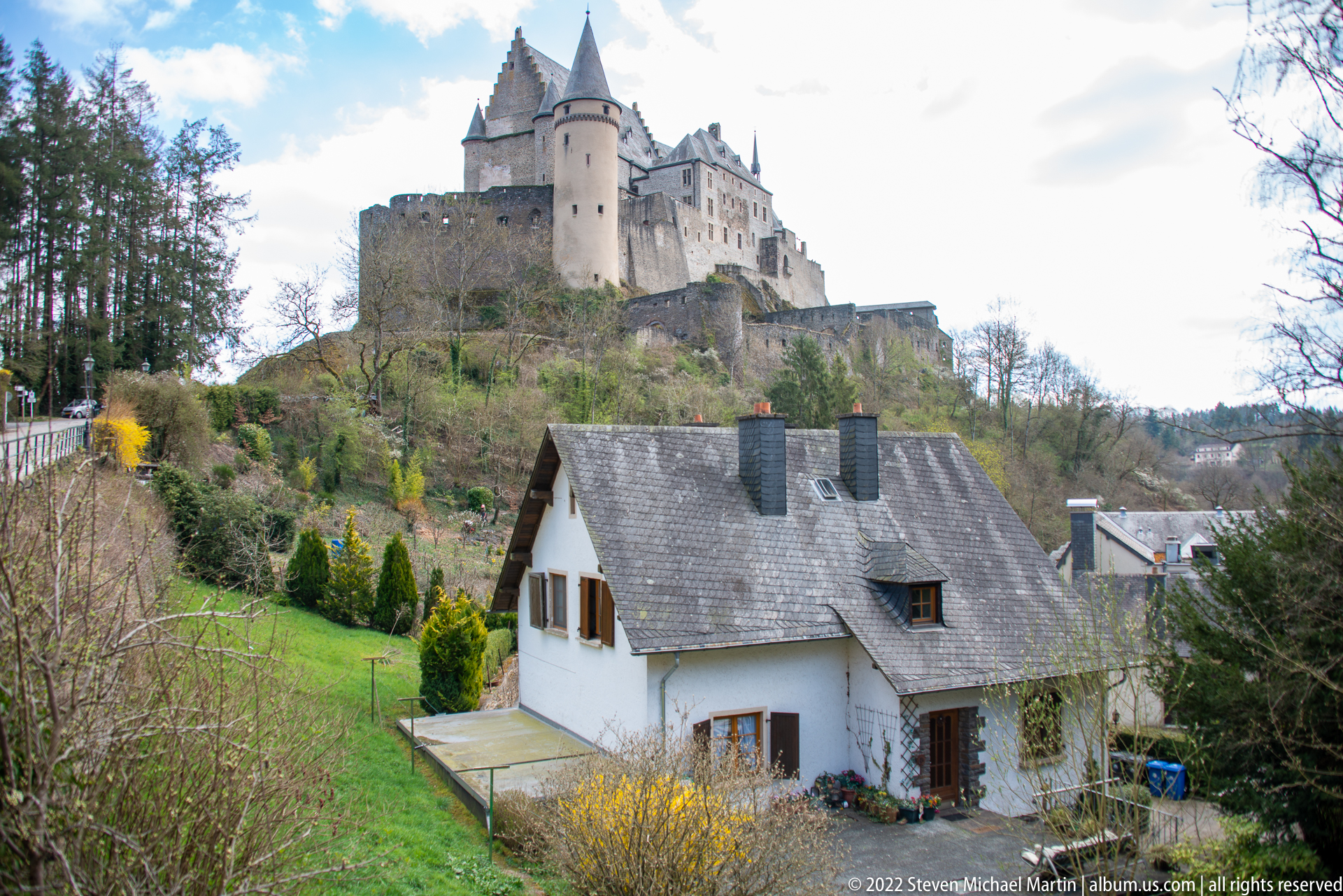
Vianden Castle dominates the hillside above a modest white house and garden, creating a strong scale contrast between domestic architecture and the fortified complex. The round tower and high roofed ranges remain visible above the outer wall, while trees and spring vegetation soften the slope between the residence below and the castle's elevated stone mass.
Caption
Vianden Castle dominates the hillside above a modest white house and garden, creating a strong scale contrast between domestic architecture and the fortified complex. The round tower and high roofed ranges remain visible above the outer wall, while trees and spring vegetation soften the slope between the residence below and the castle's elevated stone mass.
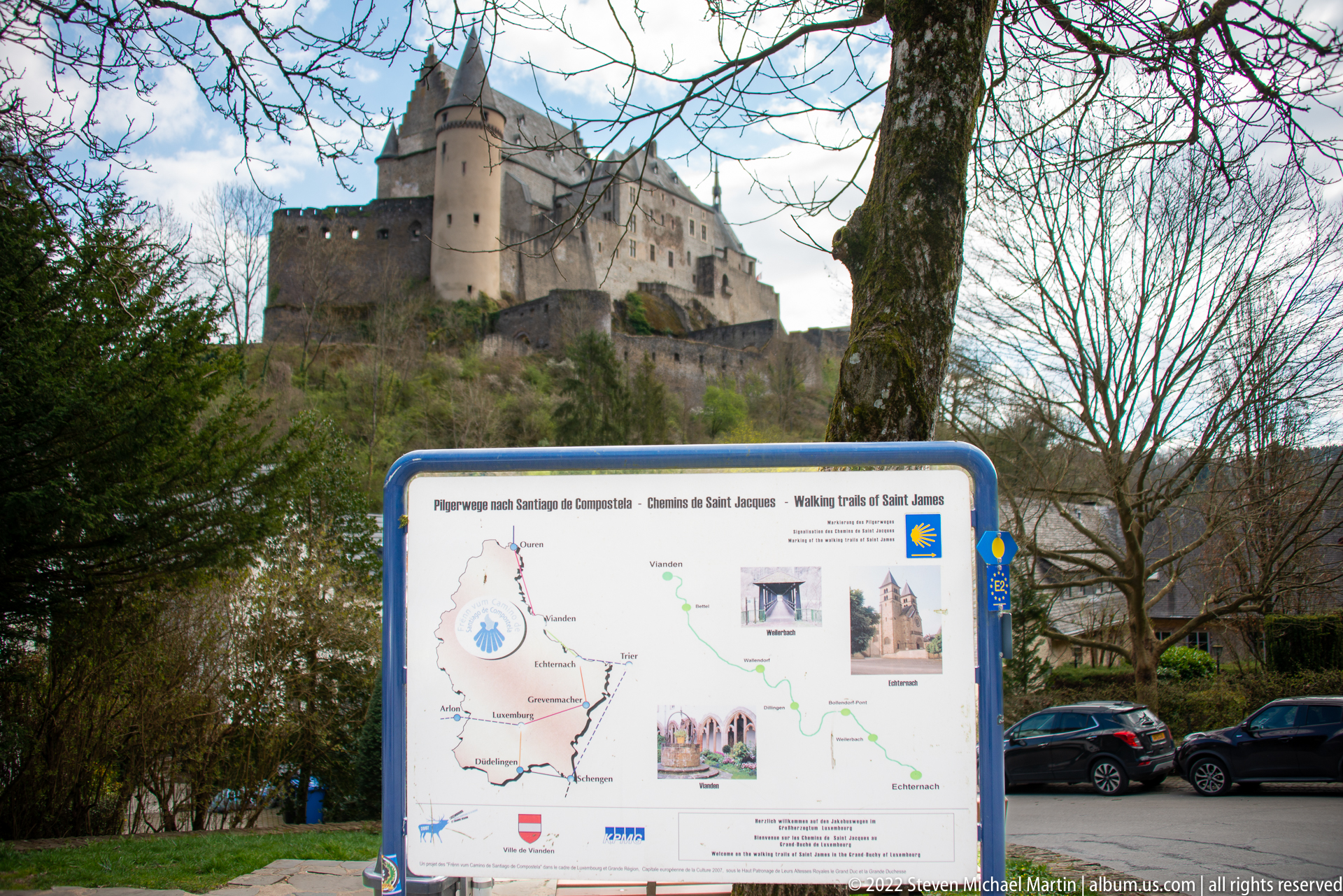
A multilingual pilgrimage-route panel stands beneath Vianden Castle, pairing a mapped walking itinerary with small landmark illustrations while the fortress rises behind it. The juxtaposition connects contemporary trail interpretation with Vianden's historic landscape, and the blue-and-yellow wayfinding symbols around the sign reinforce the site's role as a stop on a marked long-distance walking route.
Caption
A multilingual pilgrimage-route panel stands beneath Vianden Castle, pairing a mapped walking itinerary with small landmark illustrations while the fortress rises behind it. The juxtaposition connects contemporary trail interpretation with Vianden's historic landscape, and the blue-and-yellow wayfinding symbols around the sign reinforce the site's role as a stop on a marked long-distance walking route.
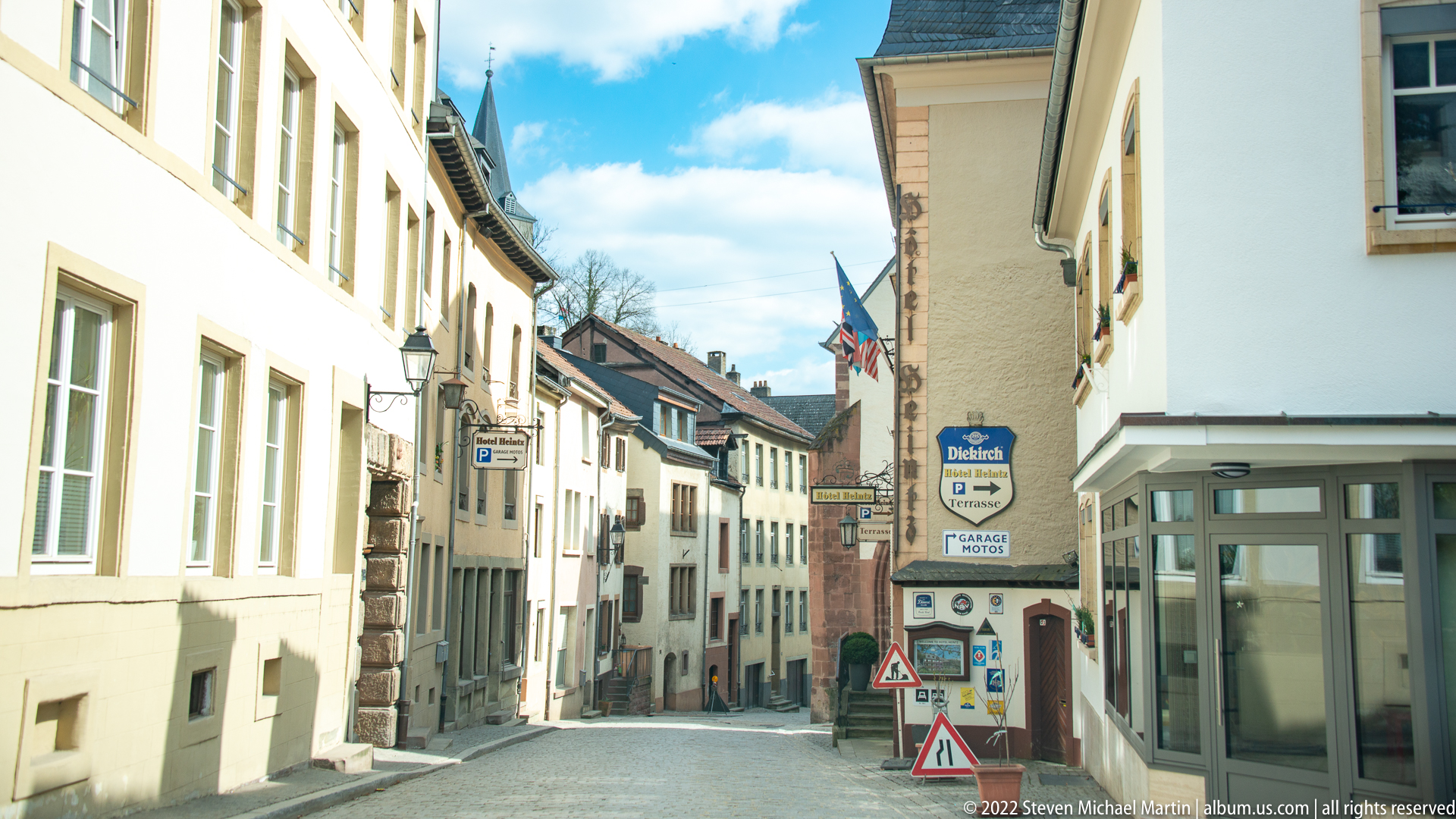
A narrow street descends through Vianden between pale rendered buildings, shop signs, flags, and closely spaced façades. The street's slight curve and compressed perspective reveal the dense fabric of the old town below the castle, while projecting signs and ground-floor businesses show the continued commercial use of buildings within the historic center.
Caption
A narrow street descends through Vianden between pale rendered buildings, shop signs, flags, and closely spaced façades. The street's slight curve and compressed perspective reveal the dense fabric of the old town below the castle, while projecting signs and ground-floor businesses show the continued commercial use of buildings within the historic center.
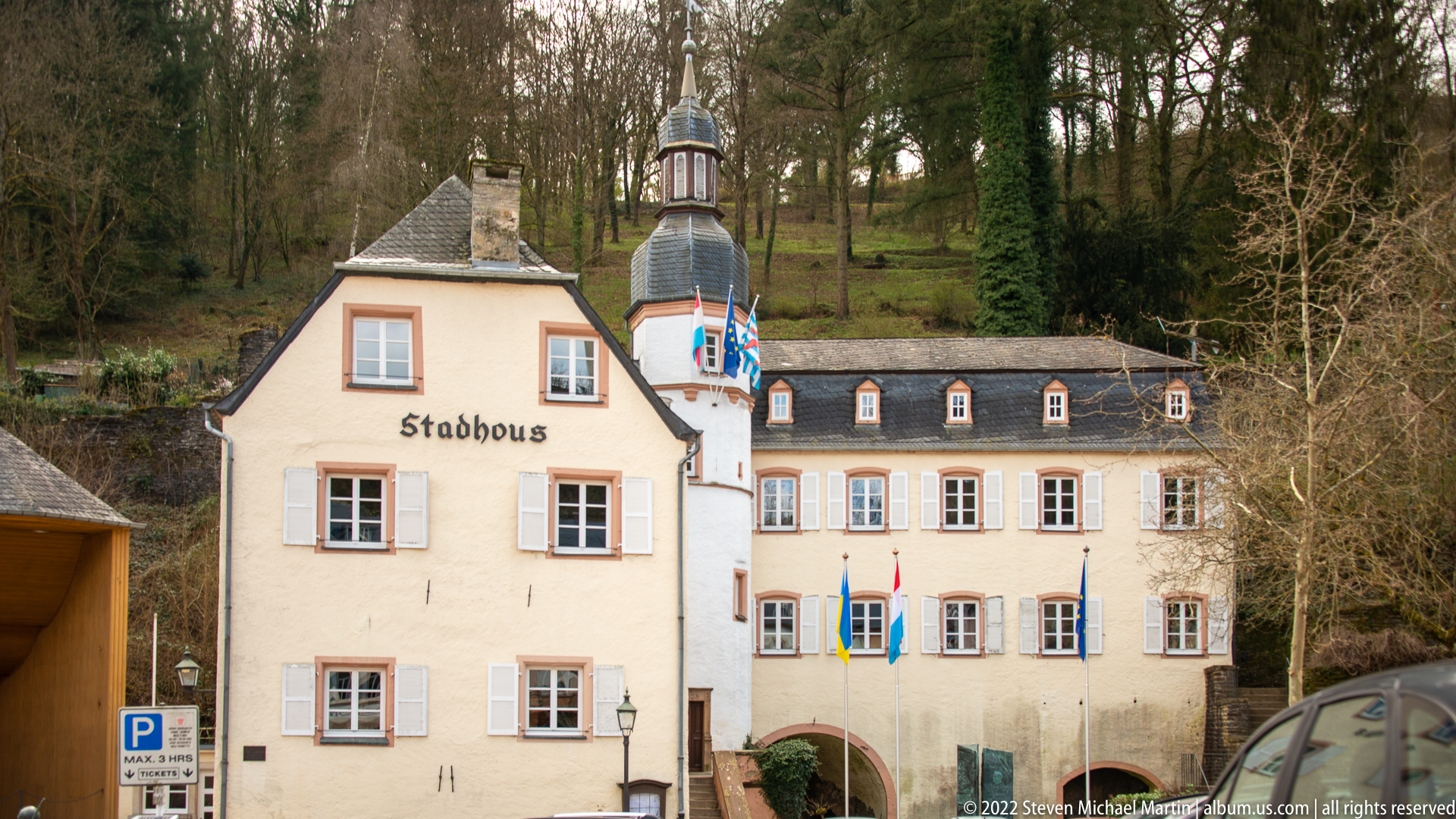
Vianden's Town Hall presents a compact historic façade marked Stadhous, with shuttered windows and a taller central roof feature rising behind the adjoining wing. Luxembourg and European flags hang near the entrance, reinforcing the building's civic function. Set against a wooded slope, the ensemble reads as a formal municipal landmark within the otherwise intimate scale of Vianden's old town.
Caption
Vianden's Town Hall presents a compact historic façade marked Stadhous, with shuttered windows and a taller central roof feature rising behind the adjoining wing. Luxembourg and European flags hang near the entrance, reinforcing the building's civic function. Set against a wooded slope, the ensemble reads as a formal municipal landmark within the otherwise intimate scale of Vianden's old town.
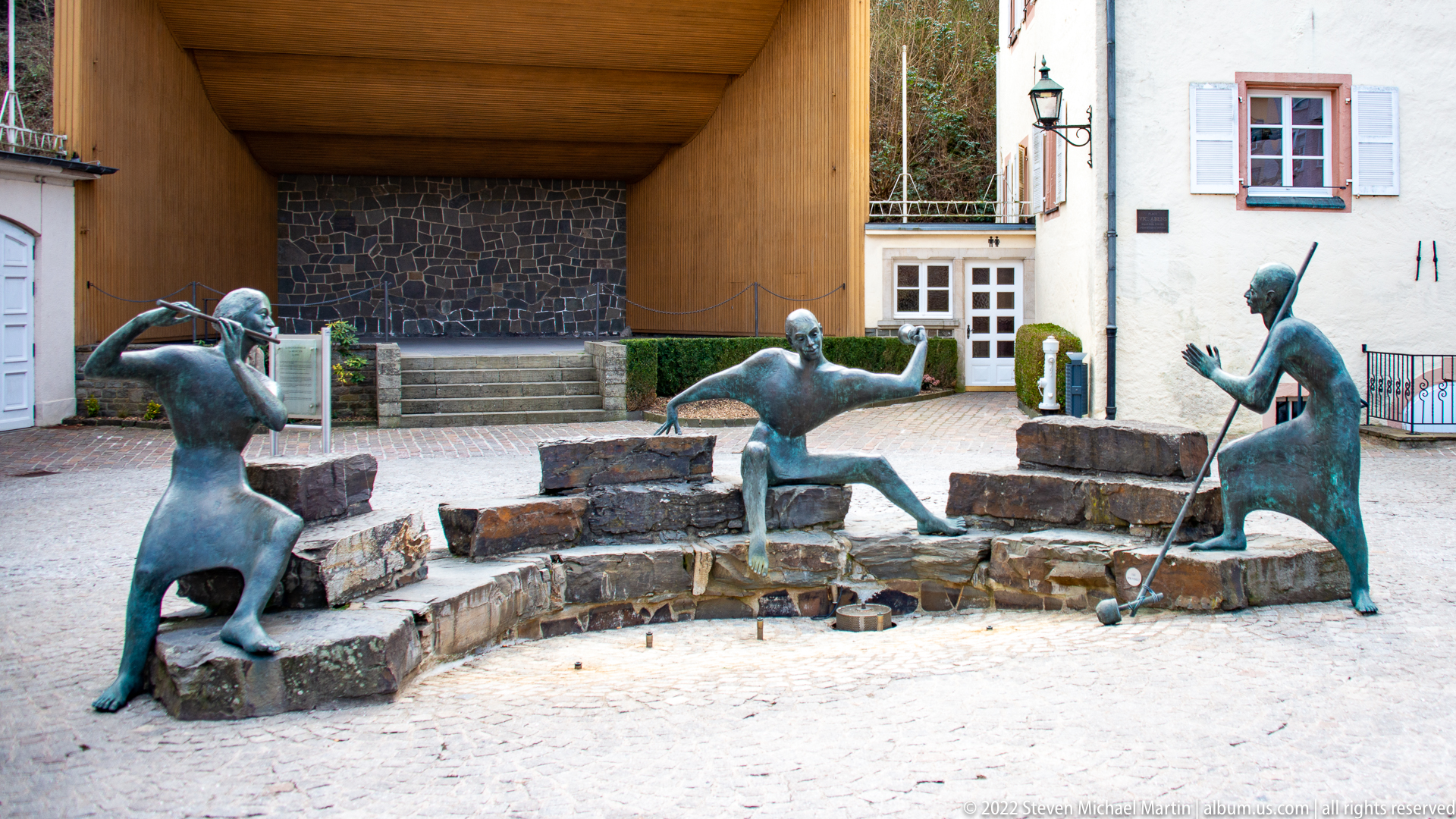
Three stylized bronze figures animate a small stone-lined fountain court, each posed in a different gesture around the central basin. One figure raises an object toward the shoulder, another balances dynamically at the water’s edge, and a third holds a long staff-like implement. The dark, weathered metal contrasts with pale paving, rough stonework, and the surrounding white façades.
Caption
Three stylized bronze figures animate a small stone-lined fountain court, each posed in a different gesture around the central basin. One figure raises an object toward the shoulder, another balances dynamically at the water’s edge, and a third holds a long staff-like implement. The dark, weathered metal contrasts with pale paving, rough stonework, and the surrounding white façades.
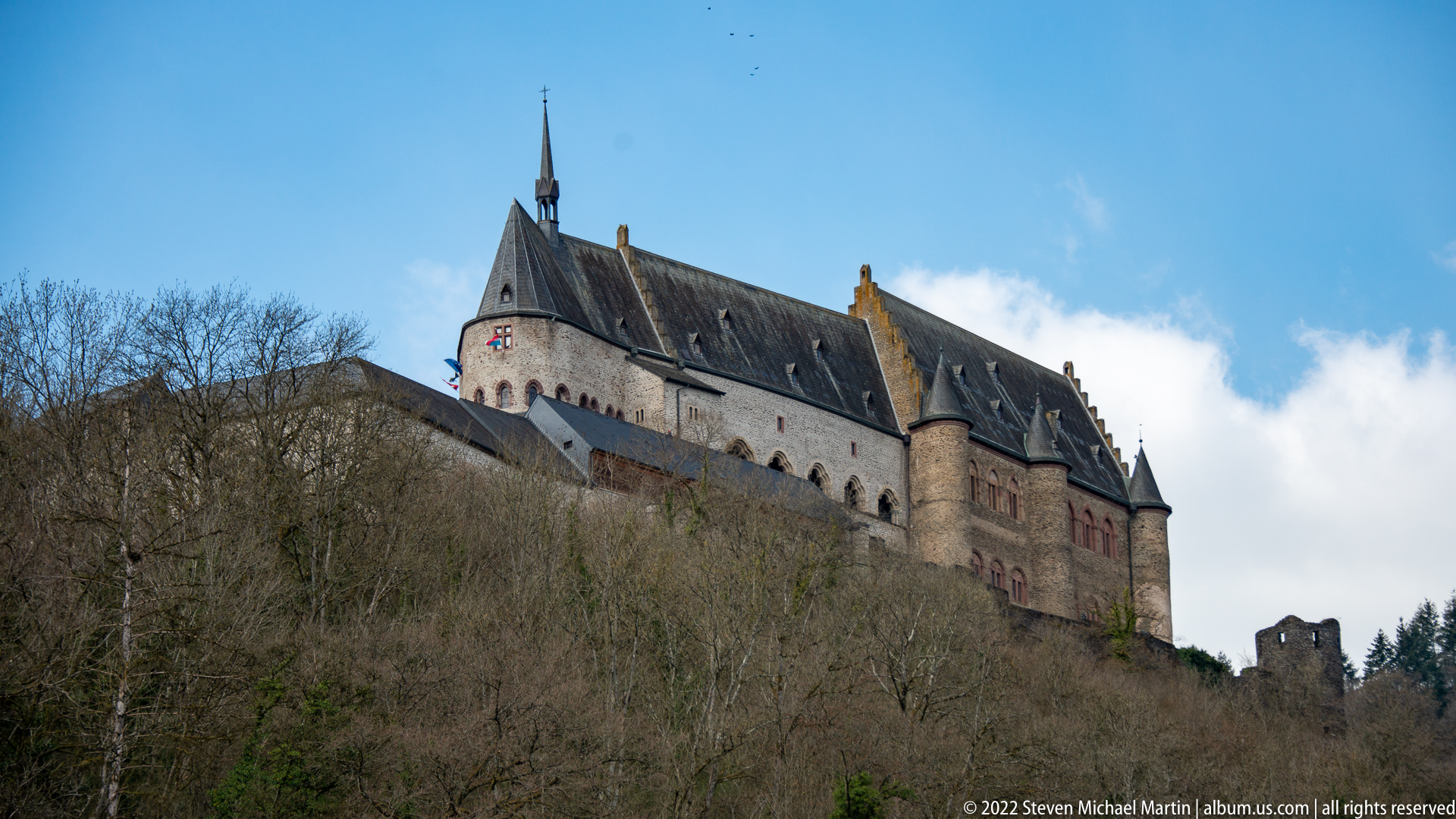
Vianden Castle rises above the wooded hillside in a steep upward view that stresses its elongated ridge-top massing. Pale masonry walls, a dark pitched roof, pointed gables, a slender spire, and projecting cylindrical towers form the castle’s distinctive silhouette. The largely leafless slope below leaves the fortified complex visually isolated against a bright blue sky.
Caption
Vianden Castle rises above the wooded hillside in a steep upward view that stresses its elongated ridge-top massing. Pale masonry walls, a dark pitched roof, pointed gables, a slender spire, and projecting cylindrical towers form the castle’s distinctive silhouette. The largely leafless slope below leaves the fortified complex visually isolated against a bright blue sky.

A square church tower emerges from the steep, wooded terrain beneath a tall slate-clad spire. The pale tower is capped by a darker belfry stage with louvered openings, while a weather vane marks the spire’s apex. Bare branches and the sharply rising hillside frame the architecture, emphasizing how Vianden’s built fabric occupies the narrow valley and its slopes.
Caption
A square church tower emerges from the steep, wooded terrain beneath a tall slate-clad spire. The pale tower is capped by a darker belfry stage with louvered openings, while a weather vane marks the spire’s apex. Bare branches and the sharply rising hillside frame the architecture, emphasizing how Vianden’s built fabric occupies the narrow valley and its slopes.
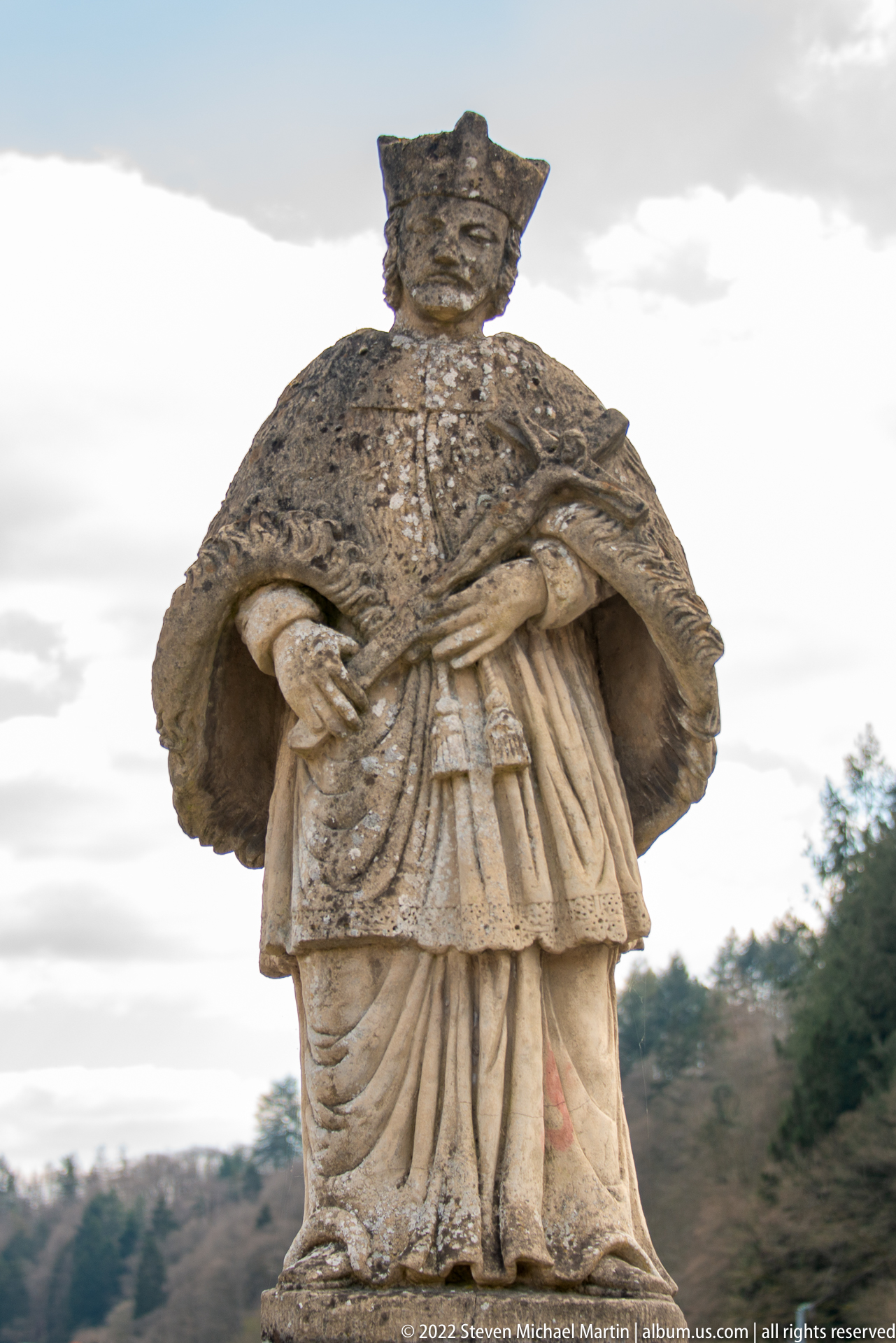
A weathered stone figure stands frontally in elaborate historical dress, its broad mantle spreading over the shoulders and arms above a pleated lower garment. The figure’s hands meet at the waist, while a distinctive head covering or crown-like form survives above the heavily eroded face. Surface wear softens the carved details and gives the sculpture a pronounced sense of age and exposure.
Caption
A weathered stone figure stands frontally in elaborate historical dress, its broad mantle spreading over the shoulders and arms above a pleated lower garment. The figure’s hands meet at the waist, while a distinctive head covering or crown-like form survives above the heavily eroded face. Surface wear softens the carved details and gives the sculpture a pronounced sense of age and exposure.