Hamburg – Germany
Hamburg lies along the Elbe River near its broad estuary into the North Sea, making it one of the most important port cities in northern Europe. During the Middle Ages the city became a major member of the Hanseatic League, the powerful trading alliance that linked merchant cities across the Baltic and North Seas.
The modern harbor remains one of the largest in Europe, reflecting centuries of maritime commerce. Historic districts such as the Speicherstadt warehouse quarter, built in the late 19th century with red-brick Gothic Revival architecture, illustrate the city’s long connection to international trade.
Today Hamburg combines historic maritime heritage with modern urban life along its network of canals, rivers, and harbor basins.
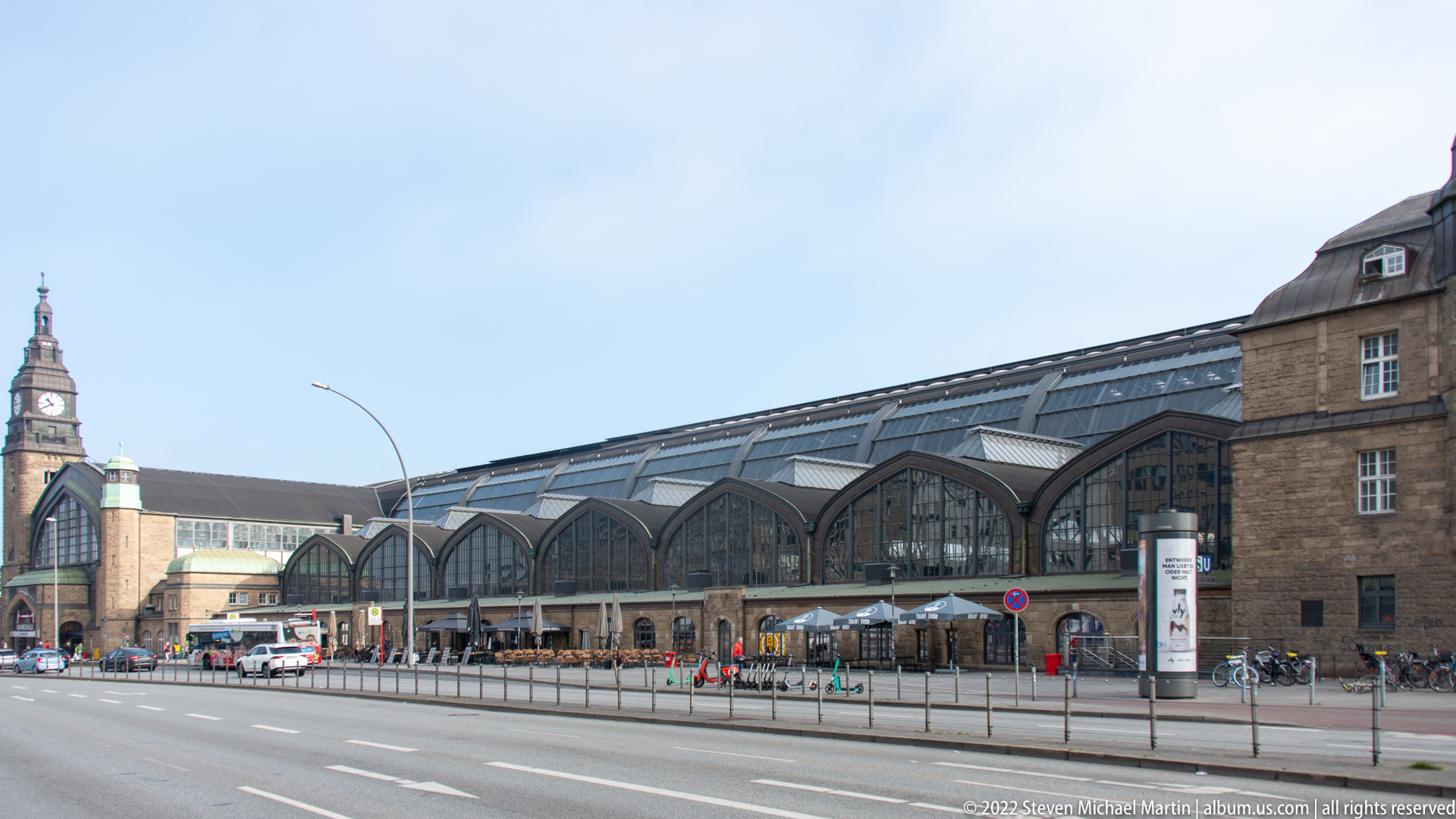
The long exterior of Hamburg Hauptbahnhof is defined by repeated arched steel-and-glass bays beneath the broad roof of the train shed. Street traffic and pedestrians animate the foreground, while the station’s clock tower rises at the far left. The wide view shows the scale of Hamburg’s principal railway terminal as part of the surrounding city.
Caption
The long exterior of Hamburg Hauptbahnhof is defined by repeated arched steel-and-glass bays beneath the broad roof of the train shed. Street traffic and pedestrians animate the foreground, while the station’s clock tower rises at the far left. The wide view shows the scale of Hamburg’s principal railway terminal as part of the surrounding city.

A large pipe organ fills the west end of the church, its silver pipes arranged in sharply stepped ranks within a modern geometric case. Pointed arches and clustered columns frame the instrument above the nave entrance, while rows of pews lead toward it from the foreground. The view emphasizes the organ’s scale within the Gothic interior.
Caption
A large pipe organ fills the west end of the church, its silver pipes arranged in sharply stepped ranks within a modern geometric case. Pointed arches and clustered columns frame the instrument above the nave entrance, while rows of pews lead toward it from the foreground. The view emphasizes the organ’s scale within the Gothic interior.
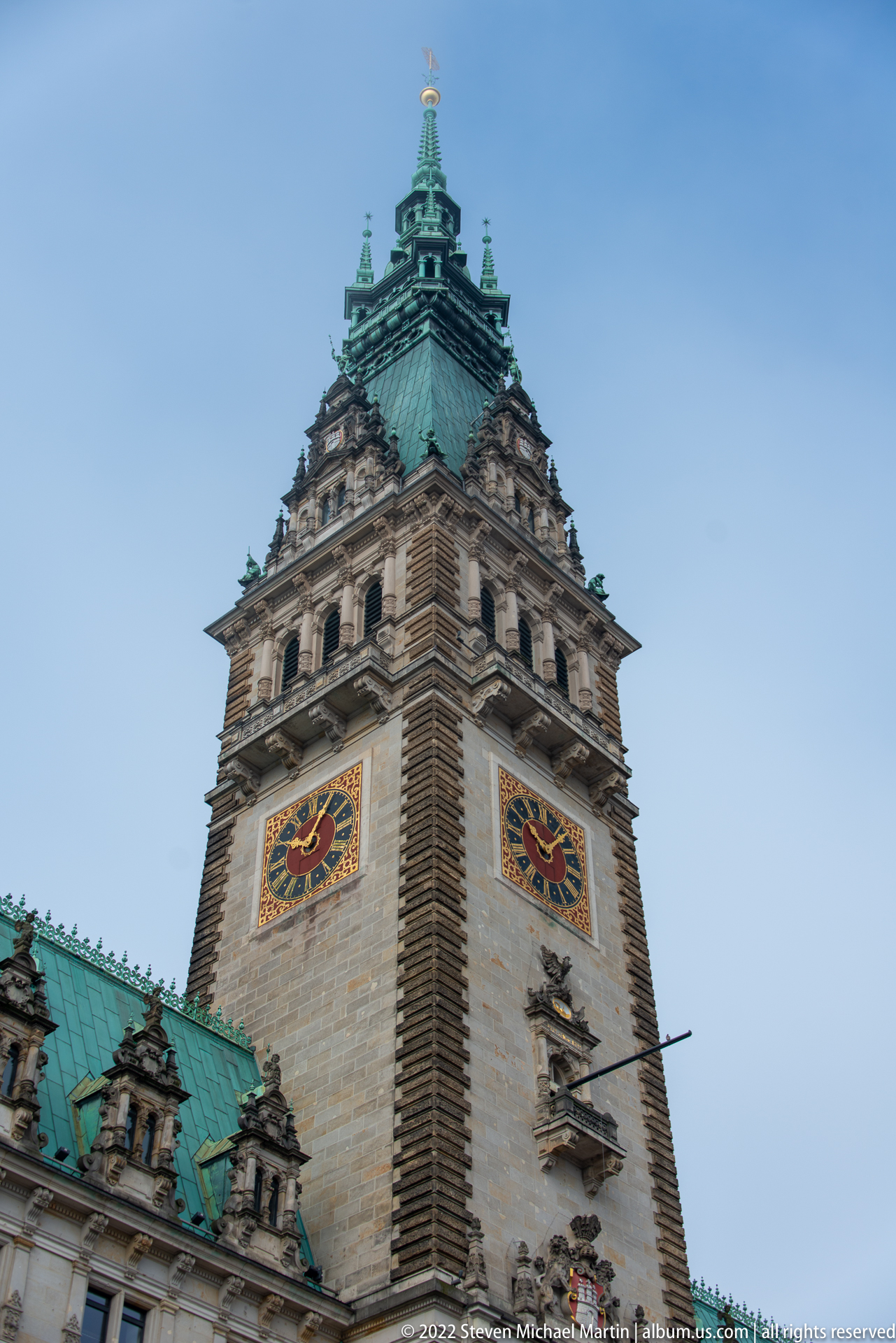
The square stone stage of Hamburg Rathaus’s tower carries large colorful clock faces on adjacent sides beneath a richly ornamented upper pavilion and green copper roof. Seen from below against a clear sky, the view emphasizes the transition from massive masonry base to lighter arcaded crown, capped by the city hall’s distinctive copper lantern.
Caption
The square stone stage of Hamburg Rathaus’s tower carries large colorful clock faces on adjacent sides beneath a richly ornamented upper pavilion and green copper roof. Seen from below against a clear sky, the view emphasizes the transition from massive masonry base to lighter arcaded crown, capped by the city hall’s distinctive copper lantern.
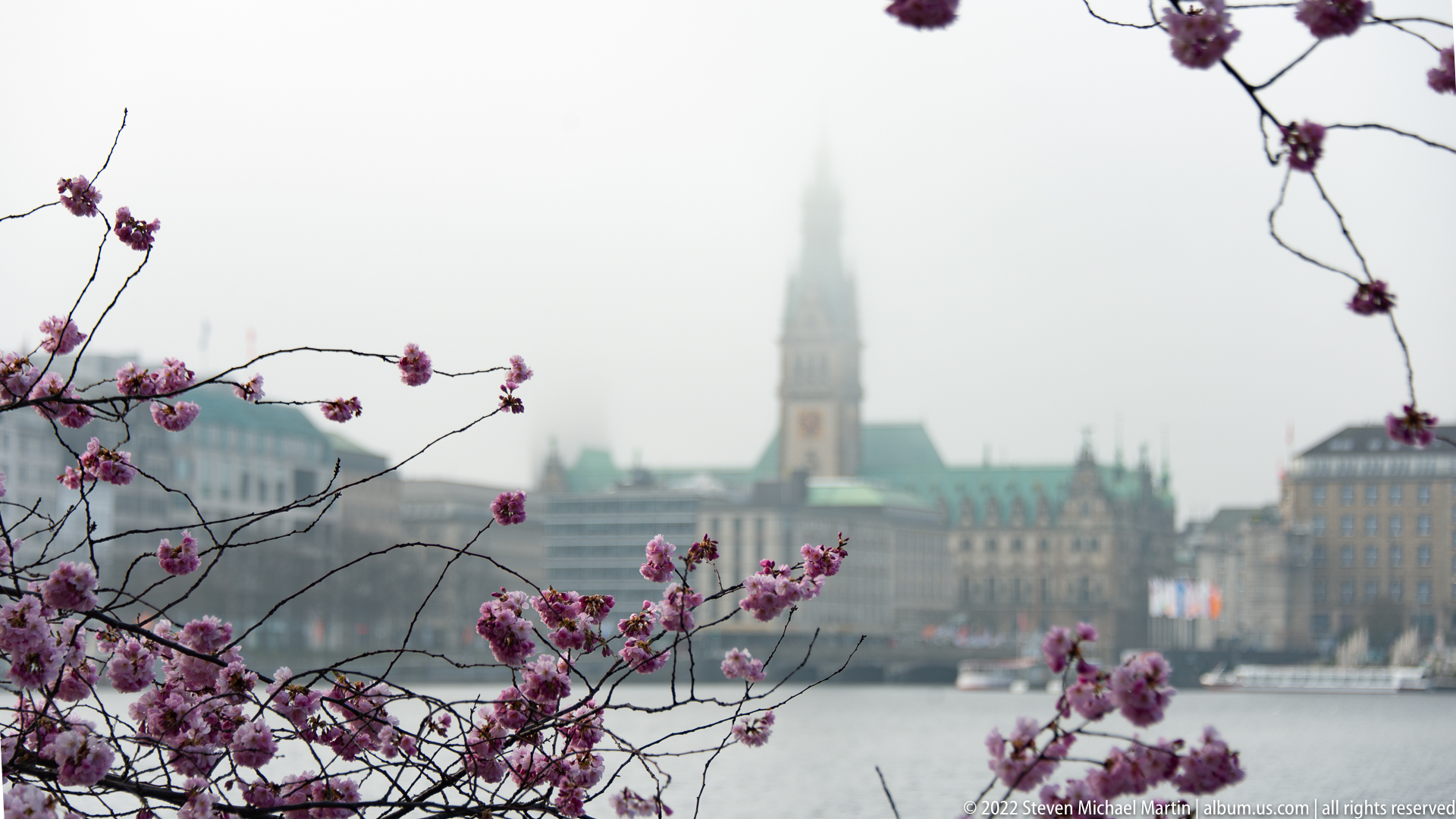
Flowering branches frame a soft view across the Binnenalster toward Hamburg Rathaus, whose tall central tower rises above the waterfront buildings in the haze. The shallow focus gives the pink blossoms visual priority while retaining the city hall as an unmistakable distant landmark, combining spring vegetation with the formal urban skyline.
Caption
Flowering branches frame a soft view across the Binnenalster toward Hamburg Rathaus, whose tall central tower rises above the waterfront buildings in the haze. The shallow focus gives the pink blossoms visual priority while retaining the city hall as an unmistakable distant landmark, combining spring vegetation with the formal urban skyline.
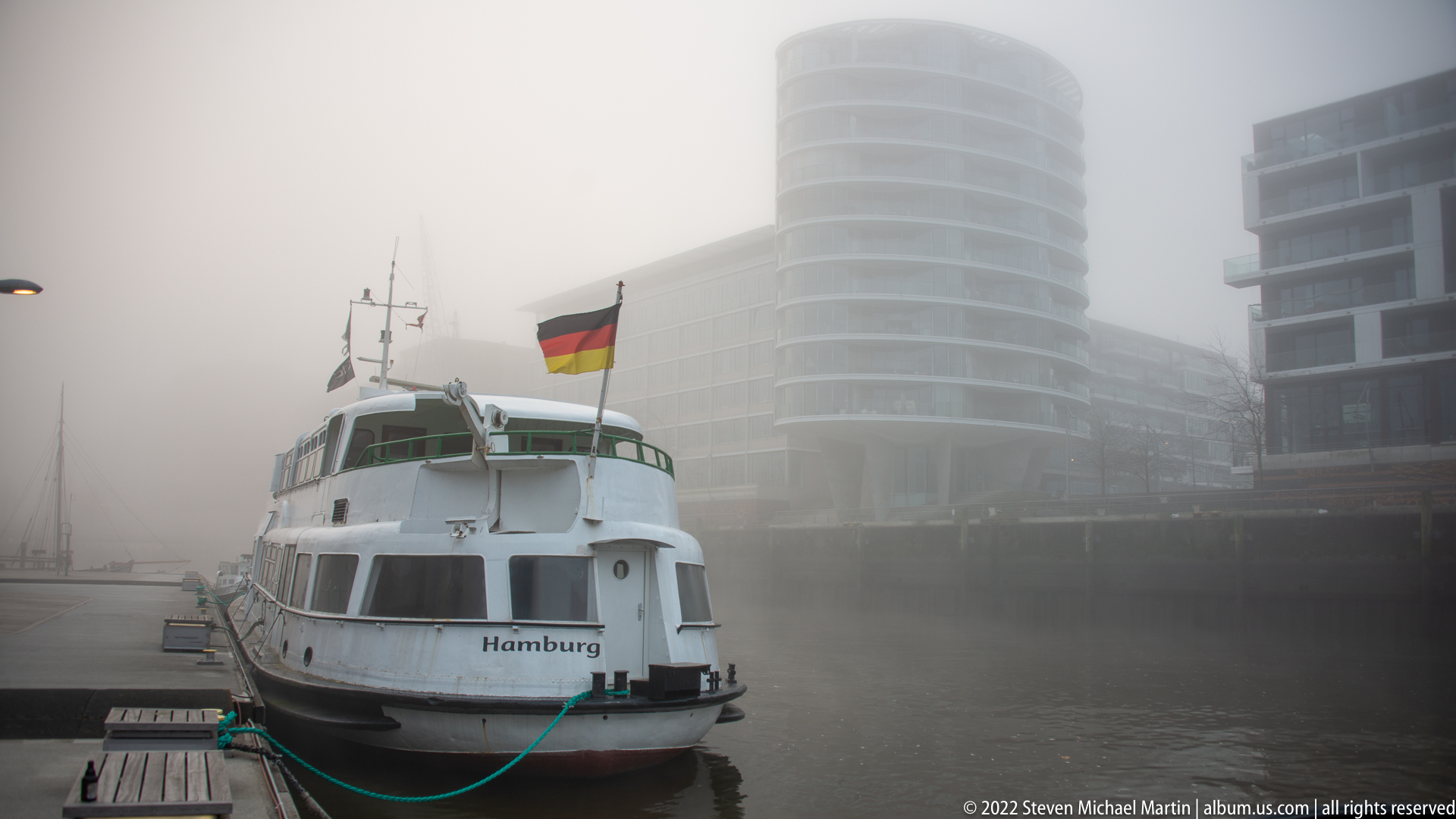
A compact white harbor passenger vessel sits bow-on at a floating landing in heavy fog, the word “Hamburg” readable across its front. Antennas, navigation equipment, enclosed passenger decks, and a German flag remain sharply visible while rounded modern buildings dissolve behind it, concentrating attention on the boat’s working harbor form.
Caption
A compact white harbor passenger vessel sits bow-on at a floating landing in heavy fog, the word “Hamburg” readable across its front. Antennas, navigation equipment, enclosed passenger decks, and a German flag remain sharply visible while rounded modern buildings dissolve behind it, concentrating attention on the boat’s working harbor form.
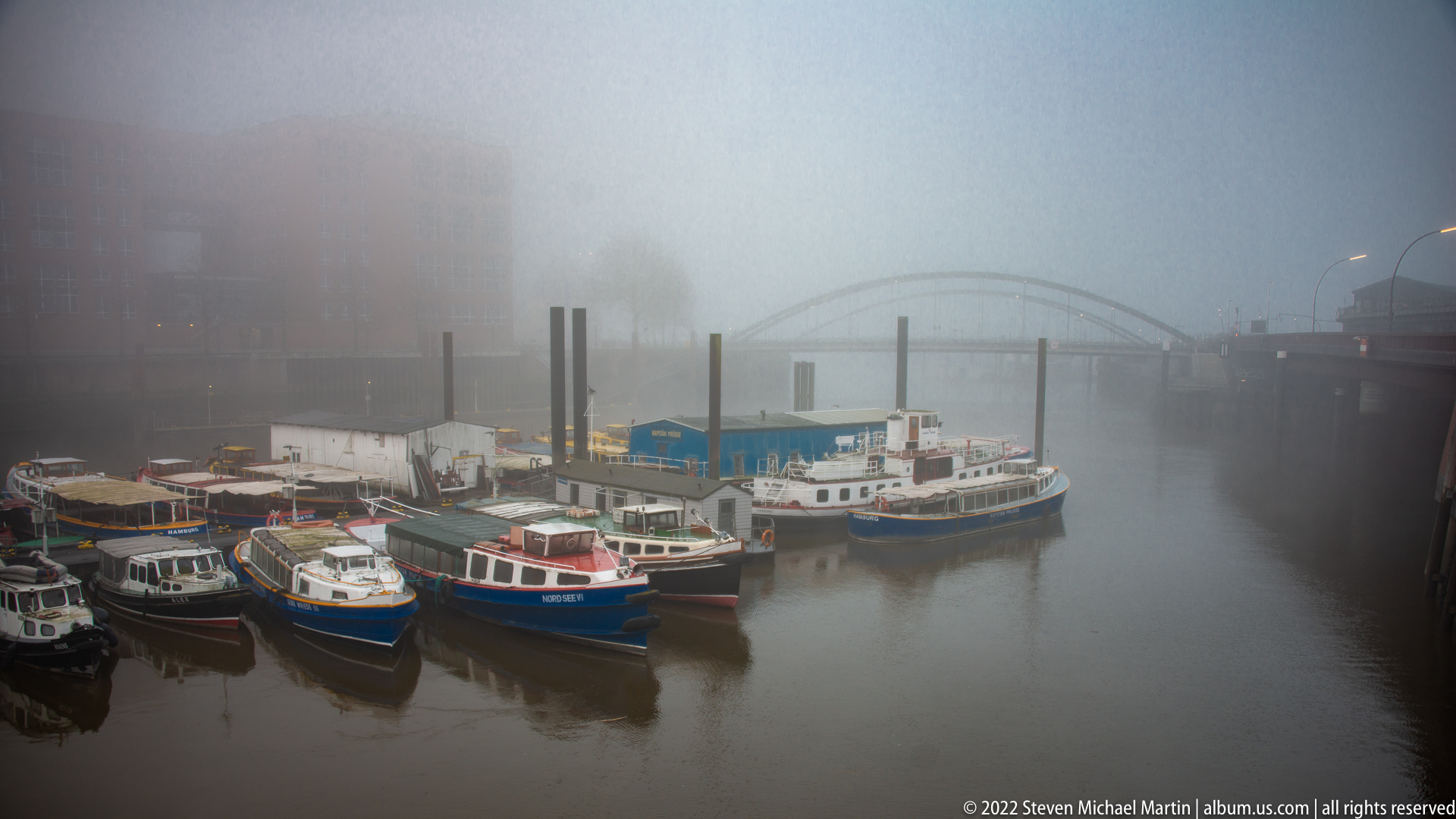
Several small passenger and work boats lie moored side by side in dense fog, their colored hulls and white superstructures standing out against gray water. Vertical mooring piles punctuate the basin, while only faint outlines of buildings and a bridge emerge in the distance, reducing the harbor to a quiet arrangement of vessels, water, and mist.
Caption
Several small passenger and work boats lie moored side by side in dense fog, their colored hulls and white superstructures standing out against gray water. Vertical mooring piles punctuate the basin, while only faint outlines of buildings and a bridge emerge in the distance, reducing the harbor to a quiet arrangement of vessels, water, and mist.
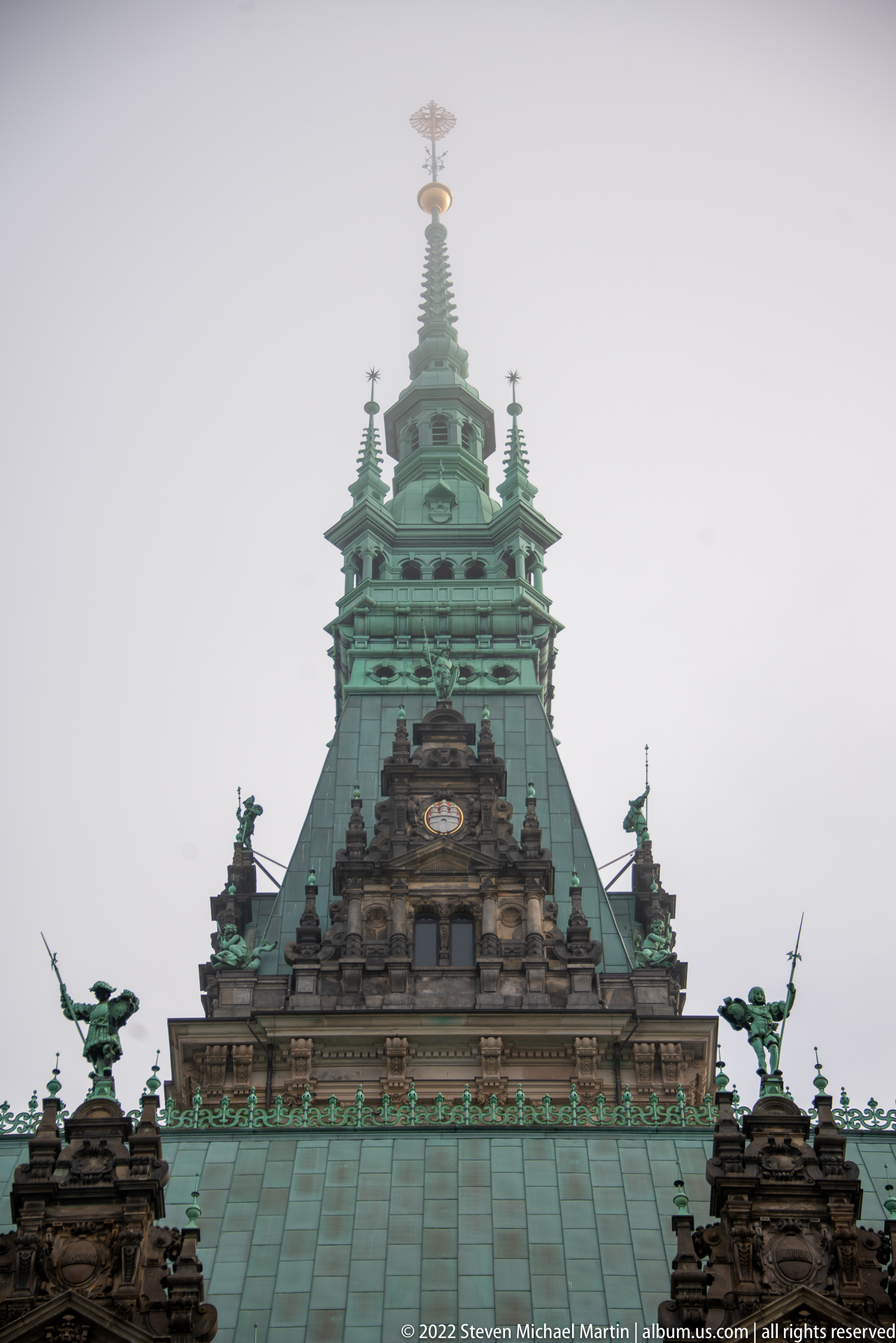
The upper central section of Hamburg Rathaus rises above the green roof in stacked layers of sculpture, stone pediments, copper cladding, and small winged figures. A clock-like emblem and sculpted groups mark the transition into the tall copper tower. The upward viewpoint reveals the dense accumulation of ornament that crowns the city hall’s central axis.
Caption
The upper central section of Hamburg Rathaus rises above the green roof in stacked layers of sculpture, stone pediments, copper cladding, and small winged figures. A clock-like emblem and sculpted groups mark the transition into the tall copper tower. The upward viewpoint reveals the dense accumulation of ornament that crowns the city hall’s central axis.
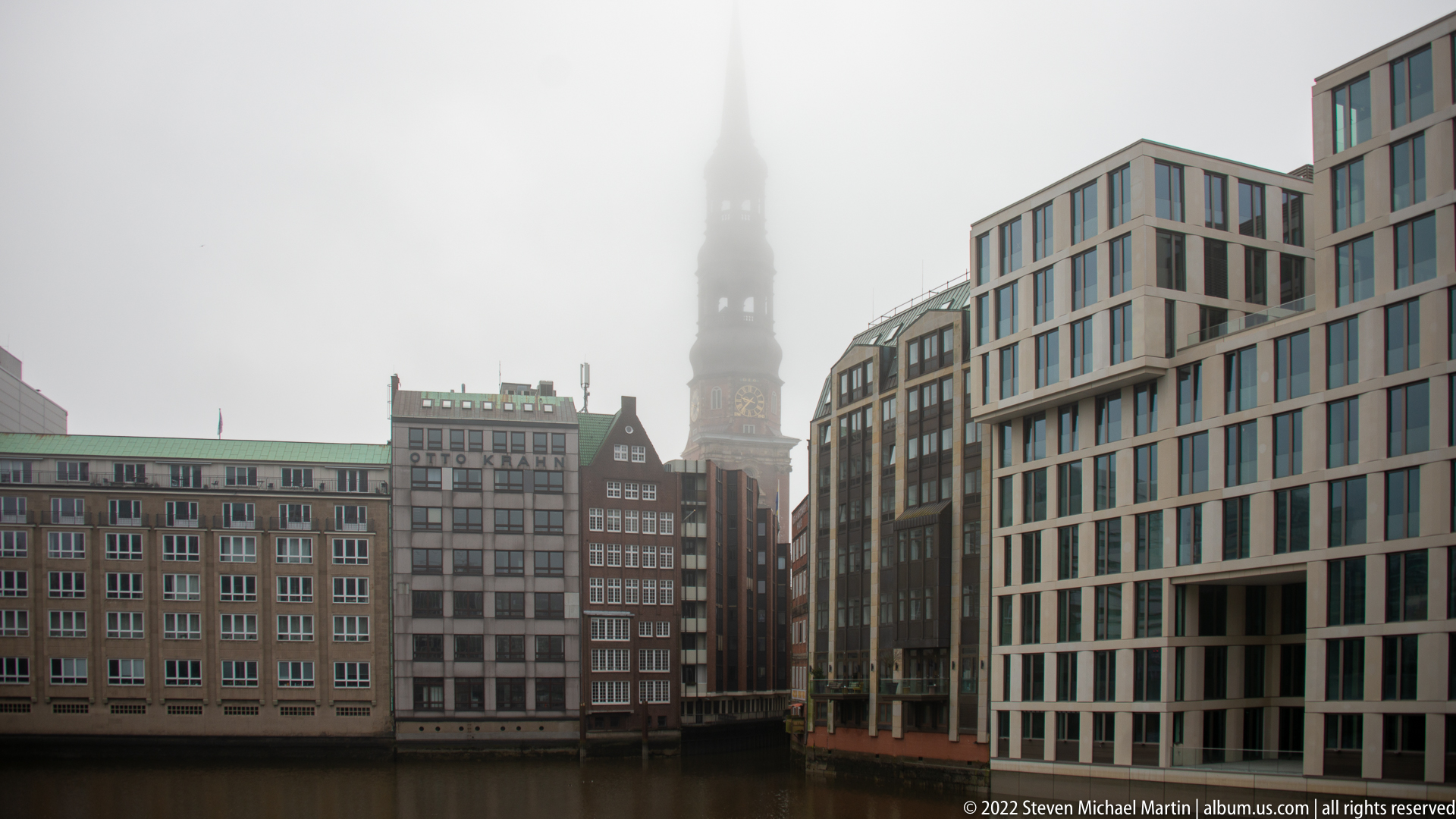
A Hamburg canal is framed by a mix of historic brick commercial blocks and newer pale stone-and-glass buildings, while the tower of St. Catherine’s Church fades into fog at the center background. The water creates a low horizontal foreground, allowing the contrast between old and new urban fabric to define the composition.
Caption
A Hamburg canal is framed by a mix of historic brick commercial blocks and newer pale stone-and-glass buildings, while the tower of St. Catherine’s Church fades into fog at the center background. The water creates a low horizontal foreground, allowing the contrast between old and new urban fabric to define the composition.
The clock tower of Hamburg Hauptbahnhof rises through lingering haze, capped by a green-patinated copper roof and tiered lantern. Two large clock faces punctuate the masonry stage beneath the roof. The cropped view isolates the station’s historic vertical landmark from the long train-shed complex around it.
Caption
The clock tower of Hamburg Hauptbahnhof rises through lingering haze, capped by a green-patinated copper roof and tiered lantern. Two large clock faces punctuate the masonry stage beneath the roof. The cropped view isolates the station’s historic vertical landmark from the long train-shed complex around it.
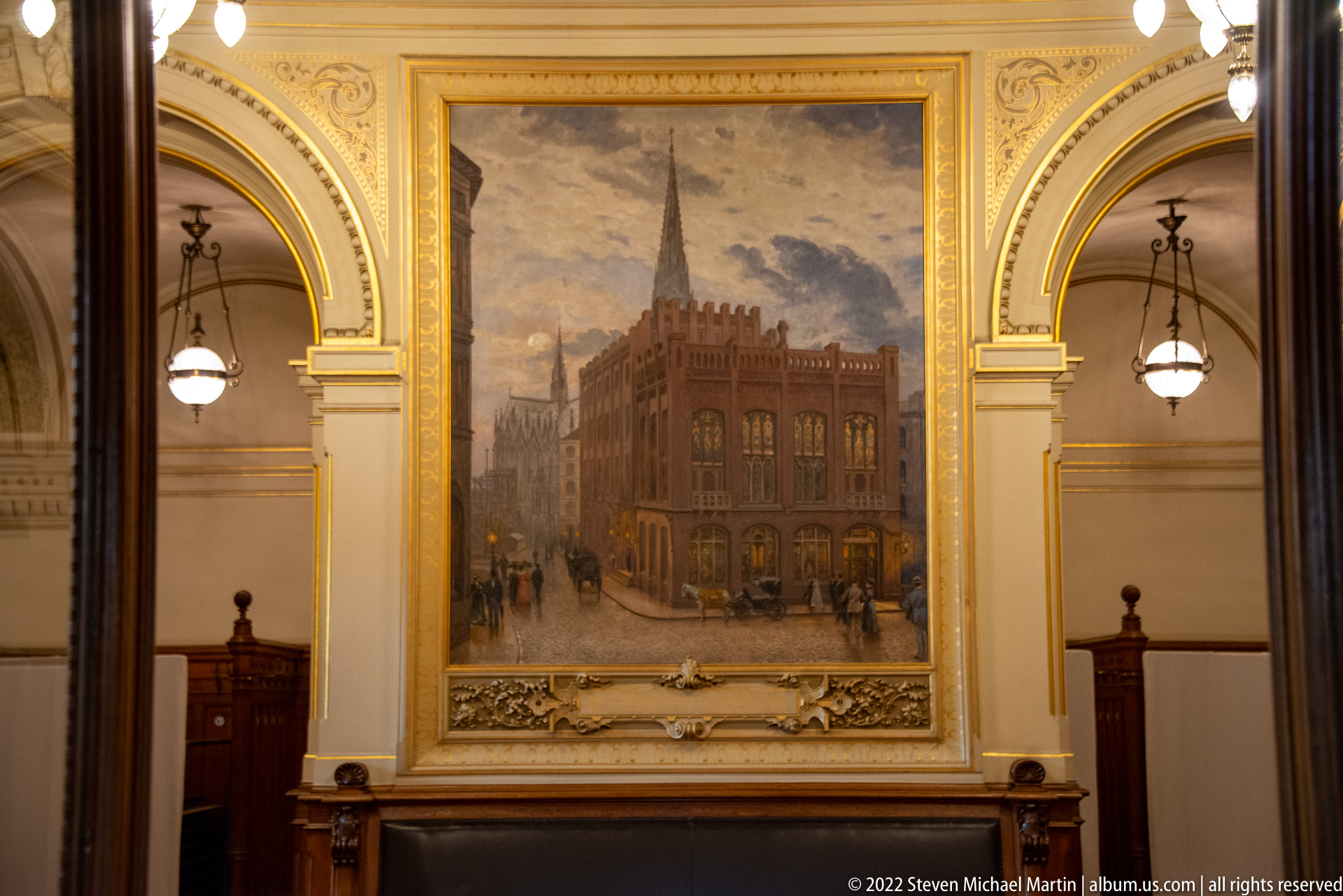
A large framed painting presents a monumental historic civic building with a tall central spire, animated by small figures and vehicles in the square before it. The picture is set within an elaborate gilded architectural frame between arched openings, making the painted cityscape itself part of the room’s ceremonial wall decoration.
Caption
A large framed painting presents a monumental historic civic building with a tall central spire, animated by small figures and vehicles in the square before it. The picture is set within an elaborate gilded architectural frame between arched openings, making the painted cityscape itself part of the room’s ceremonial wall decoration.

Two markedly different church towers rise above a low brick roofline against a clear blue sky: a dark, highly articulated Gothic spire at left and a broader open-belfry tower with a steep copper-toned roof at right. The compressed view emphasizes the variety of Hamburg’s historic ecclesiastical skyline rather than either church’s full architecture.
Caption
Two markedly different church towers rise above a low brick roofline against a clear blue sky: a dark, highly articulated Gothic spire at left and a broader open-belfry tower with a steep copper-toned roof at right. The compressed view emphasizes the variety of Hamburg’s historic ecclesiastical skyline rather than either church’s full architecture.
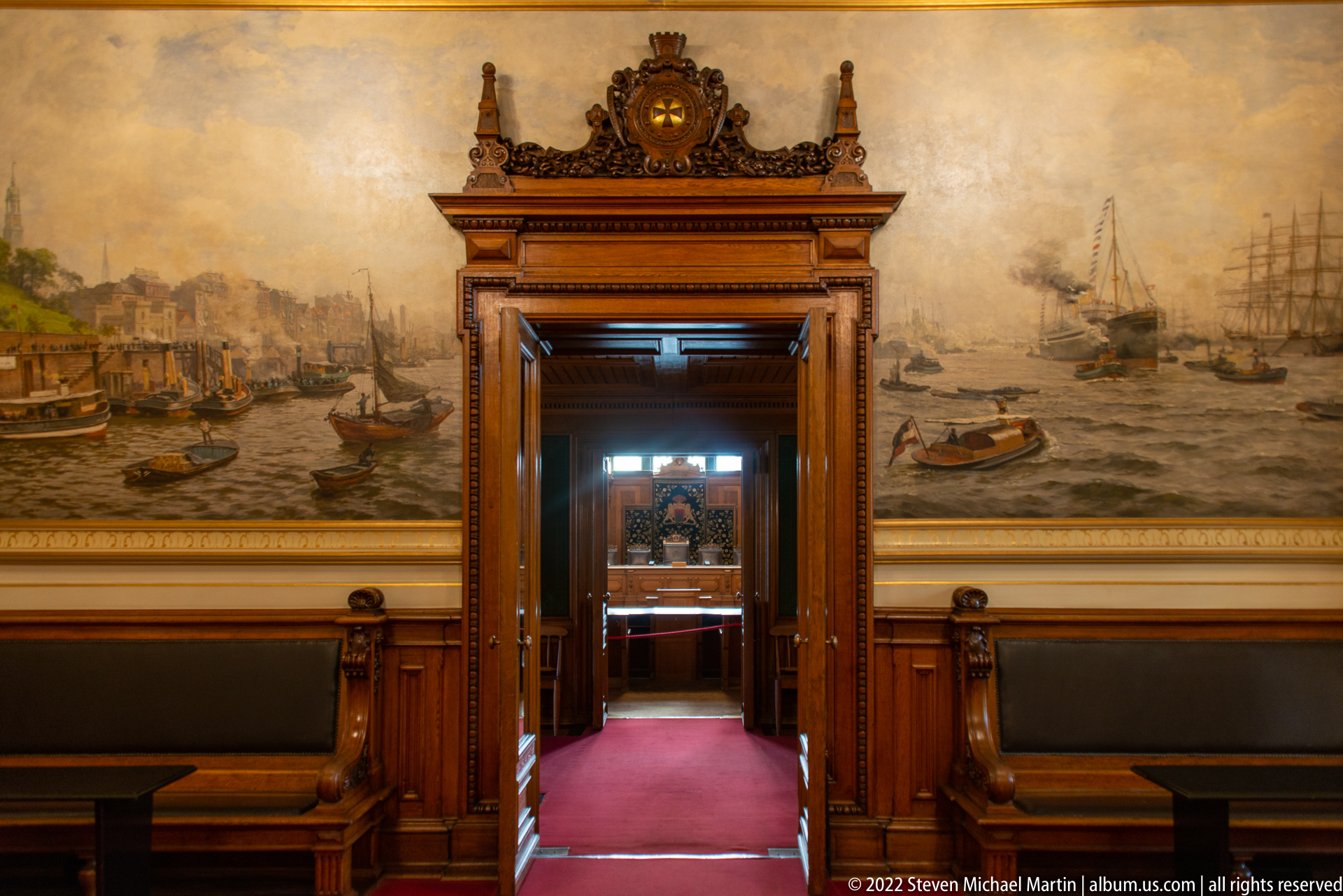
A broad harbor panorama stretches across the wall above dark wooden seating and around an ornate doorway, depicting small boats, sailing ships, quays, and a busy waterfront under a luminous sky. The mural integrates Hamburg’s maritime identity directly into the room’s architectural decoration, with the central doorway interrupting yet visually anchoring the painted port scene.
Caption
A broad harbor panorama stretches across the wall above dark wooden seating and around an ornate doorway, depicting small boats, sailing ships, quays, and a busy waterfront under a luminous sky. The mural integrates Hamburg’s maritime identity directly into the room’s architectural decoration, with the central doorway interrupting yet visually anchoring the painted port scene.
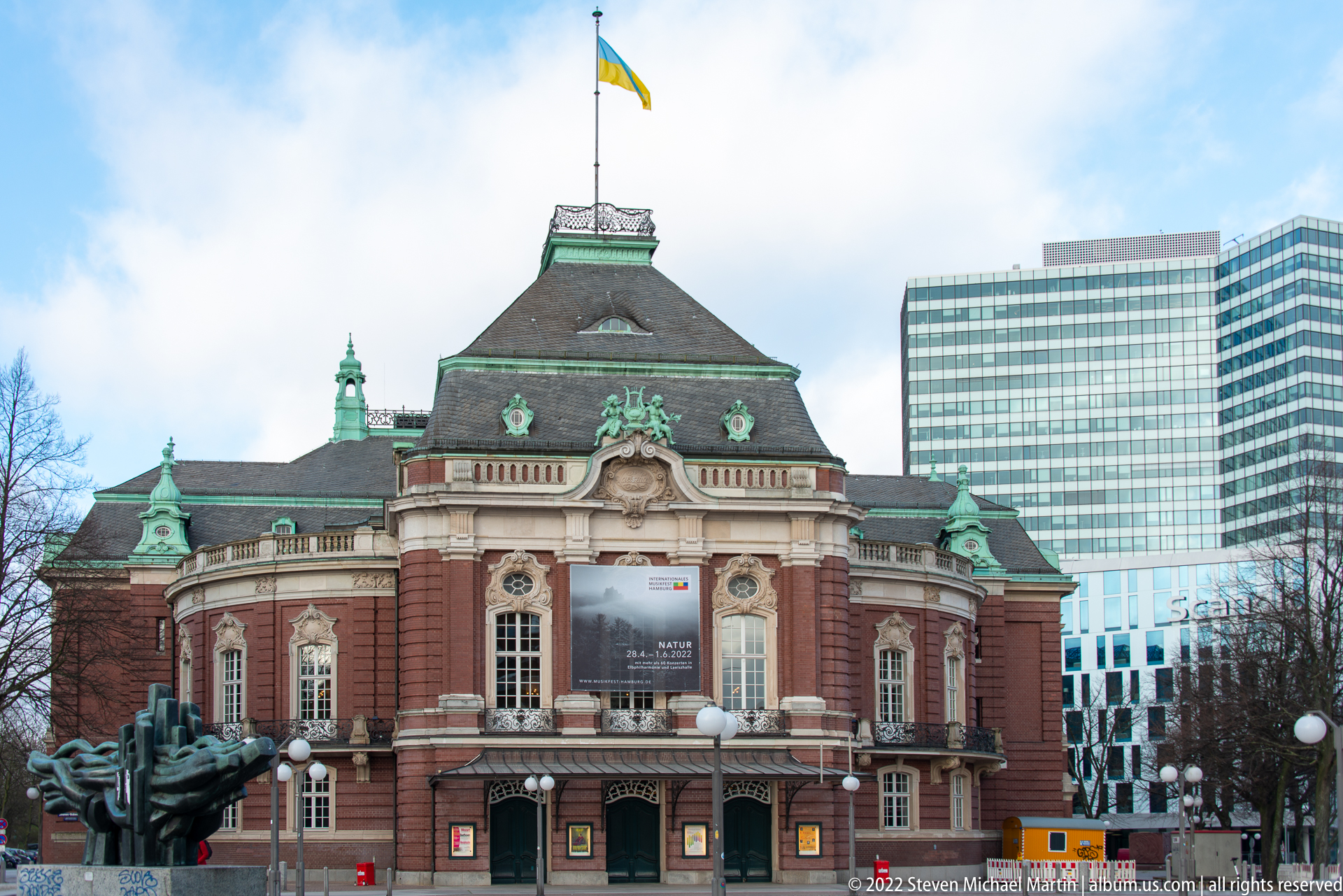
The red-brick Laeiszhalle rises behind a broad forecourt, its sculpted stone portal, green-patinated roof details, and central hipped roof standing out against newer office towers. The frontal view emphasizes the concert hall’s formal symmetry and richly modeled entrance while also showing the contrast between Hamburg’s historic civic architecture and the modern city around it.
Caption
The red-brick Laeiszhalle rises behind a broad forecourt, its sculpted stone portal, green-patinated roof details, and central hipped roof standing out against newer office towers. The frontal view emphasizes the concert hall’s formal symmetry and richly modeled entrance while also showing the contrast between Hamburg’s historic civic architecture and the modern city around it.
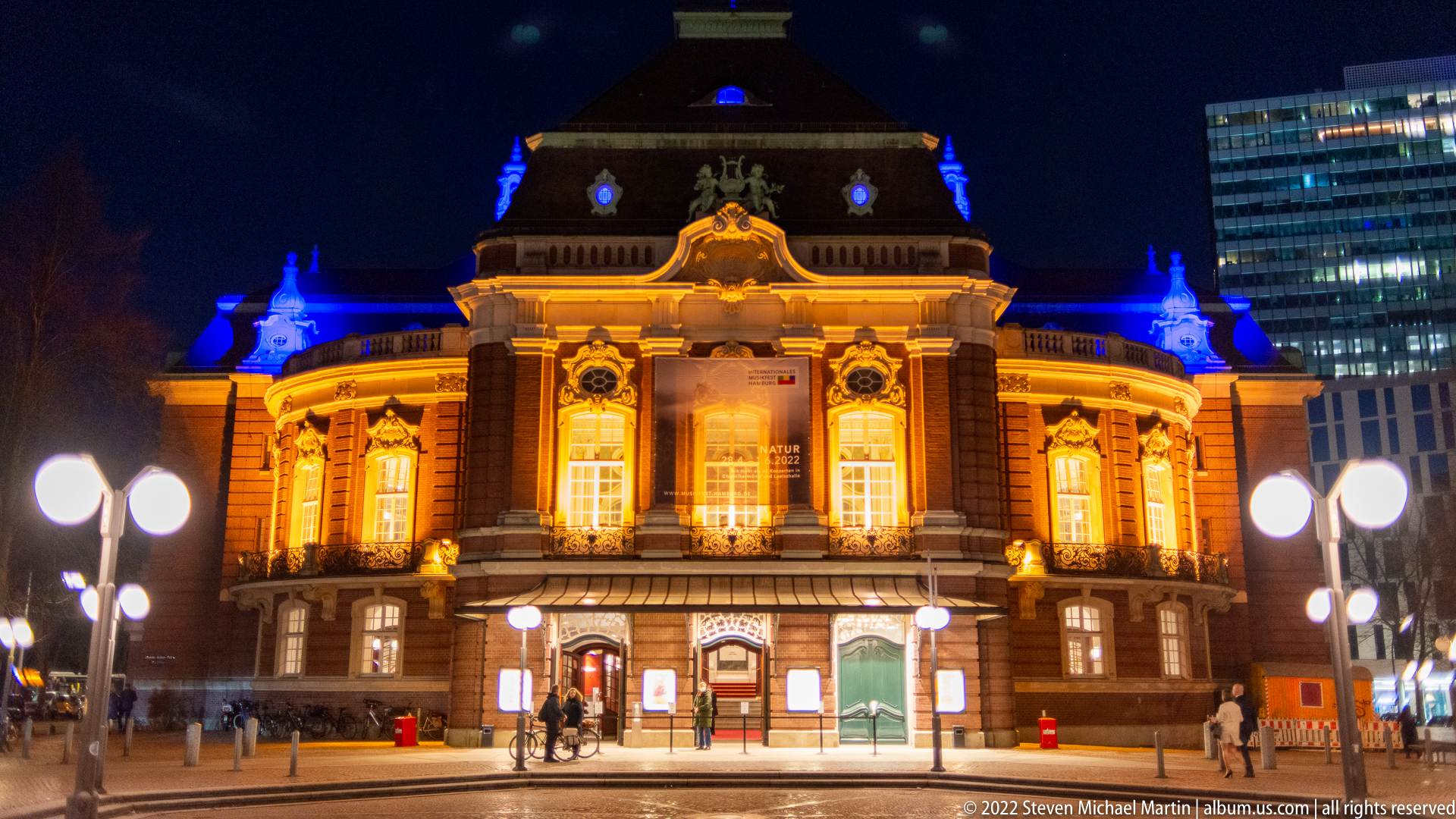
Warm amber light washes across the Laeiszhalle’s curved central façade while blue accents illuminate the roofline, creating a vivid nighttime reading of its brick-and-stone composition. Seen from street level, the concert hall appears almost theatrical, with glowing windows, sculpted entrance bays, and globe streetlamps reinforcing the symmetry of the forecourt.
Caption
Warm amber light washes across the Laeiszhalle’s curved central façade while blue accents illuminate the roofline, creating a vivid nighttime reading of its brick-and-stone composition. Seen from street level, the concert hall appears almost theatrical, with glowing windows, sculpted entrance bays, and globe streetlamps reinforcing the symmetry of the forecourt.
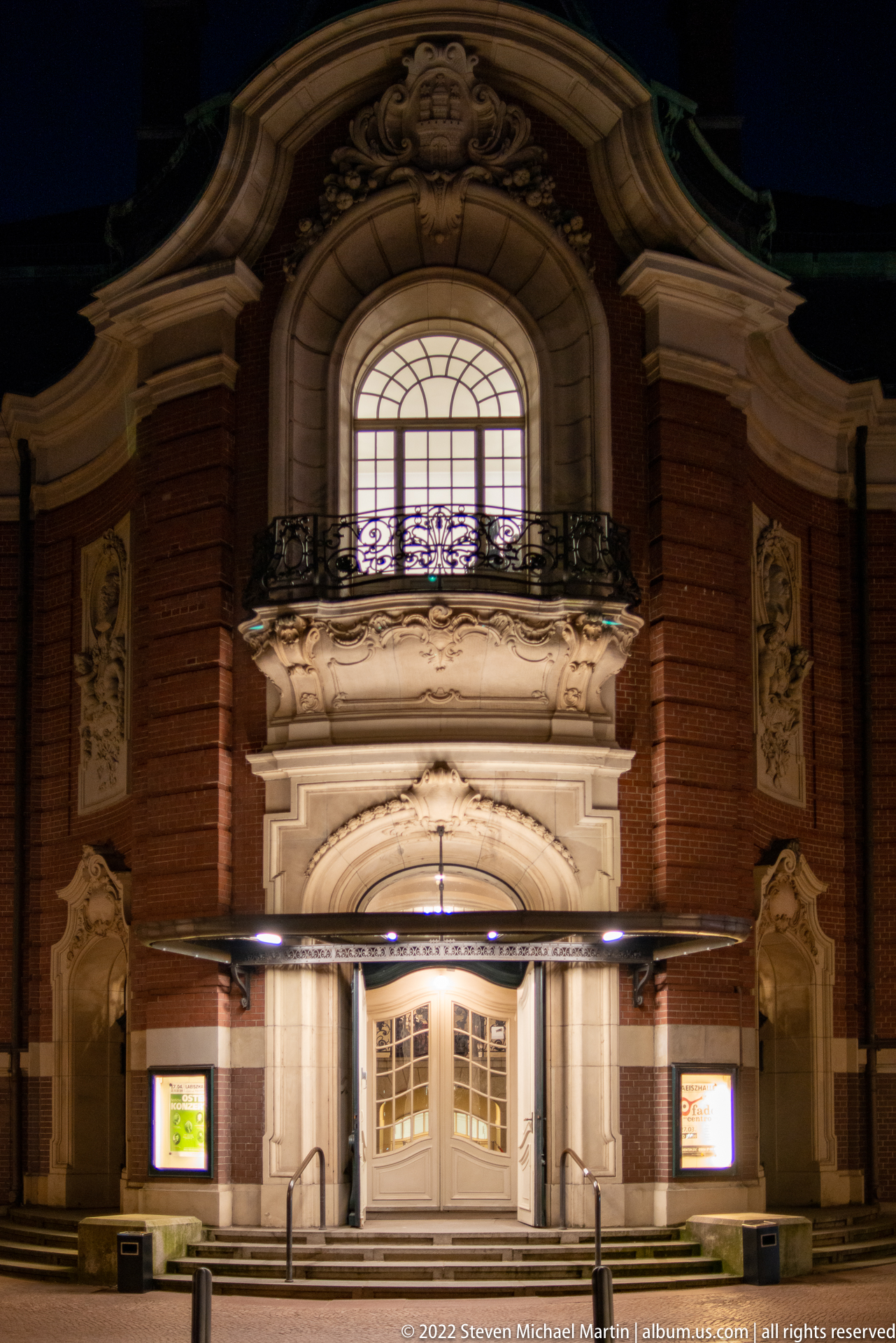
Illuminated at night, the Laeiszhalle’s principal entrance is framed by massive stonework, paired relief panels, and a large arched window above a shallow balcony. Warm architectural lighting picks out the carved details against the darker brick façade, turning the entrance into a study of the building’s layered ornament and ceremonial urban presence.
Caption
Illuminated at night, the Laeiszhalle’s principal entrance is framed by massive stonework, paired relief panels, and a large arched window above a shallow balcony. Warm architectural lighting picks out the carved details against the darker brick façade, turning the entrance into a study of the building’s layered ornament and ceremonial urban presence.
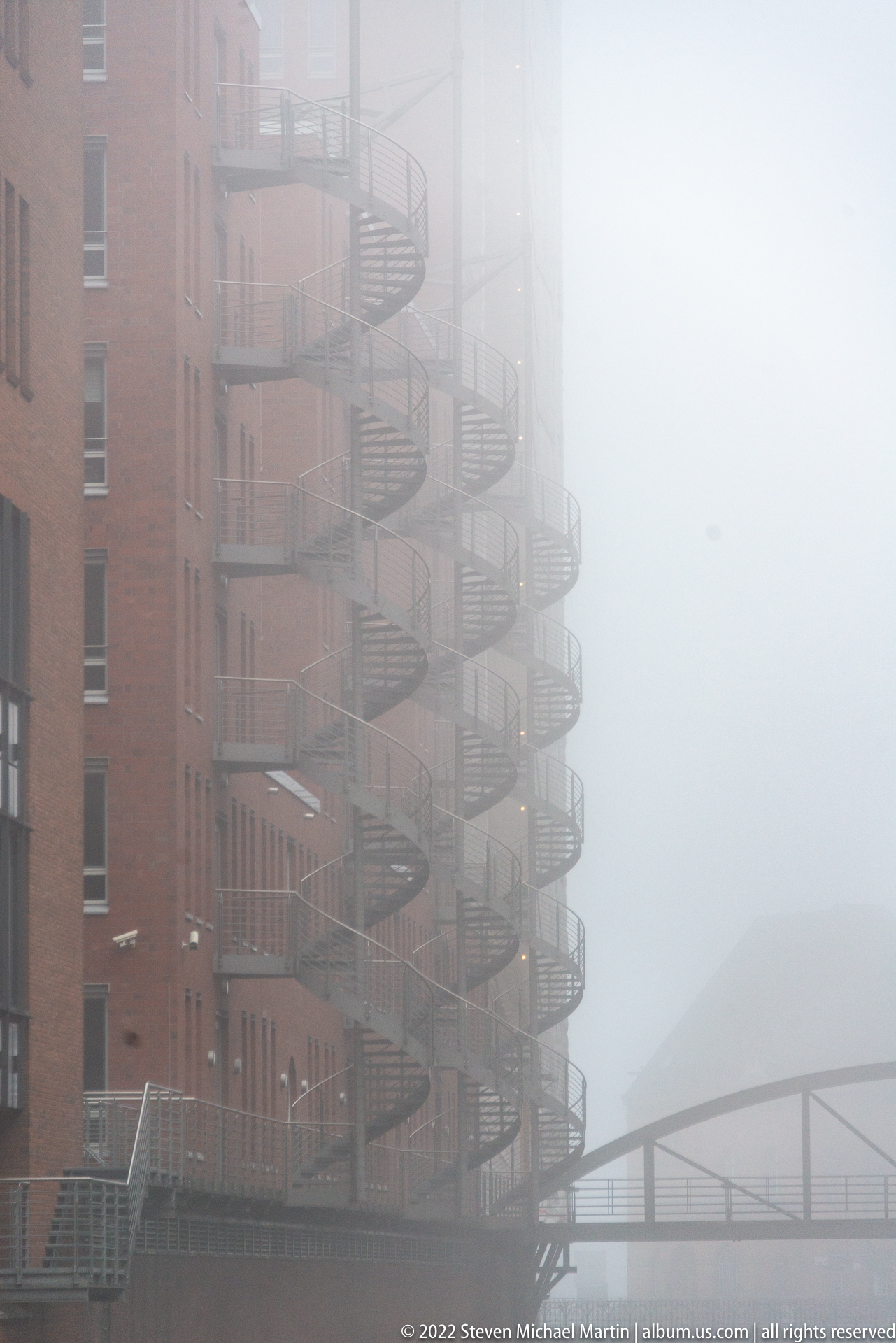
Repeated spiral metal staircases climb the side of a red-brick warehouse and vanish progressively into heavy fog. Their circular platforms and pale railings create a rhythmic pattern against the masonry, while the obscured background turns a utilitarian fire-escape system into the principal architectural feature of the photograph.
Caption
Repeated spiral metal staircases climb the side of a red-brick warehouse and vanish progressively into heavy fog. Their circular platforms and pale railings create a rhythmic pattern against the masonry, while the obscured background turns a utilitarian fire-escape system into the principal architectural feature of the photograph.
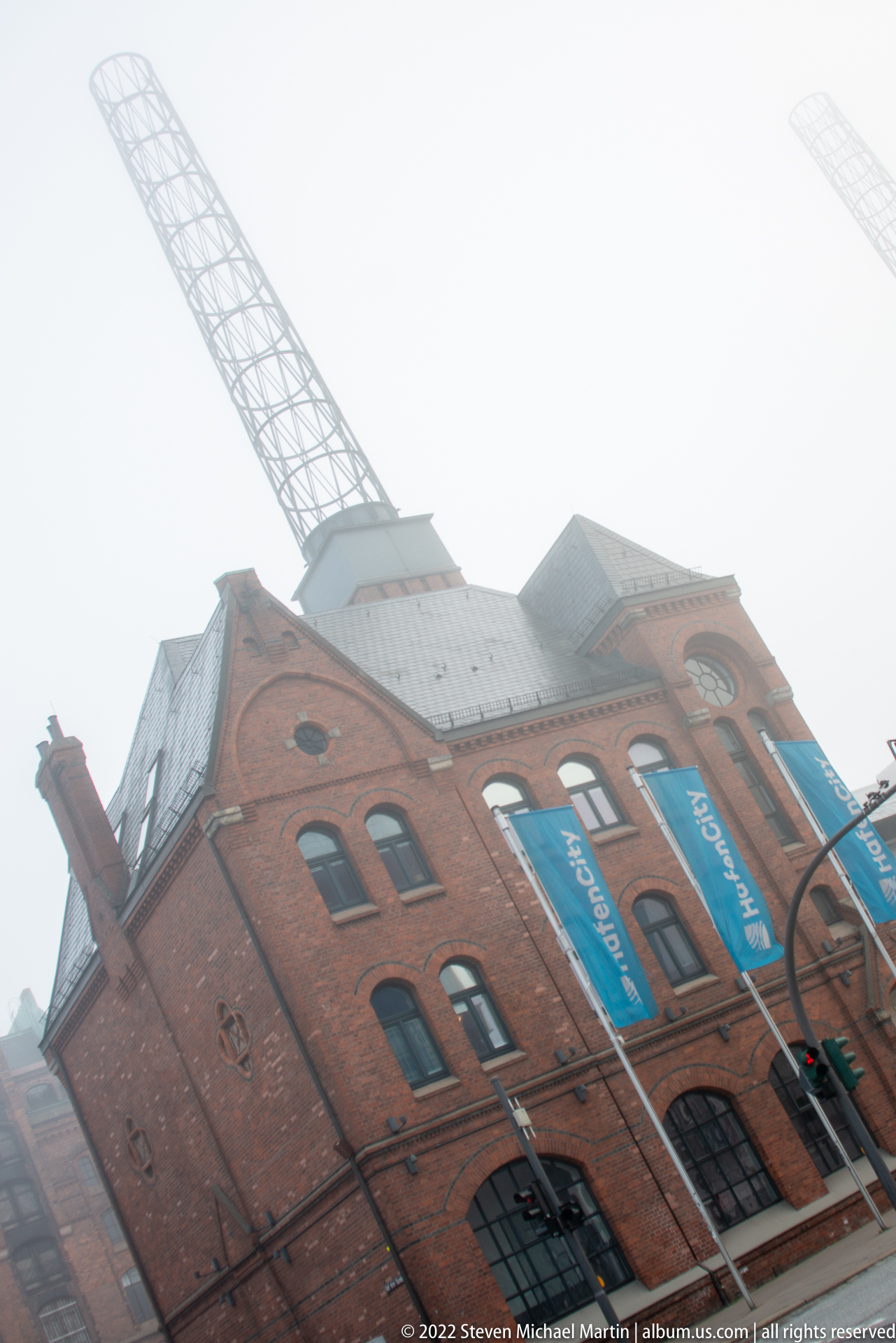
A red-brick harbor building rises beneath the lattice boom and machinery of an industrial crane, linking masonry architecture with Hamburg’s working-port heritage. Tall arched windows punctuate the façade, while blue vertical banners hang between openings. The steep upward viewpoint compresses building and crane into a single industrial composition against the fog-white sky.
Caption
A red-brick harbor building rises beneath the lattice boom and machinery of an industrial crane, linking masonry architecture with Hamburg’s working-port heritage. Tall arched windows punctuate the façade, while blue vertical banners hang between openings. The steep upward viewpoint compresses building and crane into a single industrial composition against the fog-white sky.
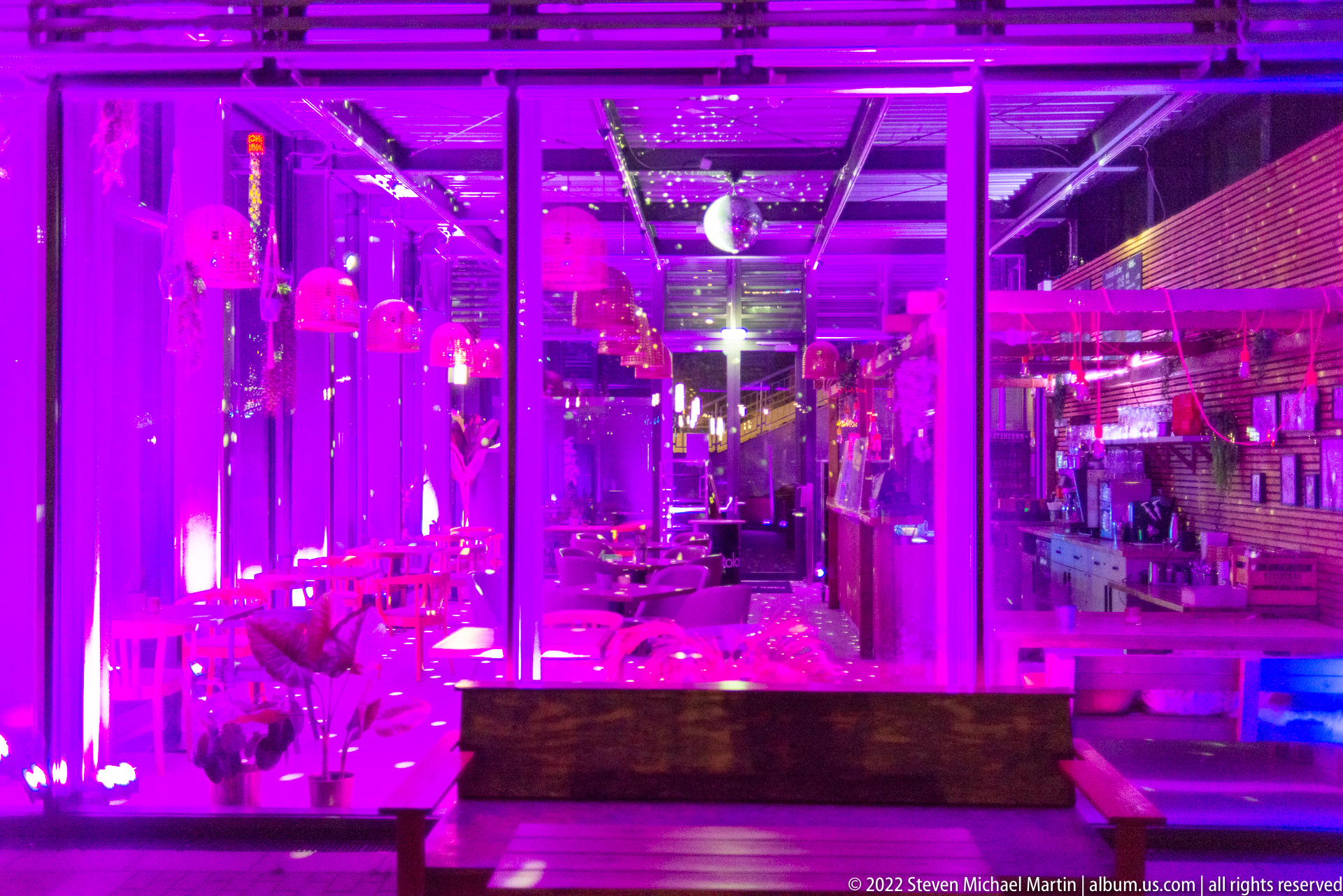
Intense magenta and violet lighting transforms a contemporary bar or lounge into a reflective interior of glass, steel, mirrors, and polished surfaces. Tables and seating recede through the room beneath exposed beams and ceiling fixtures, while the saturated color makes the architecture itself the dominant subject rather than any individual patron or activity.
Caption
Intense magenta and violet lighting transforms a contemporary bar or lounge into a reflective interior of glass, steel, mirrors, and polished surfaces. Tables and seating recede through the room beneath exposed beams and ceiling fixtures, while the saturated color makes the architecture itself the dominant subject rather than any individual patron or activity.
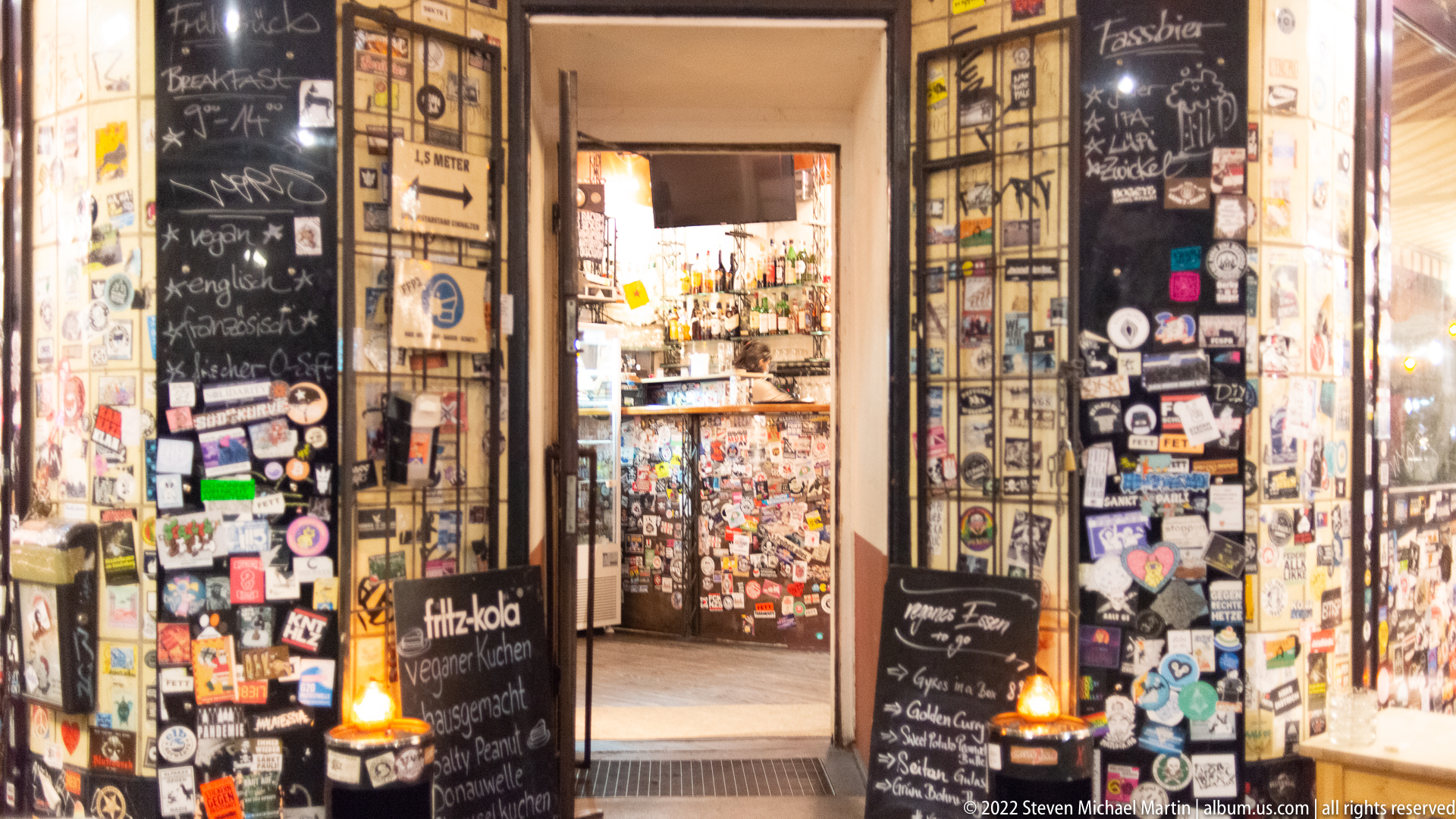
A narrow pub or bar entrance is almost completely layered with stickers, handwritten notices, chalkboard menus, and accumulated street graphics. The dense surface treatment continues from the exterior walls into the brightly lit interior, giving the doorway the feel of a long-used neighborhood venue shaped as much by patrons’ marks as by formal decoration.
Caption
A narrow pub or bar entrance is almost completely layered with stickers, handwritten notices, chalkboard menus, and accumulated street graphics. The dense surface treatment continues from the exterior walls into the brightly lit interior, giving the doorway the feel of a long-used neighborhood venue shaped as much by patrons’ marks as by formal decoration.
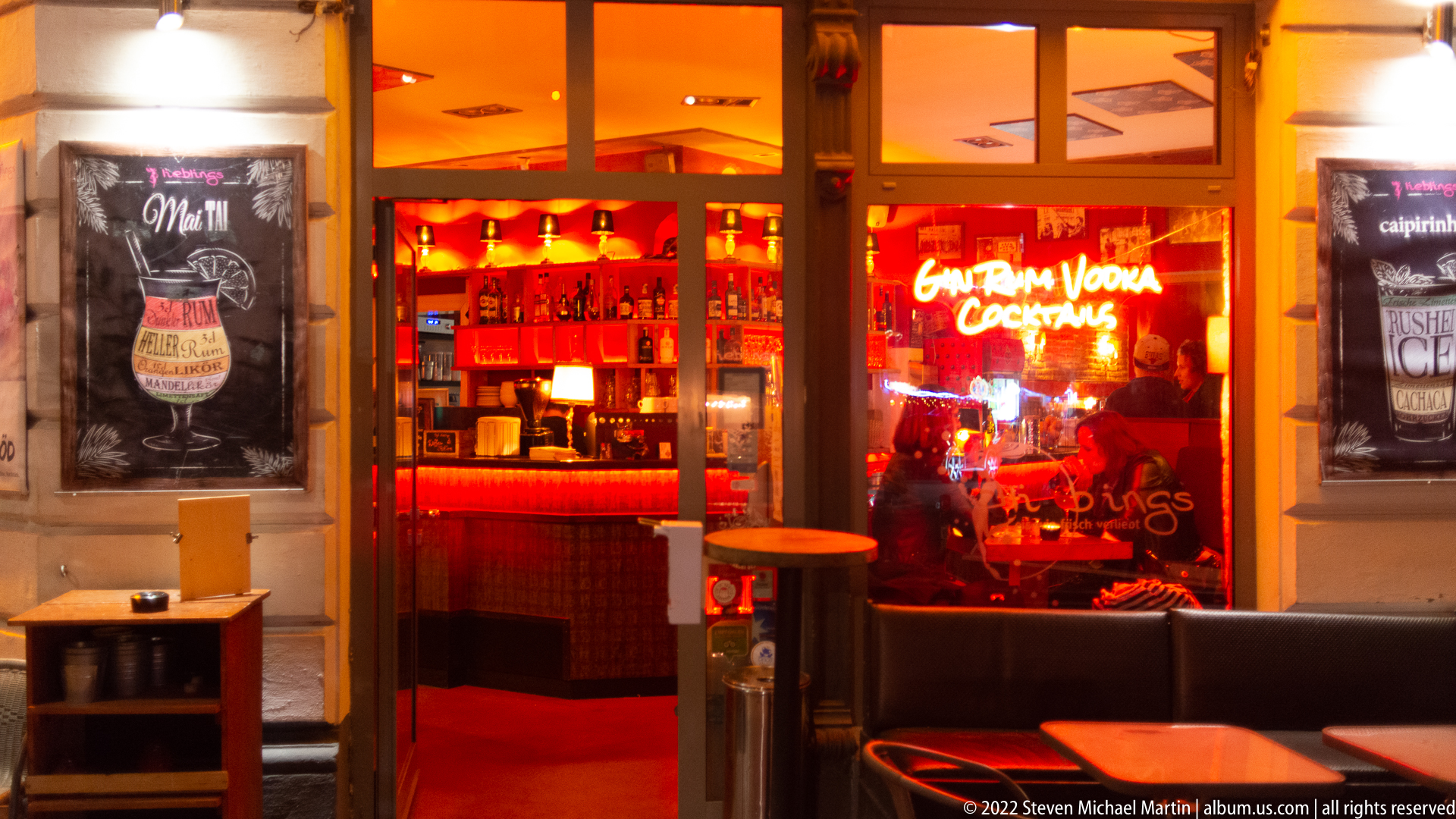
A warmly lit cocktail bar glows in orange and red behind a large street-facing window. Bottles line the back bar, a small counter occupies the center, and a neon script sign advertises cocktails above the seating area. The photograph contrasts the intimate interior with the darker pavement and empty outdoor tables immediately outside.
Caption
A warmly lit cocktail bar glows in orange and red behind a large street-facing window. Bottles line the back bar, a small counter occupies the center, and a neon script sign advertises cocktails above the seating area. The photograph contrasts the intimate interior with the darker pavement and empty outdoor tables immediately outside.
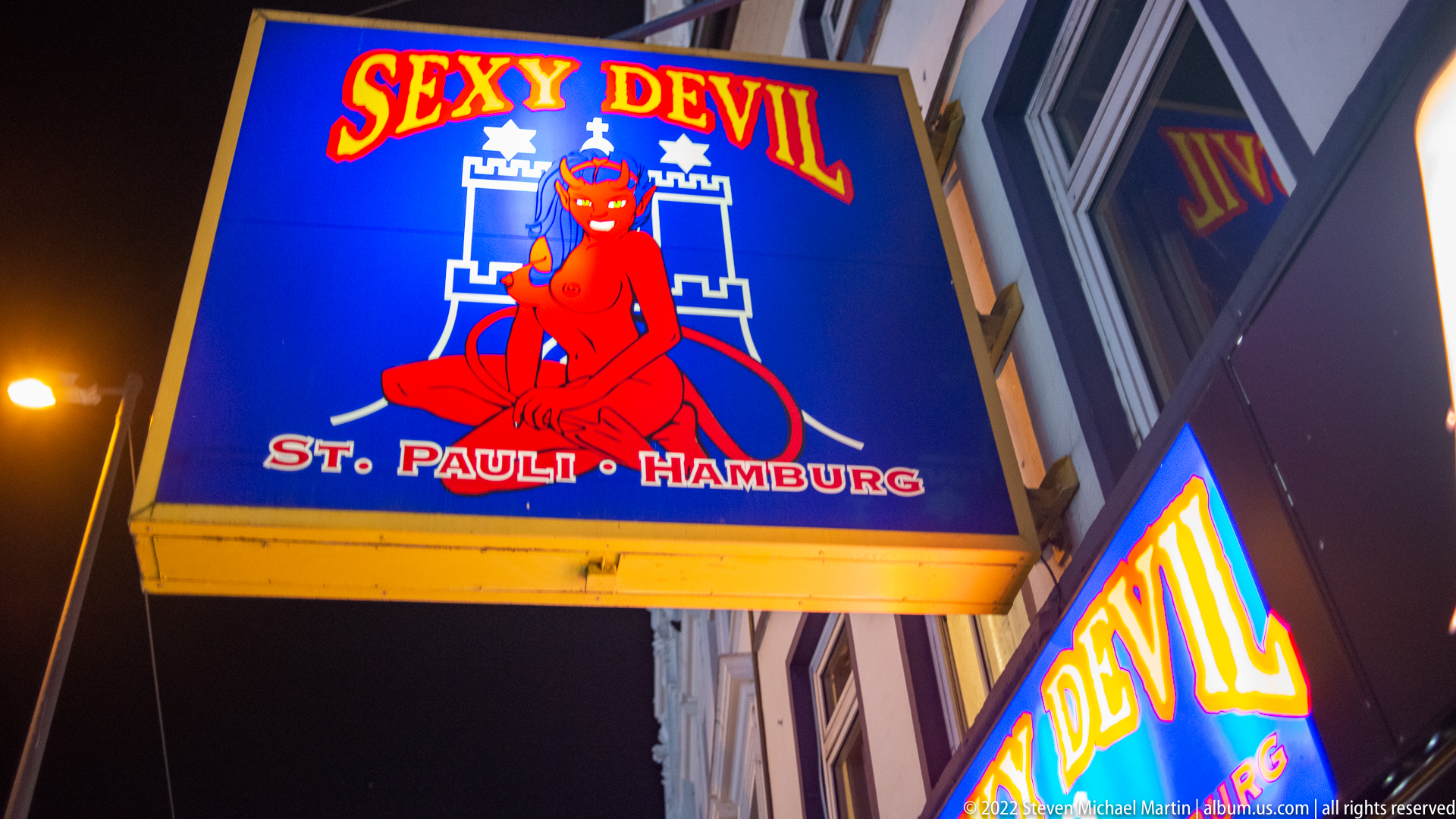
A brightly colored neon sign announces “Sexy Devil” above a stylized red devil and the words “St. Pauli Hamburg.” Seen at an upward angle against the night sky, the sign functions as a compact emblem of the district’s commercial nightlife, relying on bold primary colors, cartoon imagery, and unmistakable place lettering.
Caption
A brightly colored neon sign announces “Sexy Devil” above a stylized red devil and the words “St. Pauli Hamburg.” Seen at an upward angle against the night sky, the sign functions as a compact emblem of the district’s commercial nightlife, relying on bold primary colors, cartoon imagery, and unmistakable place lettering.
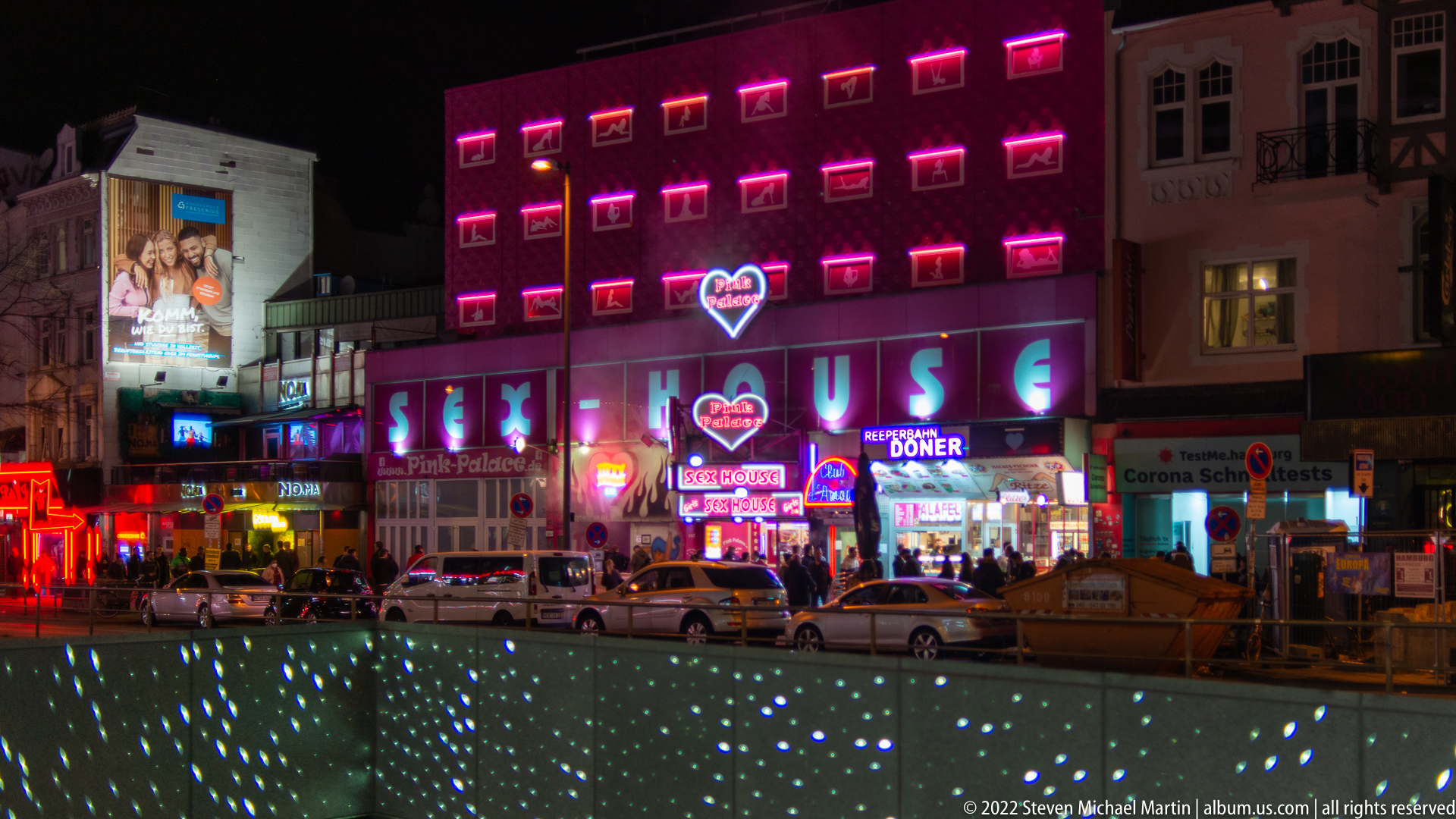
Neon storefronts line a busy St. Pauli street, where pink-framed windows, heart-shaped signage, restaurants, parked cars, and illuminated pavement create a layered nighttime streetscape. The broad view records the dense mixture of entertainment, food, and adult-oriented businesses that characterizes this commercial district rather than isolating any single establishment.
Caption
Neon storefronts line a busy St. Pauli street, where pink-framed windows, heart-shaped signage, restaurants, parked cars, and illuminated pavement create a layered nighttime streetscape. The broad view records the dense mixture of entertainment, food, and adult-oriented businesses that characterizes this commercial district rather than isolating any single establishment.
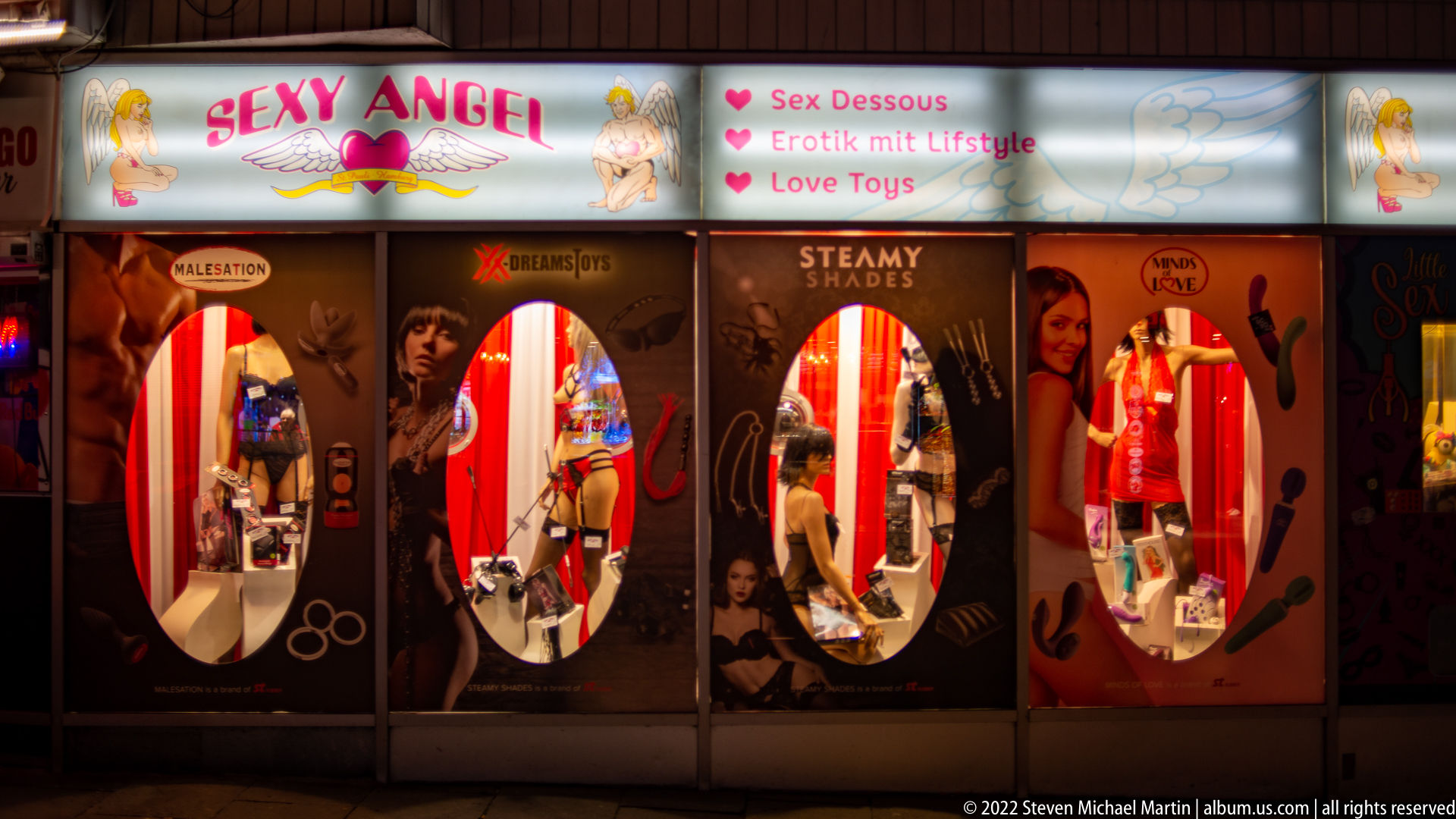
An adult retail storefront presents lingerie and novelty merchandise through three tall oval display windows under a bright sign advertising “Sex Dessous,” “Erotik mit Lifestyle,” and “Love Toys.” The frontal composition records the shop’s deliberately theatrical merchandising and the role of specialized retail within St. Pauli’s nighttime entertainment economy.
Caption
An adult retail storefront presents lingerie and novelty merchandise through three tall oval display windows under a bright sign advertising “Sex Dessous,” “Erotik mit Lifestyle,” and “Love Toys.” The frontal composition records the shop’s deliberately theatrical merchandising and the role of specialized retail within St. Pauli’s nighttime entertainment economy.
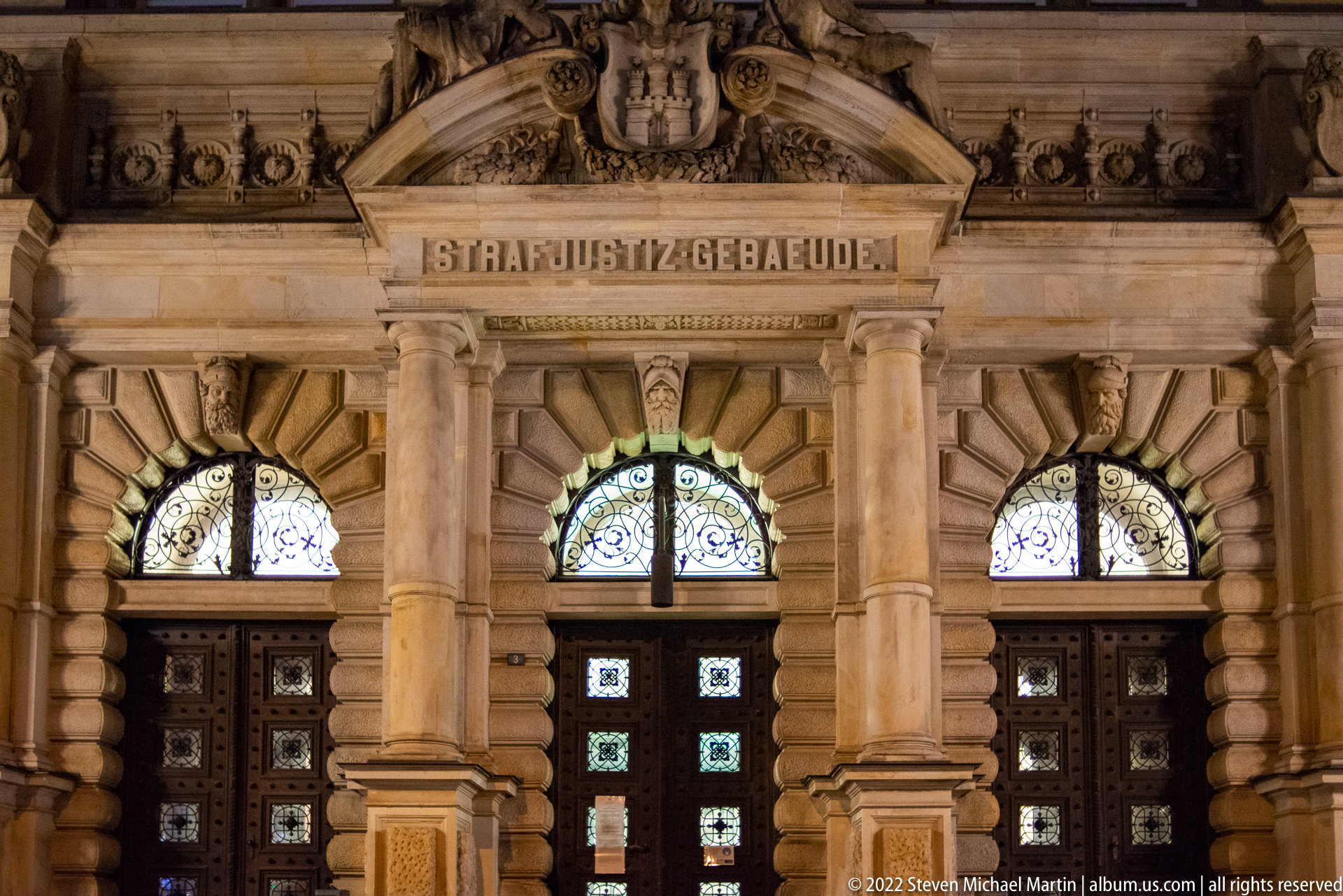
The monumental entrance of Hamburg’s Strafjustizgebäude is framed by rusticated stonework, paired columns, three arched openings, and heavy paneled doors. The name “STRAFJUSTIZGEBÄUDE” is carved prominently above the central bay, allowing the photograph to function as both an architectural detail and a documentary record of the criminal-court building’s formal civic identity.
Caption
The monumental entrance of Hamburg’s Strafjustizgebäude is framed by rusticated stonework, paired columns, three arched openings, and heavy paneled doors. The name “STRAFJUSTIZGEBÄUDE” is carved prominently above the central bay, allowing the photograph to function as both an architectural detail and a documentary record of the criminal-court building’s formal civic identity.
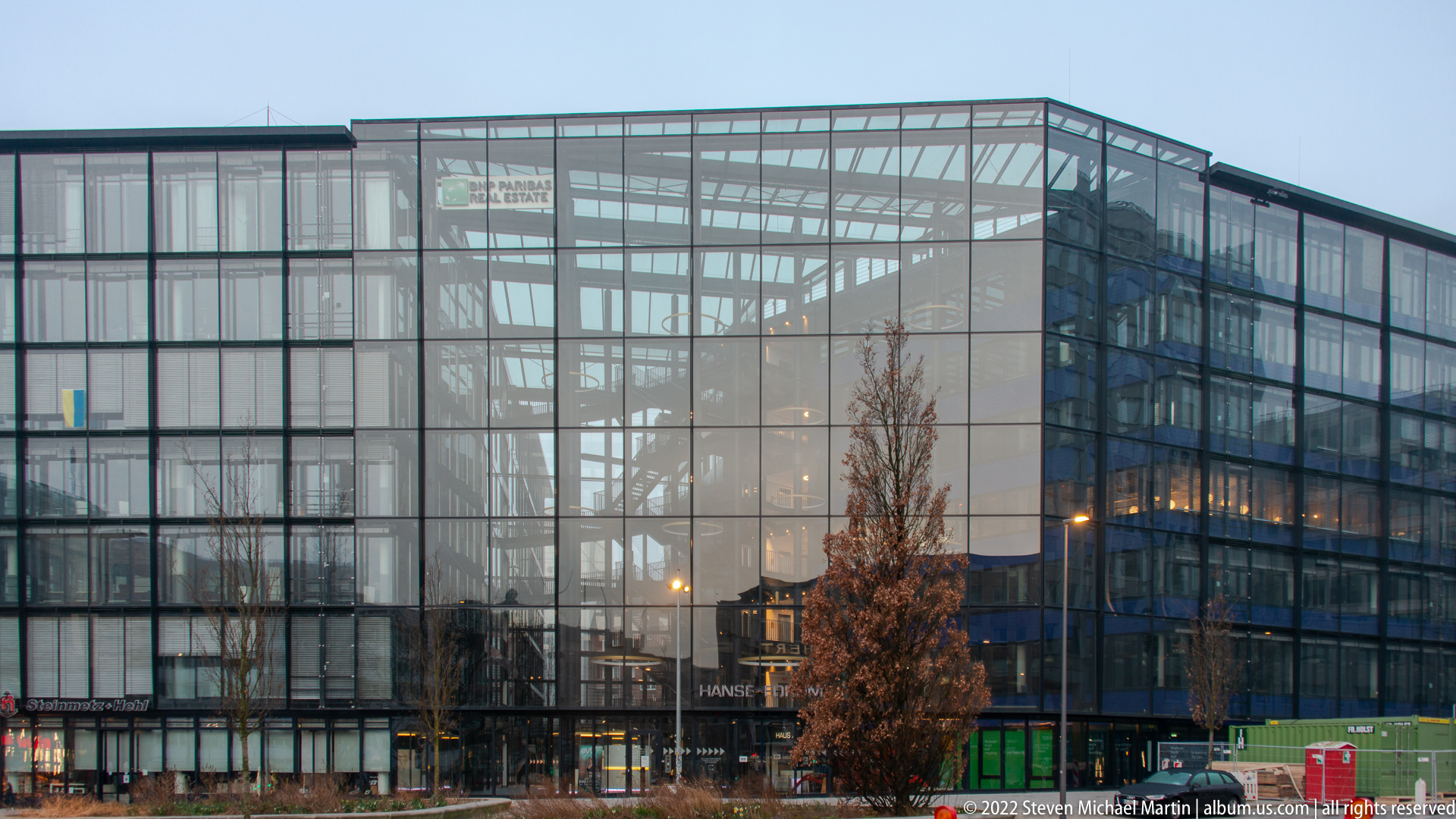
A large contemporary building is wrapped in a transparent glass curtain wall that reveals its internal structural grid and illuminated floors. Photographed in gray weather, the reflective façade nearly merges with the overcast sky while a bare tree and construction elements at street level provide scale and a sense of ongoing urban redevelopment.
Caption
A large contemporary building is wrapped in a transparent glass curtain wall that reveals its internal structural grid and illuminated floors. Photographed in gray weather, the reflective façade nearly merges with the overcast sky while a bare tree and construction elements at street level provide scale and a sense of ongoing urban redevelopment.
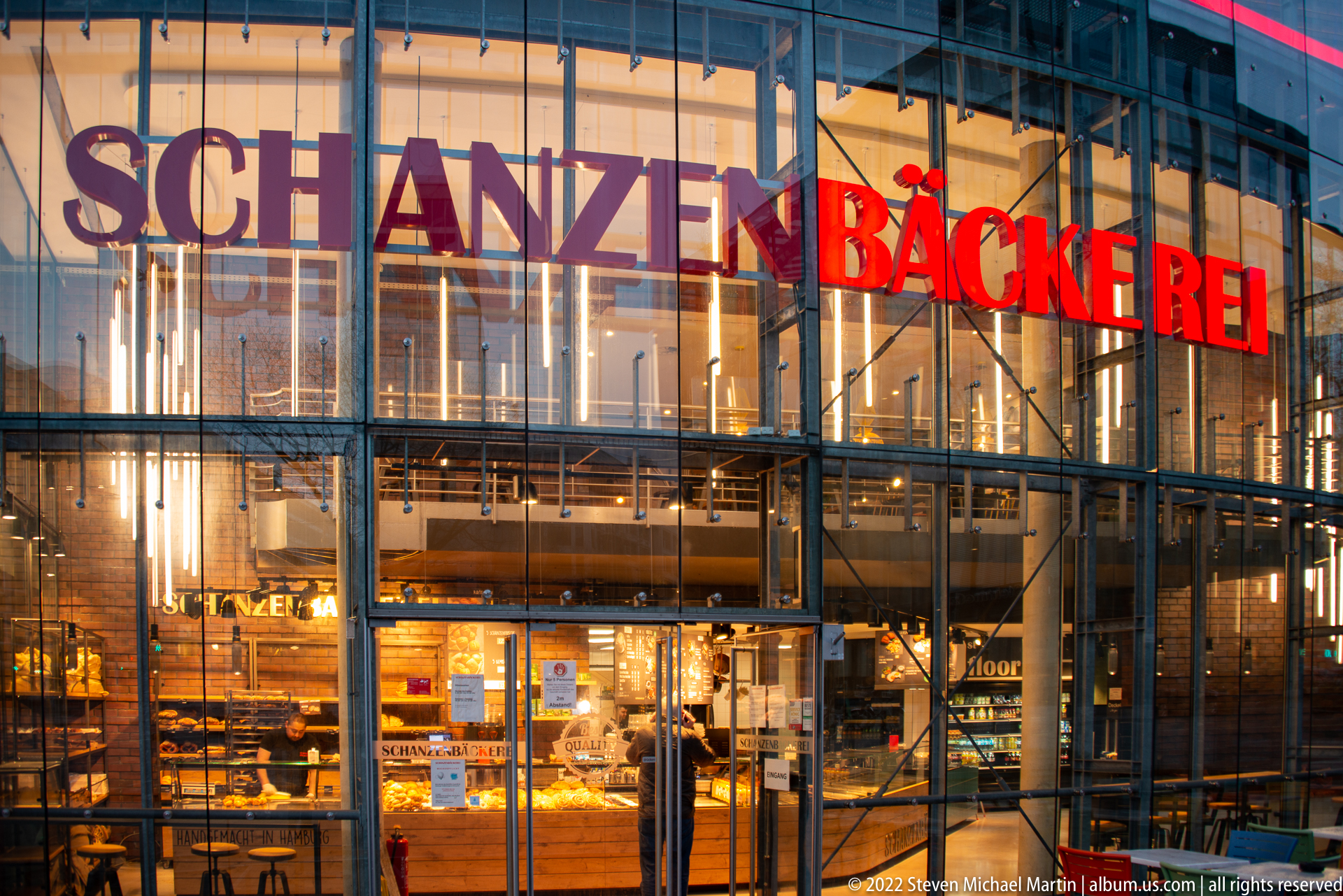
The glass-fronted Schanzenbäckerei opens directly onto the street, its bold red “BÄCKEREI” lettering and interior bread displays visible through the transparent façade. Pendant lights, counters, and shelves of baked goods make the shop’s function immediately legible, while the image also shows how contemporary retail is integrated into Hamburg’s dense urban fabric.
Caption
The glass-fronted Schanzenbäckerei opens directly onto the street, its bold red “BÄCKEREI” lettering and interior bread displays visible through the transparent façade. Pendant lights, counters, and shelves of baked goods make the shop’s function immediately legible, while the image also shows how contemporary retail is integrated into Hamburg’s dense urban fabric.
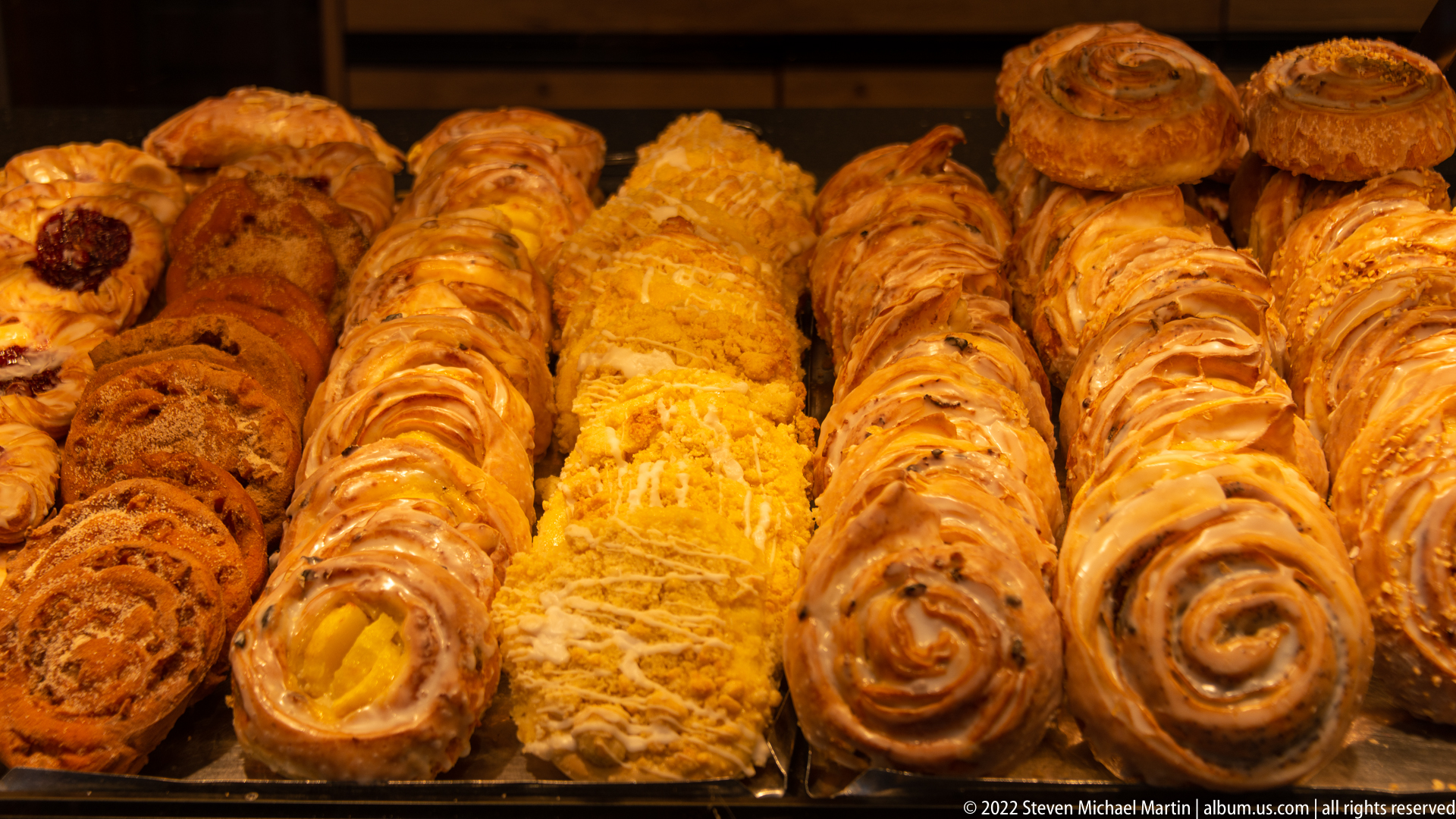
Rows of freshly baked pastries fill a display case, including tightly rolled spirals, glazed coils, and elongated laminated pieces with varied toppings. The close framing emphasizes crisp browned edges, glossy surfaces, and repeated forms, turning an everyday bakery counter into a study of texture and abundance rather than a record of the shop interior.
Caption
Rows of freshly baked pastries fill a display case, including tightly rolled spirals, glazed coils, and elongated laminated pieces with varied toppings. The close framing emphasizes crisp browned edges, glossy surfaces, and repeated forms, turning an everyday bakery counter into a study of texture and abundance rather than a record of the shop interior.
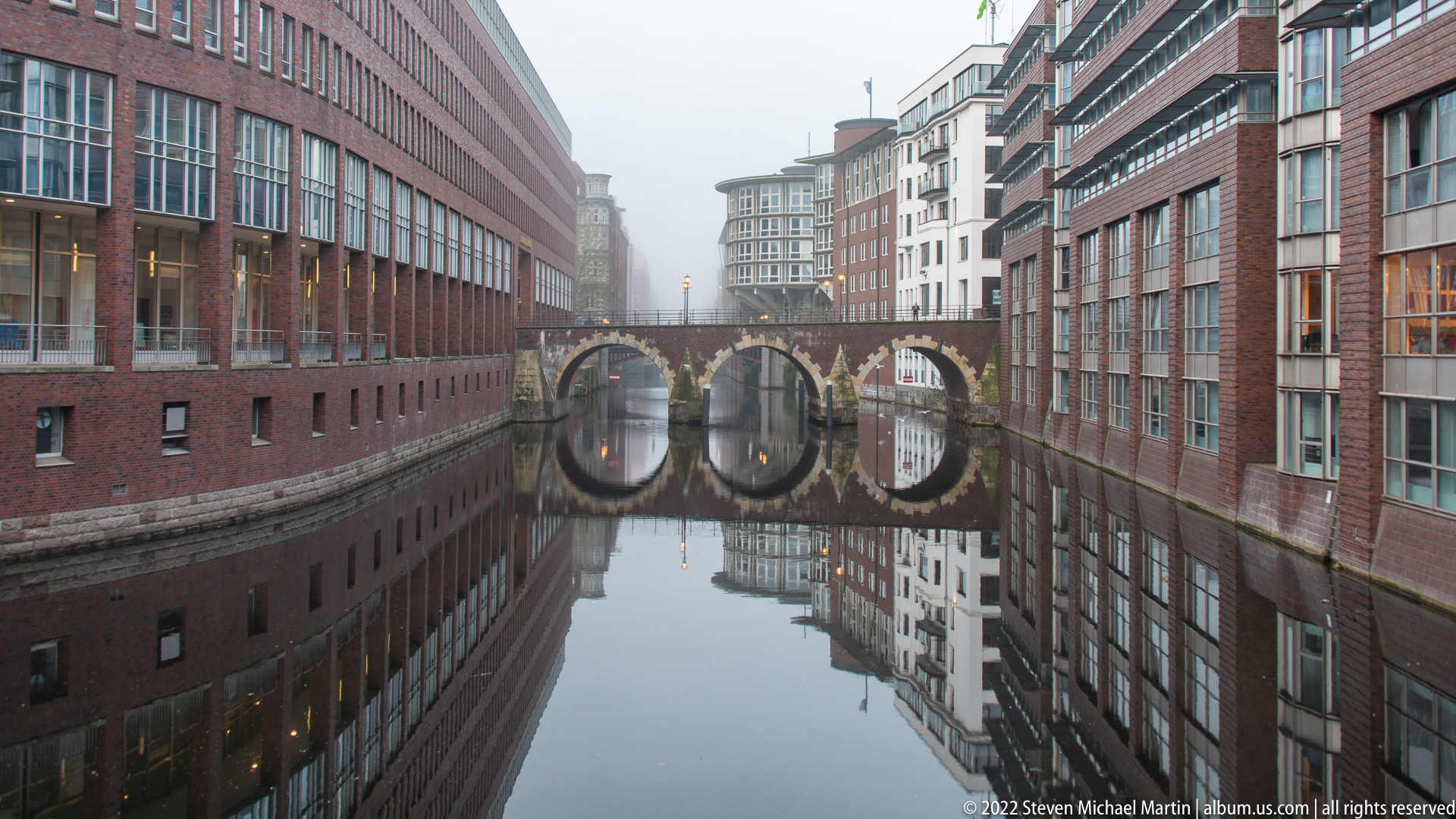
A still canal runs between tall brick warehouse and office blocks in Hamburg’s Speicherstadt, its smooth surface doubling the façades and the three arches of a low bridge ahead. Fog softens the more distant buildings, making the repeated arches and near-perfect reflections the structural focus of this tightly enclosed waterside corridor.
Caption
A still canal runs between tall brick warehouse and office blocks in Hamburg’s Speicherstadt, its smooth surface doubling the façades and the three arches of a low bridge ahead. Fog softens the more distant buildings, making the repeated arches and near-perfect reflections the structural focus of this tightly enclosed waterside corridor.
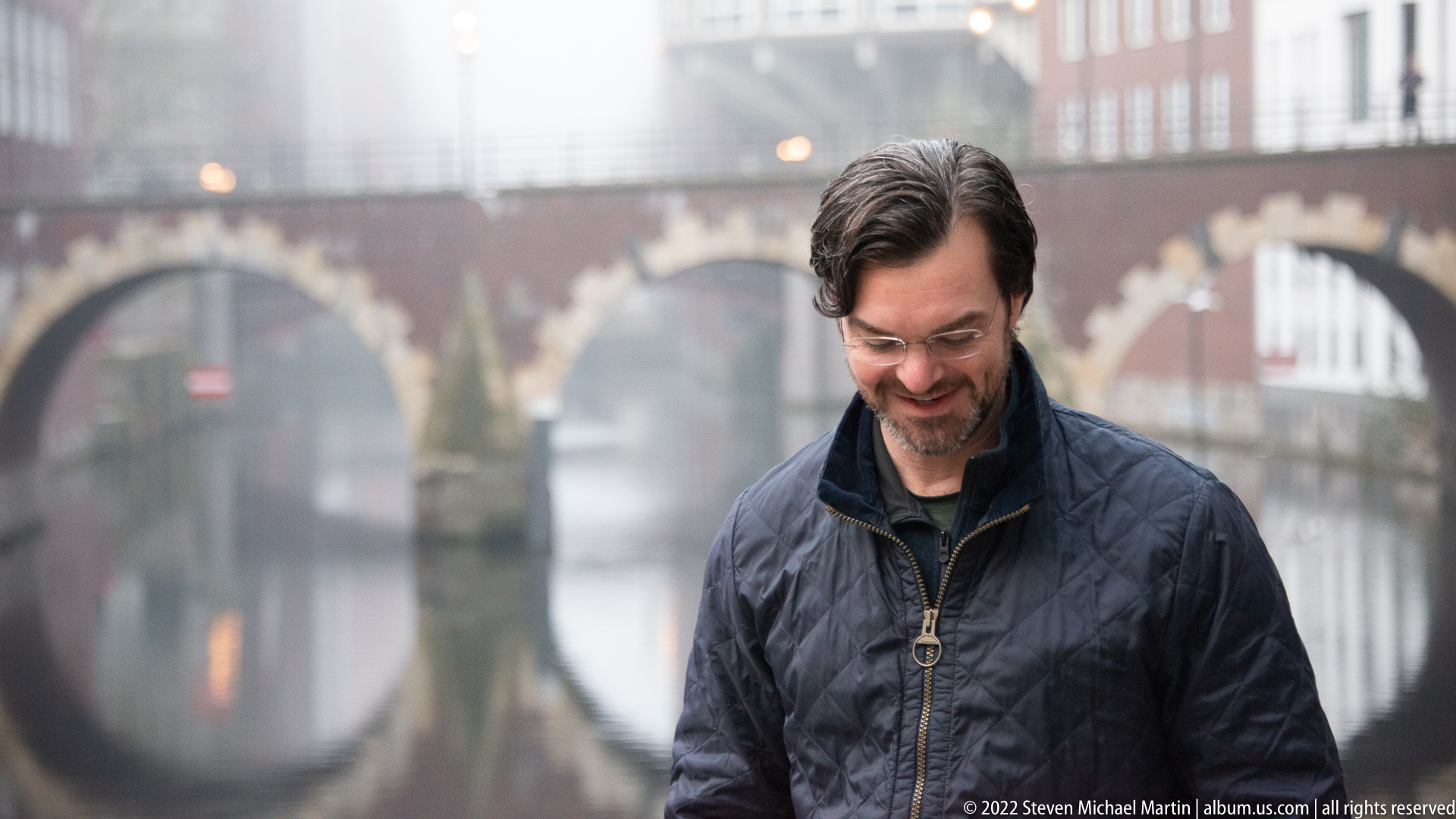
A man in a dark quilted jacket stands in the foreground of a foggy canal scene, looking downward with an informal smile. Behind him, a brick arch bridge and its reflection dissolve into soft focus, using the Speicherstadt setting as an atmospheric backdrop while keeping the shallow-depth-of-field portrait as the clear visual priority.
Caption
A man in a dark quilted jacket stands in the foreground of a foggy canal scene, looking downward with an informal smile. Behind him, a brick arch bridge and its reflection dissolve into soft focus, using the Speicherstadt setting as an atmospheric backdrop while keeping the shallow-depth-of-field portrait as the clear visual priority.
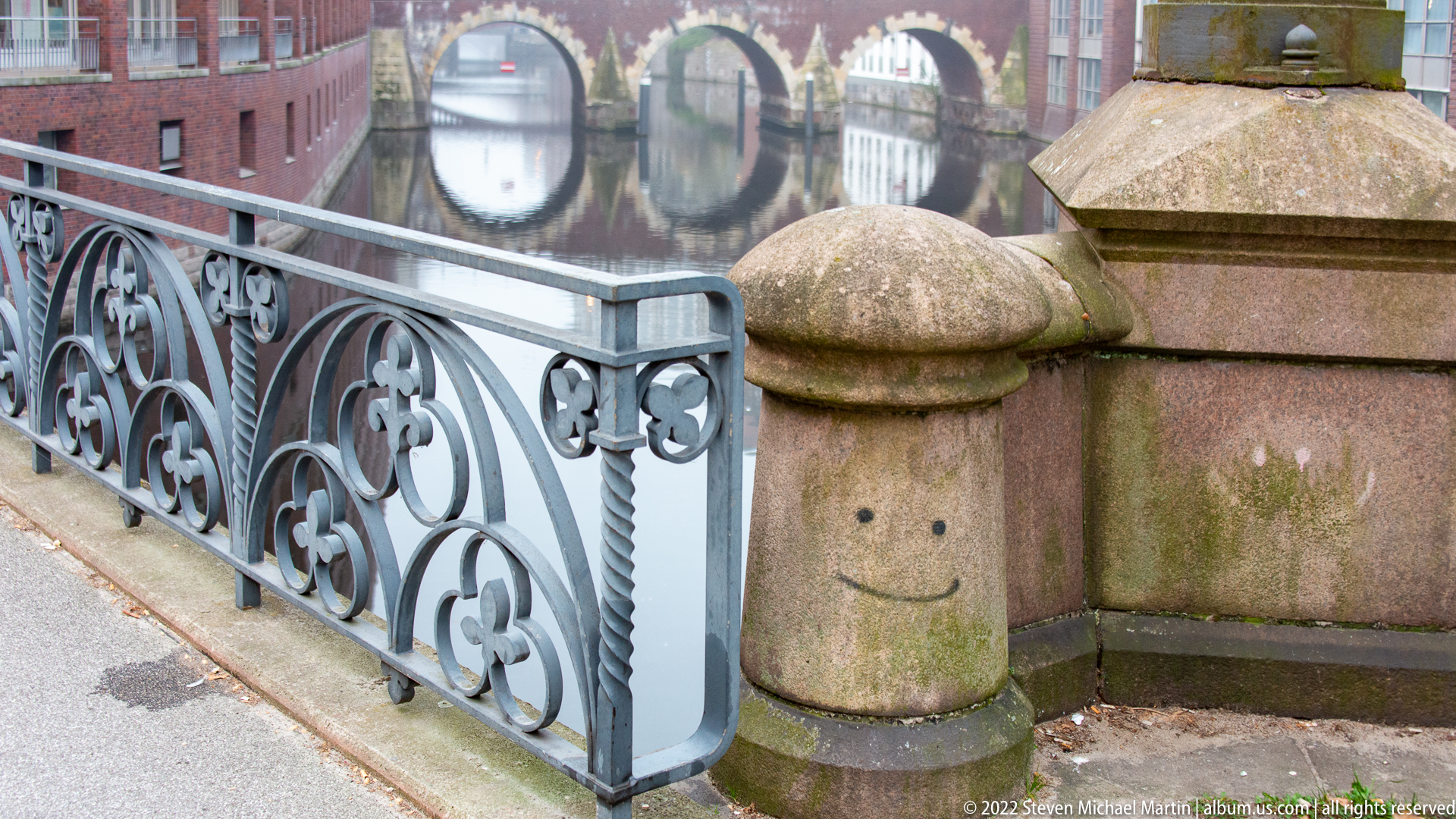
A rounded stone bollard beside an ornamental metal railing has been given a simple smiling face with two dots and a curved line. The playful intervention contrasts with the weathered masonry and formal scrollwork of the bridge, while blurred canal arches in the background place the small detail within Hamburg’s historic waterside setting.
Caption
A rounded stone bollard beside an ornamental metal railing has been given a simple smiling face with two dots and a curved line. The playful intervention contrasts with the weathered masonry and formal scrollwork of the bridge, while blurred canal arches in the background place the small detail within Hamburg’s historic waterside setting.
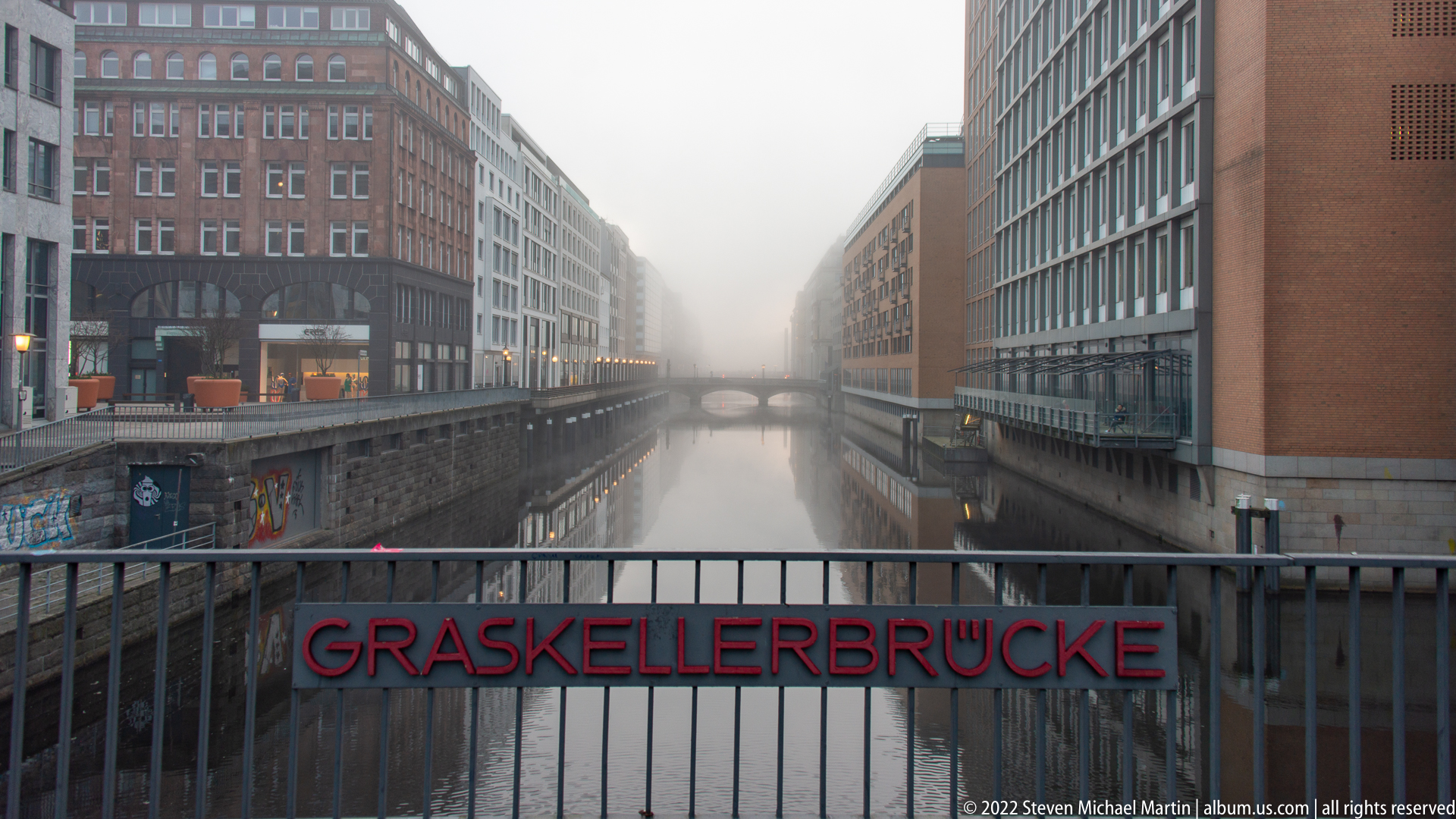
The name “GRASKELLERBRÜCKE” appears in red lettering across the foreground railing as a canal disappears into heavy morning fog. Brick and modern buildings line both banks, and a low bridge is barely visible in the distance, making the signed railing both a location marker and a strong graphic element within the muted waterscape.
Caption
The name “GRASKELLERBRÜCKE” appears in red lettering across the foreground railing as a canal disappears into heavy morning fog. Brick and modern buildings line both banks, and a low bridge is barely visible in the distance, making the signed railing both a location marker and a strong graphic element within the muted waterscape.
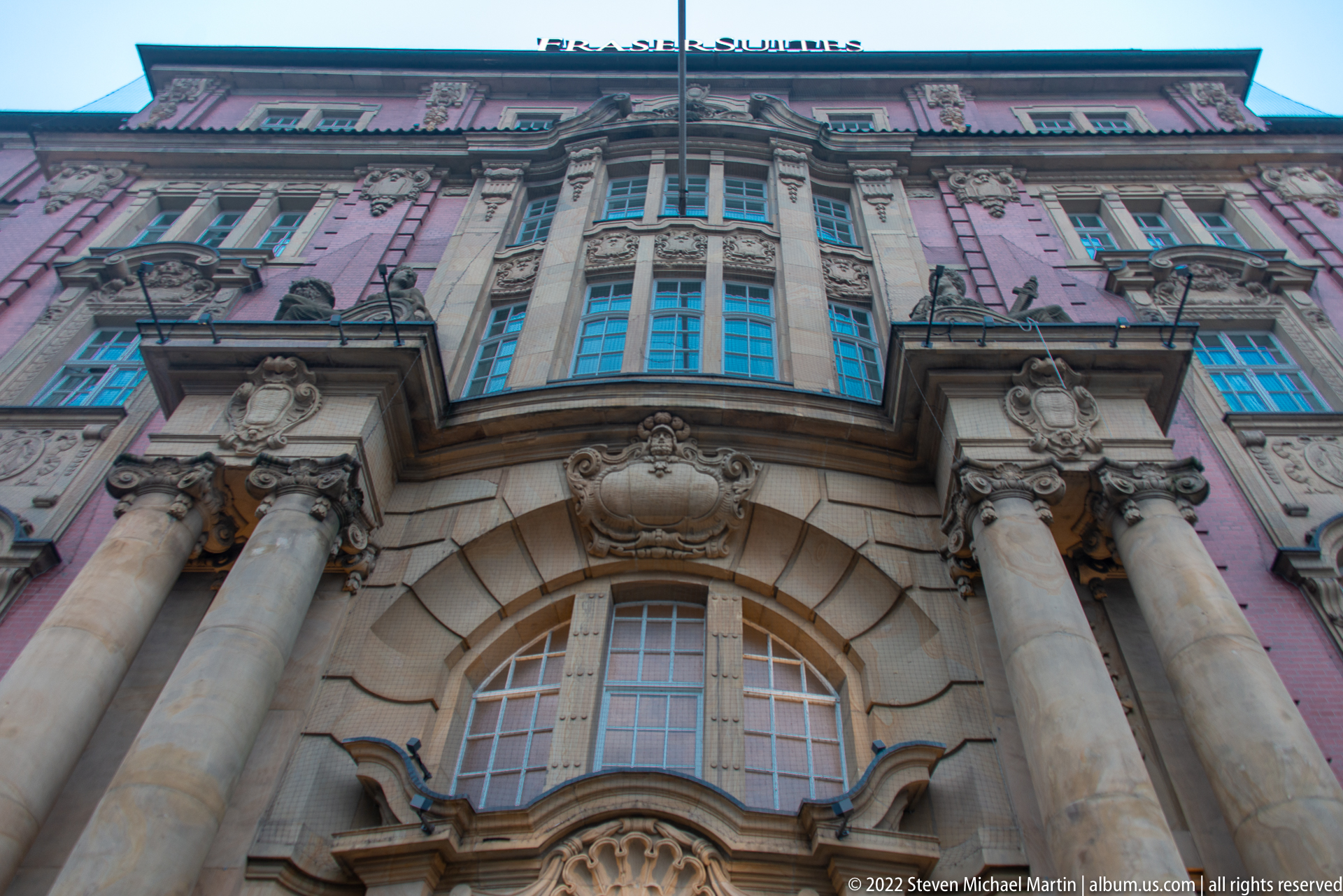
Seen from a sharply upward angle, an ornate historic façade combines pink wall surfaces with pale stone columns, scrollwork, cartouches, arched windows, and elaborate window surrounds. The low viewpoint exaggerates the vertical rise of the building and concentrates attention on its sculptural detailing, especially the paired columns and central projecting bay.
Caption
Seen from a sharply upward angle, an ornate historic façade combines pink wall surfaces with pale stone columns, scrollwork, cartouches, arched windows, and elaborate window surrounds. The low viewpoint exaggerates the vertical rise of the building and concentrates attention on its sculptural detailing, especially the paired columns and central projecting bay.
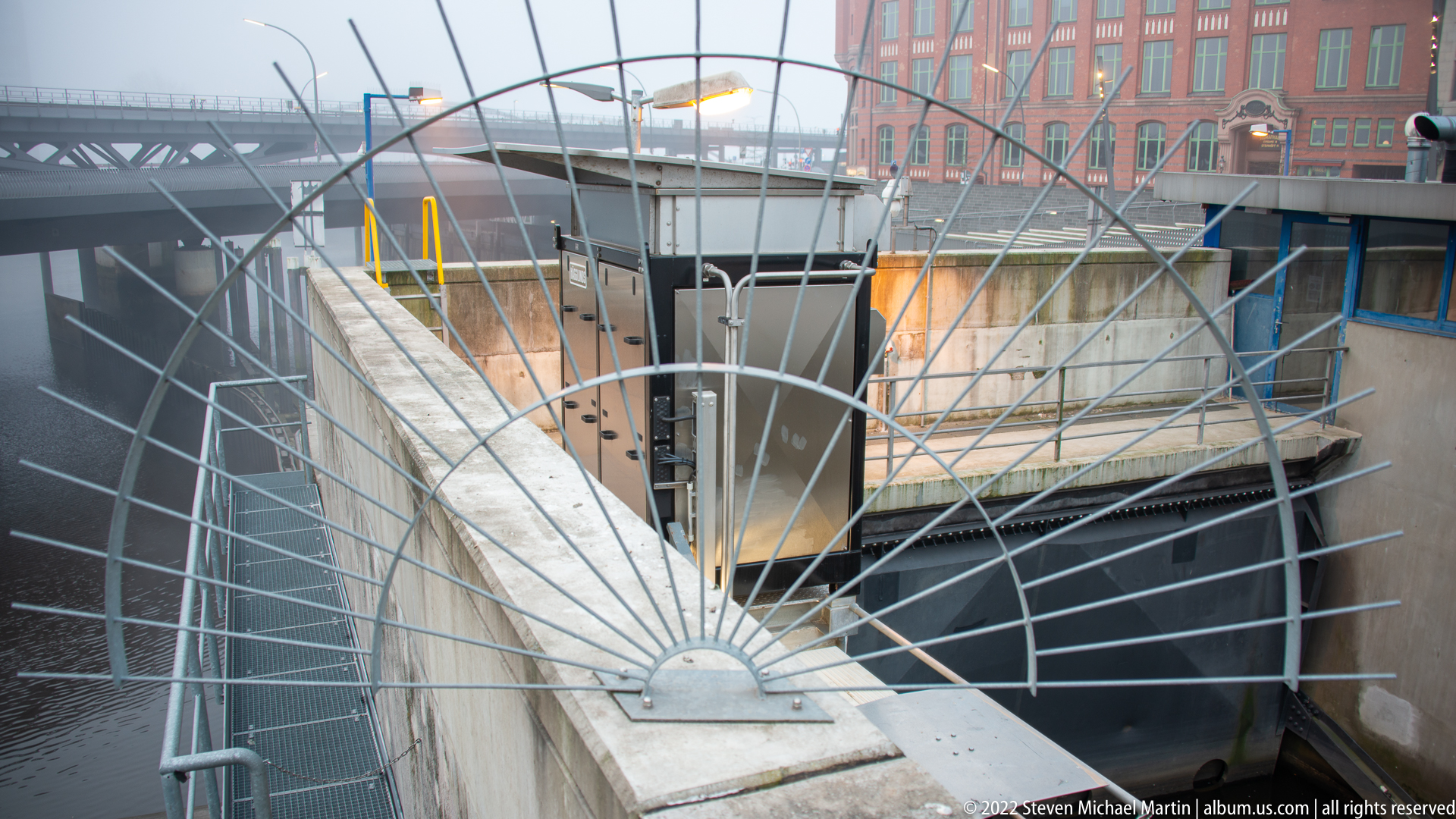
A fan-shaped steel grille curves around the edge of a harbor-side concrete structure, forming a protective barrier over the water and lower dock equipment. Seen from above, the radial metal bars dominate the composition, while yellow railings, a narrow platform, and brick buildings beyond reveal the working port environment in which the barrier functions.
Caption
A fan-shaped steel grille curves around the edge of a harbor-side concrete structure, forming a protective barrier over the water and lower dock equipment. Seen from above, the radial metal bars dominate the composition, while yellow railings, a narrow platform, and brick buildings beyond reveal the working port environment in which the barrier functions.
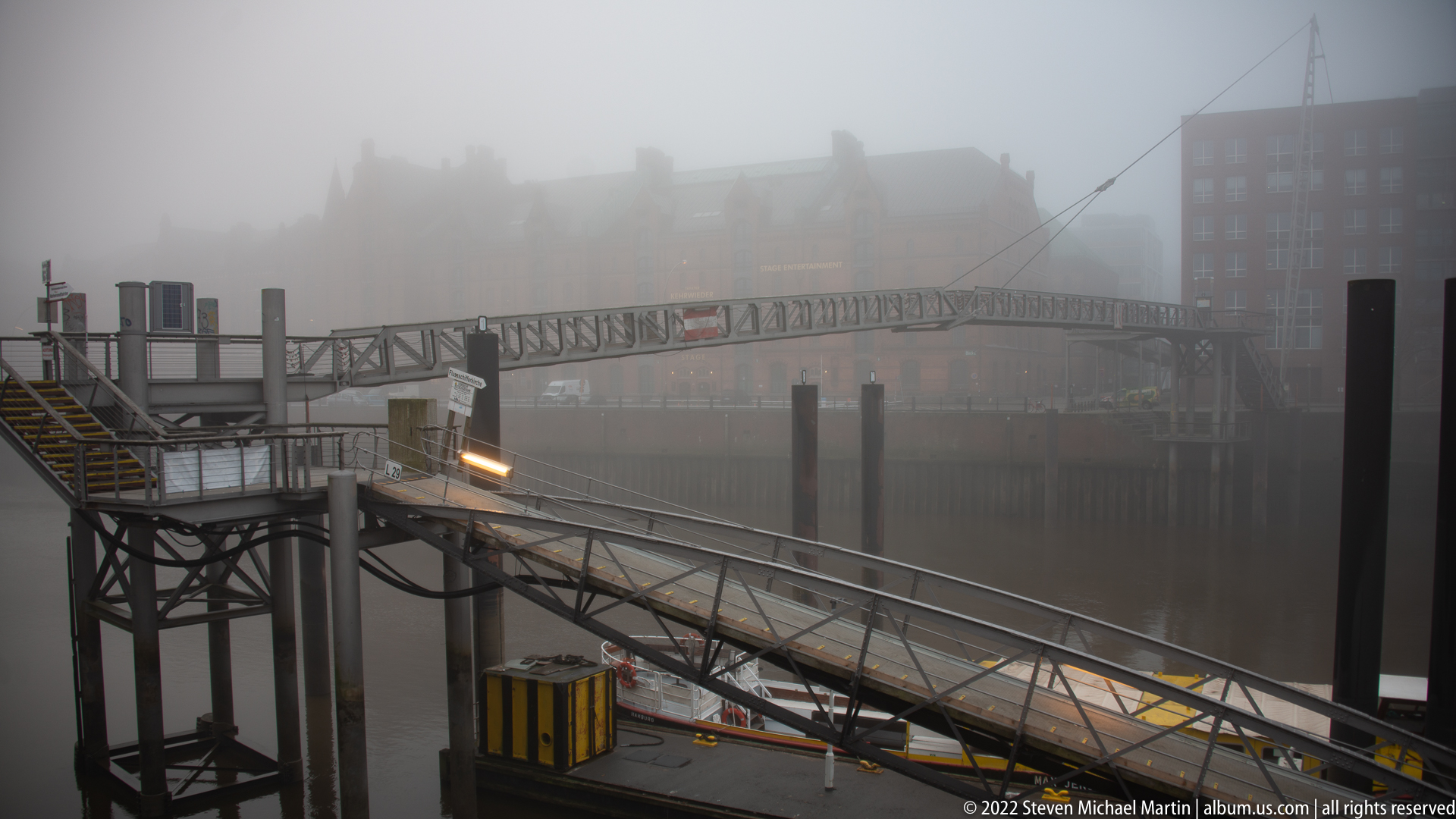
Metal gangways and elevated platforms cross above dark harbor water, linking dock structures through a network of stairs, trusses, and pilings. Fog obscures the brick buildings beyond and compresses the scene into layered industrial geometry, emphasizing the infrastructure that allows passengers and workers to move between fixed quays and floating harbor facilities.
Caption
Metal gangways and elevated platforms cross above dark harbor water, linking dock structures through a network of stairs, trusses, and pilings. Fog obscures the brick buildings beyond and compresses the scene into layered industrial geometry, emphasizing the infrastructure that allows passengers and workers to move between fixed quays and floating harbor facilities.
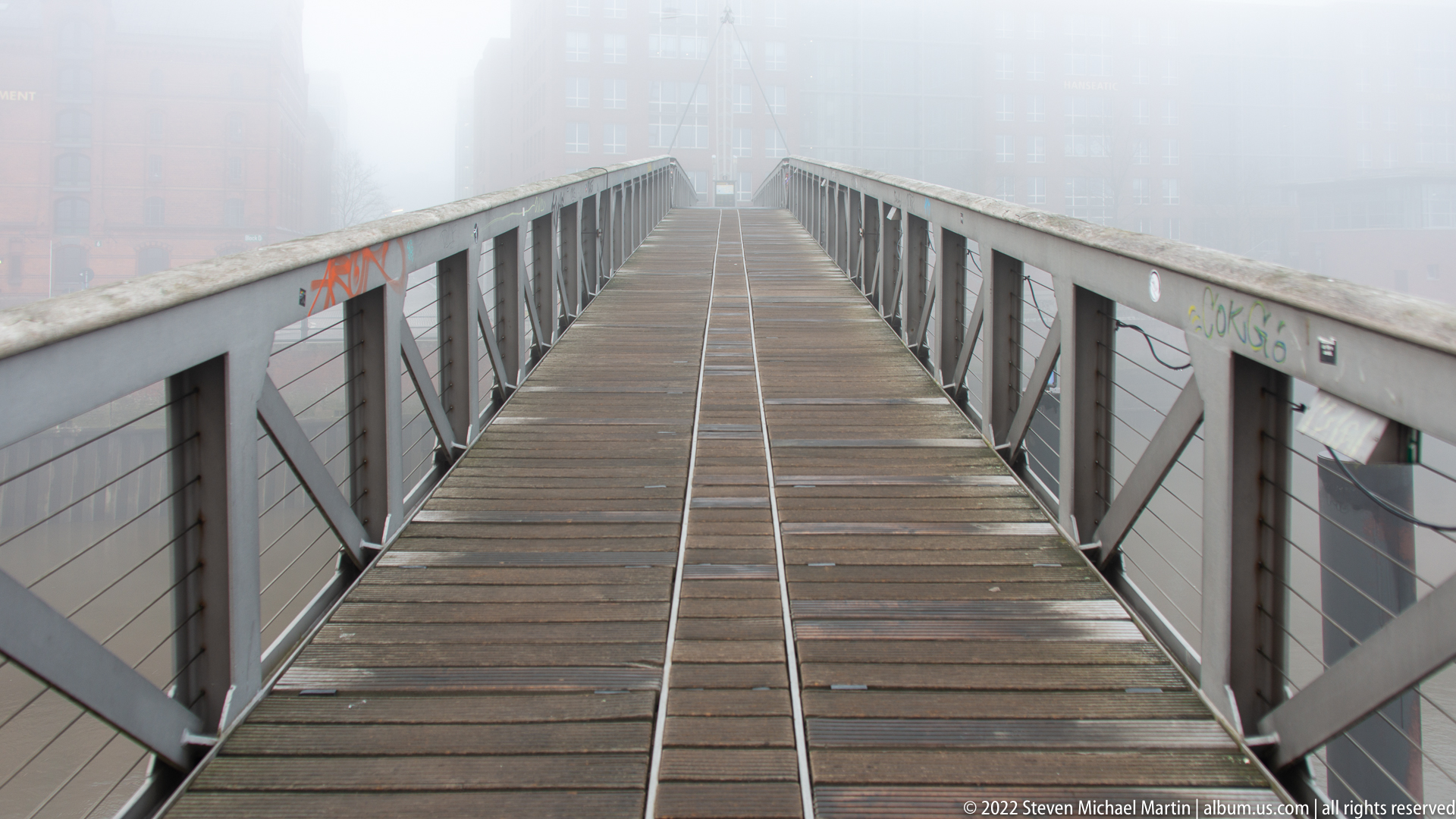
A narrow wooden-deck pedestrian bridge stretches straight into dense fog between gray steel truss railings. Parallel planks and the central seam create a strong vanishing point, while distant buildings disappear almost completely, turning a practical harbor crossing into a spare study of perspective, material, and reduced visibility.
Caption
A narrow wooden-deck pedestrian bridge stretches straight into dense fog between gray steel truss railings. Parallel planks and the central seam create a strong vanishing point, while distant buildings disappear almost completely, turning a practical harbor crossing into a spare study of perspective, material, and reduced visibility.
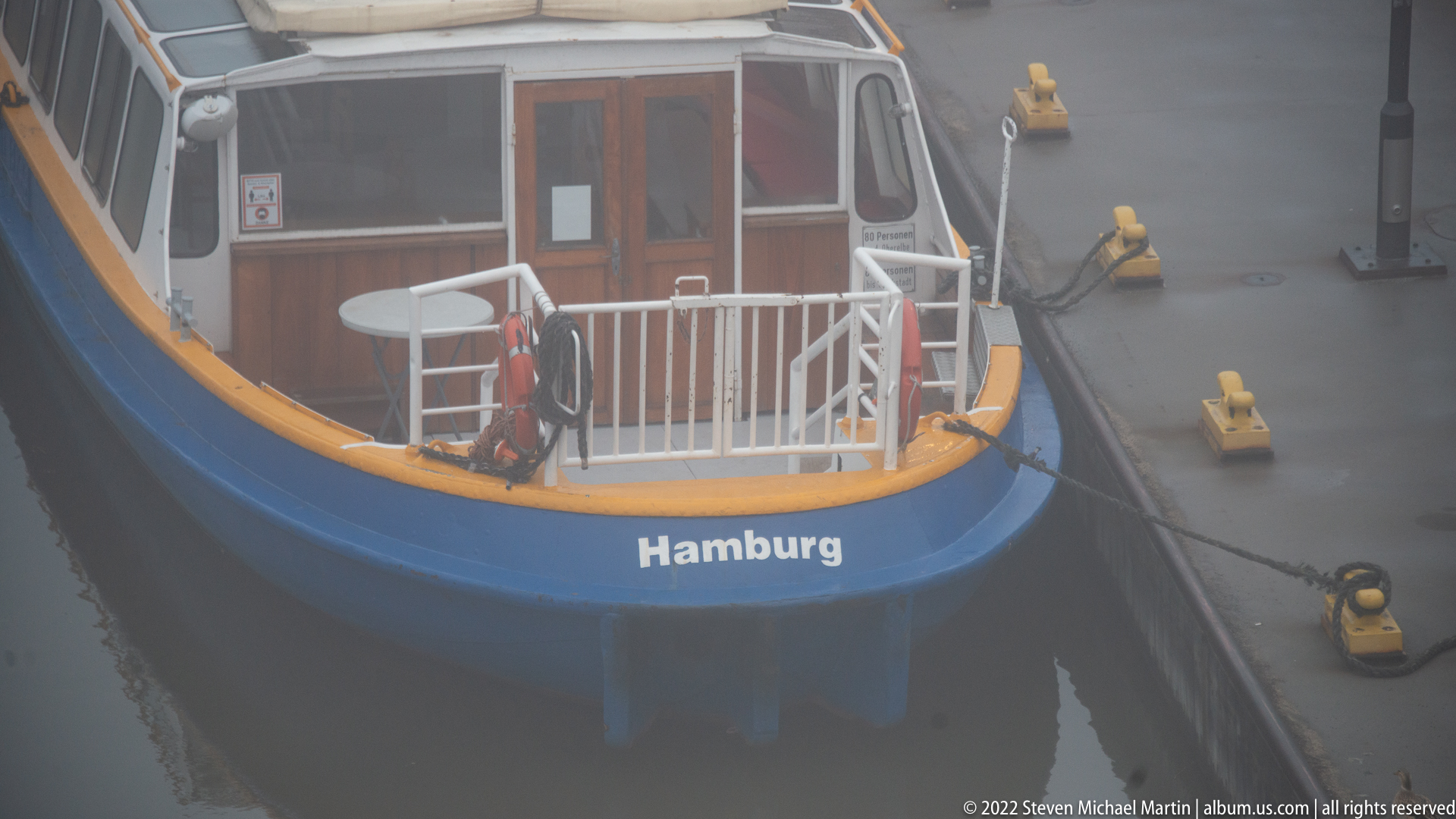
The rounded bow of a blue-and-yellow harbor vessel fills the frame, with “Hamburg” painted prominently across the hull. A small foredeck, railings, mooring lines, and yellow dock fittings surround the vessel, while fog softens the water behind it. The close view emphasizes working details rather than the boat’s complete profile.
Caption
The rounded bow of a blue-and-yellow harbor vessel fills the frame, with “Hamburg” painted prominently across the hull. A small foredeck, railings, mooring lines, and yellow dock fittings surround the vessel, while fog softens the water behind it. The close view emphasizes working details rather than the boat’s complete profile.
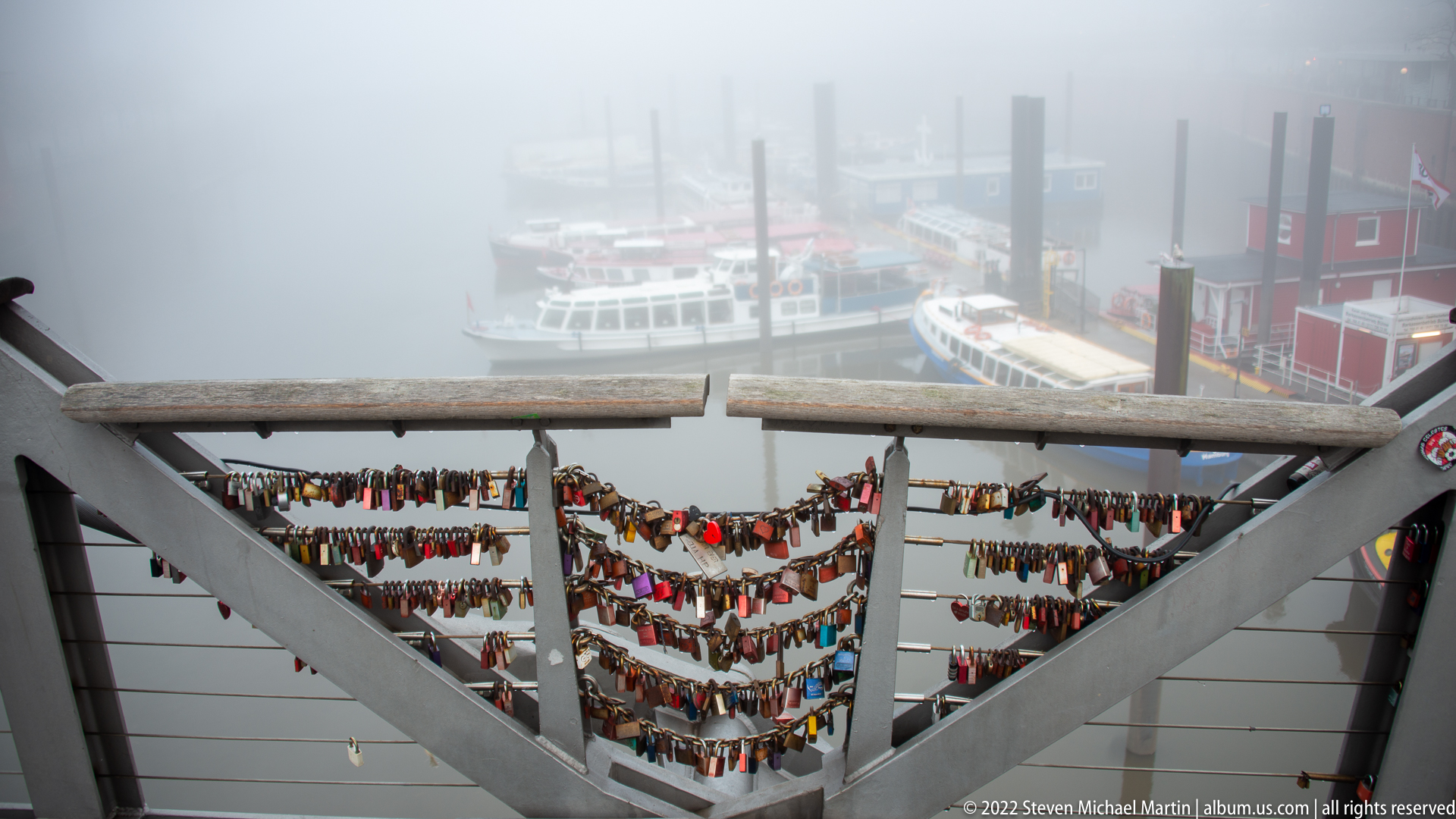
Hundreds of small padlocks cluster along horizontal cables in the foreground of a harbor railing, forming dense bands of color and metal. Below and beyond them, white passenger boats and mooring piles fade into the fog. The elevated viewpoint contrasts the intimate tokens left by visitors with the working maritime basin behind them.
Caption
Hundreds of small padlocks cluster along horizontal cables in the foreground of a harbor railing, forming dense bands of color and metal. Below and beyond them, white passenger boats and mooring piles fade into the fog. The elevated viewpoint contrasts the intimate tokens left by visitors with the working maritime basin behind them.
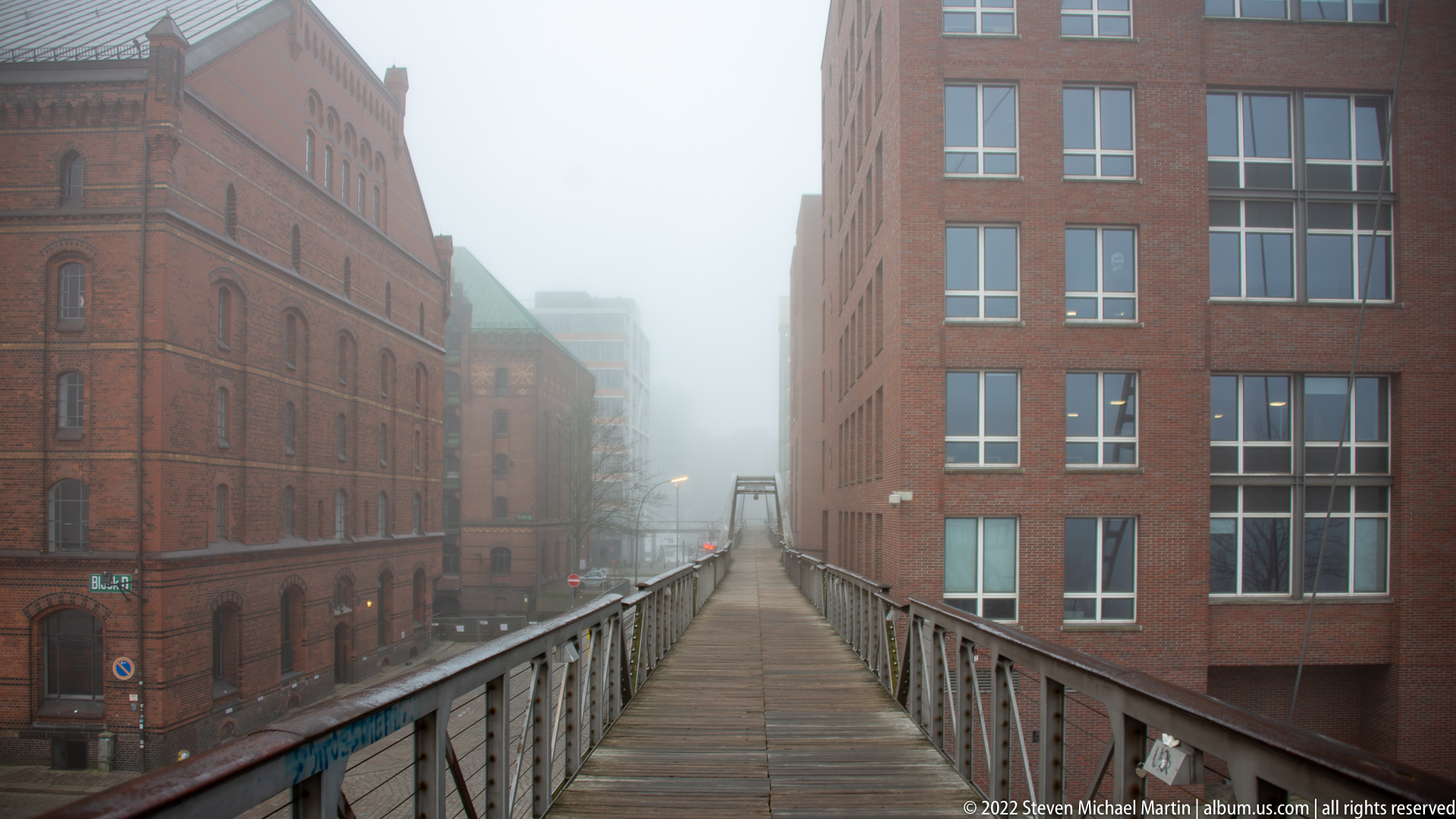
A wood-deck pedestrian bridge runs between large red-brick buildings and disappears toward a foggy opening ahead. The straight railings and narrow deck lead the eye deep into the warehouse district, while the mist suppresses distant detail. The view emphasizes circulation through Hamburg’s brick waterfront fabric rather than the canal itself.
Caption
A wood-deck pedestrian bridge runs between large red-brick buildings and disappears toward a foggy opening ahead. The straight railings and narrow deck lead the eye deep into the warehouse district, while the mist suppresses distant detail. The view emphasizes circulation through Hamburg’s brick waterfront fabric rather than the canal itself.
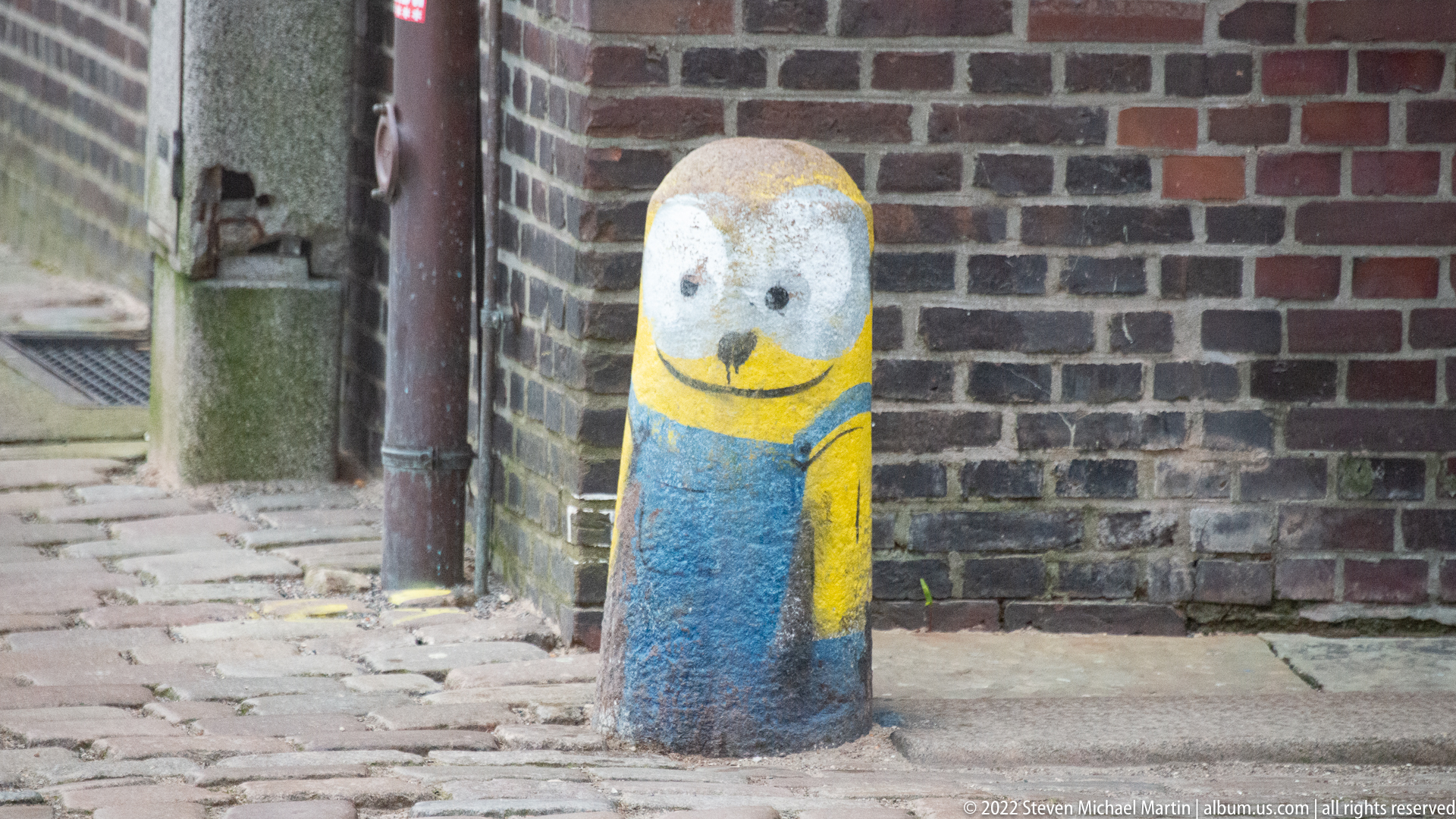
A squat concrete street bollard has been painted as a Minion-like cartoon figure, with yellow head, blue body, large eyes, and a small mouth. Positioned at the corner of a weathered brick wall and cobbled pavement, the playful decoration stands out sharply against the muted historic materials around it.
Caption
A squat concrete street bollard has been painted as a Minion-like cartoon figure, with yellow head, blue body, large eyes, and a small mouth. Positioned at the corner of a weathered brick wall and cobbled pavement, the playful decoration stands out sharply against the muted historic materials around it.
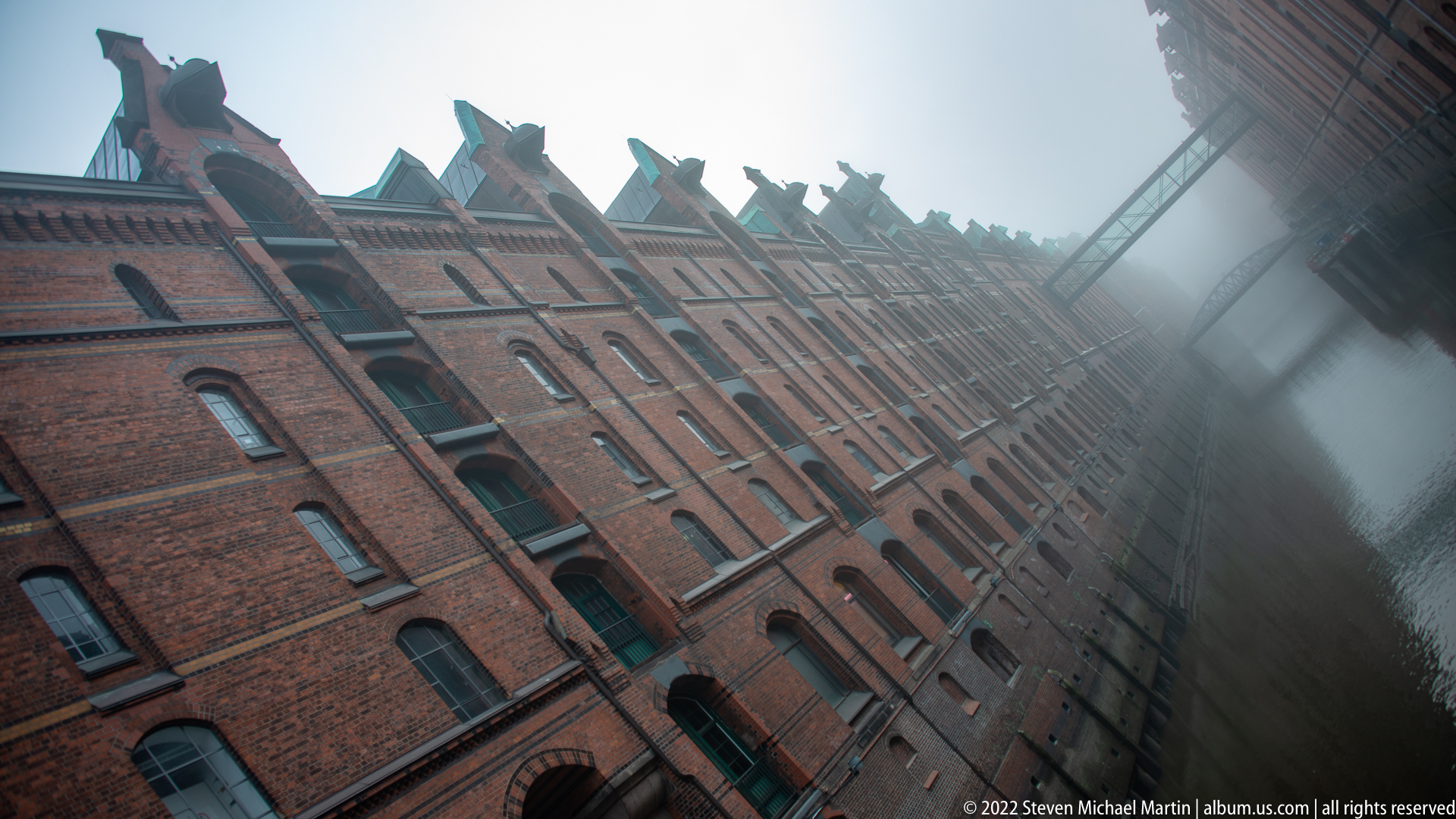
A dramatic tilted view looks along a row of tall red-brick warehouses with steep gables, repeated arched windows, and projecting loading features beside a narrow canal. Fog softens the far end of the block and a bridge overhead, emphasizing the strong vertical rhythm and dense industrial character of Hamburg’s historic Speicherstadt.
Caption
A dramatic tilted view looks along a row of tall red-brick warehouses with steep gables, repeated arched windows, and projecting loading features beside a narrow canal. Fog softens the far end of the block and a bridge overhead, emphasizing the strong vertical rhythm and dense industrial character of Hamburg’s historic Speicherstadt.
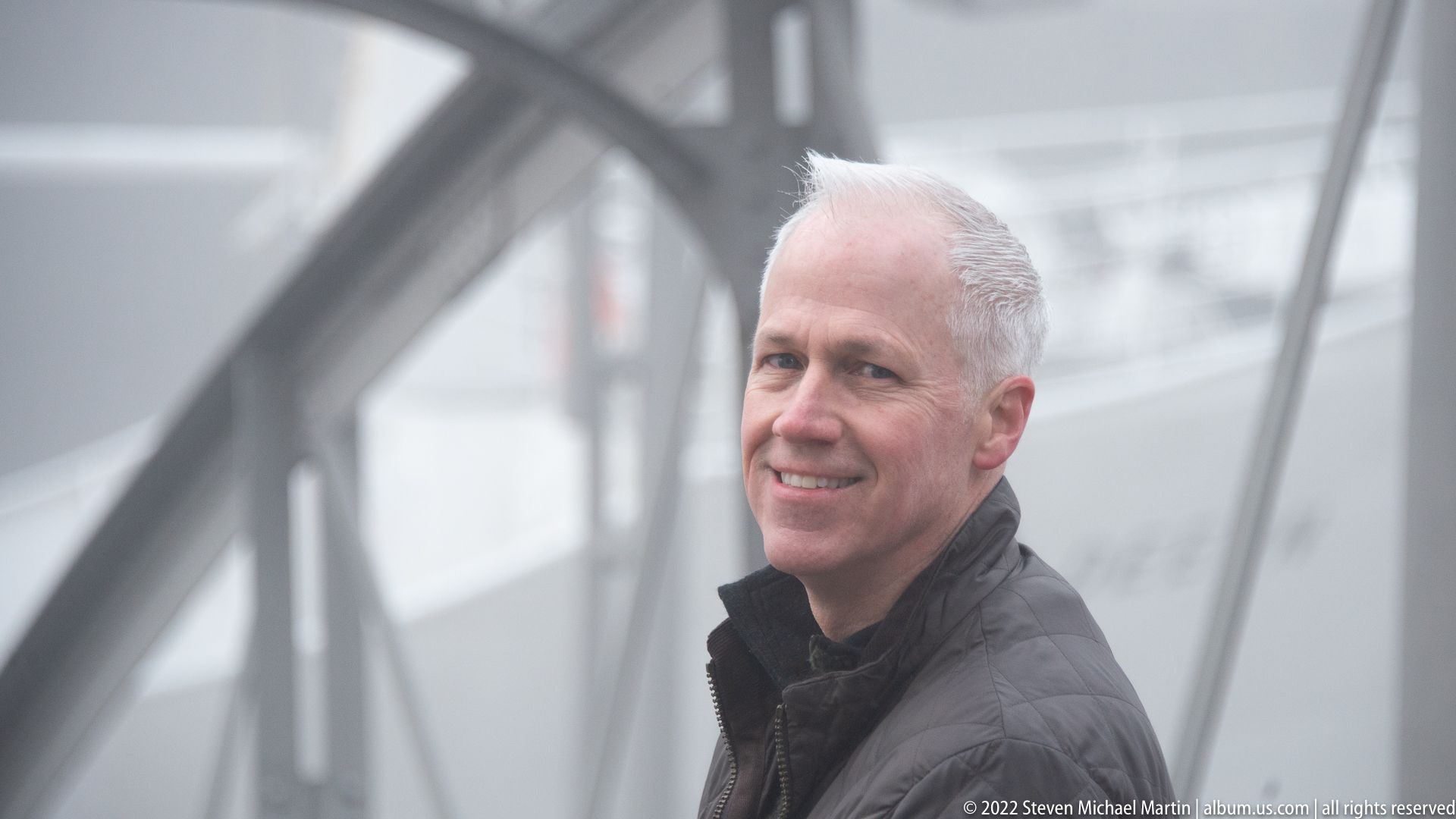
A smiling man in a dark jacket stands beside the railing of a pedestrian bridge, with gray structural members and fog-softened buildings receding behind him. The shallow depth of field isolates the traveler from the industrial waterfront setting, producing a relaxed portrait while retaining enough architecture to anchor the scene in Hamburg’s harbor district.
Caption
A smiling man in a dark jacket stands beside the railing of a pedestrian bridge, with gray structural members and fog-softened buildings receding behind him. The shallow depth of field isolates the traveler from the industrial waterfront setting, producing a relaxed portrait while retaining enough architecture to anchor the scene in Hamburg’s harbor district.
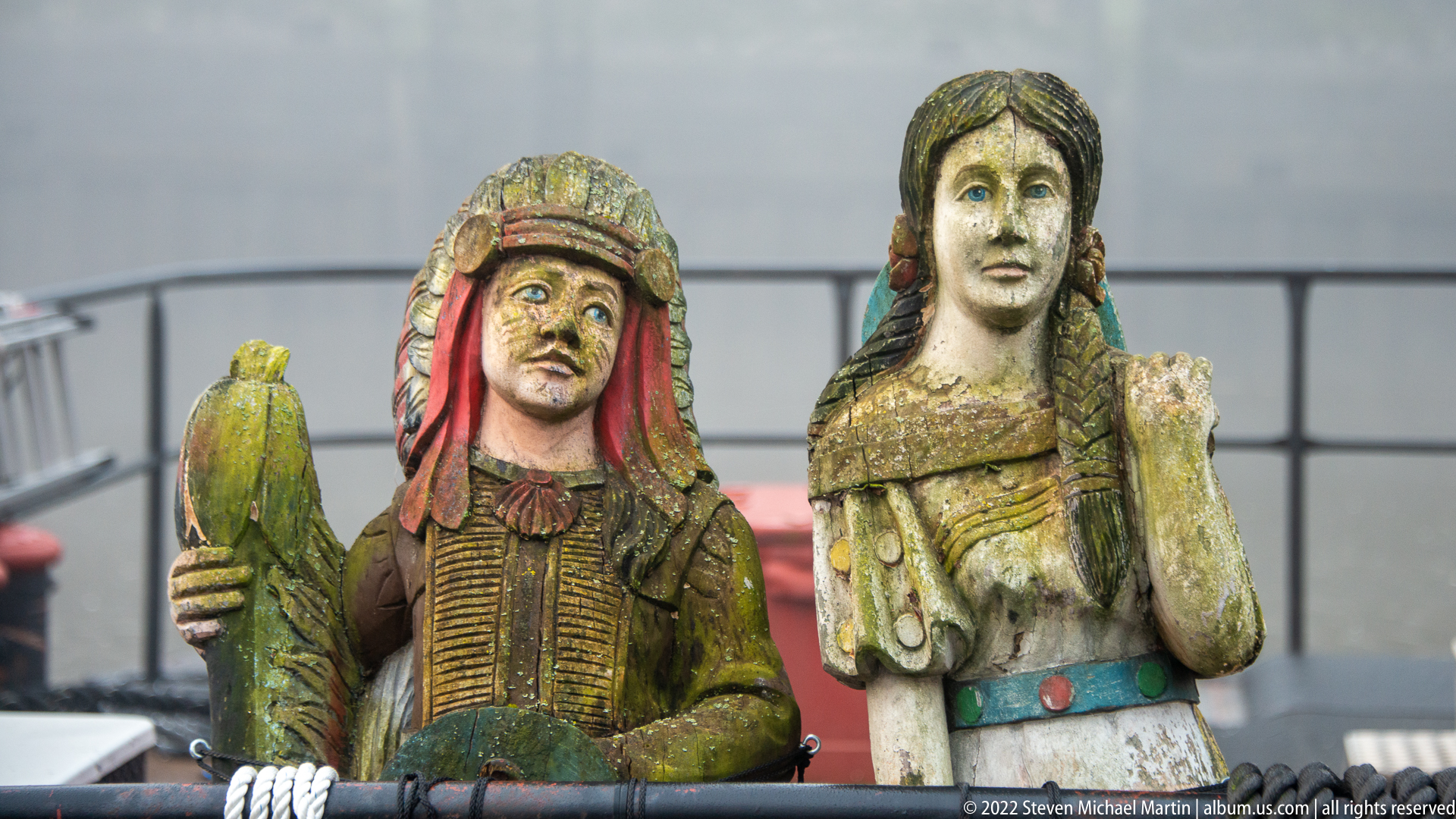
Two weathered polychrome carved figures stand side by side, one holding a long green object and wearing a richly patterned headdress, the other dressed in a pale garment with a blue belt. Flaking paint, exposed wood, and softened facial details suggest considerable age or outdoor wear, making surface condition as visually important as the figures’ identities.
Caption
Two weathered polychrome carved figures stand side by side, one holding a long green object and wearing a richly patterned headdress, the other dressed in a pale garment with a blue belt. Flaking paint, exposed wood, and softened facial details suggest considerable age or outdoor wear, making surface condition as visually important as the figures’ identities.
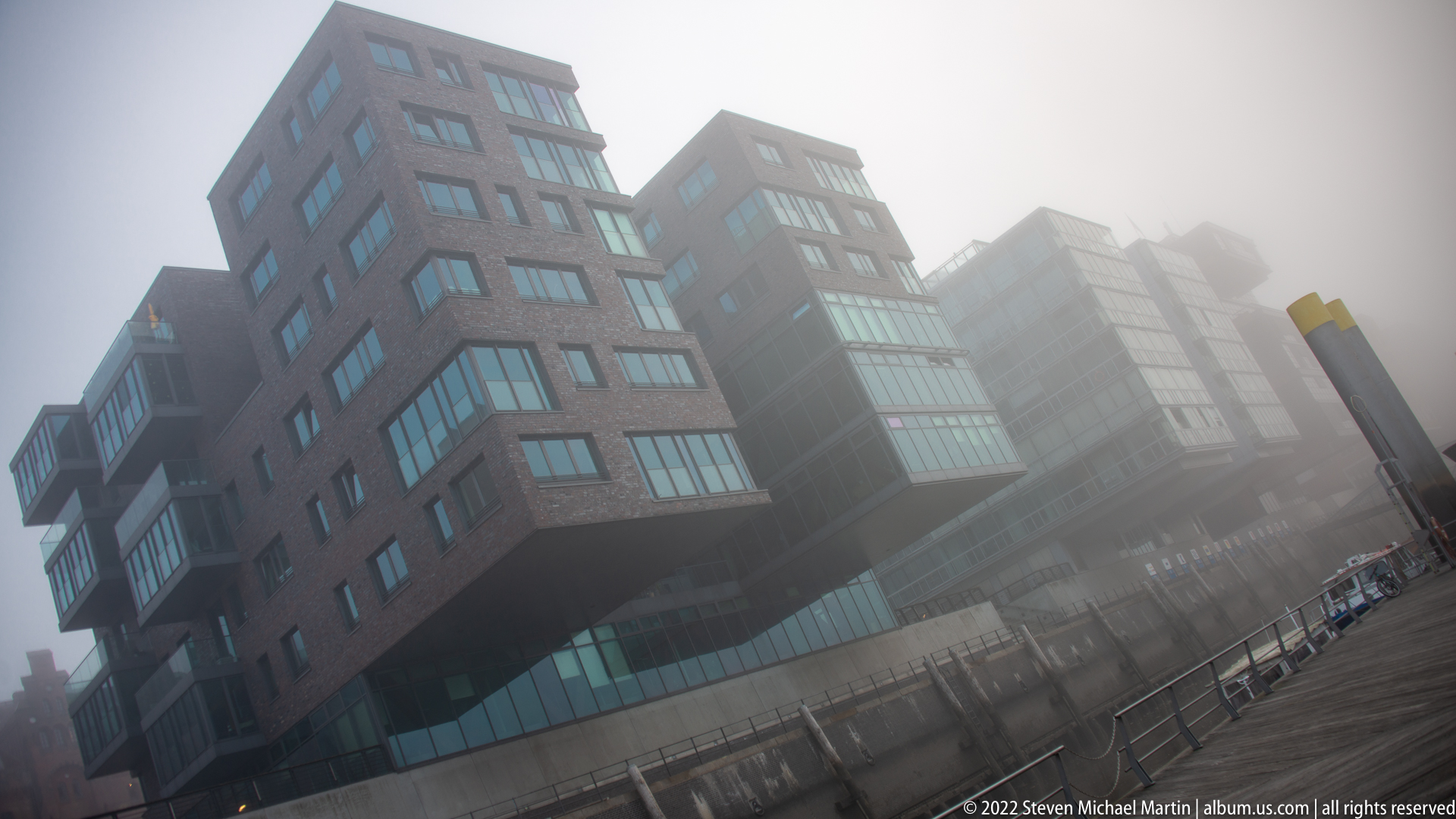
Angular brick-and-glass buildings rise above a Hamburg waterfront promenade and disappear into dense fog. Projecting upper stories, broad windows, and sharply offset volumes create a layered modern streetscape, while the mist obscures the taller structures behind them. The oblique viewpoint emphasizes HafenCity’s contemporary architectural character and its close relationship to the harbor edge.
Caption
Angular brick-and-glass buildings rise above a Hamburg waterfront promenade and disappear into dense fog. Projecting upper stories, broad windows, and sharply offset volumes create a layered modern streetscape, while the mist obscures the taller structures behind them. The oblique viewpoint emphasizes HafenCity’s contemporary architectural character and its close relationship to the harbor edge.
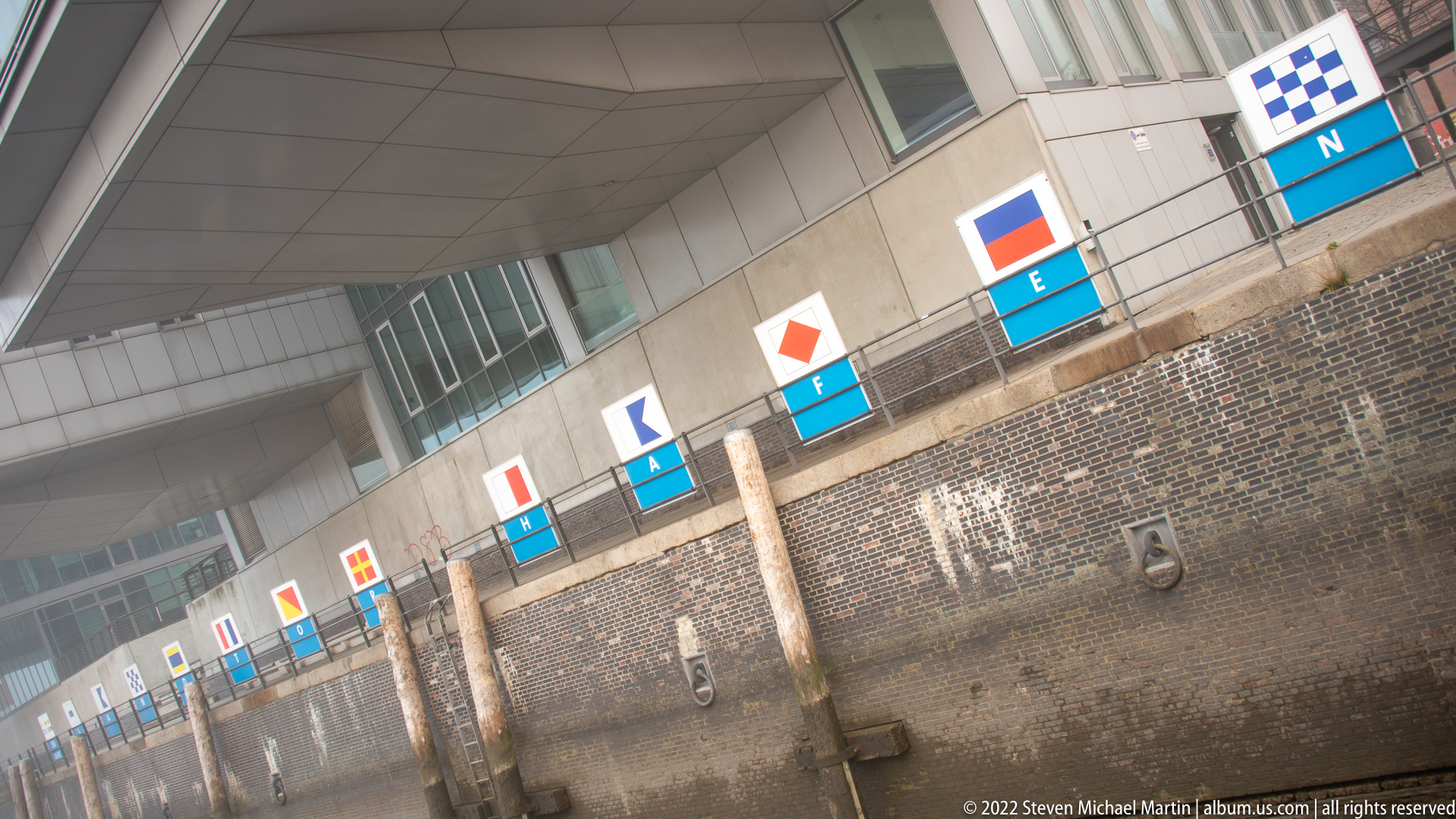
A sequence of international maritime signal flags is mounted along a brick quay wall beneath a modern overhang. Each square panel pairs a graphic flag with a letter, extending into the distance beside timber fenders and mooring rings. The installation turns the visual language of ship-to-ship communication into a waterfront architectural detail.
Caption
A sequence of international maritime signal flags is mounted along a brick quay wall beneath a modern overhang. Each square panel pairs a graphic flag with a letter, extending into the distance beside timber fenders and mooring rings. The installation turns the visual language of ship-to-ship communication into a waterfront architectural detail.
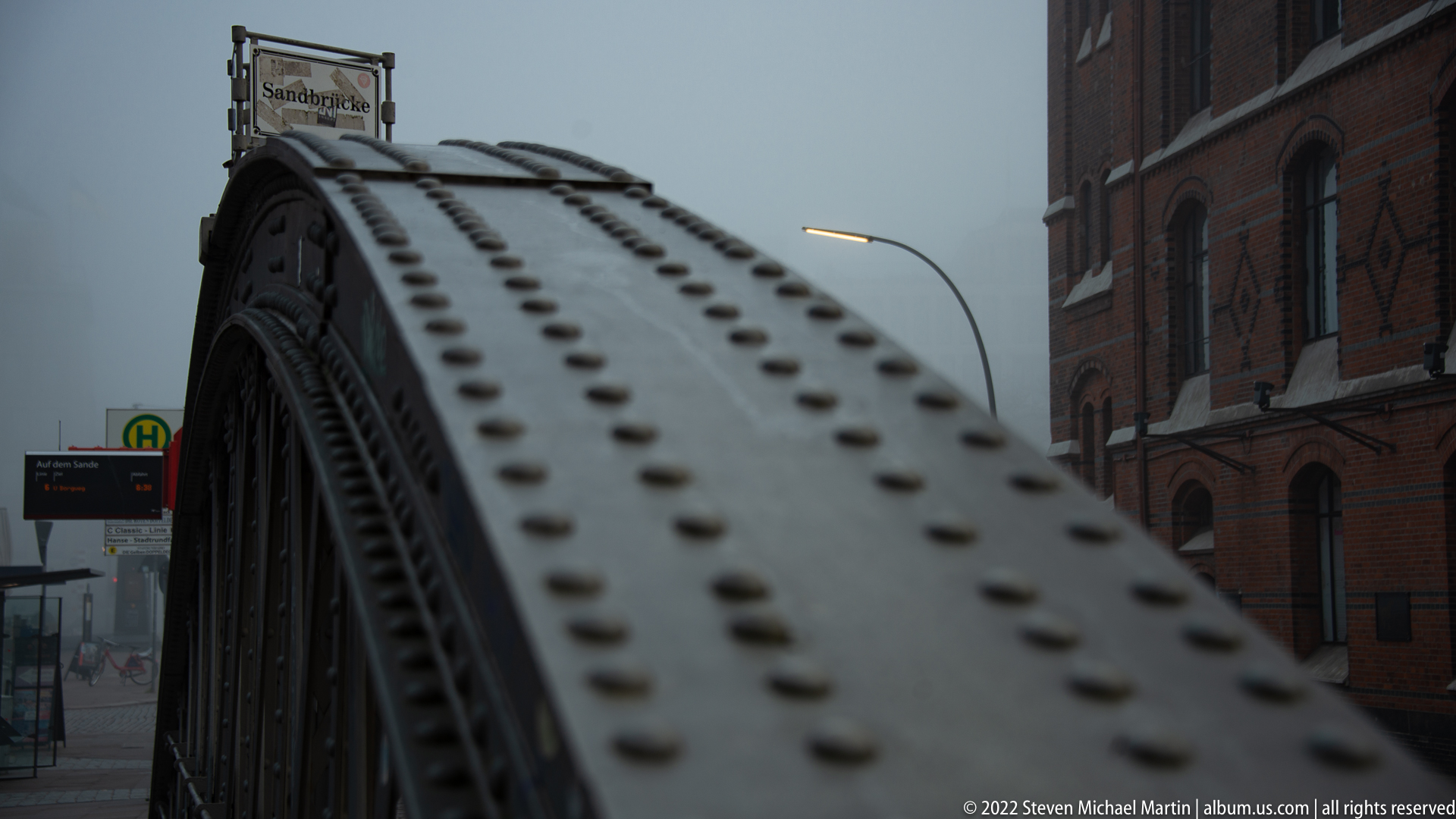
Rows of rounded rivets march across the curved upper chord of a steel bridge, seen at very close range beside its dark latticework. Fog suppresses the wider span and surrounding city, isolating the texture and construction method of the metalwork. A red-brick building and transit sign remain only as secondary context beyond the arch.
Caption
Rows of rounded rivets march across the curved upper chord of a steel bridge, seen at very close range beside its dark latticework. Fog suppresses the wider span and surrounding city, isolating the texture and construction method of the metalwork. A red-brick building and transit sign remain only as secondary context beyond the arch.
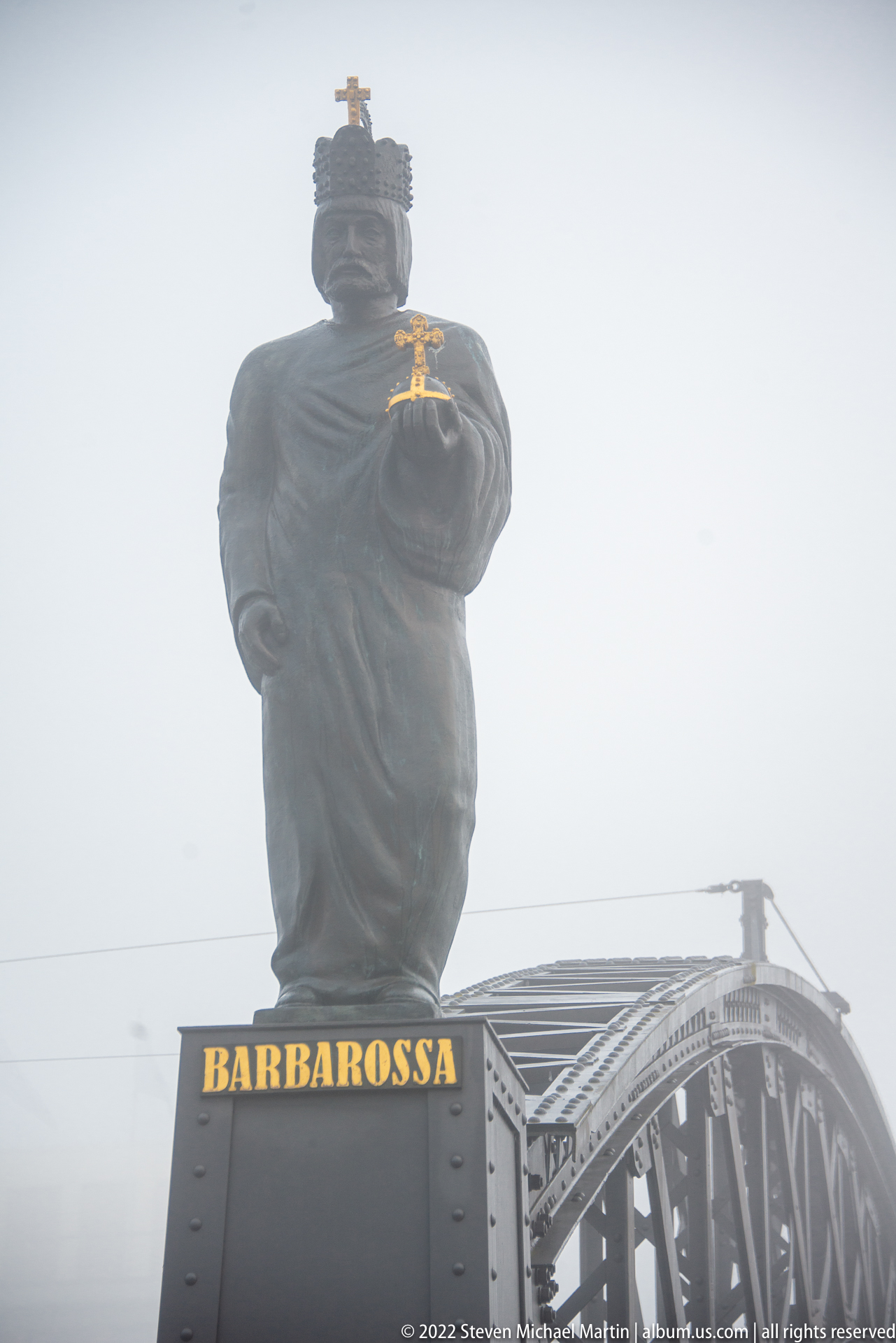
A monumental figure of Emperor Frederick Barbarossa stands above the ironwork of Brooksbrücke, holding a small gilded object that catches the light in the fog. The pedestal is explicitly labeled “BARBAROSSA,” making the historic ruler’s identification unambiguous. Seen from below, the sculpture appears to emerge from the bridge structure itself.
Caption
A monumental figure of Emperor Frederick Barbarossa stands above the ironwork of Brooksbrücke, holding a small gilded object that catches the light in the fog. The pedestal is explicitly labeled “BARBAROSSA,” making the historic ruler’s identification unambiguous. Seen from below, the sculpture appears to emerge from the bridge structure itself.
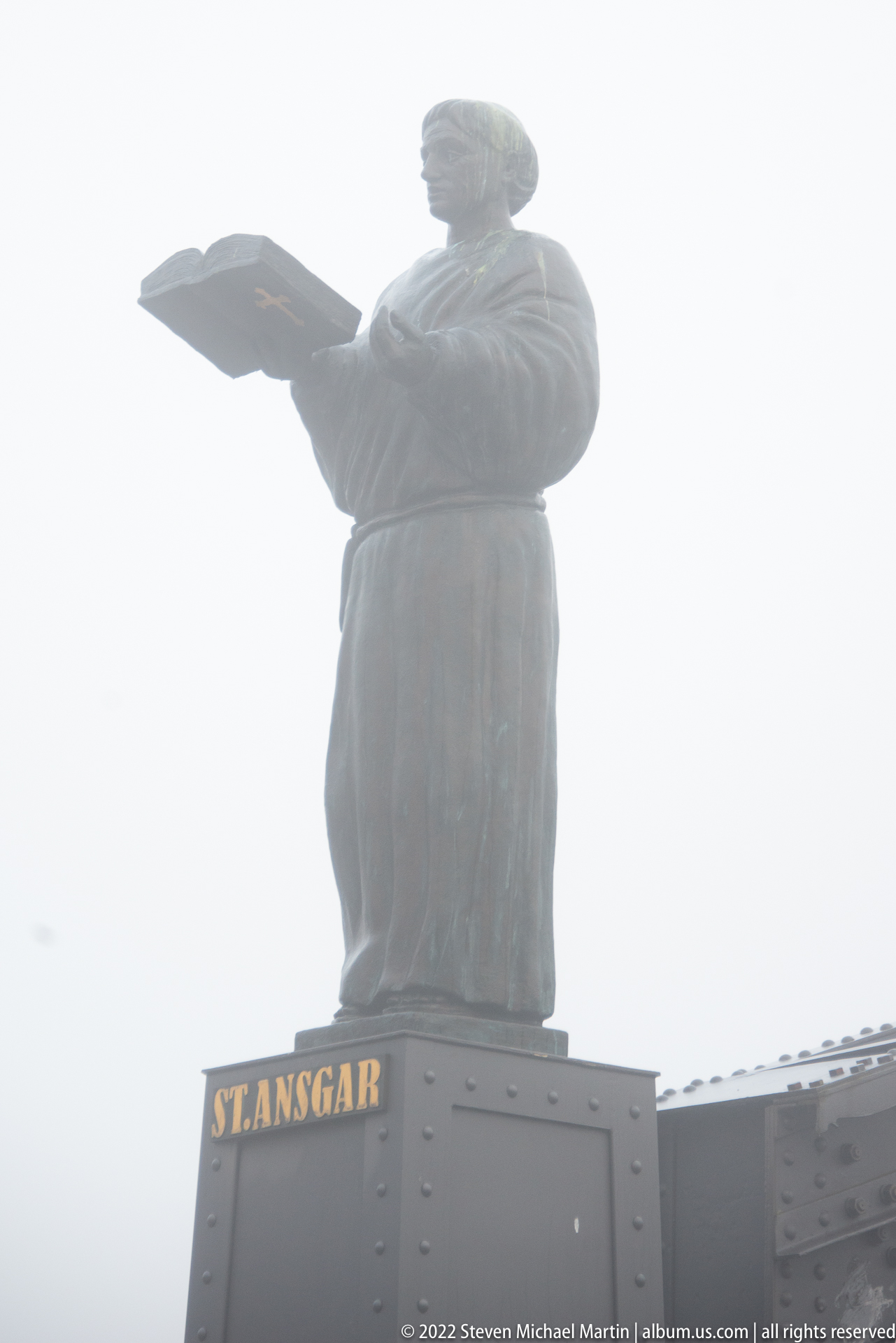
St. Ansgar stands atop a bridge pier in the fog, presented as a robed cleric holding a broad book or tablet. The pedestal below is labeled “ST. ANSGAR,” directly identifying the medieval missionary and archbishop associated with Hamburg’s early Christian history. The pale sky reduces the composition to figure, inscription, and the upper edge of the bridge.
Caption
St. Ansgar stands atop a bridge pier in the fog, presented as a robed cleric holding a broad book or tablet. The pedestal below is labeled “ST. ANSGAR,” directly identifying the medieval missionary and archbishop associated with Hamburg’s early Christian history. The pale sky reduces the composition to figure, inscription, and the upper edge of the bridge.
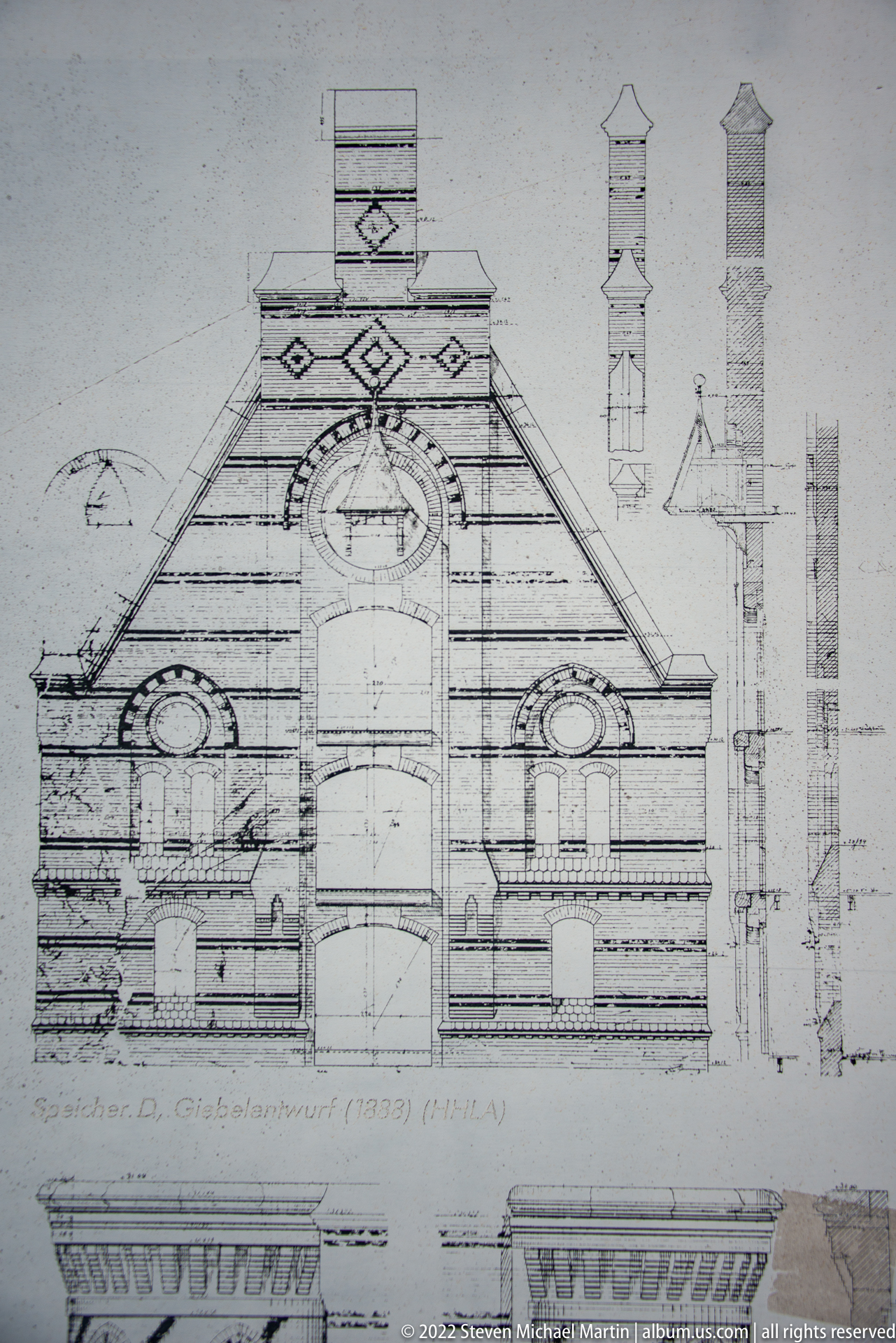
A historical design sheet focuses on a richly articulated façade beneath a steep roof, with an arched central opening, circular side windows, ornamental bands, and small tower or chimney studies arranged around the main elevation. The drawing foregrounds decorative composition rather than the full building plan, preserving evidence of how architectural detail was developed on paper.
Caption
A historical design sheet focuses on a richly articulated façade beneath a steep roof, with an arched central opening, circular side windows, ornamental bands, and small tower or chimney studies arranged around the main elevation. The drawing foregrounds decorative composition rather than the full building plan, preserving evidence of how architectural detail was developed on paper.
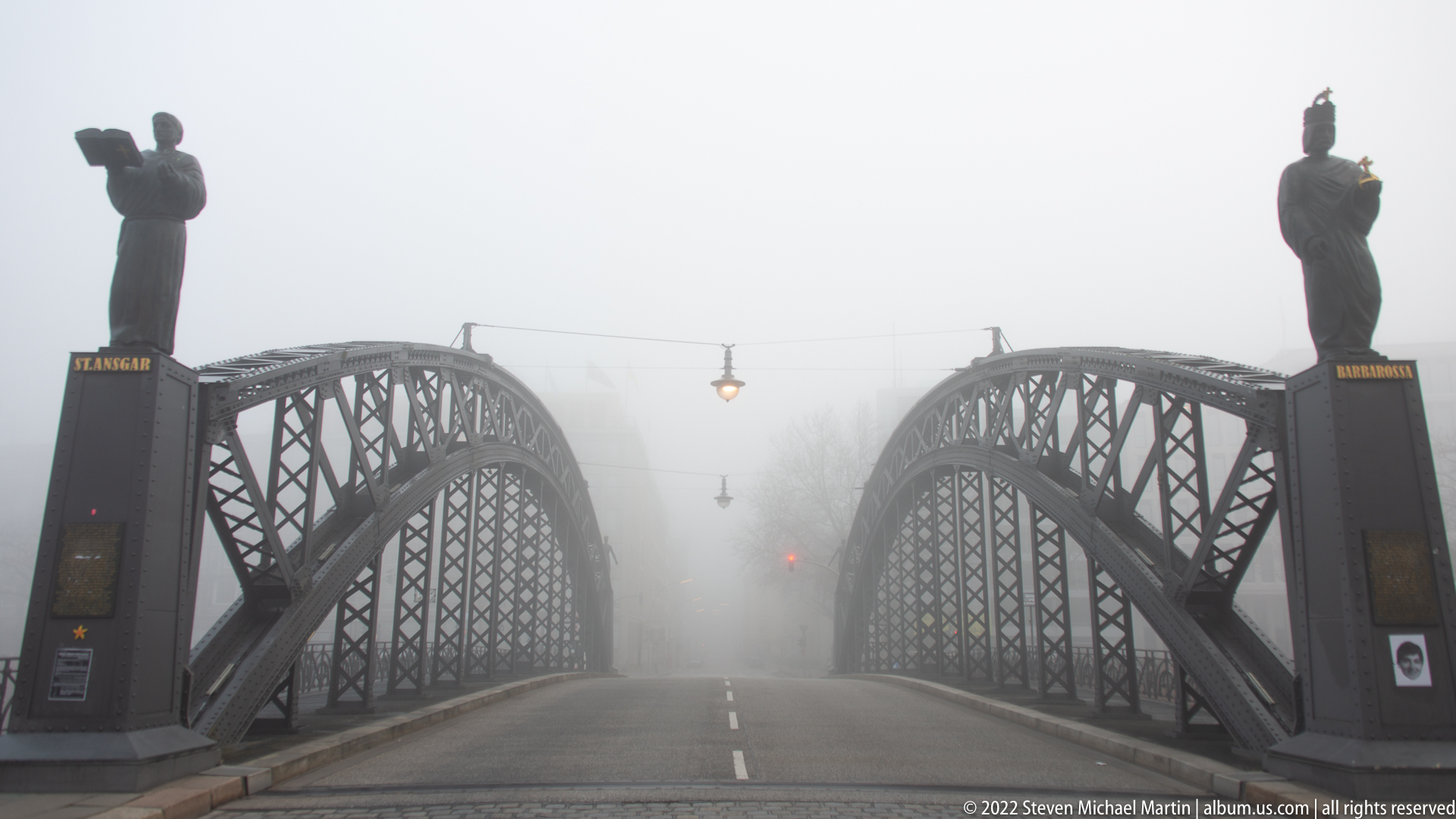
Brooksbrücke disappears almost completely into fog between two rising steel arches. Monumental figures stand on the entrance piers—St. Ansgar at left and Barbarossa at right—while a single suspended streetlamp hangs above the empty roadway. The frontal composition brings the bridge’s engineering and historical sculpture together as a ceremonial threshold to the Speicherstadt.
Caption
Brooksbrücke disappears almost completely into fog between two rising steel arches. Monumental figures stand on the entrance piers—St. Ansgar at left and Barbarossa at right—while a single suspended streetlamp hangs above the empty roadway. The frontal composition brings the bridge’s engineering and historical sculpture together as a ceremonial threshold to the Speicherstadt.
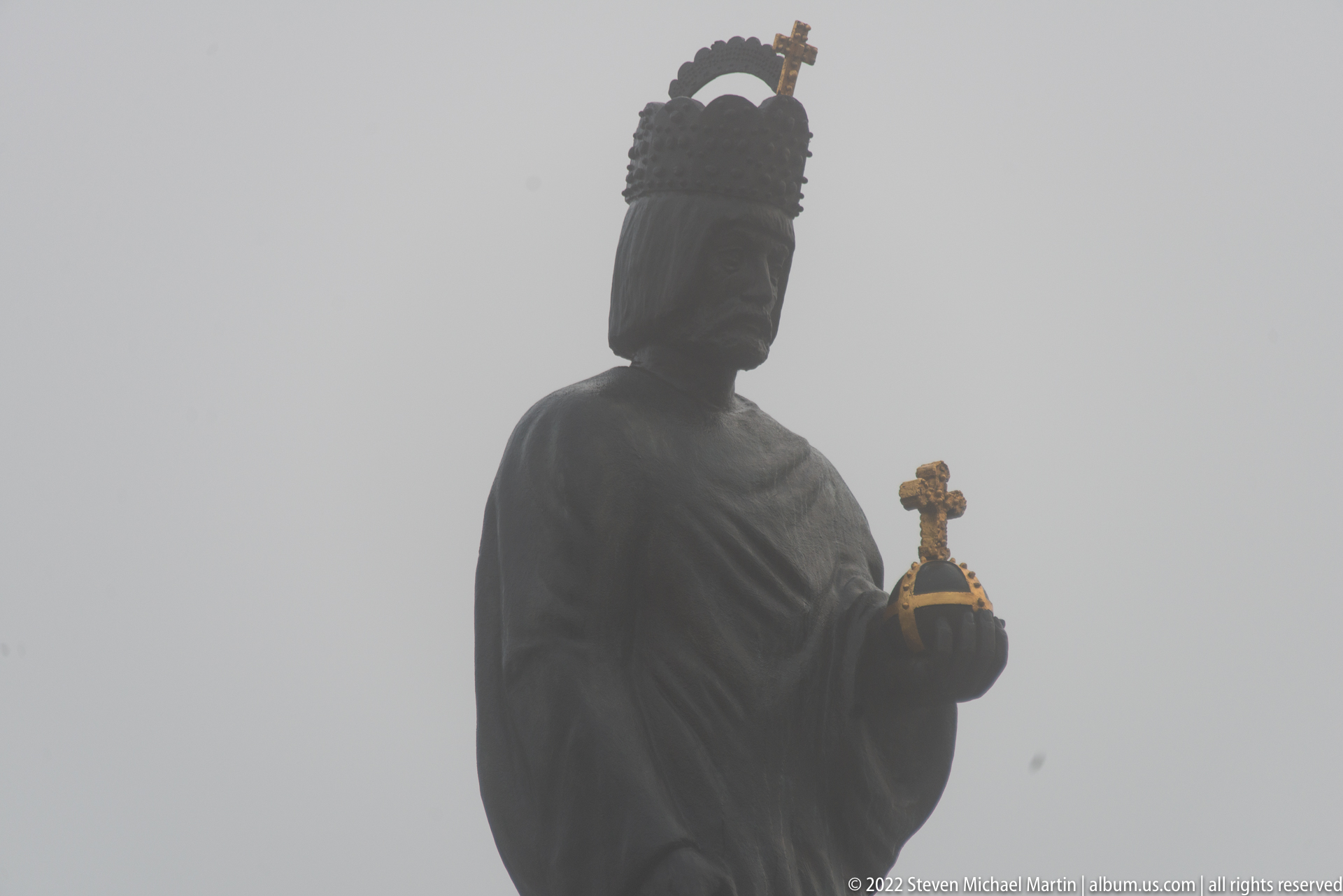
The Barbarossa figure is isolated against a nearly blank field of fog, allowing the crown, heavy drapery, and gilded imperial object to read more clearly than in the wider bridge view. Moisture-darkened bronze and small gold accents give the sculpture a strongly modeled surface, while the bridge itself falls almost entirely outside the frame.
Caption
The Barbarossa figure is isolated against a nearly blank field of fog, allowing the crown, heavy drapery, and gilded imperial object to read more clearly than in the wider bridge view. Moisture-darkened bronze and small gold accents give the sculpture a strongly modeled surface, while the bridge itself falls almost entirely outside the frame.
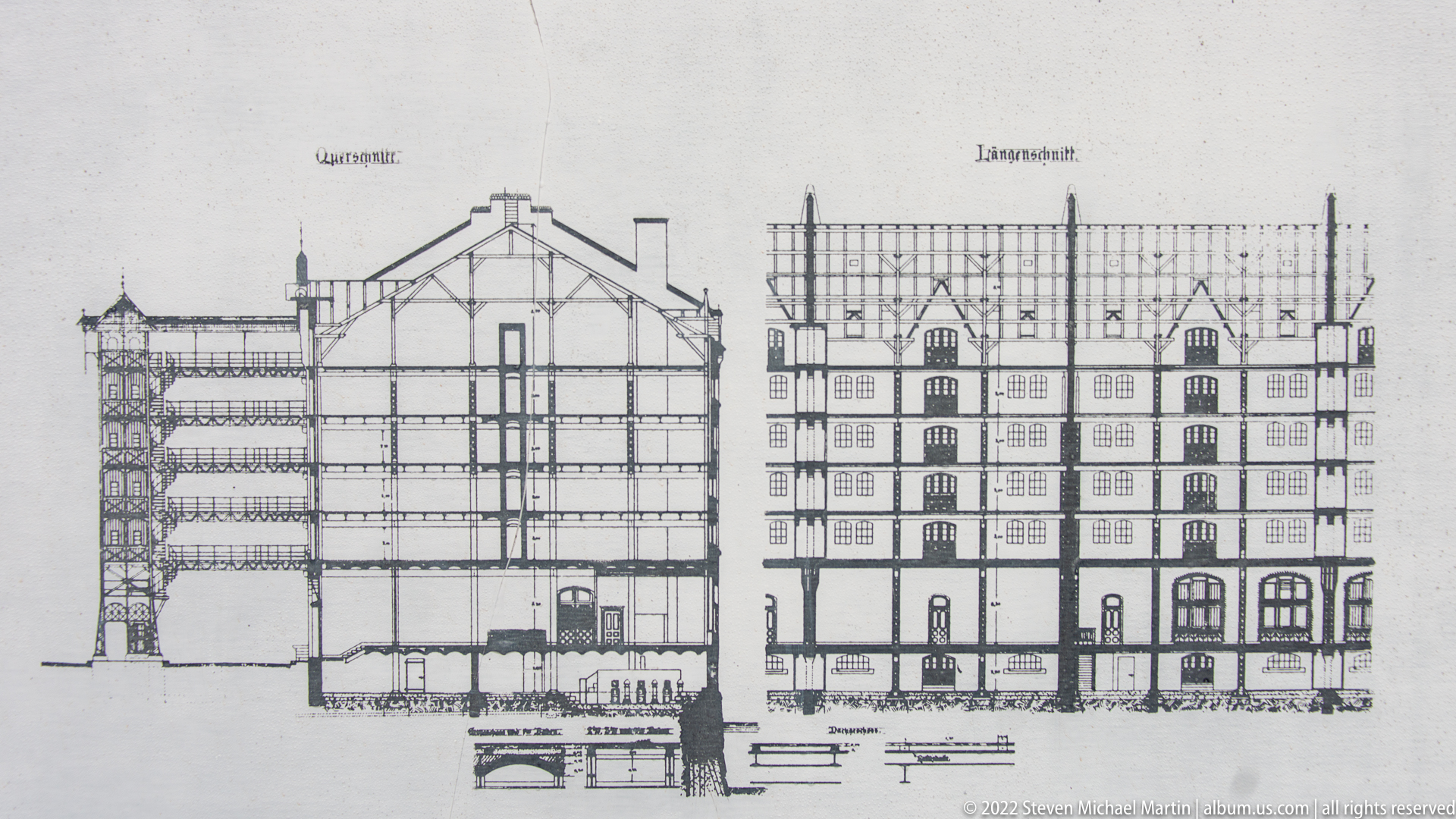
A reproduced architectural sheet presents a building in both sectional and elevation views, revealing its floor structure, roof framing, façade bays, and relationship to the waterfront level below. Fine black linework and German annotations preserve the documentary character of the original design drawing, making construction and spatial organization legible at once.
Caption
A reproduced architectural sheet presents a building in both sectional and elevation views, revealing its floor structure, roof framing, façade bays, and relationship to the waterfront level below. Fine black linework and German annotations preserve the documentary character of the original design drawing, making construction and spatial organization legible at once.
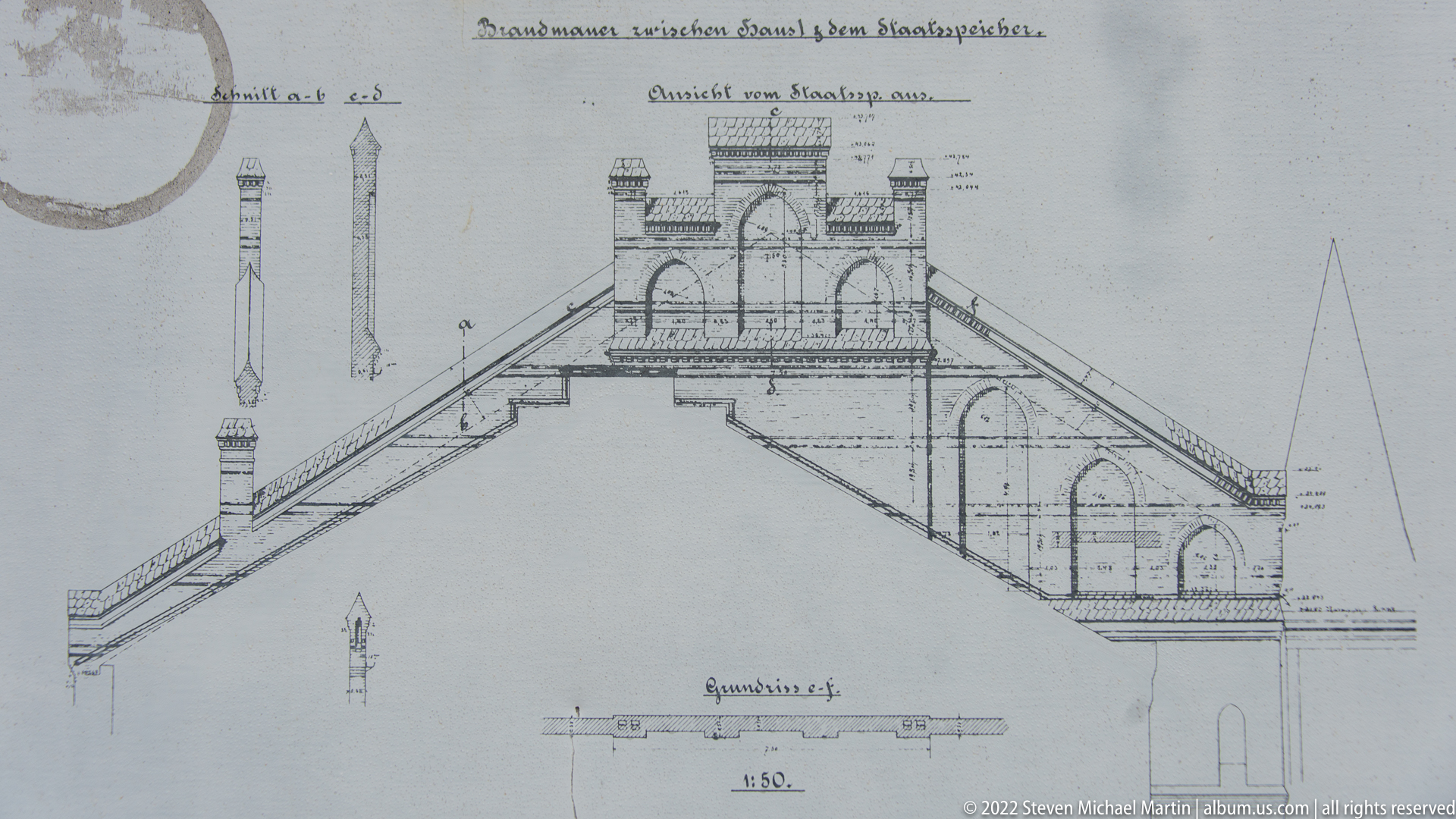
A historical engineering sheet records an arched bridge through a long side elevation, central pier, foundation profile, and enlarged structural details. Dimension lines and German technical notes surround the span, revealing the precision required to integrate iron superstructure, masonry supports, and waterside foundations in Hamburg’s port infrastructure.
Caption
A historical engineering sheet records an arched bridge through a long side elevation, central pier, foundation profile, and enlarged structural details. Dimension lines and German technical notes surround the span, revealing the precision required to integrate iron superstructure, masonry supports, and waterside foundations in Hamburg’s port infrastructure.
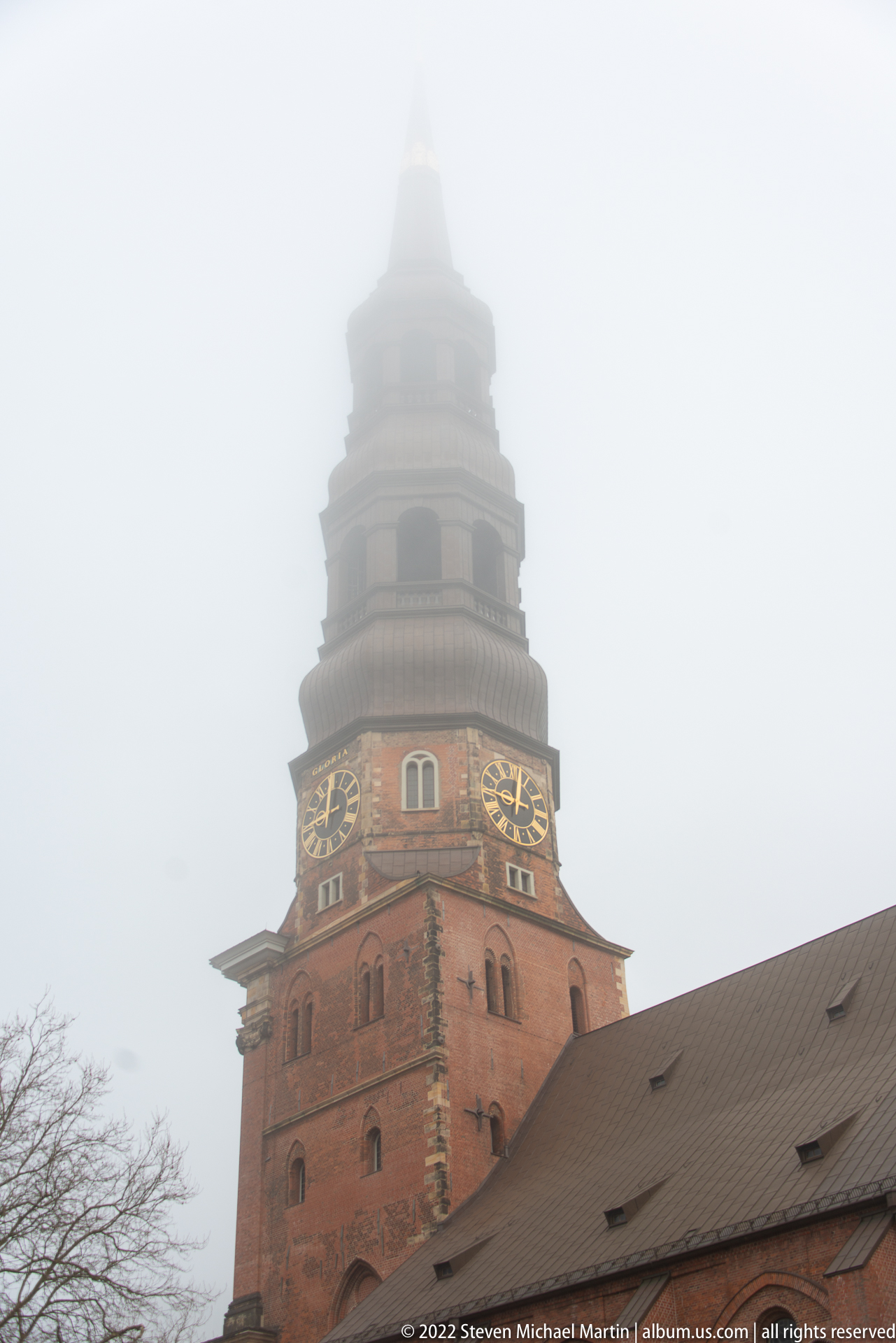
The brick tower of Hamburg’s Hauptkirche St. Katharinen rises into dense fog, with two large clock faces and stacked masonry stages still visible below the obscured upper spire. A long sloping church roof crosses the foreground. The reduced visibility concentrates attention on the tower’s massing and its transition from medieval brickwork to the more elaborate upper structure.
Caption
The brick tower of Hamburg’s Hauptkirche St. Katharinen rises into dense fog, with two large clock faces and stacked masonry stages still visible below the obscured upper spire. A long sloping church roof crosses the foreground. The reduced visibility concentrates attention on the tower’s massing and its transition from medieval brickwork to the more elaborate upper structure.
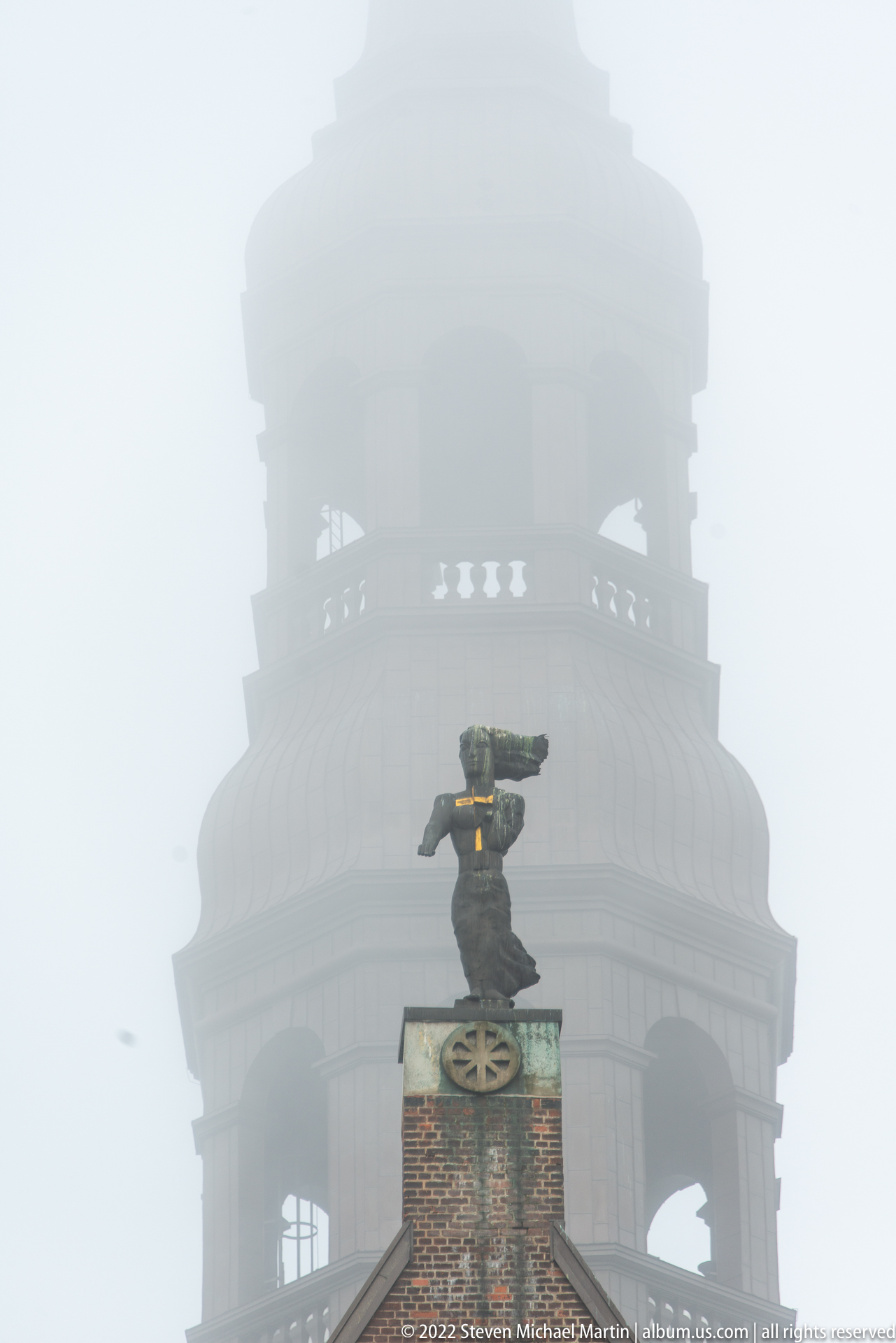
An exterior sculptural figure holding a gilded object is silhouetted against the fog-softened upper tower of St. Catherine’s Church. By aligning the small foreground sculpture with the much larger tower behind it, the photograph layers decorative detail and monumental architecture, while dense mist reduces both forms to muted outlines and selected gold highlights.
Caption
An exterior sculptural figure holding a gilded object is silhouetted against the fog-softened upper tower of St. Catherine’s Church. By aligning the small foreground sculpture with the much larger tower behind it, the photograph layers decorative detail and monumental architecture, while dense mist reduces both forms to muted outlines and selected gold highlights.
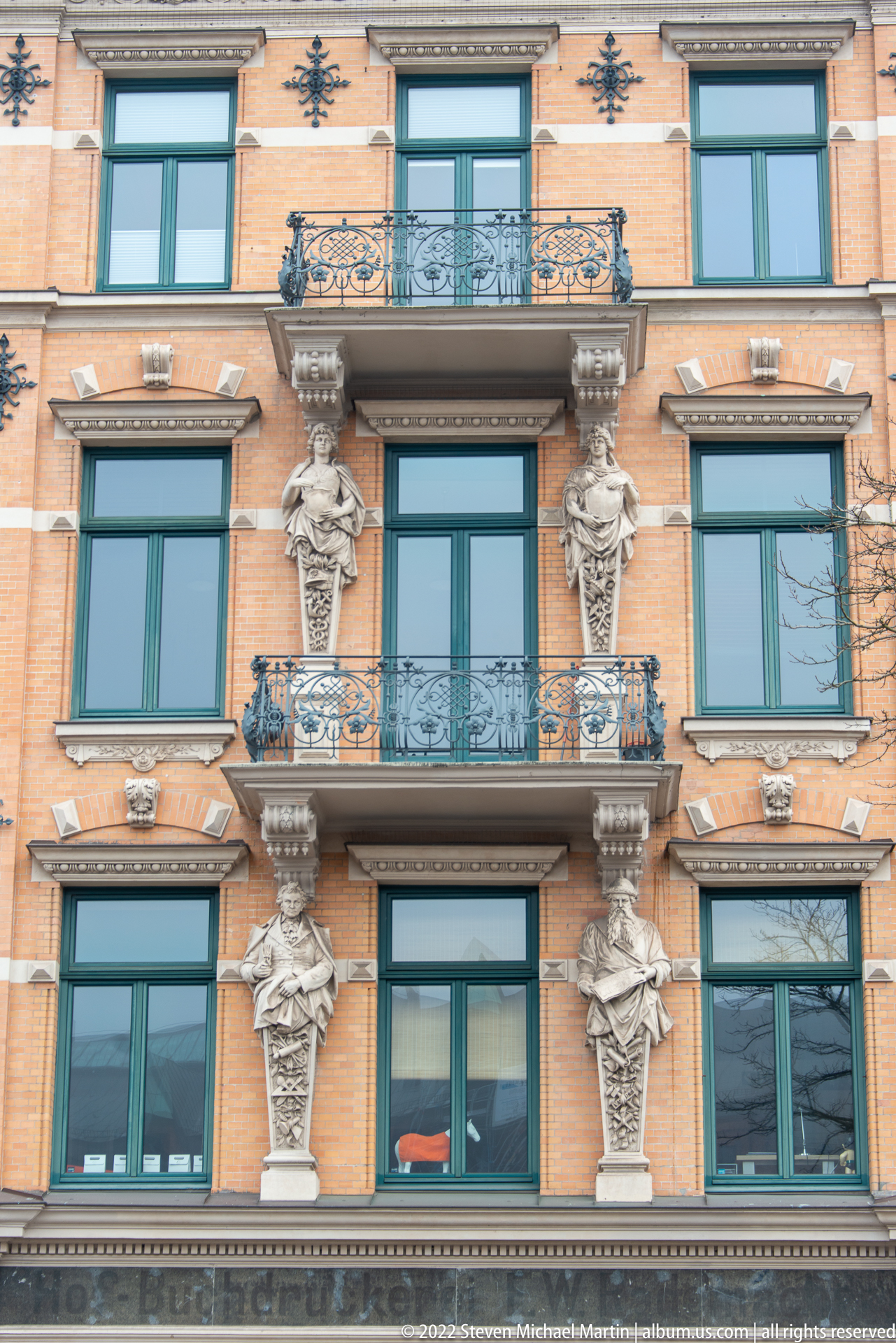
A richly ornamented brick façade is organized by stacked green-framed windows, wrought-iron balconies, sculpted female figures, masks, and pale stone trim. The frontal crop turns the elevation into a nearly symmetrical decorative grid, revealing how figural sculpture and ironwork were integrated into an otherwise regular urban building front.
Caption
A richly ornamented brick façade is organized by stacked green-framed windows, wrought-iron balconies, sculpted female figures, masks, and pale stone trim. The frontal crop turns the elevation into a nearly symmetrical decorative grid, revealing how figural sculpture and ironwork were integrated into an otherwise regular urban building front.
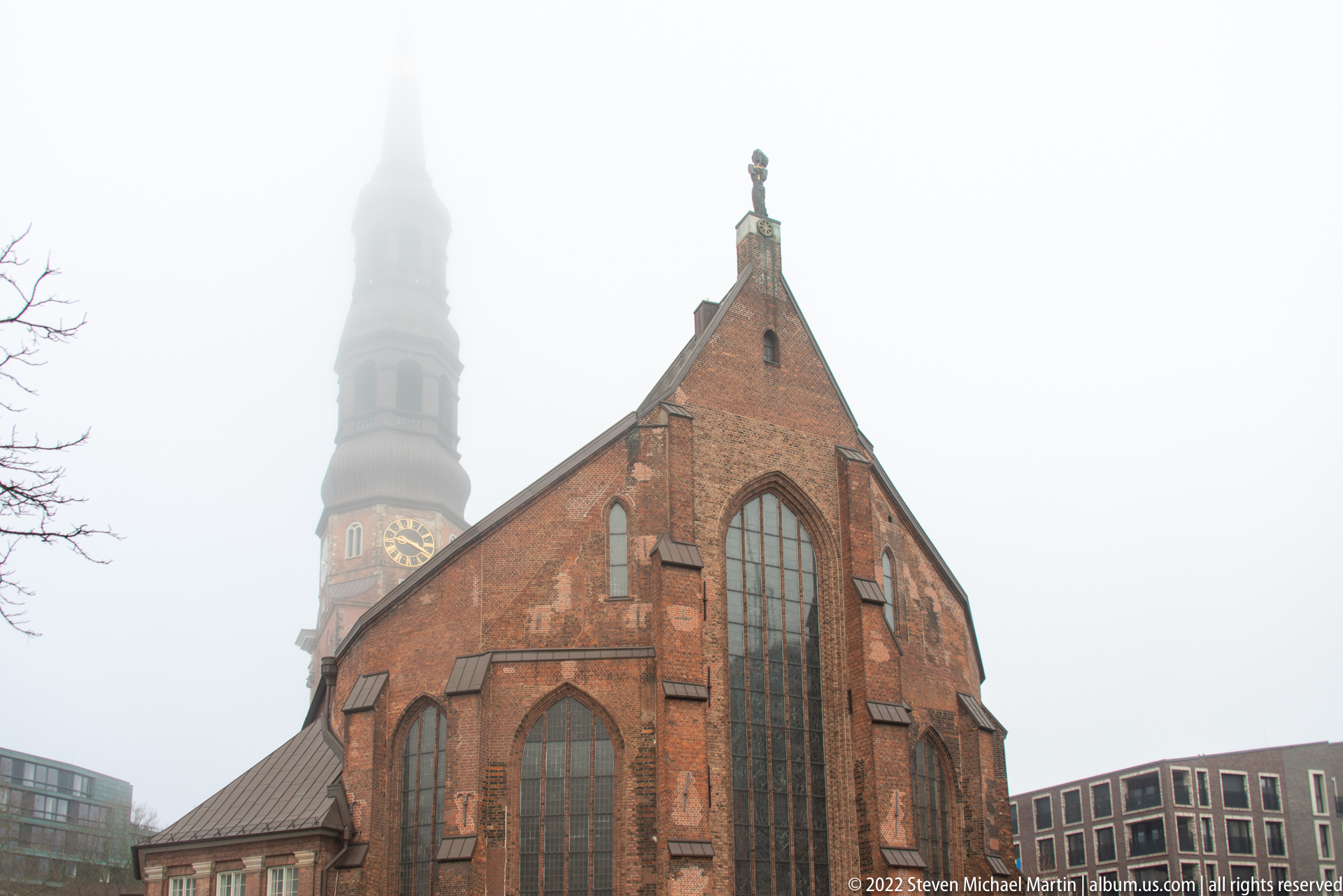
Tall pointed-arch windows divide the brick Gothic east end of St. Catherine’s Church into narrow vertical bays, while the fog-muted tower rises behind the roofline. Buttress-like wall projections and a steep gable give the exterior a strongly vertical profile, contrasting with the modern buildings visible at the edges of the historic church precinct.
Caption
Tall pointed-arch windows divide the brick Gothic east end of St. Catherine’s Church into narrow vertical bays, while the fog-muted tower rises behind the roofline. Buttress-like wall projections and a steep gable give the exterior a strongly vertical profile, contrasting with the modern buildings visible at the edges of the historic church precinct.
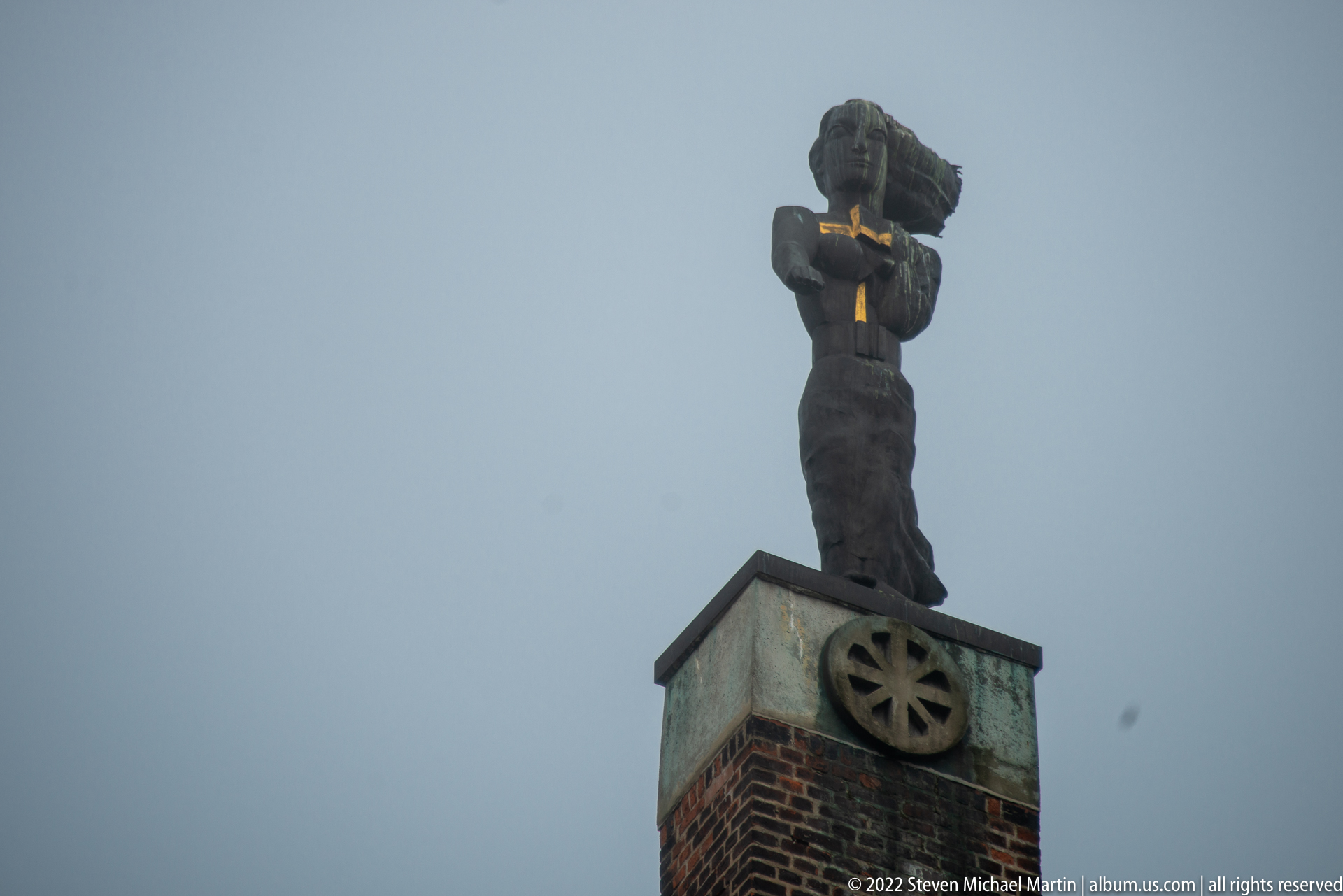
A dark, weathered figure stands high above a brick-and-metal architectural base, holding a small gilded element against the gray sky. The low-angle view isolates the sculpture from the surrounding church, making its eroded surface, compact stance, and bright gold accent more prominent than its iconographic identity.
Caption
A dark, weathered figure stands high above a brick-and-metal architectural base, holding a small gilded element against the gray sky. The low-angle view isolates the sculpture from the surrounding church, making its eroded surface, compact stance, and bright gold accent more prominent than its iconographic identity.
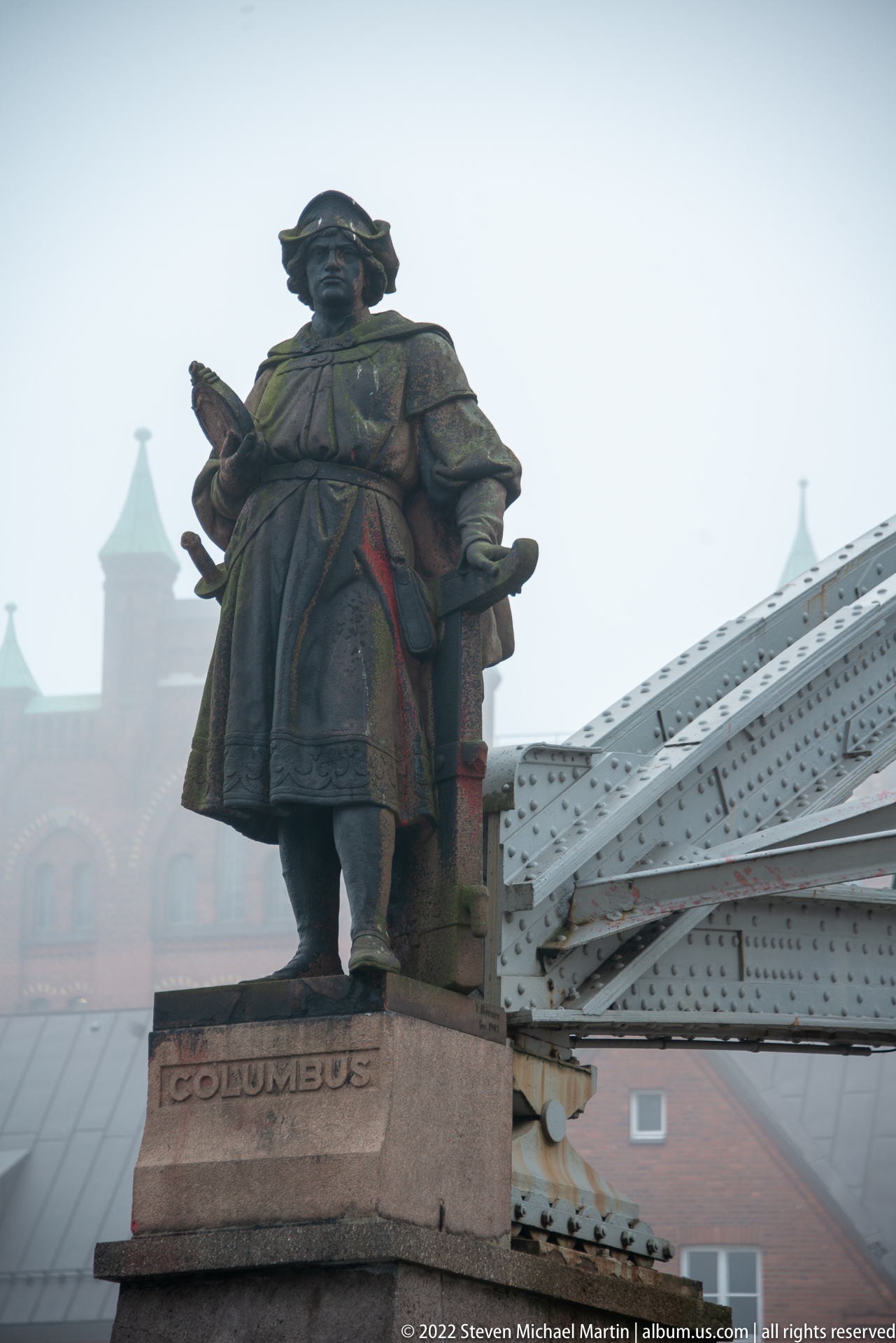
A bronze figure of Christopher Columbus stands on a bridge pedestal explicitly inscribed “COLUMBUS,” wearing period dress and gesturing outward with one hand. Riveted steel bridgework crosses behind the statue, while fog softens the brick buildings beyond. The composition links Hamburg’s urban infrastructure with a monument to long-distance maritime exploration.
Caption
A bronze figure of Christopher Columbus stands on a bridge pedestal explicitly inscribed “COLUMBUS,” wearing period dress and gesturing outward with one hand. Riveted steel bridgework crosses behind the statue, while fog softens the brick buildings beyond. The composition links Hamburg’s urban infrastructure with a monument to long-distance maritime exploration.
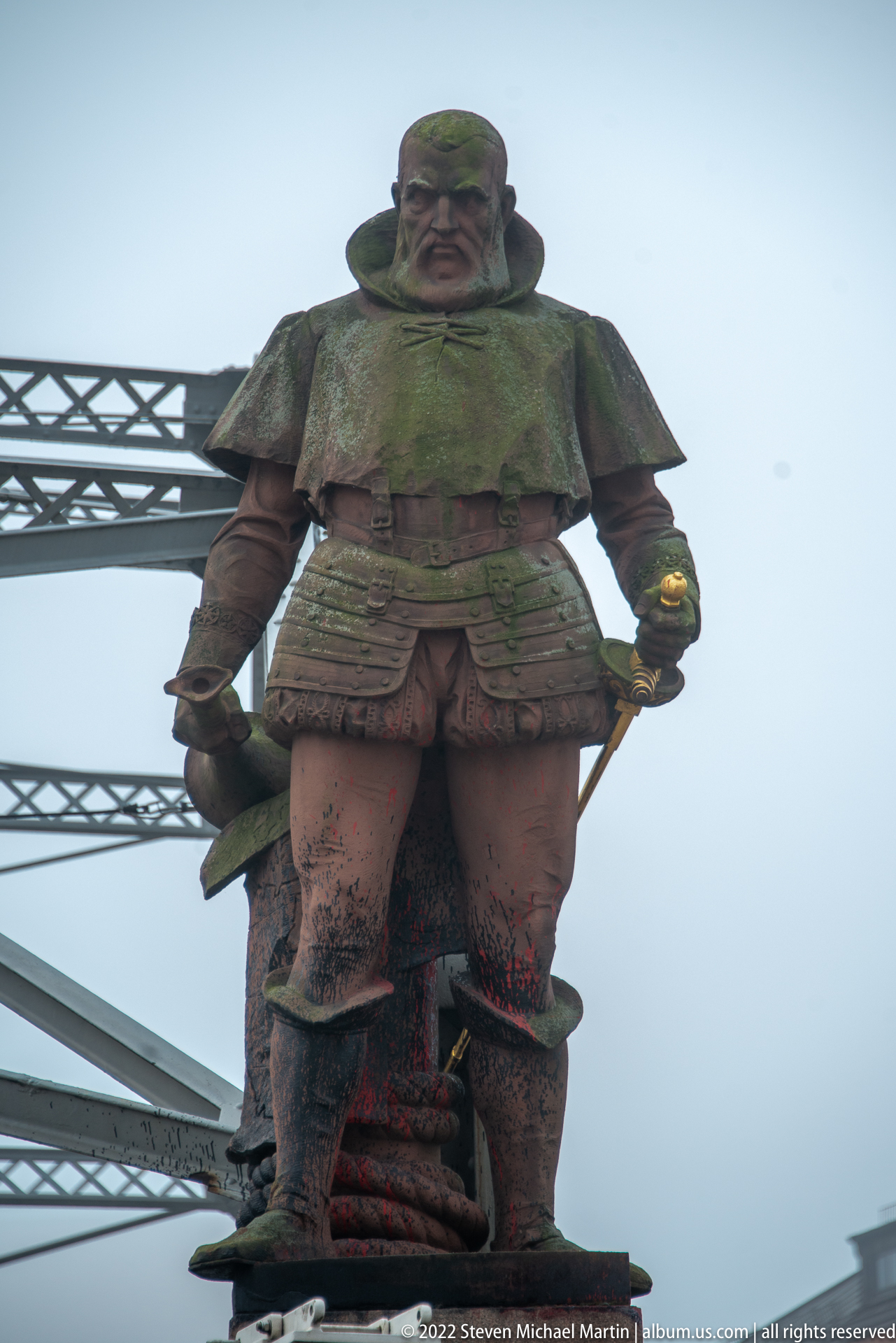
A monumental bronze explorer in historical dress stands at the edge of Kornhausbrücke, holding an instrument or object in one hand while heavy garments and armor-like forms define the figure’s silhouette. The low viewpoint places the sculpture against a pale foggy sky, with the bridge’s riveted steel structure cutting across the background.
Caption
A monumental bronze explorer in historical dress stands at the edge of Kornhausbrücke, holding an instrument or object in one hand while heavy garments and armor-like forms define the figure’s silhouette. The low viewpoint places the sculpture against a pale foggy sky, with the bridge’s riveted steel structure cutting across the background.
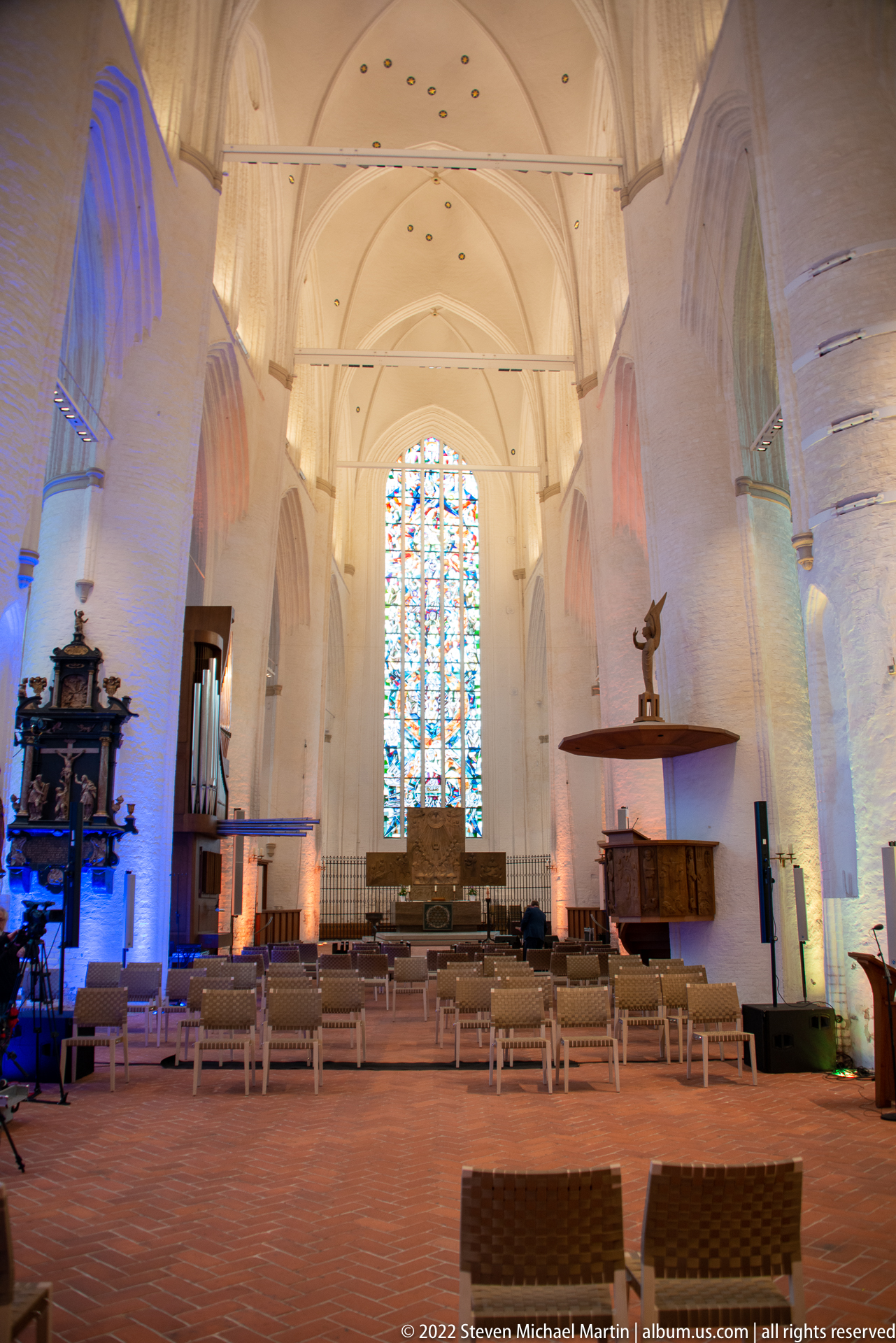
The nave of St. Catherine’s Church opens toward a tall stained-glass window at the eastern end, with whitewashed brick piers and pointed arches defining the long interior. Modern chairs sit on the brick floor beneath a high vaulted ceiling, while colored accent lighting and contemporary furnishings mark the church as a historic sacred space still adapted for present use.
Caption
The nave of St. Catherine’s Church opens toward a tall stained-glass window at the eastern end, with whitewashed brick piers and pointed arches defining the long interior. Modern chairs sit on the brick floor beneath a high vaulted ceiling, while colored accent lighting and contemporary furnishings mark the church as a historic sacred space still adapted for present use.
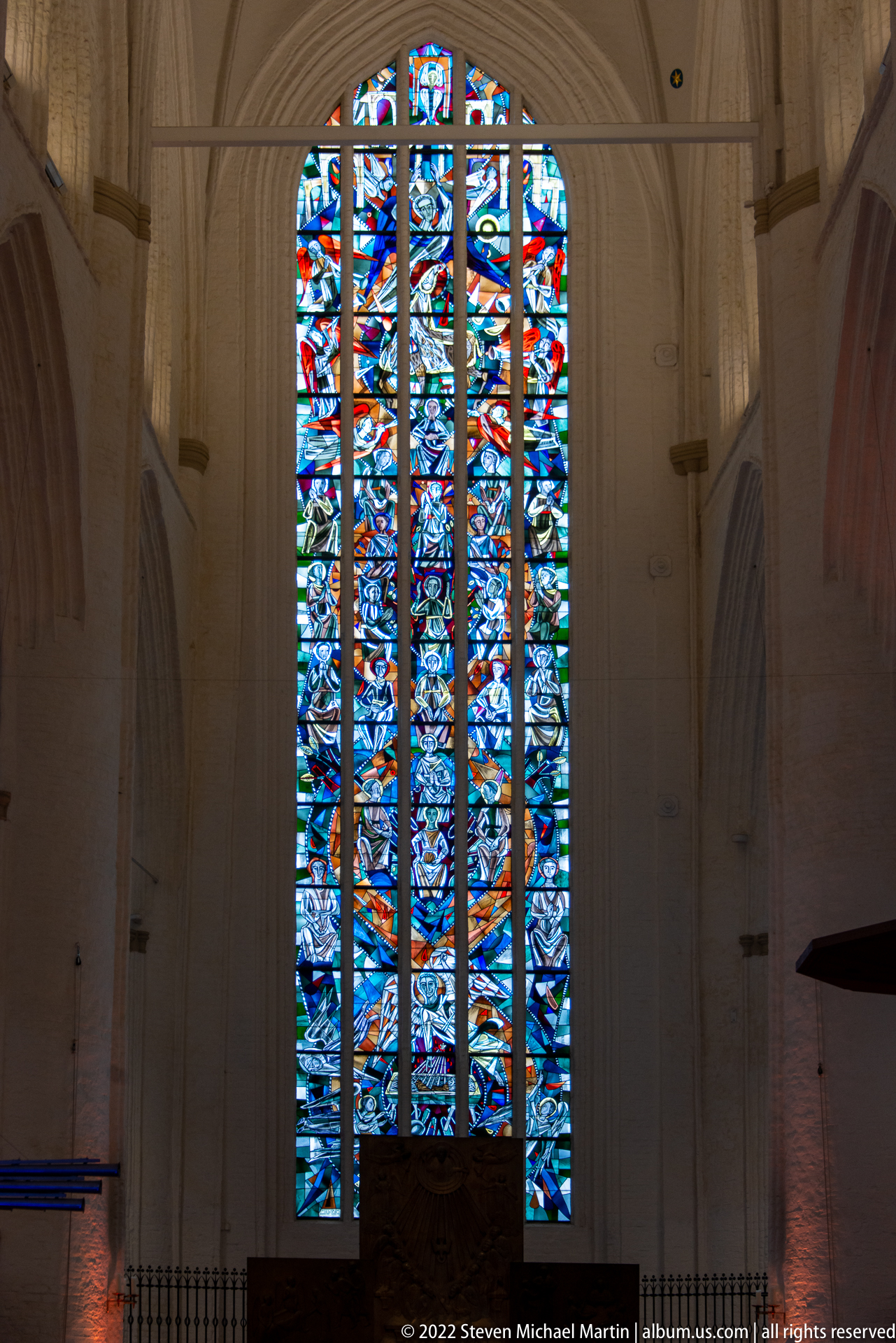
A tall multi-light stained-glass window fills the end wall of St. Catherine’s Church, its dense fields of blue, red, green, and white standing out against the pale masonry. Seen from the nave, the window becomes the dominant vertical element of the sanctuary, framed by pointed Gothic architecture and the darker furnishings below.
Caption
A tall multi-light stained-glass window fills the end wall of St. Catherine’s Church, its dense fields of blue, red, green, and white standing out against the pale masonry. Seen from the nave, the window becomes the dominant vertical element of the sanctuary, framed by pointed Gothic architecture and the darker furnishings below.
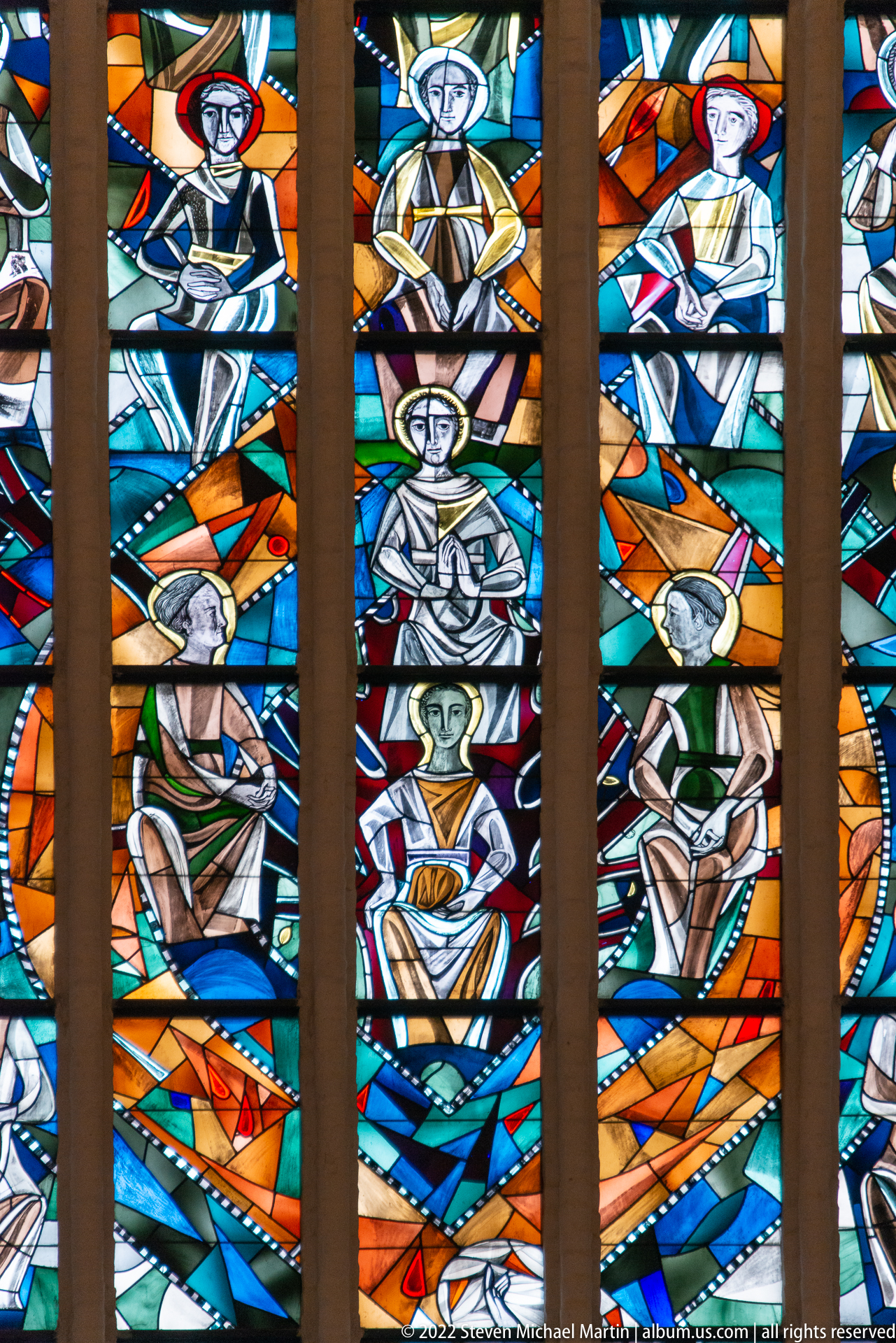
A close section of the church’s stained glass arranges haloed and seated figures within an angular field of saturated orange, turquoise, blue, and green. Heavy dark leading divides the composition into expressive geometric fragments, while the vertical stone mullions separate narrative groups. The detail reveals the modern visual language of the window more clearly than the full nave view.
Caption
A close section of the church’s stained glass arranges haloed and seated figures within an angular field of saturated orange, turquoise, blue, and green. Heavy dark leading divides the composition into expressive geometric fragments, while the vertical stone mullions separate narrative groups. The detail reveals the modern visual language of the window more clearly than the full nave view.
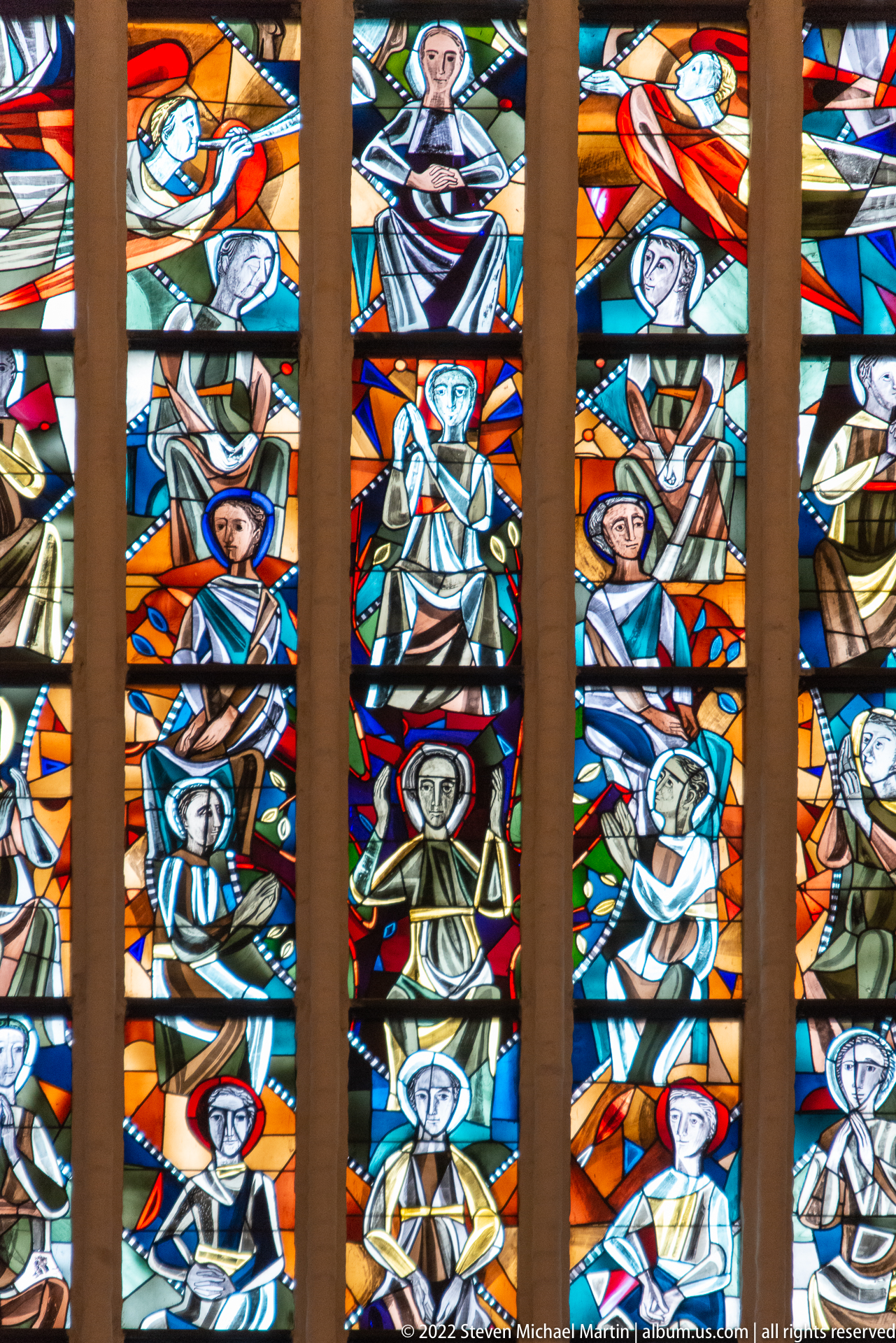
Rows of stylized human figures fill this stained-glass section, many shown frontally with halos, veils, or folded hands. Brilliant orange and blue grounds contrast with pale faces and robes, while irregular geometric leading creates visual movement across the otherwise vertical arrangement. The crop concentrates on communal sacred figures rather than the window’s larger architectural setting.
Caption
Rows of stylized human figures fill this stained-glass section, many shown frontally with halos, veils, or folded hands. Brilliant orange and blue grounds contrast with pale faces and robes, while irregular geometric leading creates visual movement across the otherwise vertical arrangement. The crop concentrates on communal sacred figures rather than the window’s larger architectural setting.
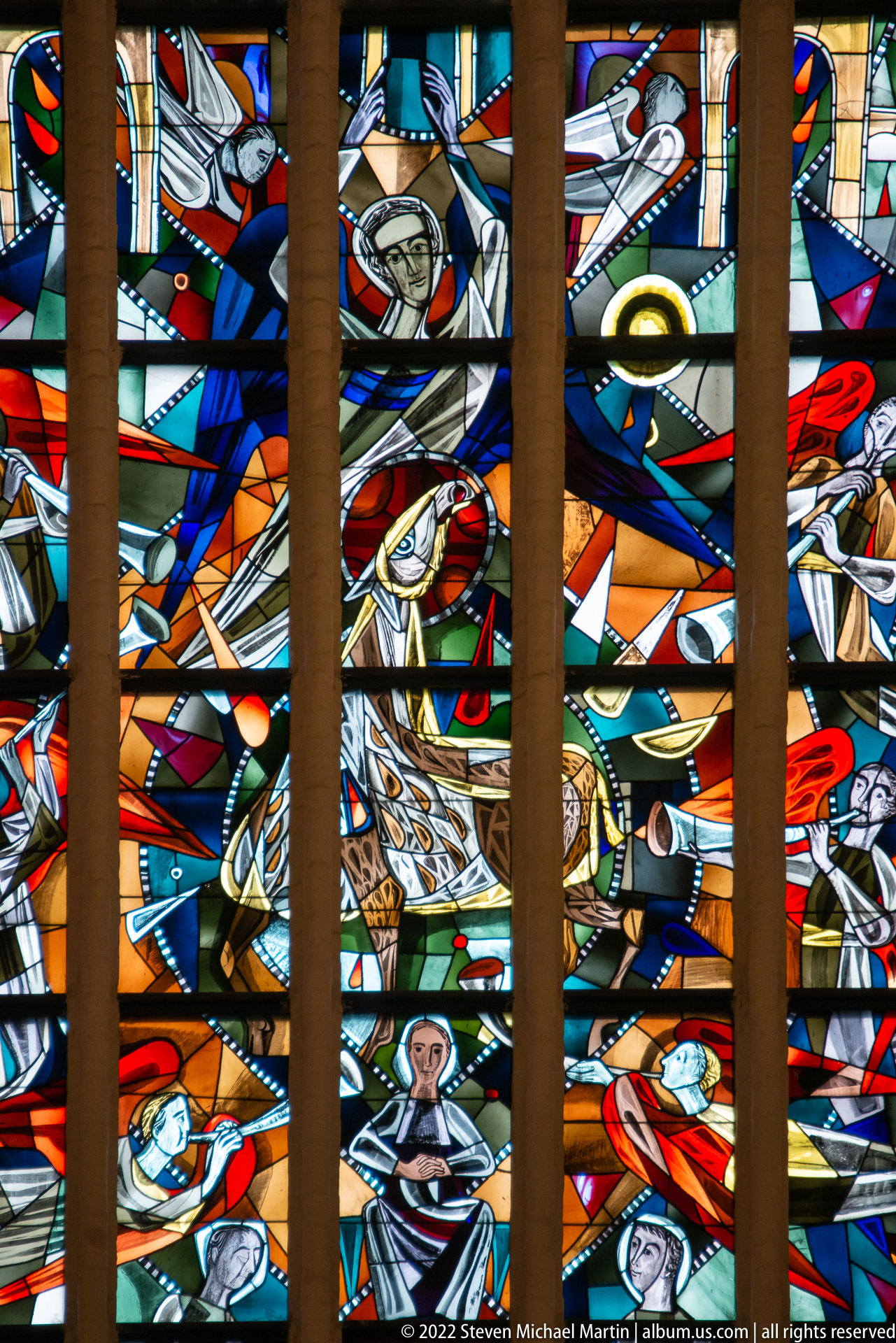
Dynamic narrative scenes occupy this portion of the stained glass, with kneeling, reclining, and standing figures interwoven among bold red, blue, green, and amber forms. Unlike the more static rows of saints nearby, these panels emphasize gesture and action. Strong black leading and narrow stone mullions bind the complex scenes into a unified modern composition.
Caption
Dynamic narrative scenes occupy this portion of the stained glass, with kneeling, reclining, and standing figures interwoven among bold red, blue, green, and amber forms. Unlike the more static rows of saints nearby, these panels emphasize gesture and action. Strong black leading and narrow stone mullions bind the complex scenes into a unified modern composition.
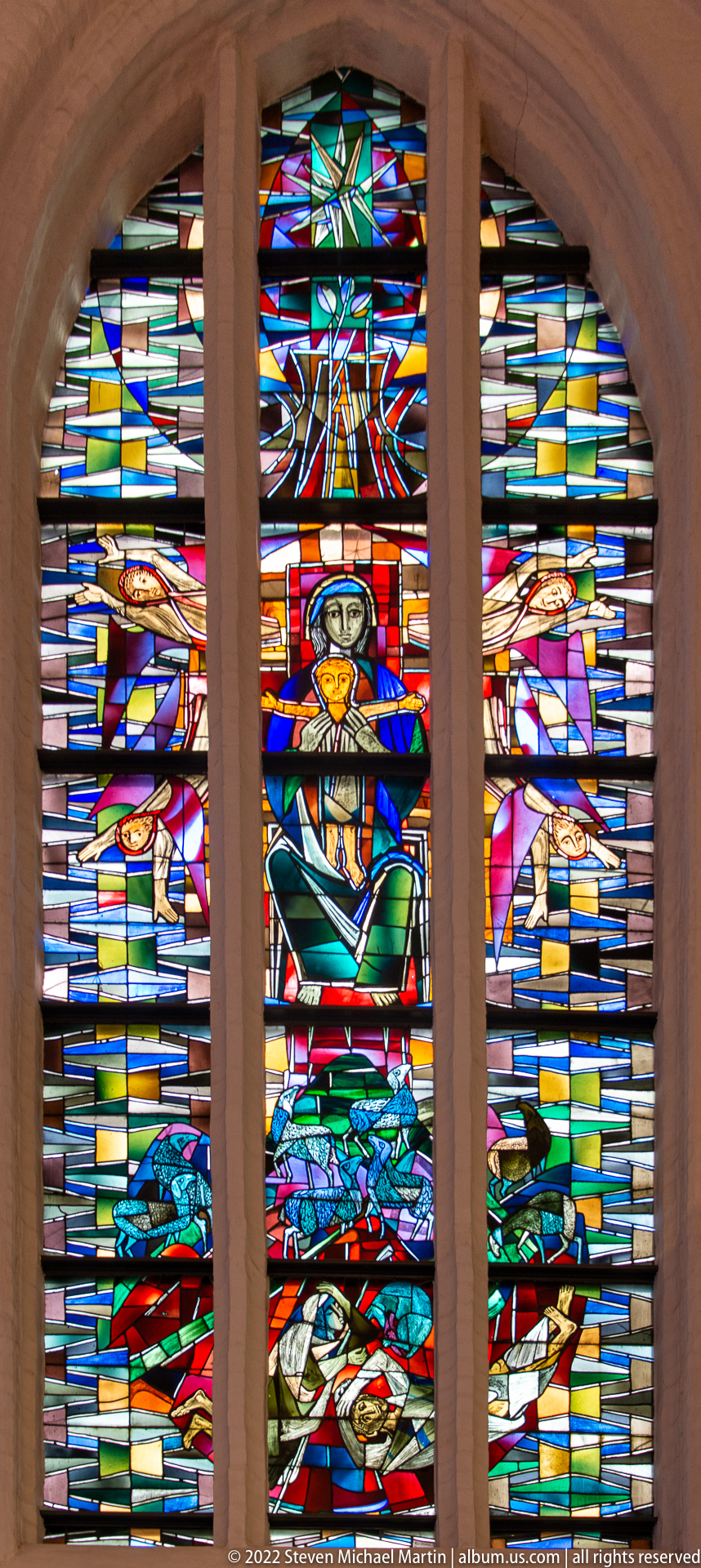
A three-light stained-glass window combines a central stylized human figure with abstract bands of intense red, blue, yellow, and green. Horizontal strips of color cut across the composition while smaller symbolic forms appear around the central image, giving the window a distinctly modern rhythm within its traditional pointed architectural frame.
Caption
A three-light stained-glass window combines a central stylized human figure with abstract bands of intense red, blue, yellow, and green. Horizontal strips of color cut across the composition while smaller symbolic forms appear around the central image, giving the window a distinctly modern rhythm within its traditional pointed architectural frame.
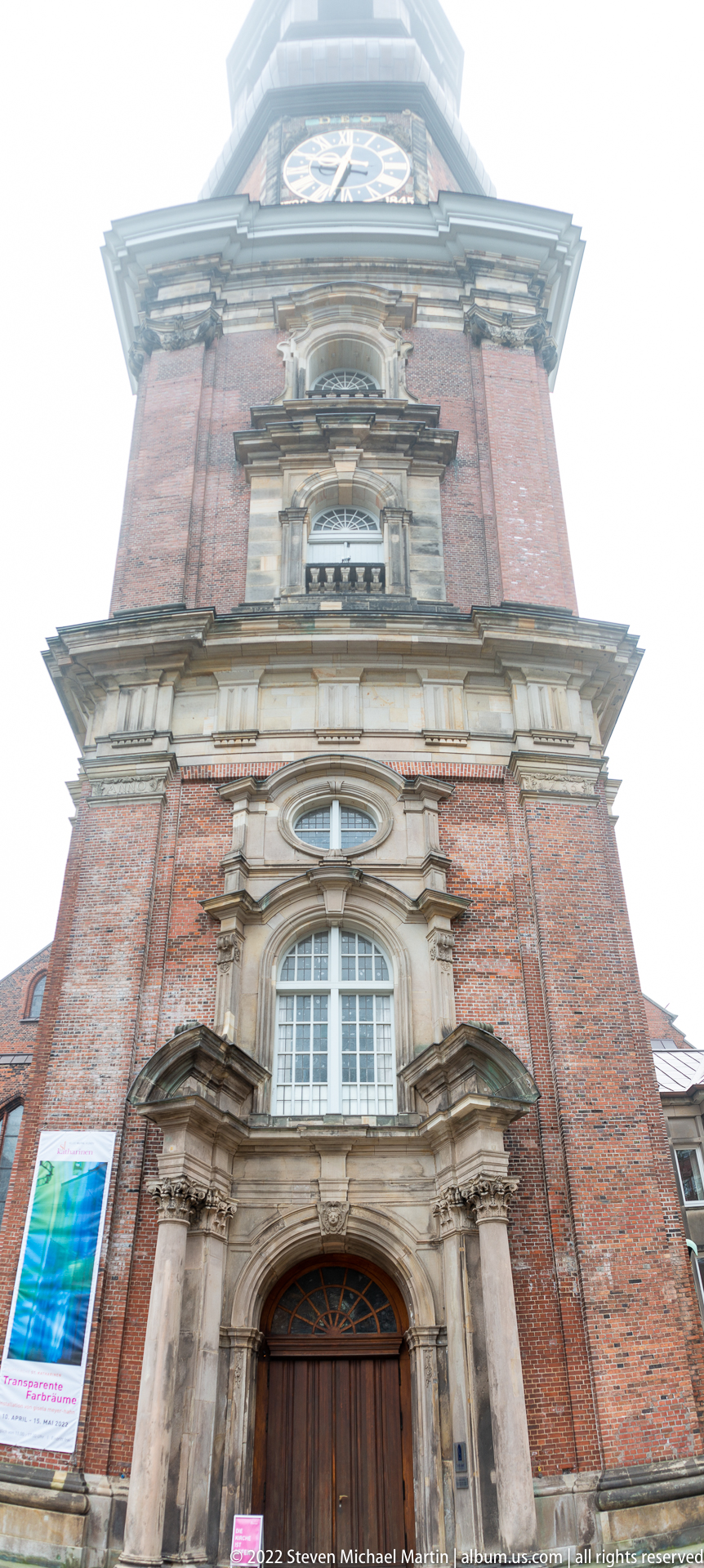
An elaborate pale-stone portal projects from the red-brick tower façade of St. Catherine’s Church. Curving pediments, paired architectural orders, carved ornament, and a large arched transom build a ceremonial entrance around the heavy wooden doors. The steep upward viewpoint accentuates the contrast between the sculptural Baroque stonework and the massive brick tower above.
Caption
An elaborate pale-stone portal projects from the red-brick tower façade of St. Catherine’s Church. Curving pediments, paired architectural orders, carved ornament, and a large arched transom build a ceremonial entrance around the heavy wooden doors. The steep upward viewpoint accentuates the contrast between the sculptural Baroque stonework and the massive brick tower above.
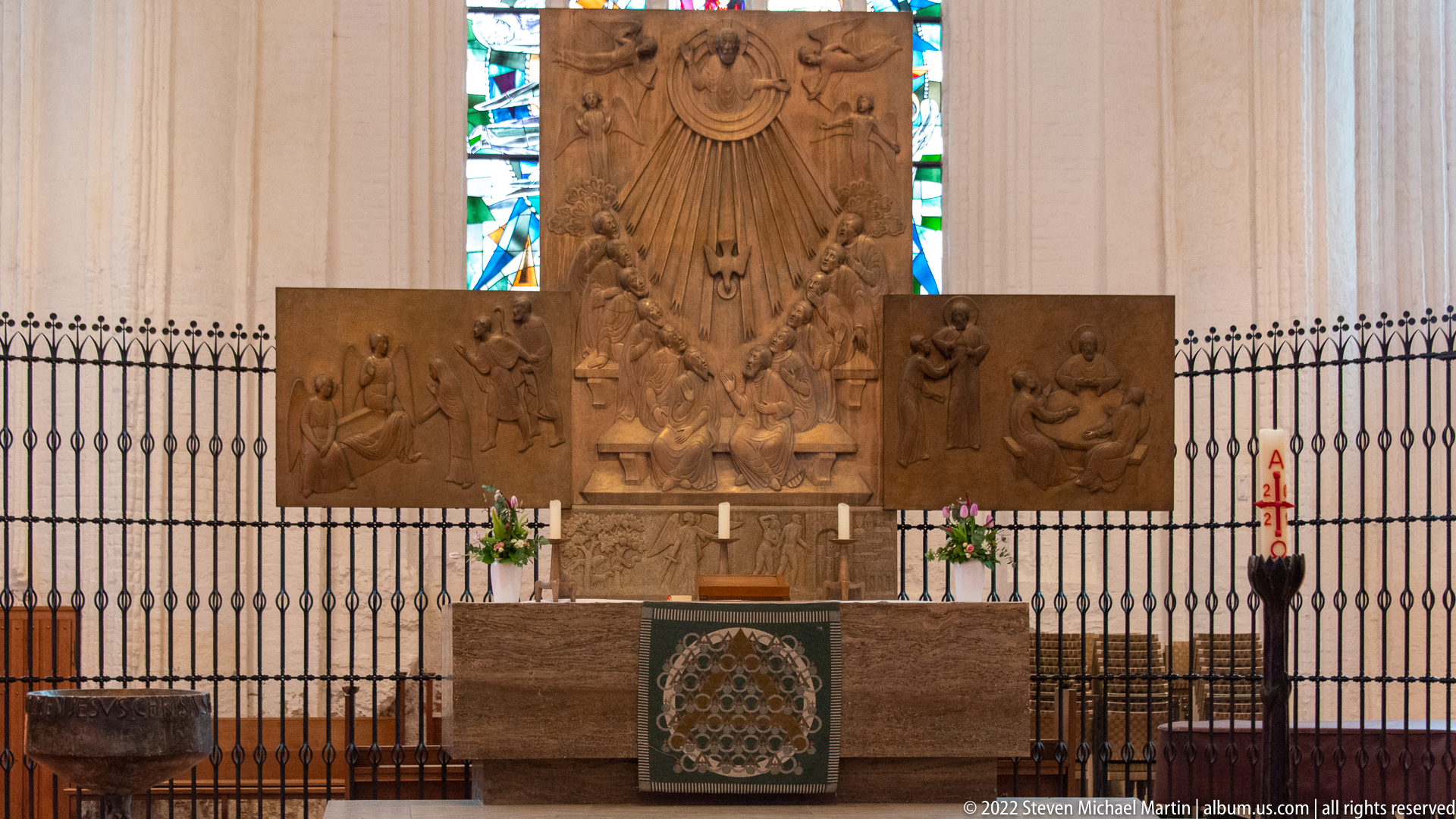
A sculptural altar ensemble in St. Catherine’s Church is arranged behind a black metal screen, with a central relief rising above an altar table and flanking narrative panels extending to either side. Candles and flower arrangements soften the stone and wood surfaces, while a narrow strip of stained glass introduces color behind the otherwise earth-toned devotional setting.
Caption
A sculptural altar ensemble in St. Catherine’s Church is arranged behind a black metal screen, with a central relief rising above an altar table and flanking narrative panels extending to either side. Candles and flower arrangements soften the stone and wood surfaces, while a narrow strip of stained glass introduces color behind the otherwise earth-toned devotional setting.
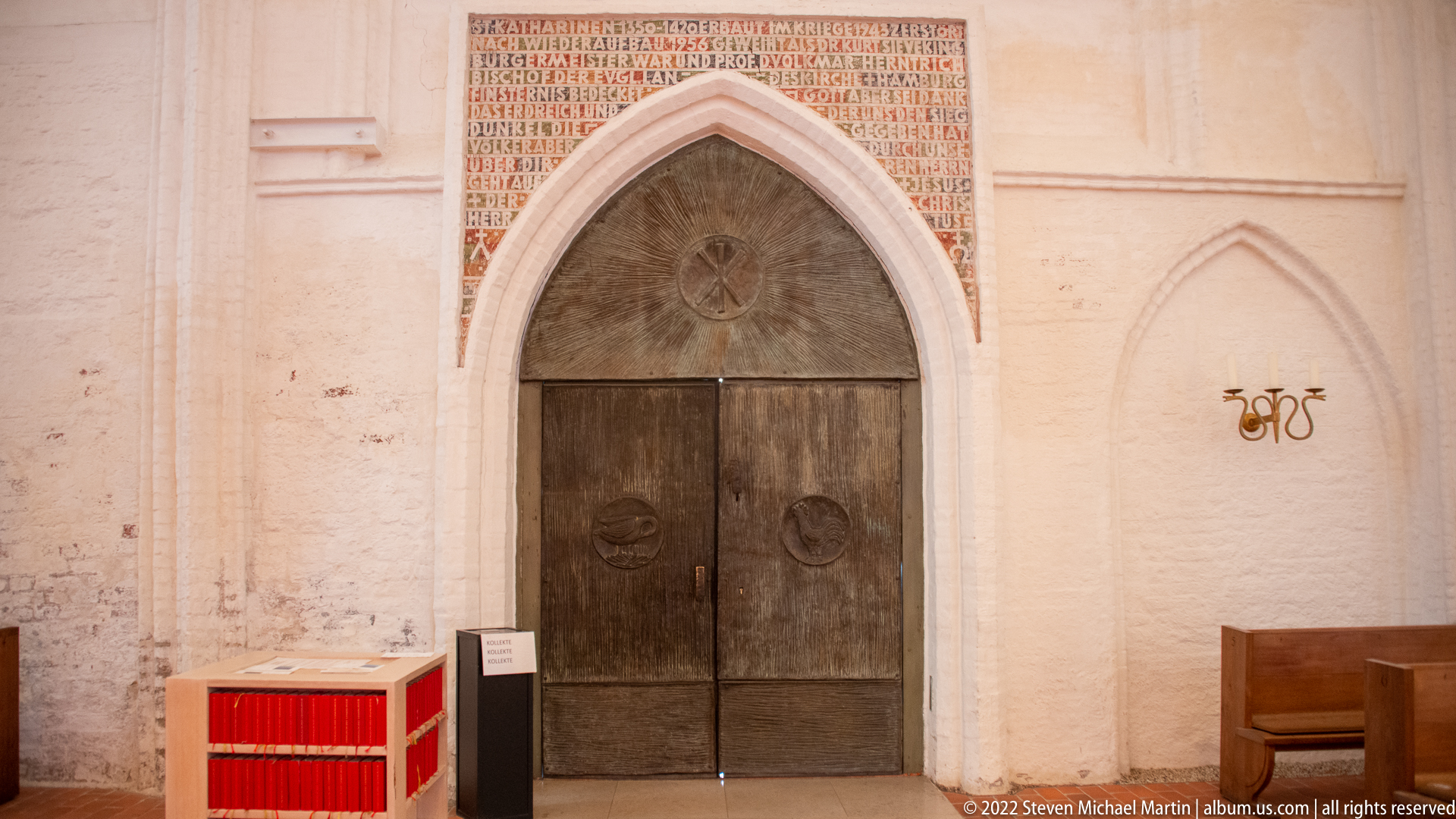
A pointed Gothic arch frames a pair of dark wooden doors within the pale brick interior of St. Catherine’s Church. A circular motif appears in the tympanum-like area above the doors, while dense historic lettering occupies the wall above the arch. The restrained composition emphasizes the transition between whitewashed masonry, carved wood, and inscribed surface.
Caption
A pointed Gothic arch frames a pair of dark wooden doors within the pale brick interior of St. Catherine’s Church. A circular motif appears in the tympanum-like area above the doors, while dense historic lettering occupies the wall above the arch. The restrained composition emphasizes the transition between whitewashed masonry, carved wood, and inscribed surface.
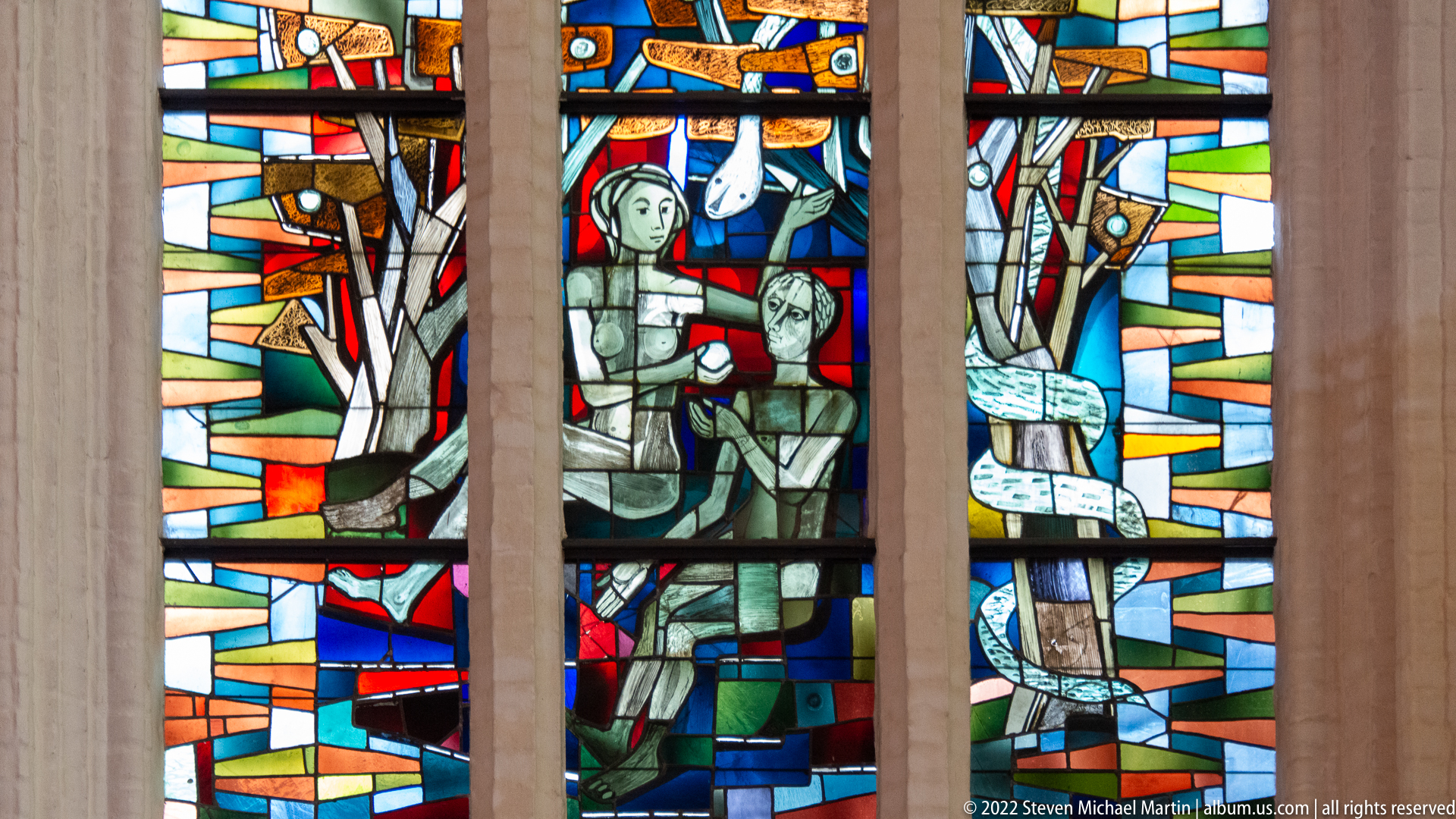
A modern stained-glass scene places angular human figures within a fragmented field of red, blue, yellow, and green. At center, two figures appear closely grouped, while elongated forms and smaller narrative details occupy the adjacent lights. The strong geometry of the leading gives the sacred imagery an intentionally modern, almost mosaic-like structure.
Caption
A modern stained-glass scene places angular human figures within a fragmented field of red, blue, yellow, and green. At center, two figures appear closely grouped, while elongated forms and smaller narrative details occupy the adjacent lights. The strong geometry of the leading gives the sacred imagery an intentionally modern, almost mosaic-like structure.
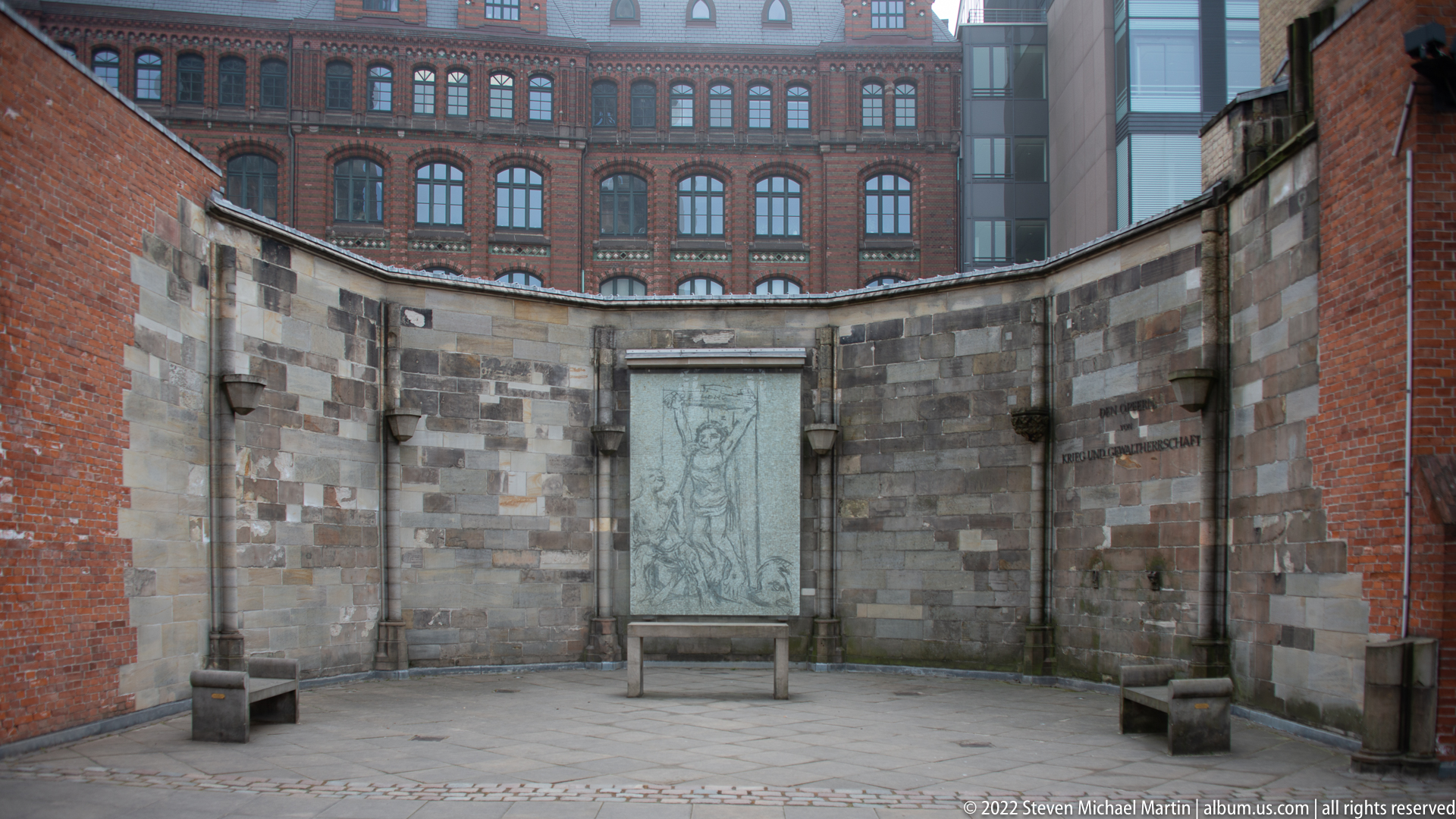
A freestanding memorial panel occupies a quiet paved enclosure beside the ruins of St. Nikolai, backed by a curved stone wall and red-brick historic buildings. The restrained setting, benches, and weathered masonry frame the vertical relief-like panel as an object for contemplation rather than as part of an active church interior.
Caption
A freestanding memorial panel occupies a quiet paved enclosure beside the ruins of St. Nikolai, backed by a curved stone wall and red-brick historic buildings. The restrained setting, benches, and weathered masonry frame the vertical relief-like panel as an object for contemplation rather than as part of an active church interior.
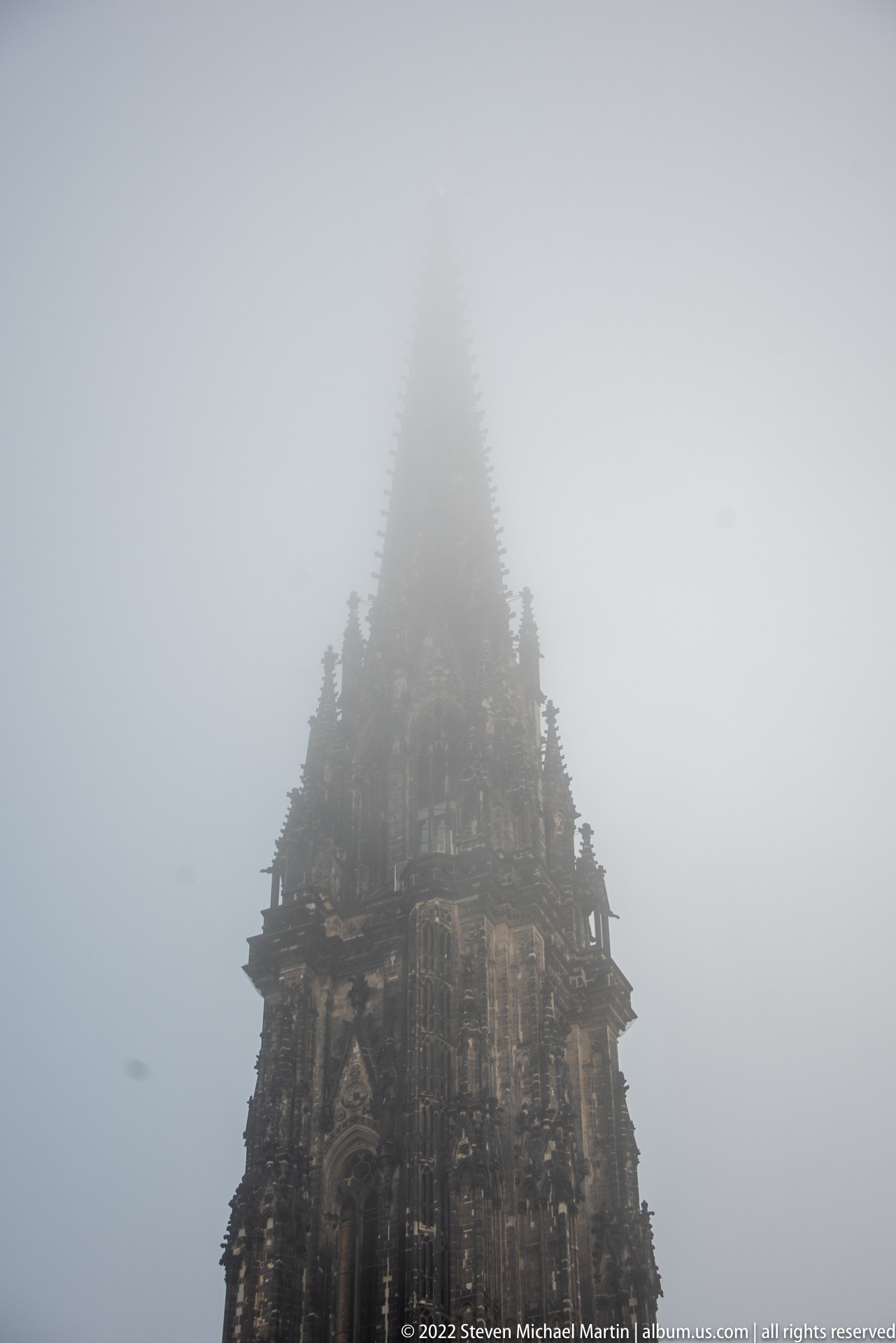
The surviving tower of St. Nikolai rises into dense fog, its dark Gothic tracery and crocketed spire gradually disappearing into the mist. The close, low-angle composition strips away the surrounding city and concentrates attention on the weathered masonry and skeletal verticality of the former church, now preserved as Hamburg’s St. Nikolai Memorial.
Caption
The surviving tower of St. Nikolai rises into dense fog, its dark Gothic tracery and crocketed spire gradually disappearing into the mist. The close, low-angle composition strips away the surrounding city and concentrates attention on the weathered masonry and skeletal verticality of the former church, now preserved as Hamburg’s St. Nikolai Memorial.
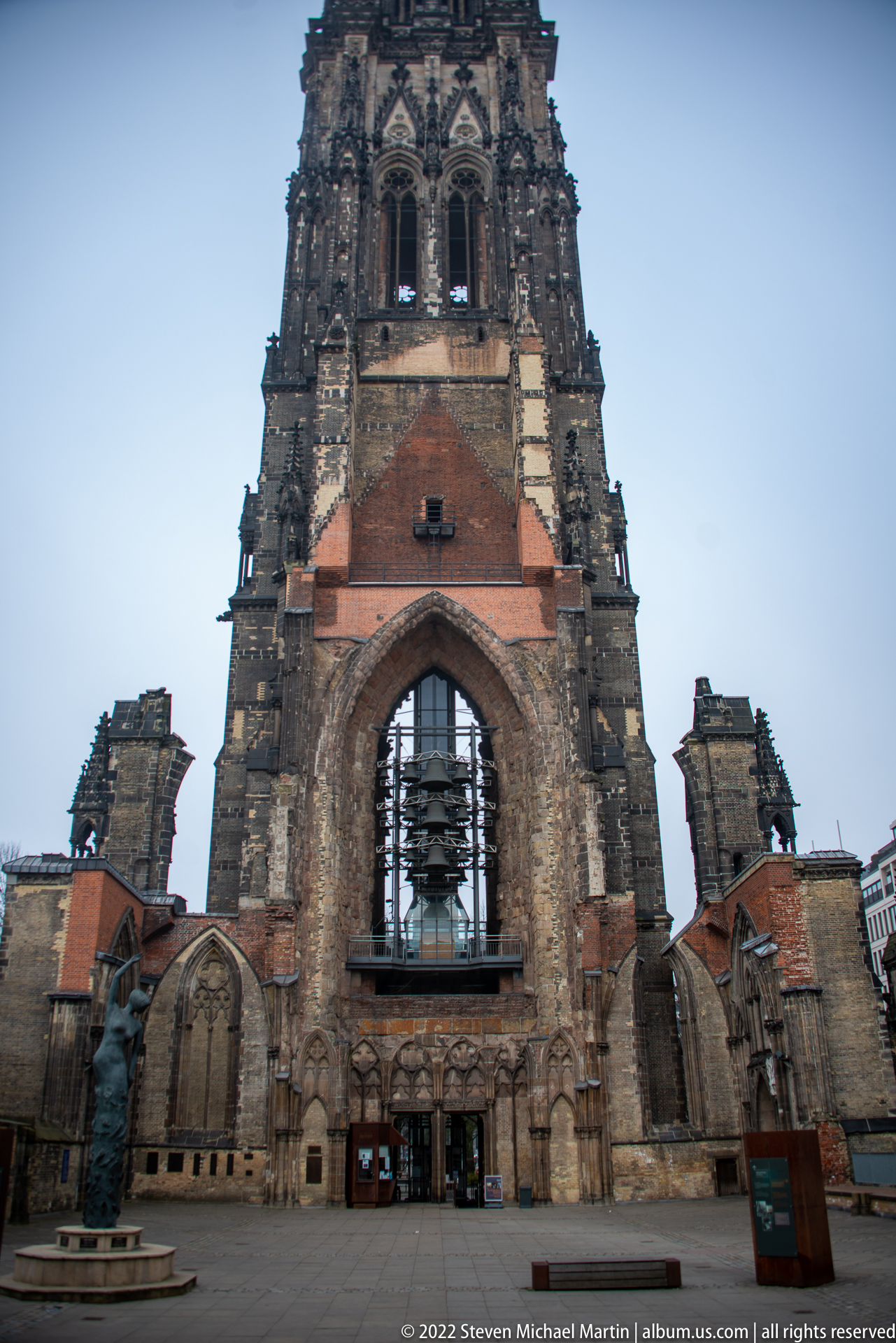
The monumental west front of St. Nikolai survives as a darkened masonry frame around a great pointed opening filled with modern bell structures. Truncated walls and roofless side bays expose the church’s destruction, while the tower continues upward beyond the frame. The frontal viewpoint emphasizes both the original Gothic composition and the deliberate preservation of the ruin.
Caption
The monumental west front of St. Nikolai survives as a darkened masonry frame around a great pointed opening filled with modern bell structures. Truncated walls and roofless side bays expose the church’s destruction, while the tower continues upward beyond the frame. The frontal viewpoint emphasizes both the original Gothic composition and the deliberate preservation of the ruin.
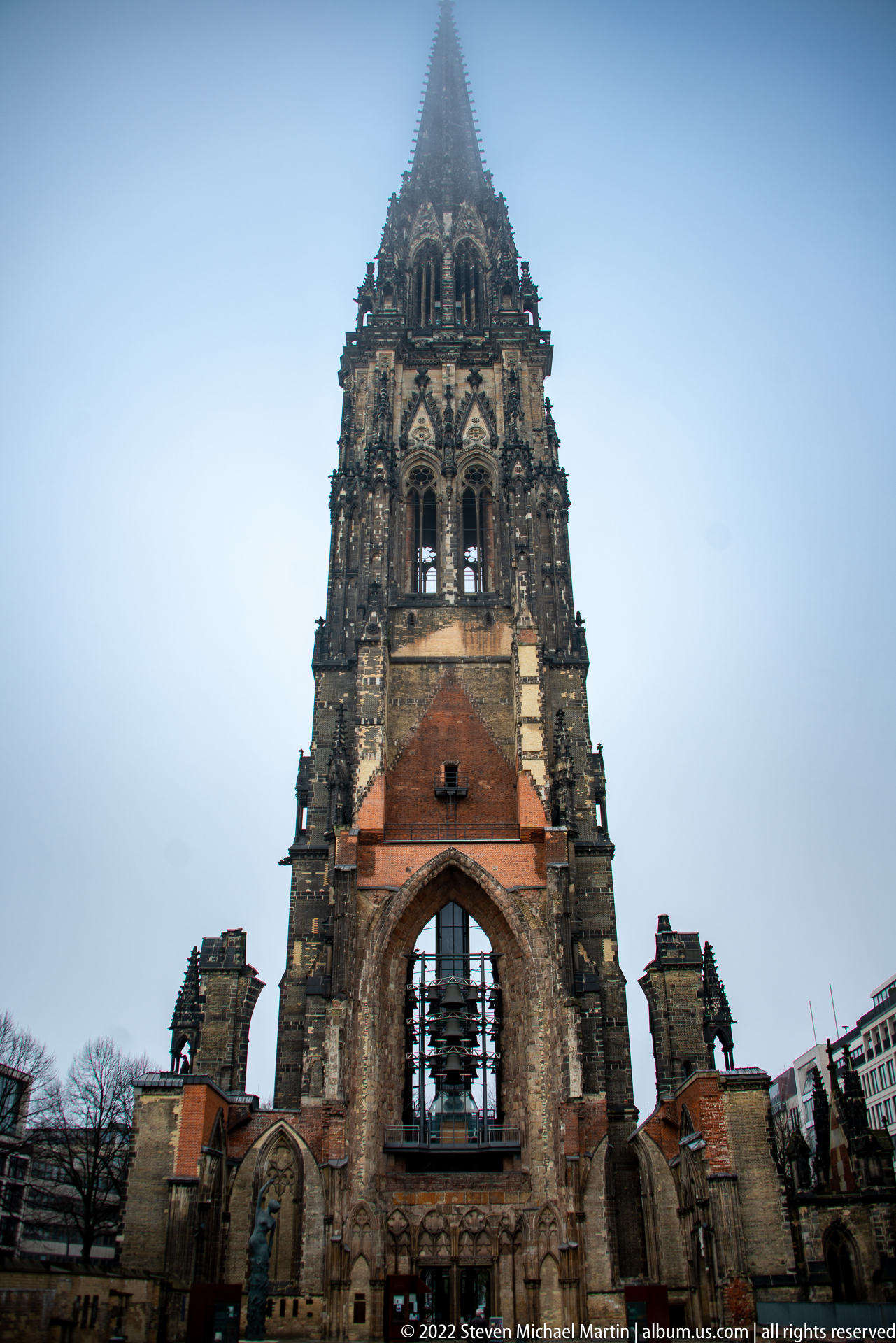
St. Nikolai’s tower rises from the roofless west front into a pale fog, with the lower façade, open pointed arch, and flanking ruins clearly visible below. The wider composition than the preceding view restores the tower’s full relationship to the destroyed church body, presenting the memorial as both a surviving landmark and a deliberately retained ruin.
Caption
St. Nikolai’s tower rises from the roofless west front into a pale fog, with the lower façade, open pointed arch, and flanking ruins clearly visible below. The wider composition than the preceding view restores the tower’s full relationship to the destroyed church body, presenting the memorial as both a surviving landmark and a deliberately retained ruin.
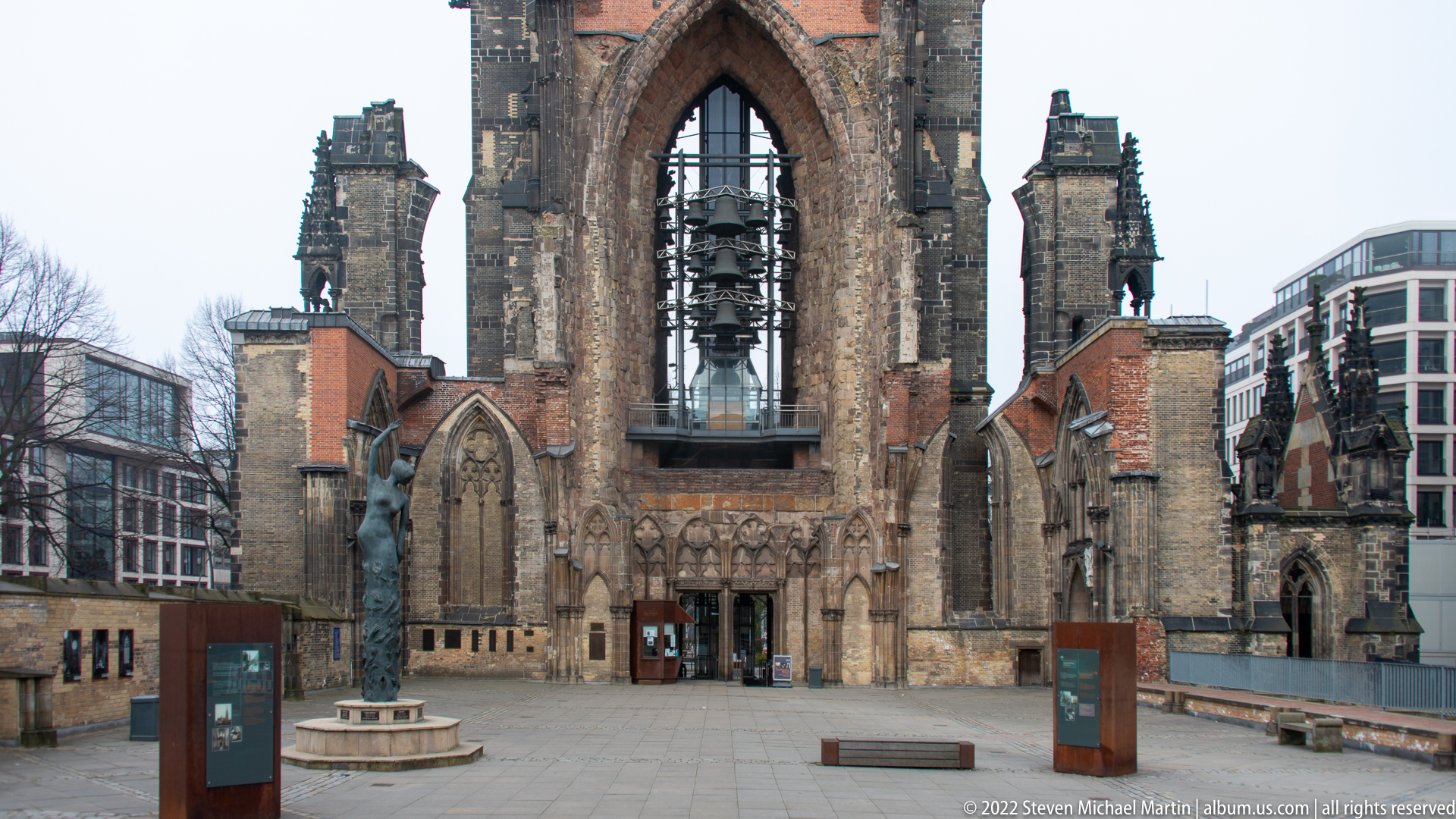
The open shell of St. Nikolai reveals the former church’s pointed arches, surviving tower, and exposed structural fragments around a broad paved memorial space. A modern sculpture stands near the center, while newer city buildings appear beyond the ruined walls. The view makes the contrast between surviving Gothic fabric and postwar urban reconstruction especially clear.
Caption
The open shell of St. Nikolai reveals the former church’s pointed arches, surviving tower, and exposed structural fragments around a broad paved memorial space. A modern sculpture stands near the center, while newer city buildings appear beyond the ruined walls. The view makes the contrast between surviving Gothic fabric and postwar urban reconstruction especially clear.
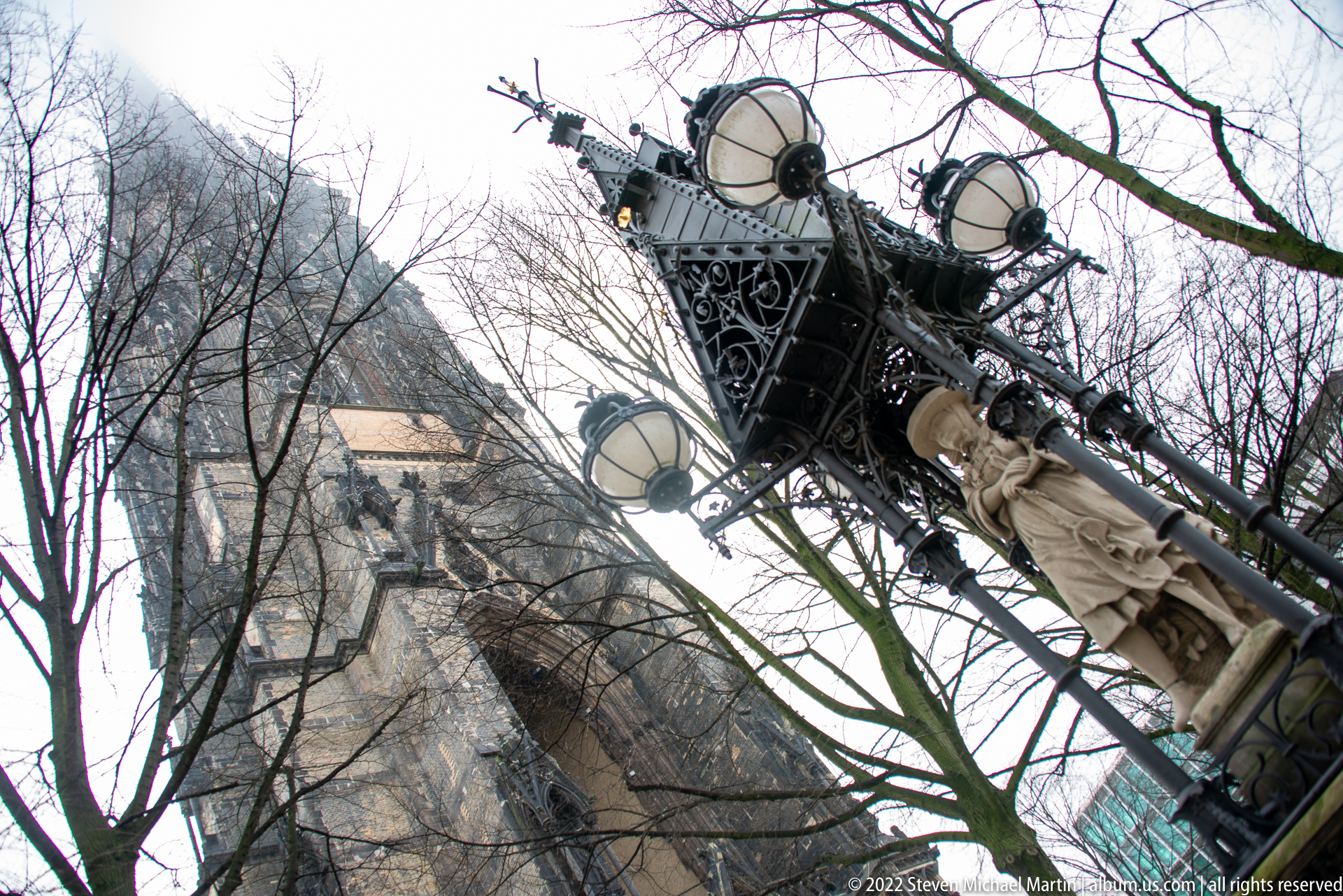
An elaborate historic-style streetlamp dominates the foreground, its clustered globe lights and intricate dark metalwork silhouetted against bare branches. Behind it, the surviving Gothic tower of St. Nikolai rises into a pale winter sky. The low viewpoint layers decorative urban infrastructure against the vertical architecture of Hamburg’s memorial ruin.
Caption
An elaborate historic-style streetlamp dominates the foreground, its clustered globe lights and intricate dark metalwork silhouetted against bare branches. Behind it, the surviving Gothic tower of St. Nikolai rises into a pale winter sky. The low viewpoint layers decorative urban infrastructure against the vertical architecture of Hamburg’s memorial ruin.
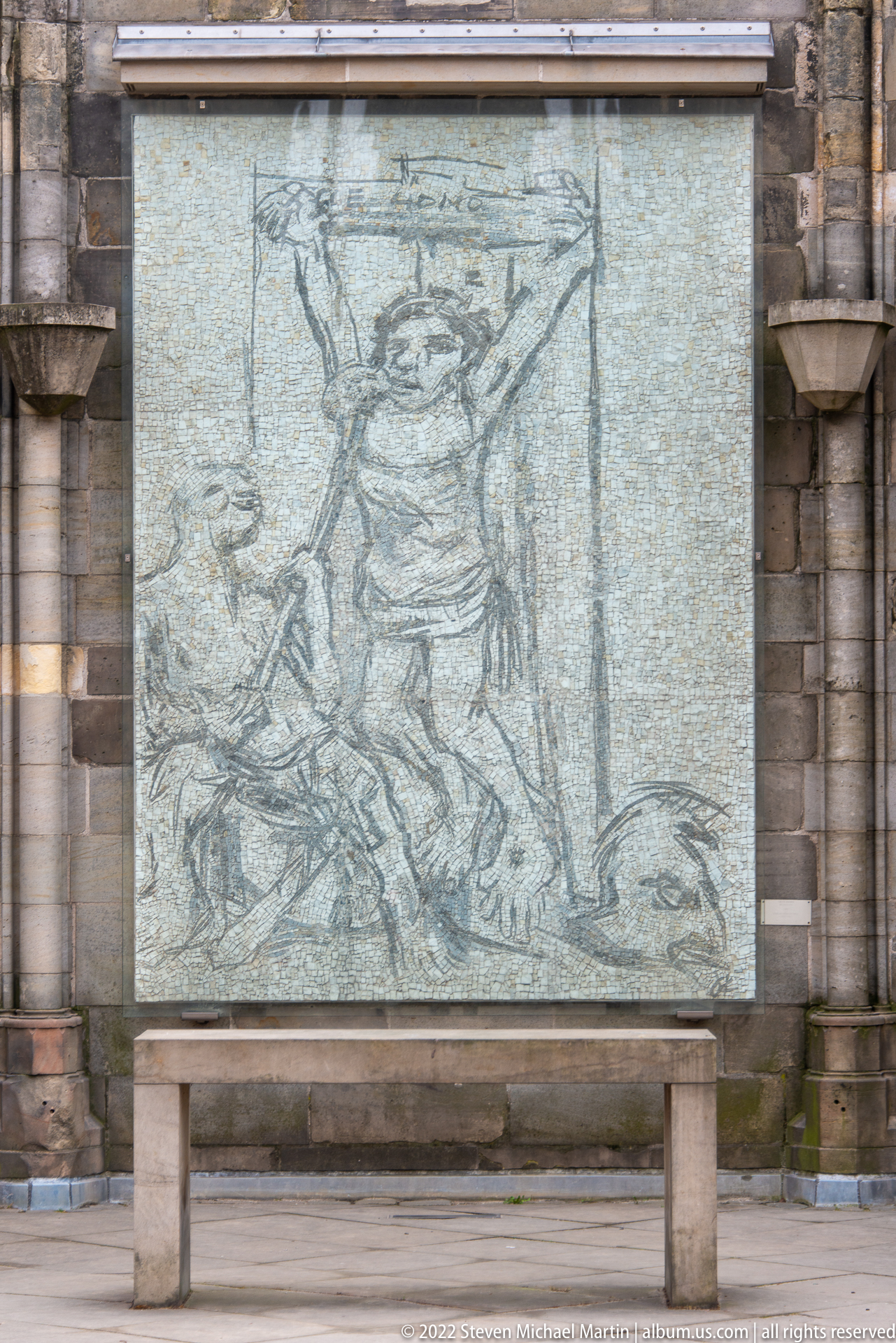
A large monochrome image mounted against the ruined masonry of St. Nikolai shows a loosely rendered human figure amid angular forms. Its pale, sketch-like surface contrasts with the dark stone blocks framing it. Presented at architectural scale, the panel operates as a contemporary commemorative element within the preserved church ruins.
Caption
A large monochrome image mounted against the ruined masonry of St. Nikolai shows a loosely rendered human figure amid angular forms. Its pale, sketch-like surface contrasts with the dark stone blocks framing it. Presented at architectural scale, the panel operates as a contemporary commemorative element within the preserved church ruins.
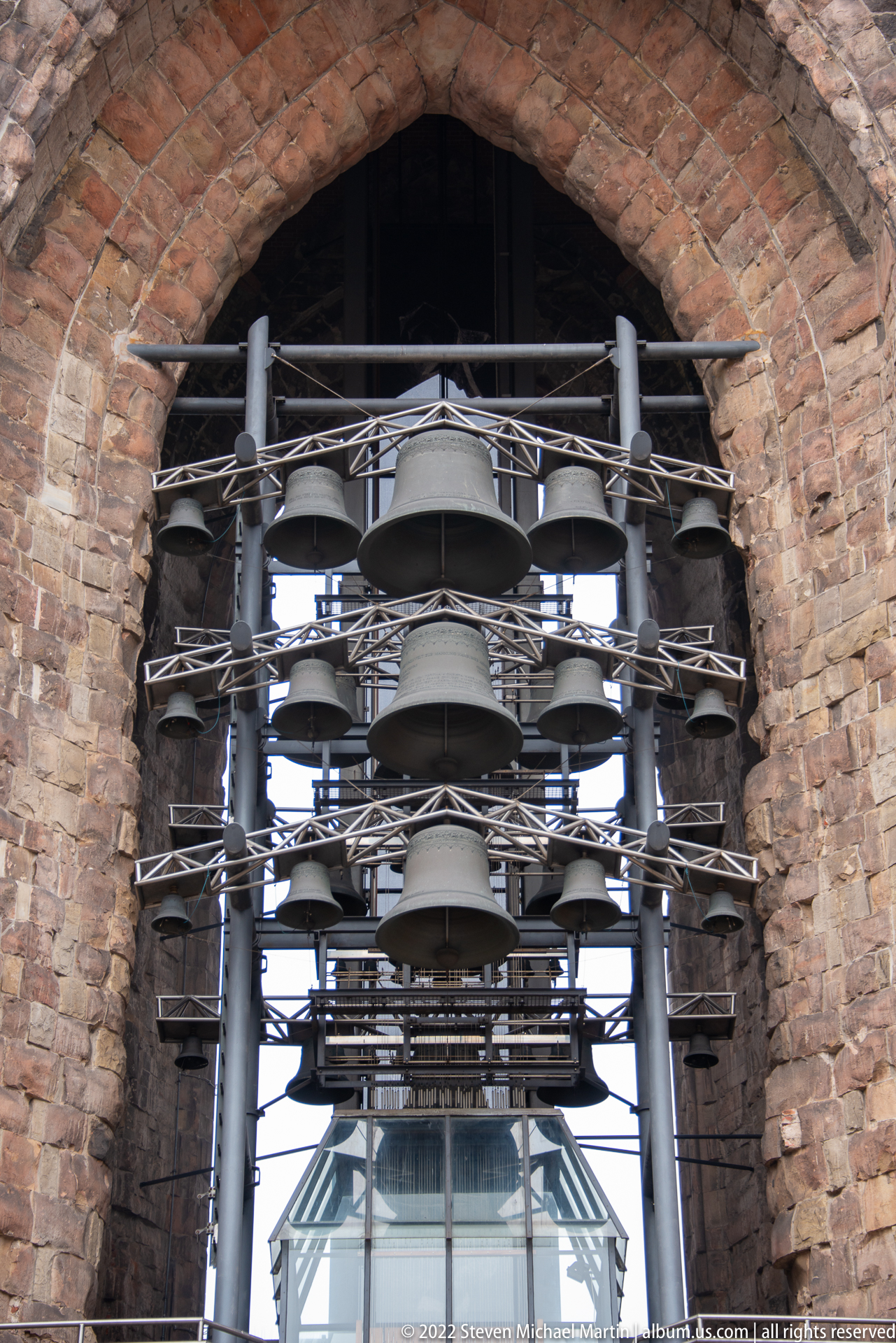
A dense assembly of bells hangs within a tall surviving brick arch at the St. Nikolai Memorial, supported by a modern metal framework inserted into the historic masonry. Bells of several sizes occupy stacked levels, creating a striking contrast between contemporary structural supports and the weathered fabric of the ruined church.
Caption
A dense assembly of bells hangs within a tall surviving brick arch at the St. Nikolai Memorial, supported by a modern metal framework inserted into the historic masonry. Bells of several sizes occupy stacked levels, creating a striking contrast between contemporary structural supports and the weathered fabric of the ruined church.
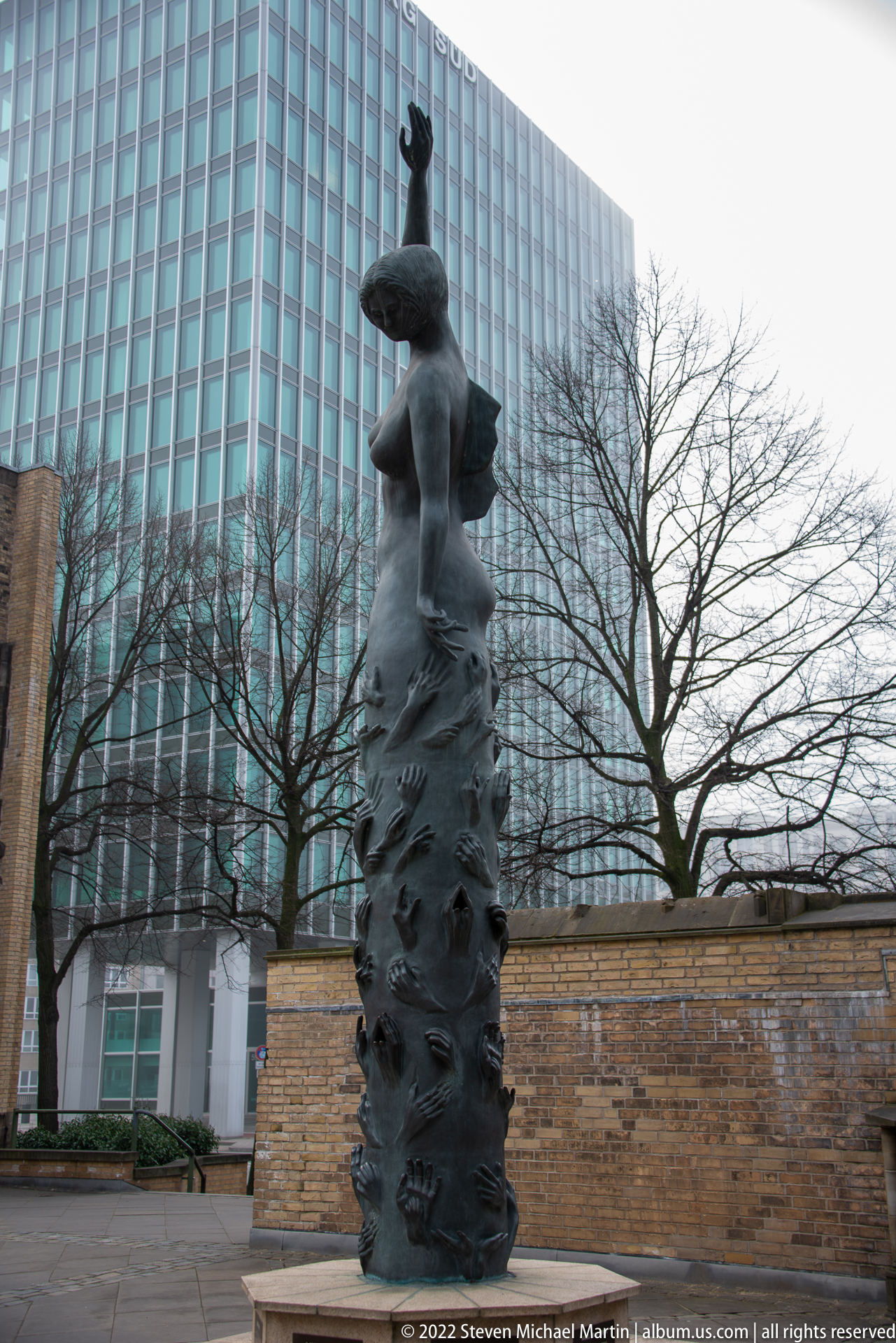
A tall dark bronze memorial sculpture rises from a paved enclosure beside the St. Nikolai ruins, its elongated human figure emerging from a rough, vertically modeled column. Small relief-like forms climb the surface below, while a bird-like element crowns the composition. Modern glass architecture and bare trees form a contrasting urban backdrop.
Caption
A tall dark bronze memorial sculpture rises from a paved enclosure beside the St. Nikolai ruins, its elongated human figure emerging from a rough, vertically modeled column. Small relief-like forms climb the surface below, while a bird-like element crowns the composition. Modern glass architecture and bare trees form a contrasting urban backdrop.
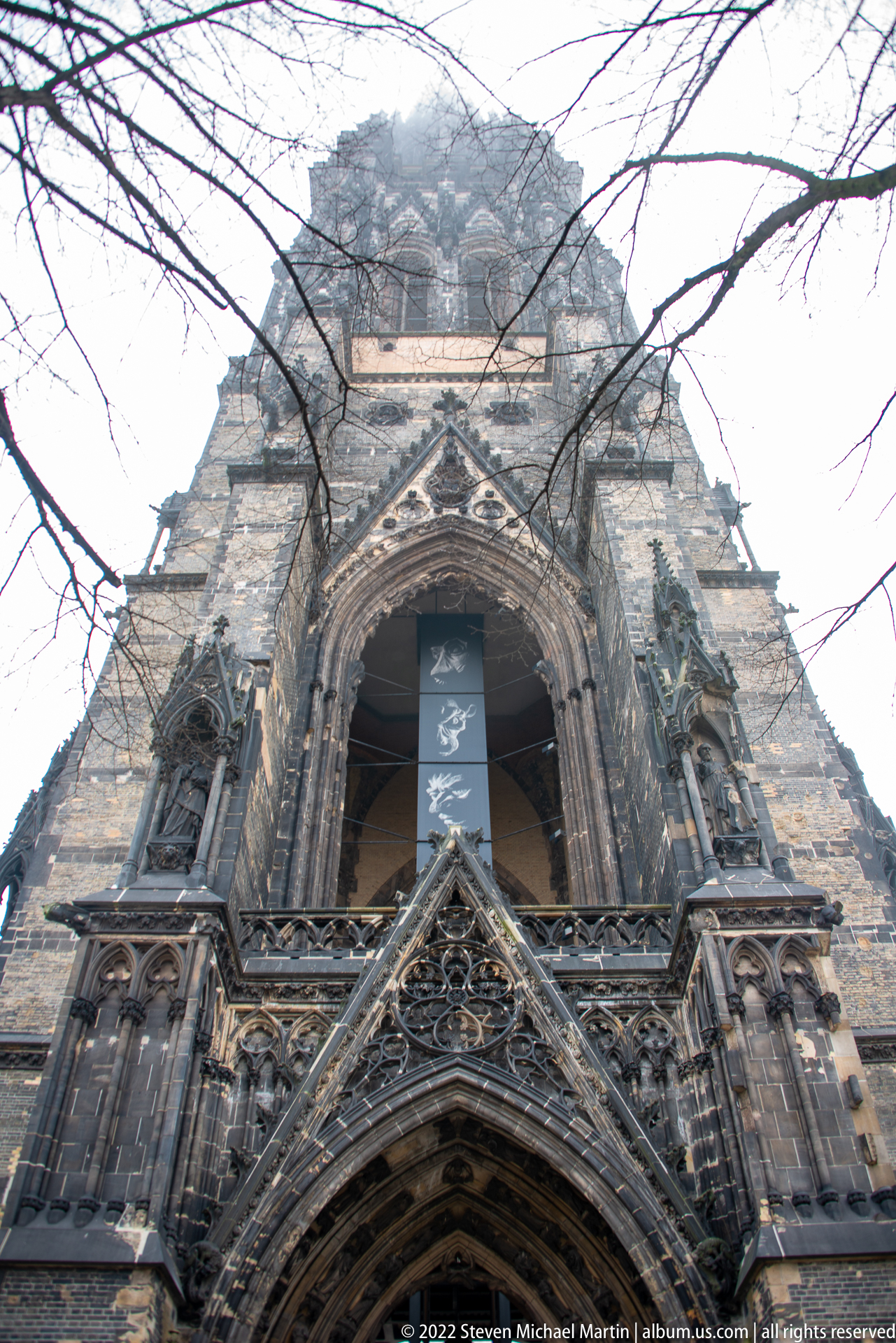
The monumental entrance to the St. Nikolai tower is viewed steeply from below, revealing layered pointed arches, carved tracery, sculptural niches, and a projecting triangular gable. Weather-darkened stonework intensifies the vertical Gothic composition, while bare branches cross the upper frame and reinforce the surviving tower’s exposed, ruinous setting.
Caption
The monumental entrance to the St. Nikolai tower is viewed steeply from below, revealing layered pointed arches, carved tracery, sculptural niches, and a projecting triangular gable. Weather-darkened stonework intensifies the vertical Gothic composition, while bare branches cross the upper frame and reinforce the surviving tower’s exposed, ruinous setting.
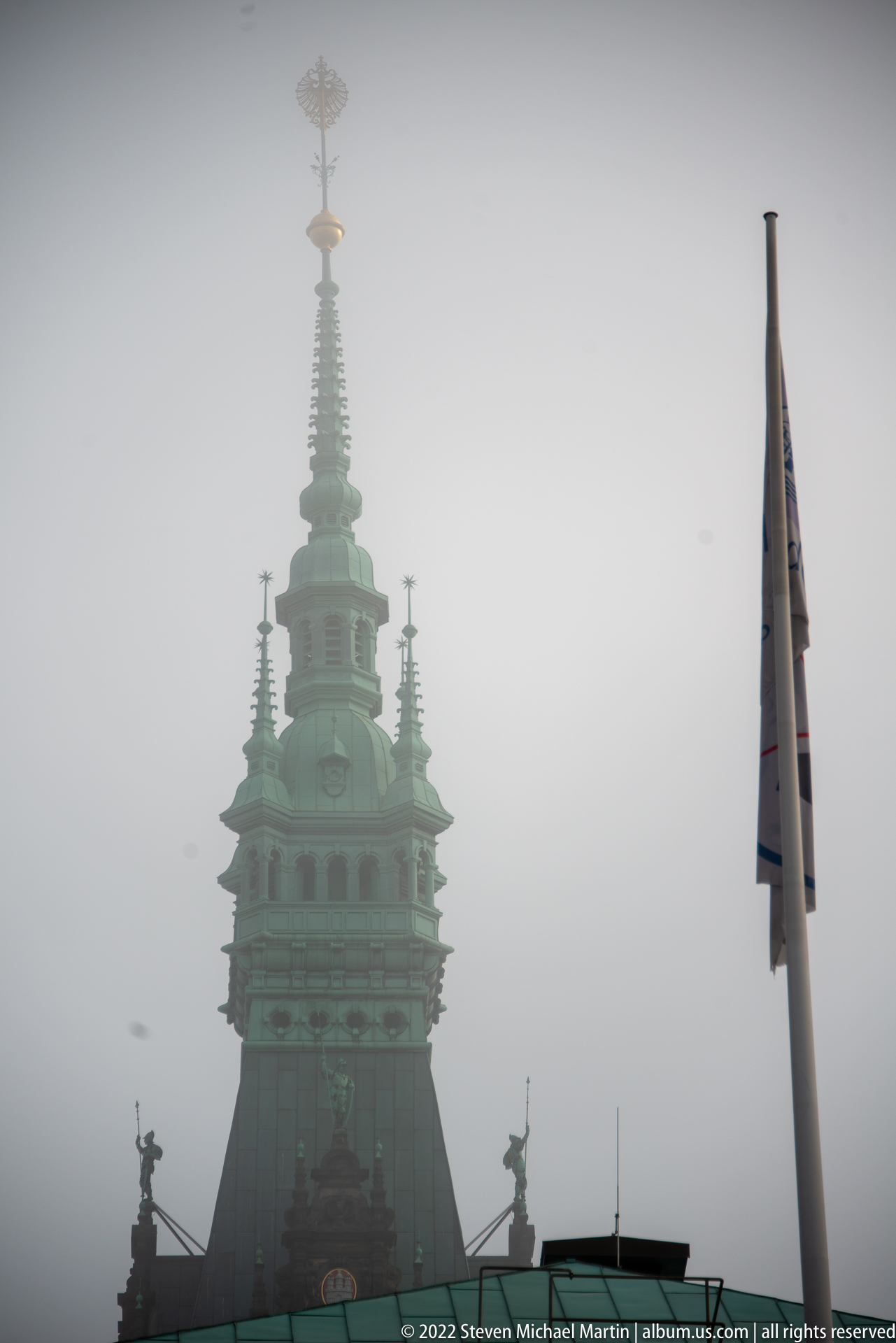
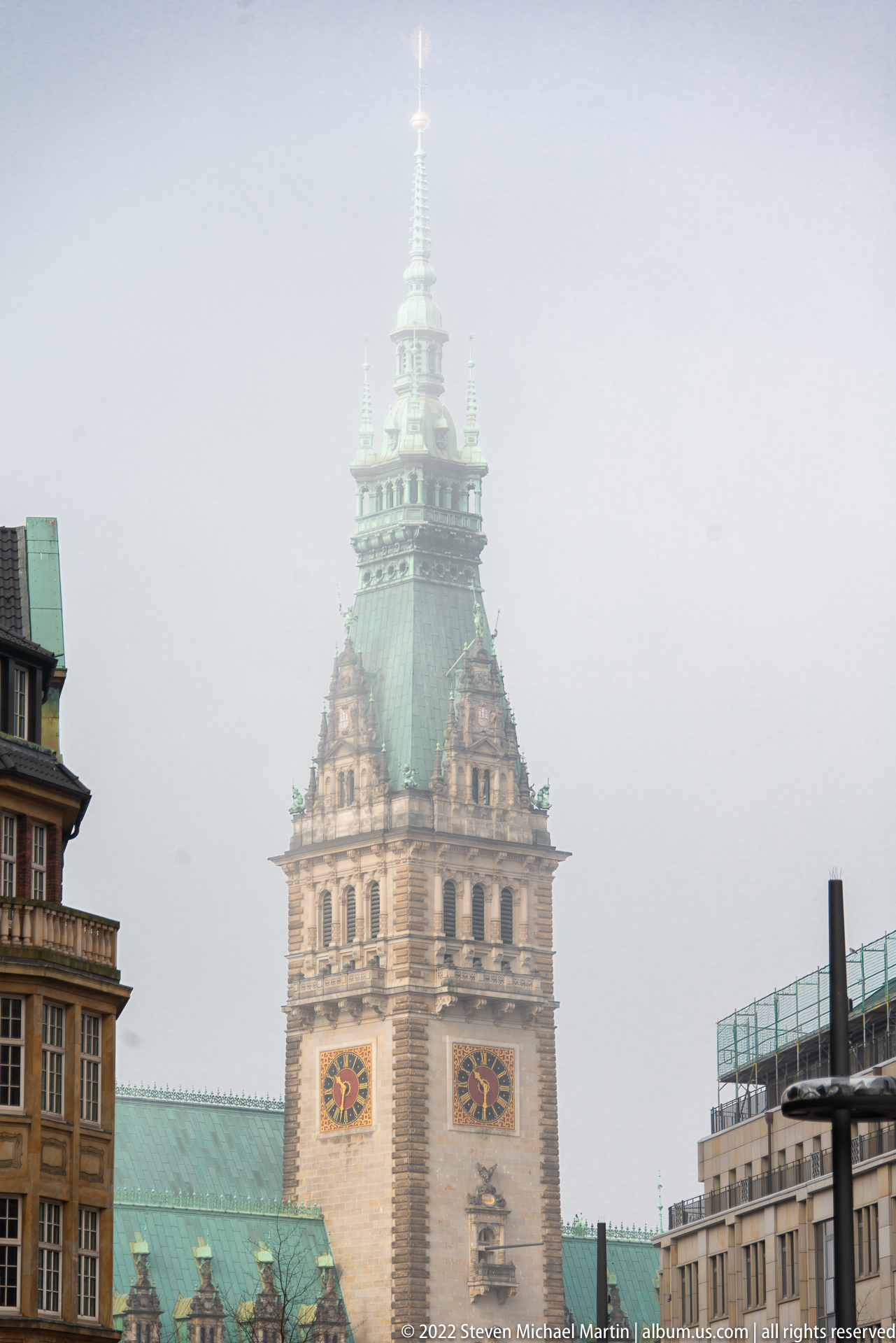
The green copper tower of Hamburg Rathaus emerges through fog, its stacked lanterns, corner pinnacles, and gilded summit ornament becoming increasingly indistinct toward the top. Cropped tightly against the pale sky, the tower reads less as part of a façade than as a layered vertical silhouette of copper, stone, and mist.
Caption
The green copper tower of Hamburg Rathaus emerges through fog, its stacked lanterns, corner pinnacles, and gilded summit ornament becoming increasingly indistinct toward the top. Cropped tightly against the pale sky, the tower reads less as part of a façade than as a layered vertical silhouette of copper, stone, and mist.
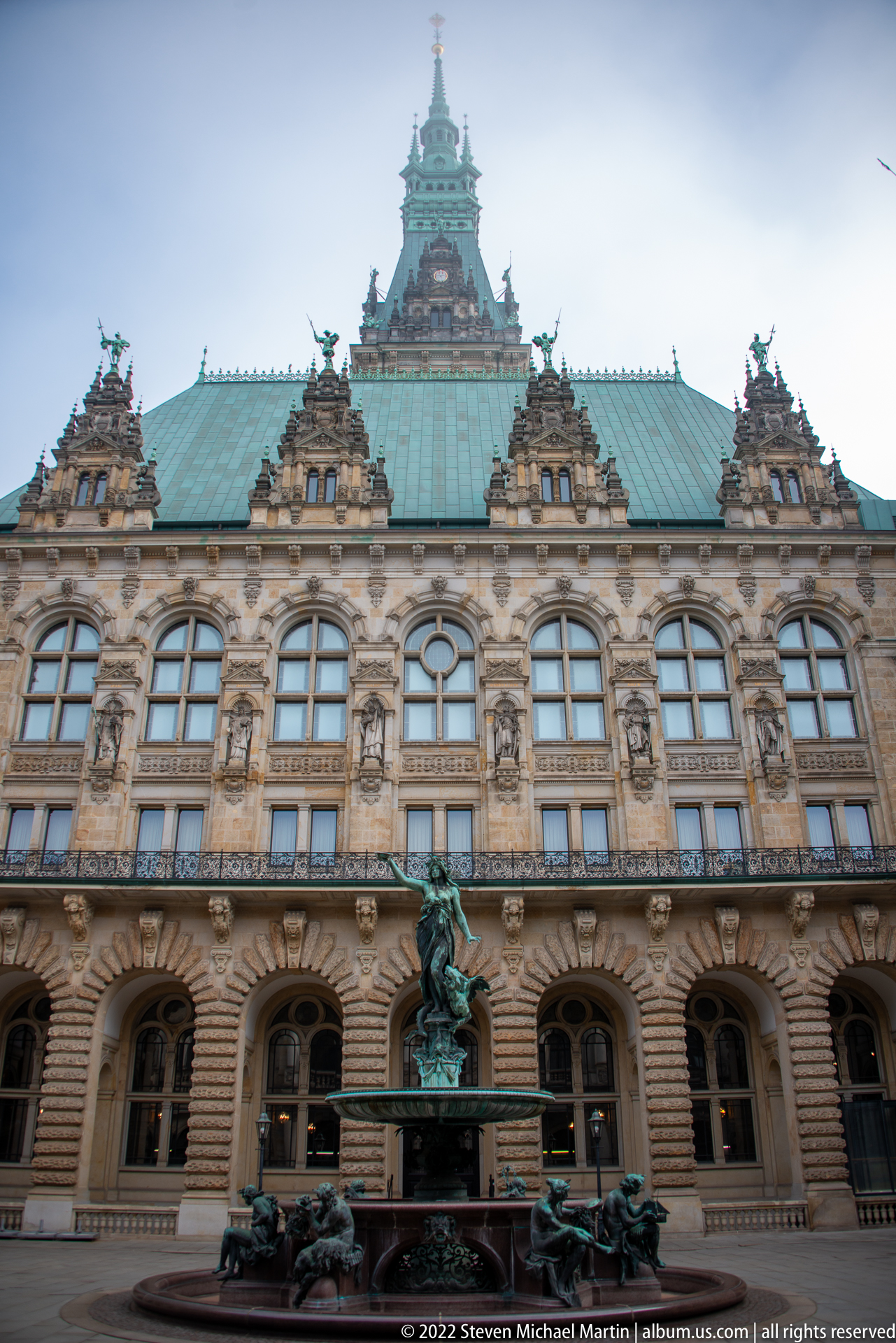
The Hygieia Fountain stands before the richly ornamented courtyard façade of Hamburg Rathaus, where rusticated arcades, carved window surrounds, and a broad green copper roof create a monumental civic backdrop. The frontal view establishes the fountain’s scale and axial placement within the enclosed courtyard, linking sculpture, water, and architecture into one formal composition.
Caption
The Hygieia Fountain stands before the richly ornamented courtyard façade of Hamburg Rathaus, where rusticated arcades, carved window surrounds, and a broad green copper roof create a monumental civic backdrop. The frontal view establishes the fountain’s scale and axial placement within the enclosed courtyard, linking sculpture, water, and architecture into one formal composition.
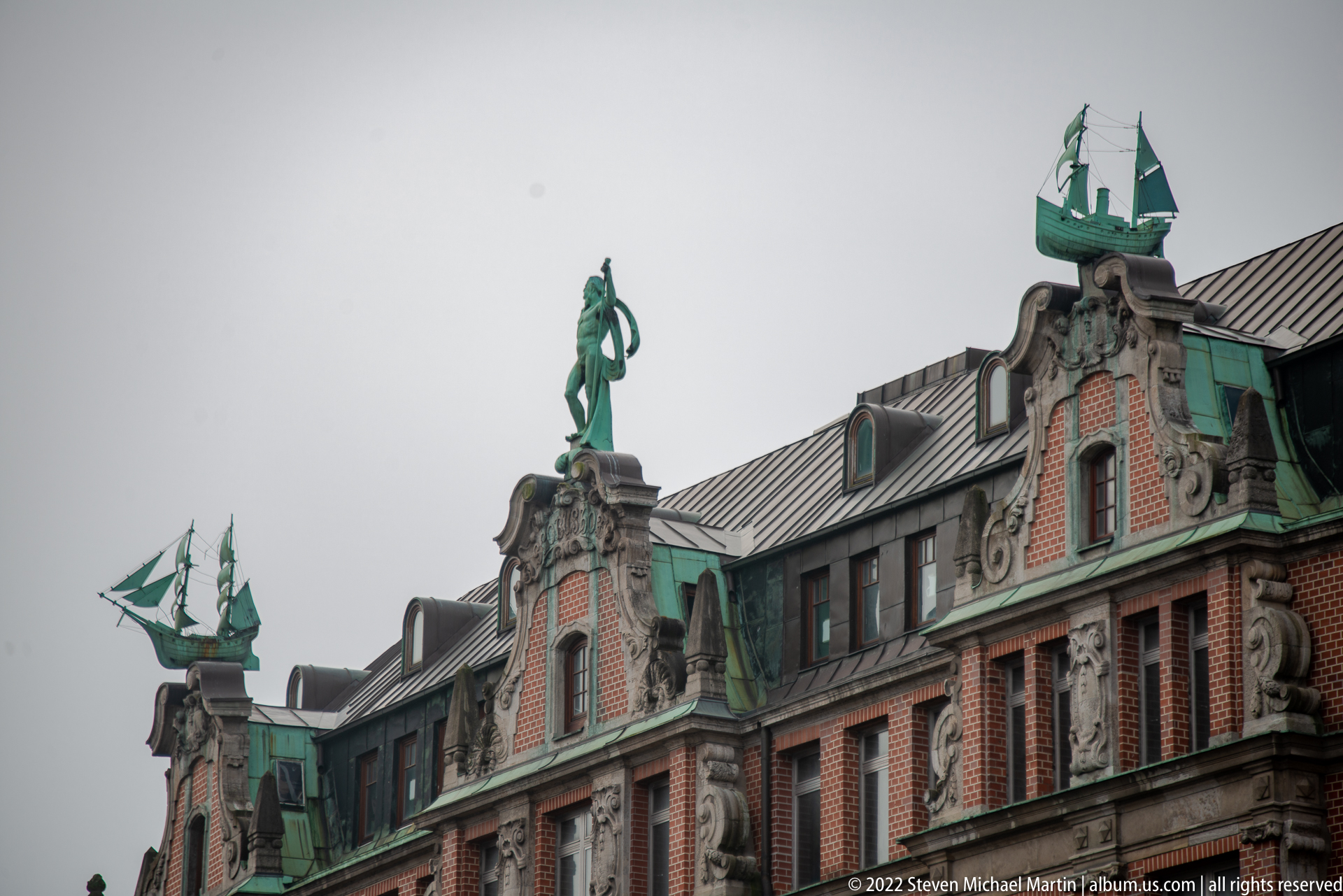
Three green-patinated sailing ships crown the gables of an ornate red-brick and stone façade, turning Hamburg’s maritime identity into architectural ornament. Each vessel is modeled with raised sails and hull details above richly carved gable figures and copper roof accents. The oblique view emphasizes the repeated ship motif along the historic roofline.
Caption
Three green-patinated sailing ships crown the gables of an ornate red-brick and stone façade, turning Hamburg’s maritime identity into architectural ornament. Each vessel is modeled with raised sails and hull details above richly carved gable figures and copper roof accents. The oblique view emphasizes the repeated ship motif along the historic roofline.
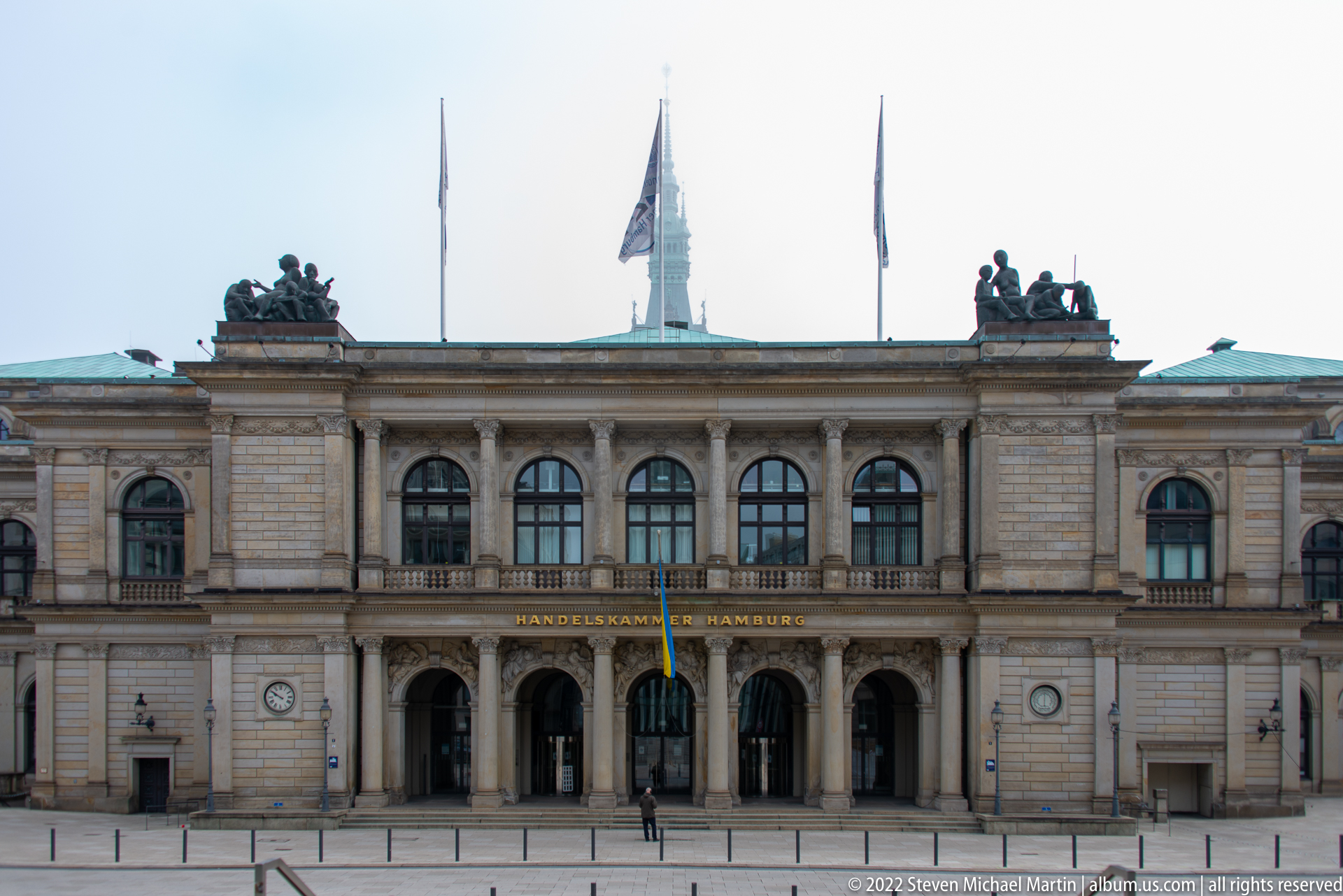
The symmetrical stone façade of the Handelskammer Hamburg faces an open paved forecourt, with a central arcade of tall round-headed entrances beneath a row of large arched windows. The inscription “HANDELSKAMMER HAMBURG” is clearly visible above the entry, directly identifying the Chamber of Commerce and reinforcing the city’s longstanding institutional relationship with trade.
Caption
The symmetrical stone façade of the Handelskammer Hamburg faces an open paved forecourt, with a central arcade of tall round-headed entrances beneath a row of large arched windows. The inscription “HANDELSKAMMER HAMBURG” is clearly visible above the entry, directly identifying the Chamber of Commerce and reinforcing the city’s longstanding institutional relationship with trade.
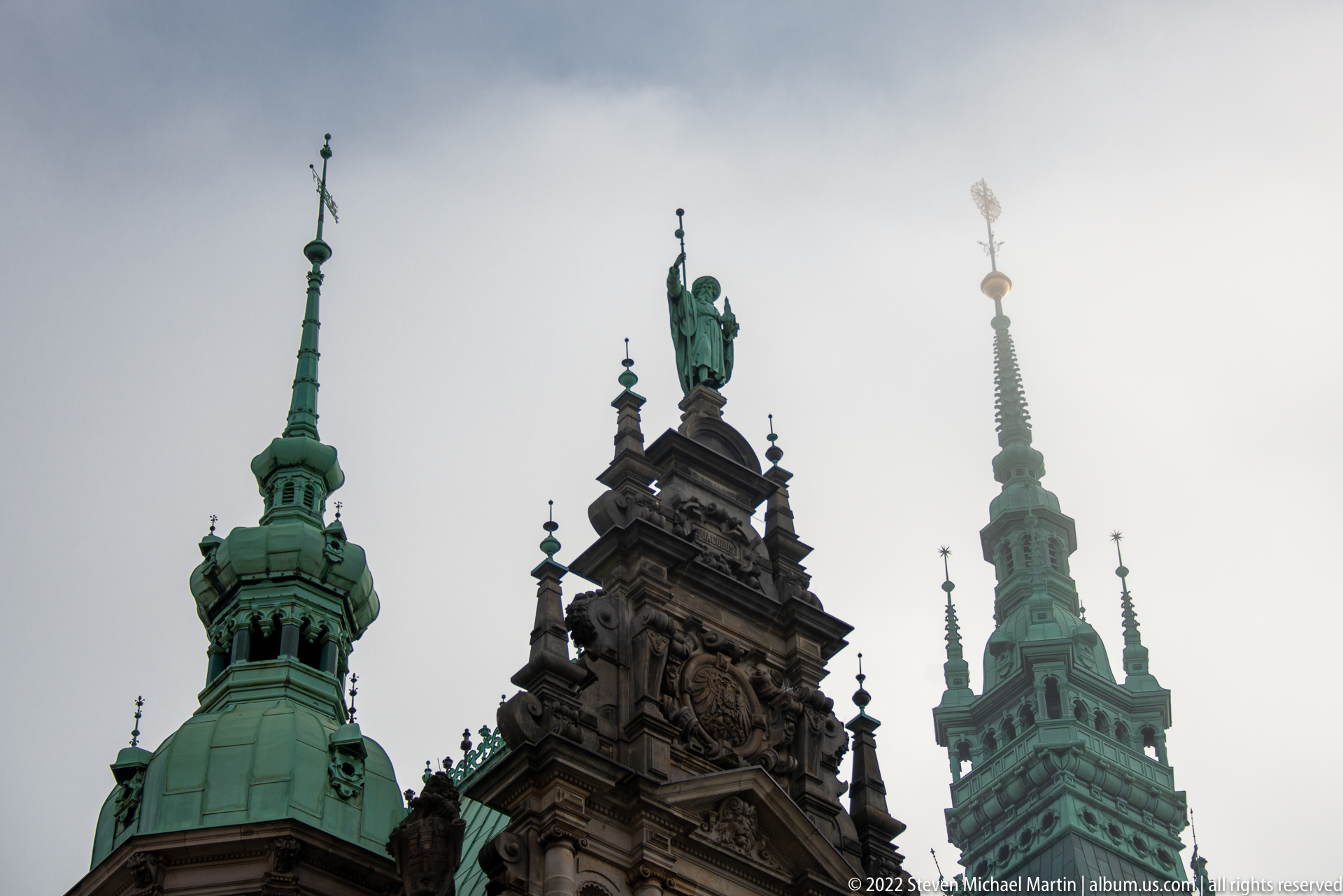
Three richly modeled vertical elements of Hamburg Rathaus rise above its roofline: green-patinated copper towers flank a darker sculptural central pavilion crowded with statues and architectural ornament. The compressed upward view emphasizes the city hall’s elaborate skyline rather than its full façade, revealing how civic symbolism is carried through rooftop sculpture and metalwork.
Caption
Three richly modeled vertical elements of Hamburg Rathaus rise above its roofline: green-patinated copper towers flank a darker sculptural central pavilion crowded with statues and architectural ornament. The compressed upward view emphasizes the city hall’s elaborate skyline rather than its full façade, revealing how civic symbolism is carried through rooftop sculpture and metalwork.
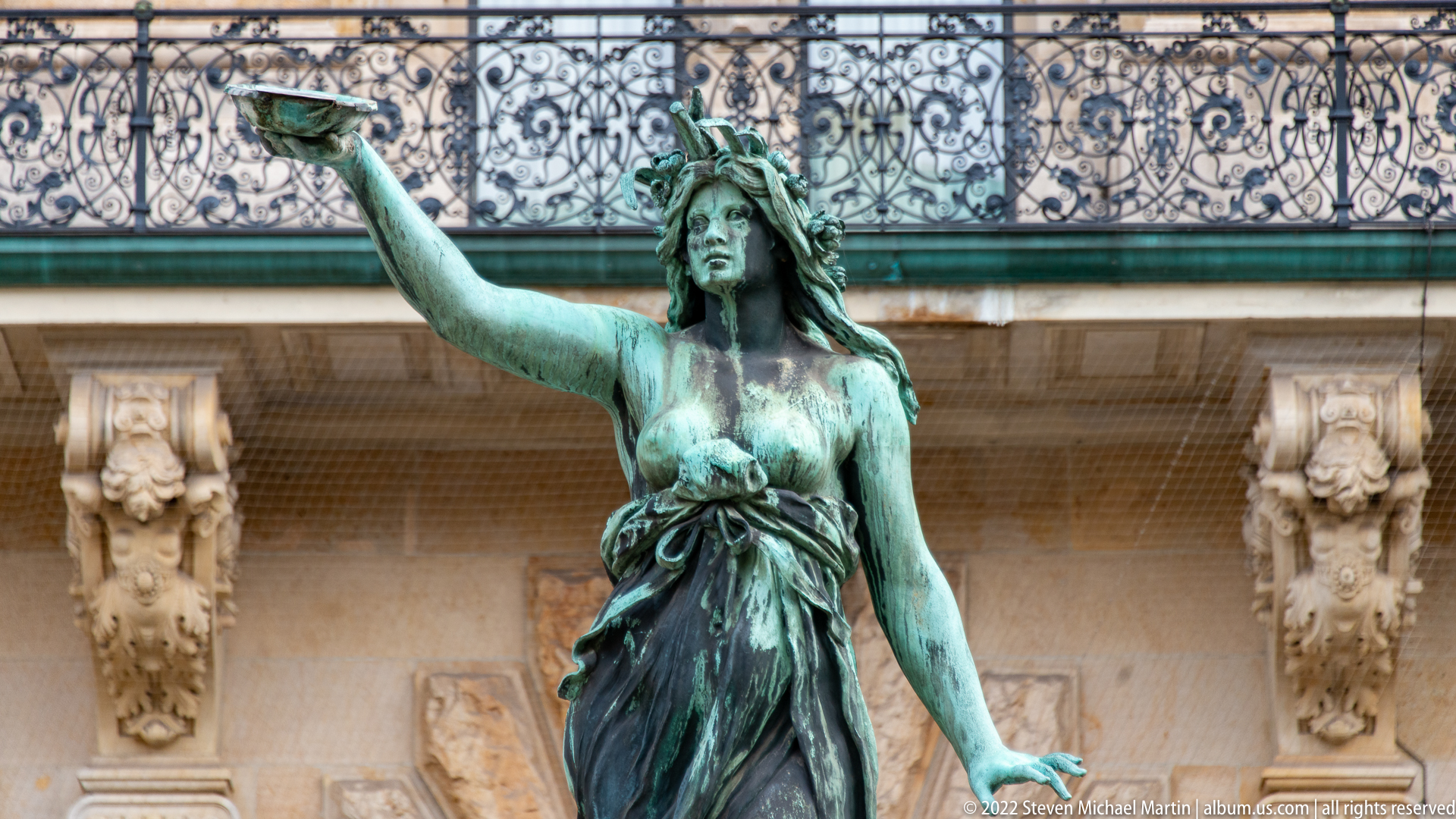
A green-patinated female figure from the Rathaus courtyard fountain is shown close to eye level, one arm extended outward while drapery gathers around her waist. Wrought-iron balcony railings and carved stone consoles form a richly patterned backdrop. The crop isolates the sculpture’s gesture, expression, and weathered bronze surface from the fountain as a whole.
Caption
A green-patinated female figure from the Rathaus courtyard fountain is shown close to eye level, one arm extended outward while drapery gathers around her waist. Wrought-iron balcony railings and carved stone consoles form a richly patterned backdrop. The crop isolates the sculpture’s gesture, expression, and weathered bronze surface from the fountain as a whole.
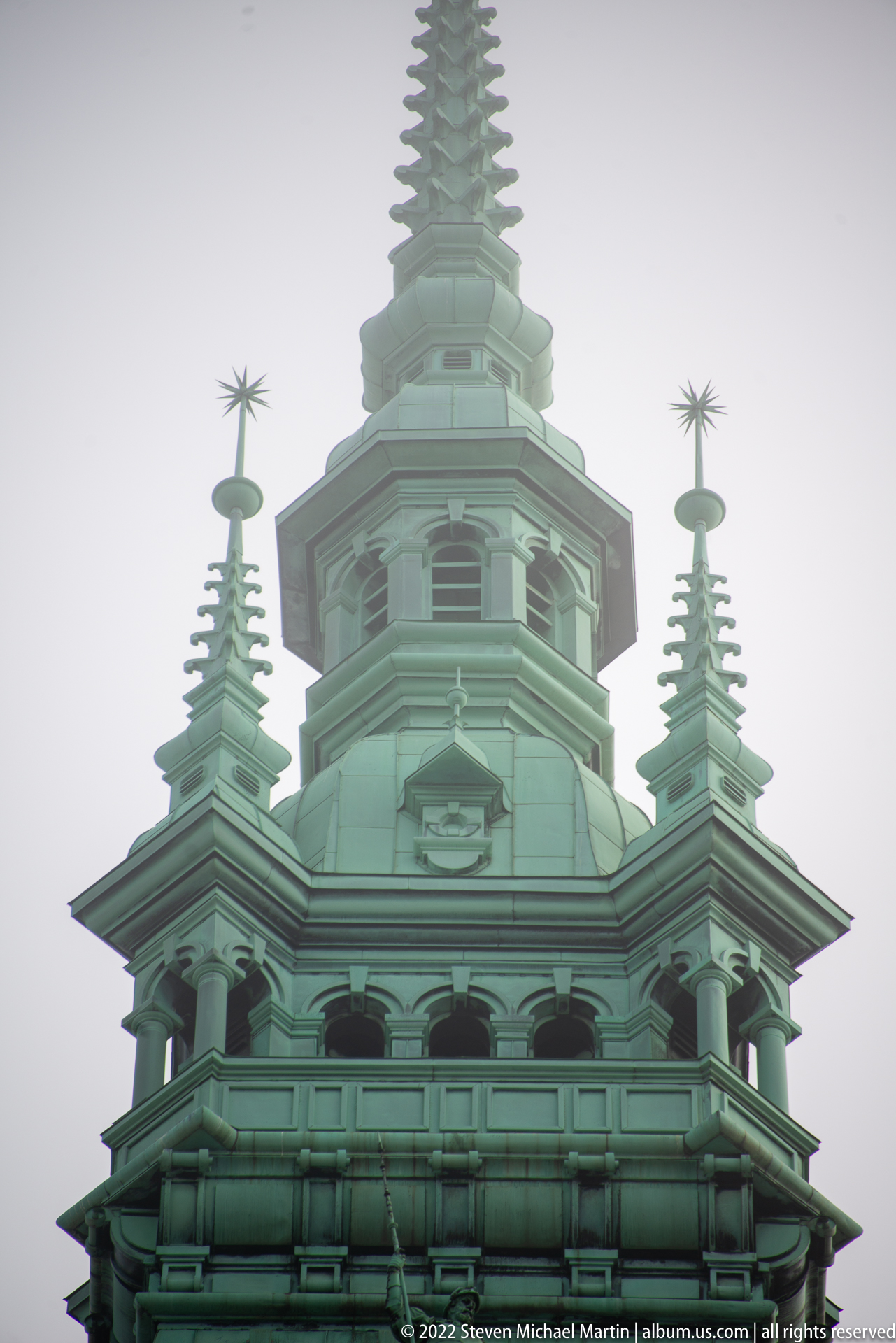
A close study of Hamburg Rathaus’s upper tower isolates its octagonal copper-clad stages, projecting cornices, arcaded openings, and four smaller corner turrets capped by star-like finials. The pale sky removes competing context, making the patinated metalwork and carefully tiered silhouette the primary subject.
Caption
A close study of Hamburg Rathaus’s upper tower isolates its octagonal copper-clad stages, projecting cornices, arcaded openings, and four smaller corner turrets capped by star-like finials. The pale sky removes competing context, making the patinated metalwork and carefully tiered silhouette the primary subject.
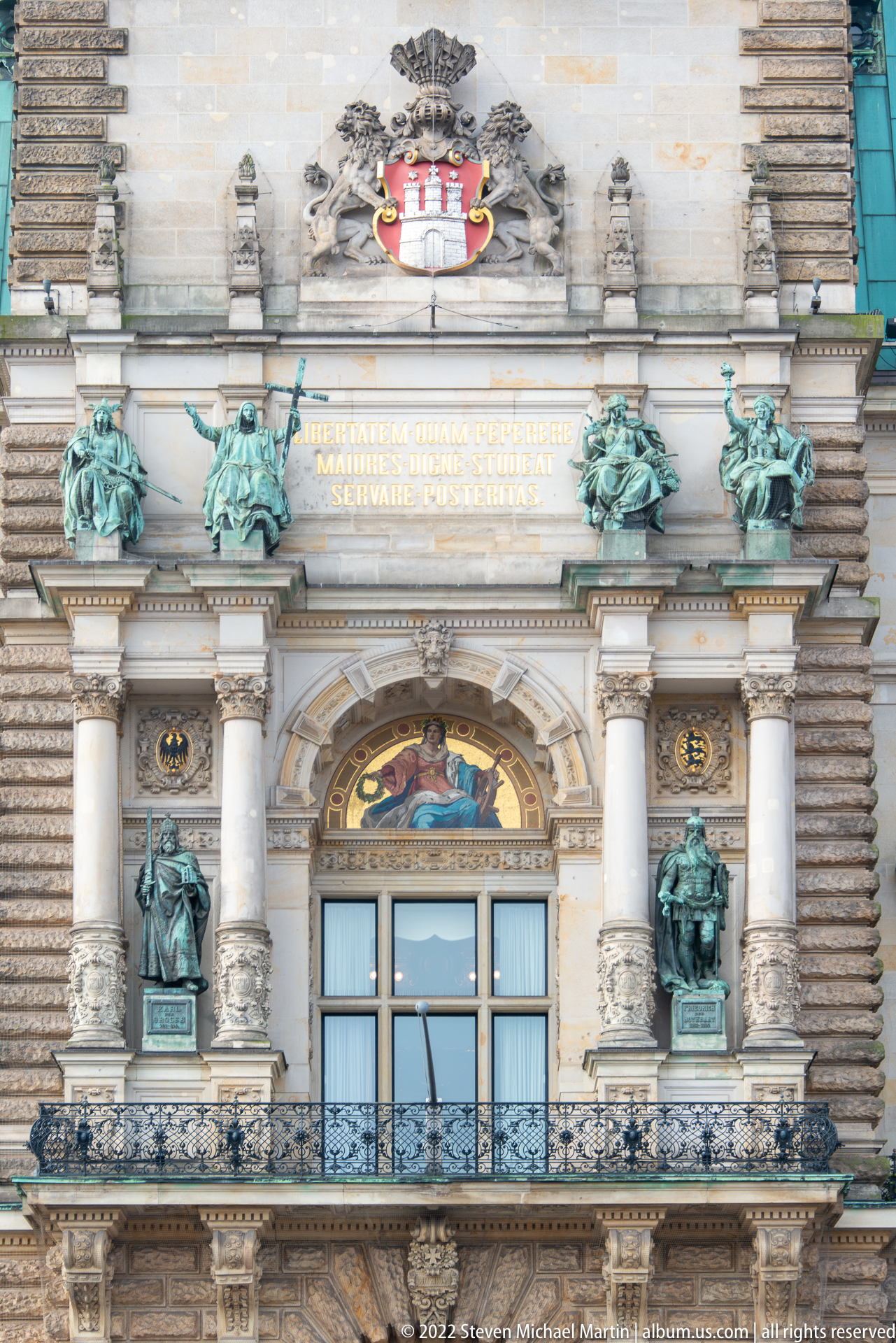
A broader view of the Rathaus façade places the ceremonial balcony, arched mosaic, bronze figures, carved columns, heraldic emblems, and a gilded inscription into one symmetrical ensemble. Additional reclining or seated green-patinated figures occupy the upper ledge beneath Hamburg’s coat of arms, revealing the dense iconographic program used to articulate the city hall’s civic identity.
Caption
A broader view of the Rathaus façade places the ceremonial balcony, arched mosaic, bronze figures, carved columns, heraldic emblems, and a gilded inscription into one symmetrical ensemble. Additional reclining or seated green-patinated figures occupy the upper ledge beneath Hamburg’s coat of arms, revealing the dense iconographic program used to articulate the city hall’s civic identity.
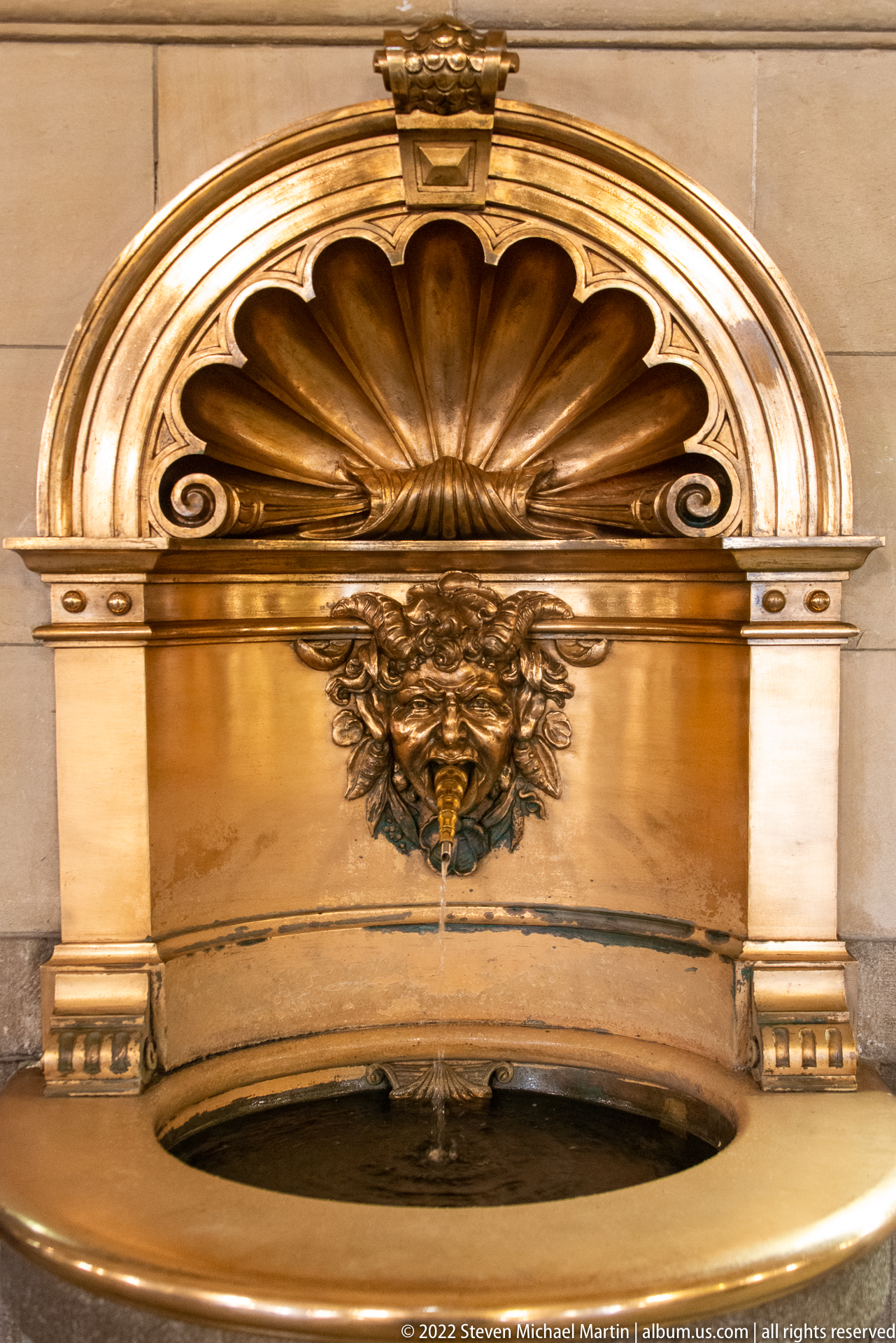
A polished brass wall fountain is built around a scallop-shell hood and a grotesque face that serves as the water outlet. Pale stone pilasters and a shallow basin frame the metalwork, while the close frontal composition emphasizes the interplay of shell motif, sculpted mask, and reflective surface.
Caption
A polished brass wall fountain is built around a scallop-shell hood and a grotesque face that serves as the water outlet. Pale stone pilasters and a shallow basin frame the metalwork, while the close frontal composition emphasizes the interplay of shell motif, sculpted mask, and reflective surface.
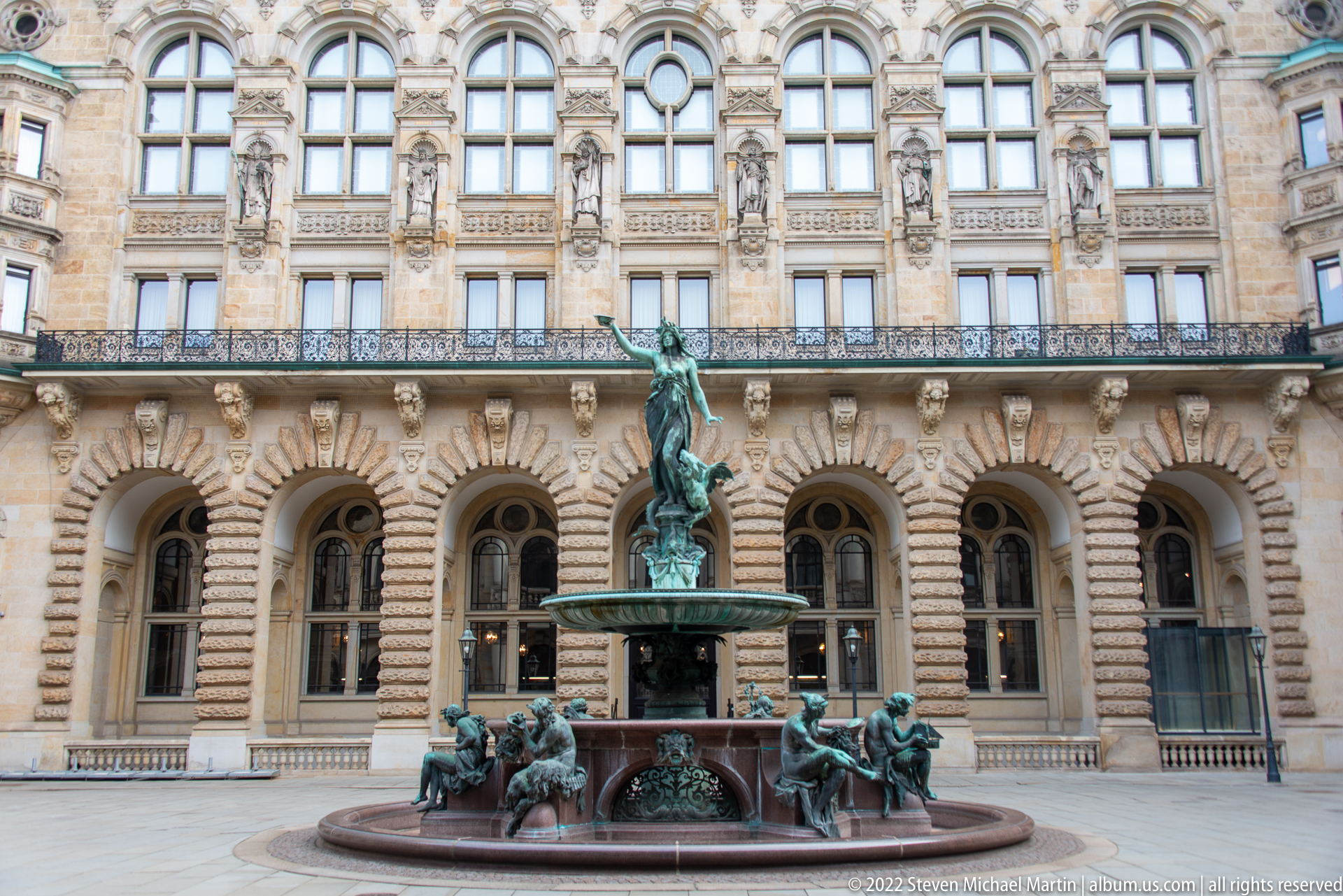
The Hygieia Fountain is centered against the lower courtyard façade of Hamburg Rathaus, where a sequence of rusticated arches and upper windows creates a formal architectural backdrop. Bronze figures cluster around the red-stone basin beneath the standing central figure, allowing this view to show the entire sculptural ensemble in direct relationship to the surrounding civic architecture.
Caption
The Hygieia Fountain is centered against the lower courtyard façade of Hamburg Rathaus, where a sequence of rusticated arches and upper windows creates a formal architectural backdrop. Bronze figures cluster around the red-stone basin beneath the standing central figure, allowing this view to show the entire sculptural ensemble in direct relationship to the surrounding civic architecture.
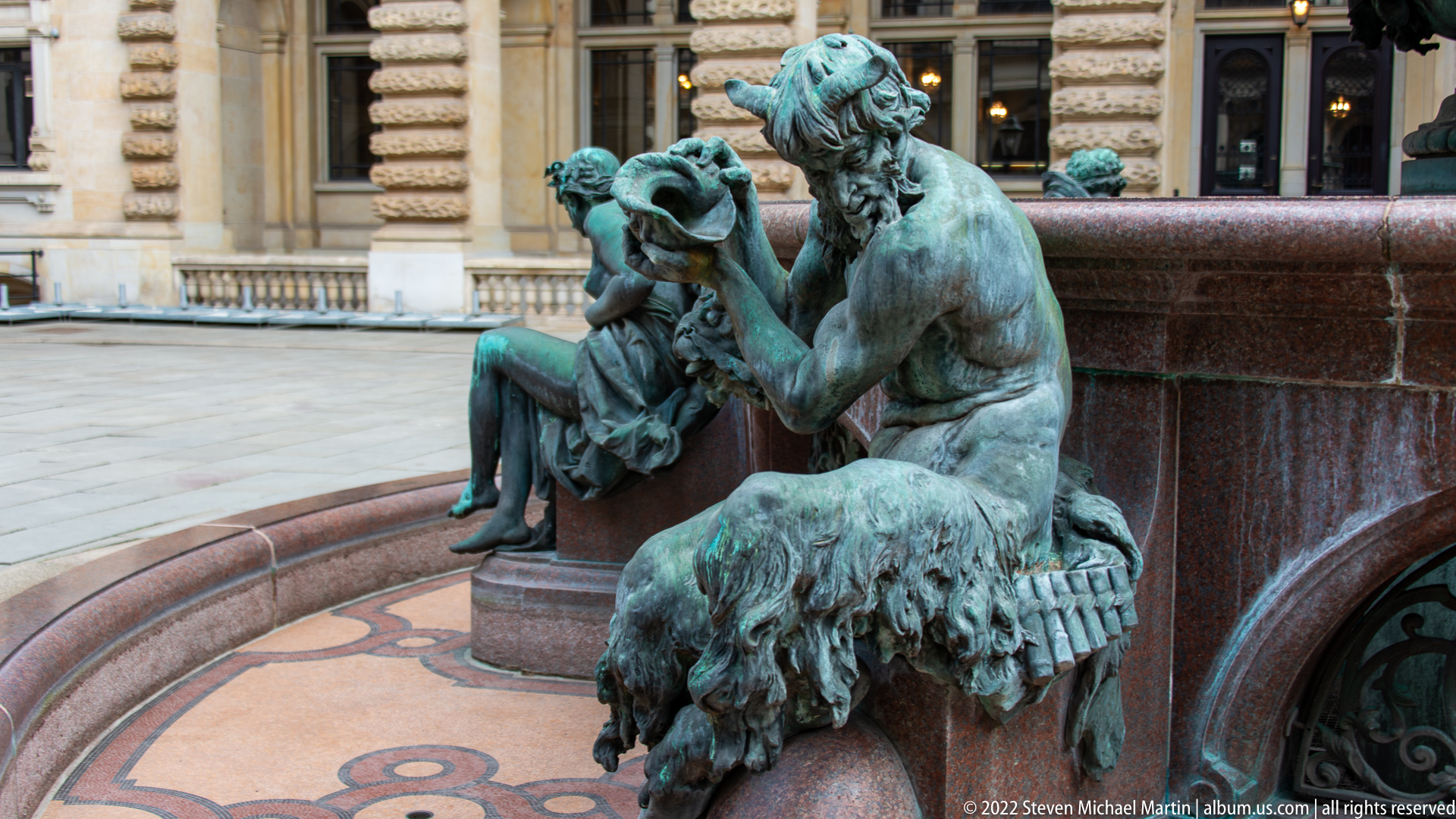
Two seated bronze figures occupy the rim of the Hygieia Fountain, their green patina streaked by weathering and water. One figure bends over a vessel or object while another sits farther back, creating a layered view around the polished reddish basin. The close framing shifts attention from the fountain’s architecture to the tactile modeling and human scale of its subsidiary sculpture.
Caption
Two seated bronze figures occupy the rim of the Hygieia Fountain, their green patina streaked by weathering and water. One figure bends over a vessel or object while another sits farther back, creating a layered view around the polished reddish basin. The close framing shifts attention from the fountain’s architecture to the tactile modeling and human scale of its subsidiary sculpture.
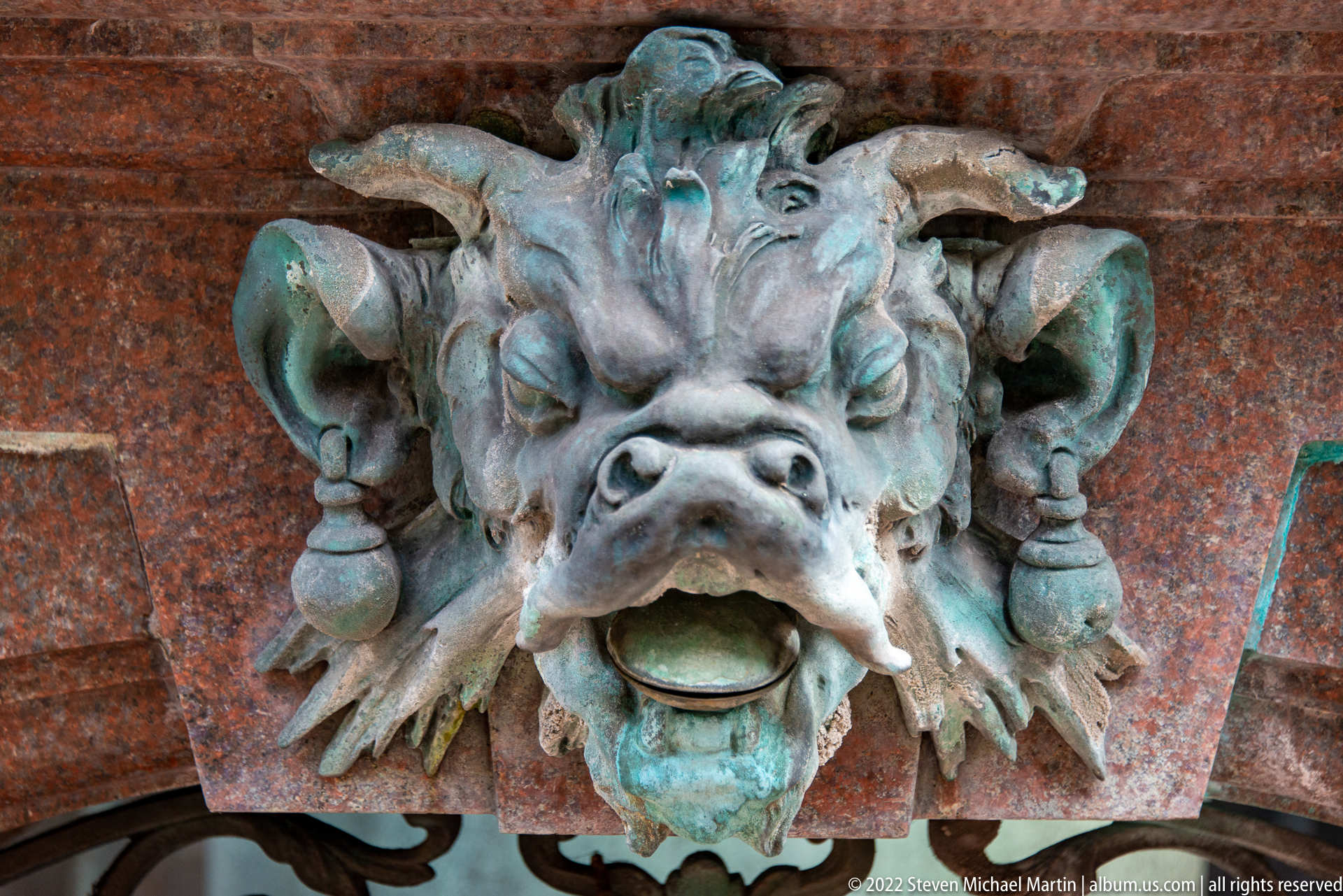
A horned animal or grotesque bronze mask projects from the reddish stone of the Hygieia Fountain, its open mouth forming a waterspout. Verdigris gathers around the lower jaw and ornamental foliage, while the frontal close-up makes the exaggerated eyes, curling horns, and modeled muzzle read almost as an independent sculptural portrait.
Caption
A horned animal or grotesque bronze mask projects from the reddish stone of the Hygieia Fountain, its open mouth forming a waterspout. Verdigris gathers around the lower jaw and ornamental foliage, while the frontal close-up makes the exaggerated eyes, curling horns, and modeled muzzle read almost as an independent sculptural portrait.
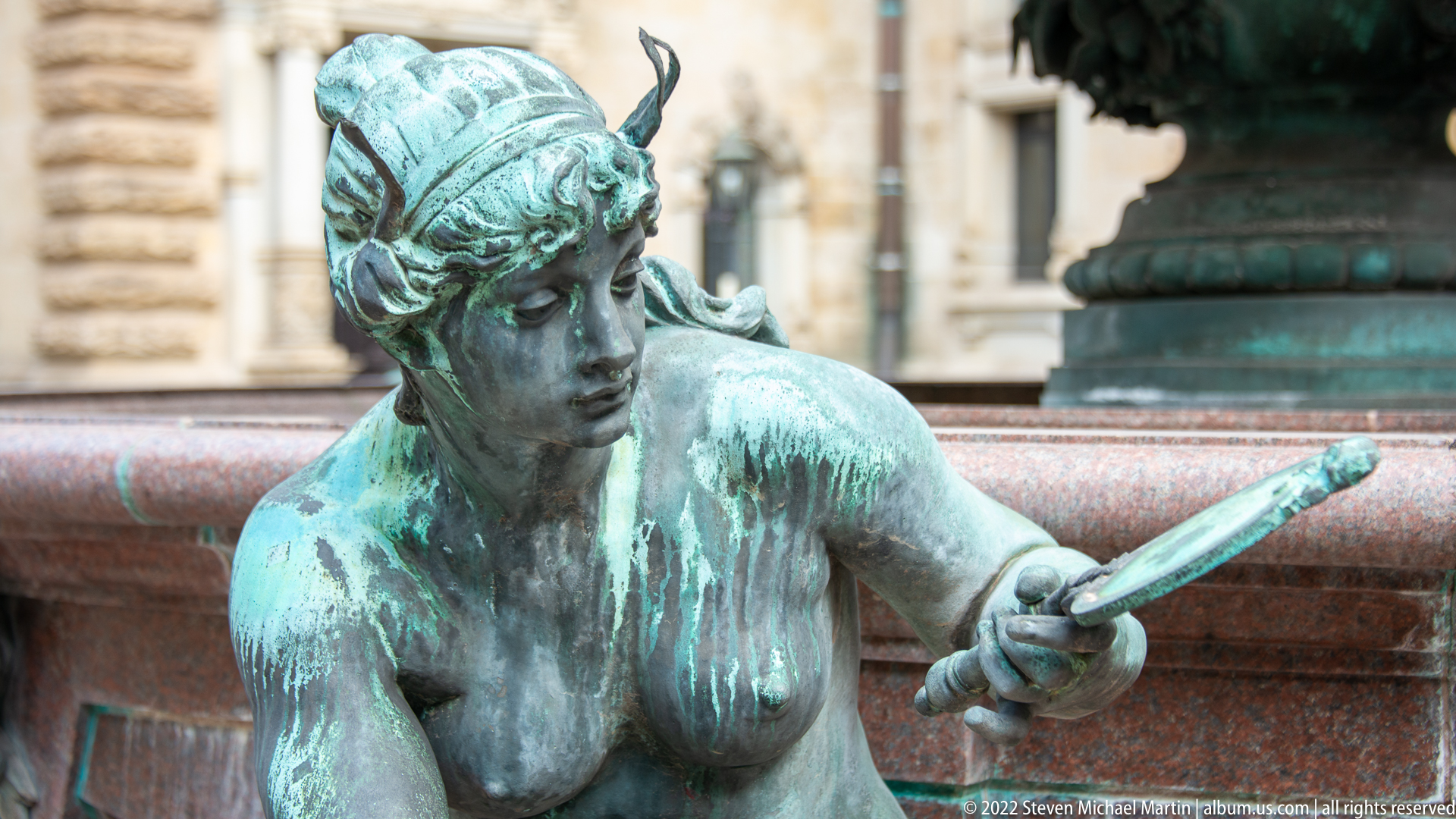
A seated female bronze figure leans forward from the Hygieia Fountain, gripping a long flat object while turning her head toward the basin. Flowing hair, bare shoulders, and heavy green patina give the figure a strong sculptural presence. The close crop isolates gesture and weathered surface while retaining enough of the red-stone basin to locate the figure within the fountain.
Caption
A seated female bronze figure leans forward from the Hygieia Fountain, gripping a long flat object while turning her head toward the basin. Flowing hair, bare shoulders, and heavy green patina give the figure a strong sculptural presence. The close crop isolates gesture and weathered surface while retaining enough of the red-stone basin to locate the figure within the fountain.
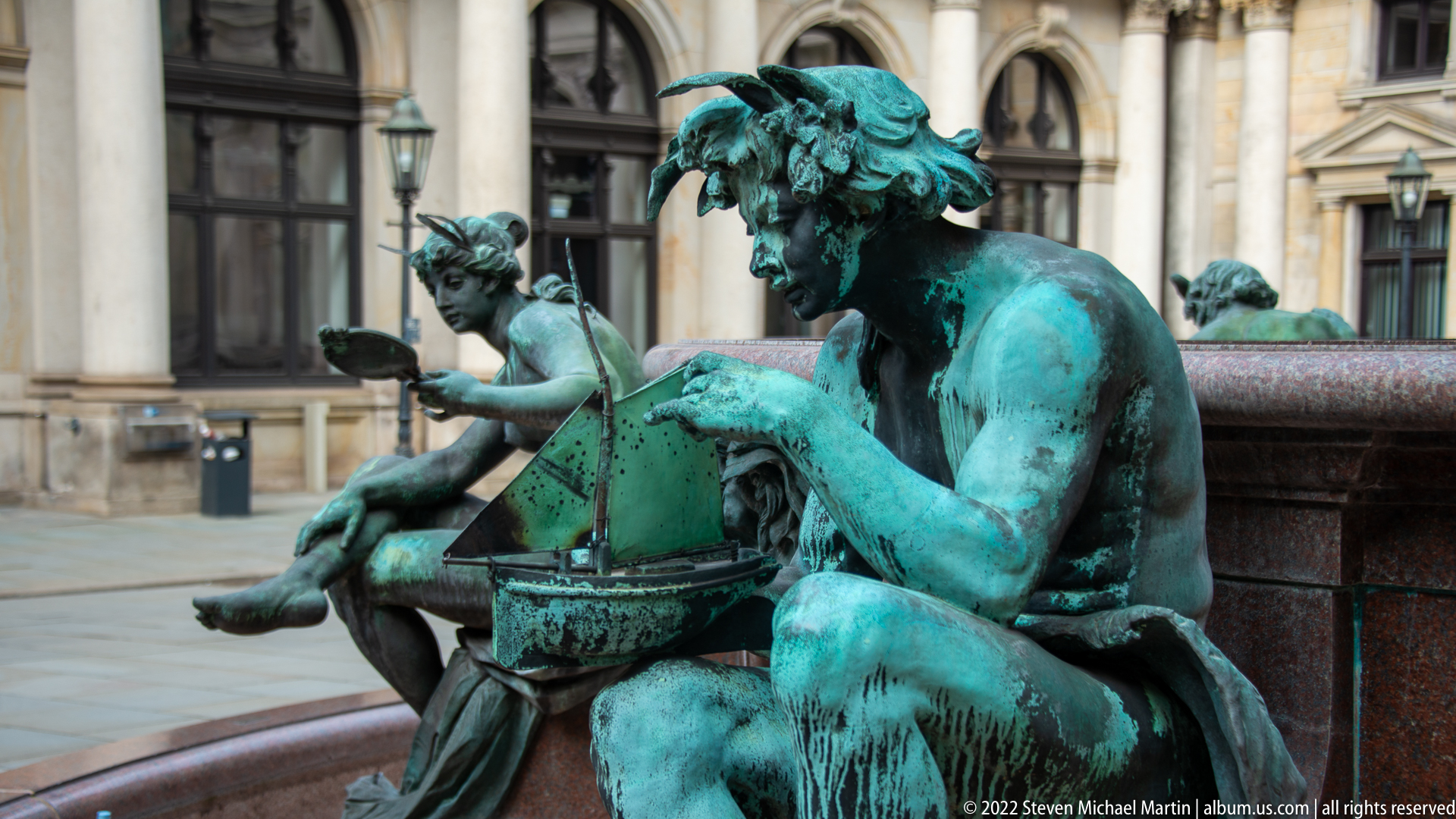
A muscular seated male figure bends over a rounded vessel at the edge of the Hygieia Fountain, his deeply modeled hair and beard darkened by green patina. A second seated figure recedes behind him. The oblique close view emphasizes the varied postures of the fountain’s subsidiary figures and the rough, weathered surface of the bronze.
Caption
A muscular seated male figure bends over a rounded vessel at the edge of the Hygieia Fountain, his deeply modeled hair and beard darkened by green patina. A second seated figure recedes behind him. The oblique close view emphasizes the varied postures of the fountain’s subsidiary figures and the rough, weathered surface of the bronze.
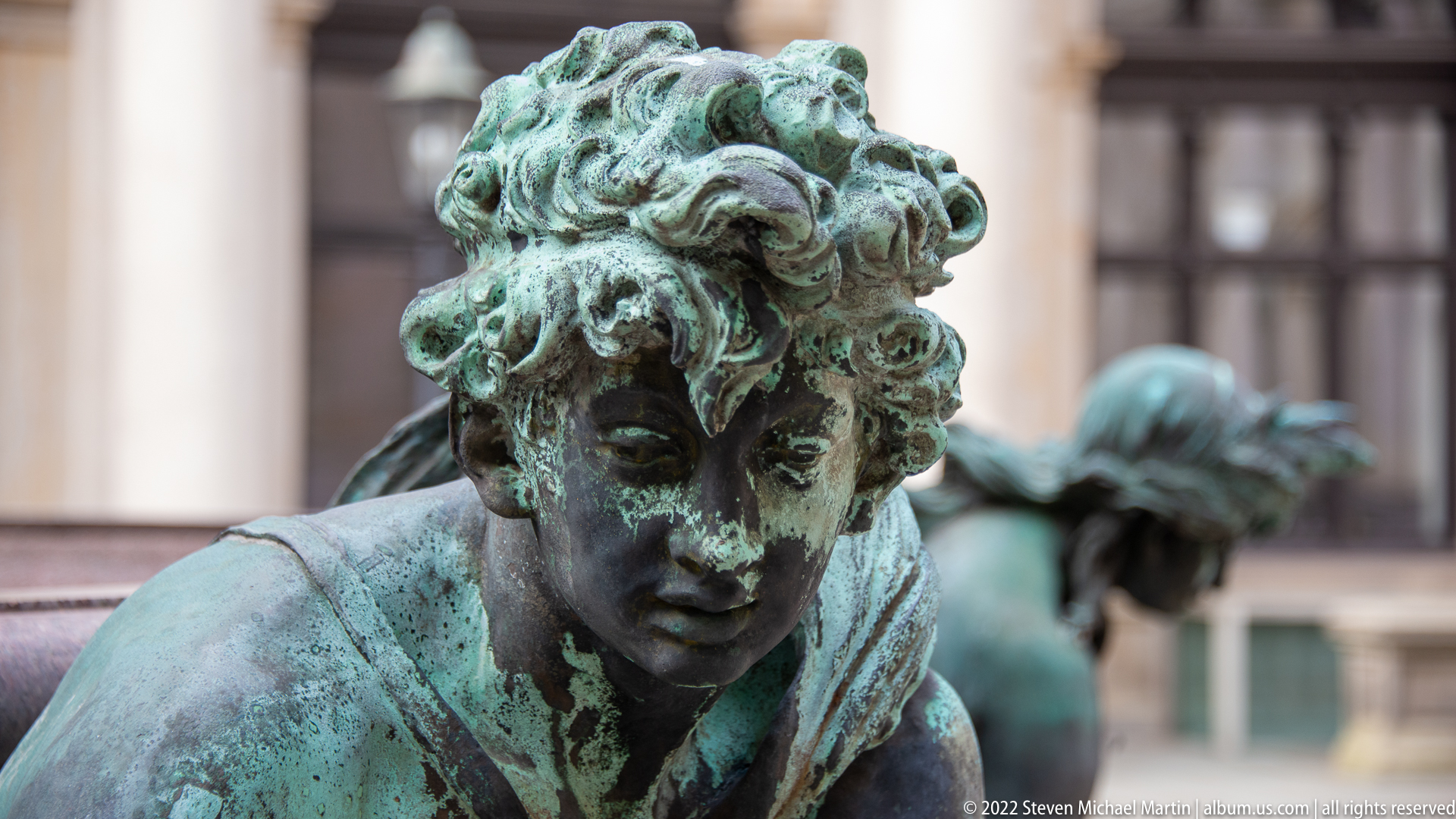
Weathering and verdigris define the expressive face of a youthful bronze figure from the Hygieia Fountain. Curled hair frames lowered eyes and a contemplative expression, while another fountain figure dissolves into soft focus behind. The shallow depth of field transforms a small component of the larger monument into an intimate sculptural portrait.
Caption
Weathering and verdigris define the expressive face of a youthful bronze figure from the Hygieia Fountain. Curled hair frames lowered eyes and a contemplative expression, while another fountain figure dissolves into soft focus behind. The shallow depth of field transforms a small component of the larger monument into an intimate sculptural portrait.
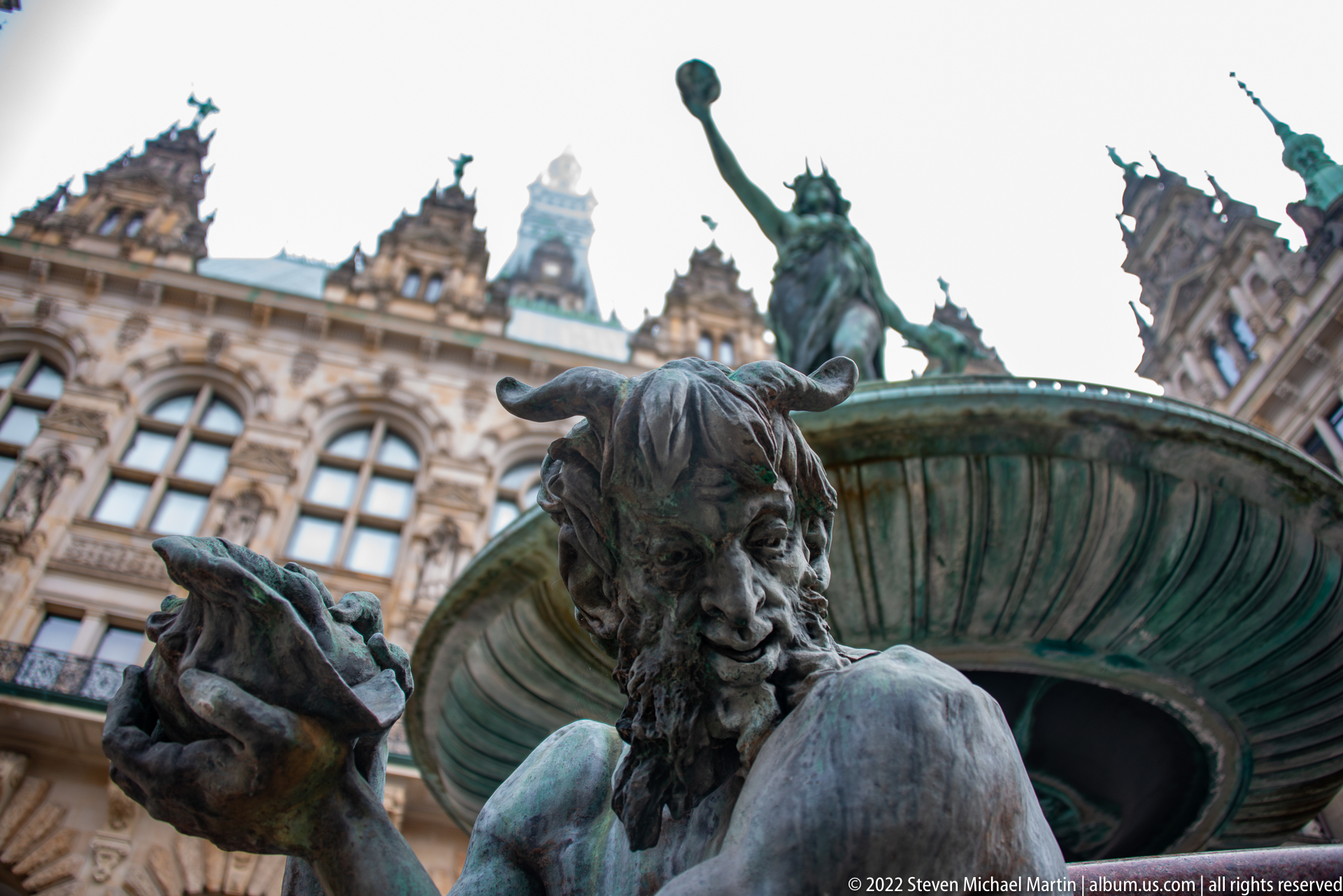
A bearded bronze figure sits beneath the broad central basin of the Hygieia Fountain, turning sharply to one side while another hand or figure enters at the edge of the frame. The underside of the basin forms a sweeping arc above him, and the ornate Rathaus façade rises behind, creating a layered view from subsidiary sculpture to fountain centerpiece to civic architecture.
Caption
A bearded bronze figure sits beneath the broad central basin of the Hygieia Fountain, turning sharply to one side while another hand or figure enters at the edge of the frame. The underside of the basin forms a sweeping arc above him, and the ornate Rathaus façade rises behind, creating a layered view from subsidiary sculpture to fountain centerpiece to civic architecture.
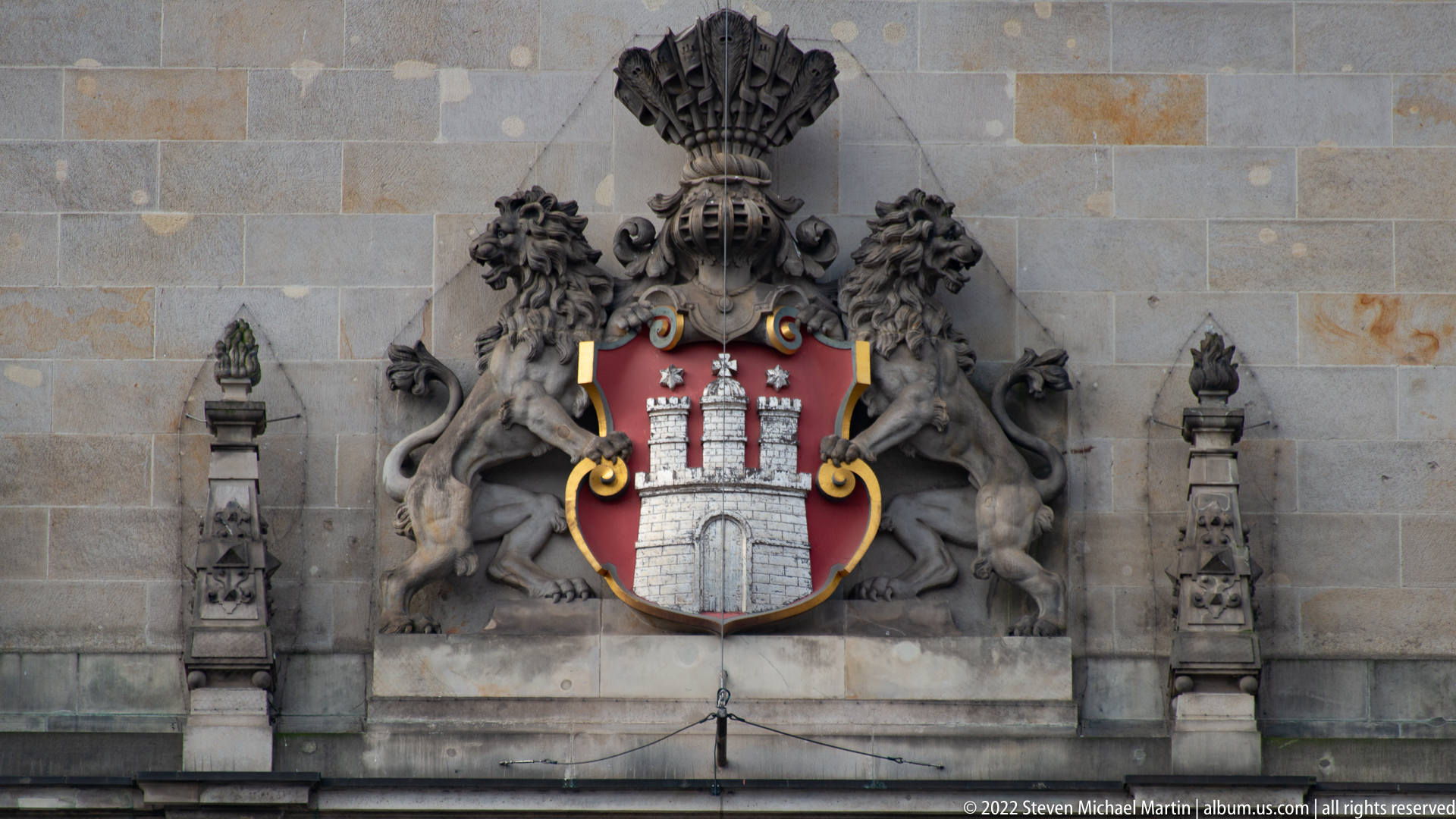
Hamburg’s coat of arms appears in vivid red and white at the center of an elaborate stone heraldic ensemble on the Rathaus façade. Two sculpted lions support the shield beneath a large crest of carved foliage and architectural forms. The close frontal view isolates civic heraldry from the broader building and makes the city’s castle emblem the compositional focus.
Caption
Hamburg’s coat of arms appears in vivid red and white at the center of an elaborate stone heraldic ensemble on the Rathaus façade. Two sculpted lions support the shield beneath a large crest of carved foliage and architectural forms. The close frontal view isolates civic heraldry from the broader building and makes the city’s castle emblem the compositional focus.
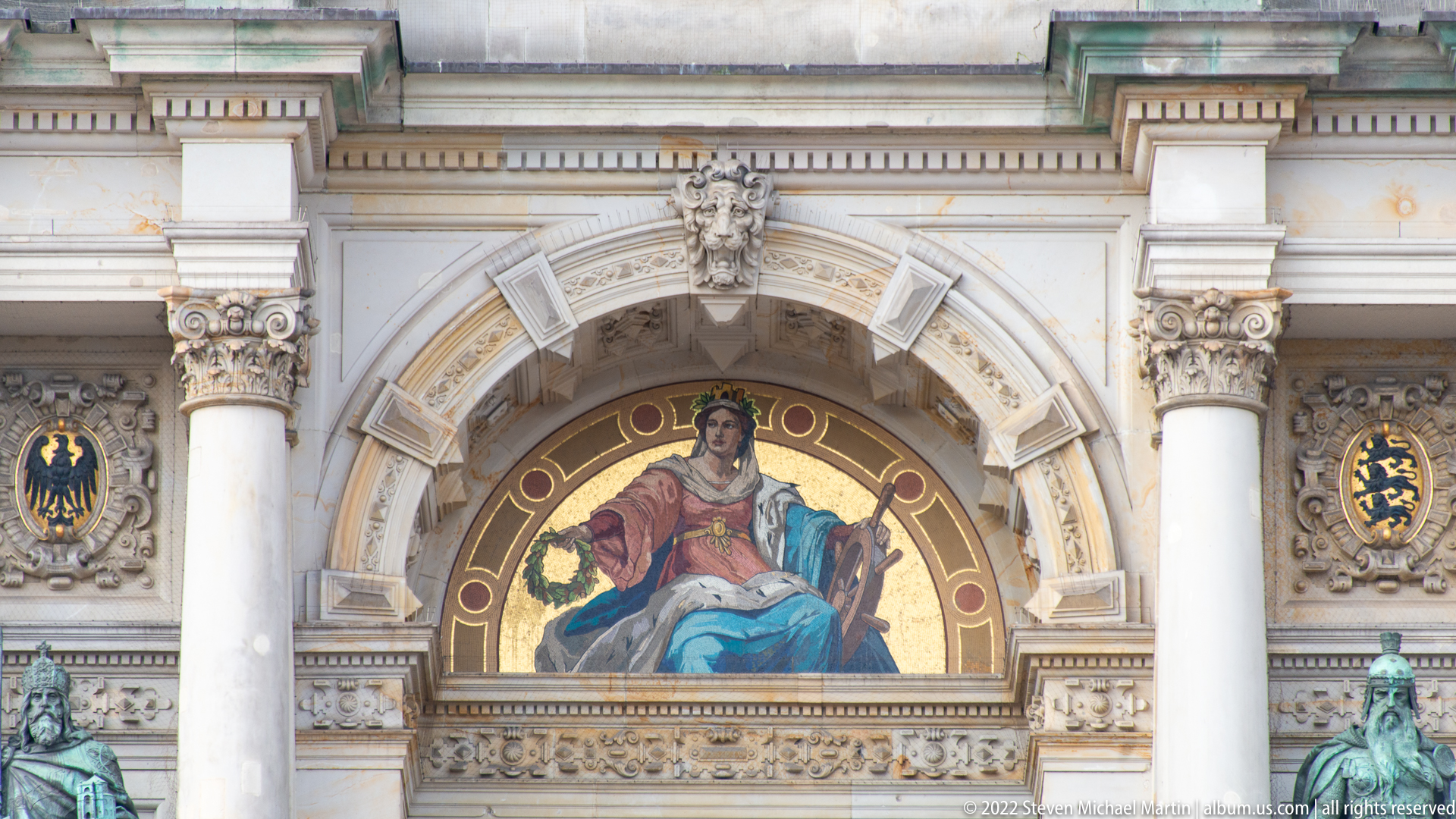
A semicircular mosaic of a seated robed woman fills an arched recess on the Hamburg Rathaus façade, flanked by white columns and small heraldic medallions. The figure’s saturated red, blue, and gold colors stand out against pale stone carving, turning this bay into a concentrated combination of civic allegory, heraldry, and historicist architectural ornament.
Caption
A semicircular mosaic of a seated robed woman fills an arched recess on the Hamburg Rathaus façade, flanked by white columns and small heraldic medallions. The figure’s saturated red, blue, and gold colors stand out against pale stone carving, turning this bay into a concentrated combination of civic allegory, heraldry, and historicist architectural ornament.
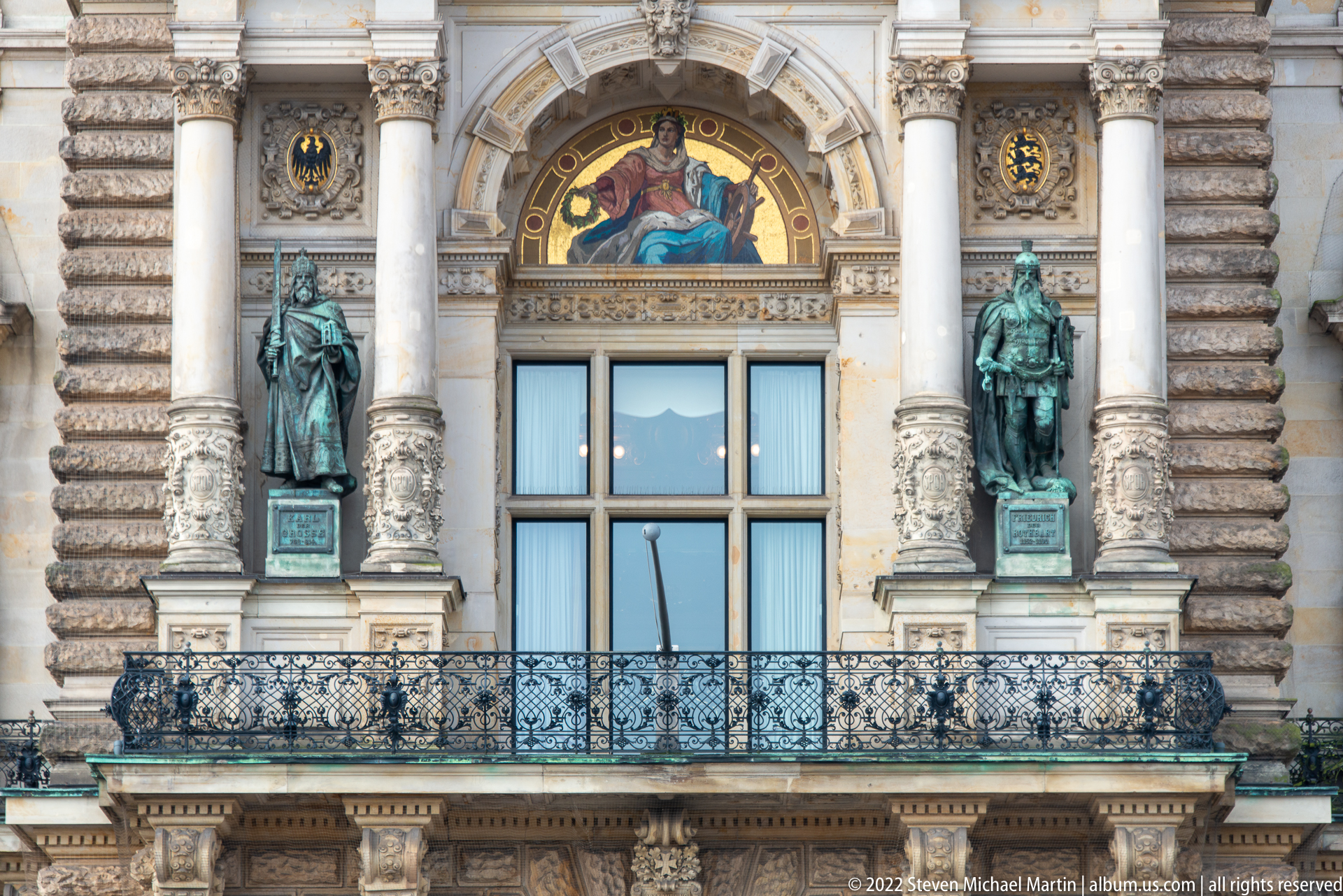
A wrought-iron balcony spans an elaborate bay of Hamburg Rathaus beneath a semicircular mosaic and between two standing bronze historical figures. Carved columns, rusticated masonry, heraldic medallions, and sculptural pedestals crowd the elevation with civic ornament. The frontal crop clarifies how sculpture, mosaic, metalwork, and architecture are integrated into a single ceremonial façade composition.
Caption
A wrought-iron balcony spans an elaborate bay of Hamburg Rathaus beneath a semicircular mosaic and between two standing bronze historical figures. Carved columns, rusticated masonry, heraldic medallions, and sculptural pedestals crowd the elevation with civic ornament. The frontal crop clarifies how sculpture, mosaic, metalwork, and architecture are integrated into a single ceremonial façade composition.
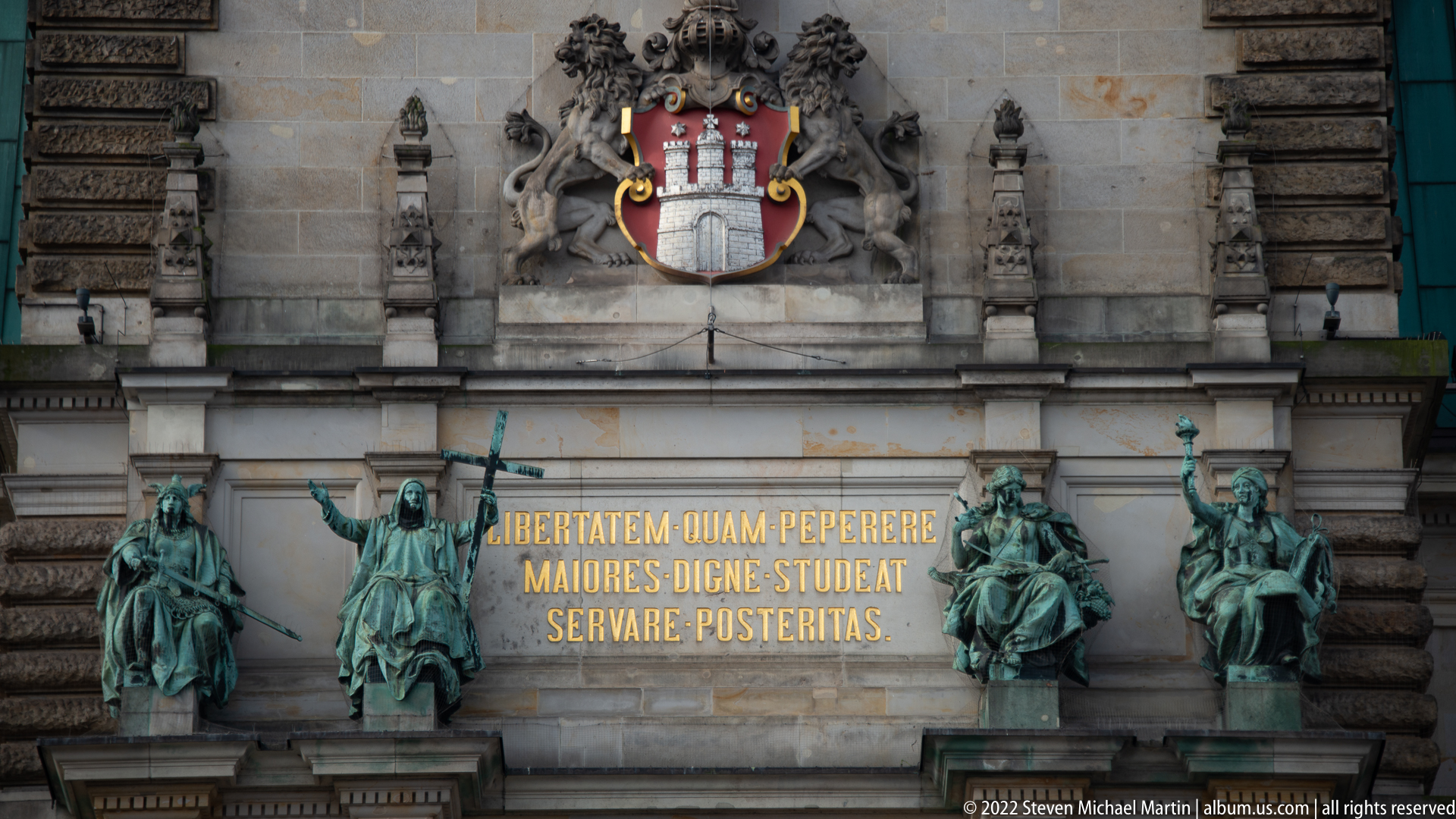
The Hamburg coat of arms crowns a ceremonial interior wall of the Rathaus above a gilded Latin inscription and four bronze allegorical figures. Rich stone carving, dark columns, and patinated sculpture frame the red-and-white shield, creating a compact statement of municipal identity and civic authority within the city hall’s historic interior.
Caption
The Hamburg coat of arms crowns a ceremonial interior wall of the Rathaus above a gilded Latin inscription and four bronze allegorical figures. Rich stone carving, dark columns, and patinated sculpture frame the red-and-white shield, creating a compact statement of municipal identity and civic authority within the city hall’s historic interior.
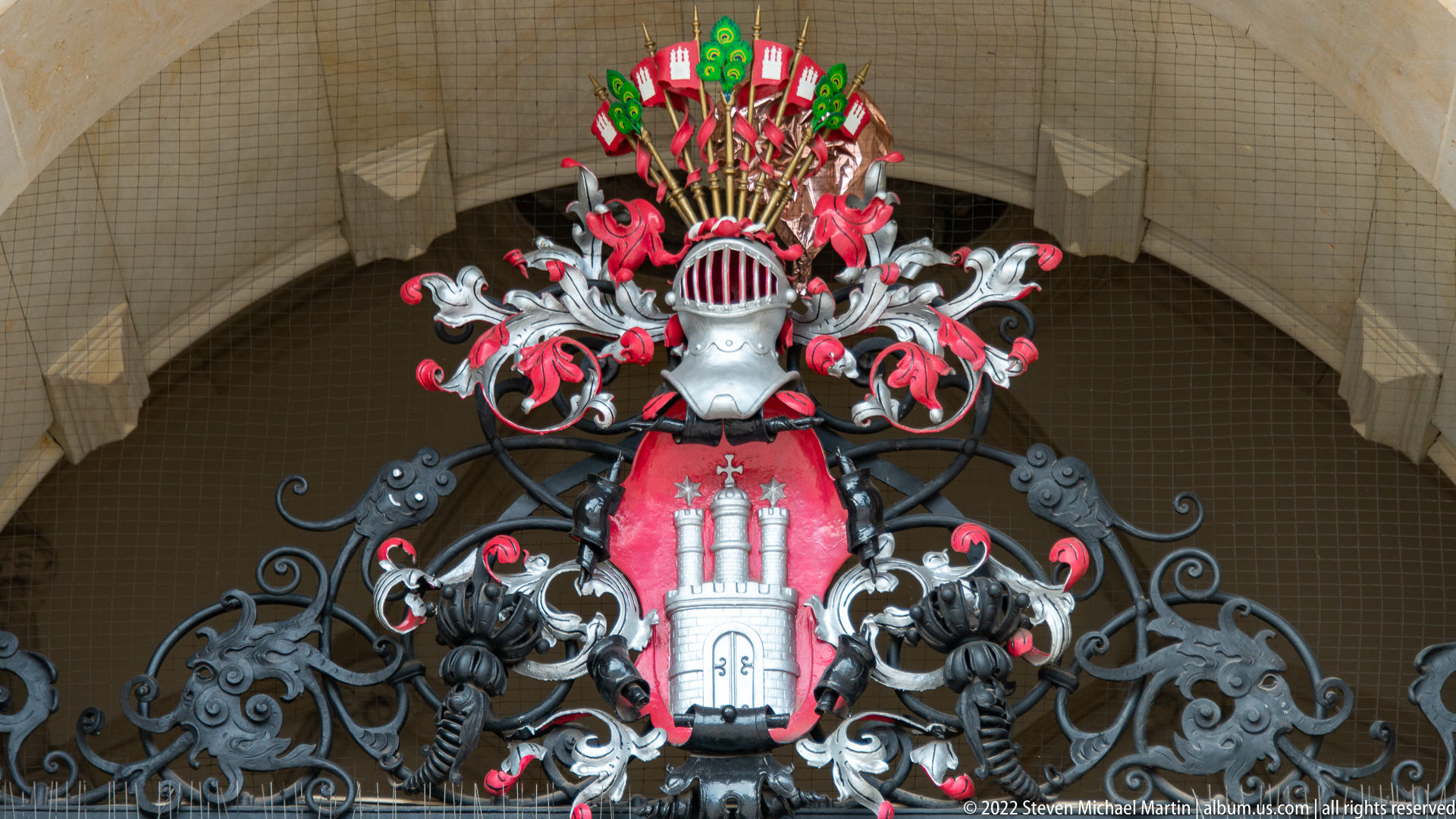
An elaborate polychrome wrought-iron heraldic composition fills an arched opening, centering Hamburg’s red shield with its white three-towered castle beneath a plumed helmet and a fan of small city banners. Black scrollwork and red foliage extend outward symmetrically, combining civic heraldry with the decorative metalwork of the Rathaus interior.
Caption
An elaborate polychrome wrought-iron heraldic composition fills an arched opening, centering Hamburg’s red shield with its white three-towered castle beneath a plumed helmet and a fan of small city banners. Black scrollwork and red foliage extend outward symmetrically, combining civic heraldry with the decorative metalwork of the Rathaus interior.
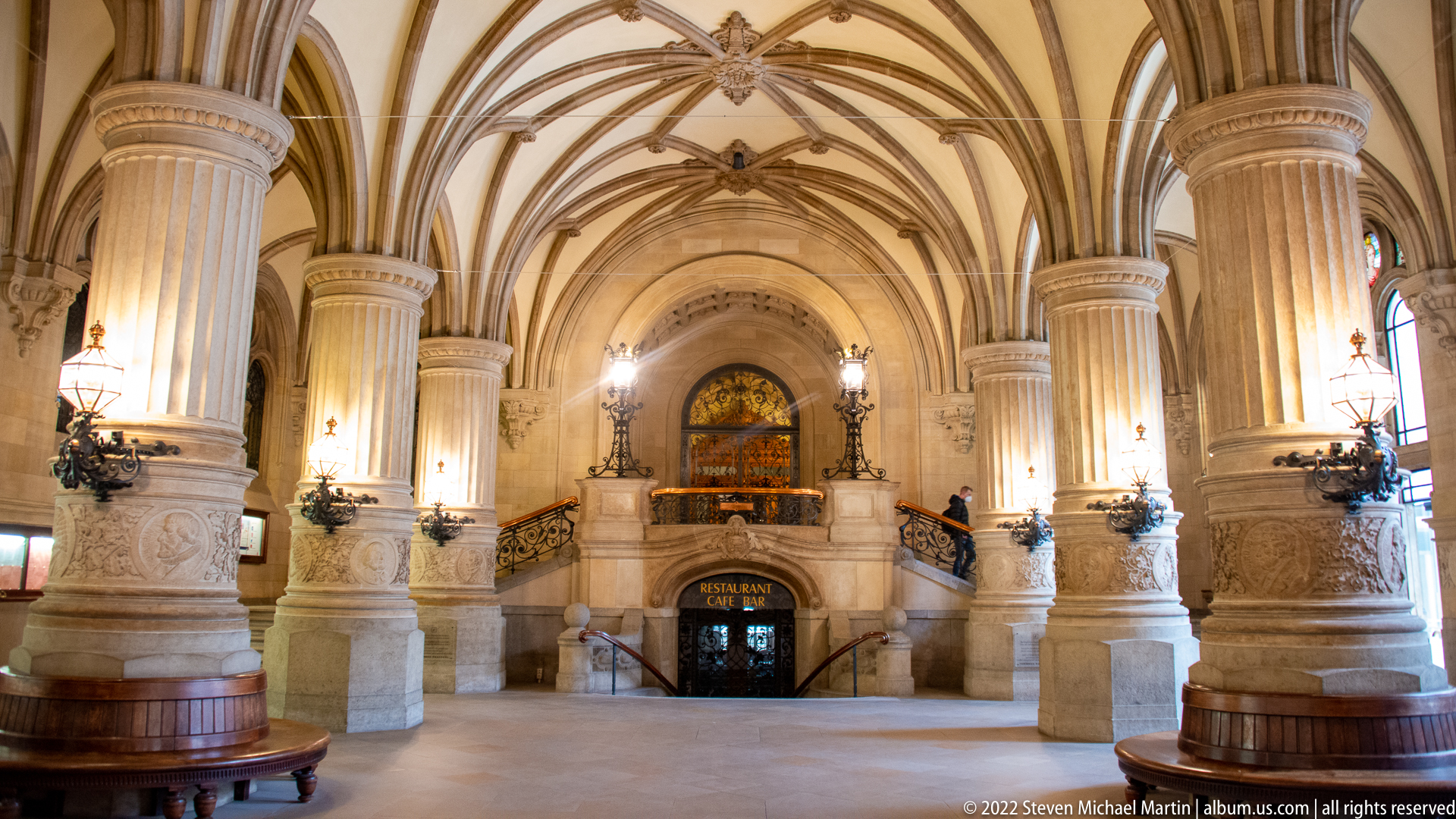
A grand hall inside Hamburg Rathaus is defined by clustered stone columns, ribbed vaults, ornamental lamps, and a broad central stair rising to an upper landing. Warm light on carved capitals and pale stone surfaces softens the monumental civic interior, while the symmetrical view emphasizes the hall’s processional axis and richly worked historicist architecture.
Caption
A grand hall inside Hamburg Rathaus is defined by clustered stone columns, ribbed vaults, ornamental lamps, and a broad central stair rising to an upper landing. Warm light on carved capitals and pale stone surfaces softens the monumental civic interior, while the symmetrical view emphasizes the hall’s processional axis and richly worked historicist architecture.
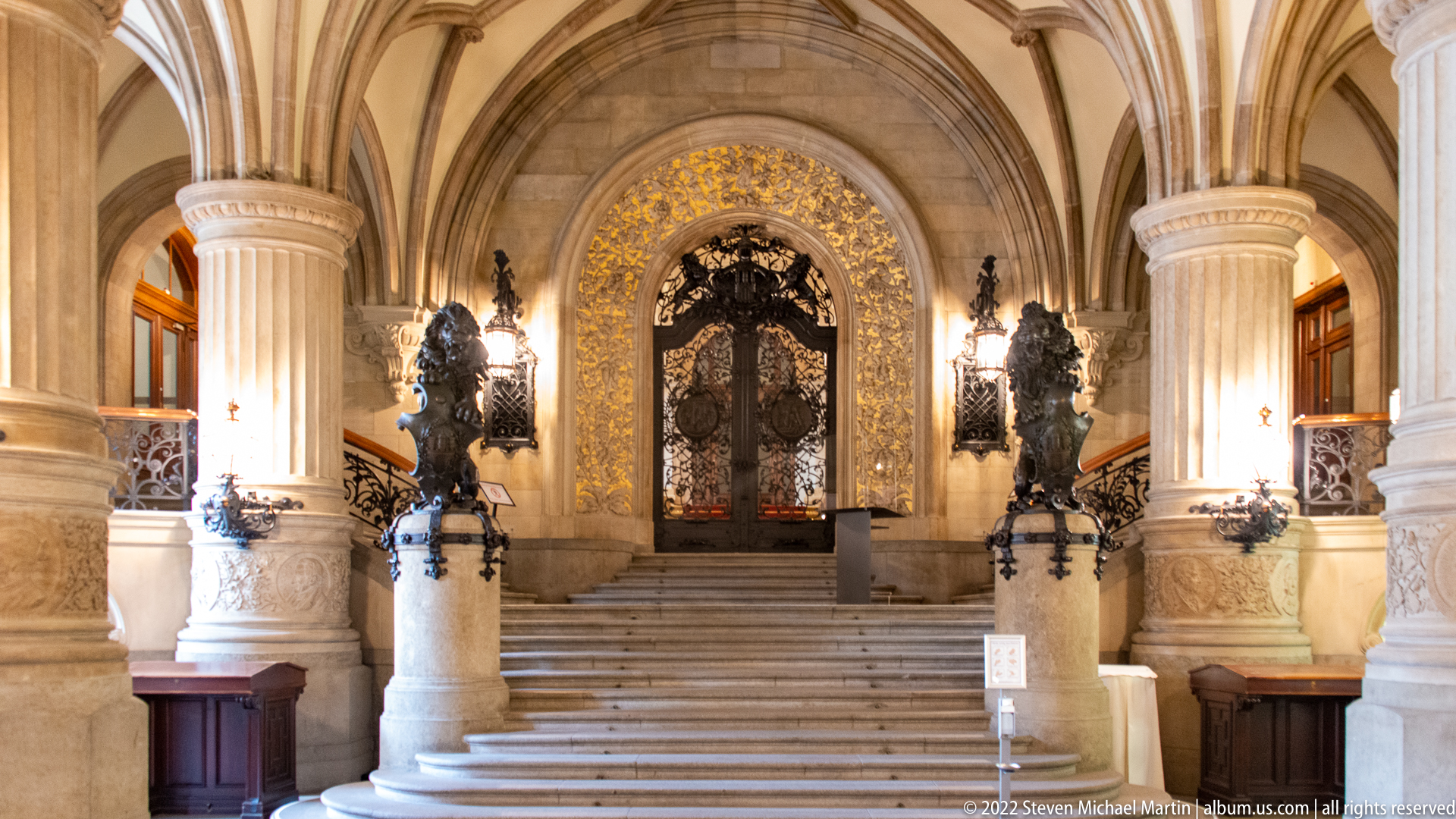
A ceremonial staircase inside Hamburg Rathaus rises toward an ornate dark doorway set beneath a gilded decorative arch. Carved stone piers, black sculptural lamps, balustrades, and richly patterned surfaces frame the ascent, making the stair landing itself a concentrated display of civic craftsmanship and interior ornament.
Caption
A ceremonial staircase inside Hamburg Rathaus rises toward an ornate dark doorway set beneath a gilded decorative arch. Carved stone piers, black sculptural lamps, balustrades, and richly patterned surfaces frame the ascent, making the stair landing itself a concentrated display of civic craftsmanship and interior ornament.
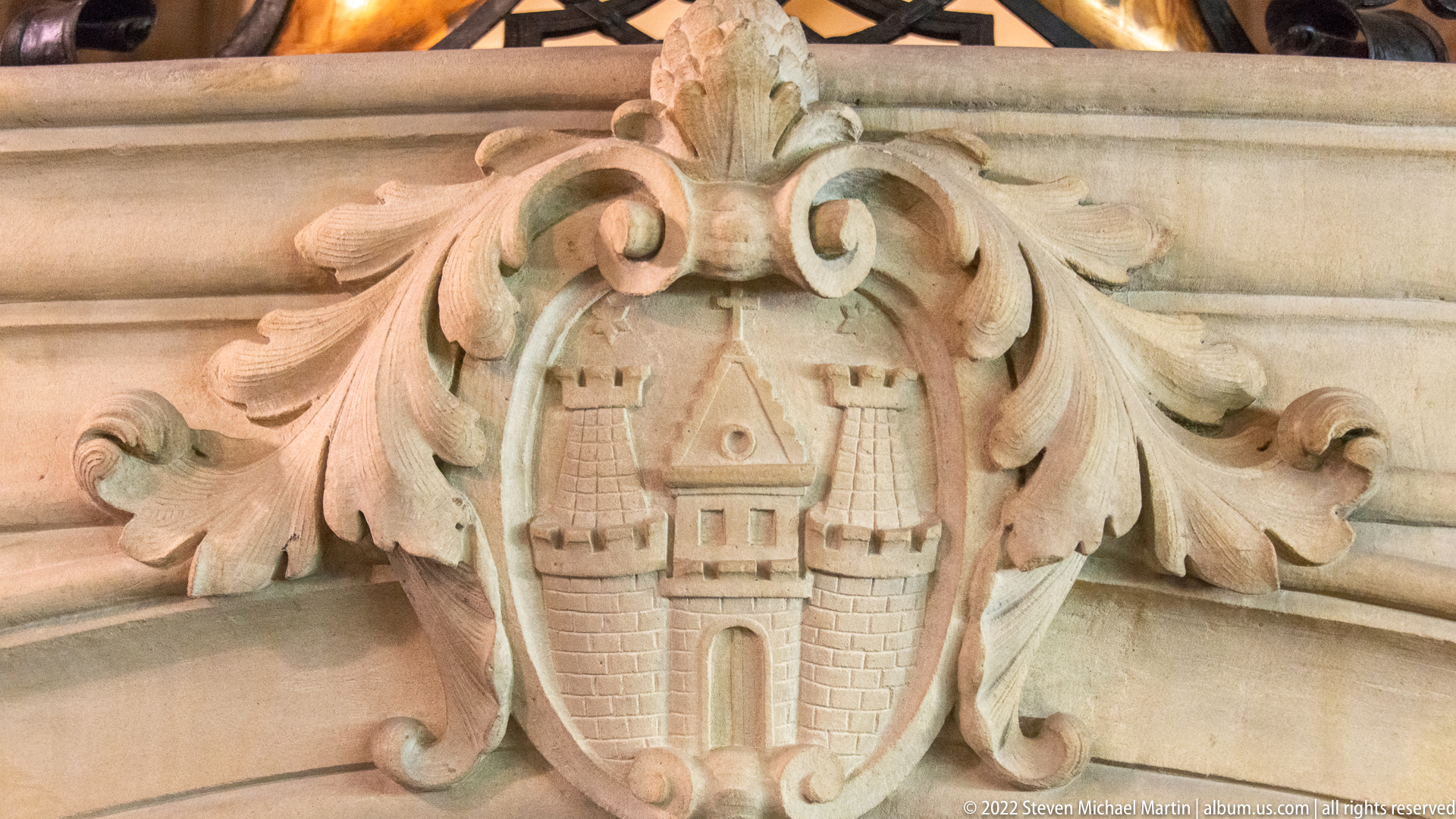
A carved version of Hamburg’s three-towered castle emblem appears within a scrolling stone cartouche. The close view reveals masonry joints, softened edges, and layered foliate ornament around the shield, translating the city’s familiar red-and-white heraldic device into monochrome architectural sculpture.
Caption
A carved version of Hamburg’s three-towered castle emblem appears within a scrolling stone cartouche. The close view reveals masonry joints, softened edges, and layered foliate ornament around the shield, translating the city’s familiar red-and-white heraldic device into monochrome architectural sculpture.
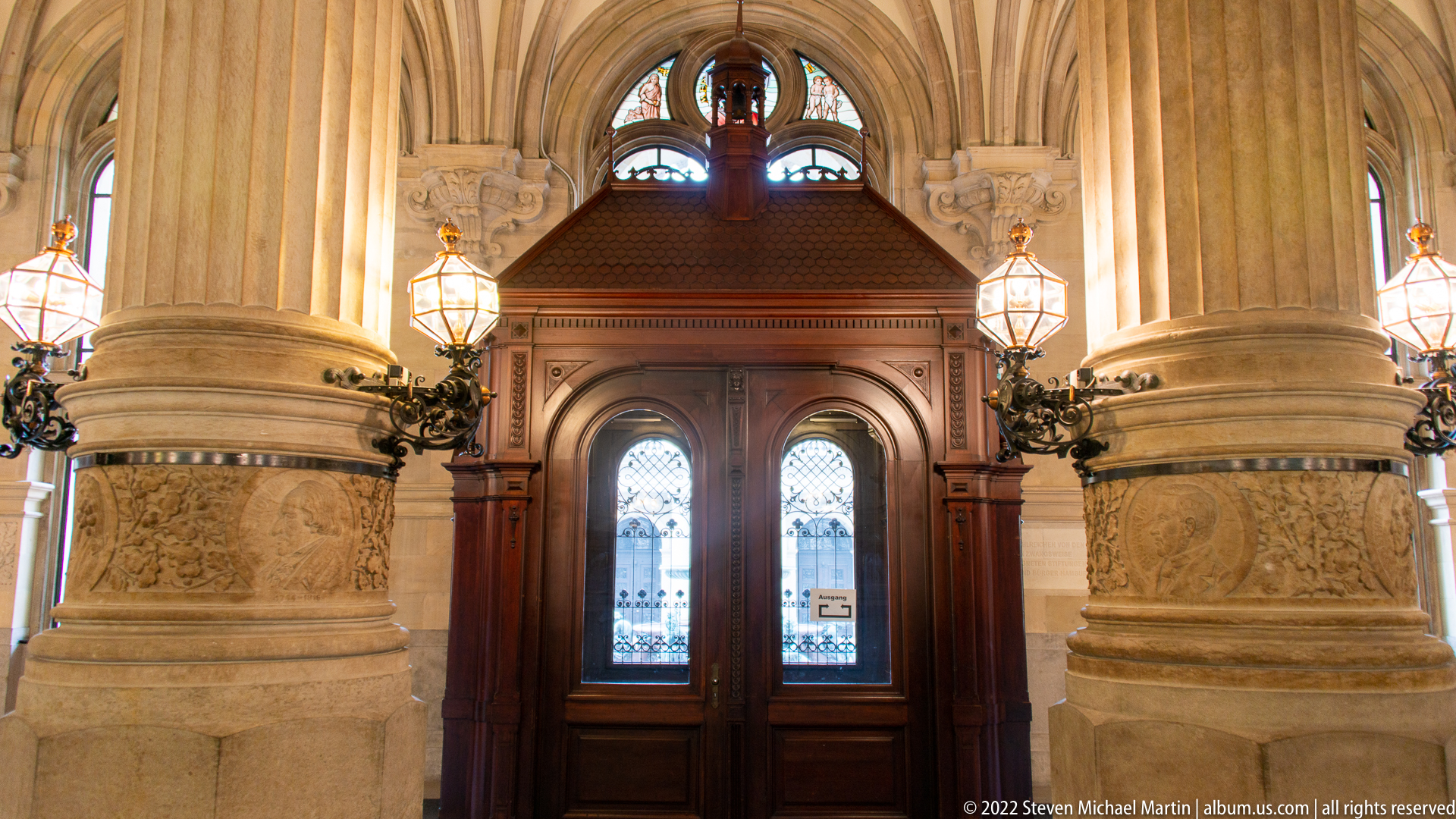
Dark wooden double doors fill a tall arched opening between massive carved stone columns in Hamburg Rathaus. Leaded-glass panels admit muted exterior light, while ornamental lamps and sculpted column bases create a layered threshold between the civic interior and the street beyond. The symmetrical framing gives the doorway a formal, ceremonial presence.
Caption
Dark wooden double doors fill a tall arched opening between massive carved stone columns in Hamburg Rathaus. Leaded-glass panels admit muted exterior light, while ornamental lamps and sculpted column bases create a layered threshold between the civic interior and the street beyond. The symmetrical framing gives the doorway a formal, ceremonial presence.
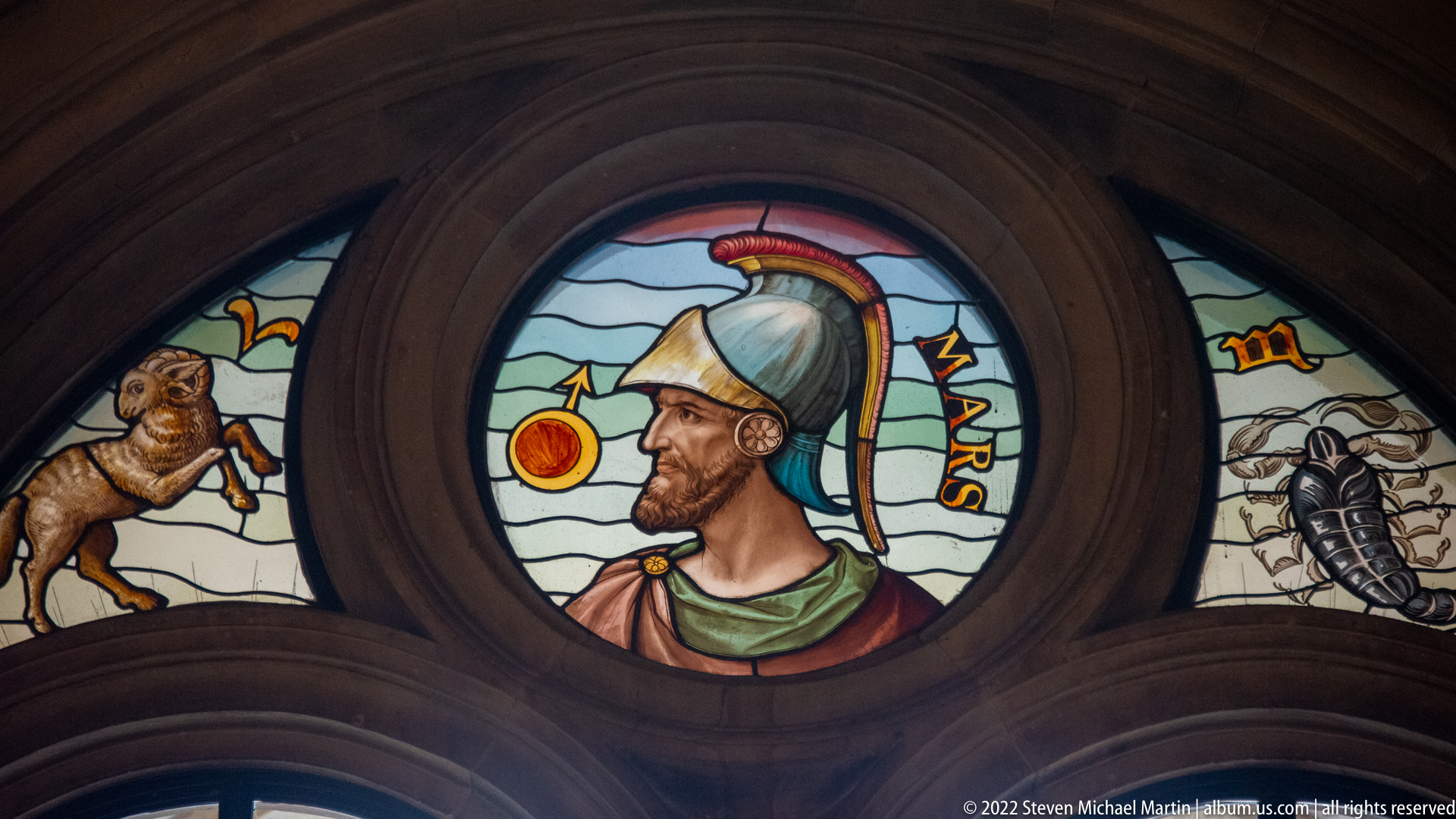
A circular stained-glass medallion depicts a helmeted male figure explicitly labeled “MARS,” framed by smaller heraldic or symbolic panels. The figure’s classical profile, crested helmet, and bright red-and-blue glass stand out within the dark stone window surround, adding mythological imagery to the Rathaus decorative program.
Caption
A circular stained-glass medallion depicts a helmeted male figure explicitly labeled “MARS,” framed by smaller heraldic or symbolic panels. The figure’s classical profile, crested helmet, and bright red-and-blue glass stand out within the dark stone window surround, adding mythological imagery to the Rathaus decorative program.
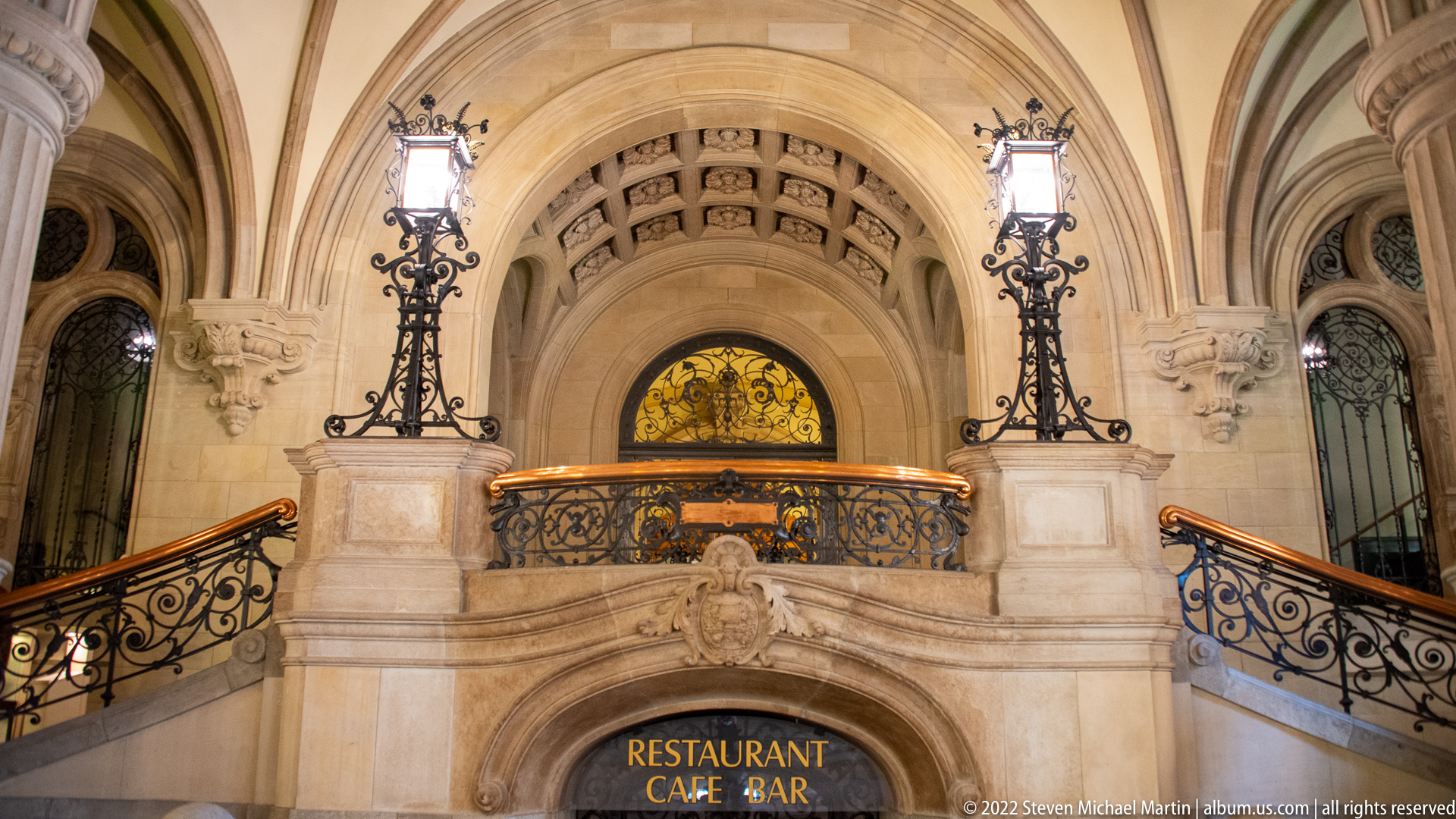
A richly carved stair landing inside Hamburg Rathaus is framed by twin lanterns, sweeping wrought-iron railings, and a coffered stone arch. A stained-glass window glows at the center above an opening labeled “Restaurant Café Bar,” showing how ceremonial civic architecture and public hospitality occupy the same monumental interior.
Caption
A richly carved stair landing inside Hamburg Rathaus is framed by twin lanterns, sweeping wrought-iron railings, and a coffered stone arch. A stained-glass window glows at the center above an opening labeled “Restaurant Café Bar,” showing how ceremonial civic architecture and public hospitality occupy the same monumental interior.
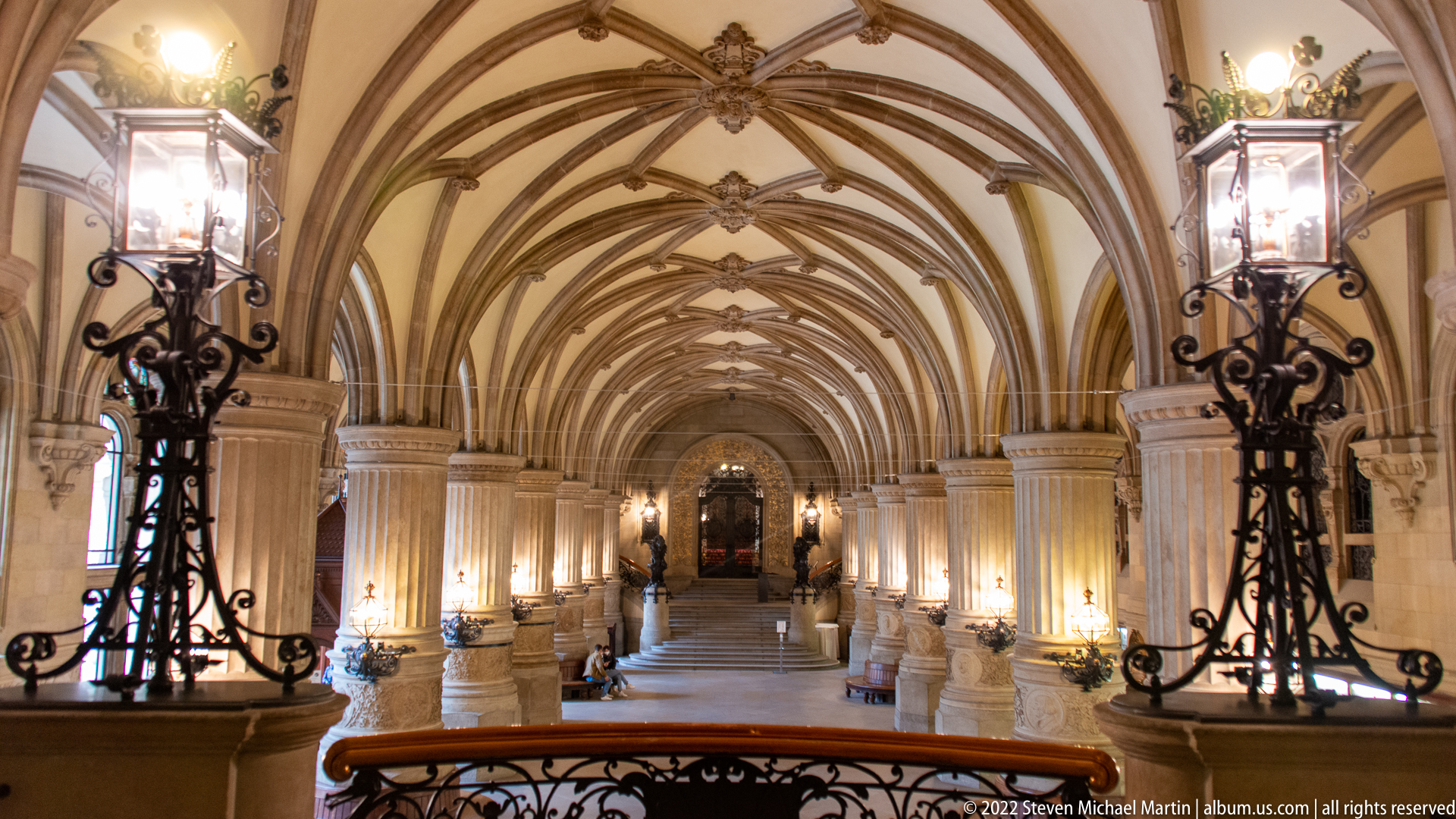
A long vaulted gallery stretches through Hamburg Rathaus beneath an intricate sequence of ribbed arches. Repeated stone columns, globe-like lanterns, and wrought-iron balustrades create strong rhythm and depth, while the central aisle recedes toward a distant doorway. The elevated viewpoint reveals the hall’s processional scale more clearly than the closer stair views.
Caption
A long vaulted gallery stretches through Hamburg Rathaus beneath an intricate sequence of ribbed arches. Repeated stone columns, globe-like lanterns, and wrought-iron balustrades create strong rhythm and depth, while the central aisle recedes toward a distant doorway. The elevated viewpoint reveals the hall’s processional scale more clearly than the closer stair views.
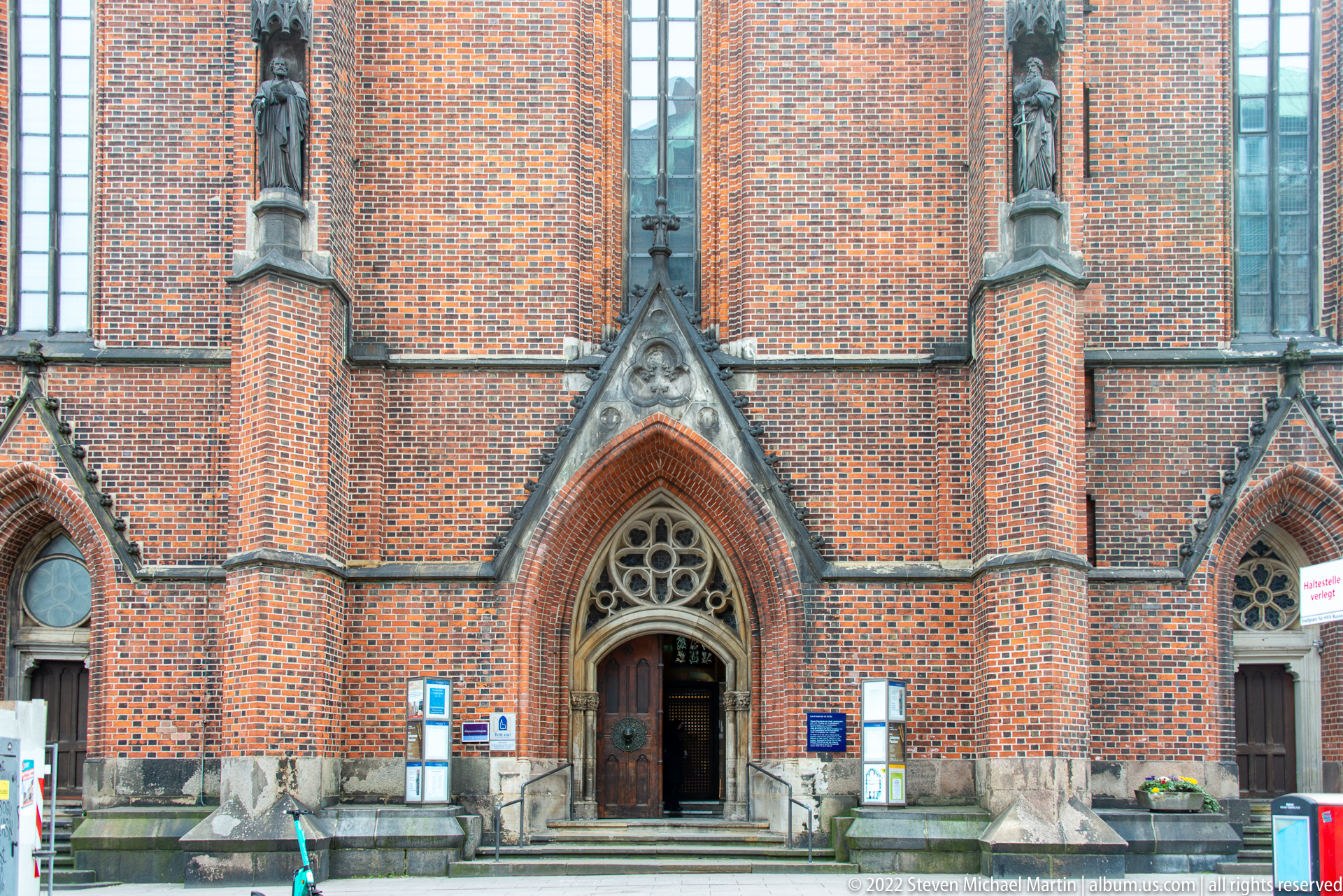
A tall pointed-arch doorway punctures the red-brick façade of a Gothic church, framed by stepped brick moldings, a small tracery window, and buttress-like vertical elements. The frontal crop focuses on the lower façade and entrance rather than the tower, showing the precision of North German brick construction at pedestrian scale.
Caption
A tall pointed-arch doorway punctures the red-brick façade of a Gothic church, framed by stepped brick moldings, a small tracery window, and buttress-like vertical elements. The frontal crop focuses on the lower façade and entrance rather than the tower, showing the precision of North German brick construction at pedestrian scale.
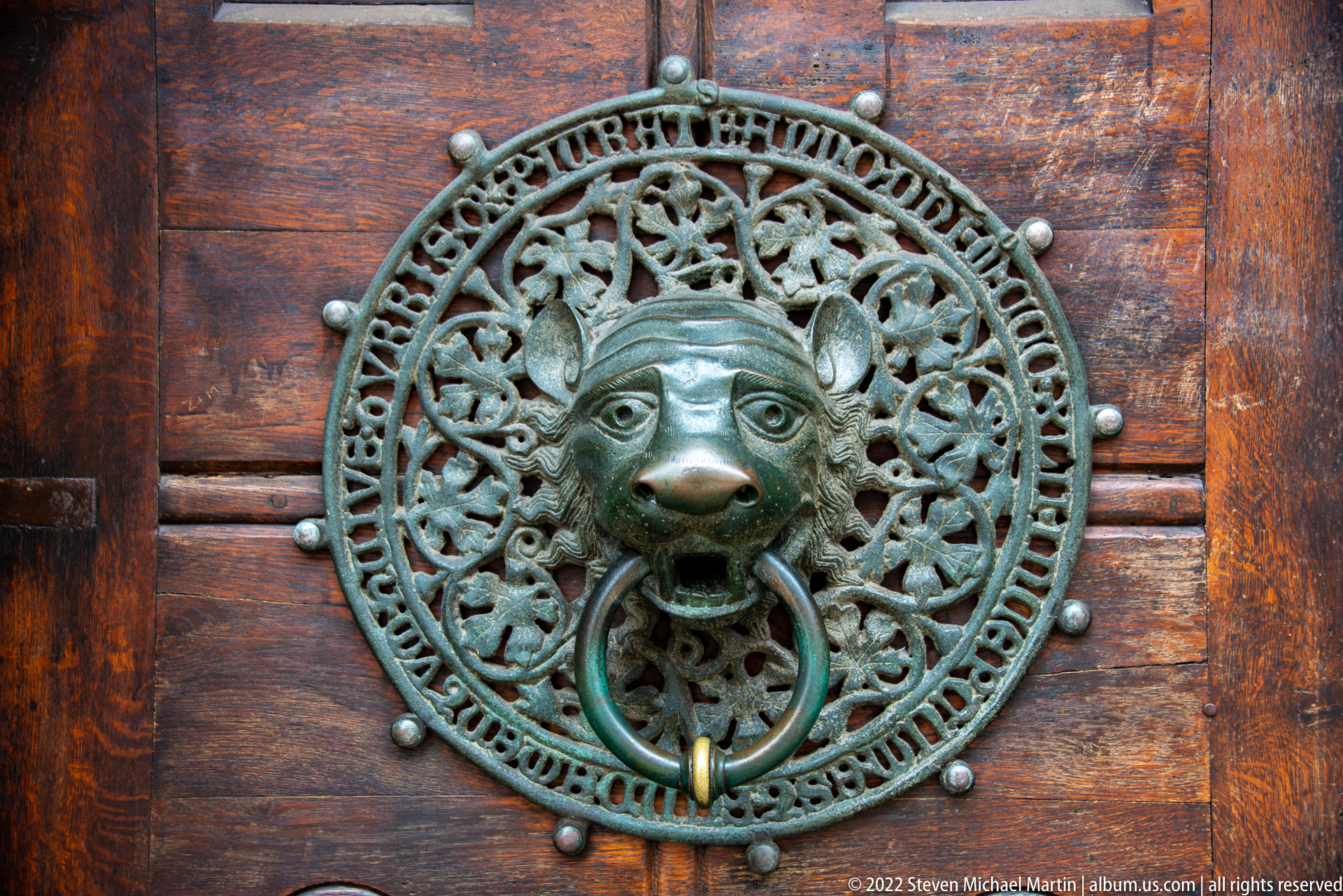
A bronze lion’s head projects from the center of an intricate circular door plate, gripping a heavy ring in its mouth. Interlaced openwork and an inscription band surround the animal mask, all set against richly grained dark wood. The close view isolates the tactile craftsmanship of the entrance hardware from the church architecture around it.
Caption
A bronze lion’s head projects from the center of an intricate circular door plate, gripping a heavy ring in its mouth. Interlaced openwork and an inscription band surround the animal mask, all set against richly grained dark wood. The close view isolates the tactile craftsmanship of the entrance hardware from the church architecture around it.
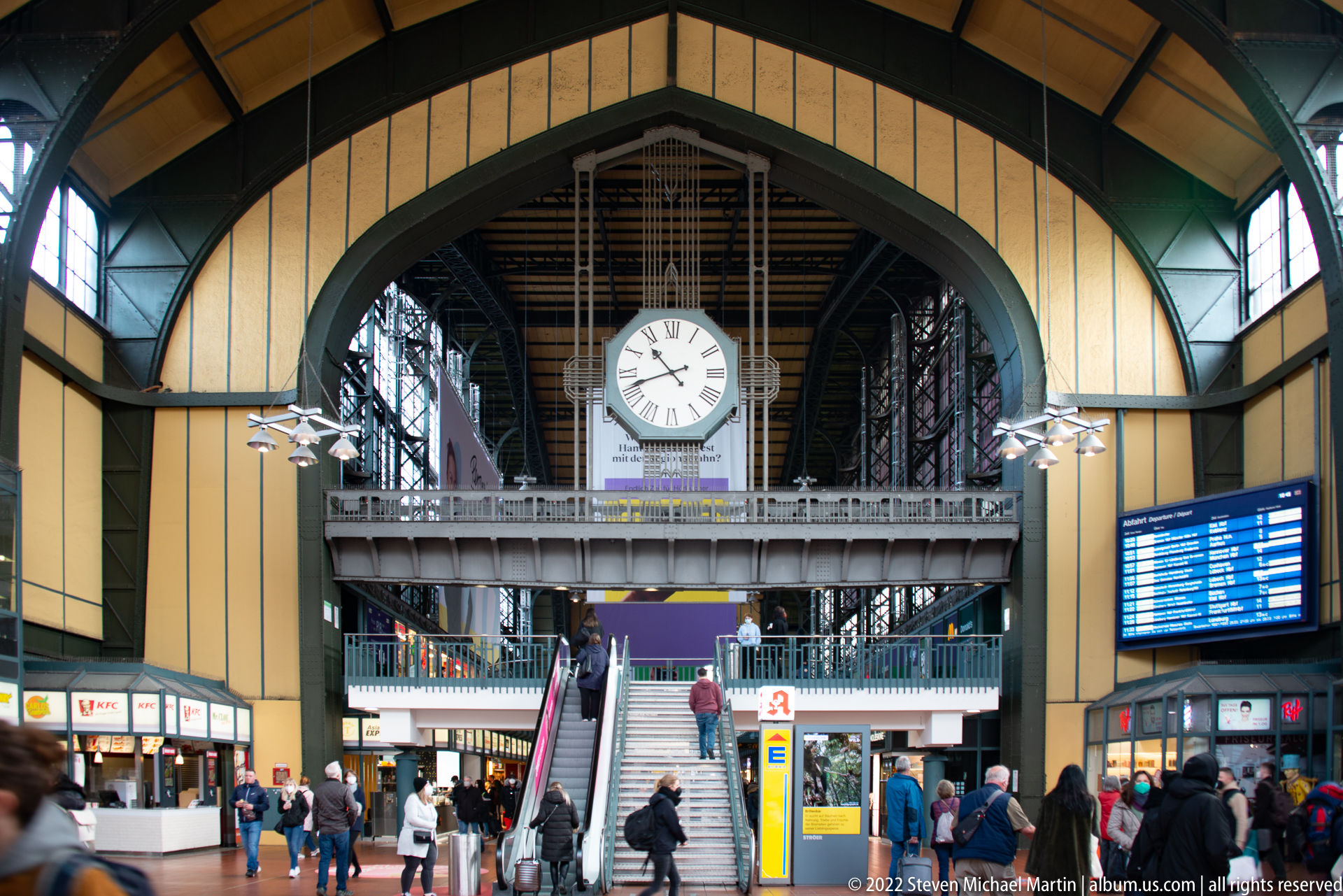
A large round clock hangs beneath the steel-and-glass roof of Hamburg Hauptbahnhof above a central stair and escalator. Departure boards, shops, and moving passengers fill the lower concourse, while the pointed structural arch frames the clock like a focal landmark. The composition records the station as both engineered space and active transport hub.
Caption
A large round clock hangs beneath the steel-and-glass roof of Hamburg Hauptbahnhof above a central stair and escalator. Departure boards, shops, and moving passengers fill the lower concourse, while the pointed structural arch frames the clock like a focal landmark. The composition records the station as both engineered space and active transport hub.
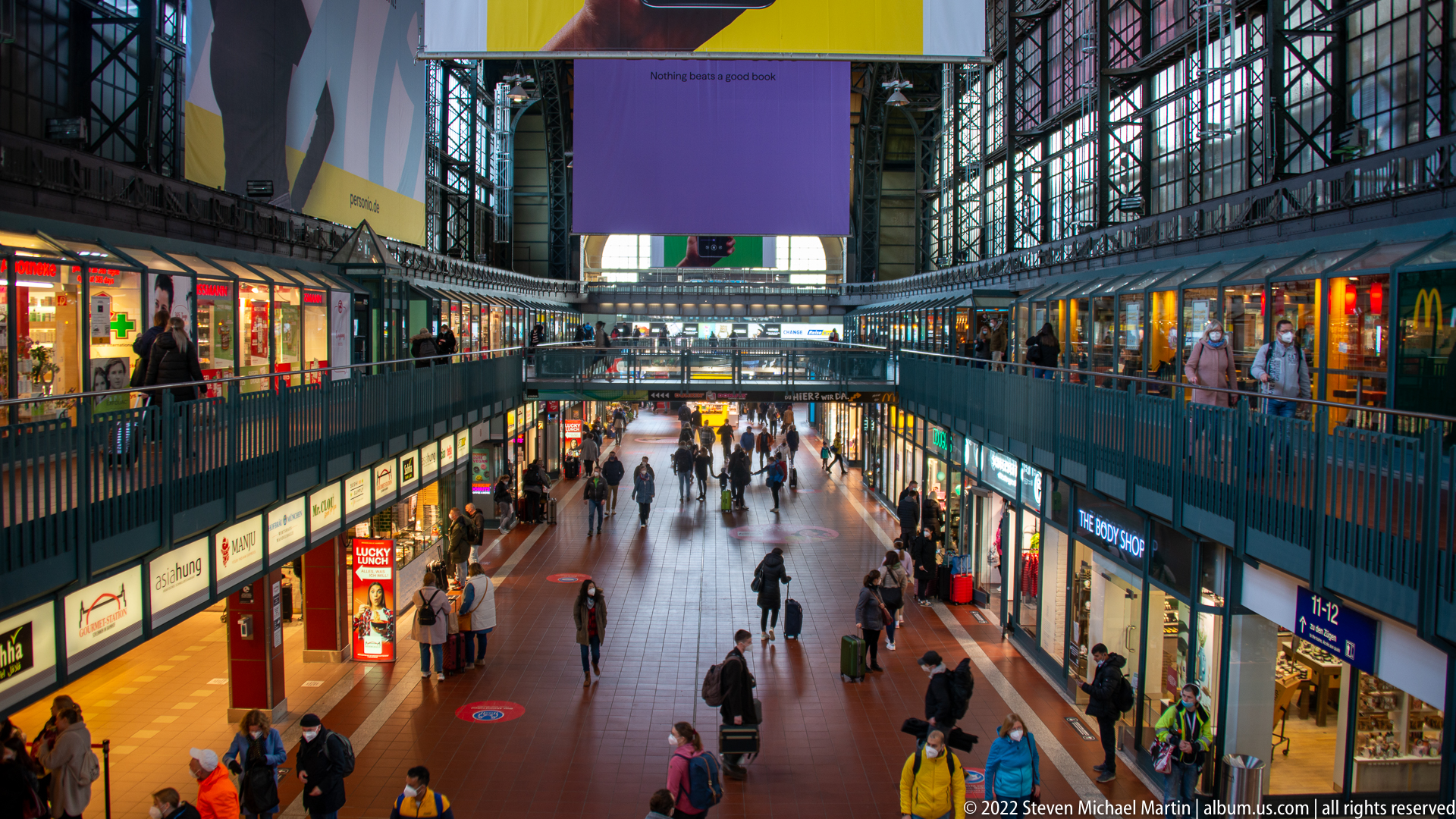
Shops line both levels of Hamburg Hauptbahnhof’s interior gallery while travelers move through the broad central passage below. Steel roof framing and suspended advertising panels reveal the station’s large industrial shell, but the view foregrounds its contemporary role as a commercial and pedestrian concourse as much as a rail facility.
Caption
Shops line both levels of Hamburg Hauptbahnhof’s interior gallery while travelers move through the broad central passage below. Steel roof framing and suspended advertising panels reveal the station’s large industrial shell, but the view foregrounds its contemporary role as a commercial and pedestrian concourse as much as a rail facility.
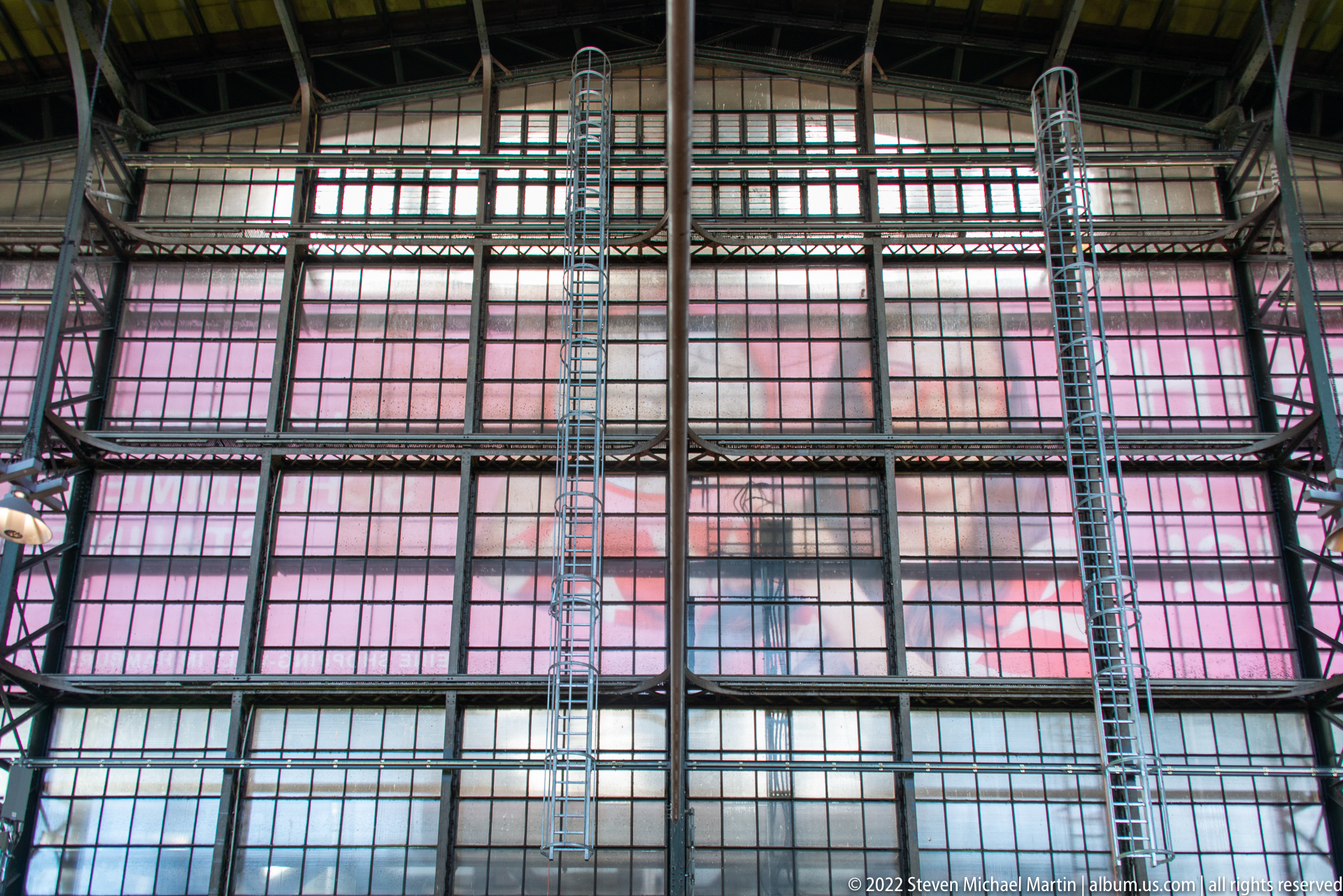
A close view of Hamburg Hauptbahnhof’s great glazed wall reduces the station architecture to a strict grid of dark steel mullions, pink-tinted panes, and vertical service ladders. The photograph emphasizes engineering repetition and translucent surface rather than passenger activity, revealing the immense scale of the enclosure through its structural modules.
Caption
A close view of Hamburg Hauptbahnhof’s great glazed wall reduces the station architecture to a strict grid of dark steel mullions, pink-tinted panes, and vertical service ladders. The photograph emphasizes engineering repetition and translucent surface rather than passenger activity, revealing the immense scale of the enclosure through its structural modules.
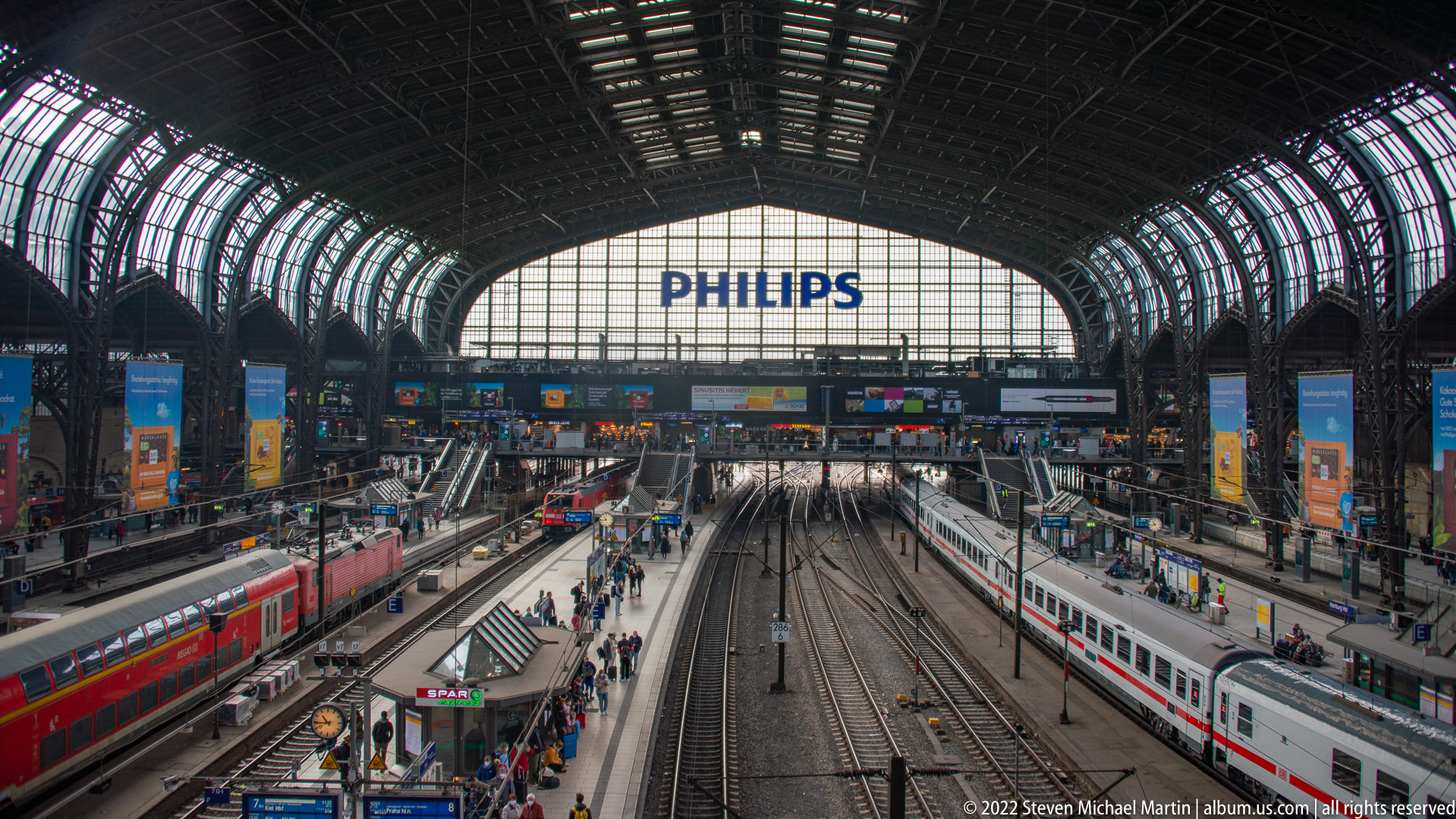
Multiple railway tracks converge beneath the immense arched train shed of Hamburg Hauptbahnhof, with red regional trains and white intercity trains standing at platforms on either side. The broad elevated view reveals the terminal’s full operational geometry, while the large glazed end wall and roof trusses enclose the scene beneath a single monumental span.
Caption
Multiple railway tracks converge beneath the immense arched train shed of Hamburg Hauptbahnhof, with red regional trains and white intercity trains standing at platforms on either side. The broad elevated view reveals the terminal’s full operational geometry, while the large glazed end wall and roof trusses enclose the scene beneath a single monumental span.
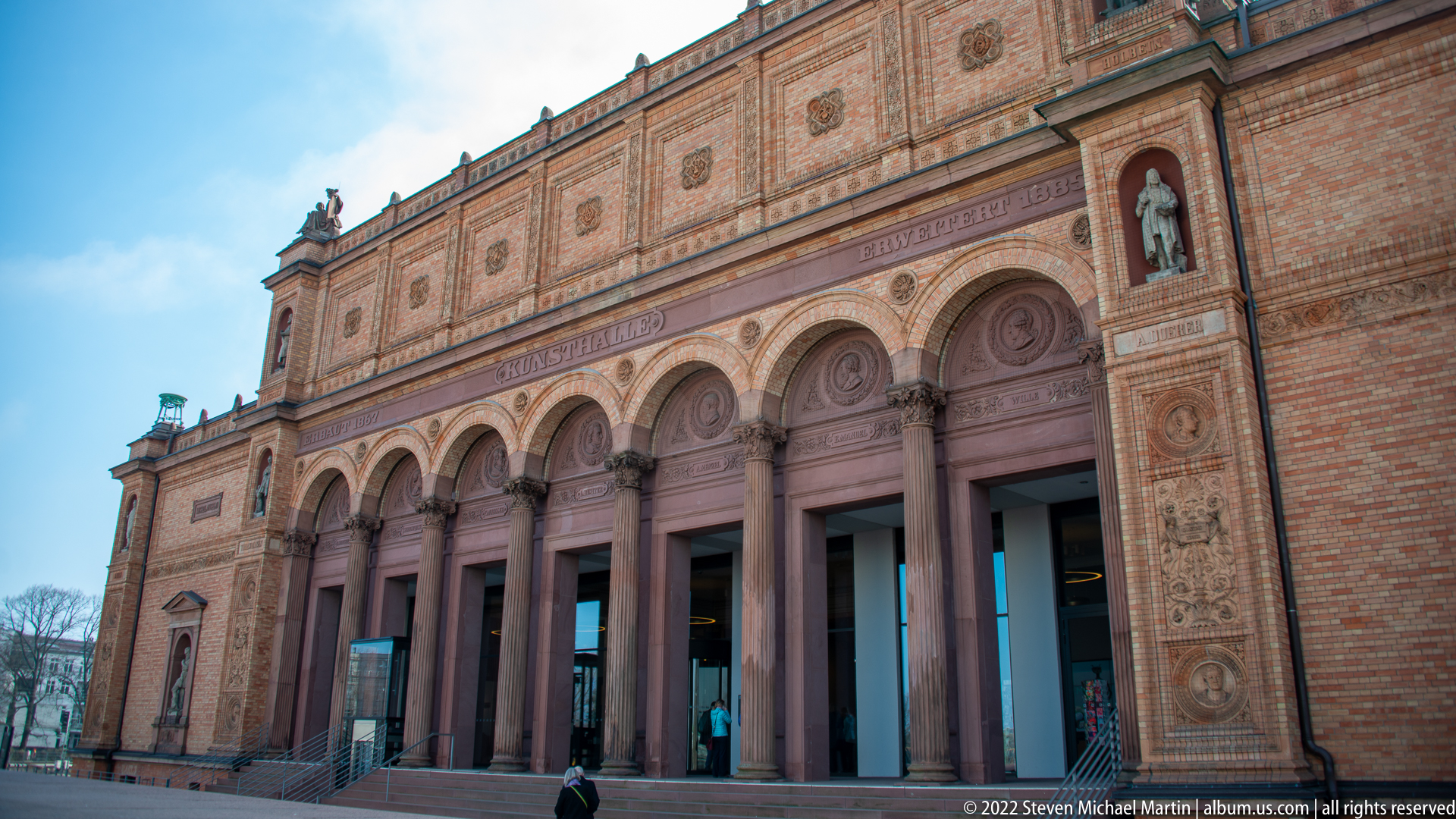
The monumental historic façade of the Hamburger Kunsthalle presents a long arcade of tall arches and columns beneath richly patterned brick and terracotta ornament. Sculpted figures occupy upper niches and inscriptions run across the entablature, giving the museum a deliberately learned, classical character despite its polychrome masonry construction.
Caption
The monumental historic façade of the Hamburger Kunsthalle presents a long arcade of tall arches and columns beneath richly patterned brick and terracotta ornament. Sculpted figures occupy upper niches and inscriptions run across the entablature, giving the museum a deliberately learned, classical character despite its polychrome masonry construction.
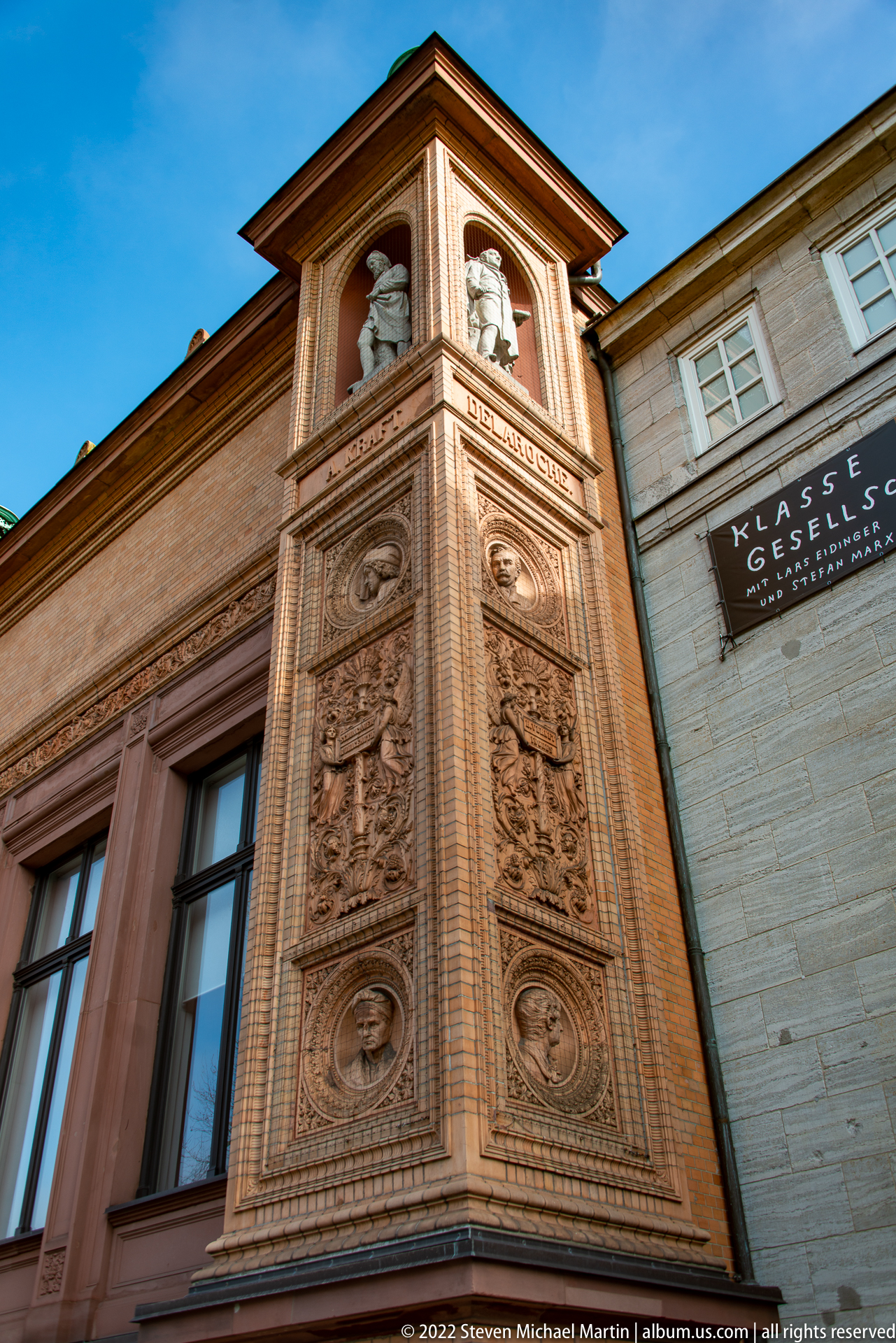
An ornate corner of the Hamburger Kunsthalle combines patterned brickwork, terracotta reliefs, portrait medallions, sculpted busts, and inscribed friezes. The upward view concentrates on the museum’s richly modeled historic façade rather than its full massing, revealing how art-historical references are embedded directly into the building’s exterior decoration.
Caption
An ornate corner of the Hamburger Kunsthalle combines patterned brickwork, terracotta reliefs, portrait medallions, sculpted busts, and inscribed friezes. The upward view concentrates on the museum’s richly modeled historic façade rather than its full massing, revealing how art-historical references are embedded directly into the building’s exterior decoration.
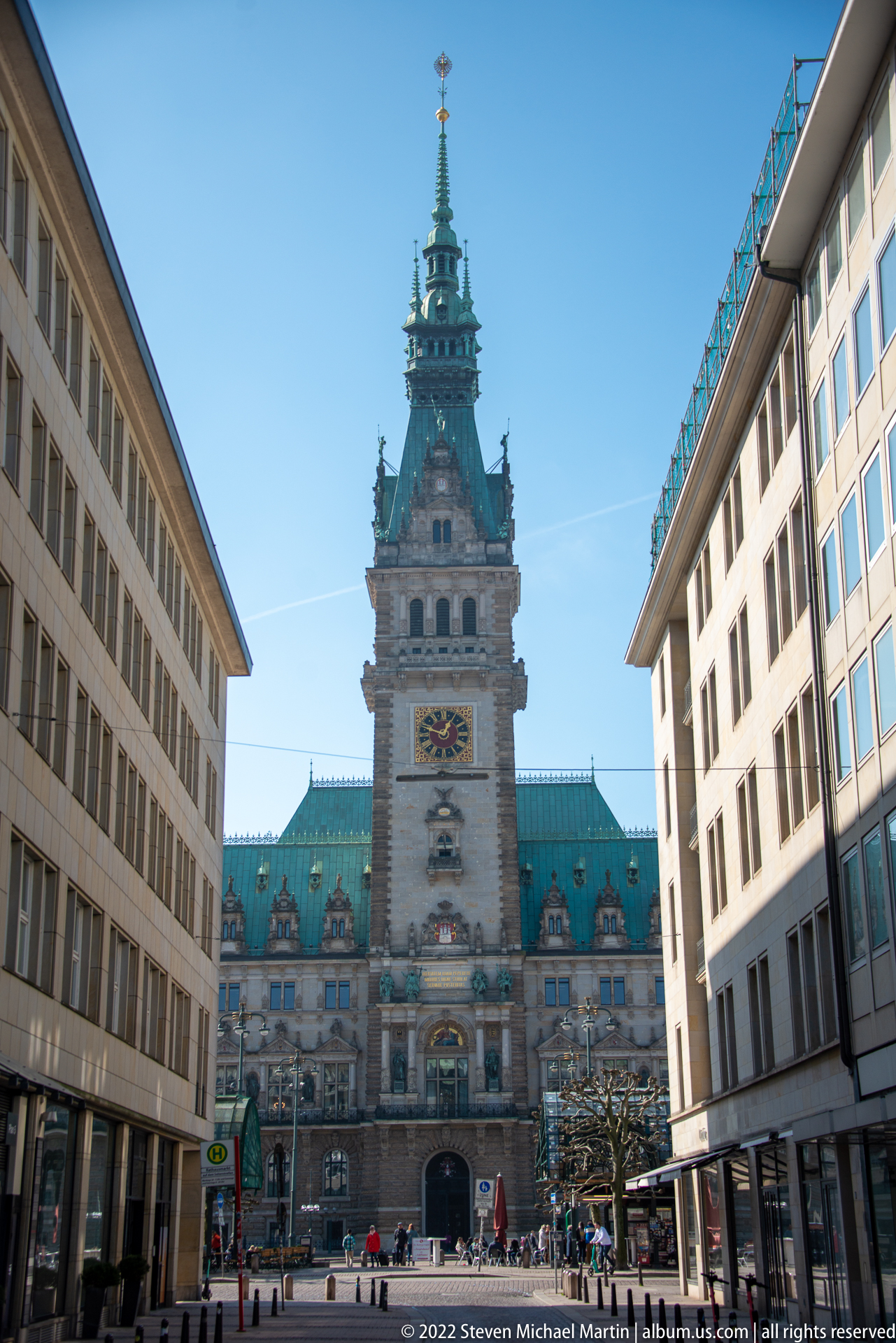
Hamburg Rathaus closes the end of a broad urban street, its central clock tower and green copper roof framed tightly by modern office blocks on both sides. The axial view emphasizes the city hall’s role as a historic focal point within the contemporary center, with pedestrians, transit elements, and street furniture leading toward its monumental façade.
Caption
Hamburg Rathaus closes the end of a broad urban street, its central clock tower and green copper roof framed tightly by modern office blocks on both sides. The axial view emphasizes the city hall’s role as a historic focal point within the contemporary center, with pedestrians, transit elements, and street furniture leading toward its monumental façade.
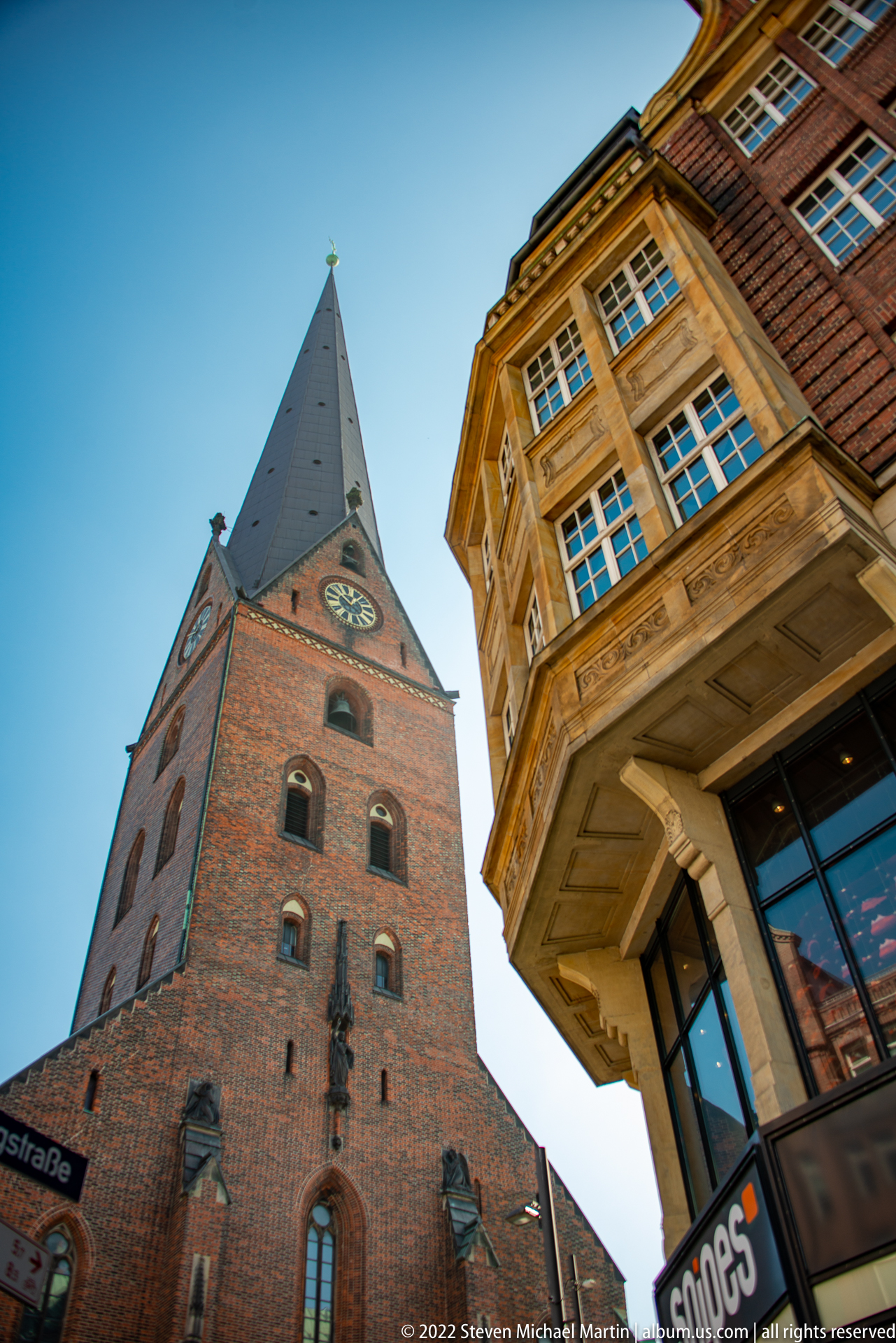
The massive brick tower of St. Peter’s Church rises steeply above a nearby historic corner building, its pointed roof and clock faces compressed by the low-angle view. Dark masonry openings, wall-mounted lamps, and the sharply converging façades give the photograph a dramatic vertical perspective within Hamburg’s old city center.
Caption
The massive brick tower of St. Peter’s Church rises steeply above a nearby historic corner building, its pointed roof and clock faces compressed by the low-angle view. Dark masonry openings, wall-mounted lamps, and the sharply converging façades give the photograph a dramatic vertical perspective within Hamburg’s old city center.
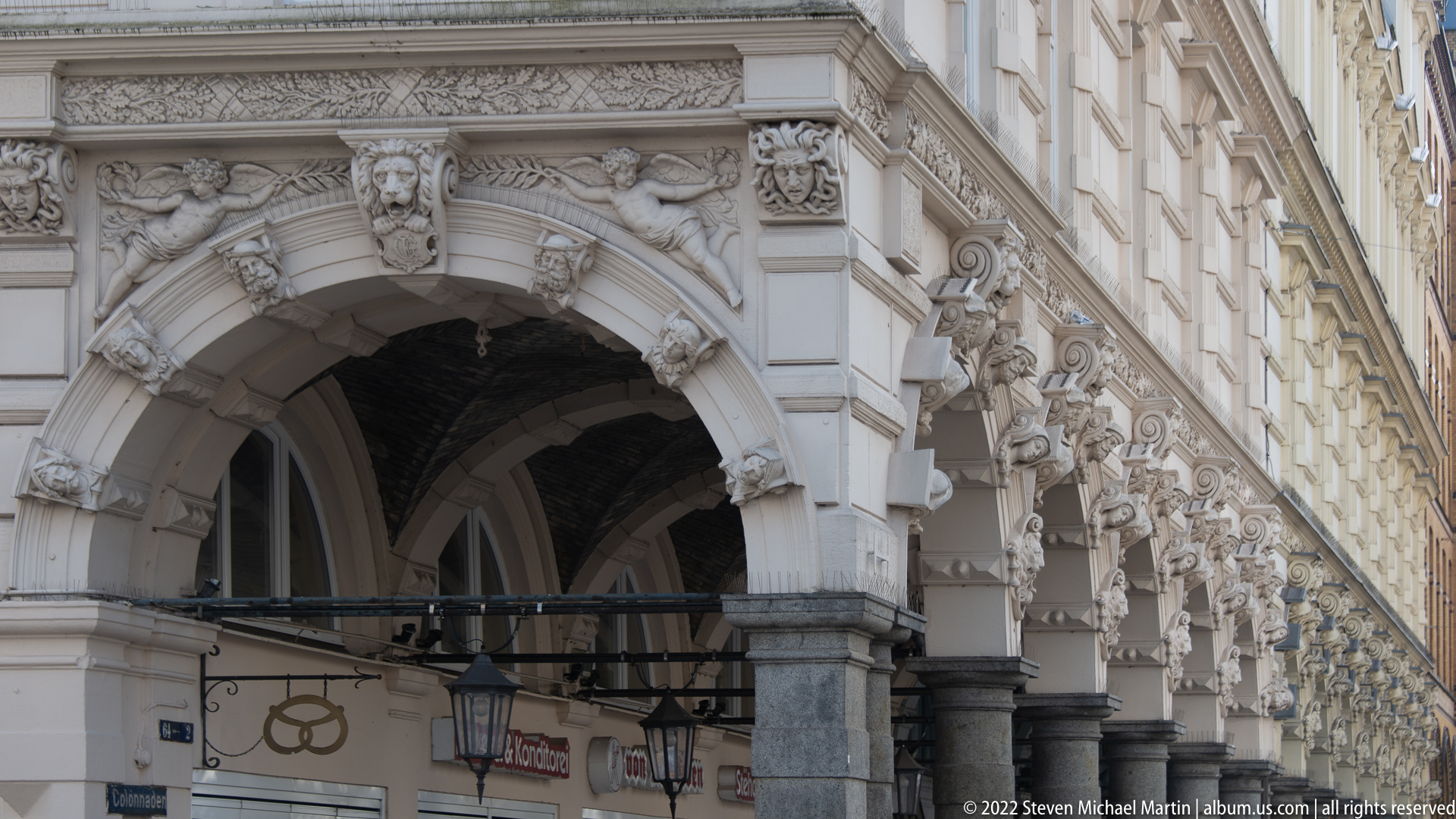
A covered commercial arcade is framed by a broad stone arch enriched with sculpted masks, floral ornament, and repeated bracket figures supporting the projecting façade above. Lanterns and shop signs occupy the passage below, while the oblique perspective extends the rhythm of carved supports down the building’s length.
Caption
A covered commercial arcade is framed by a broad stone arch enriched with sculpted masks, floral ornament, and repeated bracket figures supporting the projecting façade above. Lanterns and shop signs occupy the passage below, while the oblique perspective extends the rhythm of carved supports down the building’s length.
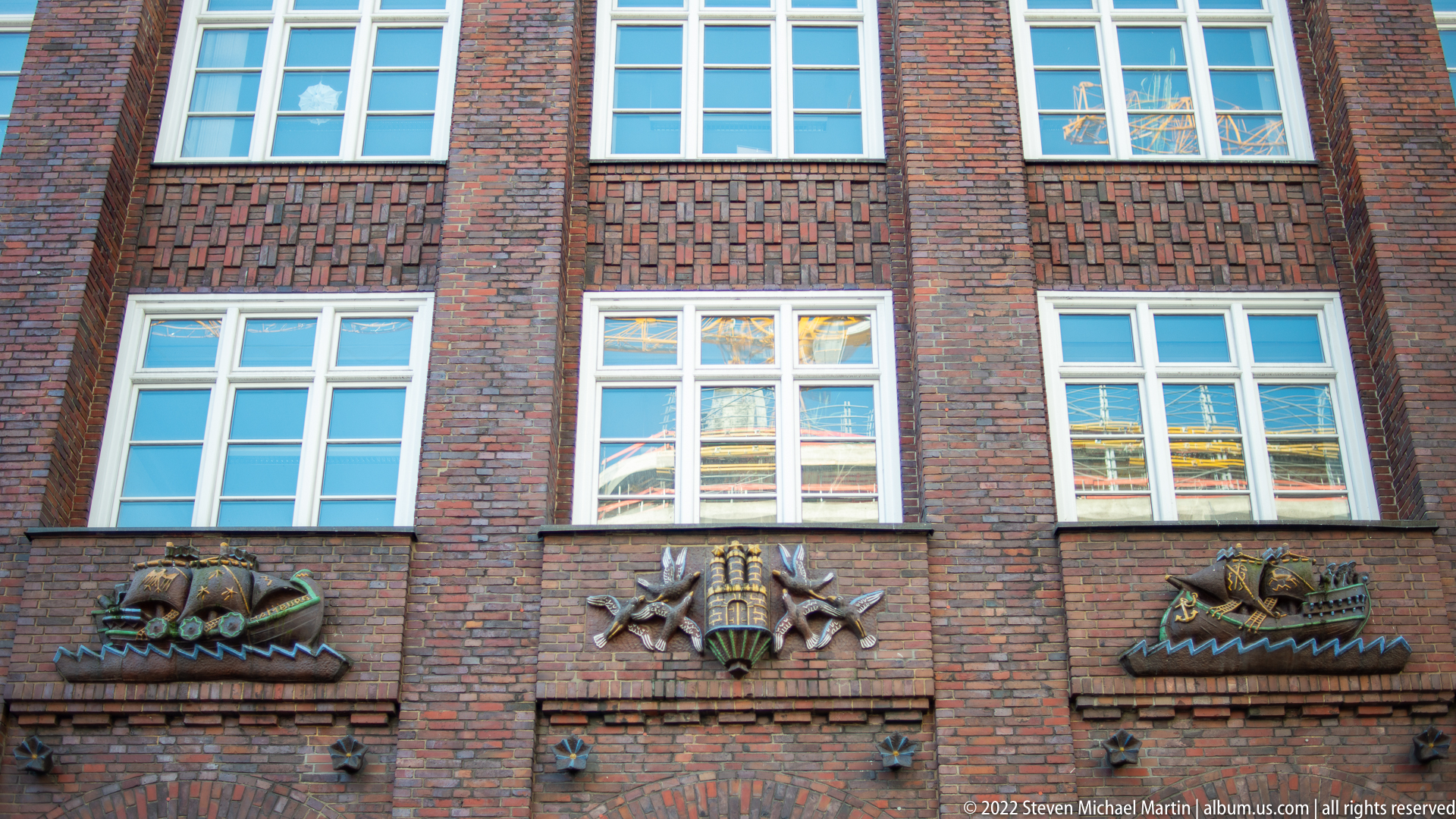
Three polychrome reliefs animate a red-brick façade beneath white-framed windows, each combining maritime or heraldic motifs with waves, animals, and emblematic objects. Their bright blue, gold, and green surfaces contrast sharply with the dark patterned brickwork, giving the otherwise regular elevation a distinctly nautical decorative identity.
Caption
Three polychrome reliefs animate a red-brick façade beneath white-framed windows, each combining maritime or heraldic motifs with waves, animals, and emblematic objects. Their bright blue, gold, and green surfaces contrast sharply with the dark patterned brickwork, giving the otherwise regular elevation a distinctly nautical decorative identity.
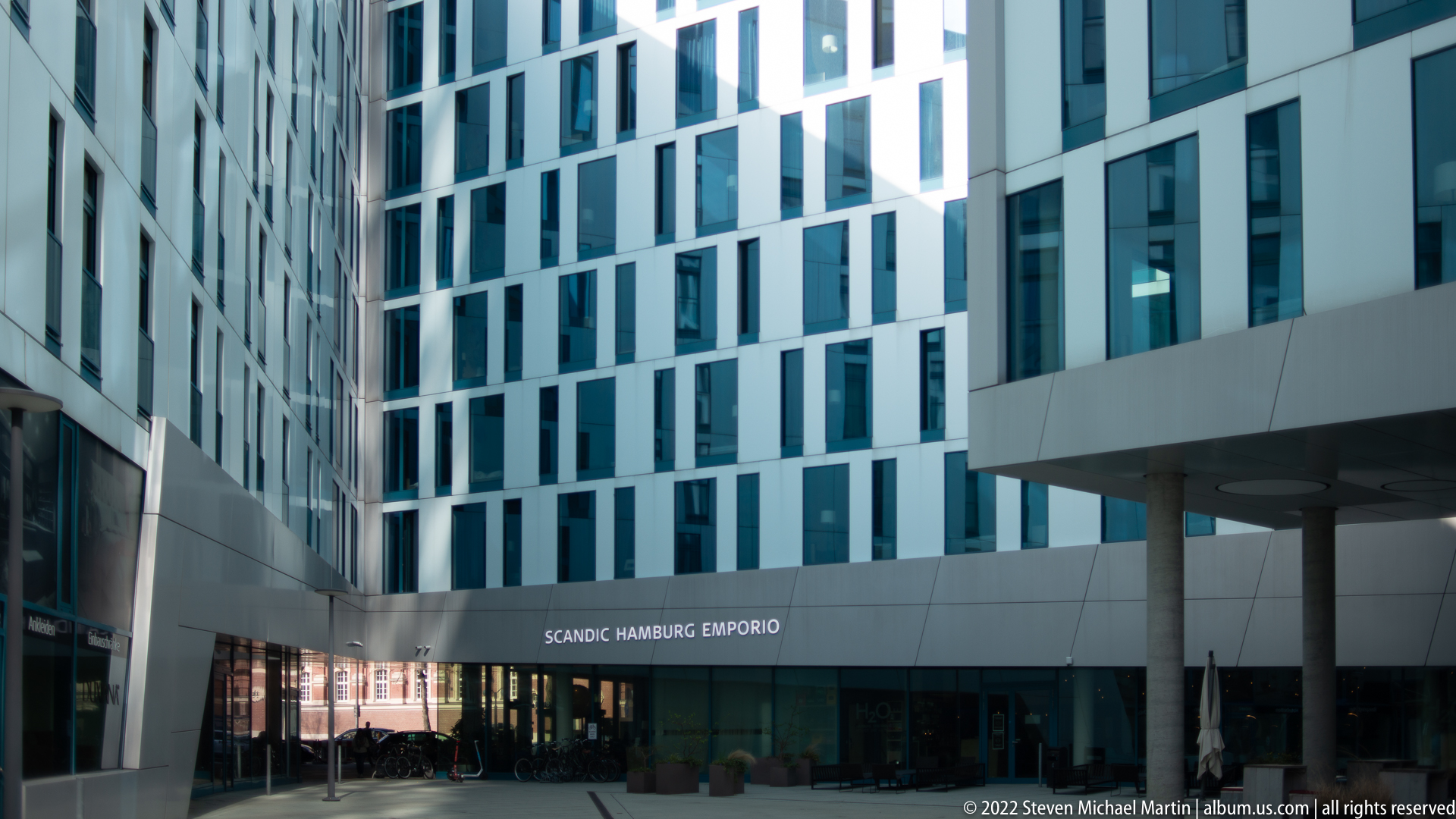
The entrance to Scandic Hamburg Emporio sits within a narrow modern courtyard formed by white façades punctuated with irregular dark windows. A projecting canopy leads toward the recessed hotel doors, while sharp sunlight creates reflective patches across the upper walls. The composition emphasizes the geometric enclosure more than the street outside.
Caption
The entrance to Scandic Hamburg Emporio sits within a narrow modern courtyard formed by white façades punctuated with irregular dark windows. A projecting canopy leads toward the recessed hotel doors, while sharp sunlight creates reflective patches across the upper walls. The composition emphasizes the geometric enclosure more than the street outside.
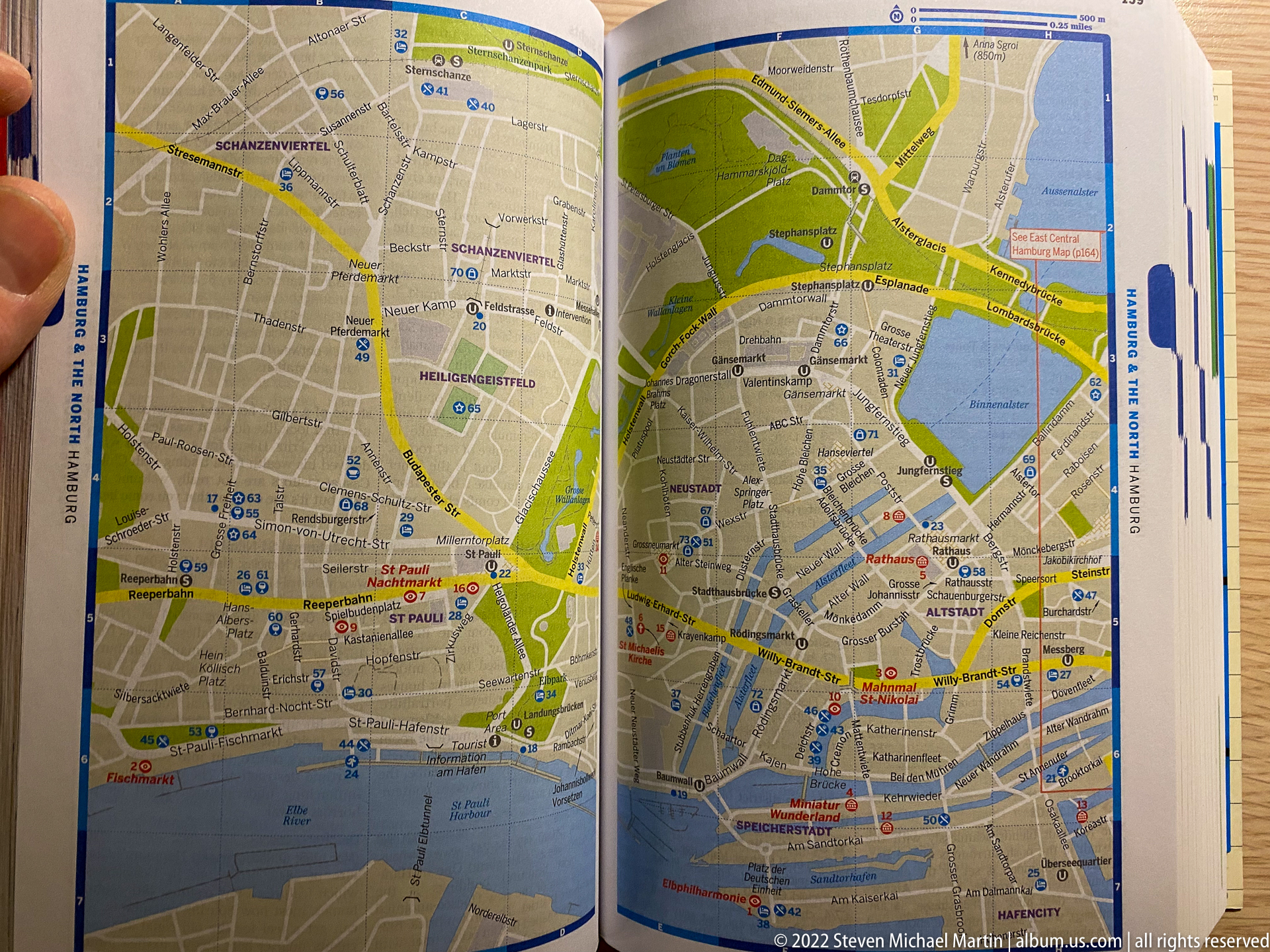
An open printed map shows central Hamburg with major streets, parks, waterways, and districts labeled across two facing pages. The Elbe waterfront occupies the lower edge while the Alster lakes and inner-city street network extend above. The photograph records the practical cartographic context used to navigate the city rather than a specific landmark.
Caption
An open printed map shows central Hamburg with major streets, parks, waterways, and districts labeled across two facing pages. The Elbe waterfront occupies the lower edge while the Alster lakes and inner-city street network extend above. The photograph records the practical cartographic context used to navigate the city rather than a specific landmark.
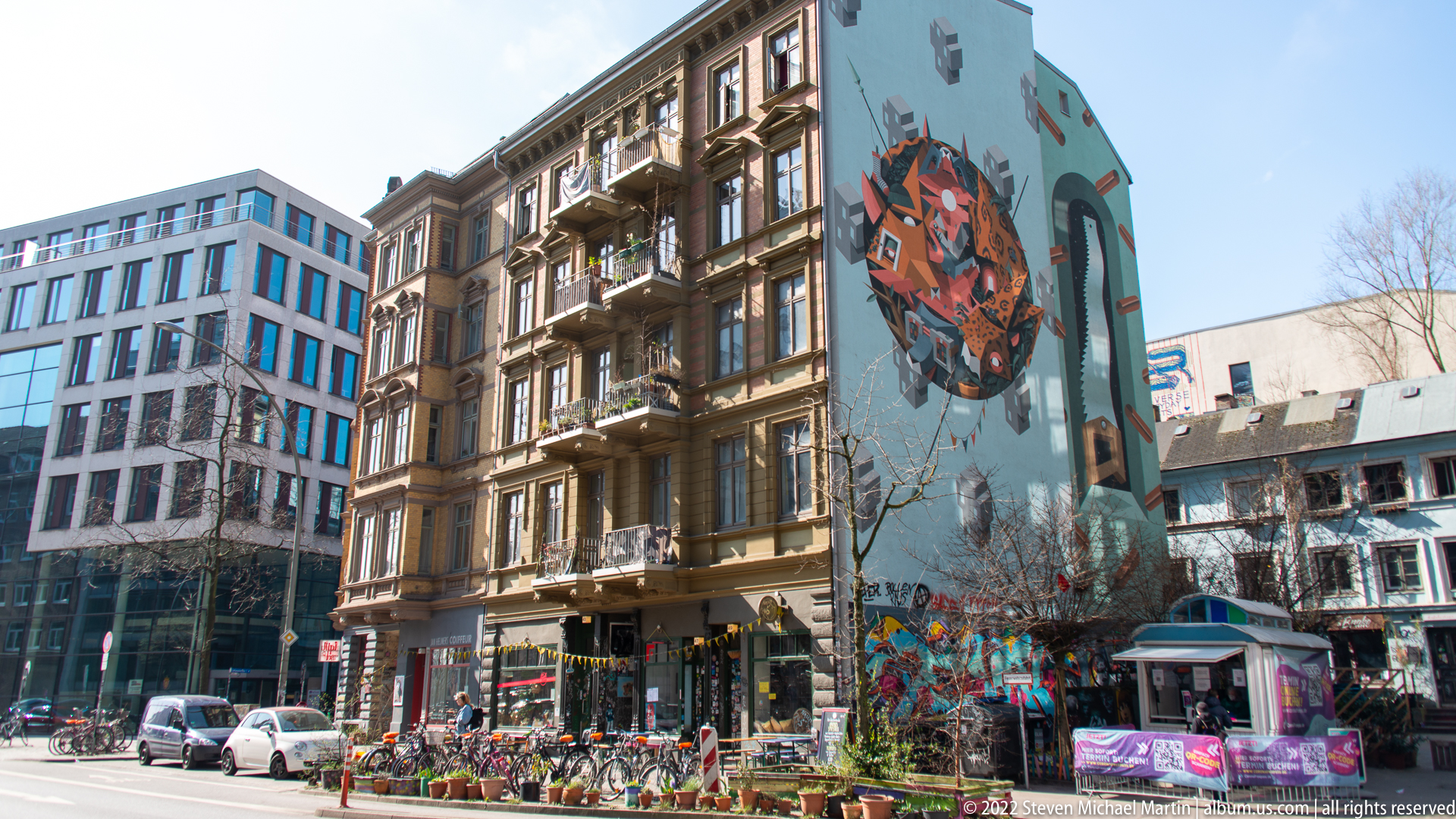
A large multicolored mural covers the blank side wall of a historic apartment building, with a stylized mechanical or animal-like figure painted against a pale blue field. Smaller graffiti and colorful objects cluster at street level, creating a layered urban-art environment between older masonry façades and newer commercial buildings.
Caption
A large multicolored mural covers the blank side wall of a historic apartment building, with a stylized mechanical or animal-like figure painted against a pale blue field. Smaller graffiti and colorful objects cluster at street level, creating a layered urban-art environment between older masonry façades and newer commercial buildings.
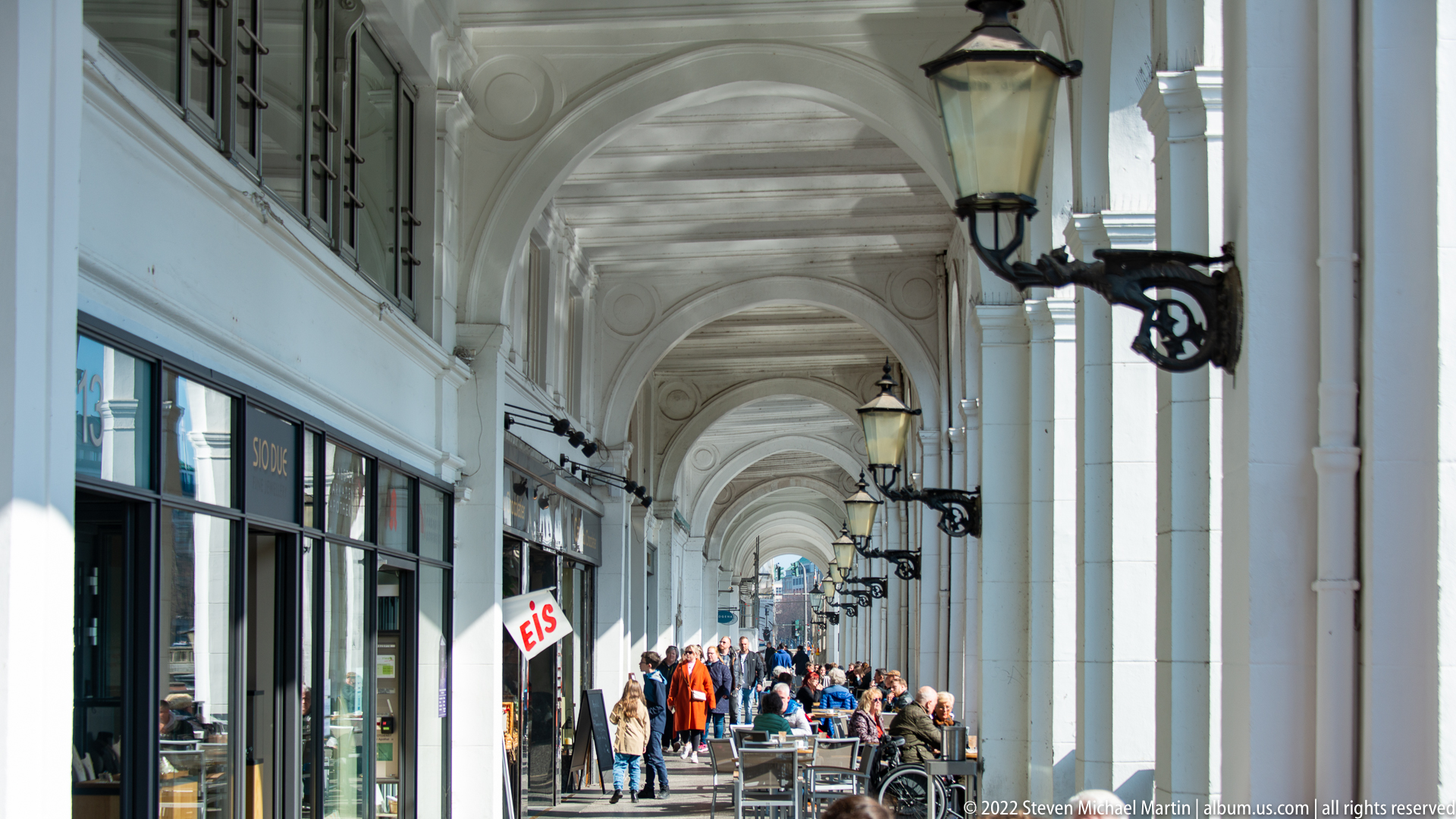
A long white colonnade recedes into the distance through repeated arches, columns, and wall-mounted lanterns, sheltering shops and café seating along the pedestrian passage. Strong sunlight and deep shade alternate across the arcade, emphasizing its rhythm and the social activity of people walking, sitting, and browsing beneath the covered walkway.
Caption
A long white colonnade recedes into the distance through repeated arches, columns, and wall-mounted lanterns, sheltering shops and café seating along the pedestrian passage. Strong sunlight and deep shade alternate across the arcade, emphasizing its rhythm and the social activity of people walking, sitting, and browsing beneath the covered walkway.
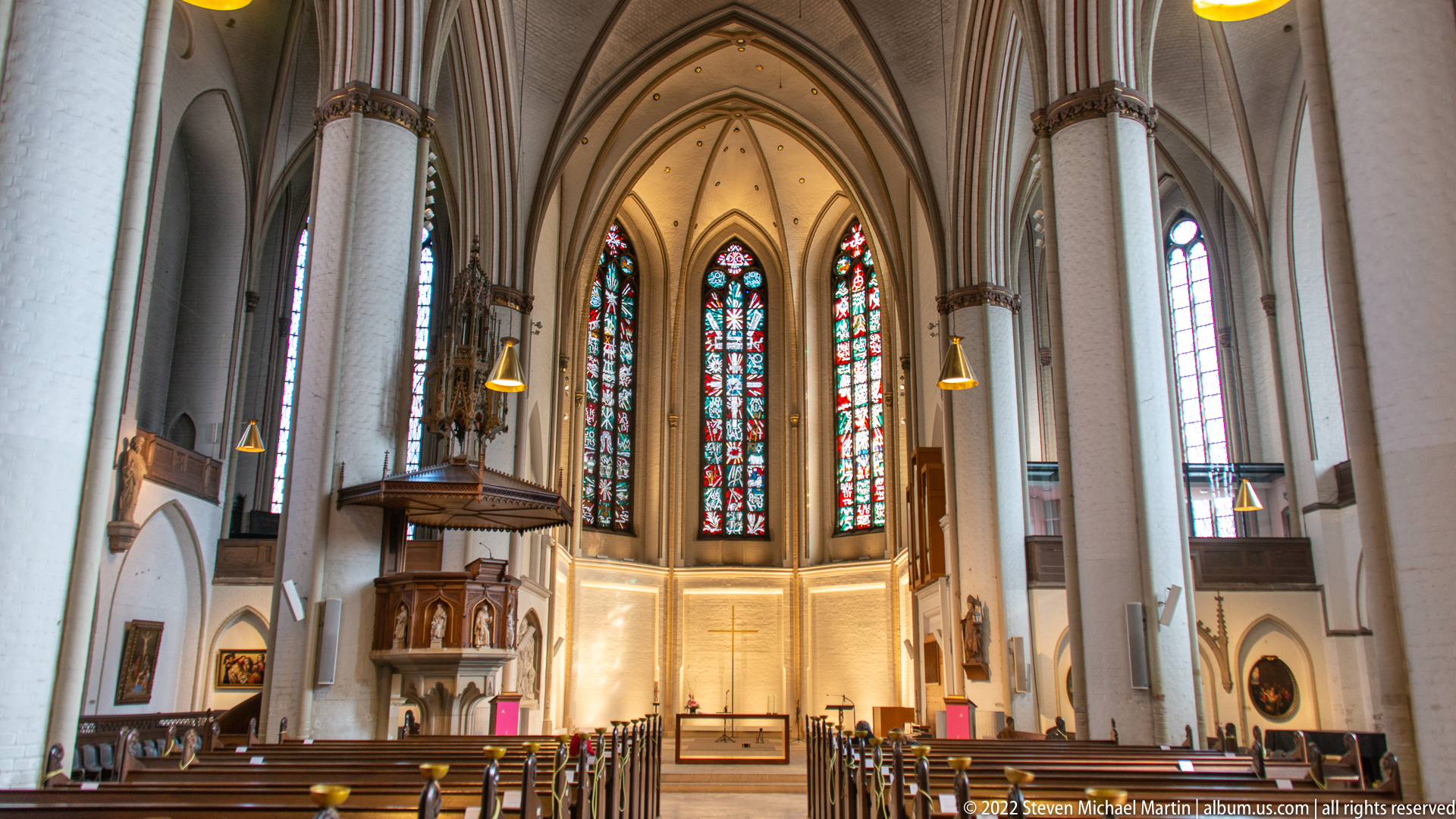
The nave of St. Peter’s Church is defined by tall pale columns, pointed Gothic arches, and a bright group of stained-glass windows behind the altar. Rows of wooden pews lead toward the east end, while a carved pulpit projects from one pier. The balanced central viewpoint conveys both the church’s vertical scale and its restrained interior palette.
Caption
The nave of St. Peter’s Church is defined by tall pale columns, pointed Gothic arches, and a bright group of stained-glass windows behind the altar. Rows of wooden pews lead toward the east end, while a carved pulpit projects from one pier. The balanced central viewpoint conveys both the church’s vertical scale and its restrained interior palette.
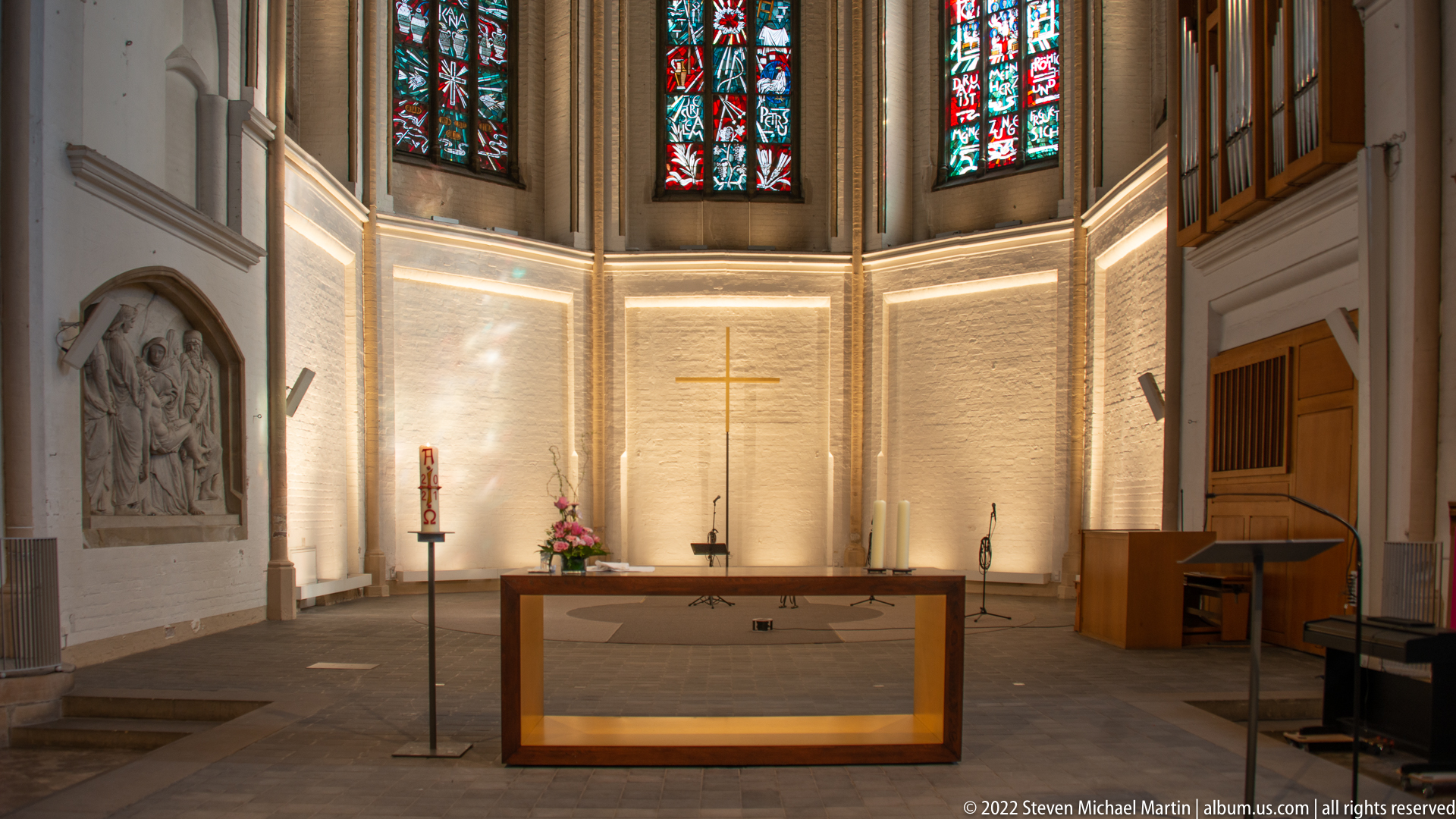
A restrained altar table stands in a bright polygonal chancel beneath tall stained-glass windows, with a simple gold cross mounted on the pale brick wall behind. A carved stone relief survives on the left, while organ or choir fittings occupy the right side. The composition balances historic church fabric with comparatively spare modern liturgical furnishings.
Caption
A restrained altar table stands in a bright polygonal chancel beneath tall stained-glass windows, with a simple gold cross mounted on the pale brick wall behind. A carved stone relief survives on the left, while organ or choir fittings occupy the right side. The composition balances historic church fabric with comparatively spare modern liturgical furnishings.
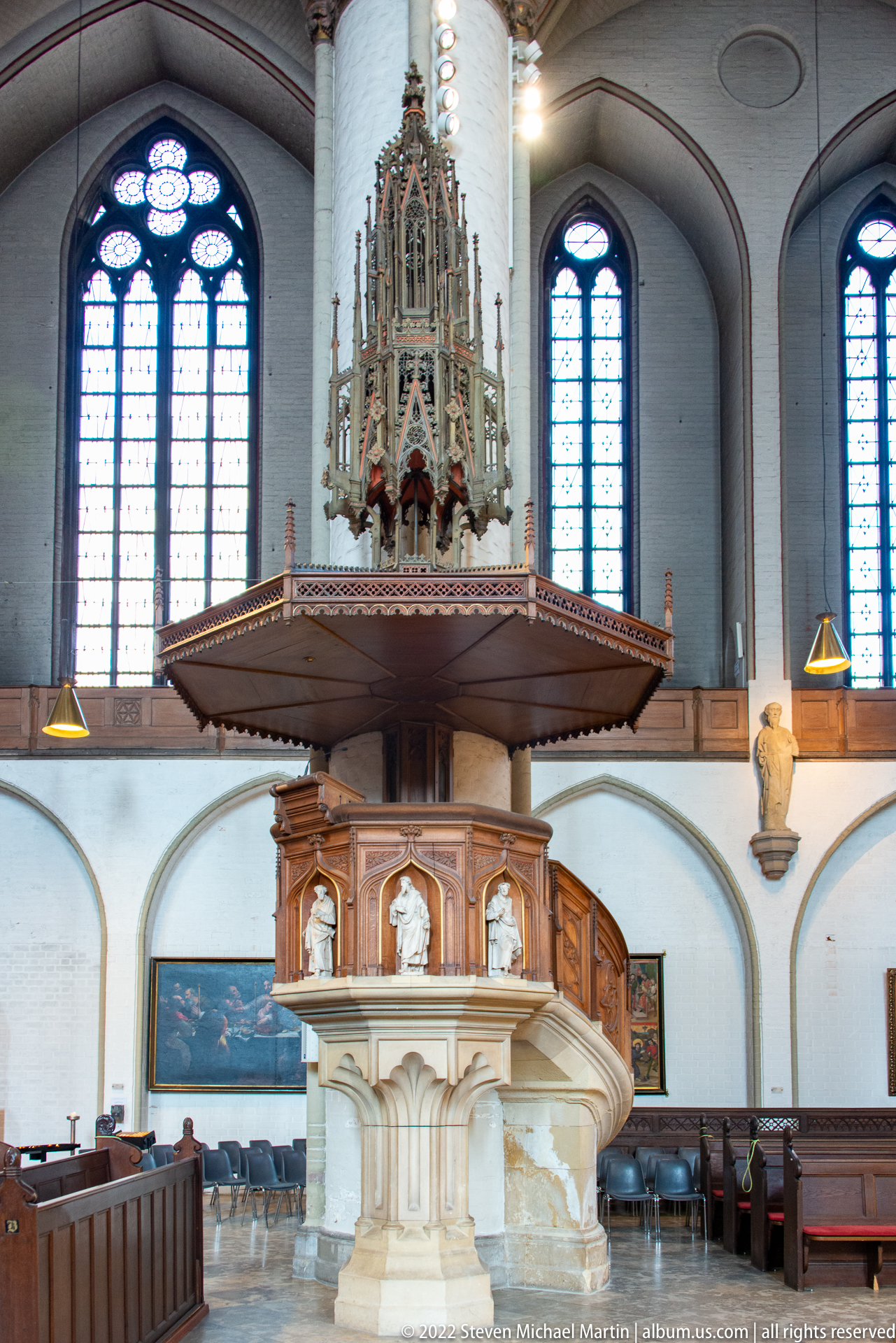
A monumental carved pulpit stands beneath tall stained-glass windows, combining a pale stone base with a richly modeled wooden preaching platform and elaborate Gothic canopy. Small sculpted figures occupy niches around the pulpit body, while the upward-reaching canopy echoes the vertical proportions of the surrounding church architecture and stained glass.
Caption
A monumental carved pulpit stands beneath tall stained-glass windows, combining a pale stone base with a richly modeled wooden preaching platform and elaborate Gothic canopy. Small sculpted figures occupy niches around the pulpit body, while the upward-reaching canopy echoes the vertical proportions of the surrounding church architecture and stained glass.
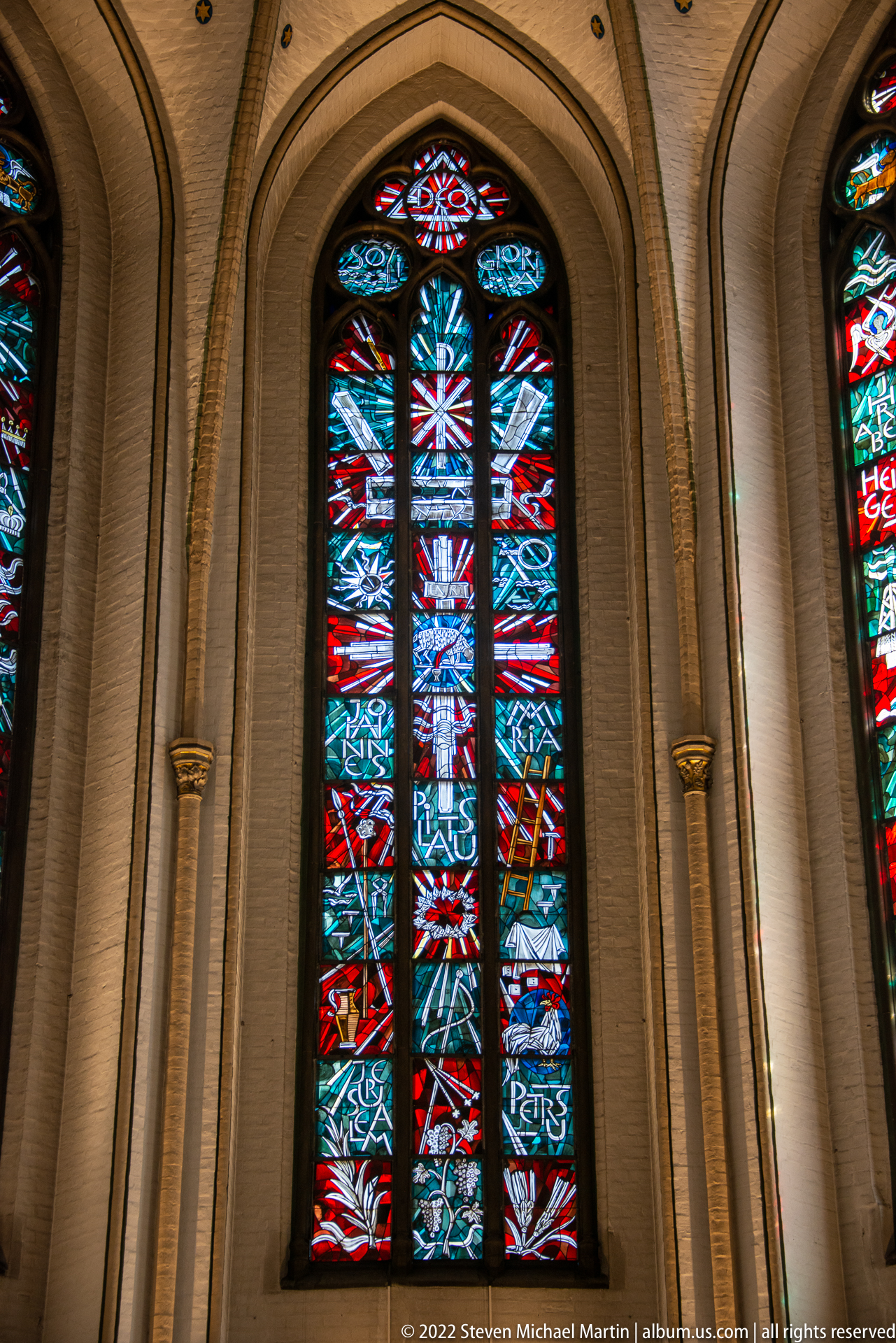
A tall pointed stained-glass window is filled with angular red, blue, white, and black forms arranged in dense symbolic bands. Strong vertical mullions divide the composition into narrow lights, while the surrounding pale brick arch retains the Gothic architectural frame. The saturated glass provides a vivid modern counterpoint to the historic church interior.
Caption
A tall pointed stained-glass window is filled with angular red, blue, white, and black forms arranged in dense symbolic bands. Strong vertical mullions divide the composition into narrow lights, while the surrounding pale brick arch retains the Gothic architectural frame. The saturated glass provides a vivid modern counterpoint to the historic church interior.
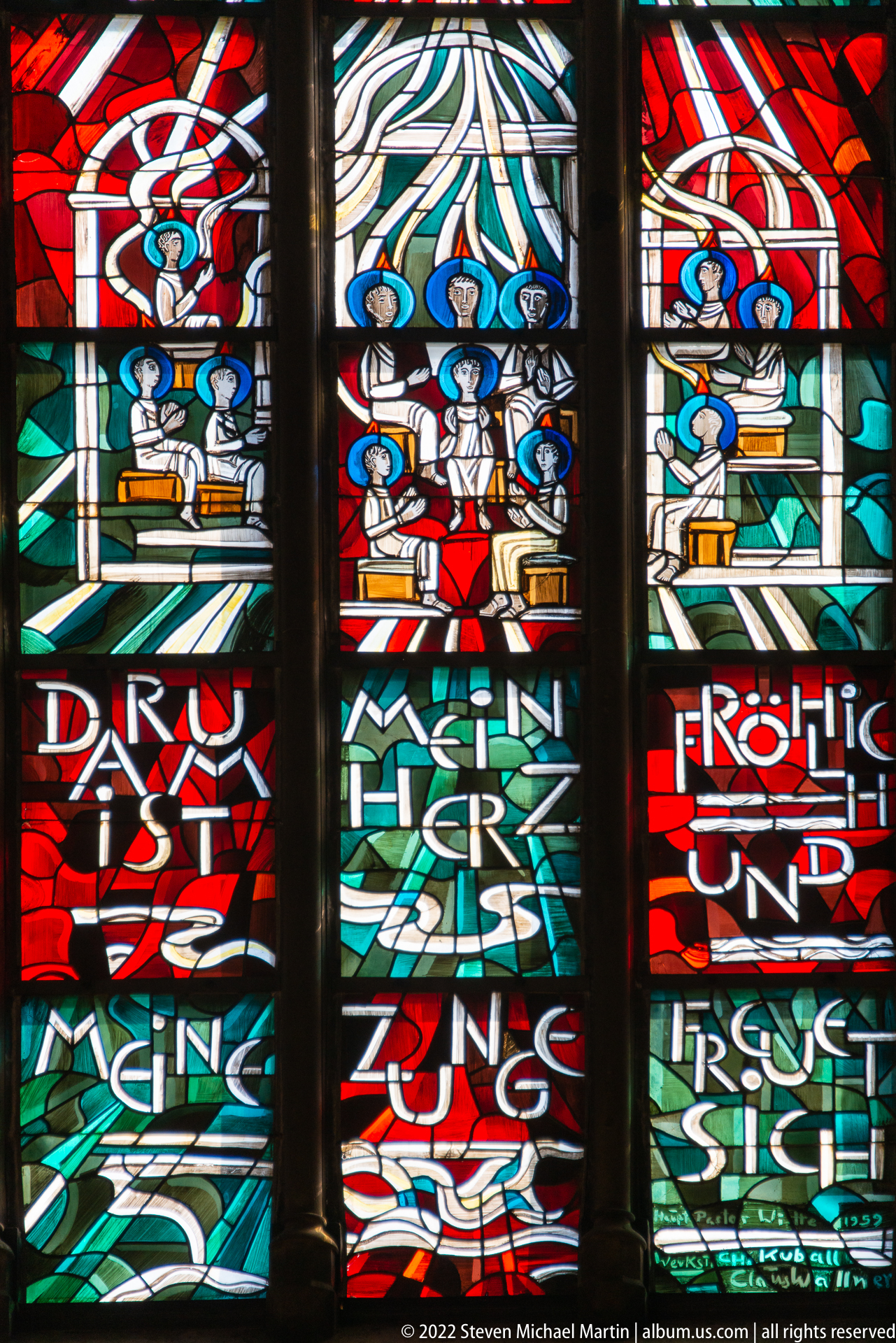
Three stained-glass lights combine stylized human figures with sweeping bands of red, green, blue, and white glass and fragments of large lettering. Groups of worshippers or attendants occupy the central and side panels, while bold black leading creates a graphic, almost calligraphic rhythm across the religious composition.
Caption
Three stained-glass lights combine stylized human figures with sweeping bands of red, green, blue, and white glass and fragments of large lettering. Groups of worshippers or attendants occupy the central and side panels, while bold black leading creates a graphic, almost calligraphic rhythm across the religious composition.
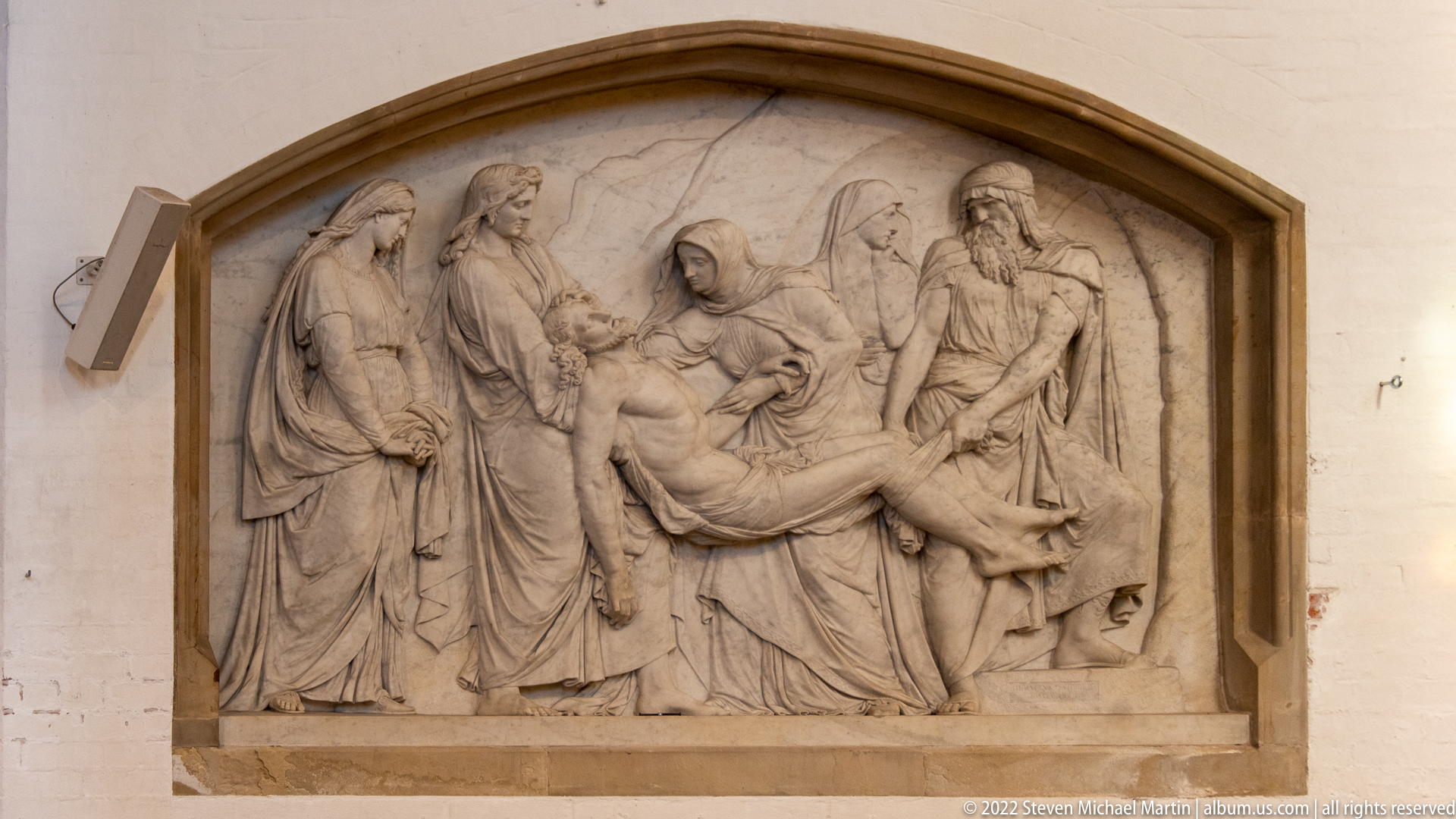
A pale stone relief shows the dead Christ supported across the lap of a central mourning woman, surrounded by standing and kneeling figures beneath a shallow pointed frame. The compressed sculptural group emphasizes grief through bowed heads, clasped hands, and closely overlapping bodies, creating an intimate devotional scene within the church interior.
Caption
A pale stone relief shows the dead Christ supported across the lap of a central mourning woman, surrounded by standing and kneeling figures beneath a shallow pointed frame. The compressed sculptural group emphasizes grief through bowed heads, clasped hands, and closely overlapping bodies, creating an intimate devotional scene within the church interior.
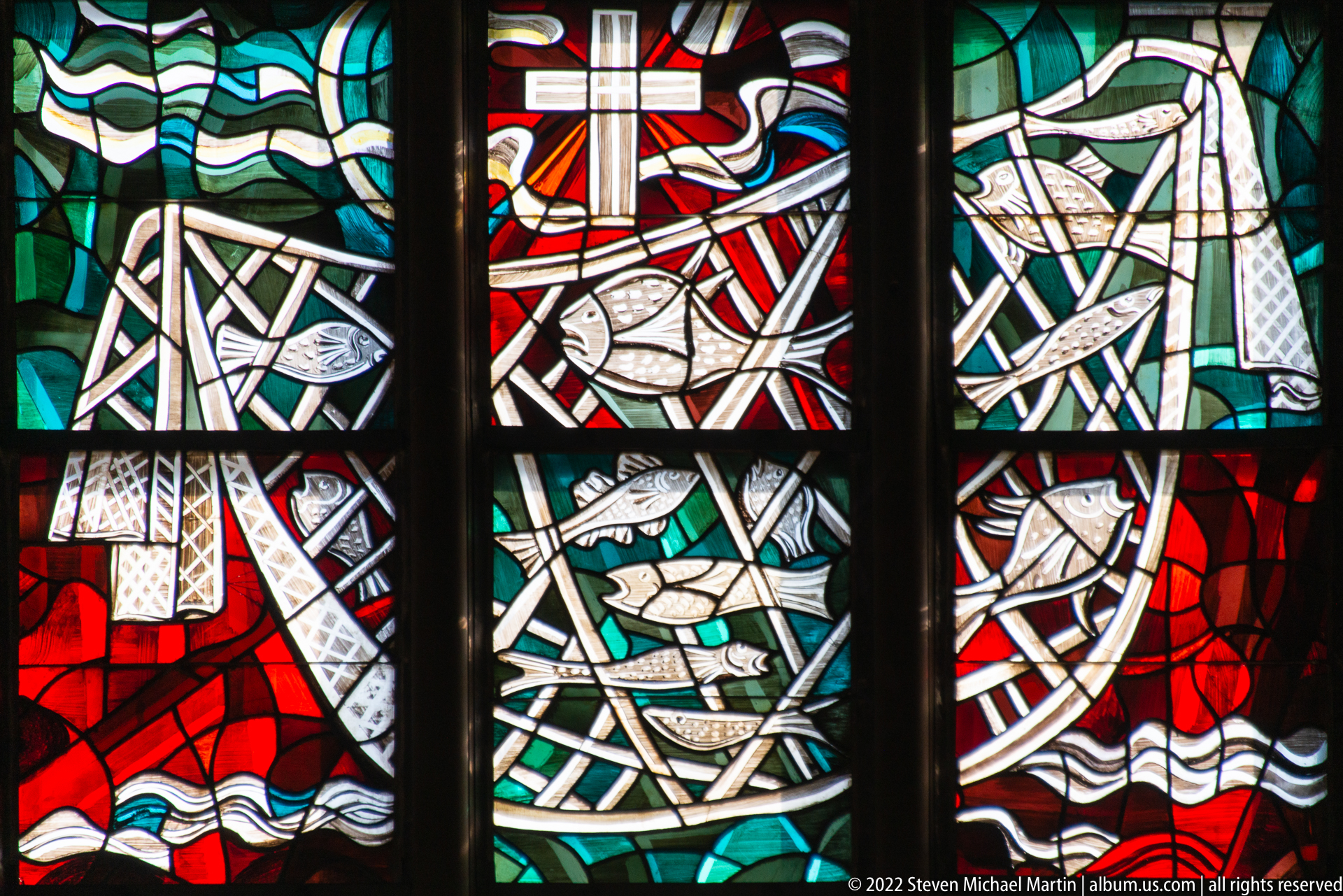
A symbolic stained-glass window combines repeated fish, nets or interlaced lines, waves, and a cross within a vivid red, green, white, and black composition. The imagery strongly evokes Christian maritime symbolism, while the geometric treatment gives the window a modern graphic character. Each light functions as a distinct symbolic field within the larger design.
Caption
A symbolic stained-glass window combines repeated fish, nets or interlaced lines, waves, and a cross within a vivid red, green, white, and black composition. The imagery strongly evokes Christian maritime symbolism, while the geometric treatment gives the window a modern graphic character. Each light functions as a distinct symbolic field within the larger design.
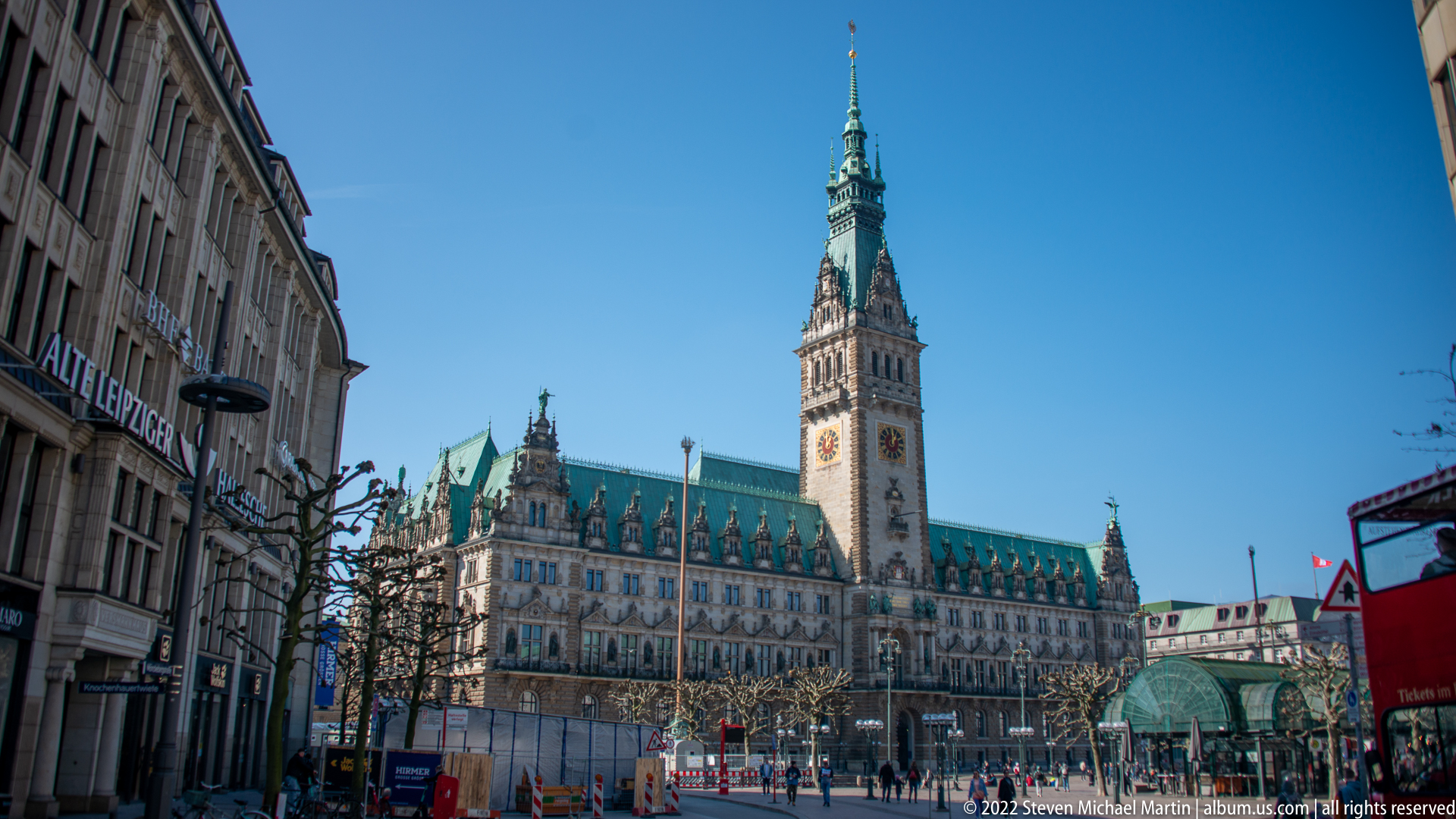
Hamburg Rathaus dominates the open square beneath a clear blue sky, its richly articulated historicist façade stretching horizontally beneath a steep green copper roof and tall central clock tower. Seen from street level, the building’s long civic frontage and vertical tower are presented together as a single urban landmark within central Hamburg.
Caption
Hamburg Rathaus dominates the open square beneath a clear blue sky, its richly articulated historicist façade stretching horizontally beneath a steep green copper roof and tall central clock tower. Seen from street level, the building’s long civic frontage and vertical tower are presented together as a single urban landmark within central Hamburg.
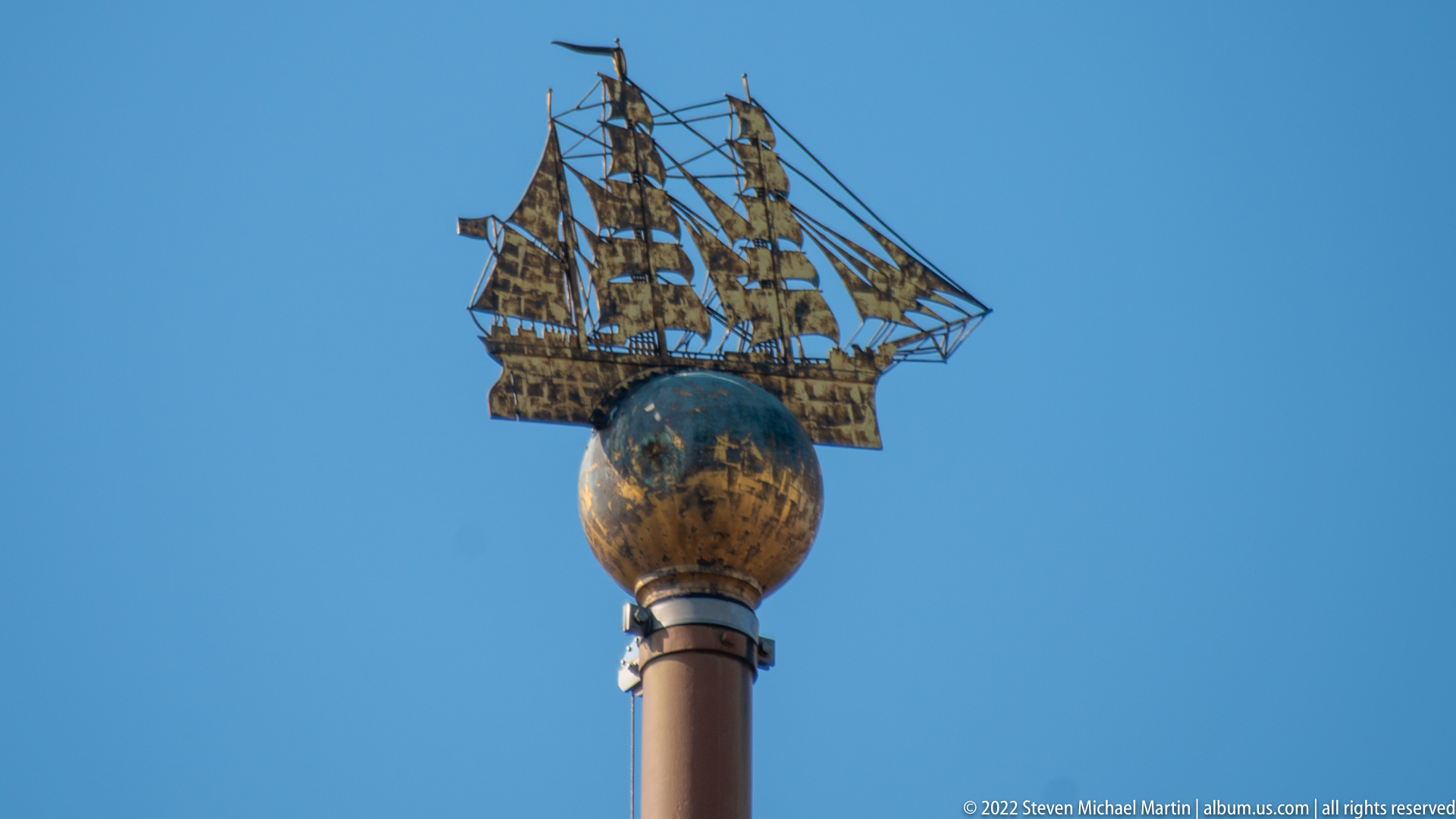
A detailed golden sailing ship crowns a large globe mounted on a tall column, its multiple masts, square sails, and rigging silhouetted against the blue sky. The combination of vessel and globe turns maritime travel into civic symbolism, linking Hamburg visually with seaborne commerce and long-distance exchange.
Caption
A detailed golden sailing ship crowns a large globe mounted on a tall column, its multiple masts, square sails, and rigging silhouetted against the blue sky. The combination of vessel and globe turns maritime travel into civic symbolism, linking Hamburg visually with seaborne commerce and long-distance exchange.
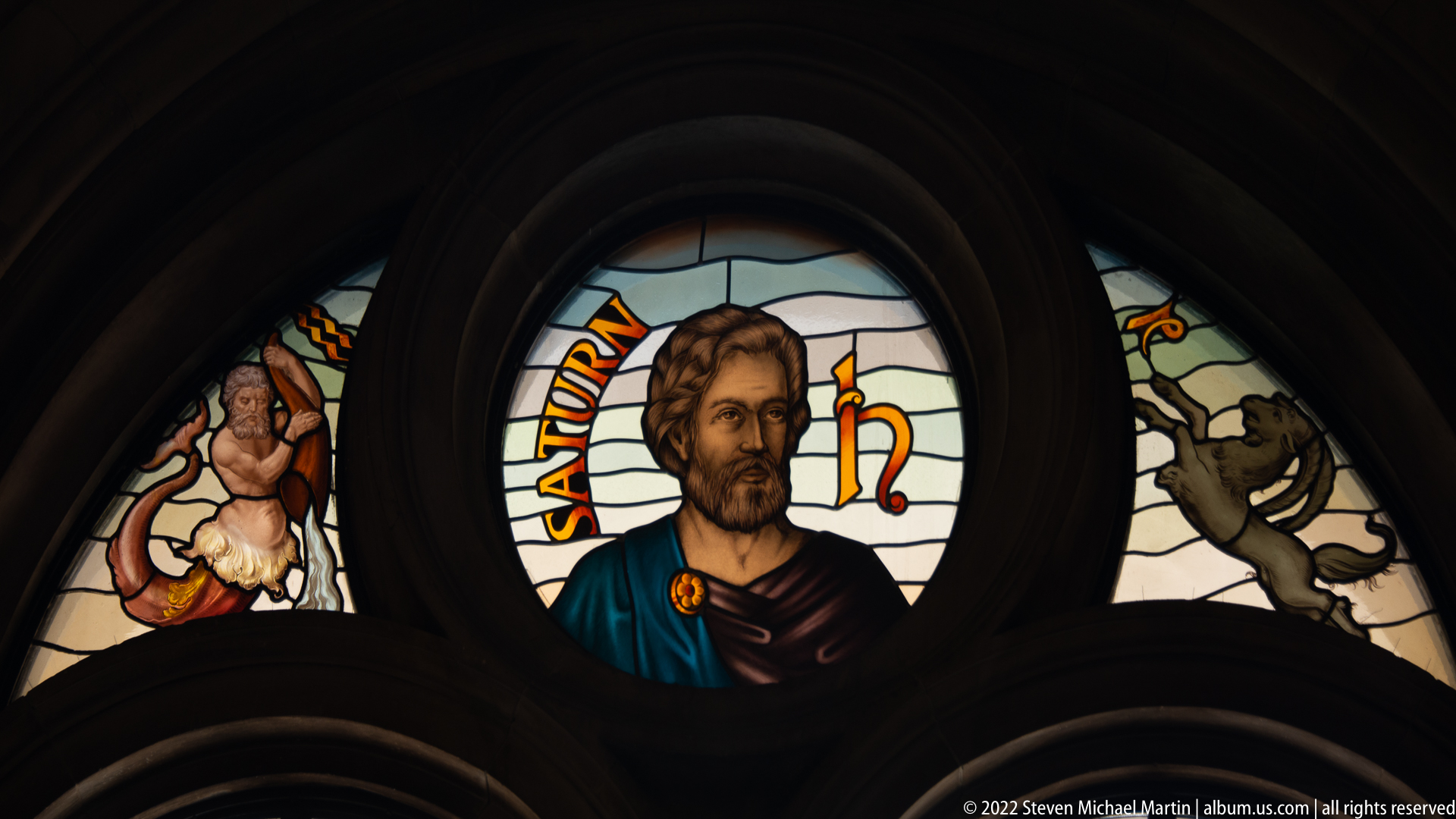
A circular stained-glass portrait depicts a bearded male figure explicitly labeled “SATURN,” framed by adjacent symbolic panels within dark Gothic tracery. The planetary or classical identity is confirmed by the inscription, while the surrounding imagery suggests a larger allegorical cycle of celestial or mythological figures.
Caption
A circular stained-glass portrait depicts a bearded male figure explicitly labeled “SATURN,” framed by adjacent symbolic panels within dark Gothic tracery. The planetary or classical identity is confirmed by the inscription, while the surrounding imagery suggests a larger allegorical cycle of celestial or mythological figures.
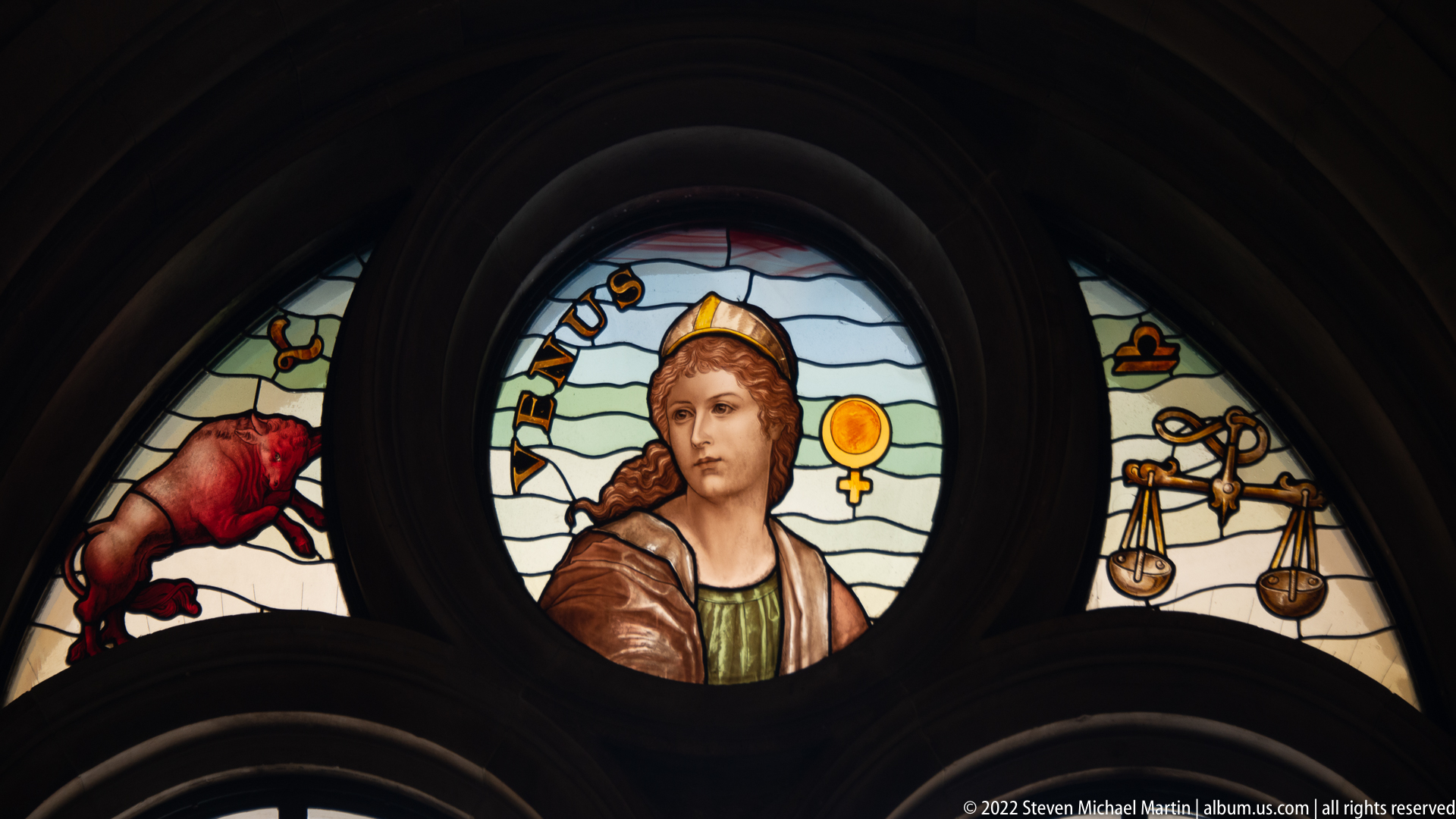
A female figure wearing a small crown occupies the central roundel of a stained-glass panel labeled “VENUS.” Smaller side scenes include a red animal and a pair of scales, adding symbolic attributes to the broader decorative cycle. The bright glass is set within deep dark tracery that isolates the portrait like a jewel.
Caption
A female figure wearing a small crown occupies the central roundel of a stained-glass panel labeled “VENUS.” Smaller side scenes include a red animal and a pair of scales, adding symbolic attributes to the broader decorative cycle. The bright glass is set within deep dark tracery that isolates the portrait like a jewel.
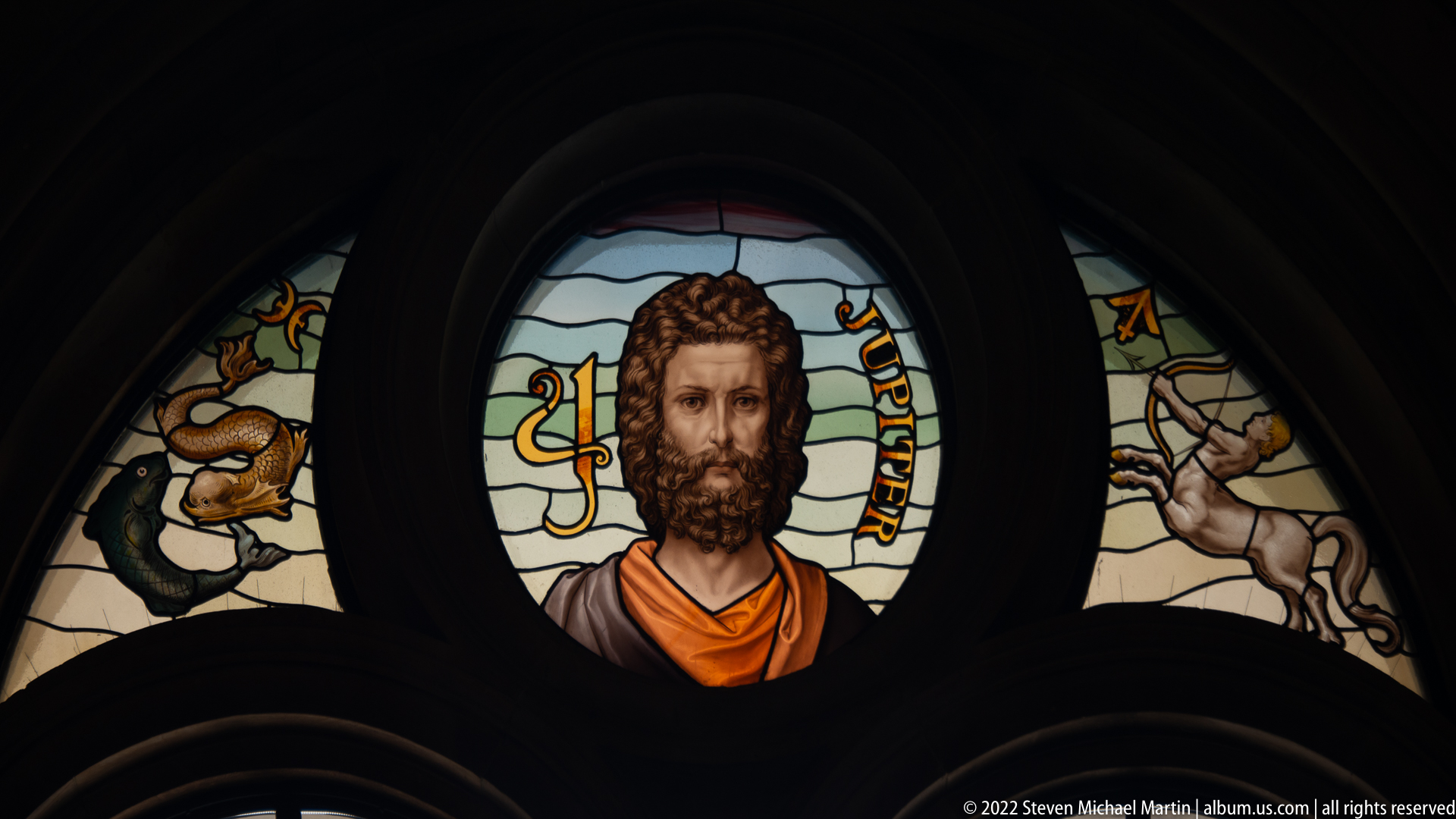
A bearded male portrait labeled “JUPITER” fills the central roundel of another stained-glass panel, accompanied by small symbolic scenes including a ram-like animal and a winged figure. Strong outlines and muted blue-green backgrounds keep the mythological portrait visually dominant within the dark window framework.
Caption
A bearded male portrait labeled “JUPITER” fills the central roundel of another stained-glass panel, accompanied by small symbolic scenes including a ram-like animal and a winged figure. Strong outlines and muted blue-green backgrounds keep the mythological portrait visually dominant within the dark window framework.
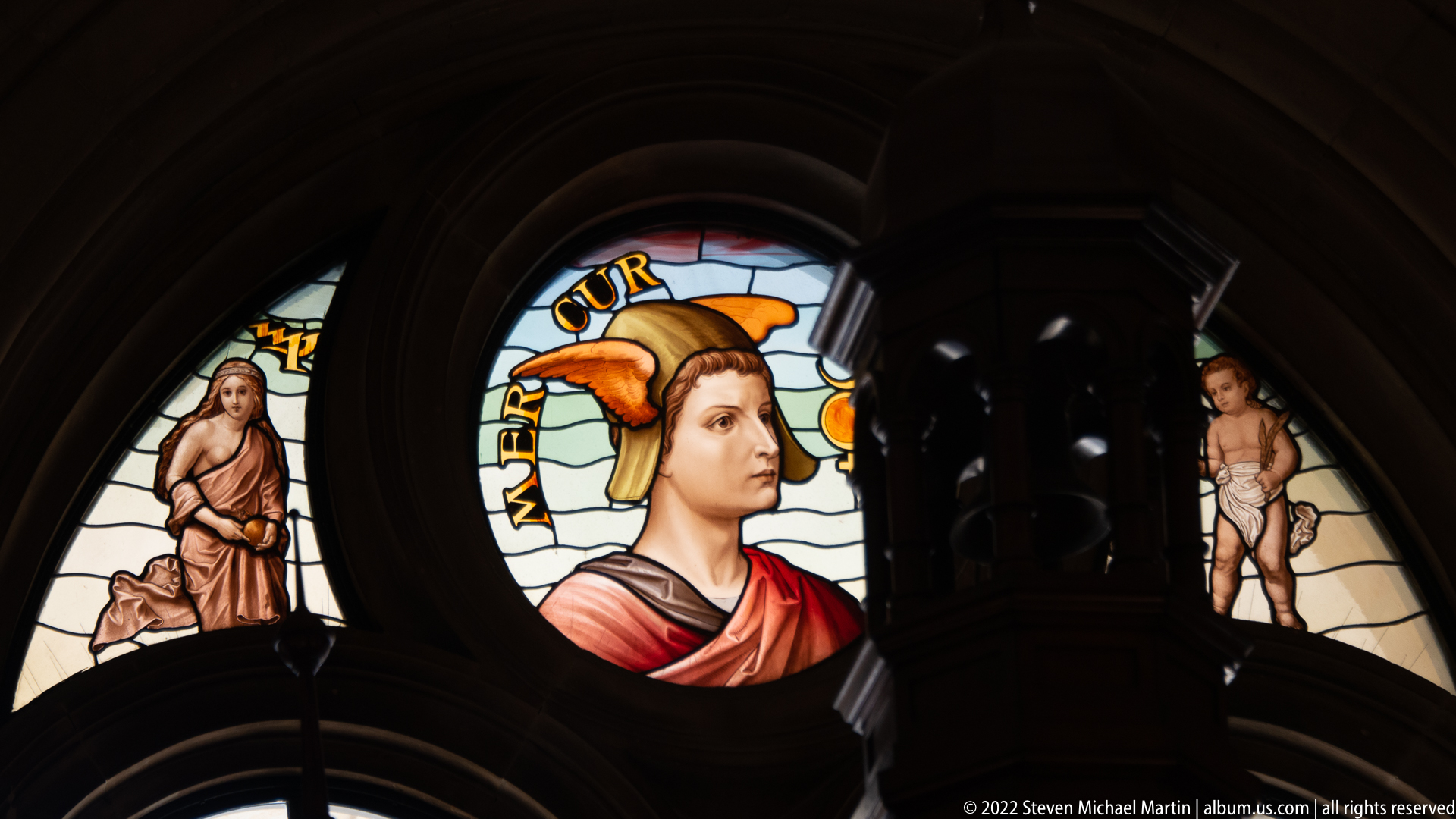
A youthful profile wearing a winged helmet appears in a circular stained-glass portrait labeled “MERCUR,” the German form of Mercury. Smaller side panels contain additional allegorical figures. The winged headgear and explicit inscription reinforce the messenger god’s identity within the Rathaus window’s larger mythological sequence.
Caption
A youthful profile wearing a winged helmet appears in a circular stained-glass portrait labeled “MERCUR,” the German form of Mercury. Smaller side panels contain additional allegorical figures. The winged headgear and explicit inscription reinforce the messenger god’s identity within the Rathaus window’s larger mythological sequence.
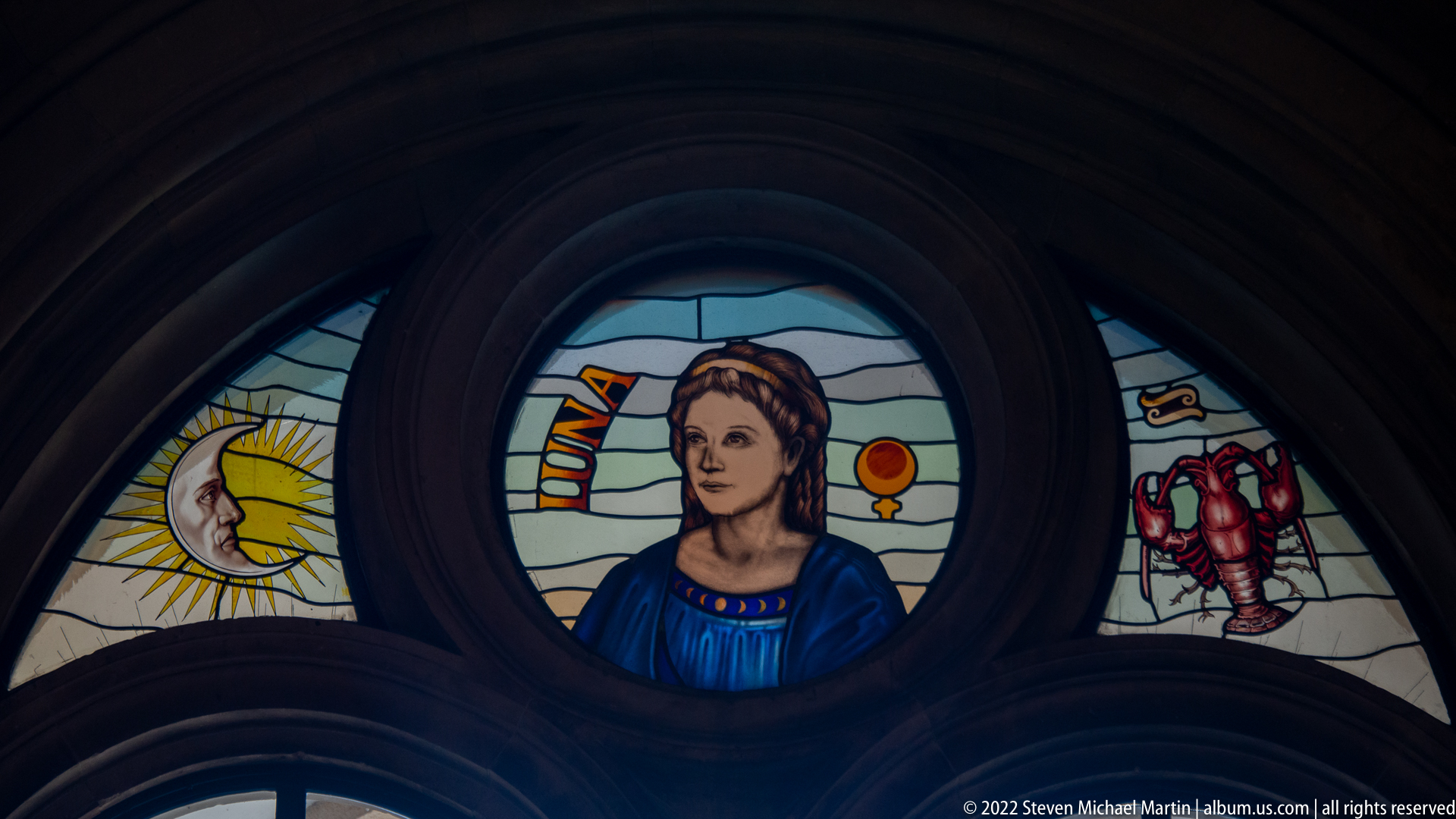
A female portrait labeled “LUNA” occupies the central roundel of the stained-glass composition, flanked by a crescent moon and a red crustacean-like zodiac symbol. The cool blue clothing and pale background reinforce the lunar theme, while dark tracery isolates the celestial figure from surrounding decorative panels.
Caption
A female portrait labeled “LUNA” occupies the central roundel of the stained-glass composition, flanked by a crescent moon and a red crustacean-like zodiac symbol. The cool blue clothing and pale background reinforce the lunar theme, while dark tracery isolates the celestial figure from surrounding decorative panels.
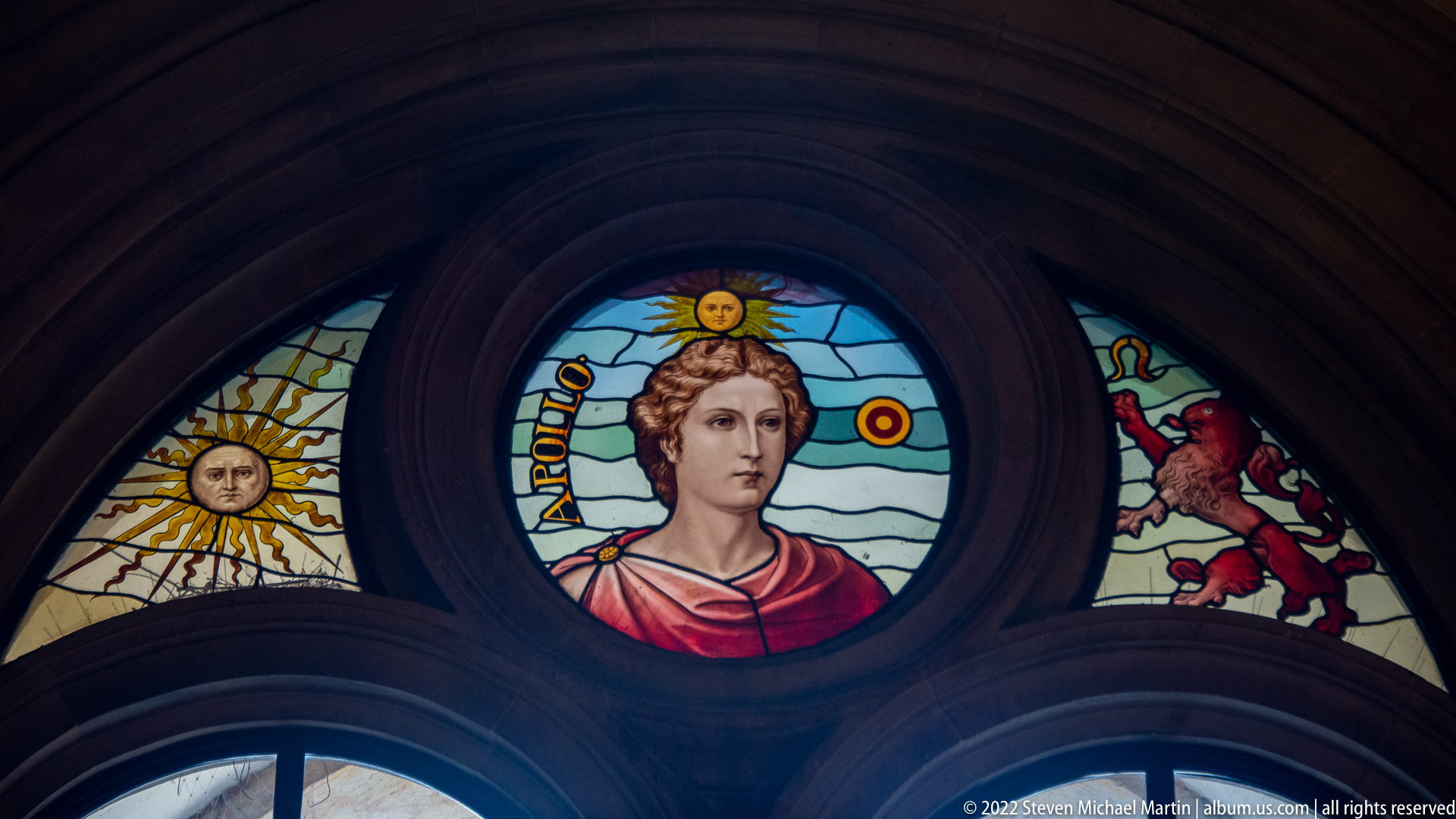
A youthful male figure labeled “APOLLO” fills the central stained-glass roundel, a radiant sun symbol positioned above his head. Additional side imagery includes a sun face and a red lion. The composition links the classical god with solar symbolism through both inscription and visible attributes.
Caption
A youthful male figure labeled “APOLLO” fills the central stained-glass roundel, a radiant sun symbol positioned above his head. Additional side imagery includes a sun face and a red lion. The composition links the classical god with solar symbolism through both inscription and visible attributes.
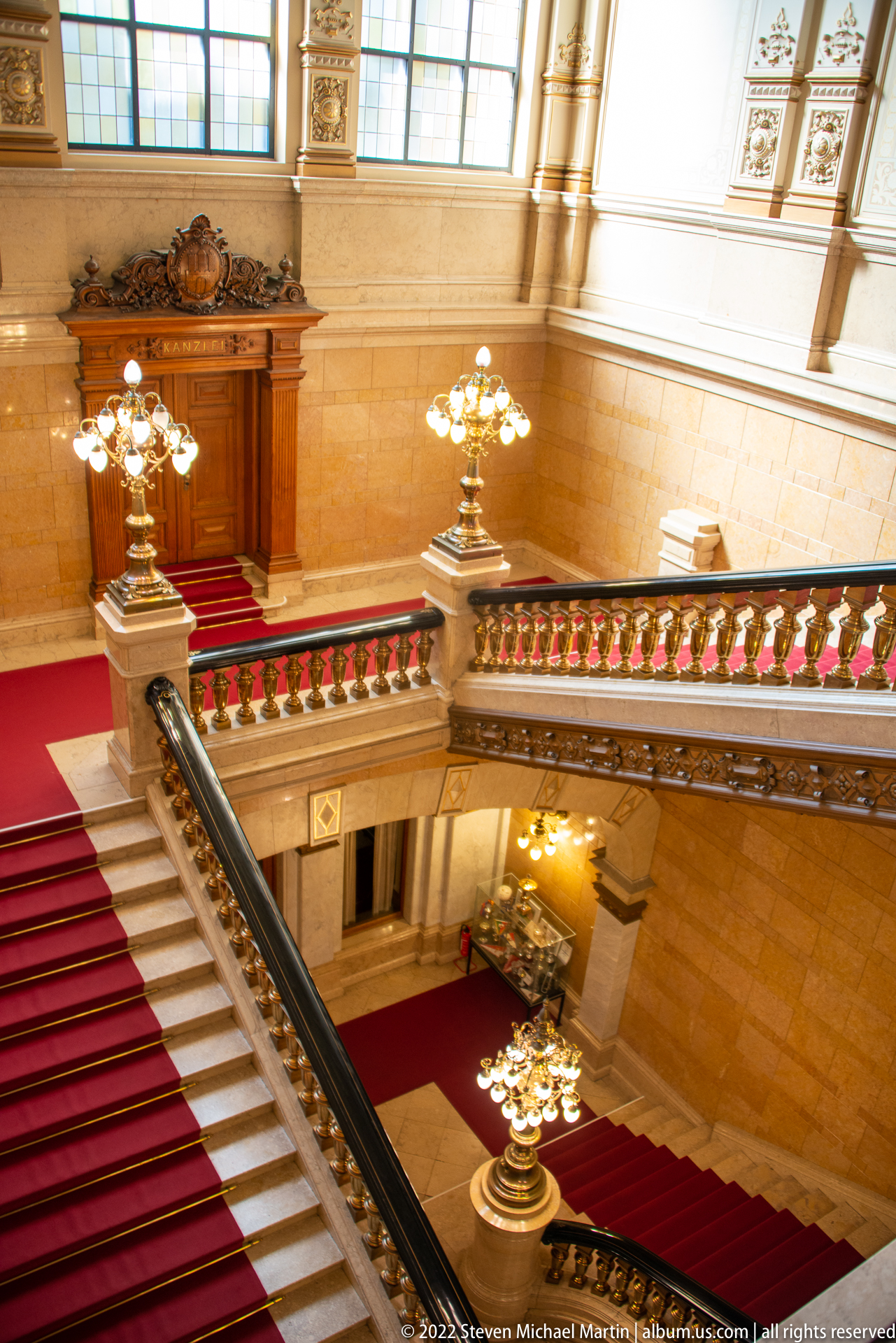
A broad red-carpeted staircase turns around a monumental stone balustrade beneath large arched windows in Hamburg Rathaus. Ornate brass chandeliers and carved architectural details give the stair hall a formal ceremonial character, while the elevated viewpoint reveals the landing, lower flight, and upper doorway as a continuous processional route.
Caption
A broad red-carpeted staircase turns around a monumental stone balustrade beneath large arched windows in Hamburg Rathaus. Ornate brass chandeliers and carved architectural details give the stair hall a formal ceremonial character, while the elevated viewpoint reveals the landing, lower flight, and upper doorway as a continuous processional route.
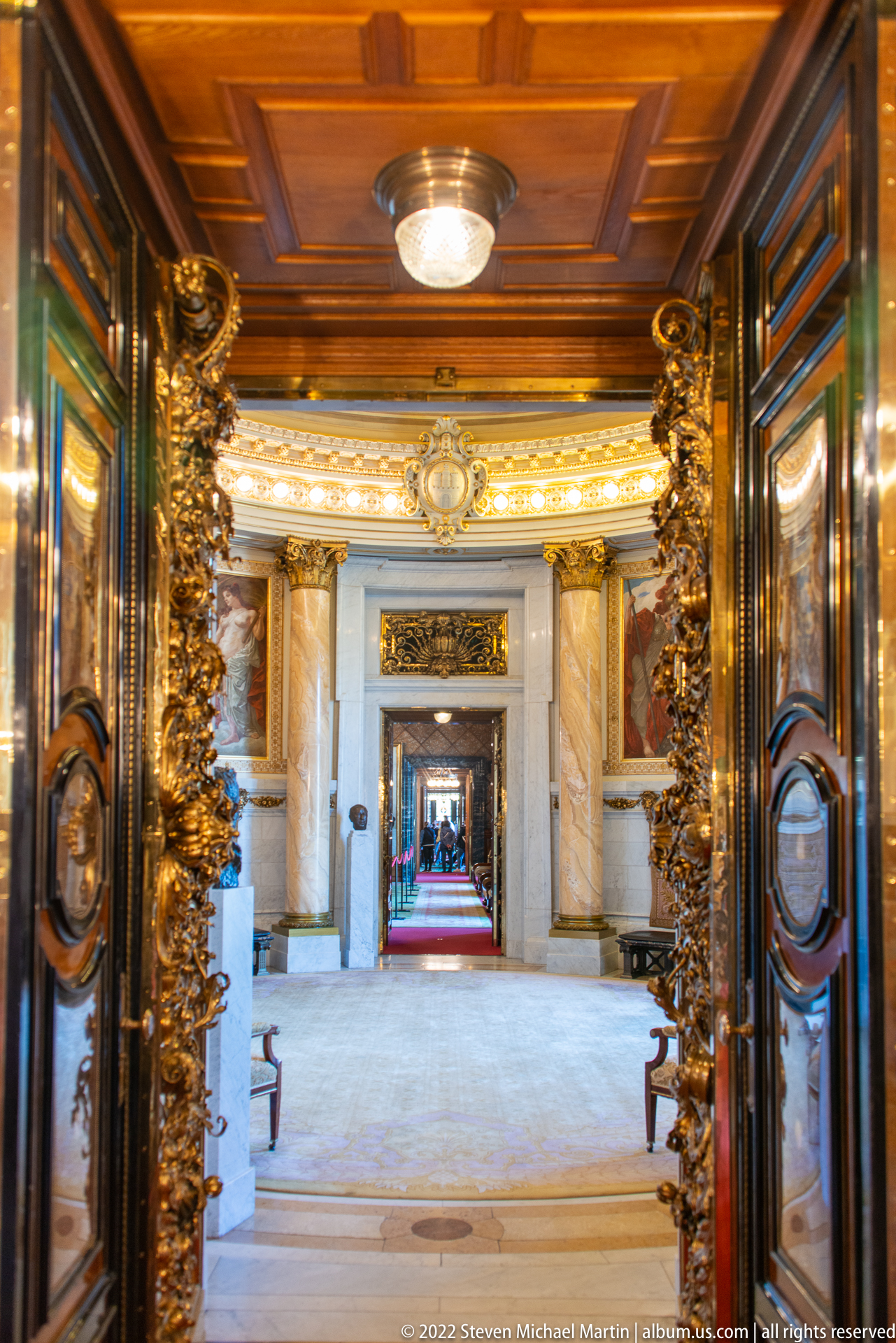
A sequence of ceremonial rooms opens through richly carved doorways inside Hamburg Rathaus, creating a long axial view across polished wood, marble-like wall surfaces, gilded ornament, and red carpeting in the distance. The layered doorframes make the enfilade itself the subject, emphasizing how successive state rooms were arranged to produce a formal processional experience.
Caption
A sequence of ceremonial rooms opens through richly carved doorways inside Hamburg Rathaus, creating a long axial view across polished wood, marble-like wall surfaces, gilded ornament, and red carpeting in the distance. The layered doorframes make the enfilade itself the subject, emphasizing how successive state rooms were arranged to produce a formal processional experience.
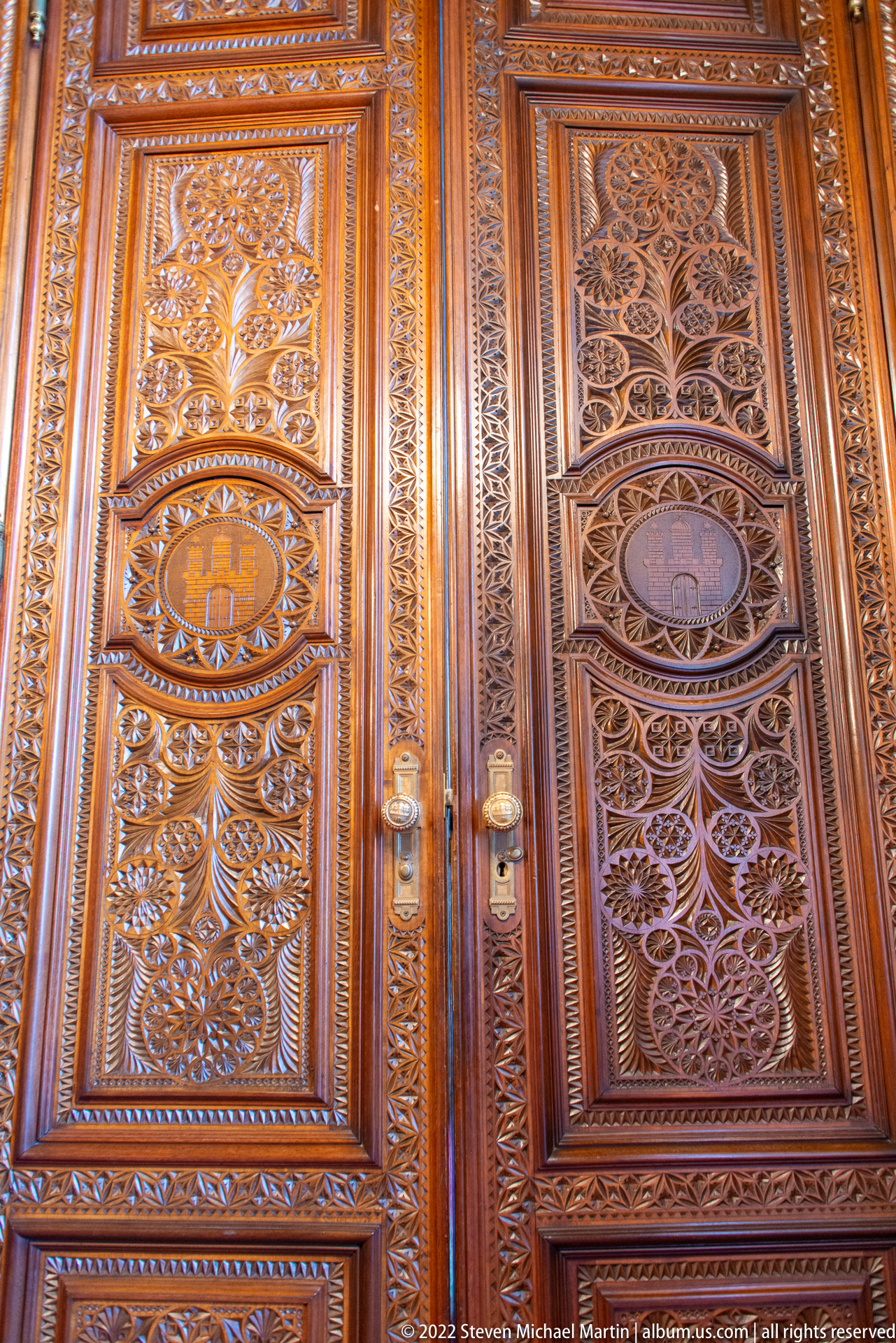
Highly carved double doors are covered with dense foliate openwork, geometric borders, and oval heraldic medallions set into the upper panels. Warm polished wood and symmetrical carving turn the doorway into a ceremonial object in its own right, while small brass hardware provides a restrained functional contrast to the elaborate surface decoration.
Caption
Highly carved double doors are covered with dense foliate openwork, geometric borders, and oval heraldic medallions set into the upper panels. Warm polished wood and symmetrical carving turn the doorway into a ceremonial object in its own right, while small brass hardware provides a restrained functional contrast to the elaborate surface decoration.
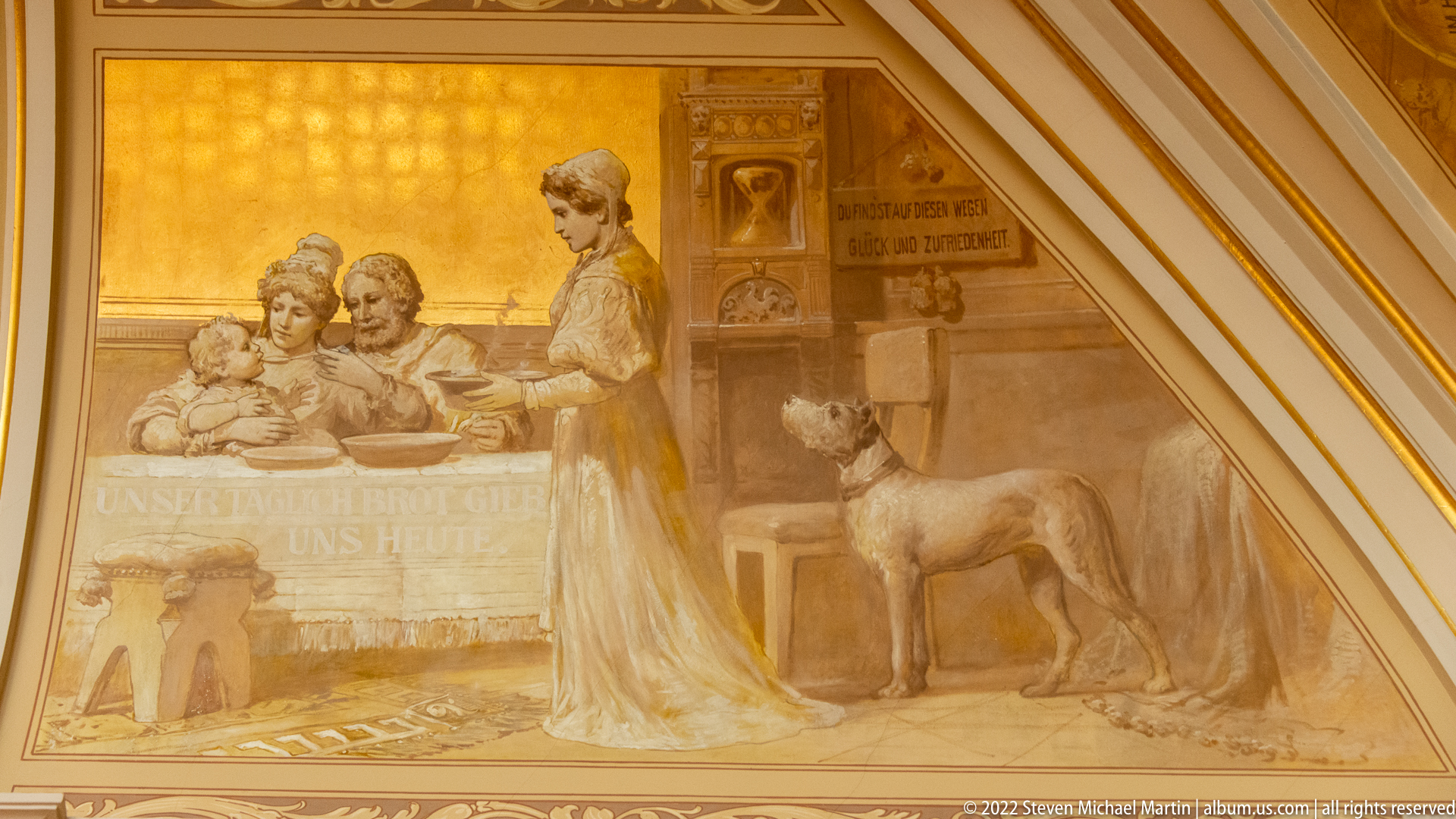
A large monochrome-toned wall painting presents women, children, and a dog in a domestic or civic allegorical scene, framed by gilded ornamental borders. A block of German text appears at the right, while an inscription runs across the lower portion. The subdued palette gives the mural the appearance of a historic civic narrative rather than a brightly colored decorative panel.
Caption
A large monochrome-toned wall painting presents women, children, and a dog in a domestic or civic allegorical scene, framed by gilded ornamental borders. A block of German text appears at the right, while an inscription runs across the lower portion. The subdued palette gives the mural the appearance of a historic civic narrative rather than a brightly colored decorative panel.
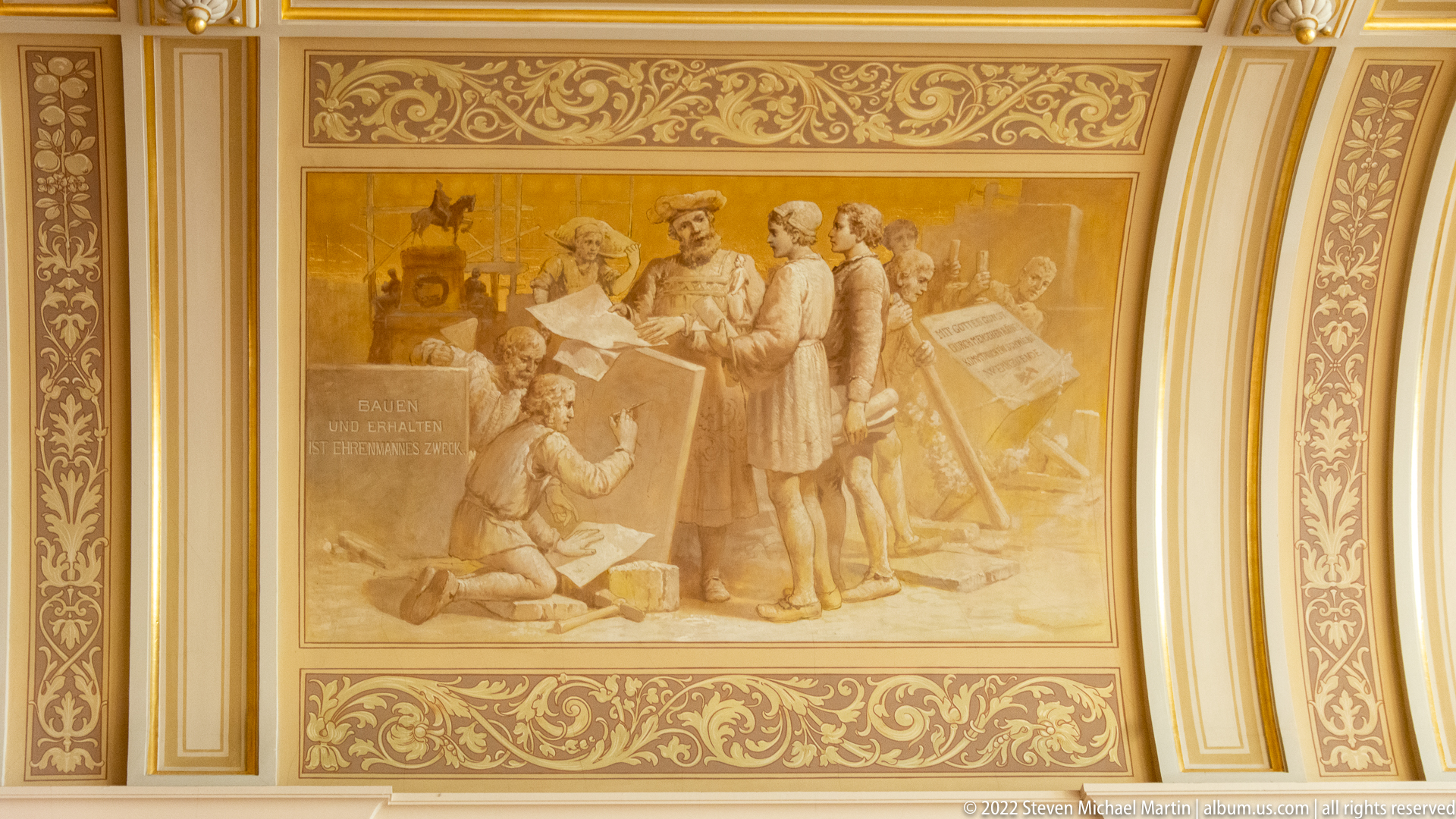
A framed wall painting shows a group of men gathered around large architectural or engineering drawings, with tools, timber, and construction equipment filling the surrounding scene. The work is rendered in a muted sepia palette and enclosed by ornate gilded borders, presenting civic labor and planning as a formal historical subject within Hamburg Rathaus.
Caption
A framed wall painting shows a group of men gathered around large architectural or engineering drawings, with tools, timber, and construction equipment filling the surrounding scene. The work is rendered in a muted sepia palette and enclosed by ornate gilded borders, presenting civic labor and planning as a formal historical subject within Hamburg Rathaus.
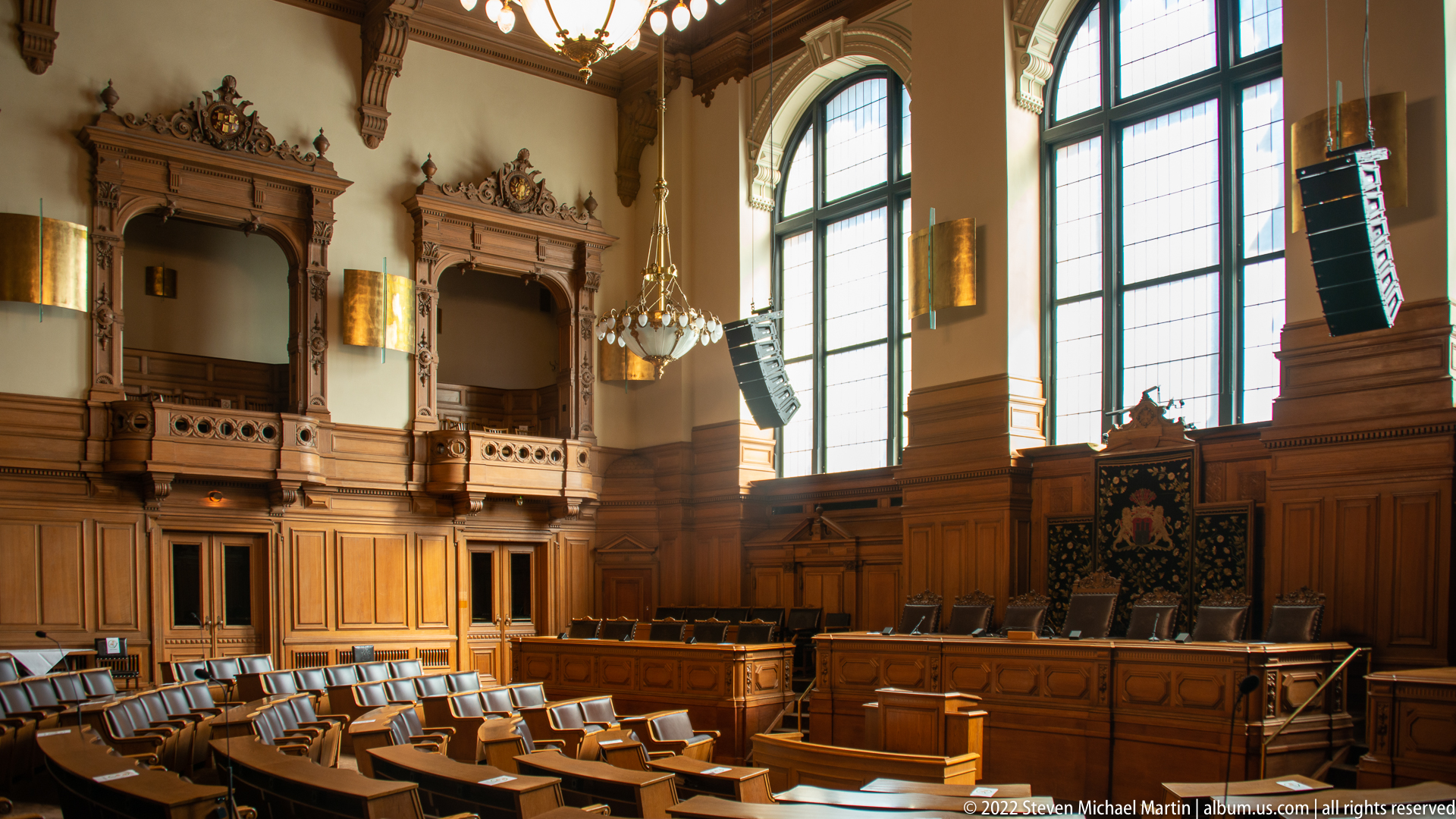
A formal council chamber is lined with dark carved wood, tall arched windows, and rows of fixed seats facing an elevated central chair and desk. Large wall-mounted speakers indicate continued modern use, while the historic paneling, galleries, and ceremonial furnishings preserve the room’s original civic character.
Caption
A formal council chamber is lined with dark carved wood, tall arched windows, and rows of fixed seats facing an elevated central chair and desk. Large wall-mounted speakers indicate continued modern use, while the historic paneling, galleries, and ceremonial furnishings preserve the room’s original civic character.
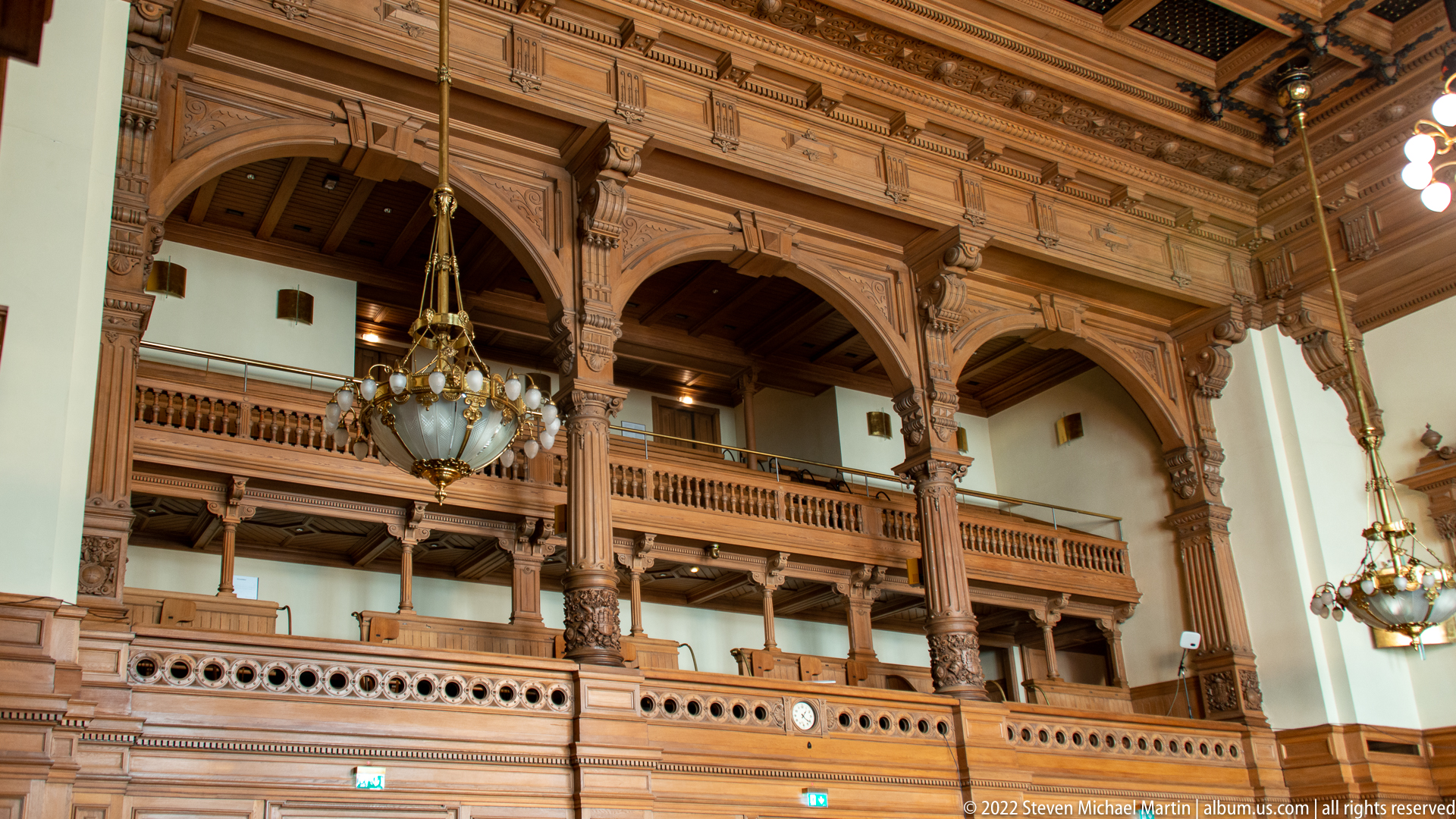
Massive carved wooden columns support an upper gallery inside the Rathaus chamber, their brackets, capitals, and balustrades forming a dense architectural framework beneath oversized chandeliers. The upward view shifts attention away from the chamber floor to the craftsmanship of the gallery structure and its layered historic woodwork.
Caption
Massive carved wooden columns support an upper gallery inside the Rathaus chamber, their brackets, capitals, and balustrades forming a dense architectural framework beneath oversized chandeliers. The upward view shifts attention away from the chamber floor to the craftsmanship of the gallery structure and its layered historic woodwork.
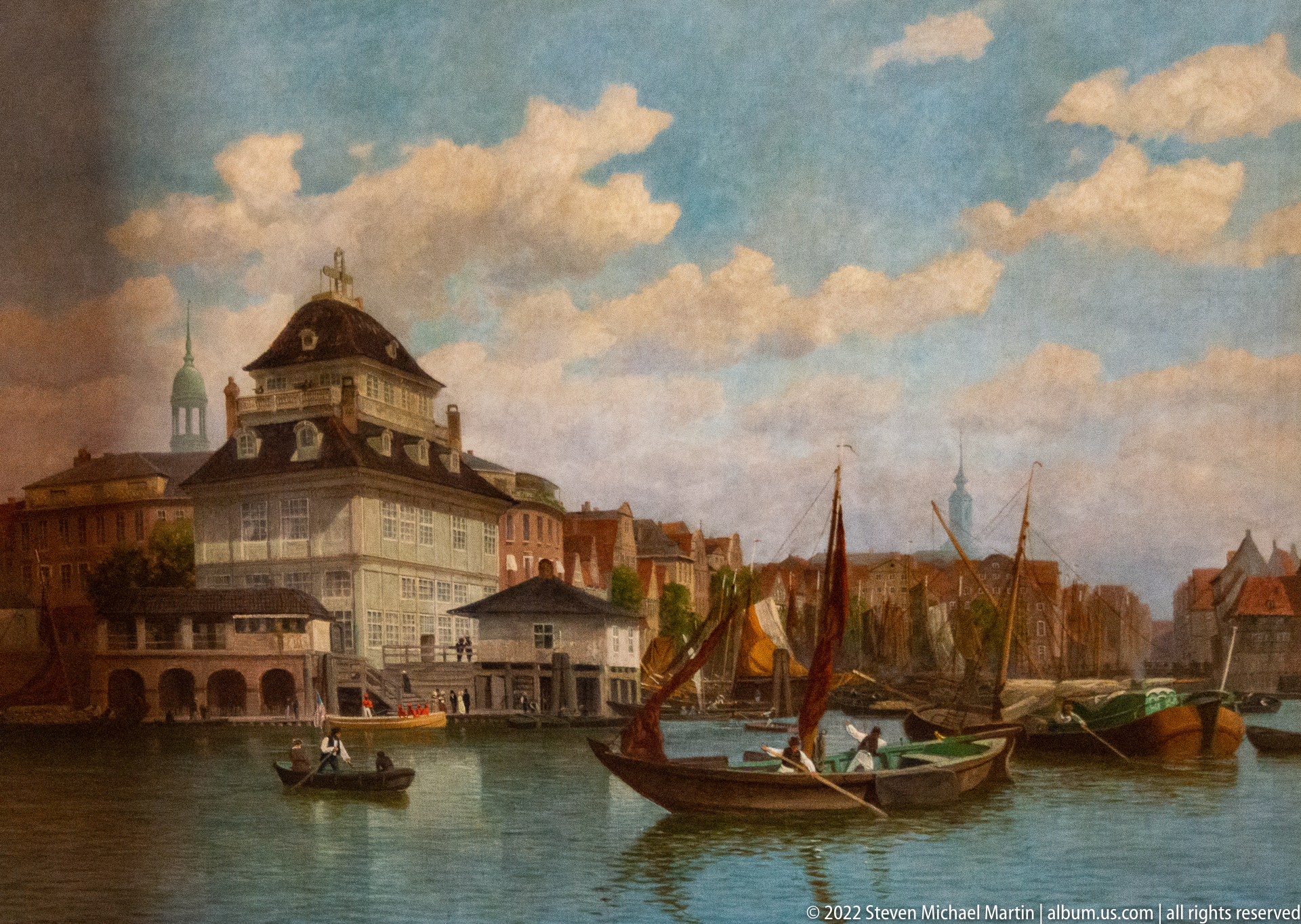
A painted waterfront scene shows small sailing vessels and rowboats moving before a substantial waterside building and clustered urban roofs. Warm light, calm water, and a broad blue sky give the view a picturesque character, while masts and boats foreground Hamburg’s long relationship with river and harbor transport.
Caption
A painted waterfront scene shows small sailing vessels and rowboats moving before a substantial waterside building and clustered urban roofs. Warm light, calm water, and a broad blue sky give the view a picturesque character, while masts and boats foreground Hamburg’s long relationship with river and harbor transport.
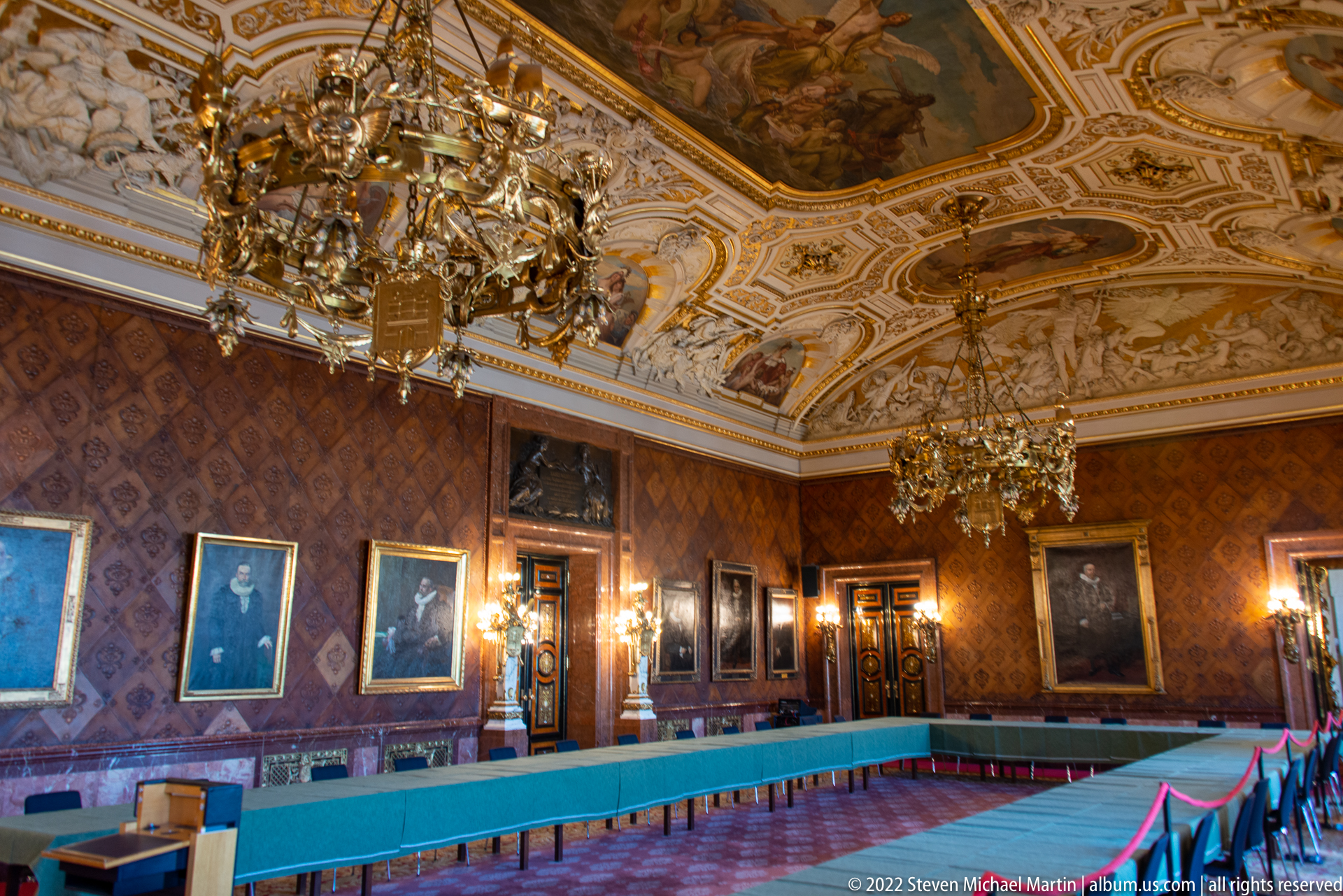
A long ceremonial room in Hamburg Rathaus is furnished with an extended U-shaped table beneath gilded chandeliers and a richly painted, compartmented ceiling. Portraits line patterned walls, and elaborate doors and moldings frame the space. The room’s formal arrangement and sumptuous decorative program emphasize its representational civic function.
Caption
A long ceremonial room in Hamburg Rathaus is furnished with an extended U-shaped table beneath gilded chandeliers and a richly painted, compartmented ceiling. Portraits line patterned walls, and elaborate doors and moldings frame the space. The room’s formal arrangement and sumptuous decorative program emphasize its representational civic function.
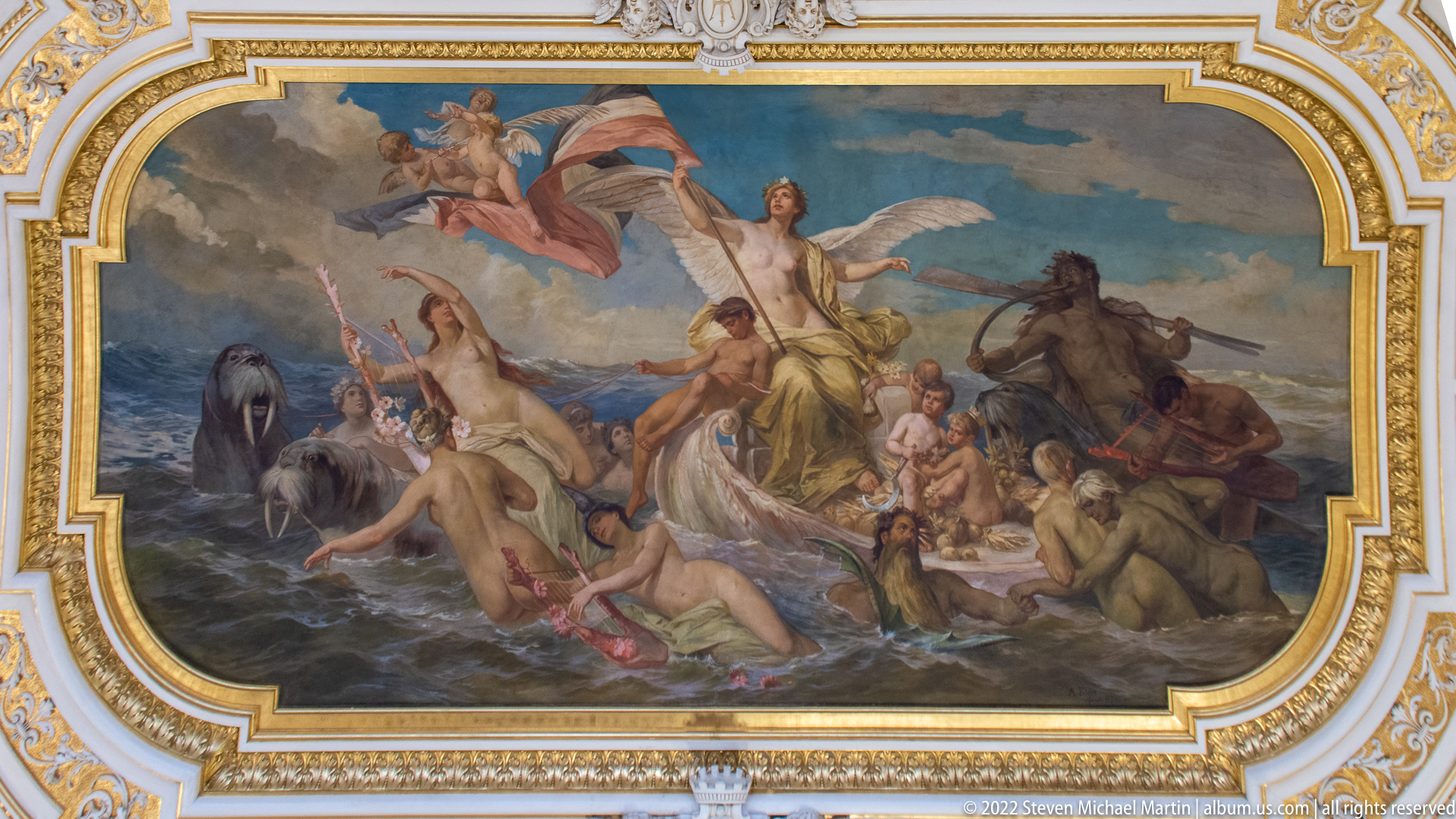
A large ceiling painting depicts multiple classical or allegorical figures gathered amid water, clouds, horses, and winged attendants, all framed by elaborate white-and-gold stucco. The energetic composition contrasts with the rigid architectural border, creating a theatrical overhead centerpiece for the ceremonial room below.
Caption
A large ceiling painting depicts multiple classical or allegorical figures gathered amid water, clouds, horses, and winged attendants, all framed by elaborate white-and-gold stucco. The energetic composition contrasts with the rigid architectural border, creating a theatrical overhead centerpiece for the ceremonial room below.
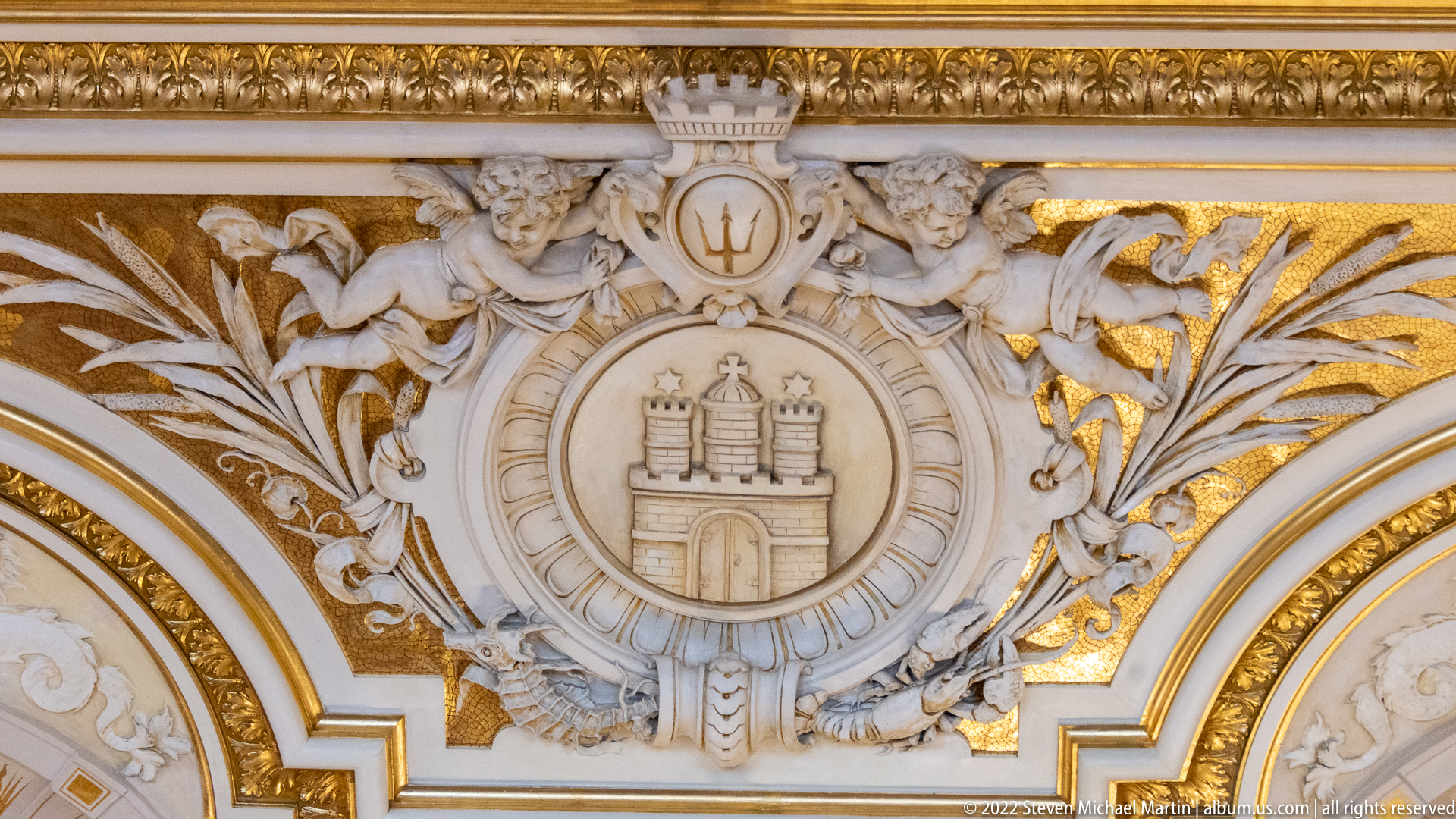
Hamburg’s three-towered castle emblem appears in a circular white stucco medallion set amid dense gilded foliage, winged figures, and a trident-like symbol. The relief translates the city’s coat of arms into an opulent ceiling ornament, integrating municipal heraldry with the room’s broader allegorical decoration.
Caption
Hamburg’s three-towered castle emblem appears in a circular white stucco medallion set amid dense gilded foliage, winged figures, and a trident-like symbol. The relief translates the city’s coat of arms into an opulent ceiling ornament, integrating municipal heraldry with the room’s broader allegorical decoration.
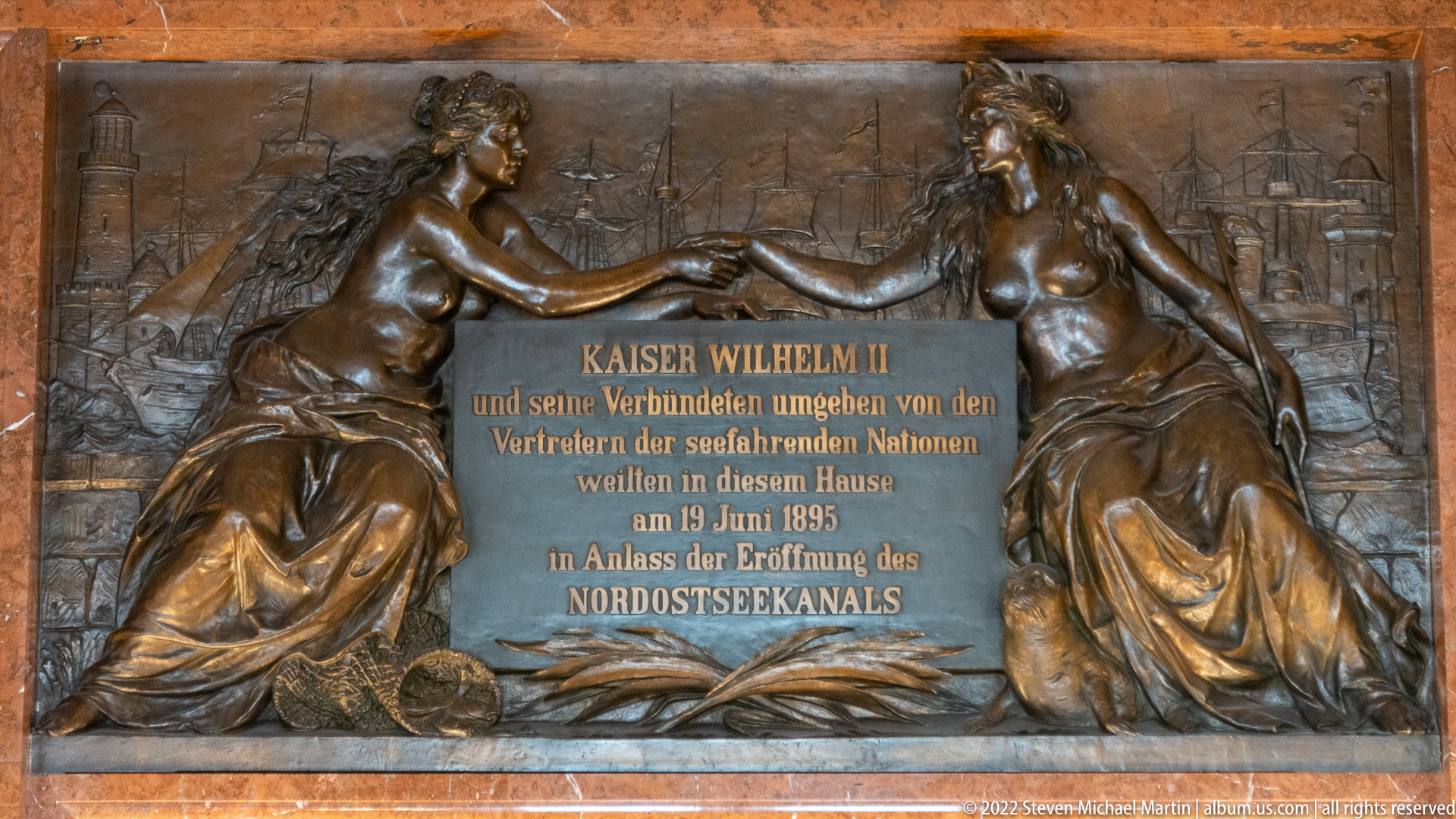
A bronze commemorative relief records Kaiser Wilhelm II and allied dignitaries at the opening of the Nord-Ostsee-Kanal in June 1895. Two seated female allegorical figures flank the central German inscription, while a low-relief harbor scene extends behind them. The plaque joins political commemoration, maritime infrastructure, and sculptural allegory in a single civic object.
Caption
A bronze commemorative relief records Kaiser Wilhelm II and allied dignitaries at the opening of the Nord-Ostsee-Kanal in June 1895. Two seated female allegorical figures flank the central German inscription, while a low-relief harbor scene extends behind them. The plaque joins political commemoration, maritime infrastructure, and sculptural allegory in a single civic object.
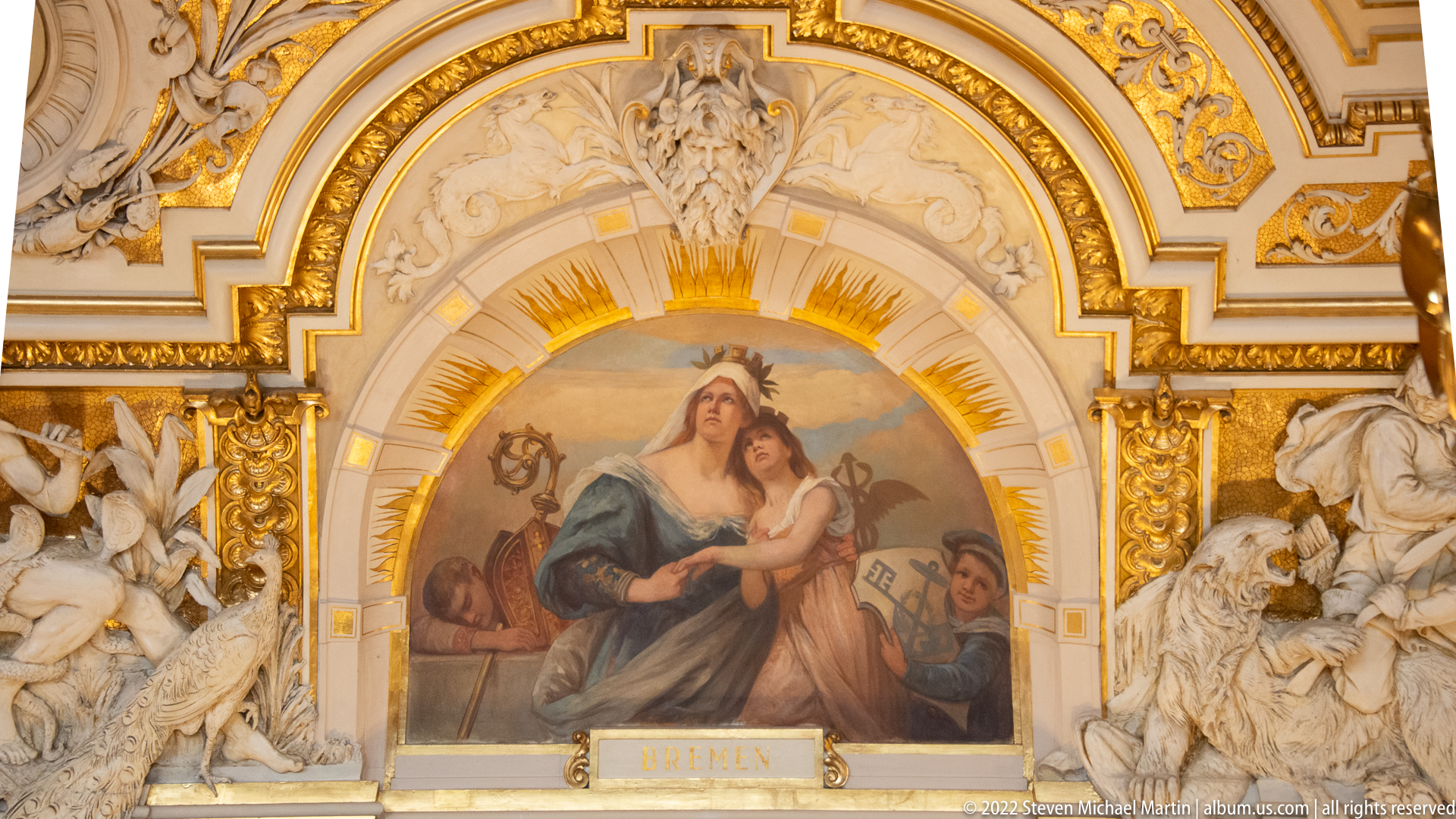
A painted female personification labeled “BREMEN” is framed by richly gilded stucco, accompanied by civic and maritime attributes and smaller figures at the sides. The composition treats another Hanseatic city as an allegorical woman, embedding regional urban identities within the decorative program of Hamburg Rathaus.
Caption
A painted female personification labeled “BREMEN” is framed by richly gilded stucco, accompanied by civic and maritime attributes and smaller figures at the sides. The composition treats another Hanseatic city as an allegorical woman, embedding regional urban identities within the decorative program of Hamburg Rathaus.
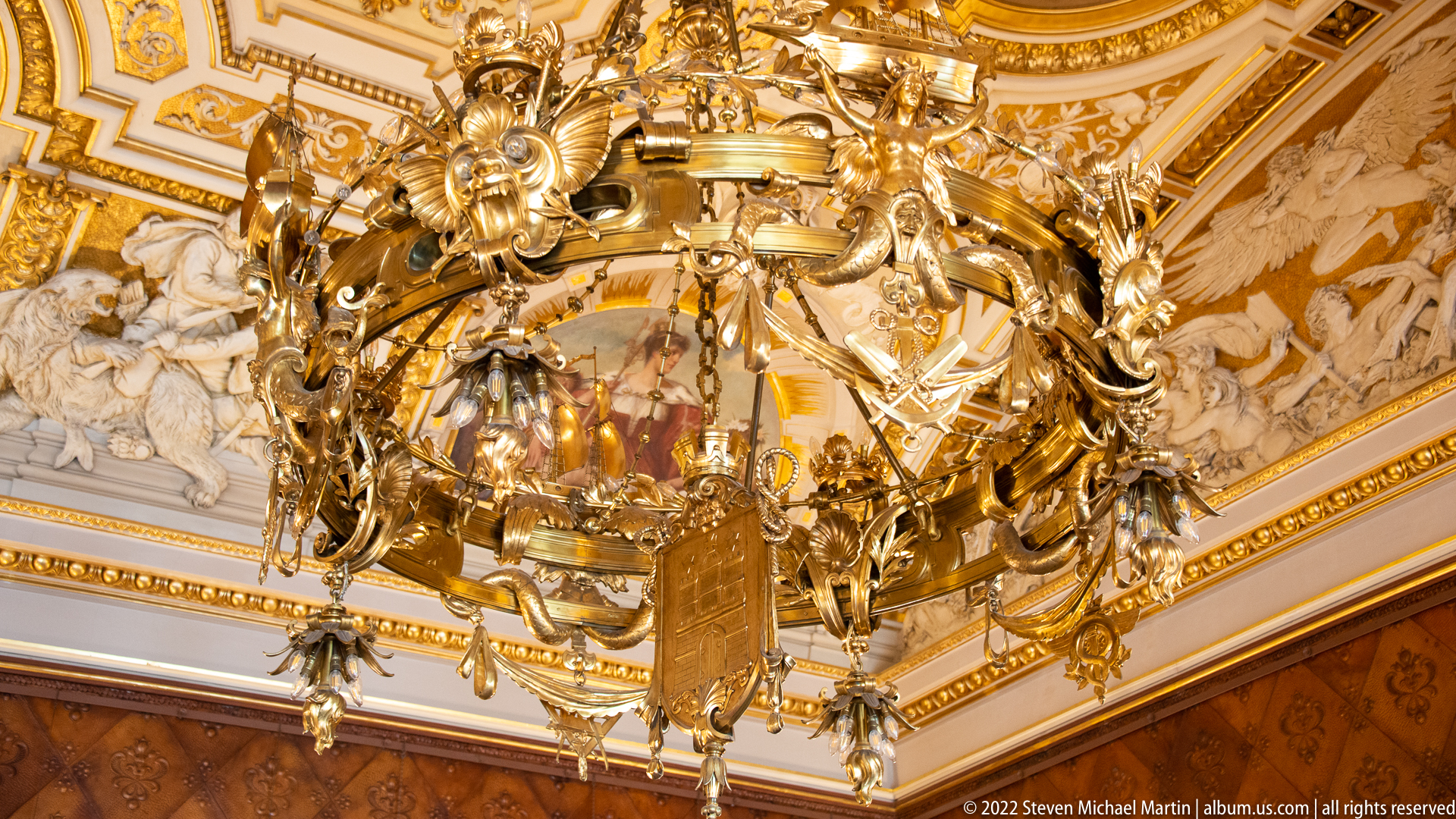
A monumental gilded metal chandelier hangs beneath the richly decorated Rathaus ceiling, its circular framework crowded with sculpted figures, floral forms, shields, lamps, and hanging ornaments. Seen from below, the fixture becomes a dense three-dimensional sculpture as much as a source of light, matching the ceremonial extravagance of the surrounding room.
Caption
A monumental gilded metal chandelier hangs beneath the richly decorated Rathaus ceiling, its circular framework crowded with sculpted figures, floral forms, shields, lamps, and hanging ornaments. Seen from below, the fixture becomes a dense three-dimensional sculpture as much as a source of light, matching the ceremonial extravagance of the surrounding room.
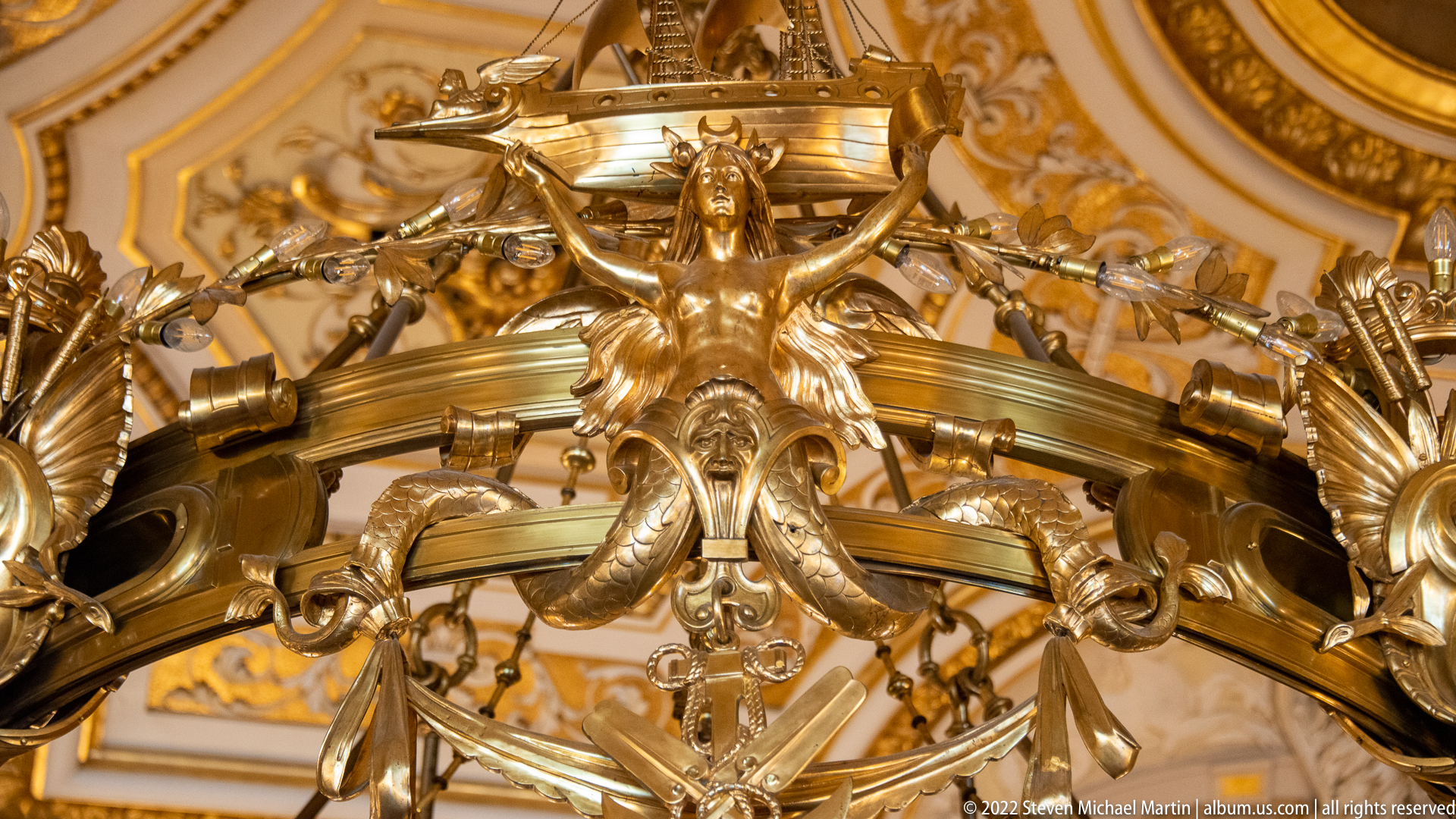
A gilded female figure with raised arms projects from the elaborate framework of the Rathaus chandelier, surrounded by curling metal bands, flowers, and small mechanical-looking fittings. The tight crop reveals the fixture’s sculptural ambition at close range, showing how human figures are woven directly into its ornamental structure.
Caption
A gilded female figure with raised arms projects from the elaborate framework of the Rathaus chandelier, surrounded by curling metal bands, flowers, and small mechanical-looking fittings. The tight crop reveals the fixture’s sculptural ambition at close range, showing how human figures are woven directly into its ornamental structure.
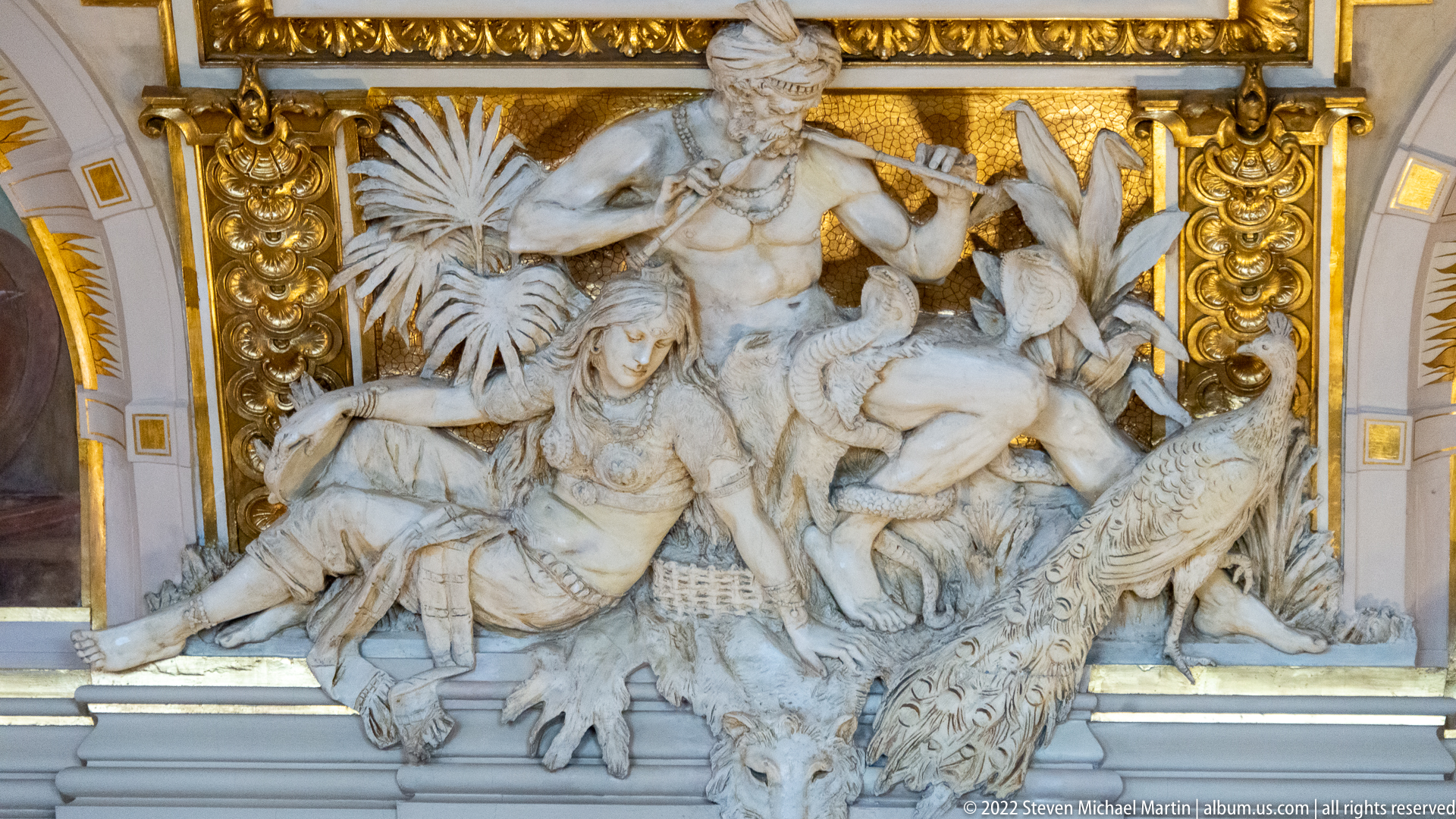
A densely modeled white sculptural group is set against a gilded architectural frame, combining a standing male figure with feathered headdress, a reclining female figure, tropical foliage, a reptile, and an animal skin. The theatrical arrangement uses costume, fauna, and vegetation as symbolic attributes, turning the wall panel into an elaborate allegorical ensemble rather than a literal narrative scene.
Caption
A densely modeled white sculptural group is set against a gilded architectural frame, combining a standing male figure with feathered headdress, a reclining female figure, tropical foliage, a reptile, and an animal skin. The theatrical arrangement uses costume, fauna, and vegetation as symbolic attributes, turning the wall panel into an elaborate allegorical ensemble rather than a literal narrative scene.
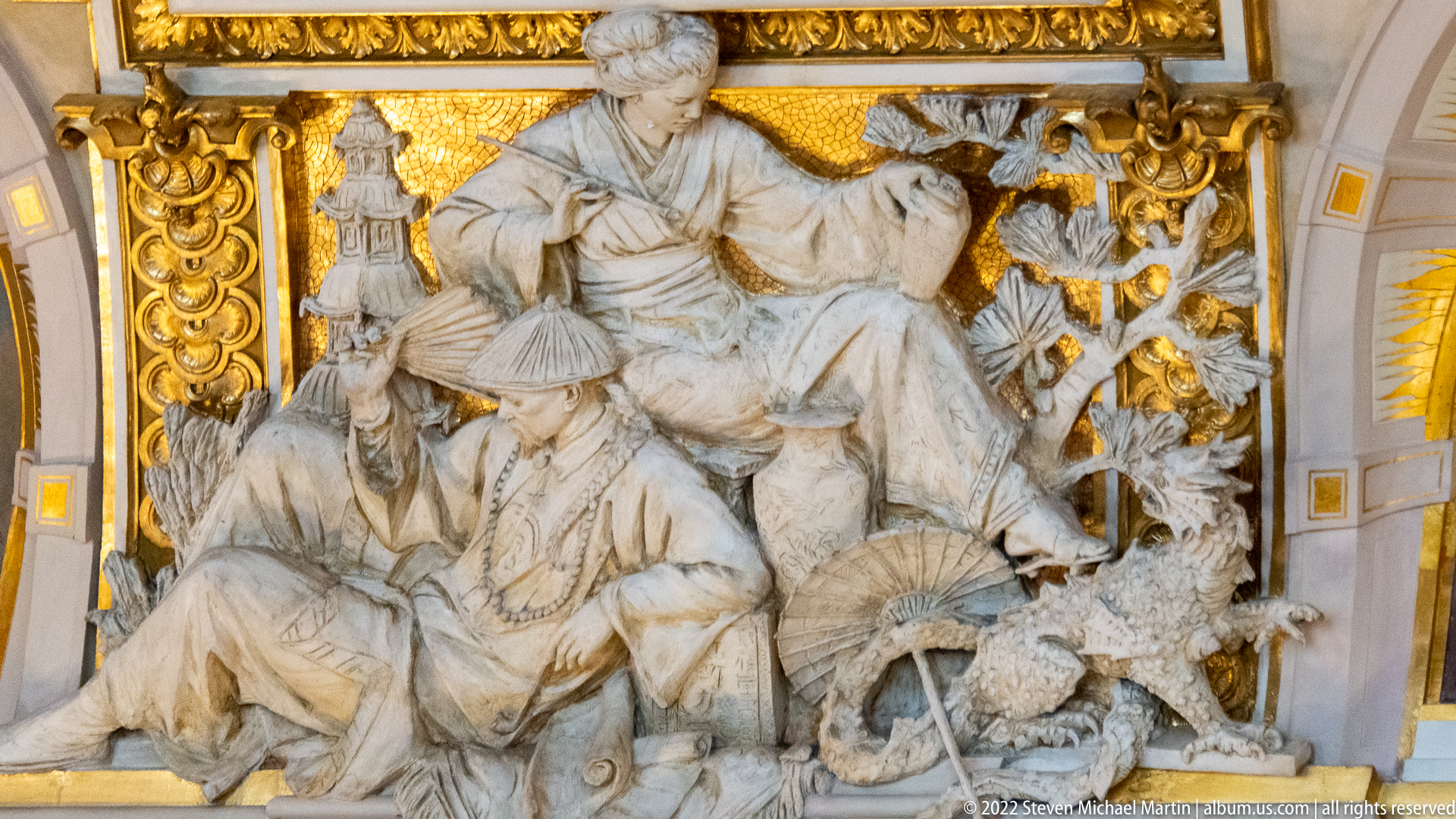
Figures in stylized East Asian dress occupy a richly gilded relief, accompanied by a dragon-like creature, parasol forms, ornamental foliage, and a seated woman in flowing robes. The panel relies on costume and exoticized decorative attributes to construct an allegorical geographic theme, characteristic of the highly theatrical historicist program visible throughout the Rathaus interior.
Caption
Figures in stylized East Asian dress occupy a richly gilded relief, accompanied by a dragon-like creature, parasol forms, ornamental foliage, and a seated woman in flowing robes. The panel relies on costume and exoticized decorative attributes to construct an allegorical geographic theme, characteristic of the highly theatrical historicist program visible throughout the Rathaus interior.
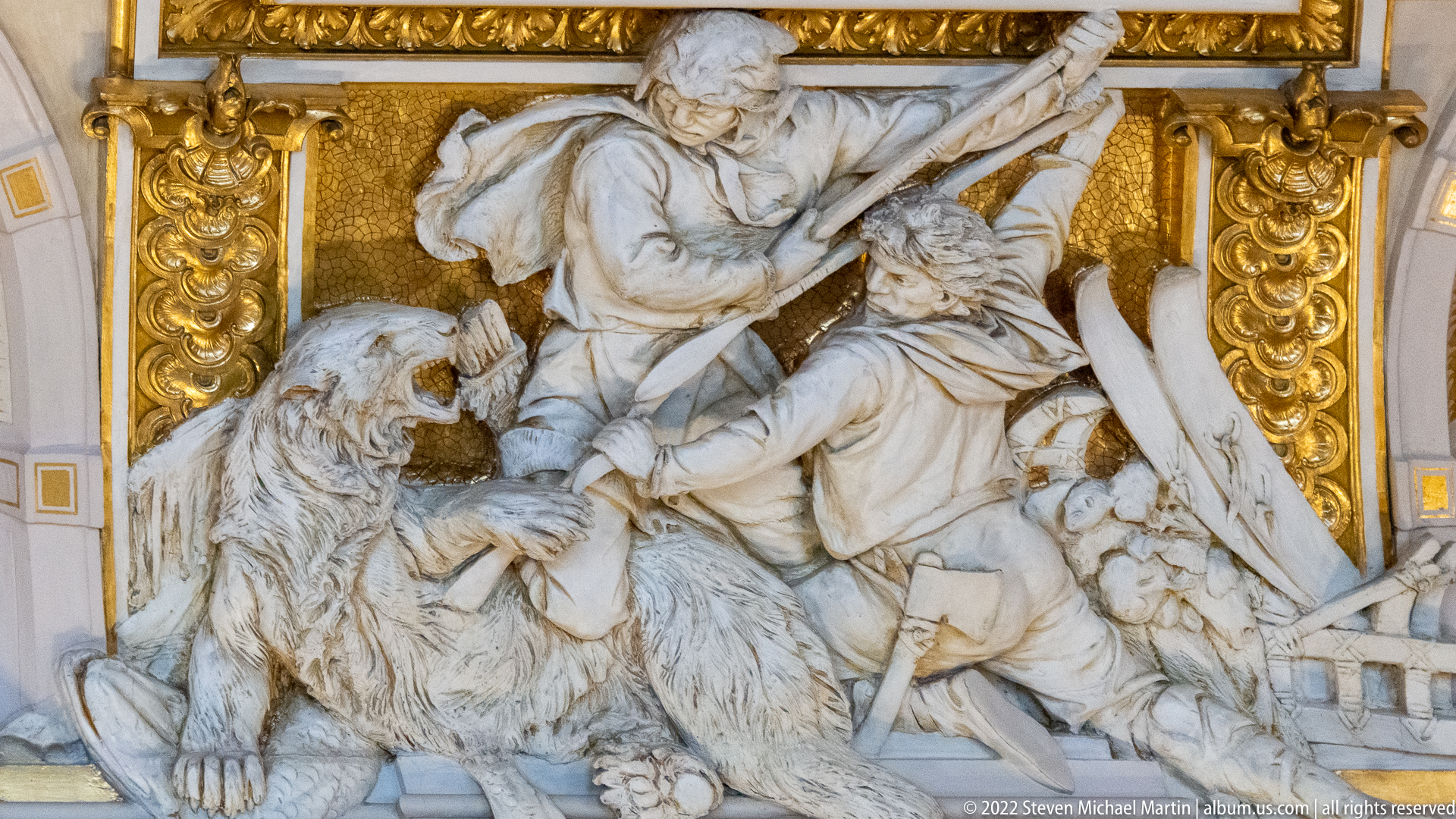
A dramatic white sculptural group centers on fur-clad figures posed beside a large bear, with one standing figure raising an arm above the seated group. The densely carved scene is framed by gilded ornament and architectural molding, using clothing and animal imagery as geographic or cultural attributes within a larger decorative cycle.
Caption
A dramatic white sculptural group centers on fur-clad figures posed beside a large bear, with one standing figure raising an arm above the seated group. The densely carved scene is framed by gilded ornament and architectural molding, using clothing and animal imagery as geographic or cultural attributes within a larger decorative cycle.
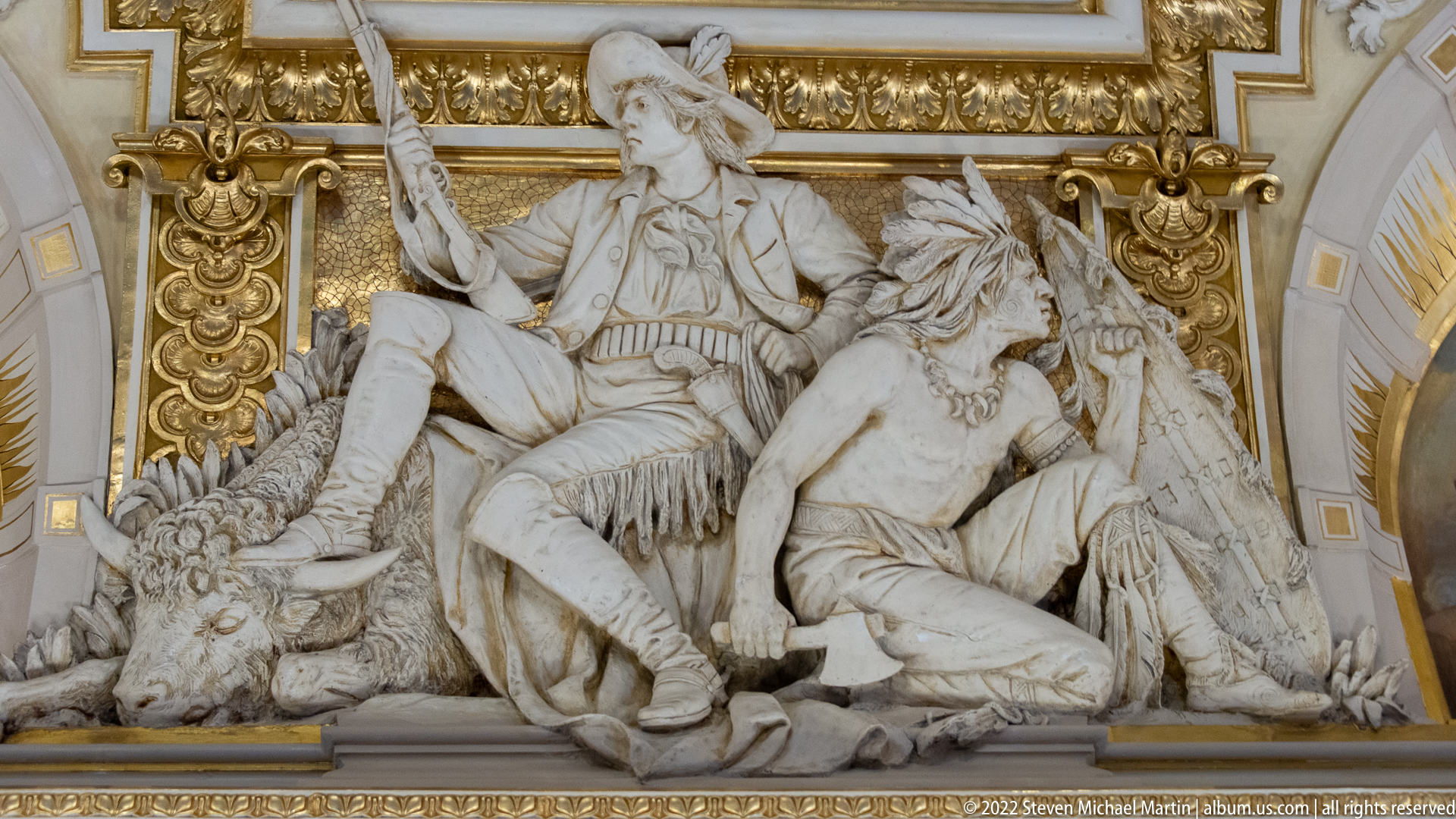
A seated figure in European-style dress occupies the upper center of a white sculptural panel, while a horned bovine and a second figure wearing feathered or fringed costume fill the lower foreground. Gilded framing and carved vegetation bind the figures into a single allegorical composition, suggesting a symbolic geography rather than a specific historical event.
Caption
A seated figure in European-style dress occupies the upper center of a white sculptural panel, while a horned bovine and a second figure wearing feathered or fringed costume fill the lower foreground. Gilded framing and carved vegetation bind the figures into a single allegorical composition, suggesting a symbolic geography rather than a specific historical event.
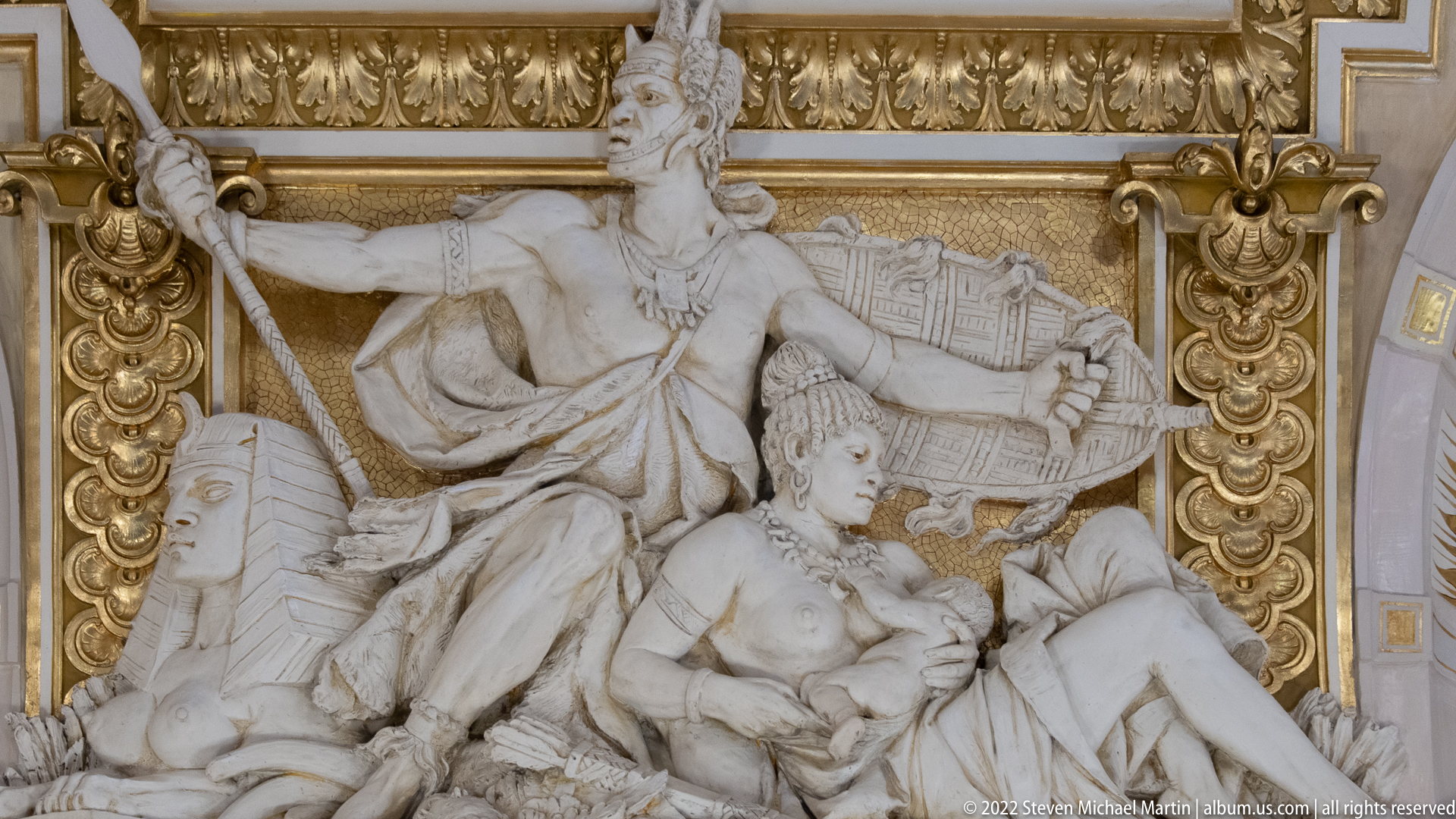
An Egyptianizing profile with striped headdress appears at lower left beneath a commanding standing figure, while reclining human figures and architectural forms crowd the rest of the white relief. Gilded moldings frame the scene, whose costume and symbolic attributes evoke an imagined geographic or cultural setting within the Rathaus decorative program.
Caption
An Egyptianizing profile with striped headdress appears at lower left beneath a commanding standing figure, while reclining human figures and architectural forms crowd the rest of the white relief. Gilded moldings frame the scene, whose costume and symbolic attributes evoke an imagined geographic or cultural setting within the Rathaus decorative program.
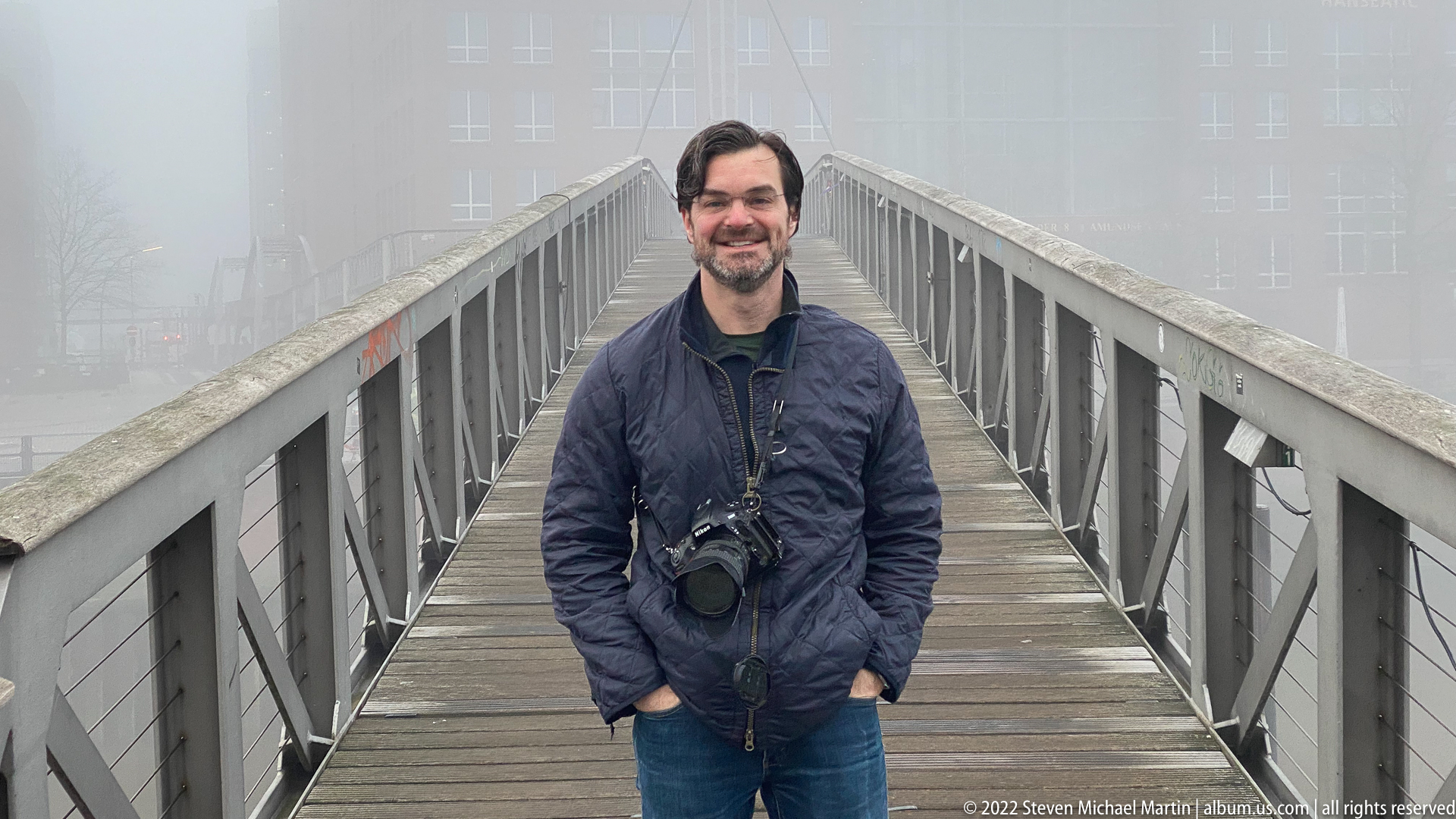
An adult man stands centered on a wooden-deck pedestrian bridge, smiling toward the camera with a camera hanging from his neck. Metal railings converge sharply into dense fog behind him, where only faint outlines of modern buildings remain visible. The portrait contrasts an intimate human presence with Hamburg’s damp, atmospheric urban waterfront setting.
Caption
An adult man stands centered on a wooden-deck pedestrian bridge, smiling toward the camera with a camera hanging from his neck. Metal railings converge sharply into dense fog behind him, where only faint outlines of modern buildings remain visible. The portrait contrasts an intimate human presence with Hamburg’s damp, atmospheric urban waterfront setting.
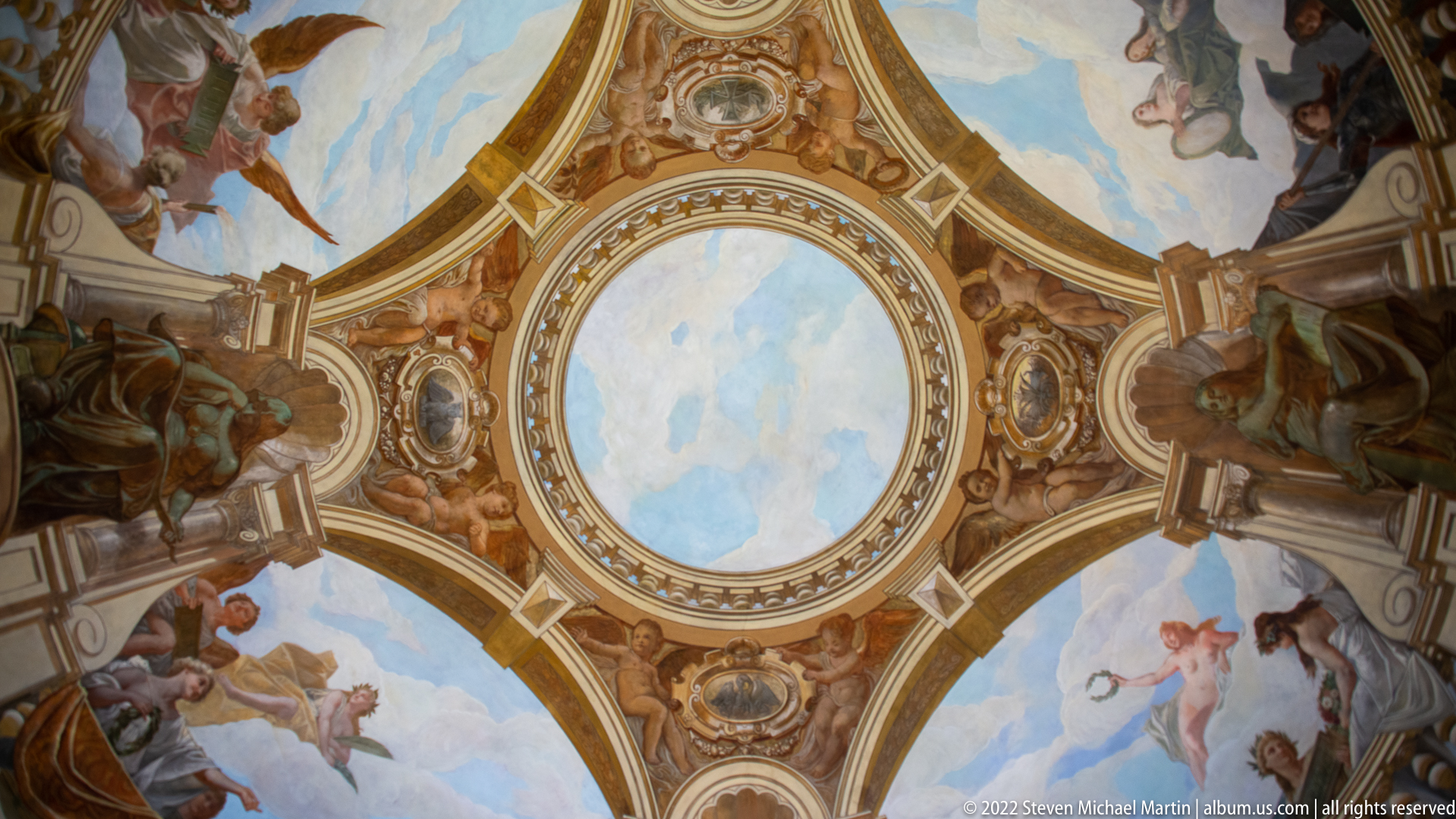
A richly painted ceiling vault opens around a pale central oval, with allegorical figures occupying curved compartments between gilded architectural ribs. Painted clouds and sky lighten the center, while sculptural illusionism and warm ochre framing create a theatrical transition between real architecture and painted space.
Caption
A richly painted ceiling vault opens around a pale central oval, with allegorical figures occupying curved compartments between gilded architectural ribs. Painted clouds and sky lighten the center, while sculptural illusionism and warm ochre framing create a theatrical transition between real architecture and painted space.
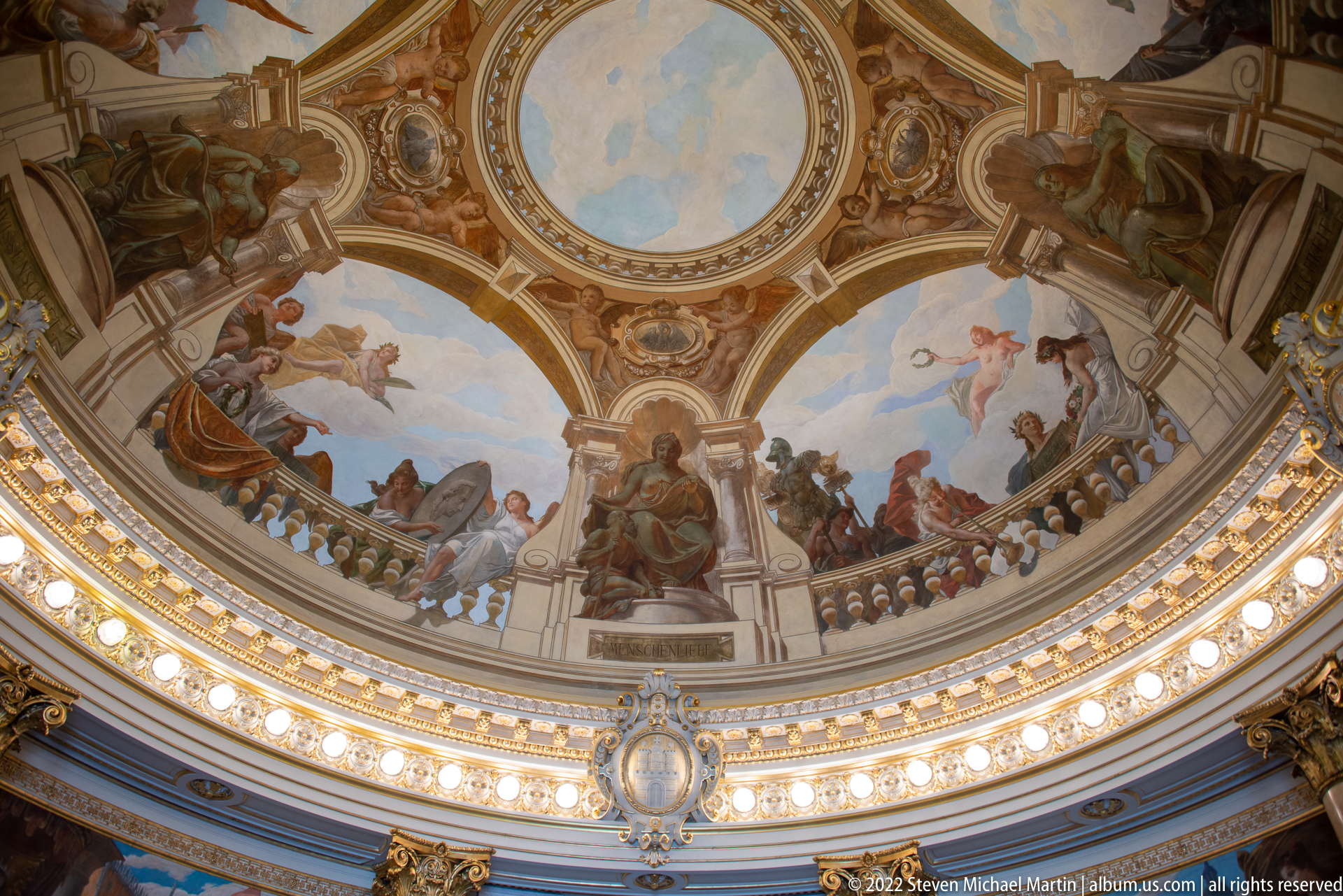
Seen from a lower angle, the painted cupola reveals a balustrade-like ring beneath the allegorical ceiling scenes, visually linking painted figures with the real architectural cornice below. Gilded moldings, medallions, and bands of small lamps encircle the dome, making the transition between ceiling painting and ceremonial room architecture especially legible.
Caption
Seen from a lower angle, the painted cupola reveals a balustrade-like ring beneath the allegorical ceiling scenes, visually linking painted figures with the real architectural cornice below. Gilded moldings, medallions, and bands of small lamps encircle the dome, making the transition between ceiling painting and ceremonial room architecture especially legible.
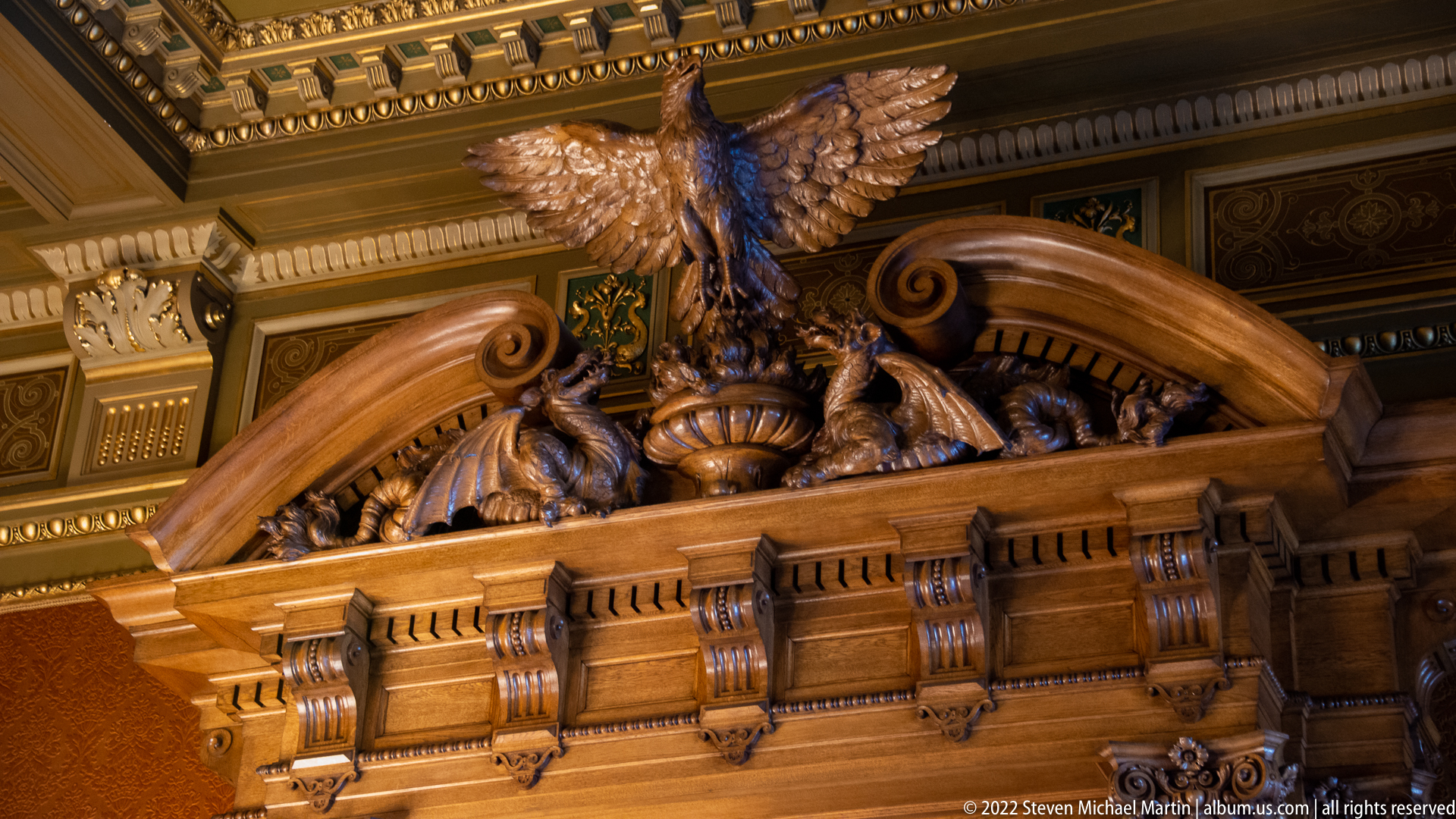
A carved eagle with spread wings crowns a richly modeled wooden overdoor filled with scrolls, foliage, and small animal forms. Deep shadows between the polished carvings emphasize the relief’s three-dimensionality, while the eagle’s elevated position gives the composition a heraldic, authoritative character suited to the ceremonial interiors of Hamburg Rathaus.
Caption
A carved eagle with spread wings crowns a richly modeled wooden overdoor filled with scrolls, foliage, and small animal forms. Deep shadows between the polished carvings emphasize the relief’s three-dimensionality, while the eagle’s elevated position gives the composition a heraldic, authoritative character suited to the ceremonial interiors of Hamburg Rathaus.
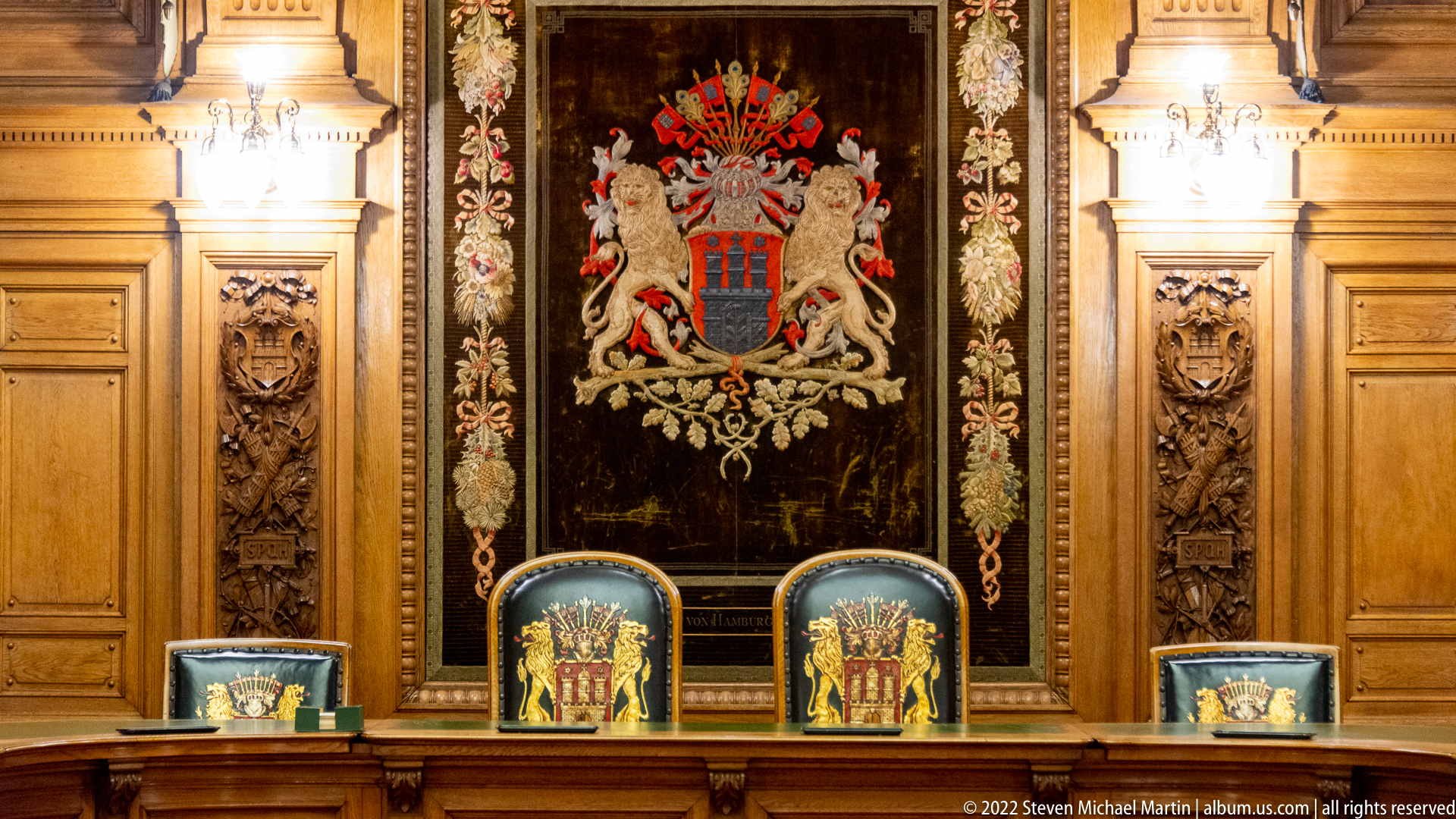
Hamburg’s red-and-white coat of arms dominates the wall above a row of high-backed chairs in an ornate wood-paneled civic chamber. Floral textiles, carved pilasters, and heraldic emblems frame the central seating, making municipal identity the visual focus of the room’s ceremonial architecture.
Caption
Hamburg’s red-and-white coat of arms dominates the wall above a row of high-backed chairs in an ornate wood-paneled civic chamber. Floral textiles, carved pilasters, and heraldic emblems frame the central seating, making municipal identity the visual focus of the room’s ceremonial architecture.
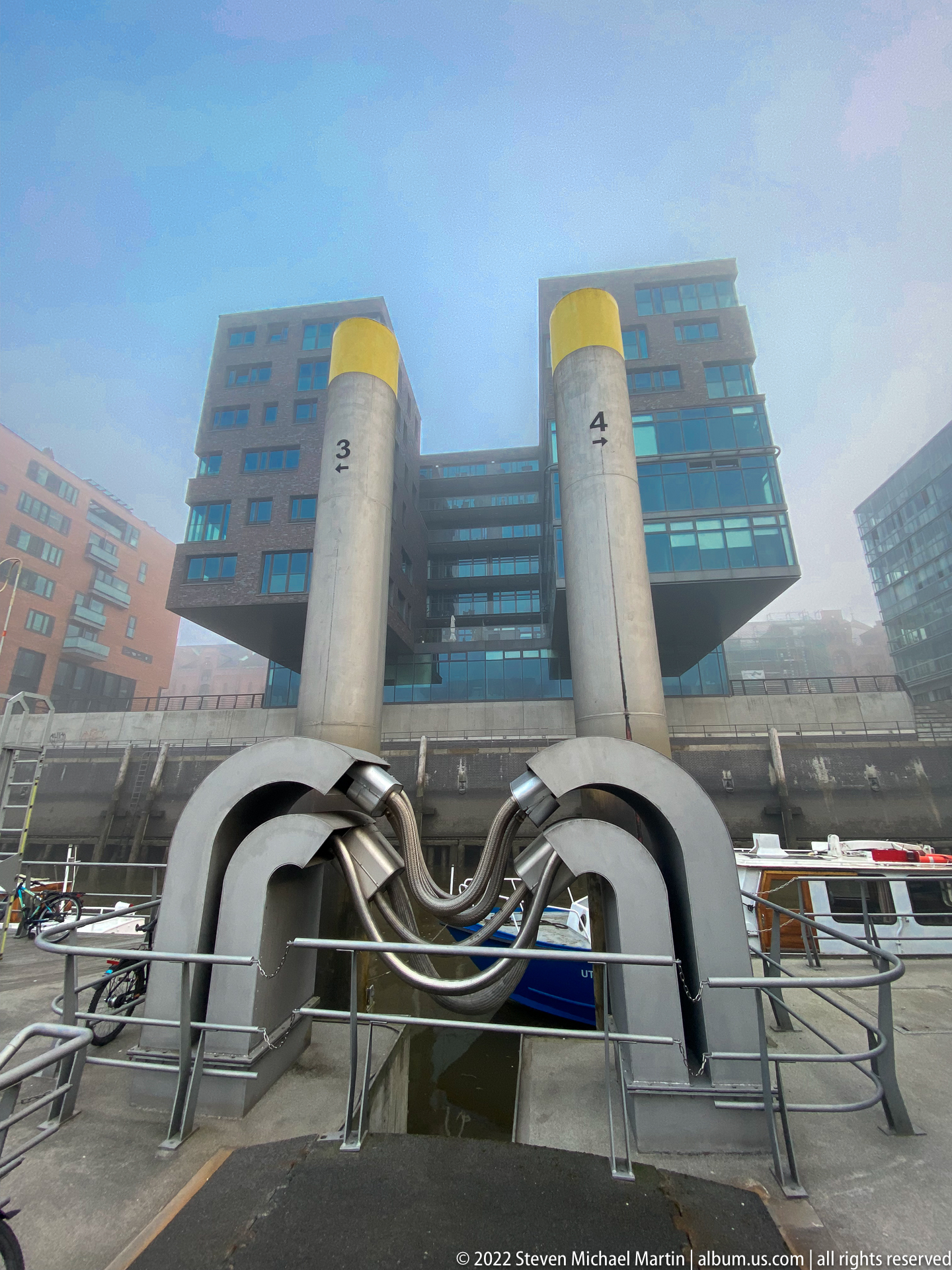
Two cylindrical concrete towers numbered “3” and “4” rise in front of a modern block-like waterfront building, each capped with a yellow band. Curving dark steel forms sweep outward at their bases above a railing and narrow water channel, creating a striking contrast between utilitarian concrete, sculptural metalwork, and contemporary harbor architecture.
Caption
Two cylindrical concrete towers numbered “3” and “4” rise in front of a modern block-like waterfront building, each capped with a yellow band. Curving dark steel forms sweep outward at their bases above a railing and narrow water channel, creating a striking contrast between utilitarian concrete, sculptural metalwork, and contemporary harbor architecture.
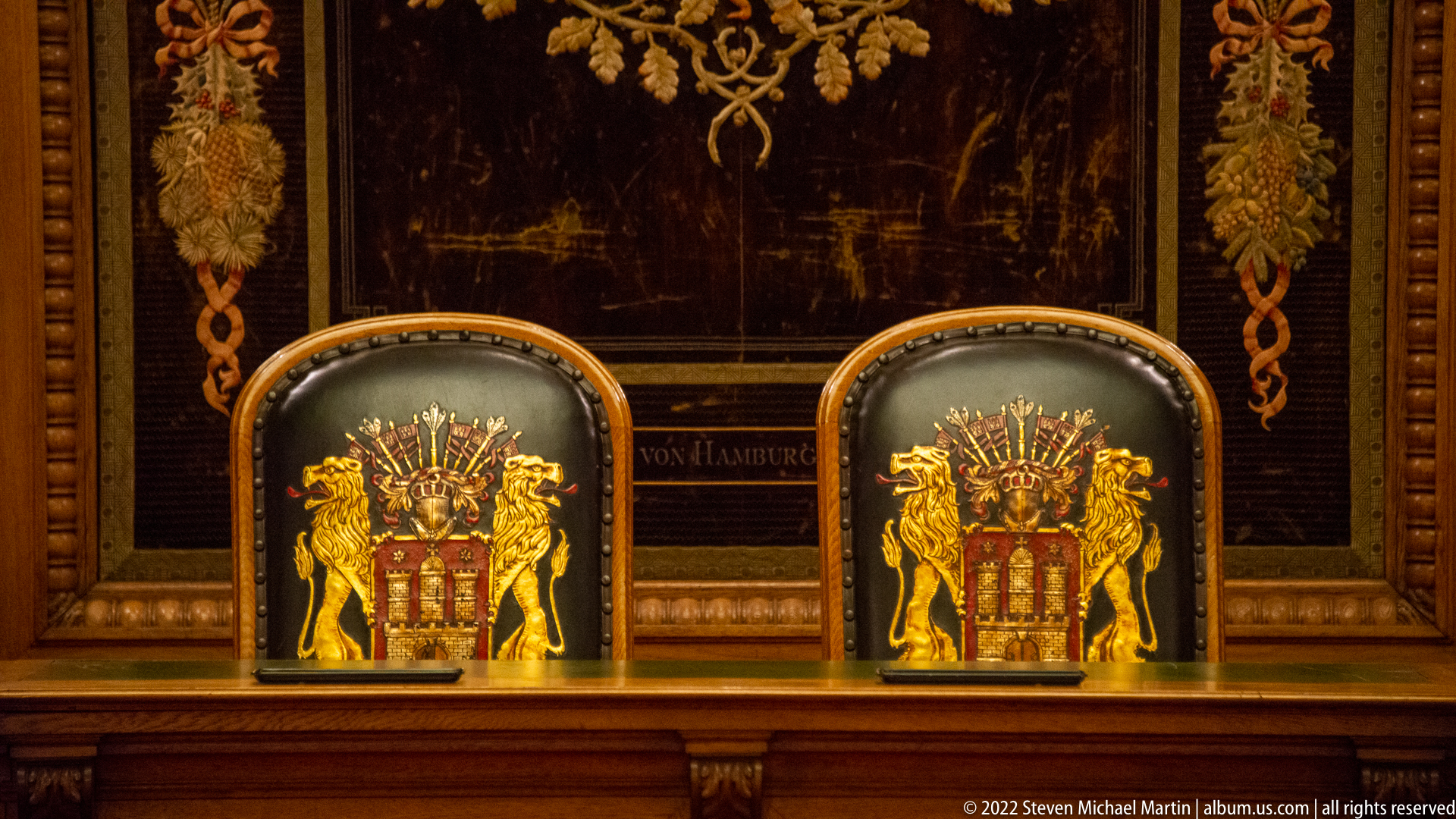
Two high-backed ceremonial chairs display Hamburg’s coat of arms in gold and red against dark upholstery. Behind them, a large wall panel includes floral ornament and the words “VON HAMBURG,” while carved wood frames the composition. The close view isolates the heraldic seating from the wider chamber and emphasizes the room’s municipal symbolism.
Caption
Two high-backed ceremonial chairs display Hamburg’s coat of arms in gold and red against dark upholstery. Behind them, a large wall panel includes floral ornament and the words “VON HAMBURG,” while carved wood frames the composition. The close view isolates the heraldic seating from the wider chamber and emphasizes the room’s municipal symbolism.
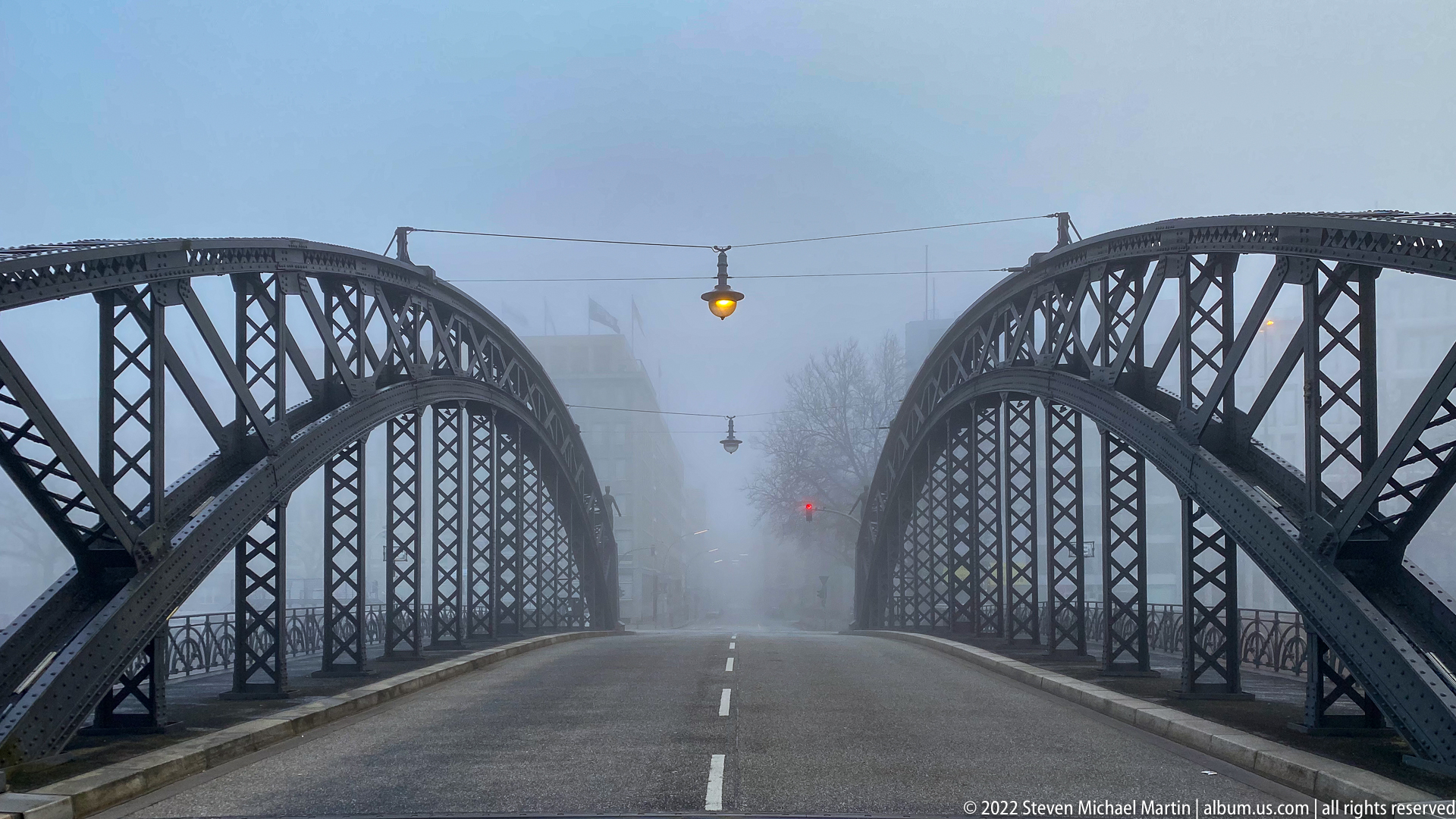
Twin riveted steel arches frame an empty roadway as the bridge disappears into dense fog. Lattice bracing, overhead wires, and a single suspended streetlamp emphasize the industrial structure, while the obscured far end creates an unusually austere urban view. The composition isolates the engineering form from surrounding city context.
Caption
Twin riveted steel arches frame an empty roadway as the bridge disappears into dense fog. Lattice bracing, overhead wires, and a single suspended streetlamp emphasize the industrial structure, while the obscured far end creates an unusually austere urban view. The composition isolates the engineering form from surrounding city context.
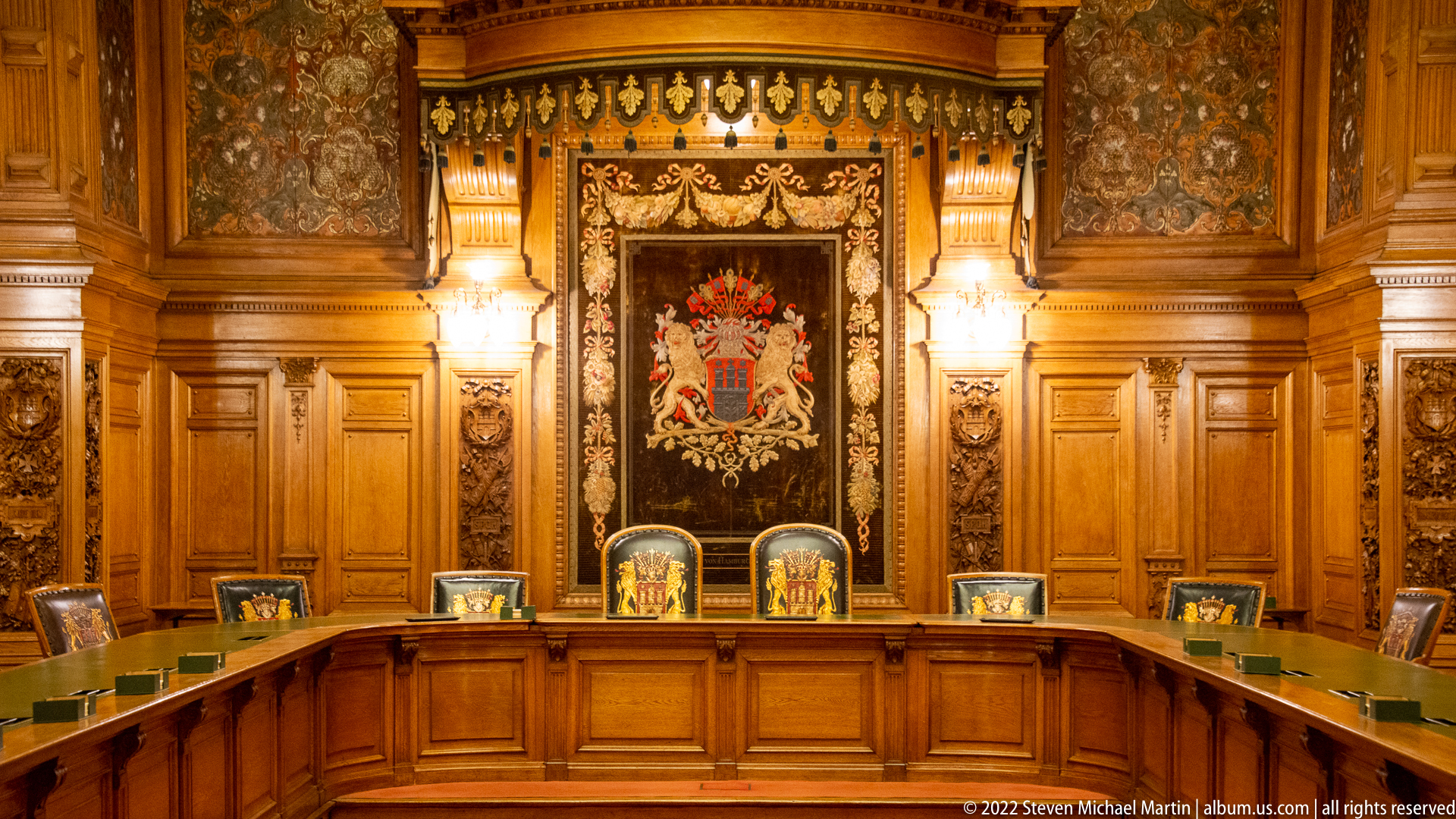
A wide view of the Hamburg civic chamber reveals a curved arrangement of desks facing the central heraldic wall, where the city’s coat of arms hangs above ceremonial chairs. Carved wood paneling, floral wall textiles, lamps, and repeated small shields create a richly unified room designed for formal municipal proceedings.
Caption
A wide view of the Hamburg civic chamber reveals a curved arrangement of desks facing the central heraldic wall, where the city’s coat of arms hangs above ceremonial chairs. Carved wood paneling, floral wall textiles, lamps, and repeated small shields create a richly unified room designed for formal municipal proceedings.
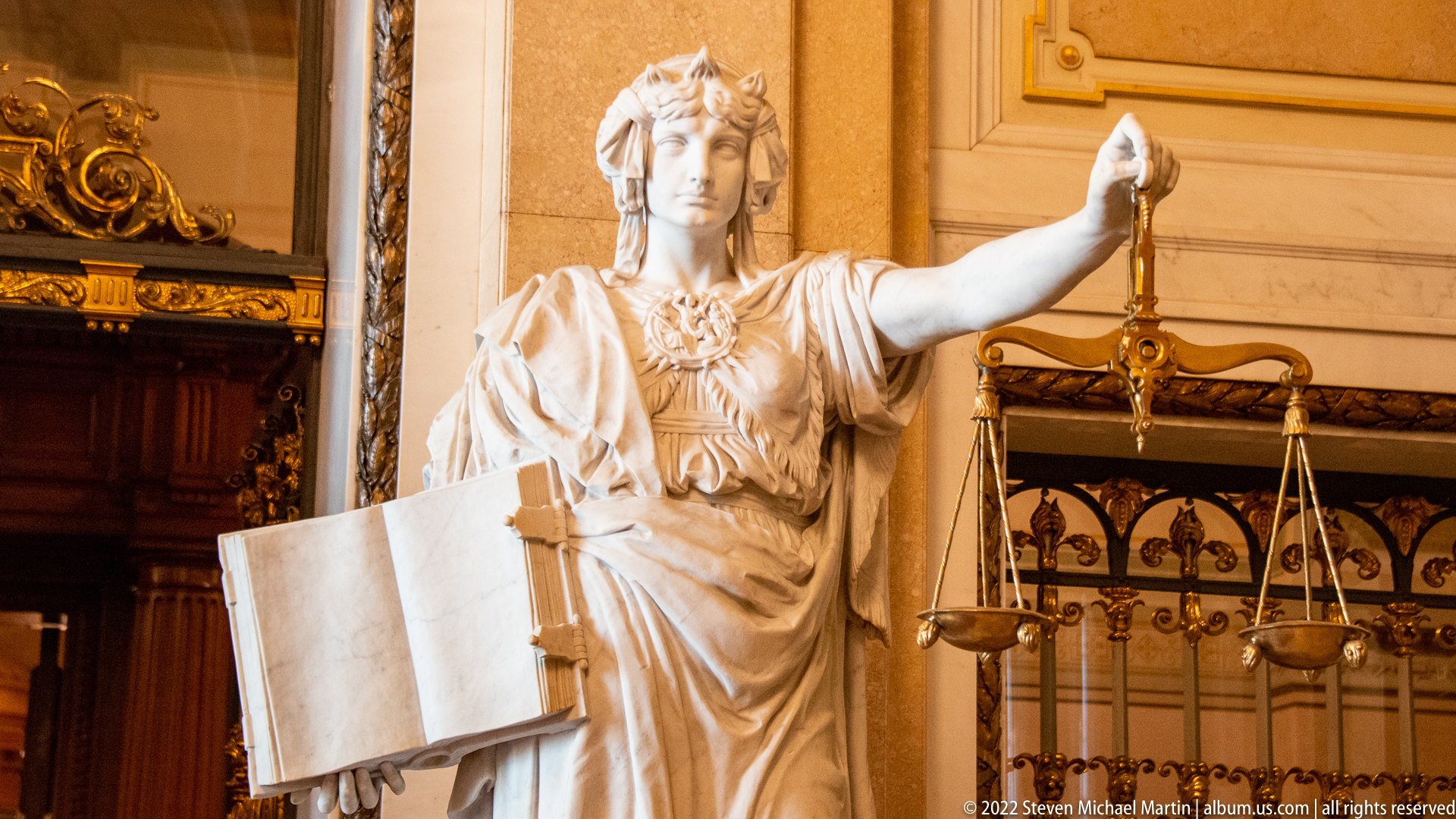
A pale stone female figure stands beside an ornate doorway holding suspended balance scales in her raised right hand and an open book against her left side. These attributes identify the figure as an allegory of Justice, while her classical drapery and composed frontal stance suit the formal civic setting of Hamburg Rathaus.
Caption
A pale stone female figure stands beside an ornate doorway holding suspended balance scales in her raised right hand and an open book against her left side. These attributes identify the figure as an allegory of Justice, while her classical drapery and composed frontal stance suit the formal civic setting of Hamburg Rathaus.
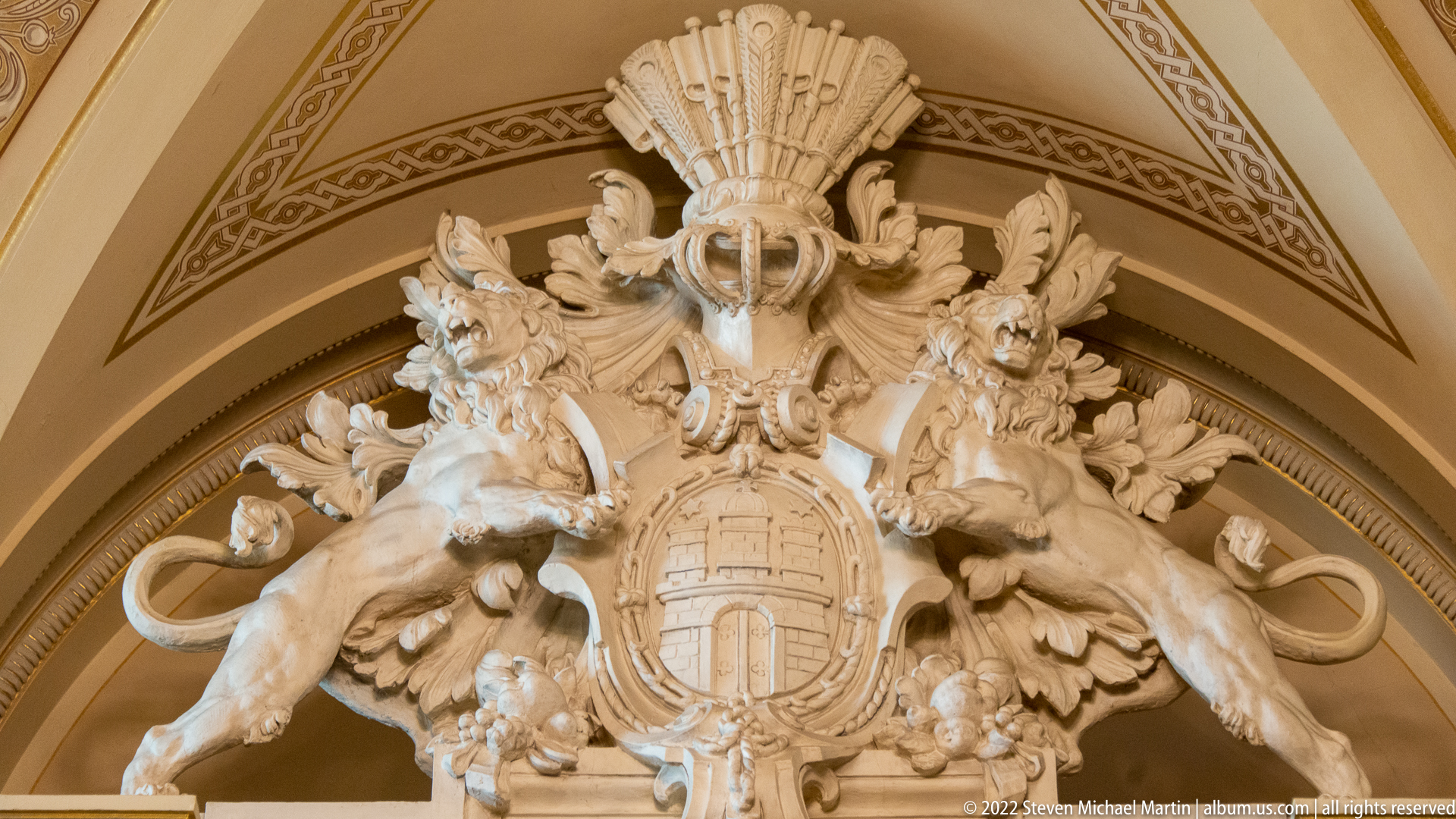
Hamburg’s castle emblem is carved in high relief at the center of an arched architectural panel, flanked by two rampant lions and crowned by an elaborate shell- and fan-like crest. The pale stone sculpture fills the space beneath the vault, turning municipal heraldry into monumental architectural ornament.
Caption
Hamburg’s castle emblem is carved in high relief at the center of an arched architectural panel, flanked by two rampant lions and crowned by an elaborate shell- and fan-like crest. The pale stone sculpture fills the space beneath the vault, turning municipal heraldry into monumental architectural ornament.
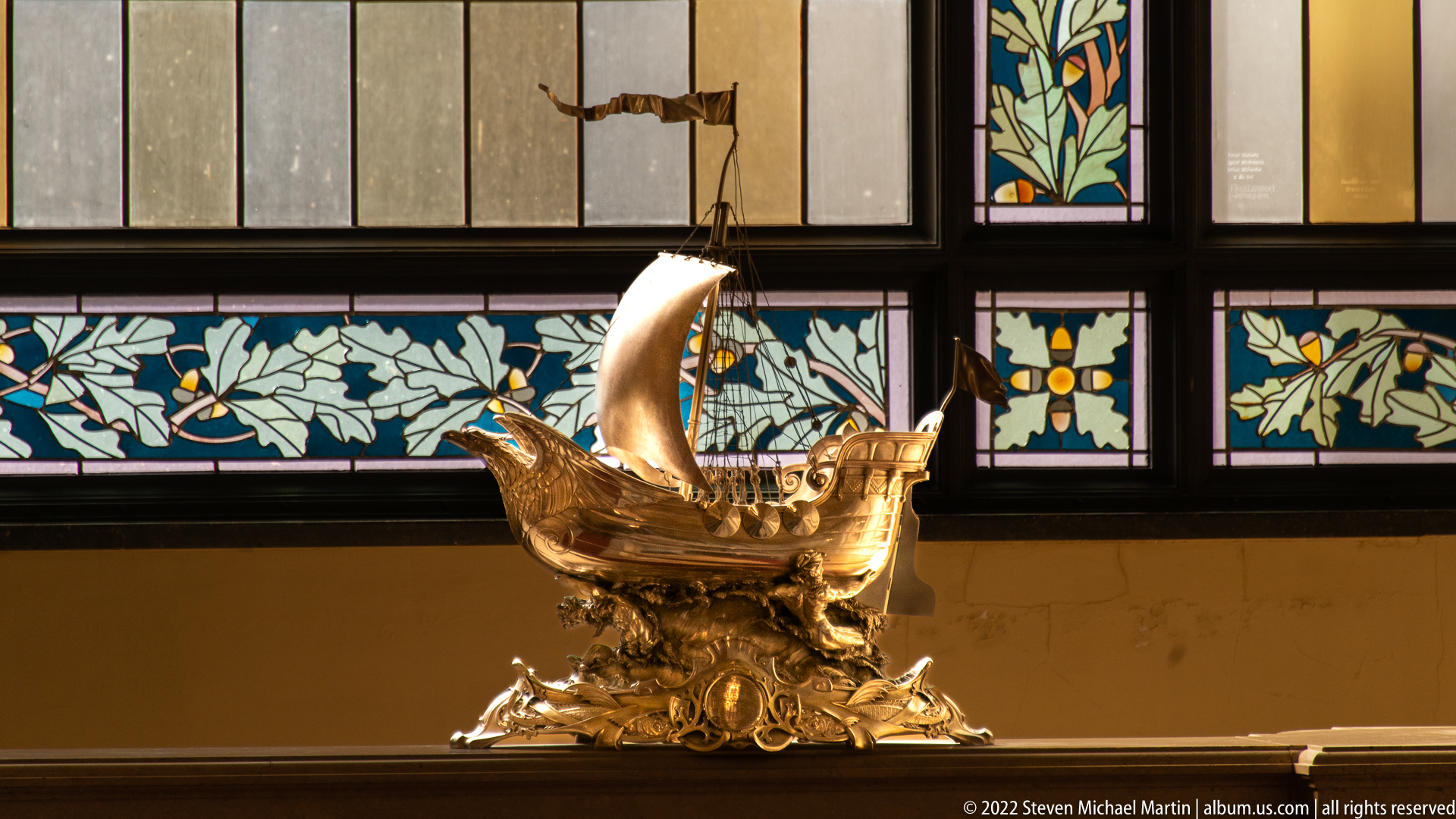
A fanciful metal sailing ship with a glowing sail serves as a decorative light fixture beneath stained-glass panels of leaves and flowers. The vessel’s hull, mast, and rigging are elaborately modeled, merging maritime imagery with interior illumination in a way that reflects Hamburg’s strong civic association with shipping and the harbor.
Caption
A fanciful metal sailing ship with a glowing sail serves as a decorative light fixture beneath stained-glass panels of leaves and flowers. The vessel’s hull, mast, and rigging are elaborately modeled, merging maritime imagery with interior illumination in a way that reflects Hamburg’s strong civic association with shipping and the harbor.
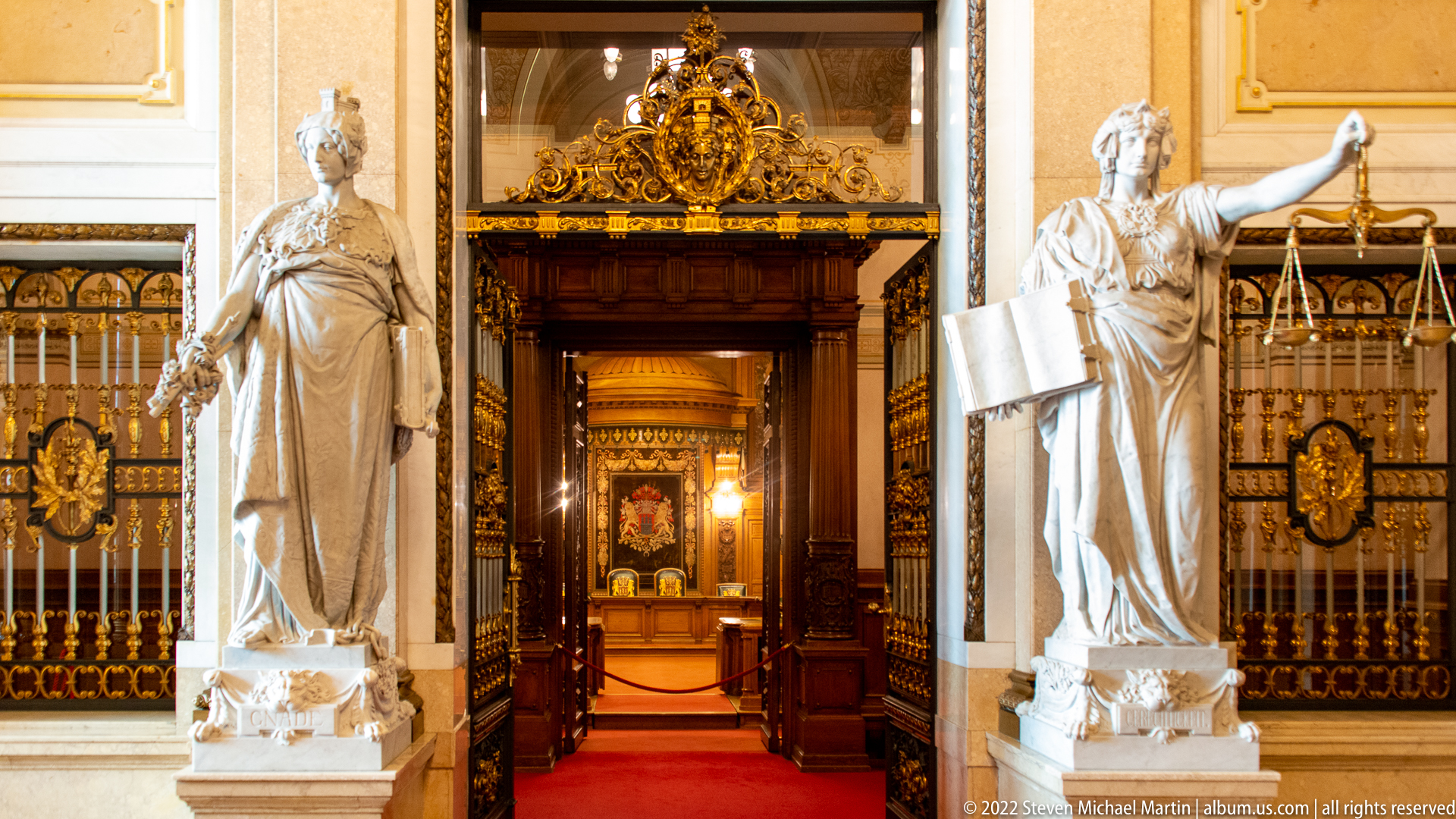
A deeply carved ceremonial doorway opens onto a red-carpeted sequence of rooms and is flanked by two pale stone female allegorical figures. The figure at right holds scales and a book, identifying Justice, while the companion at left carries different civic attributes. Gilded metalwork and dark polished wood heighten the formal symmetry of the passage.
Caption
A deeply carved ceremonial doorway opens onto a red-carpeted sequence of rooms and is flanked by two pale stone female allegorical figures. The figure at right holds scales and a book, identifying Justice, while the companion at left carries different civic attributes. Gilded metalwork and dark polished wood heighten the formal symmetry of the passage.
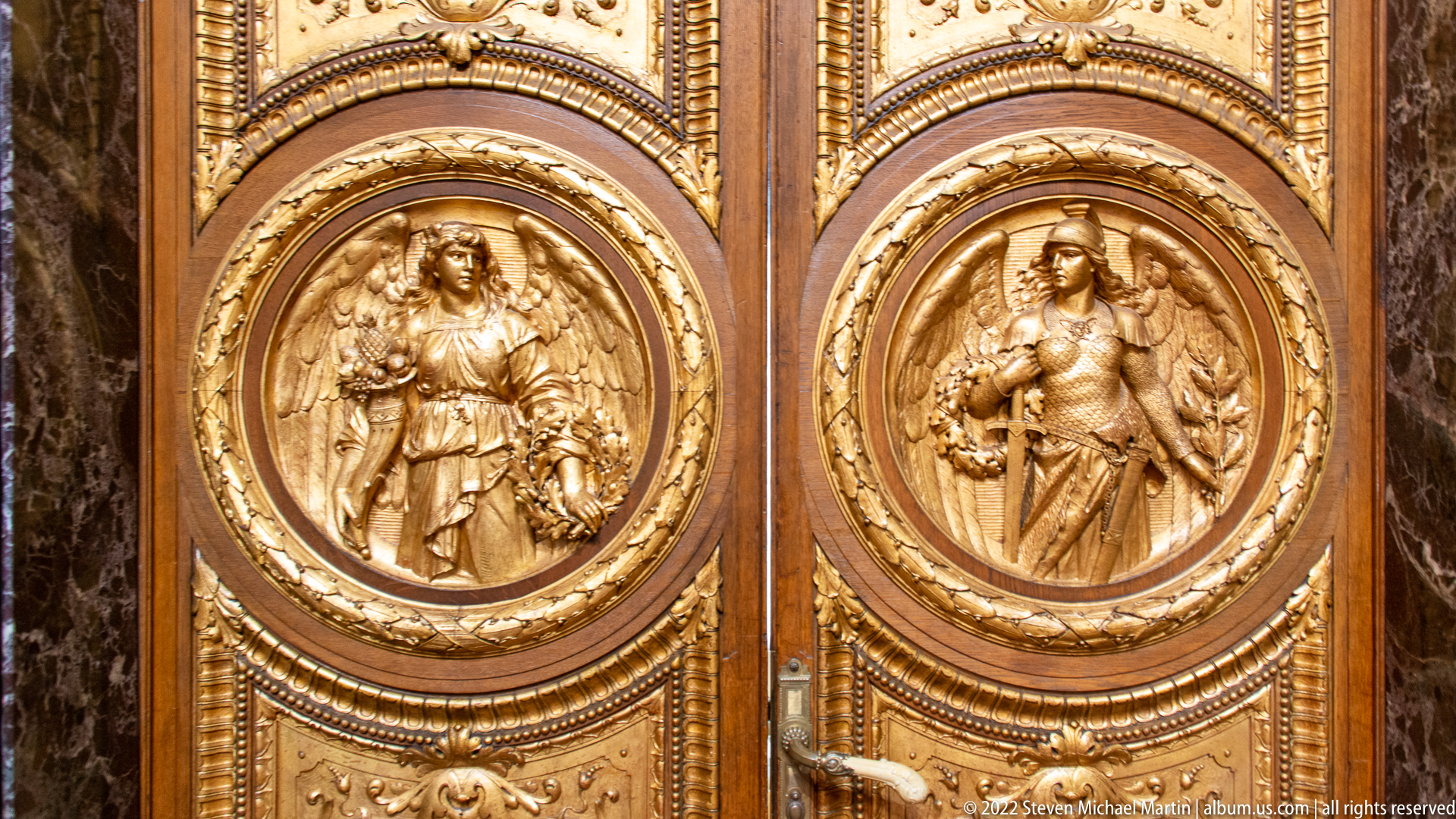
Two circular gilded reliefs of standing female figures occupy the centers of massive paneled double doors. Each figure carries distinct attributes, while concentric carved borders, beaded moldings, and richly figured wood make the door surface read like a pair of framed sculptural portraits rather than ordinary architectural hardware.
Caption
Two circular gilded reliefs of standing female figures occupy the centers of massive paneled double doors. Each figure carries distinct attributes, while concentric carved borders, beaded moldings, and richly figured wood make the door surface read like a pair of framed sculptural portraits rather than ordinary architectural hardware.
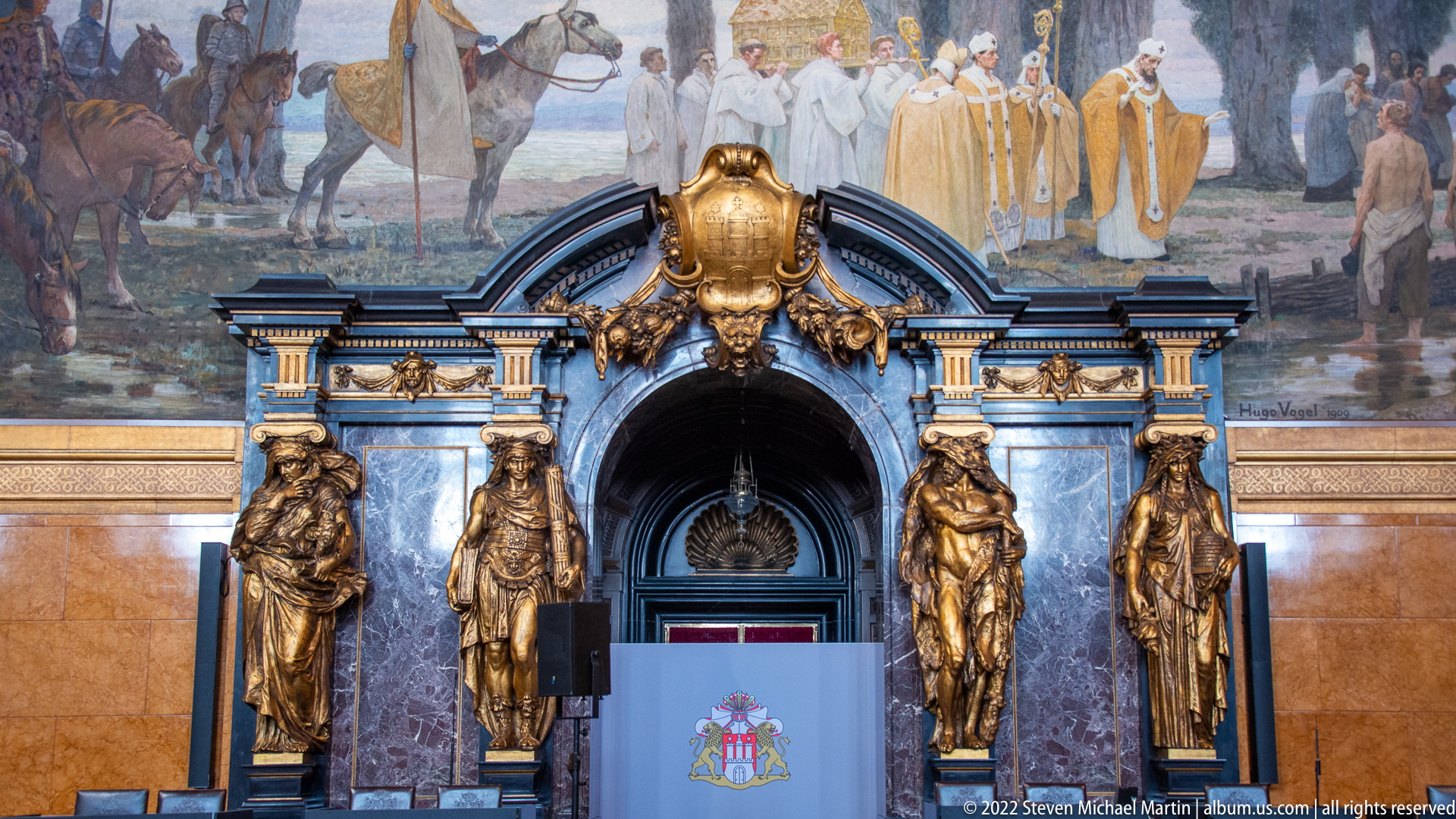
A monumental arched portal is framed by blue-gray stone, gilded ornament, and four standing sculpted figures, while a broad historical mural unfolds across the wall above. The painted scene shows a formal procession of clergy and attendants, linking the room’s ceremonial architecture with a larger narrative of Hamburg’s civic past.
Caption
A monumental arched portal is framed by blue-gray stone, gilded ornament, and four standing sculpted figures, while a broad historical mural unfolds across the wall above. The painted scene shows a formal procession of clergy and attendants, linking the room’s ceremonial architecture with a larger narrative of Hamburg’s civic past.
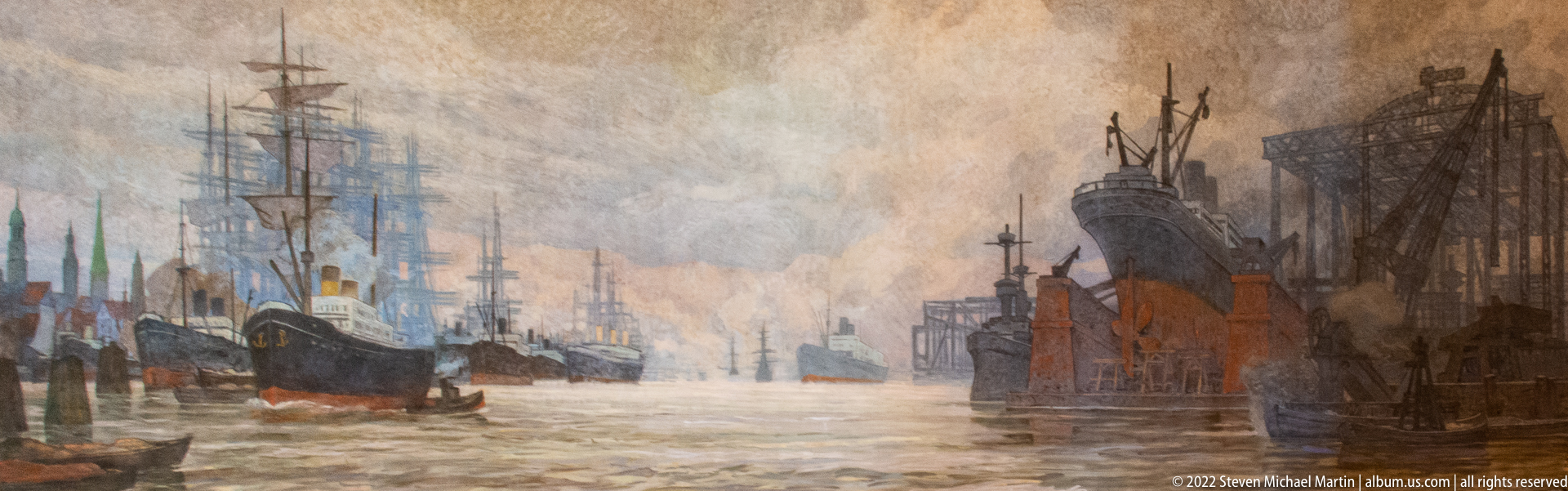
A smoky harbor painting presents steamships and sailing vessels packed along an industrial waterfront, their masts, funnels, cranes, and dock structures fading into a hazy gray atmosphere. The busy waterway and dense working harbor foreground the commercial port rather than a picturesque city view, emphasizing Hamburg’s maritime economy and industrial scale.
Caption
A smoky harbor painting presents steamships and sailing vessels packed along an industrial waterfront, their masts, funnels, cranes, and dock structures fading into a hazy gray atmosphere. The busy waterway and dense working harbor foreground the commercial port rather than a picturesque city view, emphasizing Hamburg’s maritime economy and industrial scale.
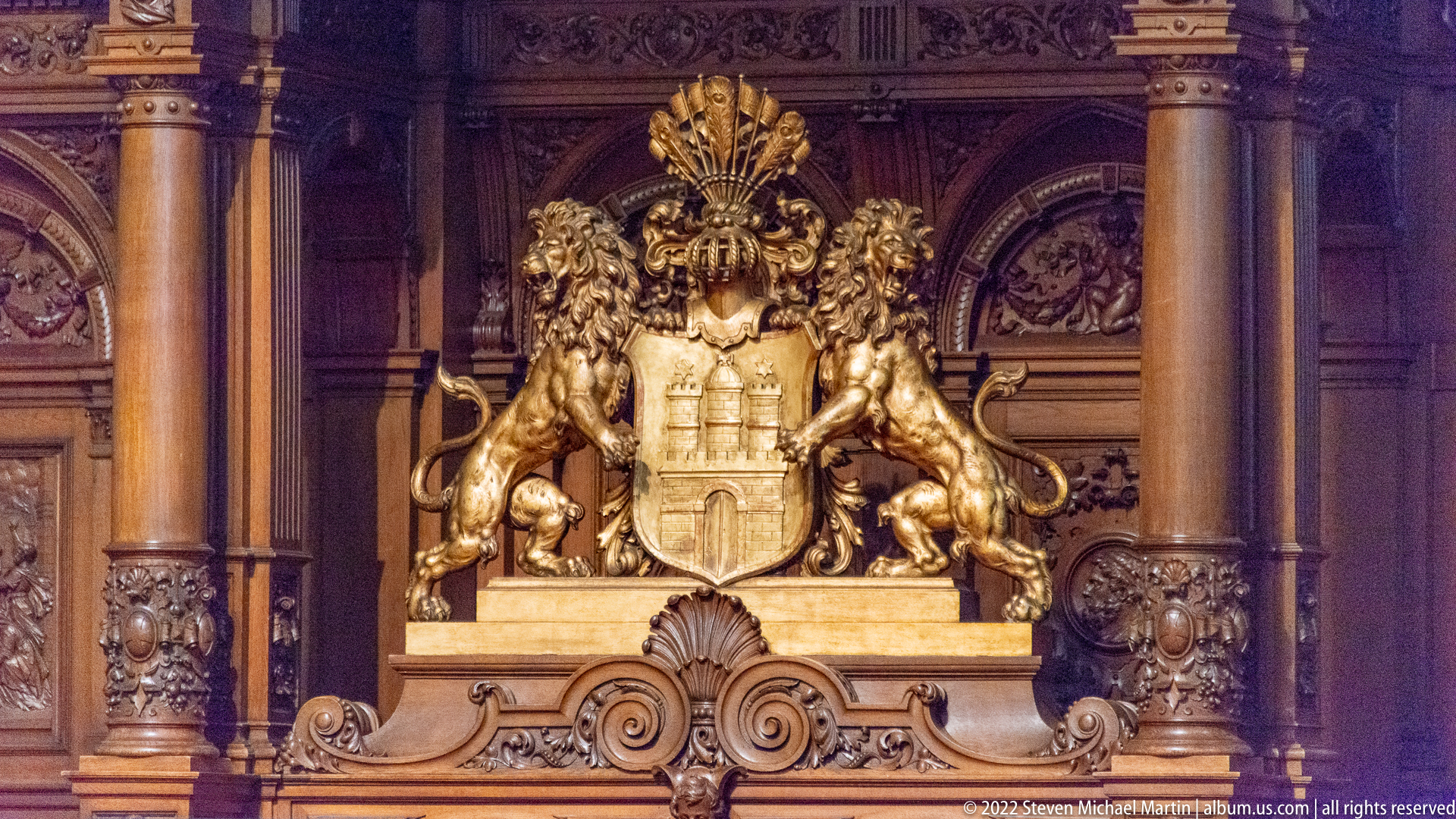
Hamburg’s three-towered castle shield is presented in gilded relief between two rampant lions, crowned by a fan-like crest and set against richly carved dark wood. The strong contrast between gold heraldry and polished timber makes the civic emblem the visual centerpiece of the architectural panel.
Caption
Hamburg’s three-towered castle shield is presented in gilded relief between two rampant lions, crowned by a fan-like crest and set against richly carved dark wood. The strong contrast between gold heraldry and polished timber makes the civic emblem the visual centerpiece of the architectural panel.

A close detail from a Rathaus history mural shows bishops in white mitres and gold vestments advancing in procession, accompanied by clergy carrying croziers and a processional cross. The cropped view isolates the ecclesiastical participants from the larger civic narrative, making costume, rank, and ceremonial movement the principal subjects.
Caption
A close detail from a Rathaus history mural shows bishops in white mitres and gold vestments advancing in procession, accompanied by clergy carrying croziers and a processional cross. The cropped view isolates the ecclesiastical participants from the larger civic narrative, making costume, rank, and ceremonial movement the principal subjects.
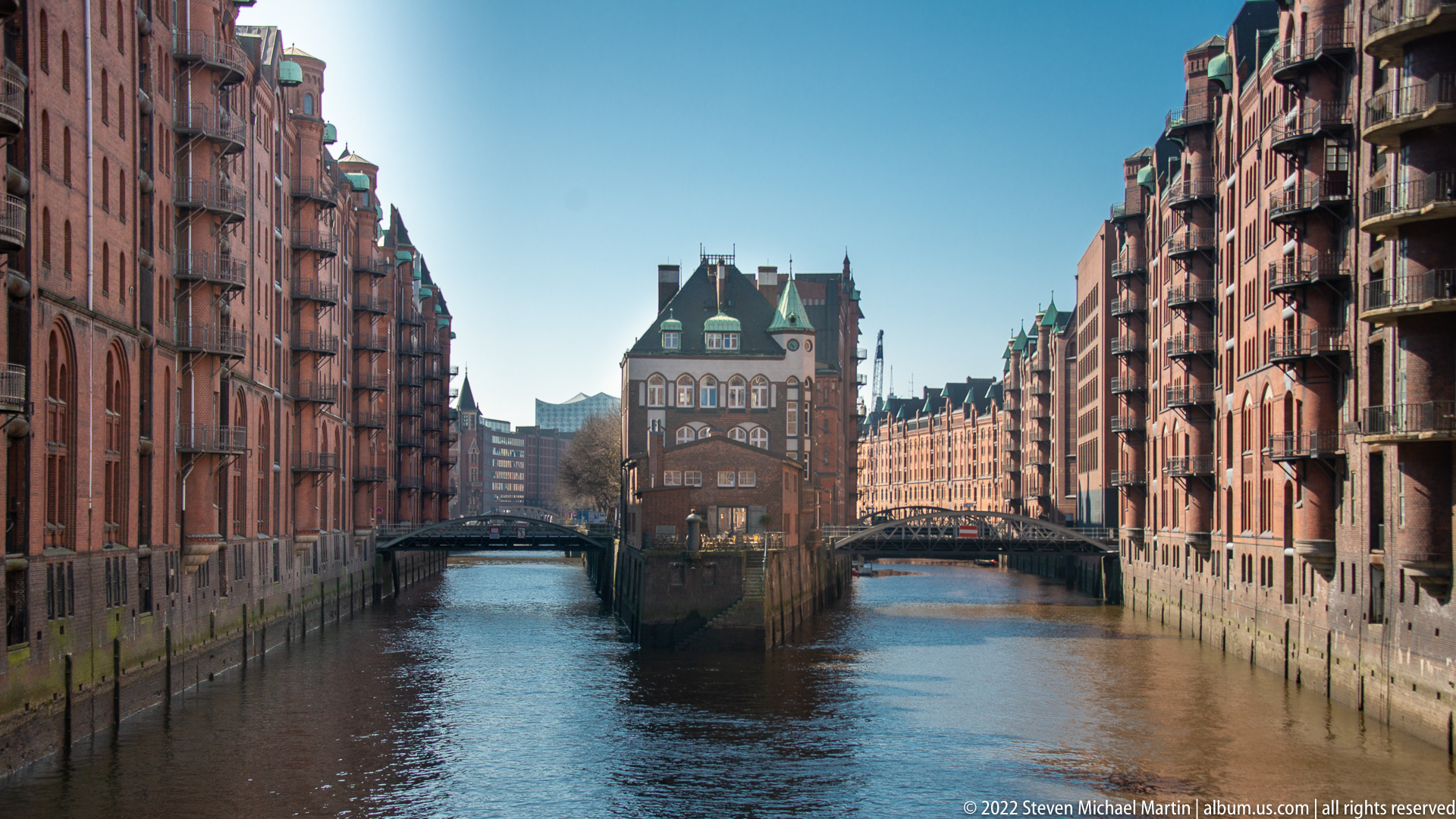
The Wasserschloss stands between converging canals in Hamburg’s Speicherstadt, its compact brick façade and green copper roof framed symmetrically by long warehouse blocks on both sides. Bridges span the waterways behind it, while the clear blue sky and reflective water give the historic warehouse district an unusually crisp, open appearance.
Caption
The Wasserschloss stands between converging canals in Hamburg’s Speicherstadt, its compact brick façade and green copper roof framed symmetrically by long warehouse blocks on both sides. Bridges span the waterways behind it, while the clear blue sky and reflective water give the historic warehouse district an unusually crisp, open appearance.

An adult man smiles toward the camera from a bridge or waterside viewpoint in Speicherstadt, with the Wasserschloss and red-brick warehouse rows softly blurred behind him. The shallow depth of field keeps the portrait dominant while preserving enough architectural context to place the scene within Hamburg’s historic canal district.
Caption
An adult man smiles toward the camera from a bridge or waterside viewpoint in Speicherstadt, with the Wasserschloss and red-brick warehouse rows softly blurred behind him. The shallow depth of field keeps the portrait dominant while preserving enough architectural context to place the scene within Hamburg’s historic canal district.
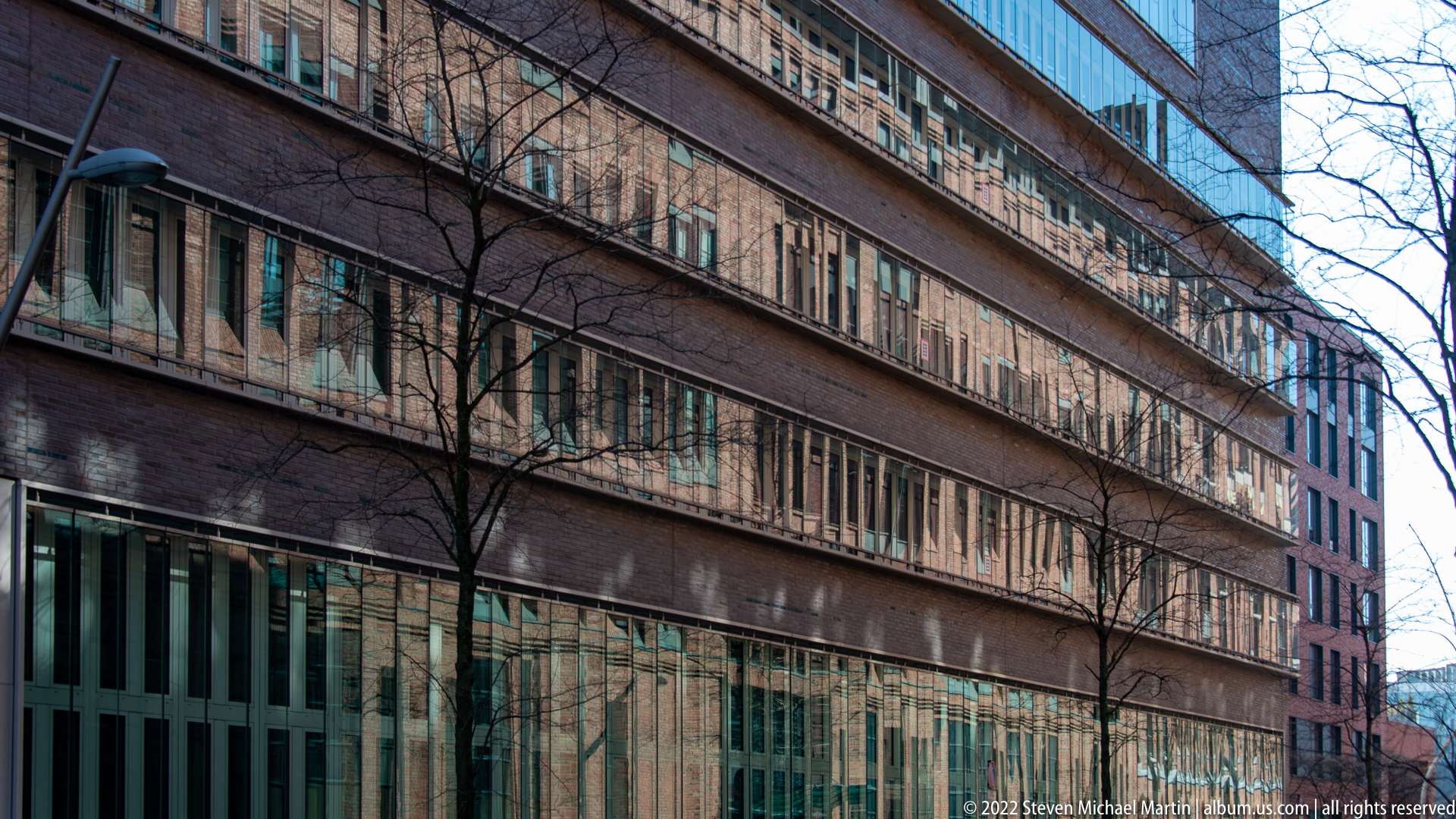
A long modern façade combines horizontal bands of dark brick with repeated rows of narrow windows and a glazed lower level. Bare trees and strong perspective lines accentuate the building’s length, while the restrained materials connect contemporary development with Hamburg’s enduring preference for brick architecture.
Caption
A long modern façade combines horizontal bands of dark brick with repeated rows of narrow windows and a glazed lower level. Bare trees and strong perspective lines accentuate the building’s length, while the restrained materials connect contemporary development with Hamburg’s enduring preference for brick architecture.
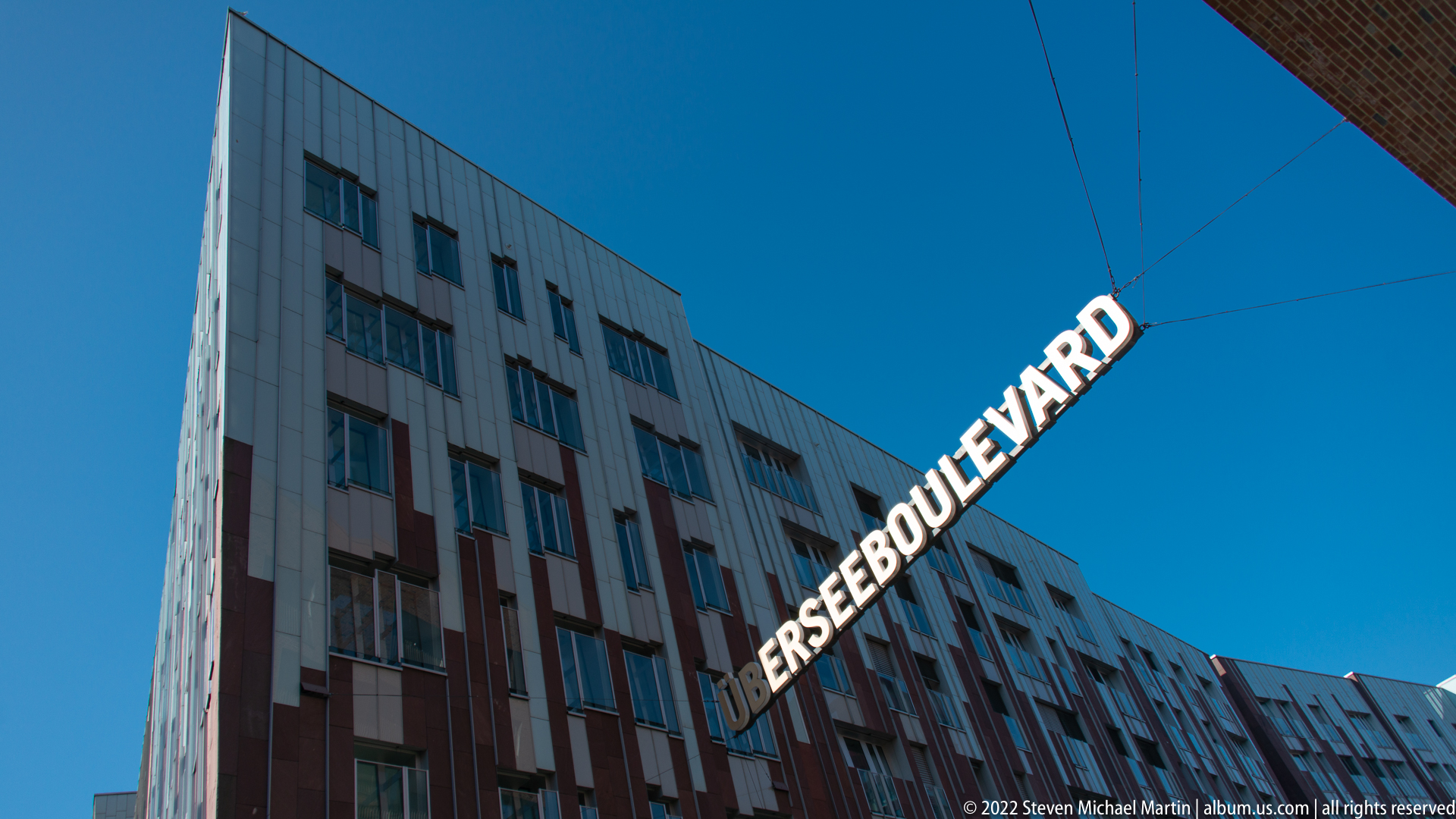
Large white letters spelling “ÜBERSEEBOULEVARD” hang diagonally across a vivid blue sky between contemporary buildings in Hamburg’s HafenCity. The suspended street or district marker becomes a graphic element in the composition, while the angular apartment façades behind it situate the sign within the newer urban quarter.
Caption
Large white letters spelling “ÜBERSEEBOULEVARD” hang diagonally across a vivid blue sky between contemporary buildings in Hamburg’s HafenCity. The suspended street or district marker becomes a graphic element in the composition, while the angular apartment façades behind it situate the sign within the newer urban quarter.
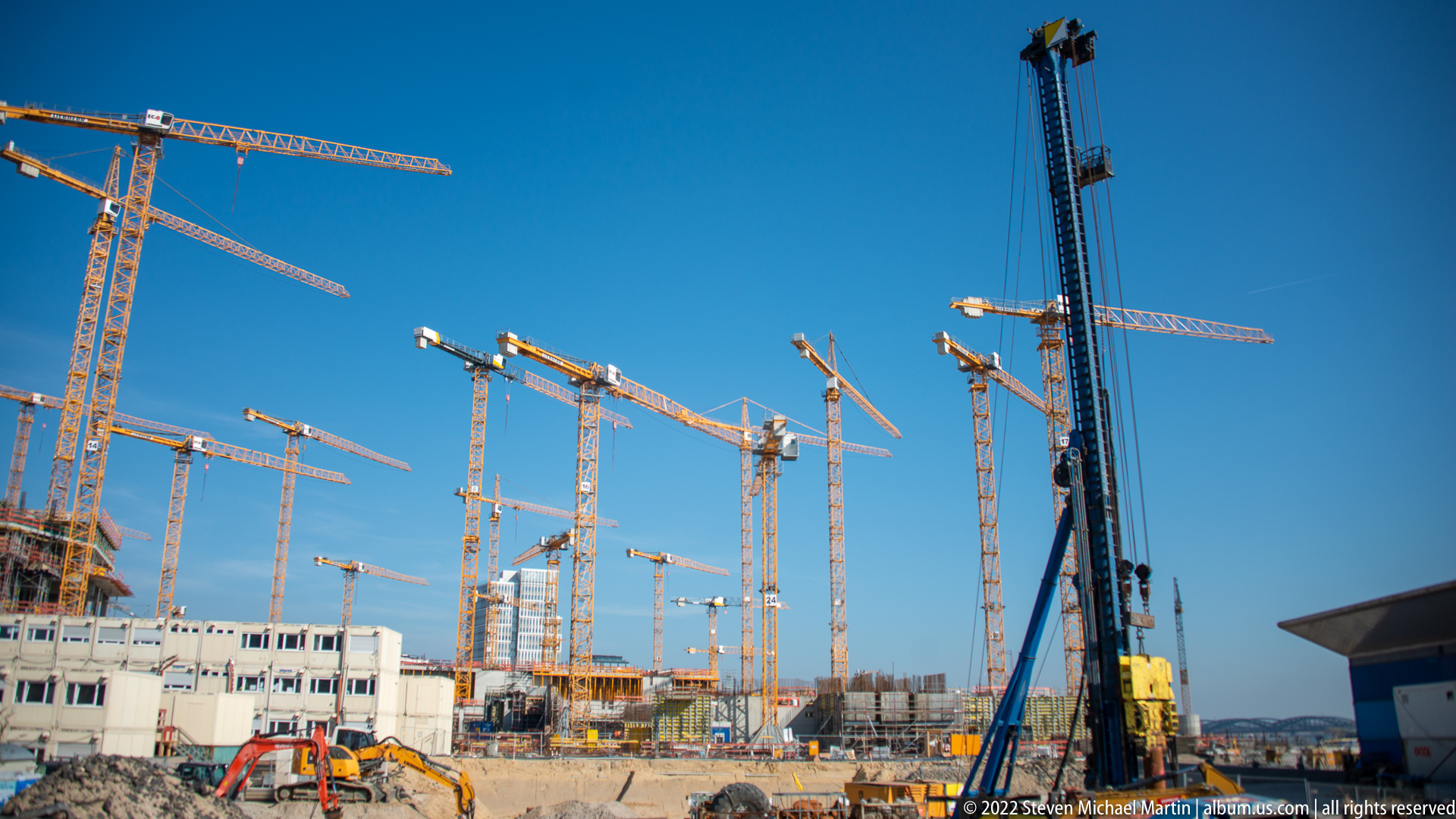
A dense field of tower cranes rises above an active construction site beneath a cloudless blue sky, with concrete structures, earthmoving equipment, and a tall drilling or piling rig filling the foreground. The scene records the scale of ongoing redevelopment in Hamburg’s harbor district, where new urban fabric continues to reshape former industrial and waterfront land.
Caption
A dense field of tower cranes rises above an active construction site beneath a cloudless blue sky, with concrete structures, earthmoving equipment, and a tall drilling or piling rig filling the foreground. The scene records the scale of ongoing redevelopment in Hamburg’s harbor district, where new urban fabric continues to reshape former industrial and waterfront land.
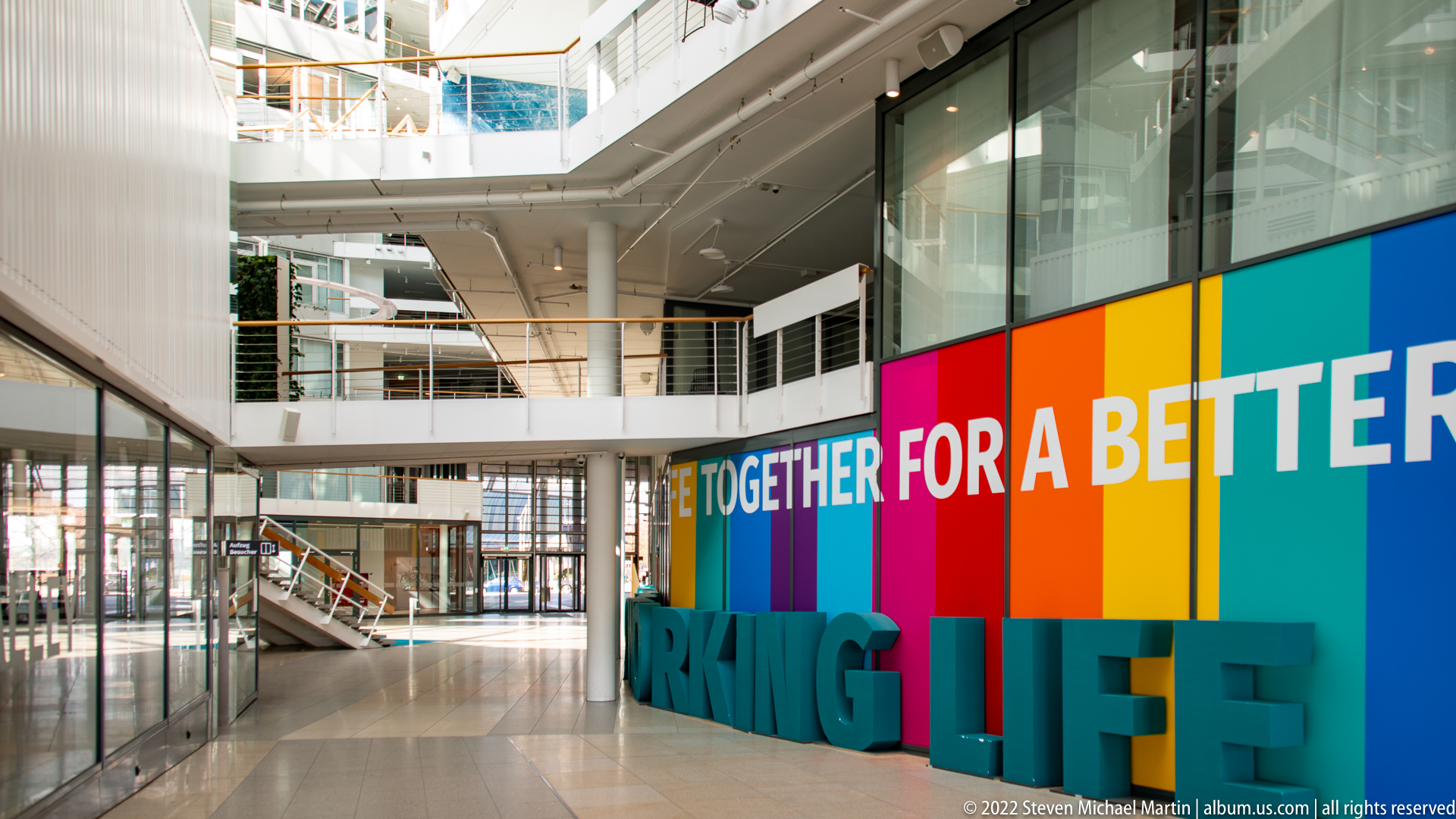
A bright multi-level atrium combines white balconies, glass-fronted offices, and a large multicolored wall installation reading “TOGETHER FOR A BETTER WORKING LIFE.” Oversized three-dimensional lettering projects into the corridor below, turning an otherwise restrained corporate interior into a graphic statement about workplace identity and collective purpose.
Caption
A bright multi-level atrium combines white balconies, glass-fronted offices, and a large multicolored wall installation reading “TOGETHER FOR A BETTER WORKING LIFE.” Oversized three-dimensional lettering projects into the corridor below, turning an otherwise restrained corporate interior into a graphic statement about workplace identity and collective purpose.
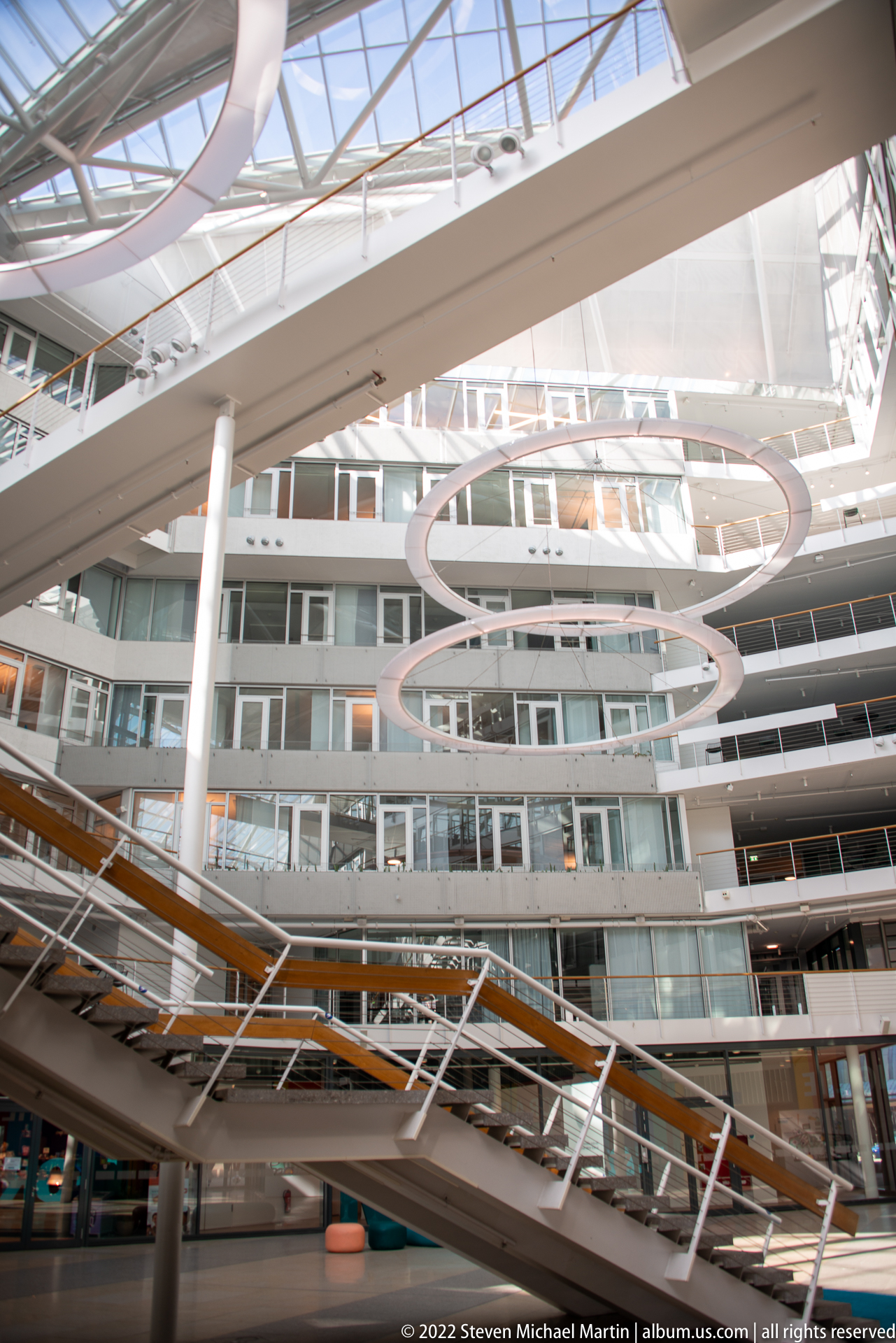
Large illuminated rings hover within a multi-story atrium enclosed by pale balconies, glass railings, and exposed structural framing. Viewed upward through the open interior court, the suspended circular fixtures become the dominant sculptural elements, contrasting with the rectilinear office façades and producing a distinctly contemporary spatial composition.
Caption
Large illuminated rings hover within a multi-story atrium enclosed by pale balconies, glass railings, and exposed structural framing. Viewed upward through the open interior court, the suspended circular fixtures become the dominant sculptural elements, contrasting with the rectilinear office façades and producing a distinctly contemporary spatial composition.
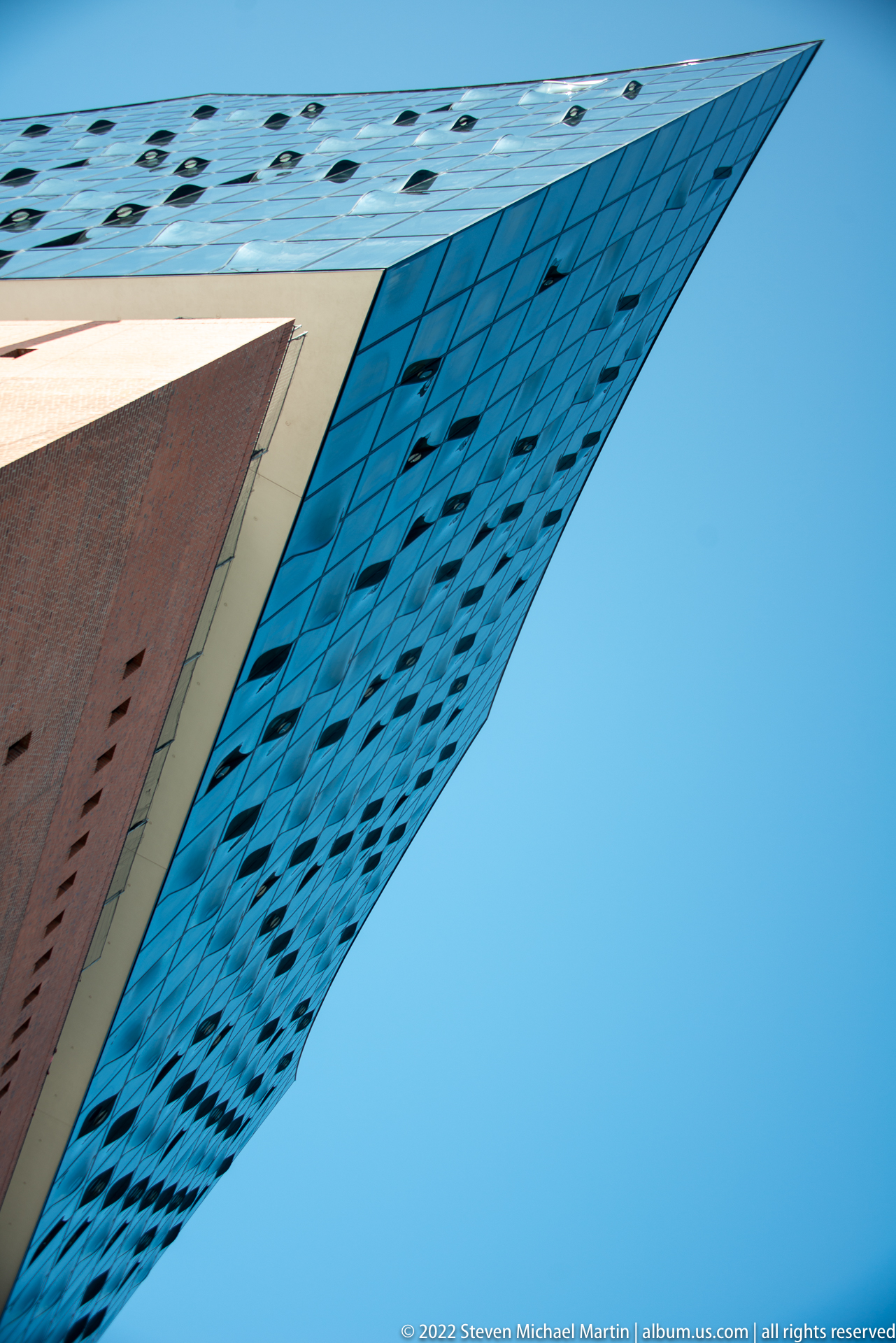
The glass superstructure of the Elbphilharmonie projects dramatically overhead, tapering to a sharp corner against the blue sky. Curved window cutouts puncture the reflective skin, while the brick base occupies only a narrow strip below. This extreme low-angle view turns the concert hall’s overhang into an abstract composition of glass, shadow, and geometry.
Caption
The glass superstructure of the Elbphilharmonie projects dramatically overhead, tapering to a sharp corner against the blue sky. Curved window cutouts puncture the reflective skin, while the brick base occupies only a narrow strip below. This extreme low-angle view turns the concert hall’s overhang into an abstract composition of glass, shadow, and geometry.
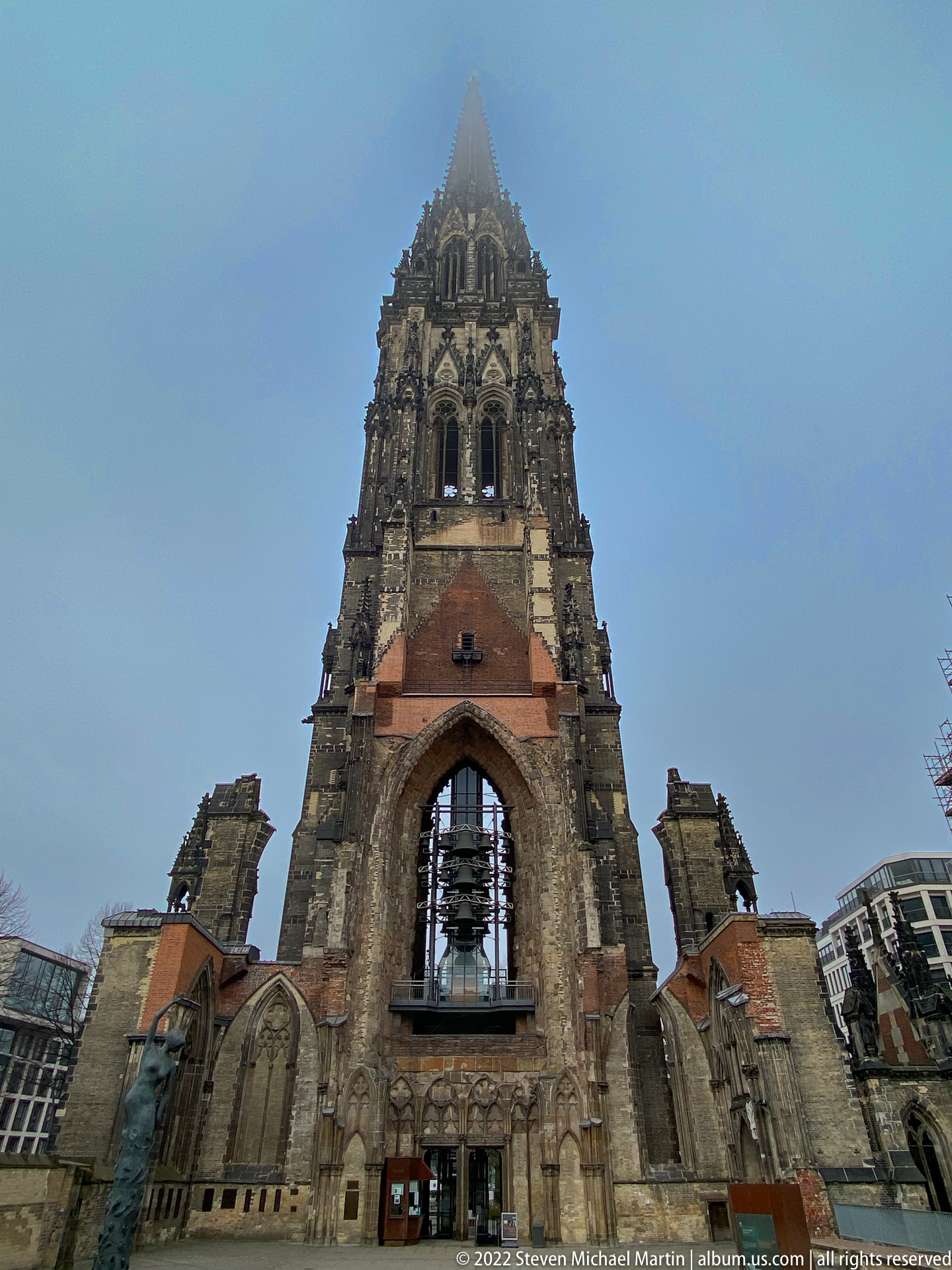
The surviving tower of the former St. Nikolai church rises from a roofless and heavily damaged nave, its dark Gothic upper stages fading slightly into mist. Broken wall sections and exposed window openings flank the central entrance below. The frontal view records the ruin as both architectural fragment and memorial presence within modern Hamburg.
Caption
The surviving tower of the former St. Nikolai church rises from a roofless and heavily damaged nave, its dark Gothic upper stages fading slightly into mist. Broken wall sections and exposed window openings flank the central entrance below. The frontal view records the ruin as both architectural fragment and memorial presence within modern Hamburg.
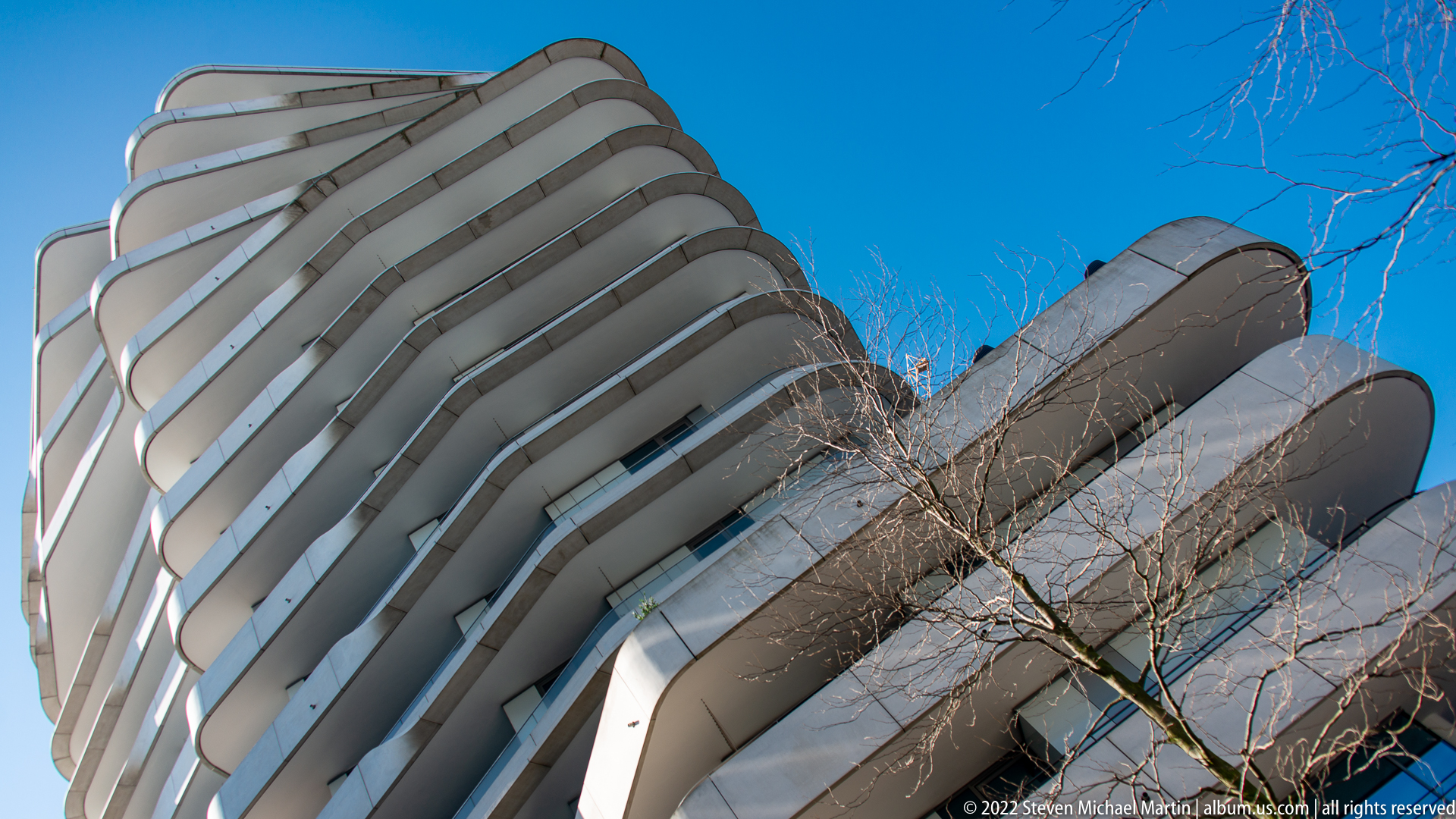
A modern residential tower rises sharply from below, its façade wrapped by broad white balcony bands that curve around the building in repeated horizontal layers. Bare branches cross the lower edge of the frame, while the deep blue sky emphasizes the sculptural profile and alternating rhythm of balconies and recessed glazing.
Caption
A modern residential tower rises sharply from below, its façade wrapped by broad white balcony bands that curve around the building in repeated horizontal layers. Bare branches cross the lower edge of the frame, while the deep blue sky emphasizes the sculptural profile and alternating rhythm of balconies and recessed glazing.
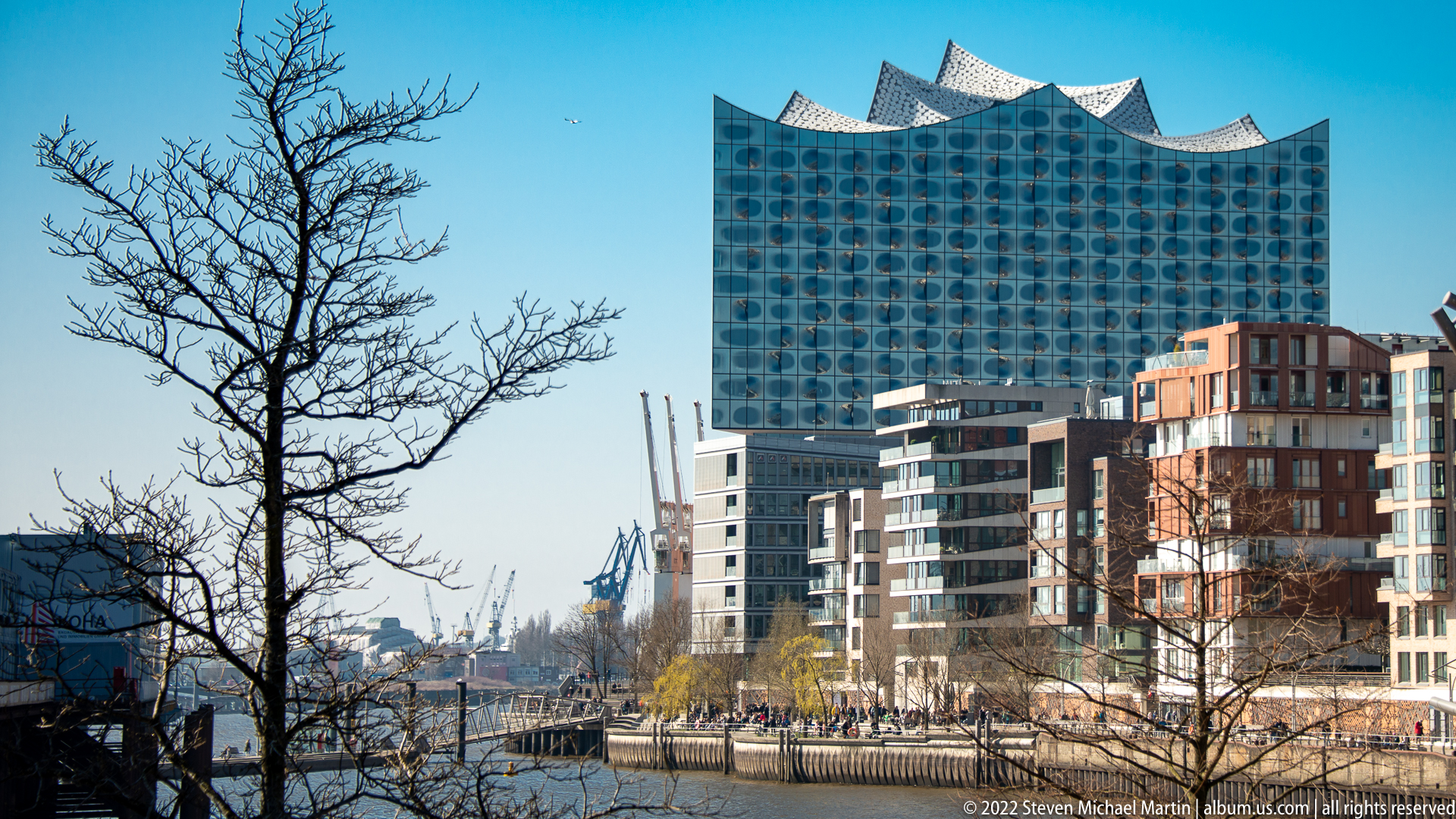
The Elbphilharmonie rises above Hamburg’s waterfront, its glass façade and wave-shaped roof catching the light beyond a cluster of newer residential and office buildings. A bare tree frames the left edge while harbor cranes remain visible in the distance, linking the celebrated concert hall to the working port and ongoing urban development around it.
Caption
The Elbphilharmonie rises above Hamburg’s waterfront, its glass façade and wave-shaped roof catching the light beyond a cluster of newer residential and office buildings. A bare tree frames the left edge while harbor cranes remain visible in the distance, linking the celebrated concert hall to the working port and ongoing urban development around it.
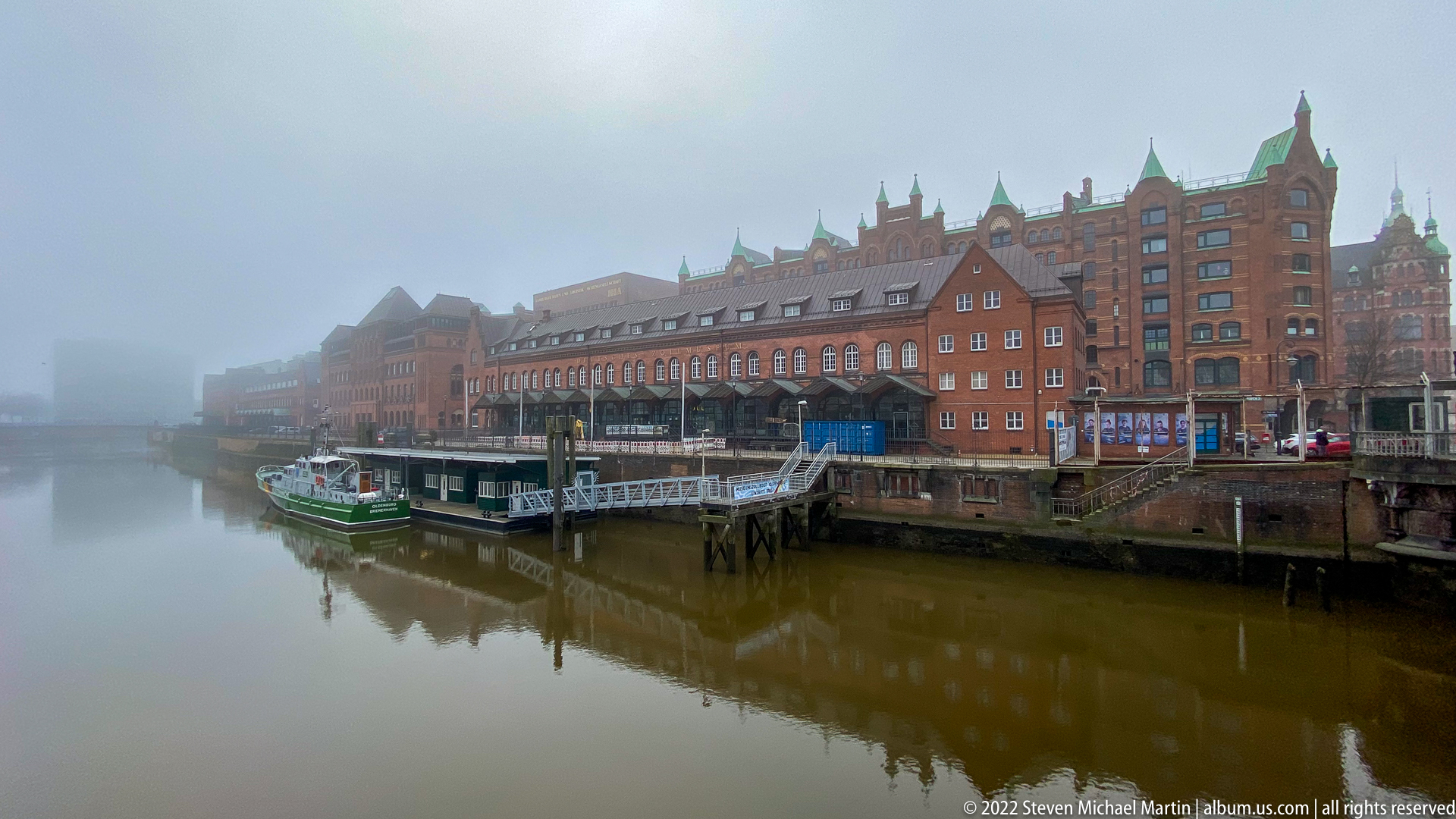
A canal runs beside long red-brick warehouse blocks in Speicherstadt as dense fog softens the far end of the district. A green-and-white vessel is moored along the quay, while balconies, loading levels, and steep gables remain sharply visible in the foreground. The muted atmosphere emphasizes the warehouse quarter’s relationship to waterborne trade and canal access.
Caption
A canal runs beside long red-brick warehouse blocks in Speicherstadt as dense fog softens the far end of the district. A green-and-white vessel is moored along the quay, while balconies, loading levels, and steep gables remain sharply visible in the foreground. The muted atmosphere emphasizes the warehouse quarter’s relationship to waterborne trade and canal access.
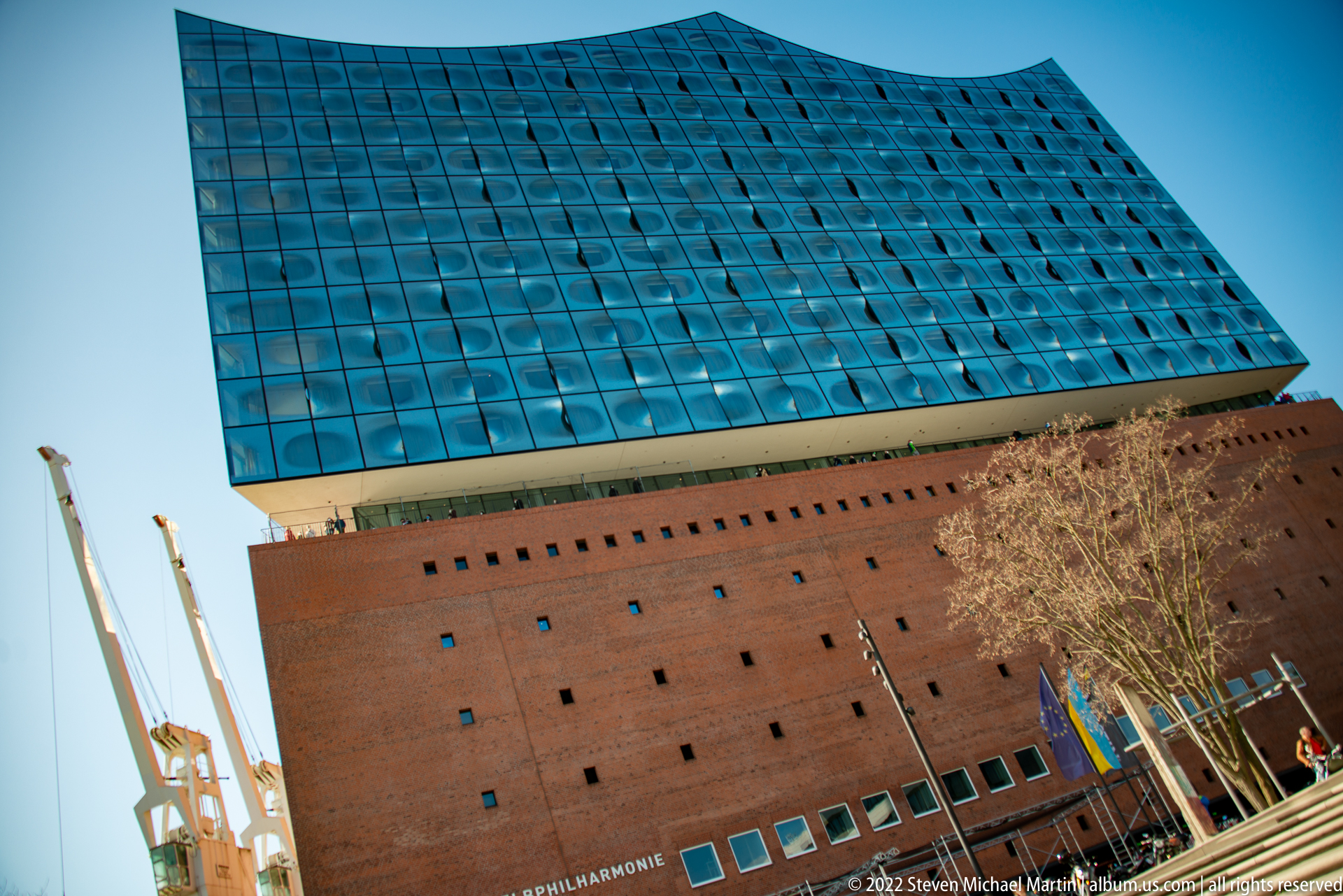
The Elbphilharmonie is seen from below where its historic-looking red-brick base meets the dramatically curved glass concert-hall volume above. Reflections ripple across the blue glazing, while harbor cranes appear at the left edge. The perspective emphasizes the architectural contrast between massive masonry podium and lightweight, wave-like upper structure.
Caption
The Elbphilharmonie is seen from below where its historic-looking red-brick base meets the dramatically curved glass concert-hall volume above. Reflections ripple across the blue glazing, while harbor cranes appear at the left edge. The perspective emphasizes the architectural contrast between massive masonry podium and lightweight, wave-like upper structure.
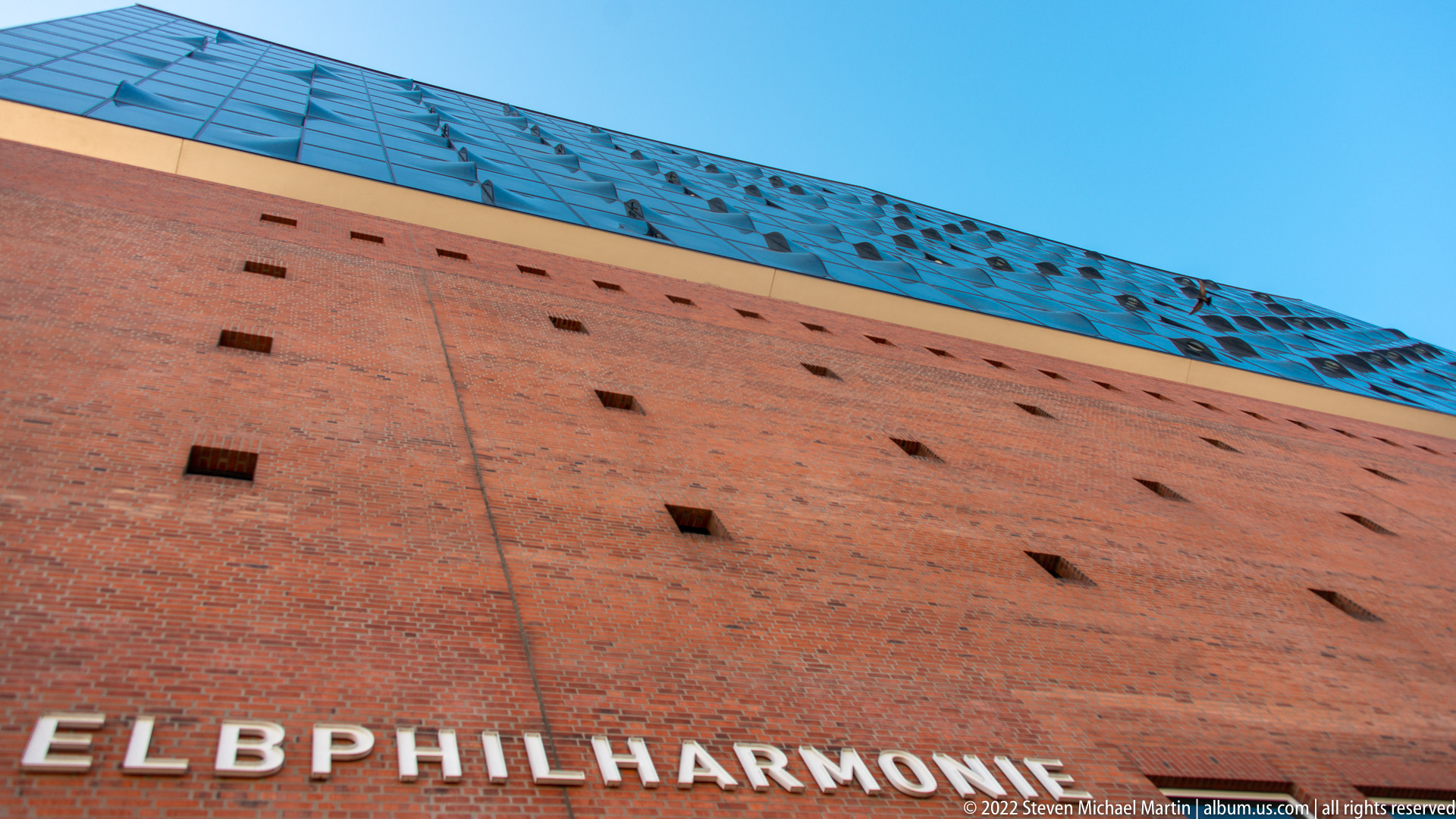
The monumental brick base of the Elbphilharmonie fills the frame, punctuated by small square openings beneath the curved glass volume above. Large white letters spelling “ELBPHILHARMONIE” identify the concert hall directly. The steep upward viewpoint makes the masonry podium feel massive while the glass crown appears to float at its edge.
Caption
The monumental brick base of the Elbphilharmonie fills the frame, punctuated by small square openings beneath the curved glass volume above. Large white letters spelling “ELBPHILHARMONIE” identify the concert hall directly. The steep upward viewpoint makes the masonry podium feel massive while the glass crown appears to float at its edge.
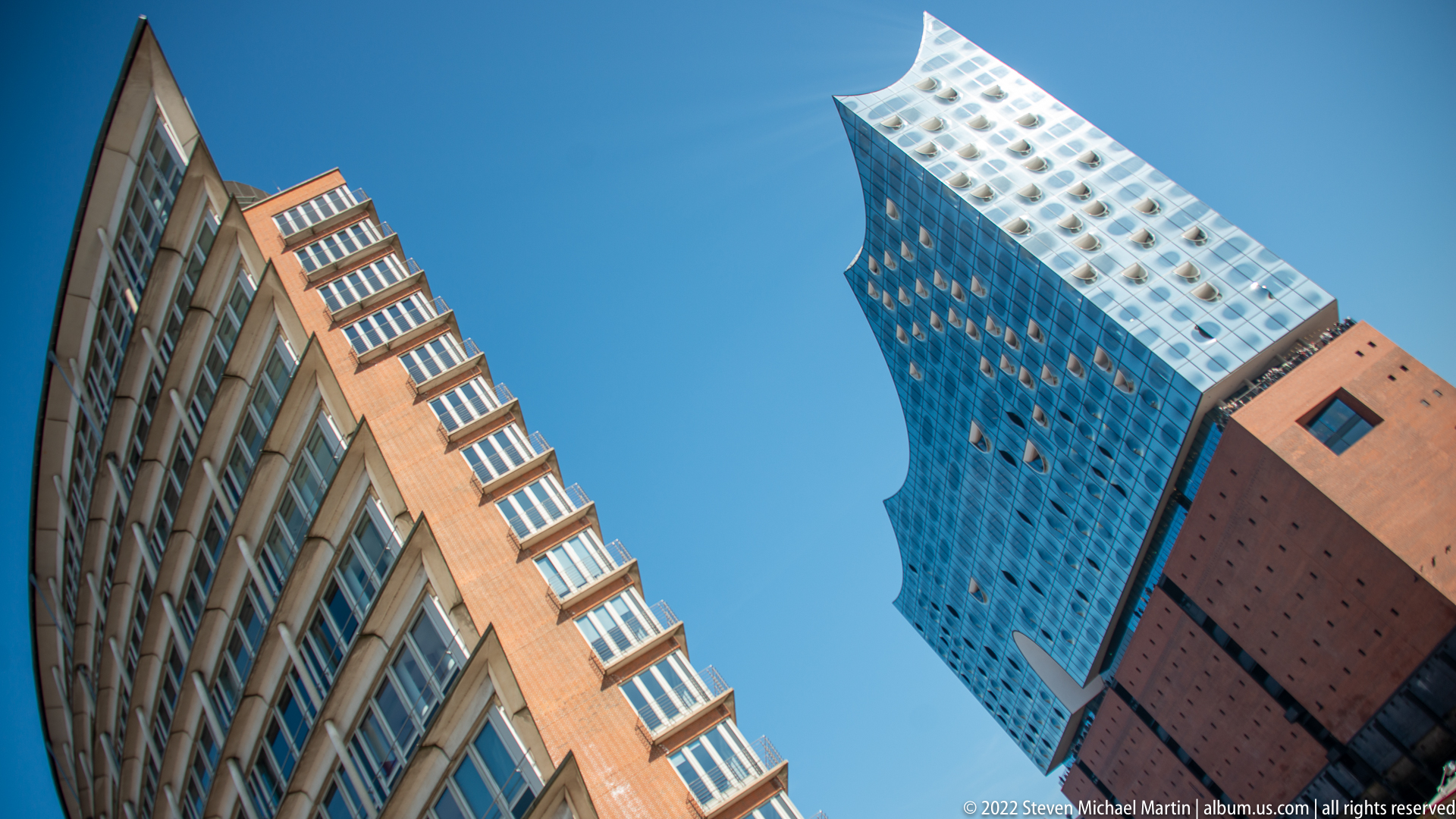
The Elbphilharmonie’s rippling glass upper stories rise high above a neighboring brick-and-glass building, viewed from a narrow upward angle. The concert hall’s pale roof edge and irregular window pattern catch the sunlight, while the adjacent structure creates a strong vertical canyon that accentuates the landmark’s height and sculptural form.
Caption
The Elbphilharmonie’s rippling glass upper stories rise high above a neighboring brick-and-glass building, viewed from a narrow upward angle. The concert hall’s pale roof edge and irregular window pattern catch the sunlight, while the adjacent structure creates a strong vertical canyon that accentuates the landmark’s height and sculptural form.
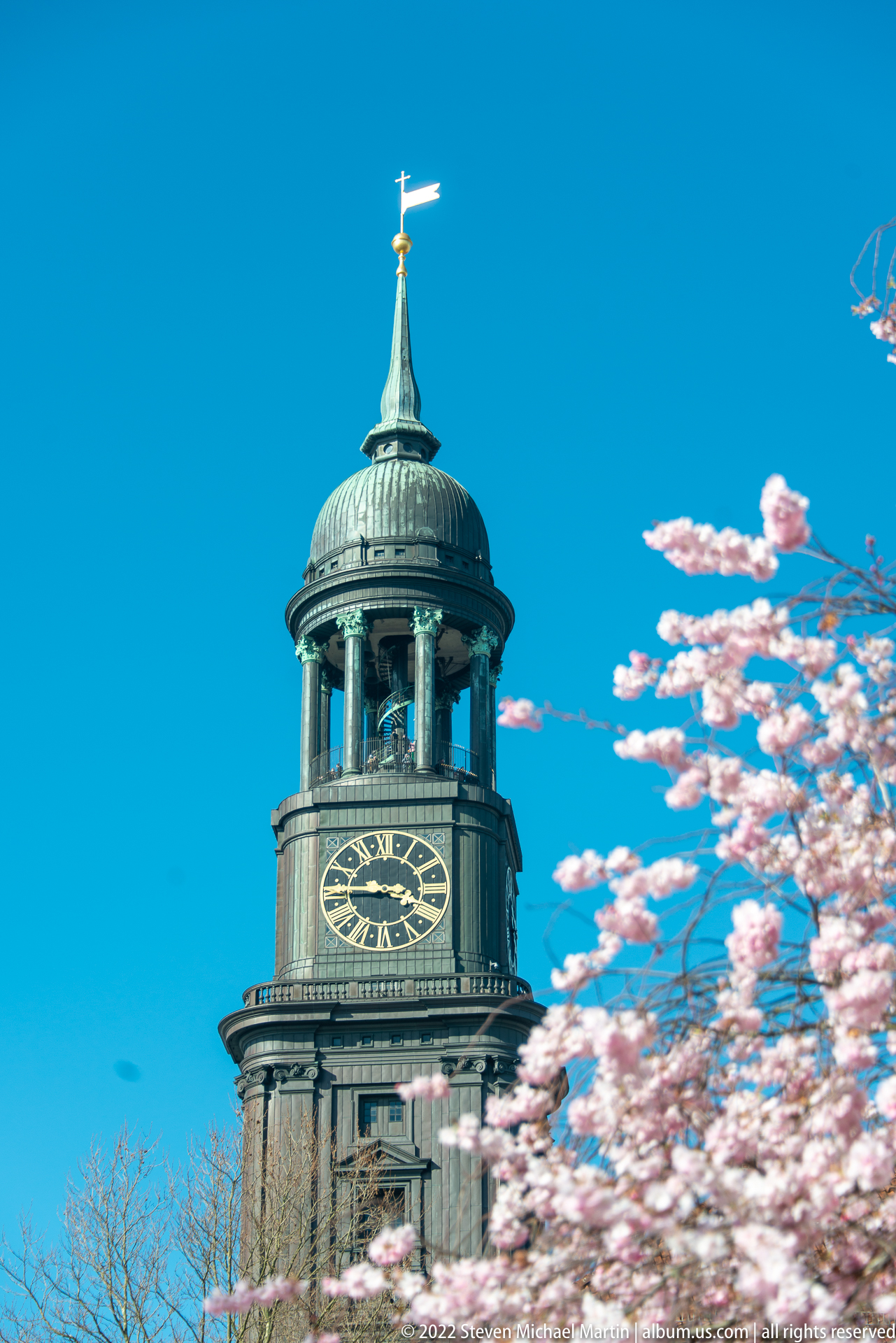
A historic church tower with a large black-and-gold clock rises against a saturated blue sky while pink flowering branches sweep across the right side of the frame. The tower’s green-patinated cupola and open lantern contrast with the fresh spring blossoms, creating a seasonal urban view that combines architecture and vegetation.
Caption
A historic church tower with a large black-and-gold clock rises against a saturated blue sky while pink flowering branches sweep across the right side of the frame. The tower’s green-patinated cupola and open lantern contrast with the fresh spring blossoms, creating a seasonal urban view that combines architecture and vegetation.
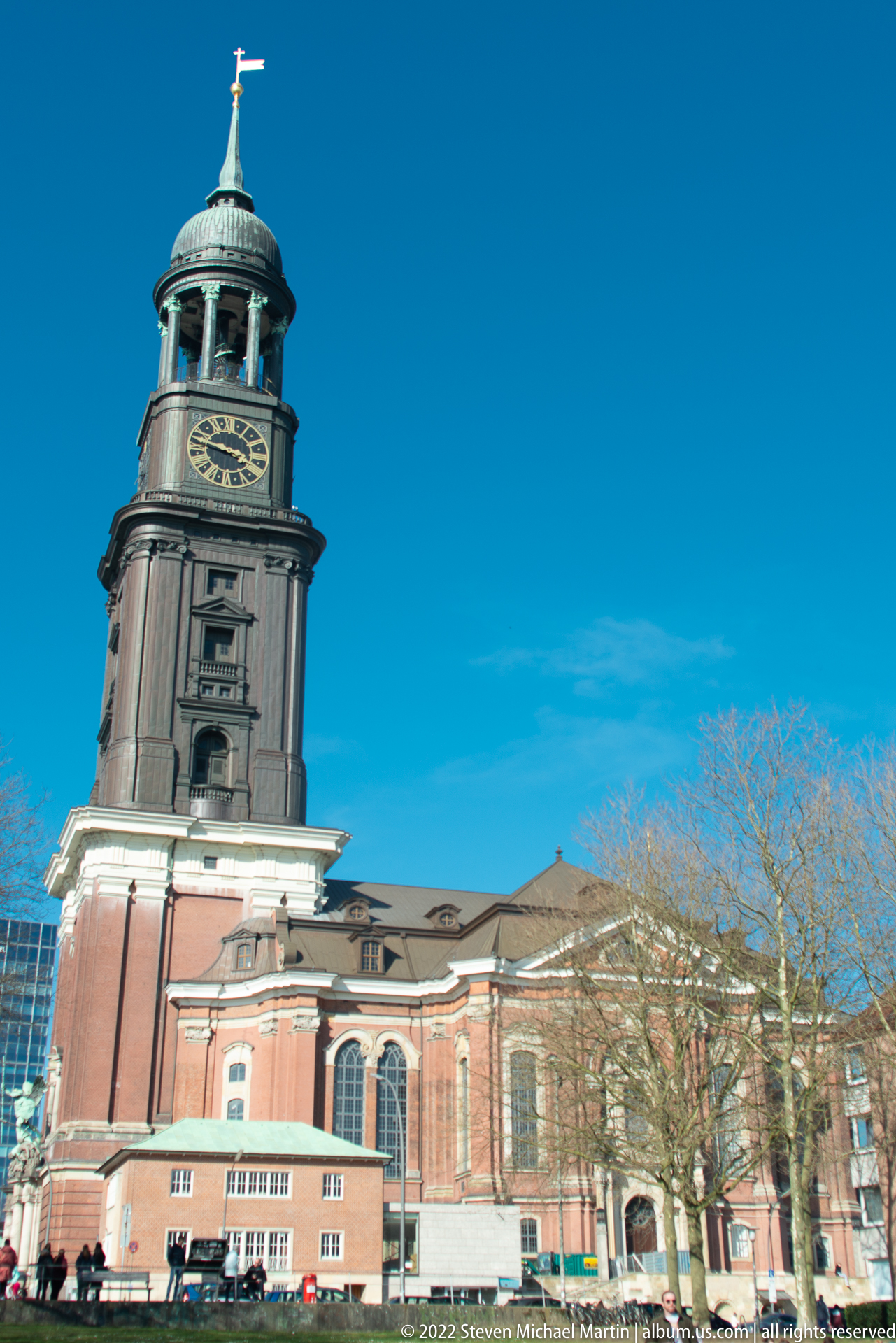
The broad brick nave of Hamburg’s Hauptkirche St. Michaelis stretches beneath its monumental clock tower, whose upper stages rise above the roofline against a clear blue sky. The side view reveals the church’s substantial Baroque massing and repeated tall windows, with the famous tower visually anchoring the long horizontal body.
Caption
The broad brick nave of Hamburg’s Hauptkirche St. Michaelis stretches beneath its monumental clock tower, whose upper stages rise above the roofline against a clear blue sky. The side view reveals the church’s substantial Baroque massing and repeated tall windows, with the famous tower visually anchoring the long horizontal body.
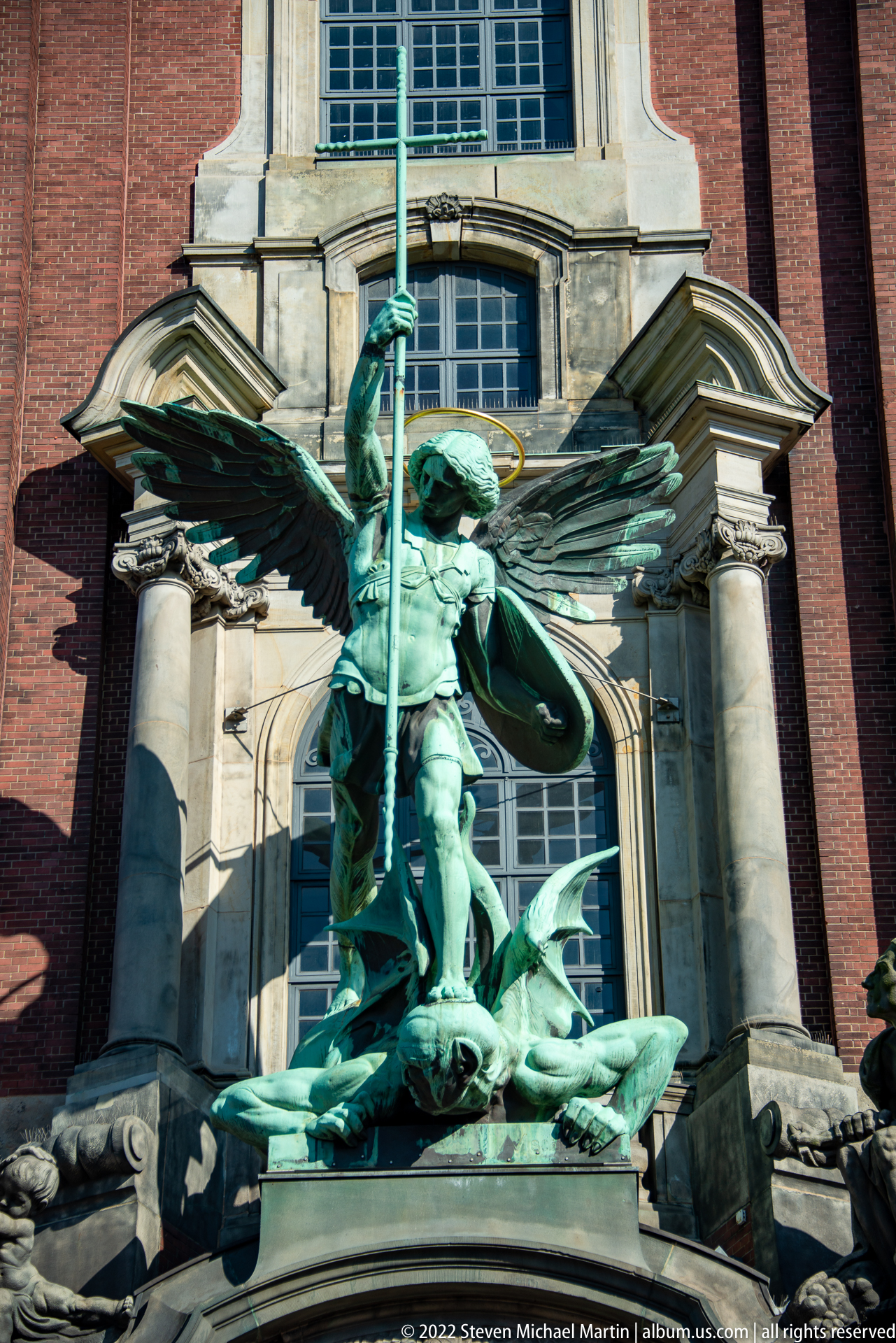
A monumental green-patinated sculpture of the Archangel Michael stands above the entrance to Hauptkirche St. Michaelis, thrusting a long spear downward as he subdues a fallen demonic figure. Wings spread behind him while the red-brick church façade and stone portal frame the dramatic composition, making the saint’s victory a forceful threshold image.
Caption
A monumental green-patinated sculpture of the Archangel Michael stands above the entrance to Hauptkirche St. Michaelis, thrusting a long spear downward as he subdues a fallen demonic figure. Wings spread behind him while the red-brick church façade and stone portal frame the dramatic composition, making the saint’s victory a forceful threshold image.
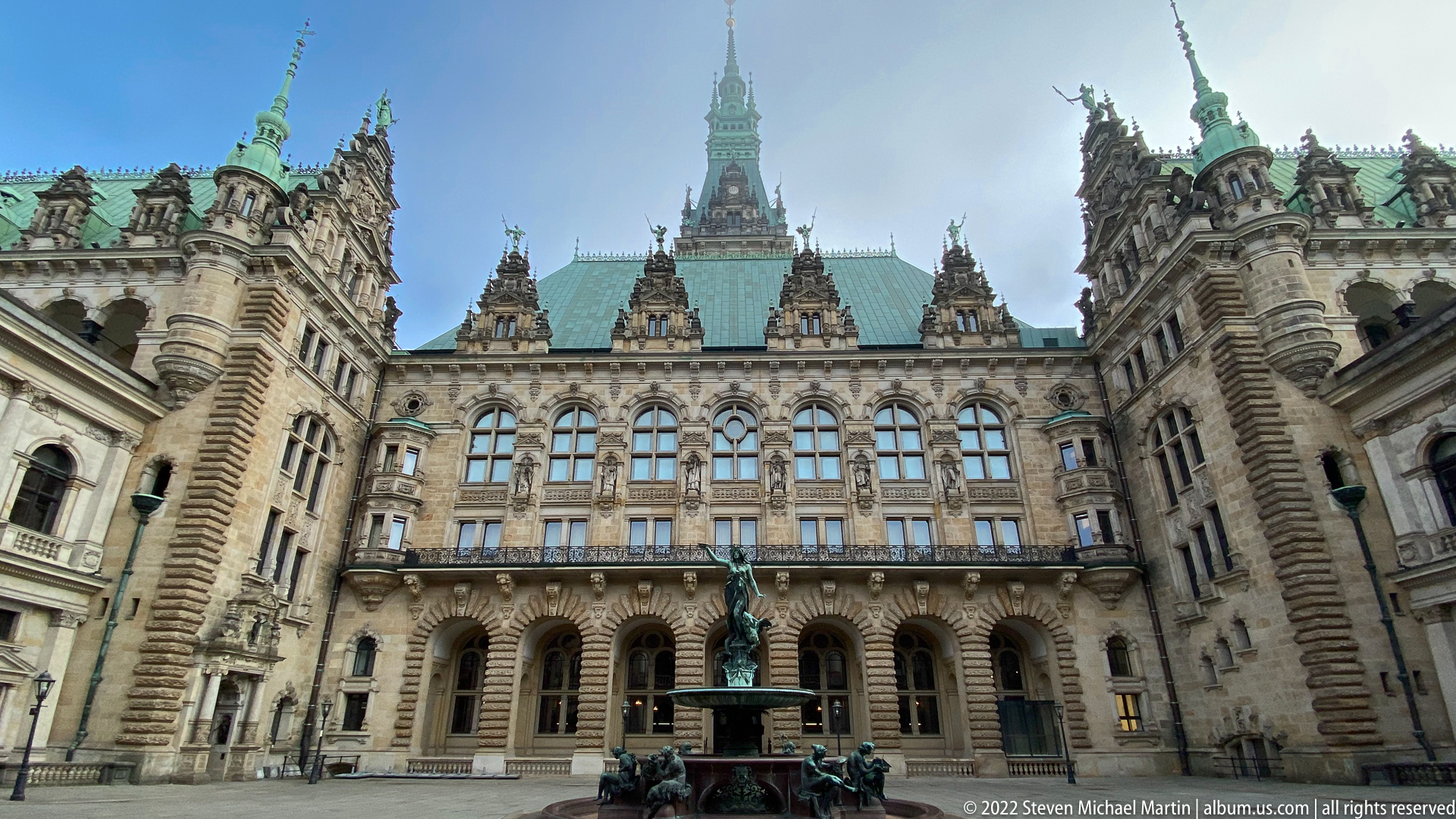
The Hygieia Fountain stands at the center of Hamburg Rathaus’s enclosed courtyard, surrounded by richly carved stone façades, arcades, gables, and green copper roofs. The low-angle view draws the eye upward from the bronze fountain toward the central tower, presenting the courtyard as a unified ensemble of sculpture, civic architecture, and elaborate historicist decoration.
Caption
The Hygieia Fountain stands at the center of Hamburg Rathaus’s enclosed courtyard, surrounded by richly carved stone façades, arcades, gables, and green copper roofs. The low-angle view draws the eye upward from the bronze fountain toward the central tower, presenting the courtyard as a unified ensemble of sculpture, civic architecture, and elaborate historicist decoration.
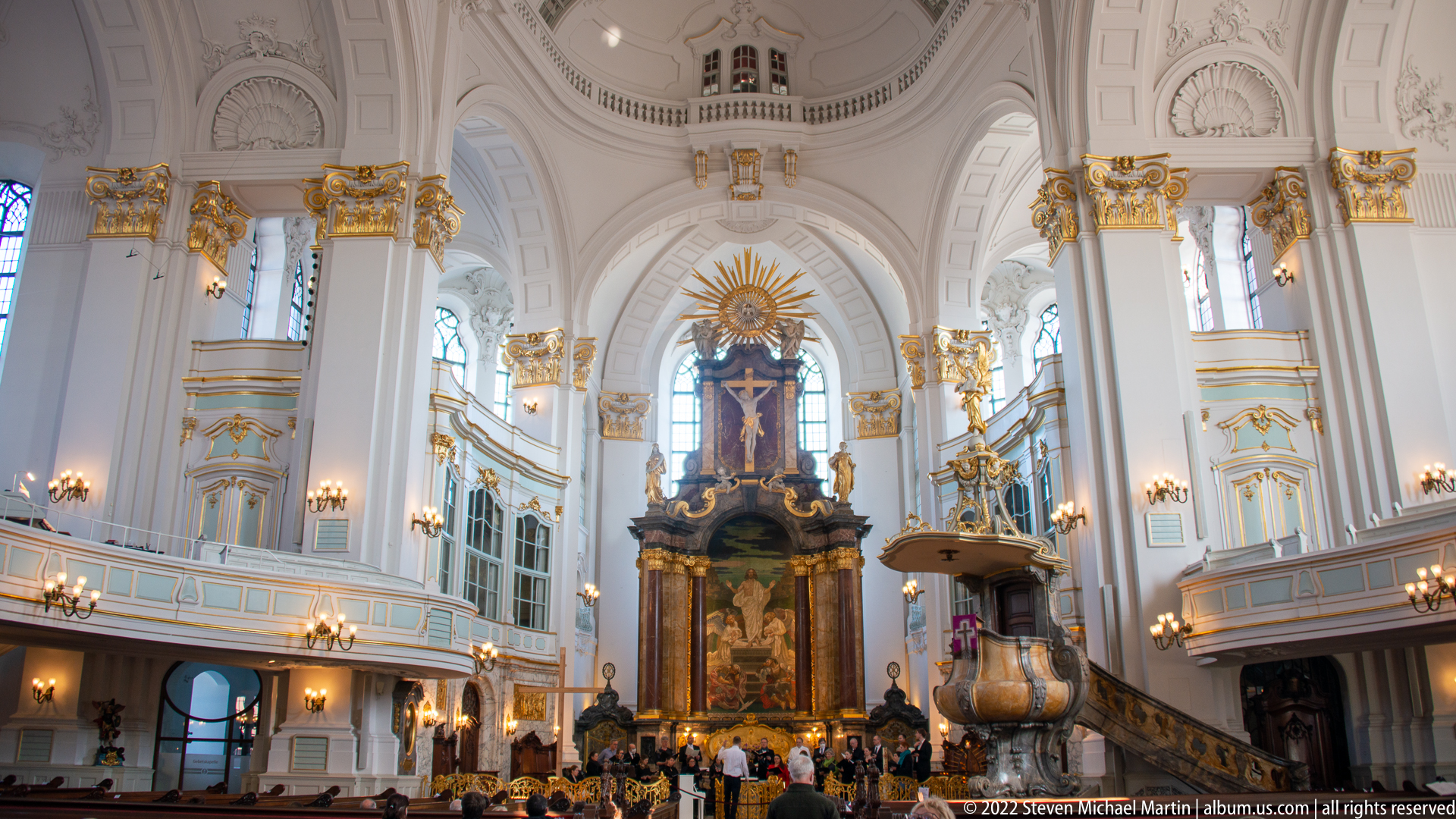
The luminous white-and-gold interior of Hauptkirche St. Michaelis opens toward a monumental Baroque altar, with curving galleries, gilded capitals, and a carved pulpit lining the nave. A large crucifix and radiant sunburst anchor the chancel, while rows of worshippers provide scale to the spacious, theatrically ornamented church.
Caption
The luminous white-and-gold interior of Hauptkirche St. Michaelis opens toward a monumental Baroque altar, with curving galleries, gilded capitals, and a carved pulpit lining the nave. A large crucifix and radiant sunburst anchor the chancel, while rows of worshippers provide scale to the spacious, theatrically ornamented church.
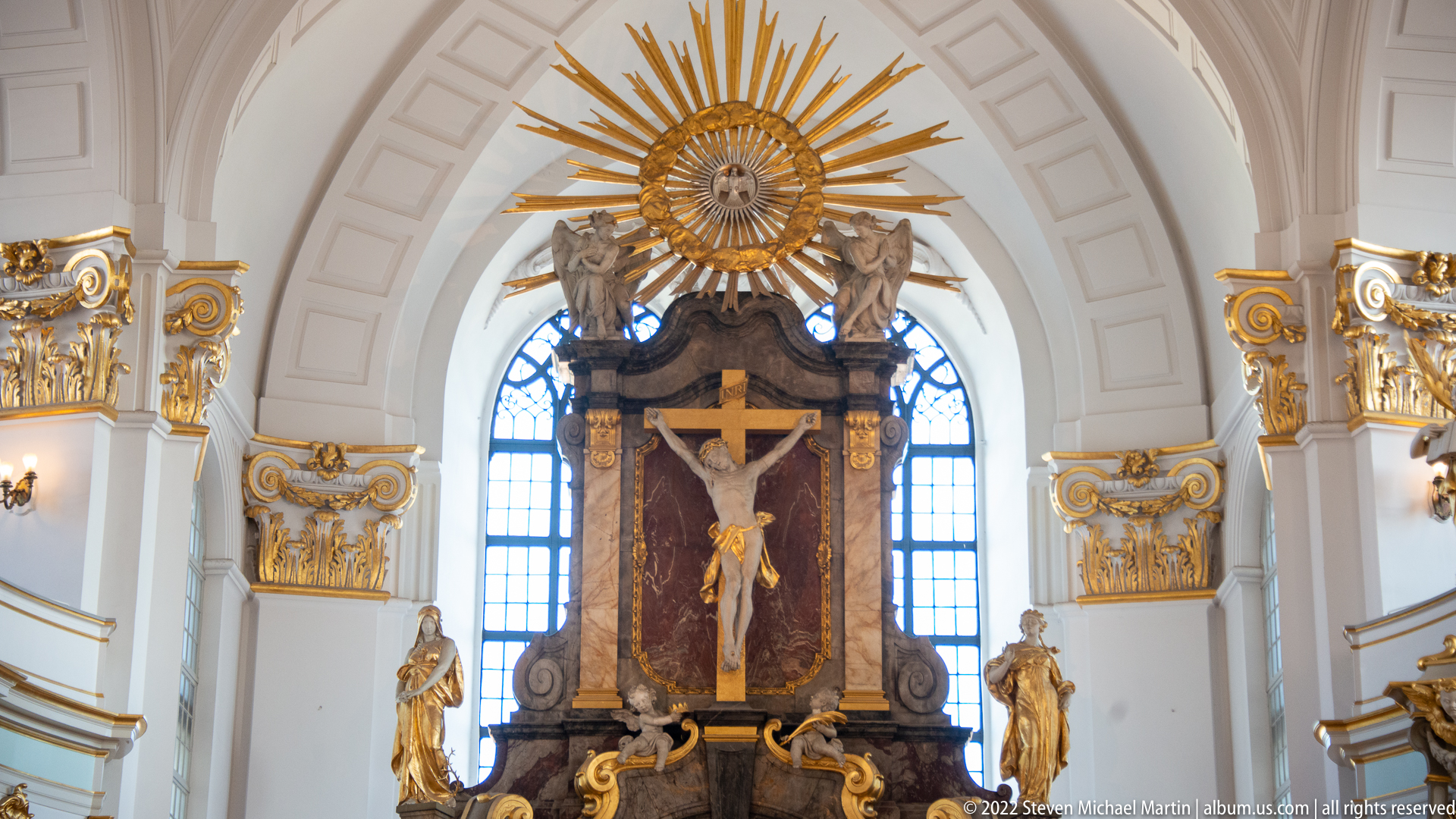
A large crucifix rises against the bright chancel window of St. Michaelis, framed by dark marble-like columns, gilded ornament, and a radiant golden sunburst above. Sculpted figures flank the architectural altar, while the tight composition concentrates attention on the central image of the crucified Christ and its dramatic Baroque setting.
Caption
A large crucifix rises against the bright chancel window of St. Michaelis, framed by dark marble-like columns, gilded ornament, and a radiant golden sunburst above. Sculpted figures flank the architectural altar, while the tight composition concentrates attention on the central image of the crucified Christ and its dramatic Baroque setting.
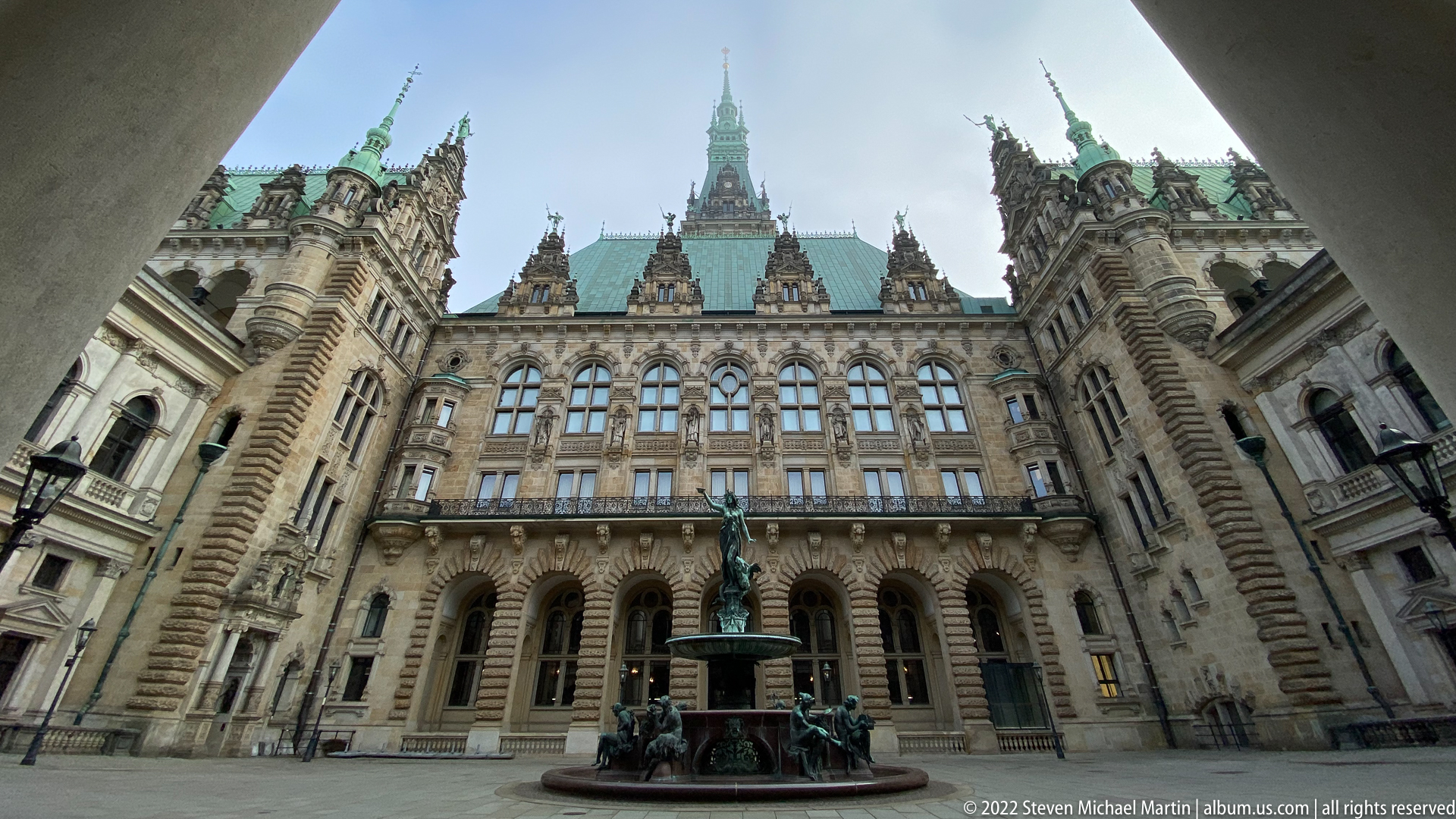
A wider low-angle view of Hamburg Rathaus’s courtyard frames the Hygieia Fountain against the richly articulated central façade and flanking wings. Sculpted gables, arcaded windows, and green-patinated roofs rise above the bronze fountain, while the enclosing architecture creates a formal civic stage around the courtyard’s central monument.
Caption
A wider low-angle view of Hamburg Rathaus’s courtyard frames the Hygieia Fountain against the richly articulated central façade and flanking wings. Sculpted gables, arcaded windows, and green-patinated roofs rise above the bronze fountain, while the enclosing architecture creates a formal civic stage around the courtyard’s central monument.
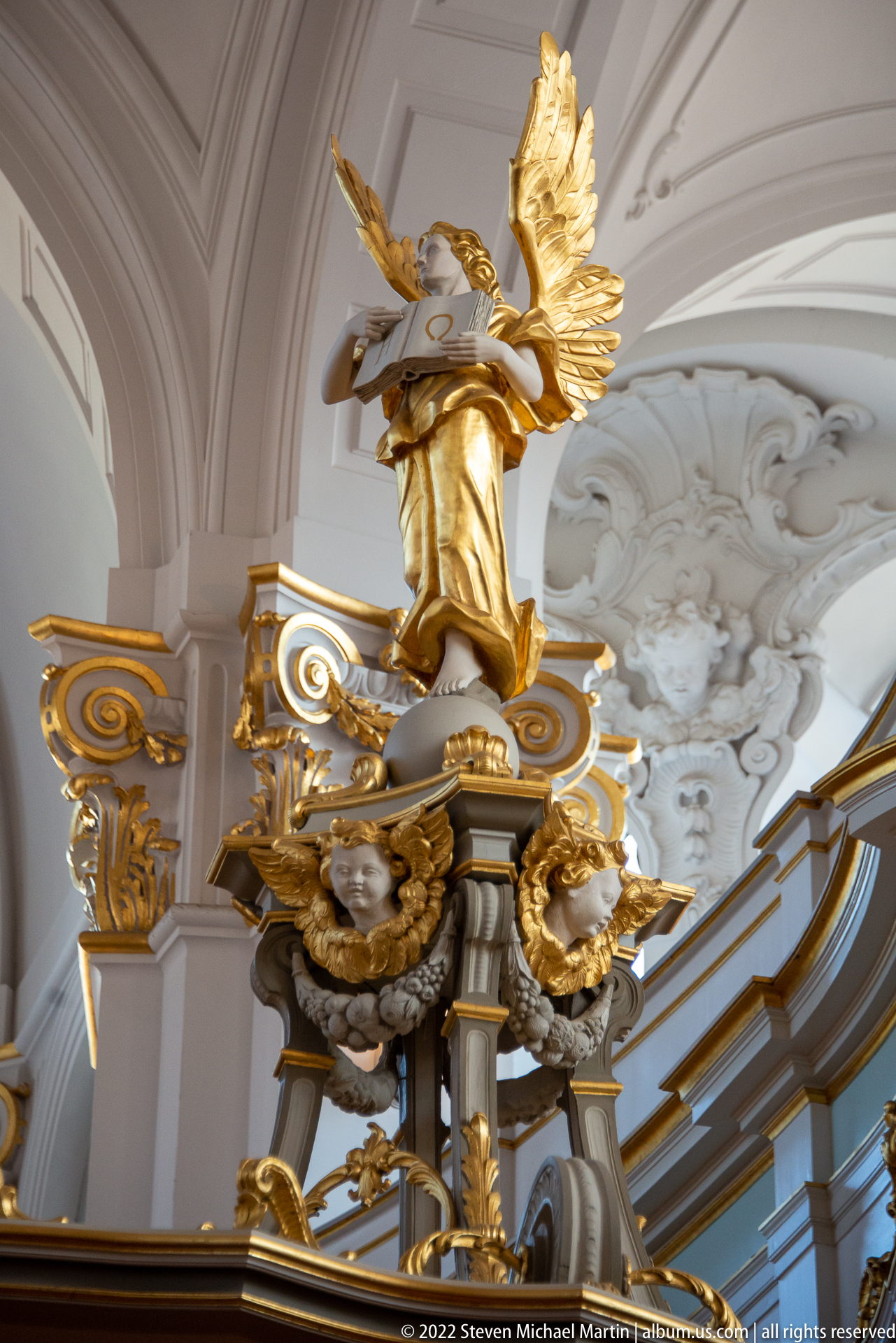
A gilded winged figure rises above paired sculpted masks and curling ornament on an architectural feature inside St. Michaelis. White stucco, gold capitals, and rococo-like scrollwork surround the sculptural group, whose luminous surface stands out against the pale vaulting and richly decorated church interior.
Caption
A gilded winged figure rises above paired sculpted masks and curling ornament on an architectural feature inside St. Michaelis. White stucco, gold capitals, and rococo-like scrollwork surround the sculptural group, whose luminous surface stands out against the pale vaulting and richly decorated church interior.
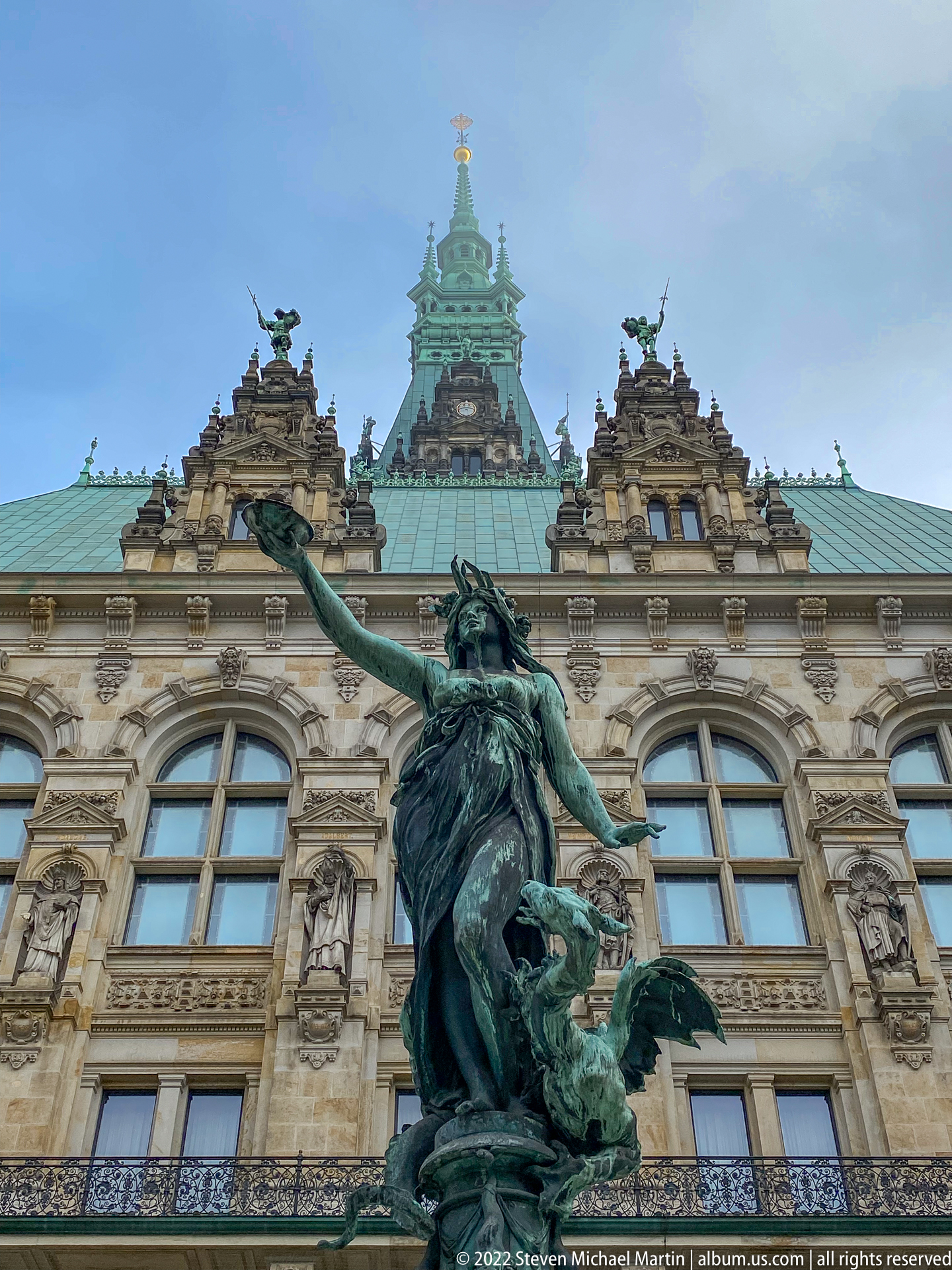
The green-patinated figure of Hygieia rises above the fountain basin in Hamburg Rathaus courtyard, one arm extended outward as a large dragon-like serpent coils beside her. Behind the sculpture, the highly ornamented civic façade and copper roof reinforce the fountain’s central placement within the courtyard’s architectural composition.
Caption
The green-patinated figure of Hygieia rises above the fountain basin in Hamburg Rathaus courtyard, one arm extended outward as a large dragon-like serpent coils beside her. Behind the sculpture, the highly ornamented civic façade and copper roof reinforce the fountain’s central placement within the courtyard’s architectural composition.
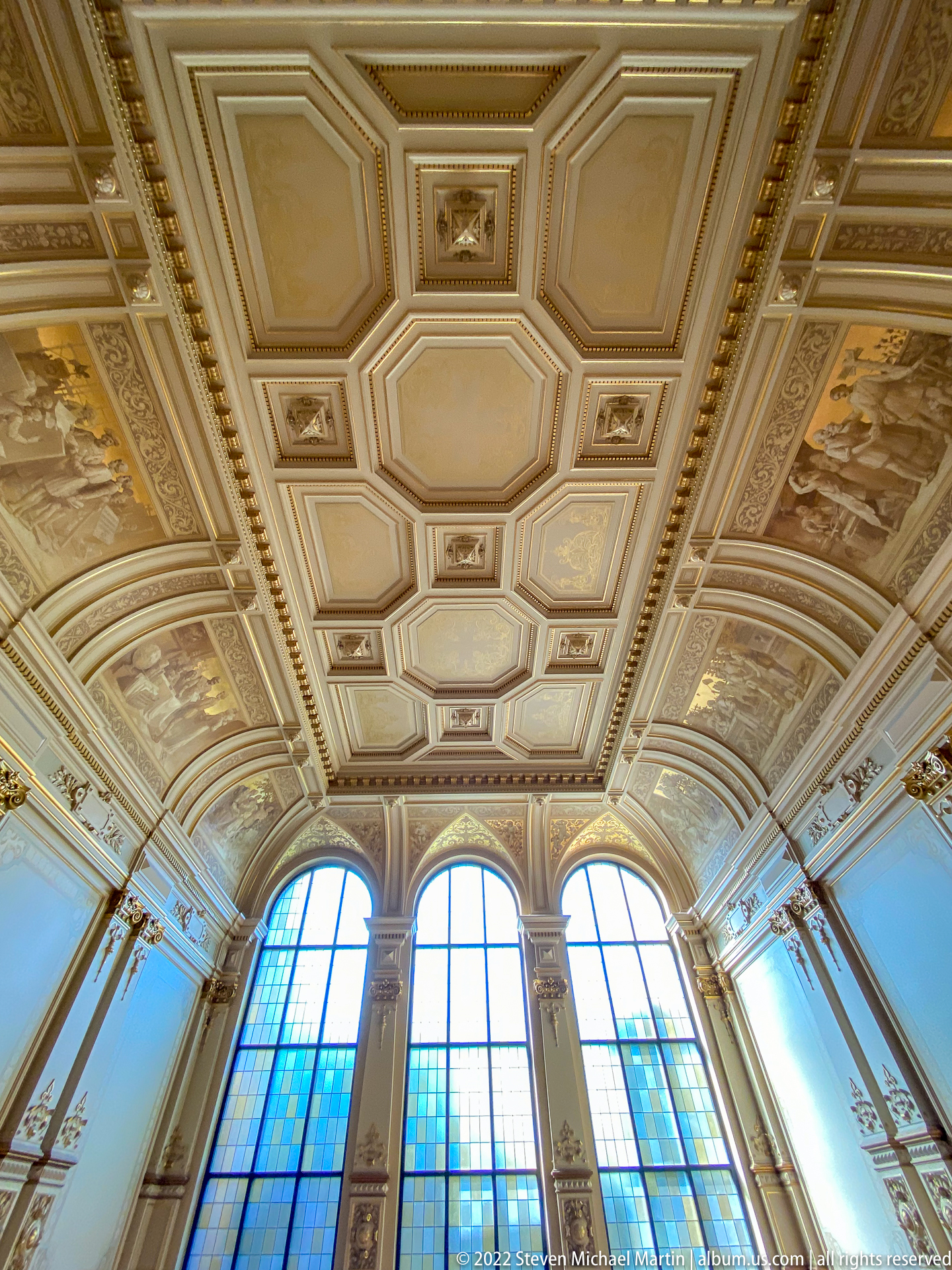
An ornate coffered ceiling spans a ceremonial room in Hamburg Rathaus, combining geometric panels, painted figural scenes, gilded borders, and richly modeled plasterwork. Three tall arched windows admit cool daylight from below, while the upward view emphasizes the layered decorative program overhead rather than the furnishings of the room itself.
Caption
An ornate coffered ceiling spans a ceremonial room in Hamburg Rathaus, combining geometric panels, painted figural scenes, gilded borders, and richly modeled plasterwork. Three tall arched windows admit cool daylight from below, while the upward view emphasizes the layered decorative program overhead rather than the furnishings of the room itself.
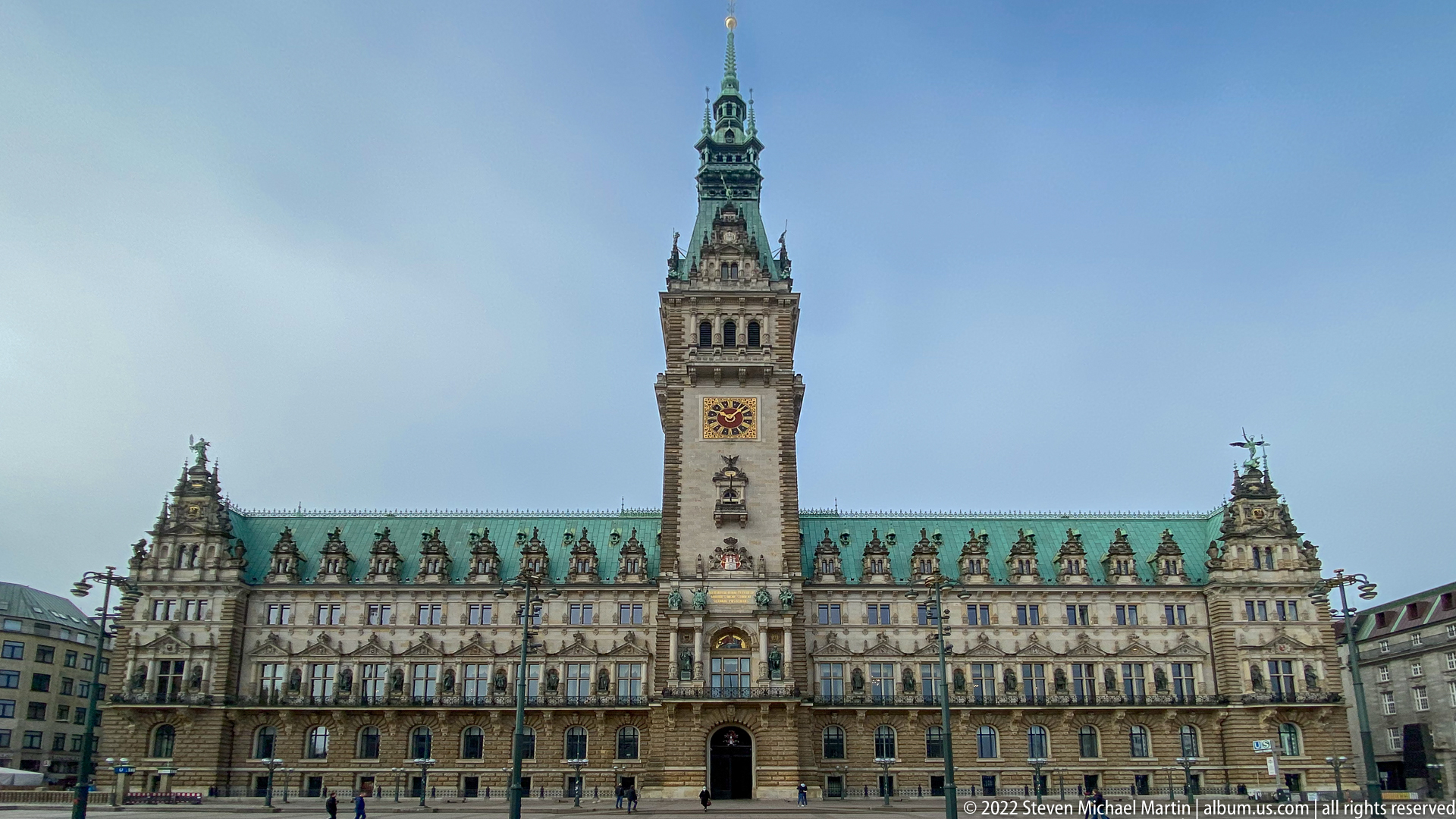
Hamburg Rathaus fills the frame in a broad frontal view, its long symmetrical façade organized around the tall central clock tower and a continuous green copper roof. Repeated windows, gabled roofline pavilions, and carved stonework emphasize the scale and formality of the civic building, while the open square provides an unobstructed view of the entire composition.
Caption
Hamburg Rathaus fills the frame in a broad frontal view, its long symmetrical façade organized around the tall central clock tower and a continuous green copper roof. Repeated windows, gabled roofline pavilions, and carved stonework emphasize the scale and formality of the civic building, while the open square provides an unobstructed view of the entire composition.
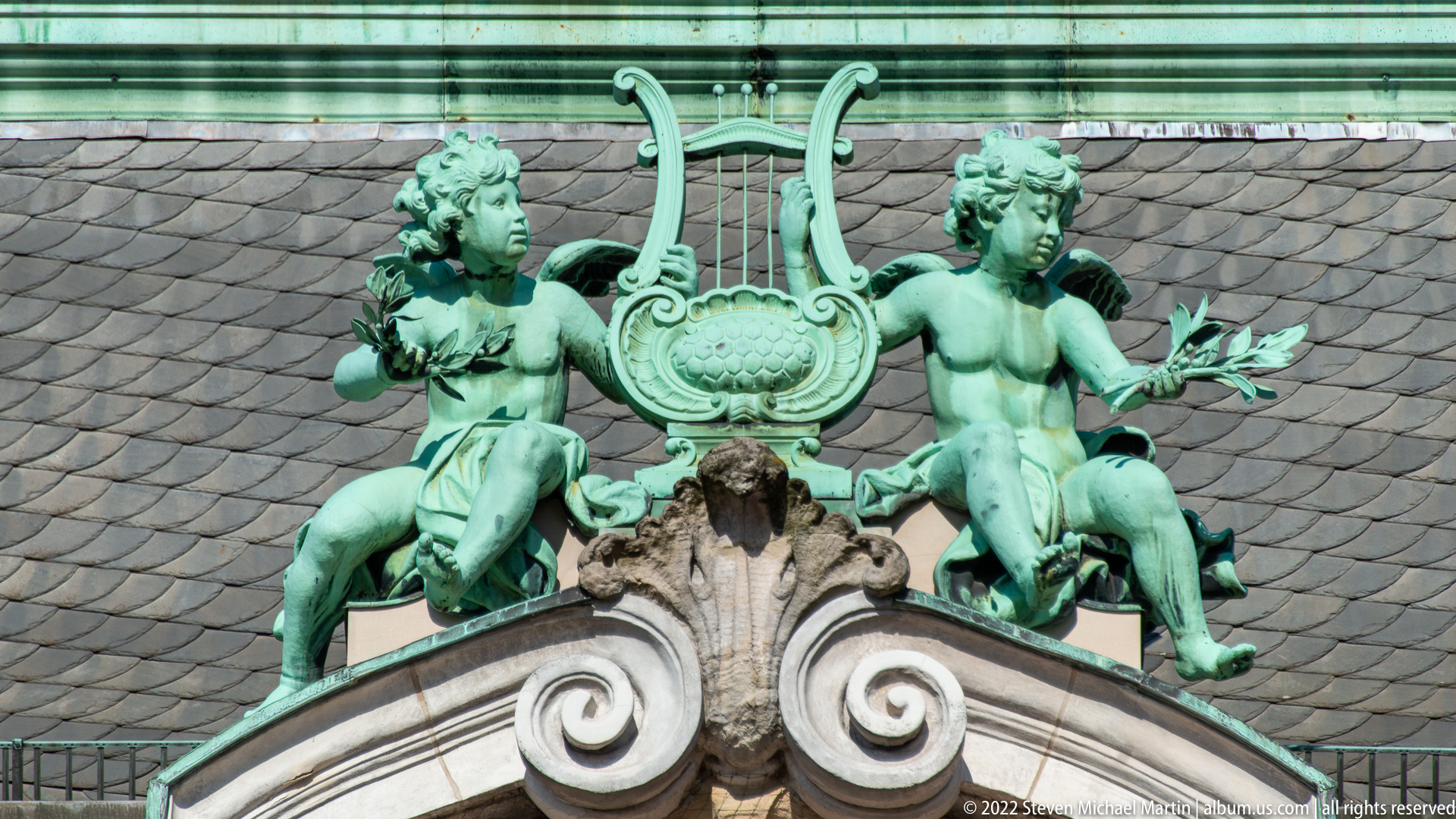
Two seated green-patinated figures flank a large lyre above a curled stone pediment on the Hamburg Rathaus roofline. One figure holds leafy branches while the other turns toward the instrument, creating a compact allegorical group that combines music, vegetation, and civic architectural ornament.
Caption
Two seated green-patinated figures flank a large lyre above a curled stone pediment on the Hamburg Rathaus roofline. One figure holds leafy branches while the other turns toward the instrument, creating a compact allegorical group that combines music, vegetation, and civic architectural ornament.
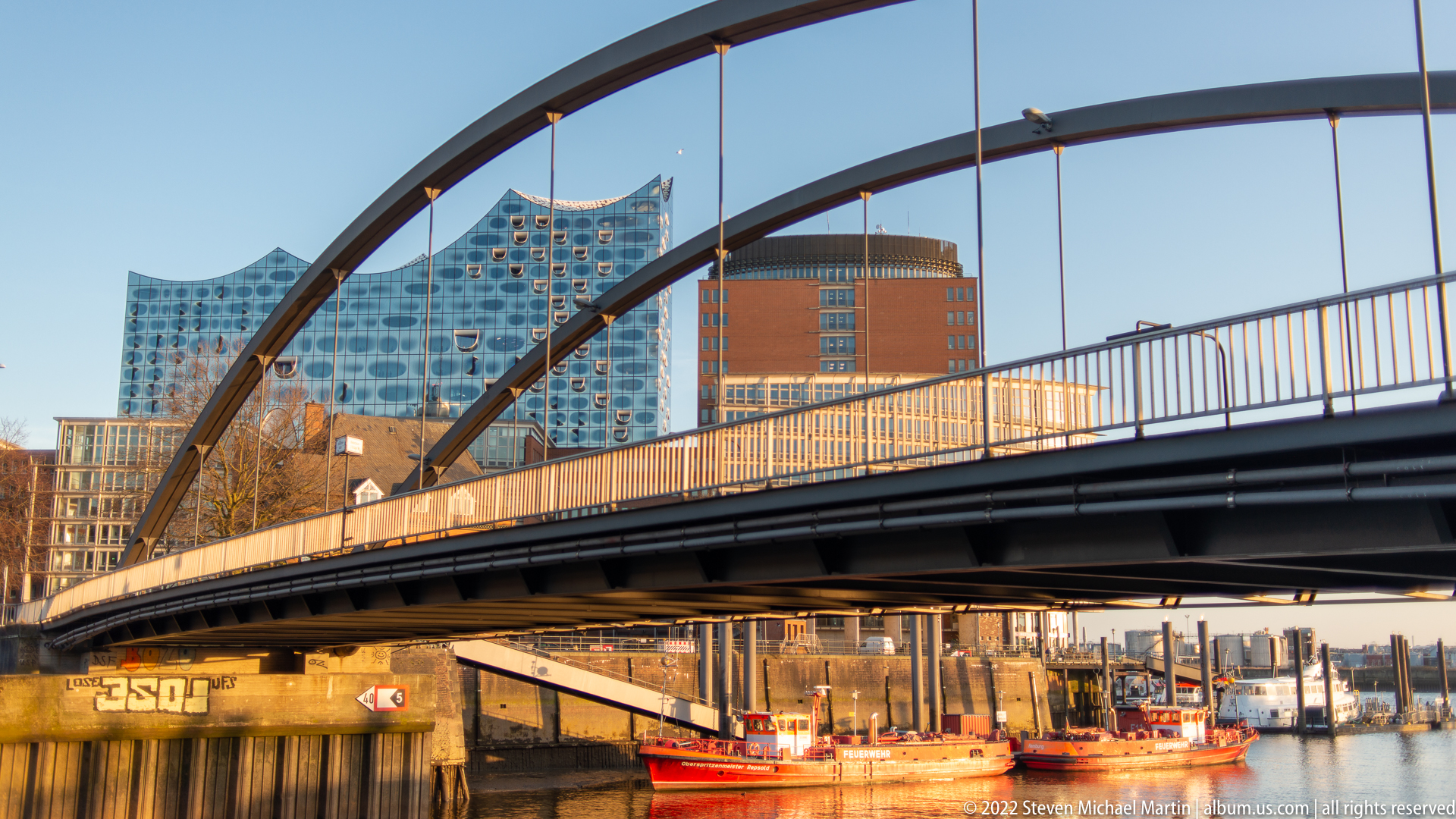
A modern arched bridge crosses a harbor channel in warm late-day light, its dark steel ribs and slender vertical hangers framing the Elbphilharmonie in the distance. Small red workboats are moored beneath the span, linking contemporary pedestrian infrastructure with Hamburg’s active waterfront and its most recognizable modern landmark.
Caption
A modern arched bridge crosses a harbor channel in warm late-day light, its dark steel ribs and slender vertical hangers framing the Elbphilharmonie in the distance. Small red workboats are moored beneath the span, linking contemporary pedestrian infrastructure with Hamburg’s active waterfront and its most recognizable modern landmark.
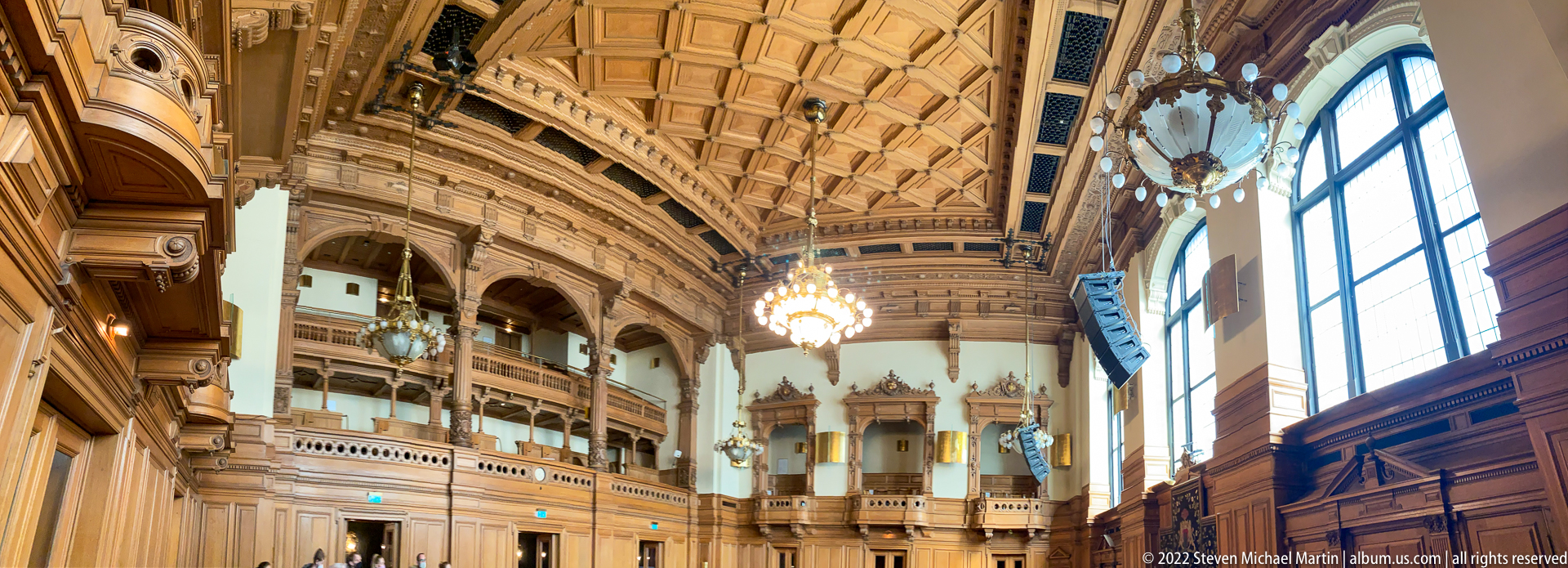
A grand ceremonial hall inside Hamburg Rathaus combines tall windows, dark wood paneling, a richly coffered ceiling, and monumental chandeliers. Galleries and carved architectural details rise along the far wall, while the long vertical proportions and warm timber surfaces distinguish this room from the lighter stone and stucco interiors elsewhere in the building.
Caption
A grand ceremonial hall inside Hamburg Rathaus combines tall windows, dark wood paneling, a richly coffered ceiling, and monumental chandeliers. Galleries and carved architectural details rise along the far wall, while the long vertical proportions and warm timber surfaces distinguish this room from the lighter stone and stucco interiors elsewhere in the building.
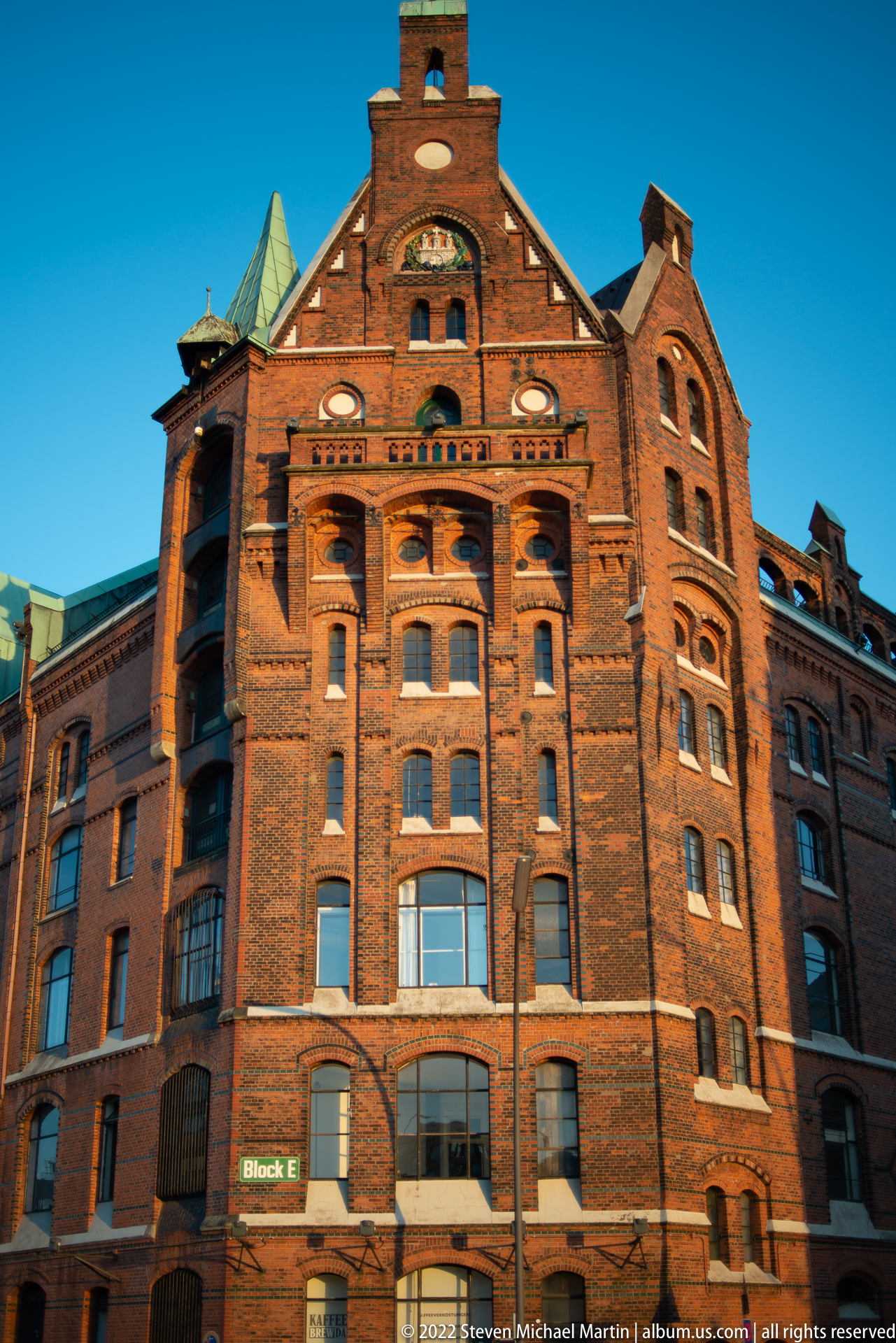
A richly articulated red-brick warehouse façade in Speicherstadt rises beneath a clear blue sky, with stepped gables, arched windows, and decorative brick patterns defining its vertical bays. A small sign reading “Block E” identifies the building section, while deep afternoon light brings out the color and texture of the historic masonry.
Caption
A richly articulated red-brick warehouse façade in Speicherstadt rises beneath a clear blue sky, with stepped gables, arched windows, and decorative brick patterns defining its vertical bays. A small sign reading “Block E” identifies the building section, while deep afternoon light brings out the color and texture of the historic masonry.
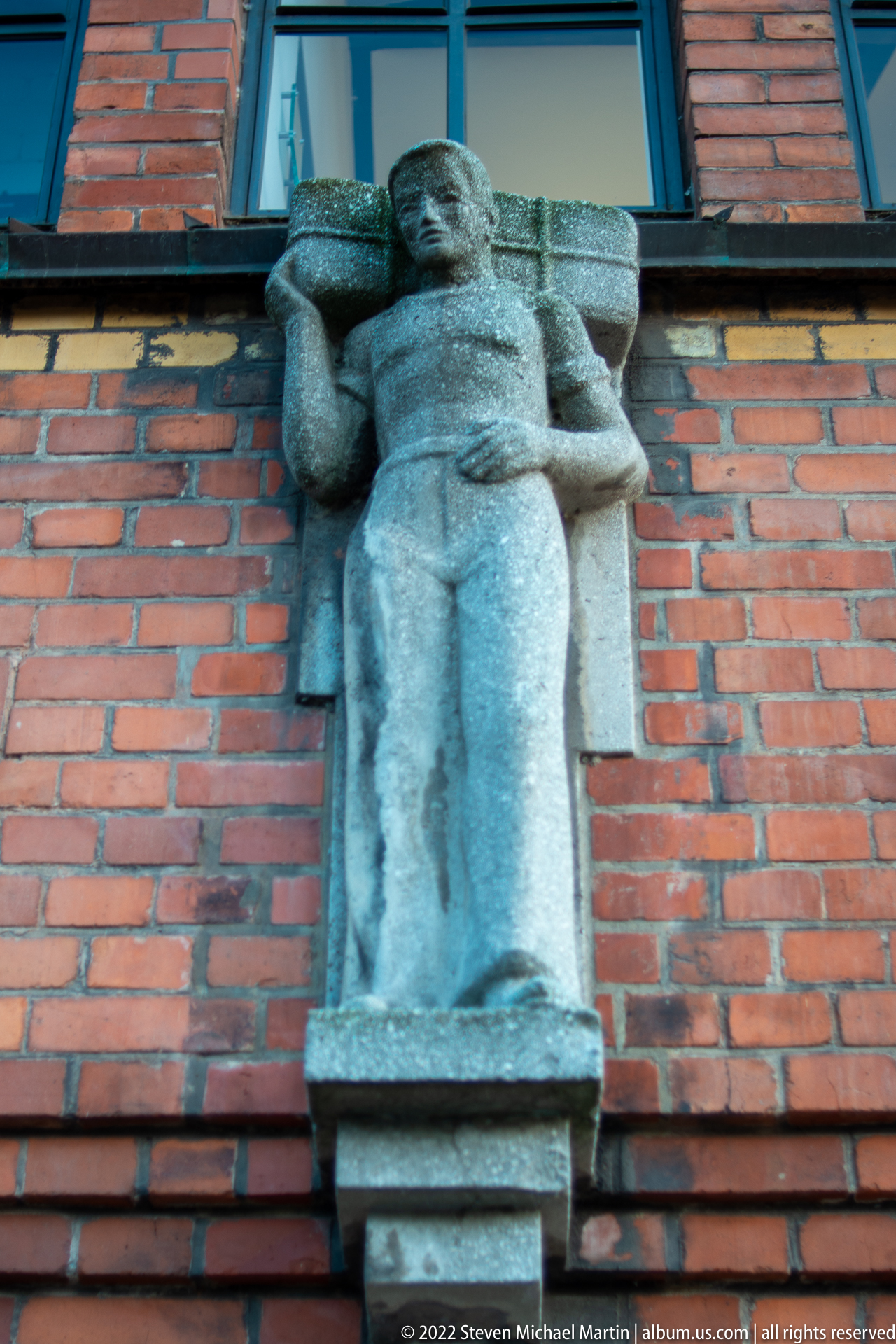
A weathered stone figure projects from a red-brick warehouse wall, carrying a large bundle or load across the shoulders. The compact architectural sculpture appears just below a window, its simplified muscular form contrasting with the precise brick courses around it. The motif evokes the physical labor historically associated with warehouse handling and port commerce.
Caption
A weathered stone figure projects from a red-brick warehouse wall, carrying a large bundle or load across the shoulders. The compact architectural sculpture appears just below a window, its simplified muscular form contrasting with the precise brick courses around it. The motif evokes the physical labor historically associated with warehouse handling and port commerce.
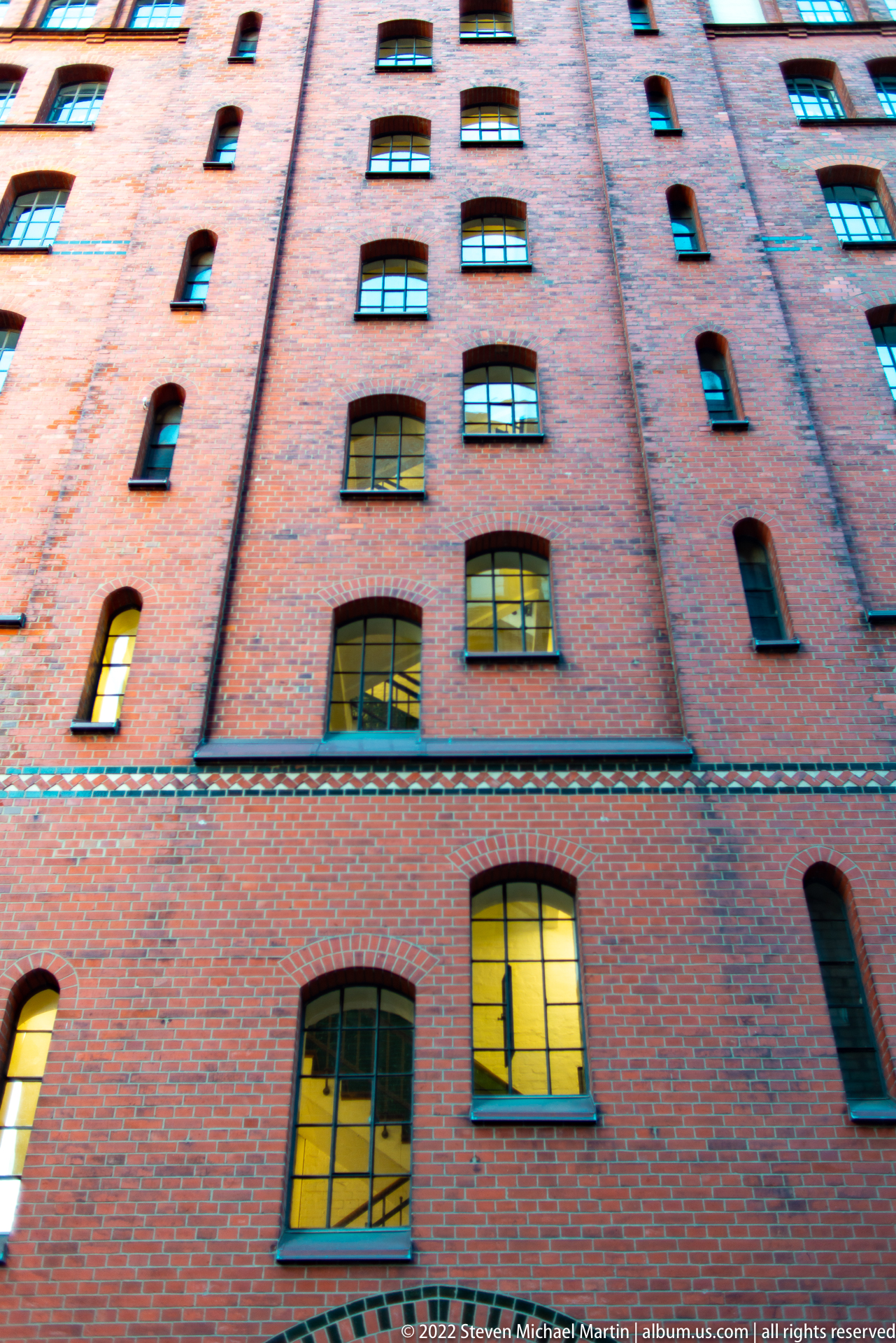
A steep upward view follows the red-brick wall of a Speicherstadt warehouse, where tall narrow windows and recessed vertical bays emphasize the building’s height. Warm light glows through several lower windows while the upper façade remains cooler, producing a strong contrast between massive masonry and illuminated interior openings.
Caption
A steep upward view follows the red-brick wall of a Speicherstadt warehouse, where tall narrow windows and recessed vertical bays emphasize the building’s height. Warm light glows through several lower windows while the upper façade remains cooler, producing a strong contrast between massive masonry and illuminated interior openings.
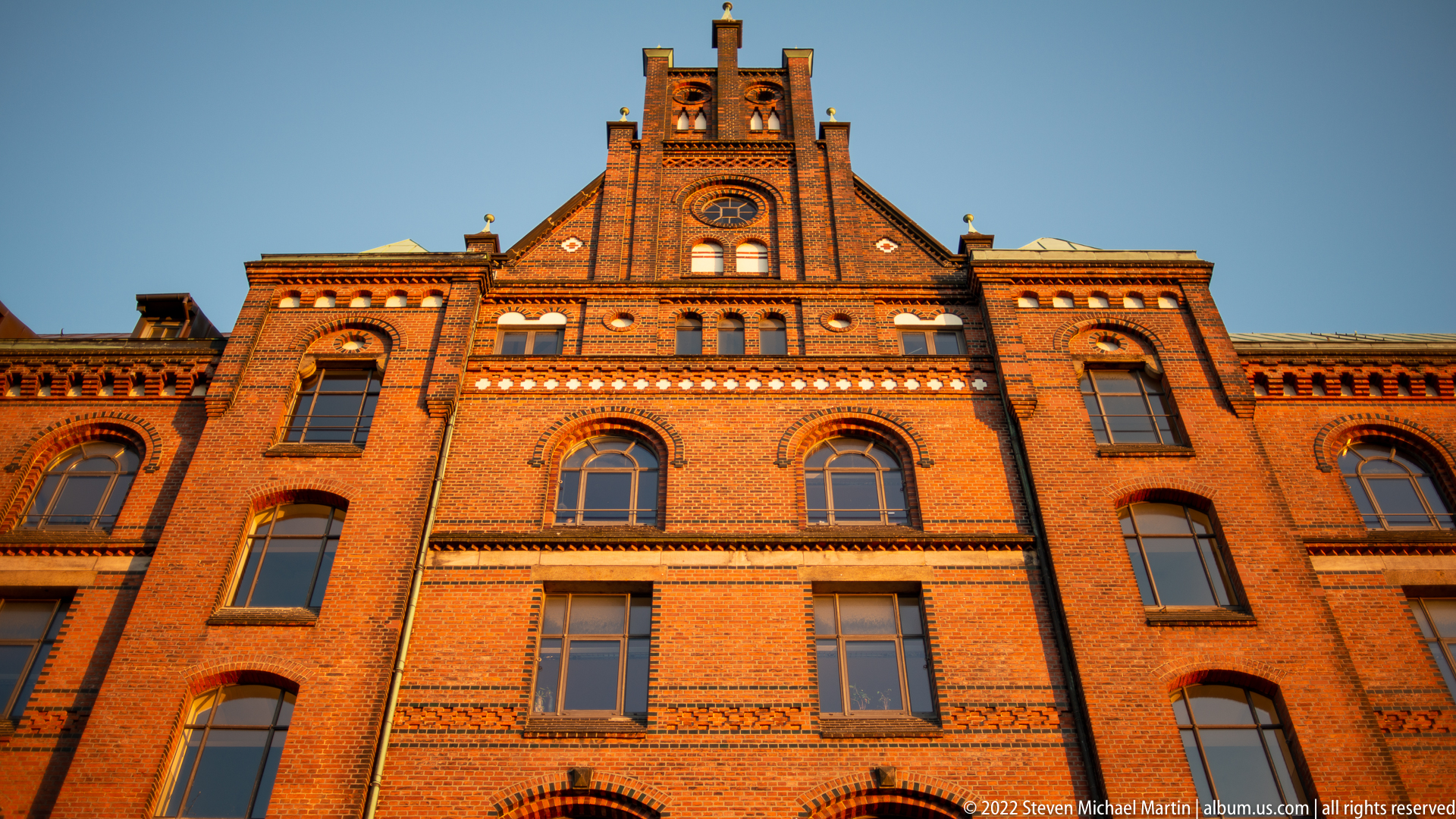
Strong golden light illuminates the upper façade of a Speicherstadt warehouse, emphasizing decorative brick arches, stepped gables, and patterned masonry around tall windows. The tight upward view removes most street context and concentrates on the historic warehouse district’s elaborate brick craftsmanship and rhythmic façade organization.
Caption
Strong golden light illuminates the upper façade of a Speicherstadt warehouse, emphasizing decorative brick arches, stepped gables, and patterned masonry around tall windows. The tight upward view removes most street context and concentrates on the historic warehouse district’s elaborate brick craftsmanship and rhythmic façade organization.
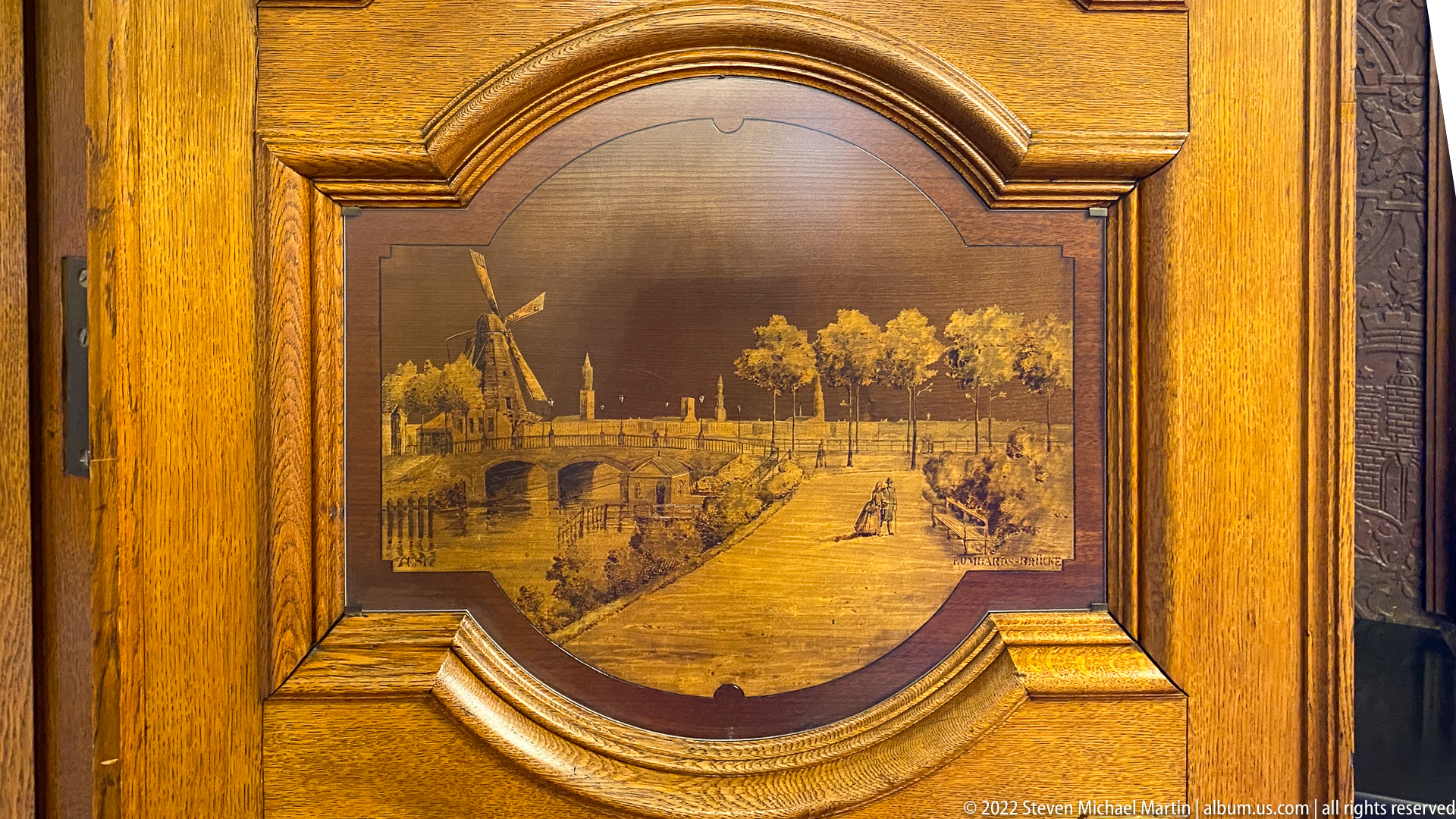
A small framed wooden panel depicts a historic waterside scene with a windmill, bridge, canal, tree-lined promenade, and tiny figures. Different wood tones create the picture through inlay or marquetry rather than paint, while the surrounding carved wooden frame integrates the image into a larger interior decorative scheme.
Caption
A small framed wooden panel depicts a historic waterside scene with a windmill, bridge, canal, tree-lined promenade, and tiny figures. Different wood tones create the picture through inlay or marquetry rather than paint, while the surrounding carved wooden frame integrates the image into a larger interior decorative scheme.
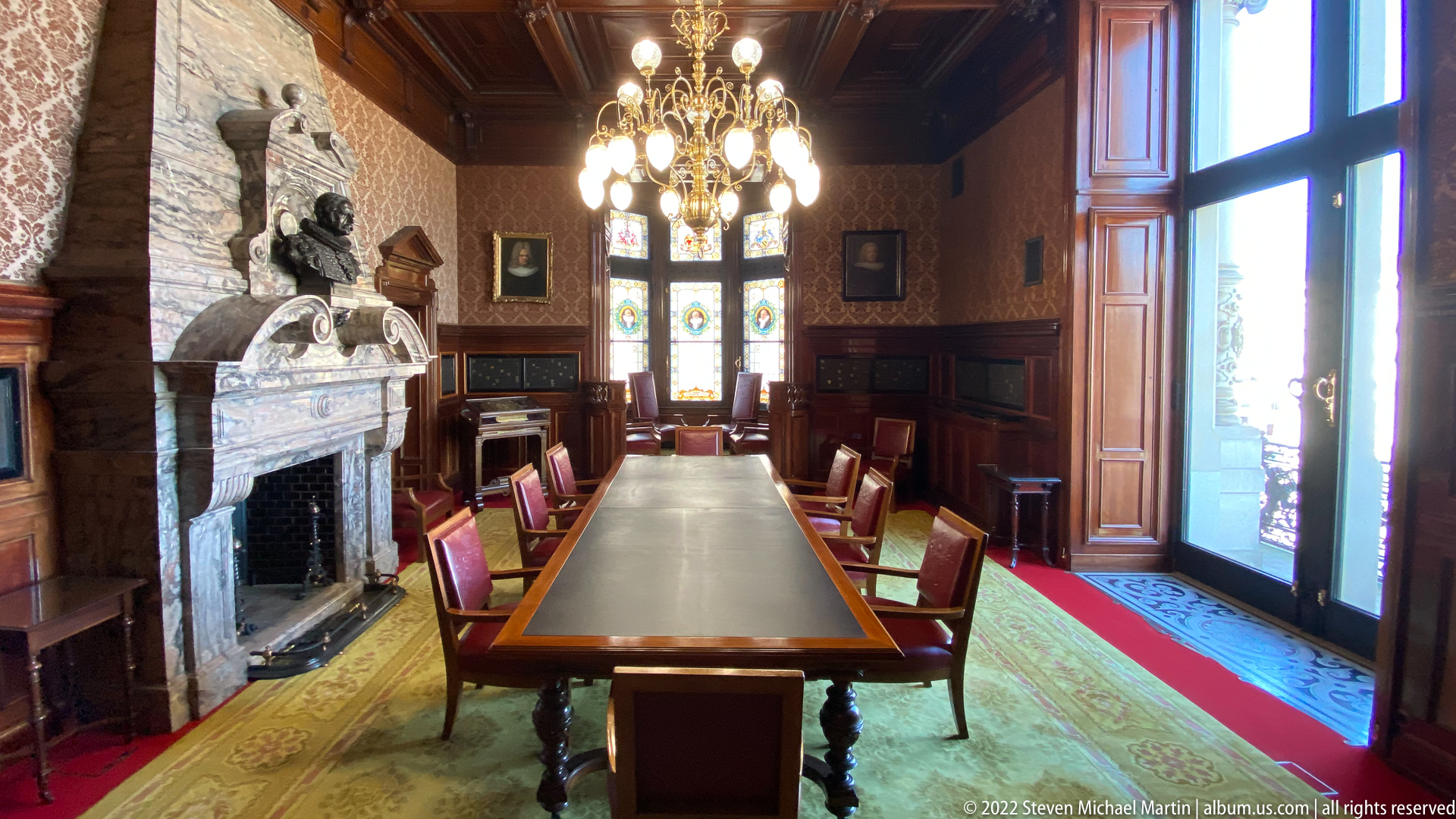
A long conference table fills a richly furnished meeting room inside Hamburg Rathaus, bordered by red-upholstered chairs and dark wood paneling. At left, a monumental carved stone fireplace rises beneath a sculptural overmantel, while stained-glass panels and tall windows admit daylight at the far end. The intimate scale contrasts with the building’s larger ceremonial chambers.
Caption
A long conference table fills a richly furnished meeting room inside Hamburg Rathaus, bordered by red-upholstered chairs and dark wood paneling. At left, a monumental carved stone fireplace rises beneath a sculptural overmantel, while stained-glass panels and tall windows admit daylight at the far end. The intimate scale contrasts with the building’s larger ceremonial chambers.
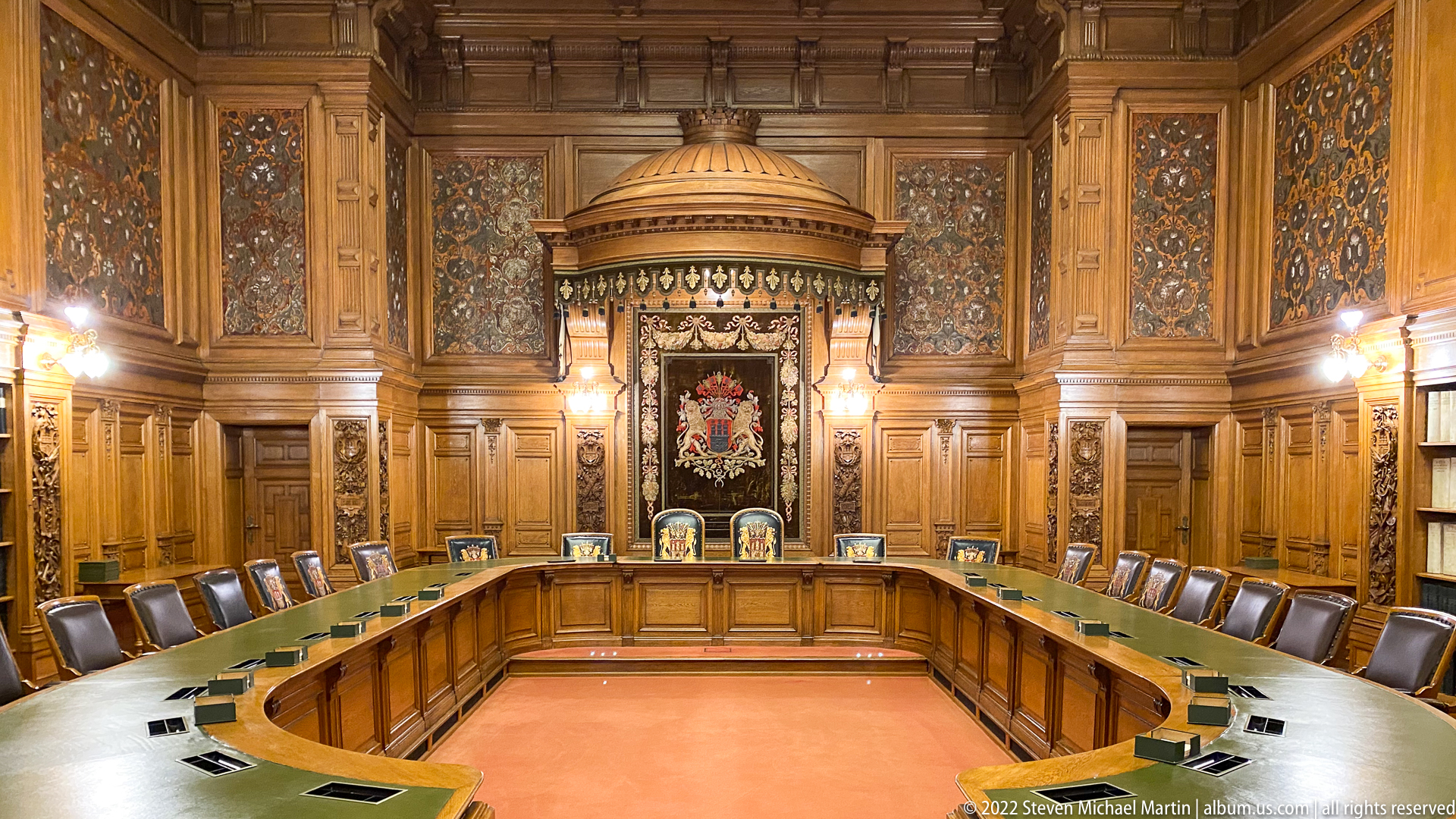
A formal council chamber in Hamburg Rathaus is organized around a broad U-shaped table lined with leather chairs and built-in microphones. Richly carved wood paneling, patterned inset panels, and a domed canopy frame the central wall, where Hamburg’s coat of arms provides the room’s civic focus. The composition emphasizes the chamber’s functional arrangement for deliberation.
Caption
A formal council chamber in Hamburg Rathaus is organized around a broad U-shaped table lined with leather chairs and built-in microphones. Richly carved wood paneling, patterned inset panels, and a domed canopy frame the central wall, where Hamburg’s coat of arms provides the room’s civic focus. The composition emphasizes the chamber’s functional arrangement for deliberation.
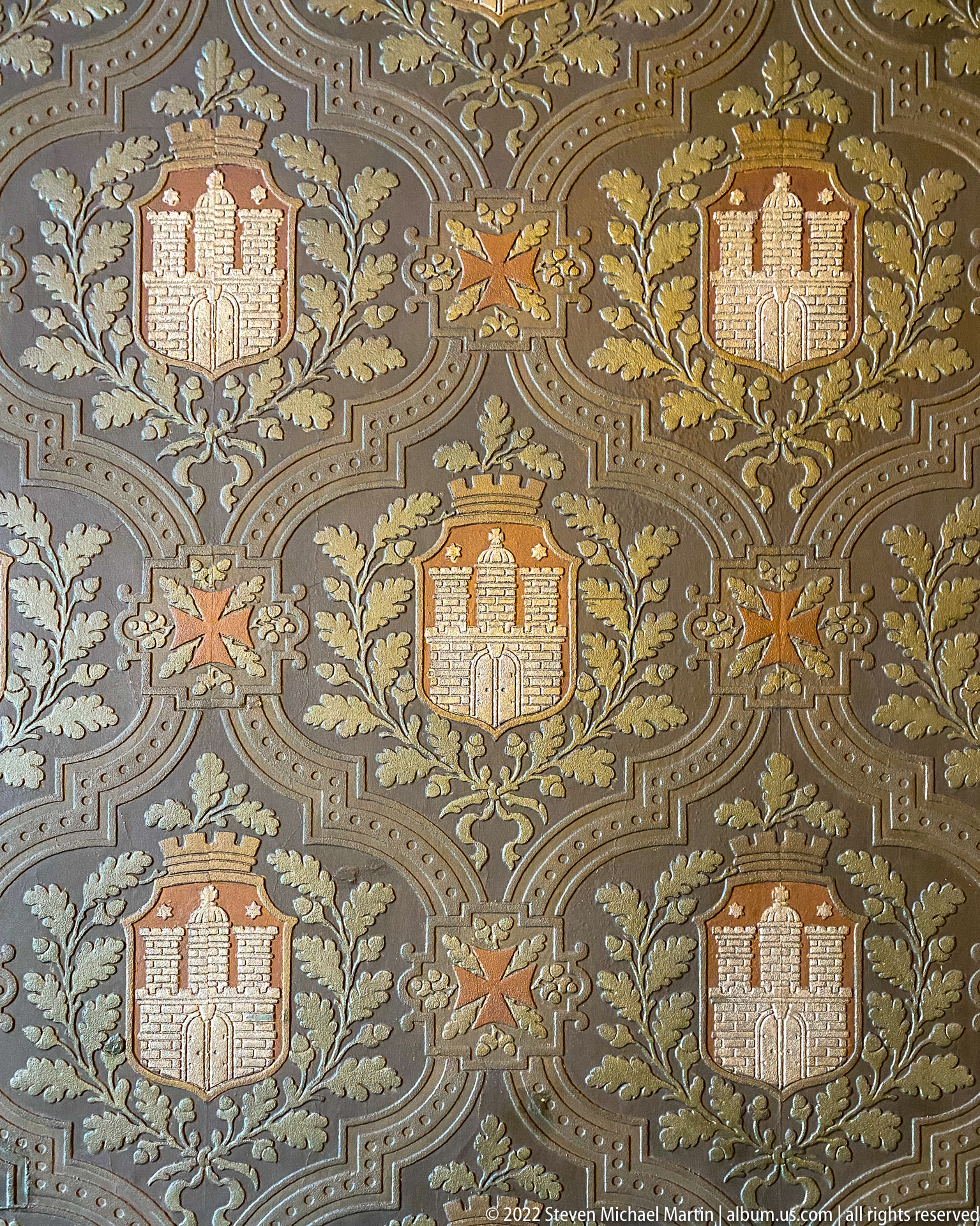
Hamburg’s three-towered castle emblem repeats across an ornate patterned surface, each shield enclosed by scrolling oak-like foliage and linked by small star motifs. The close view isolates the civic heraldry from its architectural setting, revealing the dense decorative rhythm and restrained palette of gold, gray, cream, and muted red.
Caption
Hamburg’s three-towered castle emblem repeats across an ornate patterned surface, each shield enclosed by scrolling oak-like foliage and linked by small star motifs. The close view isolates the civic heraldry from its architectural setting, revealing the dense decorative rhythm and restrained palette of gold, gray, cream, and muted red.
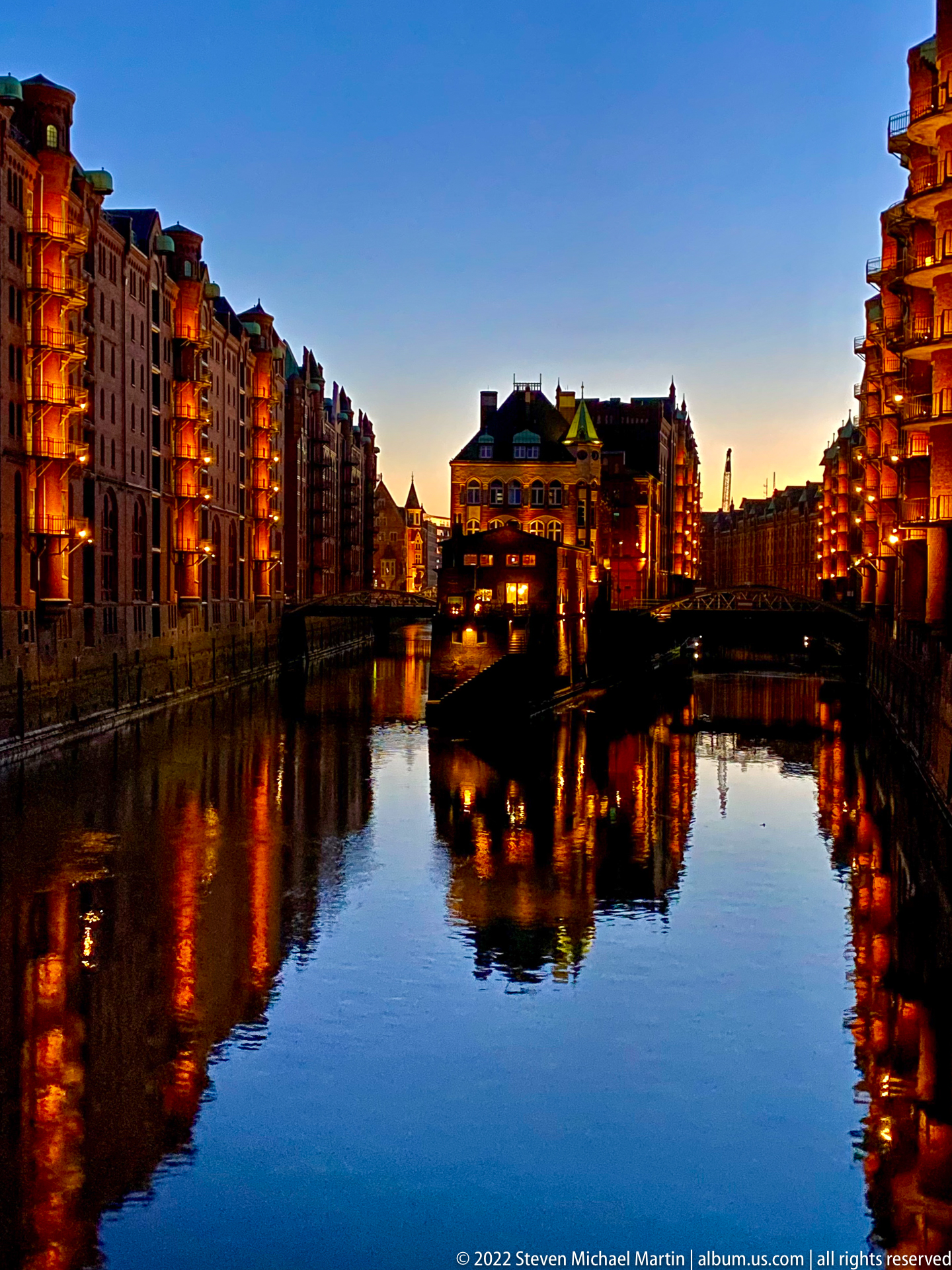
A broad blue-hour view opens across the Speicherstadt waterways, with the Wasserschloss near center and long illuminated warehouse blocks curving along both banks. Their orange lights ripple across the darkening canal, while the open sky preserves the last band of twilight. The wider perspective places the familiar landmark within the full scale of Hamburg’s historic warehouse district.
Caption
A broad blue-hour view opens across the Speicherstadt waterways, with the Wasserschloss near center and long illuminated warehouse blocks curving along both banks. Their orange lights ripple across the darkening canal, while the open sky preserves the last band of twilight. The wider perspective places the familiar landmark within the full scale of Hamburg’s historic warehouse district.
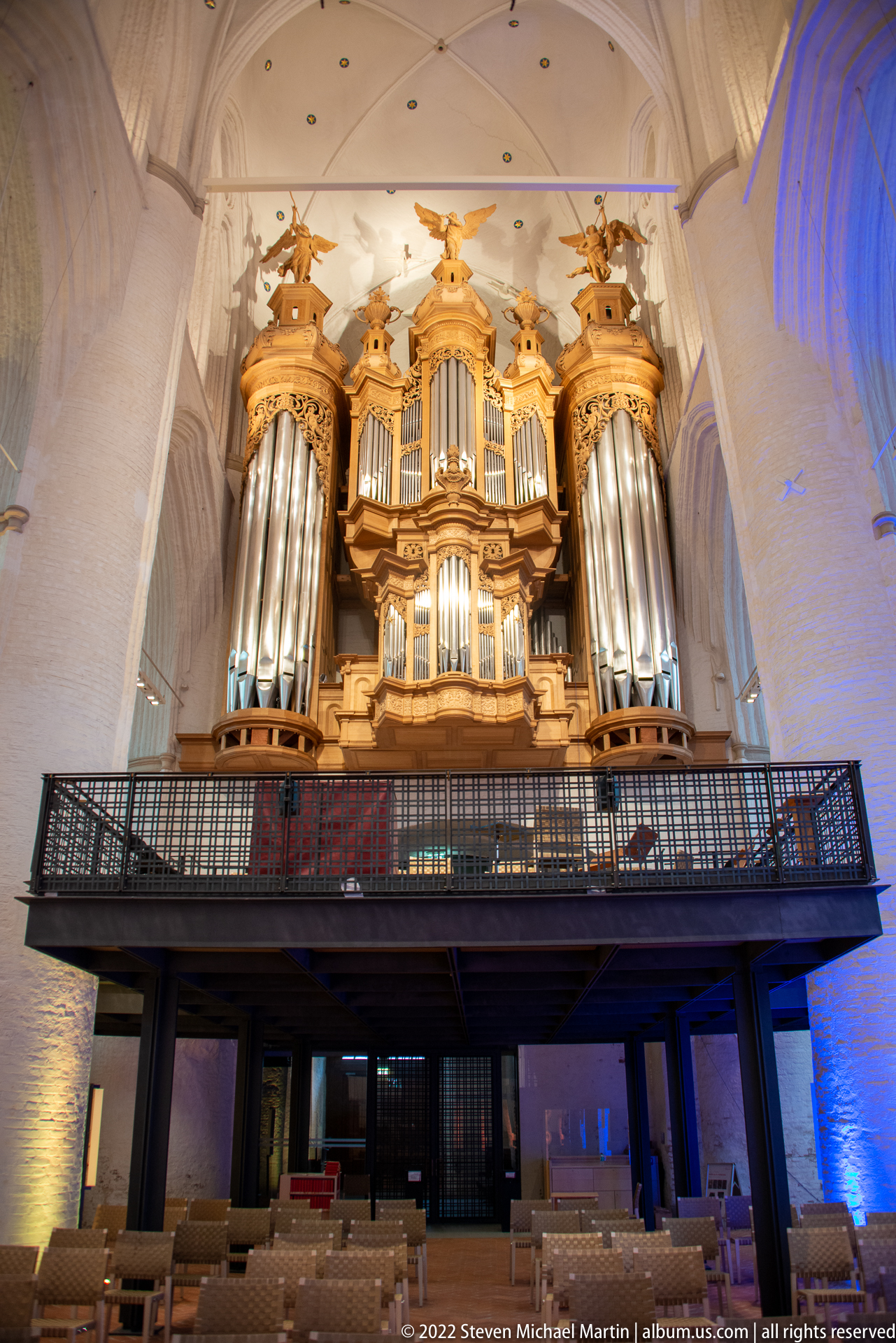
A monumental pipe organ rises above a dark gallery inside a white-brick church, its polished metal pipes arranged in several towers within an elaborate gilded wooden case. Carved figures and decorative finials crown the instrument, while the pale vaulted architecture around it makes the warm-toned casework stand out as the principal furnishing in the nave.
Caption
A monumental pipe organ rises above a dark gallery inside a white-brick church, its polished metal pipes arranged in several towers within an elaborate gilded wooden case. Carved figures and decorative finials crown the instrument, while the pale vaulted architecture around it makes the warm-toned casework stand out as the principal furnishing in the nave.
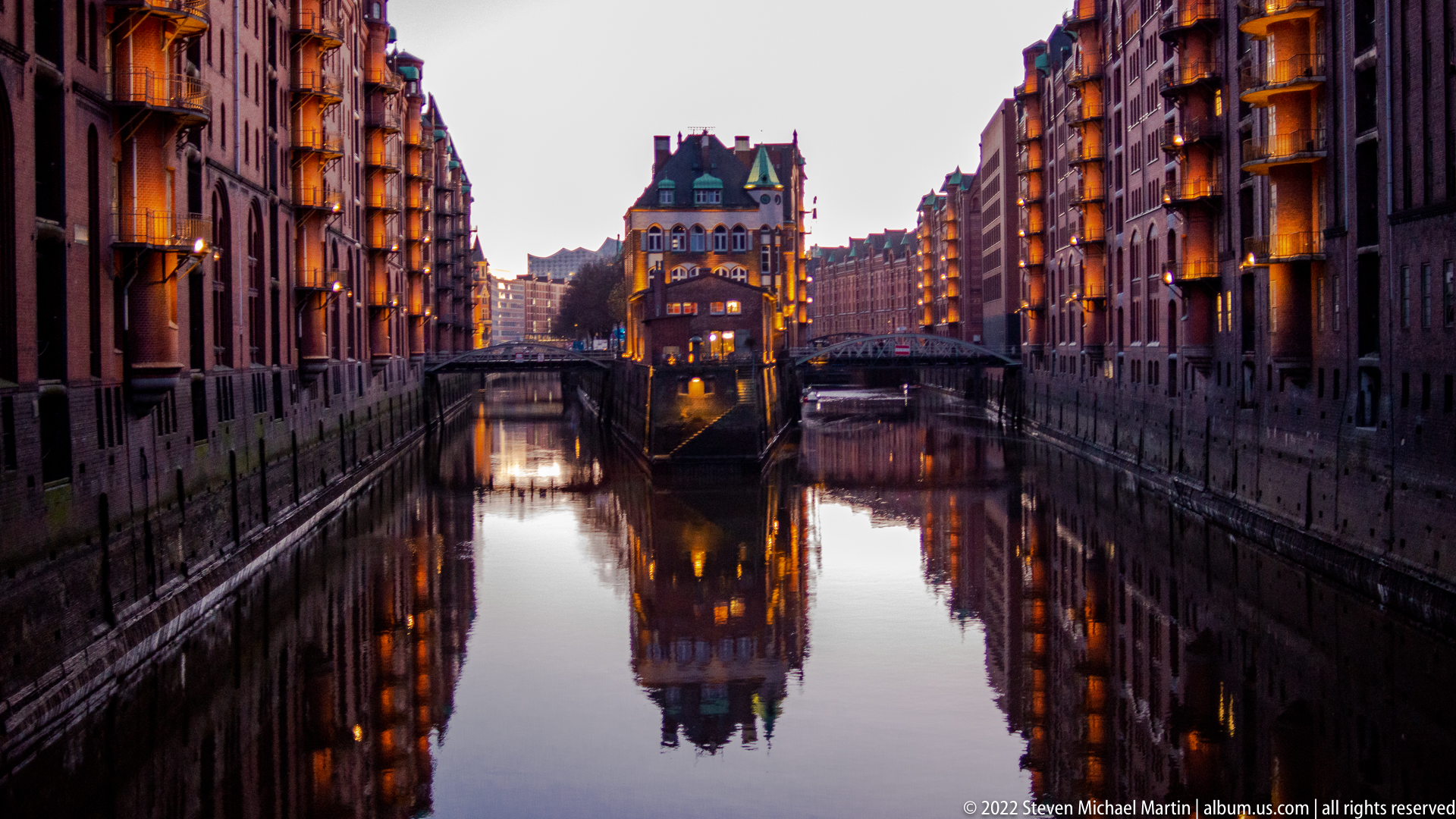
The Wasserschloss stands at the meeting of Speicherstadt canals during blue hour, its warm lights mirrored in the still water and echoed by illuminated warehouse façades on both sides. The symmetrical waterway view draws the eye toward the compact brick building at center, while reflections nearly double the district’s dense historic architecture.
Caption
The Wasserschloss stands at the meeting of Speicherstadt canals during blue hour, its warm lights mirrored in the still water and echoed by illuminated warehouse façades on both sides. The symmetrical waterway view draws the eye toward the compact brick building at center, while reflections nearly double the district’s dense historic architecture.
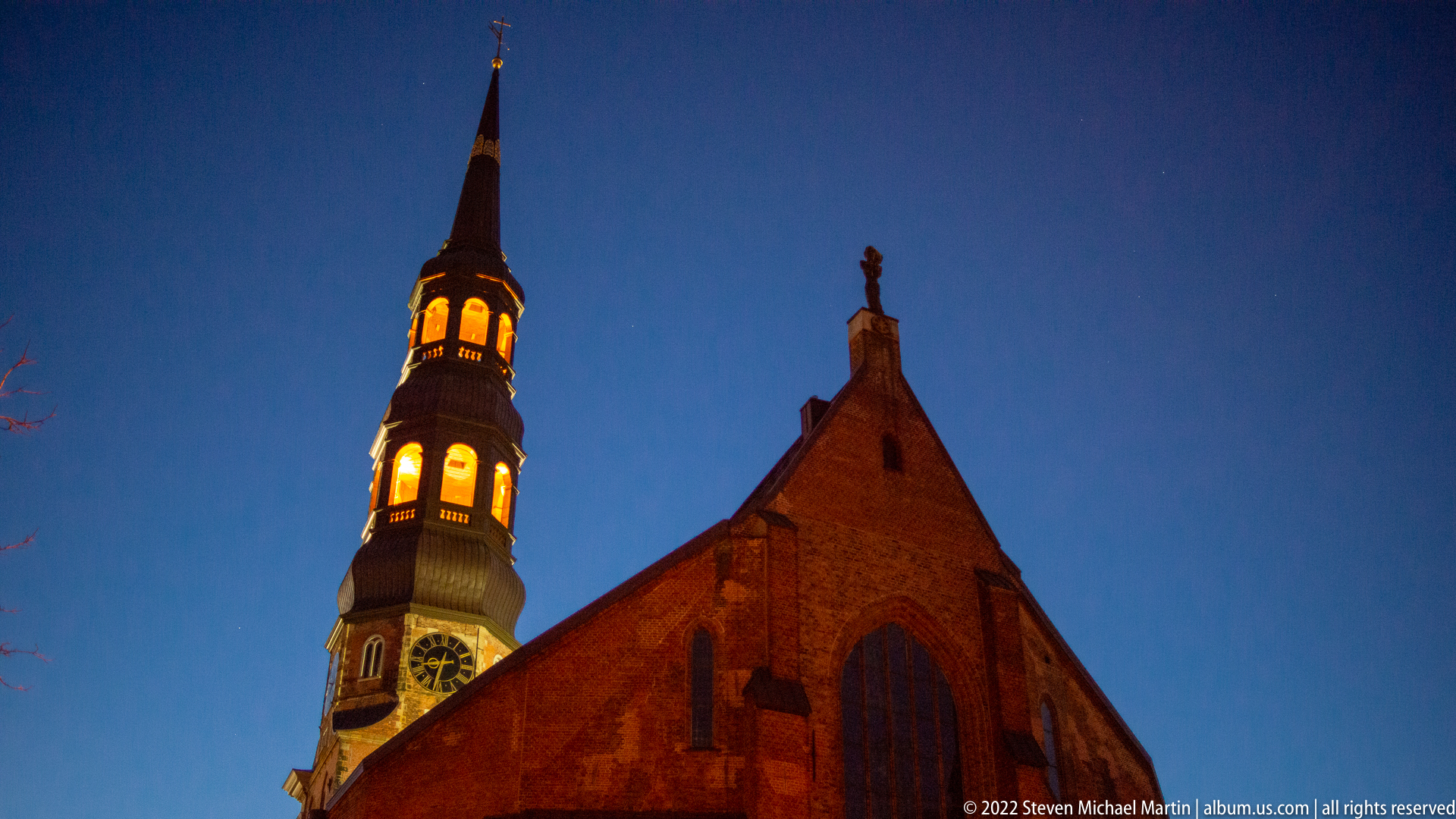
A tall illuminated church tower rises beside a steep brick gable against the deep blue evening sky. Large clock faces punctuate the tower below a narrow spire, while a single standing sculpture crowns the adjoining gable. Warm architectural lighting picks out the masonry and vertical window openings, giving the historic church a strong silhouette after sunset.
Caption
A tall illuminated church tower rises beside a steep brick gable against the deep blue evening sky. Large clock faces punctuate the tower below a narrow spire, while a single standing sculpture crowns the adjoining gable. Warm architectural lighting picks out the masonry and vertical window openings, giving the historic church a strong silhouette after sunset.
⭐ Highlights
- Port of Hamburg: Germany’s largest seaport and one of the most important in Europe.
- Hanseatic Heritage: A leading member of the medieval Hanseatic League.
- Speicherstadt: The world’s largest historic warehouse district built on timber piles.
- Elbphilharmonie: A modern architectural landmark overlooking the harbor.
- St. Michael’s Church: One of the city’s most recognizable landmarks.
- Harbor & Waterfront: The port defines the city’s identity and atmosphere.
⚓ Hamburg Field Guide
Major features observed during this visit:
Hamburg is one of Europe’s most important port cities, located on the Elbe River in northern Germany. Its development has been closely tied to maritime trade for over 800 years, growing from a medieval trading center into one of the largest ports in Europe. As a leading member of the Hanseatic League, Hamburg became a major hub connecting northern and central Europe to global trade networks.
🏛️ Signature Landmarks
- Port of Hamburg – A vast harbor that has shaped the city’s economy and identity for centuries.
- Speicherstadt – A historic warehouse district built for storing goods in the free port era.
- Elbphilharmonie – A modern concert hall rising above the harbor skyline.
- St. Michael’s Church – A Baroque church offering views over the city and port.
- St. Pauli Piers – A major waterfront access point and symbol of Hamburg’s maritime life.
🧠 Historical Significance
- Hanseatic League – Hamburg played a central role in a powerful medieval trade network.
- Port Foundation – The port was formally established in the late 12th century and drove the city’s growth.
- Global Trade Expansion – Hamburg became a key gateway for transatlantic and international trade.
- Modern Logistics Hub – Today it remains one of Europe’s most important shipping and transport centers.
🌄 Urban Landscape & Setting
- Elbe River – The river connects the city to the North Sea and global trade routes.
- Water-Based City – Canals, docks, and waterways shape movement and views.
- Port Integration – Industrial and historic waterfront areas blend into the urban fabric.
- Historic and Modern Contrast – Traditional warehouse districts coexist with contemporary architecture.