Mycenae – Greece
The ancient citadel of Mycenae was one of the most powerful centers of the Mycenaean civilization, which dominated much of the Greek world during the Late Bronze Age. Located in the northeastern Peloponnese, the fortified city controlled important trade routes across the region.
Massive Cyclopean walls surround the citadel, constructed from enormous stones that later Greek writers believed could only have been placed by mythical giants. The famous Lion Gate marks the main entrance to the city and remains one of the most iconic monuments of ancient Greece.
Mycenae is traditionally associated with the legendary king Agamemnon, leader of the Greek forces during the Trojan War.

A paved visitor approach descends through the archaeological landscape of Ancient Mycenae, marked by a Greek flag and a second blue flag near low stone walls and trimmed hedges. Mountains and olive-dotted slopes fill the background. The image situates the visitor infrastructure within the rugged setting and shows the transition between managed entrance space and the broader archaeological terrain.
Caption
A paved visitor approach descends through the archaeological landscape of Ancient Mycenae, marked by a Greek flag and a second blue flag near low stone walls and trimmed hedges. Mountains and olive-dotted slopes fill the background. The image situates the visitor infrastructure within the rugged setting and shows the transition between managed entrance space and the broader archaeological terrain.

A visitor rests on the low stone edge of a broad path near the palace area, facing the expansive hills and valleys beyond Mycenae. The curving walkway and archaeological masonry lead the eye outward from the citadel. Human scale and distant terrain together convey both the site's elevation and its commanding outlook across the Argolid.
Caption
A visitor rests on the low stone edge of a broad path near the palace area, facing the expansive hills and valleys beyond Mycenae. The curving walkway and archaeological masonry lead the eye outward from the citadel. Human scale and distant terrain together convey both the site's elevation and its commanding outlook across the Argolid.

Seen from inside the citadel, the Lion Gate frames a sunlit passage beyond its massive stone jambs and lintel. The famous triangular relief remains visible above the opening, while the flanking masonry creates a narrow, controlled entrance corridor. This viewpoint makes the defensive compression of the gateway and its monumental symbolism legible together.
Caption
Seen from inside the citadel, the Lion Gate frames a sunlit passage beyond its massive stone jambs and lintel. The famous triangular relief remains visible above the opening, while the flanking masonry creates a narrow, controlled entrance corridor. This viewpoint makes the defensive compression of the gateway and its monumental symbolism legible together.

Excavated stone walls and foundation lines step across the foreground at Ancient Mycenae, with a steep mountain rising beyond the site. The composition separates individual masonry courses, pathways, and open archaeological trenches while retaining the wider topographic setting. This contextual view is useful for understanding the density of surviving remains and their placement on sloping ground inside the ancient settlement.
Caption
Excavated stone walls and foundation lines step across the foreground at Ancient Mycenae, with a steep mountain rising beyond the site. The composition separates individual masonry courses, pathways, and open archaeological trenches while retaining the wider topographic setting. This contextual view is useful for understanding the density of surviving remains and their placement on sloping ground inside the ancient settlement.

Low stone foundations spread across the dry foreground beneath a steep, pale mountain rising against a cloudless sky. The absence of modern structures keeps attention on the relationship between the archaeological remains and rugged terrain. The broad composition emphasizes Mycenae as a fortified settlement embedded within a naturally defensive landscape.
Caption
Low stone foundations spread across the dry foreground beneath a steep, pale mountain rising against a cloudless sky. The absence of modern structures keeps attention on the relationship between the archaeological remains and rugged terrain. The broad composition emphasizes Mycenae as a fortified settlement embedded within a naturally defensive landscape.

From the upper citadel, scattered stone foundations descend toward a broad view of the Argolid's hills and valleys. A lone pine anchors the foreground against the dry archaeological terrain. The panorama conveys the commanding visibility of Mycenae's hilltop position and the close connection between the fortified settlement and its surrounding landscape.
Caption
From the upper citadel, scattered stone foundations descend toward a broad view of the Argolid's hills and valleys. A lone pine anchors the foreground against the dry archaeological terrain. The panorama conveys the commanding visibility of Mycenae's hilltop position and the close connection between the fortified settlement and its surrounding landscape.

From the citadel of Mycenae, the view extends across the Argolid plain toward layered hills and distant mountains. Olive groves and cultivated fields occupy the lower terrain, while fragmentary masonry anchors the foreground. Mycenae’s elevated position was strategically important for controlling routes across the Argolid, a relationship between topography and power that remains especially clear from the acropolis.
Caption
From the citadel of Mycenae, the view extends across the Argolid plain toward layered hills and distant mountains. Olive groves and cultivated fields occupy the lower terrain, while fragmentary masonry anchors the foreground. Mycenae’s elevated position was strategically important for controlling routes across the Argolid, a relationship between topography and power that remains especially clear from the acropolis.

The Lion Gate, Mycenae’s monumental main entrance, is framed by massive Cyclopean masonry. Above the monolithic lintel, the triangular relief shows two confronted lionesses or lions flanking a central Minoan-type column, an arrangement that also reduces the weight carried directly by the lintel. Built in the 13th century BC, the gate is one of the defining surviving works of Mycenaean monumental architecture.
Caption
The Lion Gate, Mycenae’s monumental main entrance, is framed by massive Cyclopean masonry. Above the monolithic lintel, the triangular relief shows two confronted lionesses or lions flanking a central Minoan-type column, an arrangement that also reduces the weight carried directly by the lintel. Built in the 13th century BC, the gate is one of the defining surviving works of Mycenaean monumental architecture.

A scale model presents the hilltop citadel as a compact fortified complex, with massive perimeter walls enclosing dense building remains and circulation routes. Viewed obliquely from above, the model clarifies how architecture was adapted to the uneven terrain and how the citadel's defensive enclosure organized the settlement within it.
Caption
A scale model presents the hilltop citadel as a compact fortified complex, with massive perimeter walls enclosing dense building remains and circulation routes. Viewed obliquely from above, the model clarifies how architecture was adapted to the uneven terrain and how the citadel's defensive enclosure organized the settlement within it.

Stone-built remains occupy a rocky spur at Ancient Mycenae, with low walls tracing terraces and enclosures across the crest. The view emphasizes how the settlement’s architecture follows the irregular bedrock, while the surrounding slopes frame the defensive position. Weathered masonry, exposed foundations, and the steep edge of the ridge convey the surviving structural footprint rather than a single isolated monument.
Caption
Stone-built remains occupy a rocky spur at Ancient Mycenae, with low walls tracing terraces and enclosures across the crest. The view emphasizes how the settlement’s architecture follows the irregular bedrock, while the surrounding slopes frame the defensive position. Weathered masonry, exposed foundations, and the steep edge of the ridge convey the surviving structural footprint rather than a single isolated monument.

A heavy stone lintel spans a rectangular doorway set into thick masonry, with large dressed blocks forming the jambs and a triangular relieving space or stone element above. The passage opens toward another wall beyond. The compact gateway demonstrates the post-and-lintel construction used for controlled movement through monumental Mycenaean architecture.
Caption
A heavy stone lintel spans a rectangular doorway set into thick masonry, with large dressed blocks forming the jambs and a triangular relieving space or stone element above. The passage opens toward another wall beyond. The compact gateway demonstrates the post-and-lintel construction used for controlled movement through monumental Mycenaean architecture.

A steep, pale limestone mountain rises beyond the archaeological landscape of Ancient Mycenae, its exposed rock faces and sparse Mediterranean vegetation dominating the horizon. Lower ridges, scrub, and cultivated ground step down toward the site, placing the fortified settlement within the rugged terrain that shaped approaches, visibility, and movement through this part of the Argolid.
Caption
A steep, pale limestone mountain rises beyond the archaeological landscape of Ancient Mycenae, its exposed rock faces and sparse Mediterranean vegetation dominating the horizon. Lower ridges, scrub, and cultivated ground step down toward the site, placing the fortified settlement within the rugged terrain that shaped approaches, visibility, and movement through this part of the Argolid.

A close view of the site panel reproduces the inscription text for the archaeological sites of Mycenae and Tiryns. The English passage states their addition to the World Heritage List and summarizes their importance as major centers of Mycenaean culture associated with traditions preserved in the Homeric epics. Shadows from nearby foliage fall across the otherwise plain interpretive surface.
Caption
A close view of the site panel reproduces the inscription text for the archaeological sites of Mycenae and Tiryns. The English passage states their addition to the World Heritage List and summarizes their importance as major centers of Mycenaean culture associated with traditions preserved in the Homeric epics. Shadows from nearby foliage fall across the otherwise plain interpretive surface.

An outdoor interpretation panel marks the World Heritage status of the archaeological sites of Mycenae and Tiryns. The lower portion displays the UNESCO emblem and the World Heritage Convention symbol, while multilingual text fills the upper field. Positioned beside the visitor route, the sign documents the site’s formal heritage designation and the interpretive infrastructure encountered on arrival.
Caption
An outdoor interpretation panel marks the World Heritage status of the archaeological sites of Mycenae and Tiryns. The lower portion displays the UNESCO emblem and the World Heritage Convention symbol, while multilingual text fills the upper field. Positioned beside the visitor route, the sign documents the site’s formal heritage designation and the interpretive infrastructure encountered on arrival.

A bilingual museum panel titled “The Mycenaean Civilization” introduces the culture through extended Greek and English text. A vertical case element interrupts the center of the panel, while the surrounding text summarizes the civilization’s development and material culture. The display serves as broad historical context for the archaeological objects and architectural evidence presented throughout the museum at Mycenae.
Caption
A bilingual museum panel titled “The Mycenaean Civilization” introduces the culture through extended Greek and English text. A vertical case element interrupts the center of the panel, while the surrounding text summarizes the civilization’s development and material culture. The display serves as broad historical context for the archaeological objects and architectural evidence presented throughout the museum at Mycenae.

A small translucent vessel is displayed upright against an interpretive backdrop, with a narrow neck, rounded rim, compact body, and symmetrical side projections. The darkened interior and weathered surface contrast with the pale glass above. The photograph isolates the object closely enough to emphasize its unusual profile, but the proof sheet does not provide a secure vessel type, date, or findspot.
Caption
A small translucent vessel is displayed upright against an interpretive backdrop, with a narrow neck, rounded rim, compact body, and symmetrical side projections. The darkened interior and weathered surface contrast with the pale glass above. The photograph isolates the object closely enough to emphasize its unusual profile, but the proof sheet does not provide a secure vessel type, date, or findspot.

A museum-shop display features a Greek-language publication titled “ΜΥΚΗΝΕΣ,” with a large reproduction of a gold funerary mask on the cover. Additional archaeological books stand behind it. The arrangement connects the excavated site with modern interpretation and scholarship, while the familiar mask image signals the central place of elite burial finds in popular presentations of Mycenaean archaeology.
Caption
A museum-shop display features a Greek-language publication titled “ΜΥΚΗΝΕΣ,” with a large reproduction of a gold funerary mask on the cover. Additional archaeological books stand behind it. The arrangement connects the excavated site with modern interpretation and scholarship, while the familiar mask image signals the central place of elite burial finds in popular presentations of Mycenaean archaeology.

An archaeological interpretation panel presents plans, maps, photographs, and explanatory text for building complexes on the northwest slope of the Acropolis at Mycenae. The graphic layout combines excavation drawings with topographic context, helping visitors connect surviving masonry with the site’s reconstructed spatial organization. Small artifact photographs and labeled plans emphasize the evidentiary basis for identifying the ancient structures.
Caption
An archaeological interpretation panel presents plans, maps, photographs, and explanatory text for building complexes on the northwest slope of the Acropolis at Mycenae. The graphic layout combines excavation drawings with topographic context, helping visitors connect surviving masonry with the site’s reconstructed spatial organization. Small artifact photographs and labeled plans emphasize the evidentiary basis for identifying the ancient structures.

A second archaeological panel focuses on building complexes on the north slope of the Acropolis, using excavation plans, section drawings, artifact photographs, and explanatory text. The dense technical presentation reflects how architectural remains are interpreted through mapped walls and associated finds. This view records museum documentation rather than the excavated structures themselves, preserving the scholarly framework presented to visitors.
Caption
A second archaeological panel focuses on building complexes on the north slope of the Acropolis, using excavation plans, section drawings, artifact photographs, and explanatory text. The dense technical presentation reflects how architectural remains are interpreted through mapped walls and associated finds. This view records museum documentation rather than the excavated structures themselves, preserving the scholarly framework presented to visitors.

A cream-colored ceramic vessel carries dense red-brown painted bands, spirals, and stylized floral or marine-like motifs around its rounded body. Multiple upright elements form an unusual bridge-like upper structure, giving the jar a sculptural profile distinct from the preceding stirrup jar. The object is clearly Mycenaean-style painted pottery, though the exact vessel typology is not fully resolved from the proof sheet.
Caption
A cream-colored ceramic vessel carries dense red-brown painted bands, spirals, and stylized floral or marine-like motifs around its rounded body. Multiple upright elements form an unusual bridge-like upper structure, giving the jar a sculptural profile distinct from the preceding stirrup jar. The object is clearly Mycenaean-style painted pottery, though the exact vessel typology is not fully resolved from the proof sheet.

A low, rounded painted ceramic vessel is displayed on a museum plinth, with the distinctive bridge-like top and offset opening associated with stirrup jars. Dark concentric bands, spirals, and linear motifs encircle the pale body, creating a strongly ordered surface design. The close museum view emphasizes vessel form and painted decoration while leaving its precise date and archaeological context unstated.
Caption
A low, rounded painted ceramic vessel is displayed on a museum plinth, with the distinctive bridge-like top and offset opening associated with stirrup jars. Dark concentric bands, spirals, and linear motifs encircle the pale body, creating a strongly ordered surface design. The close museum view emphasizes vessel form and painted decoration while leaving its precise date and archaeological context unstated.

Fragmentary painted plaster is arranged on a neutral backing to reconstruct portions of a Mycenaean wall painting. Black and red shapes, curved bands, and small colored details survive in discontinuous patches around a central vertical element. The display makes the incomplete condition explicit, allowing viewers to distinguish original painted fragments from the modern mounting used to suggest the composition.
Caption
Fragmentary painted plaster is arranged on a neutral backing to reconstruct portions of a Mycenaean wall painting. Black and red shapes, curved bands, and small colored details survive in discontinuous patches around a central vertical element. The display makes the incomplete condition explicit, allowing viewers to distinguish original painted fragments from the modern mounting used to suggest the composition.

A painted ceramic vessel takes the form of a human figure, with a rounded head, prominent eyes, projecting ears, and one arm raised toward the face. Dark purple-brown paint survives unevenly across the pale surface, highlighting facial features and the upper body. Small perforations and the vessel-like construction distinguish the object from a solid figurine and suggest a functional as well as representational form.
Caption
A painted ceramic vessel takes the form of a human figure, with a rounded head, prominent eyes, projecting ears, and one arm raised toward the face. Dark purple-brown paint survives unevenly across the pale surface, highlighting facial features and the upper body. Small perforations and the vessel-like construction distinguish the object from a solid figurine and suggest a functional as well as representational form.

A museum case groups numerous small archaeological finds on a circular display, including beads, pendants, miniature figurines, small plaques, and other worked objects of varied colors and materials. A shallow vessel at the back holds additional pieces. The arrangement emphasizes the scale and diversity of personal ornaments and minor objects that complement the site’s more monumental architecture and large ceramic vessels.
Caption
A museum case groups numerous small archaeological finds on a circular display, including beads, pendants, miniature figurines, small plaques, and other worked objects of varied colors and materials. A shallow vessel at the back holds additional pieces. The arrangement emphasizes the scale and diversity of personal ornaments and minor objects that complement the site’s more monumental architecture and large ceramic vessels.

A thick terracotta coil winds tightly within a shallow circular base, forming a compact spiral-like object. The clay surface is uniformly red-orange with lighter abrasion along exposed ridges. Its form could represent a modeled snake or another coiled object, but no label is visible in the proof sheet to establish the intended subject. The photograph therefore records the distinctive shape without assigning a speculative function.
Caption
A thick terracotta coil winds tightly within a shallow circular base, forming a compact spiral-like object. The clay surface is uniformly red-orange with lighter abrasion along exposed ridges. Its form could represent a modeled snake or another coiled object, but no label is visible in the proof sheet to establish the intended subject. The photograph therefore records the distinctive shape without assigning a speculative function.

A second anthropomorphic ceramic vessel shows a stylized human figure with a broad rounded head, projecting eyes, short neck, and both arms extending outward. Red-brown paint covers much of the head and upper body, while lighter worn areas reveal the underlying clay. The asymmetrical surviving arms and simplified anatomy give the object a strongly schematic appearance characteristic of small-scale Mycenaean representational pottery.
Caption
A second anthropomorphic ceramic vessel shows a stylized human figure with a broad rounded head, projecting eyes, short neck, and both arms extending outward. Red-brown paint covers much of the head and upper body, while lighter worn areas reveal the underlying clay. The asymmetrical surviving arms and simplified anatomy give the object a strongly schematic appearance characteristic of small-scale Mycenaean representational pottery.

A painted anthropomorphic vessel presents a compact human figure with a rounded head and two dramatically curved arms, one rising beside the face and the other crossing the chest. The purple-brown surface is heavily worn, exposing lighter clay beneath. Its exaggerated gesture and vessel-like body create a distinctive silhouette, making this object visually separable from the related anthropomorphic forms displayed nearby.
Caption
A painted anthropomorphic vessel presents a compact human figure with a rounded head and two dramatically curved arms, one rising beside the face and the other crossing the chest. The purple-brown surface is heavily worn, exposing lighter clay beneath. Its exaggerated gesture and vessel-like body create a distinctive silhouette, making this object visually separable from the related anthropomorphic forms displayed nearby.

A dark-painted anthropomorphic ceramic vessel shows a rounded head with large circular eyes and a small mouth above a broad torso. Both arms curve inward across the upper body, creating an enclosed, symmetrical gesture. Areas of abrasion expose lighter clay beneath the dark surface. The close framing emphasizes the face, arm position, and vessel-like body rather than the object’s complete lower form.
Caption
A dark-painted anthropomorphic ceramic vessel shows a rounded head with large circular eyes and a small mouth above a broad torso. Both arms curve inward across the upper body, creating an enclosed, symmetrical gesture. Areas of abrasion expose lighter clay beneath the dark surface. The close framing emphasizes the face, arm position, and vessel-like body rather than the object’s complete lower form.

A red-painted anthropomorphic vessel has a rounded head, prominent modeled nose and eyes, and two short projecting arms that give the figure a theatrical stance. White painted or abraded marks break across the face and chest, while small perforations dot the torso. The unusual combination of vessel construction and modeled human features places emphasis on both the object’s sculptural presence and its functional form.
Caption
A red-painted anthropomorphic vessel has a rounded head, prominent modeled nose and eyes, and two short projecting arms that give the figure a theatrical stance. White painted or abraded marks break across the face and chest, while small perforations dot the torso. The unusual combination of vessel construction and modeled human features places emphasis on both the object’s sculptural presence and its functional form.

A pale-bodied anthropomorphic ceramic vessel carries red-brown paint across the head and upper torso. The figure has a long neck, modeled eyes and nose, and both forearms lifted with palms or hand-like ends facing upward. Small perforations on the projecting arms add a functional detail. The frontal museum view highlights the object’s balanced posture and simplified human anatomy.
Caption
A pale-bodied anthropomorphic ceramic vessel carries red-brown paint across the head and upper torso. The figure has a long neck, modeled eyes and nose, and both forearms lifted with palms or hand-like ends facing upward. Small perforations on the projecting arms add a functional detail. The frontal museum view highlights the object’s balanced posture and simplified human anatomy.

A Mycenaean female ceramic figure has a small modeled head above a broad, disk-like upper body and a tapering lower form. Red paint creates horizontal bands, wavy vertical lines, and curved motifs across the cream-colored surface, while modeled breasts project from the chest. The highly schematic proportions and patterned garment treatment give the figure an unmistakably stylized, iconic appearance.
Caption
A Mycenaean female ceramic figure has a small modeled head above a broad, disk-like upper body and a tapering lower form. Red paint creates horizontal bands, wavy vertical lines, and curved motifs across the cream-colored surface, while modeled breasts project from the chest. The highly schematic proportions and patterned garment treatment give the figure an unmistakably stylized, iconic appearance.

A standing female ceramic figurine raises both arms outward, with the bent tips of the arms painted dark. The pale body is articulated by blue-black horizontal bands, dotted lines, geometric motifs, and painted facial features; modeled breasts project from the chest, and a small head ornament crowns the figure. The strong frontal symmetry and repeated painted bands distinguish it from the broader-bodied figurine displayed beside it.
Caption
A standing female ceramic figurine raises both arms outward, with the bent tips of the arms painted dark. The pale body is articulated by blue-black horizontal bands, dotted lines, geometric motifs, and painted facial features; modeled breasts project from the chest, and a small head ornament crowns the figure. The strong frontal symmetry and repeated painted bands distinguish it from the broader-bodied figurine displayed beside it.

A frontal view presents a Mycenaean funerary mask hammered from thin gold sheet, with almond-shaped eyes, a long modeled nose, prominent ears, a moustache-like upper-lip treatment, and textured facial hair around the jaw. The symmetrical display makes the mask’s stylized facial construction especially clear, while creases and irregularities in the sheet reveal the delicacy of the worked metal.
Caption
A frontal view presents a Mycenaean funerary mask hammered from thin gold sheet, with almond-shaped eyes, a long modeled nose, prominent ears, a moustache-like upper-lip treatment, and textured facial hair around the jaw. The symmetrical display makes the mask’s stylized facial construction especially clear, while creases and irregularities in the sheet reveal the delicacy of the worked metal.

An interpretive drawing reconstructs the composition of the large Mycenaean fresco preserved at the site, showing richly dressed female figures framed by architectural elements. A smaller scene appears below at left. The modern illustration translates fragmentary wall-painting remains into a more legible arrangement, helping visitors understand how surviving painted plaster may have related to a larger architectural and ceremonial setting.
Caption
An interpretive drawing reconstructs the composition of the large Mycenaean fresco preserved at the site, showing richly dressed female figures framed by architectural elements. A smaller scene appears below at left. The modern illustration translates fragmentary wall-painting remains into a more legible arrangement, helping visitors understand how surviving painted plaster may have related to a larger architectural and ceremonial setting.

A bilingual interpretive panel titled “The Fresco” explains the large Mycenaean wall painting and its surviving imagery. The English text discusses female figures, architectural framing, a possible griffin, and the painting’s fragmentary condition. By presenting the curatorial interpretation alongside the object display, the panel provides essential context for reading the surviving plaster remains without requiring the fragments themselves to carry the full narrative.
Caption
A bilingual interpretive panel titled “The Fresco” explains the large Mycenaean wall painting and its surviving imagery. The English text discusses female figures, architectural framing, a possible griffin, and the painting’s fragmentary condition. By presenting the curatorial interpretation alongside the object display, the panel provides essential context for reading the surviving plaster remains without requiring the fragments themselves to carry the full narrative.

Large areas of fragmentary painted plaster survive on the wall, with reconstructed or preserved portions of richly patterned female garments and smaller figural elements distributed across the pale surface. Architectural and decorative fragments cluster near the lower edge while isolated patches remain above. The installation reveals both the scale of the original composition and the extensive losses that now separate its surviving painted elements.
Caption
Large areas of fragmentary painted plaster survive on the wall, with reconstructed or preserved portions of richly patterned female garments and smaller figural elements distributed across the pale surface. Architectural and decorative fragments cluster near the lower edge while isolated patches remain above. The installation reveals both the scale of the original composition and the extensive losses that now separate its surviving painted elements.

A museum case displays a row of small painted terracotta objects, including striped human or animal figures and miniature stools or tables. Vertical striped forms stand behind the lower row, while several four-legged pieces occupy the foreground. Numbered labels indicate separate catalog entries. The grouped presentation highlights the miniature scale and repeated painted patterns of these small Mycenaean objects.
Caption
A museum case displays a row of small painted terracotta objects, including striped human or animal figures and miniature stools or tables. Vertical striped forms stand behind the lower row, while several four-legged pieces occupy the foreground. Numbered labels indicate separate catalog entries. The grouped presentation highlights the miniature scale and repeated painted patterns of these small Mycenaean objects.

An oblique museum view shows a thin sheet-gold funerary mask shaped into a stylized human face. Raised eyelids, nose, lips, ears, and a textured beard or jawline are worked into the metal, while the irregular outer edge preserves the mask’s fragile hammered form. The angled perspective emphasizes the relief of the facial features and the thinness of the gold sheet.
Caption
An oblique museum view shows a thin sheet-gold funerary mask shaped into a stylized human face. Raised eyelids, nose, lips, ears, and a textured beard or jawline are worked into the metal, while the irregular outer edge preserves the mask’s fragile hammered form. The angled perspective emphasizes the relief of the facial features and the thinness of the gold sheet.

An arrangement of gold ornaments includes a broad segmented necklace, circular repoussé discs, small pendants, rosette-like plaques, and openwork fittings. Presented together in a museum case, the objects demonstrate the fine metalworking associated with elite adornment in the Mycenaean world while allowing their differing shapes, surface patterns, and functions to be compared.
Caption
An arrangement of gold ornaments includes a broad segmented necklace, circular repoussé discs, small pendants, rosette-like plaques, and openwork fittings. Presented together in a museum case, the objects demonstrate the fine metalworking associated with elite adornment in the Mycenaean world while allowing their differing shapes, surface patterns, and functions to be compared.

A small gold ornament fills the frame, its openwork body built from curling loops, raised borders, and repeated punched or embossed circles. The compact, symmetrical form suggests a decorative fitting or personal ornament. Close viewing reveals the precision of the metalwork and the interplay between solid gold surfaces and pierced negative space.
Caption
A small gold ornament fills the frame, its openwork body built from curling loops, raised borders, and repeated punched or embossed circles. The compact, symmetrical form suggests a decorative fitting or personal ornament. Close viewing reveals the precision of the metalwork and the interplay between solid gold surfaces and pierced negative space.

Three circular gold discs are displayed side by side, each covered with tightly repeated spiral motifs arranged across the face. Their nearly identical scale and ornament invite comparison of hand-worked patterning and preservation. The shallow relief catches the museum lighting, making the concentric structure of the decoration especially legible.
Caption
Three circular gold discs are displayed side by side, each covered with tightly repeated spiral motifs arranged across the face. Their nearly identical scale and ornament invite comparison of hand-worked patterning and preservation. The shallow relief catches the museum lighting, making the concentric structure of the decoration especially legible.

A reconstructed or conserved weapon hilt combines a warm wooden grip, dark metal components, circular inlays or fasteners, and a rounded green stone pommel. The close crop isolates the junction of grip and blade, emphasizing craftsmanship and the use of contrasting materials in an elite object whose exact weapon type is not fully visible.
Caption
A reconstructed or conserved weapon hilt combines a warm wooden grip, dark metal components, circular inlays or fasteners, and a rounded green stone pommel. The close crop isolates the junction of grip and blade, emphasizing craftsmanship and the use of contrasting materials in an elite object whose exact weapon type is not fully visible.

Two small painted terracotta figurines stand on four legs with long necks and projecting horn- or beak-like heads. Dark linear decoration runs across their pale bodies, creating a lively graphic surface. Shown together in a museum case, they illustrate the stylized treatment of animal forms in small-scale Mycenaean ceramic production.
Caption
Two small painted terracotta figurines stand on four legs with long necks and projecting horn- or beak-like heads. Dark linear decoration runs across their pale bodies, creating a lively graphic surface. Shown together in a museum case, they illustrate the stylized treatment of animal forms in small-scale Mycenaean ceramic production.

A semicircular museum display gathers numerous painted terracotta figurines with narrow waists, flaring bodies, raised or outstretched arms, and striped geometric decoration. Variations in silhouette and painted pattern distinguish individual pieces, while the grouping makes the recurring Mycenaean preference for simplified, strongly graphic human forms easy to compare.
Caption
A semicircular museum display gathers numerous painted terracotta figurines with narrow waists, flaring bodies, raised or outstretched arms, and striped geometric decoration. Variations in silhouette and painted pattern distinguish individual pieces, while the grouping makes the recurring Mycenaean preference for simplified, strongly graphic human forms easy to compare.

A painted terracotta female figure rises from a rounded lower body, with both arms bent upward toward the shoulders and facial features modeled in relief. Red and dark pigment survives across the face, chest, and garment. The close view highlights both the stylization of the body and the fragmentary preservation of the painted surface.
Caption
A painted terracotta female figure rises from a rounded lower body, with both arms bent upward toward the shoulders and facial features modeled in relief. Red and dark pigment survives across the face, chest, and garment. The close view highlights both the stylization of the body and the fragmentary preservation of the painted surface.

A small pale stone animal is shown in a compact reclining pose, its head lowered over the forepaws and its rounded body extending behind. The worn surface and simplified anatomy obscure finer details, but the heavy forequarters and feline posture suggest a lion-like creature. Museum presentation permits close inspection of the carving and weathering.
Caption
A small pale stone animal is shown in a compact reclining pose, its head lowered over the forepaws and its rounded body extending behind. The worn surface and simplified anatomy obscure finer details, but the heavy forequarters and feline posture suggest a lion-like creature. Museum presentation permits close inspection of the carving and weathering.

Massive blocks of the citadel wall rise above exposed bedrock, with olive trees and low archaeological remains in the foreground. The masonry follows the natural slope rather than imposing a level foundation, showing how Mycenaean builders integrated fortification with the rocky hill. The open setting makes the scale and irregular blockwork especially clear.
Caption
Massive blocks of the citadel wall rise above exposed bedrock, with olive trees and low archaeological remains in the foreground. The masonry follows the natural slope rather than imposing a level foundation, showing how Mycenaean builders integrated fortification with the rocky hill. The open setting makes the scale and irregular blockwork especially clear.

An interpretive panel explains the development of Mycenae's fortification wall, including multiple construction phases and the extension of defenses around the acropolis. Dense bilingual or translated text places the visible ruins within a chronological sequence and discusses major gates, wall materials, access routes, and adaptation to the natural rocky contour.
Caption
An interpretive panel explains the development of Mycenae's fortification wall, including multiple construction phases and the extension of defenses around the acropolis. Dense bilingual or translated text places the visible ruins within a chronological sequence and discusses major gates, wall materials, access routes, and adaptation to the natural rocky contour.

A close exterior view shows courses of large roughly rectangular stone blocks set directly above jagged limestone bedrock. The wall's face is uneven but tightly packed, with smaller stones filling occasional gaps. Trees at the edge of the frame provide scale and reinforce the fortification's adaptation to the steep natural terrain.
Caption
A close exterior view shows courses of large roughly rectangular stone blocks set directly above jagged limestone bedrock. The wall's face is uneven but tightly packed, with smaller stones filling occasional gaps. Trees at the edge of the frame provide scale and reinforce the fortification's adaptation to the steep natural terrain.

Small pink cyclamen flowers emerge from pockets of dry grass and soil between pale limestone rocks on the Mycenaean hillside. Their delicate petals contrast sharply with the hard, weathered stone. The close natural detail records the seasonal vegetation that grows among the archaeological site's exposed rock and ruins.
Caption
Small pink cyclamen flowers emerge from pockets of dry grass and soil between pale limestone rocks on the Mycenaean hillside. Their delicate petals contrast sharply with the hard, weathered stone. The close natural detail records the seasonal vegetation that grows among the archaeological site's exposed rock and ruins.

A high section of Mycenae's fortification wall crowns a steep outcrop of exposed bedrock. Large stone blocks form irregular courses that follow the rocky contour, while the deep blue sky accentuates the wall's commanding position. The view emphasizes the physical integration of defensive masonry and natural topography on the citadel hill.
Caption
A high section of Mycenae's fortification wall crowns a steep outcrop of exposed bedrock. Large stone blocks form irregular courses that follow the rocky contour, while the deep blue sky accentuates the wall's commanding position. The view emphasizes the physical integration of defensive masonry and natural topography on the citadel hill.
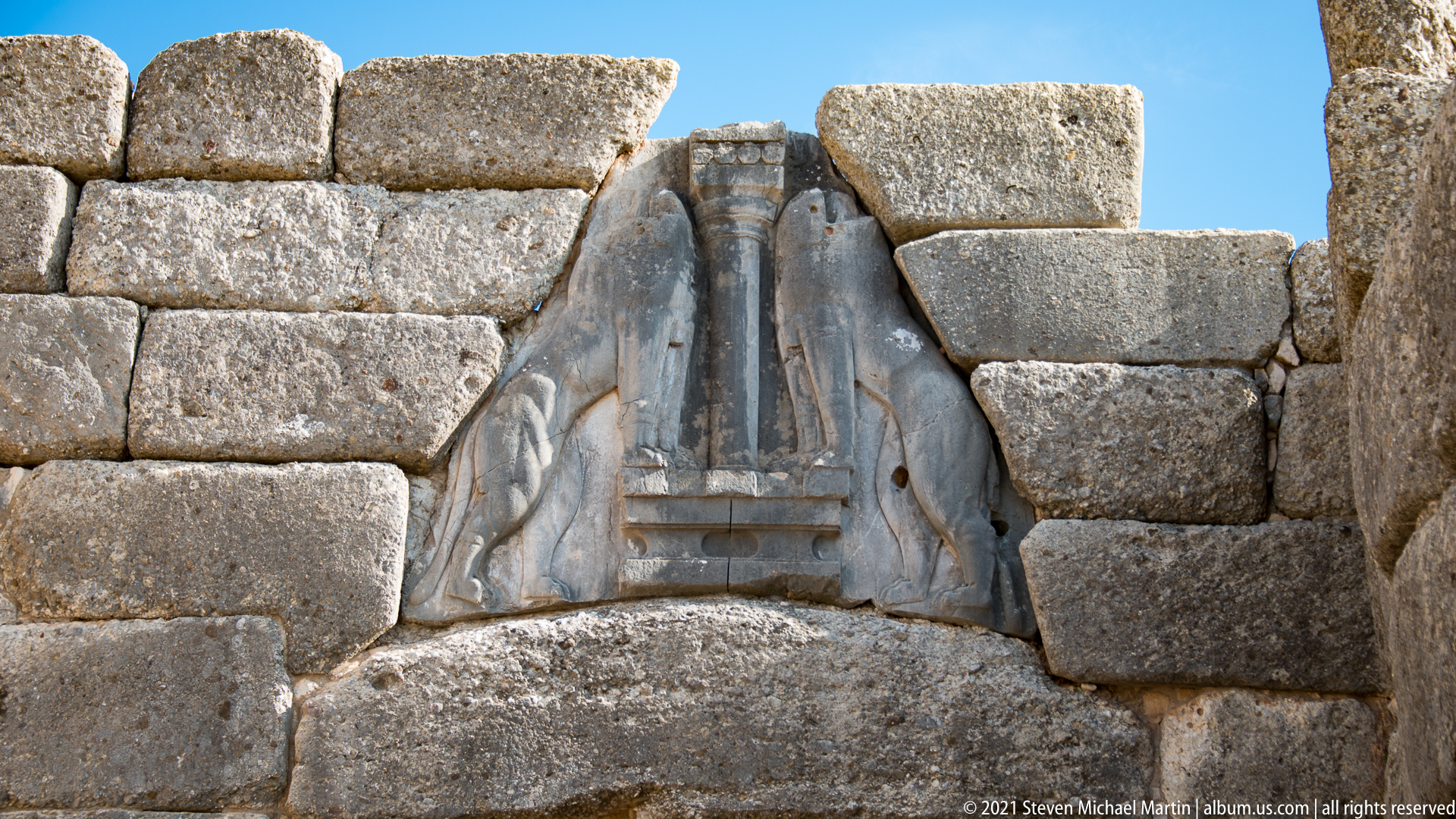
The triangular relief above the Lion Gate shows two confronted lions flanking a central vertical element, their forelegs raised on a shared base. Framed tightly by the surrounding Cyclopean masonry, the composition reveals how monumental sculpture was integrated into the gate's relieving triangle and made part of the citadel's principal ceremonial entrance.
Caption
The triangular relief above the Lion Gate shows two confronted lions flanking a central vertical element, their forelegs raised on a shared base. Framed tightly by the surrounding Cyclopean masonry, the composition reveals how monumental sculpture was integrated into the gate's relieving triangle and made part of the citadel's principal ceremonial entrance.

A close upward view from within the gateway brings the Lion Gate's enormous lintel into the foreground while the triangular lion relief rises immediately above it. The low angle stresses the weight and scale of the stone construction and shows how the sculpted relieving triangle reduces masonry directly over the entrance opening.
Caption
A close upward view from within the gateway brings the Lion Gate's enormous lintel into the foreground while the triangular lion relief rises immediately above it. The low angle stresses the weight and scale of the stone construction and shows how the sculpted relieving triangle reduces masonry directly over the entrance opening.

A printed site plan maps the acropolis and citadel of Mycenae, pairing numbered features with a legend of major monuments and routes. The diagram helps orient visitors within the complex fortification circuit and dense archaeological remains, translating the steep three-dimensional site into a schematic overview for navigation and interpretation.
Caption
A printed site plan maps the acropolis and citadel of Mycenae, pairing numbered features with a legend of major monuments and routes. The diagram helps orient visitors within the complex fortification circuit and dense archaeological remains, translating the steep three-dimensional site into a schematic overview for navigation and interpretation.

An interpretive panel titled 'The Propylaon of the Palace' combines a ground plan with a simplified elevation showing columned architecture. The text identifies the structure as the principal entrance to the palace complex and situates it within the citadel's upper area. The diagram makes the relationship between rooms, walls, and the columned approach easier to understand.
Caption
An interpretive panel titled 'The Propylaon of the Palace' combines a ground plan with a simplified elevation showing columned architecture. The text identifies the structure as the principal entrance to the palace complex and situates it within the citadel's upper area. The diagram makes the relationship between rooms, walls, and the columned approach easier to understand.

Low stone walls and rectangular foundations define a dense sequence of rooms on the upper citadel, with later conservation work helping preserve their outlines. The elevated viewpoint looks across the architectural remains toward the surrounding Argolid landscape, showing how the palace zone occupied commanding ground within the fortified hilltop settlement.
Caption
Low stone walls and rectangular foundations define a dense sequence of rooms on the upper citadel, with later conservation work helping preserve their outlines. The elevated viewpoint looks across the architectural remains toward the surrounding Argolid landscape, showing how the palace zone occupied commanding ground within the fortified hilltop settlement.

The large circular enclosure of Grave Circle A is viewed from above, its double ring of stone masonry defining a distinctive space within the citadel. Rectangular grave areas and pathways are visible inside and around the ring. The elevated perspective clarifies the monument's geometry and its close relationship to the surrounding settlement remains.
Caption
The large circular enclosure of Grave Circle A is viewed from above, its double ring of stone masonry defining a distinctive space within the citadel. Rectangular grave areas and pathways are visible inside and around the ring. The elevated perspective clarifies the monument's geometry and its close relationship to the surrounding settlement remains.

Terraced stone walls step across the rocky slope of the citadel, merging with exposed bedrock and dry ground. The remains form successive levels rather than a single monumental façade, revealing the dense adaptation of Mycenaean construction to uneven terrain. A leafless tree provides a vertical counterpoint to the layered masonry.
Caption
Terraced stone walls step across the rocky slope of the citadel, merging with exposed bedrock and dry ground. The remains form successive levels rather than a single monumental façade, revealing the dense adaptation of Mycenaean construction to uneven terrain. A leafless tree provides a vertical counterpoint to the layered masonry.

A modern paved walkway climbs through the exposed ruins of Mycenae, bordered by low stone foundations and the bare slopes of the citadel hill. A visitor walking away from the camera provides scale. The scene shows how contemporary circulation has been threaded through the archaeological landscape while keeping the ancient masonry visible on both sides.
Caption
A modern paved walkway climbs through the exposed ruins of Mycenae, bordered by low stone foundations and the bare slopes of the citadel hill. A visitor walking away from the camera provides scale. The scene shows how contemporary circulation has been threaded through the archaeological landscape while keeping the ancient masonry visible on both sides.

A small rectangular stone marker set into the rocky ground bears Greek lettering above the English words 'THE PALACE.' Its understated placement guides visitors through the upper citadel without competing visually with the ancient remains. The close view records the practical wayfinding system used across the archaeological site.
Caption
A small rectangular stone marker set into the rocky ground bears Greek lettering above the English words 'THE PALACE.' Its understated placement guides visitors through the upper citadel without competing visually with the ancient remains. The close view records the practical wayfinding system used across the archaeological site.

A visitor stands among the pale stone ruins holding an unfolded site map, with the steep rocky mountain behind forming a dramatic backdrop. The portrait places present-day interpretation directly within the archaeological landscape. Loose masonry, dry grasses, and the map itself underscore the scale and complexity of navigating the upper citadel.
Caption
A visitor stands among the pale stone ruins holding an unfolded site map, with the steep rocky mountain behind forming a dramatic backdrop. The portrait places present-day interpretation directly within the archaeological landscape. Loose masonry, dry grasses, and the map itself underscore the scale and complexity of navigating the upper citadel.

An interpretive panel titled 'Temples of Historical Times on the Hilltop' combines a site map, a reconstruction or plan, and explanatory text. It discusses later sacred buildings occupying the summit area after the Mycenaean palace period. The display helps visitors distinguish the citadel's long sequence of use rather than viewing all surviving remains as belonging to one era.
Caption
An interpretive panel titled 'Temples of Historical Times on the Hilltop' combines a site map, a reconstruction or plan, and explanatory text. It discusses later sacred buildings occupying the summit area after the Mycenaean palace period. The display helps visitors distinguish the citadel's long sequence of use rather than viewing all surviving remains as belonging to one era.

Two pink-and-white cyclamen blossoms rise from dry grass beside rough limestone, their reflexed petals catching the light against the muted archaeological ground. The intimate botanical view records seasonal vegetation growing naturally among the rocky terrain of Mycenae and contrasts the fragile flowers with the site's hard, weathered stone.
Caption
Two pink-and-white cyclamen blossoms rise from dry grass beside rough limestone, their reflexed petals catching the light against the muted archaeological ground. The intimate botanical view records seasonal vegetation growing naturally among the rocky terrain of Mycenae and contrasts the fragile flowers with the site's hard, weathered stone.

A slender spike of small white flowers stands sharply against a blurred ocher hillside and deep blue sky. The shallow depth of field isolates the plant from the archaeological landscape, turning a modest piece of site vegetation into a close natural study. The species cannot be securely determined from this single proof-sheet view.
Caption
A slender spike of small white flowers stands sharply against a blurred ocher hillside and deep blue sky. The shallow depth of field isolates the plant from the archaeological landscape, turning a modest piece of site vegetation into a close natural study. The species cannot be securely determined from this single proof-sheet view.

The interior wall of a tholos tomb curves upward through tightly laid horizontal stone courses, creating the characteristic beehive profile. Light washes across the masonry, revealing subtle changes in stone size and alignment. This oblique view complements the vertical apex view by emphasizing the chamber's broad curvature and enveloping scale.
Caption
The interior wall of a tholos tomb curves upward through tightly laid horizontal stone courses, creating the characteristic beehive profile. Light washes across the masonry, revealing subtle changes in stone size and alignment. This oblique view complements the vertical apex view by emphasizing the chamber's broad curvature and enveloping scale.

From inside the tholos conventionally known as the Tomb of Clytemnestra, the monumental doorway opens toward the sunlit dromos. The chamber’s curving masonry belongs to the corbelled construction that produced the characteristic beehive form of Mycenaean tholos tombs. Seen from the dark interior, the massive lintel and passage emphasize the engineering and ceremonial monumentality of the entrance.
Caption
From inside the tholos conventionally known as the Tomb of Clytemnestra, the monumental doorway opens toward the sunlit dromos. The chamber’s curving masonry belongs to the corbelled construction that produced the characteristic beehive form of Mycenaean tholos tombs. Seen from the dark interior, the massive lintel and passage emphasize the engineering and ceremonial monumentality of the entrance.

Low terraces and massive stone walls extend across the dry slope beneath a steep conical mountain. The view separates different scales of masonry, from compact retaining walls to larger defensive blocks, and shows how the built remains occupy naturally rugged ground. The composition emphasizes Mycenae's integration of fortification, settlement, and terrain.
Caption
Low terraces and massive stone walls extend across the dry slope beneath a steep conical mountain. The view separates different scales of masonry, from compact retaining walls to larger defensive blocks, and shows how the built remains occupy naturally rugged ground. The composition emphasizes Mycenae's integration of fortification, settlement, and terrain.

A stone wall descends diagonally across the dry slope while the Argolid plain opens far beyond it. The elevated viewpoint reveals both the wall's adaptation to uneven ground and the broad field of view surrounding Mycenae. Weathered masonry in the foreground contrasts with cultivated patches and distant mountains below.
Caption
A stone wall descends diagonally across the dry slope while the Argolid plain opens far beyond it. The elevated viewpoint reveals both the wall's adaptation to uneven ground and the broad field of view surrounding Mycenae. Weathered masonry in the foreground contrasts with cultivated patches and distant mountains below.

Several tall dressed stone slabs stand upright among lower foundations and rough masonry, creating a narrow passage-like space within the ruins. Their carefully cut faces contrast with the more irregular walling behind them. The close view emphasizes surviving architectural components rather than a broad site panorama.
Caption
Several tall dressed stone slabs stand upright among lower foundations and rough masonry, creating a narrow passage-like space within the ruins. Their carefully cut faces contrast with the more irregular walling behind them. The close view emphasizes surviving architectural components rather than a broad site panorama.

A tight passage runs between tall, roughly parallel stone slabs, with smaller masonry closing the space behind. The close framing highlights the thickness, texture, and carefully dressed faces of the blocks. This restricted viewpoint records a structural detail within the citadel whose precise original function is not fully apparent from the photograph alone.
Caption
A tight passage runs between tall, roughly parallel stone slabs, with smaller masonry closing the space behind. The close framing highlights the thickness, texture, and carefully dressed faces of the blocks. This restricted viewpoint records a structural detail within the citadel whose precise original function is not fully apparent from the photograph alone.

Concentric and rectilinear stone walls create a dense cluster of rooms and terraces on the sloping interior of the citadel. Differences in wall height and masonry reveal multiple architectural units compressed into a small area. Seen from above, the view is especially useful for reading circulation and building density within the excavated settlement.
Caption
Concentric and rectilinear stone walls create a dense cluster of rooms and terraces on the sloping interior of the citadel. Differences in wall height and masonry reveal multiple architectural units compressed into a small area. Seen from above, the view is especially useful for reading circulation and building density within the excavated settlement.

A visitor in a broad-brimmed hat and blue shirt is shown against softly blurred stone ruins. The shallow depth of field turns the archaeological setting into context rather than subject, creating a personal portrait within the site. Weathered masonry behind him situates the scene unmistakably within the excavated citadel.
Caption
A visitor in a broad-brimmed hat and blue shirt is shown against softly blurred stone ruins. The shallow depth of field turns the archaeological setting into context rather than subject, creating a personal portrait within the site. Weathered masonry behind him situates the scene unmistakably within the excavated citadel.

A visitor stands beneath a monumental stone entrance whose massive lintel supports a triangular relieving opening or inset above. Large squared blocks frame the doorway, while a modern walkway crosses the threshold. The human figure gives a strong sense of scale and underscores the engineering of the heavily loaded opening.
Caption
A visitor stands beneath a monumental stone entrance whose massive lintel supports a triangular relieving opening or inset above. Large squared blocks frame the doorway, while a modern walkway crosses the threshold. The human figure gives a strong sense of scale and underscores the engineering of the heavily loaded opening.

Concentric rings of carefully fitted stone courses rise inward to close the domed chamber of a Mycenaean tholos tomb. Viewed almost directly upward, the corbelled construction becomes a geometric pattern centered on the apex. The image clearly shows how successive masonry courses project inward to create the characteristic beehive-shaped vault.
Caption
Concentric rings of carefully fitted stone courses rise inward to close the domed chamber of a Mycenaean tholos tomb. Viewed almost directly upward, the corbelled construction becomes a geometric pattern centered on the apex. The image clearly shows how successive masonry courses project inward to create the characteristic beehive-shaped vault.

A broad paved approach leads toward a massive post-and-lintel doorway set into the citadel wall. Above the lintel, a triangular relieving space or inset interrupts the heavy masonry. A visitor beyond the opening supplies scale, while the converging walls emphasize the controlled passage through the defensive architecture.
Caption
A broad paved approach leads toward a massive post-and-lintel doorway set into the citadel wall. Above the lintel, a triangular relieving space or inset interrupts the heavy masonry. A visitor beyond the opening supplies scale, while the converging walls emphasize the controlled passage through the defensive architecture.

An oblique upward view reveals the full sweep of a tholos tomb's corbelled dome, from broad lower courses to the small closing point at the apex. Areas of light and shadow model the masonry surface and make the inward stepping of each course especially clear. The chamber's scale is conveyed without relying on human figures.
Caption
An oblique upward view reveals the full sweep of a tholos tomb's corbelled dome, from broad lower courses to the small closing point at the apex. Areas of light and shadow model the masonry surface and make the inward stepping of each course especially clear. The chamber's scale is conveyed without relying on human figures.

A long section of stone fortification runs across the dry archaeological terrain below a sharply rising mountain. Large and smaller masonry blocks create a layered wall face, while scattered stones and low remains occupy the foreground. The view emphasizes the length of the defensive circuit and its close adaptation to the rugged hillside.
Caption
A long section of stone fortification runs across the dry archaeological terrain below a sharply rising mountain. Large and smaller masonry blocks create a layered wall face, while scattered stones and low remains occupy the foreground. The view emphasizes the length of the defensive circuit and its close adaptation to the rugged hillside.

A sunken, stone-lined approach descends toward the rectangular entrance of a Mycenaean tholos tomb. Dry embankments and low retaining walls frame the cut into the hillside. Seen from above, the photograph makes the tomb's partially buried construction and deliberate separation from the surrounding landscape particularly clear.
Caption
A sunken, stone-lined approach descends toward the rectangular entrance of a Mycenaean tholos tomb. Dry embankments and low retaining walls frame the cut into the hillside. Seen from above, the photograph makes the tomb's partially buried construction and deliberate separation from the surrounding landscape particularly clear.

A long stone-lined dromos approaches the monumental façade of the tholos conventionally known as the Tomb of Clytemnestra. The doorway, massive lintel, and relieving triangle demonstrate the corbelled engineering characteristic of Mycenaean tholos tombs. The traditional name links the monument to later mythic associations; it does not identify the historical occupant of the tomb.
Caption
A long stone-lined dromos approaches the monumental façade of the tholos conventionally known as the Tomb of Clytemnestra. The doorway, massive lintel, and relieving triangle demonstrate the corbelled engineering characteristic of Mycenaean tholos tombs. The traditional name links the monument to later mythic associations; it does not identify the historical occupant of the tomb.

The façade of the tholos conventionally called the Tomb of Clytemnestra rises at the end of a carefully built dromos. Tall ashlar passage walls converge on a doorway capped by a massive lintel and triangular relieving opening. The monument belongs to Mycenae’s developed tradition of corbelled tholos tomb architecture; its familiar name is traditional rather than evidence for the identity of the person buried here.
Caption
The façade of the tholos conventionally called the Tomb of Clytemnestra rises at the end of a carefully built dromos. Tall ashlar passage walls converge on a doorway capped by a massive lintel and triangular relieving opening. The monument belongs to Mycenae’s developed tradition of corbelled tholos tomb architecture; its familiar name is traditional rather than evidence for the identity of the person buried here.

A bilingual archaeological panel identifies the Tholos Tomb of Clytemnestra and illustrates its plan and section. The diagrams explain the long dromos, monumental doorway, and circular corbelled chamber that define the Mycenaean tholos form. The traditional attribution to Clytemnestra reflects the monument’s later mythic naming and should not be read as identification of its actual occupant.
Caption
A bilingual archaeological panel identifies the Tholos Tomb of Clytemnestra and illustrates its plan and section. The diagrams explain the long dromos, monumental doorway, and circular corbelled chamber that define the Mycenaean tholos form. The traditional attribution to Clytemnestra reflects the monument’s later mythic naming and should not be read as identification of its actual occupant.

Several slender stalks of small white flowers rise sharply against a deep blue sky, with the blurred mountain slope of Mycenae behind. The shallow depth of field isolates the plants from the archaeological setting and turns them into a delicate foreground study. Their exact species cannot be confirmed from the proof sheet.
Caption
Several slender stalks of small white flowers rise sharply against a deep blue sky, with the blurred mountain slope of Mycenae behind. The shallow depth of field isolates the plants from the archaeological setting and turns them into a delicate foreground study. Their exact species cannot be confirmed from the proof sheet.

A large painted ceramic vessel carries dense red-brown decoration across a pale ground, including spirals, floral forms, and sweeping curvilinear motifs. A high handle arches from the shoulder toward the neck. The museum display isolates the vessel's bold silhouette and makes its carefully organized painted surface easy to study.
Caption
A large painted ceramic vessel carries dense red-brown decoration across a pale ground, including spirals, floral forms, and sweeping curvilinear motifs. A high handle arches from the shoulder toward the neck. The museum display isolates the vessel's bold silhouette and makes its carefully organized painted surface easy to study.

A fragmentary terracotta figure preserves a prominent head and upper body with projecting arms or appendages. The hand-modeled surface is uneven and largely undecorated, emphasizing the object's sculptural rather than wheel-made character. Breaks and losses make the original pose and exact type difficult to reconstruct, but its anthropomorphic form remains evident.
Caption
A fragmentary terracotta figure preserves a prominent head and upper body with projecting arms or appendages. The hand-modeled surface is uneven and largely undecorated, emphasizing the object's sculptural rather than wheel-made character. Breaks and losses make the original pose and exact type difficult to reconstruct, but its anthropomorphic form remains evident.

A standing female terracotta figure is decorated with dark red-brown painted bands, dots, and curving lines over a pale surface. Her modeled face, coiffure, and arms drawn across the torso give the object a strongly anthropomorphic presence. The frontal museum view clearly records both the stylized anatomy and the surviving painted ornament.
Caption
A standing female terracotta figure is decorated with dark red-brown painted bands, dots, and curving lines over a pale surface. Her modeled face, coiffure, and arms drawn across the torso give the object a strongly anthropomorphic presence. The frontal museum view clearly records both the stylized anatomy and the surviving painted ornament.

A hammered-gold funerary mask reproduces the distinctive bearded face conventionally known as the Mask of Agamemnon, with closed eyes, prominent ears, moustache, and incised beard. The original was found by Heinrich Schliemann in Grave V of Grave Circle A in 1876. Despite its famous name, the mask predates the era traditionally associated with the Trojan War and is not a demonstrated portrait of Agamemnon.
Caption
A hammered-gold funerary mask reproduces the distinctive bearded face conventionally known as the Mask of Agamemnon, with closed eyes, prominent ears, moustache, and incised beard. The original was found by Heinrich Schliemann in Grave V of Grave Circle A in 1876. Despite its famous name, the mask predates the era traditionally associated with the Trojan War and is not a demonstrated portrait of Agamemnon.

An interpretive panel identifies Grave Circle A, the circular royal cemetery incorporated within the fortified citadel of Mycenae. Its reconstruction and bilingual text explain the enclosure and shaft graves whose exceptionally rich funerary assemblages helped establish Mycenae as the type-site of the civilization that bears its name. The panel links the excavated burial precinct to the archaeological history of the site.
Caption
An interpretive panel identifies Grave Circle A, the circular royal cemetery incorporated within the fortified citadel of Mycenae. Its reconstruction and bilingual text explain the enclosure and shaft graves whose exceptionally rich funerary assemblages helped establish Mycenae as the type-site of the civilization that bears its name. The panel links the excavated burial precinct to the archaeological history of the site.

A museum case groups long bronze swords with elaborate hilts alongside gold ornaments, vessels, small fittings, and other grave goods. The varied materials and object types are arranged for comparison, evoking the richness of elite Mycenaean burials. The two long blades dominate the foreground while smaller precious objects fill the display behind.
Caption
A museum case groups long bronze swords with elaborate hilts alongside gold ornaments, vessels, small fittings, and other grave goods. The varied materials and object types are arranged for comparison, evoking the richness of elite Mycenaean burials. The two long blades dominate the foreground while smaller precious objects fill the display behind.

A museum case combines painted ceramic vessels, a handled jug, beads and small ornaments, and a row of stylized quadruped figurines. The display highlights the diversity of small-scale Mycenaean material culture, from household or funerary pottery to miniature animal forms. Repeated painted bands visually connect the vessels and figurines across the case.
Caption
A museum case combines painted ceramic vessels, a handled jug, beads and small ornaments, and a row of stylized quadruped figurines. The display highlights the diversity of small-scale Mycenaean material culture, from household or funerary pottery to miniature animal forms. Repeated painted bands visually connect the vessels and figurines across the case.

Inside Grave Circle A, upright grave stelae and exposed foundations mark the celebrated shaft-grave cemetery immediately within Mycenae’s citadel. The circular stone enclosure was monumentalized when this earlier burial ground was incorporated into the fortified acropolis. Rich finds from these graves became central evidence for the wealth and artistic achievement of Mycenaean elite society.
Caption
Inside Grave Circle A, upright grave stelae and exposed foundations mark the celebrated shaft-grave cemetery immediately within Mycenae’s citadel. The circular stone enclosure was monumentalized when this earlier burial ground was incorporated into the fortified acropolis. Rich finds from these graves became central evidence for the wealth and artistic achievement of Mycenaean elite society.

Grave Circle A forms a conspicuous circular burial precinct just inside the Lion Gate at Mycenae. The double ring of upright stone slabs encloses the shaft-grave area where elite burials were furnished with extraordinary objects of gold, bronze, ivory, and other materials. The surviving enclosure and grave markers make the cemetery’s later monumental presentation legible within the citadel.
Caption
Grave Circle A forms a conspicuous circular burial precinct just inside the Lion Gate at Mycenae. The double ring of upright stone slabs encloses the shaft-grave area where elite burials were furnished with extraordinary objects of gold, bronze, ivory, and other materials. The surviving enclosure and grave markers make the cemetery’s later monumental presentation legible within the citadel.

A visitor provides scale beside Grave Circle A, the monumentalized shaft-grave cemetery near the Lion Gate. Upright grave stelae rise within the circular stone enclosure, while the Argolid landscape opens beyond the citadel. The setting joins the funerary precinct to Mycenae’s strategic hilltop position, which commanded routes across the Argolid plain.
Caption
A visitor provides scale beside Grave Circle A, the monumentalized shaft-grave cemetery near the Lion Gate. Upright grave stelae rise within the circular stone enclosure, while the Argolid landscape opens beyond the citadel. The setting joins the funerary precinct to Mycenae’s strategic hilltop position, which commanded routes across the Argolid plain.

Numerous curled flower spikes carry clusters of tiny white blossoms with yellow centers above gray-green foliage growing among stones at Mycenae. The close botanical study records the vegetation colonizing rocky ground around the archaeological site. Although the coiled inflorescences resemble heliotrope and related Mediterranean plants, the photograph does not provide enough diagnostic detail for a secure species-level identification.
Caption
Numerous curled flower spikes carry clusters of tiny white blossoms with yellow centers above gray-green foliage growing among stones at Mycenae. The close botanical study records the vegetation colonizing rocky ground around the archaeological site. Although the coiled inflorescences resemble heliotrope and related Mediterranean plants, the photograph does not provide enough diagnostic detail for a secure species-level identification.