Church of Saint Demetrios (Thessaloniki)
The Church of Saint Demetrios is one of the most important early Christian monuments in Greece and is dedicated to the patron saint of Thessaloniki. Originally constructed in the early centuries of Christianity and rebuilt multiple times following fires and destruction, the present structure reflects layers of architectural development. The basilica demonstrates the significance of Thessaloniki as a major center of Byzantine religious life.
Interior mosaics depict scenes connected to Saint Demetrios and illustrate artistic traditions that developed during the Byzantine period. The crypt beneath the church preserves evidence of earlier phases of construction, revealing how the site evolved across centuries of worship and rebuilding. These features contribute to understanding the continuity of religious practice in the city.
The church remains an important symbol of Thessaloniki’s historical role in the spread of Christianity throughout the eastern Mediterranean. Its architecture and decoration reflect the broader cultural influences that shaped Byzantine art and religious identity.
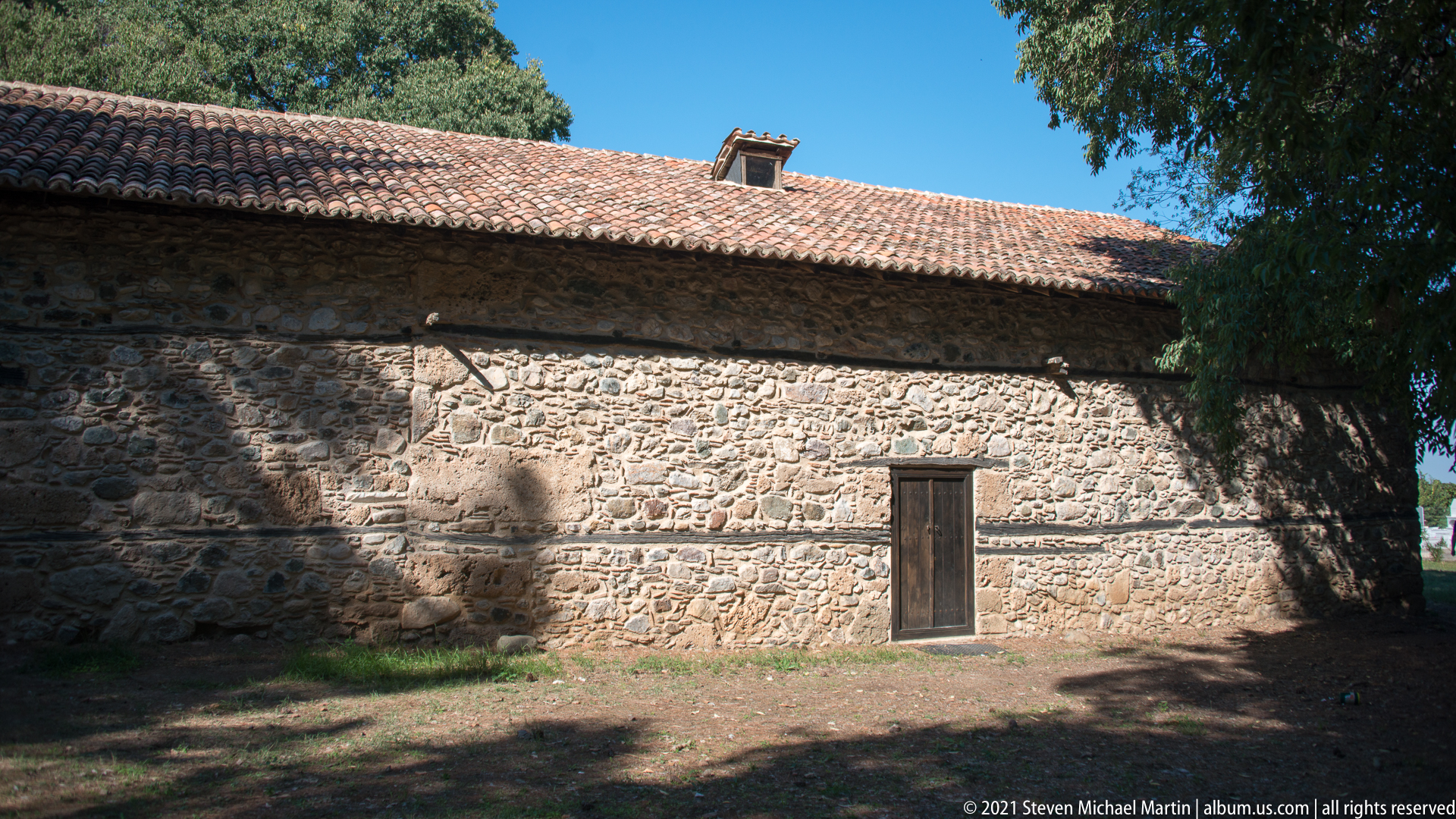
The church’s long exterior side wall is built of irregular fieldstone masonry beneath a low red-tiled roof. A simple wooden door opens near the center, while a projecting stone base and sparse openings reinforce the building’s compact, fortified appearance. Mature trees cast deep shade across the wall and ground, contrasting with the bright blue sky above.
Caption
The church’s long exterior side wall is built of irregular fieldstone masonry beneath a low red-tiled roof. A simple wooden door opens near the center, while a projecting stone base and sparse openings reinforce the building’s compact, fortified appearance. Mature trees cast deep shade across the wall and ground, contrasting with the bright blue sky above.

The east end of the church is articulated by a projecting polygonal apse built of larger squared stone blocks against surrounding rubble masonry. Small slit-like openings puncture the apse, while the gabled roof and plastered upper wall rise behind it. The contrast between masonry types makes the sanctuary projection especially legible from this exterior angle.
Caption
The east end of the church is articulated by a projecting polygonal apse built of larger squared stone blocks against surrounding rubble masonry. Small slit-like openings puncture the apse, while the gabled roof and plastered upper wall rise behind it. The contrast between masonry types makes the sanctuary projection especially legible from this exterior angle.

The long side elevation of the Church of Saint Demetrios is built of irregular fieldstone beneath a low red-tiled roof. A dark open doorway and a second narrow wooden door punctuate the otherwise plain wall, while a mature tree casts deep shade across the facade and dry ground. The restrained exterior contrasts sharply with the densely painted interior.
Caption
The long side elevation of the Church of Saint Demetrios is built of irregular fieldstone beneath a low red-tiled roof. A dark open doorway and a second narrow wooden door punctuate the otherwise plain wall, while a mature tree casts deep shade across the facade and dry ground. The restrained exterior contrasts sharply with the densely painted interior.

A faded exterior wall painting survives high beneath the gable, showing a haloed mounted figure on a reddish horse. Weathering has softened the figure and background, but the horse, rider, halo, and flowing cloak remain visible. The mural sits above the stone wall under projecting roof timbers, documenting a rare surviving painted element on the church exterior.
Caption
A faded exterior wall painting survives high beneath the gable, showing a haloed mounted figure on a reddish horse. Weathering has softened the figure and background, but the horse, rider, halo, and flowing cloak remain visible. The mural sits above the stone wall under projecting roof timbers, documenting a rare surviving painted element on the church exterior.

A plain wooden door is set into the thick rubble-stone wall of the Church of Saint Demetrios of Palatitsia. Irregular fieldstones, fragments of brick, and broad horizontal masonry bands surround the rectangular opening. The close frontal view emphasizes the varied construction materials and comparatively austere exterior treatment, in marked contrast to the church’s extensively painted interior.
Caption
A plain wooden door is set into the thick rubble-stone wall of the Church of Saint Demetrios of Palatitsia. Irregular fieldstones, fragments of brick, and broad horizontal masonry bands surround the rectangular opening. The close frontal view emphasizes the varied construction materials and comparatively austere exterior treatment, in marked contrast to the church’s extensively painted interior.

An oblique view across the nave emphasizes the rhythm of painted columns and arches leading toward the wooden sanctuary screen. Fresco cycles line both side walls, while the exposed timber roof and pale stone floor frame the richly painted surfaces. The angled viewpoint makes the spatial depth and layered arrangement of architecture, woodwork, and mural decoration especially clear.
Caption
An oblique view across the nave emphasizes the rhythm of painted columns and arches leading toward the wooden sanctuary screen. Fresco cycles line both side walls, while the exposed timber roof and pale stone floor frame the richly painted surfaces. The angled viewpoint makes the spatial depth and layered arrangement of architecture, woodwork, and mural decoration especially clear.

The interior view looks through the nave toward a wooden screen, with frescoed arcades, painted columns, and saintly registers covering the surrounding walls. A timber roof spans the space above. The photograph reveals how the church’s architecture and wall paintings function together, with painted narrative cycles wrapping continuously around structural piers and arches.
Caption
The interior view looks through the nave toward a wooden screen, with frescoed arcades, painted columns, and saintly registers covering the surrounding walls. A timber roof spans the space above. The photograph reveals how the church’s architecture and wall paintings function together, with painted narrative cycles wrapping continuously around structural piers and arches.
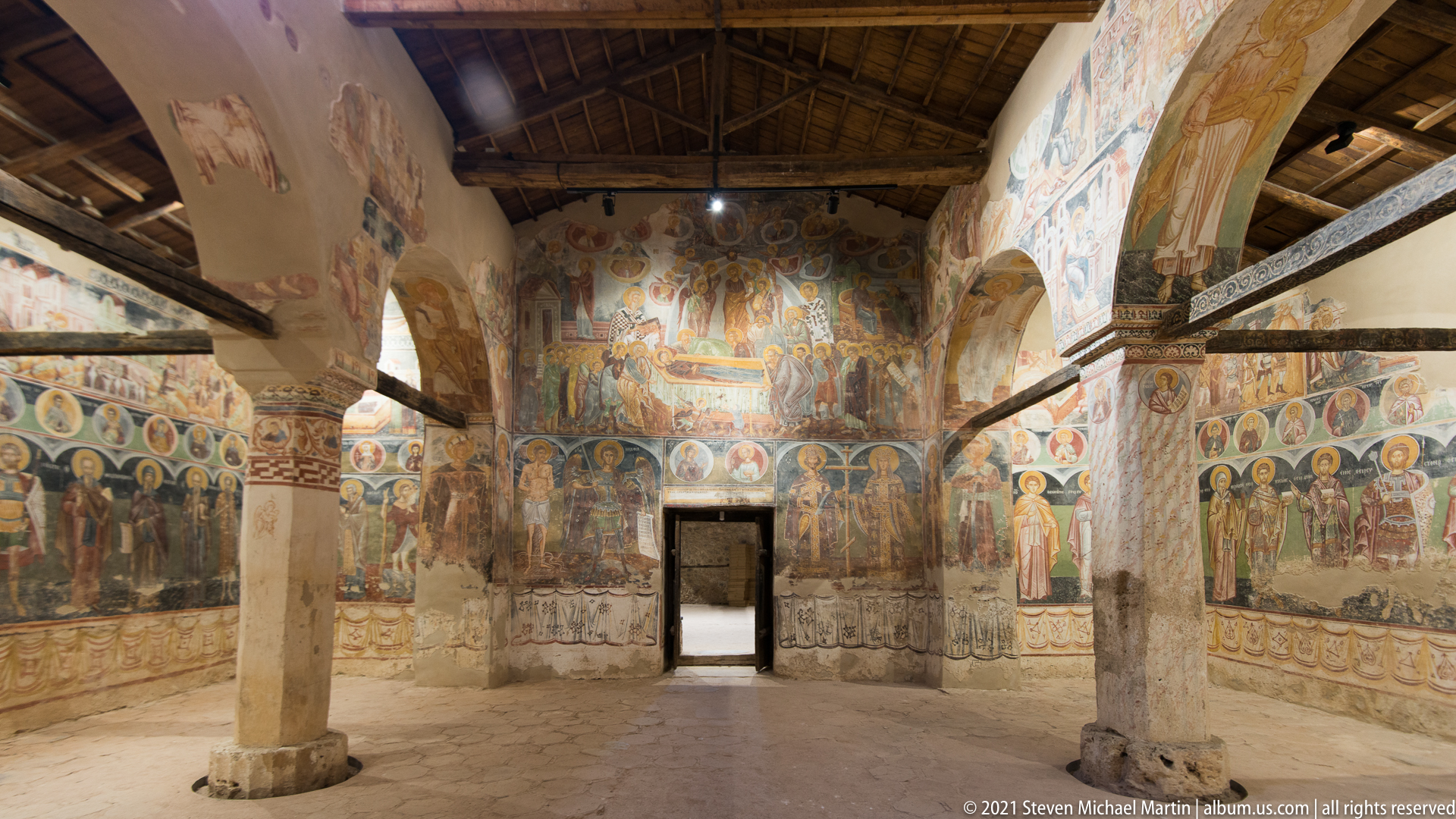
Looking toward a mural-lined wall, this interior view frames a central doorway between painted columns and low registers of haloed saints. Narrative scenes continue above the arches, while the exposed timber roof remains visible overhead. The nearly symmetrical composition emphasizes the compact proportions of the nave and the continuous painted envelope surrounding the worship space.
Caption
Looking toward a mural-lined wall, this interior view frames a central doorway between painted columns and low registers of haloed saints. Narrative scenes continue above the arches, while the exposed timber roof remains visible overhead. The nearly symmetrical composition emphasizes the compact proportions of the nave and the continuous painted envelope surrounding the worship space.
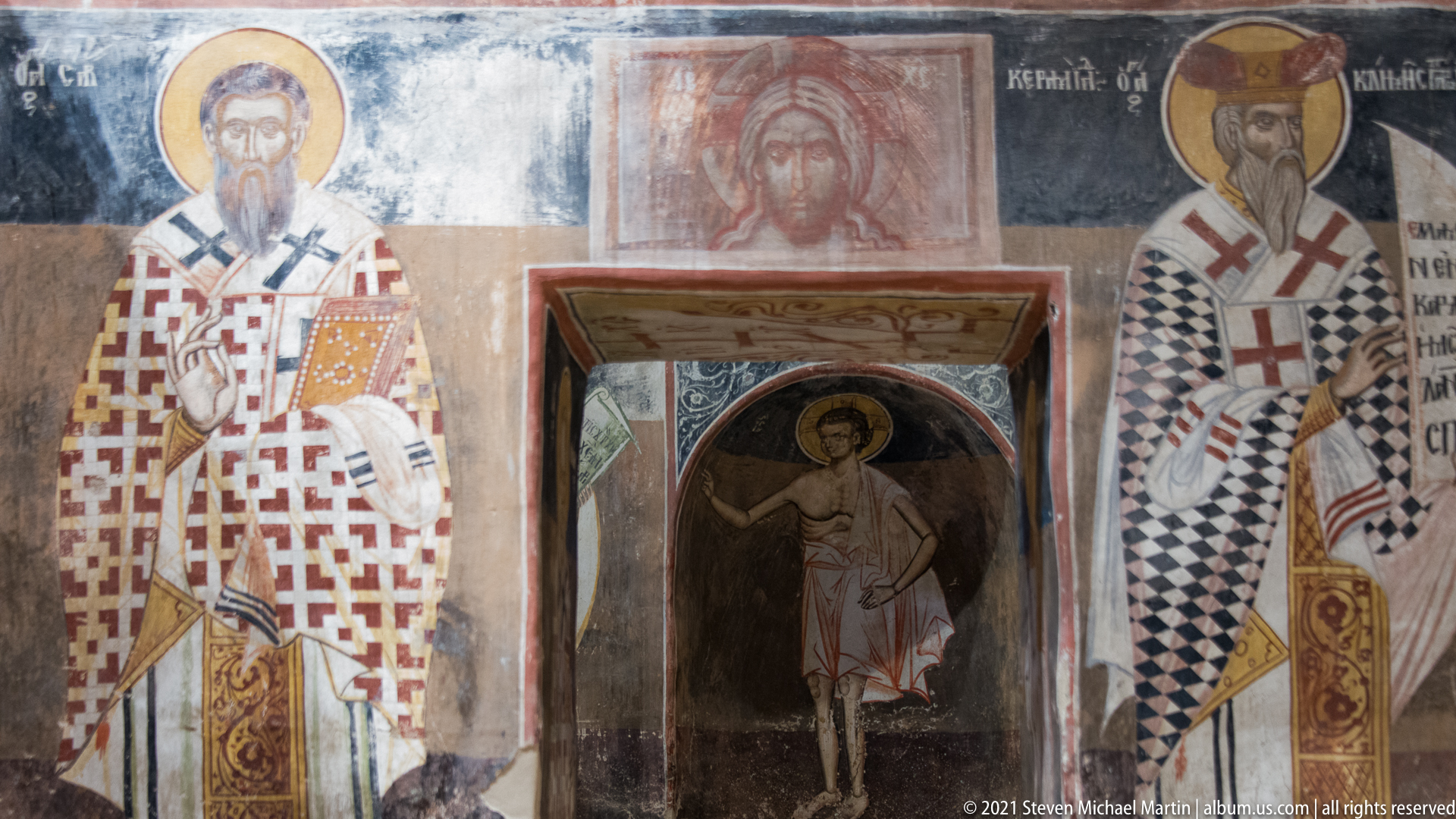
A doorway interrupts the frescoed wall, with richly vested bishops painted on either side and a standing haloed saint visible in the darker passage beyond. The image shows how architecture and painting interlock within the church: sacred figures occupy both the wall surface and the threshold, turning a practical opening into part of the larger devotional program.
Caption
A doorway interrupts the frescoed wall, with richly vested bishops painted on either side and a standing haloed saint visible in the darker passage beyond. The image shows how architecture and painting interlock within the church: sacred figures occupy both the wall surface and the threshold, turning a practical opening into part of the larger devotional program.
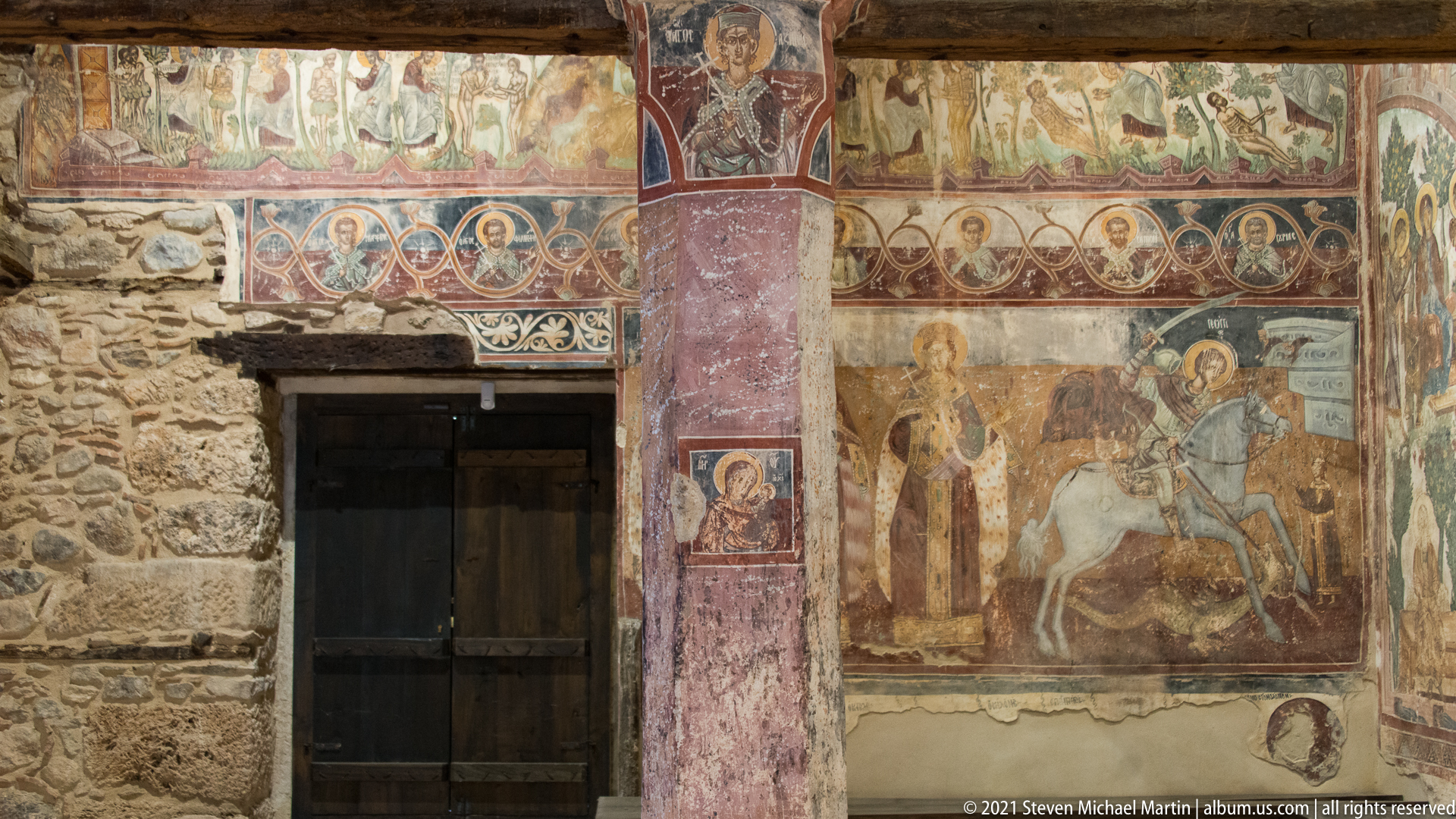
A dark wooden doorway is embedded within a densely painted wall, with saintly busts in a horizontal band above and a large mounted-warrior scene filling the panel to the right. A painted pier divides the compositions and carries additional small saint figures. The view makes the close integration of doorway, structural support, and narrative fresco especially apparent.
Caption
A dark wooden doorway is embedded within a densely painted wall, with saintly busts in a horizontal band above and a large mounted-warrior scene filling the panel to the right. A painted pier divides the compositions and carries additional small saint figures. The view makes the close integration of doorway, structural support, and narrative fresco especially apparent.

Monumental bishop saints stand on either side of a doorway, dressed in patterned episcopal vestments and holding inscribed scrolls. Painted medallions and additional sacred figures occupy the curved wall above. The doorway cuts through the painted register, illustrating how the sanctuary’s architectural openings were integrated into a continuous program of church hierarchs.
Caption
Monumental bishop saints stand on either side of a doorway, dressed in patterned episcopal vestments and holding inscribed scrolls. Painted medallions and additional sacred figures occupy the curved wall above. The doorway cuts through the painted register, illustrating how the sanctuary’s architectural openings were integrated into a continuous program of church hierarchs.

A broad interior view reveals the dense painted program of the Church of Saint Demetrios of Palatitsia, with narrative scenes, rows of saints, arched compositions, and ornamental panels arranged around a central doorway. The timber roof and projecting structural members frame the surviving wall paintings, while losses and abrasions make the layered condition of the decoration clearly visible.
Caption
A broad interior view reveals the dense painted program of the Church of Saint Demetrios of Palatitsia, with narrative scenes, rows of saints, arched compositions, and ornamental panels arranged around a central doorway. The timber roof and projecting structural members frame the surviving wall paintings, while losses and abrasions make the layered condition of the decoration clearly visible.

An arched fresco panel centers on a frontal, enthroned haloed figure flanked by attendant figures, all set within a larger field of adjacent sacred imagery. The composition is defined by a strong architectural arch and carefully differentiated garments, while worn pigment and exposed plaster along the surrounding wall record the age and conservation history of the painted surface.
Caption
An arched fresco panel centers on a frontal, enthroned haloed figure flanked by attendant figures, all set within a larger field of adjacent sacred imagery. The composition is defined by a strong architectural arch and carefully differentiated garments, while worn pigment and exposed plaster along the surrounding wall record the age and conservation history of the painted surface.
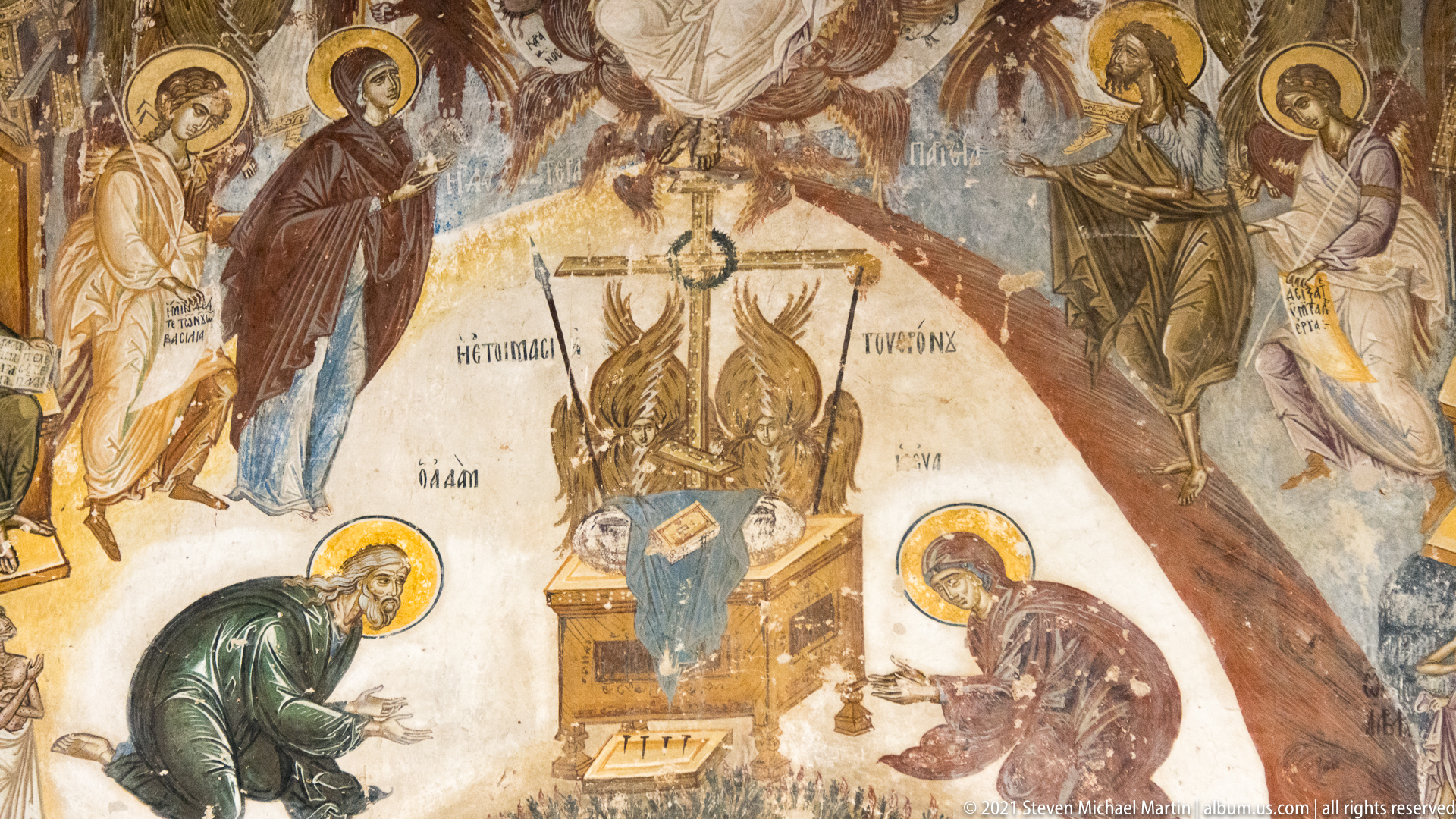
This narrative fresco gathers several haloed figures around a central architectural or liturgical motif, with two figures kneeling in the foreground and additional standing figures above. The scene is articulated through gestures, books, vessels, and richly colored robes; localized abrasion and fading interrupt parts of the composition but leave the principal relationships between the figures legible.
Caption
This narrative fresco gathers several haloed figures around a central architectural or liturgical motif, with two figures kneeling in the foreground and additional standing figures above. The scene is articulated through gestures, books, vessels, and richly colored robes; localized abrasion and fading interrupt parts of the composition but leave the principal relationships between the figures legible.

Christ appears frontally seated within a luminous mandorla, his white garments set against a blue radiating field and encircled by winged heavenly forms. Smaller haloed figures occupy the margins of the composition. The emphatic symmetry, frontal pose, and enclosing celestial form give the image a monumental theological focus despite abrasion and losses across the painted surface.
Caption
Christ appears frontally seated within a luminous mandorla, his white garments set against a blue radiating field and encircled by winged heavenly forms. Smaller haloed figures occupy the margins of the composition. The emphatic symmetry, frontal pose, and enclosing celestial form give the image a monumental theological focus despite abrasion and losses across the painted surface.

A continuous painted register presents a group of haloed saints seated in close succession, differentiated by garment color, pose, and gesture. Some hold books while others turn toward neighboring figures, creating a rhythmic communal arrangement. The warm ochre ground and surviving contour lines remain vivid even where portions of the upper field and lower border have been damaged.
Caption
A continuous painted register presents a group of haloed saints seated in close succession, differentiated by garment color, pose, and gesture. Some hold books while others turn toward neighboring figures, creating a rhythmic communal arrangement. The warm ochre ground and surviving contour lines remain vivid even where portions of the upper field and lower border have been damaged.

At the corner of the fresco cycle, seated haloed saints holding books are arranged along an architectural ledge, their bodies turning subtly toward one another across the bend in the wall. The angled viewpoint emphasizes how the painted register wraps the interior surface, while cracks, plaster losses, and softened pigment reveal the physical condition of the medieval decoration.
Caption
At the corner of the fresco cycle, seated haloed saints holding books are arranged along an architectural ledge, their bodies turning subtly toward one another across the bend in the wall. The angled viewpoint emphasizes how the painted register wraps the interior surface, while cracks, plaster losses, and softened pigment reveal the physical condition of the medieval decoration.

A crowded narrative scene places large haloed figures in the foreground beside a compact group of smaller nude figures, with additional figures and landscape details extending behind them. Pointing gestures and the pronounced contrast in scale organize the episode visually. Losses in the upper and right portions complicate interpretation, but the dramatic interaction remains legible.
Caption
A crowded narrative scene places large haloed figures in the foreground beside a compact group of smaller nude figures, with additional figures and landscape details extending behind them. Pointing gestures and the pronounced contrast in scale organize the episode visually. Losses in the upper and right portions complicate interpretation, but the dramatic interaction remains legible.

A disturbing fresco scene surrounds a central robed figure with dark, contorted beings and clustered heads, suggesting a punishment or torment episode within a larger eschatological cycle. The vigorous gestures and compressed spacing heighten the sense of conflict. Significant abrasion and missing plaster obscure some details, so the scene is best described by its visible action rather than a precise doctrinal episode.
Caption
A disturbing fresco scene surrounds a central robed figure with dark, contorted beings and clustered heads, suggesting a punishment or torment episode within a larger eschatological cycle. The vigorous gestures and compressed spacing heighten the sense of conflict. Significant abrasion and missing plaster obscure some details, so the scene is best described by its visible action rather than a precise doctrinal episode.

Two haloed, crowned figures occupy adjacent compartments above a curved wooden opening, their jeweled garments and headgear distinguishing them from surrounding saints. Painted borders follow the arch and integrate the figures with the architecture. The close framing makes the surviving facial features, crowns, and patterned robes especially clear despite localized surface wear.
Caption
Two haloed, crowned figures occupy adjacent compartments above a curved wooden opening, their jeweled garments and headgear distinguishing them from surrounding saints. Painted borders follow the arch and integrate the figures with the architecture. The close framing makes the surviving facial features, crowns, and patterned robes especially clear despite localized surface wear.
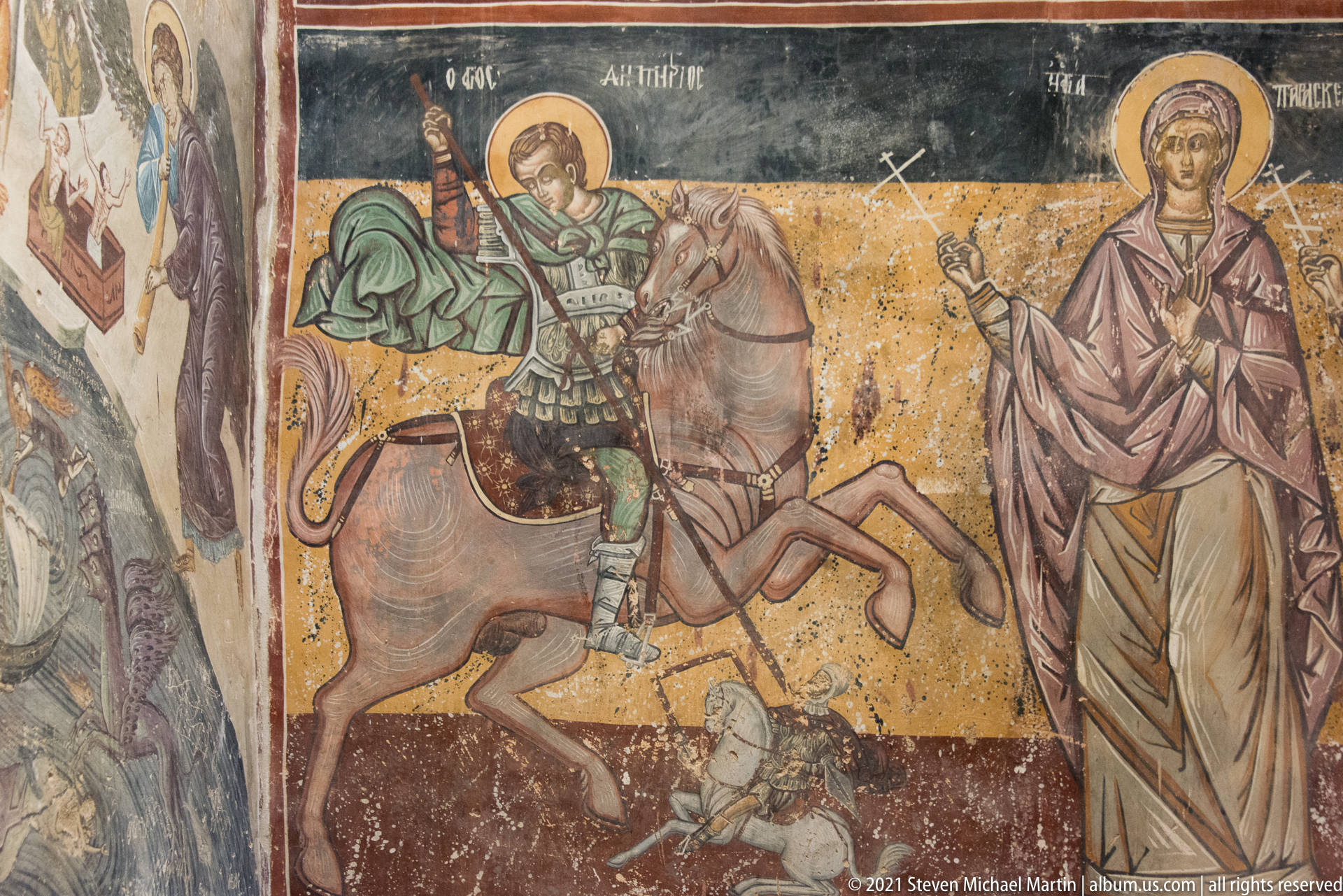
A mounted warrior saint rides across a gold-toned field, spear lowered toward a fallen figure beneath the horse, while a standing haloed woman occupies the right side of the panel. The forceful diagonal of horse and weapon contrasts with the stillness of the standing saint. Abrasion across the lower register and gold ground gives the scene a visibly weathered surface.
Caption
A mounted warrior saint rides across a gold-toned field, spear lowered toward a fallen figure beneath the horse, while a standing haloed woman occupies the right side of the panel. The forceful diagonal of horse and weapon contrasts with the stillness of the standing saint. Abrasion across the lower register and gold ground gives the scene a visibly weathered surface.

Three haloed female saints stand in a formal row against a warm ochre field, each differentiated by veil, robe, and hand gesture. Their elongated silhouettes and restrained poses create a solemn rhythm, while surviving inscriptions above the heads appear too small to read reliably in the proof sheet. Wear is concentrated along the lower wall and between some figures.
Caption
Three haloed female saints stand in a formal row against a warm ochre field, each differentiated by veil, robe, and hand gesture. Their elongated silhouettes and restrained poses create a solemn rhythm, while surviving inscriptions above the heads appear too small to read reliably in the proof sheet. Wear is concentrated along the lower wall and between some figures.

A large wheel dominates this martyrdom scene, mounted on a central support and flanked by two youthful attendants who hold or operate the apparatus. Stylized flames or pointed forms rise along the lower edge, and decorative bands frame the episode. The unusual mechanical device gives the panel a strongly narrative character even though the associated saint is not shown clearly enough here for secure identification.
Caption
A large wheel dominates this martyrdom scene, mounted on a central support and flanked by two youthful attendants who hold or operate the apparatus. Stylized flames or pointed forms rise along the lower edge, and decorative bands frame the episode. The unusual mechanical device gives the panel a strongly narrative character even though the associated saint is not shown clearly enough here for secure identification.

Two saintly figures occupy adjacent faces of a projecting masonry pier, separated by red painted borders and a dark triangular ornamental panel. The oblique viewpoint emphasizes the three-dimensional relationship between fresco and architecture, while the rough stone and plaster losses at the pier edge expose the material support beneath the painted decoration.
Caption
Two saintly figures occupy adjacent faces of a projecting masonry pier, separated by red painted borders and a dark triangular ornamental panel. The oblique viewpoint emphasizes the three-dimensional relationship between fresco and architecture, while the rough stone and plaster losses at the pier edge expose the material support beneath the painted decoration.
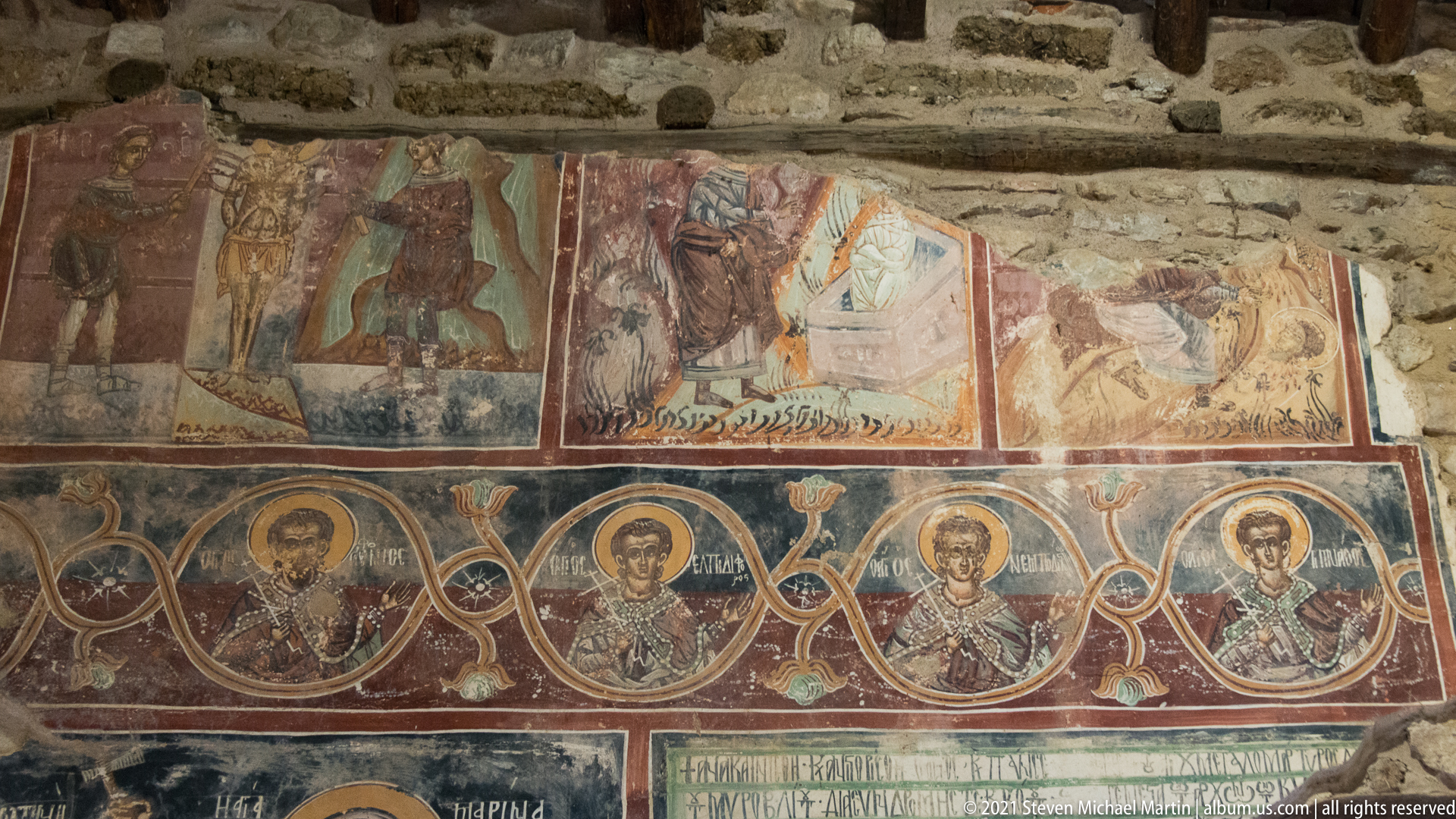
This wall section combines several levels of the painted program: narrative scenes across the upper register, a continuous band of haloed busts in linked medallions, and a rectangular inscription panel below. The layered arrangement demonstrates how figural storytelling, saintly commemoration, and text were coordinated within the church interior, while the exposed masonry above marks a clear boundary of surviving plaster.
Caption
This wall section combines several levels of the painted program: narrative scenes across the upper register, a continuous band of haloed busts in linked medallions, and a rectangular inscription panel below. The layered arrangement demonstrates how figural storytelling, saintly commemoration, and text were coordinated within the church interior, while the exposed masonry above marks a clear boundary of surviving plaster.

A single haloed saint is shown frontally holding a richly decorated book across the chest, the compact pose framed by a pale circular halo and red-purple mantle. The close view isolates the figure from the surrounding cycle and reveals incised or painted geometric details on the book cover. Losses along the right edge expose rough plaster and masonry.
Caption
A single haloed saint is shown frontally holding a richly decorated book across the chest, the compact pose framed by a pale circular halo and red-purple mantle. The close view isolates the figure from the surrounding cycle and reveals incised or painted geometric details on the book cover. Losses along the right edge expose rough plaster and masonry.

A vivid detail from a Last Judgment scene shows the dead rising amid boats and fantastical sea creatures. Several figures stand or gesture from small vessels, while others emerge beside them; a large animal-like form looms above. The unusual imagery visualizes the sea yielding up the dead, a motif associated with the universal resurrection in Last Judgment cycles.
Caption
A vivid detail from a Last Judgment scene shows the dead rising amid boats and fantastical sea creatures. Several figures stand or gesture from small vessels, while others emerge beside them; a large animal-like form looms above. The unusual imagery visualizes the sea yielding up the dead, a motif associated with the universal resurrection in Last Judgment cycles.

A large winged angel bends toward a resurrection scene in which small human figures rise from coffins and the sea. Fish and other creatures occupy the surrounding waters, while Greek inscriptions label portions of the composition. The panel forms part of a Last Judgment cycle visualizing the universal resurrection of the dead at the end of time.
Caption
A large winged angel bends toward a resurrection scene in which small human figures rise from coffins and the sea. Fish and other creatures occupy the surrounding waters, while Greek inscriptions label portions of the composition. The panel forms part of a Last Judgment cycle visualizing the universal resurrection of the dead at the end of time.

A haloed bearded figure sits on the curve of an arch and extends a long inscribed scroll across an ochre field. The sweeping scroll and compact seated pose give the composition a strong diagonal movement. Painted borders follow the arch below, while areas of abrasion and loss interrupt both the inscription and portions of the figure's garments.
Caption
A haloed bearded figure sits on the curve of an arch and extends a long inscribed scroll across an ochre field. The sweeping scroll and compact seated pose give the composition a strong diagonal movement. Painted borders follow the arch below, while areas of abrasion and loss interrupt both the inscription and portions of the figure's garments.
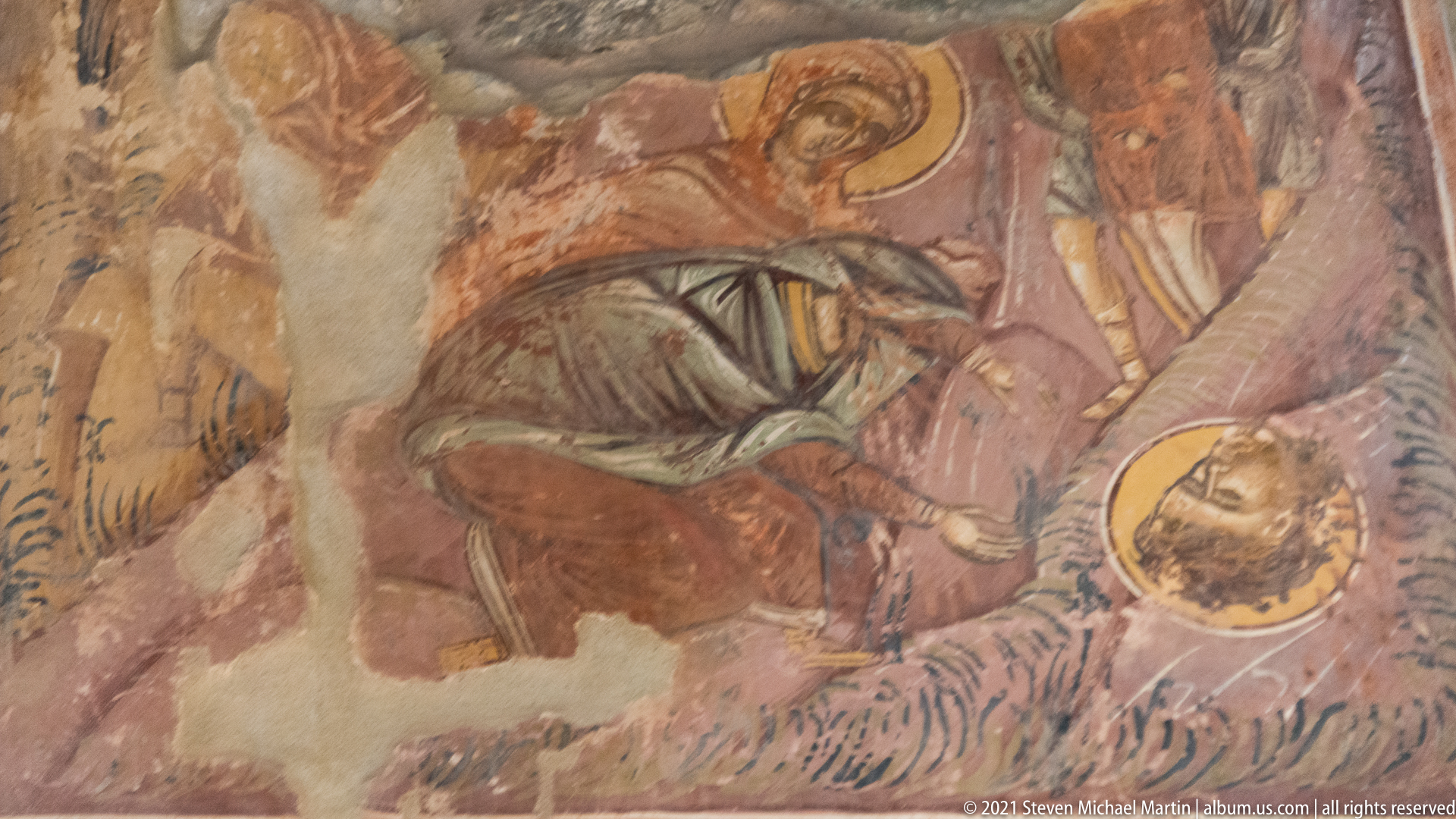
A reclining haloed figure dominates this fragmentary narrative fresco, the body bent diagonally across the composition and surrounded by partially preserved figures and forms. A circular halo or medallion-like element appears near the lower right. Extensive surface wear and missing passages obscure the scene's full narrative, but the posture and layered grouping remain visually distinct.
Caption
A reclining haloed figure dominates this fragmentary narrative fresco, the body bent diagonally across the composition and surrounded by partially preserved figures and forms. A circular halo or medallion-like element appears near the lower right. Extensive surface wear and missing passages obscure the scene's full narrative, but the posture and layered grouping remain visually distinct.

Looking through the interior toward the sanctuary, the photograph shows painted walls, timber roofing, a horizontal wooden screen or beam, and a monumental crucifix aligned on the central axis. Fresco cycles continue across the upper walls and piers. The long view clarifies how liturgical furnishings and painted surfaces work together within the compact medieval space.
Caption
Looking through the interior toward the sanctuary, the photograph shows painted walls, timber roofing, a horizontal wooden screen or beam, and a monumental crucifix aligned on the central axis. Fresco cycles continue across the upper walls and piers. The long view clarifies how liturgical furnishings and painted surfaces work together within the compact medieval space.

A large painted crucifix stands prominently before the sanctuary frescoes, with the crucified Christ outlined in bright blue and red against the darker wall behind. Below, an ornate carved or painted wooden element crosses the foreground. The layered placement of cross, liturgical furnishing, and mural decoration creates a striking visual concentration at the church's eastern end.
Caption
A large painted crucifix stands prominently before the sanctuary frescoes, with the crucified Christ outlined in bright blue and red against the darker wall behind. Below, an ornate carved or painted wooden element crosses the foreground. The layered placement of cross, liturgical furnishing, and mural decoration creates a striking visual concentration at the church's eastern end.

This close view isolates the figure of Christ on the painted cross, emphasizing the extended arms, bowed head, pale body, and richly colored blue-and-red cross. Small decorative motifs and painted lettering appear along the cross arms. The tight framing removes most of the surrounding architecture and directs attention to the devotional object itself.
Caption
This close view isolates the figure of Christ on the painted cross, emphasizing the extended arms, bowed head, pale body, and richly colored blue-and-red cross. Small decorative motifs and painted lettering appear along the cross arms. The tight framing removes most of the surrounding architecture and directs attention to the devotional object itself.

A formal row of full-length haloed saints fills the lower register, including military and monastic-looking figures distinguished by costume, beards, books, and weapons or staffs. Above them, smaller haloed busts appear in roundels. The dark background and repeated arches create a disciplined visual rhythm, while surface wear is most evident along the lower edge.
Caption
A formal row of full-length haloed saints fills the lower register, including military and monastic-looking figures distinguished by costume, beards, books, and weapons or staffs. Above them, smaller haloed busts appear in roundels. The dark background and repeated arches create a disciplined visual rhythm, while surface wear is most evident along the lower edge.
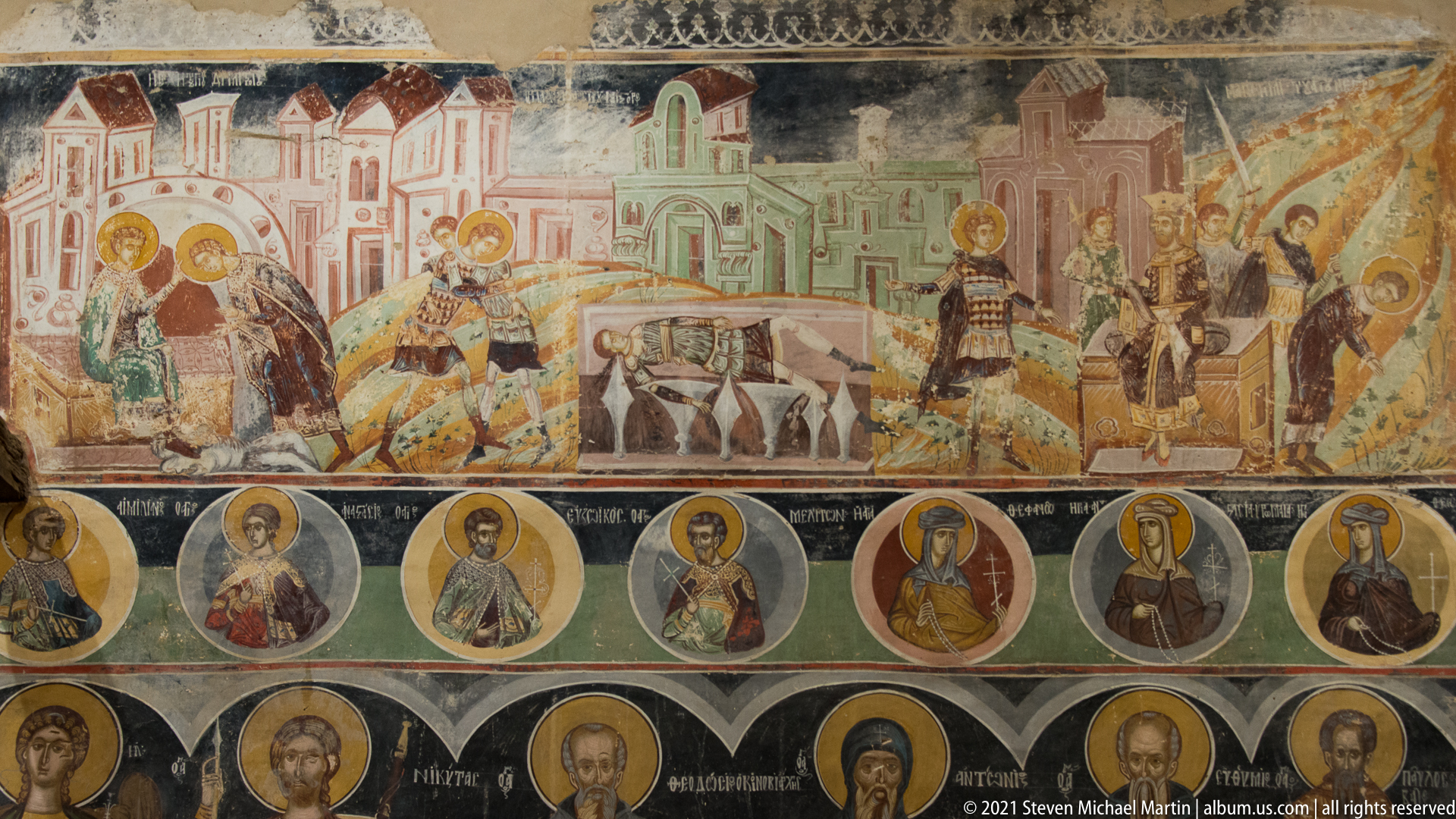
An upper narrative scene unfolds across an architectural setting with several standing figures, while two lower bands present haloed saints in circular medallions and full-length or bust-length forms. The photograph emphasizes the vertical stacking of episodes and holy figures into a unified wall program. Abrasion and pigment loss vary markedly between the upper scene and the darker lower registers.
Caption
An upper narrative scene unfolds across an architectural setting with several standing figures, while two lower bands present haloed saints in circular medallions and full-length or bust-length forms. The photograph emphasizes the vertical stacking of episodes and holy figures into a unified wall program. Abrasion and pigment loss vary markedly between the upper scene and the darker lower registers.
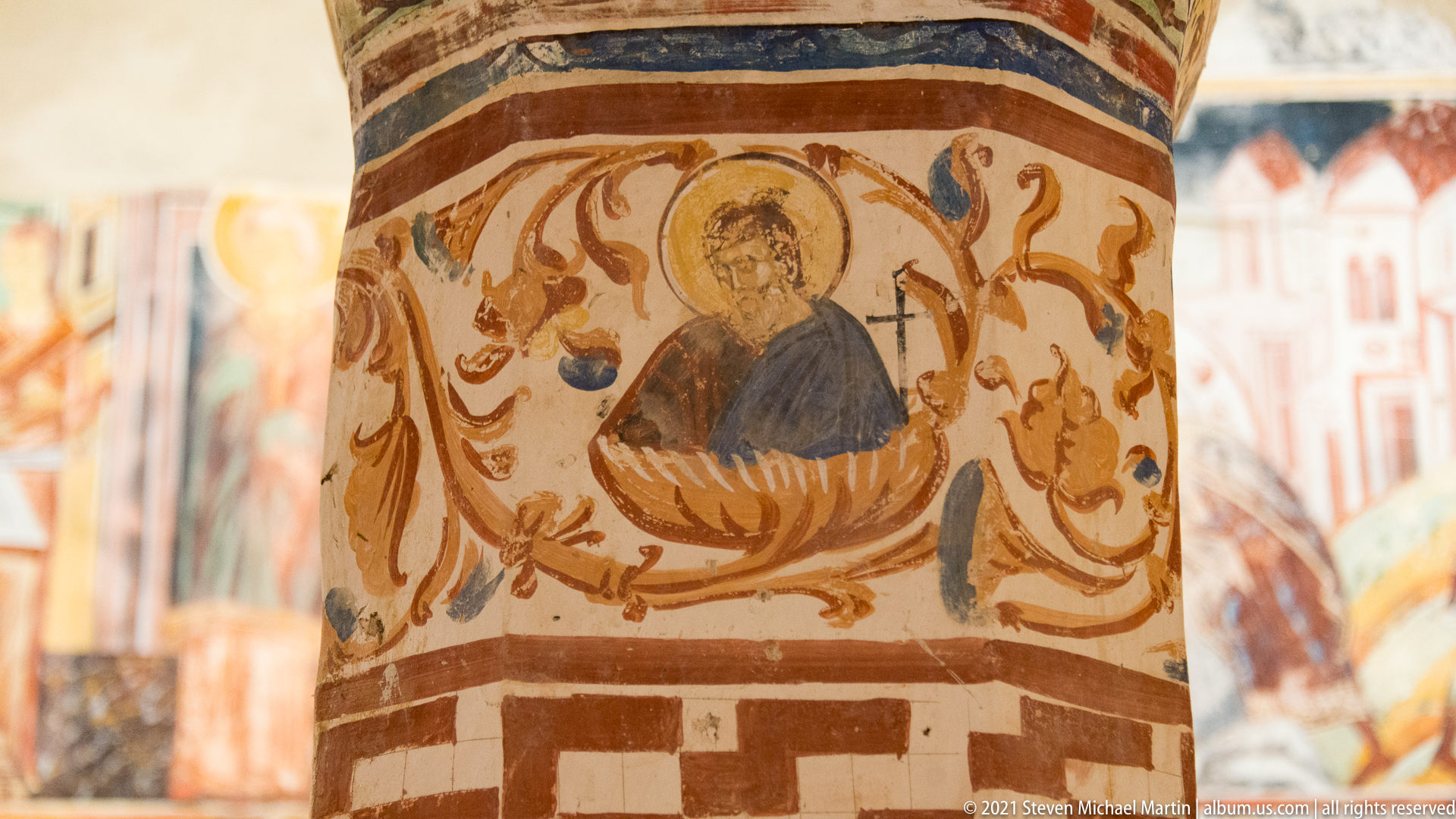
A haloed bust is set into a painted panel on a column or pier, surrounded by curling red vegetal scrolls on a pale ground and a checkerboard band below. The close framing highlights the decorative vocabulary that accompanies the larger figural cycles elsewhere in the church. Behind the column, more distant frescoes remain softly visible.
Caption
A haloed bust is set into a painted panel on a column or pier, surrounded by curling red vegetal scrolls on a pale ground and a checkerboard band below. The close framing highlights the decorative vocabulary that accompanies the larger figural cycles elsewhere in the church. Behind the column, more distant frescoes remain softly visible.

The prophet Jonah emerges from the open mouth of a large scaled sea creature, his haloed upper body rising against sweeping bands of dark water. The creature's enlarged eye, teeth, and patterned scales make the episode immediately legible, while the compact composition focuses on the moment of deliverance rather than a broader landscape setting.
Caption
The prophet Jonah emerges from the open mouth of a large scaled sea creature, his haloed upper body rising against sweeping bands of dark water. The creature's enlarged eye, teeth, and patterned scales make the episode immediately legible, while the compact composition focuses on the moment of deliverance rather than a broader landscape setting.

A wooden doorway is framed by full-length haloed saints on both sides, while a small Jonah-and-sea-creature scene occupies the panel directly above the lintel. Additional saint busts in circular medallions run across the upper wall. The composition shows how narrative imagery, individual saints, and architectural openings were woven together into a continuous decorative scheme.
Caption
A wooden doorway is framed by full-length haloed saints on both sides, while a small Jonah-and-sea-creature scene occupies the panel directly above the lintel. Additional saint busts in circular medallions run across the upper wall. The composition shows how narrative imagery, individual saints, and architectural openings were woven together into a continuous decorative scheme.
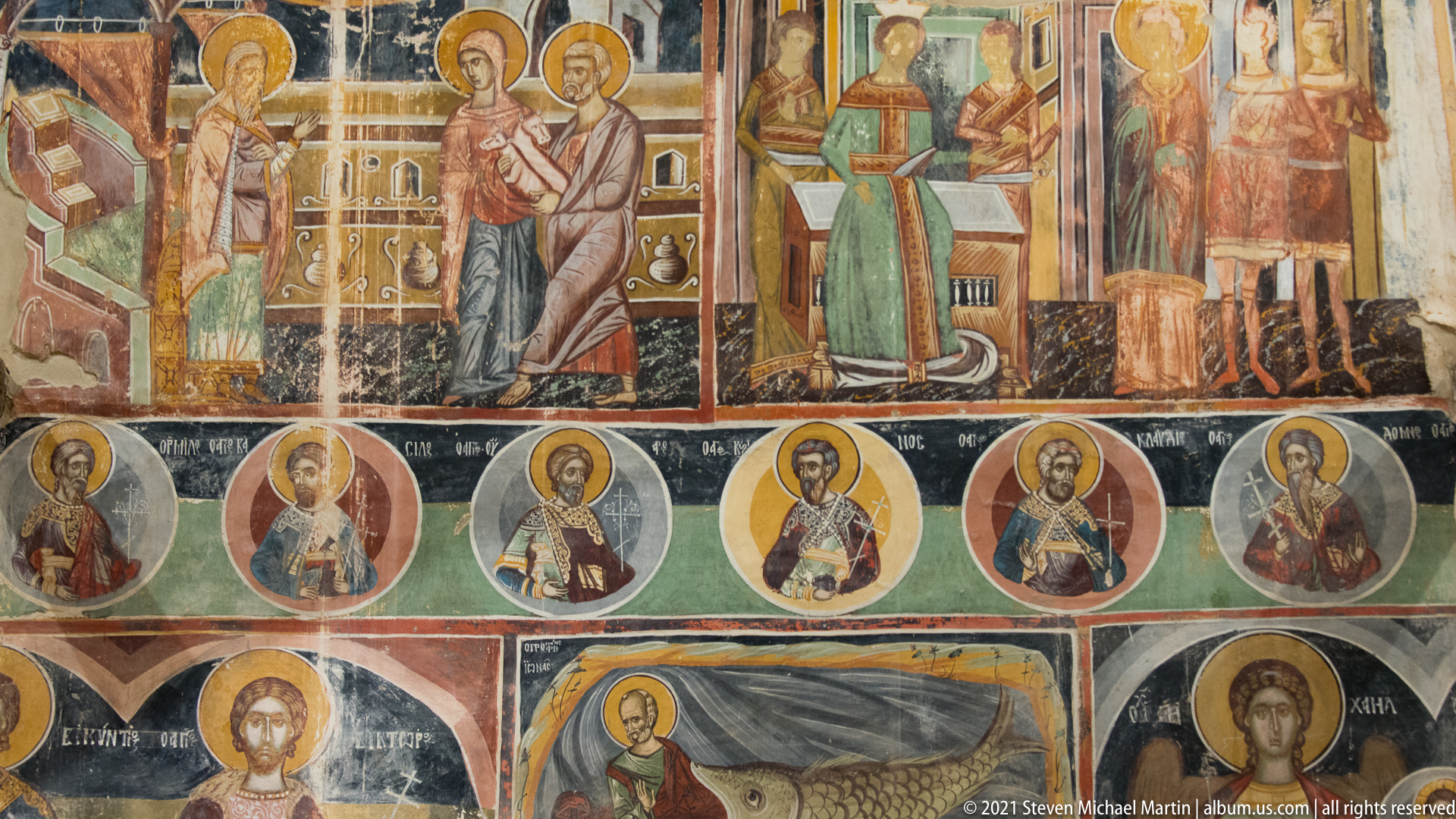
This wall section stacks narrative scenes in the upper register above a continuous row of haloed saint medallions; the Jonah-and-sea-creature image appears again in a lower panel. Architectural motifs, standing figures, and small interior settings animate the upper episodes. The photograph makes the dense organization of the mural cycle especially apparent, with each register serving a distinct visual function.
Caption
This wall section stacks narrative scenes in the upper register above a continuous row of haloed saint medallions; the Jonah-and-sea-creature image appears again in a lower panel. Architectural motifs, standing figures, and small interior settings animate the upper episodes. The photograph makes the dense organization of the mural cycle especially apparent, with each register serving a distinct visual function.

An enthroned haloed military saint occupies a tall arched panel at left, wearing richly colored garments and holding martial attributes, while several standing haloed youths or saints form a separate register to the right. Smaller bust medallions continue above both groups. The juxtaposition highlights differences in status, pose, and scale within the saintly program.
Caption
An enthroned haloed military saint occupies a tall arched panel at left, wearing richly colored garments and holding martial attributes, while several standing haloed youths or saints form a separate register to the right. Smaller bust medallions continue above both groups. The juxtaposition highlights differences in status, pose, and scale within the saintly program.

A small child stands at the center of a ceremonial scene between haloed adults, with additional figures and stylized architecture defining the sacred interior. One adult extends both hands toward the child while another figure presents or receives the child from the opposite side. The composition strongly suggests a temple-presentation episode, though the exact subject should be confirmed from the church's cycle.
Caption
A small child stands at the center of a ceremonial scene between haloed adults, with additional figures and stylized architecture defining the sacred interior. One adult extends both hands toward the child while another figure presents or receives the child from the opposite side. The composition strongly suggests a temple-presentation episode, though the exact subject should be confirmed from the church's cycle.

A close view pairs an enthroned haloed warrior saint with a standing youthful saint in an adjacent dark-ground panel. The seated figure wears elaborate military dress and occupies a decorated throne, while the standing figure raises one hand in a formal gesture. The framing reveals both individual portrait treatment and the way adjacent saint panels were coordinated across the wall.
Caption
A close view pairs an enthroned haloed warrior saint with a standing youthful saint in an adjacent dark-ground panel. The seated figure wears elaborate military dress and occupies a decorated throne, while the standing figure raises one hand in a formal gesture. The framing reveals both individual portrait treatment and the way adjacent saint panels were coordinated across the wall.

Painted saints and church hierarchs frame a narrow, deeply recessed window in the interior of the Church of Saint Demetrios of Palatitsia. The white and patterned vestments, inscribed scrolls, and darkened plaster emphasize the wall painting’s layered devotional setting, while the opening cuts through the painted program and brings a shaft of daylight into the otherwise dim interior.
Caption
Painted saints and church hierarchs frame a narrow, deeply recessed window in the interior of the Church of Saint Demetrios of Palatitsia. The white and patterned vestments, inscribed scrolls, and darkened plaster emphasize the wall painting’s layered devotional setting, while the opening cuts through the painted program and brings a shaft of daylight into the otherwise dim interior.

The apse painting centers on the Virgin in an orans pose, hands raised in prayer, with the Christ Child shown in a circular medallion before her. Below, a band of clerical figures gathers around an altar-like table, while additional narrative and saintly figures fill the surrounding curved wall, creating a dense hierarchical program suited to the sanctuary.
Caption
The apse painting centers on the Virgin in an orans pose, hands raised in prayer, with the Christ Child shown in a circular medallion before her. Below, a band of clerical figures gathers around an altar-like table, while additional narrative and saintly figures fill the surrounding curved wall, creating a dense hierarchical program suited to the sanctuary.

A closer view isolates the upper apse image of the Virgin in prayer, her raised hands set against a dark ground and her red mantle filling the composition. The Christ Child appears frontally within a circular medallion at her chest. The tighter framing reveals the strong outlines, halo borders, and restrained color blocks of the wall painting.
Caption
A closer view isolates the upper apse image of the Virgin in prayer, her raised hands set against a dark ground and her red mantle filling the composition. The Christ Child appears frontally within a circular medallion at her chest. The tighter framing reveals the strong outlines, halo borders, and restrained color blocks of the wall painting.

A haloed half-length figure of Christ fills this mural detail, shown frontally with one hand raised and the other supporting an open book. The restrained modeling of the face, gold halo, linear folds, and dark surrounding field focus attention on the devotional image, while traces of adjacent painted forms show that it belongs to a larger wall program.
Caption
A haloed half-length figure of Christ fills this mural detail, shown frontally with one hand raised and the other supporting an open book. The restrained modeling of the face, gold halo, linear folds, and dark surrounding field focus attention on the devotional image, while traces of adjacent painted forms show that it belongs to a larger wall program.
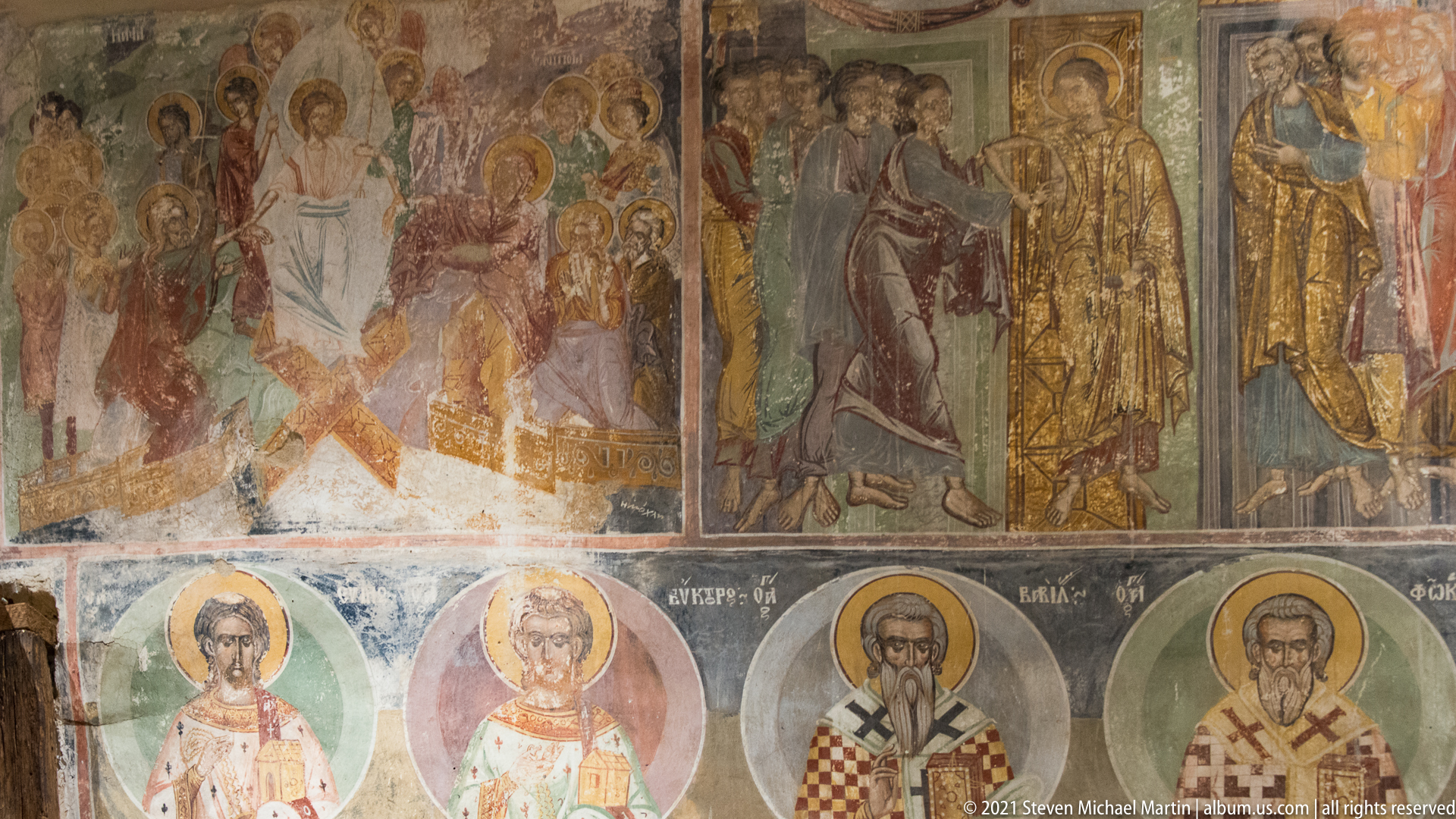
This section of painted wall combines several registers: narrative scenes occupy the upper zone, while a lower band presents frontal haloed bishops and saints in richly patterned vestments. Areas of abrasion and loss reveal the age and fragility of the painted plaster, yet the surviving figures still preserve a clear visual rhythm of repeated halos, robes, and architectural frames.
Caption
This section of painted wall combines several registers: narrative scenes occupy the upper zone, while a lower band presents frontal haloed bishops and saints in richly patterned vestments. Areas of abrasion and loss reveal the age and fragility of the painted plaster, yet the surviving figures still preserve a clear visual rhythm of repeated halos, robes, and architectural frames.

Two horizontal registers of haloed clergy fill this wall section. The lower group includes standing bishops in white and patterned vestments, several holding inscribed scrolls, while smaller bust-length figures appear above. The repeated crosses, book-like texts, and episcopal garments distinguish the figures as church hierarchs within the broader painted cycle.
Caption
Two horizontal registers of haloed clergy fill this wall section. The lower group includes standing bishops in white and patterned vestments, several holding inscribed scrolls, while smaller bust-length figures appear above. The repeated crosses, book-like texts, and episcopal garments distinguish the figures as church hierarchs within the broader painted cycle.

A trio of haloed clerical saints stands against the dark wall, each distinguished by patterned episcopal vestments and inscribed scrolls. Their frontal poses and elongated robes create a formal procession across the surface. Wear and discoloration are visible, but the strong black-and-white textile patterns and gold haloes remain prominent.
Caption
A trio of haloed clerical saints stands against the dark wall, each distinguished by patterned episcopal vestments and inscribed scrolls. Their frontal poses and elongated robes create a formal procession across the surface. Wear and discoloration are visible, but the strong black-and-white textile patterns and gold haloes remain prominent.
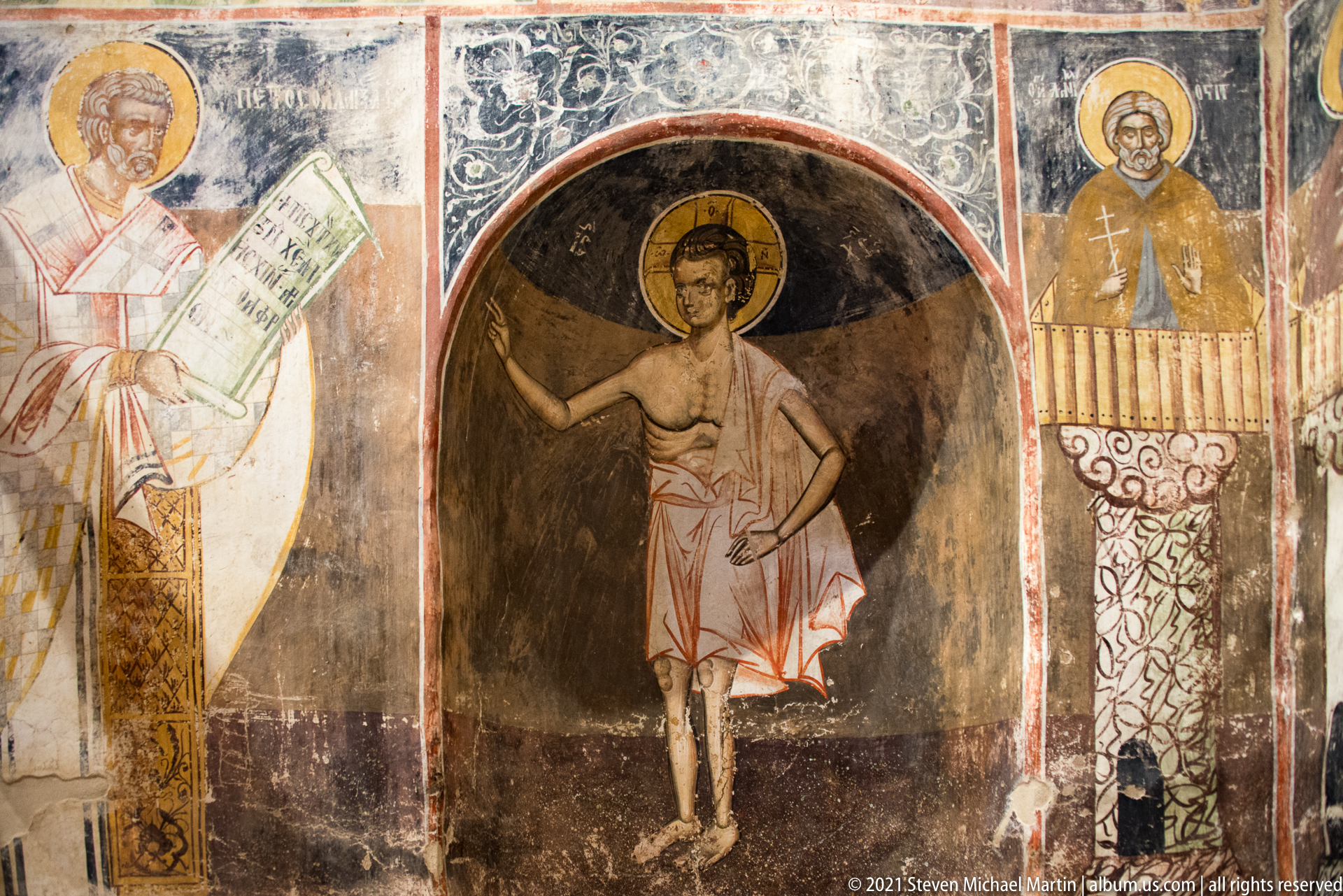
A youthful haloed saint stands within a painted arched niche, one arm extended and the other resting at the waist. The figure’s pale garment and bare legs contrast with the dark interior of the niche, while neighboring painted saints and ornamental borders frame the composition. The niche format gives the single figure a distinct devotional emphasis.
Caption
A youthful haloed saint stands within a painted arched niche, one arm extended and the other resting at the waist. The figure’s pale garment and bare legs contrast with the dark interior of the niche, while neighboring painted saints and ornamental borders frame the composition. The niche format gives the single figure a distinct devotional emphasis.

Several narrative scenes share this weathered wall surface, with seated and standing haloed figures separated by painted architectural elements. The surviving passages include groups gathered around central actions and a green building-like backdrop. Abrasion and fading obscure some details, making the photograph especially useful for documenting the condition and spatial arrangement of the cycle rather than a single isolated episode.
Caption
Several narrative scenes share this weathered wall surface, with seated and standing haloed figures separated by painted architectural elements. The surviving passages include groups gathered around central actions and a green building-like backdrop. Abrasion and fading obscure some details, making the photograph especially useful for documenting the condition and spatial arrangement of the cycle rather than a single isolated episode.

Christ appears half-length within a dark arched niche, head bowed and hands crossed over the torso in the devotional type commonly called the Man of Sorrows. A standing saint at right and ornamental borders place the image within a larger painted ensemble. The subdued pose and frontal exposure of the body distinguish this scene from the church’s more formal standing saints.
Caption
Christ appears half-length within a dark arched niche, head bowed and hands crossed over the torso in the devotional type commonly called the Man of Sorrows. A standing saint at right and ornamental borders place the image within a larger painted ensemble. The subdued pose and frontal exposure of the body distinguish this scene from the church’s more formal standing saints.

This close detail concentrates on the Man of Sorrows image: Christ’s bowed head, long hair, bare torso, and crossed hands dominate the frame. The gold halo and dark niche isolate the figure, while small painted inscriptions and worn surface details remain visible around the shoulders. The tighter view emphasizes the solemn pose and fine linear modeling.
Caption
This close detail concentrates on the Man of Sorrows image: Christ’s bowed head, long hair, bare torso, and crossed hands dominate the frame. The gold halo and dark niche isolate the figure, while small painted inscriptions and worn surface details remain visible around the shoulders. The tighter view emphasizes the solemn pose and fine linear modeling.

A richly colored narrative scene shows two winged angels positioned around a haloed youthful figure, with additional haloed attendants and stylized buildings behind them. The composition is tightly organized around the central action, while the gold haloes, red and green garments, and angular architectural forms create a vivid contrast against the dark background.
Caption
A richly colored narrative scene shows two winged angels positioned around a haloed youthful figure, with additional haloed attendants and stylized buildings behind them. The composition is tightly organized around the central action, while the gold haloes, red and green garments, and angular architectural forms create a vivid contrast against the dark background.

A painted sailboat carries several figures across a blue field, with a large pale sail filling the upper half of the composition. One standing figure gestures from the vessel while others cluster below, and a rocky or architectural form rises at the right edge. The maritime subject is unusual within the surrounding saintly cycle and gives this panel a strong narrative character.
Caption
A painted sailboat carries several figures across a blue field, with a large pale sail filling the upper half of the composition. One standing figure gestures from the vessel while others cluster below, and a rocky or architectural form rises at the right edge. The maritime subject is unusual within the surrounding saintly cycle and gives this panel a strong narrative character.
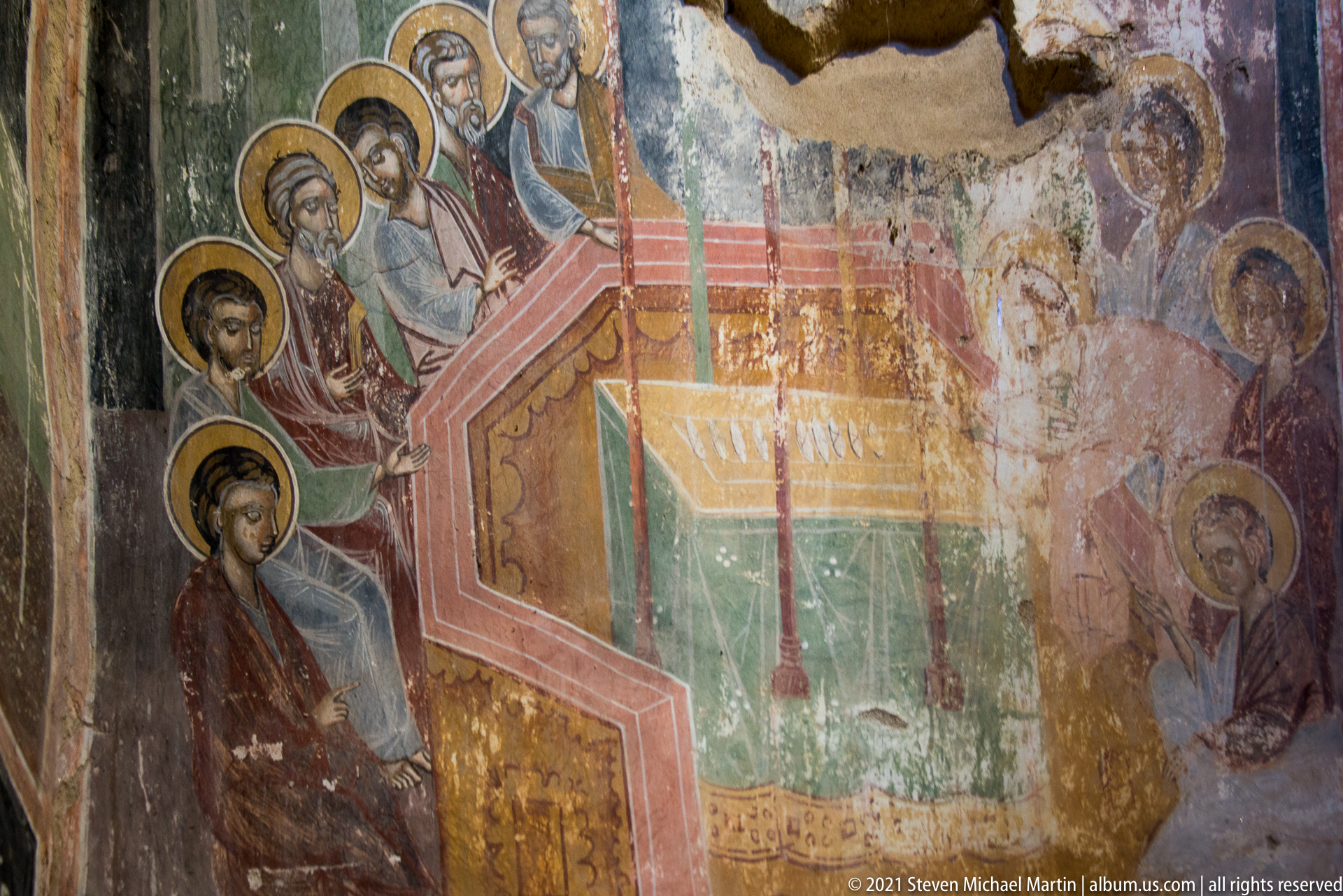
A group of haloed figures gathers around a tall, stepped architectural form painted in reds, greens, and ochres. Some figures lean or gesture toward the structure, while areas of plaster loss interrupt the upper center of the scene. The composition’s strong geometric framework and concentrated groupings suggest a specific narrative episode within the church’s broader wall-painting cycle.
Caption
A group of haloed figures gathers around a tall, stepped architectural form painted in reds, greens, and ochres. Some figures lean or gesture toward the structure, while areas of plaster loss interrupt the upper center of the scene. The composition’s strong geometric framework and concentrated groupings suggest a specific narrative episode within the church’s broader wall-painting cycle.
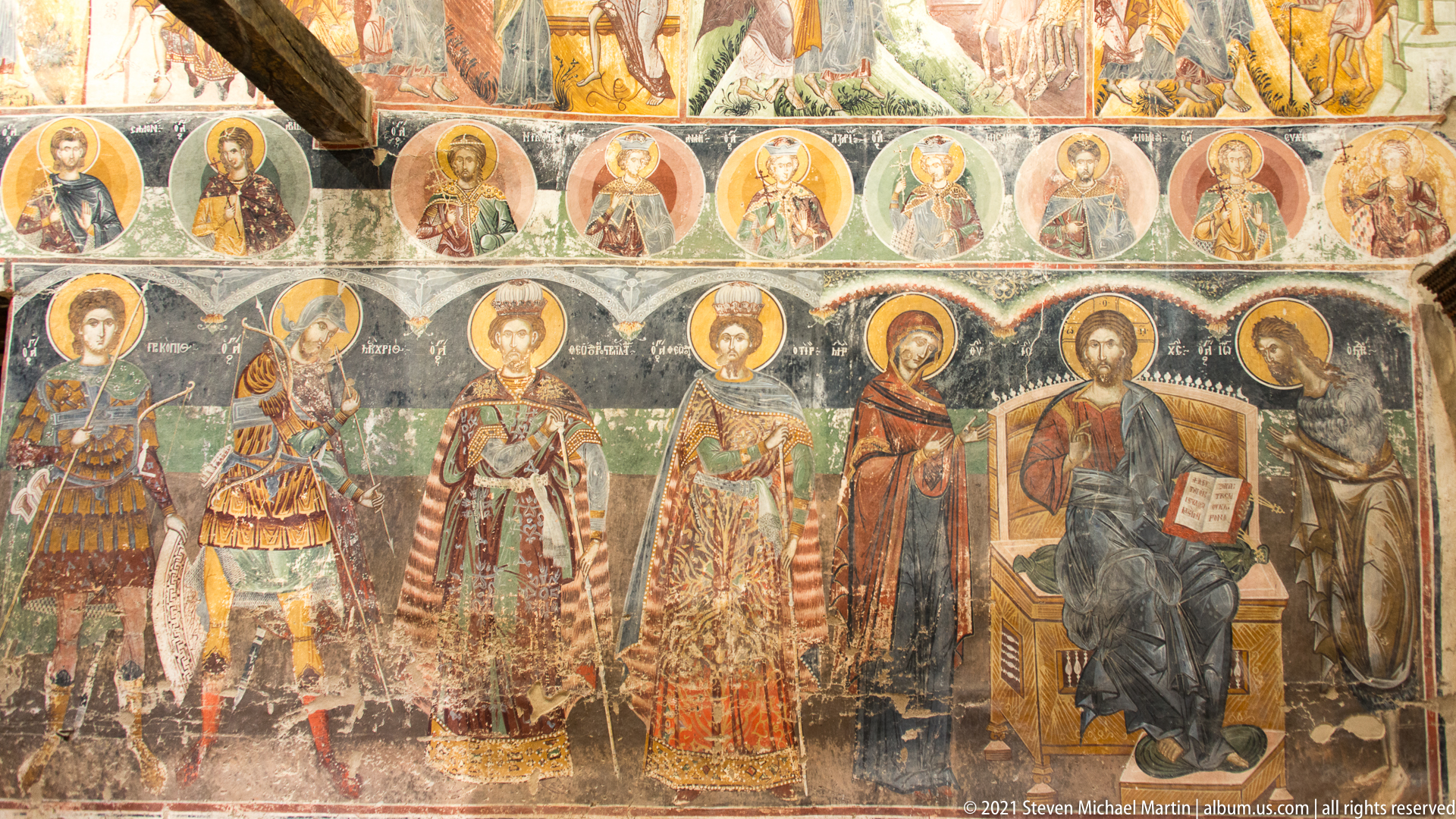
A broad lower register presents a formal row of haloed saints, including richly dressed standing figures and an enthroned Christ at the right holding an open book. Smaller medallion busts occupy the band above. The arrangement combines individual devotional portraits with a central authoritative image, while repeated haloes and patterned garments unify the wall surface.
Caption
A broad lower register presents a formal row of haloed saints, including richly dressed standing figures and an enthroned Christ at the right holding an open book. Smaller medallion busts occupy the band above. The arrangement combines individual devotional portraits with a central authoritative image, while repeated haloes and patterned garments unify the wall surface.

A monumental wall painting shows the Dormition of the Virgin, with the reclining Virgin laid upon a bier and a dense assembly of apostles and clerics surrounding her. Christ stands centrally behind the bier amid a cluster of haloes, while additional heavenly figures occupy the upper zone. The scene fills an entire wall beneath the timber roof, giving the composition exceptional visual prominence.
Caption
A monumental wall painting shows the Dormition of the Virgin, with the reclining Virgin laid upon a bier and a dense assembly of apostles and clerics surrounding her. Christ stands centrally behind the bier amid a cluster of haloes, while additional heavenly figures occupy the upper zone. The scene fills an entire wall beneath the timber roof, giving the composition exceptional visual prominence.

A compact Nativity scene occupies the upper wall, with the Virgin reclining beside the swaddled Christ Child and an angel approaching from the right. Below, a dark rocky form and smaller figures extend the narrative into a second zone. The painting’s diagonal arrangement, pale garments, and broad wings stand out vividly beneath the church’s timber roof.
Caption
A compact Nativity scene occupies the upper wall, with the Virgin reclining beside the swaddled Christ Child and an angel approaching from the right. Below, a dark rocky form and smaller figures extend the narrative into a second zone. The painting’s diagonal arrangement, pale garments, and broad wings stand out vividly beneath the church’s timber roof.
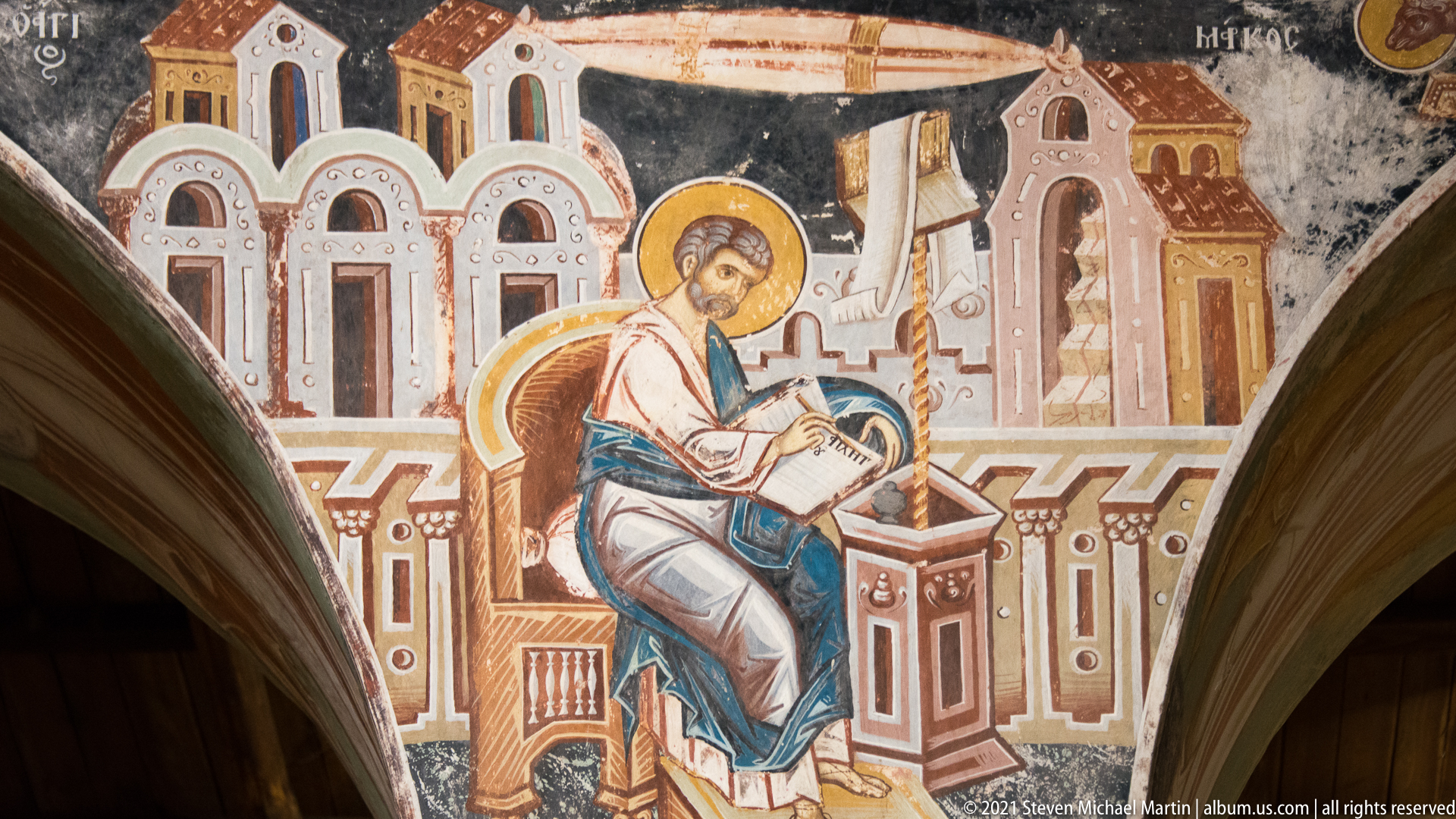
A seated haloed evangelist bends over an open manuscript at a small lectern, set before stylized architectural facades. The figure’s concentrated pose, writing gesture, and book establish the image as an author portrait within the church’s painted program. Pale masonry, red roofs, and geometric borders create an architectural setting around the solitary saint.
Caption
A seated haloed evangelist bends over an open manuscript at a small lectern, set before stylized architectural facades. The figure’s concentrated pose, writing gesture, and book establish the image as an author portrait within the church’s painted program. Pale masonry, red roofs, and geometric borders create an architectural setting around the solitary saint.
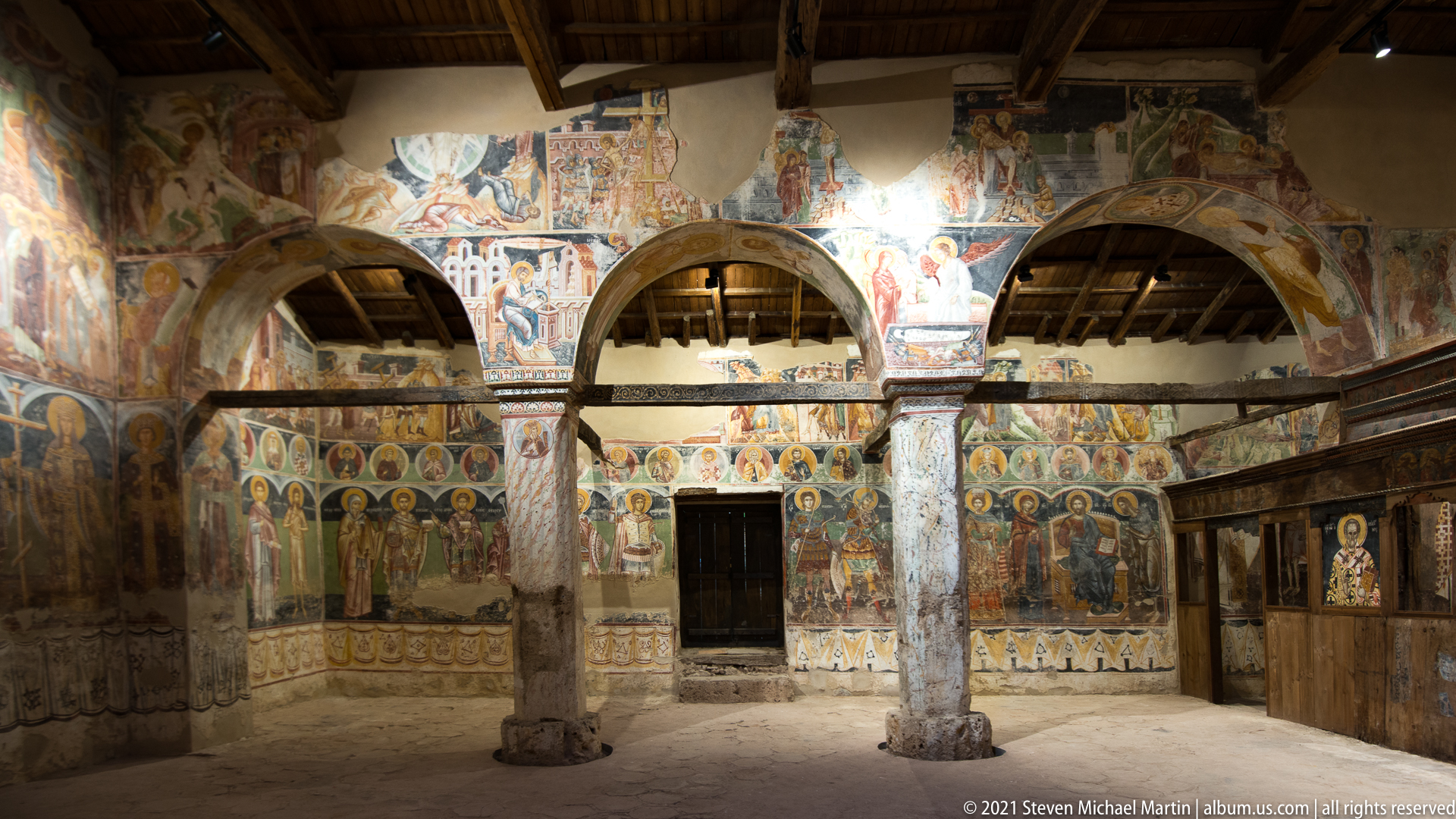
Three broad arches rest on painted stone columns across the nave, opening onto walls covered with rows of haloed saints and narrative scenes. The repeated arch forms create a strong architectural frame for the murals, while the central dark doorway anchors the far wall. This view documents the church’s compact basilican interior and unusually dense surviving decoration.
Caption
Three broad arches rest on painted stone columns across the nave, opening onto walls covered with rows of haloed saints and narrative scenes. The repeated arch forms create a strong architectural frame for the murals, while the central dark doorway anchors the far wall. This view documents the church’s compact basilican interior and unusually dense surviving decoration.
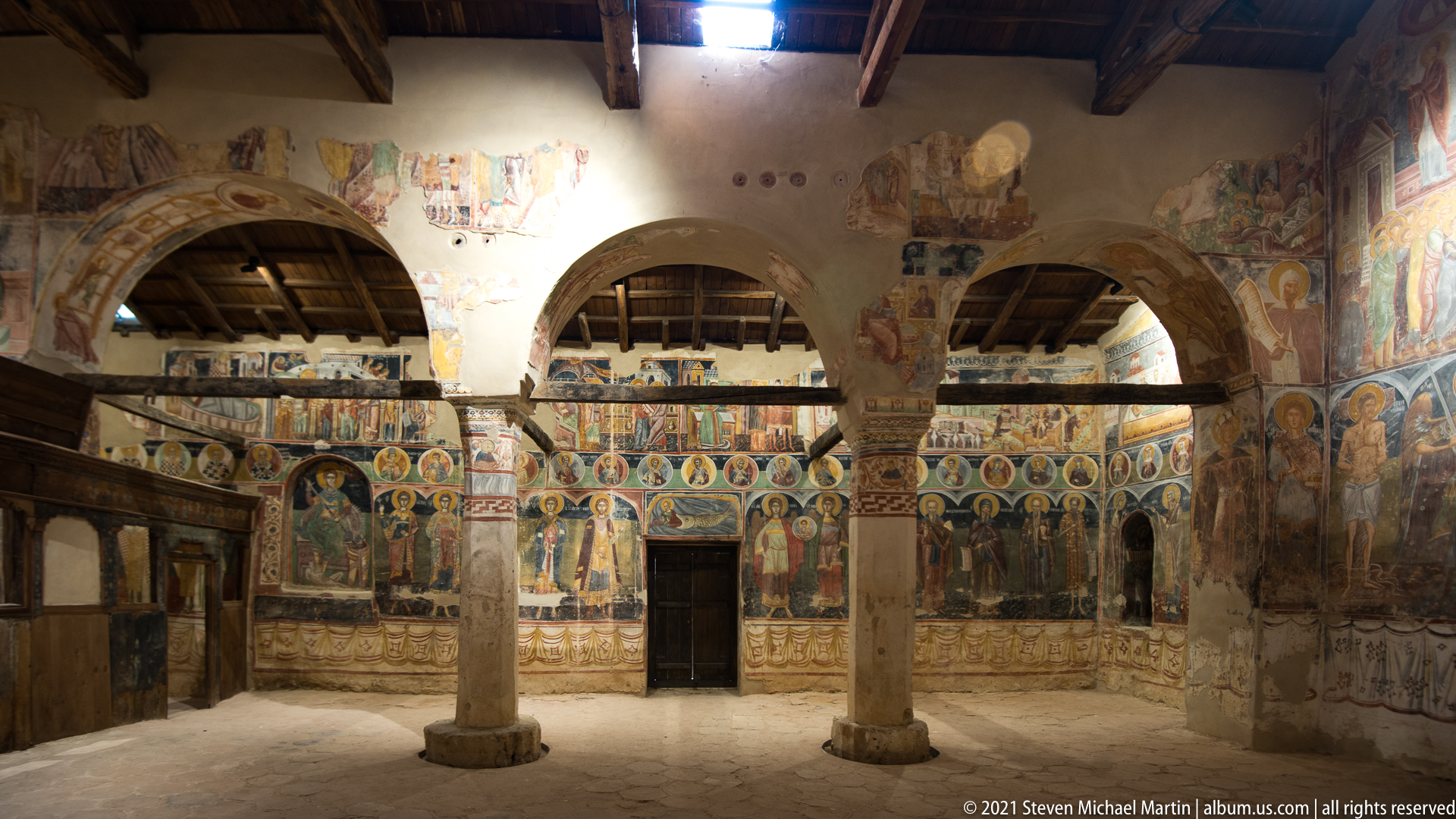
This view shifts the arcade slightly off center, showing how painted piers and rounded arches divide the nave while preserving long sightlines across the mural-covered walls. Rows of standing saints extend beneath narrative scenes, and the timber roof remains exposed above. The wooden screen at left adds another layer to the church’s enclosed devotional space.
Caption
This view shifts the arcade slightly off center, showing how painted piers and rounded arches divide the nave while preserving long sightlines across the mural-covered walls. Rows of standing saints extend beneath narrative scenes, and the timber roof remains exposed above. The wooden screen at left adds another layer to the church’s enclosed devotional space.

A closer exterior view isolates the rough fieldstone masonry and simple wooden doorway of the church’s side wall. A narrow horizontal stone course runs across the facade, while the tiled roof projects above the uneven masonry. Strong sunlight and overhanging foliage create sharp bands of light and shadow that accentuate the wall’s varied stone textures.
Caption
A closer exterior view isolates the rough fieldstone masonry and simple wooden doorway of the church’s side wall. A narrow horizontal stone course runs across the facade, while the tiled roof projects above the uneven masonry. Strong sunlight and overhanging foliage create sharp bands of light and shadow that accentuate the wall’s varied stone textures.

A brown heritage sign points visitors toward the site and identifies it in Greek and English as the “Postbyzantine Church of Agios Demetrios.” The bilingual lettering and cultural-heritage symbol provide direct on-site confirmation of the monument’s public designation, while the arrow indicates the direction of access from the road.
Caption
A brown heritage sign points visitors toward the site and identifies it in Greek and English as the “Postbyzantine Church of Agios Demetrios.” The bilingual lettering and cultural-heritage symbol provide direct on-site confirmation of the monument’s public designation, while the arrow indicates the direction of access from the road.

A broad Last Judgment scene combines several episodes within a single painted field. Human figures rise from tombs and gather around symbolic animals, while a dark circular zone below contains additional creatures and figures associated with the sea giving up its dead. The dense arrangement of bodies, beasts, and architectural fragments creates a vivid image of universal resurrection and judgment.
Caption
A broad Last Judgment scene combines several episodes within a single painted field. Human figures rise from tombs and gather around symbolic animals, while a dark circular zone below contains additional creatures and figures associated with the sea giving up its dead. The dense arrangement of bodies, beasts, and architectural fragments creates a vivid image of universal resurrection and judgment.

A crowned central figure sits astride a sea creature amid boats, fish, and other animals, while small human figures emerge from the surrounding waters. The personified Sea presides over this portion of the Last Judgment, where the waters yield up the dead for resurrection. The unusual combination of ruler-like figure, marine beasts, and miniature boats makes the subject especially distinctive.
Caption
A crowned central figure sits astride a sea creature amid boats, fish, and other animals, while small human figures emerge from the surrounding waters. The personified Sea presides over this portion of the Last Judgment, where the waters yield up the dead for resurrection. The unusual combination of ruler-like figure, marine beasts, and miniature boats makes the subject especially distinctive.
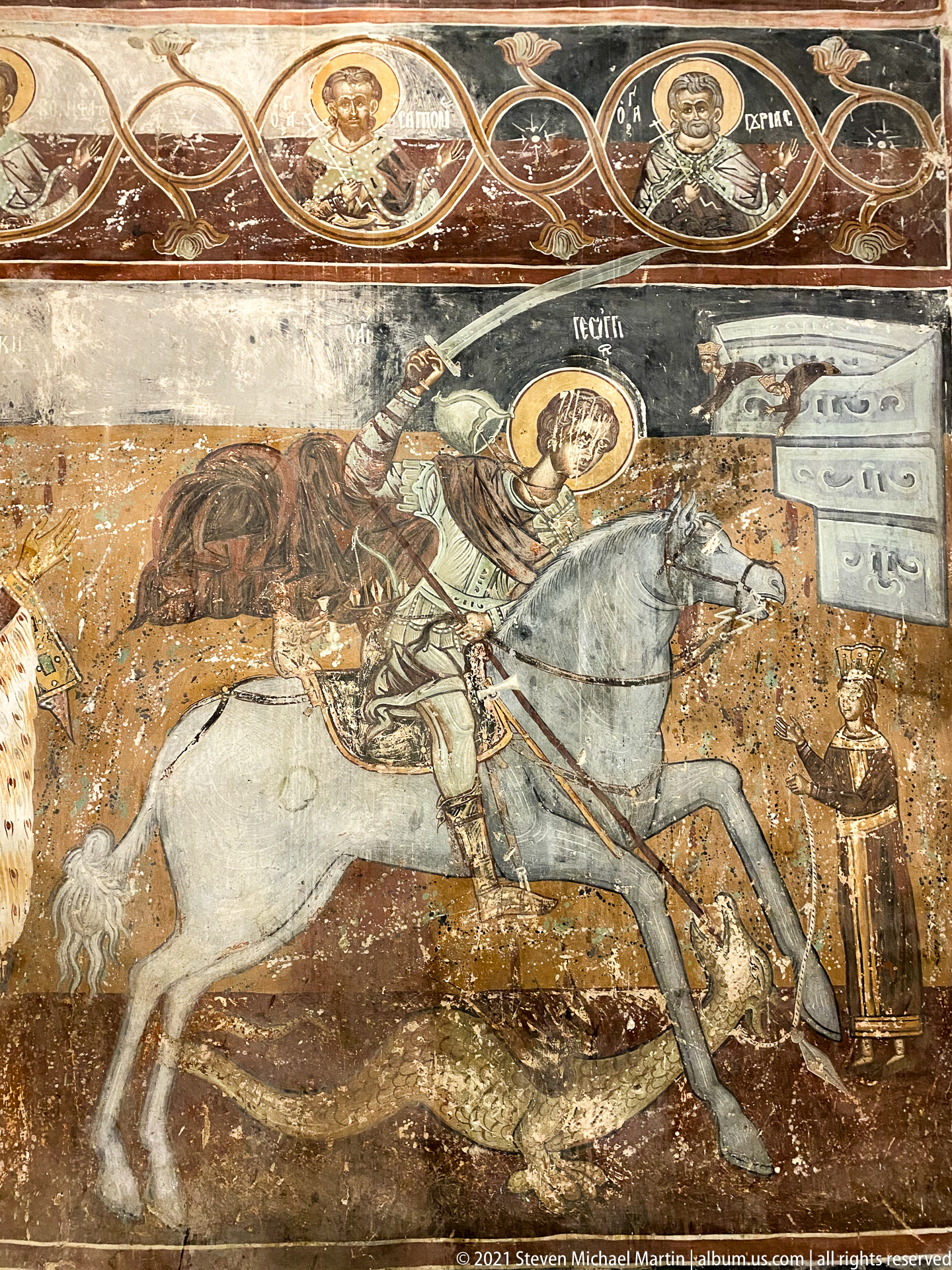
A haloed warrior saint rides a white horse at speed across a reddish ground, his cloak and garments trailing behind him. The rider carries a long spear or lance, and a band of saintly medallions runs above the main scene. The energetic diagonal pose contrasts with the more static standing saints elsewhere in the church.
Caption
A haloed warrior saint rides a white horse at speed across a reddish ground, his cloak and garments trailing behind him. The rider carries a long spear or lance, and a band of saintly medallions runs above the main scene. The energetic diagonal pose contrasts with the more static standing saints elsewhere in the church.
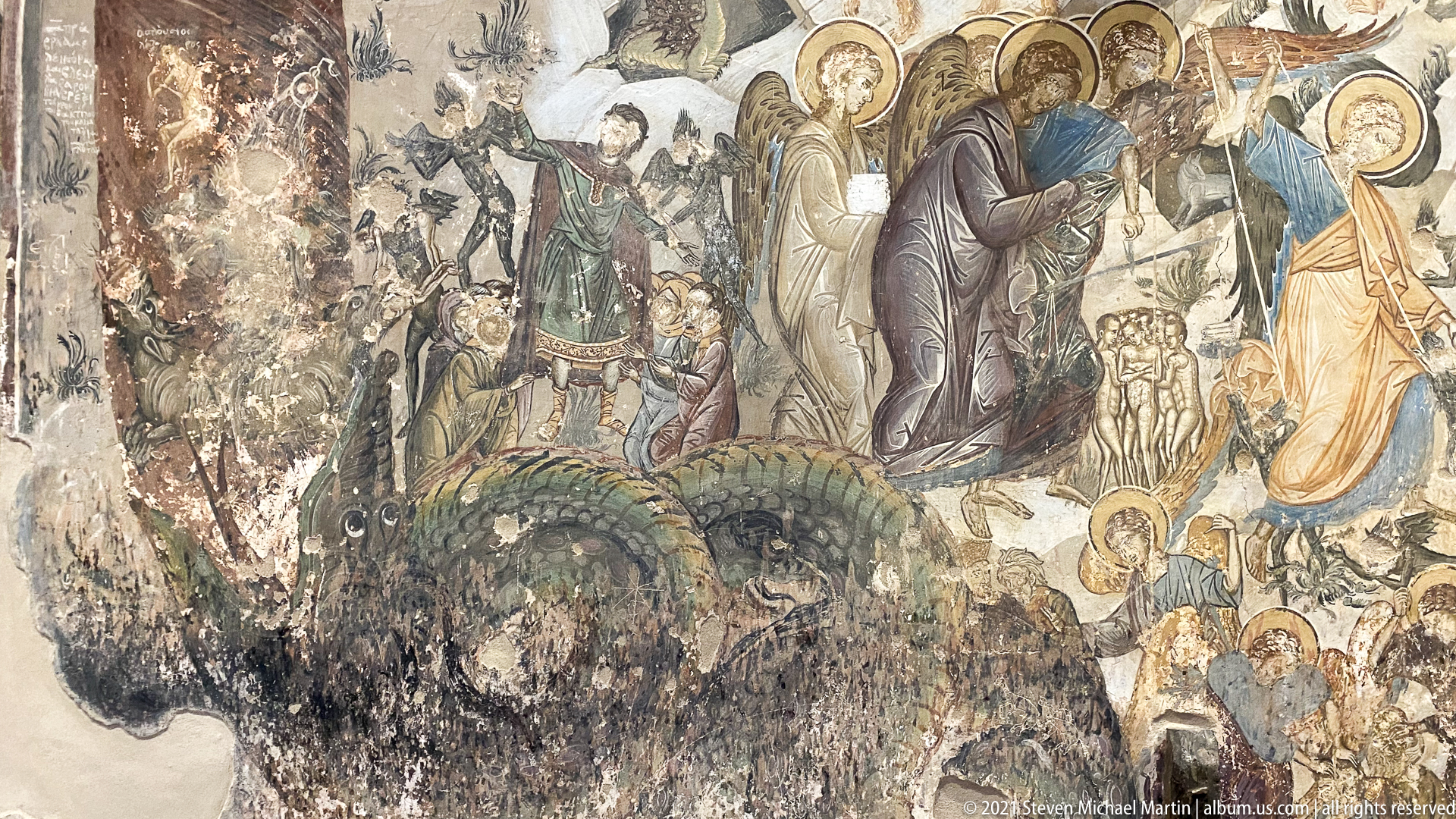
A group of haloed figures and an angel occupies the upper right of a heavily weathered fresco, while large reptilian or serpentine beasts crowd the lower field. The dramatic contrast between radiant haloes and dark monstrous forms marks the scene as part of the church’s apocalyptic imagery, most likely connected with the Last Judgment cycle.
Caption
A group of haloed figures and an angel occupies the upper right of a heavily weathered fresco, while large reptilian or serpentine beasts crowd the lower field. The dramatic contrast between radiant haloes and dark monstrous forms marks the scene as part of the church’s apocalyptic imagery, most likely connected with the Last Judgment cycle.

A dense procession of haloed saints fills the wall in multiple standing rows, their long robes and varied garments creating a continuous devotional assembly. Repeated golden haloes form a strong visual pattern across the upper field, while surface wear and darkening are concentrated along the lower edge. The scene emphasizes collective sanctity rather than a single narrative episode.
Caption
A dense procession of haloed saints fills the wall in multiple standing rows, their long robes and varied garments creating a continuous devotional assembly. Repeated golden haloes form a strong visual pattern across the upper field, while surface wear and darkening are concentrated along the lower edge. The scene emphasizes collective sanctity rather than a single narrative episode.

Several hagiographic episodes unfold across a continuous landscape of trees, buildings, and rocky ground. Haloed figures appear seated, standing, and interacting with other participants, while one figure at right is shown beside a ladder-like element. The continuous narrative format links separate episodes into a single painted field, typical of saintly life cycles.
Caption
Several hagiographic episodes unfold across a continuous landscape of trees, buildings, and rocky ground. Haloed figures appear seated, standing, and interacting with other participants, while one figure at right is shown beside a ladder-like element. The continuous narrative format links separate episodes into a single painted field, typical of saintly life cycles.

A half-length haloed saint survives on the face of a rough masonry pier, framed by a faded painted border. The frontal figure raises one hand and holds an object or book close to the chest. Abrasion and plaster loss have obscured much of the surrounding surface, making the surviving face and halo the strongest elements of the composition.
Caption
A half-length haloed saint survives on the face of a rough masonry pier, framed by a faded painted border. The frontal figure raises one hand and holds an object or book close to the chest. Abrasion and plaster loss have obscured much of the surrounding surface, making the surviving face and halo the strongest elements of the composition.

A half-length image of Christ is painted within a rectangular field on a masonry pier. Christ faces forward with a cross halo, raises one hand in blessing, and holds a closed or partly open Gospel book in the other. The compact icon-like format adapts a familiar Pantocrator type to the narrow architectural surface.
Caption
A half-length image of Christ is painted within a rectangular field on a masonry pier. Christ faces forward with a cross halo, raises one hand in blessing, and holds a closed or partly open Gospel book in the other. The compact icon-like format adapts a familiar Pantocrator type to the narrow architectural surface.
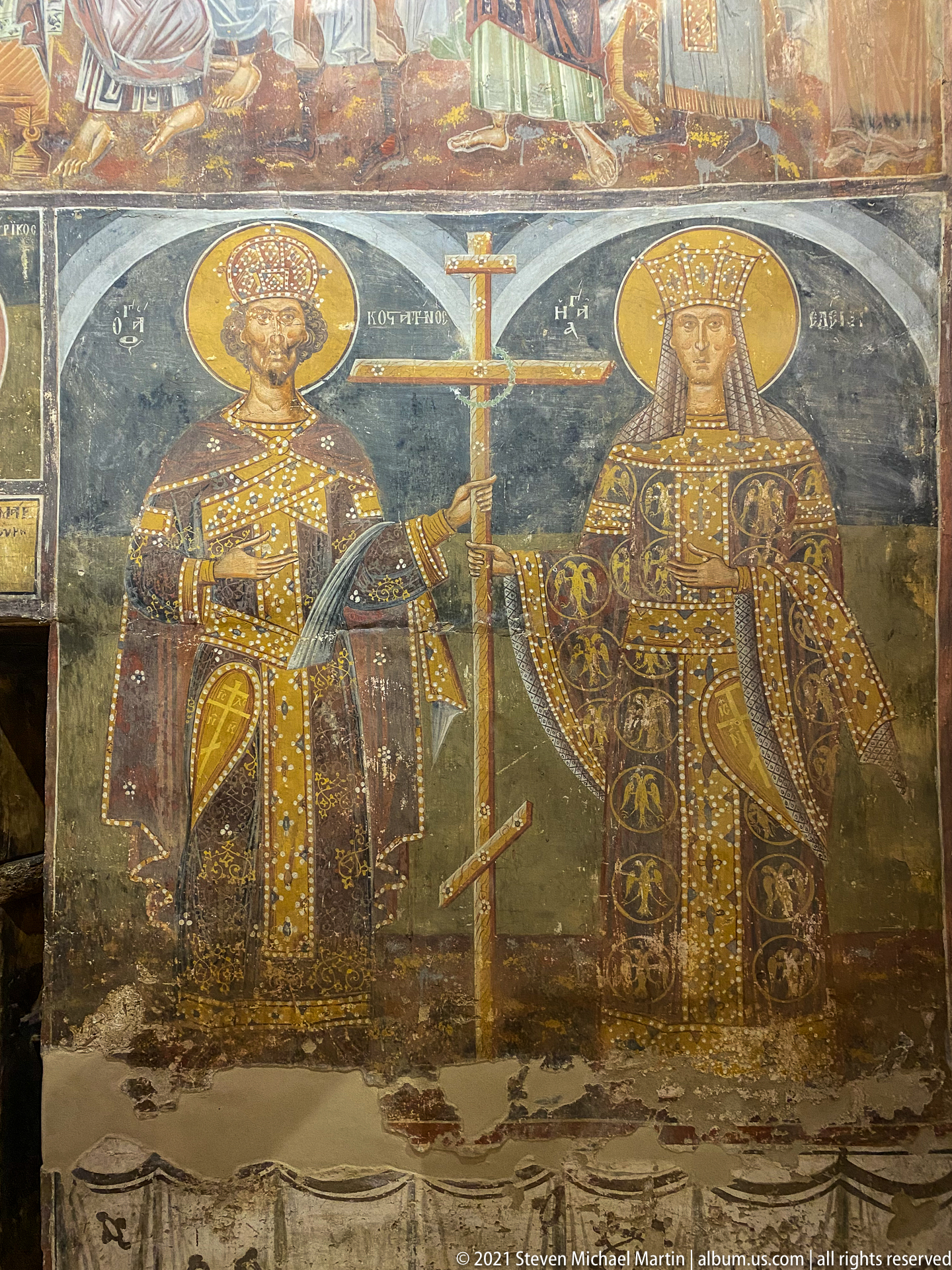
Saint Constantine and Saint Helena stand together holding a tall cross between them, both shown frontally in richly patterned imperial dress and jeweled crowns. Their shared presentation with the cross is a well-established iconographic type referring to the discovery and veneration of the True Cross. The symmetrical composition reinforces their paired status.
Caption
Saint Constantine and Saint Helena stand together holding a tall cross between them, both shown frontally in richly patterned imperial dress and jeweled crowns. Their shared presentation with the cross is a well-established iconographic type referring to the discovery and veneration of the True Cross. The symmetrical composition reinforces their paired status.
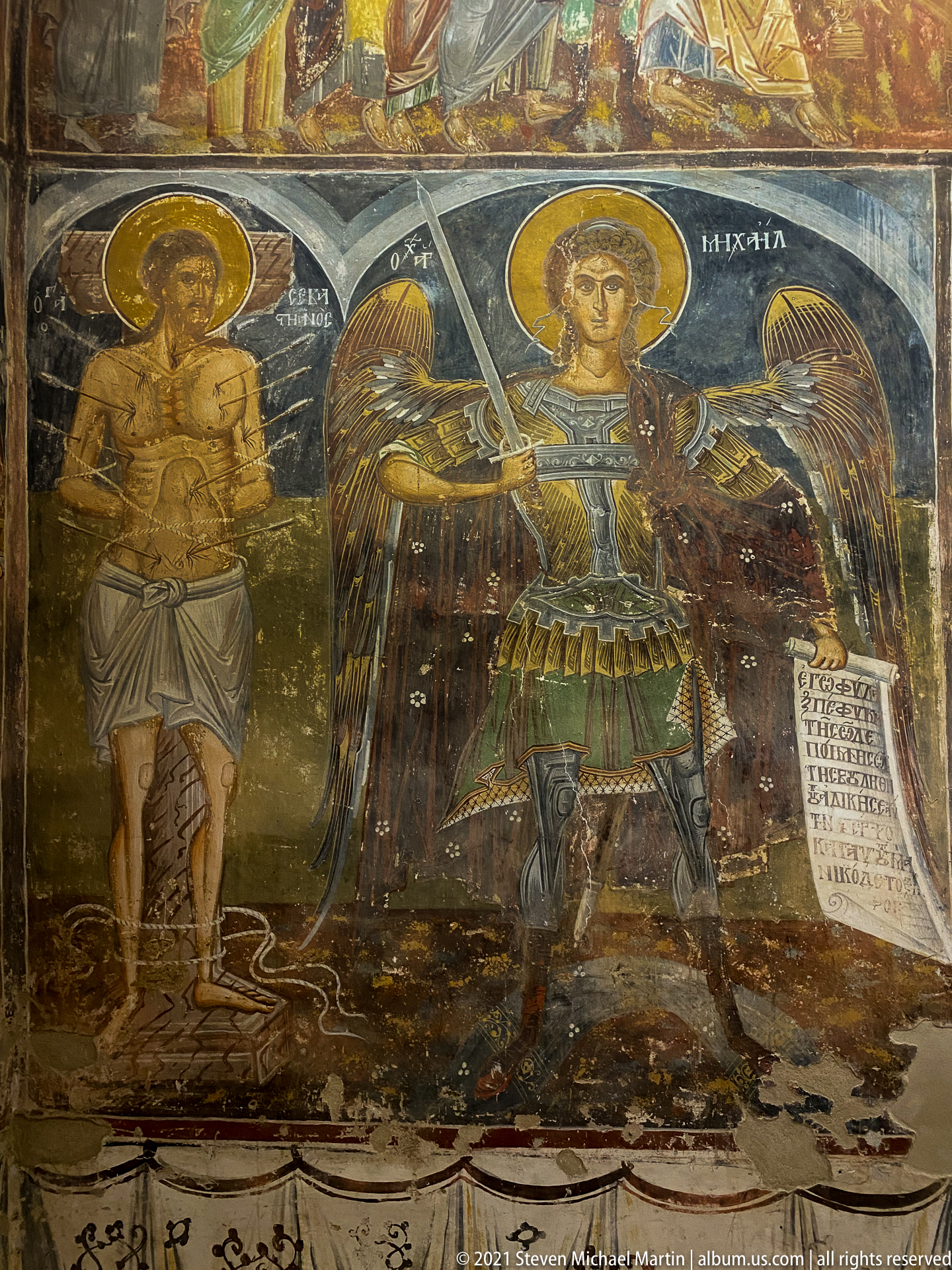
Archangel Michael stands in armor with wings spread, sword raised, and a long inscribed scroll hanging at his side. Beside him appears a nearly nude haloed youth marked by numerous wounds or arrows. The juxtaposition joins an authoritative archangelic figure with a martyred saint, both rendered at large scale against a dark background.
Caption
Archangel Michael stands in armor with wings spread, sword raised, and a long inscribed scroll hanging at his side. Beside him appears a nearly nude haloed youth marked by numerous wounds or arrows. The juxtaposition joins an authoritative archangelic figure with a martyred saint, both rendered at large scale against a dark background.

A youthful haloed martyr stands frontally with the torso exposed and numerous arrows or wounds covering the body. A white cloth is tied around the waist, and the figure is isolated against a dark painted ground. The close framing emphasizes the physical signs of martyrdom and the saint’s calm, frontal presentation.
Caption
A youthful haloed martyr stands frontally with the torso exposed and numerous arrows or wounds covering the body. A white cloth is tied around the waist, and the figure is isolated against a dark painted ground. The close framing emphasizes the physical signs of martyrdom and the saint’s calm, frontal presentation.

A lightly incised and red-pigmented drawing on plaster depicts a haloed winged figure holding a rectangular book or tablet. Additional scratched letters and marks surround the figure, indicating later visitor or devotional graffiti layered onto the church interior. The informal line work contrasts sharply with the more finished fresco decoration nearby.
Caption
A lightly incised and red-pigmented drawing on plaster depicts a haloed winged figure holding a rectangular book or tablet. Additional scratched letters and marks surround the figure, indicating later visitor or devotional graffiti layered onto the church interior. The informal line work contrasts sharply with the more finished fresco decoration nearby.
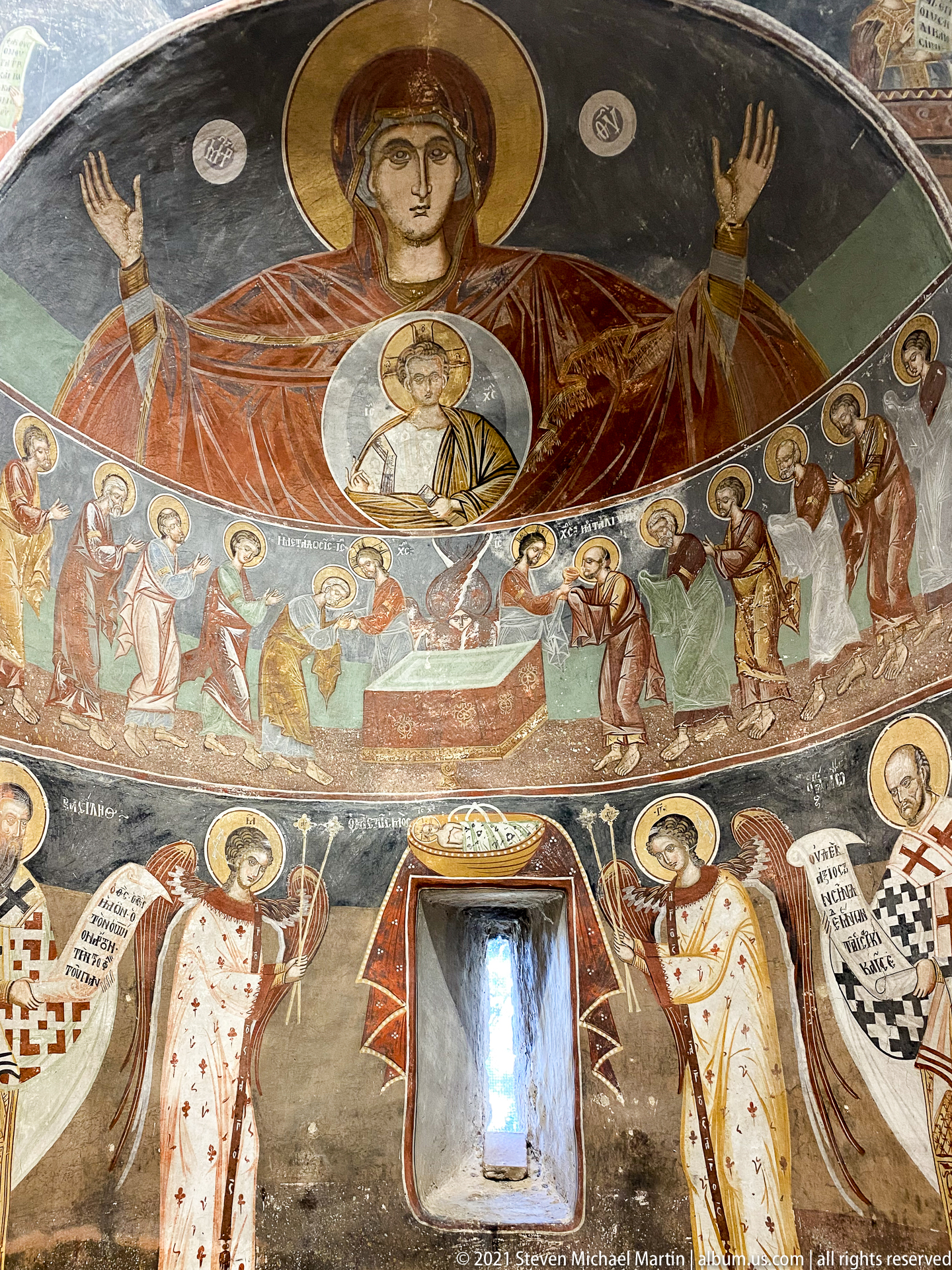
The sanctuary apse presents the Virgin in an orans pose with the Christ Child in a medallion at her breast. Below, Christ appears at the altar in a Communion of the Apostles scene, while large bishops holding scrolls occupy the lower register. The stacked composition organizes Marian, Eucharistic, and episcopal imagery vertically around the sanctuary window.
Caption
The sanctuary apse presents the Virgin in an orans pose with the Christ Child in a medallion at her breast. Below, Christ appears at the altar in a Communion of the Apostles scene, while large bishops holding scrolls occupy the lower register. The stacked composition organizes Marian, Eucharistic, and episcopal imagery vertically around the sanctuary window.
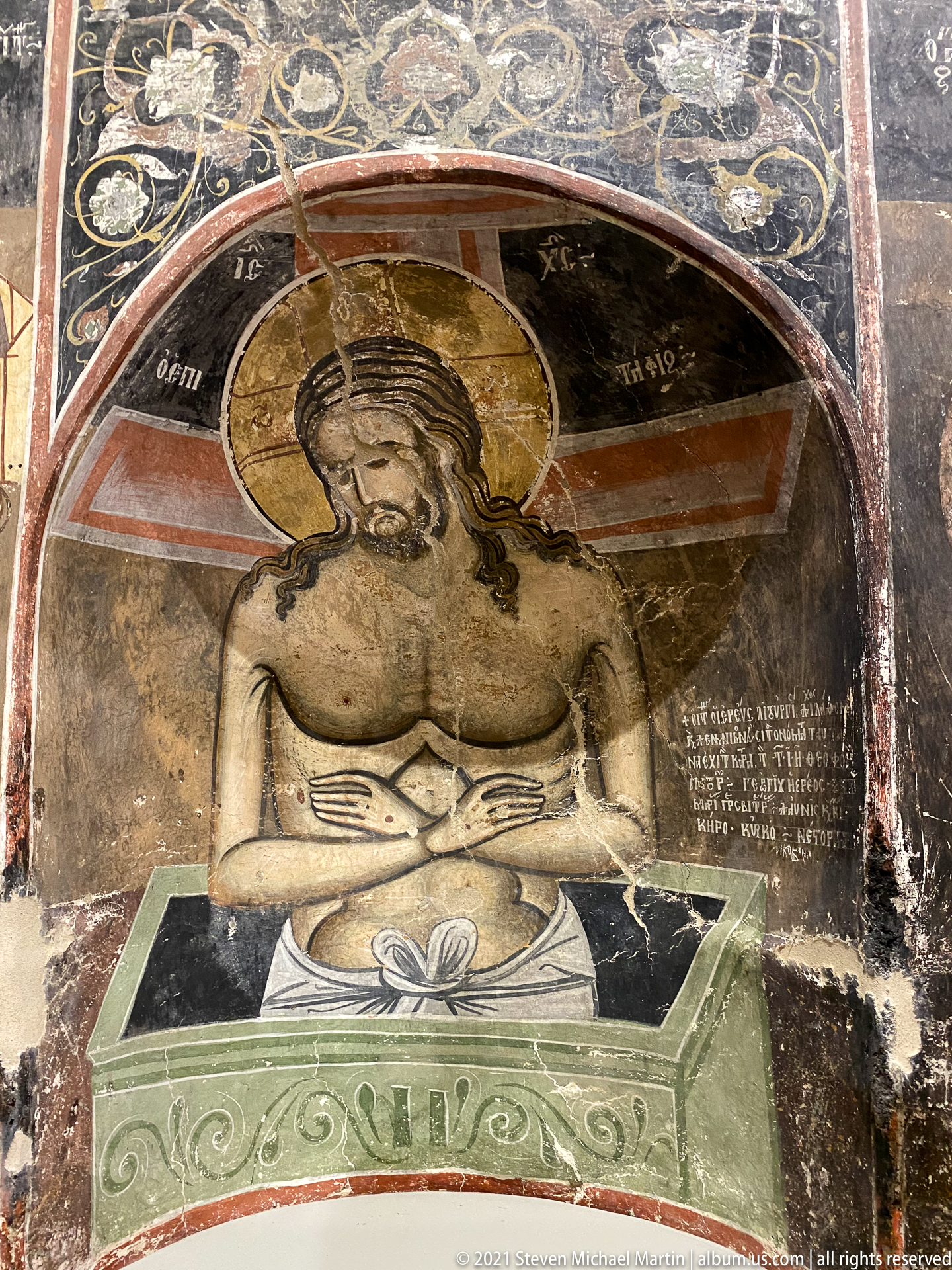
Christ is shown half-length emerging from a painted sarcophagus, head bowed and hands crossed low across the body. A broad gold halo frames his face within the arched niche. This variant of the Man of Sorrows emphasizes both suffering and entombment, combining the exposed wounded body with the visual language of the tomb.
Caption
Christ is shown half-length emerging from a painted sarcophagus, head bowed and hands crossed low across the body. A broad gold halo frames his face within the arched niche. This variant of the Man of Sorrows emphasizes both suffering and entombment, combining the exposed wounded body with the visual language of the tomb.

A brightly painted wooden Crucifix rises above carved liturgical furnishings in front of a monumental frescoed wall. Behind it, a semicircular upper register contains numerous standing figures, while darker apocalyptic imagery occupies the lower zone. The photograph shows the layered relationship between movable church furnishings and the surviving monumental wall-painting program.
Caption
A brightly painted wooden Crucifix rises above carved liturgical furnishings in front of a monumental frescoed wall. Behind it, a semicircular upper register contains numerous standing figures, while darker apocalyptic imagery occupies the lower zone. The photograph shows the layered relationship between movable church furnishings and the surviving monumental wall-painting program.

Three haloed angels sit around a laden table in the traditional Hospitality of Abraham, or Old Testament Trinity, composition. Abraham and Sarah appear at the sides, while architectural forms frame the background. The central angel faces outward as the three figures gesture across the table, creating a balanced, symmetrical image of the biblical visitation.
Caption
Three haloed angels sit around a laden table in the traditional Hospitality of Abraham, or Old Testament Trinity, composition. Abraham and Sarah appear at the sides, while architectural forms frame the background. The central angel faces outward as the three figures gesture across the table, creating a balanced, symmetrical image of the biblical visitation.

A painted sailing ship with a high white sail dominates the lower half of this narrative scene, while a haloed or highlighted figure at left is cast toward the sea. Additional episodes survive above in a more damaged register. The maritime imagery is characteristic of the Old Testament story of Jonah, in which the prophet is thrown overboard during a storm.
Caption
A painted sailing ship with a high white sail dominates the lower half of this narrative scene, while a haloed or highlighted figure at left is cast toward the sea. Additional episodes survive above in a more damaged register. The maritime imagery is characteristic of the Old Testament story of Jonah, in which the prophet is thrown overboard during a storm.
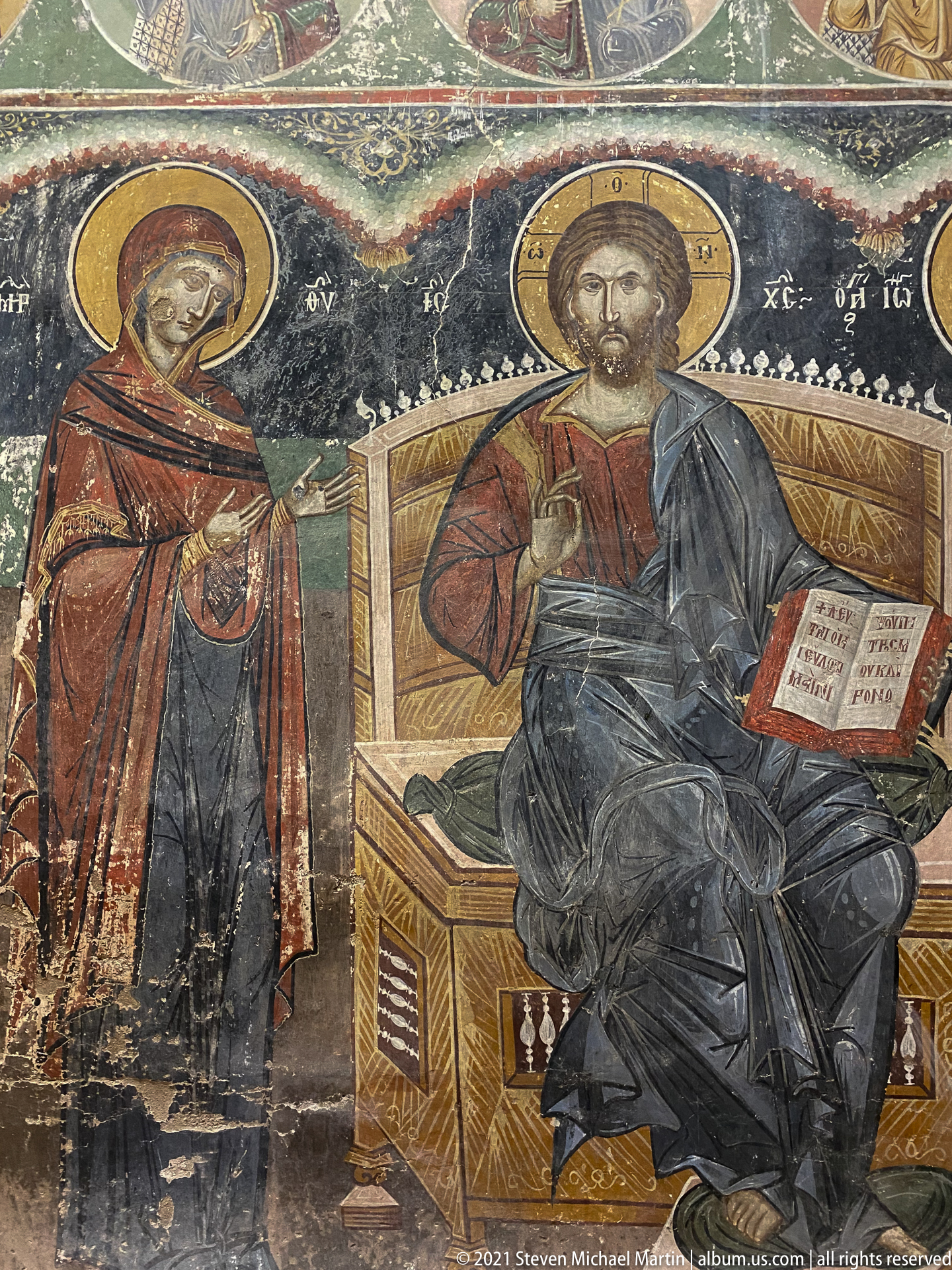
Christ sits frontally on an ornate throne, raising his right hand in blessing and holding an open Gospel book in his left. A haloed female saint stands beside him in a red mantle. The close framing reveals the throne’s geometric decoration, Christ’s cross halo, and the carefully patterned border running above the figures.
Caption
Christ sits frontally on an ornate throne, raising his right hand in blessing and holding an open Gospel book in his left. A haloed female saint stands beside him in a red mantle. The close framing reveals the throne’s geometric decoration, Christ’s cross halo, and the carefully patterned border running above the figures.

A Nativity scene is arranged in stacked registers: the Virgin reclines beside the swaddled Christ Child in the upper zone, while two women prepare or wash the infant below. Patterned borders frame the composition, and an angelic or attendant figure bends toward the upper group. The vertical layout compresses several moments from the Nativity cycle into a compact architectural bay.
Caption
A Nativity scene is arranged in stacked registers: the Virgin reclines beside the swaddled Christ Child in the upper zone, while two women prepare or wash the infant below. Patterned borders frame the composition, and an angelic or attendant figure bends toward the upper group. The vertical layout compresses several moments from the Nativity cycle into a compact architectural bay.
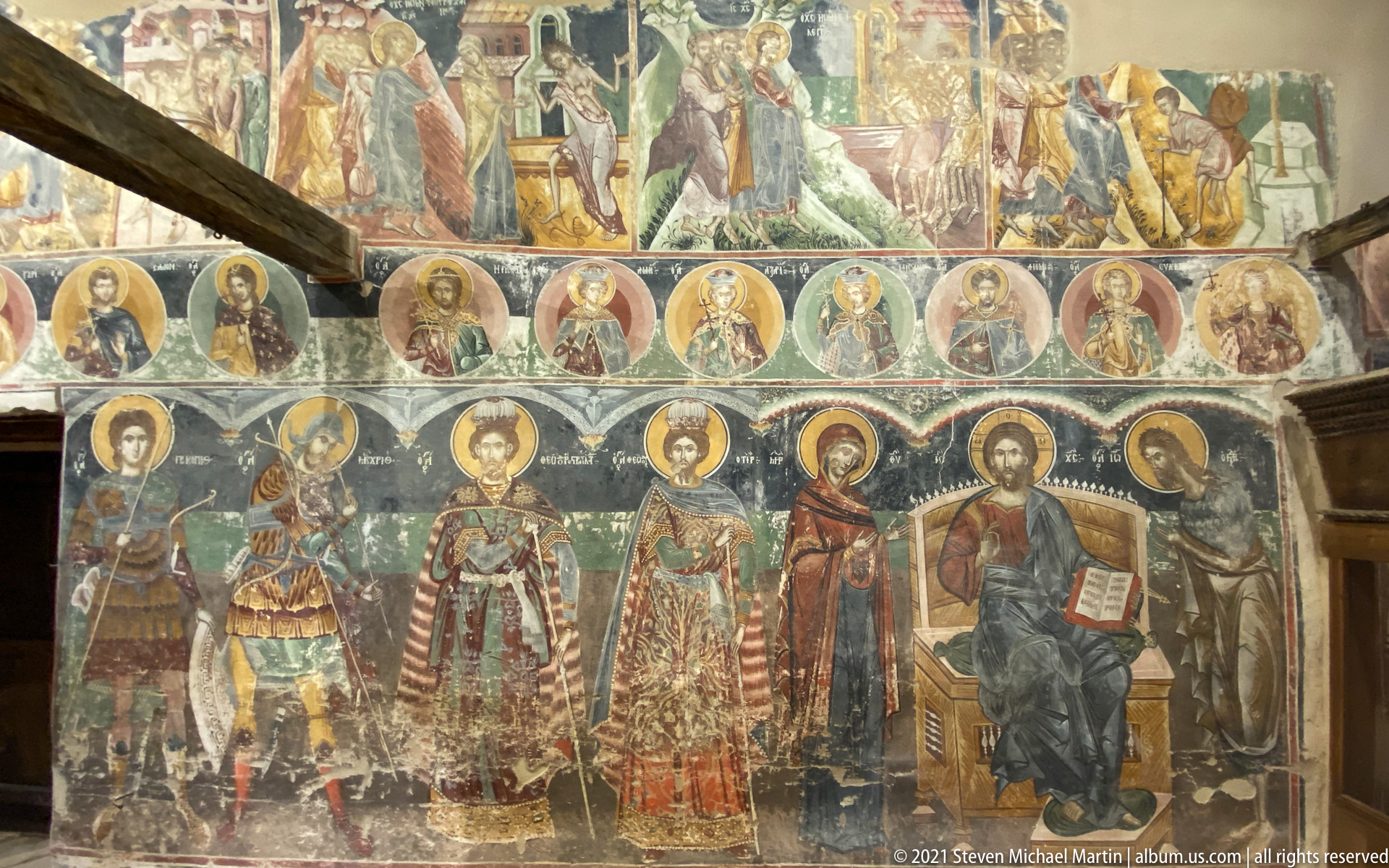
A lower register of standing haloed saints culminates in an enthroned Christ holding an open Gospel book. Above them, a row of circular medallions contains additional saintly busts, while narrative scenes continue in the highest band. The photograph reveals the mural program’s hierarchical organization from narrative imagery to devotional portraits.
Caption
A lower register of standing haloed saints culminates in an enthroned Christ holding an open Gospel book. Above them, a row of circular medallions contains additional saintly busts, while narrative scenes continue in the highest band. The photograph reveals the mural program’s hierarchical organization from narrative imagery to devotional portraits.

A haloed figure reaches toward a nearly nude man whose agitated posture and spotted body distinguish him from the calm attendants behind. A small shrine-like or architectural object rises between the figures. The scene appears to represent an exorcism or healing episode within a saintly narrative cycle, with spiritual confrontation rendered through gesture and bodily contrast.
Caption
A haloed figure reaches toward a nearly nude man whose agitated posture and spotted body distinguish him from the calm attendants behind. A small shrine-like or architectural object rises between the figures. The scene appears to represent an exorcism or healing episode within a saintly narrative cycle, with spiritual confrontation rendered through gesture and bodily contrast.

The Virgin lies on a decorated bier at the center of the Dormition, surrounded by apostles and bishops. Christ stands immediately behind her, holding the small swaddled figure symbolizing Mary's soul, while angels and additional saints crowd the upper register. The dense assembly and vertical stacking create one of the church’s most elaborate narrative compositions.
Caption
The Virgin lies on a decorated bier at the center of the Dormition, surrounded by apostles and bishops. Christ stands immediately behind her, holding the small swaddled figure symbolizing Mary's soul, while angels and additional saints crowd the upper register. The dense assembly and vertical stacking create one of the church’s most elaborate narrative compositions.

A painted dado imitates hanging textile panels suspended from scalloped swags. Each pale ochre panel contains a simple red or brown ornamental emblem, including triangular and vegetal forms, while horizontal bands define the upper and lower edges. The decorative scheme gives the lower wall the appearance of draped fabric rather than masonry.
Caption
A painted dado imitates hanging textile panels suspended from scalloped swags. Each pale ochre panel contains a simple red or brown ornamental emblem, including triangular and vegetal forms, while horizontal bands define the upper and lower edges. The decorative scheme gives the lower wall the appearance of draped fabric rather than masonry.

A second dado pattern imitates a row of pointed yellow textile hangings against a pale ground. Black ornamental marks, loops, and cross-like motifs decorate each panel, and rectangular black gaps punctuate the lower edge. The weathered plaster exposes patches beneath the painted scheme, emphasizing the fragility of the surviving surface.
Caption
A second dado pattern imitates a row of pointed yellow textile hangings against a pale ground. Black ornamental marks, loops, and cross-like motifs decorate each panel, and rectangular black gaps punctuate the lower edge. The weathered plaster exposes patches beneath the painted scheme, emphasizing the fragility of the surviving surface.

The east end of the Church of Saint Demetrios is dominated by a projecting polygonal stone apse, its heavy masonry pierced by a narrow vertical opening. Rubble stone and brick courses articulate the surrounding wall beneath the broad tiled gable. A faded painted panel survives high in the gable, linking the restrained exterior architecture with the church’s painted decorative tradition.
Caption
The east end of the Church of Saint Demetrios is dominated by a projecting polygonal stone apse, its heavy masonry pierced by a narrow vertical opening. Rubble stone and brick courses articulate the surrounding wall beneath the broad tiled gable. A faded painted panel survives high in the gable, linking the restrained exterior architecture with the church’s painted decorative tradition.

A haloed youthful figure sits frontally within an arched painted field, one hand raised in a small gesture and the other drawing the draped garment across the body. The figure’s bare feet rest on a rounded reddish ground, and the sparse dark background isolates the saint from surrounding decoration.
Caption
A haloed youthful figure sits frontally within an arched painted field, one hand raised in a small gesture and the other drawing the draped garment across the body. The figure’s bare feet rest on a rounded reddish ground, and the sparse dark background isolates the saint from surrounding decoration.

Archangel Michael stands frontally in elaborate armor with wings spread, holding a long sword horizontally across his chest and an inscribed scroll at his side. The gold halo, military costume, and commanding pose distinguish him as the heavenly commander. The close view reveals patterned armor, feathered wings, and the dense Greek text of the scroll.
Caption
Archangel Michael stands frontally in elaborate armor with wings spread, holding a long sword horizontally across his chest and an inscribed scroll at his side. The gold halo, military costume, and commanding pose distinguish him as the heavenly commander. The close view reveals patterned armor, feathered wings, and the dense Greek text of the scroll.

A Genesis scene shows the nude figures of Adam and Eve standing beside a tree while a haloed divine figure addresses them from the left. Greek inscriptions identify elements of the narrative, and a coiled serpent appears near the tree. The composition belongs to the church’s Old Testament cycle and centers on the first humans in Eden.
Caption
A Genesis scene shows the nude figures of Adam and Eve standing beside a tree while a haloed divine figure addresses them from the left. Greek inscriptions identify elements of the narrative, and a coiled serpent appears near the tree. The composition belongs to the church’s Old Testament cycle and centers on the first humans in Eden.
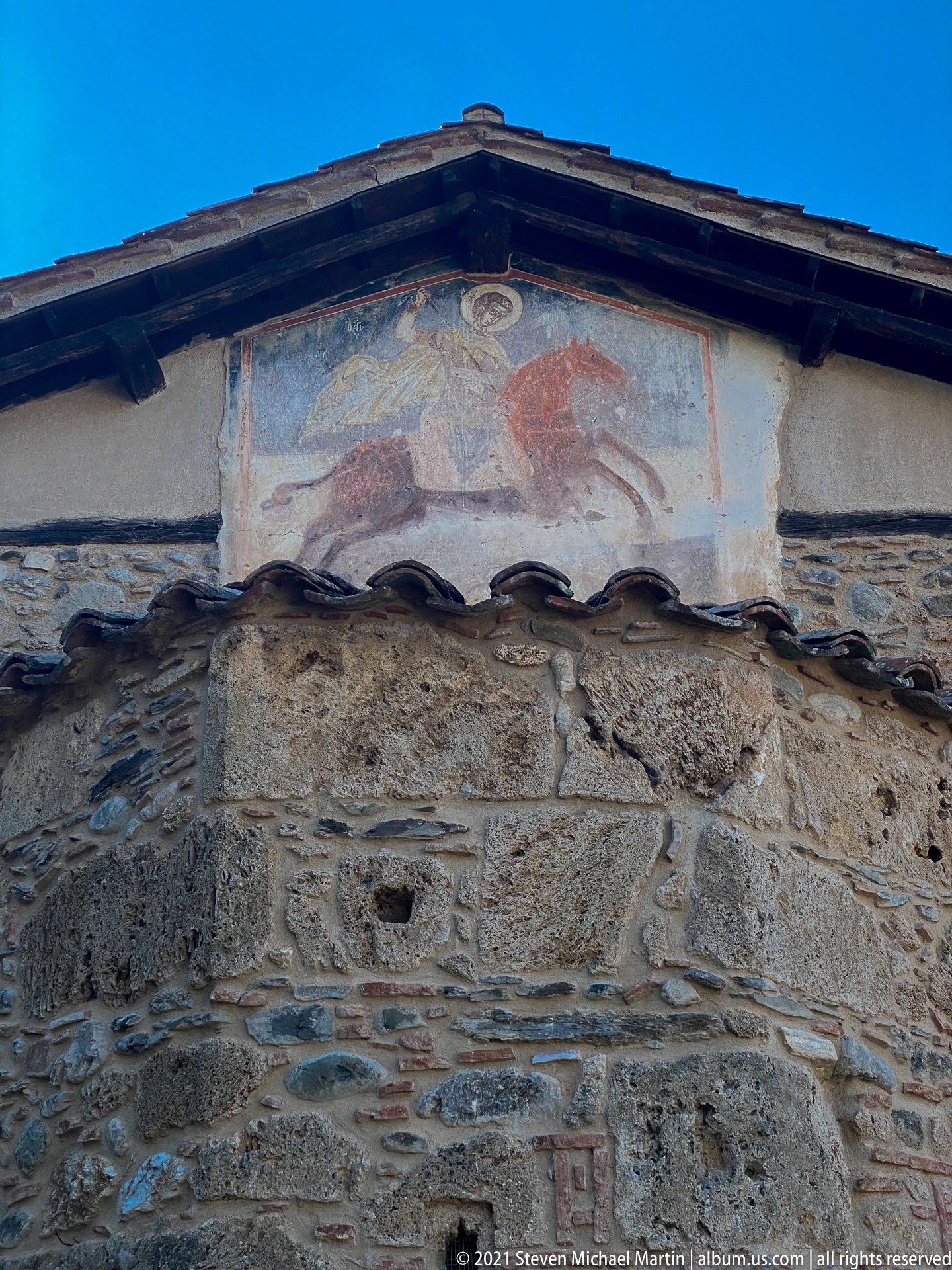
A weathered wall painting beneath the roof gable shows a haloed mounted saint riding a reddish horse. The rider and horse remain legible despite extensive fading, while a circular decorative motif survives above the figure near the roofline. The close view documents both the rare exterior mural and the losses caused by prolonged exposure on the church’s east facade.
Caption
A weathered wall painting beneath the roof gable shows a haloed mounted saint riding a reddish horse. The rider and horse remain legible despite extensive fading, while a circular decorative motif survives above the figure near the roofline. The close view documents both the rare exterior mural and the losses caused by prolonged exposure on the church’s east facade.

A rectangular brick panel laid in a herringbone pattern is embedded within the church’s irregular rubble-stone wall. Short horizontal brick courses appear nearby among rounded and angular stones set in mortar. The close detail highlights the deliberate use of brick as a decorative accent within otherwise heterogeneous masonry, revealing construction techniques that are less apparent in broader exterior views.
Caption
A rectangular brick panel laid in a herringbone pattern is embedded within the church’s irregular rubble-stone wall. Short horizontal brick courses appear nearby among rounded and angular stones set in mortar. The close detail highlights the deliberate use of brick as a decorative accent within otherwise heterogeneous masonry, revealing construction techniques that are less apparent in broader exterior views.