Milan – Lombardy, Italy
Milan lies in the heart of the fertile Po Valley in northern Italy, surrounded by a network of rivers and canals that historically connected the city to the Alpine regions and the Adriatic Sea. Because of its strategic position along trade routes linking northern and southern Europe, Milan developed into one of the most powerful cities of medieval and Renaissance Italy.
The historic center of the city is dominated by the magnificent Duomo di Milano, an enormous Gothic cathedral whose intricate marble façade and forest of spires rise above the central piazza. Surrounding the cathedral are grand arcades, historic palaces, and elegant boulevards that reflect Milan’s long history as a center of commerce, art, and political power.
Today Milan remains one of Italy’s most dynamic cities, blending historic architecture with modern cultural and economic influence.

A modern articulated Milan tram on route 16 curves through a city intersection, its exterior wrapped in a dense commercial graphic of black symbols and text. Steel tracks and overhead power lines organize the streetscape around it. The image contrasts contemporary advertising with the enduring street-running tram system that remains central to Milan’s public transportation network.
Caption
A modern articulated Milan tram on route 16 curves through a city intersection, its exterior wrapped in a dense commercial graphic of black symbols and text. Steel tracks and overhead power lines organize the streetscape around it. The image contrasts contemporary advertising with the enduring street-running tram system that remains central to Milan’s public transportation network.

A brick church façade closes the view down a narrow Milan street, its large circular rose window, banded brick-and-stone masonry, arched portal, and small bell gable catching warm light between shadowed buildings. The compressed urban approach emphasizes how monumental sacred architecture can appear suddenly within the dense fabric of the historic city.
Caption
A brick church façade closes the view down a narrow Milan street, its large circular rose window, banded brick-and-stone masonry, arched portal, and small bell gable catching warm light between shadowed buildings. The compressed urban approach emphasizes how monumental sacred architecture can appear suddenly within the dense fabric of the historic city.

An internal courtyard of Sforza Castle is lined by a low arcade of rounded arches beneath pale plaster walls accented with red brick. A long reflecting pool or water channel occupies the foreground, strengthening the courtyard’s symmetry and drawing attention toward the central passage. The view emphasizes the castle as a layered architectural complex rather than only a defensive exterior.
Caption
An internal courtyard of Sforza Castle is lined by a low arcade of rounded arches beneath pale plaster walls accented with red brick. A long reflecting pool or water channel occupies the foreground, strengthening the courtyard’s symmetry and drawing attention toward the central passage. The view emphasizes the castle as a layered architectural complex rather than only a defensive exterior.

The Torre del Filarete dominates the main courtyard approach at Sforza Castle, rising above long crenellated brick wings and corner towers. Visitors crossing the open paved space establish the scale of the fortified complex. The reconstructed central tower, with its clock and stacked arcaded stages, serves as one of the castle’s most recognizable urban landmarks.
Caption
The Torre del Filarete dominates the main courtyard approach at Sforza Castle, rising above long crenellated brick wings and corner towers. Visitors crossing the open paved space establish the scale of the fortified complex. The reconstructed central tower, with its clock and stacked arcaded stages, serves as one of the castle’s most recognizable urban landmarks.
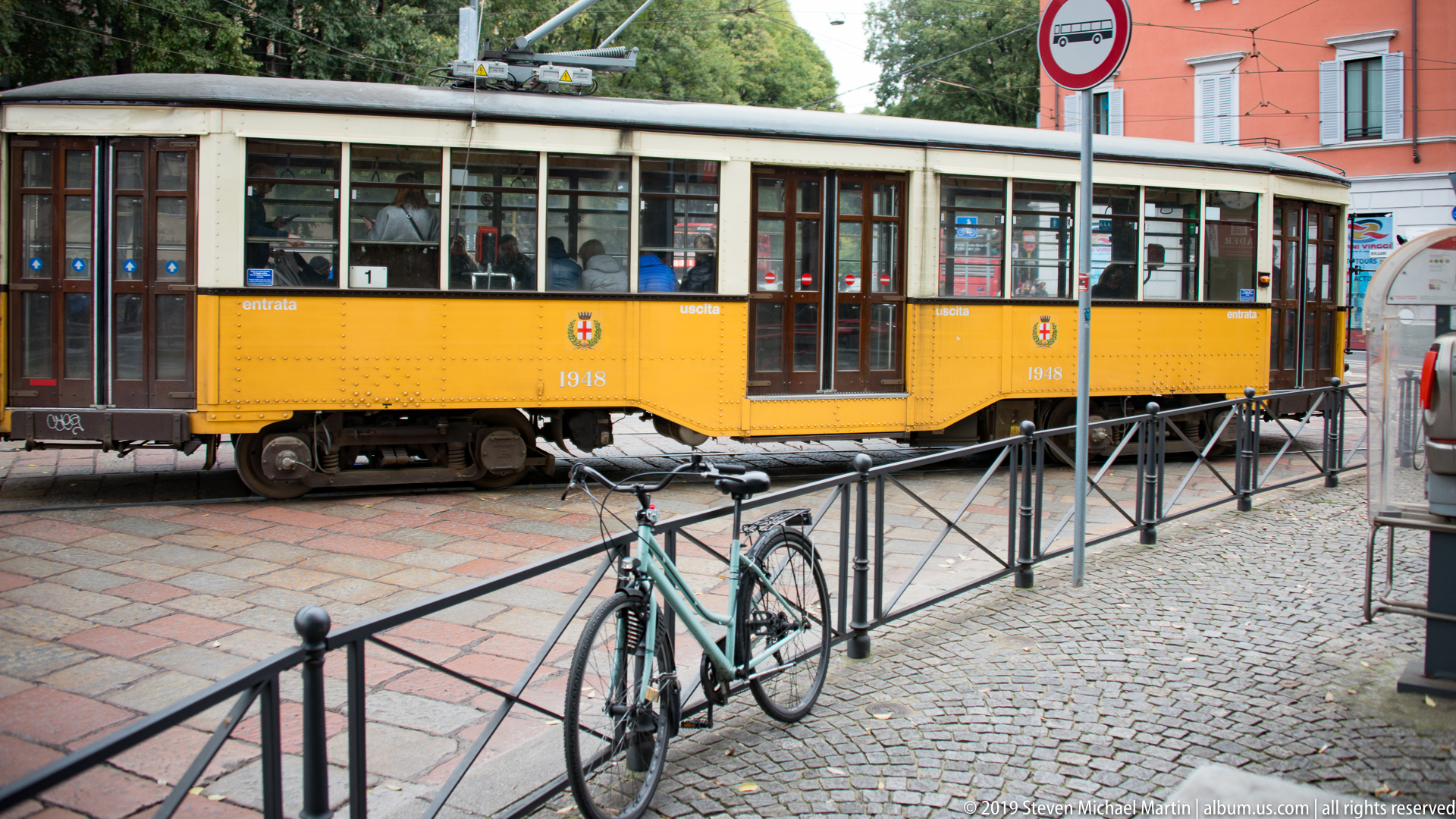
A yellow-orange historic tram pauses beside a cobbled Milan street, its wooden-framed windows and compact body recalling the city’s long-running interwar streetcars. A bicycle locked to the railing in the foreground reinforces the everyday transportation setting. The image records Milan’s layered mobility culture, where heritage trams continue to share central streets with modern traffic.
Caption
A yellow-orange historic tram pauses beside a cobbled Milan street, its wooden-framed windows and compact body recalling the city’s long-running interwar streetcars. A bicycle locked to the railing in the foreground reinforces the everyday transportation setting. The image records Milan’s layered mobility culture, where heritage trams continue to share central streets with modern traffic.

Passengers ride inside a Milan Metro carriage, seated along yellow benches beneath bright linear lighting and stainless-steel grab poles. The centered aisle creates a long perspective through the train, while the mixture of commuters and visitors makes the image an everyday record of public transportation rather than a landmark view.
Caption
Passengers ride inside a Milan Metro carriage, seated along yellow benches beneath bright linear lighting and stainless-steel grab poles. The centered aisle creates a long perspective through the train, while the mixture of commuters and visitors makes the image an everyday record of public transportation rather than a landmark view.

Two defining elements of Piazza del Duomo share the frame: the equestrian monument to Victor Emmanuel II in the foreground and the monumental entrance to the Galleria Vittorio Emanuele II behind it. The layered composition links nineteenth-century commemoration, commercial architecture, and the modern pedestrian life of Milan’s principal square.
Caption
Two defining elements of Piazza del Duomo share the frame: the equestrian monument to Victor Emmanuel II in the foreground and the monumental entrance to the Galleria Vittorio Emanuele II behind it. The layered composition links nineteenth-century commemoration, commercial architecture, and the modern pedestrian life of Milan’s principal square.

Seen from farther back in Piazza del Duomo, the entrance to the Galleria Vittorio Emanuele II becomes part of a broad civic panorama. The central triumphal arch and glass vault anchor the composition, while flanking arcades, cafés, and a dense stream of pedestrians show the Galleria not as an isolated monument but as an active extension of Milan’s central square.
Caption
Seen from farther back in Piazza del Duomo, the entrance to the Galleria Vittorio Emanuele II becomes part of a broad civic panorama. The central triumphal arch and glass vault anchor the composition, while flanking arcades, cafés, and a dense stream of pedestrians show the Galleria not as an isolated monument but as an active extension of Milan’s central square.

A classic yellow Milan tram crosses a broad city street beneath overhead electrical wires. Its riveted body, long bank of rectangular windows, and pole-mounted current collector preserve the appearance of the city’s historic streetcar fleet, still integrated into everyday public transportation.
Caption
A classic yellow Milan tram crosses a broad city street beneath overhead electrical wires. Its riveted body, long bank of rectangular windows, and pole-mounted current collector preserve the appearance of the city’s historic streetcar fleet, still integrated into everyday public transportation.

Seen through a shaded colonnade, Maurizio Cattelan’s L.O.V.E. sculpture stands centered in Piazza Affari before the colossal columns of Palazzo Mezzanotte. The dark foreground pillars create a strong architectural frame around the bright square, emphasizing the deliberate confrontation between the provocative contemporary monument and the sober headquarters of Milan’s stock exchange.
Caption
Seen through a shaded colonnade, Maurizio Cattelan’s L.O.V.E. sculpture stands centered in Piazza Affari before the colossal columns of Palazzo Mezzanotte. The dark foreground pillars create a strong architectural frame around the bright square, emphasizing the deliberate confrontation between the provocative contemporary monument and the sober headquarters of Milan’s stock exchange.
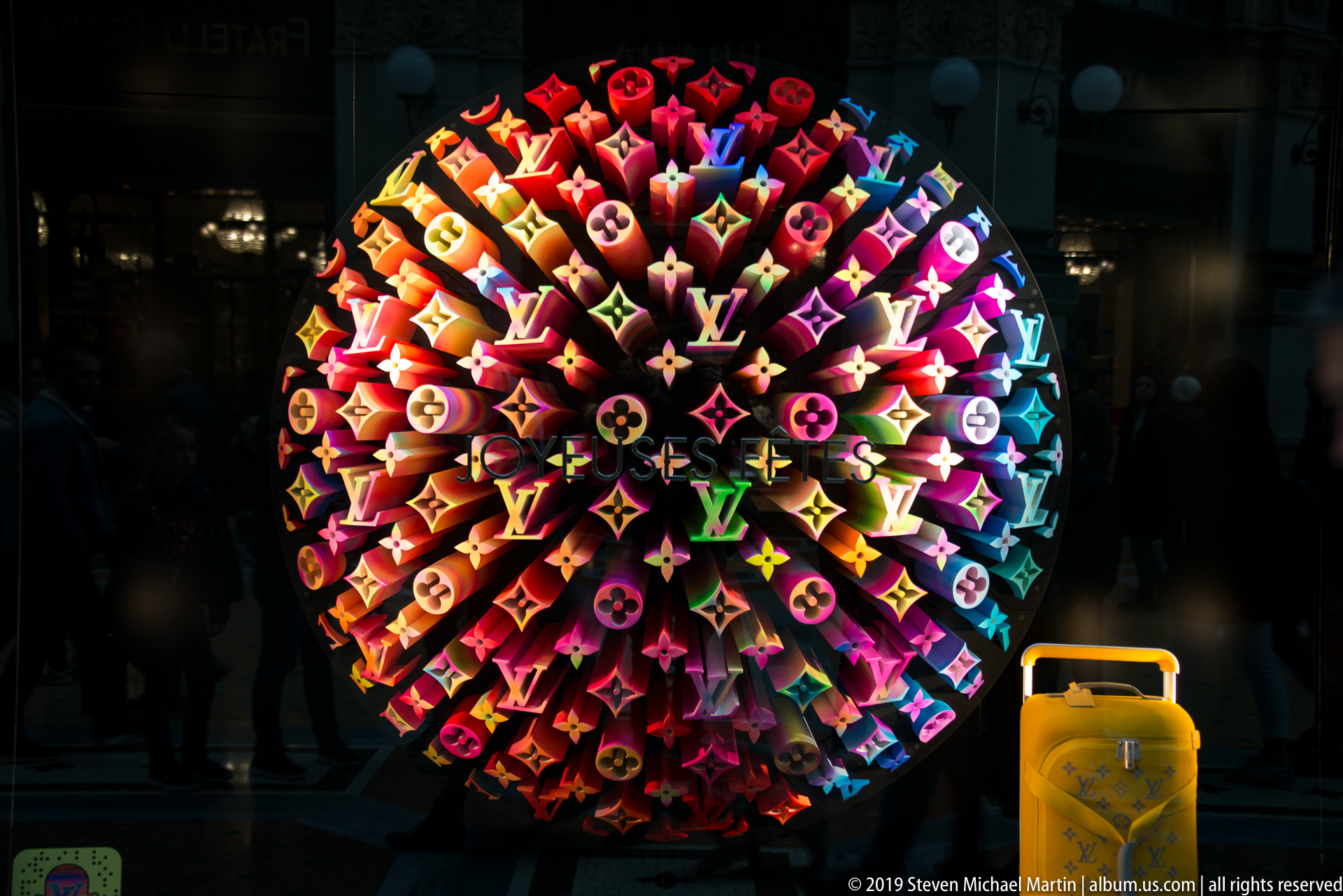
A Milan shop window turns the Louis Vuitton monogram into a dense spherical sculpture of brightly colored, illuminated forms. The display’s repeated logos, saturated reds, oranges, blues, and greens contrast with the dark glass and street reflections, making the commercial installation read almost like a contemporary light sculpture within the city’s fashion district.
Caption
A Milan shop window turns the Louis Vuitton monogram into a dense spherical sculpture of brightly colored, illuminated forms. The display’s repeated logos, saturated reds, oranges, blues, and greens contrast with the dark glass and street reflections, making the commercial installation read almost like a contemporary light sculpture within the city’s fashion district.
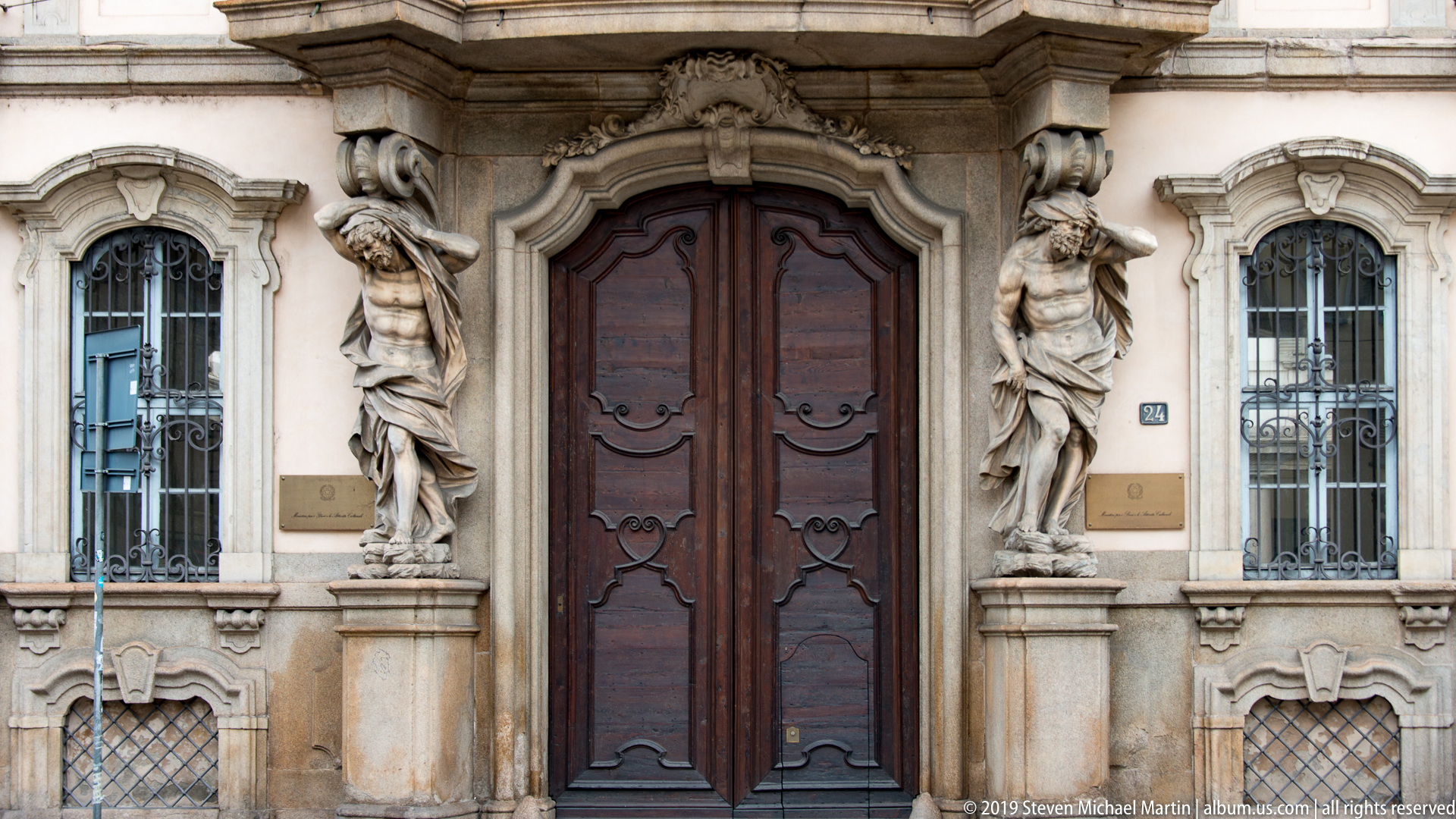
The ceremonial entrance of Palazzo Litta on Corso Magenta is framed by sculpted atlantes supporting the exuberant Baroque portal. Curving stone moldings, wrought-iron window grilles, and the dark double wooden doors create a richly modeled façade in which sculpture and architecture are integrated to dramatize the threshold of the historic Milanese palace.
Caption
The ceremonial entrance of Palazzo Litta on Corso Magenta is framed by sculpted atlantes supporting the exuberant Baroque portal. Curving stone moldings, wrought-iron window grilles, and the dark double wooden doors create a richly modeled façade in which sculpture and architecture are integrated to dramatize the threshold of the historic Milanese palace.
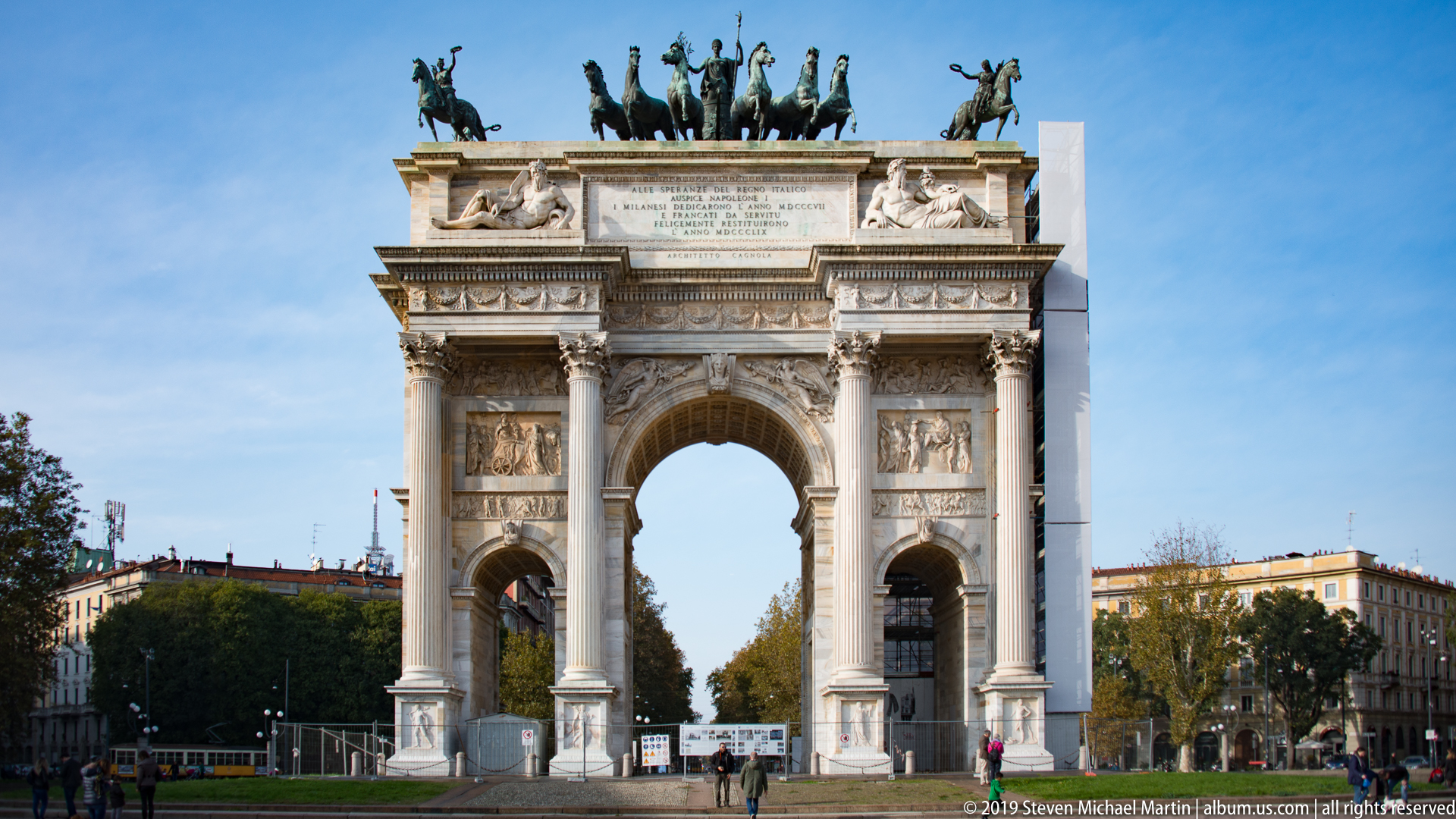
Milan’s Arco della Pace rises at the edge of Parco Sempione, its three arched openings framed by Corinthian columns, relief panels, and sculptural groups. The frontal view emphasizes the monument’s balanced Neoclassical composition and the bronze quadriga crowning the attic, a ceremonial urban gateway whose scale is heightened by the open space around it.
Caption
Milan’s Arco della Pace rises at the edge of Parco Sempione, its three arched openings framed by Corinthian columns, relief panels, and sculptural groups. The frontal view emphasizes the monument’s balanced Neoclassical composition and the bronze quadriga crowning the attic, a ceremonial urban gateway whose scale is heightened by the open space around it.
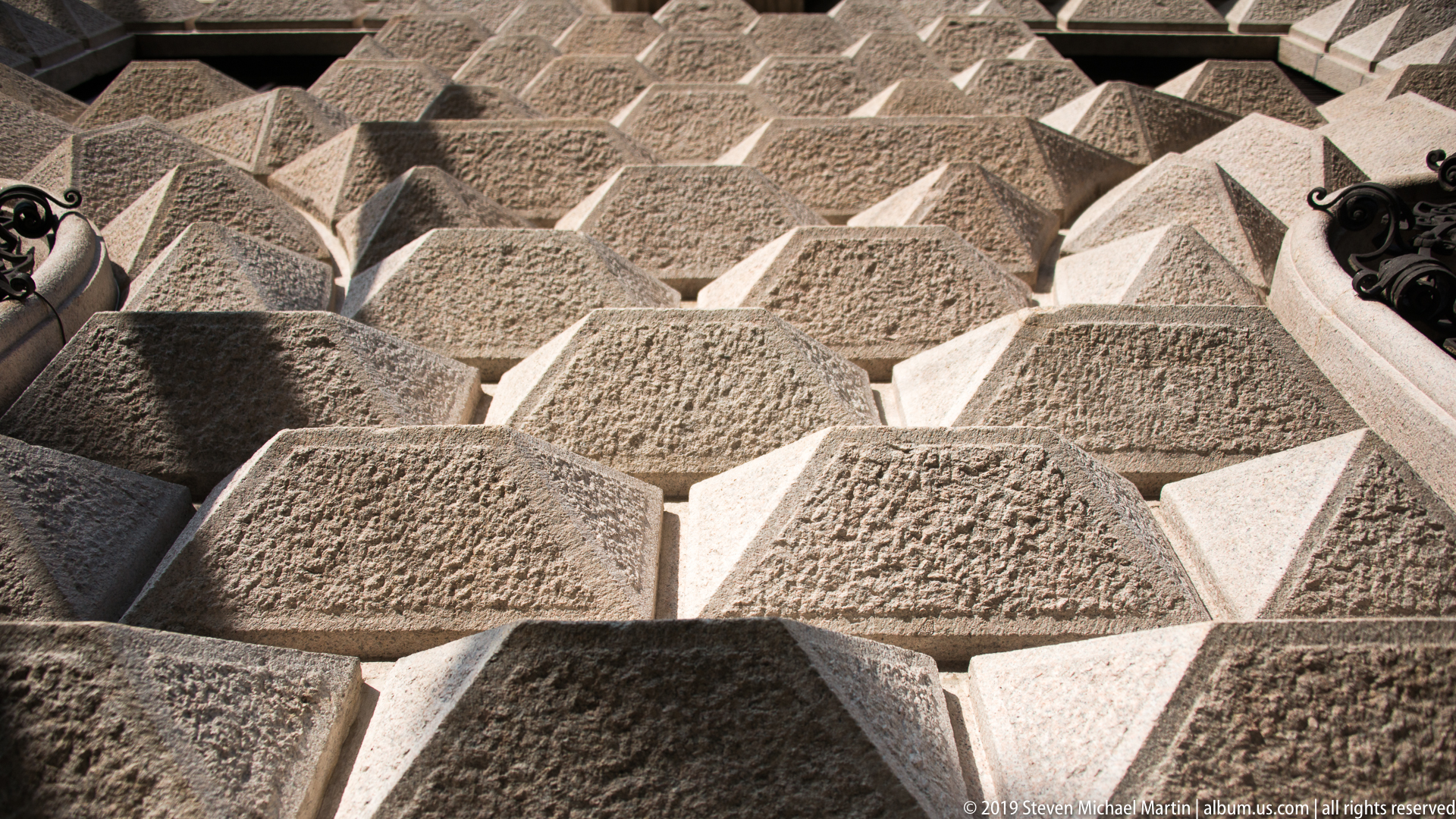
A close view isolates a field of sharply projecting, pyramid-shaped stone blocks arranged in a regular grid. Light rakes across the rough faces and crisp edges, turning the masonry into a rhythmic pattern of alternating highlights and shadow. The tight framing emphasizes texture and geometric relief rather than the identity of the larger building.
Caption
A close view isolates a field of sharply projecting, pyramid-shaped stone blocks arranged in a regular grid. Light rakes across the rough faces and crisp edges, turning the masonry into a rhythmic pattern of alternating highlights and shadow. The tight framing emphasizes texture and geometric relief rather than the identity of the larger building.

Two whimsical orange pastries are decorated to resemble tomatoes, each with green icing leaves and cartoon eyes and mouth. Their contrasting expressions—one frowning and one smiling—give the bakery display a playful character. The close framing records an everyday food detail rather than a landmark, adding a small note of Milanese street and café culture to the portfolio.
Caption
Two whimsical orange pastries are decorated to resemble tomatoes, each with green icing leaves and cartoon eyes and mouth. Their contrasting expressions—one frowning and one smiling—give the bakery display a playful character. The close framing records an everyday food detail rather than a landmark, adding a small note of Milanese street and café culture to the portfolio.

A rectangular window is protected by an elaborate black wrought-iron grille whose turned vertical elements and curled central motifs create a decorative pattern against the bright interior. The restrained stone surround and tight framing make the metalwork itself the subject, documenting a small architectural detail in Milan’s historic streetscape.
Caption
A rectangular window is protected by an elaborate black wrought-iron grille whose turned vertical elements and curled central motifs create a decorative pattern against the bright interior. The restrained stone surround and tight framing make the metalwork itself the subject, documenting a small architectural detail in Milan’s historic streetscape.

A grotesque mask projects beneath an ornate wrought-iron balcony or canopy support, its pale face set against layered black metal leaves and scrollwork. The close-up turns a small functional element of the façade into a sculptural subject, highlighting the theatrical craftsmanship associated with Milan’s late nineteenth- and early twentieth-century decorative architecture.
Caption
A grotesque mask projects beneath an ornate wrought-iron balcony or canopy support, its pale face set against layered black metal leaves and scrollwork. The close-up turns a small functional element of the façade into a sculptural subject, highlighting the theatrical craftsmanship associated with Milan’s late nineteenth- and early twentieth-century decorative architecture.

Looking straight upward in the Galleria Vittorio Emanuele II, the glass-and-iron dome becomes a precise radial pattern above the crossing of the arcades. Painted lunettes, carved architectural frames, and the curved barrel vaults occupy the corners, revealing how nineteenth-century engineering and historicist decoration were combined in Milan’s celebrated covered passage.
Caption
Looking straight upward in the Galleria Vittorio Emanuele II, the glass-and-iron dome becomes a precise radial pattern above the crossing of the arcades. Painted lunettes, carved architectural frames, and the curved barrel vaults occupy the corners, revealing how nineteenth-century engineering and historicist decoration were combined in Milan’s celebrated covered passage.
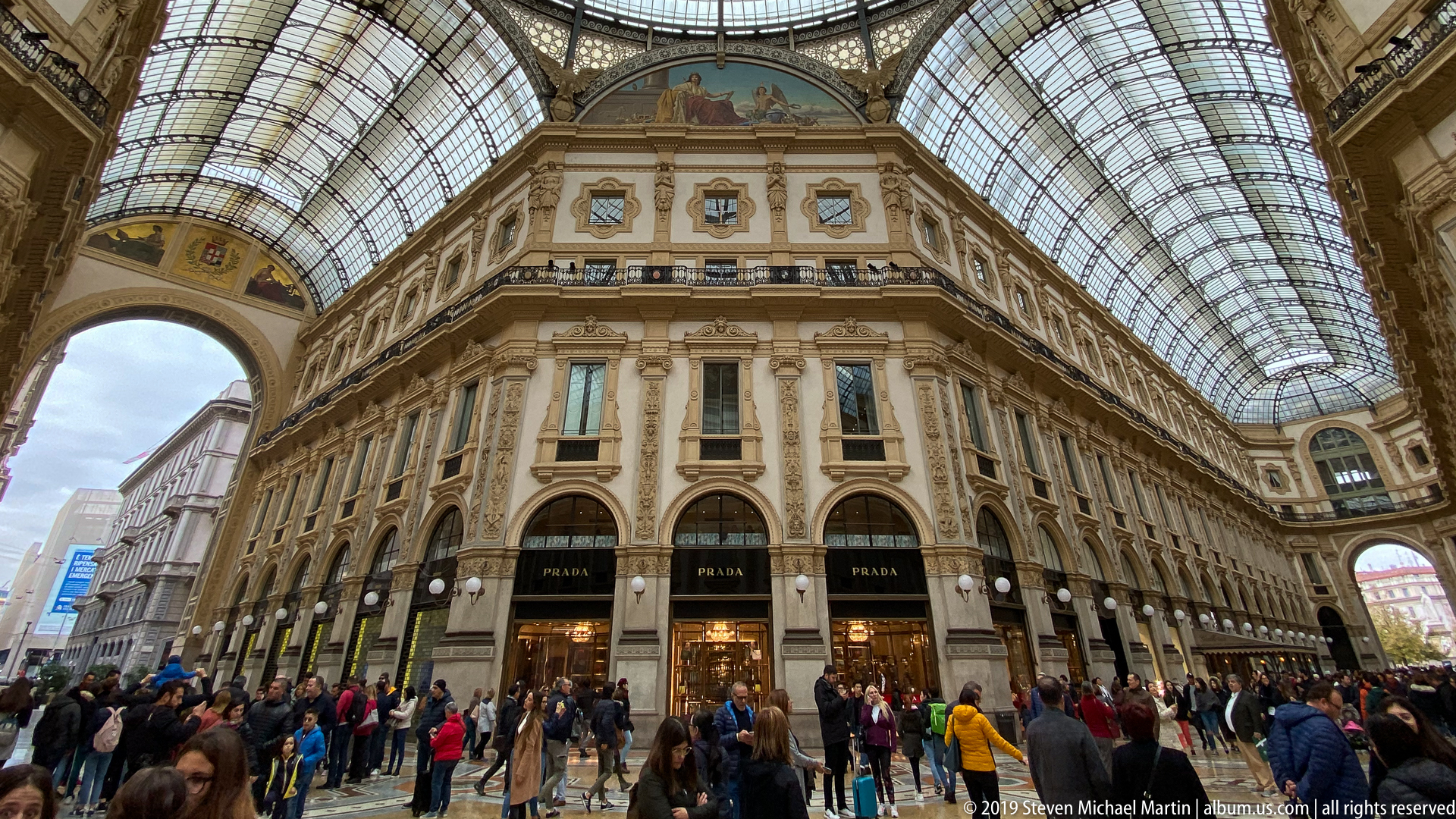
Crowds fill the Galleria Vittorio Emanuele II beneath its soaring glass-and-iron vaults, while luxury storefronts occupy the richly ornamented façades at street level. This corner view shows the arcade as both architecture and active public space, with the monumental nineteenth-century enclosure framing the everyday movement of visitors through central Milan.
Caption
Crowds fill the Galleria Vittorio Emanuele II beneath its soaring glass-and-iron vaults, while luxury storefronts occupy the richly ornamented façades at street level. This corner view shows the arcade as both architecture and active public space, with the monumental nineteenth-century enclosure framing the everyday movement of visitors through central Milan.

The intersecting vaults of the Galleria Vittorio Emanuele II frame a long axial view through the arcade, with the central dome overhead and symmetrical façades lining the passage. Shop signs and pedestrians at ground level underline the building’s continuing commercial use, while painted lunettes and elaborate stucco connect the vast iron-and-glass structure to Milan’s monumental civic architecture.
Caption
The intersecting vaults of the Galleria Vittorio Emanuele II frame a long axial view through the arcade, with the central dome overhead and symmetrical façades lining the passage. Shop signs and pedestrians at ground level underline the building’s continuing commercial use, while painted lunettes and elaborate stucco connect the vast iron-and-glass structure to Milan’s monumental civic architecture.

Massive pale stone columns frame a narrow upward view along one arm of the Galleria Vittorio Emanuele II. The barrel-shaped glass roof recedes toward the distance, emphasizing the arcade’s length and vertical scale. Carved capitals, arches, and cornices form a masonry counterpoint to the light iron-and-glass canopy overhead.
Caption
Massive pale stone columns frame a narrow upward view along one arm of the Galleria Vittorio Emanuele II. The barrel-shaped glass roof recedes toward the distance, emphasizing the arcade’s length and vertical scale. Carved capitals, arches, and cornices form a masonry counterpoint to the light iron-and-glass canopy overhead.

A severe stone civic façade is organized by colossal columns, arched ground-floor openings, and a central monument set in the square before it. The composition contrasts the rigid classical order of the building with the sculptural focal point in front. Without readable signage in this proof-sheet view, the exact institutional identity is best treated cautiously.
Caption
A severe stone civic façade is organized by colossal columns, arched ground-floor openings, and a central monument set in the square before it. The composition contrasts the rigid classical order of the building with the sculptural focal point in front. Without readable signage in this proof-sheet view, the exact institutional identity is best treated cautiously.

The compact façade of San Maurizio al Monastero Maggiore is squeezed into the dense urban fabric of central Milan. Pilasters, a triangular pediment, sculpted ornament, and a tall central entrance give the church a restrained classical order that contrasts with the richly frescoed interior seen in the following photograph.
Caption
The compact façade of San Maurizio al Monastero Maggiore is squeezed into the dense urban fabric of central Milan. Pilasters, a triangular pediment, sculpted ornament, and a tall central entrance give the church a restrained classical order that contrasts with the richly frescoed interior seen in the following photograph.

Painted chapels and arcades cover the interior of San Maurizio al Monastero Maggiore with dense Renaissance decoration. Figurative frescoes, ornamental pilasters, gilded details, and painted vaults create an unusually continuous pictorial surface, demonstrating why the former monastic church is often noted for the richness of its sixteenth-century interior program.
Caption
Painted chapels and arcades cover the interior of San Maurizio al Monastero Maggiore with dense Renaissance decoration. Figurative frescoes, ornamental pilasters, gilded details, and painted vaults create an unusually continuous pictorial surface, demonstrating why the former monastic church is often noted for the richness of its sixteenth-century interior program.

The brick exterior of Santa Maria delle Grazie presents a restrained church façade beside the more elaborate Renaissance tribune rising behind it. Round and pointed openings, pale stone trim, and Lombard brickwork lead the eye toward the polygonal and domed eastern structure associated with the rebuilding of the church complex in late fifteenth-century Milan.
Caption
The brick exterior of Santa Maria delle Grazie presents a restrained church façade beside the more elaborate Renaissance tribune rising behind it. Round and pointed openings, pale stone trim, and Lombard brickwork lead the eye toward the polygonal and domed eastern structure associated with the rebuilding of the church complex in late fifteenth-century Milan.

A large printed street-and-transit map presents Milan as a dense urban network of roads, rail lines, parks, waterways, and colored transport routes. The broad citywide view is useful as an orientation document within the portfolio, showing how the historic core sits within a much larger metropolitan fabric rather than isolating a single monument or neighborhood.
Caption
A large printed street-and-transit map presents Milan as a dense urban network of roads, rail lines, parks, waterways, and colored transport routes. The broad citywide view is useful as an orientation document within the portfolio, showing how the historic core sits within a much larger metropolitan fabric rather than isolating a single monument or neighborhood.

A schematic transport diagram simplifies Milan’s rail and metro networks into color-coded lines, stations, interchange points, and fare or service zones. Unlike the geographic map in the preceding image, this diagram prioritizes network relationships over physical distance, documenting the practical transit system used to move between the city center and the surrounding metropolitan area.
Caption
A schematic transport diagram simplifies Milan’s rail and metro networks into color-coded lines, stations, interchange points, and fare or service zones. Unlike the geographic map in the preceding image, this diagram prioritizes network relationships over physical distance, documenting the practical transit system used to move between the city center and the surrounding metropolitan area.

A modern brick complex is interrupted by a tall glazed central volume, with black-and-white photographic panels visible inside and along the covered ground-level walkway. Curving brick walls and broad windows soften the institutional massing. The image documents a contemporary cultural or educational setting without enough visible signage to support a more specific identification.
Caption
A modern brick complex is interrupted by a tall glazed central volume, with black-and-white photographic panels visible inside and along the covered ground-level walkway. Curving brick walls and broad windows soften the institutional massing. The image documents a contemporary cultural or educational setting without enough visible signage to support a more specific identification.

A close view isolates the large painted clock on the Torre del Filarete at Sforza Castle. Green numeral medallions encircle a richly colored central sun motif, all set directly into the red-brick wall. The tight composition reveals decorative details that are easily missed in broader views of the tower and courtyard.
Caption
A close view isolates the large painted clock on the Torre del Filarete at Sforza Castle. Green numeral medallions encircle a richly colored central sun motif, all set directly into the red-brick wall. The tight composition reveals decorative details that are easily missed in broader views of the tower and courtyard.
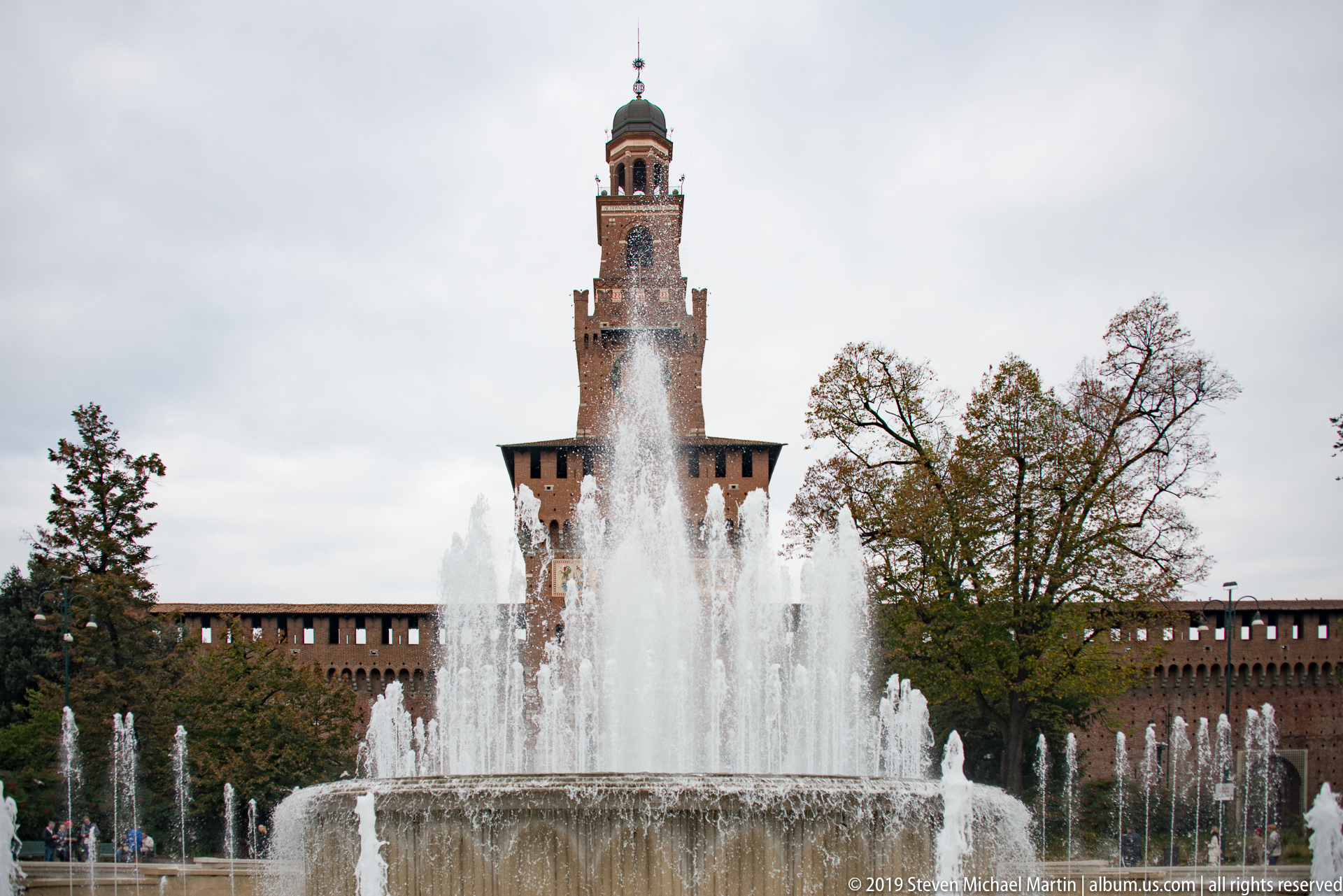
Jets from the large fountain in Piazza Castello rise in front of the Torre del Filarete, partially veiling the brick entrance tower of Sforza Castle. The layered view pairs civic landscape design with the fortified monument, while autumn trees and the long crenellated walls broaden the setting beyond the castle’s central gateway.
Caption
Jets from the large fountain in Piazza Castello rise in front of the Torre del Filarete, partially veiling the brick entrance tower of Sforza Castle. The layered view pairs civic landscape design with the fortified monument, while autumn trees and the long crenellated walls broaden the setting beyond the castle’s central gateway.

A sculpted lion’s head projects from a dark painted door or panel, gripping a heavy metal ring in its mouth. Modeled fur, rounded ears, and the strongly worked muzzle turn a functional fitting into a small piece of architectural sculpture. The close-up emphasizes craftsmanship and patina rather than the identity of the building.
Caption
A sculpted lion’s head projects from a dark painted door or panel, gripping a heavy metal ring in its mouth. Modeled fur, rounded ears, and the strongly worked muzzle turn a functional fitting into a small piece of architectural sculpture. The close-up emphasizes craftsmanship and patina rather than the identity of the building.

A narrow Milan street bends between closely spaced historic buildings with stone façades, shuttered windows, balconies, and restrained nineteenth-century detailing. Parked cars and contemporary traffic signs occupy the roadway, creating a layered urban scene in which everyday circulation runs through a tightly enclosed architectural corridor.
Caption
A narrow Milan street bends between closely spaced historic buildings with stone façades, shuttered windows, balconies, and restrained nineteenth-century detailing. Parked cars and contemporary traffic signs occupy the roadway, creating a layered urban scene in which everyday circulation runs through a tightly enclosed architectural corridor.

A smiling visitor stands beside a long colonnade whose pale stone columns recede in strong perspective behind him. The shallow depth of field separates the figure from the repeating architectural rhythm, producing a personal travel portrait while still preserving a clear sense of Milan’s monumental urban fabric.
Caption
A smiling visitor stands beside a long colonnade whose pale stone columns recede in strong perspective behind him. The shallow depth of field separates the figure from the repeating architectural rhythm, producing a personal travel portrait while still preserving a clear sense of Milan’s monumental urban fabric.

A long view down the Galleria Vittorio Emanuele II shows the barrel-vaulted glass roof extending toward an arched opening and a distant modern tower beyond. Ornate façades, globe lamps, cafés, and pedestrians line the passage, demonstrating how the nineteenth-century arcade continues to function as one of central Milan’s busiest interior streets.
Caption
A long view down the Galleria Vittorio Emanuele II shows the barrel-vaulted glass roof extending toward an arched opening and a distant modern tower beyond. Ornate façades, globe lamps, cafés, and pedestrians line the passage, demonstrating how the nineteenth-century arcade continues to function as one of central Milan’s busiest interior streets.

The camera looks upward at one corner of the Galleria Vittorio Emanuele II, where carved pilasters, pediments, windows, and painted lunettes rise into the sweeping glass-and-iron roof. By excluding the busy floor below, the composition concentrates on the arcade’s layered nineteenth-century decoration and the structural meeting of masonry façades with the glazed canopy.
Caption
The camera looks upward at one corner of the Galleria Vittorio Emanuele II, where carved pilasters, pediments, windows, and painted lunettes rise into the sweeping glass-and-iron roof. By excluding the busy floor below, the composition concentrates on the arcade’s layered nineteenth-century decoration and the structural meeting of masonry façades with the glazed canopy.

A symmetrical corner façade inside the Galleria Vittorio Emanuele II rises beneath painted lunettes and the curved glass roof. Repeated windows, pilasters, relief panels, and balustrades create a highly ordered vertical composition. The close framing highlights the architectural skin of the arcade rather than its circulation space or commercial activity.
Caption
A symmetrical corner façade inside the Galleria Vittorio Emanuele II rises beneath painted lunettes and the curved glass roof. Repeated windows, pilasters, relief panels, and balustrades create a highly ordered vertical composition. The close framing highlights the architectural skin of the arcade rather than its circulation space or commercial activity.

The vast glazed roof of the Galleria Vittorio Emanuele II fills the frame from below, its iron ribs radiating and curving across the transparent canopy. Painted lunettes and fragments of the decorated façades appear at the edges, giving scale to the engineering. The image isolates the arcade’s defining structural feature as an abstract pattern of metal and glass.
Caption
The vast glazed roof of the Galleria Vittorio Emanuele II fills the frame from below, its iron ribs radiating and curving across the transparent canopy. Painted lunettes and fragments of the decorated façades appear at the edges, giving scale to the engineering. The image isolates the arcade’s defining structural feature as an abstract pattern of metal and glass.

The equestrian monument to Victor Emmanuel II stands in Piazza del Duomo, the king mounted above a high stone pedestal decorated with bronze reliefs and flanked by sculptural figures. The tightly framed view places the monument against a pale urban façade, emphasizing its nineteenth-century commemorative scale and its role as a major focal point in Milan’s central square.
Caption
The equestrian monument to Victor Emmanuel II stands in Piazza del Duomo, the king mounted above a high stone pedestal decorated with bronze reliefs and flanked by sculptural figures. The tightly framed view places the monument against a pale urban façade, emphasizing its nineteenth-century commemorative scale and its role as a major focal point in Milan’s central square.

A close view of Milan Cathedral’s marble façade isolates a dense vertical field of Gothic sculpture: standing saints and prophets, small narrative reliefs, crocketed moldings, and deeply carved architectural frames. The tight composition shows how the Duomo’s exterior functions almost as a monumental stone screen, with figural sculpture integrated into the fabric of the building rather than treated as separate decoration.
Caption
A close view of Milan Cathedral’s marble façade isolates a dense vertical field of Gothic sculpture: standing saints and prophets, small narrative reliefs, crocketed moldings, and deeply carved architectural frames. The tight composition shows how the Duomo’s exterior functions almost as a monumental stone screen, with figural sculpture integrated into the fabric of the building rather than treated as separate decoration.
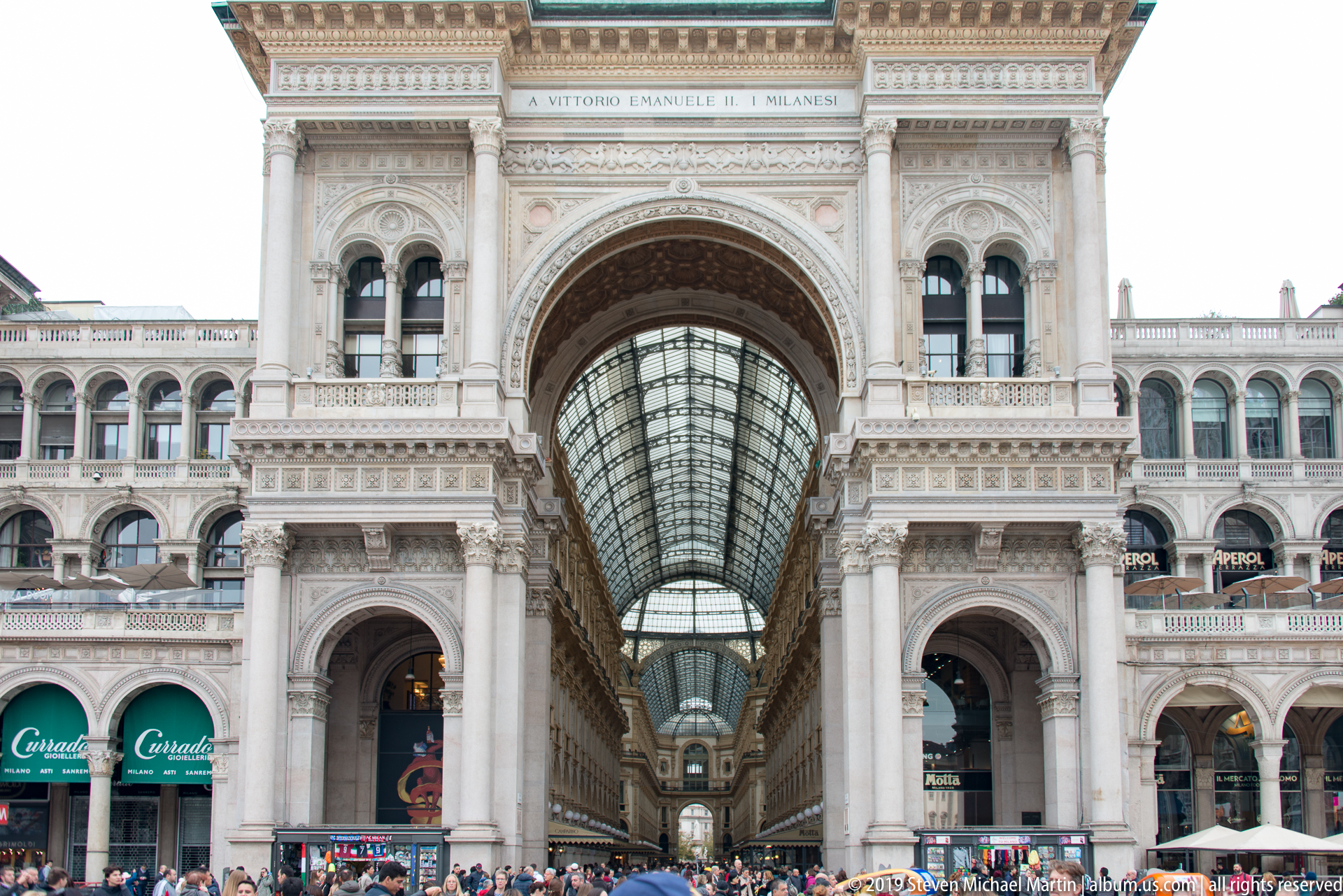
The triumphal-arch entrance to the Galleria Vittorio Emanuele II opens from Piazza del Duomo into the long glass-roofed arcade. Classical columns, sculpted panels, balconies, and the inscription honoring Vittorio Emanuele II frame the soaring central passage, while crowds at street level reveal the scale and continuing public life of Milan’s nineteenth-century commercial monument.
Caption
The triumphal-arch entrance to the Galleria Vittorio Emanuele II opens from Piazza del Duomo into the long glass-roofed arcade. Classical columns, sculpted panels, balconies, and the inscription honoring Vittorio Emanuele II frame the soaring central passage, while crowds at street level reveal the scale and continuing public life of Milan’s nineteenth-century commercial monument.

Victor Emmanuel II is shown on horseback above the elaborate monument in Piazza del Duomo. Bronze reliefs wrap the pedestal and sculpted lions recline at its base, while the pink façades of the square form the background. The composition emphasizes the monument’s role as a civic memorial to the first king of a unified Italy within Milan’s principal urban space.
Caption
Victor Emmanuel II is shown on horseback above the elaborate monument in Piazza del Duomo. Bronze reliefs wrap the pedestal and sculpted lions recline at its base, while the pink façades of the square form the background. The composition emphasizes the monument’s role as a civic memorial to the first king of a unified Italy within Milan’s principal urban space.
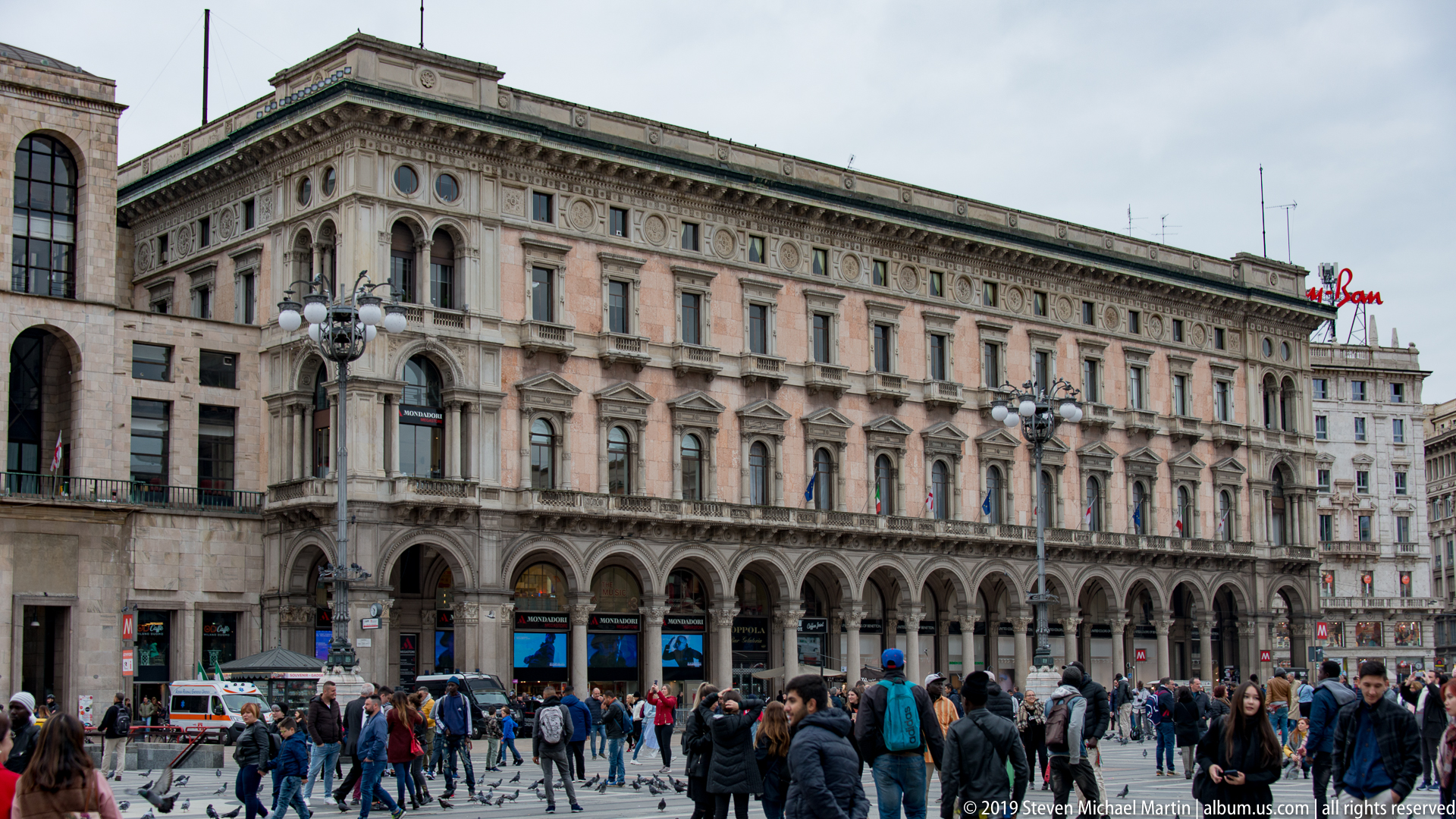
A long historic façade on Piazza del Duomo is organized by repeated round arches at street level and regular rows of tall windows above. The crowded foreground and continuous arcade emphasize the square’s function as a major pedestrian space, while the restrained Renaissance-inspired detailing provides a visual counterpoint to the cathedral and Galleria nearby.
Caption
A long historic façade on Piazza del Duomo is organized by repeated round arches at street level and regular rows of tall windows above. The crowded foreground and continuous arcade emphasize the square’s function as a major pedestrian space, while the restrained Renaissance-inspired detailing provides a visual counterpoint to the cathedral and Galleria nearby.

A nearly symmetrical frontal view centers the Galleria Vittorio Emanuele II’s great entrance arch, placing the glass barrel vault directly on axis behind it. Repeated windows, balconies, sculptural panels, and arcades create a formal frame for the crowds entering and leaving below. The view emphasizes the Galleria’s ceremonial urban face as much as its commercial function.
Caption
A nearly symmetrical frontal view centers the Galleria Vittorio Emanuele II’s great entrance arch, placing the glass barrel vault directly on axis behind it. Repeated windows, balconies, sculptural panels, and arcades create a formal frame for the crowds entering and leaving below. The view emphasizes the Galleria’s ceremonial urban face as much as its commercial function.

The Victor Emmanuel II monument is viewed obliquely against the historic façades of Piazza del Duomo. The bronze king on horseback rises above a pedestal encircled by a narrative relief, with one of the monumental stone lions visible below. This angle reveals the memorial as a sculptural object embedded within the architecture of Milan’s central square.
Caption
The Victor Emmanuel II monument is viewed obliquely against the historic façades of Piazza del Duomo. The bronze king on horseback rises above a pedestal encircled by a narrative relief, with one of the monumental stone lions visible below. This angle reveals the memorial as a sculptural object embedded within the architecture of Milan’s central square.

The west façade of Milan Cathedral fills the frame with an extraordinary accumulation of pinnacles, statues, tracery, and carved marble. Five portals open toward the crowded Piazza del Duomo, while the forest of spires rises into a pale sky. The frontal view presents the cathedral as the dominant architectural focus of central Milan and showcases the vertical density of its Gothic design.
Caption
The west façade of Milan Cathedral fills the frame with an extraordinary accumulation of pinnacles, statues, tracery, and carved marble. Five portals open toward the crowded Piazza del Duomo, while the forest of spires rises into a pale sky. The frontal view presents the cathedral as the dominant architectural focus of central Milan and showcases the vertical density of its Gothic design.

Elaborate wrought iron transforms a Milan balcony into a dense ornamental screen of curling stems, clustered berries or fruit, hanging lamp forms, and small figurative silhouettes. Grotesque masks beneath the balcony complete the ensemble. The close framing reveals the inventive metal craftsmanship of the façade, where structural railings and supports become highly expressive decoration.
Caption
Elaborate wrought iron transforms a Milan balcony into a dense ornamental screen of curling stems, clustered berries or fruit, hanging lamp forms, and small figurative silhouettes. Grotesque masks beneath the balcony complete the ensemble. The close framing reveals the inventive metal craftsmanship of the façade, where structural railings and supports become highly expressive decoration.

Stacked balconies project from a pale residential façade, each enclosed by exceptionally elaborate wrought-iron railings. Curving botanical motifs, pendant forms, and dark metal supports contrast with the smooth masonry and tall windows. The upward view emphasizes the vertical repetition of the balcony design and Milan’s tradition of richly crafted urban apartment façades.
Caption
Stacked balconies project from a pale residential façade, each enclosed by exceptionally elaborate wrought-iron railings. Curving botanical motifs, pendant forms, and dark metal supports contrast with the smooth masonry and tall windows. The upward view emphasizes the vertical repetition of the balcony design and Milan’s tradition of richly crafted urban apartment façades.

Four carved female figures stand between deeply patterned window grilles beneath a heavy classical entablature. Their draped poses function as caryatid-like architectural sculpture, turning the façade into a sequence of human supports and framed openings. The close view emphasizes carved stone, symmetry, and the integration of sculpture with monumental civic architecture in central Milan.
Caption
Four carved female figures stand between deeply patterned window grilles beneath a heavy classical entablature. Their draped poses function as caryatid-like architectural sculpture, turning the façade into a sequence of human supports and framed openings. The close view emphasizes carved stone, symmetry, and the integration of sculpture with monumental civic architecture in central Milan.

Palazzo Mezzanotte, home of Borsa Italiana, forms the monumental backdrop of Piazza Affari. Its travertine façade is dominated by colossal classical columns and restrained sculptural decoration, while Maurizio Cattelan’s white marble L.O.V.E. sculpture stands on axis in the square. The juxtaposition gives the financial district one of Milan’s most provocative combinations of civic architecture and contemporary public art.
Caption
Palazzo Mezzanotte, home of Borsa Italiana, forms the monumental backdrop of Piazza Affari. Its travertine façade is dominated by colossal classical columns and restrained sculptural decoration, while Maurizio Cattelan’s white marble L.O.V.E. sculpture stands on axis in the square. The juxtaposition gives the financial district one of Milan’s most provocative combinations of civic architecture and contemporary public art.

A monumental arched entrance is framed by colossal columns, sculpted panels, and a richly patterned metal gate, with the Italian tricolor flying above the roofline. The façade’s grand classical vocabulary announces an important institutional function. Because the proof-sheet view offers no securely readable building name, the caption retains the architectural identification without forcing a specific institution.
Caption
A monumental arched entrance is framed by colossal columns, sculpted panels, and a richly patterned metal gate, with the Italian tricolor flying above the roofline. The façade’s grand classical vocabulary announces an important institutional function. Because the proof-sheet view offers no securely readable building name, the caption retains the architectural identification without forcing a specific institution.

A broad curved corner building wraps around a Milan intersection with projecting balconies, arched upper windows, geometric panels, and a heavily rusticated dark base. The rounded façade and layered cornice create a streamlined urban profile, while the repeating balconies reveal its residential character. The image records the transition from historicist ornament toward more modern early twentieth-century city architecture.
Caption
A broad curved corner building wraps around a Milan intersection with projecting balconies, arched upper windows, geometric panels, and a heavily rusticated dark base. The rounded façade and layered cornice create a streamlined urban profile, while the repeating balconies reveal its residential character. The image records the transition from historicist ornament toward more modern early twentieth-century city architecture.
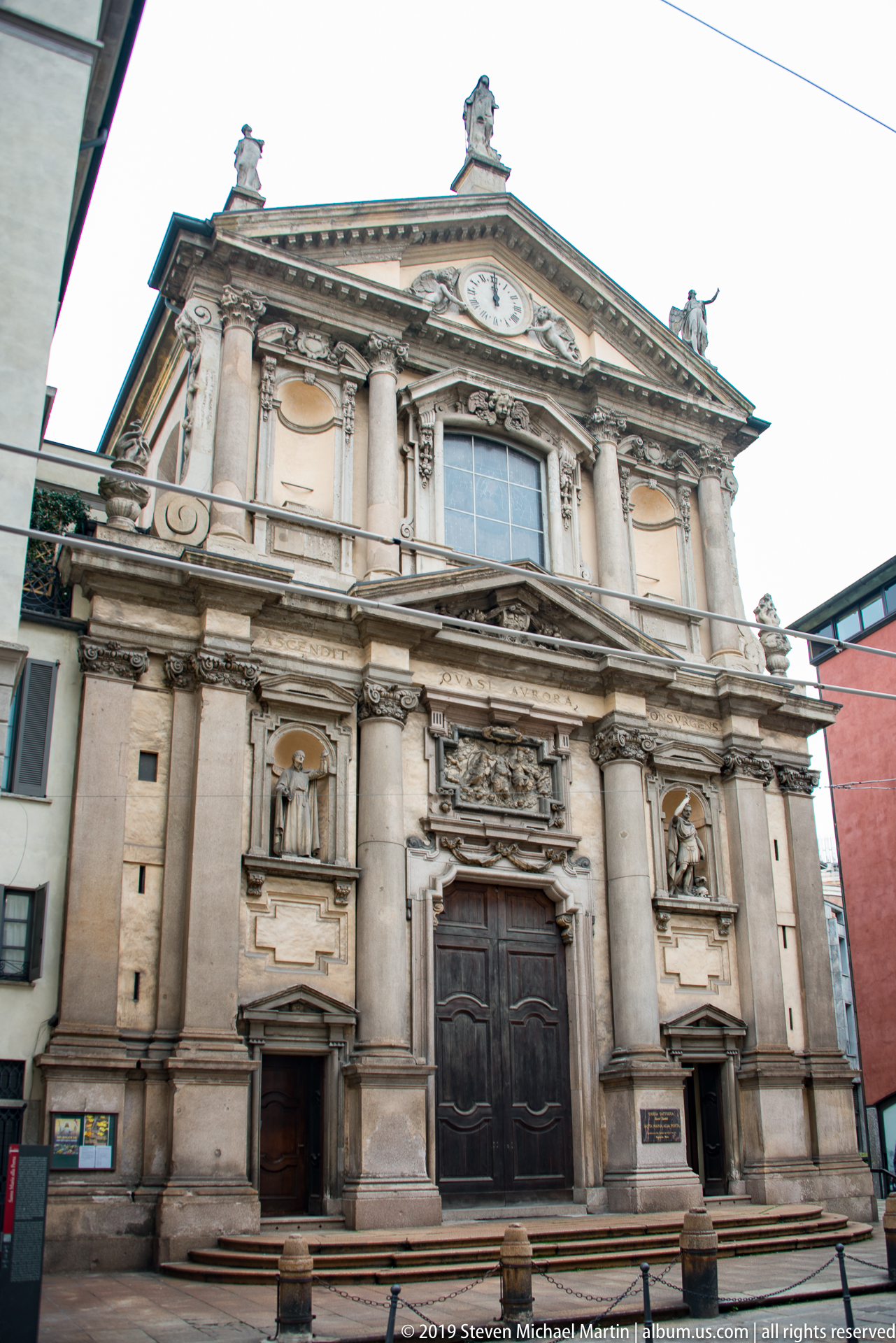
A monumental Baroque church façade is organized around a tall central doorway, paired columns, sculpted niches, relief panels, and a triangular upper pediment. The broad, shallow frontage is tightly integrated into the surrounding street. Without a readable dedication or other decisive identifier in this view, the caption emphasizes the visible architectural composition rather than assigning a potentially incorrect church name.
Caption
A monumental Baroque church façade is organized around a tall central doorway, paired columns, sculpted niches, relief panels, and a triangular upper pediment. The broad, shallow frontage is tightly integrated into the surrounding street. Without a readable dedication or other decisive identifier in this view, the caption emphasizes the visible architectural composition rather than assigning a potentially incorrect church name.

A pale stone façade is articulated by tall windows with sculpted pediments, circular relief medallions, and a narrow balustraded balcony softened by trailing greenery. The oblique street-level view emphasizes the regular cadence of the windows and the contrast between carved historic ornament and living plants, a recurring feature of Milan’s elegant central streets.
Caption
A pale stone façade is articulated by tall windows with sculpted pediments, circular relief medallions, and a narrow balustraded balcony softened by trailing greenery. The oblique street-level view emphasizes the regular cadence of the windows and the contrast between carved historic ornament and living plants, a recurring feature of Milan’s elegant central streets.

A richly carved church façade detail centers on a rectangular relief panel set between robust Corinthian columns and beneath a broken classical pediment. A Latin inscription runs across the entablature above. Weathered stone, dense carving, and layered moldings give the composition a strongly Baroque character, while the tight crop preserves the sculptural detail without claiming an uncertain church identity.
Caption
A richly carved church façade detail centers on a rectangular relief panel set between robust Corinthian columns and beneath a broken classical pediment. A Latin inscription runs across the entablature above. Weathered stone, dense carving, and layered moldings give the composition a strongly Baroque character, while the tight crop preserves the sculptural detail without claiming an uncertain church identity.

Tall residential façades in muted pink, red, and gray line a narrow Milan street, their shuttered windows and small iron balconies stacked above modern shops. Overhead tram wires cut across the sky, linking the historic architectural setting to the city’s active transit network. The view focuses on the lived-in scale of central Milan rather than a single landmark.
Caption
Tall residential façades in muted pink, red, and gray line a narrow Milan street, their shuttered windows and small iron balconies stacked above modern shops. Overhead tram wires cut across the sky, linking the historic architectural setting to the city’s active transit network. The view focuses on the lived-in scale of central Milan rather than a single landmark.

Palazzo Litta extends along Corso Magenta as a richly articulated Baroque façade of tall windows, sculpted surrounds, balconies, and a dramatic central entrance. The oblique street view reveals the building’s length and repeated ornamental rhythm while keeping the principal portal and flags visible near the center, placing its theatrical detailing within the everyday streetscape of Milan.
Caption
Palazzo Litta extends along Corso Magenta as a richly articulated Baroque façade of tall windows, sculpted surrounds, balconies, and a dramatic central entrance. The oblique street view reveals the building’s length and repeated ornamental rhythm while keeping the principal portal and flags visible near the center, placing its theatrical detailing within the everyday streetscape of Milan.

The main portal of Palazzo Litta is framed by powerful sculpted atlantes that appear to support the balcony above. A dark double wooden door sits within a fluid Baroque stone surround, while the balustrade and curving window frame continue the façade’s theatrical movement. Italian and European Union flags mark the building’s contemporary institutional use within one of Milan’s most exuberant historic palace fronts.
Caption
The main portal of Palazzo Litta is framed by powerful sculpted atlantes that appear to support the balcony above. A dark double wooden door sits within a fluid Baroque stone surround, while the balustrade and curving window frame continue the façade’s theatrical movement. Italian and European Union flags mark the building’s contemporary institutional use within one of Milan’s most exuberant historic palace fronts.
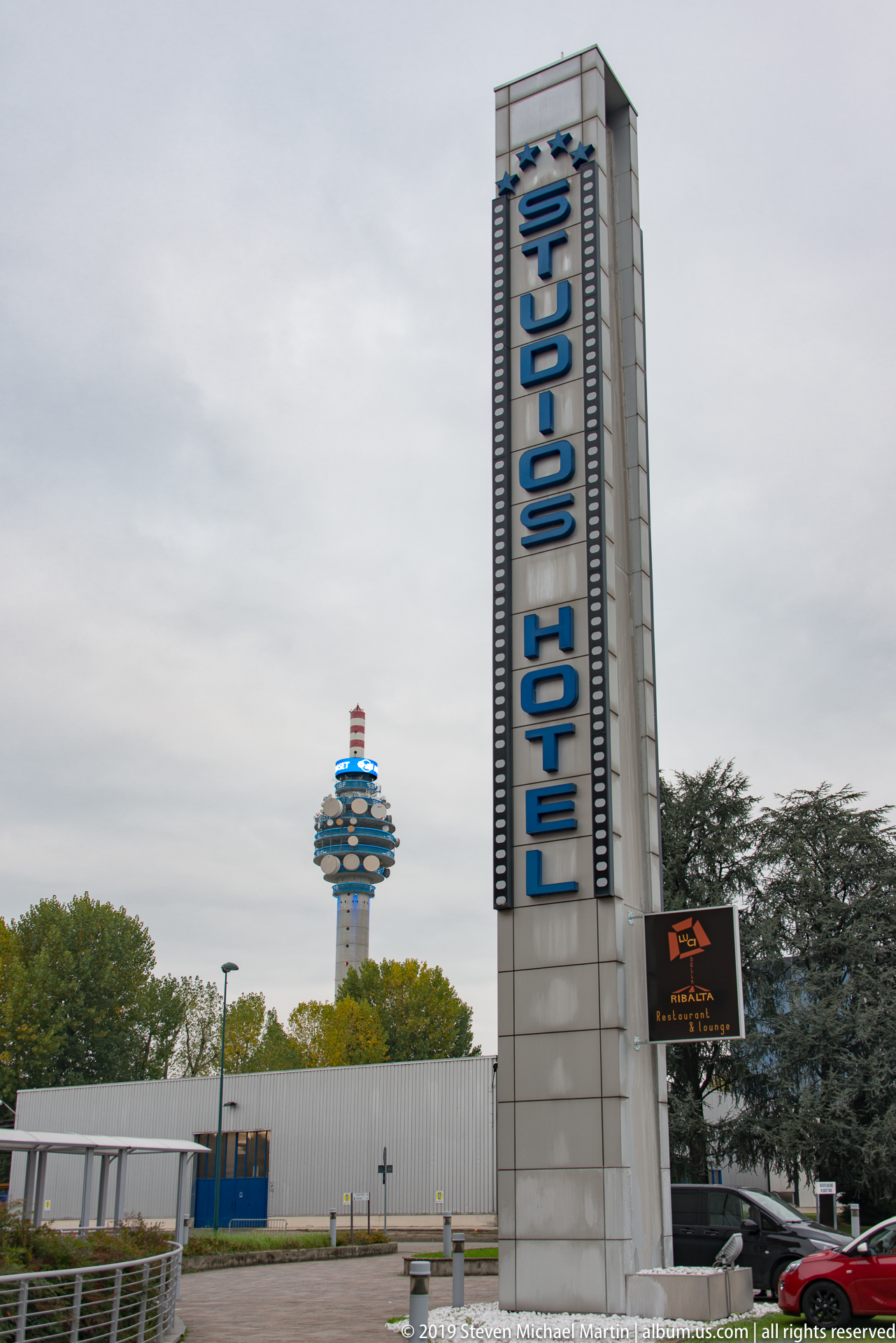
The vertical Klima Hotel sign rises beside an industrial-edge streetscape, while a tall telecommunications tower with circular antenna platforms appears beyond the trees. The view places contemporary hospitality and communications infrastructure within Milan’s outer urban fabric, contrasting the hotel’s narrow roadside pylon with the more distant technical tower.
Caption
The vertical Klima Hotel sign rises beside an industrial-edge streetscape, while a tall telecommunications tower with circular antenna platforms appears beyond the trees. The view places contemporary hospitality and communications infrastructure within Milan’s outer urban fabric, contrasting the hotel’s narrow roadside pylon with the more distant technical tower.

A telecommunications tower rises above the trees, its cylindrical shaft supporting stacked circular decks crowded with dish-shaped microwave antennas. Blue bands and a red-and-white striped mast accent the otherwise utilitarian structure. The close view isolates a piece of Milan’s communications infrastructure and emphasizes the engineered repetition of its antenna arrays.
Caption
A telecommunications tower rises above the trees, its cylindrical shaft supporting stacked circular decks crowded with dish-shaped microwave antennas. Blue bands and a red-and-white striped mast accent the otherwise utilitarian structure. The close view isolates a piece of Milan’s communications infrastructure and emphasizes the engineered repetition of its antenna arrays.

Leonardo da Vinci’s The Last Supper is shown in a close central view, with Christ seated at the midpoint of the long table as the apostles react in grouped gestures around him. The architectural perspective of the painted room converges behind Christ, reinforcing the composition’s focus. The mural occupies the refectory of the former Dominican convent beside Santa Maria delle Grazie in Milan.
Caption
Leonardo da Vinci’s The Last Supper is shown in a close central view, with Christ seated at the midpoint of the long table as the apostles react in grouped gestures around him. The architectural perspective of the painted room converges behind Christ, reinforcing the composition’s focus. The mural occupies the refectory of the former Dominican convent beside Santa Maria delle Grazie in Milan.

Claes Oldenburg and Coosje van Bruggen’s Ago, Filo e Nodo—Needle, Thread and Knot—rises beside Milano Cadorna station as a monumental loop of colored steel. Red, green, and yellow strands twist upward like oversized thread, transforming an everyday sewing motif into a city-scale landmark and playful point of orientation in the busy transport square.
Caption
Claes Oldenburg and Coosje van Bruggen’s Ago, Filo e Nodo—Needle, Thread and Knot—rises beside Milano Cadorna station as a monumental loop of colored steel. Red, green, and yellow strands twist upward like oversized thread, transforming an everyday sewing motif into a city-scale landmark and playful point of orientation in the busy transport square.

Tracks run through the open-air platforms of Cologno Sud station on the Milan Metro’s Line 2, with the green station band clearly naming the stop. The low modern platform architecture and long rails lead toward the distance, documenting the metropolitan edge of Milan’s transit system rather than the ornate historic center seen elsewhere in the portfolio.
Caption
Tracks run through the open-air platforms of Cologno Sud station on the Milan Metro’s Line 2, with the green station band clearly naming the stop. The low modern platform architecture and long rails lead toward the distance, documenting the metropolitan edge of Milan’s transit system rather than the ornate historic center seen elsewhere in the portfolio.

A bright yellow poster advertises the I Love LEGO exhibition at Milan’s Museo della Permanente, scheduled from 11 October 2019 to 2 February 2020 at Via Filippo Turati 34. A detailed LEGO cityscape fills the lower half beneath the red heart logo, turning the street advertisement into a compact document of the museum’s temporary exhibition program during the visit.
Caption
A bright yellow poster advertises the I Love LEGO exhibition at Milan’s Museo della Permanente, scheduled from 11 October 2019 to 2 February 2020 at Via Filippo Turati 34. A detailed LEGO cityscape fills the lower half beneath the red heart logo, turning the street advertisement into a compact document of the museum’s temporary exhibition program during the visit.

A modern Milan apartment block is defined by long stacked balconies set between massive gray vertical piers. Awnings, plants, outdoor furniture, and individual modifications break the otherwise repetitive grid, revealing how a large housing façade acquires variety through everyday use. Bare tree branches in the foreground soften the rigid geometry of concrete and brick.
Caption
A modern Milan apartment block is defined by long stacked balconies set between massive gray vertical piers. Awnings, plants, outdoor furniture, and individual modifications break the otherwise repetitive grid, revealing how a large housing façade acquires variety through everyday use. Bare tree branches in the foreground soften the rigid geometry of concrete and brick.

An immersive gallery installation arranges elongated, pale standing figures across a darkened exhibition space, each isolated by focused lighting. A visitor appears within a reflective or transparent enclosure at right, blurring the boundary between viewer and sculptural group. The presentation emphasizes repetition, scale, and bodily presence rather than a conventional pedestal-based display.
Caption
An immersive gallery installation arranges elongated, pale standing figures across a darkened exhibition space, each isolated by focused lighting. A visitor appears within a reflective or transparent enclosure at right, blurring the boundary between viewer and sculptural group. The presentation emphasizes repetition, scale, and bodily presence rather than a conventional pedestal-based display.

Two seated passengers smile toward the camera while wearing over-ear headphones during an airline journey. The close framing, aircraft seatbacks, and cabin wall create an informal travel portrait that marks the transition out of Milan rather than documenting a city landmark.
Caption
Two seated passengers smile toward the camera while wearing over-ear headphones during an airline journey. The close framing, aircraft seatbacks, and cabin wall create an informal travel portrait that marks the transition out of Milan rather than documenting a city landmark.

A blue United Airlines gate display welcomes passengers and asks them to remain comfortable until their group is called. Gate C120 and an on-time status are visible above, while a lower ticker references a departing flight to Jacksonville. The image documents the logistics of departure at the end of the Milan journey.
Caption
A blue United Airlines gate display welcomes passengers and asks them to remain comfortable until their group is called. Gate C120 and an on-time status are visible above, while a lower ticker references a departing flight to Jacksonville. The image documents the logistics of departure at the end of the Milan journey.
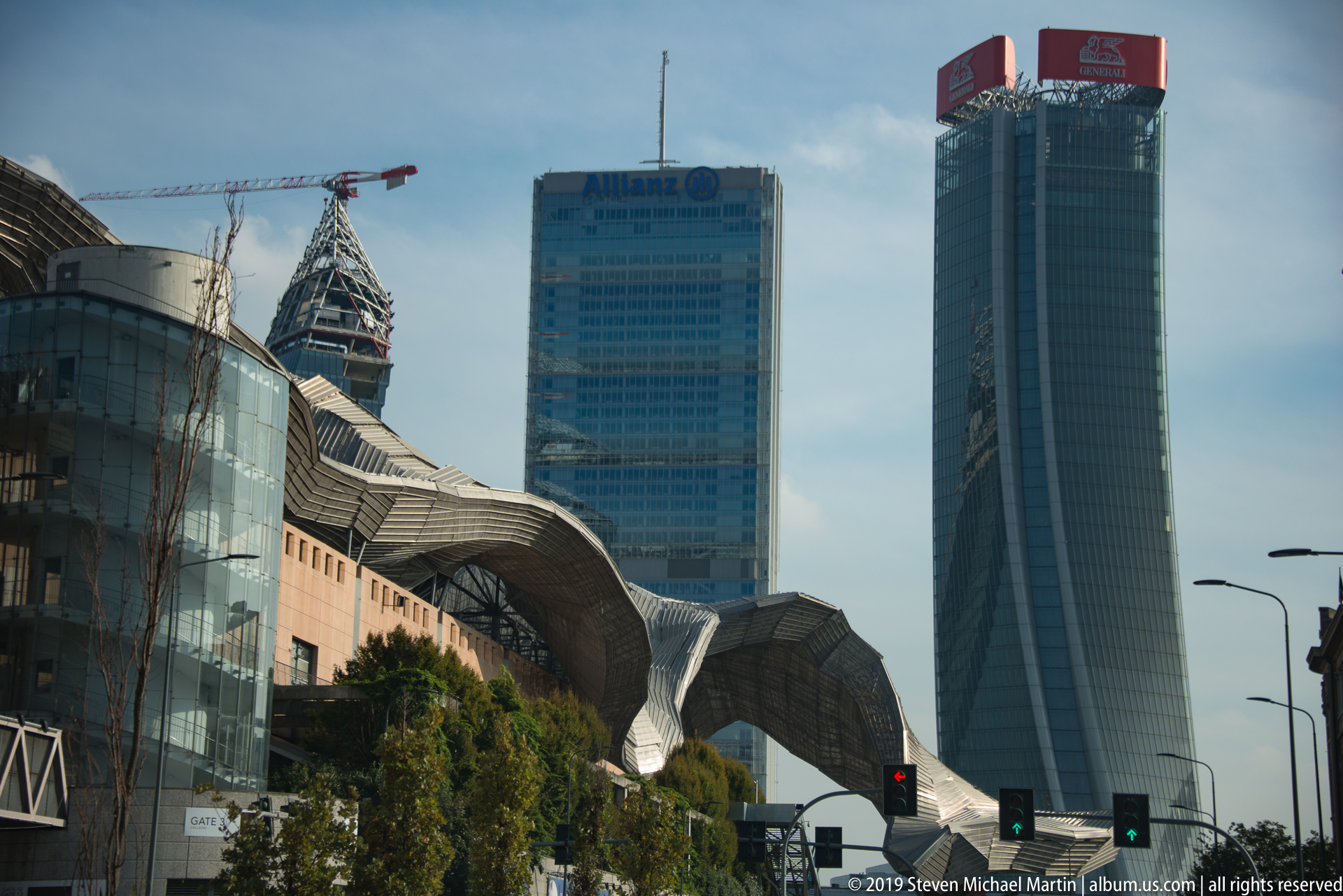
A cluster of contemporary Milan buildings combines glass office towers with a dramatically folded, metallic roof structure in the foreground. The contrasting silhouettes—rectilinear high-rises, a twisting tower, and the sculptural lower complex—show the city’s modern business architecture beyond its historic center.
Caption
A cluster of contemporary Milan buildings combines glass office towers with a dramatically folded, metallic roof structure in the foreground. The contrasting silhouettes—rectilinear high-rises, a twisting tower, and the sculptural lower complex—show the city’s modern business architecture beyond its historic center.

ATMosfera, Milan’s restaurant tram, appears in dark green livery with gold trim and large dining-car windows. The adapted historic streetcar combines public-transport heritage with a mobile restaurant experience, its name prominently displayed along the roofline as it moves through a tree-lined city street.
Caption
ATMosfera, Milan’s restaurant tram, appears in dark green livery with gold trim and large dining-car windows. The adapted historic streetcar combines public-transport heritage with a mobile restaurant experience, its name prominently displayed along the roofline as it moves through a tree-lined city street.

Bronze equestrian figures crown the Arco della Pace against a clear blue sky. Horses, riders, and allegorical figures rise above the pale stone attic, turning the summit of the triumphal arch into a dramatic silhouette. The low-angle view separates the sculpture from the architecture below and emphasizes its scale and ceremonial character.
Caption
Bronze equestrian figures crown the Arco della Pace against a clear blue sky. Horses, riders, and allegorical figures rise above the pale stone attic, turning the summit of the triumphal arch into a dramatic silhouette. The low-angle view separates the sculpture from the architecture below and emphasizes its scale and ceremonial character.

A large marble relief on the Arco della Pace presents a crowded classical narrative of standing, seated, and kneeling figures arranged around a central encounter. Drapery, armor, weapons, and gestures animate the shallow sculptural field. The close view records the arch’s commemorative program without assigning a specific historical episode that cannot be confirmed from the proof sheet alone.
Caption
A large marble relief on the Arco della Pace presents a crowded classical narrative of standing, seated, and kneeling figures arranged around a central encounter. Drapery, armor, weapons, and gestures animate the shallow sculptural field. The close view records the arch’s commemorative program without assigning a specific historical episode that cannot be confirmed from the proof sheet alone.

The Arco della Pace stands in full view at the edge of Parco Sempione, its broad central opening flanked by smaller arches, Corinthian columns, relief panels, and bronze sculpture above the attic. The oblique angle reveals the monument’s depth as well as its richly articulated façades, presenting Milan’s Neoclassical ceremonial gateway as both architecture and sculpture.
Caption
The Arco della Pace stands in full view at the edge of Parco Sempione, its broad central opening flanked by smaller arches, Corinthian columns, relief panels, and bronze sculpture above the attic. The oblique angle reveals the monument’s depth as well as its richly articulated façades, presenting Milan’s Neoclassical ceremonial gateway as both architecture and sculpture.

A sculpted relief on the Arco della Pace centers on a chariot and a group of classically draped figures, with a horse emerging at the right edge. The strong lateral arrangement and overlapping bodies create a compact historical tableau within the arch’s larger commemorative program. Sunlight rakes across the figures, sharpening the depth of the carved marble.
Caption
A sculpted relief on the Arco della Pace centers on a chariot and a group of classically draped figures, with a horse emerging at the right edge. The strong lateral arrangement and overlapping bodies create a compact historical tableau within the arch’s larger commemorative program. Sunlight rakes across the figures, sharpening the depth of the carved marble.

A bronze female figure rides a rearing horse high above the Arco della Pace, raising a wreath in one hand. Isolated against the sky, the sculpture reads as an allegory of victory rather than an architectural detail, with the energetic horse and lifted wreath projecting the triumphal symbolism of the monument.
Caption
A bronze female figure rides a rearing horse high above the Arco della Pace, raising a wreath in one hand. Isolated against the sky, the sculpture reads as an allegory of victory rather than an architectural detail, with the energetic horse and lifted wreath projecting the triumphal symbolism of the monument.

A monumental reclining male figure occupies a ledge on the Arco della Pace, shown nude and bearded with an oar or paddle resting against his body. The pose and attribute identify the sculpture broadly as a river-god personification, part of the arch’s classical allegorical program. The close framing emphasizes anatomy, drapery, and carved surface.
Caption
A monumental reclining male figure occupies a ledge on the Arco della Pace, shown nude and bearded with an oar or paddle resting against his body. The pose and attribute identify the sculpture broadly as a river-god personification, part of the arch’s classical allegorical program. The close framing emphasizes anatomy, drapery, and carved surface.

The Sestiga della Pace crowns the Arco della Pace with six bronze horses advancing abreast before the central figure of Peace. Seen from below, the horses form a powerful horizontal silhouette above the attic inscription, while the upright allegorical figure and staff anchor the composition at center.
Caption
The Sestiga della Pace crowns the Arco della Pace with six bronze horses advancing abreast before the central figure of Peace. Seen from below, the horses form a powerful horizontal silhouette above the attic inscription, while the upright allegorical figure and staff anchor the composition at center.

A marble relief on the Arco della Pace depicts a formal classical gathering around a seated male figure, with attendants, standing women, and circular emblems or shields arranged at the left. The scene’s hierarchy is conveyed through gesture and placement rather than deep spatial recession, characteristic of the arch’s commemorative sculptural program.
Caption
A marble relief on the Arco della Pace depicts a formal classical gathering around a seated male figure, with attendants, standing women, and circular emblems or shields arranged at the left. The scene’s hierarchy is conveyed through gesture and placement rather than deep spatial recession, characteristic of the arch’s commemorative sculptural program.

A bearded reclining male figure rests beside a cornucopia overflowing with fruit on the Arco della Pace. The abundance attribute, muscular anatomy, and classical pose identify the sculpture as a river-god or territorial personification within the monument’s allegorical program. Bright light brings out the carved folds and the contrasting textures of flesh, hair, and fruit.
Caption
A bearded reclining male figure rests beside a cornucopia overflowing with fruit on the Arco della Pace. The abundance attribute, muscular anatomy, and classical pose identify the sculpture as a river-god or territorial personification within the monument’s allegorical program. Bright light brings out the carved folds and the contrasting textures of flesh, hair, and fruit.

A bronze Victory rides a rearing horse above the Arco della Pace, extending a wreath outward against the blue sky. The side view emphasizes the forward thrust of the horse and the sweeping gesture of the rider, making the allegorical sculpture read as an independent silhouette while still belonging to the triumphal arch’s crowning ensemble.
Caption
A bronze Victory rides a rearing horse above the Arco della Pace, extending a wreath outward against the blue sky. The side view emphasizes the forward thrust of the horse and the sweeping gesture of the rider, making the allegorical sculpture read as an independent silhouette while still belonging to the triumphal arch’s crowning ensemble.
⭐ Highlights
- Duomo di Milano: One of the largest Gothic cathedrals in the world, dominating the city center.
- Galleria Vittorio Emanuele II: A 19th-century glass-roofed arcade known as the “living room” of Milan.
- Teatro alla Scala: One of the most famous opera houses in the world.
- Castello Sforzesco: A massive Renaissance fortress housing museums and collections.
- Cenacolo Vinciano: Leonardo da Vinci’s “The Last Supper,” one of the most important artworks in history.
- Fashion Capital: Milan is globally recognized as a center of fashion, finance, and modern Italian culture.
🏙️ Milan Field Guide
Major features observed during this visit:
Milan is the capital of the Lombardy region in northern Italy and one of Europe’s most important economic and cultural centers. Originally founded as a Celtic settlement and later developed by the Romans as Mediolanum, the city has played a major role throughout European history. Today, Milan blends its historical landmarks with a modern identity defined by design, fashion, and industry.
🏛️ Signature Landmarks
- Duomo di Milano – A vast Gothic cathedral that defines the city’s skyline.
- Galleria Vittorio Emanuele II – An elegant arcade connecting major squares in the city center.
- Teatro alla Scala – A historic opera house known worldwide for music and performance.
- Castello Sforzesco – A Renaissance fortress reflecting Milan’s political and military past.
- Santa Maria delle Grazie – The site of Leonardo da Vinci’s “The Last Supper.”
🧠 Historical Significance
- Ancient Origins – Founded by Celtic peoples and later expanded under Roman rule.
- Roman Capital – Served as a major center of the Western Roman Empire.
- Medieval and Renaissance Power – Ruled by influential families and central to regional politics.
- Modern Economic Hub – Today Milan is Italy’s leading financial and industrial center.
🌄 Urban Landscape & Setting
- Central Piazza – Piazza del Duomo forms the heart of the city.
- Historic and Modern Blend – Ancient structures coexist with modern architecture and design.
- Commercial Core – Streets radiate outward into shopping and business districts.
- Cultural Energy – Museums, galleries, and performance spaces define the city’s atmosphere.