Church of San Maurizio al Monastero Maggiore – Milan, Italy
The Church of San Maurizio al Monastero Maggiore stands in the historic center of Milan and is often described as the “Sistine Chapel of Milan.” Built during the Renaissance, the church originally served as part of a Benedictine convent.
The interior is remarkable for its extensive frescoes painted by artists of the Lombard Renaissance, many associated with the school of Bernardino Luini, a contemporary of Leonardo da Vinci. Nearly every wall and vault of the church is covered with vibrant biblical scenes and decorative artwork.
Hidden behind a relatively modest exterior, the richly decorated interior reveals one of the most extraordinary collections of Renaissance frescoes in northern Italy.
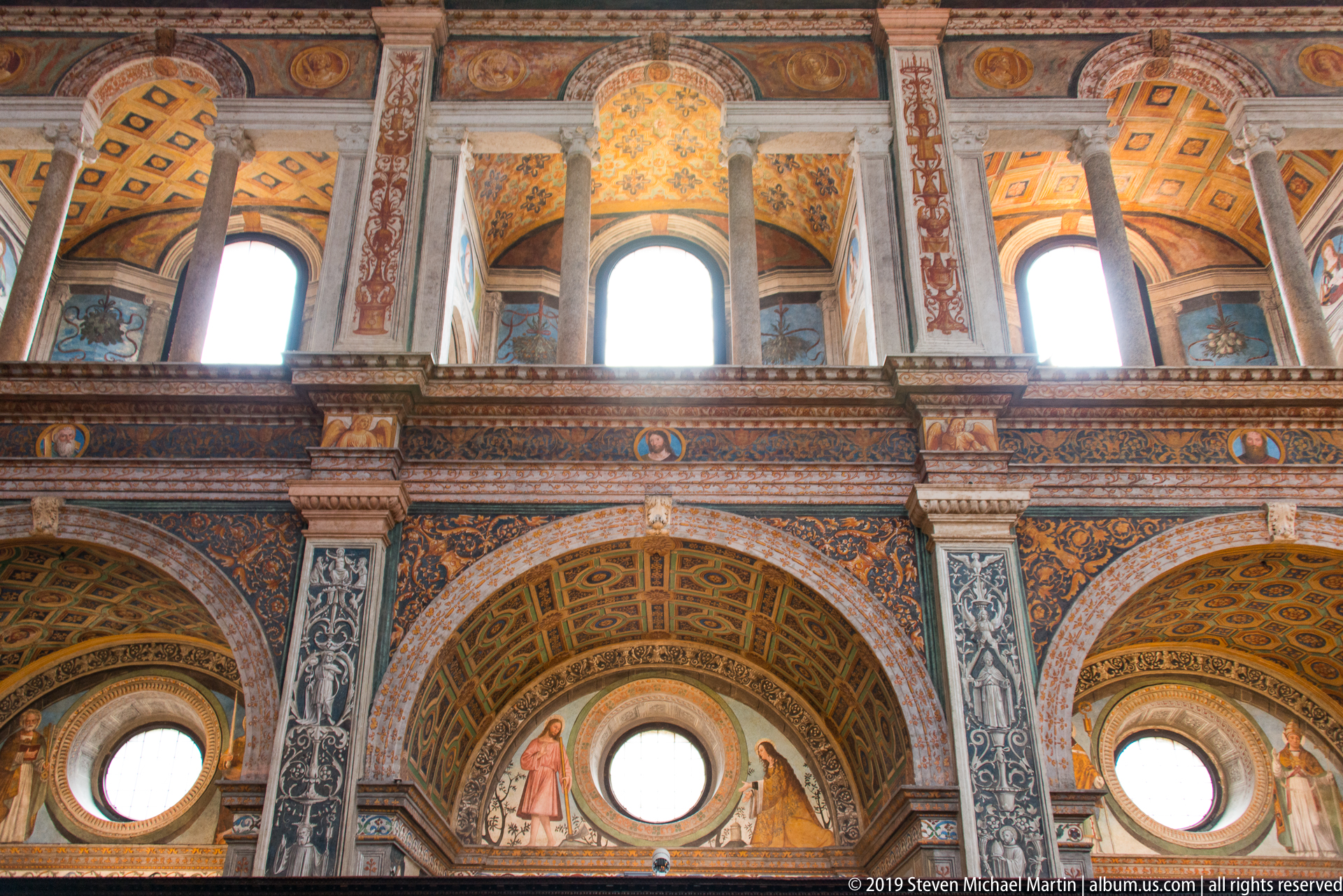
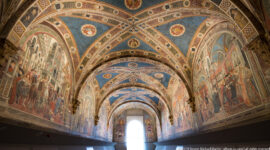
The upper wall of the church is articulated by a rhythm of tall openings and painted architectural bays above round oculi and frescoed arches. This view emphasizes the layered elevation—lower chapels, circular windows, gallery level, and richly decorated ceiling—that gives the single-nave interior its unusually elaborate vertical structure.
Caption
The upper wall of the church is articulated by a rhythm of tall openings and painted architectural bays above round oculi and frescoed arches. This view emphasizes the layered elevation—lower chapels, circular windows, gallery level, and richly decorated ceiling—that gives the single-nave interior its unusually elaborate vertical structure.

A large crucifix stands directly before a painted Last Supper, visually linking Christ’s sacrifice with the meal commemorated in Christian liturgy. The frescoed apostles gather around a long table beneath a canopy-like setting, while the three-dimensional cross projects into the foreground and interrupts the painted space.
Caption
A large crucifix stands directly before a painted Last Supper, visually linking Christ’s sacrifice with the meal commemorated in Christian liturgy. The frescoed apostles gather around a long table beneath a canopy-like setting, while the three-dimensional cross projects into the foreground and interrupts the painted space.

A frontal interior view shows the densely frescoed partition of San Maurizio al Monastero Maggiore, with multiple saints and narrative scenes arranged around the central altar. Painted pilasters, arches, and panels merge with the architecture, while the altar and grille mark the historic division between the public church and the former nuns’ enclosure.
Caption
A frontal interior view shows the densely frescoed partition of San Maurizio al Monastero Maggiore, with multiple saints and narrative scenes arranged around the central altar. Painted pilasters, arches, and panels merge with the architecture, while the altar and grille mark the historic division between the public church and the former nuns’ enclosure.

The church ceiling is organized as a dense lattice of diamond-shaped painted compartments, each filled with intricate Renaissance ornament. Circular windows puncture the upper walls on both sides, while the strongly foreshortened view emphasizes the long, barrel-vaulted volume and the remarkable continuity of painted decoration across the interior.
Caption
The church ceiling is organized as a dense lattice of diamond-shaped painted compartments, each filled with intricate Renaissance ornament. Circular windows puncture the upper walls on both sides, while the strongly foreshortened view emphasizes the long, barrel-vaulted volume and the remarkable continuity of painted decoration across the interior.

The upper interior of San Maurizio al Monastero Maggiore is framed by arcaded galleries, tall windows, and a richly patterned coffered vault. Fresco panels fill the lower wall beneath the openings, while painted pilasters and ornamental bands organize the architecture into a dense Renaissance decorative scheme. The elevated viewpoint emphasizes the layered relationship between structure, painted surface, and the former monastic enclosure.
Caption
The upper interior of San Maurizio al Monastero Maggiore is framed by arcaded galleries, tall windows, and a richly patterned coffered vault. Fresco panels fill the lower wall beneath the openings, while painted pilasters and ornamental bands organize the architecture into a dense Renaissance decorative scheme. The elevated viewpoint emphasizes the layered relationship between structure, painted surface, and the former monastic enclosure.

An ornate central tabernacle-like structure rises against the metal grille of the partition, combining dark wood, gilded ornament, columns, and a small devotional image. The close view emphasizes the physical boundary between the two halves of the church and the richly worked liturgical furnishing embedded within it.
Caption
An ornate central tabernacle-like structure rises against the metal grille of the partition, combining dark wood, gilded ornament, columns, and a small devotional image. The close view emphasizes the physical boundary between the two halves of the church and the richly worked liturgical furnishing embedded within it.

The richly painted partition wall of San Maurizio rises beneath the coffered vault, its surface divided into large narrative frescoes, framed sacred figures, and an altar zone at center. The dense arrangement of images and architectural framing makes the wall function both as a physical divider and as a monumental devotional screen. This frontal view shows how painting, altarpiece, and church architecture were coordinated into a single Renaissance ensemble.
Caption
The richly painted partition wall of San Maurizio rises beneath the coffered vault, its surface divided into large narrative frescoes, framed sacred figures, and an altar zone at center. The dense arrangement of images and architectural framing makes the wall function both as a physical divider and as a monumental devotional screen. This frontal view shows how painting, altarpiece, and church architecture were coordinated into a single Renaissance ensemble.

Two fresco episodes occupy a single arched bay: a bedchamber scene above and a crowded architectural narrative below. The stacked arrangement demonstrates how the church’s painters adapted sequential storytelling to narrow wall compartments, integrating multiple episodes within the decorative framework of the chapel.
Caption
Two fresco episodes occupy a single arched bay: a bedchamber scene above and a crowded architectural narrative below. The stacked arrangement demonstrates how the church’s painters adapted sequential storytelling to narrow wall compartments, integrating multiple episodes within the decorative framework of the chapel.

Three large fresco fields span the upper partition, centered on the Assumption of the Virgin. Mary rises within a luminous mandorla-like cloud surrounded by angels, while apostles gesture upward from below; narrative scenes on either side extend the painted program across the architectural width.
Caption
Three large fresco fields span the upper partition, centered on the Assumption of the Virgin. Mary rises within a luminous mandorla-like cloud surrounded by angels, while apostles gesture upward from below; narrative scenes on either side extend the painted program across the architectural width.
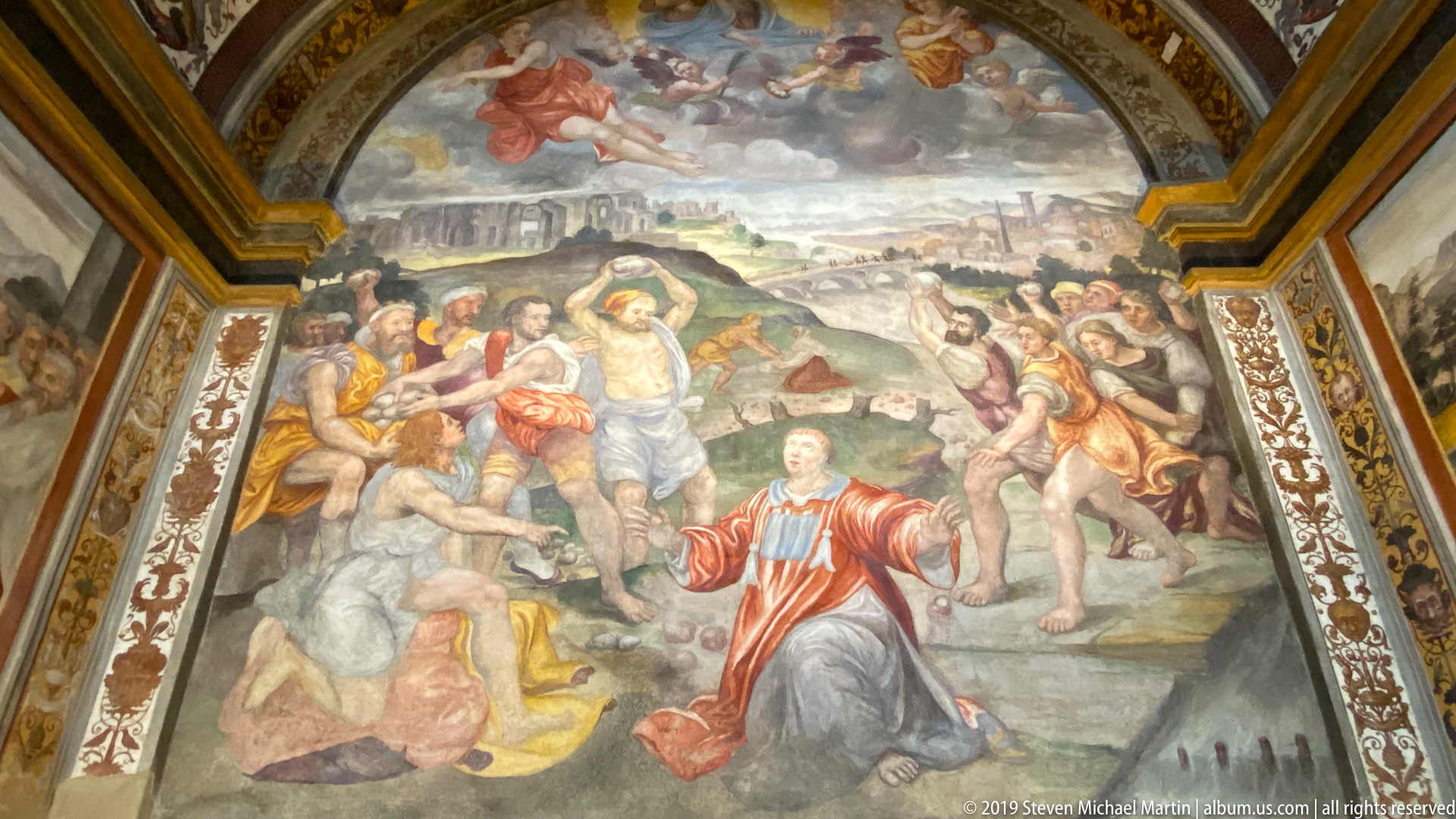
A large Renaissance fresco presents the martyrdom of Saint Maurice and the Theban Legion as a crowded narrative of soldiers, captives, and executioners. The kneeling saint in bright costume anchors the foreground while violence unfolds across the rocky landscape behind him, framed by painted architectural ornament within San Maurizio al Monastero Maggiore.
Caption
A large Renaissance fresco presents the martyrdom of Saint Maurice and the Theban Legion as a crowded narrative of soldiers, captives, and executioners. The kneeling saint in bright costume anchors the foreground while violence unfolds across the rocky landscape behind him, framed by painted architectural ornament within San Maurizio al Monastero Maggiore.

A dark devotional panel shows the dead Christ supported by mourners, with figures gathered closely around his body. Painted nude putti on either side hold festoons against a simulated architectural setting, creating a richly layered ensemble in which the central Passion scene is framed by Renaissance ornamental painting.
Caption
A dark devotional panel shows the dead Christ supported by mourners, with figures gathered closely around his body. Painted nude putti on either side hold festoons against a simulated architectural setting, creating a richly layered ensemble in which the central Passion scene is framed by Renaissance ornamental painting.

Two large fresco compartments fill a chapel wall at San Maurizio, separated by a richly painted pier and framed by round-arched architecture. The left scene is the martyrdom of Saint Maurice; the neighboring scene continues the saintly narrative, allowing the decorative program to be read as an integrated architectural and pictorial ensemble.
Caption
Two large fresco compartments fill a chapel wall at San Maurizio, separated by a richly painted pier and framed by round-arched architecture. The left scene is the martyrdom of Saint Maurice; the neighboring scene continues the saintly narrative, allowing the decorative program to be read as an integrated architectural and pictorial ensemble.

A carved stone lintel above a doorway bears the Latin inscription “MONASTERII MAIORIS SACRVM,” identifying the sacred setting of the former Monastero Maggiore. The restrained classical molding and pale stonework contrast with the exuberant frescoed interior seen elsewhere in the church.
Caption
A carved stone lintel above a doorway bears the Latin inscription “MONASTERII MAIORIS SACRVM,” identifying the sacred setting of the former Monastero Maggiore. The restrained classical molding and pale stonework contrast with the exuberant frescoed interior seen elsewhere in the church.

A small recessed opening is fitted with a dark metal grille and surrounded by painted architectural decoration. Its compact scale and placement within the partition wall evoke the controlled points of contact that once connected the public church with the cloistered community, though the precise historic use of this opening is not established by the photograph alone.
Caption
A small recessed opening is fitted with a dark metal grille and surrounded by painted architectural decoration. Its compact scale and placement within the partition wall evoke the controlled points of contact that once connected the public church with the cloistered community, though the precise historic use of this opening is not established by the photograph alone.

A tight view of the ceiling isolates the interlaced diamond grid that structures the vault decoration. Each compartment contains intricate foliate and arabesque-like motifs, producing a textile-like surface whose repeated geometry demonstrates how Renaissance ornament was used to unify the church’s long interior.
Caption
A tight view of the ceiling isolates the interlaced diamond grid that structures the vault decoration. Each compartment contains intricate foliate and arabesque-like motifs, producing a textile-like surface whose repeated geometry demonstrates how Renaissance ornament was used to unify the church’s long interior.

A tight view of San Maurizio’s ceiling reveals a dense geometric lattice of diamond and lozenge-shaped coffers filled with scrolling vegetal ornament. Repetition, symmetry, and warm earth tones create a richly textured surface that reads almost like carved marquetry from below. The detail isolates the craftsmanship of the ceiling program and shows how ornament continues across the church beyond its better-known figurative frescoes.
Caption
A tight view of San Maurizio’s ceiling reveals a dense geometric lattice of diamond and lozenge-shaped coffers filled with scrolling vegetal ornament. Repetition, symmetry, and warm earth tones create a richly textured surface that reads almost like carved marquetry from below. The detail isolates the craftsmanship of the ceiling program and shows how ornament continues across the church beyond its better-known figurative frescoes.

A crowded Renaissance fresco unfolds before a monumental classical building, with men, women, children, and animals compressed into a vivid foreground. A robed central figure bends toward people at ground level while attendants and onlookers gather around, creating an energetic scene of sacred action and communal response.
Caption
A crowded Renaissance fresco unfolds before a monumental classical building, with men, women, children, and animals compressed into a vivid foreground. A robed central figure bends toward people at ground level while attendants and onlookers gather around, creating an energetic scene of sacred action and communal response.

The risen Christ stands in a luminous landscape holding the cross-staff, framed by a richly ornamented arch whose coffers, rosettes, and painted reliefs extend the sacred image into the surrounding architecture. The composition combines a calm frontal figure with an elaborate Renaissance decorative envelope.
Caption
The risen Christ stands in a luminous landscape holding the cross-staff, framed by a richly ornamented arch whose coffers, rosettes, and painted reliefs extend the sacred image into the surrounding architecture. The composition combines a calm frontal figure with an elaborate Renaissance decorative envelope.

This closer view concentrates on Saint Maurice at the center of his martyrdom narrative. The kneeling saint, dressed in vivid red and blue, is surrounded by soldiers and executioners, while further killings recede into a rocky landscape and distant fortified city, sharpening the fresco’s contrast between calm devotion and collective violence.
Caption
This closer view concentrates on Saint Maurice at the center of his martyrdom narrative. The kneeling saint, dressed in vivid red and blue, is surrounded by soldiers and executioners, while further killings recede into a rocky landscape and distant fortified city, sharpening the fresco’s contrast between calm devotion and collective violence.

A domestic sacred narrative shows an elderly bearded man lying upright in bed while attendants approach from the foot and side. The shallow interior opens to a landscape through an arched doorway, and the restrained gestures and warm drapery place intimate human interaction at the center of the episode.
Caption
A domestic sacred narrative shows an elderly bearded man lying upright in bed while attendants approach from the foot and side. The shallow interior opens to a landscape through an arched doorway, and the restrained gestures and warm drapery place intimate human interaction at the center of the episode.

A close narrative scene gathers several men around a seated or crouching figure at the edge of a classical courtyard. Hands reach toward the central action, directing attention to an act of healing, charity, or blessing, while columns and distant figures establish a spacious architectural setting behind the tightly grouped foreground.
Caption
A close narrative scene gathers several men around a seated or crouching figure at the edge of a classical courtyard. Hands reach toward the central action, directing attention to an act of healing, charity, or blessing, while columns and distant figures establish a spacious architectural setting behind the tightly grouped foreground.

Painted figures recline and sit along the curve of an arch around a central roundel, while two standing saints or sacred figures occupy the lunette below. The composition uses the arch itself as a stage for figure painting, combining illusionistic ornament, medallions, and narrative presence in a single architectural zone.
Caption
Painted figures recline and sit along the curve of an arch around a central roundel, while two standing saints or sacred figures occupy the lunette below. The composition uses the arch itself as a stage for figure painting, combining illusionistic ornament, medallions, and narrative presence in a single architectural zone.

The Deposition from the Cross fills an arched field with tall ladders and three crosses dominating the composition. Men carefully lower Christ’s body while mourners gather below, and a distant city and landscape expand the Passion narrative beyond the immediate act of removal.
Caption
The Deposition from the Cross fills an arched field with tall ladders and three crosses dominating the composition. Men carefully lower Christ’s body while mourners gather below, and a distant city and landscape expand the Passion narrative beyond the immediate act of removal.

A baptismal scene is framed beneath a decorated arch, with a nearly nude central figure standing in water while a robed officiant reaches toward him. Attendants cluster nearby against a deep landscape, giving the episode both ceremonial focus and expansive spatial context.
Caption
A baptismal scene is framed beneath a decorated arch, with a nearly nude central figure standing in water while a robed officiant reaches toward him. Attendants cluster nearby against a deep landscape, giving the episode both ceremonial focus and expansive spatial context.

A white marble relief depicts Christ and the apostles seated around a table, set within a rectangular niche framed by richly colored marble. The restrained monochrome carving stands out against the surrounding polychrome stone, translating the familiar Last Supper composition into a sculptural register within the church interior.
Caption
A white marble relief depicts Christ and the apostles seated around a table, set within a rectangular niche framed by richly colored marble. The restrained monochrome carving stands out against the surrounding polychrome stone, translating the familiar Last Supper composition into a sculptural register within the church interior.

The altar built against the church partition combines a central tabernacle, dark wooden grille, polychrome marble, painted saints, and a white relief of the Last Supper. Seen frontally, the ensemble shows how painting, sculpture, architecture, and enclosure were coordinated into a single liturgical focal point.
Caption
The altar built against the church partition combines a central tabernacle, dark wooden grille, polychrome marble, painted saints, and a white relief of the Last Supper. Seen frontally, the ensemble shows how painting, sculpture, architecture, and enclosure were coordinated into a single liturgical focal point.

A richly decorated chapel bay combines several Passion-related frescoes beneath and around an arched vault. The Deposition from the Cross occupies the central lower field, while additional standing figures and narrative scenes fill the side walls and upper arch, creating a compact, immersive devotional program.
Caption
A richly decorated chapel bay combines several Passion-related frescoes beneath and around an arched vault. The Deposition from the Cross occupies the central lower field, while additional standing figures and narrative scenes fill the side walls and upper arch, creating a compact, immersive devotional program.

The central Assumption fresco shows the Virgin rising in a radiant cloud filled with angels while the apostles gather below around the empty tomb. Their animated gestures direct the eye upward toward Mary, whose blue and green robes and golden aura create the composition’s strongest vertical and chromatic focus.
Caption
The central Assumption fresco shows the Virgin rising in a radiant cloud filled with angels while the apostles gather below around the empty tomb. Their animated gestures direct the eye upward toward Mary, whose blue and green robes and golden aura create the composition’s strongest vertical and chromatic focus.

A close detail isolates the Virgin at the heart of the Assumption, standing in prayer within a burst of golden light and encircled by small angels. The tighter framing reveals the delicate modeling of her face, layered blue-green drapery, and the buoyant cloud forms that separate the heavenly zone from the narrative below.
Caption
A close detail isolates the Virgin at the heart of the Assumption, standing in prayer within a burst of golden light and encircled by small angels. The tighter framing reveals the delicate modeling of her face, layered blue-green drapery, and the buoyant cloud forms that separate the heavenly zone from the narrative below.

This vertical view includes both the heavenly and earthly halves of the Assumption. Mary rises among angels in a radiant cloud, while the apostles crowd around the tomb below, pointing and looking upward. The composition’s layered gestures connect the empty earthly space with the ascending figure above.
Caption
This vertical view includes both the heavenly and earthly halves of the Assumption. Mary rises among angels in a radiant cloud, while the apostles crowd around the tomb below, pointing and looking upward. The composition’s layered gestures connect the empty earthly space with the ascending figure above.

A long interior perspective shows the former nuns’ hall of San Maurizio, its walls and upper galleries covered with frescoes beneath an intricately patterned vault. The view emphasizes the unusual density of decoration and the spatial separation that once allowed the enclosed Benedictine community to participate in worship apart from the public nave.
Caption
A long interior perspective shows the former nuns’ hall of San Maurizio, its walls and upper galleries covered with frescoes beneath an intricately patterned vault. The view emphasizes the unusual density of decoration and the spatial separation that once allowed the enclosed Benedictine community to participate in worship apart from the public nave.

Noah’s Ark dominates this expansive fresco as pairs and groups of animals stream up a ramp toward the vessel. Human figures organize the procession below while birds fill the sky, turning the biblical story into a lively catalogue of creatures set within an open landscape.
Caption
Noah’s Ark dominates this expansive fresco as pairs and groups of animals stream up a ramp toward the vessel. Human figures organize the procession below while birds fill the sky, turning the biblical story into a lively catalogue of creatures set within an open landscape.

A monumental pipe organ rises against the frescoed interior, its vertical metal pipes framed by an ornate dark-and-gilt case. Painted full-length saints occupy the open shutters on either side, integrating musical furniture with the church’s broader pictorial program and the decorative geometry of the ceiling above.
Caption
A monumental pipe organ rises against the frescoed interior, its vertical metal pipes framed by an ornate dark-and-gilt case. Painted full-length saints occupy the open shutters on either side, integrating musical furniture with the church’s broader pictorial program and the decorative geometry of the ceiling above.

A circular image of God the Father dominates a deep-blue, star-studded vault, surrounded by angels and seated sacred figures set among gilded rays and ornamental borders. The composition turns the ceiling into a celestial field above the church interior, combining figural fresco with elaborate painted architecture. The close view isolates the theological imagery and decorative richness that characterize San Maurizio’s Renaissance interior.
Caption
A circular image of God the Father dominates a deep-blue, star-studded vault, surrounded by angels and seated sacred figures set among gilded rays and ornamental borders. The composition turns the ceiling into a celestial field above the church interior, combining figural fresco with elaborate painted architecture. The close view isolates the theological imagery and decorative richness that characterize San Maurizio’s Renaissance interior.

Dark wooden choir stalls line the lower walls beneath San Maurizio’s frescoed upper gallery, creating a strong contrast between functional monastic furnishings and the church’s painted architectural decoration. Tall windows admit light above narrative fresco panels, while the coffered ceiling extends overhead. The view conveys the enclosed, ordered character of the former nuns’ choir and its integration with the building’s lavish Renaissance program.
Caption
Dark wooden choir stalls line the lower walls beneath San Maurizio’s frescoed upper gallery, creating a strong contrast between functional monastic furnishings and the church’s painted architectural decoration. Tall windows admit light above narrative fresco panels, while the coffered ceiling extends overhead. The view conveys the enclosed, ordered character of the former nuns’ choir and its integration with the building’s lavish Renaissance program.

A side wall of San Maurizio is articulated by painted pilasters, arches, and a sequence of large narrative frescoes beneath the clerestory windows. The architecture and painting operate as a single visual system: fictive ornament frames each sacred scene while real openings admit daylight from above. This oblique view emphasizes the continuity of the fresco cycle along the nave and the dense layering of Renaissance decoration.
Caption
A side wall of San Maurizio is articulated by painted pilasters, arches, and a sequence of large narrative frescoes beneath the clerestory windows. The architecture and painting operate as a single visual system: fictive ornament frames each sacred scene while real openings admit daylight from above. This oblique view emphasizes the continuity of the fresco cycle along the nave and the dense layering of Renaissance decoration.

Interpretive panels outside San Maurizio al Monastero Maggiore introduce the monument with a portrait detail, a site diagram, and multilingual explanatory text. The display identifies the church for visitors before entry and provides orientation to its architectural layout and history. Set against the exterior stone wall, the signage records the modern heritage-management layer that accompanies the preserved Renaissance interior.
Caption
Interpretive panels outside San Maurizio al Monastero Maggiore introduce the monument with a portrait detail, a site diagram, and multilingual explanatory text. The display identifies the church for visitors before entry and provides orientation to its architectural layout and history. Set against the exterior stone wall, the signage records the modern heritage-management layer that accompanies the preserved Renaissance interior.