St. Mark’s Square – Venice, Italy
The grand St. Mark’s Square forms the ceremonial heart of Venice. Surrounded by historic buildings, arcaded walkways, and cafés, the square has served for centuries as the political and social center of the Venetian Republic.
Dominating the square is the magnificent St. Mark’s Basilica, whose domes and golden mosaics reflect strong Byzantine influence. Nearby stands the tall Campanile of St. Mark, offering sweeping views across the city and lagoon.
Because of its beauty and historical importance, St. Mark’s Square has long been considered one of the most famous public spaces in Europe.

Two bronze horses stand above the basilica façade before a large gridded window, their raised heads and forward-facing bodies seen at close range. Carved archivolts and columns frame the pair, allowing the dark green-patinated sculptures to stand out against the pale stone and patterned glazing.
Caption
Two bronze horses stand above the basilica façade before a large gridded window, their raised heads and forward-facing bodies seen at close range. Carved archivolts and columns frame the pair, allowing the dark green-patinated sculptures to stand out against the pale stone and patterned glazing.

St. Mark’s Campanile and the pale Gothic mass of the Doge’s Palace dominate this clear view from the lagoon. The waterfront edge, transit piers, and boats form a busy horizontal band below the skyline, presenting Venice’s ceremonial center from its traditional maritime approach.
Caption
St. Mark’s Campanile and the pale Gothic mass of the Doge’s Palace dominate this clear view from the lagoon. The waterfront edge, transit piers, and boats form a busy horizontal band below the skyline, presenting Venice’s ceremonial center from its traditional maritime approach.

Across the blue-green waters of the Venetian lagoon, the Campanile of St. Mark’s rises above the monumental waterfront around Piazza San Marco. The long horizontal frontage and passing boats emphasize the contrast between Venice’s civic architecture and its open maritime setting.
Caption
Across the blue-green waters of the Venetian lagoon, the Campanile of St. Mark’s rises above the monumental waterfront around Piazza San Marco. The long horizontal frontage and passing boats emphasize the contrast between Venice’s civic architecture and its open maritime setting.

Gold-ground mosaics cover the domes, pendentives, and arches of St. Mark’s Basilica, surrounding standing saints and narrative scenes with luminous patterned fields. The upward view spans several intersecting vaults, revealing how figural mosaics continue across the complex curved surfaces of the interior.
Caption
Gold-ground mosaics cover the domes, pendentives, and arches of St. Mark’s Basilica, surrounding standing saints and narrative scenes with luminous patterned fields. The upward view spans several intersecting vaults, revealing how figural mosaics continue across the complex curved surfaces of the interior.
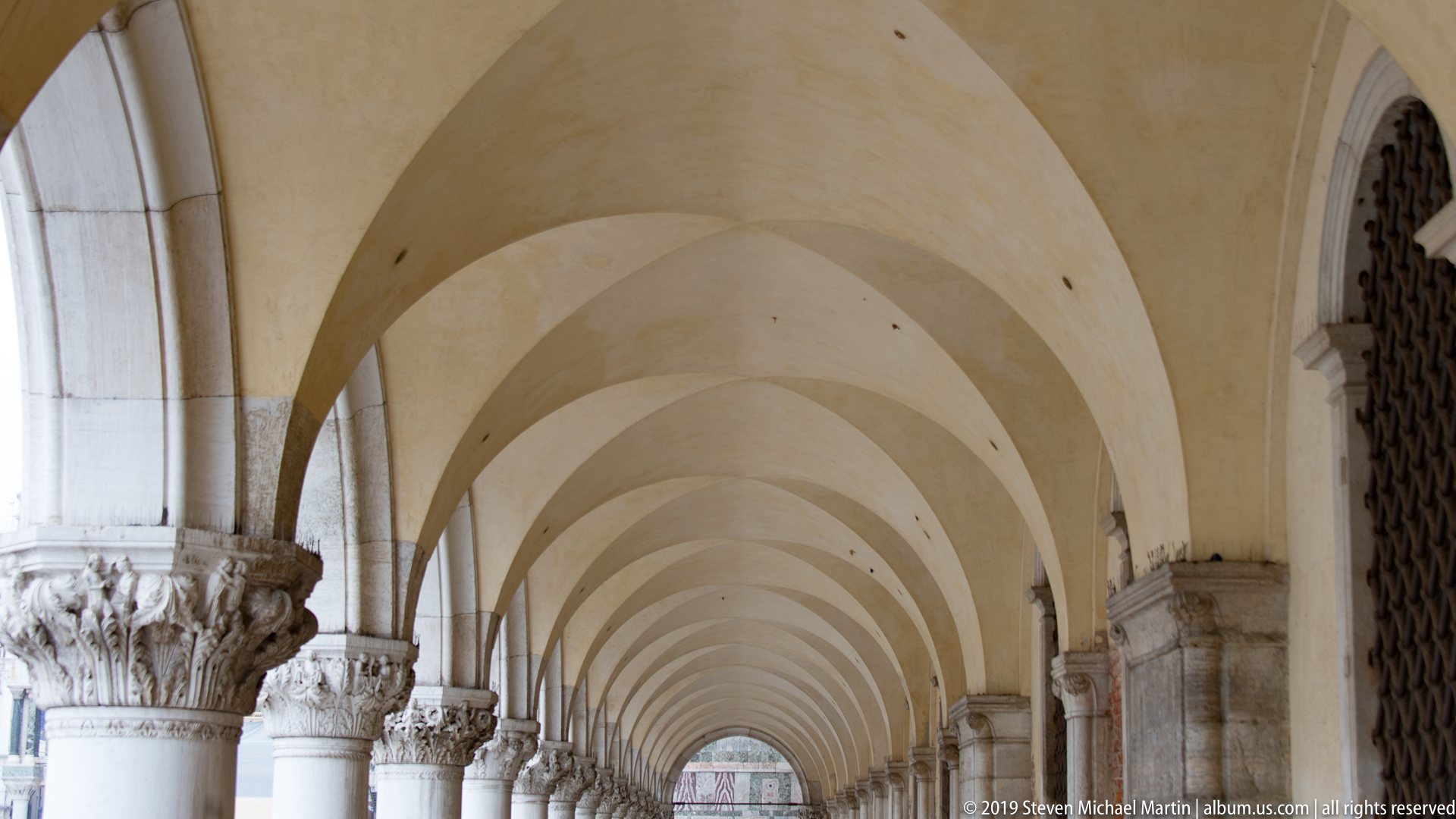
A rhythmic sequence of pale arches recedes through a covered passage beside St. Mark’s Square, supported by columns with carved capitals. The strongly centered perspective turns the arcade into a study of repetition and depth, with the vaulted ceiling and column line converging toward the distant end of the walkway.
Caption
A rhythmic sequence of pale arches recedes through a covered passage beside St. Mark’s Square, supported by columns with carved capitals. The strongly centered perspective turns the arcade into a study of repetition and depth, with the vaulted ceiling and column line converging toward the distant end of the walkway.

The winged Lion of St. Mark projects against an intense blue field patterned with gold stars, one paw set beside an open book. The tight frontal framing excludes most of the Clock Tower and concentrates on Venice’s emblem, its pale sculpted body sharply contrasted with the brilliant decorative ground.
Caption
The winged Lion of St. Mark projects against an intense blue field patterned with gold stars, one paw set beside an open book. The tight frontal framing excludes most of the Clock Tower and concentrates on Venice’s emblem, its pale sculpted body sharply contrasted with the brilliant decorative ground.

A wide lagoon panorama places the St. Mark’s waterfront to the left and the hazy silhouette of San Giorgio Maggiore to the right. Open water fills most of the frame, with scattered boats crossing the basin beneath strong backlight and atmospheric haze.
Caption
A wide lagoon panorama places the St. Mark’s waterfront to the left and the hazy silhouette of San Giorgio Maggiore to the right. Open water fills most of the frame, with scattered boats crossing the basin beneath strong backlight and atmospheric haze.

St. Mark’s Campanile rises into a cloudy sky through the opening of a massive stone arch, creating a deliberate frame within the frame. The tower’s brick shaft and green pyramidal roof contrast with the pale masonry and carved capital fragments at the edges of the foreground arch.
Caption
St. Mark’s Campanile rises into a cloudy sky through the opening of a massive stone arch, creating a deliberate frame within the frame. The tower’s brick shaft and green pyramidal roof contrast with the pale masonry and carved capital fragments at the edges of the foreground arch.

St. Mark’s Campanile anchors a broad lagoon-side view of central Venice, rising above the long waterfront near Piazza San Marco. Vaporetto traffic and smaller boats move along the shoreline, while the low, pale buildings form a continuous urban edge beneath a clear blue sky.
Caption
St. Mark’s Campanile anchors a broad lagoon-side view of central Venice, rising above the long waterfront near Piazza San Marco. Vaporetto traffic and smaller boats move along the shoreline, while the low, pale buildings form a continuous urban edge beneath a clear blue sky.

The great bell atop St. Mark’s Clock Tower is flanked by the two dark bronze figures traditionally known as the Moors, each poised beside the bell with a hammer. A gilded finial rises above, while modern lights and railings remain visible along the rooftop balustrade.
Caption
The great bell atop St. Mark’s Clock Tower is flanked by the two dark bronze figures traditionally known as the Moors, each poised beside the bell with a hammer. A gilded finial rises above, while modern lights and railings remain visible along the rooftop balustrade.

A gold-ground mosaic fills an arched lunette with a crowded narrative scene centered on richly dressed figures wearing turbans and long robes. Smaller figures and architectural details occupy the sides, while the decorative rosette above and surrounding stone arch place the mosaic within the basilica’s layered portal program.
Caption
A gold-ground mosaic fills an arched lunette with a crowded narrative scene centered on richly dressed figures wearing turbans and long robes. Smaller figures and architectural details occupy the sides, while the decorative rosette above and surrounding stone arch place the mosaic within the basilica’s layered portal program.
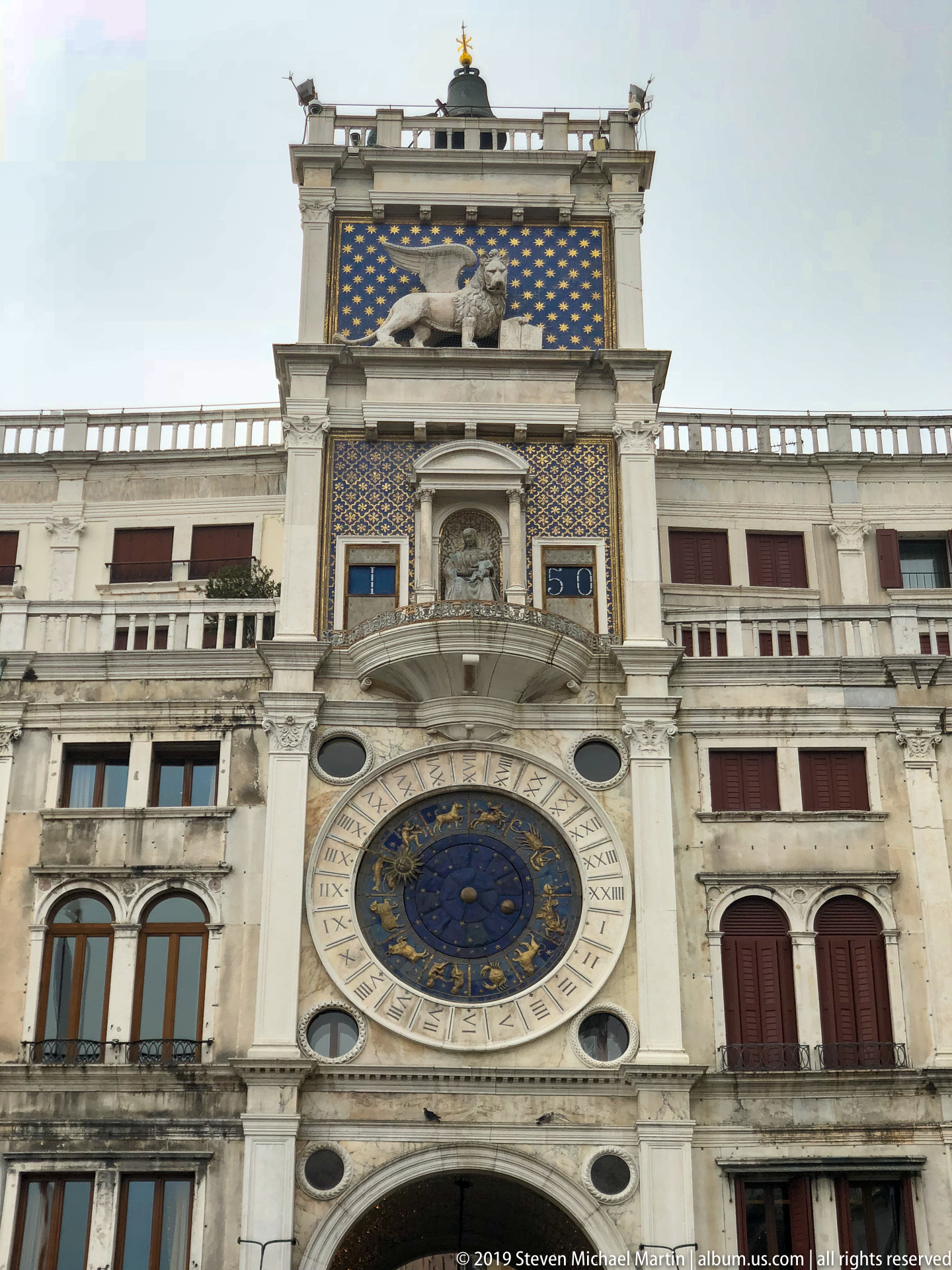
The richly decorated façade of St. Mark’s Clocktower rises above the square, centered on its blue-and-gold astronomical dial. Above it, the winged lion of St. Mark stands against a starry field, while sculptural and architectural tiers stack vertically toward the rooftop bell structure.
Caption
The richly decorated façade of St. Mark’s Clocktower rises above the square, centered on its blue-and-gold astronomical dial. Above it, the winged lion of St. Mark stands against a starry field, while sculptural and architectural tiers stack vertically toward the rooftop bell structure.

An elaborate gilded metal finial rises from a lead-covered rooftop cupola, its branching arms ending in small oval ornaments beneath a directional vane. Set against an uninterrupted blue sky, the close view isolates the craftsmanship and silhouette of this rooftop detail.
Caption
An elaborate gilded metal finial rises from a lead-covered rooftop cupola, its branching arms ending in small oval ornaments beneath a directional vane. Set against an uninterrupted blue sky, the close view isolates the craftsmanship and silhouette of this rooftop detail.

St. Mark’s Campanile rises across the square, framed dramatically by the dark curve of a foreground arcade. The red-brick shaft and pale belfry stand against a clear sky, while arcaded façades and pedestrians at ground level provide scale and context within Piazza San Marco.
Caption
St. Mark’s Campanile rises across the square, framed dramatically by the dark curve of a foreground arcade. The red-brick shaft and pale belfry stand against a clear sky, while arcaded façades and pedestrians at ground level provide scale and context within Piazza San Marco.
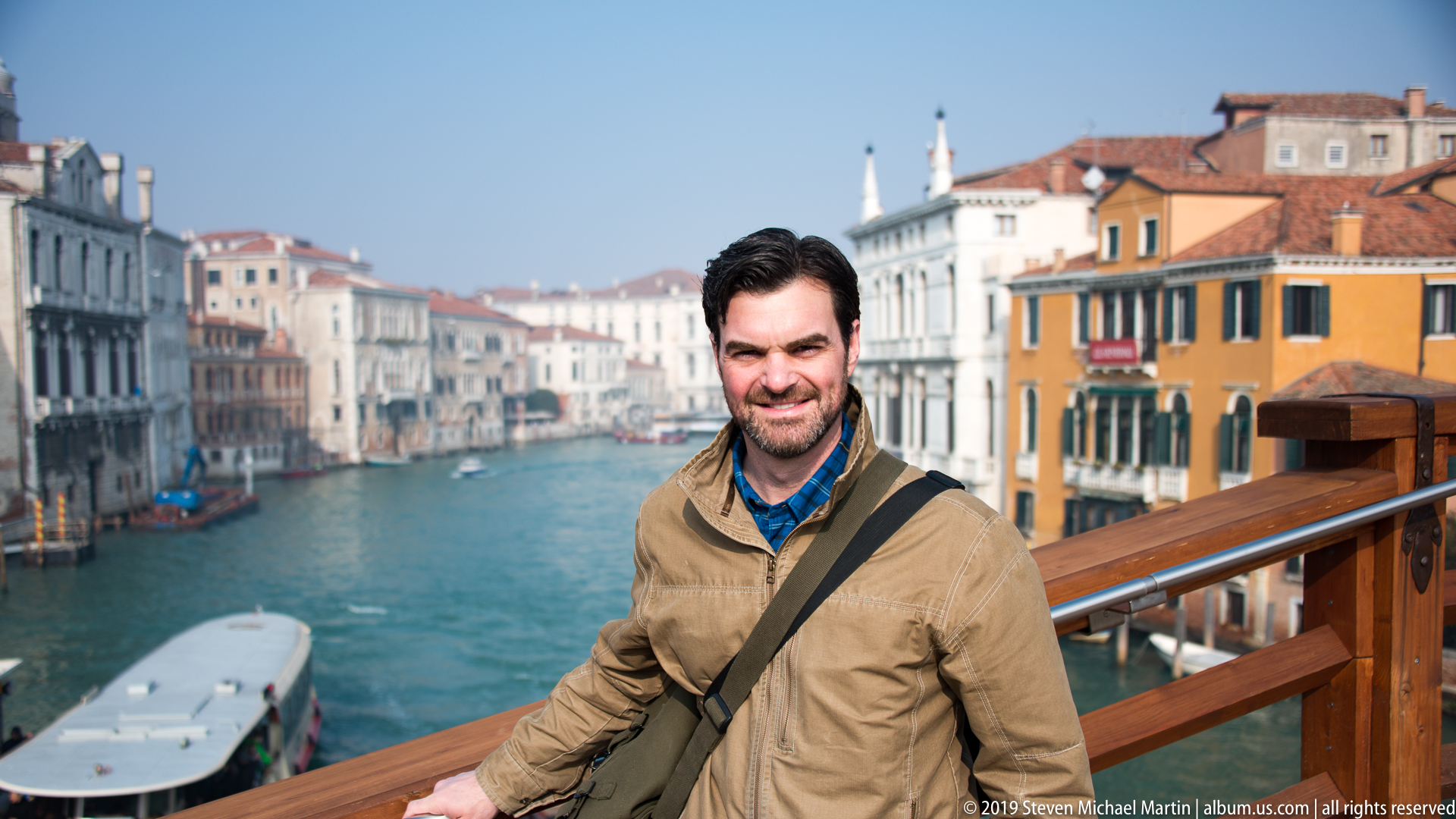
A traveler stands at a wooden bridge railing with the Grand Canal stretching behind him between tightly packed Venetian palazzi. Boats occupy the waterway below, while warm stucco façades and red-tiled roofs create a layered urban backdrop under clear daylight.
Caption
A traveler stands at a wooden bridge railing with the Grand Canal stretching behind him between tightly packed Venetian palazzi. Boats occupy the waterway below, while warm stucco façades and red-tiled roofs create a layered urban backdrop under clear daylight.

The nave of St. Mark’s Basilica opens toward the sanctuary beneath a sequence of gilded domes and arches. Mosaic-covered vaults glow above marble-lined galleries and arcades, while the deep central perspective draws the eye toward the liturgical furnishings at the east end.
Caption
The nave of St. Mark’s Basilica opens toward the sanctuary beneath a sequence of gilded domes and arches. Mosaic-covered vaults glow above marble-lined galleries and arcades, while the deep central perspective draws the eye toward the liturgical furnishings at the east end.

Golden mosaics cover domes, arches, pendentives, and vaults inside St. Mark’s Basilica, enveloping the interior in continuous narrative imagery. Rows of small windows puncture the base of the central dome and admit light across the shimmering surfaces. The wide upward view conveys the spatial layering of the church, where architecture and mosaic decoration merge across successive domed bays.
Caption
Golden mosaics cover domes, arches, pendentives, and vaults inside St. Mark’s Basilica, enveloping the interior in continuous narrative imagery. Rows of small windows puncture the base of the central dome and admit light across the shimmering surfaces. The wide upward view conveys the spatial layering of the church, where architecture and mosaic decoration merge across successive domed bays.

A traditional rigged vessel sits in the foreground of the lagoon, its mast, boom, lines, and dark hull sharply silhouetted against the open water. Beyond it, St. Mark’s Campanile and the pale waterfront buildings of central Venice establish the maritime setting.
Caption
A traditional rigged vessel sits in the foreground of the lagoon, its mast, boom, lines, and dark hull sharply silhouetted against the open water. Beyond it, St. Mark’s Campanile and the pale waterfront buildings of central Venice establish the maritime setting.

Two patinated bronze figures flank the large rooftop bell of St. Mark’s Clocktower, each extending an arm toward the bell as part of the clock’s striking mechanism. The sculptural group is isolated against a cloudless sky above a pale stone balustrade.
Caption
Two patinated bronze figures flank the large rooftop bell of St. Mark’s Clocktower, each extending an arm toward the bell as part of the clock’s striking mechanism. The sculptural group is isolated against a cloudless sky above a pale stone balustrade.

The upper façade of St. Mark’s Basilica fills the view with pinnacles, sculpted figures, mosaic-filled arches, and the curving profile of a lead-covered dome. The tight composition emphasizes the dense layering of Gothic and Byzantine-derived forms above the basilica’s principal elevation.
Caption
The upper façade of St. Mark’s Basilica fills the view with pinnacles, sculpted figures, mosaic-filled arches, and the curving profile of a lead-covered dome. The tight composition emphasizes the dense layering of Gothic and Byzantine-derived forms above the basilica’s principal elevation.

A small lead-covered cupola topped by a gilded orb and banner rises between two standing stone figures along a balustrade. The isolated rooftop ensemble is set against a blue sky, allowing the statues, flag, finial, and rounded lantern to read as distinct architectural ornaments.
Caption
A small lead-covered cupola topped by a gilded orb and banner rises between two standing stone figures along a balustrade. The isolated rooftop ensemble is set against a blue sky, allowing the statues, flag, finial, and rounded lantern to read as distinct architectural ornaments.

The Piazzetta opens toward the lagoon beside the arcaded façade of the Marciana Library. One of the monumental granite columns rises near the center, while San Giorgio Maggiore appears through haze across the water, creating a layered view from civic space to lagoon horizon.
Caption
The Piazzetta opens toward the lagoon beside the arcaded façade of the Marciana Library. One of the monumental granite columns rises near the center, while San Giorgio Maggiore appears through haze across the water, creating a layered view from civic space to lagoon horizon.

An oblique view follows the pointed arches and carved capitals of the Doge’s Palace arcade, compressing the repeating stone bays into a strong diagonal. Weathered Istrian stone surfaces, clustered columns, and Gothic tracery emphasize the craftsmanship and rhythmic structure of the palace’s lower level.
Caption
An oblique view follows the pointed arches and carved capitals of the Doge’s Palace arcade, compressing the repeating stone bays into a strong diagonal. Weathered Istrian stone surfaces, clustered columns, and Gothic tracery emphasize the craftsmanship and rhythmic structure of the palace’s lower level.

A pale stone relief set beside a pointed arch shows a dynamic central figure and several standing attendants beneath dense foliage carving. The close view isolates the sculptural program from the larger palace façade, revealing deep undercutting, drapery, and decorative borders in weathered stone.
Caption
A pale stone relief set beside a pointed arch shows a dynamic central figure and several standing attendants beneath dense foliage carving. The close view isolates the sculptural program from the larger palace façade, revealing deep undercutting, drapery, and decorative borders in weathered stone.

The Doge’s Palace façade presents its distinctive combination of pink-and-cream diamond-patterned masonry above two levels of pale Gothic arcades. Large arched windows punctuate the upper wall, while quatrefoil openings, pointed arches, and carved tracery create an intricate horizontal screen across the lower stories.
Caption
The Doge’s Palace façade presents its distinctive combination of pink-and-cream diamond-patterned masonry above two levels of pale Gothic arcades. Large arched windows punctuate the upper wall, while quatrefoil openings, pointed arches, and carved tracery create an intricate horizontal screen across the lower stories.

The Doge’s Palace colonnade recedes sharply into the distance, with pointed arches springing from columns capped by densely carved capitals. Seen from close range, the pale stone arcade frames a narrow pedestrian passage and reveals variations in the sculptural details from bay to bay.
Caption
The Doge’s Palace colonnade recedes sharply into the distance, with pointed arches springing from columns capped by densely carved capitals. Seen from close range, the pale stone arcade frames a narrow pedestrian passage and reveals variations in the sculptural details from bay to bay.

The enclosed Bridge of Sighs crosses the narrow Rio di Palazzo between pale stone façades, its arched span and small patterned windows suspended above the canal. A second bridge appears farther down the waterway, while tall walls funnel the view toward colorful buildings beyond.
Caption
The enclosed Bridge of Sighs crosses the narrow Rio di Palazzo between pale stone façades, its arched span and small patterned windows suspended above the canal. A second bridge appears farther down the waterway, while tall walls funnel the view toward colorful buildings beyond.

The Bridge of Sighs spans the Rio di Palazzo beyond a foreground marble balustrade, creating layered bands of carved stone. At left, a richly sculpted palace portal enters the frame; beyond the bridge, the canal narrows toward another crossing and warm-toned Venetian façades.
Caption
The Bridge of Sighs spans the Rio di Palazzo beyond a foreground marble balustrade, creating layered bands of carved stone. At left, a richly sculpted palace portal enters the frame; beyond the bridge, the canal narrows toward another crossing and warm-toned Venetian façades.

A centered view places the Bridge of Sighs above the Rio di Palazzo, with a pale Gothic balustrade spanning the immediate foreground. The symmetrical framing highlights the enclosed bridge’s arched underside and patterned windows while the canal leads toward smaller bridges and buildings in the distance.
Caption
A centered view places the Bridge of Sighs above the Rio di Palazzo, with a pale Gothic balustrade spanning the immediate foreground. The symmetrical framing highlights the enclosed bridge’s arched underside and patterned windows while the canal leads toward smaller bridges and buildings in the distance.

A carved stone figure and foliage ornament on the Doge’s Palace occupy the foreground beside a pointed arch, while the Bridge of Sighs spans the canal behind. The close juxtaposition brings sculptural detail, Gothic tracery, and the enclosed bridge into a single layered architectural study.
Caption
A carved stone figure and foliage ornament on the Doge’s Palace occupy the foreground beside a pointed arch, while the Bridge of Sighs spans the canal behind. The close juxtaposition brings sculptural detail, Gothic tracery, and the enclosed bridge into a single layered architectural study.

Rows of gondolas rock at their mooring poles along the San Marco waterfront, their dark hulls and blue covers silhouetted against bright lagoon water. Across the basin, the church and campanile of San Giorgio Maggiore emerge through haze, forming a soft monumental backdrop.
Caption
Rows of gondolas rock at their mooring poles along the San Marco waterfront, their dark hulls and blue covers silhouetted against bright lagoon water. Across the basin, the church and campanile of San Giorgio Maggiore emerge through haze, forming a soft monumental backdrop.

The bronze winged lion of St. Mark crowns its tall stone column in the Piazzetta, silhouetted against a clear blue sky. Behind it, the ornate roofline of the Marciana Library is lined with statues, obelisks, and a small domed lantern, layering civic symbols above the square.
Caption
The bronze winged lion of St. Mark crowns its tall stone column in the Piazzetta, silhouetted against a clear blue sky. Behind it, the ornate roofline of the Marciana Library is lined with statues, obelisks, and a small domed lantern, layering civic symbols above the square.

Seen from an angle, the Doge’s Palace stretches along the edge of the Piazzetta, its lower arcades receding beneath the broad patterned upper wall. The diagonal viewpoint emphasizes the palace’s length, repeating pointed arches, quatrefoil gallery, and ornate roofline against a bright Venetian sky.
Caption
Seen from an angle, the Doge’s Palace stretches along the edge of the Piazzetta, its lower arcades receding beneath the broad patterned upper wall. The diagonal viewpoint emphasizes the palace’s length, repeating pointed arches, quatrefoil gallery, and ornate roofline against a bright Venetian sky.

The classical arcades of the Marciana Library extend across the Piazzetta while St. Mark’s Campanile rises immediately behind them. A monumental column in the foreground and rooftop statues create strong vertical accents, contrasting with the library’s long, repetitive horizontal façade.
Caption
The classical arcades of the Marciana Library extend across the Piazzetta while St. Mark’s Campanile rises immediately behind them. A monumental column in the foreground and rooftop statues create strong vertical accents, contrasting with the library’s long, repetitive horizontal façade.

Gondolas crowd the waterfront moorings near Piazza San Marco, their curved black hulls, blue covers, and tall wooden poles filling the foreground. A green lantern marks the landing, while San Giorgio Maggiore appears as a pale silhouette across the bright, hazy lagoon.
Caption
Gondolas crowd the waterfront moorings near Piazza San Marco, their curved black hulls, blue covers, and tall wooden poles filling the foreground. A green lantern marks the landing, while San Giorgio Maggiore appears as a pale silhouette across the bright, hazy lagoon.

A ground-level view looks down the long arcade of the Doge’s Palace, where pale pointed arches and carved capitals repeat toward a distant vanishing point. Morning light spills across the patterned pavement, while a few pedestrians provide scale beneath the massive Gothic colonnade.
Caption
A ground-level view looks down the long arcade of the Doge’s Palace, where pale pointed arches and carved capitals repeat toward a distant vanishing point. Morning light spills across the patterned pavement, while a few pedestrians provide scale beneath the massive Gothic colonnade.

St. Mark’s Basilica faces the open piazza with its arched portals, pinnacles, and central dome, while the arcaded edge of the Doge’s Palace frames the right side. Temporary screening covers part of the basilica, making this a useful record of the monument during conservation work.
Caption
St. Mark’s Basilica faces the open piazza with its arched portals, pinnacles, and central dome, while the arcaded edge of the Doge’s Palace frames the right side. Temporary screening covers part of the basilica, making this a useful record of the monument during conservation work.

The corner of the Doge’s Palace is rendered as a layered screen of pale stone arches, columns, and quatrefoil openings. Strong backlight silhouettes the upper tracery and opens the lower arcade toward the lagoon, emphasizing the structural lightness of the palace’s two-tier exterior.
Caption
The corner of the Doge’s Palace is rendered as a layered screen of pale stone arches, columns, and quatrefoil openings. Strong backlight silhouettes the upper tracery and opens the lower arcade toward the lagoon, emphasizing the structural lightness of the palace’s two-tier exterior.

The brick shaft of St. Mark’s Campanile rises above the marble Loggetta and surrounding arcades, its pale belfry and pyramidal roof sharply outlined against a clear blue sky. The low viewpoint stresses the contrast between the tower’s massive vertical form and the richly articulated architecture at Piazza San Marco.
Caption
The brick shaft of St. Mark’s Campanile rises above the marble Loggetta and surrounding arcades, its pale belfry and pyramidal roof sharply outlined against a clear blue sky. The low viewpoint stresses the contrast between the tower’s massive vertical form and the richly articulated architecture at Piazza San Marco.

The astronomical clock occupies the lower portion of the Clock Tower, beneath the gilded winged Lion of St. Mark and the rooftop bell. This tightly framed elevation shows the tower’s stacked program of timekeeping, civic imagery, and sculpture against the surrounding pale stone façade.
Caption
The astronomical clock occupies the lower portion of the Clock Tower, beneath the gilded winged Lion of St. Mark and the rooftop bell. This tightly framed elevation shows the tower’s stacked program of timekeeping, civic imagery, and sculpture against the surrounding pale stone façade.

Colored marble, paired columns, relief panels, bronze figures, and a richly worked central gate fill this close view of the Loggetta at the foot of St. Mark’s Campanile. The frontal composition isolates the small ceremonial building’s sculptural façade from the larger tower above.
Caption
Colored marble, paired columns, relief panels, bronze figures, and a richly worked central gate fill this close view of the Loggetta at the foot of St. Mark’s Campanile. The frontal composition isolates the small ceremonial building’s sculptural façade from the larger tower above.

The upper Clock Tower is centered on the winged Lion of St. Mark set against a blue, star-studded field. Above, the large bell stands between the two bronze figures known as the Moors, creating a compact view of Venice’s civic and religious emblems against the sky.
Caption
The upper Clock Tower is centered on the winged Lion of St. Mark set against a blue, star-studded field. Above, the large bell stands between the two bronze figures known as the Moors, creating a compact view of Venice’s civic and religious emblems against the sky.

St. Mark’s Clock Tower rises above the arcaded buildings on the north side of the piazza, its astronomical dial and winged-lion panel visible from across the square. The broader view places the tower within the continuous urban façade and shows pedestrians crossing the patterned paving.
Caption
St. Mark’s Clock Tower rises above the arcaded buildings on the north side of the piazza, its astronomical dial and winged-lion panel visible from across the square. The broader view places the tower within the continuous urban façade and shows pedestrians crossing the patterned paving.

A long, repetitive arcade and stacked rows of windows define one side of Piazza San Marco, emphasizing the formal enclosure of the square. Sparse pedestrians and small vendor stands give scale to the monumental façade while leaving the patterned paving largely unobstructed.
Caption
A long, repetitive arcade and stacked rows of windows define one side of Piazza San Marco, emphasizing the formal enclosure of the square. Sparse pedestrians and small vendor stands give scale to the monumental façade while leaving the patterned paving largely unobstructed.

Gilded winged figures, blue mosaic grounds, carved foliage, and pinnacled niches crown a great upper arch of St. Mark’s Basilica. The upward-looking detail concentrates on the layered stone carving and metallic ornament that animate the basilica’s roofline above the main façade.
Caption
Gilded winged figures, blue mosaic grounds, carved foliage, and pinnacled niches crown a great upper arch of St. Mark’s Basilica. The upward-looking detail concentrates on the layered stone carving and metallic ornament that animate the basilica’s roofline above the main façade.

The winged Lion of St. Mark stands in silhouette atop its tall column on the Piazzetta, while domes and a campanile across the lagoon recede into atmospheric haze. Ornamental lamps and walking figures create a layered waterfront scene shaped by soft, diffuse light.
Caption
The winged Lion of St. Mark stands in silhouette atop its tall column on the Piazzetta, while domes and a campanile across the lagoon recede into atmospheric haze. Ornamental lamps and walking figures create a layered waterfront scene shaped by soft, diffuse light.

The central entrance of St. Mark’s Basilica is framed by concentric carved arches and a mosaic-filled lunette, with the great upper window and gilded roofline rising above. The frontal view reveals the façade’s dense layering of columns, sculpture, mosaic, and patterned marble.
Caption
The central entrance of St. Mark’s Basilica is framed by concentric carved arches and a mosaic-filled lunette, with the great upper window and gilded roofline rising above. The frontal view reveals the façade’s dense layering of columns, sculpture, mosaic, and patterned marble.

St. Mark’s Campanile rises dramatically from a low, angled viewpoint beside the projecting marble corner of the basilica. The composition contrasts the tower’s plain brick shaft with the basilica’s sculpted arches and colored stone, while the piazza remains visible at ground level.
Caption
St. Mark’s Campanile rises dramatically from a low, angled viewpoint beside the projecting marble corner of the basilica. The composition contrasts the tower’s plain brick shaft with the basilica’s sculpted arches and colored stone, while the piazza remains visible at ground level.

A succession of gilded mosaic domes recedes through the basilica interior, each ringed with figures and narrative imagery. Pools of artificial light pick out portions of the gold surfaces, while darker arch edges create a tunnel-like progression through the overlapping vaults.
Caption
A succession of gilded mosaic domes recedes through the basilica interior, each ringed with figures and narrative imagery. Pools of artificial light pick out portions of the gold surfaces, while darker arch edges create a tunnel-like progression through the overlapping vaults.

Wet-looking stone paving and long arcaded façades draw the eye toward the far end of Piazza San Marco. A few pedestrians occupy the broad open space, while temporary structures and café furnishings remain secondary to the square’s strong linear perspective.
Caption
Wet-looking stone paving and long arcaded façades draw the eye toward the far end of Piazza San Marco. A few pedestrians occupy the broad open space, while temporary structures and café furnishings remain secondary to the square’s strong linear perspective.

Two weathered stone lion sculptures occupy the paved space beside St. Mark’s Basilica, the nearer animal filling the foreground while the second sits farther back on a separate plinth. Their worn reddish surfaces and simplified forms stand out against the pale marble architecture behind them.
Caption
Two weathered stone lion sculptures occupy the paved space beside St. Mark’s Basilica, the nearer animal filling the foreground while the second sits farther back on a separate plinth. Their worn reddish surfaces and simplified forms stand out against the pale marble architecture behind them.

A restrained white stone palace façade faces the open space beside St. Mark’s Basilica, with evenly spaced windows, shallow balconies, relief panels, and a dark central doorway. The edge of the basilica enters at right, contrasting ornate medieval fabric with the more regular civic elevation.
Caption
A restrained white stone palace façade faces the open space beside St. Mark’s Basilica, with evenly spaced windows, shallow balconies, relief panels, and a dark central doorway. The edge of the basilica enters at right, contrasting ornate medieval fabric with the more regular civic elevation.

A large side arch of St. Mark’s Basilica encloses patterned marble panels, small reliefs, and a gated lower opening. Alternating pale and warm stone bands trace the arch, while surrounding wall surfaces display the varied marble veneers and reused sculptural elements characteristic of the exterior.
Caption
A large side arch of St. Mark’s Basilica encloses patterned marble panels, small reliefs, and a gated lower opening. Alternating pale and warm stone bands trace the arch, while surrounding wall surfaces display the varied marble veneers and reused sculptural elements characteristic of the exterior.
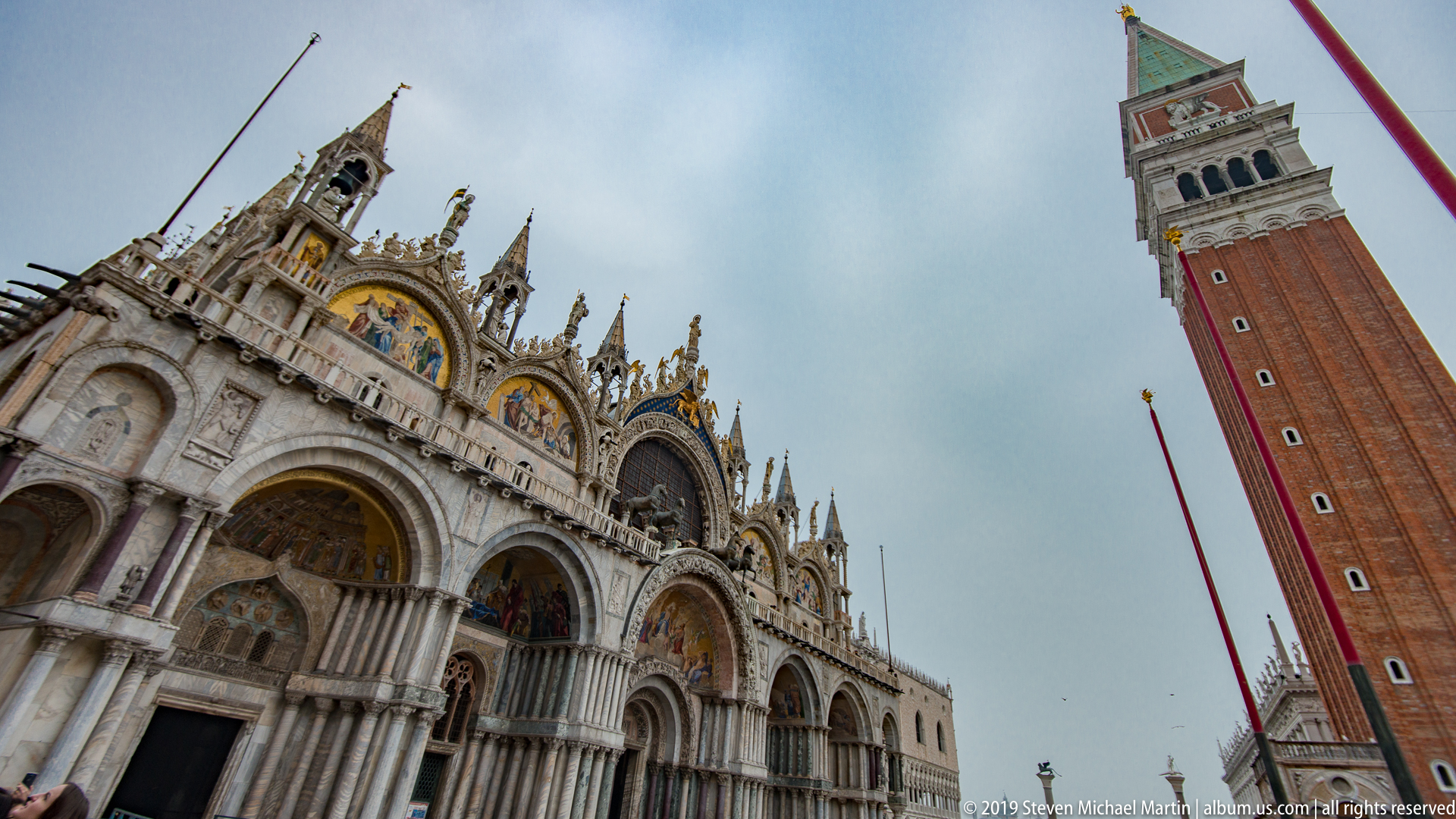
The ornate upper façade of St. Mark’s Basilica sweeps diagonally across the frame while the Campanile rises independently at right. Mosaic-filled arches, pinnacles, and marble columns contrast with the tower’s broad brick shaft, creating a compressed study of the piazza’s two dominant vertical and decorative forms.
Caption
The ornate upper façade of St. Mark’s Basilica sweeps diagonally across the frame while the Campanile rises independently at right. Mosaic-filled arches, pinnacles, and marble columns contrast with the tower’s broad brick shaft, creating a compressed study of the piazza’s two dominant vertical and decorative forms.

Three deep arches carried on clustered marble columns frame a wall covered with geometric panels, colored stone disks, relief fragments, and small windows. The upward viewpoint turns the basilica’s exterior into a close study of layered materials and decorative surfaces rather than a conventional façade view.
Caption
Three deep arches carried on clustered marble columns frame a wall covered with geometric panels, colored stone disks, relief fragments, and small windows. The upward viewpoint turns the basilica’s exterior into a close study of layered materials and decorative surfaces rather than a conventional façade view.

A pointed inner arch with sculpted reliefs sits beneath a broader band of densely carved foliage and figures on St. Mark’s Basilica. Pale marble columns and capitals frame the composition, while colored stone insets accent the layered arch, emphasizing the façade’s intricate surface carving.
Caption
A pointed inner arch with sculpted reliefs sits beneath a broader band of densely carved foliage and figures on St. Mark’s Basilica. Pale marble columns and capitals frame the composition, while colored stone insets accent the layered arch, emphasizing the façade’s intricate surface carving.

A gold mosaic dome dominates this upward interior view, encircled by standing figures and narrative scenes and connected to adjoining arches filled with medallions and saints. The oblique angle reveals the transition from the circular dome to the richly decorated supporting vaults.
Caption
A gold mosaic dome dominates this upward interior view, encircled by standing figures and narrative scenes and connected to adjoining arches filled with medallions and saints. The oblique angle reveals the transition from the circular dome to the richly decorated supporting vaults.

Concentric bands of mosaic scenes encircle a brilliant central medallion, with episodes arranged in successive registers against gold and green grounds. The near-symmetrical upward view makes the narrative organization legible as a continuous cycle wrapped around the domed surface.
Caption
Concentric bands of mosaic scenes encircle a brilliant central medallion, with episodes arranged in successive registers against gold and green grounds. The near-symmetrical upward view makes the narrative organization legible as a continuous cycle wrapped around the domed surface.

The Genesis mosaic cycle fills the frame as rings of small narrative scenes revolve around the luminous center of the dome. Green outer fields, gold inscriptions, and densely populated episodes form a vivid visual sequence, while the wider framing preserves more of the surrounding decorative border.
Caption
The Genesis mosaic cycle fills the frame as rings of small narrative scenes revolve around the luminous center of the dome. Green outer fields, gold inscriptions, and densely populated episodes form a vivid visual sequence, while the wider framing preserves more of the surrounding decorative border.

A large gold-ground lunette presents a crowded deathbed scene, with figures gathered around a reclining body beneath a central floral boss. Strong reds, whites, and ochres distinguish the participants, while the curved marble border frames the mosaic as a self-contained narrative panel.
Caption
A large gold-ground lunette presents a crowded deathbed scene, with figures gathered around a reclining body beneath a central floral boss. Strong reds, whites, and ochres distinguish the participants, while the curved marble border frames the mosaic as a self-contained narrative panel.

A gold-ground mosaic of a domed church and attendant figures fills the lunette above a basilica portal, framed by clustered columns and carved marble arches. Below, a second pointed opening contains relief sculpture and grilles, creating a dense vertical layering of mosaic, stone carving, and architecture.
Caption
A gold-ground mosaic of a domed church and attendant figures fills the lunette above a basilica portal, framed by clustered columns and carved marble arches. Below, a second pointed opening contains relief sculpture and grilles, creating a dense vertical layering of mosaic, stone carving, and architecture.

The bronze winged Lion of St. Mark strides along the capital of its tall column, isolated against a pale sky. A gull perched nearby gives an immediate sense of scale, while the close framing emphasizes the lion’s wings, extended tail, and weathered metal surface.
Caption
The bronze winged Lion of St. Mark strides along the capital of its tall column, isolated against a pale sky. A gull perched nearby gives an immediate sense of scale, while the close framing emphasizes the lion’s wings, extended tail, and weathered metal surface.
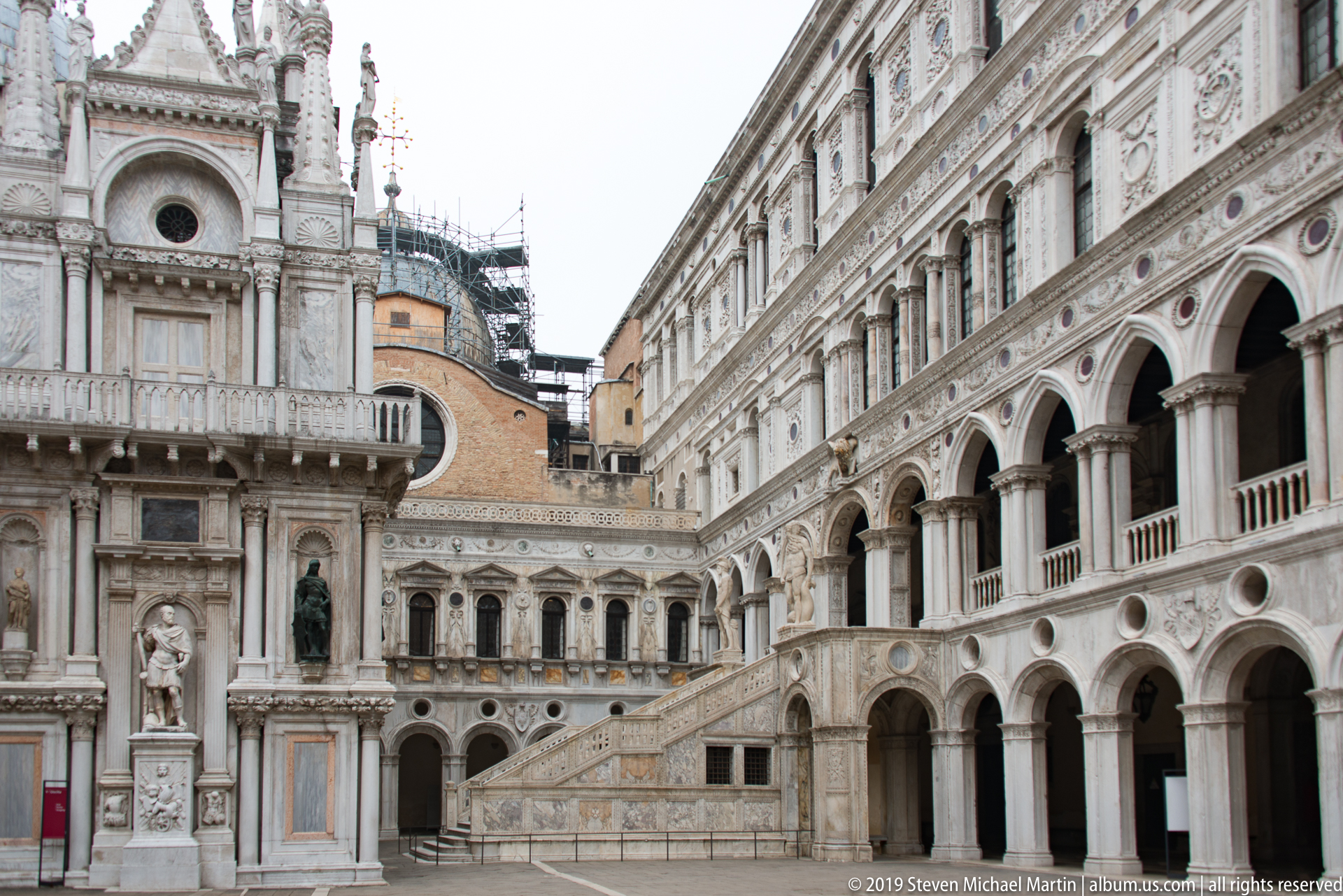
The ceremonial staircase of the Doge’s Palace climbs diagonally through a courtyard enclosed by richly carved arcades and upper loggias. Sculptural niches, roundels, columns, and patterned stone surfaces crowd the frame, while the stair provides a strong visual route between the lower and upper levels.
Caption
The ceremonial staircase of the Doge’s Palace climbs diagonally through a courtyard enclosed by richly carved arcades and upper loggias. Sculptural niches, roundels, columns, and patterned stone surfaces crowd the frame, while the stair provides a strong visual route between the lower and upper levels.

An elaborate Gothic gable rises above the Doge’s Palace courtyard, its pointed finials, carved pinnacles, circular opening, and relief panels arranged across a pale stone façade. The close frontal view isolates the roofline’s sculptural complexity from the surrounding courtyard architecture.
Caption
An elaborate Gothic gable rises above the Doge’s Palace courtyard, its pointed finials, carved pinnacles, circular opening, and relief panels arranged across a pale stone façade. The close frontal view isolates the roofline’s sculptural complexity from the surrounding courtyard architecture.

A large museum model combines a patterned, boxlike upper structure with an exposed framework of closely spaced wooden braces below. Displayed behind glass on a red plinth, the object reveals the dense supporting system beneath the decorated enclosure and presents constructional anatomy rather than a finished exterior alone.
Caption
A large museum model combines a patterned, boxlike upper structure with an exposed framework of closely spaced wooden braces below. Displayed behind glass on a red plinth, the object reveals the dense supporting system beneath the decorated enclosure and presents constructional anatomy rather than a finished exterior alone.
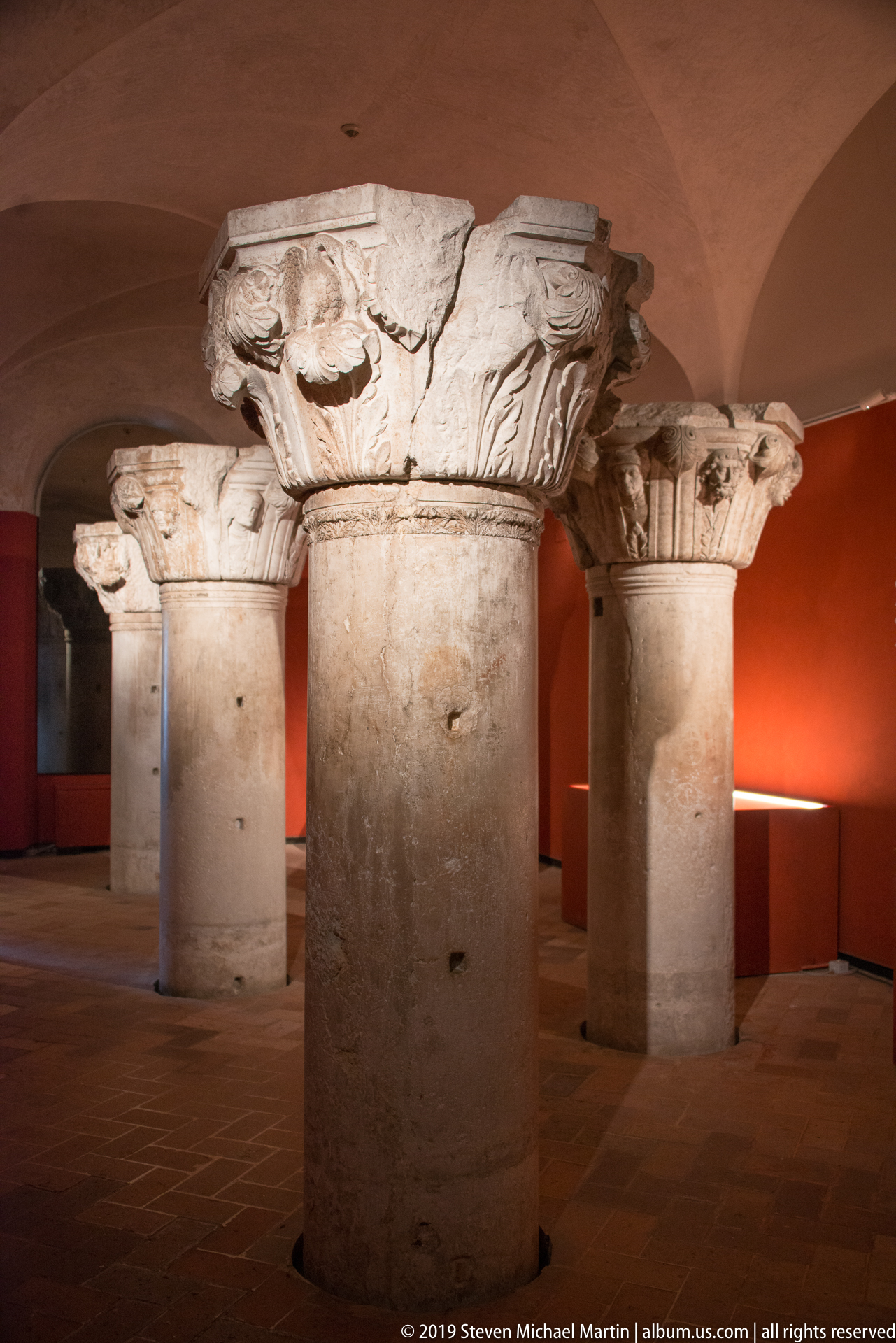
Four stout stone columns stand in a museum gallery, each capped by a different weathered carved capital. Their isolated arrangement and warm side lighting make variations in foliage, volutes, and figurative carving legible, while the plain shafts and tiled floor reinforce their presentation as salvaged architectural elements.
Caption
Four stout stone columns stand in a museum gallery, each capped by a different weathered carved capital. Their isolated arrangement and warm side lighting make variations in foliage, volutes, and figurative carving legible, while the plain shafts and tiled floor reinforce their presentation as salvaged architectural elements.

Seen from farther across the courtyard, the Scala dei Giganti links the ground-level arcade to the upper gallery of the Doge’s Palace. The wider composition emphasizes the staircase’s relationship to surrounding arches, statues, and carved wall surfaces, with the open paving forming a quiet foreground.
Caption
Seen from farther across the courtyard, the Scala dei Giganti links the ground-level arcade to the upper gallery of the Doge’s Palace. The wider composition emphasizes the staircase’s relationship to surrounding arches, statues, and carved wall surfaces, with the open paving forming a quiet foreground.

A bronze wellhead anchors the foreground of the Doge’s Palace courtyard beneath an intricate façade of arches, columns, niches, and statues. Above, a clock and pinnacled gable break the roofline, while the Scala dei Giganti appears at the far right, tying several courtyard elements into one architectural view.
Caption
A bronze wellhead anchors the foreground of the Doge’s Palace courtyard beneath an intricate façade of arches, columns, niches, and statues. Above, a clock and pinnacled gable break the roofline, while the Scala dei Giganti appears at the far right, tying several courtyard elements into one architectural view.

A monumental bronze wellhead stands at the center of the Doge’s Palace courtyard, set against three tiers of pale arcades and carved architectural ornament. The frontal composition balances the dark metal vessel against the repetitive columns and arches behind it, making the courtyard’s contrast of sculptural furnishing and richly ordered façade especially clear.
Caption
A monumental bronze wellhead stands at the center of the Doge’s Palace courtyard, set against three tiers of pale arcades and carved architectural ornament. The frontal composition balances the dark metal vessel against the repetitive columns and arches behind it, making the courtyard’s contrast of sculptural furnishing and richly ordered façade especially clear.

A historic gondola is displayed indoors beside a plastered wall with iron-grilled windows, allowing its long black hull and high, curved end to be studied at close range. The elevated mounting exposes the vessel’s construction and distinctive asymmetrical profile without the visual distractions of a canal setting.
Caption
A historic gondola is displayed indoors beside a plastered wall with iron-grilled windows, allowing its long black hull and high, curved end to be studied at close range. The elevated mounting exposes the vessel’s construction and distinctive asymmetrical profile without the visual distractions of a canal setting.

Freestanding stone fragments preserve richly carved capitals and a large piece of Gothic tracery, displayed against exposed brick in a museum setting. The juxtaposition makes the depth of the foliate carving and the complex intersecting curves of the tracery easier to examine than they would be in their original architectural position.
Caption
Freestanding stone fragments preserve richly carved capitals and a large piece of Gothic tracery, displayed against exposed brick in a museum setting. The juxtaposition makes the depth of the foliate carving and the complex intersecting curves of the tracery easier to examine than they would be in their original architectural position.

A weathered stone relief of a lion fills the upper slab of this museum display, its mane rendered in flowing incised locks and its body stretched across the rectangular field. A second carved fragment rests below, emphasizing the presentation of surviving sculptural elements as individual archaeological or architectural objects.
Caption
A weathered stone relief of a lion fills the upper slab of this museum display, its mane rendered in flowing incised locks and its body stretched across the rectangular field. A second carved fragment rests below, emphasizing the presentation of surviving sculptural elements as individual archaeological or architectural objects.

A large circular clock face occupies the center of an ornate pale-stone façade, flanked by standing figures in niches and framed by scrollwork, garlands, and relief ornament. Above, a steep metal-clad roof and small green finials complete the vertical composition, while the close view isolates the timepiece from the surrounding building.
Caption
A large circular clock face occupies the center of an ornate pale-stone façade, flanked by standing figures in niches and framed by scrollwork, garlands, and relief ornament. Above, a steep metal-clad roof and small green finials complete the vertical composition, while the close view isolates the timepiece from the surrounding building.

Massive stone columns with deeply carved capitals dominate a red-walled museum gallery, where pale figurative sculptures are arranged on pedestals around them. The low viewpoint emphasizes the scale and varied carving of the capitals while preserving the relationship between the architectural fragments and the freestanding sculpture collection.
Caption
Massive stone columns with deeply carved capitals dominate a red-walled museum gallery, where pale figurative sculptures are arranged on pedestals around them. The low viewpoint emphasizes the scale and varied carving of the capitals while preserving the relationship between the architectural fragments and the freestanding sculpture collection.

A dark wooden arched door is enclosed by a richly carved stone surround of fluted pilasters, winged figures, a projecting entablature, and a central grotesque mask. The close framing reveals the contrast between the crisp classical architectural vocabulary and the worn plaster and exposed brick of the surrounding wall.
Caption
A dark wooden arched door is enclosed by a richly carved stone surround of fluted pilasters, winged figures, a projecting entablature, and a central grotesque mask. The close framing reveals the contrast between the crisp classical architectural vocabulary and the worn plaster and exposed brick of the surrounding wall.

A row of reused stone columns presents several distinct carved capitals, including foliage, faces, and compact figurative forms. Warm gallery lighting and the red wall behind them sharpen the relief, making the differences in carving style and condition across the architectural fragments easy to compare.
Caption
A row of reused stone columns presents several distinct carved capitals, including foliage, faces, and compact figurative forms. Warm gallery lighting and the red wall behind them sharpen the relief, making the differences in carving style and condition across the architectural fragments easy to compare.

A group of carved figures projects from the corner above an arcade, with a seated central figure surrounded by attendants in deeply folded garments. Seen from below, the pale marble group stands out against the architectural cornice and balustrade, emphasizing its role as integrated façade sculpture rather than a freestanding monument.
Caption
A group of carved figures projects from the corner above an arcade, with a seated central figure surrounded by attendants in deeply folded garments. Seen from below, the pale marble group stands out against the architectural cornice and balustrade, emphasizing its role as integrated façade sculpture rather than a freestanding monument.

A broad gold-ground mosaic stretches across the lunette above a deeply recessed basilica portal, framed by concentric bands of intricate stone carving. The close upward view separates this narrative panel from the larger façade and draws attention to the relationship between the colorful mosaic and the sculpted archivolts below.
Caption
A broad gold-ground mosaic stretches across the lunette above a deeply recessed basilica portal, framed by concentric bands of intricate stone carving. The close upward view separates this narrative panel from the larger façade and draws attention to the relationship between the colorful mosaic and the sculpted archivolts below.

A wider view of the Clock Tower centers the astronomical dial beneath the arched niche of the Madonna and Child, flanked by blue numeral panels. Gold stars pattern the upper background, while the dial’s zodiac ring and Roman numerals remain legible below, showing the tower’s stacked timekeeping and devotional program.
Caption
A wider view of the Clock Tower centers the astronomical dial beneath the arched niche of the Madonna and Child, flanked by blue numeral panels. Gold stars pattern the upper background, while the dial’s zodiac ring and Roman numerals remain legible below, showing the tower’s stacked timekeeping and devotional program.

A richly ordered façade combines three large ground-level arches with columns, sculpted figures, and a broad upper band of rectangular relief panels. The frontal view emphasizes the regular architectural grid and the contrast between pale stone ornament, darker openings, and the brick wall rising behind the balustrade.
Caption
A richly ordered façade combines three large ground-level arches with columns, sculpted figures, and a broad upper band of rectangular relief panels. The frontal view emphasizes the regular architectural grid and the contrast between pale stone ornament, darker openings, and the brick wall rising behind the balustrade.

A formal procession of robed figures advances across a gold-ground mosaic lunette, with a prominent cleric and attendants at the center and additional figures grouped at either side. The semicircular composition is framed by marble columns and carved arches, integrating the narrative scene into the basilica façade.
Caption
A formal procession of robed figures advances across a gold-ground mosaic lunette, with a prominent cleric and attendants at the center and additional figures grouped at either side. The semicircular composition is framed by marble columns and carved arches, integrating the narrative scene into the basilica façade.
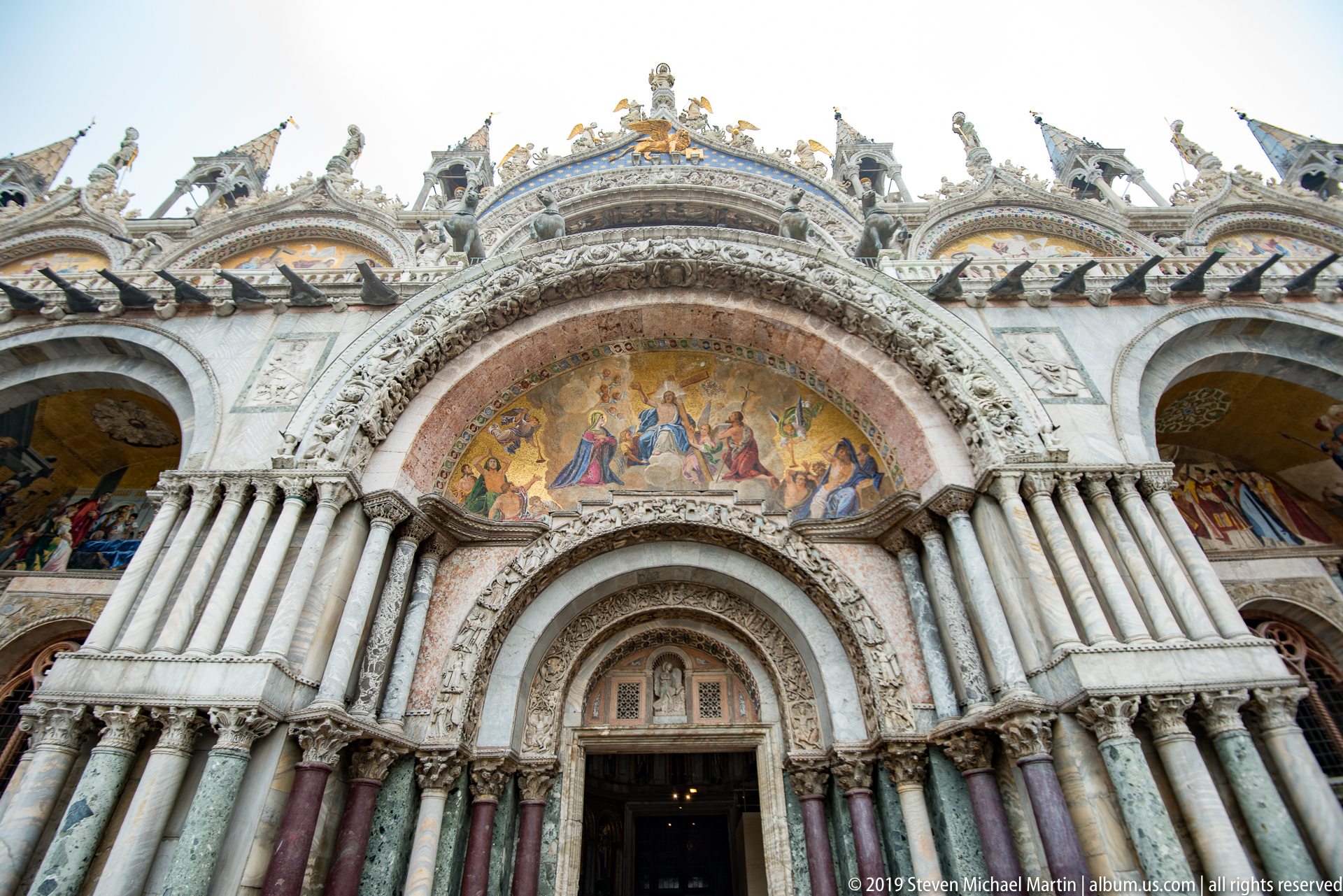
The central portal of St. Mark’s Basilica is framed by multiple carved archivolts and dense ranks of marble columns, with a luminous mosaic lunette above the doorway. The upward view compresses sculpture, mosaic, patterned stone, and roofline ornament into a single façade study, highlighting the portal’s extraordinary layered depth.
Caption
The central portal of St. Mark’s Basilica is framed by multiple carved archivolts and dense ranks of marble columns, with a luminous mosaic lunette above the doorway. The upward view compresses sculpture, mosaic, patterned stone, and roofline ornament into a single façade study, highlighting the portal’s extraordinary layered depth.
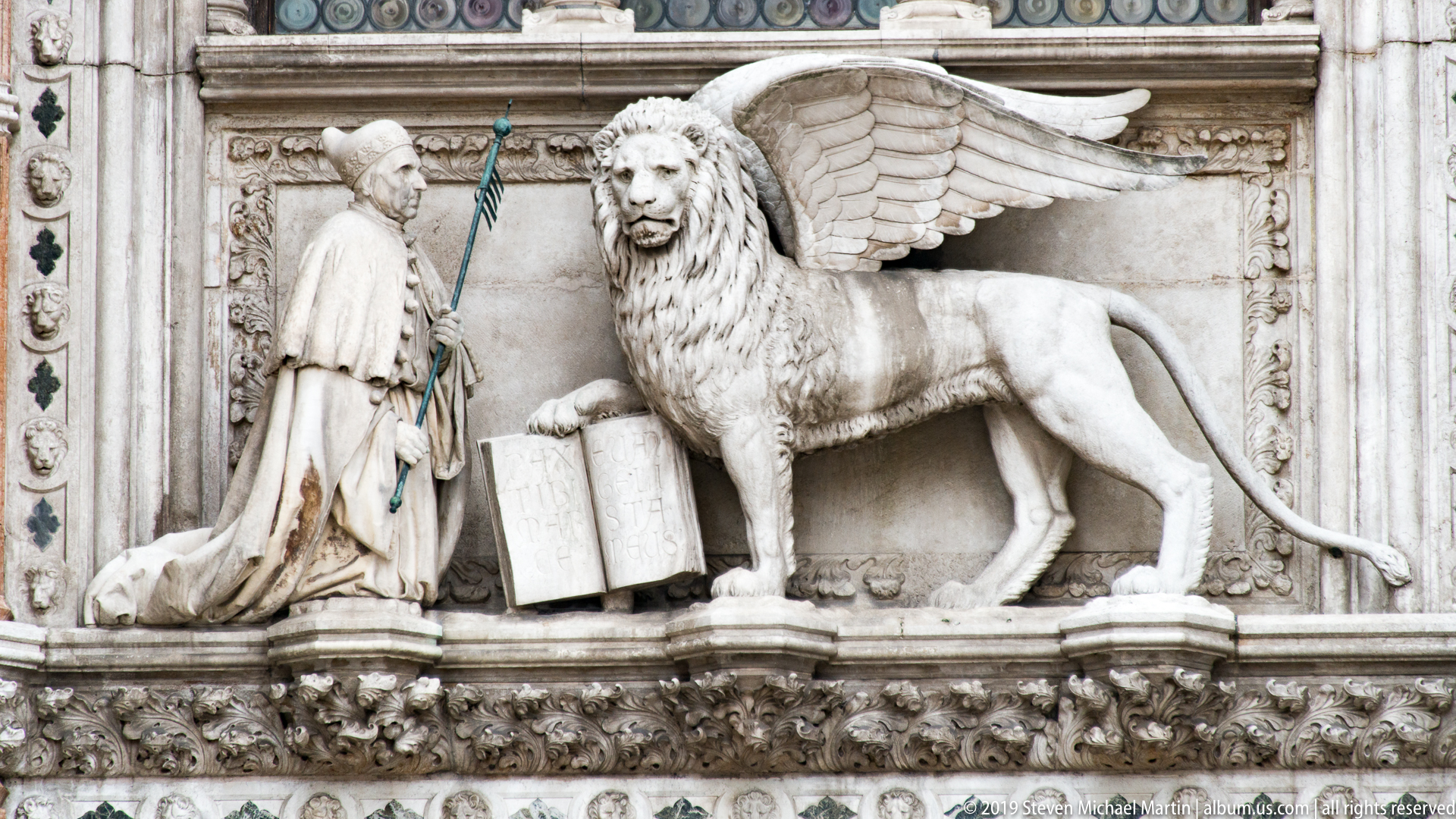
The winged Lion of St. Mark stands in high relief beside a kneeling robed figure, one forepaw resting near an open book. Crisp feathers, mane, and drapery animate the pale stone panel, while the rectangular architectural frame identifies the sculpture as part of a larger decorative façade program.
Caption
The winged Lion of St. Mark stands in high relief beside a kneeling robed figure, one forepaw resting near an open book. Crisp feathers, mane, and drapery animate the pale stone panel, while the rectangular architectural frame identifies the sculpture as part of a larger decorative façade program.

The blue-and-gold astronomical dial of St. Mark’s Clock Tower fills the frame, surrounded by a pale ring of Roman numerals. Gilded zodiac figures encircle the deep blue center, while small circular openings at the corners and the weathered stone surround reveal the dial as part of a larger architectural façade.
Caption
The blue-and-gold astronomical dial of St. Mark’s Clock Tower fills the frame, surrounded by a pale ring of Roman numerals. Gilded zodiac figures encircle the deep blue center, while small circular openings at the corners and the weathered stone surround reveal the dial as part of a larger architectural façade.

Concentric marble arches surround a compact sculpted lunette above one of St. Mark’s Basilica’s doorways. Bands of foliage, figures, and intertwined ornament create a dense frame around the central niche, while patterned grilles and reddish stone panels add texture within the semicircular field.
Caption
Concentric marble arches surround a compact sculpted lunette above one of St. Mark’s Basilica’s doorways. Bands of foliage, figures, and intertwined ornament create a dense frame around the central niche, while patterned grilles and reddish stone panels add texture within the semicircular field.

St. Mark’s Clock Tower is shown as a complete architectural composition, from the broad passage arch at street level to the astronomical dial, Madonna niche, winged-lion panel, and rooftop bell. Adjoining façades and ground-floor shops place the richly decorated tower within the continuous urban edge of the Piazza San Marco.
Caption
St. Mark’s Clock Tower is shown as a complete architectural composition, from the broad passage arch at street level to the astronomical dial, Madonna niche, winged-lion panel, and rooftop bell. Adjoining façades and ground-floor shops place the richly decorated tower within the continuous urban edge of the Piazza San Marco.

A small open stone canopy shelters a robed figure high on the roofline of St. Mark’s Basilica, surrounded by elaborate cresting and gilded-winged angels. The steep upward angle isolates this sculptural ensemble against the pale sky and reveals the dense ornament crowning the façade.
Caption
A small open stone canopy shelters a robed figure high on the roofline of St. Mark’s Basilica, surrounded by elaborate cresting and gilded-winged angels. The steep upward angle isolates this sculptural ensemble against the pale sky and reveals the dense ornament crowning the façade.

A small stone bell turret rises from the ornate roofline of St. Mark’s Basilica, sheltering a standing robed figure beneath its pyramidal roof. A gilded-winged angel and curling stone cresting occupy the adjacent slope, creating a compact study of the basilica’s mixture of sculpture, architectural fantasy, and metallic accents.
Caption
A small stone bell turret rises from the ornate roofline of St. Mark’s Basilica, sheltering a standing robed figure beneath its pyramidal roof. A gilded-winged angel and curling stone cresting occupy the adjacent slope, creating a compact study of the basilica’s mixture of sculpture, architectural fantasy, and metallic accents.

A robed figure occupies the central niche of a semicircular portal lunette, flanked by pierced geometric panels and narrow colored-stone borders. The closer framing reveals the scalloped shell above the figure, delicate surrounding ornament, and the layered masonry of the arch immediately overhead.
Caption
A robed figure occupies the central niche of a semicircular portal lunette, flanked by pierced geometric panels and narrow colored-stone borders. The closer framing reveals the scalloped shell above the figure, delicate surrounding ornament, and the layered masonry of the arch immediately overhead.

The upper façade of St. Mark’s Basilica culminates in a blue, star-studded pediment bearing a gilded winged lion and open book. Angels and saints rise along the ornate cresting, while a taller haloed figure crowns the central pinnacle, producing a dense silhouette of sculpture and gilding against the sky.
Caption
The upper façade of St. Mark’s Basilica culminates in a blue, star-studded pediment bearing a gilded winged lion and open book. Angels and saints rise along the ornate cresting, while a taller haloed figure crowns the central pinnacle, producing a dense silhouette of sculpture and gilding against the sky.

A monumental robed saint stands high above St. Mark’s Basilica, one hand raised in blessing and the other holding a book. A pierced circular halo frames the head, while the isolated low-angle composition removes most surrounding architecture and emphasizes the figure’s commanding position on the roofline.
Caption
A monumental robed saint stands high above St. Mark’s Basilica, one hand raised in blessing and the other holding a book. A pierced circular halo frames the head, while the isolated low-angle composition removes most surrounding architecture and emphasizes the figure’s commanding position on the roofline.

A gilded winged Lion of St. Mark strides across a deep blue, star-studded field high on the basilica façade, one paw resting beside an open book. The tight framing isolates Venice’s emblem within curling Gothic stonework, allowing the metallic surface, feathered wings, mane, and surrounding celestial pattern to dominate the composition.
Caption
A gilded winged Lion of St. Mark strides across a deep blue, star-studded field high on the basilica façade, one paw resting beside an open book. The tight framing isolates Venice’s emblem within curling Gothic stonework, allowing the metallic surface, feathered wings, mane, and surrounding celestial pattern to dominate the composition.

The central upper gable of St. Mark’s Basilica rises above a great arched window, crowned by the winged lion and surrounded by saints, angels, pinnacles, and intricate stone cresting. Seen nearly straight on, the composition reveals how sculpture and gilding transform the roofline into a dense ceremonial silhouette against the pale sky.
Caption
The central upper gable of St. Mark’s Basilica rises above a great arched window, crowned by the winged lion and surrounded by saints, angels, pinnacles, and intricate stone cresting. Seen nearly straight on, the composition reveals how sculpture and gilding transform the roofline into a dense ceremonial silhouette against the pale sky.

A broad gold-ground mosaic fills the lunette above one of St. Mark’s Basilica’s principal entrances, with a central enthroned figure surrounded by groups of attendants. Concentric carved archivolts and clustered marble columns frame the scene, while the upward viewpoint emphasizes the transition from the richly colored mosaic to the deeply sculpted stone surround.
Caption
A broad gold-ground mosaic fills the lunette above one of St. Mark’s Basilica’s principal entrances, with a central enthroned figure surrounded by groups of attendants. Concentric carved archivolts and clustered marble columns frame the scene, while the upward viewpoint emphasizes the transition from the richly colored mosaic to the deeply sculpted stone surround.

The upper façade of St. Mark’s Basilica spreads across the frame in a layered arrangement of mosaic lunettes, marble arcades, the great central window, and pinnacled roof sculpture. This broader frontal view links details seen in closer photographs, showing the central gable and flanking arches as parts of a single richly ornamented elevation.
Caption
The upper façade of St. Mark’s Basilica spreads across the frame in a layered arrangement of mosaic lunettes, marble arcades, the great central window, and pinnacled roof sculpture. This broader frontal view links details seen in closer photographs, showing the central gable and flanking arches as parts of a single richly ornamented elevation.

Christ rises centrally against a gold mosaic ground, draped in blue and white and surrounded by kneeling, standing, and angelic figures. The close crop preserves the expressive gestures and vivid garment colors while minimizing the surrounding architecture, making the narrative group and shimmering tessellated surface the primary subjects.
Caption
Christ rises centrally against a gold mosaic ground, draped in blue and white and surrounded by kneeling, standing, and angelic figures. The close crop preserves the expressive gestures and vivid garment colors while minimizing the surrounding architecture, making the narrative group and shimmering tessellated surface the primary subjects.

A Christ-centered gold mosaic occupies the entire semicircular lunette, with the central figure elevated on clouds and flanked by kneeling and standing figures. The wider framing includes the surrounding reddish marble arch and carved outer band, placing the narrative panel firmly within the basilica’s elaborate portal architecture.
Caption
A Christ-centered gold mosaic occupies the entire semicircular lunette, with the central figure elevated on clouds and flanked by kneeling and standing figures. The wider framing includes the surrounding reddish marble arch and carved outer band, placing the narrative panel firmly within the basilica’s elaborate portal architecture.

Two large gold-ground mosaic lunettes fill adjacent upper arches of St. Mark’s Basilica, separated and flanked by narrow sculptural towers containing standing figures. Pinnacles, carved cresting, and statues animate the roofline above, while the frontal composition makes the paired narrative panels easy to compare.
Caption
Two large gold-ground mosaic lunettes fill adjacent upper arches of St. Mark’s Basilica, separated and flanked by narrow sculptural towers containing standing figures. Pinnacles, carved cresting, and statues animate the roofline above, while the frontal composition makes the paired narrative panels easy to compare.

A muscular nude figure and a smaller attendant emerge in high relief from the green-patinated surface of a bronze wellhead in the Doge’s Palace complex. The close view reveals modeled anatomy, curling foliage, and the mottled oxidation of the metal, turning a functional courtyard object into a study of Renaissance-style decorative sculpture.
Caption
A muscular nude figure and a smaller attendant emerge in high relief from the green-patinated surface of a bronze wellhead in the Doge’s Palace complex. The close view reveals modeled anatomy, curling foliage, and the mottled oxidation of the metal, turning a functional courtyard object into a study of Renaissance-style decorative sculpture.

Seen from below at an angle, the façade of St. Mark’s Basilica unfolds as a sequence of mosaic-filled arches, clustered columns, pinnacles, statues, and the great central window. The diagonal viewpoint accentuates the depth of the portals and the restless silhouette of the roofline rather than presenting the building as a flat frontal elevation.
Caption
Seen from below at an angle, the façade of St. Mark’s Basilica unfolds as a sequence of mosaic-filled arches, clustered columns, pinnacles, statues, and the great central window. The diagonal viewpoint accentuates the depth of the portals and the restless silhouette of the roofline rather than presenting the building as a flat frontal elevation.
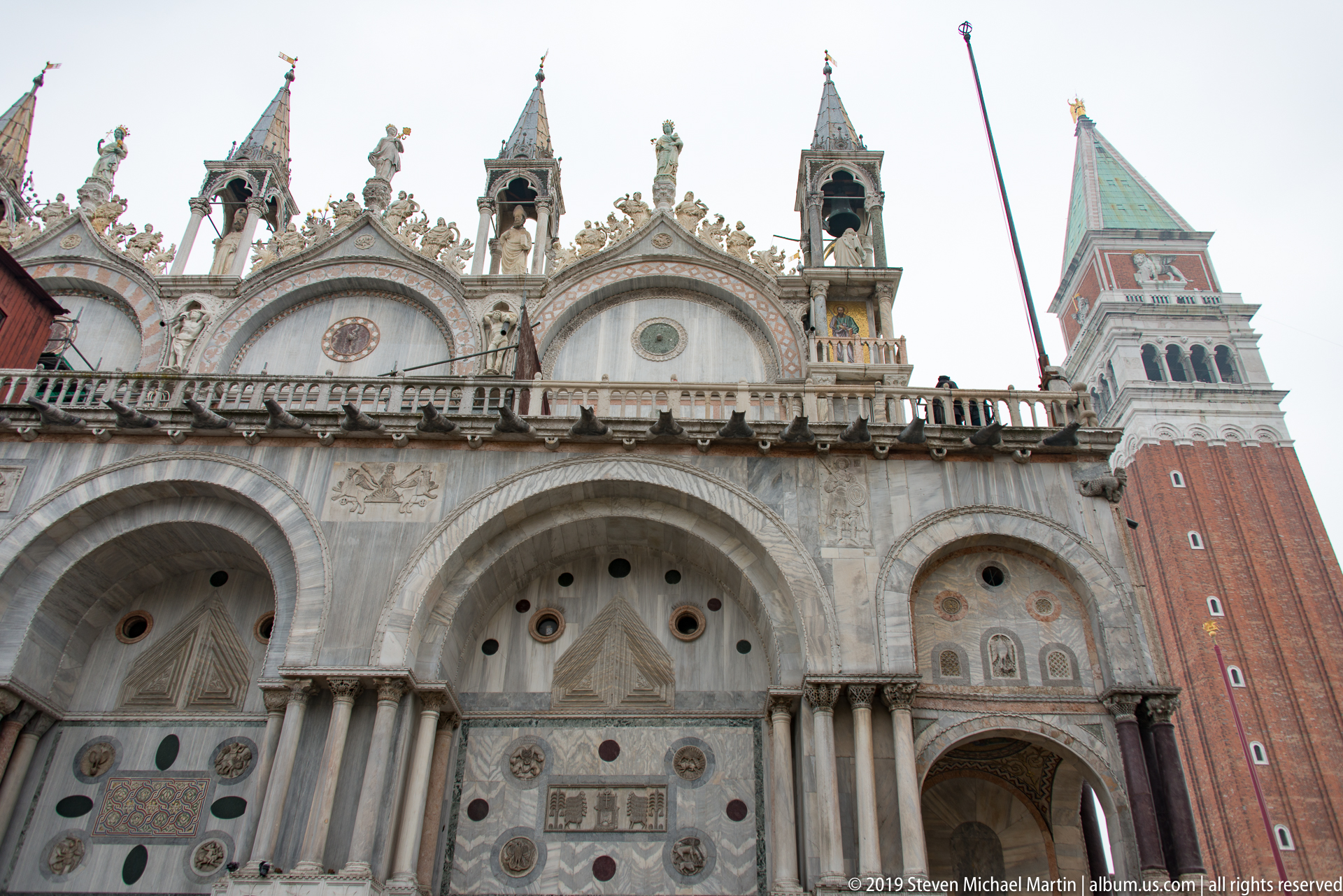
The side elevation of St. Mark’s Basilica presents broad arches filled with patterned marble panels and circular insets, while small rooftop turrets punctuate the upper edge. St. Mark’s Campanile rises immediately beside it, its red-brick shaft and pale belfry contrasting with the basilica’s layered marble surfaces and sculptural ornament.
Caption
The side elevation of St. Mark’s Basilica presents broad arches filled with patterned marble panels and circular insets, while small rooftop turrets punctuate the upper edge. St. Mark’s Campanile rises immediately beside it, its red-brick shaft and pale belfry contrasting with the basilica’s layered marble surfaces and sculptural ornament.

Golden mosaic domes and arches soar above a row of dark standing sculptures inside St. Mark’s Basilica. The low viewpoint sets the silhouetted figures against luminous vaults covered with saints, medallions, and narrative imagery, emphasizing the dramatic contrast between the shadowed lower interior and glowing mosaic ceiling.
Caption
Golden mosaic domes and arches soar above a row of dark standing sculptures inside St. Mark’s Basilica. The low viewpoint sets the silhouetted figures against luminous vaults covered with saints, medallions, and narrative imagery, emphasizing the dramatic contrast between the shadowed lower interior and glowing mosaic ceiling.

The west façade of St. Mark’s Basilica fills the frame with five great portal bays, marble columns, mosaic lunettes, the central arched window, and a roofline crowded with pinnacles and sculpture. The frontal viewpoint provides an architectural overview in which the richly differentiated portals and upper arches can be read as a unified composition.
Caption
The west façade of St. Mark’s Basilica fills the frame with five great portal bays, marble columns, mosaic lunettes, the central arched window, and a roofline crowded with pinnacles and sculpture. The frontal viewpoint provides an architectural overview in which the richly differentiated portals and upper arches can be read as a unified composition.

A heavily weathered stone lion is seen at close range, its rounded muzzle, deeply carved mane, and worn surface filling most of the composition. The marble arches and patterned wall of St. Mark’s Basilica recede behind it, situating the sculpture within the architectural setting while preserving the animal’s battered texture as the dominant visual feature.
Caption
A heavily weathered stone lion is seen at close range, its rounded muzzle, deeply carved mane, and worn surface filling most of the composition. The marble arches and patterned wall of St. Mark’s Basilica recede behind it, situating the sculpture within the architectural setting while preserving the animal’s battered texture as the dominant visual feature.

St. Mark’s Campanile rises steeply from the edge of the piazza, its tall red-brick shaft punctuated by small windows and capped by a pale belfry and green pyramidal roof. The marble Loggetta and adjoining arcaded buildings remain low in the frame, reinforcing the extraordinary vertical scale of the bell tower.
Caption
St. Mark’s Campanile rises steeply from the edge of the piazza, its tall red-brick shaft punctuated by small windows and capped by a pale belfry and green pyramidal roof. The marble Loggetta and adjoining arcaded buildings remain low in the frame, reinforcing the extraordinary vertical scale of the bell tower.

An open travel guide is held in front of the camera, its spread devoted to St. Mark’s Basilica with a large color photograph, smaller architectural views, historical illustrations, and explanatory text. Rather than recording the monument directly, the photograph documents the interpretive material used to understand its architecture and history during the visit.
Caption
An open travel guide is held in front of the camera, its spread devoted to St. Mark’s Basilica with a large color photograph, smaller architectural views, historical illustrations, and explanatory text. Rather than recording the monument directly, the photograph documents the interpretive material used to understand its architecture and history during the visit.