Lecce Cathedral – Lecce, Italy
The elegant Lecce Cathedral, also known as the Cathedral of the Assumption of the Virgin Mary, stands in the historic center of Lecce in southern Italy. Originally built in the 12th century and later redesigned during the Baroque period, the cathedral reflects the artistic character that defines much of the city.
Its ornate façade and richly decorated bell tower showcase the distinctive Lecce Baroque style, created using the region’s soft golden limestone. Inside, elaborate altars, sculptures, and paintings illustrate the decorative traditions of southern Italian churches.
The cathedral forms the centerpiece of Piazza del Duomo, one of the most beautiful squares in Lecce.

A monumental stone façade is seen obliquely at night, its portal framed by tall fluted columns and layered classical moldings. Sculptural niches, reliefs, and a broken upper profile create strong highlights and shadows under floodlighting. The angled viewpoint emphasizes the depth of the entrance composition and the projecting architectural members.
Caption
A monumental stone façade is seen obliquely at night, its portal framed by tall fluted columns and layered classical moldings. Sculptural niches, reliefs, and a broken upper profile create strong highlights and shadows under floodlighting. The angled viewpoint emphasizes the depth of the entrance composition and the projecting architectural members.

The cathedral’s long side elevation runs diagonally across the square toward a pedimented end wall, while the clocked arcade closes the view at right. Doorways, niches, tall windows, and the projecting roofline break up the pale limestone mass. The broad paved foreground provides a clear sense of the spatial relationship between the church and neighboring buildings.
Caption
The cathedral’s long side elevation runs diagonally across the square toward a pedimented end wall, while the clocked arcade closes the view at right. Doorways, niches, tall windows, and the projecting roofline break up the pale limestone mass. The broad paved foreground provides a clear sense of the spatial relationship between the church and neighboring buildings.

The cathedral’s tall bell tower dominates the night view, rising in successive square stages above the lower stone buildings of Piazza del Duomo. Brightly lit openings punctuate each level, making the tower’s diminishing vertical sequence clear against the dark sky. The low-angle composition emphasizes height while retaining enough of the adjoining walls to show the tower’s setting within the complex.
Caption
The cathedral’s tall bell tower dominates the night view, rising in successive square stages above the lower stone buildings of Piazza del Duomo. Brightly lit openings punctuate each level, making the tower’s diminishing vertical sequence clear against the dark sky. The low-angle composition emphasizes height while retaining enough of the adjoining walls to show the tower’s setting within the complex.

A frontal view into the chancel centers an ornate altar behind a pierced marble-and-metal screen, with dark wooden choir stalls lining both sides. Tall fluted wall surfaces, gilded accents, oval framed decorations, candlesticks, and a large sacred image create a strongly symmetrical setting. White flower arrangements soften the dense architectural and liturgical ornament.
Caption
A frontal view into the chancel centers an ornate altar behind a pierced marble-and-metal screen, with dark wooden choir stalls lining both sides. Tall fluted wall surfaces, gilded accents, oval framed decorations, candlesticks, and a large sacred image create a strongly symmetrical setting. White flower arrangements soften the dense architectural and liturgical ornament.

The bell tower is framed from below in daylight, filling most of the composition with its stacked square stages, arched openings, projecting cornices, and balustraded ledges. Adjoining lower buildings remain visible at the base, grounding the campanile in the cathedral precinct. The close viewpoint favors the tower’s masonry articulation over the broader piazza setting.
Caption
The bell tower is framed from below in daylight, filling most of the composition with its stacked square stages, arched openings, projecting cornices, and balustraded ledges. Adjoining lower buildings remain visible at the base, grounding the campanile in the cathedral precinct. The close viewpoint favors the tower’s masonry articulation over the broader piazza setting.

Centered on the sanctuary, this view pairs Gennaro De Martino’s 1757 polychrome-marble high altar with Oronzo Tiso’s Assumption of Mary directly above it. The altar’s gilded bronze, candlesticks and crucifix form a brilliant lower register, while the large Marian canvas rises between fluted gilded pilasters and oval saint paintings. Together they define the principal visual axis of Lecce Cathedral’s presbytery.
Caption
Centered on the sanctuary, this view pairs Gennaro De Martino’s 1757 polychrome-marble high altar with Oronzo Tiso’s Assumption of Mary directly above it. The altar’s gilded bronze, candlesticks and crucifix form a brilliant lower register, while the large Marian canvas rises between fluted gilded pilasters and oval saint paintings. Together they define the principal visual axis of Lecce Cathedral’s presbytery.

Lecce Cathedral’s monumental high altar, installed in 1757 by the Neapolitan marble worker Gennaro De Martino, spreads beneath Oronzo Tiso’s Assumption of Mary from the same year. Polychrome marble, lapis-lazuli accents and gilded bronze enrich the altar and balustrade, while kneeling angels flank the composition. Tall gilded pilasters frame Tiso’s canvas and reinforce the formal symmetry of the presbytery.
Caption
Lecce Cathedral’s monumental high altar, installed in 1757 by the Neapolitan marble worker Gennaro De Martino, spreads beneath Oronzo Tiso’s Assumption of Mary from the same year. Polychrome marble, lapis-lazuli accents and gilded bronze enrich the altar and balustrade, while kneeling angels flank the composition. Tall gilded pilasters frame Tiso’s canvas and reinforce the formal symmetry of the presbytery.

The upper stages of a tall pale-stone bell tower rise sharply against a cloudless blue sky, viewed from close to the base. Successive levels are divided by projecting cornices and articulated with pilasters, recessed panels, and large arched openings for the bells. The steep perspective accentuates the tower’s height and the gradual narrowing of its stacked architectural stages within the Lecce Cathedral complex.
Caption
The upper stages of a tall pale-stone bell tower rise sharply against a cloudless blue sky, viewed from close to the base. Successive levels are divided by projecting cornices and articulated with pilasters, recessed panels, and large arched openings for the bells. The steep perspective accentuates the tower’s height and the gradual narrowing of its stacked architectural stages within the Lecce Cathedral complex.

A compact polychrome wall monument combines an oval portrait, inscription panel, scrollwork, heraldic crest, and marble-like architectural framing. Set against plain stonework beside the checkered floor, the object reads as an independent commemorative or devotional furnishing rather than part of a larger altar ensemble.
Caption
A compact polychrome wall monument combines an oval portrait, inscription panel, scrollwork, heraldic crest, and marble-like architectural framing. Set against plain stonework beside the checkered floor, the object reads as an independent commemorative or devotional furnishing rather than part of a larger altar ensemble.

The cathedral baptistery centers on Raffaele Caretta’s 1917 papier-mâché high relief of the Baptism of Christ, set within a polychrome architectural frame above the baptismal basin. The bishop’s heraldic crest crowns the composition, while freestanding figures of Moses and Ezekiel flank the ensemble. The furnishing combines the eighteenth-century stone baptistery with later Salentine papier-mâché sculpture.
Caption
The cathedral baptistery centers on Raffaele Caretta’s 1917 papier-mâché high relief of the Baptism of Christ, set within a polychrome architectural frame above the baptismal basin. The bishop’s heraldic crest crowns the composition, while freestanding figures of Moses and Ezekiel flank the ensemble. The furnishing combines the eighteenth-century stone baptistery with later Salentine papier-mâché sculpture.

Night illumination reveals a symmetrical stone courtyard façade organized around arcades, an upper balustrade, sculptural niches, and a central clock pavilion. The frontal viewpoint records the architectural ensemble as a civic-scaled setting, with warm artificial light defining the pale masonry against the dark sky.
Caption
Night illumination reveals a symmetrical stone courtyard façade organized around arcades, an upper balustrade, sculptural niches, and a central clock pavilion. The frontal viewpoint records the architectural ensemble as a civic-scaled setting, with warm artificial light defining the pale masonry against the dark sky.

A centered view down the nave places the sanctuary at the far end beneath successive decorated arches. Massive pale-stone piers and gilded capitals define side aisles, while a dark wooden pulpit projects from the right, providing a strong counterpoint to the luminous altar and painted architectural surfaces.
Caption
A centered view down the nave places the sanctuary at the far end beneath successive decorated arches. Massive pale-stone piers and gilded capitals define side aisles, while a dark wooden pulpit projects from the right, providing a strong counterpoint to the luminous altar and painted architectural surfaces.

Dense carved ornament frames a side altar centered on a seated robed saint in a deep niche. Twisted decorative forms, small figures, columns, and a large inscribed tablet fill the vertical composition, while the altar table and rail establish its liturgical function within the cathedral interior.
Caption
Dense carved ornament frames a side altar centered on a seated robed saint in a deep niche. Twisted decorative forms, small figures, columns, and a large inscribed tablet fill the vertical composition, while the altar table and rail establish its liturgical function within the cathedral interior.

A rectangular portal surrounds heavy paneled wooden doors with a richly carved pale-stone frame. Floral and foliate relief, pilaster-like side elements, and a projecting decorated lintel concentrate ornament around the entrance, contrasting the dark geometric door panels with the finely worked masonry.
Caption
A rectangular portal surrounds heavy paneled wooden doors with a richly carved pale-stone frame. Floral and foliate relief, pilaster-like side elements, and a projecting decorated lintel concentrate ornament around the entrance, contrasting the dark geometric door panels with the finely worked masonry.

The cathedral interior opens along a broad central nave toward the elevated sanctuary, framed by monumental piers and richly decorated arches. Rows of dark pews reinforce the central axis, while gilded details, painted ceiling panels, side openings, and the luminous altar create successive layers of architectural depth.
Caption
The cathedral interior opens along a broad central nave toward the elevated sanctuary, framed by monumental piers and richly decorated arches. Rows of dark pews reinforce the central axis, while gilded details, painted ceiling panels, side openings, and the luminous altar create successive layers of architectural depth.

Broad bronze double doors occupy a bay between pale stone columns beneath a dark timber ceiling. Colored circular glazing or medallions punctuate the upper doorway, while raised symbols and lettering animate the otherwise planar metal surfaces; the black-and-white floor emphasizes the entrance’s strong geometry.
Caption
Broad bronze double doors occupy a bay between pale stone columns beneath a dark timber ceiling. Colored circular glazing or medallions punctuate the upper doorway, while raised symbols and lettering animate the otherwise planar metal surfaces; the black-and-white floor emphasizes the entrance’s strong geometry.

An exceptionally dense sculptural altar rises between columns, its carved framework populated by figures, foliage, and architectural ornament. Two framed religious paintings are stacked vertically above the altar table, creating a layered devotional focus whose pale carving contrasts strongly with the darker painted scenes.
Caption
An exceptionally dense sculptural altar rises between columns, its carved framework populated by figures, foliage, and architectural ornament. Two framed religious paintings are stacked vertically above the altar table, creating a layered devotional focus whose pale carving contrasts strongly with the darker painted scenes.

A large devotional canvas anchors this side altar, enclosed by an exuberant pale-stone frame of carved columns, foliage, figures, and a sculptural crest. Kneeling or seated figures flank the altar table below, while the painting’s figures and clouds form the visual center of the composition.
Caption
A large devotional canvas anchors this side altar, enclosed by an exuberant pale-stone frame of carved columns, foliage, figures, and a sculptural crest. Kneeling or seated figures flank the altar table below, while the painting’s figures and clouds form the visual center of the composition.

A tall paneled wooden doorway fills an arched interior bay between substantial stone columns. Classical moldings and a projecting cornice give the dark woodwork architectural weight, while a rectangular glazed opening above admits light and the adjacent notice board records the doorway’s active institutional setting.
Caption
A tall paneled wooden doorway fills an arched interior bay between substantial stone columns. Classical moldings and a projecting cornice give the dark woodwork architectural weight, while a rectangular glazed opening above admits light and the adjacent notice board records the doorway’s active institutional setting.

Oronzo Tiso’s 1757 Assumption of Mary fills the wall behind Lecce Cathedral’s high altar. The Virgin rises in white and blue amid clouds and angels, her upward movement reinforced by the tall vertical canvas. A gilded crucifix and four candlesticks stand in front of the painting, linking Tiso’s vision of the Assumption with the liturgical furnishings of the presbytery.
Caption
Oronzo Tiso’s 1757 Assumption of Mary fills the wall behind Lecce Cathedral’s high altar. The Virgin rises in white and blue amid clouds and angels, her upward movement reinforced by the tall vertical canvas. A gilded crucifix and four candlesticks stand in front of the painting, linking Tiso’s vision of the Assumption with the liturgical furnishings of the presbytery.

The presbytery of Lecce Cathedral forms a coordinated gallery around Oronzo Tiso’s 1757 Assumption of Mary, centered above the polychrome marble high altar installed that year by Gennaro De Martino. Gilded fluted pilasters divide the wall into painted bays, with oval images of Saints Peter and Paul beside the Assumption, while the walnut choir stalls extend along the lower walls beneath the richly painted ceiling.
Caption
The presbytery of Lecce Cathedral forms a coordinated gallery around Oronzo Tiso’s 1757 Assumption of Mary, centered above the polychrome marble high altar installed that year by Gennaro De Martino. Gilded fluted pilasters divide the wall into painted bays, with oval images of Saints Peter and Paul beside the Assumption, while the walnut choir stalls extend along the lower walls beneath the richly painted ceiling.

Looking upward, the cathedral vault is divided by gilded ribs into pale geometric compartments filled with stylized foliate motifs. Small dark painted or glazed medallions punctuate the bays, while richly decorated transverse arches frame the ceiling and reveal the layered ornamental treatment above the nave.
Caption
Looking upward, the cathedral vault is divided by gilded ribs into pale geometric compartments filled with stylized foliate motifs. Small dark painted or glazed medallions punctuate the bays, while richly decorated transverse arches frame the ceiling and reveal the layered ornamental treatment above the nave.

A dark timber ceiling is organized as a richly gilded field of crosses, rosettes, and repeated geometric motifs. Three rectangular religious paintings are embedded across the central zone, their pictorial panels interrupting the patterned coffering and demonstrating the ceiling’s integration of painting, carving, and gilding.
Caption
A dark timber ceiling is organized as a richly gilded field of crosses, rosettes, and repeated geometric motifs. Three rectangular religious paintings are embedded across the central zone, their pictorial panels interrupting the patterned coffering and demonstrating the ceiling’s integration of painting, carving, and gilding.

Bishop Gennaro Trama’s coat of arms is set into the cathedral’s black-and-white marble pavement, completed in 1904 during his episcopate. The blue shield combines three six-pointed stars above a rampant lion, divided by a horizontal band, and is surmounted by the broad-brimmed ecclesiastical hat and tassels of episcopal heraldry. The date A.D. MCMIV appears at the foot of the panel.
Caption
Bishop Gennaro Trama’s coat of arms is set into the cathedral’s black-and-white marble pavement, completed in 1904 during his episcopate. The blue shield combines three six-pointed stars above a rampant lion, divided by a horizontal band, and is surmounted by the broad-brimmed ecclesiastical hat and tassels of episcopal heraldry. The date A.D. MCMIV appears at the foot of the panel.
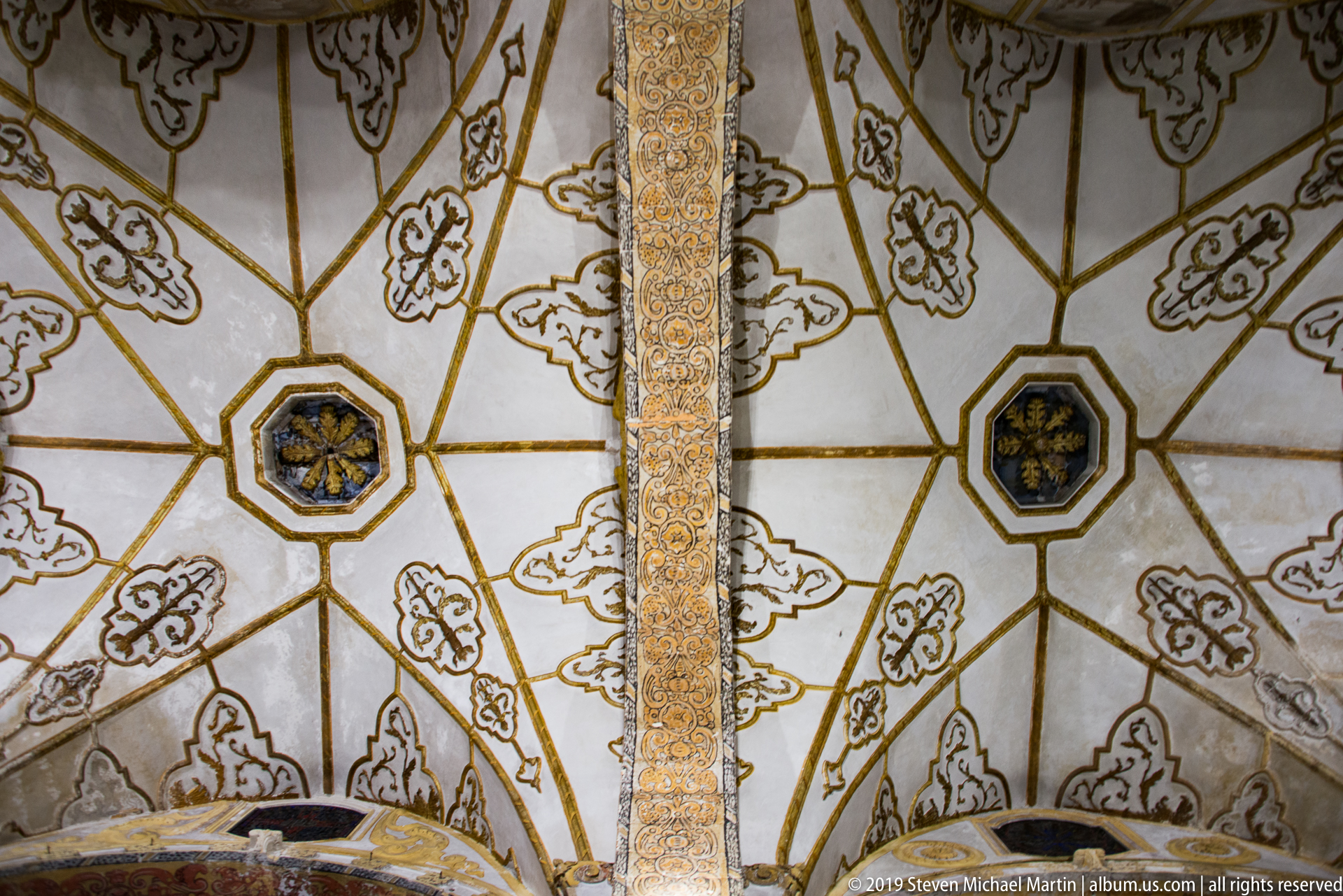
A close upward view isolates two adjoining vault bays divided by a richly patterned transverse band. Gold ribs form geometric compartments across the pale surface, each filled with stylized motifs and centered on dark octagonal bosses, revealing the ceiling decoration at a more intimate scale.
Caption
A close upward view isolates two adjoining vault bays divided by a richly patterned transverse band. Gold ribs form geometric compartments across the pale surface, each filled with stylized motifs and centered on dark octagonal bosses, revealing the ceiling decoration at a more intimate scale.

A closer view of Lecce Cathedral’s presbytery centers Oronzo Tiso’s Assumption of Mary, installed in 1757 above the high altar. Oval paintings of Saints Peter and Paul flank the Assumption, while gilded pilasters and additional canvases organize the wall into a formal sequence. The marble altar and dark walnut choir stalls below complete the layered eighteenth-century setting around the cathedral’s principal Marian image.
Caption
A closer view of Lecce Cathedral’s presbytery centers Oronzo Tiso’s Assumption of Mary, installed in 1757 above the high altar. Oval paintings of Saints Peter and Paul flank the Assumption, while gilded pilasters and additional canvases organize the wall into a formal sequence. The marble altar and dark walnut choir stalls below complete the layered eighteenth-century setting around the cathedral’s principal Marian image.

A lavishly gilded altar centers on a standing figure of the Virgin Mary in a scalloped, shell-like niche. Marble altar rails, cherub-like sculptures, oval portraits, twisted ornament, and dense gold detailing surround the statue, producing one of the cathedral interior’s most visually concentrated devotional settings.
Caption
A lavishly gilded altar centers on a standing figure of the Virgin Mary in a scalloped, shell-like niche. Marble altar rails, cherub-like sculptures, oval portraits, twisted ornament, and dense gold detailing surround the statue, producing one of the cathedral interior’s most visually concentrated devotional settings.

A pale carved-stone side altar frames several religious paintings in a strong vertical arrangement, with the largest canvas positioned above the altar table. Sculptural figures, dense foliage, columns, and an arched crown create a textured surround, while floral arrangements add a contemporary liturgical element.
Caption
A pale carved-stone side altar frames several religious paintings in a strong vertical arrangement, with the largest canvas positioned above the altar table. Sculptural figures, dense foliage, columns, and an arched crown create a textured surround, while floral arrangements add a contemporary liturgical element.

Successive white-and-gold vaults recede through the interior, creating a rhythmic sequence of ribs, medallions, and decorated transverse arches. The oblique upward viewpoint also reveals reddish ornamental bands along the arches and portions of the supporting columns, clarifying how ceiling decoration continues across multiple bays.
Caption
Successive white-and-gold vaults recede through the interior, creating a rhythmic sequence of ribs, medallions, and decorated transverse arches. The oblique upward viewpoint also reveals reddish ornamental bands along the arches and portions of the supporting columns, clarifying how ceiling decoration continues across multiple bays.

The upper portion of the gilded Marian altar fills the frame, bringing its sculptural architecture into close view. A central statue stands within a deeply patterned niche beneath an oval portrait, while saints, small figures, columns, scrolls, and layered gilded moldings crowd the surrounding vertical structure.
Caption
The upper portion of the gilded Marian altar fills the frame, bringing its sculptural architecture into close view. A central statue stands within a deeply patterned niche beneath an oval portrait, while saints, small figures, columns, scrolls, and layered gilded moldings crowd the surrounding vertical structure.

A tall religious canvas rises above a polychrome marble altar table within an elaborate pale-stone sculptural frame. Small figures and dense carved ornament flank the painting, while symmetrical flower arrangements soften the lower composition and draw attention to the active devotional use of the altar.
Caption
A tall religious canvas rises above a polychrome marble altar table within an elaborate pale-stone sculptural frame. Small figures and dense carved ornament flank the painting, while symmetrical flower arrangements soften the lower composition and draw attention to the active devotional use of the altar.

A close architectural detail isolates a richly patterned marble panel built from deep red stone, white scrolling inlay, and small green and ochre accents. Symmetrical curves, cartouche-like shapes, and crisp geometric borders demonstrate the elaborate stone intarsia used on the cathedral’s liturgical furnishings.
Caption
A close architectural detail isolates a richly patterned marble panel built from deep red stone, white scrolling inlay, and small green and ochre accents. Symmetrical curves, cartouche-like shapes, and crisp geometric borders demonstrate the elaborate stone intarsia used on the cathedral’s liturgical furnishings.

A long upward perspective follows a sequence of shallow vaults articulated by gold ribs, painted motifs, and reddish decorative transverse arches. The repetition compresses toward the distance, emphasizing the cathedral’s bay structure, while gilded capitals and portions of the supporting columns appear along both sides.
Caption
A long upward perspective follows a sequence of shallow vaults articulated by gold ribs, painted motifs, and reddish decorative transverse arches. The repetition compresses toward the distance, emphasizing the cathedral’s bay structure, while gilded capitals and portions of the supporting columns appear along both sides.

A monumental altar rises between marble-clad columns, its surface densely covered with gilded scrolls, niches, reliefs, and small sculptural details. A standing robed saint occupies the central niche beneath a framed painting, creating a strong vertical devotional axis above the marble altar table.
Caption
A monumental altar rises between marble-clad columns, its surface densely covered with gilded scrolls, niches, reliefs, and small sculptural details. A standing robed saint occupies the central niche beneath a framed painting, creating a strong vertical devotional axis above the marble altar table.

A white marble cherub projects from the edge of an ornate altar, its head, wings, drapery, and bent body modeled in high relief beneath a curling architectural scroll. Gilded ornament and an oval religious painting fill the background, highlighting the sculptural figure’s role within a larger decorative program.
Caption
A white marble cherub projects from the edge of an ornate altar, its head, wings, drapery, and bent body modeled in high relief beneath a curling architectural scroll. Gilded ornament and an oval religious painting fill the background, highlighting the sculptural figure’s role within a larger decorative program.
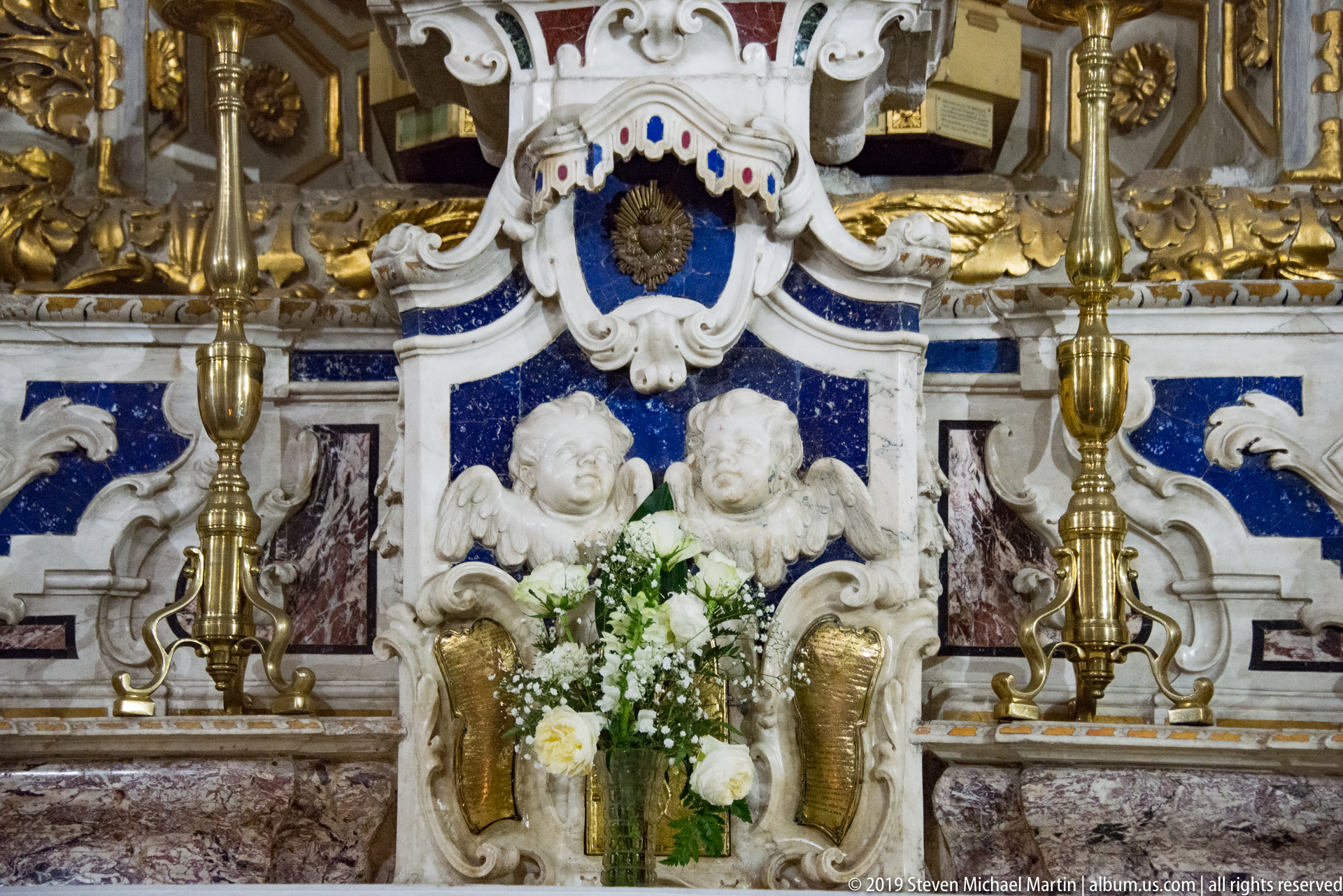
Two small white cherubs face inward beneath a blue cartouche on a richly colored altar front. Deep blue panels, gilded moldings, red-veined marble, brass candlesticks, and fresh white flowers surround the figures, creating a compact study of sculpture, stonework, metalwork, and devotional decoration.
Caption
Two small white cherubs face inward beneath a blue cartouche on a richly colored altar front. Deep blue panels, gilded moldings, red-veined marble, brass candlesticks, and fresh white flowers surround the figures, creating a compact study of sculpture, stonework, metalwork, and devotional decoration.

An elaborate side altar fills the view with white-and-gold architectural ornament, paired sculptural figures, scrollwork, and a central framed religious painting. The altar rises beneath a vaulted bay whose aged surface contrasts with the polished decorative program below. Its dense carving and symmetrical composition make this a distinct architectural focal point within Lecce Cathedral.
Caption
An elaborate side altar fills the view with white-and-gold architectural ornament, paired sculptural figures, scrollwork, and a central framed religious painting. The altar rises beneath a vaulted bay whose aged surface contrasts with the polished decorative program below. Its dense carving and symmetrical composition make this a distinct architectural focal point within Lecce Cathedral.

A polychrome statue of the Virgin Mary rises above an altar, her white robe and blue mantle set against a gilded coffered backdrop. Small putti cluster at her feet while a tall brass crucifix occupies the foreground. The layered arrangement combines sculpture, patterned architectural decoration, and liturgical furnishings within the richly ornamented interior of Lecce Cathedral.
Caption
A polychrome statue of the Virgin Mary rises above an altar, her white robe and blue mantle set against a gilded coffered backdrop. Small putti cluster at her feet while a tall brass crucifix occupies the foreground. The layered arrangement combines sculpture, patterned architectural decoration, and liturgical furnishings within the richly ornamented interior of Lecce Cathedral.

A tighter frontal composition centers the pedimented cathedral elevation, placing the dark entrance door beneath layered sculptural and architectural framing. Four wall niches with figures flank the upper and lower zones, while the large central window and circular pediment detail anchor the vertical axis. Artificial lighting reveals the shallow relief and pale limestone surface.
Caption
A tighter frontal composition centers the pedimented cathedral elevation, placing the dark entrance door beneath layered sculptural and architectural framing. Four wall niches with figures flank the upper and lower zones, while the large central window and circular pediment detail anchor the vertical axis. Artificial lighting reveals the shallow relief and pale limestone surface.

The cathedral bell tower rises at left while an ornate sculptural façade occupies the right edge of the piazza, both illuminated against a deep blue sky. A bright moon hangs low between the structures. The broad composition contrasts the tower’s stacked, rectilinear stages with the more animated carving and cresting of the adjacent façade.
Caption
The cathedral bell tower rises at left while an ornate sculptural façade occupies the right edge of the piazza, both illuminated against a deep blue sky. A bright moon hangs low between the structures. The broad composition contrasts the tower’s stacked, rectilinear stages with the more animated carving and cresting of the adjacent façade.

Christ sits at the center of a crowded table scene in this large religious painting, surrounded by apostles engaged in varied gestures and conversation. Vessels, food, drapery, and strongly colored garments animate the composition, while the central figure is distinguished by placement and a bright halo. The work is presented here as a close, nearly frame-filling view inside Lecce Cathedral.
Caption
Christ sits at the center of a crowded table scene in this large religious painting, surrounded by apostles engaged in varied gestures and conversation. Vessels, food, drapery, and strongly colored garments animate the composition, while the central figure is distinguished by placement and a bright halo. The work is presented here as a close, nearly frame-filling view inside Lecce Cathedral.

A pair of gilded metal doors forms an intricate screen at the front of the altar area. Dense scrolling foliage, floral motifs, and a central emblem are worked into the open lattice, allowing glimpses of marble and darker furnishings beyond. The close framing isolates the craftsmanship of this liturgical barrier from the broader chancel setting.
Caption
A pair of gilded metal doors forms an intricate screen at the front of the altar area. Dense scrolling foliage, floral motifs, and a central emblem are worked into the open lattice, allowing glimpses of marble and darker furnishings beyond. The close framing isolates the craftsmanship of this liturgical barrier from the broader chancel setting.

A multi-arm brass light fixture with flame-shaped glass bulbs projects from a richly decorated wall surface. Beside it, a bulbous finial painted in gold, white, and muted red echoes the surrounding gilded moldings. The tight crop concentrates on the cathedral’s layered decorative vocabulary rather than the larger architectural space.
Caption
A multi-arm brass light fixture with flame-shaped glass bulbs projects from a richly decorated wall surface. Beside it, a bulbous finial painted in gold, white, and muted red echoes the surrounding gilded moldings. The tight crop concentrates on the cathedral’s layered decorative vocabulary rather than the larger architectural space.

An upward view reveals the cathedral’s dark coffered ceiling, where framed painted panels are arranged within a deep wooden grid. White-and-gold cornices, fluted wall divisions, framed paintings, and a central stained-glass window lead the eye toward the ceiling. The steep perspective emphasizes the vertical transition from decorated walls to the richly articulated overhead surface.
Caption
An upward view reveals the cathedral’s dark coffered ceiling, where framed painted panels are arranged within a deep wooden grid. White-and-gold cornices, fluted wall divisions, framed paintings, and a central stained-glass window lead the eye toward the ceiling. The steep perspective emphasizes the vertical transition from decorated walls to the richly articulated overhead surface.

The Last Supper appears within a broad gilded frame densely ornamented with flowers, scrolls, and small sculptural details. Christ occupies the center of the table while apostles gather around him in animated poses, their saturated garments standing out against the darker interior setting. This wider view records the painting together with its elaborate ecclesiastical presentation.
Caption
The Last Supper appears within a broad gilded frame densely ornamented with flowers, scrolls, and small sculptural details. Christ occupies the center of the table while apostles gather around him in animated poses, their saturated garments standing out against the darker interior setting. This wider view records the painting together with its elaborate ecclesiastical presentation.

Warm night lighting defines a formal stone façade on Piazza del Duomo, organized around a central clock, sculptural niches, and a two-level arcade. A broad stair and gated central entrance rise from the square, while repeated arches and balustrades establish a measured rhythm across the elevation. The photograph isolates the civic-looking architectural frontage within the cathedral precinct.
Caption
Warm night lighting defines a formal stone façade on Piazza del Duomo, organized around a central clock, sculptural niches, and a two-level arcade. A broad stair and gated central entrance rise from the square, while repeated arches and balustrades establish a measured rhythm across the elevation. The photograph isolates the civic-looking architectural frontage within the cathedral precinct.

A broad multi-story palace façade faces the open square under night illumination. Rows of rectangular windows, carved surrounds, pilasters, balconies, and a central arched doorway give the elevation a formal, highly ordered character. The straight-on composition records the building as part of the architectural enclosure surrounding Lecce Cathedral rather than focusing on a single decorative detail.
Caption
A broad multi-story palace façade faces the open square under night illumination. Rows of rectangular windows, carved surrounds, pilasters, balconies, and a central arched doorway give the elevation a formal, highly ordered character. The straight-on composition records the building as part of the architectural enclosure surrounding Lecce Cathedral rather than focusing on a single decorative detail.

The richly carved façade rises directly from Piazza del Duomo, its central portal, balustrade, niches, and crowning sculptural crest picked out by floodlights. A simpler clocked arcade appears at right, clarifying the façade’s relationship to the surrounding complex. The frontal nighttime view emphasizes the dense stone carving and ceremonial entrance composition.
Caption
The richly carved façade rises directly from Piazza del Duomo, its central portal, balustrade, niches, and crowning sculptural crest picked out by floodlights. A simpler clocked arcade appears at right, clarifying the façade’s relationship to the surrounding complex. The frontal nighttime view emphasizes the dense stone carving and ceremonial entrance composition.

A wide nighttime view joins two sides of the cathedral precinct: the church wall and pedimented façade at left and the clocked arcaded building at right. Stained glass glows from a lower window while floodlights wash the pale stone surfaces. The open paving in the foreground gives the architecture room to read as a connected ensemble.
Caption
A wide nighttime view joins two sides of the cathedral precinct: the church wall and pedimented façade at left and the clocked arcaded building at right. Stained glass glows from a lower window while floodlights wash the pale stone surfaces. The open paving in the foreground gives the architecture room to read as a connected ensemble.

The cathedral’s pale stone elevation is presented almost frontally at night, with a triangular pediment above a tall central window and an elaborate portal below. Sculptures occupy wall niches on either side, while a stained-glass window glows in the lower bay. The bell tower rises partly into view at the far left, situating this façade within the larger complex.
Caption
The cathedral’s pale stone elevation is presented almost frontally at night, with a triangular pediment above a tall central window and an elaborate portal below. Sculptures occupy wall niches on either side, while a stained-glass window glows in the lower bay. The bell tower rises partly into view at the far left, situating this façade within the larger complex.

The lower portion of the cathedral façade is isolated around its entrance, where a dark paneled door sits within a heavily carved stone surround. Sculptural figures occupy niches to either side, and a colored stained-glass window appears in the adjacent bay. The close nighttime view makes the portal’s layered moldings and relief carving more legible than in the wider square views.
Caption
The lower portion of the cathedral façade is isolated around its entrance, where a dark paneled door sits within a heavily carved stone surround. Sculptural figures occupy niches to either side, and a colored stained-glass window appears in the adjacent bay. The close nighttime view makes the portal’s layered moldings and relief carving more legible than in the wider square views.

The clocked arcaded façade is shown squarely across the open piazza, its central stair and gated entrance aligned beneath three sculptural niches. Repeated arches and balustrades extend to both sides, while uplighting reveals the rusticated lower level and smoother upper stonework. The centered composition emphasizes symmetry and the building’s role in enclosing the cathedral square.
Caption
The clocked arcaded façade is shown squarely across the open piazza, its central stair and gated entrance aligned beneath three sculptural niches. Repeated arches and balustrades extend to both sides, while uplighting reveals the rusticated lower level and smoother upper stonework. The centered composition emphasizes symmetry and the building’s role in enclosing the cathedral square.

A low-angle view brings the cathedral’s pedimented entrance elevation into close relationship with the neighboring clocked arcade. Sculptural niches, the dark portal, and a stained-glass window animate the church wall, while deep arches and a balustrade recede along the right. The oblique perspective stresses the enclosed, theatrical character of Piazza del Duomo after dark.
Caption
A low-angle view brings the cathedral’s pedimented entrance elevation into close relationship with the neighboring clocked arcade. Sculptural niches, the dark portal, and a stained-glass window animate the church wall, while deep arches and a balustrade recede along the right. The oblique perspective stresses the enclosed, theatrical character of Piazza del Duomo after dark.

Daylight reveals the pale limestone carving of the ornate cathedral façade, centered on a recessed portal and rising through a balustraded middle level to an elaborate crest. Niches, relief panels, pilasters, and freestanding decorative forms create a dense vertical composition. The even light makes the façade’s sculptural detail easier to distinguish than in the nighttime views.
Caption
Daylight reveals the pale limestone carving of the ornate cathedral façade, centered on a recessed portal and rising through a balustraded middle level to an elaborate crest. Niches, relief panels, pilasters, and freestanding decorative forms create a dense vertical composition. The even light makes the façade’s sculptural detail easier to distinguish than in the nighttime views.

Across the empty paving of Piazza del Duomo, a long arcaded façade is centered beneath a small clocked pediment. The central stair and entrance divide symmetrical runs of arches and balustrades, while adjoining stone buildings frame the square on both sides. Soft daylight clarifies the building’s horizontal proportions and its role in forming the piazza’s enclosed architectural setting.
Caption
Across the empty paving of Piazza del Duomo, a long arcaded façade is centered beneath a small clocked pediment. The central stair and entrance divide symmetrical runs of arches and balustrades, while adjoining stone buildings frame the square on both sides. Soft daylight clarifies the building’s horizontal proportions and its role in forming the piazza’s enclosed architectural setting.
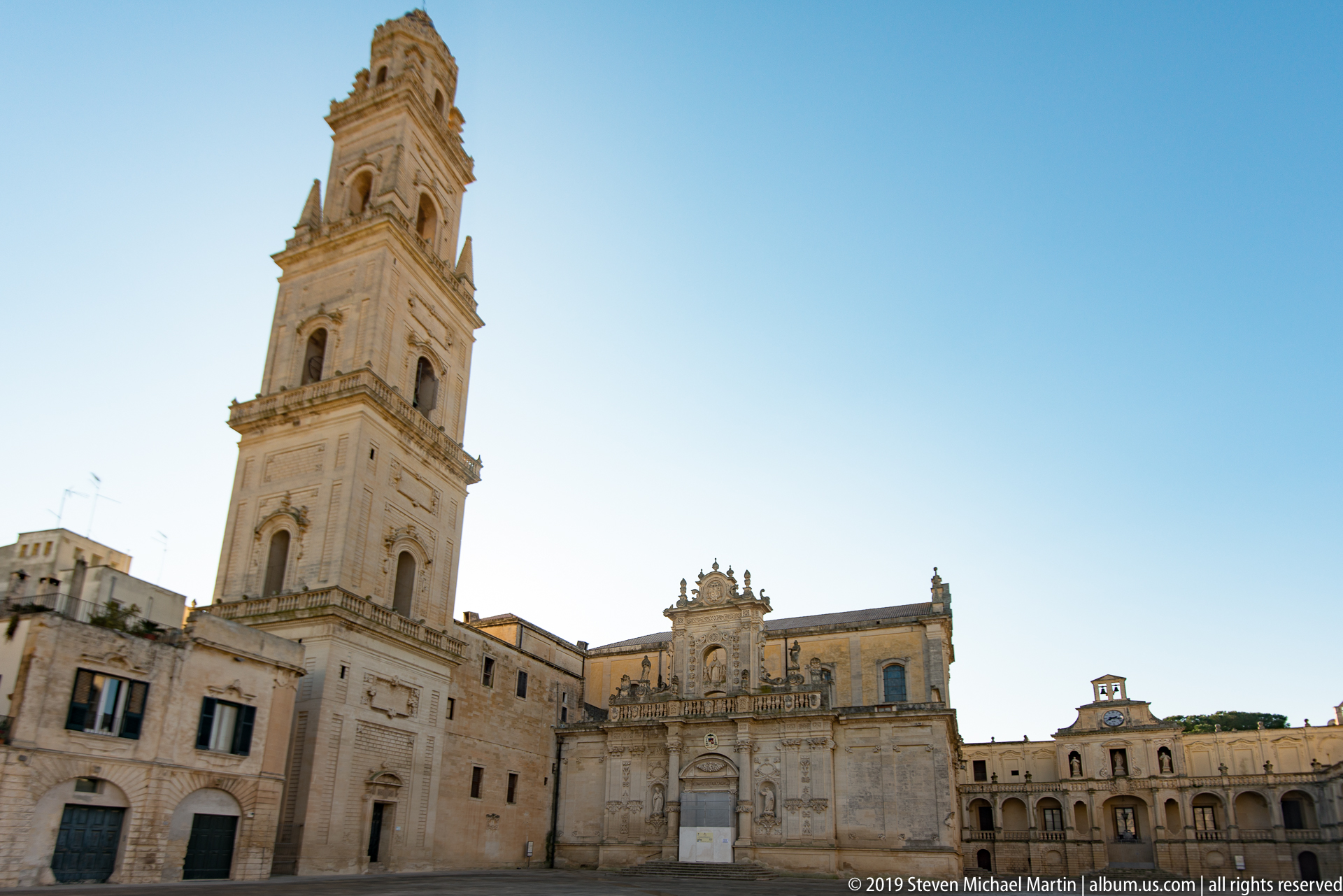
A wide daylight composition places the soaring cathedral bell tower at the left edge and the richly carved entrance façade near the center, with arcaded buildings continuing to the right. The generous blue sky and open square emphasize the tower’s height and the spatial separation among the major elements of the Lecce Cathedral complex.
Caption
A wide daylight composition places the soaring cathedral bell tower at the left edge and the richly carved entrance façade near the center, with arcaded buildings continuing to the right. The generous blue sky and open square emphasize the tower’s height and the spatial separation among the major elements of the Lecce Cathedral complex.

An oblique nighttime view gathers several architectural layers of the cathedral complex: a richly carved entrance front at left, a long side wall with stained glass, and the clocked arcade beyond. Uplighting traces the pale limestone surfaces while the moon appears over the darker adjoining building. The angle makes the church’s mass and its relationship to Piazza del Duomo especially clear.
Caption
An oblique nighttime view gathers several architectural layers of the cathedral complex: a richly carved entrance front at left, a long side wall with stained glass, and the clocked arcade beyond. Uplighting traces the pale limestone surfaces while the moon appears over the darker adjoining building. The angle makes the church’s mass and its relationship to Piazza del Duomo especially clear.

Three stone figures stand above a curved balustrade on an illuminated architectural corner, with a carved coat of arms centered below them. Latin inscriptions are cut into the stone panels beneath the railing. The upward nighttime viewpoint isolates this sculptural and heraldic detail from the larger building, emphasizing the figures’ silhouettes and the layered masonry around the balcony.
Caption
Three stone figures stand above a curved balustrade on an illuminated architectural corner, with a carved coat of arms centered below them. Latin inscriptions are cut into the stone panels beneath the railing. The upward nighttime viewpoint isolates this sculptural and heraldic detail from the larger building, emphasizing the figures’ silhouettes and the layered masonry around the balcony.

A frontal daylight view centers the cathedral’s pedimented entrance elevation. A large rectangular window sits above the carved portal, while four sculptural niches occupy balanced positions across the façade. Pilasters and horizontal cornices organize the pale stone surface, and the tighter framing excludes most of the surrounding square to concentrate on architectural form and relief.
Caption
A frontal daylight view centers the cathedral’s pedimented entrance elevation. A large rectangular window sits above the carved portal, while four sculptural niches occupy balanced positions across the façade. Pilasters and horizontal cornices organize the pale stone surface, and the tighter framing excludes most of the surrounding square to concentrate on architectural form and relief.

A wrought-metal gate closes a recessed passage beneath a broad stone arch, with a hanging lantern visible beyond. Carved scrollwork and a heraldic shield crown the arch, while heavy piers and the neighboring arcade establish the bay’s structural rhythm. The close daylight view focuses on an access point within the Piazza del Duomo architectural complex rather than on a monumental façade.
Caption
A wrought-metal gate closes a recessed passage beneath a broad stone arch, with a hanging lantern visible beyond. Carved scrollwork and a heraldic shield crown the arch, while heavy piers and the neighboring arcade establish the bay’s structural rhythm. The close daylight view focuses on an access point within the Piazza del Duomo architectural complex rather than on a monumental façade.

The cathedral entrance is framed tightly around a pair of dark bronze-toned doors set within an elaborate pale stone portal. Fluted pilasters, layered moldings, relief ornament, and a rectangular inscription panel build a formal architectural surround, while small colored lights appear above the door leaves. The close crop records the portal’s craftsmanship independently of the larger façade.
Caption
The cathedral entrance is framed tightly around a pair of dark bronze-toned doors set within an elaborate pale stone portal. Fluted pilasters, layered moldings, relief ornament, and a rectangular inscription panel build a formal architectural surround, while small colored lights appear above the door leaves. The close crop records the portal’s craftsmanship independently of the larger façade.

A dark bronze portal door is organized around a slender crucified figure set against an irregular, heavily textured field. Below, low-relief figures, animals, and architectural forms spread across the two leaves, while small colored circular insets punctuate the upper corners. The contrast between the modern sculptural surface and the pale carved stone surround makes the entrance a distinctive detail within the cathedral complex.
Caption
A dark bronze portal door is organized around a slender crucified figure set against an irregular, heavily textured field. Below, low-relief figures, animals, and architectural forms spread across the two leaves, while small colored circular insets punctuate the upper corners. The contrast between the modern sculptural surface and the pale carved stone surround makes the entrance a distinctive detail within the cathedral complex.

The entrance to the Museo Diocesano rises beneath a richly carved stone balcony, its arched doorway framed by dense Baroque ornament and a prominent museum sign. Sculpted figures, scrollwork, balusters, and layered cornices animate the pale façade above the portal. The upward viewpoint concentrates attention on the ceremonial entrance and the exuberant architectural decoration surrounding it in Lecce’s cathedral precinct.
Caption
The entrance to the Museo Diocesano rises beneath a richly carved stone balcony, its arched doorway framed by dense Baroque ornament and a prominent museum sign. Sculpted figures, scrollwork, balusters, and layered cornices animate the pale façade above the portal. The upward viewpoint concentrates attention on the ceremonial entrance and the exuberant architectural decoration surrounding it in Lecce’s cathedral precinct.

A rectangular Latin inscription occupies the center of an elaborate stone architectural composition, framed by moldings and surmounted by a sculptural group of figures and clouds. Smaller reliefs, floral motifs, and projecting cornices fill the surrounding surface. Seen tightly cropped, the detail reveals the dense carving and layered ornament characteristic of the ecclesiastical architecture around Lecce Cathedral without relying on the broader façade for context.
Caption
A rectangular Latin inscription occupies the center of an elaborate stone architectural composition, framed by moldings and surmounted by a sculptural group of figures and clouds. Smaller reliefs, floral motifs, and projecting cornices fill the surrounding surface. Seen tightly cropped, the detail reveals the dense carving and layered ornament characteristic of the ecclesiastical architecture around Lecce Cathedral without relying on the broader façade for context.

The central upper façade of Lecce’s Archbishop’s Palace rises above Piazza del Duomo with three statues set in niches beneath the palace clock. Emanuele Manieri created the present Baroque façade in 1758; the clock, made by Lecce craftsman Domenico Panico, was added in 1761. The Virgin occupies the central niche, framed by scrollwork, pilasters and the warm local limestone characteristic of the cathedral precinct.
Caption
The central upper façade of Lecce’s Archbishop’s Palace rises above Piazza del Duomo with three statues set in niches beneath the palace clock. Emanuele Manieri created the present Baroque façade in 1758; the clock, made by Lecce craftsman Domenico Panico, was added in 1761. The Virgin occupies the central niche, framed by scrollwork, pilasters and the warm local limestone characteristic of the cathedral precinct.

A weathered stone plaque projects from the masonry wall beneath a carved heraldic crest. Its shield-like lower outline frames a multi-line Latin inscription whose worn lettering records a formal commemoration, while the rougher adjacent stone emphasizes the plaque’s sculpted border. The oblique viewpoint shows both the depth of the monument and the contrasting textures of the inscription slab and surrounding wall.
Caption
A weathered stone plaque projects from the masonry wall beneath a carved heraldic crest. Its shield-like lower outline frames a multi-line Latin inscription whose worn lettering records a formal commemoration, while the rougher adjacent stone emphasizes the plaque’s sculpted border. The oblique viewpoint shows both the depth of the monument and the contrasting textures of the inscription slab and surrounding wall.

An episcopal coat of arms marks the center of a richly modeled stone portal, suspended between fluted columns and beneath a projecting sculptural balcony. Above, a seated clerical figure occupies a niche amid balusters and dense carved ornament; below, fruit and foliage form a heavy garland over the arch. The close upward view isolates the heraldry and layered Baroque stonework from the larger façade.
Caption
An episcopal coat of arms marks the center of a richly modeled stone portal, suspended between fluted columns and beneath a projecting sculptural balcony. Above, a seated clerical figure occupies a niche amid balusters and dense carved ornament; below, fruit and foliage form a heavy garland over the arch. The close upward view isolates the heraldry and layered Baroque stonework from the larger façade.

The upper portion of the bronze portal centers a crucified figure against a rough, almost rock-like relief surface, flanked by two vivid circular insets—red at left and blue-yellow at right. A pale carved stone entablature and fluted sides frame the metalwork. This tighter view separates the symbolic upper register from the narrative reliefs lower on the door and highlights the contrast of color, bronze, and limestone.
Caption
The upper portion of the bronze portal centers a crucified figure against a rough, almost rock-like relief surface, flanked by two vivid circular insets—red at left and blue-yellow at right. A pale carved stone entablature and fluted sides frame the metalwork. This tighter view separates the symbolic upper register from the narrative reliefs lower on the door and highlights the contrast of color, bronze, and limestone.