Cathedral of Monreale – Sicily, Italy
The magnificent Monreale Cathedral stands above the city of Monreale overlooking the valley of Palermo. Constructed in the late 12th century during the reign of the Norman kings of Sicily, the cathedral represents one of the greatest achievements of Norman architecture in Italy.
The interior is famous for its vast golden mosaics that cover the walls and ceilings, depicting scenes from the Old and New Testaments. These mosaics form one of the largest and most impressive Byzantine-style decorative programs in the world.
Because of its extraordinary artistic significance, the cathedral is recognized as part of the Arab-Norman Palermo and the Cathedral Churches of Cefalù and Monreale.

Monreale Cathedral’s west façade rises between its paired square towers, with the arcaded portico extending across the lower front. The view shows the contrast between the towers’ broad masonry and the finer repeated arches at the entrance, with the plaza in the foreground.
Caption
Monreale Cathedral’s west façade rises between its paired square towers, with the arcaded portico extending across the lower front. The view shows the contrast between the towers’ broad masonry and the finer repeated arches at the entrance, with the plaza in the foreground.

A visitor pauses on a narrow flight of steps beneath a heavy stone arch, one arm extended toward the side wall for balance. The close perspective shows the thickness of the masonry and the transition between the dark passage and brighter exterior landing. The person’s presence turns an architectural detail into a record of movement through the cathedral complex.
Caption
A visitor pauses on a narrow flight of steps beneath a heavy stone arch, one arm extended toward the side wall for balance. The close perspective shows the thickness of the masonry and the transition between the dark passage and brighter exterior landing. The person’s presence turns an architectural detail into a record of movement through the cathedral complex.

Rows of terracotta roof tiles fill the foreground, while pale houses extend across the hillside beyond the cathedral roof. A small tower stands high on the ridge beneath a clear sky, giving this elevated view a layered composition of roof, town, and landscape. The frame locates the cathedral within the dense urban fabric of Monreale.
Caption
Rows of terracotta roof tiles fill the foreground, while pale houses extend across the hillside beyond the cathedral roof. A small tower stands high on the ridge beneath a clear sky, giving this elevated view a layered composition of roof, town, and landscape. The frame locates the cathedral within the dense urban fabric of Monreale.

From Monreale, the view opens across the Conca d’Oro toward the Gulf of Palermo. Terracotta roofs descend the foreground hillside, while the coastal plain, distant water, and mountain horizon reveal the cathedral town’s position above the Palermo basin.
Caption
From Monreale, the view opens across the Conca d’Oro toward the Gulf of Palermo. Terracotta roofs descend the foreground hillside, while the coastal plain, distant water, and mountain horizon reveal the cathedral town’s position above the Palermo basin.

A long, low stone passage recedes through a sequence of rounded vaults and openings, creating a tunnel-like perspective. Uneven masonry walls and a simple tiled floor contrast with the richly decorated cathedral interior seen elsewhere in the series. A small opening at the far end marks the route onward, while daylight enters from side apertures.
Caption
A long, low stone passage recedes through a sequence of rounded vaults and openings, creating a tunnel-like perspective. Uneven masonry walls and a simple tiled floor contrast with the richly decorated cathedral interior seen elsewhere in the series. A small opening at the far end marks the route onward, while daylight enters from side apertures.

A broad, nearly symmetrical view records repeated dark ceiling bays outlined in gold, with narrow painted panels running between the coffers. Below, a continuous arcade of pale arches rests on columns and separates the upper interior from the lower level. The composition prioritizes the rhythm and surface decoration of the cathedral’s ceiling rather than the apse imagery.
Caption
A broad, nearly symmetrical view records repeated dark ceiling bays outlined in gold, with narrow painted panels running between the coffers. Below, a continuous arcade of pale arches rests on columns and separates the upper interior from the lower level. The composition prioritizes the rhythm and surface decoration of the cathedral’s ceiling rather than the apse imagery.

A centered view along the cathedral nave places the paired columns and repeated arches in strong perspective, leading toward the illuminated sanctuary and its gold mosaics. Visitors at the crossing provide a measure of the interior’s height without distracting from the layered architectural rhythm. The contrast between pale stone supports and richly colored upper surfaces defines the long, ceremonial space.
Caption
A centered view along the cathedral nave places the paired columns and repeated arches in strong perspective, leading toward the illuminated sanctuary and its gold mosaics. Visitors at the crossing provide a measure of the interior’s height without distracting from the layered architectural rhythm. The contrast between pale stone supports and richly colored upper surfaces defines the long, ceremonial space.

The cathedral’s apse is dominated by a monumental image of Christ, seated within a gold-ground arch and flanked by smaller sacred figures. Tall side walls, upper galleries and the lower sanctuary frame the composition, giving a sense of the mosaic’s scale within the church. The centered perspective links the apse image to the full height of the interior.
Caption
The cathedral’s apse is dominated by a monumental image of Christ, seated within a gold-ground arch and flanked by smaller sacred figures. Tall side walls, upper galleries and the lower sanctuary frame the composition, giving a sense of the mosaic’s scale within the church. The centered perspective links the apse image to the full height of the interior.

A dark stone wall and tower edge occupy the left foreground, framing a sunlit spread of houses that climbs the opposite slope. A palm tree and green ridge punctuate the dense urban scene. The strong contrast between shaded cathedral masonry and bright town buildings links the monument to the surrounding hillside settlement.
Caption
A dark stone wall and tower edge occupy the left foreground, framing a sunlit spread of houses that climbs the opposite slope. A palm tree and green ridge punctuate the dense urban scene. The strong contrast between shaded cathedral masonry and bright town buildings links the monument to the surrounding hillside settlement.

From an elevated position, the view looks across the sanctuary toward the apse, where gilded mosaics rise above the altar. A broad decorative arch frames the composition, while the lower altar furnishings and side structures establish the scale of the liturgical space. The balanced frontal view brings together the cathedral’s monumental mosaic cycle and its active church furnishings.
Caption
From an elevated position, the view looks across the sanctuary toward the apse, where gilded mosaics rise above the altar. A broad decorative arch frames the composition, while the lower altar furnishings and side structures establish the scale of the liturgical space. The balanced frontal view brings together the cathedral’s monumental mosaic cycle and its active church furnishings.

A dark metal finial rises from a small roof structure against a vivid blue sky. Its vertical shaft and lateral ornamental arms create a sharply defined silhouette, while the pale roof below anchors the detail to the cathedral complex. The isolated framing emphasizes the rooftop metalwork and the clear Mediterranean light.
Caption
A dark metal finial rises from a small roof structure against a vivid blue sky. Its vertical shaft and lateral ornamental arms create a sharply defined silhouette, while the pale roof below anchors the detail to the cathedral complex. The isolated framing emphasizes the rooftop metalwork and the clear Mediterranean light.

The raised viewpoint takes in Piazza Vittorio Emanuele II and its central Fontana del Tritone, with the square’s paving, palms, and surrounding town buildings visible beyond. This wider view establishes the fountain’s place in Monreale’s urban center.
Caption
The raised viewpoint takes in Piazza Vittorio Emanuele II and its central Fontana del Tritone, with the square’s paving, palms, and surrounding town buildings visible beyond. This wider view establishes the fountain’s place in Monreale’s urban center.

The cathedral’s monumental bronze doors, commissioned from Bonanno Pisano, fill the portal beneath its layered stone arch. Their 44 relief panels narrate Old and New Testament episodes alongside figures of prophets; the full view shows how the famous doors are set within Monreale’s richly patterned entrance.
Caption
The cathedral’s monumental bronze doors, commissioned from Bonanno Pisano, fill the portal beneath its layered stone arch. Their 44 relief panels narrate Old and New Testament episodes alongside figures of prophets; the full view shows how the famous doors are set within Monreale’s richly patterned entrance.

A stone Triton rises above the basin of the Fontana del Tritone in Monreale’s Piazza Vittorio Emanuele II. The close view isolates the twisting figure and carved water creatures; the fountain is a work by Palermitan sculptor Mario Rutelli.
Caption
A stone Triton rises above the basin of the Fontana del Tritone in Monreale’s Piazza Vittorio Emanuele II. The close view isolates the twisting figure and carved water creatures; the fountain is a work by Palermitan sculptor Mario Rutelli.

The Fontana del Tritone stands in the paved setting of Piazza Vittorio Emanuele II. Its pale sculptural group and basin are framed by clipped planting, palms, and the surrounding civic buildings, showing the fountain within Monreale’s central square.
Caption
The Fontana del Tritone stands in the paved setting of Piazza Vittorio Emanuele II. Its pale sculptural group and basin are framed by clipped planting, palms, and the surrounding civic buildings, showing the fountain within Monreale’s central square.

A large circular clock face is set into a rough stone wall, its dark hands and Roman numerals sharply outlined against a pale dial. The round frame and surrounding masonry occupy nearly the entire composition, turning a practical feature of the cathedral precinct into an architectural detail. The tight crop excludes enough context that the clock’s exact tower location remains unspecified.
Caption
A large circular clock face is set into a rough stone wall, its dark hands and Roman numerals sharply outlined against a pale dial. The round frame and surrounding masonry occupy nearly the entire composition, turning a practical feature of the cathedral precinct into an architectural detail. The tight crop excludes enough context that the clock’s exact tower location remains unspecified.

An upward-looking view isolates the cathedral’s richly patterned upper façade. A tall central opening is surrounded by alternating pale stone and dark inlay, with shallow arches, circular medallions and smaller openings arranged in a symmetrical composition. The close perspective stresses the façade’s layered geometry and decorative surface, leaving the lower entrance and full building outline outside the frame.
Caption
An upward-looking view isolates the cathedral’s richly patterned upper façade. A tall central opening is surrounded by alternating pale stone and dark inlay, with shallow arches, circular medallions and smaller openings arranged in a symmetrical composition. The close perspective stresses the façade’s layered geometry and decorative surface, leaving the lower entrance and full building outline outside the frame.

The cathedral’s upper wall fills the frame, with a central arched opening set above a broad band of pale-and-dark geometric ornament. Smaller arches and circular motifs repeat across the façade, while a palm frond enters at the lower edge. Compared with a straight-on elevation, the oblique angle reveals the depth of the projecting decorative bands and recessed openings.
Caption
The cathedral’s upper wall fills the frame, with a central arched opening set above a broad band of pale-and-dark geometric ornament. Smaller arches and circular motifs repeat across the façade, while a palm frond enters at the lower edge. Compared with a straight-on elevation, the oblique angle reveals the depth of the projecting decorative bands and recessed openings.

A sunburst-shaped gold reliquary or devotional object is displayed upright, its many thin rays radiating from an oval center. A small sculpted figure occupies the lower portion, and colored stones ring the central setting. The plain pale background makes the object’s elaborate silhouette legible, while a small label at lower left is too indistinct here to support a more exact attribution.
Caption
A sunburst-shaped gold reliquary or devotional object is displayed upright, its many thin rays radiating from an oval center. A small sculpted figure occupies the lower portion, and colored stones ring the central setting. The plain pale background makes the object’s elaborate silhouette legible, while a small label at lower left is too indistinct here to support a more exact attribution.

A restrained entrance bay is framed by pale arches and paired columns, with a small cross mounted above the dark doorway. A metal barrier crosses the foreground, separating the viewer from the entry. The composition records a threshold within the cathedral precinct rather than a richly ornamented portal, drawing attention to the layered arches, centered cross and controlled access.
Caption
A restrained entrance bay is framed by pale arches and paired columns, with a small cross mounted above the dark doorway. A metal barrier crosses the foreground, separating the viewer from the entry. The composition records a threshold within the cathedral precinct rather than a richly ornamented portal, drawing attention to the layered arches, centered cross and controlled access.

A jeweled gold crown with radiating points is displayed in the cathedral treasury. The Diocesan Museum catalog identifies it as one of the crowns made for the statue of the Madonna del Popolo in 1761.
Caption
A jeweled gold crown with radiating points is displayed in the cathedral treasury. The Diocesan Museum catalog identifies it as one of the crowns made for the statue of the Madonna del Popolo in 1761.

A close mosaic panel fills the image with repeated red, cream and gold tesserae. A central vertical figure or architectural motif is bordered by paired forms and dense geometric patterning; the tiny cubes of glass and stone create a shimmering, textile-like surface. The crop preserves the mosaic’s color and rhythm but excludes enough surrounding context to make the depicted scene uncertain.
Caption
A close mosaic panel fills the image with repeated red, cream and gold tesserae. A central vertical figure or architectural motif is bordered by paired forms and dense geometric patterning; the tiny cubes of glass and stone create a shimmering, textile-like surface. The crop preserves the mosaic’s color and rhythm but excludes enough surrounding context to make the depicted scene uncertain.

This sculpted group depicts the Deposition from the Cross: attendants gather around Christ as his body is lowered after the Crucifixion. The horizontal figure and supporting mourners make the subject identifiable even though no title or maker is visible in the photograph.
Caption
This sculpted group depicts the Deposition from the Cross: attendants gather around Christ as his body is lowered after the Crucifixion. The horizontal figure and supporting mourners make the subject identifiable even though no title or maker is visible in the photograph.

The framed religious image represents the Deposition from the Cross, with several figures supporting Christ’s horizontal body. Its gilded frame and red display wall echo the nearby sculpted version of the subject while presenting the scene as a separate devotional image.
Caption
The framed religious image represents the Deposition from the Cross, with several figures supporting Christ’s horizontal body. Its gilded frame and red display wall echo the nearby sculpted version of the subject while presenting the scene as a separate devotional image.

A Byzantine-style Madonna and Child are shown in close view, the Virgin’s dark mantle enclosing the child as both figures face outward. Gold and blue highlights define the folds and halos, while the child raises one hand in blessing and holds a small object in the other. The solemn frontal arrangement and luminous mosaic surface make the image a devotional focus rather than a general decorative detail.
Caption
A Byzantine-style Madonna and Child are shown in close view, the Virgin’s dark mantle enclosing the child as both figures face outward. Gold and blue highlights define the folds and halos, while the child raises one hand in blessing and holds a small object in the other. The solemn frontal arrangement and luminous mosaic surface make the image a devotional focus rather than a general decorative detail.

A blue terrestrial globe dominates the foreground, with Europe and Africa facing the camera and fine boundary lines crossing the surface. The globe sits within an indoor exhibition or study setting, where dark furniture and a display cabinet appear behind it. Its modern cartographic appearance contrasts with the cathedral’s medieval art, suggesting an interpretive or educational display rather than a historic object.
Caption
A blue terrestrial globe dominates the foreground, with Europe and Africa facing the camera and fine boundary lines crossing the surface. The globe sits within an indoor exhibition or study setting, where dark furniture and a display cabinet appear behind it. Its modern cartographic appearance contrasts with the cathedral’s medieval art, suggesting an interpretive or educational display rather than a historic object.

A low-angle close-up isolates the profile of a sculpted male head wearing an elaborate crown or headdress. Deep shadow defines the brow, nose and beard, while warm gold light falls across the face and richly modeled garment. The background is a clear blue sky, indicating an outdoor or elevated display. No identifying inscription is visible, so the figure is best described by its sculptural form.
Caption
A low-angle close-up isolates the profile of a sculpted male head wearing an elaborate crown or headdress. Deep shadow defines the brow, nose and beard, while warm gold light falls across the face and richly modeled garment. The background is a clear blue sky, indicating an outdoor or elevated display. No identifying inscription is visible, so the figure is best described by its sculptural form.

A carved figure of Christ appears alone against a blue sky, arms extended horizontally and head inclined beneath a crown-like cluster of thorns. A pale loincloth wraps the waist, while the torso and limbs are rendered in warm ochre tones. The isolated, low-angle composition emphasizes the figure’s expression and bodily form; the cross itself is outside the crop.
Caption
A carved figure of Christ appears alone against a blue sky, arms extended horizontally and head inclined beneath a crown-like cluster of thorns. A pale loincloth wraps the waist, while the torso and limbs are rendered in warm ochre tones. The isolated, low-angle composition emphasizes the figure’s expression and bodily form; the cross itself is outside the crop.

A close view of Christ’s face in the cathedral’s mosaic decoration centers the dark, solemn features within a radiant gold field. The arched brows, long hair, beard and frontal gaze are rendered in small tesserae, with the halo and border barely visible at the edges. The tight crop emphasizes expression and mosaic technique rather than the larger apse or surrounding biblical program.
Caption
A close view of Christ’s face in the cathedral’s mosaic decoration centers the dark, solemn features within a radiant gold field. The arched brows, long hair, beard and frontal gaze are rendered in small tesserae, with the halo and border barely visible at the edges. The tight crop emphasizes expression and mosaic technique rather than the larger apse or surrounding biblical program.

A crowned bust of a male figure is displayed in a glass case, dressed in elaborate gold-toned armor or ceremonial robes. One arm extends outward while a second carved figure or animal form projects from the base. The richly worked crown, layered garments and compact reliquary-like format suggest a sacred or commemorative object, but the display label is not readable enough to identify the figure.
Caption
A crowned bust of a male figure is displayed in a glass case, dressed in elaborate gold-toned armor or ceremonial robes. One arm extends outward while a second carved figure or animal form projects from the base. The richly worked crown, layered garments and compact reliquary-like format suggest a sacred or commemorative object, but the display label is not readable enough to identify the figure.
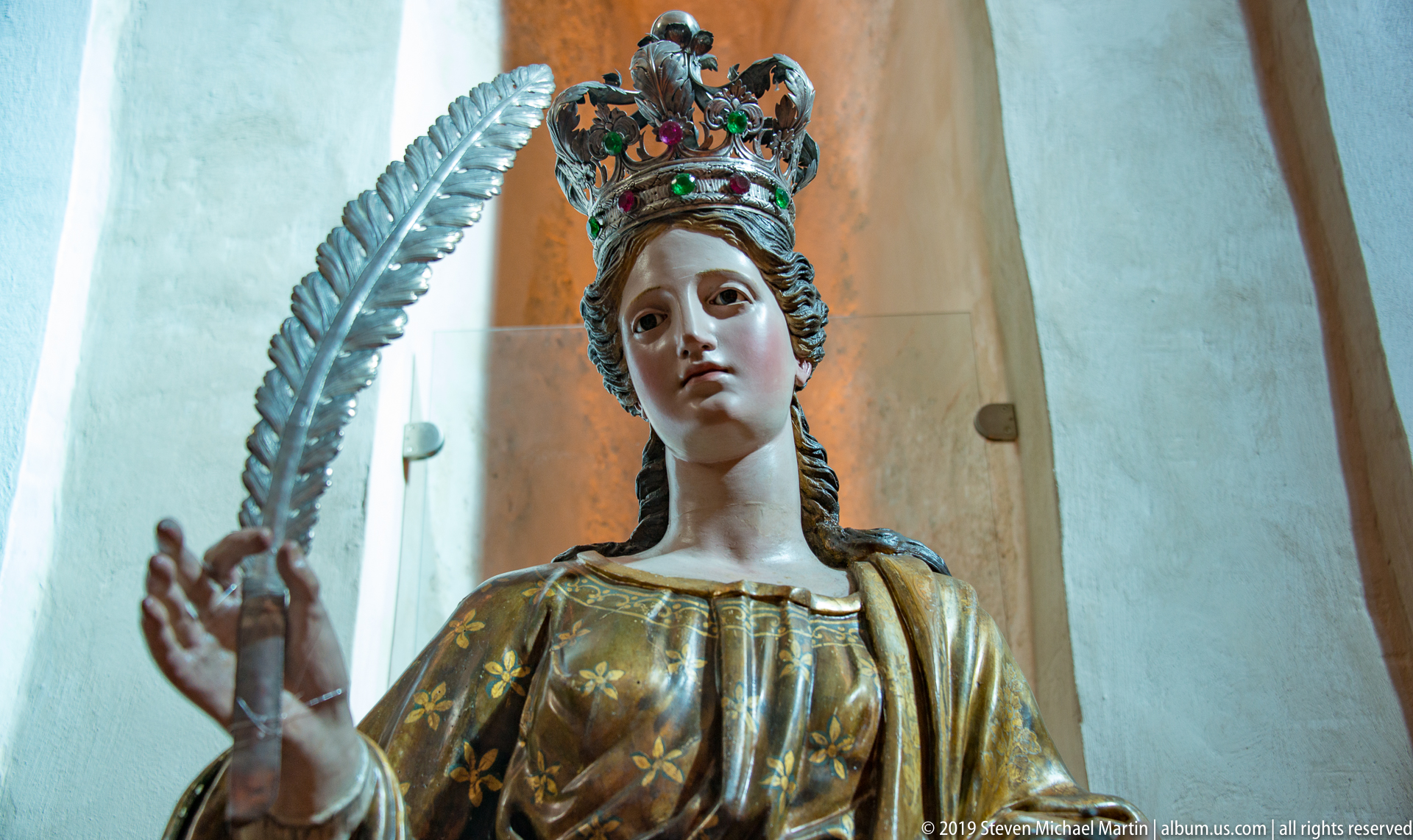
The crowned figure appears frontally in a closer view, revealing a pale face, dark curls, jeweled headpiece and richly patterned gold garment. One hand is raised beside the shoulder, while the other extends beyond the frame. The cooler interior light and pale background separate the figure from its display setting, allowing the costume and frontal pose to read more clearly than in the profile view.
Caption
The crowned figure appears frontally in a closer view, revealing a pale face, dark curls, jeweled headpiece and richly patterned gold garment. One hand is raised beside the shoulder, while the other extends beyond the frame. The cooler interior light and pale background separate the figure from its display setting, allowing the costume and frontal pose to read more clearly than in the profile view.

A large illustrated diagram presents rows of standing saints and smaller scenes, arranged in a grid on a warm ochre ground. Each figure occupies a narrow vertical panel, while additional narrative groups and architectural outlines fill the lower registers. The photographed display appears to explain the cathedral’s extensive mosaic program; its many compartments make it a reference image rather than an original mosaic surface.
Caption
A large illustrated diagram presents rows of standing saints and smaller scenes, arranged in a grid on a warm ochre ground. Each figure occupies a narrow vertical panel, while additional narrative groups and architectural outlines fill the lower registers. The photographed display appears to explain the cathedral’s extensive mosaic program; its many compartments make it a reference image rather than an original mosaic surface.

A small rectangular devotional object sits within an elaborate silver-colored frame with curled, leafy ornament and a crest-like top. The central blue panel contains tiny shapes that resemble a miniature scene or inscription, but its details are too small to distinguish. The frontal isolated view highlights the frame’s repoussé-like surface and symmetrical design without assigning a specific relic, image or function.
Caption
A small rectangular devotional object sits within an elaborate silver-colored frame with curled, leafy ornament and a crest-like top. The central blue panel contains tiny shapes that resemble a miniature scene or inscription, but its details are too small to distinguish. The frontal isolated view highlights the frame’s repoussé-like surface and symmetrical design without assigning a specific relic, image or function.

A broad mosaic scene contains a gathering of figures arranged around a central standing person, with others reclining or seated across a stylized landscape. Bright blue, pink, cream and gold tesserae define garments, trees and architectural forms within a narrow ornamental border. The crowded composition is presented as a complete narrative panel, but its specific biblical episode is not clear from this proof-sheet view.
Caption
A broad mosaic scene contains a gathering of figures arranged around a central standing person, with others reclining or seated across a stylized landscape. Bright blue, pink, cream and gold tesserae define garments, trees and architectural forms within a narrow ornamental border. The crowded composition is presented as a complete narrative panel, but its specific biblical episode is not clear from this proof-sheet view.

A white marble ecclesiastical figure stands in a dark, veined niche, hands gathered at the chest and a mitre-like headdress rising above a long beard. A small bishop’s mitre rests on the plinth at left, while the number three appears on the backing. The composition is a devotional or commemorative monument; the individual is not named here.
Caption
A white marble ecclesiastical figure stands in a dark, veined niche, hands gathered at the chest and a mitre-like headdress rising above a long beard. A small bishop’s mitre rests on the plinth at left, while the number three appears on the backing. The composition is a devotional or commemorative monument; the individual is not named here.

A pair of cream episcopal shoes, edged with gold embroidery and finished with white ribbons, is displayed on a red surface. The Diocesan Museum catalog identifies this pair as early nineteenth-century episcopal footwear from the Archbishop’s Palace.
Caption
A pair of cream episcopal shoes, edged with gold embroidery and finished with white ribbons, is displayed on a red surface. The Diocesan Museum catalog identifies this pair as early nineteenth-century episcopal footwear from the Archbishop’s Palace.

A treasury display groups embroidered vestments and ceremonial objects against a dark red backdrop. A tall pale textile panel with gold floral ornament anchors the center, flanked by metal chalices, a cross, and smaller liturgical vessels; another embroidered panel enters at right. The arrangement shows how textiles and precious-metal objects were presented together as components of ecclesiastical ceremonial dress and worship.
Caption
A treasury display groups embroidered vestments and ceremonial objects against a dark red backdrop. A tall pale textile panel with gold floral ornament anchors the center, flanked by metal chalices, a cross, and smaller liturgical vessels; another embroidered panel enters at right. The arrangement shows how textiles and precious-metal objects were presented together as components of ecclesiastical ceremonial dress and worship.

A close view focuses on a pale sculpted face beneath a dark blue and gold headdress or mantle. The head is tilted downward, with one eye partly shadowed and the carved hand or forearm near the cheek. A gold-toned backing and blue textile-like surface frame the face. The detail is intimate and dramatic, though the cropped image does not establish the figure’s identity or the full object.
Caption
A close view focuses on a pale sculpted face beneath a dark blue and gold headdress or mantle. The head is tilted downward, with one eye partly shadowed and the carved hand or forearm near the cheek. A gold-toned backing and blue textile-like surface frame the face. The detail is intimate and dramatic, though the cropped image does not establish the figure’s identity or the full object.

A shield-shaped heraldic object is displayed upright on a dark red backing. A pale central field carries a stylized double-headed eagle and horizontal bands, while a blue-and-gold border contains repeated lettering and small decorative motifs. The frontal composition emphasizes the emblem and its border; the inscription is not sufficiently legible to determine the exact institution or historical owner represented.
Caption
A shield-shaped heraldic object is displayed upright on a dark red backing. A pale central field carries a stylized double-headed eagle and horizontal bands, while a blue-and-gold border contains repeated lettering and small decorative motifs. The frontal composition emphasizes the emblem and its border; the inscription is not sufficiently legible to determine the exact institution or historical owner represented.

Two large mosaic panels show haloed winged figures standing within tall architectural frames. The left figure raises a hand toward the chest, while the right holds a small object; blue and gold garments contrast with pale backgrounds and narrow bands of curling ornament. The paired arrangement allows the figures’ distinct poses and attributes to be compared while preserving their repeated vertical rhythm within the church’s decorative program.
Caption
Two large mosaic panels show haloed winged figures standing within tall architectural frames. The left figure raises a hand toward the chest, while the right holds a small object; blue and gold garments contrast with pale backgrounds and narrow bands of curling ornament. The paired arrangement allows the figures’ distinct poses and attributes to be compared while preserving their repeated vertical rhythm within the church’s decorative program.

A marble ciborium stands over the altar in the Chapel of San Castrense. Its patterned columns support a carved canopy above the sanctuary, identifying the structure as the chapel’s focal altar furnishing.
Caption
A marble ciborium stands over the altar in the Chapel of San Castrense. Its patterned columns support a carved canopy above the sanctuary, identifying the structure as the chapel’s focal altar furnishing.

A circular mosaic medallion presents a papal tiara above crossed keys on a pale blue field. A broad terracotta-colored border surrounds the emblem, with small dark lettering or marks around its perimeter. The close framing isolates heraldry from the surrounding architecture, making the insignia and its colored tesserae the principal subjects.
Caption
A circular mosaic medallion presents a papal tiara above crossed keys on a pale blue field. A broad terracotta-colored border surrounds the emblem, with small dark lettering or marks around its perimeter. The close framing isolates heraldry from the surrounding architecture, making the insignia and its colored tesserae the principal subjects.

A gold-colored processional cross is photographed frontally against a blurred church interior. Its long central shaft carries a broad horizontal arm with rounded medallion-like terminals, and a small figure or ornament occupies the center. The stepped base suggests a stand or handle. The shallow focus keeps attention on the cross’s balanced form and metalwork.
Caption
A gold-colored processional cross is photographed frontally against a blurred church interior. Its long central shaft carries a broad horizontal arm with rounded medallion-like terminals, and a small figure or ornament occupies the center. The stepped base suggests a stand or handle. The shallow focus keeps attention on the cross’s balanced form and metalwork.

The domed marble ciborium of the Chapel of San Castrense rises above the altar beneath the chapel’s high interior vault. The frontal view makes its canopy, supporting columns, and central altar axis easy to read.
Caption
The domed marble ciborium of the Chapel of San Castrense rises above the altar beneath the chapel’s high interior vault. The frontal view makes its canopy, supporting columns, and central altar axis easy to read.

A rectangular mosaic depicts a stylized landscape of trees, water, buildings and distant hills beneath a deep blue sky. Bright yellow and green fields contrast with turquoise water and pale architecture; a small boat or figure appears near the center. The framed panel’s compact, illustrative composition differs from the cathedral’s more formal sacred images.
Caption
A rectangular mosaic depicts a stylized landscape of trees, water, buildings and distant hills beneath a deep blue sky. Bright yellow and green fields contrast with turquoise water and pale architecture; a small boat or figure appears near the center. The framed panel’s compact, illustrative composition differs from the cathedral’s more formal sacred images.

Christ appears frontally within a circular medallion, raising one hand in blessing and holding a book in the other. A gold field surrounds the figure, while winged angels occupy the corners and curved borders. The close view preserves the mosaic’s hierarchical arrangement and inscription-like marks, making the central sacred image distinct from its ornamental frame.
Caption
Christ appears frontally within a circular medallion, raising one hand in blessing and holding a book in the other. A gold field surrounds the figure, while winged angels occupy the corners and curved borders. The close view preserves the mosaic’s hierarchical arrangement and inscription-like marks, making the central sacred image distinct from its ornamental frame.

Interlocking bands of colored stone form a dense geometric pavement of stars, crosses, diamonds and zigzags. Red, ochre, blue, green and black tesserae create repeating fields around a pale central motif. The tight crop removes the floor’s boundaries, but preserves the contrasts and precise fitting of the inlaid pieces.
Caption
Interlocking bands of colored stone form a dense geometric pavement of stars, crosses, diamonds and zigzags. Red, ochre, blue, green and black tesserae create repeating fields around a pale central motif. The tight crop removes the floor’s boundaries, but preserves the contrasts and precise fitting of the inlaid pieces.

A small painting of a veiled woman in a blue mantle is set inside a dark architectural frame with paired columns and a carved crest. A pale outer border and patterned wall surround the ensemble, while a narrow label sits below. The modest figure is centered within a much larger decorative setting, and the label is too small to read.
Caption
A small painting of a veiled woman in a blue mantle is set inside a dark architectural frame with paired columns and a carved crest. A pale outer border and patterned wall surround the ensemble, while a narrow label sits below. The modest figure is centered within a much larger decorative setting, and the label is too small to read.

A second pavement detail shifts from star-centered motifs to tightly interwoven bands and angular compartments. Pale stone outlines dark, red, green and gold pieces in a rhythmic pattern that continues beyond every edge. The diagonal viewpoint makes the surface read as a continuous field of fitted inlay rather than as a single emblem or isolated medallion.
Caption
A second pavement detail shifts from star-centered motifs to tightly interwoven bands and angular compartments. Pale stone outlines dark, red, green and gold pieces in a rhythmic pattern that continues beyond every edge. The diagonal viewpoint makes the surface read as a continuous field of fitted inlay rather than as a single emblem or isolated medallion.

Pale sculpted forms emerge from a dark, blue-edged architectural setting. A rounded, bearded face is partly enclosed by curling supports and layered ornament, with a smaller head or mask nearby. The crop is tight and the overall object is unclear, so the photograph is best cataloged as a carved architectural or devotional detail rather than assigned a named subject.
Caption
Pale sculpted forms emerge from a dark, blue-edged architectural setting. A rounded, bearded face is partly enclosed by curling supports and layered ornament, with a smaller head or mask nearby. The crop is tight and the overall object is unclear, so the photograph is best cataloged as a carved architectural or devotional detail rather than assigned a named subject.

A pale eagle with broad, layered wings fills a circular relief, its head turned to one side and its talons extending downward. The roundel is set within blue, red and white geometric inlay, with curved supports and carved foliage around the perimeter. The close view emphasizes the bird’s sculptural volume and the surrounding frame rather than the larger monument.
Caption
A pale eagle with broad, layered wings fills a circular relief, its head turned to one side and its talons extending downward. The roundel is set within blue, red and white geometric inlay, with curved supports and carved foliage around the perimeter. The close view emphasizes the bird’s sculptural volume and the surrounding frame rather than the larger monument.

A pale marble prophet stands in a richly ornamented niche, holding a long inscribed scroll across his body. A carved plinth below bears the name “IEREMIA” (Jeremiah), providing a visible identification. Geometric blue, black, ochre and white inlay surrounds the figure, while the arched canopy and side ornaments integrate the statue into a larger decorative ensemble.
Caption
A pale marble prophet stands in a richly ornamented niche, holding a long inscribed scroll across his body. A carved plinth below bears the name “IEREMIA” (Jeremiah), providing a visible identification. Geometric blue, black, ochre and white inlay surrounds the figure, while the arched canopy and side ornaments integrate the statue into a larger decorative ensemble.

A bearded marble prophet in a turban-like cap holds a scroll across his chest. The pedestal is labeled “EZECHIEL,” identifying the figure as Ezekiel. Dense blue, black, ochre and white geometric ornament fills the surrounding niche, contrasting with the statue’s pale drapery and naturalistic face. The label and distinctive scroll make this view a secure portrait of one figure in a larger series.
Caption
A bearded marble prophet in a turban-like cap holds a scroll across his chest. The pedestal is labeled “EZECHIEL,” identifying the figure as Ezekiel. Dense blue, black, ochre and white geometric ornament fills the surrounding niche, contrasting with the statue’s pale drapery and naturalistic face. The label and distinctive scroll make this view a secure portrait of one figure in a larger series.

A pale marble prophet with a rounded cap and long beard holds a scroll diagonally across his chest. The plinth reads “ISAIAS,” identifying him as Isaiah. The figure stands before dense blue-and-ochre geometric inlay, with fragments of neighboring statues at the edges. The close framing preserves both the sculpted expression and the visible name while suggesting a sequence of prophets.
Caption
A pale marble prophet with a rounded cap and long beard holds a scroll diagonally across his chest. The plinth reads “ISAIAS,” identifying him as Isaiah. The figure stands before dense blue-and-ochre geometric inlay, with fragments of neighboring statues at the edges. The close framing preserves both the sculpted expression and the visible name while suggesting a sequence of prophets.

The marble figure labeled “DANIEL” stands with a scroll across his chest and a heavy mantle falling in broad folds. His wavy hair and youthful face distinguish him from the older bearded prophets nearby. The blue and gold mosaic-like backing continues the same ornamental vocabulary, linking the statue to a coordinated series of biblical figures.
Caption
The marble figure labeled “DANIEL” stands with a scroll across his chest and a heavy mantle falling in broad folds. His wavy hair and youthful face distinguish him from the older bearded prophets nearby. The blue and gold mosaic-like backing continues the same ornamental vocabulary, linking the statue to a coordinated series of biblical figures.

The camera isolates the prophet Isaiah’s scroll, hands and layered robe, with the name “ISAIAS” printed across the pale text. Blue and black geometric patterns surround the statue, and a small carved face appears near the lower edge. This detail records the figure’s identifying inscription and the sculptural treatment of fabric more clearly than a full-length view.
Caption
The camera isolates the prophet Isaiah’s scroll, hands and layered robe, with the name “ISAIAS” printed across the pale text. Blue and black geometric patterns surround the statue, and a small carved face appears near the lower edge. This detail records the figure’s identifying inscription and the sculptural treatment of fabric more clearly than a full-length view.

An architectural support carved as a winged figure spreads its feathers above a pale prophet statue holding a scroll. Geometric inlay fills the surrounding surface, while sculpted heads and curling forms frame the ensemble. The layered arrangement reads as part of a richly decorated pulpit or church furnishing, though the exact structural role of the support is not certain.
Caption
An architectural support carved as a winged figure spreads its feathers above a pale prophet statue holding a scroll. Geometric inlay fills the surrounding surface, while sculpted heads and curling forms frame the ensemble. The layered arrangement reads as part of a richly decorated pulpit or church furnishing, though the exact structural role of the support is not certain.

A closer view of the marble prophet Daniel brings his face, wavy hair and scroll into sharper focus. The carved hands grip the rolled text at chest height, while dark blue and ochre inlay forms a patterned halo around the figure. The crop removes the pedestal inscription but matches the labeled statue on the preceding proof-sheet image.
Caption
A closer view of the marble prophet Daniel brings his face, wavy hair and scroll into sharper focus. The carved hands grip the rolled text at chest height, while dark blue and ochre inlay forms a patterned halo around the figure. The crop removes the pedestal inscription but matches the labeled statue on the preceding proof-sheet image.

A rectangular panel of polychrome marble inlay centers a dark cross inside a pale diamond, surrounded by curling foliage and small floral medallions. Repeated black, white, ochre and muted red motifs fill a symmetrical frame, while the patterned floor continues beneath. The view records the precision of the inlay and its relationship to the church’s richly decorated interior.
Caption
A rectangular panel of polychrome marble inlay centers a dark cross inside a pale diamond, surrounded by curling foliage and small floral medallions. Repeated black, white, ochre and muted red motifs fill a symmetrical frame, while the patterned floor continues beneath. The view records the precision of the inlay and its relationship to the church’s richly decorated interior.

A pale carved figure with outstretched wings occupies the center of an ornate architectural panel. A smaller mask-like face appears below, framed by curling scrollwork and dark patterned inlay. The tight crop emphasizes the unusual combination of a winged support and human face, while the surrounding border suggests the sculpture belongs to a larger church furnishing.
Caption
A pale carved figure with outstretched wings occupies the center of an ornate architectural panel. A smaller mask-like face appears below, framed by curling scrollwork and dark patterned inlay. The tight crop emphasizes the unusual combination of a winged support and human face, while the surrounding border suggests the sculpture belongs to a larger church furnishing.

The prophet Jeremiah stands centered beneath a layered canopy, holding a scroll across his robe. “IEREMIA” is visible on the plinth, while blue-and-white geometric panels and carved supports form a dense architectural frame. A smaller figure kneels at the side, adding scale and a secondary devotional element to the composition.
Caption
The prophet Jeremiah stands centered beneath a layered canopy, holding a scroll across his robe. “IEREMIA” is visible on the plinth, while blue-and-white geometric panels and carved supports form a dense architectural frame. A smaller figure kneels at the side, adding scale and a secondary devotional element to the composition.

Ezekiel stands frontally beneath an ornate arch, holding a scroll against his pale robe. The plinth reads “EZECHIEL,” while a small kneeling figure appears to his right and patterned blue, gold and cream panels fill the background. The wider view reveals how the named prophet is integrated into an elaborate architectural program.
Caption
Ezekiel stands frontally beneath an ornate arch, holding a scroll against his pale robe. The plinth reads “EZECHIEL,” while a small kneeling figure appears to his right and patterned blue, gold and cream panels fill the background. The wider view reveals how the named prophet is integrated into an elaborate architectural program.

Daniel stands within a deep architectural niche, holding a scroll before his robe; “DANIEL” is readable on the pedestal. The surrounding structure combines blue geometric inlay, pale carved figures and layered moldings, with a kneeling figure at the side. The full composition shows the statue as one element in a complex sculptural and decorative ensemble.
Caption
Daniel stands within a deep architectural niche, holding a scroll before his robe; “DANIEL” is readable on the pedestal. The surrounding structure combines blue geometric inlay, pale carved figures and layered moldings, with a kneeling figure at the side. The full composition shows the statue as one element in a complex sculptural and decorative ensemble.

Isaiah faces forward holding a scroll marked “ISAIAS,” his pale robe set against blue, black and ochre geometric inlay. Carved ornament and small figures fill the surrounding frame, while the crop gives special prominence to the prophet’s name and upper body. The view links the individual statue to the same coordinated series of biblical figures.
Caption
Isaiah faces forward holding a scroll marked “ISAIAS,” his pale robe set against blue, black and ochre geometric inlay. Carved ornament and small figures fill the surrounding frame, while the crop gives special prominence to the prophet’s name and upper body. The view links the individual statue to the same coordinated series of biblical figures.

A broad interior view looks along the cathedral toward a richly ornamented sanctuary framed by tall columns and arches. Patterned marble, gold-toned decoration and mosaic imagery cover the walls and floor, while the central axis leads toward the distant altar. The open composition conveys the scale of the nave and the density of its decorative program.
Caption
A broad interior view looks along the cathedral toward a richly ornamented sanctuary framed by tall columns and arches. Patterned marble, gold-toned decoration and mosaic imagery cover the walls and floor, while the central axis leads toward the distant altar. The open composition conveys the scale of the nave and the density of its decorative program.

A pale stone carving presents two opposing, elongated animal-like heads joined at a central knot of forms. Their pointed ears, ridged snouts and open mouths stand out against a softly blurred interior. The close focus makes this an architectural or ornamental detail; the precise creature and its function cannot be determined from the photograph.
Caption
A pale stone carving presents two opposing, elongated animal-like heads joined at a central knot of forms. Their pointed ears, ridged snouts and open mouths stand out against a softly blurred interior. The close focus makes this an architectural or ornamental detail; the precise creature and its function cannot be determined from the photograph.

The Roano, or Crucifix, Chapel’s marble inlay floor depicts Jonah being thrown from a ship into the sea to calm the storm. The vessel, waves, and small figures form a narrative scene within the geometric stonework.
Caption
The Roano, or Crucifix, Chapel’s marble inlay floor depicts Jonah being thrown from a ship into the sea to calm the storm. The vessel, waves, and small figures form a narrative scene within the geometric stonework.

Christ Pantocrator sits frontally in the cathedral’s central apse mosaic, raising his right hand in blessing and holding an open book. Greek letters flank his halo against the gold ground, while the monumental scale and fragments of adjacent scenes place him at the center of the apse’s mosaic program.
Caption
Christ Pantocrator sits frontally in the cathedral’s central apse mosaic, raising his right hand in blessing and holding an open book. Greek letters flank his halo against the gold ground, while the monumental scale and fragments of adjacent scenes place him at the center of the apse’s mosaic program.

Interlocking oval and circular fields organize the marble floor into a sequence of medallions. Narrow borders of tiny colored pieces outline pale bands and dark centers, with small triangles and diamonds adding a finer rhythm. The nearly overhead viewpoint makes the inlay’s geometry and repeated scale easier to read than its placement within the larger church.
Caption
Interlocking oval and circular fields organize the marble floor into a sequence of medallions. Narrow borders of tiny colored pieces outline pale bands and dark centers, with small triangles and diamonds adding a finer rhythm. The nearly overhead viewpoint makes the inlay’s geometry and repeated scale easier to read than its placement within the larger church.

A haloed, bearded figure in a gold mosaic holds a closed book across his chest, wearing a pale robe edged with dark bands. Inscriptions curve around the halo and along the upper arch; smaller medallions and figures occupy the border below. The central person may be a prophet or saint, but the lettering is too indistinct here for a secure name.
Caption
A haloed, bearded figure in a gold mosaic holds a closed book across his chest, wearing a pale robe edged with dark bands. Inscriptions curve around the halo and along the upper arch; smaller medallions and figures occupy the border below. The central person may be a prophet or saint, but the lettering is too indistinct here for a secure name.

The view looks down the cathedral’s richly decorated interior toward a gold-ground apse mosaic. A central enthroned figure occupies the upper register, flanked by smaller figures within framed panels; below, the altar and sanctuary align along the nave. The broad perspective conveys the vertical layering of the church’s mosaic program and its relationship to the architectural space.
Caption
The view looks down the cathedral’s richly decorated interior toward a gold-ground apse mosaic. A central enthroned figure occupies the upper register, flanked by smaller figures within framed panels; below, the altar and sanctuary align along the nave. The broad perspective conveys the vertical layering of the church’s mosaic program and its relationship to the architectural space.

A small dark arched opening is set in pale rectangular masonry, above a projecting stone sill. The surrounding wall is framed by irregular red-brown stone, with a dark band and cropped black lettering near the top. The restrained composition contrasts with the cathedral’s elaborate mosaics and records a simple opening and its construction materials.
Caption
A small dark arched opening is set in pale rectangular masonry, above a projecting stone sill. The surrounding wall is framed by irregular red-brown stone, with a dark band and cropped black lettering near the top. The restrained composition contrasts with the cathedral’s elaborate mosaics and records a simple opening and its construction materials.

Christ appears enthroned within a gold-ground medallion, blessing and holding a book, with the four living creatures of the tetramorph around him. The creatures traditionally represent the four Evangelists, framing the image of Christ in Majesty.
Caption
Christ appears enthroned within a gold-ground medallion, blessing and holding a book, with the four living creatures of the tetramorph around him. The creatures traditionally represent the four Evangelists, framing the image of Christ in Majesty.

A haloed figure sits within a small circular panel near the apex of an elaborate gold-ground composition. Below, pairs of winged creatures face a larger central medallion, while surrounding bands carry additional portraits and lettering. The elevated view preserves the organization of several mosaic registers and the geometry of the apse vault.
Caption
A haloed figure sits within a small circular panel near the apex of an elaborate gold-ground composition. Below, pairs of winged creatures face a larger central medallion, while surrounding bands carry additional portraits and lettering. The elevated view preserves the organization of several mosaic registers and the geometry of the apse vault.

A haloed, gray-bearded saint holds a large book and a pair of keys against a gold background. The name “PETRUS” appears beside the figure, identifying him as Saint Peter. Smaller medallions and decorative bands surround the portrait, which forms part of the cathedral’s extensive mosaic program. The close view brings the identifying attributes into focus.
Caption
A haloed, gray-bearded saint holds a large book and a pair of keys against a gold background. The name “PETRUS” appears beside the figure, identifying him as Saint Peter. Smaller medallions and decorative bands surround the portrait, which forms part of the cathedral’s extensive mosaic program. The close view brings the identifying attributes into focus.

A frontal haloed figure with long dark hair and a beard holds a book against a gold ground. The robe is edged with blue and ochre, and abbreviated lettering sits beside the head. The tight crop preserves the face, hands and book while excluding enough of the surrounding program that the figure’s name cannot be read confidently.
Caption
A frontal haloed figure with long dark hair and a beard holds a book against a gold ground. The robe is edged with blue and ochre, and abbreviated lettering sits beside the head. The tight crop preserves the face, hands and book while excluding enough of the surrounding program that the figure’s name cannot be read confidently.

A gold-ground mosaic centers a small haloed figure within a circular frame above a larger seated figure. Four winged creatures flank the center in mirrored pairs, their dark feathers and pale faces set against the gold tesserae. The crop emphasizes the mosaic’s vertical hierarchy, from compact portrait to larger sacred scene.
Caption
A gold-ground mosaic centers a small haloed figure within a circular frame above a larger seated figure. Four winged creatures flank the center in mirrored pairs, their dark feathers and pale faces set against the gold tesserae. The crop emphasizes the mosaic’s vertical hierarchy, from compact portrait to larger sacred scene.

Seen from the rear, the cathedral’s nave leads toward the luminous mosaic apse and altar. Tall walls carry repeated arches, columns, paintings and patterned surfaces, while the central aisle and floor inlay direct the eye forward. The photograph records the interior’s depth and symmetry, with a small visitor in silhouette providing scale near the sanctuary.
Caption
Seen from the rear, the cathedral’s nave leads toward the luminous mosaic apse and altar. Tall walls carry repeated arches, columns, paintings and patterned surfaces, while the central aisle and floor inlay direct the eye forward. The photograph records the interior’s depth and symmetry, with a small visitor in silhouette providing scale near the sanctuary.

A dark, elaborately carved wooden lectern or choir furnishing fills the foreground, its sloped upper surface and stepped base silhouetted against the bright sanctuary. Beyond it, the cathedral’s patterned floor and gold mosaic apse draw the eye toward the altar. This layered view connects movable furnishings with the monumental space of worship.
Caption
A dark, elaborately carved wooden lectern or choir furnishing fills the foreground, its sloped upper surface and stepped base silhouetted against the bright sanctuary. Beyond it, the cathedral’s patterned floor and gold mosaic apse draw the eye toward the altar. This layered view connects movable furnishings with the monumental space of worship.

A dark wooden structure stands alone against a pale patterned wall, with a domed canopy above a deep central recess and a broad, heavily carved base. Symmetrical panels, columns and small finials give it the appearance of an architectural shrine, cabinet or altar furnishing. The photograph records its form without a readable label confirming its original use.
Caption
A dark wooden structure stands alone against a pale patterned wall, with a domed canopy above a deep central recess and a broad, heavily carved base. Symmetrical panels, columns and small finials give it the appearance of an architectural shrine, cabinet or altar furnishing. The photograph records its form without a readable label confirming its original use.

Christ sits frontally within a gold-ground mosaic, wearing a blue mantle and patterned tunic. His right hand is raised in blessing and an open book rests in his left; dark Greek letters appear beside the halo. Smaller figures and decorative borders encircle the central image, establishing it as the focal point of a larger apse composition.
Caption
Christ sits frontally within a gold-ground mosaic, wearing a blue mantle and patterned tunic. His right hand is raised in blessing and an open book rests in his left; dark Greek letters appear beside the halo. Smaller figures and decorative borders encircle the central image, establishing it as the focal point of a larger apse composition.

The sanctuary occupies the far end of a tall, richly ornamented interior. A long nave with geometric pavement leads to the altar, while the apse mosaic rises above it in several registers. The wide viewpoint includes columns, arches and side galleries, showing how the monumental image is integrated with the full church interior.
Caption
The sanctuary occupies the far end of a tall, richly ornamented interior. A long nave with geometric pavement leads to the altar, while the apse mosaic rises above it in several registers. The wide viewpoint includes columns, arches and side galleries, showing how the monumental image is integrated with the full church interior.

Two haloed figures occupy opposite sides of a gold-ground ceiling panel, facing inward across a narrow central band. Decorative borders and small medallions frame the scene, while the camera’s rotated angle places the figures horizontally in the image. The close crop emphasizes the mirrored composition and tessellated surface rather than the full architectural bay.
Caption
Two haloed figures occupy opposite sides of a gold-ground ceiling panel, facing inward across a narrow central band. Decorative borders and small medallions frame the scene, while the camera’s rotated angle places the figures horizontally in the image. The close crop emphasizes the mirrored composition and tessellated surface rather than the full architectural bay.

Two massive pale columns rise into a richly painted ceiling of dark coffers and gold ornament. Above a row of arches, the ceiling’s blue, ochre and red patterns repeat in a strict grid. The upward viewpoint makes the structural rhythm of columns, arcades and roof visible together, while the scale of the stone supports dominates the foreground.
Caption
Two massive pale columns rise into a richly painted ceiling of dark coffers and gold ornament. Above a row of arches, the ceiling’s blue, ochre and red patterns repeat in a strict grid. The upward viewpoint makes the structural rhythm of columns, arcades and roof visible together, while the scale of the stone supports dominates the foreground.

Blue and dark ceiling panels are divided by narrow gold-painted ribs, creating a repeated grid of rectangular coffers. Small gold motifs punctuate the panels, while a band of pale arches appears along the lower edge. The close crop isolates the ceiling’s color and construction, showing how painted ornament continues across multiple structural bays.
Caption
Blue and dark ceiling panels are divided by narrow gold-painted ribs, creating a repeated grid of rectangular coffers. Small gold motifs punctuate the panels, while a band of pale arches appears along the lower edge. The close crop isolates the ceiling’s color and construction, showing how painted ornament continues across multiple structural bays.

Two pale marble furnishings with openwork sides and carved supports stand before the cathedral’s mosaic apse. A larger, box-like structure is placed to the left and a narrower one to the right, with a low patterned barrier between them. Their elevated platforms and reading surfaces suggest ambones or pulpits, though the photograph does not identify their formal names.
Caption
Two pale marble furnishings with openwork sides and carved supports stand before the cathedral’s mosaic apse. A larger, box-like structure is placed to the left and a narrower one to the right, with a low patterned barrier between them. Their elevated platforms and reading surfaces suggest ambones or pulpits, though the photograph does not identify their formal names.

The Virgin sits enthroned with the Christ Child in the apse mosaic directly beneath Christ Pantocrator. The Diocese identifies the flanking archangels as Michael and Gabriel; the image preserves the central mother-and-child group within the gold-ground ensemble.
Caption
The Virgin sits enthroned with the Christ Child in the apse mosaic directly beneath Christ Pantocrator. The Diocese identifies the flanking archangels as Michael and Gabriel; the image preserves the central mother-and-child group within the gold-ground ensemble.

A haloed, bearded Christ faces forward within a large arched mosaic panel, his right hand raised and an open book held in the other. Smaller roundels with saints encircle the central image, and dark Greek lettering appears beside the halo. The dense border and gold ground connect the portrait to the cathedral’s broader Byzantine mosaic program.
Caption
A haloed, bearded Christ faces forward within a large arched mosaic panel, his right hand raised and an open book held in the other. Smaller roundels with saints encircle the central image, and dark Greek lettering appears beside the halo. The dense border and gold ground connect the portrait to the cathedral’s broader Byzantine mosaic program.

The Virgin’s dark mantle frames her face and the small haloed Christ Child seated on her lap. Gold tesserae surround the throne, while two attendant figures with halos stand at the sides. The closer framing brings the pair’s frontal expressions and the child’s gesture into view, preserving the devotional focus of the larger apse mosaic.
Caption
The Virgin’s dark mantle frames her face and the small haloed Christ Child seated on her lap. Gold tesserae surround the throne, while two attendant figures with halos stand at the sides. The closer framing brings the pair’s frontal expressions and the child’s gesture into view, preserving the devotional focus of the larger apse mosaic.

The broad apse mosaic centers Christ Pantocrator above the enthroned Virgin and Child, with angels and saints arranged in the lower registers. The full view makes the hierarchy of the cathedral’s principal mosaic program clear.
Caption
The broad apse mosaic centers Christ Pantocrator above the enthroned Virgin and Child, with angels and saints arranged in the lower registers. The full view makes the hierarchy of the cathedral’s principal mosaic program clear.

A centered view across the geometric marble floor leads toward the altar and gold mosaic sanctuary. Pale balustrades and dark choir furnishings create strong horizontal layers, while columns and arches rise on either side. The composition is more architectural than devotional, showing how the cathedral’s richly decorated sanctuary is organized within the nave.
Caption
A centered view across the geometric marble floor leads toward the altar and gold mosaic sanctuary. Pale balustrades and dark choir furnishings create strong horizontal layers, while columns and arches rise on either side. The composition is more architectural than devotional, showing how the cathedral’s richly decorated sanctuary is organized within the nave.

The camera looks into a high ceiling where dark coffers with gold detailing meet a broad curved arch. Small medallions and geometric mosaic bands trace the transitions between surfaces, while bright upper openings admit daylight. The view emphasizes the cathedral’s layered ceiling structure, its painted and tessellated ornament, and the way each bay frames the next.
Caption
The camera looks into a high ceiling where dark coffers with gold detailing meet a broad curved arch. Small medallions and geometric mosaic bands trace the transitions between surfaces, while bright upper openings admit daylight. The view emphasizes the cathedral’s layered ceiling structure, its painted and tessellated ornament, and the way each bay frames the next.

A pale altar stands below a tall carved canopy, with a row of dark candlesticks arranged across the upper ledge. Patterned marble and gilded details cover the sanctuary walls, while the central opening beneath the canopy frames the altar. A visible inscription along the front identifies the cathedral’s founders and connects the furnishing to the site’s royal history.
Caption
A pale altar stands below a tall carved canopy, with a row of dark candlesticks arranged across the upper ledge. Patterned marble and gilded details cover the sanctuary walls, while the central opening beneath the canopy frames the altar. A visible inscription along the front identifies the cathedral’s founders and connects the furnishing to the site’s royal history.

The seated Christ fills the center of the gold-ground apse, his right hand raised and an open book held at his left. Smaller standing figures and roundels form a balanced frame around the throne, while inscription bands follow the arch. This intermediate view shows both the central figure’s attributes and the structure of the surrounding mosaic program.
Caption
The seated Christ fills the center of the gold-ground apse, his right hand raised and an open book held at his left. Smaller standing figures and roundels form a balanced frame around the throne, while inscription bands follow the arch. This intermediate view shows both the central figure’s attributes and the structure of the surrounding mosaic program.

A close detail of Christ Pantocrator shows his frontal face, halo, and raised hand in blessing. Greek lettering borders the halo, and the edge of the open book remains visible at right, confirming the familiar apse image.
Caption
A close detail of Christ Pantocrator shows his frontal face, halo, and raised hand in blessing. Greek lettering borders the halo, and the edge of the open book remains visible at right, confirming the familiar apse image.

From the nave, the decorated sanctuary and central apse appear beyond a broad floor patterned with geometric inlay. Side galleries, pale rails and dark furnishings frame the view, while the monumental Christ mosaic anchors the far end of the church. This perspective gives useful context for the relationship between the nave, sanctuary and apse.
Caption
From the nave, the decorated sanctuary and central apse appear beyond a broad floor patterned with geometric inlay. Side galleries, pale rails and dark furnishings frame the view, while the monumental Christ mosaic anchors the far end of the church. This perspective gives useful context for the relationship between the nave, sanctuary and apse.

Christ faces the viewer from a gold-ground mosaic, raising his right hand and holding an open book in his left. Dark Greek letters flank the halo; a patterned arch and small roundels frame the figure. The detail retains enough of the surrounding decoration to place the portrait within the larger apse program while keeping Christ’s expression and attributes prominent.
Caption
Christ faces the viewer from a gold-ground mosaic, raising his right hand and holding an open book in his left. Dark Greek letters flank the halo; a patterned arch and small roundels frame the figure. The detail retains enough of the surrounding decoration to place the portrait within the larger apse program while keeping Christ’s expression and attributes prominent.

The upward view draws the eye through layered arches and gilded decoration to the monumental figure of Christ enthroned in the apse. Painted and mosaic surfaces gather around the sanctuary, where the scale of the image becomes clear against the surrounding architectural frame. The steep viewpoint makes the ceiling and apse read as one continuous field of sacred decoration.
Caption
The upward view draws the eye through layered arches and gilded decoration to the monumental figure of Christ enthroned in the apse. Painted and mosaic surfaces gather around the sanctuary, where the scale of the image becomes clear against the surrounding architectural frame. The steep viewpoint makes the ceiling and apse read as one continuous field of sacred decoration.

Rows of wooden chairs and visitors occupy the lower half of this broad nave view, while the paired columns and decorated arches draw attention toward the mosaic-covered sanctuary. The people make the cathedral’s scale legible and show the space in use, distinguishing this photograph from the tighter architectural views nearby. Bright side windows illuminate the pale supports and patterned upper walls.
Caption
Rows of wooden chairs and visitors occupy the lower half of this broad nave view, while the paired columns and decorated arches draw attention toward the mosaic-covered sanctuary. The people make the cathedral’s scale legible and show the space in use, distinguishing this photograph from the tighter architectural views nearby. Bright side windows illuminate the pale supports and patterned upper walls.

Looking almost straight upward, the photograph isolates the dark, richly ornamented timber ceiling, with repeated geometric panels and small painted medallions. A narrow strip of the side wall and high windows remains at the edges, emphasizing how the roof spans the nave. This close architectural study foregrounds the ceiling’s pattern and color rather than the cathedral’s overall plan.
Caption
Looking almost straight upward, the photograph isolates the dark, richly ornamented timber ceiling, with repeated geometric panels and small painted medallions. A narrow strip of the side wall and high windows remains at the edges, emphasizing how the roof spans the nave. This close architectural study foregrounds the ceiling’s pattern and color rather than the cathedral’s overall plan.

The tighter composition gives more space to the layered roofs and pastel façades climbing the slope, with the dark cathedral roof dominating the foreground. Green hills form a narrow backdrop beyond the town. This view complements the wider rooftop panorama by emphasizing the density and varied heights of Monreale’s residential blocks.
Caption
The tighter composition gives more space to the layered roofs and pastel façades climbing the slope, with the dark cathedral roof dominating the foreground. Green hills form a narrow backdrop beyond the town. This view complements the wider rooftop panorama by emphasizing the density and varied heights of Monreale’s residential blocks.

A close upward view isolates the cathedral’s layered arches, where dark and pale stone form interlocking geometric bands and circular medallions. The repeated star-like motifs and contrasting borders reveal the precision of the decorative inlay, while the cropped perspective turns the architectural surface into an abstract pattern. No broader room context is needed to read the craftsmanship.
Caption
A close upward view isolates the cathedral’s layered arches, where dark and pale stone form interlocking geometric bands and circular medallions. The repeated star-like motifs and contrasting borders reveal the precision of the decorative inlay, while the cropped perspective turns the architectural surface into an abstract pattern. No broader room context is needed to read the craftsmanship.

A dark wrought-metal wall sconce with several candle-shaped electric lamps projects from the stone interior wall. The close framing sets its curling metalwork against a narrow arched window and a deeply recessed masonry opening. This functional fitting provides a sharply silhouetted detail within the cathedral’s otherwise luminous, mosaic-rich interior.
Caption
A dark wrought-metal wall sconce with several candle-shaped electric lamps projects from the stone interior wall. The close framing sets its curling metalwork against a narrow arched window and a deeply recessed masonry opening. This functional fitting provides a sharply silhouetted detail within the cathedral’s otherwise luminous, mosaic-rich interior.

From above the town, tightly grouped apartment blocks and houses spread across a green slope, with a palm tree rising near the center of the view. The stepped rooflines and layered streets reveal Monreale’s hillside setting, while a pale building stands higher on the ridge. This is a broad urban context photograph rather than a close study of the cathedral itself.
Caption
From above the town, tightly grouped apartment blocks and houses spread across a green slope, with a palm tree rising near the center of the view. The stepped rooflines and layered streets reveal Monreale’s hillside setting, while a pale building stands higher on the ridge. This is a broad urban context photograph rather than a close study of the cathedral itself.

Two bells hang within open arched bays high in the cathedral’s stone tower, their dark shapes set against the sky. The broad masonry wall and crenellated-looking roofline dominate the frame, while a small metal rooftop structure rises at the right. The close exterior view records the belfry’s openings and working bells rather than the full cathedral façade.
Caption
Two bells hang within open arched bays high in the cathedral’s stone tower, their dark shapes set against the sky. The broad masonry wall and crenellated-looking roofline dominate the frame, while a small metal rooftop structure rises at the right. The close exterior view records the belfry’s openings and working bells rather than the full cathedral façade.

A printed visitor plan lays out the cathedral and adjoining spaces, marking the entrance, ticket point, audio-guide service, terraces, and cloister. Numbered areas distinguish parts of the building around a large central plan, while the footer identifies the local religious works organization and its website. The diagram functions as a practical guide to moving through the site.
Caption
A printed visitor plan lays out the cathedral and adjoining spaces, marking the entrance, ticket point, audio-guide service, terraces, and cloister. Numbered areas distinguish parts of the building around a large central plan, while the footer identifies the local religious works organization and its website. The diagram functions as a practical guide to moving through the site.

An elevated view looks across Piazza Vittorio Emanuele II, with the Fontana del Tritone centered among clipped hedges and palms. The surrounding façades and street activity place the fountain within Monreale’s civic heart.
Caption
An elevated view looks across Piazza Vittorio Emanuele II, with the Fontana del Tritone centered among clipped hedges and palms. The surrounding façades and street activity place the fountain within Monreale’s civic heart.

A compact street runs between tall residential buildings with balconies, shutters, and ground-level storefronts. Cars are parked along the narrow roadway, which leads toward the greener hillside beyond. Warm façades and close-set upper floors create a canyon-like urban corridor, offering a street-level counterpart to the elevated town panoramas on the preceding page.
Caption
A compact street runs between tall residential buildings with balconies, shutters, and ground-level storefronts. Cars are parked along the narrow roadway, which leads toward the greener hillside beyond. Warm façades and close-set upper floors create a canyon-like urban corridor, offering a street-level counterpart to the elevated town panoramas on the preceding page.

A narrow roadway passes between tall, closely spaced homes and apartment blocks, with several cars parked along the curb and others farther down the street. The low viewpoint looks toward a green hillside visible in the distance. Balconies, shuttered windows, and varied warm-colored façades give this final frame a distinctly local, everyday character.
Caption
A narrow roadway passes between tall, closely spaced homes and apartment blocks, with several cars parked along the curb and others farther down the street. The low viewpoint looks toward a green hillside visible in the distance. Balconies, shuttered windows, and varied warm-colored façades give this final frame a distinctly local, everyday character.