Mdina – Malta
The ancient walled city of Mdina sits on a hill in the center of the island and has served as a fortified settlement for more than two thousand years. Known as the “Silent City,” Mdina preserves the atmosphere of a medieval town with its narrow streets, stone palaces, and quiet courtyards.
Originally established during the Phoenician and Roman periods, the city later became the medieval capital of Malta before the Knights of St. John founded Valletta. Massive defensive walls surround the historic center, offering sweeping views across the Maltese countryside.
Today Mdina remains one of the most atmospheric historic towns in the Mediterranean.

Mdina Gate presents a monumental Baroque entrance through the fortified walls, its rusticated stonework framing a central arch beneath an elaborate sculpted crest and Maltese flag. Seen in warm low light, the gateway combines ceremonial architecture with the practical thickness of M’dina’s defenses, marking the transition from the outer approach into the enclosed historic city.
Caption
Mdina Gate presents a monumental Baroque entrance through the fortified walls, its rusticated stonework framing a central arch beneath an elaborate sculpted crest and Maltese flag. Seen in warm low light, the gateway combines ceremonial architecture with the practical thickness of M’dina’s defenses, marking the transition from the outer approach into the enclosed historic city.

An intimate paved space opens between limestone façades, where red and green shutters, carved door surrounds, balconies, potted cycads, café-style furniture, and a leafless tree create a layered street scene. The enclosure feels almost courtyard-like, illustrating how M’dina’s dense historic fabric expands briefly into small communal spaces between its narrow lanes.
Caption
An intimate paved space opens between limestone façades, where red and green shutters, carved door surrounds, balconies, potted cycads, café-style furniture, and a leafless tree create a layered street scene. The enclosure feels almost courtyard-like, illustrating how M’dina’s dense historic fabric expands briefly into small communal spaces between its narrow lanes.

The approach to M’dina Gate is framed by large stone statues along the bridge, mature trees, and the fortified entrance ahead. Visitors walking toward the arch provide scale and movement, while the flag above the gateway and long limestone walls establish the scene as the principal ceremonial approach to the walled city.
Caption
The approach to M’dina Gate is framed by large stone statues along the bridge, mature trees, and the fortified entrance ahead. Visitors walking toward the arch provide scale and movement, while the flag above the gateway and long limestone walls establish the scene as the principal ceremonial approach to the walled city.

A monumental crowned coat of arms rises from an elaborate stone surround near M’dina’s entrance, its shield marked by a prominent cross and flanked by dense scrollwork and sculptural forms. The frontal close view concentrates attention on heraldic symbolism and craftsmanship, showing how civic and institutional emblems punctuate the fortified city’s ceremonial approach.
Caption
A monumental crowned coat of arms rises from an elaborate stone surround near M’dina’s entrance, its shield marked by a prominent cross and flanked by dense scrollwork and sculptural forms. The frontal close view concentrates attention on heraldic symbolism and craftsmanship, showing how civic and institutional emblems punctuate the fortified city’s ceremonial approach.

From M’dina’s elevated position, fields, roads, scattered buildings, and low stone boundaries spread across the Maltese countryside toward a distant band of dense settlement. The broad horizon and patchwork of cultivated land provide geographic context for the fortified city, contrasting its high defensive setting with the open terrain below.
Caption
From M’dina’s elevated position, fields, roads, scattered buildings, and low stone boundaries spread across the Maltese countryside toward a distant band of dense settlement. The broad horizon and patchwork of cultivated land provide geographic context for the fortified city, contrasting its high defensive setting with the open terrain below.

A visitor stands beneath a broad limestone arch, with a sculpted lion on a pedestal visible beyond the opening. The shallow depth of field separates the figure from the sunlit defensive setting while preserving the thickness of the masonry and the spatial sequence through the gateway area, giving a human scale to M’dina’s monumental fortifications.
Caption
A visitor stands beneath a broad limestone arch, with a sculpted lion on a pedestal visible beyond the opening. The shallow depth of field separates the figure from the sunlit defensive setting while preserving the thickness of the masonry and the spatial sequence through the gateway area, giving a human scale to M’dina’s monumental fortifications.

A visitor pauses at the junction of narrow limestone passages, providing scale for the tall, closely spaced walls around him. A barred window, potted plant, shuttered openings, and hanging lantern add domestic detail to the otherwise austere stone setting. The portrait situates a contemporary traveler within the compact pedestrian network of M’dina’s historic core.
Caption
A visitor pauses at the junction of narrow limestone passages, providing scale for the tall, closely spaced walls around him. A barred window, potted plant, shuttered openings, and hanging lantern add domestic detail to the otherwise austere stone setting. The portrait situates a contemporary traveler within the compact pedestrian network of M’dina’s historic core.

A narrow lane curves between high limestone walls, its path bending out of sight beneath sparse vegetation and projecting architectural edges. The absence of traffic and the enclosing masonry convey the intimate scale of M’dina’s interior circulation. Rather than a monumental landmark, the view records the fortified city’s quieter urban fabric and the way walls shape movement through it.
Caption
A narrow lane curves between high limestone walls, its path bending out of sight beneath sparse vegetation and projecting architectural edges. The absence of traffic and the enclosing masonry convey the intimate scale of M’dina’s interior circulation. Rather than a monumental landmark, the view records the fortified city’s quieter urban fabric and the way walls shape movement through it.

A horse-drawn carriage passes a limestone doorway in M’dina, with the driver gesturing from the raised box and passengers seated beneath the canopy. The traditional conveyance, dark timber bodywork, spoked wheels, and harnessed horse stand out against the pale masonry and paved street, adding human activity and scale to the fortified city’s historic urban fabric.
Caption
A horse-drawn carriage passes a limestone doorway in M’dina, with the driver gesturing from the raised box and passengers seated beneath the canopy. The traditional conveyance, dark timber bodywork, spoked wheels, and harnessed horse stand out against the pale masonry and paved street, adding human activity and scale to the fortified city’s historic urban fabric.

A richly modeled bell tower rises above a narrow ensemble of pale limestone buildings in M’dina. Pointed-arched openings on the lower structure contrast with the more elaborate Baroque vocabulary of the tower, while balustrades, shuttered windows, and a street lantern layer several architectural details into a compact view of the historic city.
Caption
A richly modeled bell tower rises above a narrow ensemble of pale limestone buildings in M’dina. Pointed-arched openings on the lower structure contrast with the more elaborate Baroque vocabulary of the tower, while balustrades, shuttered windows, and a street lantern layer several architectural details into a compact view of the historic city.

A Maltese flag flies above the sculpted crest of M’dina’s fortifications, where a raised central parapet is flanked by large carved heraldic roundels and rusticated stonework. The low viewpoint isolates the upper defensive architecture against a deep blue sky, drawing attention to the ceremonial ornament added to the otherwise massive limestone construction.
Caption
A Maltese flag flies above the sculpted crest of M’dina’s fortifications, where a raised central parapet is flanked by large carved heraldic roundels and rusticated stonework. The low viewpoint isolates the upper defensive architecture against a deep blue sky, drawing attention to the ceremonial ornament added to the otherwise massive limestone construction.
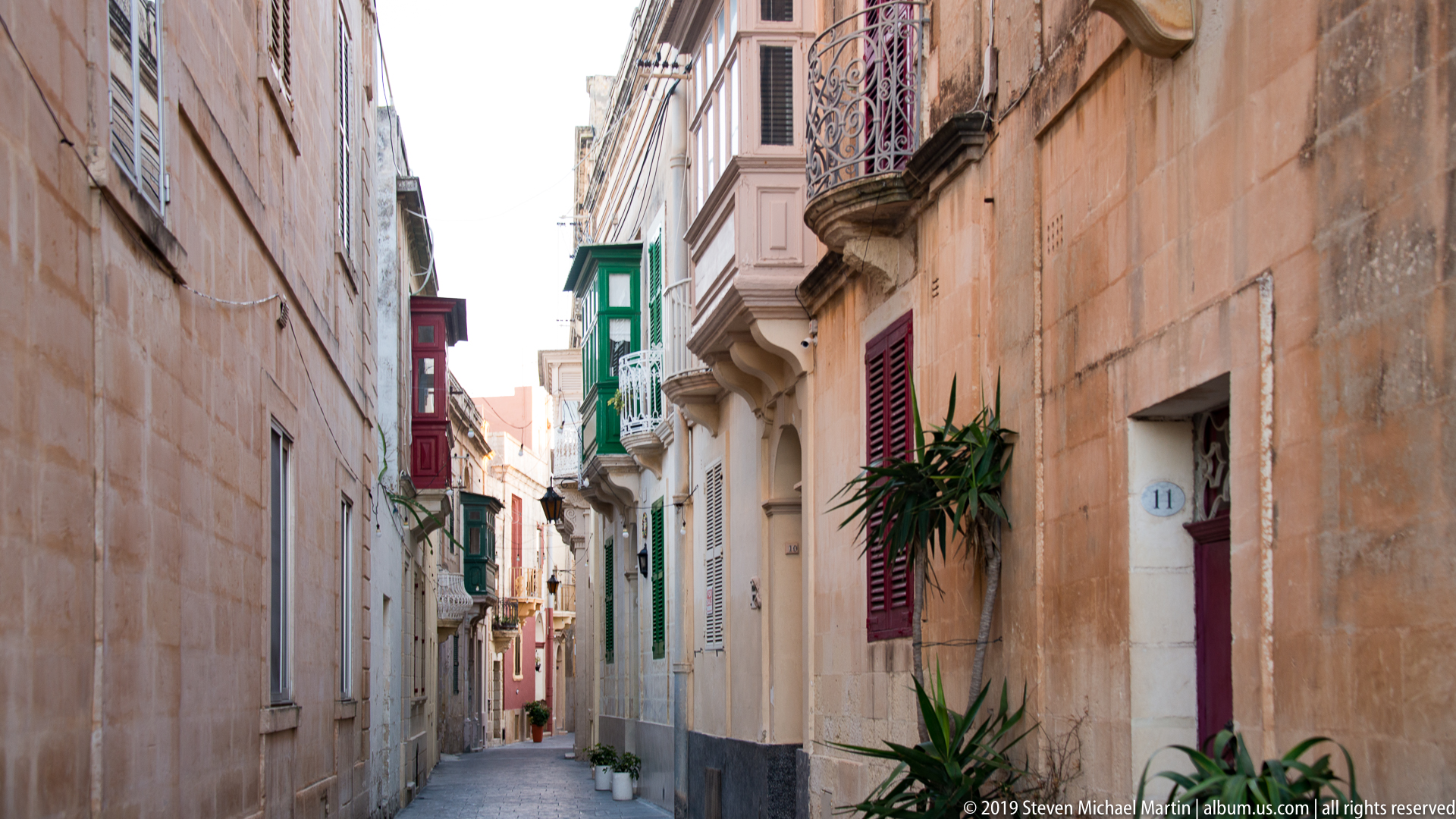
A narrow street threads between M’dina’s honey-colored limestone façades, where enclosed balconies, painted shutters, projecting stone balconies, potted plants, and closely spaced doorways create a layered domestic streetscape. The compressed perspective shows how the fortified city’s interior is organized at pedestrian scale, contrasting with the monumental defensive architecture encountered at its gates.
Caption
A narrow street threads between M’dina’s honey-colored limestone façades, where enclosed balconies, painted shutters, projecting stone balconies, potted plants, and closely spaced doorways create a layered domestic streetscape. The compressed perspective shows how the fortified city’s interior is organized at pedestrian scale, contrasting with the monumental defensive architecture encountered at its gates.

Above the entrance arch of Mdina Gate, a large carved heraldic achievement is set beneath a Latin inscription panel and between heavily rusticated masonry blocks. The close view isolates the ceremonial decoration from the larger gateway, revealing how coats of arms, inscriptions, and sculptural ornament were integrated into the defensive entrance to proclaim civic and political authority.
Caption
Above the entrance arch of Mdina Gate, a large carved heraldic achievement is set beneath a Latin inscription panel and between heavily rusticated masonry blocks. The close view isolates the ceremonial decoration from the larger gateway, revealing how coats of arms, inscriptions, and sculptural ornament were integrated into the defensive entrance to proclaim civic and political authority.

A carved stone lion braces a heraldic shield beside the monumental entrance to M’dina, set against the gate’s deeply jointed rusticated masonry. Photographed from below, the sculpture stands out in warm sunlight against the pale fortification wall, emphasizing the heraldic program that transforms the defensive gateway into a formal statement of authority and civic identity.
Caption
A carved stone lion braces a heraldic shield beside the monumental entrance to M’dina, set against the gate’s deeply jointed rusticated masonry. Photographed from below, the sculpture stands out in warm sunlight against the pale fortification wall, emphasizing the heraldic program that transforms the defensive gateway into a formal statement of authority and civic identity.

An ornate limestone entrance with a deep red double gate forms the center of a symmetrical forecourt, flanked by historic cannon, palms, lamps, and stone balustrades. The richly carved portal and heraldic crest give the enclosure a ceremonial character, while the artillery pieces reinforce the military associations that remain visible throughout M’dina’s fortified urban landscape.
Caption
An ornate limestone entrance with a deep red double gate forms the center of a symmetrical forecourt, flanked by historic cannon, palms, lamps, and stone balustrades. The richly carved portal and heraldic crest give the enclosure a ceremonial character, while the artillery pieces reinforce the military associations that remain visible throughout M’dina’s fortified urban landscape.

A wooden hanging sign spells “MDIENA” above a bold black Maltese cross, suspended from a decorative white metal bracket against a limestone façade. The close composition records a contemporary use of the island’s most recognizable heraldic symbol within M’dina’s historic streetscape, where commercial signs often borrow visual language from Malta’s long institutional and military history.
Caption
A wooden hanging sign spells “MDIENA” above a bold black Maltese cross, suspended from a decorative white metal bracket against a limestone façade. The close composition records a contemporary use of the island’s most recognizable heraldic symbol within M’dina’s historic streetscape, where commercial signs often borrow visual language from Malta’s long institutional and military history.

Projecting balconies animate a limestone corner in M’dina, combining an enclosed wooden gallery with an open iron-railed balcony above the narrow street. A suspended lantern enters the foreground, reinforcing the intimate scale of the lane. The view highlights how domestic additions, windows, and balconies articulate otherwise massive stone façades within the fortified city.
Caption
Projecting balconies animate a limestone corner in M’dina, combining an enclosed wooden gallery with an open iron-railed balcony above the narrow street. A suspended lantern enters the foreground, reinforcing the intimate scale of the lane. The view highlights how domestic additions, windows, and balconies articulate otherwise massive stone façades within the fortified city.

A compact limestone façade faces a quiet paved space, centered on a brown double door framed by a restrained Baroque-style surround and curved pediment. Weathering across the masonry contrasts with the carefully ordered entrance, while a potted palm and bollards provide scale. The view records the understated civic or institutional architecture embedded within M’dina’s historic core.
Caption
A compact limestone façade faces a quiet paved space, centered on a brown double door framed by a restrained Baroque-style surround and curved pediment. Weathering across the masonry contrasts with the carefully ordered entrance, while a potted palm and bollards provide scale. The view records the understated civic or institutional architecture embedded within M’dina’s historic core.

A compact carved ornament crowns a limestone parapet against an uninterrupted blue sky. Its symmetrical composition resembles a tied bundle or trophy, with folded and rounded forms gathered beneath a small central block. Isolated from the surrounding building, the detail demonstrates the sculptural embellishment used to enliven rooflines and gateways throughout M’dina’s historic architecture.
Caption
A compact carved ornament crowns a limestone parapet against an uninterrupted blue sky. Its symmetrical composition resembles a tied bundle or trophy, with folded and rounded forms gathered beneath a small central block. Isolated from the surrounding building, the detail demonstrates the sculptural embellishment used to enliven rooflines and gateways throughout M’dina’s historic architecture.

Two metal heraldic shields are mounted side by side on a dark red door, each carrying a different arrangement of crosses, fleurs-de-lis, and plant motifs. The paired emblems turn an otherwise plain entrance into a concentrated display of lineage or institutional identity, a recurring decorative language in M’dina’s aristocratic and ecclesiastical streetscape.
Caption
Two metal heraldic shields are mounted side by side on a dark red door, each carrying a different arrangement of crosses, fleurs-de-lis, and plant motifs. The paired emblems turn an otherwise plain entrance into a concentrated display of lineage or institutional identity, a recurring decorative language in M’dina’s aristocratic and ecclesiastical streetscape.

An elaborate metal door knocker centers on a bearded face whose extended moustache or scroll-like forms are grasped by two long-necked birds. Mounted against a dark wooden door, the sculptural hardware combines grotesque portraiture, animal forms, and functional metalwork. The tight framing preserves the object as a distinctive example of decorative entrance detail in M’dina.
Caption
An elaborate metal door knocker centers on a bearded face whose extended moustache or scroll-like forms are grasped by two long-necked birds. Mounted against a dark wooden door, the sculptural hardware combines grotesque portraiture, animal forms, and functional metalwork. The tight framing preserves the object as a distinctive example of decorative entrance detail in M’dina.

A quiet street junction opens between ornate limestone façades, with a domed or lantern-topped bell tower rising in the distance and a richly carved portal occupying the right foreground. Parked cars and a pedestrian place the historic architecture in contemporary use, while the converging façades reveal the dense, irregular urban form within M’dina’s walls.
Caption
A quiet street junction opens between ornate limestone façades, with a domed or lantern-topped bell tower rising in the distance and a richly carved portal occupying the right foreground. Parked cars and a pedestrian place the historic architecture in contemporary use, while the converging façades reveal the dense, irregular urban form within M’dina’s walls.

A projecting wooden balcony spans the center of a limestone façade, its deep red panels, latticework, and white metal railing creating a vivid contrast with the warm stone. The enclosed gallery extends domestic space over the street while preserving shade and privacy, illustrating a characteristic balcony form found across Malta’s historic urban architecture.
Caption
A projecting wooden balcony spans the center of a limestone façade, its deep red panels, latticework, and white metal railing creating a vivid contrast with the warm stone. The enclosed gallery extends domestic space over the street while preserving shade and privacy, illustrating a characteristic balcony form found across Malta’s historic urban architecture.

A sculpted wall plaque announces “TALES OF THE SILENT CITY” within an oval frame of scrolls, bead-like molding, and floral ornament. Set into a weathered pale wall, the sign uses M’dina’s familiar sobriquet, “the Silent City,” as part of a decorative visitor-facing identity. The close view records both the inscription and its deliberately historicizing surround.
Caption
A sculpted wall plaque announces “TALES OF THE SILENT CITY” within an oval frame of scrolls, bead-like molding, and floral ornament. Set into a weathered pale wall, the sign uses M’dina’s familiar sobriquet, “the Silent City,” as part of a decorative visitor-facing identity. The close view records both the inscription and its deliberately historicizing surround.

A dense cluster of carved stone figures and heraldic forms crowns the corner of a monumental limestone structure, silhouetted against a deep blue sky. Drapery-like folds, shields, and sculptural projections create a dramatic termination above the cornice. The upward viewpoint emphasizes the theatrical ornament that distinguishes M’dina’s more formal Baroque architectural ensembles.
Caption
A dense cluster of carved stone figures and heraldic forms crowns the corner of a monumental limestone structure, silhouetted against a deep blue sky. Drapery-like folds, shields, and sculptural projections create a dramatic termination above the cornice. The upward viewpoint emphasizes the theatrical ornament that distinguishes M’dina’s more formal Baroque architectural ensembles.

Two sculpted figures support a heraldic shield in this elaborate metal door knocker, mounted against a vivid red door. The shield combines animal and geometric devices, while a curved banner below carries a partially legible motto. The close view shows how functional door hardware in M’dina can become a miniature heraldic composition rich in family or institutional symbolism.
Caption
Two sculpted figures support a heraldic shield in this elaborate metal door knocker, mounted against a vivid red door. The shield combines animal and geometric devices, while a curved banner below carries a partially legible motto. The close view shows how functional door hardware in M’dina can become a miniature heraldic composition rich in family or institutional symbolism.

A cast metal door knocker takes the form of a frontal female head framed by flowing hair and supported by a broad curved handle. The symmetrical design recalls classical or mythological masks without requiring a specific figure identification. Isolated against a plain door surface, the object demonstrates the sculptural ambition applied to everyday entrance hardware in M’dina.
Caption
A cast metal door knocker takes the form of a frontal female head framed by flowing hair and supported by a broad curved handle. The symmetrical design recalls classical or mythological masks without requiring a specific figure identification. Isolated against a plain door surface, the object demonstrates the sculptural ambition applied to everyday entrance hardware in M’dina.

A small arched entrance opens through a weathered limestone wall, closed by a black wrought-iron gate and framed by a broken, curving pediment. A painted decorative scene occupies the recessed arch above the opening, while greenery is visible beyond. The composition records a more intimate threshold within M’dina’s layered network of courtyards, gardens, and enclosed properties.
Caption
A small arched entrance opens through a weathered limestone wall, closed by a black wrought-iron gate and framed by a broken, curving pediment. A painted decorative scene occupies the recessed arch above the opening, while greenery is visible beyond. The composition records a more intimate threshold within M’dina’s layered network of courtyards, gardens, and enclosed properties.

A shallow stone relief depicts a compact fortified skyline beneath decorative floral or shell-like motifs, set within a rounded architectural niche. Towers and walls rise above a textured base, creating a miniature cityscape in pale stone. The weathered carving functions as an architectural emblem, though the proof sheet does not establish the precise scene or patron represented.
Caption
A shallow stone relief depicts a compact fortified skyline beneath decorative floral or shell-like motifs, set within a rounded architectural niche. Towers and walls rise above a textured base, creating a miniature cityscape in pale stone. The weathered carving functions as an architectural emblem, though the proof sheet does not establish the precise scene or patron represented.

A carved heraldic shield fills a recessed stone niche, supported by two rampant lions and surmounted by additional crowned or helmeted figures. The quartered arms include crosses, fleurs-de-lis, and other devices rendered in high relief. The close view emphasizes the depth and complexity of heraldic carving used to mark status and institutional identity in M’dina.
Caption
A carved heraldic shield fills a recessed stone niche, supported by two rampant lions and surmounted by additional crowned or helmeted figures. The quartered arms include crosses, fleurs-de-lis, and other devices rendered in high relief. The close view emphasizes the depth and complexity of heraldic carving used to mark status and institutional identity in M’dina.

A dark-coated cat sleeps along the sill of a deeply recessed limestone window, partly enclosed by a white diamond-pattern metal grille and green-painted frame. The quiet domestic detail contrasts with M’dina’s monumental gates and heraldry, offering a close observation of everyday life within the fortified city’s residential streets.
Caption
A dark-coated cat sleeps along the sill of a deeply recessed limestone window, partly enclosed by a white diamond-pattern metal grille and green-painted frame. The quiet domestic detail contrasts with M’dina’s monumental gates and heraldry, offering a close observation of everyday life within the fortified city’s residential streets.

A low limestone façade faces a paved courtyard, its green doors and shutters set beneath a long shaded pergola supported by slender columns. Potted cycads and an olive tree soften the pale masonry. The restrained composition highlights the quieter residential architecture and planted courtyards found behind M’dina’s more imposing public façades.
Caption
A low limestone façade faces a paved courtyard, its green doors and shutters set beneath a long shaded pergola supported by slender columns. Potted cycads and an olive tree soften the pale masonry. The restrained composition highlights the quieter residential architecture and planted courtyards found behind M’dina’s more imposing public façades.

Bright blue louvered shutters frame a simple window in a warm limestone wall, with a leafy branch crossing the lower edge of the composition. The saturated paint and crisp geometry stand out against the textured masonry, isolating one of the small color accents that enliven M’dina’s otherwise restrained palette of honey-colored stone.
Caption
Bright blue louvered shutters frame a simple window in a warm limestone wall, with a leafy branch crossing the lower edge of the composition. The saturated paint and crisp geometry stand out against the textured masonry, isolating one of the small color accents that enliven M’dina’s otherwise restrained palette of honey-colored stone.

A traditional hanging lantern occupies the upper passage between limestone buildings, beside a projecting enclosed wooden balcony supported on a carved stone base. A shuttered window below adds another layer of domestic detail. Viewed upward from the narrow street, the composition emphasizes how balconies and lighting fixtures project into M’dina’s confined pedestrian spaces.
Caption
A traditional hanging lantern occupies the upper passage between limestone buildings, beside a projecting enclosed wooden balcony supported on a carved stone base. A shuttered window below adds another layer of domestic detail. Viewed upward from the narrow street, the composition emphasizes how balconies and lighting fixtures project into M’dina’s confined pedestrian spaces.

Two ceramic street plaques meet at a weathered limestone corner, marking Triq L-Imħażen (Magazines Street) and Triq San Pietru (St. Peter Street). Their hand-painted bilingual lettering and blue ornamental borders provide a close view of M’dina’s street signage, while the rough, patched stonework records the texture and age of the surrounding urban fabric.
Caption
Two ceramic street plaques meet at a weathered limestone corner, marking Triq L-Imħażen (Magazines Street) and Triq San Pietru (St. Peter Street). Their hand-painted bilingual lettering and blue ornamental borders provide a close view of M’dina’s street signage, while the rough, patched stonework records the texture and age of the surrounding urban fabric.

A smiling visitor stands before a flight of weathered limestone steps, dressed in a dark jacket with a shoulder strap crossing the frame. The close portrait removes most architectural context while retaining the textured stone backdrop characteristic of M’dina. It serves as a personal travel record within the broader portfolio of the fortified city’s streets and monuments.
Caption
A smiling visitor stands before a flight of weathered limestone steps, dressed in a dark jacket with a shoulder strap crossing the frame. The close portrait removes most architectural context while retaining the textured stone backdrop characteristic of M’dina. It serves as a personal travel record within the broader portfolio of the fortified city’s streets and monuments.

A restrained double wooden door sits within a pale limestone façade, reached by a shallow stone step and capped by a semicircular fanlight with ironwork. Matching metal knockers and the strong contrast between the reddish-brown doors and honey-colored masonry turn an ordinary entrance into a study of M’dina’s domestic architectural details.
Caption
A restrained double wooden door sits within a pale limestone façade, reached by a shallow stone step and capped by a semicircular fanlight with ironwork. Matching metal knockers and the strong contrast between the reddish-brown doors and honey-colored masonry turn an ordinary entrance into a study of M’dina’s domestic architectural details.

An elaborate cast-metal door knocker fills the frame against a dark painted door. Its sculptural upper mask, hinged striker, pierced lower plate, and dense scrolling ornament reward close inspection, showing the decorative craftsmanship applied to M’dina’s entrances. The tight composition deliberately separates the hardware from the larger doorway so its modeled surface and patina become the subject.
Caption
An elaborate cast-metal door knocker fills the frame against a dark painted door. Its sculptural upper mask, hinged striker, pierced lower plate, and dense scrolling ornament reward close inspection, showing the decorative craftsmanship applied to M’dina’s entrances. The tight composition deliberately separates the hardware from the larger doorway so its modeled surface and patina become the subject.

Warm evening light strikes a small limestone gable crowned by a single bell, while tall cypress trees partly screen the façade. A large circular stone panel containing a cross dominates the wall below the bell opening. The close, upward view isolates these religious and architectural elements against a deep blue sky rather than identifying the building from context alone.
Caption
Warm evening light strikes a small limestone gable crowned by a single bell, while tall cypress trees partly screen the façade. A large circular stone panel containing a cross dominates the wall below the bell opening. The close, upward view isolates these religious and architectural elements against a deep blue sky rather than identifying the building from context alone.

A glowing lantern projects from an ornate iron bracket into the narrow strip of sky between two high limestone walls. Seen from below, the fixture’s warm amber light contrasts with the cool blue sky and massive masonry, emphasizing the compressed scale of M’dina’s lanes and the traditional street furniture used within the historic city.
Caption
A glowing lantern projects from an ornate iron bracket into the narrow strip of sky between two high limestone walls. Seen from below, the fixture’s warm amber light contrasts with the cool blue sky and massive masonry, emphasizing the compressed scale of M’dina’s lanes and the traditional street furniture used within the historic city.

A monumental red double door anchors a formal limestone entrance framed by heavy rusticated pilasters and a projecting entablature. A semicircular fanlight spreads above the opening, while matching sculptural knockers punctuate the paneled leaves. The frontal composition emphasizes symmetry, craftsmanship, and the imposing scale associated with M’dina’s more prestigious historic residences.
Caption
A monumental red double door anchors a formal limestone entrance framed by heavy rusticated pilasters and a projecting entablature. A semicircular fanlight spreads above the opening, while matching sculptural knockers punctuate the paneled leaves. The frontal composition emphasizes symmetry, craftsmanship, and the imposing scale associated with M’dina’s more prestigious historic residences.

A white cross crowns an elaborate limestone memorial or devotional surround, flanked by carved flaming urns and centered on a skull motif above a scroll-shaped inscription panel. The combination of Christian and mortality symbols gives the architectural detail a distinctly commemorative character, while the close view preserves the carved lettering without relying on an uncertain transcription.
Caption
A white cross crowns an elaborate limestone memorial or devotional surround, flanked by carved flaming urns and centered on a skull motif above a scroll-shaped inscription panel. The combination of Christian and mortality symbols gives the architectural detail a distinctly commemorative character, while the close view preserves the carved lettering without relying on an uncertain transcription.

A horse-drawn carriage approaches head-on along a stone-paved street, the driver leaning forward above the harnessed horse. The frontal viewpoint emphasizes the animal, shafts, wheels, and compact carriage body, while warm limestone façades and projecting balconies frame the route behind. The scene records traditional visitor transport as active street life rather than a static display.
Caption
A horse-drawn carriage approaches head-on along a stone-paved street, the driver leaning forward above the harnessed horse. The frontal viewpoint emphasizes the animal, shafts, wheels, and compact carriage body, while warm limestone façades and projecting balconies frame the route behind. The scene records traditional visitor transport as active street life rather than a static display.

Rows of projecting pyramidal stone bosses animate the corner of a limestone building, each point catching light differently across the sharply angled façade. The geometric treatment forms a textured band beneath the upper wall and beside a narrow arched opening, demonstrating how defensive-looking mass and refined surface ornament can coexist in M’dina’s historic architecture.
Caption
Rows of projecting pyramidal stone bosses animate the corner of a limestone building, each point catching light differently across the sharply angled façade. The geometric treatment forms a textured band beneath the upper wall and beside a narrow arched opening, demonstrating how defensive-looking mass and refined surface ornament can coexist in M’dina’s historic architecture.

Seen from below, a massive limestone corner combines a tall arched window with a broad band of pyramidal stone bossing wrapping the exterior. A small upper opening and projecting roofline complete the austere composition. This wider view places the distinctive geometric masonry seen in nearby details within the scale and structure of the full building.
Caption
Seen from below, a massive limestone corner combines a tall arched window with a broad band of pyramidal stone bossing wrapping the exterior. A small upper opening and projecting roofline complete the austere composition. This wider view places the distinctive geometric masonry seen in nearby details within the scale and structure of the full building.

A shallow stone balcony projects from a carefully dressed limestone façade, its turned balusters set before vivid red louvered shutters. A broad semicircular relieving arch spans the wall above the opening, giving the compact composition a strong architectural frame. The saturated shutters make this domestic detail especially distinctive within M’dina’s predominantly honey-colored streetscape.
Caption
A shallow stone balcony projects from a carefully dressed limestone façade, its turned balusters set before vivid red louvered shutters. A broad semicircular relieving arch spans the wall above the opening, giving the compact composition a strong architectural frame. The saturated shutters make this domestic detail especially distinctive within M’dina’s predominantly honey-colored streetscape.

Café Marquit occupies a limestone façade enlivened by red trim, shutters, and a broad enclosed wooden balcony above the entrance. Simple stools and low tables line the pavement, while the open doorway reveals the interior beyond. The frontal view records how a contemporary hospitality business inhabits and adapts M’dina’s traditional masonry architecture.
Caption
Café Marquit occupies a limestone façade enlivened by red trim, shutters, and a broad enclosed wooden balcony above the entrance. Simple stools and low tables line the pavement, while the open doorway reveals the interior beyond. The frontal view records how a contemporary hospitality business inhabits and adapts M’dina’s traditional masonry architecture.

A symmetrical limestone façade faces an open square, its red doors and shutters arranged beneath a central balcony and a small bell turret. The upper bell opening and curving crown create a vertical focal point above the otherwise restrained elevation. Parked cars and a pedestrian establish the building’s present-day urban setting and scale.
Caption
A symmetrical limestone façade faces an open square, its red doors and shutters arranged beneath a central balcony and a small bell turret. The upper bell opening and curving crown create a vertical focal point above the otherwise restrained elevation. Parked cars and a pedestrian establish the building’s present-day urban setting and scale.

Black metal lettering spelling “Casa Mdina” is mounted directly on rough honey-colored limestone blocks. The tight crop reduces the scene to typography and masonry, allowing the Gothic-inspired letterforms, shadows, mortar joints, and weathered stone surface to become the principal visual elements. It is a small but distinctive example of signage integrated into M’dina’s historic fabric.
Caption
Black metal lettering spelling “Casa Mdina” is mounted directly on rough honey-colored limestone blocks. The tight crop reduces the scene to typography and masonry, allowing the Gothic-inspired letterforms, shadows, mortar joints, and weathered stone surface to become the principal visual elements. It is a small but distinctive example of signage integrated into M’dina’s historic fabric.

A decorative ceramic plaque identifies Triq Is-Sur as Bastion Street, pairing Maltese and English names within a scrolling blue-and-white border. Mounted on rough, patched limestone, the sign directly connects the lane to M’dina’s fortified urban landscape. The close framing also preserves the contrast between carefully painted lettering and the heavily weathered wall.
Caption
A decorative ceramic plaque identifies Triq Is-Sur as Bastion Street, pairing Maltese and English names within a scrolling blue-and-white border. Mounted on rough, patched limestone, the sign directly connects the lane to M’dina’s fortified urban landscape. The close framing also preserves the contrast between carefully painted lettering and the heavily weathered wall.

A richly articulated domed tower rises against a clear blue sky, its warm stone drum framed by engaged columns, arched openings, sculpted scrolls, and a reddish dome. Low evening light models the projecting architectural elements and lantern above. The tight crop concentrates on the upper structure rather than claiming an exact church identification unsupported by the proof sheet alone.
Caption
A richly articulated domed tower rises against a clear blue sky, its warm stone drum framed by engaged columns, arched openings, sculpted scrolls, and a reddish dome. Low evening light models the projecting architectural elements and lantern above. The tight crop concentrates on the upper structure rather than claiming an exact church identification unsupported by the proof sheet alone.

From M’dina’s elevated position, the view extends across green and cultivated foreground fields toward a dense pale settlement and the blue Mediterranean horizon. Marina masts and larger modern structures punctuate the middle distance. The panorama demonstrates the fortified city’s commanding relationship to the surrounding Maltese landscape without assigning the distant town an uncertain identity.
Caption
From M’dina’s elevated position, the view extends across green and cultivated foreground fields toward a dense pale settlement and the blue Mediterranean horizon. Marina masts and larger modern structures punctuate the middle distance. The panorama demonstrates the fortified city’s commanding relationship to the surrounding Maltese landscape without assigning the distant town an uncertain identity.

A covered bridge spans a narrow limestone passage between closely packed buildings, enclosing an upper-level connection above the lane. Curving iron balconies, shuttered windows, wall lamps, and the bright courtyard beyond create layers of depth through the confined space. The view illustrates the intimate scale and interwoven building fabric of M’dina’s historic core.
Caption
A covered bridge spans a narrow limestone passage between closely packed buildings, enclosing an upper-level connection above the lane. Curving iron balconies, shuttered windows, wall lamps, and the bright courtyard beyond create layers of depth through the confined space. The view illustrates the intimate scale and interwoven building fabric of M’dina’s historic core.

A sculptural fish-shaped metal door knocker projects dramatically from a glossy dark door, its textured scales, fins, and open mouth modeled in high relief. Two polished mounts secure the piece to the surface. The unusual zoomorphic design makes this hardware a distinctive decorative detail among M’dina’s historic entrances.
Caption
A sculptural fish-shaped metal door knocker projects dramatically from a glossy dark door, its textured scales, fins, and open mouth modeled in high relief. Two polished mounts secure the piece to the surface. The unusual zoomorphic design makes this hardware a distinctive decorative detail among M’dina’s historic entrances.

A broad limestone arch frames the richly decorated interior of a church, drawing the eye toward an organ loft and illuminated altar beyond. Patterned marble flooring, dark pews, colored wall revetment, and layered architectural ornament contrast with the restrained stone arch in the foreground, creating a clear transition from entrance space to ceremonial interior.
Caption
A broad limestone arch frames the richly decorated interior of a church, drawing the eye toward an organ loft and illuminated altar beyond. Patterned marble flooring, dark pews, colored wall revetment, and layered architectural ornament contrast with the restrained stone arch in the foreground, creating a clear transition from entrance space to ceremonial interior.

An imposing limestone palace-like building presents a formal corner façade articulated by tall windows, sculpted surrounds, cornices, and a balustraded roofline. The long side elevation recedes toward adjoining structures, revealing the building’s substantial footprint. Parked cars and a low pedestrian barrier provide contemporary scale against the carefully ordered historic architecture.
Caption
An imposing limestone palace-like building presents a formal corner façade articulated by tall windows, sculpted surrounds, cornices, and a balustraded roofline. The long side elevation recedes toward adjoining structures, revealing the building’s substantial footprint. Parked cars and a low pedestrian barrier provide contemporary scale against the carefully ordered historic architecture.

An ornate ecclesiastical façade anchors one side of a compact M’dina square, its sculpted entrance and vertical accents contrasting with the plainer adjoining limestone buildings. Parked cars, planters, and a horse-drawn carriage occupy the open foreground, showing the square as both an architectural setting and a functioning contemporary urban space.
Caption
An ornate ecclesiastical façade anchors one side of a compact M’dina square, its sculpted entrance and vertical accents contrasting with the plainer adjoining limestone buildings. Parked cars, planters, and a horse-drawn carriage occupy the open foreground, showing the square as both an architectural setting and a functioning contemporary urban space.

Two painted putti flank an elaborate heraldic shield above a skull-and-crossbones-like mortality motif and crossed emblems. The composition combines heraldry, devotional imagery, and funerary symbolism within a framed architectural panel. Because the arms and inscription are not securely identifiable at proof-sheet scale, the record preserves the visible iconography without assigning a family or institution.
Caption
Two painted putti flank an elaborate heraldic shield above a skull-and-crossbones-like mortality motif and crossed emblems. The composition combines heraldry, devotional imagery, and funerary symbolism within a framed architectural panel. Because the arms and inscription are not securely identifiable at proof-sheet scale, the record preserves the visible iconography without assigning a family or institution.

A narrow lane bends between high limestone façades, its quiet perspective punctuated by barred windows, traditional wall lanterns, drainpipes, and a projecting enclosed balcony. Weathered masonry and the absence of traffic emphasize the pedestrian scale of M’dina’s interior streets, while the curve conceals the route ahead and reinforces the city’s compact urban form.
Caption
A narrow lane bends between high limestone façades, its quiet perspective punctuated by barred windows, traditional wall lanterns, drainpipes, and a projecting enclosed balcony. Weathered masonry and the absence of traffic emphasize the pedestrian scale of M’dina’s interior streets, while the curve conceals the route ahead and reinforces the city’s compact urban form.

The sanctuary rises beneath a painted dome and richly ornamented vaults, with a monumental altar framed by dark marble columns and gilded architectural details. Sculpted figures and oval paintings occupy the side bays, while layered cornices lead upward toward the luminous cupola. The low-angle composition stresses the vertical theatricality of the church’s Baroque interior.
Caption
The sanctuary rises beneath a painted dome and richly ornamented vaults, with a monumental altar framed by dark marble columns and gilded architectural details. Sculpted figures and oval paintings occupy the side bays, while layered cornices lead upward toward the luminous cupola. The low-angle composition stresses the vertical theatricality of the church’s Baroque interior.

A pale stone statue of the crowned Madonna and Child stands beneath a dark projecting canopy on an exterior corner. The Virgin’s flowing drapery creates deep folds around the smaller child figure, while the ornate architectural setting rises behind them. The low viewpoint isolates the devotional sculpture against the sky and weathered limestone façade.
Caption
A pale stone statue of the crowned Madonna and Child stands beneath a dark projecting canopy on an exterior corner. The Virgin’s flowing drapery creates deep folds around the smaller child figure, while the ornate architectural setting rises behind them. The low viewpoint isolates the devotional sculpture against the sky and weathered limestone façade.

A large religious painting dominates this side altar, set within a monumental architectural frame of colored marble and gilded trim. Six tall candlesticks and a central crucifix line the altar ledge below, while the surrounding stonework and decorative crest integrate the painting into the church’s elaborate interior ensemble.
Caption
A large religious painting dominates this side altar, set within a monumental architectural frame of colored marble and gilded trim. Six tall candlesticks and a central crucifix line the altar ledge below, while the surrounding stonework and decorative crest integrate the painting into the church’s elaborate interior ensemble.

A frontal view of the sanctuary centers the high altar beneath layered arches, painted vaulting, and a bright circular opening above. Paired colored-marble columns and sculpted figures frame the altar, while side galleries and gilded ornament broaden the composition. The symmetrical viewpoint clarifies the ceremonial axis and dense decorative program of the interior.
Caption
A frontal view of the sanctuary centers the high altar beneath layered arches, painted vaulting, and a bright circular opening above. Paired colored-marble columns and sculpted figures frame the altar, while side galleries and gilded ornament broaden the composition. The symmetrical viewpoint clarifies the ceremonial axis and dense decorative program of the interior.

Looking upward along the nave, massive arches and reddish marble piers support a sequence of painted and gilded vaults. A stained-glass window glows at the far end above a smaller architectural feature, providing a strong focal point beneath the richly patterned ceiling. The perspective emphasizes the interior’s height, rhythm, and layered decorative surfaces.
Caption
Looking upward along the nave, massive arches and reddish marble piers support a sequence of painted and gilded vaults. A stained-glass window glows at the far end above a smaller architectural feature, providing a strong focal point beneath the richly patterned ceiling. The perspective emphasizes the interior’s height, rhythm, and layered decorative surfaces.

An ornate church nave rises through layered arches to a richly painted barrel vault, with a stained-glass window glowing above the far end. Gilded moldings, colored marble, framed paintings, and repeated architectural bays create a highly articulated interior, while the upward viewpoint stresses the vertical progression from arcades to vault and clerestory.
Caption
An ornate church nave rises through layered arches to a richly painted barrel vault, with a stained-glass window glowing above the far end. Gilded moldings, colored marble, framed paintings, and repeated architectural bays create a highly articulated interior, while the upward viewpoint stresses the vertical progression from arcades to vault and clerestory.

Looking directly upward, the church dome forms a circular composition of painted figures, clouds, gilded architectural bands, and a bright central oculus. Tall windows around the drum admit daylight beneath the frescoed cupola, making the photograph a study of the dome’s concentric structure and the transition from masonry architecture to painted heavenly space.
Caption
Looking directly upward, the church dome forms a circular composition of painted figures, clouds, gilded architectural bands, and a bright central oculus. Tall windows around the drum admit daylight beneath the frescoed cupola, making the photograph a study of the dome’s concentric structure and the transition from masonry architecture to painted heavenly space.

The dome fills the frame in a tighter upward view, centering the luminous oculus above a ring of painted figures and clouds. White architectural ribs and gold ornament frame the fresco cycle, while the lower drum windows remain visible at the edge, clarifying the cupola’s layered construction and its strong circular geometry.
Caption
The dome fills the frame in a tighter upward view, centering the luminous oculus above a ring of painted figures and clouds. White architectural ribs and gold ornament frame the fresco cycle, while the lower drum windows remain visible at the edge, clarifying the cupola’s layered construction and its strong circular geometry.

A polychrome heraldic shield crowned by a coronet occupies the center of an elaborate stone composition above a pediment. Green mantling, a red shield with a pale animal emblem, and flanking carved escutcheons stand out against the warm limestone façade, turning civic or ecclesiastical heraldry into a prominent architectural marker.
Caption
A polychrome heraldic shield crowned by a coronet occupies the center of an elaborate stone composition above a pediment. Green mantling, a red shield with a pale animal emblem, and flanking carved escutcheons stand out against the warm limestone façade, turning civic or ecclesiastical heraldry into a prominent architectural marker.

An ornate pipe organ projects from a richly decorated gallery beneath a high window, its polished metal pipes arranged within a gilded architectural case. Carved balustrades, painted wall panels, and layered moldings surround the instrument, emphasizing how music, sculpture, and architectural ornament are integrated within the church interior.
Caption
An ornate pipe organ projects from a richly decorated gallery beneath a high window, its polished metal pipes arranged within a gilded architectural case. Carved balustrades, painted wall panels, and layered moldings surround the instrument, emphasizing how music, sculpture, and architectural ornament are integrated within the church interior.

A haloed marble figure in ecclesiastical dress holds a large inscribed tablet against a backdrop of red and dark green marble. The standing sculpture is set on a carved pedestal and presented at near eye level, allowing the folds of the garments, the saint’s attributes, and the contrasting polychrome wall surfaces to read clearly.
Caption
A haloed marble figure in ecclesiastical dress holds a large inscribed tablet against a backdrop of red and dark green marble. The standing sculpture is set on a carved pedestal and presented at near eye level, allowing the folds of the garments, the saint’s attributes, and the contrasting polychrome wall surfaces to read clearly.

A seated haloed figure holds an inscribed tablet across the lap, the pale marble sculpture standing out against richly colored wall panels. The frontal pose, carved drapery, and prominent written text make the statue’s didactic character visually central, while its low pedestal and surrounding church furnishings establish its liturgical setting.
Caption
A seated haloed figure holds an inscribed tablet across the lap, the pale marble sculpture standing out against richly colored wall panels. The frontal pose, carved drapery, and prominent written text make the statue’s didactic character visually central, while its low pedestal and surrounding church furnishings establish its liturgical setting.

The sanctuary is framed by massive colored-marble piers and an illuminated dome, with the principal altar centered beneath the crossing. Hanging lamps, circular devotional paintings, statuary, and gilded architectural details fill the view, while the central aisle perspective reveals the carefully layered sequence from nave to crossing and altar.
Caption
The sanctuary is framed by massive colored-marble piers and an illuminated dome, with the principal altar centered beneath the crossing. Hanging lamps, circular devotional paintings, statuary, and gilded architectural details fill the view, while the central aisle perspective reveals the carefully layered sequence from nave to crossing and altar.

A steep limestone gable is enriched with a large circular carved relief, scrollwork, pinnacles, and cross-like finials silhouetted against the blue sky. The close architectural view isolates the upper façade, where sculptural ornament and heraldic imagery transform the roofline into a ceremonial focal point.
Caption
A steep limestone gable is enriched with a large circular carved relief, scrollwork, pinnacles, and cross-like finials silhouetted against the blue sky. The close architectural view isolates the upper façade, where sculptural ornament and heraldic imagery transform the roofline into a ceremonial focal point.

A large painted clock face is set directly beneath an open belfry containing a bronze bell, creating a close study of one tower on St. Paul’s Cathedral. Carved stone moldings and projecting ornament surround both features, while the tight framing reveals the functional and decorative elements that animate the cathedral’s upper façade.
Caption
A large painted clock face is set directly beneath an open belfry containing a bronze bell, creating a close study of one tower on St. Paul’s Cathedral. Carved stone moldings and projecting ornament surround both features, while the tight framing reveals the functional and decorative elements that animate the cathedral’s upper façade.

A wide upward view gathers the church’s dome, painted vaults, stained-glass windows, gilded cornices, marble piers, and organ loft into a single architectural composition. The central dome rises above intersecting arches while light from windows and fixtures picks out the dense surface decoration, conveying the interior’s spatial complexity rather than a single devotional object.
Caption
A wide upward view gathers the church’s dome, painted vaults, stained-glass windows, gilded cornices, marble piers, and organ loft into a single architectural composition. The central dome rises above intersecting arches while light from windows and fixtures picks out the dense surface decoration, conveying the interior’s spatial complexity rather than a single devotional object.

The upper façade of St. Paul’s Cathedral is framed by twin bell towers, each carrying a clock below an open belfry. Paired pilasters, a central triangular pediment, sculpted tower crowns, and warm Maltese limestone create a balanced Baroque composition, shown here against an exceptionally clear blue sky.
Caption
The upper façade of St. Paul’s Cathedral is framed by twin bell towers, each carrying a clock below an open belfry. Paired pilasters, a central triangular pediment, sculpted tower crowns, and warm Maltese limestone create a balanced Baroque composition, shown here against an exceptionally clear blue sky.

The central entrance of St. Paul’s Cathedral is framed by carved pilasters, a broken architectural surround, and a colorful heraldic crest beneath a large circular stone emblem. Heavy paneled doors fill the portal, while low afternoon light brings out the relief carving and warm tonal variations of the limestone.
Caption
The central entrance of St. Paul’s Cathedral is framed by carved pilasters, a broken architectural surround, and a colorful heraldic crest beneath a large circular stone emblem. Heavy paneled doors fill the portal, while low afternoon light brings out the relief carving and warm tonal variations of the limestone.

The full façade of St. Paul’s Cathedral is presented almost square-on, emphasizing the symmetry of its twin bell towers, paired clocks, central pediment, and three lower entrances. Strong sunlight models the honey-colored limestone and sculptural details, while a line of cars at street level gives scale to the monumental elevation.
Caption
The full façade of St. Paul’s Cathedral is presented almost square-on, emphasizing the symmetry of its twin bell towers, paired clocks, central pediment, and three lower entrances. Strong sunlight models the honey-colored limestone and sculptural details, while a line of cars at street level gives scale to the monumental elevation.

A sculptural Crucifixion group forms the focal point of this intimate side chapel, with the crucified Christ elevated above attendant figures and a marble altar. Pale blue-gray wall panels, gilded moldings, painted vault sections, and suspended sanctuary lamps surround the ensemble, giving the chapel a distinct decorative scheme within the larger church.
Caption
A sculptural Crucifixion group forms the focal point of this intimate side chapel, with the crucified Christ elevated above attendant figures and a marble altar. Pale blue-gray wall panels, gilded moldings, painted vault sections, and suspended sanctuary lamps surround the ensemble, giving the chapel a distinct decorative scheme within the larger church.

St. Paul’s Cathedral fills the end of the square, its symmetrical façade and twin bell towers rising above pedestrians, parked cars, and neighboring limestone buildings. The wider setting shows the cathedral as part of M’dina’s compact urban fabric, while late-day shadow across the lower façade contrasts with sunlit towers and pediment.
Caption
St. Paul’s Cathedral fills the end of the square, its symmetrical façade and twin bell towers rising above pedestrians, parked cars, and neighboring limestone buildings. The wider setting shows the cathedral as part of M’dina’s compact urban fabric, while late-day shadow across the lower façade contrasts with sunlit towers and pediment.

Three standing sacred figures occupy an arched stone relief set into an exterior wall, the central figure raising one hand while a small flame-like motif appears below. An inscribed border follows the arch, and weathering across the carved surface gives the devotional composition a strong sense of age and exposure.
Caption
Three standing sacred figures occupy an arched stone relief set into an exterior wall, the central figure raising one hand while a small flame-like motif appears below. An inscribed border follows the arch, and weathering across the carved surface gives the devotional composition a strong sense of age and exposure.

A symmetrical limestone palazzo façade combines pointed and rounded arches, carved balconies, clustered windows, and a steep central gable with heraldic ornament. Parked cars line the base of the building, underscoring the scale of the richly worked elevation and its contrast with M’dina’s more restrained masonry streetscape.
Caption
A symmetrical limestone palazzo façade combines pointed and rounded arches, carved balconies, clustered windows, and a steep central gable with heraldic ornament. Parked cars line the base of the building, underscoring the scale of the richly worked elevation and its contrast with M’dina’s more restrained masonry streetscape.

The Cathedral Museum entrance is set within an exuberantly carved limestone façade, where sculpted figures support the balcony above a dark green doorway. Curving cornices, pilasters, balustrades, and dense relief ornament concentrate attention on the portal, while the clearly visible sign identifies the building’s museum function.
Caption
The Cathedral Museum entrance is set within an exuberantly carved limestone façade, where sculpted figures support the balcony above a dark green doorway. Curving cornices, pilasters, balustrades, and dense relief ornament concentrate attention on the portal, while the clearly visible sign identifies the building’s museum function.

A Maltese flag flies above a fortified stone gateway whose upper wall carries a broad arched relief with several carved figures. The low-angle view places the sculptural panel between heavy masonry walls, linking ceremonial imagery with the defensive architecture of M’dina’s entrances.
Caption
A Maltese flag flies above a fortified stone gateway whose upper wall carries a broad arched relief with several carved figures. The low-angle view places the sculptural panel between heavy masonry walls, linking ceremonial imagery with the defensive architecture of M’dina’s entrances.

A substantial corner townhouse presents a restrained limestone façade animated by enclosed and projecting balconies, carved window surrounds, and shutters painted in contrasting colors. The oblique street view reveals the building’s depth and layered openings, while a framed religious image on the adjoining wall adds a devotional element to the residential streetscape.
Caption
A substantial corner townhouse presents a restrained limestone façade animated by enclosed and projecting balconies, carved window surrounds, and shutters painted in contrasting colors. The oblique street view reveals the building’s depth and layered openings, while a framed religious image on the adjoining wall adds a devotional element to the residential streetscape.

A weathered stone shield, framed by curling ornament and a crouching sculpted supporter, projects from the rusticated limestone wall. The close crop reveals erosion, dark biological staining, and softened carving across the heraldic surface, emphasizing the material history of an exterior architectural emblem exposed to the elements.
Caption
A weathered stone shield, framed by curling ornament and a crouching sculpted supporter, projects from the rusticated limestone wall. The close crop reveals erosion, dark biological staining, and softened carving across the heraldic surface, emphasizing the material history of an exterior architectural emblem exposed to the elements.

M’dina Gate forms a ceremonial break in the massive city walls, its rusticated limestone façade arranged around a central arched passage and crowned by a flag. Pedestrians passing through the entrance provide scale, while the bridge approach and heavy masonry make the gateway’s dual role as civic threshold and defensive architecture immediately legible.
Caption
M’dina Gate forms a ceremonial break in the massive city walls, its rusticated limestone façade arranged around a central arched passage and crowned by a flag. Pedestrians passing through the entrance provide scale, while the bridge approach and heavy masonry make the gateway’s dual role as civic threshold and defensive architecture immediately legible.

A deep red arched gate is crowned by an elaborate stone coat of arms with a coronet, shield, and large scrolling supporters. Carved pilasters and volutes frame the entrance, while palms and mature trees soften the masonry setting. The close view concentrates on heraldry as a marker of status and ownership.
Caption
A deep red arched gate is crowned by an elaborate stone coat of arms with a coronet, shield, and large scrolling supporters. Carved pilasters and volutes frame the entrance, while palms and mature trees soften the masonry setting. The close view concentrates on heraldry as a marker of status and ownership.

The cathedral sanctuary is centered on a marble altar before a tall altarpiece and crucifix, with dark wooden choir stalls extending along both sides. White marble statues stand against red-veined wall panels beneath oval religious paintings, while gilded architectural details and patterned flooring reinforce the ceremonial focus of the chancel.
Caption
The cathedral sanctuary is centered on a marble altar before a tall altarpiece and crucifix, with dark wooden choir stalls extending along both sides. White marble statues stand against red-veined wall panels beneath oval religious paintings, while gilded architectural details and patterned flooring reinforce the ceremonial focus of the chancel.

A deeply carved heraldic composition fills the arch, centering a crowned shield between two vigorous animal supporters and surrounding scrollwork. Strong raking light accentuates the relief’s depth, weathered limestone surface, and undercut details, making the coat of arms read as an integral part of the fortified architectural fabric.
Caption
A deeply carved heraldic composition fills the arch, centering a crowned shield between two vigorous animal supporters and surrounding scrollwork. Strong raking light accentuates the relief’s depth, weathered limestone surface, and undercut details, making the coat of arms read as an integral part of the fortified architectural fabric.

Two winged figures rise behind a monumental carved shield, their bodies and drapery forming a symmetrical sculptural group above a stone pedestal. The central shield bears a worn emblem, while deep carving around the wings and curling lower ornament creates pronounced shadow. Trees behind the sculpture place this heraldic monument in an outdoor setting near M’dina’s fortified approach.
Caption
Two winged figures rise behind a monumental carved shield, their bodies and drapery forming a symmetrical sculptural group above a stone pedestal. The central shield bears a worn emblem, while deep carving around the wings and curling lower ornament creates pronounced shadow. Trees behind the sculpture place this heraldic monument in an outdoor setting near M’dina’s fortified approach.

Heraldic ornament above the cathedral doorway is shown in close detail: a colorful crowned shield with green mantling sits below a large circular stone emblem and between two smaller carved shields. Warm low-angle light sharpens the relief carving and makes the painted crest stand out against the honey-colored limestone.
Caption
Heraldic ornament above the cathedral doorway is shown in close detail: a colorful crowned shield with green mantling sits below a large circular stone emblem and between two smaller carved shields. Warm low-angle light sharpens the relief carving and makes the painted crest stand out against the honey-colored limestone.

A weathered heraldic shield projects from the limestone architecture, its central emblem surrounded by deeply carved leaves, scrolls, and a shell-like upper border. Close framing reveals softened edges, darkened recesses, and surface erosion across the sculpture, emphasizing both the craftsmanship of the relief and the effects of long exterior exposure.
Caption
A weathered heraldic shield projects from the limestone architecture, its central emblem surrounded by deeply carved leaves, scrolls, and a shell-like upper border. Close framing reveals softened edges, darkened recesses, and surface erosion across the sculpture, emphasizing both the craftsmanship of the relief and the effects of long exterior exposure.
⭐ Highlights
- “Silent City”: A quiet, atmospheric medieval city with minimal traffic and few residents.
- Former Capital: Once the political and administrative center of Malta.
- Fortified Hilltop City: Surrounded by massive defensive walls overlooking the island.
- Medieval Layout: Narrow, winding streets shaped by centuries of occupation.
- St. Paul’s Cathedral: A central religious landmark within the city walls.
- Panoramic Views: Elevated position provides wide views across Malta.
🏰 Mdina Field Guide
Major features observed during this visit:
Mdina is a fortified hilltop city located at the center of Malta, known for its quiet atmosphere and remarkably preserved historic character. Once the capital of the island, it served as the political and cultural center for centuries before power shifted elsewhere, leaving the city largely unchanged.
Today, Mdina is often referred to as the “Silent City,” a name that reflects its calm, enclosed environment. With limited traffic and a small population, the experience of walking through its narrow streets feels removed from the modern world, creating a strong sense of stepping back in time.
🏛️ Signature Landmarks
- City Walls and Gates – Massive fortifications defining the boundary of the city.
- St. Paul’s Cathedral – A prominent religious structure at the heart of Mdina.
- Palaces and Noble Houses – Residences reflecting the city’s aristocratic past.
- Main Gate – A grand entrance leading into the enclosed city.
- Winding Streets – Narrow passages forming a labyrinth-like urban layout.
🧠 Historical Significance
- Ancient Origins – Settlement dates back to early civilizations including Phoenician and Roman periods.
- Medieval Capital – Served as Malta’s main political center for centuries.
- Decline and Preservation – Loss of capital status helped preserve its historic character.
- Aristocratic Center – Continued to house nobility and religious authorities.
🌄 Urban Landscape & Experience
- Enclosed Environment – Surrounded by walls, creating a contained and immersive space.
- Quiet Atmosphere – Limited traffic contributes to a calm, almost timeless feeling.
- Elevated Position – Views extend across much of the island.
- Timeless Experience – The city feels largely unchanged from its medieval past.