Tamshiyacu-Tahuayo Reserve – Peru
The protected rainforest of the Tamshiyacu-Tahuayo Regional Conservation Area covers hundreds of thousands of hectares of jungle along the tributaries of the Amazon River. Established to protect one of the most biodiverse regions of the Peruvian Amazon, the reserve supports extraordinary numbers of plant and animal species.
Dense forest, flooded wetlands, and winding rivers create habitats for monkeys, sloths, birds, reptiles, and countless insects. Conservation programs within the reserve work with local communities to protect wildlife while supporting sustainable livelihoods.
Tamshiyacu-Tahuayo remains one of the most important protected rainforest areas in northeastern Peru.

Tall, straight trunks rise through a layered rainforest interior, their crowns spreading above a shadowed understory of palms, saplings, and leaf litter. A small human figure in the distance provides scale, emphasizing the vertical structure and relative openness beneath the upper canopy. The composition serves as an establishing view of habitat within Tamshiyacu Reserve rather than focusing on a single species.
Caption
Tall, straight trunks rise through a layered rainforest interior, their crowns spreading above a shadowed understory of palms, saplings, and leaf litter. A small human figure in the distance provides scale, emphasizing the vertical structure and relative openness beneath the upper canopy. The composition serves as an establishing view of habitat within Tamshiyacu Reserve rather than focusing on a single species.

A visitor pauses in front of the towering buttress roots of a mature rainforest tree, hands at the hips and binoculars hanging at the side. The roots frame the figure and dwarf the human scale, while leaf litter and vines crowd the foreground. This second portrait is more centered and symmetrical than the adjacent view, emphasizing the monumental width and vertical sweep of the tree base.
Caption
A visitor pauses in front of the towering buttress roots of a mature rainforest tree, hands at the hips and binoculars hanging at the side. The roots frame the figure and dwarf the human scale, while leaf litter and vines crowd the foreground. This second portrait is more centered and symmetrical than the adjacent view, emphasizing the monumental width and vertical sweep of the tree base.

An upper-body portrait places a reserve visitor close to the massive base of a rainforest tree, with smooth buttress surfaces rising behind the shoulders. Binoculars and backpack straps remain visible, linking the portrait to wildlife observation in the field. Compared with the wider views on the page, this tighter framing shifts attention from full tree scale toward the human experience of moving through the humid forest.
Caption
An upper-body portrait places a reserve visitor close to the massive base of a rainforest tree, with smooth buttress surfaces rising behind the shoulders. Binoculars and backpack straps remain visible, linking the portrait to wildlife observation in the field. Compared with the wider views on the page, this tighter framing shifts attention from full tree scale toward the human experience of moving through the humid forest.

Dark standing water spreads across the forest floor beneath closely spaced rainforest trees, reflecting patches of bright canopy through the shade. Fallen leaves and low palms punctuate the water surface, creating a quiet view of seasonally or locally inundated lowland forest. The image documents habitat structure rather than a single species and is especially useful for showing the reserve’s wet microenvironments.
Caption
Dark standing water spreads across the forest floor beneath closely spaced rainforest trees, reflecting patches of bright canopy through the shade. Fallen leaves and low palms punctuate the water surface, creating a quiet view of seasonally or locally inundated lowland forest. The image documents habitat structure rather than a single species and is especially useful for showing the reserve’s wet microenvironments.

Balanced upright at a fork in the branch, a pygmy marmoset faces forward with both hands anchoring its small body to the bark. The centered pose reveals the animal’s rounded head, short muzzle, and dense grizzled coat with unusual clarity. A long tail descends behind the branch, reinforcing the vertical, arboreal character of the scene within the forest understory.
Caption
Balanced upright at a fork in the branch, a pygmy marmoset faces forward with both hands anchoring its small body to the bark. The centered pose reveals the animal’s rounded head, short muzzle, and dense grizzled coat with unusual clarity. A long tail descends behind the branch, reinforcing the vertical, arboreal character of the scene within the forest understory.

A tall rainforest tree rises from the shaded understory into a dense green canopy at Tamshiyacu Reserve. The upward view stresses the scale of the trunk, mottled bark, and layered foliage overhead, while smaller stems and vines crowd the surrounding forest. The composition serves as an establishing view of the reserve’s humid lowland forest structure rather than a close botanical study.
Caption
A tall rainforest tree rises from the shaded understory into a dense green canopy at Tamshiyacu Reserve. The upward view stresses the scale of the trunk, mottled bark, and layered foliage overhead, while smaller stems and vines crowd the surrounding forest. The composition serves as an establishing view of the reserve’s humid lowland forest structure rather than a close botanical study.

A pygmy marmoset sits upright at a branch junction and tilts its head sharply upward, creating a behavioral portrait centered on alert observation. Its hands brace against the bark while the long tail hangs behind the limb. The lifted chin exposes the pale throat and rounded facial profile, adding a distinctive angle to this close sequence of the reserve’s small arboreal primate.
Caption
A pygmy marmoset sits upright at a branch junction and tilts its head sharply upward, creating a behavioral portrait centered on alert observation. Its hands brace against the bark while the long tail hangs behind the limb. The lifted chin exposes the pale throat and rounded facial profile, adding a distinctive angle to this close sequence of the reserve’s small arboreal primate.

Two people stand among dense understory vegetation while looking upward into the rainforest canopy. One raises binoculars or a camera to eye level and carries photographic equipment, while the other watches from a few steps away. The scene conveys field observation in practice: attention directed vertically through palms, vines, and slim trunks where birds and arboreal mammals can be difficult to locate from the forest floor.
Caption
Two people stand among dense understory vegetation while looking upward into the rainforest canopy. One raises binoculars or a camera to eye level and carries photographic equipment, while the other watches from a few steps away. The scene conveys field observation in practice: attention directed vertically through palms, vines, and slim trunks where birds and arboreal mammals can be difficult to locate from the forest floor.

A visitor moves through a shallow, waterlogged section of rainforest, stepping among low vegetation, palms, and tangled stems. Reflections on the dark standing water reveal the saturated ground conditions, while dense foliage closes the scene on all sides. The photograph shifts the portfolio from close natural-history studies to the practical experience of traversing wet lowland forest habitat.
Caption
A visitor moves through a shallow, waterlogged section of rainforest, stepping among low vegetation, palms, and tangled stems. Reflections on the dark standing water reveal the saturated ground conditions, while dense foliage closes the scene on all sides. The photograph shifts the portfolio from close natural-history studies to the practical experience of traversing wet lowland forest habitat.

Within a broad view of the understory, a photographer works beneath arching palm fronds and dense green foliage, aiming a telephoto camera upward from a supported position. The surrounding vegetation dominates the frame, placing the field activity in ecological context. Leaf litter, thin trunks, and overlapping canopy layers show the visual complexity through which rainforest wildlife must be located and photographed.
Caption
Within a broad view of the understory, a photographer works beneath arching palm fronds and dense green foliage, aiming a telephoto camera upward from a supported position. The surrounding vegetation dominates the frame, placing the field activity in ecological context. Leaf litter, thin trunks, and overlapping canopy layers show the visual complexity through which rainforest wildlife must be located and photographed.
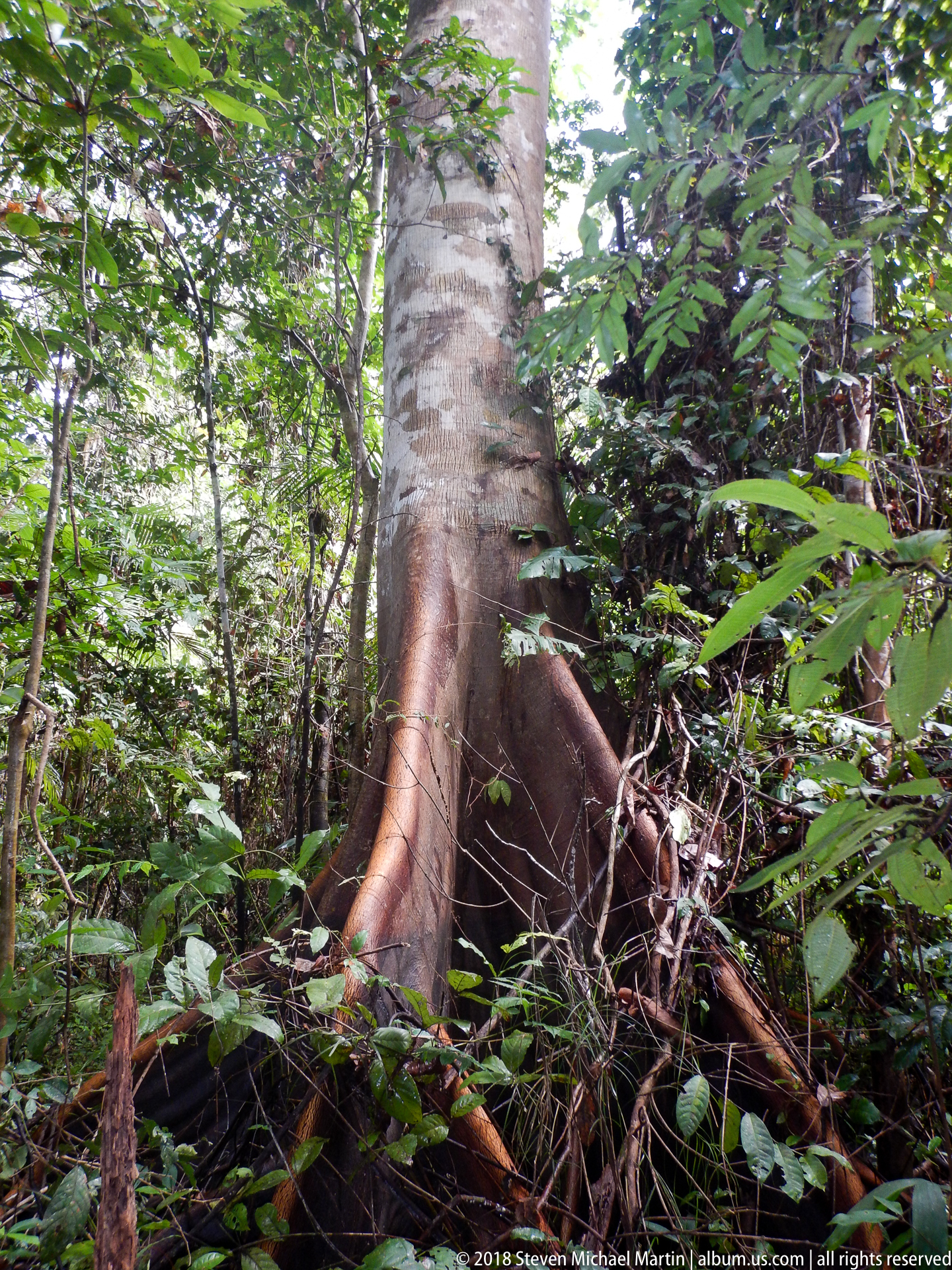
A mature rainforest tree stands amid dense understory vegetation, its broad buttress roots spreading into a cluttered forest floor of stems, leaves, and fallen wood. The wider field of view places the trunk within the surrounding plant community, contrasting with the close architectural studies elsewhere in the portfolio. The scene illustrates the vertical and horizontal complexity of intact tropical forest at Tamshiyacu Reserve.
Caption
A mature rainforest tree stands amid dense understory vegetation, its broad buttress roots spreading into a cluttered forest floor of stems, leaves, and fallen wood. The wider field of view places the trunk within the surrounding plant community, contrasting with the close architectural studies elsewhere in the portfolio. The scene illustrates the vertical and horizontal complexity of intact tropical forest at Tamshiyacu Reserve.

A mottled brown, long-legged insect rests across the midrib of a glossy rainforest leaf. Its irregular outline and subdued coloration blend closely with leaf veins and surface shadows, an effective visual example of camouflage among understory vegetation in Tamshiyacu Reserve.
Caption
A mottled brown, long-legged insect rests across the midrib of a glossy rainforest leaf. Its irregular outline and subdued coloration blend closely with leaf veins and surface shadows, an effective visual example of camouflage among understory vegetation in Tamshiyacu Reserve.

A small brown orthopteran stands near the center of a deeply veined green leaf, its narrow body and long legs sharply separated from the smooth forest background. The scale of the insect against the broad blade makes this a useful close view of Amazonian understory invertebrate life.
Caption
A small brown orthopteran stands near the center of a deeply veined green leaf, its narrow body and long legs sharply separated from the smooth forest background. The scale of the insect against the broad blade makes this a useful close view of Amazonian understory invertebrate life.

Seen from above, a compact brown insect occupies the center of an oversized glossy leaf, surrounded by radiating veins and dense green understory. The elevated viewpoint shows the insect's angular legs and patterned dorsal surface while retaining enough habitat to place it within the humid forest floor vegetation.
Caption
Seen from above, a compact brown insect occupies the center of an oversized glossy leaf, surrounded by radiating veins and dense green understory. The elevated viewpoint shows the insect's angular legs and patterned dorsal surface while retaining enough habitat to place it within the humid forest floor vegetation.

A massive tropical tree rises from pronounced buttress roots beneath a palm-filled canopy, while a person at its base provides an immediate sense of scale. Filtered light and dense surrounding vegetation emphasize the vertical structure and humid, layered character of mature lowland rainforest in Tamshiyacu Reserve.
Caption
A massive tropical tree rises from pronounced buttress roots beneath a palm-filled canopy, while a person at its base provides an immediate sense of scale. Filtered light and dense surrounding vegetation emphasize the vertical structure and humid, layered character of mature lowland rainforest in Tamshiyacu Reserve.

A mature tree leans diagonally through a crowded canopy of palms, vines and broadleaf vegetation. The upward view records the competition for light that shapes tropical forest architecture, with overlapping foliage obscuring the sky and emphasizing the reserve's dense, multi-layered vegetation.
Caption
A mature tree leans diagonally through a crowded canopy of palms, vines and broadleaf vegetation. The upward view records the competition for light that shapes tropical forest architecture, with overlapping foliage obscuring the sky and emphasizing the reserve's dense, multi-layered vegetation.

Fresh green leaves emerge from a moss-darkened trunk in a shallow-focus study of rainforest regeneration. The crisp new growth stands against a soft mosaic of forest greens and browns, isolating the small plant while retaining the moist, shaded character of the Tamshiyacu understory.
Caption
Fresh green leaves emerge from a moss-darkened trunk in a shallow-focus study of rainforest regeneration. The crisp new growth stands against a soft mosaic of forest greens and browns, isolating the small plant while retaining the moist, shaded character of the Tamshiyacu understory.

A pendant cluster of vivid orange-red berries hangs beneath a slender rainforest branch, isolated against a muted green background. The tight grouping and saturated fruit color make the reproductive structure the dominant subject, while the shallow depth of field separates it from surrounding understory vegetation.
Caption
A pendant cluster of vivid orange-red berries hangs beneath a slender rainforest branch, isolated against a muted green background. The tight grouping and saturated fruit color make the reproductive structure the dominant subject, while the shallow depth of field separates it from surrounding understory vegetation.

A wiry vine arcs through a dark forest background, carrying tiny leaves or attached growth along sections of its stem. The sparse line of the plant, picked out by selective focus, contrasts with the soft shadowed understory and draws attention to the fine-scale complexity of rainforest climbing vegetation.
Caption
A wiry vine arcs through a dark forest background, carrying tiny leaves or attached growth along sections of its stem. The sparse line of the plant, picked out by selective focus, contrasts with the soft shadowed understory and draws attention to the fine-scale complexity of rainforest climbing vegetation.

Layered bracket fungi spread across decaying wood among wet leaf litter and low green plants. Their overlapping, concentrically patterned caps show how fungal decomposers occupy fallen organic material in the humid forest, where persistent moisture supports rapid recycling of woody debris.
Caption
Layered bracket fungi spread across decaying wood among wet leaf litter and low green plants. Their overlapping, concentrically patterned caps show how fungal decomposers occupy fallen organic material in the humid forest, where persistent moisture supports rapid recycling of woody debris.

A glossy black insect with bright red-orange markings stands near the edge of a green leaf, its contrasting coloration prominent despite shallow focus. The close composition records one of the reserve's conspicuous small arthropods without forcing a species identification that the available dorsal detail cannot securely support.
Caption
A glossy black insect with bright red-orange markings stands near the edge of a green leaf, its contrasting coloration prominent despite shallow focus. The close composition records one of the reserve's conspicuous small arthropods without forcing a species identification that the available dorsal detail cannot securely support.

A large dark, rounded growth projects from the side of a pale rainforest trunk, its rough layered surface contrasting with smooth bark and surrounding green foliage. The growth appears woody or fungal, but the proof-sheet view does not provide enough structural detail to distinguish confidently between a bracket fungus and a burl-like formation.
Caption
A large dark, rounded growth projects from the side of a pale rainforest trunk, its rough layered surface contrasting with smooth bark and surrounding green foliage. The growth appears woody or fungal, but the proof-sheet view does not provide enough structural detail to distinguish confidently between a bracket fungus and a burl-like formation.

A delicate tendril coils tightly around a slender vertical stem, its spiral form isolated against a dark, softly blurred forest background. The close view highlights a climbing plant's mechanical strategy for support, reducing the rainforest scene to the precise contact between tendril and host stem.
Caption
A delicate tendril coils tightly around a slender vertical stem, its spiral form isolated against a dark, softly blurred forest background. The close view highlights a climbing plant's mechanical strategy for support, reducing the rainforest scene to the precise contact between tendril and host stem.

A black rubber field boot rests beside shallow muddy water and wet vegetation, a practical detail of movement through saturated rainforest terrain. Mud specks and the waterlogged ground convey the conditions encountered on foot in the reserve more directly than a broad landscape view.
Caption
A black rubber field boot rests beside shallow muddy water and wet vegetation, a practical detail of movement through saturated rainforest terrain. Mud specks and the waterlogged ground convey the conditions encountered on foot in the reserve more directly than a broad landscape view.

A visitor crouches among tangled understory branches and presents a large pale shelf fungus toward the camera. The scene combines human scale with close natural-history observation, showing field exploration in the damp leaf litter and dense vegetation of Tamshiyacu Reserve.
Caption
A visitor crouches among tangled understory branches and presents a large pale shelf fungus toward the camera. The scene combines human scale with close natural-history observation, showing field exploration in the damp leaf litter and dense vegetation of Tamshiyacu Reserve.
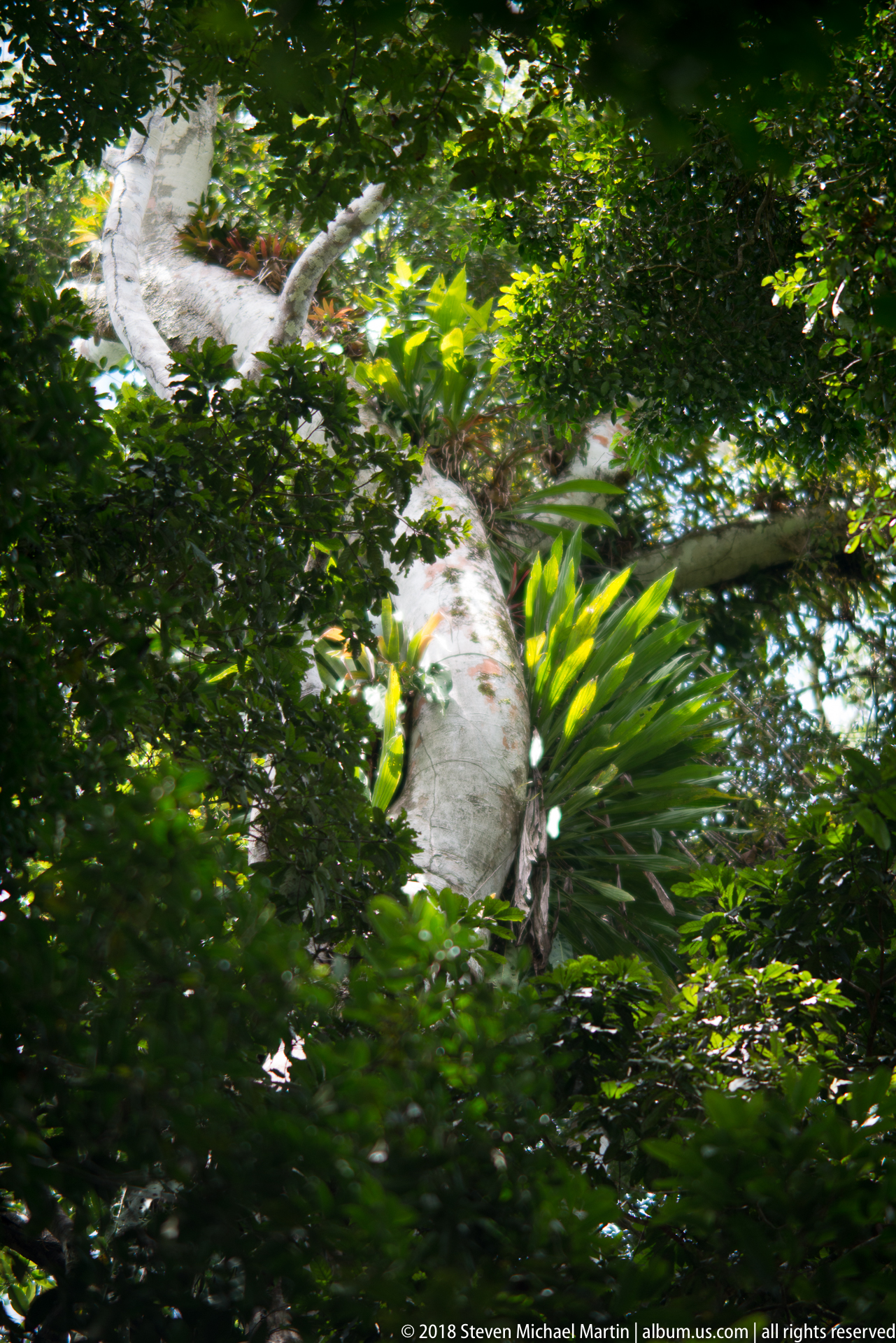
A pale-barked rainforest tree curves upward through dense foliage, its trunk intermittently hidden by overlapping leaves and palm fronds. The upward angle emphasizes canopy height and the irregular path of the trunk as it reaches toward brighter openings above the shaded understory.
Caption
A pale-barked rainforest tree curves upward through dense foliage, its trunk intermittently hidden by overlapping leaves and palm fronds. The upward angle emphasizes canopy height and the irregular path of the trunk as it reaches toward brighter openings above the shaded understory.

A low, slightly wider view places a visitor beneath the spreading buttresses of a monumental rainforest tree. The converging root walls and trunk dominate the frame, while the figure at lower right provides scale and reinforces the exceptional dimensions of mature forest structure.
Caption
A low, slightly wider view places a visitor beneath the spreading buttresses of a monumental rainforest tree. The converging root walls and trunk dominate the frame, while the figure at lower right provides scale and reinforces the exceptional dimensions of mature forest structure.

Several shelf fungi project from a dark trunk in staggered tiers, each cap edged by a pale white margin. The close view emphasizes their layered growth habit and the contrast between living fungal tissue, rough bark and the dim rainforest understory.
Caption
Several shelf fungi project from a dark trunk in staggered tiers, each cap edged by a pale white margin. The close view emphasizes their layered growth habit and the contrast between living fungal tissue, rough bark and the dim rainforest understory.

A visitor wearing a blue shirt, backpack and camera strap stands among dense green foliage in the Tamshiyacu rainforest. The close portrait keeps the forest softly out of focus, emphasizing field exploration while still placing the traveler within the humid understory environment.
Caption
A visitor wearing a blue shirt, backpack and camera strap stands among dense green foliage in the Tamshiyacu rainforest. The close portrait keeps the forest softly out of focus, emphasizing field exploration while still placing the traveler within the humid understory environment.

Framed farther back than the preceding portrait, a visitor in blue stands within layered palms, vines and broad leaves. The wider composition gives the surrounding vegetation greater prominence and conveys how quickly a person is visually absorbed by the dense understory of the reserve.
Caption
Framed farther back than the preceding portrait, a visitor in blue stands within layered palms, vines and broad leaves. The wider composition gives the surrounding vegetation greater prominence and conveys how quickly a person is visually absorbed by the dense understory of the reserve.

A broken branch carries a miniature community of pale lichens, fine roots and small epiphytic growths, sharply focused against a soft green forest background. The intricate surface textures reveal the abundance of organisms occupying even narrow woody supports in the humid rainforest.
Caption
A broken branch carries a miniature community of pale lichens, fine roots and small epiphytic growths, sharply focused against a soft green forest background. The intricate surface textures reveal the abundance of organisms occupying even narrow woody supports in the humid rainforest.
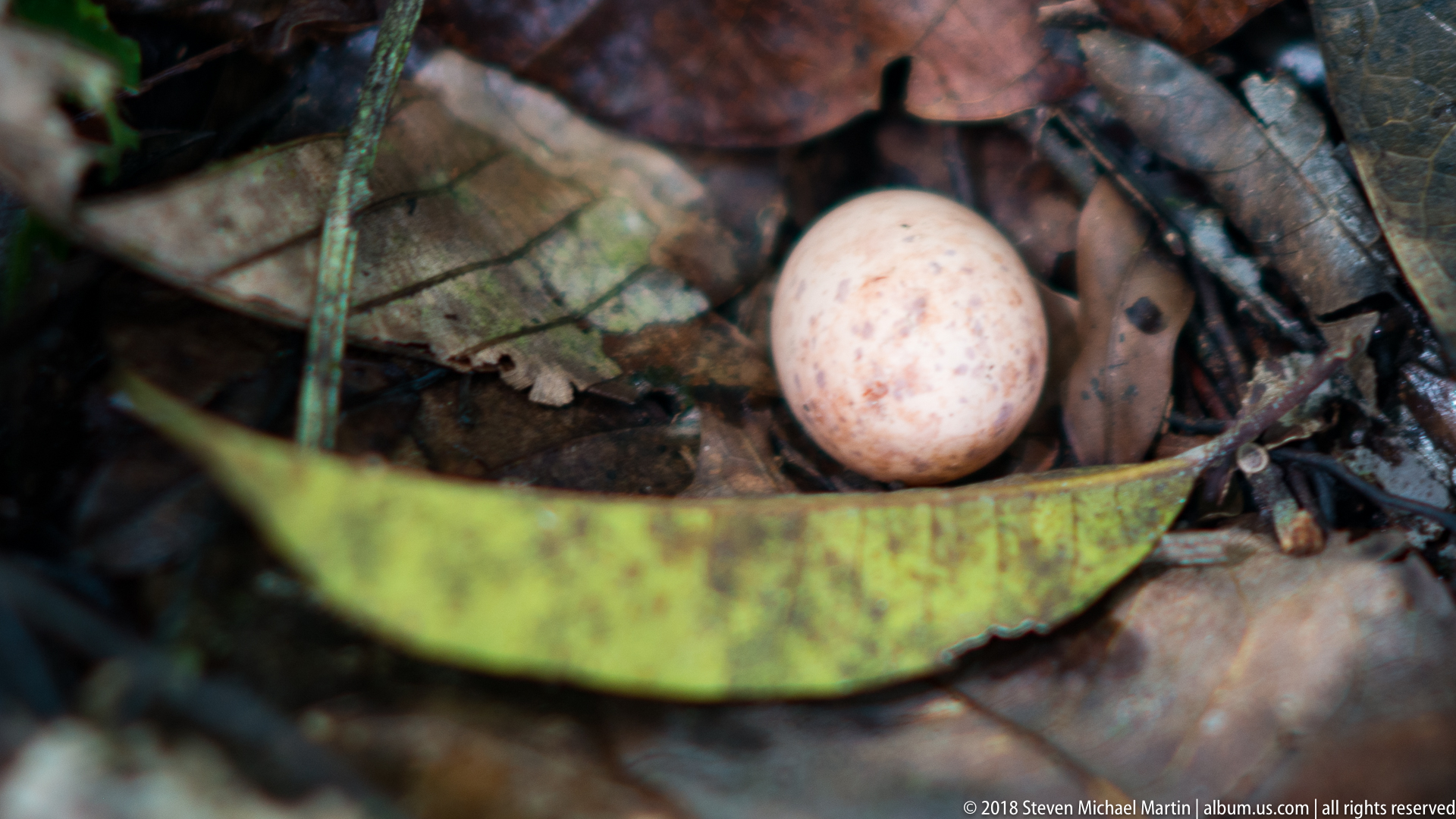
A pale, speckled oval object rests among brown leaf litter beside a long green fallen pod or leaf. Its smooth shell-like surface is clearly visible, but the proof sheet does not establish whether it is a seed, fruit structure or animal egg, making precise biological identification unsafe.
Caption
A pale, speckled oval object rests among brown leaf litter beside a long green fallen pod or leaf. Its smooth shell-like surface is clearly visible, but the proof sheet does not establish whether it is a seed, fruit structure or animal egg, making precise biological identification unsafe.

A visitor stands against the flared base of an enormous rainforest tree, where tall buttress roots spread outward like walls before merging into the forest floor. The frontal view uses the human figure to demonstrate the tree's scale and the structural role of buttresses in supporting a massive tropical trunk.
Caption
A visitor stands against the flared base of an enormous rainforest tree, where tall buttress roots spread outward like walls before merging into the forest floor. The frontal view uses the human figure to demonstrate the tree's scale and the structural role of buttresses in supporting a massive tropical trunk.

Beside a giant buttressed tree, a visitor looks upward along the trunk, directing attention from the broad root flares toward the unseen canopy. This variation shifts emphasis from frontal scale comparison to vertical height, while the surrounding palms and understory retain the tree's lowland rainforest setting.
Caption
Beside a giant buttressed tree, a visitor looks upward along the trunk, directing attention from the broad root flares toward the unseen canopy. This variation shifts emphasis from frontal scale comparison to vertical height, while the surrounding palms and understory retain the tree's lowland rainforest setting.
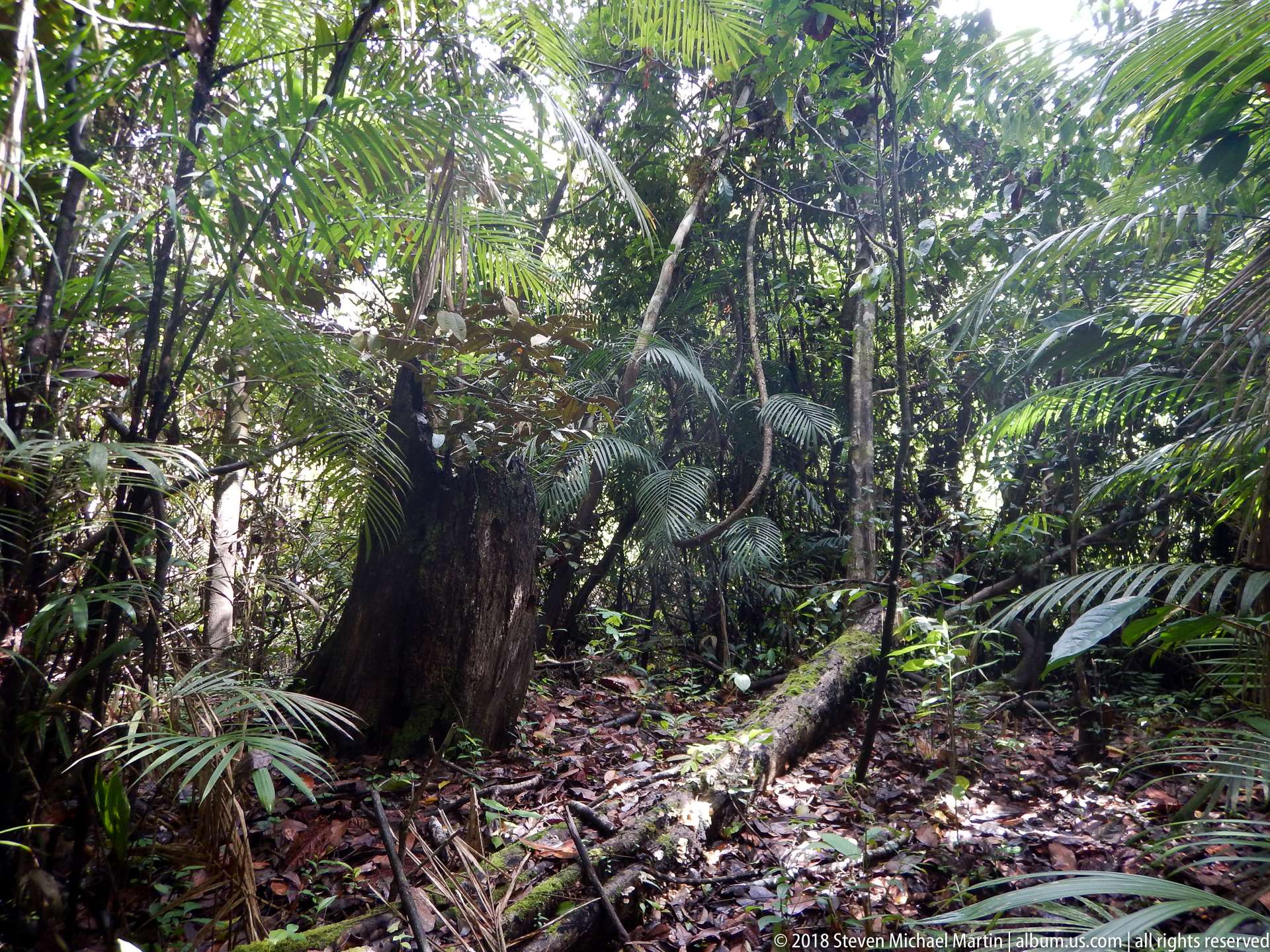
A weathered stump and fallen branch occupy a patch of dense understory filled with palms, vines and leaf litter. Dappled sunlight reaches the forest floor, illuminating the mix of living vegetation and decomposing wood that characterizes nutrient cycling in humid tropical forest.
Caption
A weathered stump and fallen branch occupy a patch of dense understory filled with palms, vines and leaf litter. Dappled sunlight reaches the forest floor, illuminating the mix of living vegetation and decomposing wood that characterizes nutrient cycling in humid tropical forest.

A black-and-red, long-legged true bug clings to a slender twig, its narrow head and piercing beak-like mouthpart prominent in profile. The striking warning coloration and raptorial appearance suggest an assassin bug, but species-level identification is not warranted from the proof-sheet detail alone.
Caption
A black-and-red, long-legged true bug clings to a slender twig, its narrow head and piercing beak-like mouthpart prominent in profile. The striking warning coloration and raptorial appearance suggest an assassin bug, but species-level identification is not warranted from the proof-sheet detail alone.

Rows of narrow, thorn-like projections punctuate the smooth pale bark of a rainforest trunk. The close study removes the surrounding forest almost entirely, concentrating on the defensive-looking surface structures and subtle changes in bark color and texture.
Caption
Rows of narrow, thorn-like projections punctuate the smooth pale bark of a rainforest trunk. The close study removes the surrounding forest almost entirely, concentrating on the defensive-looking surface structures and subtle changes in bark color and texture.

A small black-and-white sap-feeding insect clings to tree bark, marked by a vivid red head and a spray of long white waxy filaments extending from the abdomen. The unusual combination is characteristic of some tropical planthoppers, whose wax secretions can create conspicuous tail-like structures.
Caption
A small black-and-white sap-feeding insect clings to tree bark, marked by a vivid red head and a spray of long white waxy filaments extending from the abdomen. The unusual combination is characteristic of some tropical planthoppers, whose wax secretions can create conspicuous tail-like structures.

Viewed from the opposite side, a black-and-red predatory true bug hangs beneath a twig with its long rostrum directed downward. Red legs and abdomen contrast with the dark thorax and wings, while the close angle provides a second morphological view useful for later taxonomic verification.
Caption
Viewed from the opposite side, a black-and-red predatory true bug hangs beneath a twig with its long rostrum directed downward. Red legs and abdomen contrast with the dark thorax and wings, while the close angle provides a second morphological view useful for later taxonomic verification.

A compact cup nest, woven from fine brown fibers and green moss, is suspended among slender stems and leaves. Its rounded construction and concealed placement show how a small forest bird has integrated local plant material into the understory, though the builder cannot be identified from the nest alone.
Caption
A compact cup nest, woven from fine brown fibers and green moss, is suspended among slender stems and leaves. Its rounded construction and concealed placement show how a small forest bird has integrated local plant material into the understory, though the builder cannot be identified from the nest alone.

A red-headed, black-and-white planthopper appears small against a broad expanse of textured tree bark, its white waxy abdominal filaments still conspicuous at distance. The wider view complements the preceding close-up by showing the insect's scale and camouflage challenge on its woody host surface.
Caption
A red-headed, black-and-white planthopper appears small against a broad expanse of textured tree bark, its white waxy abdominal filaments still conspicuous at distance. The wider view complements the preceding close-up by showing the insect's scale and camouflage challenge on its woody host surface.
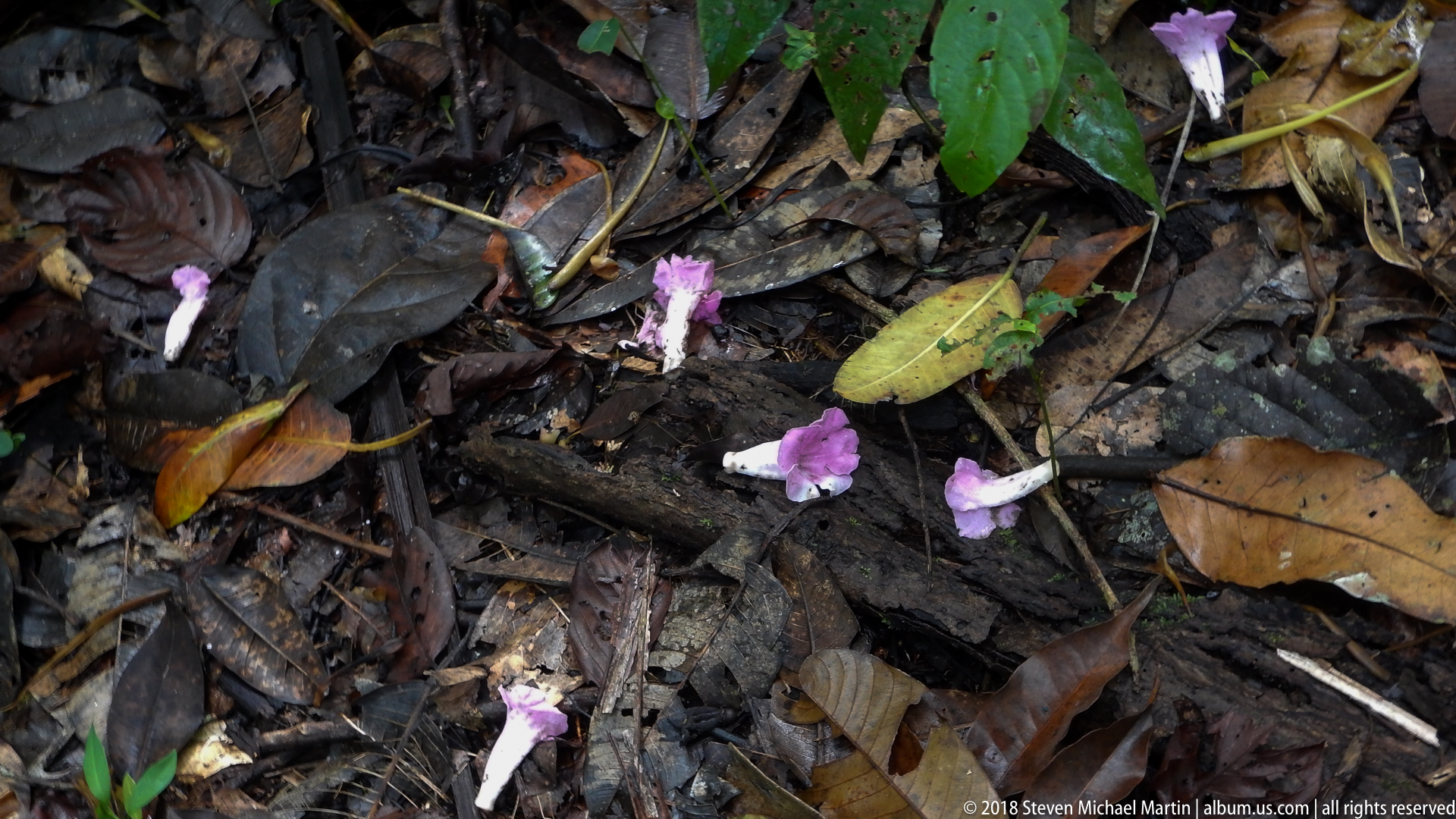
Several delicate pink-and-white tubular flowers lie scattered across wet brown leaf litter on the rainforest floor. Their fresh color contrasts with decomposing leaves, twigs, and dark soil, directing attention to small-scale plant detail within the larger forest ecosystem. Because no intact flowering plant is visible, the record remains focused on the fallen blossoms rather than assigning a species.
Caption
Several delicate pink-and-white tubular flowers lie scattered across wet brown leaf litter on the rainforest floor. Their fresh color contrasts with decomposing leaves, twigs, and dark soil, directing attention to small-scale plant detail within the larger forest ecosystem. Because no intact flowering plant is visible, the record remains focused on the fallen blossoms rather than assigning a species.

A fine-leaved epiphytic plant grows directly from the side of a dark rainforest trunk, its delicate branching foliage spreading across the bark. The shallow depth of field isolates the plant from the softly blurred understory and emphasizes the humid forest microhabitat that supports vegetation on living wood. The image is best read as a botanical detail rather than a definitive species portrait.
Caption
A fine-leaved epiphytic plant grows directly from the side of a dark rainforest trunk, its delicate branching foliage spreading across the bark. The shallow depth of field isolates the plant from the softly blurred understory and emphasizes the humid forest microhabitat that supports vegetation on living wood. The image is best read as a botanical detail rather than a definitive species portrait.

Broad buttress roots flare from the base of a massive rainforest tree, forming high, blade-like ridges that anchor the trunk in the forest floor. Seen from close range and slightly upward, the view emphasizes the architectural geometry of the roots and the smooth pale-gray bark against a dense backdrop of leaves and vines. Buttressing is a conspicuous structural adaptation among many large tropical forest trees.
Caption
Broad buttress roots flare from the base of a massive rainforest tree, forming high, blade-like ridges that anchor the trunk in the forest floor. Seen from close range and slightly upward, the view emphasizes the architectural geometry of the roots and the smooth pale-gray bark against a dense backdrop of leaves and vines. Buttressing is a conspicuous structural adaptation among many large tropical forest trees.

From a slightly different angle, a spotted planthopper rests beneath a rough ledge of bark. Its dark wings are peppered with pale spots, while a red head and white waxy filaments create strong visual contrast against the tree. The side view reveals how closely the insect hugs the trunk and helps distinguish the filamentous secretion from legs or plant fibers.
Caption
From a slightly different angle, a spotted planthopper rests beneath a rough ledge of bark. Its dark wings are peppered with pale spots, while a red head and white waxy filaments create strong visual contrast against the tree. The side view reveals how closely the insect hugs the trunk and helps distinguish the filamentous secretion from legs or plant fibers.

A striking fulgorid planthopper clings vertically to a rainforest trunk, showing black wings patterned with white spots, a bright red head area, and long white waxy filaments trailing from the abdomen. These features are characteristic of some Amazonian planthoppers, including members of the genus Lystra. The close view isolates the insect against bark and forest shadow, making its warning-like color pattern and waxy ornamentation especially conspicuous.
Caption
A striking fulgorid planthopper clings vertically to a rainforest trunk, showing black wings patterned with white spots, a bright red head area, and long white waxy filaments trailing from the abdomen. These features are characteristic of some Amazonian planthoppers, including members of the genus Lystra. The close view isolates the insect against bark and forest shadow, making its warning-like color pattern and waxy ornamentation especially conspicuous.

A close botanical study isolates a palm frond whose narrow leaflets carry rows of small, sharp projections along their edges. Backlighting reveals the repeated teeth and the parallel structure of the leaflets against a dark, blurred forest floor. The image documents a defensive feature common among several Amazonian palms, but the absence of the whole plant, stem, and fruit prevents a reliable species identification.
Caption
A close botanical study isolates a palm frond whose narrow leaflets carry rows of small, sharp projections along their edges. Backlighting reveals the repeated teeth and the parallel structure of the leaflets against a dark, blurred forest floor. The image documents a defensive feature common among several Amazonian palms, but the absence of the whole plant, stem, and fruit prevents a reliable species identification.

A reserve visitor stands at the base of a huge buttressed tree, providing an immediate sense of scale for the trunk and its flaring roots. Field clothing, rubber boots, a backpack, and binoculars place the scene within an active rainforest excursion, while surrounding vines and understory vegetation reinforce the dense lowland setting. The person’s stance and the close tree backdrop make the image both a human-scale portrait and an ecological context view.
Caption
A reserve visitor stands at the base of a huge buttressed tree, providing an immediate sense of scale for the trunk and its flaring roots. Field clothing, rubber boots, a backpack, and binoculars place the scene within an active rainforest excursion, while surrounding vines and understory vegetation reinforce the dense lowland setting. The person’s stance and the close tree backdrop make the image both a human-scale portrait and an ecological context view.

Seen full length among leaf litter and low vegetation, a reserve visitor stands beside the buttressed base of a large tropical tree. The camera position includes more of the forest floor than the neighboring portraits, showing rubber boots, field trousers, backpack straps, and binoculars as practical equipment for wet rainforest conditions. The exposed roots behind him remain the dominant natural feature and establish the scale of the mature forest.
Caption
Seen full length among leaf litter and low vegetation, a reserve visitor stands beside the buttressed base of a large tropical tree. The camera position includes more of the forest floor than the neighboring portraits, showing rubber boots, field trousers, backpack straps, and binoculars as practical equipment for wet rainforest conditions. The exposed roots behind him remain the dominant natural feature and establish the scale of the mature forest.

A long, narrow liana hangs vertically through the rainforest canopy, its irregularly swollen and constricted surface producing a strongly segmented appearance. Fine tendrils or neighboring vines cross the frame, while bright sky and foliage blur behind it. The distinctive form is visually clear, but the proof sheet does not reveal enough botanical detail to determine whether the pattern reflects stem growth, bark structure, or another specialized climbing plant feature.
Caption
A long, narrow liana hangs vertically through the rainforest canopy, its irregularly swollen and constricted surface producing a strongly segmented appearance. Fine tendrils or neighboring vines cross the frame, while bright sky and foliage blur behind it. The distinctive form is visually clear, but the proof sheet does not reveal enough botanical detail to determine whether the pattern reflects stem growth, bark structure, or another specialized climbing plant feature.

Dark, rope-like lianas twist across the flaring base of a mature rainforest tree, looping over broad buttress roots before disappearing into the surrounding vegetation. The tangle of climbing stems and woody support surfaces illustrates the dense vertical competition of the forest understory. This composition emphasizes plant relationships at the tree base rather than the identity of any single species.
Caption
Dark, rope-like lianas twist across the flaring base of a mature rainforest tree, looping over broad buttress roots before disappearing into the surrounding vegetation. The tangle of climbing stems and woody support surfaces illustrates the dense vertical competition of the forest understory. This composition emphasizes plant relationships at the tree base rather than the identity of any single species.

Long needle-like black spines project in clusters from a slender woody stem, creating a conspicuous defensive barrier in the rainforest understory. The shallow depth of field isolates the thorns against a soft green-brown background and reveals their varying lengths and angles. Several Amazonian palms and palm-like plants bear such armature, so the image supports a structural botanical description rather than a confident species name.
Caption
Long needle-like black spines project in clusters from a slender woody stem, creating a conspicuous defensive barrier in the rainforest understory. The shallow depth of field isolates the thorns against a soft green-brown background and reveals their varying lengths and angles. Several Amazonian palms and palm-like plants bear such armature, so the image supports a structural botanical description rather than a confident species name.

A dark palm-like stem is densely covered with long, fine spines that project outward in every direction. Moisture or pale lichen marks the surface, while a green vine crosses the frame and a bright forest background falls out of focus. The close view conveys the intensity of the plant’s mechanical defense and differs from the previous image by showing a thicker, more heavily armed section of stem.
Caption
A dark palm-like stem is densely covered with long, fine spines that project outward in every direction. Moisture or pale lichen marks the surface, while a green vine crosses the frame and a bright forest background falls out of focus. The close view conveys the intensity of the plant’s mechanical defense and differs from the previous image by showing a thicker, more heavily armed section of stem.
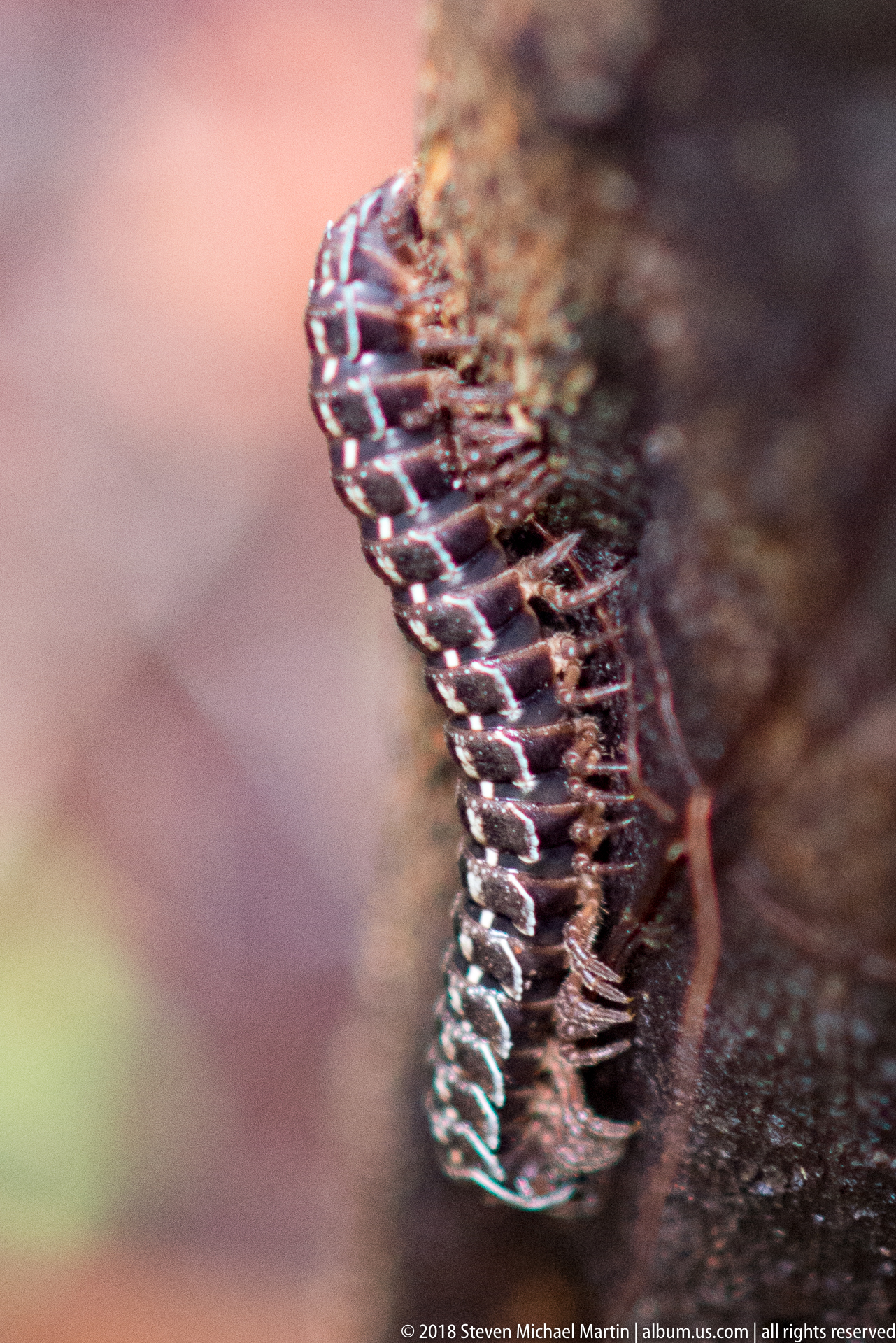
A flat-backed millipede clings to rough bark, its many body segments marked by alternating pale and dark bands and widened lateral plates. The animal bends around the trunk, making the repeated segment pattern especially visible. Its flattened profile and expanded segment edges are characteristic of millipedes in the order Polydesmida, although the photograph does not support a reliable genus or species identification.
Caption
A flat-backed millipede clings to rough bark, its many body segments marked by alternating pale and dark bands and widened lateral plates. The animal bends around the trunk, making the repeated segment pattern especially visible. Its flattened profile and expanded segment edges are characteristic of millipedes in the order Polydesmida, although the photograph does not support a reliable genus or species identification.

A distinctive hanging liana descends from the canopy in a chain-like sequence of swollen, constricted sections before curving into a lower loop. This wider view places the unusual stem form within dense foliage and branching forest structure, complementing the closer photograph earlier on the page. The plant’s architecture is conspicuous, but leaves and reproductive features cannot be confidently associated with the hanging stem.
Caption
A distinctive hanging liana descends from the canopy in a chain-like sequence of swollen, constricted sections before curving into a lower loop. This wider view places the unusual stem form within dense foliage and branching forest structure, complementing the closer photograph earlier on the page. The plant’s architecture is conspicuous, but leaves and reproductive features cannot be confidently associated with the hanging stem.

A woody stem angles across the understory with several extraordinarily long, rigid spines projecting outward from the nodes. Dry palm fibers and green leaves form a layered backdrop, emphasizing the hazards of moving through dense tropical vegetation. The image presents the spines in environmental context rather than as an isolated macro detail, but it still lacks enough plant characters for a definitive species identification.
Caption
A woody stem angles across the understory with several extraordinarily long, rigid spines projecting outward from the nodes. Dry palm fibers and green leaves form a layered backdrop, emphasizing the hazards of moving through dense tropical vegetation. The image presents the spines in environmental context rather than as an isolated macro detail, but it still lacks enough plant characters for a definitive species identification.
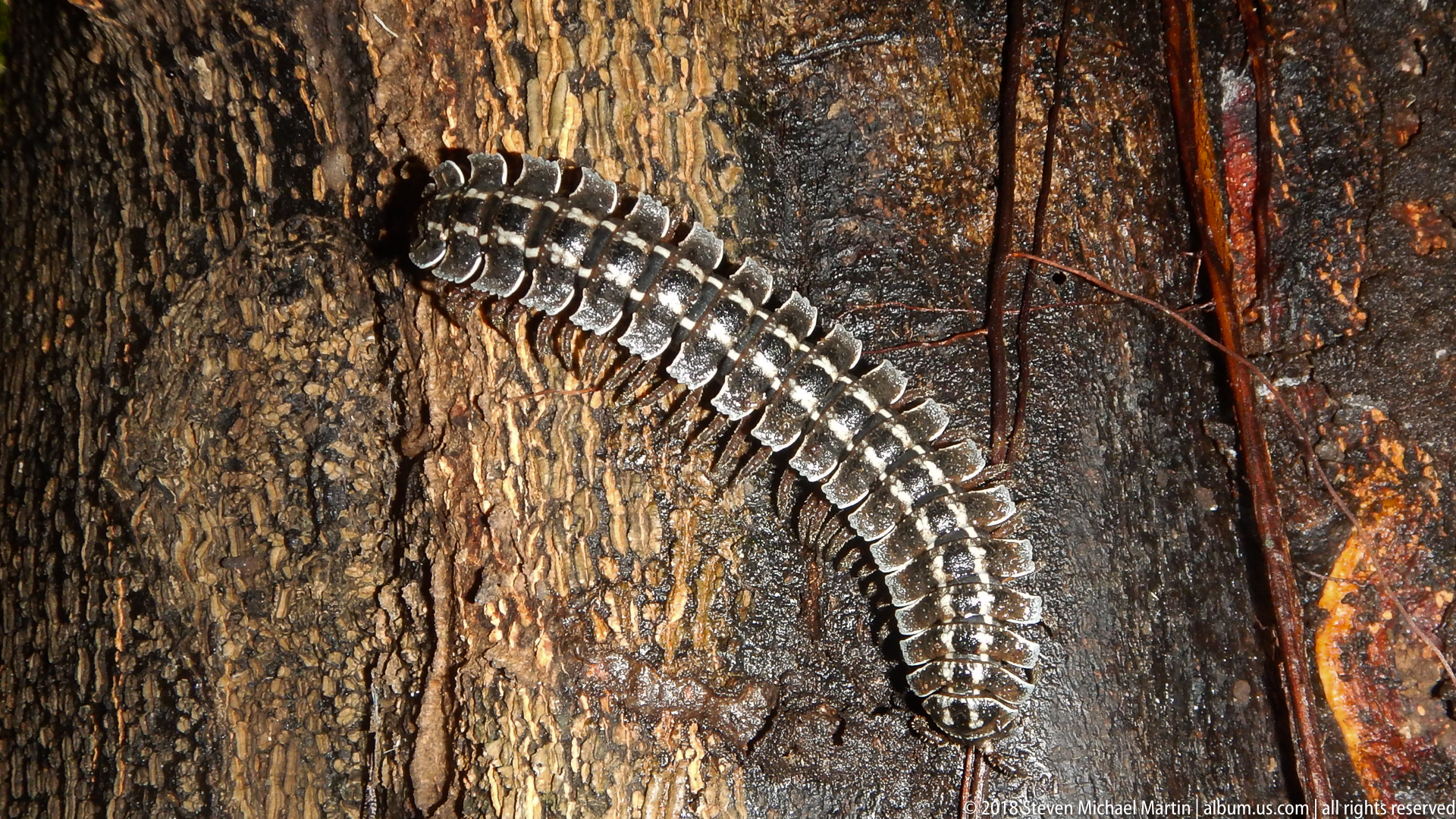
A banded flat-backed millipede curves diagonally across wet, dark bark, its pale segment margins standing out sharply against the surface. The animal’s repeating plates form a broad ribbon-like body, and the head end is visible near the lower right. Water-darkened wood and fine roots around it place the invertebrate in the damp microhabitat typical of rainforest decomposer communities.
Caption
A banded flat-backed millipede curves diagonally across wet, dark bark, its pale segment margins standing out sharply against the surface. The animal’s repeating plates form a broad ribbon-like body, and the head end is visible near the lower right. Water-darkened wood and fine roots around it place the invertebrate in the damp microhabitat typical of rainforest decomposer communities.

A tight close-up follows the side of a flat-backed millipede as it moves across dark, textured bark. Pale-edged segment plates form a repeated scalloped band along the body, while numerous fine legs are visible beneath. The magnified angle emphasizes anatomy rather than the whole animal, showing the flattened body plan typical of Polydesmida without providing enough diagnostic detail for a species-level name.
Caption
A tight close-up follows the side of a flat-backed millipede as it moves across dark, textured bark. Pale-edged segment plates form a repeated scalloped band along the body, while numerous fine legs are visible beneath. The magnified angle emphasizes anatomy rather than the whole animal, showing the flattened body plan typical of Polydesmida without providing enough diagnostic detail for a species-level name.

A flat-backed millipede arches across deeply textured bark, revealing its broad segmented plates, dark central body, pale transverse markings, and many legs underneath. The curve of the animal exposes both the dorsal pattern and the lateral extensions of successive segments. This viewpoint offers one of the clearest whole-body anatomical studies in the sequence while remaining taxonomically conservative at the order level.
Caption
A flat-backed millipede arches across deeply textured bark, revealing its broad segmented plates, dark central body, pale transverse markings, and many legs underneath. The curve of the animal exposes both the dorsal pattern and the lateral extensions of successive segments. This viewpoint offers one of the clearest whole-body anatomical studies in the sequence while remaining taxonomically conservative at the order level.
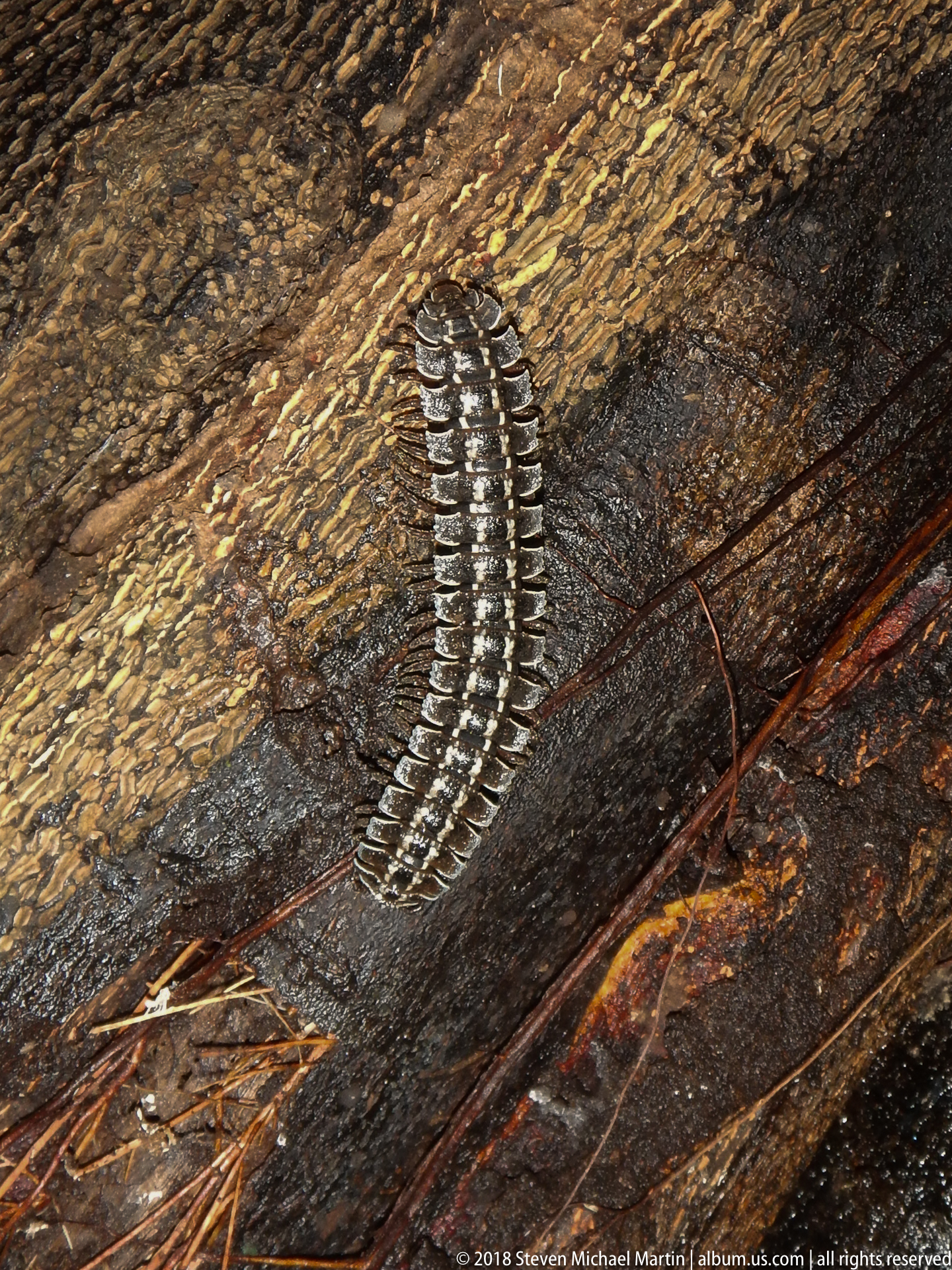
A flat-backed millipede lies nearly straight across a dark fallen trunk, presenting an unobstructed dorsal view of repeated pale-edged segments. The body’s flattened profile and expanded lateral plates create a ladder-like pattern against the wood, while fine legs are mostly hidden beneath. This composition is particularly useful for documenting overall body shape and segment repetition in a rainforest detritivore.
Caption
A flat-backed millipede lies nearly straight across a dark fallen trunk, presenting an unobstructed dorsal view of repeated pale-edged segments. The body’s flattened profile and expanded lateral plates create a ladder-like pattern against the wood, while fine legs are mostly hidden beneath. This composition is particularly useful for documenting overall body shape and segment repetition in a rainforest detritivore.

A visitor stands beside the massive root system of a rainforest tree, leaning into the vegetation near the trunk as if inspecting or navigating around the buttresses. Thick roots, vines, and broad leaves fill the foreground, creating a more intimate field scene than the posed portraits on earlier pages. The image emphasizes physical engagement with the dense forest structure and the scale of mature tropical trees.
Caption
A visitor stands beside the massive root system of a rainforest tree, leaning into the vegetation near the trunk as if inspecting or navigating around the buttresses. Thick roots, vines, and broad leaves fill the foreground, creating a more intimate field scene than the posed portraits on earlier pages. The image emphasizes physical engagement with the dense forest structure and the scale of mature tropical trees.

Long dark spines project from a slender stem partly screened by bright green palm leaves. The close focus highlights the contrast between smooth foliage and needle-like defensive structures, while the rest of the understory dissolves into soft color. This view differs from the earlier spine studies by showing the armed stem embedded within living foliage rather than isolated against bark or open background.
Caption
Long dark spines project from a slender stem partly screened by bright green palm leaves. The close focus highlights the contrast between smooth foliage and needle-like defensive structures, while the rest of the understory dissolves into soft color. This view differs from the earlier spine studies by showing the armed stem embedded within living foliage rather than isolated against bark or open background.

A small epiphytic plant grows from a mossy pocket on a pale, slanting trunk high in the forest. A compact cluster of elongated green leaves emerges from organic material collected against the bark, illustrating how branches and trunks provide elevated rooting sites in humid rainforest. The photograph clearly documents the epiphytic growth habit, but leaf form alone is insufficient for a secure species identification.
Caption
A small epiphytic plant grows from a mossy pocket on a pale, slanting trunk high in the forest. A compact cluster of elongated green leaves emerges from organic material collected against the bark, illustrating how branches and trunks provide elevated rooting sites in humid rainforest. The photograph clearly documents the epiphytic growth habit, but leaf form alone is insufficient for a secure species identification.

An aracari perches among bare canopy branches, its oversized bill patterned with yellow markings against a dark crown and throat. The bird’s bright yellow breast and red abdominal band stand out sharply against the pale sky, while the oblique branches partly screen the body. The combination of toucan-like bill, compact form, and vivid underparts places it within the aracaris of the western Amazon.
Caption
An aracari perches among bare canopy branches, its oversized bill patterned with yellow markings against a dark crown and throat. The bird’s bright yellow breast and red abdominal band stand out sharply against the pale sky, while the oblique branches partly screen the body. The combination of toucan-like bill, compact form, and vivid underparts places it within the aracaris of the western Amazon.

Viewed more cleanly between crossing limbs, an aracari rests on a high branch with its long bill angled slightly upward. Yellow striping along the bill, a dark head, a broad yellow chest, and the saturated red band across the lower breast create a strong field-mark pattern. The uncluttered side profile also shows the bird’s elongated tail and compact, upright posture typical of fruit-eating canopy toucans.
Caption
Viewed more cleanly between crossing limbs, an aracari rests on a high branch with its long bill angled slightly upward. Yellow striping along the bill, a dark head, a broad yellow chest, and the saturated red band across the lower breast create a strong field-mark pattern. The uncluttered side profile also shows the bird’s elongated tail and compact, upright posture typical of fruit-eating canopy toucans.

A large, dark, roughly oval nest is built directly against a rainforest tree trunk, with its textured surface contrasting against surrounding moss and foliage. The enclosed carton-like mass and arboreal placement are characteristic of termite nests commonly seen in tropical forests. Its size and attachment are clearly visible, though the proof sheet does not provide enough structural detail or occupants to identify the termite species responsible.
Caption
A large, dark, roughly oval nest is built directly against a rainforest tree trunk, with its textured surface contrasting against surrounding moss and foliage. The enclosed carton-like mass and arboreal placement are characteristic of termite nests commonly seen in tropical forests. Its size and attachment are clearly visible, though the proof sheet does not provide enough structural detail or occupants to identify the termite species responsible.

A colorful aracari perches among bare branches above the rainforest, showing a dark head and back, yellow underparts, a bright red abdominal band, and a long pale bill with darker markings. This combination strongly matches the chestnut-eared aracari, a toucan of western Amazonia. The distant view preserves the bird’s full silhouette and posture but leaves some facial and bill details slightly soft.
Caption
A colorful aracari perches among bare branches above the rainforest, showing a dark head and back, yellow underparts, a bright red abdominal band, and a long pale bill with darker markings. This combination strongly matches the chestnut-eared aracari, a toucan of western Amazonia. The distant view preserves the bird’s full silhouette and posture but leaves some facial and bill details slightly soft.

The aracari appears in a more vertical posture, clinging to a slender branch amid a web of bare twigs. Its upward-pointing bill and long tail accentuate the bird’s narrow silhouette, while the yellow breast and red abdominal band remain conspicuous even at greater distance. This view emphasizes how the species uses exposed upper branches as lookout and feeding perches in the forest canopy.
Caption
The aracari appears in a more vertical posture, clinging to a slender branch amid a web of bare twigs. Its upward-pointing bill and long tail accentuate the bird’s narrow silhouette, while the yellow breast and red abdominal band remain conspicuous even at greater distance. This view emphasizes how the species uses exposed upper branches as lookout and feeding perches in the forest canopy.

From a wider perspective, a single aracari occupies the outer branches of a sparsely leafed tree above denser green forest. The bird is small in the frame but remains identifiable by its oversized bill and flashes of yellow and red plumage. The broader composition places the animal within the layered Amazonian canopy rather than isolating it as a portrait.
Caption
From a wider perspective, a single aracari occupies the outer branches of a sparsely leafed tree above denser green forest. The bird is small in the frame but remains identifiable by its oversized bill and flashes of yellow and red plumage. The broader composition places the animal within the layered Amazonian canopy rather than isolating it as a portrait.

A gray-brown rodent peers from a natural cavity in a pale tree trunk, its head and forebody framed by the dark opening. Coarse fur, a blunt muzzle, small rounded ears, and long whiskers are visible, but the body and tail remain concealed. The image records the animal using a hollow trunk as shelter within the humid forest, where cavities provide protected resting and nesting sites for many small mammals.
Caption
A gray-brown rodent peers from a natural cavity in a pale tree trunk, its head and forebody framed by the dark opening. Coarse fur, a blunt muzzle, small rounded ears, and long whiskers are visible, but the body and tail remain concealed. The image records the animal using a hollow trunk as shelter within the humid forest, where cavities provide protected resting and nesting sites for many small mammals.

The same gray-brown rodent lies low inside a deep trunk cavity, with its face, shoulder, and one forelimb visible against the dark interior. Seen from slightly above, the animal appears relaxed rather than alert, its whiskers and rounded ear picked out by soft light. The surrounding bark and shaded hollow make the sheltering behavior central to the composition.
Caption
The same gray-brown rodent lies low inside a deep trunk cavity, with its face, shoulder, and one forelimb visible against the dark interior. Seen from slightly above, the animal appears relaxed rather than alert, its whiskers and rounded ear picked out by soft light. The surrounding bark and shaded hollow make the sheltering behavior central to the composition.

The cavity-dwelling rodent turns slightly to one side as it rests within the same hollow trunk. Its whiskered muzzle projects from shadow, while the shoulder and forebody remain pressed against the cavity wall. The angled viewpoint shows more of the enclosure itself, including the rough inner bark and darkened wood surrounding the animal.
Caption
The cavity-dwelling rodent turns slightly to one side as it rests within the same hollow trunk. Its whiskered muzzle projects from shadow, while the shoulder and forebody remain pressed against the cavity wall. The angled viewpoint shows more of the enclosure itself, including the rough inner bark and darkened wood surrounding the animal.

At close range, the cavity-dwelling rodent fills the opening of a rough-barked trunk. The animal’s dark gray coat, pale whiskers, rounded ears, and broad muzzle are especially clear, while one forepaw grips the edge of the hollow. This tighter portrait documents the texture and facial form of the small mammal more effectively than the preceding contextual view, though the concealed tail limits precise identification.
Caption
At close range, the cavity-dwelling rodent fills the opening of a rough-barked trunk. The animal’s dark gray coat, pale whiskers, rounded ears, and broad muzzle are especially clear, while one forepaw grips the edge of the hollow. This tighter portrait documents the texture and facial form of the small mammal more effectively than the preceding contextual view, though the concealed tail limits precise identification.
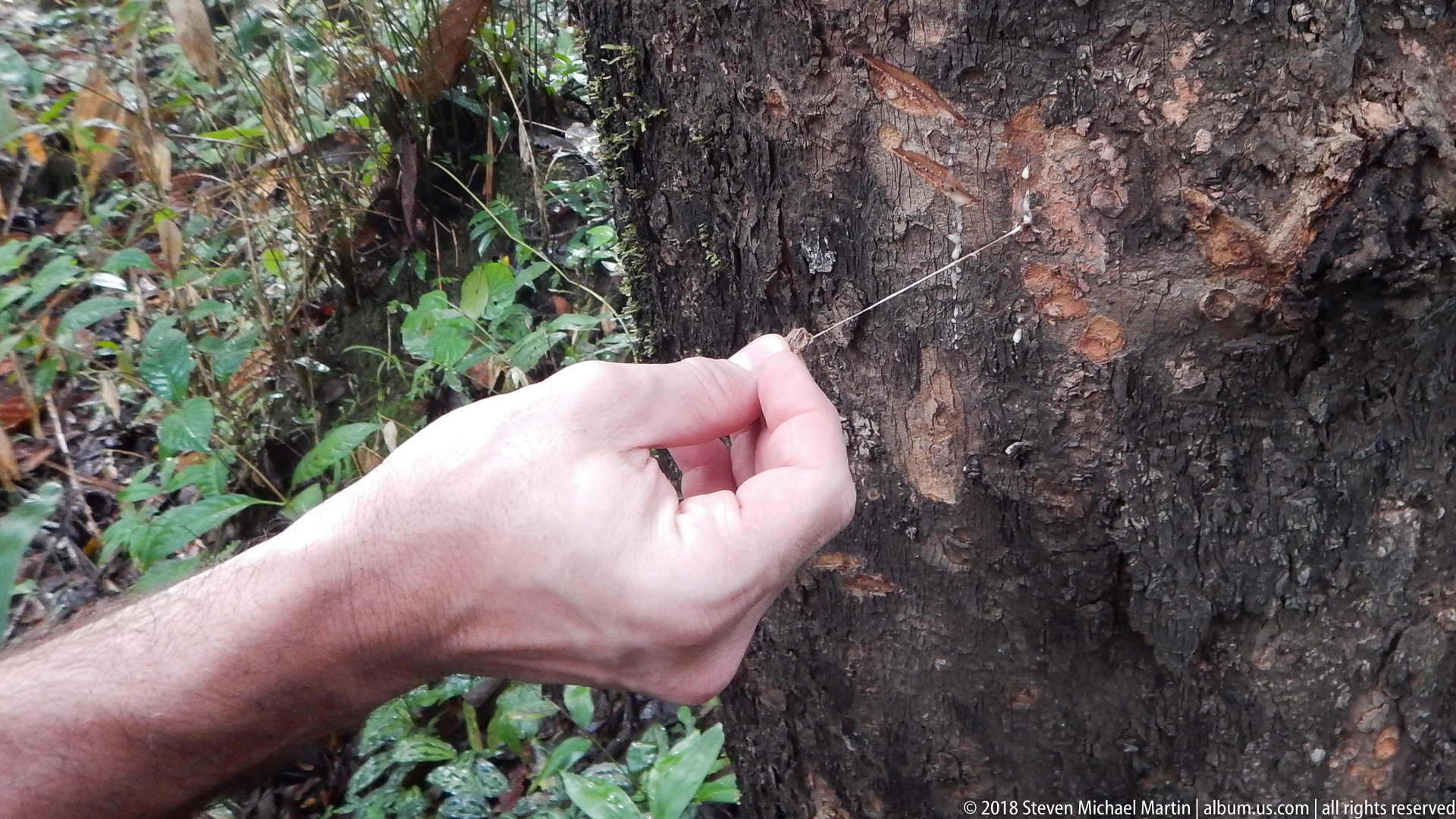
A hand holds a very fine strand against the rough, dark bark of a rainforest tree, directing attention to a minute natural detail that would otherwise be easy to overlook. Patches of exposed reddish-brown tissue and surrounding understory vegetation provide scale and context. The photograph functions as a field-detail record rather than a species portrait, preserving the relationship between the filament and its tree-trunk substrate.
Caption
A hand holds a very fine strand against the rough, dark bark of a rainforest tree, directing attention to a minute natural detail that would otherwise be easy to overlook. Patches of exposed reddish-brown tissue and surrounding understory vegetation provide scale and context. The photograph functions as a field-detail record rather than a species portrait, preserving the relationship between the filament and its tree-trunk substrate.

Framed by pale bark, a gray-brown rodent sits upright within a vertical hollow, its face turned outward toward the camera. The dark cavity sharply outlines the compact head and forebody, while the surrounding trunk shows lichen-like mottling and damp discoloration. This view emphasizes the animal’s use of a naturally sheltered recess within a living or standing tree.
Caption
Framed by pale bark, a gray-brown rodent sits upright within a vertical hollow, its face turned outward toward the camera. The dark cavity sharply outlines the compact head and forebody, while the surrounding trunk shows lichen-like mottling and damp discoloration. This view emphasizes the animal’s use of a naturally sheltered recess within a living or standing tree.

Concentric shelf fungi spread across the side of a fallen, decaying log on the damp forest floor. Their fan-shaped caps show muted gray-brown zoning, pale margins, and varied sizes, while wet leaves and small green plants surround the wood. The close view records an active decomposition microhabitat in which fungi break down fallen timber and recycle nutrients within the rainforest.
Caption
Concentric shelf fungi spread across the side of a fallen, decaying log on the damp forest floor. Their fan-shaped caps show muted gray-brown zoning, pale margins, and varied sizes, while wet leaves and small green plants surround the wood. The close view records an active decomposition microhabitat in which fungi break down fallen timber and recycle nutrients within the rainforest.
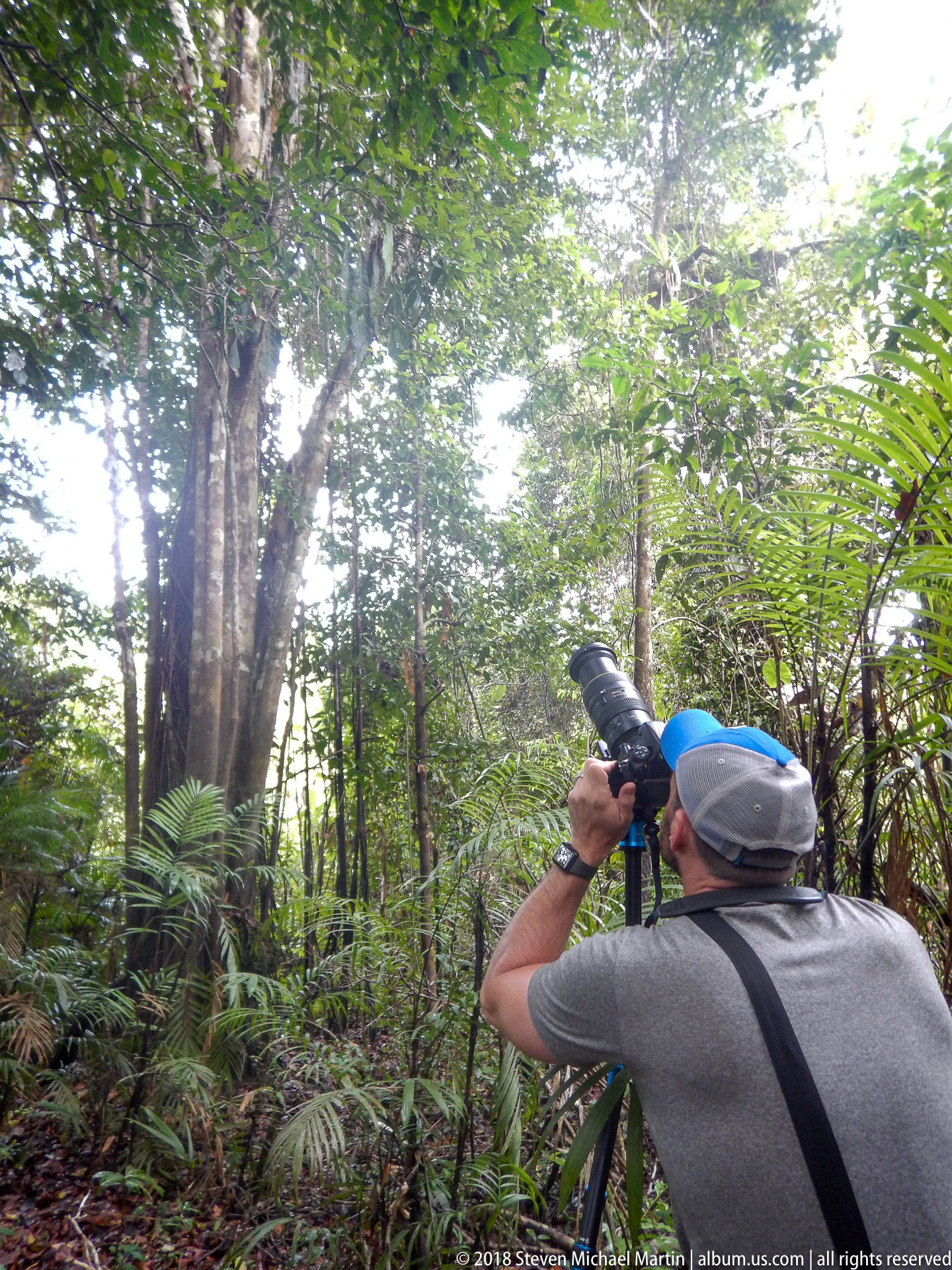
A photographer aims a long telephoto lens upward from the forest floor, working beneath a dense canopy of palms and broadleaf vegetation. The low-angle composition places the observer at the edge of the frame and devotes most of the view to the vertical layers of rainforest habitat. The scene records the practical challenge of photographing wildlife that occupies high, partially obscured perches.
Caption
A photographer aims a long telephoto lens upward from the forest floor, working beneath a dense canopy of palms and broadleaf vegetation. The low-angle composition places the observer at the edge of the frame and devotes most of the view to the vertical layers of rainforest habitat. The scene records the practical challenge of photographing wildlife that occupies high, partially obscured perches.

A visitor moves along a narrow forest route surrounded by palms, saplings, and low vegetation, carrying camera gear, a backpack, and a water bottle. A broad palm frond crosses the foreground, reinforcing the sense of enclosed tropical understory. The portrait provides human scale for the reserve’s dense vegetation and the practical conditions of wildlife observation on foot.
Caption
A visitor moves along a narrow forest route surrounded by palms, saplings, and low vegetation, carrying camera gear, a backpack, and a water bottle. A broad palm frond crosses the foreground, reinforcing the sense of enclosed tropical understory. The portrait provides human scale for the reserve’s dense vegetation and the practical conditions of wildlife observation on foot.

A lone photographer stands in a small opening beneath the canopy, raising a telephoto camera toward wildlife above. The subject is dwarfed by surrounding palms, vines, and layered foliage, making the forest structure as important as the person. The open patch of sky at upper left accentuates the upward direction of attention and the height of the canopy being searched.
Caption
A lone photographer stands in a small opening beneath the canopy, raising a telephoto camera toward wildlife above. The subject is dwarfed by surrounding palms, vines, and layered foliage, making the forest structure as important as the person. The open patch of sky at upper left accentuates the upward direction of attention and the height of the canopy being searched.
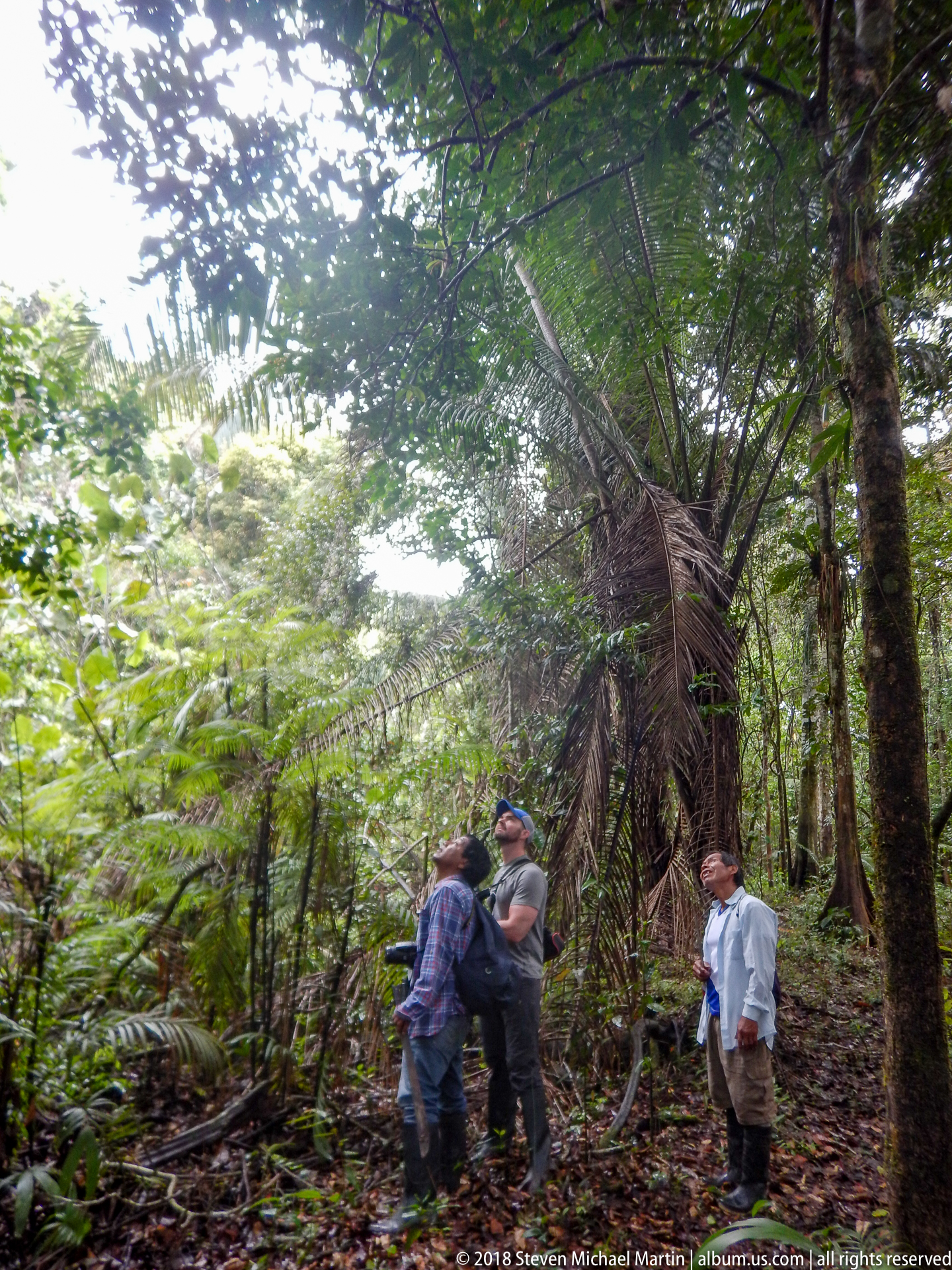
Three people gather beneath towering palms and broadleaf trees while directing their attention into the canopy. One handles camera or optical equipment as the others look on, suggesting a shared wildlife sighting or field discussion. Their compact grouping contrasts with the high vertical space above, underscoring how observation in lowland rainforest often depends on coordinated searching through dense vegetation.
Caption
Three people gather beneath towering palms and broadleaf trees while directing their attention into the canopy. One handles camera or optical equipment as the others look on, suggesting a shared wildlife sighting or field discussion. Their compact grouping contrasts with the high vertical space above, underscoring how observation in lowland rainforest often depends on coordinated searching through dense vegetation.

A broad-limbed tree anchors this interior view, its spreading branches forming a green ceiling over slim neighboring trunks and dense ground vegetation. A distant person near the center-left gives the scene depth and scale. Compared with the preceding vertical-trunk view, this composition emphasizes lateral branching and the interlocking canopy that filters light onto the forest floor.
Caption
A broad-limbed tree anchors this interior view, its spreading branches forming a green ceiling over slim neighboring trunks and dense ground vegetation. A distant person near the center-left gives the scene depth and scale. Compared with the preceding vertical-trunk view, this composition emphasizes lateral branching and the interlocking canopy that filters light onto the forest floor.
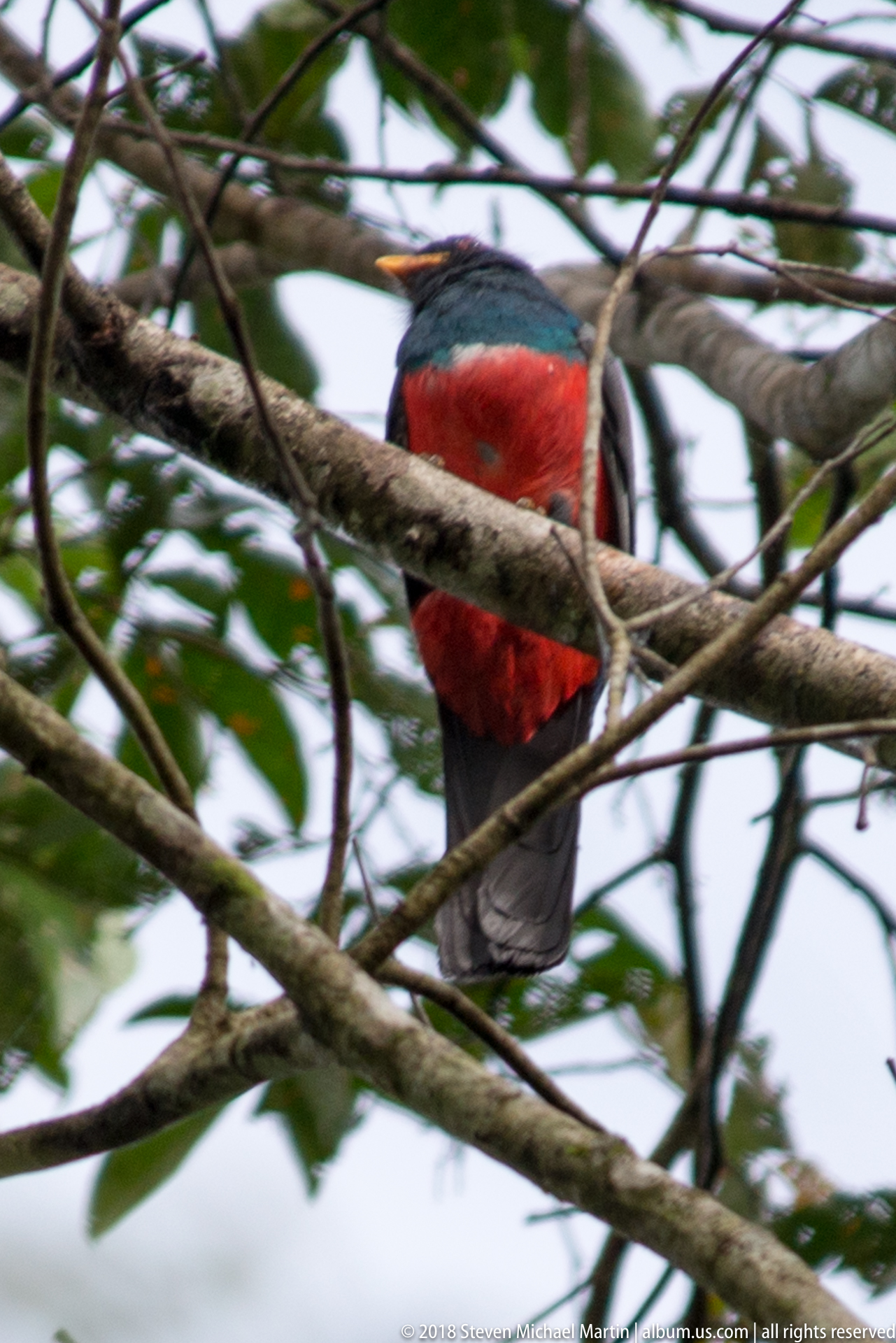
In side profile, the trogon’s compact body is framed by horizontal branches, revealing the clean division between its dark blue-green upper breast and saturated red lower underparts. The short orange-toned bill projects forward while the elongated gray tail drops below the perch. The lateral view offers the clearest silhouette of this sequence and strengthens identification within the trogon family.
Caption
In side profile, the trogon’s compact body is framed by horizontal branches, revealing the clean division between its dark blue-green upper breast and saturated red lower underparts. The short orange-toned bill projects forward while the elongated gray tail drops below the perch. The lateral view offers the clearest silhouette of this sequence and strengthens identification within the trogon family.

A male trogon perches upright within a tangle of rainforest branches, displaying a dark iridescent blue-green head and chest above a vivid red belly. Its stout body, short bill, large eye, and long grayish tail fit the characteristic profile of Neotropical trogons. The combination of red underparts and dark upper breast is consistent with a black-tailed trogon, though the obstructed tail pattern limits certainty.
Caption
A male trogon perches upright within a tangle of rainforest branches, displaying a dark iridescent blue-green head and chest above a vivid red belly. Its stout body, short bill, large eye, and long grayish tail fit the characteristic profile of Neotropical trogons. The combination of red underparts and dark upper breast is consistent with a black-tailed trogon, though the obstructed tail pattern limits certainty.

Seen from a lower, more frontal angle, the trogon sits motionless behind crossing limbs, its intense red belly forming the dominant patch of color. The dark blue-green head and upper breast contrast with the paler tail below. This view emphasizes the bird’s broad chest and upright hunting perch, a typical posture for trogons waiting quietly within shaded forest strata.
Caption
Seen from a lower, more frontal angle, the trogon sits motionless behind crossing limbs, its intense red belly forming the dominant patch of color. The dark blue-green head and upper breast contrast with the paler tail below. This view emphasizes the bird’s broad chest and upright hunting perch, a typical posture for trogons waiting quietly within shaded forest strata.

A massive rainforest trunk fills the frame, its dark, ridged bark crossed by several thin orange-brown climbing roots or woody lianas. Dense green foliage and neighboring stems recede behind it, giving the trunk a strong textural presence. The photograph isolates the vertical support structure of the forest and the small climbing plants that use mature trees as pathways toward light.
Caption
A massive rainforest trunk fills the frame, its dark, ridged bark crossed by several thin orange-brown climbing roots or woody lianas. Dense green foliage and neighboring stems recede behind it, giving the trunk a strong textural presence. The photograph isolates the vertical support structure of the forest and the small climbing plants that use mature trees as pathways toward light.

The pygmy marmoset lies nearly horizontal along a moss-flecked branch, its body flattened against the wood and long tail trailing behind. Tawny-brown dorsal fur blends closely with the bark, while the small face is barely raised. This low, elongated posture contrasts with the upright portraits in the sequence and illustrates how effectively the tiny primate can visually merge with branches in the understory.
Caption
The pygmy marmoset lies nearly horizontal along a moss-flecked branch, its body flattened against the wood and long tail trailing behind. Tawny-brown dorsal fur blends closely with the bark, while the small face is barely raised. This low, elongated posture contrasts with the upright portraits in the sequence and illustrates how effectively the tiny primate can visually merge with branches in the understory.

The pygmy marmoset stretches along the branch in a tight close-up, its face resting just above the bark and eyes directed forward. Fine tawny and gray hairs, a small rounded ear, and the compact muzzle are sharply emphasized, while most of the tail falls outside the frame. The unusual low posture makes this a behaviorally distinct portrait within the series.
Caption
The pygmy marmoset stretches along the branch in a tight close-up, its face resting just above the bark and eyes directed forward. Fine tawny and gray hairs, a small rounded ear, and the compact muzzle are sharply emphasized, while most of the tail falls outside the frame. The unusual low posture makes this a behaviorally distinct portrait within the series.

A pygmy marmoset sits upright on an angled branch, its tiny body covered in dense tawny-gray fur and its long tail extending down the wood. The rounded head, small face, and compact hands are characteristic of this diminutive Amazonian primate. Set against softly blurred green foliage, the portrait clearly conveys the animal’s minute scale and arboreal way of life.
Caption
A pygmy marmoset sits upright on an angled branch, its tiny body covered in dense tawny-gray fur and its long tail extending down the wood. The rounded head, small face, and compact hands are characteristic of this diminutive Amazonian primate. Set against softly blurred green foliage, the portrait clearly conveys the animal’s minute scale and arboreal way of life.

From farther back, a pygmy marmoset clings to a slender diagonal branch within a dense green canopy. Its compact body is small relative to the surrounding leaves and stems, demonstrating the scale that can make this primate difficult to detect in the wild. The broader framing situates the animal within its arboreal habitat rather than isolating it as a close portrait.
Caption
From farther back, a pygmy marmoset clings to a slender diagonal branch within a dense green canopy. Its compact body is small relative to the surrounding leaves and stems, demonstrating the scale that can make this primate difficult to detect in the wild. The broader framing situates the animal within its arboreal habitat rather than isolating it as a close portrait.

An alert pygmy marmoset faces the camera from the side of a lichen-spotted branch. The rounded amber-brown face, short muzzle, dense mantle of grizzled fur, and tiny fingers are all clearly visible. This close portrait gives the strongest view of facial structure in the sequence, while the branch and blurred green forest retain the animal’s natural arboreal setting.
Caption
An alert pygmy marmoset faces the camera from the side of a lichen-spotted branch. The rounded amber-brown face, short muzzle, dense mantle of grizzled fur, and tiny fingers are all clearly visible. This close portrait gives the strongest view of facial structure in the sequence, while the branch and blurred green forest retain the animal’s natural arboreal setting.
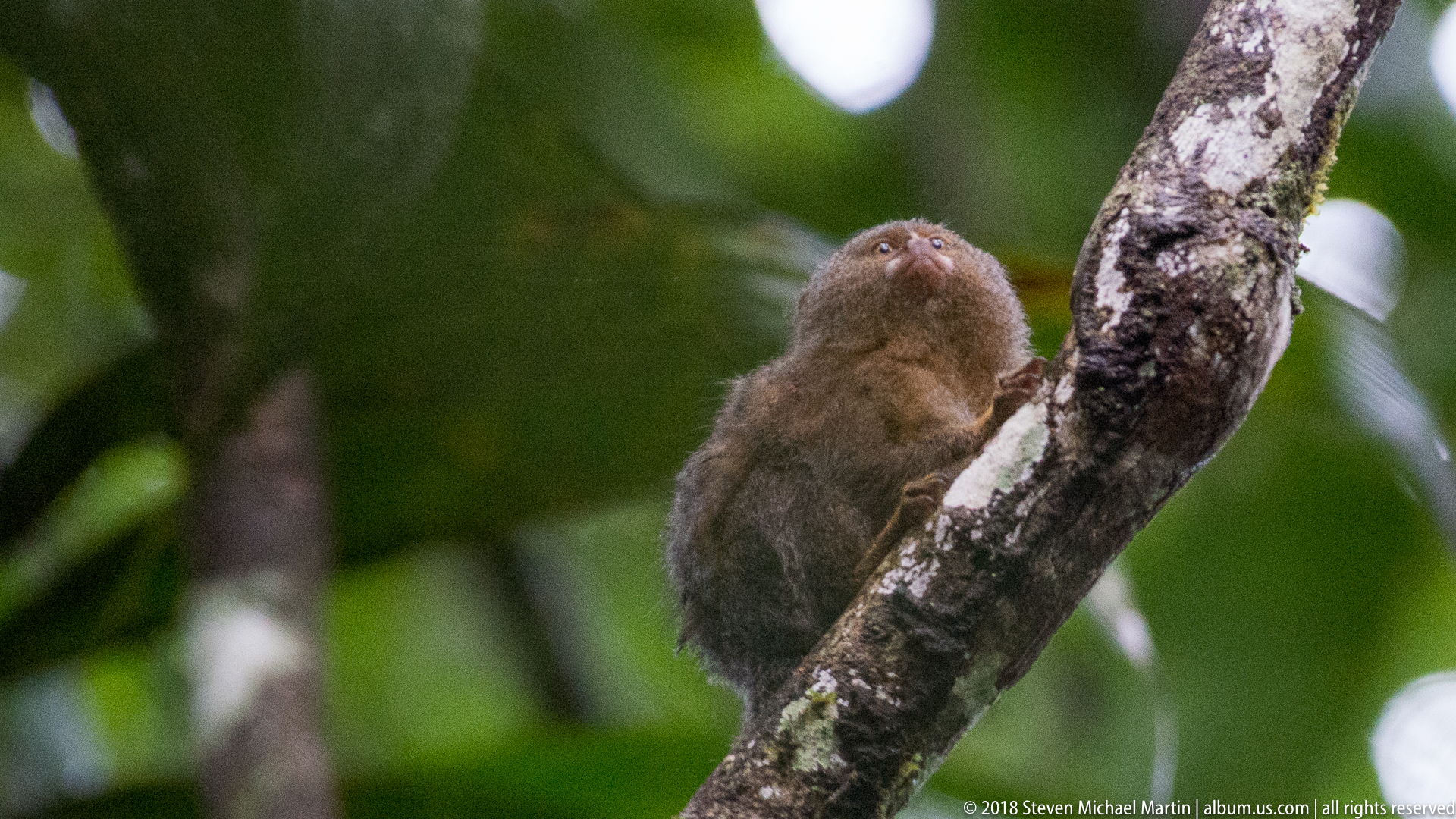
Clinging upright beside a mottled trunk, a pygmy marmoset tilts its head upward toward the canopy. The animal’s dense coat expands its silhouette into a rounded form, while tiny hands grip the bark and the long tail hangs below. The upward gaze and vertical posture distinguish this frame from the preceding low, branch-hugging views.
Caption
Clinging upright beside a mottled trunk, a pygmy marmoset tilts its head upward toward the canopy. The animal’s dense coat expands its silhouette into a rounded form, while tiny hands grip the bark and the long tail hangs below. The upward gaze and vertical posture distinguish this frame from the preceding low, branch-hugging views.

A pygmy marmoset crouches low on a sloping branch, its compact body forming a small rounded mass of grizzled brown fur against the green forest background. The face is partly turned away and partly screened by the branch, while the long tail follows the wood behind it. The more concealed orientation shows how easily this tiny primate can disappear within a tangle of branches and foliage.
Caption
A pygmy marmoset crouches low on a sloping branch, its compact body forming a small rounded mass of grizzled brown fur against the green forest background. The face is partly turned away and partly screened by the branch, while the long tail follows the wood behind it. The more concealed orientation shows how easily this tiny primate can disappear within a tangle of branches and foliage.

A pygmy marmoset moves along a rainforest branch while a larger, lichen-marked limb cuts diagonally across the frame and partly conceals its body. The animal’s very small size, rounded head, dense brownish coat, and arboreal posture are consistent with this diminutive Amazonian primate. The obstructed viewpoint conveys how readily such animals disappear into the layered vegetation of Tamshiyacu Reserve.
Caption
A pygmy marmoset moves along a rainforest branch while a larger, lichen-marked limb cuts diagonally across the frame and partly conceals its body. The animal’s very small size, rounded head, dense brownish coat, and arboreal posture are consistent with this diminutive Amazonian primate. The obstructed viewpoint conveys how readily such animals disappear into the layered vegetation of Tamshiyacu Reserve.

A pygmy marmoset extends nearly horizontal across a mossy limb, reaching forward while its long tail follows the line of the branch. This elongated stance reveals the animal’s grasping hands and agile arboreal locomotion more clearly than the perched portraits. Dense forest tones blur behind the subject, isolating the small primate against the branch it uses as a pathway through the reserve.
Caption
A pygmy marmoset extends nearly horizontal across a mossy limb, reaching forward while its long tail follows the line of the branch. This elongated stance reveals the animal’s grasping hands and agile arboreal locomotion more clearly than the perched portraits. Dense forest tones blur behind the subject, isolating the small primate against the branch it uses as a pathway through the reserve.

Perched upright on a moss-coated branch, a pygmy marmoset surveys the surrounding forest with its long tail trailing behind. Its compact body, small rounded head, grizzled brown-and-gray fur, and minute scale relative to the branch fit the characteristic appearance of this Amazonian primate. The open pose offers a clearer ecological portrait than the more concealed views in the sequence.
Caption
Perched upright on a moss-coated branch, a pygmy marmoset surveys the surrounding forest with its long tail trailing behind. Its compact body, small rounded head, grizzled brown-and-gray fur, and minute scale relative to the branch fit the characteristic appearance of this Amazonian primate. The open pose offers a clearer ecological portrait than the more concealed views in the sequence.

A pygmy marmoset pauses at a fork in a lichen- and moss-covered branch, turning its face directly toward the camera. The frontal view brings out the animal’s small rounded muzzle, bright eyes, dense facial fur, and compact body. One hand grips the branch while the long tail drops behind, emphasizing the climbing adaptations of a primate that spends most of its time on trunks and limbs.
Caption
A pygmy marmoset pauses at a fork in a lichen- and moss-covered branch, turning its face directly toward the camera. The frontal view brings out the animal’s small rounded muzzle, bright eyes, dense facial fur, and compact body. One hand grips the branch while the long tail drops behind, emphasizing the climbing adaptations of a primate that spends most of its time on trunks and limbs.

Seen at close range, a pygmy marmoset crouches low over a mossy branch with its head turned sideways. Fine details of the coarse brown-gray coat, small ear region, muzzle, and gripping hand are visible, while the shallow background keeps attention on the animal’s compact form. The low posture differs from the upright portraits nearby and suggests a moment of cautious movement or observation.
Caption
Seen at close range, a pygmy marmoset crouches low over a mossy branch with its head turned sideways. Fine details of the coarse brown-gray coat, small ear region, muzzle, and gripping hand are visible, while the shallow background keeps attention on the animal’s compact form. The low posture differs from the upright portraits nearby and suggests a moment of cautious movement or observation.
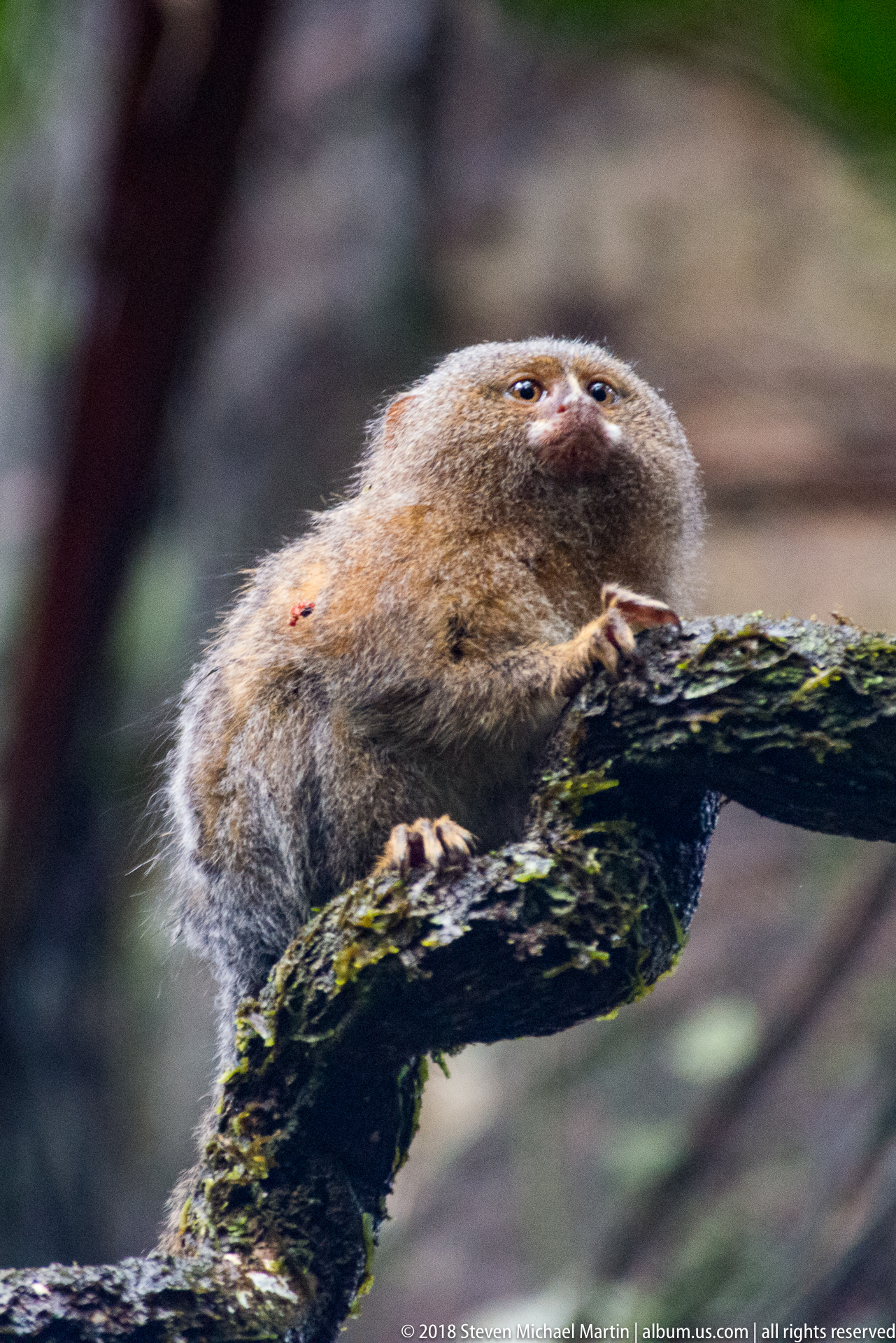
Resting low against a dark, mossy branch, a pygmy marmoset keeps its body compact while looking upward and slightly to the side. One small hand curls over the bark and the long fur softens the outline of the animal against the blurred forest. A reddish patch on the shoulder is visible but not identified, so the caption remains focused on posture and morphology rather than its cause.
Caption
Resting low against a dark, mossy branch, a pygmy marmoset keeps its body compact while looking upward and slightly to the side. One small hand curls over the bark and the long fur softens the outline of the animal against the blurred forest. A reddish patch on the shoulder is visible but not identified, so the caption remains focused on posture and morphology rather than its cause.

A pygmy marmoset climbs around the far side of a sloping tree trunk, its small brown body partly masked by bark and crossing branches. One hand reaches to the trunk while the long tail drops below the body. Unlike the open perches in earlier frames, this view shows the primate using the tree’s three-dimensional surfaces and demonstrates how its coloration blends into the rainforest’s trunks and shadows.
Caption
A pygmy marmoset climbs around the far side of a sloping tree trunk, its small brown body partly masked by bark and crossing branches. One hand reaches to the trunk while the long tail drops below the body. Unlike the open perches in earlier frames, this view shows the primate using the tree’s three-dimensional surfaces and demonstrates how its coloration blends into the rainforest’s trunks and shadows.

A pygmy marmoset lifts its muzzle toward the canopy while remaining braced against a horizontal, moss-covered branch. The steeply raised head and visible throat distinguish this frame from the adjacent frontal portraits, turning the subject into a study of alert arboreal behavior. Its compact size, dense mottled coat, delicate hands, and trailing tail remain clearly visible against the softened rainforest background.
Caption
A pygmy marmoset lifts its muzzle toward the canopy while remaining braced against a horizontal, moss-covered branch. The steeply raised head and visible throat distinguish this frame from the adjacent frontal portraits, turning the subject into a study of alert arboreal behavior. Its compact size, dense mottled coat, delicate hands, and trailing tail remain clearly visible against the softened rainforest background.

Clinging to the side of a tree trunk, a pygmy marmoset turns its head toward the camera in a close, intimate portrait. The frame shows the small primate’s rounded face, dark eyes, dense brown-gray fur, and sharply gripping fingers against textured bark. Its body is tucked close to the trunk, illustrating the vertical clinging behavior typical of tiny arboreal monkeys moving through Amazonian forest.
Caption
Clinging to the side of a tree trunk, a pygmy marmoset turns its head toward the camera in a close, intimate portrait. The frame shows the small primate’s rounded face, dark eyes, dense brown-gray fur, and sharply gripping fingers against textured bark. Its body is tucked close to the trunk, illustrating the vertical clinging behavior typical of tiny arboreal monkeys moving through Amazonian forest.

A pygmy marmoset hugs the side of a slanting trunk, its body curled around the bark while one hand reaches higher for purchase. The diagonal composition emphasizes the animal’s ability to cling securely to near-vertical surfaces. Its small rounded head, short muzzle, thick brown coat, and long tail remain visible, though crossing limbs partly frame the body within the forest canopy.
Caption
A pygmy marmoset hugs the side of a slanting trunk, its body curled around the bark while one hand reaches higher for purchase. The diagonal composition emphasizes the animal’s ability to cling securely to near-vertical surfaces. Its small rounded head, short muzzle, thick brown coat, and long tail remain visible, though crossing limbs partly frame the body within the forest canopy.

A pygmy marmoset presses against the far side of a vertical tree trunk, leaving only part of its rounded head, back, and long tail exposed. The surrounding vegetation dissolves into soft green and gray shapes, while the bark provides both support and concealment. This final primate view in the sequence underscores the animal’s cryptic coloration and close association with tree trunks in the Amazon forest.
Caption
A pygmy marmoset presses against the far side of a vertical tree trunk, leaving only part of its rounded head, back, and long tail exposed. The surrounding vegetation dissolves into soft green and gray shapes, while the bark provides both support and concealment. This final primate view in the sequence underscores the animal’s cryptic coloration and close association with tree trunks in the Amazon forest.

An epiphytic rosette grows from the side of a rainforest tree, its narrow strap-shaped leaves radiating above a compact mass of roots, moss, and accumulated organic material. Several leaf bases show reddish-purple tones, while dangling roots and debris hang below the attachment point. The growth form is characteristic of canopy epiphytes that use trees for support without rooting in the forest floor.
Caption
An epiphytic rosette grows from the side of a rainforest tree, its narrow strap-shaped leaves radiating above a compact mass of roots, moss, and accumulated organic material. Several leaf bases show reddish-purple tones, while dangling roots and debris hang below the attachment point. The growth form is characteristic of canopy epiphytes that use trees for support without rooting in the forest floor.