Paris at Night
Paris presents a distinctive atmosphere after sunset, when architectural landmarks are illuminated against the evening sky. Carefully designed lighting emphasizes structural details of historic buildings, bridges, and public spaces. The visual contrast between light and shadow highlights the geometry and ornamentation of the city’s architecture.
Monuments such as cathedrals, museums, and civic buildings take on a different character when viewed at night. Reflections along the Seine River contribute to the visual continuity of the urban landscape. Evening illumination demonstrates how modern planning enhances the presentation of historic architecture.
Paris at night illustrates the interaction between historic preservation and contemporary urban design. The illuminated cityscape emphasizes the enduring cultural significance of architectural heritage within the French capital.

Notre-Dame de Paris rises above the Seine in a nighttime view from the riverbank, with the illuminated west towers and rose window standing out against the dark sky. The river curves through the foreground beside the stone embankment, linking the cathedral visually to its setting on the Île de la Cité. Reflected lights animate the water beneath the monumental Gothic façade.
Caption
Notre-Dame de Paris rises above the Seine in a nighttime view from the riverbank, with the illuminated west towers and rose window standing out against the dark sky. The river curves through the foreground beside the stone embankment, linking the cathedral visually to its setting on the Île de la Cité. Reflected lights animate the water beneath the monumental Gothic façade.

The Louvre Pyramid occupies the right side of the Cour Napoléon while the ornate palace façades extend across the left and background. This oblique nighttime view sets the sharply geometric glass-and-metal entrance against the sculpted stone elevations of the former royal palace. A smaller pyramid and a few visitors provide scale within the broad illuminated courtyard.
Caption
The Louvre Pyramid occupies the right side of the Cour Napoléon while the ornate palace façades extend across the left and background. This oblique nighttime view sets the sharply geometric glass-and-metal entrance against the sculpted stone elevations of the former royal palace. A smaller pyramid and a few visitors provide scale within the broad illuminated courtyard.

The Eiffel Tower rises in golden illumination above the Champ de Mars, with its searchlight sweeping across the clouded Paris sky. Seen from an elevated, centered viewpoint, the tower dominates the composition while traffic, streetlights, and landscaped approaches form a luminous foreground. The nocturnal lighting turns the iron lattice into a sharply defined beacon against the dark horizon.
Caption
The Eiffel Tower rises in golden illumination above the Champ de Mars, with its searchlight sweeping across the clouded Paris sky. Seen from an elevated, centered viewpoint, the tower dominates the composition while traffic, streetlights, and landscaped approaches form a luminous foreground. The nocturnal lighting turns the iron lattice into a sharply defined beacon against the dark horizon.

Notre-Dame de Paris is seen obliquely from across the Seine, revealing the cathedral's long flank and eastern end beyond one of the western towers. Buttressing, tall Gothic windows, roofline, and the pre-2019 spire create a layered silhouette under nighttime illumination. The river embankment and trees in the foreground place the cathedral within its historic island setting.
Caption
Notre-Dame de Paris is seen obliquely from across the Seine, revealing the cathedral's long flank and eastern end beyond one of the western towers. Buttressing, tall Gothic windows, roofline, and the pre-2019 spire create a layered silhouette under nighttime illumination. The river embankment and trees in the foreground place the cathedral within its historic island setting.

A warmly lit café terrace brings the Paris-at-night sequence from monumental architecture to street life. Red awnings and glowing interior windows frame outdoor tables, where patrons sit beneath traditional wall lamps. Bicycles parked prominently in the foreground and a tree trunk at left add the everyday texture of the streetscape, contrasting with the portfolio's illuminated landmarks.
Caption
A warmly lit café terrace brings the Paris-at-night sequence from monumental architecture to street life. Red awnings and glowing interior windows frame outdoor tables, where patrons sit beneath traditional wall lamps. Bicycles parked prominently in the foreground and a tree trunk at left add the everyday texture of the streetscape, contrasting with the portfolio's illuminated landmarks.

The Eiffel Tower fills a vertical composition from its broad lower arch to the illuminated antenna at the summit. Golden lighting reveals the stacked platforms and open iron framework, while the surrounding city remains low and dark along the horizon. A pale searchlight extends laterally from the upper tower, accentuating its extraordinary height and slender taper.
Caption
The Eiffel Tower fills a vertical composition from its broad lower arch to the illuminated antenna at the summit. Golden lighting reveals the stacked platforms and open iron framework, while the surrounding city remains low and dark along the horizon. A pale searchlight extends laterally from the upper tower, accentuating its extraordinary height and slender taper.
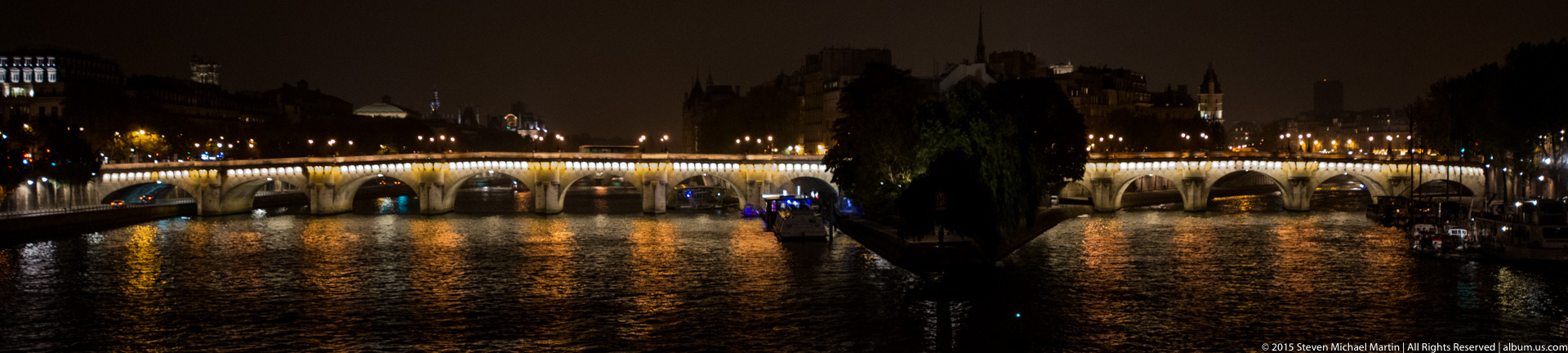
Pont Neuf stretches across the Seine in a softly illuminated nighttime view, its repeated stone arches reflected in the dark water below. Streetlights trace the bridge deck while the riverbank and distant Paris buildings recede into the background. The long exposure softens the river's surface, turning the bridge lights into warm vertical reflections between the arches.
Caption
Pont Neuf stretches across the Seine in a softly illuminated nighttime view, its repeated stone arches reflected in the dark water below. Streetlights trace the bridge deck while the riverbank and distant Paris buildings recede into the background. The long exposure softens the river's surface, turning the bridge lights into warm vertical reflections between the arches.

The Louvre Pyramid glows from within beneath the stone arch of the historic palace, creating a deliberate contrast between I. M. Pei's geometric glass structure and the surrounding classical masonry. The arch acts as a monumental frame around the pyramid and Cour Napoléon, while the illuminated grid of metal and glass draws the eye toward the center of the otherwise quiet nighttime courtyard.
Caption
The Louvre Pyramid glows from within beneath the stone arch of the historic palace, creating a deliberate contrast between I. M. Pei's geometric glass structure and the surrounding classical masonry. The arch acts as a monumental frame around the pyramid and Cour Napoléon, while the illuminated grid of metal and glass draws the eye toward the center of the otherwise quiet nighttime courtyard.

Golden floodlighting outlines the Eiffel Tower while long red and white traffic trails stream beneath its lower arch. The closer framing concentrates attention on the tower's iron lattice, broad first levels, and illuminated summit, while the moving vehicles translate the surrounding nighttime circulation into bands of light. A searchlight projects from the top into the hazy sky.
Caption
Golden floodlighting outlines the Eiffel Tower while long red and white traffic trails stream beneath its lower arch. The closer framing concentrates attention on the tower's iron lattice, broad first levels, and illuminated summit, while the moving vehicles translate the surrounding nighttime circulation into bands of light. A searchlight projects from the top into the hazy sky.

The illuminated Eiffel Tower stands symmetrically beyond the dark lawns and paths of the Champ de Mars. Its lower arch opens above the bright activity at the base, while a blue-white searchlight cuts diagonally across the black sky. The comparatively restrained foreground gives the iron structure a monumental presence and emphasizes the tower's axial relationship to the park.
Caption
The illuminated Eiffel Tower stands symmetrically beyond the dark lawns and paths of the Champ de Mars. Its lower arch opens above the bright activity at the base, while a blue-white searchlight cuts diagonally across the black sky. The comparatively restrained foreground gives the iron structure a monumental presence and emphasizes the tower's axial relationship to the park.

The Louvre Pyramid rises at right in the illuminated Cour Napoléon, its glass lattice set against the richly articulated façades of the Louvre Palace. A smaller glass pyramid appears to the left, establishing the relationship among the modern entrance structures and the historic courtyard. Warm artificial light across stone, glass, and pavement gives the ensemble a distinctly nocturnal architectural character.
Caption
The Louvre Pyramid rises at right in the illuminated Cour Napoléon, its glass lattice set against the richly articulated façades of the Louvre Palace. A smaller glass pyramid appears to the left, establishing the relationship among the modern entrance structures and the historic courtyard. Warm artificial light across stone, glass, and pavement gives the ensemble a distinctly nocturnal architectural character.

A close, low-angle view brings the Louvre Pyramid's glass panes and diagonal metal lattice to the foreground. The sharp corner of the pyramid points toward the viewer, creating a strong symmetrical geometry, while portions of the Louvre Palace rise behind it. Interior lighting reveals the transparency of the structure and the circulation spaces beneath the Cour Napoléon.
Caption
A close, low-angle view brings the Louvre Pyramid's glass panes and diagonal metal lattice to the foreground. The sharp corner of the pyramid points toward the viewer, creating a strong symmetrical geometry, while portions of the Louvre Palace rise behind it. Interior lighting reveals the transparency of the structure and the circulation spaces beneath the Cour Napoléon.

A smaller glass pyramid stands in the Cour Napoléon against the illuminated façades of the Louvre Palace. Centered and viewed close to ground level, its triangular metal grid echoes the geometry of the museum's larger entrance pyramid while allowing the historic courtyard architecture to remain dominant. The nighttime lighting clarifies the contrast between transparent modern structure and richly modeled stone elevations.
Caption
A smaller glass pyramid stands in the Cour Napoléon against the illuminated façades of the Louvre Palace. Centered and viewed close to ground level, its triangular metal grid echoes the geometry of the museum's larger entrance pyramid while allowing the historic courtyard architecture to remain dominant. The nighttime lighting clarifies the contrast between transparent modern structure and richly modeled stone elevations.

The Louvre Pyramid is presented frontally across a reflecting pool, producing an inverted triangular reflection beneath the illuminated glass structure. A vertical red line of light runs down the pyramid's center and continues into the water, strengthening the composition's bilateral symmetry. The surrounding Louvre Palace façades frame the modern entrance while remaining secondary to the pyramid's luminous geometry.
Caption
The Louvre Pyramid is presented frontally across a reflecting pool, producing an inverted triangular reflection beneath the illuminated glass structure. A vertical red line of light runs down the pyramid's center and continues into the water, strengthening the composition's bilateral symmetry. The surrounding Louvre Palace façades frame the modern entrance while remaining secondary to the pyramid's luminous geometry.

The eastern end and flank of Notre-Dame de Paris are illuminated above the Seine embankment, with the great transept rose window, flying buttresses, pinnacles, and pre-2019 spire visible in profile. Trees partly screen the lower masonry, while the elevated viewpoint across the river emphasizes the cathedral's complex exterior support system rather than its more familiar western façade.
Caption
The eastern end and flank of Notre-Dame de Paris are illuminated above the Seine embankment, with the great transept rose window, flying buttresses, pinnacles, and pre-2019 spire visible in profile. Trees partly screen the lower masonry, while the elevated viewpoint across the river emphasizes the cathedral's complex exterior support system rather than its more familiar western façade.

The west façade of Notre-Dame de Paris fills the frame under strong nighttime illumination. Twin towers rise above the gallery and central rose window, while the three sculpted portals form a richly articulated base. The nearly frontal viewpoint makes the cathedral's layered Gothic elevation especially legible, from the portal sculpture and horizontal galleries to the paired bell towers.
Caption
The west façade of Notre-Dame de Paris fills the frame under strong nighttime illumination. Twin towers rise above the gallery and central rose window, while the three sculpted portals form a richly articulated base. The nearly frontal viewpoint makes the cathedral's layered Gothic elevation especially legible, from the portal sculpture and horizontal galleries to the paired bell towers.

Floodlighting reveals the sculptural depth of Notre-Dame de Paris's west façade, from the recessed portals at street level to the tracery of the central rose window and open belfry stages of the twin towers. The symmetrical frontal composition minimizes surrounding buildings, concentrating attention on the medieval façade and the contrasting green-lit doorway visible on the upper right.
Caption
Floodlighting reveals the sculptural depth of Notre-Dame de Paris's west façade, from the recessed portals at street level to the tracery of the central rose window and open belfry stages of the twin towers. The symmetrical frontal composition minimizes surrounding buildings, concentrating attention on the medieval façade and the contrasting green-lit doorway visible on the upper right.