Museo del Templo Mayor
In Mexico City’s Centro Histórico, the Museo del Templo Mayor preserves finds from the ceremonial heart of Tenochtitlan. The museum grew out of archaeological excavations that began in 1978 and opened in 1987 to display the objects and architectural remains uncovered there. Its galleries complement the adjoining archaeological zone, bringing the ancient city’s sacred precinct into view alongside the modern streets around it.
The museum’s eight galleries follow the Templo Mayor’s dual structure. The southern side was dedicated to Huitzilopochtli, associated with the sun and war; the northern side honored Tláloc, associated with rain and agriculture. Sculptures, offerings, and other objects—including the monumental Coyolxauhqui and Tlaltecuhtli reliefs—connect these beliefs to the political and agricultural life of the Mexica.
Moving between the exhibits and the excavated structures makes the site’s scale and setting easier to understand. Stonework, ritual objects, and remains of nearby buildings show how the ceremonial center was organized and how archaeological discoveries continue to shape knowledge of Tenochtitlan. Together, museum and ruins preserve a remarkable record of the Mexica capital beneath the present-day city.
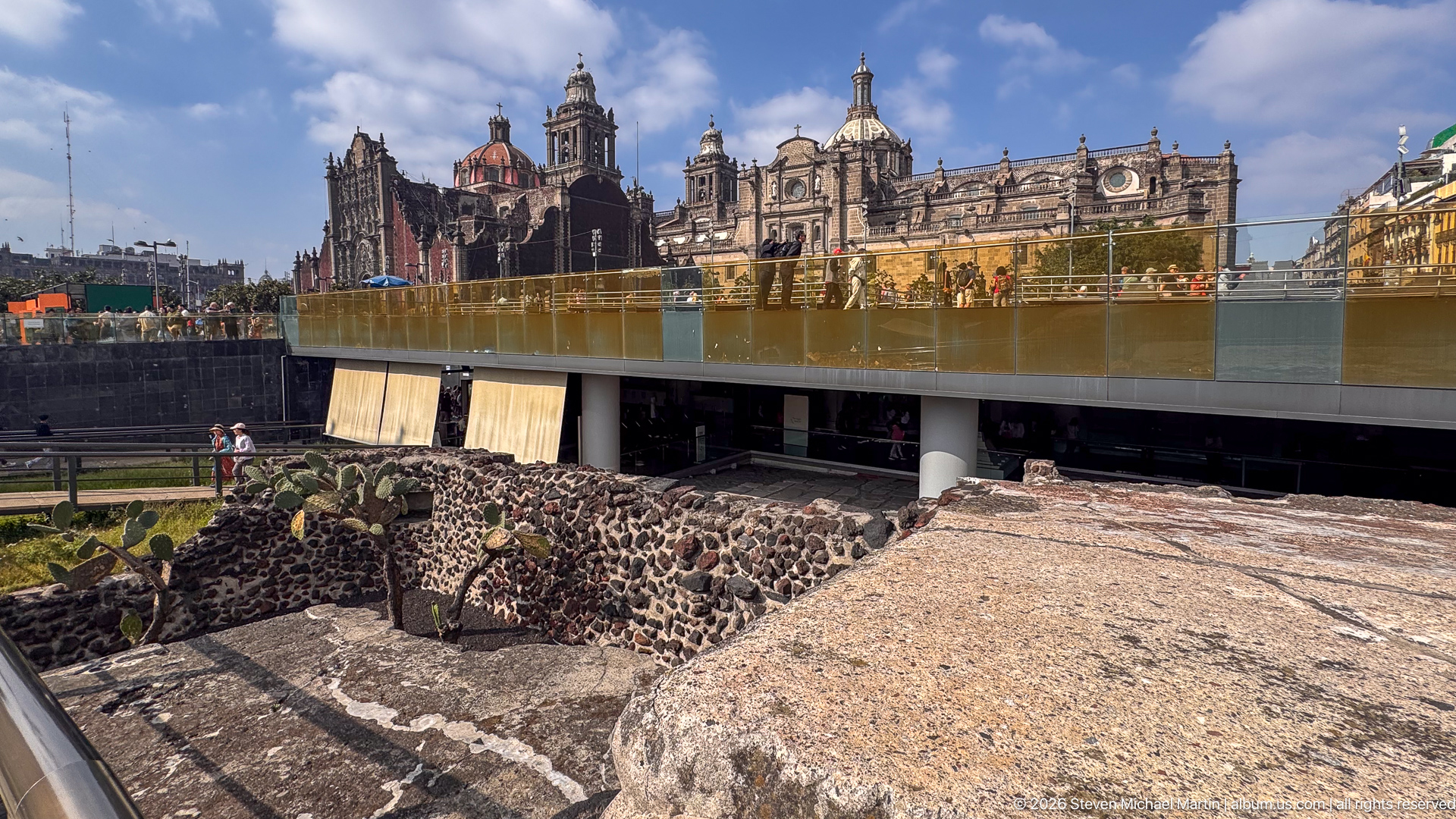
Ancient stone foundations and paved remains occupy the foreground, while the museum’s elevated glass walkway crosses the middle of the view. Beyond it, the towers, domes, and long façade of the Metropolitan Cathedral establish the historic center’s layered setting. The composition brings the archaeological precinct and later colonial city into the same frame, showing how closely their histories meet.
Caption
Ancient stone foundations and paved remains occupy the foreground, while the museum’s elevated glass walkway crosses the middle of the view. Beyond it, the towers, domes, and long façade of the Metropolitan Cathedral establish the historic center’s layered setting. The composition brings the archaeological precinct and later colonial city into the same frame, showing how closely their histories meet.
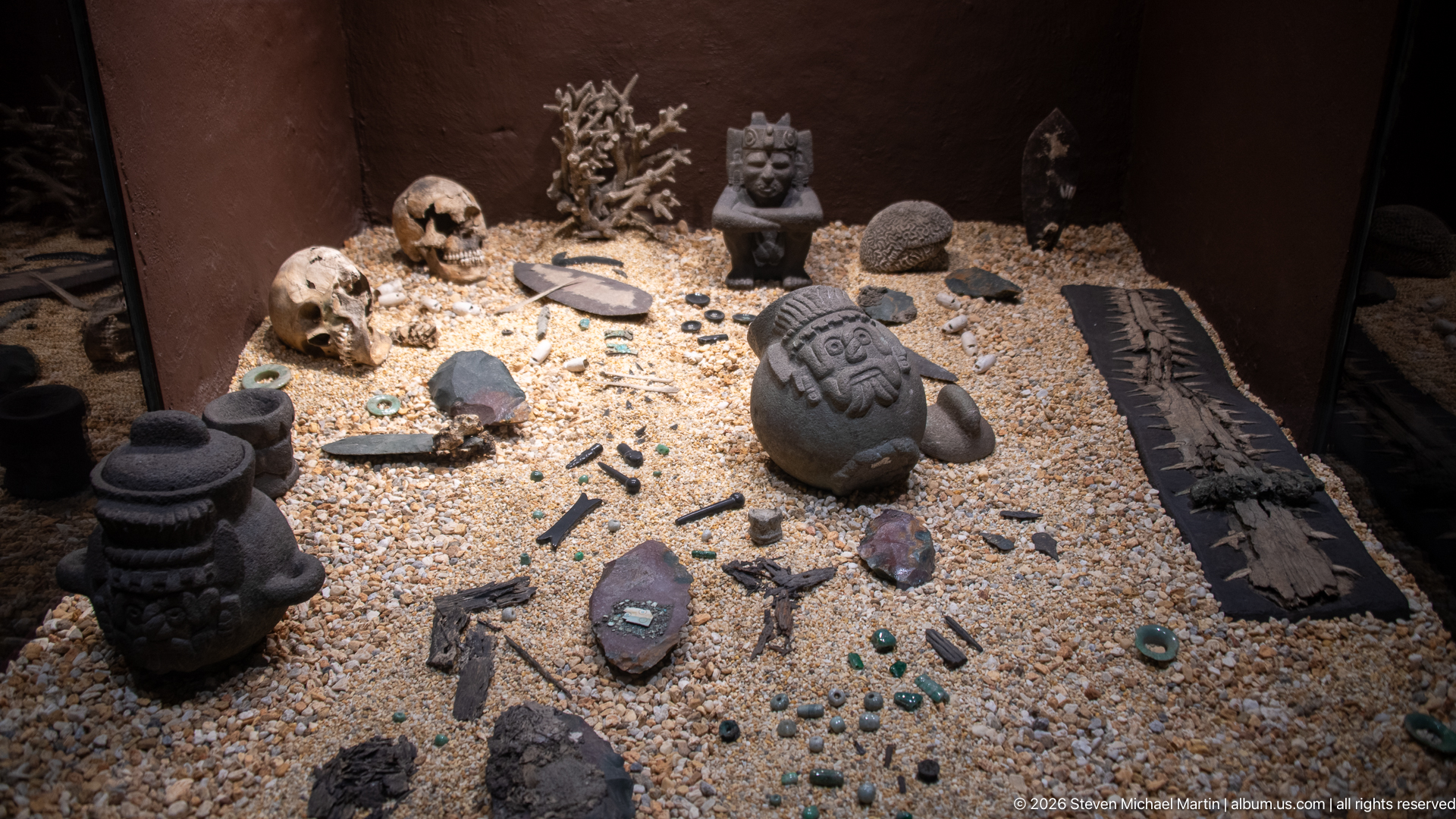
A sand-covered display case brings together skulls, carved stone pieces, pottery fragments, and smaller finds recovered in archaeological work. The objects differ in scale and material, from rounded vessels to dark, finely worked fragments arranged along the right edge. Their grouping foregrounds the range of material evidence presented by the museum rather than a single monument or artifact.
Caption
A sand-covered display case brings together skulls, carved stone pieces, pottery fragments, and smaller finds recovered in archaeological work. The objects differ in scale and material, from rounded vessels to dark, finely worked fragments arranged along the right edge. Their grouping foregrounds the range of material evidence presented by the museum rather than a single monument or artifact.
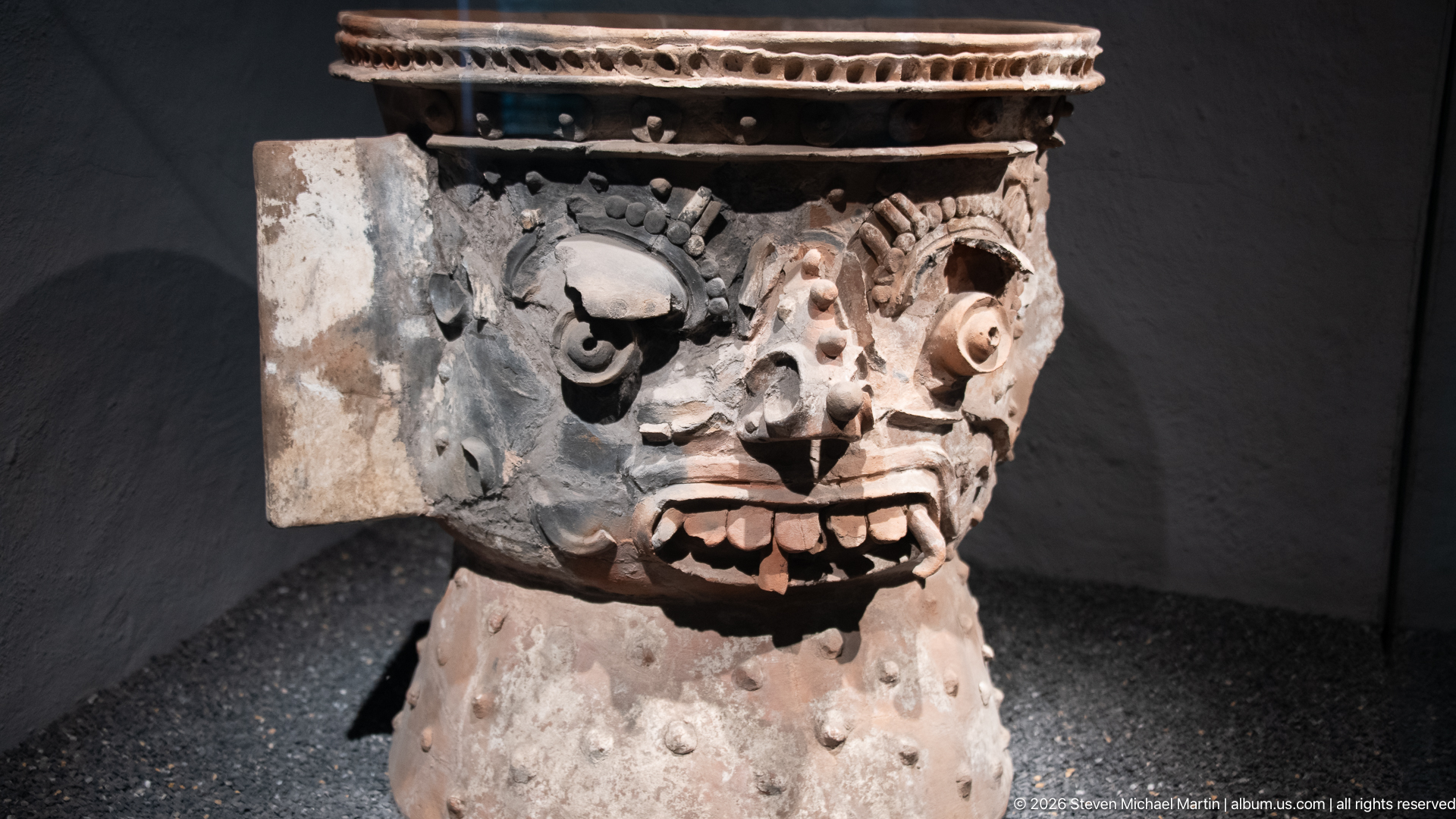
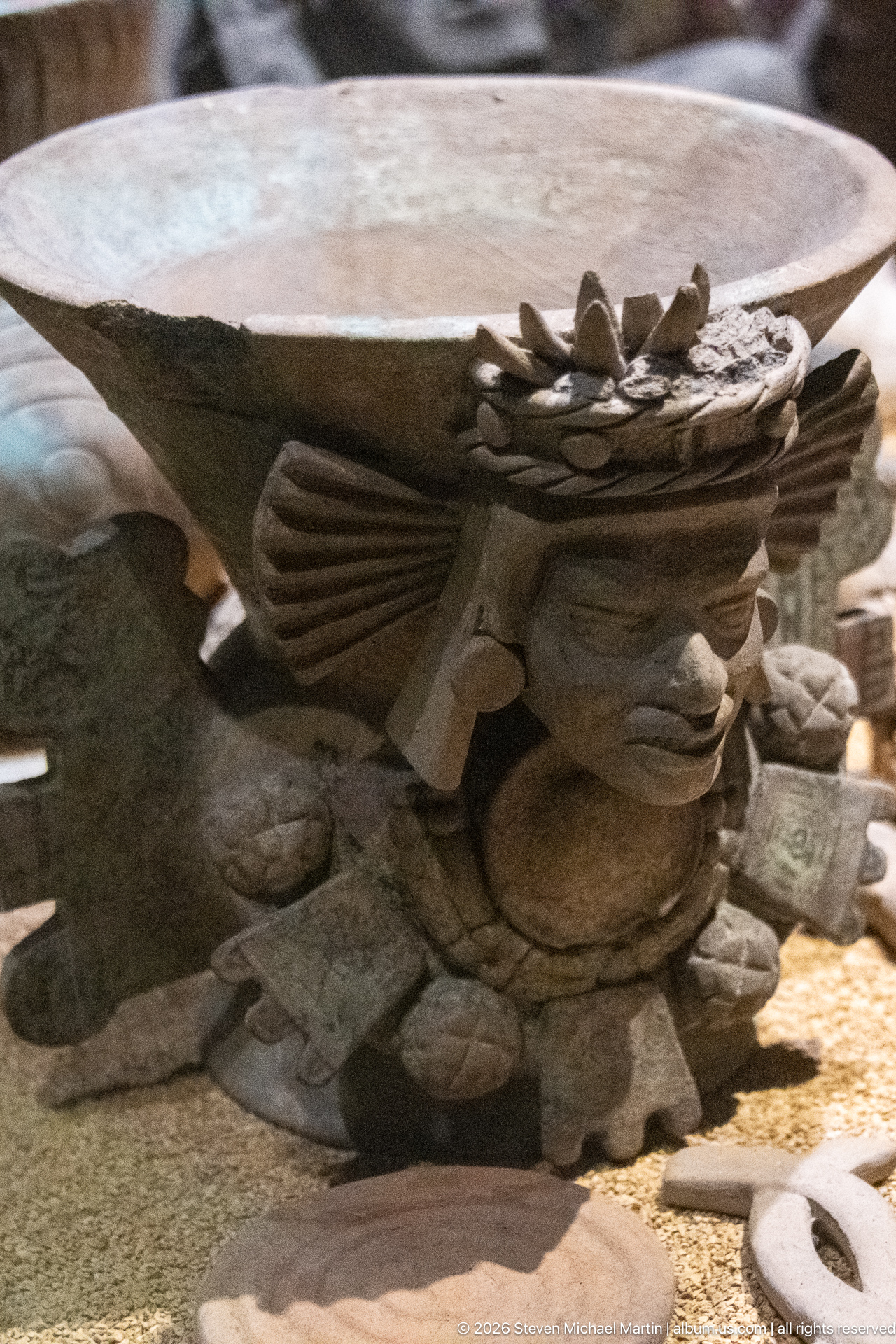
A weathered face emerges from the side of a large vessel, with bulging round eyes, a broad nose, and a row of squared teeth. The vessel’s flared rim and incised band remain visible above the face, while the close crop records chips and rough surface texture. The object’s function and exact material are not established by this view alone.
Caption
A weathered face emerges from the side of a large vessel, with bulging round eyes, a broad nose, and a row of squared teeth. The vessel’s flared rim and incised band remain visible above the face, while the close crop records chips and rough surface texture. The object’s function and exact material are not established by this view alone.
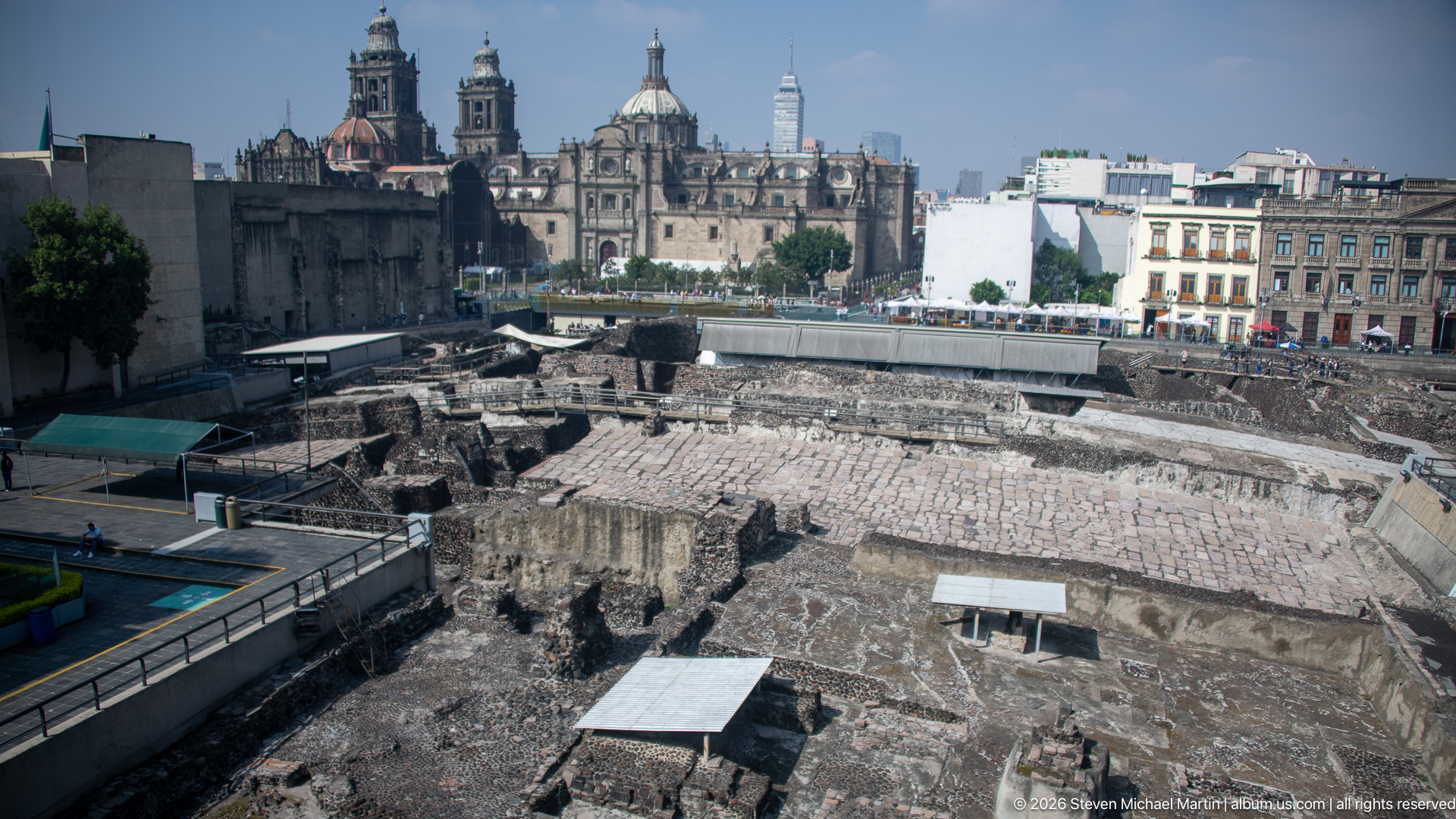
The archaeological zone spreads across the foreground in layers of exposed stone walls, platforms, and paving, while the Metropolitan Cathedral’s towers and dome rise beyond it. The elevated viewpoint shows how the excavated ceremonial complex sits within the dense historic center. Contemporary railings and visitor paths mark the boundary between the ruins and the surrounding city.
Caption
The archaeological zone spreads across the foreground in layers of exposed stone walls, platforms, and paving, while the Metropolitan Cathedral’s towers and dome rise beyond it. The elevated viewpoint shows how the excavated ceremonial complex sits within the dense historic center. Contemporary railings and visitor paths mark the boundary between the ruins and the surrounding city.
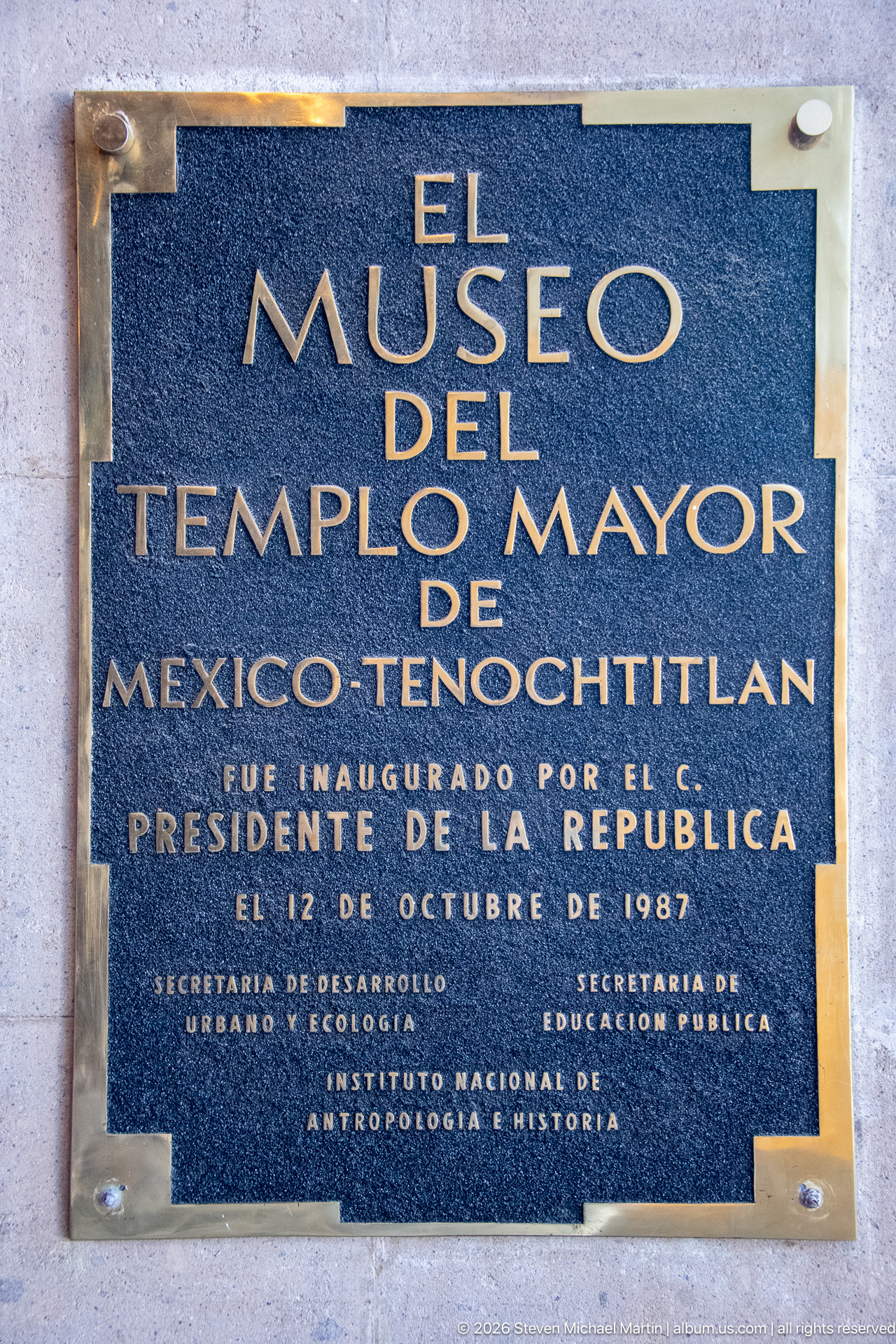
A dark blue stone plaque records the inauguration of the Museo del Templo Mayor on 12 October 1987. Gold lettering fills the rectangular surface, with the date and institutional names arranged in centered lines. Photographed straight on, the plaque becomes a documentary object in its own right, marking the museum’s opening rather than the ancient structures preserved nearby.
Caption
A dark blue stone plaque records the inauguration of the Museo del Templo Mayor on 12 October 1987. Gold lettering fills the rectangular surface, with the date and institutional names arranged in centered lines. Photographed straight on, the plaque becomes a documentary object in its own right, marking the museum’s opening rather than the ancient structures preserved nearby.
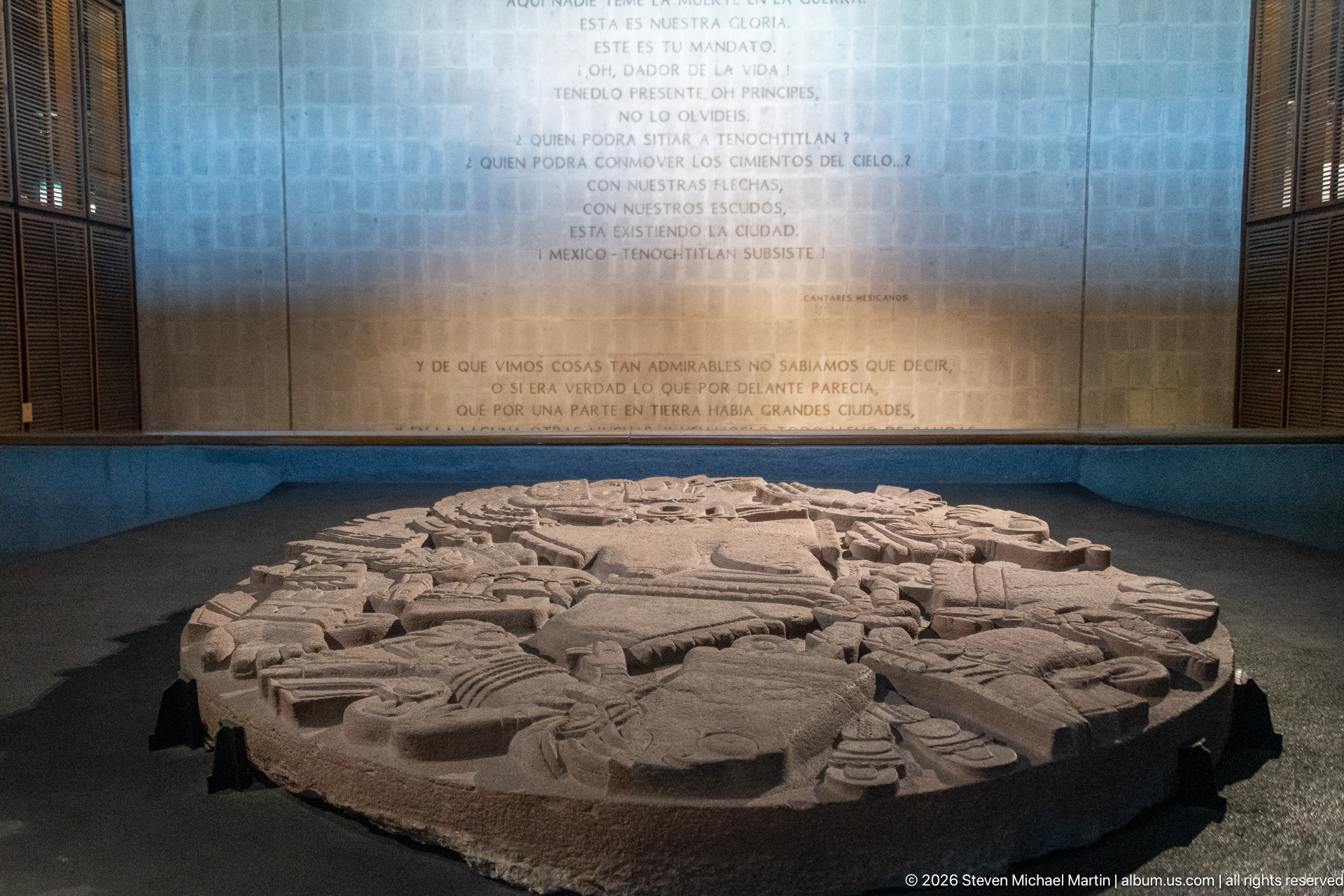
The circular Coyolxauhqui monolith lies horizontally at the center of a dedicated gallery, its carved body and limbs arranged around the central figure. A large Spanish-language quotation spans the wall behind it, tying the artifact to the museum’s interpretation of Tenochtitlan. The low, wide view conveys the stone’s scale and the deliberate space reserved around this celebrated archaeological discovery.
Caption
The circular Coyolxauhqui monolith lies horizontally at the center of a dedicated gallery, its carved body and limbs arranged around the central figure. A large Spanish-language quotation spans the wall behind it, tying the artifact to the museum’s interpretation of Tenochtitlan. The low, wide view conveys the stone’s scale and the deliberate space reserved around this celebrated archaeological discovery.
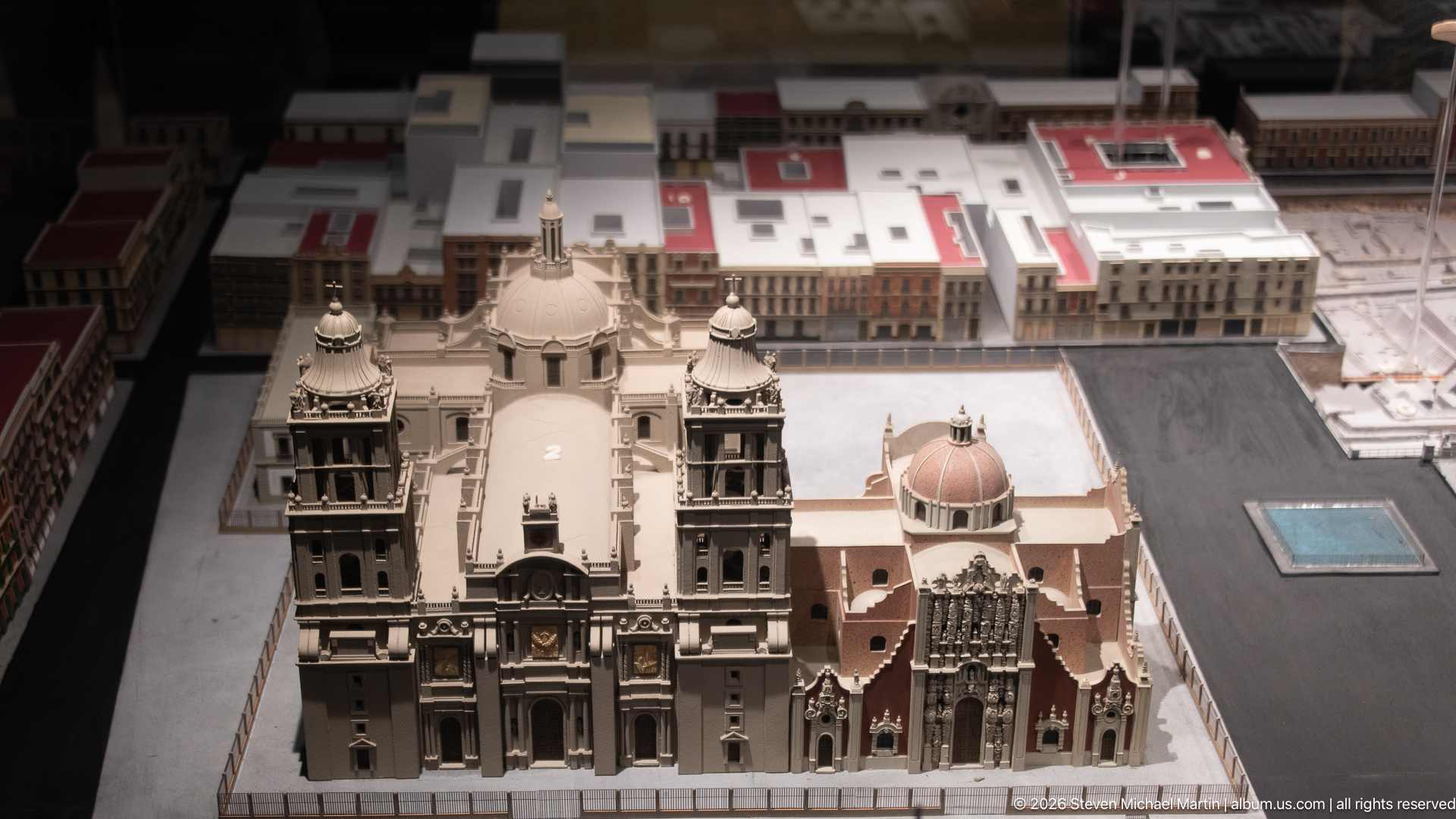
A large architectural model presents a cathedral complex from above, with paired bell towers, a central dome, and surrounding blocks of tightly packed buildings. The elevated angle makes the church’s footprint and its relationship to the urban grid legible at once. The model offers a transition from the museum’s archaeological displays to the later city built around the ceremonial precinct.
Caption
A large architectural model presents a cathedral complex from above, with paired bell towers, a central dome, and surrounding blocks of tightly packed buildings. The elevated angle makes the church’s footprint and its relationship to the urban grid legible at once. The model offers a transition from the museum’s archaeological displays to the later city built around the ceremonial precinct.
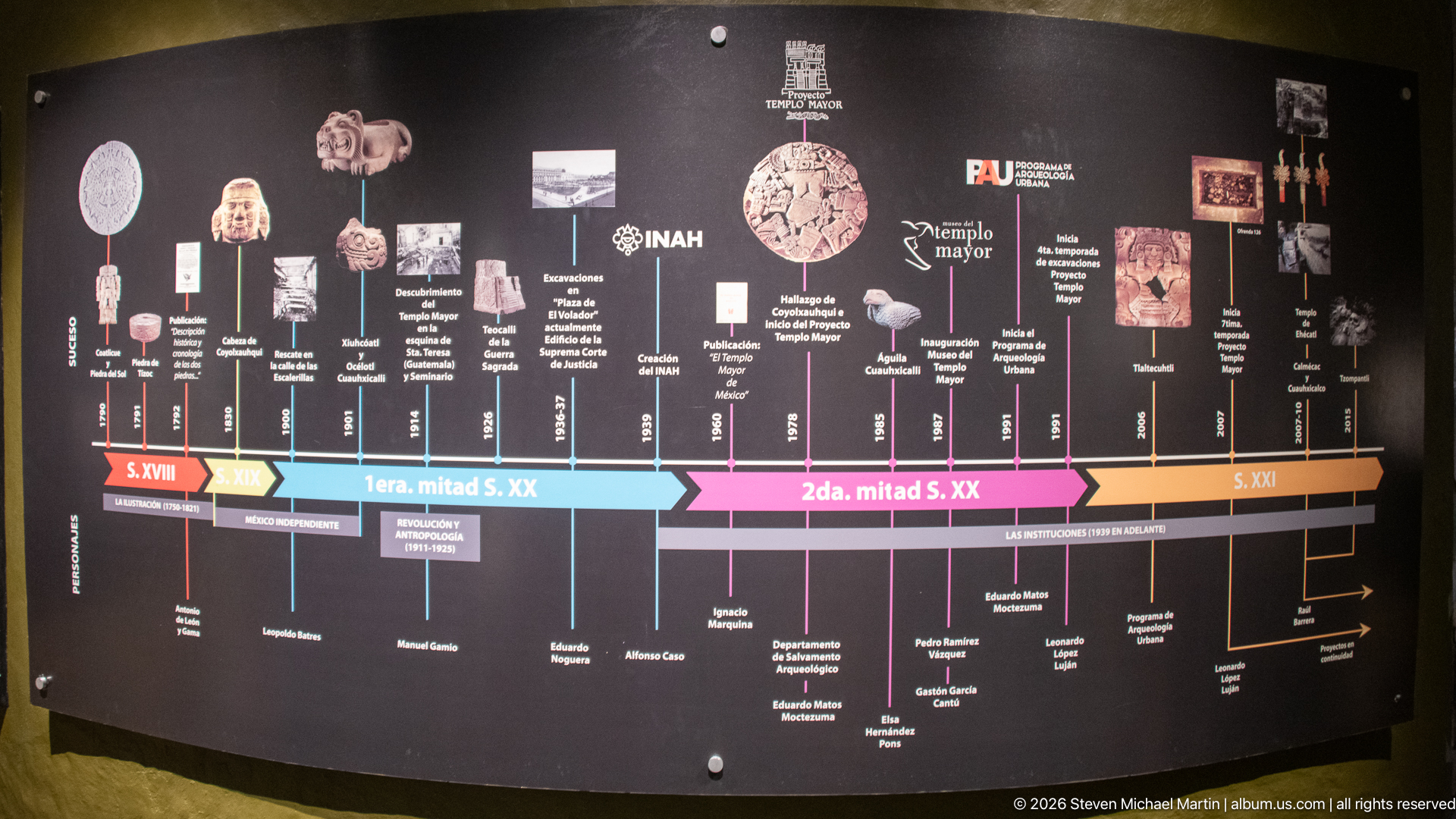
A wide black timeline panel organizes discoveries and institutional milestones along a horizontal sequence from the eighteenth century through the twenty-first. It includes photographs and artifact images, names the Templo Mayor Project, INAH, and excavation events, and uses colored bands to divide historical periods. The chart turns a complex research history into a visual chronology within the museum.
Caption
A wide black timeline panel organizes discoveries and institutional milestones along a horizontal sequence from the eighteenth century through the twenty-first. It includes photographs and artifact images, names the Templo Mayor Project, INAH, and excavation events, and uses colored bands to divide historical periods. The chart turns a complex research history into a visual chronology within the museum.
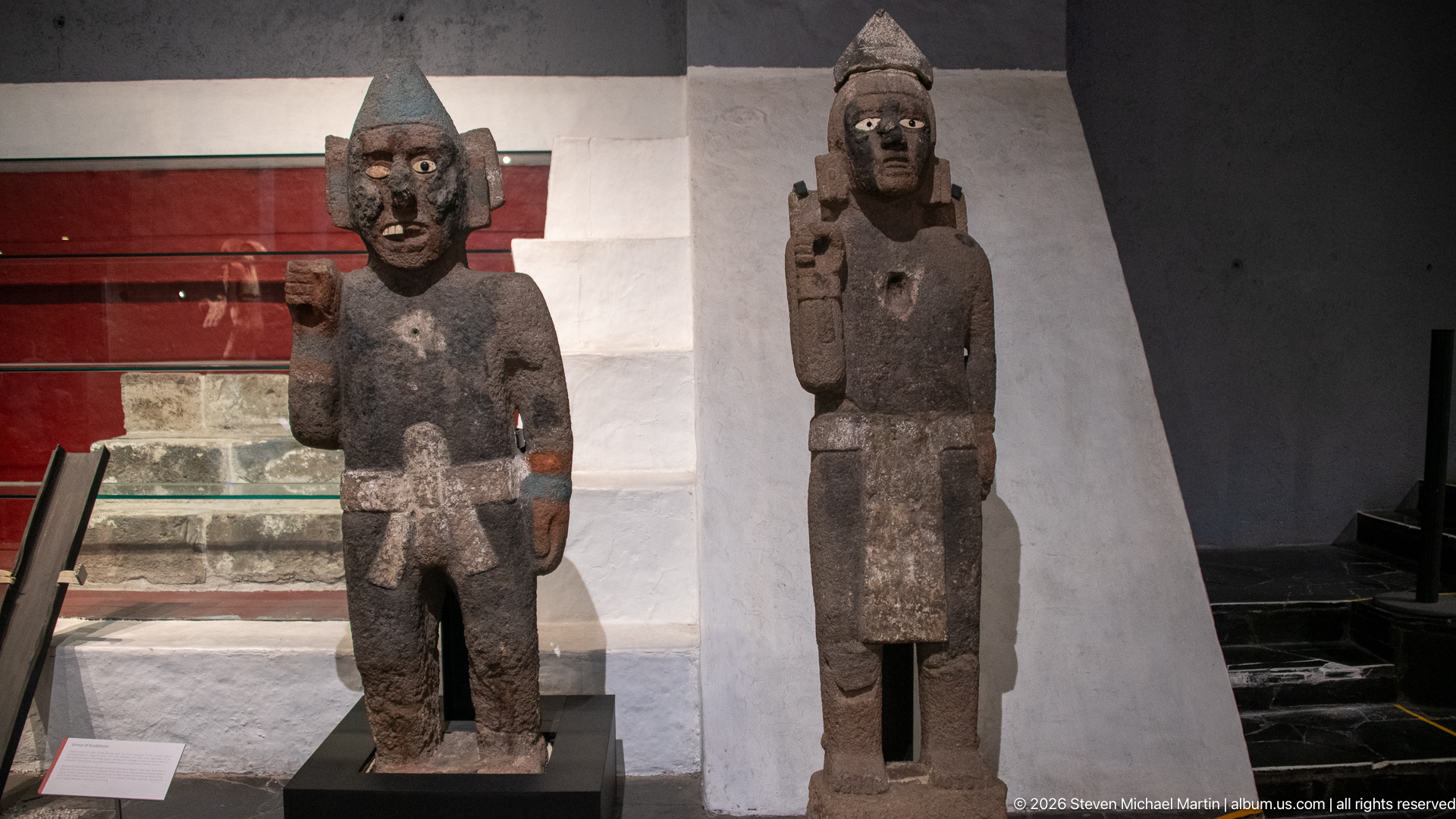
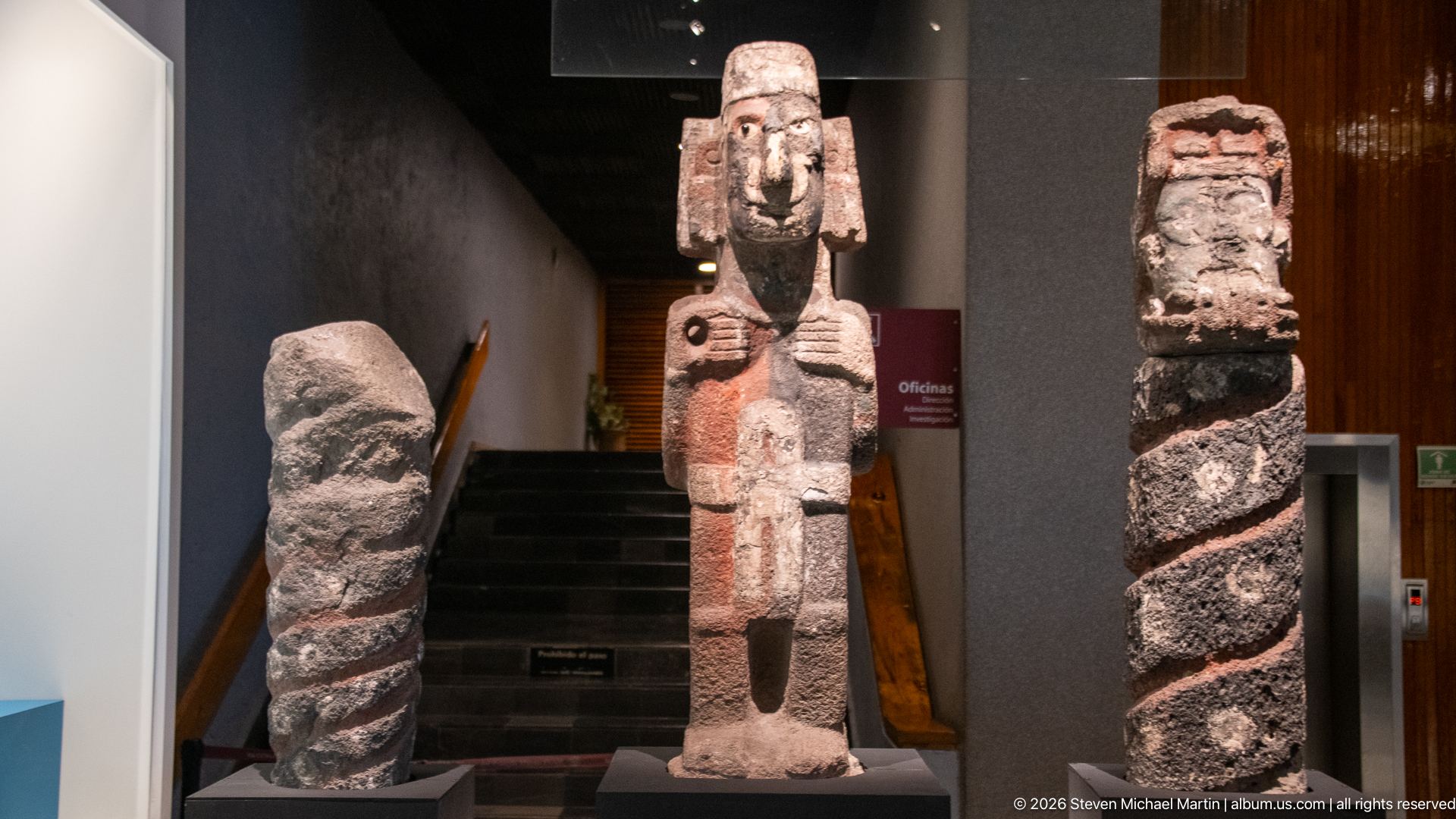
A pair of upright stone figures occupies a stepped alcove, one with a square headdress and raised forearm, the taller one wearing a pointed cap and holding an object close to the body. Their worn surfaces and simplified frontal poses remain distinct despite the shared display. A small museum label sits at lower left, but its text is too small to read here.
Caption
A pair of upright stone figures occupies a stepped alcove, one with a square headdress and raised forearm, the taller one wearing a pointed cap and holding an object close to the body. Their worn surfaces and simplified frontal poses remain distinct despite the shared display. A small museum label sits at lower left, but its text is too small to read here.
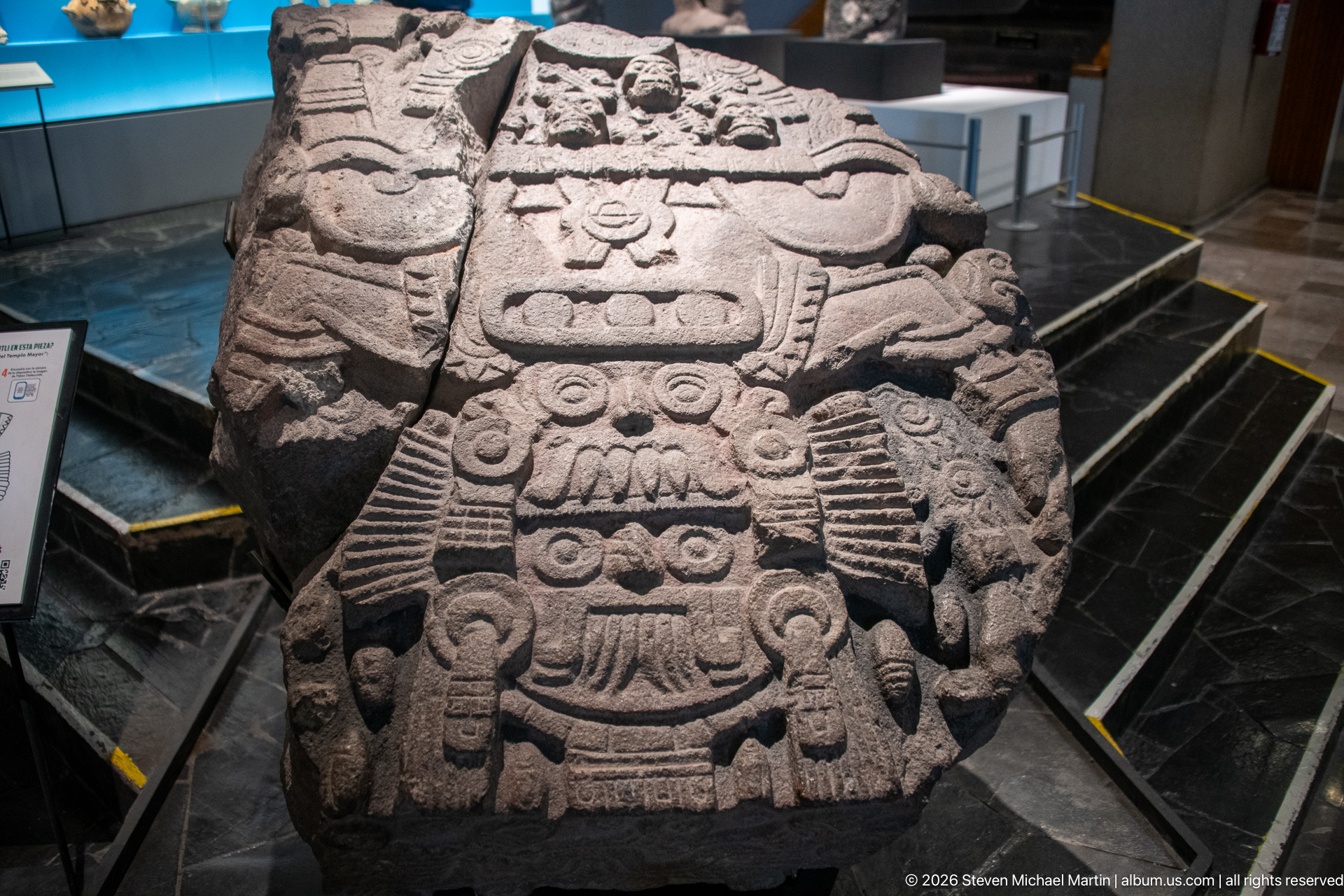
A broad stone slab presents a frontal figure surrounded by a tightly packed arrangement of symbolic forms and smaller carved details. The composition is nearly symmetrical, with the figure’s face and headdress anchoring its center. Gallery lighting picks out the shallow relief and weathered surface, allowing the complex iconography to emerge from the darker background.
Caption
A broad stone slab presents a frontal figure surrounded by a tightly packed arrangement of symbolic forms and smaller carved details. The composition is nearly symmetrical, with the figure’s face and headdress anchoring its center. Gallery lighting picks out the shallow relief and weathered surface, allowing the complex iconography to emerge from the darker background.
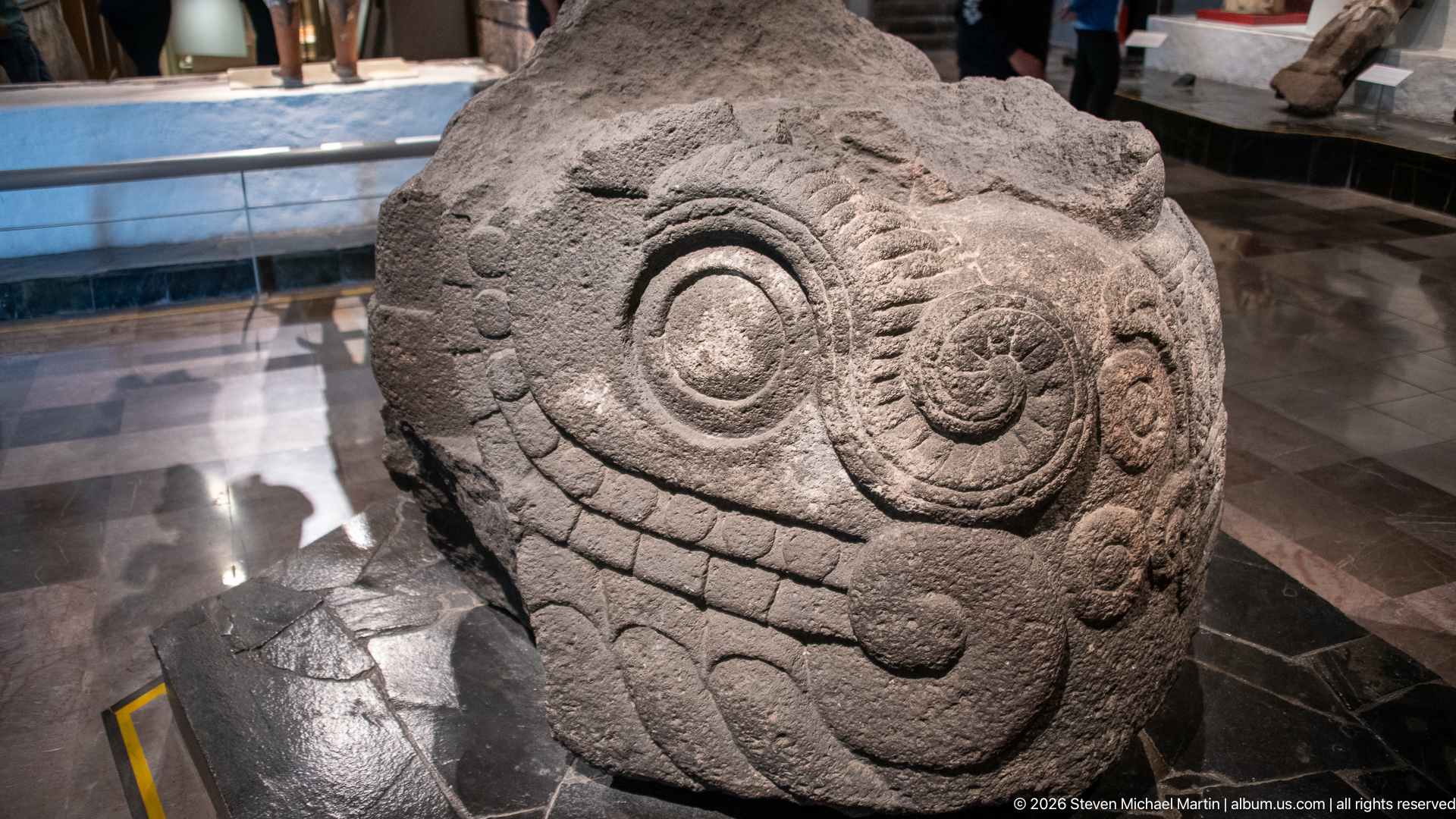
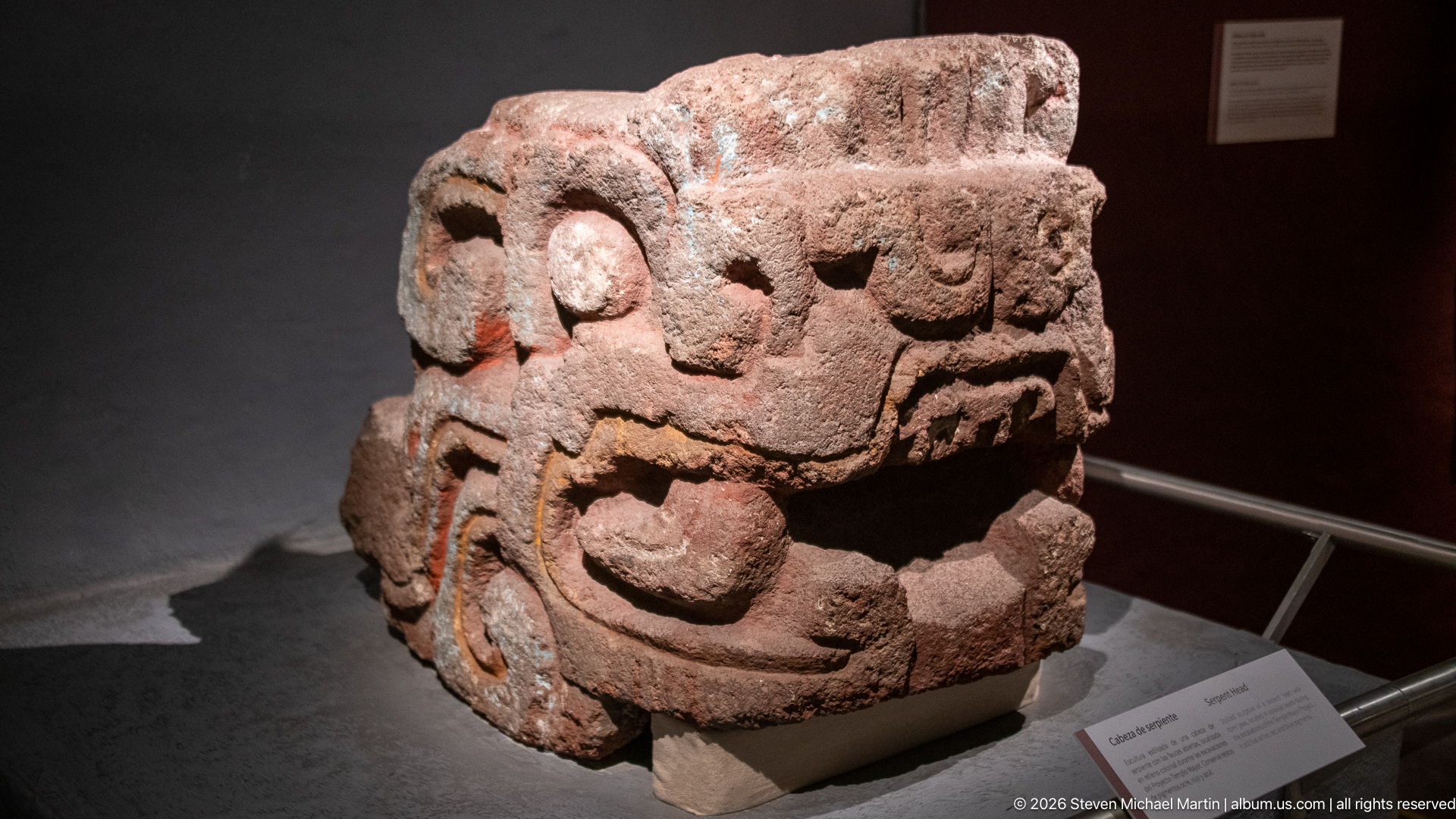
This monumental basalt head represents Xiuhcóatl, the fire serpent and mythic weapon of Huitzilopochtli. Concentric eyes, curled ridges, and a broad snout shape the powerful carving. Displayed on a low support in the polished gallery, the sculpture reads from close range as both a face and a serpent form. Visitors beyond the barrier give it scale among the museum’s major works.
Caption
This monumental basalt head represents Xiuhcóatl, the fire serpent and mythic weapon of Huitzilopochtli. Concentric eyes, curled ridges, and a broad snout shape the powerful carving. Displayed on a low support in the polished gallery, the sculpture reads from close range as both a face and a serpent form. Visitors beyond the barrier give it scale among the museum’s major works.
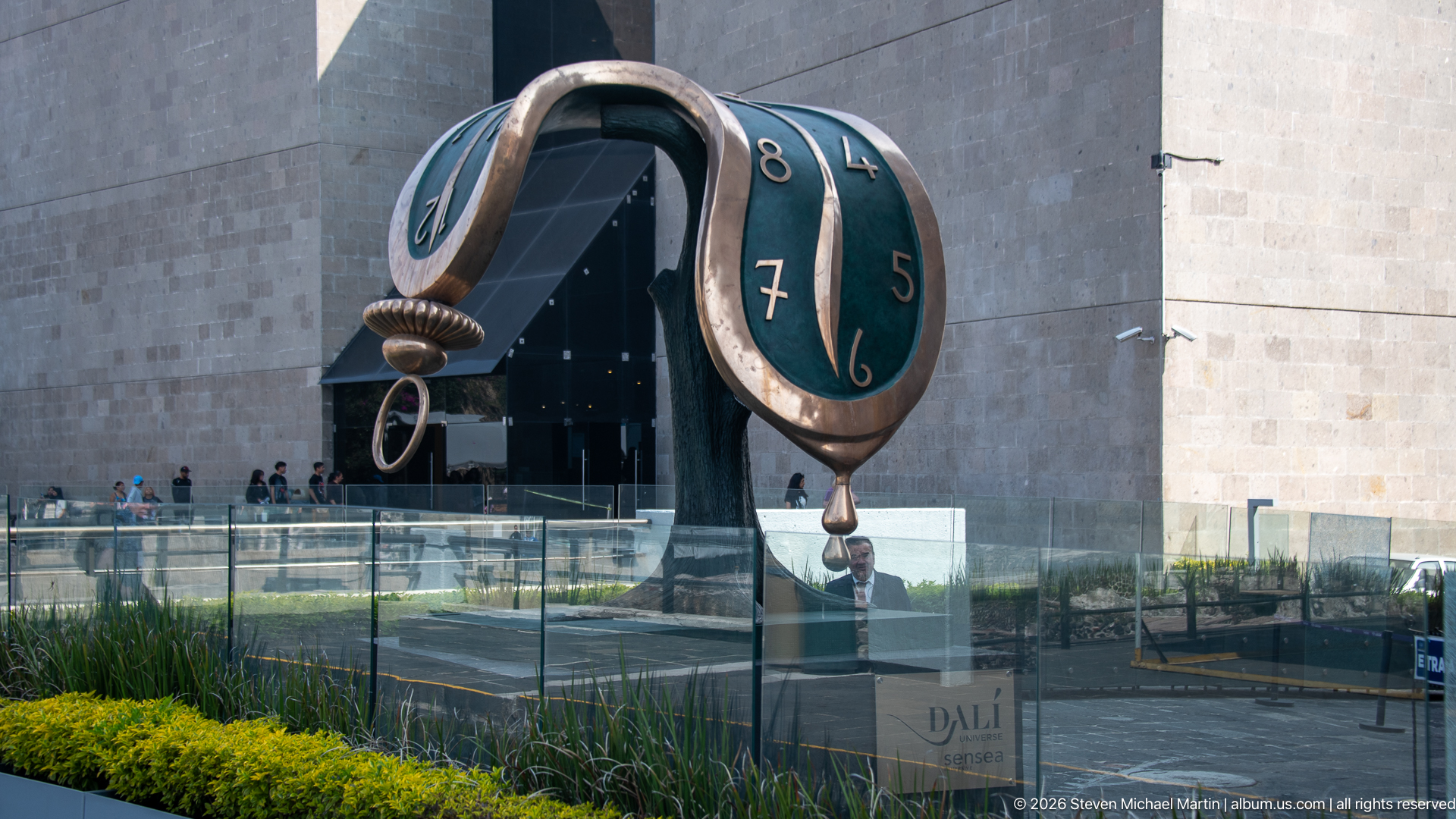
A bronze-toned clock form bends into a high arch outside the museum’s pale stone façade, its dark face marked with scattered numerals. Glass railings and planted beds separate the sculpture from the entrance, while a curved neighboring façade frames the right edge. The work turns the familiar clock face into a striking threshold marker for the museum.
Caption
A bronze-toned clock form bends into a high arch outside the museum’s pale stone façade, its dark face marked with scattered numerals. Glass railings and planted beds separate the sculpture from the entrance, while a curved neighboring façade frames the right edge. The work turns the familiar clock face into a striking threshold marker for the museum.
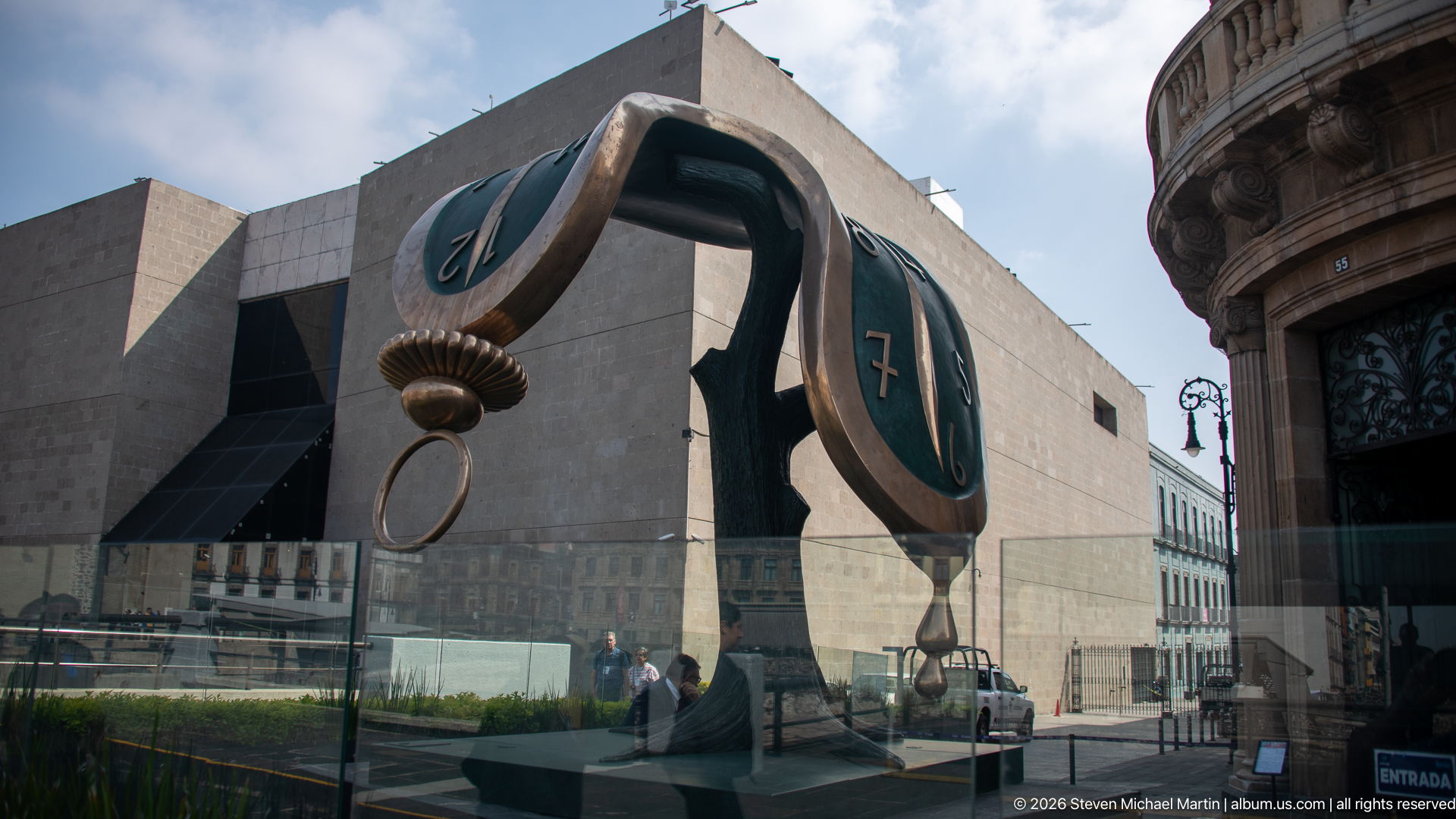
From farther back, the clock sculpture is shown in relation to the museum’s angular stone exterior and a rounded historic building at the right. Visitors, entry signs, and a glass boundary situate it in an active public forecourt. The wider composition makes the sculpture’s scale and its contrast with the surrounding architecture clear.
Caption
From farther back, the clock sculpture is shown in relation to the museum’s angular stone exterior and a rounded historic building at the right. Visitors, entry signs, and a glass boundary situate it in an active public forecourt. The wider composition makes the sculpture’s scale and its contrast with the surrounding architecture clear.
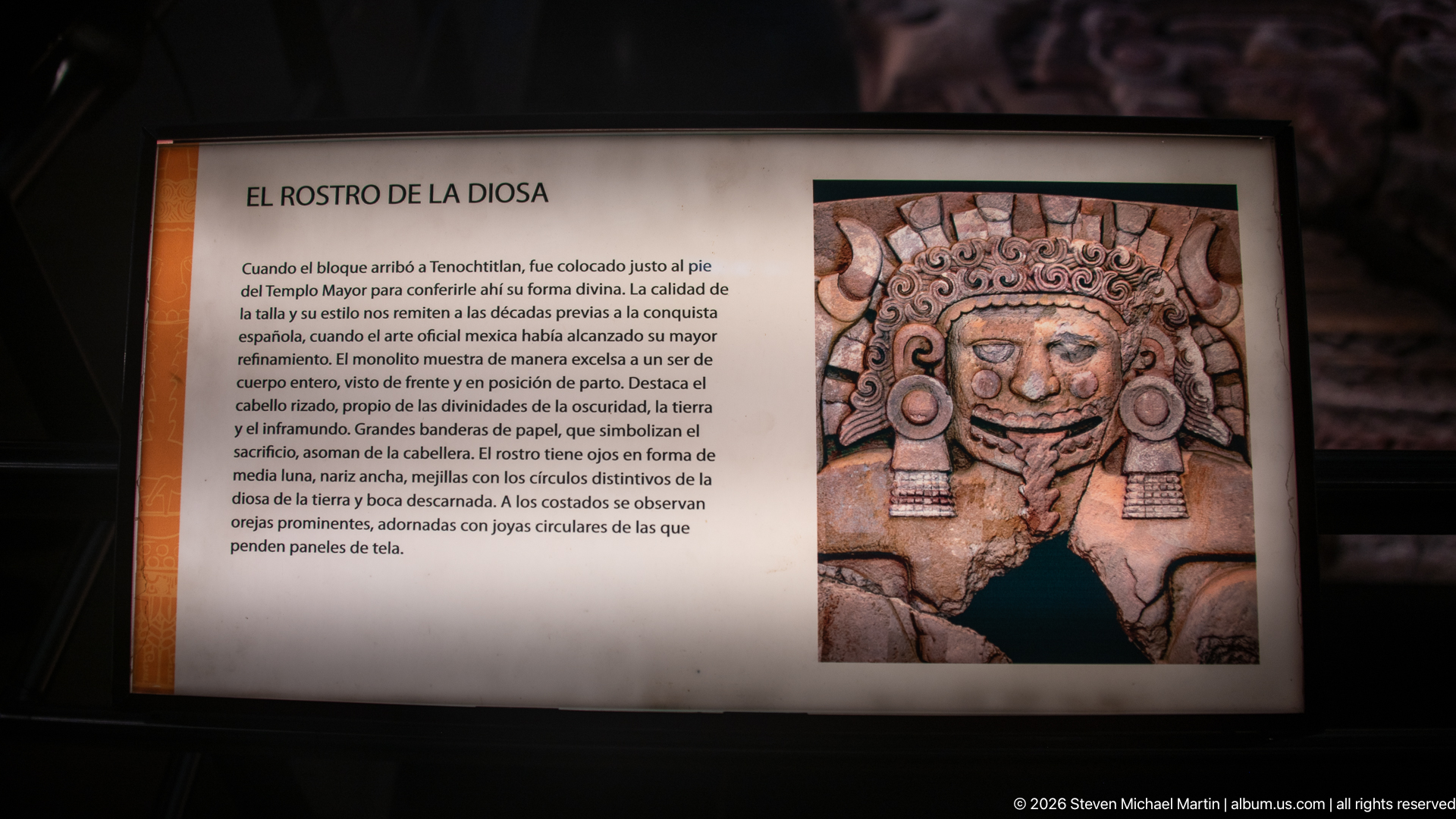
A bilingual museum panel headed “El rostro de la diosa” pairs a close image of a sculpted face with explanatory text. The inset shows a frontal stone visage framed by elaborate hair or headdress, circular ear ornaments, and a dark open mouth. The panel makes the museum’s interpretive method visible, linking a carved detail to the larger divine figure.
Caption
A bilingual museum panel headed “El rostro de la diosa” pairs a close image of a sculpted face with explanatory text. The inset shows a frontal stone visage framed by elaborate hair or headdress, circular ear ornaments, and a dark open mouth. The panel makes the museum’s interpretive method visible, linking a carved detail to the larger divine figure.
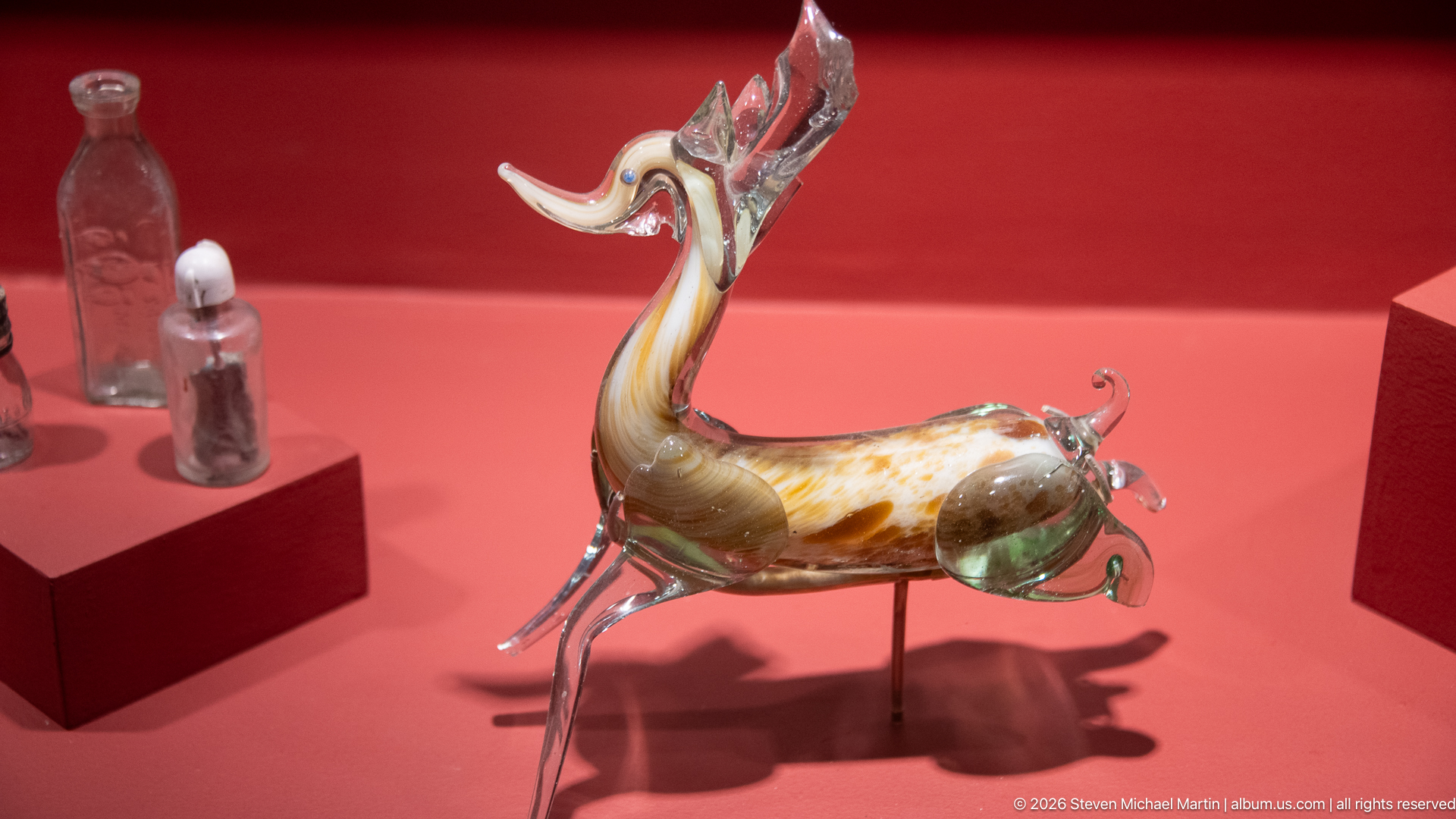
A translucent glass object forms a long-bodied animal with four slender legs, a raised curved neck, and a narrow beak-like head. Cream, amber, and green tones run through the glass, which casts a crisp shadow across the red plinth. Nearby small vessels provide scale, while the case lighting emphasizes the object’s glossy surface and delicate curves.
Caption
A translucent glass object forms a long-bodied animal with four slender legs, a raised curved neck, and a narrow beak-like head. Cream, amber, and green tones run through the glass, which casts a crisp shadow across the red plinth. Nearby small vessels provide scale, while the case lighting emphasizes the object’s glossy surface and delicate curves.
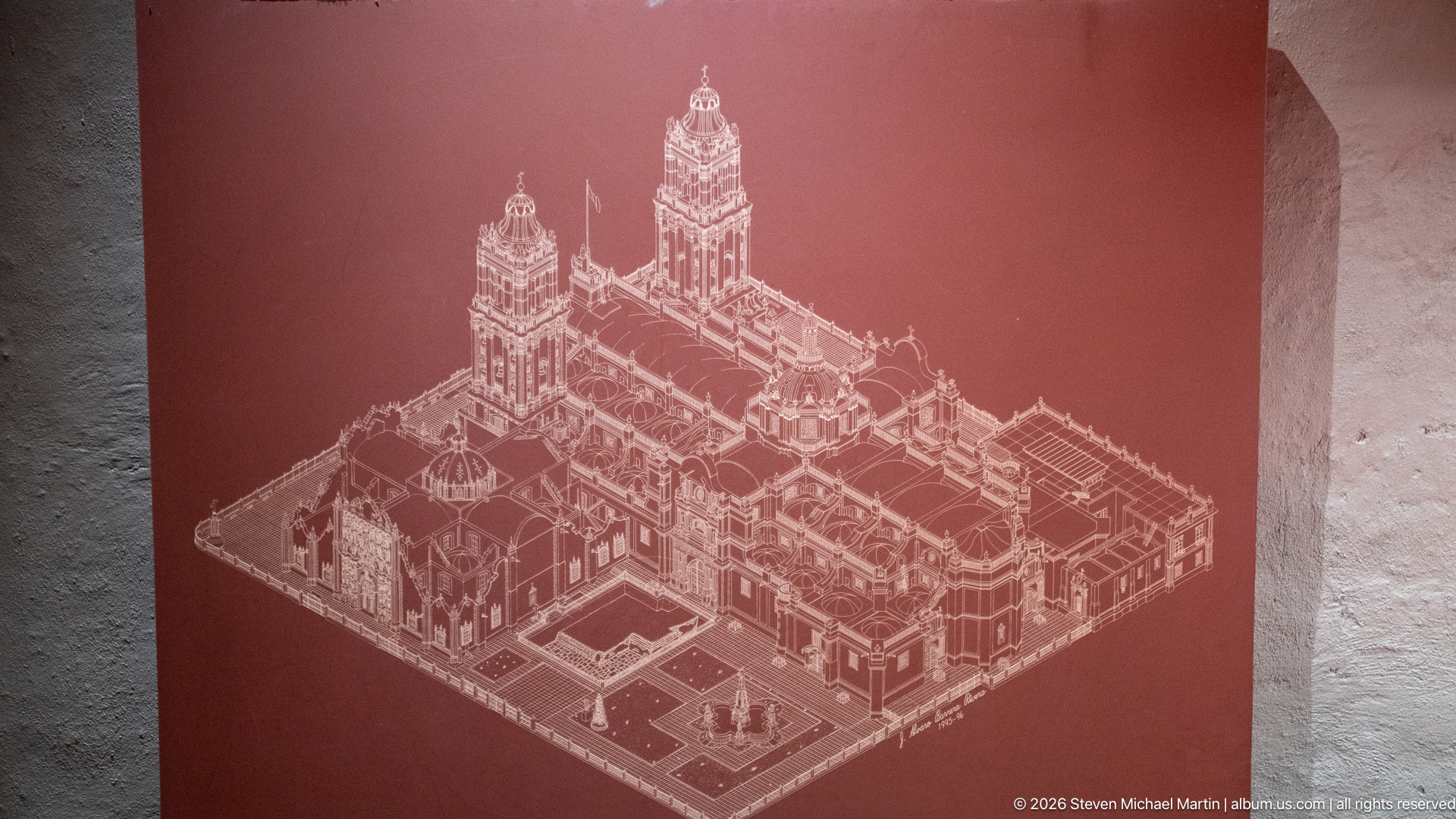
A fine white line drawing maps the museum’s multiwing complex against a muted red wall. The axonometric view shows long galleries, interior courts, stairs, and two prominent tower-like volumes, making the building’s layout readable as a whole. Presented as an architectural graphic rather than a photograph of the structure, it offers a compact guide to the visitor’s route.
Caption
A fine white line drawing maps the museum’s multiwing complex against a muted red wall. The axonometric view shows long galleries, interior courts, stairs, and two prominent tower-like volumes, making the building’s layout readable as a whole. Presented as an architectural graphic rather than a photograph of the structure, it offers a compact guide to the visitor’s route.
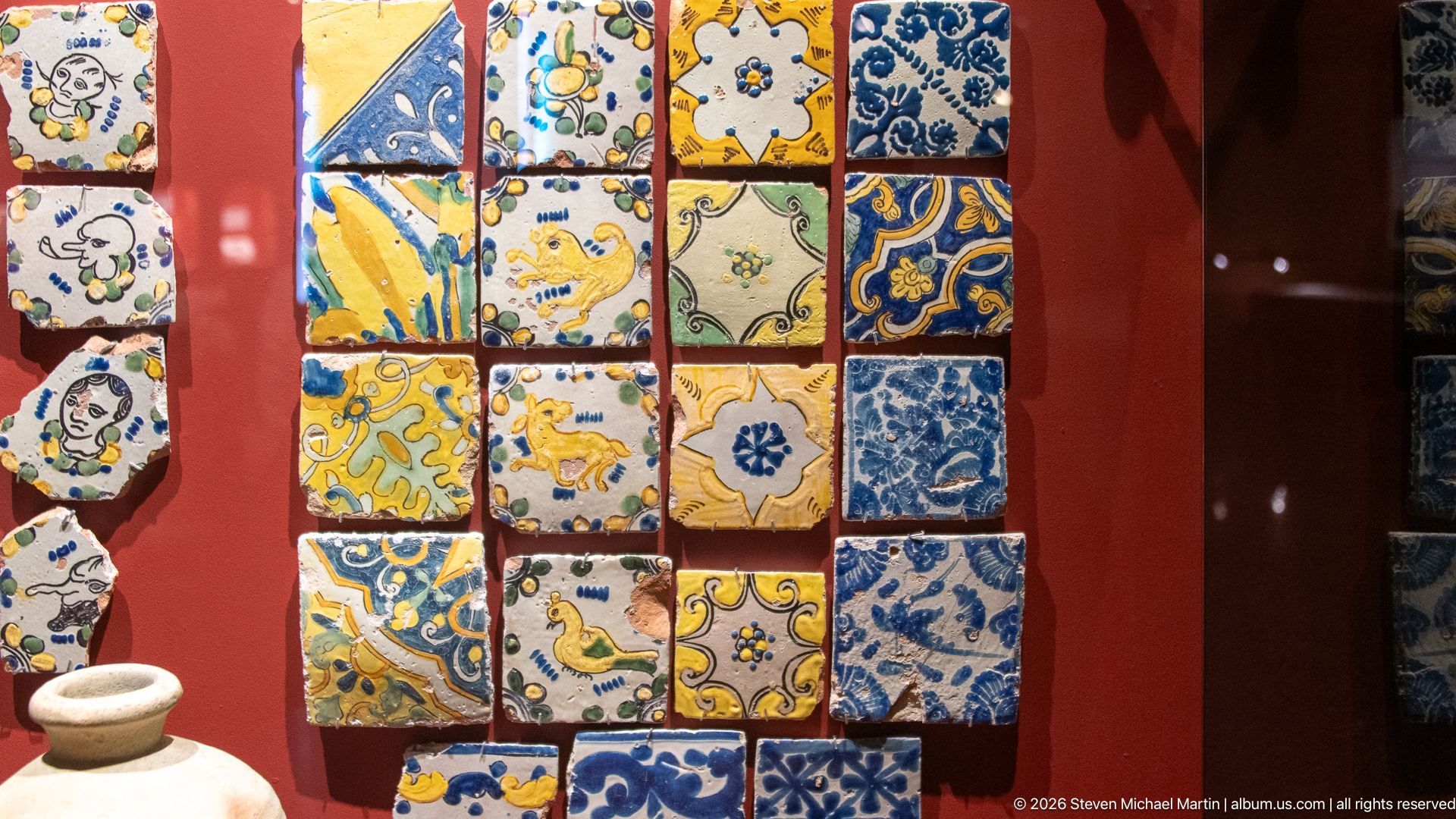
Rows of painted ceramic fragments form a vivid wall display, with floral, animal, and geometric motifs in blue, yellow, green, and white. A pale jar sits at the lower edge, linking the fragments to intact vessels in the case. Their uneven shapes and varied patterns preserve the visual differences among individual pieces rather than presenting a single continuous design.
Caption
Rows of painted ceramic fragments form a vivid wall display, with floral, animal, and geometric motifs in blue, yellow, green, and white. A pale jar sits at the lower edge, linking the fragments to intact vessels in the case. Their uneven shapes and varied patterns preserve the visual differences among individual pieces rather than presenting a single continuous design.
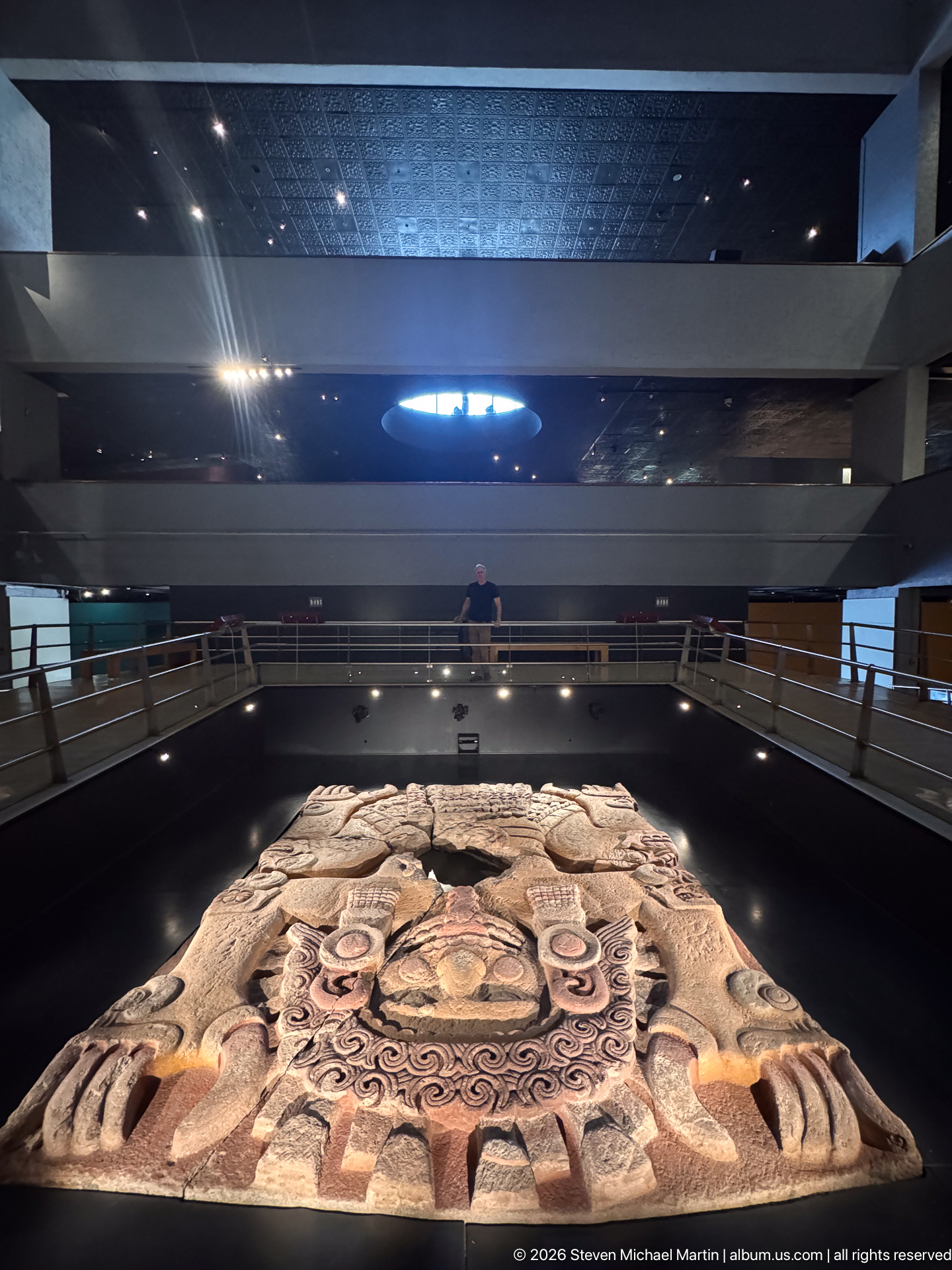
A monumental circular stone relief lies horizontally beneath a ring of light, its central figure surrounded by densely carved limbs, ornaments, and symbolic forms. Seen from a low, wide angle, the sculpture appears embedded in the dark gallery floor and is lit as the room’s focal object. The display emphasizes the relief’s scale and the intricacy of its radial composition.
Caption
A monumental circular stone relief lies horizontally beneath a ring of light, its central figure surrounded by densely carved limbs, ornaments, and symbolic forms. Seen from a low, wide angle, the sculpture appears embedded in the dark gallery floor and is lit as the room’s focal object. The display emphasizes the relief’s scale and the intricacy of its radial composition.
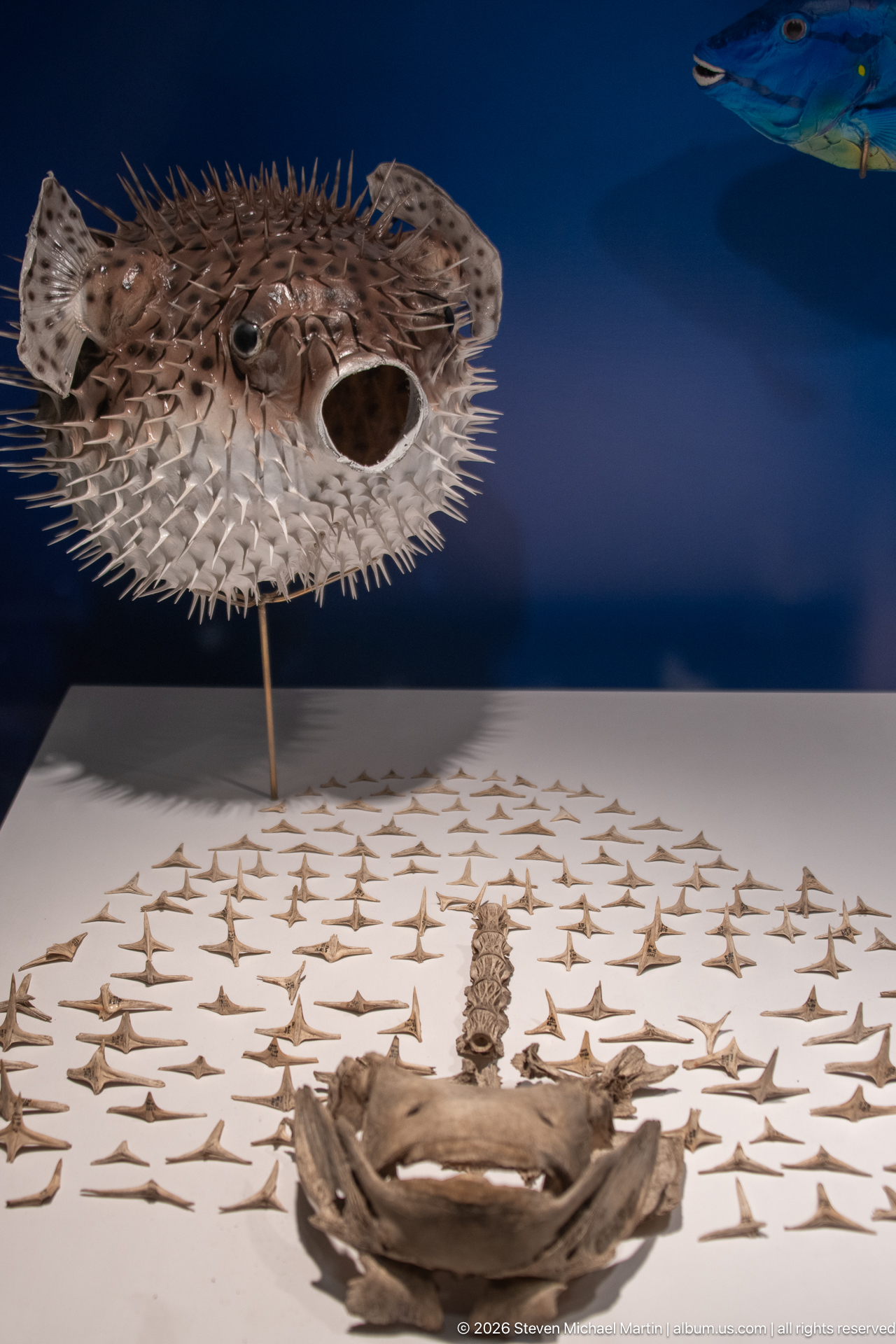
A preserved pufferfish floats in a dark blue case, its expanded body covered with short spines and its large eye turned toward the viewer. Below it, a pale panel holds a repeated arrangement of small pointed objects around a central artifact. The vertical pairing draws attention to the fish’s defensive form and the carefully ordered material display beneath.
Caption
A preserved pufferfish floats in a dark blue case, its expanded body covered with short spines and its large eye turned toward the viewer. Below it, a pale panel holds a repeated arrangement of small pointed objects around a central artifact. The vertical pairing draws attention to the fish’s defensive form and the carefully ordered material display beneath.
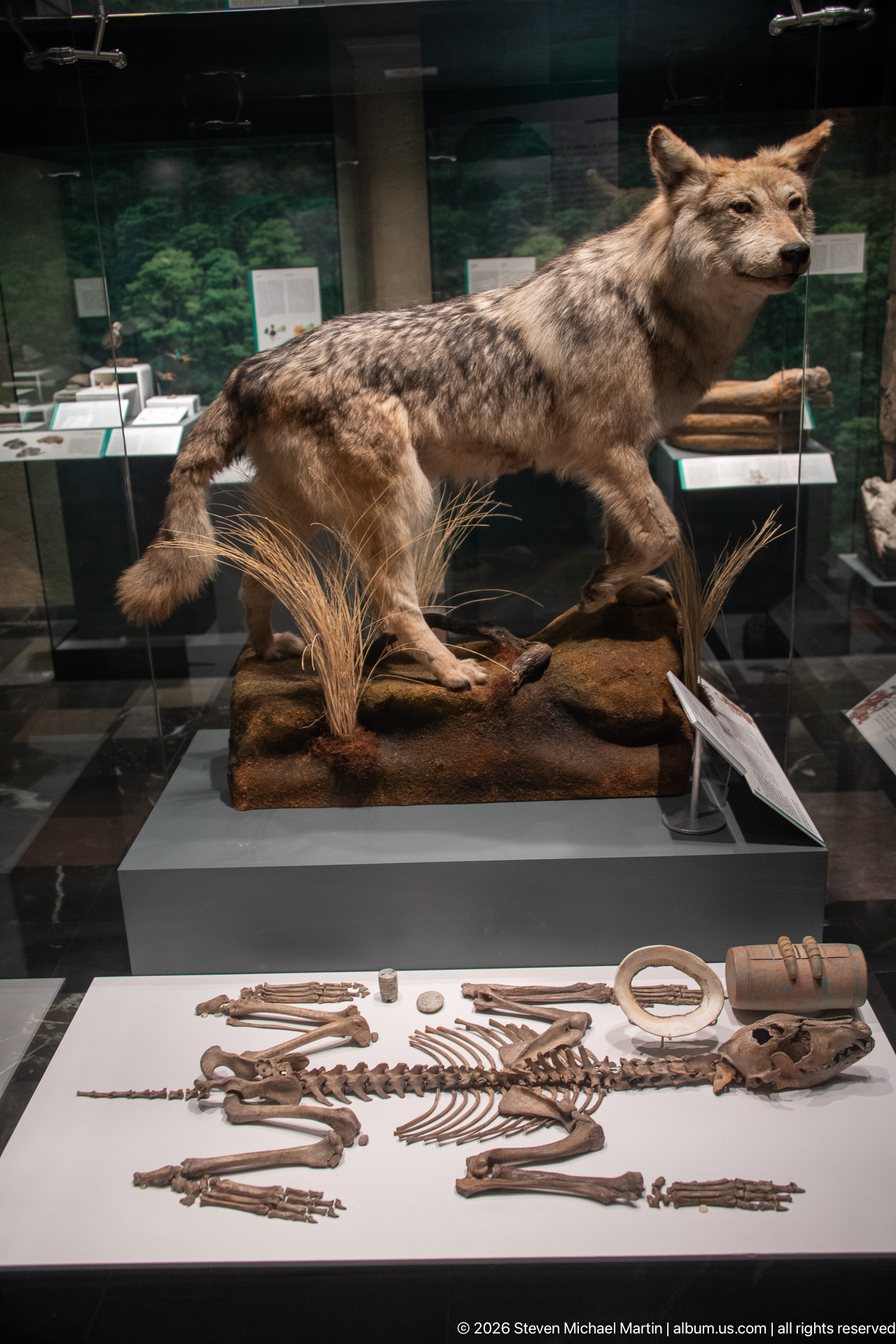
A coyote stands on a naturalistic branch within a glass case, its body stretched forward and ears pricked. An array of long bones and other skeletal pieces is laid out on a bright platform below, placing the animal specimen and anatomical material in one composition. Reflections in the glass echo the surrounding gallery without obscuring the coyote’s alert profile.
Caption
A coyote stands on a naturalistic branch within a glass case, its body stretched forward and ears pricked. An array of long bones and other skeletal pieces is laid out on a bright platform below, placing the animal specimen and anatomical material in one composition. Reflections in the glass echo the surrounding gallery without obscuring the coyote’s alert profile.
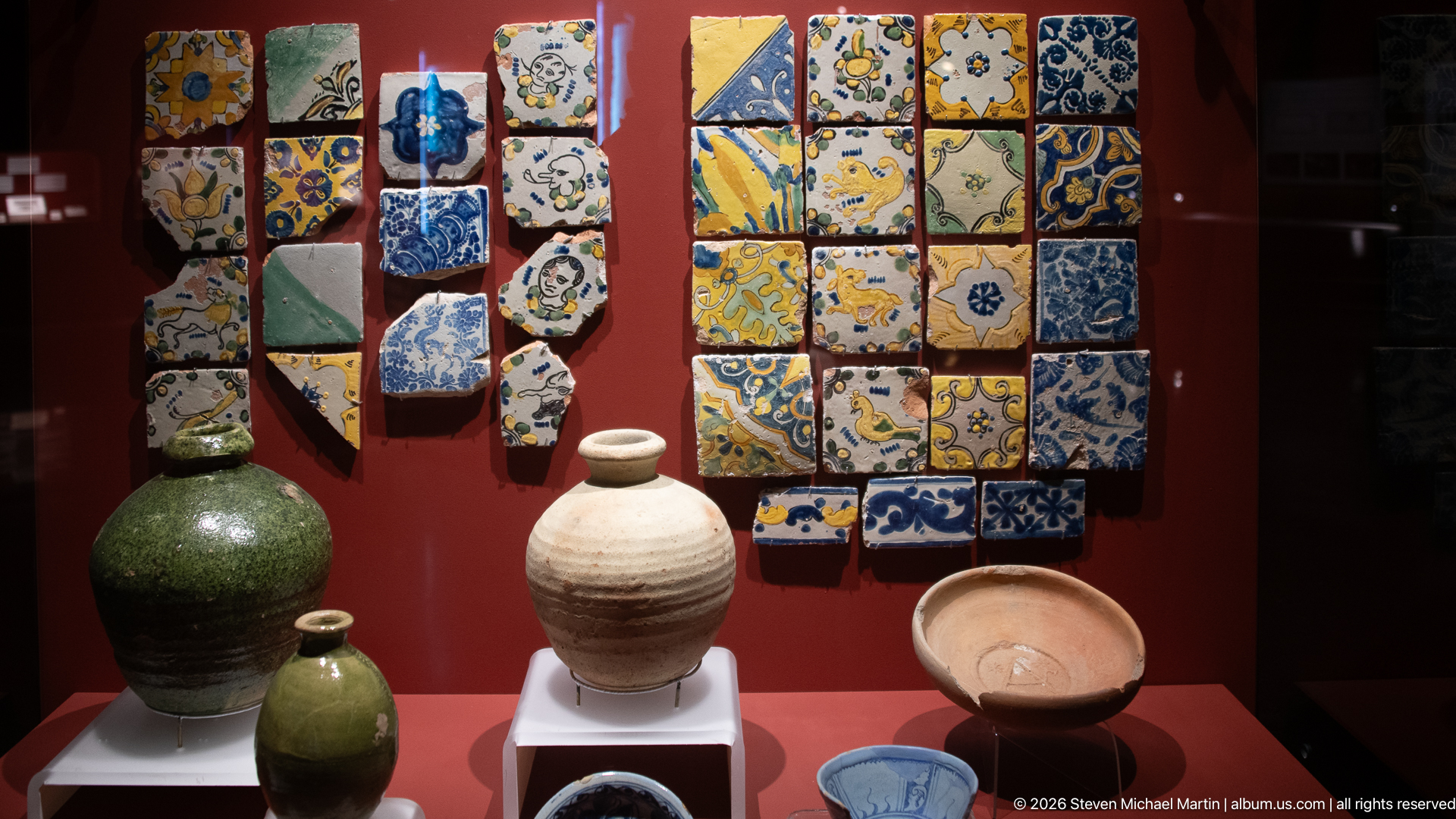
Several rounded earthenware vessels stand before a wall of painted fragments, their matte green, cream, and terracotta surfaces contrasting with the bright red backing. One shallow bowl tilts toward the viewer while smaller bottles cluster between the larger jars. This arrangement brings vessel shapes and surface finishes into focus alongside the more colorful wall pieces.
Caption
Several rounded earthenware vessels stand before a wall of painted fragments, their matte green, cream, and terracotta surfaces contrasting with the bright red backing. One shallow bowl tilts toward the viewer while smaller bottles cluster between the larger jars. This arrangement brings vessel shapes and surface finishes into focus alongside the more colorful wall pieces.
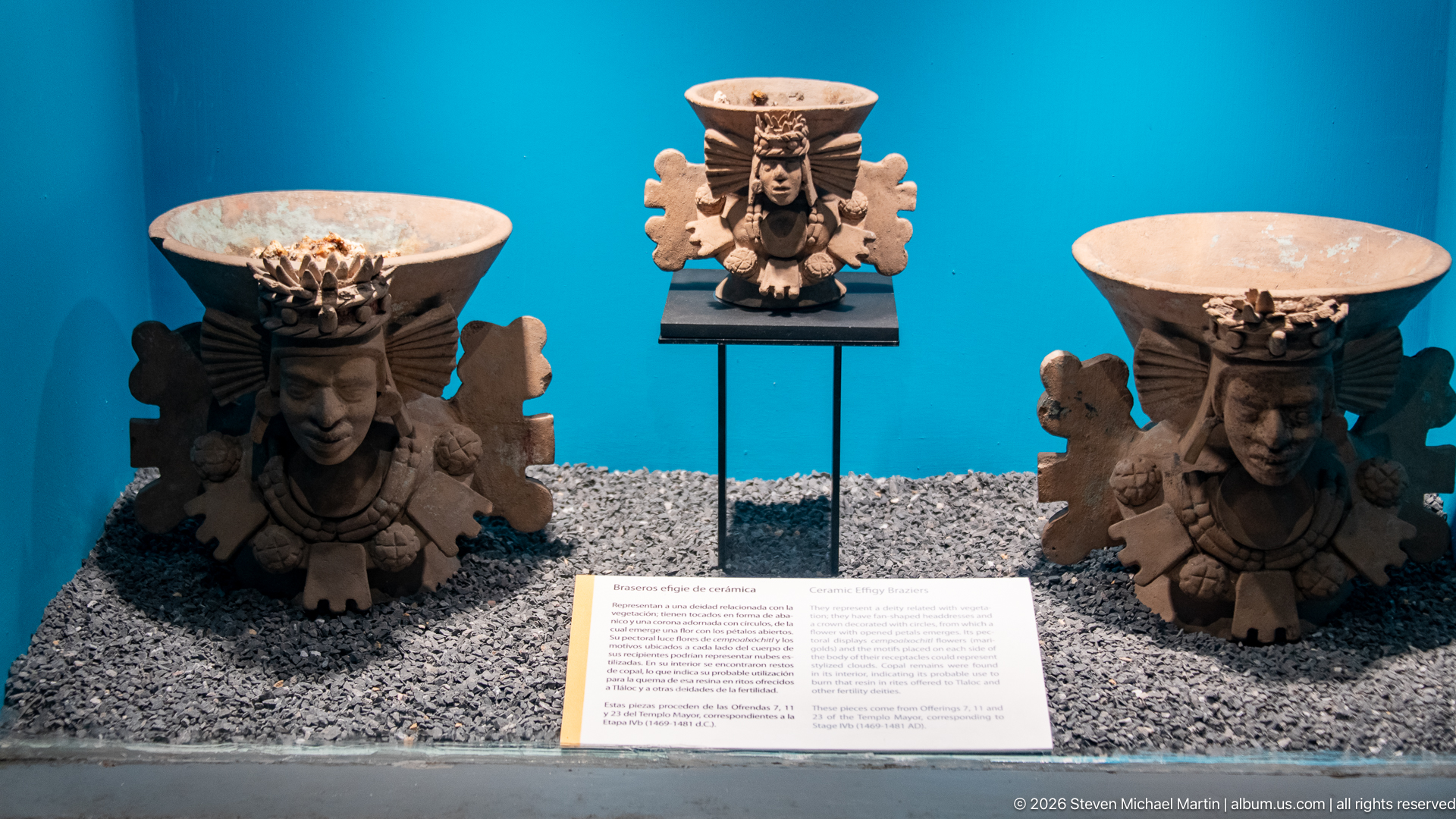
Three ceramic effigy figures stand on a bed of dark gravel, with two larger heads in the foreground and a smaller, more complete figure elevated between them. Their broad headdresses, modeled faces, and projecting ornaments repeat across the group. A bilingual label below identifies the display, but the close proof-sheet view does not make its text fully legible.
Caption
Three ceramic effigy figures stand on a bed of dark gravel, with two larger heads in the foreground and a smaller, more complete figure elevated between them. Their broad headdresses, modeled faces, and projecting ornaments repeat across the group. A bilingual label below identifies the display, but the close proof-sheet view does not make its text fully legible.
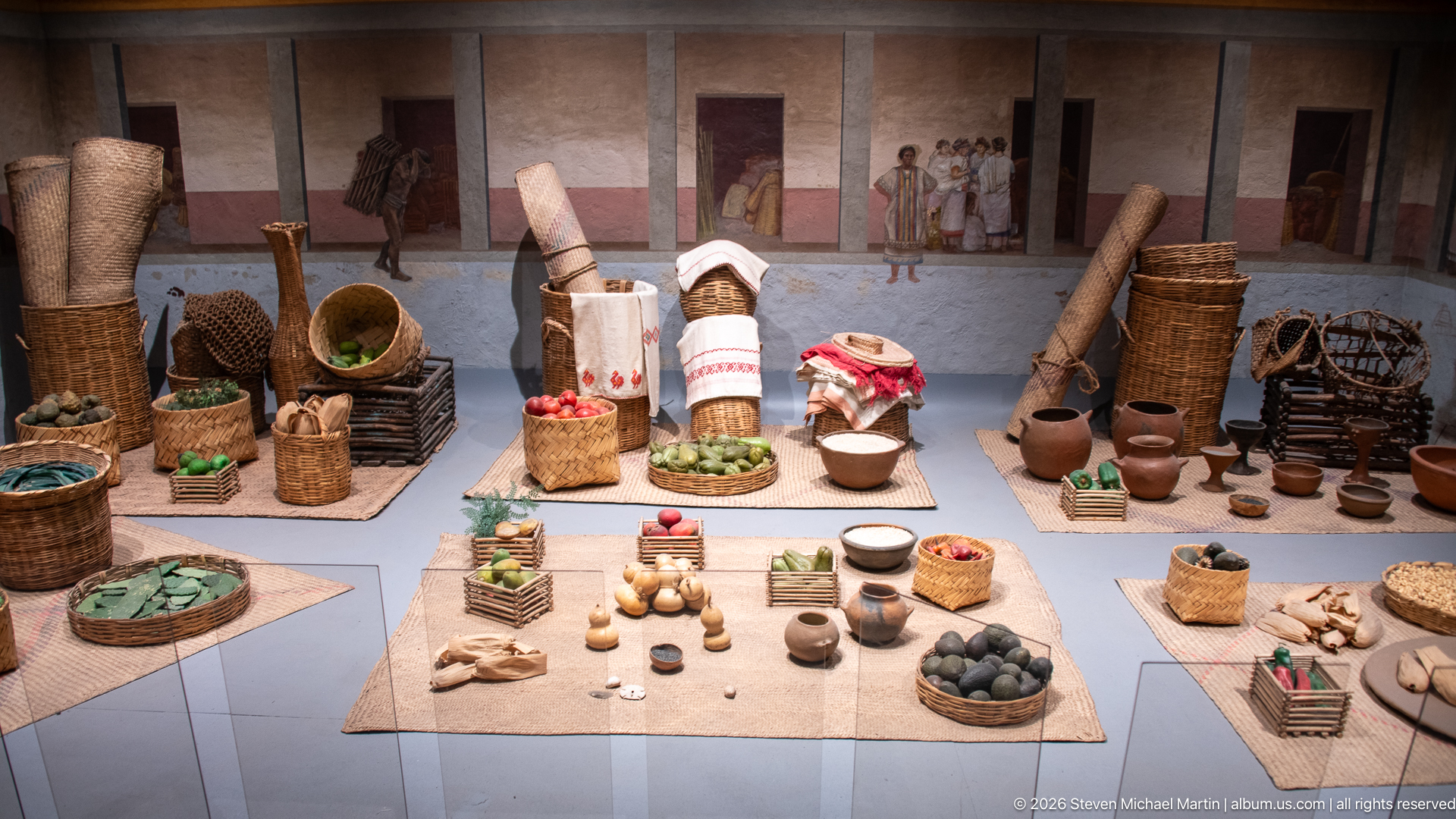
Baskets, ceramic bowls, woven containers, produce, and long-handled tools are arranged across a floor-level market installation. Painted figures on the wall behind suggest an everyday exchange scene, while the carefully grouped goods create a sense of abundance and organization. The wide view connects material objects with the human activity they once supported.
Caption
Baskets, ceramic bowls, woven containers, produce, and long-handled tools are arranged across a floor-level market installation. Painted figures on the wall behind suggest an everyday exchange scene, while the carefully grouped goods create a sense of abundance and organization. The wide view connects material objects with the human activity they once supported.
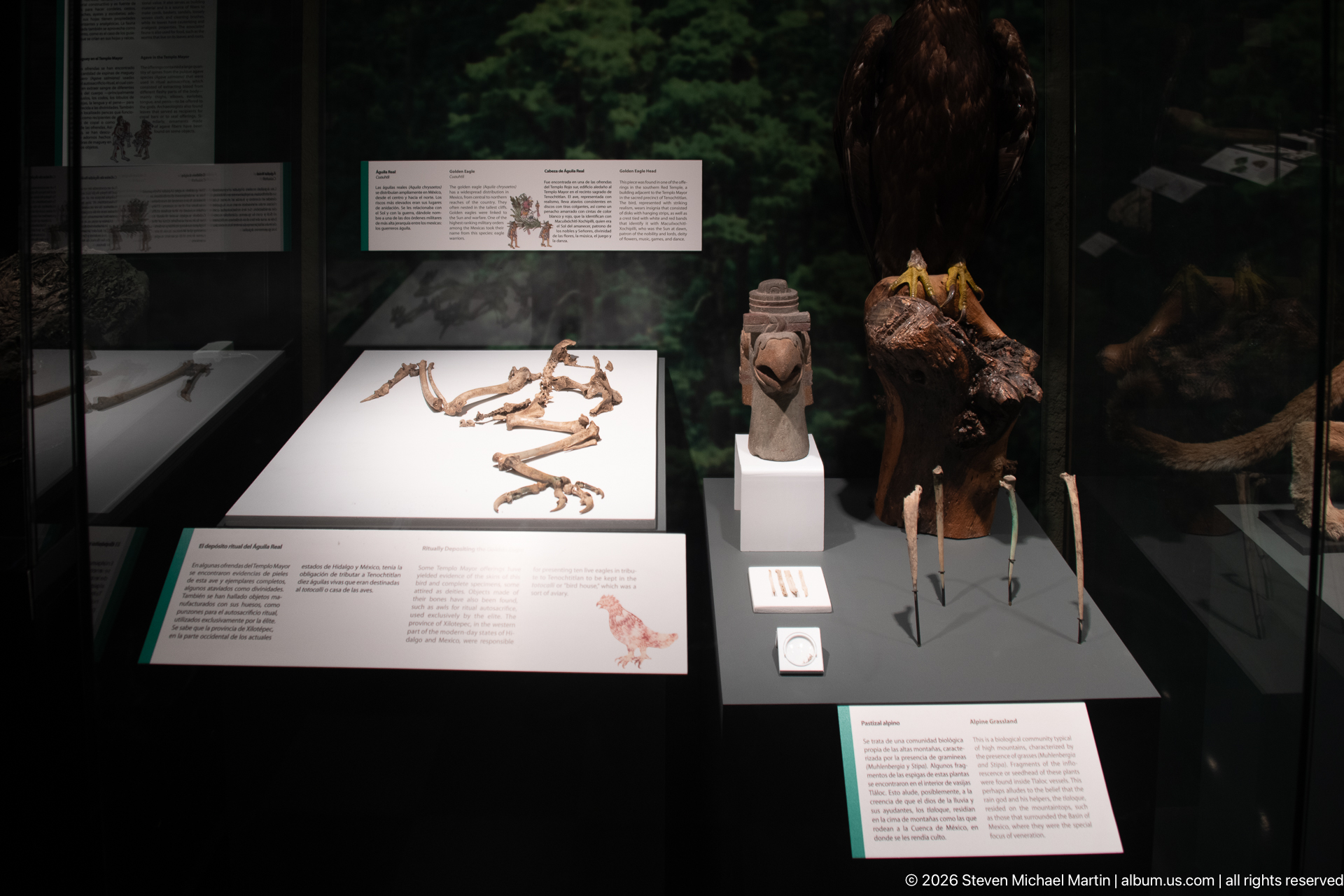
A museum case groups scattered bones, a small ceramic vessel, animal remains, and interpretive labels on separate platforms. A dark taxidermied form rises behind the smaller objects, while a long skeletal arrangement occupies the foreground. The display’s low light and layered glass reflections give the assemblage depth, distinguishing this contextual view from the single-object portraits nearby.
Caption
A museum case groups scattered bones, a small ceramic vessel, animal remains, and interpretive labels on separate platforms. A dark taxidermied form rises behind the smaller objects, while a long skeletal arrangement occupies the foreground. The display’s low light and layered glass reflections give the assemblage depth, distinguishing this contextual view from the single-object portraits nearby.
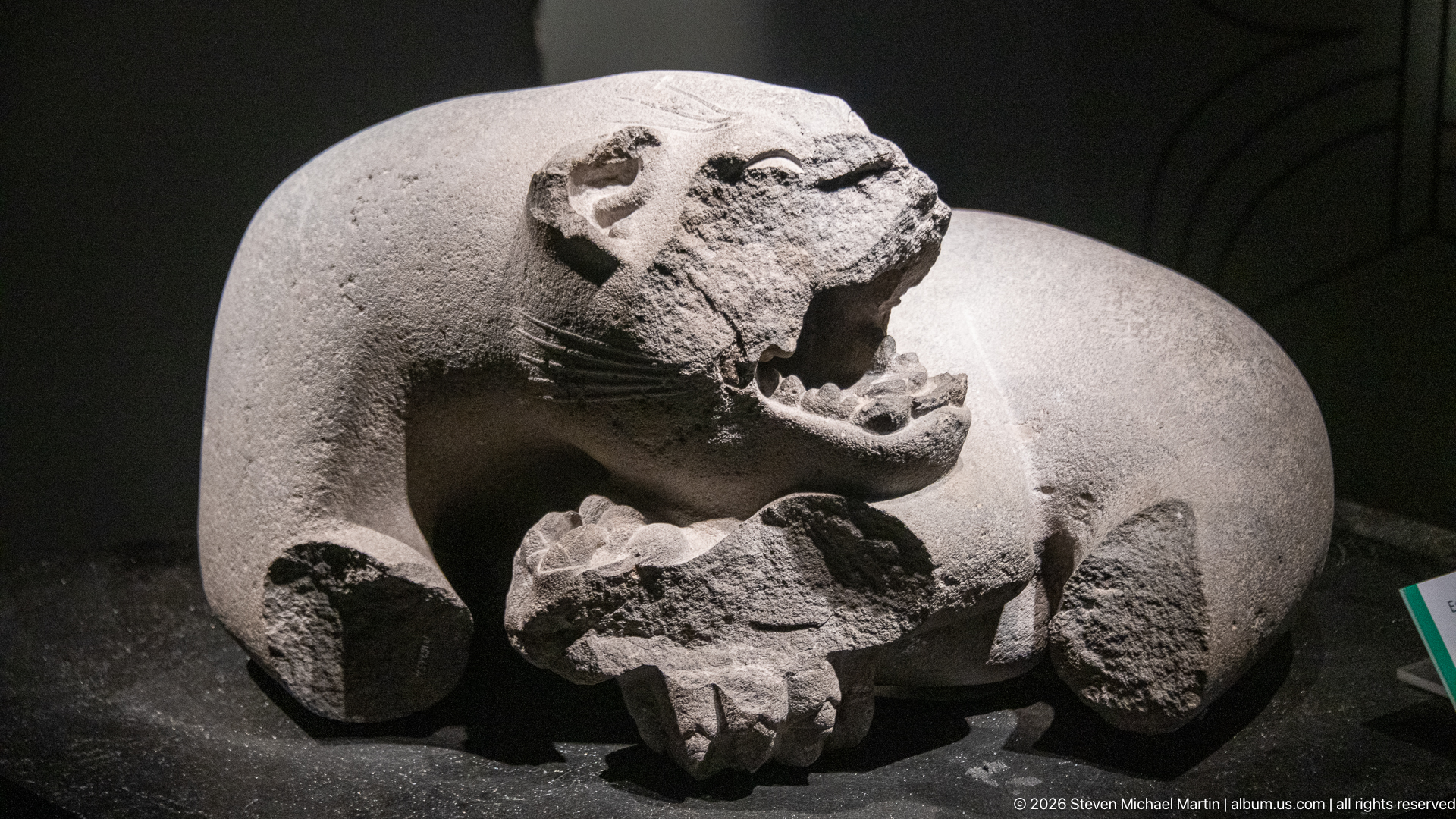
A heavy stone figure crouches with its forelegs tucked beneath a rounded body and its mouth open to reveal blunt teeth. The compact, powerful posture and carved facial features suggest a feline-like creature, though the species is not confirmed by visible text. Focused lighting brings out the stone’s pitted surface and the sculptor’s treatment of the paws and muzzle.
Caption
A heavy stone figure crouches with its forelegs tucked beneath a rounded body and its mouth open to reveal blunt teeth. The compact, powerful posture and carved facial features suggest a feline-like creature, though the species is not confirmed by visible text. Focused lighting brings out the stone’s pitted surface and the sculptor’s treatment of the paws and muzzle.
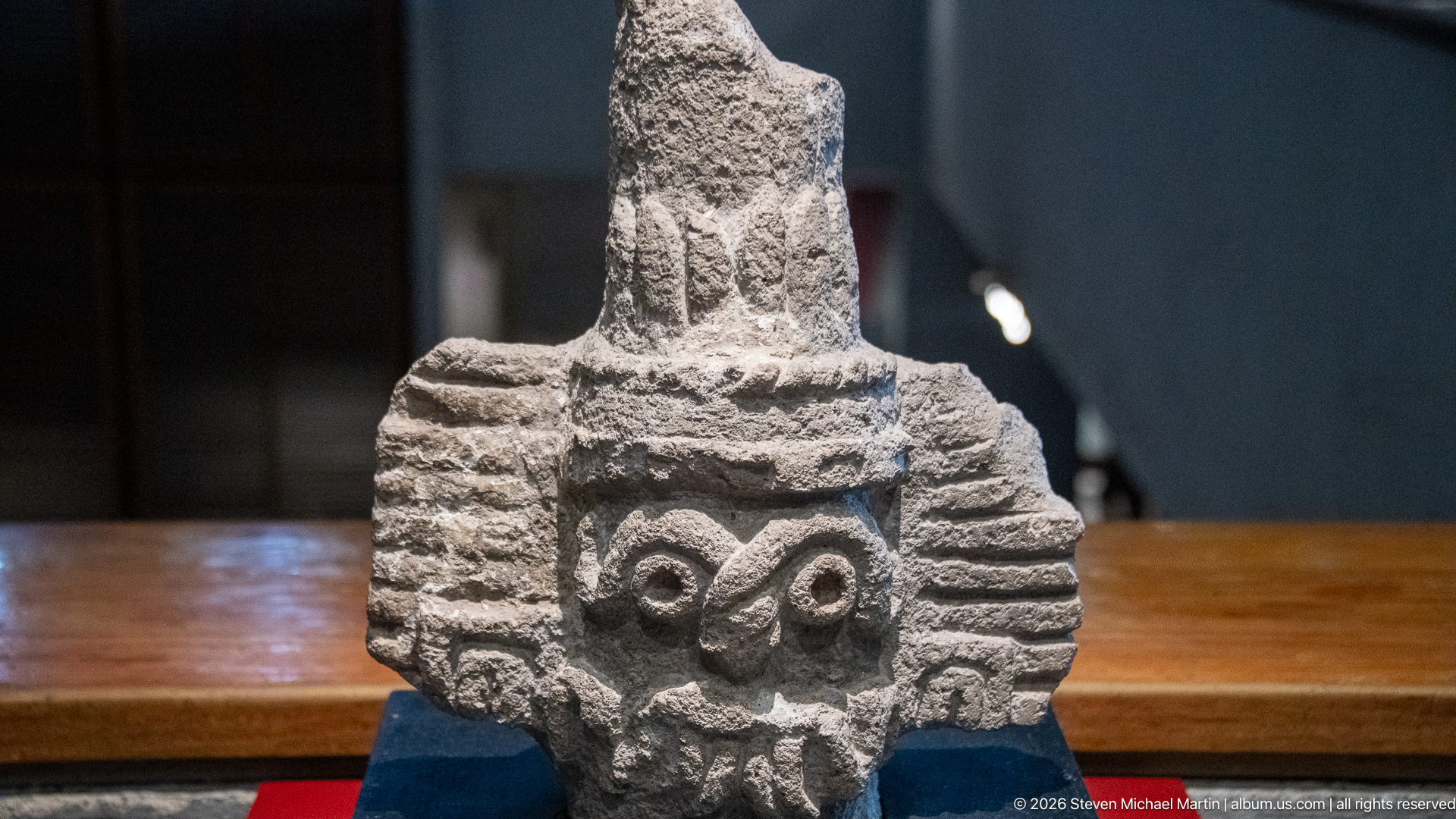
A narrow stone form rises from a broad stepped base, its lower front carved with paired scroll-like motifs and a small face. The upper shaft is rough and irregular, contrasting with the more deliberate geometry below. Seen straight on against the dark gallery, the fragment reads as both a sculptural object and a surviving architectural element.
Caption
A narrow stone form rises from a broad stepped base, its lower front carved with paired scroll-like motifs and a small face. The upper shaft is rough and irregular, contrasting with the more deliberate geometry below. Seen straight on against the dark gallery, the fragment reads as both a sculptural object and a surviving architectural element.
A massive sculpted figure occupies the foreground, its broad face, circular eyes, and layered headdress modeled in deep relief. A row of smaller standing figures is visible on an upper ledge, while a bright blue-lit recess frames a related sculpture behind. This wider museum view conveys the scale of the principal artifact and its relationship to nearby works.
Caption
A massive sculpted figure occupies the foreground, its broad face, circular eyes, and layered headdress modeled in deep relief. A row of smaller standing figures is visible on an upper ledge, while a bright blue-lit recess frames a related sculpture behind. This wider museum view conveys the scale of the principal artifact and its relationship to nearby works.
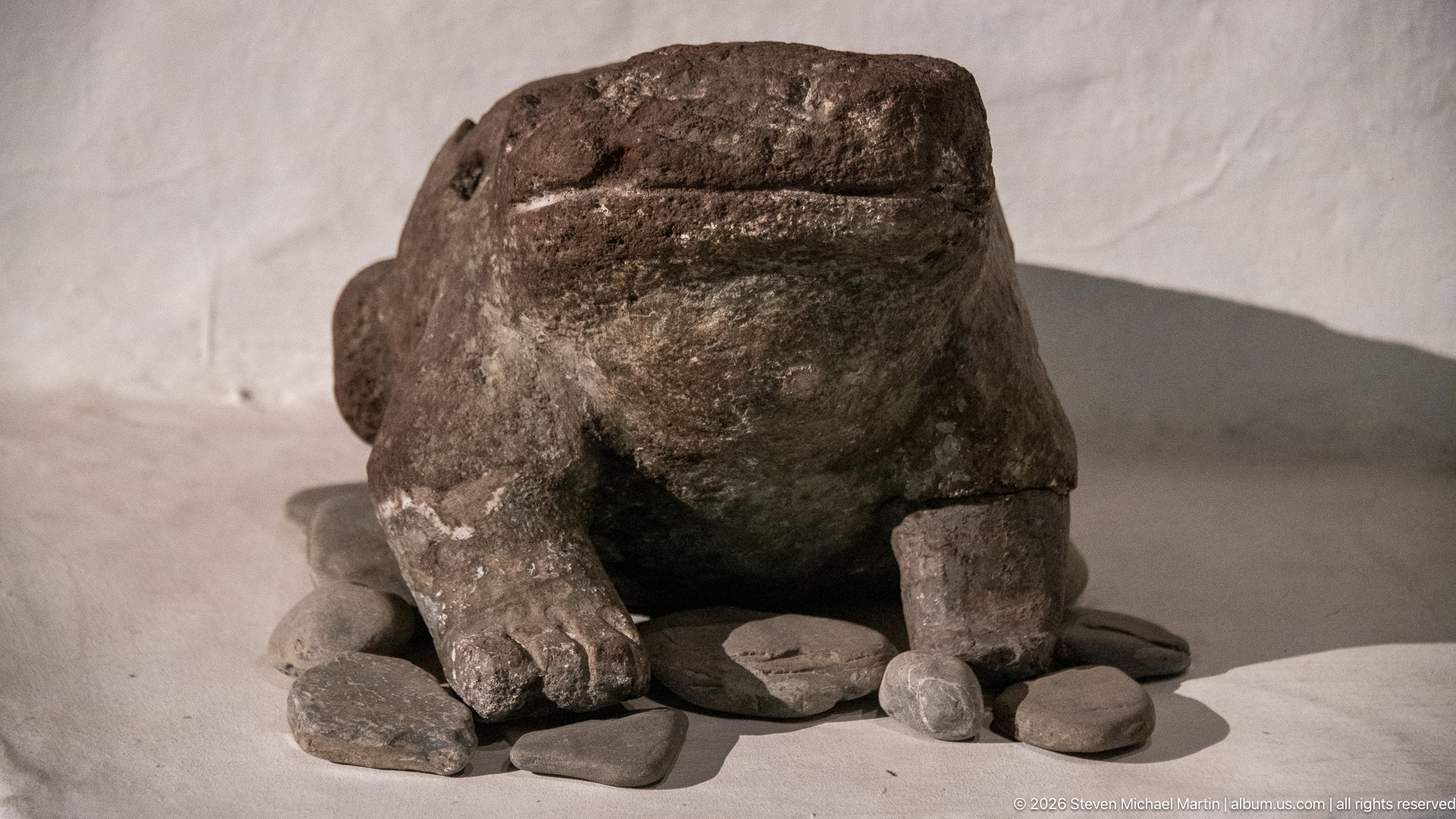
A squat carved animal rests on four short legs, its broad domed back and rounded head suggesting a turtle. The simple silhouette and worn brown-gray surface contrast with the clean display plinth and pale wall behind it. Stones placed around the base provide scale and show how the museum presents the object as a distinct artifact.
Caption
A squat carved animal rests on four short legs, its broad domed back and rounded head suggesting a turtle. The simple silhouette and worn brown-gray surface contrast with the clean display plinth and pale wall behind it. Stones placed around the base provide scale and show how the museum presents the object as a distinct artifact.
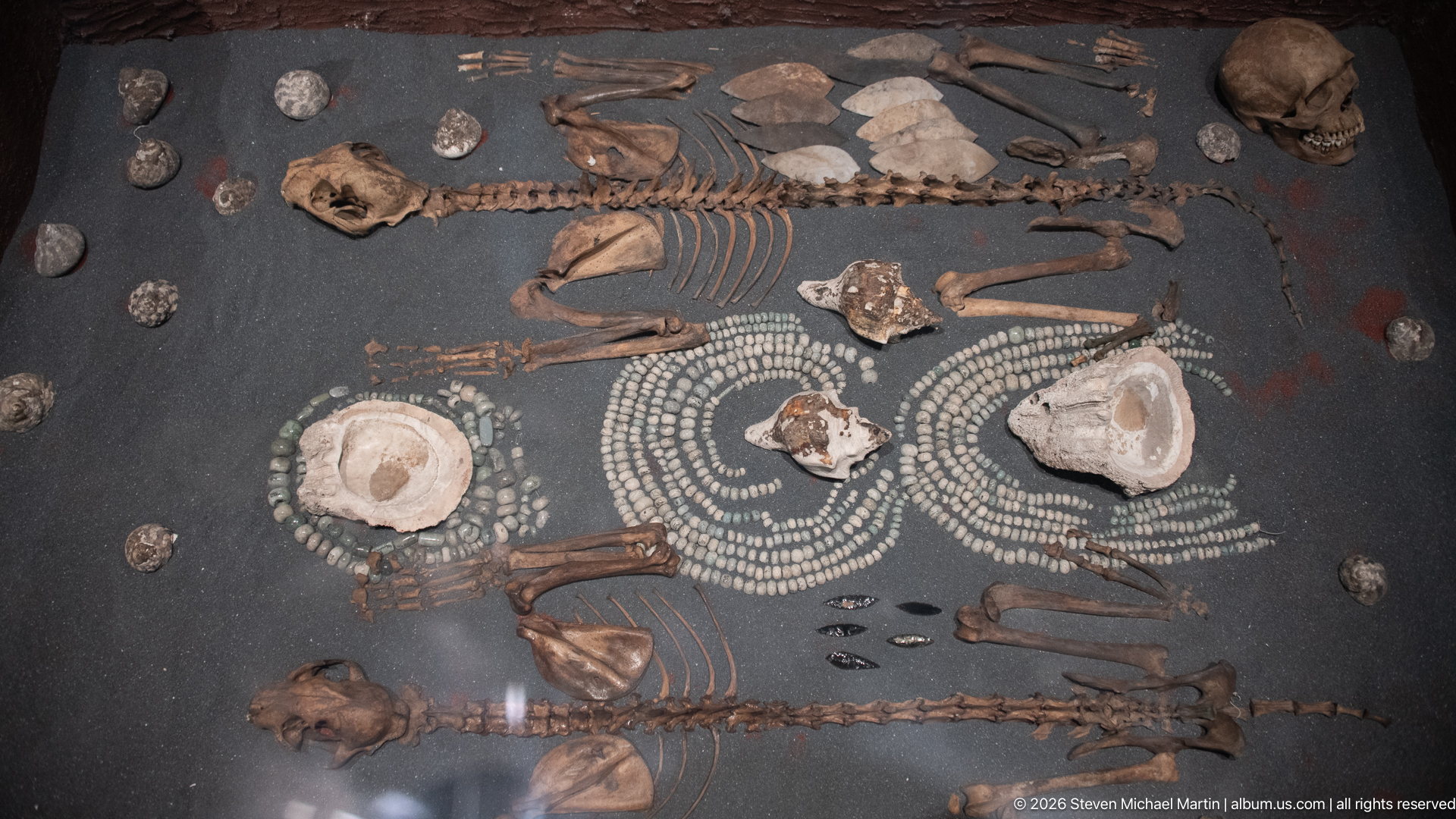
Several sets of skeletal remains are laid out in parallel across a dark display surface, accompanied by skulls, beads, shell-like objects, and other small finds. The arrangement preserves the relationship among bodies and associated materials rather than isolating a single artifact. Reflections on the glass soften the details, but the organized layout is clearly visible from above.
Caption
Several sets of skeletal remains are laid out in parallel across a dark display surface, accompanied by skulls, beads, shell-like objects, and other small finds. The arrangement preserves the relationship among bodies and associated materials rather than isolating a single artifact. Reflections on the glass soften the details, but the organized layout is clearly visible from above.
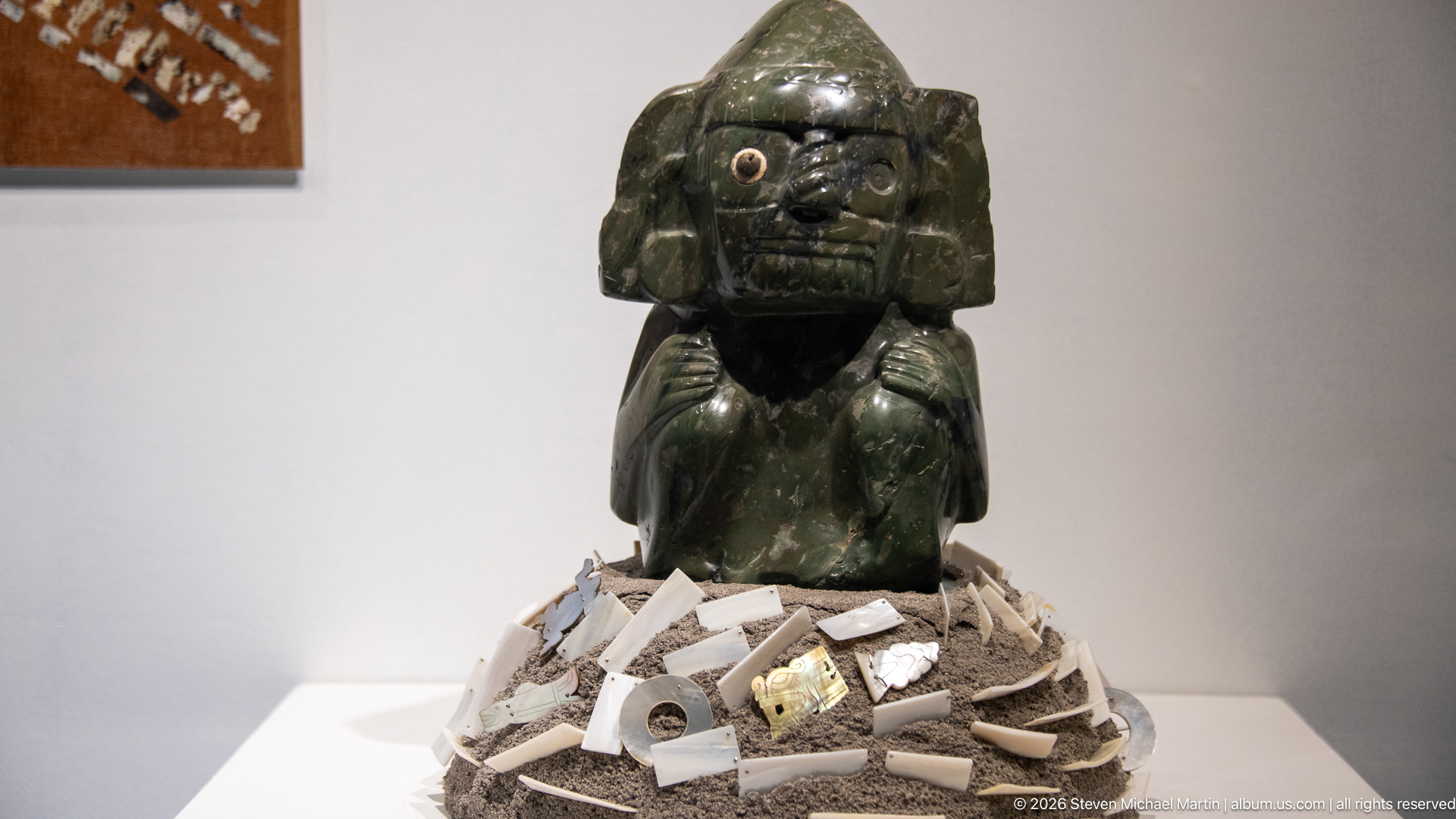
A dark green seated figure with round eyes and a projecting nose occupies the center of a reconstructed offering mound. Pale fragments and small objects surround its base, while a label stands behind the case. The frontal portrait makes the figure’s polished surface, headdress, and rigid pose distinct from the larger contextual display around it.
Caption
A dark green seated figure with round eyes and a projecting nose occupies the center of a reconstructed offering mound. Pale fragments and small objects surround its base, while a label stands behind the case. The frontal portrait makes the figure’s polished surface, headdress, and rigid pose distinct from the larger contextual display around it.
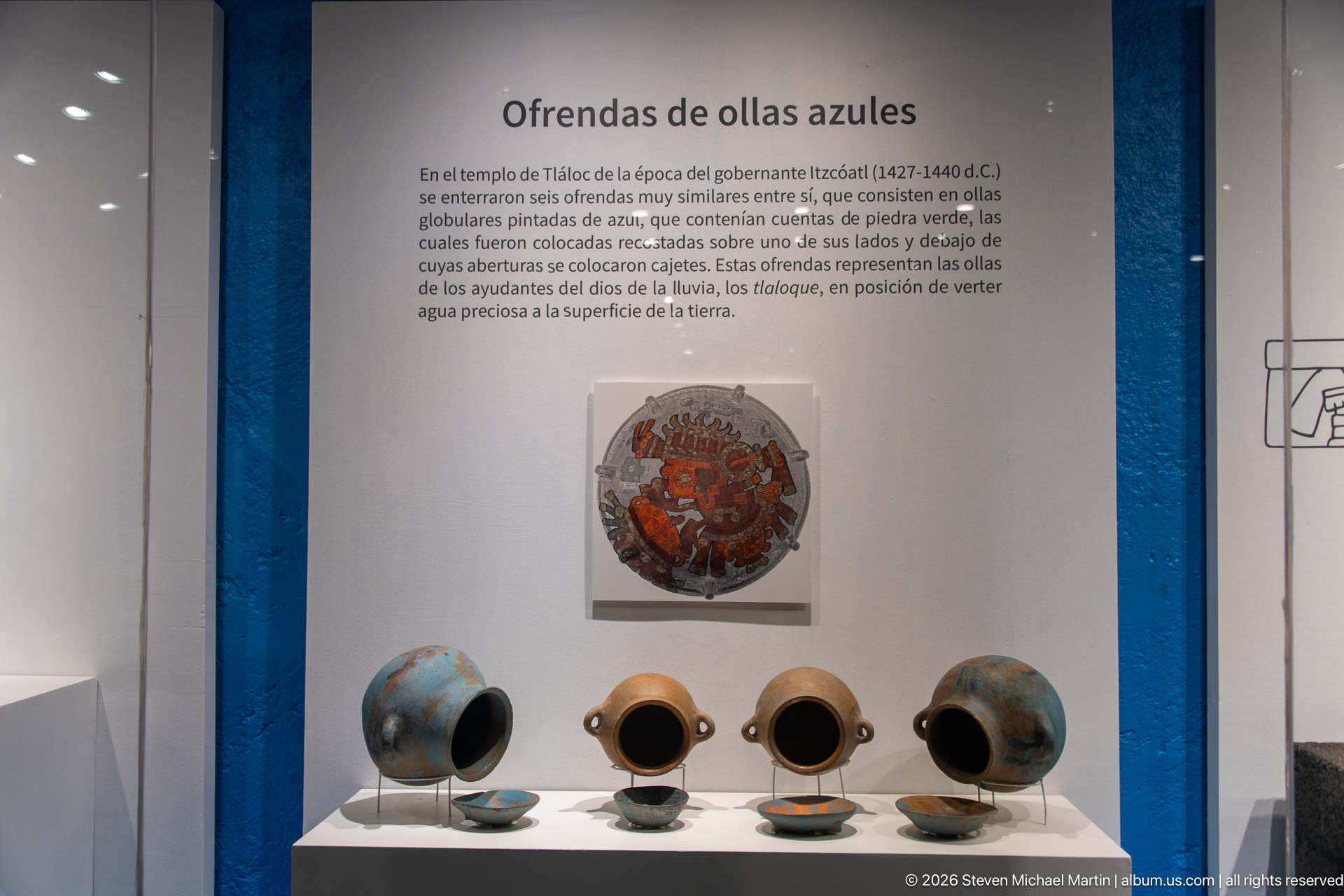
Four globular pots and small bowls are displayed beneath a label reading “Ofrendas de ollas azules.” The accompanying text describes similar offerings in the Tlaloc temple, including blue-painted vessels and greenstone beads. The frontal arrangement makes the vessels’ rounded bodies, paired side handles, and painted surfaces easy to compare.
Caption
Four globular pots and small bowls are displayed beneath a label reading “Ofrendas de ollas azules.” The accompanying text describes similar offerings in the Tlaloc temple, including blue-painted vessels and greenstone beads. The frontal arrangement makes the vessels’ rounded bodies, paired side handles, and painted surfaces easy to compare.
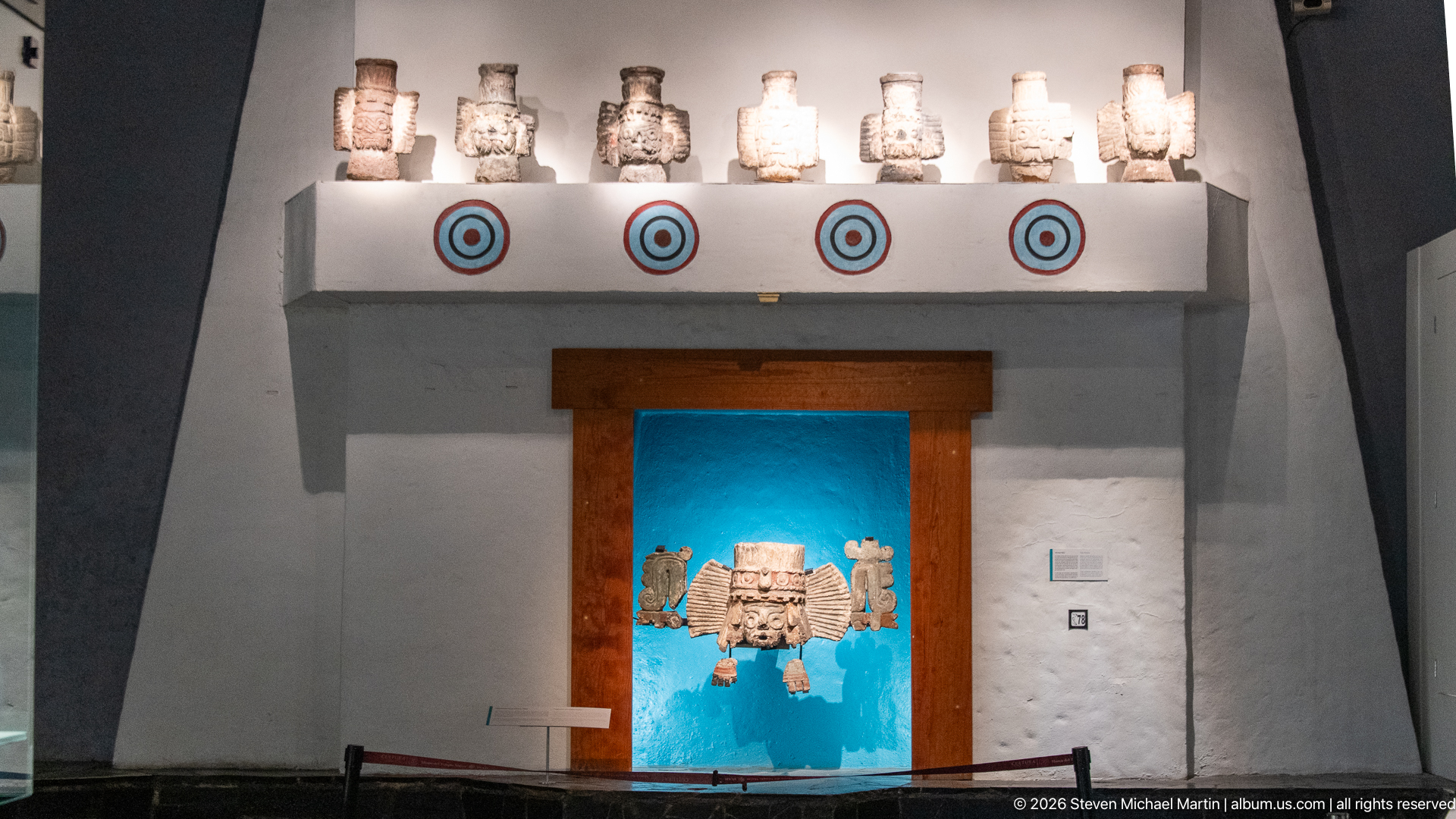
A row of small pale stone figures rests along a display ledge marked with repeated circular motifs. Below, a larger carved figure appears against a bright blue backing, creating a visual link between the repeated miniature forms and the more elaborate sculpture. The architectural framing and stacked arrangement make this a study of display relationships as well as individual objects.
Caption
A row of small pale stone figures rests along a display ledge marked with repeated circular motifs. Below, a larger carved figure appears against a bright blue backing, creating a visual link between the repeated miniature forms and the more elaborate sculpture. The architectural framing and stacked arrangement make this a study of display relationships as well as individual objects.
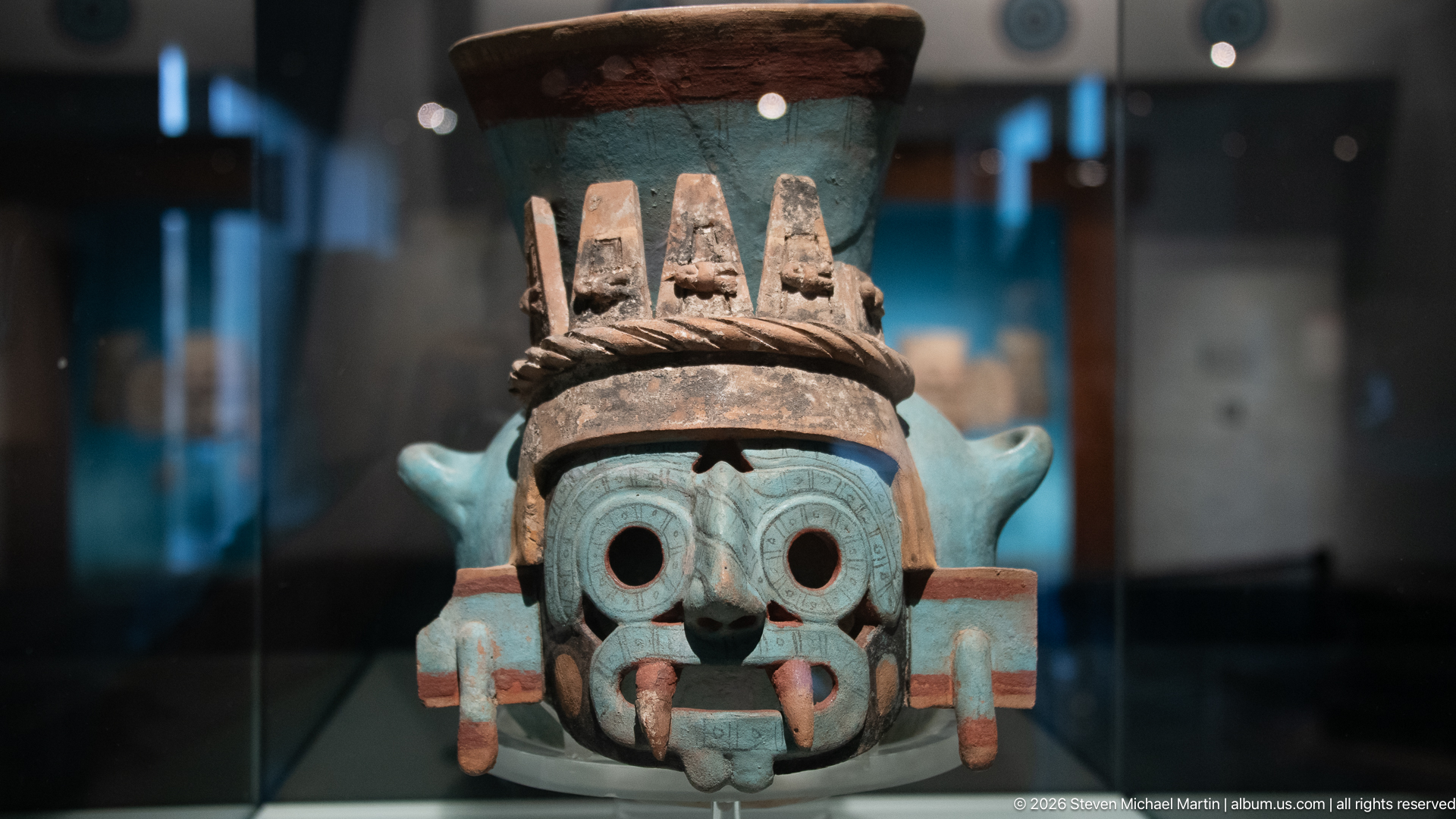
A frontal ceramic face peers through a clear case, its round open eyes set beneath a tall layered headdress. Blue-green glaze covers the cheeks and brow, while red accents mark the sides and lower edge. Projecting ear ornaments and a stylized mouth give the object a strong mask-like presence against the dark gallery.
Caption
A frontal ceramic face peers through a clear case, its round open eyes set beneath a tall layered headdress. Blue-green glaze covers the cheeks and brow, while red accents mark the sides and lower edge. Projecting ear ornaments and a stylized mouth give the object a strong mask-like presence against the dark gallery.
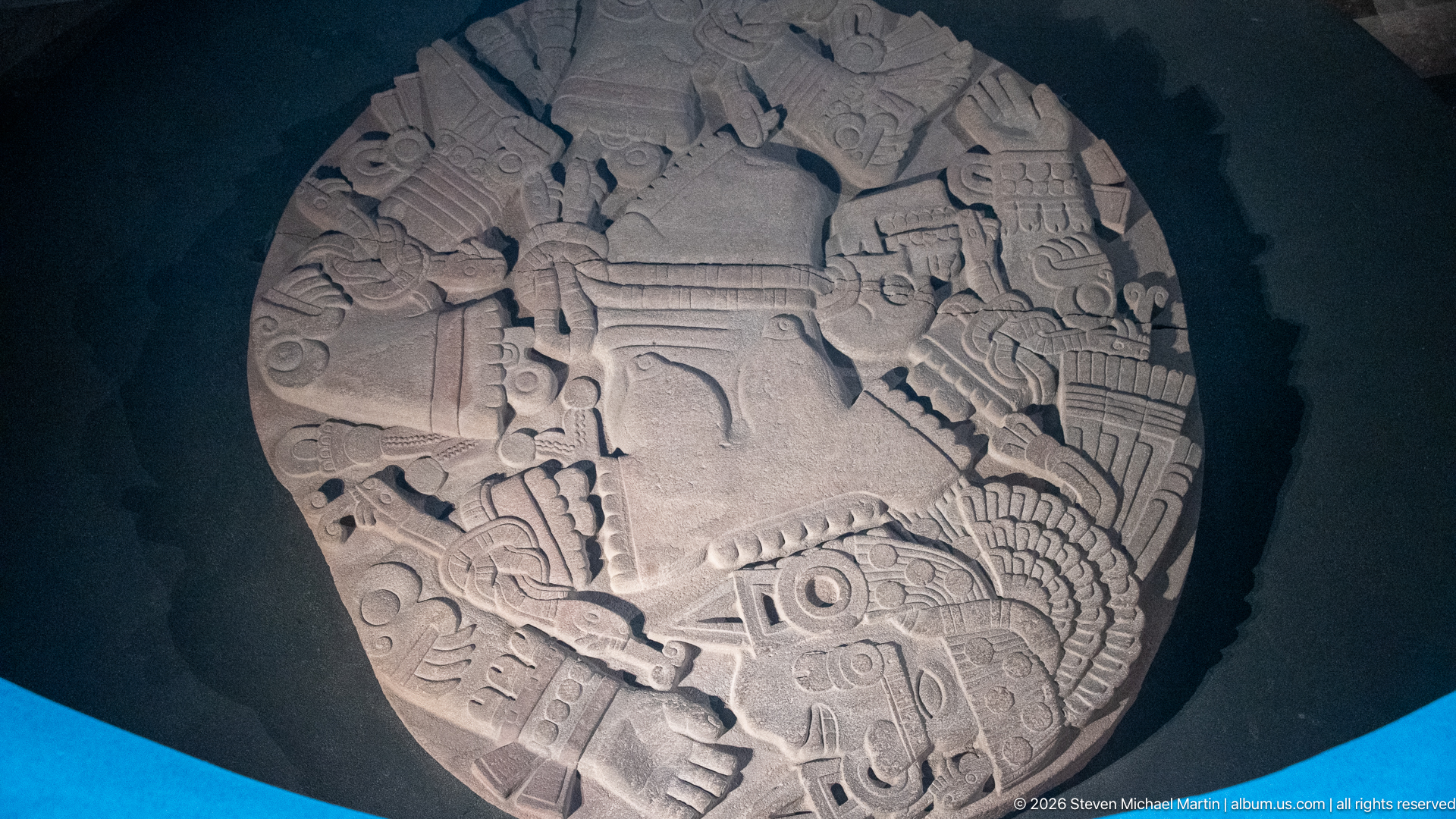
The circular monolith fills the frame, revealing a reclining central body surrounded by carved limbs, ornaments, and repeated symbolic forms. Raking light accentuates the relief’s shallow carving and the stone’s uneven surface. This near-overhead view isolates the intricate composition from the museum architecture and makes the central figure’s arrangement legible.
Caption
The circular monolith fills the frame, revealing a reclining central body surrounded by carved limbs, ornaments, and repeated symbolic forms. Raking light accentuates the relief’s shallow carving and the stone’s uneven surface. This near-overhead view isolates the intricate composition from the museum architecture and makes the central figure’s arrangement legible.
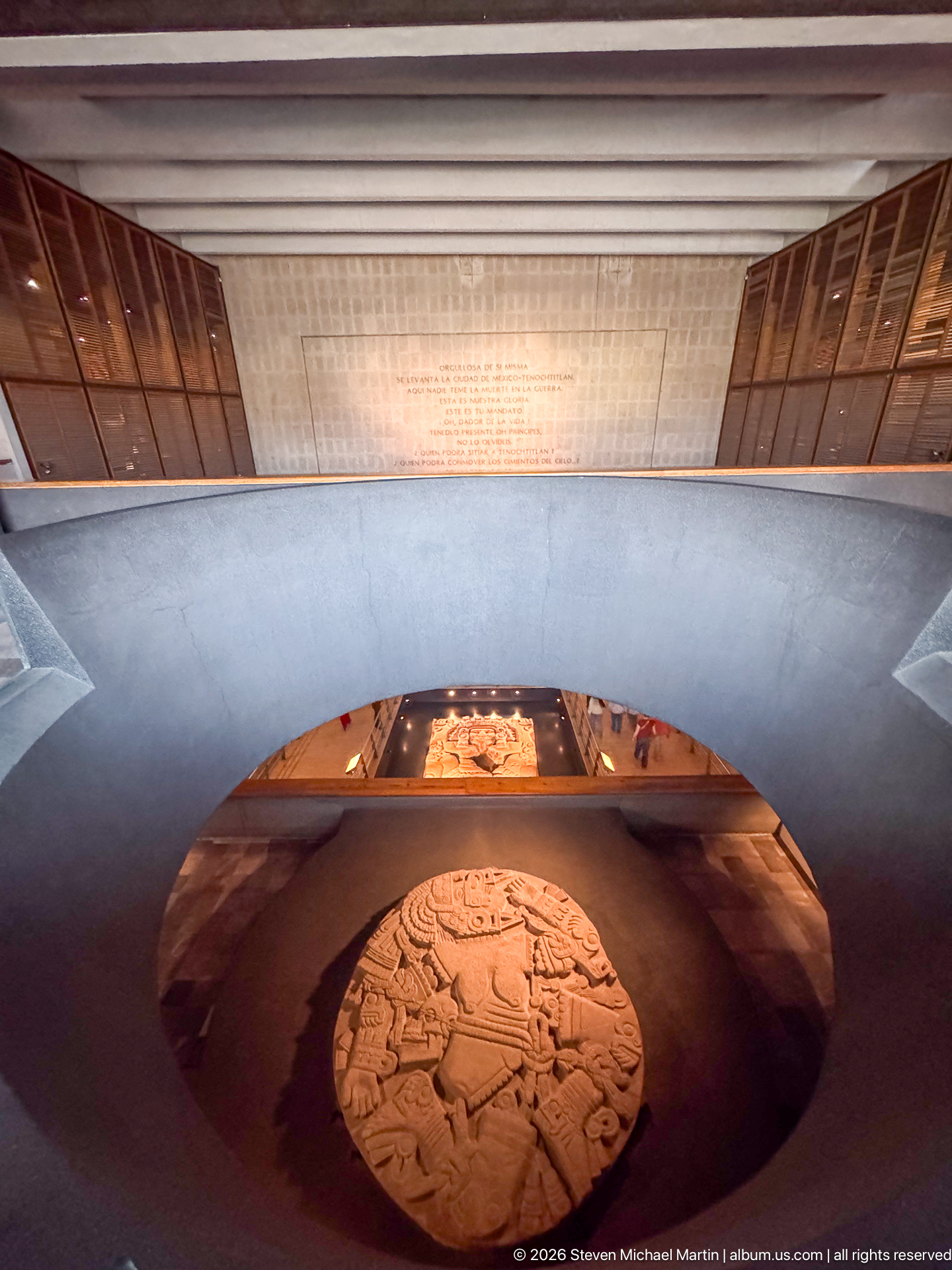
Viewed from above, the circular carved stone occupies a recessed display beneath a broad architectural opening. Warm light falls across the disk, while the surrounding pale floor and curved parapet frame it like a central medallion. The image connects the artifact’s circular shape to the museum’s architectural presentation and visitor route.
Caption
Viewed from above, the circular carved stone occupies a recessed display beneath a broad architectural opening. Warm light falls across the disk, while the surrounding pale floor and curved parapet frame it like a central medallion. The image connects the artifact’s circular shape to the museum’s architectural presentation and visitor route.
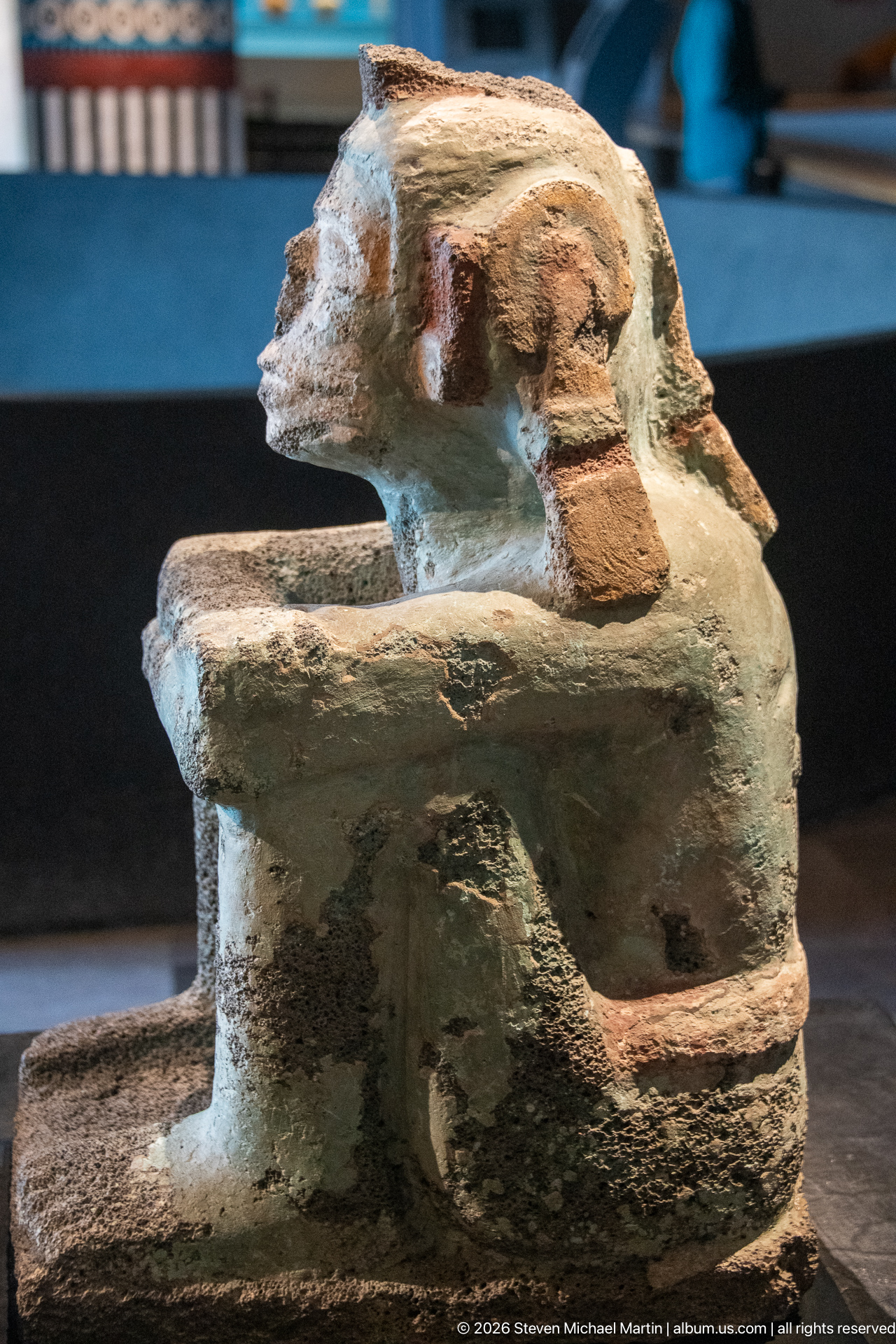
Seen from the side, a large stone head projects a long nose and full lips beneath a narrow band of carved hair or headdress. Its surface is chipped and mottled, with warm gallery light tracing the brow, cheek, and jaw. The profile isolates the object’s sculptural volume and wear without assigning an uncertain identity.
Caption
Seen from the side, a large stone head projects a long nose and full lips beneath a narrow band of carved hair or headdress. Its surface is chipped and mottled, with warm gallery light tracing the brow, cheek, and jaw. The profile isolates the object’s sculptural volume and wear without assigning an uncertain identity.
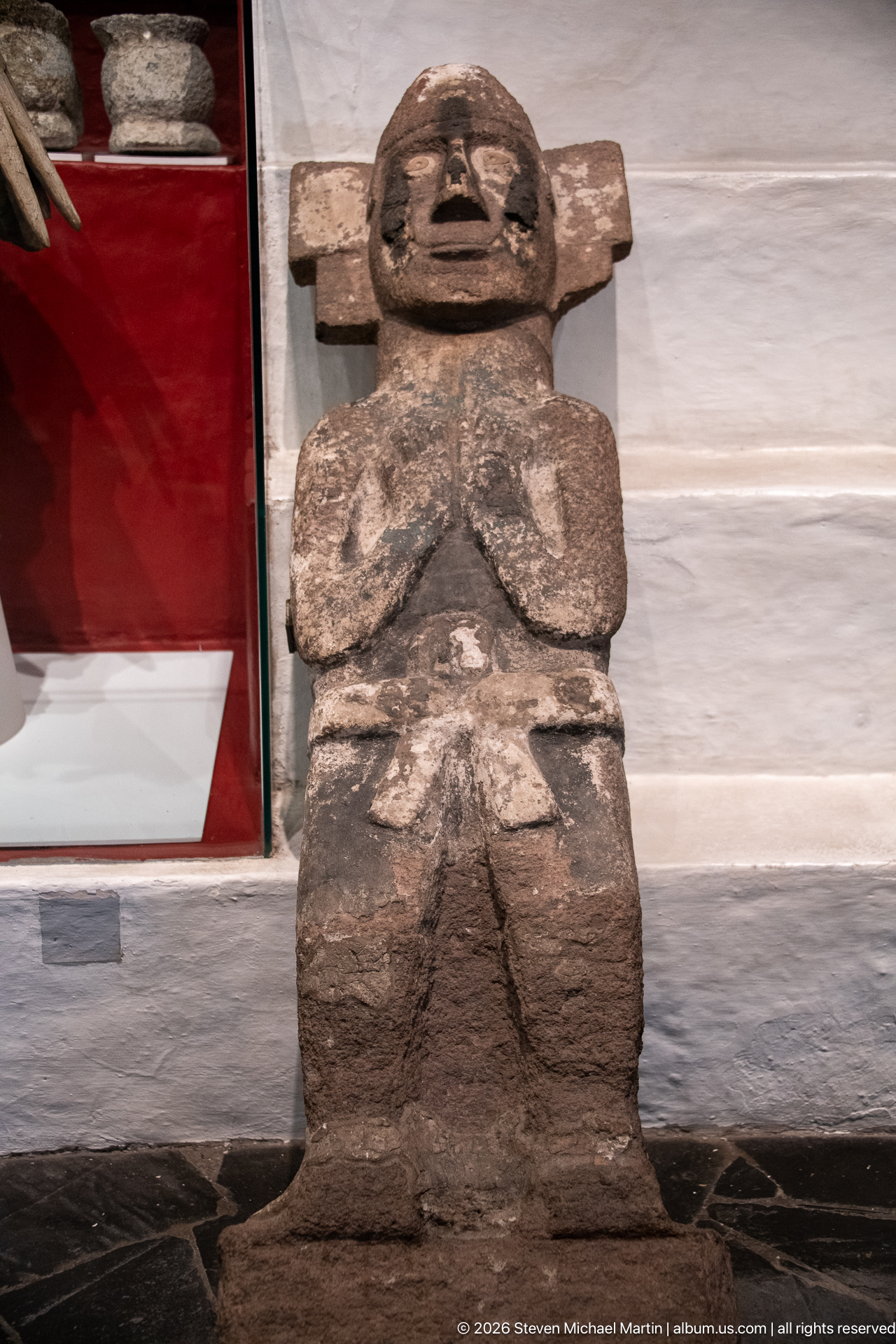
A single stone figure sits with knees drawn up and forearms crossed over the chest. Its broad head, open mouth, and simplified limbs are emphasized by the frontal viewpoint, while a red museum panel and pale wall form a sharp backdrop. The composition isolates the sculpture’s compact, self-contained posture and weathered surface from the surrounding collection.
Caption
A single stone figure sits with knees drawn up and forearms crossed over the chest. Its broad head, open mouth, and simplified limbs are emphasized by the frontal viewpoint, while a red museum panel and pale wall form a sharp backdrop. The composition isolates the sculpture’s compact, self-contained posture and weathered surface from the surrounding collection.

A large rectangular monolith shows a frontal deity with round cheek ornaments, curled hair, and an open mouth, surrounded by densely patterned symbols. The museum display lights the pale stone against black, revealing the figure’s symmetrical layout and shallow relief. The facial details echo the interpretive panel’s close study of the goddess’s features.
Caption
A large rectangular monolith shows a frontal deity with round cheek ornaments, curled hair, and an open mouth, surrounded by densely patterned symbols. The museum display lights the pale stone against black, revealing the figure’s symmetrical layout and shallow relief. The facial details echo the interpretive panel’s close study of the goddess’s features.
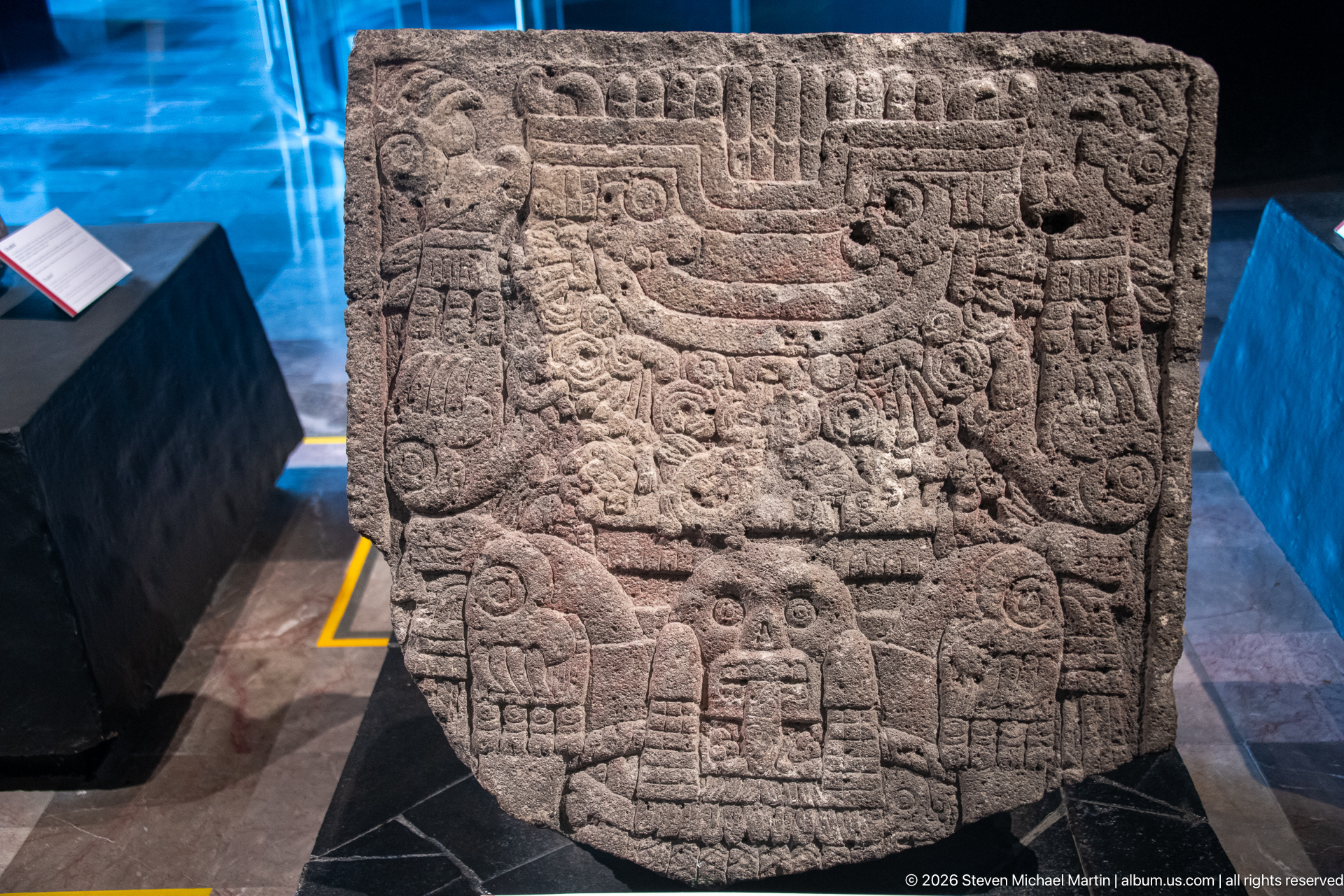
A broad rectangular stone panel is carved with a central standing figure framed by repeated geometric borders and smaller forms. The frontal view reveals the relief’s overall structure, from its upper band of repeated marks to the compact figures and symbols below. A blue gallery wall and nearby label establish the museum setting while leaving the carving as the focus.
Caption
A broad rectangular stone panel is carved with a central standing figure framed by repeated geometric borders and smaller forms. The frontal view reveals the relief’s overall structure, from its upper band of repeated marks to the compact figures and symbols below. A blue gallery wall and nearby label establish the museum setting while leaving the carving as the focus.
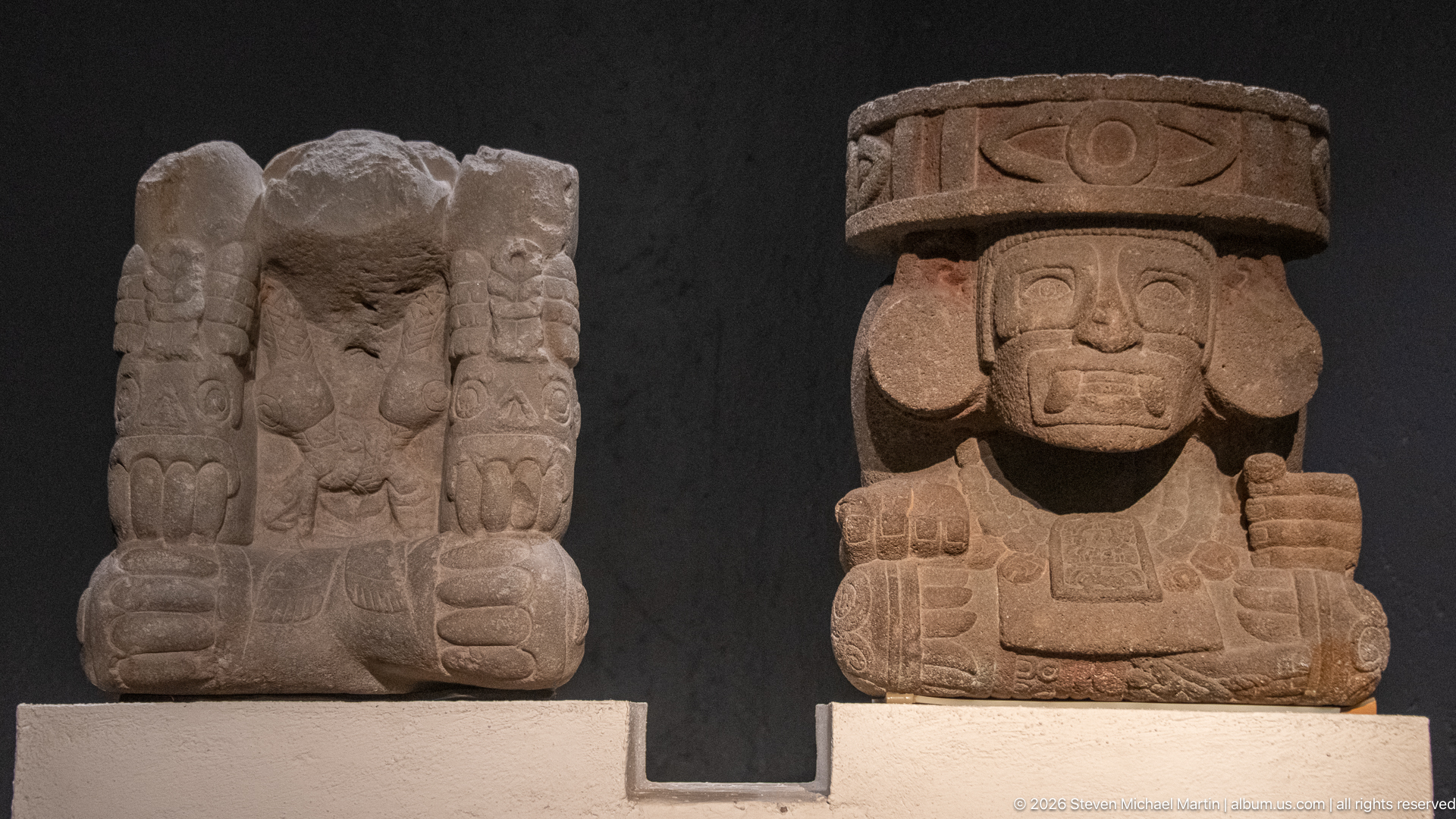
Two compact stone figures stand side by side on separate pale plinths. Both have frontal faces, broad headdresses, and blocklike bodies; one displays raised hands and a prominent chest ornament, while the other has a more masklike face and oversized ear ornaments. The isolated display against a dark wall clarifies their contrasting forms without supplying a specific identity or function.
Caption
Two compact stone figures stand side by side on separate pale plinths. Both have frontal faces, broad headdresses, and blocklike bodies; one displays raised hands and a prominent chest ornament, while the other has a more masklike face and oversized ear ornaments. The isolated display against a dark wall clarifies their contrasting forms without supplying a specific identity or function.
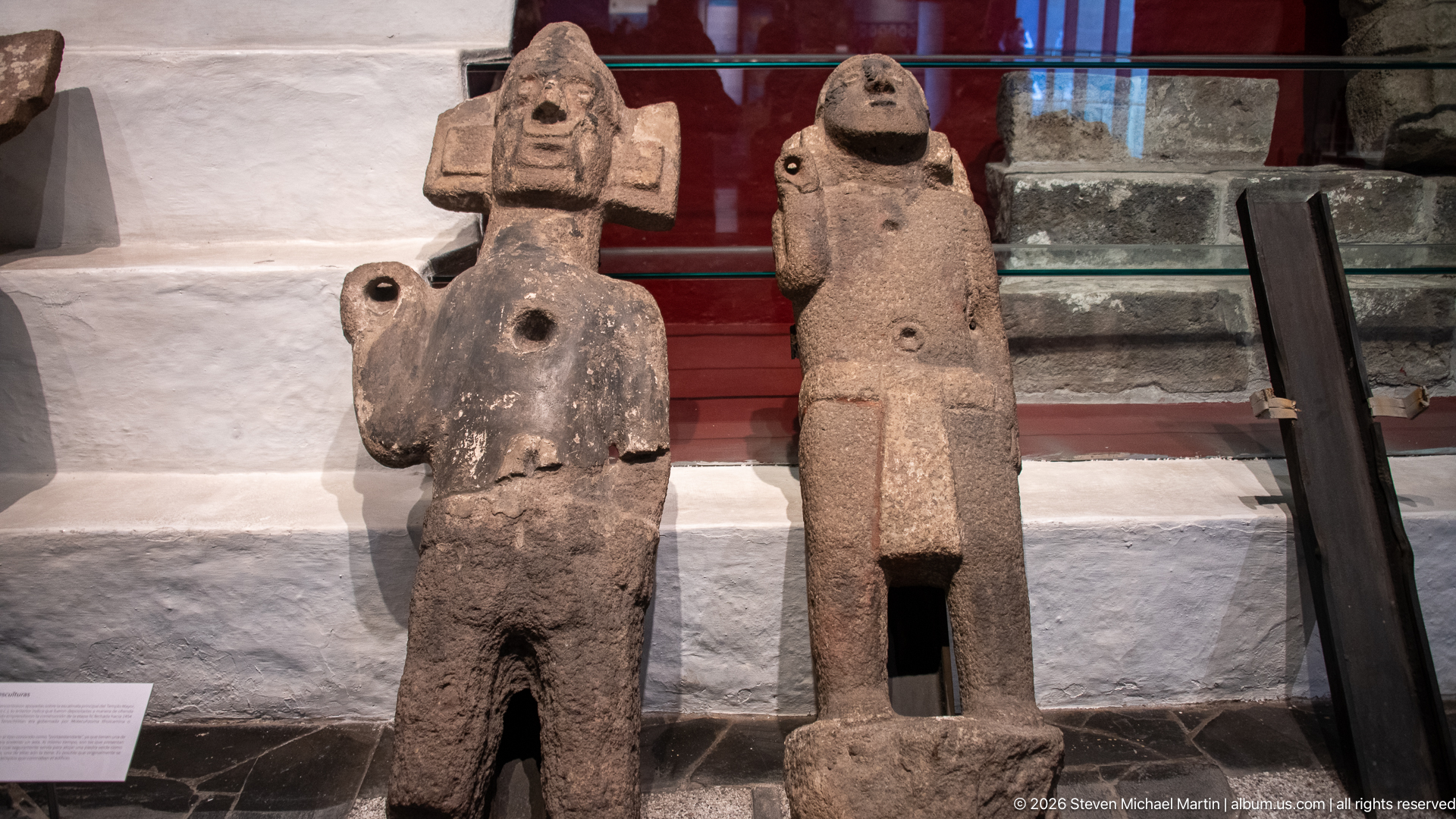
Two narrow stone figures stand behind glass against a red-backed museum wall. Their elongated bodies, incised belts, and contrasting head shapes make the pair legible as separate works: one has a broad squared head and bent arms, the other a smaller face and taller, more tapered form. The display’s stepped ledge and reflection establish the museum setting.
Caption
Two narrow stone figures stand behind glass against a red-backed museum wall. Their elongated bodies, incised belts, and contrasting head shapes make the pair legible as separate works: one has a broad squared head and bent arms, the other a smaller face and taller, more tapered form. The display’s stepped ledge and reflection establish the museum setting.
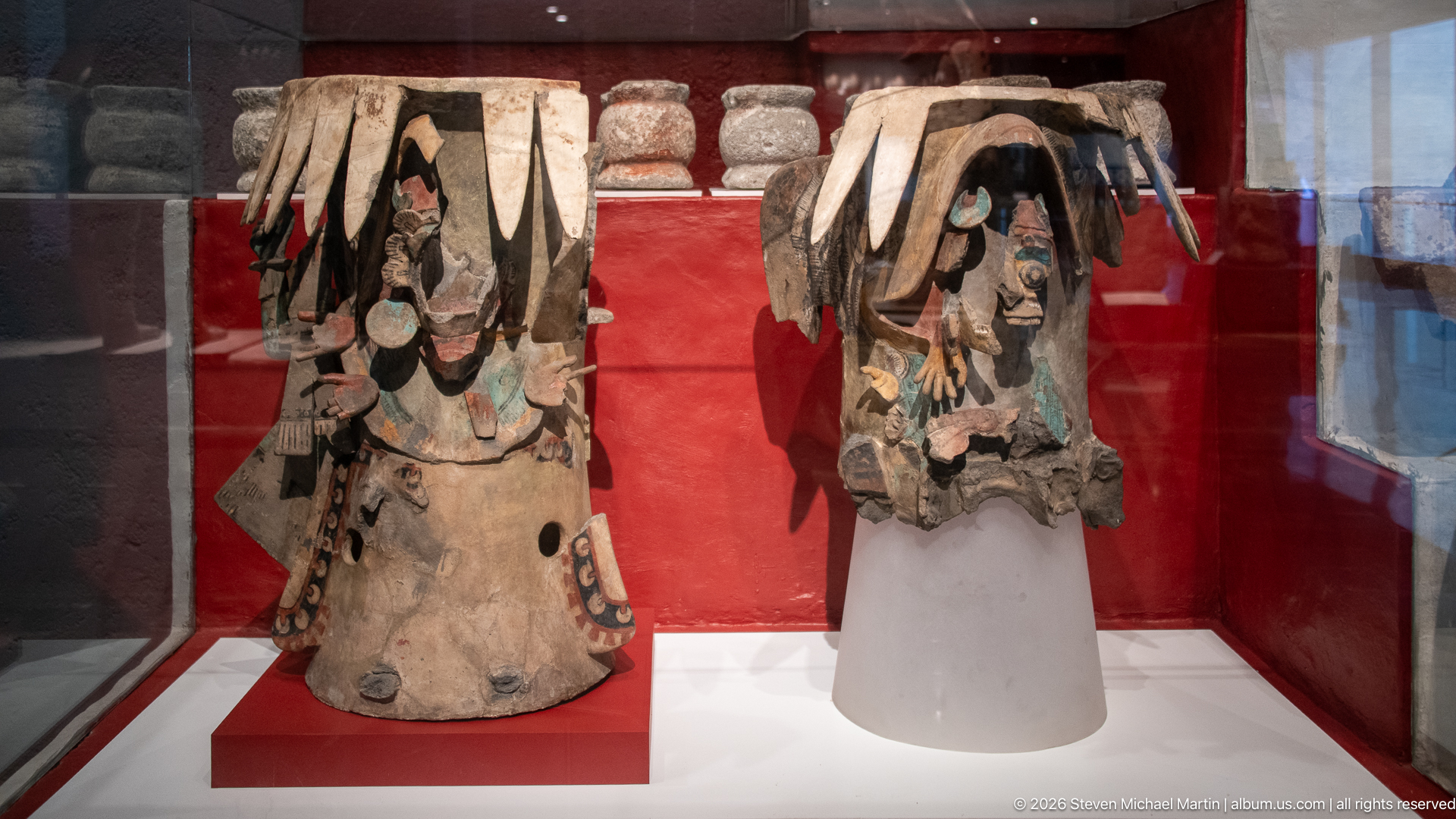
Two weathered carved masks or headpieces are presented against a vivid red backing. The left object has a long, angular face beneath projecting pale elements; the right has a circular openwork frame, painted facial details, and hanging carved forms. Their distinct construction and surface wear are visible, but the exact ritual use and material are not established by the photograph alone.
Caption
Two weathered carved masks or headpieces are presented against a vivid red backing. The left object has a long, angular face beneath projecting pale elements; the right has a circular openwork frame, painted facial details, and hanging carved forms. Their distinct construction and surface wear are visible, but the exact ritual use and material are not established by the photograph alone.
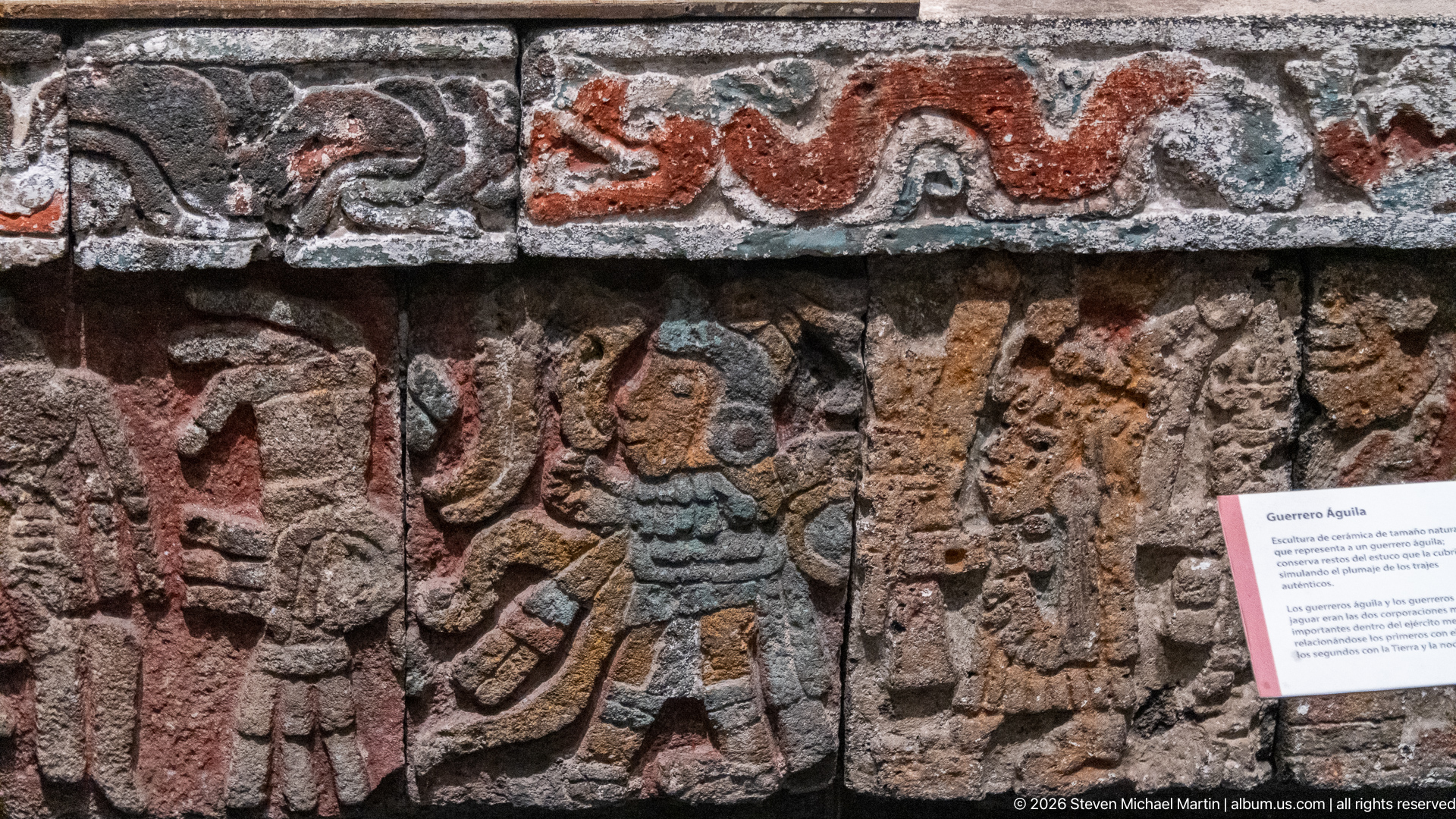
The relief presents a frontal eagle warrior in a feathered headdress, with geometric armor and a patterned garment arranged across the stone surface. Faded red and blue-green pigment remains among the carved forms. A nearby Spanish label reads “Guerrero Águila,” supporting the identification and linking this close archaeological detail to the museum’s warrior imagery.
Caption
The relief presents a frontal eagle warrior in a feathered headdress, with geometric armor and a patterned garment arranged across the stone surface. Faded red and blue-green pigment remains among the carved forms. A nearby Spanish label reads “Guerrero Águila,” supporting the identification and linking this close archaeological detail to the museum’s warrior imagery.
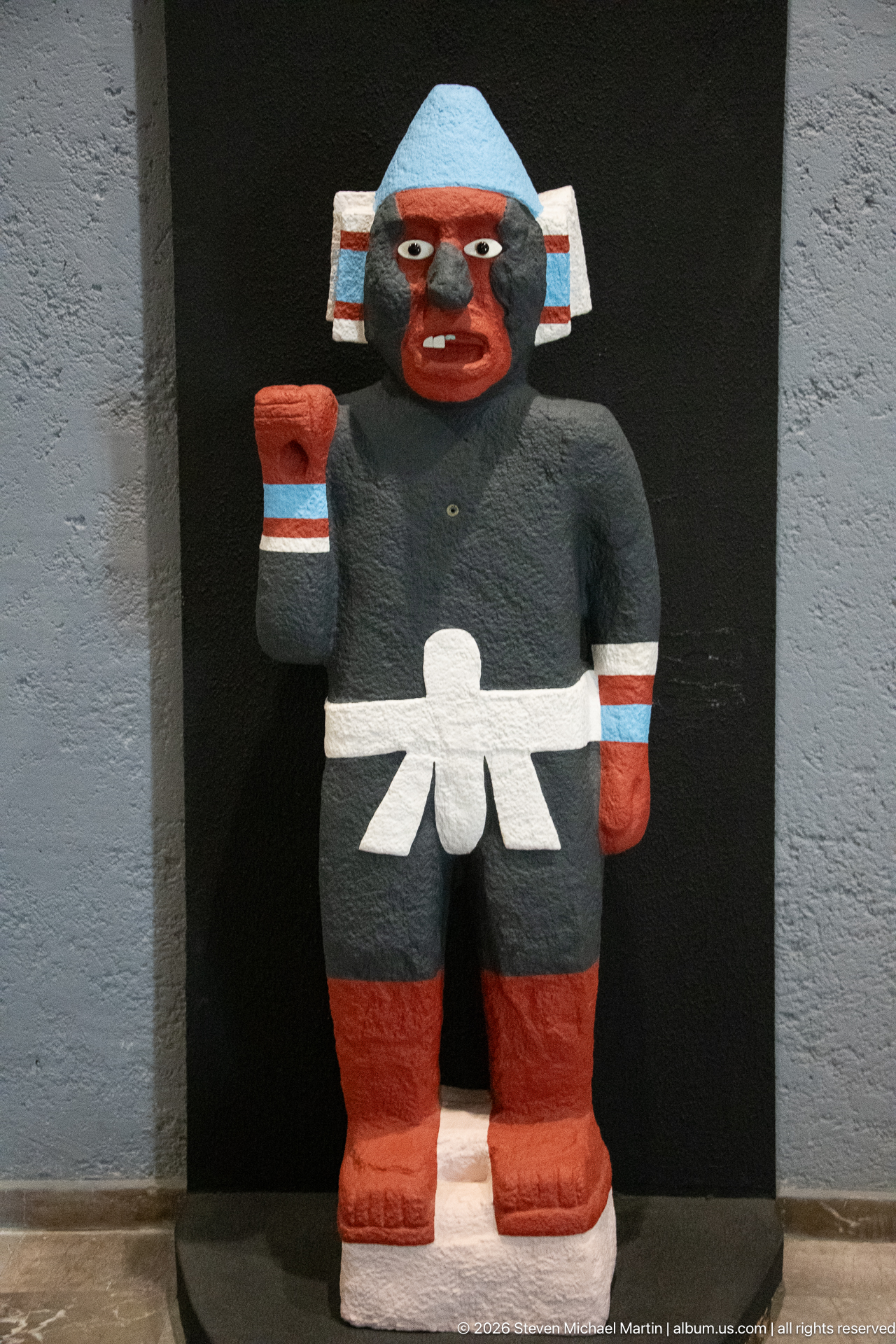
A standing figure painted in charcoal gray, red, white, and pale blue faces forward with one fist raised. Its angular blue headdress, red facial area, broad white waist garment, and matching wrist and leg bands make the polychrome scheme especially prominent. The museum reconstruction preserves a dramatic warriorlike silhouette, though the precise historical identity is not stated by the visible display.
Caption
A standing figure painted in charcoal gray, red, white, and pale blue faces forward with one fist raised. Its angular blue headdress, red facial area, broad white waist garment, and matching wrist and leg bands make the polychrome scheme especially prominent. The museum reconstruction preserves a dramatic warriorlike silhouette, though the precise historical identity is not stated by the visible display.
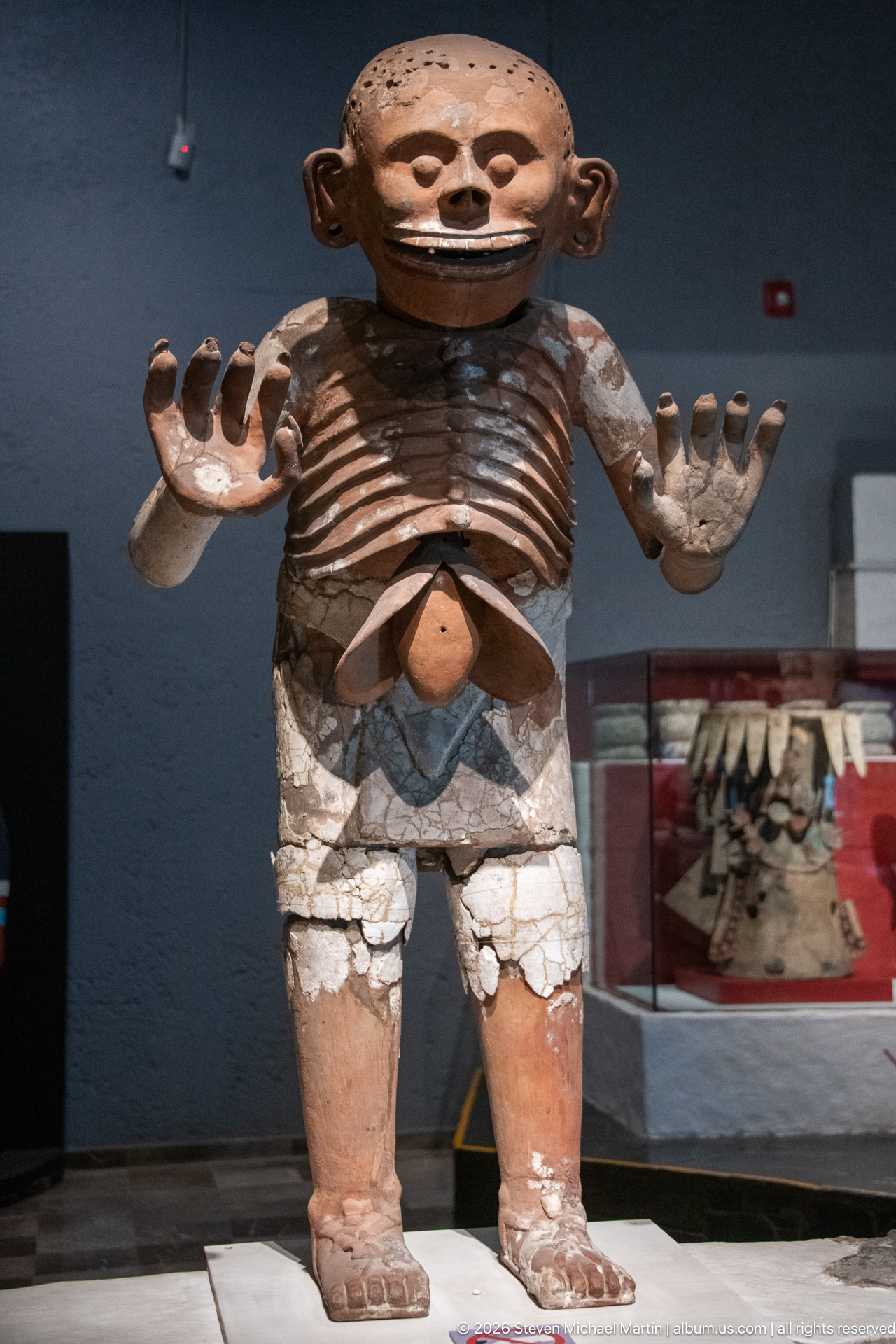
This fired-clay figure represents Mictlantecuhtli, the Mexica lord of the underworld. Ribs and exposed skeletal details interrupt the broad upright body, while both hands rise forward in a tense, confrontational pose. Set against a dark blue gallery wall, the modeled features and worn reddish surface become legible under focused light. The isolated display brings the figure’s forceful anatomy to the fore.
Caption
This fired-clay figure represents Mictlantecuhtli, the Mexica lord of the underworld. Ribs and exposed skeletal details interrupt the broad upright body, while both hands rise forward in a tense, confrontational pose. Set against a dark blue gallery wall, the modeled features and worn reddish surface become legible under focused light. The isolated display brings the figure’s forceful anatomy to the fore.
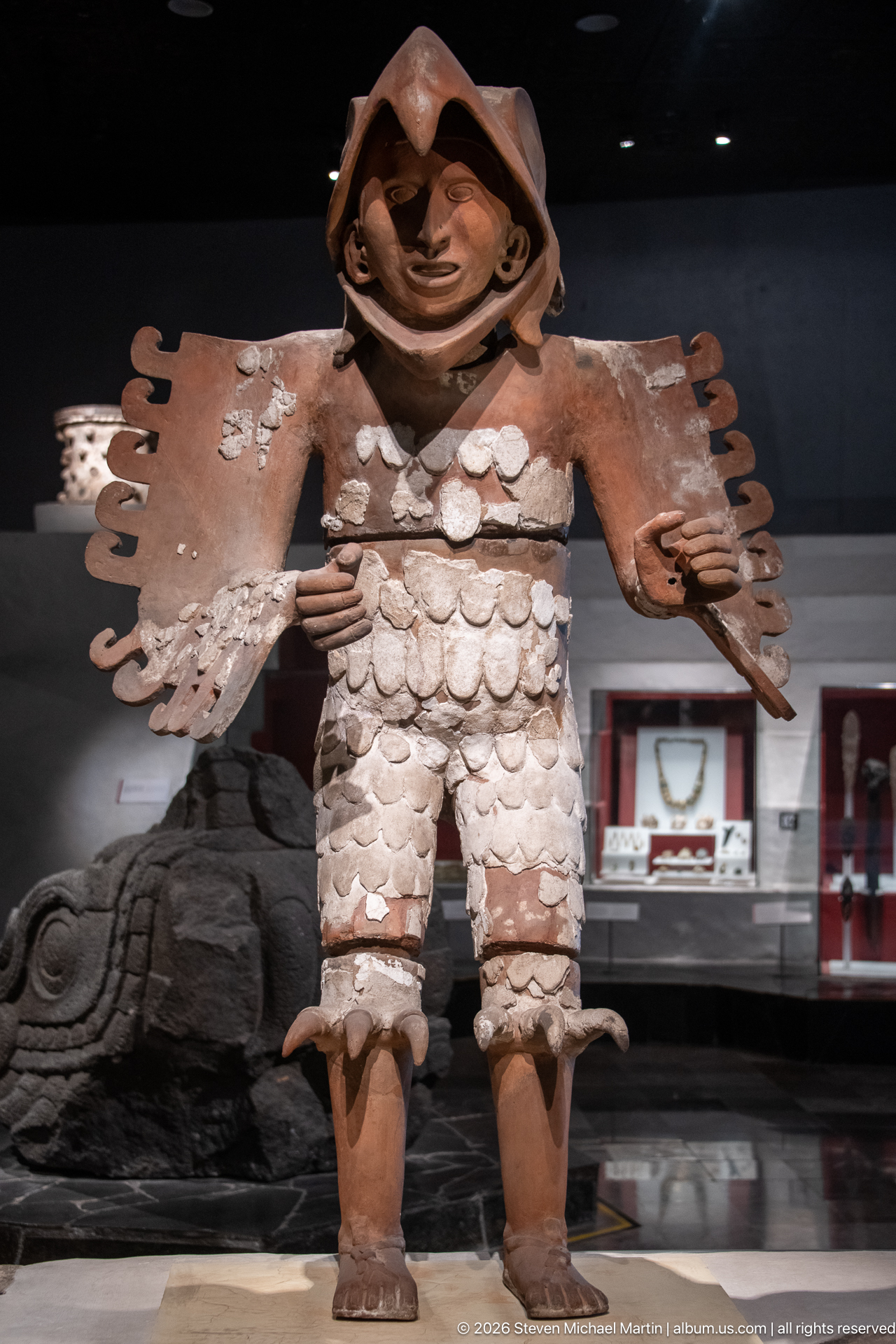
The museum identifies this full-length sculpture as a Guerrero Águila, or Eagle Warrior, found at the House of the Eagles. Its bird-shaped hood, feather-like shoulder forms, and layered costume define the martial figure, while pale stucco remains across the surface. Raised on a low platform in a dim gallery, it stands among related reconstructions that place the warrior image within the museum’s presentation of Mexica ritual and power.
Caption
The museum identifies this full-length sculpture as a Guerrero Águila, or Eagle Warrior, found at the House of the Eagles. Its bird-shaped hood, feather-like shoulder forms, and layered costume define the martial figure, while pale stucco remains across the surface. Raised on a low platform in a dim gallery, it stands among related reconstructions that place the warrior image within the museum’s presentation of Mexica ritual and power.
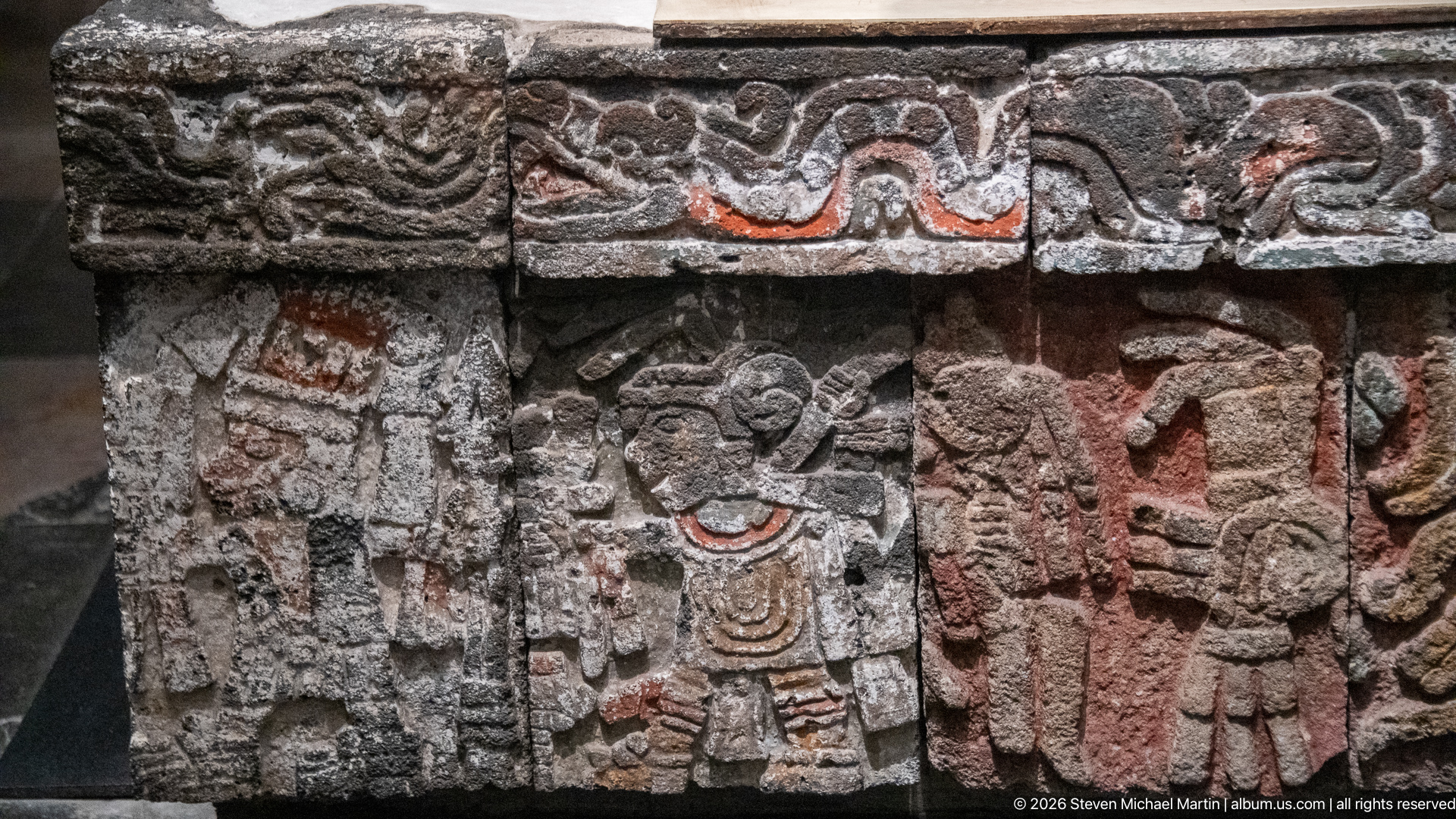
A horizontal band of carved stone blocks carries curling serpentlike forms above a deeper register of human figures, shields, and other compact motifs. Traces of red, green, and pale pigment remain on the uneven surface. The close crop foregrounds the relief’s layered construction and surviving color rather than the full architectural setting from which it came.
Caption
A horizontal band of carved stone blocks carries curling serpentlike forms above a deeper register of human figures, shields, and other compact motifs. Traces of red, green, and pale pigment remain on the uneven surface. The close crop foregrounds the relief’s layered construction and surviving color rather than the full architectural setting from which it came.
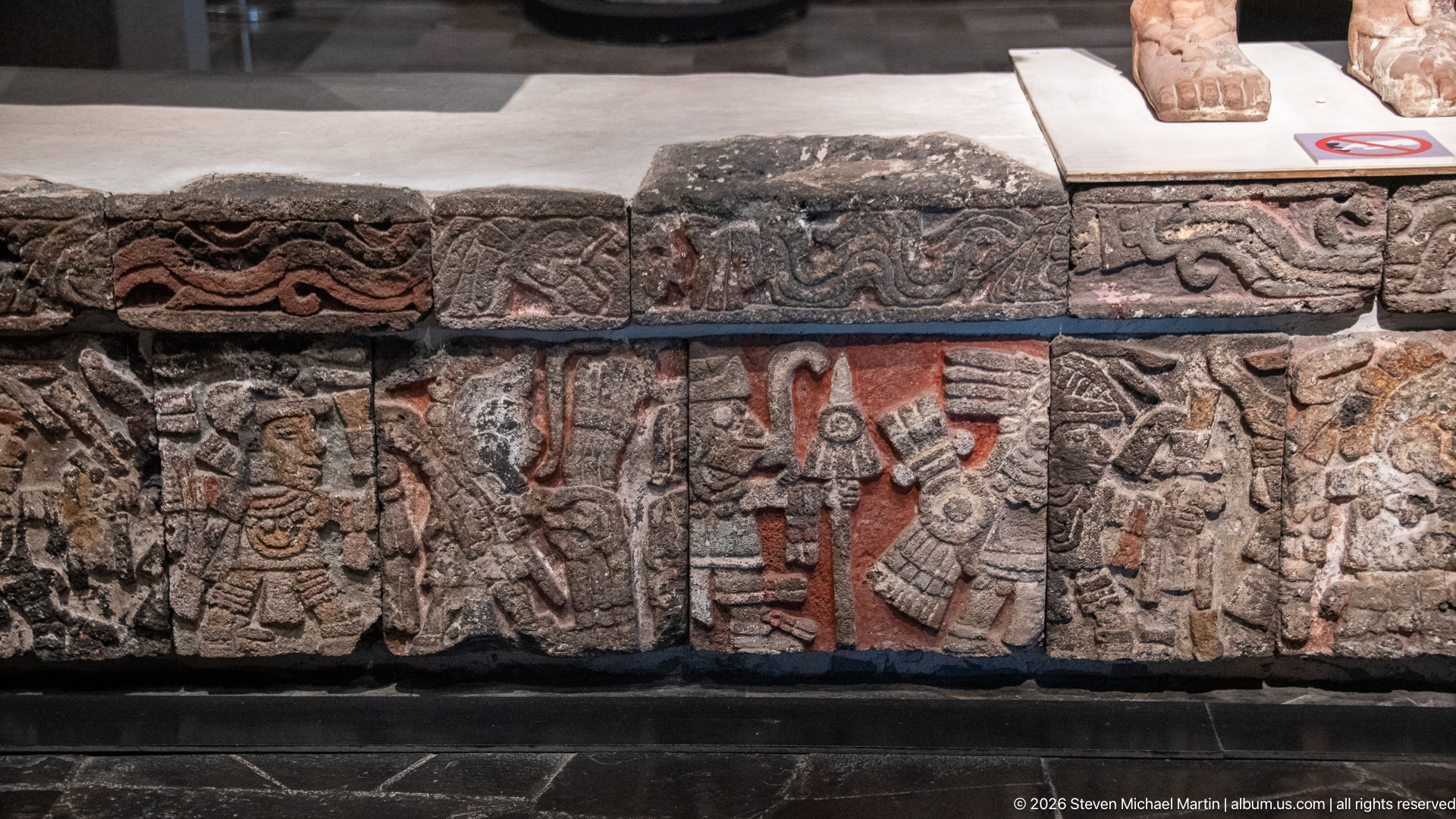
A long, low stone relief is seen straight on, its upper edge lined with undulating forms and its lower register divided into compact figures and symbols. Red pigment remains on several bodies and motifs, set against gray-brown stone. The image’s width reveals the continuous panel and repeated carving, distinguishing it from the tighter fragment views on the neighboring page.
Caption
A long, low stone relief is seen straight on, its upper edge lined with undulating forms and its lower register divided into compact figures and symbols. Red pigment remains on several bodies and motifs, set against gray-brown stone. The image’s width reveals the continuous panel and repeated carving, distinguishing it from the tighter fragment views on the neighboring page.
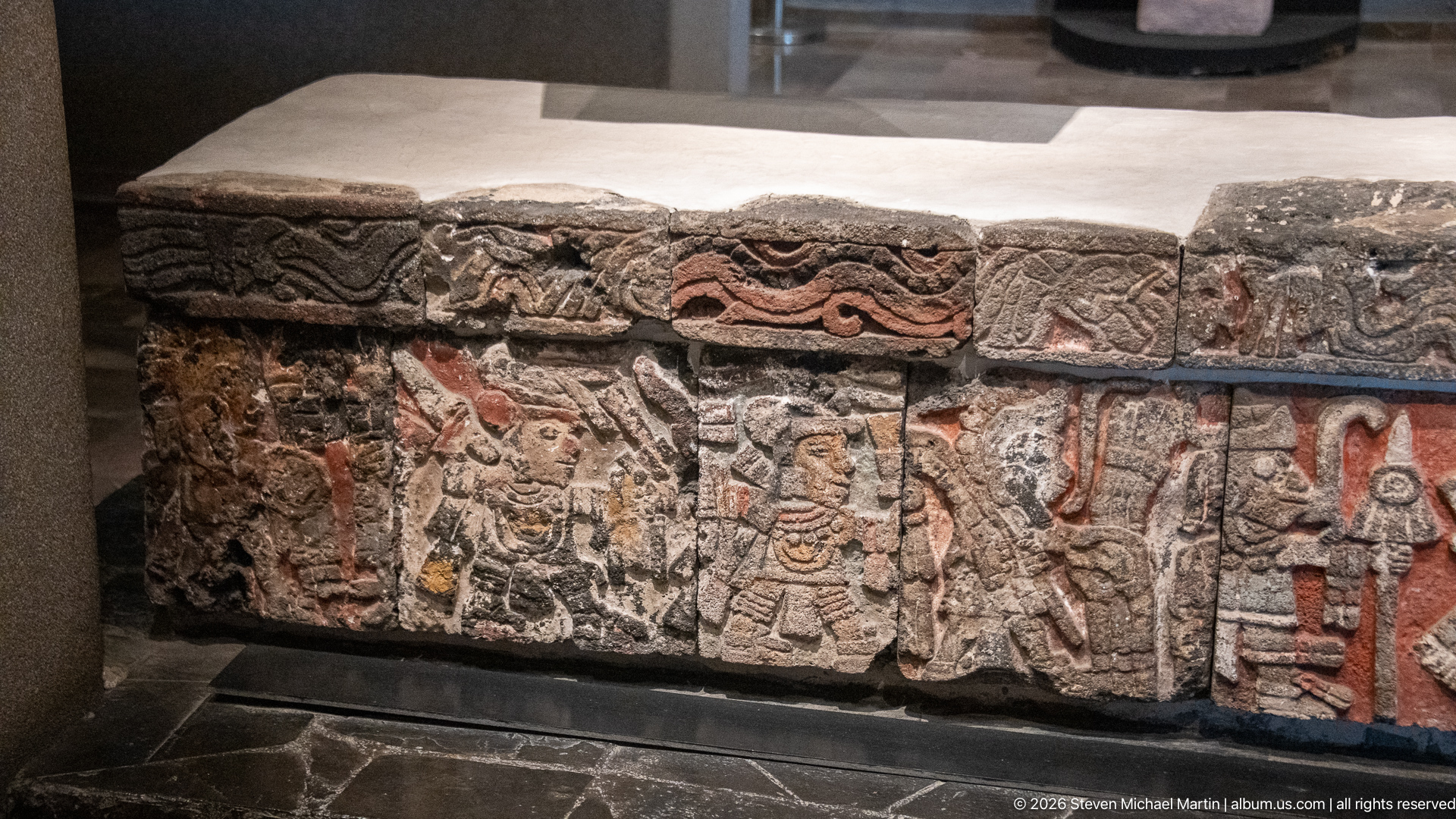
A low, continuous stone frieze runs across the frame, with a narrow upper band of repeated waves above larger carved figures and symbols. The blocks vary in color and wear, and remnants of red and blue-green pigment survive in recessed areas. Shot from a slight angle, the view shows the relief’s length and the way its individual carved sections join.
Caption
A low, continuous stone frieze runs across the frame, with a narrow upper band of repeated waves above larger carved figures and symbols. The blocks vary in color and wear, and remnants of red and blue-green pigment survive in recessed areas. Shot from a slight angle, the view shows the relief’s length and the way its individual carved sections join.
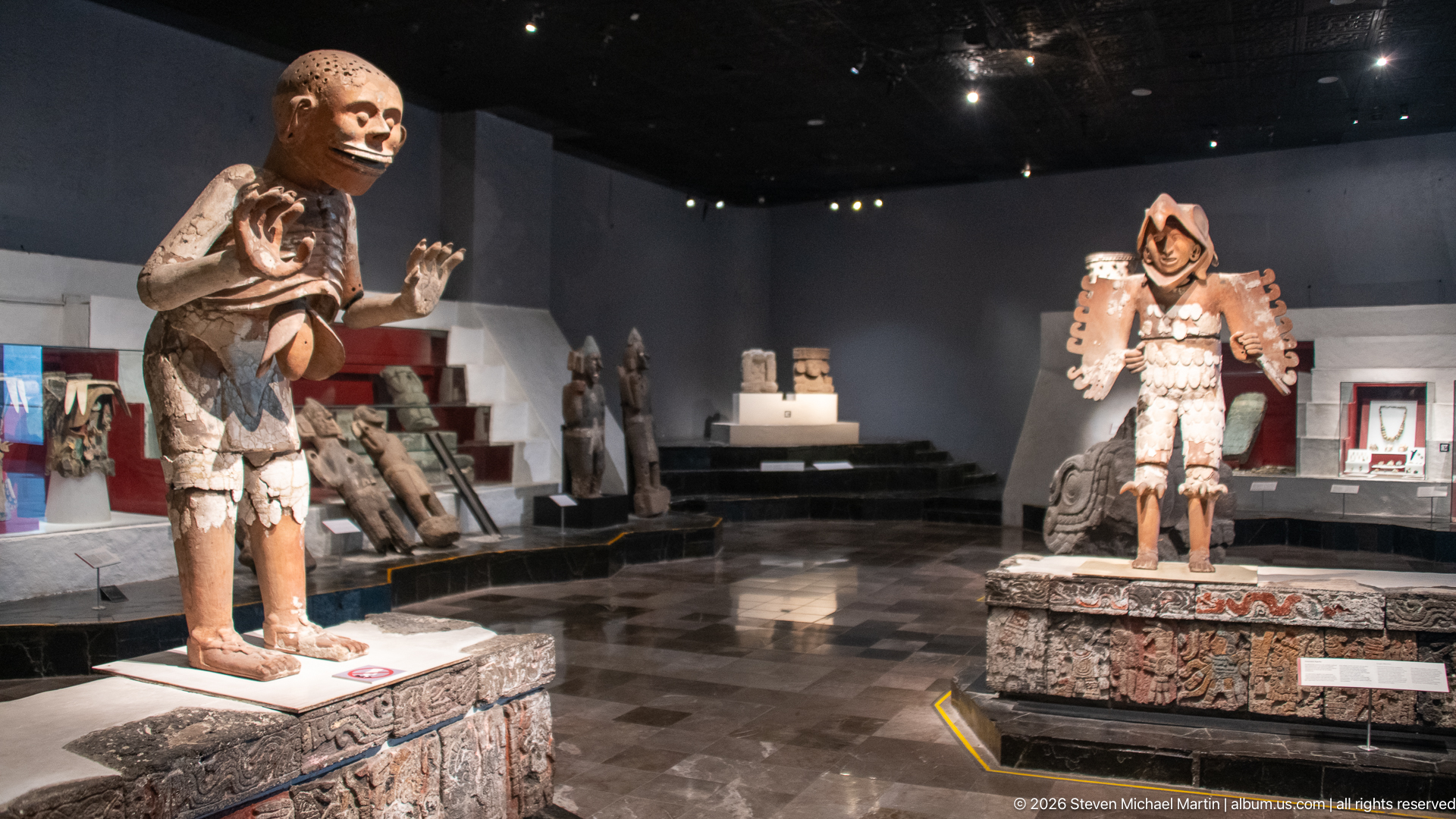
Two oversized costumed figures stand on separate reconstructed platforms across a dark museum gallery. The left figure is seen from behind and wears a layered, featherlike costume; the right faces forward with a hood and patterned garment. Carved relief panels surround both bases, while display cases and smaller objects recede into the background, establishing the scale of the exhibition.
Caption
Two oversized costumed figures stand on separate reconstructed platforms across a dark museum gallery. The left figure is seen from behind and wears a layered, featherlike costume; the right faces forward with a hood and patterned garment. Carved relief panels surround both bases, while display cases and smaller objects recede into the background, establishing the scale of the exhibition.
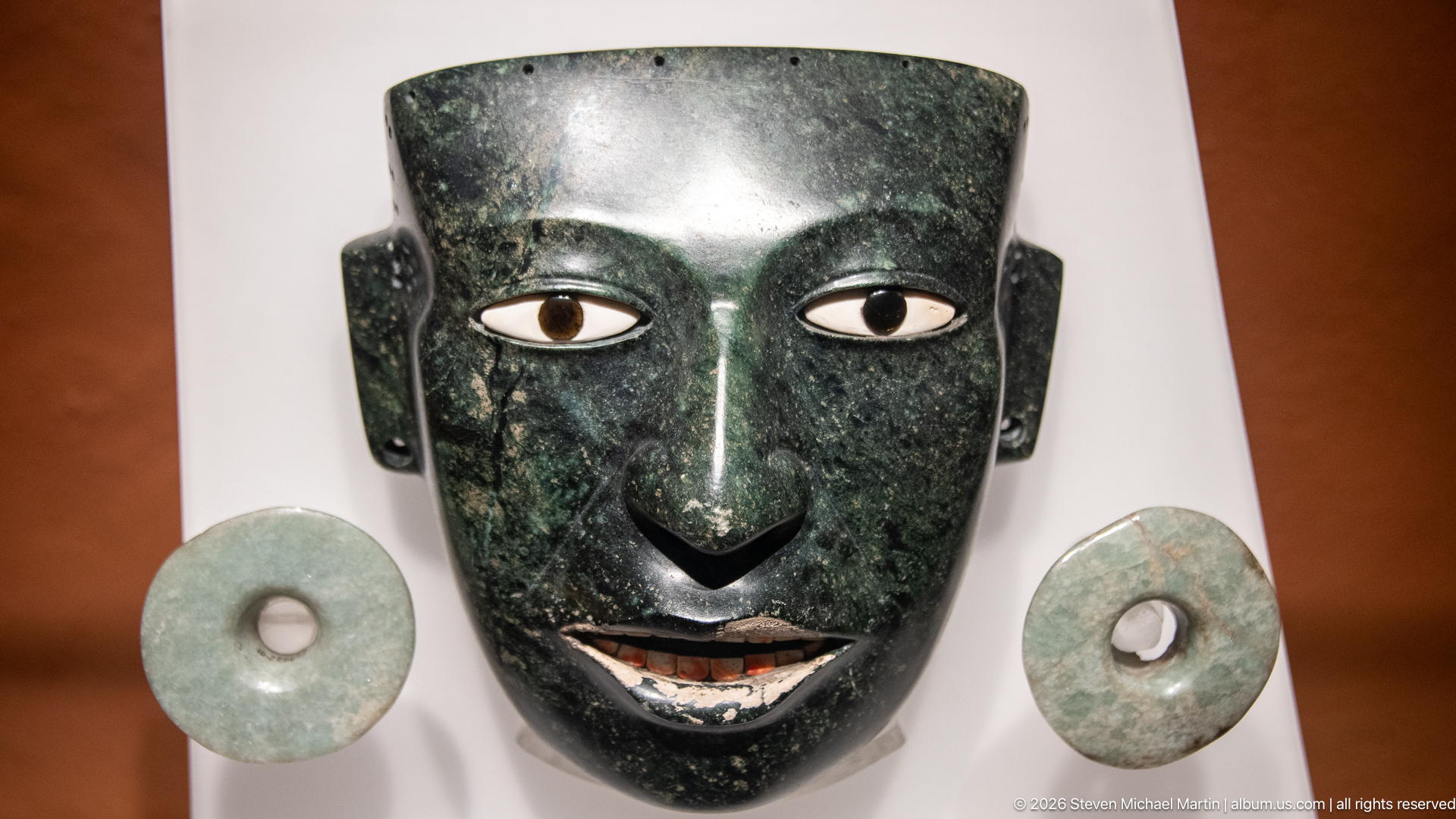
A polished greenstone face mask fills the display, its broad nose, open mouth, pale inset eyes, and dark mottled surface sharply visible. Large circular ear ornaments flank the face, adding to the mask’s symmetrical outline. The close frontal view isolates its material and workmanship from the museum wall, but does not establish the wearer or original use.
Caption
A polished greenstone face mask fills the display, its broad nose, open mouth, pale inset eyes, and dark mottled surface sharply visible. Large circular ear ornaments flank the face, adding to the mask’s symmetrical outline. The close frontal view isolates its material and workmanship from the museum wall, but does not establish the wearer or original use.
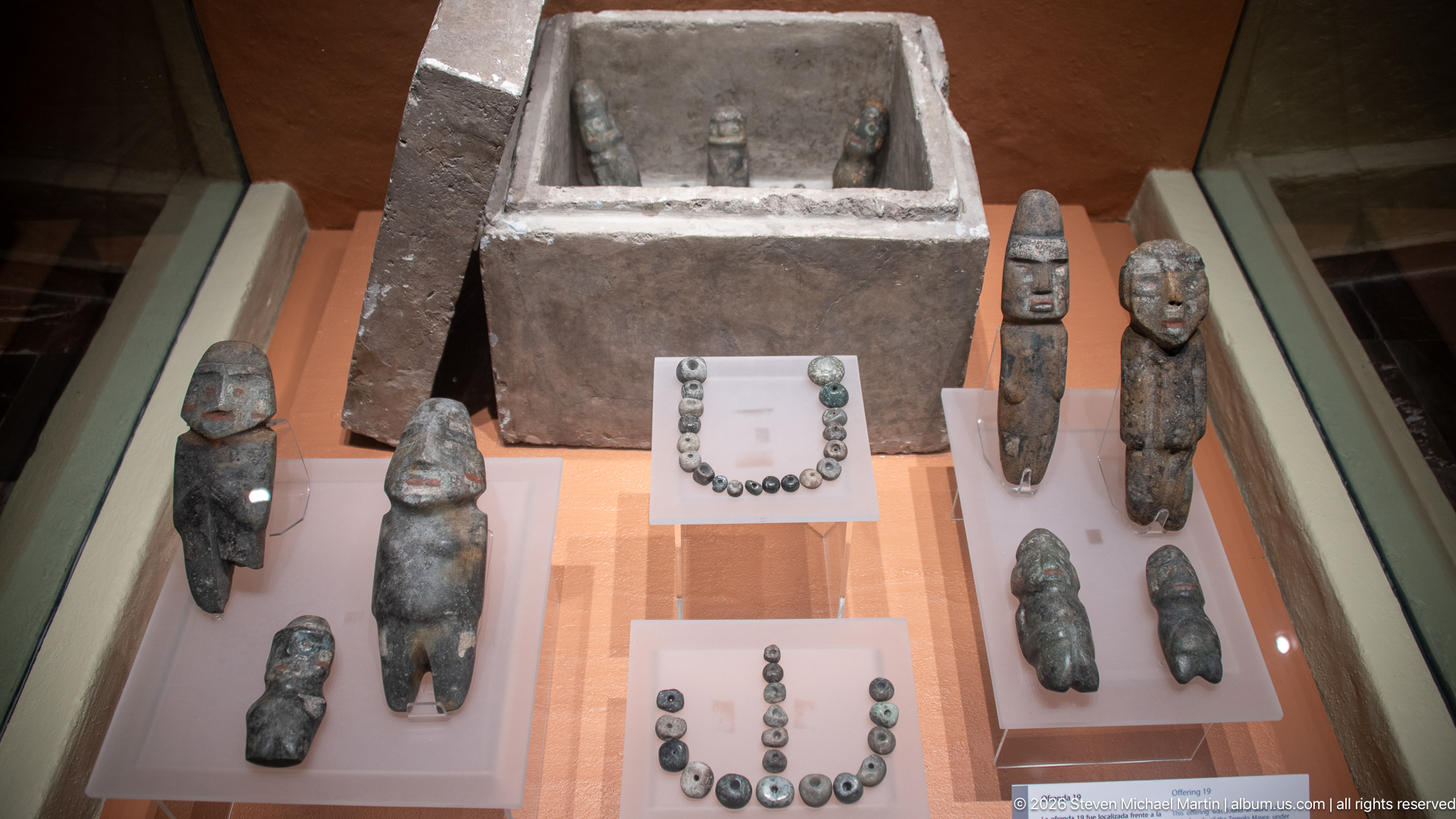
A tall, boxlike stone container rises at the center of a lit case, surrounded by small carved figures and several looped strands of round green beads. The overhead view gathers objects of different sizes into a single arrangement, with labels set among them. Their close placement invites comparison of stone carving, miniature sculpture, and beadwork without assigning a specific function to the container.
Caption
A tall, boxlike stone container rises at the center of a lit case, surrounded by small carved figures and several looped strands of round green beads. The overhead view gathers objects of different sizes into a single arrangement, with labels set among them. Their close placement invites comparison of stone carving, miniature sculpture, and beadwork without assigning a specific function to the container.
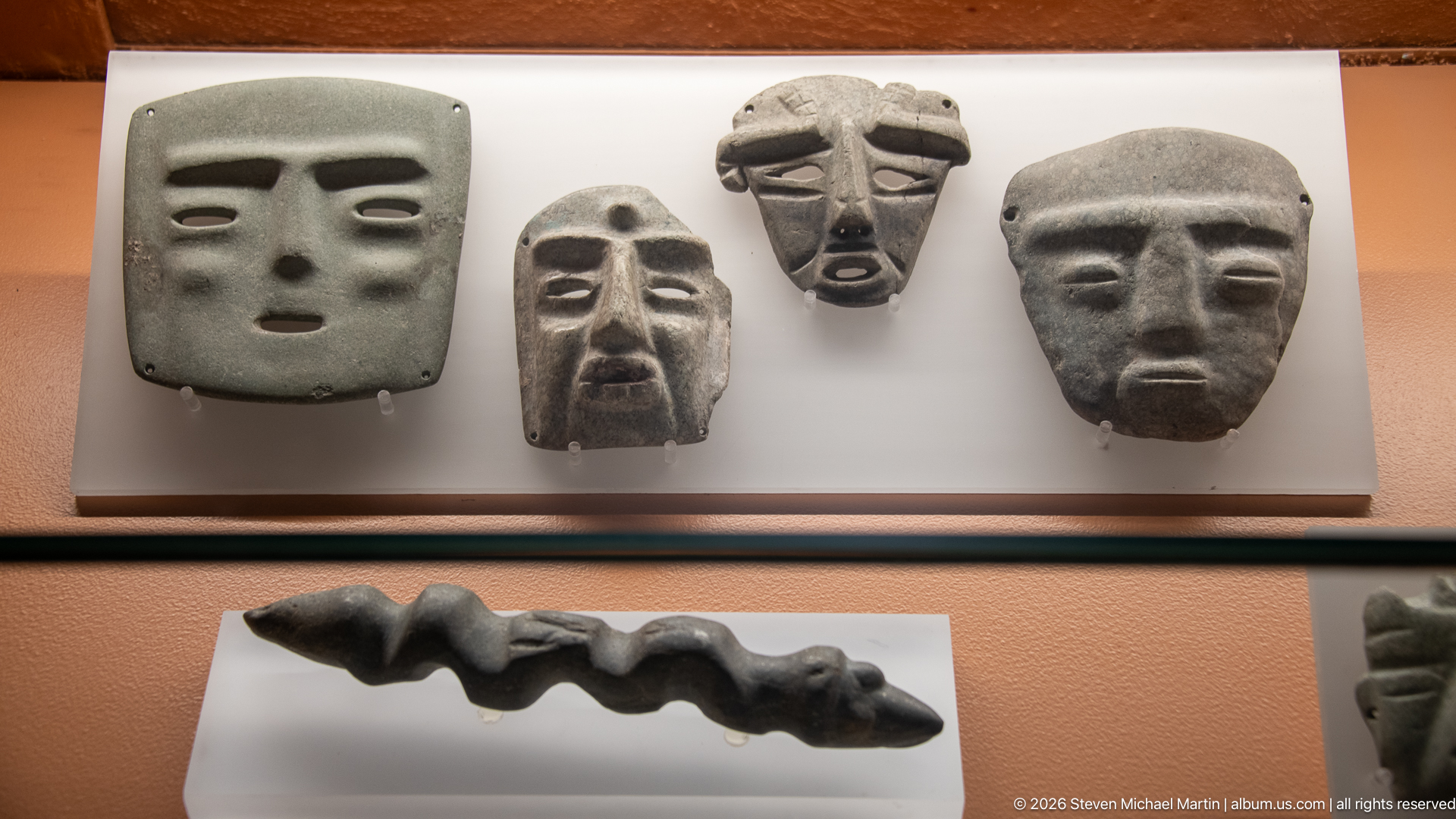
Four carved stone faces are displayed in a row, each with a distinct treatment of brows, nose, mouth, and eye openings. Beneath them, a narrow sinuous object rests horizontally on a separate support. The arrangement makes comparison possible across the masks’ shapes and surface tones, while the second object adds a contrasting elongated form to the case.
Caption
Four carved stone faces are displayed in a row, each with a distinct treatment of brows, nose, mouth, and eye openings. Beneath them, a narrow sinuous object rests horizontally on a separate support. The arrangement makes comparison possible across the masks’ shapes and surface tones, while the second object adds a contrasting elongated form to the case.
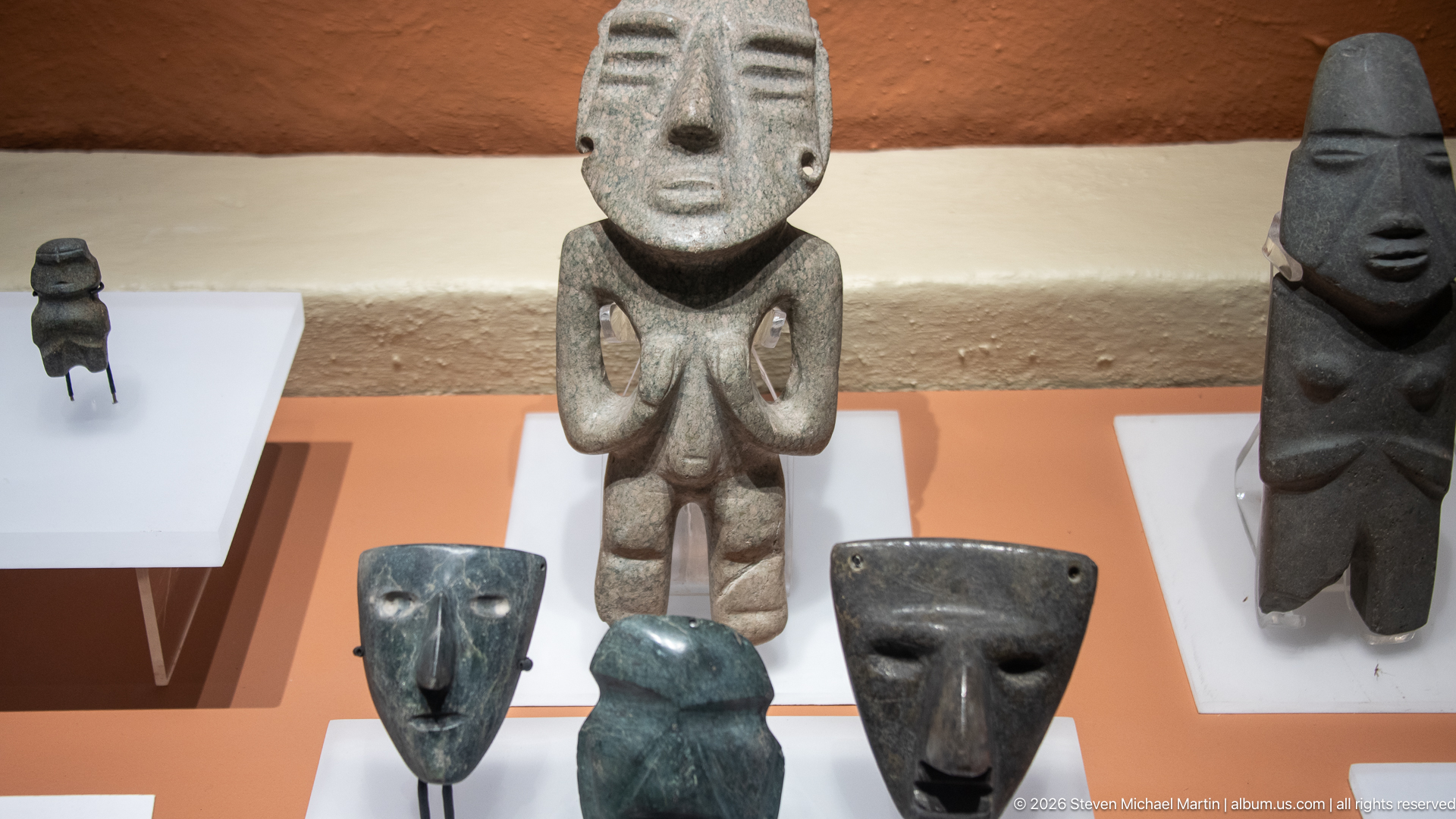
A small pale stone figure sits upright with knees bent and hands resting near the chest, positioned among larger carved masks and faces. The central figure’s compact posture contrasts with the surrounding flat facial forms and darker green stones. A warm-colored wall and narrow ledges organize the artifacts into a museum display rather than an archaeological field context.
Caption
A small pale stone figure sits upright with knees bent and hands resting near the chest, positioned among larger carved masks and faces. The central figure’s compact posture contrasts with the surrounding flat facial forms and darker green stones. A warm-colored wall and narrow ledges organize the artifacts into a museum display rather than an archaeological field context.
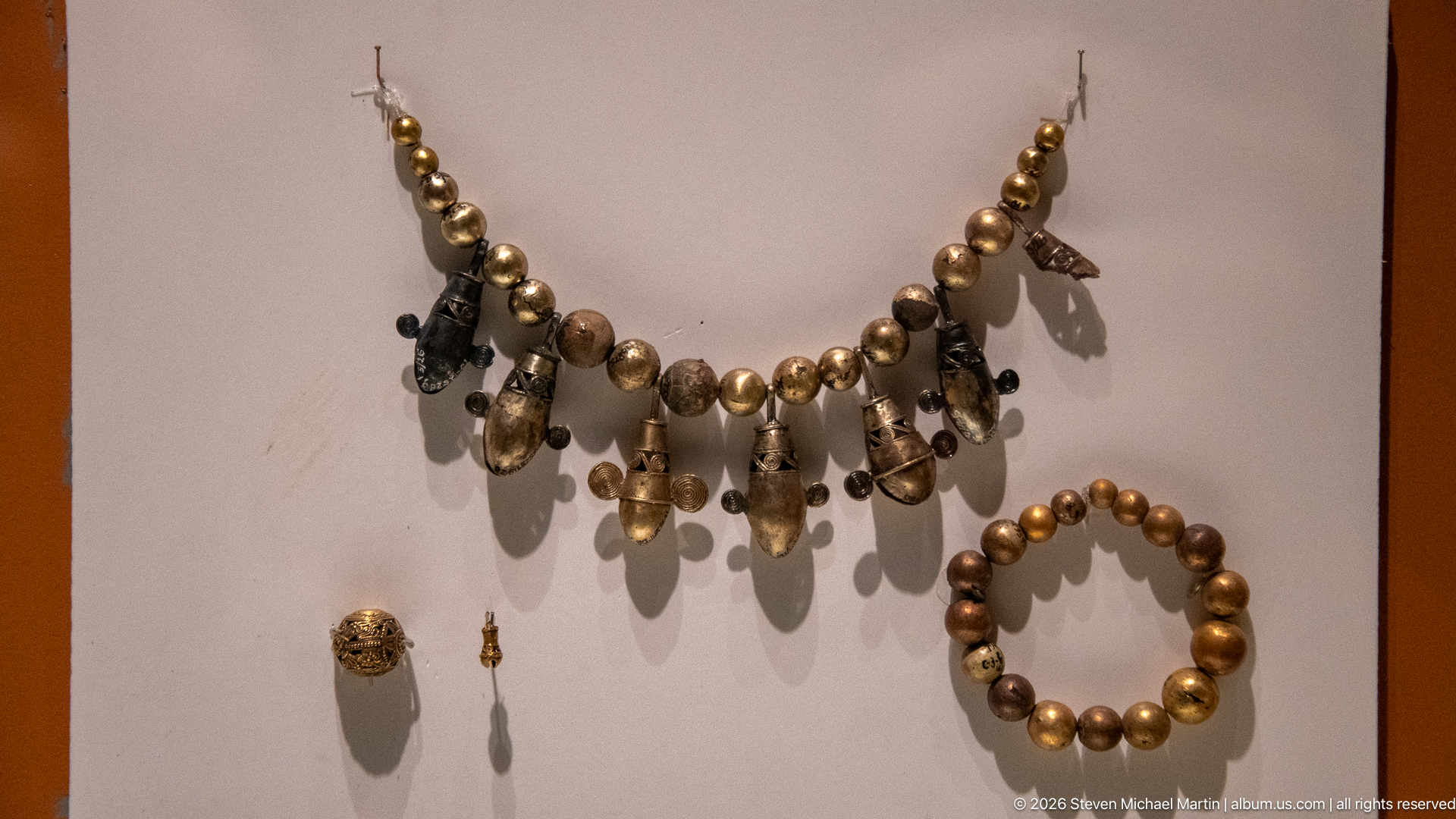
A large necklace of rounded gold-toned beads hangs against a pale display wall, with several elongated pendants clustered along its lower arc. Below it, a second circular strand of larger beads and two small ornaments complete the arrangement. The clean background and frontal presentation draw attention to the varied shapes and metal surfaces, though the precise material and cultural attribution are not confirmed by visible text.
Caption
A large necklace of rounded gold-toned beads hangs against a pale display wall, with several elongated pendants clustered along its lower arc. Below it, a second circular strand of larger beads and two small ornaments complete the arrangement. The clean background and frontal presentation draw attention to the varied shapes and metal surfaces, though the precise material and cultural attribution are not confirmed by visible text.
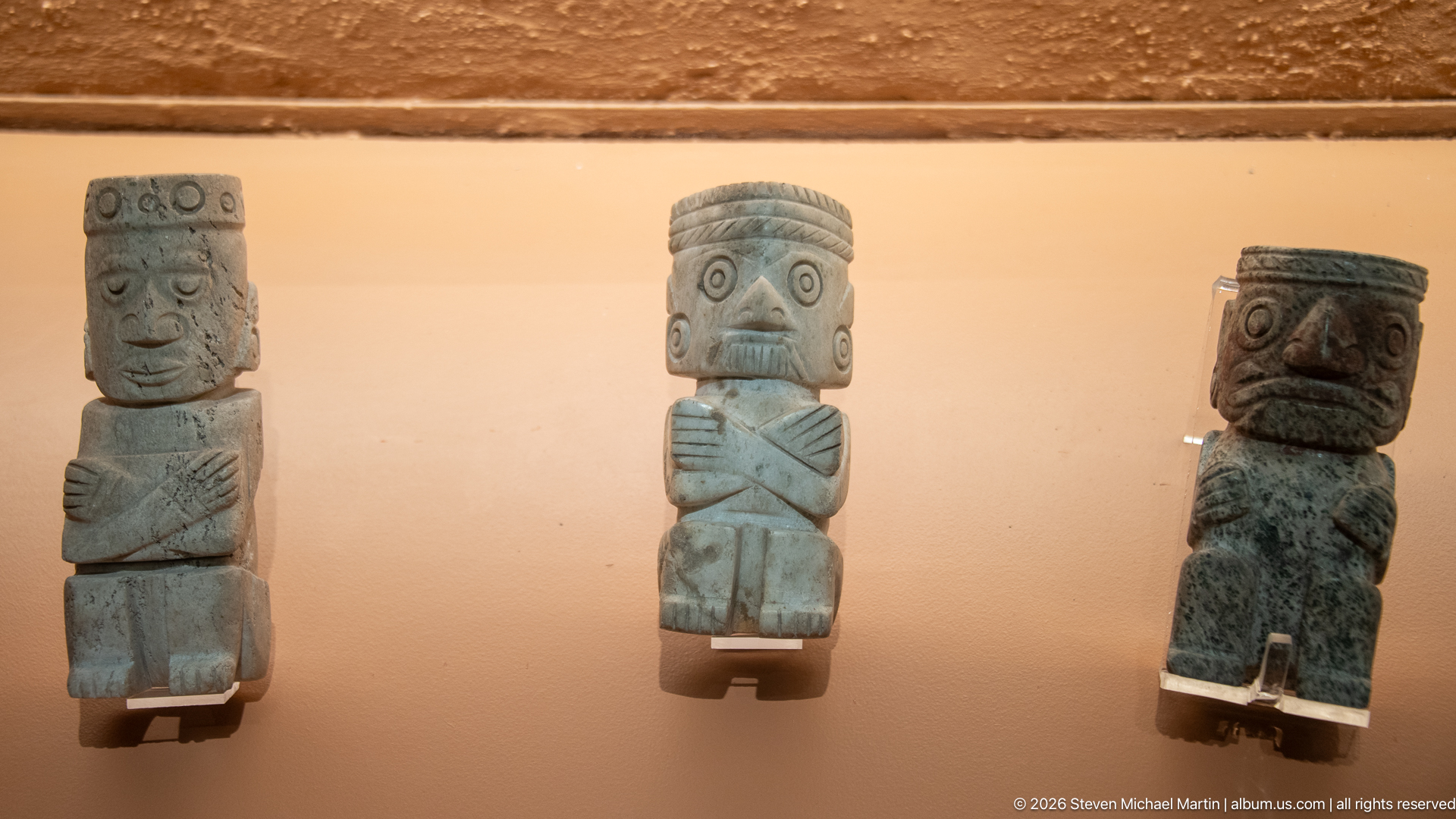
Three compact green-gray figures hang or stand against a warm museum wall, arranged in a horizontal line. Each has a large stylized head, geometric headdress, and tightly crossed arms; changes in facial expression, headband, and stone color distinguish them. Their repeated format suggests a set, but the display offers no visible information about the figures’ precise identity or shared function.
Caption
Three compact green-gray figures hang or stand against a warm museum wall, arranged in a horizontal line. Each has a large stylized head, geometric headdress, and tightly crossed arms; changes in facial expression, headband, and stone color distinguish them. Their repeated format suggests a set, but the display offers no visible information about the figures’ precise identity or shared function.
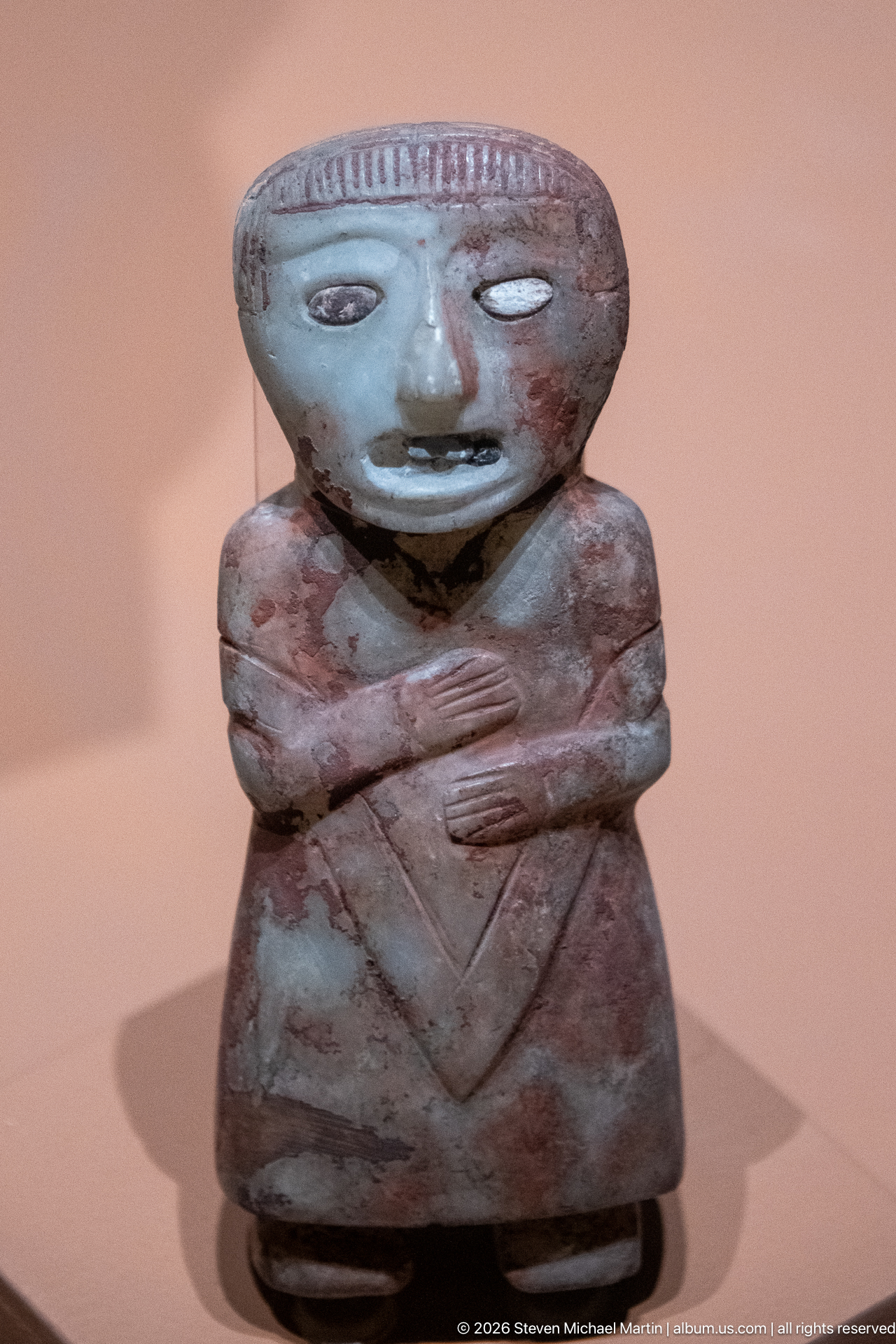
A seated stone figure is shown frontally with forearms crossed over its chest and a wide, flattened head above a compact body. Patches of blue-green, red, and pale pigment or stone color remain across the face and torso. The plain display wall leaves the sculpture’s posture, surface variation, and large eye forms as the defining features.
Caption
A seated stone figure is shown frontally with forearms crossed over its chest and a wide, flattened head above a compact body. Patches of blue-green, red, and pale pigment or stone color remain across the face and torso. The plain display wall leaves the sculpture’s posture, surface variation, and large eye forms as the defining features.
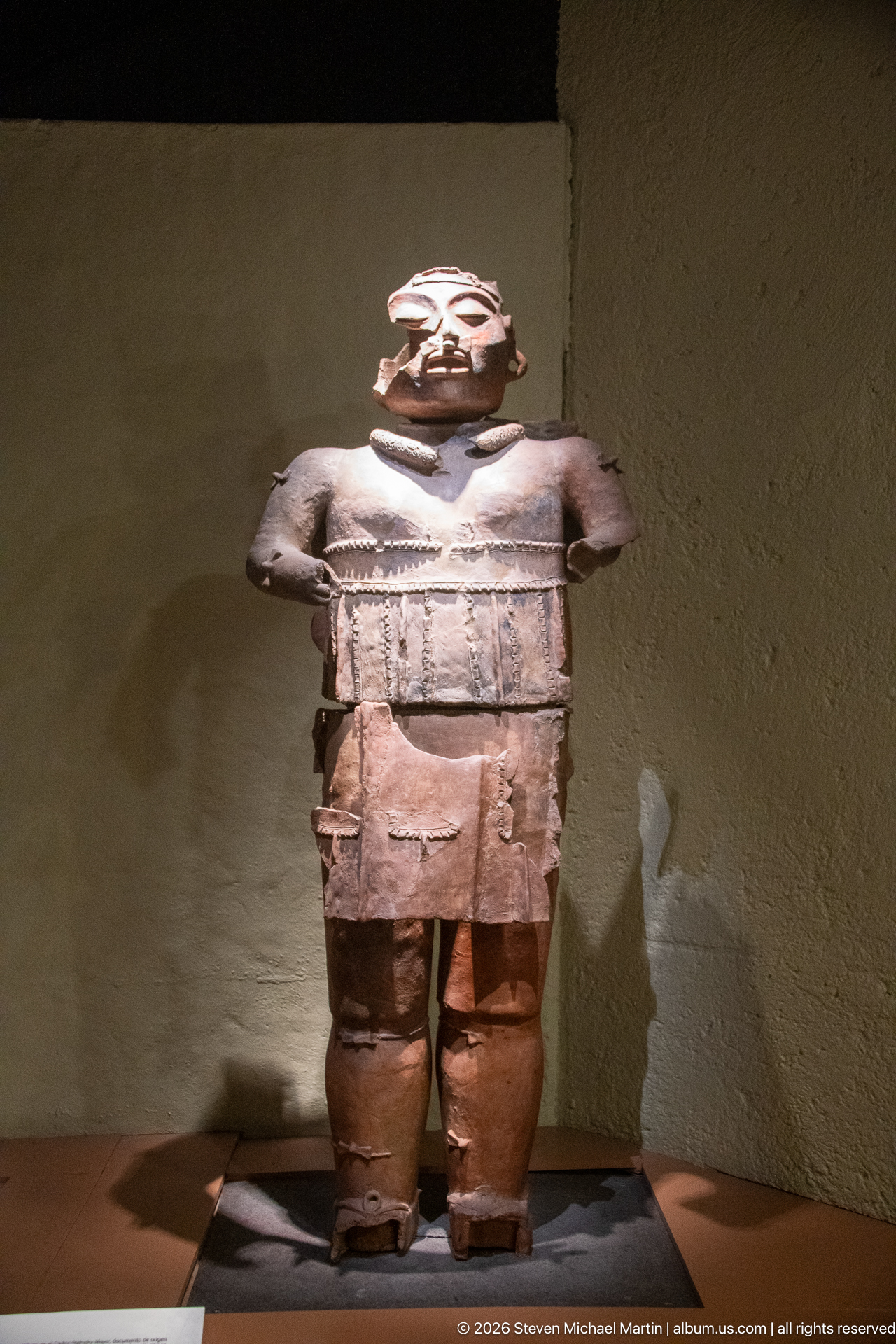
A large standing figure is shown alone under a focused gallery light, its head tilted upward and its hands positioned at the waist. The layered headdress and broad, decorated garment create a strong horizontal silhouette across the torso, while the reddish-brown surface shows chips and worn edges. The close full-length view emphasizes costume and pose without claiming a specific identity.
Caption
A large standing figure is shown alone under a focused gallery light, its head tilted upward and its hands positioned at the waist. The layered headdress and broad, decorated garment create a strong horizontal silhouette across the torso, while the reddish-brown surface shows chips and worn edges. The close full-length view emphasizes costume and pose without claiming a specific identity.
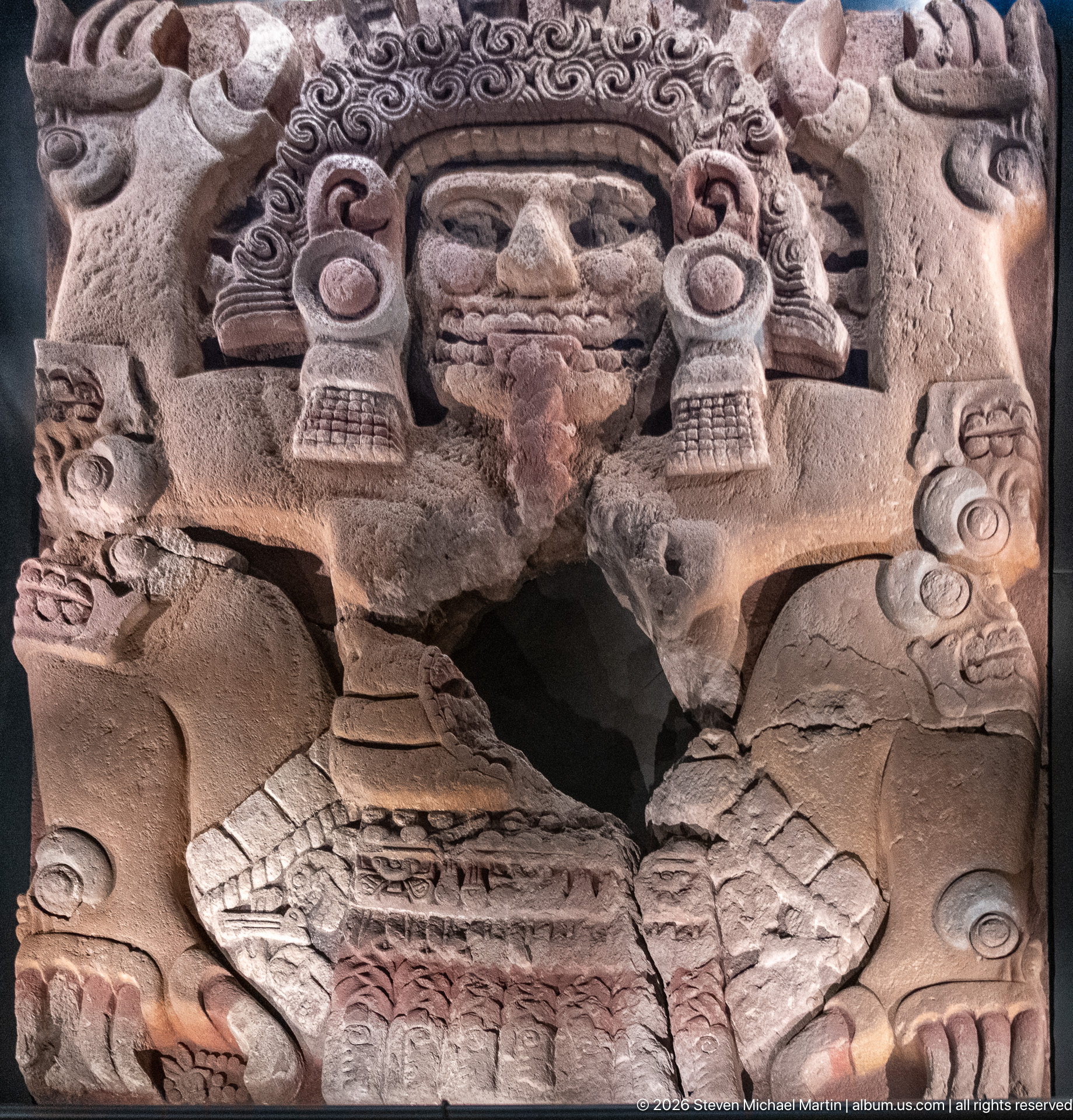
A monumental stone relief fills the frame with a broad central face, large circular eyes, prominent nose, and dense curling forms above and around it. The lower portion contains layered bands and smaller carved elements, while worn edges reveal the mass of the stone. The close view records the sculpture’s forceful symmetry without assigning a deity name from appearance alone.
Caption
A monumental stone relief fills the frame with a broad central face, large circular eyes, prominent nose, and dense curling forms above and around it. The lower portion contains layered bands and smaller carved elements, while worn edges reveal the mass of the stone. The close view records the sculpture’s forceful symmetry without assigning a deity name from appearance alone.
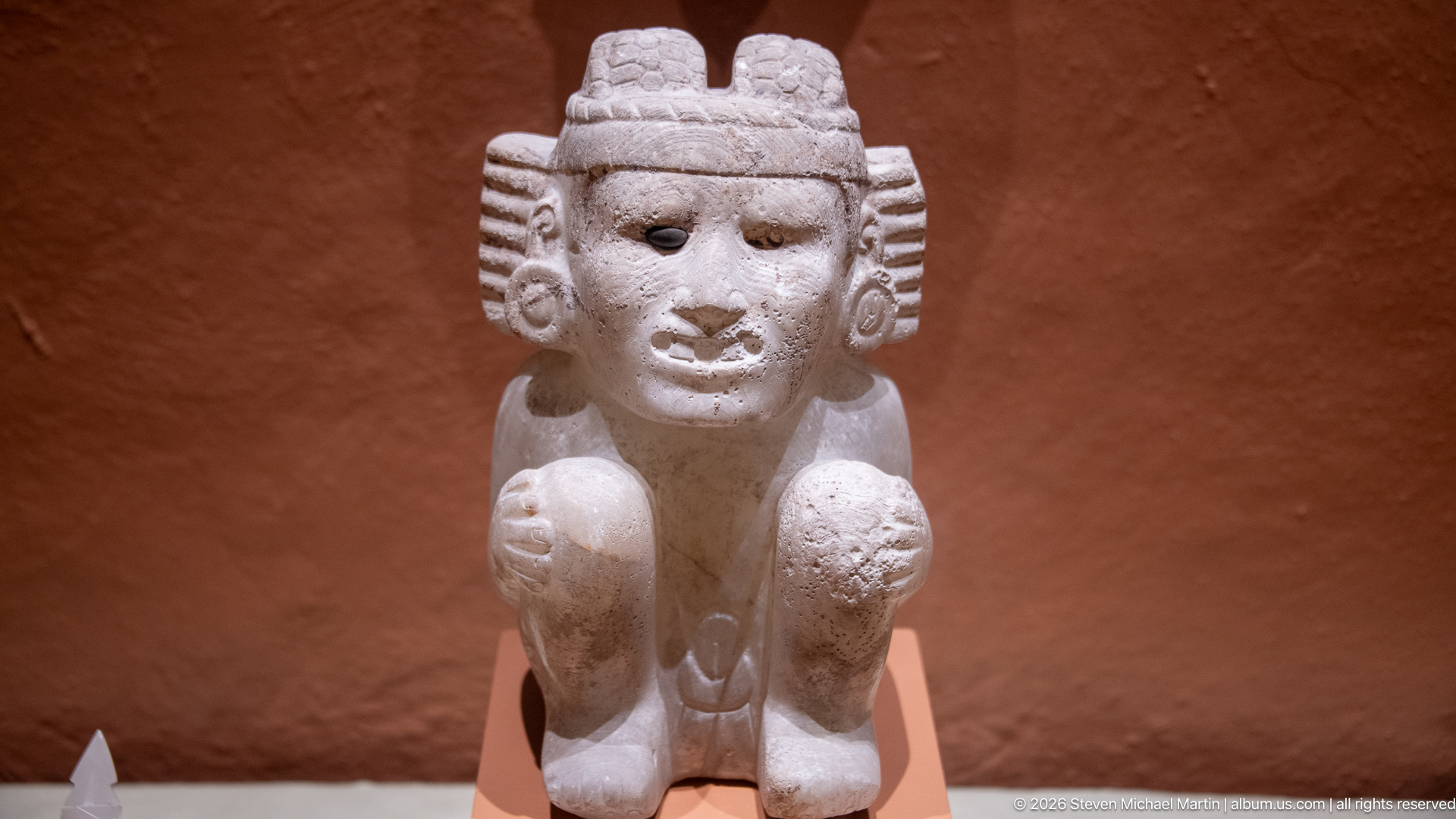
A pale stone figure kneels with both knees raised close to the body and hands gathered near the center. Its tall, segmented headdress, circular ear ornaments, and small dark eye openings are sharply visible against a terracotta-colored wall. The frontal display emphasizes the figure’s compressed pose and symmetrical silhouette, without making a more specific identification.
Caption
A pale stone figure kneels with both knees raised close to the body and hands gathered near the center. Its tall, segmented headdress, circular ear ornaments, and small dark eye openings are sharply visible against a terracotta-colored wall. The frontal display emphasizes the figure’s compressed pose and symmetrical silhouette, without making a more specific identification.
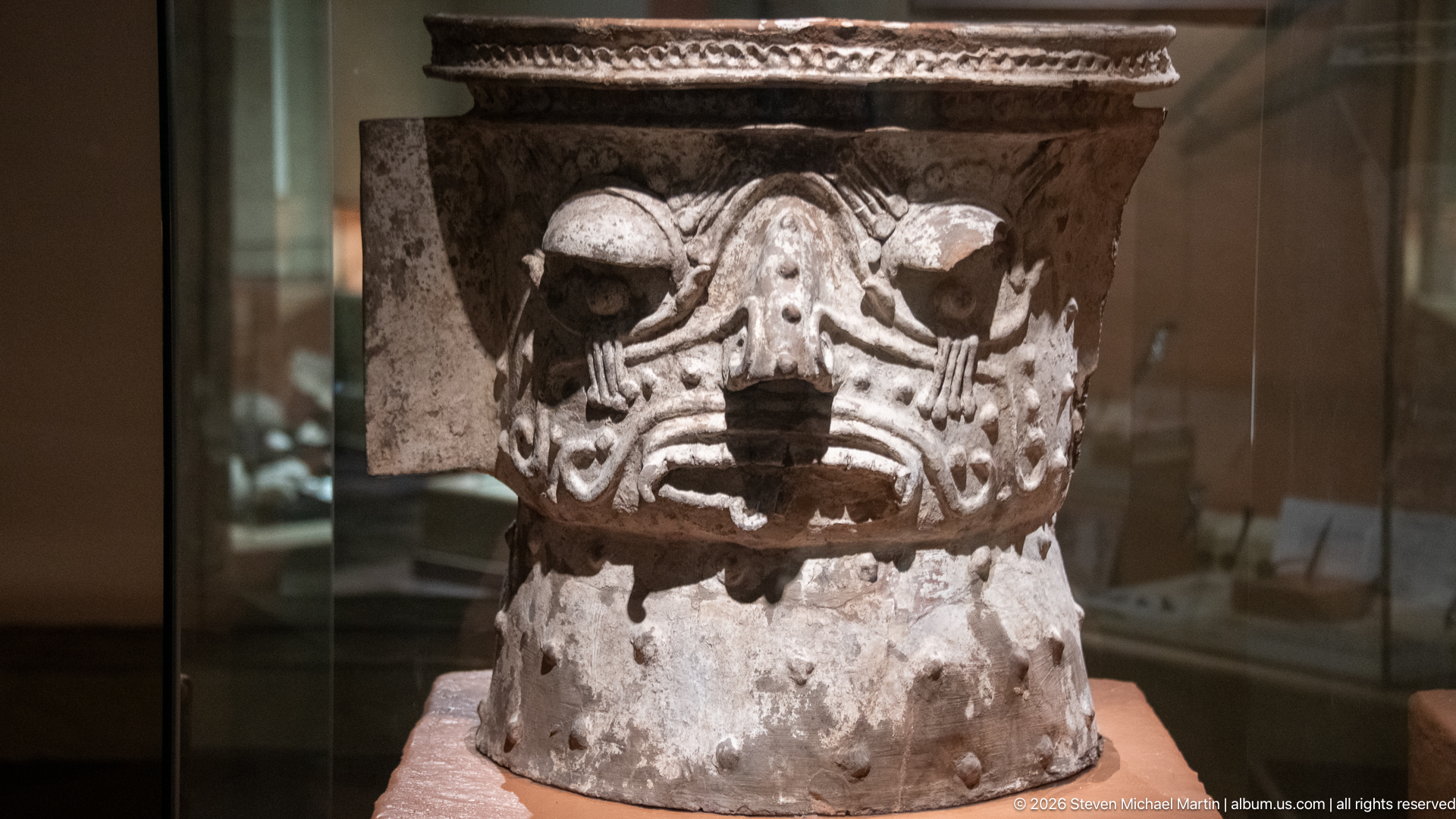
A substantial stone vessel or altar element is carved with a frontal face framed by curling forms and flanked by smaller heads. Its broad circular rim is patterned with repeating marks, while the pale surface is worn and chipped in places. The image looks directly at the carved side, making the central face and symmetrical ornament the focus rather than the object’s full setting.
Caption
A substantial stone vessel or altar element is carved with a frontal face framed by curling forms and flanked by smaller heads. Its broad circular rim is patterned with repeating marks, while the pale surface is worn and chipped in places. The image looks directly at the carved side, making the central face and symmetrical ornament the focus rather than the object’s full setting.
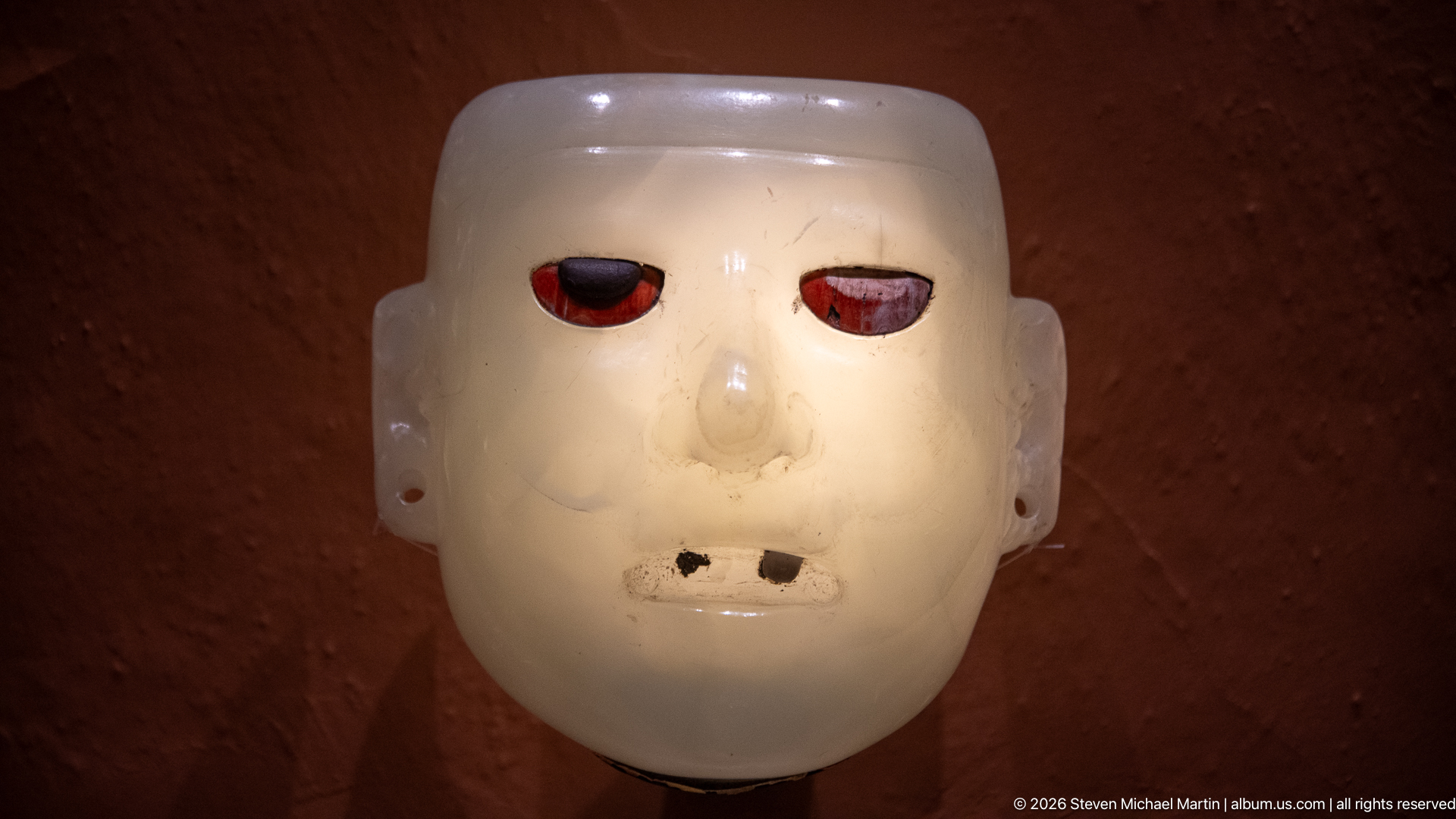
A pale, smoothly finished mask faces forward against a dark red background. Its almond-shaped eyes are painted or inset in vivid red and black, while the nose and mouth are simplified and symmetrical; small perforations appear near the sides. The close view isolates the mask’s striking color contrast and polished surface, while leaving its specific material and use open.
Caption
A pale, smoothly finished mask faces forward against a dark red background. Its almond-shaped eyes are painted or inset in vivid red and black, while the nose and mouth are simplified and symmetrical; small perforations appear near the sides. The close view isolates the mask’s striking color contrast and polished surface, while leaving its specific material and use open.
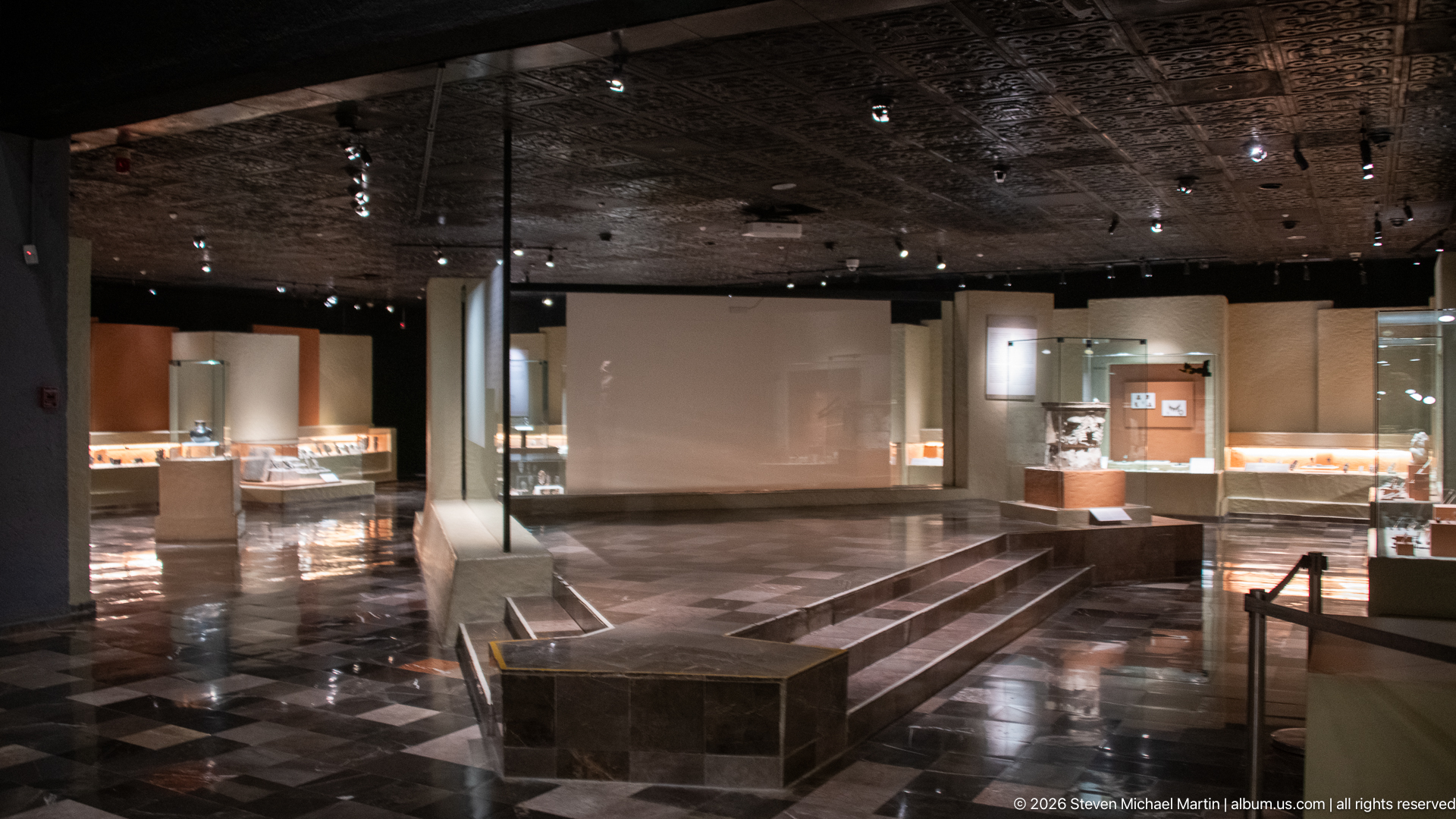
A spacious, dim gallery opens around a central raised platform reached by broad steps. Glass cases along the walls display smaller artifacts under warm lighting, while patterned ceiling panels and polished stone flooring reflect the illumination. The wide composition emphasizes the museum’s layout and the contrast between the open central floor and the object-filled perimeter.
Caption
A spacious, dim gallery opens around a central raised platform reached by broad steps. Glass cases along the walls display smaller artifacts under warm lighting, while patterned ceiling panels and polished stone flooring reflect the illumination. The wide composition emphasizes the museum’s layout and the contrast between the open central floor and the object-filled perimeter.
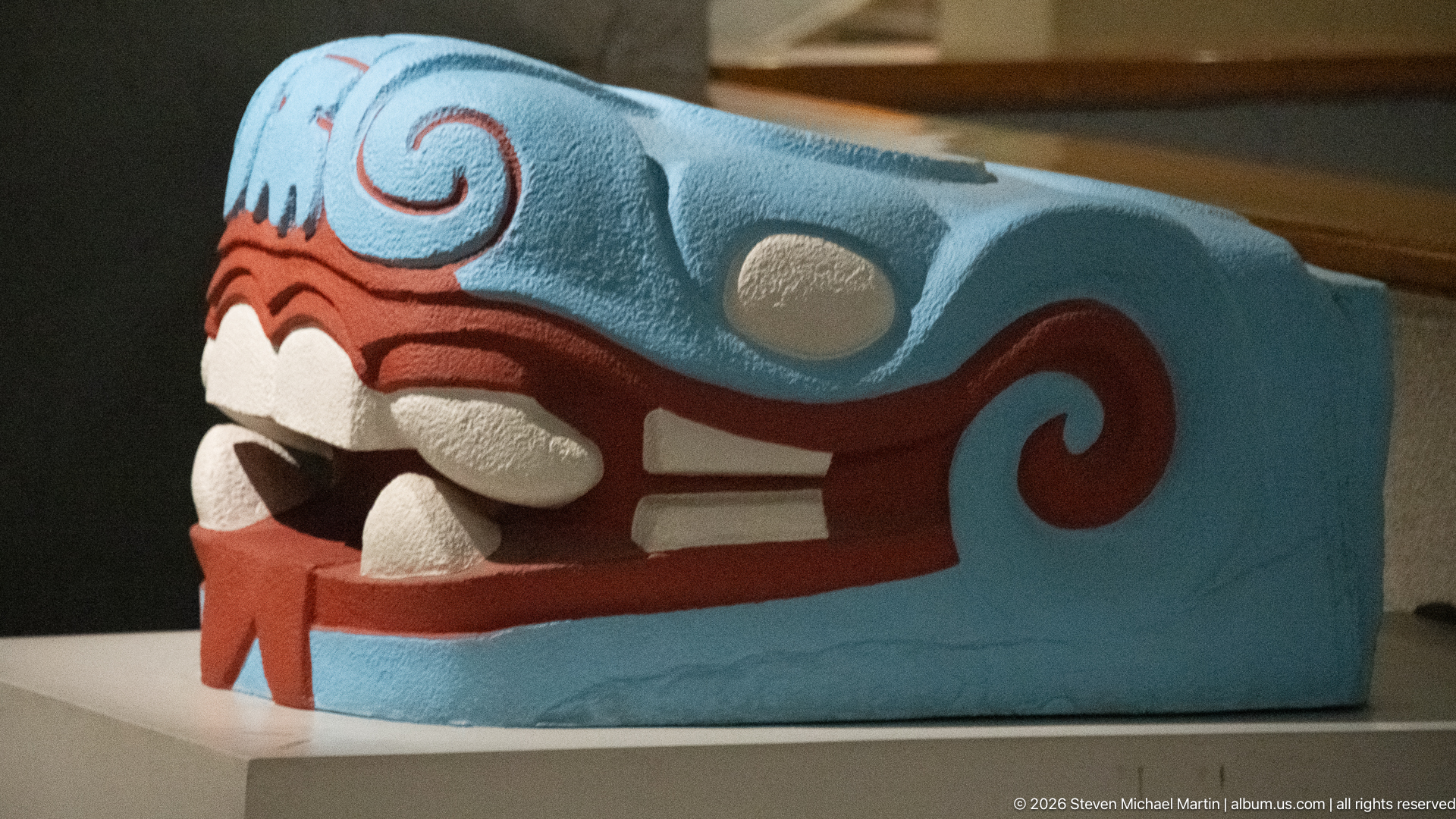
A brightly painted sculptural head fills the frame, combining a blue upper surface, red-and-white eye and mouth details, pale fangs, and a curling blue motif along the side. The open jaws and bold color blocks create a dramatic profile. The image records the object as a close detail; its exact species or mythological identity is not confirmed by visible labeling.
Caption
A brightly painted sculptural head fills the frame, combining a blue upper surface, red-and-white eye and mouth details, pale fangs, and a curling blue motif along the side. The open jaws and bold color blocks create a dramatic profile. The image records the object as a close detail; its exact species or mythological identity is not confirmed by visible labeling.
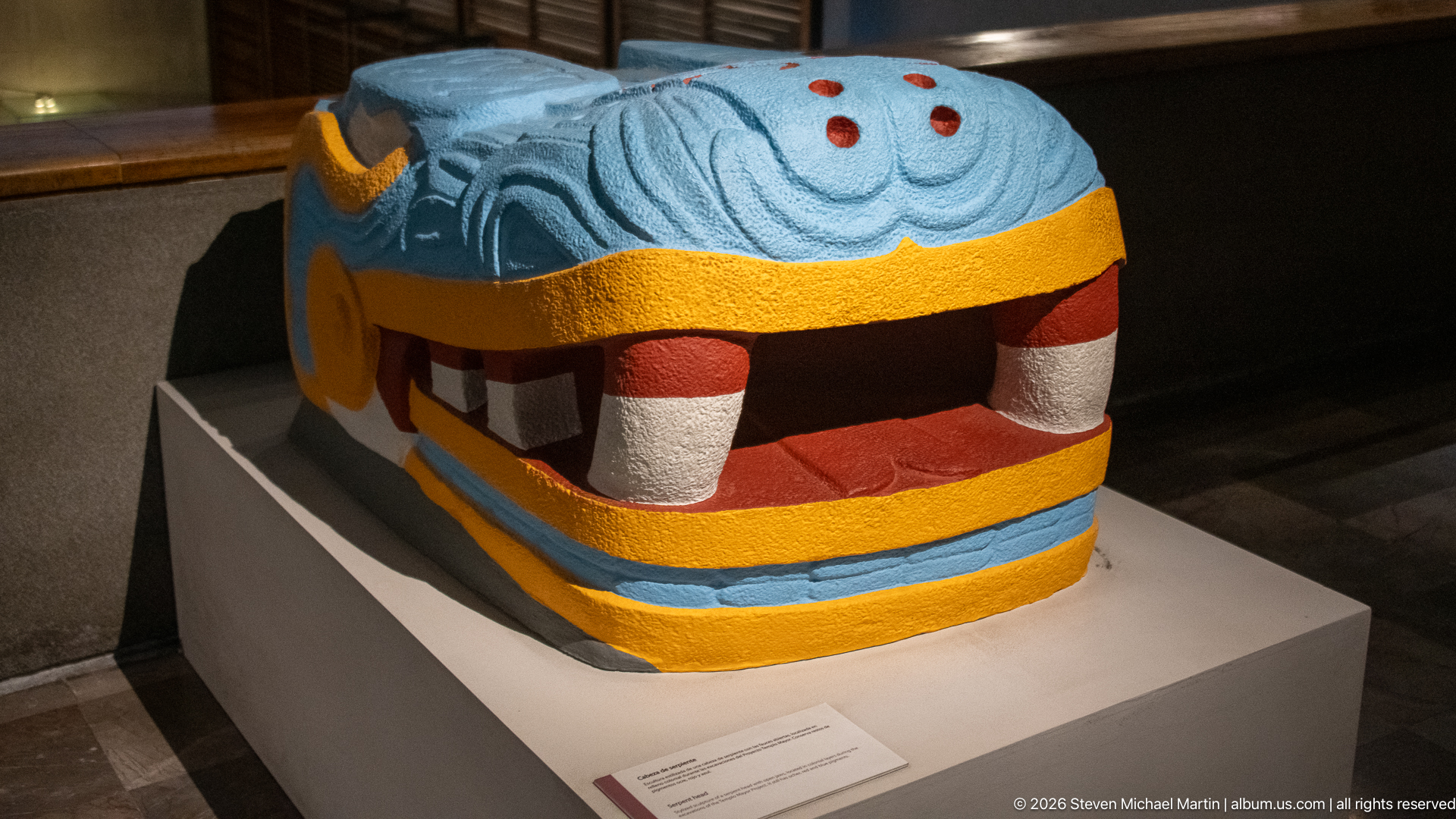
A low rectangular object rests on a white plinth, its upper surface painted blue with raised swirling forms and red circular marks. Yellow, red, and blue bands wrap the sides above short pale supports, giving the piece the appearance of a compact platform or altar. The oblique angle shows both its painted top and striped base; the exact function is not established here.
Caption
A low rectangular object rests on a white plinth, its upper surface painted blue with raised swirling forms and red circular marks. Yellow, red, and blue bands wrap the sides above short pale supports, giving the piece the appearance of a compact platform or altar. The oblique angle shows both its painted top and striped base; the exact function is not established here.
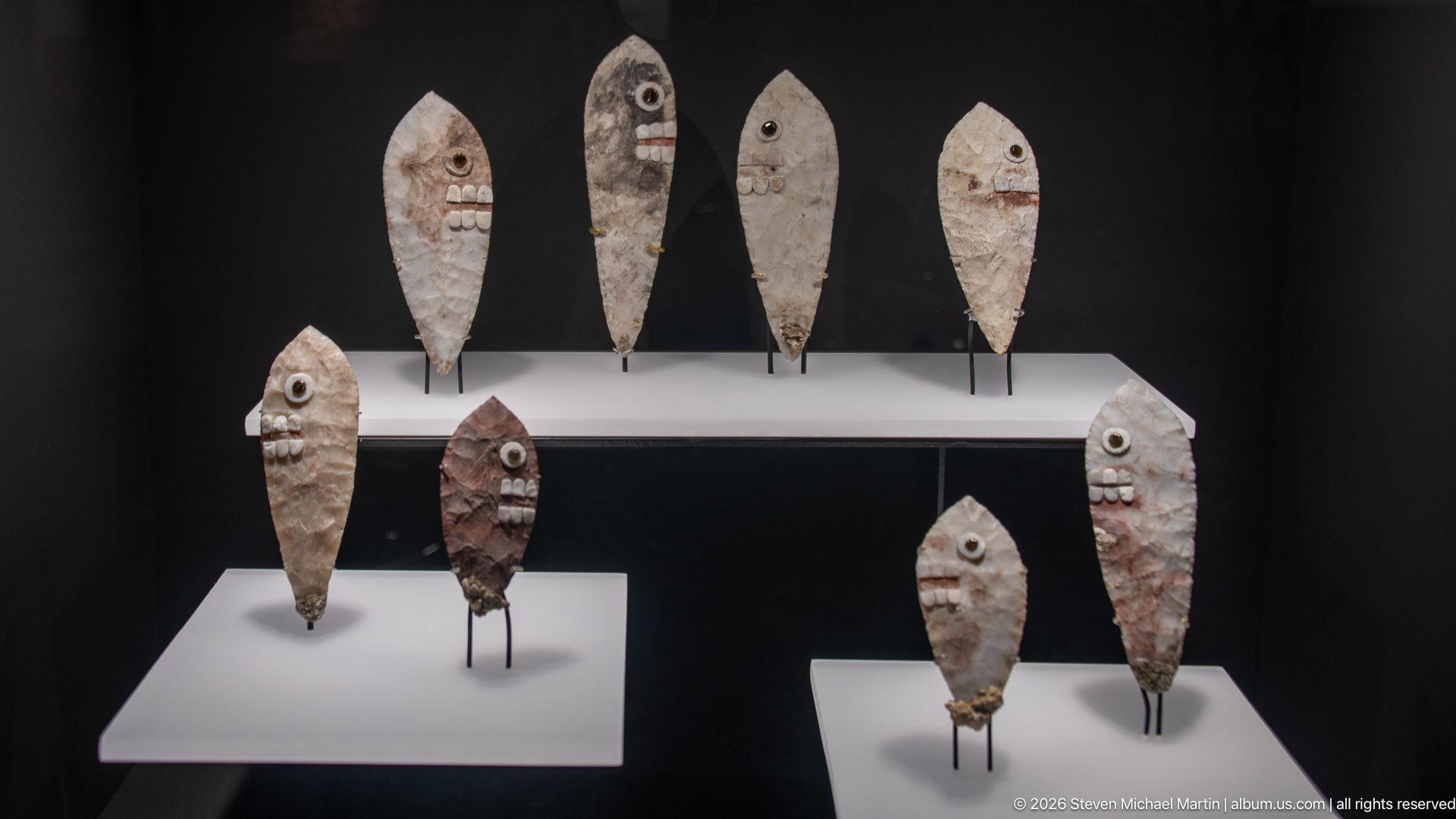
Seven elongated stone pieces are arranged upright on staggered white platforms against a black gallery wall. Each has a pointed or rounded upper end, a circular eye-like feature, and a short row of blocky teeth, giving the group a repeated face-like appearance. Variations in color and surface wear distinguish the individual objects while their shared form creates a deliberate series.
Caption
Seven elongated stone pieces are arranged upright on staggered white platforms against a black gallery wall. Each has a pointed or rounded upper end, a circular eye-like feature, and a short row of blocky teeth, giving the group a repeated face-like appearance. Variations in color and surface wear distinguish the individual objects while their shared form creates a deliberate series.
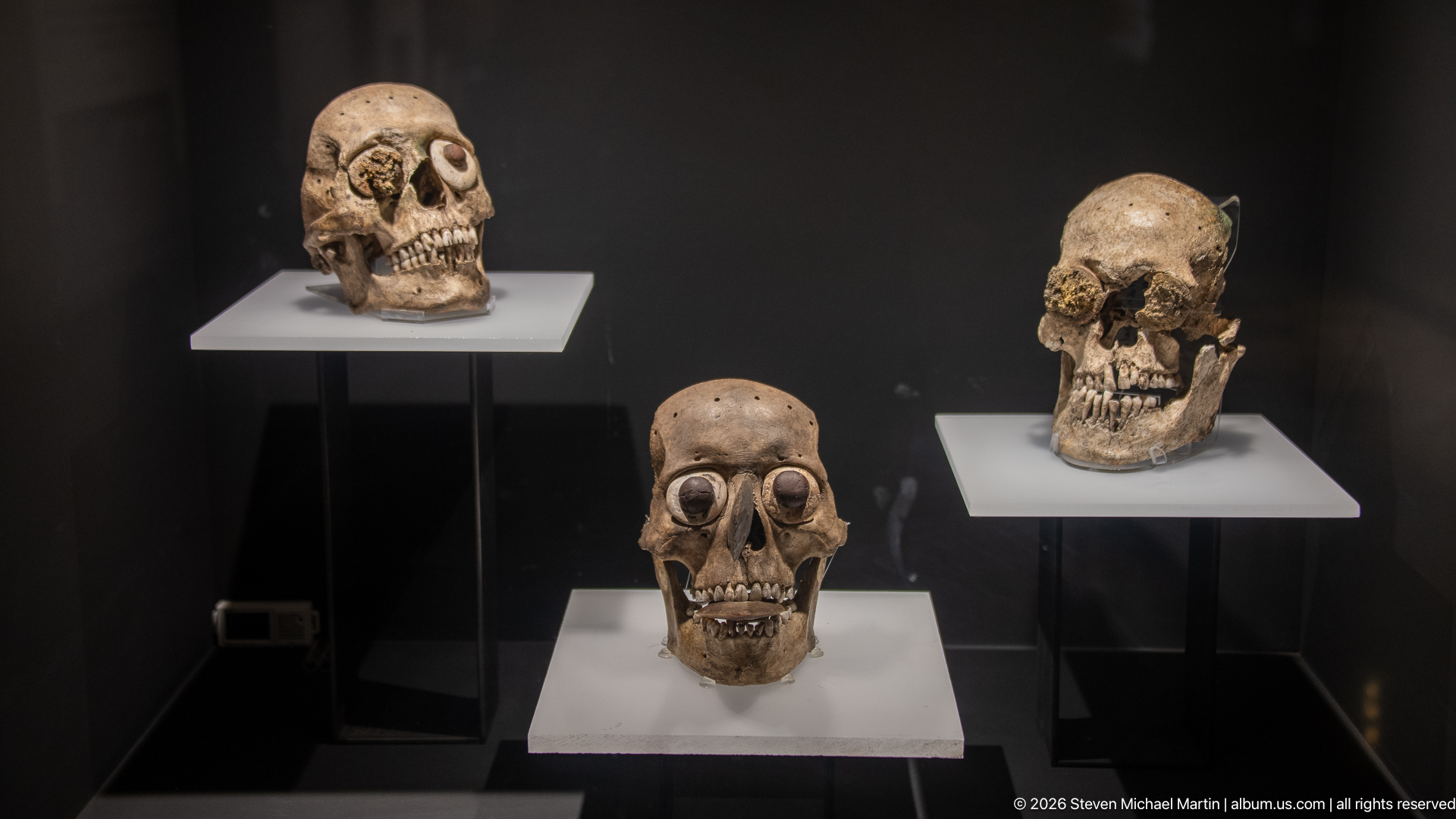
Three human skulls are isolated on separate white plinths inside a dark display case. The left cranium has a pronounced opening or deformation at the front, the central skull faces forward with large eye sockets, and the right skull is turned partly sideways. Directional lighting makes differences in preservation and form visible without assigning a specific individual or ritual role.
Caption
Three human skulls are isolated on separate white plinths inside a dark display case. The left cranium has a pronounced opening or deformation at the front, the central skull faces forward with large eye sockets, and the right skull is turned partly sideways. Directional lighting makes differences in preservation and form visible without assigning a specific individual or ritual role.
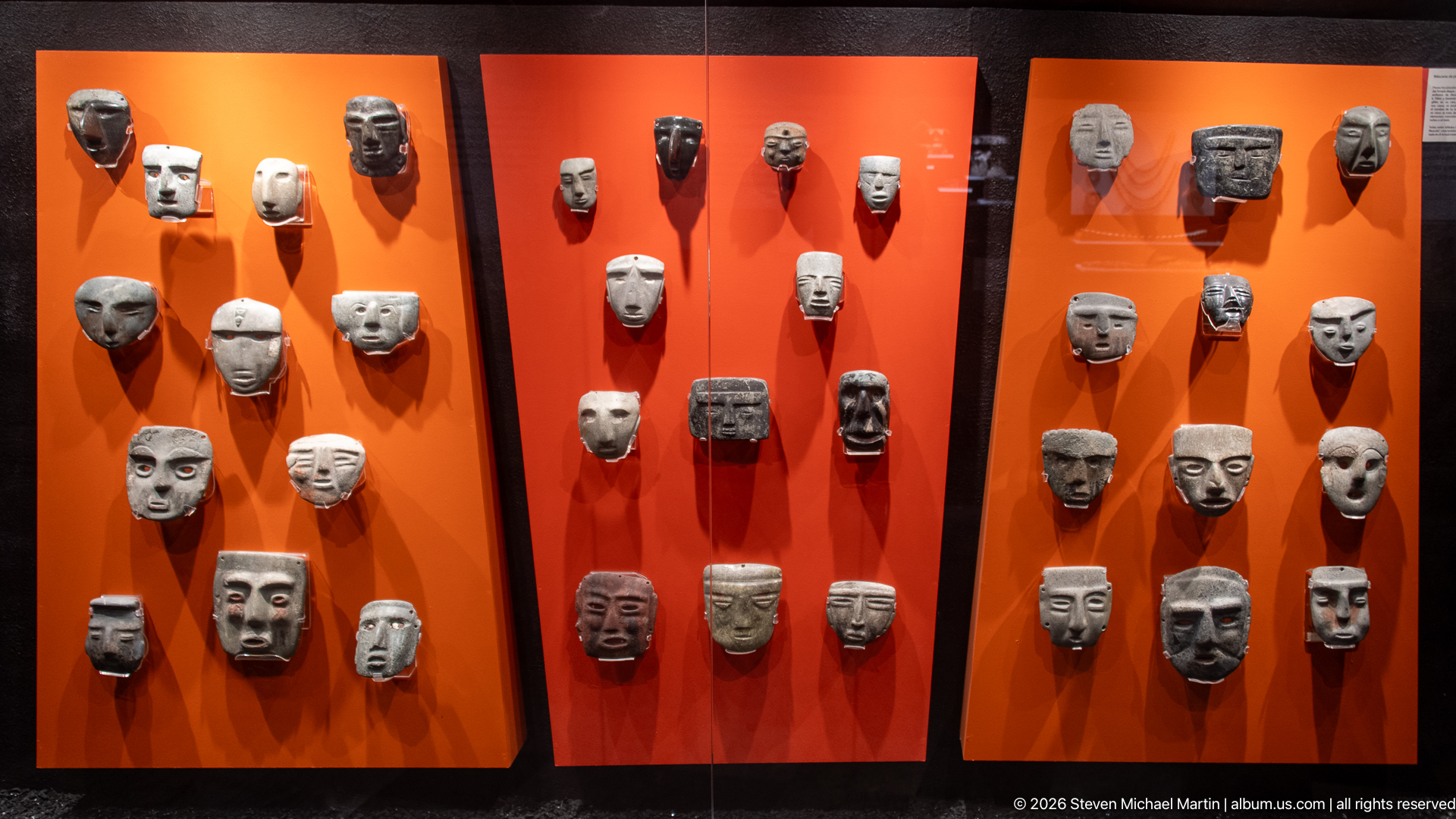
Rows of carved stone faces are mounted across three bright orange panels. The heads vary in size, expression, color, and surface treatment; some are pale and smooth, while others are dark or heavily weathered. Their repeated frontal arrangement invites comparison across the collection, presenting face imagery as a broad category without asserting that all pieces share one date or function.
Caption
Rows of carved stone faces are mounted across three bright orange panels. The heads vary in size, expression, color, and surface treatment; some are pale and smooth, while others are dark or heavily weathered. Their repeated frontal arrangement invites comparison across the collection, presenting face imagery as a broad category without asserting that all pieces share one date or function.
A reddish, heavily weathered stone head rests on a low support, its broad nose, round eyes, and open mouth still legible despite missing and eroded areas. The close three-quarter view emphasizes its irregular surface and substantial scale within the case. A small label is present but unreadable at this size, so the figure’s identity remains open.
Caption
A reddish, heavily weathered stone head rests on a low support, its broad nose, round eyes, and open mouth still legible despite missing and eroded areas. The close three-quarter view emphasizes its irregular surface and substantial scale within the case. A small label is present but unreadable at this size, so the figure’s identity remains open.
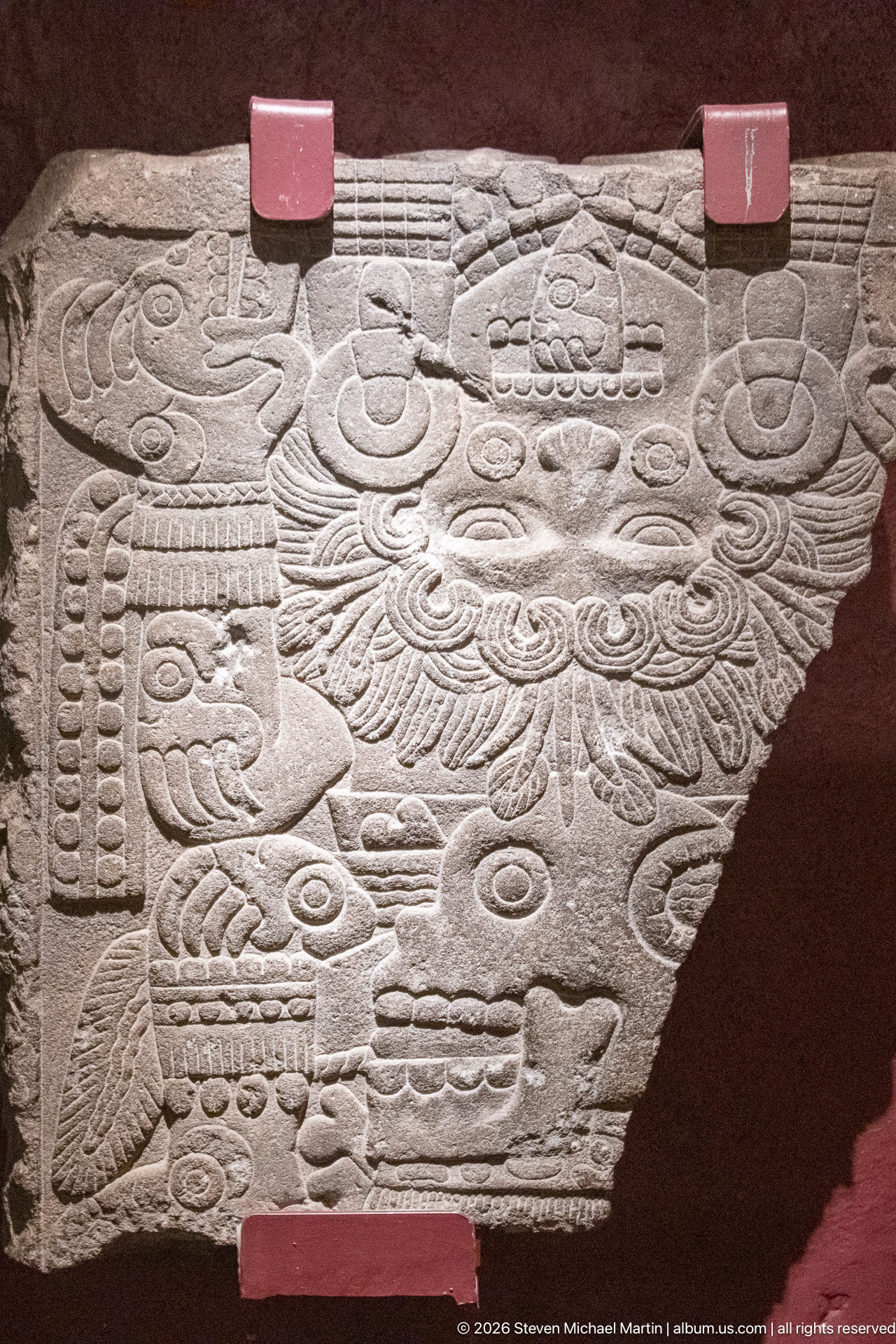
A broad pale stone slab is densely carved with two mirrored profile figures and a central vertical design. Feather-like forms, bands, and repeated geometric details fill the surface, which is held upright by red supports. The close, frontal view reveals the relief’s bilateral composition and shallow modeling, while leaving its original architectural placement and exact subject unassigned.
Caption
A broad pale stone slab is densely carved with two mirrored profile figures and a central vertical design. Feather-like forms, bands, and repeated geometric details fill the surface, which is held upright by red supports. The close, frontal view reveals the relief’s bilateral composition and shallow modeling, while leaving its original architectural placement and exact subject unassigned.
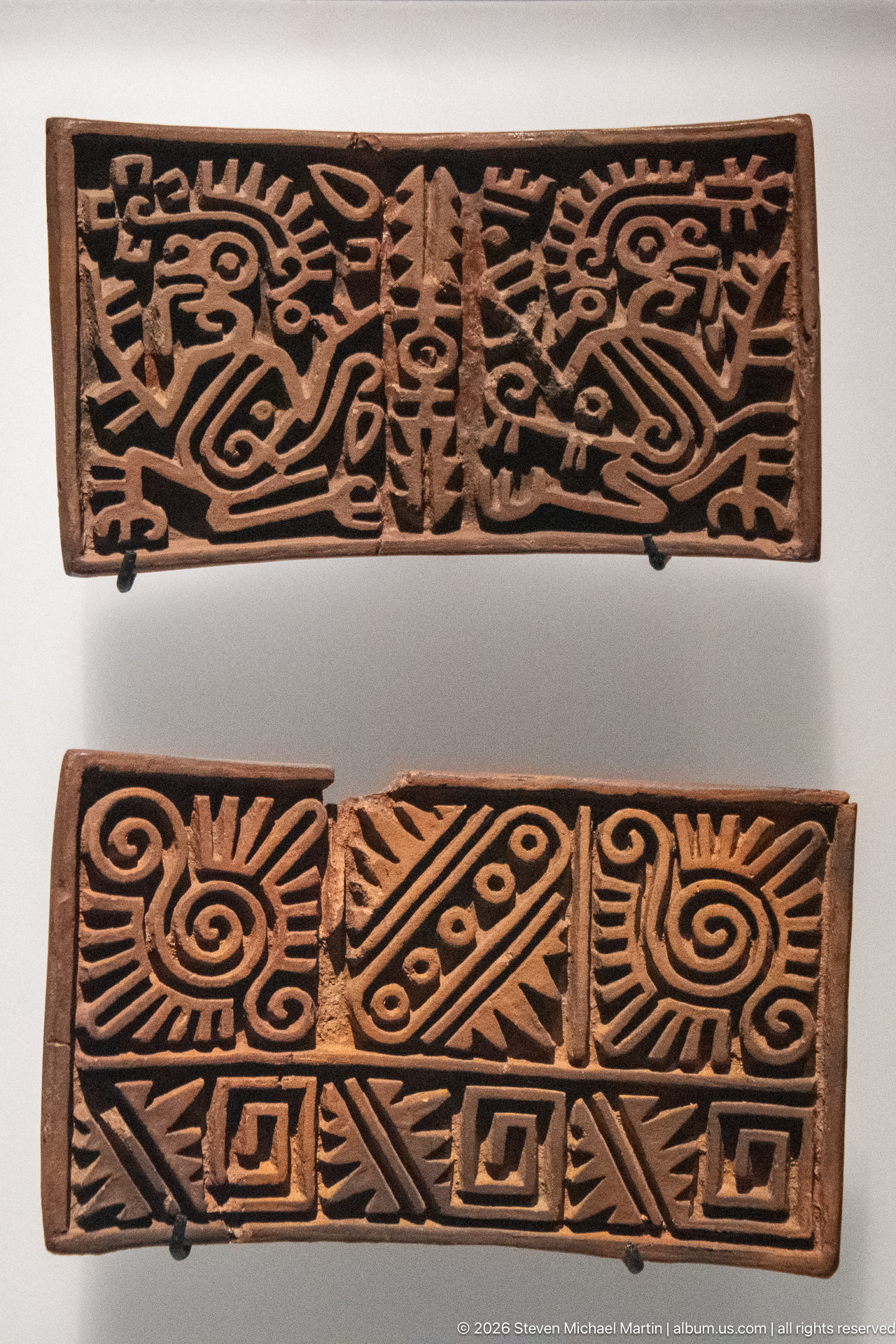
Two long wooden panels hang against a pale gallery wall, each carved with dense dark patterns. The upper piece combines interlaced curves and repeated symbols; the lower is divided into geometric registers with alternating spirals, diagonals, and stepped forms. Their arrangement invites comparison of the carved designs, while the image offers no firm basis for assigning a particular function or date.
Caption
Two long wooden panels hang against a pale gallery wall, each carved with dense dark patterns. The upper piece combines interlaced curves and repeated symbols; the lower is divided into geometric registers with alternating spirals, diagonals, and stepped forms. Their arrangement invites comparison of the carved designs, while the image offers no firm basis for assigning a particular function or date.
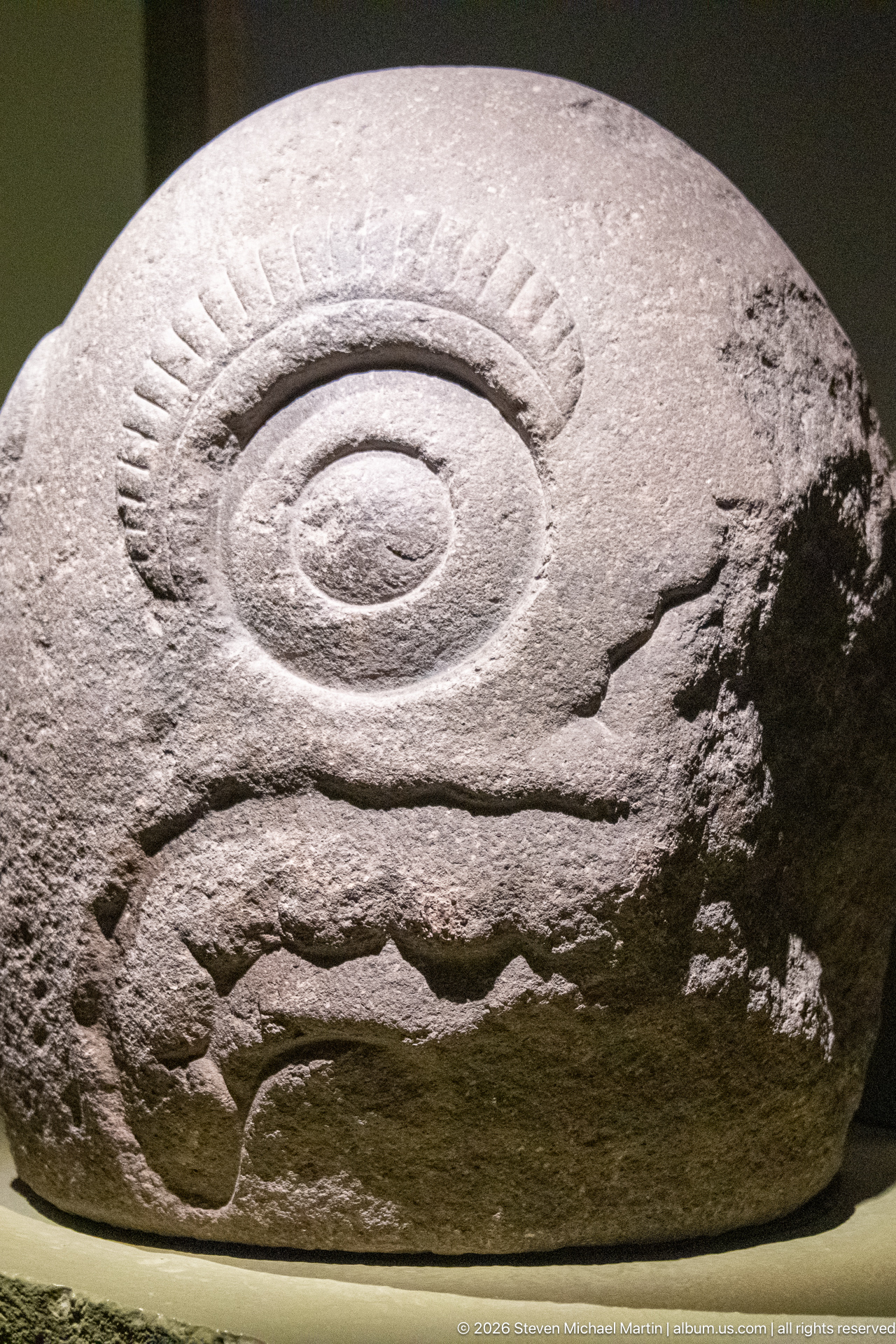
A shallow carved design fills a pale stone surface, centered on a large curled eye-like motif above a long, projecting profile form. The close crop reveals incised curves, a textured border, and weathered breaks along the edge. Its graphic simplicity contrasts with the dense assemblages on nearby pages, but its represented being is not securely identifiable from this detail alone.
Caption
A shallow carved design fills a pale stone surface, centered on a large curled eye-like motif above a long, projecting profile form. The close crop reveals incised curves, a textured border, and weathered breaks along the edge. Its graphic simplicity contrasts with the dense assemblages on nearby pages, but its represented being is not securely identifiable from this detail alone.
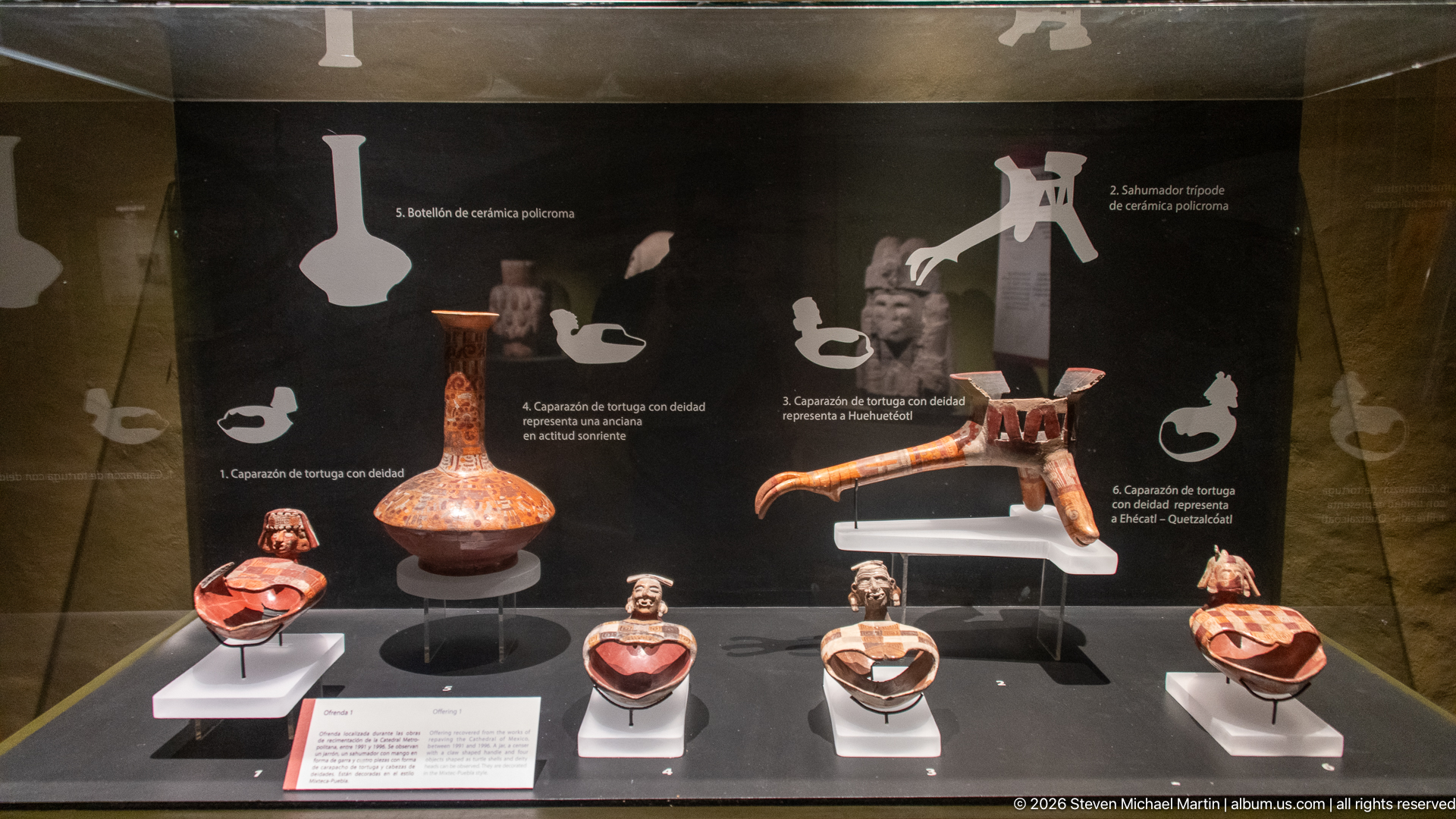
A glass case displays painted ceramic vessels, sculpted animal forms, and small modeled objects beneath a Spanish-language panel. The label names a “botellón de cerámica polícroma” and discusses turtle-shell figures associated with deities, including Huitzilopochtli and Ehecatl–Quetzalcoatl. The explanatory graphics connect the varied forms to named figures while keeping each object separately visible.
Caption
A glass case displays painted ceramic vessels, sculpted animal forms, and small modeled objects beneath a Spanish-language panel. The label names a “botellón de cerámica polícroma” and discusses turtle-shell figures associated with deities, including Huitzilopochtli and Ehecatl–Quetzalcoatl. The explanatory graphics connect the varied forms to named figures while keeping each object separately visible.
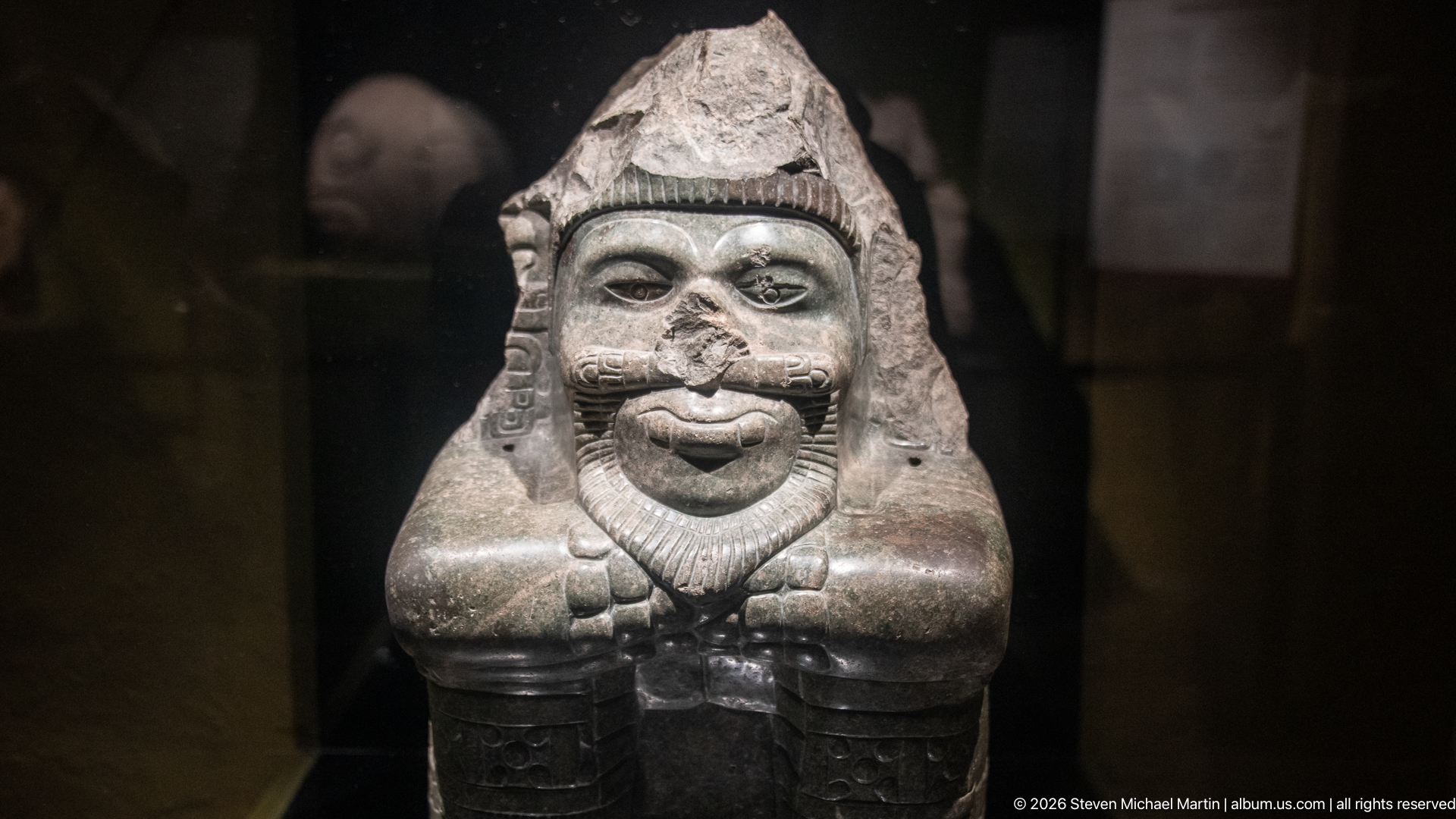
A dark stone figure sits upright with arms crossed over the chest, wearing a high, angular headdress and a broad collar. The frontal posture and carefully carved facial features remain clear against the black background. Soft light reveals the stone’s mottled surface and worn edges, while the museum setting isolates the sculpture from its original architectural or ceremonial context.
Caption
A dark stone figure sits upright with arms crossed over the chest, wearing a high, angular headdress and a broad collar. The frontal posture and carefully carved facial features remain clear against the black background. Soft light reveals the stone’s mottled surface and worn edges, while the museum setting isolates the sculpture from its original architectural or ceremonial context.
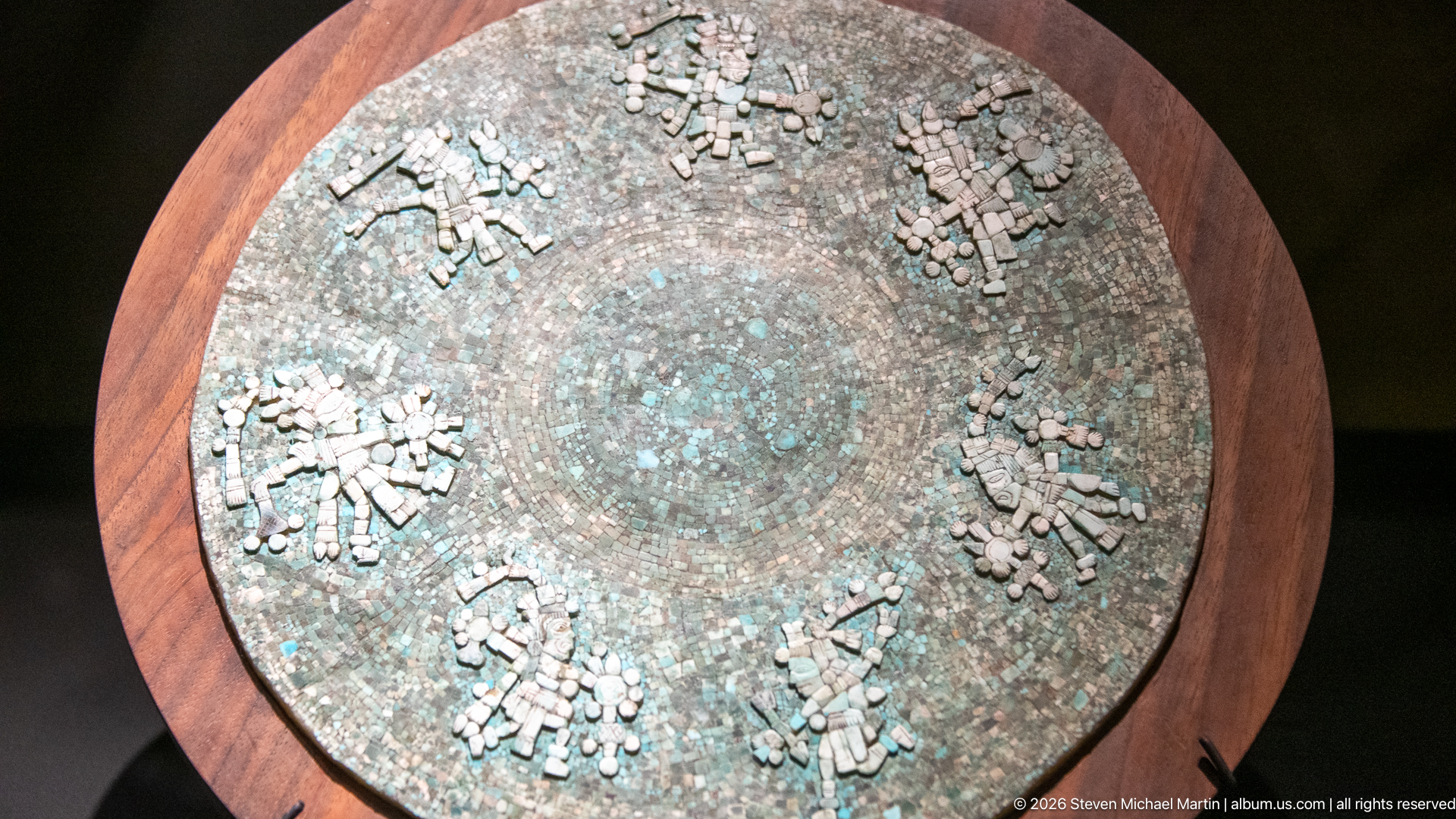
A large circular object fills the case, its green-blue surface densely patterned with clusters of small pale pieces. The repeated groups radiate and curve across the disk, set within a reddish outer rim. Viewed almost overhead, the composition reveals the object’s patterned surface but not its material, function, or original placement; those details require the museum label.
Caption
A large circular object fills the case, its green-blue surface densely patterned with clusters of small pale pieces. The repeated groups radiate and curve across the disk, set within a reddish outer rim. Viewed almost overhead, the composition reveals the object’s patterned surface but not its material, function, or original placement; those details require the museum label.
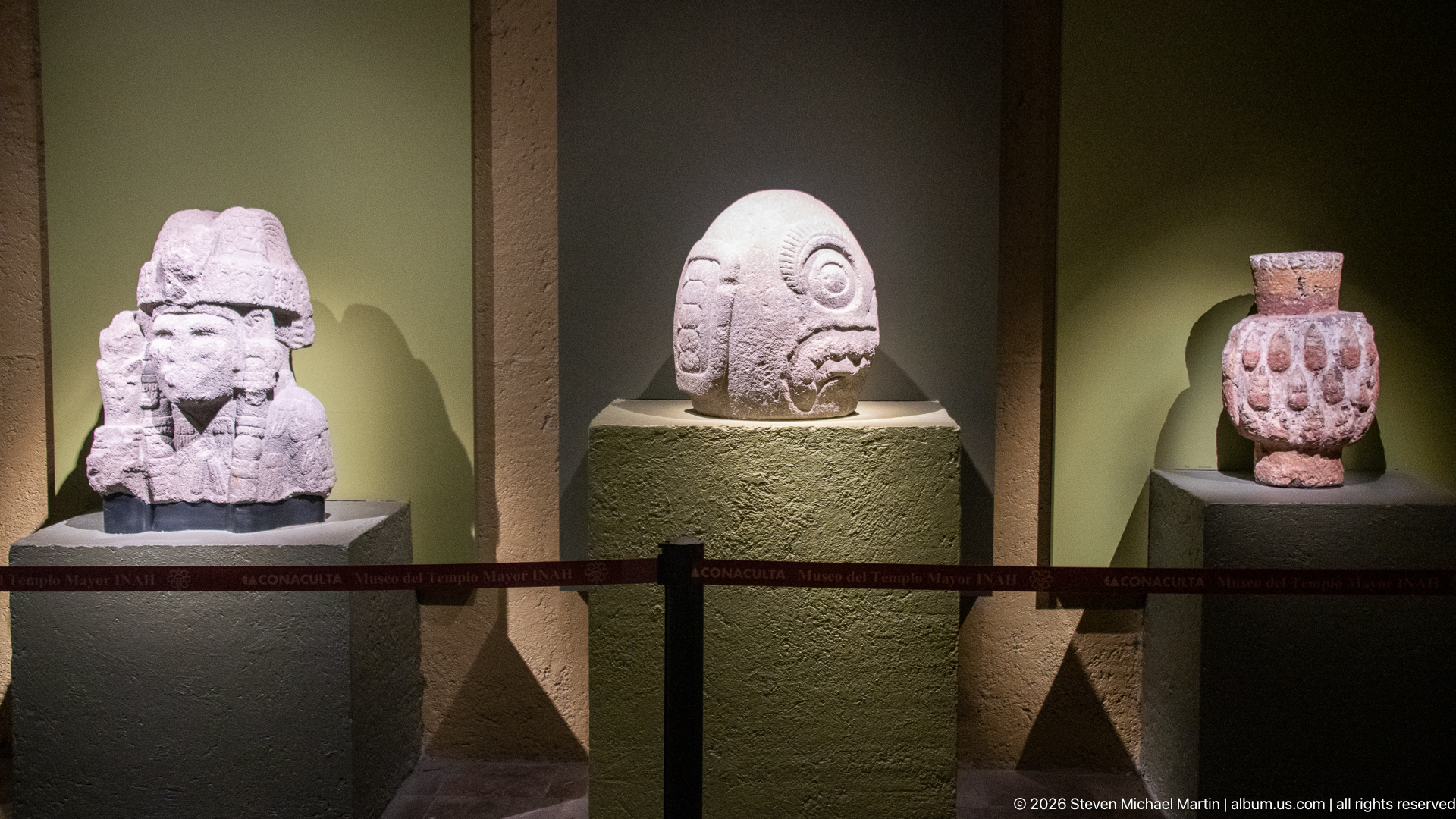
Three objects occupy individual niches: a seated figure at left, a large head with circular side features in the center, and a small reddish vessel at right. The varied scale and material are emphasized by separate spotlights and green wall panels. A barrier strip repeats the museum’s name, situating the objects in a curated gallery rather than an excavation in place.
Caption
Three objects occupy individual niches: a seated figure at left, a large head with circular side features in the center, and a small reddish vessel at right. The varied scale and material are emphasized by separate spotlights and green wall panels. A barrier strip repeats the museum’s name, situating the objects in a curated gallery rather than an excavation in place.
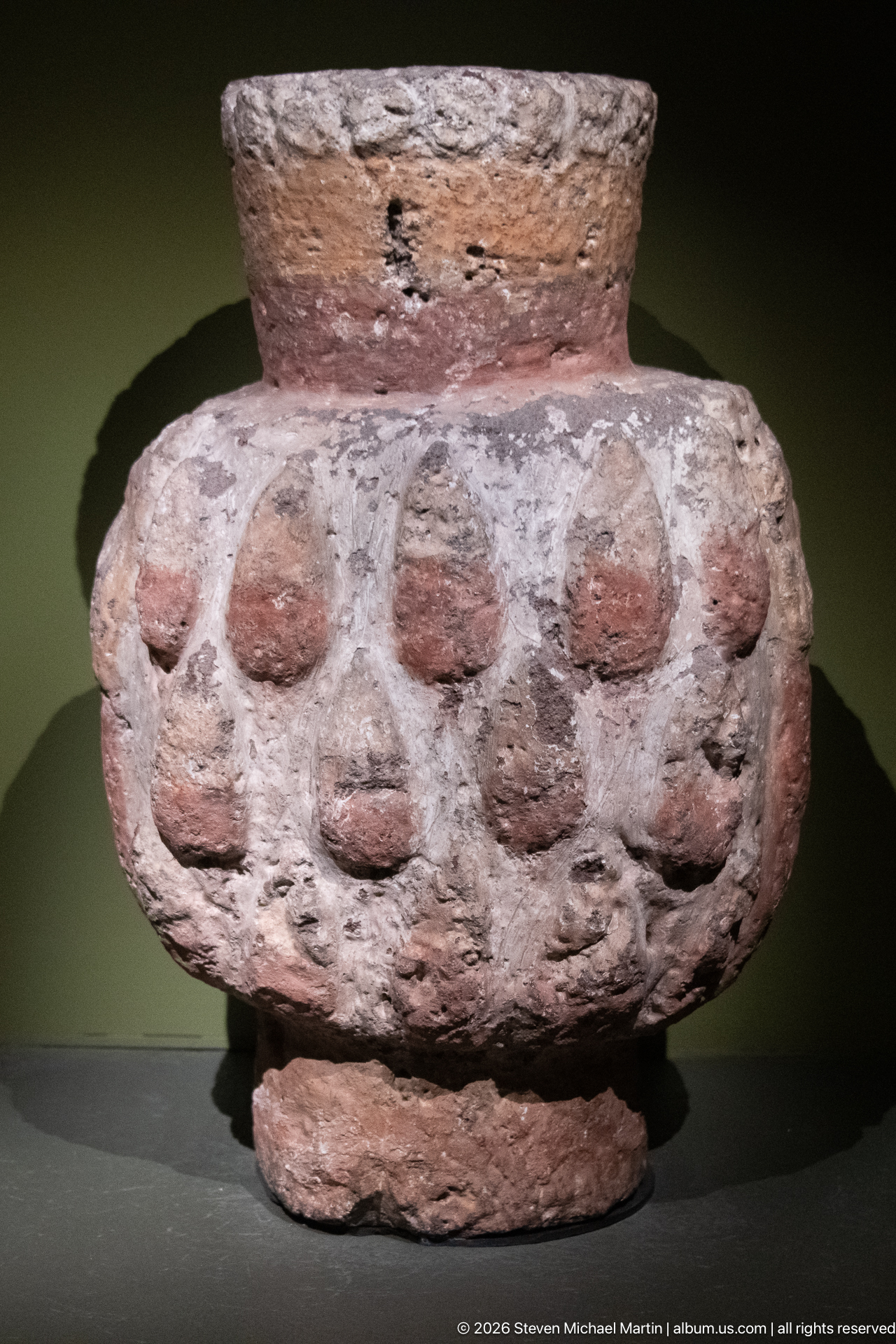
A compact reddish vessel is photographed against a dark case, its wide rounded body tapering to a short cylindrical neck. The surface is mottled and worn, with darker marks and lighter areas around the rim. The straightforward profile view makes its form the subject; without a readable label, its contents, use, and more specific classification remain uncertain.
Caption
A compact reddish vessel is photographed against a dark case, its wide rounded body tapering to a short cylindrical neck. The surface is mottled and worn, with darker marks and lighter areas around the rim. The straightforward profile view makes its form the subject; without a readable label, its contents, use, and more specific classification remain uncertain.
A broad stone fragment presents a horizontal face-like carving with a long nose, closed or recessed eyes, and layered bands below. The upper block is broken and uneven, exposing the object’s fragmentary condition. The frontal view makes the broad symmetry and surviving facial features legible while avoiding a more exact identification unsupported by the visible label.
Caption
A broad stone fragment presents a horizontal face-like carving with a long nose, closed or recessed eyes, and layered bands below. The upper block is broken and uneven, exposing the object’s fragmentary condition. The frontal view makes the broad symmetry and surviving facial features legible while avoiding a more exact identification unsupported by the visible label.
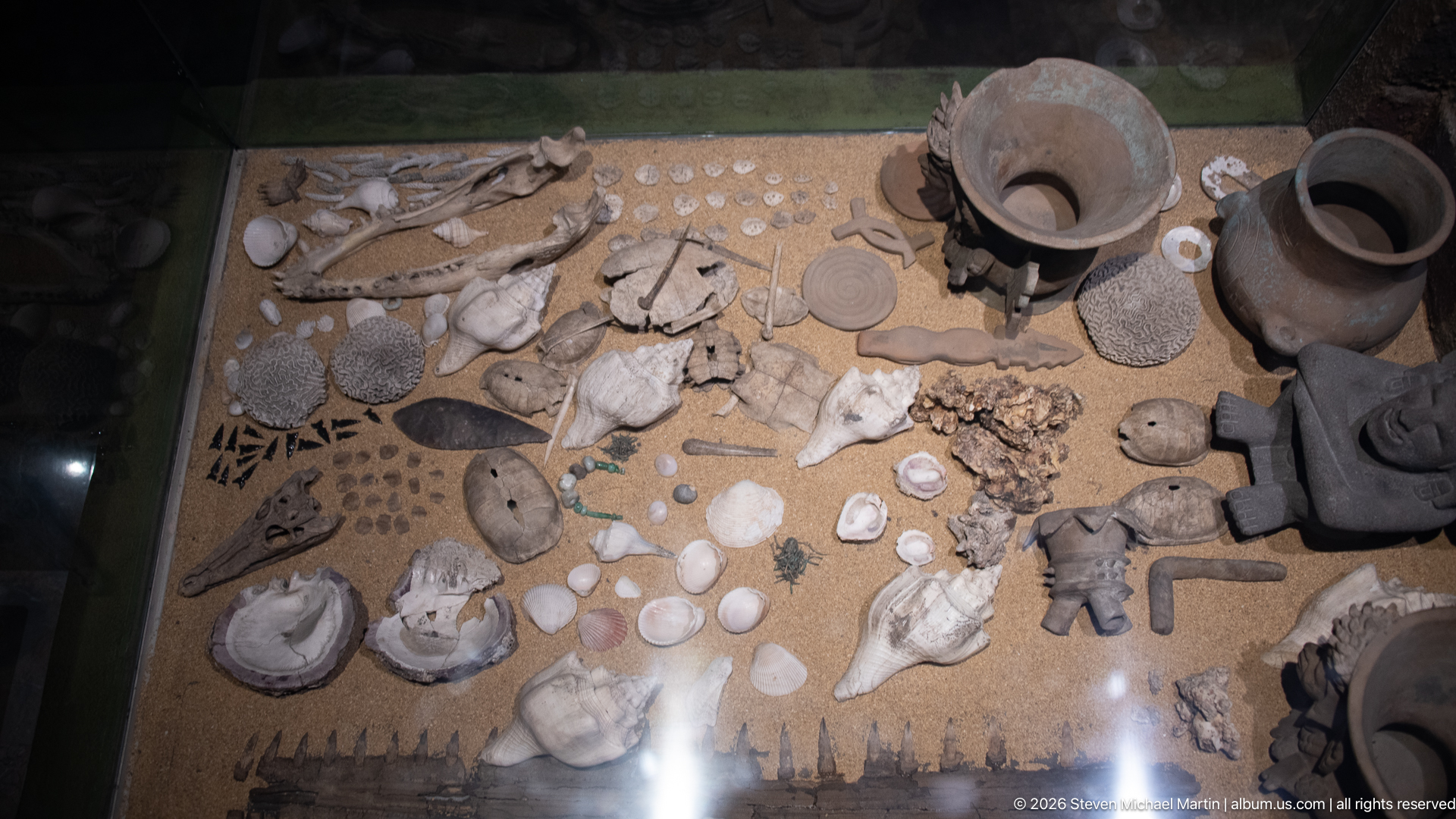
From above, a sandy case reveals a dense assortment of skulls, worked stones, pottery fragments, shells, beads, and small carved forms. Objects overlap in places, yet their varied colors and shapes remain distinguishable across the display. This overhead composition presents the breadth of the collection and the curatorial grouping of finds rather than a single object’s fine detail.
Caption
From above, a sandy case reveals a dense assortment of skulls, worked stones, pottery fragments, shells, beads, and small carved forms. Objects overlap in places, yet their varied colors and shapes remain distinguishable across the display. This overhead composition presents the breadth of the collection and the curatorial grouping of finds rather than a single object’s fine detail.
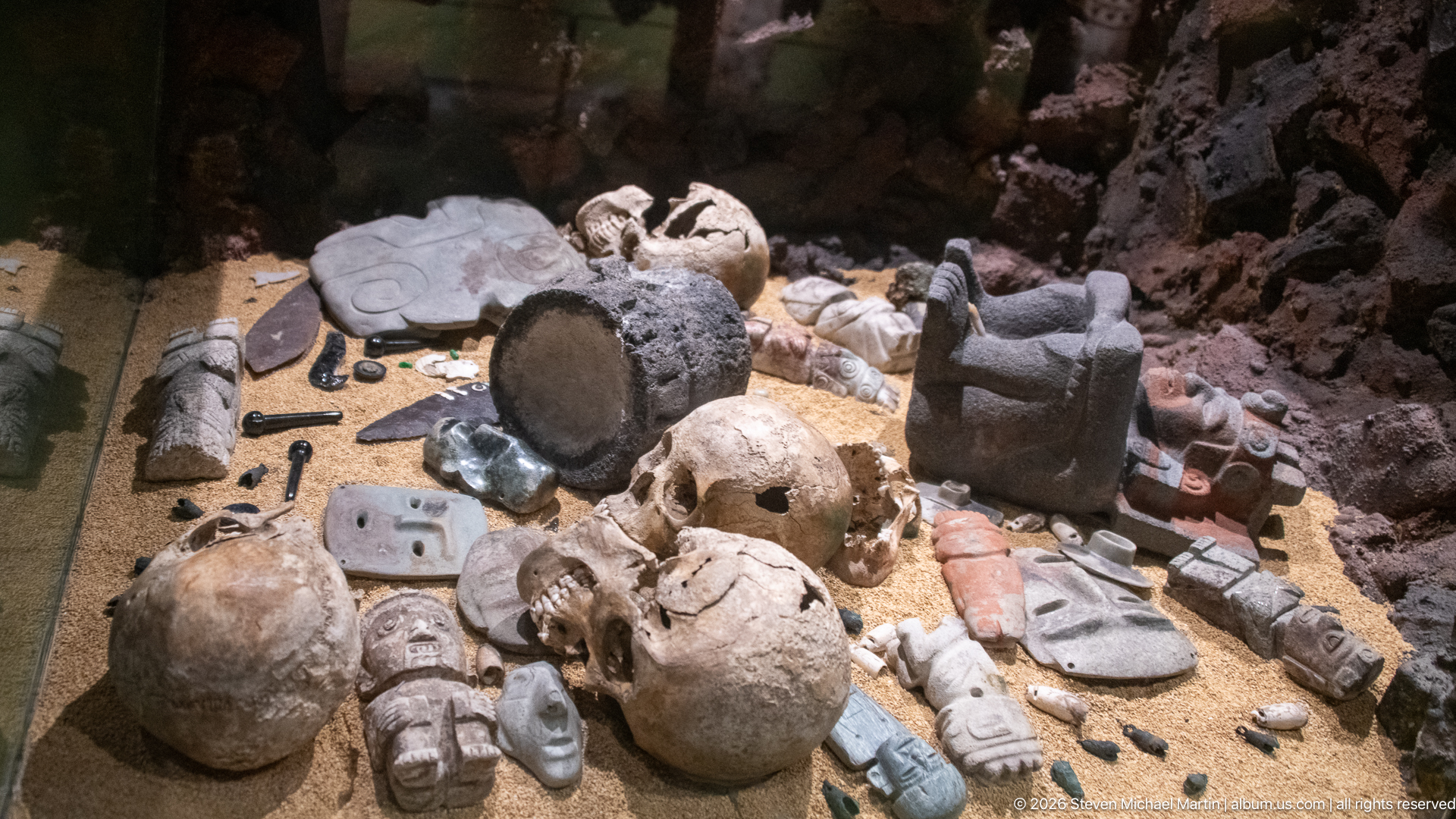
A sand-filled case gathers skulls, carved stone fragments, small vessels, and compact objects across a broad low platform. Their irregular arrangement suggests an assemblage selected for display, not an intact archaeological deposit. The view looks down across varied forms and materials, making the density of recovered objects and their differences in size more prominent than any single item.
Caption
A sand-filled case gathers skulls, carved stone fragments, small vessels, and compact objects across a broad low platform. Their irregular arrangement suggests an assemblage selected for display, not an intact archaeological deposit. The view looks down across varied forms and materials, making the density of recovered objects and their differences in size more prominent than any single item.
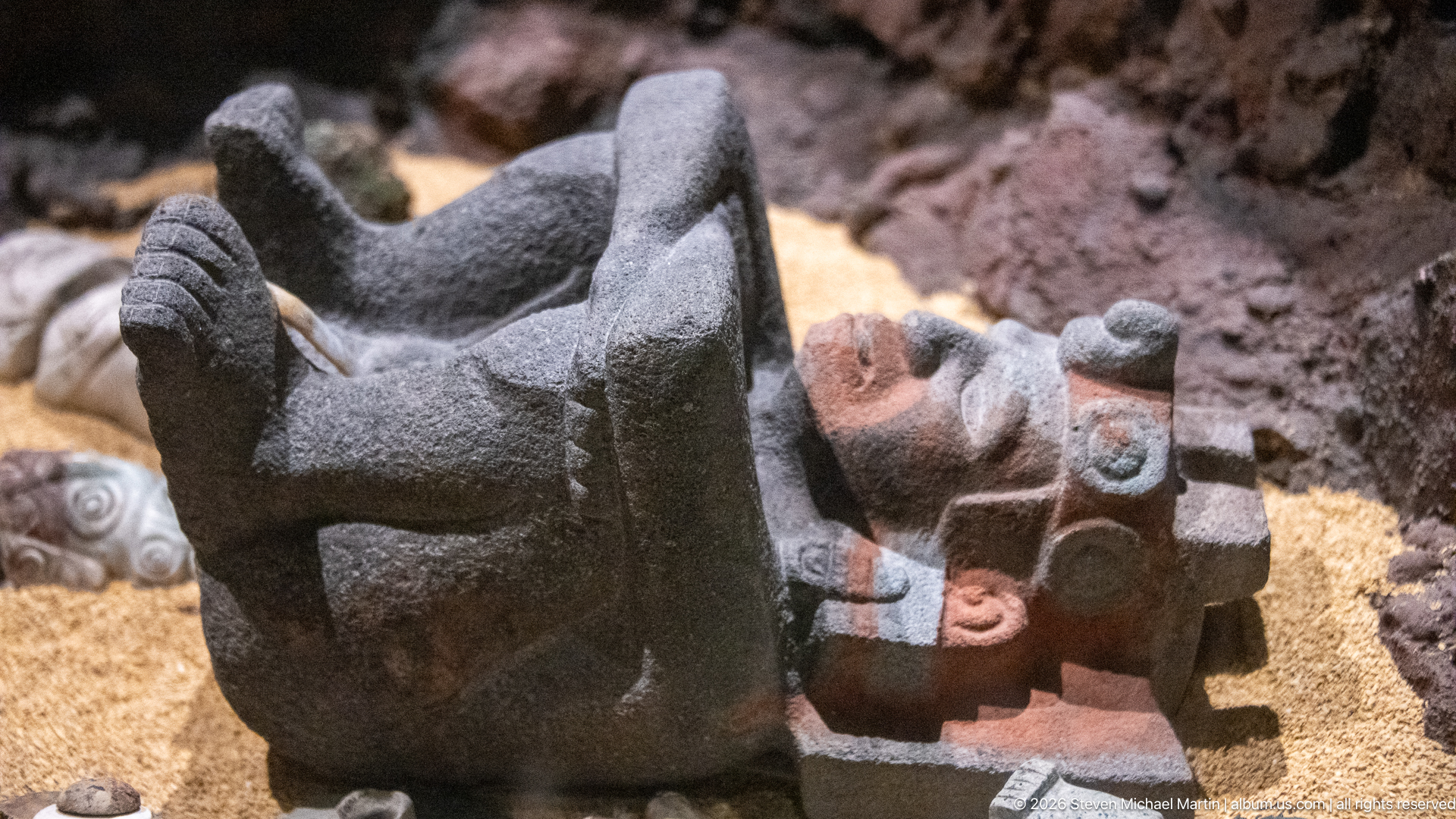
A dark gray figure sits with knees raised and hands resting near the legs, its tall back or headdress rising behind the head. The heavy body is carved in compact planes, with layered bands and incised details visible across the surface. Smaller reddish and pale objects remain in the background, but the central sculpture dominates the close museum view.
Caption
A dark gray figure sits with knees raised and hands resting near the legs, its tall back or headdress rising behind the head. The heavy body is carved in compact planes, with layered bands and incised details visible across the surface. Smaller reddish and pale objects remain in the background, but the central sculpture dominates the close museum view.
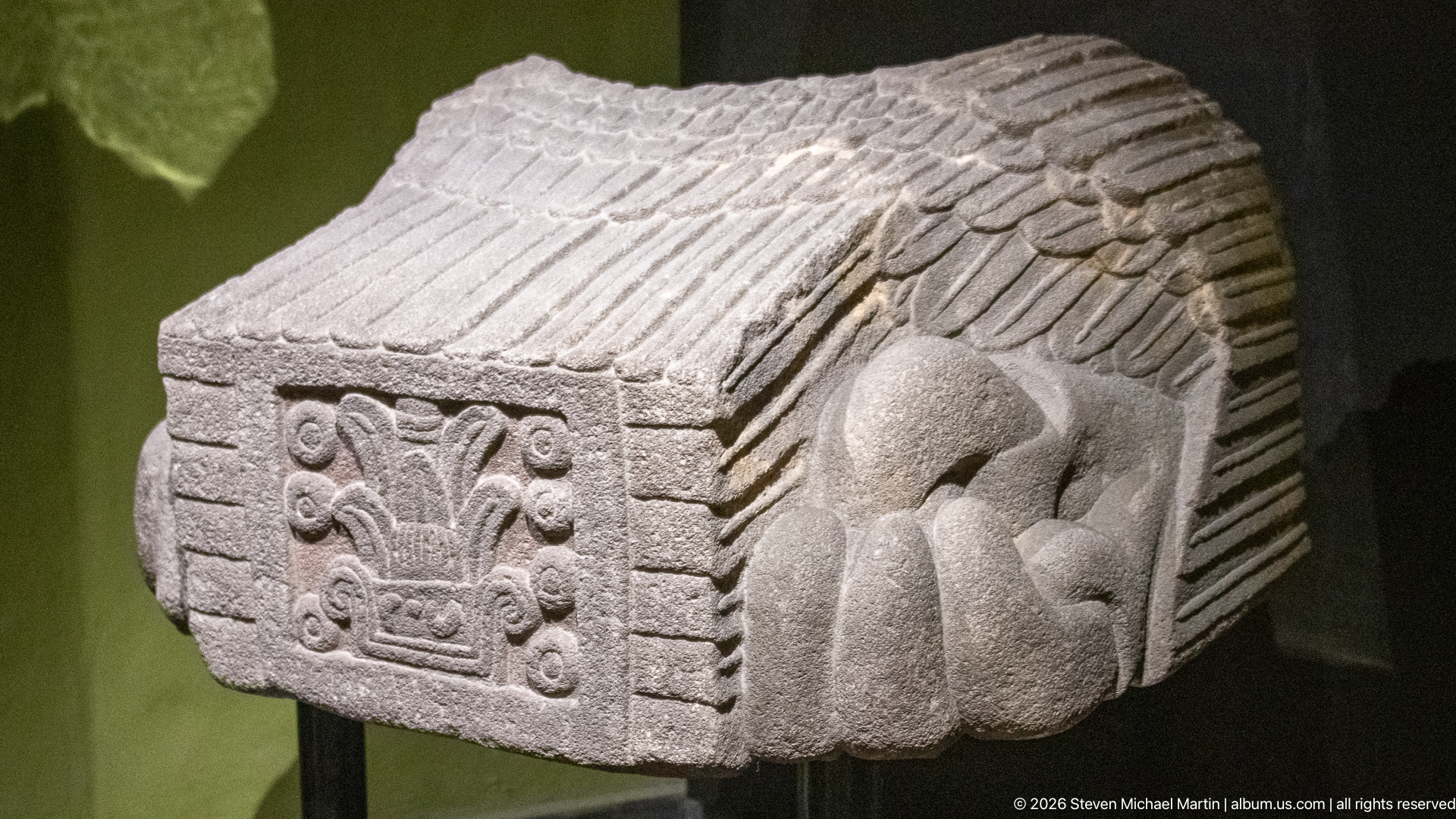
A gray stone object combines a steeply ridged roof, a carved frontal panel, and a seated figure projecting from one side. Its compact form resembles a miniature architectural structure, though the photograph cannot establish whether it functioned as a model, container, or ritual object. The close three-quarter angle makes its roof texture and patterned front the key evidence.
Caption
A gray stone object combines a steeply ridged roof, a carved frontal panel, and a seated figure projecting from one side. Its compact form resembles a miniature architectural structure, though the photograph cannot establish whether it functioned as a model, container, or ritual object. The close three-quarter angle makes its roof texture and patterned front the key evidence.
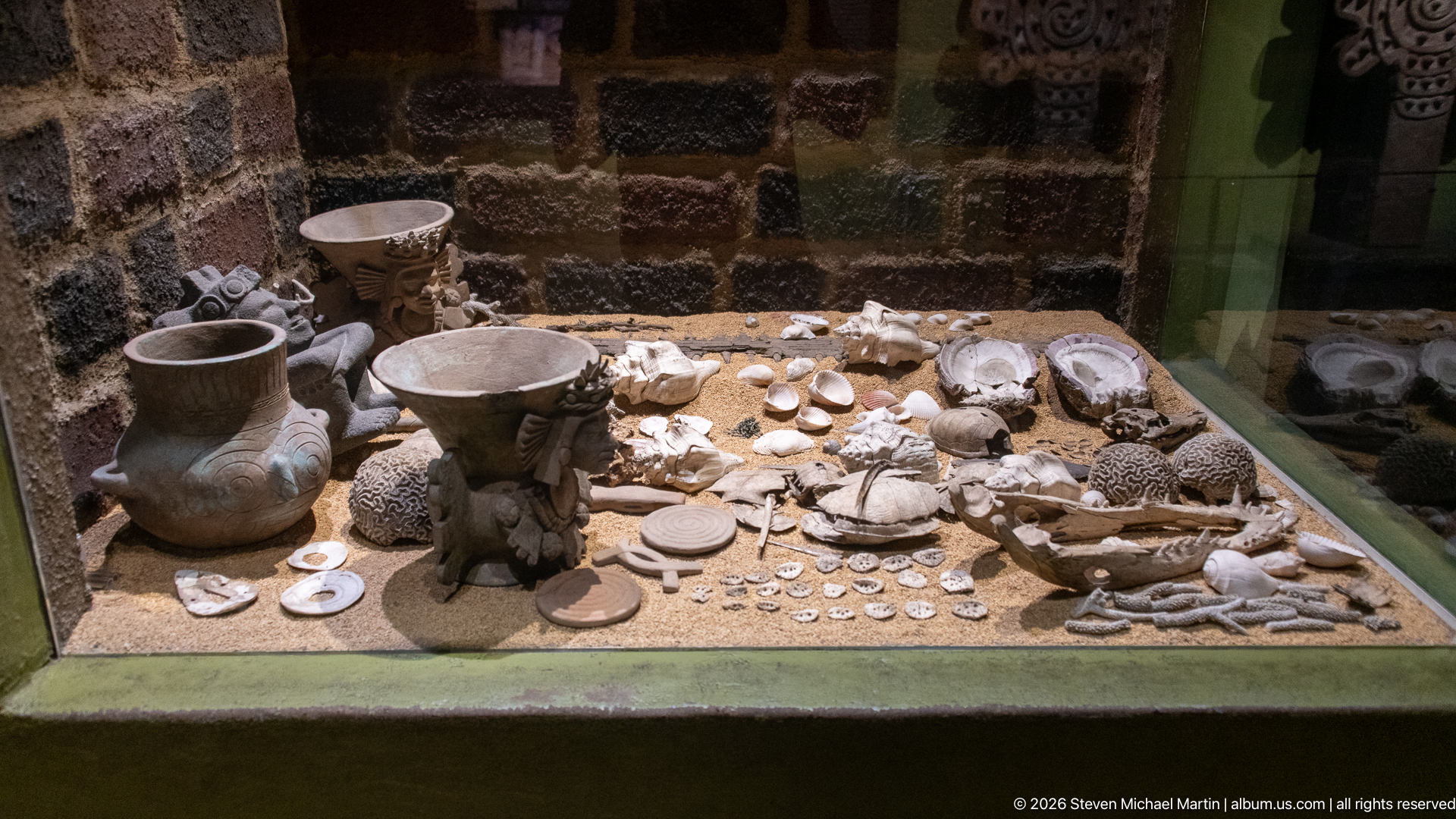
A broad glass case presents ceramic bowls and vessels alongside stone carvings, shells, patterned objects, and smaller fragments on a sand-colored base. A block-patterned wall behind the case echoes the archaeological setting without proving that the finds were recovered together. The arrangement lets visitors compare practical containers with sculptural and decorative material from the collection.
Caption
A broad glass case presents ceramic bowls and vessels alongside stone carvings, shells, patterned objects, and smaller fragments on a sand-colored base. A block-patterned wall behind the case echoes the archaeological setting without proving that the finds were recovered together. The arrangement lets visitors compare practical containers with sculptural and decorative material from the collection.
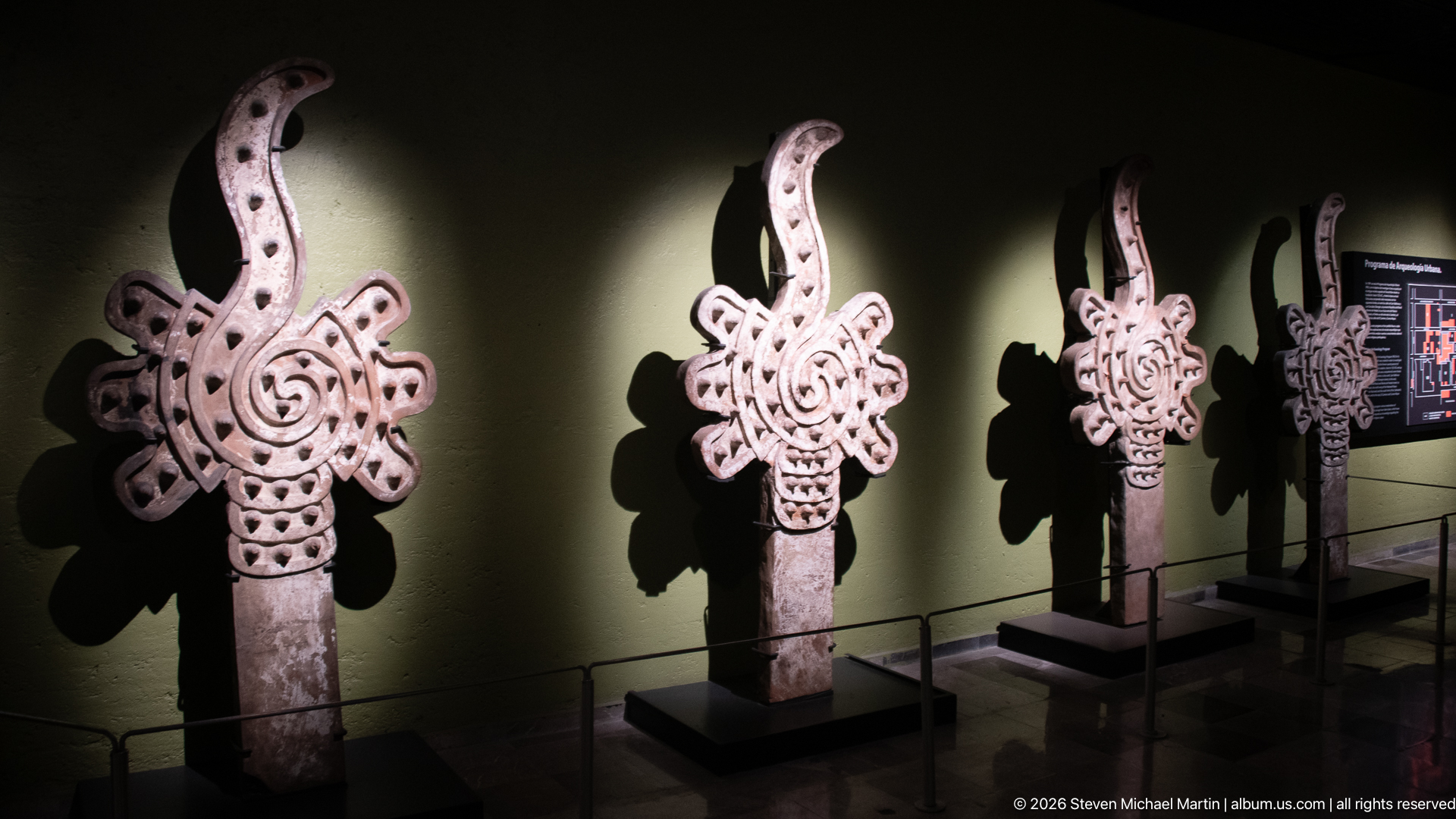
Four tall pink stone elements stand in a row against a green gallery wall. Each shaft supports a curling, openwork crest with a spiral center and repeated perforations; spotlights cast sharply defined shadows behind them. Their repeated form and presentation as a series are clear, but the precise architectural role and depicted creature require confirmation from the adjacent label.
Caption
Four tall pink stone elements stand in a row against a green gallery wall. Each shaft supports a curling, openwork crest with a spiral center and repeated perforations; spotlights cast sharply defined shadows behind them. Their repeated form and presentation as a series are clear, but the precise architectural role and depicted creature require confirmation from the adjacent label.
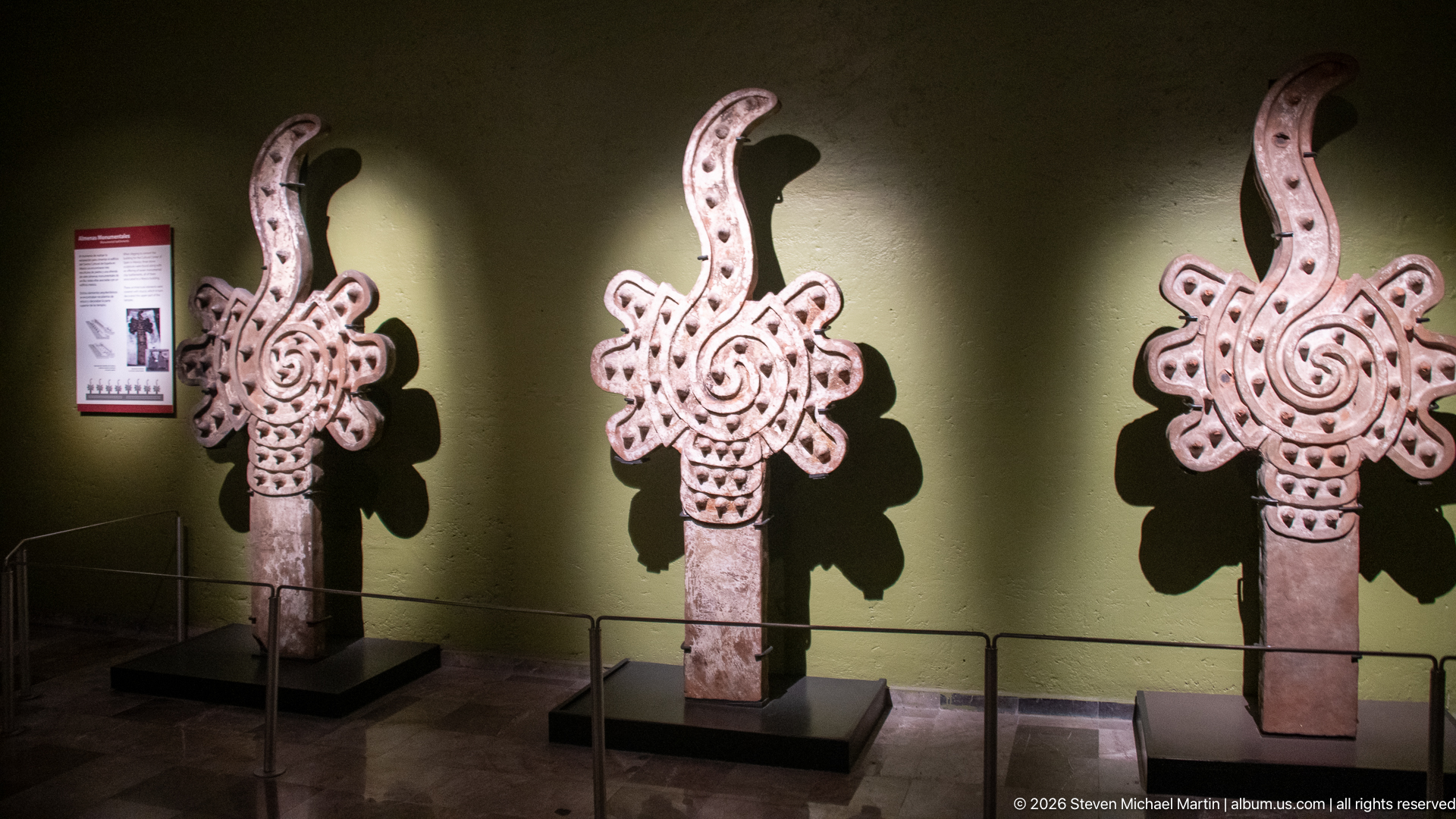
Three of the pink stone elements are shown more closely, revealing deep openings, curled projections, and a central spiral motif on each capital. The left edge includes a museum information panel, while low barriers protect the bases. Repetition, shadow, and the pale stone’s rose hue distinguish this view from the wider row of four.
Caption
Three of the pink stone elements are shown more closely, revealing deep openings, curled projections, and a central spiral motif on each capital. The left edge includes a museum information panel, while low barriers protect the bases. Repetition, shadow, and the pale stone’s rose hue distinguish this view from the wider row of four.
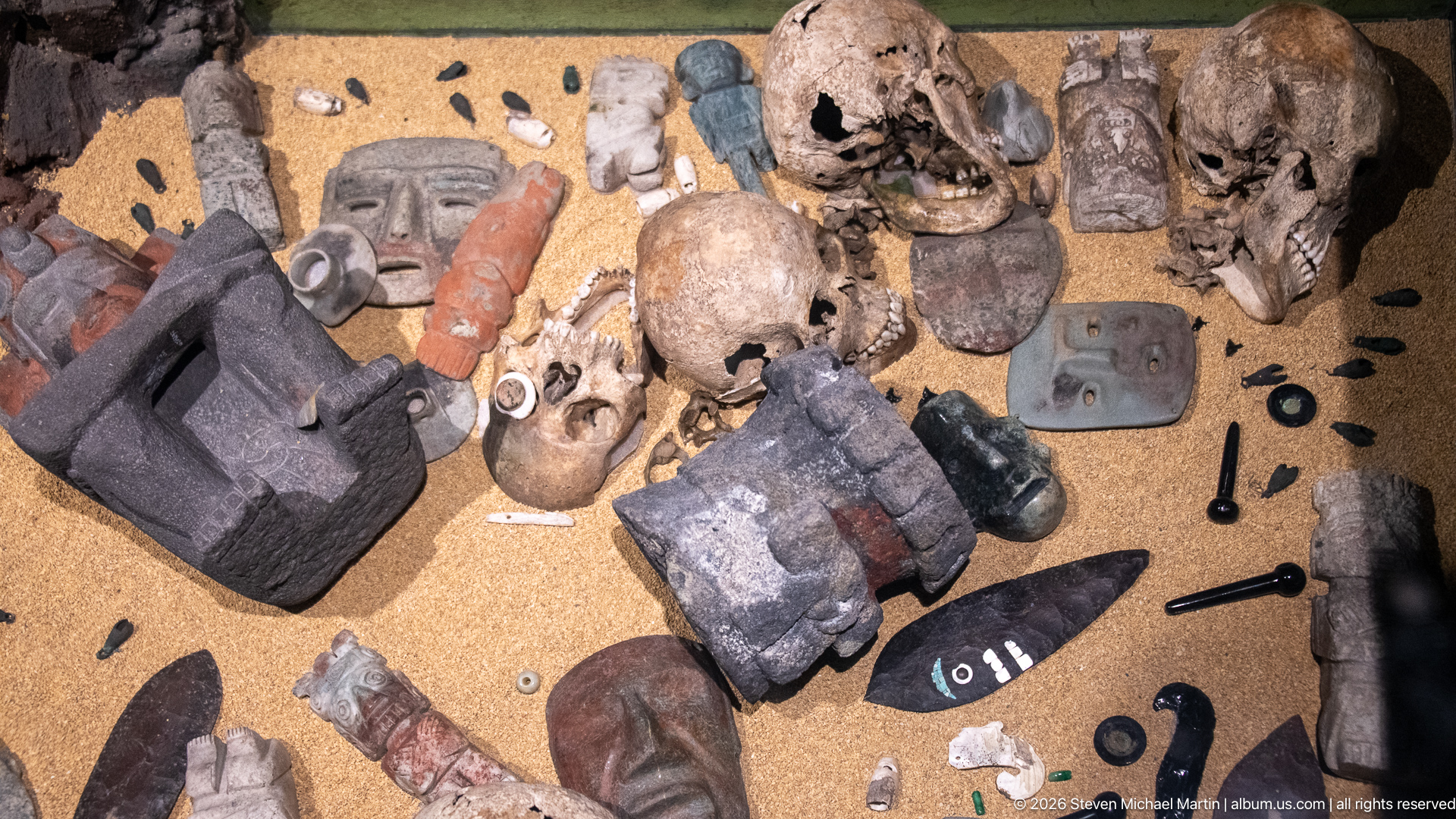
A close overhead view gathers worked stone blocks, skulls, ceramic fragments, and small dark pieces on a sand-colored display bed. A carved face and a red-orange vessel stand out among the gray and brown materials. The assortment emphasizes both monumental fragments and portable objects, but the case does not establish that the pieces came from one deposit.
Caption
A close overhead view gathers worked stone blocks, skulls, ceramic fragments, and small dark pieces on a sand-colored display bed. A carved face and a red-orange vessel stand out among the gray and brown materials. The assortment emphasizes both monumental fragments and portable objects, but the case does not establish that the pieces came from one deposit.
Rows of pale shells and rounded stone pieces fill a shallow rectangular case, interspersed with darker carved objects and small green-gray items. The arrangement is more orderly than the mixed assemblage in adjacent views, making repetition and material contrast especially apparent. A stone border frames the display and gives it the appearance of a recessed collection drawer.
Caption
Rows of pale shells and rounded stone pieces fill a shallow rectangular case, interspersed with darker carved objects and small green-gray items. The arrangement is more orderly than the mixed assemblage in adjacent views, making repetition and material contrast especially apparent. A stone border frames the display and gives it the appearance of a recessed collection drawer.
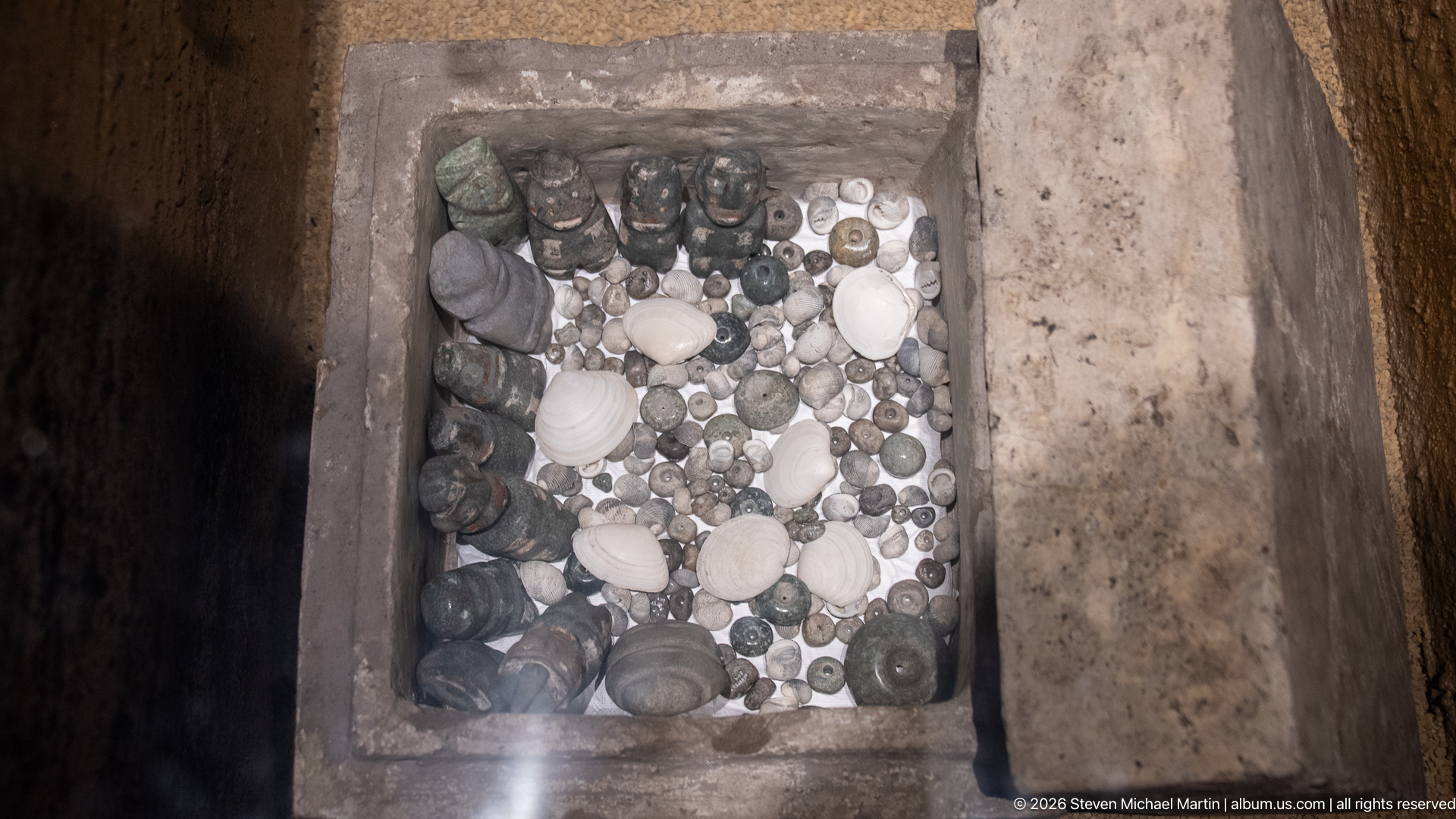
A shallow stone-lined niche holds a compact assortment of small objects, including dark figurines along the back, pale shell forms, and rounded beads or stones across the center. The top-down angle and close framing highlight the deliberate grouping within a built recess. The objects’ exact materials and use cannot be settled from their appearance alone.
Caption
A shallow stone-lined niche holds a compact assortment of small objects, including dark figurines along the back, pale shell forms, and rounded beads or stones across the center. The top-down angle and close framing highlight the deliberate grouping within a built recess. The objects’ exact materials and use cannot be settled from their appearance alone.
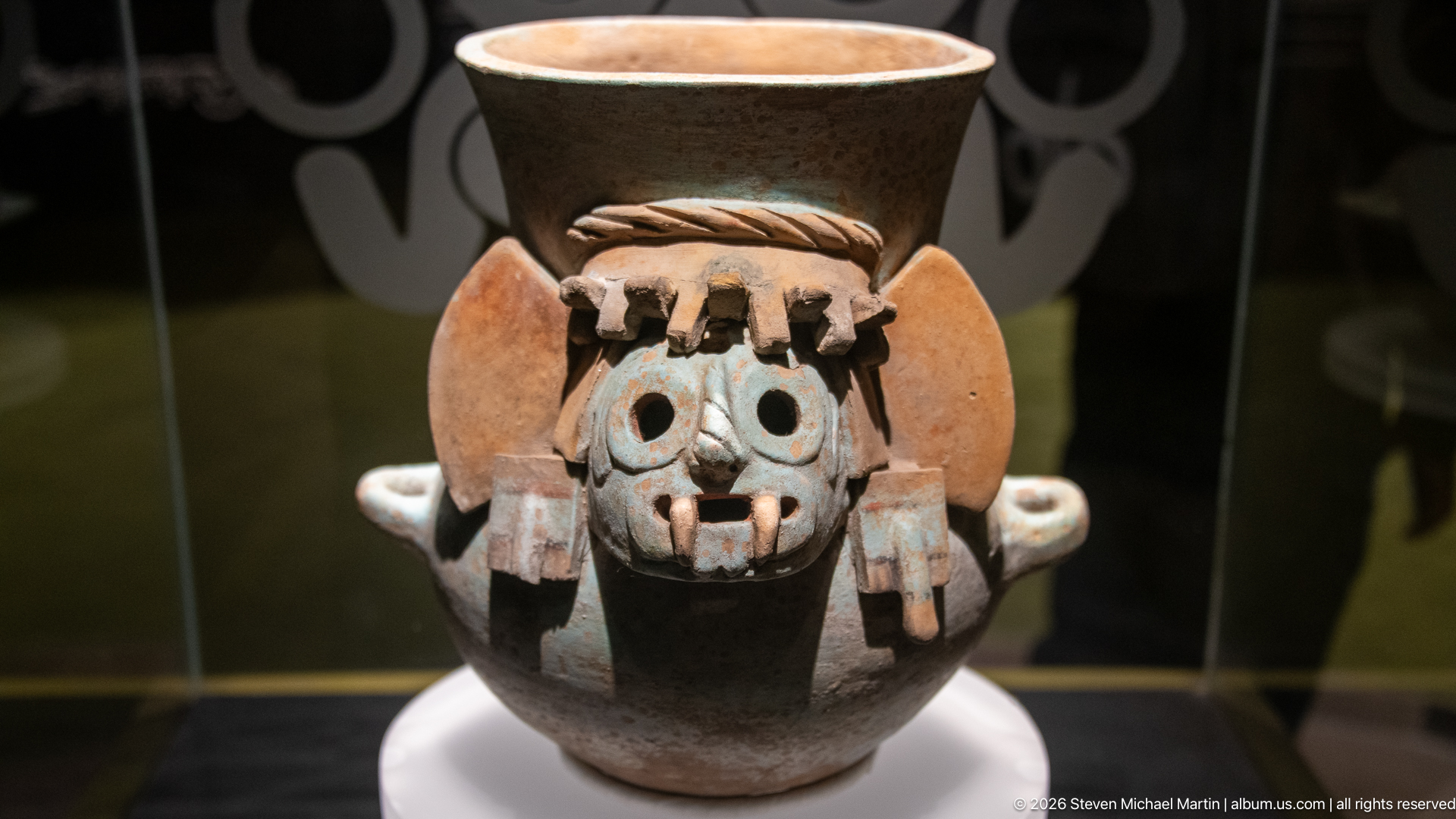
A reddish-brown ceramic vessel has a broad flared mouth and a modeled face attached to its body. Blue-green pigment remains around the eyes and lower face, while the cheeks and headdress-like side forms project outward. The frontal museum view makes the vessel’s combination of container and figural decoration explicit, although its specific cultural meaning is not stated in the image.
Caption
A reddish-brown ceramic vessel has a broad flared mouth and a modeled face attached to its body. Blue-green pigment remains around the eyes and lower face, while the cheeks and headdress-like side forms project outward. The frontal museum view makes the vessel’s combination of container and figural decoration explicit, although its specific cultural meaning is not stated in the image.
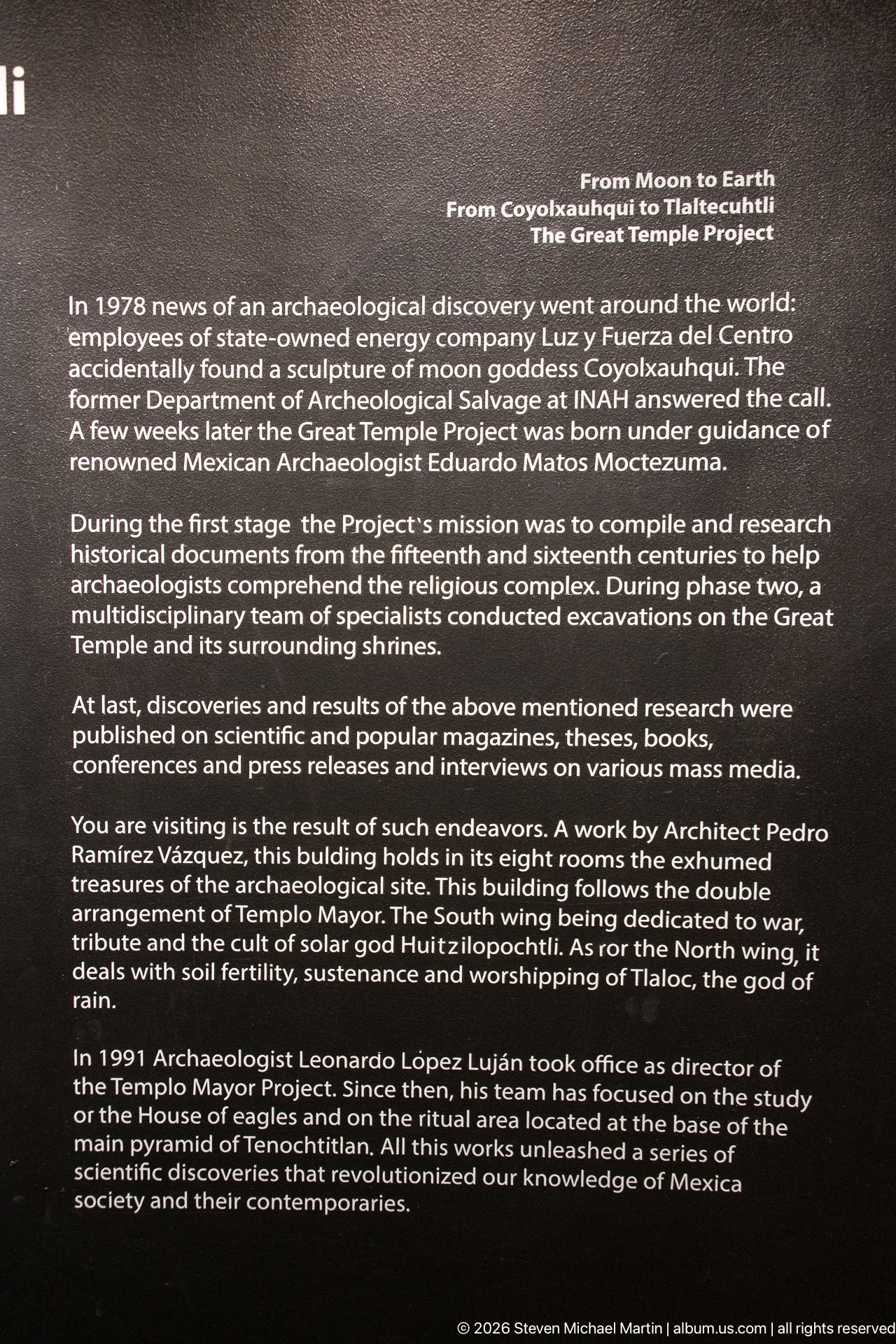
A black interpretive panel titled “From Moon to Earth: From Coyolxauhqui to Tlaltecuhtli” traces the discovery of the Coyolxauhqui sculpture in 1978, the creation of the Great Temple Project, and later research at the site. Text also names architect Pedro Ramírez Vázquez and archaeologist Leonardo López Luján. The panel links excavation history to the museum building and research program.
Caption
A black interpretive panel titled “From Moon to Earth: From Coyolxauhqui to Tlaltecuhtli” traces the discovery of the Coyolxauhqui sculpture in 1978, the creation of the Great Temple Project, and later research at the site. Text also names architect Pedro Ramírez Vázquez and archaeologist Leonardo López Luján. The panel links excavation history to the museum building and research program.
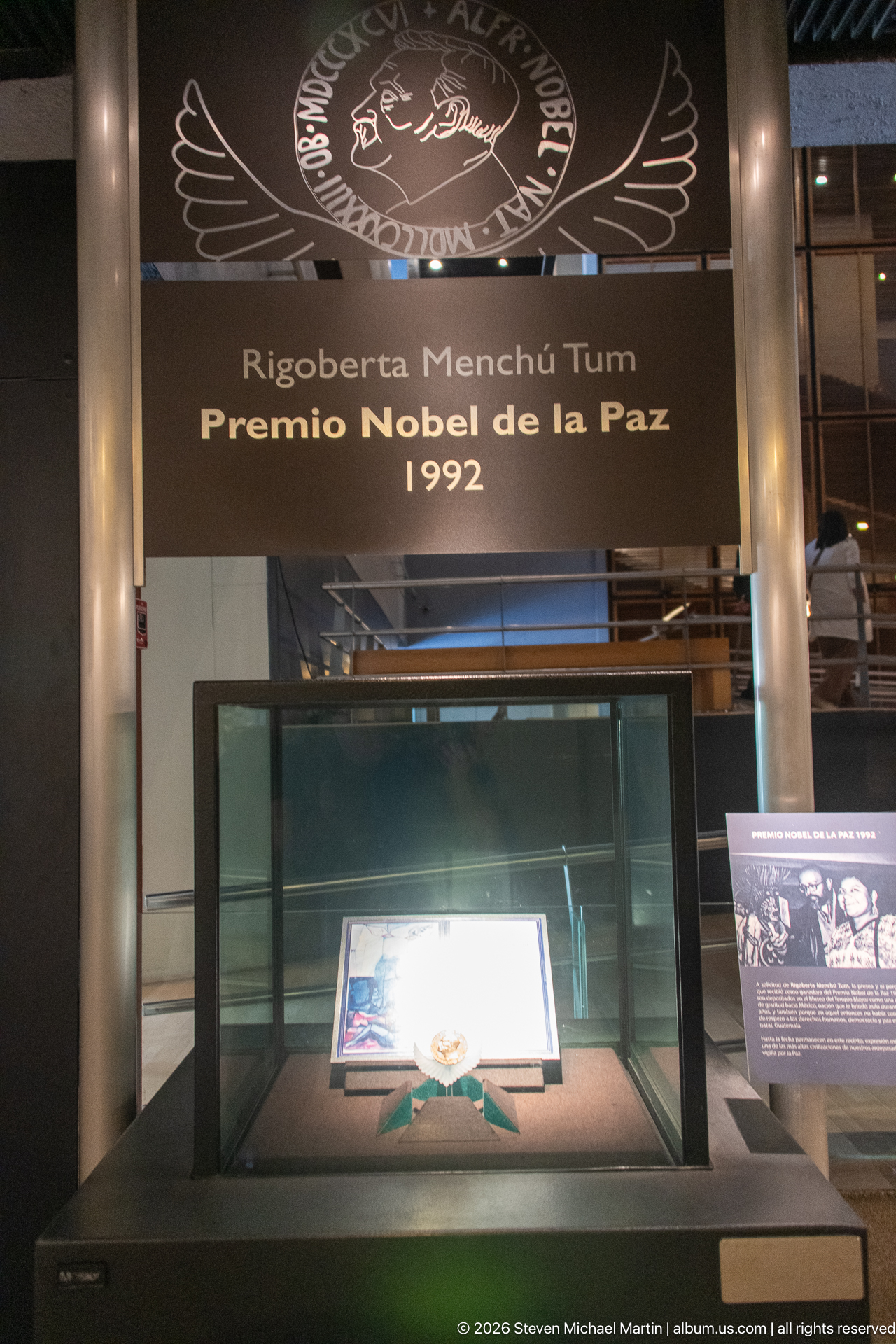
A glass case presents the Nobel Peace Prize medal beneath a panel naming Rigoberta Menchú Tum and the 1992 award. The medal sits centered against a dark backing, while a neighboring interpretive panel adds context to the display. The arrangement turns a compact object into the focal point of a broader account of Indigenous rights and peace activism.
Caption
A glass case presents the Nobel Peace Prize medal beneath a panel naming Rigoberta Menchú Tum and the 1992 award. The medal sits centered against a dark backing, while a neighboring interpretive panel adds context to the display. The arrangement turns a compact object into the focal point of a broader account of Indigenous rights and peace activism.
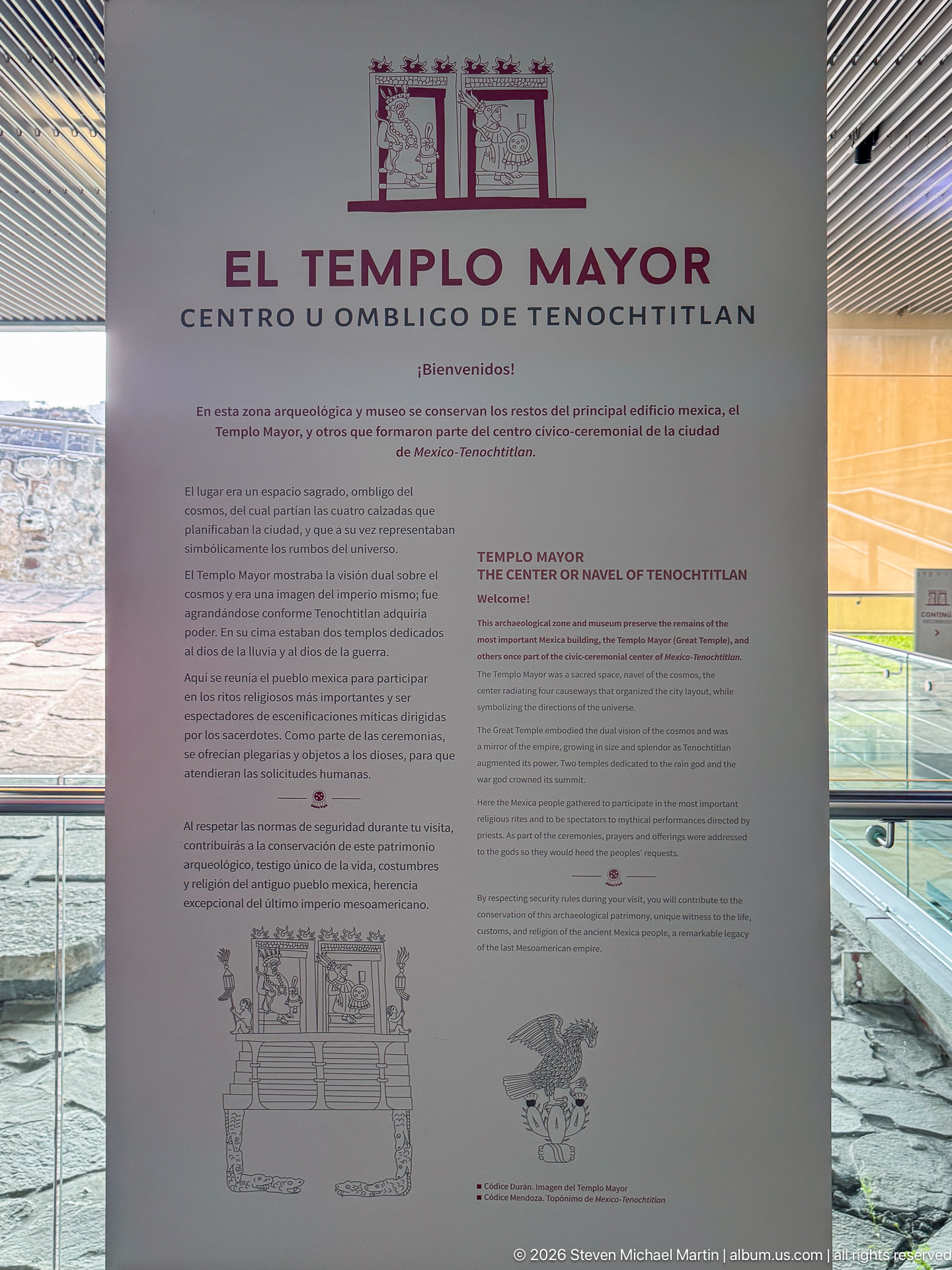
A large bilingual welcome panel stands beside the museum route, combining Spanish and English text with diagrams of the archaeological precinct. Its heading identifies the Templo Mayor and the ceremonial center of Tenochtitlan; the surrounding glass railings reveal the excavated site beyond. The panel connects visitor orientation with the ruins themselves, functioning as both an introduction and a map.
Caption
A large bilingual welcome panel stands beside the museum route, combining Spanish and English text with diagrams of the archaeological precinct. Its heading identifies the Templo Mayor and the ceremonial center of Tenochtitlan; the surrounding glass railings reveal the excavated site beyond. The panel connects visitor orientation with the ruins themselves, functioning as both an introduction and a map.
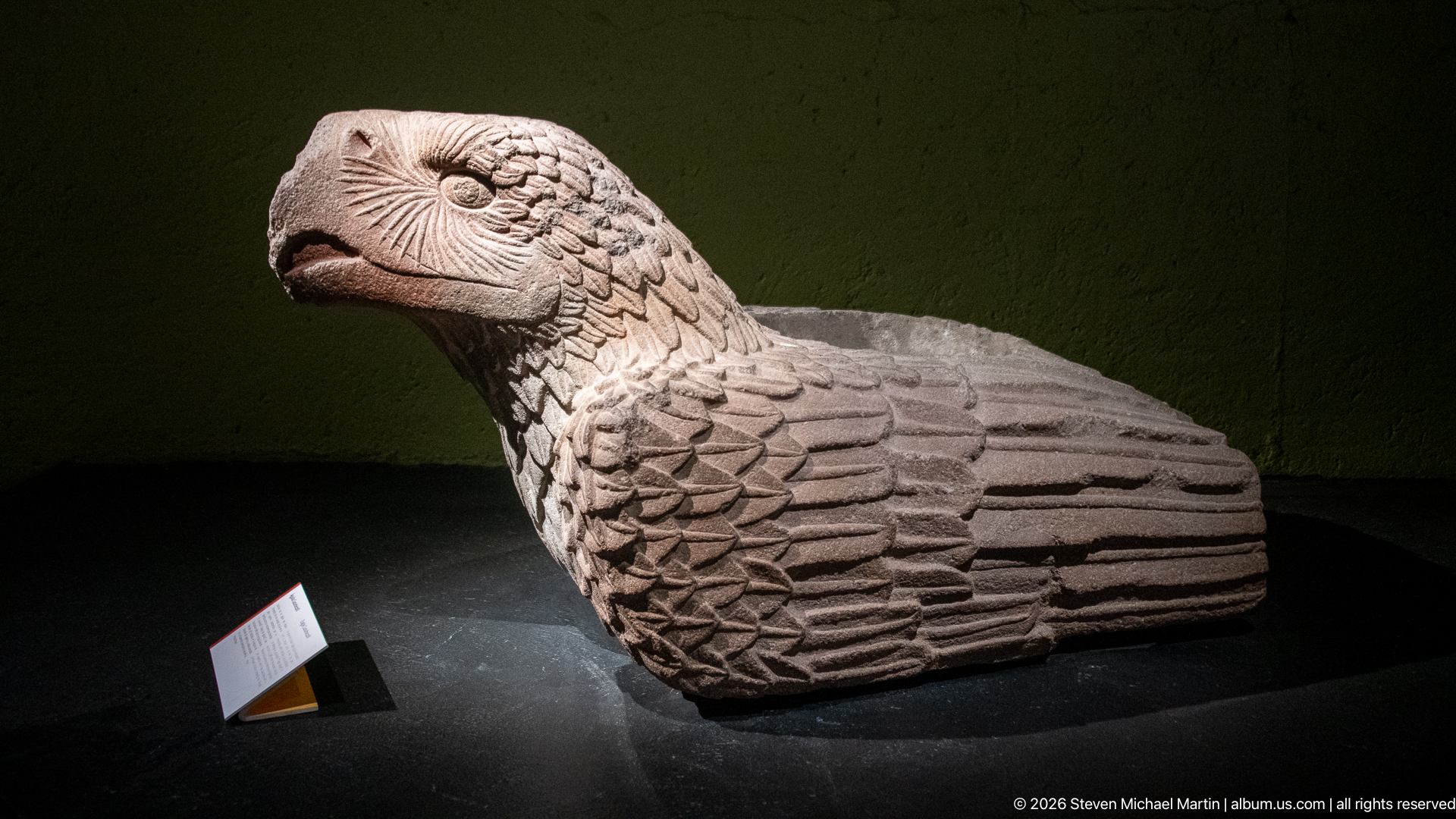
A gray-brown bird sculpture sits low on a dark plinth, its hooked beak, rounded eye, and layered feather pattern clearly modeled. Fine incisions define the wings and body, while the head turns slightly to one side. A small museum label is present but unreadable in the proof sheet, so the species and ritual association should remain unspecified.
Caption
A gray-brown bird sculpture sits low on a dark plinth, its hooked beak, rounded eye, and layered feather pattern clearly modeled. Fine incisions define the wings and body, while the head turns slightly to one side. A small museum label is present but unreadable in the proof sheet, so the species and ritual association should remain unspecified.
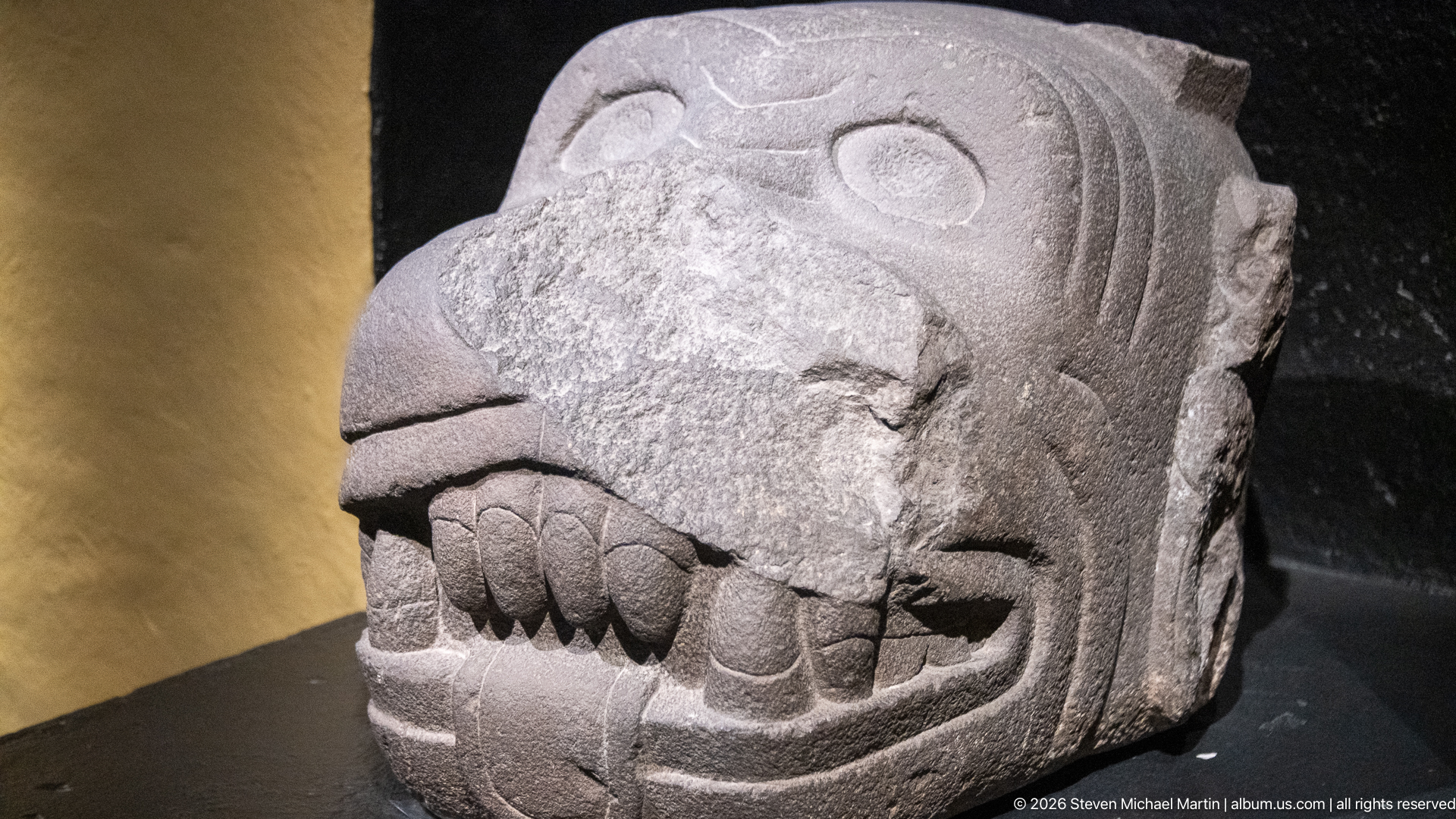
A pale stone head fills the frame, showing a large rounded eye, a blunt projecting muzzle, and a row of squared teeth. The broken, granular surface catches sidelight and reveals the carving’s depth around the mouth and cheek. Its animal-like features are visible, but the exact creature and intended identity are not established by this close crop.
Caption
A pale stone head fills the frame, showing a large rounded eye, a blunt projecting muzzle, and a row of squared teeth. The broken, granular surface catches sidelight and reveals the carving’s depth around the mouth and cheek. Its animal-like features are visible, but the exact creature and intended identity are not established by this close crop.
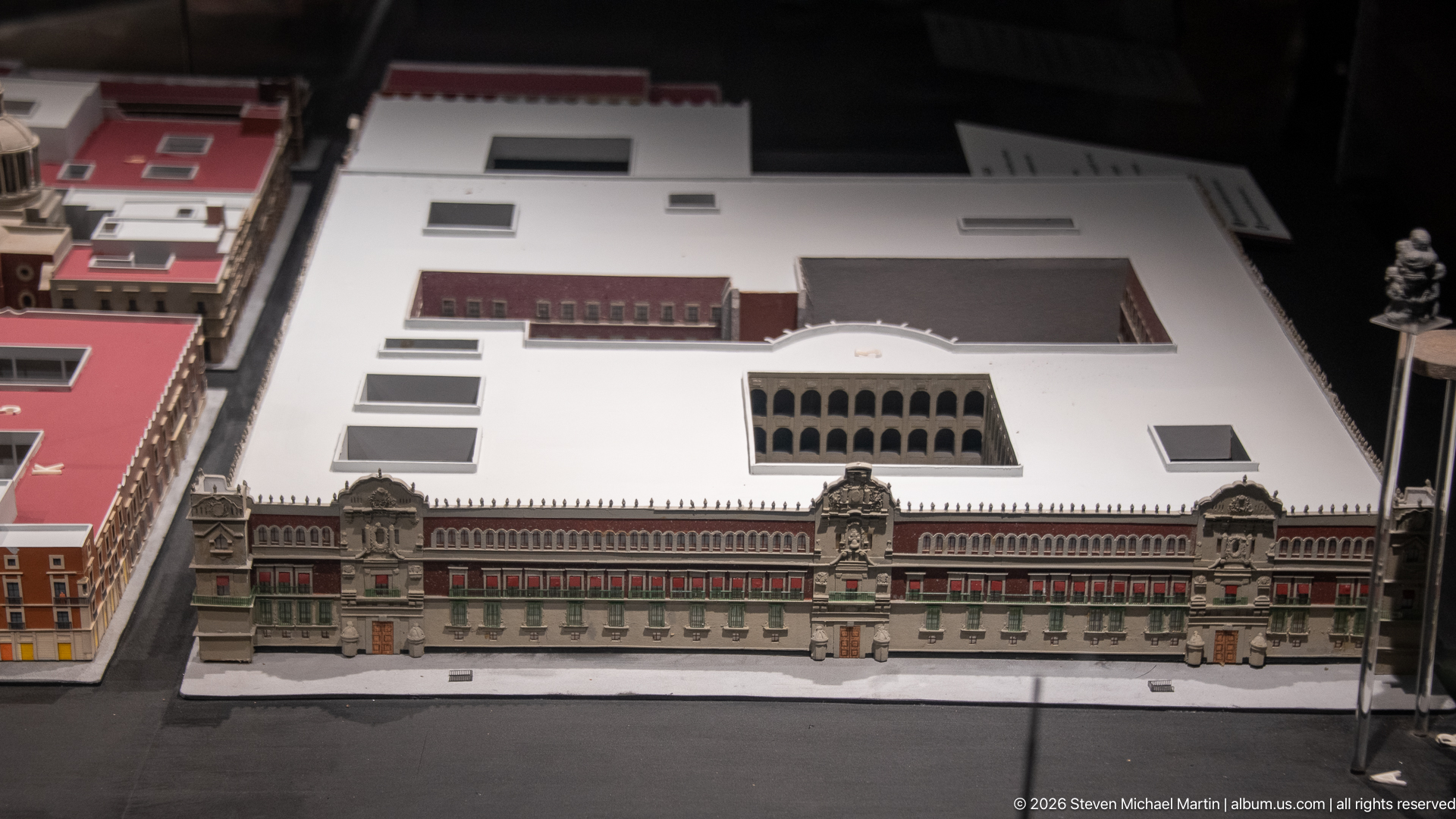
A scale model shows a large rectangular museum complex with a broad central courtyard, surrounding gallery wings, and an extended street façade. Smaller neighboring buildings in red and gray establish the museum’s footprint within the urban block. The elevated oblique view clarifies the plan’s geometry and courtyard organization, illustrating the contemporary institution that houses the archaeological collection.
Caption
A scale model shows a large rectangular museum complex with a broad central courtyard, surrounding gallery wings, and an extended street façade. Smaller neighboring buildings in red and gray establish the museum’s footprint within the urban block. The elevated oblique view clarifies the plan’s geometry and courtyard organization, illustrating the contemporary institution that houses the archaeological collection.
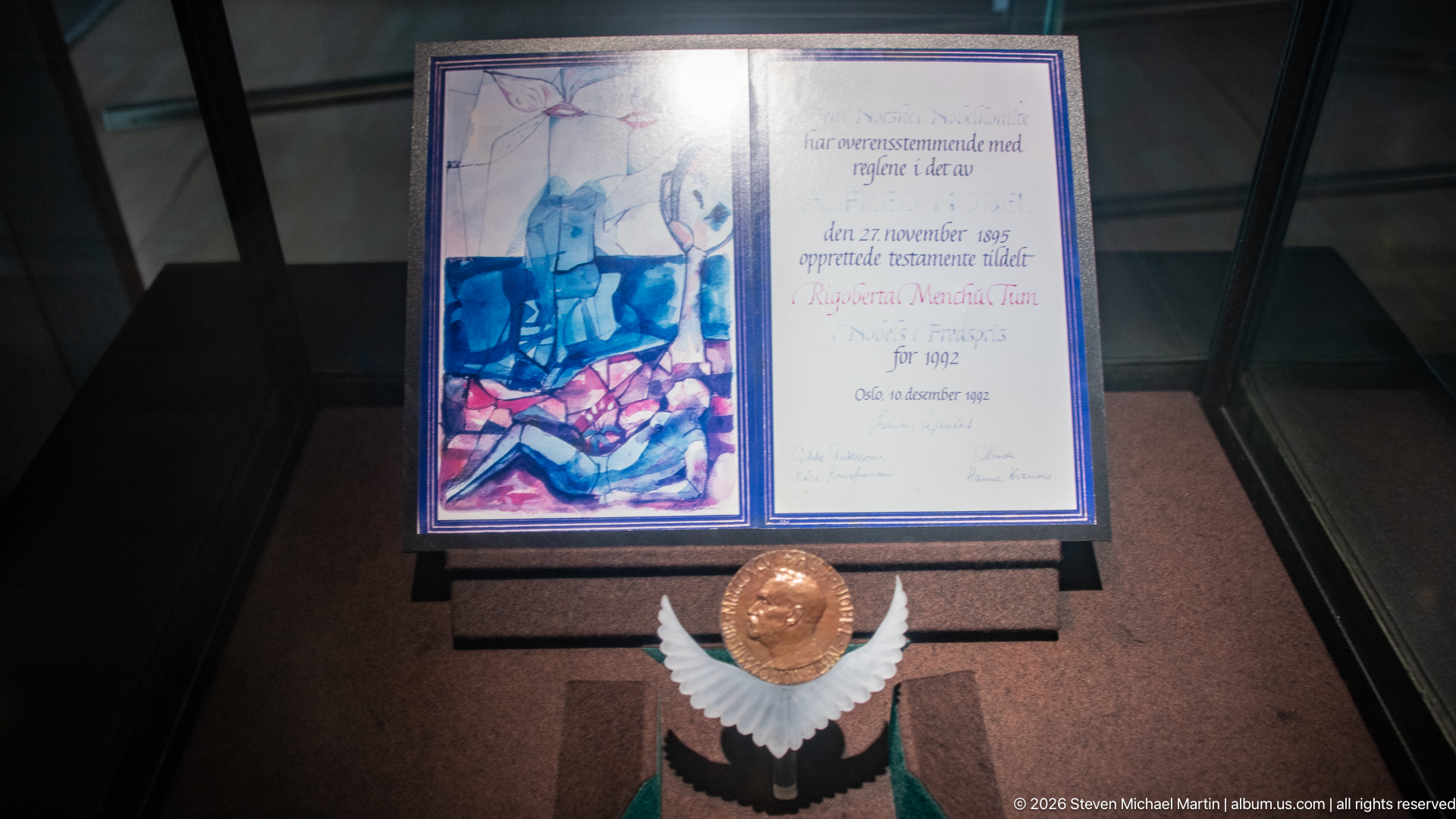
An open presentation document and medal share a single glass case, allowing the written award and its emblem to be seen together. The certificate’s printed text identifies Rigoberta Menchú Tum and the 1992 Nobel Peace Prize, while a colorful illustrated page faces it. This closer view shifts attention from the exhibit’s title panel to the paired objects and their display arrangement.
Caption
An open presentation document and medal share a single glass case, allowing the written award and its emblem to be seen together. The certificate’s printed text identifies Rigoberta Menchú Tum and the 1992 Nobel Peace Prize, while a colorful illustrated page faces it. This closer view shifts attention from the exhibit’s title panel to the paired objects and their display arrangement.
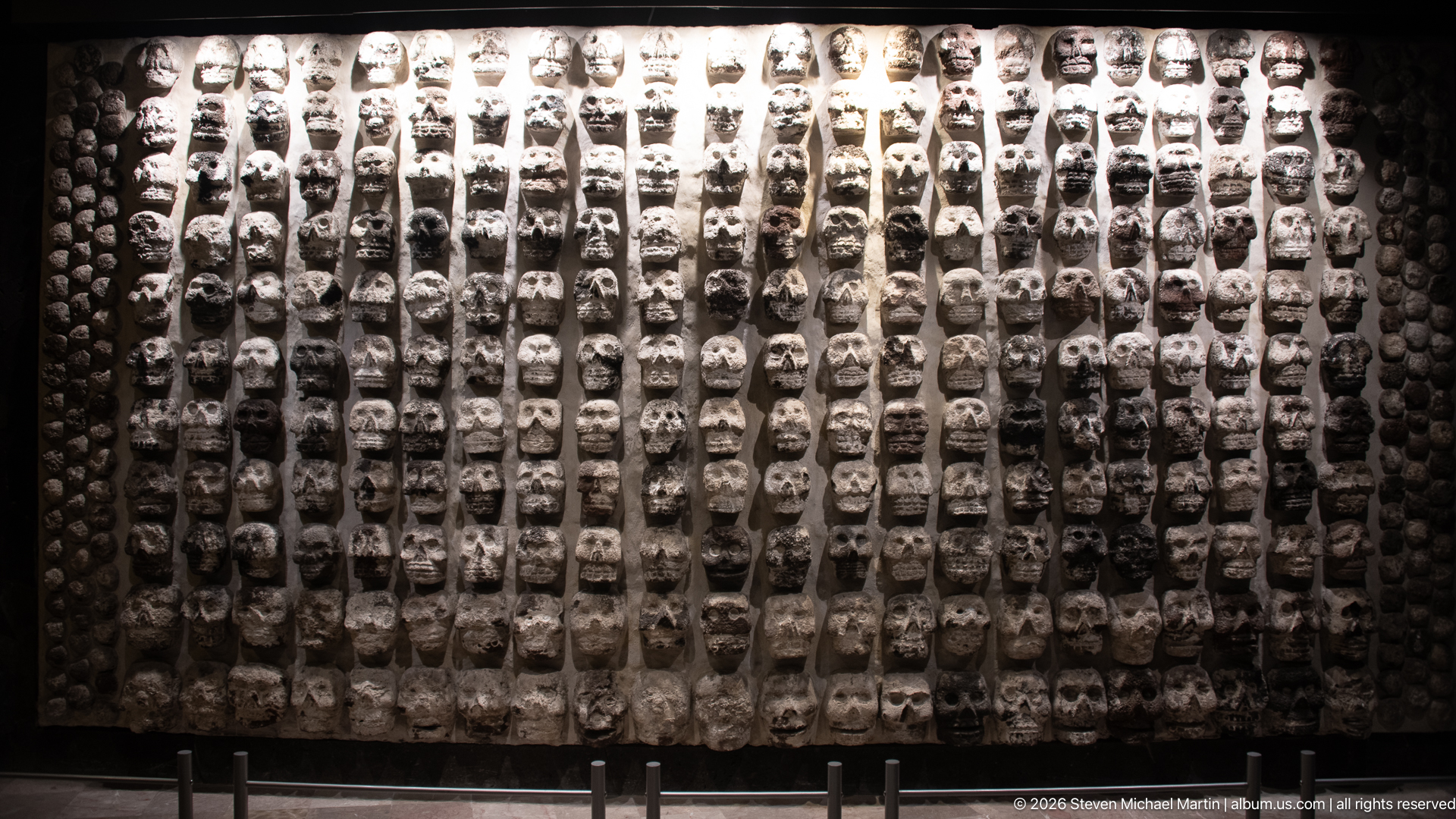
Hundreds of pale skull forms cover a broad, dark-backed wall in tightly spaced horizontal bands. Their repeated faces create a powerful pattern that reads both as an archaeological display and as a collective sculptural surface. The frontal viewpoint emphasizes the sheer number and regular arrangement of the forms; individual labels are not legible at this distance, so the display’s precise archaeological attribution remains open.
Caption
Hundreds of pale skull forms cover a broad, dark-backed wall in tightly spaced horizontal bands. Their repeated faces create a powerful pattern that reads both as an archaeological display and as a collective sculptural surface. The frontal viewpoint emphasizes the sheer number and regular arrangement of the forms; individual labels are not legible at this distance, so the display’s precise archaeological attribution remains open.
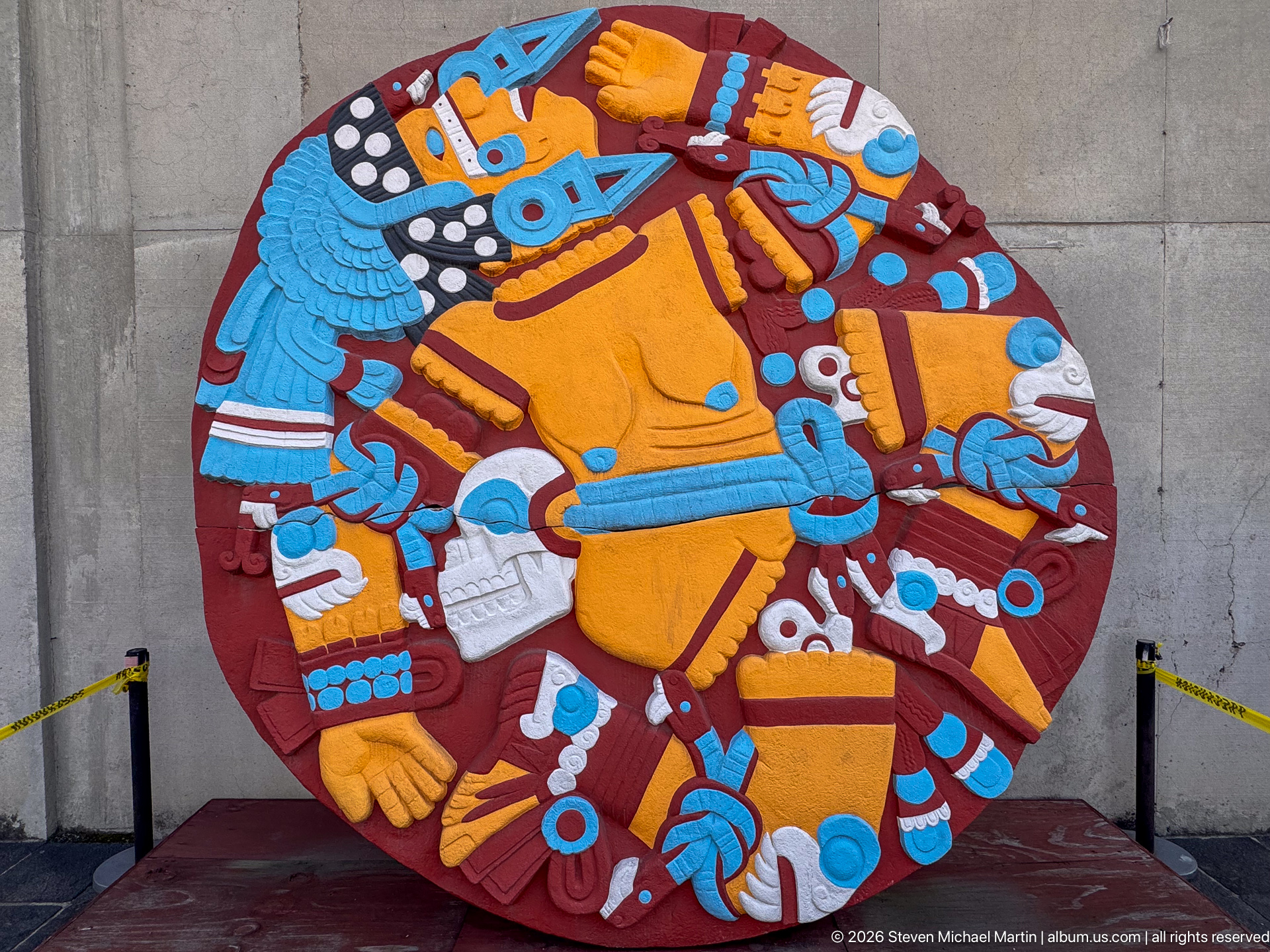
A vividly painted circular relief fills the frame with a central figure surrounded by interlocking bodies, limbs, and ornamental bands in turquoise, red, yellow, and white. The sculptural surface translates a complex Mexica composition into bold color and pronounced relief, making its layered imagery legible from across the room. The proof sheet does not establish whether this is a reconstruction or a contemporary interpretive work.
Caption
A vividly painted circular relief fills the frame with a central figure surrounded by interlocking bodies, limbs, and ornamental bands in turquoise, red, yellow, and white. The sculptural surface translates a complex Mexica composition into bold color and pronounced relief, making its layered imagery legible from across the room. The proof sheet does not establish whether this is a reconstruction or a contemporary interpretive work.
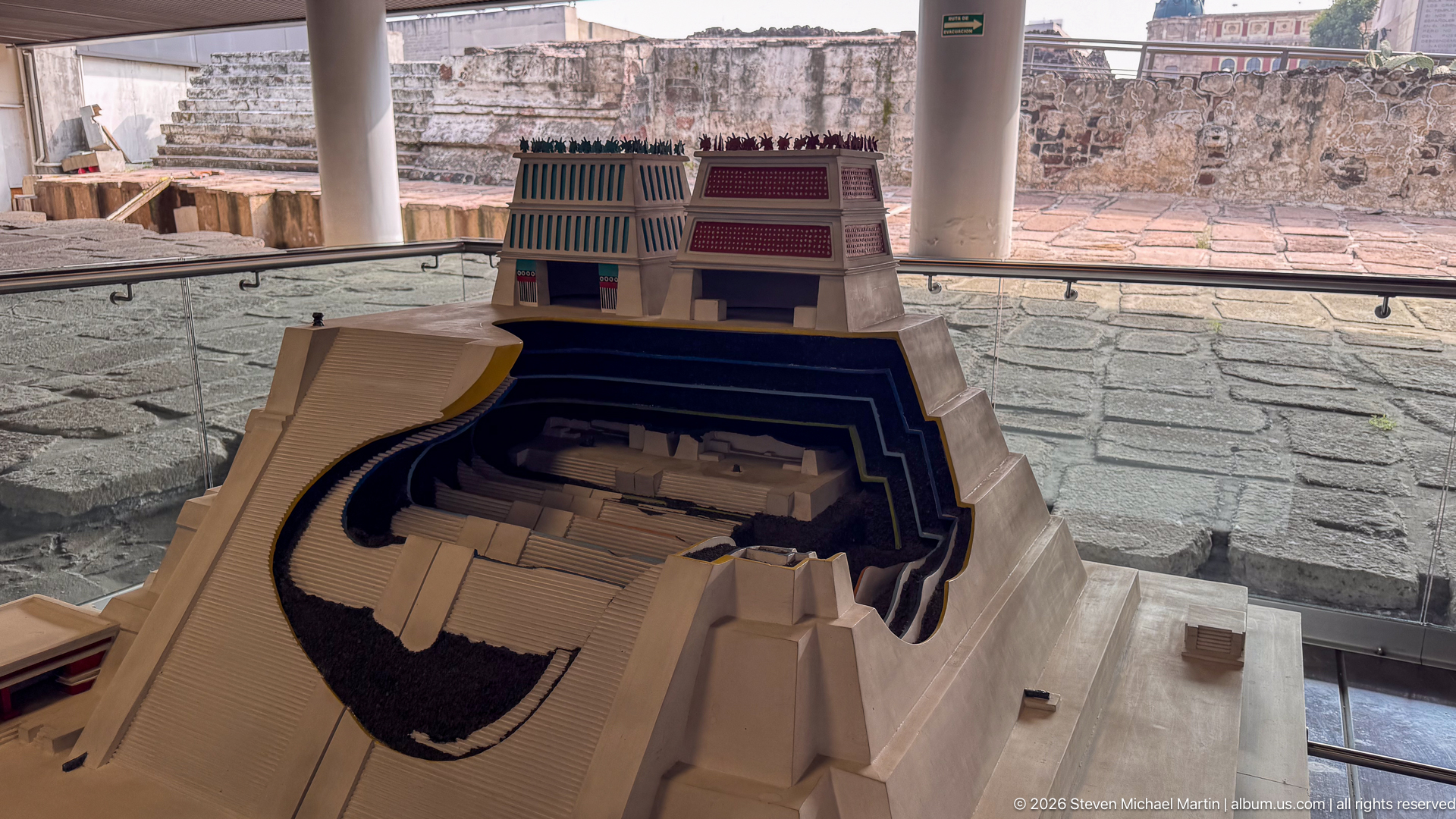
A three-dimensional model presents a steeply stepped temple with a dark cutaway opening that exposes an inner chamber or structural section. The close viewpoint foregrounds the building’s layered profile, stair-like terraces, and contrasting exterior and interior surfaces. Excavated masonry and the visitor walkway remain visible behind it, linking the model to the site while keeping the model itself as the subject.
Caption
A three-dimensional model presents a steeply stepped temple with a dark cutaway opening that exposes an inner chamber or structural section. The close viewpoint foregrounds the building’s layered profile, stair-like terraces, and contrasting exterior and interior surfaces. Excavated masonry and the visitor walkway remain visible behind it, linking the model to the site while keeping the model itself as the subject.
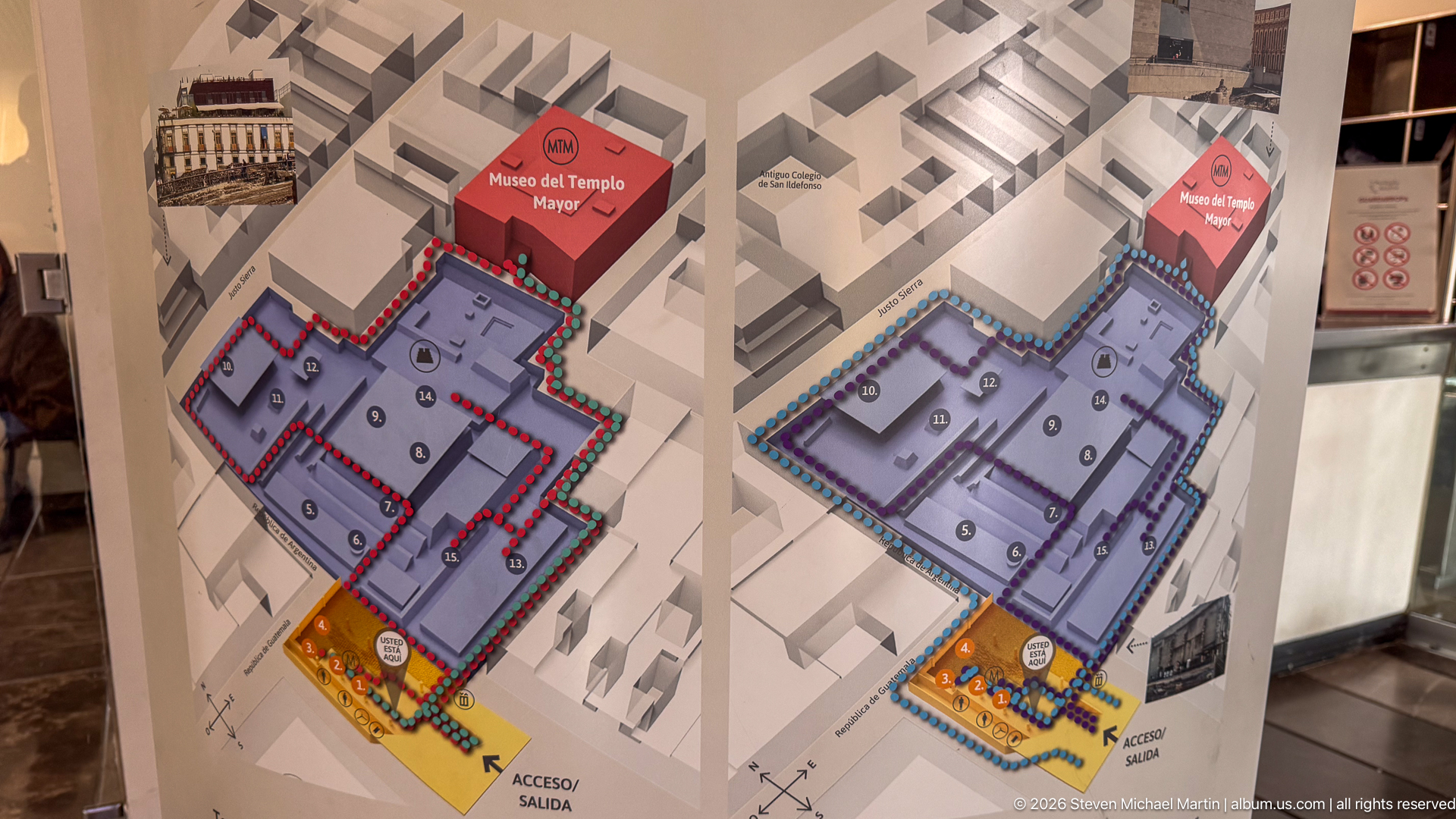
Two adjacent color-coded plans distinguish routes through the museum and archaeological zone. The diagrams mark galleries, numbered stops, entrances, and circulation paths, using dotted lines and contrasting colors to separate visitor options. Photographed closely, the map is less about the ruins themselves than about how the institution organizes movement through them, giving the visitor a practical key to the complex.
Caption
Two adjacent color-coded plans distinguish routes through the museum and archaeological zone. The diagrams mark galleries, numbered stops, entrances, and circulation paths, using dotted lines and contrasting colors to separate visitor options. Photographed closely, the map is less about the ruins themselves than about how the institution organizes movement through them, giving the visitor a practical key to the complex.
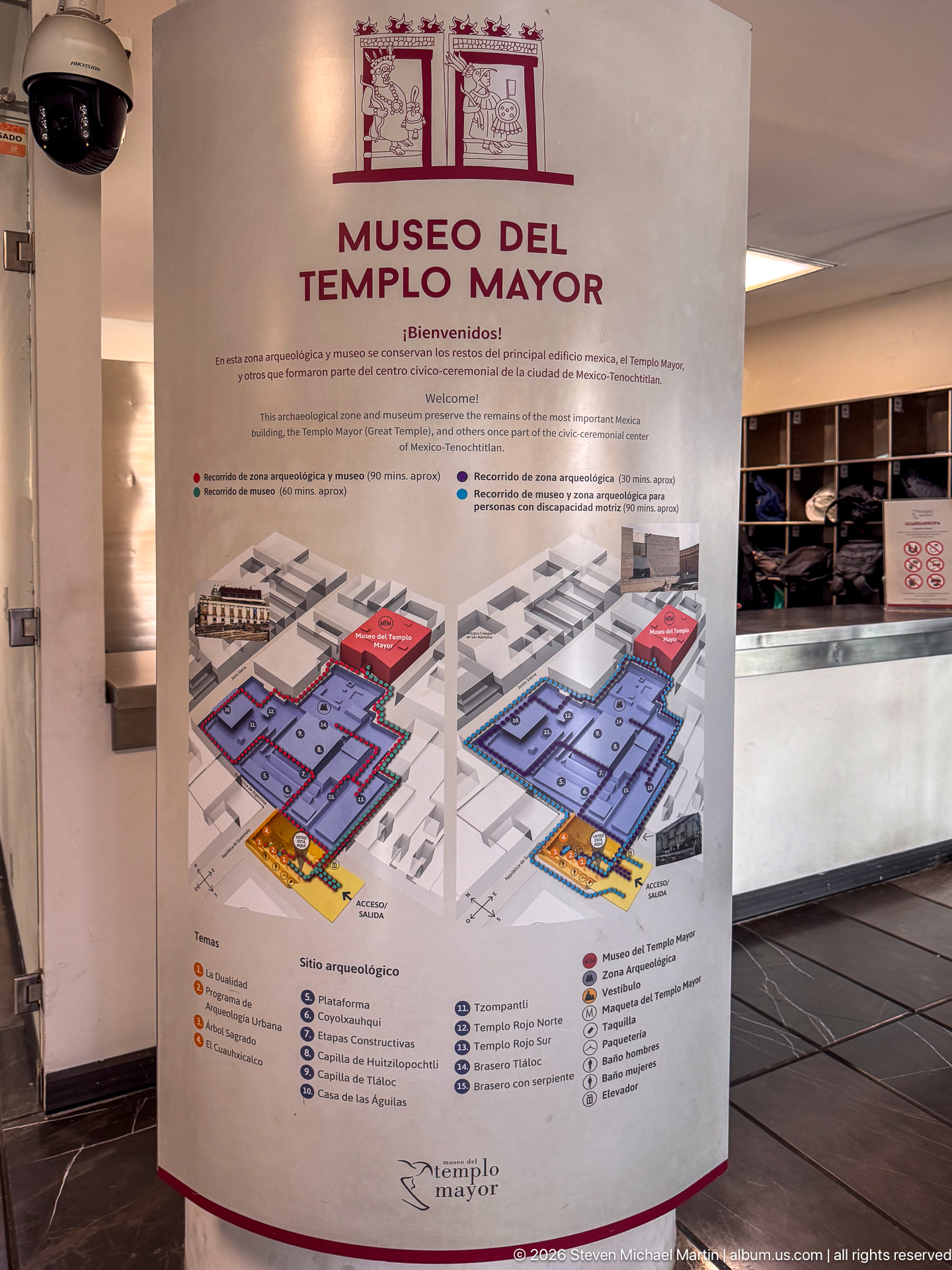
A freestanding bilingual orientation sign introduces the Museo del Templo Mayor and presents two large maps of the museum and archaeological zone. In this wider view, the sign stands within the entrance area, with shelving and counters visible behind it. Compared with a close study of the diagrams, this composition shows how the information is placed in the visitor’s approach to the galleries.
Caption
A freestanding bilingual orientation sign introduces the Museo del Templo Mayor and presents two large maps of the museum and archaeological zone. In this wider view, the sign stands within the entrance area, with shelving and counters visible behind it. Compared with a close study of the diagrams, this composition shows how the information is placed in the visitor’s approach to the galleries.
🏛️ Museum Field Guide
📍 Overview
Museo del Templo Mayor brings together archaeological remains, museum collections, and interpretation of the ceremonial center of Tenochtitlan. The galleries include carved stone, ceramics, offerings, and other objects, while views and models connect those collections with the excavated site and the surrounding historic center. The Coyolxauhqui Stone is a central point of attention, presented within a gallery designed to emphasize its scale and carved surface.
◆ Institutional History
A plaque in the museum records its inauguration on 12 October 1987. The institution’s work, as represented in these galleries, is to preserve and interpret objects and archaeological remains associated with the Templo Mayor. Its displays bring the museum’s own history into view alongside the much older material it presents.
◆ Collections
The collections range across carved stone sculptures and fragments, ceramic vessels and figures, animal remains, and objects arranged in offering or burial contexts. Their variety makes it possible to compare materials, forms, and display groupings: a single carved figure may be shown as a sculptural object, while associated remains and small finds are presented together to preserve their relationships.
◆ Signature Objects
The Coyolxauhqui Stone is a major work in the galleries: a large circular relief displayed horizontally beneath a ring of light, where its radial composition and densely carved details can be viewed from above. Other memorable objects include carved stone animal figures, ceramic effigies, and vessels whose shapes and surface patterns reward closer inspection.
◆ Interpretation & Display
Interpretive panels connect close views of carved details with larger figures and themes; one is titled “El rostro de la diosa.” Bilingual welcome material and color-coded visitor maps orient visitors to the archaeological precinct and museum route. Models and displays place individual objects in a wider setting, helping visitors relate the collections to the excavated structures.
🥾 Visitor Experience
The visit moves between focused encounters with individual objects and broader views of the archaeological site. Gallery lighting draws attention to major works such as the Coyolxauhqui Stone, while maps, models, glass boundaries, and overlooks help visitors understand the route and the relationship between the museum and the excavations. From the site, the surrounding historic center—including the Metropolitan Cathedral—comes into view.
📷 Photography Notes
Photograph the collections at several scales: begin with an object in its gallery setting, then move closer to record its shape, surface, and carved details. Include interpretive panels or maps when they clarify how an object or route is presented. At the archaeological site, wider views can show the excavated structures in relation to visitor paths and the surrounding city.