Basilica of Our Lady of Guadalupe
The Basilica of Our Lady of Guadalupe stands at Tepeyac, one of Mexico City’s most important places of pilgrimage and devotion. According to Catholic tradition, the Virgin Mary appeared here to Juan Diego in 1531; the sanctuary that grew around that story has become a powerful expression of faith and Mexican identity. The site brings visitors into a living religious landscape, where prayer, pilgrimage, and the city’s history meet. Mexico City
The present basilica was built between 1974 and 1976, after earthquakes and the sinking ground threatened the older church and made it difficult to accommodate growing numbers of pilgrims. Its broad circular form and open interior allow the image of Our Lady of Guadalupe behind the altar to be seen from many points. The image was transferred to the new sanctuary in a procession on October 12, 1976. Mexico City
The visit also includes the older basilica, completed in 1709, whose Baroque architecture offers a striking contrast with the modern sanctuary. Together, the two churches tell a story of devotion carried across centuries and adapted to changing needs. Beyond their architecture, the basilicas are places to observe how faith is experienced collectively—in the quiet of prayer, the movement of pilgrims, and the ceremonies surrounding the Virgin of Guadalupe. Mexico City
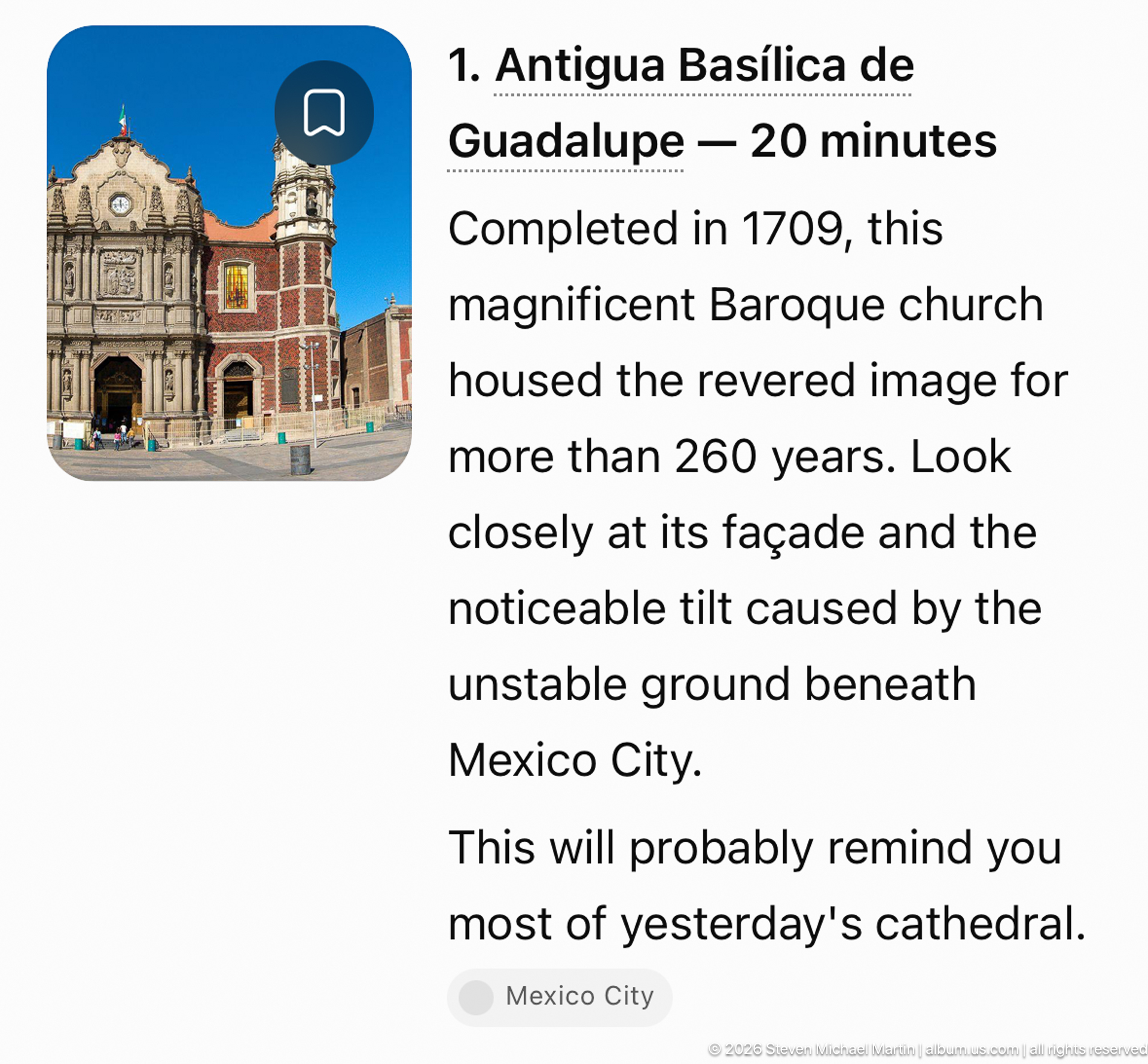
The Old Basilica’s richly carved stone façade stands beside a red-brick section beneath a blue sky, with visitors crossing the sunlit forecourt. Completed in 1709, the Baroque church housed the revered Guadalupe image for more than two and a half centuries before the New Basilica opened. Its visibly leaning profile reflects the unstable ground beneath Mexico City and gives this exterior a distinctive, unsettled silhouette.
Caption
The Old Basilica’s richly carved stone façade stands beside a red-brick section beneath a blue sky, with visitors crossing the sunlit forecourt. Completed in 1709, the Baroque church housed the revered Guadalupe image for more than two and a half centuries before the New Basilica opened. Its visibly leaning profile reflects the unstable ground beneath Mexico City and gives this exterior a distinctive, unsettled silhouette.
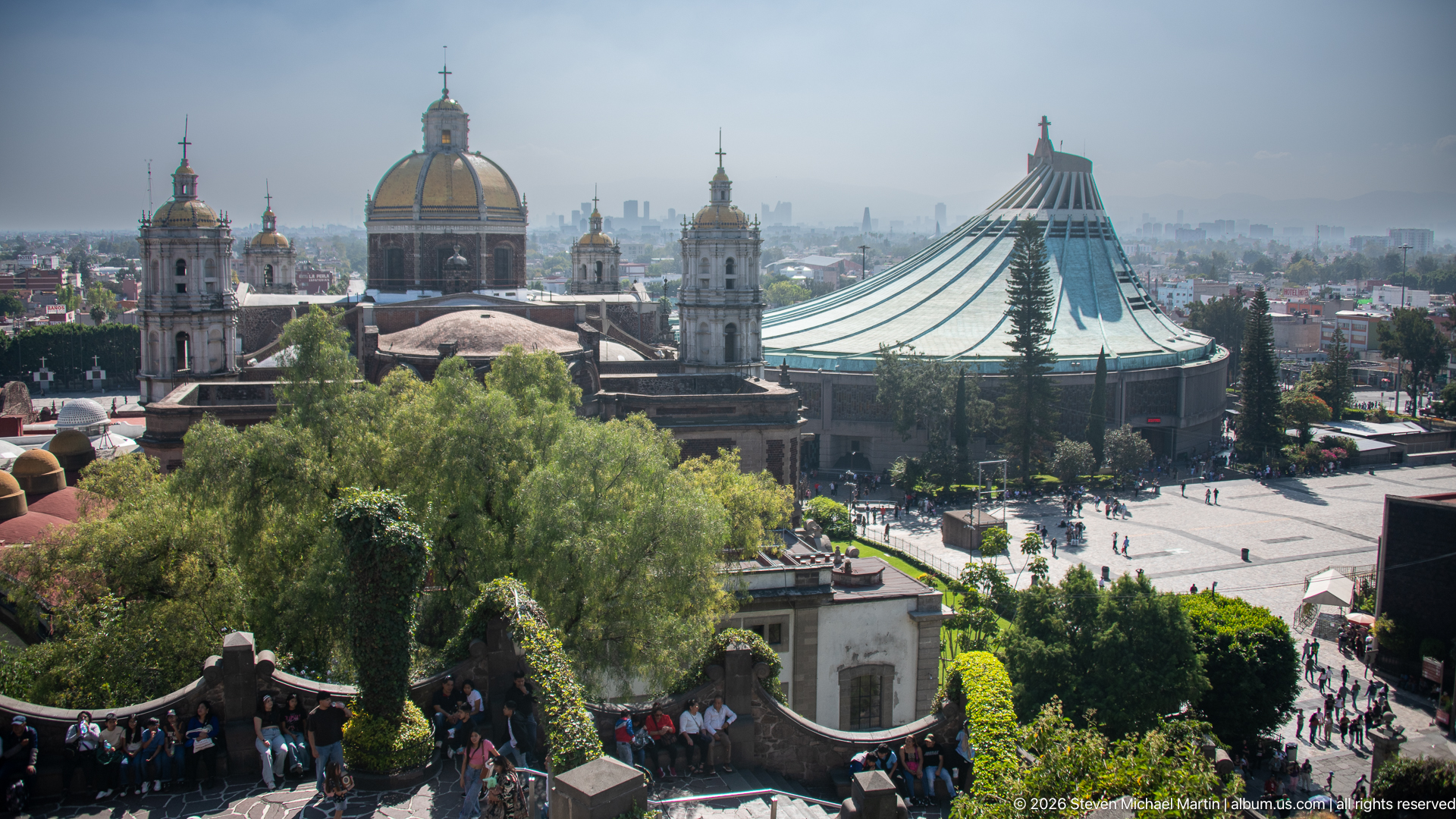
The broad roof of the modern basilica sweeps across the right side of the complex, while older domes and bell towers rise beyond it. Below, people cross the open plaza and gather along the landscaped terraces. The elevated view links the newer building’s low, expansive profile with the taller historic church forms and the active grounds around them.
Caption
The broad roof of the modern basilica sweeps across the right side of the complex, while older domes and bell towers rise beyond it. Below, people cross the open plaza and gather along the landscaped terraces. The elevated view links the newer building’s low, expansive profile with the taller historic church forms and the active grounds around them.
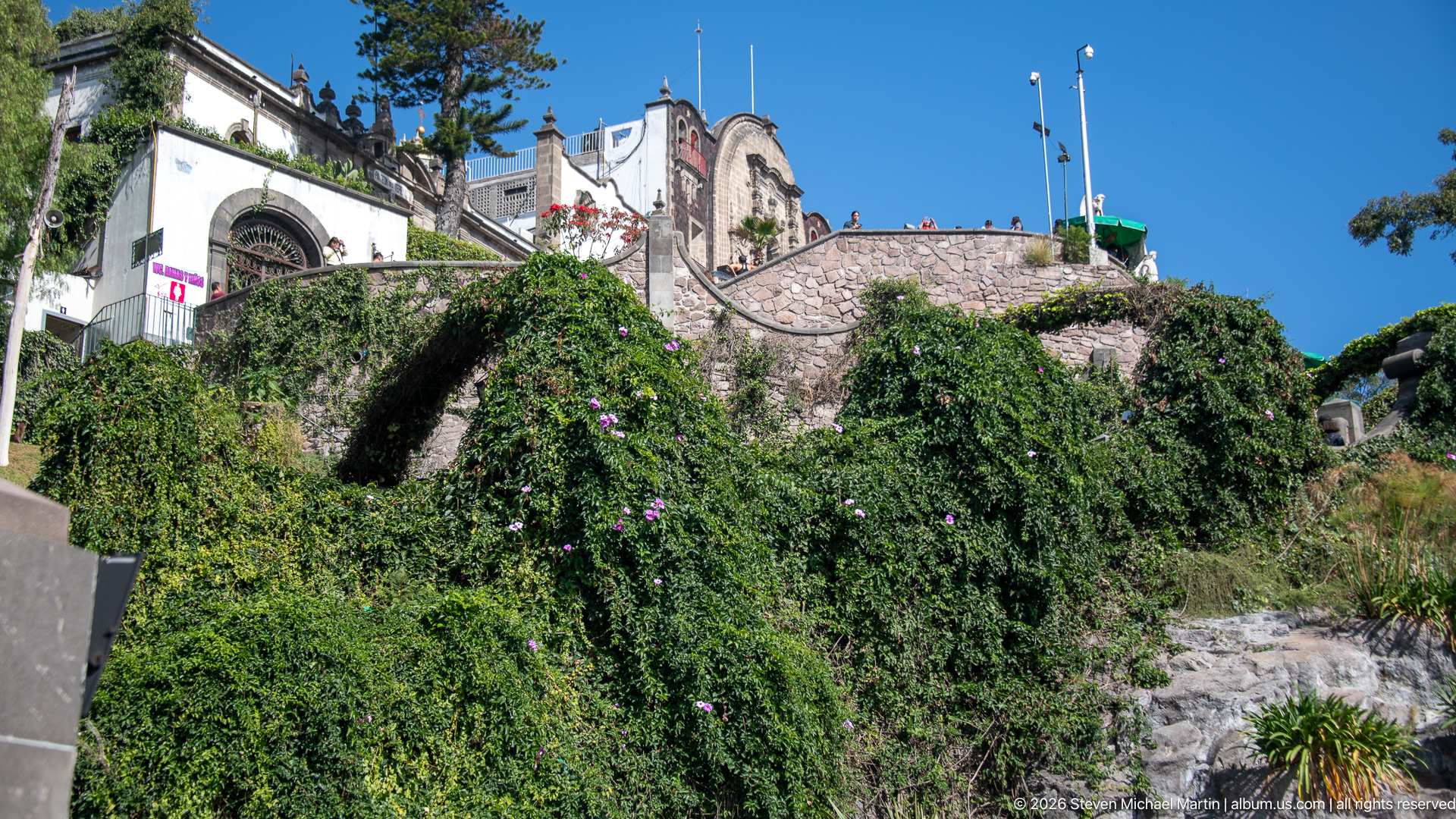
A steep stone retaining wall covered in dense vines climbs toward a walkway and white buildings above. A narrow stair and rocky slope enter at the right, while poles and greenery break the skyline. The view records the planted hillside infrastructure that links different levels of the grounds, with the upper path and visitors only faintly visible.
Caption
A steep stone retaining wall covered in dense vines climbs toward a walkway and white buildings above. A narrow stair and rocky slope enter at the right, while poles and greenery break the skyline. The view records the planted hillside infrastructure that links different levels of the grounds, with the upper path and visitors only faintly visible.
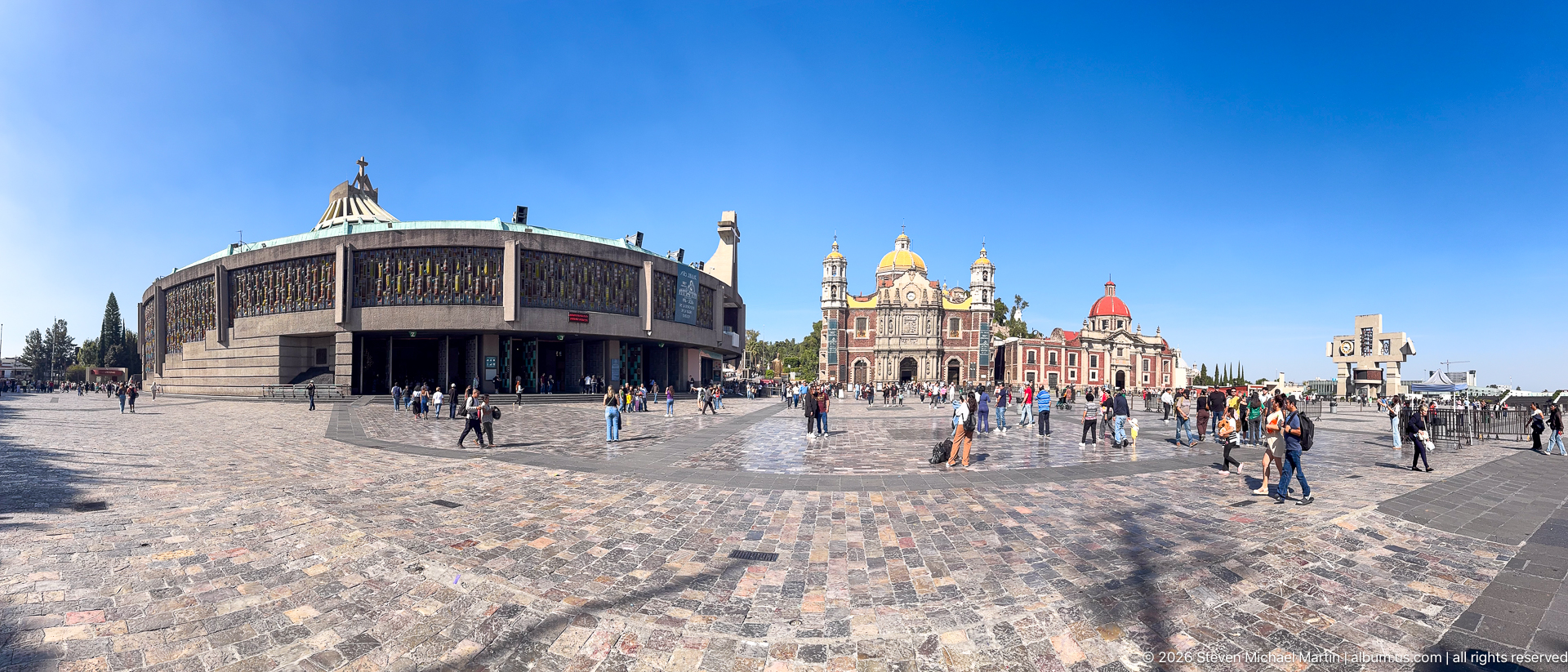
The broad forecourt links two generations of pilgrimage architecture: the low, circular modern Basilica at left and the older red-and-white church beyond it. Visitors cross the open stone plaza between the buildings, while a bright, cloudless sky sharpens their contrasting profiles. The panorama makes the complex’s scale and layered setting legible in a single view.
Caption
The broad forecourt links two generations of pilgrimage architecture: the low, circular modern Basilica at left and the older red-and-white church beyond it. Visitors cross the open stone plaza between the buildings, while a bright, cloudless sky sharpens their contrasting profiles. The panorama makes the complex’s scale and layered setting legible in a single view.
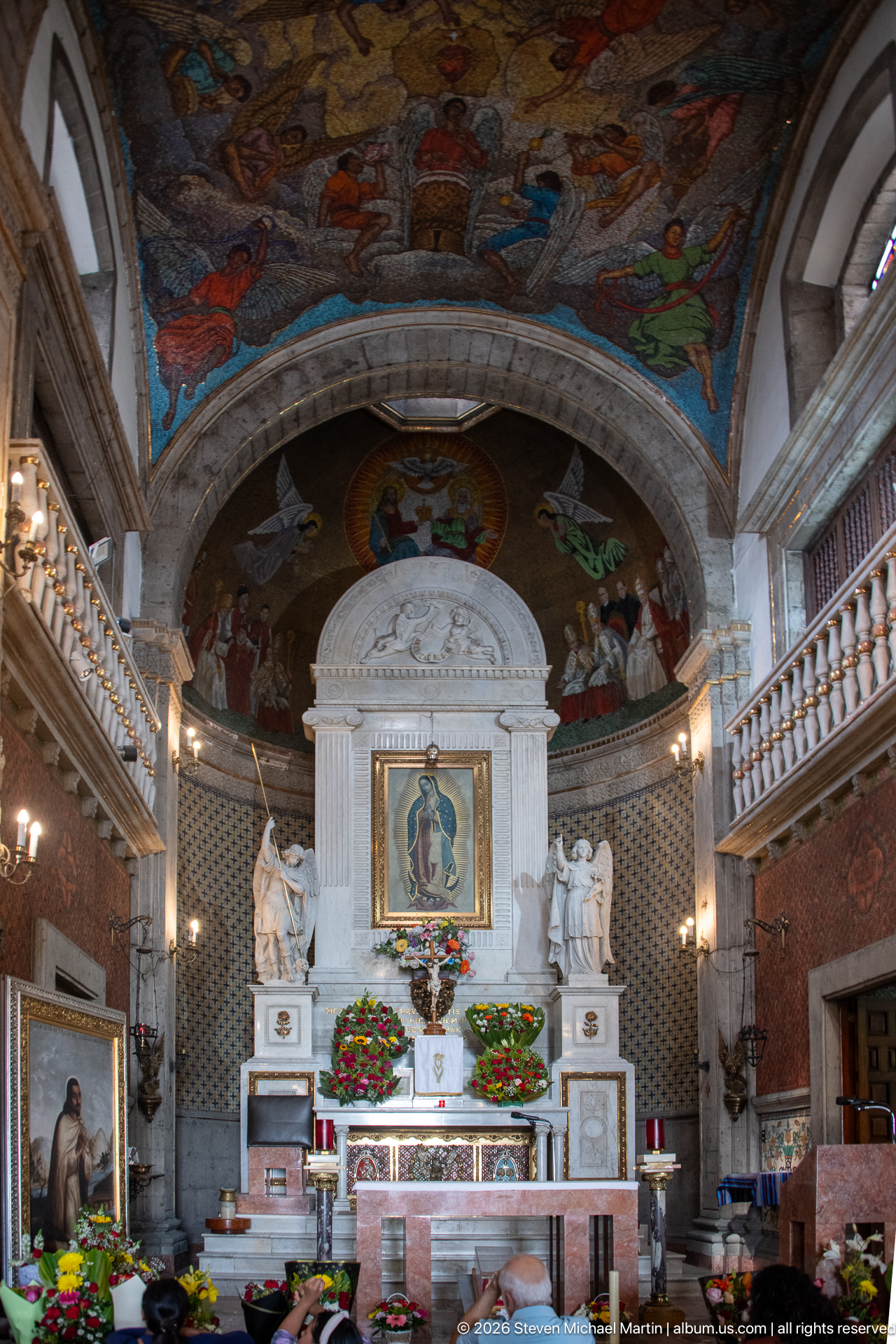
A framed image of Our Lady of Guadalupe stands at the center of a white marble shrine, flanked by sculpted figures and flower arrangements. Above it, a broad apse mural and a band of colorful ceiling mosaic extend across the sanctuary; side galleries with balustrades frame the view. Visitors at the lower edge give a sense of the altar’s scale and active devotional setting.
Caption
A framed image of Our Lady of Guadalupe stands at the center of a white marble shrine, flanked by sculpted figures and flower arrangements. Above it, a broad apse mural and a band of colorful ceiling mosaic extend across the sanctuary; side galleries with balustrades frame the view. Visitors at the lower edge give a sense of the altar’s scale and active devotional setting.
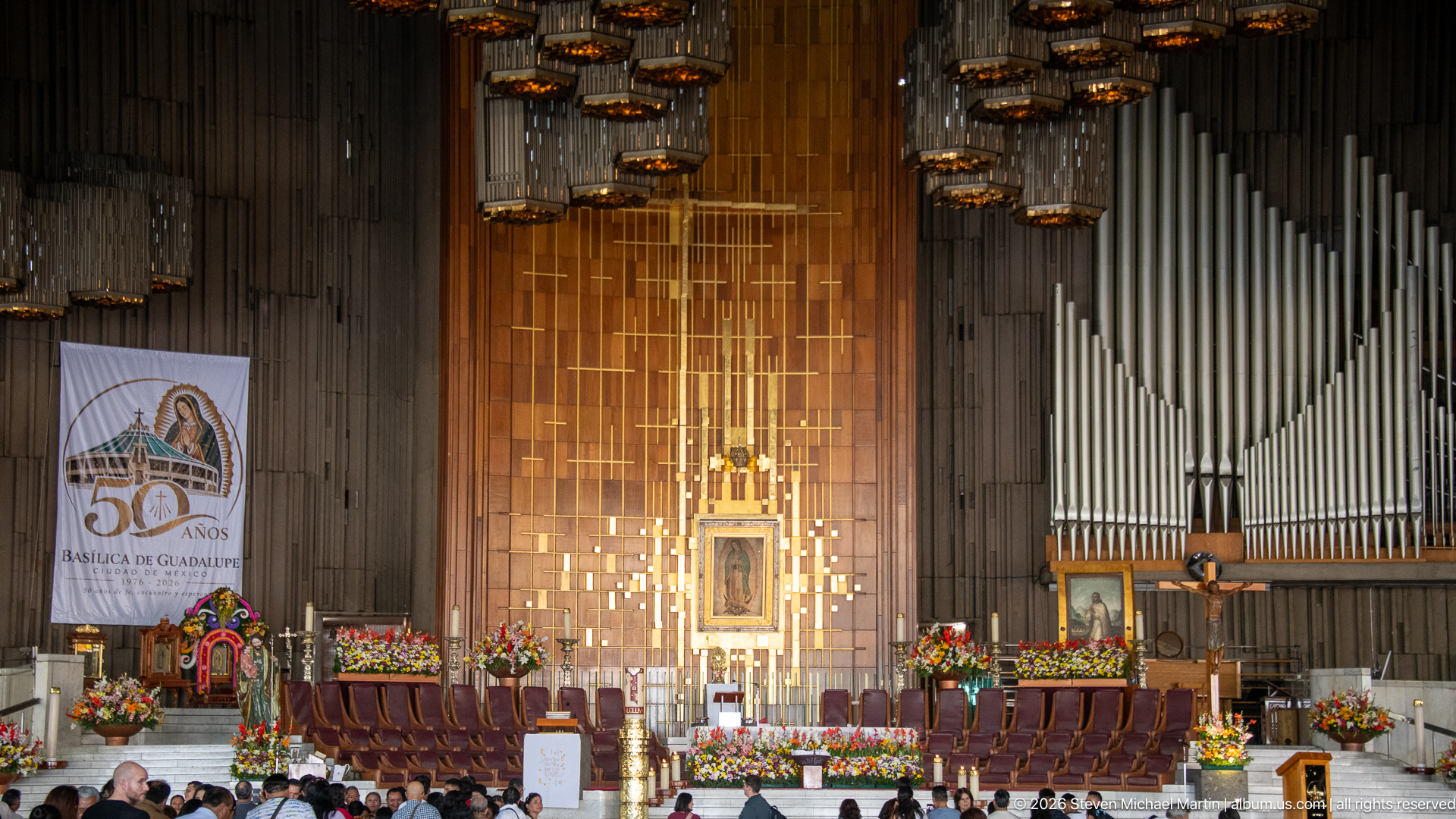
The sanctuary centers the framed image of Our Lady of Guadalupe within a tall gold-toned wall patterned by a cross-like grid. A large bank of silver organ pipes rises at right, while rows of chairs, flower arrangements, a crucifix, and a jubilee banner occupy the foreground and side aisles. The view records how devotional art, music, and ceremonial furnishings share the expansive modern interior.
Caption
The sanctuary centers the framed image of Our Lady of Guadalupe within a tall gold-toned wall patterned by a cross-like grid. A large bank of silver organ pipes rises at right, while rows of chairs, flower arrangements, a crucifix, and a jubilee banner occupy the foreground and side aisles. The view records how devotional art, music, and ceremonial furnishings share the expansive modern interior.
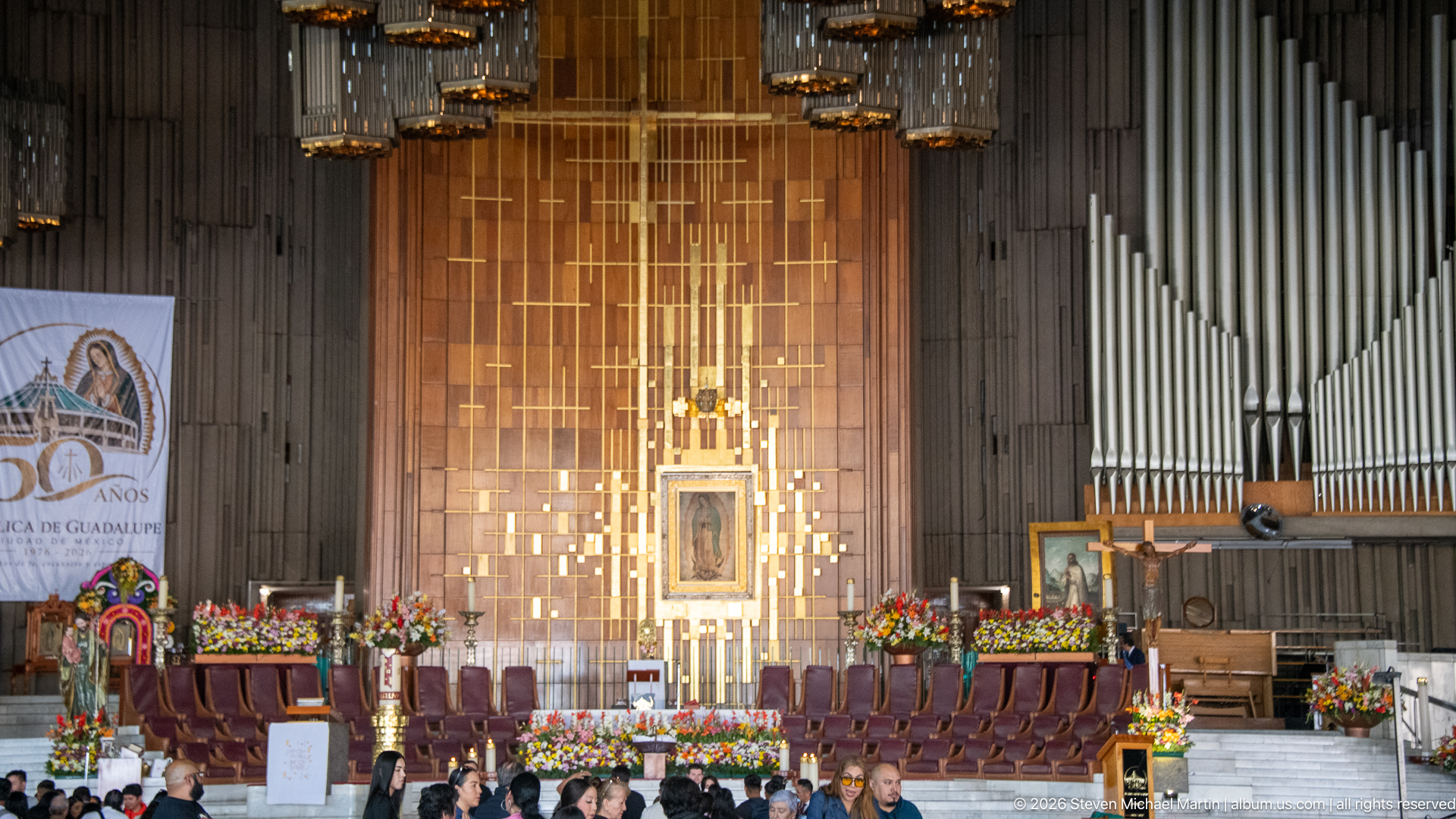
A closer, centered view brings the framed image of Our Lady of Guadalupe forward against the sanctuary’s geometric gold-toned wall. Organ pipes flank the image, flower arrangements and chairs line the platform, and the jubilee banner remains at the left edge. The composition emphasizes the devotional focal point while retaining enough of the surrounding architecture to show its place within the modern sanctuary.
Caption
A closer, centered view brings the framed image of Our Lady of Guadalupe forward against the sanctuary’s geometric gold-toned wall. Organ pipes flank the image, flower arrangements and chairs line the platform, and the jubilee banner remains at the left edge. The composition emphasizes the devotional focal point while retaining enough of the surrounding architecture to show its place within the modern sanctuary.
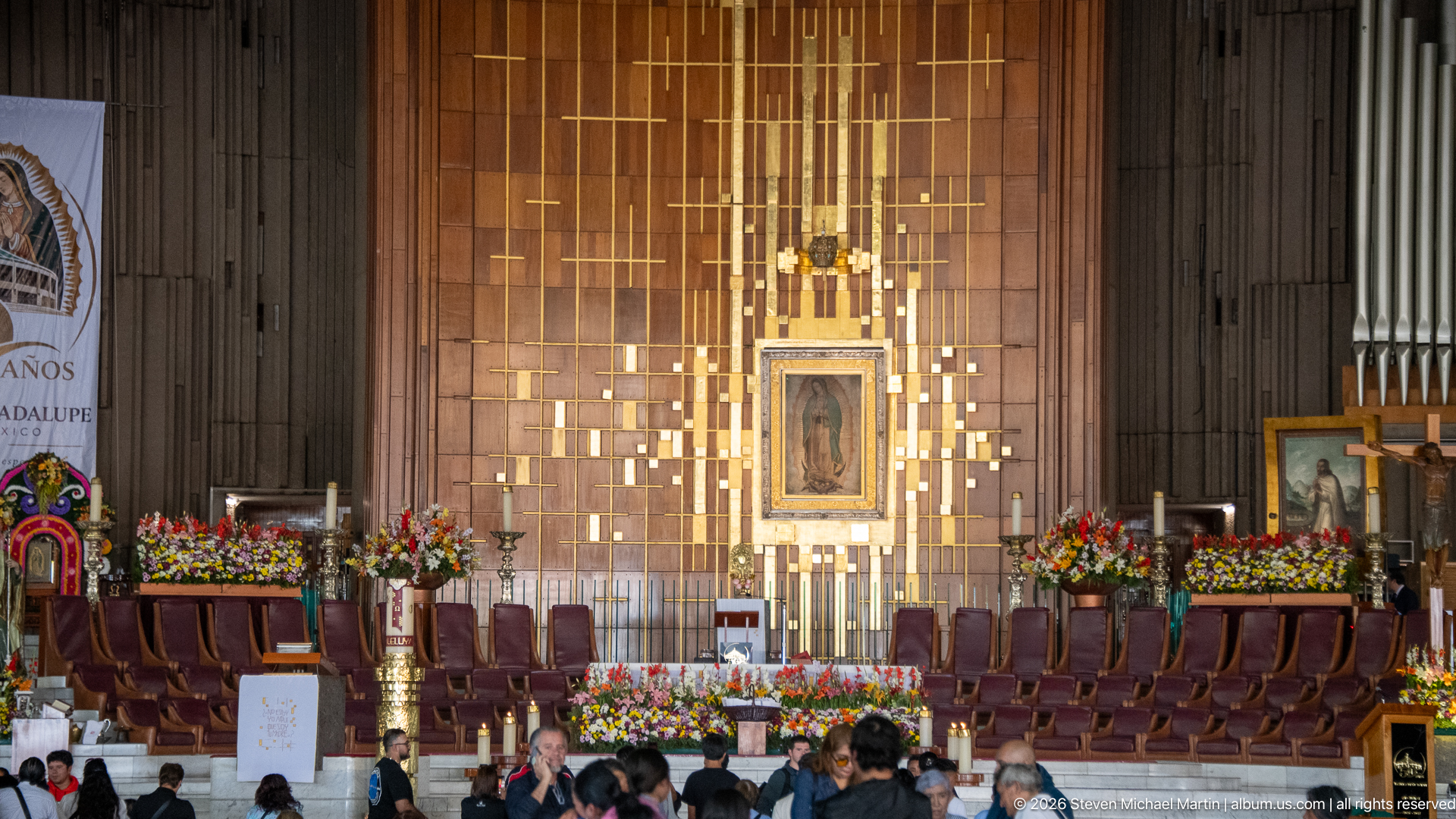
The altar platform fills the frame, with a small framed image of Guadalupe centered high on the gold-patterned wall and a long row of burgundy chairs below. Dense flower arrangements flank the chairs, while visitors stand and move across the lower foreground. At the left edge, a jubilee banner and a colorful devotional shrine hint at a special observance without obscuring the sanctuary’s ordered central axis.
Caption
The altar platform fills the frame, with a small framed image of Guadalupe centered high on the gold-patterned wall and a long row of burgundy chairs below. Dense flower arrangements flank the chairs, while visitors stand and move across the lower foreground. At the left edge, a jubilee banner and a colorful devotional shrine hint at a special observance without obscuring the sanctuary’s ordered central axis.
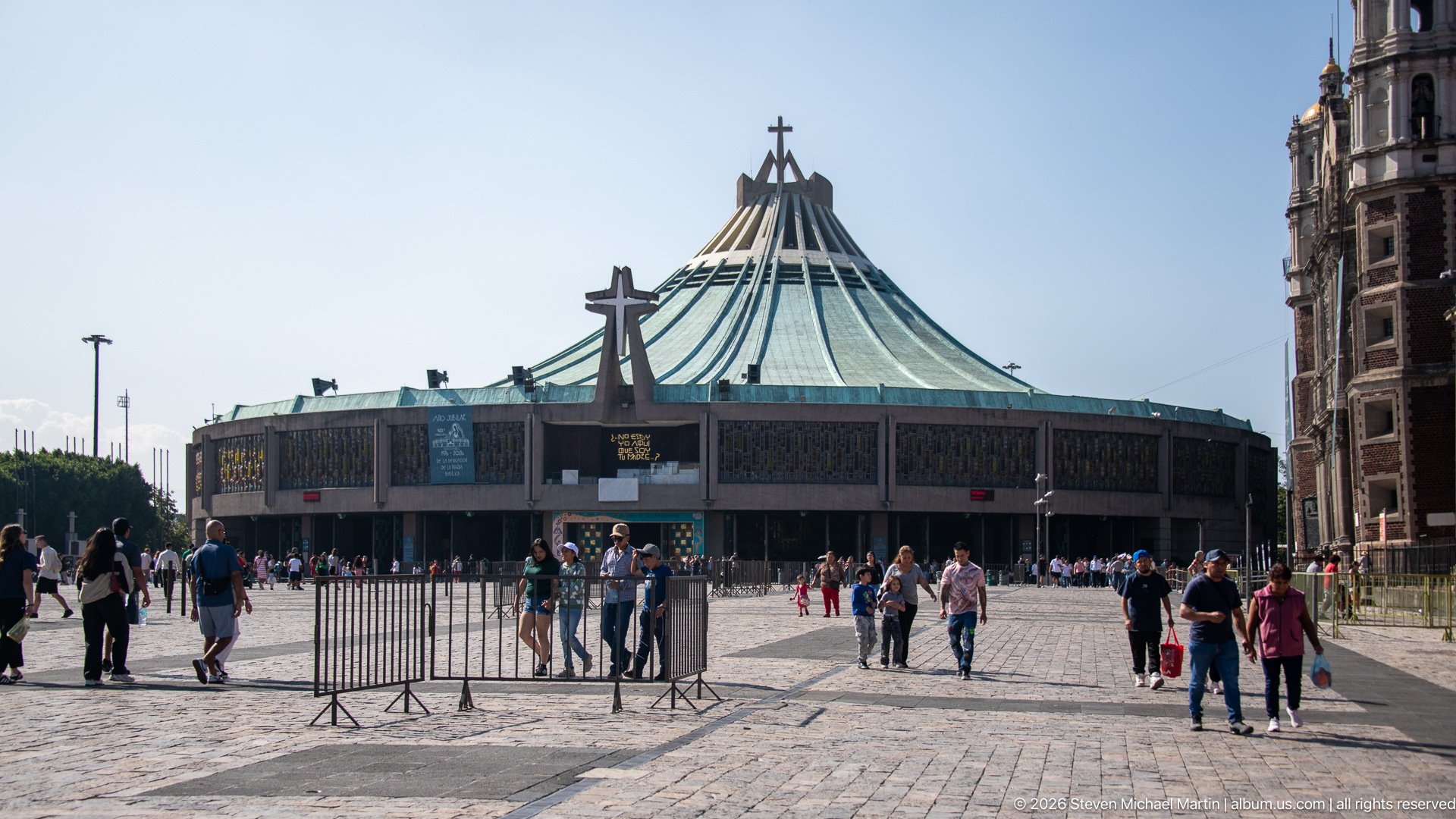
Visitors cross the sunlit stone plaza toward the circular modern Basilica, whose sloping ribbed roof and cross stand above a band of colored windows. A section of a taller historic church enters at the far right, placing the modern building within the wider shrine complex. The low viewpoint gives the open forecourt and moving pedestrians as much weight as the sanctuary itself.
Caption
Visitors cross the sunlit stone plaza toward the circular modern Basilica, whose sloping ribbed roof and cross stand above a band of colored windows. A section of a taller historic church enters at the far right, placing the modern building within the wider shrine complex. The low viewpoint gives the open forecourt and moving pedestrians as much weight as the sanctuary itself.
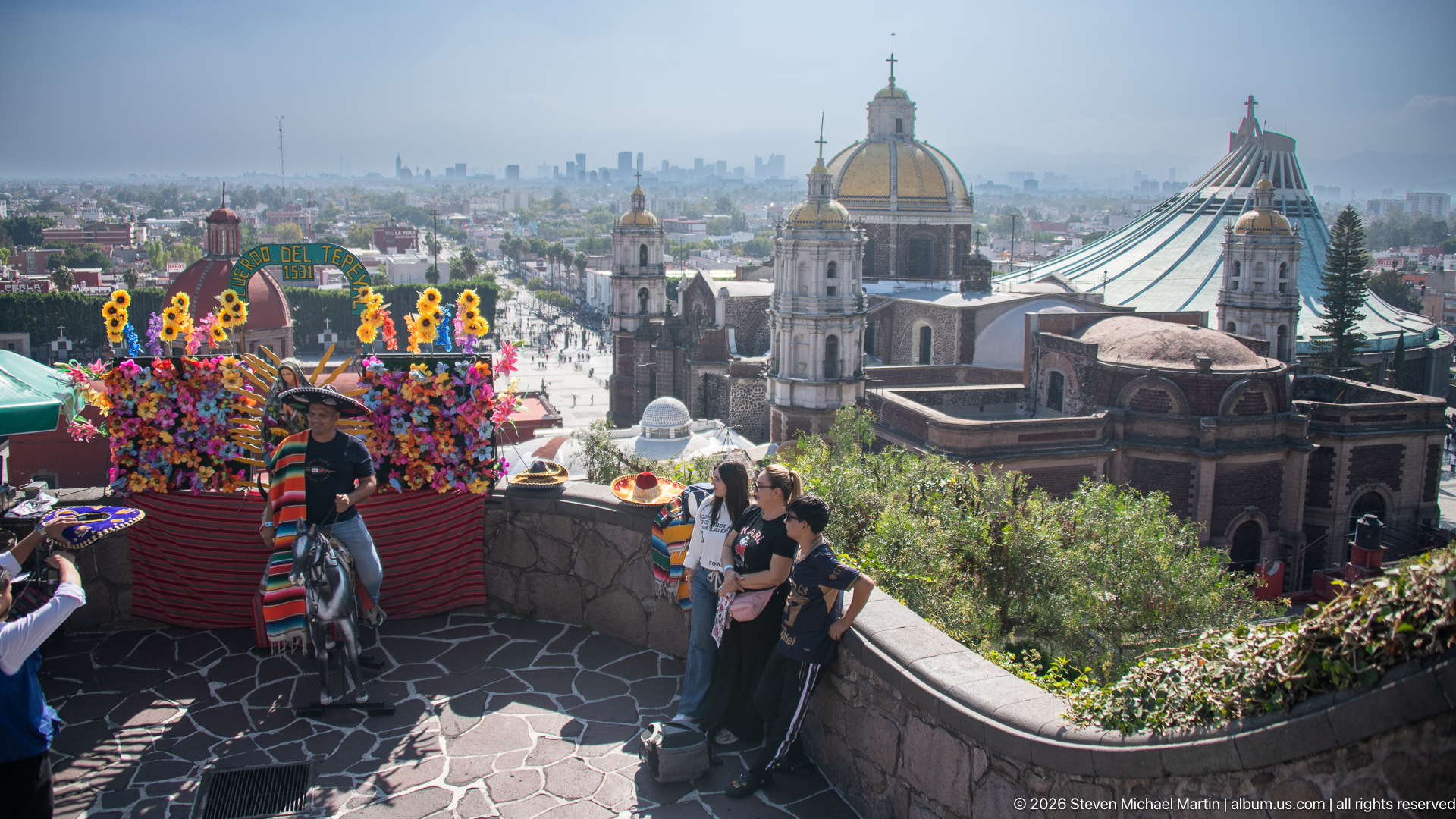
From an elevated terrace, visitors pose beside a colorful floral display while the old basilica’s domes and the broad tent-like roof of the modern basilica fill the middle distance. Mexico City recedes into a hazy skyline beyond the sanctuary complex. The foreground figures and Día de Muertos-style decoration create a seasonal travel scene, while the paired historic and contemporary churches anchor the panorama.
Caption
From an elevated terrace, visitors pose beside a colorful floral display while the old basilica’s domes and the broad tent-like roof of the modern basilica fill the middle distance. Mexico City recedes into a hazy skyline beyond the sanctuary complex. The foreground figures and Día de Muertos-style decoration create a seasonal travel scene, while the paired historic and contemporary churches anchor the panorama.
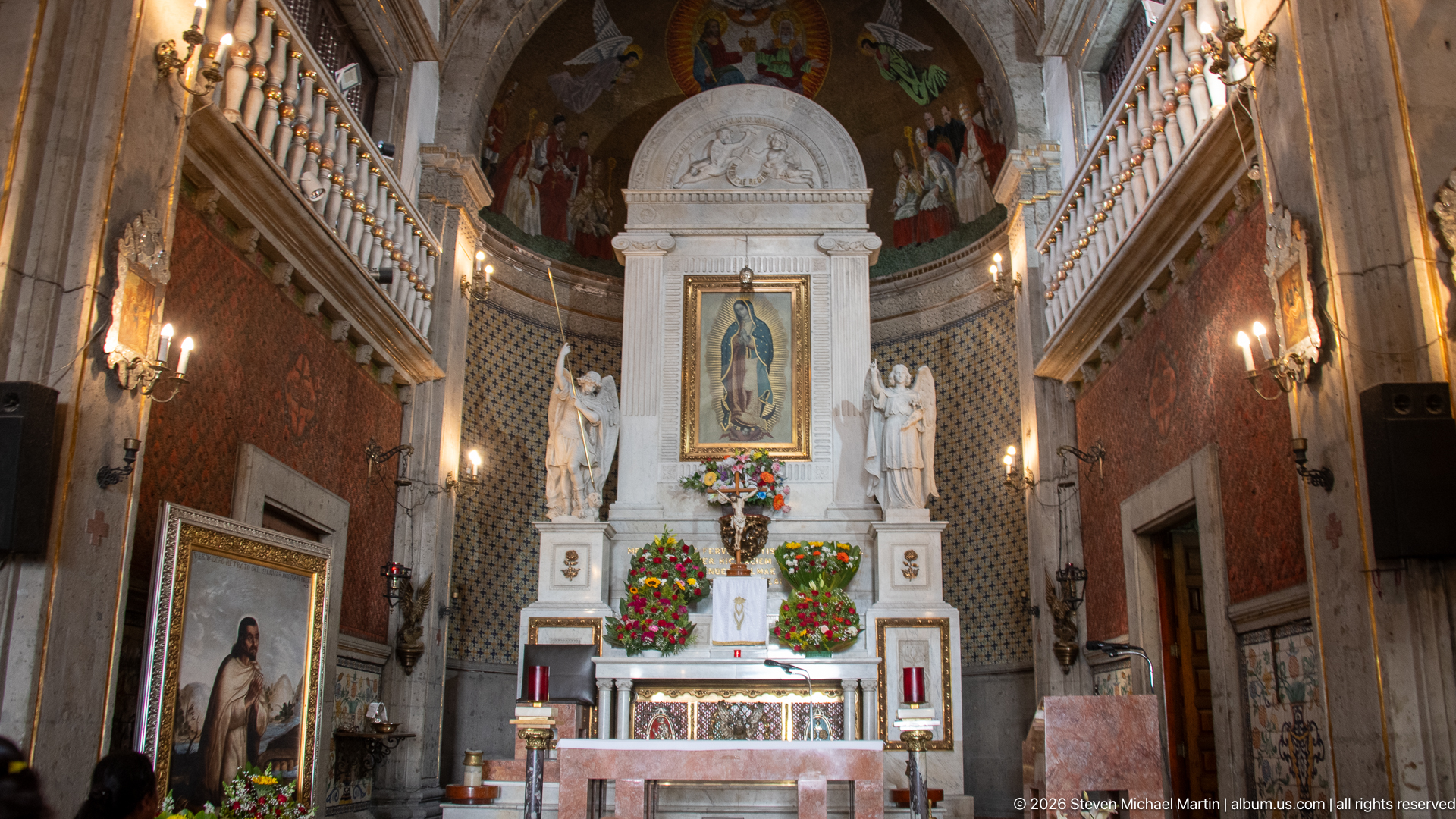
The central shrine fills a nearly symmetrical view: a framed image of Our Lady of Guadalupe sits between pale sculpted figures, with flowers arranged at the altar below. Painted figures curve through the apse behind it, while patterned blue-and-gold wall panels and side galleries lead the eye inward. The image, altar, and surrounding architecture form a layered devotional focal point.
Caption
The central shrine fills a nearly symmetrical view: a framed image of Our Lady of Guadalupe sits between pale sculpted figures, with flowers arranged at the altar below. Painted figures curve through the apse behind it, while patterned blue-and-gold wall panels and side galleries lead the eye inward. The image, altar, and surrounding architecture form a layered devotional focal point.
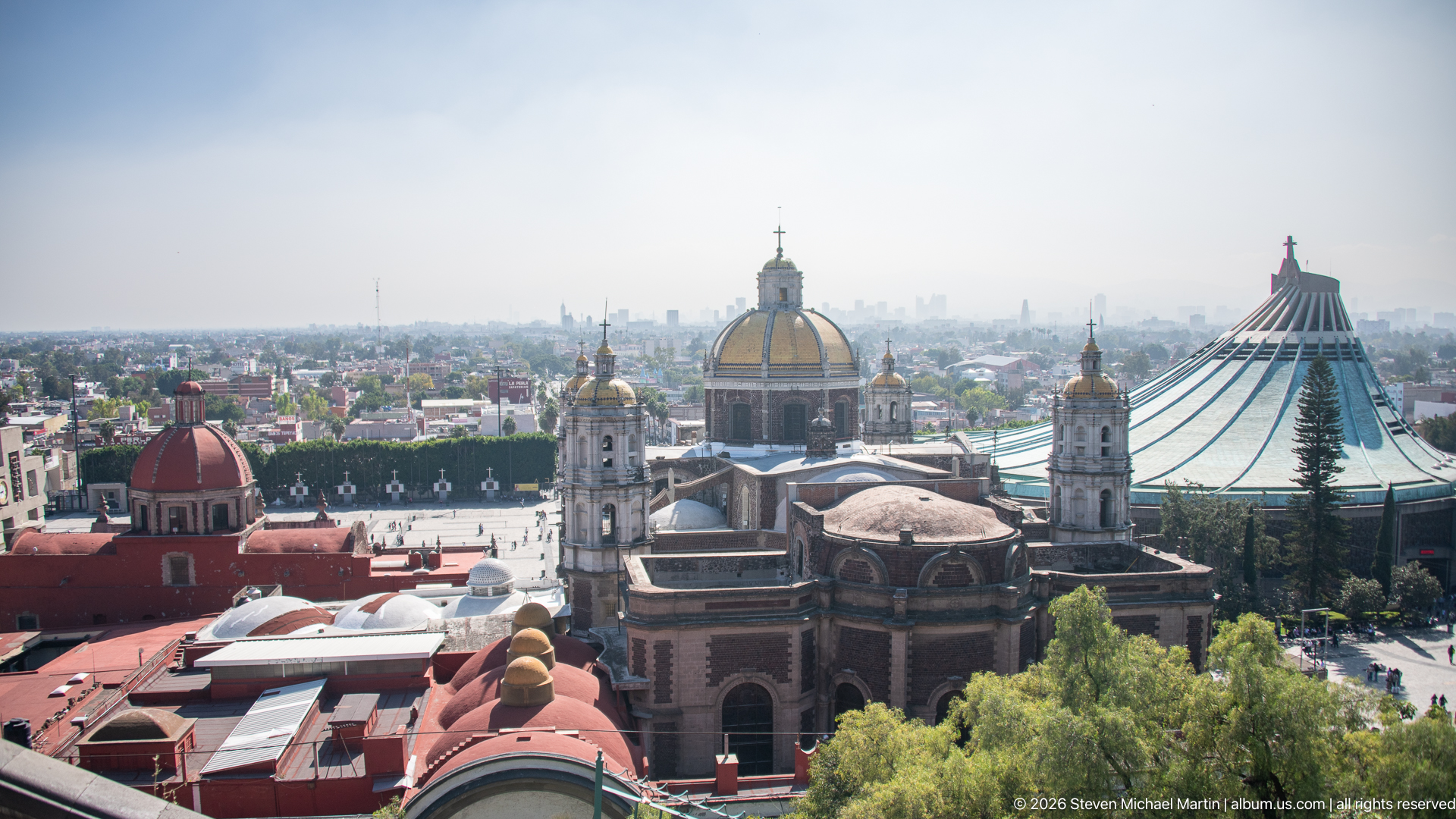
From above, domes and bell towers cluster around the large sloping roof of the modern basilica, while the city extends into a hazy distance. Trees and the plaza occupy the lower edge, connecting the complex’s varied roof forms to its urban surroundings. The elevated viewpoint offers a broad orientation to the site rather than a close architectural study.
Caption
From above, domes and bell towers cluster around the large sloping roof of the modern basilica, while the city extends into a hazy distance. Trees and the plaza occupy the lower edge, connecting the complex’s varied roof forms to its urban surroundings. The elevated viewpoint offers a broad orientation to the site rather than a close architectural study.
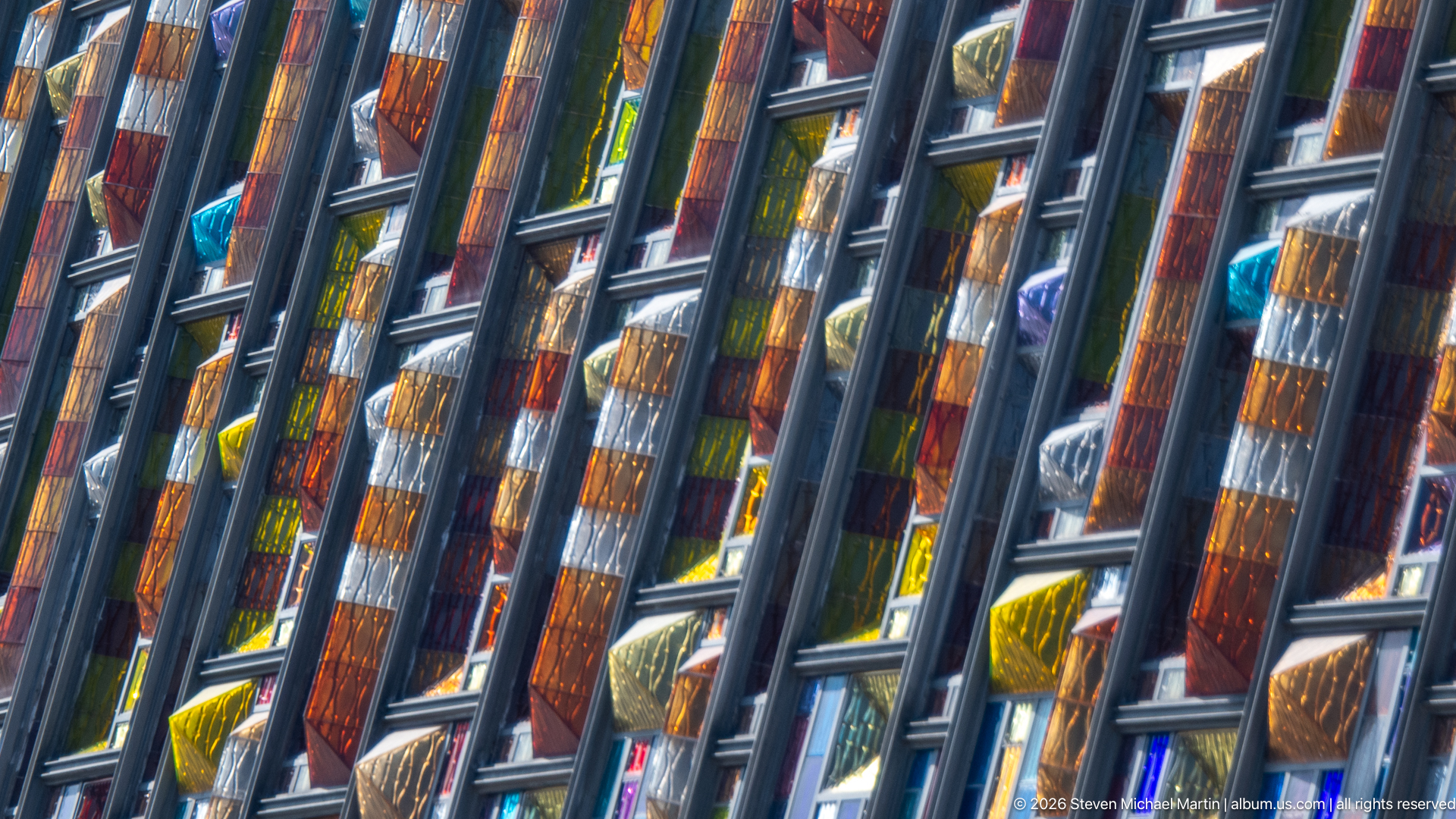
A tight diagonal crop turns the modern Basilica’s window wall into a repeating field of color. Narrow panes of amber, red, blue, green, and pale glass sit within dark metal frames, with reflections brightening some sections and leaving others muted. This close view isolates the façade’s glazed surface from the plaza and the building’s larger circular form.
Caption
A tight diagonal crop turns the modern Basilica’s window wall into a repeating field of color. Narrow panes of amber, red, blue, green, and pale glass sit within dark metal frames, with reflections brightening some sections and leaving others muted. This close view isolates the façade’s glazed surface from the plaza and the building’s larger circular form.
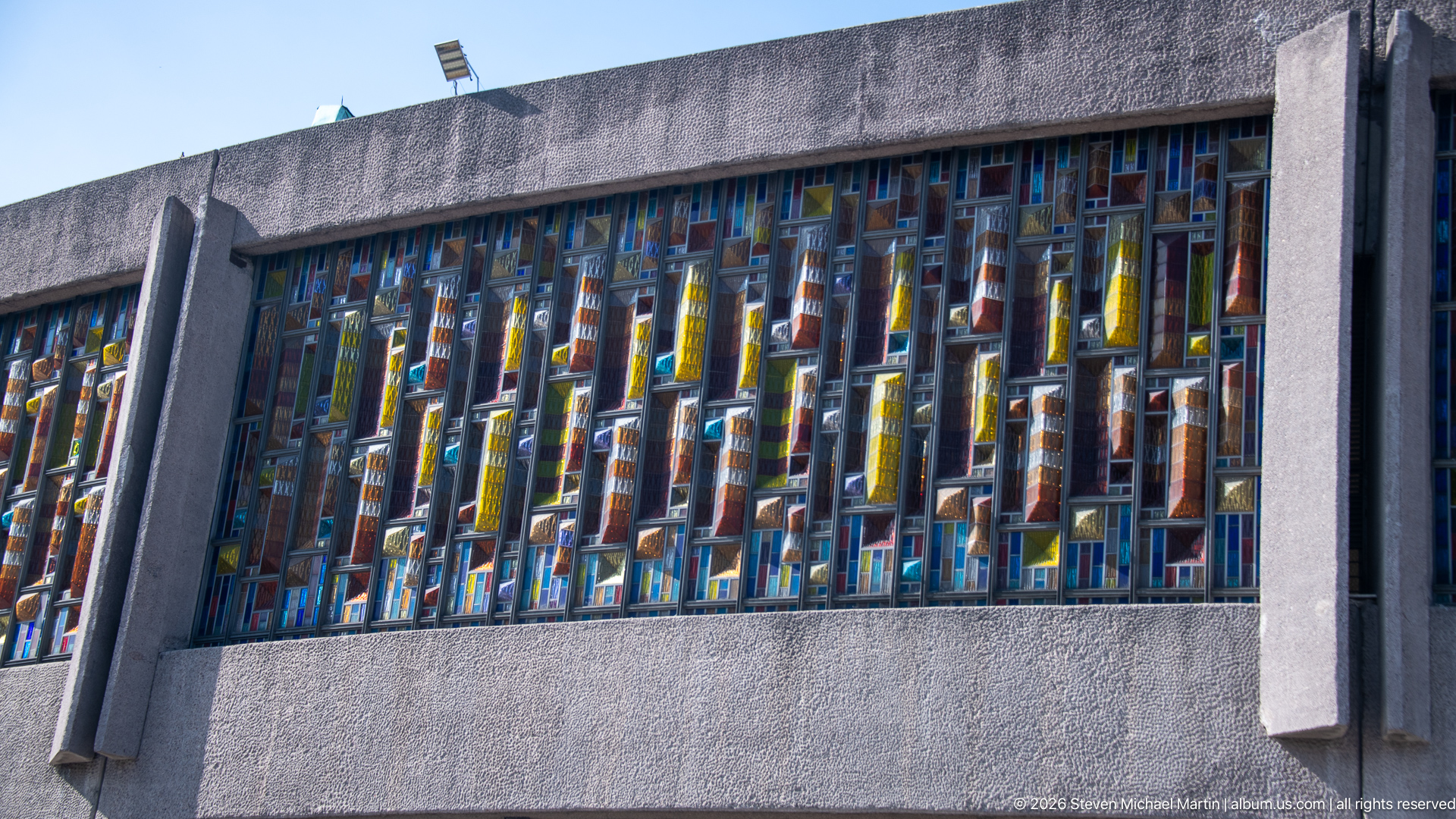
A curved concrete wall sweeps across the frame above and below a long band of narrow stained-glass windows. Seen obliquely, the repeated colored panes emphasize the modern Basilica’s continuous circular enclosure rather than its entrance or roof. The gray structural bands and crisp daylight make the window strip read as an architectural element integrated into the wall.
Caption
A curved concrete wall sweeps across the frame above and below a long band of narrow stained-glass windows. Seen obliquely, the repeated colored panes emphasize the modern Basilica’s continuous circular enclosure rather than its entrance or roof. The gray structural bands and crisp daylight make the window strip read as an architectural element integrated into the wall.
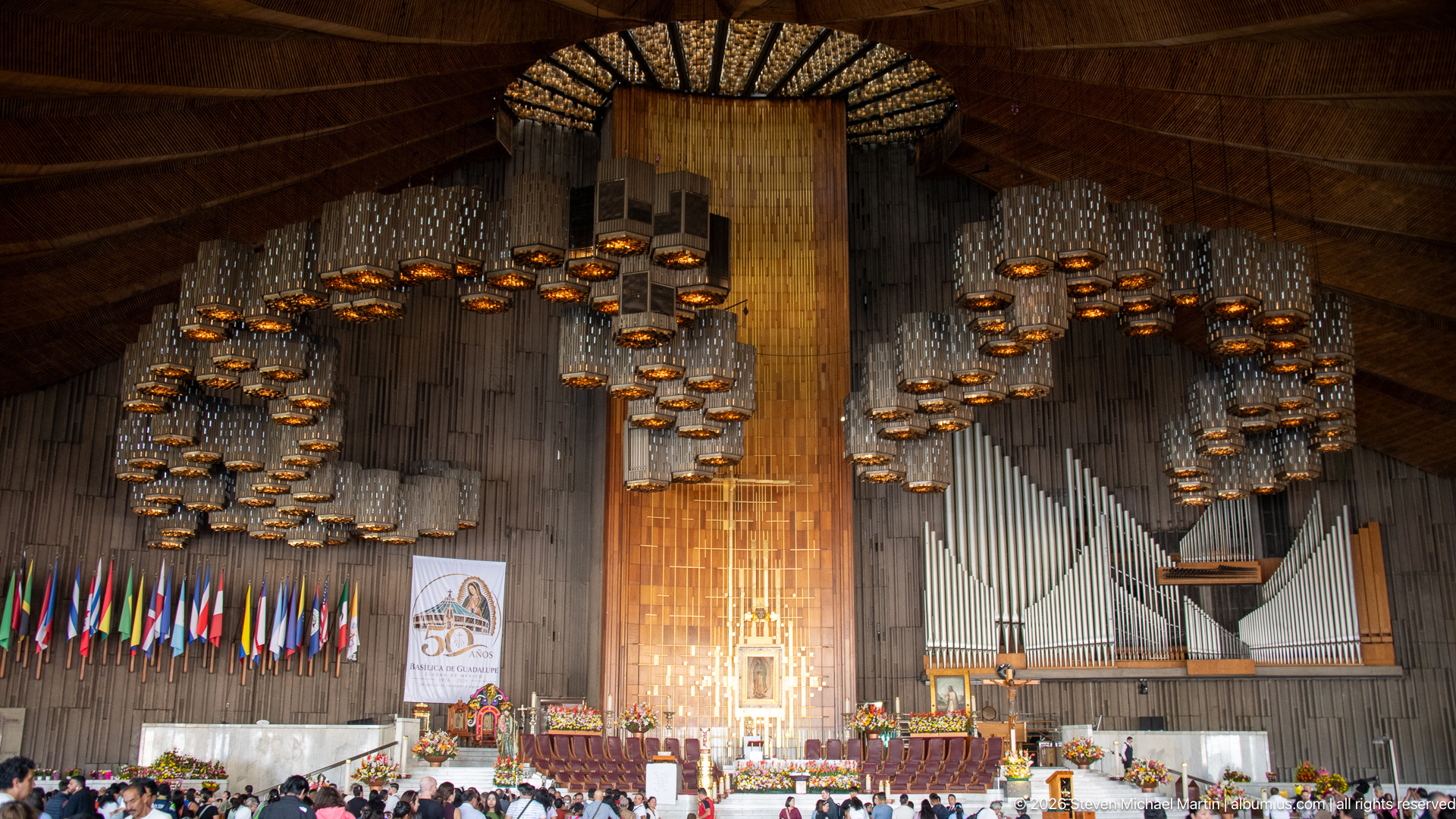
From farther back, the sanctuary’s central gold panel is framed by clusters of hanging lamps and a sweeping pipe organ. International flags line the left wall, and the jubilee banner and crowded devotional area sit below the image of Guadalupe. The broad interior view balances the basilica’s immense timber roof with the smaller human figures gathered around the altar.
Caption
From farther back, the sanctuary’s central gold panel is framed by clusters of hanging lamps and a sweeping pipe organ. International flags line the left wall, and the jubilee banner and crowded devotional area sit below the image of Guadalupe. The broad interior view balances the basilica’s immense timber roof with the smaller human figures gathered around the altar.
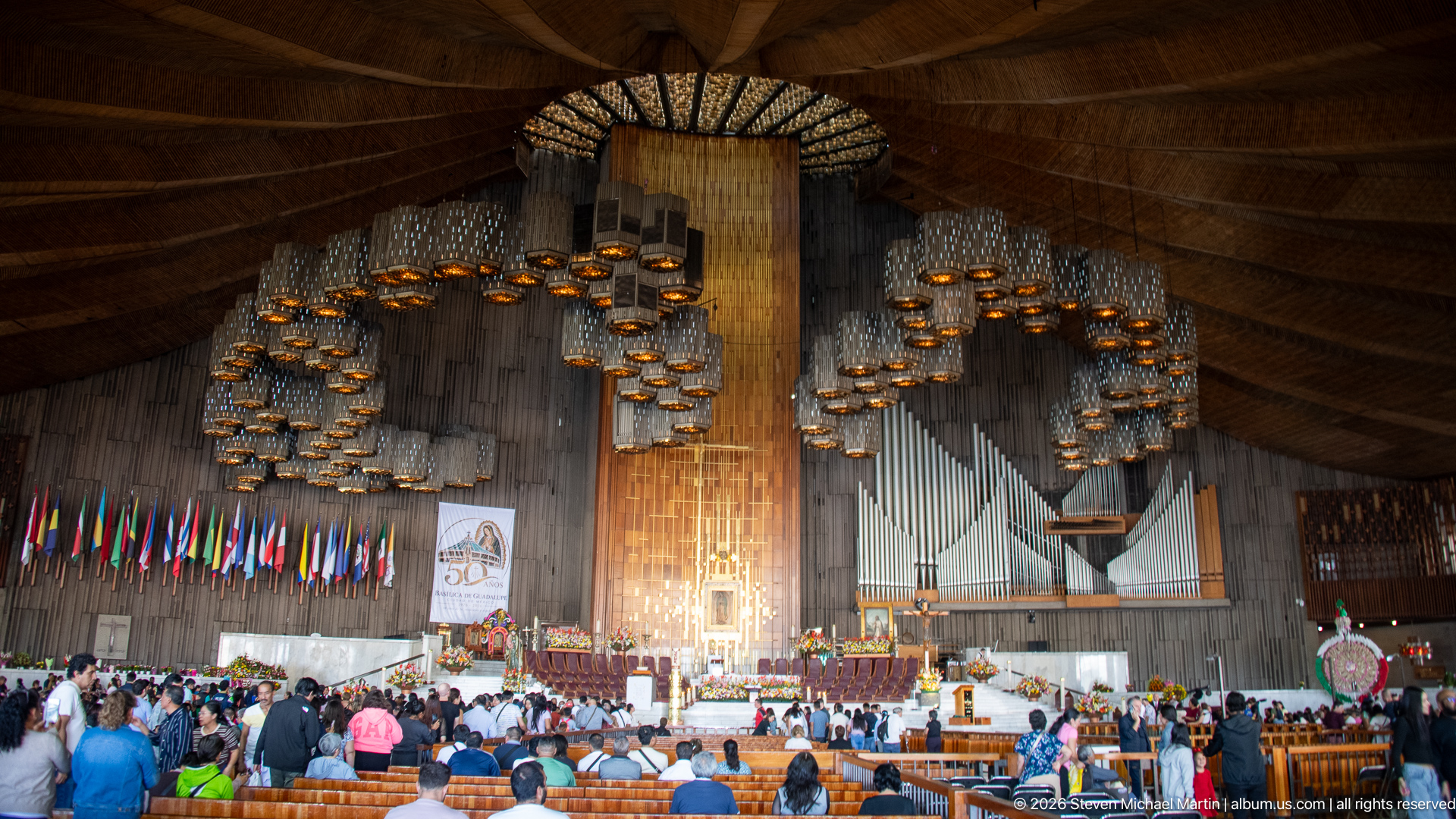
Rows of wooden pews lead toward the illuminated sanctuary, where the image of Guadalupe sits beneath a tall gold-toned panel. A dense congregation fills the central aisle, framed by the large pipe organ, hanging lamps, international flags, and anniversary banner. This view places worshippers at the center of the basilica’s scale, connecting the monumental interior to its active devotional use.
Caption
Rows of wooden pews lead toward the illuminated sanctuary, where the image of Guadalupe sits beneath a tall gold-toned panel. A dense congregation fills the central aisle, framed by the large pipe organ, hanging lamps, international flags, and anniversary banner. This view places worshippers at the center of the basilica’s scale, connecting the monumental interior to its active devotional use.
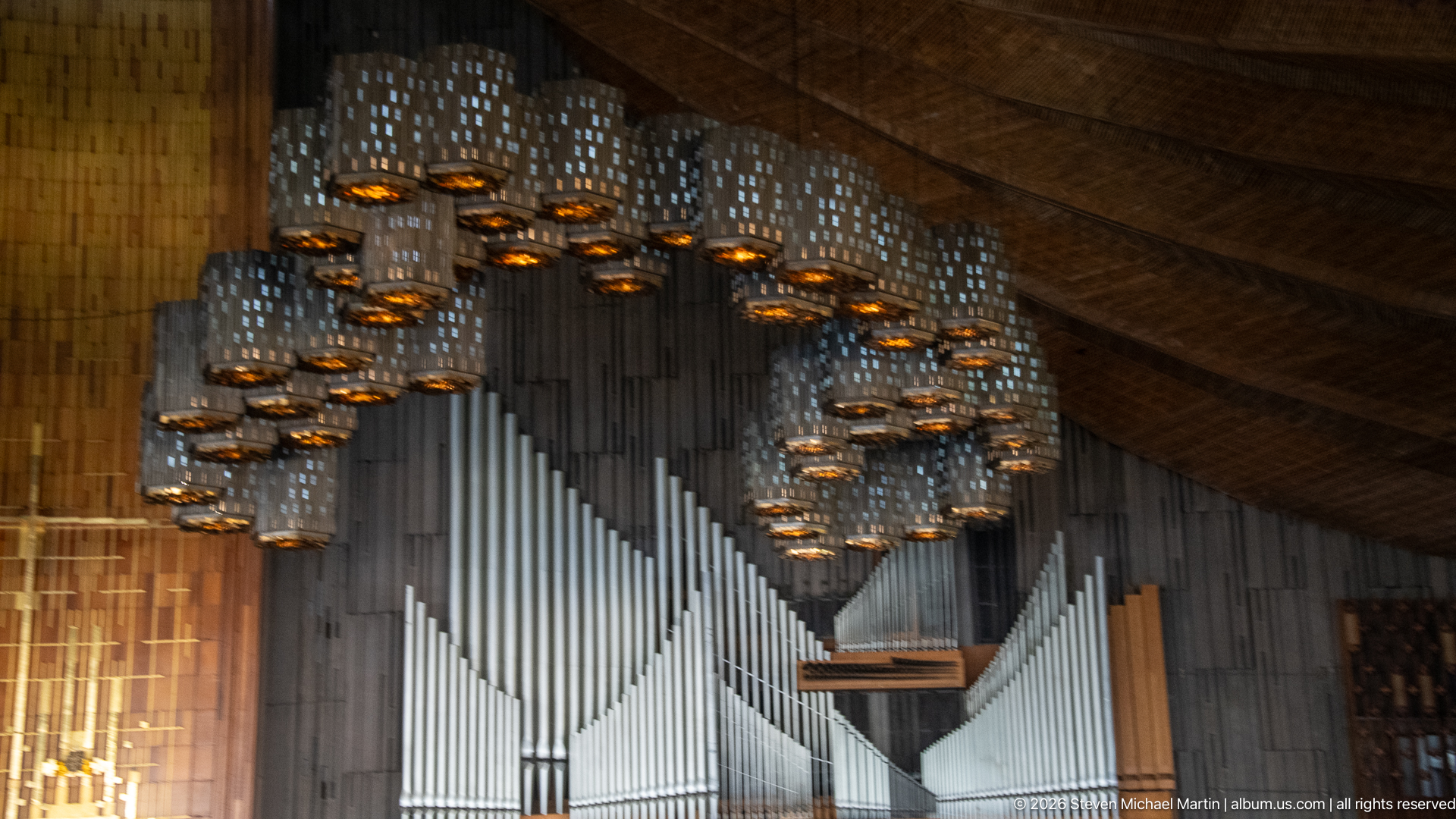
The modern Basilica’s silver organ pipes rise in stepped groups beneath suspended clusters of small amber lamps. A portion of the gold sanctuary wall remains at left, giving the pipes a clear relationship to the central altar while the close crop excludes the congregation. The view draws attention to the contrast between the organ’s vertical lines and the lamps’ branching, cloudlike forms.
Caption
The modern Basilica’s silver organ pipes rise in stepped groups beneath suspended clusters of small amber lamps. A portion of the gold sanctuary wall remains at left, giving the pipes a clear relationship to the central altar while the close crop excludes the congregation. The view draws attention to the contrast between the organ’s vertical lines and the lamps’ branching, cloudlike forms.
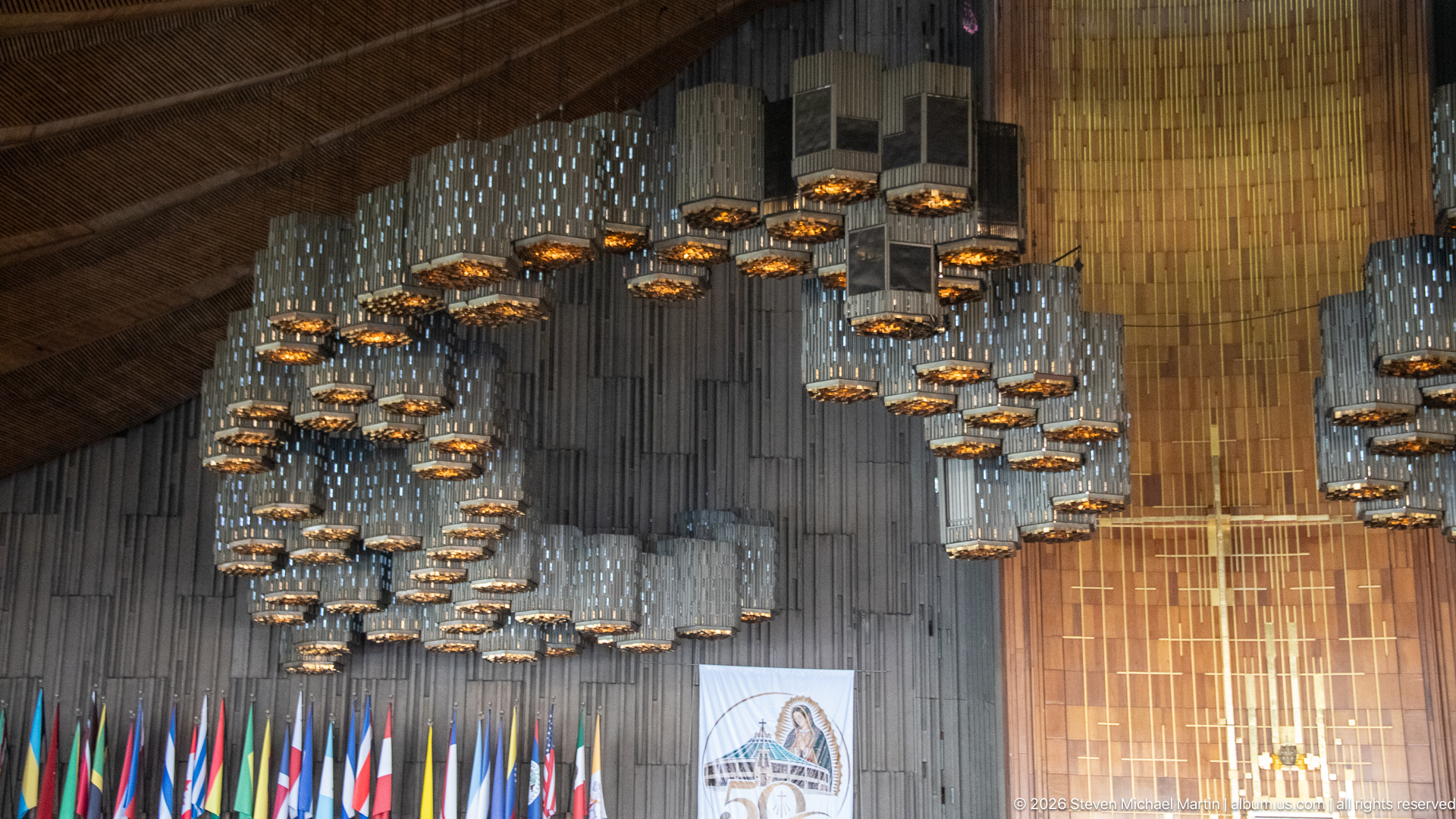
Dozens of suspended lamps gather into tiered clusters against the basilica’s ribbed gray wall, with the silver organ pipes rising beneath them. The crop includes the edge of the central gold panel and the tops of flags and a jubilee banner, anchoring this ceiling detail within the sanctuary. Warm lamp light contrasts with the cool, vertically patterned wall.
Caption
Dozens of suspended lamps gather into tiered clusters against the basilica’s ribbed gray wall, with the silver organ pipes rising beneath them. The crop includes the edge of the central gold panel and the tops of flags and a jubilee banner, anchoring this ceiling detail within the sanctuary. Warm lamp light contrasts with the cool, vertically patterned wall.
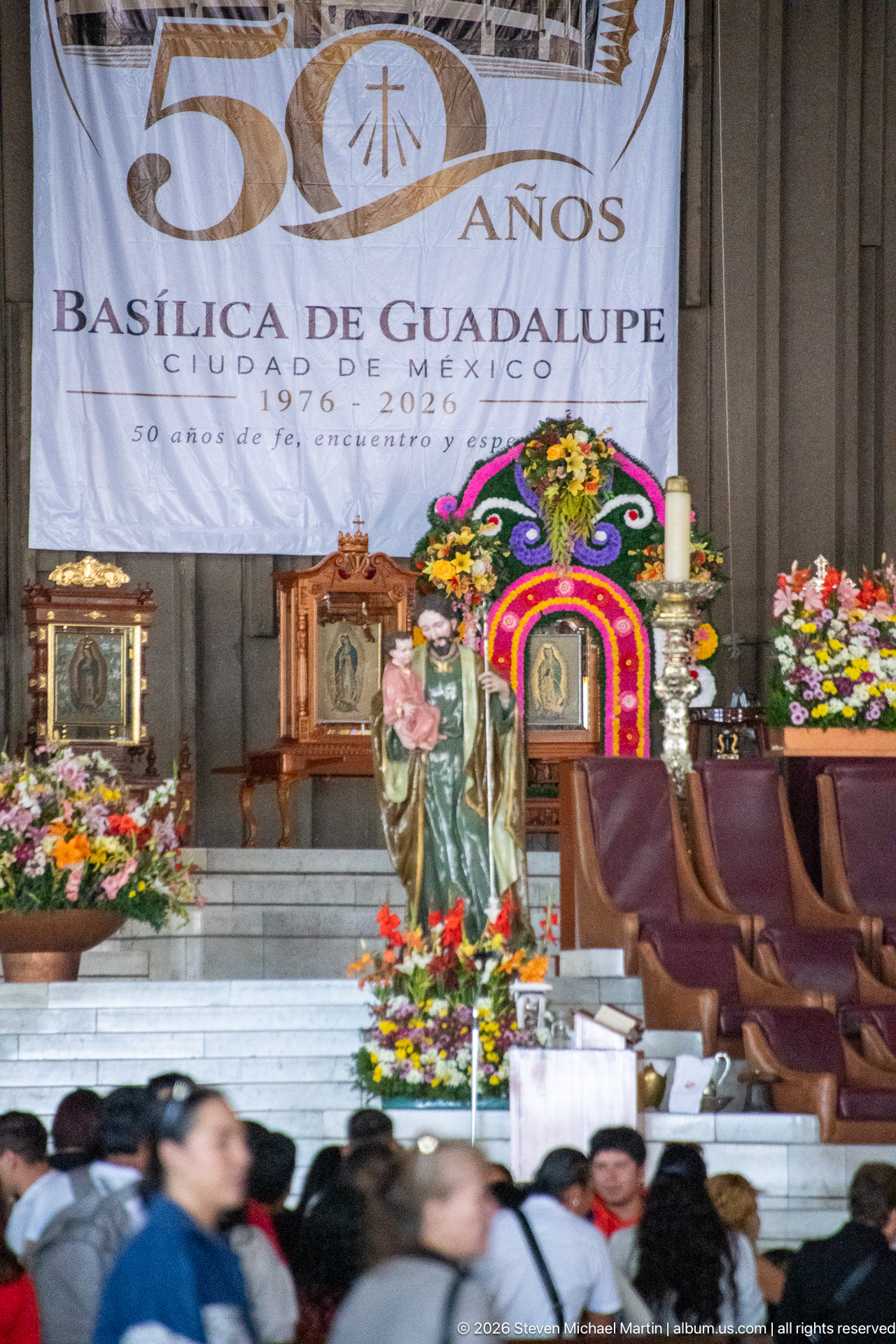
A flower-covered devotional display and small shrine stand before the sanctuary seating beneath a banner marking 50 years of the Basilica of Guadalupe in Mexico City, 1976–2026. The close crop brings the anniversary text, colorful arch, and framed devotional images together, while visitors blur across the lower edge. The scene records a temporary ceremonial arrangement within the larger sanctuary.
Caption
A flower-covered devotional display and small shrine stand before the sanctuary seating beneath a banner marking 50 years of the Basilica of Guadalupe in Mexico City, 1976–2026. The close crop brings the anniversary text, colorful arch, and framed devotional images together, while visitors blur across the lower edge. The scene records a temporary ceremonial arrangement within the larger sanctuary.
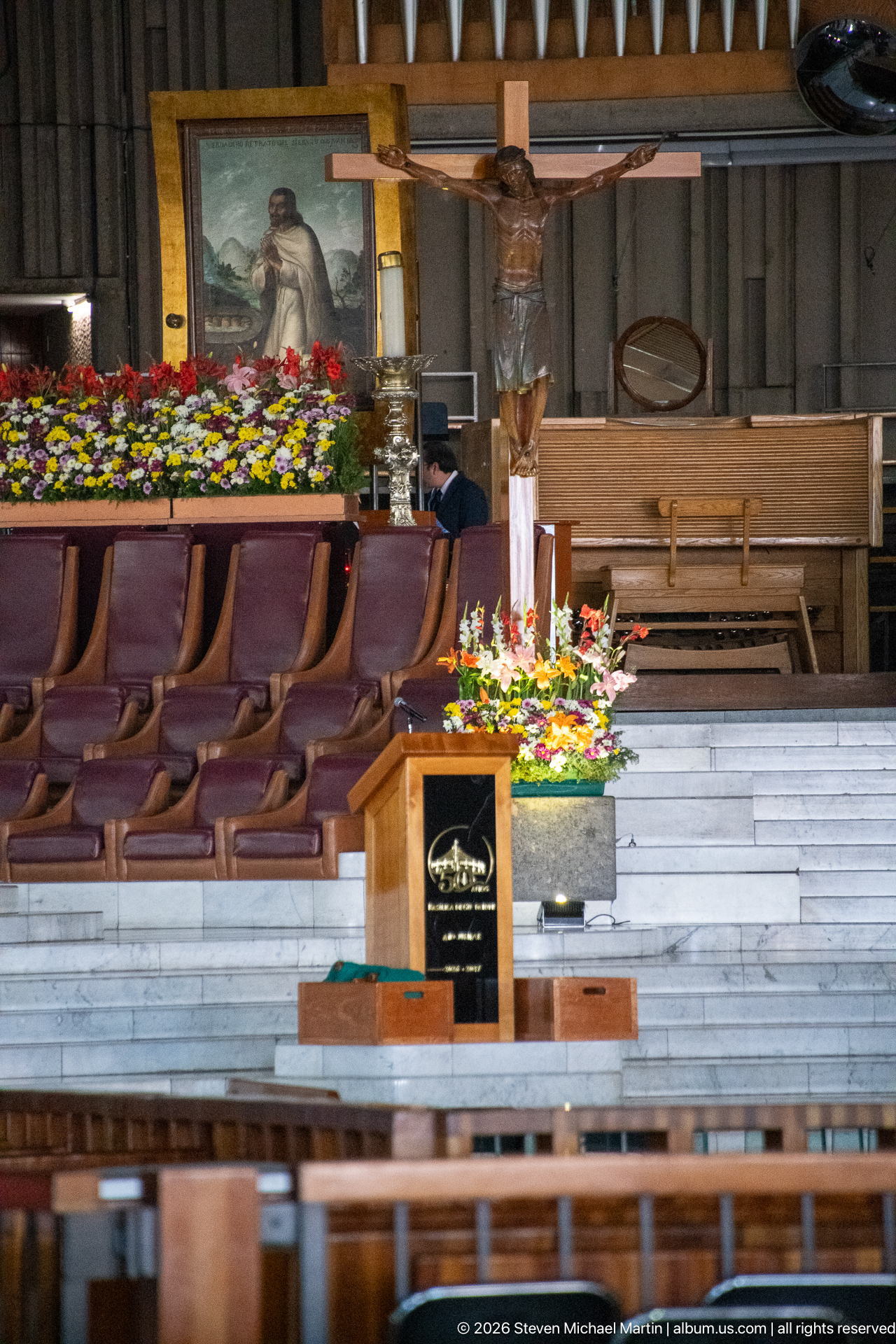
A large crucifix hangs above a side section of the sanctuary, where flower arrangements, burgundy chairs, a lectern, and white marble steps mark the ceremonial platform. The organ pipes and ribbed wall recede behind these furnishings, and a few visitors appear near the altar. This side view shifts attention from the central Guadalupe image to the objects and seating that support services.
Caption
A large crucifix hangs above a side section of the sanctuary, where flower arrangements, burgundy chairs, a lectern, and white marble steps mark the ceremonial platform. The organ pipes and ribbed wall recede behind these furnishings, and a few visitors appear near the altar. This side view shifts attention from the central Guadalupe image to the objects and seating that support services.
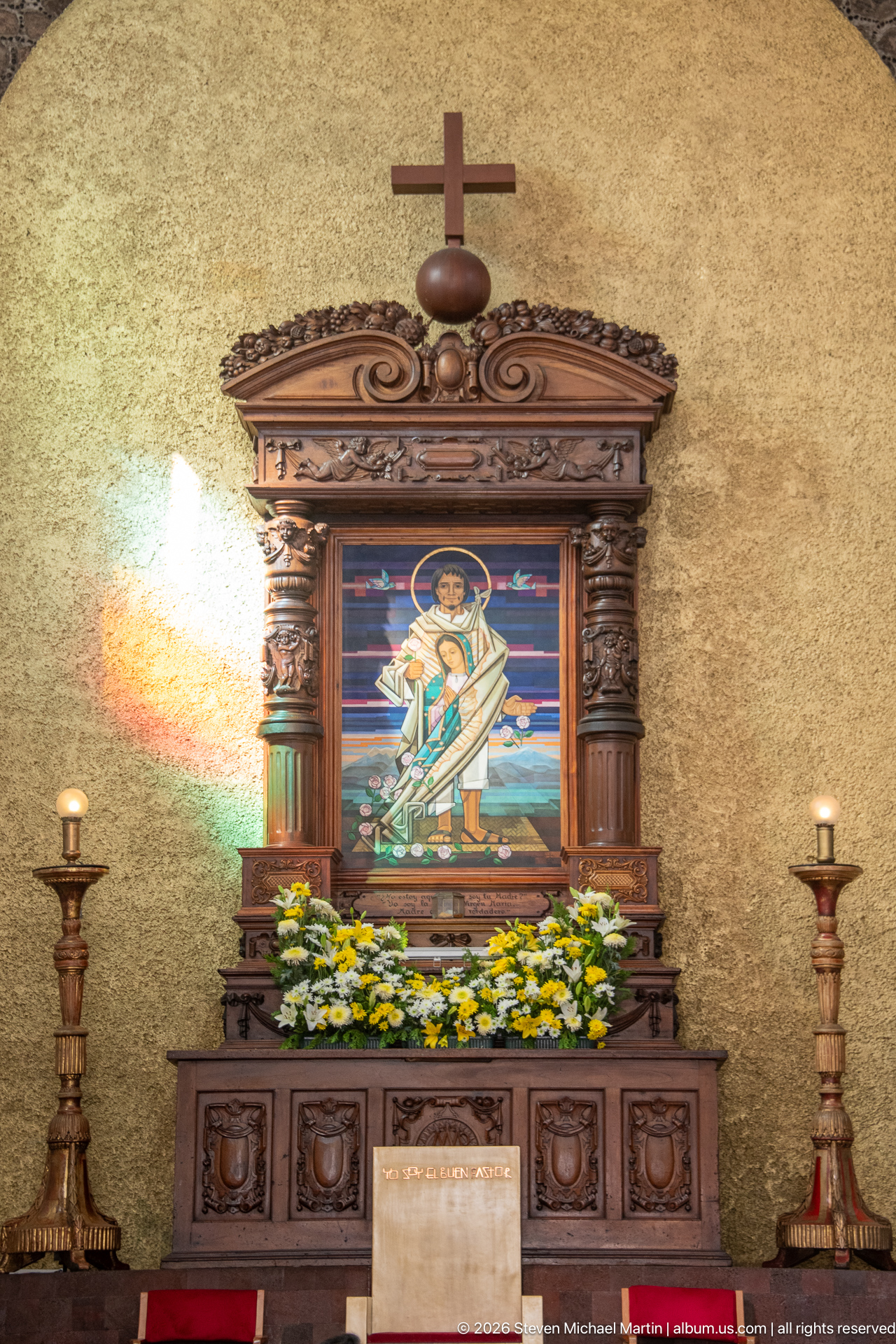
An ornate dark-wood retablo surrounds a colorful religious painting, set against a textured gold-toned wall. The image appears to show a haloed male saint holding a small figure of Mary and the Christ child; flowers, candles, and a small inscription plaque fill the altar below. The composition is centered and frontal, though the specific figures are not identified by a visible label.
Caption
An ornate dark-wood retablo surrounds a colorful religious painting, set against a textured gold-toned wall. The image appears to show a haloed male saint holding a small figure of Mary and the Christ child; flowers, candles, and a small inscription plaque fill the altar below. The composition is centered and frontal, though the specific figures are not identified by a visible label.
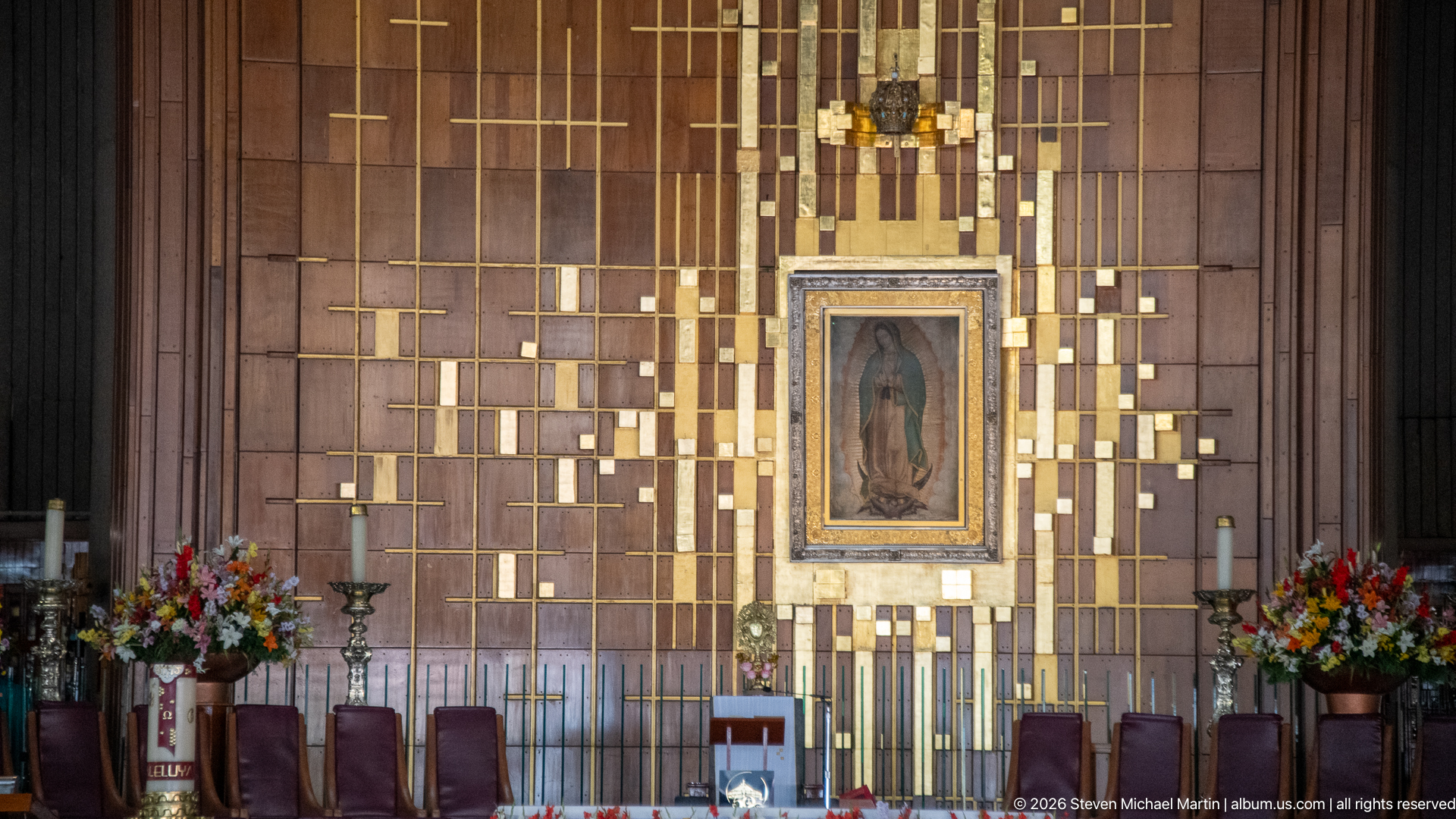
The framed image of Our Lady is set against the sanctuary’s copper and gold-toned wall, where thin vertical and horizontal bars form a cross-like grid. Paired flower arrangements and candle stands sit below the image, with the tops of chairs just visible. The centered arrangement draws attention to the devotional image and the geometric wall that frames it.
Caption
The framed image of Our Lady is set against the sanctuary’s copper and gold-toned wall, where thin vertical and horizontal bars form a cross-like grid. Paired flower arrangements and candle stands sit below the image, with the tops of chairs just visible. The centered arrangement draws attention to the devotional image and the geometric wall that frames it.
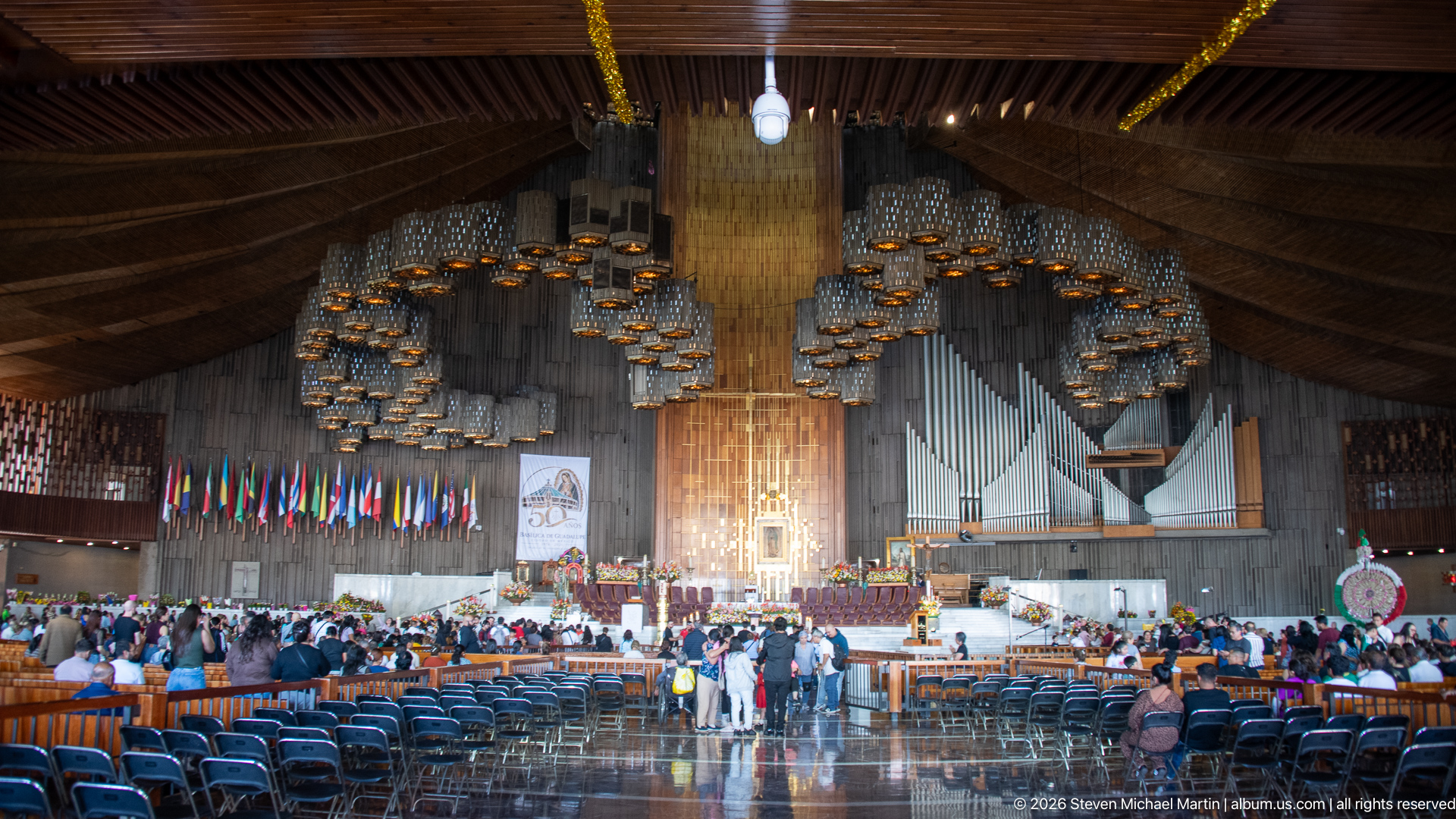
A central aisle opens toward the sanctuary beneath a high timber ceiling, drawing the eye through rows of chairs to the gold-toned wall and small Guadalupe image. Suspended lamps form broad, symmetrical clusters overhead; organ pipes and international flags flank the altar, and visitors gather in the foreground. The full-width view conveys the modern basilica’s monumental scale and its continuing use by large crowds.
Caption
A central aisle opens toward the sanctuary beneath a high timber ceiling, drawing the eye through rows of chairs to the gold-toned wall and small Guadalupe image. Suspended lamps form broad, symmetrical clusters overhead; organ pipes and international flags flank the altar, and visitors gather in the foreground. The full-width view conveys the modern basilica’s monumental scale and its continuing use by large crowds.
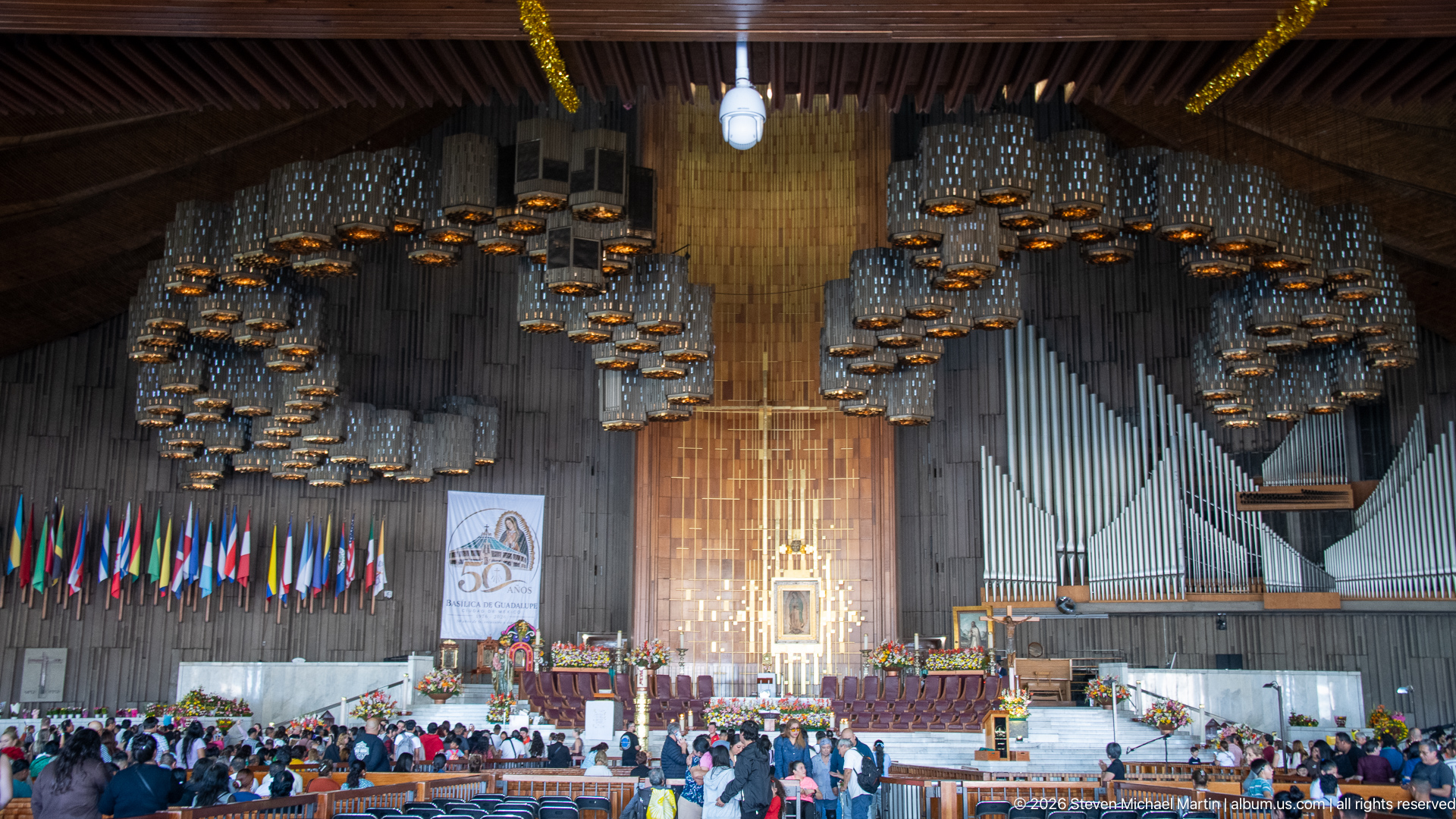
A dense crowd gathers behind the pews at the center of the basilica, facing the distant sanctuary. Large suspended lamp clusters dominate the upper half of the view, while organ pipes, the gold-toned altar wall, flower displays, flags, and a jubilee banner establish the setting. The congregation fills the central space, conveying the scale and active devotional life of the modern church.
Caption
A dense crowd gathers behind the pews at the center of the basilica, facing the distant sanctuary. Large suspended lamp clusters dominate the upper half of the view, while organ pipes, the gold-toned altar wall, flower displays, flags, and a jubilee banner establish the setting. The congregation fills the central space, conveying the scale and active devotional life of the modern church.
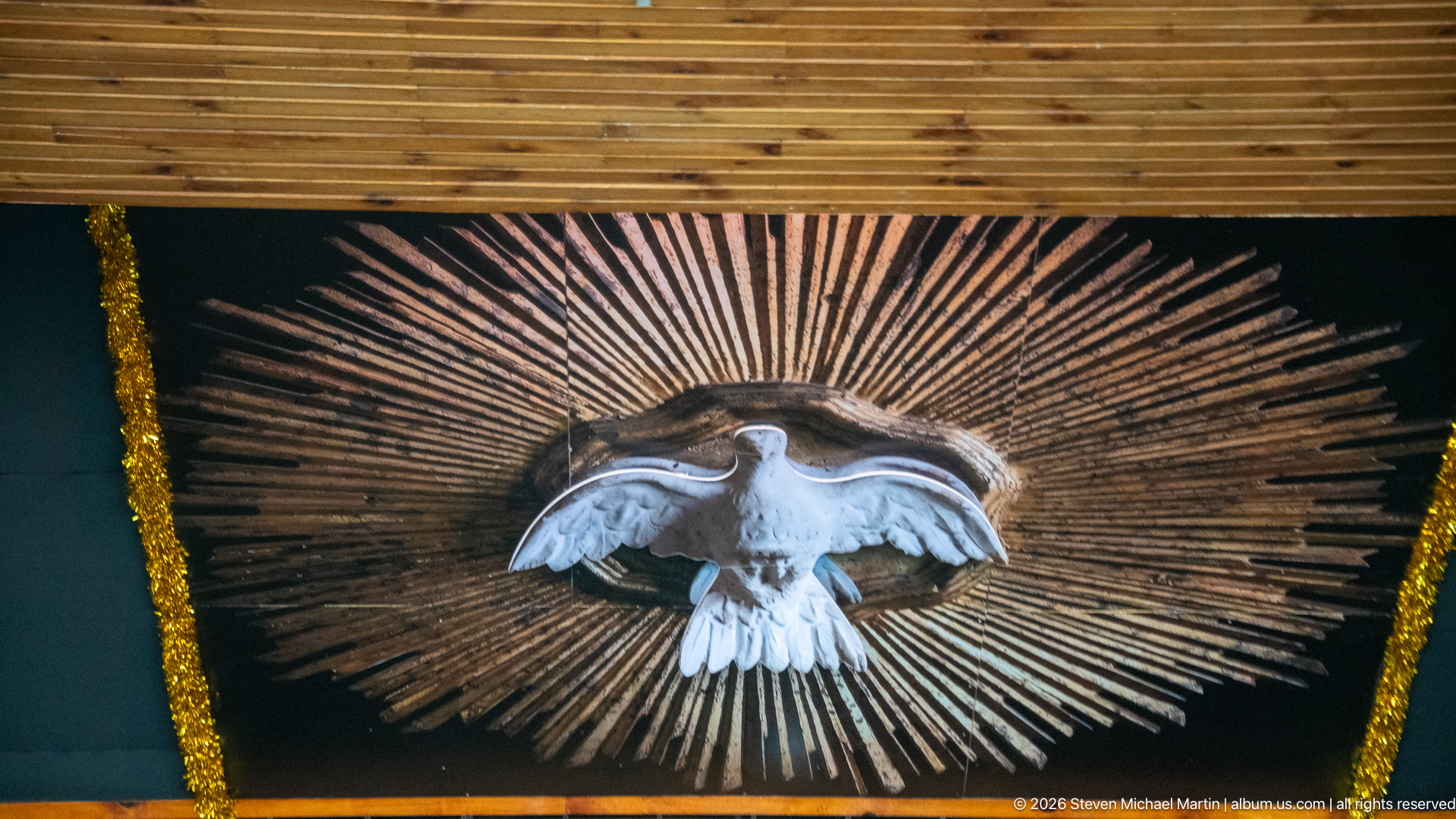
A white dove with outstretched wings is set at the center of a dark square ceiling panel, surrounded by a dense sunburst of narrow radial elements. The close, upward view isolates this emblem from the sanctuary below; a strip of warm-toned ceiling structure remains visible at the top. The sharply contrasting bird and radiating lines make the ceiling detail legible as a distinct focal point.
Caption
A white dove with outstretched wings is set at the center of a dark square ceiling panel, surrounded by a dense sunburst of narrow radial elements. The close, upward view isolates this emblem from the sanctuary below; a strip of warm-toned ceiling structure remains visible at the top. The sharply contrasting bird and radiating lines make the ceiling detail legible as a distinct focal point.
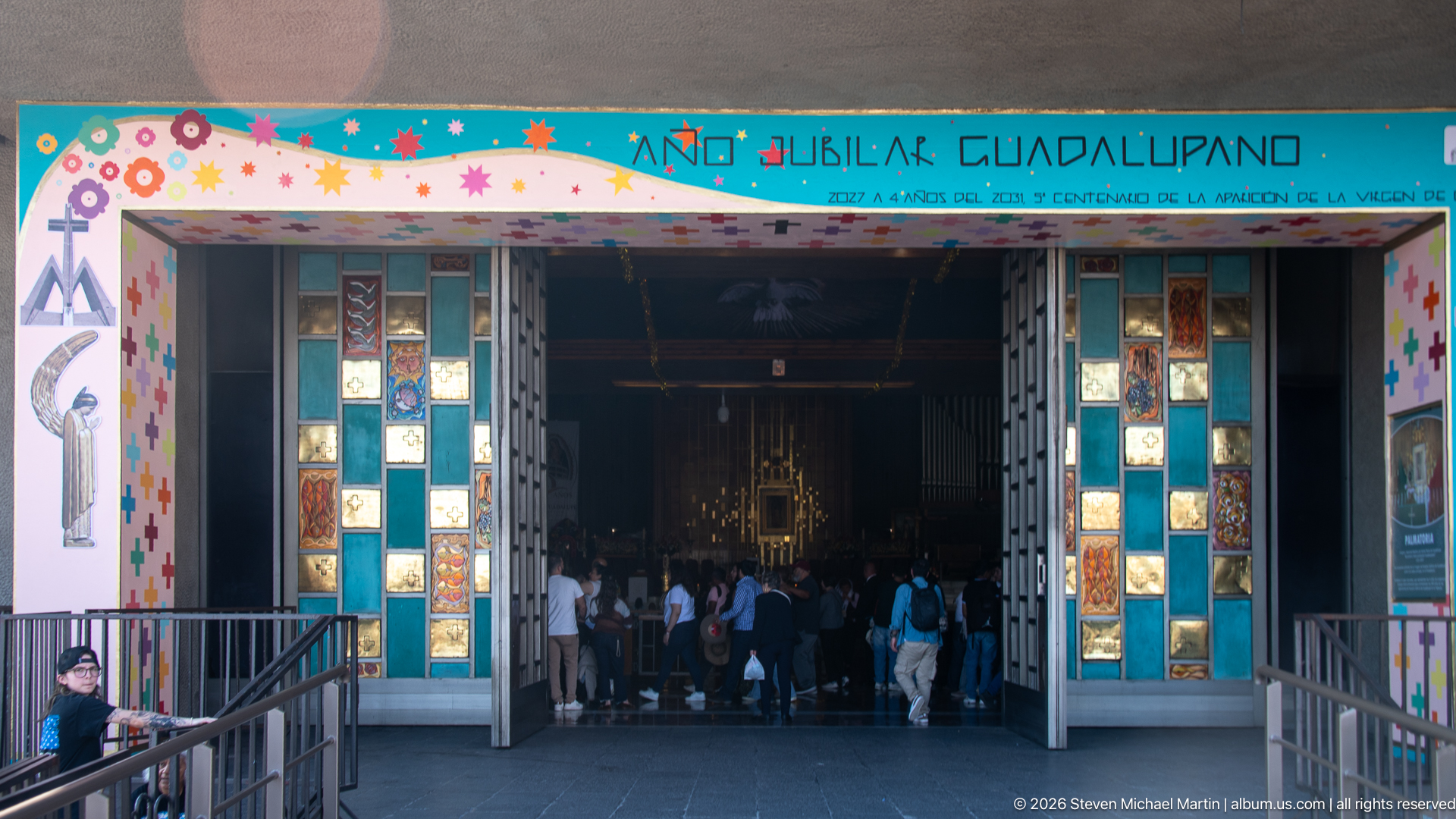
The basilica’s broad entrance is framed by tall turquoise and multicolored glass panels beneath a bright decorative band announcing the Guadalupe jubilee. Visitors move through the deep, shaded doorway toward the sanctuary, while a ramp and metal railings guide access from the foreground. The entrance view connects the building’s lively exterior treatment with the darker interior beyond.
Caption
The basilica’s broad entrance is framed by tall turquoise and multicolored glass panels beneath a bright decorative band announcing the Guadalupe jubilee. Visitors move through the deep, shaded doorway toward the sanctuary, while a ramp and metal railings guide access from the foreground. The entrance view connects the building’s lively exterior treatment with the darker interior beyond.
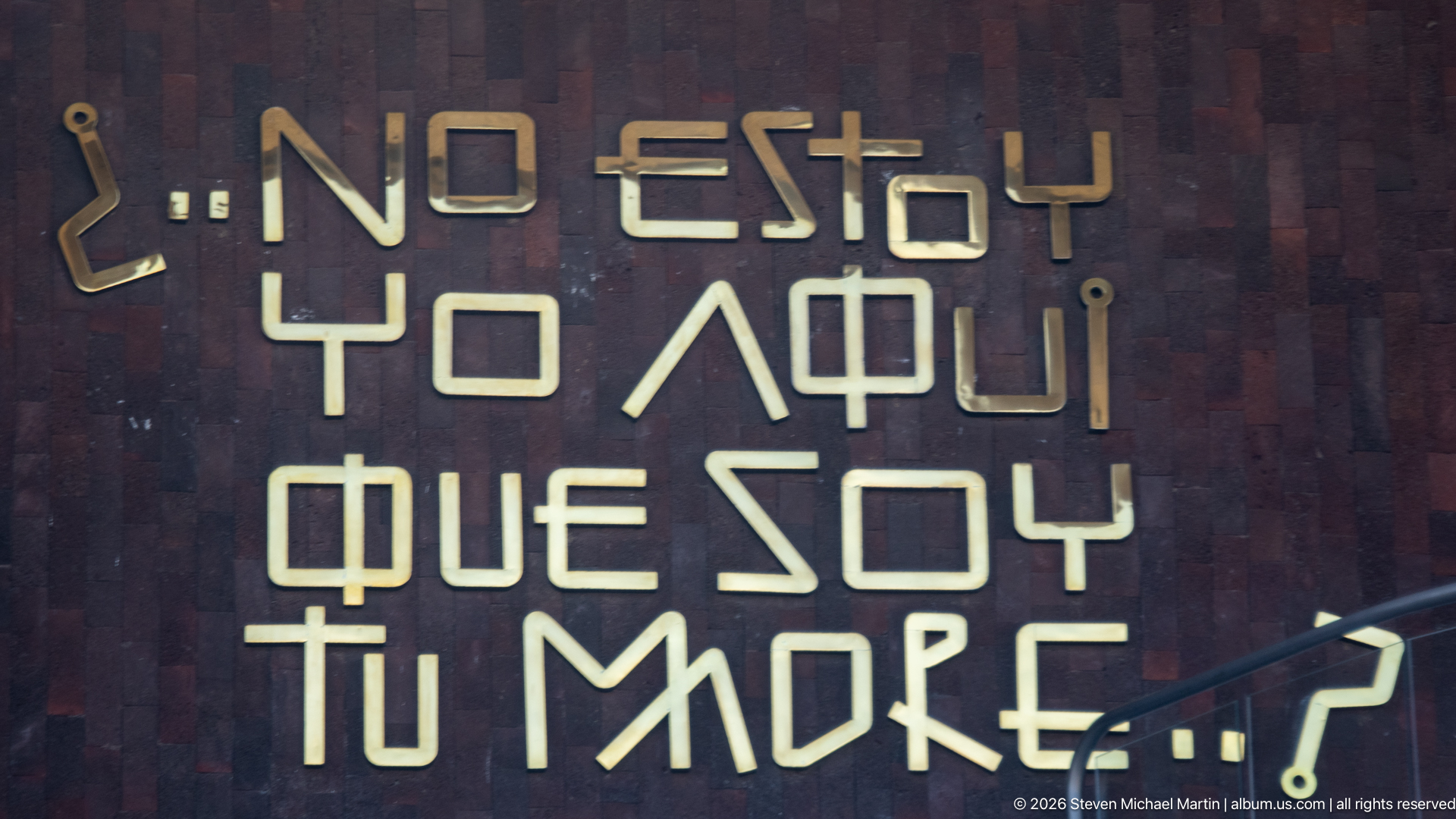
Large gold-colored letters on a dark reddish wall spell the Spanish question “¿No estoy yo aquí que soy tu madre?” The tight crop presents the inscription as an architectural and devotional feature, with only a small glimpse of a railing at lower right. By isolating the words from the surrounding building, the photograph foregrounds the message associated with the Guadalupe apparition tradition.
Caption
Large gold-colored letters on a dark reddish wall spell the Spanish question “¿No estoy yo aquí que soy tu madre?” The tight crop presents the inscription as an architectural and devotional feature, with only a small glimpse of a railing at lower right. By isolating the words from the surrounding building, the photograph foregrounds the message associated with the Guadalupe apparition tradition.
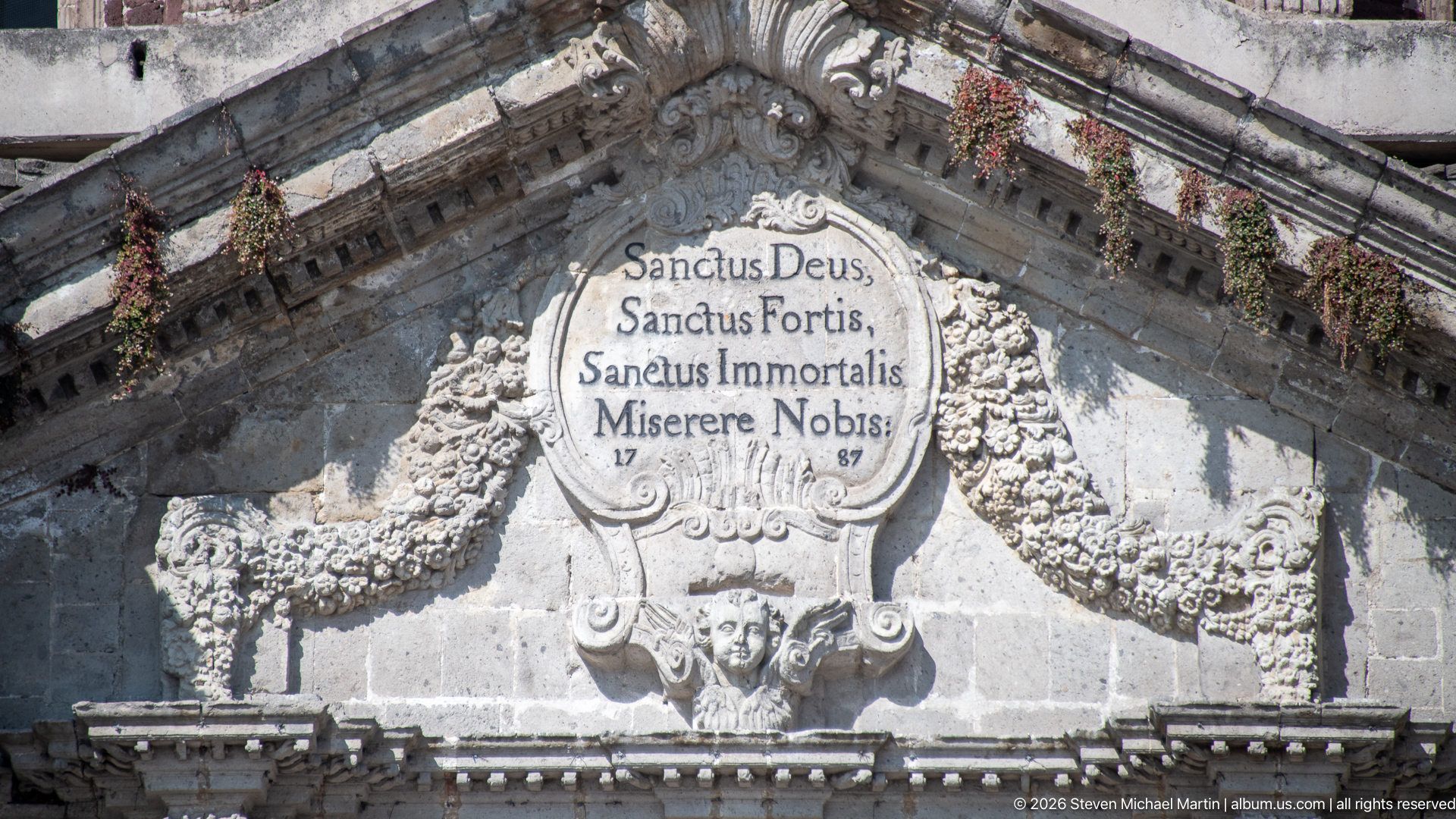
A sculpted cartouche set into the weathered stone façade carries the Latin text “Sanctus Deus, Sanctus Fortis, Sanctus Immortalis, Miserere Nobis,” with the date 1787 below. Scrollwork, carved foliage, and a small figure support the plaque, while traces of plants cling to the surrounding masonry. The detail records both the church’s ornament and a legible inscription on its exterior.
Caption
A sculpted cartouche set into the weathered stone façade carries the Latin text “Sanctus Deus, Sanctus Fortis, Sanctus Immortalis, Miserere Nobis,” with the date 1787 below. Scrollwork, carved foliage, and a small figure support the plaque, while traces of plants cling to the surrounding masonry. The detail records both the church’s ornament and a legible inscription on its exterior.
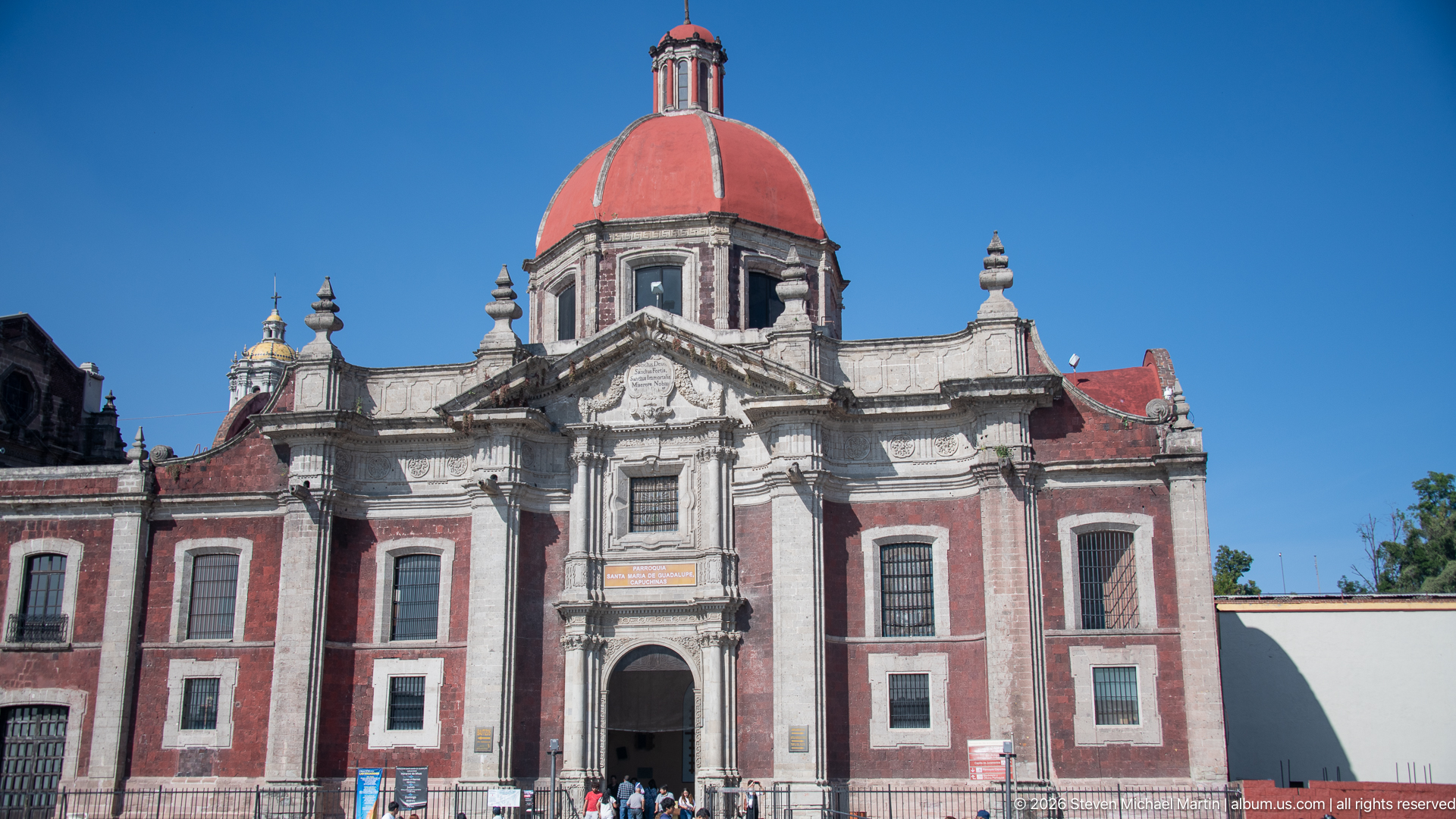
The historic Basilica’s symmetrical façade rises beneath a red central dome, with a sculpted stone portal between rows of dark rectangular windows set in red masonry. Small groups of visitors gather at the entrance behind the forecourt railings. The frontal view emphasizes the balanced arrangement of portal, windows, and dome, while pale stone ornament stands out against the brickwork.
Caption
The historic Basilica’s symmetrical façade rises beneath a red central dome, with a sculpted stone portal between rows of dark rectangular windows set in red masonry. Small groups of visitors gather at the entrance behind the forecourt railings. The frontal view emphasizes the balanced arrangement of portal, windows, and dome, while pale stone ornament stands out against the brickwork.
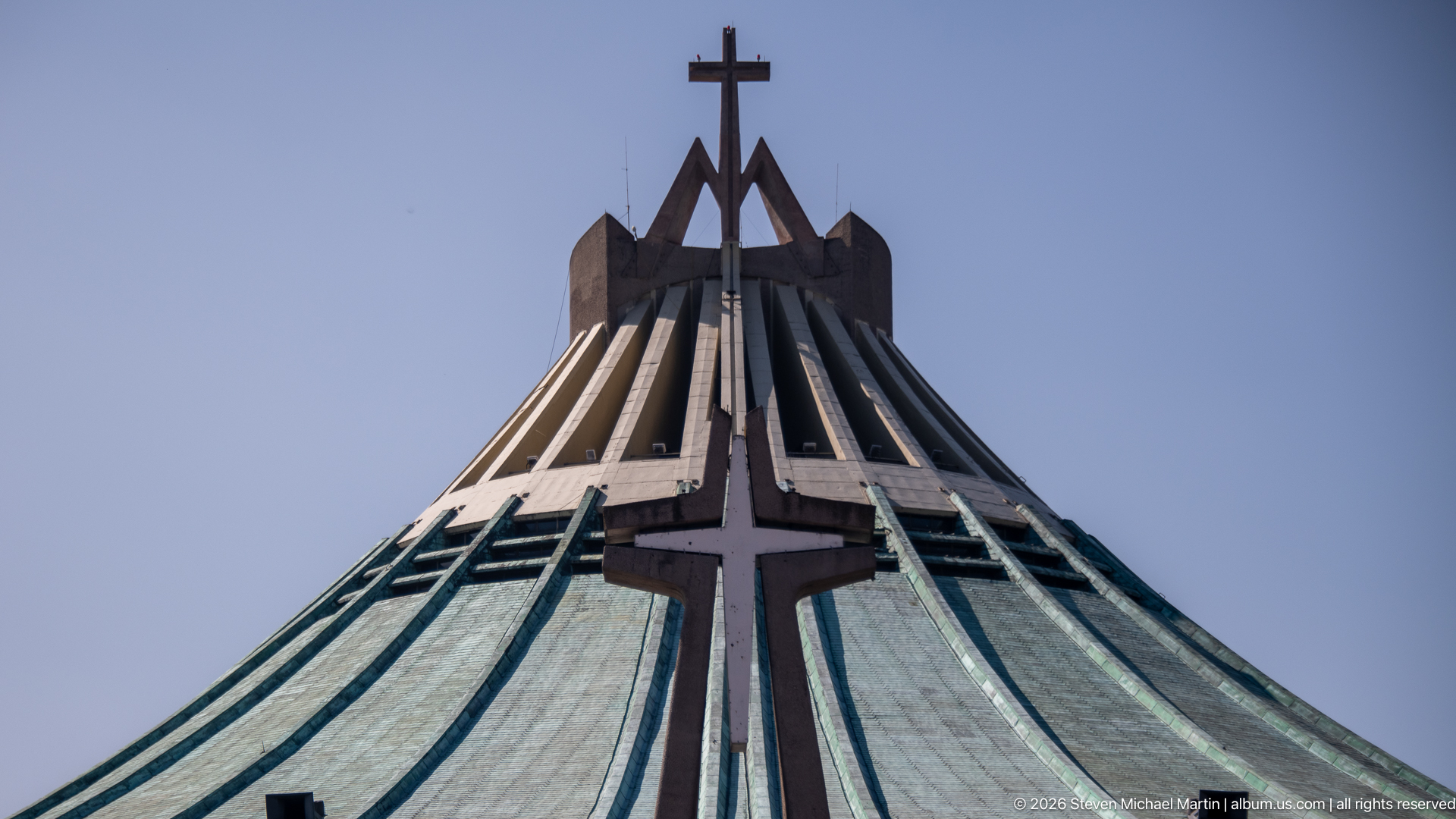
A dark cross rises above the modern Basilica’s steeply sloping roof, seen from directly below against a pale blue sky. The converging roof ribs pull the eye upward toward the cross and the open framework around its base. By excluding the plaza and most of the building, this view isolates the structure’s distinctive crown and its strong vertical silhouette.
Caption
A dark cross rises above the modern Basilica’s steeply sloping roof, seen from directly below against a pale blue sky. The converging roof ribs pull the eye upward toward the cross and the open framework around its base. By excluding the plaza and most of the building, this view isolates the structure’s distinctive crown and its strong vertical silhouette.
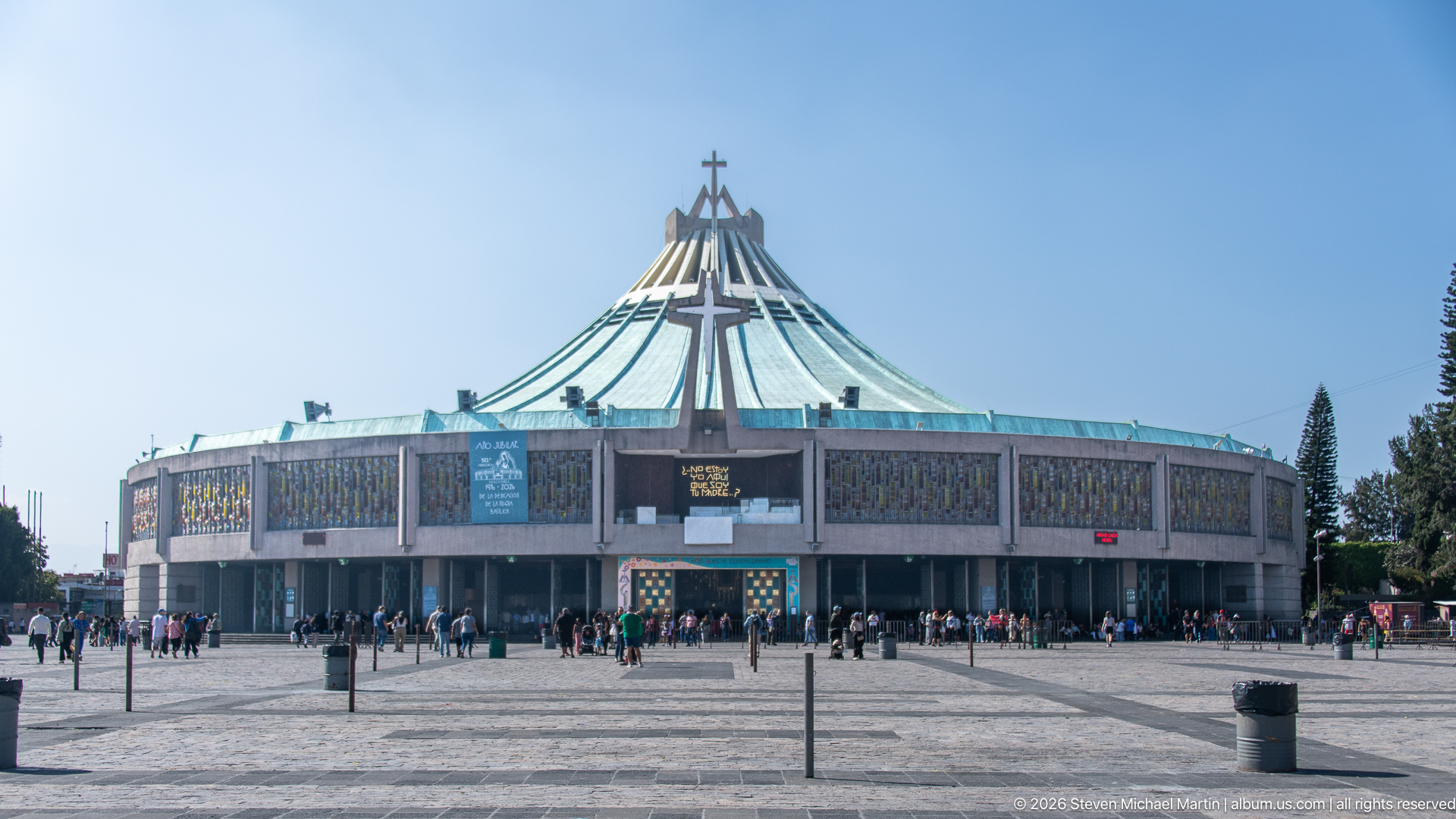
Across the broad paved plaza, the modern Basilica appears as a low circular building capped by a steep ribbed roof and cross. Its continuous upper band of colored windows wraps around the façade, and visitors gather along the entrances. The frontal view places the building’s full profile against the open sky, showing how the sanctuary’s rounded plan contrasts with the surrounding older churches.
Caption
Across the broad paved plaza, the modern Basilica appears as a low circular building capped by a steep ribbed roof and cross. Its continuous upper band of colored windows wraps around the façade, and visitors gather along the entrances. The frontal view places the building’s full profile against the open sky, showing how the sanctuary’s rounded plan contrasts with the surrounding older churches.
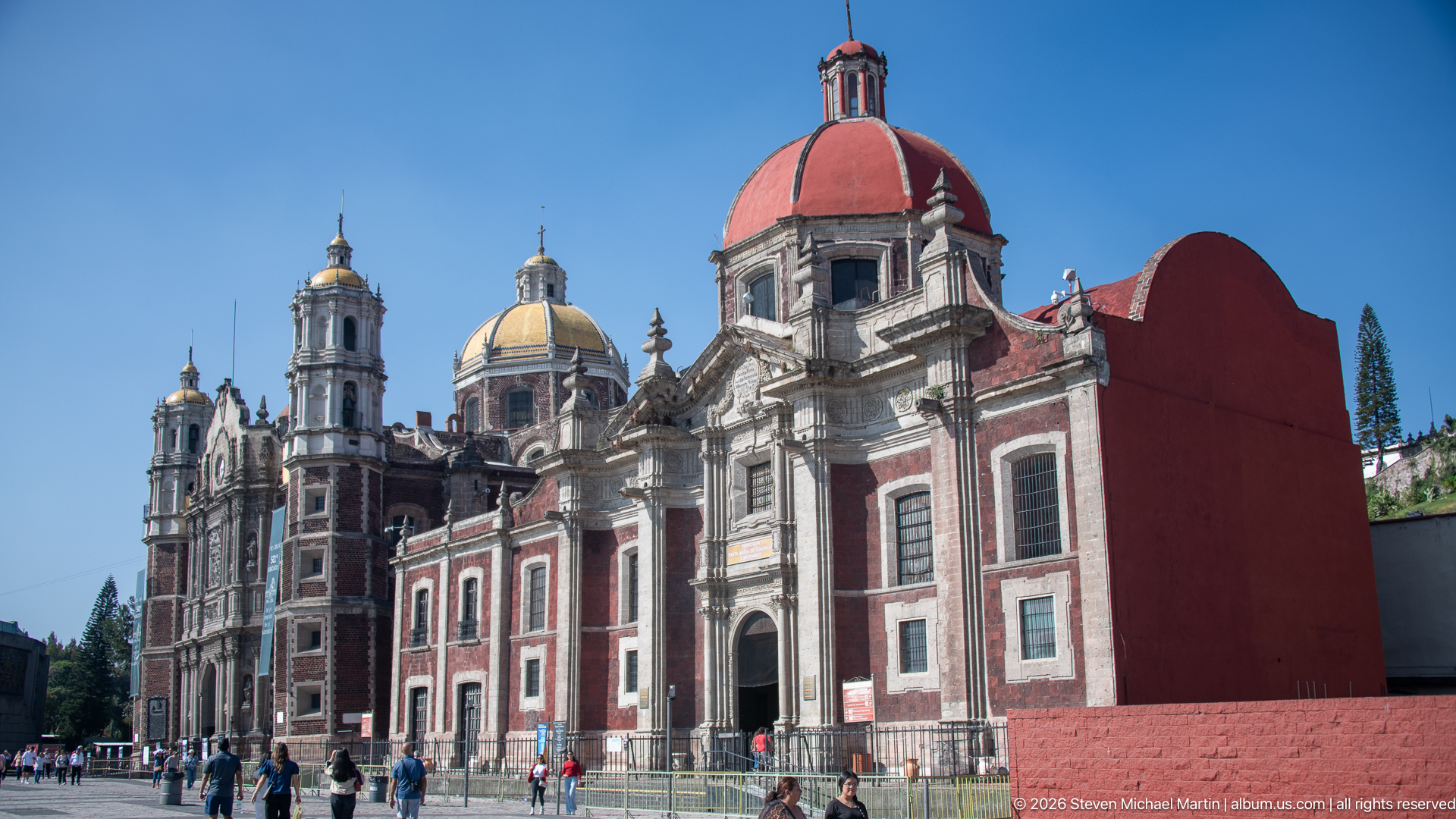
From the side, the Old Basilica’s red masonry walls, pale stone trim, and central red dome rise above visitors along the fenced forecourt. Smaller towers and a gold-toned dome of neighboring religious buildings appear behind its left side. This oblique angle shows the historic church as part of a larger architectural ensemble and reveals the varied rooflines across the complex.
Caption
From the side, the Old Basilica’s red masonry walls, pale stone trim, and central red dome rise above visitors along the fenced forecourt. Smaller towers and a gold-toned dome of neighboring religious buildings appear behind its left side. This oblique angle shows the historic church as part of a larger architectural ensemble and reveals the varied rooflines across the complex.
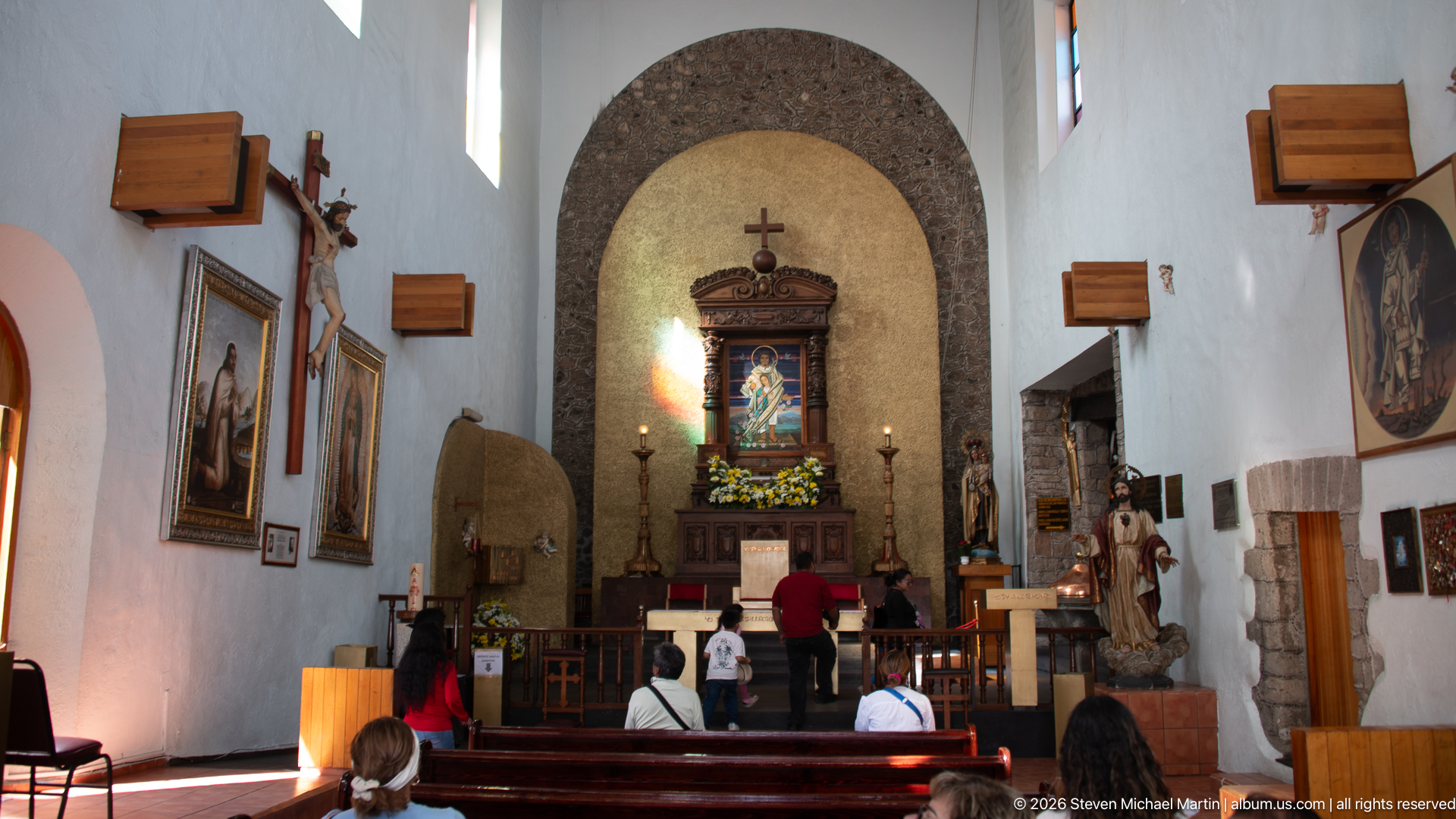
A compact chapel centers a carved wooden altar and devotional painting within a rounded, stone-edged apse. A crucifix and framed religious pictures line the white side walls, while visitors kneel or sit in the foreground pews. Sunlight falls across the room from the left, leaving the altar’s gold-toned recess bright against the pale interior. The view records a quieter devotional space within the larger sanctuary complex.
Caption
A compact chapel centers a carved wooden altar and devotional painting within a rounded, stone-edged apse. A crucifix and framed religious pictures line the white side walls, while visitors kneel or sit in the foreground pews. Sunlight falls across the room from the left, leaving the altar’s gold-toned recess bright against the pale interior. The view records a quieter devotional space within the larger sanctuary complex.
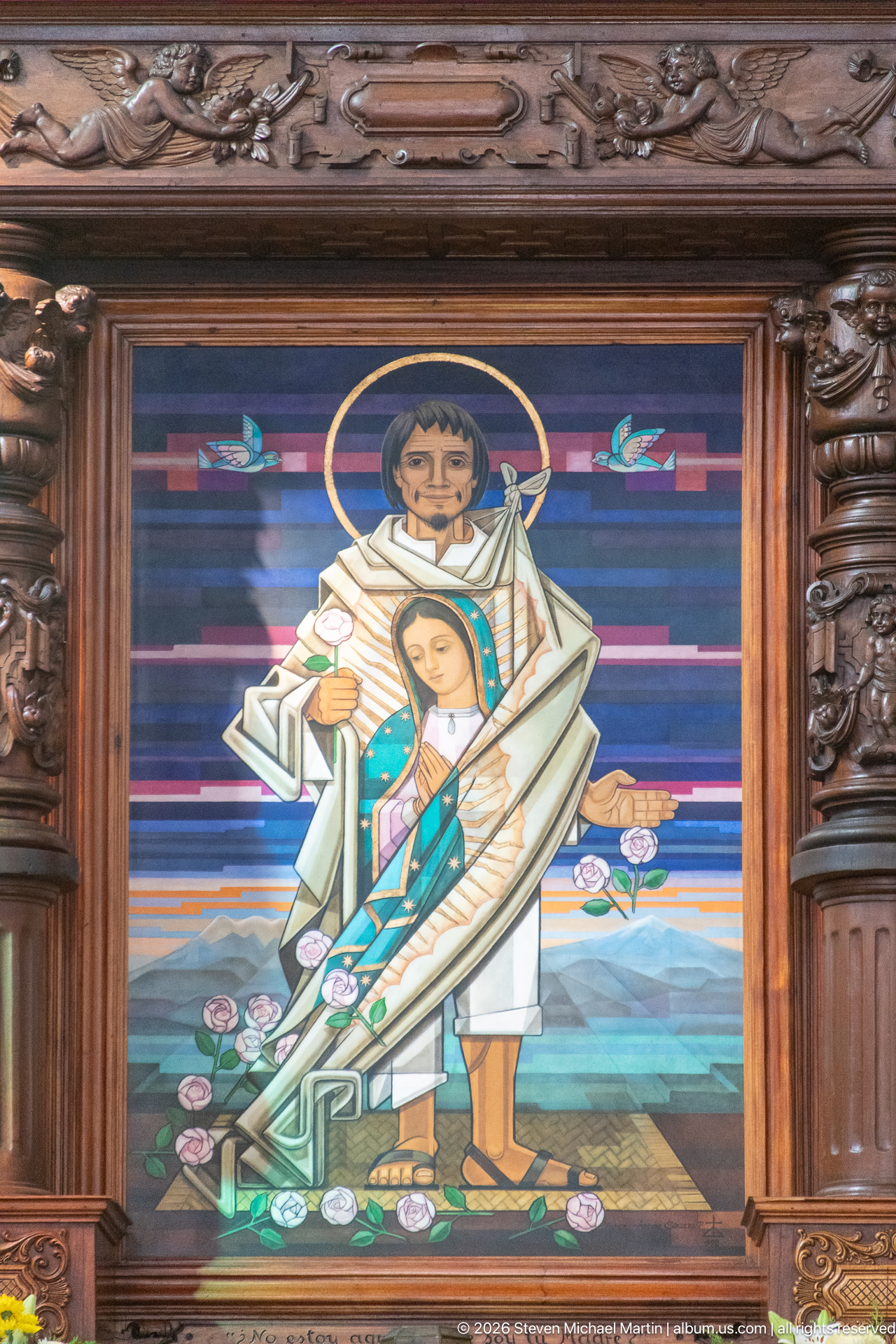
The painting’s figures fill the frame: a haloed man in pale robes holds a small image of Mary with the child Jesus, while stylized doves and bands of blue, purple, and rose color form the background. A carved wooden frame remains visible around the edges. The close view brings out the image’s graphic details, bright palette, and devotional figures.
Caption
The painting’s figures fill the frame: a haloed man in pale robes holds a small image of Mary with the child Jesus, while stylized doves and bands of blue, purple, and rose color form the background. A carved wooden frame remains visible around the edges. The close view brings out the image’s graphic details, bright palette, and devotional figures.
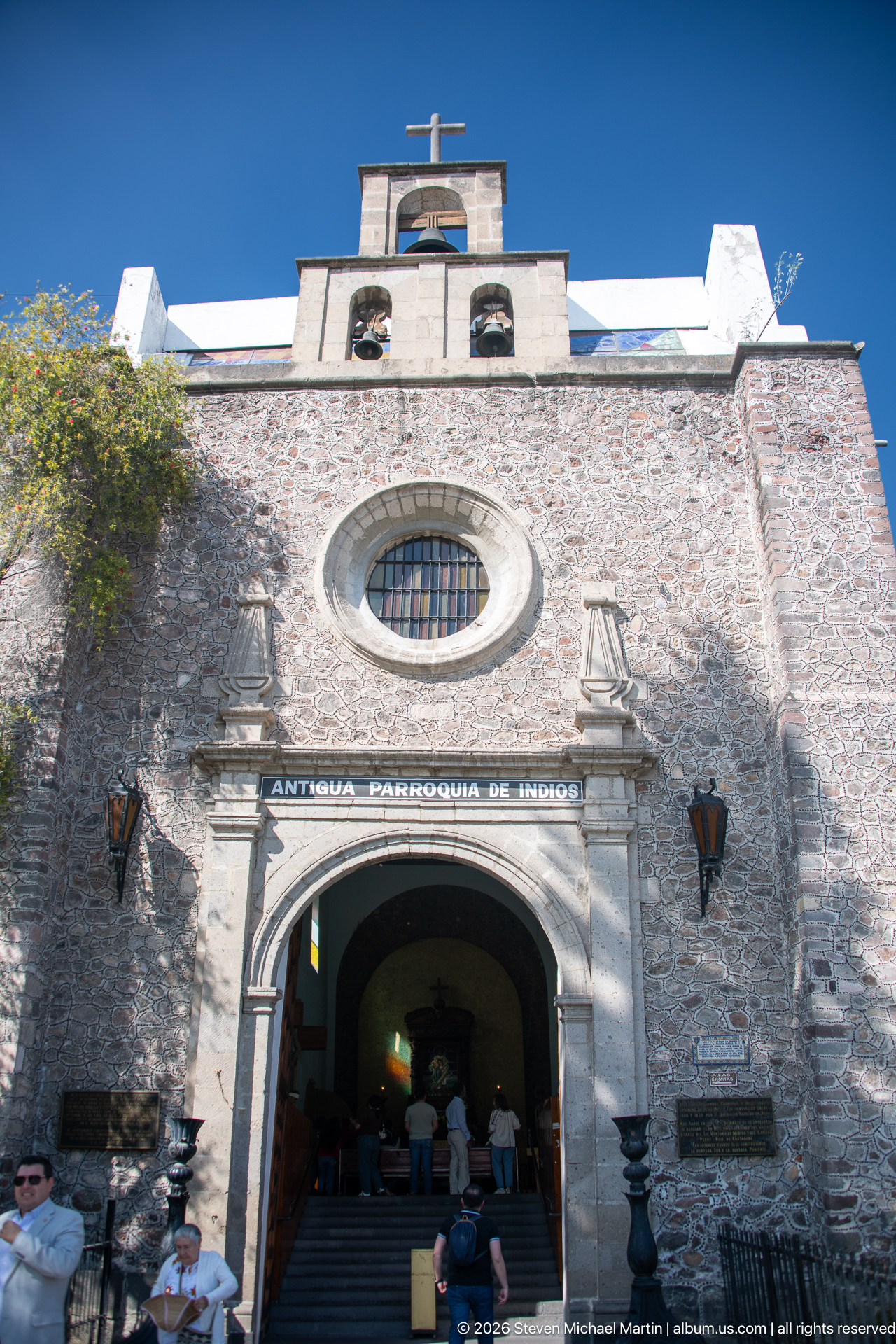
The stone entrance is identified by the carved sign “ANTIGUA PARROQUIA DE INDIOS” above its arched doorway. A circular stained-glass window sits higher on the façade, while a bell opening and cross crown the stepped roofline. Visitors climb the shaded stairs into the church. The legible inscription makes this view a specific record of the historic parish building rather than an unidentified chapel exterior.
Caption
The stone entrance is identified by the carved sign “ANTIGUA PARROQUIA DE INDIOS” above its arched doorway. A circular stained-glass window sits higher on the façade, while a bell opening and cross crown the stepped roofline. Visitors climb the shaded stairs into the church. The legible inscription makes this view a specific record of the historic parish building rather than an unidentified chapel exterior.
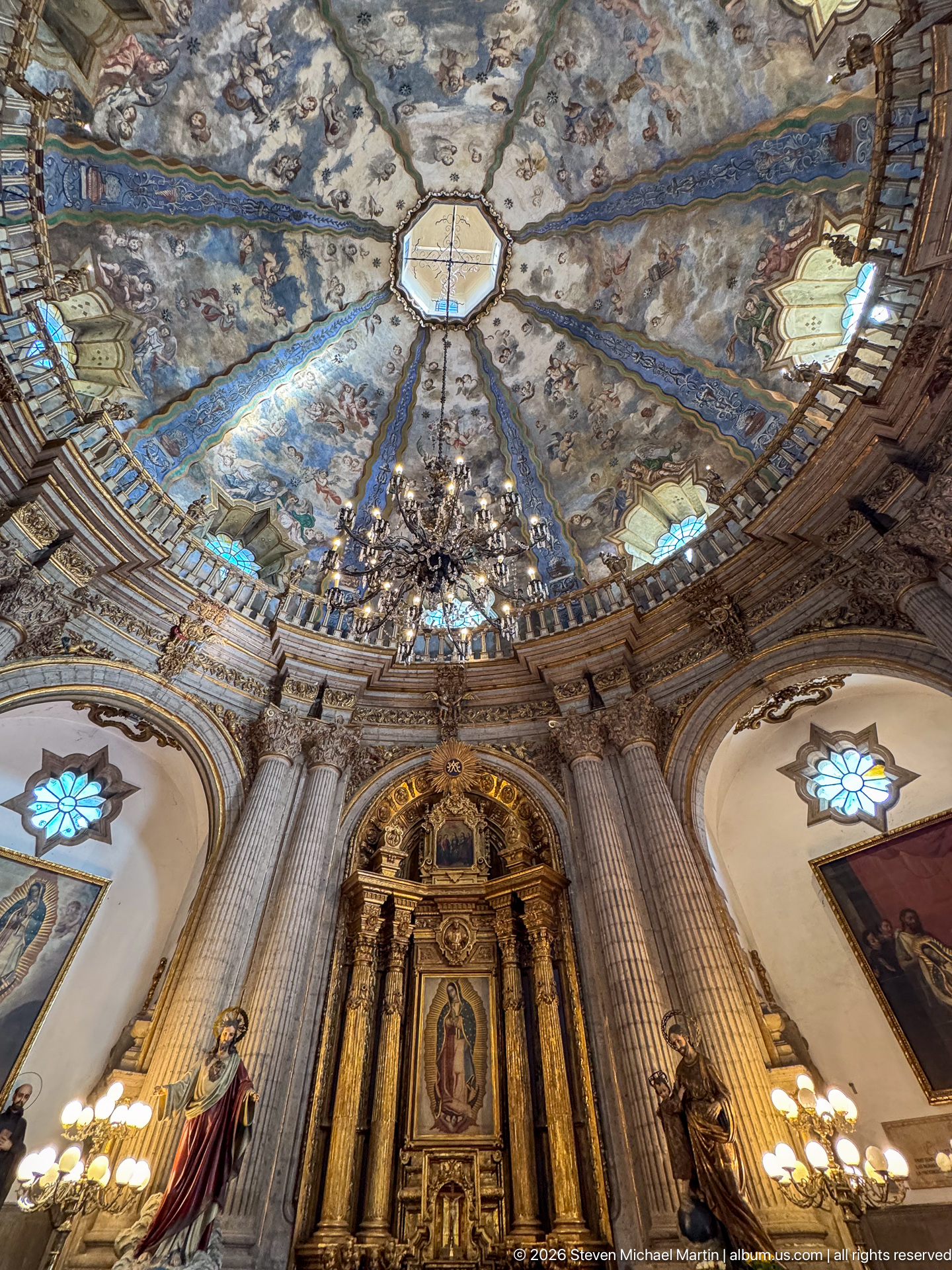
From the nave, the camera looks upward across the sanctuary’s gilded retablo toward a painted dome. Tall pale columns flank the central image of the Virgin, while a chandelier and smaller devotional sculptures fill the lower part of the view. The composition links altar and ceiling in one vertical sweep, showing how ornament extends from the focal image into the architecture above.
Caption
From the nave, the camera looks upward across the sanctuary’s gilded retablo toward a painted dome. Tall pale columns flank the central image of the Virgin, while a chandelier and smaller devotional sculptures fill the lower part of the view. The composition links altar and ceiling in one vertical sweep, showing how ornament extends from the focal image into the architecture above.
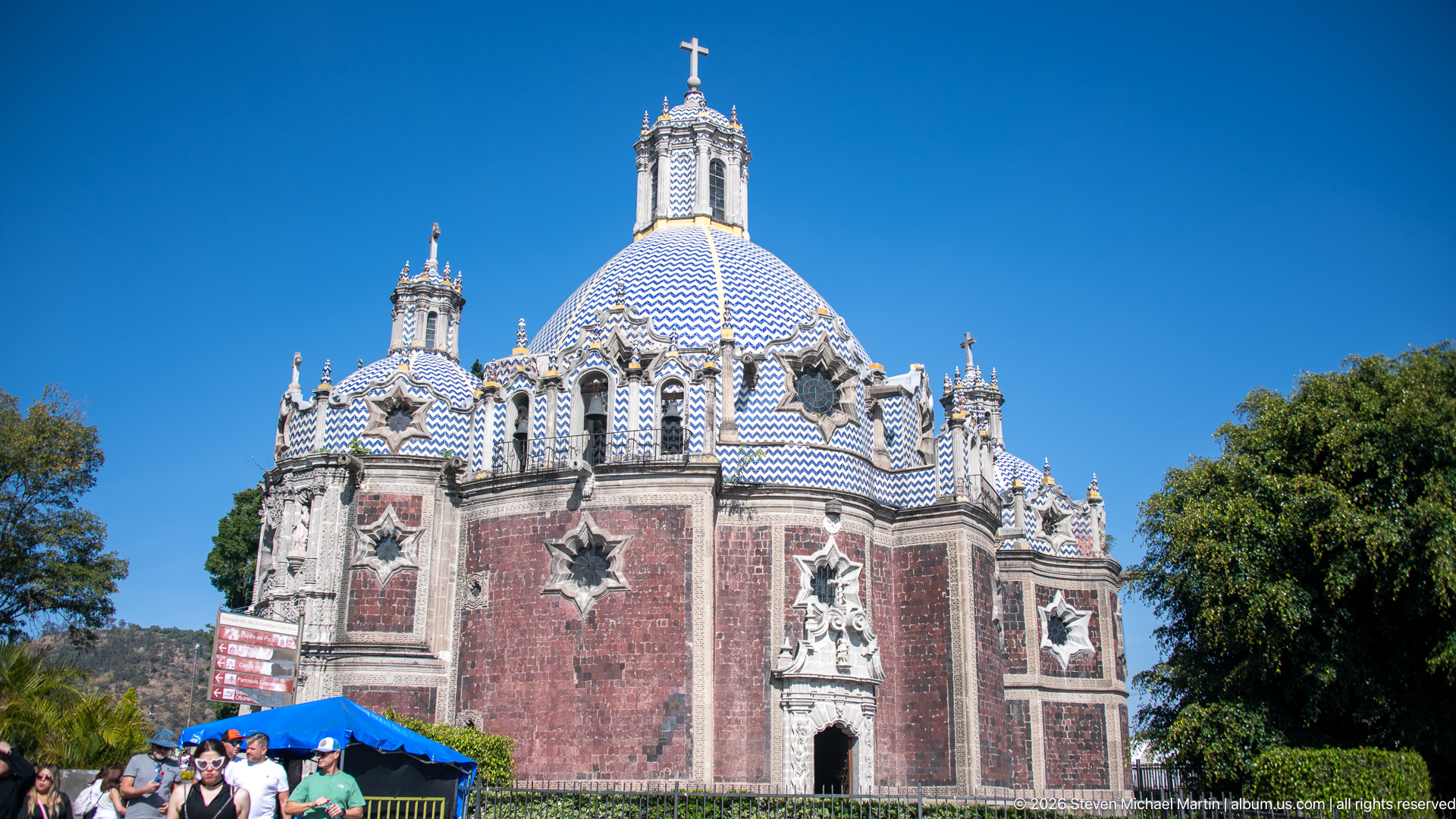
A compact historic chapel rises above the street with red stone walls, star-shaped window surrounds, and blue-and-white patterned domes. The central dome and tall lantern stand sharply against the cloudless sky, while a smaller dome and tower cluster beside it. Market canopies and pedestrians along the lower edge show the building within an active public setting. Its name is not visible in this view.
Caption
A compact historic chapel rises above the street with red stone walls, star-shaped window surrounds, and blue-and-white patterned domes. The central dome and tall lantern stand sharply against the cloudless sky, while a smaller dome and tower cluster beside it. Market canopies and pedestrians along the lower edge show the building within an active public setting. Its name is not visible in this view.
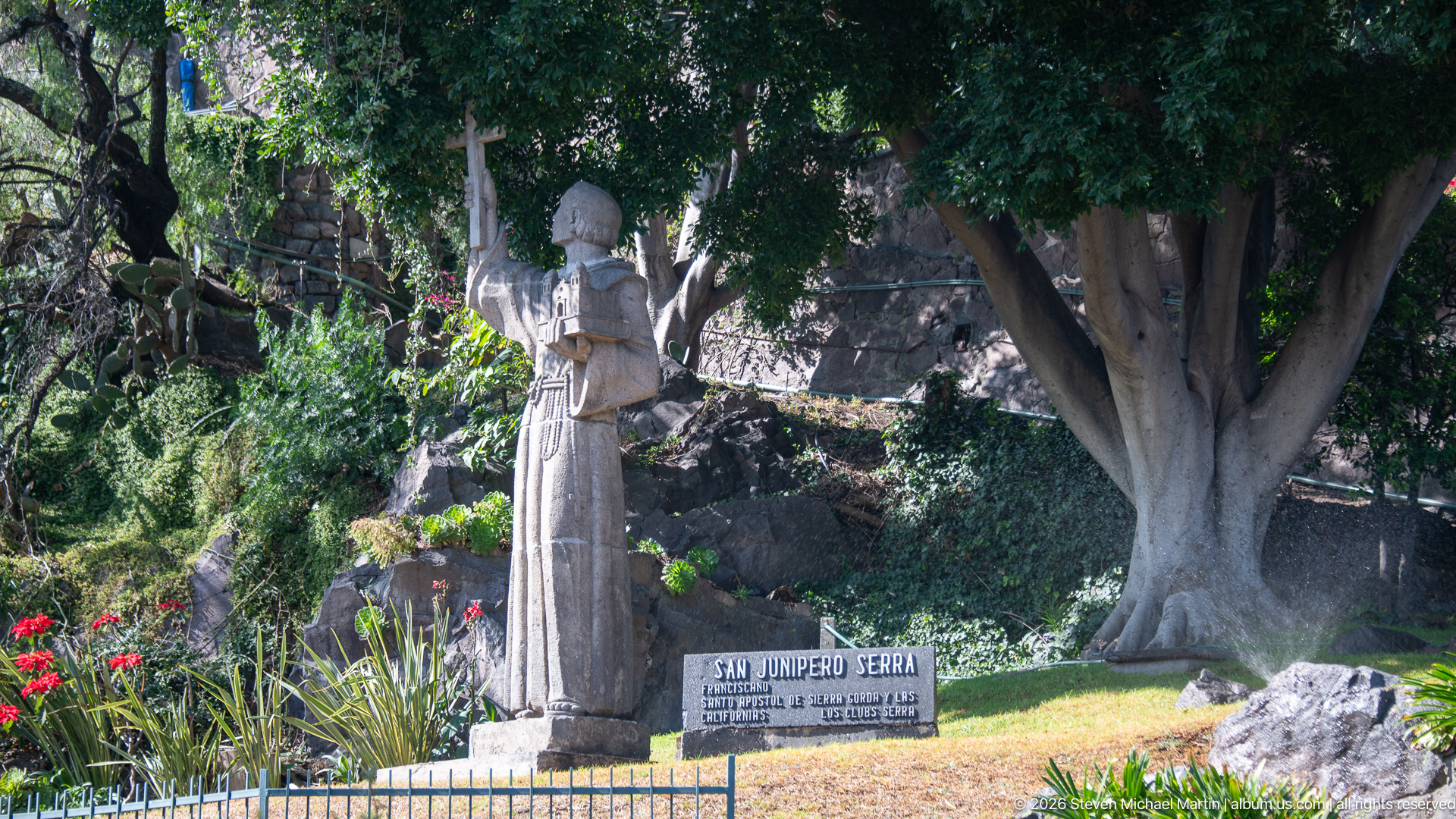
A standing stone statue of a robed Franciscan figure occupies a small garden beneath mature trees. The plaque at the base reads “SAN JUNÍPERO SERRA,” identifying the subject; flowering plants, rocks, and a low metal fence surround the monument. Dappled shade softens the figure and contrasts with the bright grass in front, setting the statue apart from the complex’s larger church architecture.
Caption
A standing stone statue of a robed Franciscan figure occupies a small garden beneath mature trees. The plaque at the base reads “SAN JUNÍPERO SERRA,” identifying the subject; flowering plants, rocks, and a low metal fence surround the monument. Dappled shade softens the figure and contrasts with the bright grass in front, setting the statue apart from the complex’s larger church architecture.
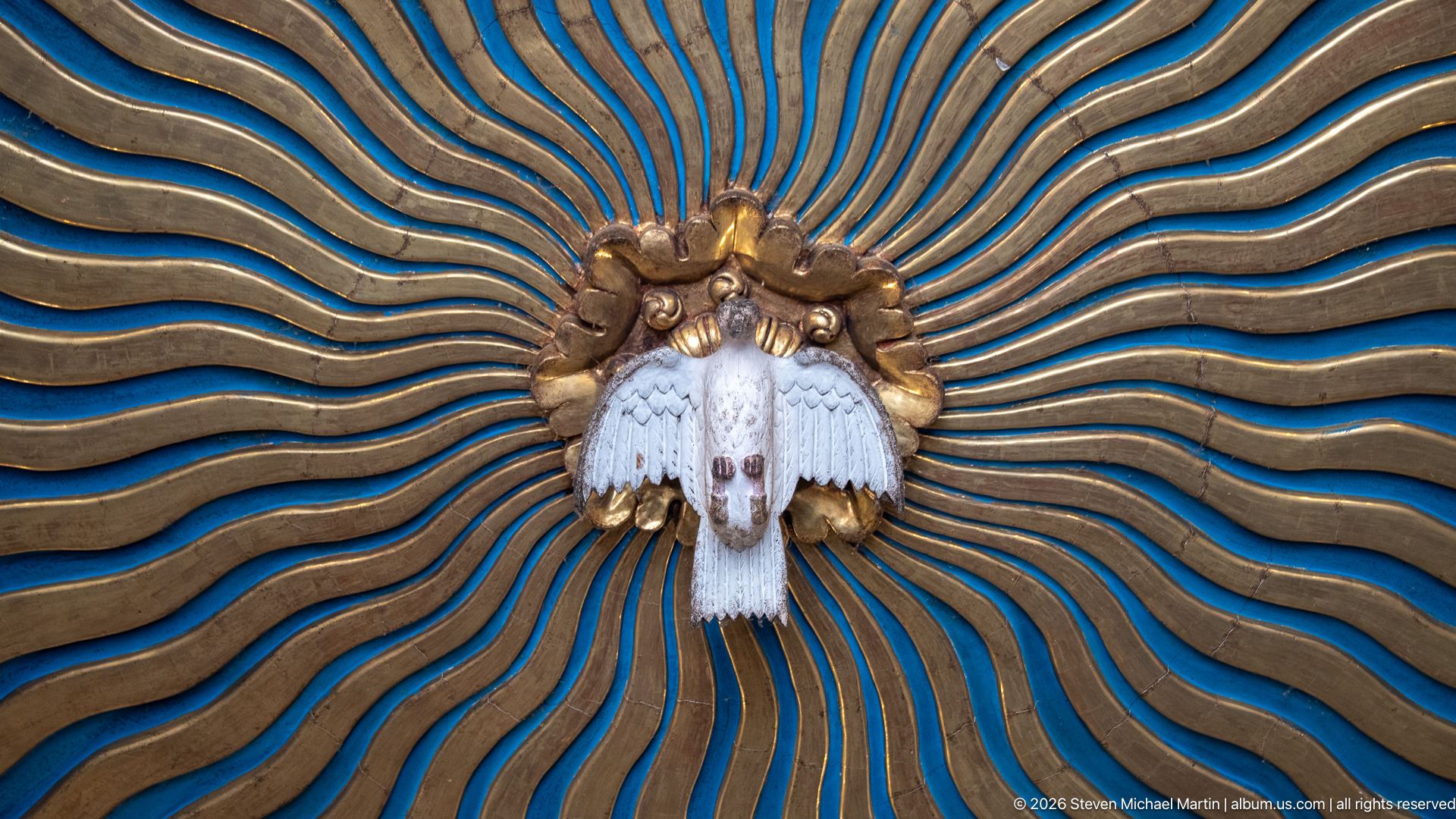
A white, feathered emblem sits at the center of a gilded ceiling boss, where closely spaced gold ribs and vivid blue channels radiate outward. The tight framing turns a small architectural fitting into a nearly abstract burst of alternating color and metalwork. Its central birdlike form suggests a sacred emblem, while the surrounding pattern supplies the photograph’s strong sense of movement.
Caption
A white, feathered emblem sits at the center of a gilded ceiling boss, where closely spaced gold ribs and vivid blue channels radiate outward. The tight framing turns a small architectural fitting into a nearly abstract burst of alternating color and metalwork. Its central birdlike form suggests a sacred emblem, while the surrounding pattern supplies the photograph’s strong sense of movement.
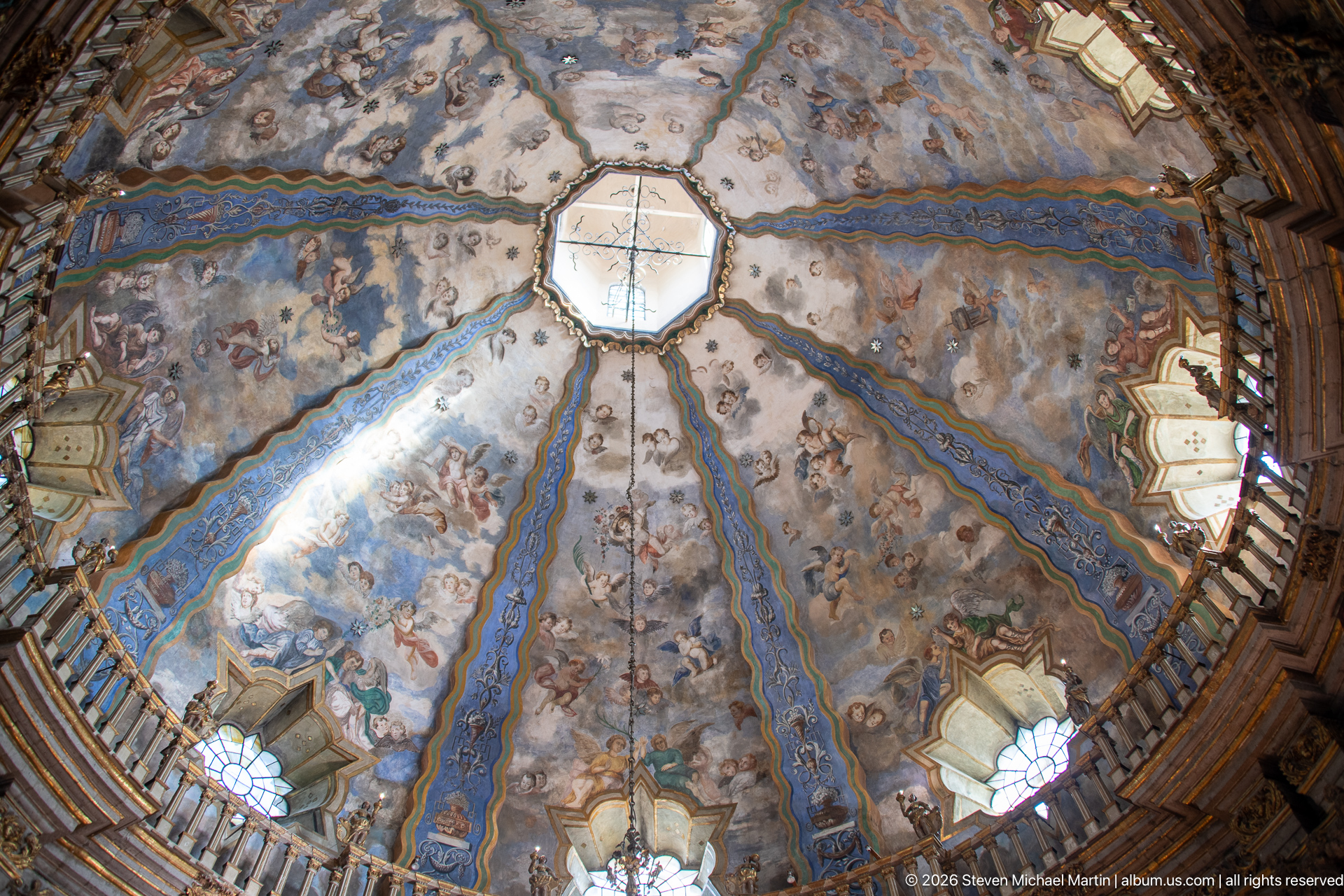
Seen from directly below, a broad painted dome gathers clouds, angels, and religious figures around a small central lantern. Blue ornamental bands divide the curved surface into radiating sections, while windows at the perimeter admit daylight. The upward view emphasizes the dome’s scale and the way its painted program turns the ceiling into a continuous celestial scene.
Caption
Seen from directly below, a broad painted dome gathers clouds, angels, and religious figures around a small central lantern. Blue ornamental bands divide the curved surface into radiating sections, while windows at the perimeter admit daylight. The upward view emphasizes the dome’s scale and the way its painted program turns the ceiling into a continuous celestial scene.
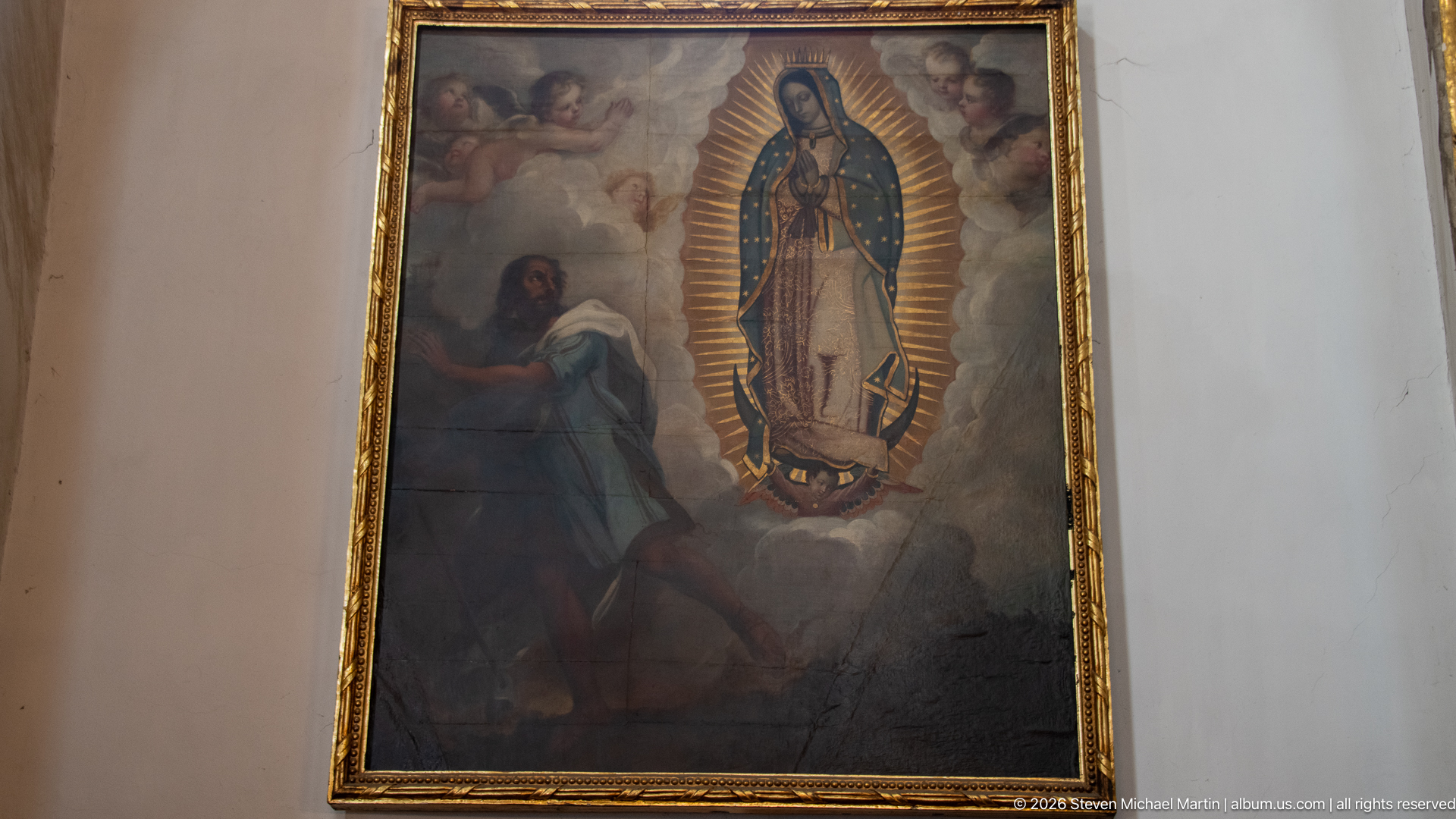
A gold-framed devotional painting places the Virgin of Guadalupe upright within a radiant aureole, with angels gathered around her and a kneeling figure below. The composition is seen through reflective glazing against a plain pale wall, and the darkened surface softens some details. That intimate, nearly full-frame view foregrounds the painted image and its elaborate frame rather than the surrounding sanctuary.
Caption
A gold-framed devotional painting places the Virgin of Guadalupe upright within a radiant aureole, with angels gathered around her and a kneeling figure below. The composition is seen through reflective glazing against a plain pale wall, and the darkened surface softens some details. That intimate, nearly full-frame view foregrounds the painted image and its elaborate frame rather than the surrounding sanctuary.
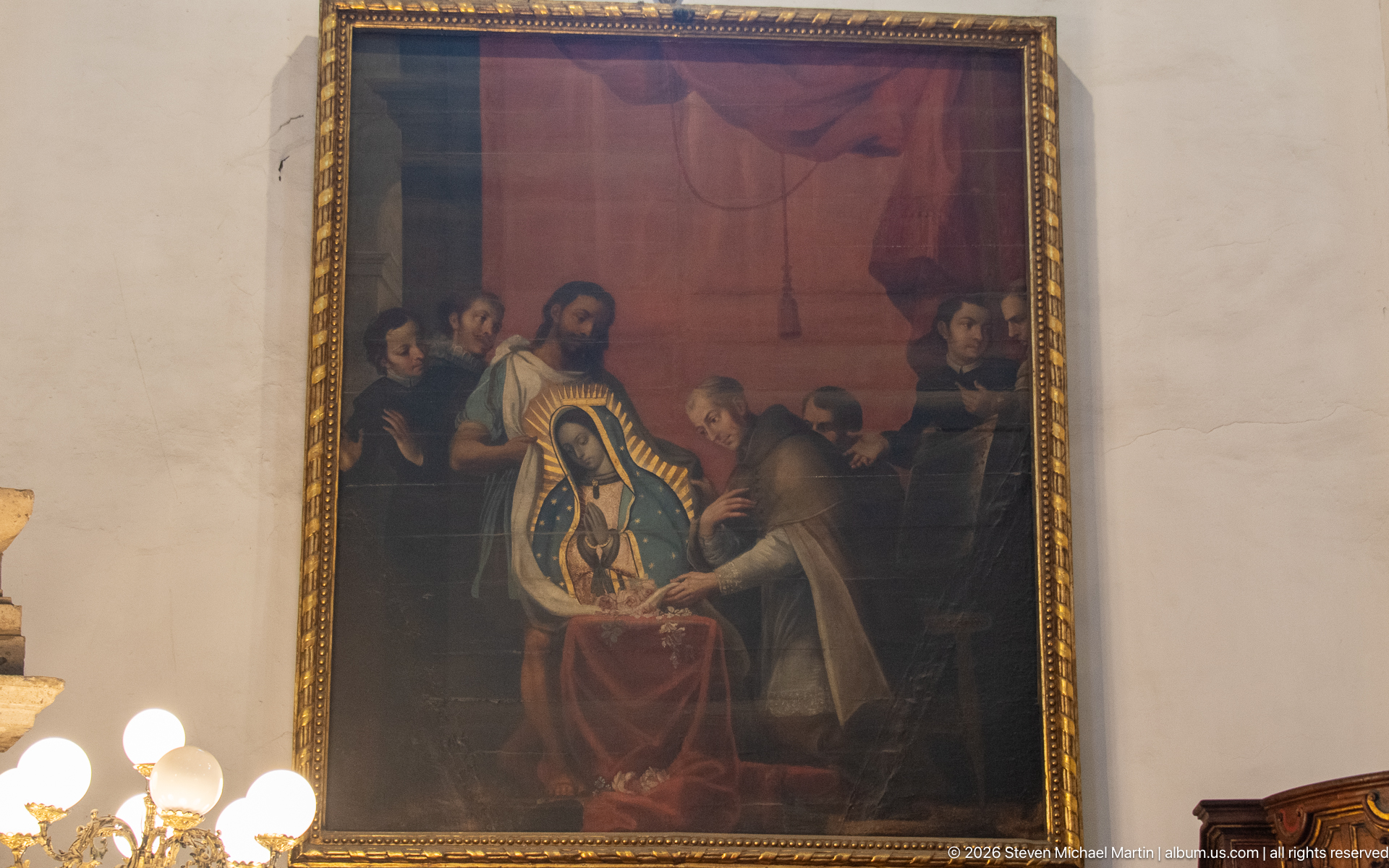
A large canvas presents the Virgin of Guadalupe at the center of a crowded devotional scene. Figures lean toward her from both sides, and one kneels in the foreground; a red draped backdrop and gilded frame enclose the group. A bright lamp intrudes at lower left, placing the painting within an active church interior and revealing the conditions under which visitors encounter it.
Caption
A large canvas presents the Virgin of Guadalupe at the center of a crowded devotional scene. Figures lean toward her from both sides, and one kneels in the foreground; a red draped backdrop and gilded frame enclose the group. A bright lamp intrudes at lower left, placing the painting within an active church interior and revealing the conditions under which visitors encounter it.
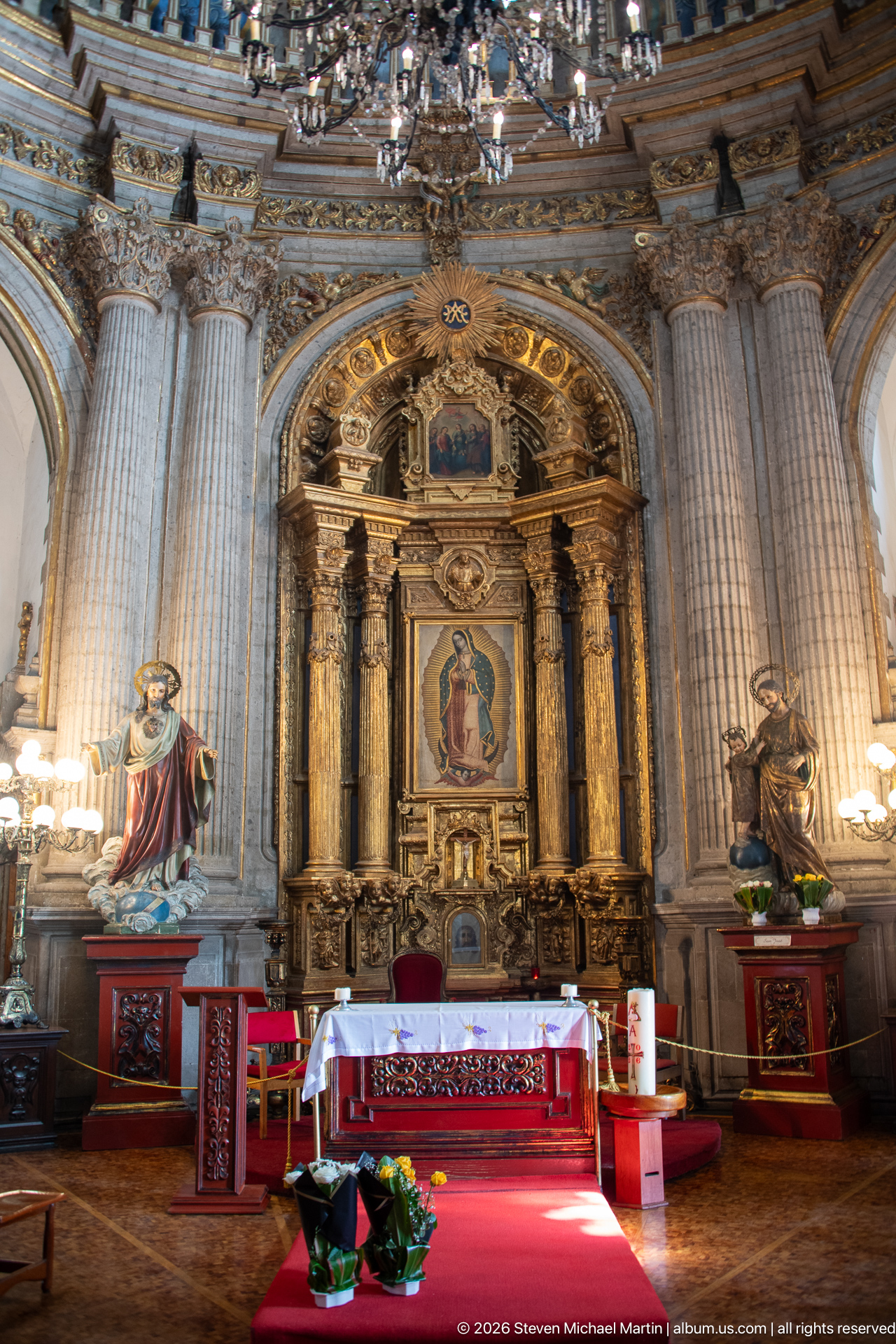
A frontal view centers the sanctuary altar beneath a tall gilded retablo containing the Virgin of Guadalupe. Red carpet leads toward a white-clothed altar, with flower arrangements placed before it and devotional figures standing at either side. The balanced composition records the arrangement of the worship space: the Marian image anchors the back wall, while furnishings and flowers mark the active altar in the foreground.
Caption
A frontal view centers the sanctuary altar beneath a tall gilded retablo containing the Virgin of Guadalupe. Red carpet leads toward a white-clothed altar, with flower arrangements placed before it and devotional figures standing at either side. The balanced composition records the arrangement of the worship space: the Marian image anchors the back wall, while furnishings and flowers mark the active altar in the foreground.
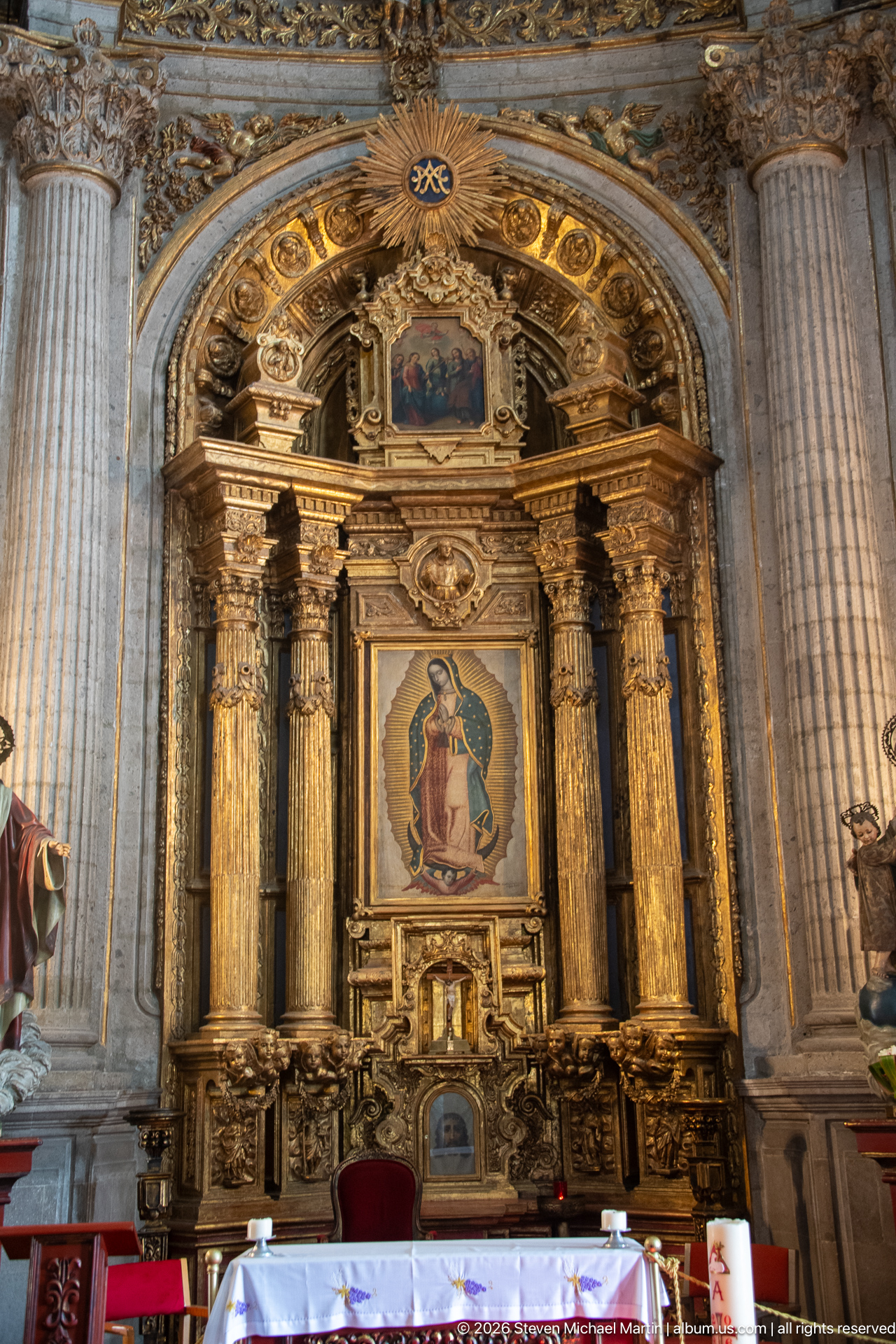
The sanctuary’s gilded retablo fills the frame, its paired columns and carved tiers enclosing a central image of the Virgin of Guadalupe. A white altar cloth crosses the lower edge, while portions of flanking sculptures and pale stone columns remain visible at the sides. Nested devotional images and layered carving give the altarpiece a strong vertical structure, anchored by the Marian image at its center.
Caption
The sanctuary’s gilded retablo fills the frame, its paired columns and carved tiers enclosing a central image of the Virgin of Guadalupe. A white altar cloth crosses the lower edge, while portions of flanking sculptures and pale stone columns remain visible at the sides. Nested devotional images and layered carving give the altarpiece a strong vertical structure, anchored by the Marian image at its center.
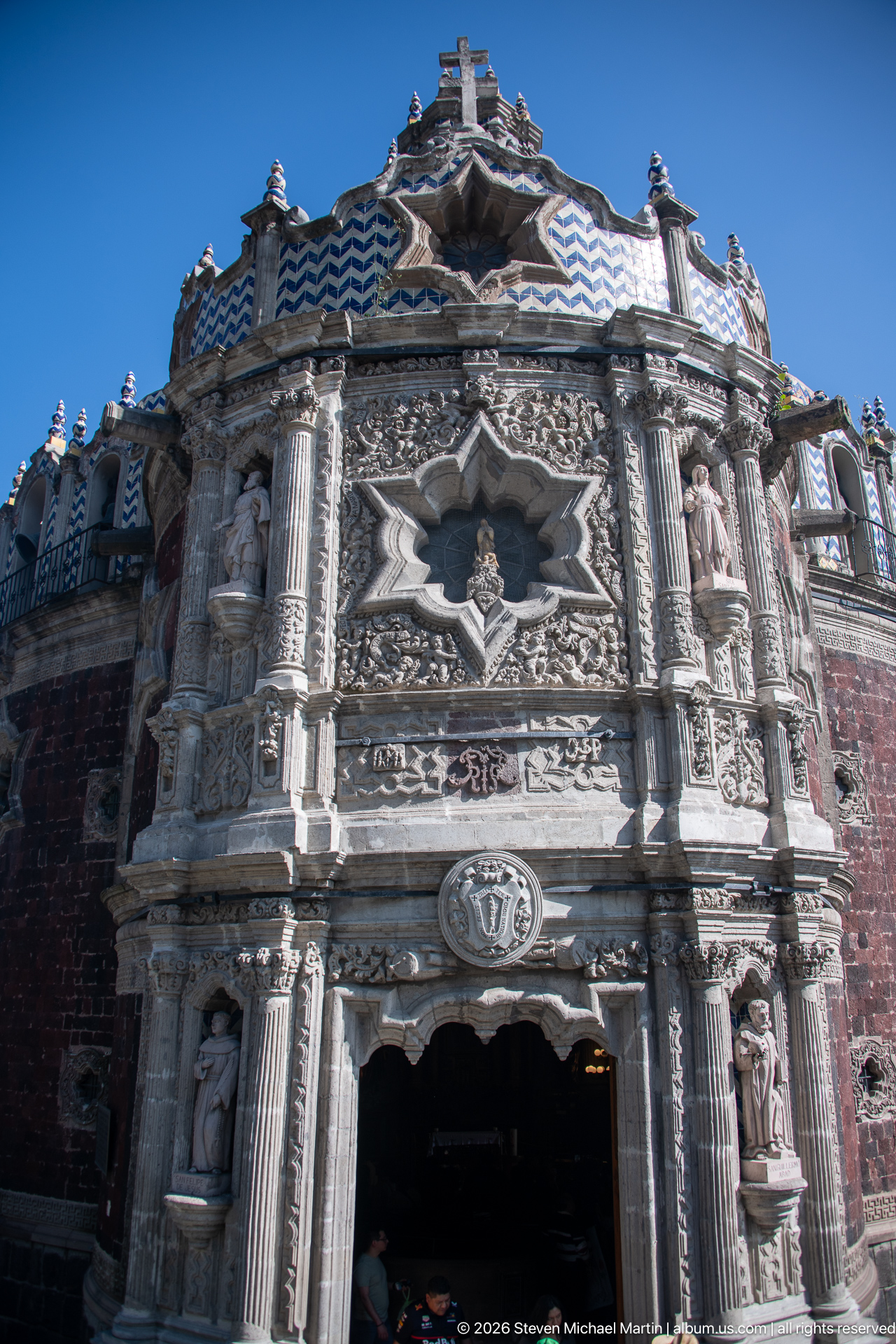
The entrance façade of the Capilla del Pocito is seen head-on beneath its blue-and-white tiled dome. Carved stone panels, small statues in niches, fluted columns, and a star-shaped opening articulate the compact front, while the open doorway leads into a dark interior. The sculptural masonry and threshold reveal the chapel’s richly ornamented exterior and its transition into the interior space.
Caption
The entrance façade of the Capilla del Pocito is seen head-on beneath its blue-and-white tiled dome. Carved stone panels, small statues in niches, fluted columns, and a star-shaped opening articulate the compact front, while the open doorway leads into a dark interior. The sculptural masonry and threshold reveal the chapel’s richly ornamented exterior and its transition into the interior space.
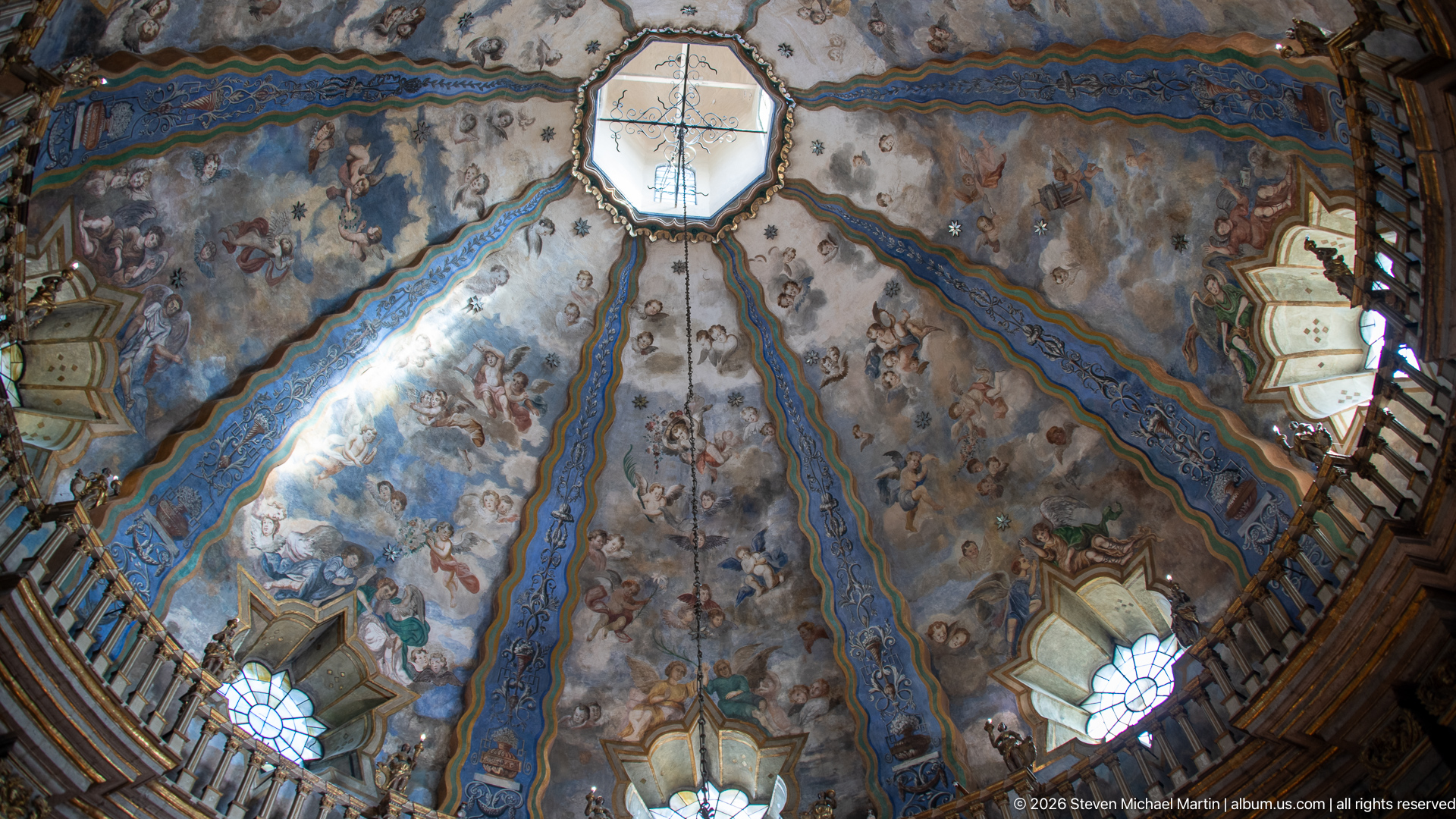
The camera looks upward into the dome’s painted surface, where angels and other sacred figures gather among clouds along blue ornamental ribs. The lantern opening sits near the top center, with small windows punctuating the lower perimeter. Blue bands divide the frescoed field into radiating sections, directing attention from the surrounding figures toward the central opening.
Caption
The camera looks upward into the dome’s painted surface, where angels and other sacred figures gather among clouds along blue ornamental ribs. The lantern opening sits near the top center, with small windows punctuating the lower perimeter. Blue bands divide the frescoed field into radiating sections, directing attention from the surrounding figures toward the central opening.
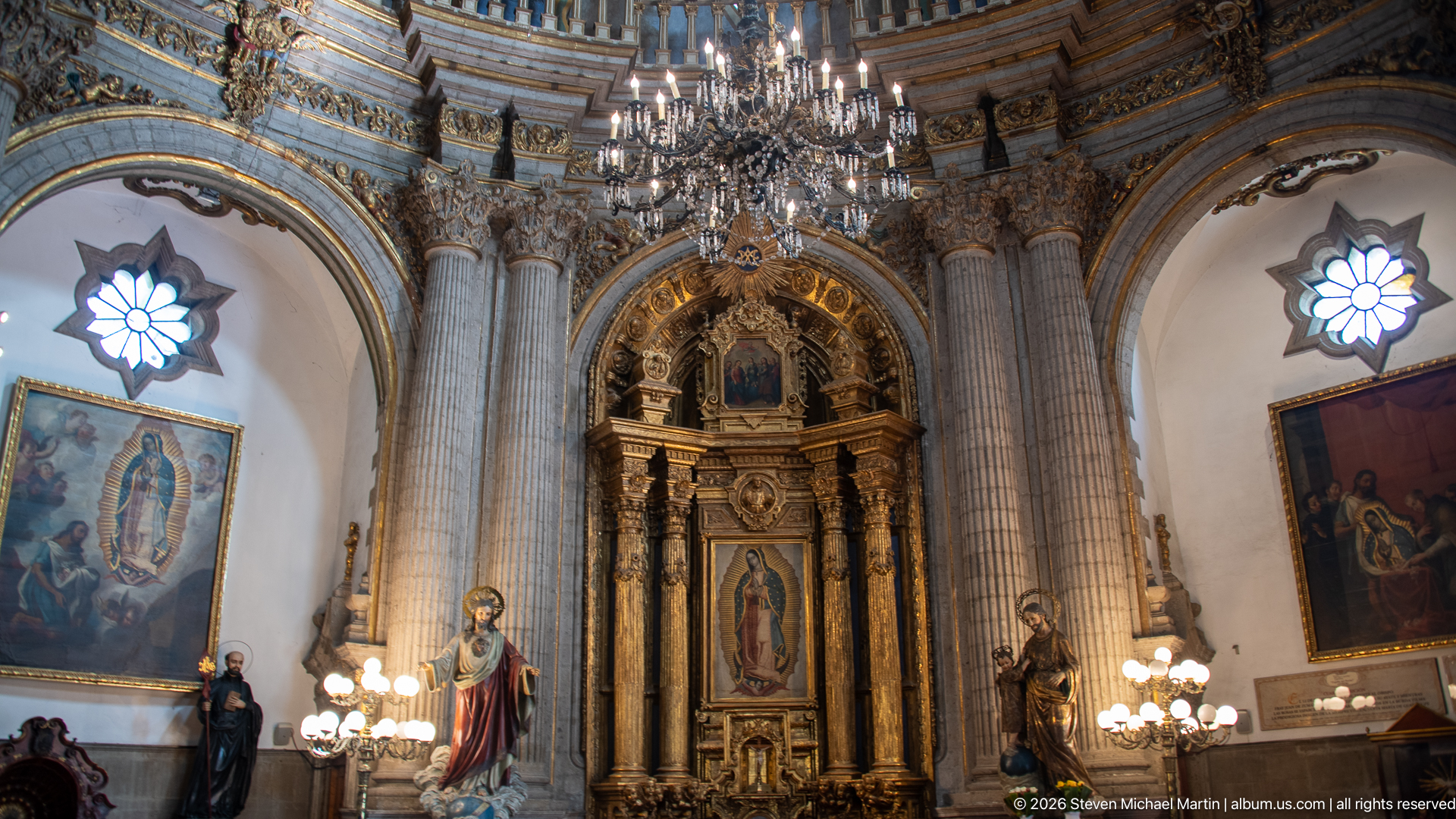
A crystal chandelier hangs before the upper sanctuary, between two circular rose windows set in pale arched bays. Below it, the gilded Guadalupe retablo rises between tall fluted columns, with devotional paintings visible at the edges. The slightly wider upward view balances luminous windows, hanging fixture, and altar architecture, conveying the vertical scale and layered decoration of the historic church interior.
Caption
A crystal chandelier hangs before the upper sanctuary, between two circular rose windows set in pale arched bays. Below it, the gilded Guadalupe retablo rises between tall fluted columns, with devotional paintings visible at the edges. The slightly wider upward view balances luminous windows, hanging fixture, and altar architecture, conveying the vertical scale and layered decoration of the historic church interior.
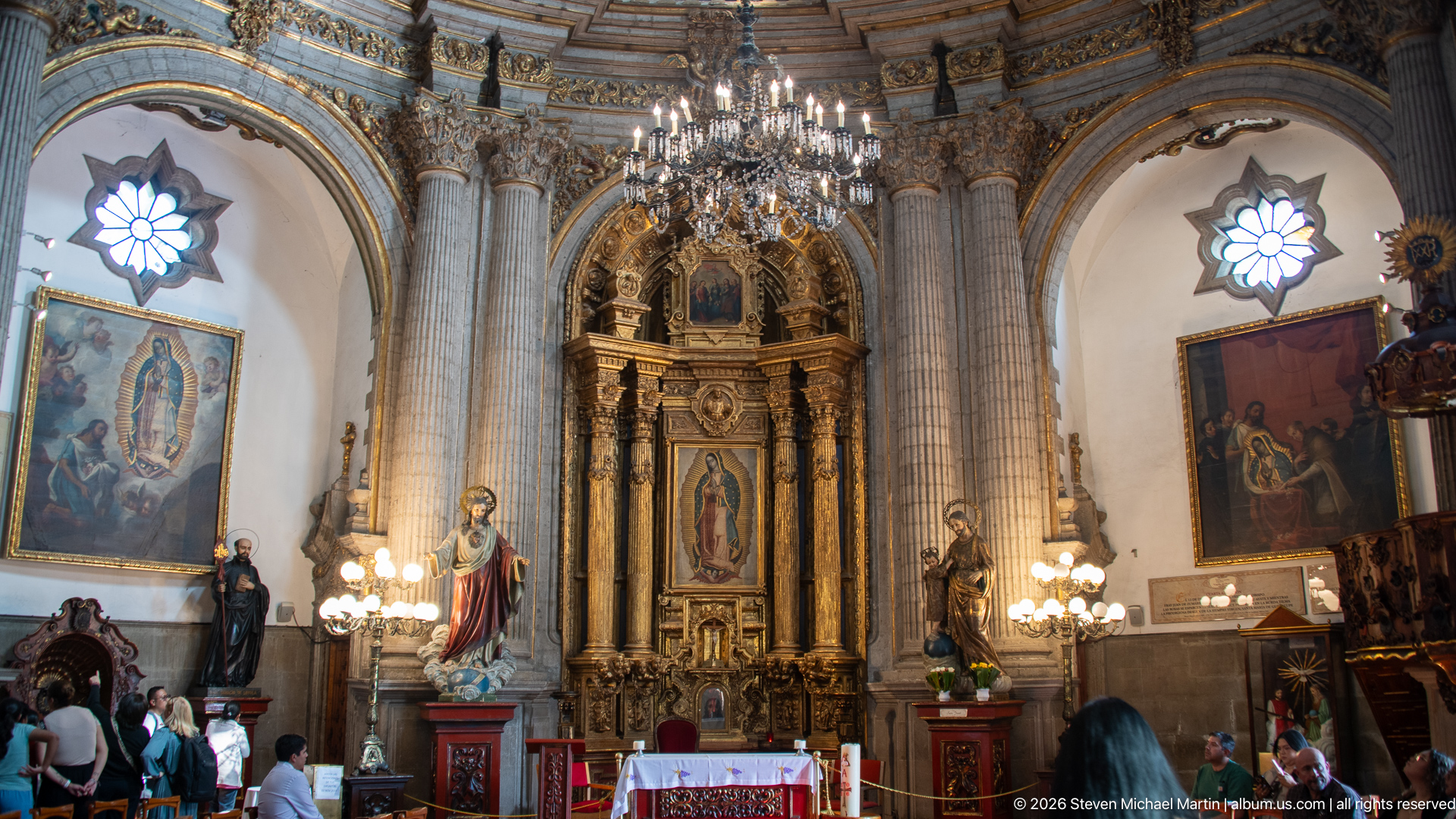
Visitors stand and sit in the lower foreground of a broad sanctuary view, facing the gilded altar and its central image of the Virgin of Guadalupe. The chandelier, fluted columns, rose windows, side paintings, and devotional statues remain visible above and around them. Human presence establishes the scale of the church and shows the altar as a place of ongoing worship rather than a purely architectural display.
Caption
Visitors stand and sit in the lower foreground of a broad sanctuary view, facing the gilded altar and its central image of the Virgin of Guadalupe. The chandelier, fluted columns, rose windows, side paintings, and devotional statues remain visible above and around them. Human presence establishes the scale of the church and shows the altar as a place of ongoing worship rather than a purely architectural display.
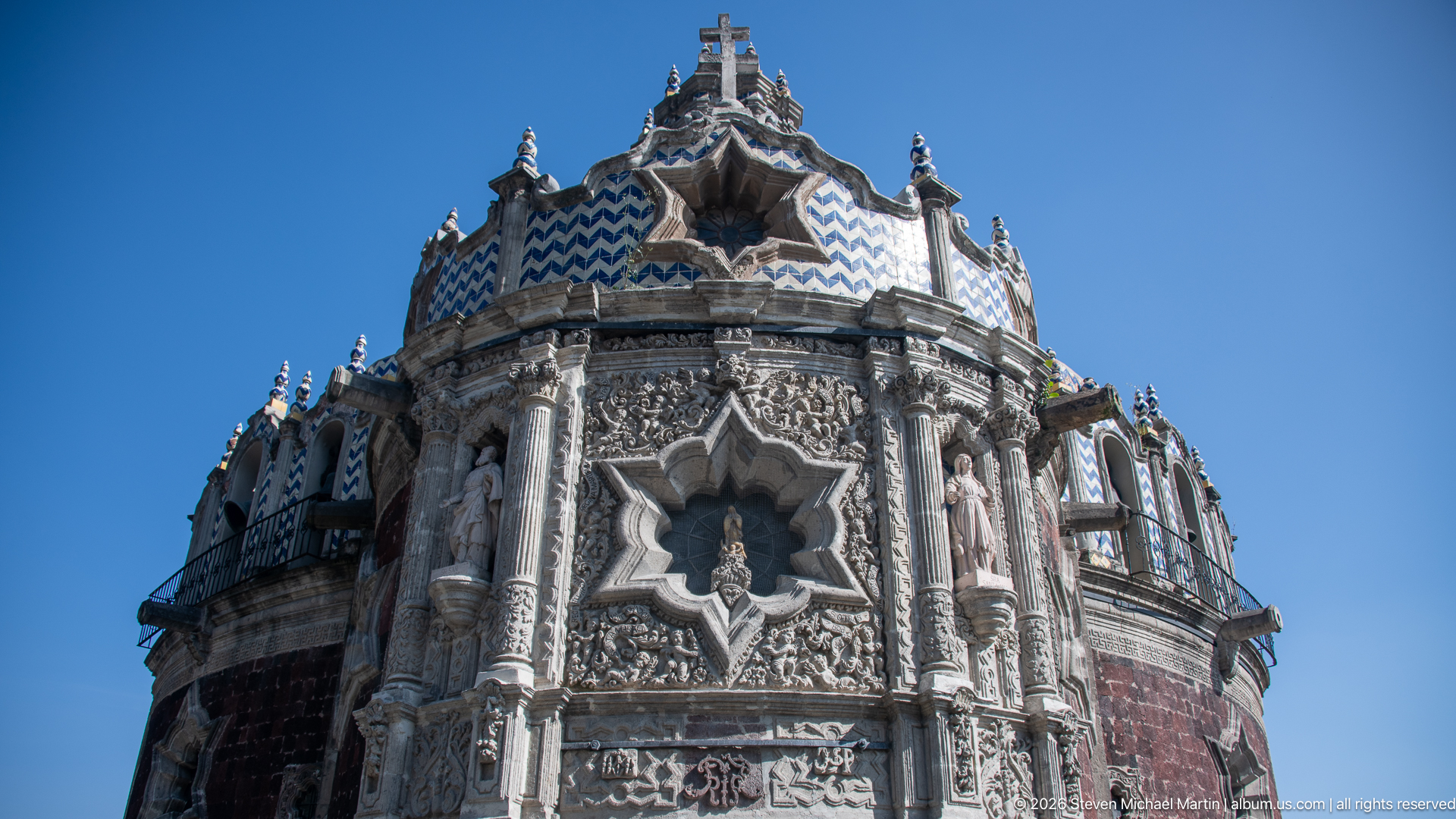
Viewed from below against a clear blue sky, the chapel’s rounded roof is clad in a crisp blue-and-white zigzag tile pattern. A lantern and cross rise above the dome, while small pinnacles and sculpted stone details punctuate the roofline. The upward angle emphasizes the contrast between the patterned ceramic surface and the richly carved masonry around the chapel’s upper drum.
Caption
Viewed from below against a clear blue sky, the chapel’s rounded roof is clad in a crisp blue-and-white zigzag tile pattern. A lantern and cross rise above the dome, while small pinnacles and sculpted stone details punctuate the roofline. The upward angle emphasizes the contrast between the patterned ceramic surface and the richly carved masonry around the chapel’s upper drum.
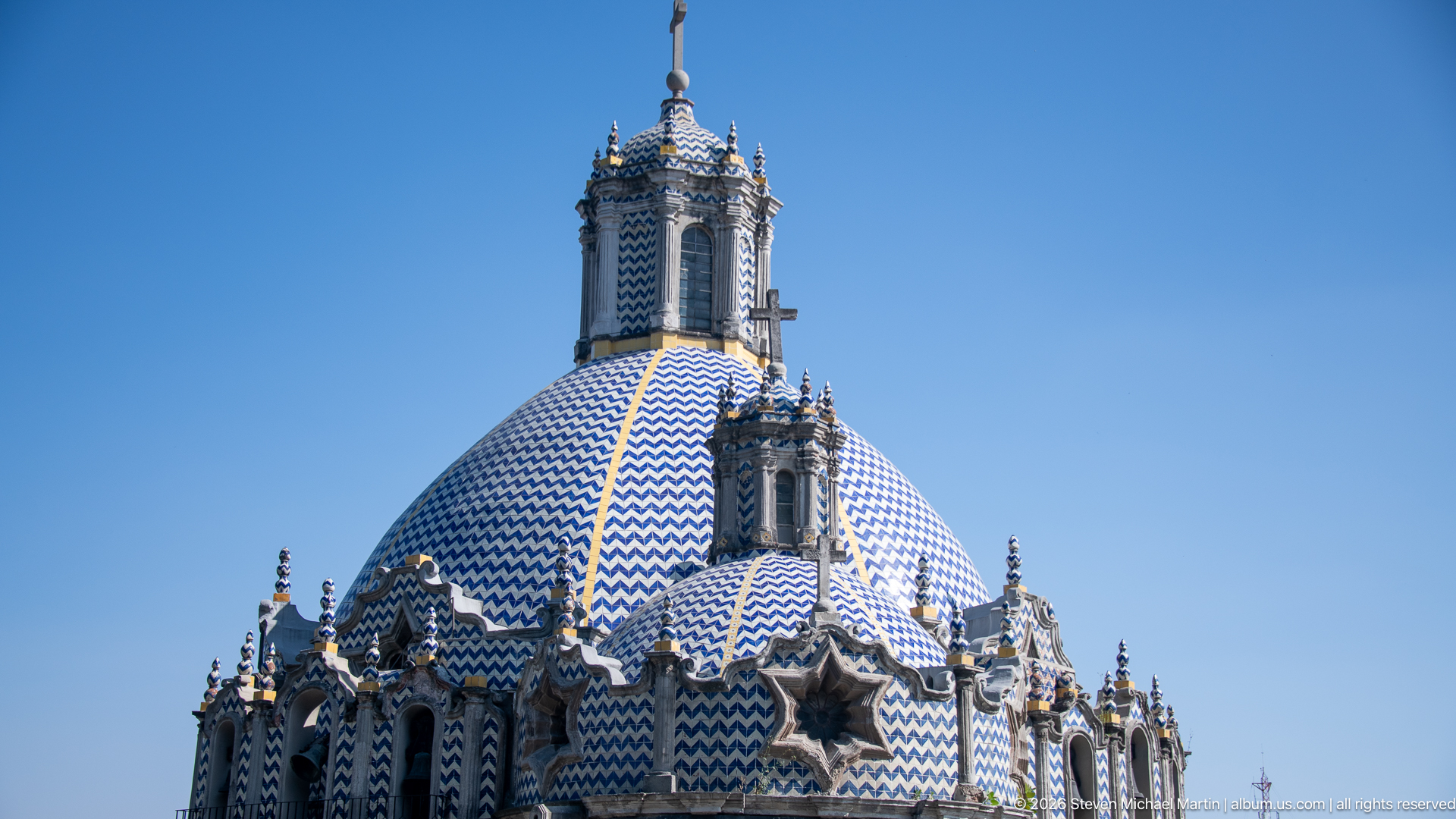
A fuller upward view reveals most of the Capilla del Pocito’s blue-and-white tiled dome, its lantern, and smaller pinnacles against uninterrupted sky. The repeated zigzag pattern wraps the curved surface, while the cross at the summit marks the chapel’s vertical axis. This image gives the roof a strong silhouette and conveys its scale without the lower façade or surrounding plaza competing for attention.
Caption
A fuller upward view reveals most of the Capilla del Pocito’s blue-and-white tiled dome, its lantern, and smaller pinnacles against uninterrupted sky. The repeated zigzag pattern wraps the curved surface, while the cross at the summit marks the chapel’s vertical axis. This image gives the roof a strong silhouette and conveys its scale without the lower façade or surrounding plaza competing for attention.
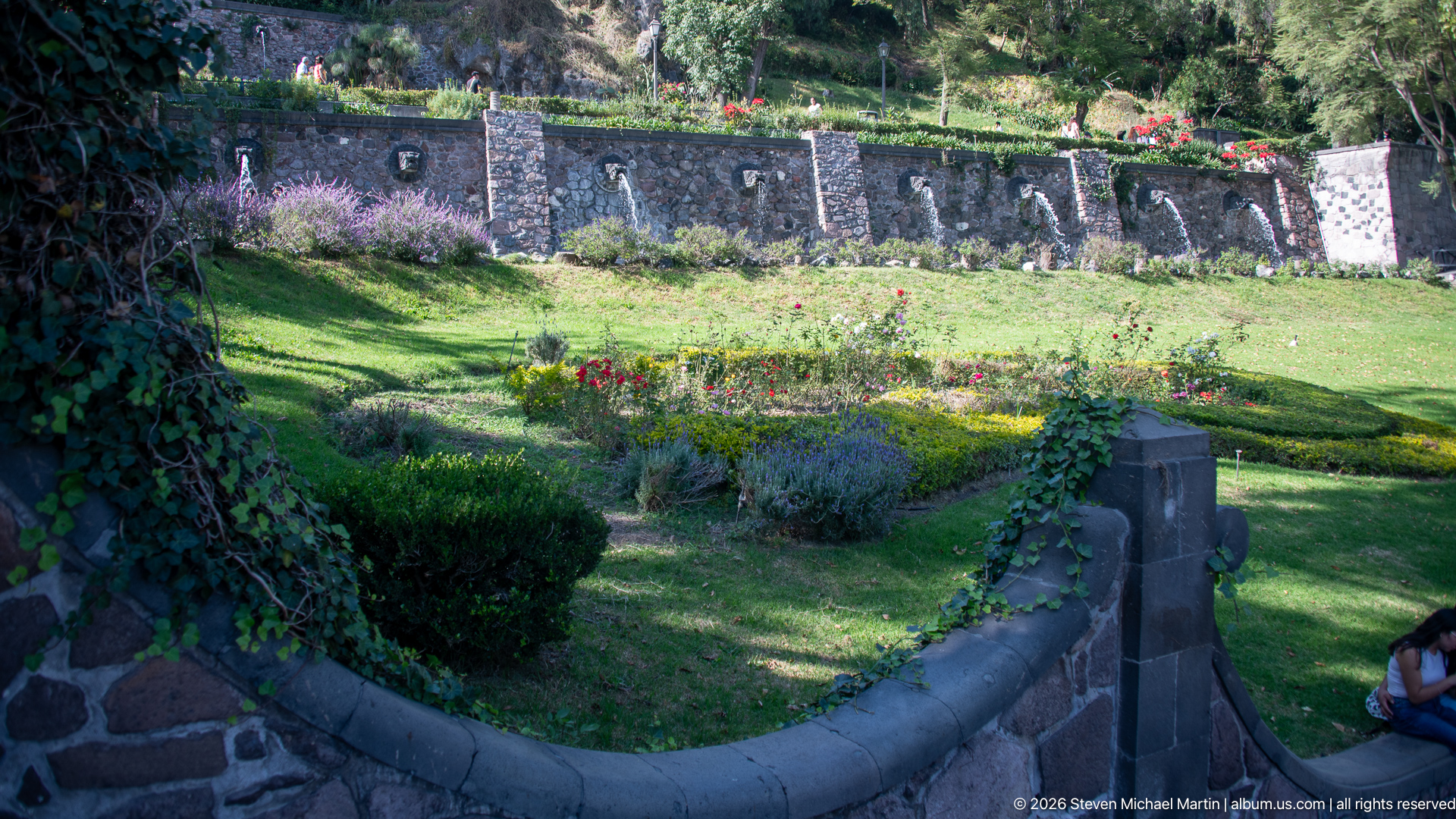
Water spills from several sculpted stone spouts along a low masonry wall into a narrow channel edged by paving. Grasses, flowering plants, and shrubs soften the formal stonework, while a few visitors appear at the far right. The oblique view follows the repeated fountains through the garden and draws attention to the movement of water across the planted grounds.
Caption
Water spills from several sculpted stone spouts along a low masonry wall into a narrow channel edged by paving. Grasses, flowering plants, and shrubs soften the formal stonework, while a few visitors appear at the far right. The oblique view follows the repeated fountains through the garden and draws attention to the movement of water across the planted grounds.
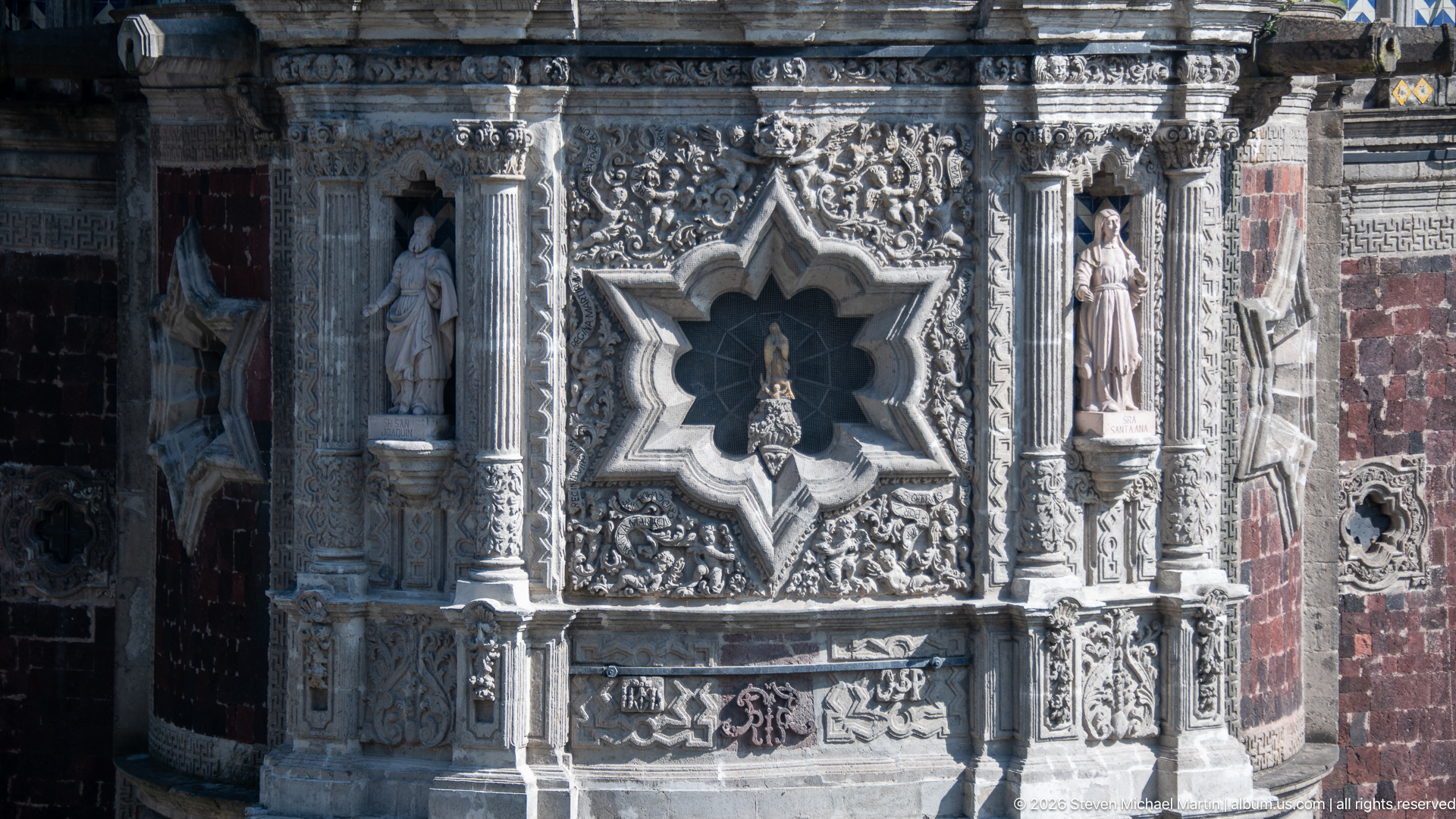
A close crop of the Capilla del Pocito’s exterior brings its carved stone surface forward: fluted pilasters frame a star-shaped opening, while niches hold standing figures and dense foliage-like relief fills the surrounding panels. The shadowed entrance at left reveals the thickness of the masonry. This detail focuses on the façade’s sculptural vocabulary rather than the dome or the chapel’s overall form.
Caption
A close crop of the Capilla del Pocito’s exterior brings its carved stone surface forward: fluted pilasters frame a star-shaped opening, while niches hold standing figures and dense foliage-like relief fills the surrounding panels. The shadowed entrance at left reveals the thickness of the masonry. This detail focuses on the façade’s sculptural vocabulary rather than the dome or the chapel’s overall form.
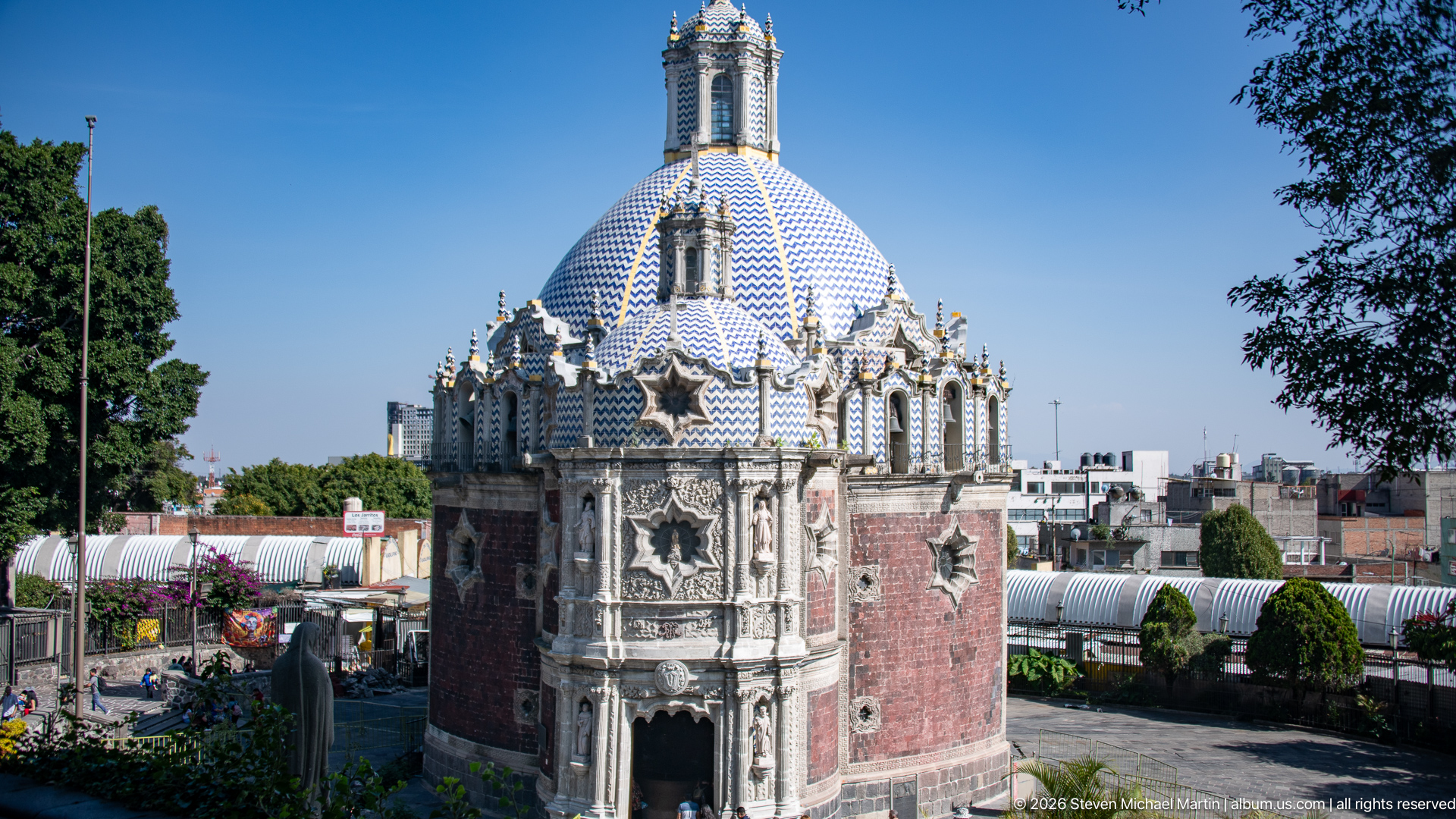
The Capilla del Pocito rises from a landscaped setting, its rounded lower walls and patterned dome visible above clipped shrubs and stonework. Trees frame the sides, and a low modern shelter and nearby urban buildings appear behind the historic chapel. This contextual view places the richly ornamented structure within its present-day grounds, showing both its compact, centralized form and the contemporary setting around it.
Caption
The Capilla del Pocito rises from a landscaped setting, its rounded lower walls and patterned dome visible above clipped shrubs and stonework. Trees frame the sides, and a low modern shelter and nearby urban buildings appear behind the historic chapel. This contextual view places the richly ornamented structure within its present-day grounds, showing both its compact, centralized form and the contemporary setting around it.
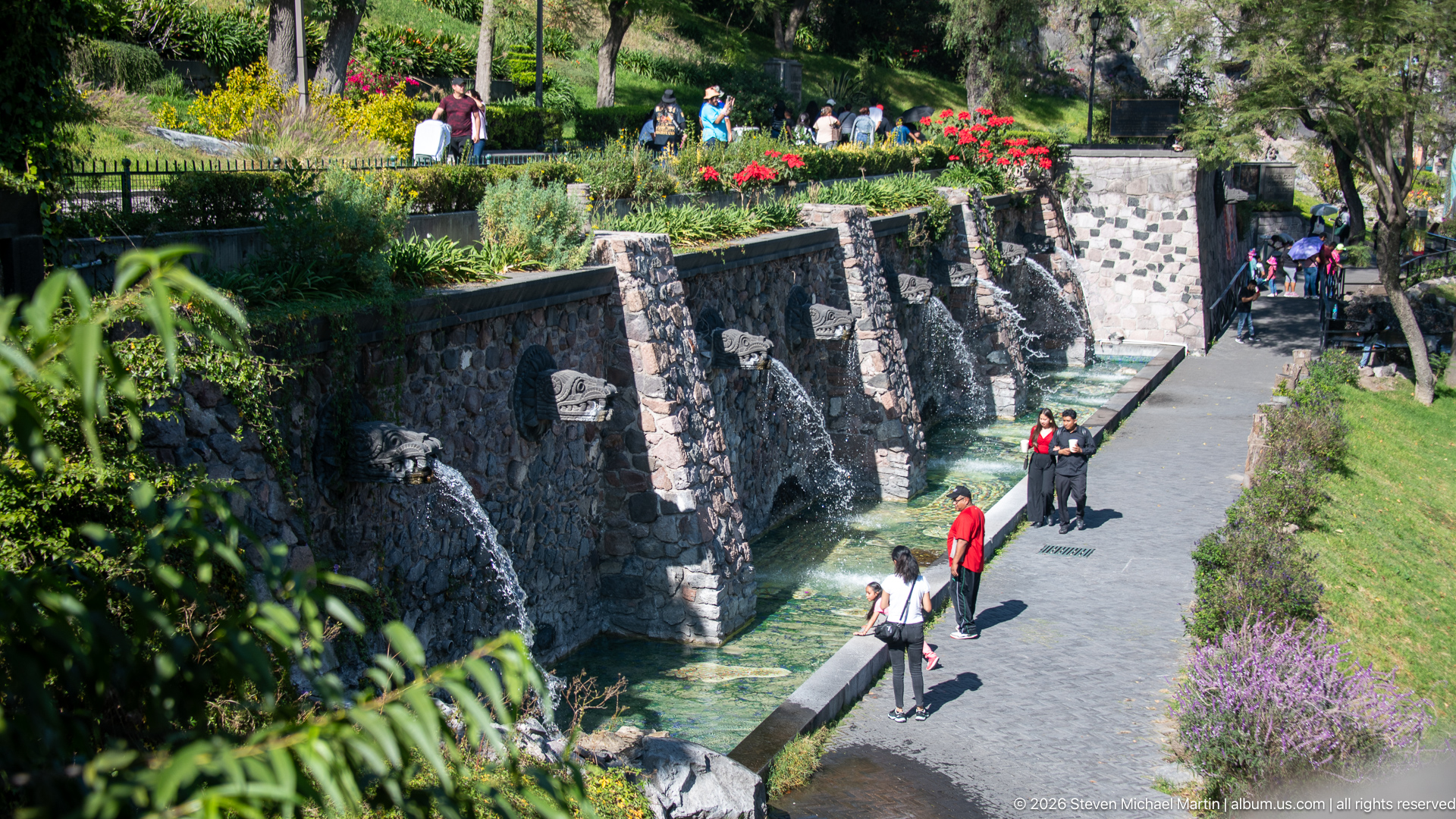
A stepped watercourse runs diagonally through a planted garden, with carved spouts sending water into a shallow channel beside the visitor path. Several people pause or walk along the route, and flowering shrubs brighten the stone retaining walls. The scene connects the water feature with the garden’s circulation, showing visitors moving through a landscaped pilgrimage setting.
Caption
A stepped watercourse runs diagonally through a planted garden, with carved spouts sending water into a shallow channel beside the visitor path. Several people pause or walk along the route, and flowering shrubs brighten the stone retaining walls. The scene connects the water feature with the garden’s circulation, showing visitors moving through a landscaped pilgrimage setting.
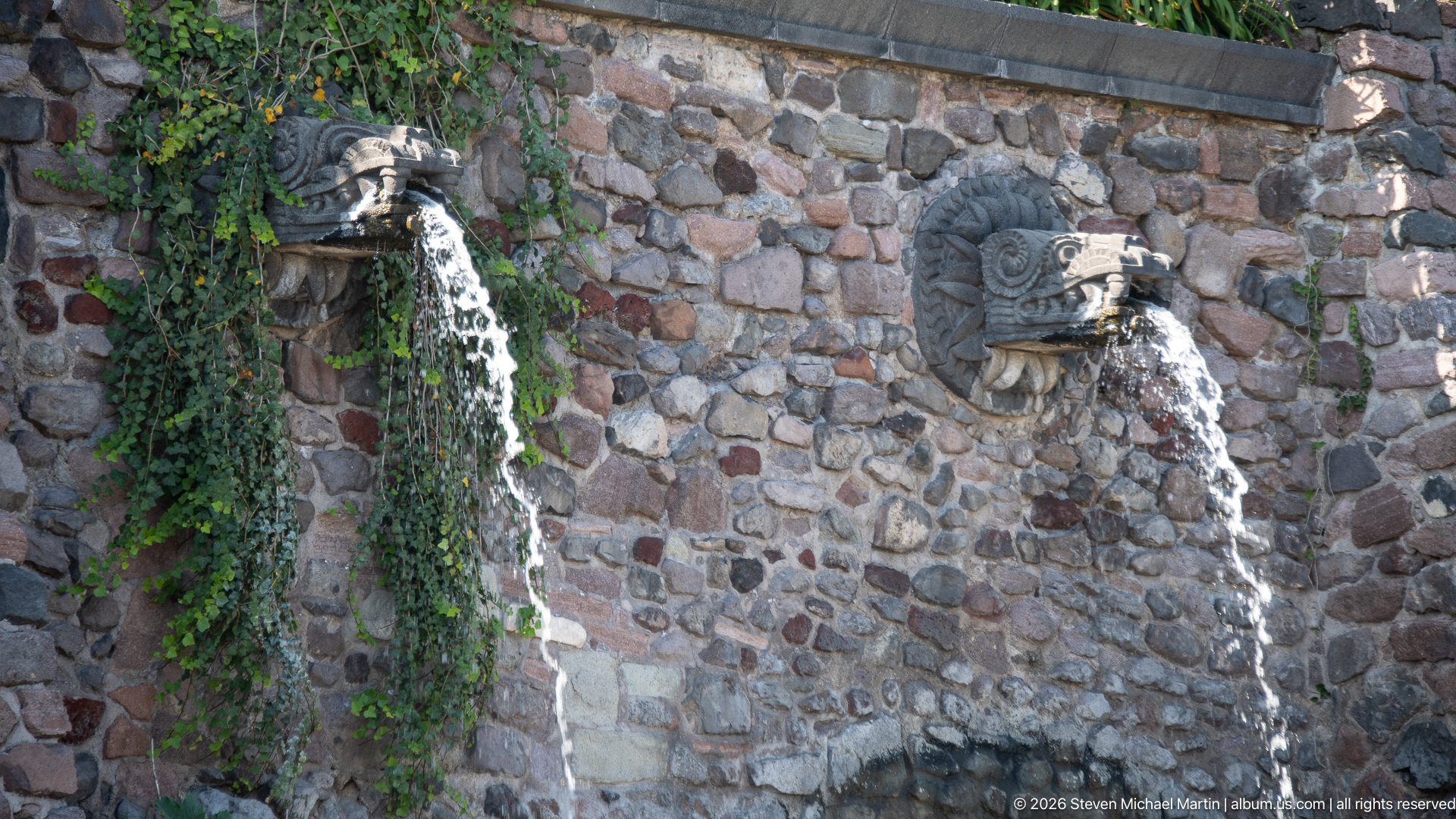
Two carved animal-head spouts project from an irregular stone wall, sending separate streams into a basin below the frame. Ivy and other plants trail over the masonry, softening the rough blocks and surrounding the fountain with greenery. The tight composition isolates the fountain’s sculpted mouths and flowing water, turning one element of the larger garden channel into a close study of its material and function.
Caption
Two carved animal-head spouts project from an irregular stone wall, sending separate streams into a basin below the frame. Ivy and other plants trail over the masonry, softening the rough blocks and surrounding the fountain with greenery. The tight composition isolates the fountain’s sculpted mouths and flowing water, turning one element of the larger garden channel into a close study of its material and function.
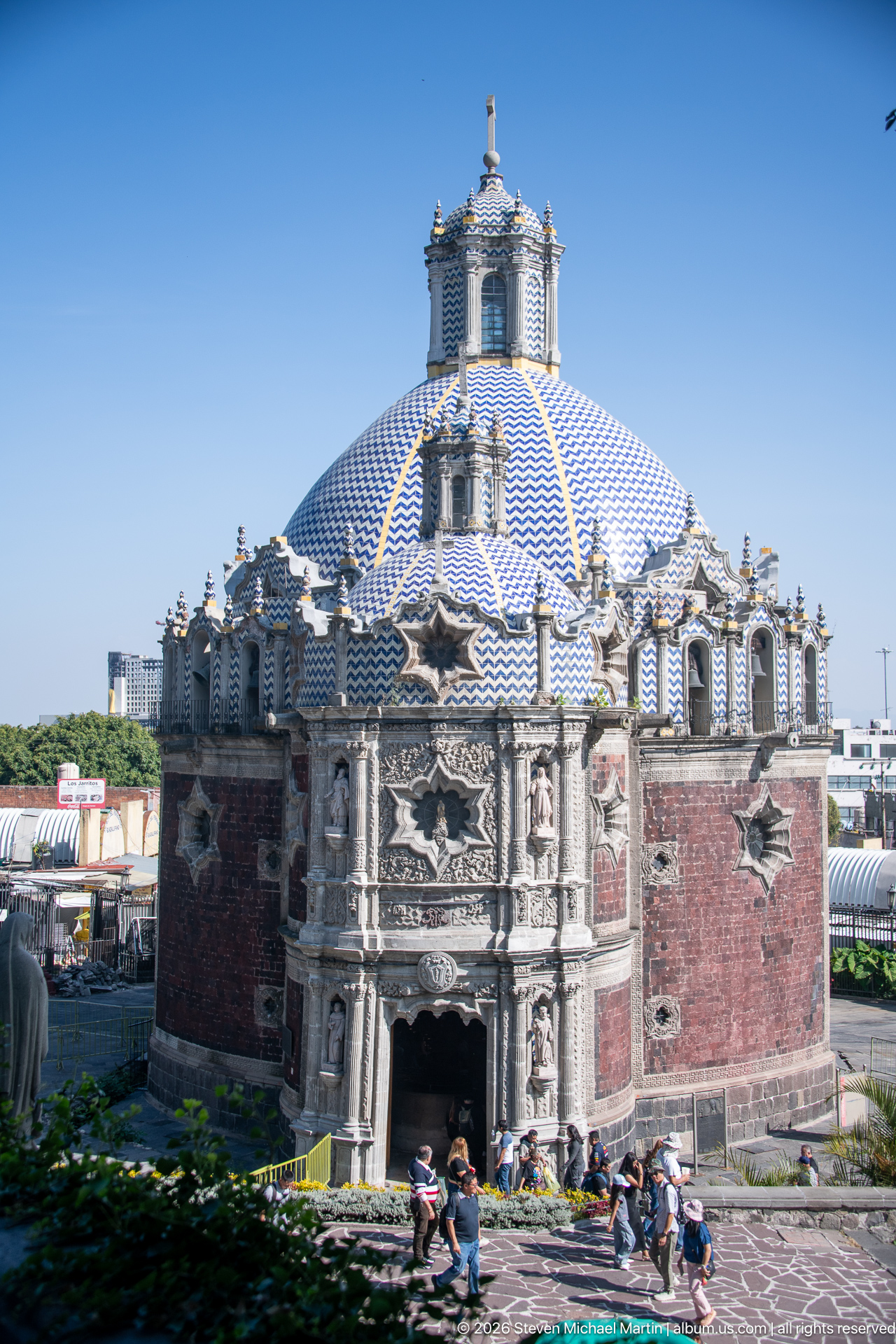
The Capilla del Pocito is shown from farther back, revealing its tiled dome and rounded, stone-clad body above an entrance where visitors gather. Trees and planting border the foreground; beyond the chapel, low urban buildings and a covered walkway extend across the horizon. This wider perspective connects the chapel’s distinctive form to the busy grounds of the Guadalupe sanctuary.
Caption
The Capilla del Pocito is shown from farther back, revealing its tiled dome and rounded, stone-clad body above an entrance where visitors gather. Trees and planting border the foreground; beyond the chapel, low urban buildings and a covered walkway extend across the horizon. This wider perspective connects the chapel’s distinctive form to the busy grounds of the Guadalupe sanctuary.
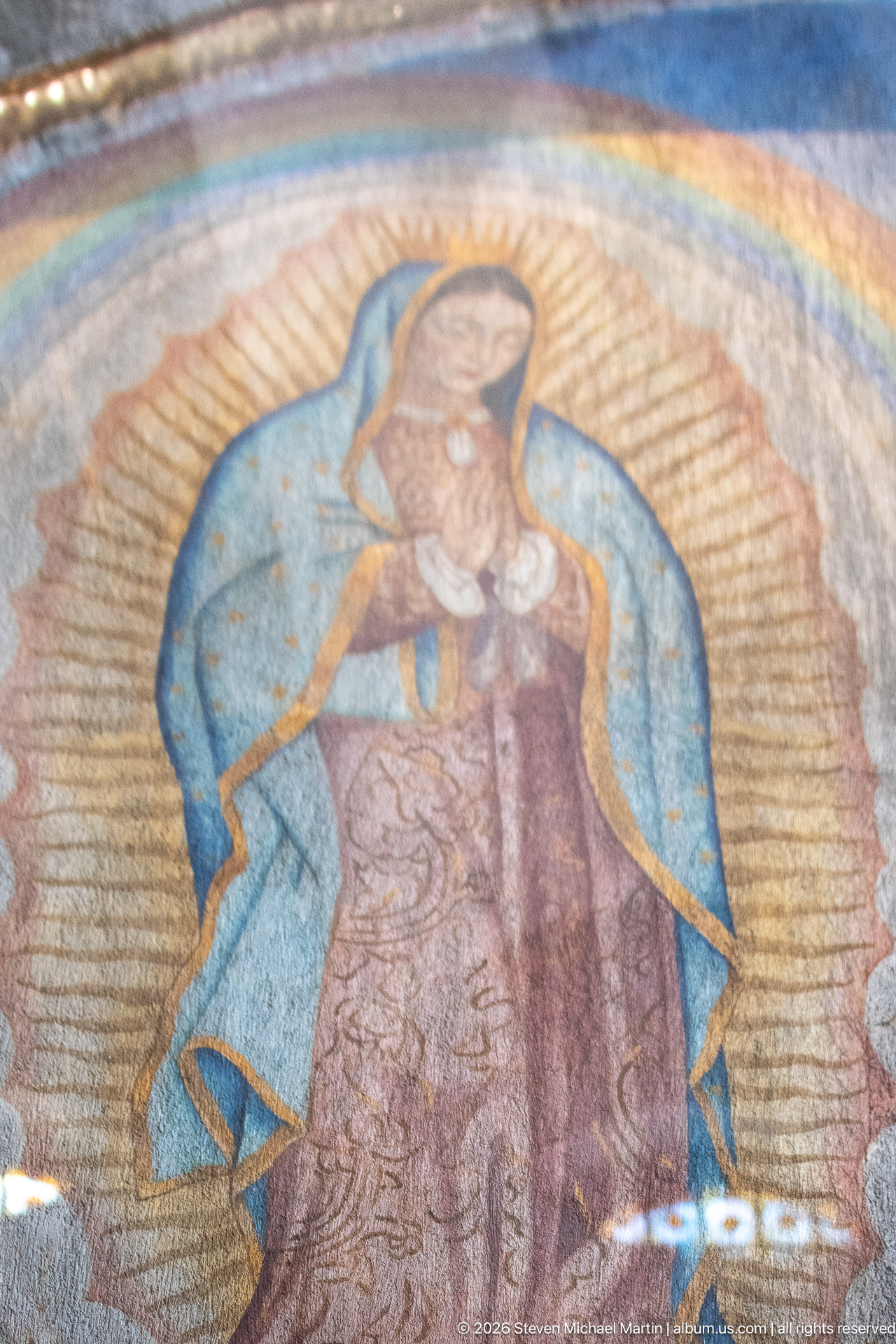
A richly colored image of the Virgin of Guadalupe appears within a blue oval surrounded by a radiating gold field. Her rose-colored robe and blue mantle are visible beneath a patterned veil, with small golden marks scattered around the figure. The extreme crop isolates the devotional image from its architectural setting and makes the tessellated surface and surrounding rays the principal details.
Caption
A richly colored image of the Virgin of Guadalupe appears within a blue oval surrounded by a radiating gold field. Her rose-colored robe and blue mantle are visible beneath a patterned veil, with small golden marks scattered around the figure. The extreme crop isolates the devotional image from its architectural setting and makes the tessellated surface and surrounding rays the principal details.
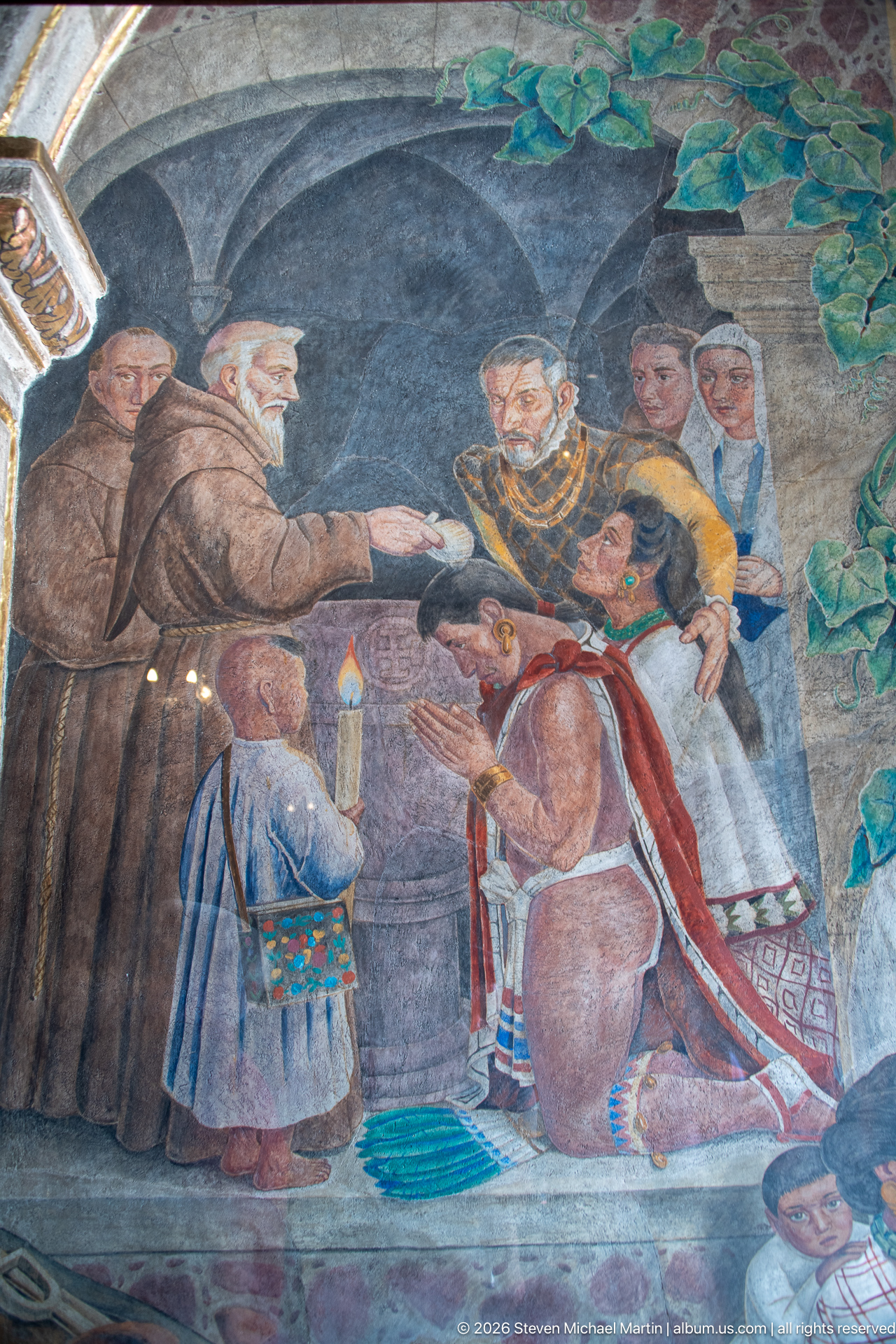
Several robed men gather around a kneeling figure in a colorful mural. A senior cleric in gold-trimmed garments extends an arm toward the central group, while a candle burns between the figures and a green-blue floor anchors the foreground. The close crop preserves the exchange of gestures and layered garments but does not name the participants or specify the episode.
Caption
Several robed men gather around a kneeling figure in a colorful mural. A senior cleric in gold-trimmed garments extends an arm toward the central group, while a candle burns between the figures and a green-blue floor anchors the foreground. The close crop preserves the exchange of gestures and layered garments but does not name the participants or specify the episode.
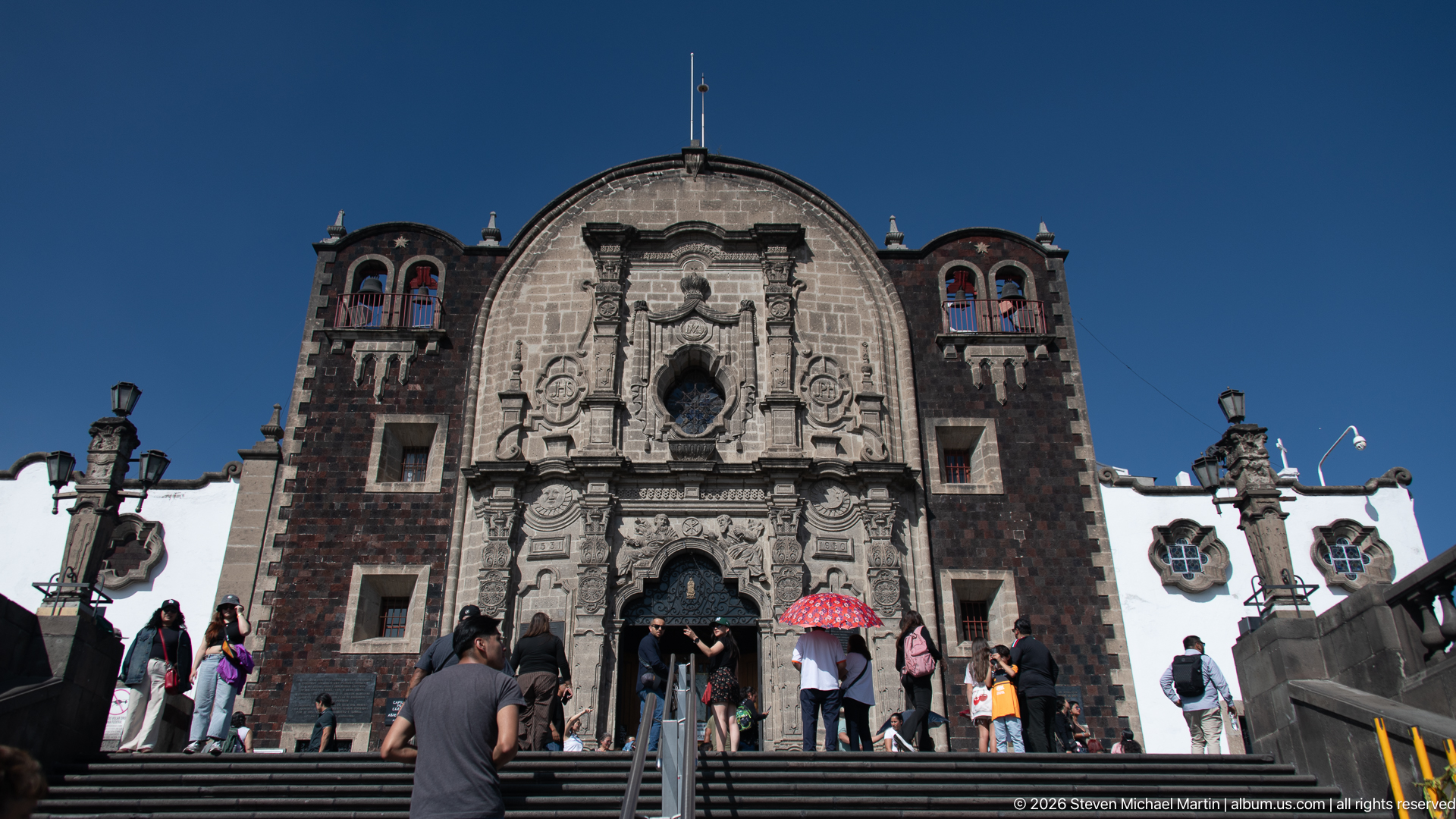
Visitors climb the broad steps toward the Old Basilica, whose dark stone façade is organized around a pale central portal and large upper arch. Sculptural ornament, paired towers, and small balconies rise against a deep blue sky, while a red parasol punctuates the crowd below. The frontal viewpoint records both the church’s monumental entrance and the steady stream of people entering the historic sanctuary.
Caption
Visitors climb the broad steps toward the Old Basilica, whose dark stone façade is organized around a pale central portal and large upper arch. Sculptural ornament, paired towers, and small balconies rise against a deep blue sky, while a red parasol punctuates the crowd below. The frontal viewpoint records both the church’s monumental entrance and the steady stream of people entering the historic sanctuary.
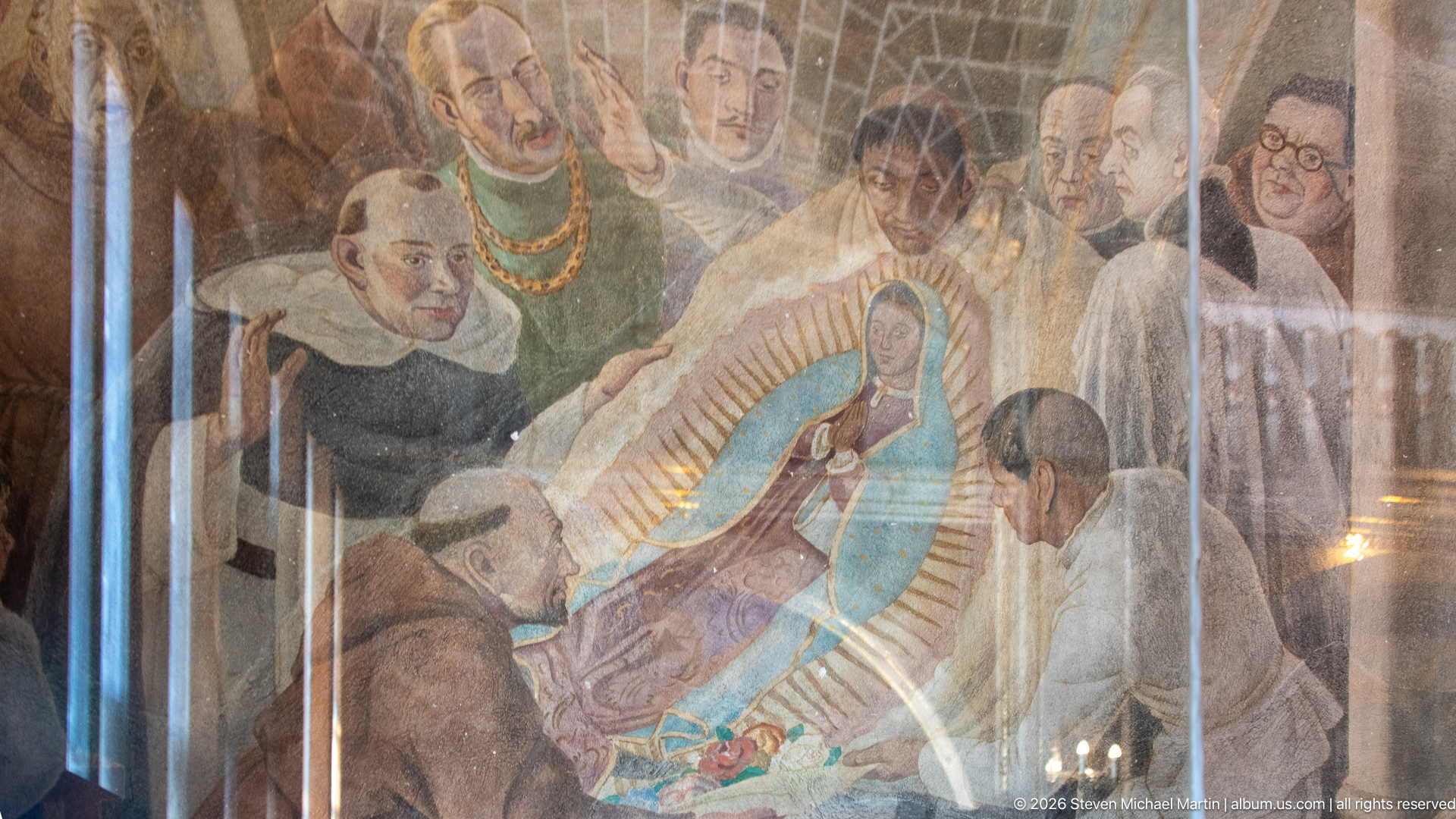
Behind reflective glass, a devotional painting arranges the Virgin of Guadalupe among clergy and other worshippers. A tonsured friar and several robed figures gather around the central Marian image, whose blue mantle and radiating rays remain visible despite reflections from the room. The close framing emphasizes the image’s narrative grouping and the protective glazing through which visitors view it.
Caption
Behind reflective glass, a devotional painting arranges the Virgin of Guadalupe among clergy and other worshippers. A tonsured friar and several robed figures gather around the central Marian image, whose blue mantle and radiating rays remain visible despite reflections from the room. The close framing emphasizes the image’s narrative grouping and the protective glazing through which visitors view it.
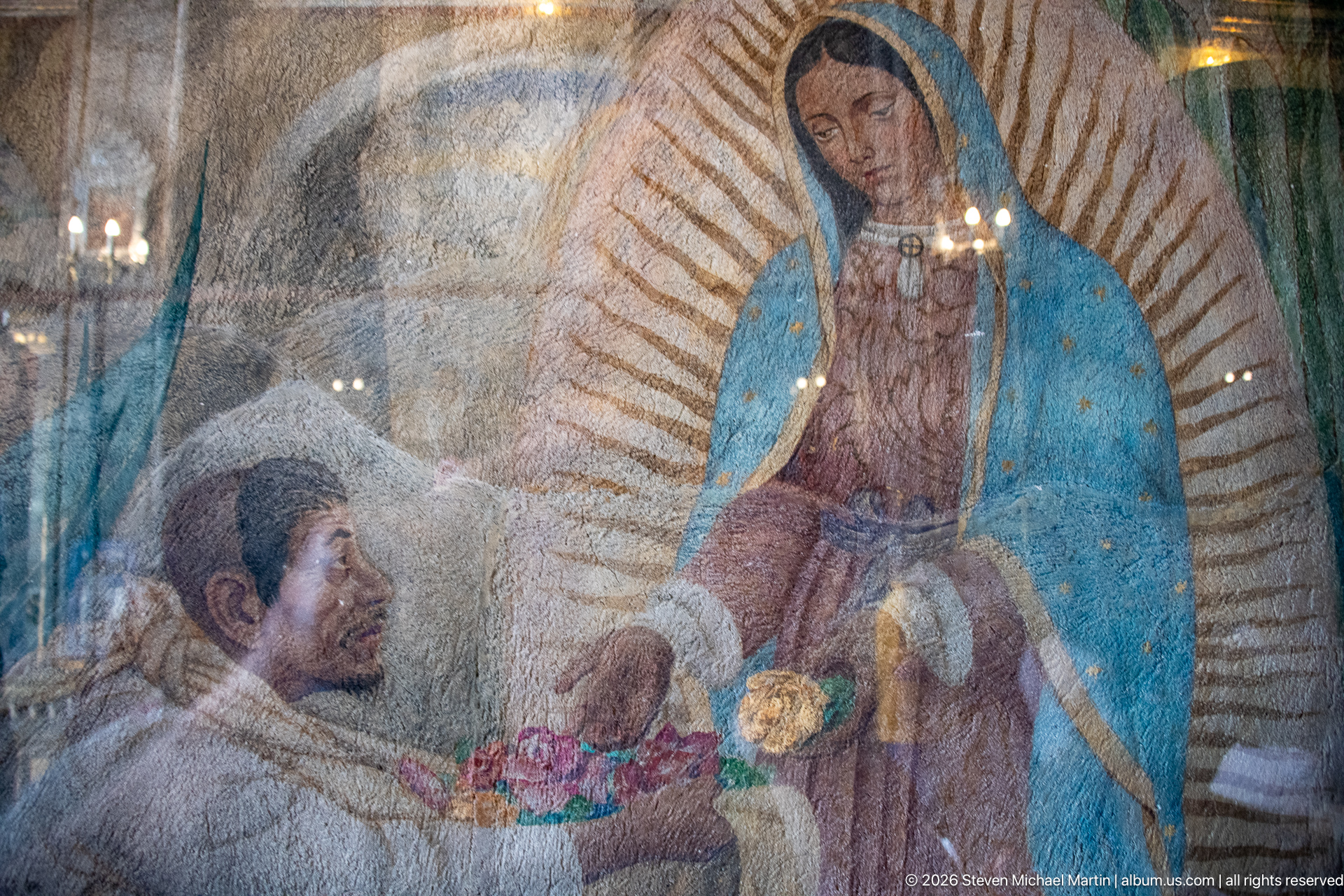
The Virgin of Guadalupe fills the center of a painted scene, her blue mantle outlined by golden rays as she looks downward toward a kneeling man. The crop reveals worn, textured paint and reflections from the surrounding interior, suggesting the work is seen behind a protective surface. By concentrating on the encounter rather than the full composition, the photograph foregrounds the visual relationship between the Virgin and devotee.
Caption
The Virgin of Guadalupe fills the center of a painted scene, her blue mantle outlined by golden rays as she looks downward toward a kneeling man. The crop reveals worn, textured paint and reflections from the surrounding interior, suggesting the work is seen behind a protective surface. By concentrating on the encounter rather than the full composition, the photograph foregrounds the visual relationship between the Virgin and devotee.
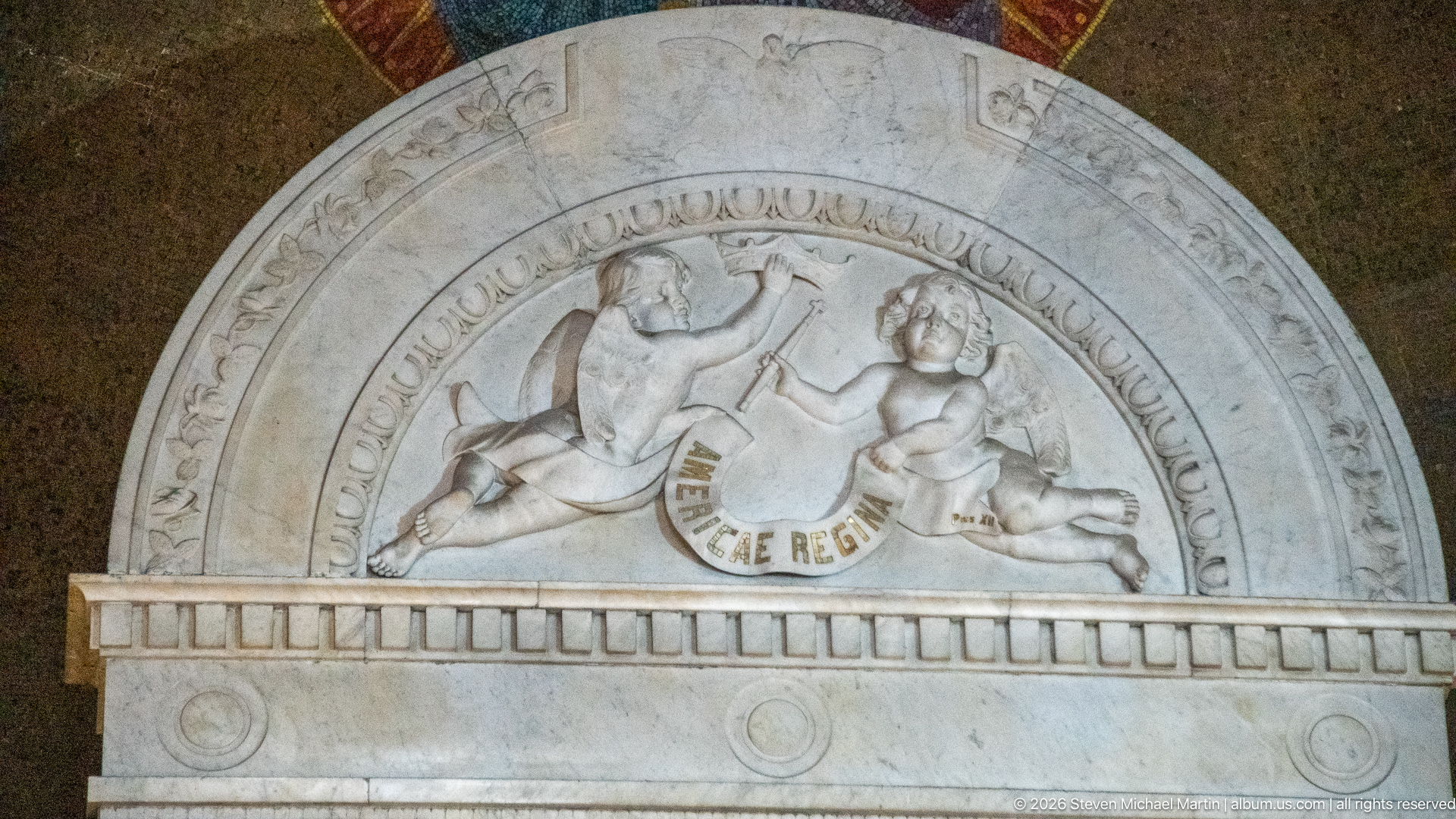
Two carved putti hold a curved scroll inscribed “AVE MARIA REGINA” within a semicircular marble relief. The figures recline above a projecting ledge, their drapery and wings rendered in shallow, pale stone against a dark surround. The centered, nearly frontal view makes the inscription and paired figures easy to read, presenting a sculptural devotional detail rather than a complete altar or chapel interior.
Caption
Two carved putti hold a curved scroll inscribed “AVE MARIA REGINA” within a semicircular marble relief. The figures recline above a projecting ledge, their drapery and wings rendered in shallow, pale stone against a dark surround. The centered, nearly frontal view makes the inscription and paired figures easy to read, presenting a sculptural devotional detail rather than a complete altar or chapel interior.
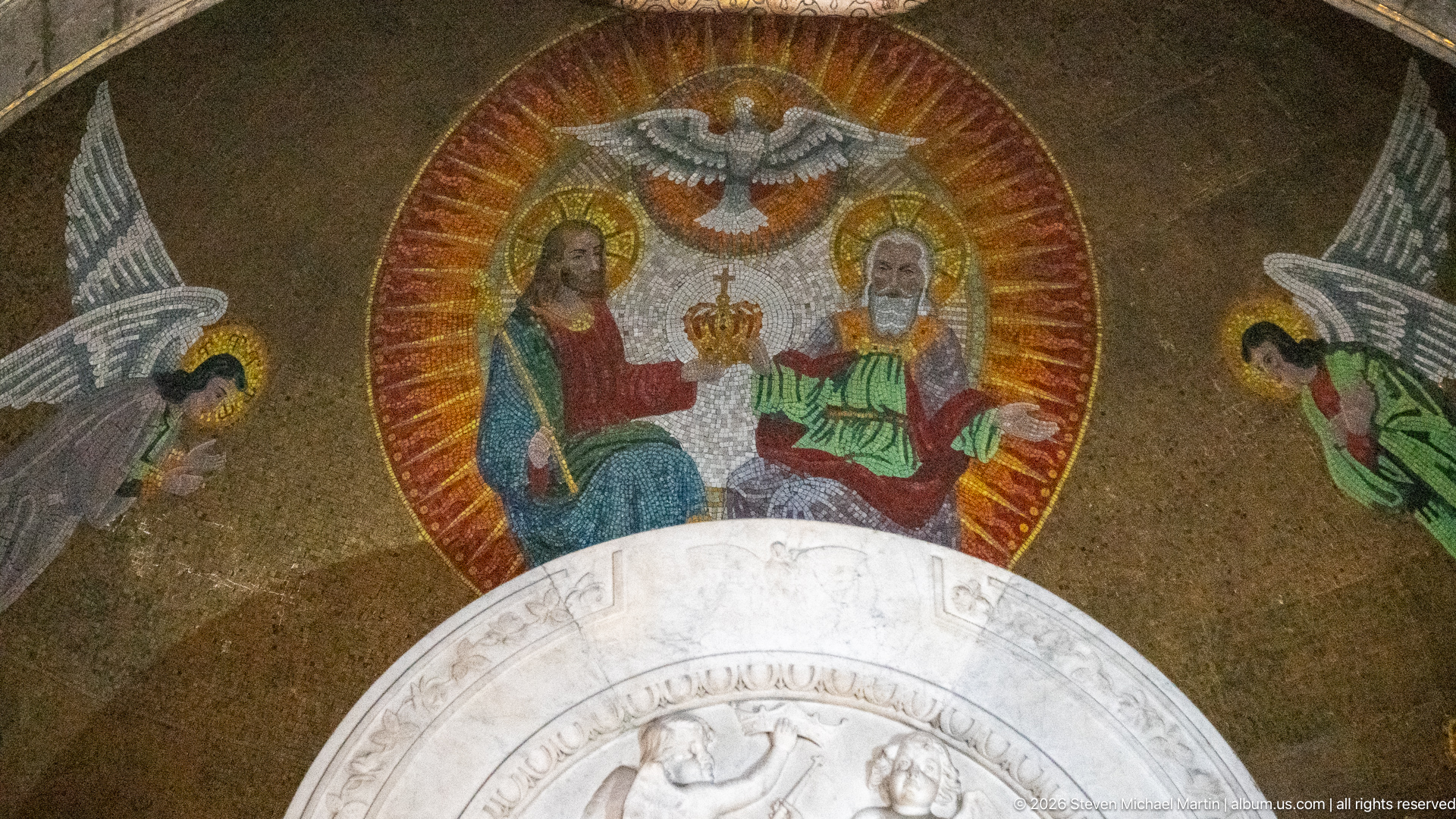
A tessellated mosaic places Mary and Joseph on either side of the Christ Child beneath a white dove, with angels entering from the outer edges. A golden radiating field frames the central group above a pale stone lunette carved with additional figures. The upward, tightly composed view links the mosaic’s sacred scene to the sculptural threshold below it, making their vertical relationship part of the image.
Caption
A tessellated mosaic places Mary and Joseph on either side of the Christ Child beneath a white dove, with angels entering from the outer edges. A golden radiating field frames the central group above a pale stone lunette carved with additional figures. The upward, tightly composed view links the mosaic’s sacred scene to the sculptural threshold below it, making their vertical relationship part of the image.
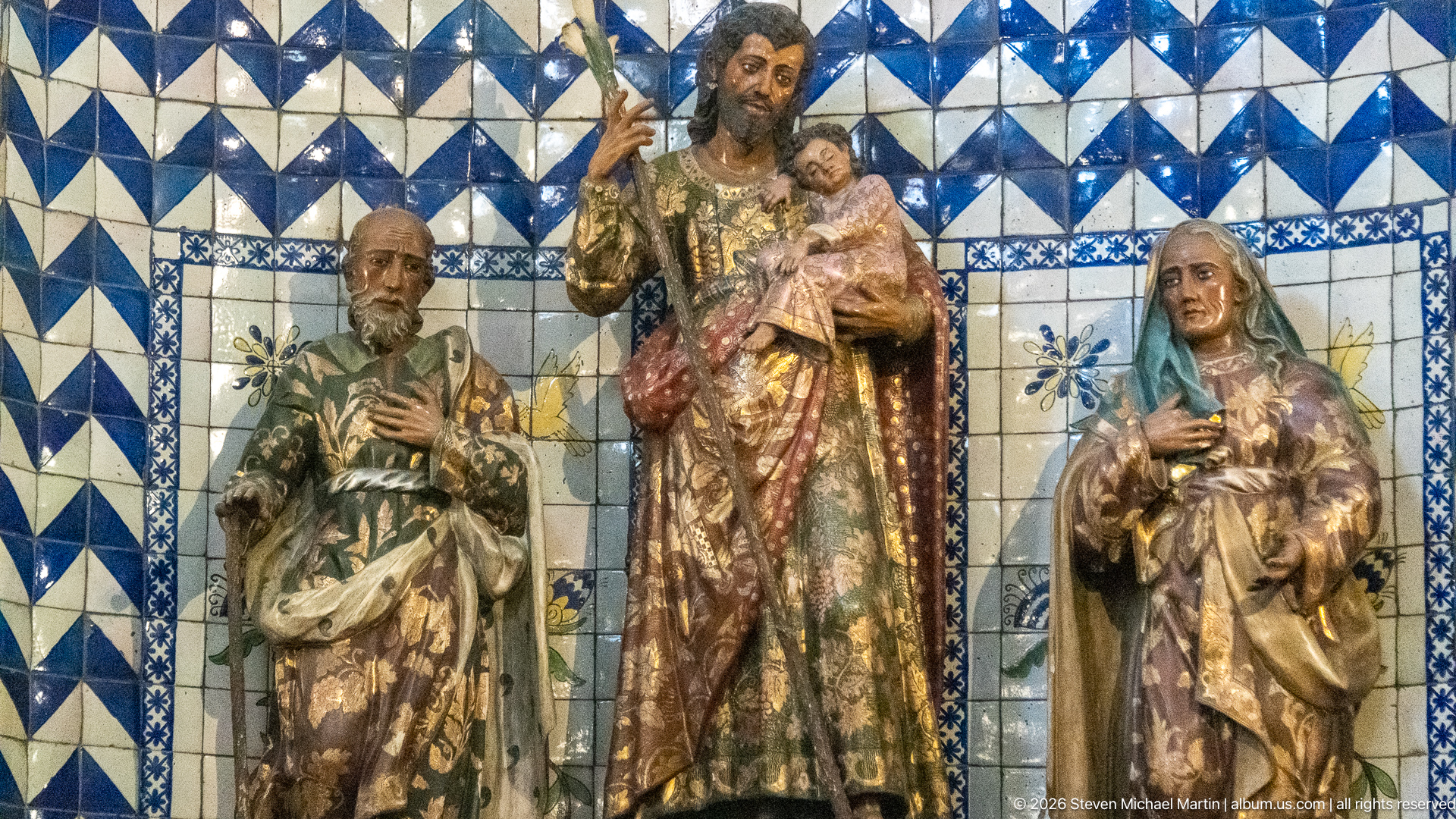
A polychrome sculptural group shows Saint Joseph holding the Christ Child, flanked by an older bearded saint at left and a veiled female saint at right. Their gilded garments stand against a wall of blue-and-white geometric tiles, whose repeated triangles create a crisp architectural backdrop. The close, straight-on framing highlights the figures’ expressions, drapery, and placement as a coordinated devotional ensemble.
Caption
A polychrome sculptural group shows Saint Joseph holding the Christ Child, flanked by an older bearded saint at left and a veiled female saint at right. Their gilded garments stand against a wall of blue-and-white geometric tiles, whose repeated triangles create a crisp architectural backdrop. The close, straight-on framing highlights the figures’ expressions, drapery, and placement as a coordinated devotional ensemble.
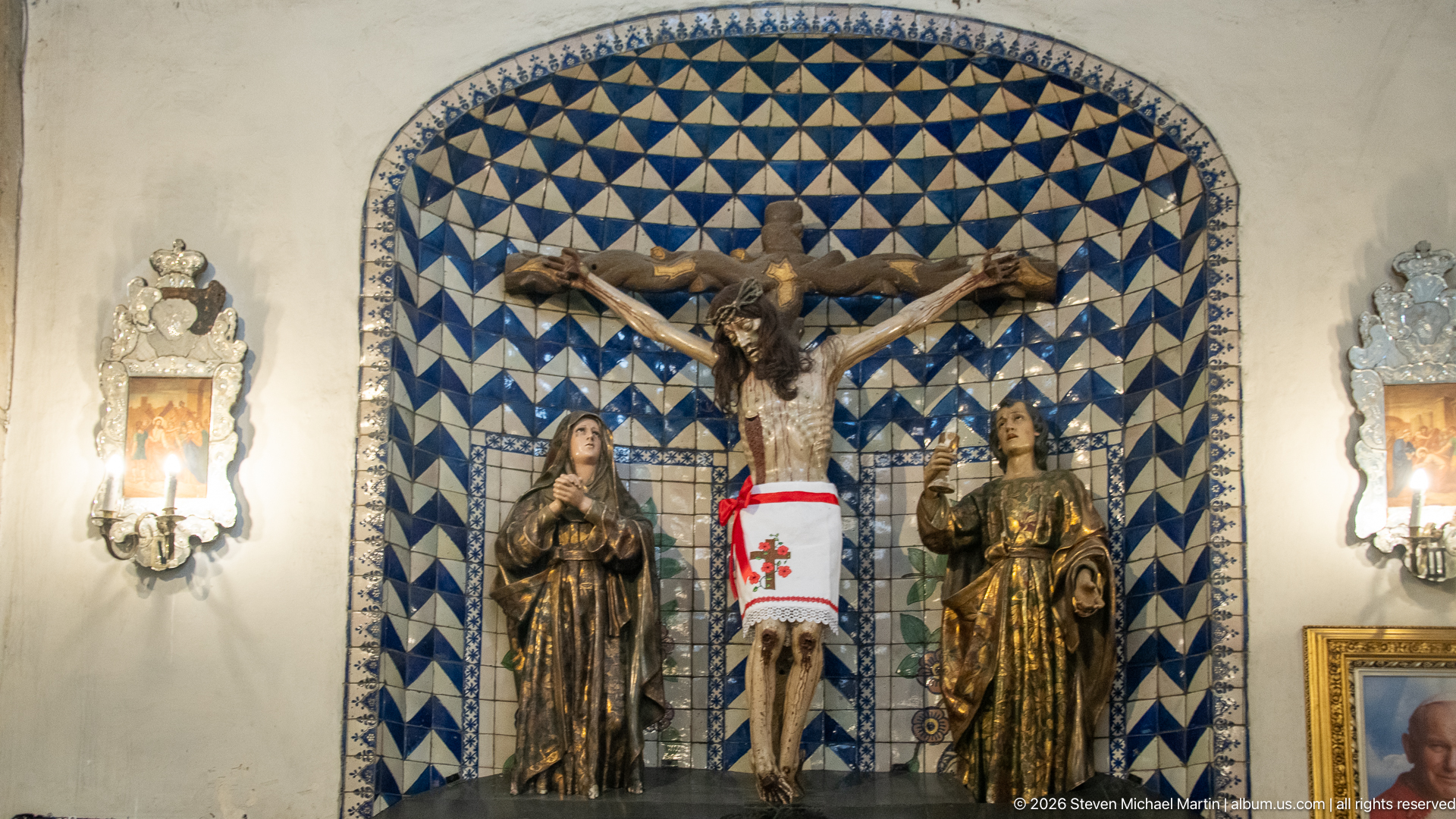
A crucifix stands at the center of a tiled sanctuary niche, flanked by two life-size female devotional figures. A white cloth with red embroidery is tied around the foot of the cross, and matching blue-and-white geometric tiles cover the wall behind. Frontal framing gives the group a symmetrical, altar-like arrangement, while the side lamps and partial framed picture reveal its place within a larger church interior.
Caption
A crucifix stands at the center of a tiled sanctuary niche, flanked by two life-size female devotional figures. A white cloth with red embroidery is tied around the foot of the cross, and matching blue-and-white geometric tiles cover the wall behind. Frontal framing gives the group a symmetrical, altar-like arrangement, while the side lamps and partial framed picture reveal its place within a larger church interior.
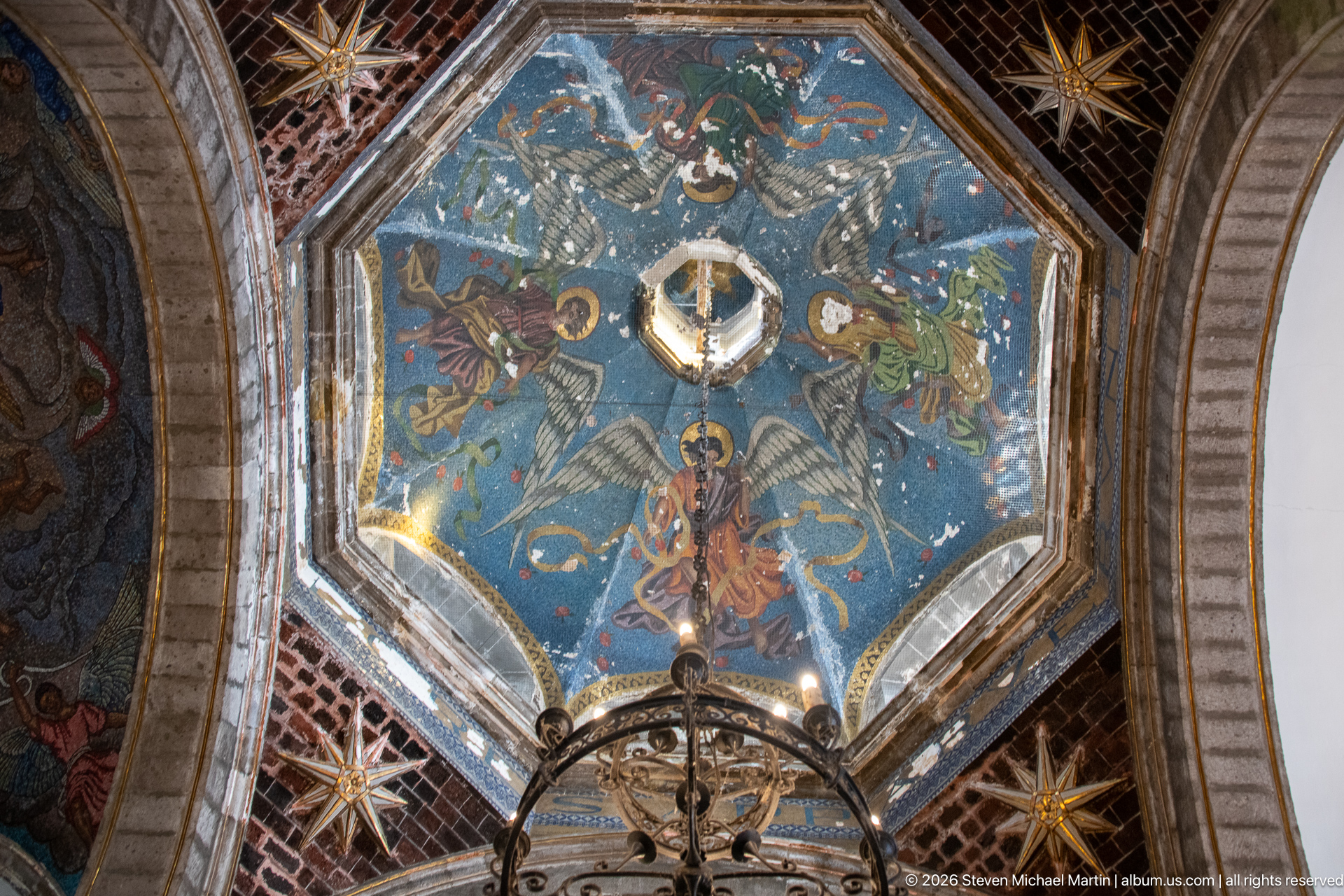
Seen from below, a blue-painted vault panel surrounds a small central opening with a ring of angels and winged figures arranged around it. A chandelier enters at the lower edge, while brick and stone ribs frame the painted surface. The view emphasizes the ceiling’s geometry and celestial imagery, with the central aperture acting as the visual hinge between the figures and the surrounding architecture.
Caption
Seen from below, a blue-painted vault panel surrounds a small central opening with a ring of angels and winged figures arranged around it. A chandelier enters at the lower edge, while brick and stone ribs frame the painted surface. The view emphasizes the ceiling’s geometry and celestial imagery, with the central aperture acting as the visual hinge between the figures and the surrounding architecture.
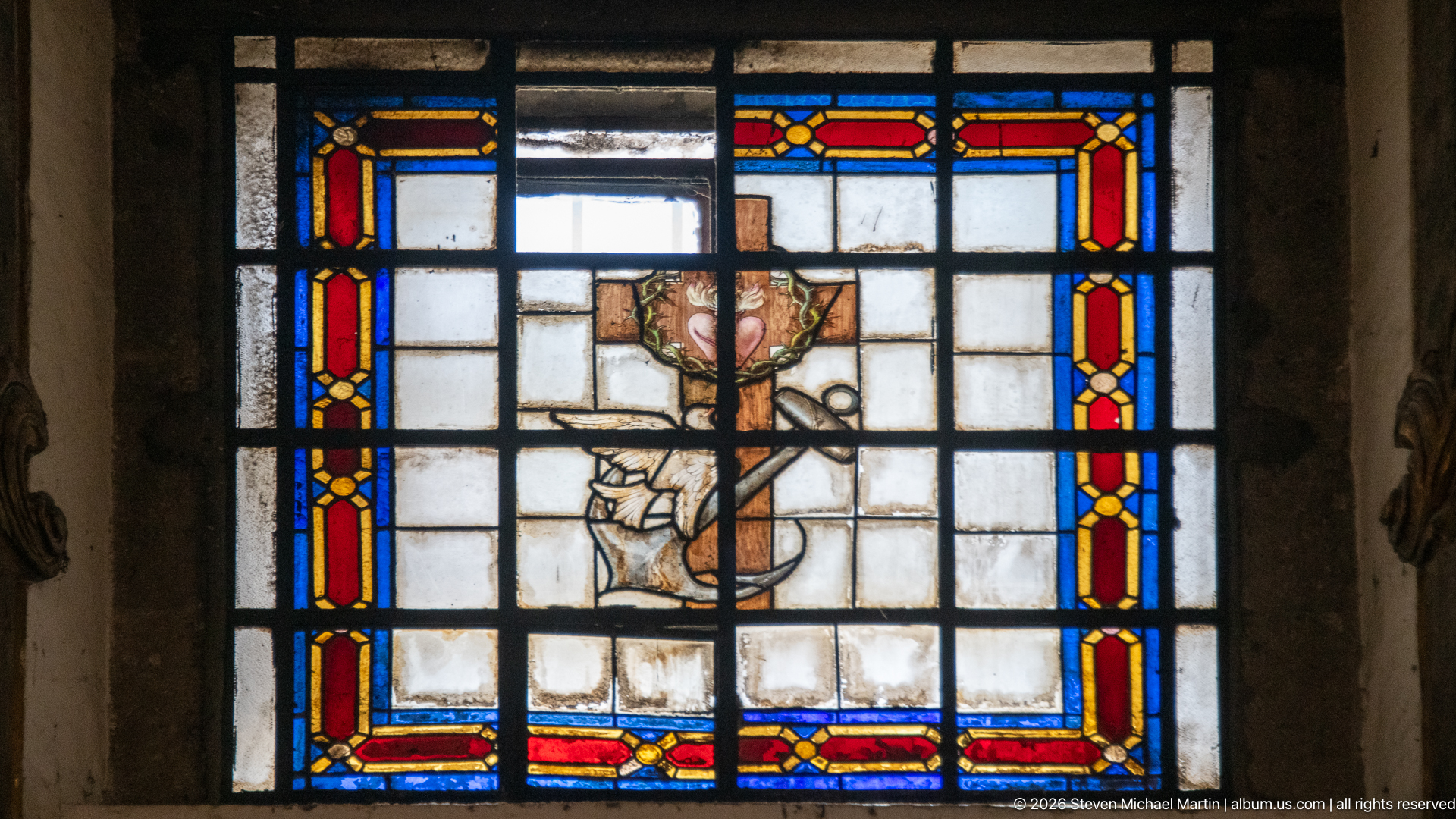
A narrow stained-glass window is divided by dark leading into rectangular panes, with red, blue, and yellow borders framing a pale central field. A sailing vessel appears near the lower center, and a small red heart-shaped emblem sits above it. The dark church interior heightens the glass’s color and makes the window read as a compact devotional composition rather than a broad architectural feature.
Caption
A narrow stained-glass window is divided by dark leading into rectangular panes, with red, blue, and yellow borders framing a pale central field. A sailing vessel appears near the lower center, and a small red heart-shaped emblem sits above it. The dark church interior heightens the glass’s color and makes the window read as a compact devotional composition rather than a broad architectural feature.
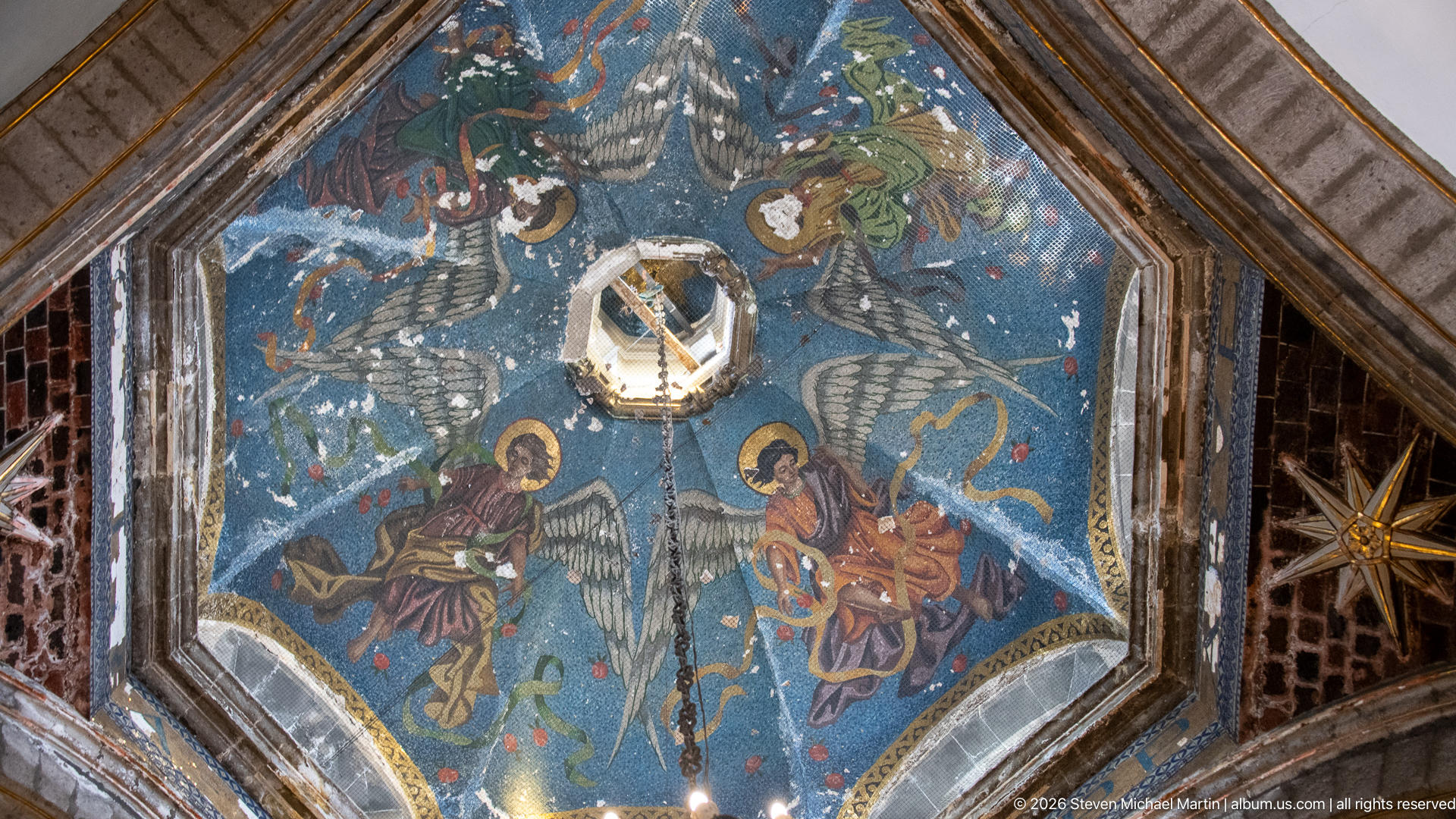
Winged angels in flowing robes gather around a small central opening in the blue-painted vault. Their poses and colors form a loose radial pattern across the curved field, bordered by brick ribs and decorative star-like fixtures. The upward view centers the painted ensemble and its architectural framing, while the opening provides a focal point within the surrounding figures.
Caption
Winged angels in flowing robes gather around a small central opening in the blue-painted vault. Their poses and colors form a loose radial pattern across the curved field, bordered by brick ribs and decorative star-like fixtures. The upward view centers the painted ensemble and its architectural framing, while the opening provides a focal point within the surrounding figures.
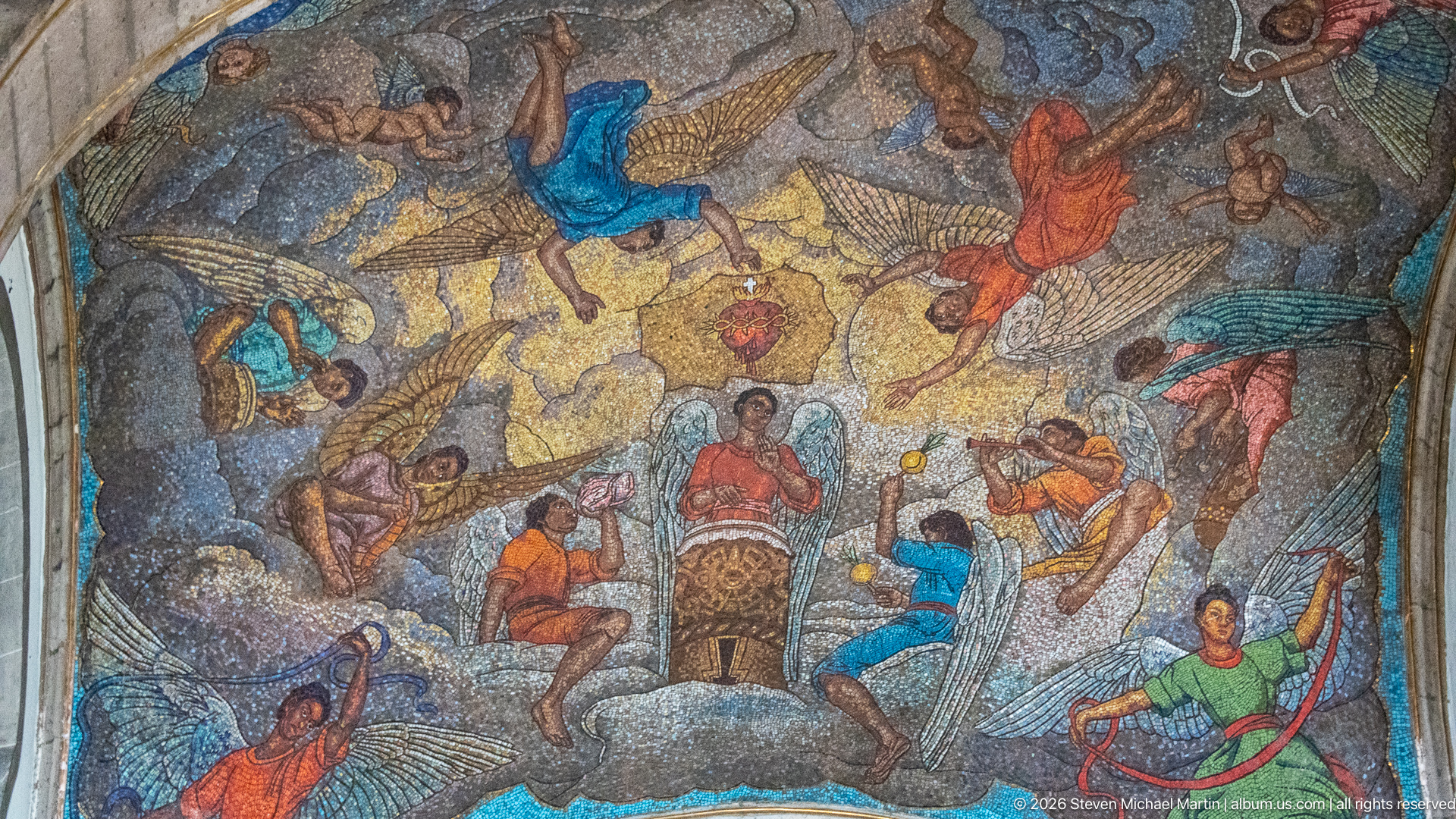
Winged figures and robed people sweep across a gold-toned field in this close view of a religious mosaic. Deep blue, green, and red garments punctuate the densely tessellated surface, while the cropped framing removes the scene’s architectural setting and much of its narrative. The image is best read as a detail of the basilica’s interior decoration rather than a complete scene.
Caption
Winged figures and robed people sweep across a gold-toned field in this close view of a religious mosaic. Deep blue, green, and red garments punctuate the densely tessellated surface, while the cropped framing removes the scene’s architectural setting and much of its narrative. The image is best read as a detail of the basilica’s interior decoration rather than a complete scene.
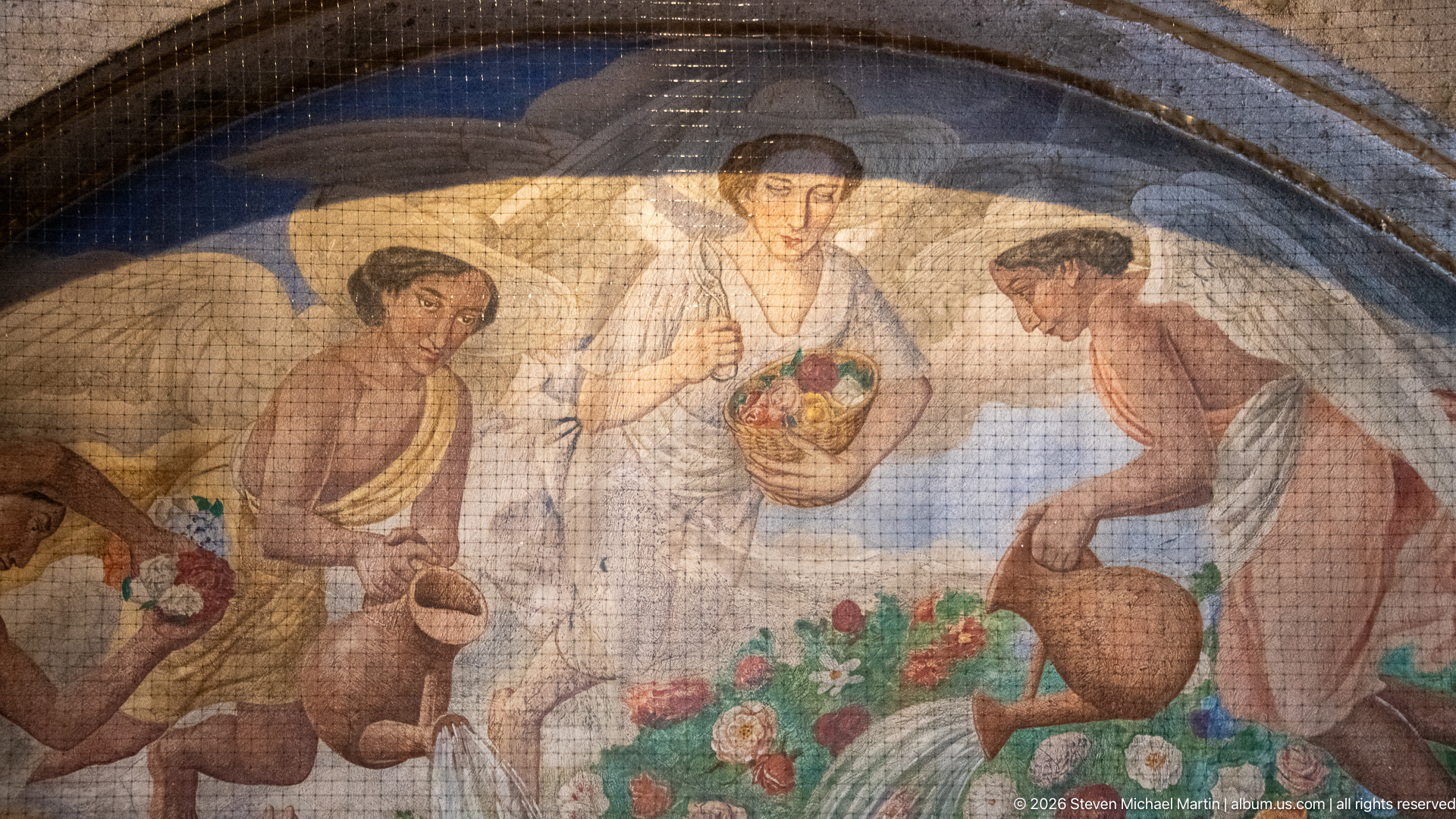
A robed man bends toward a small bird in a painted landscape, while other figures and birds gather around him. The composition combines pale clothing, earth-toned bodies, vegetation, and a blue sky; a fine grid across the surface marks the tiled or protected finish. Cropping leaves the scene’s larger story uncertain, so the caption stays with the visible figures and setting.
Caption
A robed man bends toward a small bird in a painted landscape, while other figures and birds gather around him. The composition combines pale clothing, earth-toned bodies, vegetation, and a blue sky; a fine grid across the surface marks the tiled or protected finish. Cropping leaves the scene’s larger story uncertain, so the caption stays with the visible figures and setting.
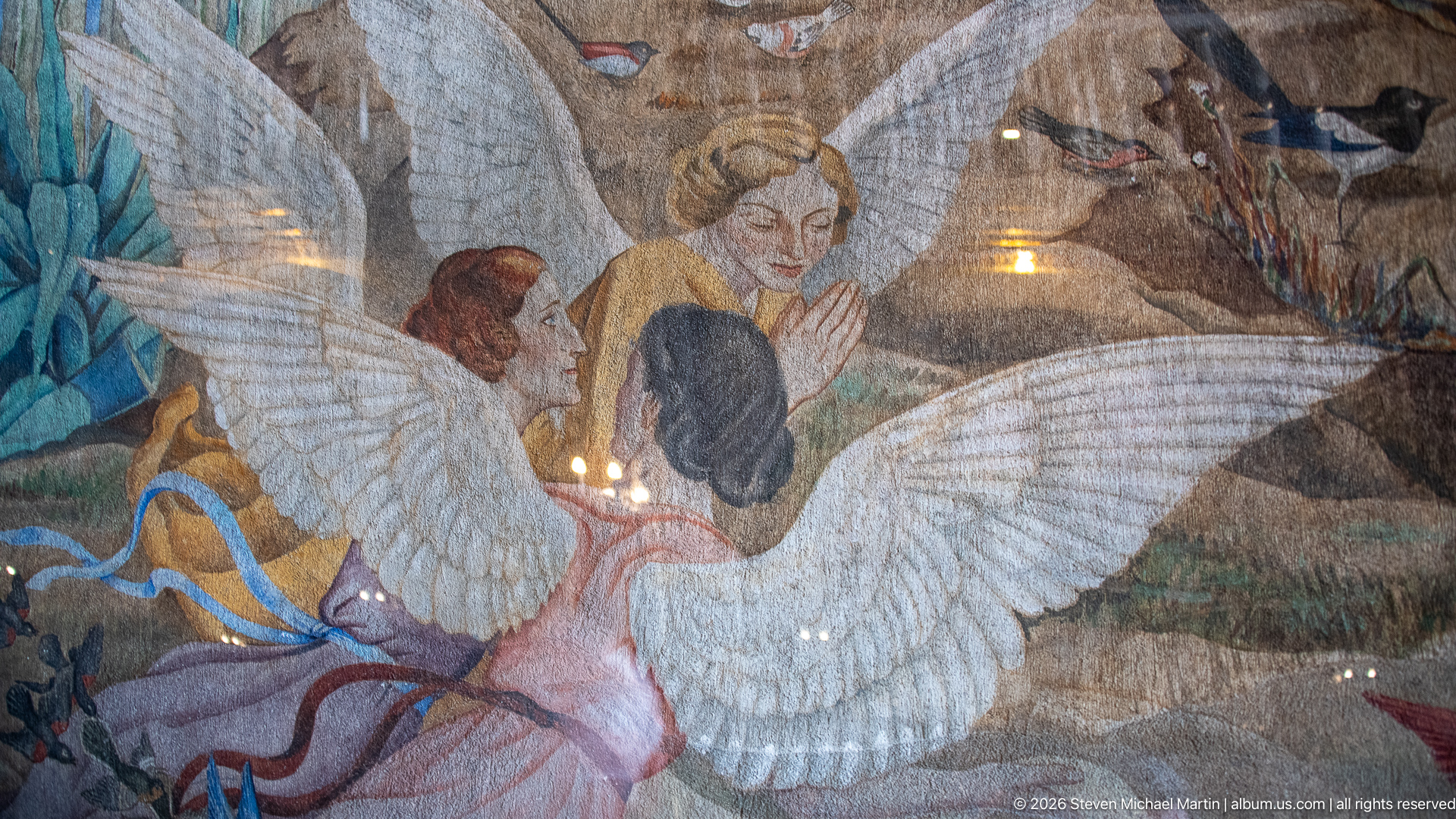
A pale-robed figure occupies the center of this mural detail, surrounded by attendants, winged forms, and figures in brightly colored garments. Hands are raised or joined in gestures of attention, and a broad white shape crosses the foreground. Reflections from interior lights fall across the surface, but the close framing keeps the scene’s arrangement of people and wings at the center.
Caption
A pale-robed figure occupies the center of this mural detail, surrounded by attendants, winged forms, and figures in brightly colored garments. Hands are raised or joined in gestures of attention, and a broad white shape crosses the foreground. Reflections from interior lights fall across the surface, but the close framing keeps the scene’s arrangement of people and wings at the center.
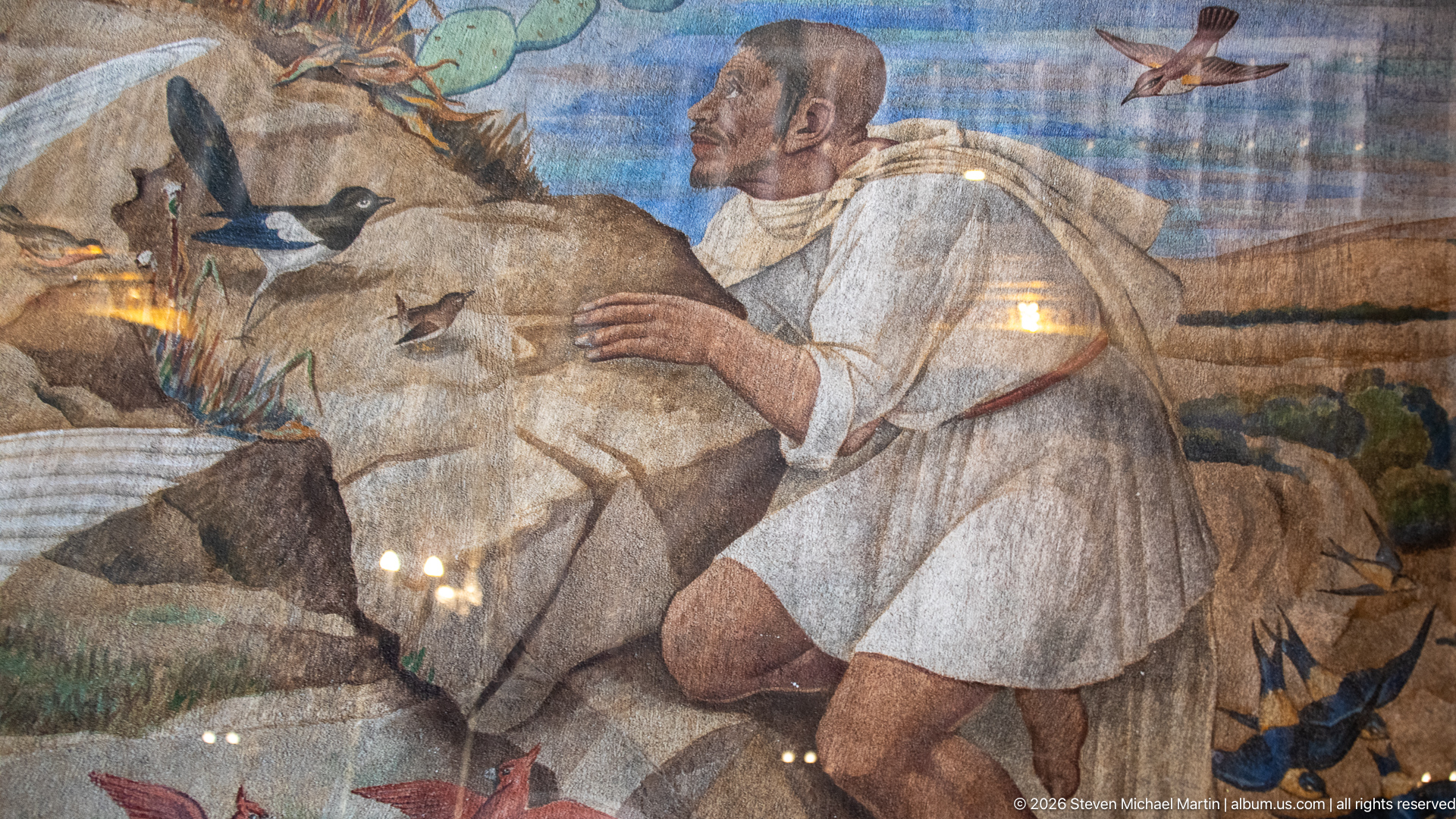
A man in a pale robe leans forward among rocks and plants, looking toward a small bird at the left. More birds cross the blue sky and gather near the ground, while another figure is partly visible at the edge. The scene’s natural details and the man’s attentive gesture distinguish this panel from the crowded shrine and ceiling views elsewhere in the basilica.
Caption
A man in a pale robe leans forward among rocks and plants, looking toward a small bird at the left. More birds cross the blue sky and gather near the ground, while another figure is partly visible at the edge. The scene’s natural details and the man’s attentive gesture distinguish this panel from the crowded shrine and ceiling views elsewhere in the basilica.
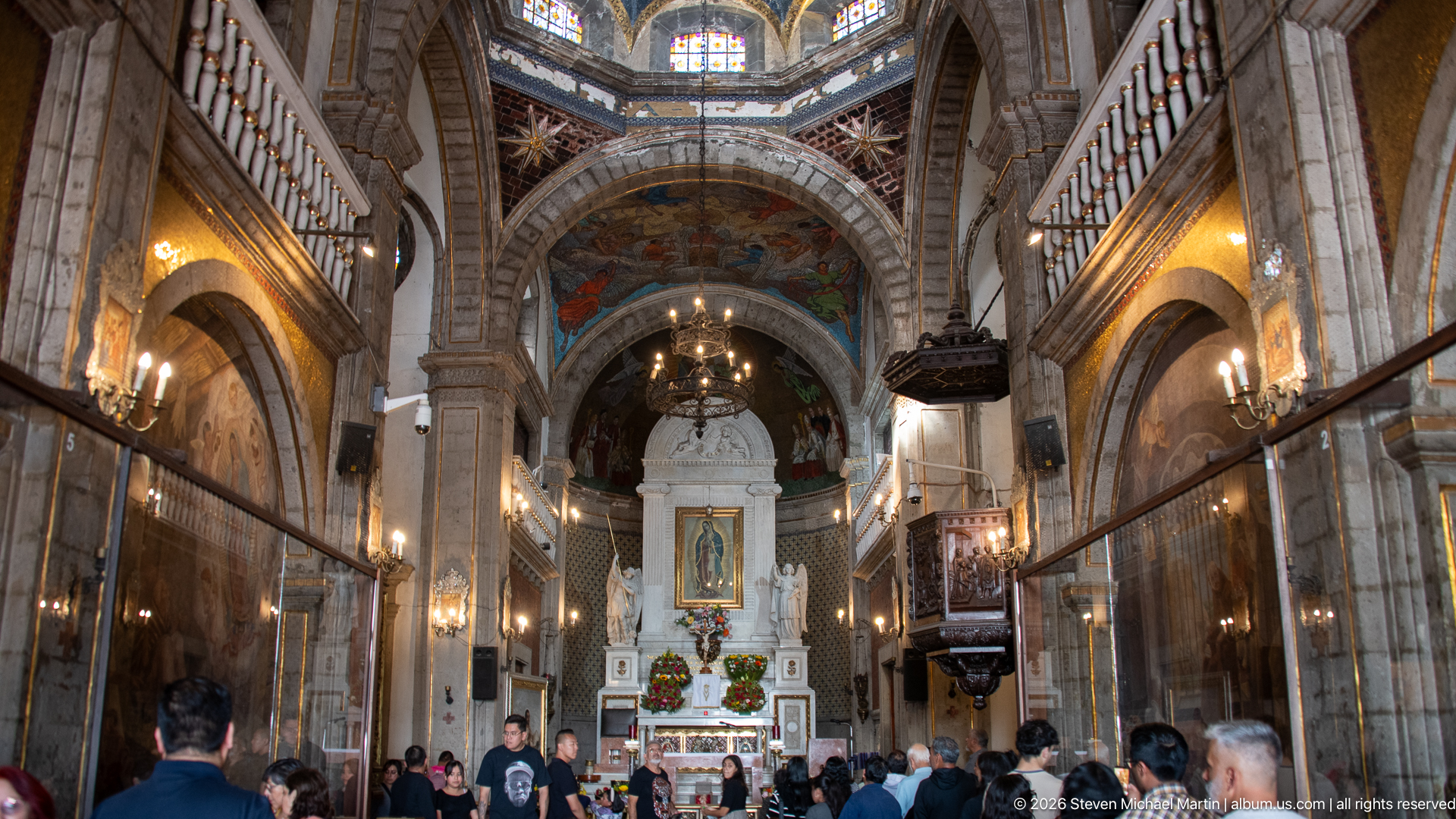
Visitors stand in the central aisle beneath high arches and painted vaults, facing the distant shrine. Balconies and columns rise along both sides, and chandeliers hang beneath the decorated ceiling. This vertical composition emphasizes the basilica’s height and the long sightline toward the altar, with the congregation occupying the lower portion of the interior.
Caption
Visitors stand in the central aisle beneath high arches and painted vaults, facing the distant shrine. Balconies and columns rise along both sides, and chandeliers hang beneath the decorated ceiling. This vertical composition emphasizes the basilica’s height and the long sightline toward the altar, with the congregation occupying the lower portion of the interior.
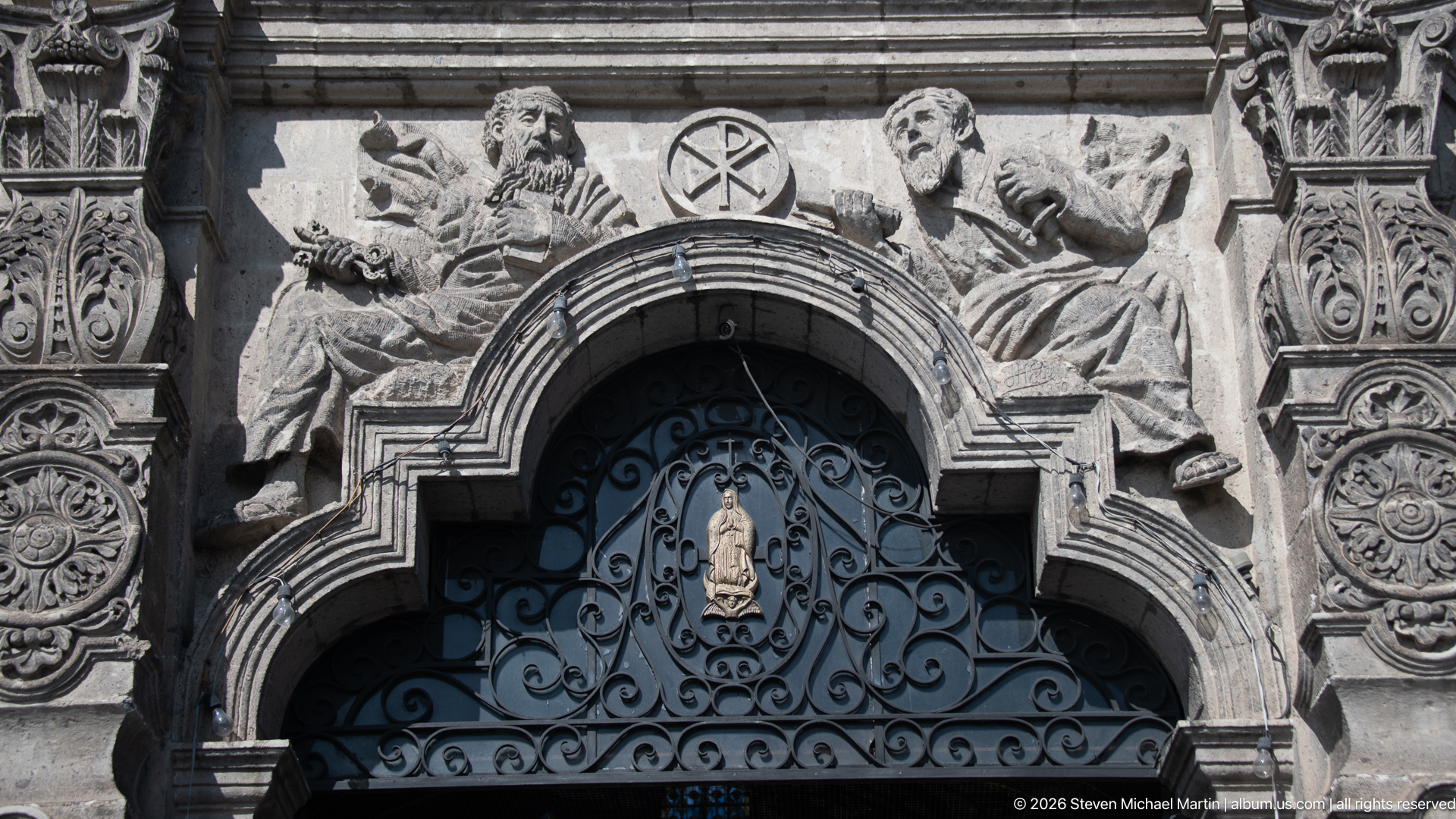
Two bearded stone figures flank a circular emblem above an arched entrance, with carved foliage and layered moldings filling the surrounding façade. A dark wrought-iron gate closes the opening, and a small standing figure appears within its upper panel. The close view concentrates on the portal’s sculptural arrangement rather than the wider church façade.
Caption
Two bearded stone figures flank a circular emblem above an arched entrance, with carved foliage and layered moldings filling the surrounding façade. A dark wrought-iron gate closes the opening, and a small standing figure appears within its upper panel. The close view concentrates on the portal’s sculptural arrangement rather than the wider church façade.
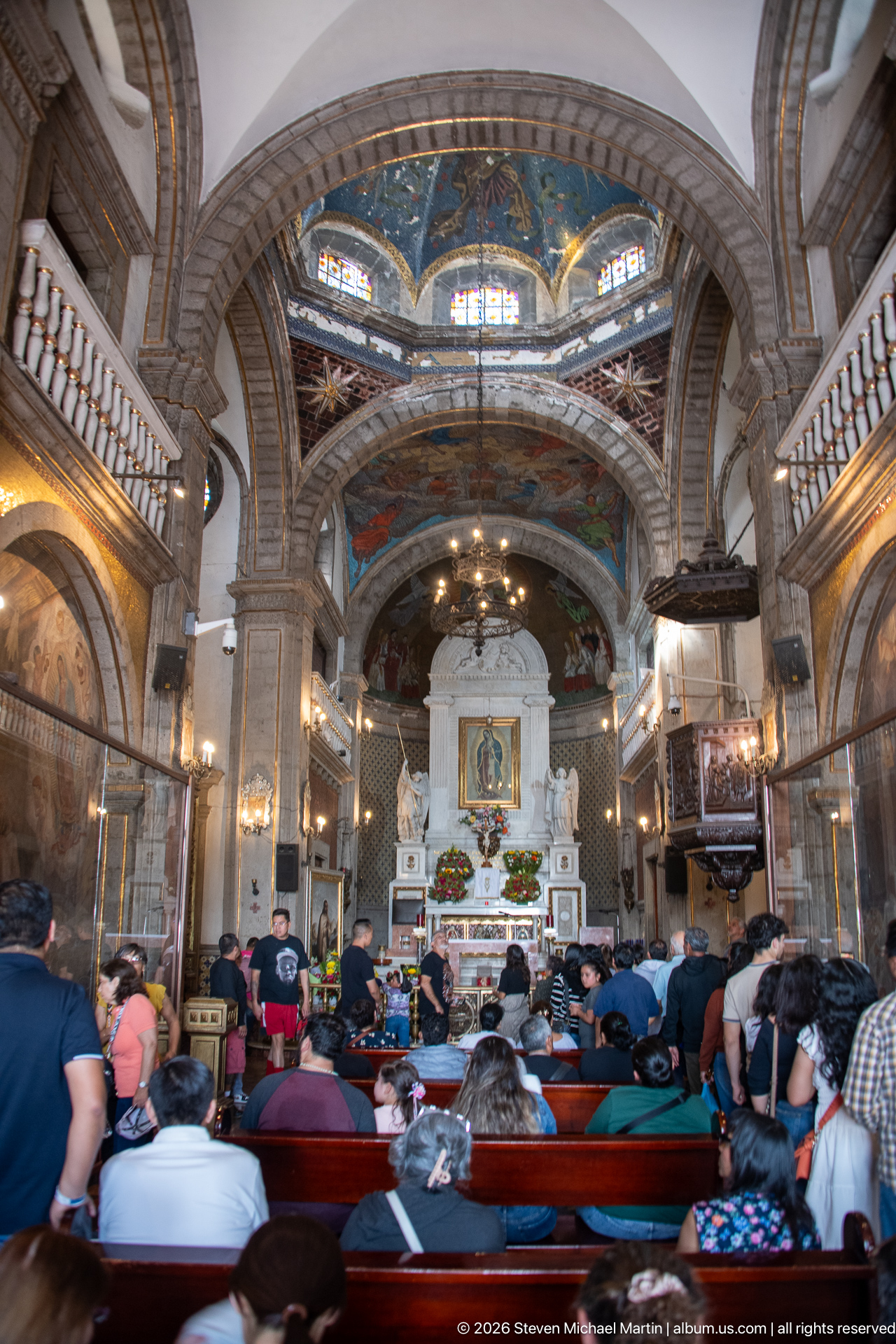
Rows of visitors fill the pews and aisle, all oriented toward the white shrine at the far end of the basilica. Painted panels span the apse and ceiling, while side arches, galleries, and hanging lights frame the crowded interior. The broad viewpoint records the congregation as part of the space, shifting attention from the architecture alone to the shared act of visiting and worship.
Caption
Rows of visitors fill the pews and aisle, all oriented toward the white shrine at the far end of the basilica. Painted panels span the apse and ceiling, while side arches, galleries, and hanging lights frame the crowded interior. The broad viewpoint records the congregation as part of the space, shifting attention from the architecture alone to the shared act of visiting and worship.
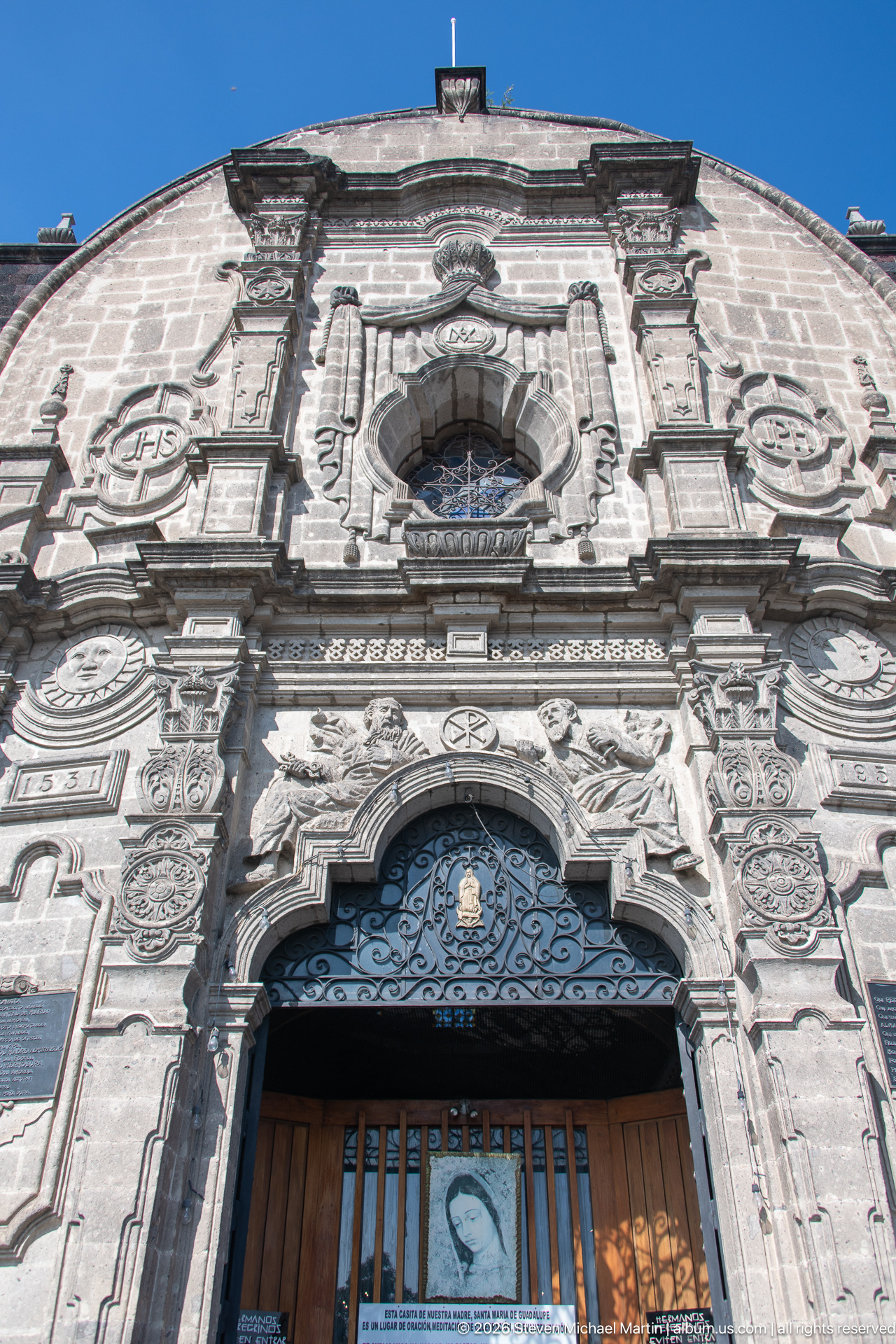
An upward view traces a pale stone façade from an ornate iron gate to a circular window and a small cross at the roofline. A devotional image is set into the center of the gate, framed by scrolling metalwork; a narrow text strip runs across the lower entrance. The steep angle makes the vertical sequence of doorway, window, and roof crest especially clear.
Caption
An upward view traces a pale stone façade from an ornate iron gate to a circular window and a small cross at the roofline. A devotional image is set into the center of the gate, framed by scrolling metalwork; a narrow text strip runs across the lower entrance. The steep angle makes the vertical sequence of doorway, window, and roof crest especially clear.
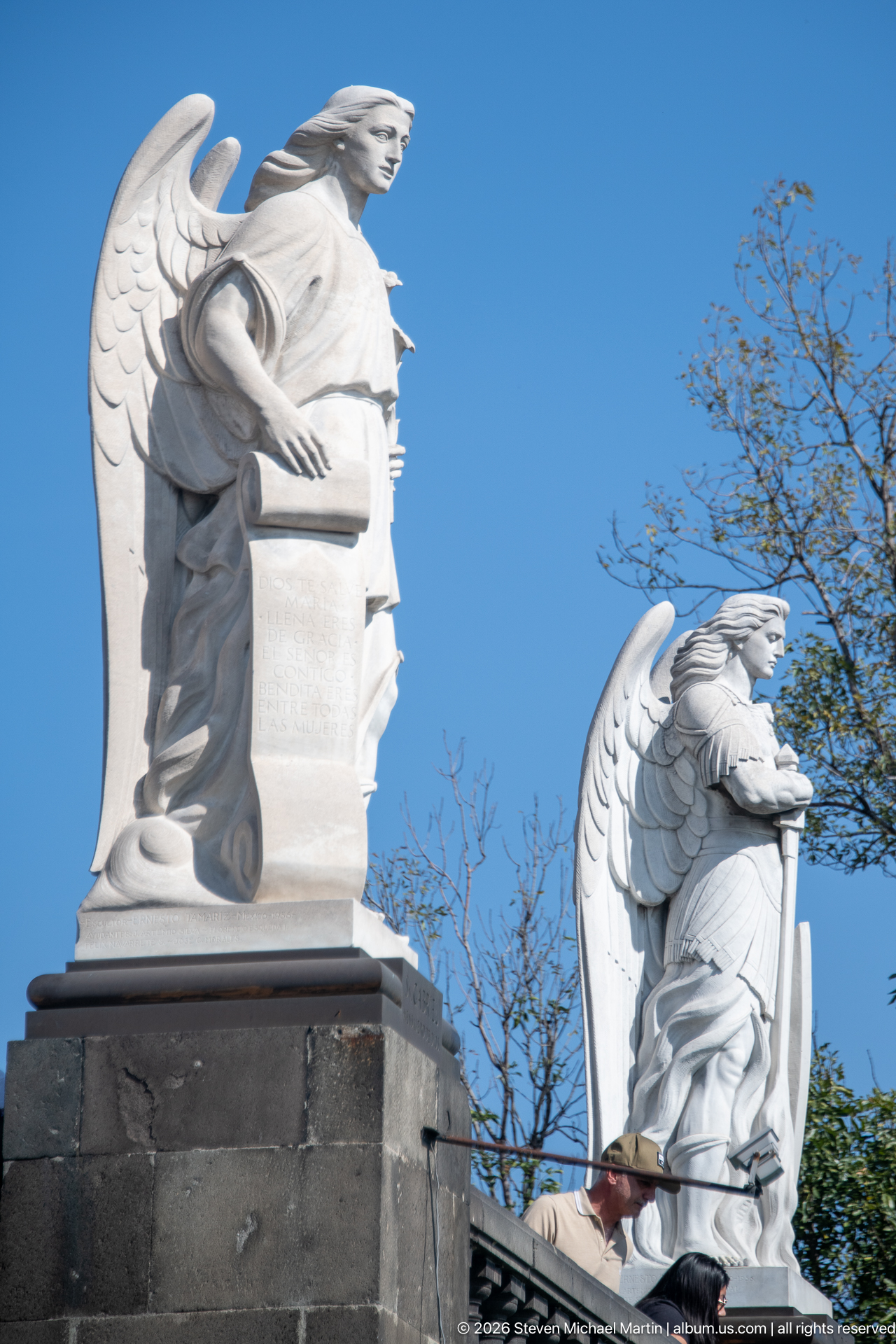
Two pale stone winged figures stand on separate dark plinths against a clear sky. Each holds a large scroll; the nearer sculpture fills the left foreground while the second appears farther back at right. A leafless tree branches between them, and a visitor is partly visible near the lower edge. The paired placement and contrasting scale shape the composition.
Caption
Two pale stone winged figures stand on separate dark plinths against a clear sky. Each holds a large scroll; the nearer sculpture fills the left foreground while the second appears farther back at right. A leafless tree branches between them, and a visitor is partly visible near the lower edge. The paired placement and contrasting scale shape the composition.
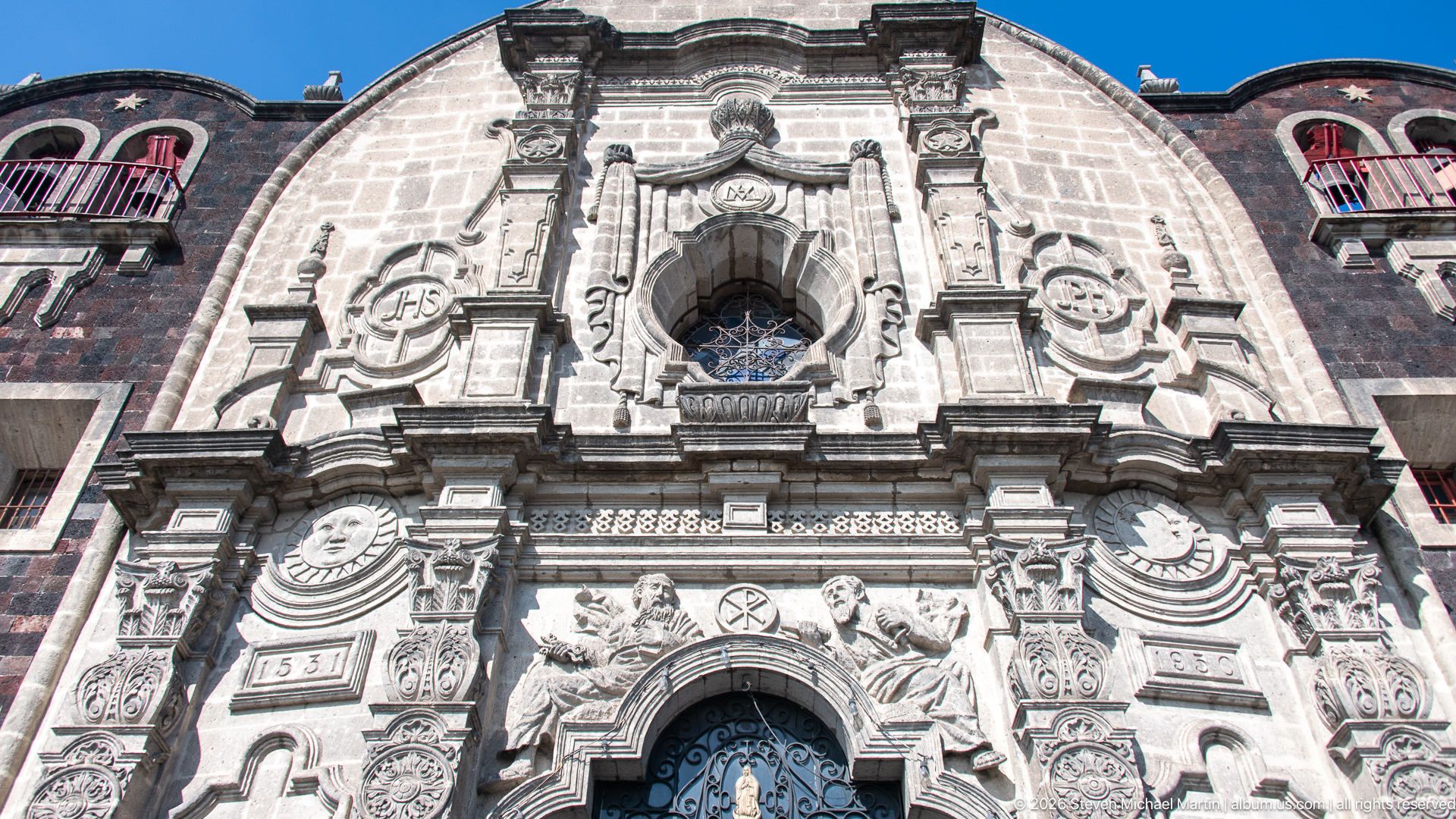
A pale stone chapel façade rises above a carved portal where two seated figures flank a circular symbol. Repeated IHS monograms, sun-like medallions, and framed panels organize the surface around the entrance; a rounded upper wall and flanking balconies complete the composition. The upward viewpoint records the façade’s sculptural details and the contrast between light stone and darker adjoining masonry.
Caption
A pale stone chapel façade rises above a carved portal where two seated figures flank a circular symbol. Repeated IHS monograms, sun-like medallions, and framed panels organize the surface around the entrance; a rounded upper wall and flanking balconies complete the composition. The upward viewpoint records the façade’s sculptural details and the contrast between light stone and darker adjoining masonry.
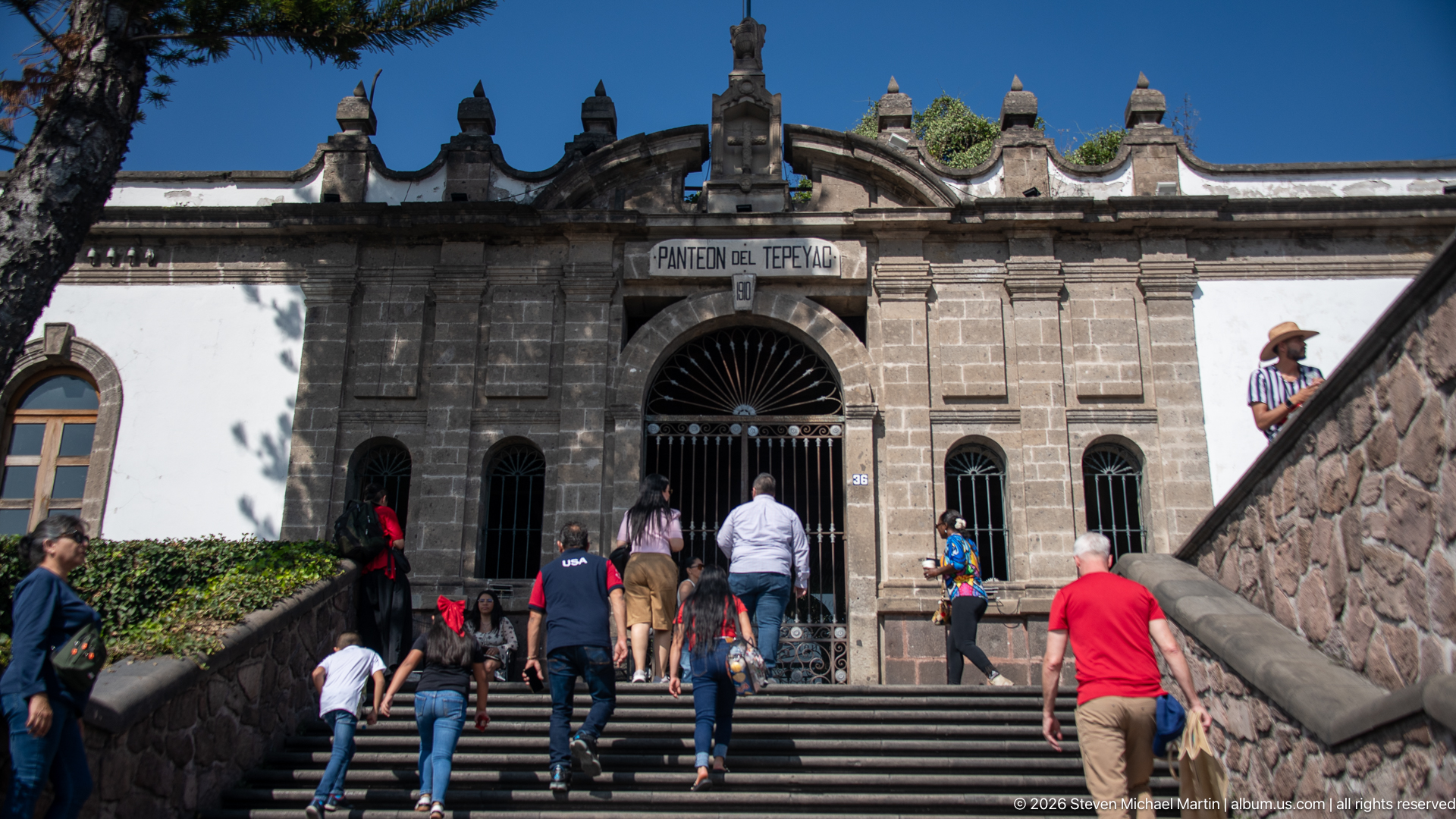
The entrance to the Panteón del Tepeyac is marked by a clearly lettered sign above a broad arched gate. Visitors climb the central stone steps between low walls toward the dark iron grille, while a man in a striped shirt stands on the right parapet. The frontal view records the cemetery’s threshold and the steady movement of people into the grounds.
Caption
The entrance to the Panteón del Tepeyac is marked by a clearly lettered sign above a broad arched gate. Visitors climb the central stone steps between low walls toward the dark iron grille, while a man in a striped shirt stands on the right parapet. The frontal view records the cemetery’s threshold and the steady movement of people into the grounds.
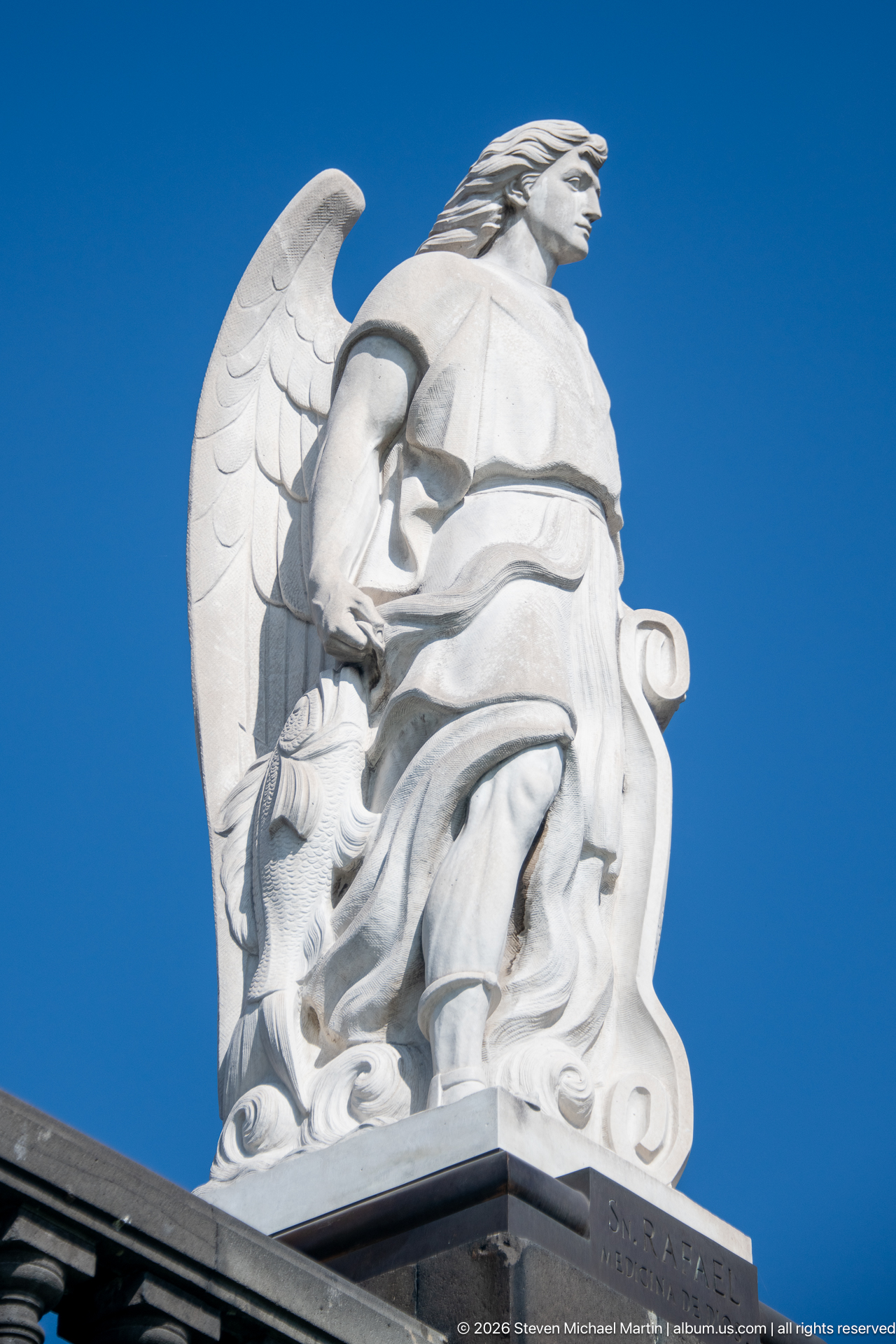
A large pale stone figure with feathered wings leans over a broad scroll, its wind-swept hair and layered robes sharply lit against blue sky. The crop shows the figure from a low angle, with the edge of a dark plinth below. The monument’s scale and carved drapery dominate, while any inscription on the scroll remains unreadable at this distance.
Caption
A large pale stone figure with feathered wings leans over a broad scroll, its wind-swept hair and layered robes sharply lit against blue sky. The crop shows the figure from a low angle, with the edge of a dark plinth below. The monument’s scale and carved drapery dominate, while any inscription on the scroll remains unreadable at this distance.
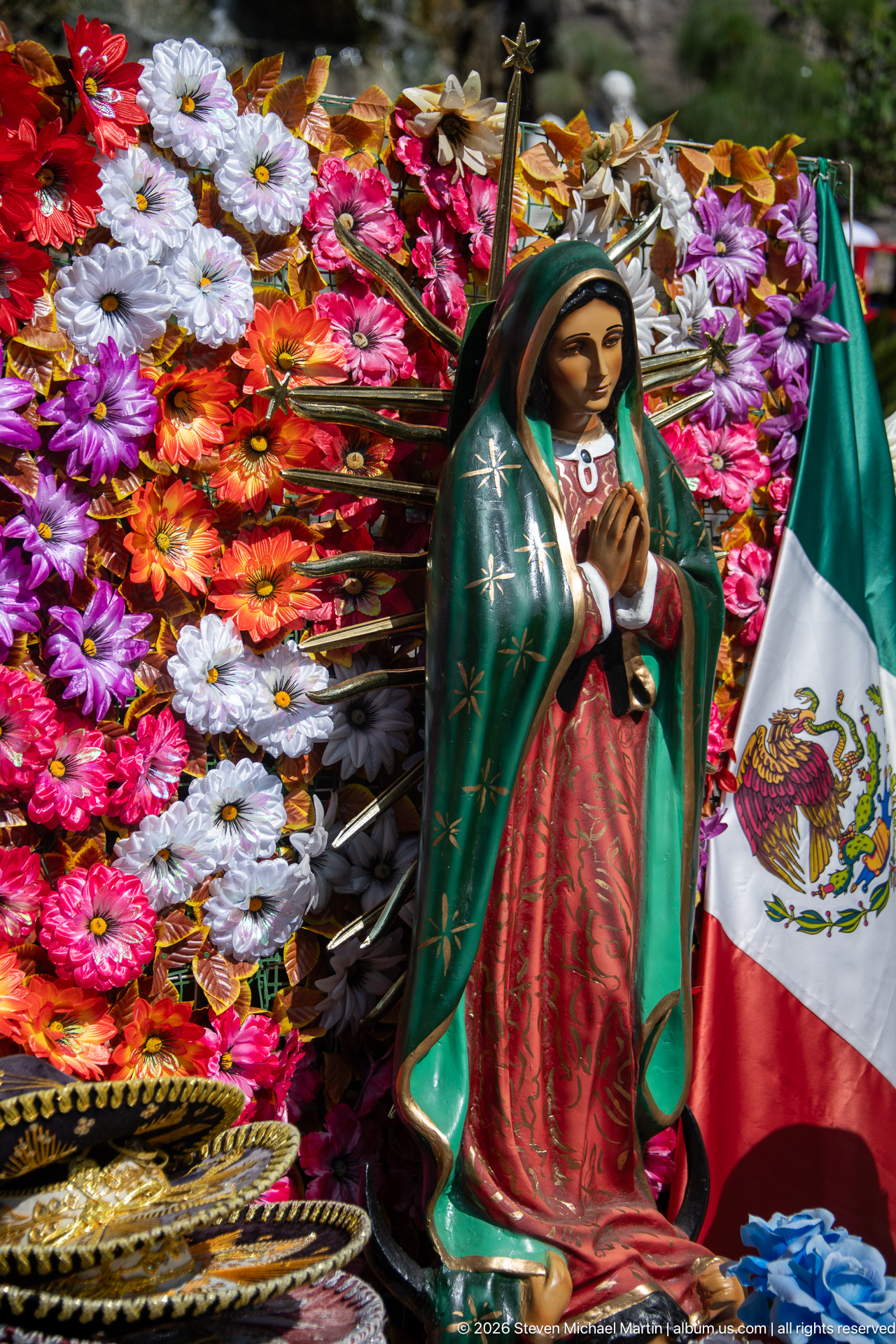
A painted statue of Our Lady of Guadalupe stands with hands joined, wearing a green mantle over a rose-colored gown. Bright artificial flowers surround the figure, and the Mexican flag fills the right edge of the frame. The tight, colorful composition resembles a devotional merchandise display, with the statue and floral border set against a crowded background.
Caption
A painted statue of Our Lady of Guadalupe stands with hands joined, wearing a green mantle over a rose-colored gown. Bright artificial flowers surround the figure, and the Mexican flag fills the right edge of the frame. The tight, colorful composition resembles a devotional merchandise display, with the statue and floral border set against a crowded background.
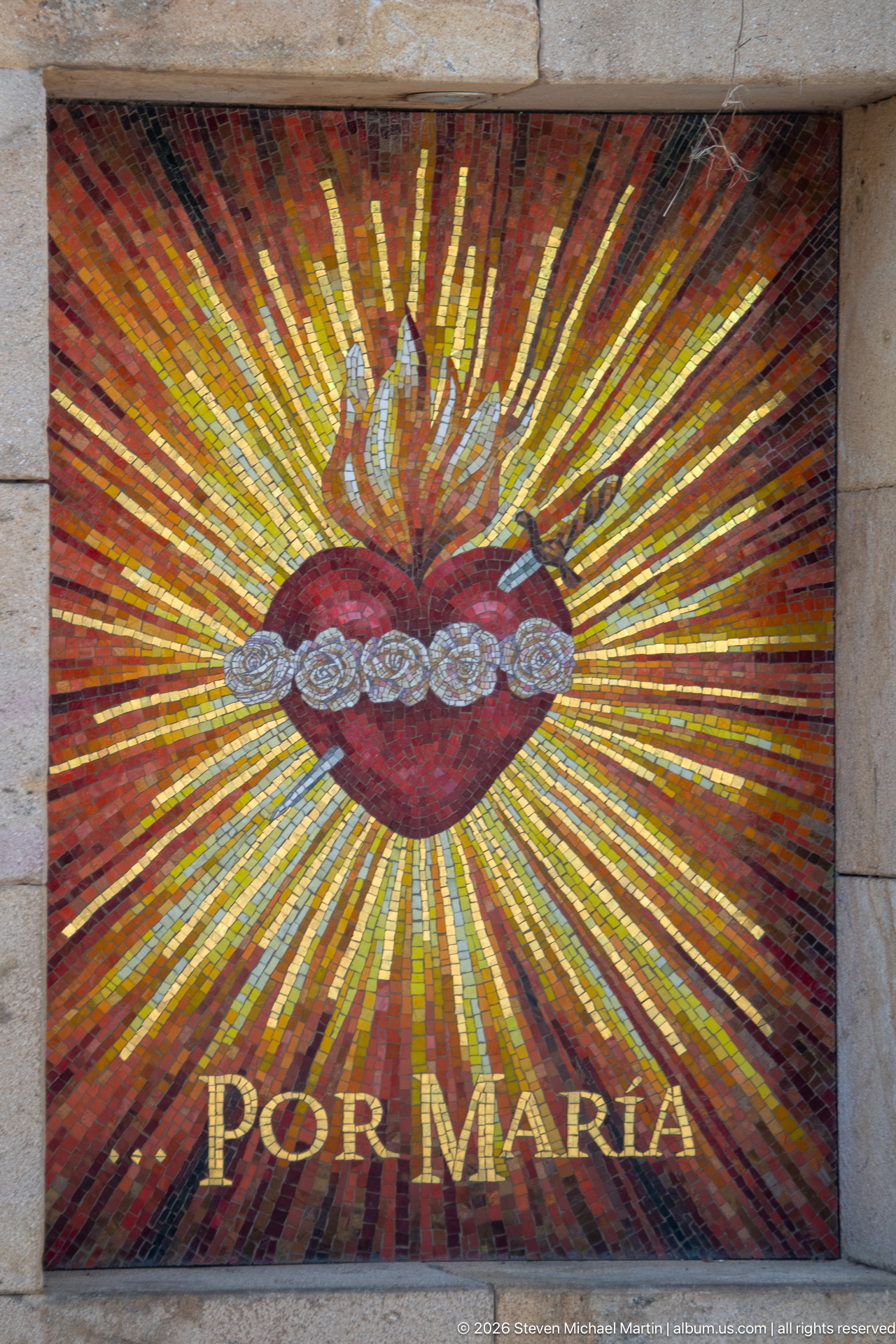
A red heart-like emblem and pale dove forms sit at the center of a mosaic filled with radiating yellow, orange, and red bands. The words “POR MARIA” appear along the lower edge in large gold letters. Framed by a pale stone border, the panel’s graphic arrangement and readable text make this a devotional image detail rather than a general architectural view.
Caption
A red heart-like emblem and pale dove forms sit at the center of a mosaic filled with radiating yellow, orange, and red bands. The words “POR MARIA” appear along the lower edge in large gold letters. Framed by a pale stone border, the panel’s graphic arrangement and readable text make this a devotional image detail rather than a general architectural view.
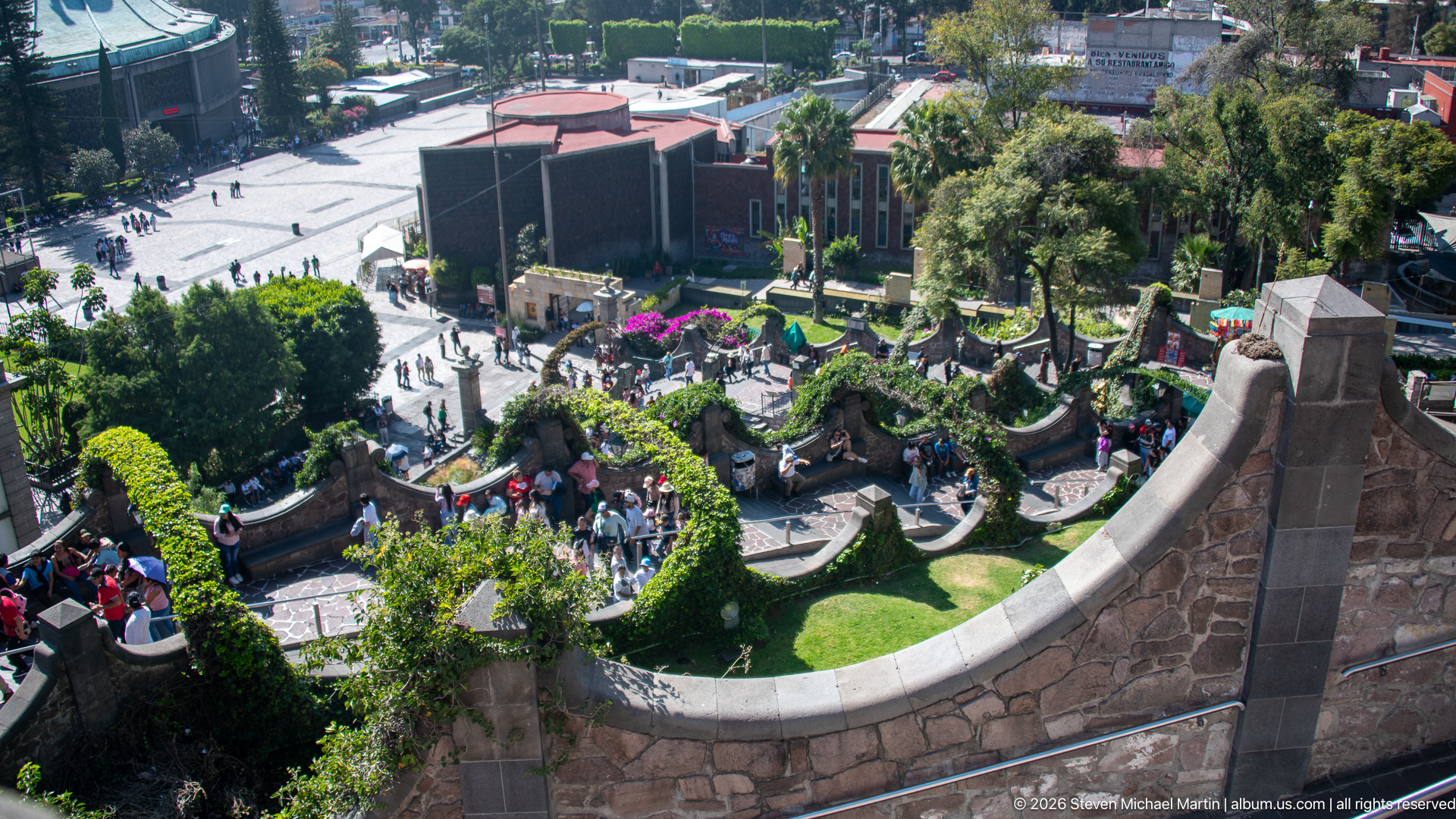
A curved stone terrace encloses clipped hedges and a small lawn on the hillside, with visitors moving along its winding paths. A broad paved plaza opens beyond the garden, and a tall wall with a relief or inscription borders the upper edge. Seen from above, the layout reads as a sequence of landscaped levels and pedestrian routes.
Caption
A curved stone terrace encloses clipped hedges and a small lawn on the hillside, with visitors moving along its winding paths. A broad paved plaza opens beyond the garden, and a tall wall with a relief or inscription borders the upper edge. Seen from above, the layout reads as a sequence of landscaped levels and pedestrian routes.
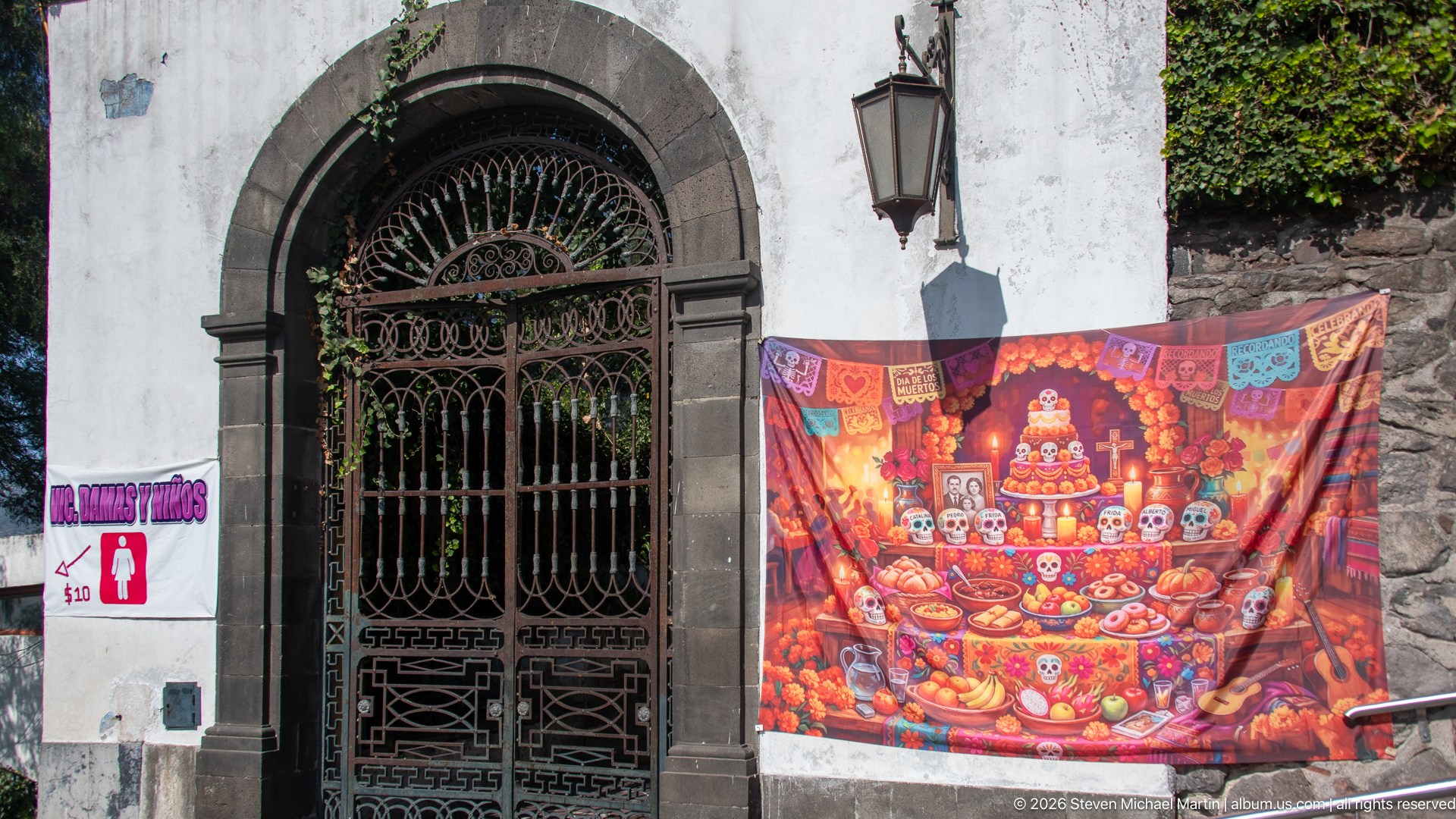
A vivid Día de Muertos banner beside an arched iron gate depicts marigolds, candles, food, skulls, and a tiered offering. Papel picado patterns run across its upper edge, and a cropped public-restroom sign hangs on the wall at left. The printed image is presented as a display on the site; it is distinct from a photographed, physical altar.
Caption
A vivid Día de Muertos banner beside an arched iron gate depicts marigolds, candles, food, skulls, and a tiered offering. Papel picado patterns run across its upper edge, and a cropped public-restroom sign hangs on the wall at left. The printed image is presented as a display on the site; it is distinct from a photographed, physical altar.
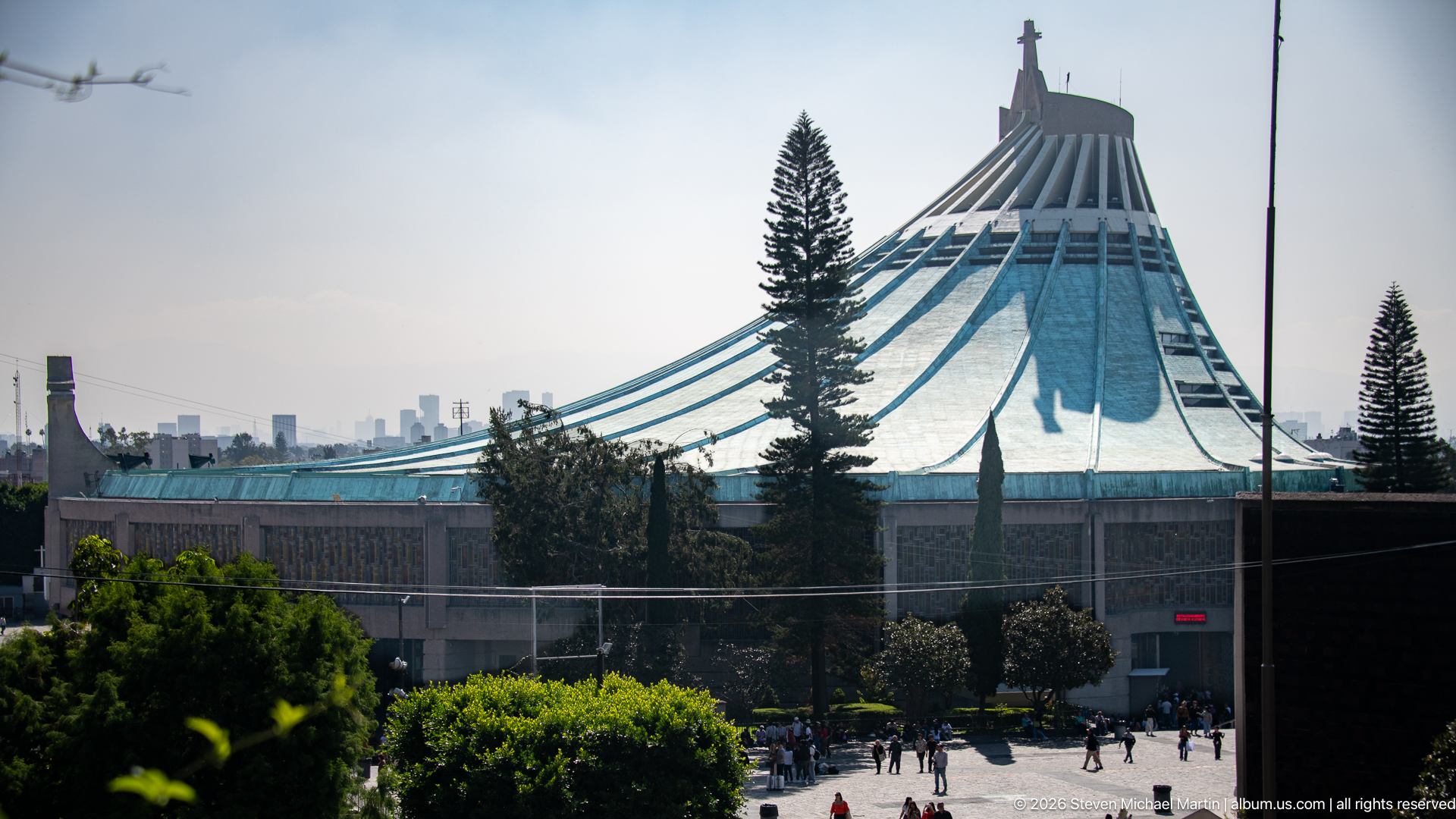
The modern basilica’s steep, fan-shaped roof rises to a cross, its blue-gray ribs converging toward the apex. Dark vertical glazing and the low concrete façade occupy the base, while conifers and visitors around the plaza provide scale. The low viewpoint isolates the roof’s structural geometry and materials while retaining enough of the façade to show how the roof crowns the sanctuary.
Caption
The modern basilica’s steep, fan-shaped roof rises to a cross, its blue-gray ribs converging toward the apex. Dark vertical glazing and the low concrete façade occupy the base, while conifers and visitors around the plaza provide scale. The low viewpoint isolates the roof’s structural geometry and materials while retaining enough of the façade to show how the roof crowns the sanctuary.
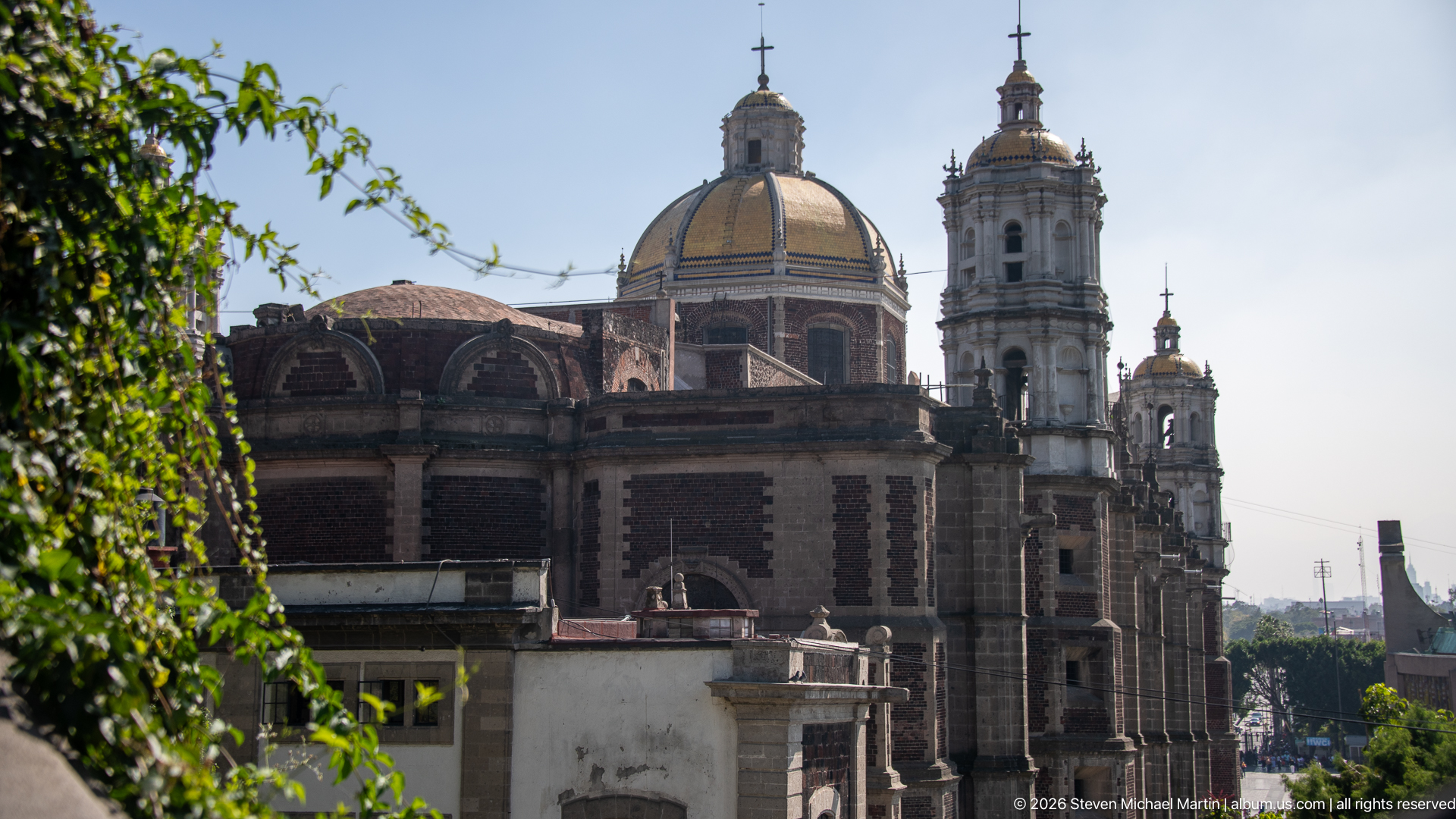
Trees partly veil the old church’s dark masonry walls, tiled dome, and pale bell towers. The central dome and its lantern rise between two towers, each topped by a cross, while smaller rounded roof forms sit lower in the composition. This oblique view stresses the layered silhouette and the contrast between the church’s dark walls and lighter upper structures.
Caption
Trees partly veil the old church’s dark masonry walls, tiled dome, and pale bell towers. The central dome and its lantern rise between two towers, each topped by a cross, while smaller rounded roof forms sit lower in the composition. This oblique view stresses the layered silhouette and the contrast between the church’s dark walls and lighter upper structures.
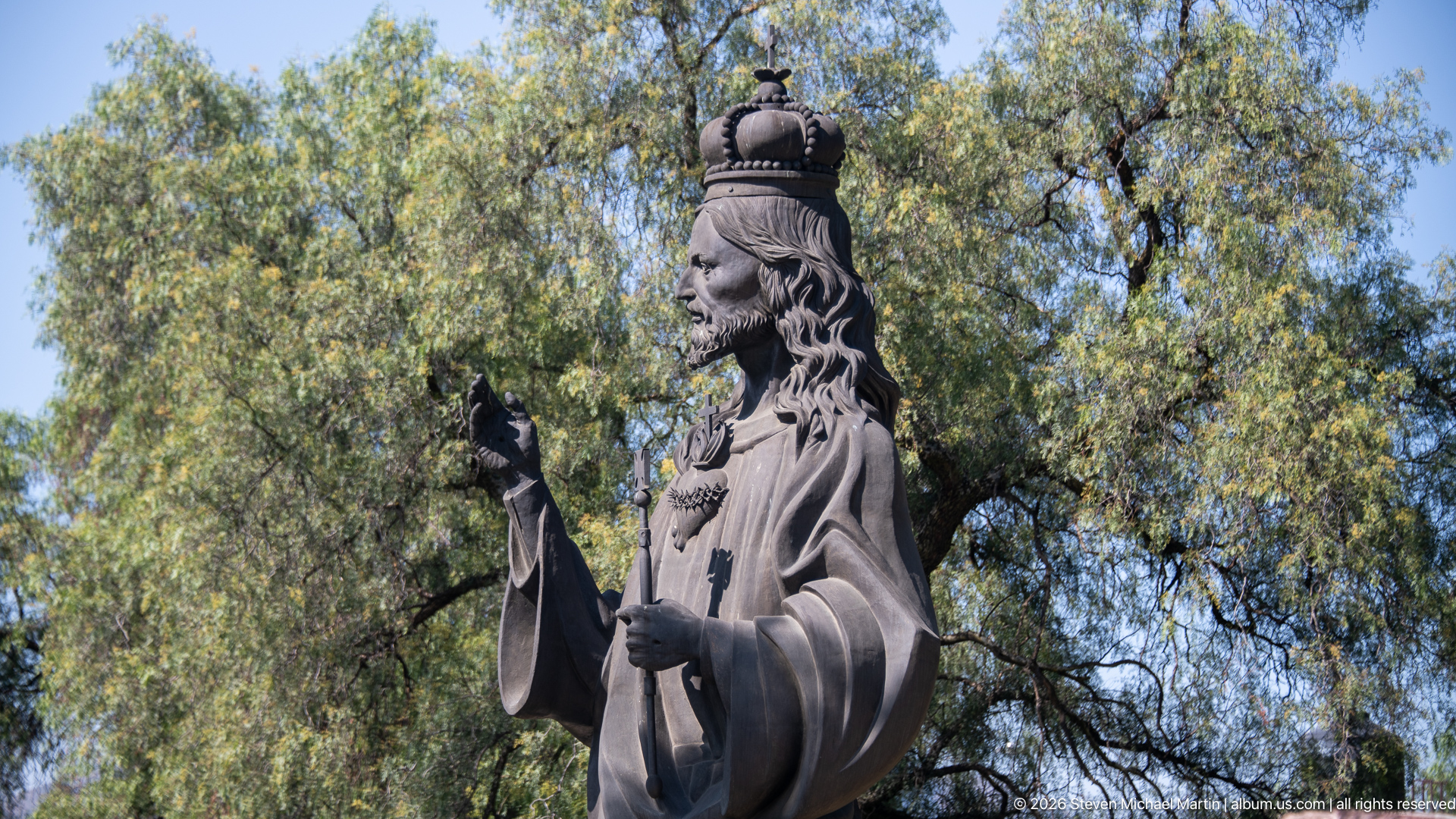
A dark bronze statue of a bearded man in long robes stands in profile against leafy trees. He raises one hand near his chest and holds a narrow vertical object in the other; an ornate crown-like headpiece sits above his hair. The photograph frames the figure from the torso upward, preserving its gesture and costume without assigning a personal identity.
Caption
A dark bronze statue of a bearded man in long robes stands in profile against leafy trees. He raises one hand near his chest and holds a narrow vertical object in the other; an ornate crown-like headpiece sits above his hair. The photograph frames the figure from the torso upward, preserving its gesture and costume without assigning a personal identity.
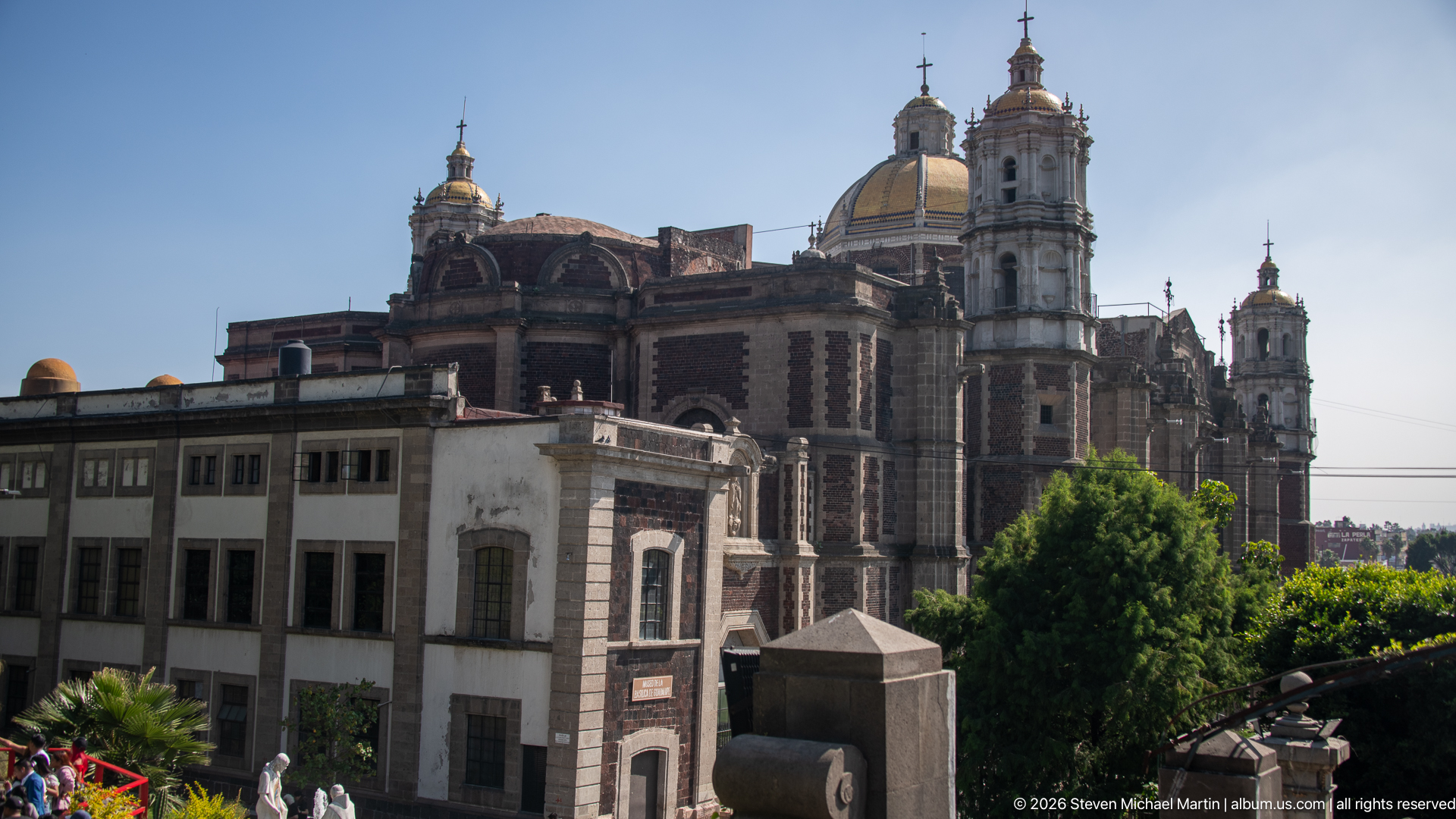
From an elevated side angle, the historic church’s dark masonry walls step toward a cluster of tiled domes and slender bell towers. A lower modern building occupies the foreground, and shrubs partly screen the base of the church. The composition reveals the difference in scale between the older vertical roofline and the surrounding structures within the basilica complex.
Caption
From an elevated side angle, the historic church’s dark masonry walls step toward a cluster of tiled domes and slender bell towers. A lower modern building occupies the foreground, and shrubs partly screen the base of the church. The composition reveals the difference in scale between the older vertical roofline and the surrounding structures within the basilica complex.
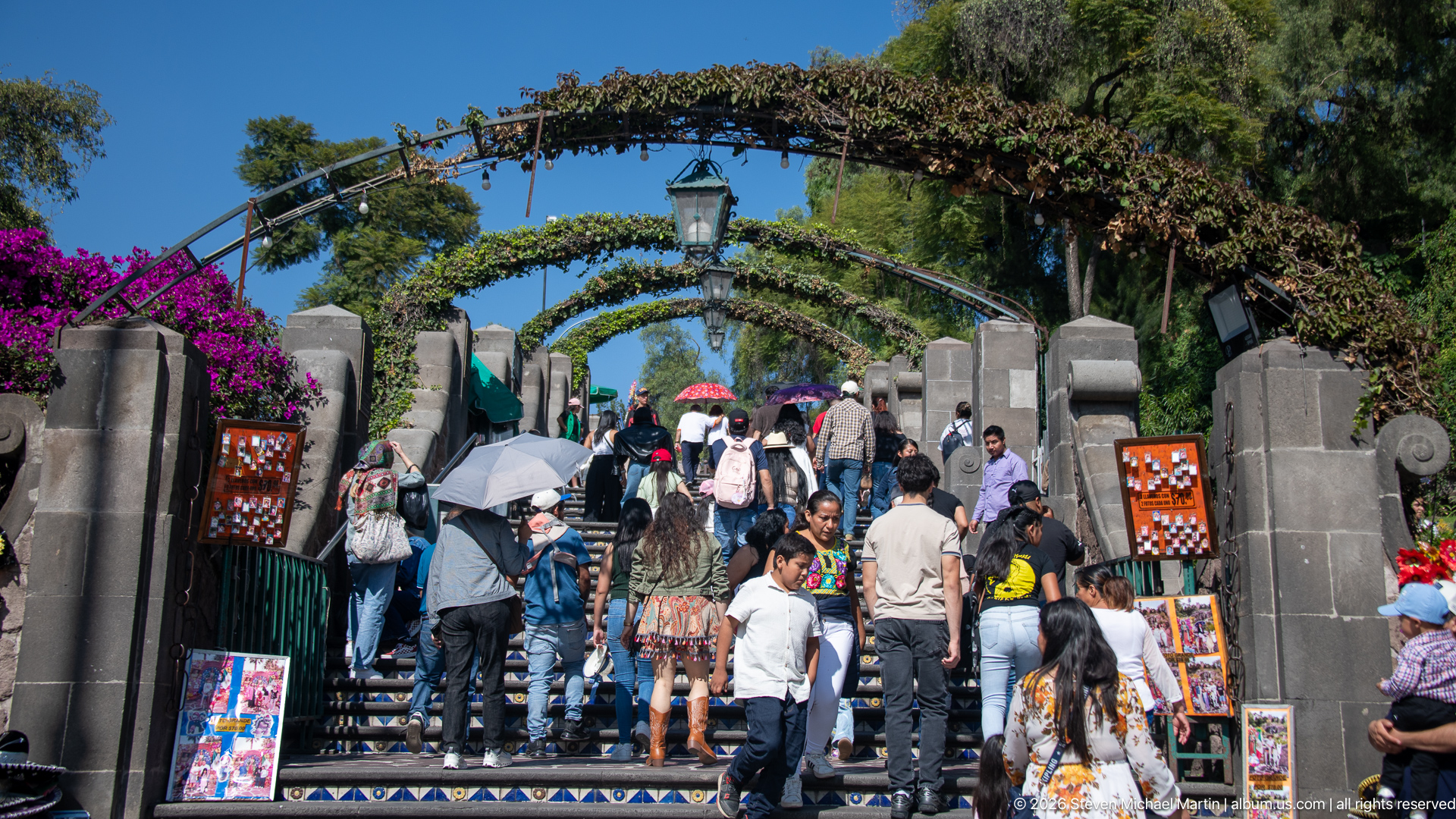
A steady stream of visitors climbs broad stone steps under two arched trellises covered with vines. Lanterns hang along the centerline, and low stone posts and railings guide the ascent. The direct view places the crowd beneath the green canopy, showing a pedestrian route through the basilica grounds rather than an interior or façade detail.
Caption
A steady stream of visitors climbs broad stone steps under two arched trellises covered with vines. Lanterns hang along the centerline, and low stone posts and railings guide the ascent. The direct view places the crowd beneath the green canopy, showing a pedestrian route through the basilica grounds rather than an interior or façade detail.
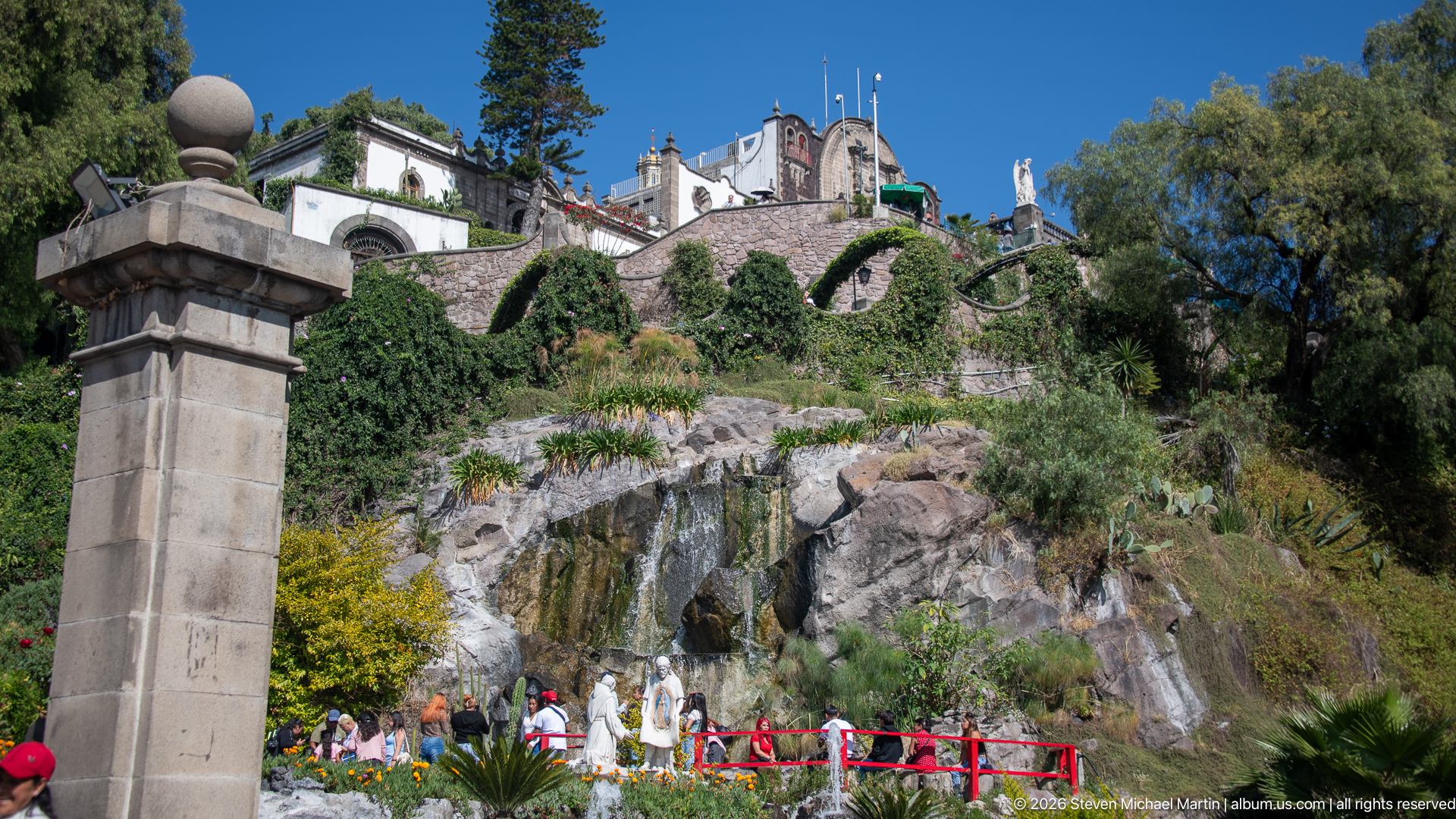
Water spills down a rocky planted slope beneath a stone retaining wall, forming a small cascade. A group of pale statues stands behind a red barrier near the foot of the rocks, while visitors gather nearby; a small chapel and walkway rise above the wall. The scene combines a landscaped devotional setting with the movement of people through the grounds.
Caption
Water spills down a rocky planted slope beneath a stone retaining wall, forming a small cascade. A group of pale statues stands behind a red barrier near the foot of the rocks, while visitors gather nearby; a small chapel and walkway rise above the wall. The scene combines a landscaped devotional setting with the movement of people through the grounds.
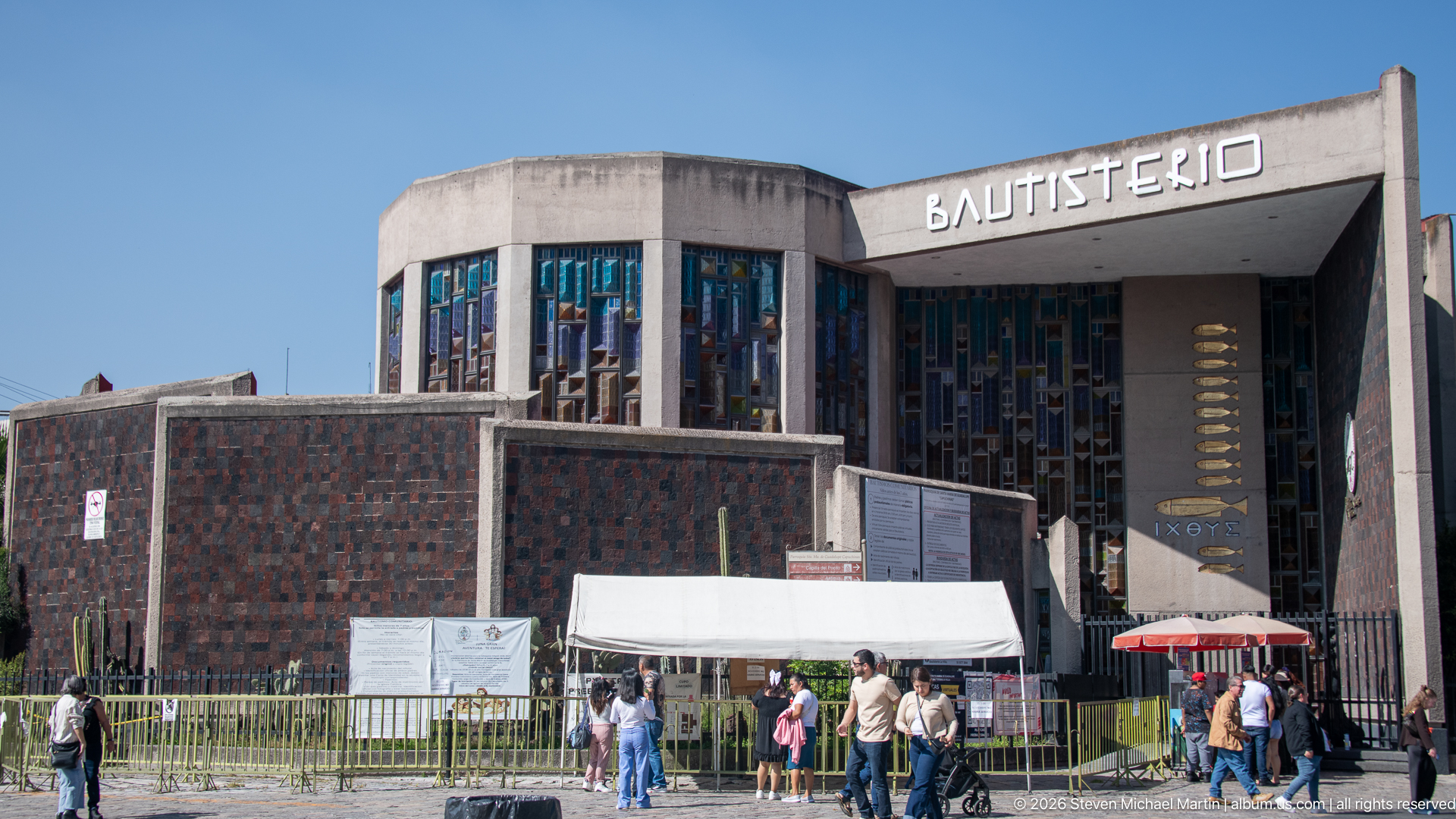
The word “BAUTISTERIO” spans the canopy above the entrance to a low modern building faced in dark patterned masonry. Tall colored window panels rise along the corner, and a temporary white awning shelters part of the entrance area. Visitors stand behind a metal barrier in front. The sign identifies the building’s function directly and distinguishes it from the basilica’s historic churches.
Caption
The word “BAUTISTERIO” spans the canopy above the entrance to a low modern building faced in dark patterned masonry. Tall colored window panels rise along the corner, and a temporary white awning shelters part of the entrance area. Visitors stand behind a metal barrier in front. The sign identifies the building’s function directly and distinguishes it from the basilica’s historic churches.
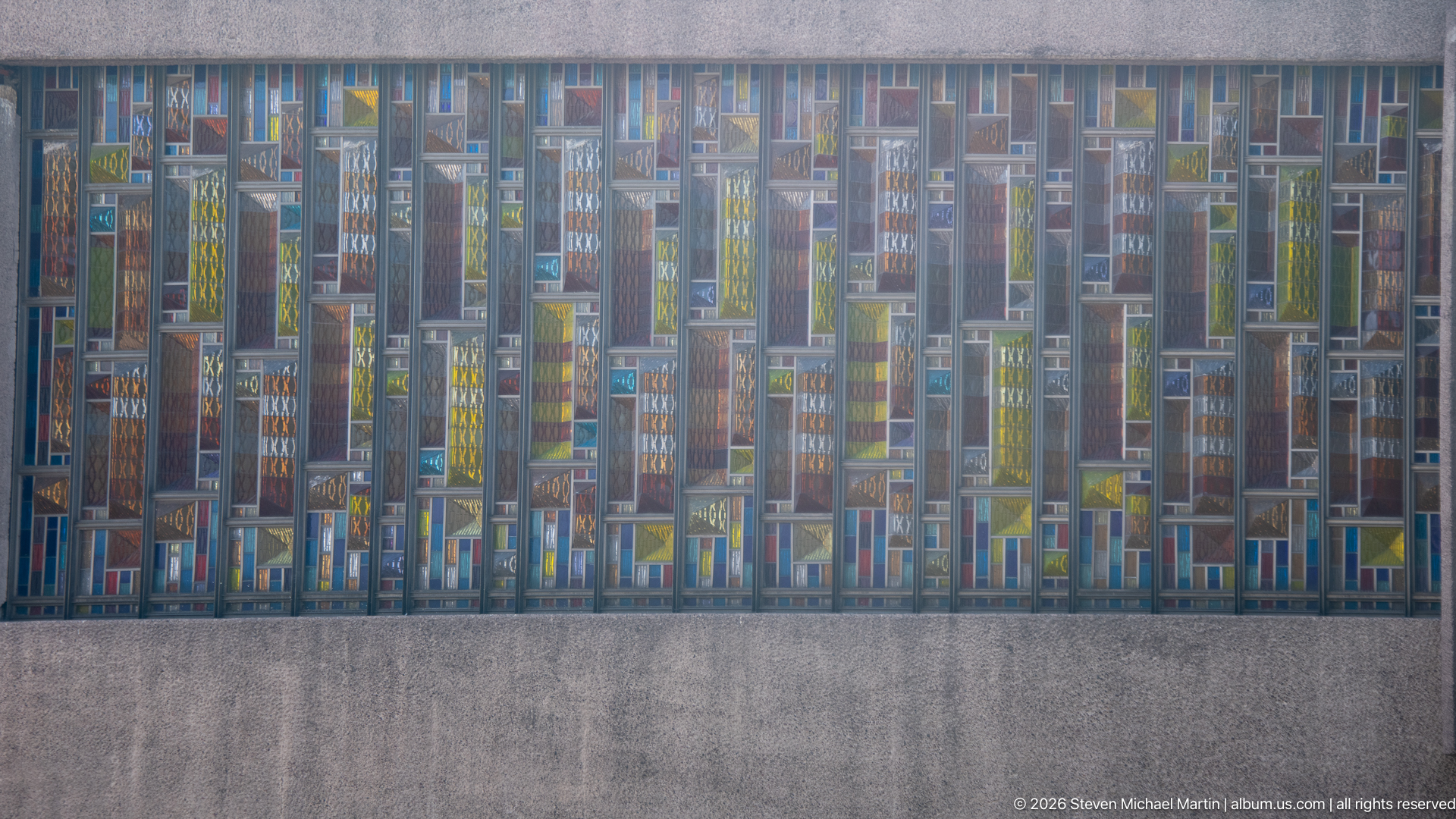
A long band of narrow stained-glass panels runs across the curved upper wall, each section divided by pale vertical mullions and filled with small geometric and figurative patterns. The muted gray concrete base makes the reds, blues, greens, and amber glass stand out. Seen straight on, the photograph isolates the basilica’s window treatment rather than its overall silhouette.
Caption
A long band of narrow stained-glass panels runs across the curved upper wall, each section divided by pale vertical mullions and filled with small geometric and figurative patterns. The muted gray concrete base makes the reds, blues, greens, and amber glass stand out. Seen straight on, the photograph isolates the basilica’s window treatment rather than its overall silhouette.
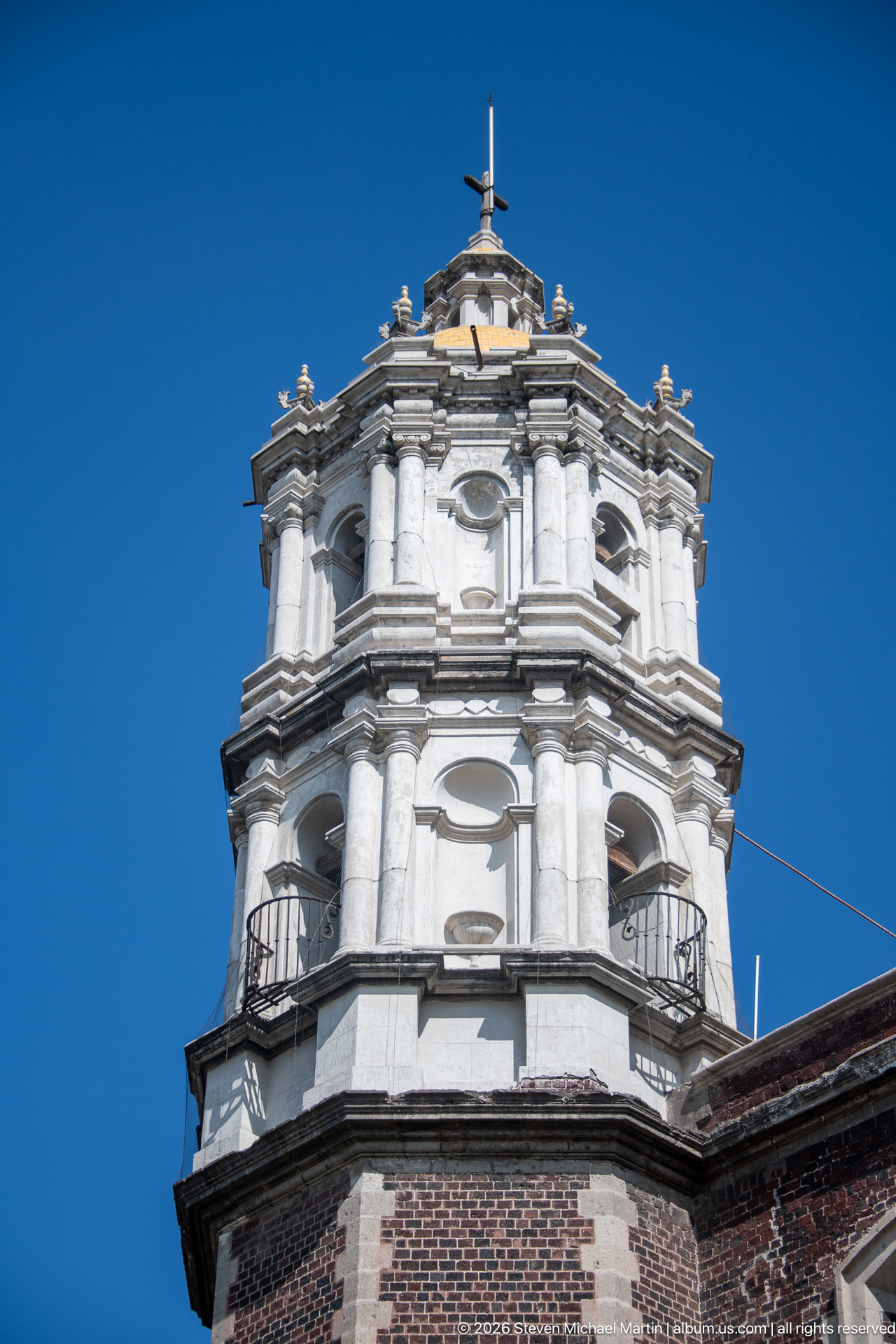
Against a clear blue sky, a white octagonal tower rises from a dark brick base. Its stacked levels have paired columns, open arches, projecting cornices, small sculptural ornaments, and a metal cross at the peak. The low viewpoint compresses the structure into a strong vertical profile, drawing attention to the tower’s repeated classical details and the contrast between pale stone and brick.
Caption
Against a clear blue sky, a white octagonal tower rises from a dark brick base. Its stacked levels have paired columns, open arches, projecting cornices, small sculptural ornaments, and a metal cross at the peak. The low viewpoint compresses the structure into a strong vertical profile, drawing attention to the tower’s repeated classical details and the contrast between pale stone and brick.
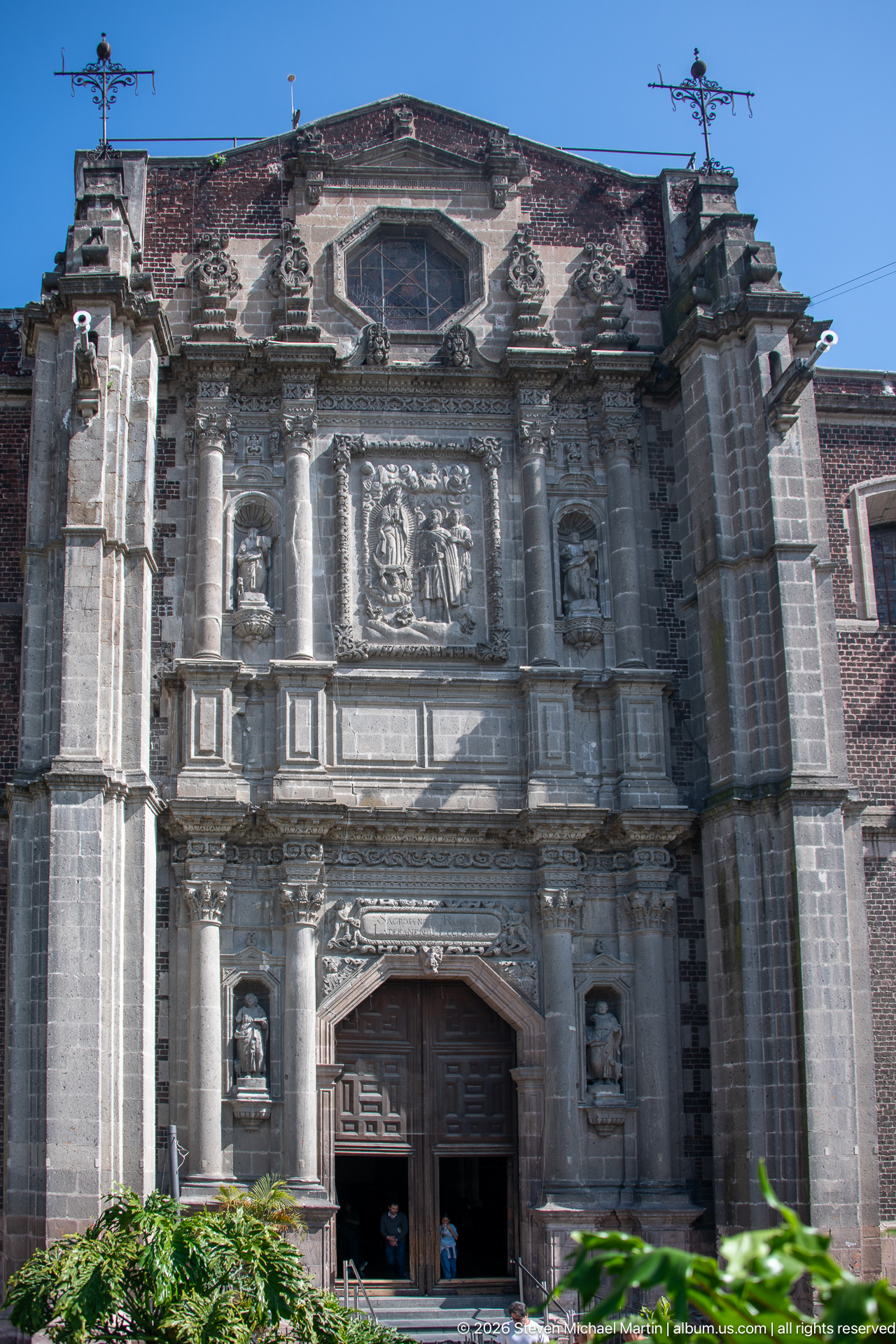
The entrance façade fills the frame with paired stone columns, sculpted niches, layered moldings, and a large central relief above the doorway. Dark brick masonry borders the lighter carved portal, while a few visitors appear in the shadowed entrance below. The nearly frontal view reveals the portal’s dense sculptural program and the way its vertical elements frame the central doorway.
Caption
The entrance façade fills the frame with paired stone columns, sculpted niches, layered moldings, and a large central relief above the doorway. Dark brick masonry borders the lighter carved portal, while a few visitors appear in the shadowed entrance below. The nearly frontal view reveals the portal’s dense sculptural program and the way its vertical elements frame the central doorway.
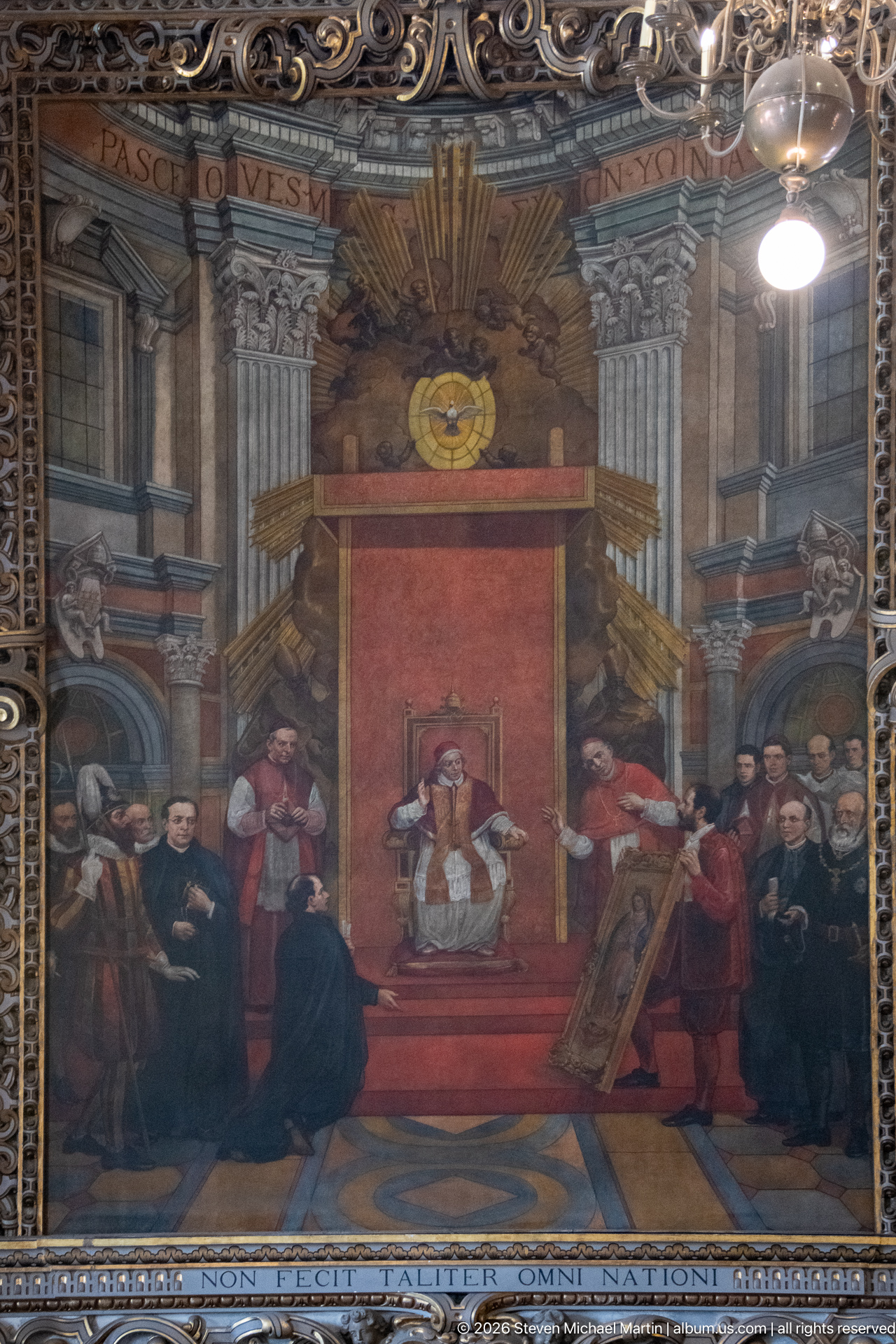
A large painted tableau shows a seated prelate beneath a red canopy while clergy and other figures gather around him in a richly ornamented interior. A Latin inscription runs along the lower border, and carved-looking architectural framing encloses the scene. The straight-on view reads as a historical narrative panel, with the central seated figure organizing the crowd and the surrounding architecture.
Caption
A large painted tableau shows a seated prelate beneath a red canopy while clergy and other figures gather around him in a richly ornamented interior. A Latin inscription runs along the lower border, and carved-looking architectural framing encloses the scene. The straight-on view reads as a historical narrative panel, with the central seated figure organizing the crowd and the surrounding architecture.
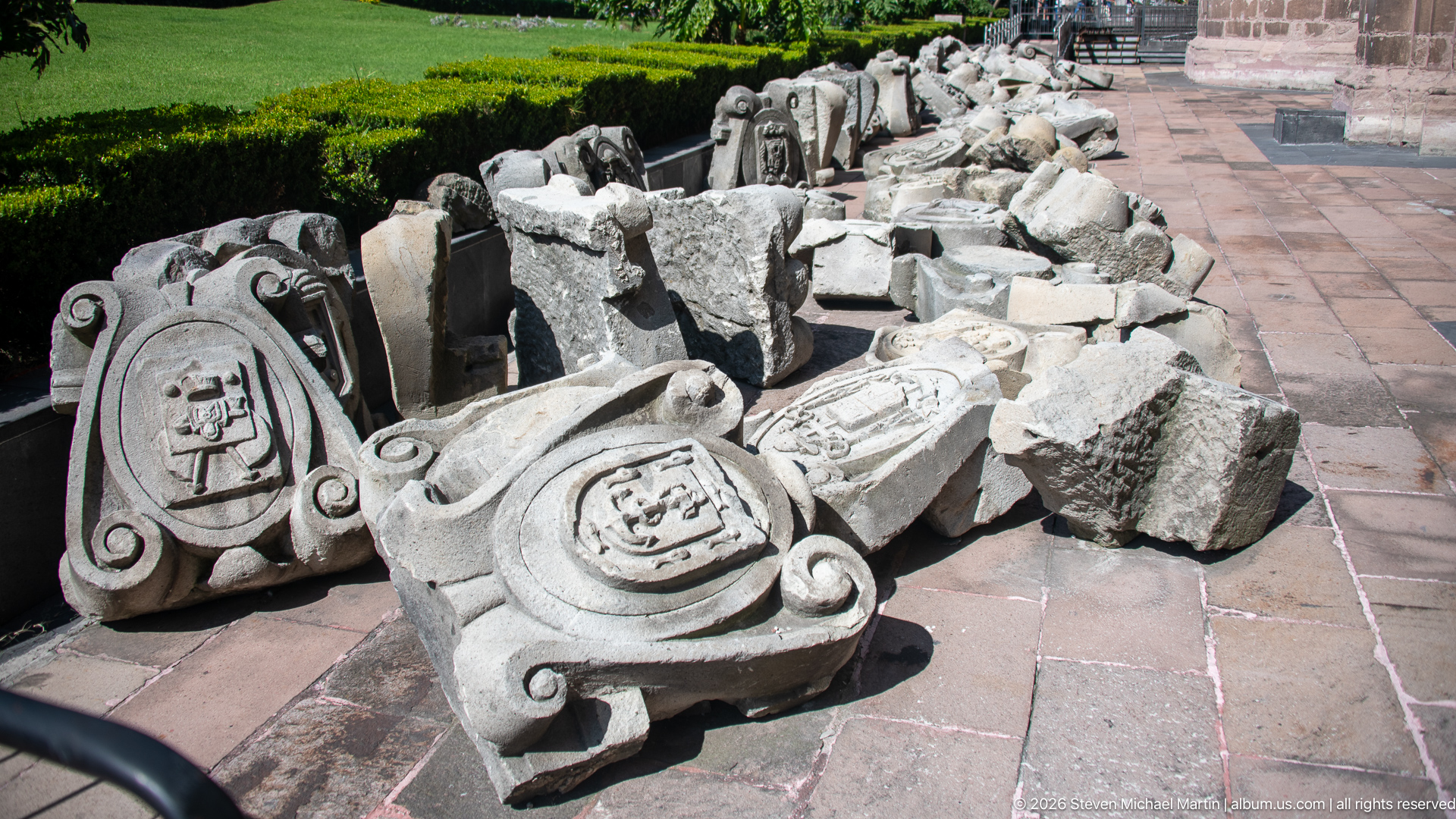
Weathered stone fragments lie in a loose cluster beside a tiled path and clipped greenery. Several pieces retain carved scrolls, circular emblems, foliage, and block-like architectural profiles, while broken edges expose rough surfaces. Seen at ground level, the fragments’ scale, carved ornament, and worn condition are clear against the orderly paving and trimmed garden border.
Caption
Weathered stone fragments lie in a loose cluster beside a tiled path and clipped greenery. Several pieces retain carved scrolls, circular emblems, foliage, and block-like architectural profiles, while broken edges expose rough surfaces. Seen at ground level, the fragments’ scale, carved ornament, and worn condition are clear against the orderly paving and trimmed garden border.
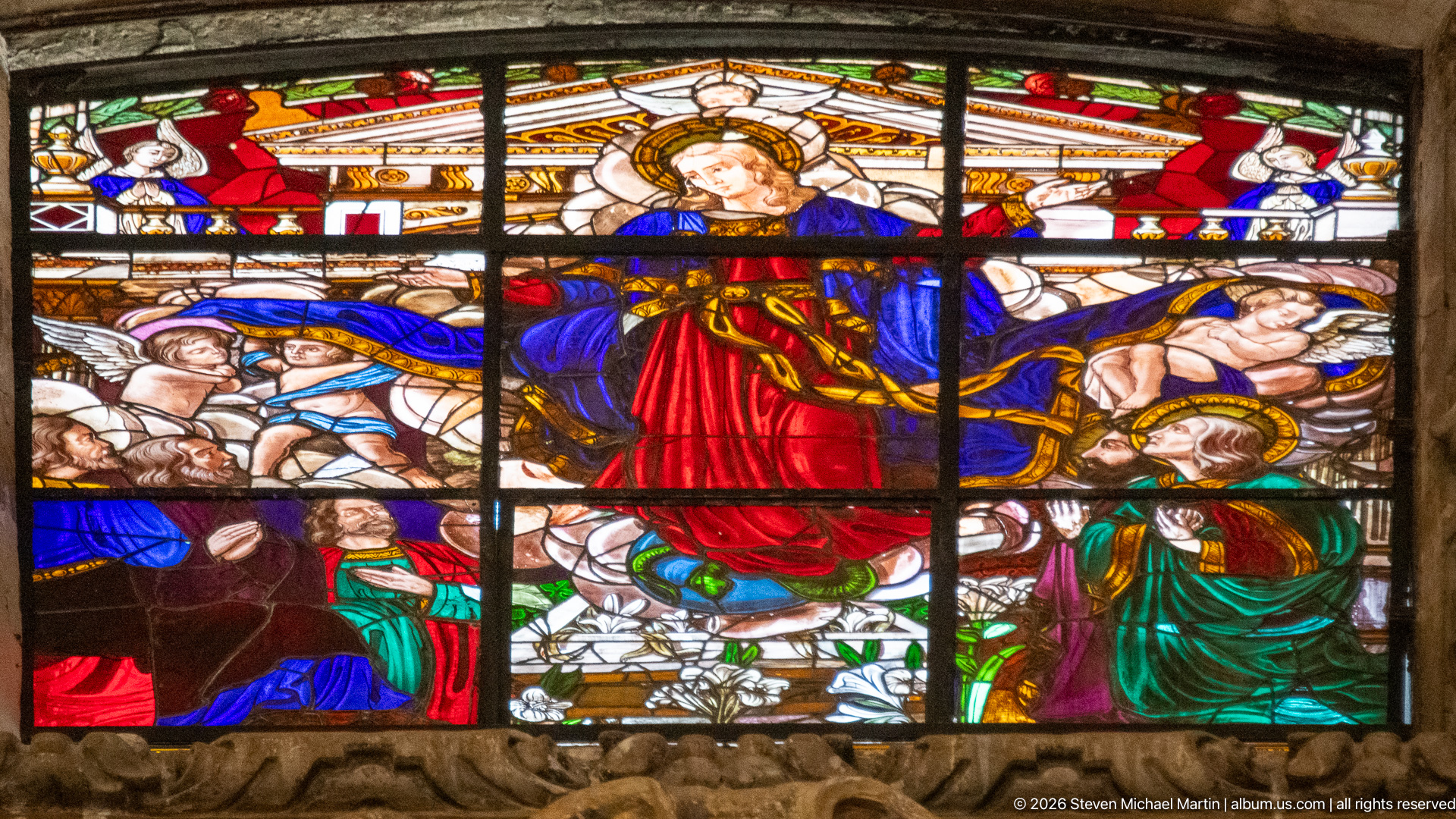
A haloed woman in a red and blue robe occupies the center of a richly colored stained-glass scene, surrounded by smaller kneeling and standing figures. Lead lines divide the panel into rectangular sections, while saturated blue, green, and red glass gives the composition a strong rhythm. The close frontal view emphasizes the central figure and the gathered attendants rather than the window’s setting.
Caption
A haloed woman in a red and blue robe occupies the center of a richly colored stained-glass scene, surrounded by smaller kneeling and standing figures. Lead lines divide the panel into rectangular sections, while saturated blue, green, and red glass gives the composition a strong rhythm. The close frontal view emphasizes the central figure and the gathered attendants rather than the window’s setting.
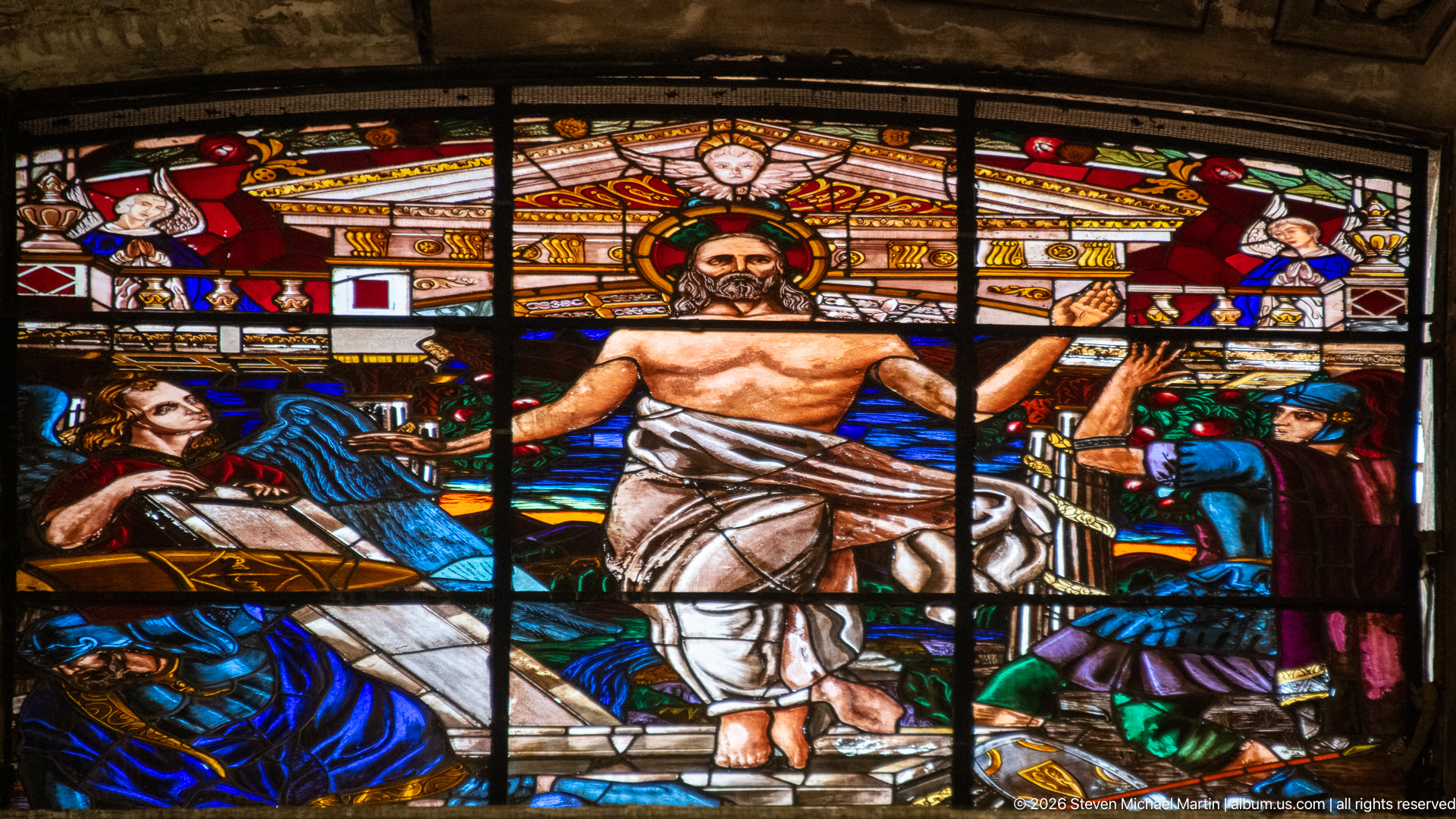
A bearded, haloed man stands at the center of the window with his arms extended, his pale garment set against bands of blue glass. Smaller figures lean or gesture toward him from both sides, and a decorative upper register frames the scene. Dark lead cames cross the image in a grid, giving this close view a more dramatic, figure-centered composition than the neighboring window.
Caption
A bearded, haloed man stands at the center of the window with his arms extended, his pale garment set against bands of blue glass. Smaller figures lean or gesture toward him from both sides, and a decorative upper register frames the scene. Dark lead cames cross the image in a grid, giving this close view a more dramatic, figure-centered composition than the neighboring window.
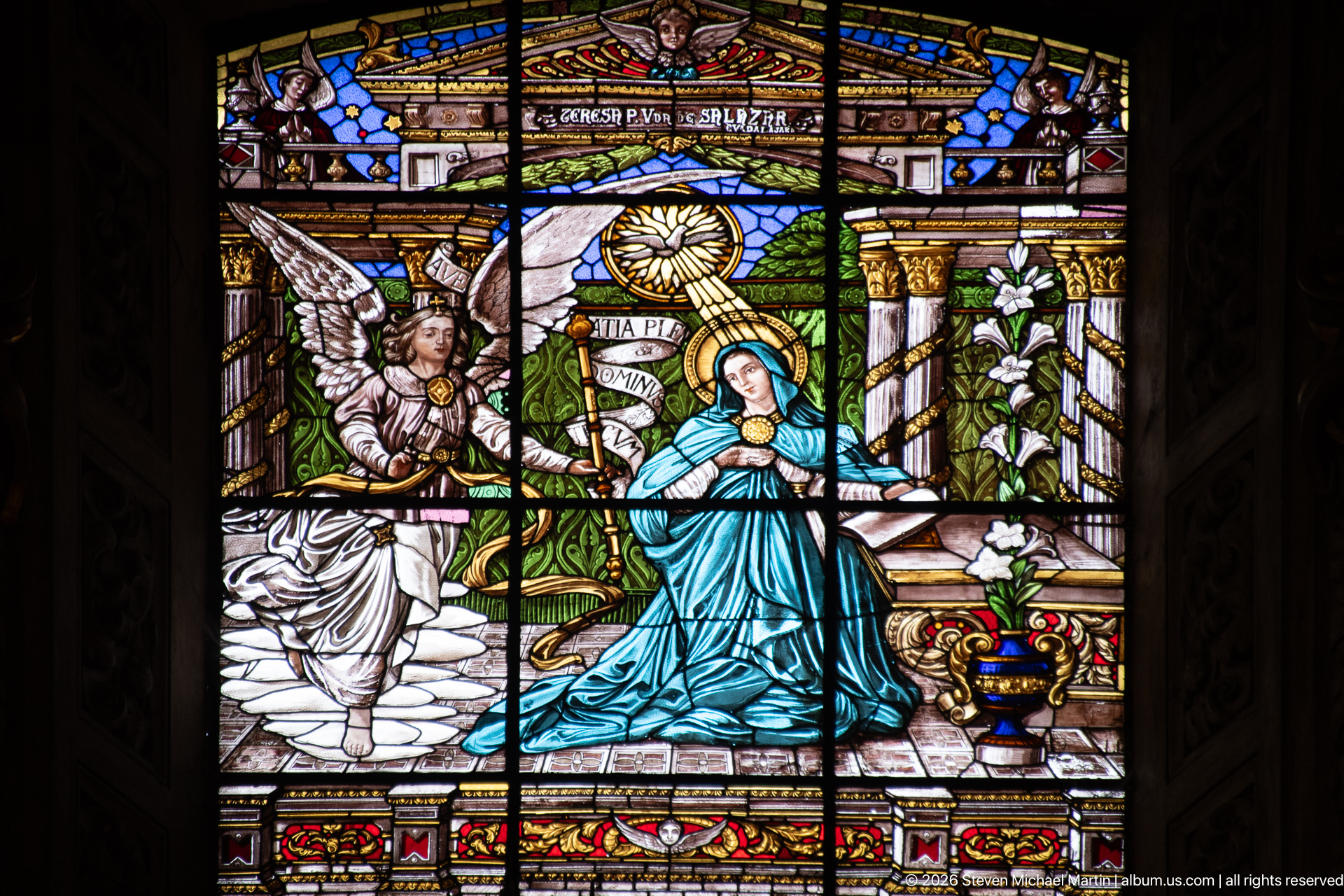
A winged angel gestures toward Mary, who wears a blue mantle and stands beside a lectern in a garden-like setting. White lilies, patterned green foliage, and a radiant dove above them fill the surrounding stained glass. The panel’s strong central pairing and readable details create a focused devotional scene within the darker carved window surround.
Caption
A winged angel gestures toward Mary, who wears a blue mantle and stands beside a lectern in a garden-like setting. White lilies, patterned green foliage, and a radiant dove above them fill the surrounding stained glass. The panel’s strong central pairing and readable details create a focused devotional scene within the darker carved window surround.
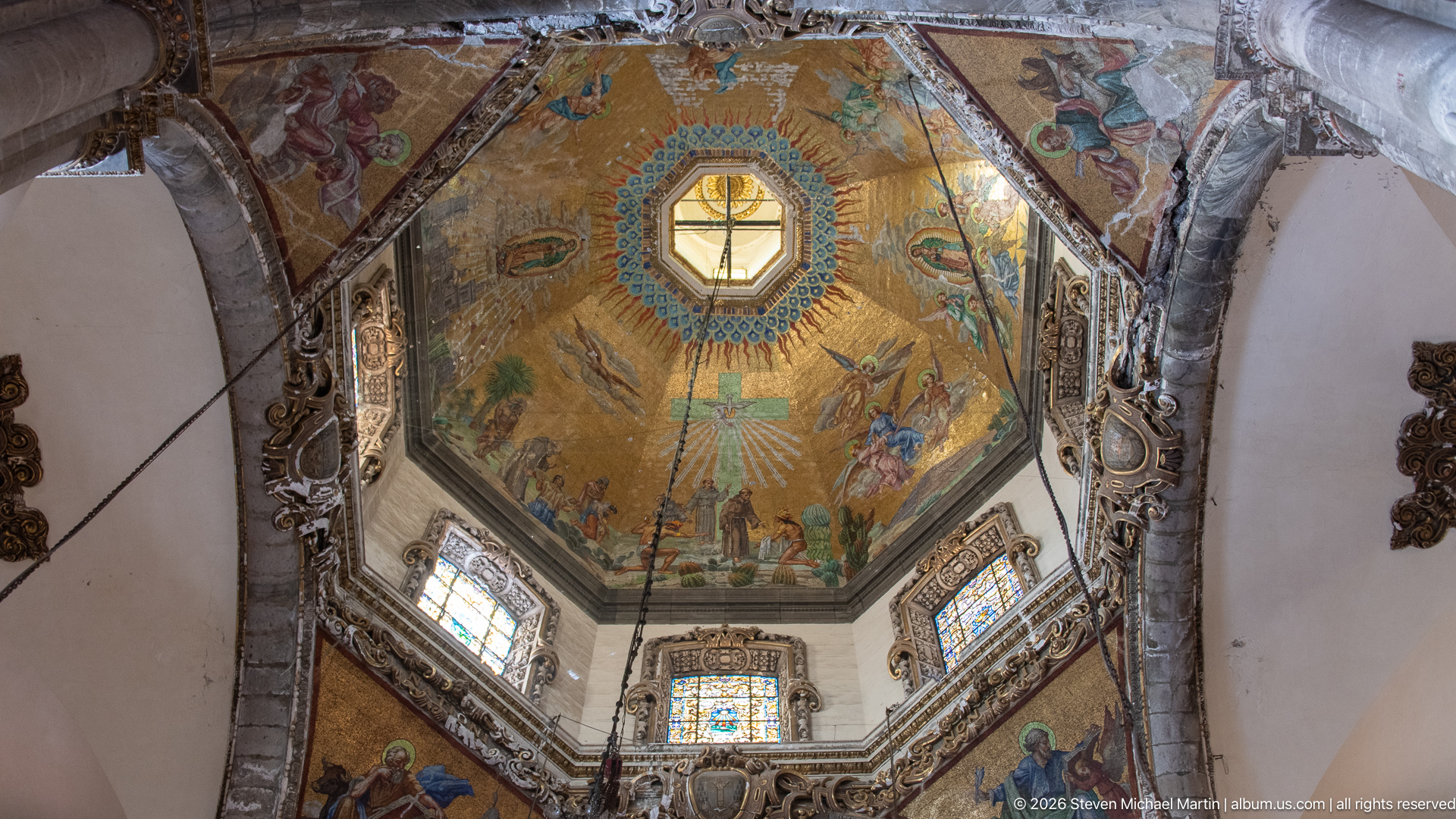
An octagonal skylight glows at the center of a painted cupola, ringed by blue and gold ornament. Figures and narrative scenes fill the sloping surfaces below, framed by carved ribs and smaller stained-glass windows around the base. The upward viewpoint reveals how the painted program is organized around the central opening and how it connects with the surrounding interior.
Caption
An octagonal skylight glows at the center of a painted cupola, ringed by blue and gold ornament. Figures and narrative scenes fill the sloping surfaces below, framed by carved ribs and smaller stained-glass windows around the base. The upward viewpoint reveals how the painted program is organized around the central opening and how it connects with the surrounding interior.
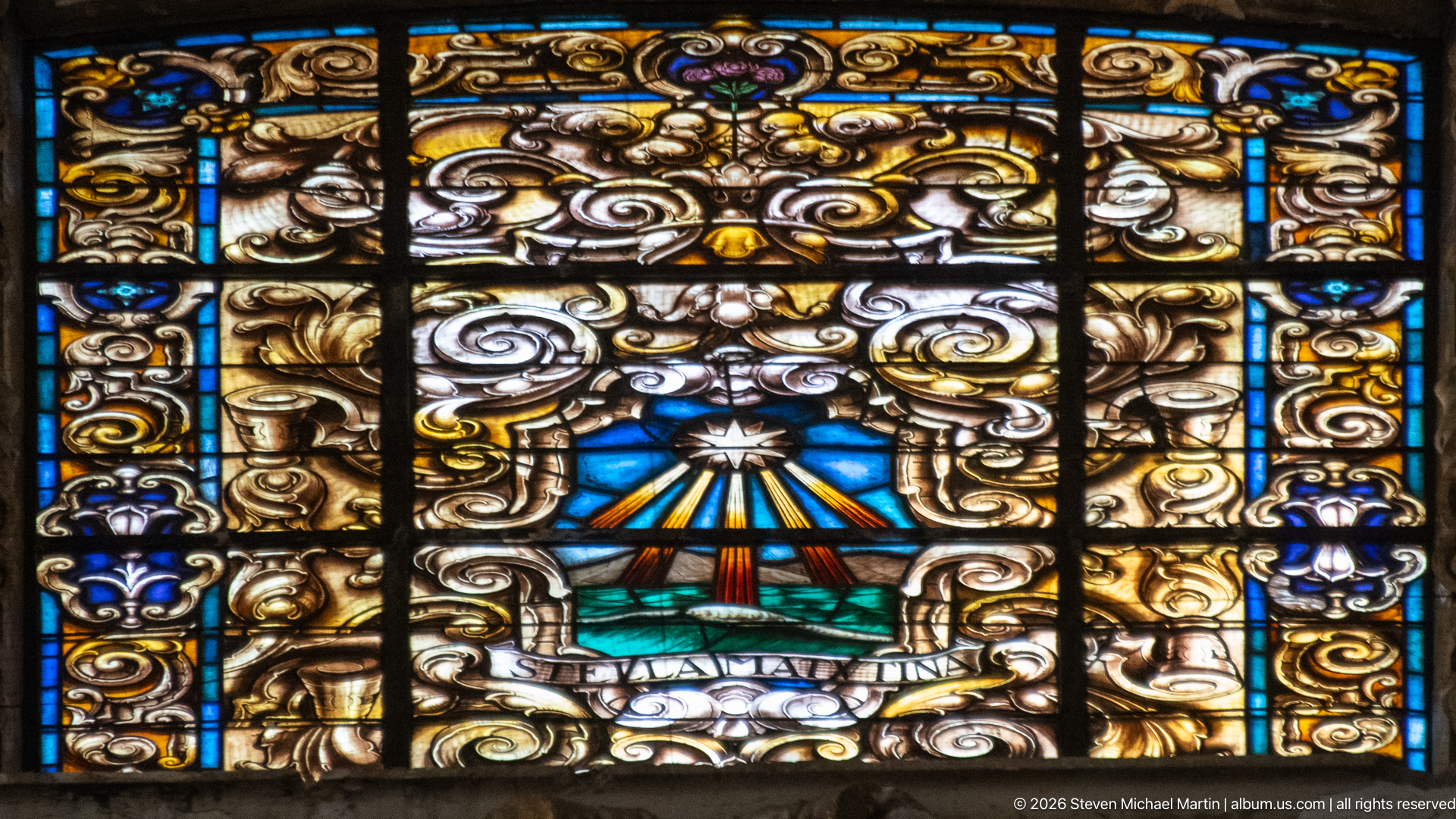
A white dove appears above rays of light in the center of a symmetrical stained-glass design. Gold scrollwork, blue and green sections, and small floral motifs fill the surrounding panes; a Latin phrase curves across a banner below the rays. The tight crop favors pattern, color, and inscription over any larger narrative, making the panel’s decorative structure the subject.
Caption
A white dove appears above rays of light in the center of a symmetrical stained-glass design. Gold scrollwork, blue and green sections, and small floral motifs fill the surrounding panes; a Latin phrase curves across a banner below the rays. The tight crop favors pattern, color, and inscription over any larger narrative, making the panel’s decorative structure the subject.
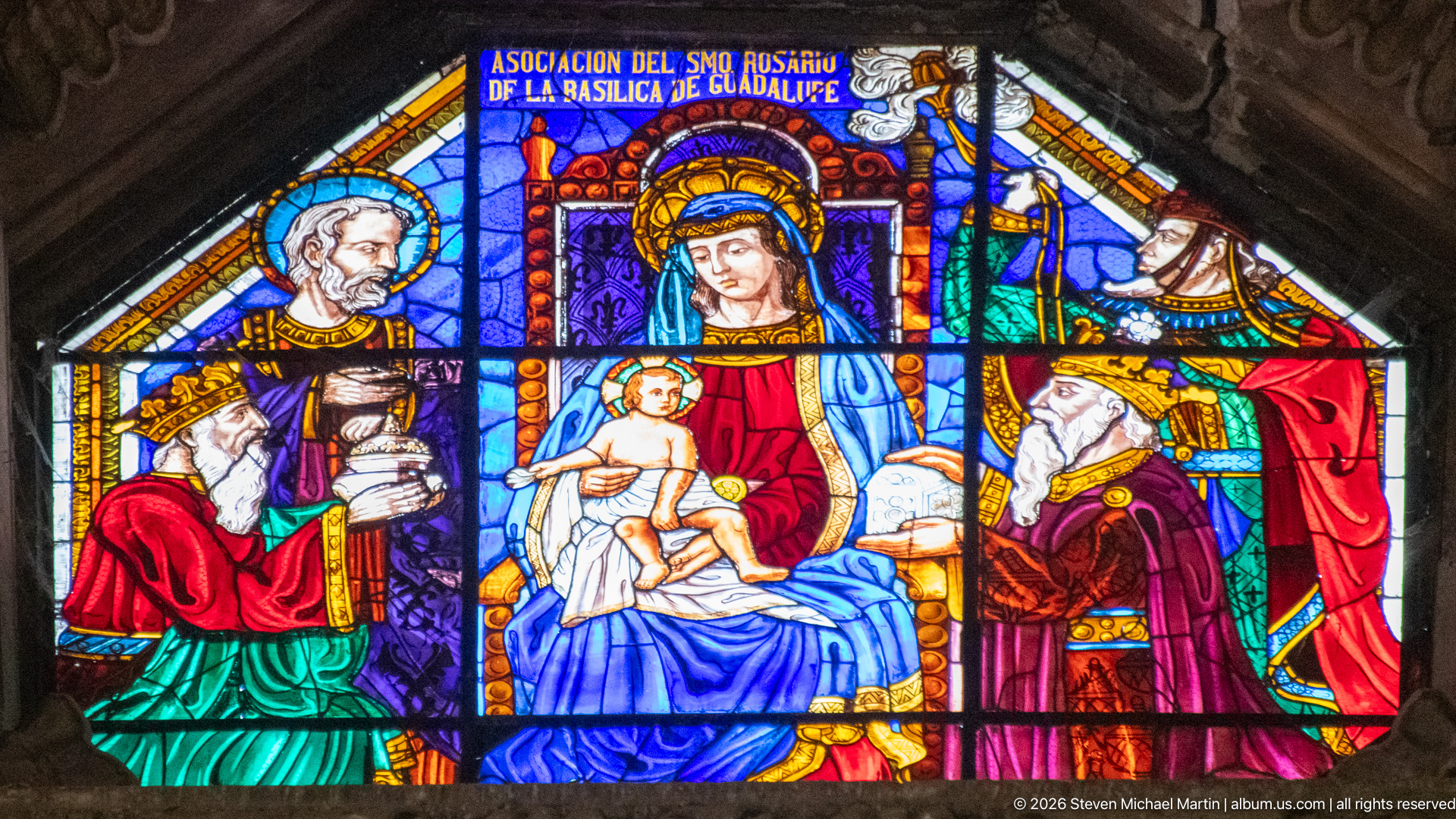
The Virgin Mary holds the infant Jesus between two older bearded figures in a vivid stained-glass composition. A blue inscription at the top names the Rosary association of the Basilica of Guadalupe, while saturated red, green, and blue garments distinguish the figures. The inscription and close, frontal framing make this panel a specific devotional dedication rather than a generic sacred scene.
Caption
The Virgin Mary holds the infant Jesus between two older bearded figures in a vivid stained-glass composition. A blue inscription at the top names the Rosary association of the Basilica of Guadalupe, while saturated red, green, and blue garments distinguish the figures. The inscription and close, frontal framing make this panel a specific devotional dedication rather than a generic sacred scene.
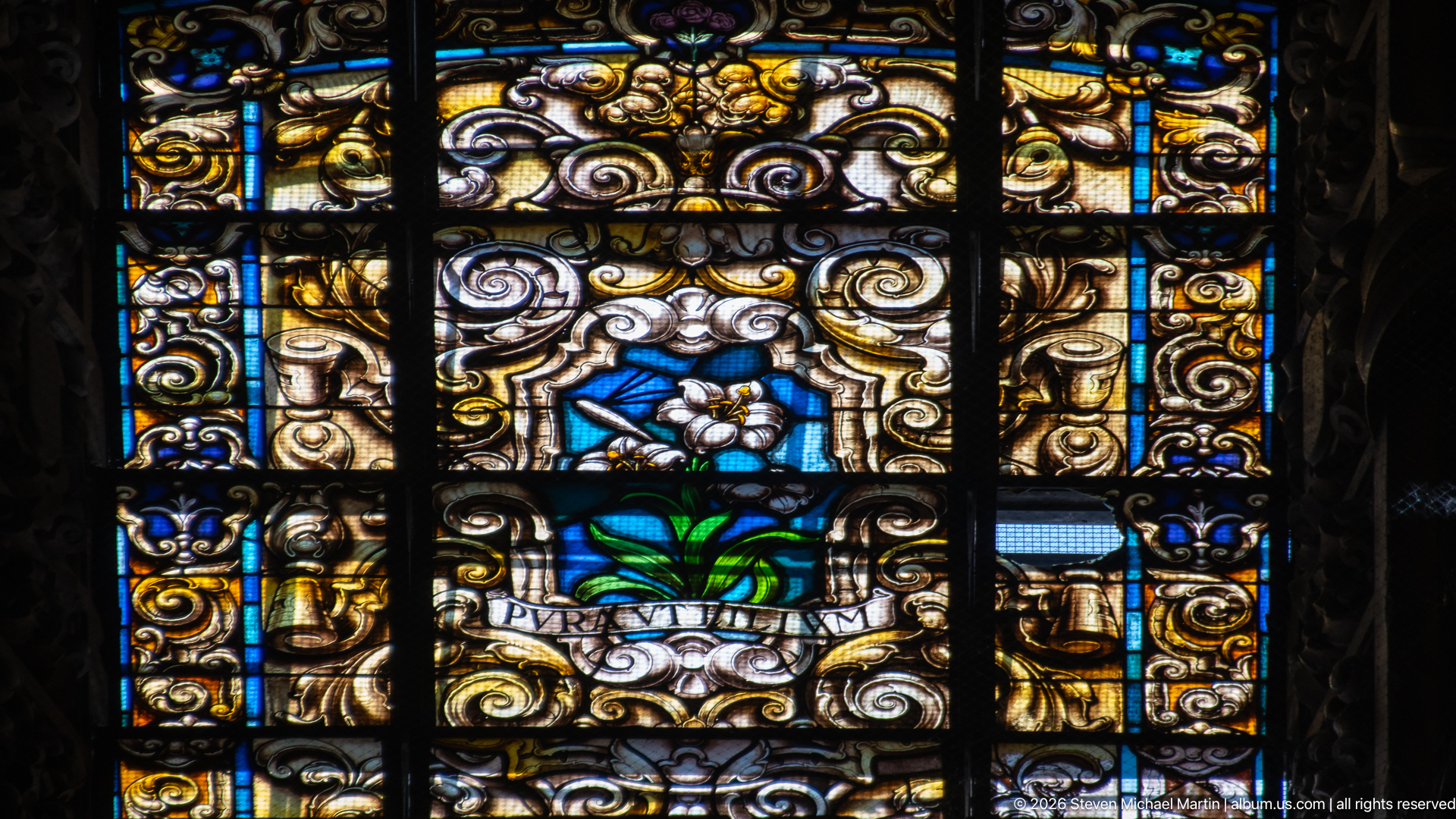
A compact flower motif sits in a blue field surrounded by dense gold, cream, and dark scrollwork. A curved banner crosses the lower portion, and black lead lines divide the decorative glass into small geometric sections. Repeated curls, balanced framing, and the contrast between blue glass and pale ornament make this a close study of the window’s decorative design.
Caption
A compact flower motif sits in a blue field surrounded by dense gold, cream, and dark scrollwork. A curved banner crosses the lower portion, and black lead lines divide the decorative glass into small geometric sections. Repeated curls, balanced framing, and the contrast between blue glass and pale ornament make this a close study of the window’s decorative design.
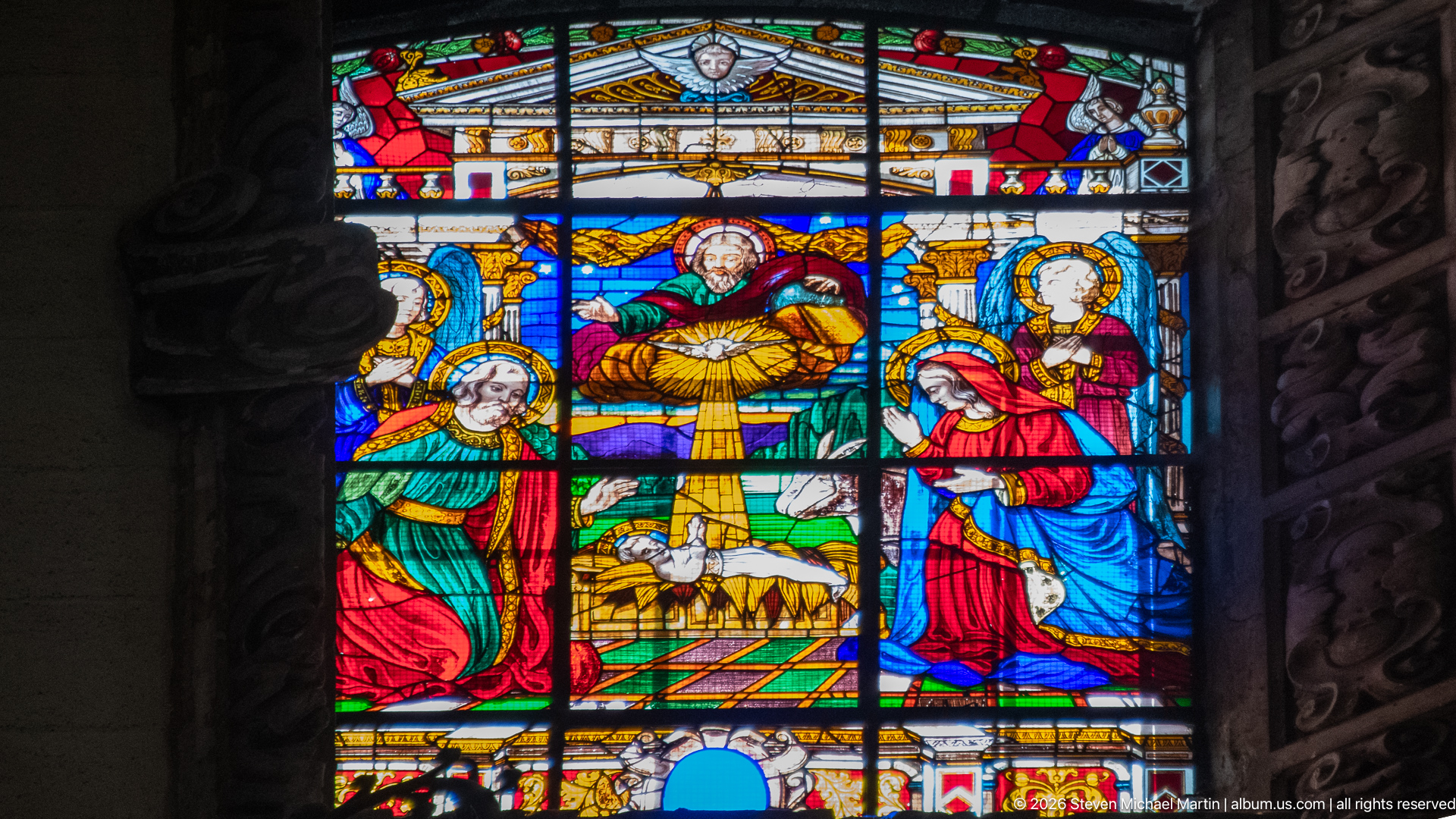
The infant lies at the center of a Nativity scene, with Mary and Joseph and other haloed figures gathered around the child. A dove occupies the upper register beneath red and gold ornament, while the leaded panes are set within a dark carved surround. The composition is photographed nearly straight on, emphasizing the relationship between the child and the surrounding attendants.
Caption
The infant lies at the center of a Nativity scene, with Mary and Joseph and other haloed figures gathered around the child. A dove occupies the upper register beneath red and gold ornament, while the leaded panes are set within a dark carved surround. The composition is photographed nearly straight on, emphasizing the relationship between the child and the surrounding attendants.
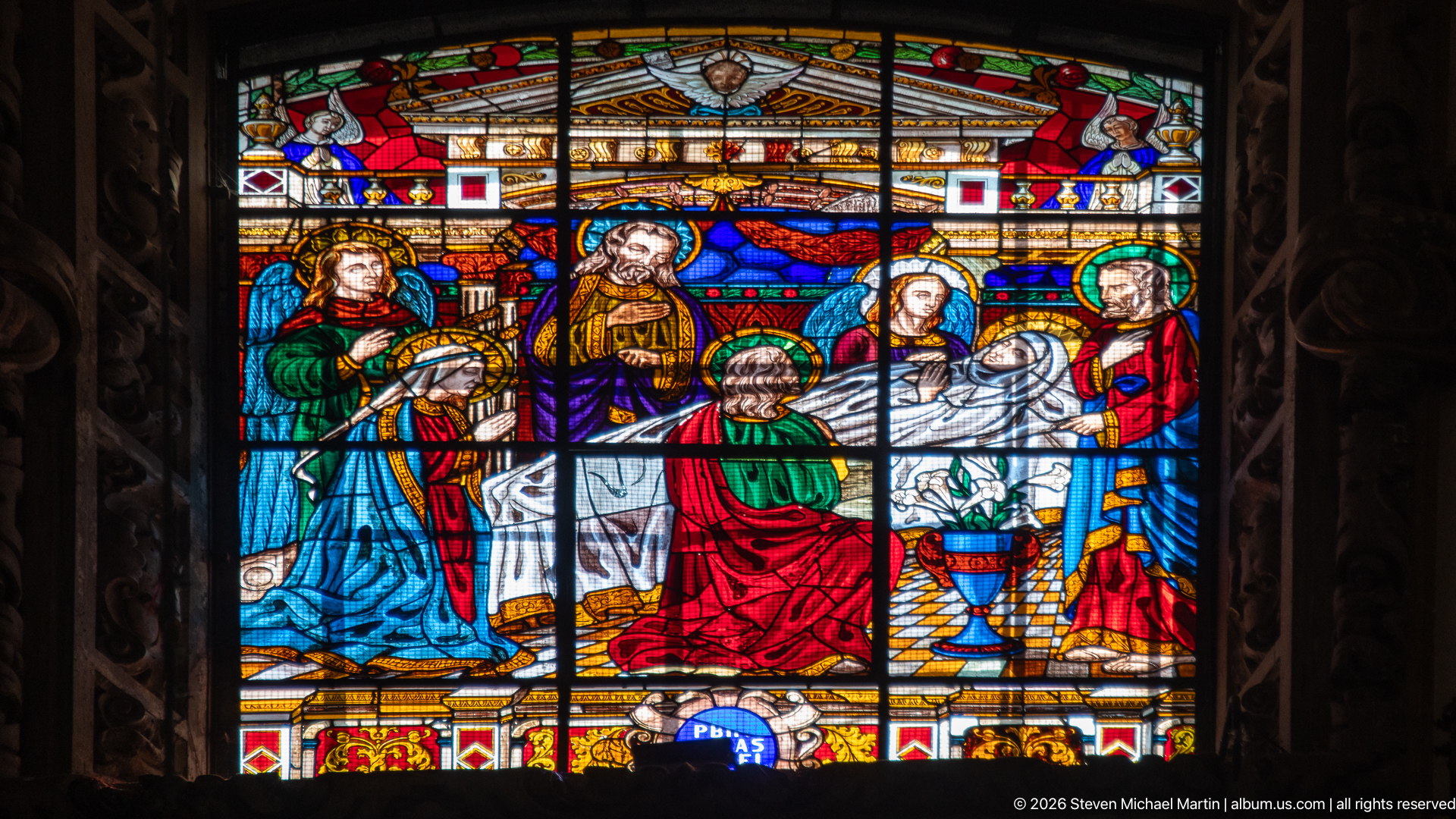
Several haloed figures gather around a pale reclining body at the center of the window, while Mary in blue and red bends toward the scene. A potted plant and patterned floor appear at the right, and the upper register is filled with red, gold, and blue glass. The wide panel makes the solemn group arrangement legible within its dark architectural surround.
Caption
Several haloed figures gather around a pale reclining body at the center of the window, while Mary in blue and red bends toward the scene. A potted plant and patterned floor appear at the right, and the upper register is filled with red, gold, and blue glass. The wide panel makes the solemn group arrangement legible within its dark architectural surround.
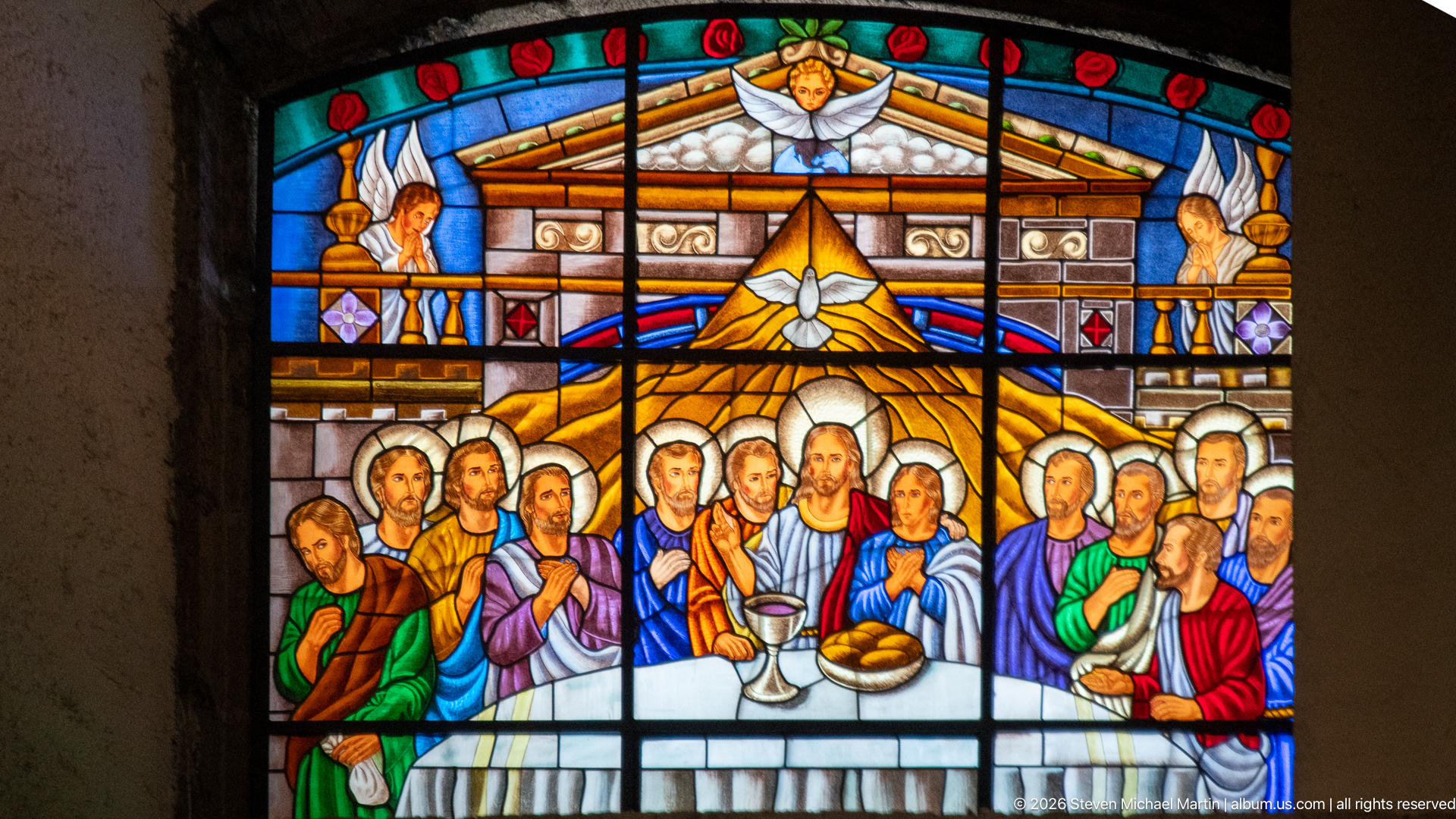
A long table of haloed figures fills the lower half of the window, with a central figure raising a hand and a chalice and bread on the table. A white dove and rays occupy the upper section above the gathering. Bright garments and a patterned floor distinguish individual figures, while the frontal view keeps the complete narrative panel in frame.
Caption
A long table of haloed figures fills the lower half of the window, with a central figure raising a hand and a chalice and bread on the table. A white dove and rays occupy the upper section above the gathering. Bright garments and a patterned floor distinguish individual figures, while the frontal view keeps the complete narrative panel in frame.
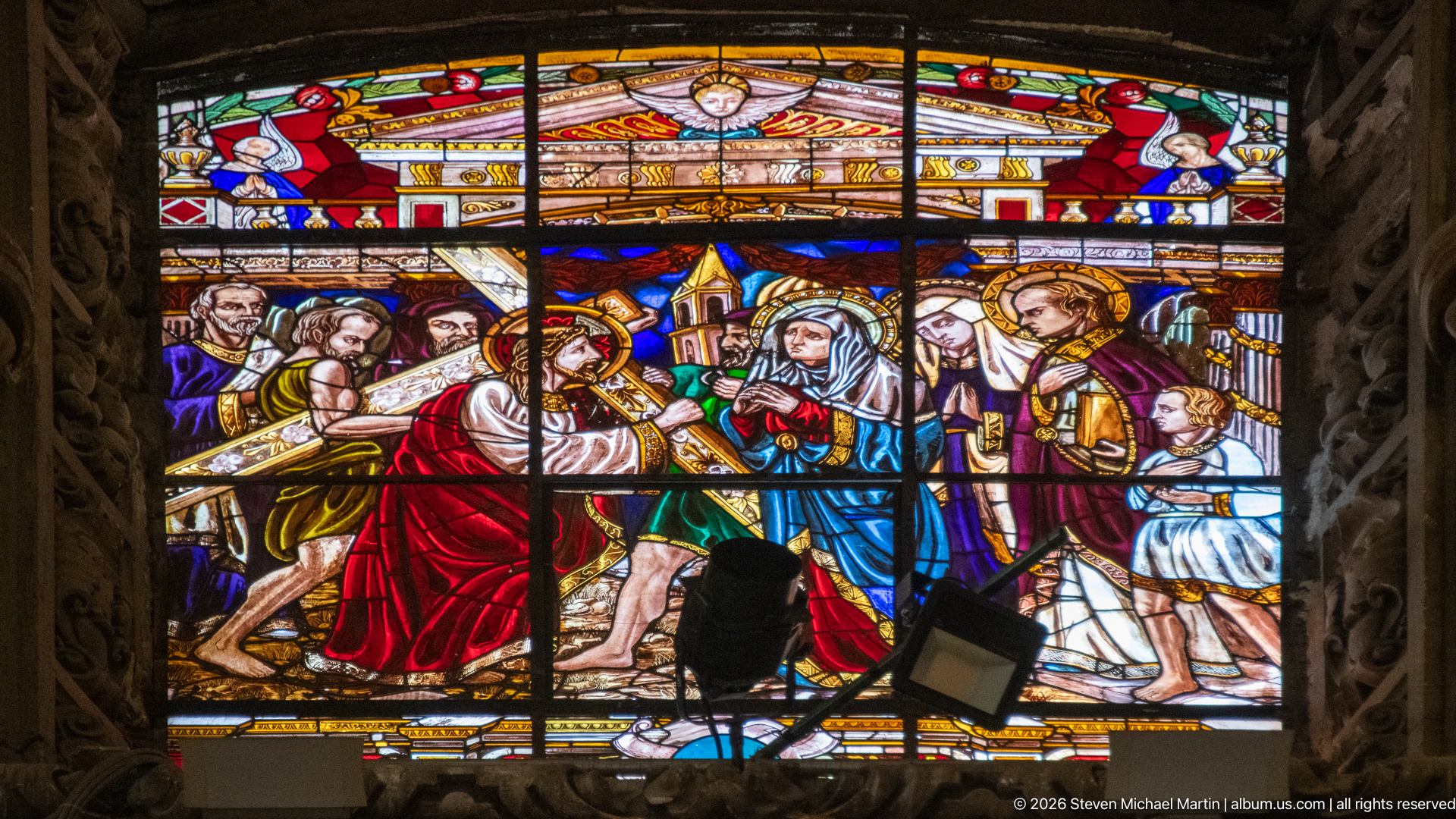
A red-robed figure bends beneath a pale cross as other haloed people crowd close around him. The richly colored panel has a dove and radiant ornament in its upper register, with dark lead lines and a carved frame partially enclosing the scene. The cross and forward-leaning figures establish a Passion narrative, while the photograph preserves much of the window’s full vertical composition.
Caption
A red-robed figure bends beneath a pale cross as other haloed people crowd close around him. The richly colored panel has a dove and radiant ornament in its upper register, with dark lead lines and a carved frame partially enclosing the scene. The cross and forward-leaning figures establish a Passion narrative, while the photograph preserves much of the window’s full vertical composition.
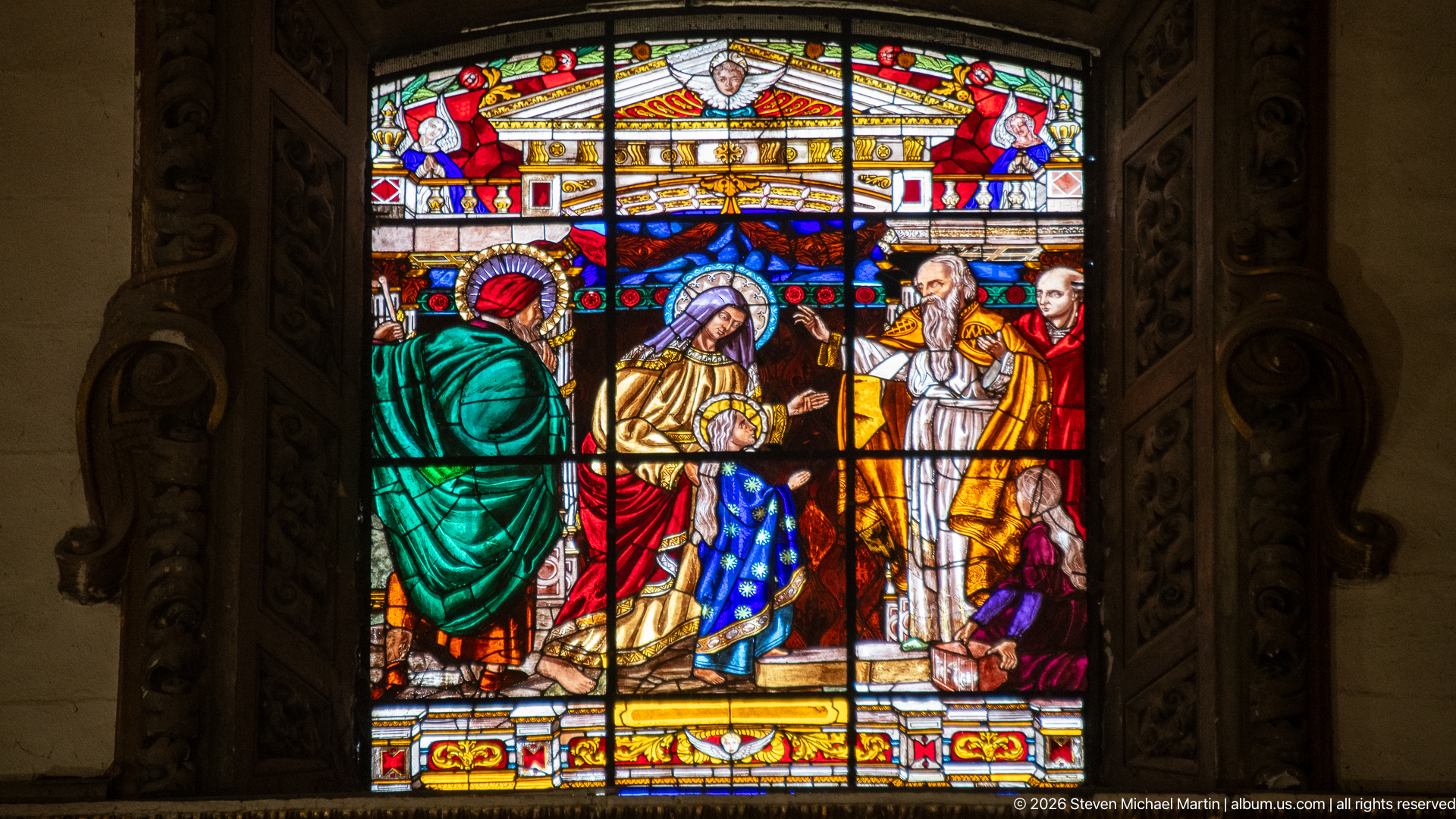
A woman in a blue mantle stands near the center of the window, surrounded by robed figures and a kneeling person in red. A dove and red-and-gold decorative band crown the composition, while a dark object partly blocks the lower foreground. The full panel preserves the scene’s arrangement of figures and upper ornament, with the obstruction clearly visible along the bottom edge.
Caption
A woman in a blue mantle stands near the center of the window, surrounded by robed figures and a kneeling person in red. A dove and red-and-gold decorative band crown the composition, while a dark object partly blocks the lower foreground. The full panel preserves the scene’s arrangement of figures and upper ornament, with the obstruction clearly visible along the bottom edge.
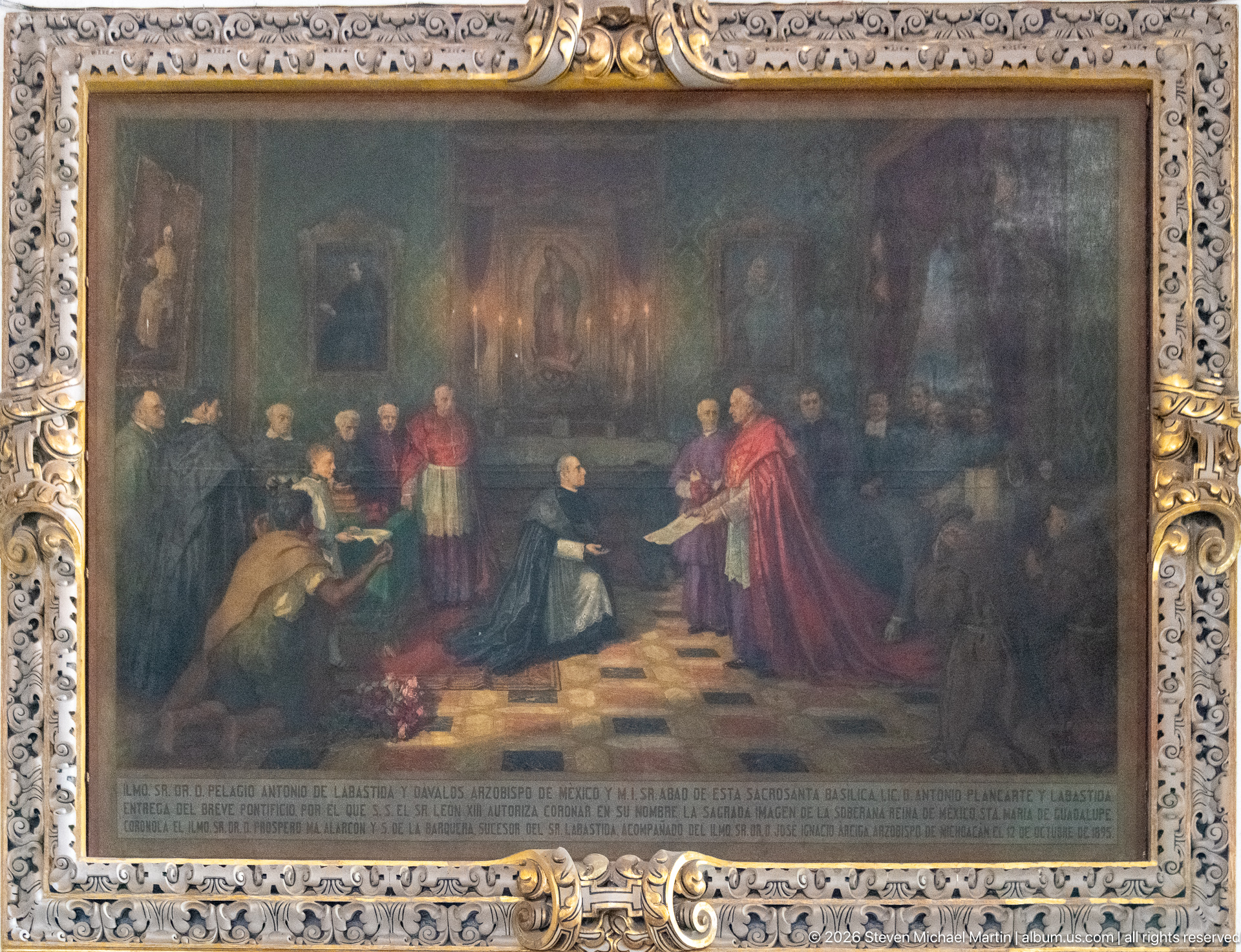
Inside an ornate carved frame, a red-robed cleric extends a document toward a kneeling man while other figures watch from both sides. The painted interior includes a checkerboard floor and shadowed architectural setting; a small line of Spanish text runs along the lower edge. Its presentation scene and formal frame make this a historical painting rather than a stained-glass panel.
Caption
Inside an ornate carved frame, a red-robed cleric extends a document toward a kneeling man while other figures watch from both sides. The painted interior includes a checkerboard floor and shadowed architectural setting; a small line of Spanish text runs along the lower edge. Its presentation scene and formal frame make this a historical painting rather than a stained-glass panel.
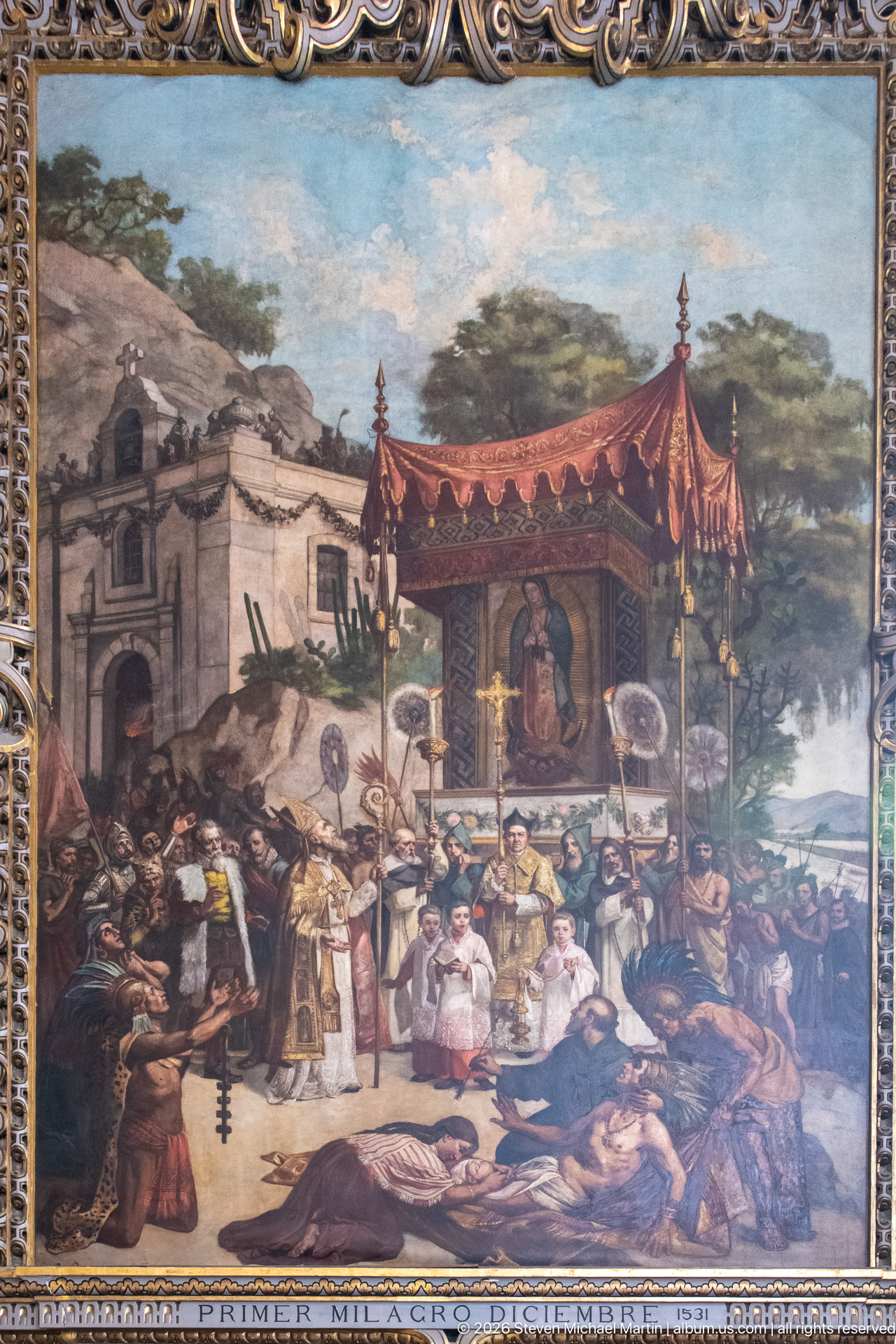
A painted crowd converges beneath a red canopy before a small shrine, with a church façade and a tree-covered hillside behind them. Figures kneel or lie across the foreground while others gather around the central devotional scene. The lower border reads “PRIMER MILAGRO DICIEMBRE 1531,” anchoring the image to a specific miracle narrative within the basilica’s visual program.
Caption
A painted crowd converges beneath a red canopy before a small shrine, with a church façade and a tree-covered hillside behind them. Figures kneel or lie across the foreground while others gather around the central devotional scene. The lower border reads “PRIMER MILAGRO DICIEMBRE 1531,” anchoring the image to a specific miracle narrative within the basilica’s visual program.
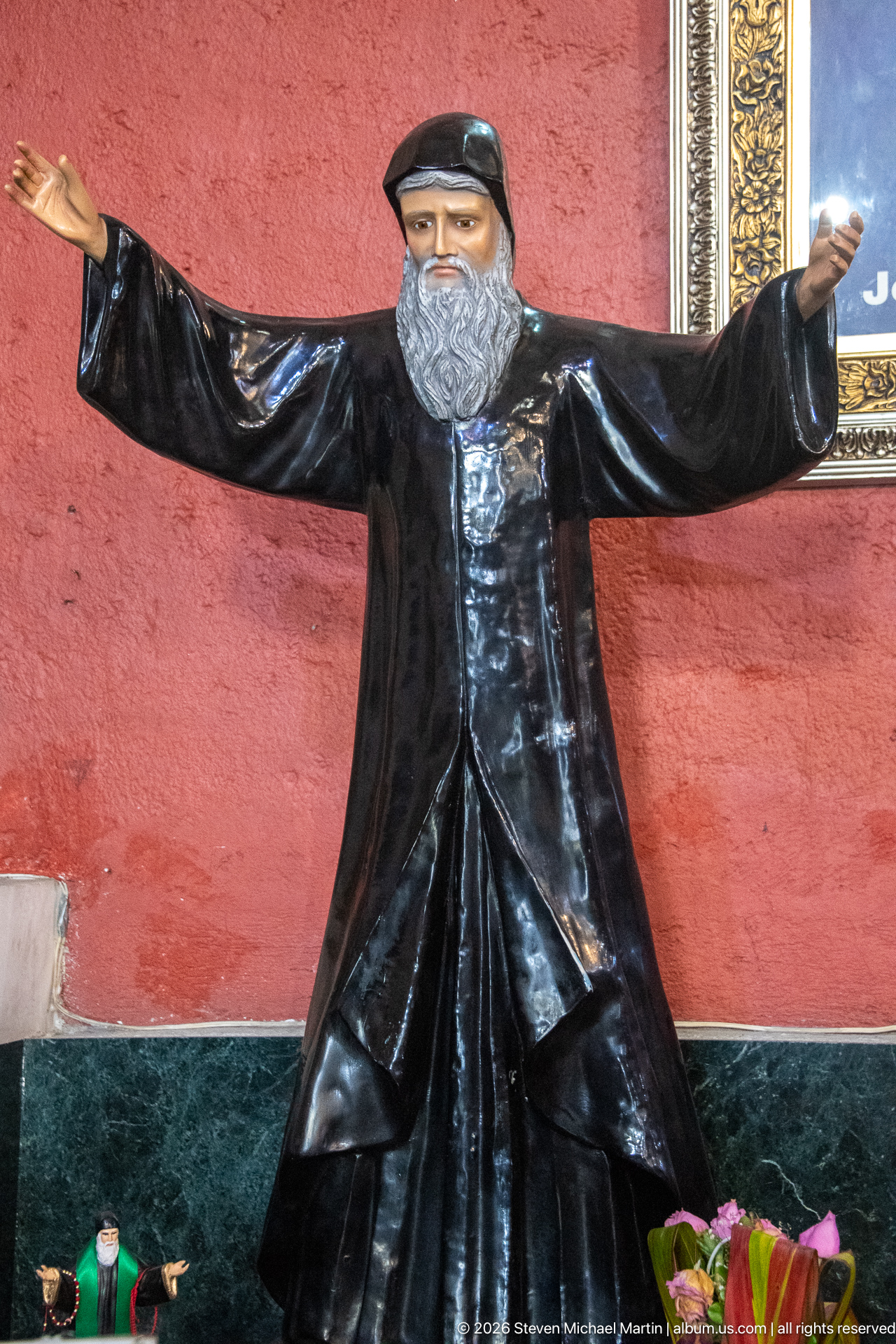
A life-size bearded male figure stands against a red wall, dressed in a glossy black robe and cap with both arms extended outward. A smaller green-robed figure and flowers are visible near the base, while part of a framed religious image enters at the right edge. No legible identifying label appears, so the figure is described by its visible clothing and pose.
Caption
A life-size bearded male figure stands against a red wall, dressed in a glossy black robe and cap with both arms extended outward. A smaller green-robed figure and flowers are visible near the base, while part of a framed religious image enters at the right edge. No legible identifying label appears, so the figure is described by its visible clothing and pose.
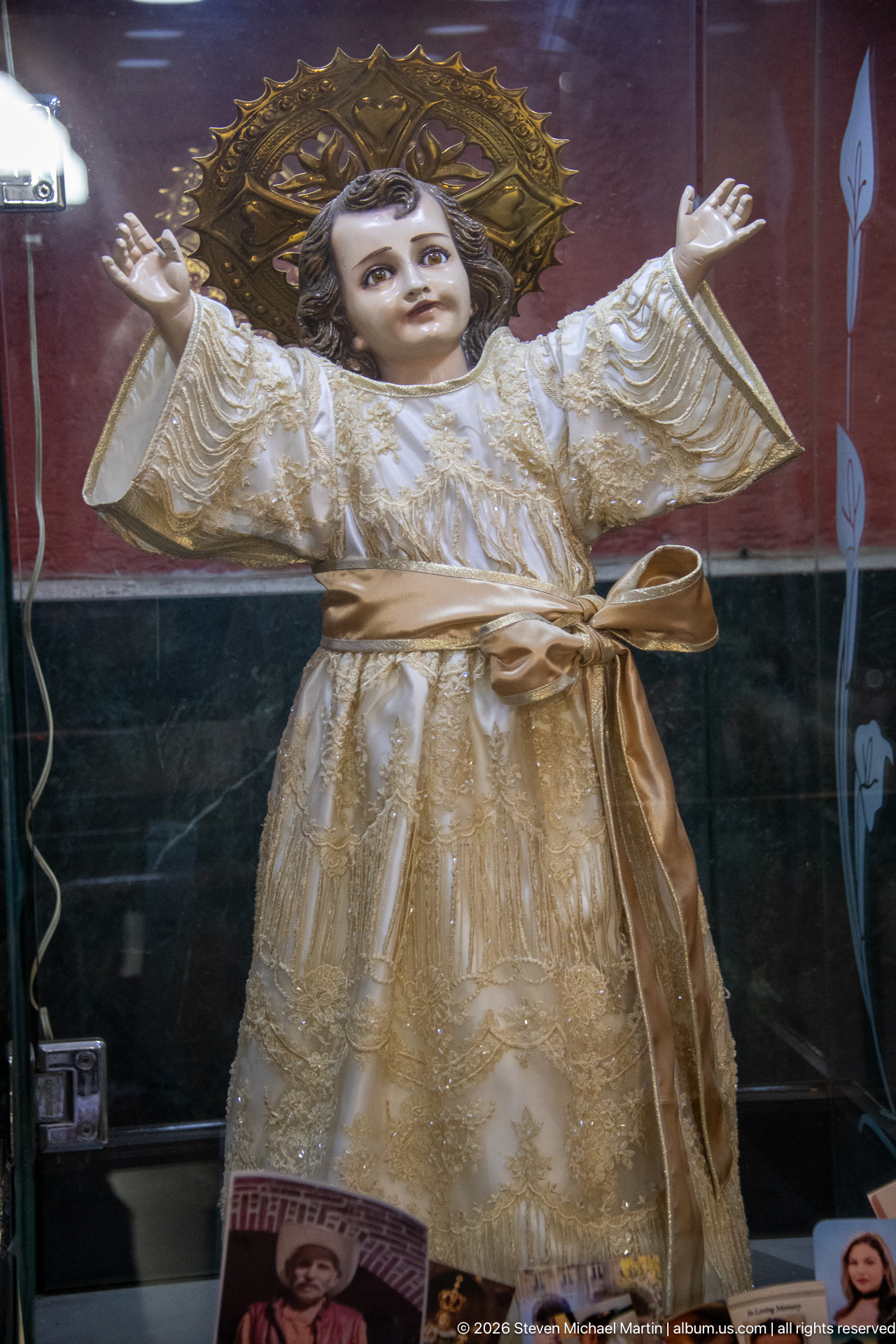
An infant Jesus figure stands with both arms raised, wearing an ornate ivory and gold robe tied with a broad sash. A halo-like gold ornament frames the head, and the figure is displayed behind glass against a red wall with devotional pictures below. The close view centers the clothing and welcoming pose, while reflections and the case edges signal a protected display.
Caption
An infant Jesus figure stands with both arms raised, wearing an ornate ivory and gold robe tied with a broad sash. A halo-like gold ornament frames the head, and the figure is displayed behind glass against a red wall with devotional pictures below. The close view centers the clothing and welcoming pose, while reflections and the case edges signal a protected display.
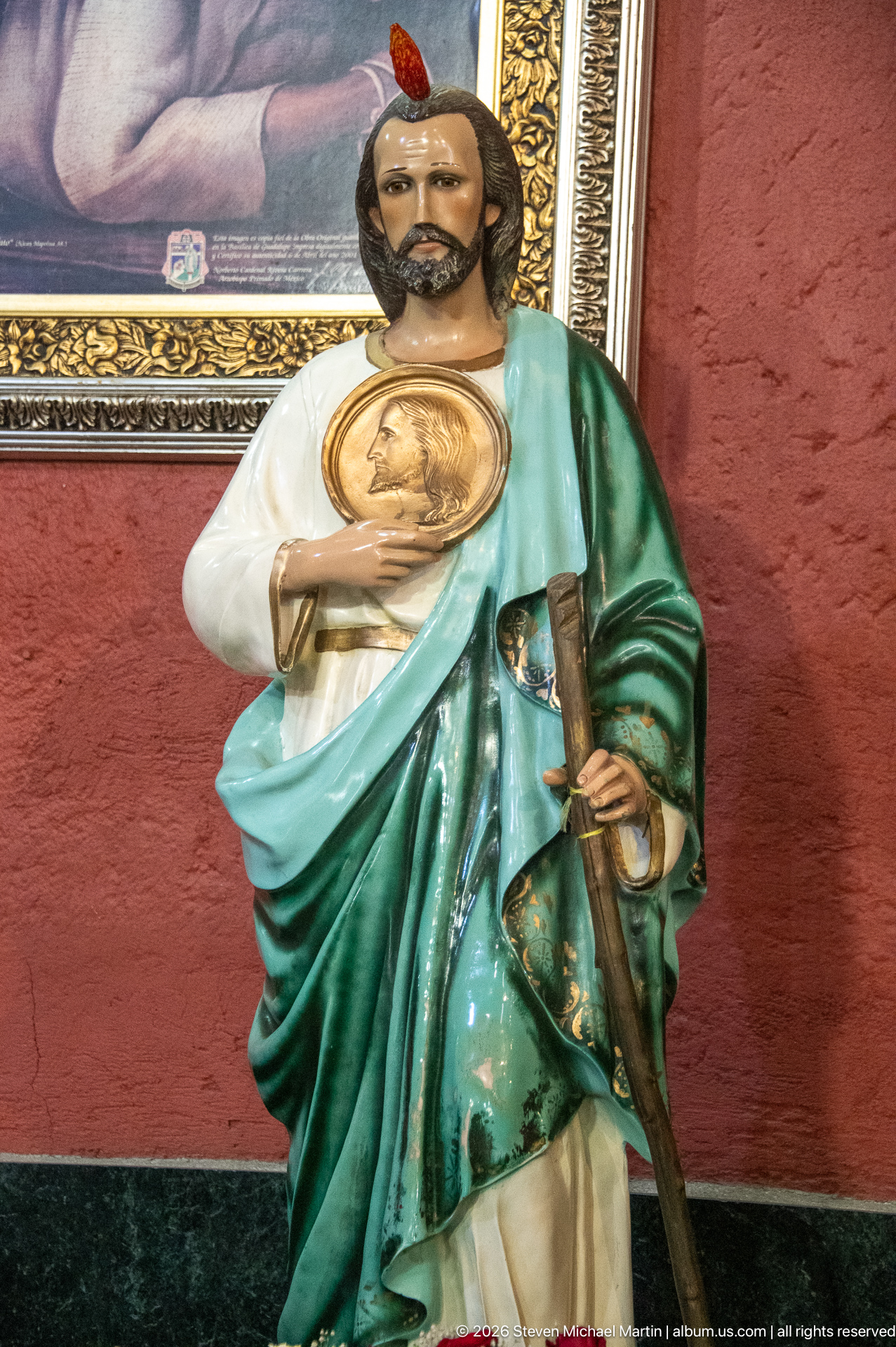
A bearded male statue wears a green mantle over a white robe and holds a round portrait medallion at chest height. A long staff rests diagonally beside him, and a small red ornament sits above his head. The red wall and ornate framed picture behind the figure suggest a devotional display, but no visible inscription identifies the saint by name.
Caption
A bearded male statue wears a green mantle over a white robe and holds a round portrait medallion at chest height. A long staff rests diagonally beside him, and a small red ornament sits above his head. The red wall and ornate framed picture behind the figure suggest a devotional display, but no visible inscription identifies the saint by name.
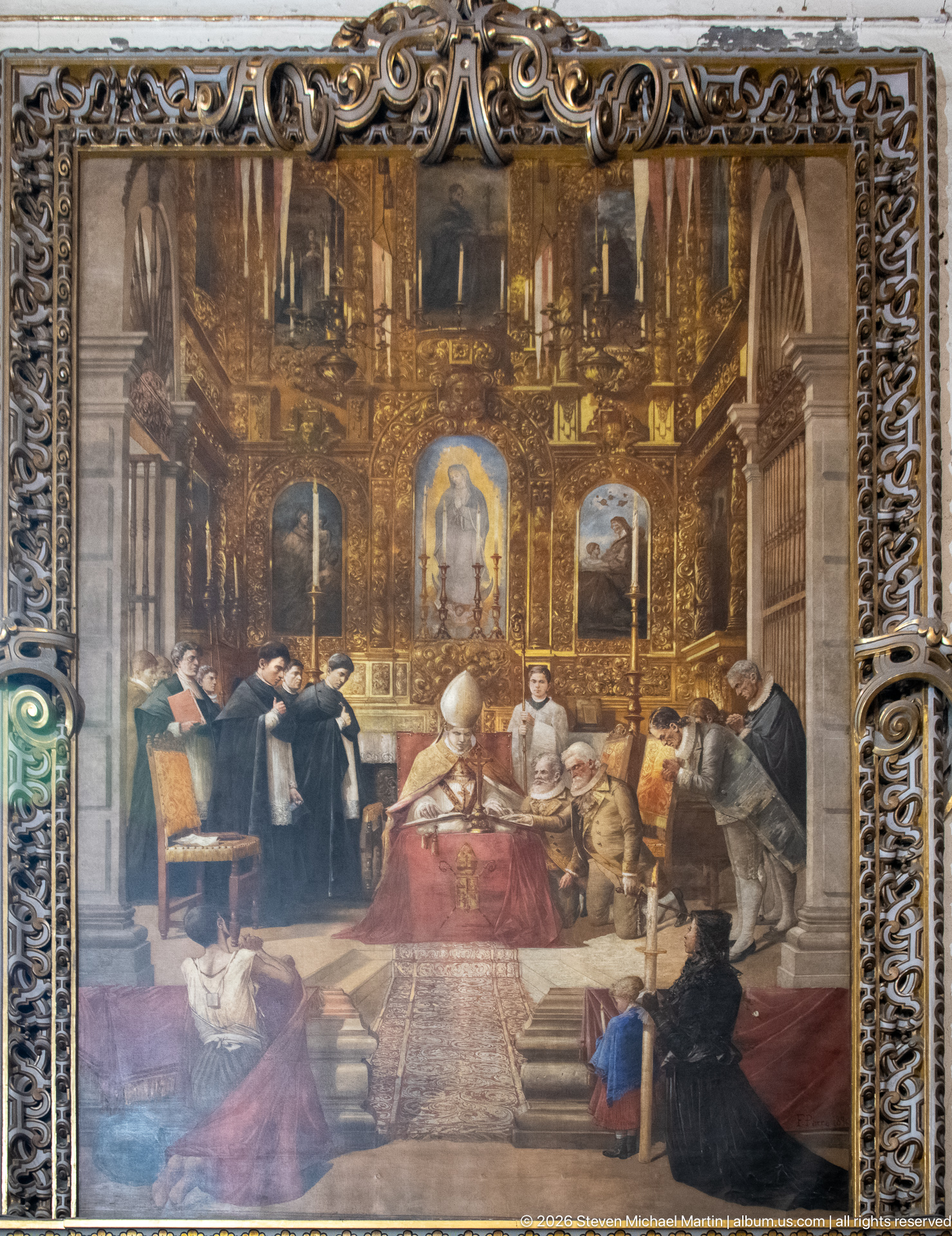
A large framed painting presents a crowded gathering inside an elaborate hall lined with gilded altarpieces and tall architectural openings. Several figures cluster around a seated person near the center, while others kneel or watch from the foreground. The broad interior composition gives the event a ceremonial scale; the proof-sheet image does not make a specific title legible.
Caption
A large framed painting presents a crowded gathering inside an elaborate hall lined with gilded altarpieces and tall architectural openings. Several figures cluster around a seated person near the center, while others kneel or watch from the foreground. The broad interior composition gives the event a ceremonial scale; the proof-sheet image does not make a specific title legible.
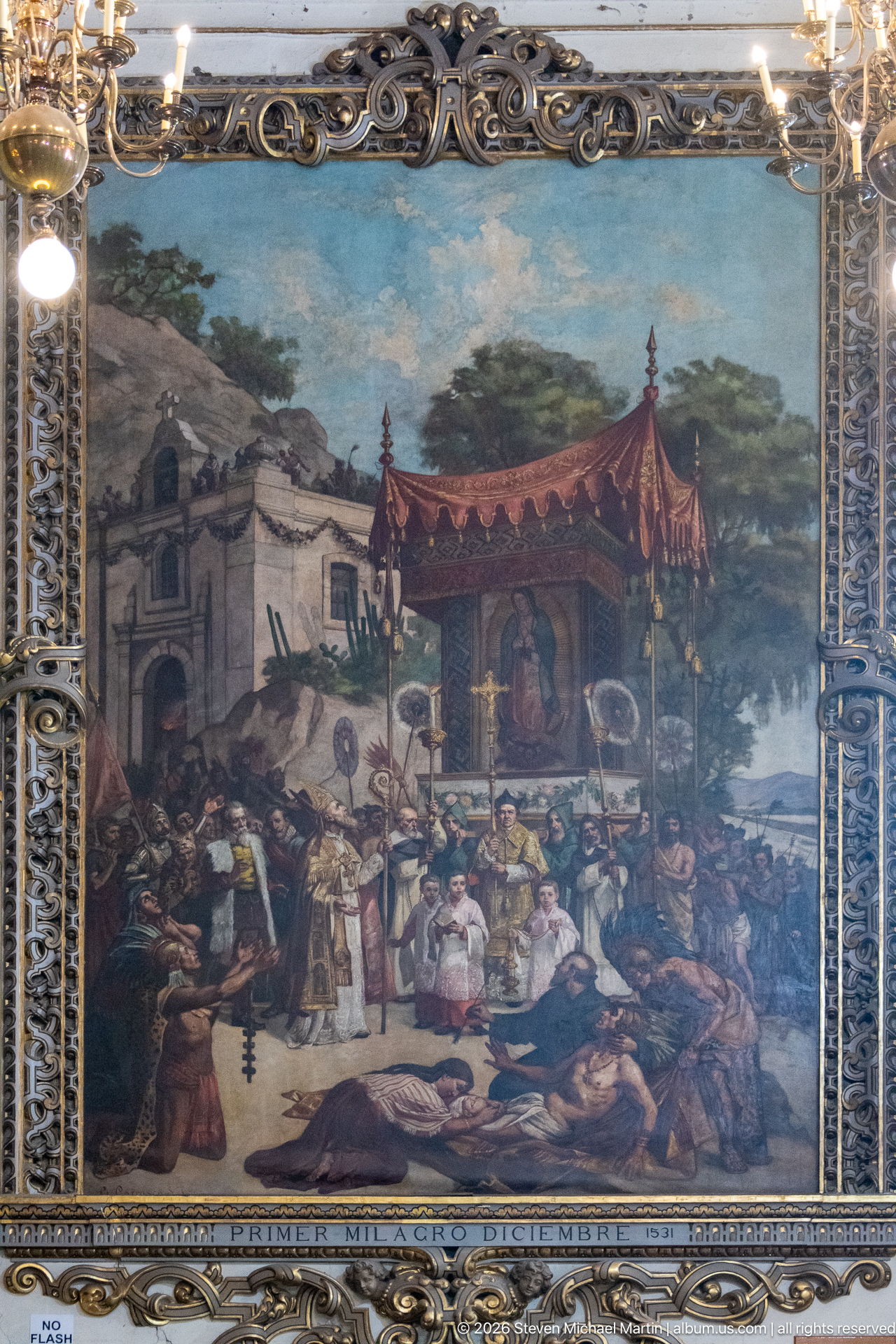
A red canopy shelters a devotional image as a dense crowd gathers across a hillside setting. A church façade, trees, and rocky slope establish the scene beyond the figures, while kneeling and reclining people fill the foreground. The lower inscription, “PRIMER MILAGRO DICIEMBRE 1531,” identifies the narrative; the wider framing also includes the ornate surrounding border.
Caption
A red canopy shelters a devotional image as a dense crowd gathers across a hillside setting. A church façade, trees, and rocky slope establish the scene beyond the figures, while kneeling and reclining people fill the foreground. The lower inscription, “PRIMER MILAGRO DICIEMBRE 1531,” identifies the narrative; the wider framing also includes the ornate surrounding border.
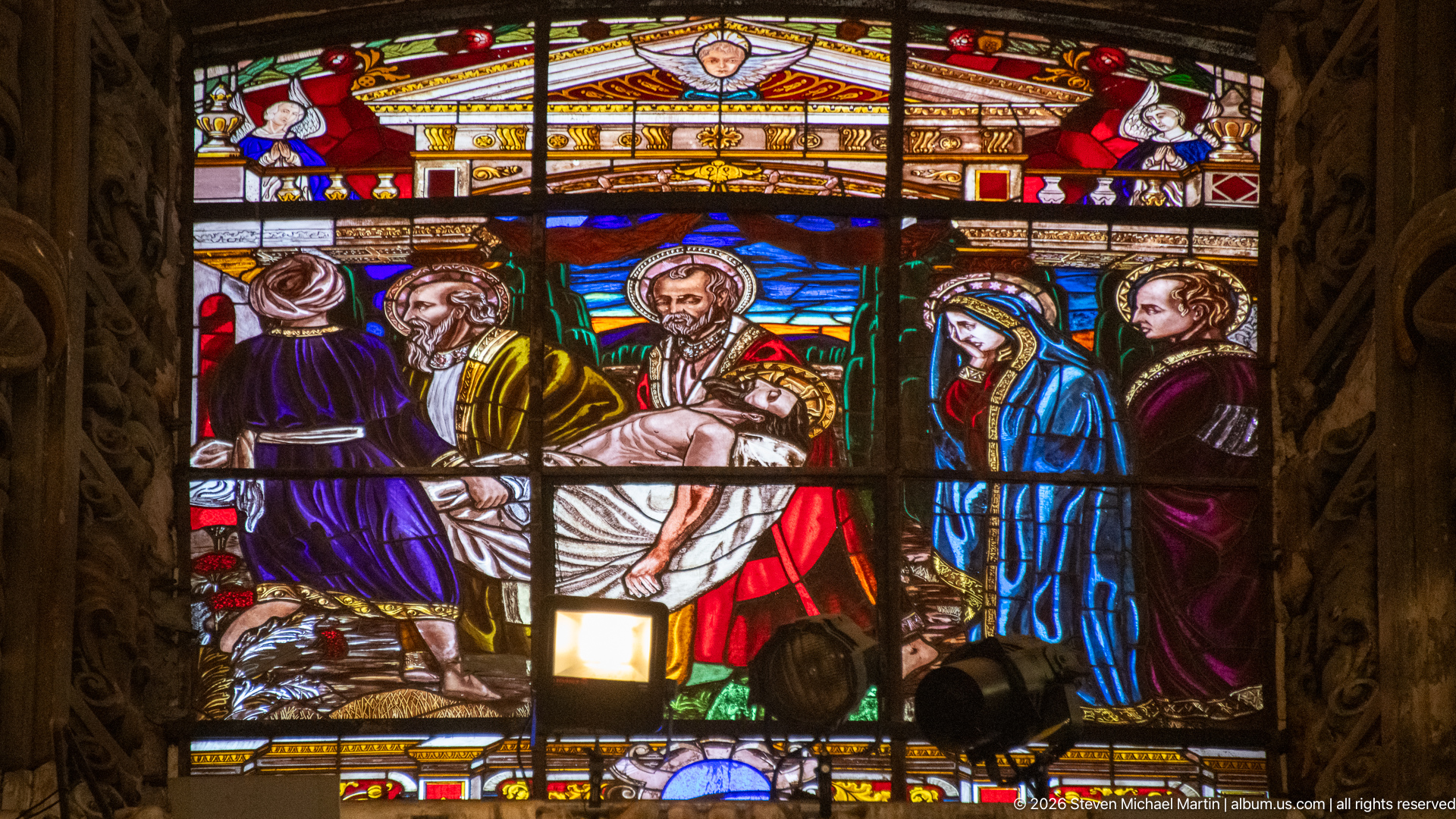
A pale body lies across the center of the window as haloed figures gather close, including a blue-mantled woman at the right. Red, blue, and gold glass fills the background, and a small lamp in the foreground obscures part of the lower panel. The mourners’ close grouping and the bright leaded glass define the scene, while the lamp anchors the view within the church interior.
Caption
A pale body lies across the center of the window as haloed figures gather close, including a blue-mantled woman at the right. Red, blue, and gold glass fills the background, and a small lamp in the foreground obscures part of the lower panel. The mourners’ close grouping and the bright leaded glass define the scene, while the lamp anchors the view within the church interior.
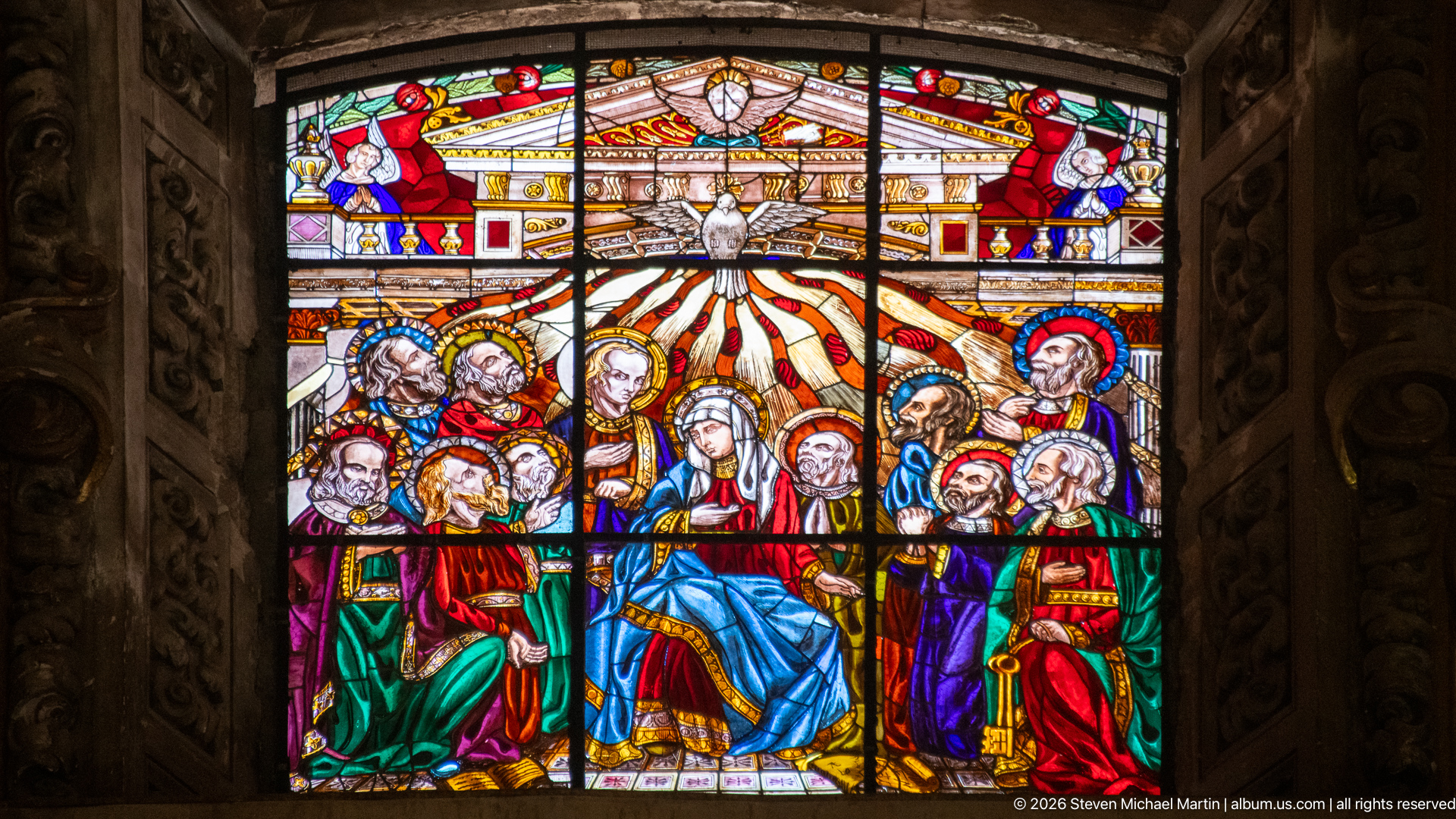
A white dove descends through radiating red and gold bands above a group of haloed figures, with Mary seated near the center. The figures’ bright garments fill the lower half of the window, framed by carved dark stone at both sides. This wider view shows the complete gathering and the vertical axis from dove to assembly.
Caption
A white dove descends through radiating red and gold bands above a group of haloed figures, with Mary seated near the center. The figures’ bright garments fill the lower half of the window, framed by carved dark stone at both sides. This wider view shows the complete gathering and the vertical axis from dove to assembly.
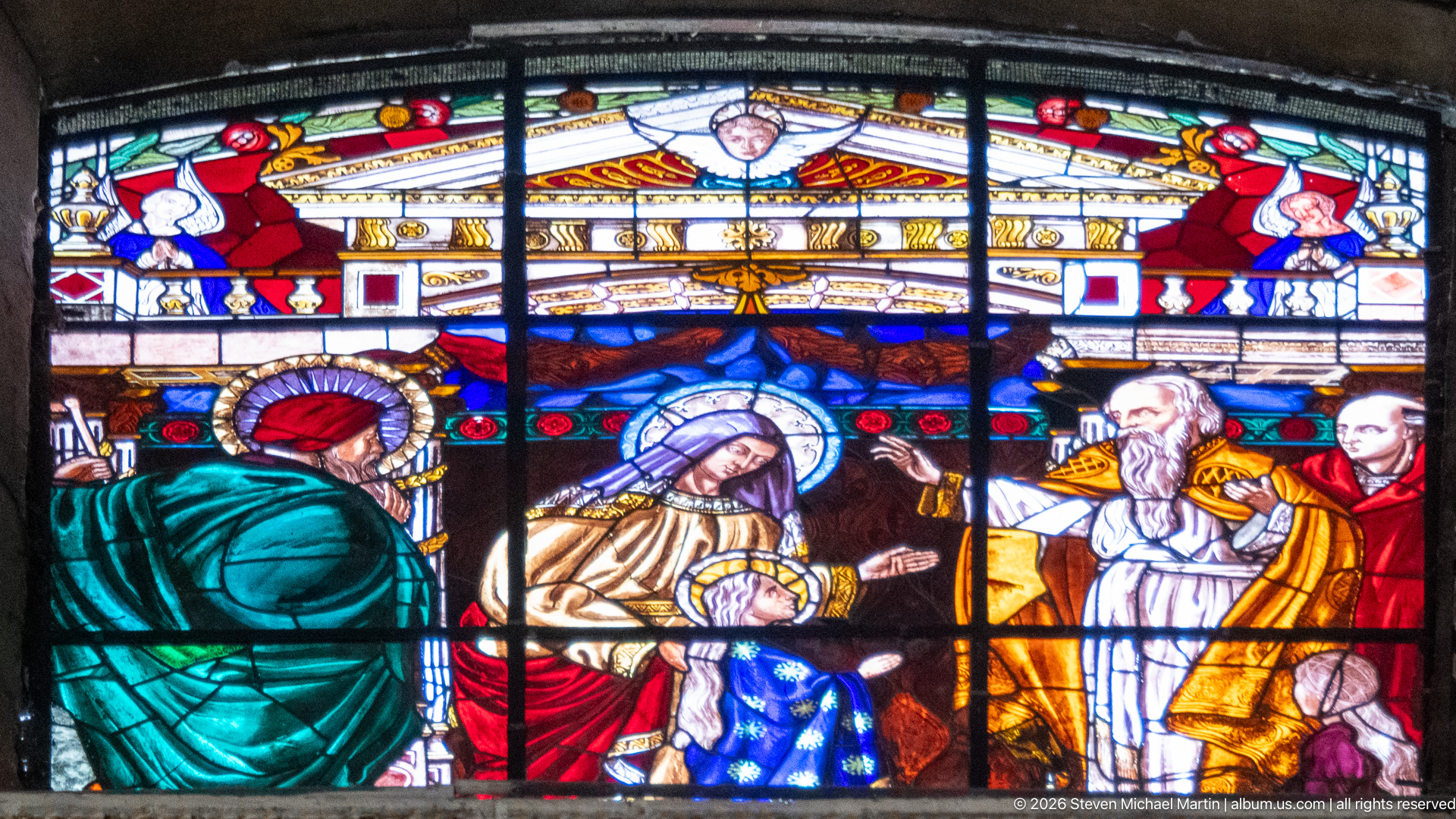
The crop centers Mary in a blue mantle, her head bowed among older haloed figures in richly colored garments. A dove remains visible in the upper register beneath a red-and-gold canopy, while heavy lead lines cross the foreground. Faces, gestures, and the contrast of blue, red, and gold glass give the composition its devotional focus.
Caption
The crop centers Mary in a blue mantle, her head bowed among older haloed figures in richly colored garments. A dove remains visible in the upper register beneath a red-and-gold canopy, while heavy lead lines cross the foreground. Faces, gestures, and the contrast of blue, red, and gold glass give the composition its devotional focus.
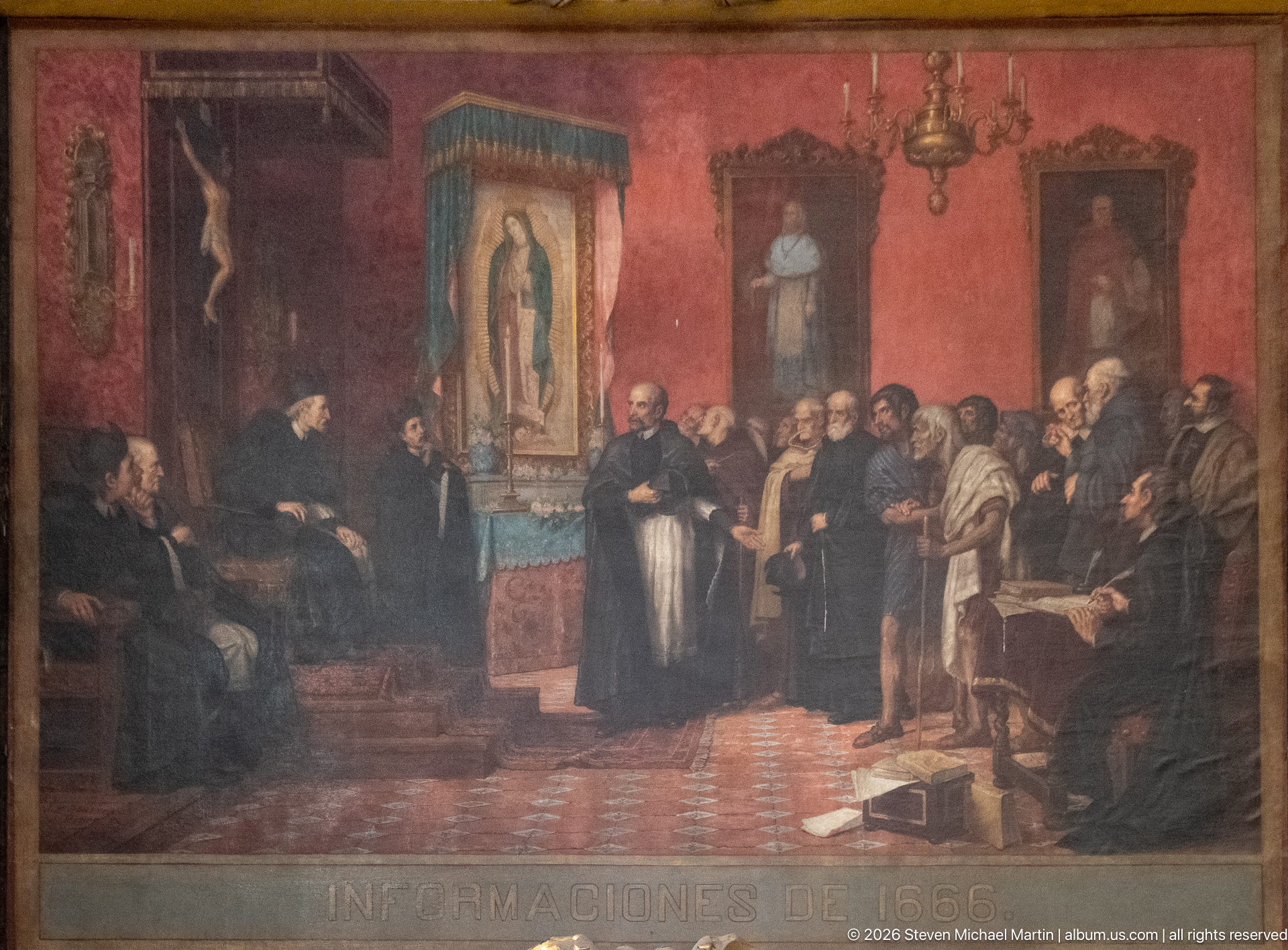
A black-robed cleric stands before a gathering of seated men in a red-walled room hung with portraits. A chandelier descends over the group, and the lower inscription reads “INFORMACIONES DE 1666.” The frontal composition records a formal meeting and its participants, with the painted date providing the clearest specific historical clue.
Caption
A black-robed cleric stands before a gathering of seated men in a red-walled room hung with portraits. A chandelier descends over the group, and the lower inscription reads “INFORMACIONES DE 1666.” The frontal composition records a formal meeting and its participants, with the painted date providing the clearest specific historical clue.
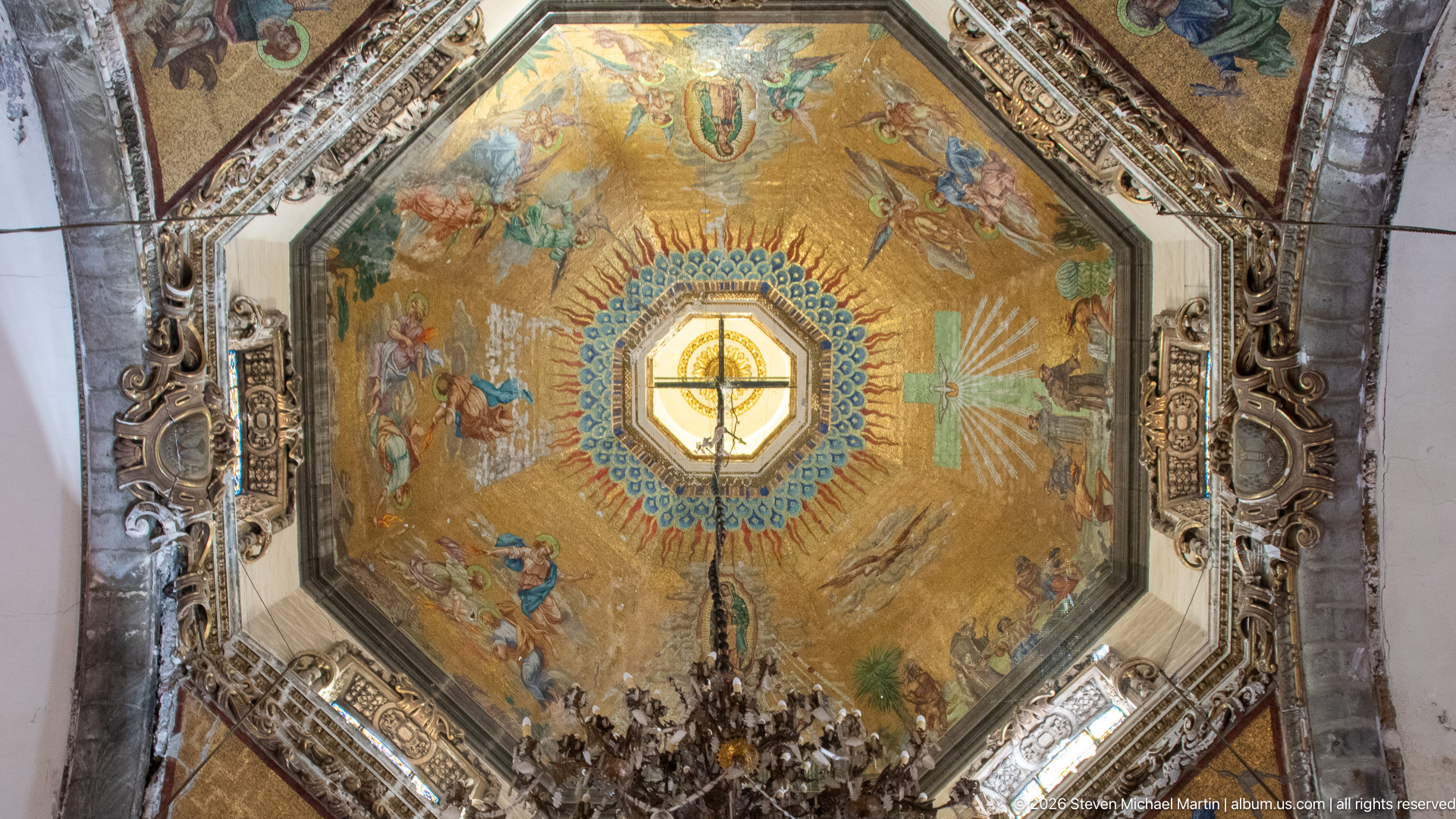
The octagonal skylight sits at the center of a radiant gold-and-blue design, with painted figures and scenes arranged around it across the dome. Ornamental ribs and a carved border frame the composition, and portions of lower windows enter along the edges. Seen from directly below, the image makes the dome’s symmetry and concentric organization more prominent than the individual figures.
Caption
The octagonal skylight sits at the center of a radiant gold-and-blue design, with painted figures and scenes arranged around it across the dome. Ornamental ribs and a carved border frame the composition, and portions of lower windows enter along the edges. Seen from directly below, the image makes the dome’s symmetry and concentric organization more prominent than the individual figures.
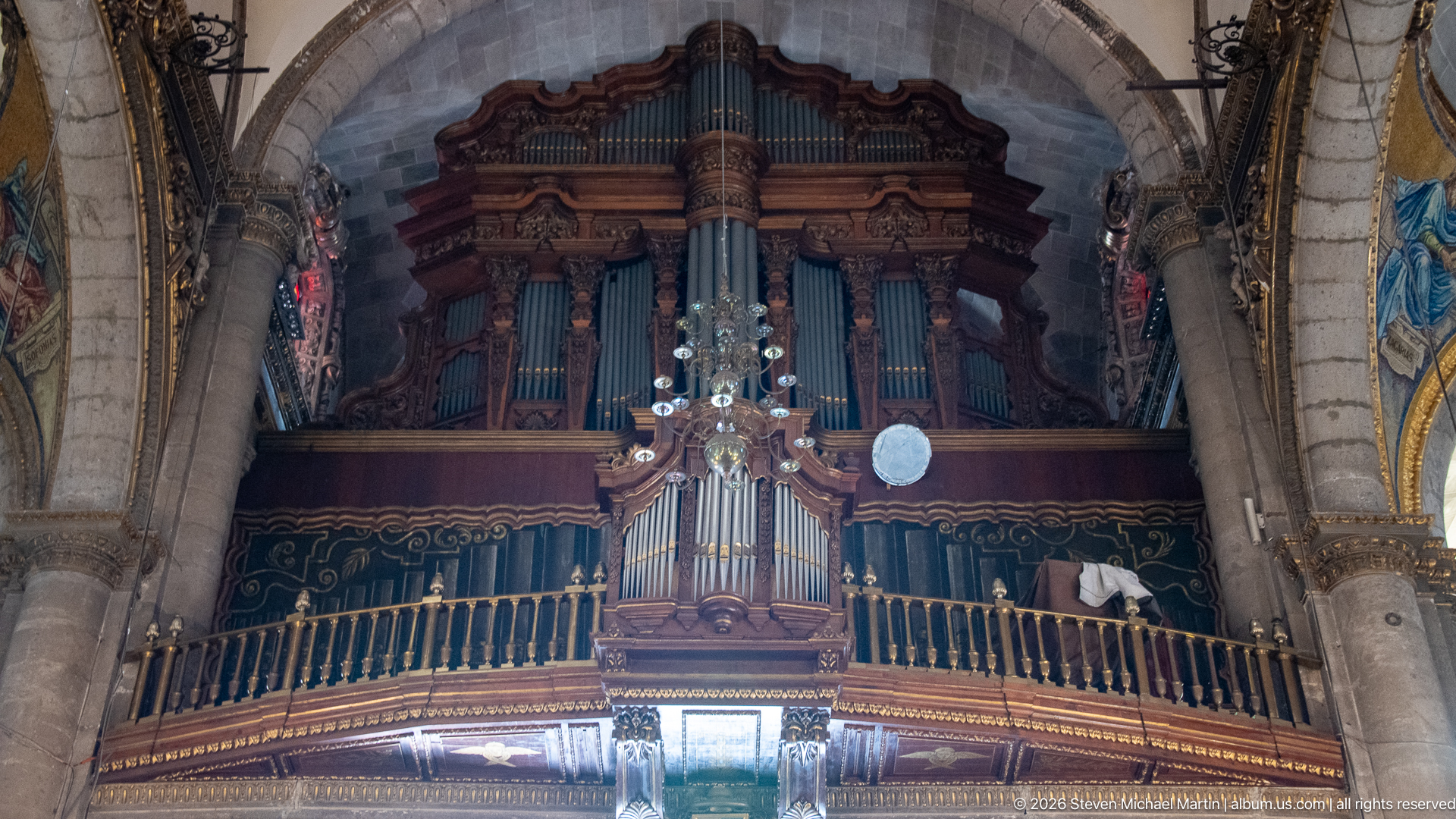
A large pipe organ occupies a carved wooden choir loft high above the church floor. Ranks of dark metal pipes rise behind a smaller central case, while a crystal chandelier hangs in front of the instrument between heavy stone piers. The upward view brings together the organ’s layered arrangement and the gallery’s balustrade, showing how music-making was built into the architecture of the sanctuary.
Caption
A large pipe organ occupies a carved wooden choir loft high above the church floor. Ranks of dark metal pipes rise behind a smaller central case, while a crystal chandelier hangs in front of the instrument between heavy stone piers. The upward view brings together the organ’s layered arrangement and the gallery’s balustrade, showing how music-making was built into the architecture of the sanctuary.
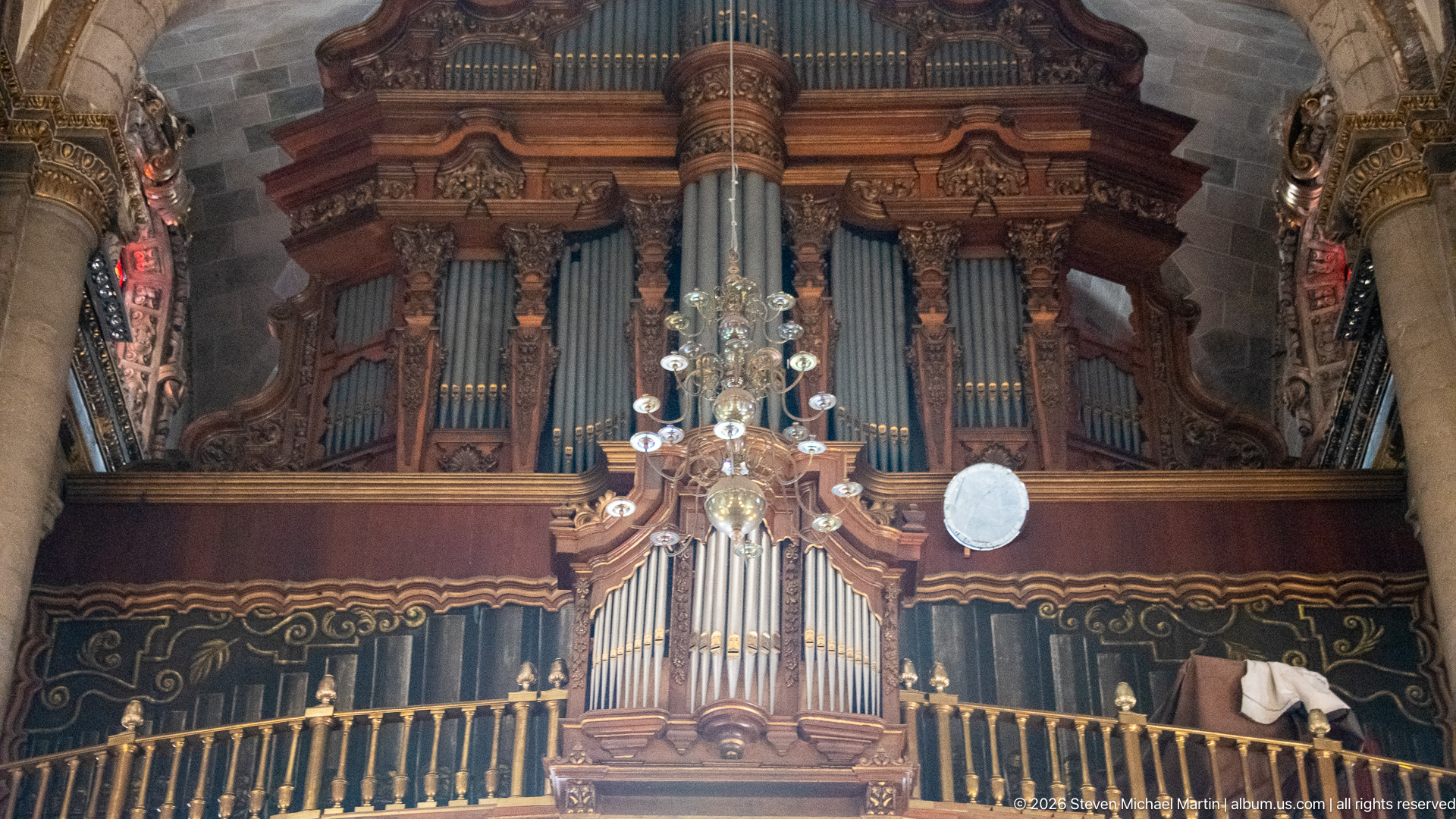
The projecting organ case sits at the center, with bright vertical pipes set into a richly carved wooden surround. Larger banks of pipes and ornamental panels fill the choir loft behind it, and a chandelier overlaps the instrument in the foreground. The layered arrangement reveals how the central case relates to the broader organ ensemble within the church’s carved gallery.
Caption
The projecting organ case sits at the center, with bright vertical pipes set into a richly carved wooden surround. Larger banks of pipes and ornamental panels fill the choir loft behind it, and a chandelier overlaps the instrument in the foreground. The layered arrangement reveals how the central case relates to the broader organ ensemble within the church’s carved gallery.
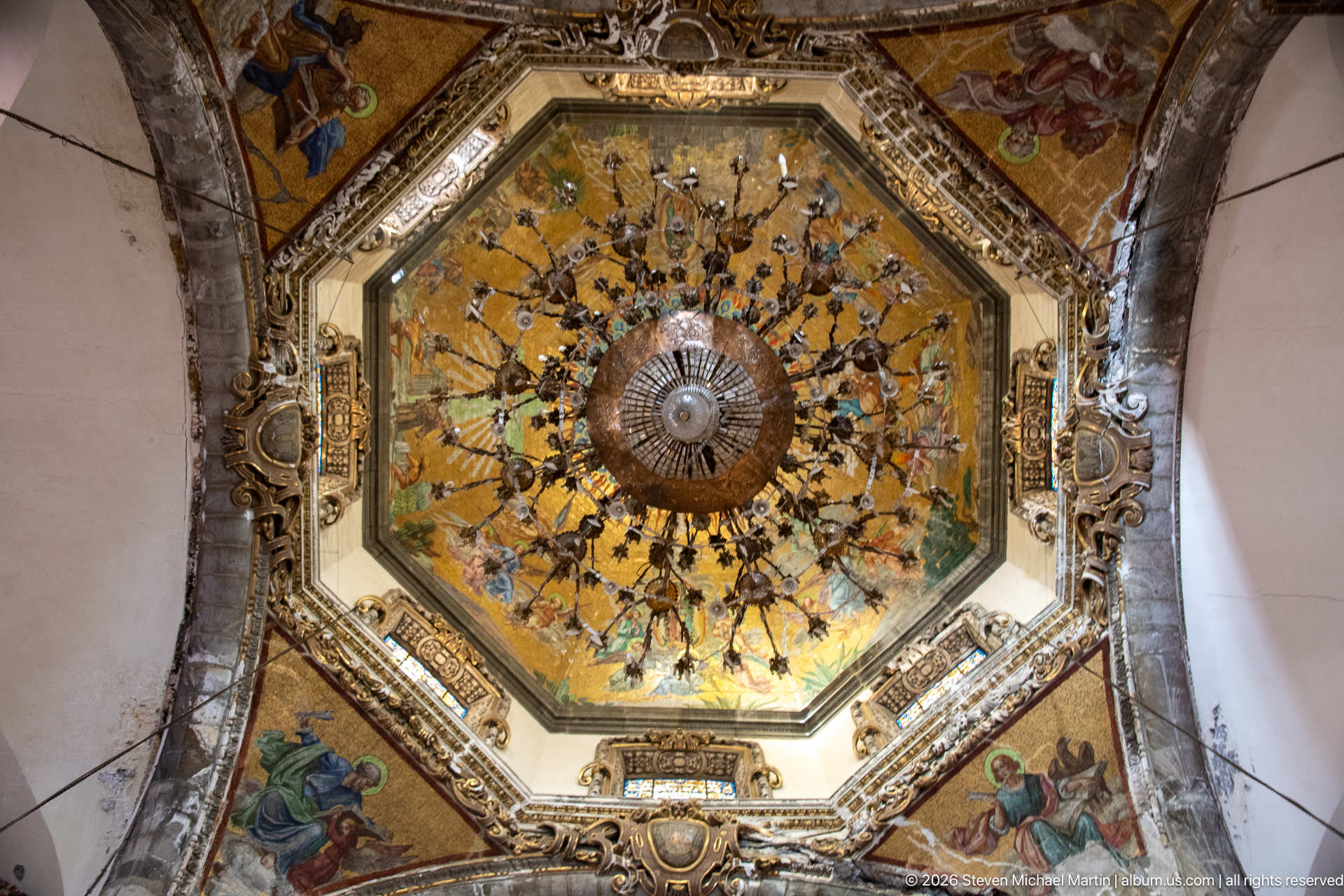
A large chandelier hangs beneath an octagonal painted dome filled with angels and other religious figures against a warm gold ground. The central fixture anchors a radial arrangement of arms and lights, while elaborate borders and adjacent painted vault sections connect the dome to the surrounding church interior. This close upward view emphasizes the ceiling’s intricate organization and the chandelier’s scale within it.
Caption
A large chandelier hangs beneath an octagonal painted dome filled with angels and other religious figures against a warm gold ground. The central fixture anchors a radial arrangement of arms and lights, while elaborate borders and adjacent painted vault sections connect the dome to the surrounding church interior. This close upward view emphasizes the ceiling’s intricate organization and the chandelier’s scale within it.
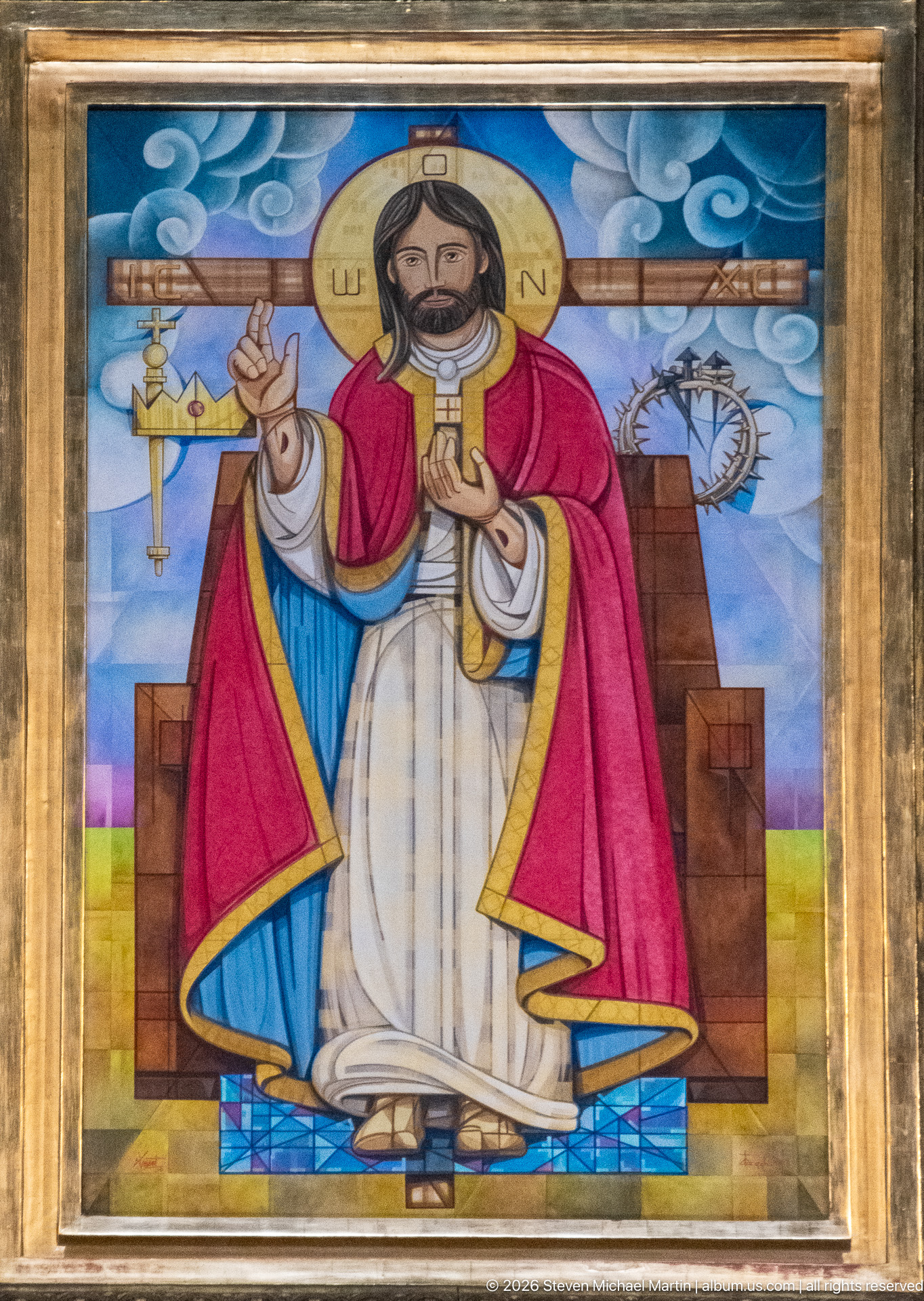
A brightly colored stained-glass panel presents a seated, haloed Christ in a crimson mantle, raising one hand in blessing and holding a globe in the other. A cross, crown of thorns, and other Passion symbols surround the figure against blue and cloud-patterned glass. Gold framing encloses the panel, whose saturated color contrasts with the subdued stonework around it.
Caption
A brightly colored stained-glass panel presents a seated, haloed Christ in a crimson mantle, raising one hand in blessing and holding a globe in the other. A cross, crown of thorns, and other Passion symbols surround the figure against blue and cloud-patterned glass. Gold framing encloses the panel, whose saturated color contrasts with the subdued stonework around it.
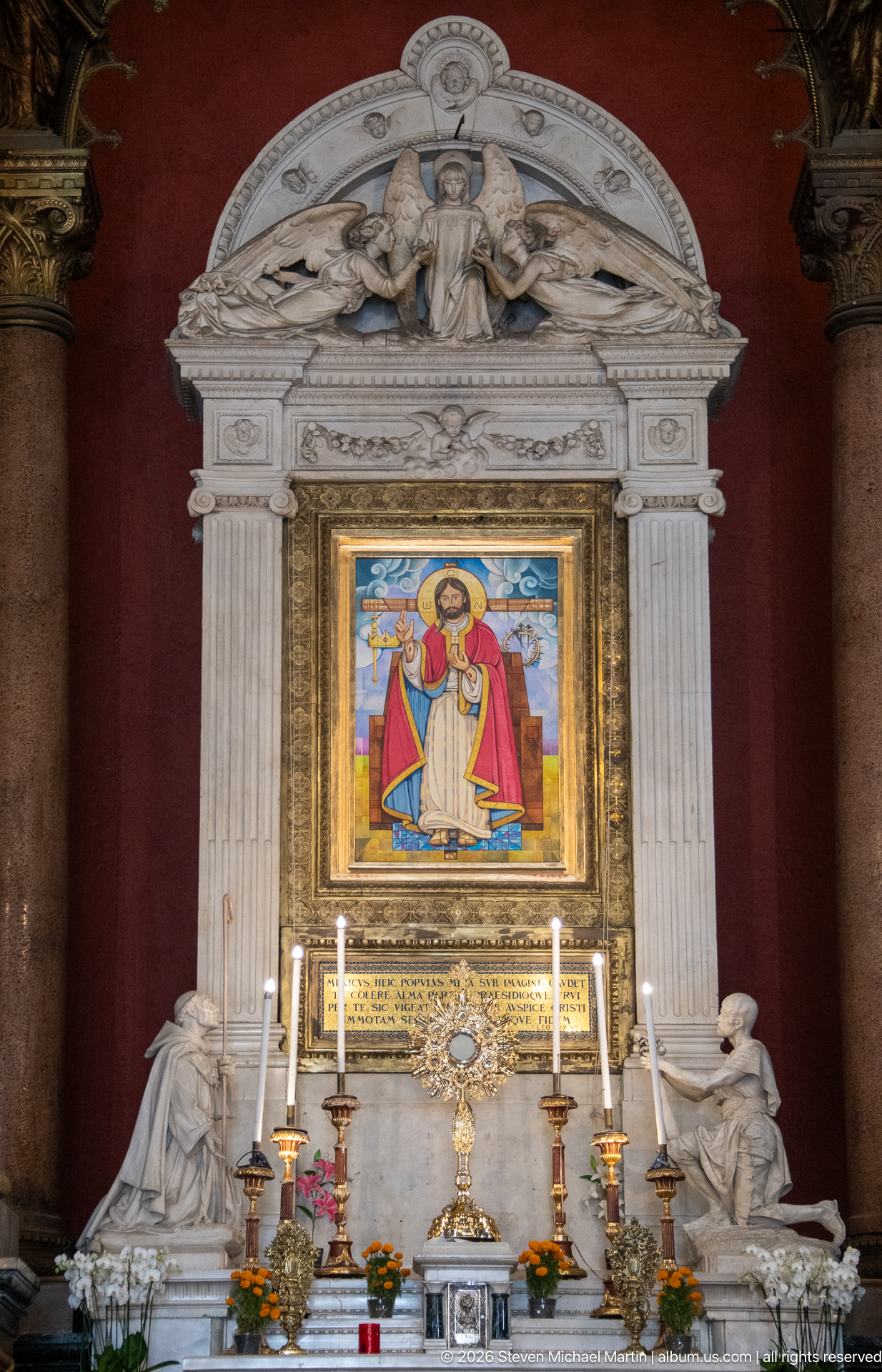
A white stone canopy frames a colorful image of Christ above an altar set with candles and a central gold vessel. Reclining figures and angels fill the sculpted pediment, while additional carved figures rest at the lower corners against a deep red wall. The frontal composition reveals the altar as a complete devotional arrangement, linking the image, sculptural surround, and objects used in worship.
Caption
A white stone canopy frames a colorful image of Christ above an altar set with candles and a central gold vessel. Reclining figures and angels fill the sculpted pediment, while additional carved figures rest at the lower corners against a deep red wall. The frontal composition reveals the altar as a complete devotional arrangement, linking the image, sculptural surround, and objects used in worship.
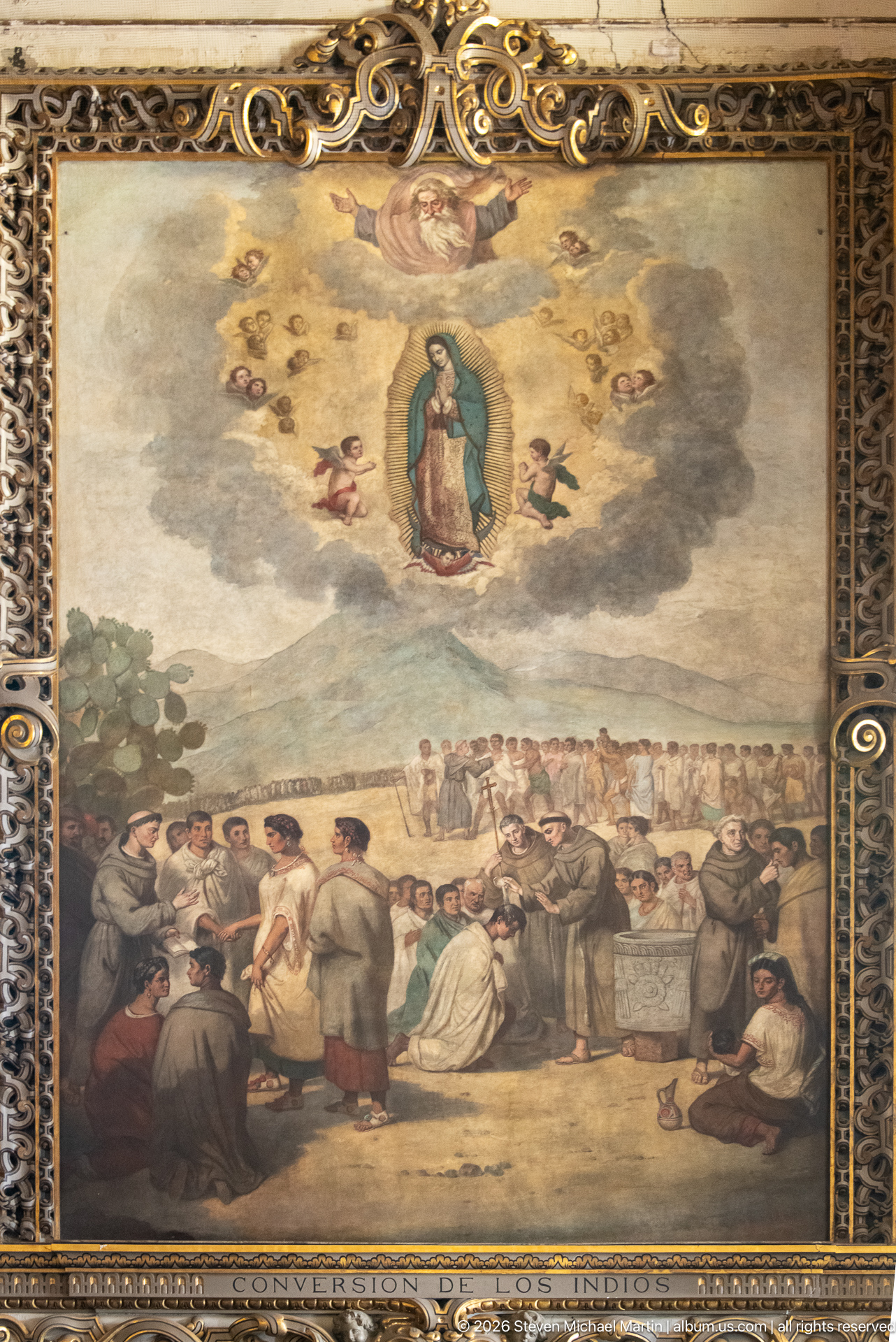
The mural’s inscription, “Conversión de los Indios,” identifies the subject of this large religious scene. Above, the Virgin of Guadalupe appears among clouds and angels; below, friars gather Indigenous men and women around a baptismal font. The painting’s stacked composition links the celestial apparition to a collective conversion scene, while its ornate dark frame and pale stone surround establish its place inside the church.
Caption
The mural’s inscription, “Conversión de los Indios,” identifies the subject of this large religious scene. Above, the Virgin of Guadalupe appears among clouds and angels; below, friars gather Indigenous men and women around a baptismal font. The painting’s stacked composition links the celestial apparition to a collective conversion scene, while its ornate dark frame and pale stone surround establish its place inside the church.
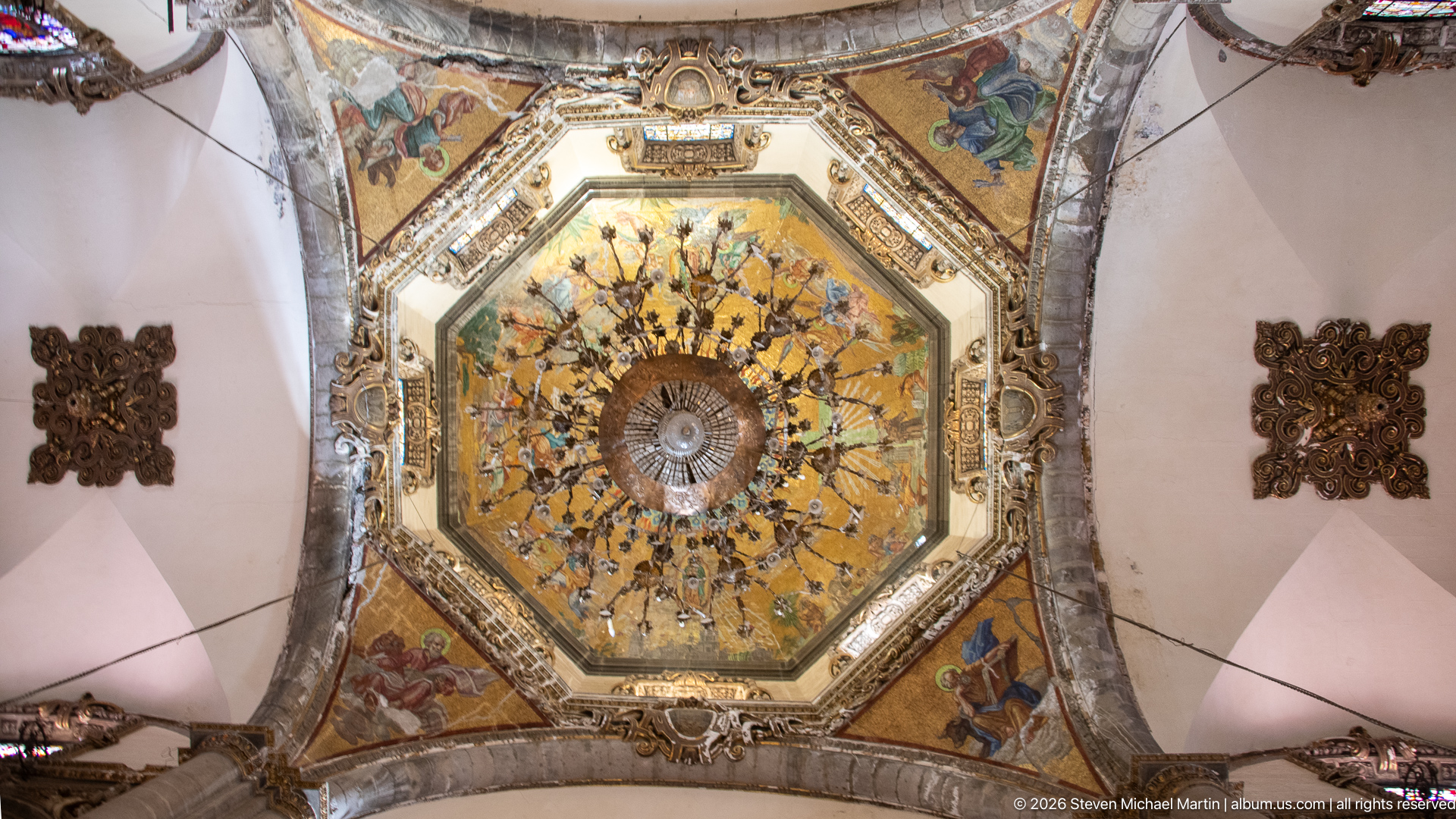
The octagonal ceiling panel is seen within a broader web of arches and painted vaults, with the chandelier centered beneath its gold ground. Figures and ornamental borders occupy the dome and the triangular sections around it; dark carved plaques appear on the pale side walls. The wider framing clarifies how the decorated ceiling fits into the church’s structural bays, rather than presenting the dome as an isolated surface.
Caption
The octagonal ceiling panel is seen within a broader web of arches and painted vaults, with the chandelier centered beneath its gold ground. Figures and ornamental borders occupy the dome and the triangular sections around it; dark carved plaques appear on the pale side walls. The wider framing clarifies how the decorated ceiling fits into the church’s structural bays, rather than presenting the dome as an isolated surface.
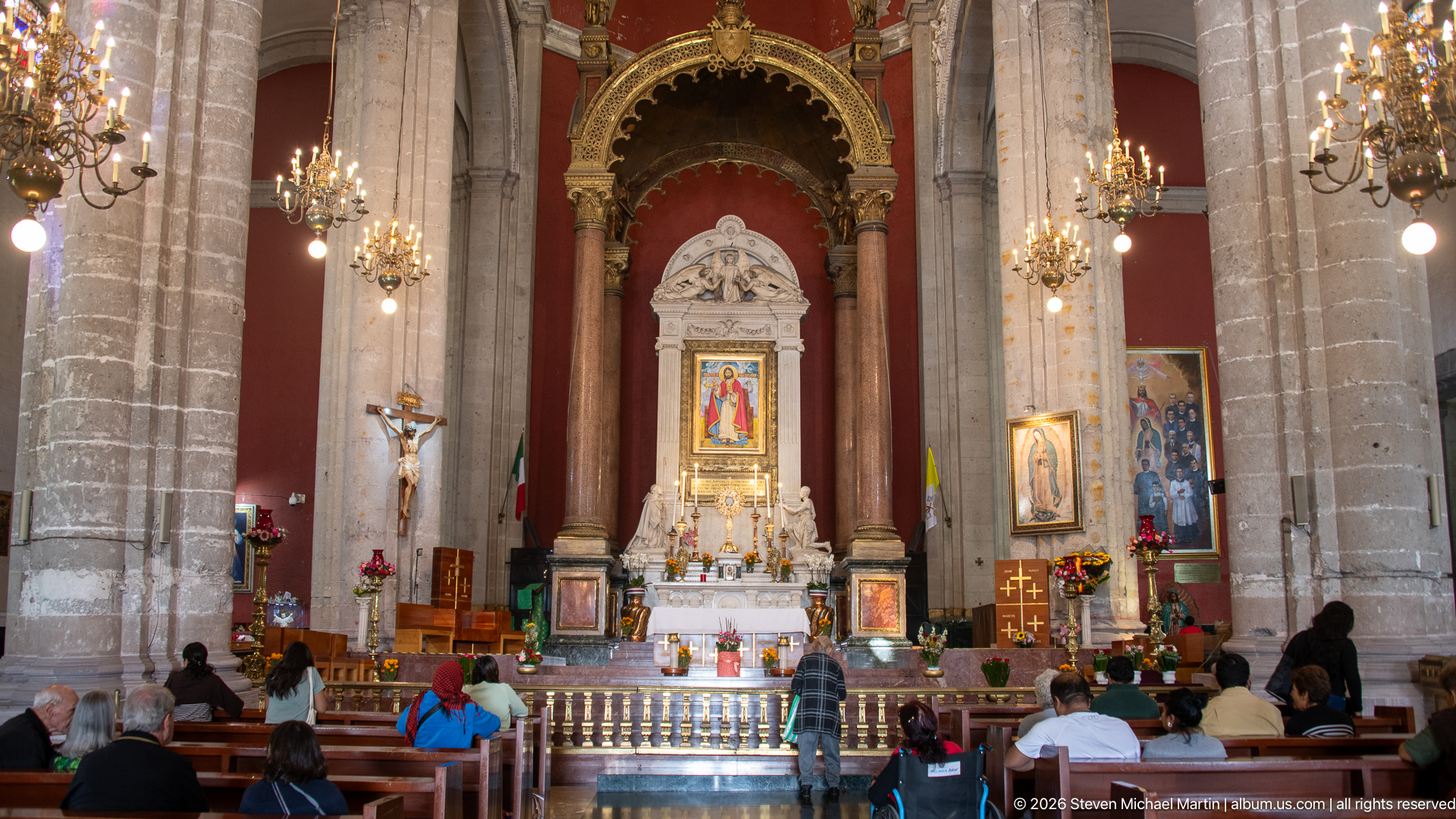
Worshippers sit and kneel facing a side altar set between massive stone piers and a deep red wall. A gold-edged canopy frames a white sculpted shrine and a small colorful image, with chandeliers and flowers brightening the surrounding space. The broad, centered view preserves the congregation as well as the altar, showing the devotional activity that gives this architectural setting its present function.
Caption
Worshippers sit and kneel facing a side altar set between massive stone piers and a deep red wall. A gold-edged canopy frames a white sculpted shrine and a small colorful image, with chandeliers and flowers brightening the surrounding space. The broad, centered view preserves the congregation as well as the altar, showing the devotional activity that gives this architectural setting its present function.
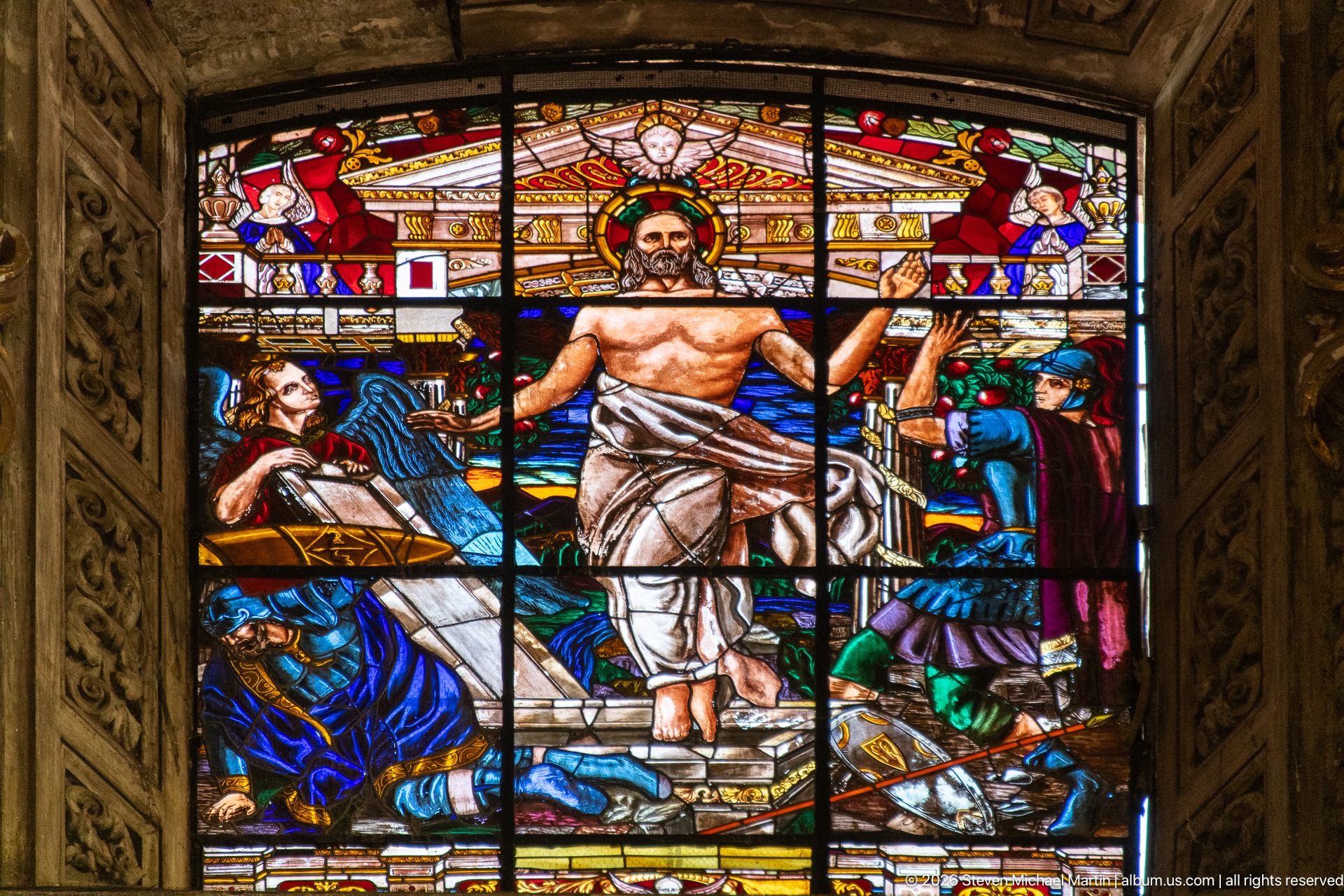
A stained-glass panel centers Christ, haloed and partially draped, amid attendants and figures associated with the Passion. Deep blue, red, and gold glass outlines the group, while a winged figure reclines at lower left and another person stands to the right. The close view lets the leaded divisions and expressive colors define the scene, separating it from the smaller, architectural view of a neighboring window.
Caption
A stained-glass panel centers Christ, haloed and partially draped, amid attendants and figures associated with the Passion. Deep blue, red, and gold glass outlines the group, while a winged figure reclines at lower left and another person stands to the right. The close view lets the leaded divisions and expressive colors define the scene, separating it from the smaller, architectural view of a neighboring window.
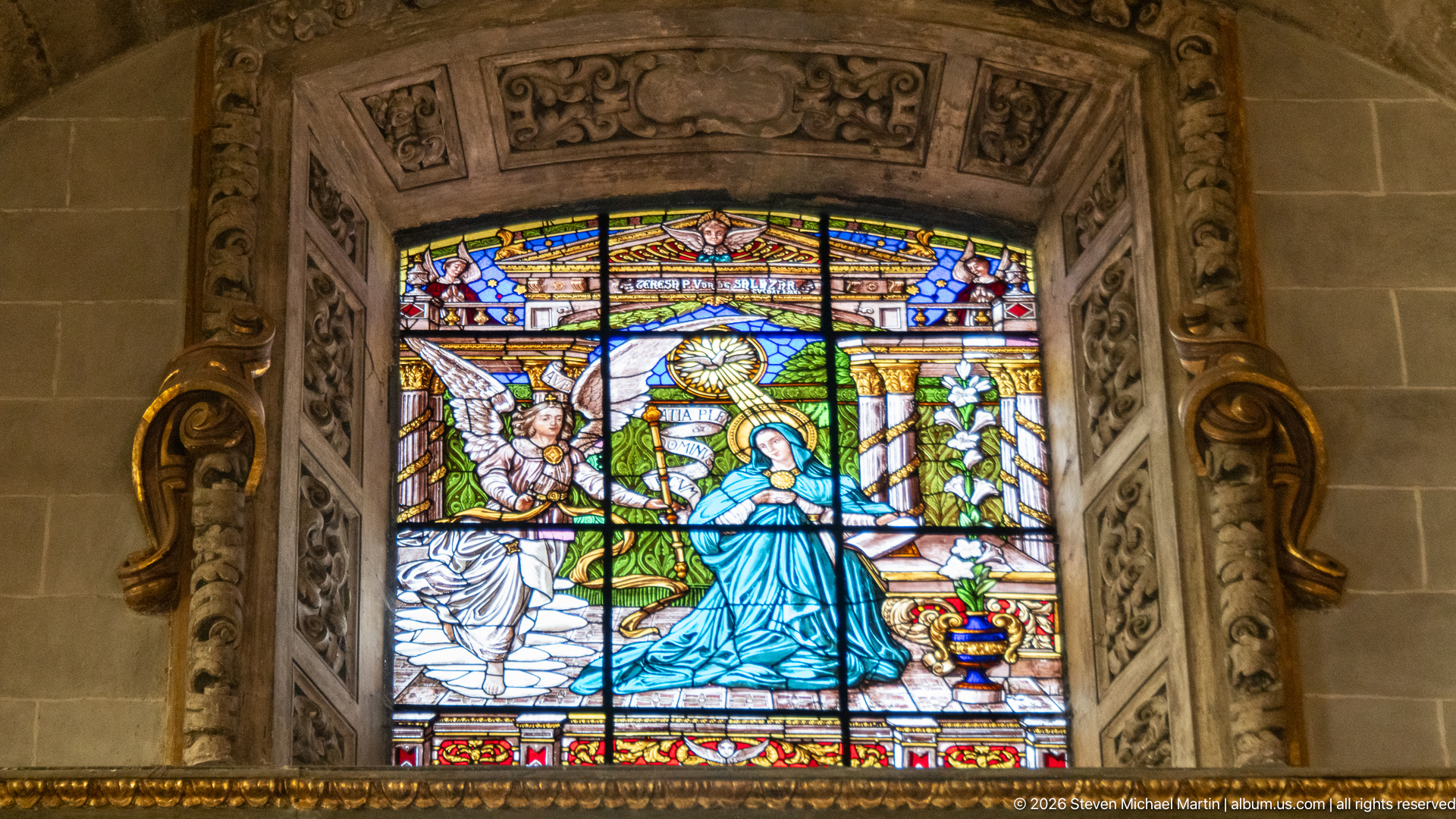
A stained-glass composition shows Mary in a blue robe kneeling as a winged angel approaches from the left, with a radiant dove above. The panel sits within a deeply carved stone opening, and its smaller scale is set off by the surrounding masonry and ornamental arch. The full-window view preserves both the sacred scene and the architectural frame that contains it.
Caption
A stained-glass composition shows Mary in a blue robe kneeling as a winged angel approaches from the left, with a radiant dove above. The panel sits within a deeply carved stone opening, and its smaller scale is set off by the surrounding masonry and ornamental arch. The full-window view preserves both the sacred scene and the architectural frame that contains it.
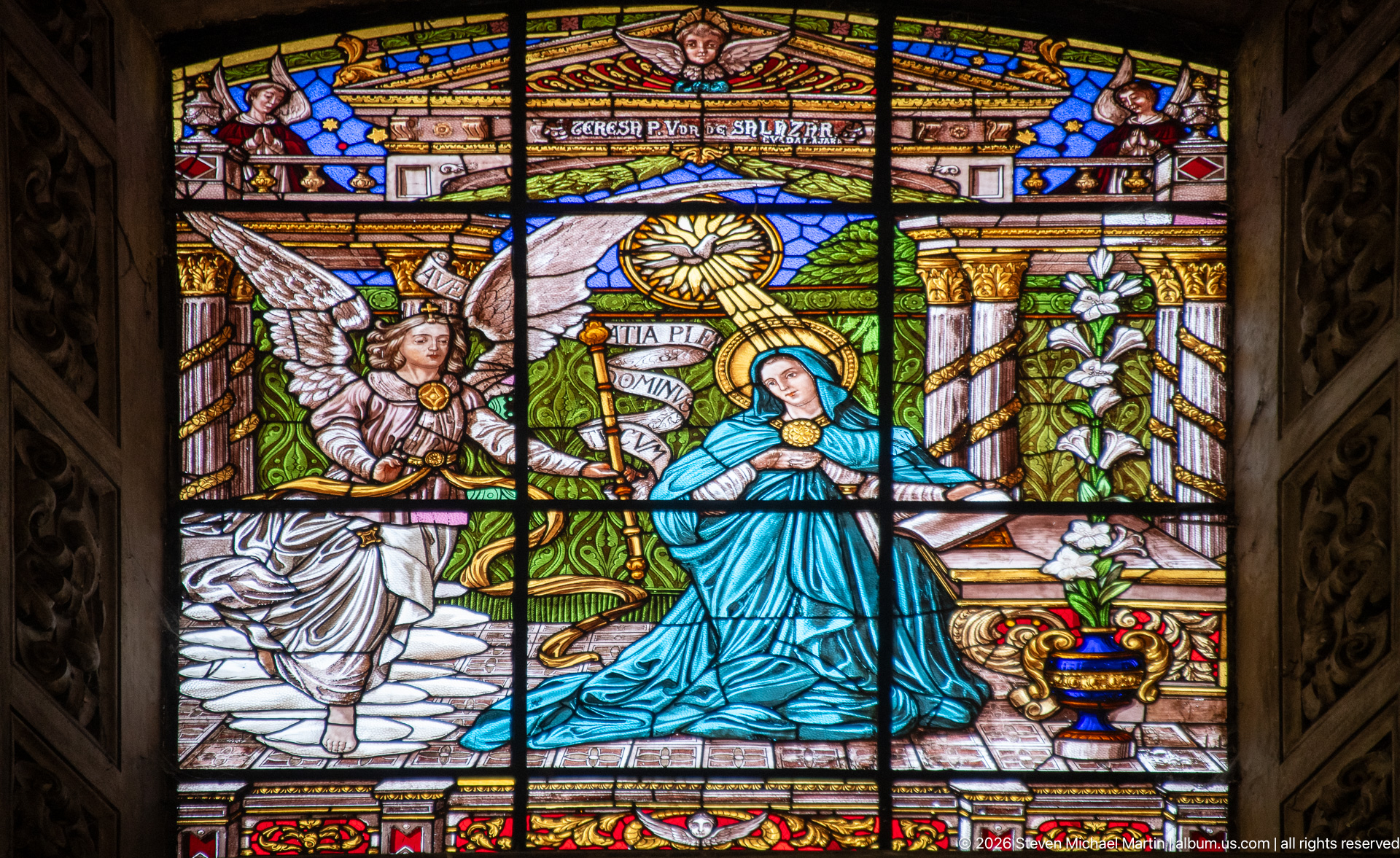
In the close crop, the kneeling Virgin and the angel occupy most of the stained-glass panel. A dove descends between them, with a scroll crossing the scene and lilies at the right edge. The closer framing makes the narrative symbols and leading more legible than in the full-window view, while the colored glass gives the figures sharply defined outlines against the church’s darker interior.
Caption
In the close crop, the kneeling Virgin and the angel occupy most of the stained-glass panel. A dove descends between them, with a scroll crossing the scene and lilies at the right edge. The closer framing makes the narrative symbols and leading more legible than in the full-window view, while the colored glass gives the figures sharply defined outlines against the church’s darker interior.
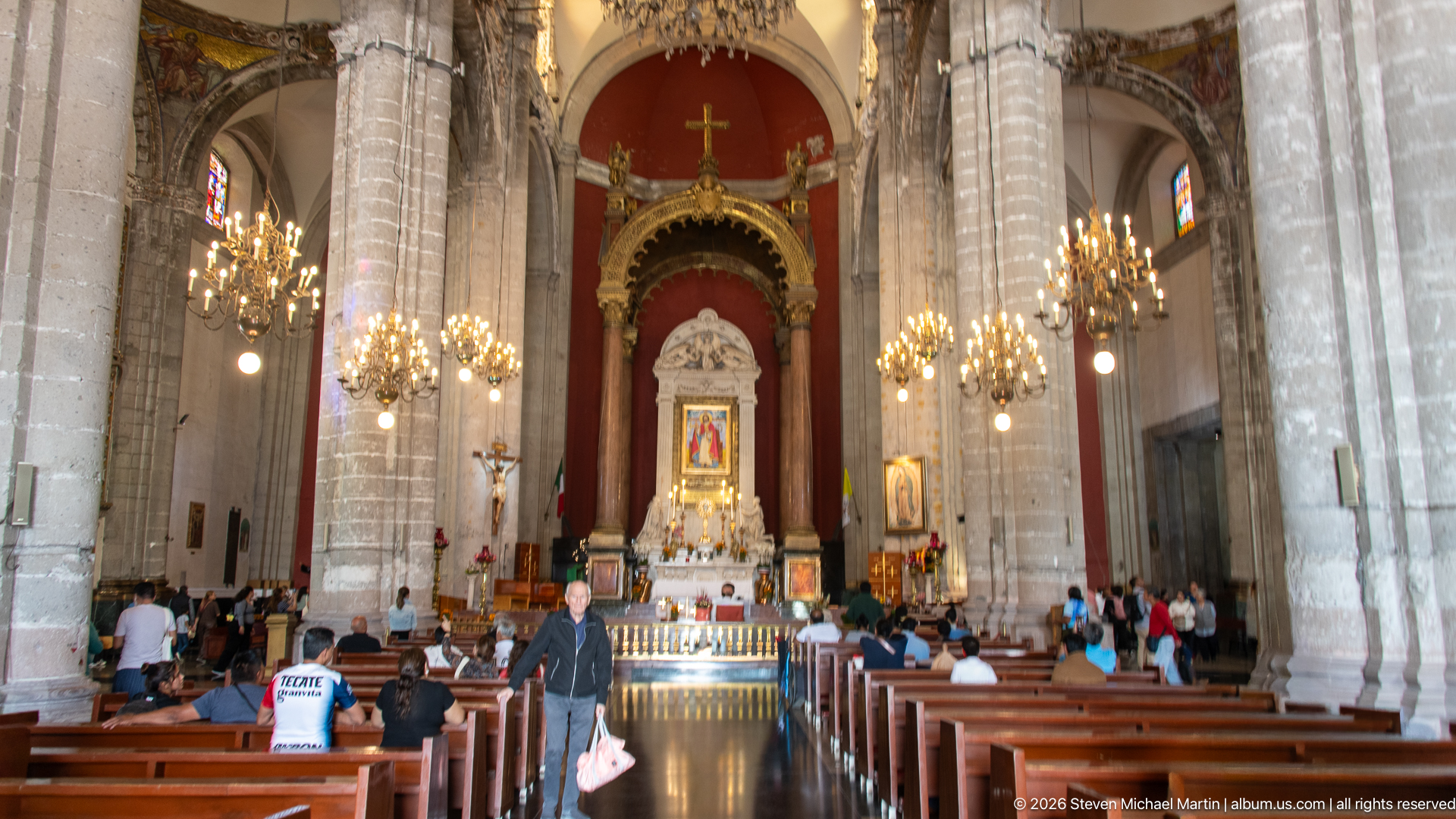
From farther back in the nave, the main altar appears beneath a deep red apse and layered gold canopy, framed by massive stone columns and side chandeliers. Visitors sit in pews or walk along the central aisle, giving scale to the tall interior. The broader view emphasizes the sanctuary’s axial arrangement and the contrast between pale masonry, red wall fields, and gilded altar decoration.
Caption
From farther back in the nave, the main altar appears beneath a deep red apse and layered gold canopy, framed by massive stone columns and side chandeliers. Visitors sit in pews or walk along the central aisle, giving scale to the tall interior. The broader view emphasizes the sanctuary’s axial arrangement and the contrast between pale masonry, red wall fields, and gilded altar decoration.
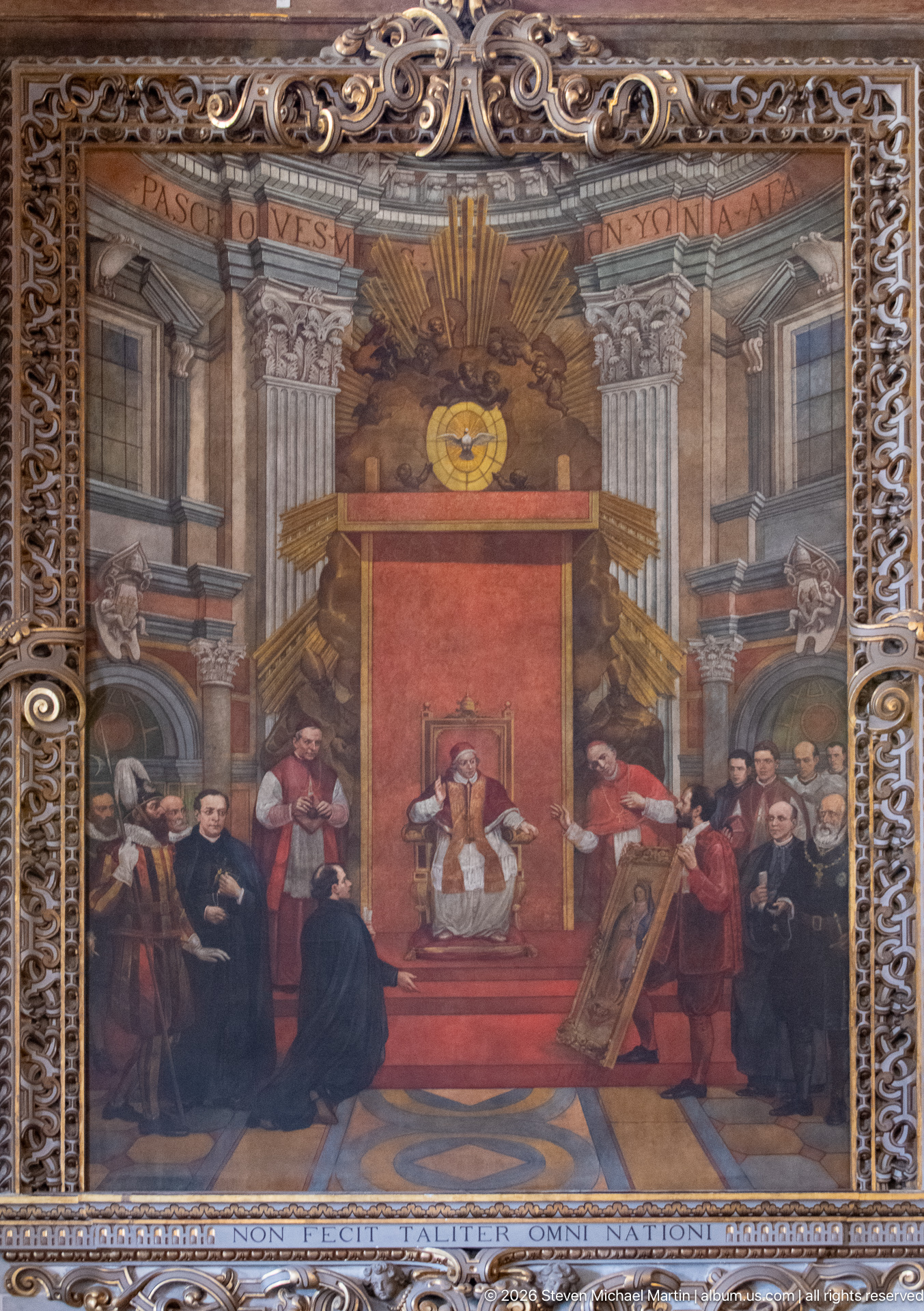
A large mural depicts a formal ecclesiastical gathering: a pope sits beneath an architectural canopy while clergy and other participants assemble on both sides. A kneeling figure faces the central throne, and Latin inscriptions border the scene above and below. The symmetrical composition and ornate frame present the ceremony as a historical event, though the proof-sheet view does not establish its precise occasion.
Caption
A large mural depicts a formal ecclesiastical gathering: a pope sits beneath an architectural canopy while clergy and other participants assemble on both sides. A kneeling figure faces the central throne, and Latin inscriptions border the scene above and below. The symmetrical composition and ornate frame present the ceremony as a historical event, though the proof-sheet view does not establish its precise occasion.
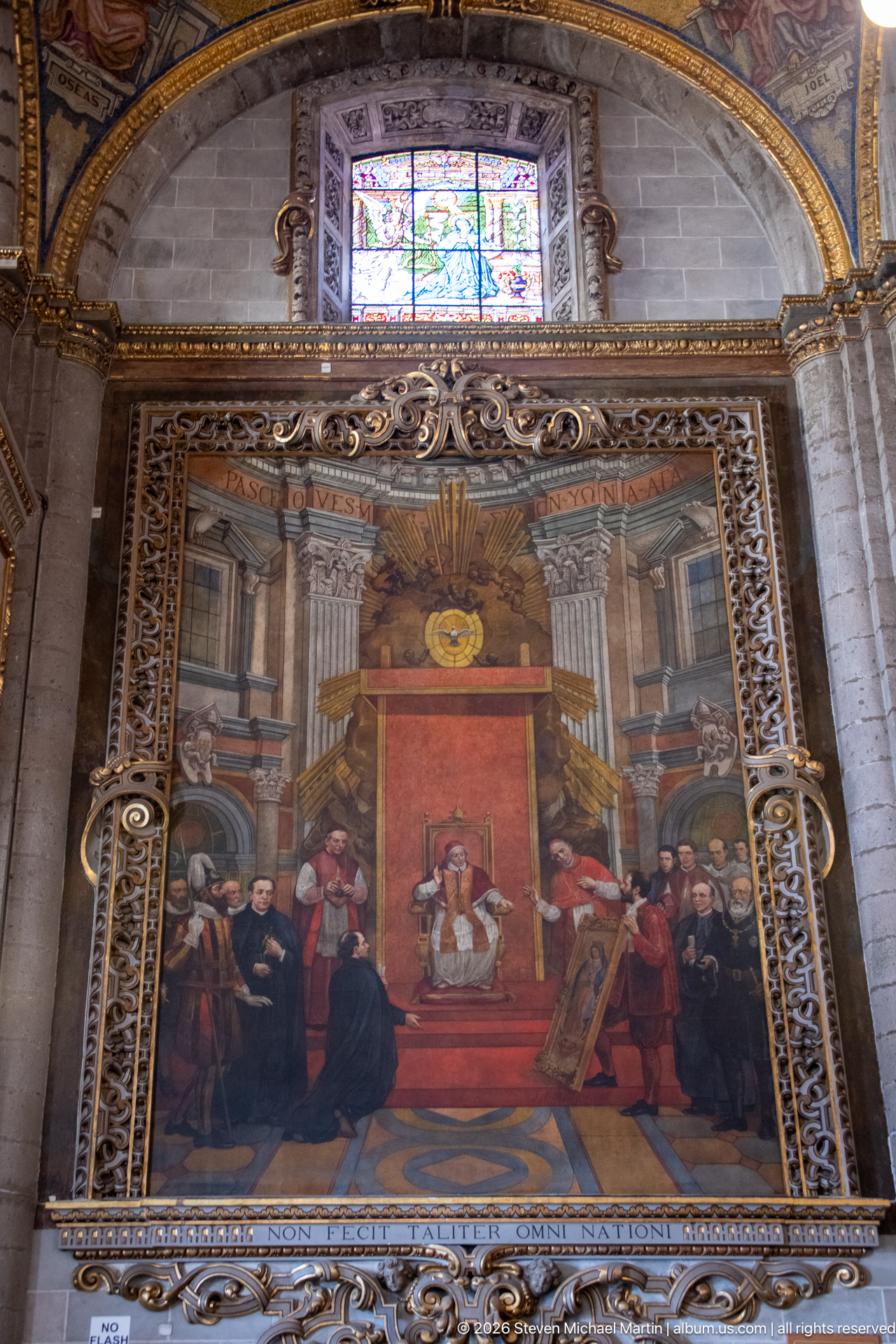
The framed ceremony mural is shown within its architectural niche, with a small stained-glass window directly above and a Latin inscription running along its lower border. The composition includes a seated cleric beneath a canopy and groups of clergy on either side. This contextual view shows how the historical painting is integrated into the church wall, adding its frame and surrounding stonework to the story.
Caption
The framed ceremony mural is shown within its architectural niche, with a small stained-glass window directly above and a Latin inscription running along its lower border. The composition includes a seated cleric beneath a canopy and groups of clergy on either side. This contextual view shows how the historical painting is integrated into the church wall, adding its frame and surrounding stonework to the story.
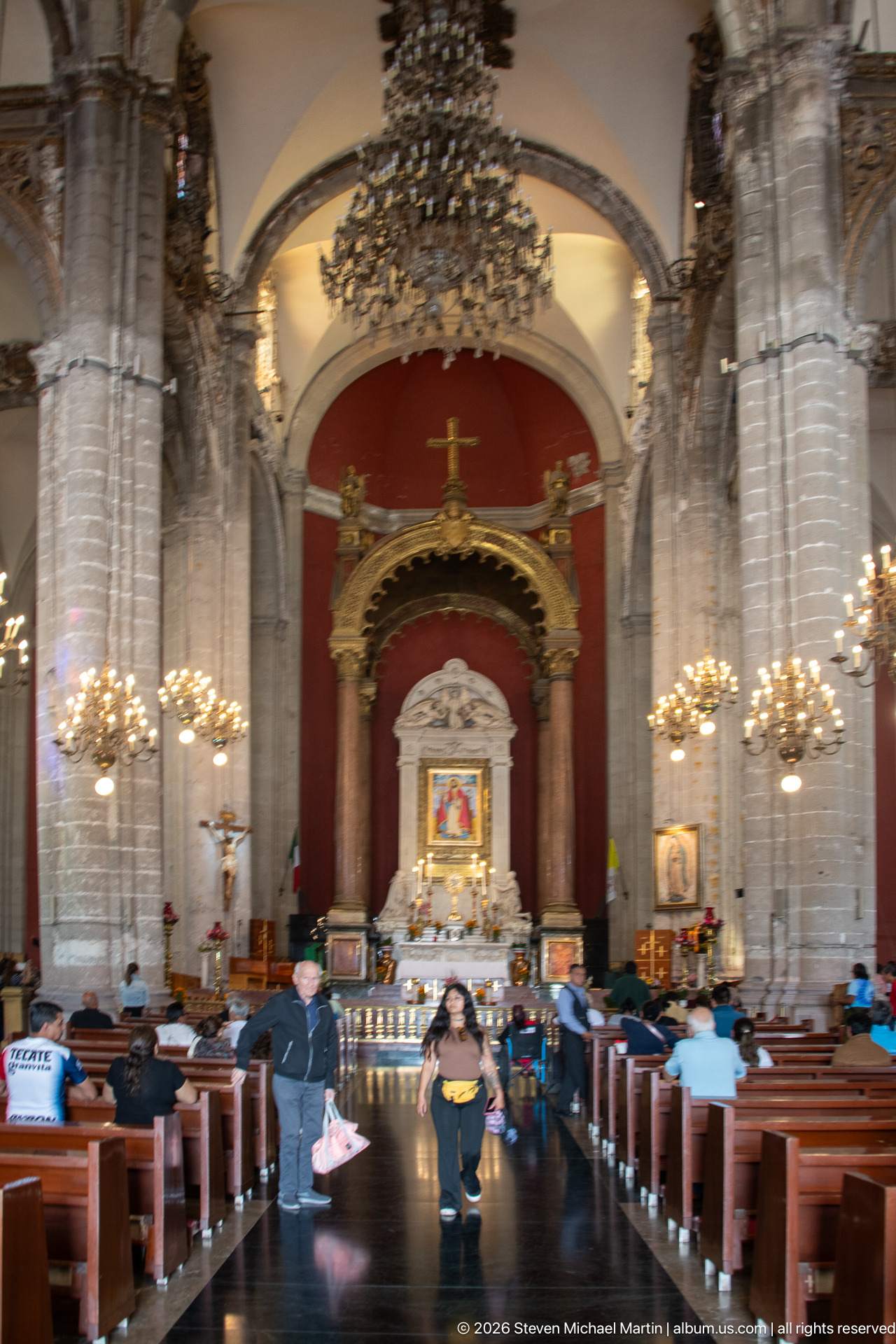
Visitors sit in rows of wooden pews or walk down the central aisle toward the distant altar. Tall stone columns, red wall bays, chandeliers, and a large hanging chandelier establish the scale of the historic basilica interior. The central perspective uses the dark polished floor as a leading line, while people in the aisle convey the sanctuary’s continuing role as a place of gathering and prayer.
Caption
Visitors sit in rows of wooden pews or walk down the central aisle toward the distant altar. Tall stone columns, red wall bays, chandeliers, and a large hanging chandelier establish the scale of the historic basilica interior. The central perspective uses the dark polished floor as a leading line, while people in the aisle convey the sanctuary’s continuing role as a place of gathering and prayer.
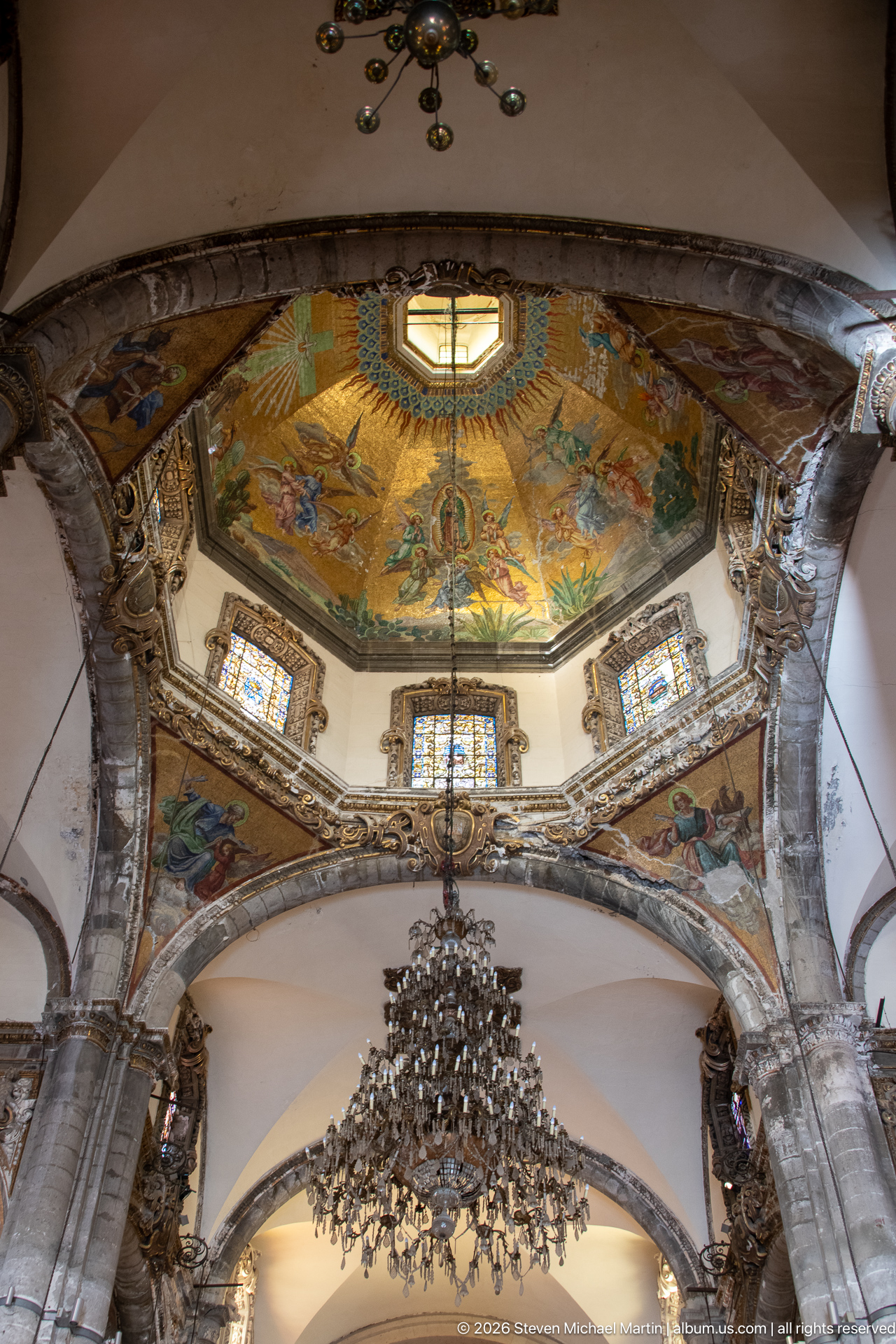
The view tilts upward through the nave to an octagonal dome painted with a dense ring of figures around a bright central opening. Smaller stained-glass windows punctuate the lower drum, and a chandelier hangs beneath the dome. Ceiling, clerestory, arches, and lighting occupy the same frame, revealing the layered vertical structure of the historic basilica interior.
Caption
The view tilts upward through the nave to an octagonal dome painted with a dense ring of figures around a bright central opening. Smaller stained-glass windows punctuate the lower drum, and a chandelier hangs beneath the dome. Ceiling, clerestory, arches, and lighting occupy the same frame, revealing the layered vertical structure of the historic basilica interior.
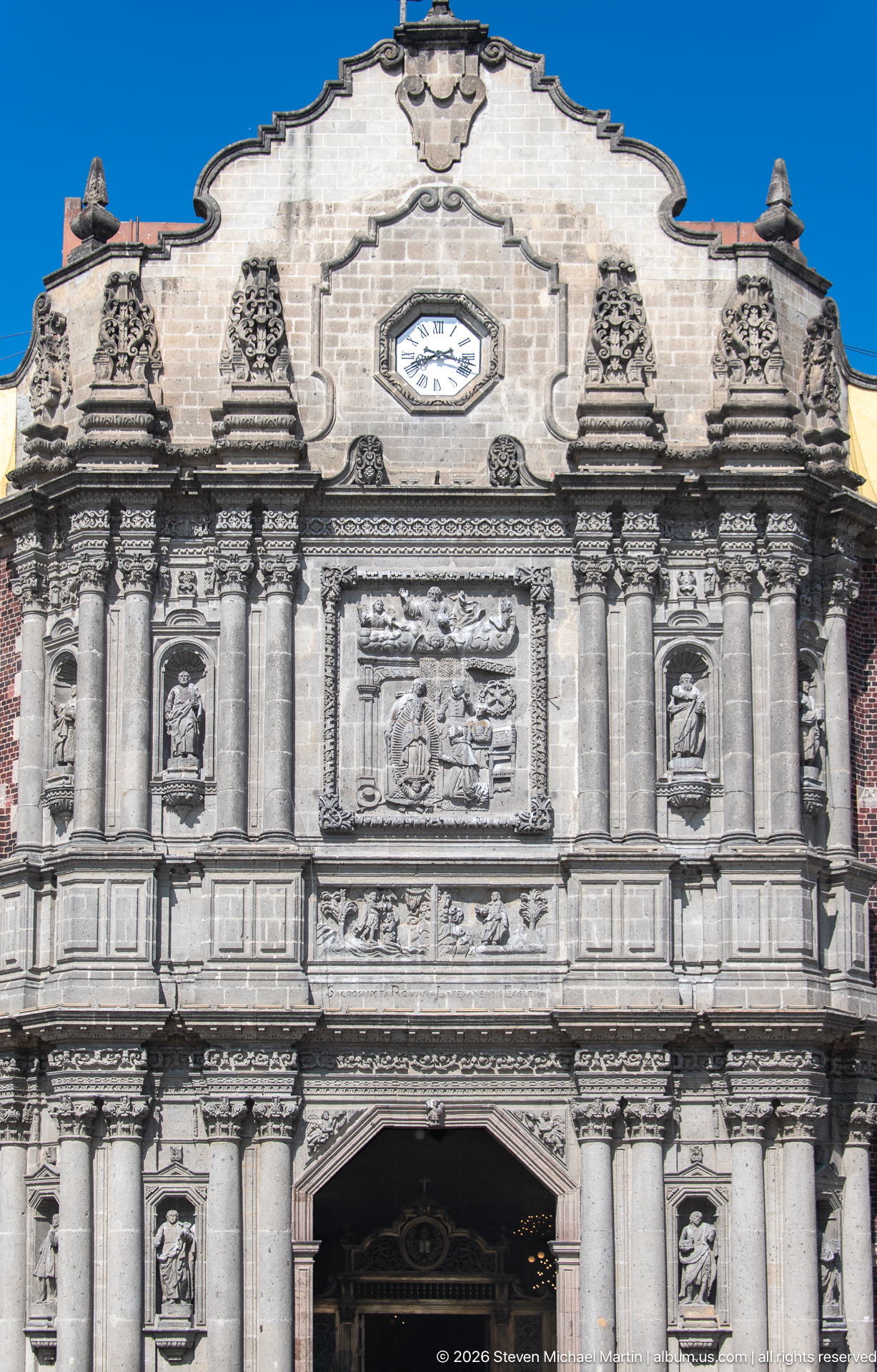
A pale stone façade rises in stacked horizontal tiers, its central octagonal clock set above sculpted reliefs and flanked by pilasters and niche figures. The symmetrical front is capped by an undulating gable against a clear sky, with darker masonry visible along the lower edge. This close architectural view highlights the entrance block’s clock and carved program without showing the full church or surrounding plaza.
Caption
A pale stone façade rises in stacked horizontal tiers, its central octagonal clock set above sculpted reliefs and flanked by pilasters and niche figures. The symmetrical front is capped by an undulating gable against a clear sky, with darker masonry visible along the lower edge. This close architectural view highlights the entrance block’s clock and carved program without showing the full church or surrounding plaza.
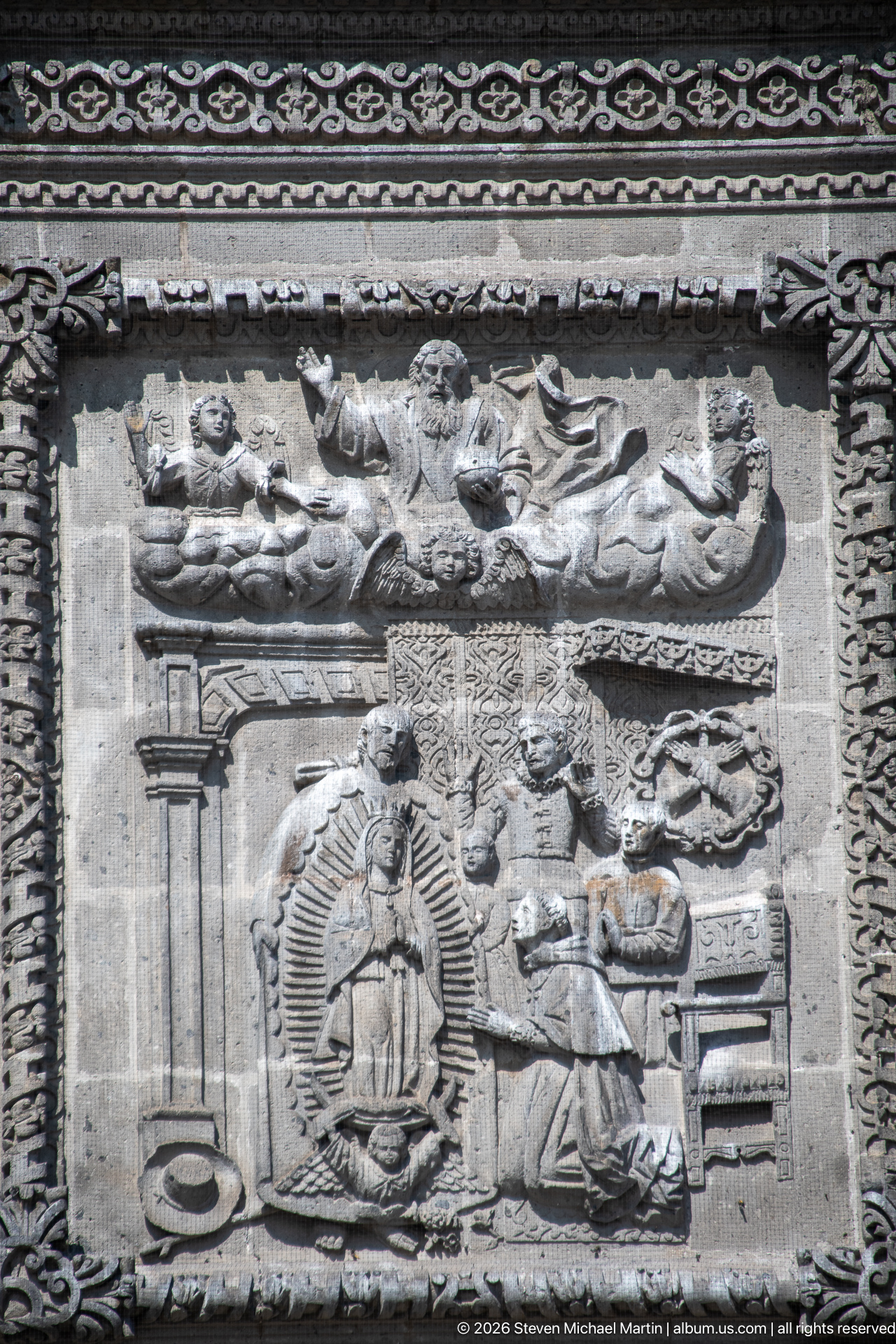
A pale stone relief centers the Virgin of Guadalupe within a radiating aureole, surrounded by reclining and kneeling figures. A narrow horizontal scene above the image adds a second register, while dense foliate carving frames the panel. The close, oblique view reveals the depth of the relief and weathering across its surface, isolating the sculptural program from the larger façade.
Caption
A pale stone relief centers the Virgin of Guadalupe within a radiating aureole, surrounded by reclining and kneeling figures. A narrow horizontal scene above the image adds a second register, while dense foliate carving frames the panel. The close, oblique view reveals the depth of the relief and weathering across its surface, isolating the sculptural program from the larger façade.
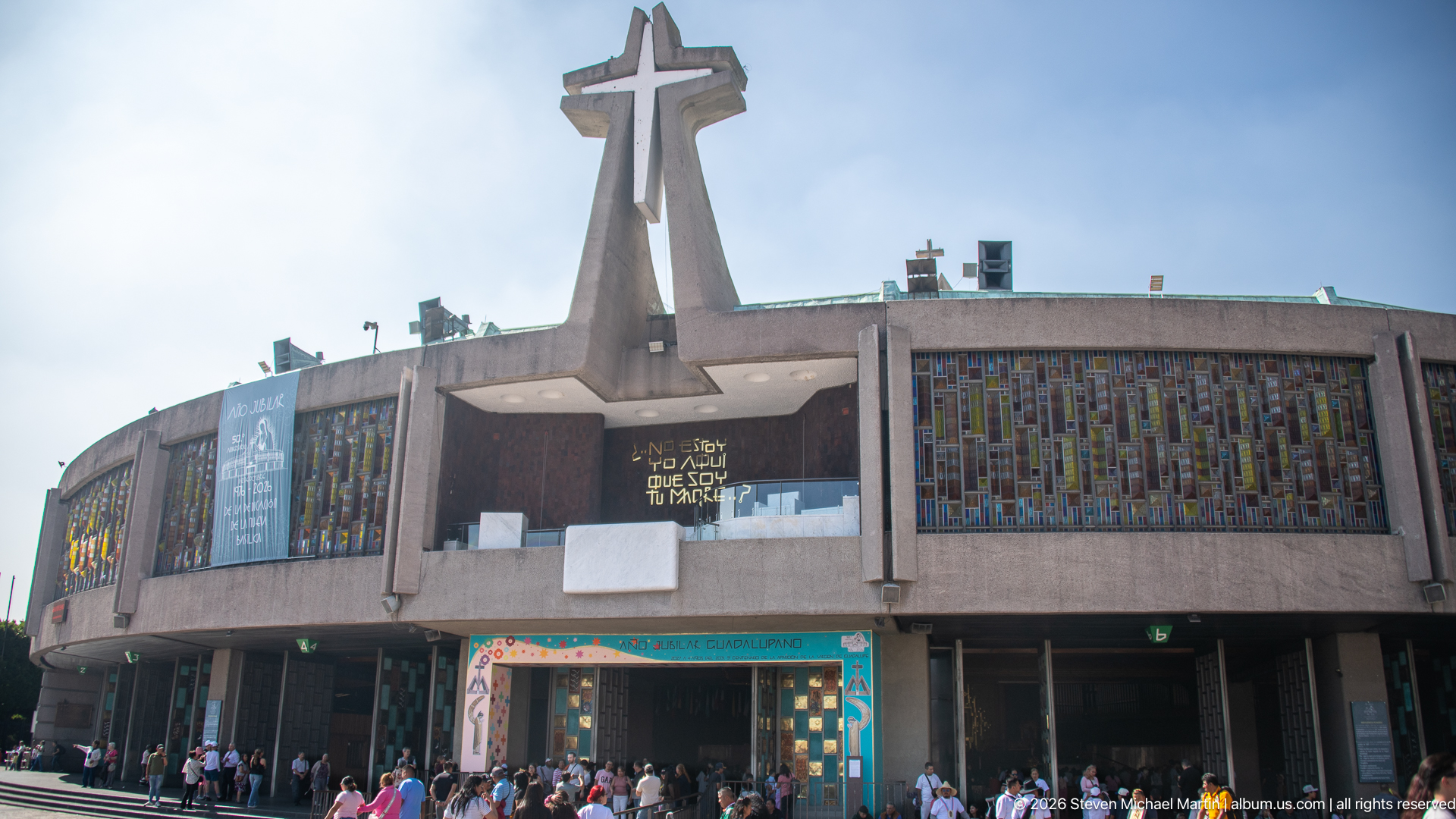
A monumental concrete cross rises above the curved façade of the modern basilica, whose long bands of colored glazing wrap around the upper level. Visitors gather beneath the deep entrance canopy, where a religious image and illuminated lettering are visible. The low angle makes the cross the dominant feature, while the building’s broad, rounded form contrasts with the historic stone churches elsewhere in the sanctuary complex.
Caption
A monumental concrete cross rises above the curved façade of the modern basilica, whose long bands of colored glazing wrap around the upper level. Visitors gather beneath the deep entrance canopy, where a religious image and illuminated lettering are visible. The low angle makes the cross the dominant feature, while the building’s broad, rounded form contrasts with the historic stone churches elsewhere in the sanctuary complex.
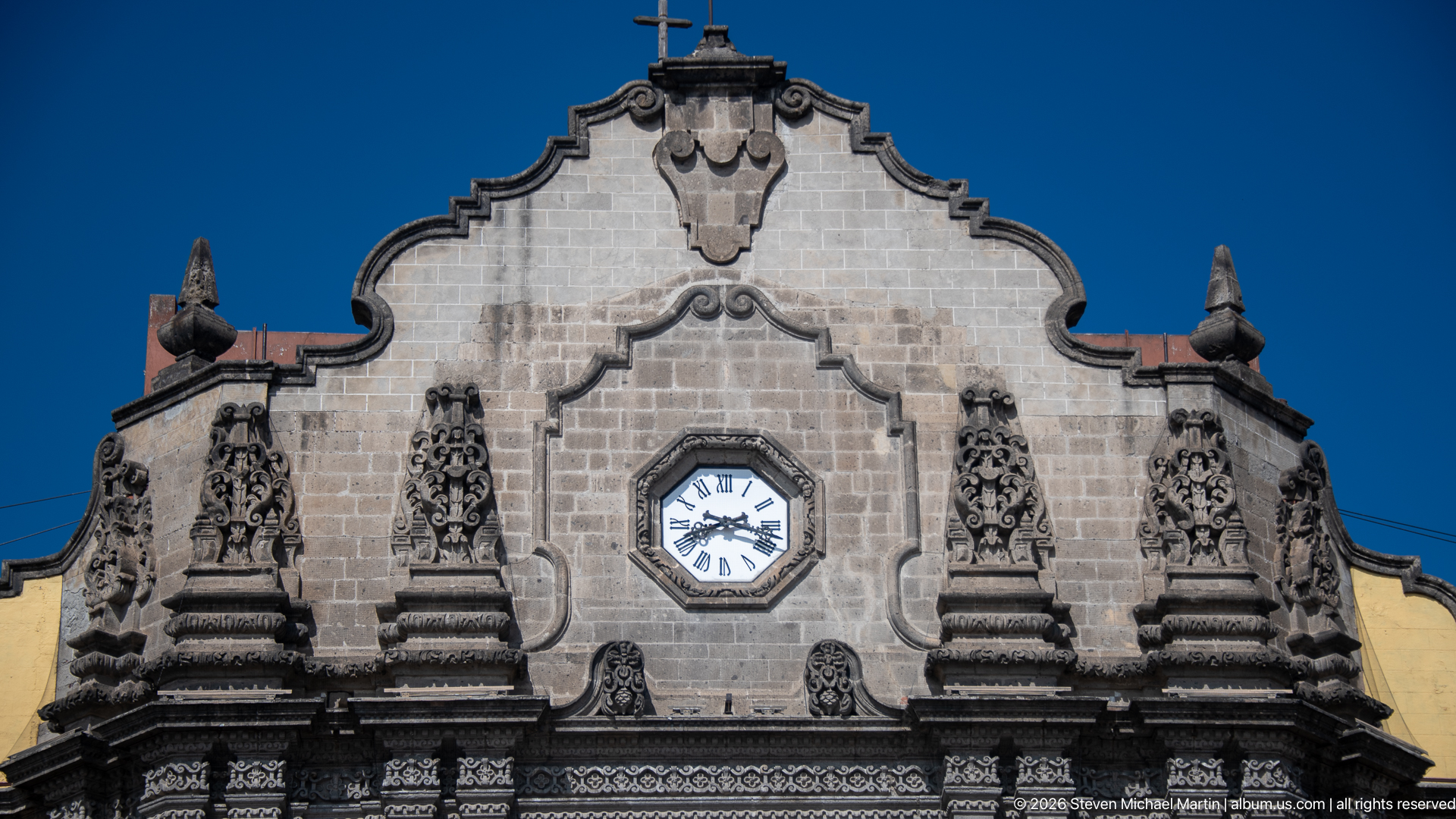
An octagonal clock is embedded in the pale stone gable of a historic church, surrounded by symmetrical carved ornament and a heavy cornice. The shaped parapet rises to a cross against an intensely blue sky; dark decorative elements line the roof edge below. The close crop turns the clock and its framing into the subject, documenting the façade’s upper silhouette and carefully ordered stonework.
Caption
An octagonal clock is embedded in the pale stone gable of a historic church, surrounded by symmetrical carved ornament and a heavy cornice. The shaped parapet rises to a cross against an intensely blue sky; dark decorative elements line the roof edge below. The close crop turns the clock and its framing into the subject, documenting the façade’s upper silhouette and carefully ordered stonework.
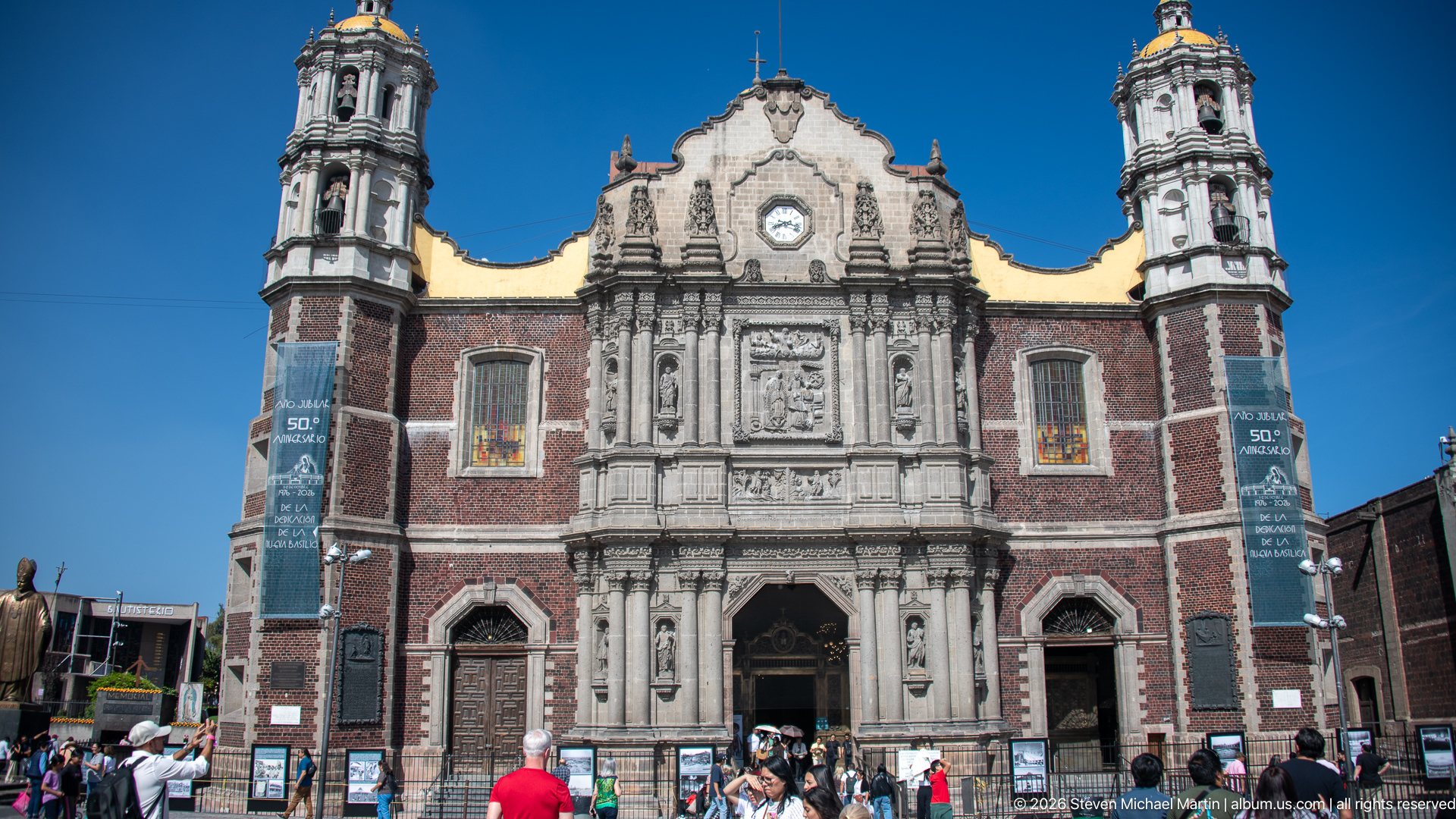
The Old Basilica’s symmetrical façade fills the frame, its pale sculpted central portal set between red-brick wings and slender towers capped with yellow-tiled cupolas. Visitors cross the forecourt and pause to photograph the entrance, while banners hang from the towers. The straight-on composition makes the building’s paired verticals and richly ornamented center easy to compare, conveying its monumental scale within the sanctuary.
Caption
The Old Basilica’s symmetrical façade fills the frame, its pale sculpted central portal set between red-brick wings and slender towers capped with yellow-tiled cupolas. Visitors cross the forecourt and pause to photograph the entrance, while banners hang from the towers. The straight-on composition makes the building’s paired verticals and richly ornamented center easy to compare, conveying its monumental scale within the sanctuary.
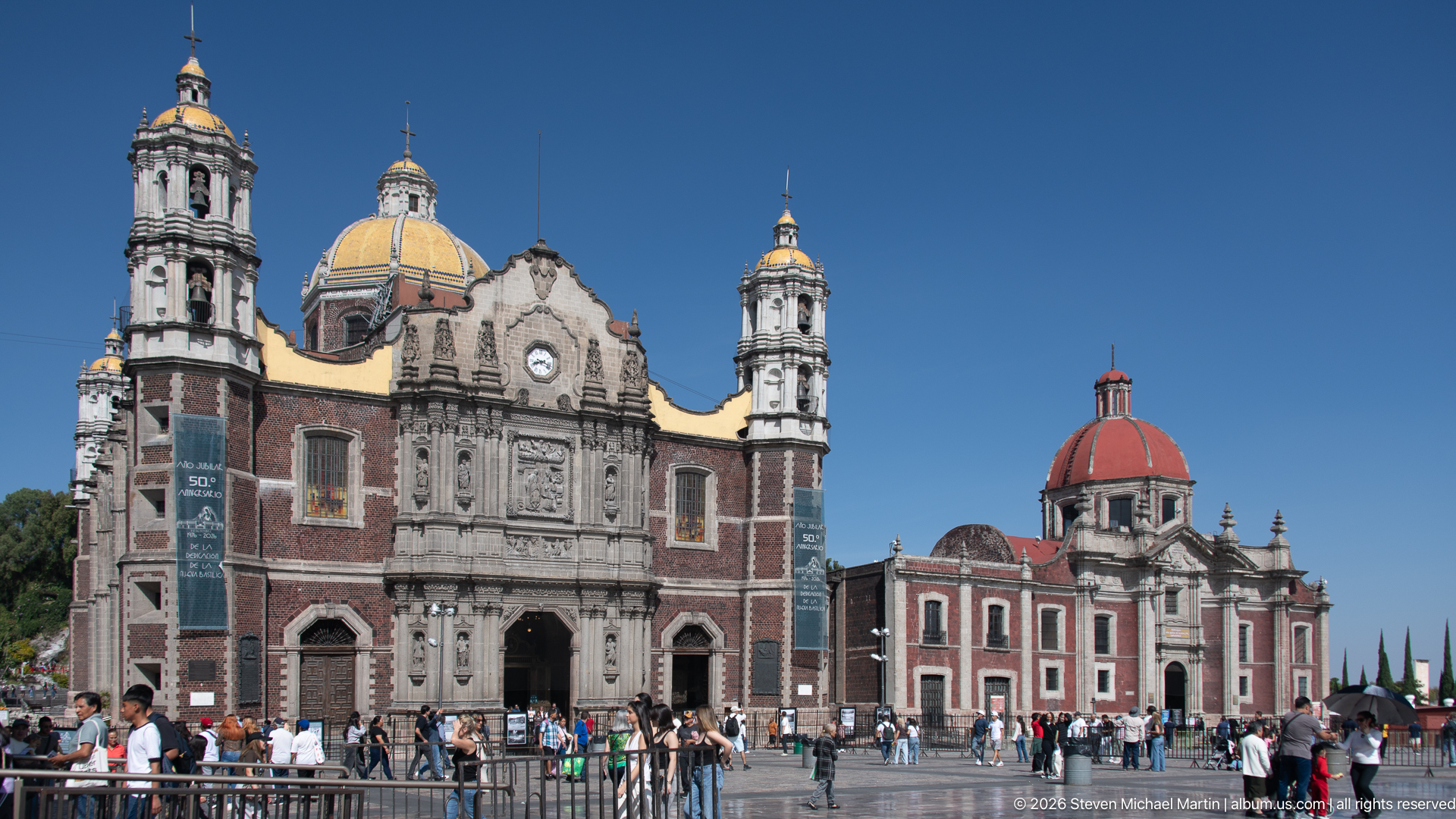
A broad plaza view places the Old Basilica on the left, with its paired towers and large yellow dome, beside a smaller red-domed chapel on the right. Visitors circulate behind temporary barriers across the foreground. The framing shows the distinct rooflines and scale of two neighboring religious buildings, making their relationship within the Guadalupe sanctuary more important than the details of either façade alone.
Caption
A broad plaza view places the Old Basilica on the left, with its paired towers and large yellow dome, beside a smaller red-domed chapel on the right. Visitors circulate behind temporary barriers across the foreground. The framing shows the distinct rooflines and scale of two neighboring religious buildings, making their relationship within the Guadalupe sanctuary more important than the details of either façade alone.
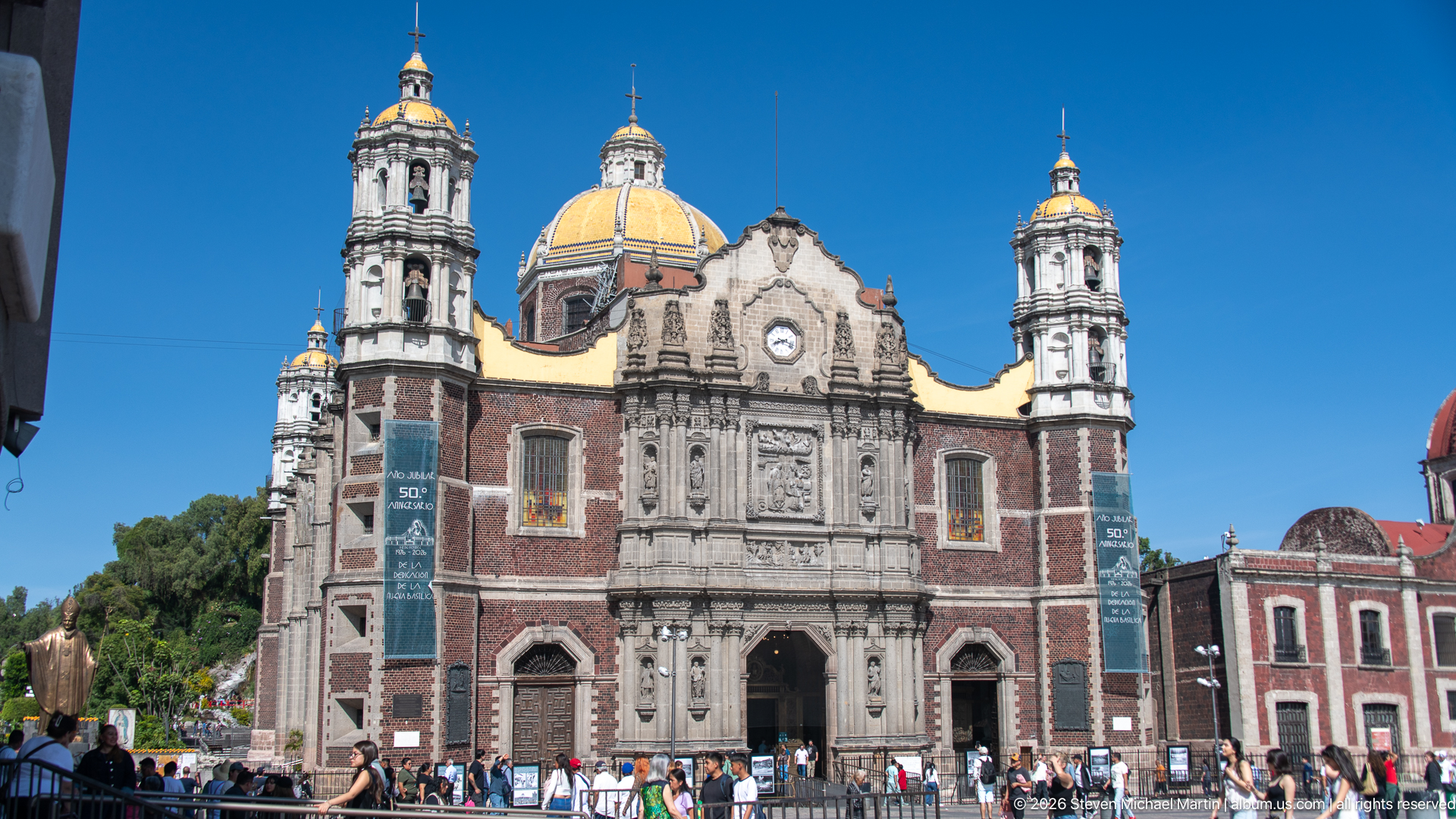
The Old Basilica stands beyond the plaza, its towers and yellow dome rising above visitors gathered behind barriers. A bronze statue appears at the left edge, and trees climb the Tepeyac slope behind the church. This wider view places the historic façade within the sanctuary landscape, joining the built complex, devotional sculpture, and green hillside in a single outdoor composition.
Caption
The Old Basilica stands beyond the plaza, its towers and yellow dome rising above visitors gathered behind barriers. A bronze statue appears at the left edge, and trees climb the Tepeyac slope behind the church. This wider view places the historic façade within the sanctuary landscape, joining the built complex, devotional sculpture, and green hillside in a single outdoor composition.
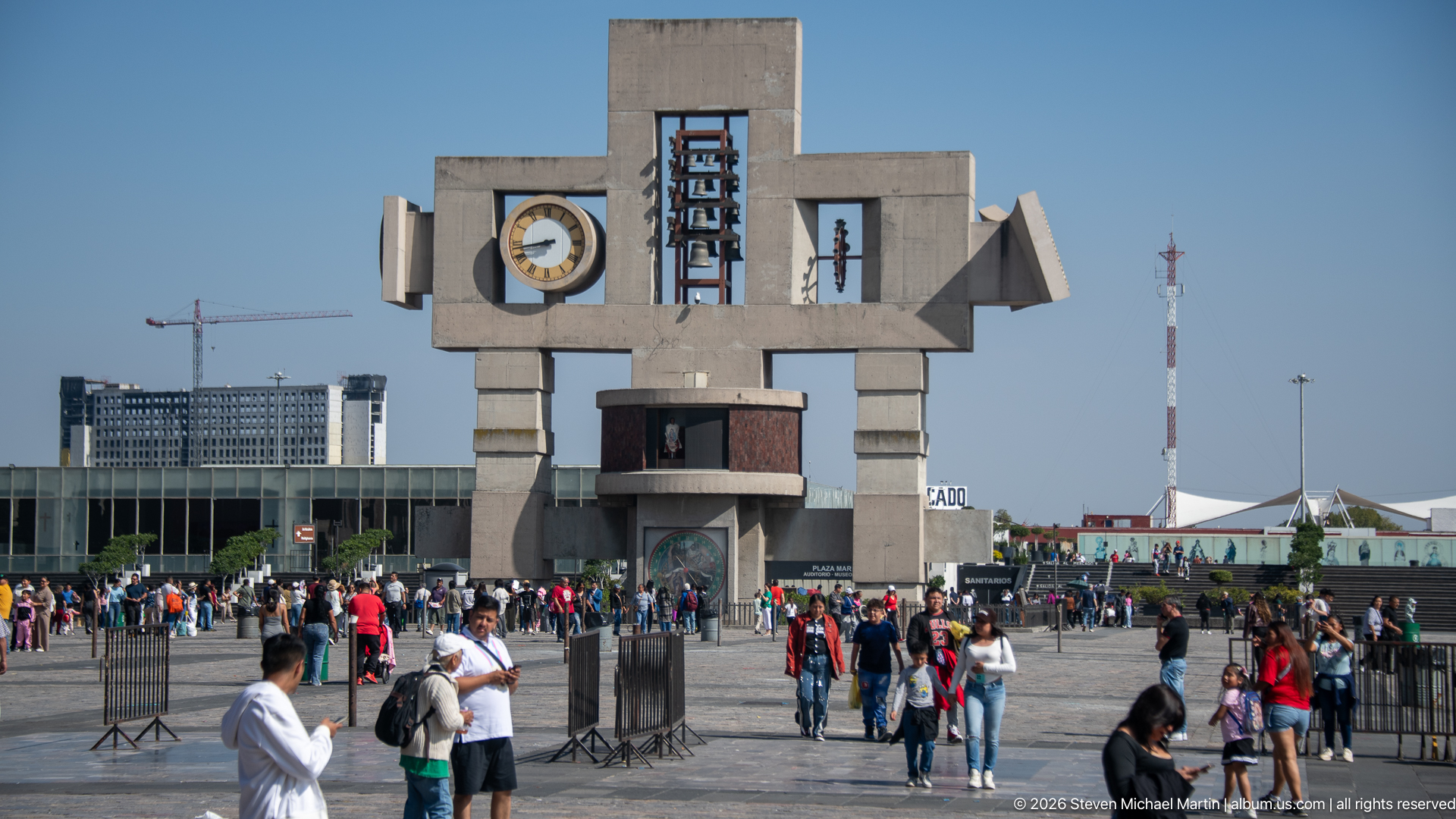
Visitors cross the open forecourt below a freestanding concrete clock structure composed of thick vertical and horizontal beams. A circular clock face occupies the left side, while an open vertical bay contains suspended bells. Modern service buildings and a white tensile canopy appear behind it. The composition focuses on this plaza landmark and the movement of people through the large paved space.
Caption
Visitors cross the open forecourt below a freestanding concrete clock structure composed of thick vertical and horizontal beams. A circular clock face occupies the left side, while an open vertical bay contains suspended bells. Modern service buildings and a white tensile canopy appear behind it. The composition focuses on this plaza landmark and the movement of people through the large paved space.
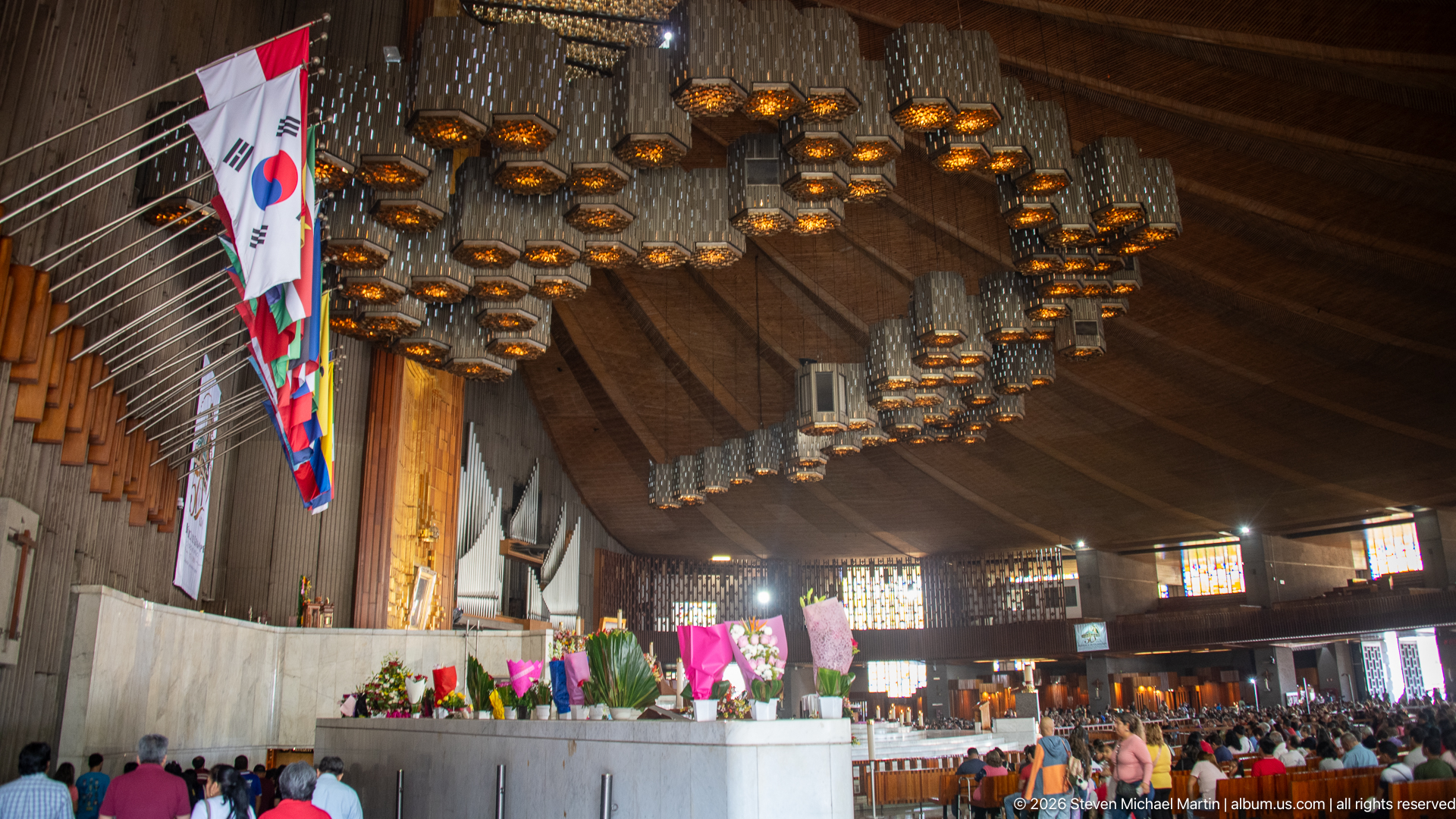
Worshippers fill the pews and standing areas beneath the modern basilica’s broad timber-toned ceiling and clusters of suspended hexagonal lamps. Flags hang along the left side, while flowers line the low altar platform and daylight enters through colored windows at the far end. The oblique view emphasizes the scale of the congregation and the contemporary sanctuary’s warm, geometric interior.
Caption
Worshippers fill the pews and standing areas beneath the modern basilica’s broad timber-toned ceiling and clusters of suspended hexagonal lamps. Flags hang along the left side, while flowers line the low altar platform and daylight enters through colored windows at the far end. The oblique view emphasizes the scale of the congregation and the contemporary sanctuary’s warm, geometric interior.
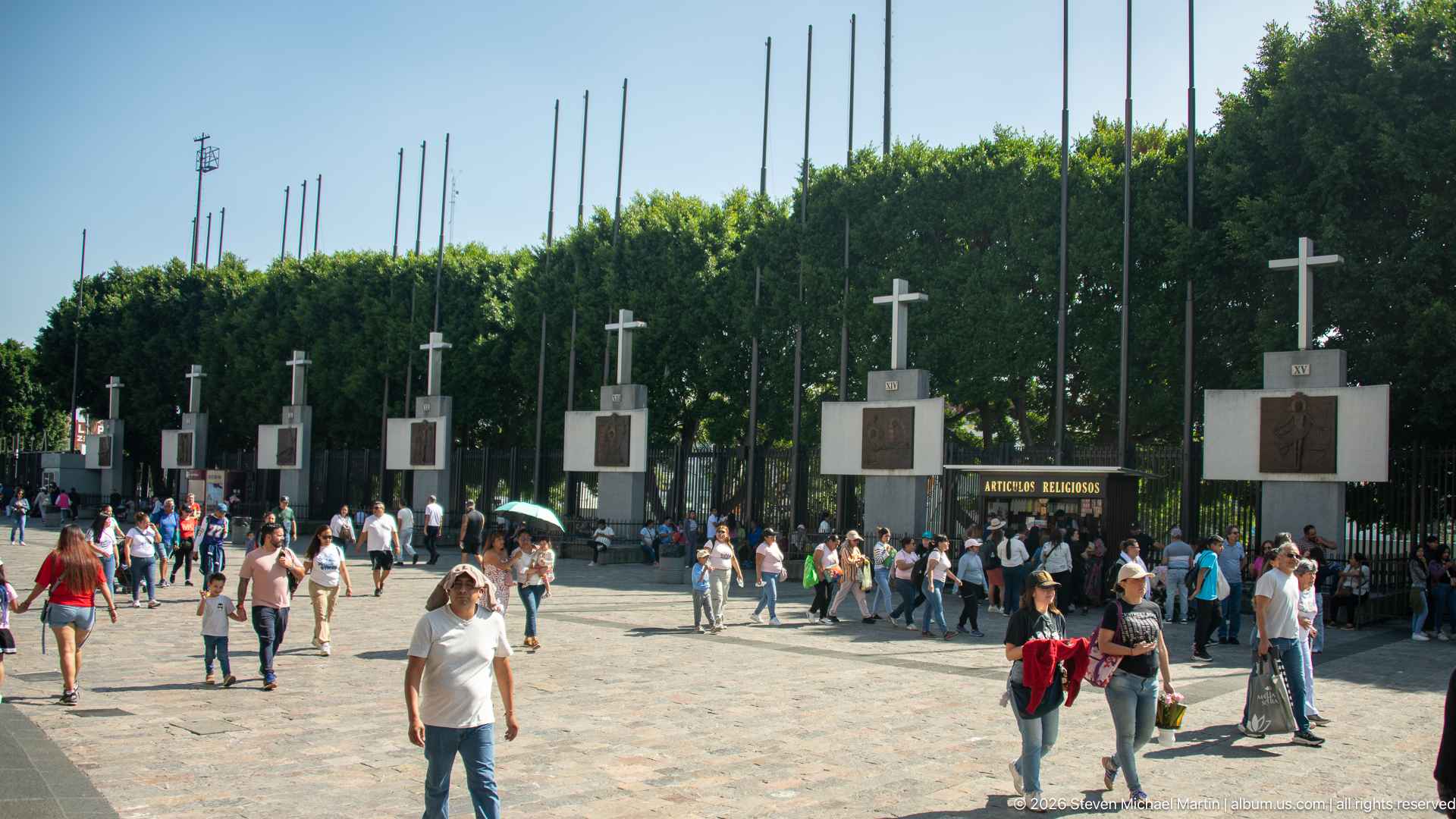
A long row of simple white crosses rises above square relief panels mounted along the sanctuary boundary. Visitors move across the sunlit forecourt, some carrying bags or pausing near the displays, while a dense line of trees forms a green backdrop. The repeated markers create a strong horizontal rhythm across the frame and show how devotional imagery extends beyond the church buildings into the open grounds.
Caption
A long row of simple white crosses rises above square relief panels mounted along the sanctuary boundary. Visitors move across the sunlit forecourt, some carrying bags or pausing near the displays, while a dense line of trees forms a green backdrop. The repeated markers create a strong horizontal rhythm across the frame and show how devotional imagery extends beyond the church buildings into the open grounds.
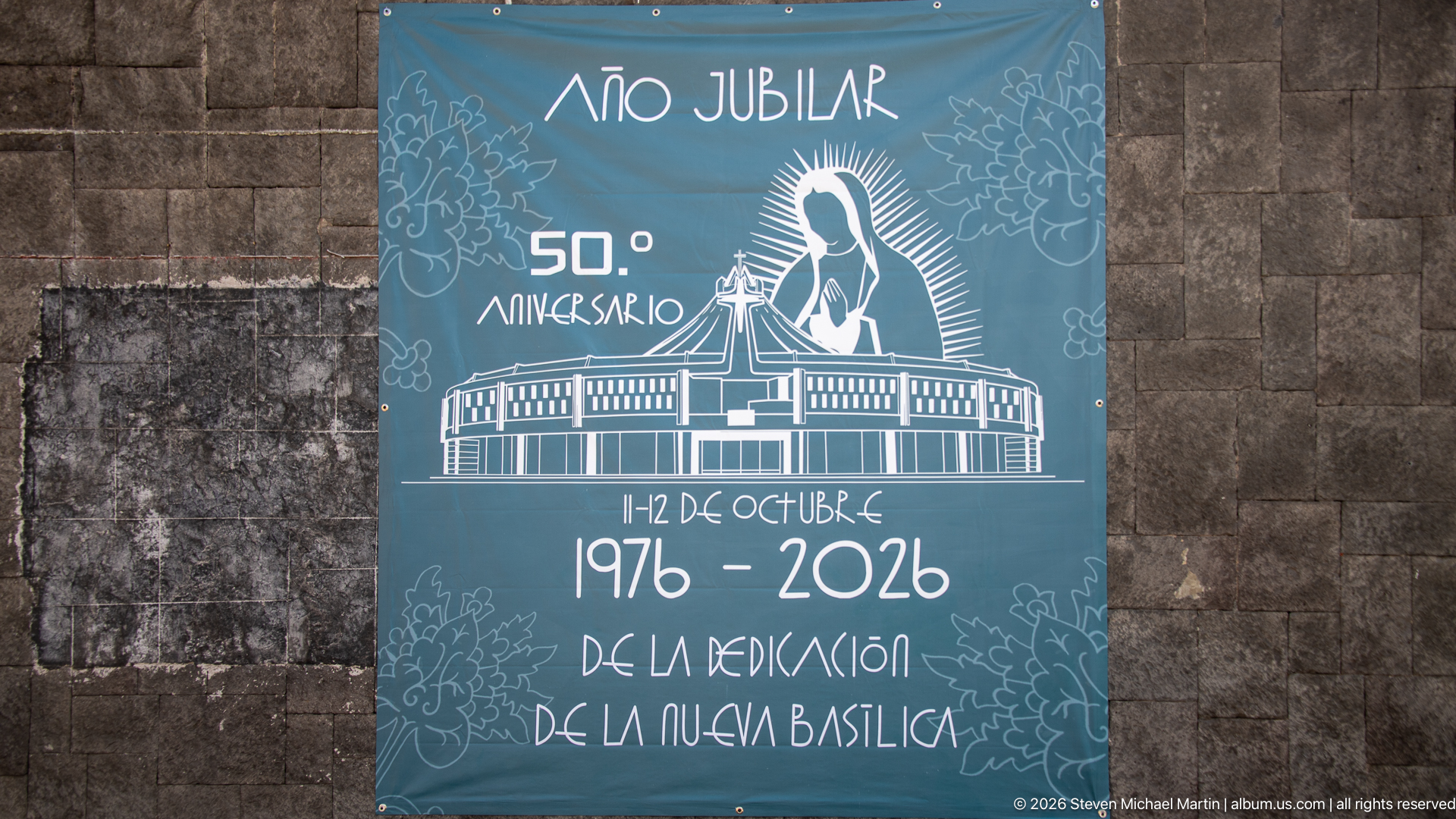
A blue commemorative banner carries the words “Año Jubilar,” “50.º Aniversario,” and the dates 1976–2026 alongside a line drawing of the modern basilica and the Virgin of Guadalupe. Fixed against rough stone, the sign connects the sanctuary’s contemporary architecture to its fiftieth anniversary. Its legible text and graphic design make this an interpretive detail rather than a conventional building portrait.
Caption
A blue commemorative banner carries the words “Año Jubilar,” “50.º Aniversario,” and the dates 1976–2026 alongside a line drawing of the modern basilica and the Virgin of Guadalupe. Fixed against rough stone, the sign connects the sanctuary’s contemporary architecture to its fiftieth anniversary. Its legible text and graphic design make this an interpretive detail rather than a conventional building portrait.
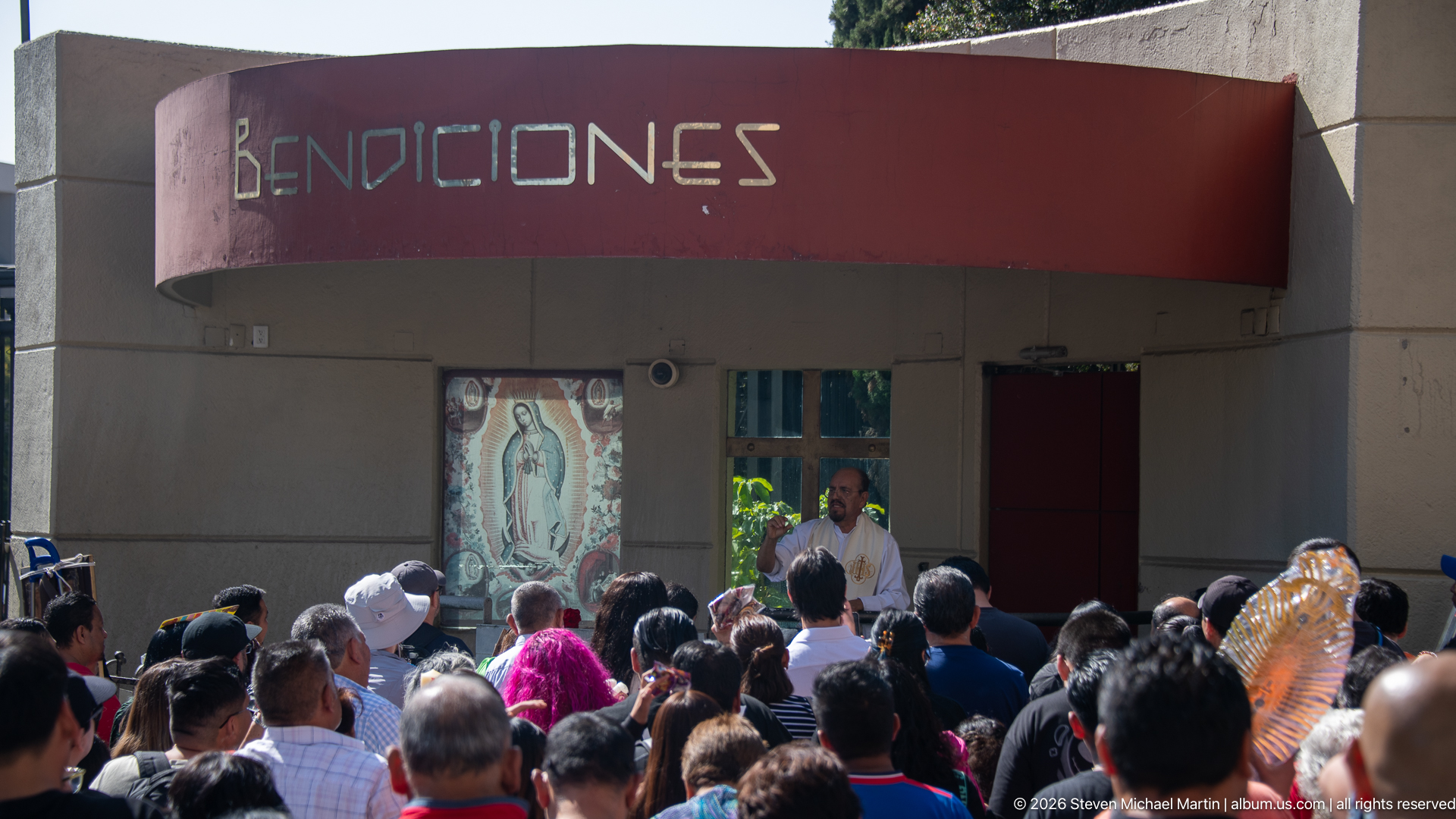
A priest speaks to a dense gathering outside a building marked “Bendiciones,” with a large image of the Virgin of Guadalupe displayed behind him. Visitors stand shoulder to shoulder, some holding umbrellas against the sun, while the sign’s lettering spans a curved red fascia overhead. The photograph records a public devotional encounter at the edge of the basilica grounds, with the crowd’s attention directed toward the speaker.
Caption
A priest speaks to a dense gathering outside a building marked “Bendiciones,” with a large image of the Virgin of Guadalupe displayed behind him. Visitors stand shoulder to shoulder, some holding umbrellas against the sun, while the sign’s lettering spans a curved red fascia overhead. The photograph records a public devotional encounter at the edge of the basilica grounds, with the crowd’s attention directed toward the speaker.
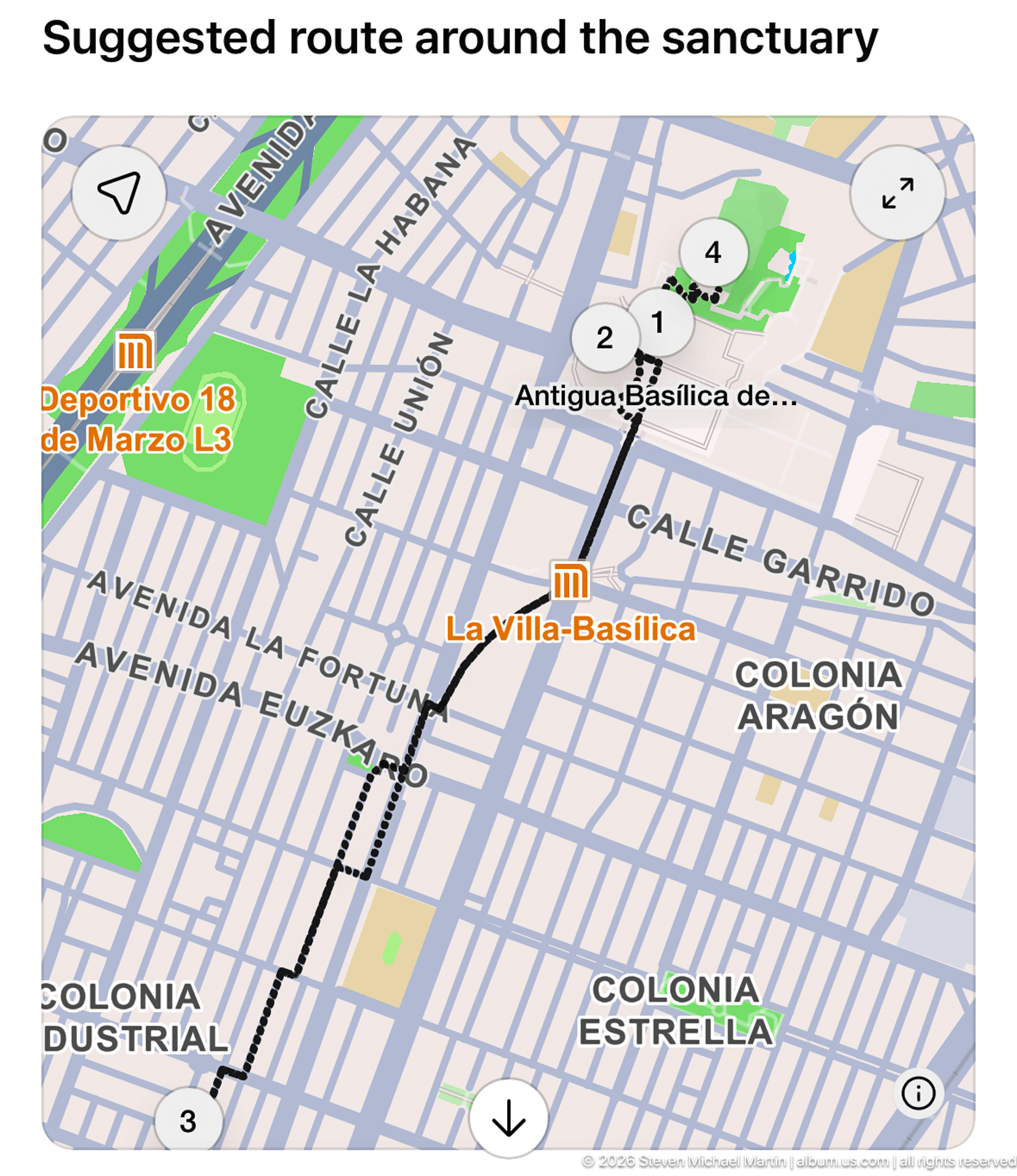
A digital map titled “Suggested route around the sanctuary” traces a dotted path among numbered stops near the Antigua Basílica and La Villa-Basílica transit station. Street labels, green park areas, and route markers make the site’s urban layout legible at a glance. This information graphic functions as a practical orientation aid, connecting the complex’s buildings with the surrounding neighborhood rather than depicting the sanctuary itself.
Caption
A digital map titled “Suggested route around the sanctuary” traces a dotted path among numbered stops near the Antigua Basílica and La Villa-Basílica transit station. Street labels, green park areas, and route markers make the site’s urban layout legible at a glance. This information graphic functions as a practical orientation aid, connecting the complex’s buildings with the surrounding neighborhood rather than depicting the sanctuary itself.
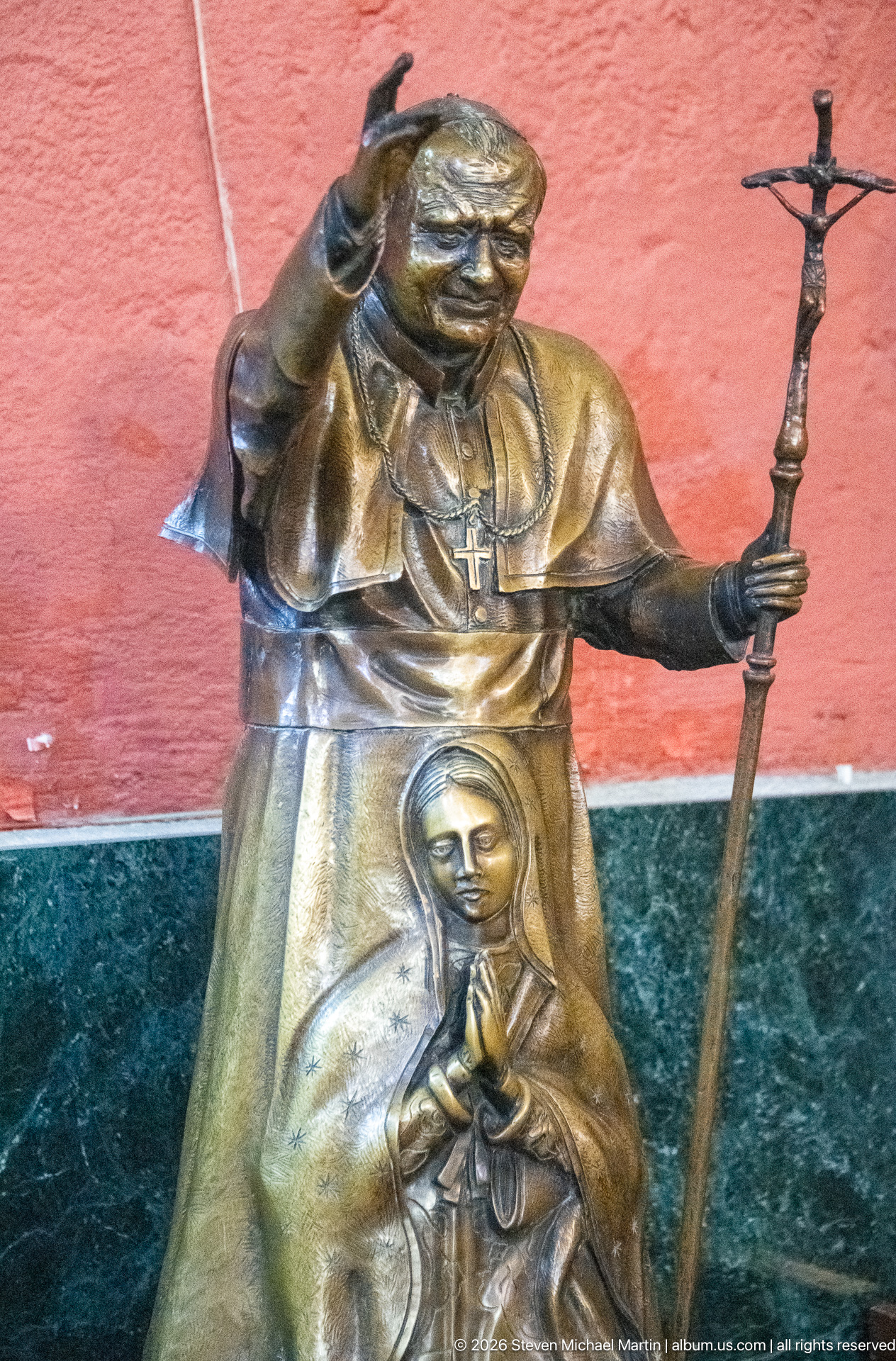
A bronze statue of Pope John Paul II raises one hand in blessing while holding a pastoral staff in the other. A relief of Our Lady of Guadalupe decorates his vestments, connecting the pontiff to the devotion at the heart of the sanctuary. The close view sets the figure against a red wall and dark green stone base.
Caption
A bronze statue of Pope John Paul II raises one hand in blessing while holding a pastoral staff in the other. A relief of Our Lady of Guadalupe decorates his vestments, connecting the pontiff to the devotion at the heart of the sanctuary. The close view sets the figure against a red wall and dark green stone base.
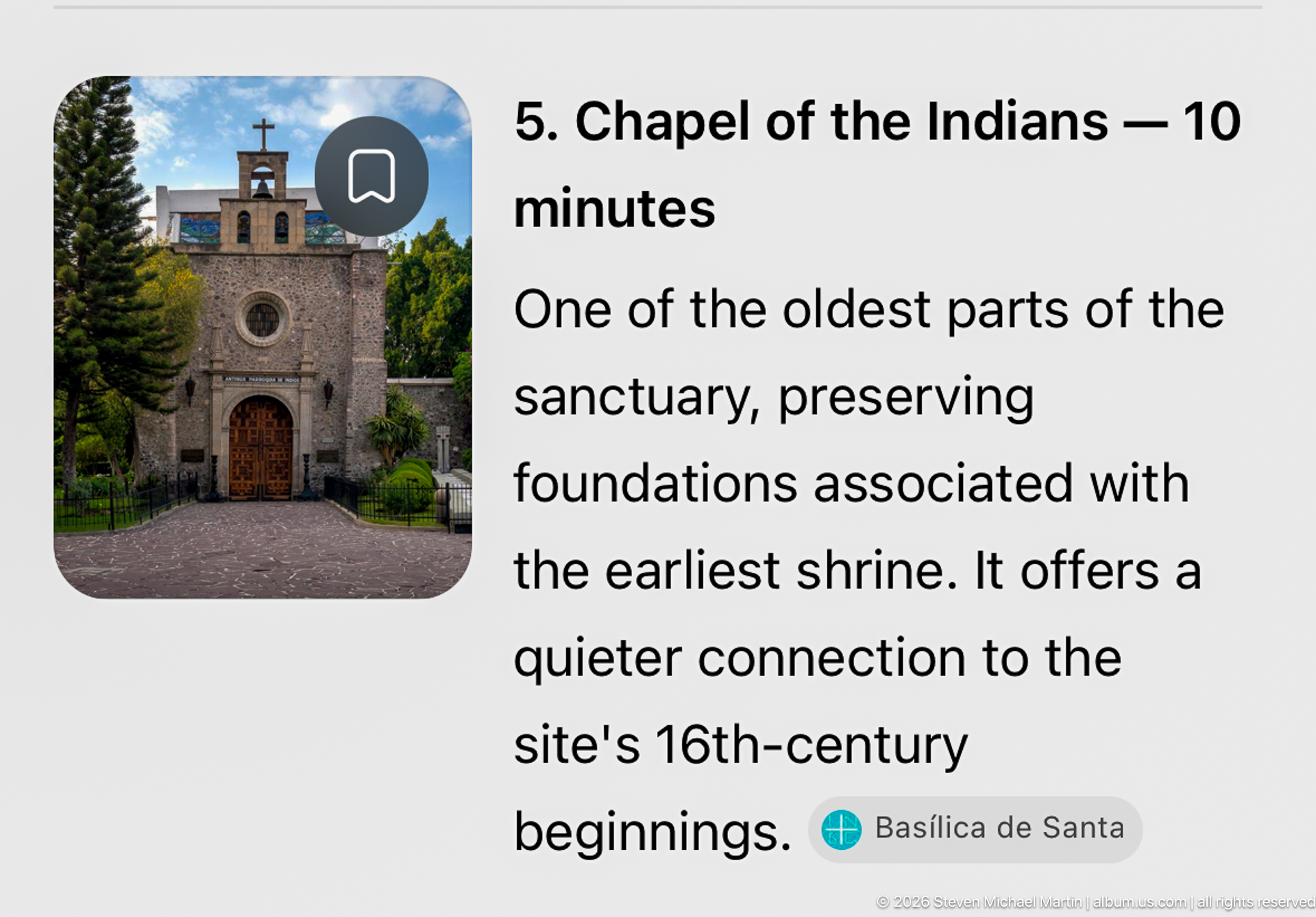
The panel labels the stop “5. Chapel of the Indians — 10 minutes” and describes it as one of the sanctuary’s oldest parts, associated with foundations of the earliest shrine. A photograph at left shows a small stone church with a round window, arched wooden door, and simple bell tower, set among trees. The text and image combine to orient visitors to a historic chapel within the larger complex.
Caption
The panel labels the stop “5. Chapel of the Indians — 10 minutes” and describes it as one of the sanctuary’s oldest parts, associated with foundations of the earliest shrine. A photograph at left shows a small stone church with a round window, arched wooden door, and simple bell tower, set among trees. The text and image combine to orient visitors to a historic chapel within the larger complex.
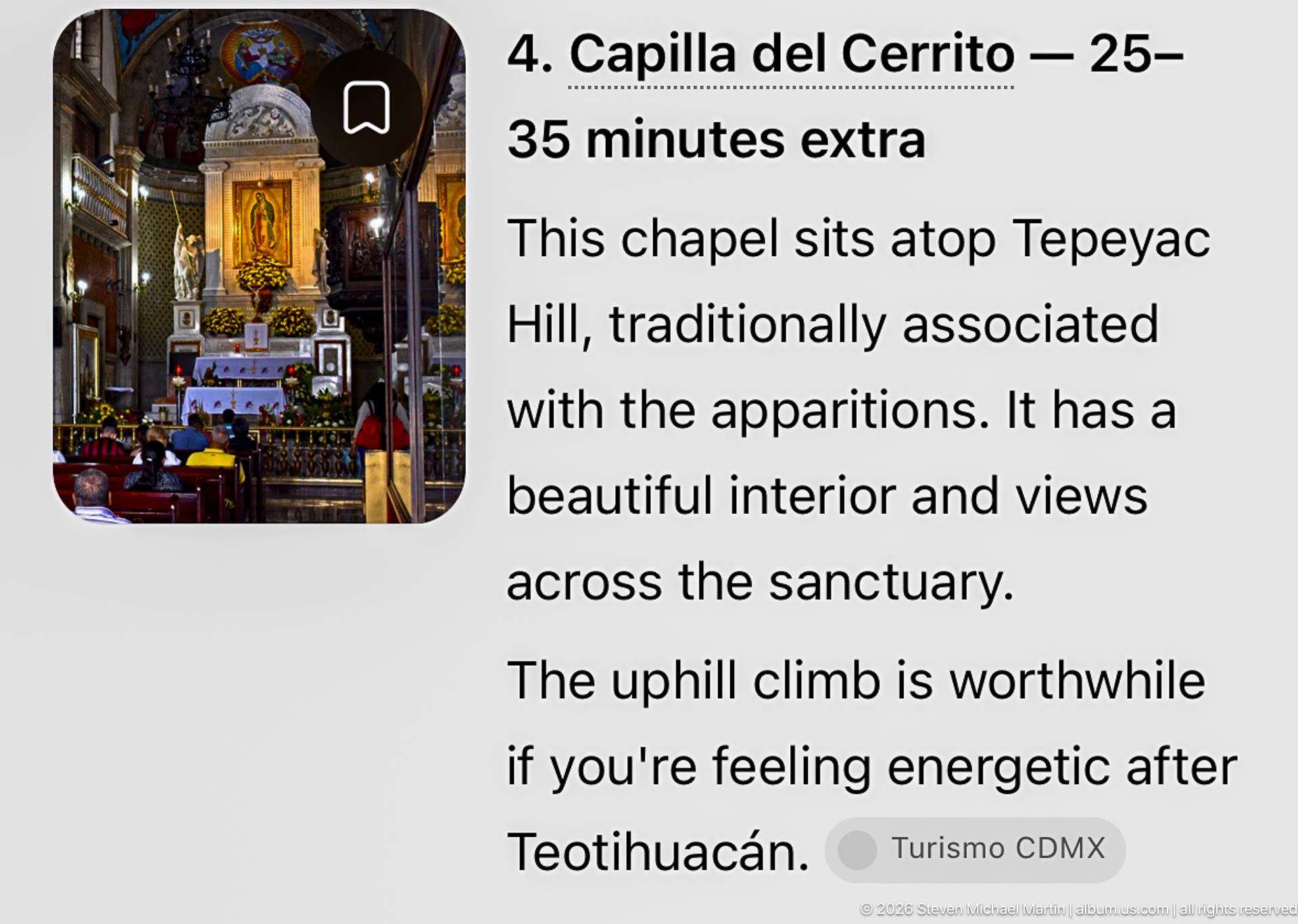
At the Chapel of the Cerrito, a gilded altar and framed devotional image anchor a richly furnished interior on Tepeyac Hill. Dark side walls, hanging lamps, and rows of pews lead toward the sanctuary, where visitors gather beneath the central image. The chapel’s elevated setting and intimate scale distinguish this interior from the vast, column-free New Basilica below.
Caption
At the Chapel of the Cerrito, a gilded altar and framed devotional image anchor a richly furnished interior on Tepeyac Hill. Dark side walls, hanging lamps, and rows of pews lead toward the sanctuary, where visitors gather beneath the central image. The chapel’s elevated setting and intimate scale distinguish this interior from the vast, column-free New Basilica below.
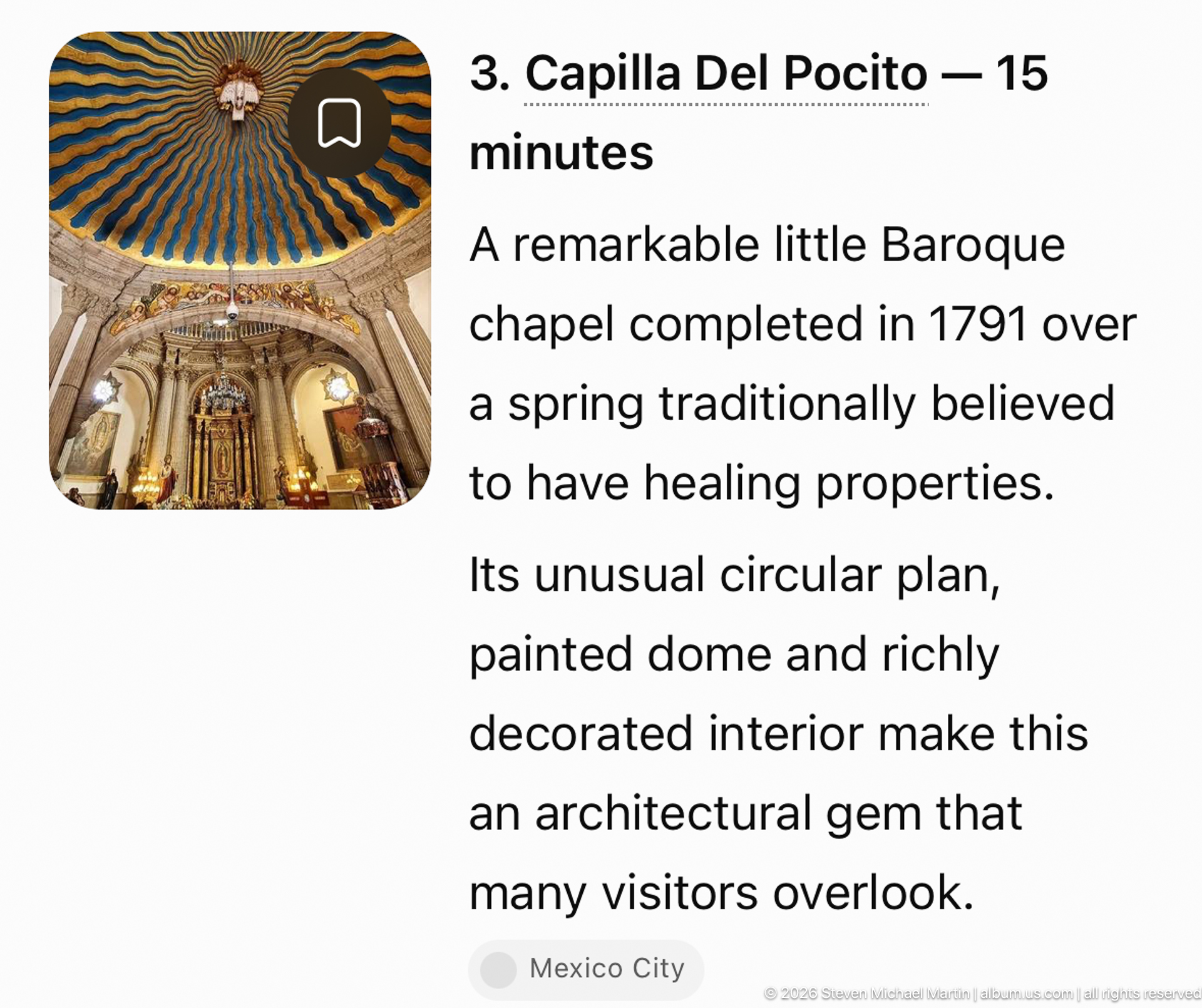
The circular interior of Capilla del Pocito rises into a painted dome banded in blue and ochre, its curved ribs drawing attention toward the richly ornamented altar below. The chapel was completed in 1791 over a spring long associated with healing, a history that helps explain this small building’s devotional importance. The photograph’s upward angle makes the unusual plan and dome the defining features.
Caption
The circular interior of Capilla del Pocito rises into a painted dome banded in blue and ochre, its curved ribs drawing attention toward the richly ornamented altar below. The chapel was completed in 1791 over a spring long associated with healing, a history that helps explain this small building’s devotional importance. The photograph’s upward angle makes the unusual plan and dome the defining features.
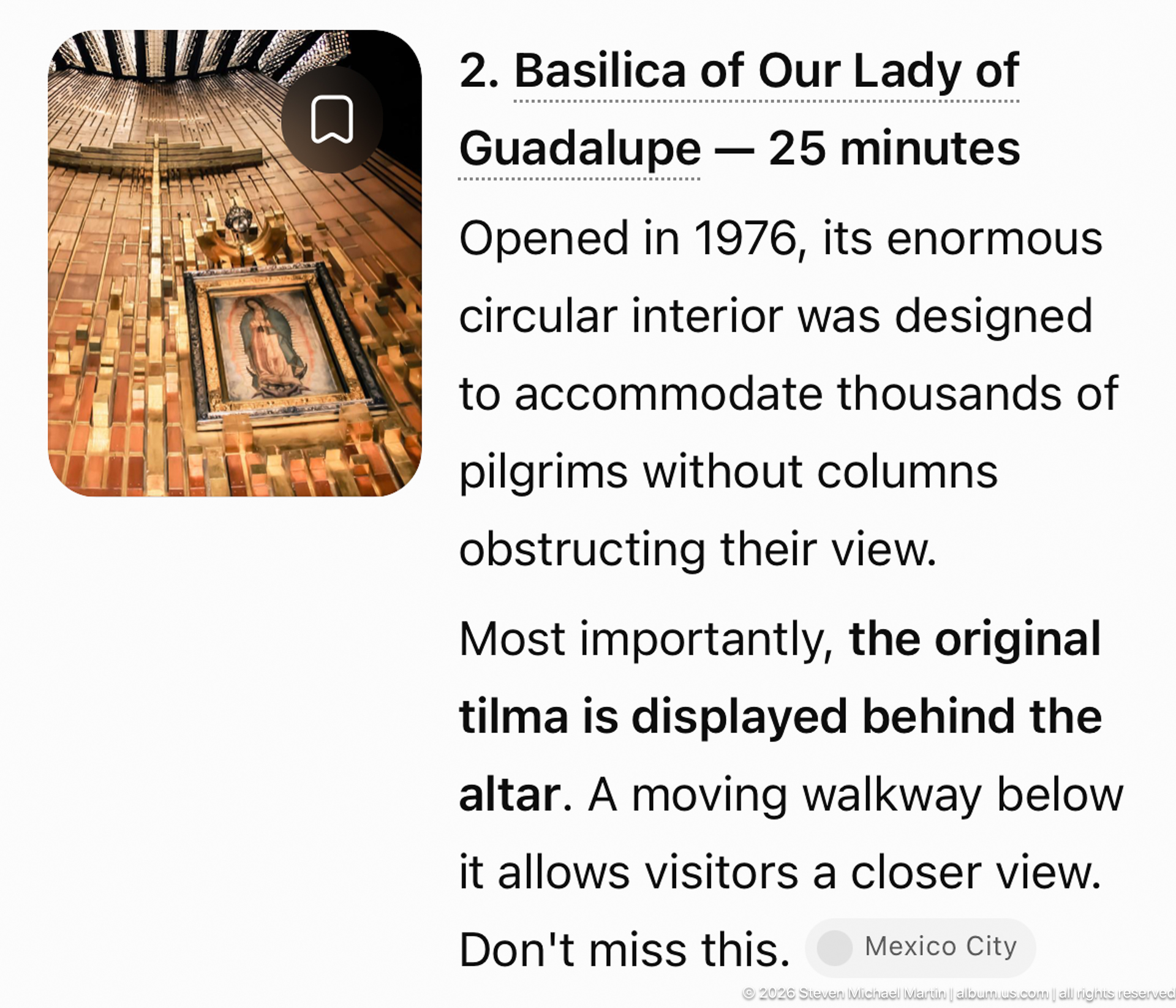
Seen from above, the original tilma is displayed beneath glass behind the altar in the New Basilica. A moving walkway passes directly in front of the case, bringing visitors close to the image while keeping the route flowing through the vast circular sanctuary. The floor-level viewpoint records how the basilica accommodates both the revered textile and the steady movement of pilgrims through the building.
Caption
Seen from above, the original tilma is displayed beneath glass behind the altar in the New Basilica. A moving walkway passes directly in front of the case, bringing visitors close to the image while keeping the route flowing through the vast circular sanctuary. The floor-level viewpoint records how the basilica accommodates both the revered textile and the steady movement of pilgrims through the building.
Spiritual Heritage Field Guide
📍 Overview
The Basilica of Our Lady of Guadalupe is a sanctuary of many buildings and generations. Its vast circular modern basilica stands beside the richly decorated Old Basilica and a collection of smaller churches and chapels across the Tepeyac grounds. The photographs move between monumental architecture, intimate devotional spaces, religious art, and the crowds who gather here, presenting the complex as both a place of worship and a record of enduring devotion.
◆ Religious & Historical Context
The sanctuary’s religious meaning centers on devotion to Our Lady of Guadalupe and the tradition of her appearances to Juan Diego in 1531. That story appears throughout the grounds: an inscription on the modern basilica quotes the words associated with the apparition, while paintings depict the first miracle and other episodes in the Guadalupe narrative. The complex also preserves earlier places of worship, including the Old Basilica, completed in 1709, and chapels connected with the history of the sanctuary.
◆ Sacred Architecture
The New Basilica’s broad circular form, sloping ribbed roof, and continuous band of colored windows contrast with the Old Basilica’s red masonry, pale carved stone, towers, and domes. Inside the modern sanctuary, a vast timber-toned roof, clustered suspended lights, and a sweeping organ frame the altar and the image of Guadalupe. Elsewhere, painted domes, carved retablos, stone portals, stained glass, and compact chapel interiors offer closer, more intricate architectural experiences. Together, these spaces show how sacred architecture can range from a large gathering place to a quiet chapel.
◆ Symbolism & Iconography
Religious images and symbols shape the visual language of the sanctuary. The image of Our Lady of Guadalupe anchors the New Basilica’s altar, while a cross crowns its roof and a sculpted dove appears among the ceiling ornament. In the older churches, stained-glass scenes portray the Annunciation, Christ, and other sacred figures; painted narratives and carved reliefs present episodes from the Guadalupe tradition. Latin and Spanish inscriptions, including the words associated with the apparition, make text part of the site’s devotional architecture.
◆ Ritual & Community
The sanctuary is designed for both individual prayer and large gatherings. Visitors approach altars in the smaller chapels, sit or kneel before side shrines, and move through the New Basilica toward the displayed tilma. The photographs also show worshippers filling the nave, visitors crossing the forecourt, and a priest addressing a crowd outside. These moments reveal the buildings in active use, with circulation, seating, altars, and open plazas supporting different forms of devotion.
◆ Preservation
The complex brings together historic buildings and contemporary construction, each carrying visible signs of its setting and age. The Old Basilica’s leaning profile is associated with the unstable ground beneath Mexico City, while its carved stone, painted domes, organ gallery, and stained glass preserve a richly detailed architectural record. Smaller chapels add further layers, including the Capilla del Pocito, completed in 1791 over a spring long associated with healing. The photographs document these different spaces and their devotional use as part of the sanctuary’s continuing history.
📷 Photography Notes
Begin with the forecourt to show how the New Basilica, Old Basilica, and neighboring chapels relate to one another. Inside the modern sanctuary, wide views convey the scale of the congregation and roof, while closer frames bring out the altar image, organ pipes, suspended lights, and colored windows. In the older churches, look upward to connect domes and chandeliers with their painted programs, then photograph retablos, inscriptions, carved portals, and stained-glass scenes at closer range. Include worshippers and visitors where they help show how these sacred spaces are used.