Banff Lake Louise, Beehive Lake, and Lake Agnes Introduction
Lake Louise is a place of contrasts: still turquoise water beneath Victoria Glacier, forested slopes veiled by passing cloud, and the Fairmont Chateau standing at the water’s edge. These photographs move between broad views of the lake and close details of its shore, gardens, and historic resort—each offering a different way into this celebrated corner of Banff National Park.
From the lakeshore, the trail climbs through forest to Lake Agnes and its seasonal teahouse. Beyond the lake, paths lead toward Mirror Lake and the Big and Little Beehives, where the changing elevation opens new views across Lake Louise and the Bow Valley. Along the way, trail signs and interpretive displays add stories of hiking, mountaineering, and life in the mountains.
The sequence follows that journey through shifting weather, rocky cascades, wildflowers, historic buildings, and quiet reflections. Two beagles in bright yellow coats join the lakeside views, bringing a personal note to the grandeur of the glacier and surrounding peaks. Together, the images trace both the scale of the landscape and the small moments that make a day here memorable.
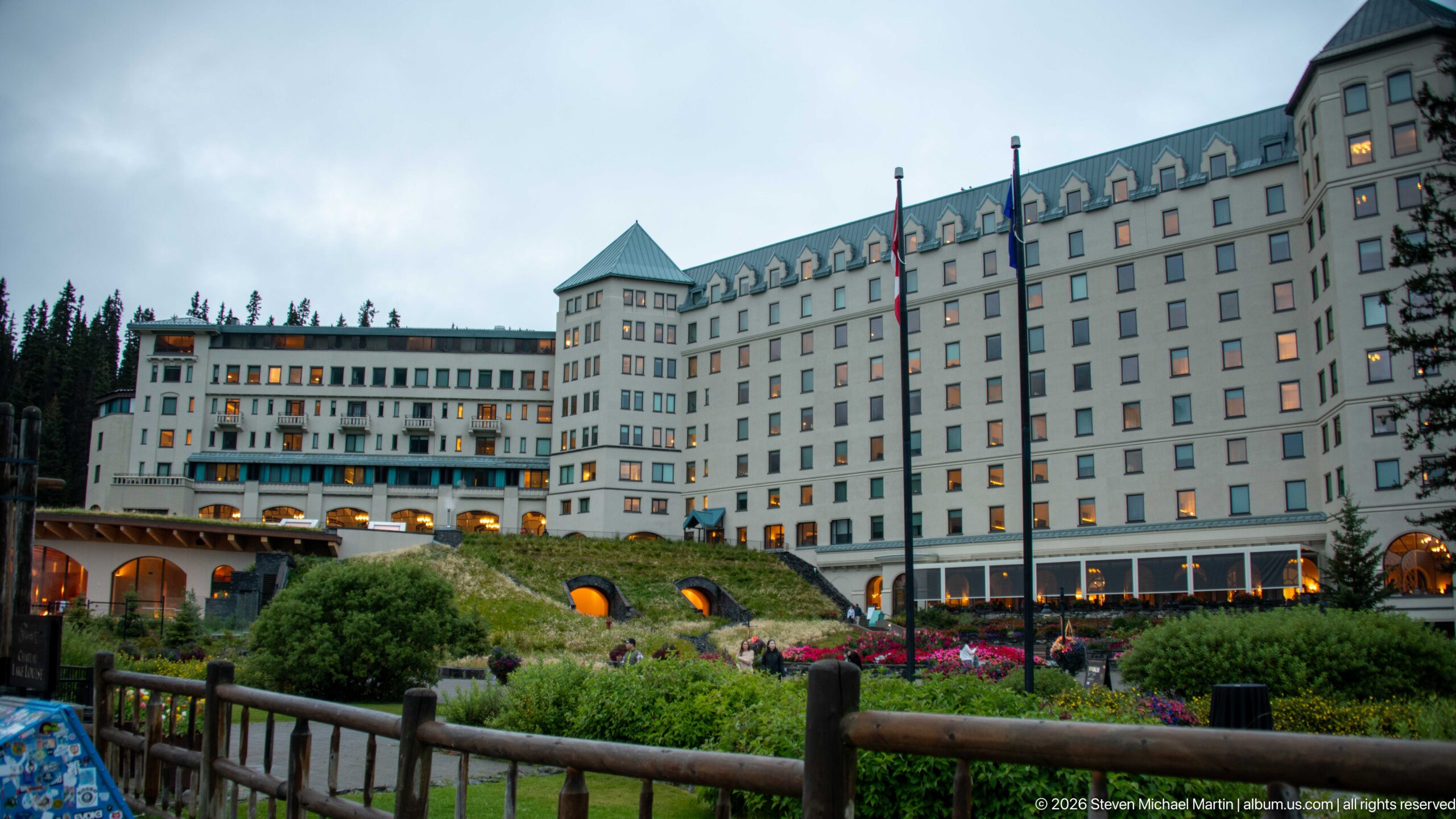
The Fairmont Chateau Lake Louise rises above lawns, flower beds, and a timber-railed path in this broad exterior view. Its long pale wings, steep roof, and corner tower form a layered skyline against the cloudy mountainside. The photograph shows the resort’s scale and its integration with the sloping garden, including the small arched openings set into the terrace below the hotel.
Caption
The Fairmont Chateau Lake Louise rises above lawns, flower beds, and a timber-railed path in this broad exterior view. Its long pale wings, steep roof, and corner tower form a layered skyline against the cloudy mountainside. The photograph shows the resort’s scale and its integration with the sloping garden, including the small arched openings set into the terrace below the hotel.
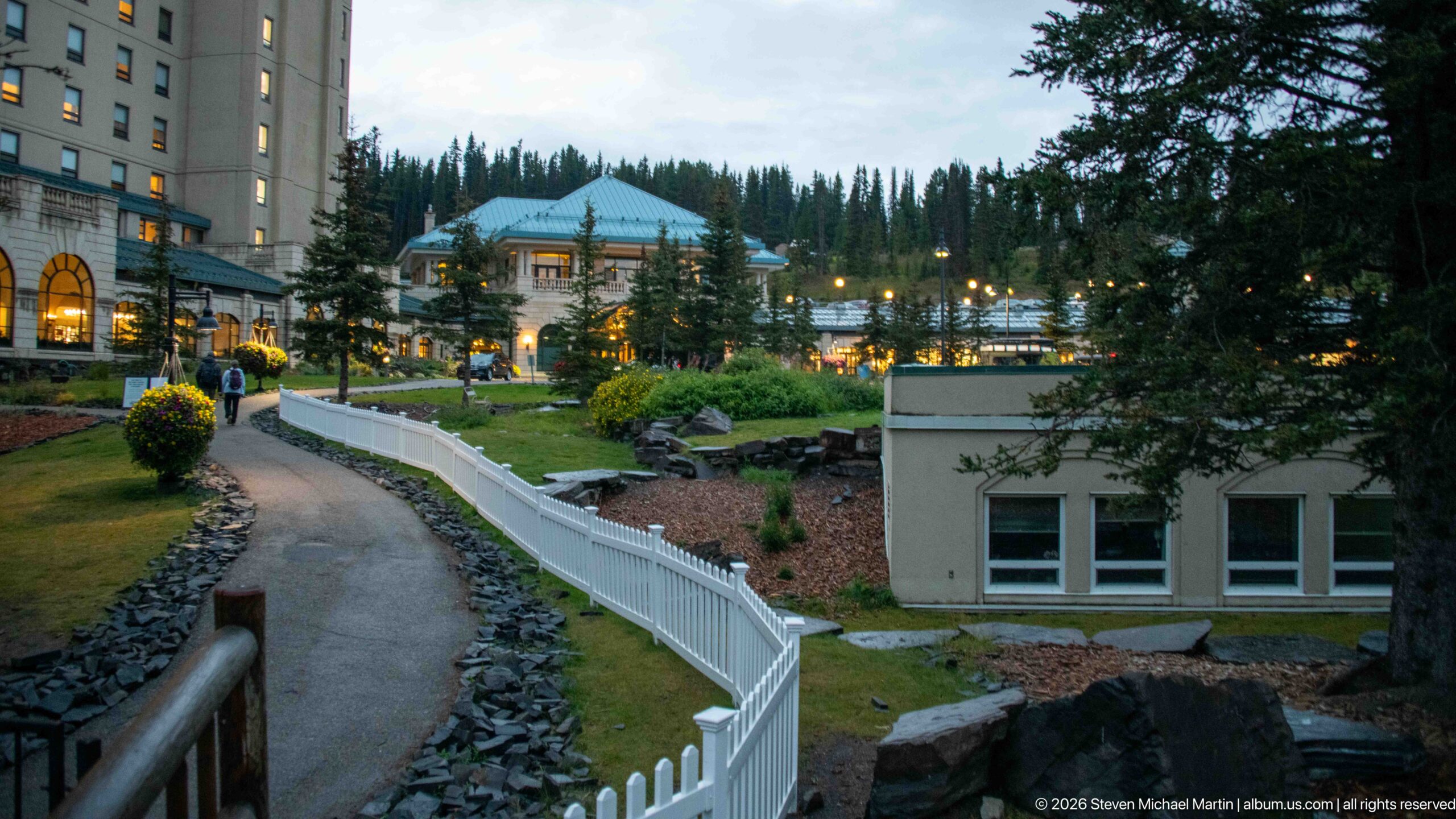
A white fence traces a sweeping curve through the Fairmont Chateau Lake Louise grounds, separating a paved path from lawns, rock edging, and planted beds. Warm lights punctuate the hotel complex beyond the trees, and a low-roofed service or garden structure sits at right. Dusk softens the scene, making the fence’s route the clearest organizing line.
Caption
A white fence traces a sweeping curve through the Fairmont Chateau Lake Louise grounds, separating a paved path from lawns, rock edging, and planted beds. Warm lights punctuate the hotel complex beyond the trees, and a low-roofed service or garden structure sits at right. Dusk softens the scene, making the fence’s route the clearest organizing line.
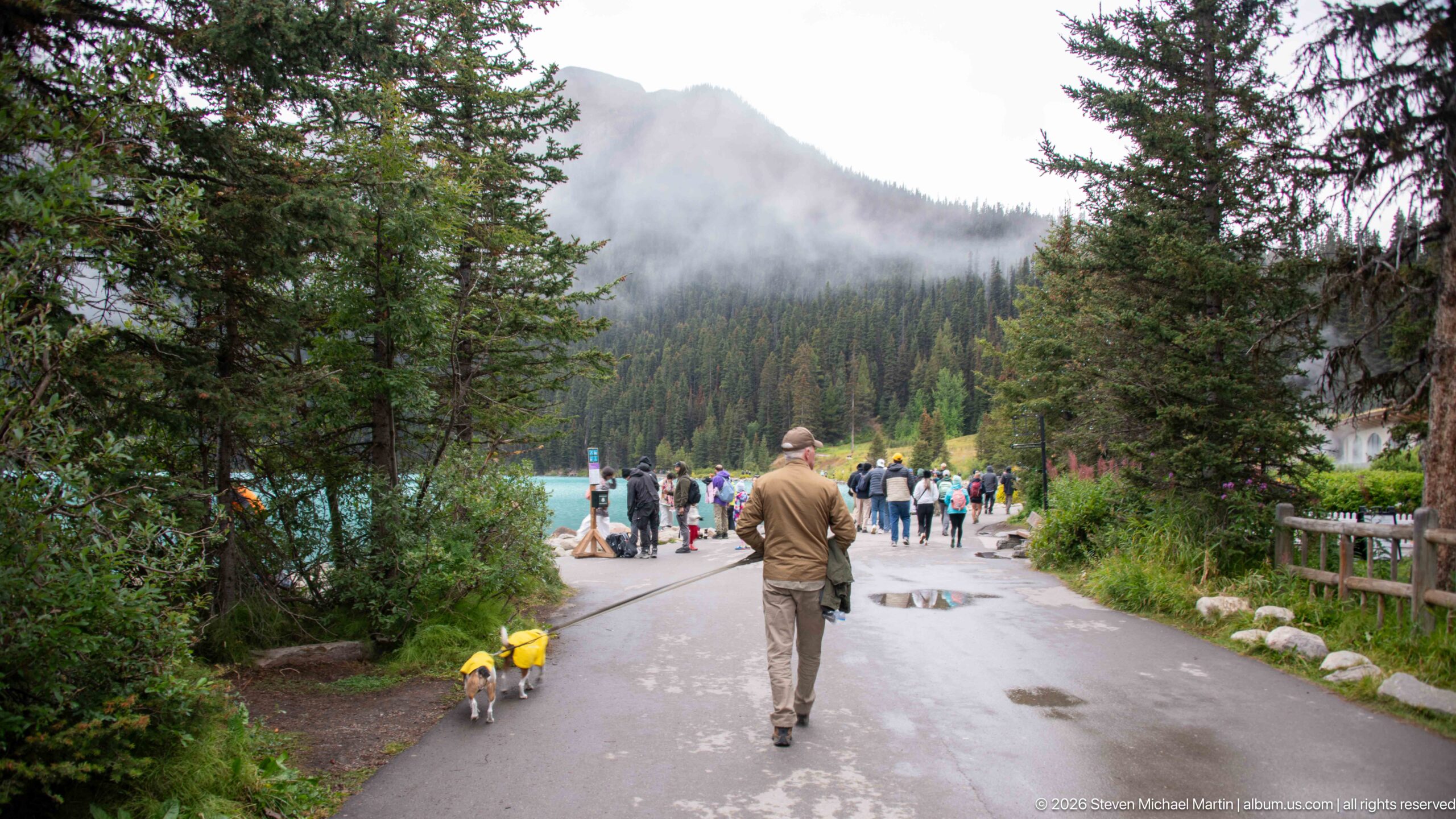
A visitor walks two beagles in yellow coats along the paved lakeside approach, heading toward a small cluster of people near the water. Puddles reflect the overcast sky, and a low timber rail borders the rocky shore. Tall conifers frame the path while cloud softens the forested slope, recording the busy public route at the lake’s edge.
Caption
A visitor walks two beagles in yellow coats along the paved lakeside approach, heading toward a small cluster of people near the water. Puddles reflect the overcast sky, and a low timber rail borders the rocky shore. Tall conifers frame the path while cloud softens the forested slope, recording the busy public route at the lake’s edge.
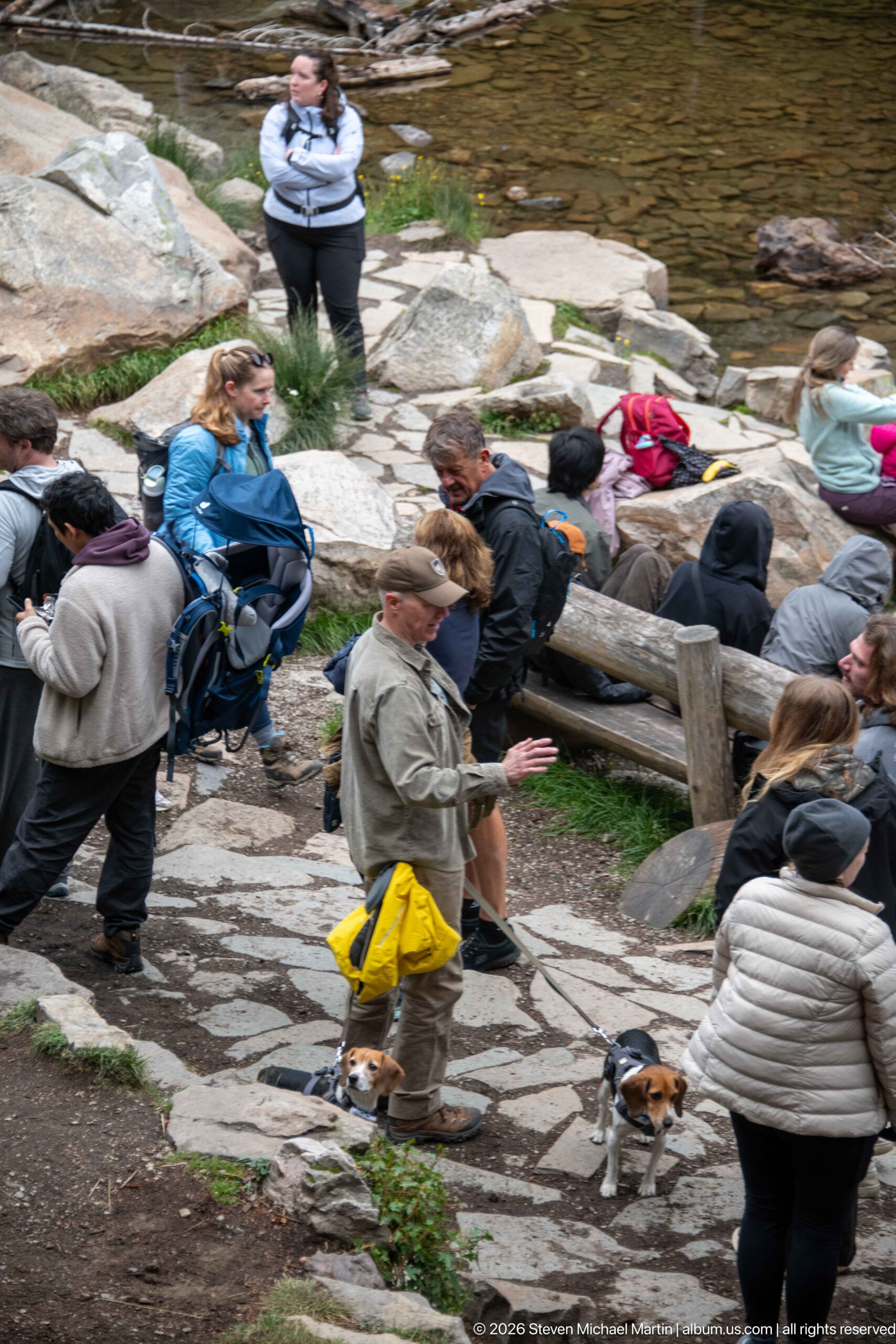
A closer, slightly elevated view shows hikers moving along the stone path beside the Lake Agnes Tea House, with two leashed beagles weaving among their legs. The route narrows beside a low timber rail and the lake’s rocky edge. Backpacks and outdoor clothing dominate the gathering, making this an image of trail traffic and shared space rather than a formal portrait.
Caption
A closer, slightly elevated view shows hikers moving along the stone path beside the Lake Agnes Tea House, with two leashed beagles weaving among their legs. The route narrows beside a low timber rail and the lake’s rocky edge. Backpacks and outdoor clothing dominate the gathering, making this an image of trail traffic and shared space rather than a formal portrait.
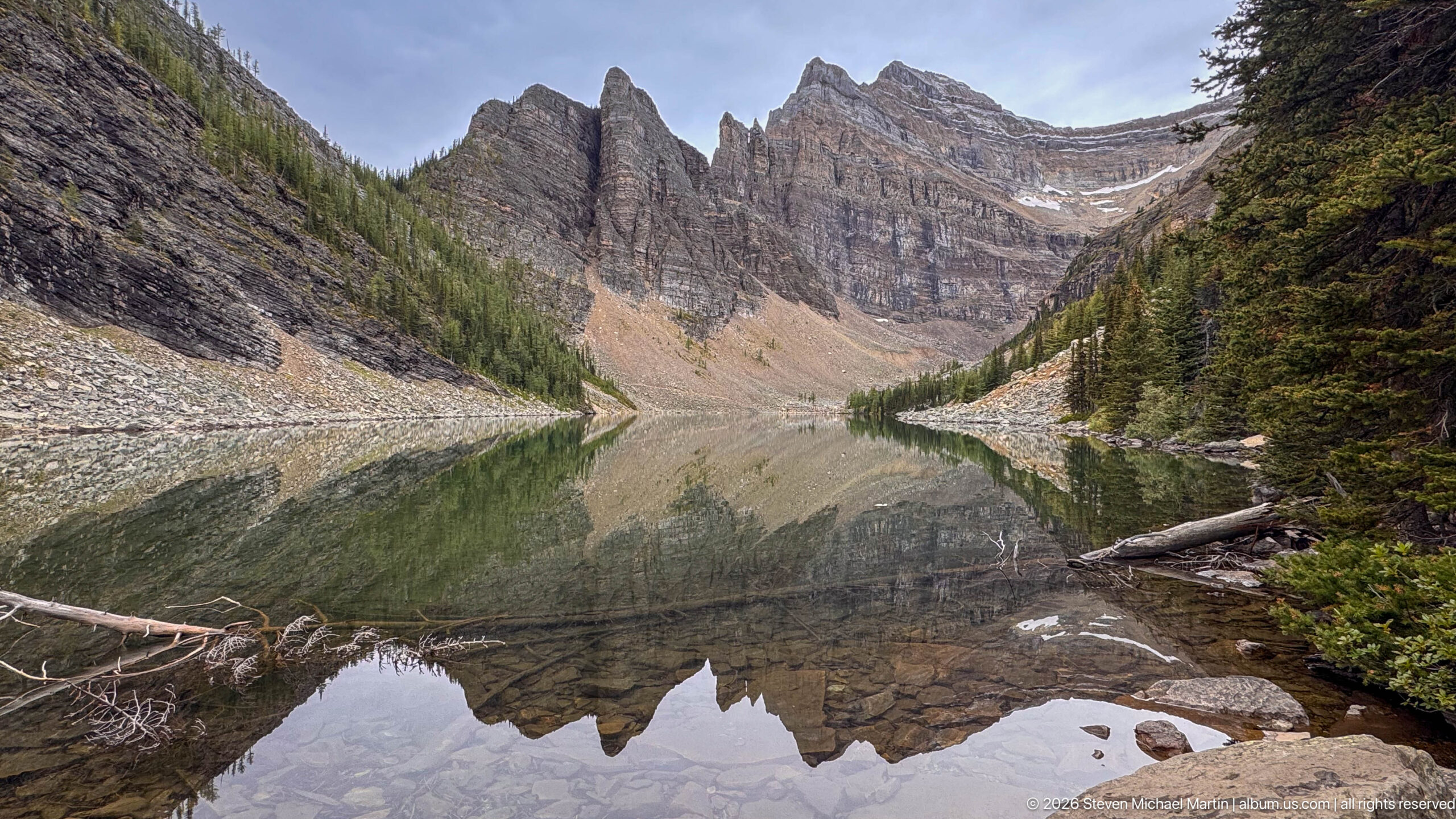
The sharp pinnacles and horizontal rock bands above Lake Agnes appear again in the lake’s glassy surface. A dark conifer slope borders the right side, and a weathered log lies along the near shore. The centered view gives the mountain reflection nearly the same visual weight as the rock wall itself, emphasizing the unusual stillness of this high-elevation basin.
Caption
The sharp pinnacles and horizontal rock bands above Lake Agnes appear again in the lake’s glassy surface. A dark conifer slope borders the right side, and a weathered log lies along the near shore. The centered view gives the mountain reflection nearly the same visual weight as the rock wall itself, emphasizing the unusual stillness of this high-elevation basin.
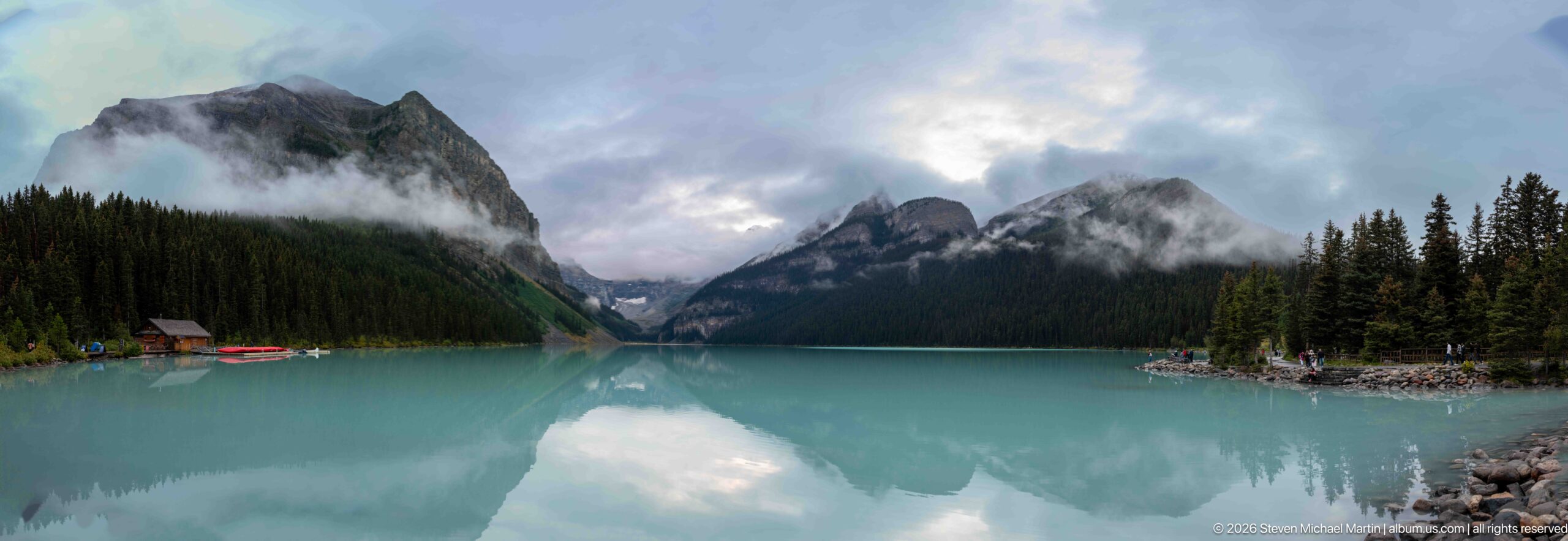
Cloud breaks reveal the steep mountain walls at the head of Lake Louise, where a small glacier is visible between dark forested slopes. The turquoise water mirrors the shifting sky and peaks, with the canoe dock and red rental boats reduced to a narrow strip at left. This broad composition makes the lake’s scale and enclosed alpine basin the main subject.
Caption
Cloud breaks reveal the steep mountain walls at the head of Lake Louise, where a small glacier is visible between dark forested slopes. The turquoise water mirrors the shifting sky and peaks, with the canoe dock and red rental boats reduced to a narrow strip at left. This broad composition makes the lake’s scale and enclosed alpine basin the main subject.
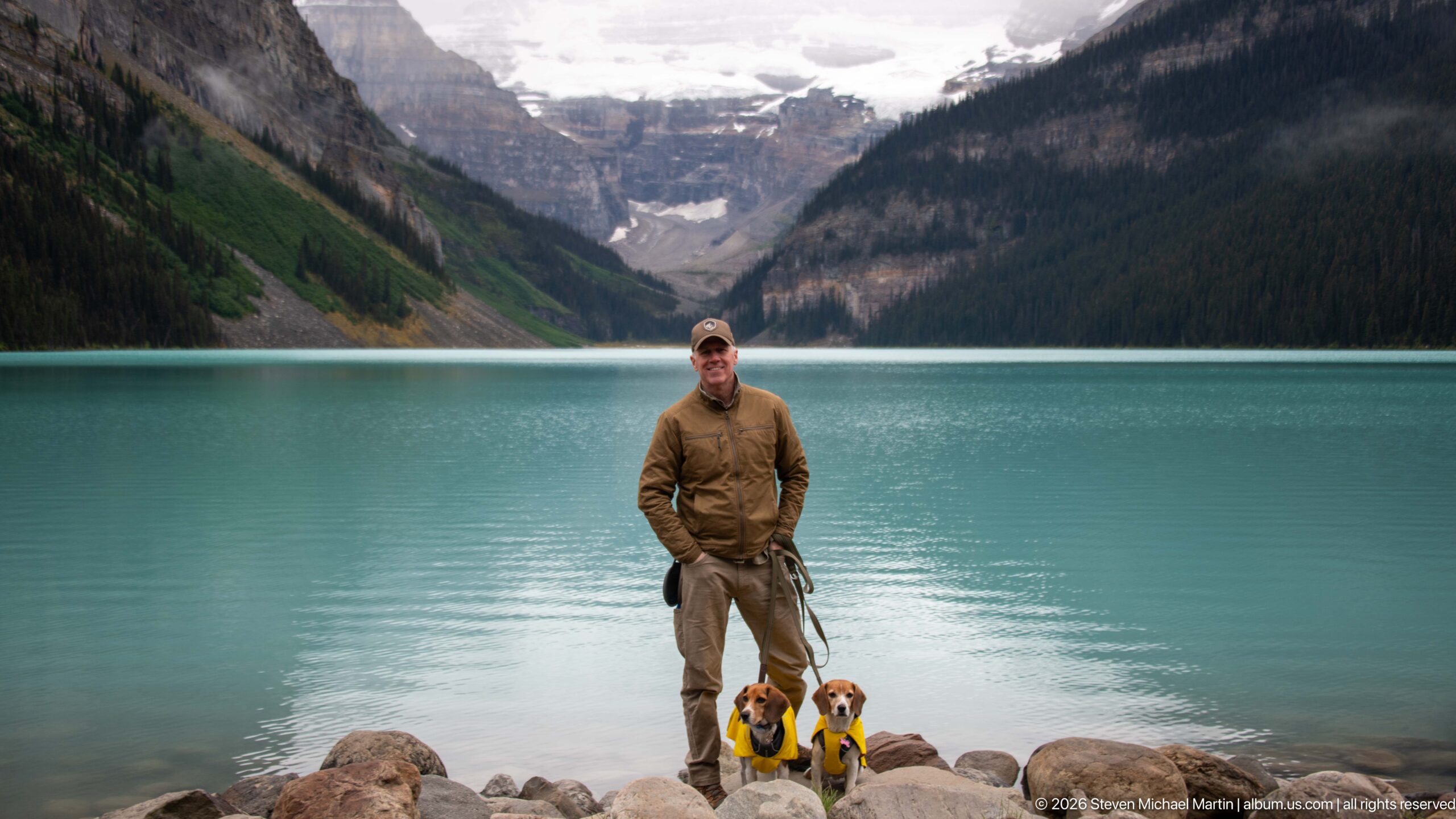
The visitor stands beside the two leashed beagles on shoreline rocks, framed from farther back than the preceding portrait. The lake fills most of the composition, and the glacier appears in the narrow opening between steep forested slopes. The dogs’ yellow coats remain visible against the dark boulders, anchoring the small group at the water’s edge.
Caption
The visitor stands beside the two leashed beagles on shoreline rocks, framed from farther back than the preceding portrait. The lake fills most of the composition, and the glacier appears in the narrow opening between steep forested slopes. The dogs’ yellow coats remain visible against the dark boulders, anchoring the small group at the water’s edge.
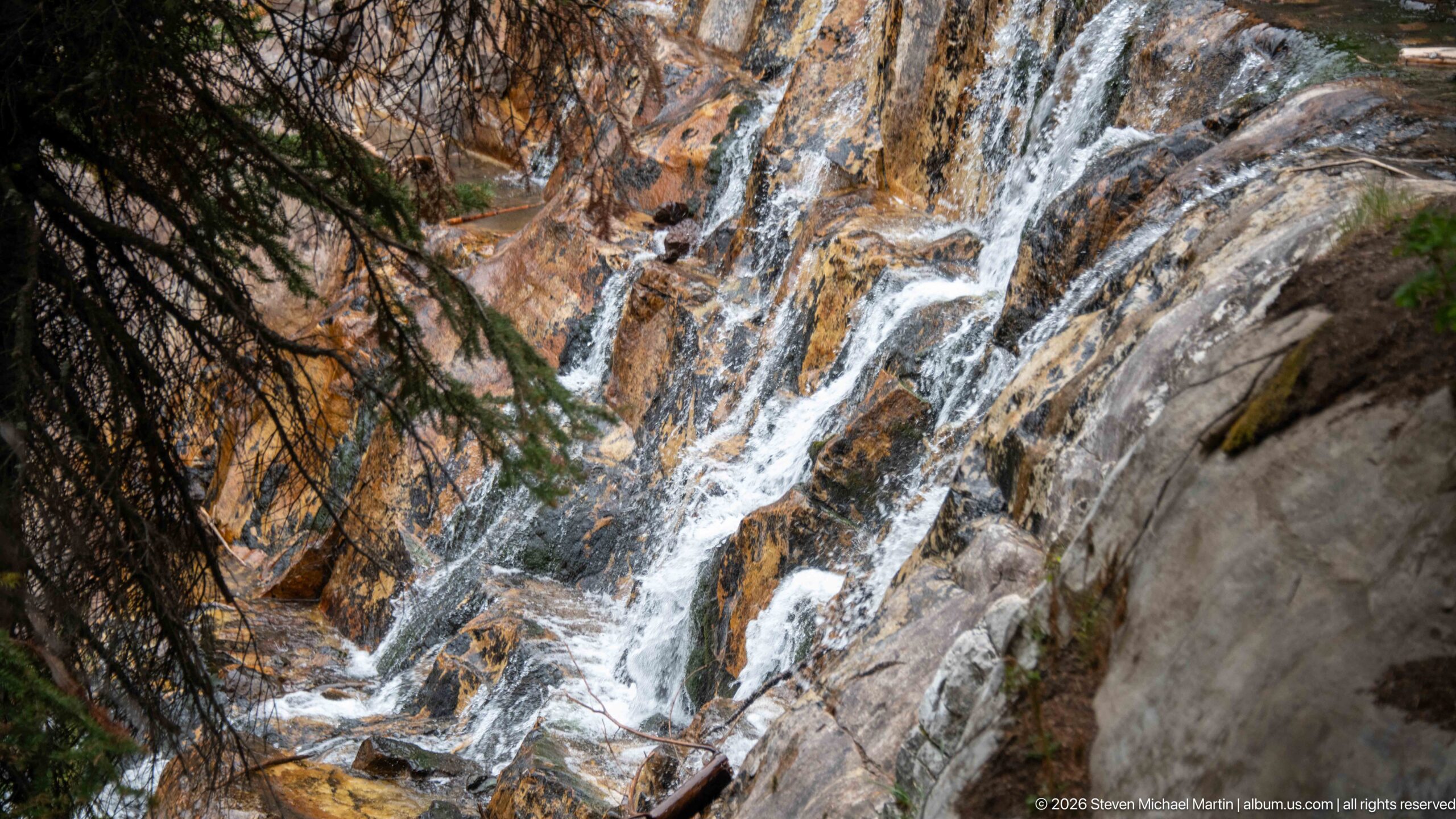
The cascade fills the frame as several thin white streams divide around ridges in the orange-brown rock. Dark branches enter from the left, and patches of moss cling to the damp stone. By excluding the banks and surrounding forest, this close view turns the waterfall into a study of texture, flow, and the mineral colors of the rock face.
Caption
The cascade fills the frame as several thin white streams divide around ridges in the orange-brown rock. Dark branches enter from the left, and patches of moss cling to the damp stone. By excluding the banks and surrounding forest, this close view turns the waterfall into a study of texture, flow, and the mineral colors of the rock face.
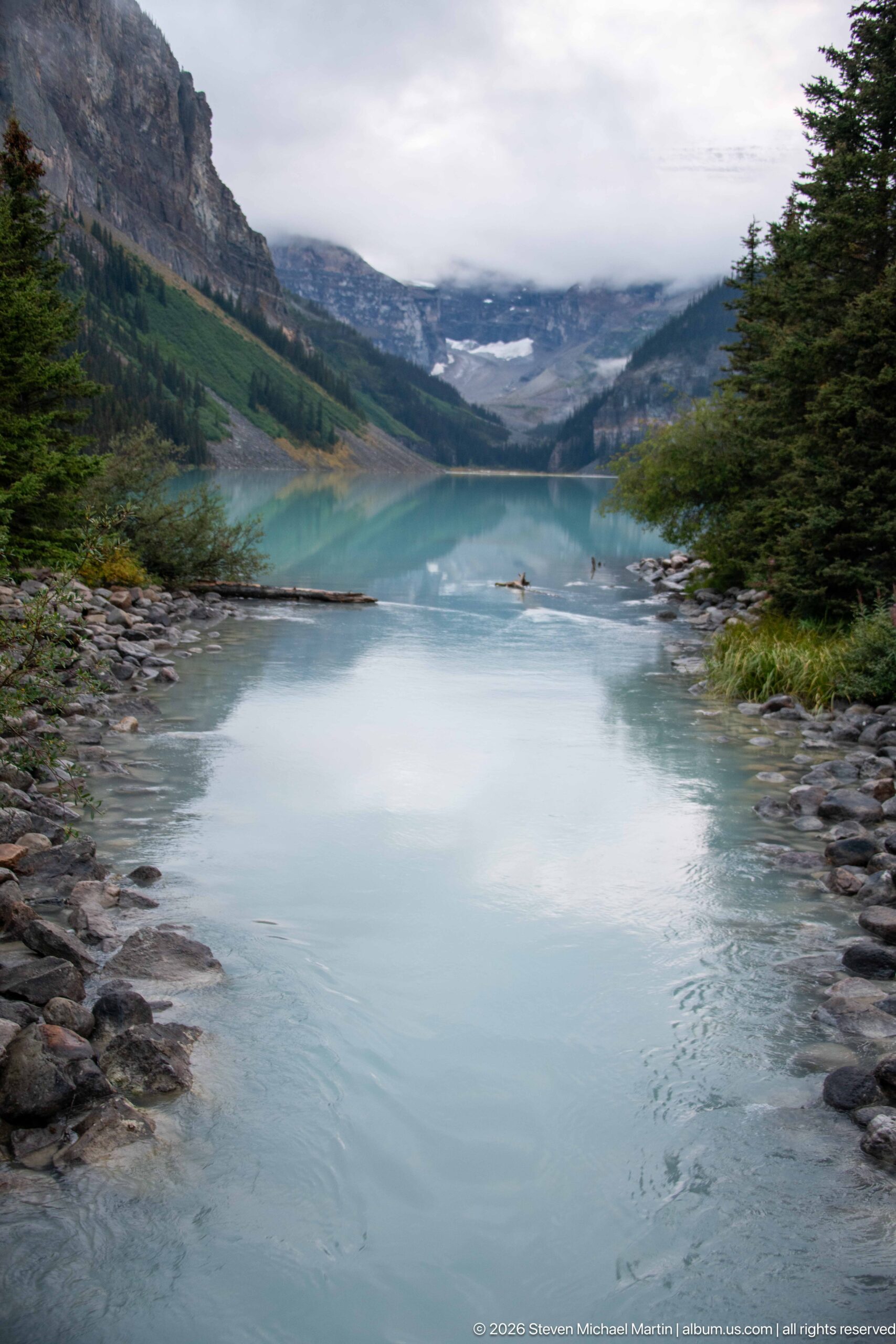
Pale turquoise water moves gently between the rocky near shore and a low, tree-lined bank. A narrow strip of land and driftwood divide the surface in the middle distance, while the valley opens toward muted slopes under an overcast sky. With no people or buildings in frame, this photograph isolates the lake’s shallow edge and the subtle currents across its surface.
Caption
Pale turquoise water moves gently between the rocky near shore and a low, tree-lined bank. A narrow strip of land and driftwood divide the surface in the middle distance, while the valley opens toward muted slopes under an overcast sky. With no people or buildings in frame, this photograph isolates the lake’s shallow edge and the subtle currents across its surface.
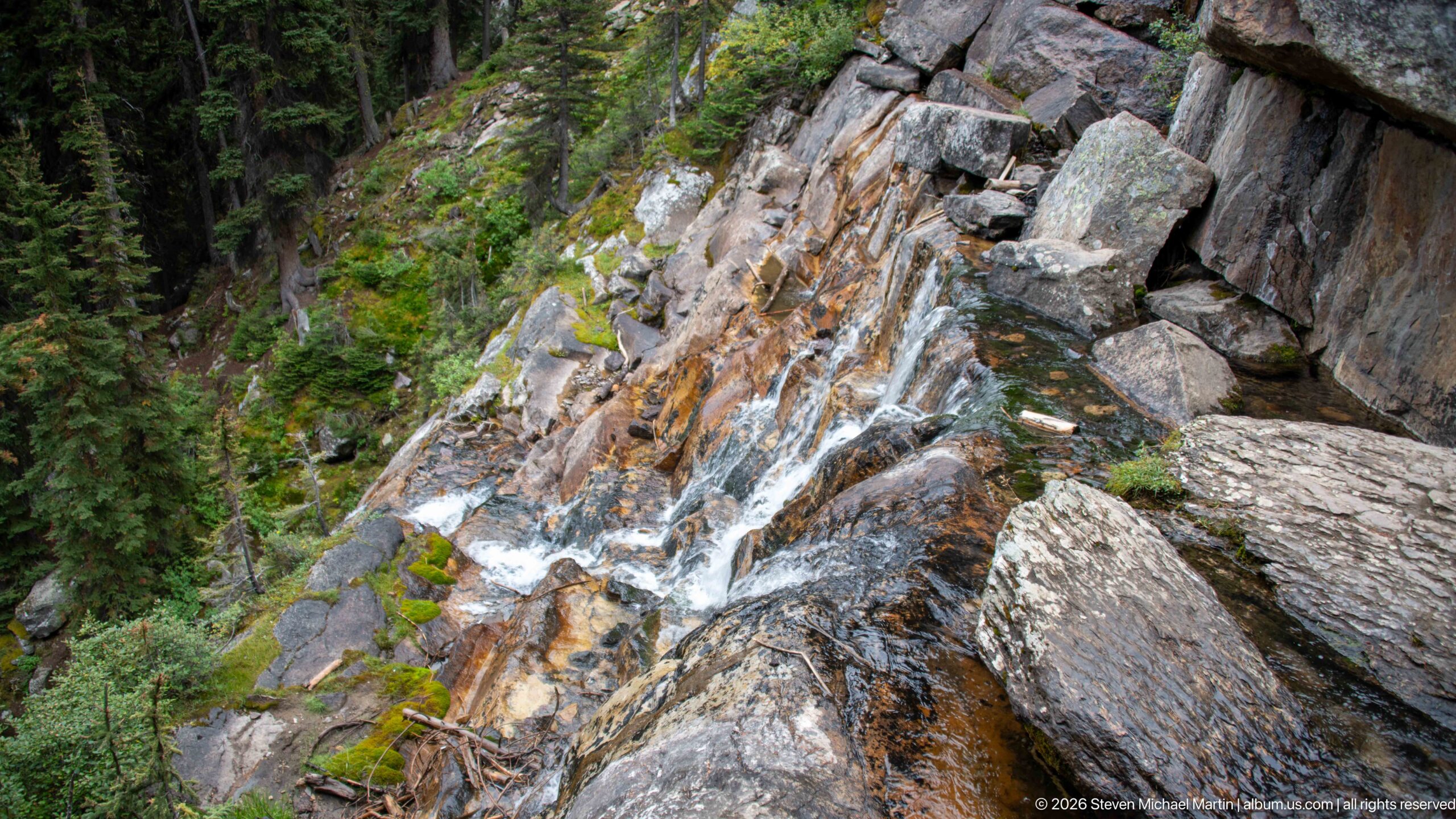
Seen from above, the stream threads down a narrow channel between large angular boulders and slabs of orange-stained stone. Evergreen branches and low groundcover crowd the left bank, while the water breaks into several white steps. This elevated view reveals the rugged drainage around the cascade, distinguishing it from the closer frontal views on the preceding page.
Caption
Seen from above, the stream threads down a narrow channel between large angular boulders and slabs of orange-stained stone. Evergreen branches and low groundcover crowd the left bank, while the water breaks into several white steps. This elevated view reveals the rugged drainage around the cascade, distinguishing it from the closer frontal views on the preceding page.
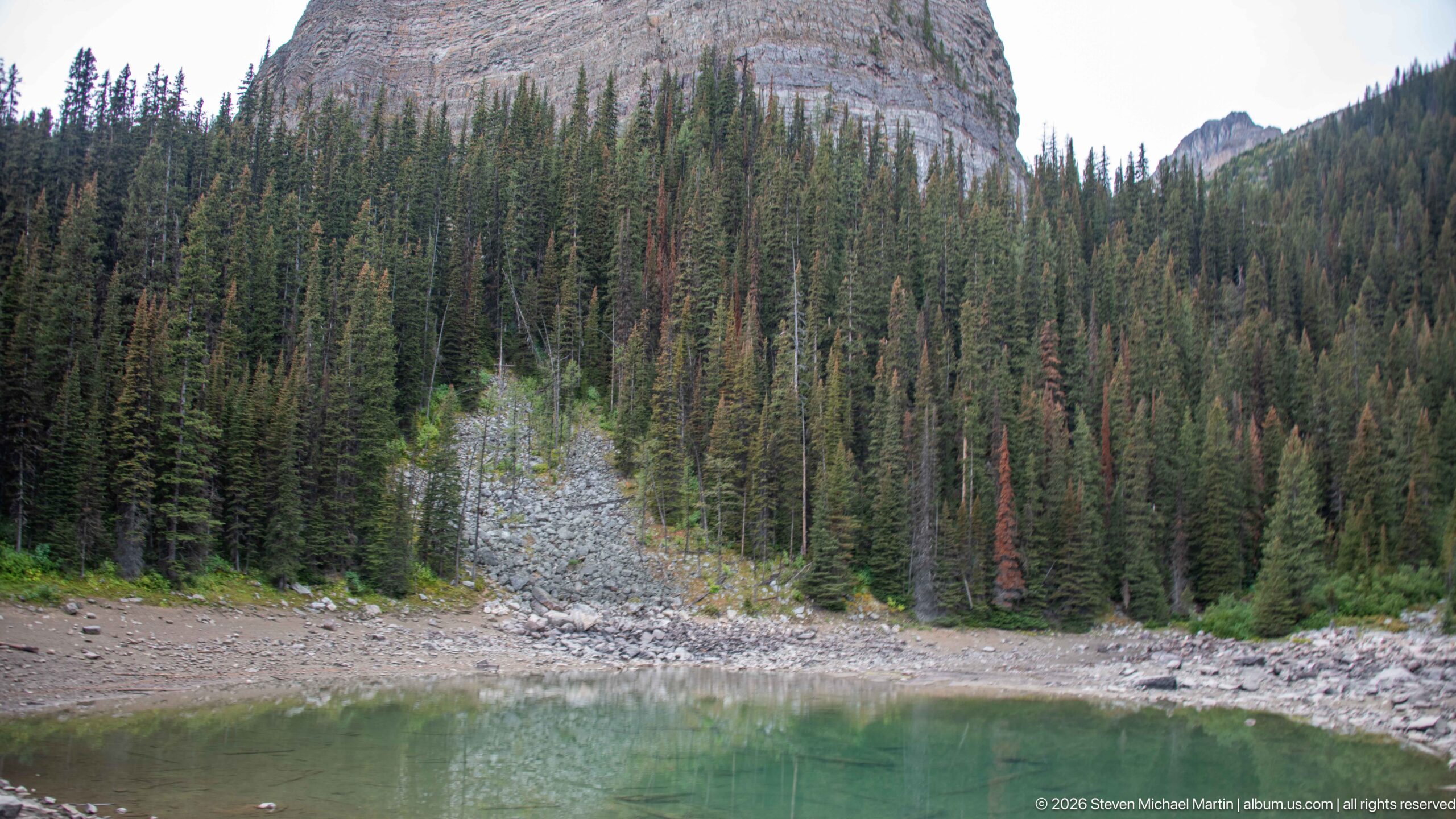
The shoreline of Mirror Lake curves beneath a steep forested slope broken by a pale fan of loose rock. A massive rounded cliff enters from the upper left, while darker conifers fill the center and right. The close crop concentrates on the boundary between talus, trees, and water, revealing the small lake’s rugged cirque setting.
Caption
The shoreline of Mirror Lake curves beneath a steep forested slope broken by a pale fan of loose rock. A massive rounded cliff enters from the upper left, while darker conifers fill the center and right. The close crop concentrates on the boundary between talus, trees, and water, revealing the small lake’s rugged cirque setting.
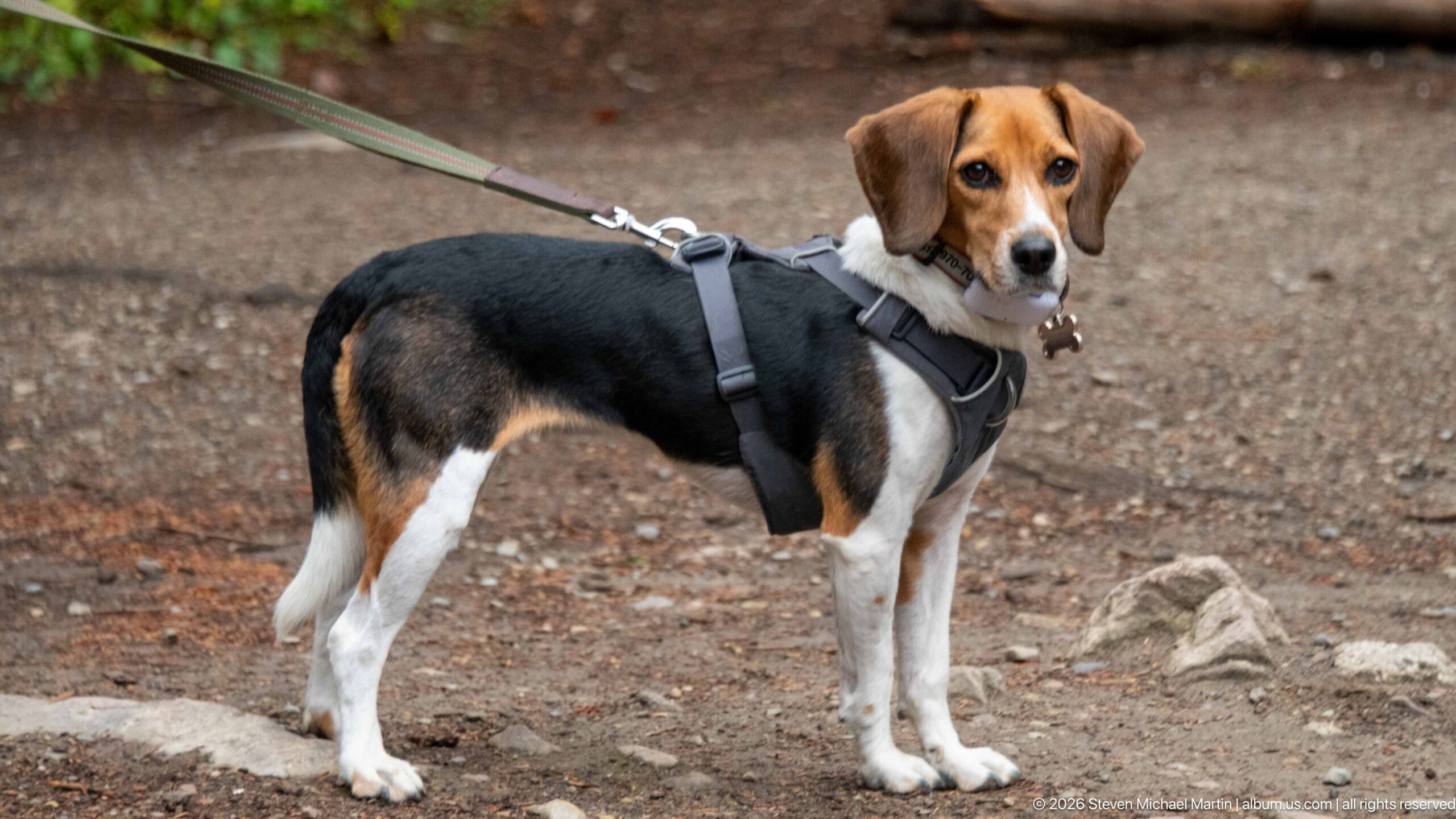
A tricolor beagle turns its head toward the camera while standing on a brown dirt trail, its dark harness and leash visible across the back. A pale rock rests near the dog’s hind feet, and the soft background contains no other clear subjects. The framing resembles a companion portrait, with the dog’s alert gaze and balanced stance carrying the image.
Caption
A tricolor beagle turns its head toward the camera while standing on a brown dirt trail, its dark harness and leash visible across the back. A pale rock rests near the dog’s hind feet, and the soft background contains no other clear subjects. The framing resembles a companion portrait, with the dog’s alert gaze and balanced stance carrying the image.
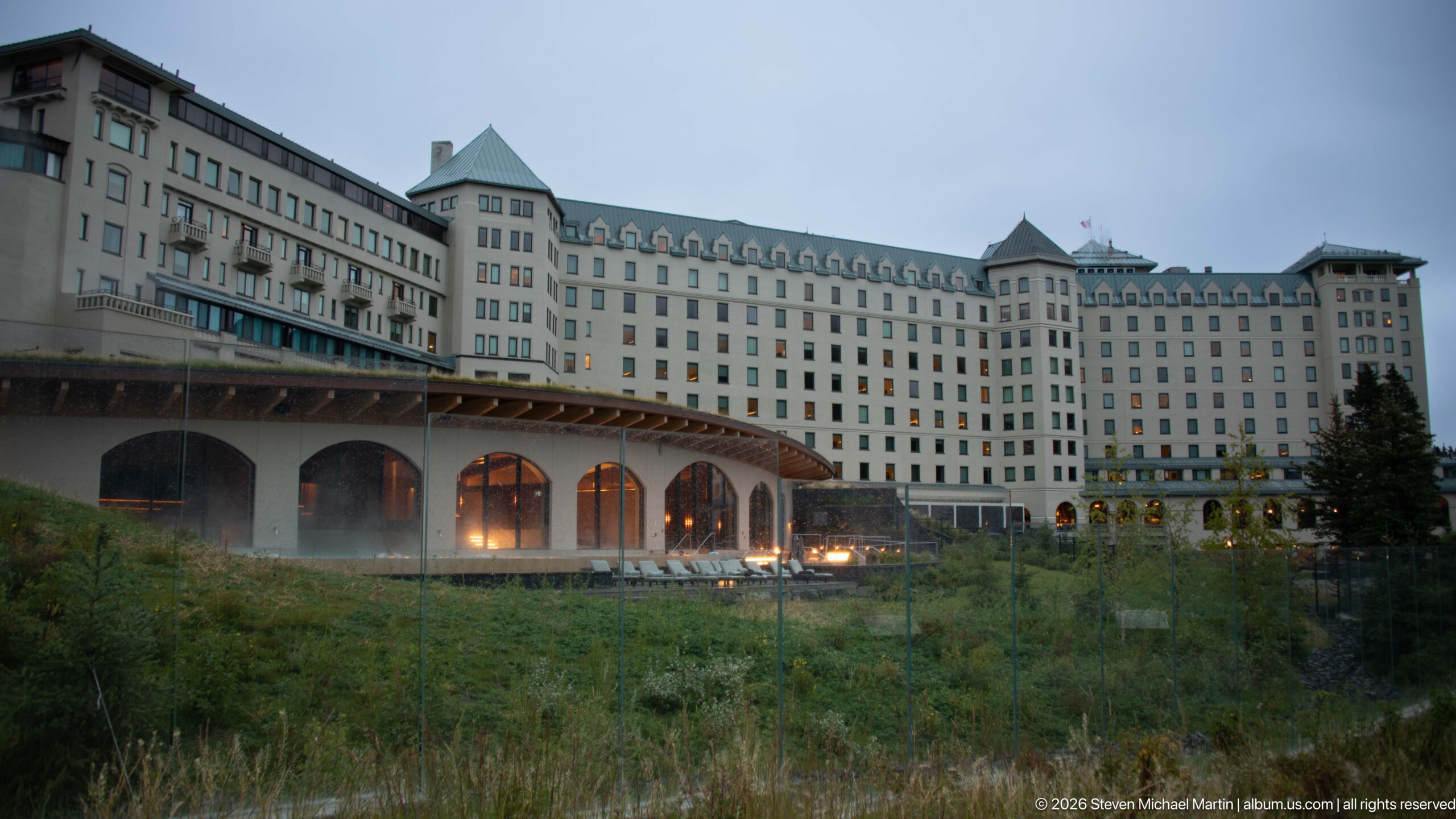
The Fairmont Chateau Lake Louise rises above the foreground gardens in a long, pale façade punctuated by steep rooflines and projecting towers. At dusk, warm light glows through the ground-floor arches while the upper windows remain subdued beneath a cool, overcast sky. The low viewpoint places the hotel behind rough meadow growth, giving this architectural portrait a quieter edge than a conventional lakeside vista.
Caption
The Fairmont Chateau Lake Louise rises above the foreground gardens in a long, pale façade punctuated by steep rooflines and projecting towers. At dusk, warm light glows through the ground-floor arches while the upper windows remain subdued beneath a cool, overcast sky. The low viewpoint places the hotel behind rough meadow growth, giving this architectural portrait a quieter edge than a conventional lakeside vista.
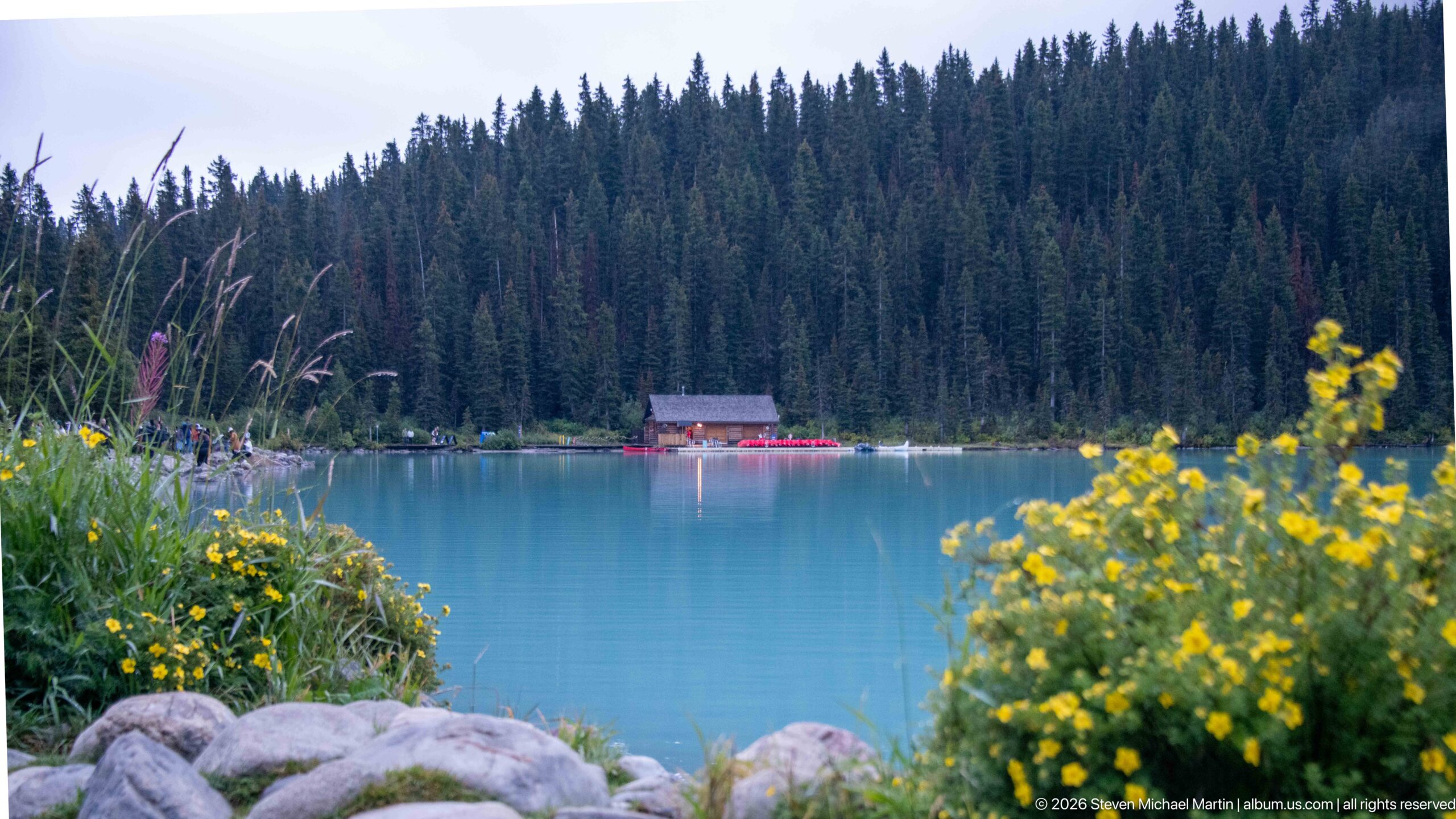
Yellow wildflowers and rounded shoreline stones frame the luminous turquoise water of Lake Louise. Across the lake, a low boathouse and a line of red canoes sit beneath a dense evergreen slope. The floral foreground and nearly still surface make this a close, intimate view of the lake’s edge, rather than a broad mountain panorama.
Caption
Yellow wildflowers and rounded shoreline stones frame the luminous turquoise water of Lake Louise. Across the lake, a low boathouse and a line of red canoes sit beneath a dense evergreen slope. The floral foreground and nearly still surface make this a close, intimate view of the lake’s edge, rather than a broad mountain panorama.
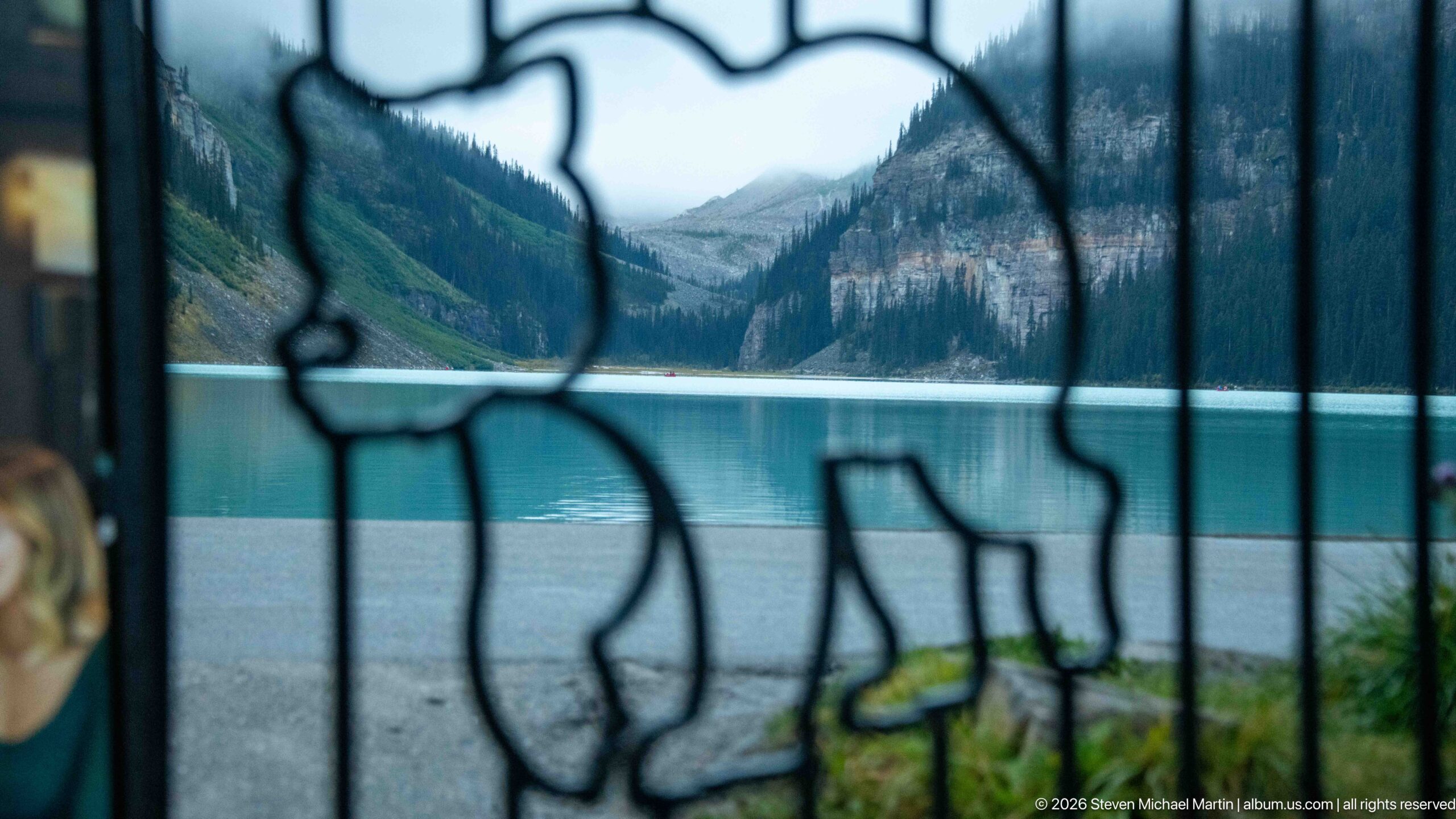
An ornamental iron gate cuts across the foreground, its dark scrollwork soft and out of focus against the turquoise water and steep, forested slopes beyond. The deliberately obstructed view turns a familiar Lake Louise landscape into a framed glimpse from the hotel grounds. A narrow strip of walkway at the bottom anchors the scene at the lakeside rather than on a trail.
Caption
An ornamental iron gate cuts across the foreground, its dark scrollwork soft and out of focus against the turquoise water and steep, forested slopes beyond. The deliberately obstructed view turns a familiar Lake Louise landscape into a framed glimpse from the hotel grounds. A narrow strip of walkway at the bottom anchors the scene at the lakeside rather than on a trail.
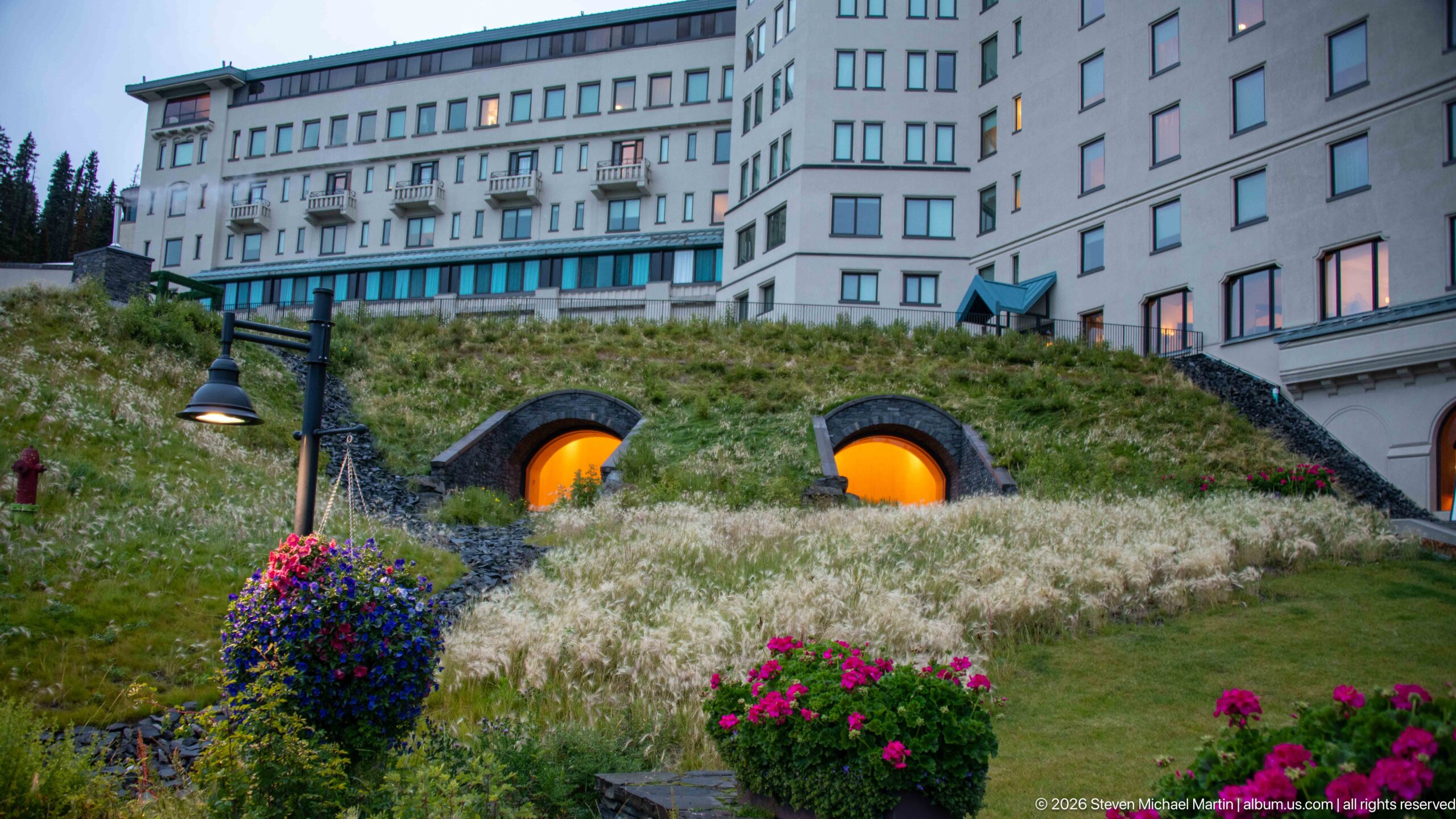
Two small arched openings glow amber from within a grass-covered terrace below the Fairmont Chateau Lake Louise. Flower beds and a rounded hanging basket soften the stone-edged slope, while the hotel’s pale upper façade fills the background. The low angle emphasizes the landscaped grade and the unusual illuminated recesses as features of the resort grounds.
Caption
Two small arched openings glow amber from within a grass-covered terrace below the Fairmont Chateau Lake Louise. Flower beds and a rounded hanging basket soften the stone-edged slope, while the hotel’s pale upper façade fills the background. The low angle emphasizes the landscaped grade and the unusual illuminated recesses as features of the resort grounds.
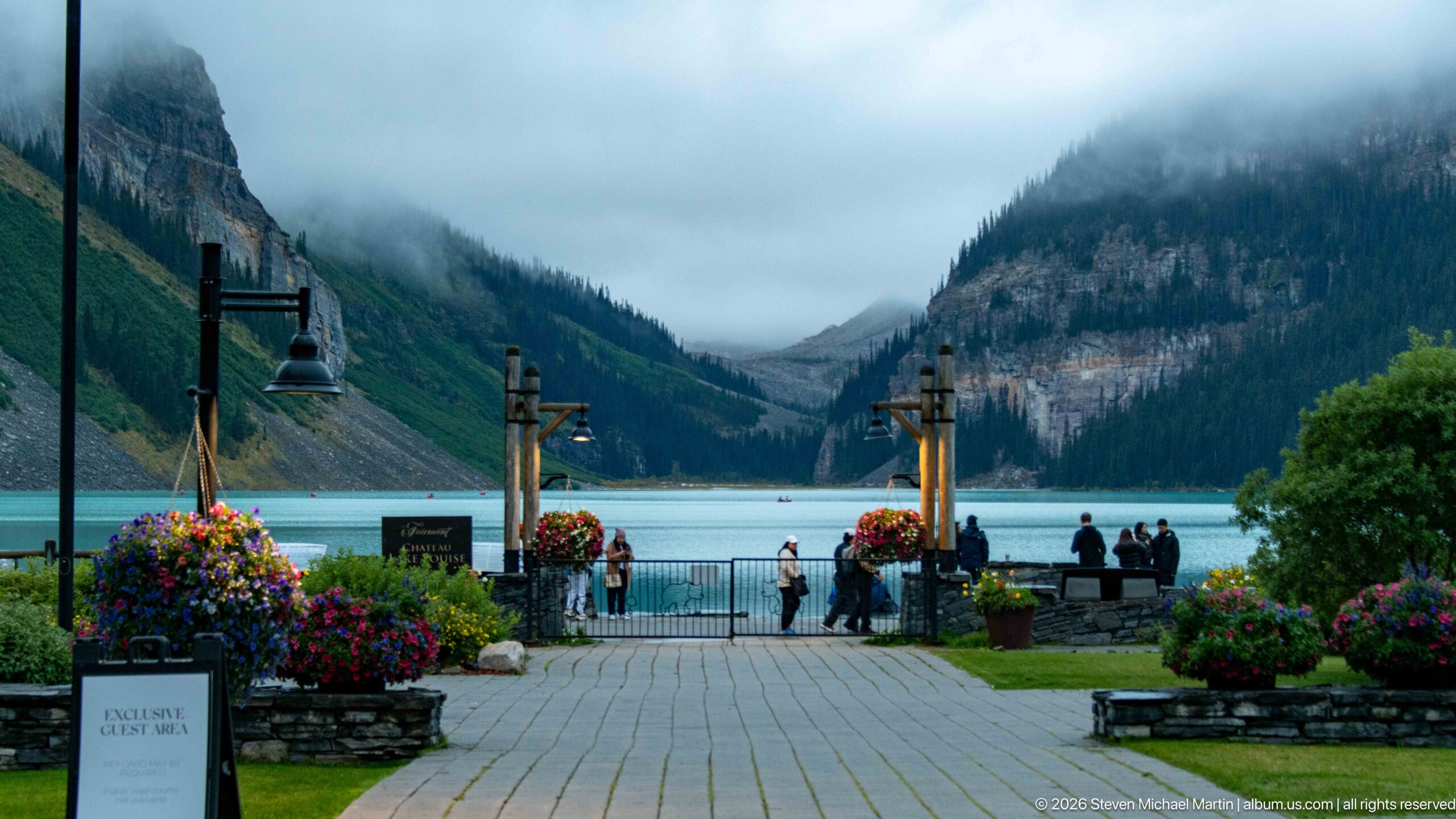
Visitors pause along a paved promenade at Lake Louise, where stone planters, hanging flower baskets, and black lampposts lead toward the turquoise water. The mountains close the valley in the distance, partly veiled by low cloud. A small sign at the left foreground marks the busy public edge of the lake, balancing the grand alpine setting with evidence of everyday visitor use.
Caption
Visitors pause along a paved promenade at Lake Louise, where stone planters, hanging flower baskets, and black lampposts lead toward the turquoise water. The mountains close the valley in the distance, partly veiled by low cloud. A small sign at the left foreground marks the busy public edge of the lake, balancing the grand alpine setting with evidence of everyday visitor use.
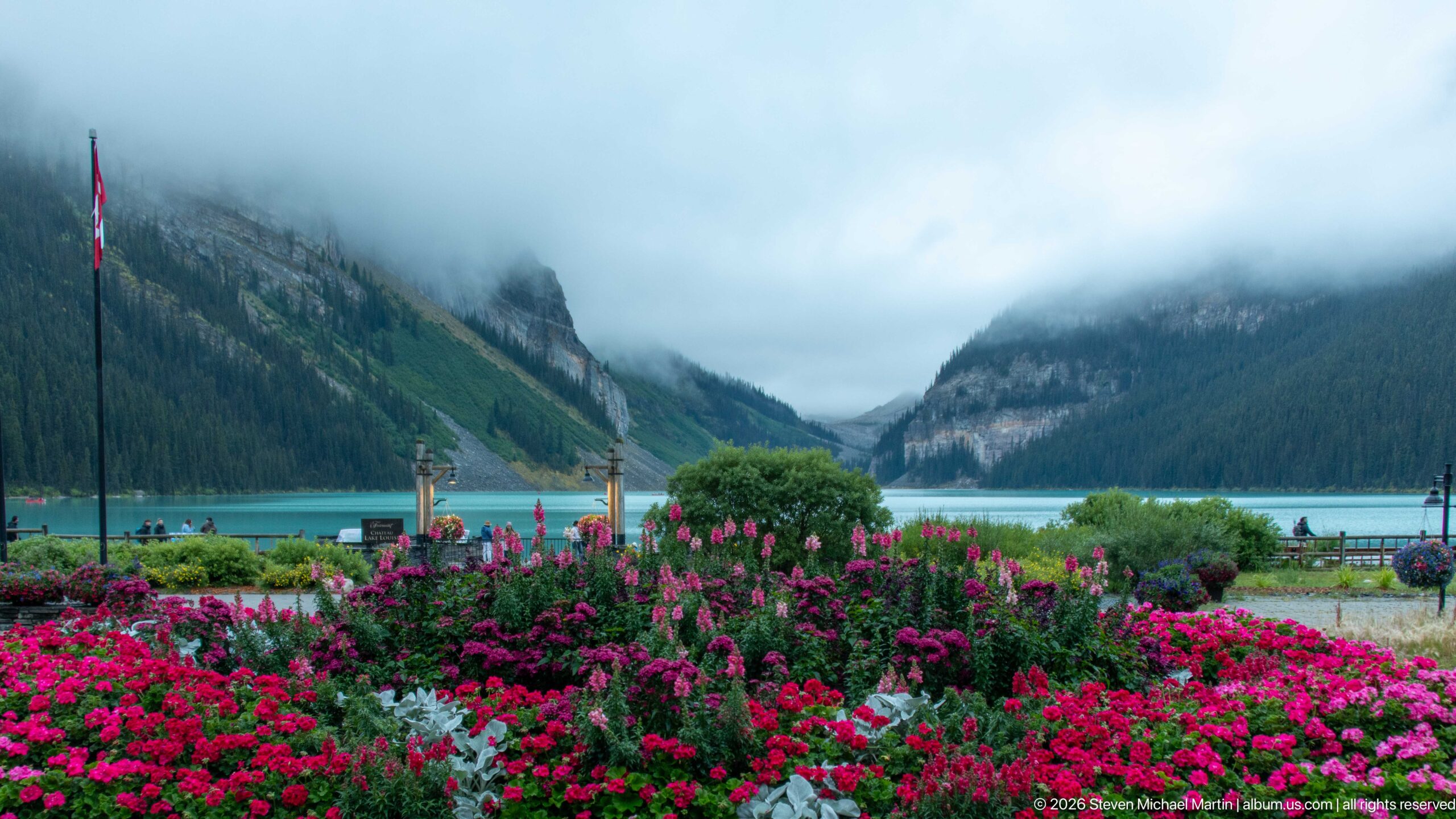
A dense band of pink, red, and magenta flowers fills the foreground, opening onto Lake Louise and the dark, cloud-softened mountain slopes beyond. The low garden-level viewpoint gives the color display nearly equal weight with the lake, while the valley’s receding sides draw the eye toward the center of the scene. This is a deliberately layered view from the landscaped shore.
Caption
A dense band of pink, red, and magenta flowers fills the foreground, opening onto Lake Louise and the dark, cloud-softened mountain slopes beyond. The low garden-level viewpoint gives the color display nearly equal weight with the lake, while the valley’s receding sides draw the eye toward the center of the scene. This is a deliberately layered view from the landscaped shore.
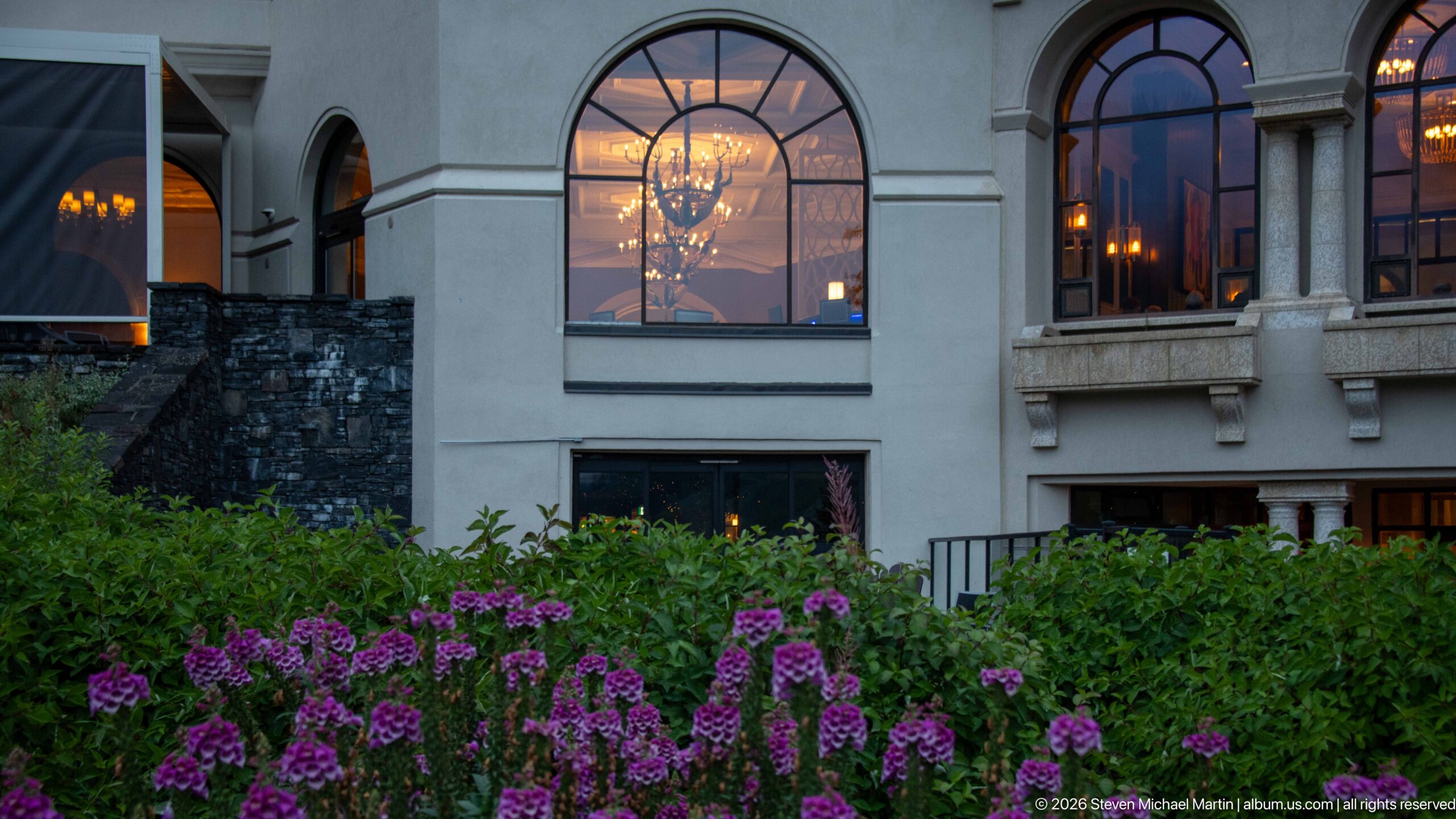
Purple flowering shrubs fill the lower foreground beneath a section of the Fairmont Chateau Lake Louise. Above them, tall arched windows reflect the evening sky and reveal warmly lit interiors; pale stone surrounds and heavy projecting sills articulate the wall. The close crop isolates the relationship between the hotel’s arched fenestration and its seasonal planting rather than presenting the full building.
Caption
Purple flowering shrubs fill the lower foreground beneath a section of the Fairmont Chateau Lake Louise. Above them, tall arched windows reflect the evening sky and reveal warmly lit interiors; pale stone surrounds and heavy projecting sills articulate the wall. The close crop isolates the relationship between the hotel’s arched fenestration and its seasonal planting rather than presenting the full building.
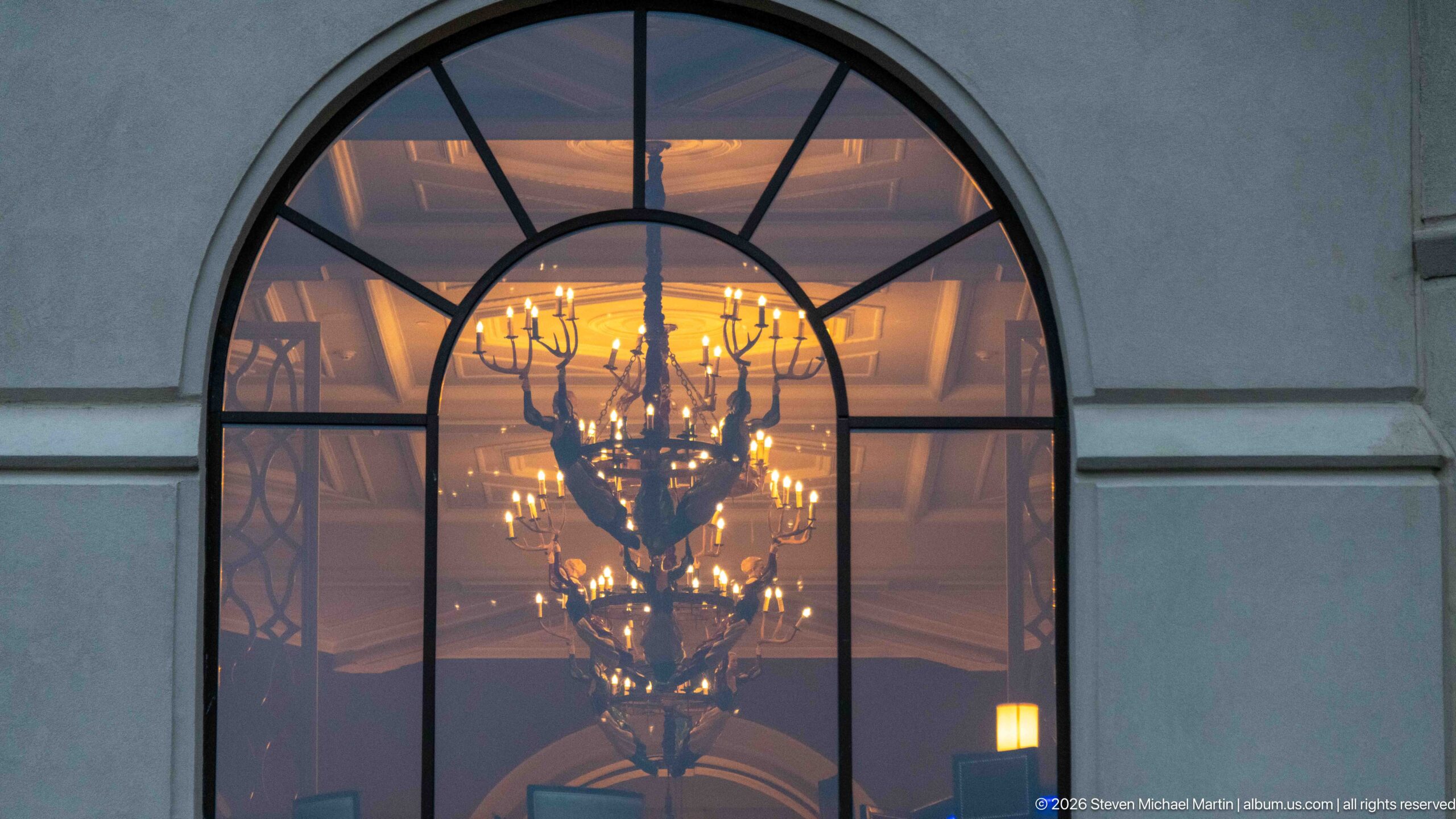
A large dark chandelier hangs inside the hotel, seen through a tall arched window divided by black muntins. Reflections of the warm interior overlap the glass, creating layered circles of light around the fixture. The close framing turns an exterior architectural opening into a view of the illuminated public interior, with the chandelier as the unmistakable focal point.
Caption
A large dark chandelier hangs inside the hotel, seen through a tall arched window divided by black muntins. Reflections of the warm interior overlap the glass, creating layered circles of light around the fixture. The close framing turns an exterior architectural opening into a view of the illuminated public interior, with the chandelier as the unmistakable focal point.
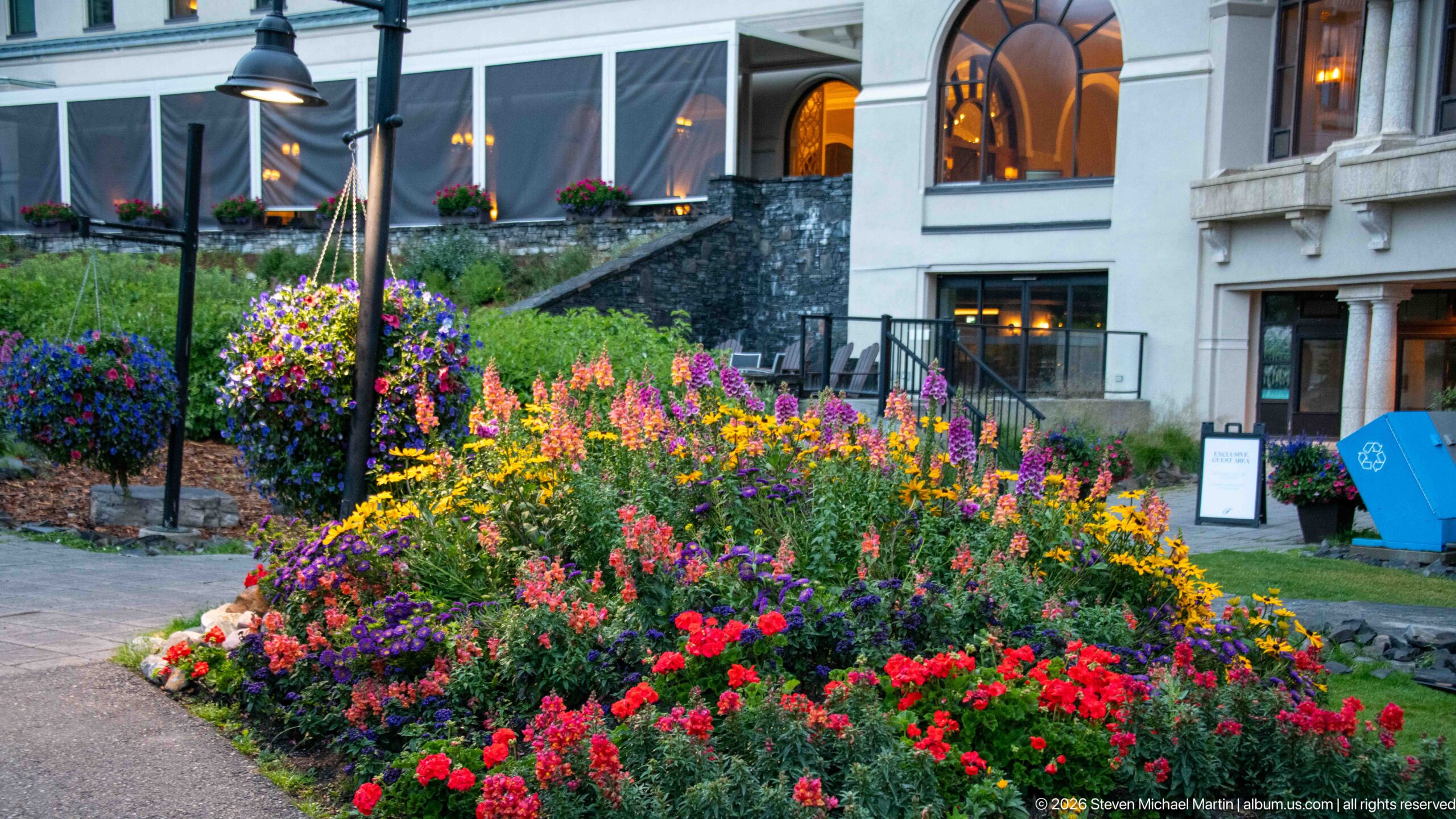
A curved bed of red, yellow, pink, and purple flowers follows the walkway beside the Fairmont Chateau Lake Louise. The planting draws a bright arc through the foreground toward the hotel’s tall windows and stone-faced lower level. A freestanding sign and a blue recycling bin remain at the edge of the path, giving this garden view the practical detail of a working visitor entrance.
Caption
A curved bed of red, yellow, pink, and purple flowers follows the walkway beside the Fairmont Chateau Lake Louise. The planting draws a bright arc through the foreground toward the hotel’s tall windows and stone-faced lower level. A freestanding sign and a blue recycling bin remain at the edge of the path, giving this garden view the practical detail of a working visitor entrance.
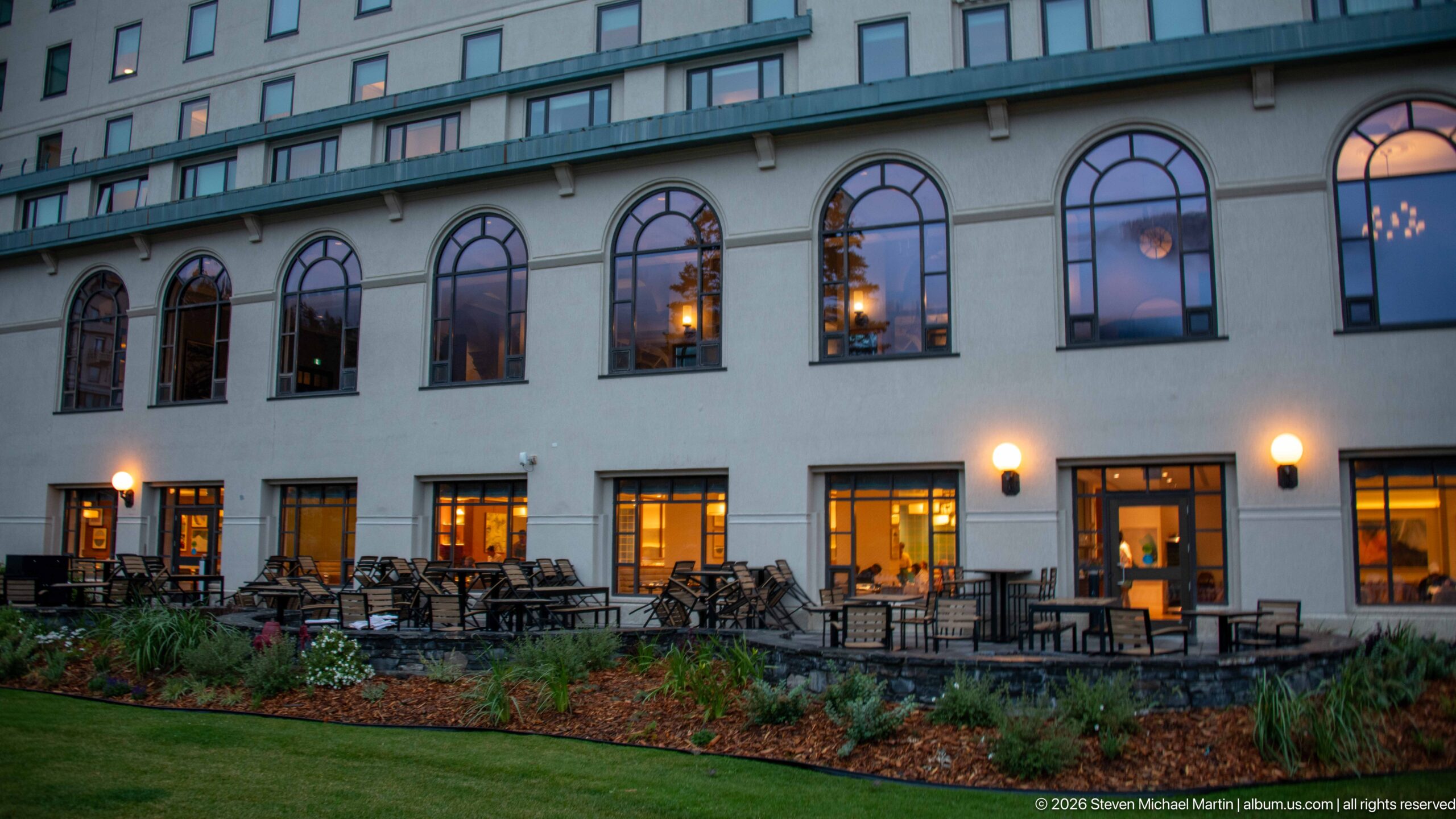
A row of arched upper windows and rectangular ground-floor doors stretches across the Fairmont Chateau Lake Louise above an outdoor dining terrace. Warm interior light contrasts with the deepening blue evening, while small tables and chairs line the wall beneath glowing exterior lamps. The nearly frontal view emphasizes the repeated rhythm of the façade and its connection to the landscaped lawn.
Caption
A row of arched upper windows and rectangular ground-floor doors stretches across the Fairmont Chateau Lake Louise above an outdoor dining terrace. Warm interior light contrasts with the deepening blue evening, while small tables and chairs line the wall beneath glowing exterior lamps. The nearly frontal view emphasizes the repeated rhythm of the façade and its connection to the landscaped lawn.
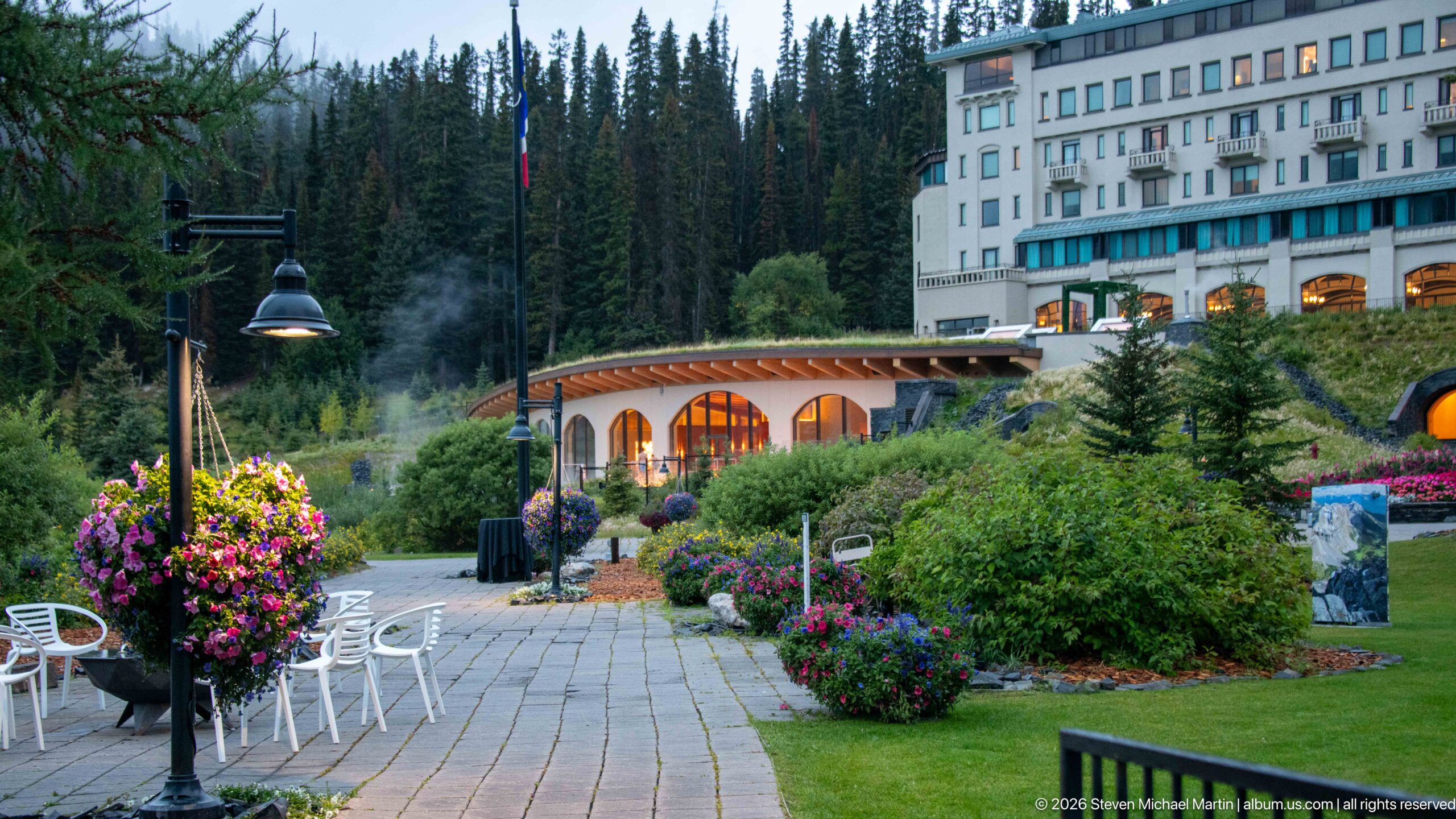
A stone-paved terrace descends through planted gardens toward the Fairmont Chateau Lake Louise. Hanging baskets brighten the black lampposts, and pale outdoor chairs line the near edge of the path. The hotel’s arched lower arcade glows beyond the slope, with evergreen forest rising behind it. This view records the transition from resort garden to building, rather than the lake itself.
Caption
A stone-paved terrace descends through planted gardens toward the Fairmont Chateau Lake Louise. Hanging baskets brighten the black lampposts, and pale outdoor chairs line the near edge of the path. The hotel’s arched lower arcade glows beyond the slope, with evergreen forest rising behind it. This view records the transition from resort garden to building, rather than the lake itself.
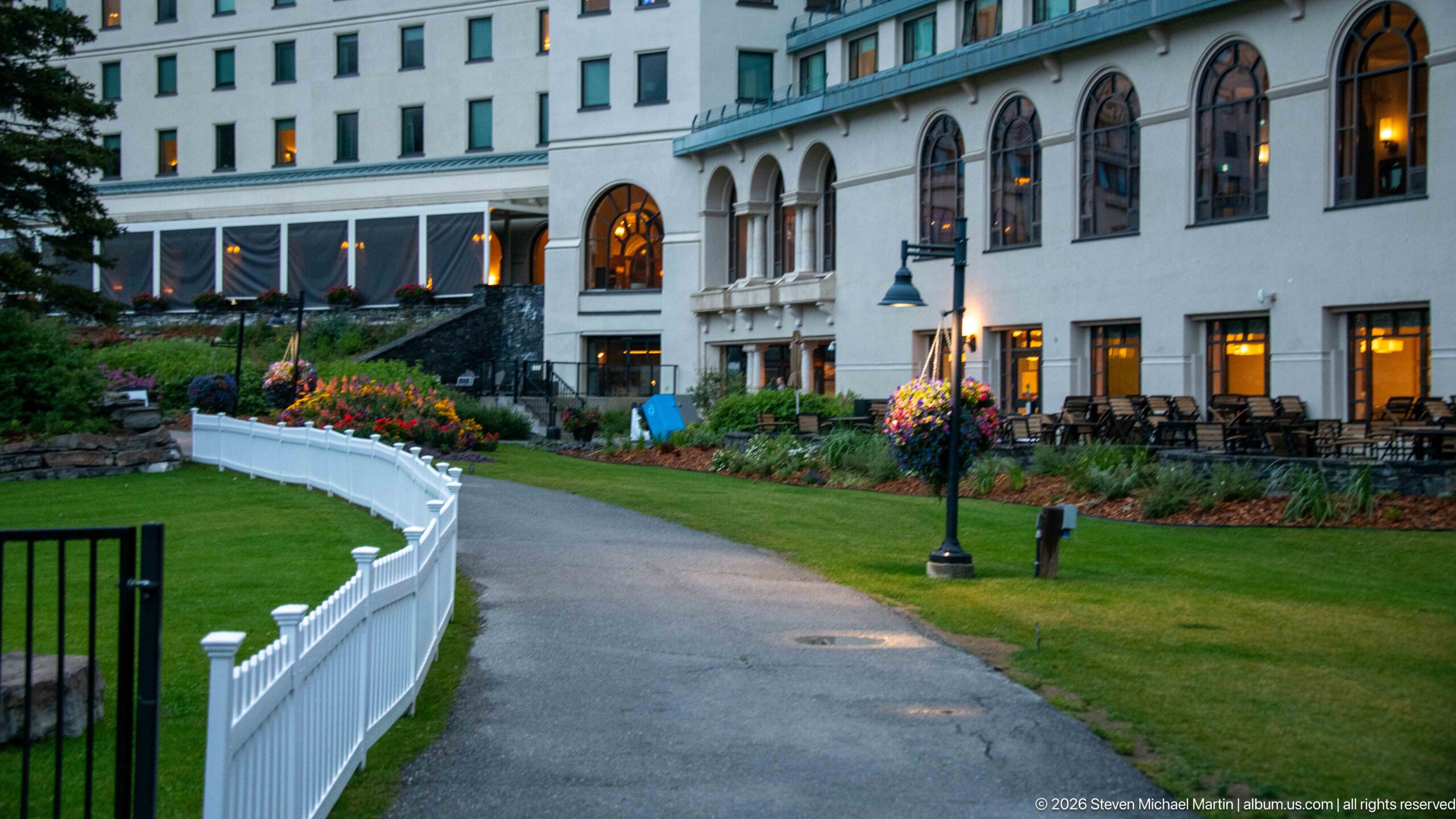
A white-railed path curves between the lawn and the Fairmont Chateau Lake Louise, guiding the eye toward the building’s arched windows and lit doorways. Flower beds border the route, while a black gate and lamppost mark its near end. The oblique viewpoint emphasizes how the path connects the hotel’s several wings and the planted grounds around them.
Caption
A white-railed path curves between the lawn and the Fairmont Chateau Lake Louise, guiding the eye toward the building’s arched windows and lit doorways. Flower beds border the route, while a black gate and lamppost mark its near end. The oblique viewpoint emphasizes how the path connects the hotel’s several wings and the planted grounds around them.
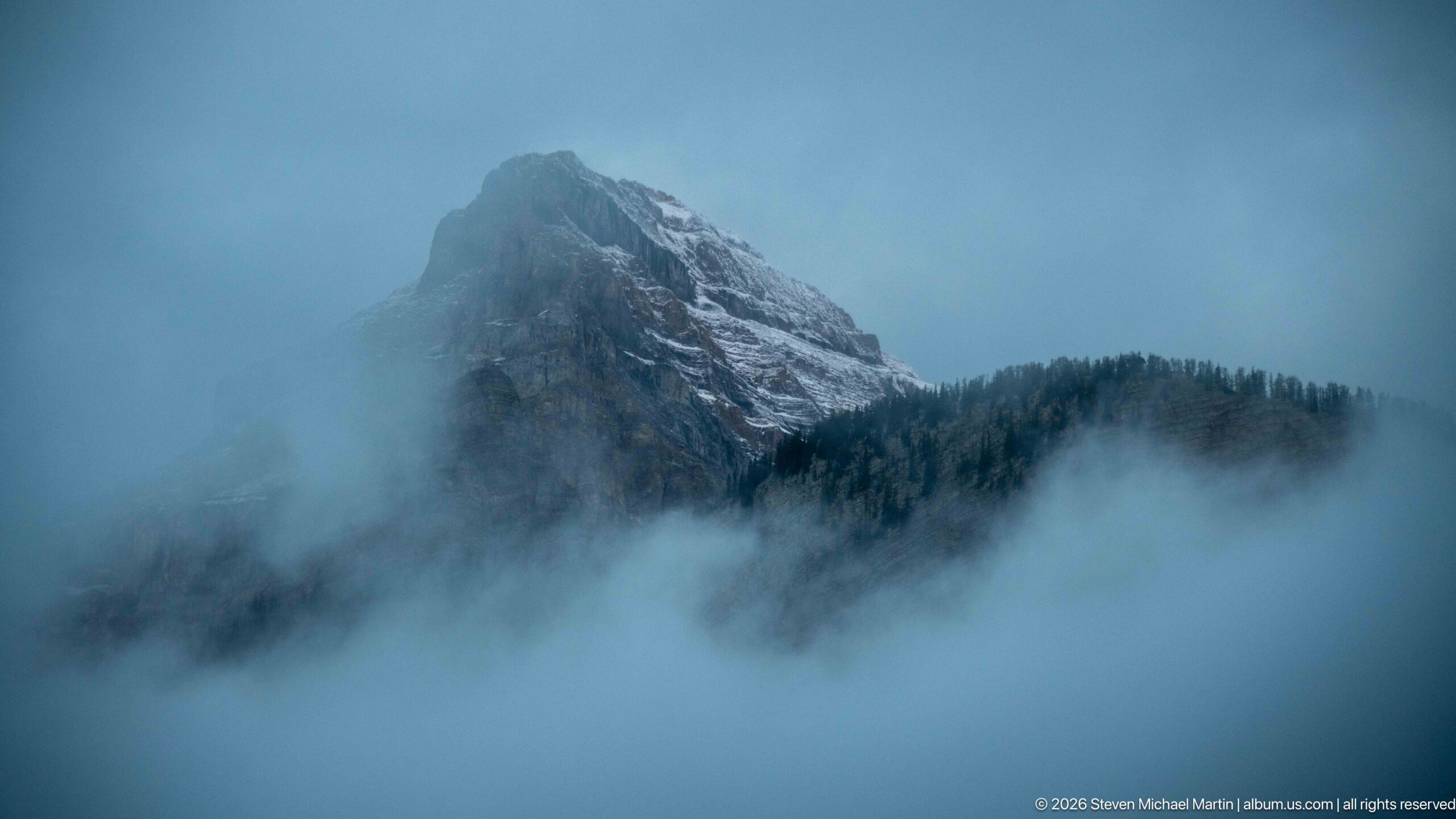
A steep, pale rock summit emerges through low cloud above a dark band of conifer forest. Mist drifts across the lower slopes and obscures the mountain’s base, leaving only a partial profile against the gray-blue sky. The photograph isolates changing weather and relief; the peak’s outline is not clear enough here to assign a more specific mountain name with confidence.
Caption
A steep, pale rock summit emerges through low cloud above a dark band of conifer forest. Mist drifts across the lower slopes and obscures the mountain’s base, leaving only a partial profile against the gray-blue sky. The photograph isolates changing weather and relief; the peak’s outline is not clear enough here to assign a more specific mountain name with confidence.
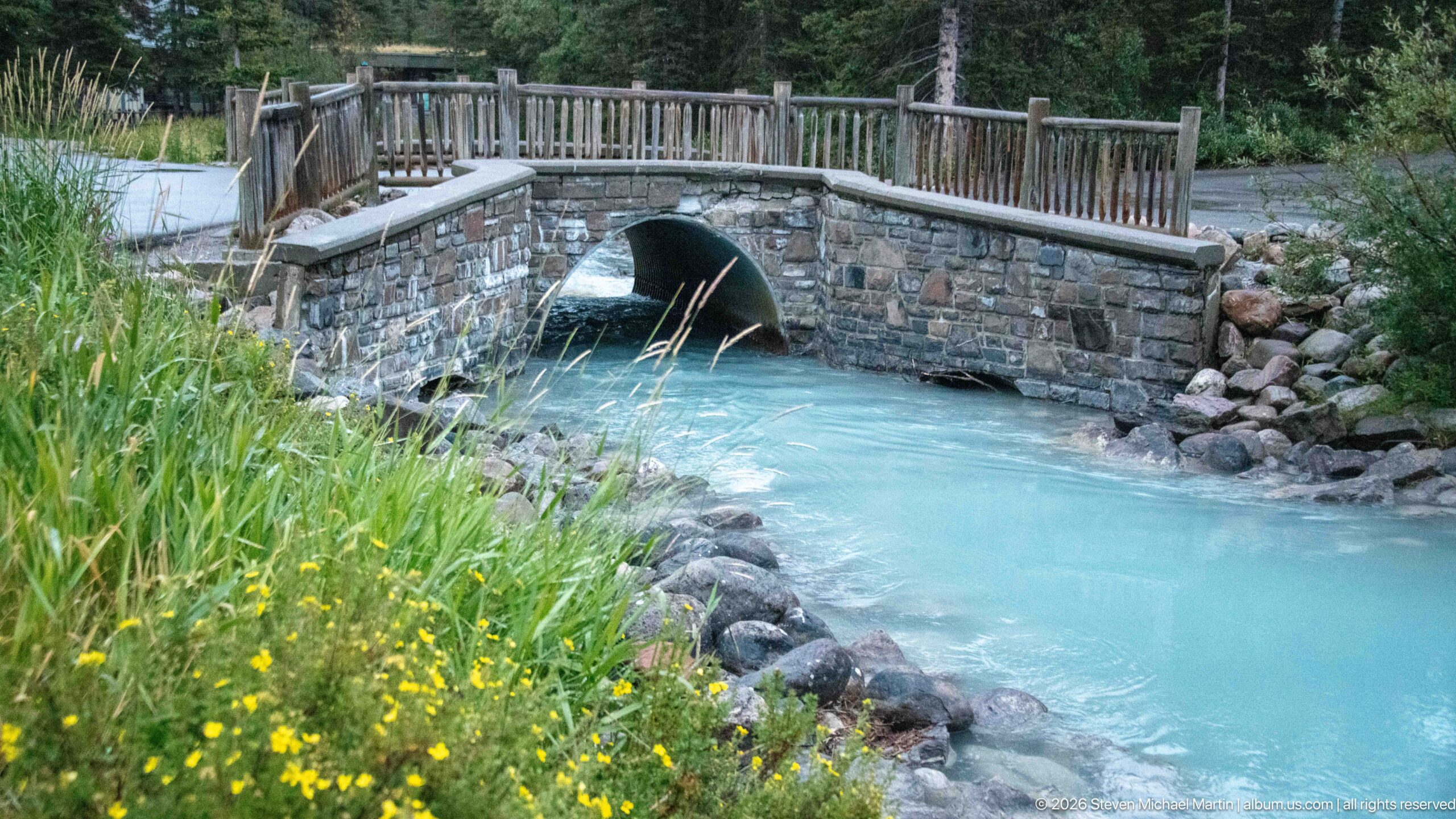
A pale turquoise stream rushes through a low stone bridge with a single rounded opening. Timber railings cross above the masonry, and angular rocks edge the watercourse. The bridge and glacially colored flow make this a compact landscape detail distinct from the open lake views nearby. The exact bridge is not named here because the proof sheet provides no sign or unique identifying marker.
Caption
A pale turquoise stream rushes through a low stone bridge with a single rounded opening. Timber railings cross above the masonry, and angular rocks edge the watercourse. The bridge and glacially colored flow make this a compact landscape detail distinct from the open lake views nearby. The exact bridge is not named here because the proof sheet provides no sign or unique identifying marker.
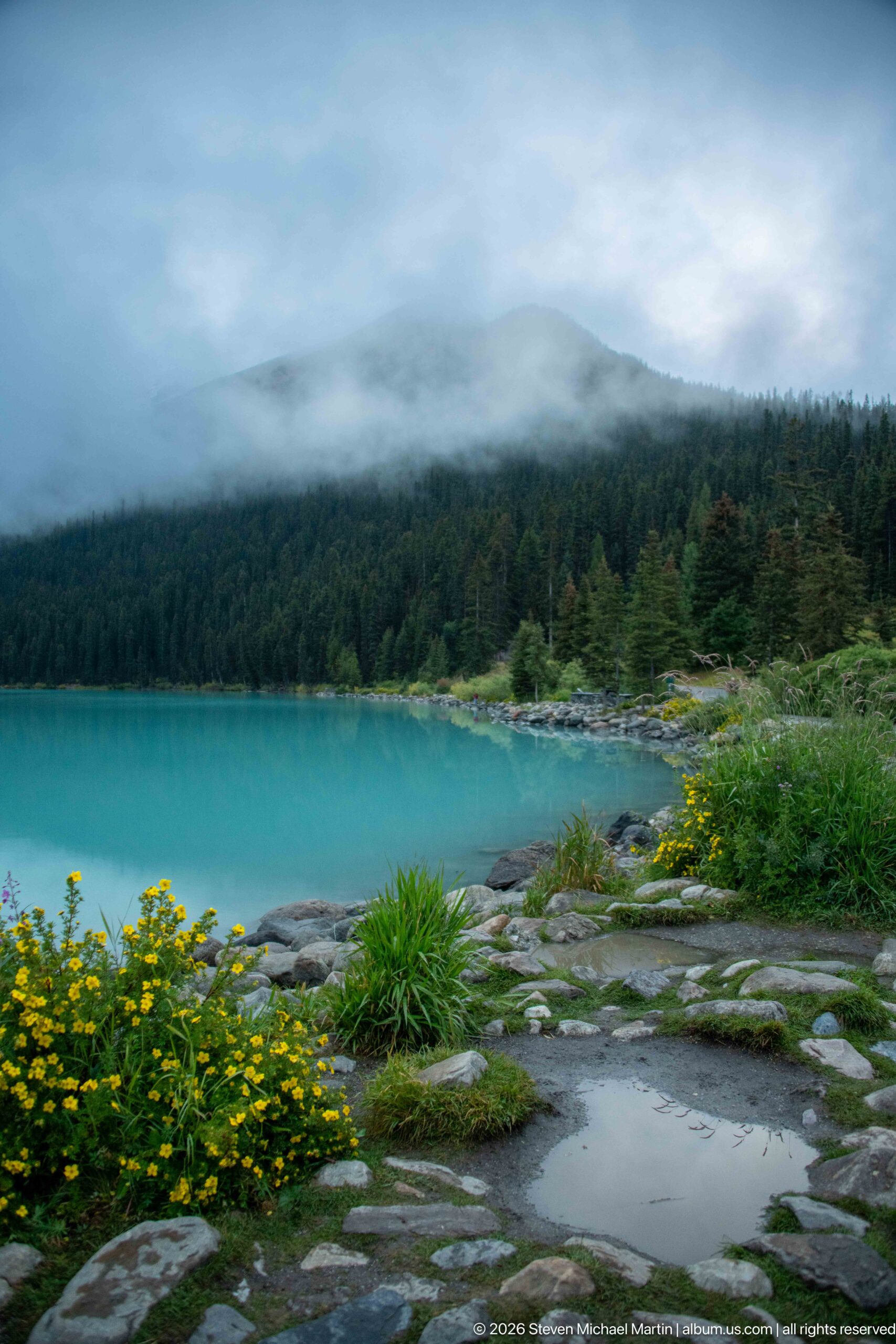
Yellow flowers grow among smooth gray shoreline rocks beside turquoise water, with a dark conifer slope and clouded ridgeline behind. A shallow pool in the foreground reflects the overcast sky, while the shoreline curves away toward the far side of the lake. This low, close viewpoint emphasizes the mix of glacial water, rough stone, and alpine plants.
Caption
Yellow flowers grow among smooth gray shoreline rocks beside turquoise water, with a dark conifer slope and clouded ridgeline behind. A shallow pool in the foreground reflects the overcast sky, while the shoreline curves away toward the far side of the lake. This low, close viewpoint emphasizes the mix of glacial water, rough stone, and alpine plants.
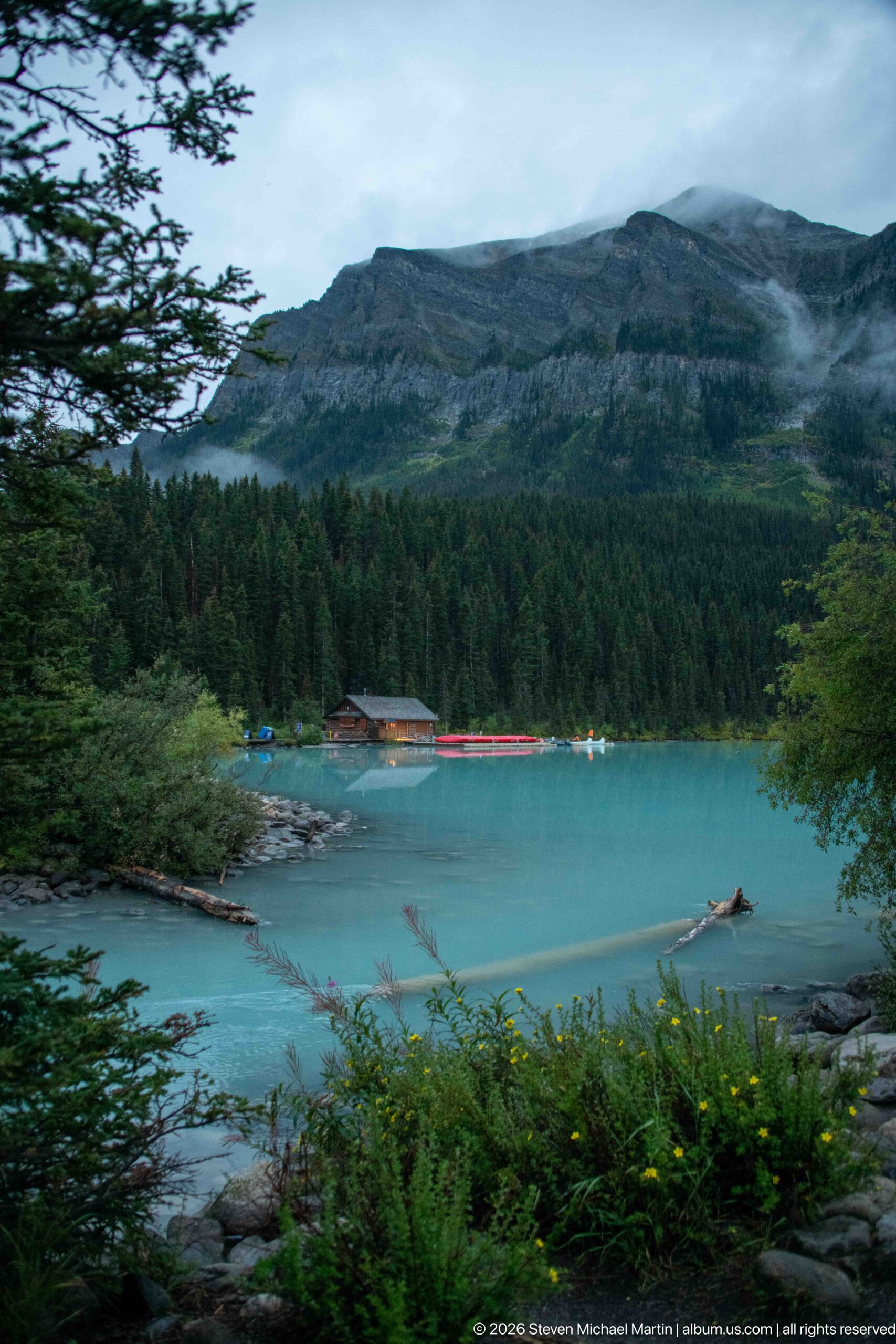
Red canoes rest in a long line beside the far-shore dock, reflected in the calm turquoise water. A low wooden boathouse sits against the evergreen forest, while bare gray rock rises behind the trees. The cropped branches at left frame the scene as a view across Lake Louise toward its well-known canoeing facilities.
Caption
Red canoes rest in a long line beside the far-shore dock, reflected in the calm turquoise water. A low wooden boathouse sits against the evergreen forest, while bare gray rock rises behind the trees. The cropped branches at left frame the scene as a view across Lake Louise toward its well-known canoeing facilities.
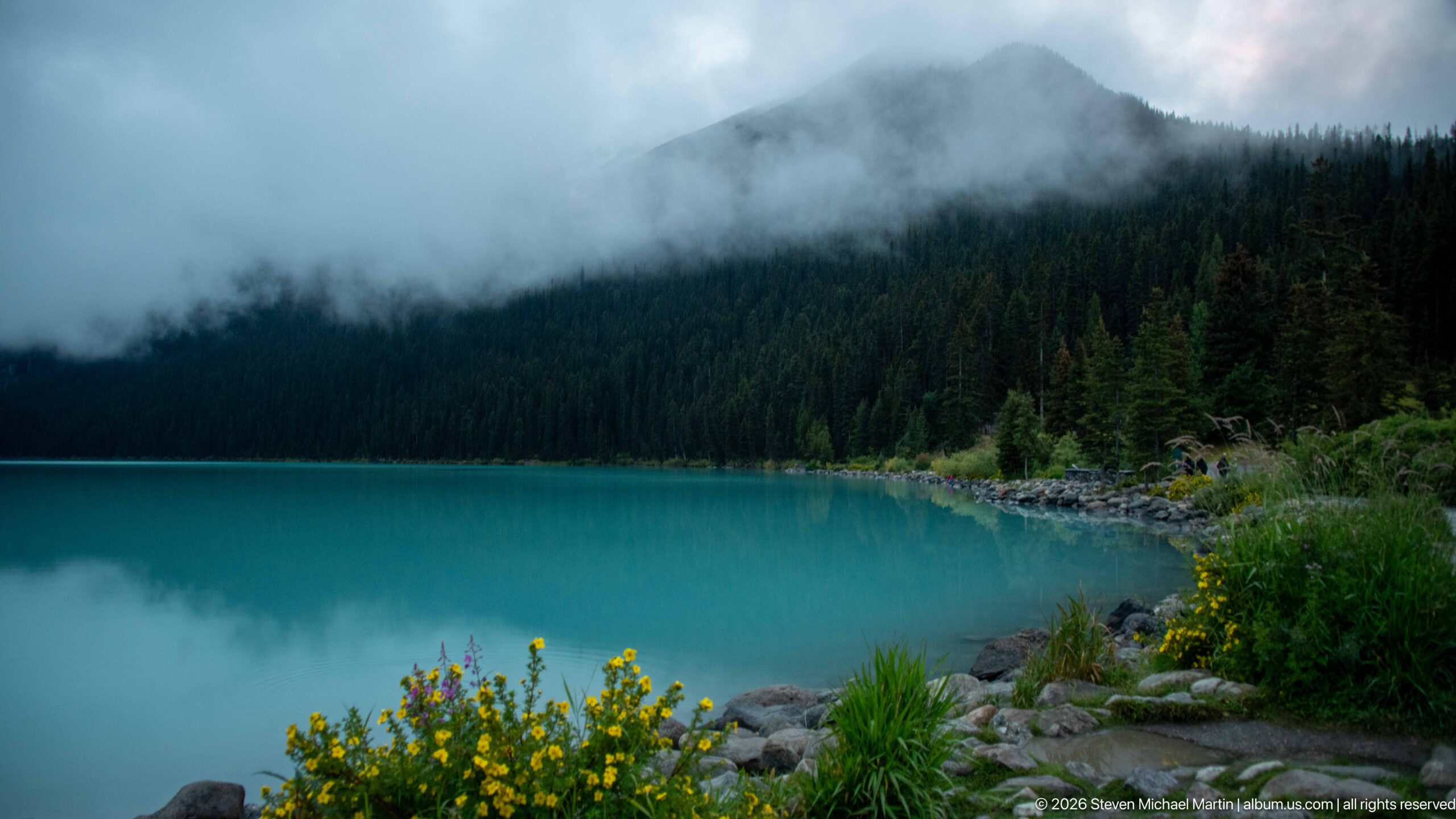
Fog spills over a forested mountainside and hangs low above Lake Louise, partially erasing the far shore. The turquoise surface remains visible below the mist, with a few yellow flowers and rounded rocks anchoring the lower edge. A hazy reflection merges water and cloud, making atmospheric conditions—not a sharply defined landmark—the subject of this lakeside view.
Caption
Fog spills over a forested mountainside and hangs low above Lake Louise, partially erasing the far shore. The turquoise surface remains visible below the mist, with a few yellow flowers and rounded rocks anchoring the lower edge. A hazy reflection merges water and cloud, making atmospheric conditions—not a sharply defined landmark—the subject of this lakeside view.
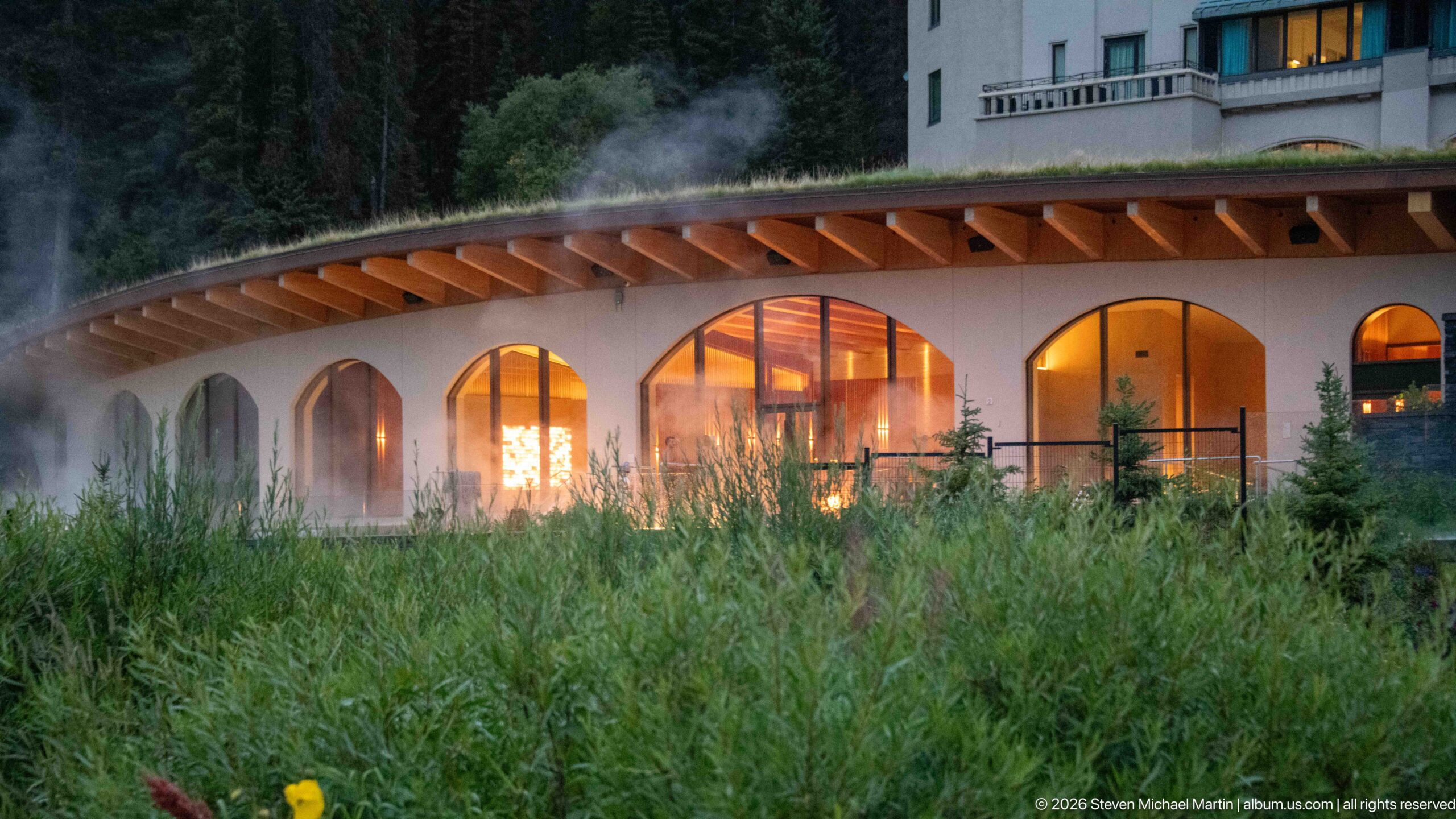
The Fairmont Chateau Lake Louise’s deep roof overhang shelters a sequence of tall arched windows and doors glowing against the blue evening. A broad band of grasses and a single yellow flower obscure the lower wall, introducing a natural foreground to the carefully repeated architecture. The close angle draws attention to the warm-lit arcade and the timber structure beneath the roof edge.
Caption
The Fairmont Chateau Lake Louise’s deep roof overhang shelters a sequence of tall arched windows and doors glowing against the blue evening. A broad band of grasses and a single yellow flower obscure the lower wall, introducing a natural foreground to the carefully repeated architecture. The close angle draws attention to the warm-lit arcade and the timber structure beneath the roof edge.
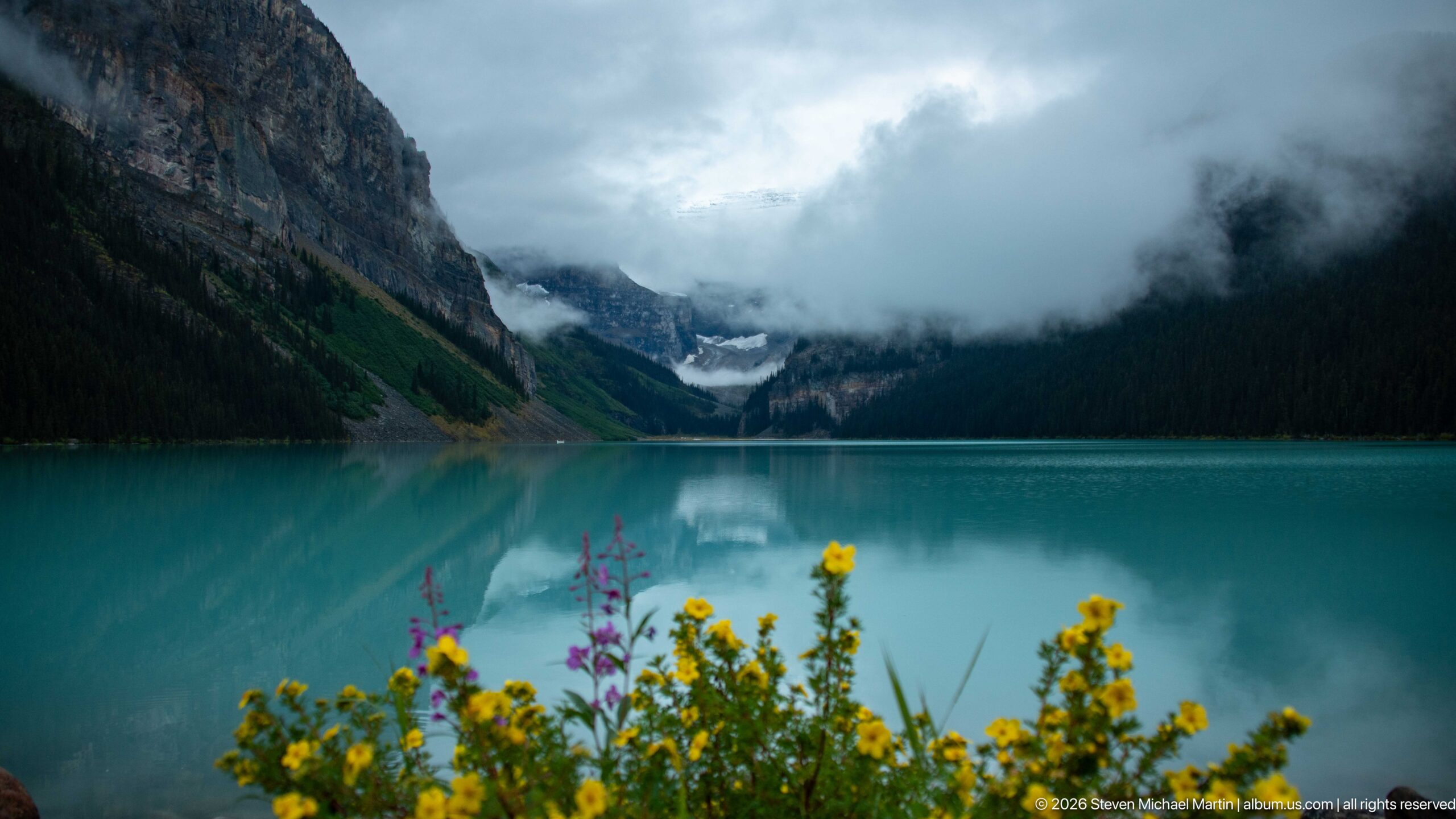
Turquoise Lake Louise fills the lower half of the view, reflecting a narrow opening in the clouds between the dark mountain walls. A glacier or snowfield is faintly visible at the head of the valley, though cloud hides most of the surrounding peaks. Pink and yellow flowers rise from the near shore, bringing a small foreground detail into this broad, atmospheric view.
Caption
Turquoise Lake Louise fills the lower half of the view, reflecting a narrow opening in the clouds between the dark mountain walls. A glacier or snowfield is faintly visible at the head of the valley, though cloud hides most of the surrounding peaks. Pink and yellow flowers rise from the near shore, bringing a small foreground detail into this broad, atmospheric view.
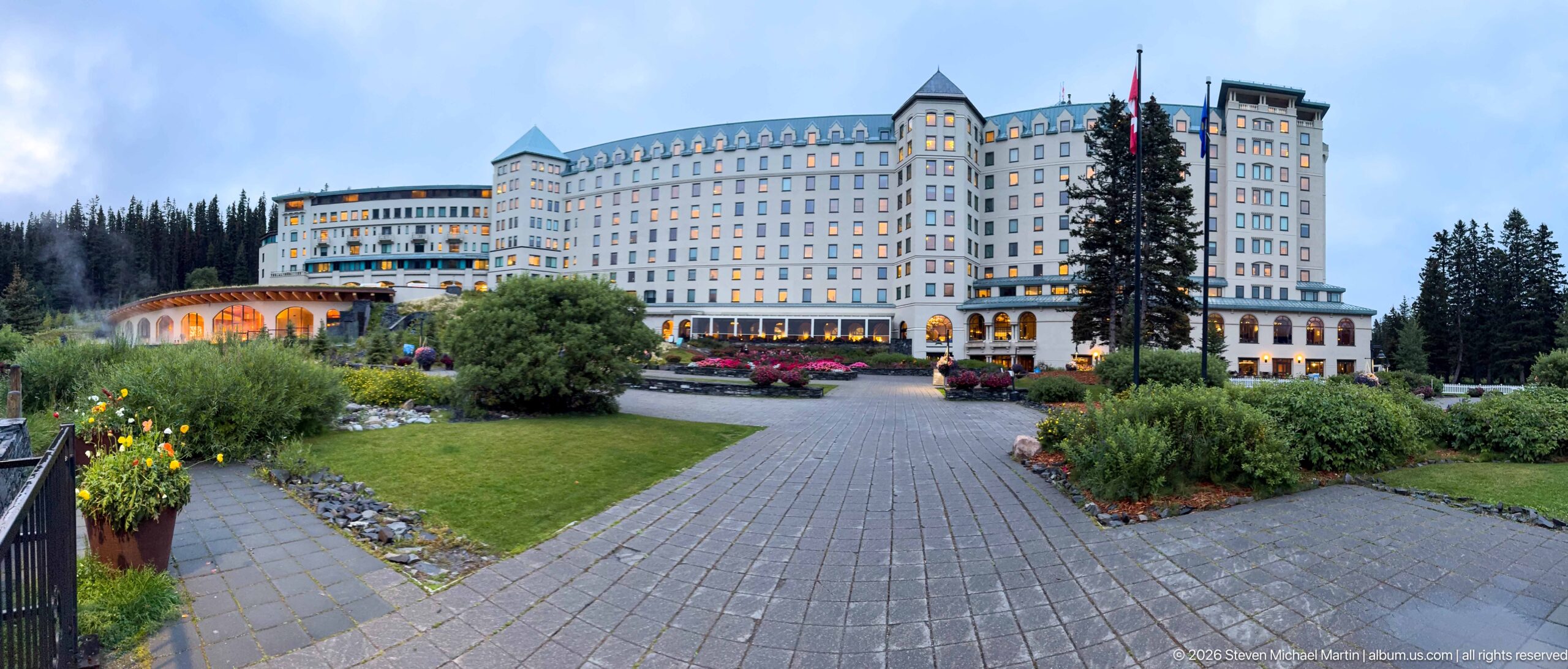
The Fairmont Chateau Lake Louise stands across its formal lawn, its pale, multiwing façade and steep green-gray roof rising above flower beds and a curved path. Warm windows and the lower arcade glow in the early evening. The nearly frontal composition records the scale of the hotel in relation to its planted grounds, with trees and clipped lawn giving the foreground structure.
Caption
The Fairmont Chateau Lake Louise stands across its formal lawn, its pale, multiwing façade and steep green-gray roof rising above flower beds and a curved path. Warm windows and the lower arcade glow in the early evening. The nearly frontal composition records the scale of the hotel in relation to its planted grounds, with trees and clipped lawn giving the foreground structure.
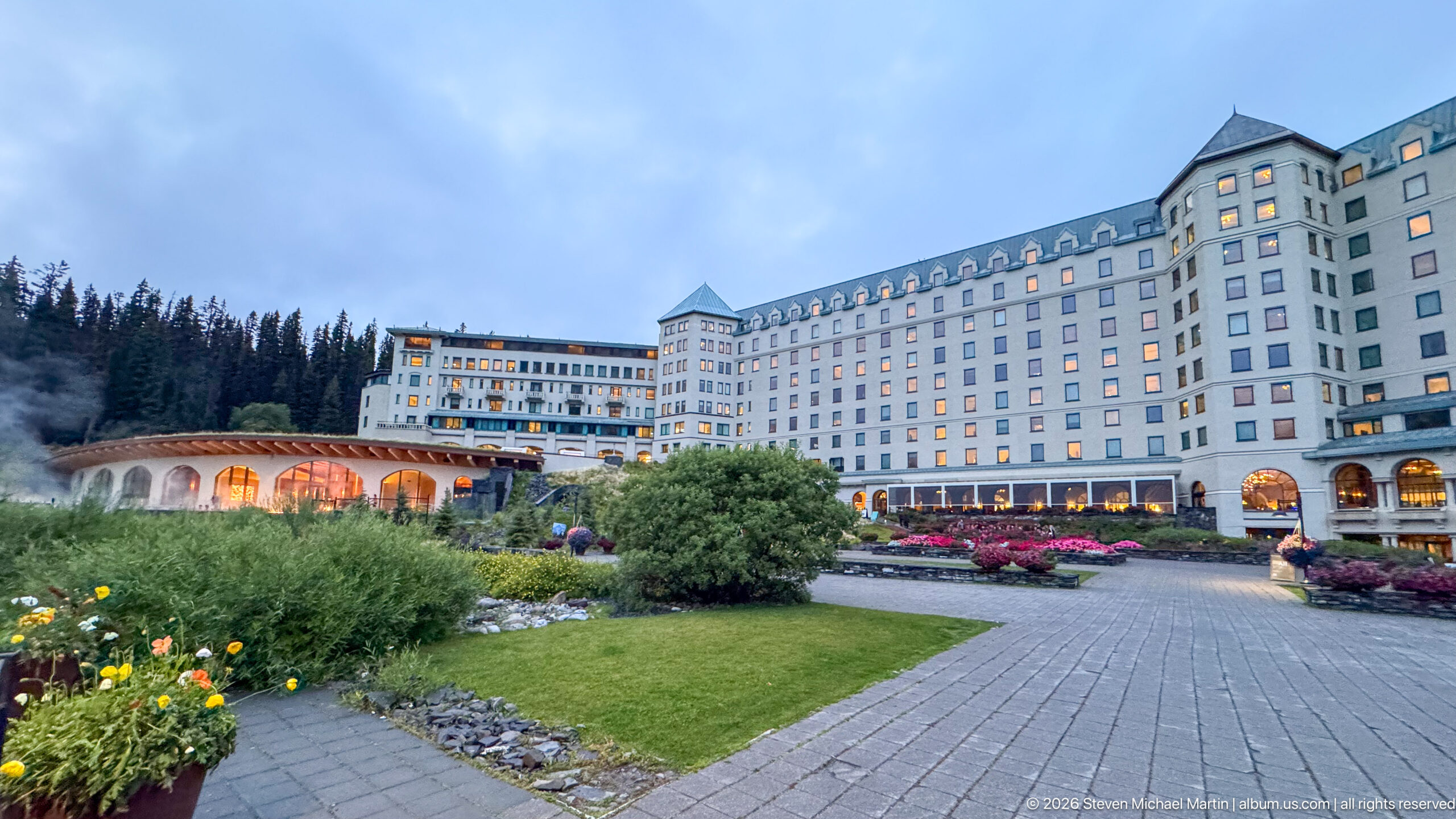
A broad view of the Fairmont Chateau Lake Louise reveals its extended façade, projecting corner towers, and illuminated lower arcade beyond a broad lawn and curved walkway. A small stream or drainage channel crosses the foreground garden, while bright flower beds mark the building’s base. Compared with the closer hotel views, this composition places the full resort complex within its landscaped setting.
Caption
A broad view of the Fairmont Chateau Lake Louise reveals its extended façade, projecting corner towers, and illuminated lower arcade beyond a broad lawn and curved walkway. A small stream or drainage channel crosses the foreground garden, while bright flower beds mark the building’s base. Compared with the closer hotel views, this composition places the full resort complex within its landscaped setting.
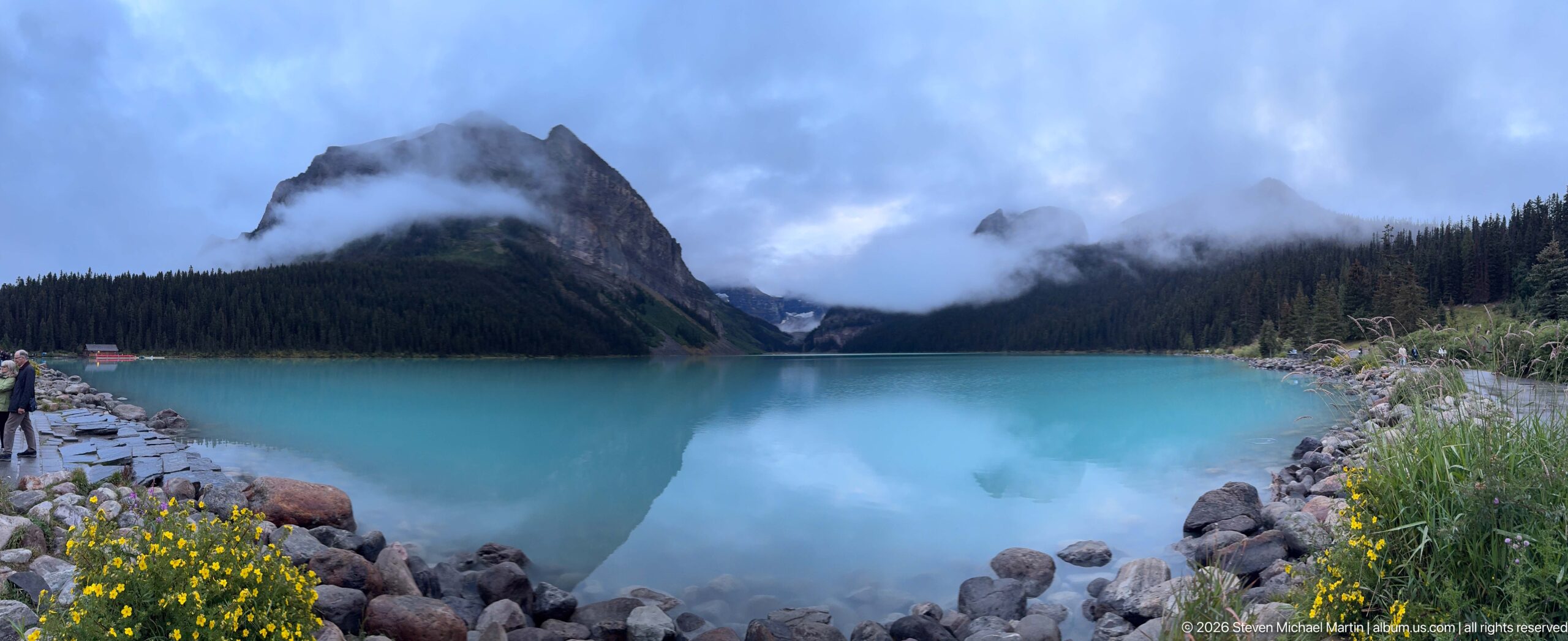
Rounded shoreline stones and low grasses frame Lake Louise, whose turquoise surface reflects a thin band of cloud. A steep, forested mountain rises at left while mist hides the higher ridges behind it. The viewpoint sits close to the water and looks along the valley, with the near rocks giving scale to the lake’s broad, still surface.
Caption
Rounded shoreline stones and low grasses frame Lake Louise, whose turquoise surface reflects a thin band of cloud. A steep, forested mountain rises at left while mist hides the higher ridges behind it. The viewpoint sits close to the water and looks along the valley, with the near rocks giving scale to the lake’s broad, still surface.
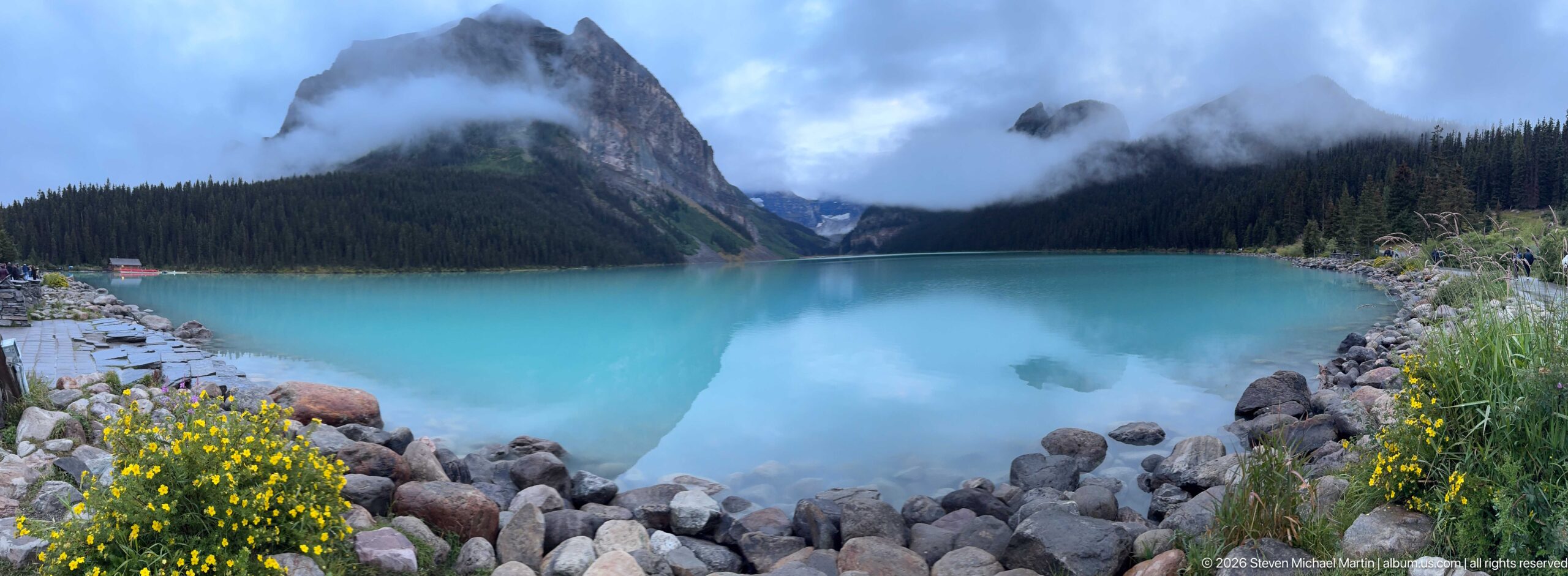
Yellow wildflowers and pink blooms grow between smooth stones along the near shore, framing the pale turquoise water of Lake Louise. The lake narrows toward a gap between forested slopes, while a low cloud bank drifts above the far ridge. The balanced foreground and distant valley create a layered shore-level composition without obscuring the water.
Caption
Yellow wildflowers and pink blooms grow between smooth stones along the near shore, framing the pale turquoise water of Lake Louise. The lake narrows toward a gap between forested slopes, while a low cloud bank drifts above the far ridge. The balanced foreground and distant valley create a layered shore-level composition without obscuring the water.
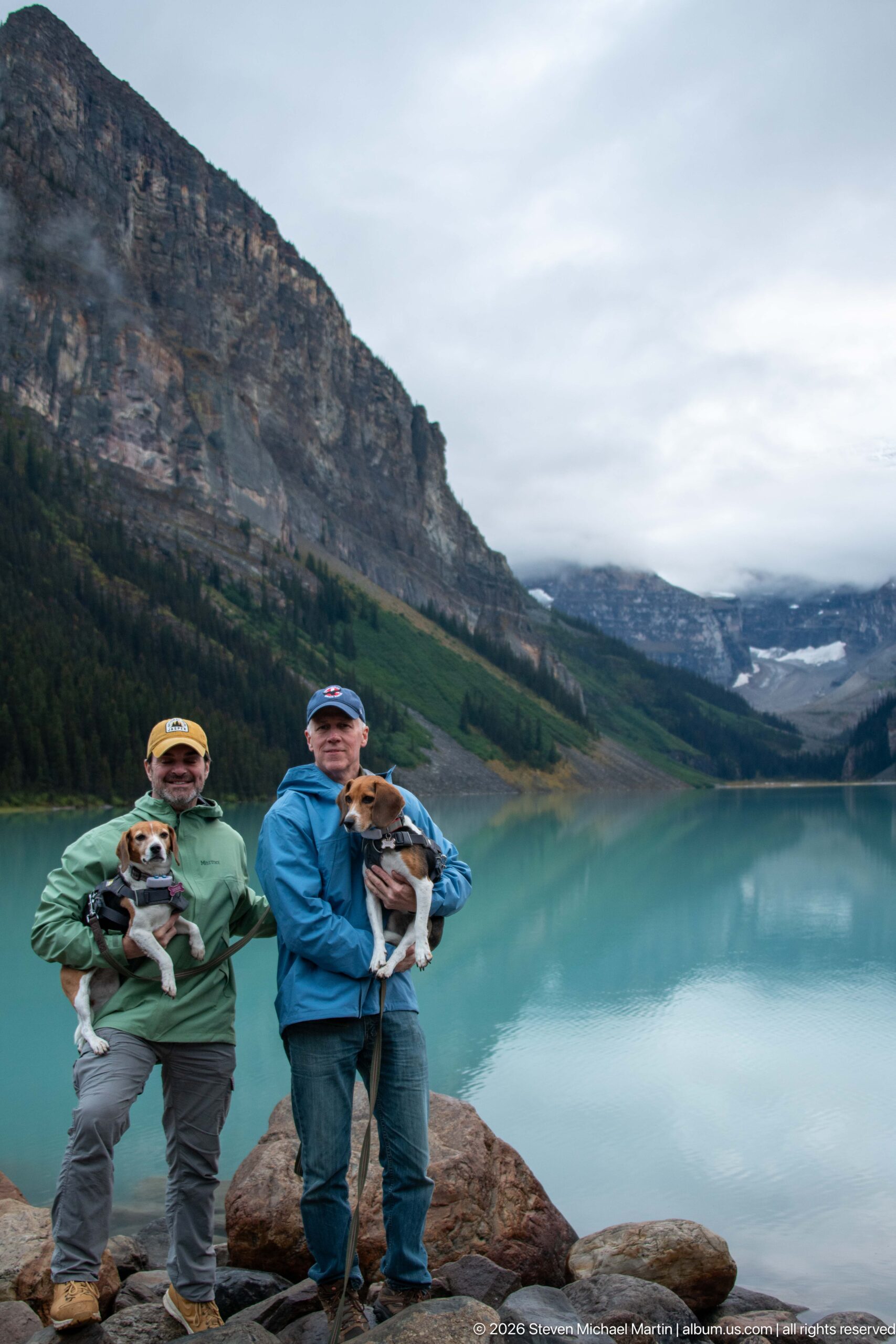
Two visitors stand among shoreline boulders, each holding a small dog, with Lake Louise and its steep alpine valley stretching behind them. One wears a green jacket and yellow cap; the other wears blue and a dark cap. The portrait places the travelers and their dogs at the water’s edge while preserving the glacier-fed lake as the defining backdrop.
Caption
Two visitors stand among shoreline boulders, each holding a small dog, with Lake Louise and its steep alpine valley stretching behind them. One wears a green jacket and yellow cap; the other wears blue and a dark cap. The portrait places the travelers and their dogs at the water’s edge while preserving the glacier-fed lake as the defining backdrop.
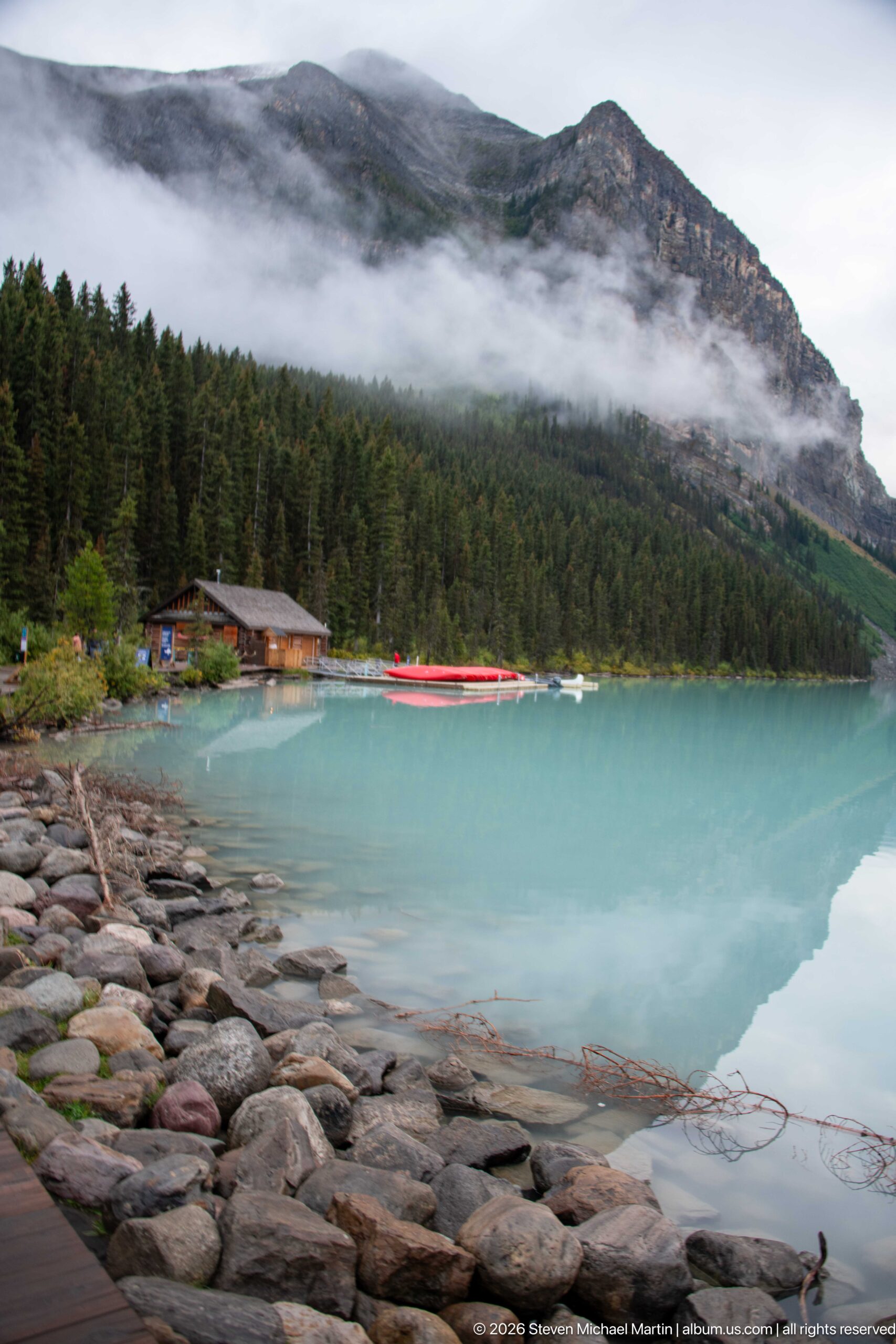
Rounded stones cover the near shoreline, leading the eye across turquoise Lake Louise to the log boathouse and red canoes on the opposite bank. A thin line of mist hangs over the forested slope, while open water occupies most of the frame. This shore-level composition sets the rental facility within the scale of the lake rather than isolating the boats.
Caption
Rounded stones cover the near shoreline, leading the eye across turquoise Lake Louise to the log boathouse and red canoes on the opposite bank. A thin line of mist hangs over the forested slope, while open water occupies most of the frame. This shore-level composition sets the rental facility within the scale of the lake rather than isolating the boats.
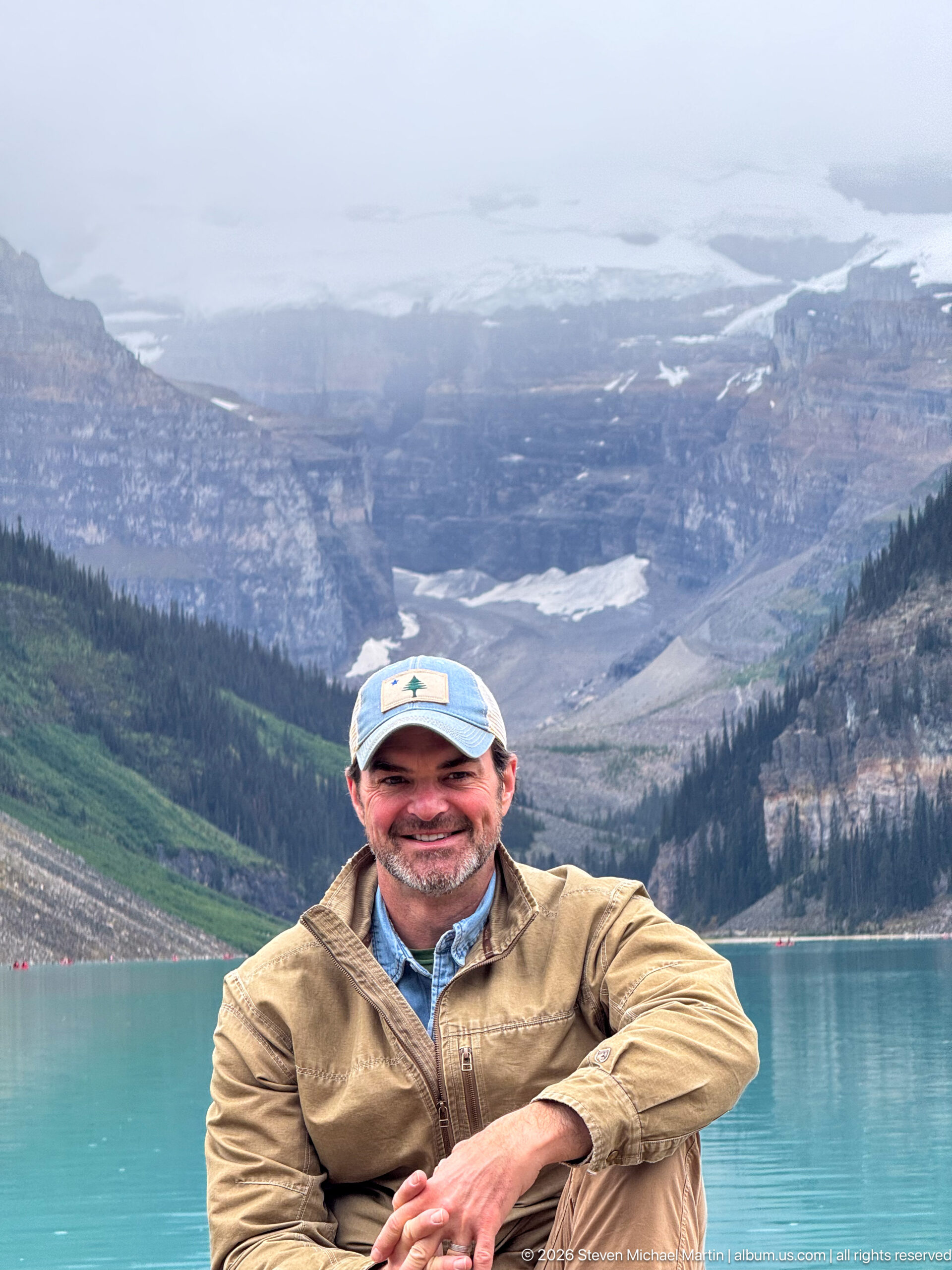
A close portrait isolates the seated visitor’s expression, tan jacket, and blue-and-white cap, while Lake Louise and the far valley form a soft band behind him. The compressed framing makes the person the clear subject and retains only enough turquoise water and mountain terrain to connect the portrait to the lakeshore.
Caption
A close portrait isolates the seated visitor’s expression, tan jacket, and blue-and-white cap, while Lake Louise and the far valley form a soft band behind him. The compressed framing makes the person the clear subject and retains only enough turquoise water and mountain terrain to connect the portrait to the lakeshore.
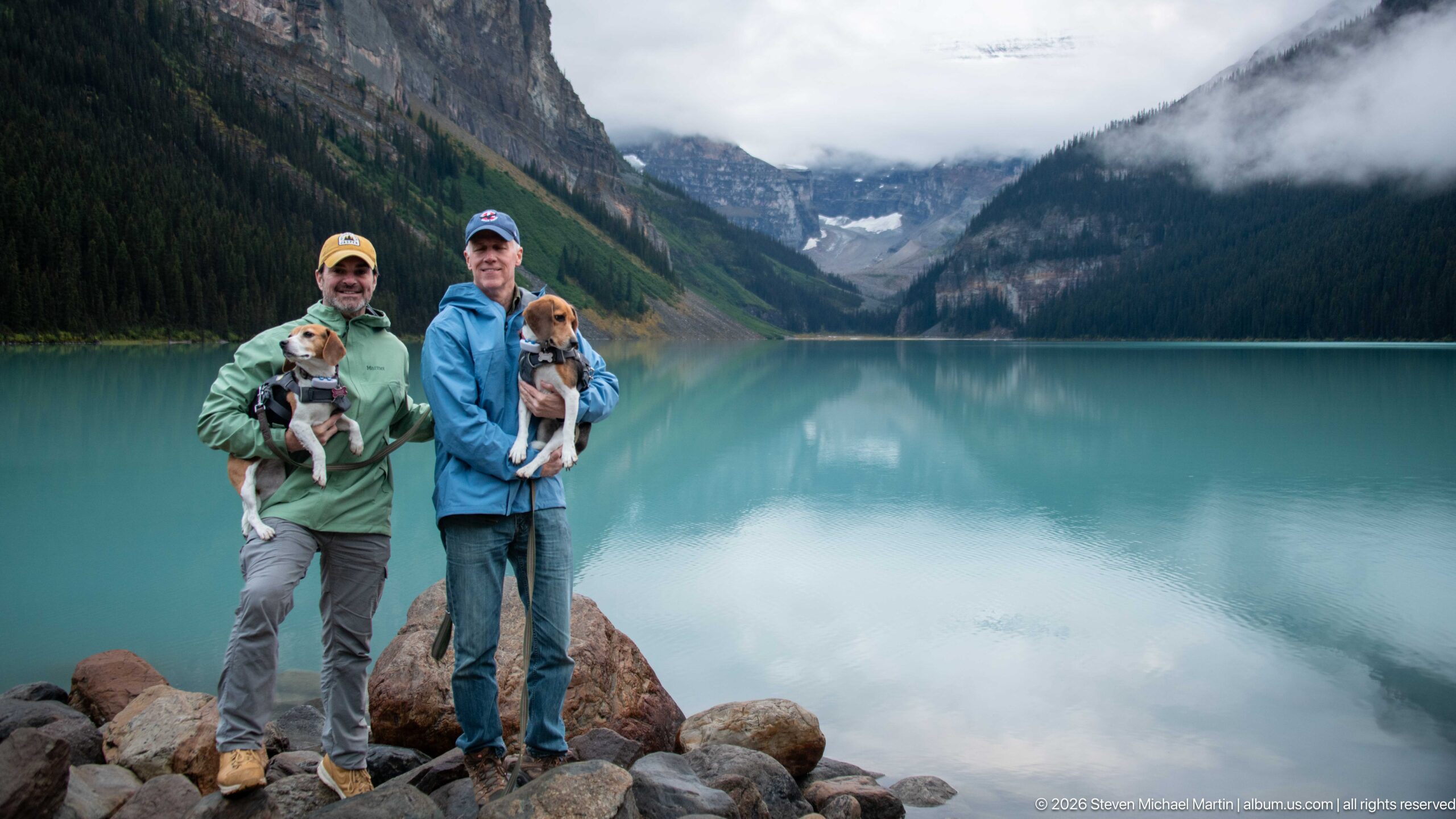
The same two visitors and small dogs appear in a wider portrait on the rocky shore, with more of Lake Louise visible around them. The pair stand near the left side of the frame rather than centered, leaving the pale turquoise water and clouded valley to occupy most of the composition. Their jackets and the dogs’ harnesses suggest a prepared outdoor visit, without implying a specific hike.
Caption
The same two visitors and small dogs appear in a wider portrait on the rocky shore, with more of Lake Louise visible around them. The pair stand near the left side of the frame rather than centered, leaving the pale turquoise water and clouded valley to occupy most of the composition. Their jackets and the dogs’ harnesses suggest a prepared outdoor visit, without implying a specific hike.
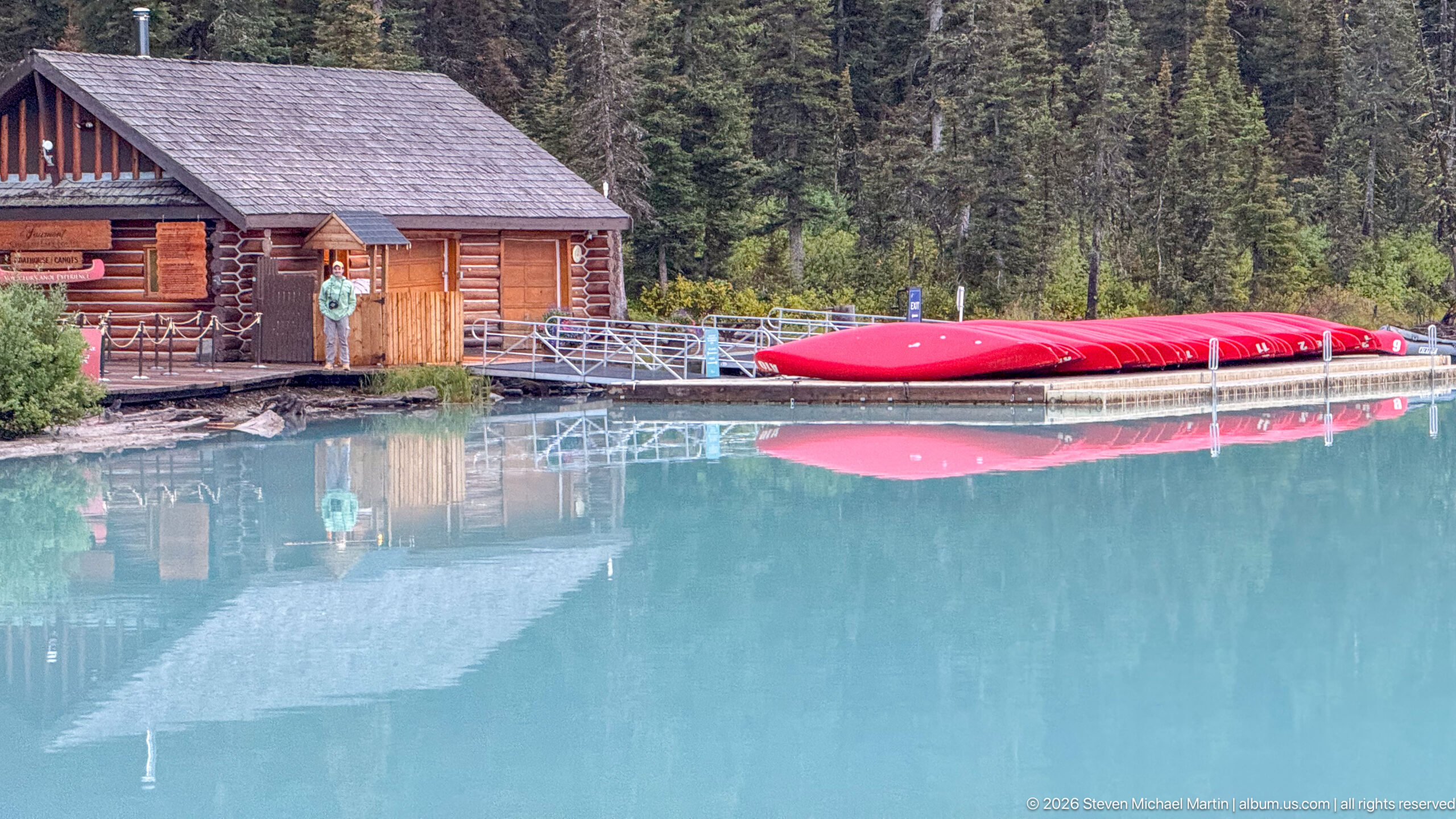
A row of red canoes lies upside down on a floating dock beside a rustic log boathouse. The saturated hulls and their reflection form a bright horizontal band across the turquoise water, while evergreen forest closes the background. A person stands by the doorway, providing scale to the small lakeside building and its canoe-rental operation.
Caption
A row of red canoes lies upside down on a floating dock beside a rustic log boathouse. The saturated hulls and their reflection form a bright horizontal band across the turquoise water, while evergreen forest closes the background. A person stands by the doorway, providing scale to the small lakeside building and its canoe-rental operation.
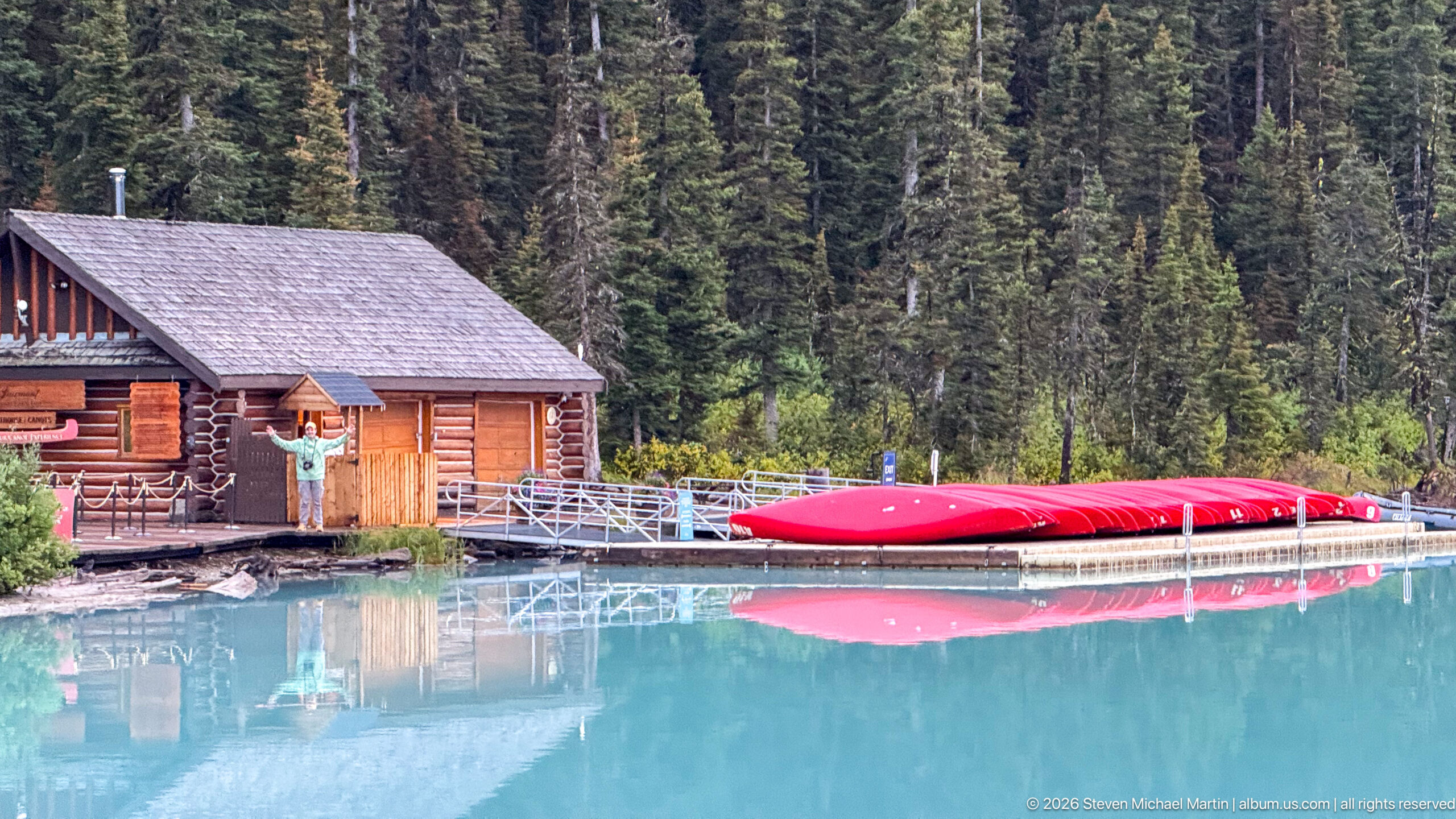
The log boathouse and docked red canoes are shown from slightly farther back, with more reflective water in the foreground. A visitor at the doorway raises both arms, adding a small human gesture to the otherwise still scene. The bright hulls mirror in the lake, while the dark trees behind the building provide contrast and anchor the lakeside facility in its forested setting.
Caption
The log boathouse and docked red canoes are shown from slightly farther back, with more reflective water in the foreground. A visitor at the doorway raises both arms, adding a small human gesture to the otherwise still scene. The bright hulls mirror in the lake, while the dark trees behind the building provide contrast and anchor the lakeside facility in its forested setting.
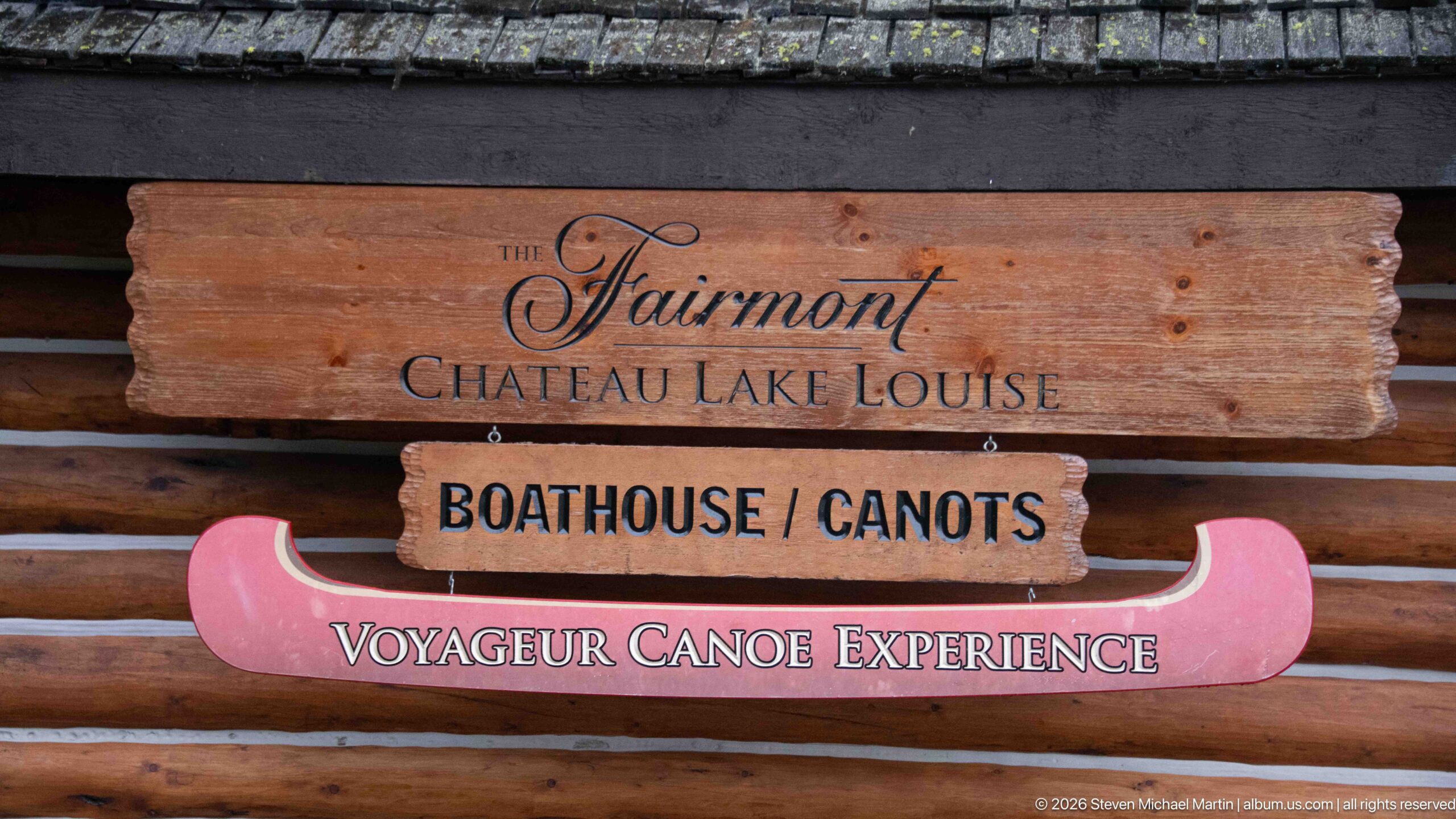
A weathered wooden sign mounted on the log boathouse names the Fairmont Chateau Lake Louise and the “Boathouse / Canots” and Voyageur Canoe Experience. The painted pink canoe motif stretches across the lower board, while the carved lettering and rough-cut timber make the sign itself the subject. Its bilingual wording and specific facility name provide direct identification of the lakeside rental building.
Caption
A weathered wooden sign mounted on the log boathouse names the Fairmont Chateau Lake Louise and the “Boathouse / Canots” and Voyageur Canoe Experience. The painted pink canoe motif stretches across the lower board, while the carved lettering and rough-cut timber make the sign itself the subject. Its bilingual wording and specific facility name provide direct identification of the lakeside rental building.
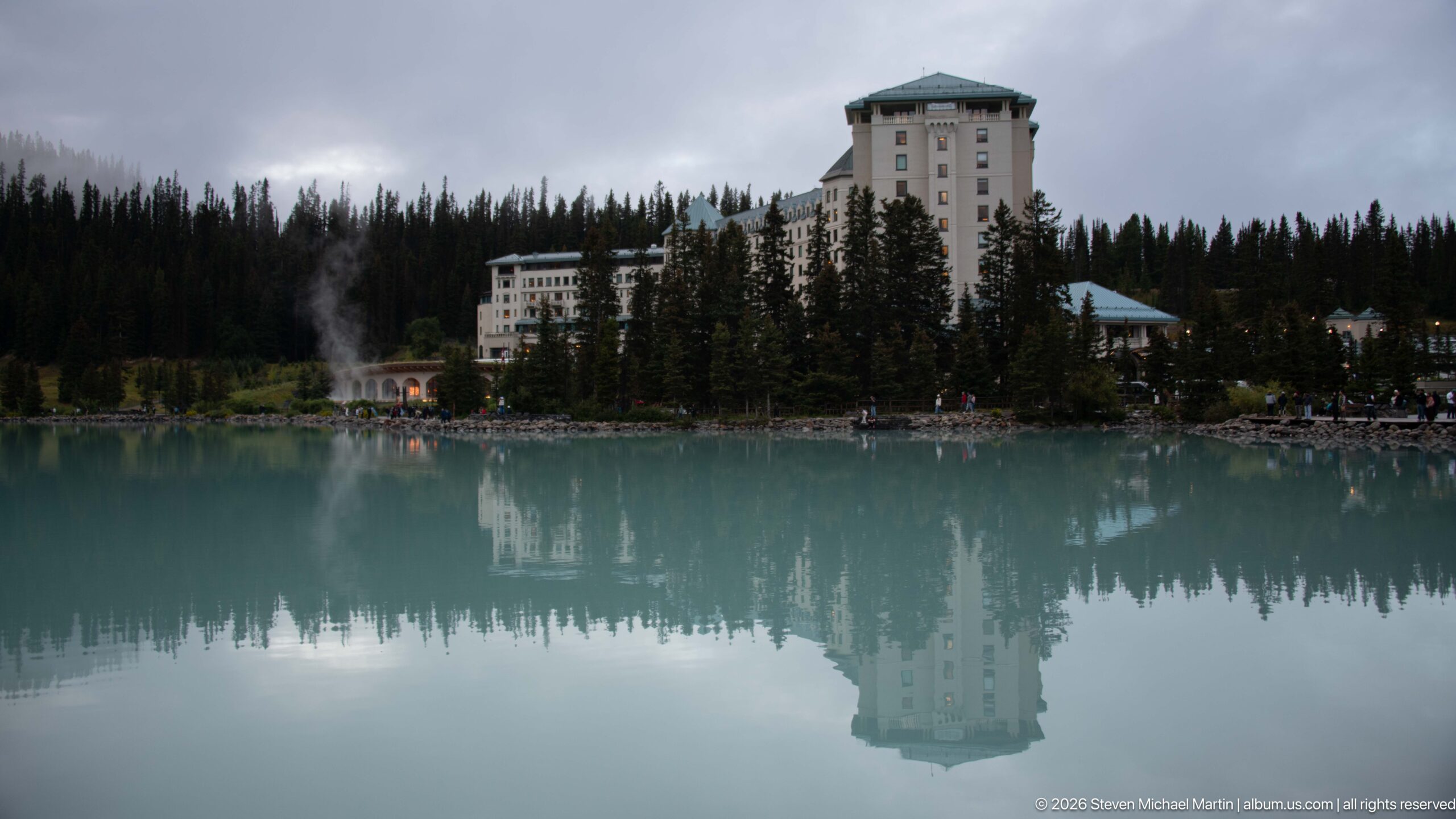
The tall central tower of the Fairmont Chateau Lake Louise rises above the opposite shore and appears again, nearly intact, in the still turquoise water. Evergreen trees partly screen the lower buildings, while a thin plume of steam or mist drifts near the shoreline. The subdued sky and broad reflection give this view a quiet, symmetrical balance.
Caption
The tall central tower of the Fairmont Chateau Lake Louise rises above the opposite shore and appears again, nearly intact, in the still turquoise water. Evergreen trees partly screen the lower buildings, while a thin plume of steam or mist drifts near the shoreline. The subdued sky and broad reflection give this view a quiet, symmetrical balance.
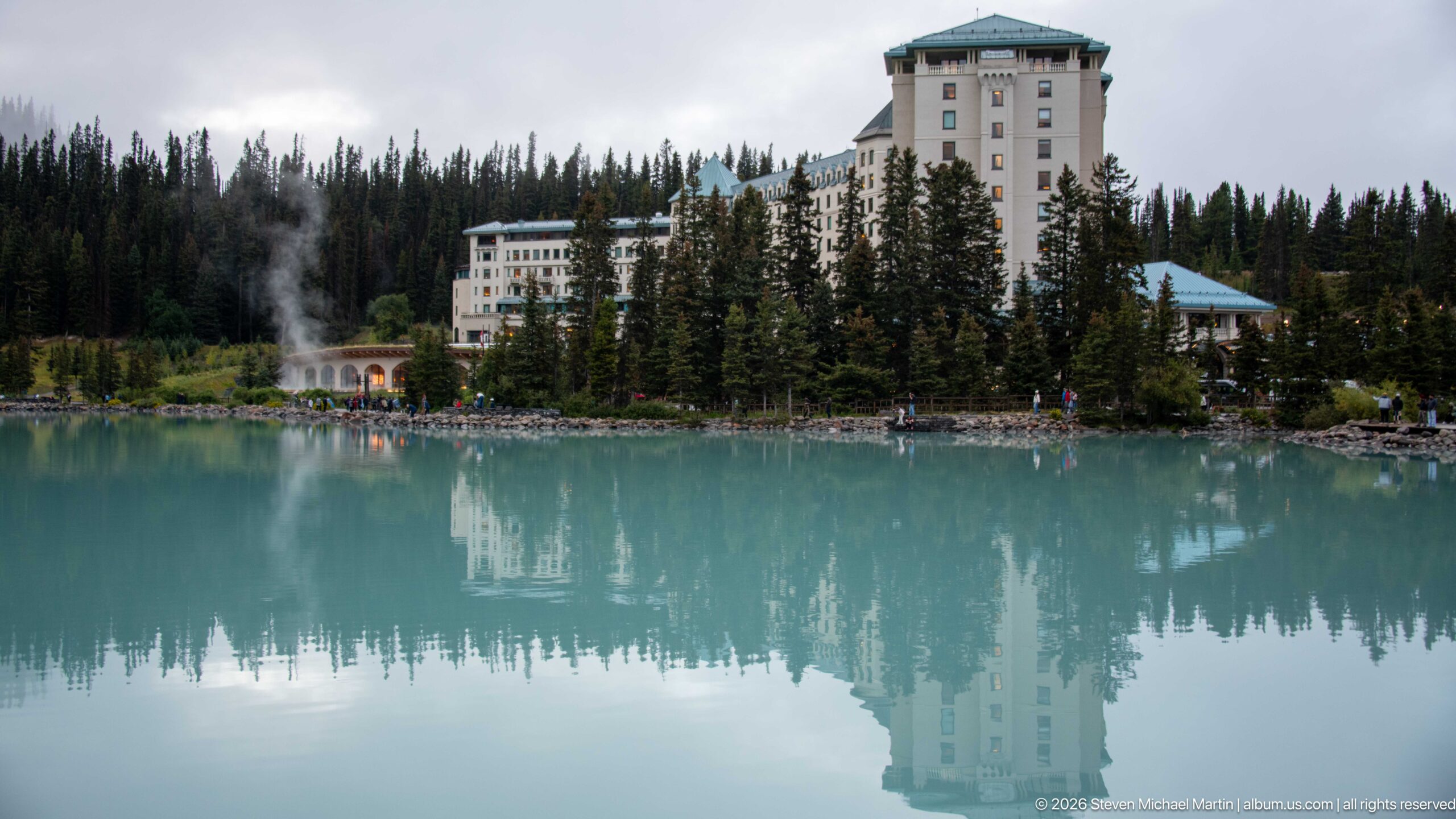
A wider crop includes more of the resort’s shoreline buildings and the dark evergreen band behind them, with the hotel tower repeated upside down in Lake Louise. The pale water holds a soft reflection of clouds and architecture, while a small plume of vapor rises beside the lower hotel wing. The extended framing makes the opposite shore as important as the tower.
Caption
A wider crop includes more of the resort’s shoreline buildings and the dark evergreen band behind them, with the hotel tower repeated upside down in Lake Louise. The pale water holds a soft reflection of clouds and architecture, while a small plume of vapor rises beside the lower hotel wing. The extended framing makes the opposite shore as important as the tower.
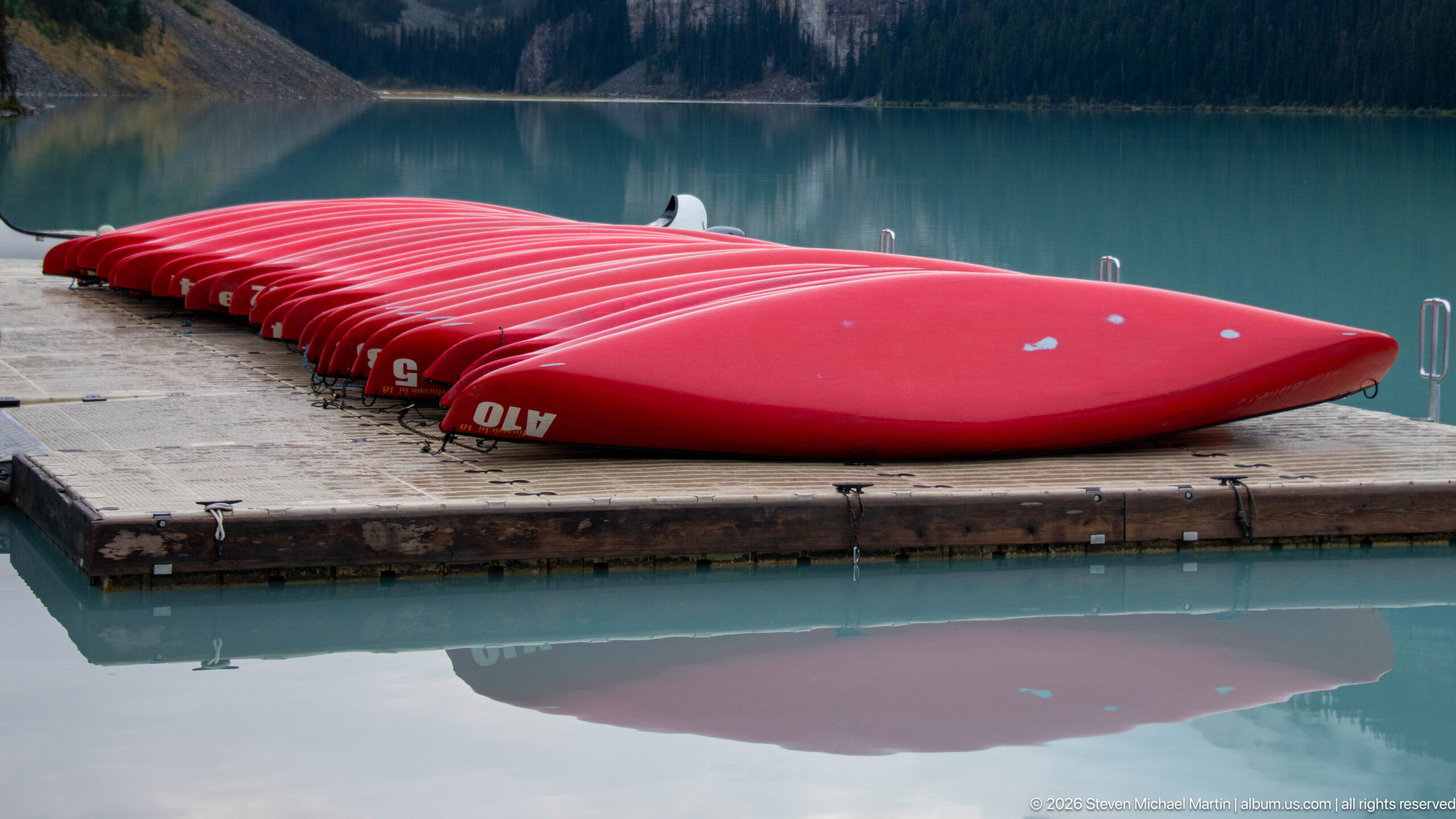
A tightly ordered row of red rental canoes lies upside down on a floating dock, their bright hulls and curved undersides mirrored in the water below. The framing excludes the mountains and most of the shore, turning the repeated boats into a graphic study of color, shape, and reflection. A small white vessel is barely visible beyond the line of canoes.
Caption
A tightly ordered row of red rental canoes lies upside down on a floating dock, their bright hulls and curved undersides mirrored in the water below. The framing excludes the mountains and most of the shore, turning the repeated boats into a graphic study of color, shape, and reflection. A small white vessel is barely visible beyond the line of canoes.
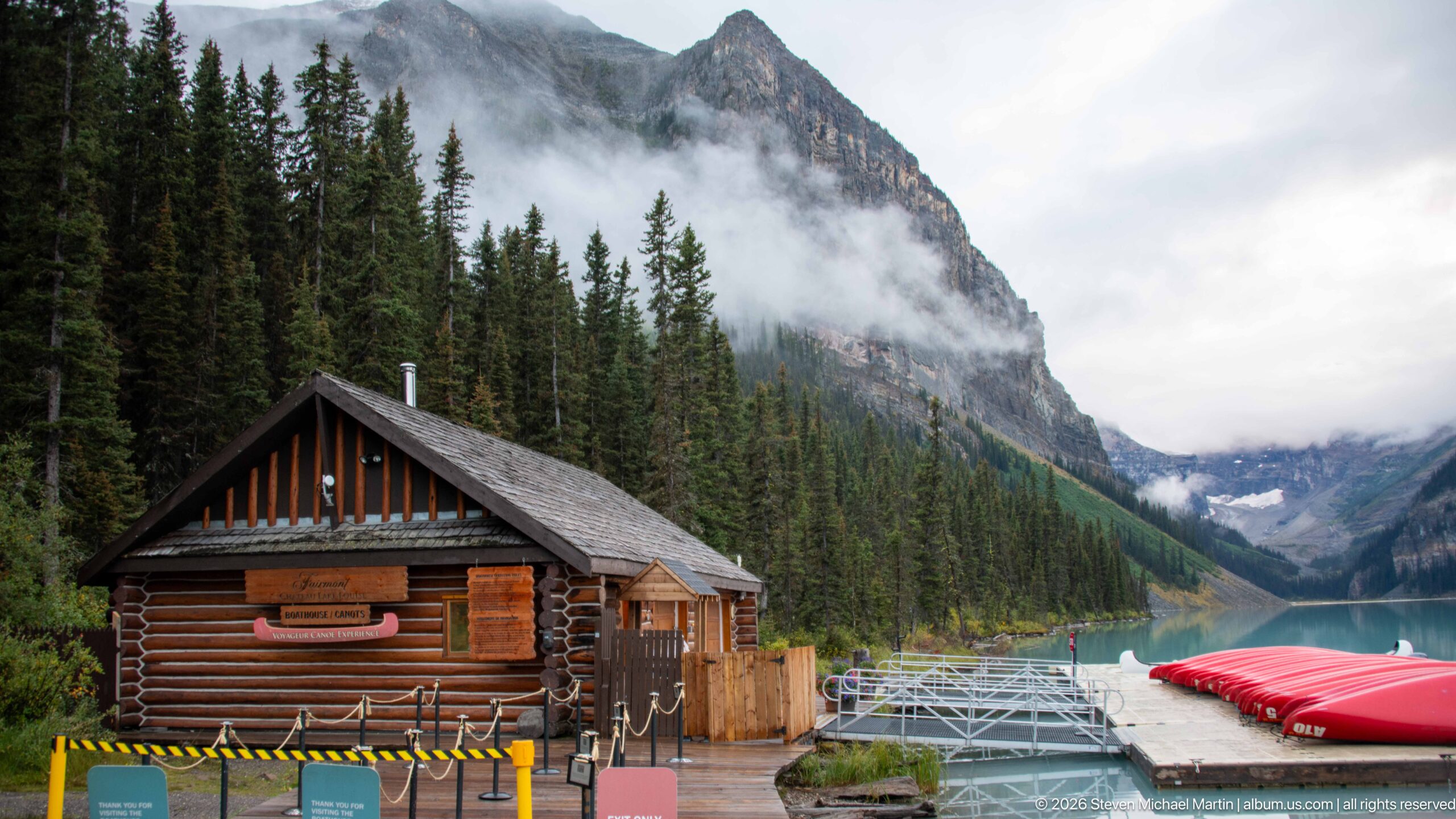
The log boathouse stands at the forested shore, its steep gable and vertical timber details set against a cloud-veiled mountain. A metal gangway leads to the floating dock, where red canoes line the edge of Lake Louise. The view combines the rustic rental building with the larger alpine setting, while barriers and bins at the bottom edge show the active facility.
Caption
The log boathouse stands at the forested shore, its steep gable and vertical timber details set against a cloud-veiled mountain. A metal gangway leads to the floating dock, where red canoes line the edge of Lake Louise. The view combines the rustic rental building with the larger alpine setting, while barriers and bins at the bottom edge show the active facility.
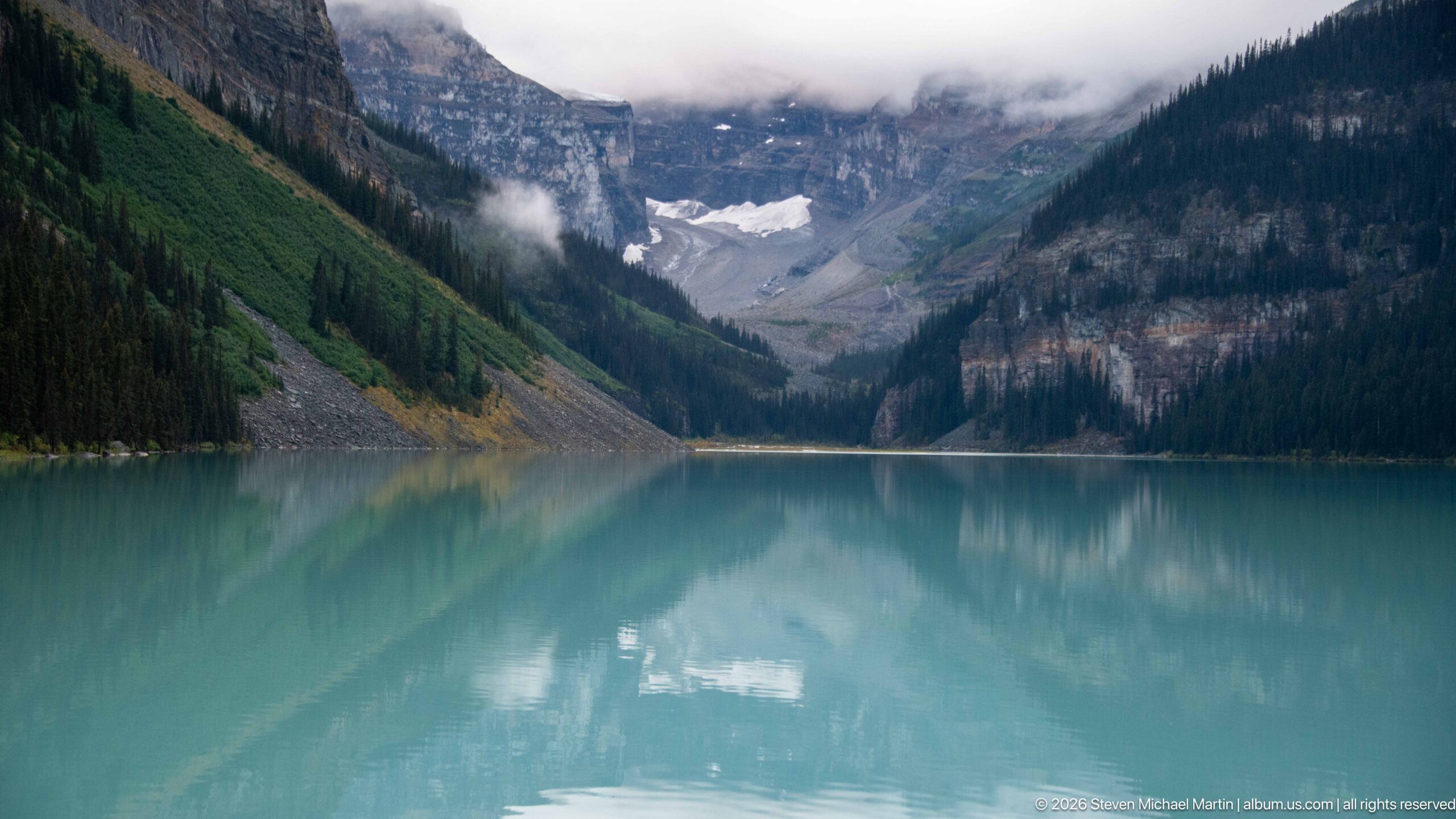
Lake Louise narrows toward a pale glacier at the far end of the valley, framed by steep, forested mountain walls. The glacier’s lower ice and moraine are visible beneath low cloud, while the smooth foreground water reflects the muted blue-green slopes. With no immediate shoreline details, the long view emphasizes the lake’s glacial source and depth.
Caption
Lake Louise narrows toward a pale glacier at the far end of the valley, framed by steep, forested mountain walls. The glacier’s lower ice and moraine are visible beneath low cloud, while the smooth foreground water reflects the muted blue-green slopes. With no immediate shoreline details, the long view emphasizes the lake’s glacial source and depth.
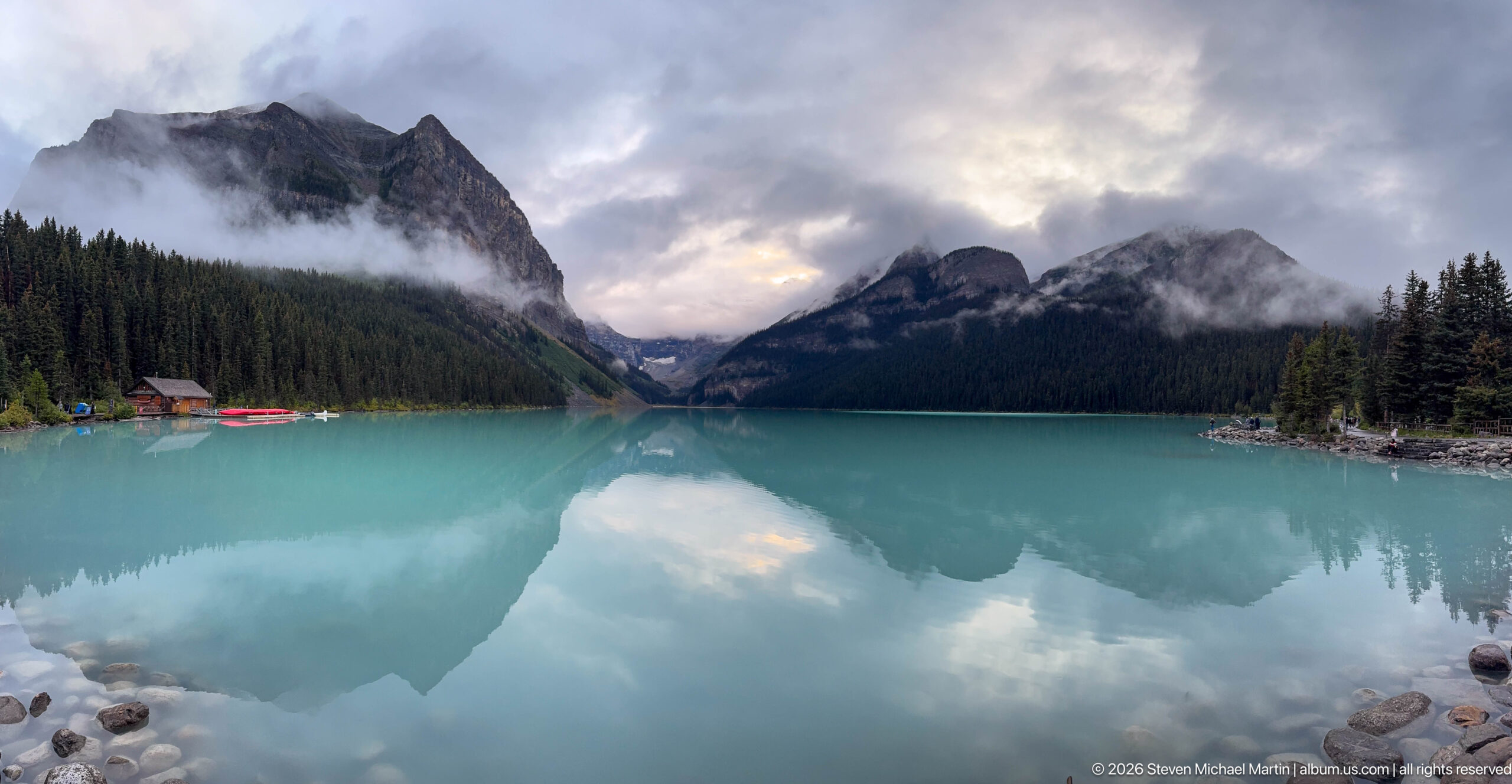
A pale opening in the clouds and the dark, steep valley walls appear almost symmetrically in the calm surface of Lake Louise. The far-shore canoe dock and a few red boats remain visible at left, while rounded shoreline rocks enter at the lower corners. The composition gives the reflection nearly equal weight to the mountains and preserves the lake’s broad, glacial-turquoise expanse.
Caption
A pale opening in the clouds and the dark, steep valley walls appear almost symmetrically in the calm surface of Lake Louise. The far-shore canoe dock and a few red boats remain visible at left, while rounded shoreline rocks enter at the lower corners. The composition gives the reflection nearly equal weight to the mountains and preserves the lake’s broad, glacial-turquoise expanse.
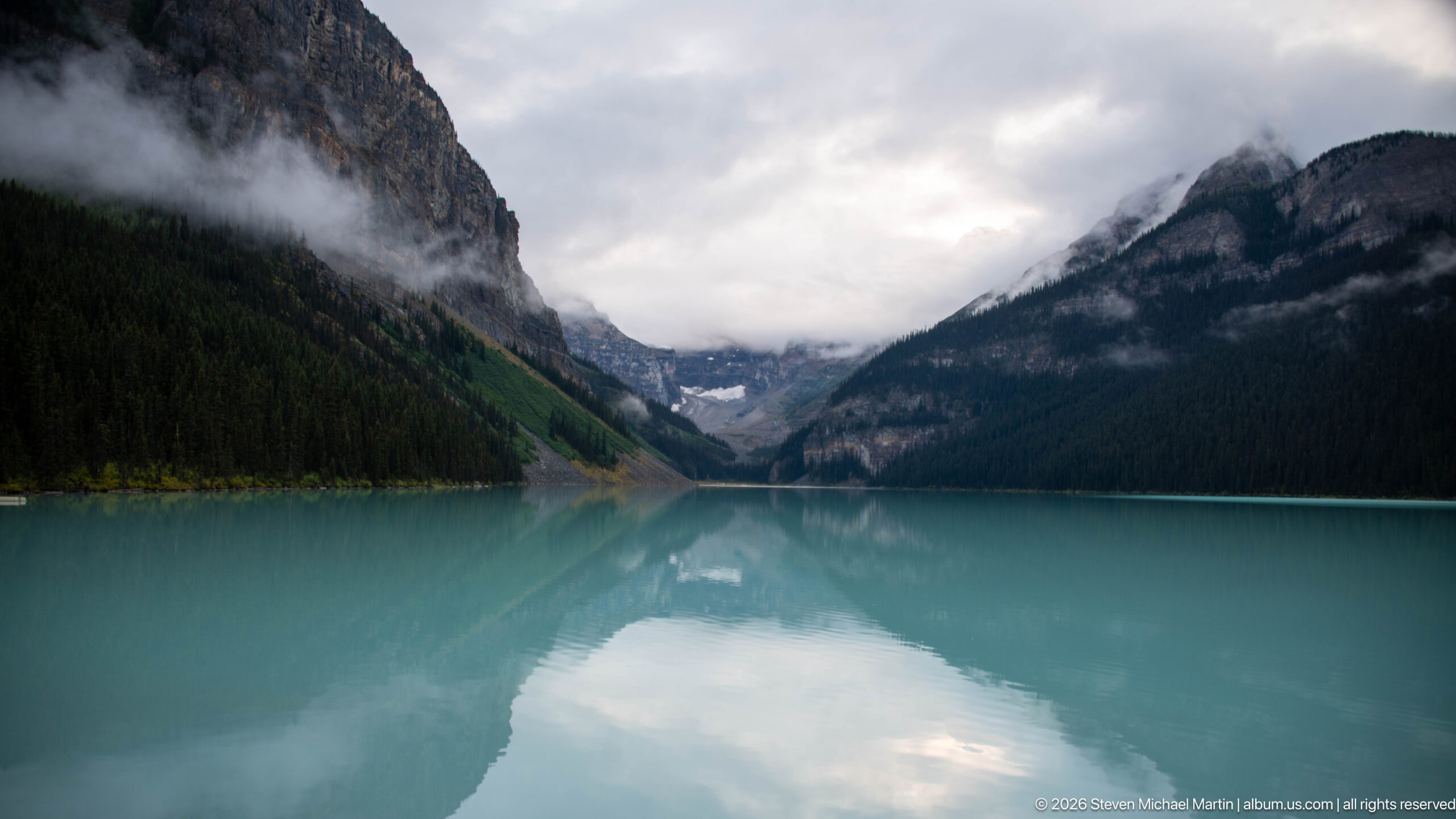
The view looks directly along Lake Louise toward a narrow opening between dark, cloud-streaked mountains. The lake surface is nearly level and glassy, holding a pale reflection of the sky; only a thin strip of the distant shore interrupts the water. This uncluttered panorama removes the resort and boats from the composition and concentrates on the valley’s enclosed form.
Caption
The view looks directly along Lake Louise toward a narrow opening between dark, cloud-streaked mountains. The lake surface is nearly level and glassy, holding a pale reflection of the sky; only a thin strip of the distant shore interrupts the water. This uncluttered panorama removes the resort and boats from the composition and concentrates on the valley’s enclosed form.
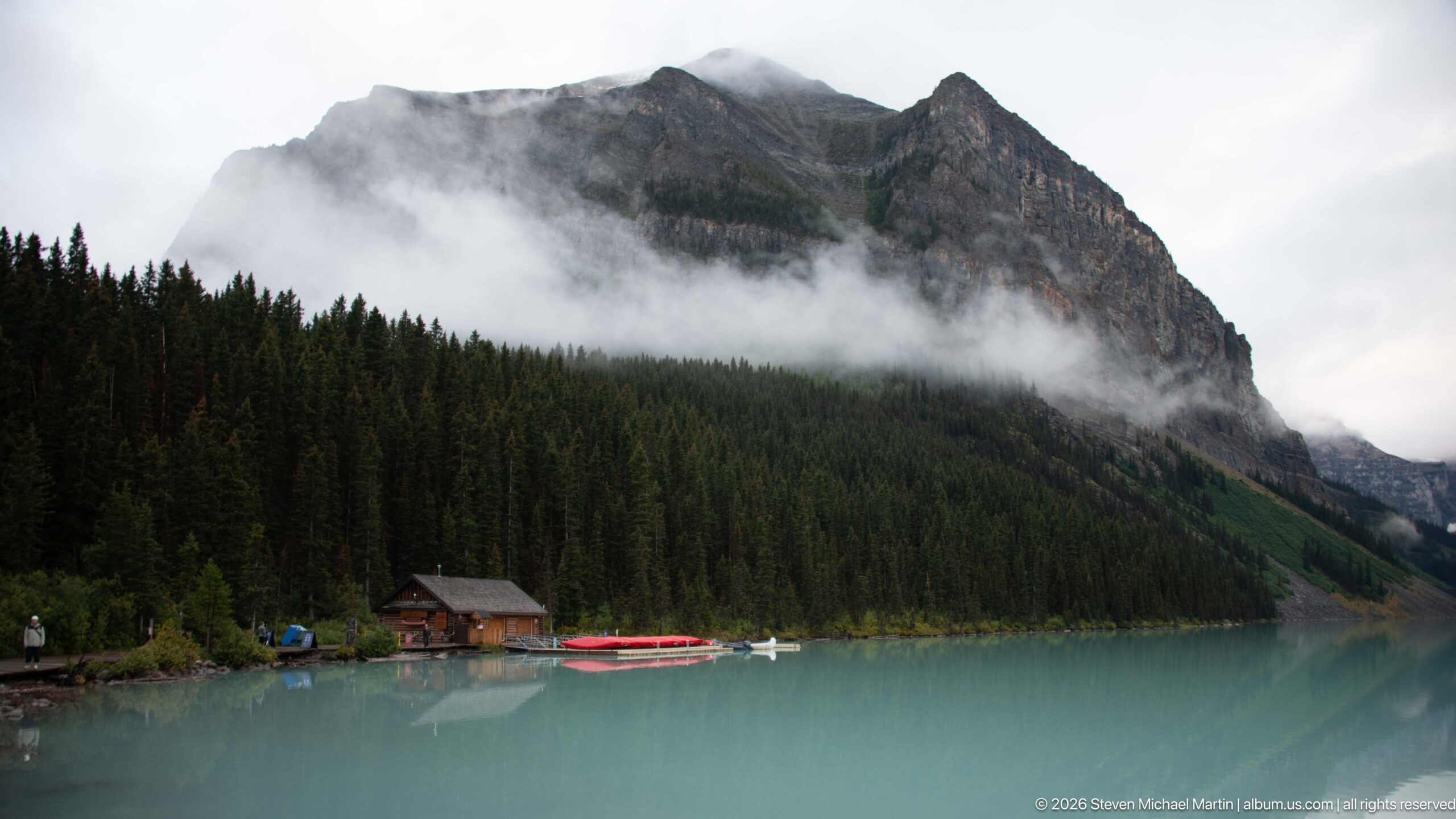
A steep, bare rock face rises over the dark forest at Lake Louise, with cloud trailing across its upper slopes. At the waterline, the log boathouse and red canoes appear small against the mountain and broad turquoise lake. The contrast of the modest rental structure and immense rock wall gives this view a strong sense of scale.
Caption
A steep, bare rock face rises over the dark forest at Lake Louise, with cloud trailing across its upper slopes. At the waterline, the log boathouse and red canoes appear small against the mountain and broad turquoise lake. The contrast of the modest rental structure and immense rock wall gives this view a strong sense of scale.
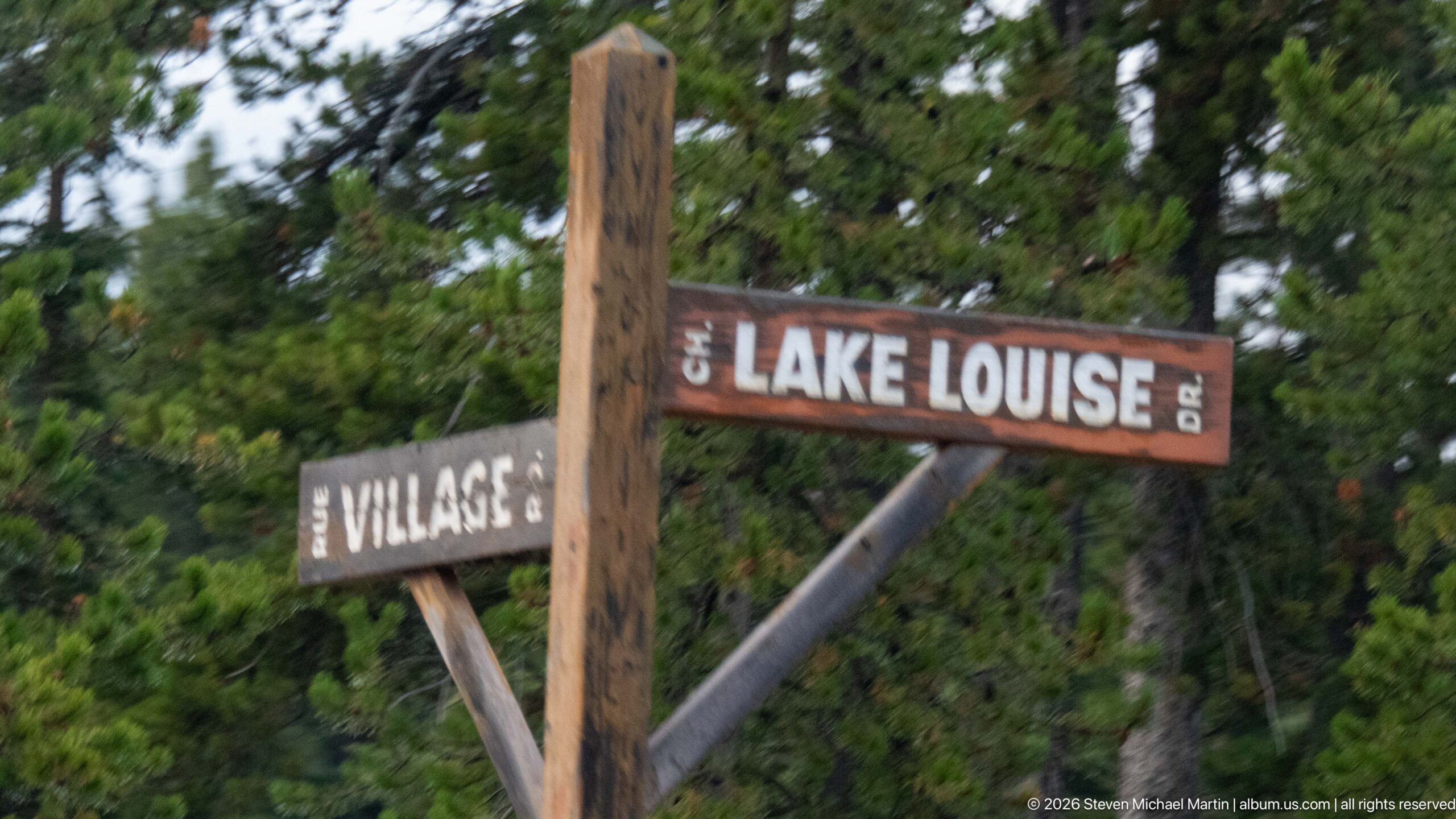
A weathered wooden direction sign points toward Lake Louise, with a second, partly cropped board indicating the village. The shallow focus softens the lettering at the edges while keeping “Lake Louise” readable across the upper plank. Conifer branches fill the background, and the close framing records a wayfinding marker rather than a scenic view.
Caption
A weathered wooden direction sign points toward Lake Louise, with a second, partly cropped board indicating the village. The shallow focus softens the lettering at the edges while keeping “Lake Louise” readable across the upper plank. Conifer branches fill the background, and the close framing records a wayfinding marker rather than a scenic view.
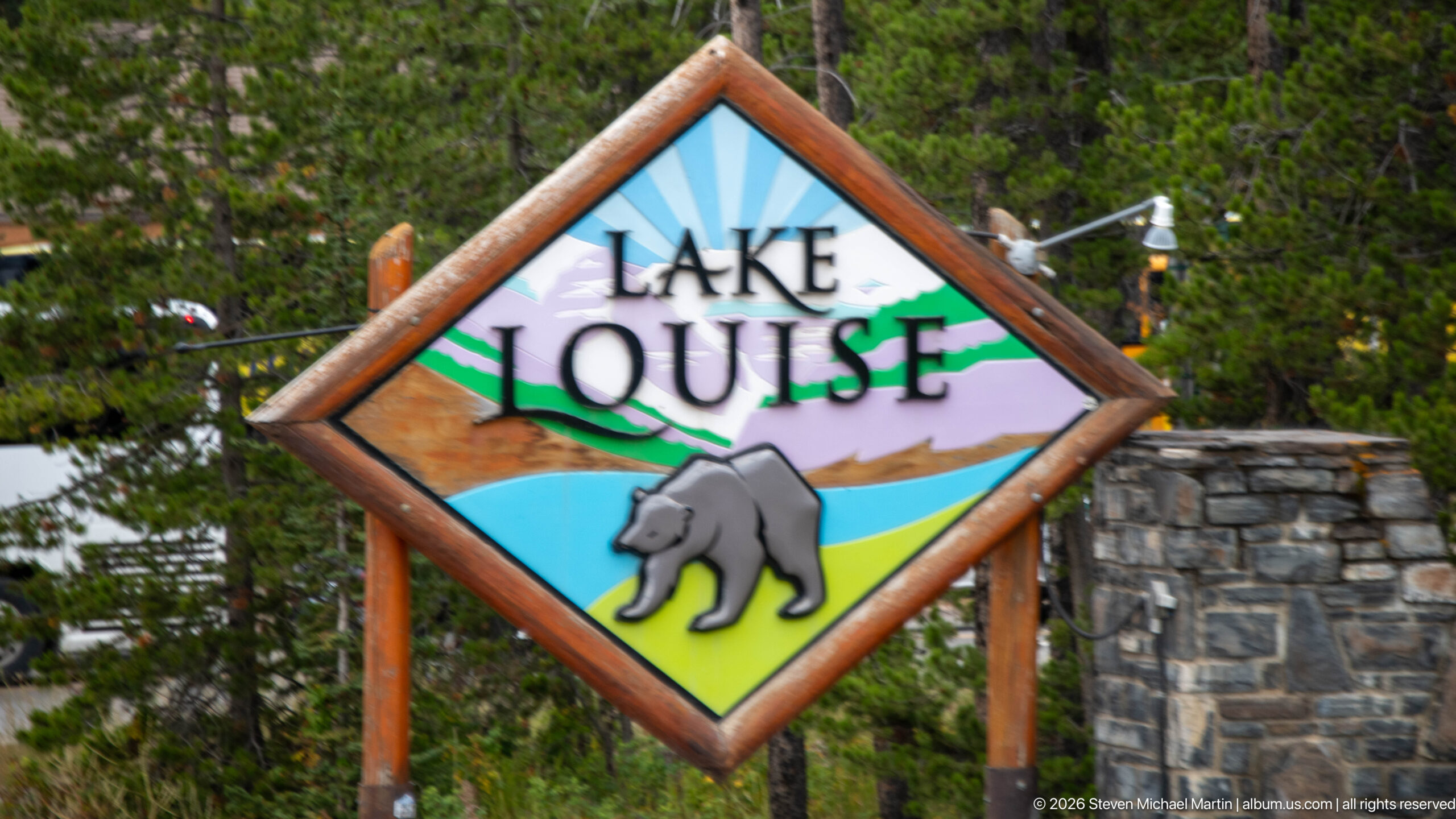
A diamond-shaped sign spells out Lake Louise above a stylized bear, blue water, green hills, and radiating sky. Its timber frame and painted graphic stand beside a low stone wall, with conifers behind. The decorative sign gives a clear, literal place label and a regional wildlife motif without requiring interpretation of the surrounding landscape.
Caption
A diamond-shaped sign spells out Lake Louise above a stylized bear, blue water, green hills, and radiating sky. Its timber frame and painted graphic stand beside a low stone wall, with conifers behind. The decorative sign gives a clear, literal place label and a regional wildlife motif without requiring interpretation of the surrounding landscape.
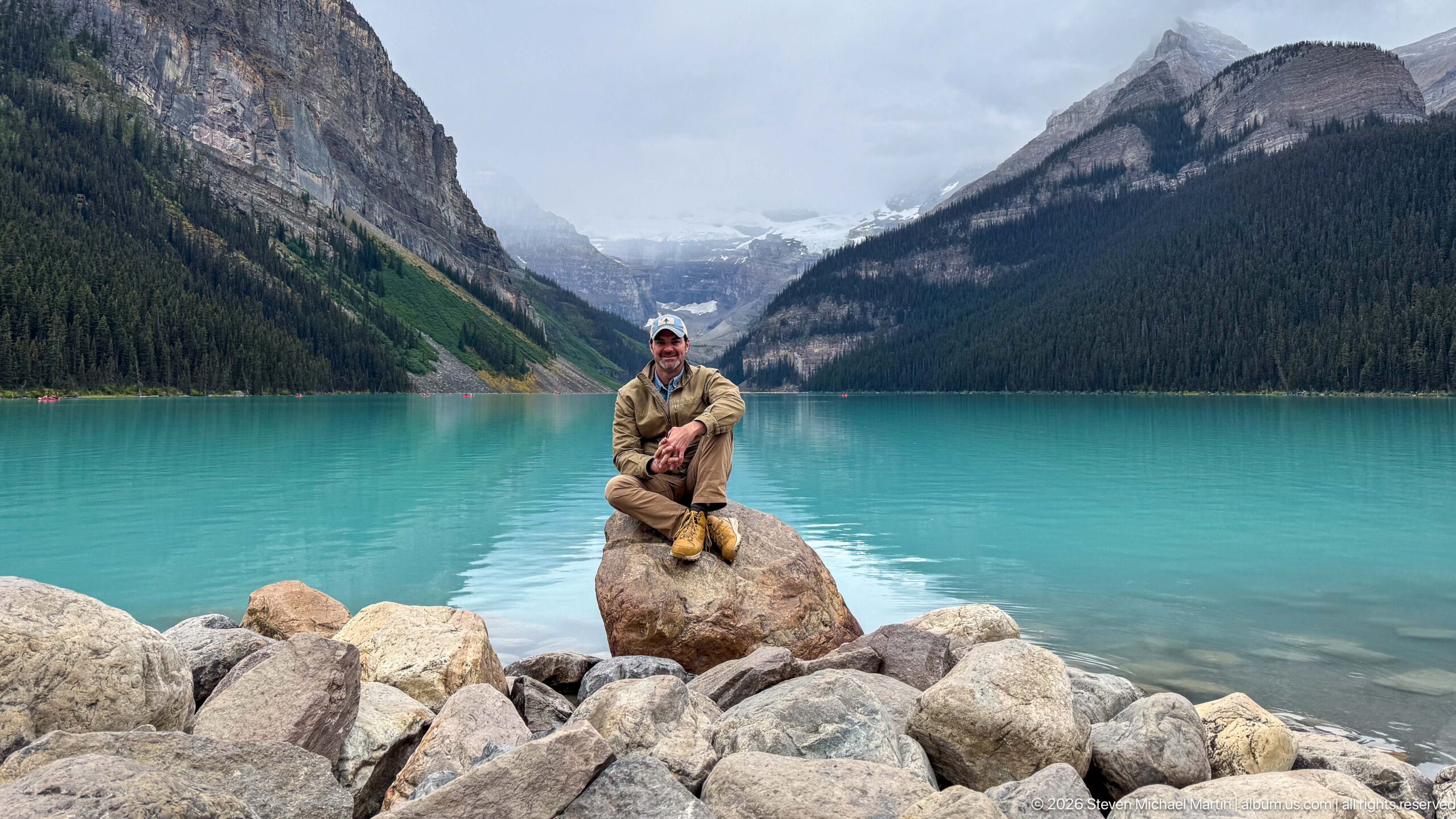
A visitor sits on a large shoreline boulder with Lake Louise and the glacier-lined valley behind him. He wears a tan jacket and cap, with one knee raised and his hands resting together; the turquoise water and steep slopes remain unobstructed around his figure. The portrait combines a relaxed human presence with a clear view down the lake.
Caption
A visitor sits on a large shoreline boulder with Lake Louise and the glacier-lined valley behind him. He wears a tan jacket and cap, with one knee raised and his hands resting together; the turquoise water and steep slopes remain unobstructed around his figure. The portrait combines a relaxed human presence with a clear view down the lake.
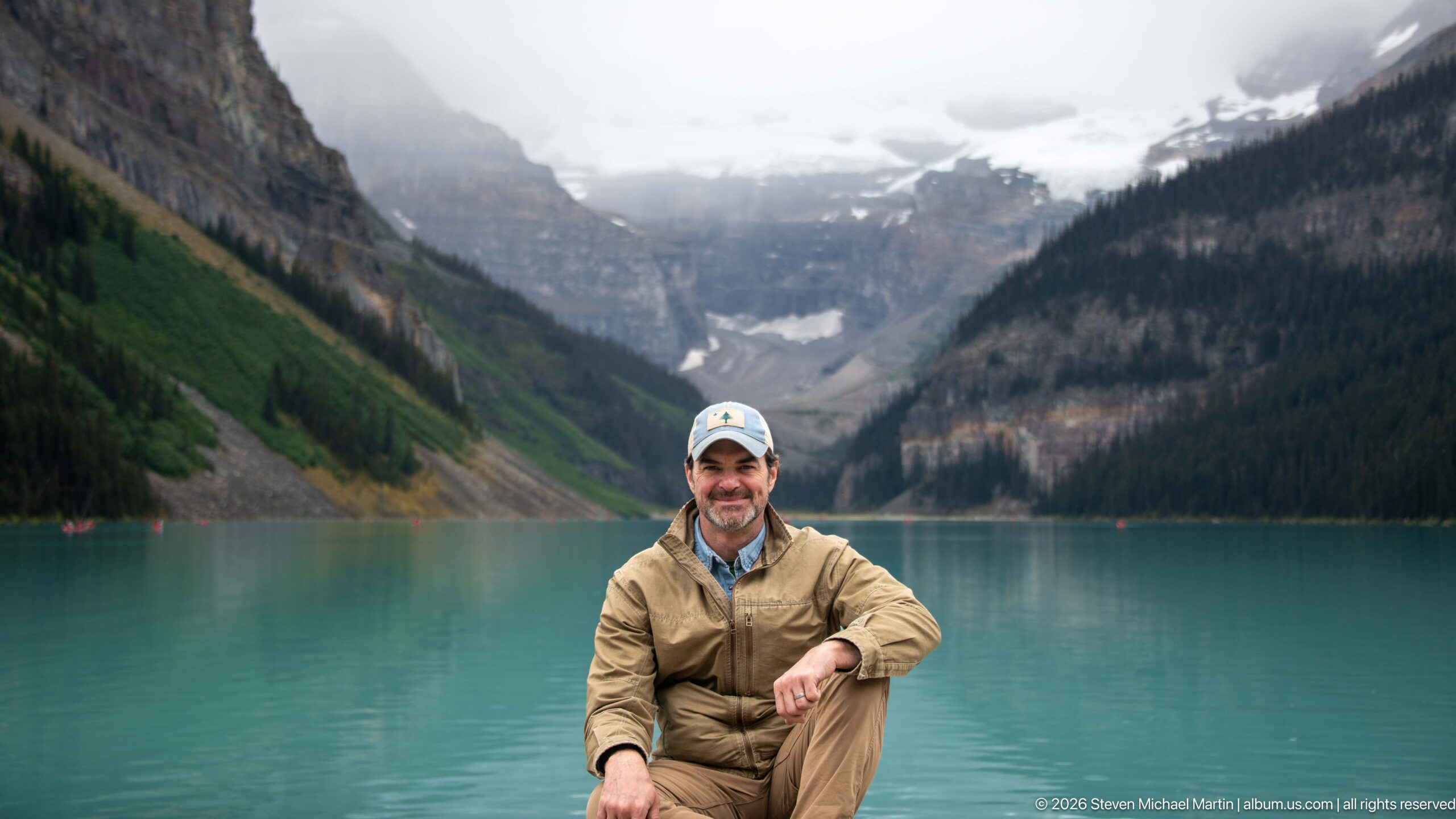
The visitor is framed more closely, seated among rocks with the turquoise lake and a pale glacier visible behind his shoulders. His tan jacket and cap contrast with the cool water and gray-green mountain slopes. The tighter crop gives the portrait greater prominence while retaining enough of the glacial valley to establish the location.
Caption
The visitor is framed more closely, seated among rocks with the turquoise lake and a pale glacier visible behind his shoulders. His tan jacket and cap contrast with the cool water and gray-green mountain slopes. The tighter crop gives the portrait greater prominence while retaining enough of the glacial valley to establish the location.
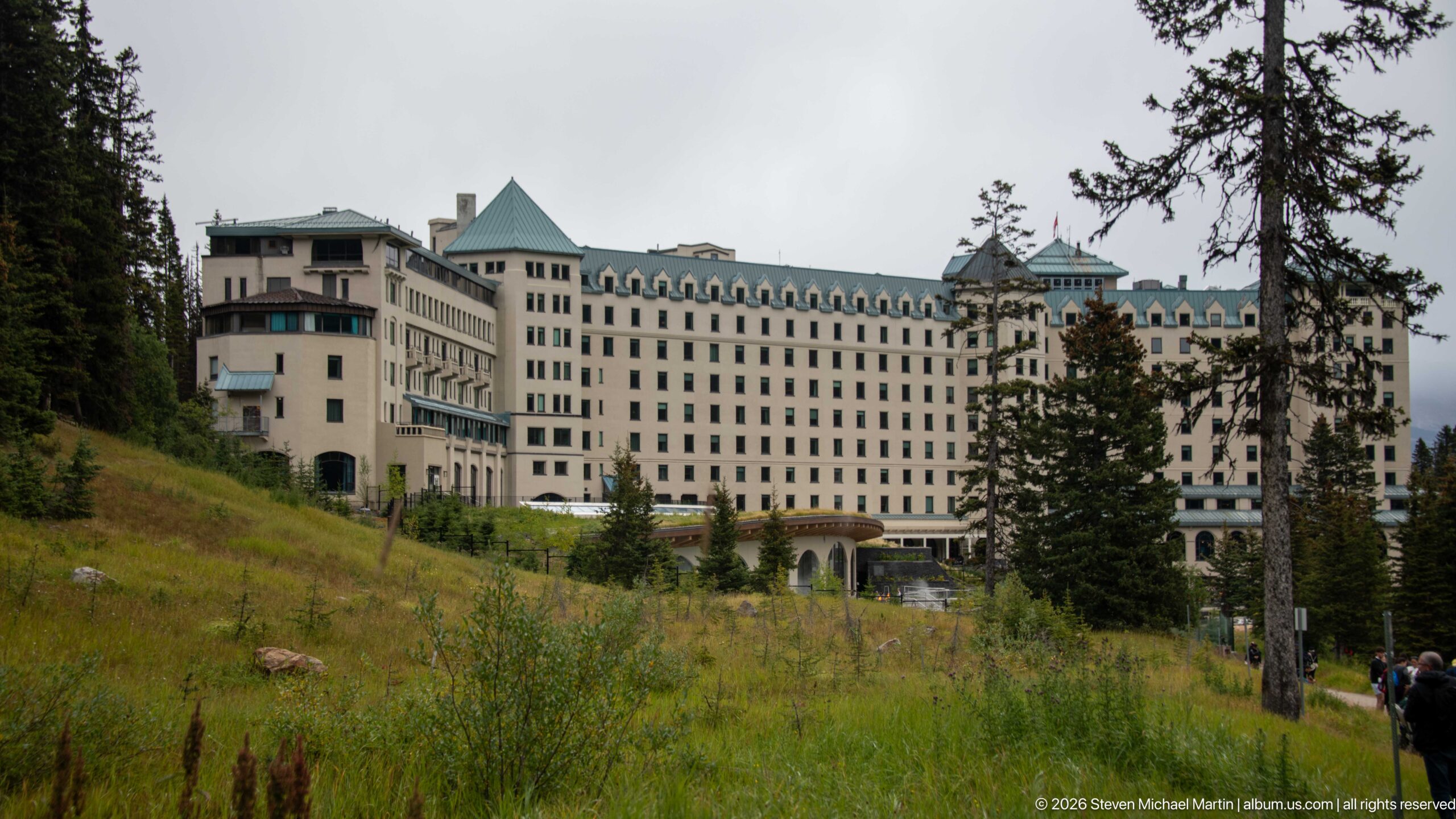
The Fairmont Chateau Lake Louise stretches across the upper slope beyond a rough meadow of grasses and scattered flowers. A projecting tower and repeated dormers punctuate the pale façade; evergreen trees partly frame the building at right. The oblique, elevated viewpoint sets the resort against the hillside and gives the planted foreground a distinctly less formal character than its lakeside gardens.
Caption
The Fairmont Chateau Lake Louise stretches across the upper slope beyond a rough meadow of grasses and scattered flowers. A projecting tower and repeated dormers punctuate the pale façade; evergreen trees partly frame the building at right. The oblique, elevated viewpoint sets the resort against the hillside and gives the planted foreground a distinctly less formal character than its lakeside gardens.
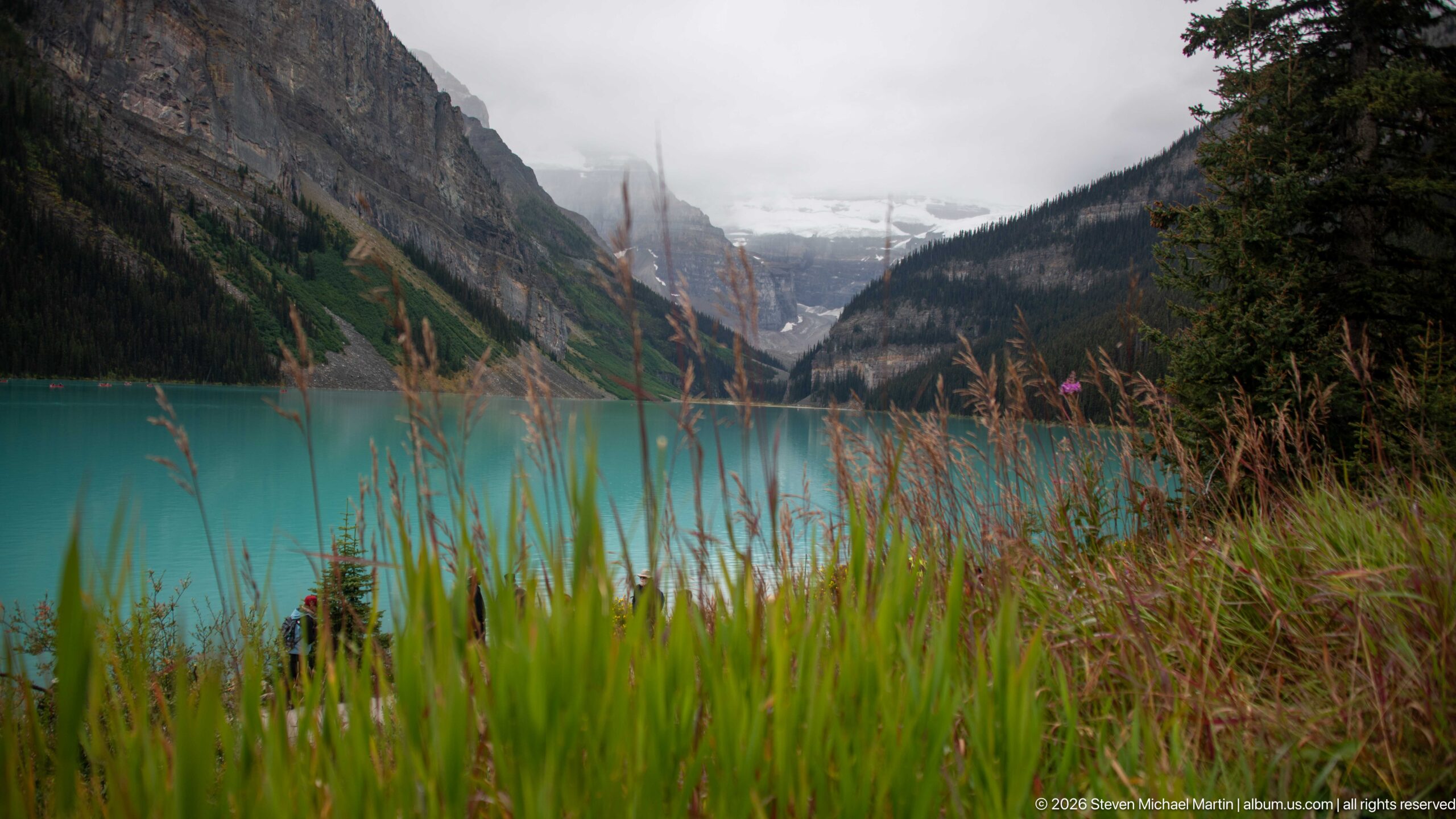
Tall grasses rise out of focus across the foreground, partially veiling turquoise Lake Louise and the steep valley beyond. A small patch of purple flowers appears at lower right, while low cloud hides the far peaks. The natural screen creates a more secluded shoreline view than the open promenade scenes, with the lake visible through gaps in the vegetation.
Caption
Tall grasses rise out of focus across the foreground, partially veiling turquoise Lake Louise and the steep valley beyond. A small patch of purple flowers appears at lower right, while low cloud hides the far peaks. The natural screen creates a more secluded shoreline view than the open promenade scenes, with the lake visible through gaps in the vegetation.
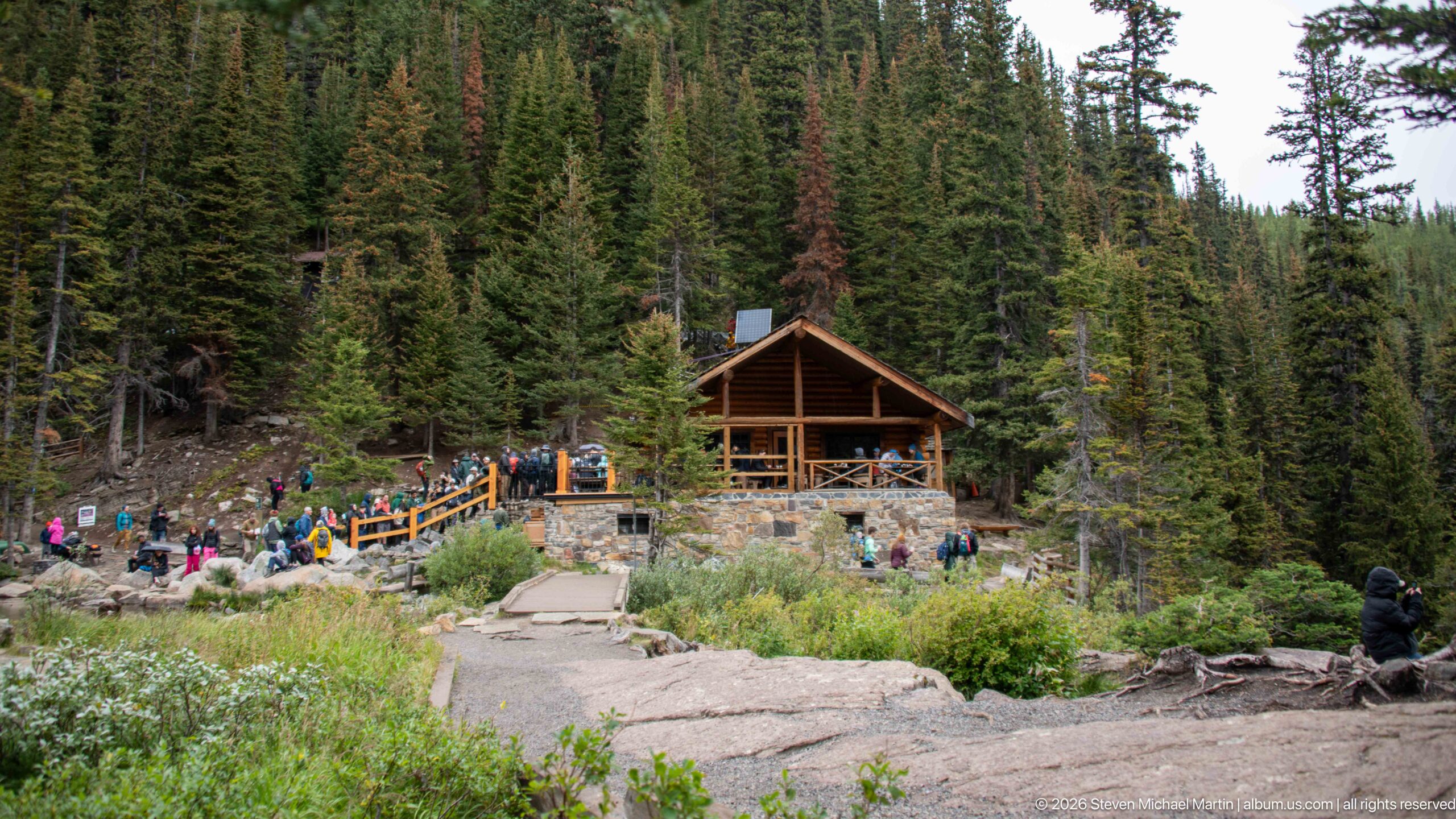
A rustic timber building with a steep gabled roof sits above a stone landing among conifers, with hikers gathered along the approach. The structure and foot traffic are consistent with the Lake Agnes Tea House, a well-known stop on the trail above Lake Louise. The proof-sheet view shows the exterior and busy lakeside setting but no readable sign, so the named identification remains provisional.
Caption
A rustic timber building with a steep gabled roof sits above a stone landing among conifers, with hikers gathered along the approach. The structure and foot traffic are consistent with the Lake Agnes Tea House, a well-known stop on the trail above Lake Louise. The proof-sheet view shows the exterior and busy lakeside setting but no readable sign, so the named identification remains provisional.
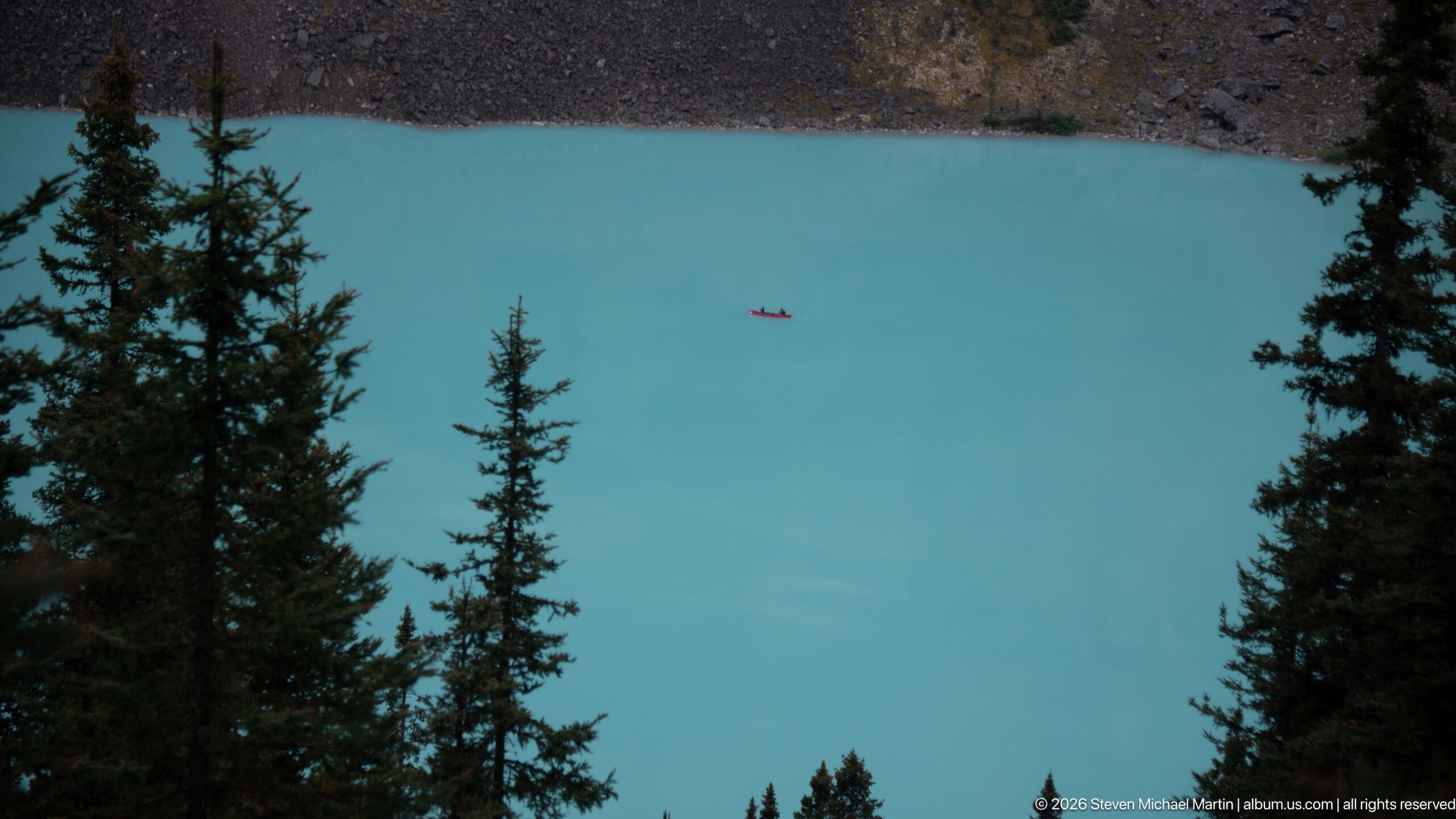
A tiny red boat crosses the broad turquoise surface of a small alpine lake, dwarfed by the scale of the water and dark tree-lined shore. The elevated viewpoint looks down from a rocky bank, and no prominent landmark or sign is visible. The scene belongs to the Lake Agnes area of the portfolio, but the image alone does not distinguish the lake with certainty.
Caption
A tiny red boat crosses the broad turquoise surface of a small alpine lake, dwarfed by the scale of the water and dark tree-lined shore. The elevated viewpoint looks down from a rocky bank, and no prominent landmark or sign is visible. The scene belongs to the Lake Agnes area of the portfolio, but the image alone does not distinguish the lake with certainty.
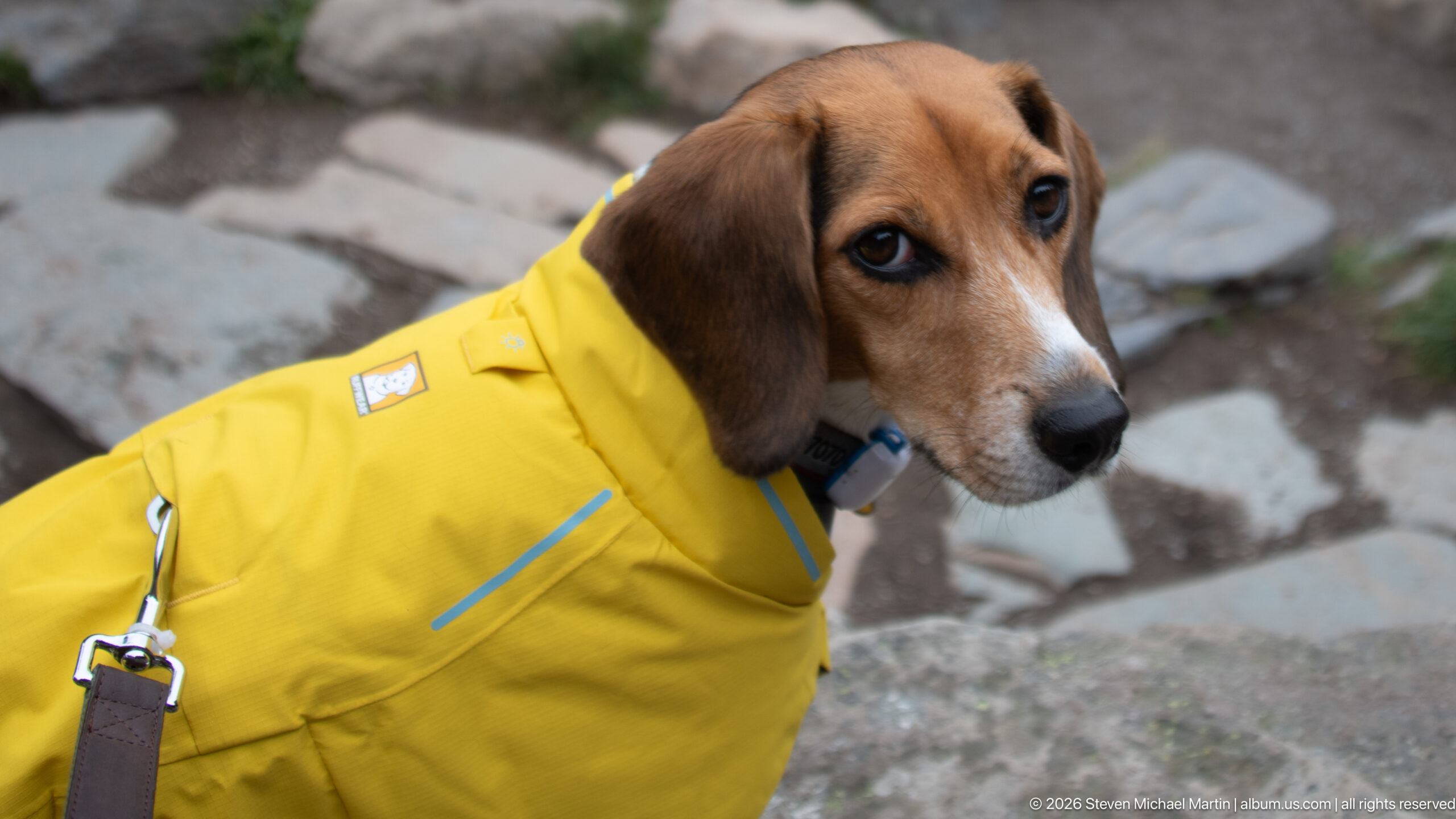
A brown-and-white beagle looks back over one shoulder, wearing a bright yellow raincoat with reflective blue trim and a clipped leash. Angular gray trail stones fill the background, keeping attention on the dog’s alert expression and outdoor gear. The close portrait records a hiking companion rather than a landscape, and no owner or dog name is visible.
Caption
A brown-and-white beagle looks back over one shoulder, wearing a bright yellow raincoat with reflective blue trim and a clipped leash. Angular gray trail stones fill the background, keeping attention on the dog’s alert expression and outdoor gear. The close portrait records a hiking companion rather than a landscape, and no owner or dog name is visible.
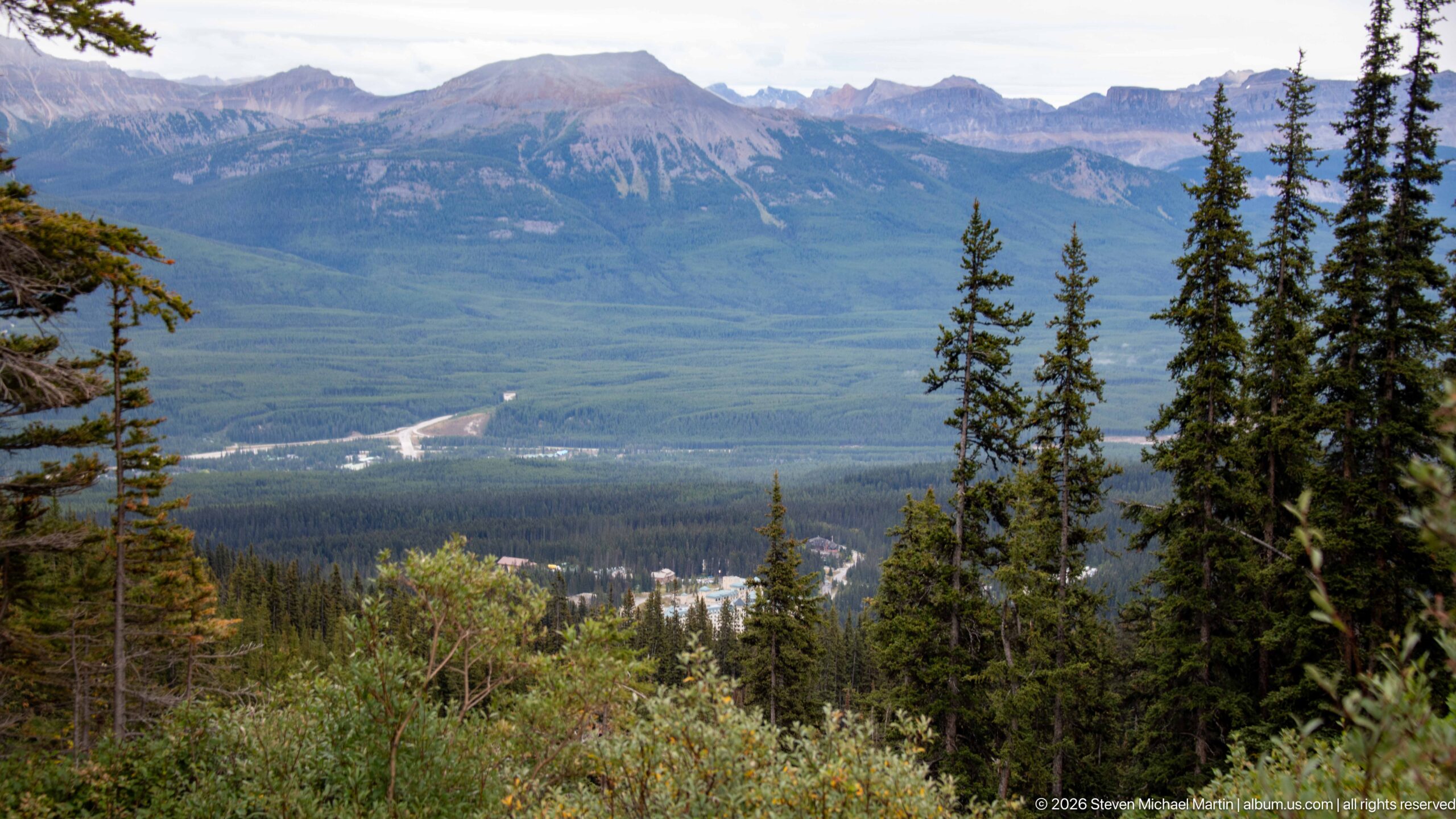
A high viewpoint opens across a forested valley to layered mountain ridges and a broad basin far below. A pale braided or glacial stream cuts through the forest floor, while dark conifers frame the right edge and low shrubs fill the near slope. The photograph conveys the height and breadth of the overlook without a visible sign to establish its exact trail location.
Caption
A high viewpoint opens across a forested valley to layered mountain ridges and a broad basin far below. A pale braided or glacial stream cuts through the forest floor, while dark conifers frame the right edge and low shrubs fill the near slope. The photograph conveys the height and breadth of the overlook without a visible sign to establish its exact trail location.
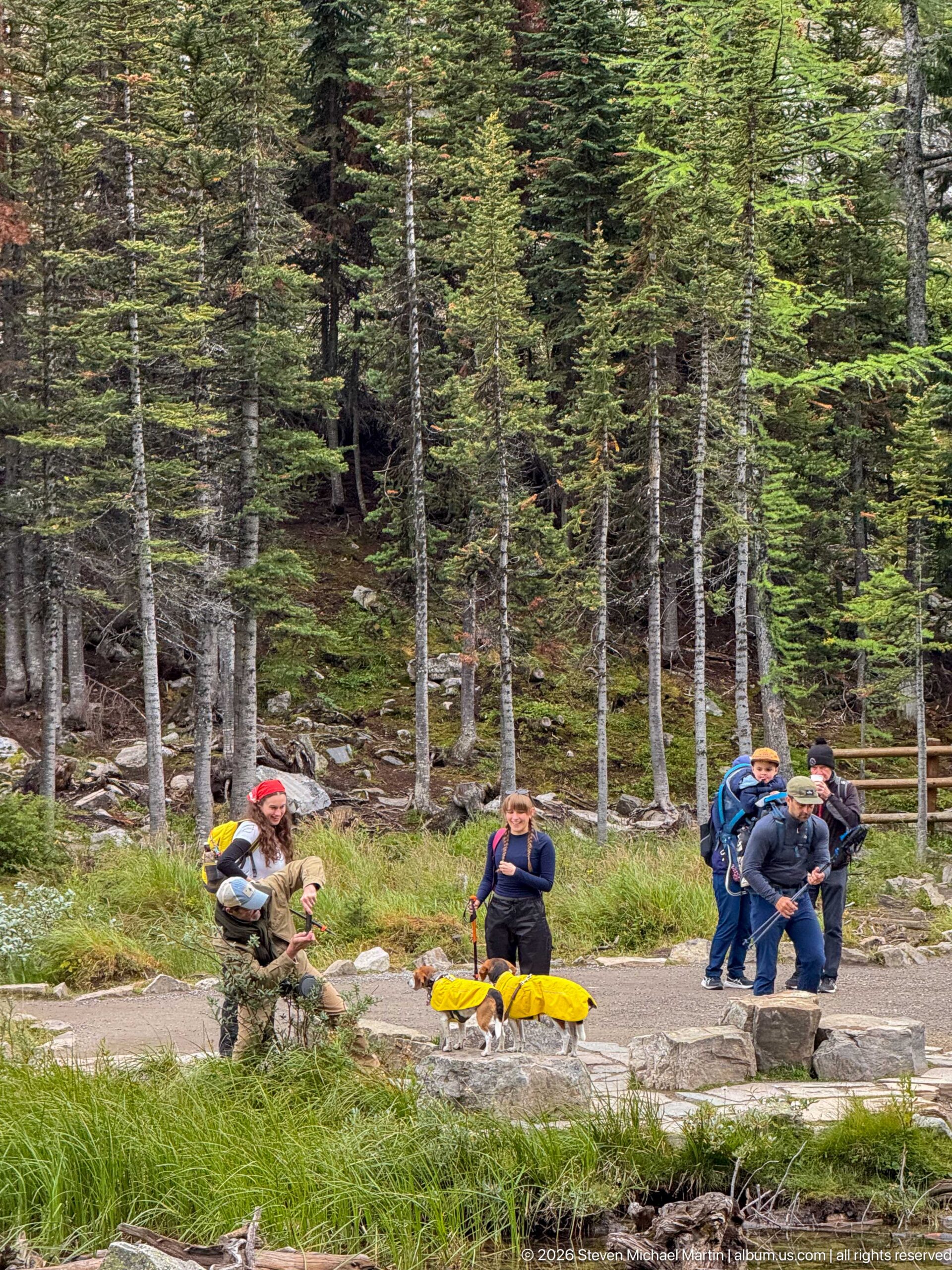
A group of hikers pauses beside a narrow stream crossing beneath conifers. One person in a red cap stands near the water with a dog, while several others gather on the path; another dog in a yellow coat is visible among them. The low stone banks and wooded trail suggest a busy route through the Lake Agnes area, with the people and animals giving scale to the crossing.
Caption
A group of hikers pauses beside a narrow stream crossing beneath conifers. One person in a red cap stands near the water with a dog, while several others gather on the path; another dog in a yellow coat is visible among them. The low stone banks and wooded trail suggest a busy route through the Lake Agnes area, with the people and animals giving scale to the crossing.
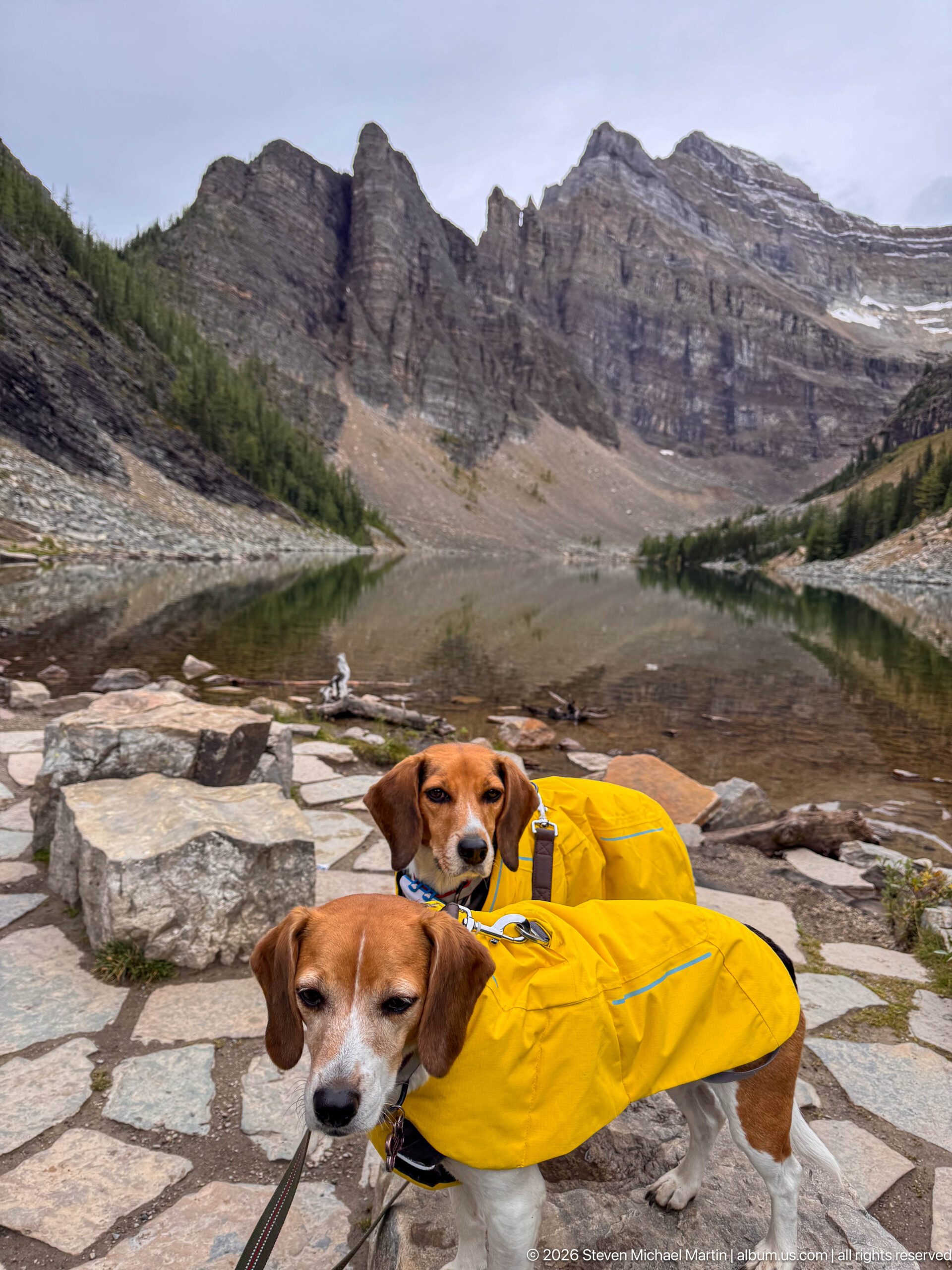
Two brown-and-white beagles in matching yellow raincoats stand on a paved stone landing beside a small alpine lake. Behind them, pale scree and layered bare rock rise in a broad cirque, with a narrow strip of water at the mountain’s base. The setting is consistent with the Lake Agnes area, but the proof sheet does not provide a readable sign or unique structure.
Caption
Two brown-and-white beagles in matching yellow raincoats stand on a paved stone landing beside a small alpine lake. Behind them, pale scree and layered bare rock rise in a broad cirque, with a narrow strip of water at the mountain’s base. The setting is consistent with the Lake Agnes area, but the proof sheet does not provide a readable sign or unique structure.
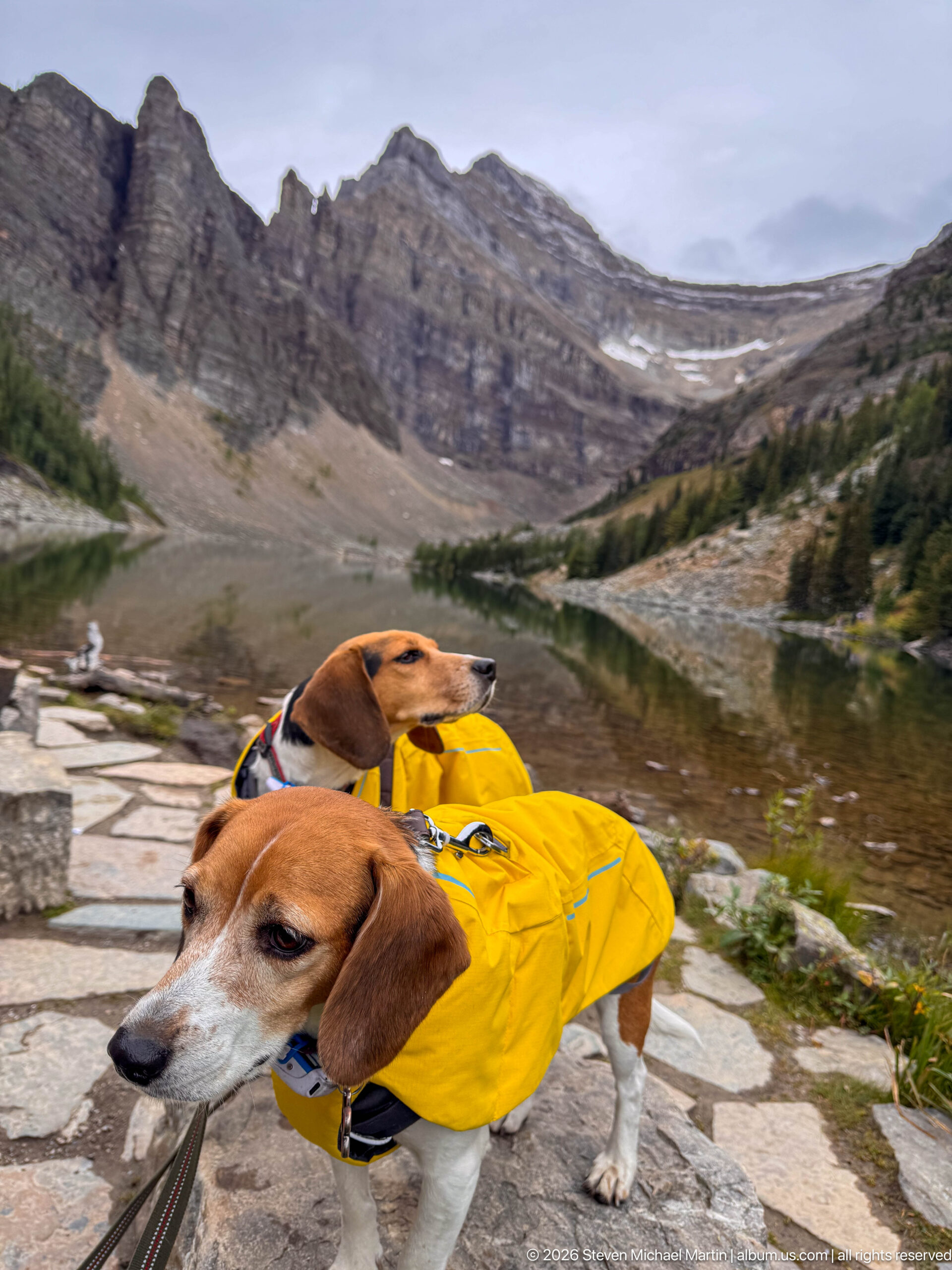
The two beagles, still wearing yellow raincoats, stand close to the camera on irregular stone paving at the edge of an alpine lake. One dog faces left while the other looks forward; beyond them, still water reflects a high, bare cirque wall. This lower, tighter viewpoint makes the dogs’ position on the lakeshore the focal point while preserving the stark mountain basin.
Caption
The two beagles, still wearing yellow raincoats, stand close to the camera on irregular stone paving at the edge of an alpine lake. One dog faces left while the other looks forward; beyond them, still water reflects a high, bare cirque wall. This lower, tighter viewpoint makes the dogs’ position on the lakeshore the focal point while preserving the stark mountain basin.
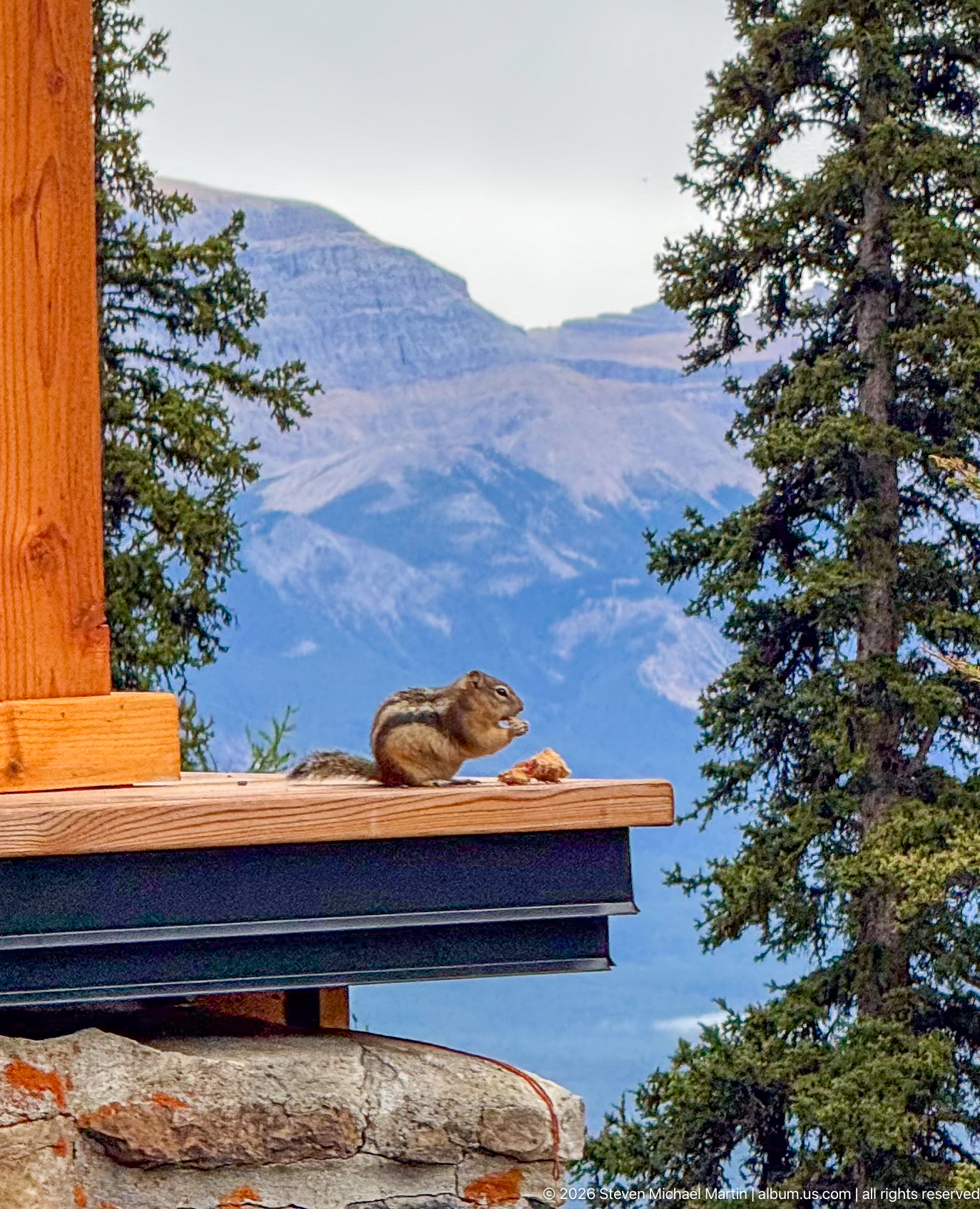
A compact brown marmot sits on a sunlit timber ledge beside the rustic building, its body turned toward the open mountain view. A blue lake and layered slopes recede behind the animal, while a mature conifer frames the right edge. The close wildlife encounter links the high-elevation building to its alpine surroundings; the proof sheet does not support a more specific species than marmot.
Caption
A compact brown marmot sits on a sunlit timber ledge beside the rustic building, its body turned toward the open mountain view. A blue lake and layered slopes recede behind the animal, while a mature conifer frames the right edge. The close wildlife encounter links the high-elevation building to its alpine surroundings; the proof sheet does not support a more specific species than marmot.
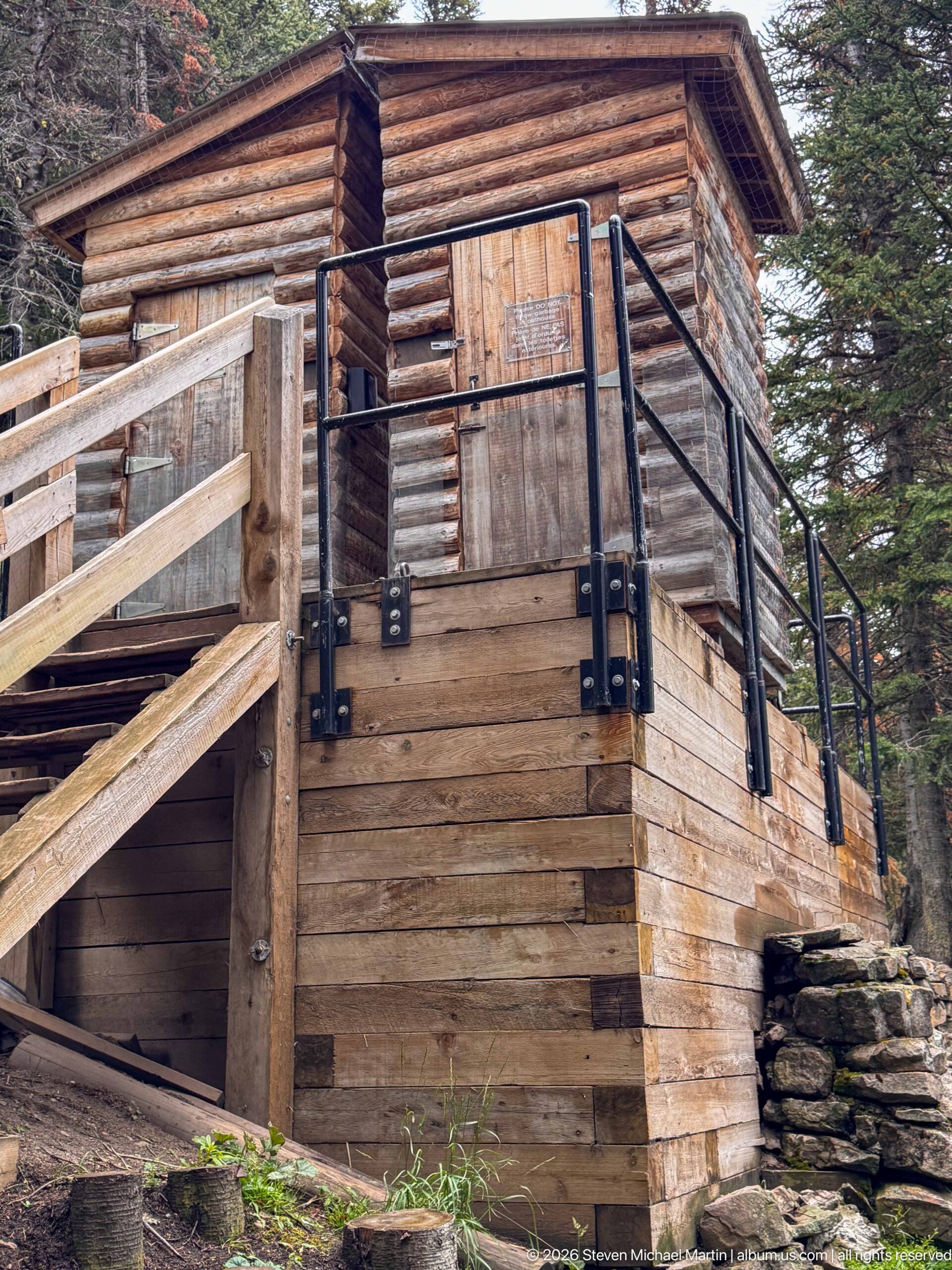
A raised log building stands on a stone foundation, with a wooden stair and landing enclosed by black metal railings. Heavy brackets, plank walls, and a small upper door are visible from below, while conifers press close to the structure. The utilitarian exterior view records how the building is lifted above uneven ground along the high mountain trail.
Caption
A raised log building stands on a stone foundation, with a wooden stair and landing enclosed by black metal railings. Heavy brackets, plank walls, and a small upper door are visible from below, while conifers press close to the structure. The utilitarian exterior view records how the building is lifted above uneven ground along the high mountain trail.
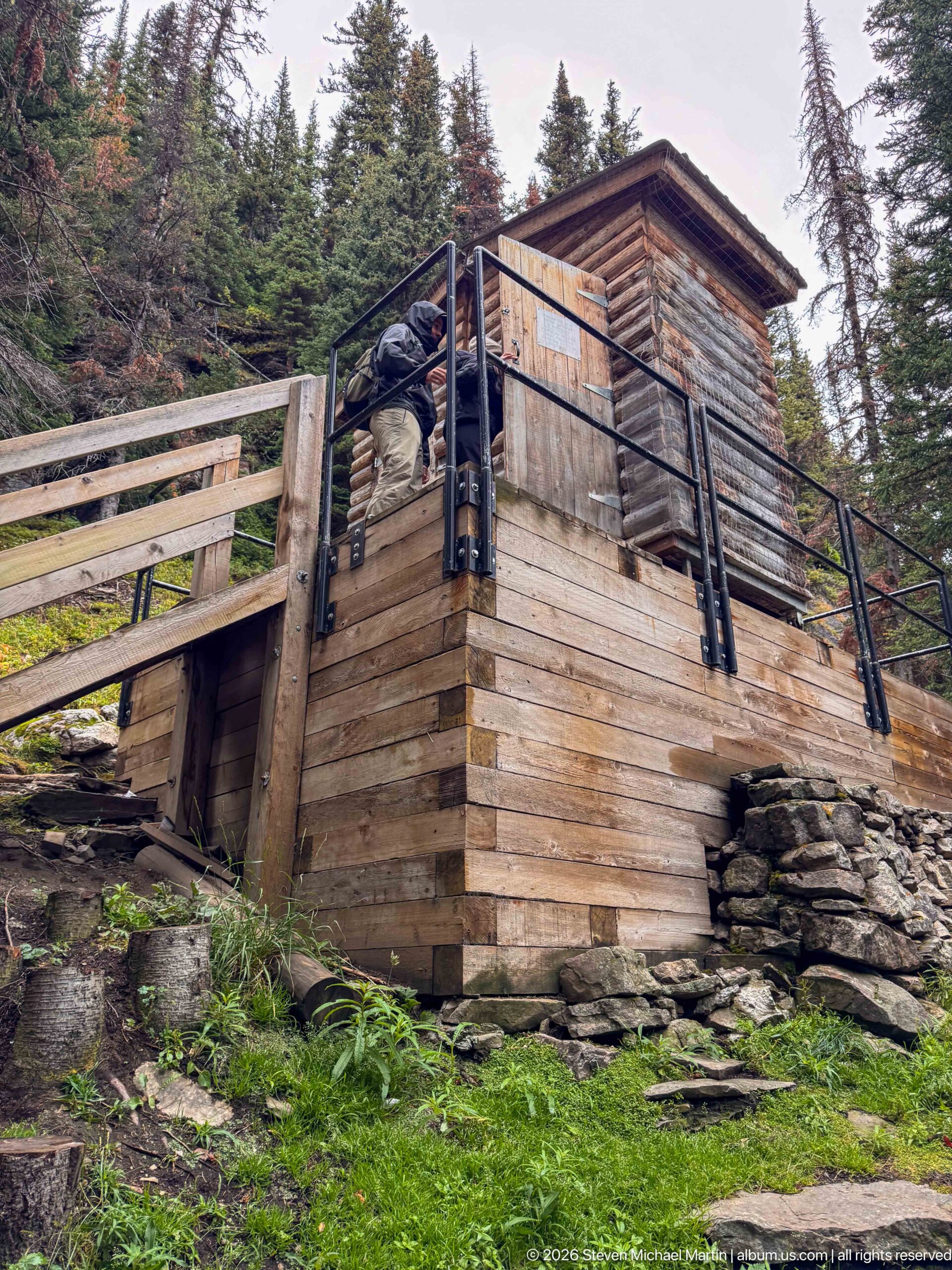
A visitor climbs the wooden stair and raised landing of a log building set into a rocky, forested slope. The low angle reveals the plank walls, dark railings, stone footings, and broad roof overhang. The building resembles the trail-side Lake Agnes Tea House, though no readable sign is visible in this frame; the person’s movement gives the structure a clear scale.
Caption
A visitor climbs the wooden stair and raised landing of a log building set into a rocky, forested slope. The low angle reveals the plank walls, dark railings, stone footings, and broad roof overhang. The building resembles the trail-side Lake Agnes Tea House, though no readable sign is visible in this frame; the person’s movement gives the structure a clear scale.
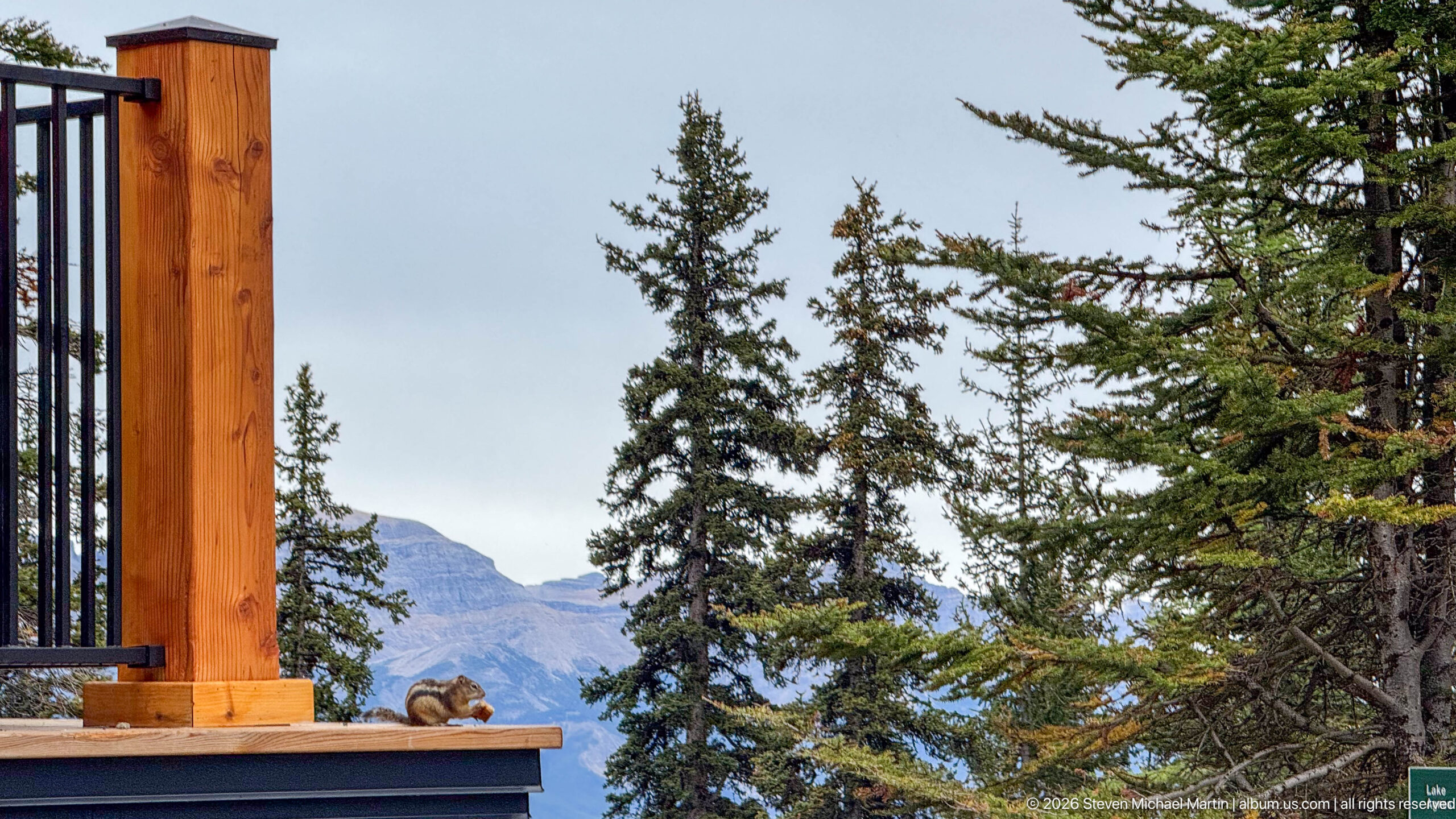
The marmot appears smaller in this wider view, perched on the projecting wooden ledge between a heavy post and a dark metal edge. A conifer’s branches and the blue-gray mountain valley form a layered background. The animal’s low, alert posture and the building detail establish a brief wildlife moment at the edge of the trail-side structure.
Caption
The marmot appears smaller in this wider view, perched on the projecting wooden ledge between a heavy post and a dark metal edge. A conifer’s branches and the blue-gray mountain valley form a layered background. The animal’s low, alert posture and the building detail establish a brief wildlife moment at the edge of the trail-side structure.
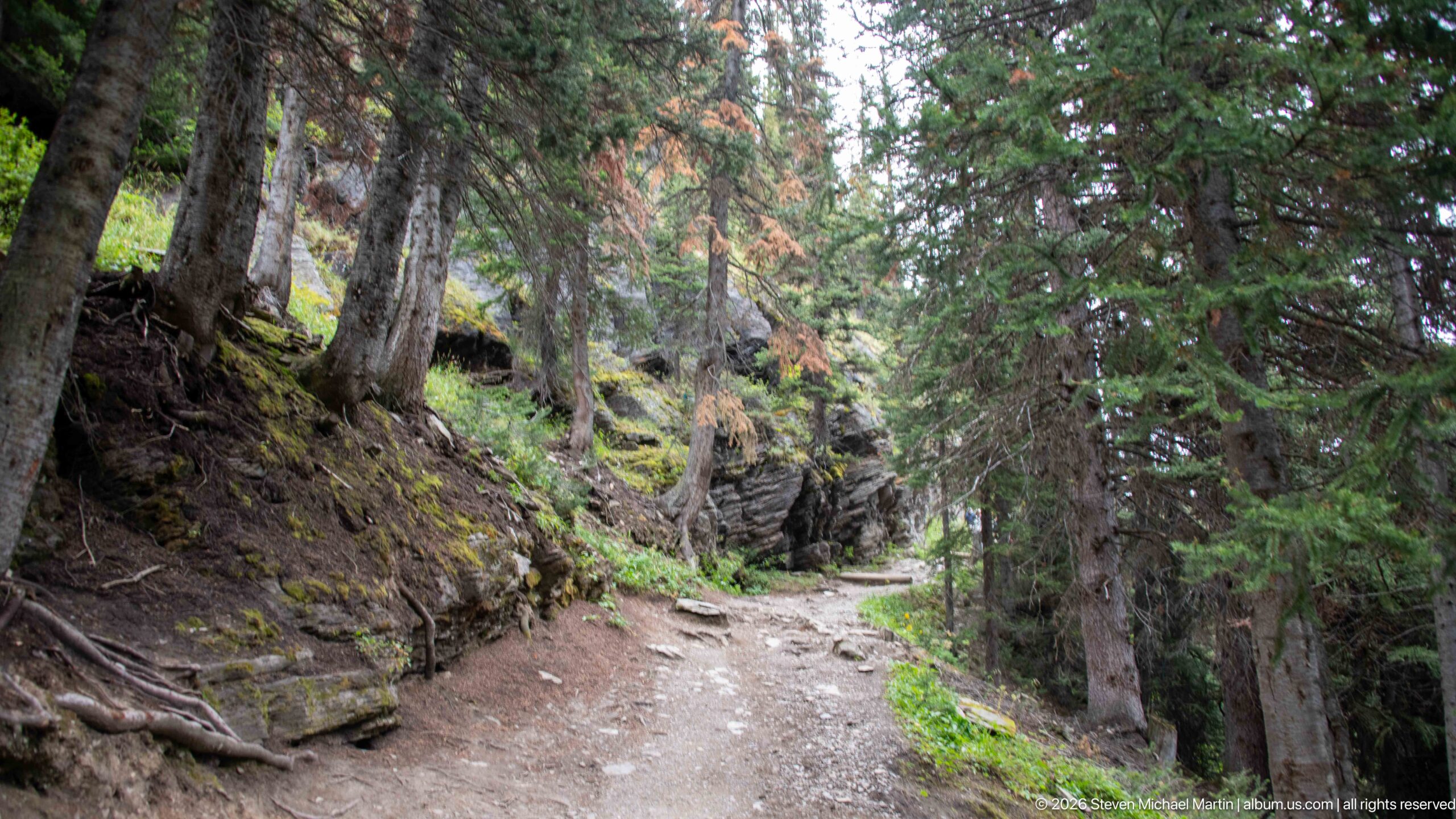
A narrow dirt-and-stone path climbs between steep, root-laced banks beneath dense conifers. Exposed roots cross the trail, and scattered rocks form uneven steps through the shaded forest. The route bends gently out of view, withholding the destination and leaving the texture of the ascent—roots, loose stone, and close trees—as the image’s defining features.
Caption
A narrow dirt-and-stone path climbs between steep, root-laced banks beneath dense conifers. Exposed roots cross the trail, and scattered rocks form uneven steps through the shaded forest. The route bends gently out of view, withholding the destination and leaving the texture of the ascent—roots, loose stone, and close trees—as the image’s defining features.
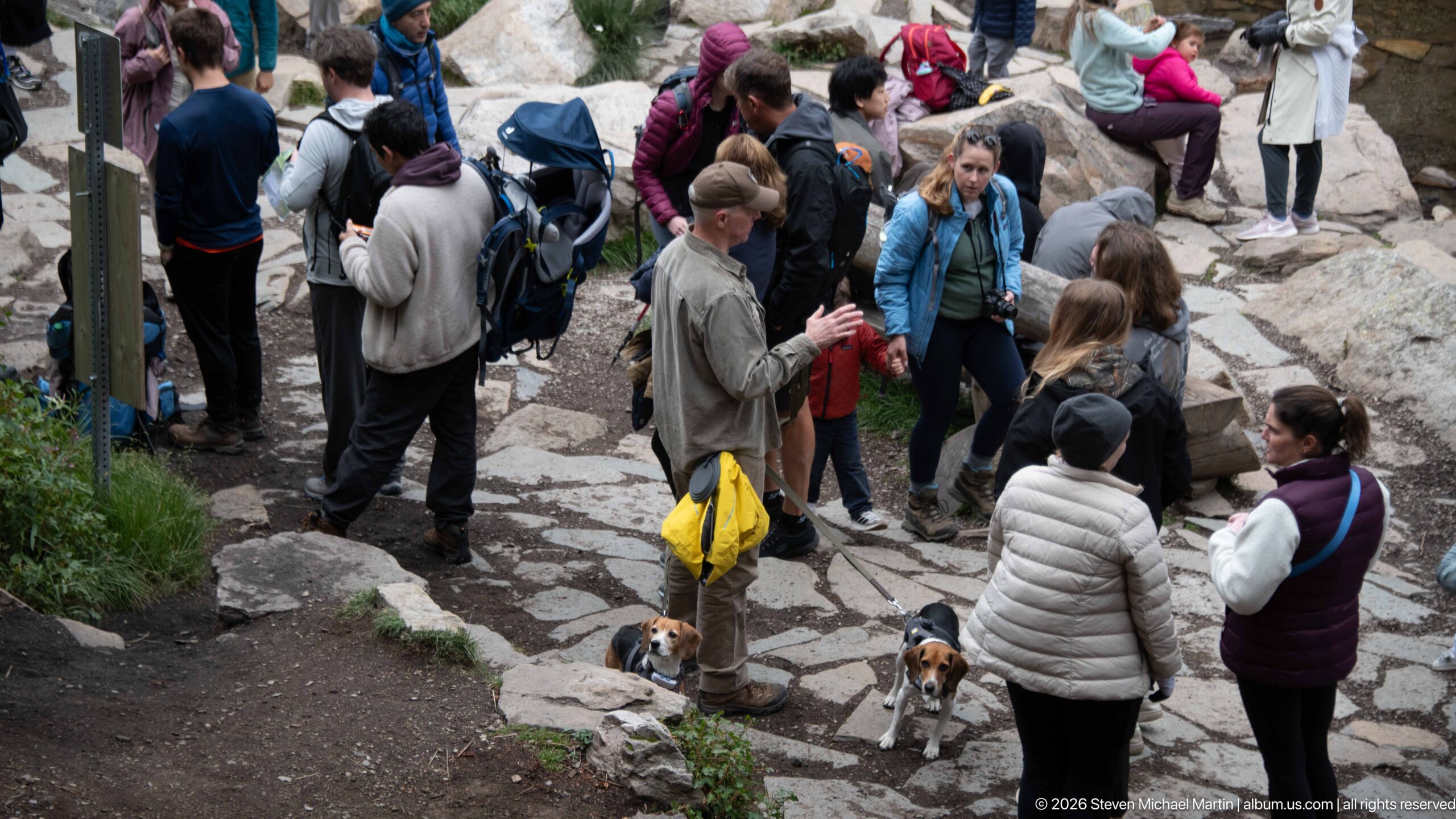
Hikers cluster on the stone landing outside the Lake Agnes Tea House, where two beagles in bright yellow coats stand among the crowd. Packs, trekking poles, uneven paving, and the narrow lakeside setting suggest a busy stop along the high mountain route. The dogs are small within the larger group, but their yellow coats make them easy to distinguish in the foreground.
Caption
Hikers cluster on the stone landing outside the Lake Agnes Tea House, where two beagles in bright yellow coats stand among the crowd. Packs, trekking poles, uneven paving, and the narrow lakeside setting suggest a busy stop along the high mountain route. The dogs are small within the larger group, but their yellow coats make them easy to distinguish in the foreground.
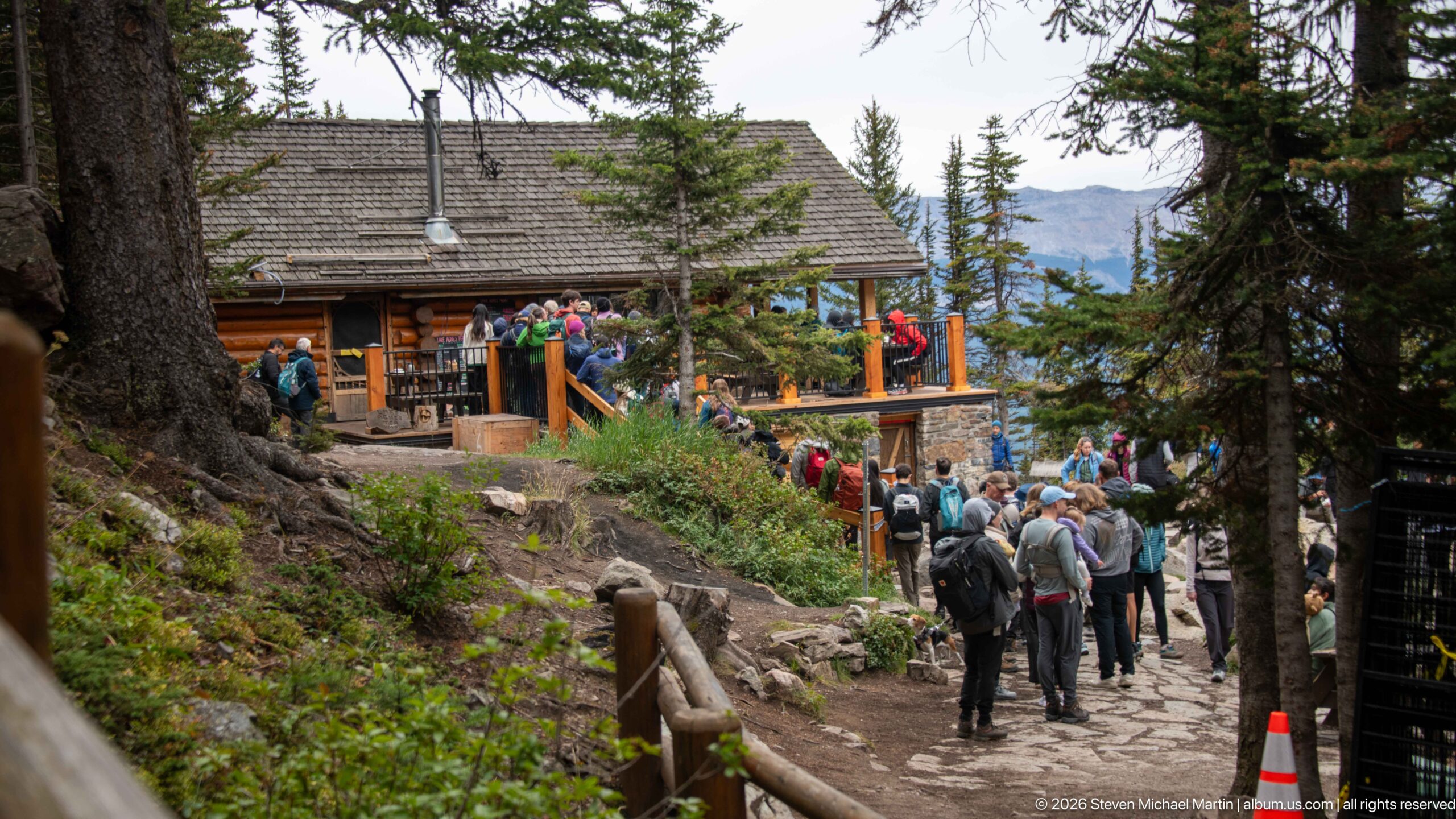
The timber Lake Agnes Tea House sits among conifers on a stone retaining wall, its broad gray roof and warm window light visible through the trees. Hikers gather at the entrance and along the path that climbs toward it. The building is partly screened by trunks and branches, placing the busy trail-side stop within its steep forest setting rather than isolating its façade.
Caption
The timber Lake Agnes Tea House sits among conifers on a stone retaining wall, its broad gray roof and warm window light visible through the trees. Hikers gather at the entrance and along the path that climbs toward it. The building is partly screened by trunks and branches, placing the busy trail-side stop within its steep forest setting rather than isolating its façade.
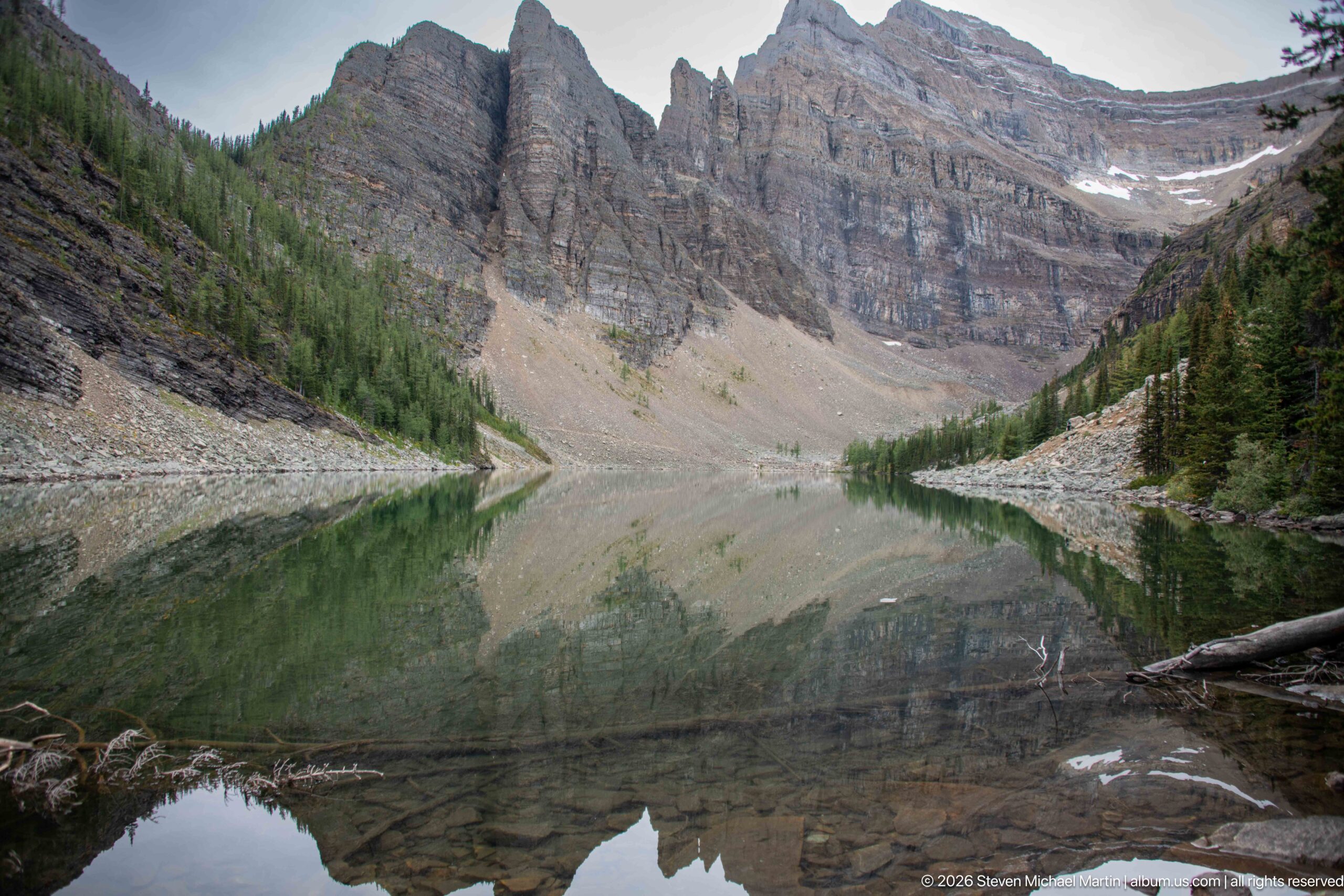
Lake Agnes lies calm beneath a steep amphitheater of layered gray rock, with a small remnant of snow or ice high on the far slope. The transparent near water reveals submerged stones, while the peaks and bands of scree are mirrored across the lake. A fallen branch at the bottom edge gives scale to this quiet, shore-level view.
Caption
Lake Agnes lies calm beneath a steep amphitheater of layered gray rock, with a small remnant of snow or ice high on the far slope. The transparent near water reveals submerged stones, while the peaks and bands of scree are mirrored across the lake. A fallen branch at the bottom edge gives scale to this quiet, shore-level view.
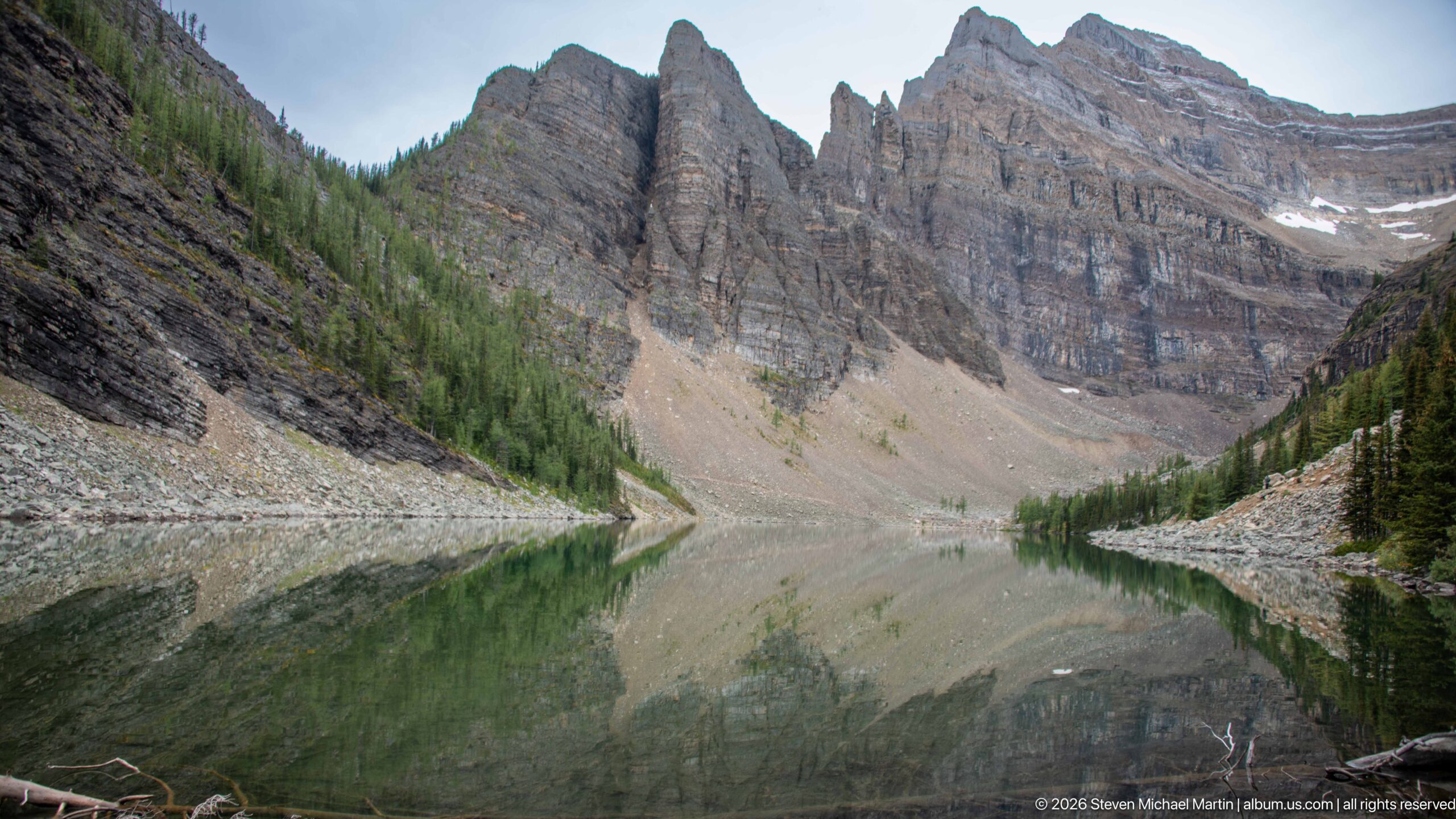
Tall, narrow rock spires rise above the far side of Lake Agnes, their vertical forms mirrored in the lake below. Pale scree fans descend between the darker cliff bands, while a low fringe of trees marks the water’s edge. The closer framing makes the rugged wall feel more imposing than in the broader views, with reflection preserving the symmetry of the basin.
Caption
Tall, narrow rock spires rise above the far side of Lake Agnes, their vertical forms mirrored in the lake below. Pale scree fans descend between the darker cliff bands, while a low fringe of trees marks the water’s edge. The closer framing makes the rugged wall feel more imposing than in the broader views, with reflection preserving the symmetry of the basin.
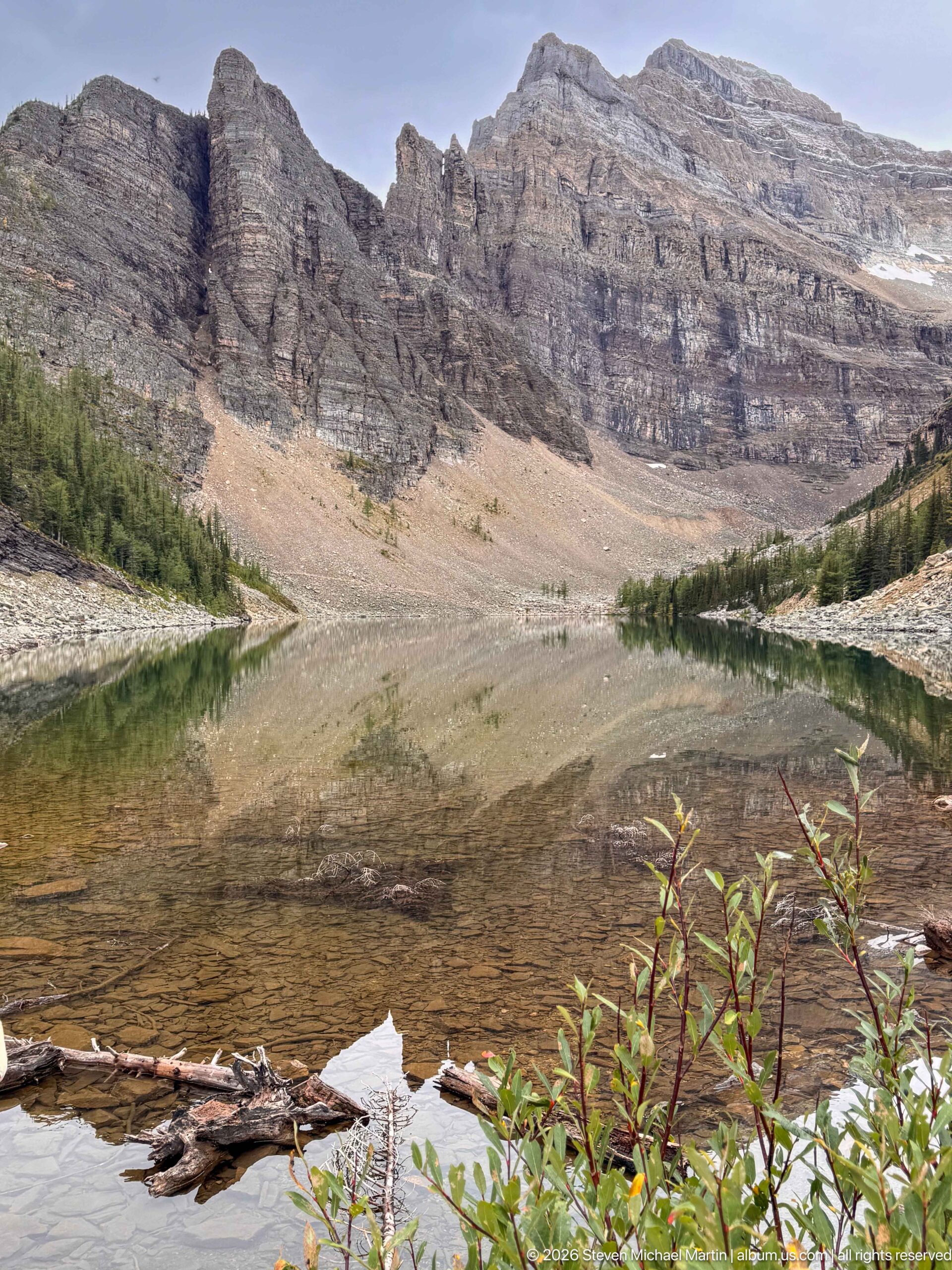
A wider view across Lake Agnes reveals the pale, sparsely vegetated basin and its sharply layered headwall. Driftwood and low shrubs mark the near margin, while the lake’s shallow, clear edge exposes stones beneath the surface. Compared with the previous reflection, this composition includes more shoreline and foreground vegetation, making the lake’s small scale and exposed alpine terrain clearer.
Caption
A wider view across Lake Agnes reveals the pale, sparsely vegetated basin and its sharply layered headwall. Driftwood and low shrubs mark the near margin, while the lake’s shallow, clear edge exposes stones beneath the surface. Compared with the previous reflection, this composition includes more shoreline and foreground vegetation, making the lake’s small scale and exposed alpine terrain clearer.
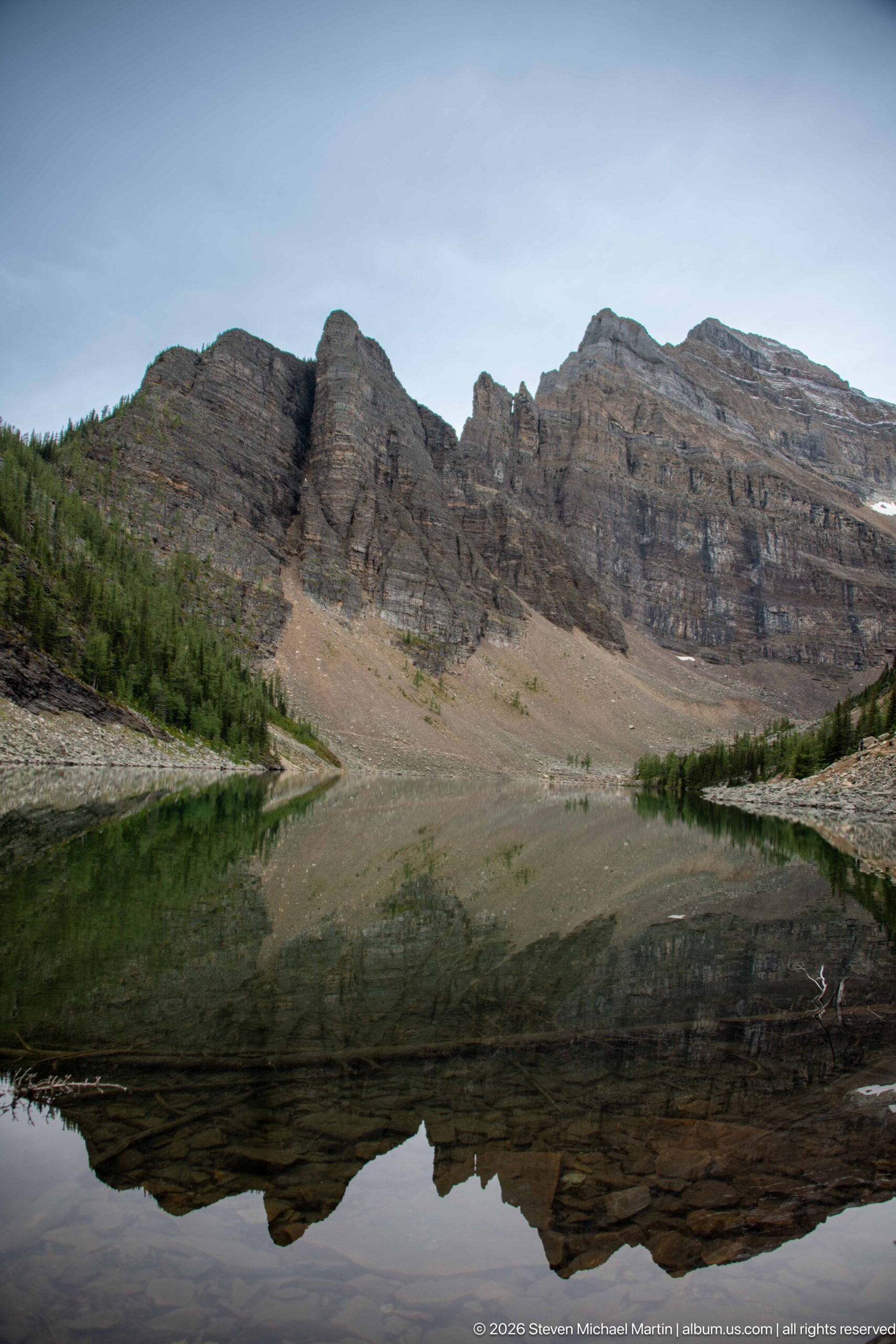
Lake Agnes reflects a long, horizontally banded ridge that curves around the far shore. The darker surface in the foreground doubles the mountain profile, while a narrow strip of green trees follows the waterline. This more distant, centered view reduces the near-shore detail and makes the layered geology and bowl-like shape of the lake the main subjects.
Caption
Lake Agnes reflects a long, horizontally banded ridge that curves around the far shore. The darker surface in the foreground doubles the mountain profile, while a narrow strip of green trees follows the waterline. This more distant, centered view reduces the near-shore detail and makes the layered geology and bowl-like shape of the lake the main subjects.
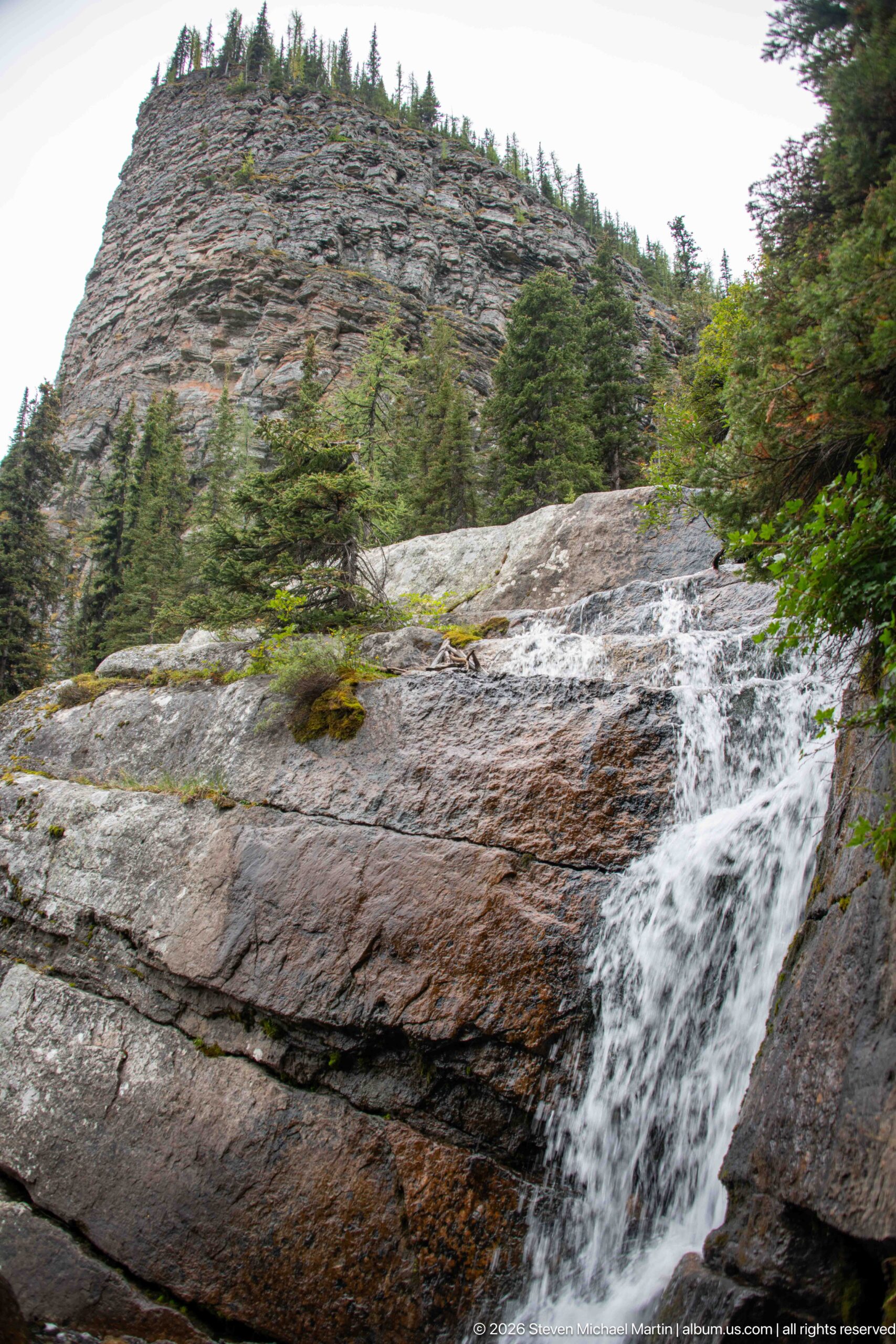
Water pours over a broad, slanted rock face, breaking into white ribbons where the stone steps downward. Dark conifers and small shrubs edge the upper bank, while moss and mineral staining color the exposed slabs. The oblique view records the cascade’s path across the rock rather than a single plunge, and the proof sheet does not establish a named waterfall.
Caption
Water pours over a broad, slanted rock face, breaking into white ribbons where the stone steps downward. Dark conifers and small shrubs edge the upper bank, while moss and mineral staining color the exposed slabs. The oblique view records the cascade’s path across the rock rather than a single plunge, and the proof sheet does not establish a named waterfall.
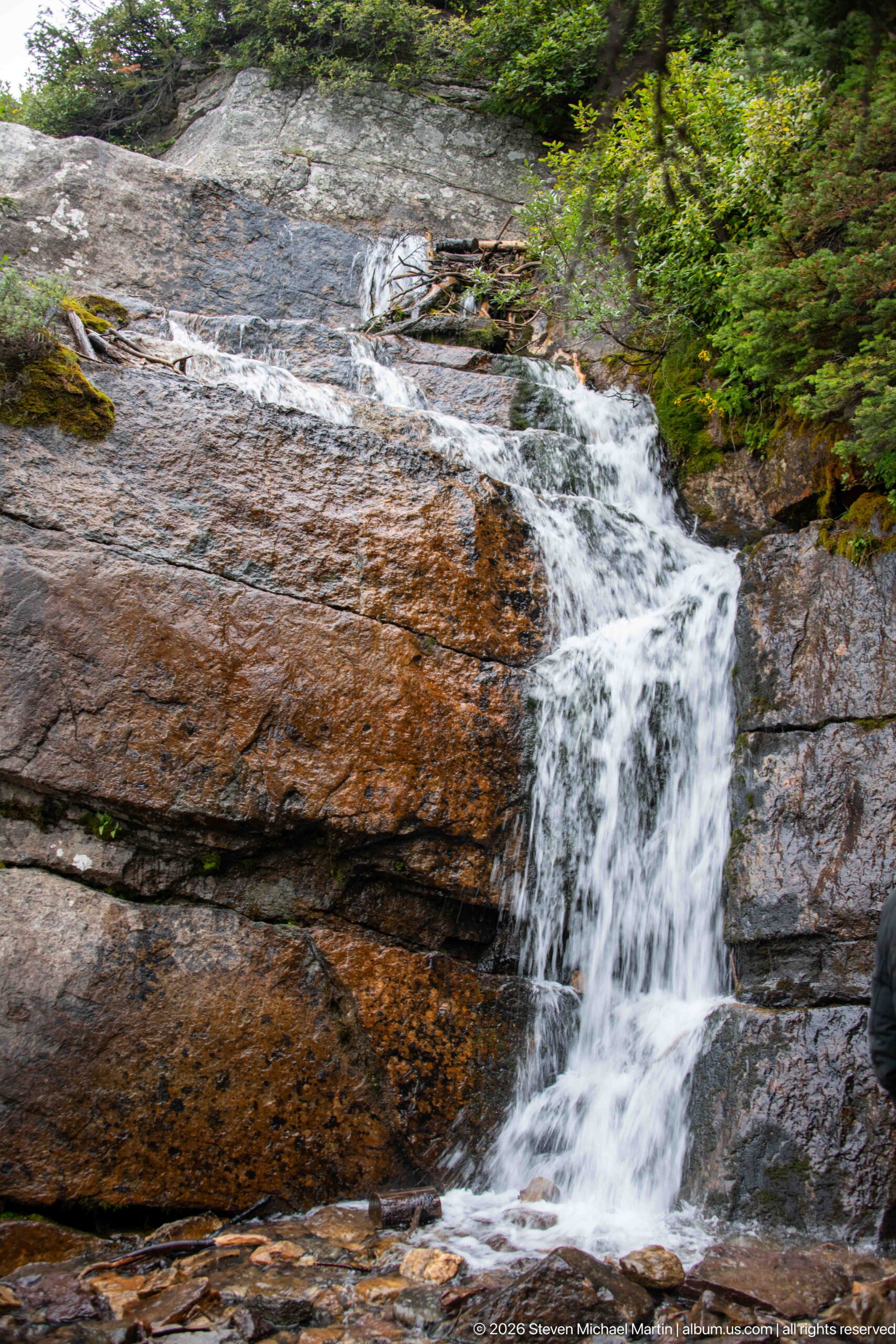
A short waterfall drops over orange-brown rock, its white water splitting into several narrow channels before reaching a dark pool. Horizontal seams in the stone create ledges and small shelves, while moss and evergreen branches frame the upper edge. The closer crop highlights the contrast between moving water and mineral-stained rock without assigning an unsupported name to the cascade.
Caption
A short waterfall drops over orange-brown rock, its white water splitting into several narrow channels before reaching a dark pool. Horizontal seams in the stone create ledges and small shelves, while moss and evergreen branches frame the upper edge. The closer crop highlights the contrast between moving water and mineral-stained rock without assigning an unsupported name to the cascade.
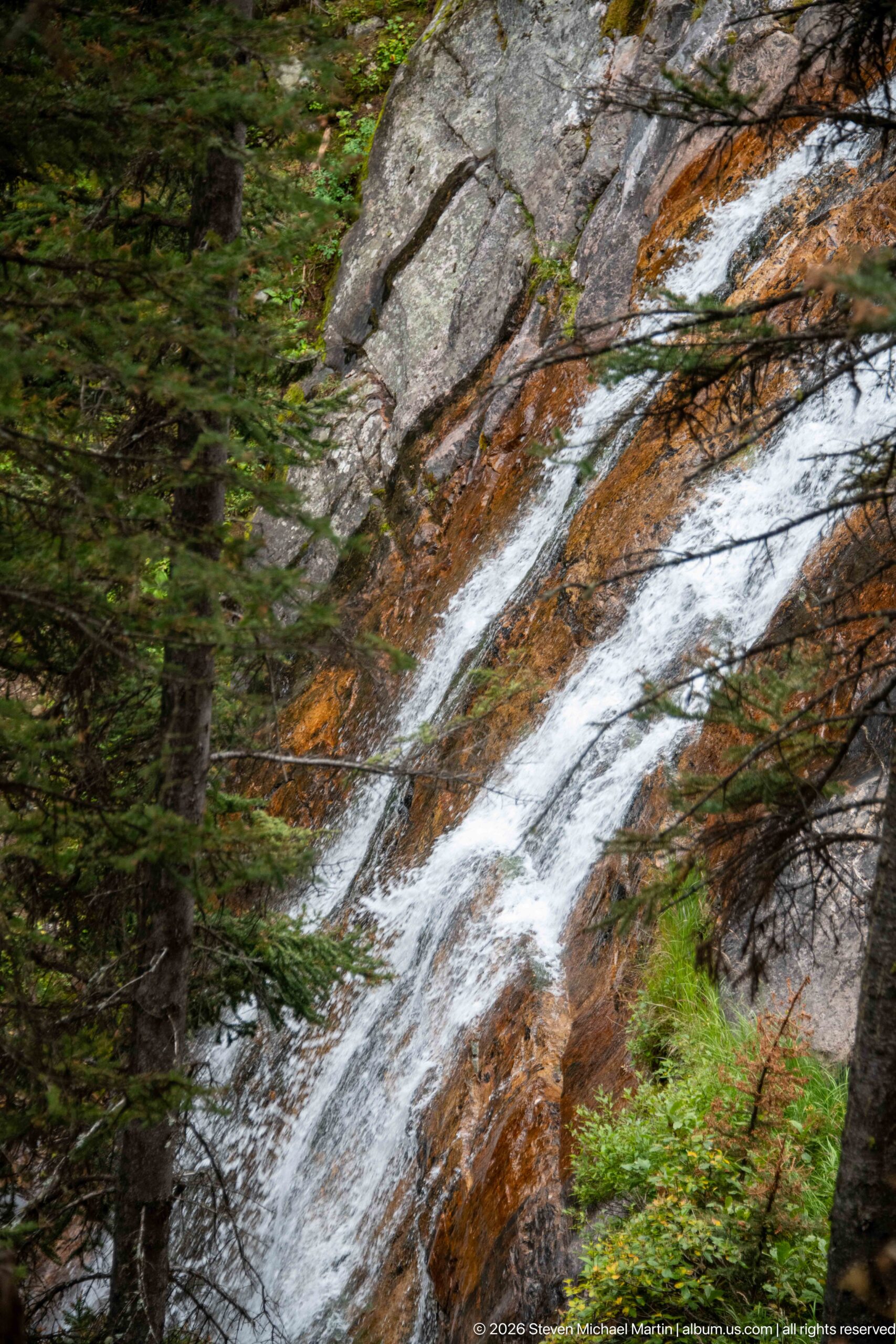
Water glides diagonally across a broad, rust-streaked slab before dropping out of view at the right edge. Thin branches and dark evergreen foliage frame the rock, while the shallow flow reveals its rippled surface. The lateral composition follows the cascade across the slope rather than emphasizing its height, isolating the interplay of water, stone, and forest.
Caption
Water glides diagonally across a broad, rust-streaked slab before dropping out of view at the right edge. Thin branches and dark evergreen foliage frame the rock, while the shallow flow reveals its rippled surface. The lateral composition follows the cascade across the slope rather than emphasizing its height, isolating the interplay of water, stone, and forest.
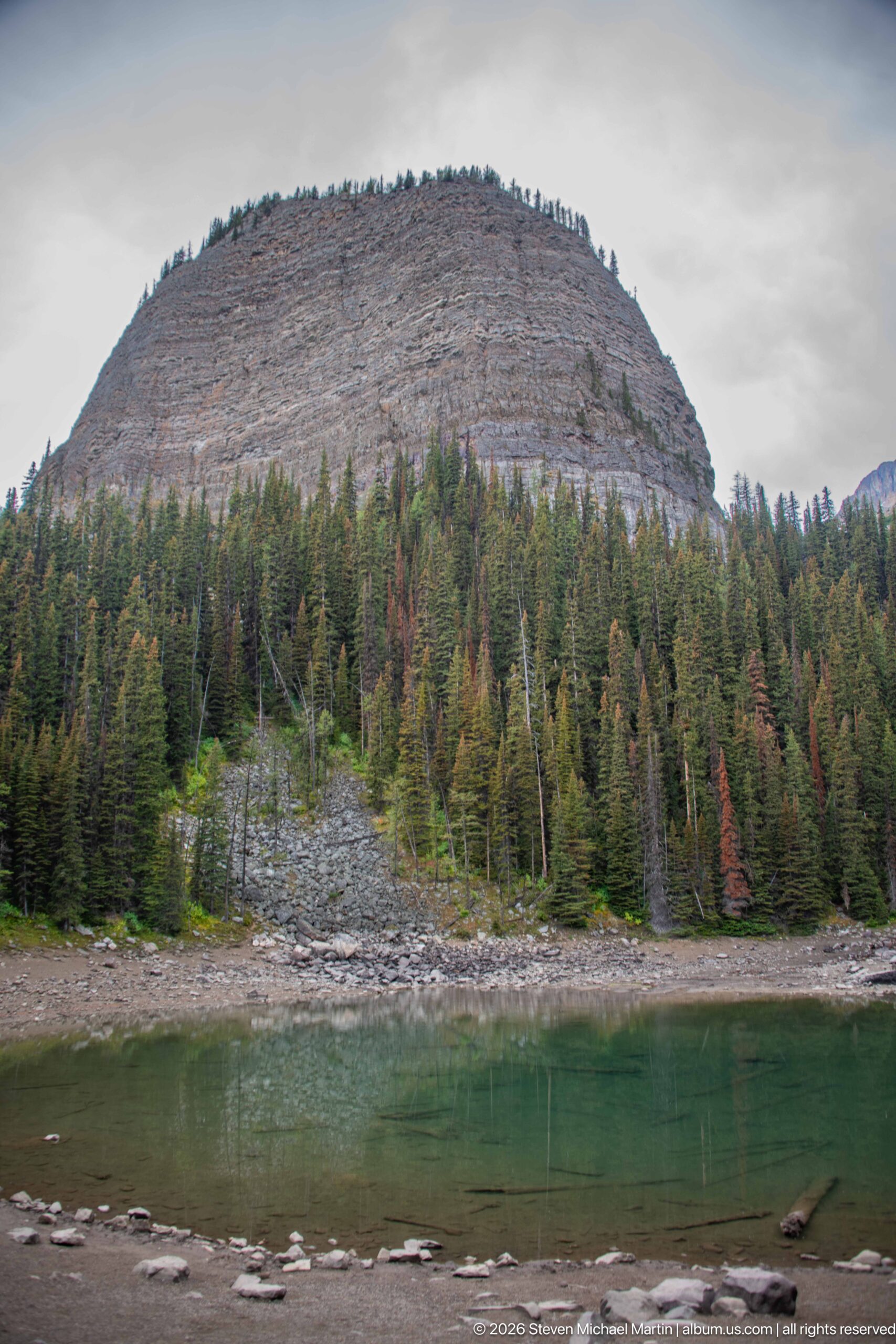
A broad, rounded summit dominates the far side of Mirror Lake, its horizontal rock layers rising above a thin fringe of conifers. The green water and exposed stones occupy the foreground, while the overcast sky flattens shadows across the slope. This wider shoreline view emphasizes the unusual blunt profile of the mountain above the small lake.
Caption
A broad, rounded summit dominates the far side of Mirror Lake, its horizontal rock layers rising above a thin fringe of conifers. The green water and exposed stones occupy the foreground, while the overcast sky flattens shadows across the slope. This wider shoreline view emphasizes the unusual blunt profile of the mountain above the small lake.
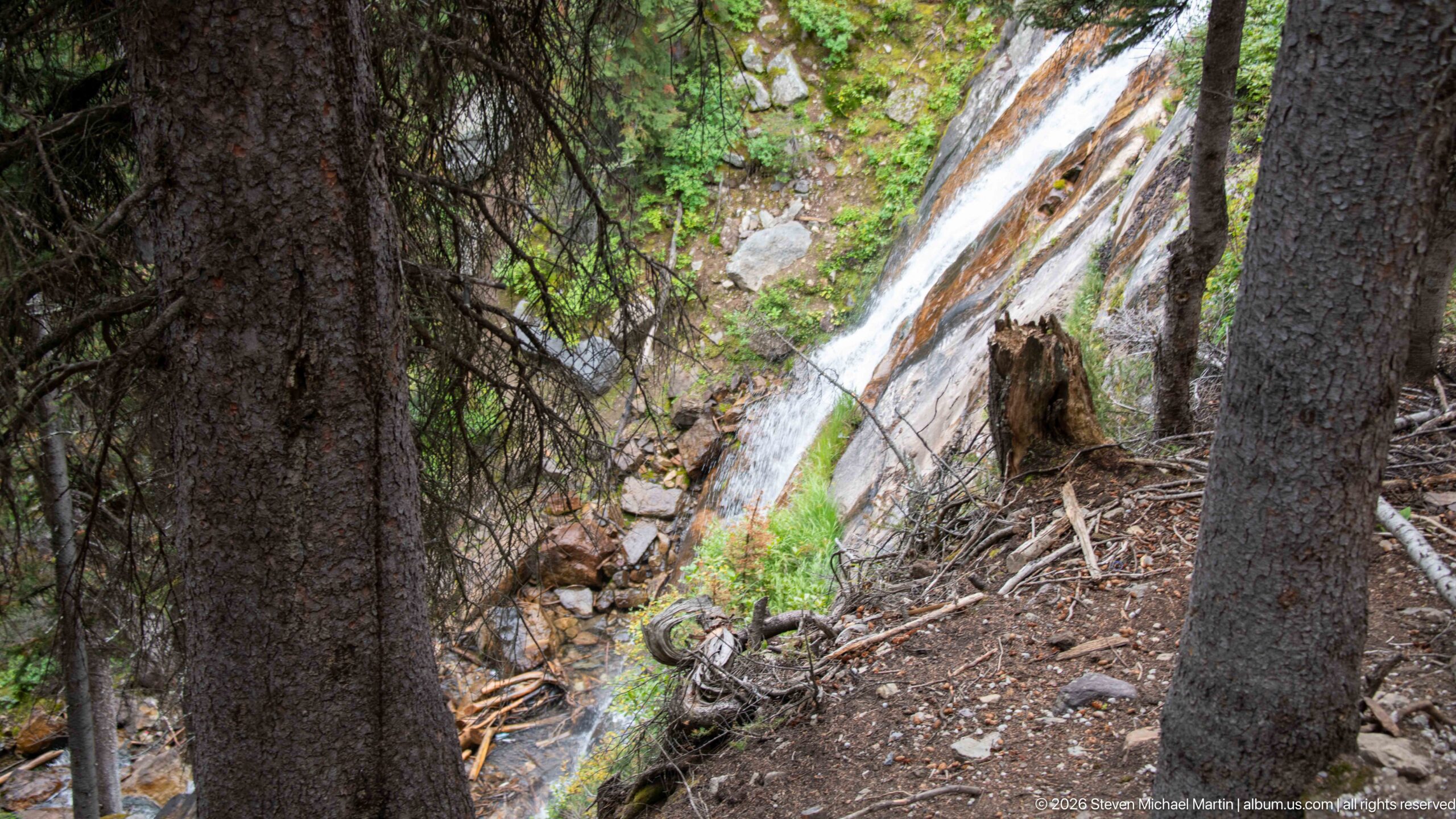
A slender waterfall descends through a wooded ravine, seen between two dark conifer trunks. Fallen branches and exposed soil clutter the foreground, while the pale water drops over sloping rock farther down the bank. The trees make this a more distant, enclosed view than the previous close-ups, and no sign or landmark confirms the cascade’s name.
Caption
A slender waterfall descends through a wooded ravine, seen between two dark conifer trunks. Fallen branches and exposed soil clutter the foreground, while the pale water drops over sloping rock farther down the bank. The trees make this a more distant, enclosed view than the previous close-ups, and no sign or landmark confirms the cascade’s name.
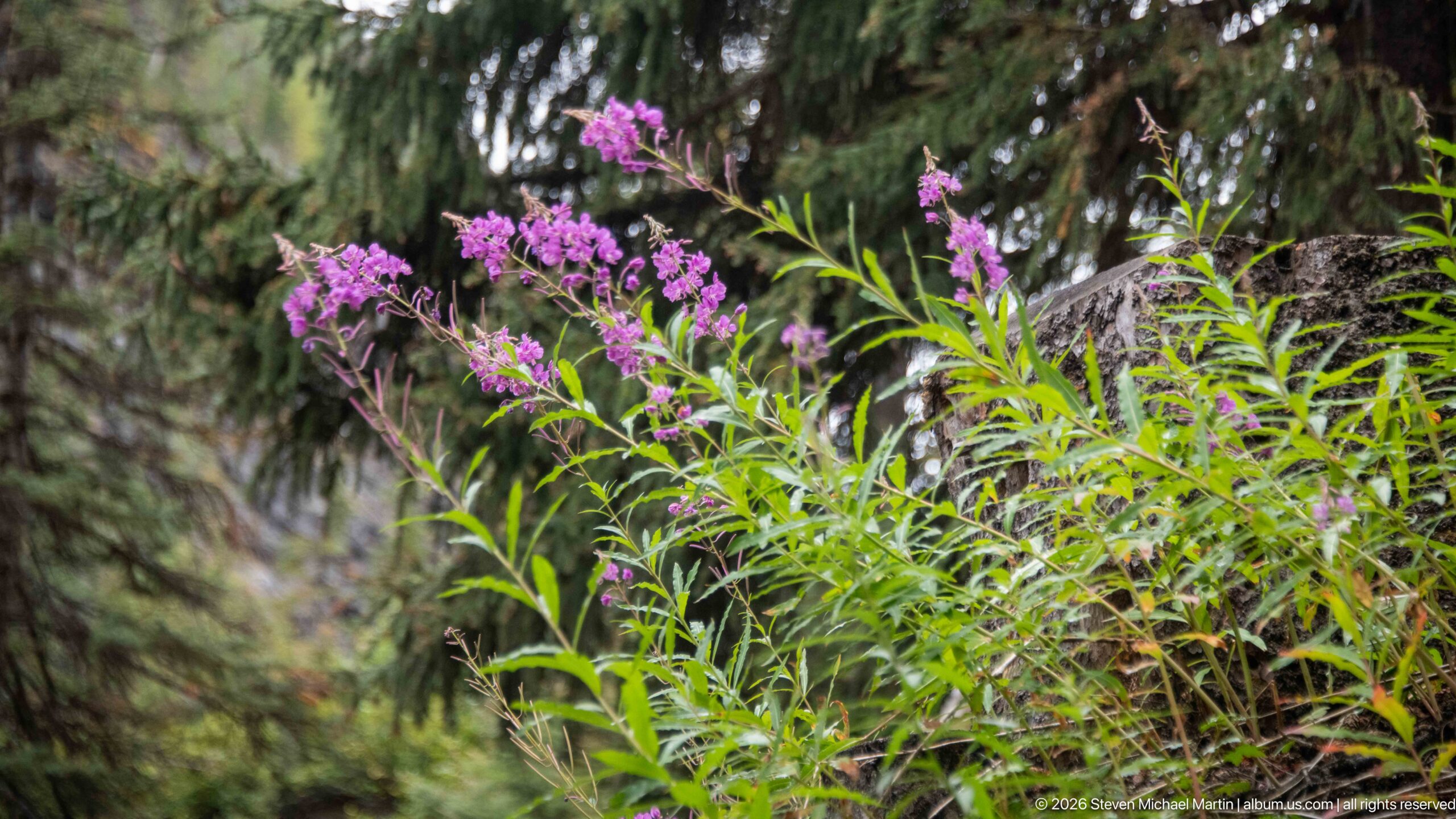
Clusters of magenta flowers rise above narrow green leaves in a shaded forest understory. The blossoms form a loose vertical spray against a soft background of conifer trunks and dark foliage. They resemble fireweed, but the small proof-sheet view does not show enough leaf and stem detail to make a certain species identification, so the caption keeps the plant at the visible level.
Caption
Clusters of magenta flowers rise above narrow green leaves in a shaded forest understory. The blossoms form a loose vertical spray against a soft background of conifer trunks and dark foliage. They resemble fireweed, but the small proof-sheet view does not show enough leaf and stem detail to make a certain species identification, so the caption keeps the plant at the visible level.
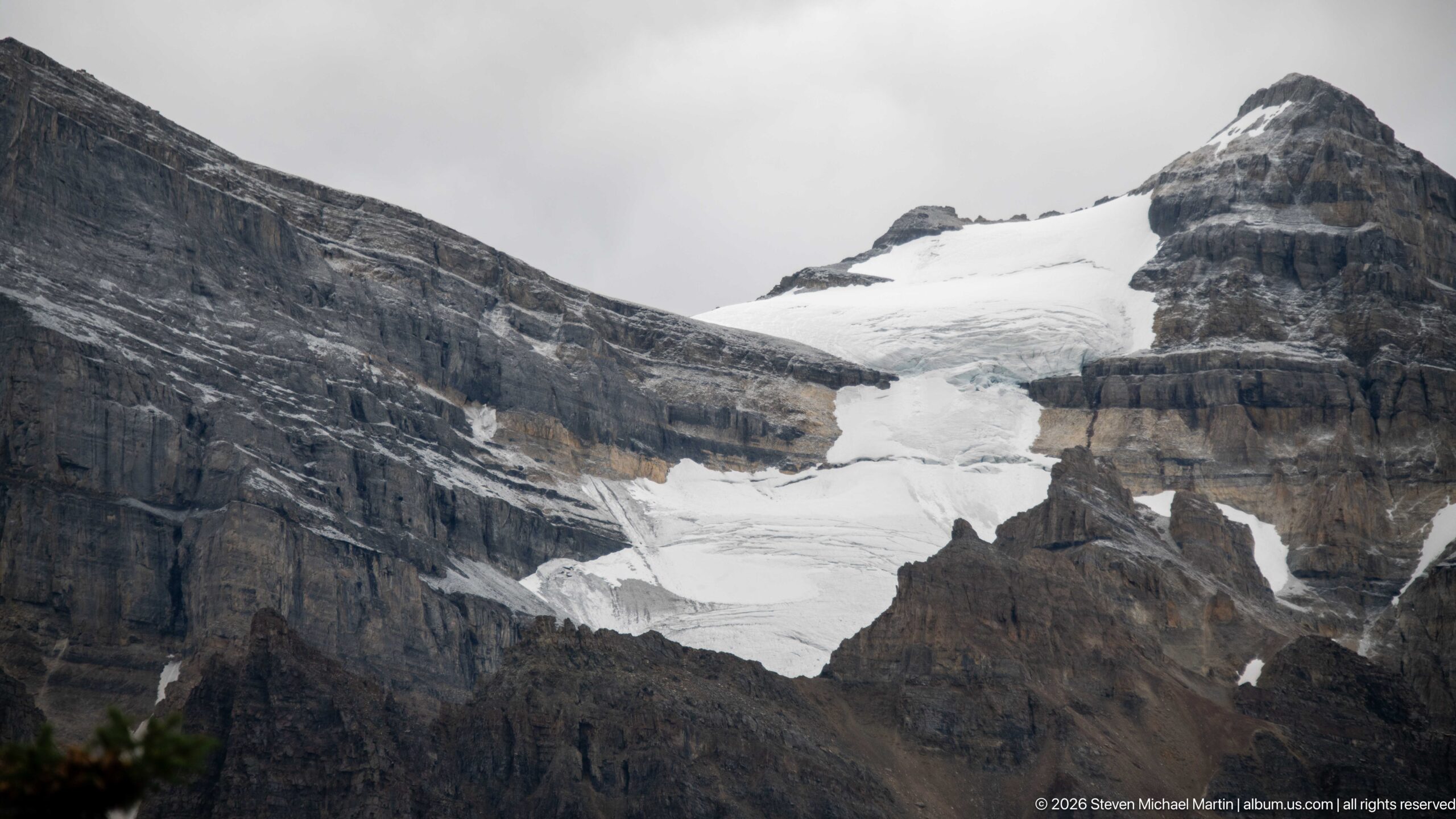
A broad field of white ice descends between steep dark rock walls, with crevassed and broken sections visible across the glacier’s surface. The framing excludes the lake and most of the valley floor, isolating the ice and the rugged peaks around it. This is Victoria Glacier above Lake Louise, rendered as a close landscape study rather than a full lake panorama.
Caption
A broad field of white ice descends between steep dark rock walls, with crevassed and broken sections visible across the glacier’s surface. The framing excludes the lake and most of the valley floor, isolating the ice and the rugged peaks around it. This is Victoria Glacier above Lake Louise, rendered as a close landscape study rather than a full lake panorama.
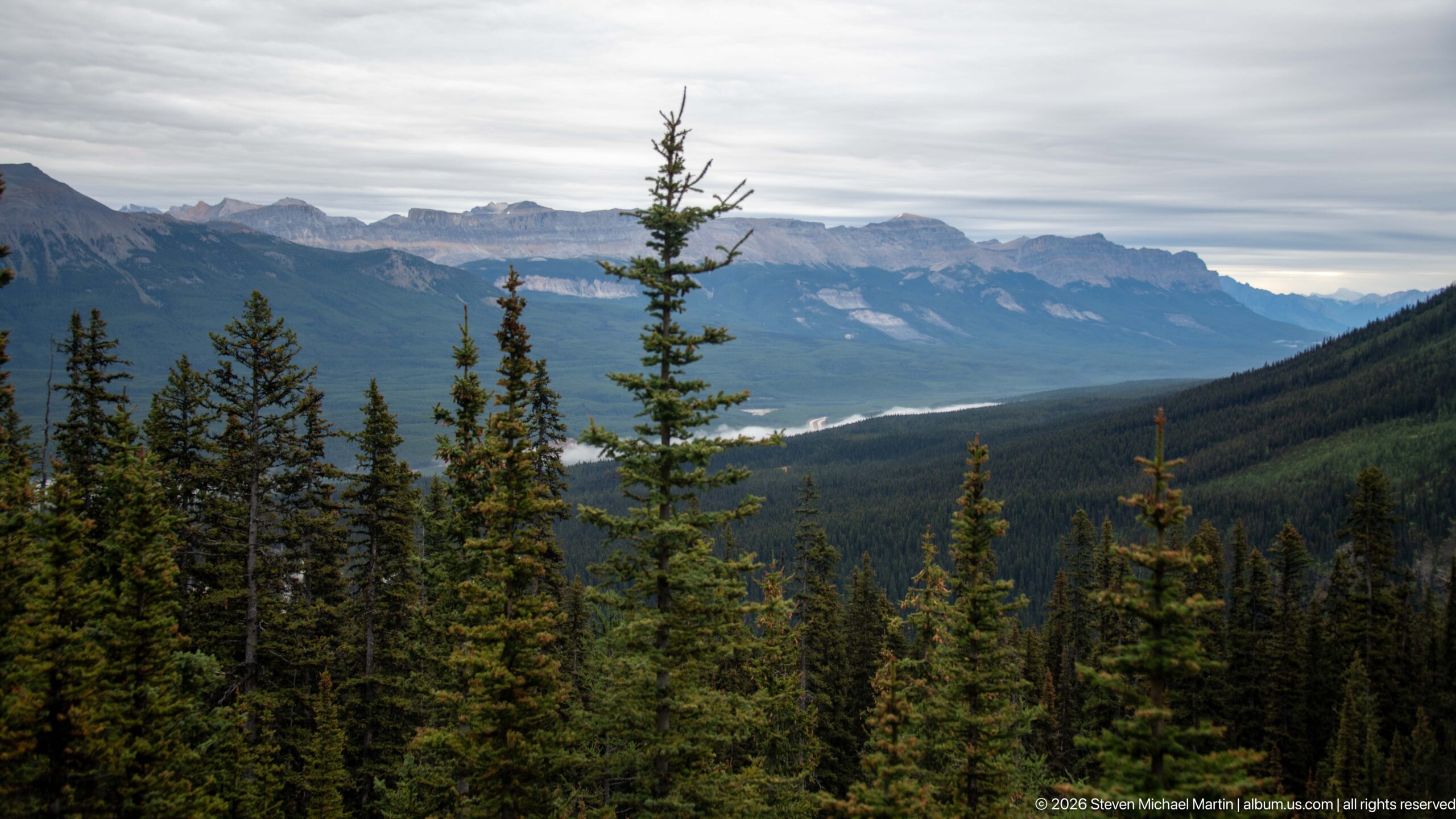
From a high forested slope, the view opens across a broad valley to distant ridges and a pale glint of water below. Spruce and fir trees frame the foreground, while layered blue mountains recede toward the horizon. The lake is too distant and partly obscured to identify from this frame alone, so the caption describes the overlook without assigning a specific viewpoint.
Caption
From a high forested slope, the view opens across a broad valley to distant ridges and a pale glint of water below. Spruce and fir trees frame the foreground, while layered blue mountains recede toward the horizon. The lake is too distant and partly obscured to identify from this frame alone, so the caption describes the overlook without assigning a specific viewpoint.
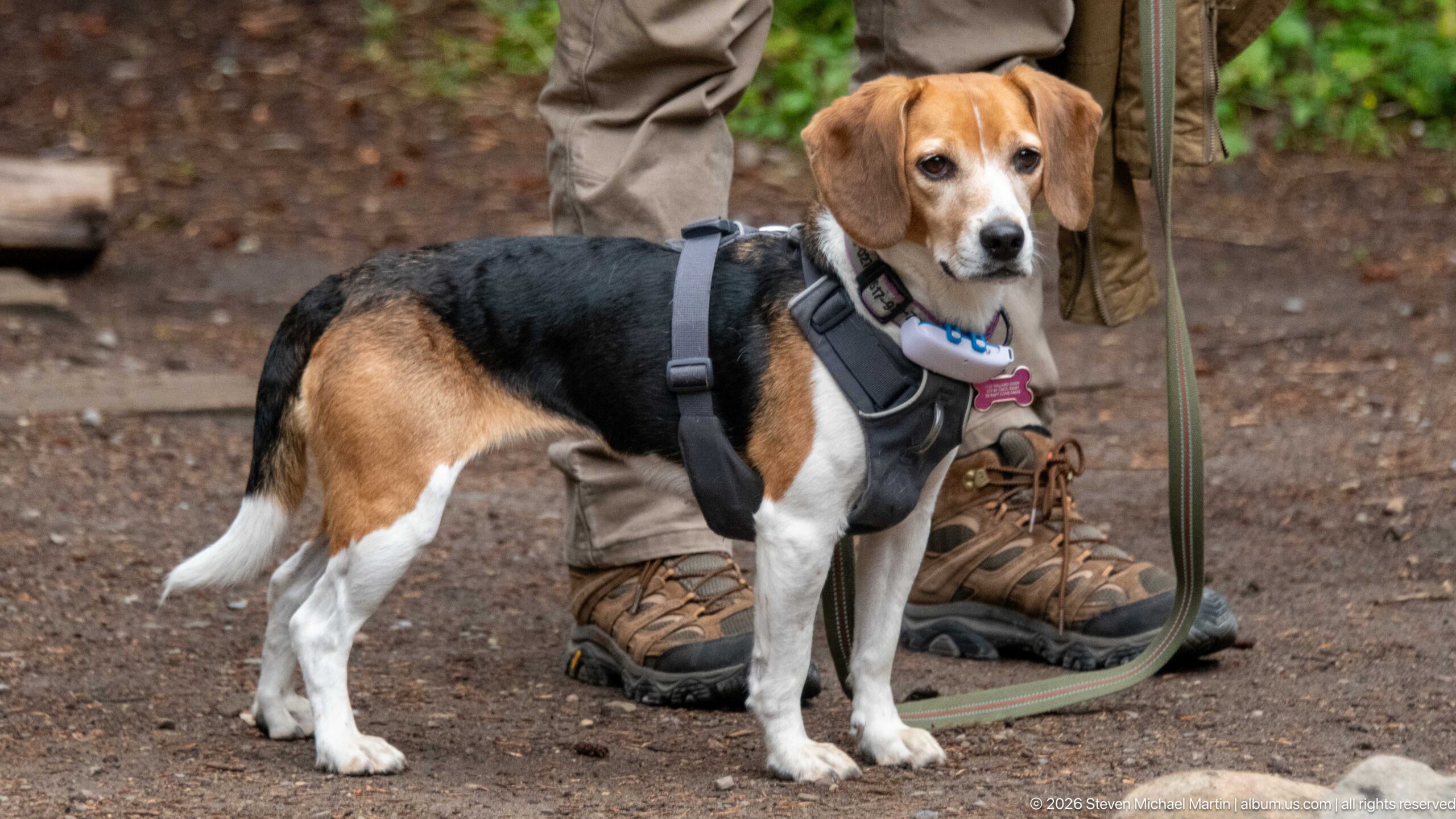
A brown, black, and white beagle stands in a harness on packed forest soil beside a hiker’s tan trousers and boots. The dog faces the camera with ears lowered and leash attached, while a second leash runs out of frame. The tight crop excludes the broader trail setting and focuses on the dog’s attentive stance and outdoor equipment.
Caption
A brown, black, and white beagle stands in a harness on packed forest soil beside a hiker’s tan trousers and boots. The dog faces the camera with ears lowered and leash attached, while a second leash runs out of frame. The tight crop excludes the broader trail setting and focuses on the dog’s attentive stance and outdoor equipment.
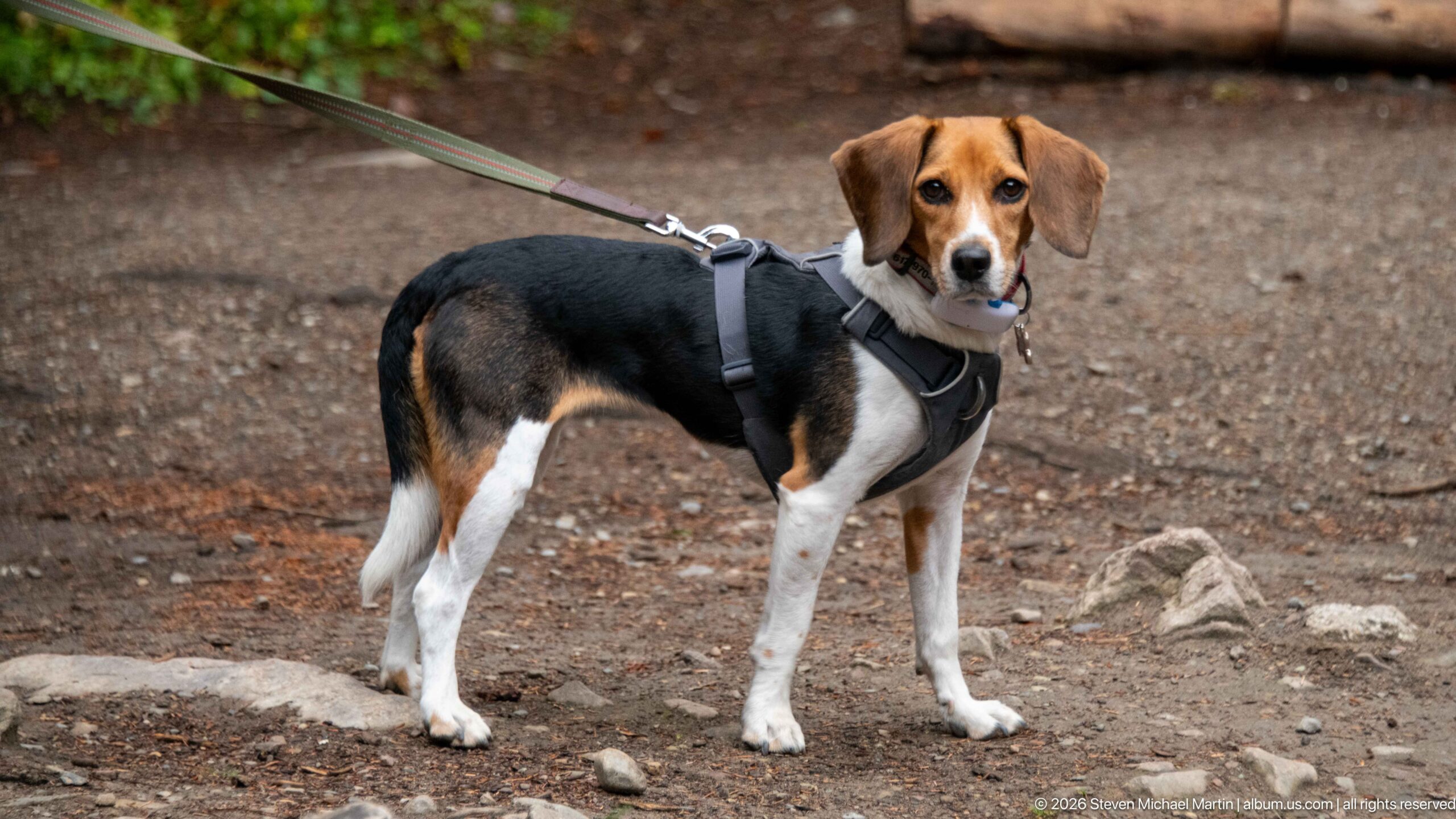
The beagle stands full-length on compacted earth and small stones, wearing a dark harness and looking toward the camera. A taut leash enters from the upper left, indicating the dog remains with its handler just outside the frame. The plain woodland ground keeps the image focused on the animal’s stance, tricolor coat, and attentive expression.
Caption
The beagle stands full-length on compacted earth and small stones, wearing a dark harness and looking toward the camera. A taut leash enters from the upper left, indicating the dog remains with its handler just outside the frame. The plain woodland ground keeps the image focused on the animal’s stance, tricolor coat, and attentive expression.
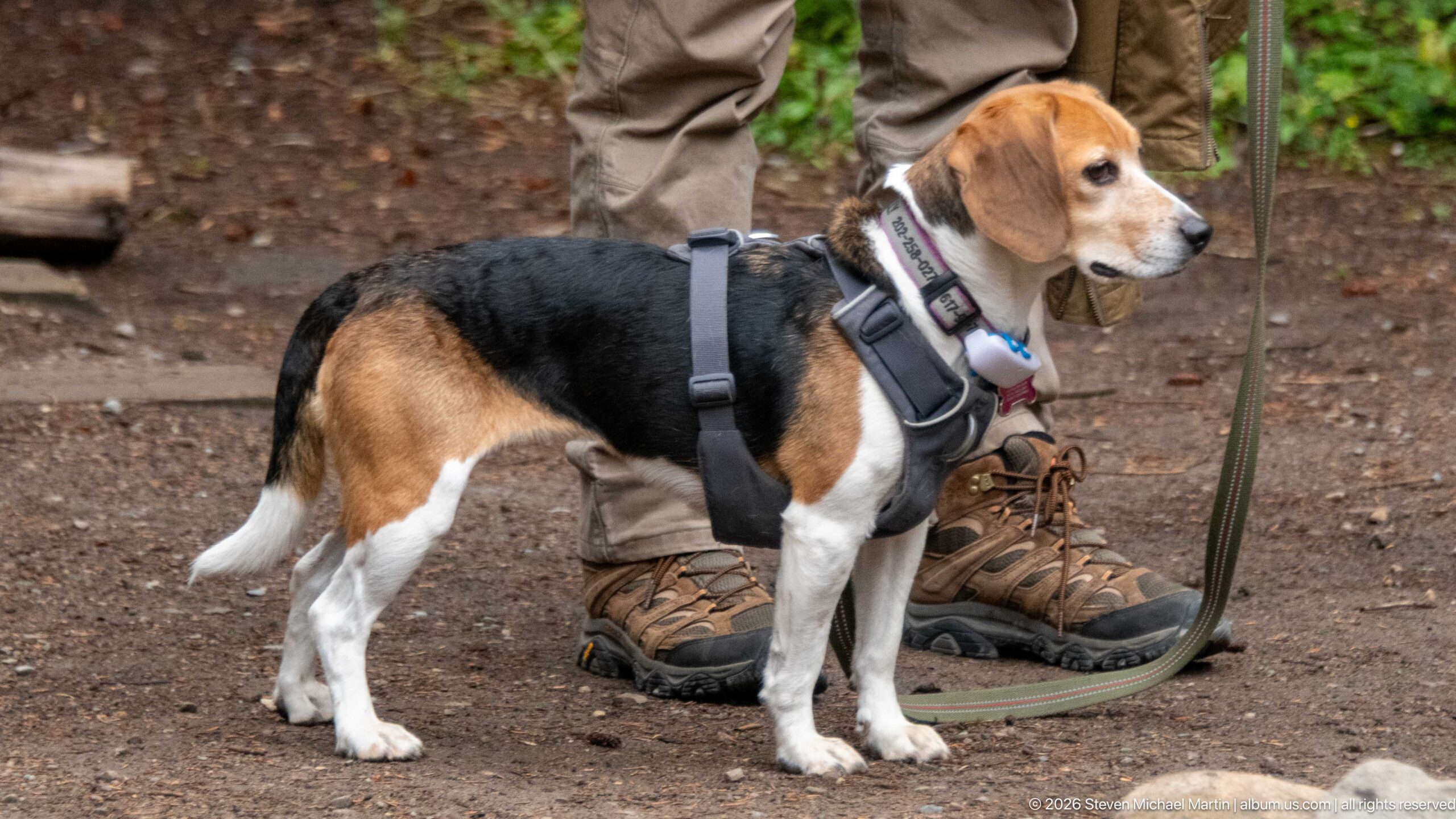
The beagle stands beside a hiker’s legs and boots, looking toward the woods rather than the camera. Its dark harness and attached lead cross the tricolor coat, while leaf litter and small stones cover the path. The crop shows the close relationship between handler and dog without revealing either person’s face or suggesting a specific identity.
Caption
The beagle stands beside a hiker’s legs and boots, looking toward the woods rather than the camera. Its dark harness and attached lead cross the tricolor coat, while leaf litter and small stones cover the path. The crop shows the close relationship between handler and dog without revealing either person’s face or suggesting a specific identity.
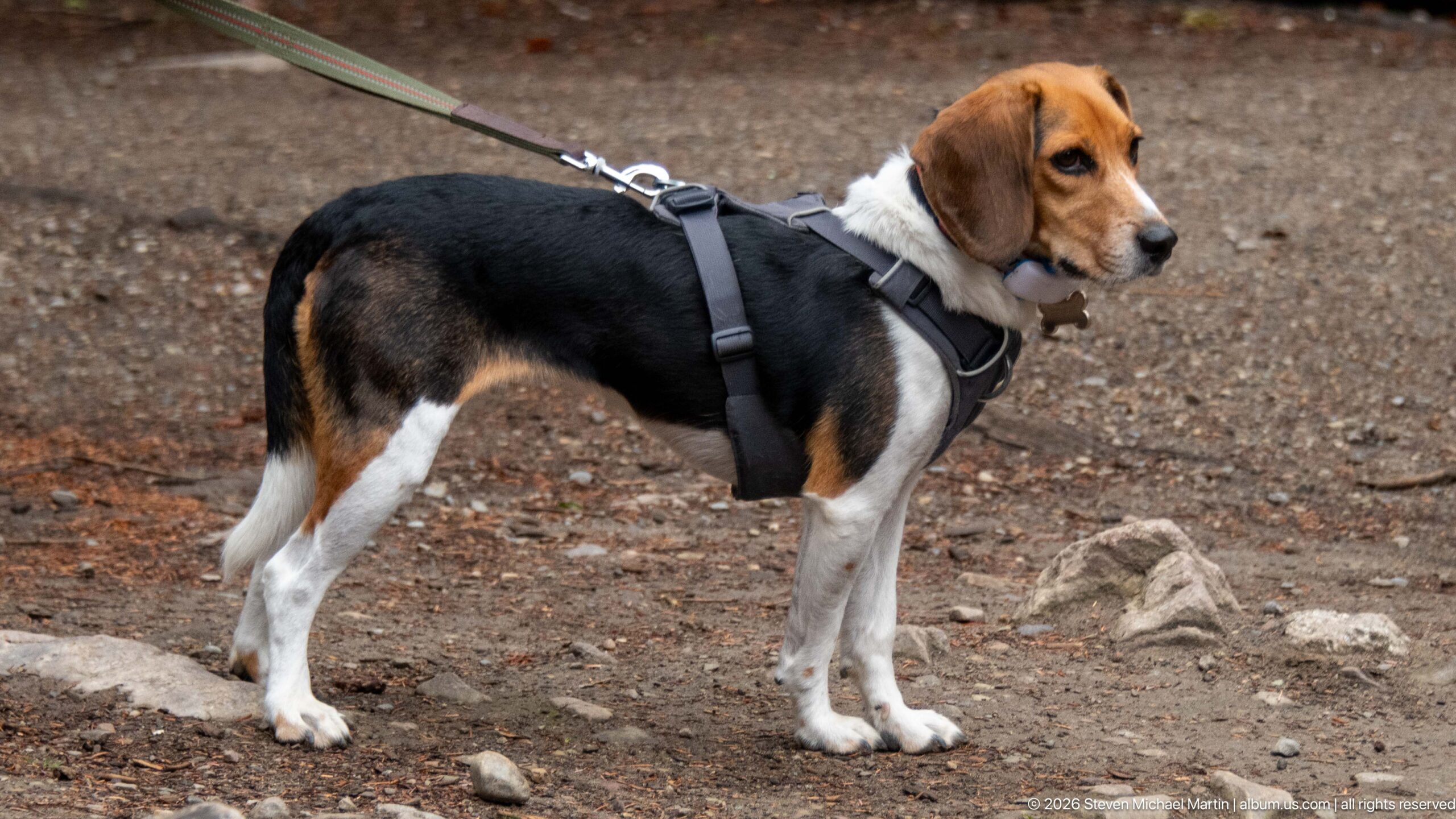
In profile, the beagle looks to the right, its long ears, black saddle marking, and white legs clearly outlined against the dirt path. A gray harness and leash remain visible along its back. The uncluttered background and side-on pose make this a descriptive animal portrait distinct from the frontal and handler-adjacent views nearby.
Caption
In profile, the beagle looks to the right, its long ears, black saddle marking, and white legs clearly outlined against the dirt path. A gray harness and leash remain visible along its back. The uncluttered background and side-on pose make this a descriptive animal portrait distinct from the frontal and handler-adjacent views nearby.
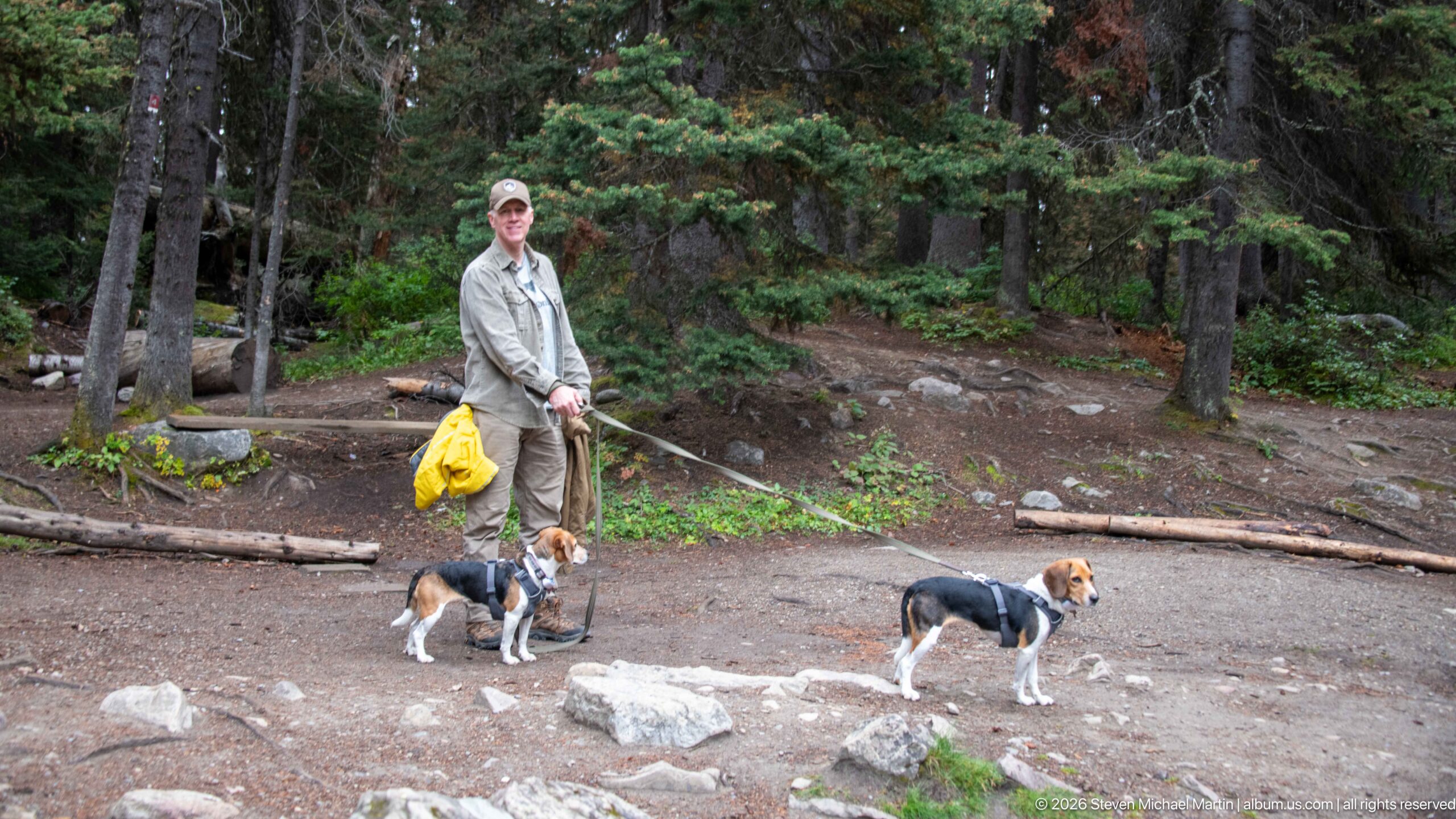
A hiker in a pale cap and light jacket pauses among conifers with two tricolor beagles on leashes. The dogs stand several feet apart on a broad dirt clearing, with a bright yellow raincoat draped over the person’s hand. The wider view records a human-and-dog group in the forest, showing the space and trail conditions around the close-up portraits.
Caption
A hiker in a pale cap and light jacket pauses among conifers with two tricolor beagles on leashes. The dogs stand several feet apart on a broad dirt clearing, with a bright yellow raincoat draped over the person’s hand. The wider view records a human-and-dog group in the forest, showing the space and trail conditions around the close-up portraits.
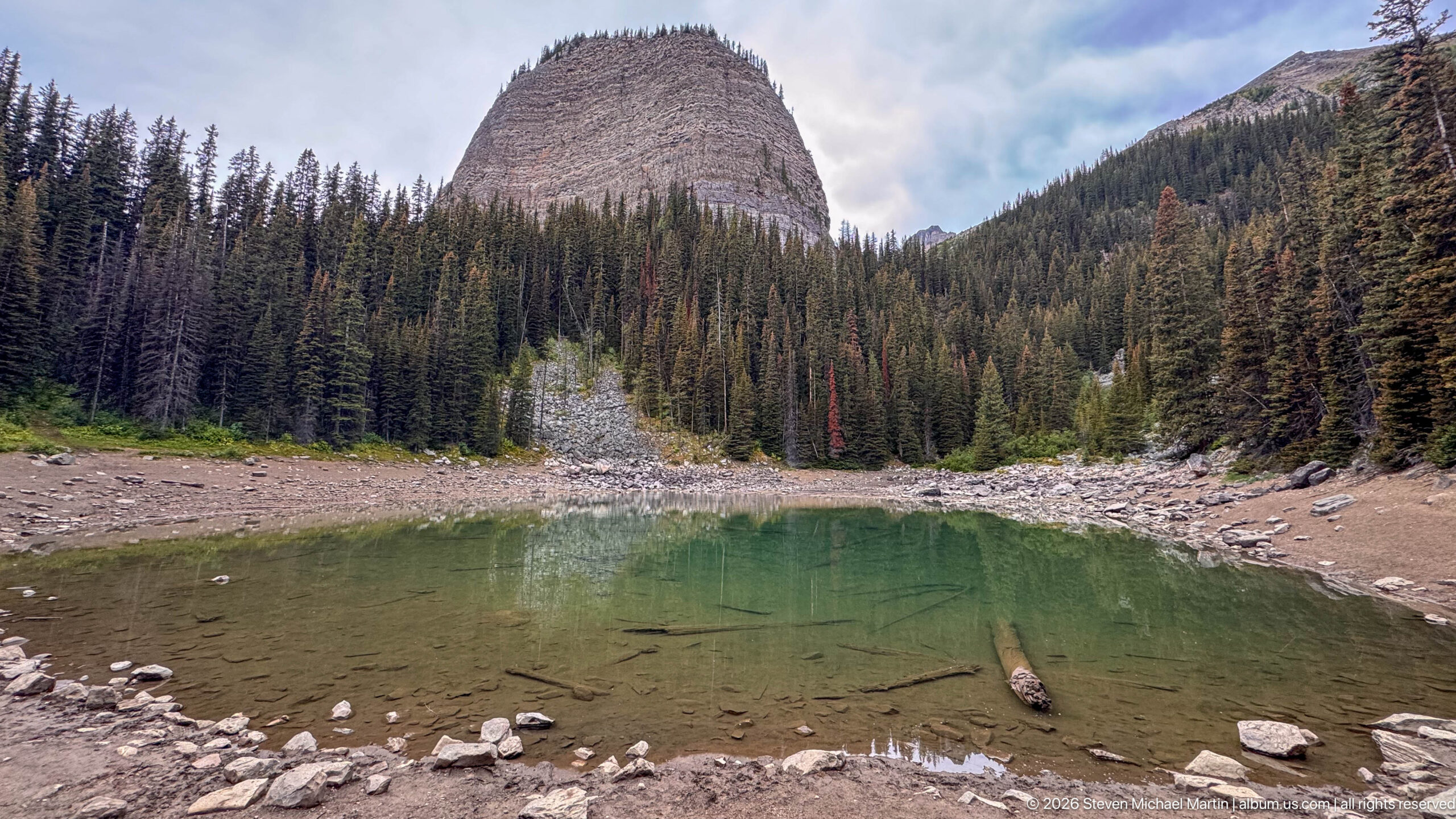
A shallow green lake sits below a rounded, horizontally banded rock summit, with a loose apron of scree and conifers around its margins. The near water is clear enough to reveal stones, and a few fallen branches lie partly submerged. A later trail sign in the sequence names Mirror Lake and the adjacent routes, supporting this identification of the small tarn.
Caption
A shallow green lake sits below a rounded, horizontally banded rock summit, with a loose apron of scree and conifers around its margins. The near water is clear enough to reveal stones, and a few fallen branches lie partly submerged. A later trail sign in the sequence names Mirror Lake and the adjacent routes, supporting this identification of the small tarn.
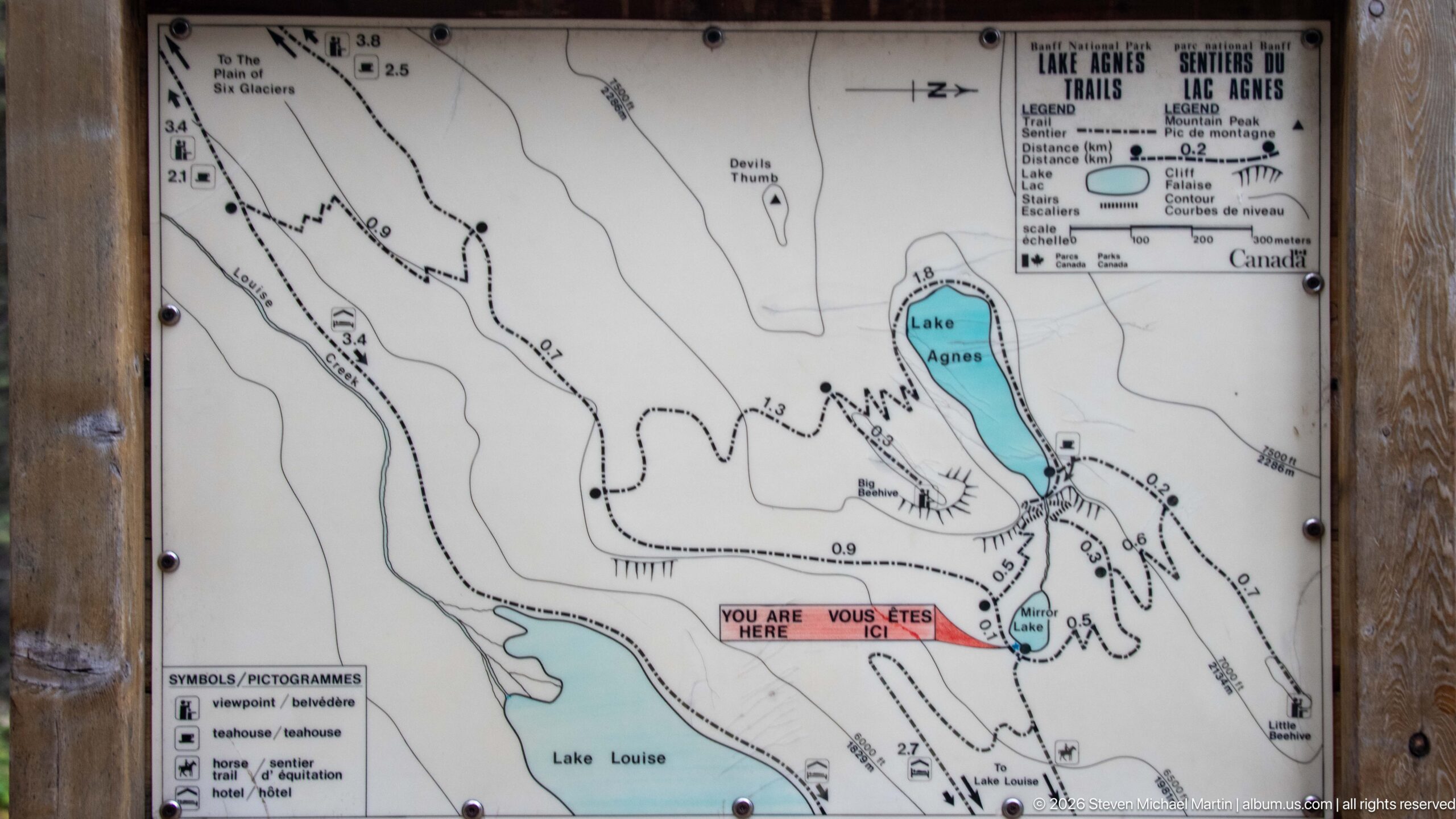
A posted trail map marks the visitor’s position near Mirror Lake and shows routes to Lake Agnes, Little Beehive, and the Plain of Six Glaciers. The panel includes a simplified contour map, distances, and bilingual French and English headings. Its “You are here / Vous êtes ici” label provides direct location context for the surrounding lake and trail photographs.
Caption
A posted trail map marks the visitor’s position near Mirror Lake and shows routes to Lake Agnes, Little Beehive, and the Plain of Six Glaciers. The panel includes a simplified contour map, distances, and bilingual French and English headings. Its “You are here / Vous êtes ici” label provides direct location context for the surrounding lake and trail photographs.
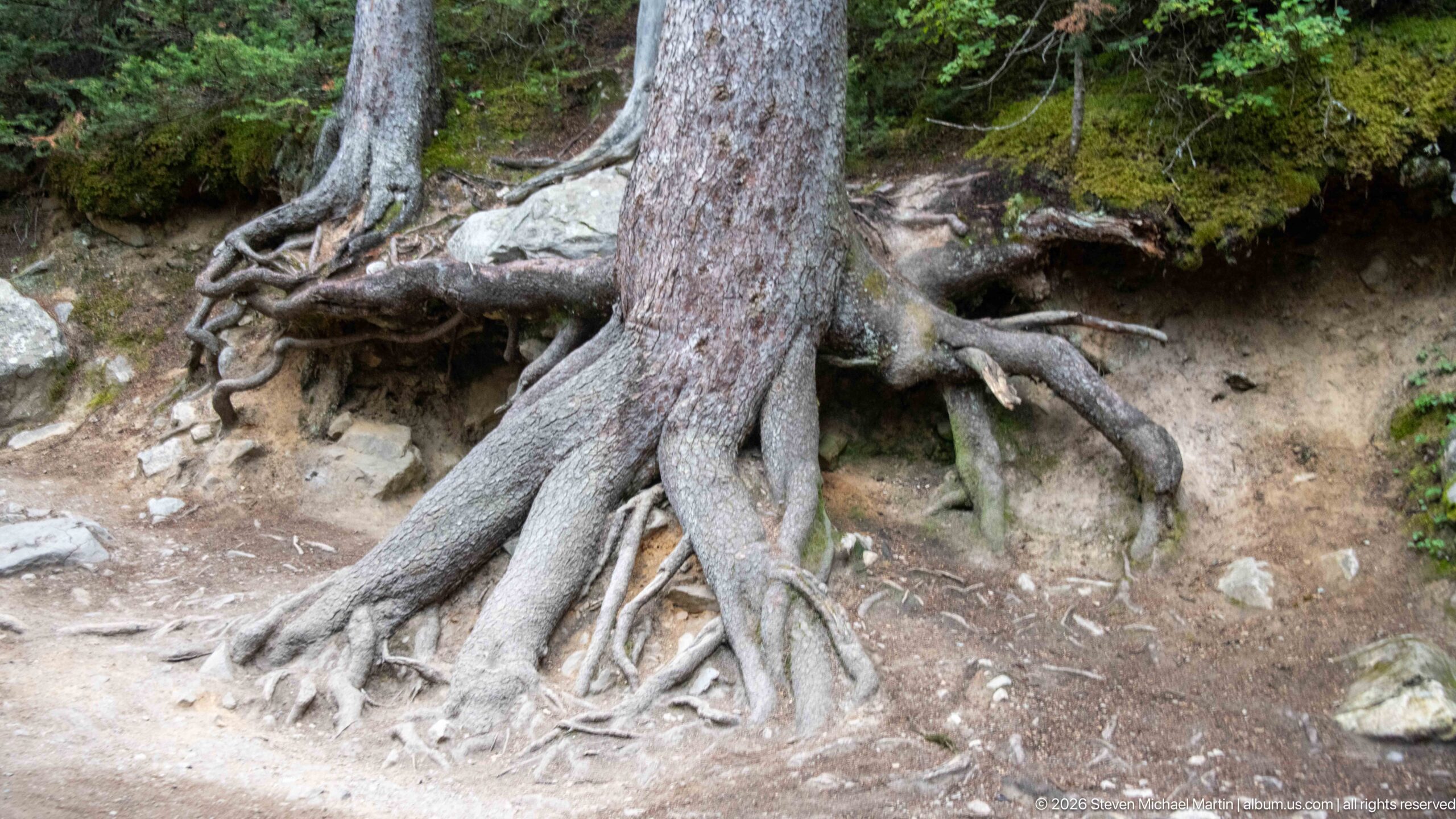
Thick roots from a mature conifer spread across an eroded, rocky section of trail, forming natural ridges over pale soil. Smaller roots weave through stones at the base of the trunk, while the path continues out of frame. This close ground-level detail records the wear and texture of the mountain route rather than its surrounding scenery.
Caption
Thick roots from a mature conifer spread across an eroded, rocky section of trail, forming natural ridges over pale soil. Smaller roots weave through stones at the base of the trunk, while the path continues out of frame. This close ground-level detail records the wear and texture of the mountain route rather than its surrounding scenery.
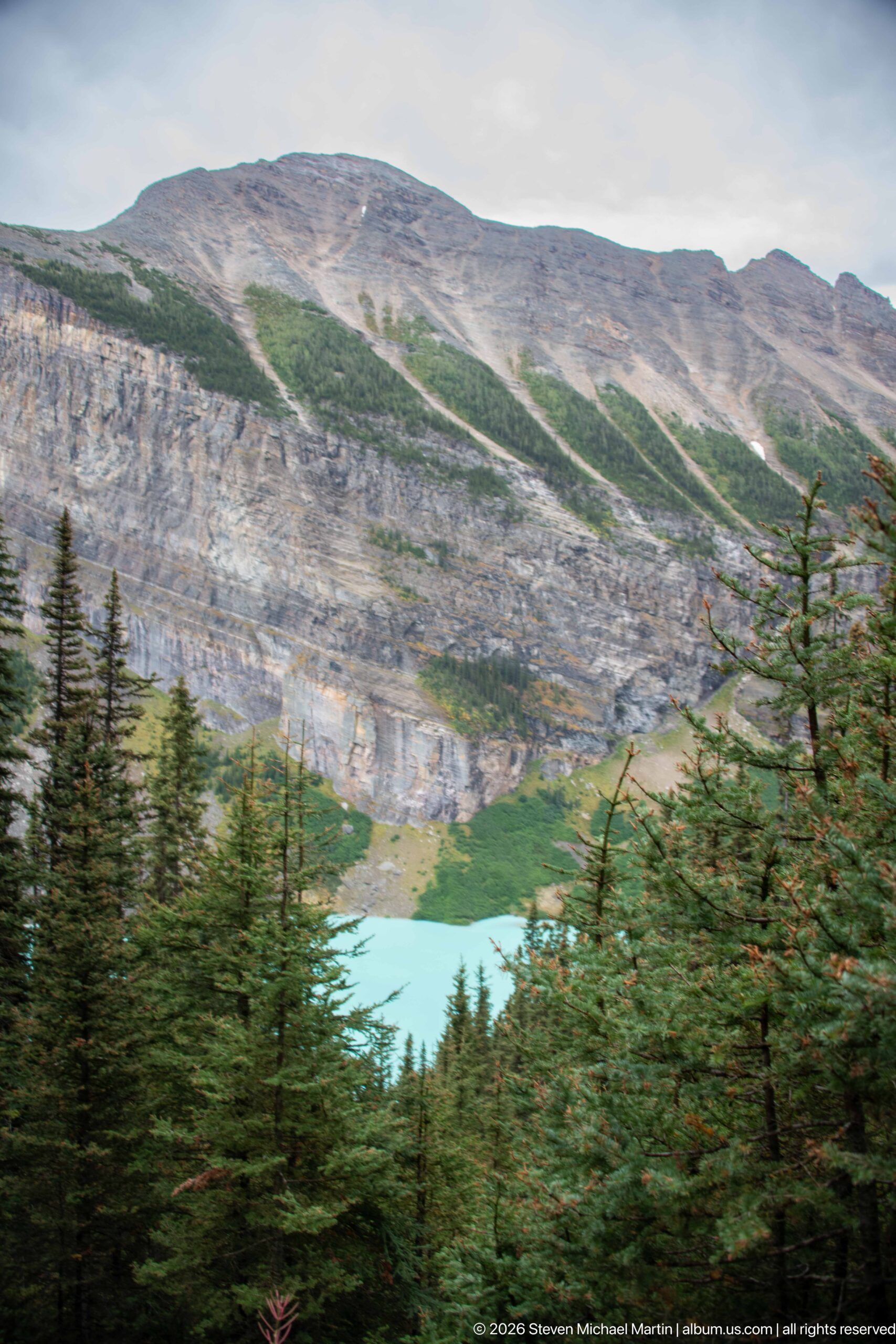
A narrow strip of turquoise water appears far below a steep, pale mountainside, seen through dark conifer branches. The elevated viewpoint looks across a broad slope marked by bands of exposed rock and sparse green vegetation. The lake’s distance and partial concealment prevent a certain name from this image alone, though it is within the Lake Louise trail landscape.
Caption
A narrow strip of turquoise water appears far below a steep, pale mountainside, seen through dark conifer branches. The elevated viewpoint looks across a broad slope marked by bands of exposed rock and sparse green vegetation. The lake’s distance and partial concealment prevent a certain name from this image alone, though it is within the Lake Louise trail landscape.
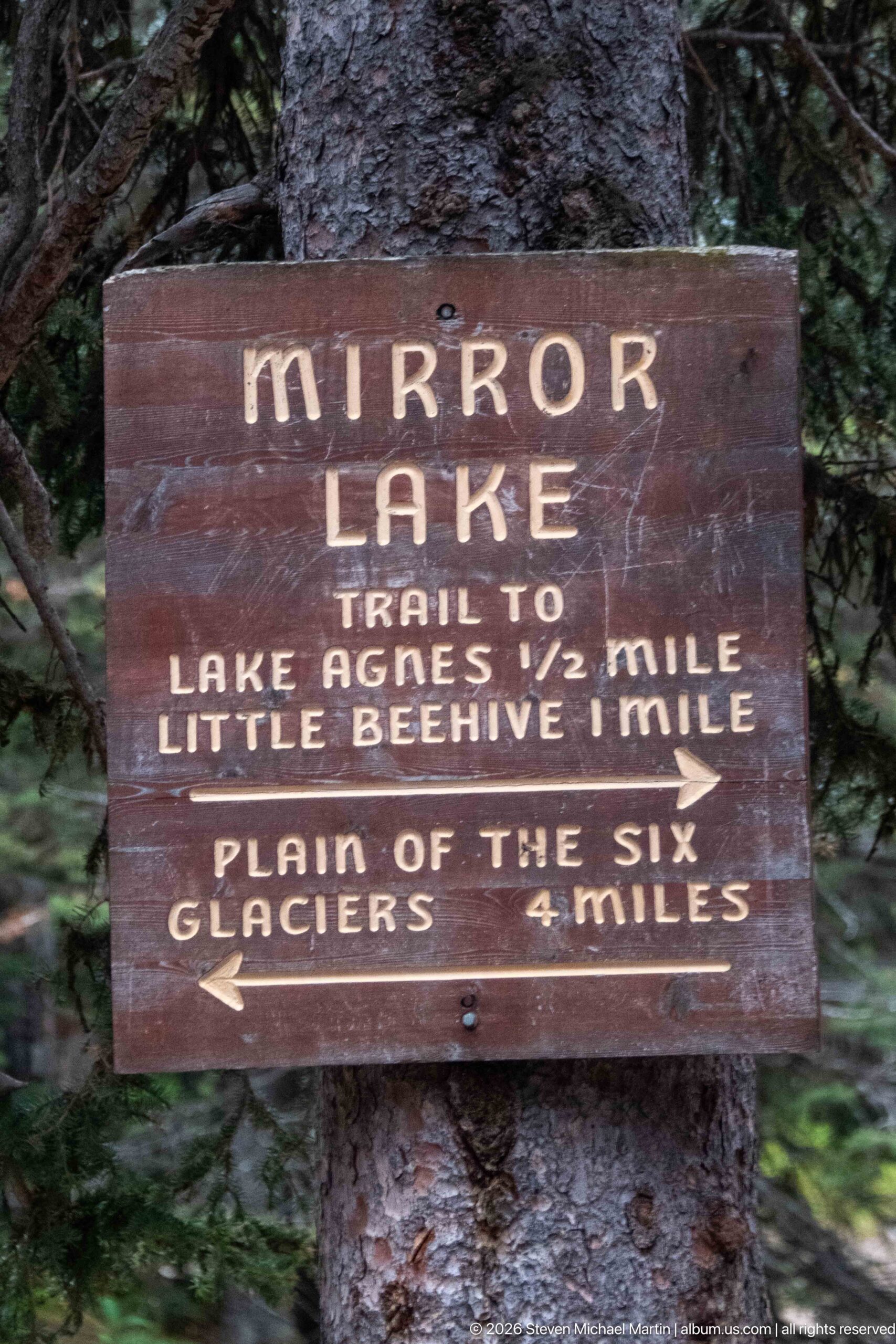
A weathered brown sign identifies Mirror Lake and gives distances to Lake Agnes, Little Beehive, and the Plain of the Six Glaciers. White lettering and arrows stand out against the dark planks, while the sign is fixed to a tree trunk amid dense forest. The clear route names turn this close detail into a practical record of the junction above Lake Louise.
Caption
A weathered brown sign identifies Mirror Lake and gives distances to Lake Agnes, Little Beehive, and the Plain of the Six Glaciers. White lettering and arrows stand out against the dark planks, while the sign is fixed to a tree trunk amid dense forest. The clear route names turn this close detail into a practical record of the junction above Lake Louise.
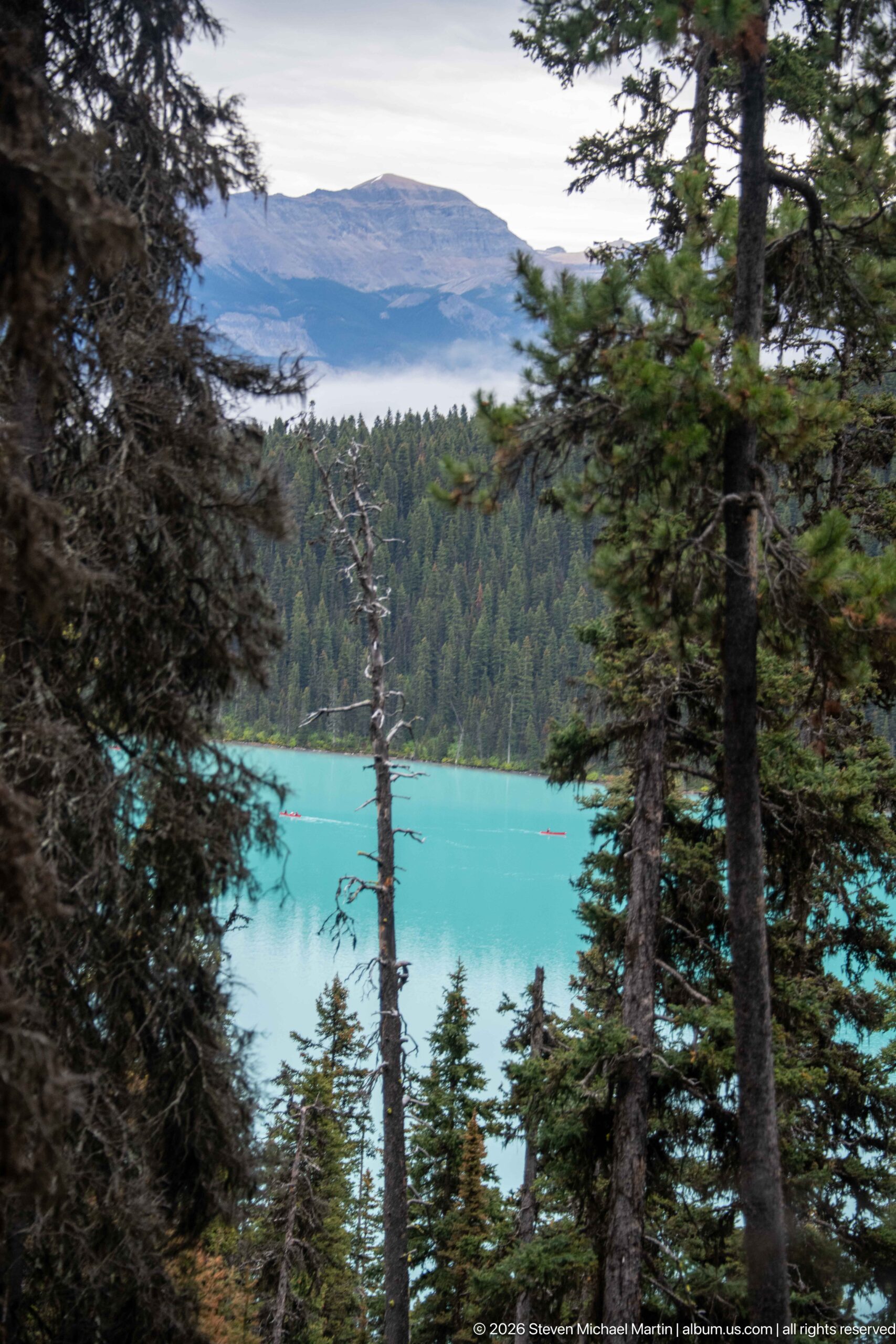
Turquoise Lake Louise appears through a screen of tall conifers from an elevated forest path. A pale mountain ridge rises beyond the far shore, while dark branches and trunks frame the water on three sides. The obstructed composition suggests a brief opening in the woods rather than a formal overlook, placing the lake within the dense surrounding forest.
Caption
Turquoise Lake Louise appears through a screen of tall conifers from an elevated forest path. A pale mountain ridge rises beyond the far shore, while dark branches and trunks frame the water on three sides. The obstructed composition suggests a brief opening in the woods rather than a formal overlook, placing the lake within the dense surrounding forest.
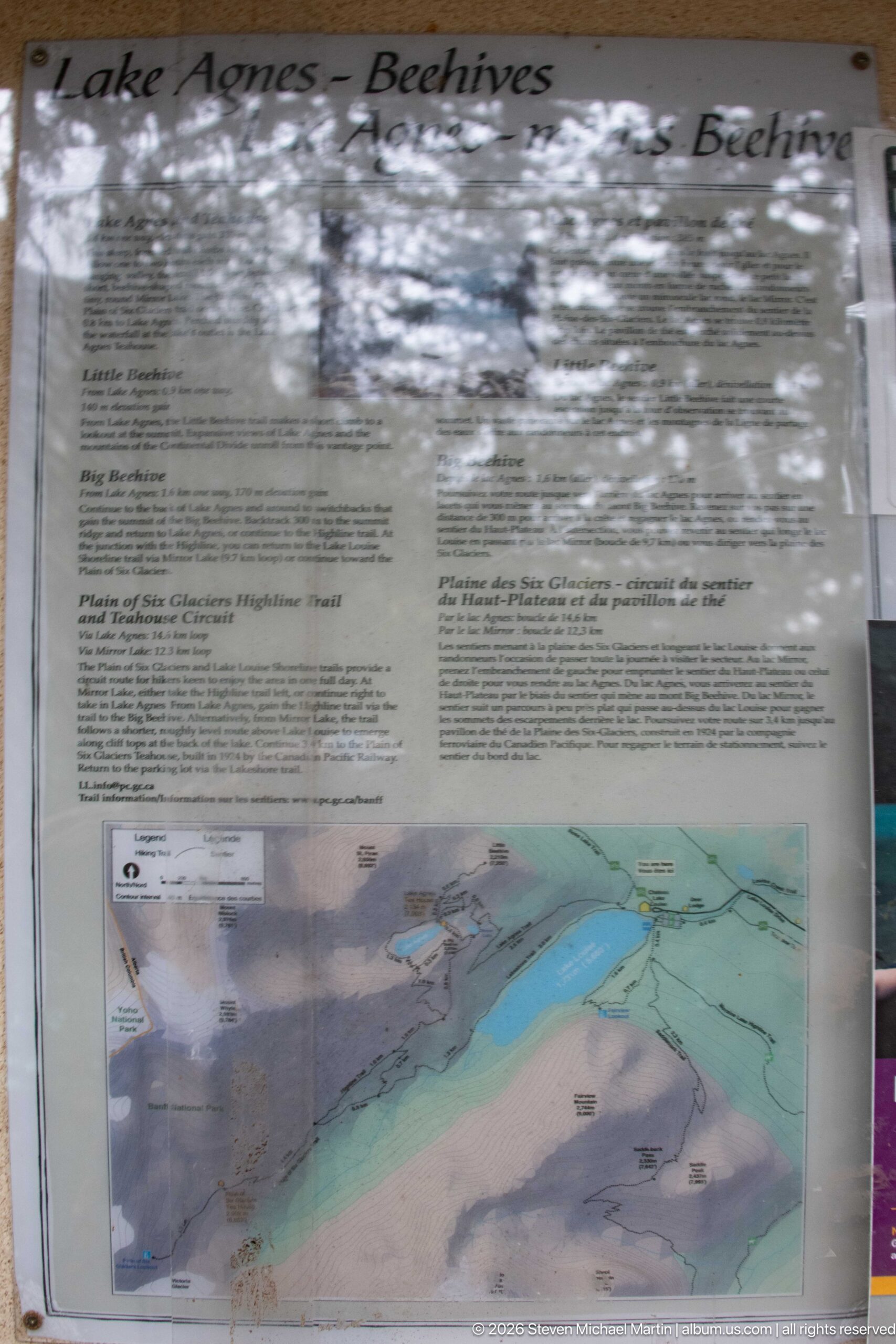
An interpretive panel headed with text about the Beehives presents trail information and a colored map of the Lake Louise area. Reflections of branches and sky obscure portions of the writing, but the mapped lake and route lines remain visible. The photograph records a visitor information display rather than the mountain landscape itself; small text should be read from the original sign if exact transcription is needed.
Caption
An interpretive panel headed with text about the Beehives presents trail information and a colored map of the Lake Louise area. Reflections of branches and sky obscure portions of the writing, but the mapped lake and route lines remain visible. The photograph records a visitor information display rather than the mountain landscape itself; small text should be read from the original sign if exact transcription is needed.
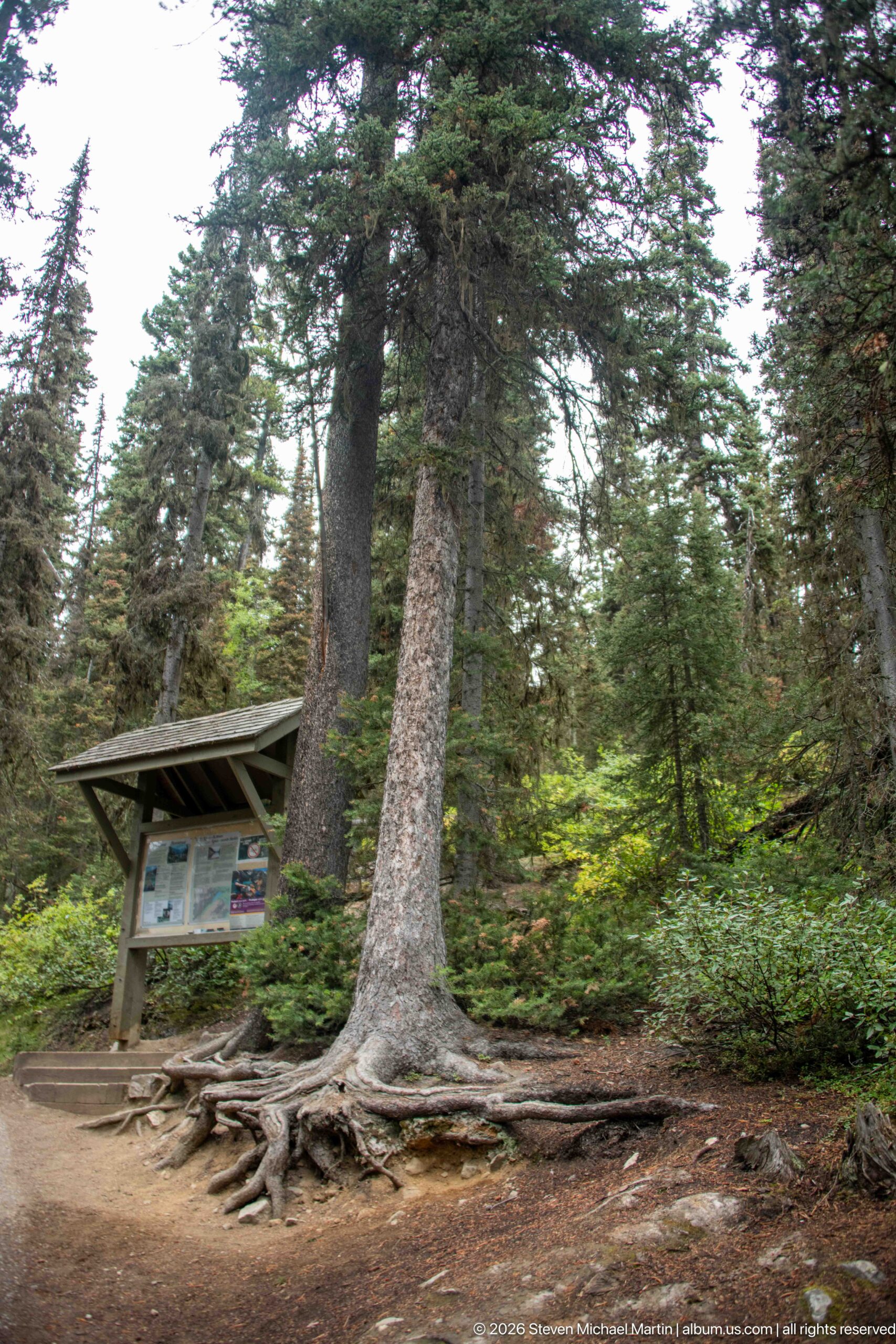
A roofed information board stands beside a large conifer whose exposed roots spread across the dirt trail. Multiple notices and maps are posted under the small shelter, partly hidden by the tree and surrounding foliage. The low, wide view places the kiosk at a wooded junction and emphasizes the roots and uneven ground that shape the nearby walking route.
Caption
A roofed information board stands beside a large conifer whose exposed roots spread across the dirt trail. Multiple notices and maps are posted under the small shelter, partly hidden by the tree and surrounding foliage. The low, wide view places the kiosk at a wooded junction and emphasizes the roots and uneven ground that shape the nearby walking route.
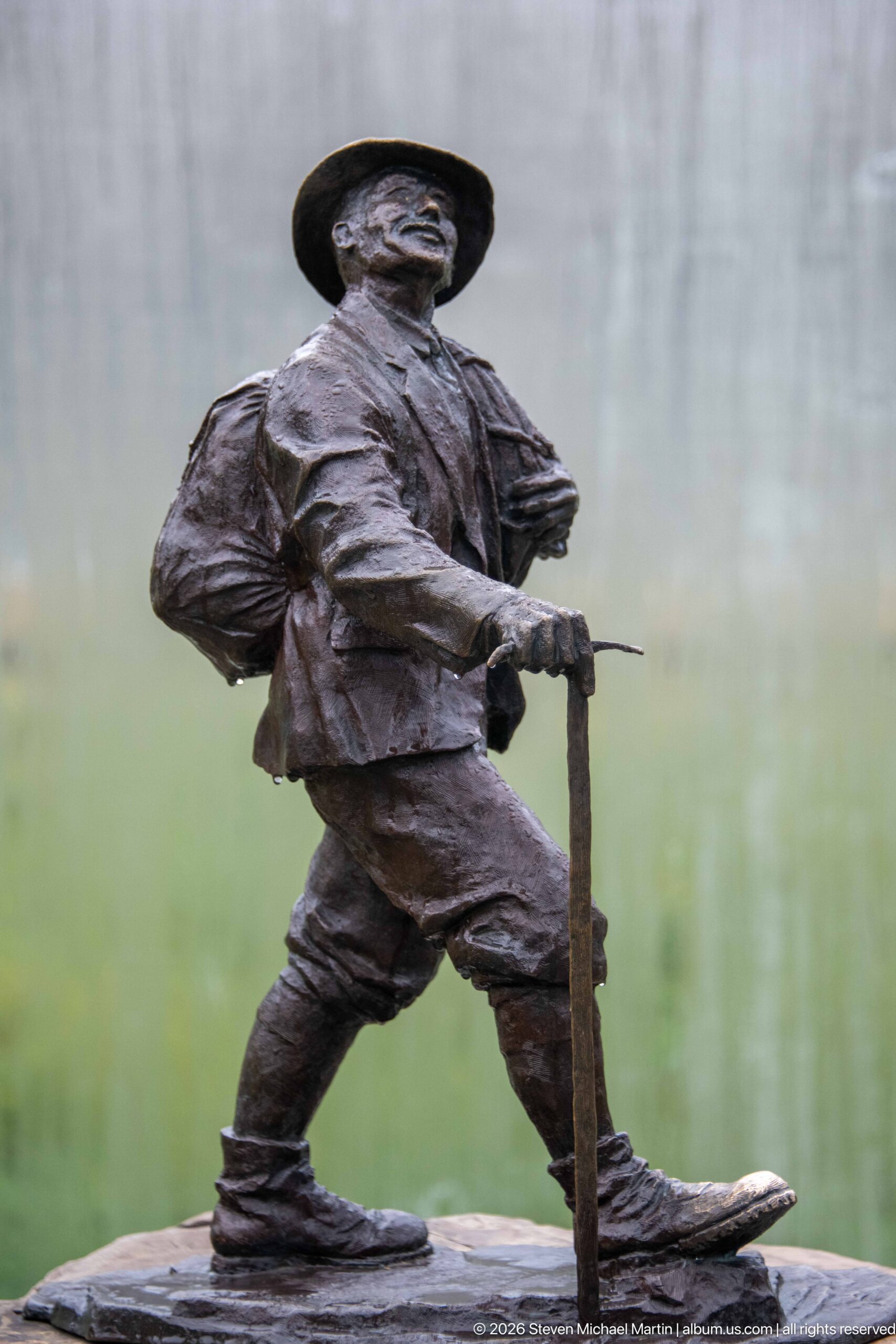
A bronze figure in a broad-brimmed hat and heavy mountain clothing stands in a climbing stance, gripping a long staff or ice axe. The close framing isolates the sculpted folds of the jacket and the figure’s determined posture against a softly blurred pale background. The proof sheet does not clearly establish the person’s name, so the subject is identified by its visible mountaineering attributes.
Caption
A bronze figure in a broad-brimmed hat and heavy mountain clothing stands in a climbing stance, gripping a long staff or ice axe. The close framing isolates the sculpted folds of the jacket and the figure’s determined posture against a softly blurred pale background. The proof sheet does not clearly establish the person’s name, so the subject is identified by its visible mountaineering attributes.
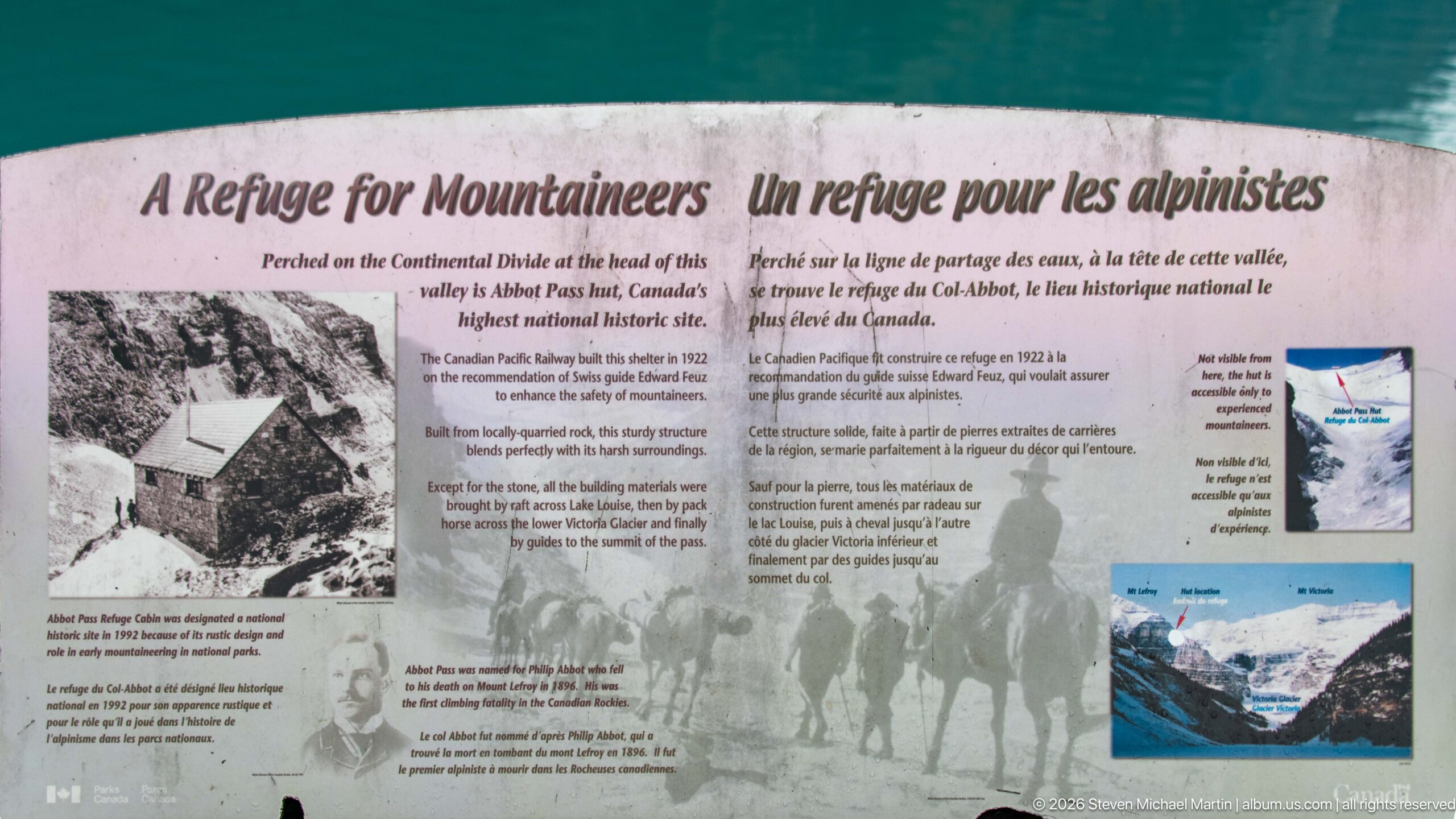
The bilingual interpretive panel, headed “A Refuge for Mountaineers,” describes Abbot Pass Hut and its place in Canadian mountaineering. Historical photographs, text columns, and a map or route image combine to explain the shelter’s high-alpine setting and use. Reflections cross the sign surface, but its title and archival imagery distinguish this panel from the nearby trail-direction displays.
Caption
The bilingual interpretive panel, headed “A Refuge for Mountaineers,” describes Abbot Pass Hut and its place in Canadian mountaineering. Historical photographs, text columns, and a map or route image combine to explain the shelter’s high-alpine setting and use. Reflections cross the sign surface, but its title and archival imagery distinguish this panel from the nearby trail-direction displays.
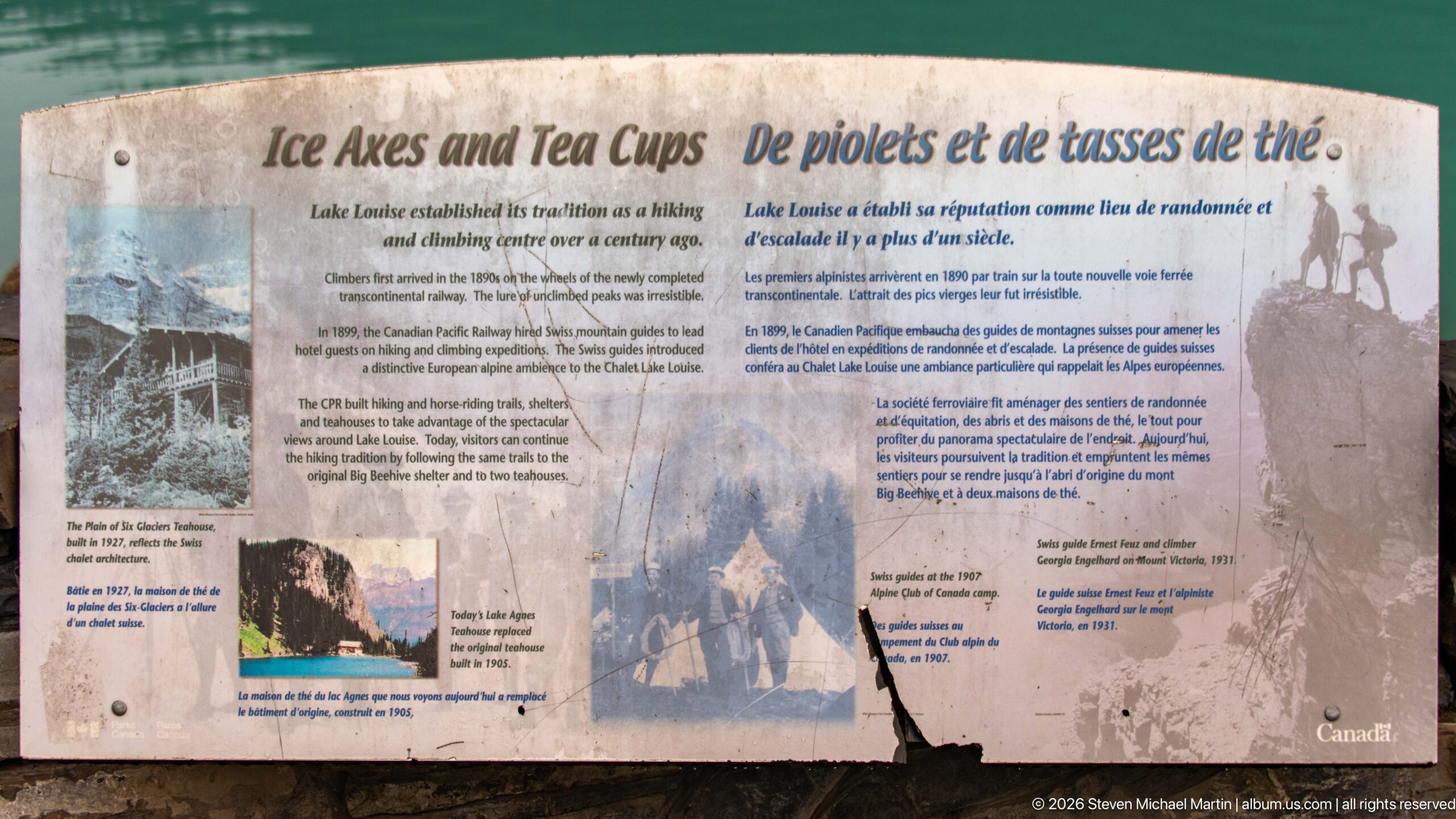
A bilingual interpretive panel describes Lake Louise’s tradition of hiking and climbing, pairing paragraphs of historical context with archival photographs and a map. The panel’s title refers to “Hikes and Tea Cups,” linking mountain recreation with the tea-house culture of the trails. Glare softens some text, but the central theme and supporting images remain legible.
Caption
A bilingual interpretive panel describes Lake Louise’s tradition of hiking and climbing, pairing paragraphs of historical context with archival photographs and a map. The panel’s title refers to “Hikes and Tea Cups,” linking mountain recreation with the tea-house culture of the trails. Glare softens some text, but the central theme and supporting images remain legible.
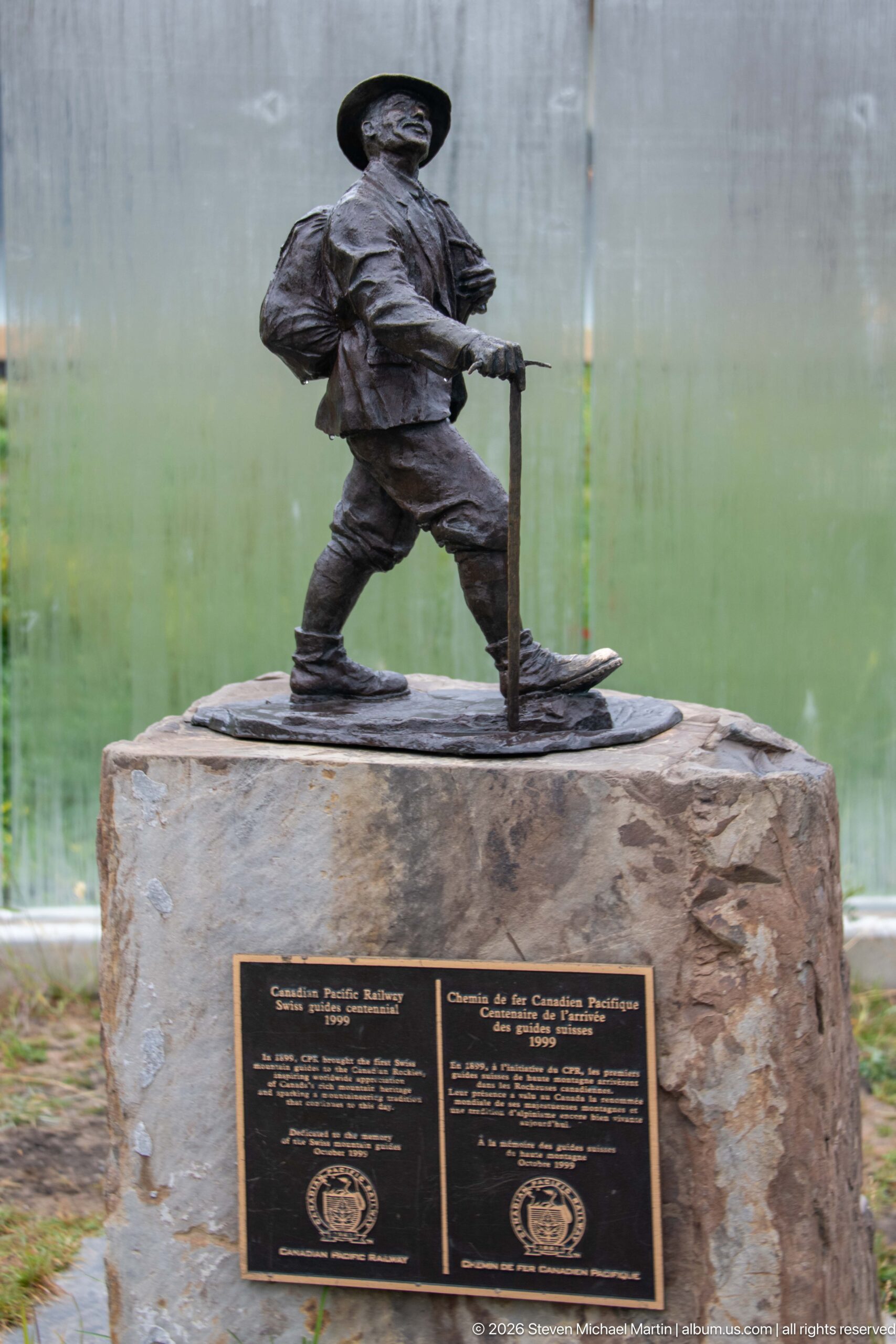
The full bronze mountaineer stands on a rough stone pedestal, holding a long tool and wearing a broad-brimmed hat, jacket, and climbing trousers. Two dark plaques mounted on the base carry bilingual text and small emblems. The wider view connects the figure to a public commemorative setting, though the plaque lettering is too small in the proof sheet to confirm the individual named.
Caption
The full bronze mountaineer stands on a rough stone pedestal, holding a long tool and wearing a broad-brimmed hat, jacket, and climbing trousers. Two dark plaques mounted on the base carry bilingual text and small emblems. The wider view connects the figure to a public commemorative setting, though the plaque lettering is too small in the proof sheet to confirm the individual named.
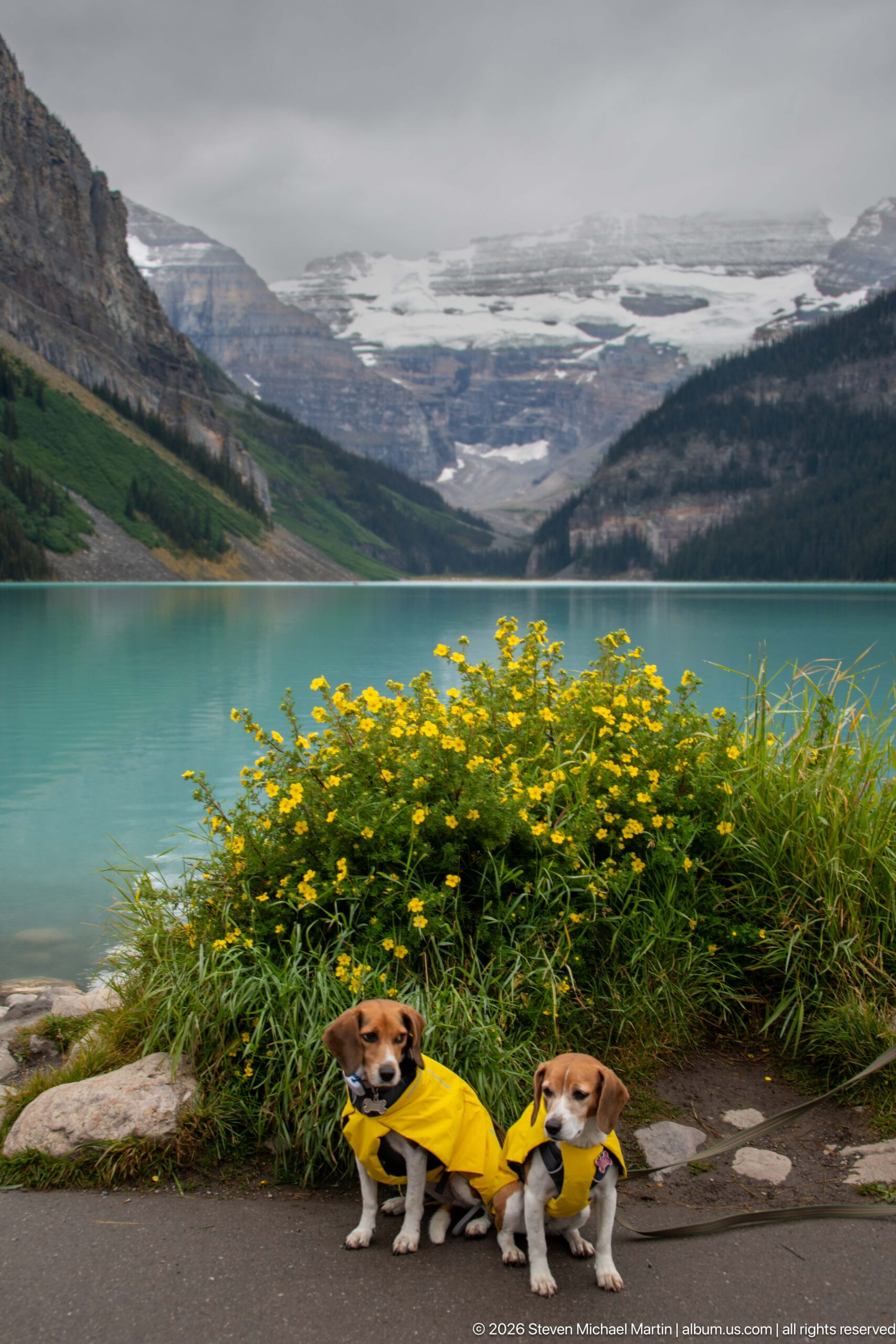
The two beagles sit close together on a paved edge below a high mound of yellow flowers and grasses. Lake Louise and its mountain valley fill the background, while rounded rocks line the immediate shore. The dogs’ bright coats echo the blossoms above them, creating a compact portrait that links the pair to the familiar lakeside landscape.
Caption
The two beagles sit close together on a paved edge below a high mound of yellow flowers and grasses. Lake Louise and its mountain valley fill the background, while rounded rocks line the immediate shore. The dogs’ bright coats echo the blossoms above them, creating a compact portrait that links the pair to the familiar lakeside landscape.
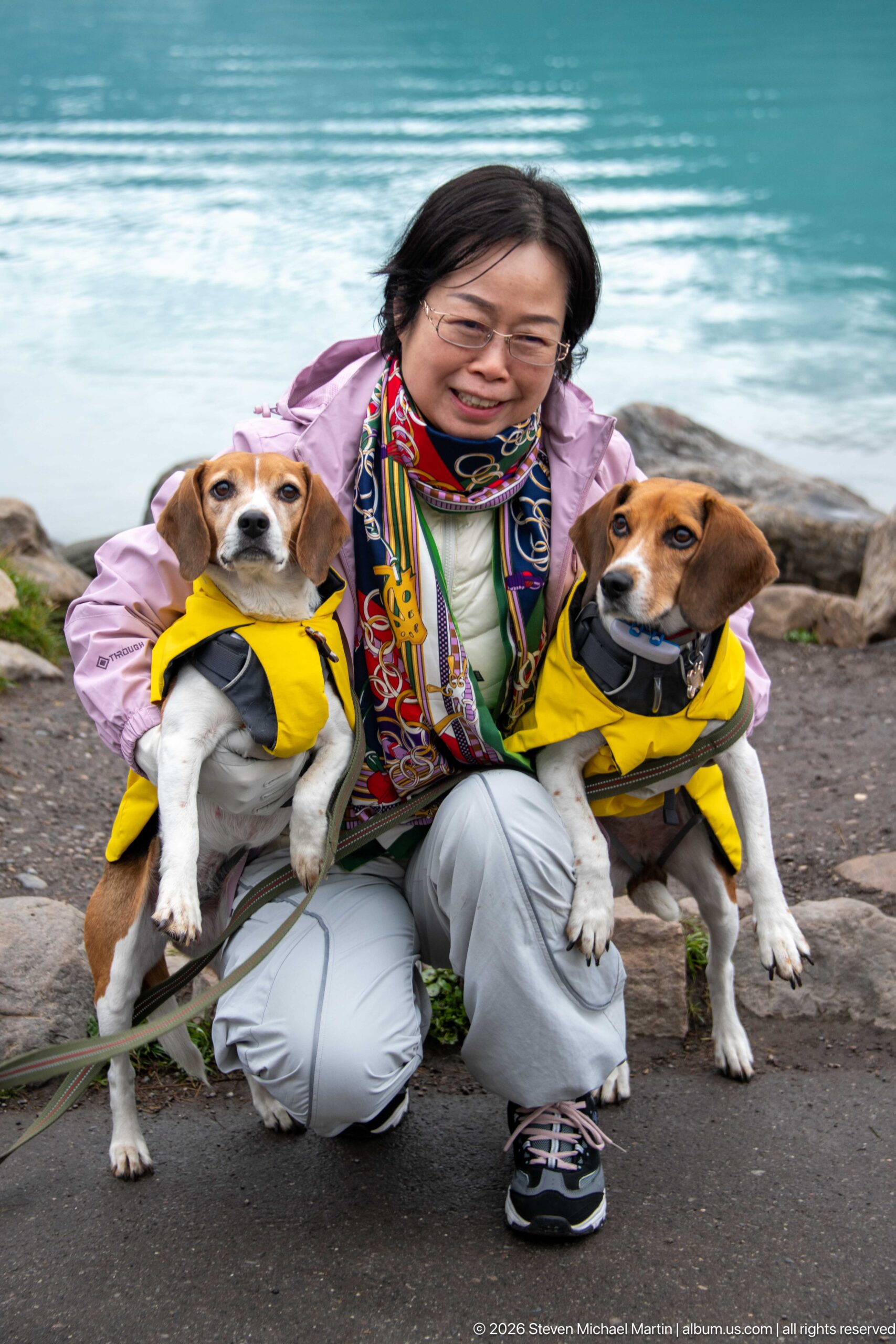
A visitor in a lavender jacket crouches between two beagles, holding one dog on each side at the rocky edge of Lake Louise. The dogs wear yellow raincoats and dark harnesses; turquoise water fills the background. The close portrait centers the human-and-dog group and preserves a narrow band of the lake, without identifying the people by name.
Caption
A visitor in a lavender jacket crouches between two beagles, holding one dog on each side at the rocky edge of Lake Louise. The dogs wear yellow raincoats and dark harnesses; turquoise water fills the background. The close portrait centers the human-and-dog group and preserves a narrow band of the lake, without identifying the people by name.
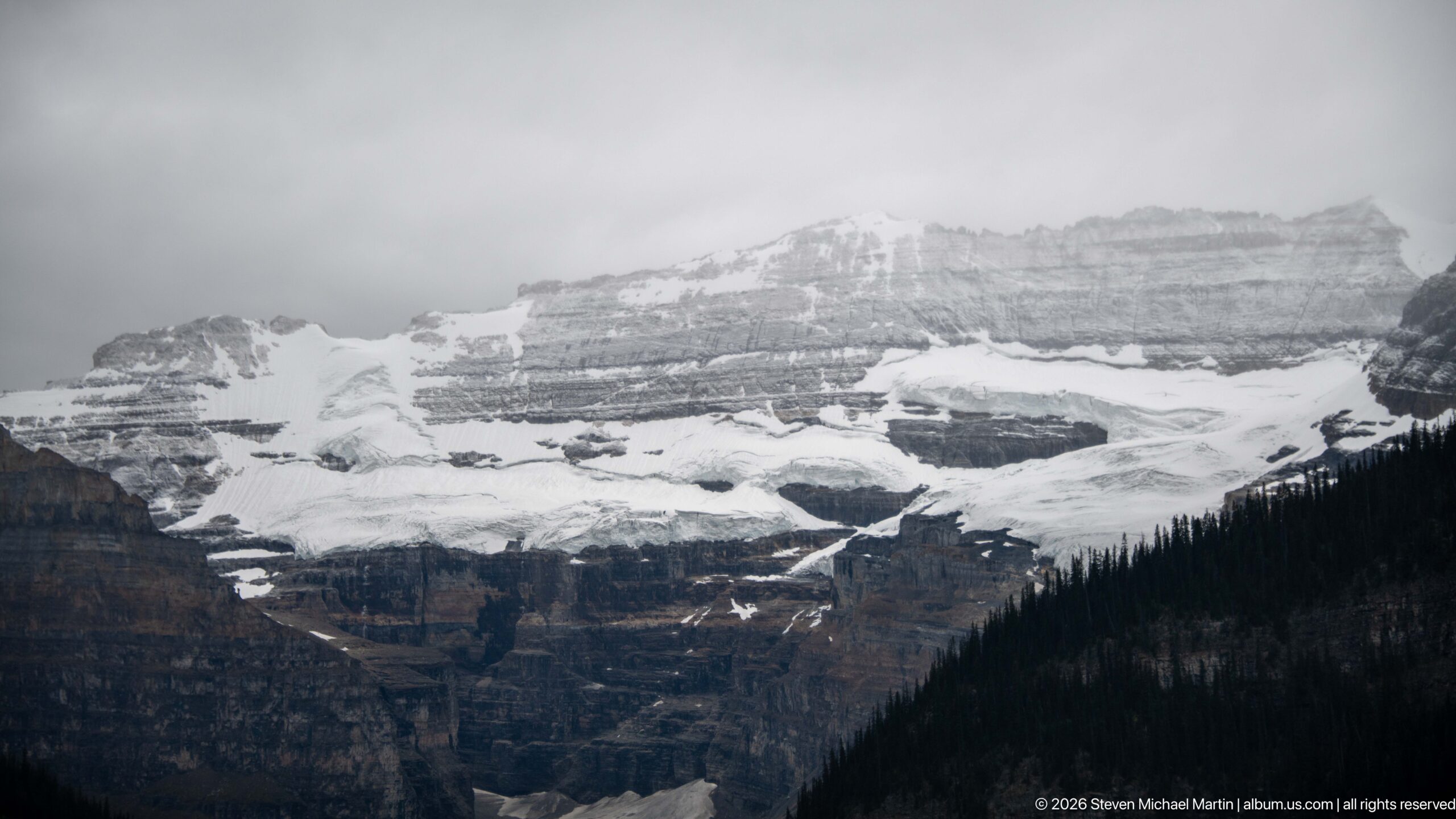
Victoria Glacier spreads across the upper basin in broken white bands beneath a horizontal stack of gray rock strata. Dark forested slopes rise from the lower valley, framing the pale ice and its branching tongues. The broad crop reveals both the glacier’s extent and the mountain architecture around it, with low cloud muting the contrast at the summit.
Caption
Victoria Glacier spreads across the upper basin in broken white bands beneath a horizontal stack of gray rock strata. Dark forested slopes rise from the lower valley, framing the pale ice and its branching tongues. The broad crop reveals both the glacier’s extent and the mountain architecture around it, with low cloud muting the contrast at the summit.
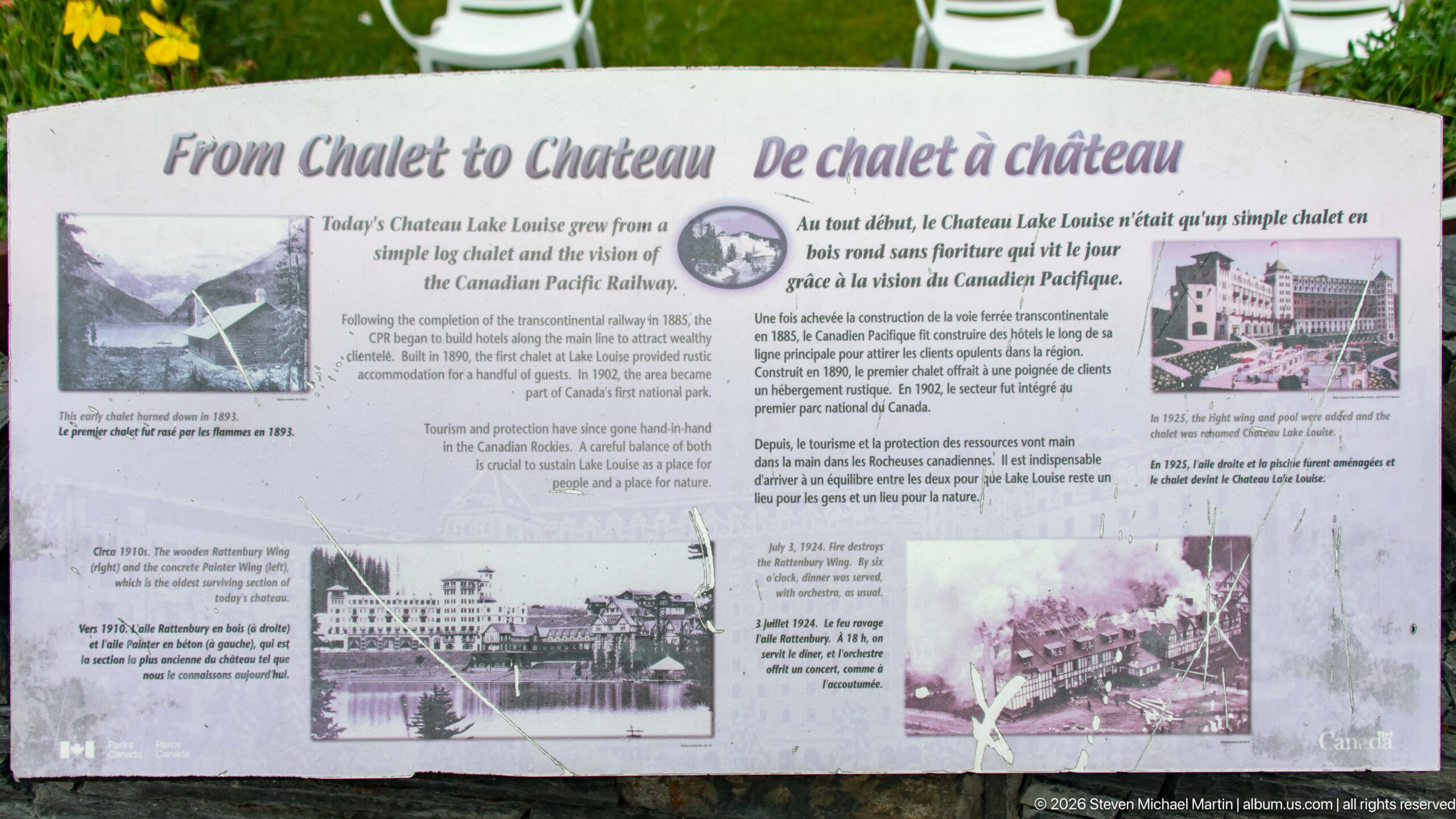
A bilingual panel headed “From Chalet to Chateau” traces the growth of the Lake Louise resort from a simple log chalet to the large hotel seen today. Archival photographs show earlier buildings and stages of development, while explanatory text occupies the center and lower sections. The sign places the Fairmont Chateau Lake Louise within a longer history of tourism and railway-era construction.
Caption
A bilingual panel headed “From Chalet to Chateau” traces the growth of the Lake Louise resort from a simple log chalet to the large hotel seen today. Archival photographs show earlier buildings and stages of development, while explanatory text occupies the center and lower sections. The sign places the Fairmont Chateau Lake Louise within a longer history of tourism and railway-era construction.
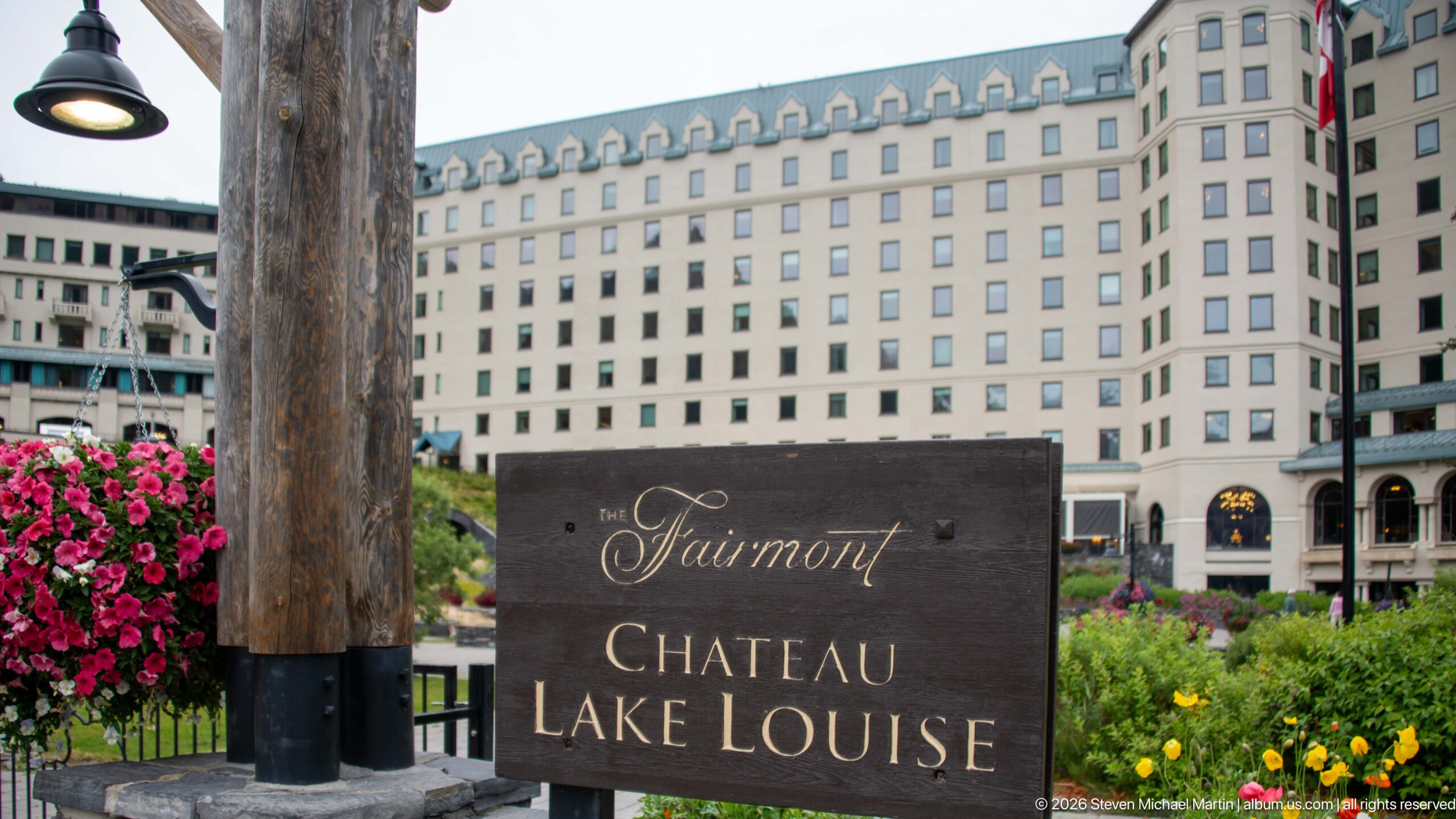
A dark wooden sign bearing the Fairmont Chateau Lake Louise name stands in a flower garden before the hotel’s pale multiwing façade. Pink and yellow blossoms frame the sign, while a timber post and black fence cross the foreground. The composition makes the resort name readable and ties the sign directly to the building behind it.
Caption
A dark wooden sign bearing the Fairmont Chateau Lake Louise name stands in a flower garden before the hotel’s pale multiwing façade. Pink and yellow blossoms frame the sign, while a timber post and black fence cross the foreground. The composition makes the resort name readable and ties the sign directly to the building behind it.
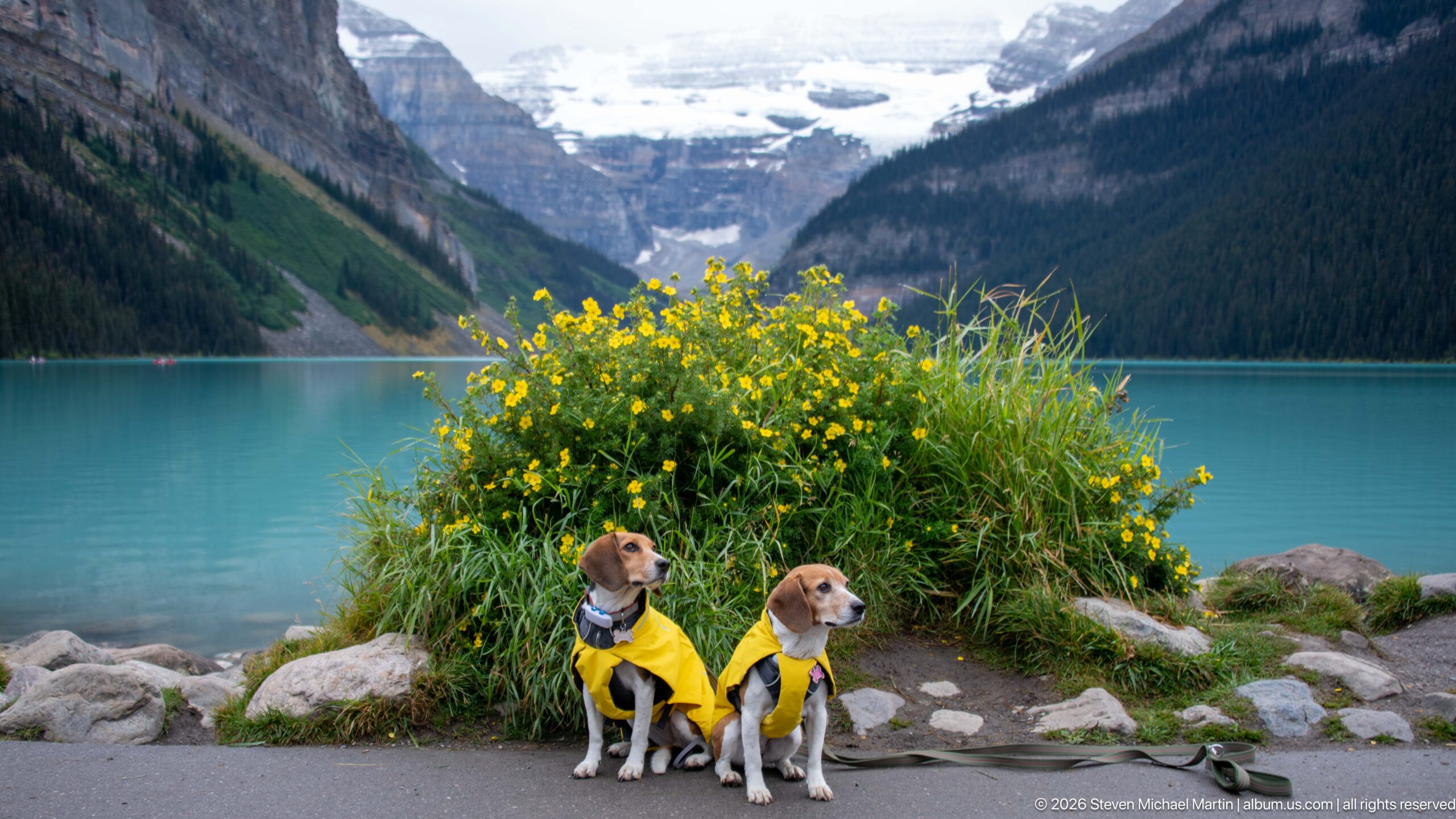
Two beagles wearing matching yellow raincoats sit on shoreline rocks beneath a dense clump of yellow flowers. The turquoise lake and dark valley recede behind them, with the far glacier visible between mountain walls. The low viewpoint gives the dogs a prominent foreground position while preserving the glacial landscape that surrounds the flowered shore.
Caption
Two beagles wearing matching yellow raincoats sit on shoreline rocks beneath a dense clump of yellow flowers. The turquoise lake and dark valley recede behind them, with the far glacier visible between mountain walls. The low viewpoint gives the dogs a prominent foreground position while preserving the glacial landscape that surrounds the flowered shore.
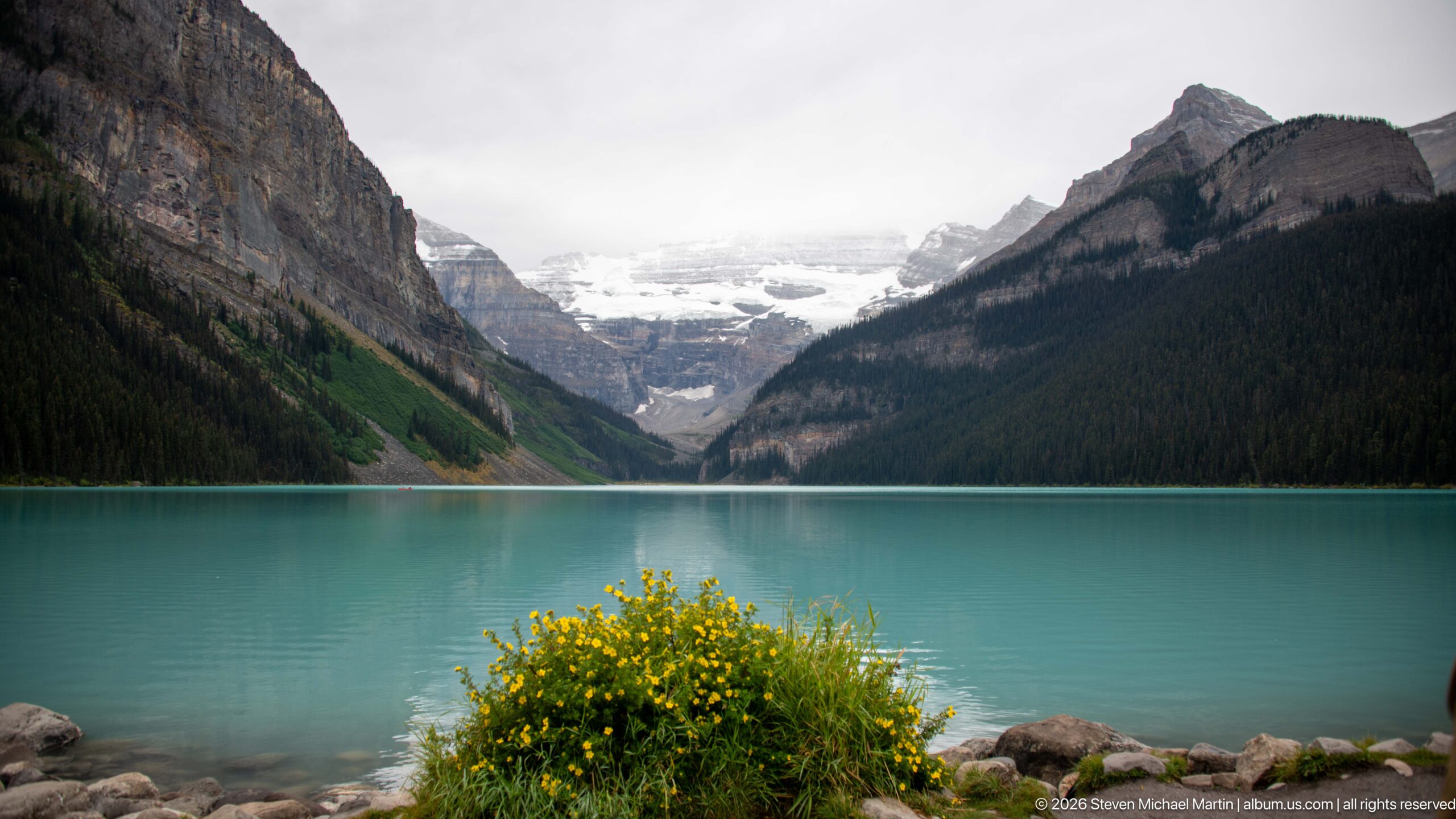
Yellow flowers rise from a rocky point in the foreground, centered against Lake Louise and the distant white ice of Victoria Glacier. Dark conifer slopes converge toward the glacier, while the smooth turquoise water forms a broad horizontal band through the middle. The small flowered promontory gives scale and foreground detail to the otherwise expansive valley view.
Caption
Yellow flowers rise from a rocky point in the foreground, centered against Lake Louise and the distant white ice of Victoria Glacier. Dark conifer slopes converge toward the glacier, while the smooth turquoise water forms a broad horizontal band through the middle. The small flowered promontory gives scale and foreground detail to the otherwise expansive valley view.
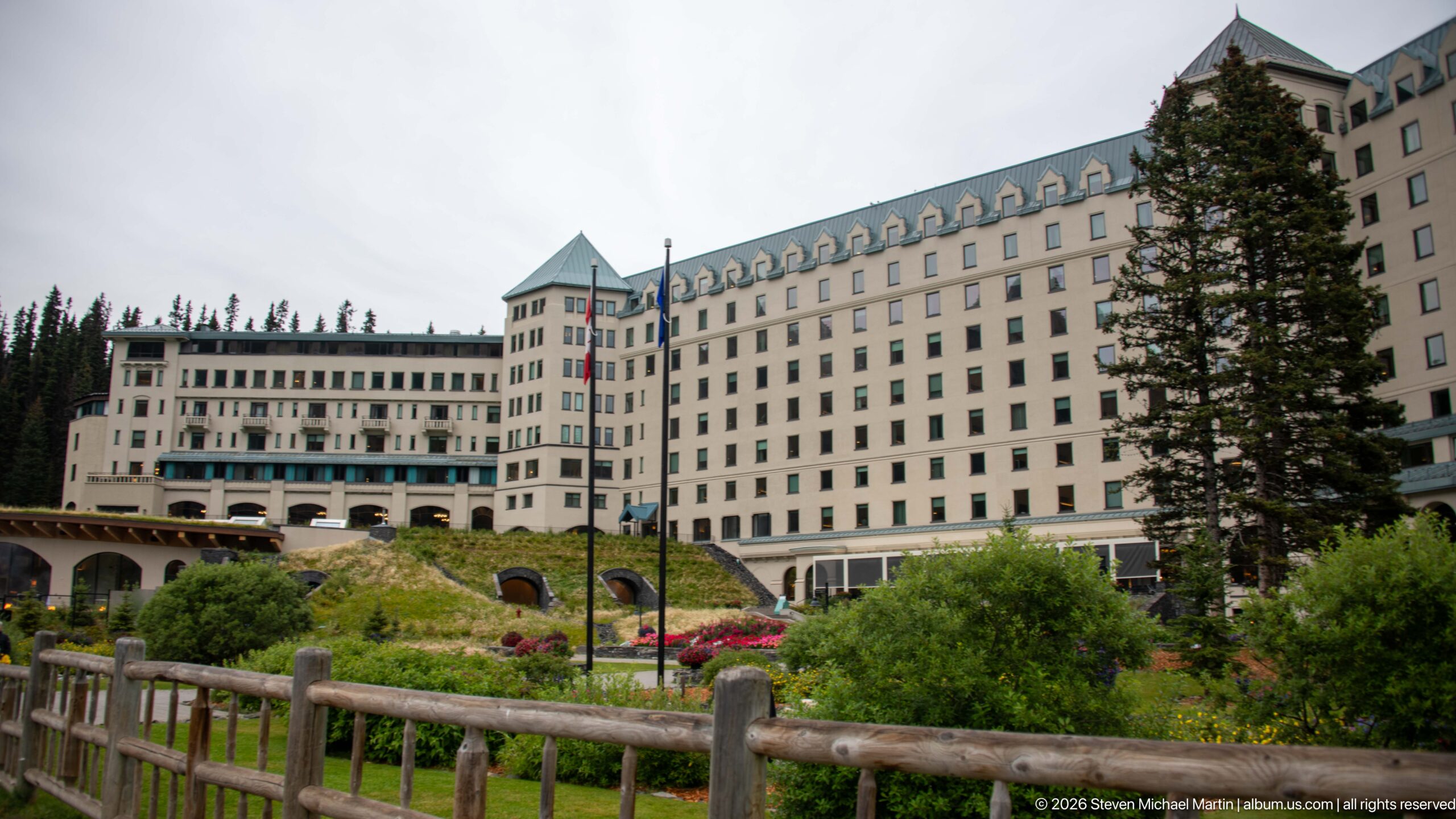
The Fairmont Chateau Lake Louise rises behind a timber fence and layered garden beds. Its pale wings, steep green roof, and arched ground-floor arcade appear between tall conifers, while pink flowers brighten the slope at right. The street-level composition includes both the resort’s broad façade and the boundary features that separate its gardens from the public route.
Caption
The Fairmont Chateau Lake Louise rises behind a timber fence and layered garden beds. Its pale wings, steep green roof, and arched ground-floor arcade appear between tall conifers, while pink flowers brighten the slope at right. The street-level composition includes both the resort’s broad façade and the boundary features that separate its gardens from the public route.
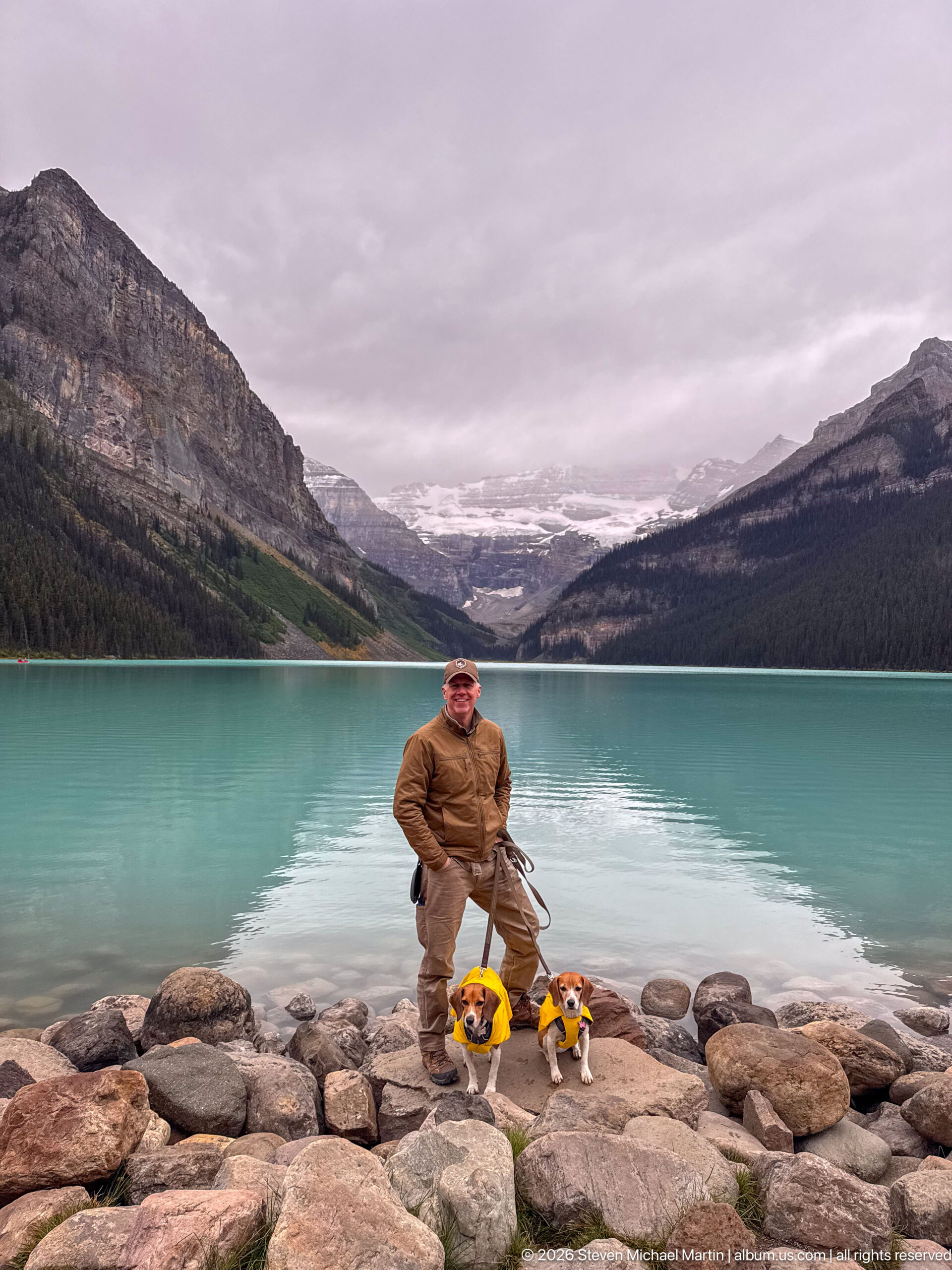
A visitor in a brown jacket stands on rounded shoreline boulders with two beagles in yellow coats at his feet. The trio is centered against the broad turquoise surface of Lake Louise, with the glacier and enclosing mountains visible down the valley. This full-body portrait gives equal space to the people, dogs, and alpine setting.
Caption
A visitor in a brown jacket stands on rounded shoreline boulders with two beagles in yellow coats at his feet. The trio is centered against the broad turquoise surface of Lake Louise, with the glacier and enclosing mountains visible down the valley. This full-body portrait gives equal space to the people, dogs, and alpine setting.
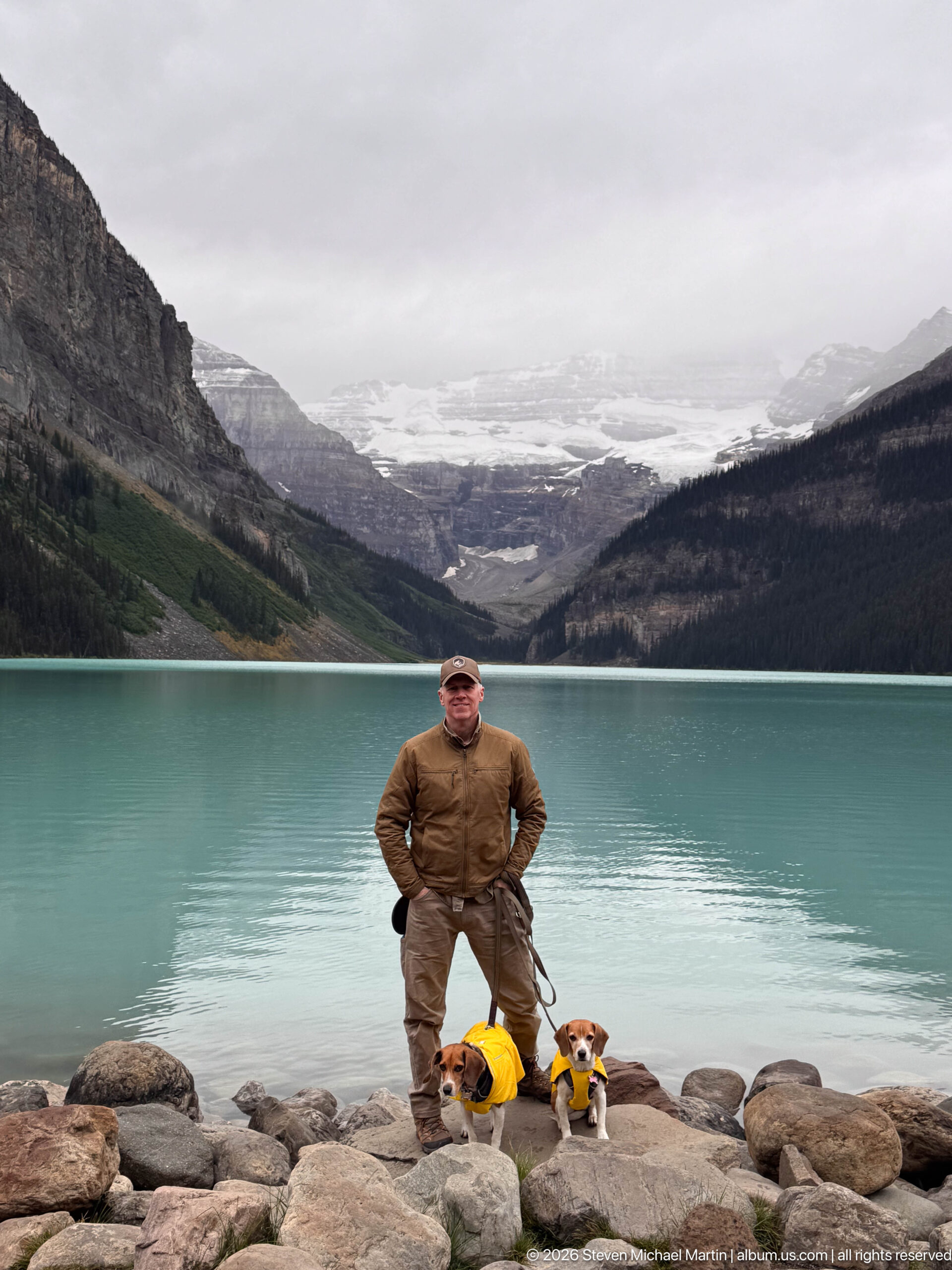
A visitor stands upright between two beagles on rounded shoreline stones, facing the camera as the dogs look in different directions. The turquoise lake, pale glacier, and dark mountain walls stretch behind the group. The level horizon and balanced placement make this a posed portrait, with the dogs’ yellow coats providing the brightest accents.
Caption
A visitor stands upright between two beagles on rounded shoreline stones, facing the camera as the dogs look in different directions. The turquoise lake, pale glacier, and dark mountain walls stretch behind the group. The level horizon and balanced placement make this a posed portrait, with the dogs’ yellow coats providing the brightest accents.
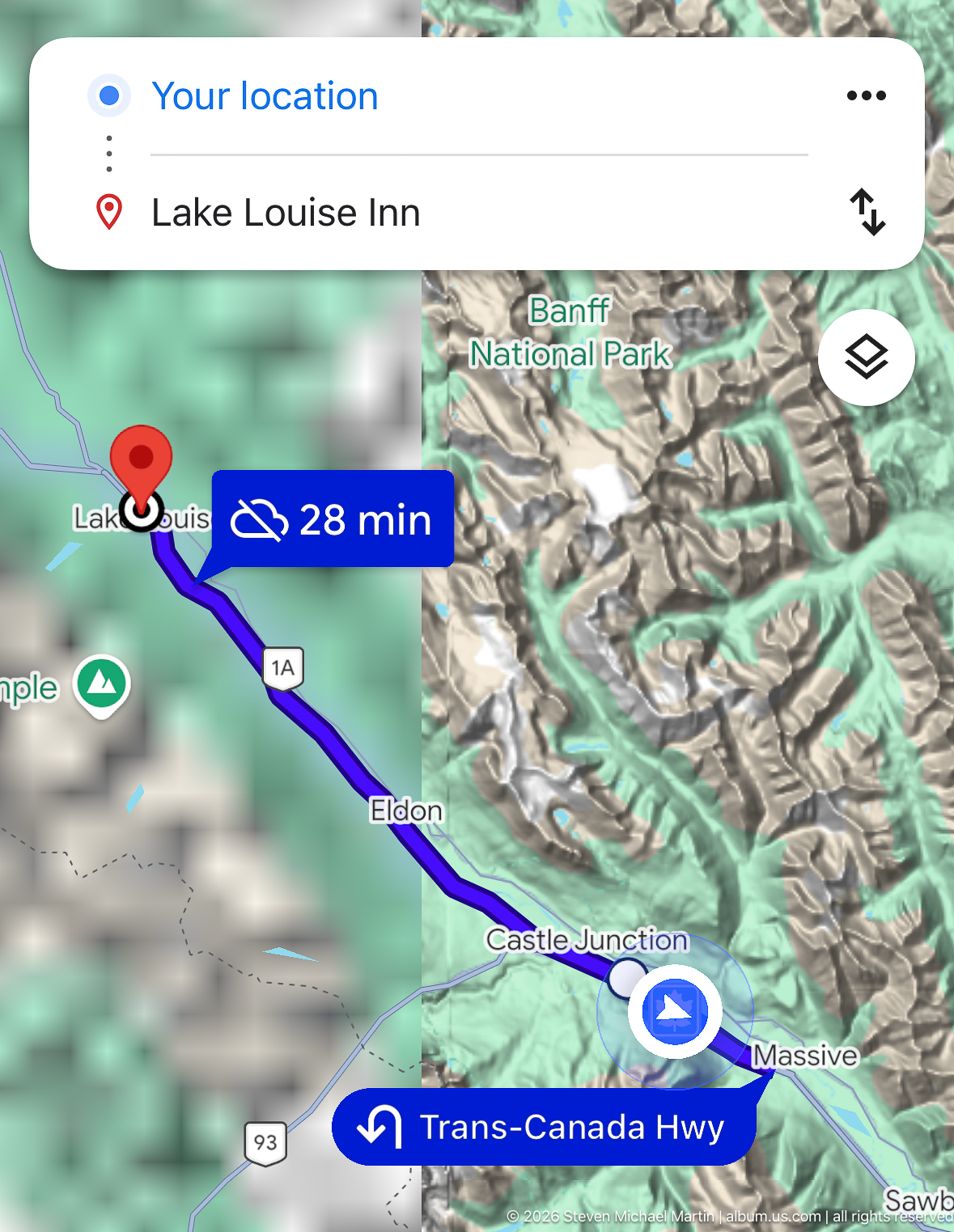
A navigation map screenshot shows a route along the Trans-Canada Highway through Banff National Park toward Lake Louise. The purple route crosses labeled places including Castle Junction and the Bow Valley corridor, with a travel-time badge visible near the destination. The screen combines a satellite-style terrain view and standard road map; interface details are described without reproducing personal account information.
Caption
A navigation map screenshot shows a route along the Trans-Canada Highway through Banff National Park toward Lake Louise. The purple route crosses labeled places including Castle Junction and the Bow Valley corridor, with a travel-time badge visible near the destination. The screen combines a satellite-style terrain view and standard road map; interface details are described without reproducing personal account information.
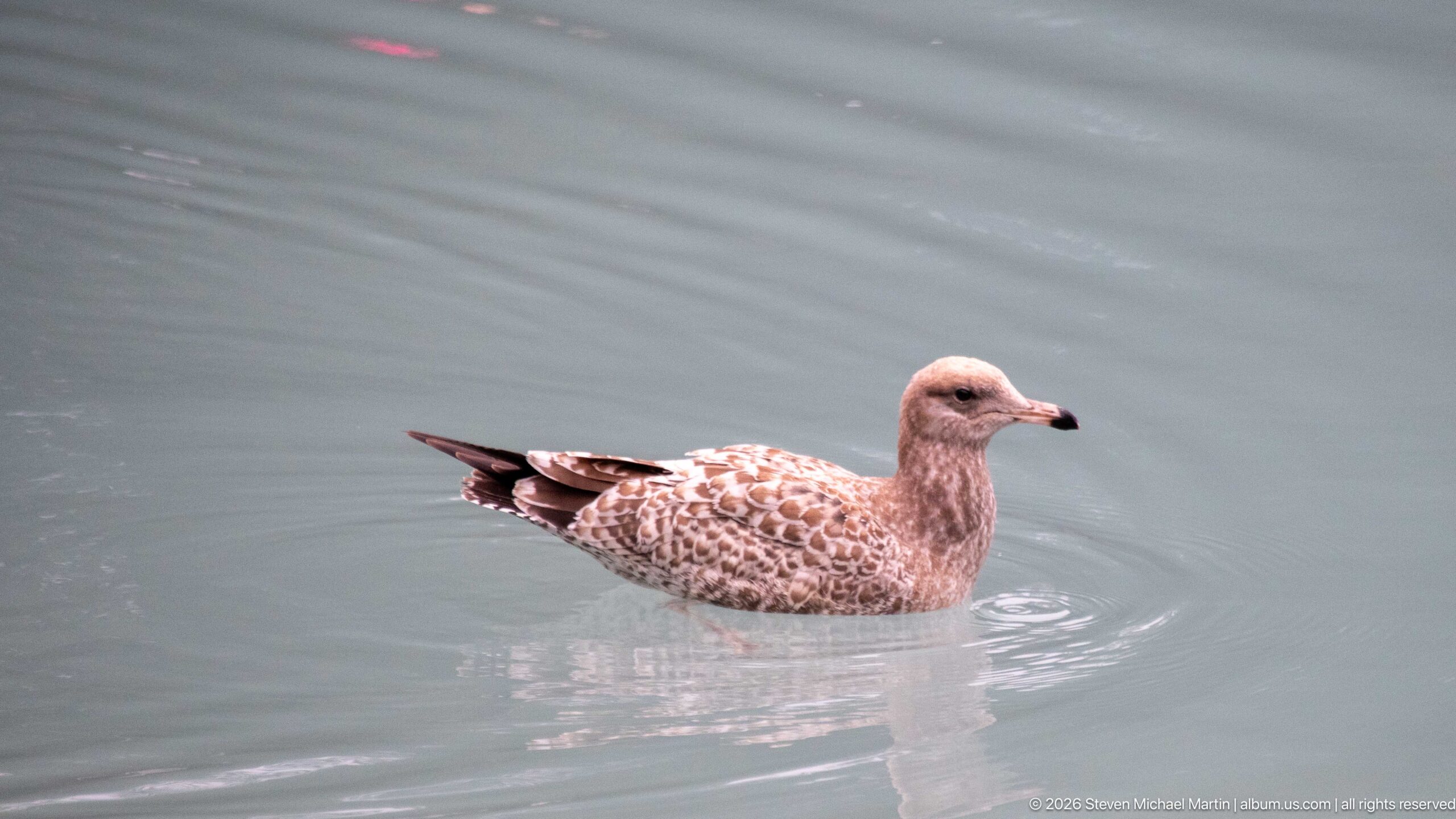
A mottled brown-and-cream gull floats alone on pale gray water, its body reflected in the rippled surface. The bird’s plumage is speckled rather than fully adult white and gray, suggesting an immature gull, but the proof-sheet view does not support a certain species or age class. The uncluttered water isolates the bird and its circular wake.
Caption
A mottled brown-and-cream gull floats alone on pale gray water, its body reflected in the rippled surface. The bird’s plumage is speckled rather than fully adult white and gray, suggesting an immature gull, but the proof-sheet view does not support a certain species or age class. The uncluttered water isolates the bird and its circular wake.
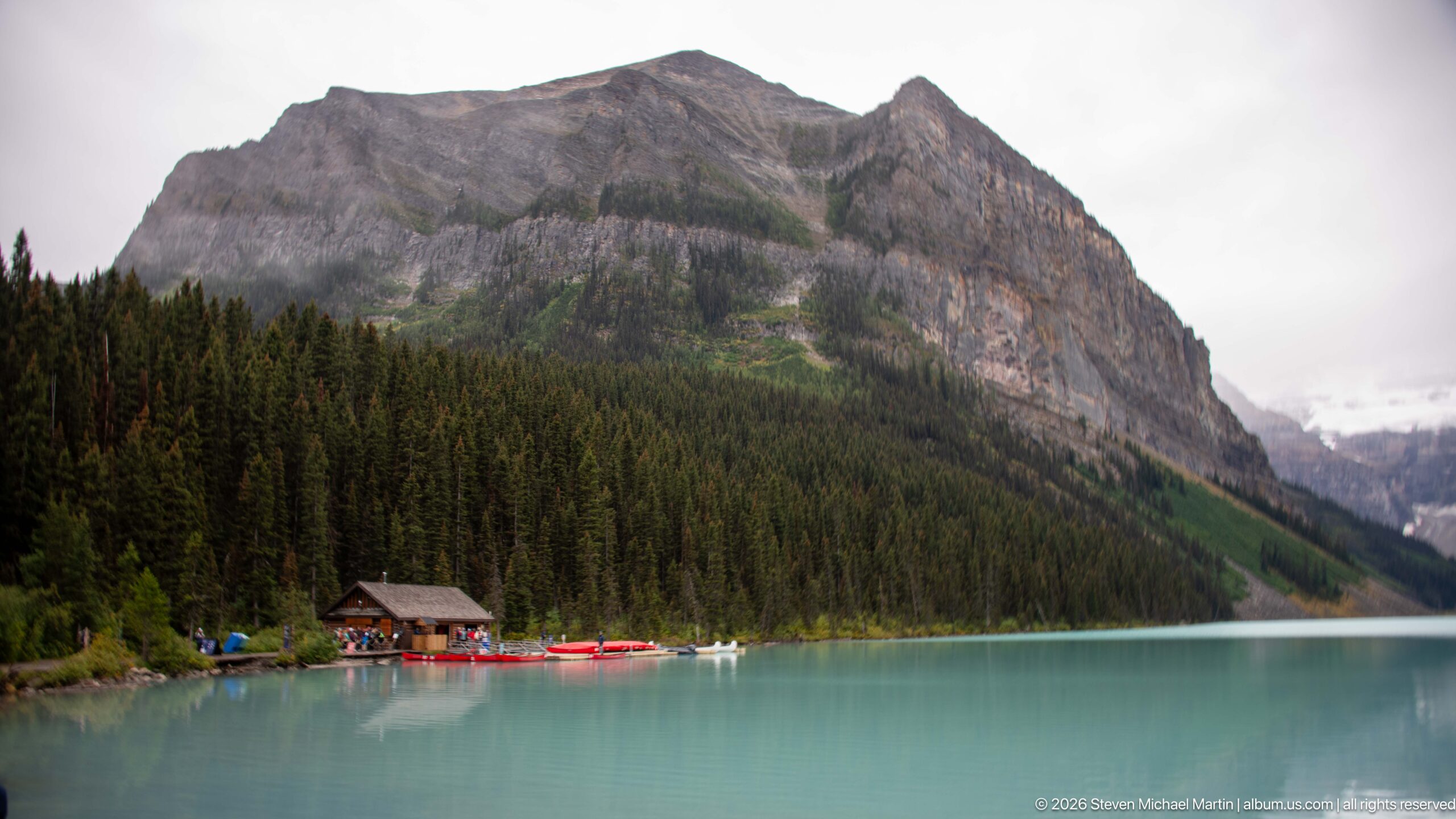
The small log boathouse and row of red rental canoes sit at the forested edge of Lake Louise beneath a steep, bare rock face. The wider view places the building low in the frame and gives the mountain the greater scale, while the turquoise water separates shore from viewer. A cloud veil softens the summit and upper ridge.
Caption
The small log boathouse and row of red rental canoes sit at the forested edge of Lake Louise beneath a steep, bare rock face. The wider view places the building low in the frame and gives the mountain the greater scale, while the turquoise water separates shore from viewer. A cloud veil softens the summit and upper ridge.
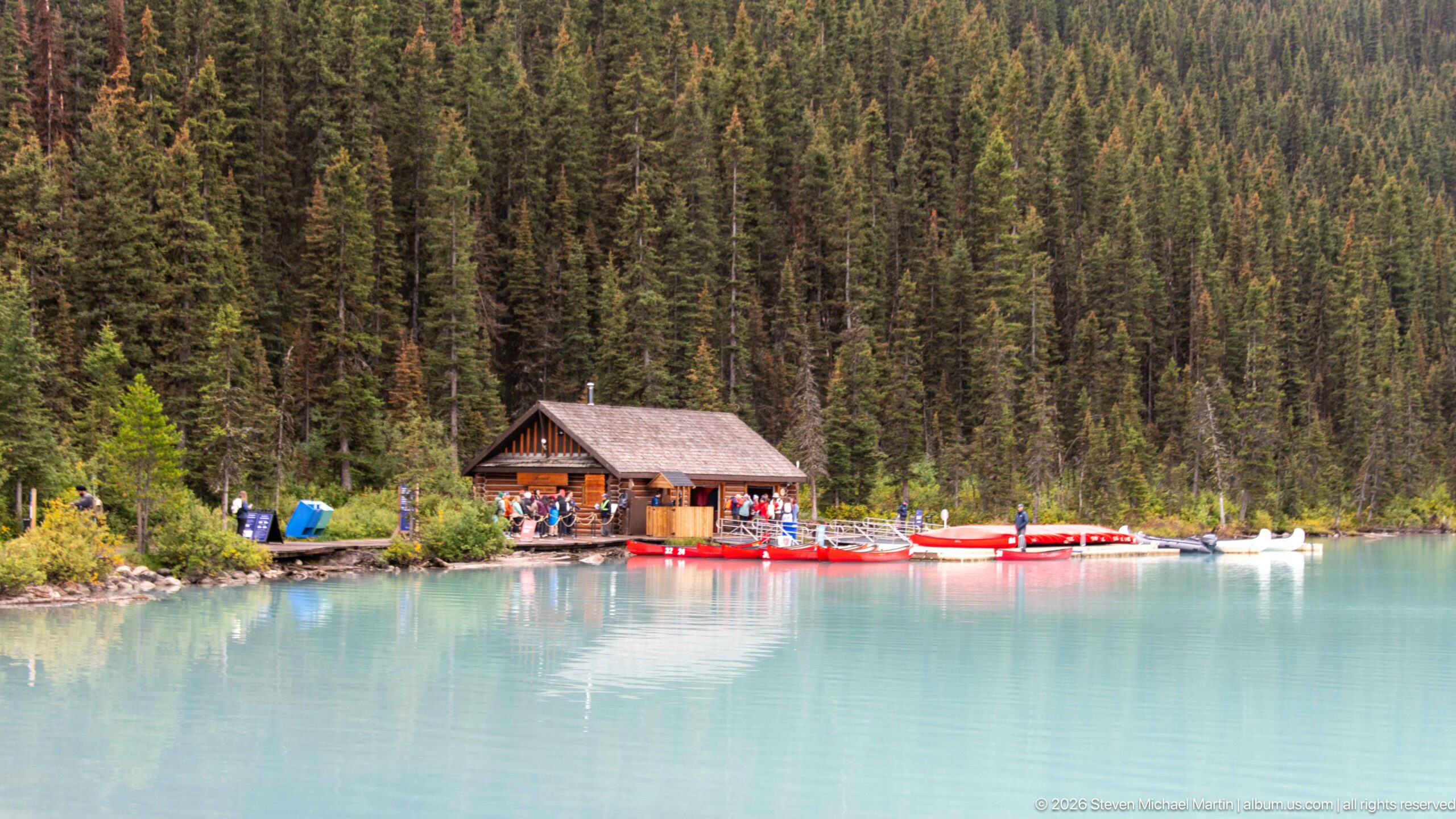
A long line of red canoes rests beside the low log boathouse, their bright hulls contrasting with turquoise Lake Louise. Forest fills the entire background, and the water occupies the foreground as a pale, reflective plane. This closer shore view records the rental operation in detail, with visitors visible near the building and boats.
Caption
A long line of red canoes rests beside the low log boathouse, their bright hulls contrasting with turquoise Lake Louise. Forest fills the entire background, and the water occupies the foreground as a pale, reflective plane. This closer shore view records the rental operation in detail, with visitors visible near the building and boats.
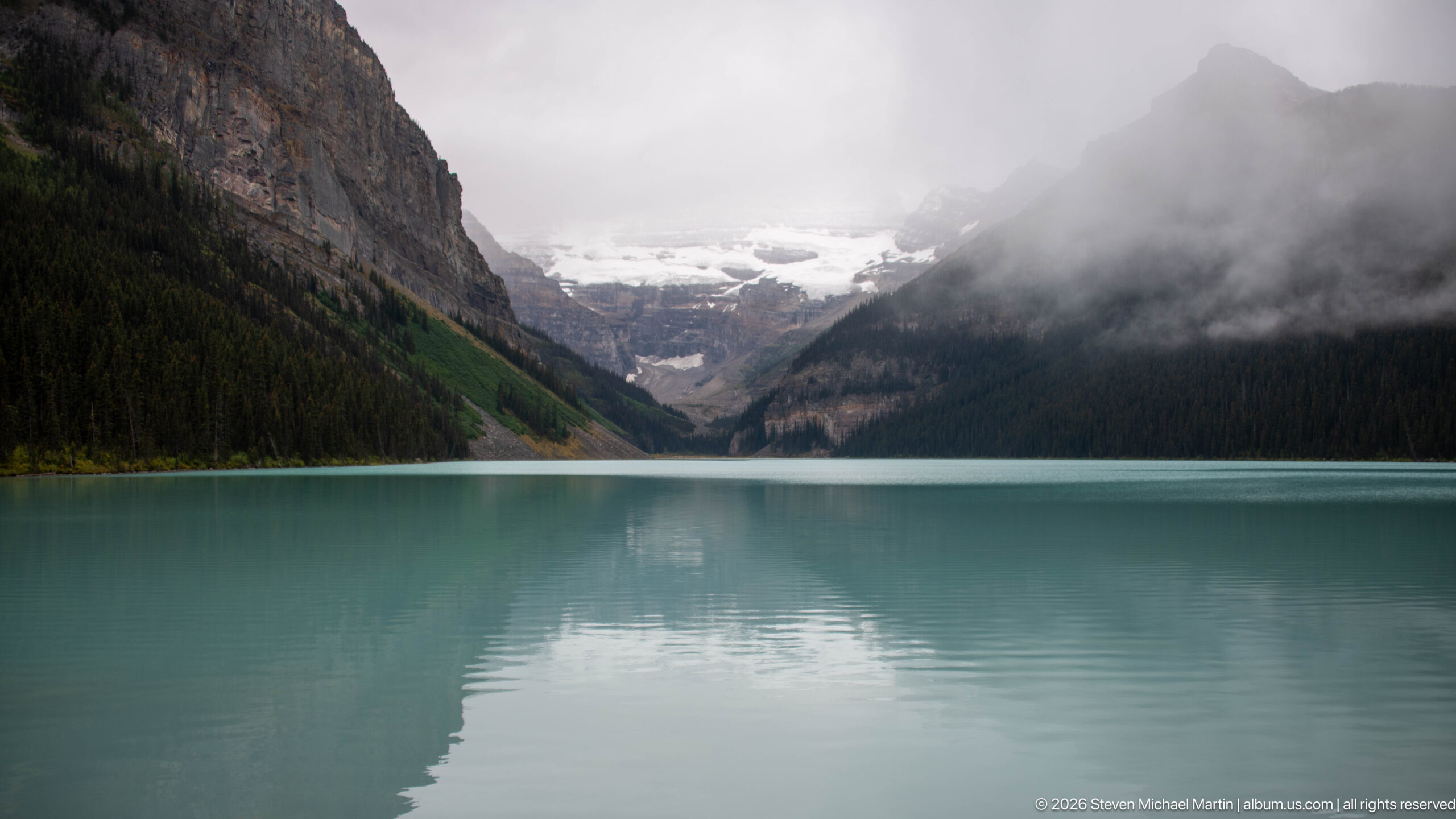
Low cloud drifts across the upper valley, partly covering Victoria Glacier at the head of Lake Louise. The smooth turquoise water reflects a narrow vertical opening in the clouds, while the dark slopes converge toward the glacier. This restrained panorama omits foreground people and structures, allowing the weather and distant ice to shape the scene.
Caption
Low cloud drifts across the upper valley, partly covering Victoria Glacier at the head of Lake Louise. The smooth turquoise water reflects a narrow vertical opening in the clouds, while the dark slopes converge toward the glacier. This restrained panorama omits foreground people and structures, allowing the weather and distant ice to shape the scene.
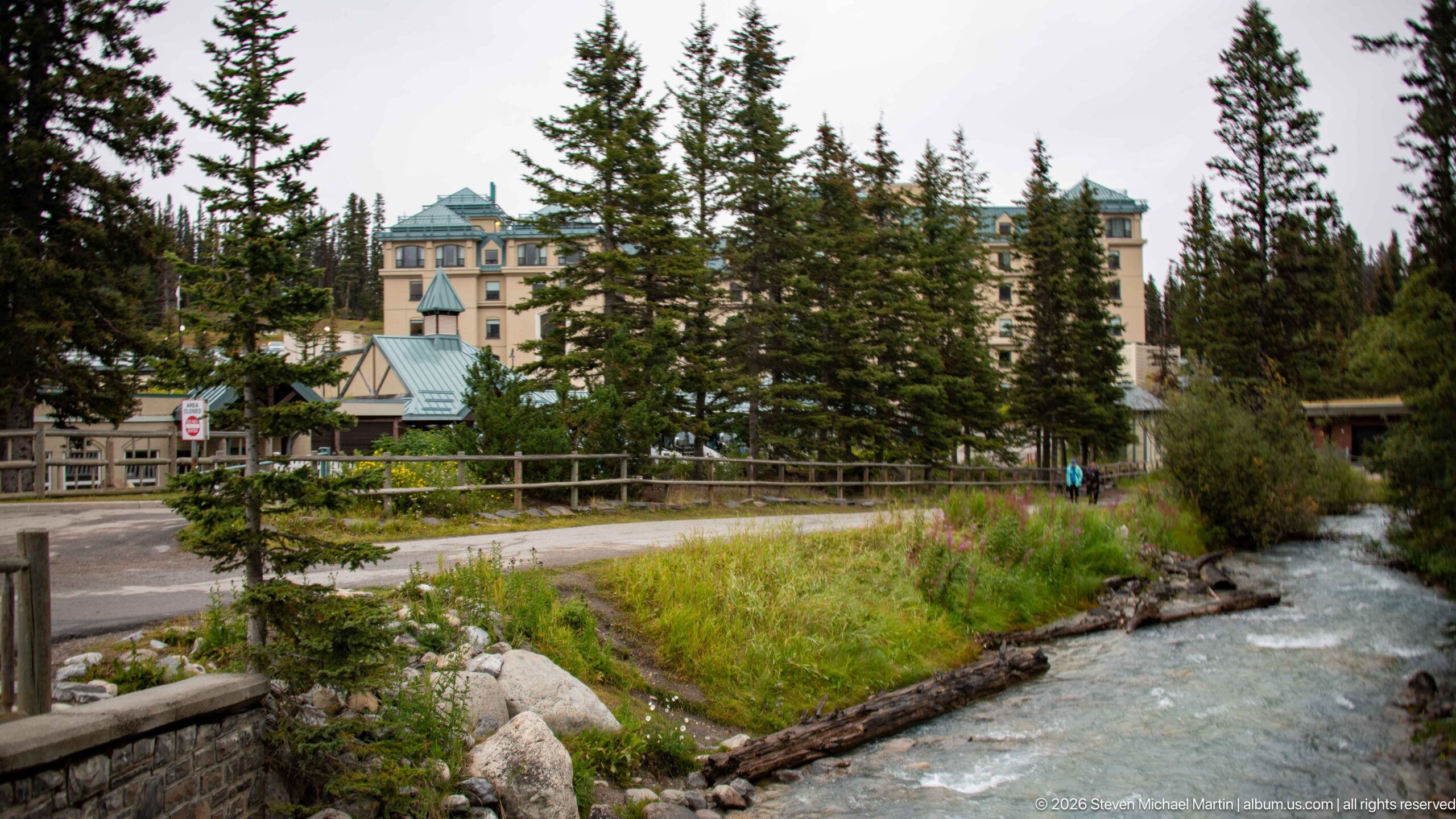
A fast stream crosses the foreground below a timber footbridge and stone retaining wall, while the Fairmont Chateau Lake Louise rises among conifers beyond the road. The water’s white turbulence contrasts with the hotel’s pale façade and green roof. This view connects the resort to the small waterways and landscaped infrastructure that border its grounds.
Caption
A fast stream crosses the foreground below a timber footbridge and stone retaining wall, while the Fairmont Chateau Lake Louise rises among conifers beyond the road. The water’s white turbulence contrasts with the hotel’s pale façade and green roof. This view connects the resort to the small waterways and landscaped infrastructure that border its grounds.
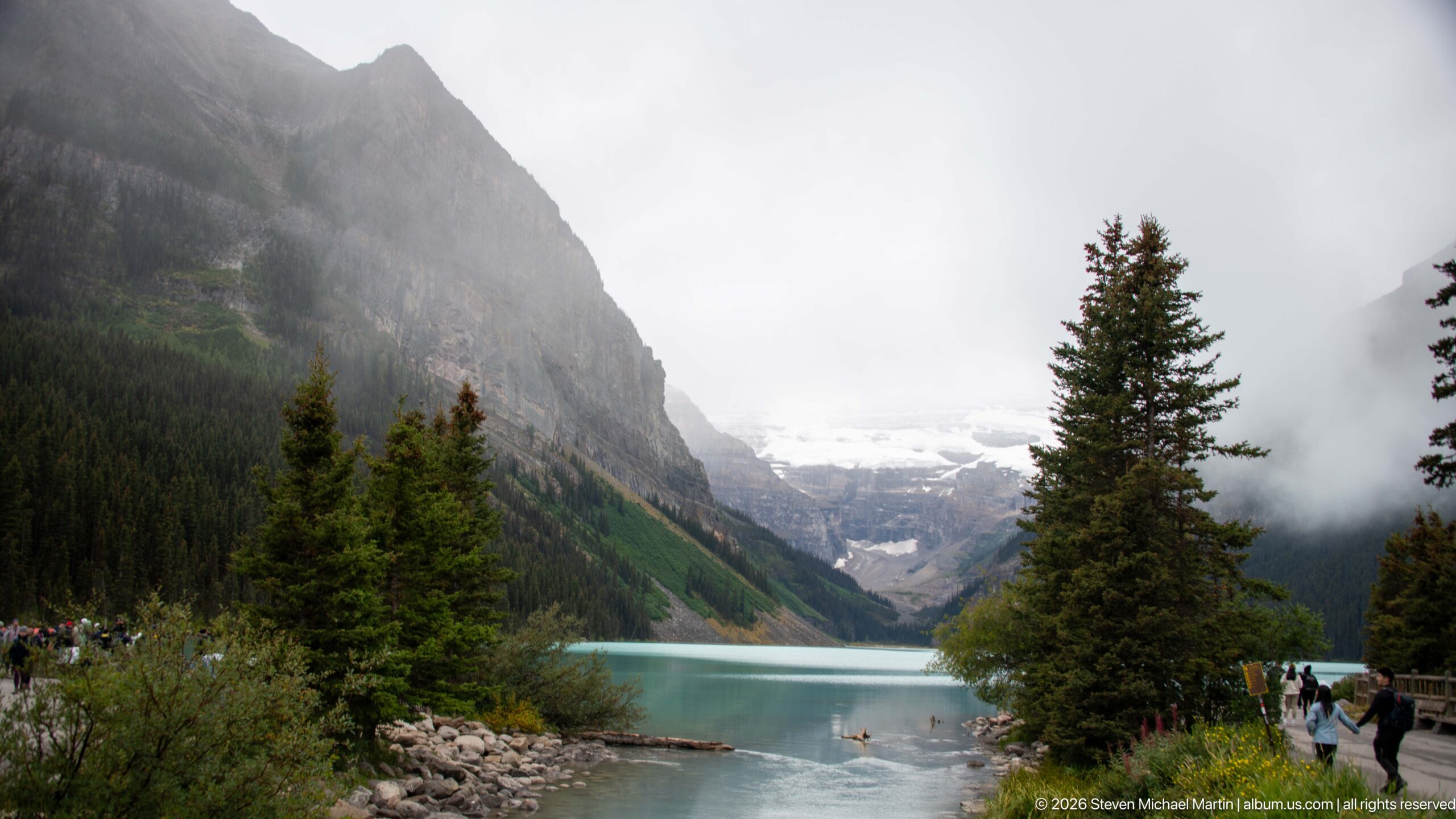
From the rocky near shore, the view follows Lake Louise toward Victoria Glacier, which appears through a break in the low cloud. Visitors stand at the water’s edge on the right, and a tiny canoe or boat sits near the center of the lake. The combination of human scale, still water, and distant ice gives this panorama a lived-in lakeside viewpoint.
Caption
From the rocky near shore, the view follows Lake Louise toward Victoria Glacier, which appears through a break in the low cloud. Visitors stand at the water’s edge on the right, and a tiny canoe or boat sits near the center of the lake. The combination of human scale, still water, and distant ice gives this panorama a lived-in lakeside viewpoint.
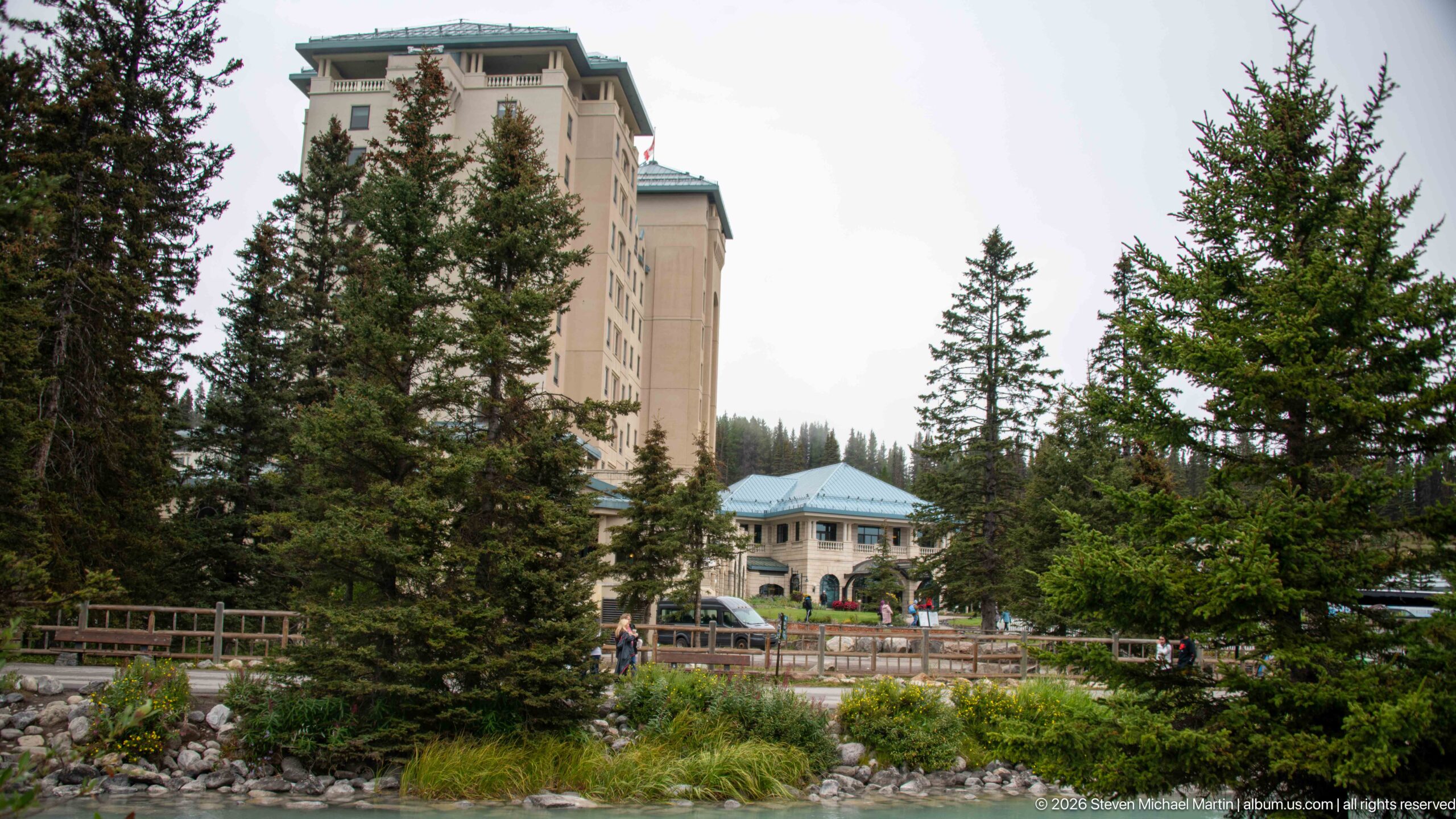
The hotel’s tall pale tower and lower green-roofed entrance emerge between spruce trees, viewed across a creek and landscaped grounds. A timber fence and road run through the middle distance, while shrubs and rocks frame the water. The layered composition partially hides the building, making the trees and approach route as prominent as the architecture.
Caption
The hotel’s tall pale tower and lower green-roofed entrance emerge between spruce trees, viewed across a creek and landscaped grounds. A timber fence and road run through the middle distance, while shrubs and rocks frame the water. The layered composition partially hides the building, making the trees and approach route as prominent as the architecture.
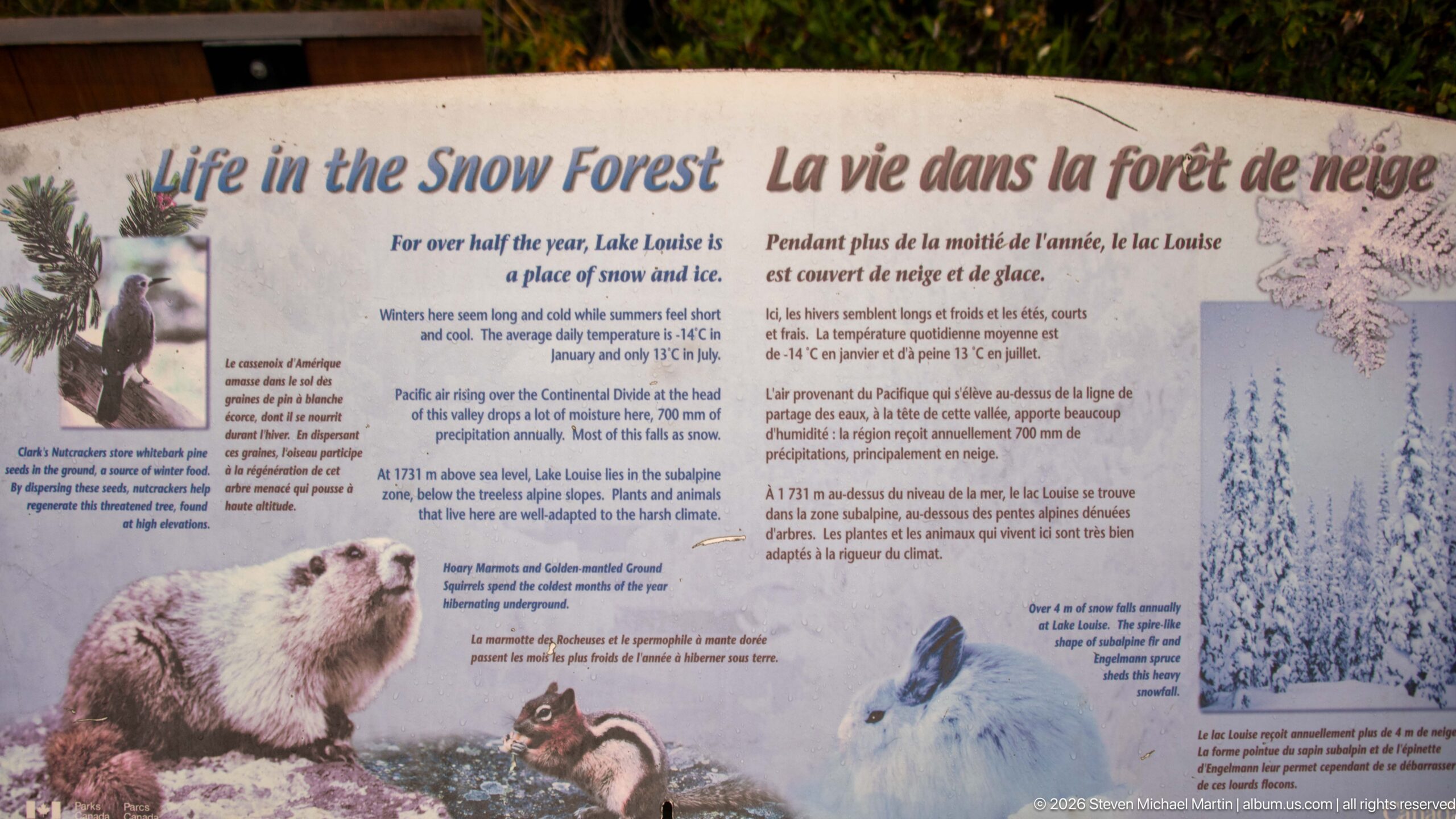
A bilingual interpretive sign titled “Life in the Snow Forest” combines explanatory text with large wildlife illustrations, including a mountain goat and smaller forest animals. The panel describes the long winter conditions around Lake Louise and the adaptations of animals living in this environment. Its close crop reveals the educational display’s imagery and typography, though glare makes some smaller text difficult to read.
Caption
A bilingual interpretive sign titled “Life in the Snow Forest” combines explanatory text with large wildlife illustrations, including a mountain goat and smaller forest animals. The panel describes the long winter conditions around Lake Louise and the adaptations of animals living in this environment. Its close crop reveals the educational display’s imagery and typography, though glare makes some smaller text difficult to read.
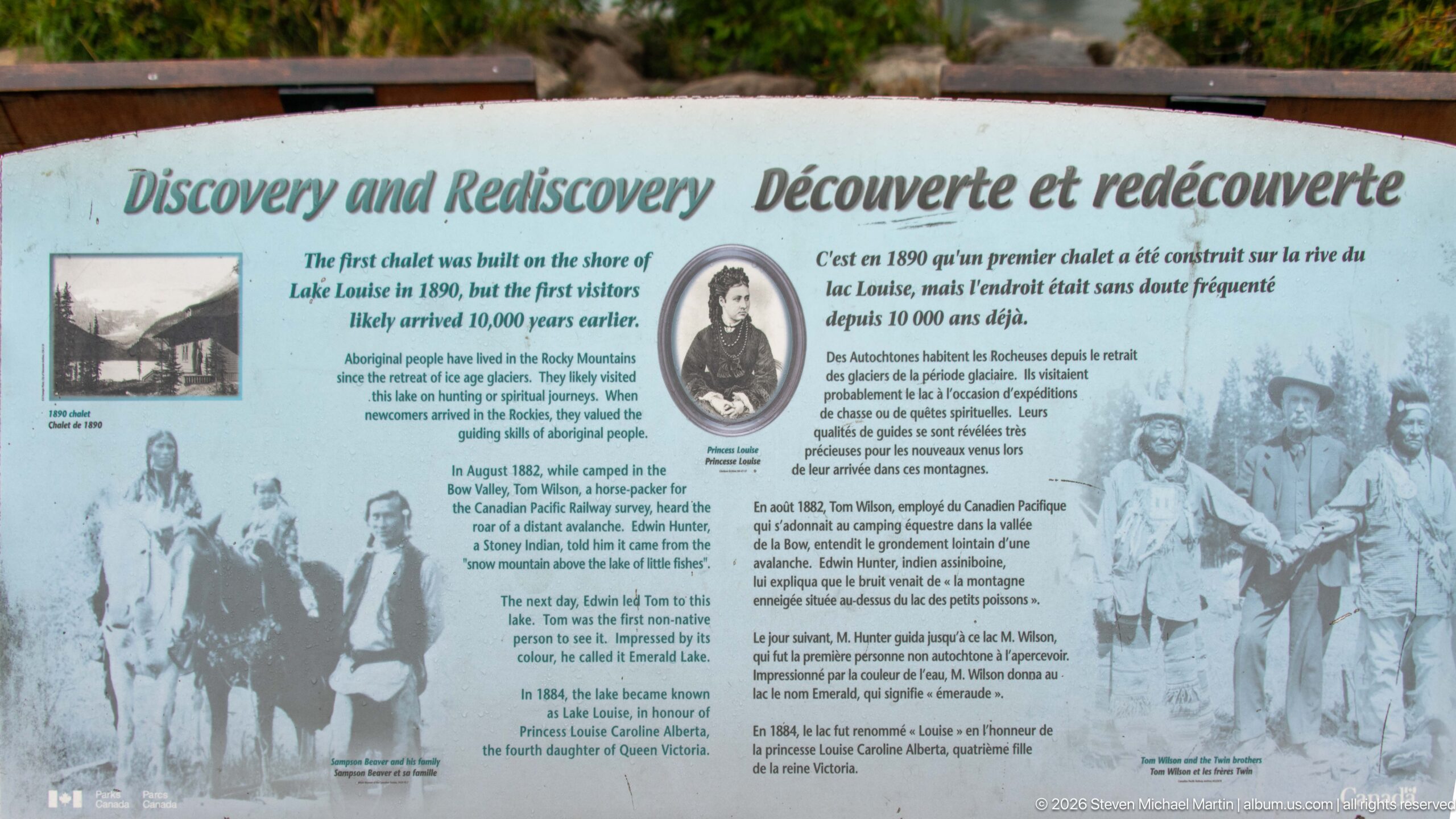
A bilingual panel titled “Discovery and Rediscovery” presents historical text and archival illustrations about the Lake Louise area, including Indigenous presence and later exploration. Portraits and figures flank a central narrative, with a small archival photograph at upper left. The proof sheet shows the panel’s theme clearly, but the detailed names and chronology should be checked against the original sign before being quoted.
Caption
A bilingual panel titled “Discovery and Rediscovery” presents historical text and archival illustrations about the Lake Louise area, including Indigenous presence and later exploration. Portraits and figures flank a central narrative, with a small archival photograph at upper left. The proof sheet shows the panel’s theme clearly, but the detailed names and chronology should be checked against the original sign before being quoted.
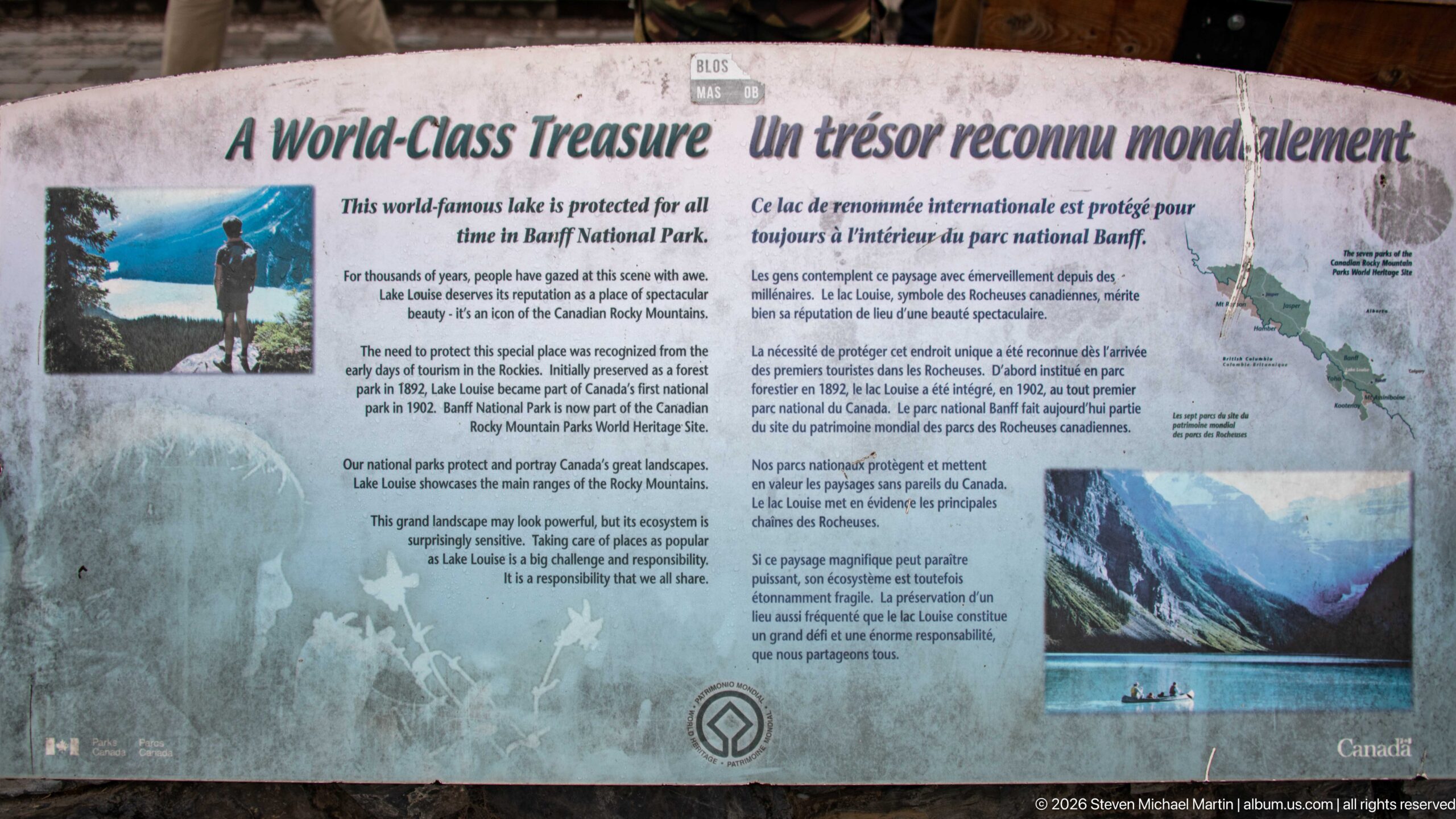
A bilingual interpretive display headed “Lake Louise: A World Treasure” explains the lake’s significance and protection within Banff National Park. A small inset photograph shows a visitor at the water, and a larger image at lower right presents the lake and mountains. A map occupies the upper-right corner, tying the written interpretation to the surrounding protected landscape.
Caption
A bilingual interpretive display headed “Lake Louise: A World Treasure” explains the lake’s significance and protection within Banff National Park. A small inset photograph shows a visitor at the water, and a larger image at lower right presents the lake and mountains. A map occupies the upper-right corner, tying the written interpretation to the surrounding protected landscape.
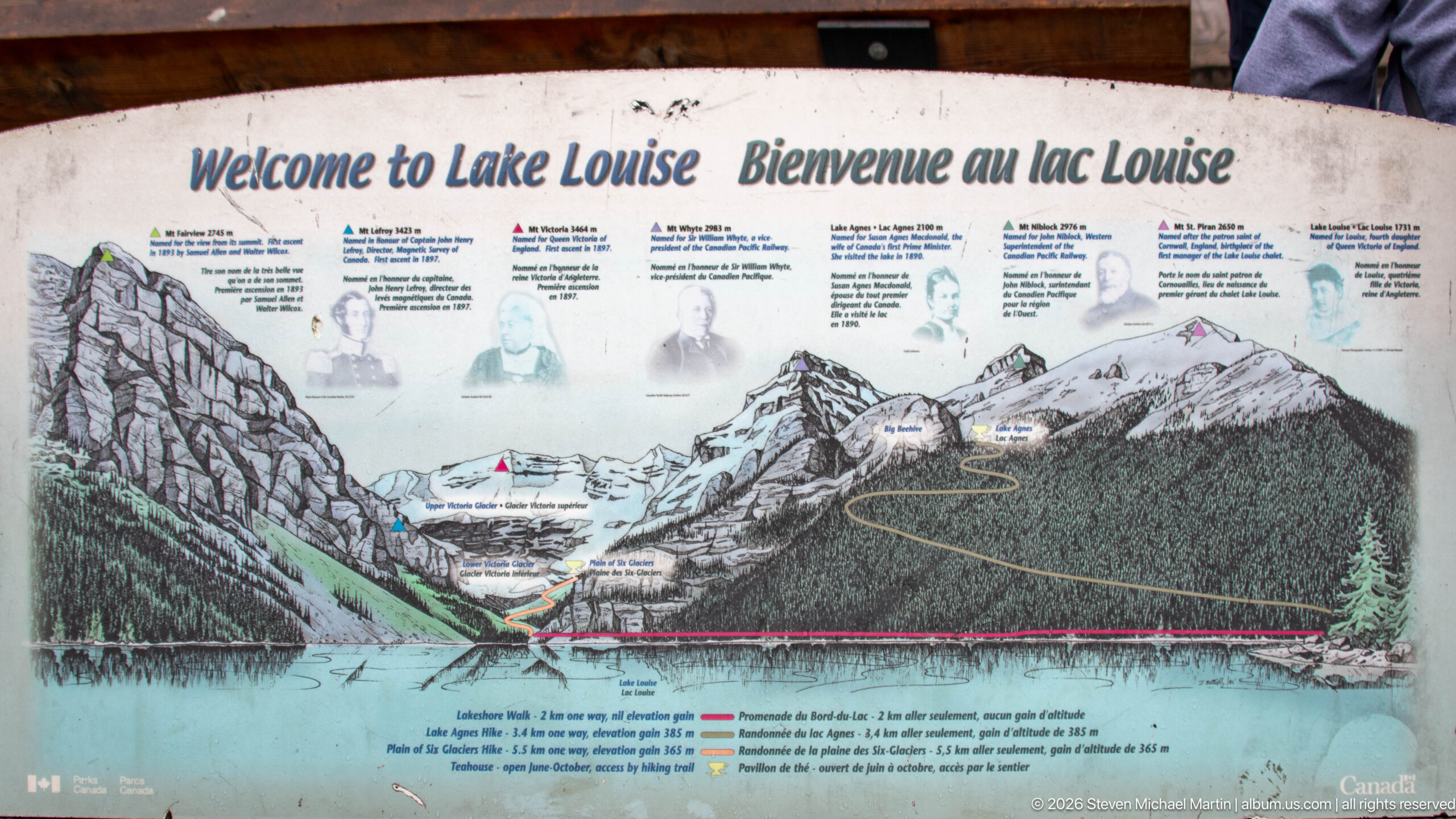
A wide bilingual welcome panel maps the Lake Louise basin with illustrated mountain profiles, the shoreline, and colored routes. Small labels and trail markers connect the resort area with nearby destinations, while “Welcome to Lake Louise” spans the top. The diagram is designed for orientation rather than close landscape identification; its broad format and layered map make it a visitor information display.
Caption
A wide bilingual welcome panel maps the Lake Louise basin with illustrated mountain profiles, the shoreline, and colored routes. Small labels and trail markers connect the resort area with nearby destinations, while “Welcome to Lake Louise” spans the top. The diagram is designed for orientation rather than close landscape identification; its broad format and layered map make it a visitor information display.
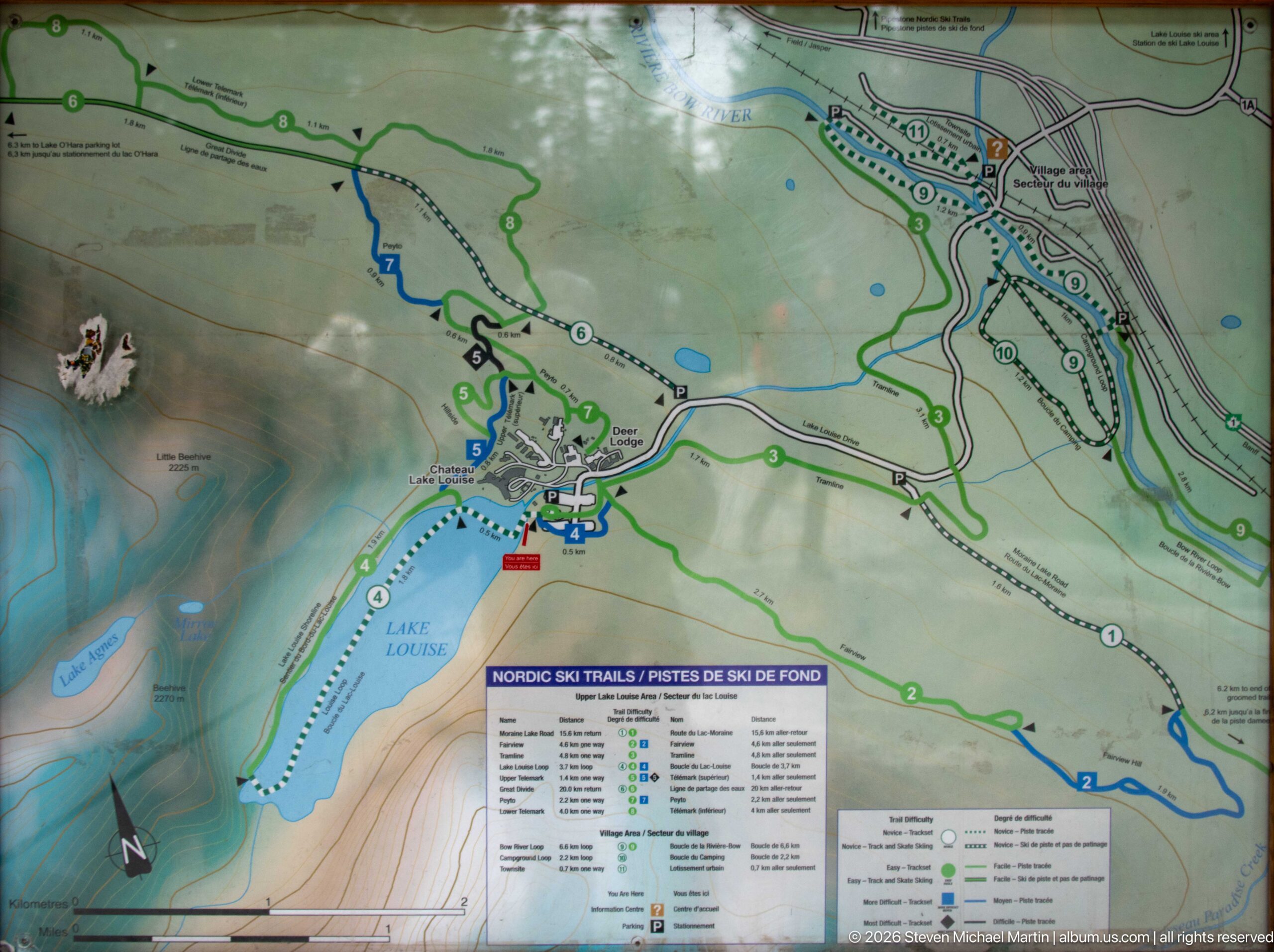
A large map panel shows the Lake Louise shoreline, nearby roads, and a network of colored trails. A legend for Nordic ski routes sits across the lower center, while symbols and numbered paths mark the wider recreation area. The map is photographed at an angle with some glare, but its main function is clear: orienting visitors among the lake, village, and surrounding routes.
Caption
A large map panel shows the Lake Louise shoreline, nearby roads, and a network of colored trails. A legend for Nordic ski routes sits across the lower center, while symbols and numbered paths mark the wider recreation area. The map is photographed at an angle with some glare, but its main function is clear: orienting visitors among the lake, village, and surrounding routes.
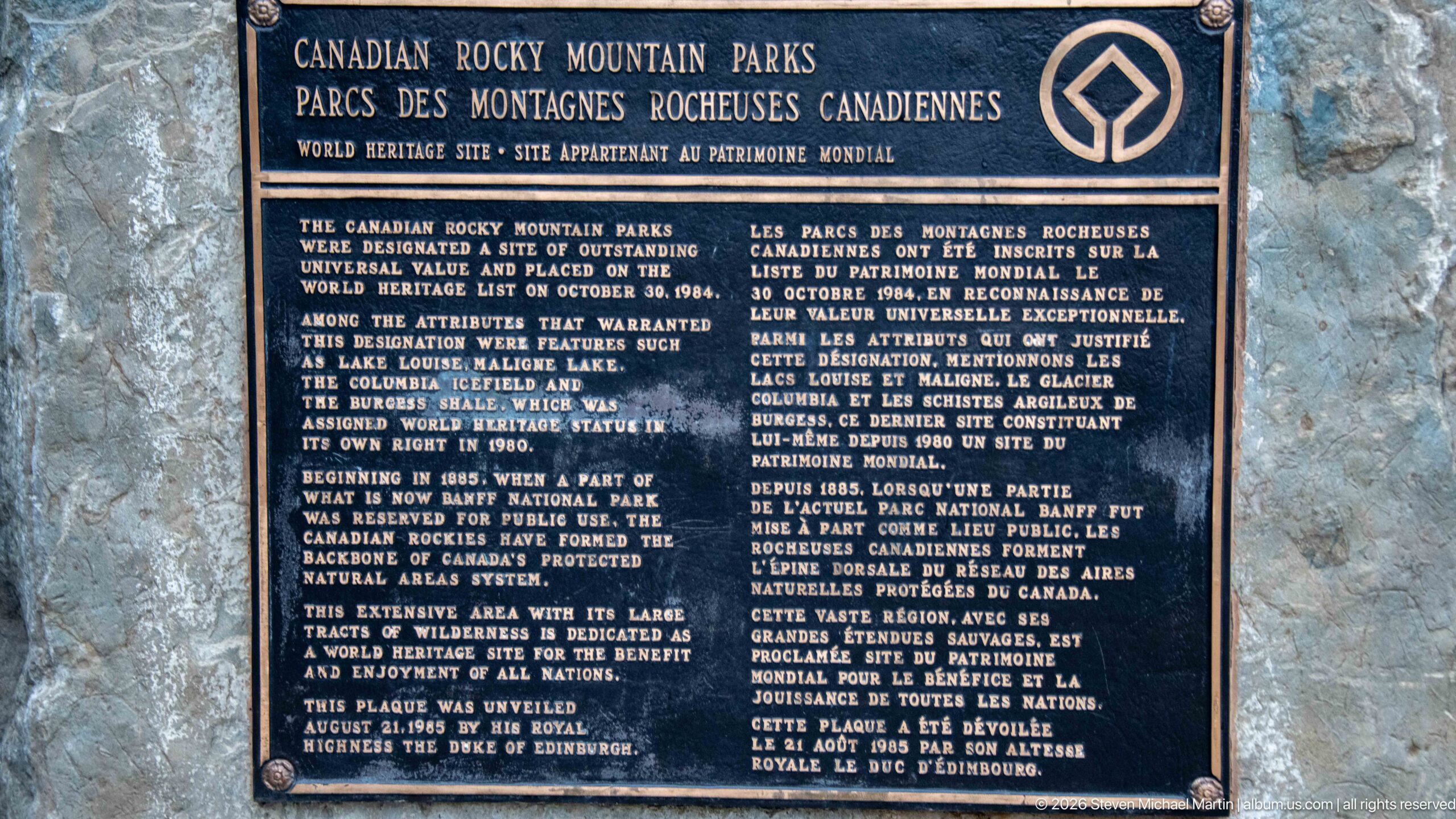
A dark bilingual plaque set into a rough stone wall identifies the Canadian Rocky Mountain Parks as a World Heritage Site. Its text describes the parks’ outstanding universal value and refers to Lake Louise and other features of the protected landscape. The bronze-toned lettering, UNESCO emblem, and stone surround make this a formal designation marker rather than a general interpretive sign.
Caption
A dark bilingual plaque set into a rough stone wall identifies the Canadian Rocky Mountain Parks as a World Heritage Site. Its text describes the parks’ outstanding universal value and refers to Lake Louise and other features of the protected landscape. The bronze-toned lettering, UNESCO emblem, and stone surround make this a formal designation marker rather than a general interpretive sign.
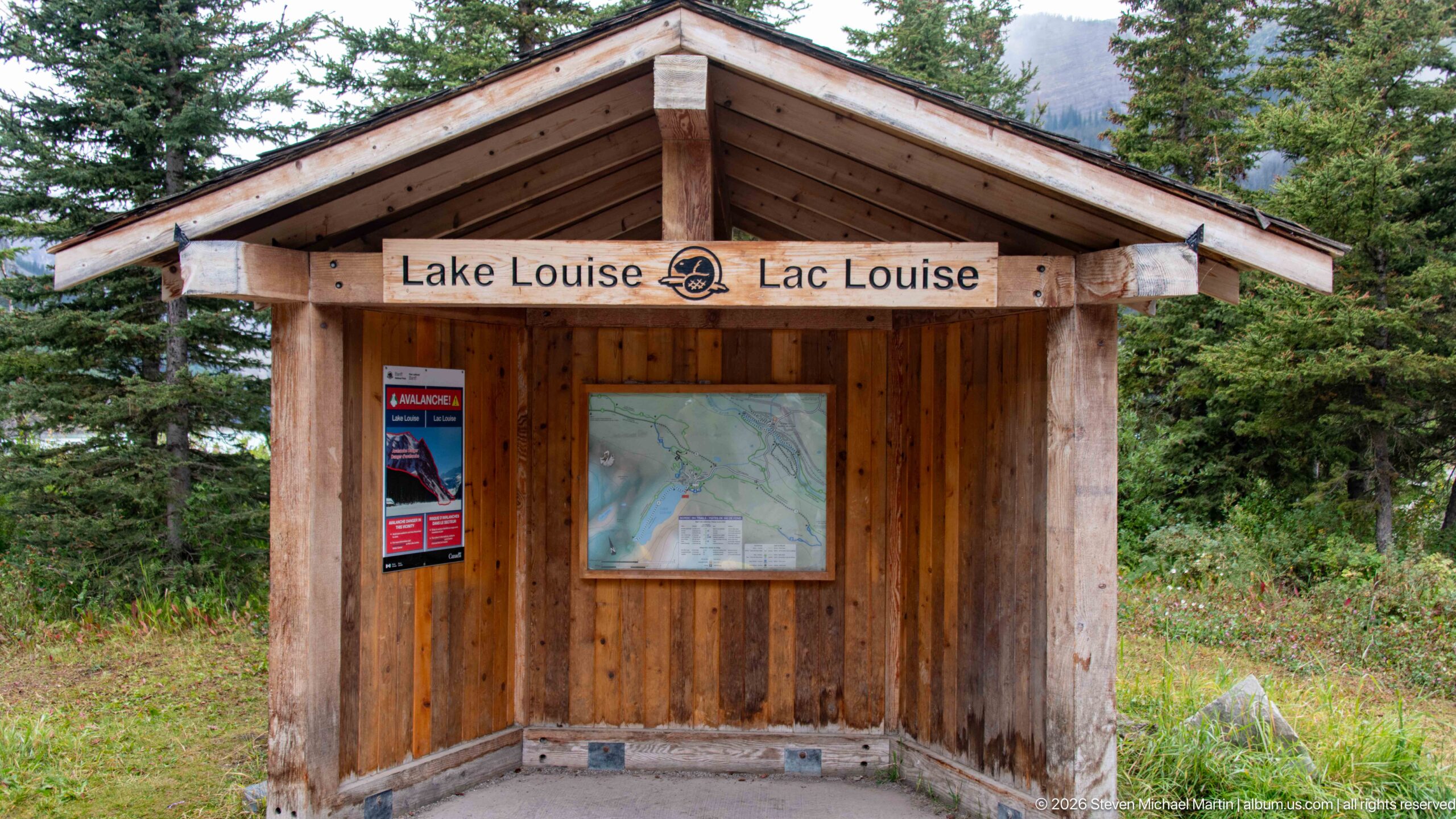
A small timber kiosk bears the bilingual name “Lake Louise / Lac Louise” above a framed map. The open-front shelter is built from warm-toned planks beneath a pitched shingle roof, with evergreen trees and low vegetation behind it. A vertical notice and map panel make the structure a practical wayfinding point, while the clear place-name sign anchors it to the lake.
Caption
A small timber kiosk bears the bilingual name “Lake Louise / Lac Louise” above a framed map. The open-front shelter is built from warm-toned planks beneath a pitched shingle roof, with evergreen trees and low vegetation behind it. A vertical notice and map panel make the structure a practical wayfinding point, while the clear place-name sign anchors it to the lake.
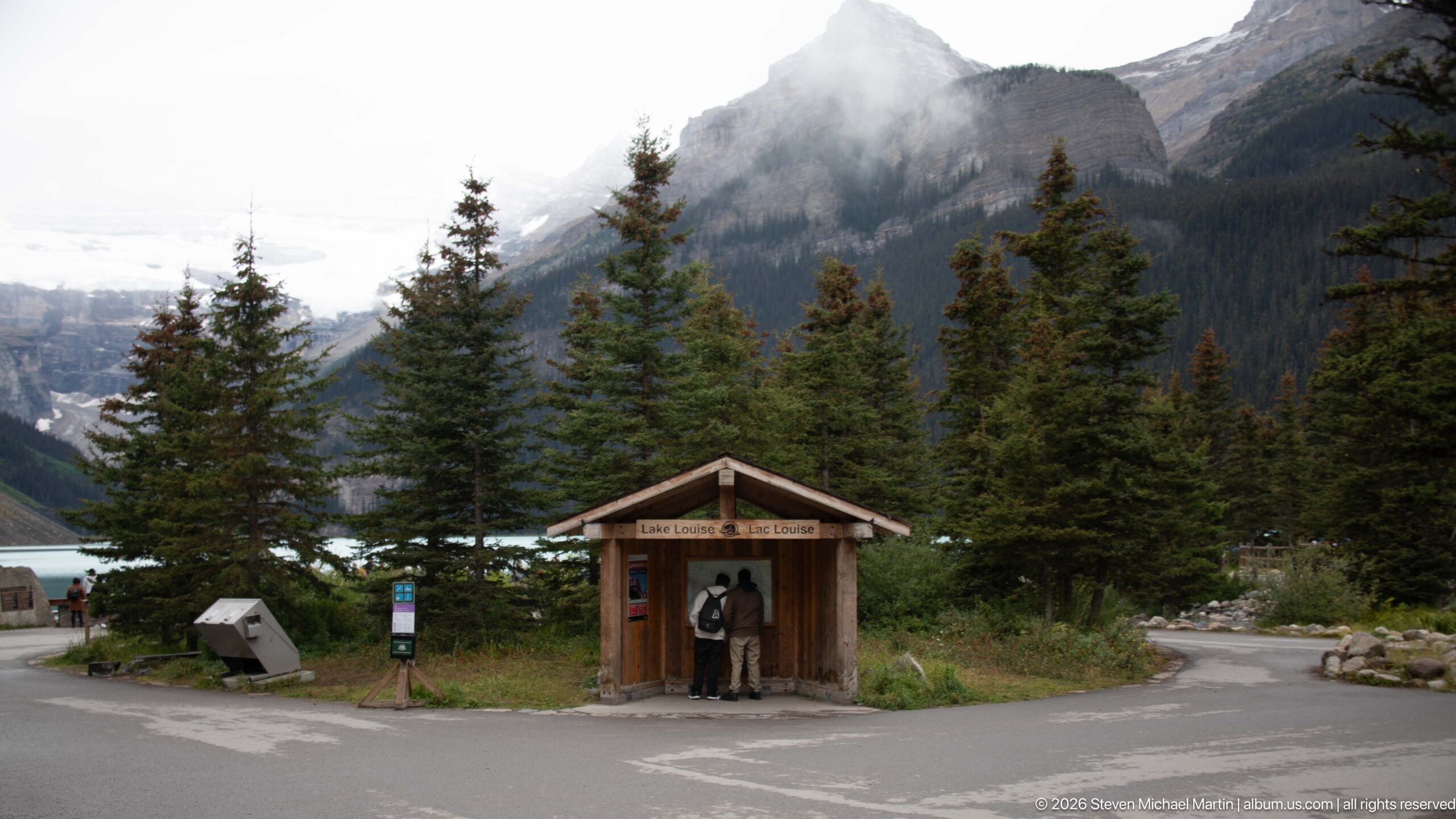
The wooden Lake Louise map kiosk stands at a fork in the paved approach, with a visitor studying its panel beneath the roof. Conifers and clouded mountain slopes rise behind the shelter, while a small portion of turquoise water appears at left. The wider view places the information point within its landscape and shows the path splitting around the kiosk.
Caption
The wooden Lake Louise map kiosk stands at a fork in the paved approach, with a visitor studying its panel beneath the roof. Conifers and clouded mountain slopes rise behind the shelter, while a small portion of turquoise water appears at left. The wider view places the information point within its landscape and shows the path splitting around the kiosk.
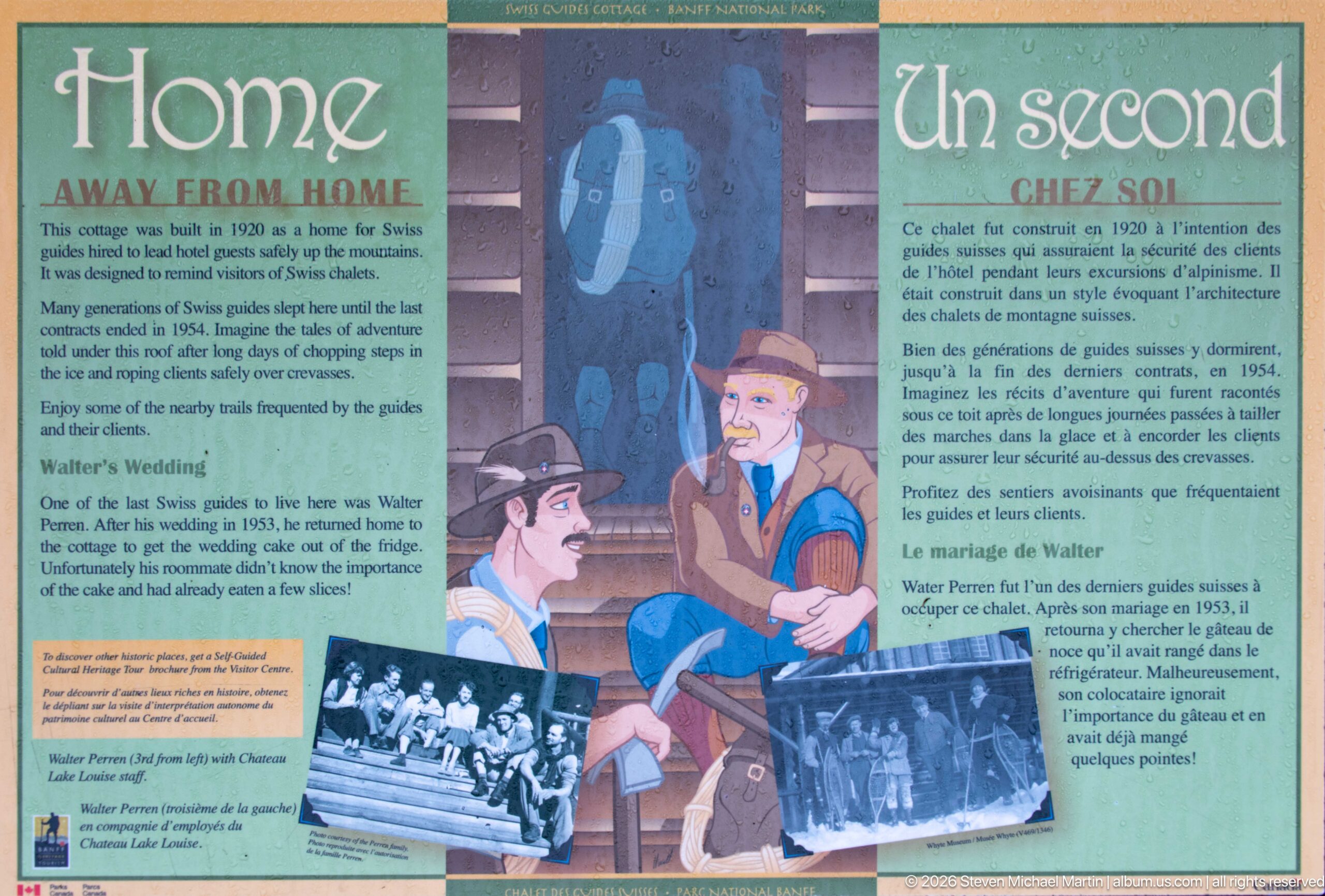
A colorful bilingual panel titled “Away From Home” recounts the lives of Swiss mountain guides who settled in the Lake Louise area. Illustrations of two guides, archival photographs, and a section headed “Walter’s Wedding” organize the story across the display. The panel connects local mountaineering history with personal lives, while its small print should be consulted directly for exact names and dates.
Caption
A colorful bilingual panel titled “Away From Home” recounts the lives of Swiss mountain guides who settled in the Lake Louise area. Illustrations of two guides, archival photographs, and a section headed “Walter’s Wedding” organize the story across the display. The panel connects local mountaineering history with personal lives, while its small print should be consulted directly for exact names and dates.
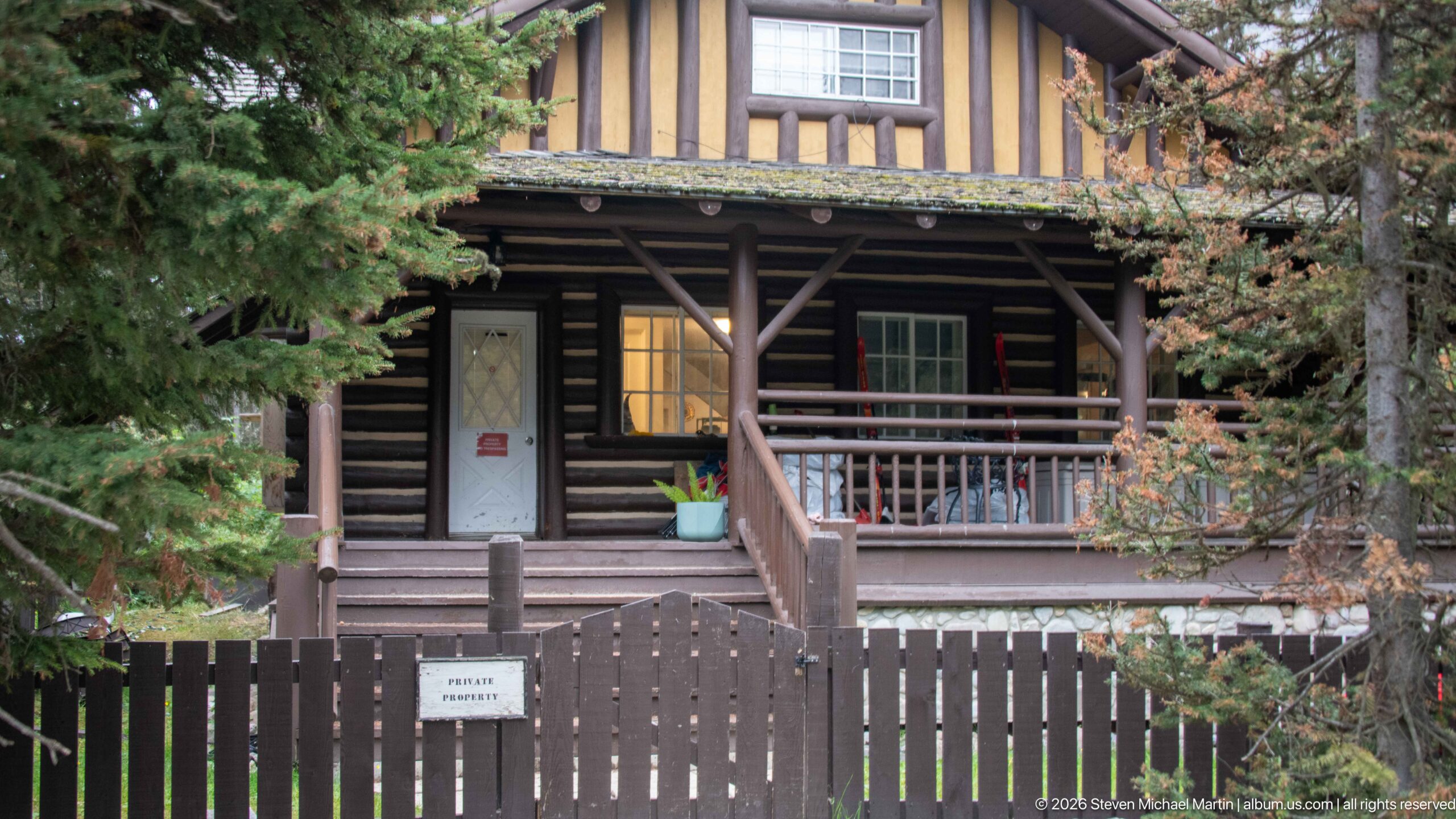
A timber chalet with a deep porch and half-timbered upper gable is partly screened by spruce branches and a dark picket fence. A small “Private Property” sign is fixed to the gate, while the porch windows glow softly behind the railing. The image records a lived-in or restricted building at the edge of the resort landscape, without enough evidence to name its function.
Caption
A timber chalet with a deep porch and half-timbered upper gable is partly screened by spruce branches and a dark picket fence. A small “Private Property” sign is fixed to the gate, while the porch windows glow softly behind the railing. The image records a lived-in or restricted building at the edge of the resort landscape, without enough evidence to name its function.
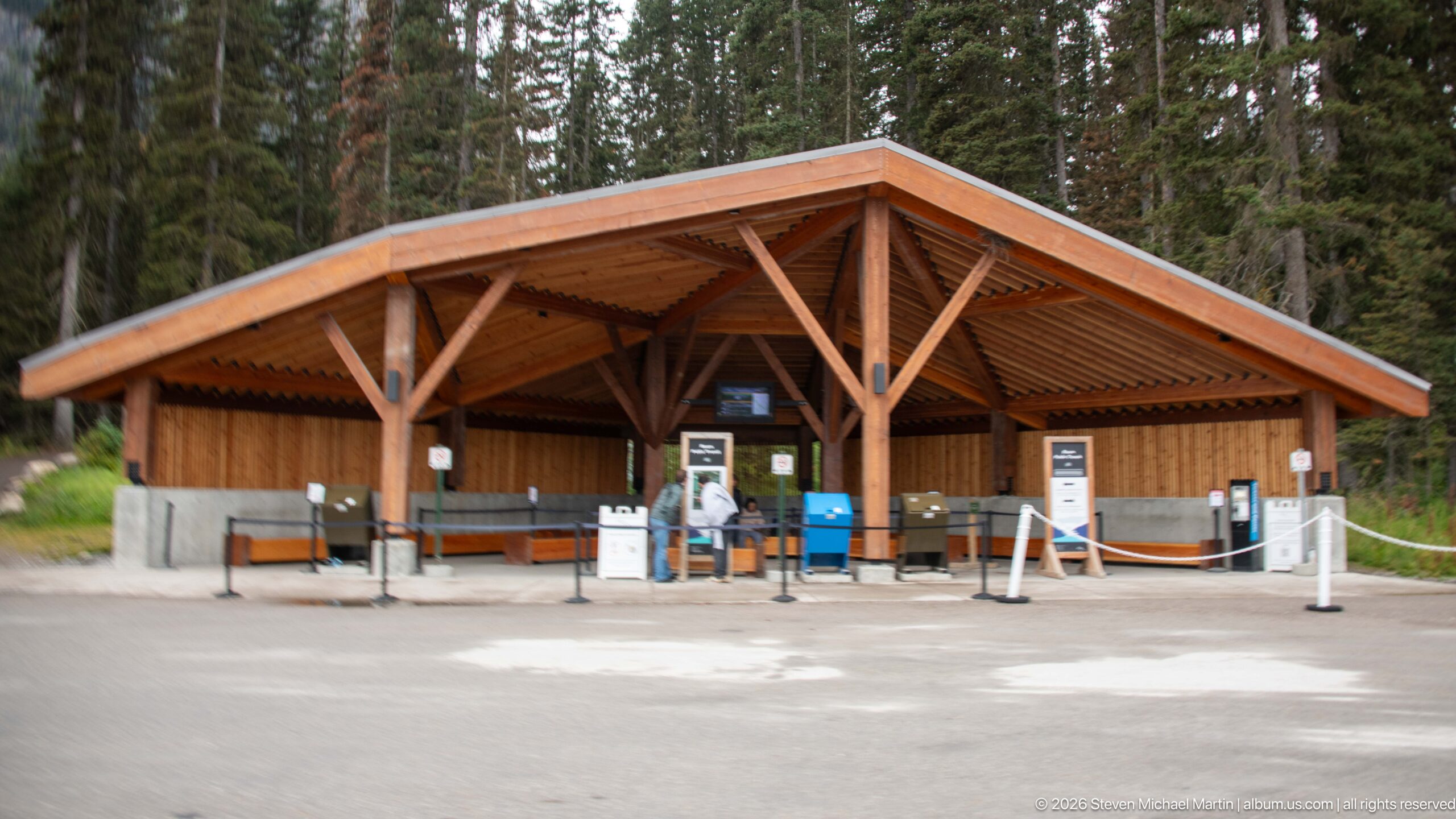
A broad timber shelter with a high gabled roof covers benches and a service counter or entry area. Rope stanchions guide visitors toward the opening, where signs and a few people are visible. The building stands against a dense conifer backdrop and appears designed to manage visitor access or transportation, though the proof sheet does not identify its specific service.
Caption
A broad timber shelter with a high gabled roof covers benches and a service counter or entry area. Rope stanchions guide visitors toward the opening, where signs and a few people are visible. The building stands against a dense conifer backdrop and appears designed to manage visitor access or transportation, though the proof sheet does not identify its specific service.
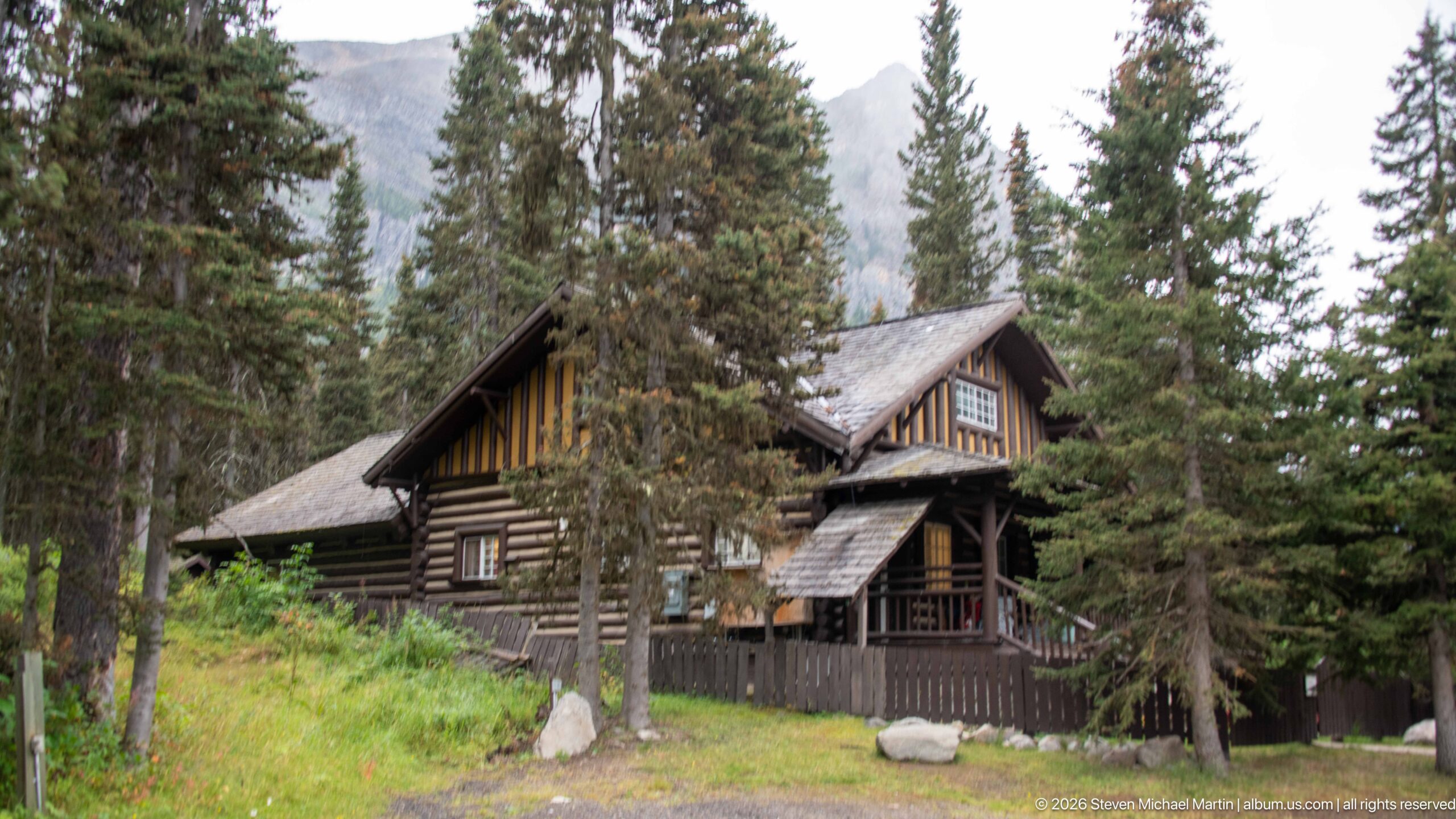
A large timber chalet sits among spruce trees, its steep shingled roofs and half-timbered gables visible between the trunks. The building is enclosed by a low dark fence and set back in a grassy clearing. Its architectural character is clear, but there is no readable name or sign in the frame to establish whether it is lodging, staff housing, or another resort building.
Caption
A large timber chalet sits among spruce trees, its steep shingled roofs and half-timbered gables visible between the trunks. The building is enclosed by a low dark fence and set back in a grassy clearing. Its architectural character is clear, but there is no readable name or sign in the frame to establish whether it is lodging, staff housing, or another resort building.
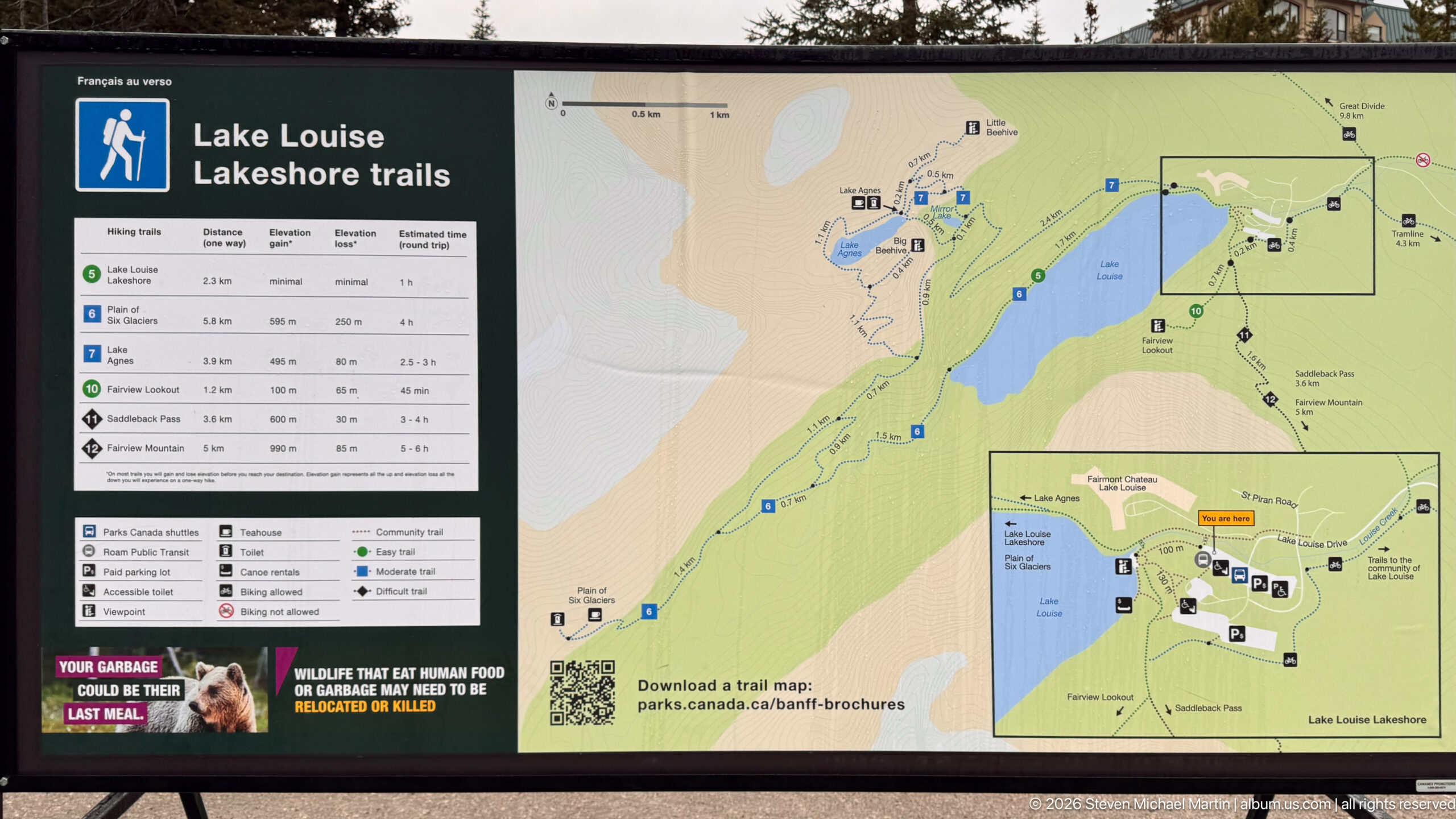
A bilingual visitor panel pairs a detailed map of the Lake Louise shoreline with a table listing trail distances, elevation changes, and route information. Colored symbols distinguish different activities, and smaller notices at the bottom address visitor safety and wildlife. The display is photographed straight on, making the relationship between the map and its route key easier to read than in the broader kiosk views.
Caption
A bilingual visitor panel pairs a detailed map of the Lake Louise shoreline with a table listing trail distances, elevation changes, and route information. Colored symbols distinguish different activities, and smaller notices at the bottom address visitor safety and wildlife. The display is photographed straight on, making the relationship between the map and its route key easier to read than in the broader kiosk views.

A cropped booking confirmation shows a paid status, travel date, passenger count, and several Lake Louise area shuttle legs, including a connection labeled “Sunrise Both Lake Connector.” The receipt is photographed from a screen or printout and includes personal contact and booking details that are not repeated here. Its role in the travel sequence is clear, though the exact service name should be checked against the original reservation.
Caption
A cropped booking confirmation shows a paid status, travel date, passenger count, and several Lake Louise area shuttle legs, including a connection labeled “Sunrise Both Lake Connector.” The receipt is photographed from a screen or printout and includes personal contact and booking details that are not repeated here. Its role in the travel sequence is clear, though the exact service name should be checked against the original reservation.
🏞️ National Park Field Guide
📍 Overview
Lake Louise and the trail toward Lake Agnes bring together open water, steep mountain walls, forest, streams, and high alpine viewpoints in Banff National Park. The photographs move between broad views of Victoria Glacier and the lakes, close details of shore and trail, and the buildings and signs that shape a visit. Together, they present a landscape encountered on foot and from the water’s edge, where weather, distance, and changing viewpoints continually alter the scene.
🏔️ Landscape
At Lake Louise, the view opens across pale turquoise water toward mountain slopes and Victoria Glacier. Shoreline rocks, flowers, grasses, and the outlet stream create a detailed foreground; clouds and fog sometimes soften or conceal the peaks. Higher on the Lake Agnes route, the scene narrows into conifer forest and rocky paths before opening at alpine lakes, bare headwalls, ridges, and cascades. Mirror Lake and Lake Agnes each sit within their own mountain setting, with water reflecting nearby rock and sky.
🪨 Geology
The portfolio’s landforms are most legible in the relationship between water and rock: steep mountain walls rise above Lake Louise, exposed ridges and spires frame Lake Agnes, and angular slabs channel waterfalls along the trail. Victoria Glacier is visible above Lake Louise, while a milky turquoise outlet stream and pale lake shallows show water moving through the landscape. These views offer a close look at glaciers, rocky slopes, cascades, and alpine lakes without reducing a varied terrain to a single viewpoint.
🌿 Ecology
Conifer forest borders much of the route, giving way in open viewpoints to rocky shores, exposed slopes, and alpine water. Wildflowers appear beside the trail and along Lake Louise, while streams and waterfalls trace the rocky ground. The photographs also include two wild-animal encounters: a marmot perched on the Lake Agnes Tea House and a young gull floating on Lake Louise. Their distinct settings—one beside a high-elevation building, the other on open water—show wildlife within the visitor landscape. Dogs pictured on the trails and shores are companions, not wild animals.
🦌 Wildlife Encounters
Photographs in this portfolio document wildlife encounters with Marmot resting on a timber ledge above the lake and Marmot perched beside a timber post in the Jasper landscape. The photographs place these animals in settings that include Marmot at Lake Agnes Tea House. These encounters provide direct, visit-specific evidence of how wildlife uses the habitats interpreted in this field guide.
🦌 Wildlife
Wildlife should be interpreted in relation to habitat, behavior, seasonality, and conservation.
🧭 Human History
Buildings, memorials, and interpretive panels connect the landscape with its history of travel and mountain access. The photographs include the Fairmont Chateau Lake Louise, the Lake Agnes Tea House, a commemorative mountaineer statue, and panels addressing the area’s guides, hiking and tea, Abbot Pass Hut, and the evolution from chalet to chateau. Maps, signs, and a World Heritage plaque show how visitors encounter and interpret the region today. The images keep these human stories tied to the structures and displays present on site.
🥾 Visitor Experience
A visit unfolds through different kinds of movement: walking the lakeshore, following a rocky forest trail, pausing at a stream or waterfall, and reaching viewpoints above the lakes. The Lake Agnes Tea House and its landing form a gathering place along the route, while signs, maps, and kiosks help orient visitors at trail junctions and road approaches. Weather can change the view quickly; cloud, fog, reflection, and clear openings each reveal different relationships between the water and surrounding peaks.
📷 Photography Notes
Photograph the region as a sequence of changing viewpoints. Wide frames establish the relationship between Lake Louise, its mountain walls, and Victoria Glacier; lower angles and foreground details bring out flowers, shore stones, grasses, and the outlet stream. On the Lake Agnes route, include the forest path, trail structures, cascades, and distinct alpine lakes rather than treating the hike as one continuous vista. Cloud and reflection can simplify or reshape the mountain backdrop. Keep interpretive signs, buildings, visitors, pets, and wild animals clearly associated with their actual settings.