Cave and Basin National Historic Site
At the foot of Sulphur Mountain, Cave and Basin brings together a striking natural feature and a place with deep cultural meaning. Indigenous peoples have gathered at these warm springs for thousands of years, and many communities continue to regard the site as sacred. The cave, mineral waters, and surrounding landscape invite visitors to look closely at the forces and relationships that have shaped this place. Parks Canada
The site also stands at the center of Canada’s national parks story. In 1883, railway workers’ claim to the springs drew government attention and helped prompt the creation of a protected reserve in 1885. That reserve became the foundation of Rocky Mountains National Park in 1887, now Banff National Park—the first in Canada. Cave and Basin National Historic Site
A visit moves between the cave and basin, interpretive exhibits, and paths through the surrounding wetlands. Here, geological processes, wildlife, conservation, and human history meet in a compact landscape. These photographs follow that experience, recording both the distinctive character of the thermal springs and the stories that make Cave and Basin more than a scenic stop. Cave and Basin National Historic Site
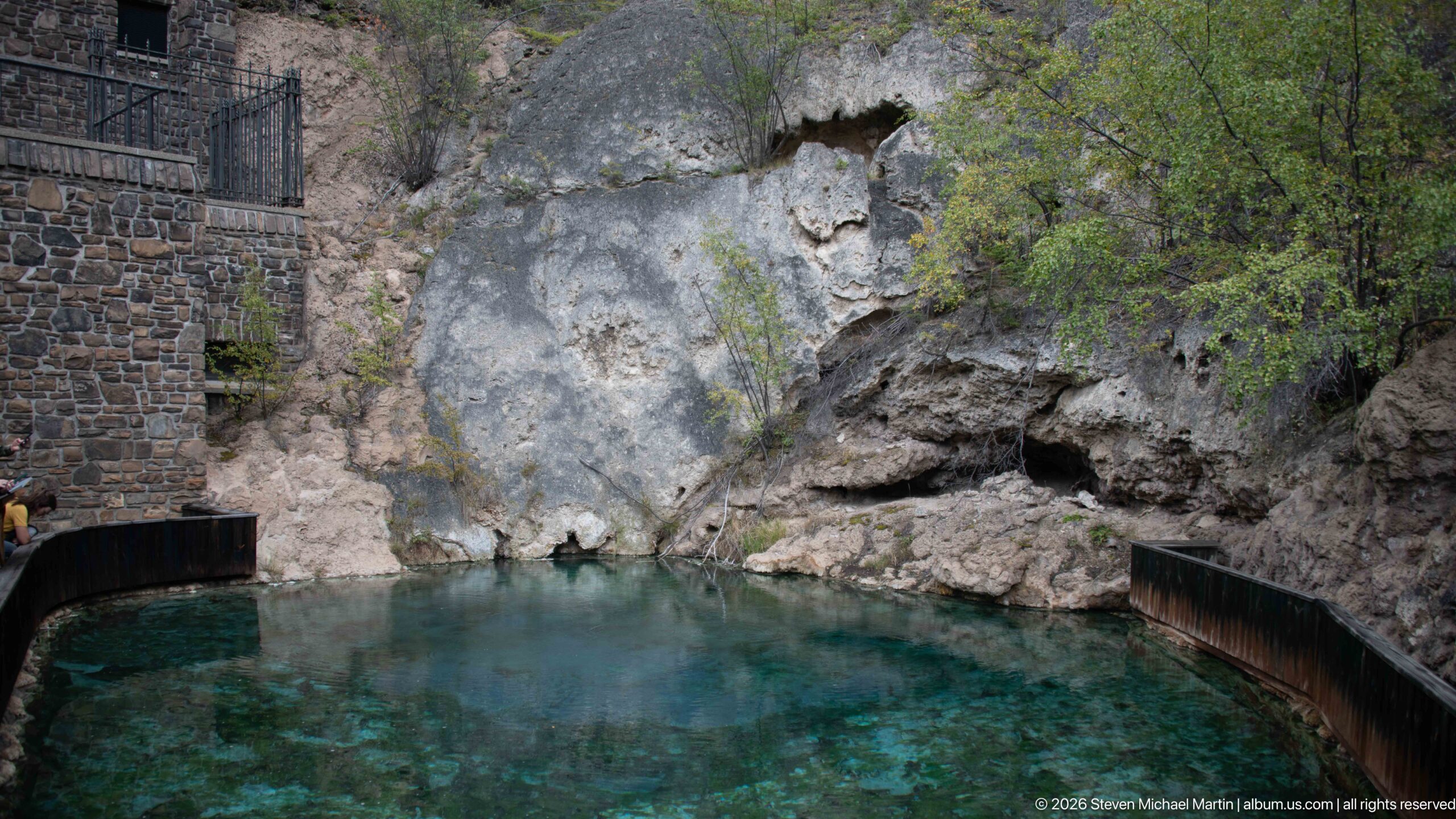
A turquoise pool lies below a low limestone opening whose rough, pale walls are mottled with mineral deposits. A stone retaining wall and dark metal railing border the water, while the cave ceiling drops close to the pool’s surface. The framing brings the natural cavity and managed visitor edge into view together, distinguishing the thermal basin from an open-air lake.
Caption
A turquoise pool lies below a low limestone opening whose rough, pale walls are mottled with mineral deposits. A stone retaining wall and dark metal railing border the water, while the cave ceiling drops close to the pool’s surface. The framing brings the natural cavity and managed visitor edge into view together, distinguishing the thermal basin from an open-air lake.
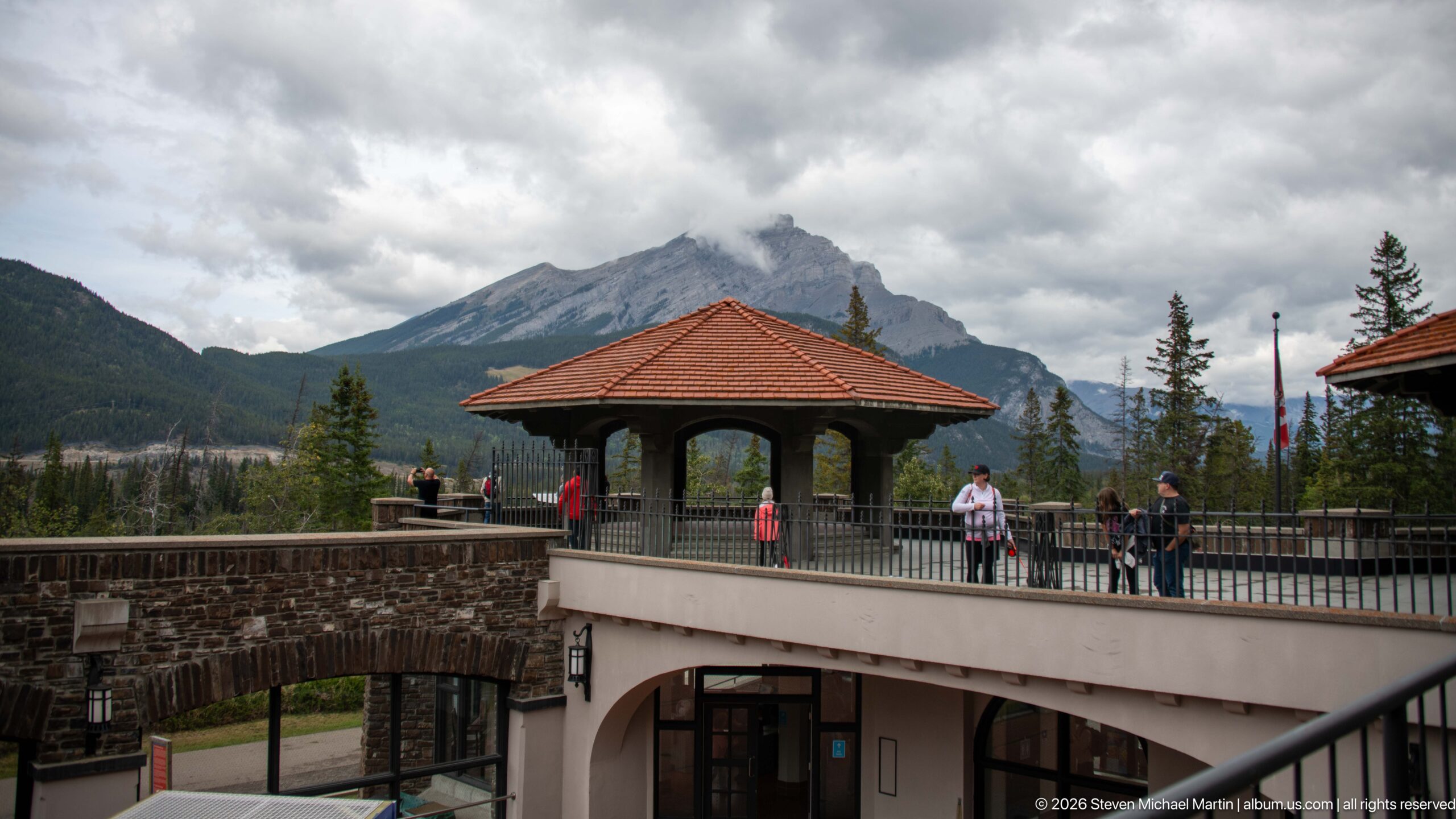
A red-roofed pavilion crowns a stone arcade above the site’s paved courtyard, with mountain peaks rising directly behind it. A few visitors gather along the upper walkway and near the arch openings. The layered view links the visitor complex to the surrounding landscape, while the pavilion roof and masonry arcade provide a clear architectural foreground.
Caption
A red-roofed pavilion crowns a stone arcade above the site’s paved courtyard, with mountain peaks rising directly behind it. A few visitors gather along the upper walkway and near the arch openings. The layered view links the visitor complex to the surrounding landscape, while the pavilion roof and masonry arcade provide a clear architectural foreground.
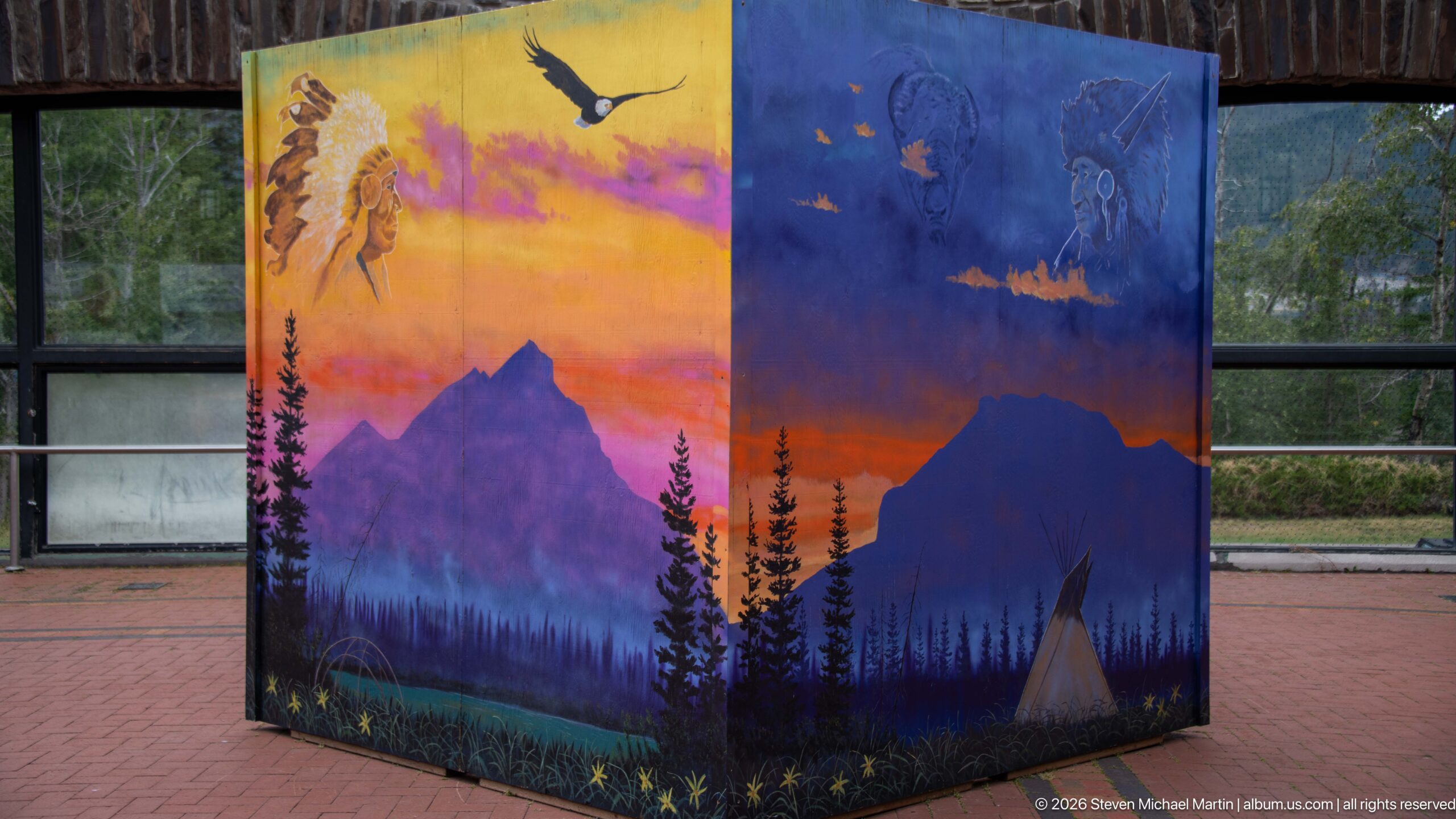
Two adjoining faces of a freestanding cube show mountain silhouettes beneath saturated orange, yellow, violet, and blue skies. Small wildlife and camp imagery appear along the upper and lower edges, while dark conifers frame the peaks. The bright illustrated surface contrasts with the real trees and stone arcade visible behind it, marking the cube as a contemporary interpretive artwork.
Caption
Two adjoining faces of a freestanding cube show mountain silhouettes beneath saturated orange, yellow, violet, and blue skies. Small wildlife and camp imagery appear along the upper and lower edges, while dark conifers frame the peaks. The bright illustrated surface contrasts with the real trees and stone arcade visible behind it, marking the cube as a contemporary interpretive artwork.
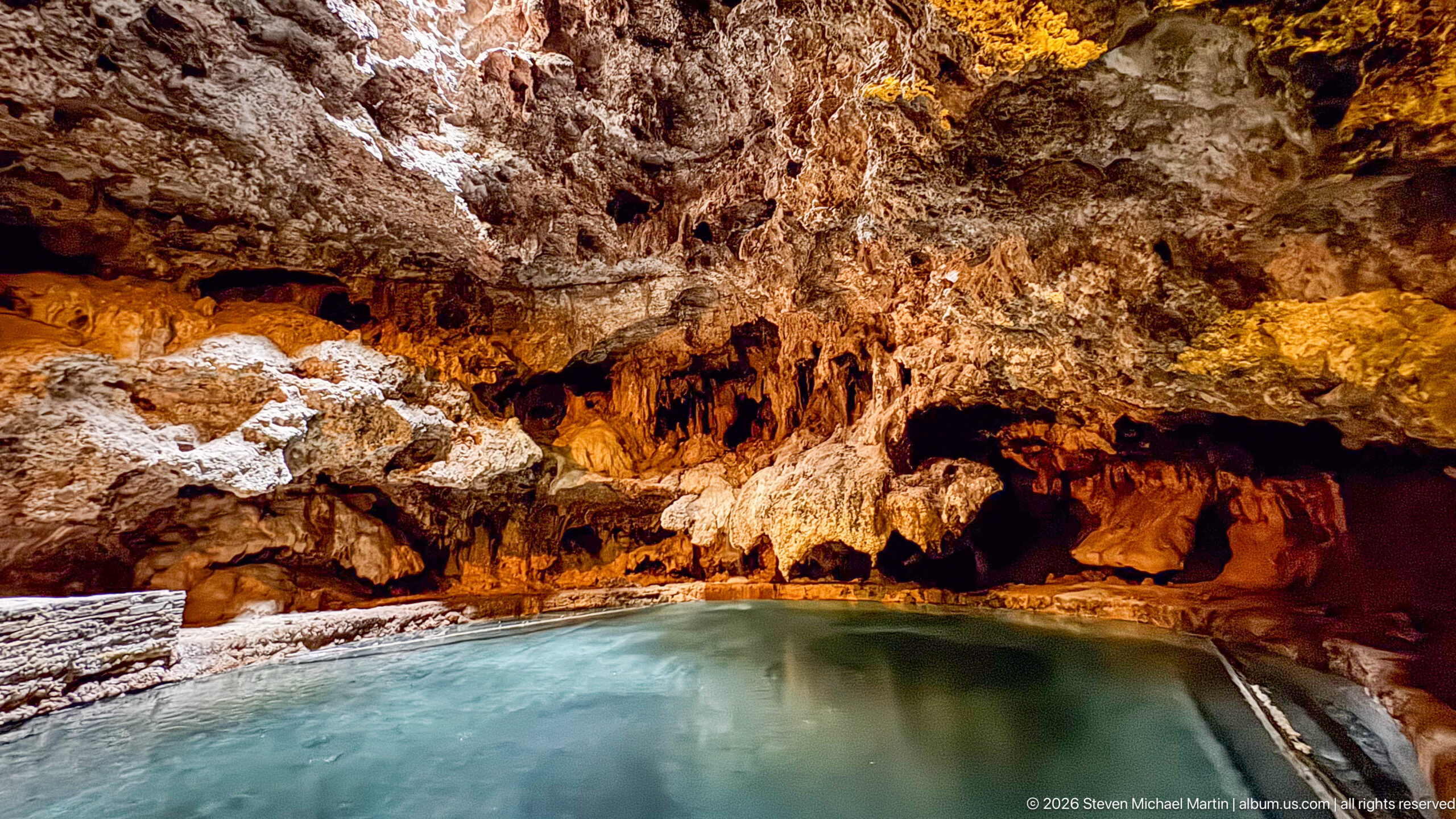
Warm amber lighting reveals rough, knobby limestone formations above a pale turquoise pool. The cave wall projects irregularly over the water, with a low stone walkway and protective edge entering at the left. The broad interior view shows the close relationship between the cave roof and thermal basin, while the lighting brings out textures that would otherwise remain in shadow.
Caption
Warm amber lighting reveals rough, knobby limestone formations above a pale turquoise pool. The cave wall projects irregularly over the water, with a low stone walkway and protective edge entering at the left. The broad interior view shows the close relationship between the cave roof and thermal basin, while the lighting brings out textures that would otherwise remain in shadow.
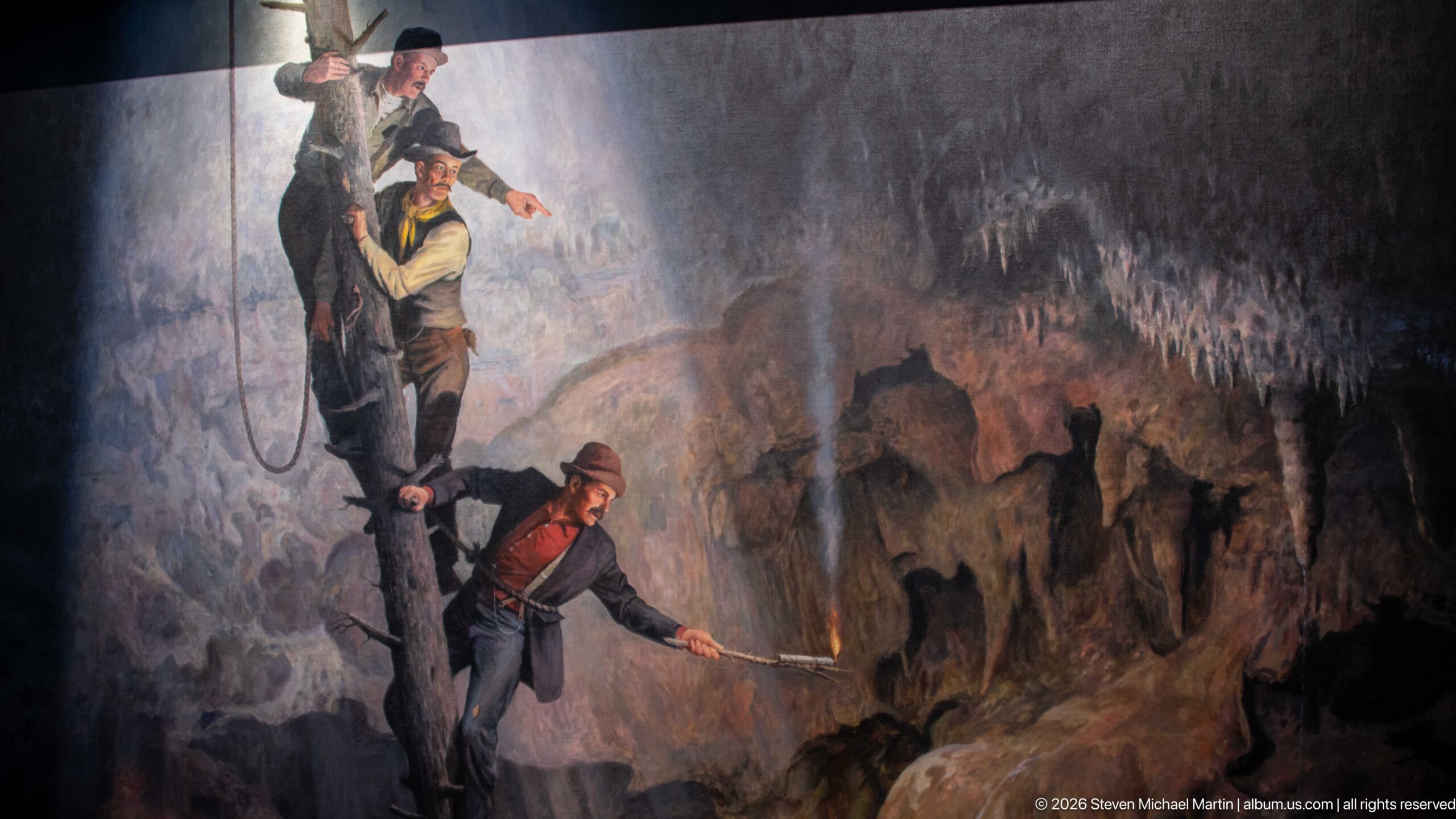
Three painted figures descend by rope through a shadowed cavern, one above another along a vertical rock face. The mural’s muted grays and browns suggest depth, while a light opening at upper left separates the men from the darker cave interior. This closer view isolates the human action in the exhibit’s interpretation of the early entry into the springs cave.
Caption
Three painted figures descend by rope through a shadowed cavern, one above another along a vertical rock face. The mural’s muted grays and browns suggest depth, while a light opening at upper left separates the men from the darker cave interior. This closer view isolates the human action in the exhibit’s interpretation of the early entry into the springs cave.
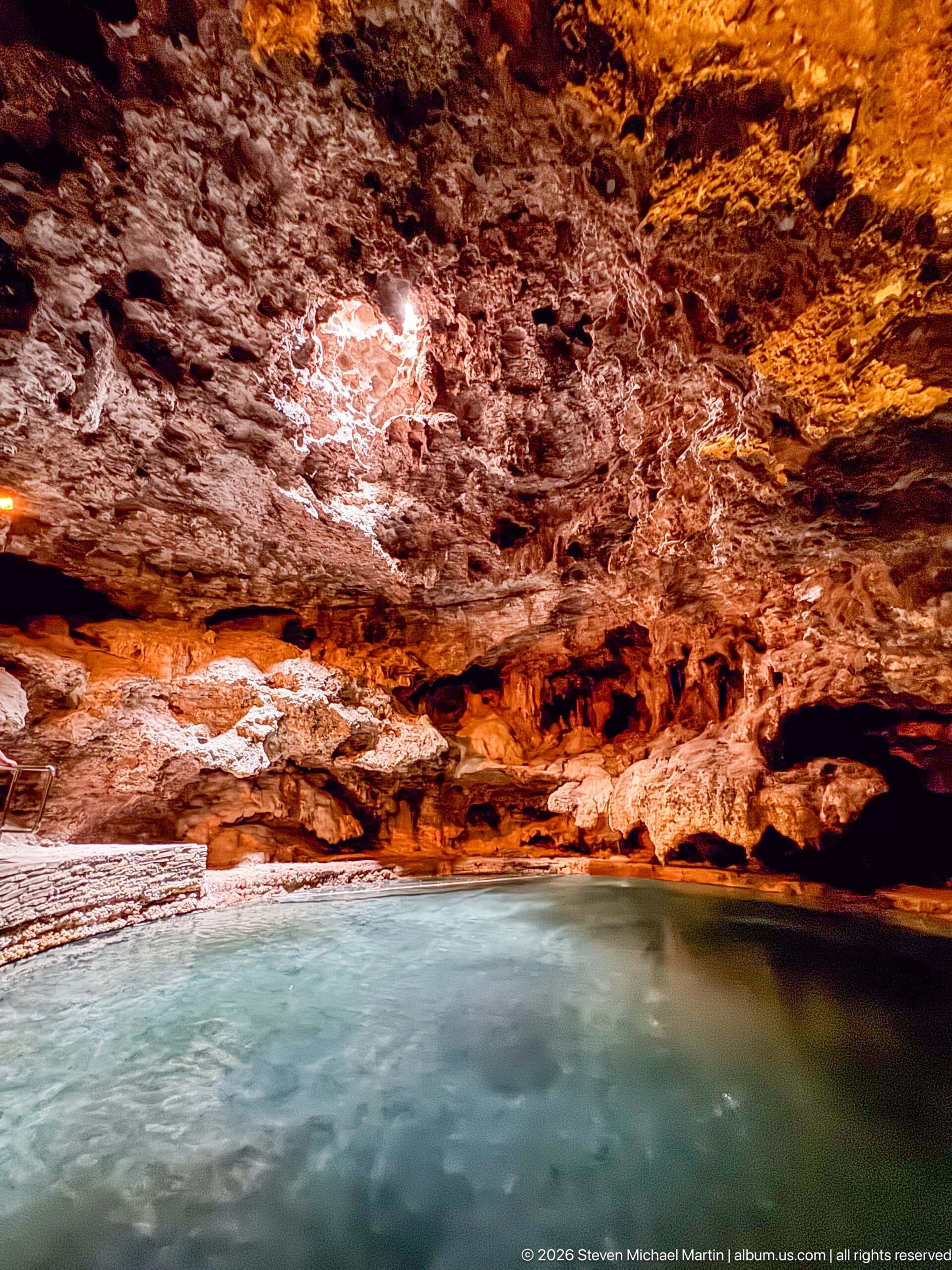
A tight composition draws attention to the cave ceiling’s rough mineral surface, where pale crusts, orange-brown staining, and dark recesses alternate above the blue-green water. Only a narrow band of the pool remains at the bottom of the frame. The reduced view treats the ceiling as a geological surface rather than repeating the broader basin panoramas.
Caption
A tight composition draws attention to the cave ceiling’s rough mineral surface, where pale crusts, orange-brown staining, and dark recesses alternate above the blue-green water. Only a narrow band of the pool remains at the bottom of the frame. The reduced view treats the ceiling as a geological surface rather than repeating the broader basin panoramas.
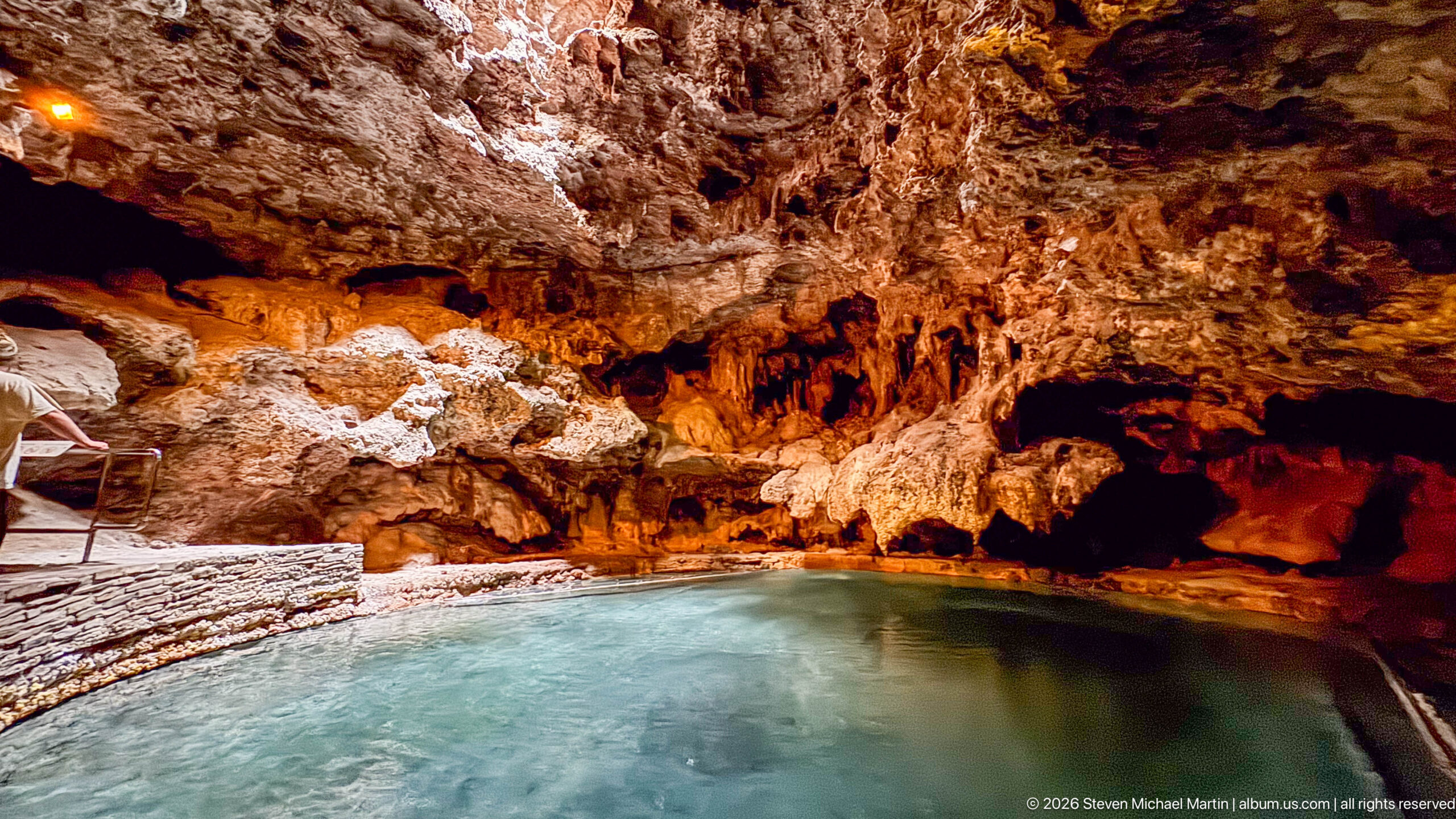
The cave pool curves across the lower frame beneath a broad canopy of rough, cream-colored limestone. Warm spotlights reveal cavities and projecting ledges in the roof, while a stone platform and a single chair appear at the far left. The wider framing establishes the scale of the enclosed basin and the visitor access built along its edge.
Caption
The cave pool curves across the lower frame beneath a broad canopy of rough, cream-colored limestone. Warm spotlights reveal cavities and projecting ledges in the roof, while a stone platform and a single chair appear at the far left. The wider framing establishes the scale of the enclosed basin and the visitor access built along its edge.
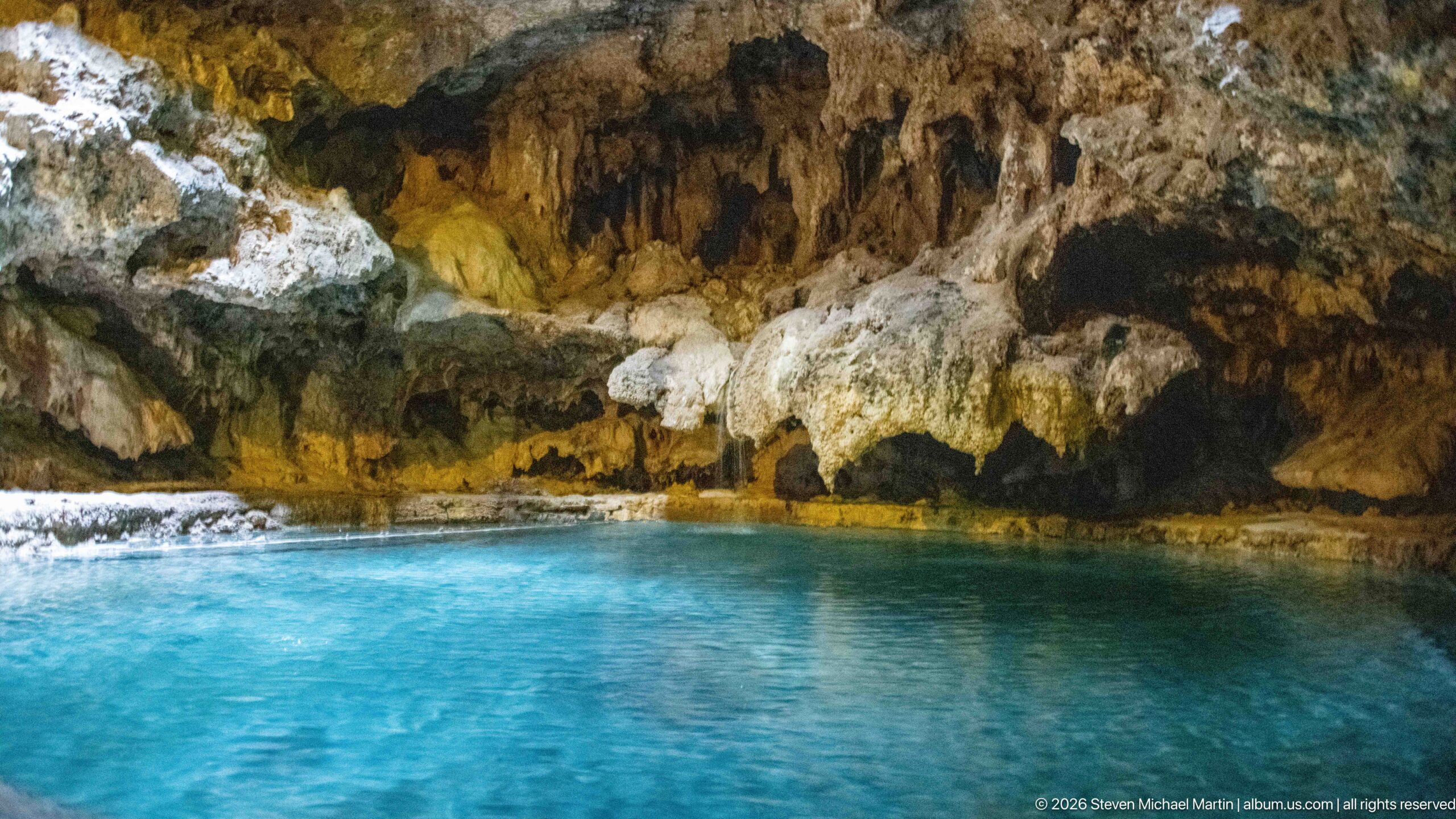
Blue-green water fills the foreground beneath an irregular limestone ceiling shaped into shallow pockets, ridges, and mineral crusts. A low stone ledge borders the pool, while warm artificial light reveals cream, tan, and ochre tones across the rock. The close view connects the cave’s geological textures with the contained spring basin at its base.
Caption
Blue-green water fills the foreground beneath an irregular limestone ceiling shaped into shallow pockets, ridges, and mineral crusts. A low stone ledge borders the pool, while warm artificial light reveals cream, tan, and ochre tones across the rock. The close view connects the cave’s geological textures with the contained spring basin at its base.
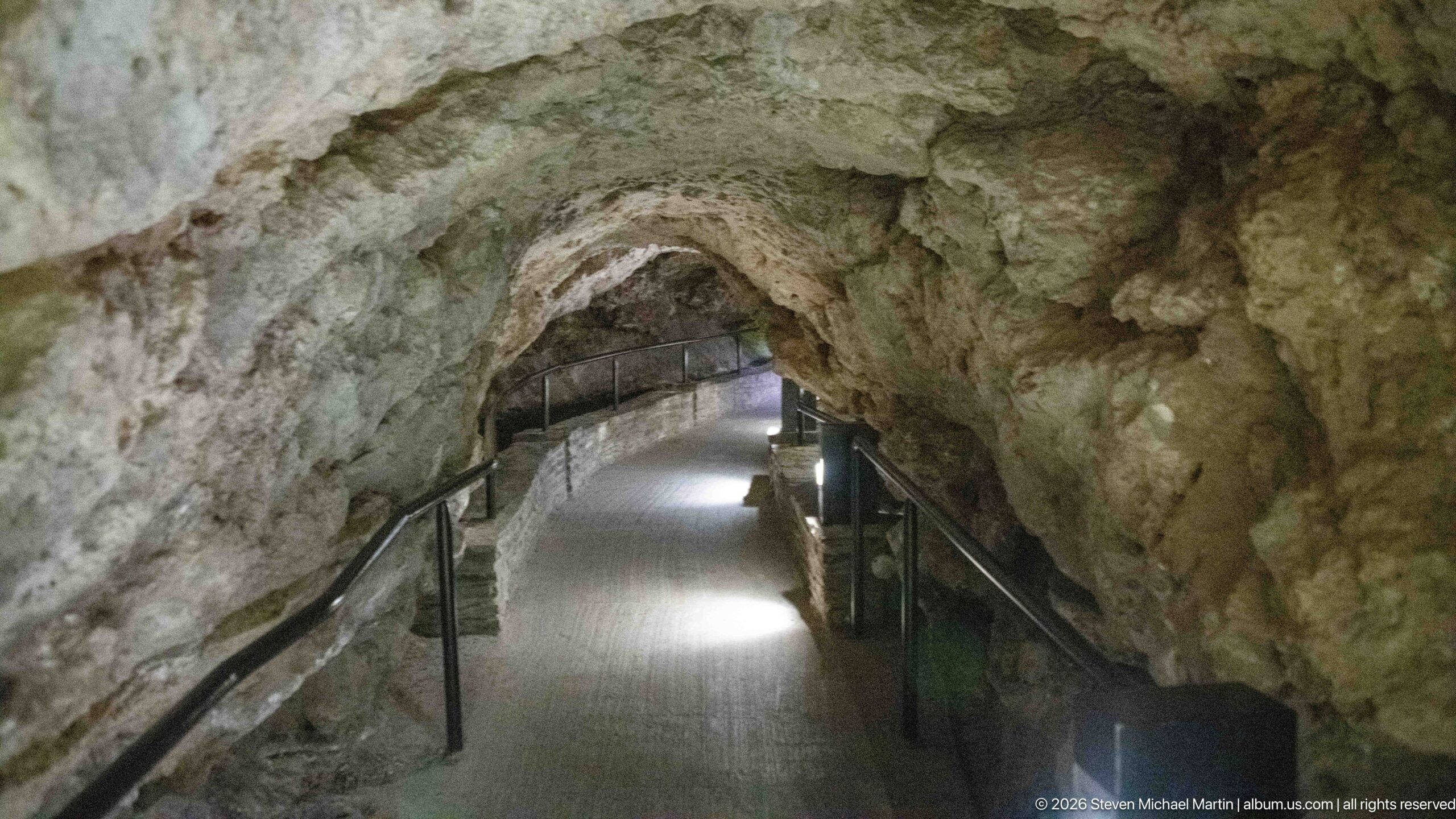
A gently sloping boardwalk runs through a low, irregular rock passage, guided by black handrails on both sides. Recessed lights illuminate the pale limestone ceiling and the path ahead, while the passage narrows toward a brighter opening. The perspective emphasizes the visitor route through the cave and the close, uneven stone that encloses it.
Caption
A gently sloping boardwalk runs through a low, irregular rock passage, guided by black handrails on both sides. Recessed lights illuminate the pale limestone ceiling and the path ahead, while the passage narrows toward a brighter opening. The perspective emphasizes the visitor route through the cave and the close, uneven stone that encloses it.
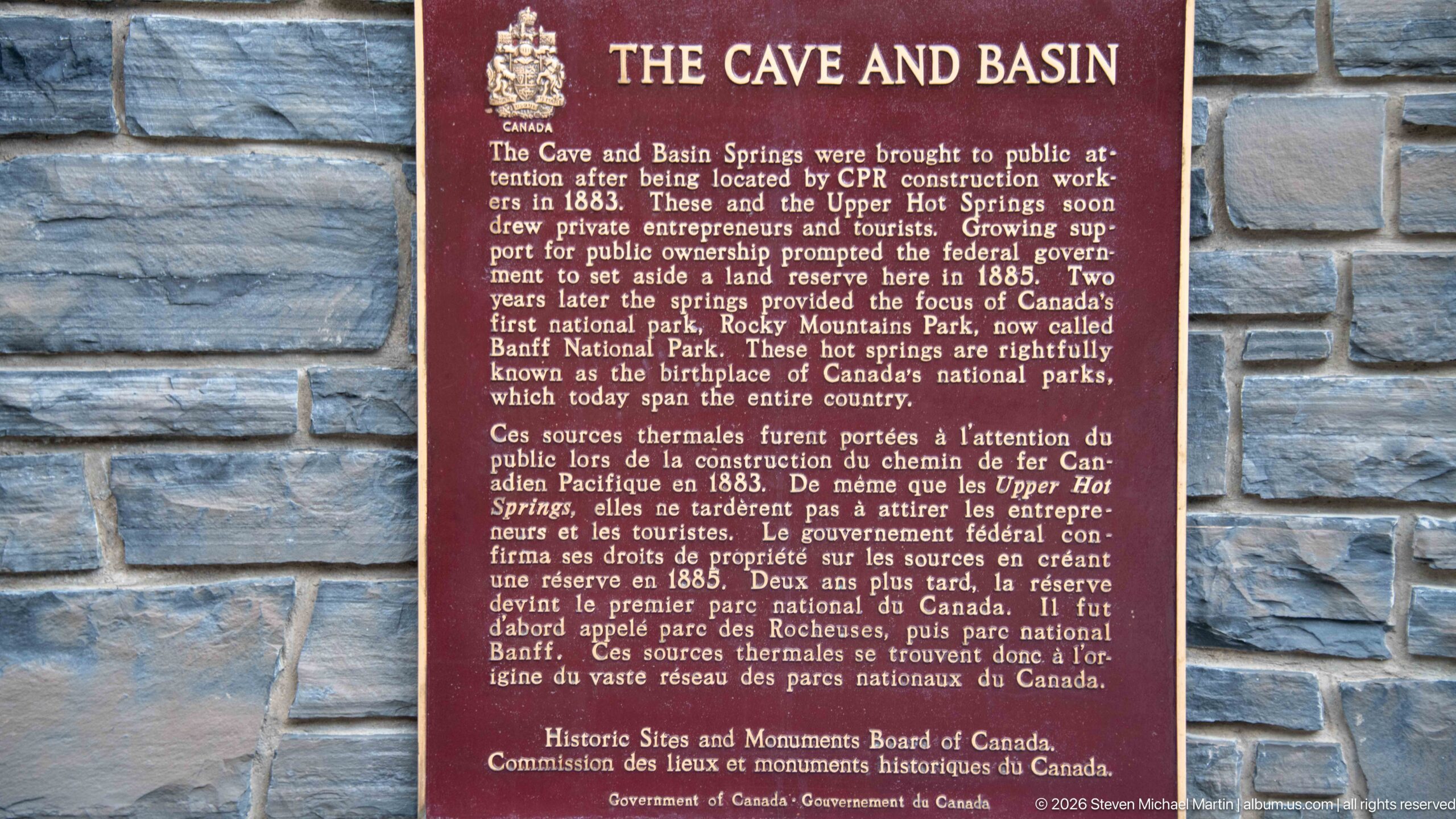
The vertical “The Cave and Basin” plaque recounts the thermal springs’ public history, including the 1883 railway-era discovery and the creation of a reserve that became Canada’s first national park. Its English and French text is set in pale lettering on a dark red ground, with a government heritage mark below. The tight framing makes the plaque’s narrative and historic-site function the subject, rather than the wall that supports it.
Caption
The vertical “The Cave and Basin” plaque recounts the thermal springs’ public history, including the 1883 railway-era discovery and the creation of a reserve that became Canada’s first national park. Its English and French text is set in pale lettering on a dark red ground, with a government heritage mark below. The tight framing makes the plaque’s narrative and historic-site function the subject, rather than the wall that supports it.
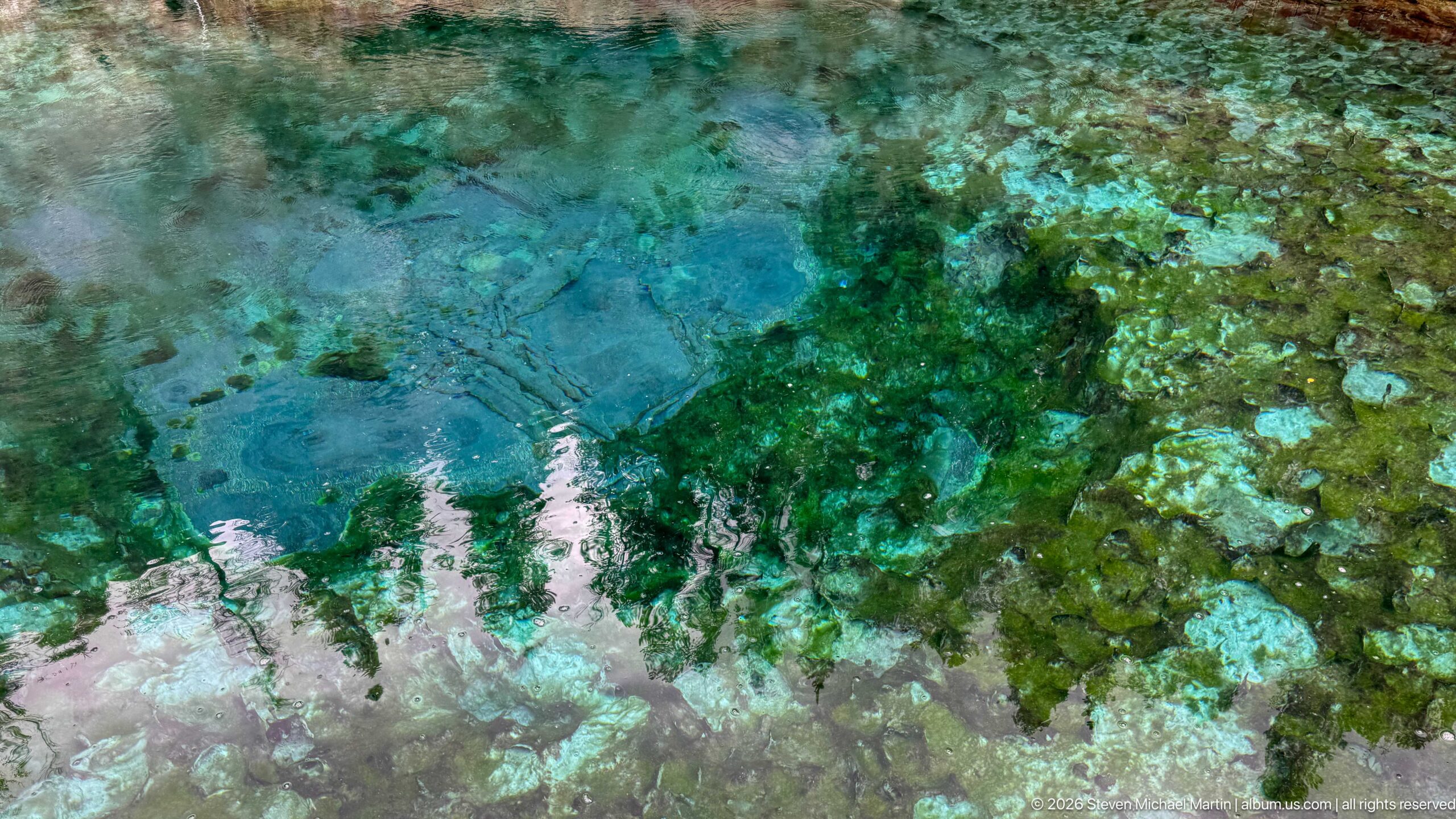
Clear blue-green water fills a shallow rock basin, revealing pale mineral deposits, dark algae-like patches, and irregular submerged stone. Reflections from the surrounding structure ripple across the surface and partially veil the bottom. The close view isolates the spring’s color and texture, showing the meeting of mineralized water and exposed rock without assigning specific organisms to the visible patches.
Caption
Clear blue-green water fills a shallow rock basin, revealing pale mineral deposits, dark algae-like patches, and irregular submerged stone. Reflections from the surrounding structure ripple across the surface and partially veil the bottom. The close view isolates the spring’s color and texture, showing the meeting of mineralized water and exposed rock without assigning specific organisms to the visible patches.
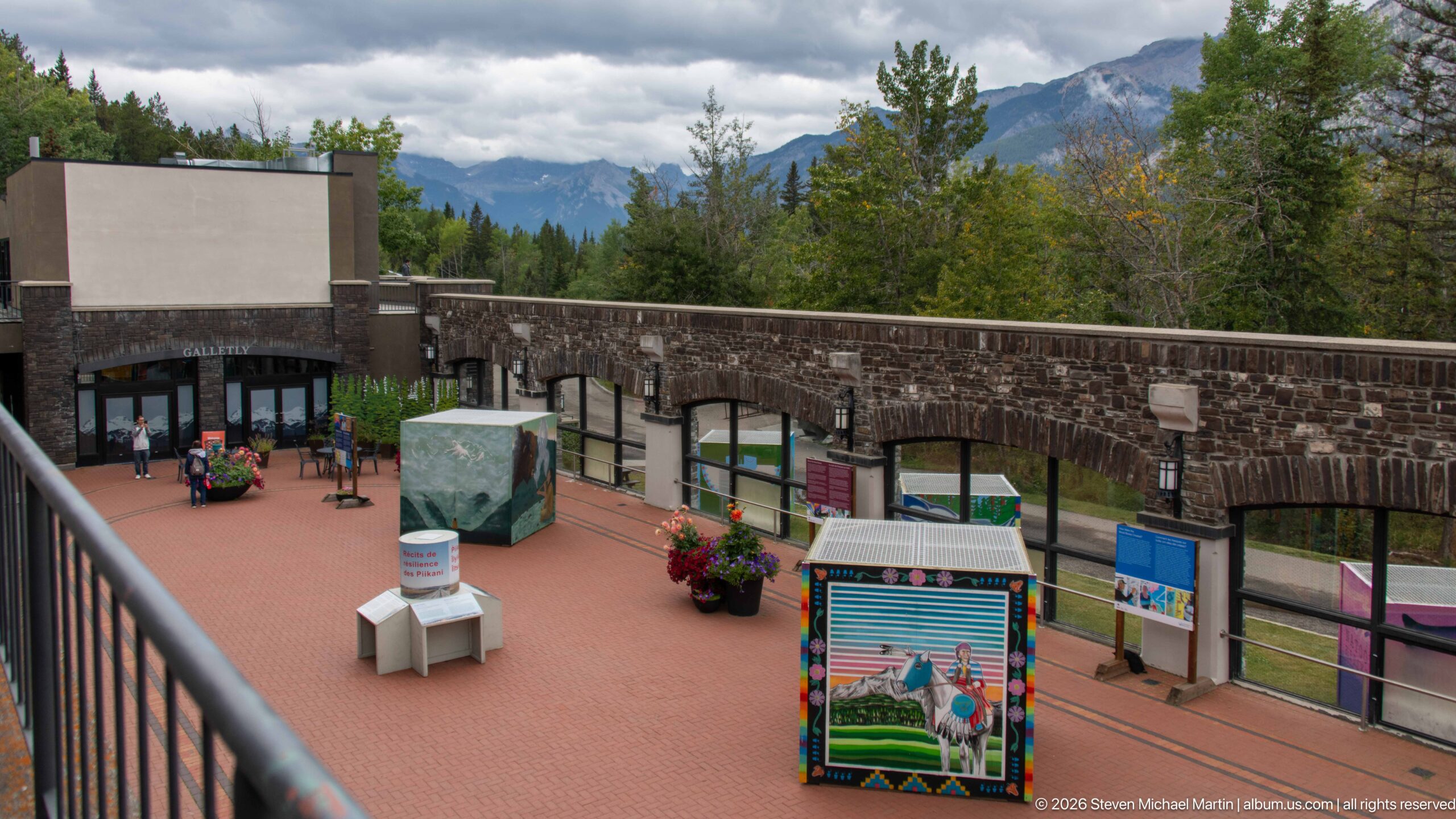
A broad paved courtyard sits beneath a long stone-faced arcade with repeated arches and a low roofline. Colorful interpretive panels and freestanding display cases are arranged across the plaza, while flower planters soften the edges. Visitors stand near the entrance at the far end. The elevated viewpoint shows how outdoor exhibits occupy the sheltered forecourt of the historic site.
Caption
A broad paved courtyard sits beneath a long stone-faced arcade with repeated arches and a low roofline. Colorful interpretive panels and freestanding display cases are arranged across the plaza, while flower planters soften the edges. Visitors stand near the entrance at the far end. The elevated viewpoint shows how outdoor exhibits occupy the sheltered forecourt of the historic site.
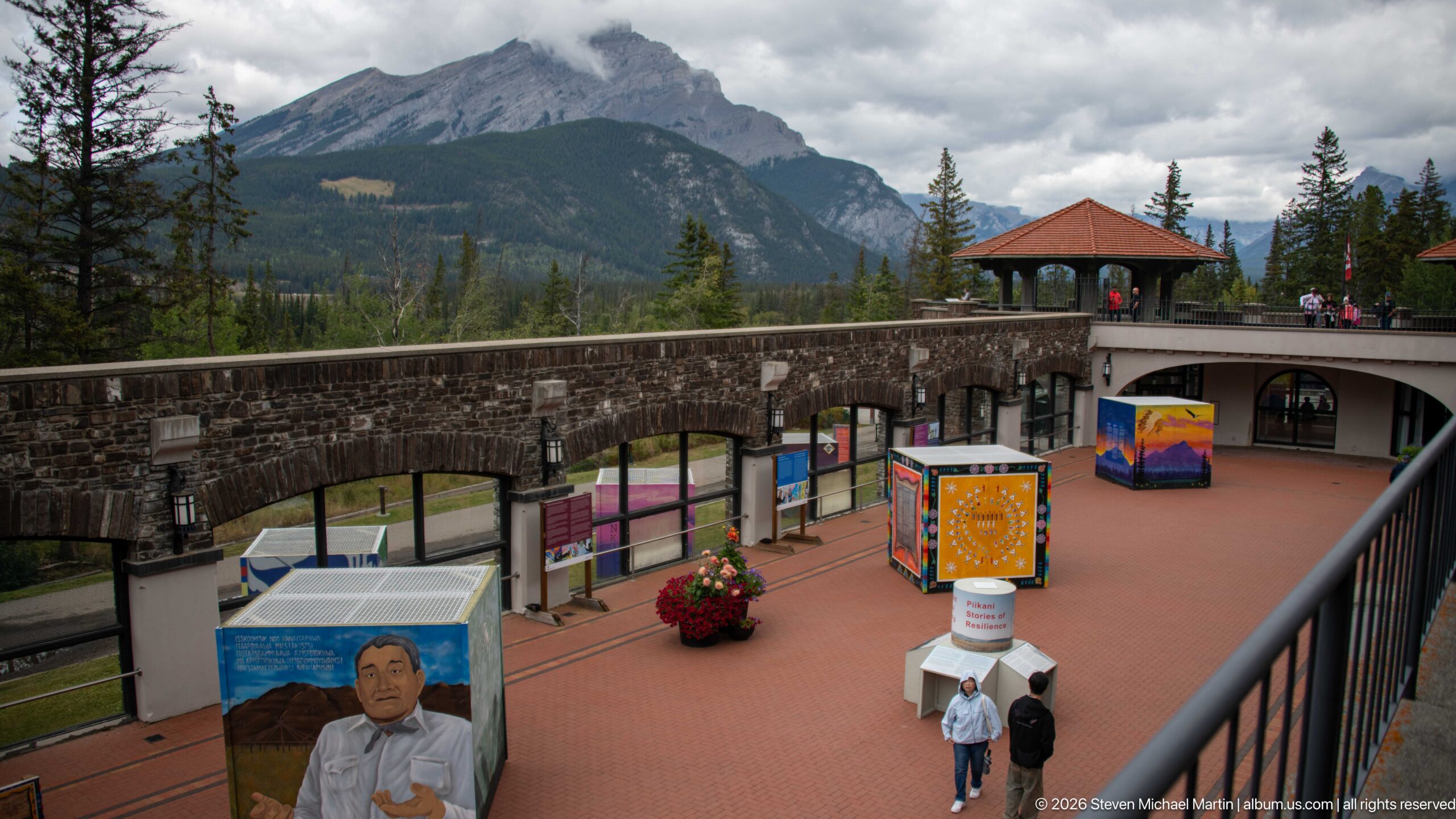
From above, colorful freestanding panels and display cases punctuate the red-paved courtyard beneath the curved stone arcade. Portraits, illustrated scenes, and bright geometric surfaces face different directions, creating a sequence of outdoor interpretive stations. Two visitors cross the open space near the windows. The broad composition records the arrangement of exhibits rather than a single panel’s text.
Caption
From above, colorful freestanding panels and display cases punctuate the red-paved courtyard beneath the curved stone arcade. Portraits, illustrated scenes, and bright geometric surfaces face different directions, creating a sequence of outdoor interpretive stations. Two visitors cross the open space near the windows. The broad composition records the arrangement of exhibits rather than a single panel’s text.
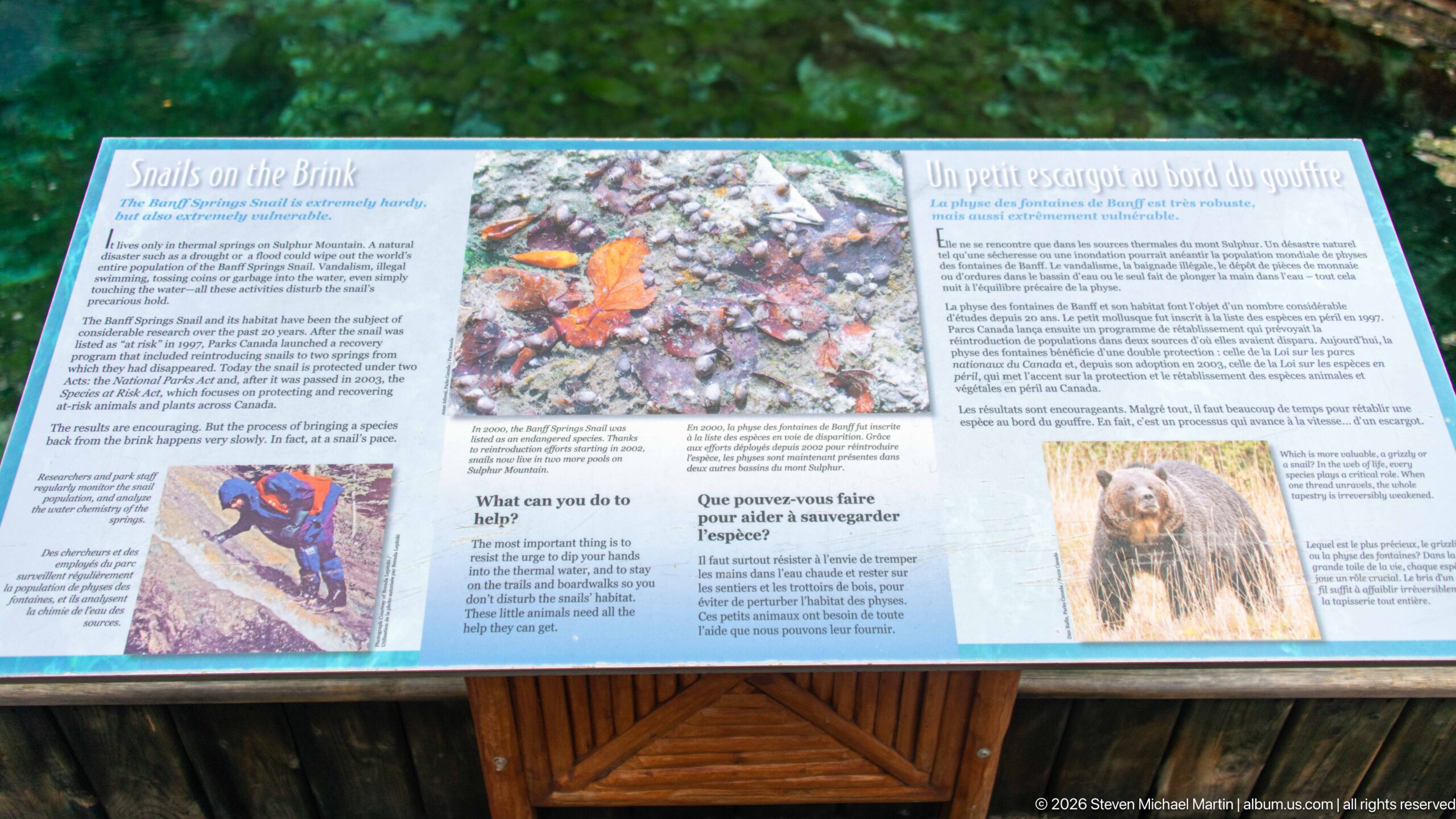
A bilingual interpretive panel titled “Snails on the Brink” presents photographs and explanatory text about a small spring-dwelling snail. The sign is mounted above a timber base against a backdrop of green, mineral-colored water. Its close framing emphasizes the conservation message and the illustrated species, while the actual animal is not visible in the spring beside it.
Caption
A bilingual interpretive panel titled “Snails on the Brink” presents photographs and explanatory text about a small spring-dwelling snail. The sign is mounted above a timber base against a backdrop of green, mineral-colored water. Its close framing emphasizes the conservation message and the illustrated species, while the actual animal is not visible in the spring beside it.
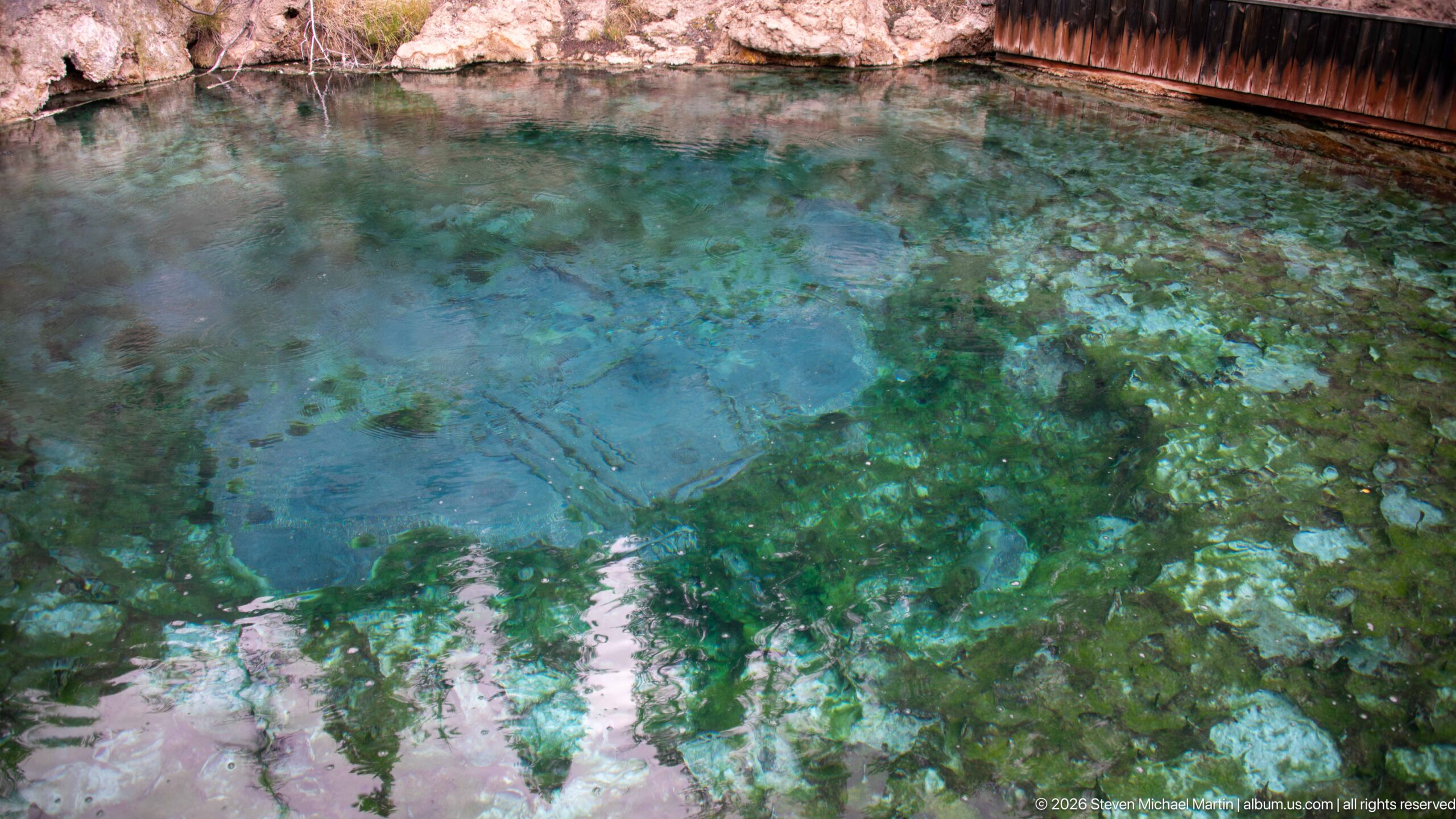
The camera looks down into transparent spring water where pale mineral-coated rock, darker green patches, and a vivid blue channel show through the surface. Gentle ripples distort the shapes beneath, while reflected light brightens the lower edge. This close study isolates the basin’s changing color and shallow relief, complementing the wider views of the cave and its visitor structures.
Caption
The camera looks down into transparent spring water where pale mineral-coated rock, darker green patches, and a vivid blue channel show through the surface. Gentle ripples distort the shapes beneath, while reflected light brightens the lower edge. This close study isolates the basin’s changing color and shallow relief, complementing the wider views of the cave and its visitor structures.
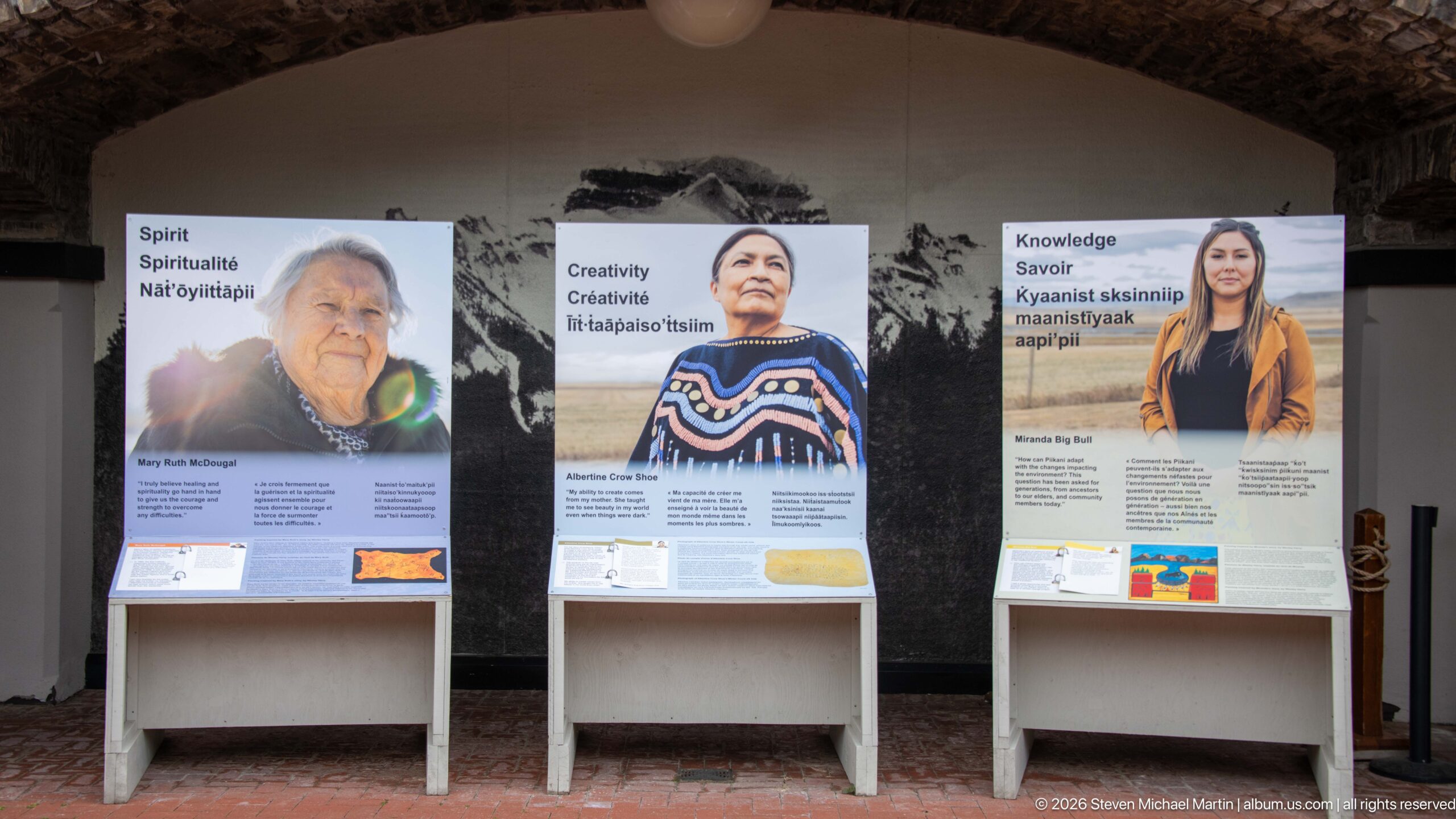
Three freestanding panels present portraits and quotations under the headings “Spirit,” “Creativity,” and “Knowledge.” Each includes text in English and an Indigenous language, along with small images and objects. The panels stand beneath a stone arch, inviting visitors to encounter individual voices and perspectives within the site. The photograph records the exhibit arrangement without attempting to identify the pictured people.
Caption
Three freestanding panels present portraits and quotations under the headings “Spirit,” “Creativity,” and “Knowledge.” Each includes text in English and an Indigenous language, along with small images and objects. The panels stand beneath a stone arch, inviting visitors to encounter individual voices and perspectives within the site. The photograph records the exhibit arrangement without attempting to identify the pictured people.
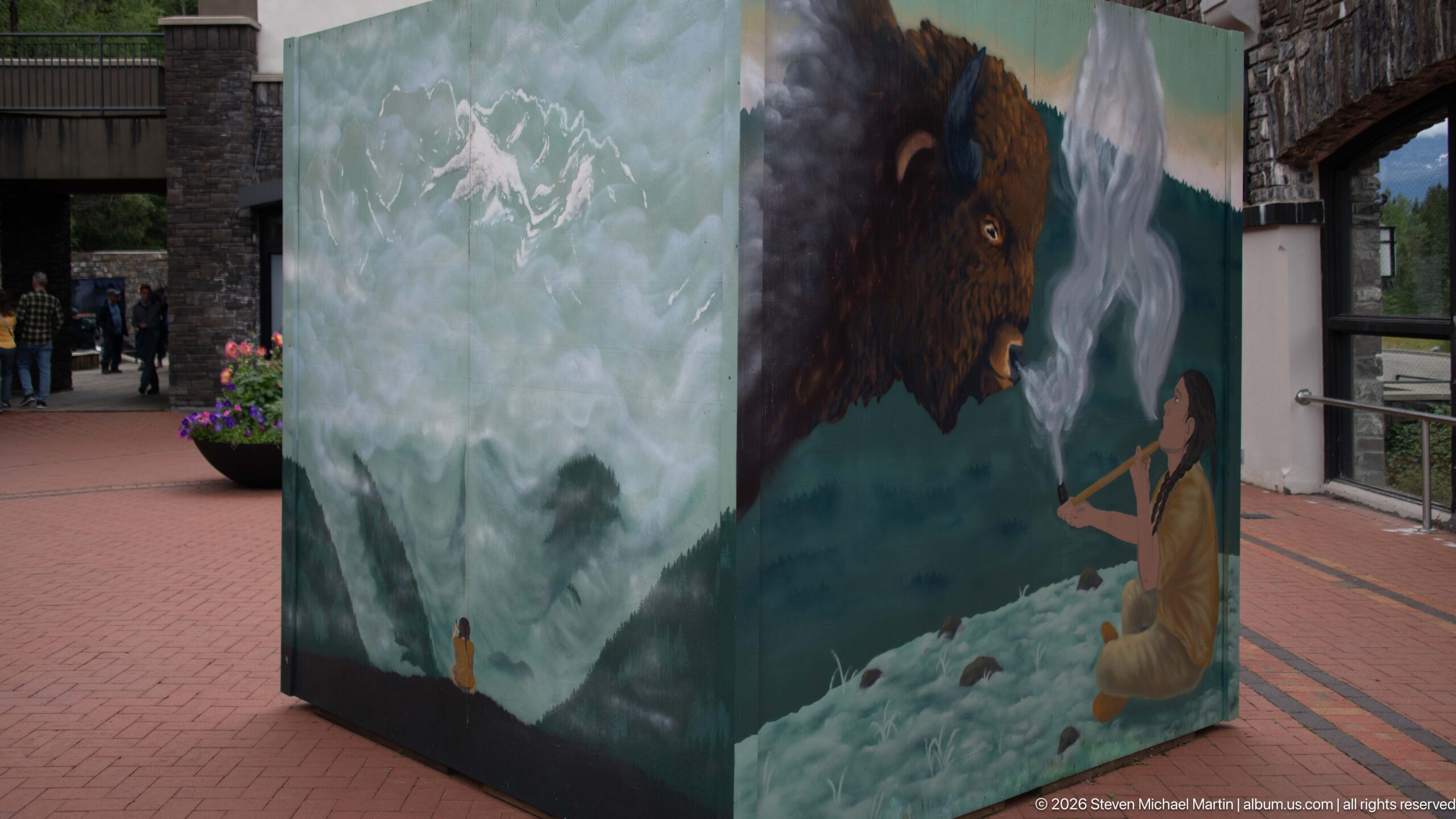
A large freestanding interpretive panel wraps around a square support, placing a bison portrait on one face and a mountain scene with a human figure on the adjacent face. The illustration uses cool blues and greens, with a paved courtyard and stone arches behind it. The angled view reveals the display’s three-dimensional form and its contrasting landscape and animal imagery.
Caption
A large freestanding interpretive panel wraps around a square support, placing a bison portrait on one face and a mountain scene with a human figure on the adjacent face. The illustration uses cool blues and greens, with a paved courtyard and stone arches behind it. The angled view reveals the display’s three-dimensional form and its contrasting landscape and animal imagery.
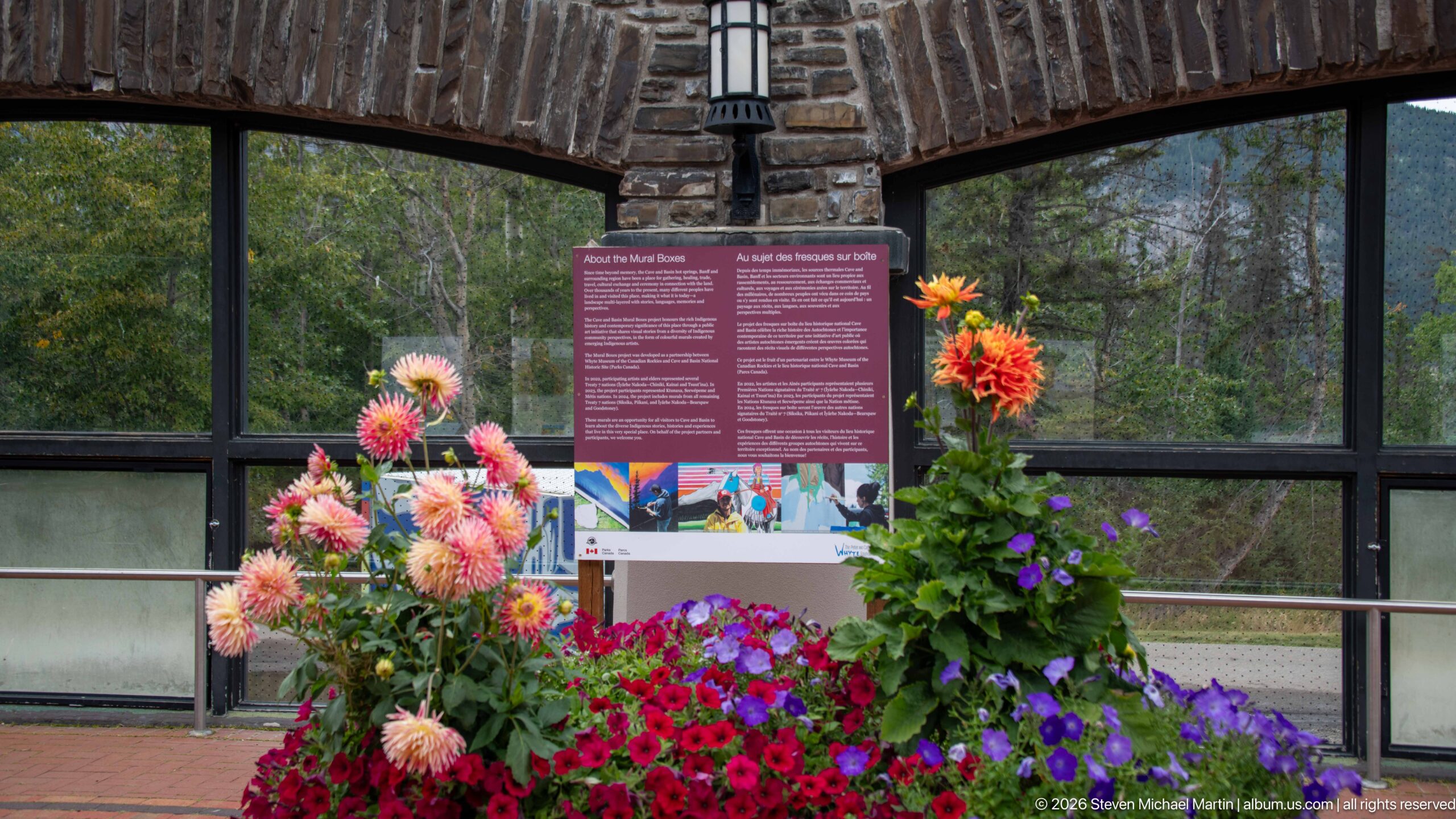
Bright pink, orange, and purple flowers rise in front of a magenta interpretive panel beneath a stone arch. A dark-framed window behind the sign reflects trees and the surrounding grounds. The combination of planted color and explanatory text turns a small section of the courtyard into a pause point, while the panel’s subject remains the main focus.
Caption
Bright pink, orange, and purple flowers rise in front of a magenta interpretive panel beneath a stone arch. A dark-framed window behind the sign reflects trees and the surrounding grounds. The combination of planted color and explanatory text turns a small section of the courtyard into a pause point, while the panel’s subject remains the main focus.
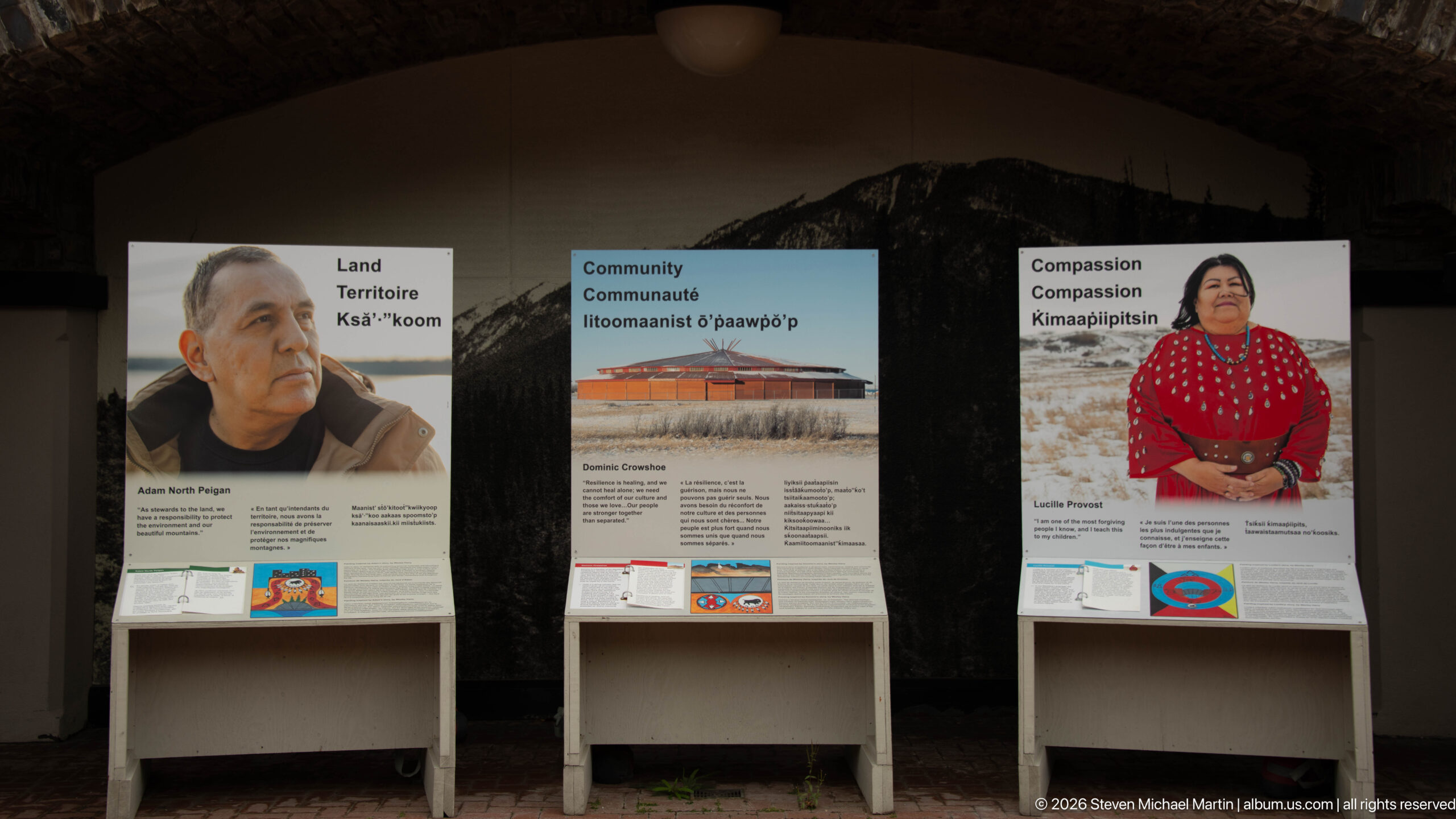
Three exhibit panels stand side by side against a dark stone wall, each pairing a portrait or building image with a large heading: “Land,” “Community,” or “Compassion.” Bilingual text and small illustrations fill the lower portions. The frontal arrangement presents the topics as related interpretive themes while preserving the distinct voices and images featured on each panel.
Caption
Three exhibit panels stand side by side against a dark stone wall, each pairing a portrait or building image with a large heading: “Land,” “Community,” or “Compassion.” Bilingual text and small illustrations fill the lower portions. The frontal arrangement presents the topics as related interpretive themes while preserving the distinct voices and images featured on each panel.
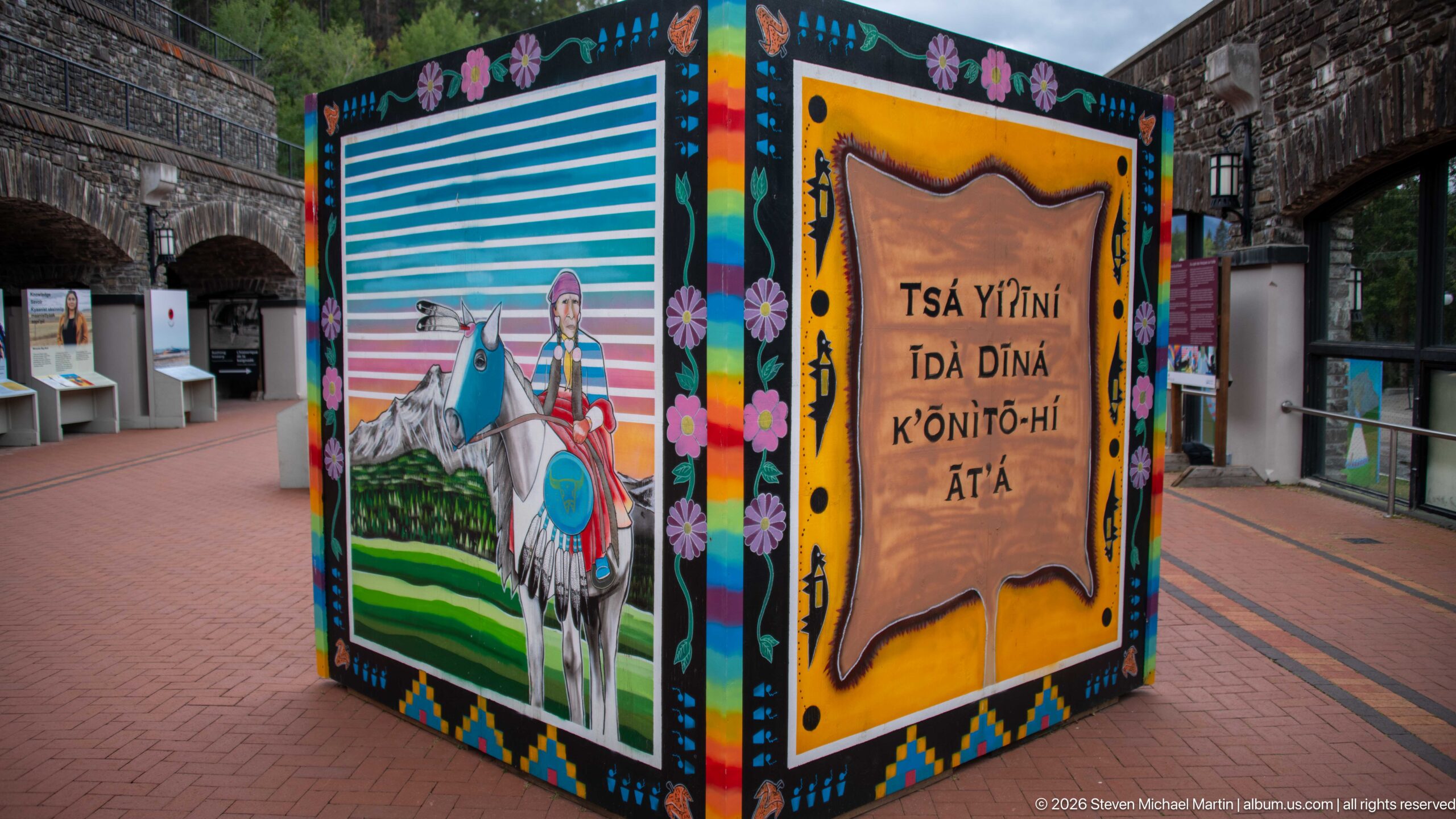
A vivid square display cube presents a painted figure on horseback beside a mountain landscape on one face, and large Indigenous-language lettering on a warm ochre field on another. The two decorated sides meet at a sharp vertical corner, emphasizing the installation’s sculptural format. Stone arches, windows, and red paving place the artwork within the site courtyard.
Caption
A vivid square display cube presents a painted figure on horseback beside a mountain landscape on one face, and large Indigenous-language lettering on a warm ochre field on another. The two decorated sides meet at a sharp vertical corner, emphasizing the installation’s sculptural format. Stone arches, windows, and red paving place the artwork within the site courtyard.
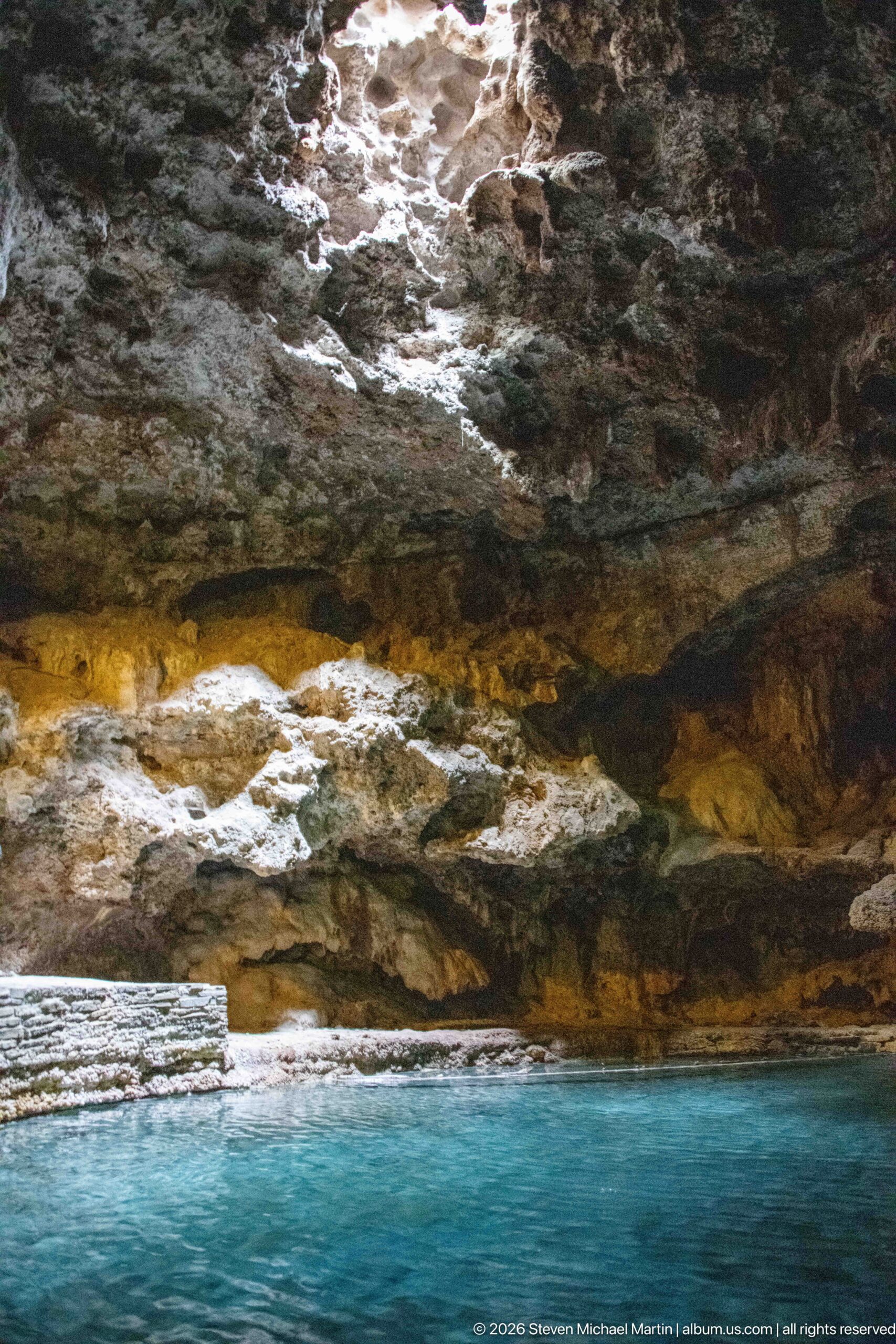
A low angle tracks across the turquoise pool toward a pale cave wall marked by white mineral deposits and ochre staining. The rock ceiling hangs close to the water, creating a compressed band of stone above the bright surface. Unlike the wider cave views, this composition emphasizes the horizontal boundary between mineralized rock and spring water.
Caption
A low angle tracks across the turquoise pool toward a pale cave wall marked by white mineral deposits and ochre staining. The rock ceiling hangs close to the water, creating a compressed band of stone above the bright surface. Unlike the wider cave views, this composition emphasizes the horizontal boundary between mineralized rock and spring water.
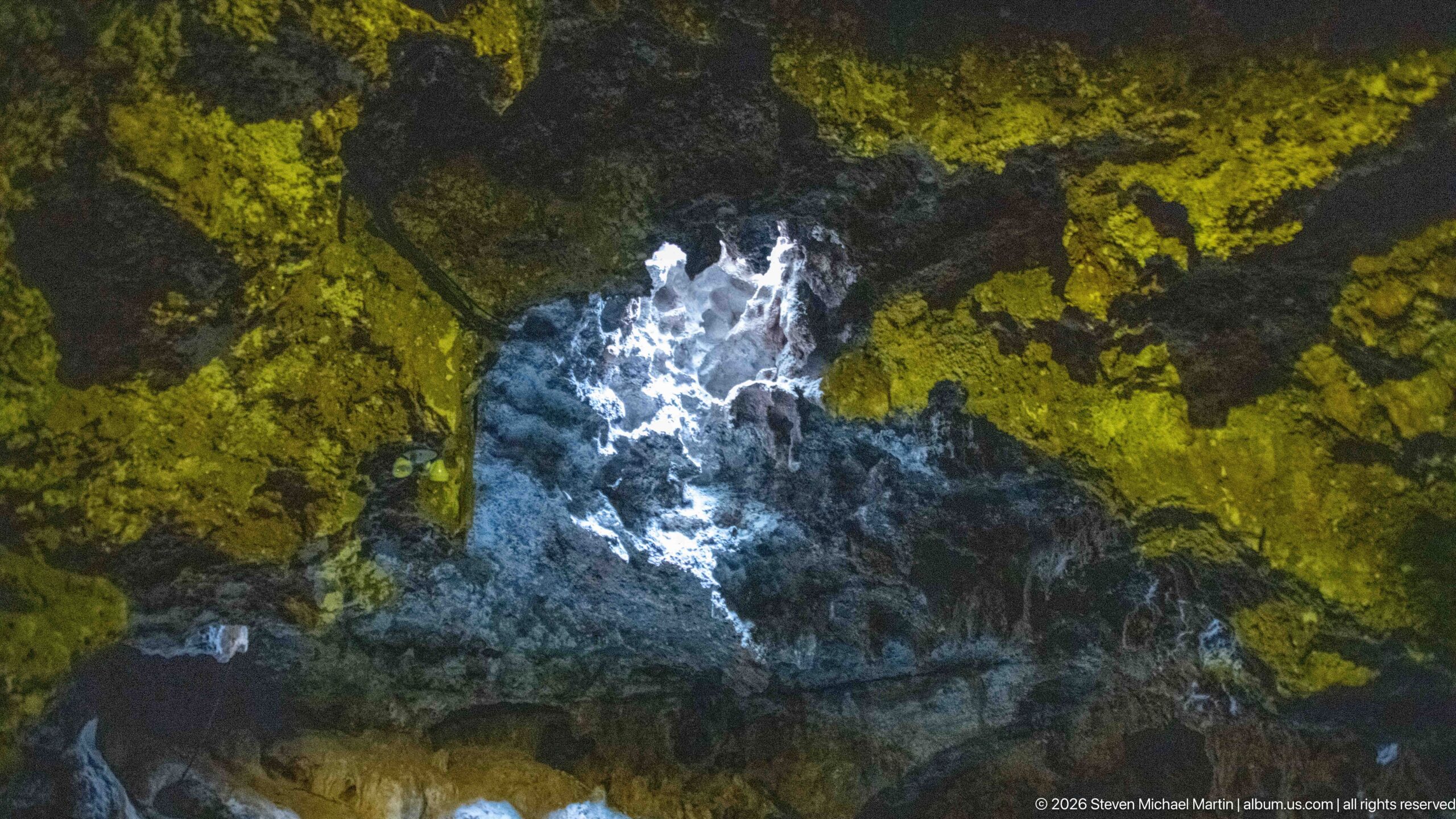
A close downward view shows spring water flowing over uneven stone, where pale deposits and dark green patches form a mottled pattern. A bright reflection breaks across the central surface, obscuring some of the submerged detail. The image focuses on the boundary between water and mineral-coated rock, while the cave’s larger architecture falls outside the frame.
Caption
A close downward view shows spring water flowing over uneven stone, where pale deposits and dark green patches form a mottled pattern. A bright reflection breaks across the central surface, obscuring some of the submerged detail. The image focuses on the boundary between water and mineral-coated rock, while the cave’s larger architecture falls outside the frame.
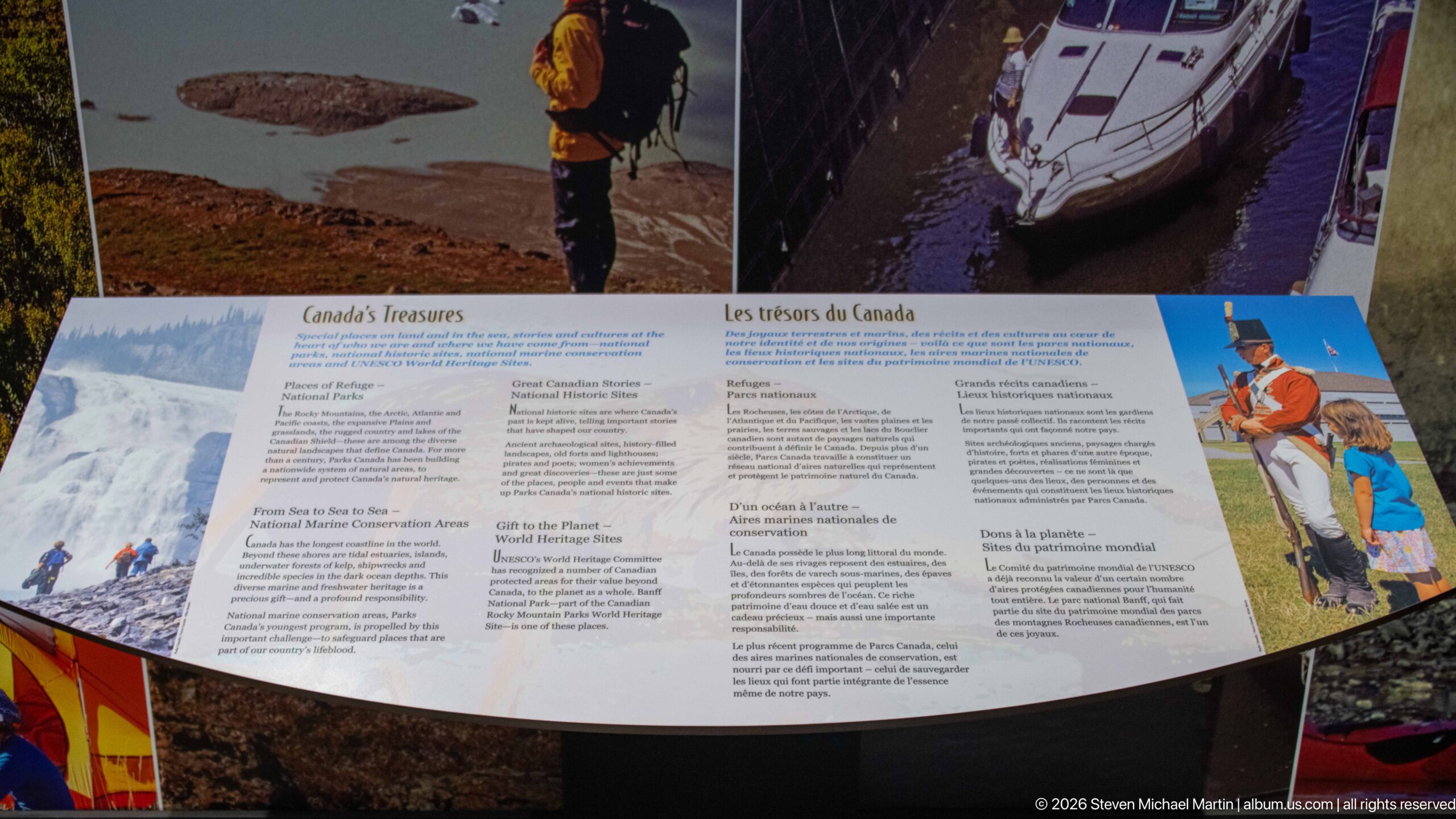
A curved bilingual panel titled “Canada’s Treasures” presents photographs and text about protected places, nature, and heritage. Images of mountain travel and outdoor activity line the upper portion, while a colorful family illustration appears at the right. The close view records a broad national-park interpretation display within the site’s exhibit space.
Caption
A curved bilingual panel titled “Canada’s Treasures” presents photographs and text about protected places, nature, and heritage. Images of mountain travel and outdoor activity line the upper portion, while a colorful family illustration appears at the right. The close view records a broad national-park interpretation display within the site’s exhibit space.
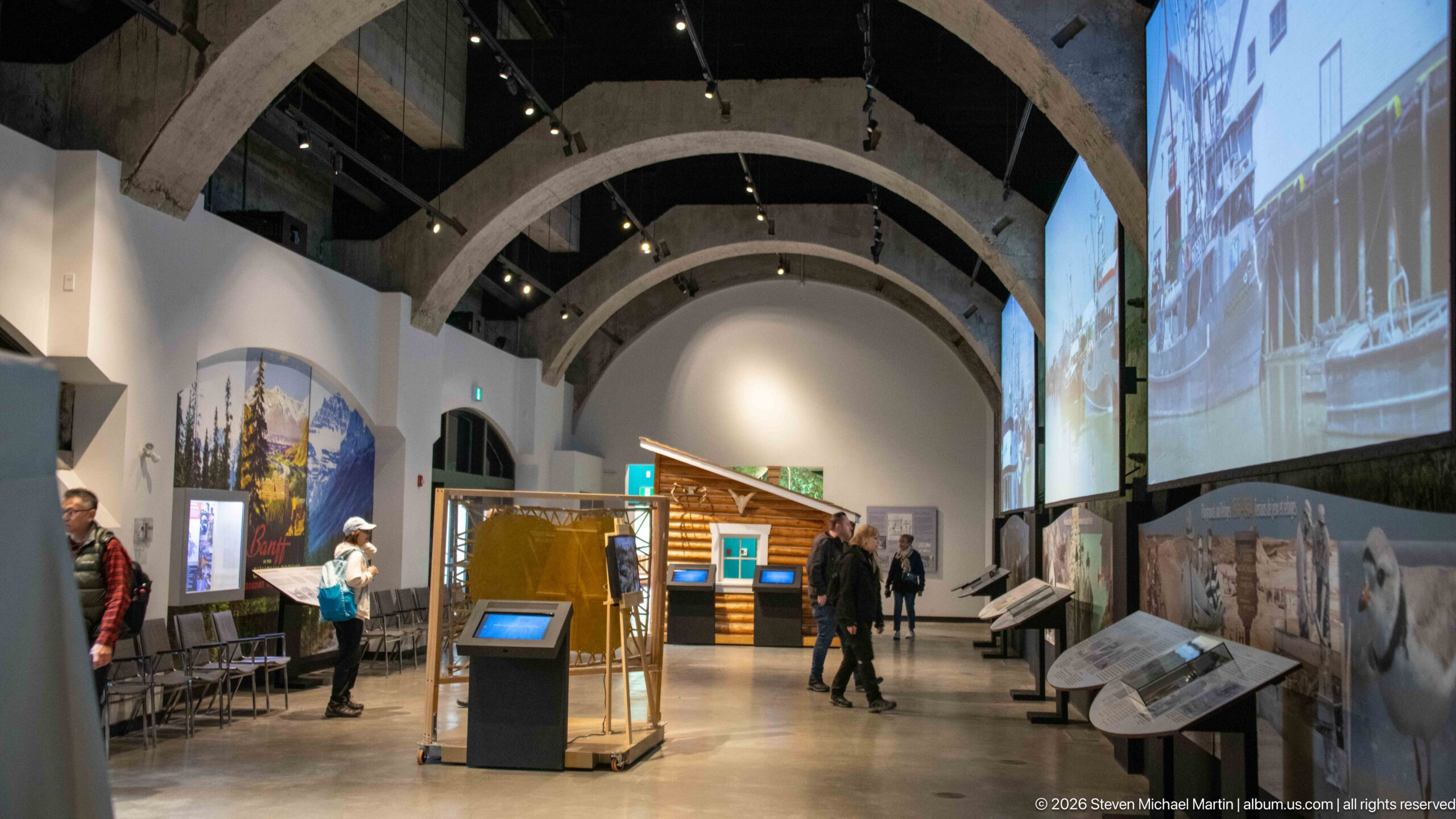
Visitors move through a large exhibit hall where repeated stone arches span a high vaulted ceiling. Wall projections, mounted photographs, freestanding display cases, and interactive stations occupy the length of the room. The central perspective shows the gallery’s architectural rhythm and the way media and artifacts are arranged within the historic interior.
Caption
Visitors move through a large exhibit hall where repeated stone arches span a high vaulted ceiling. Wall projections, mounted photographs, freestanding display cases, and interactive stations occupy the length of the room. The central perspective shows the gallery’s architectural rhythm and the way media and artifacts are arranged within the historic interior.
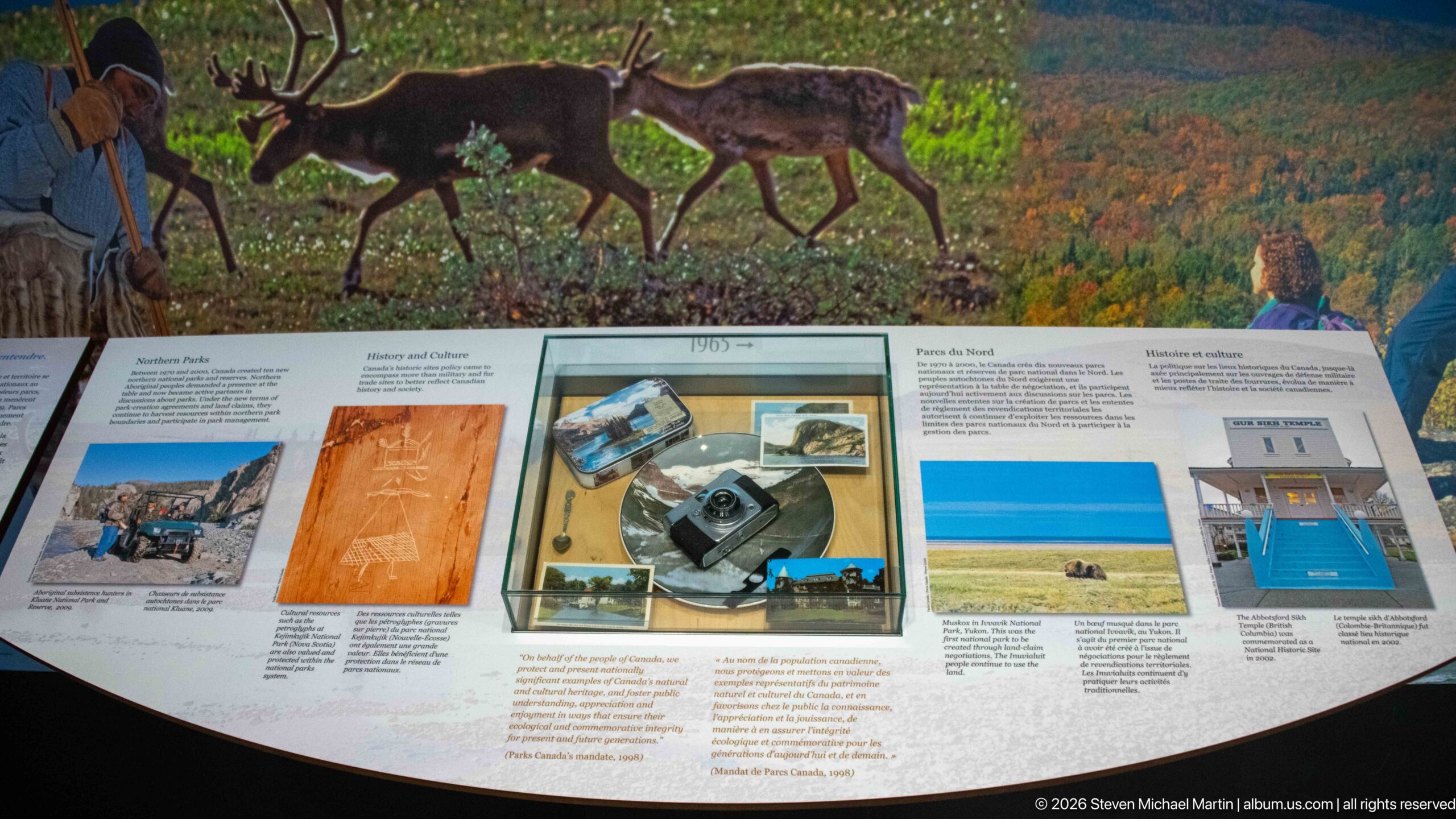
A pair of dark, antlered wildlife figures stand above a curved interpretive panel filled with photographs, maps, and a central glass case. The panel presents park-history topics, while a visitor is partly visible at the right. The elevated animals provide a dramatic museum backdrop, though their exact species and whether they are taxidermy or models cannot be confirmed from this view.
Caption
A pair of dark, antlered wildlife figures stand above a curved interpretive panel filled with photographs, maps, and a central glass case. The panel presents park-history topics, while a visitor is partly visible at the right. The elevated animals provide a dramatic museum backdrop, though their exact species and whether they are taxidermy or models cannot be confirmed from this view.
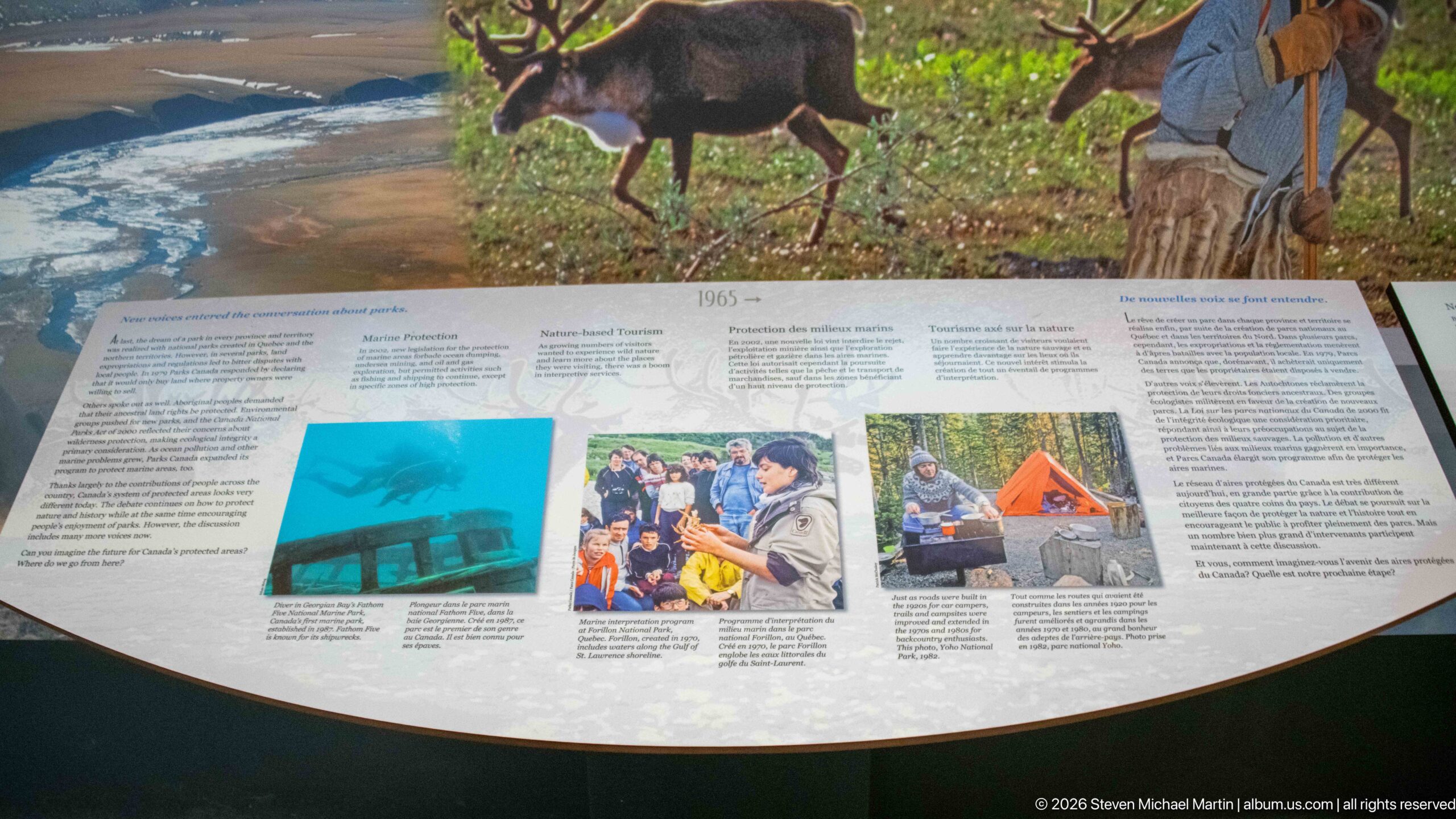
A curved panel labeled “1965” presents photographs and text about the park’s changing history, including visitors, outdoor recreation, and facilities. Archival images are arranged across the lower portion, while a small central case contains objects and printed materials. The close, frontal view highlights how photographs and artifacts are combined to tell a chronological story.
Caption
A curved panel labeled “1965” presents photographs and text about the park’s changing history, including visitors, outdoor recreation, and facilities. Archival images are arranged across the lower portion, while a small central case contains objects and printed materials. The close, frontal view highlights how photographs and artifacts are combined to tell a chronological story.
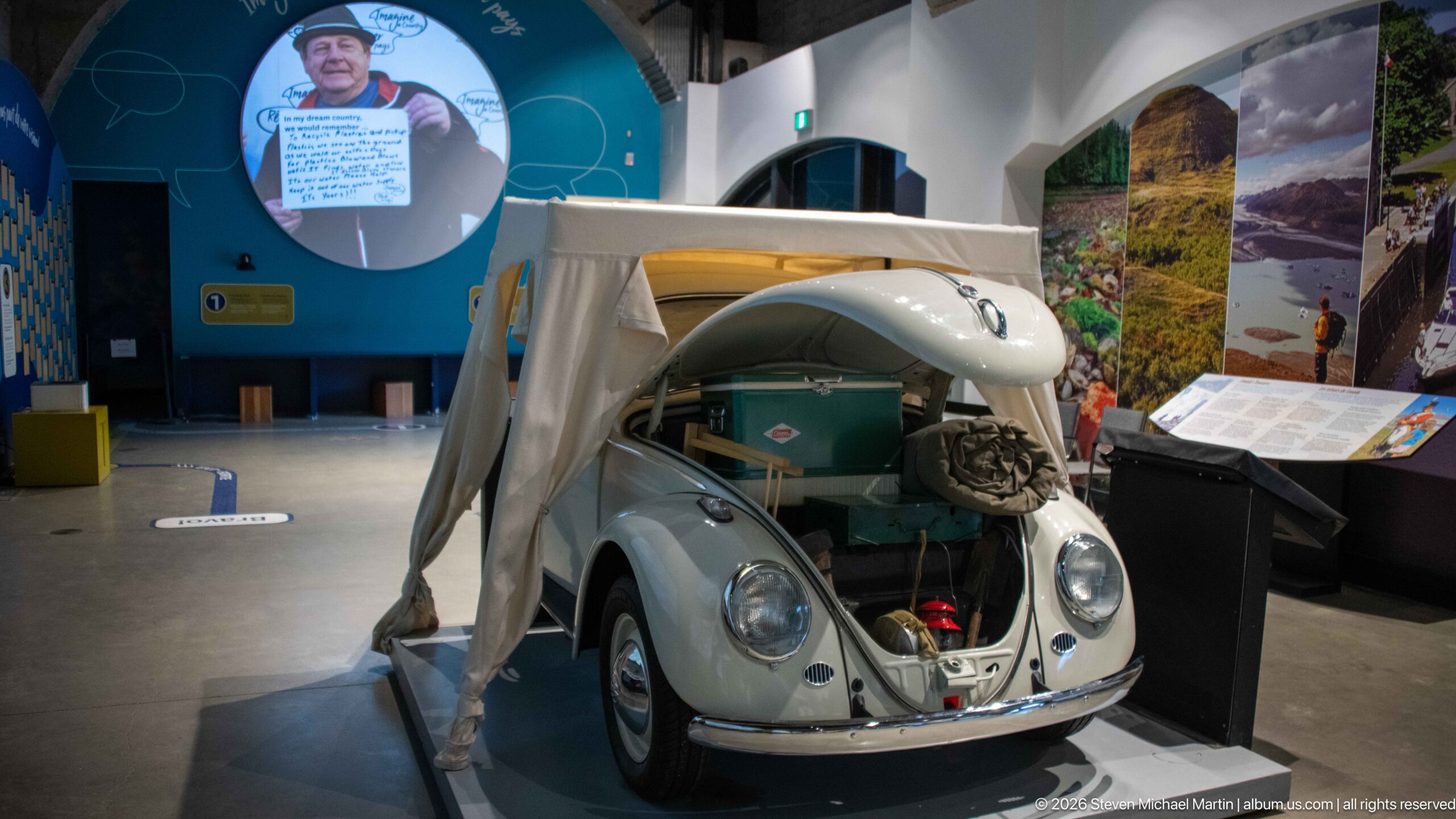
A pale green vintage Volkswagen Beetle sits within the museum’s interpretive gallery, its rounded hood, circular headlights, and split front luggage compartment facing the viewer. A canvas cover is draped across the windshield and roof. Wall displays, a large circular graphic, and exhibit panels surround the car, presenting it as a historical object within a broader visitor experience.
Caption
A pale green vintage Volkswagen Beetle sits within the museum’s interpretive gallery, its rounded hood, circular headlights, and split front luggage compartment facing the viewer. A canvas cover is draped across the windshield and roof. Wall displays, a large circular graphic, and exhibit panels surround the car, presenting it as a historical object within a broader visitor experience.
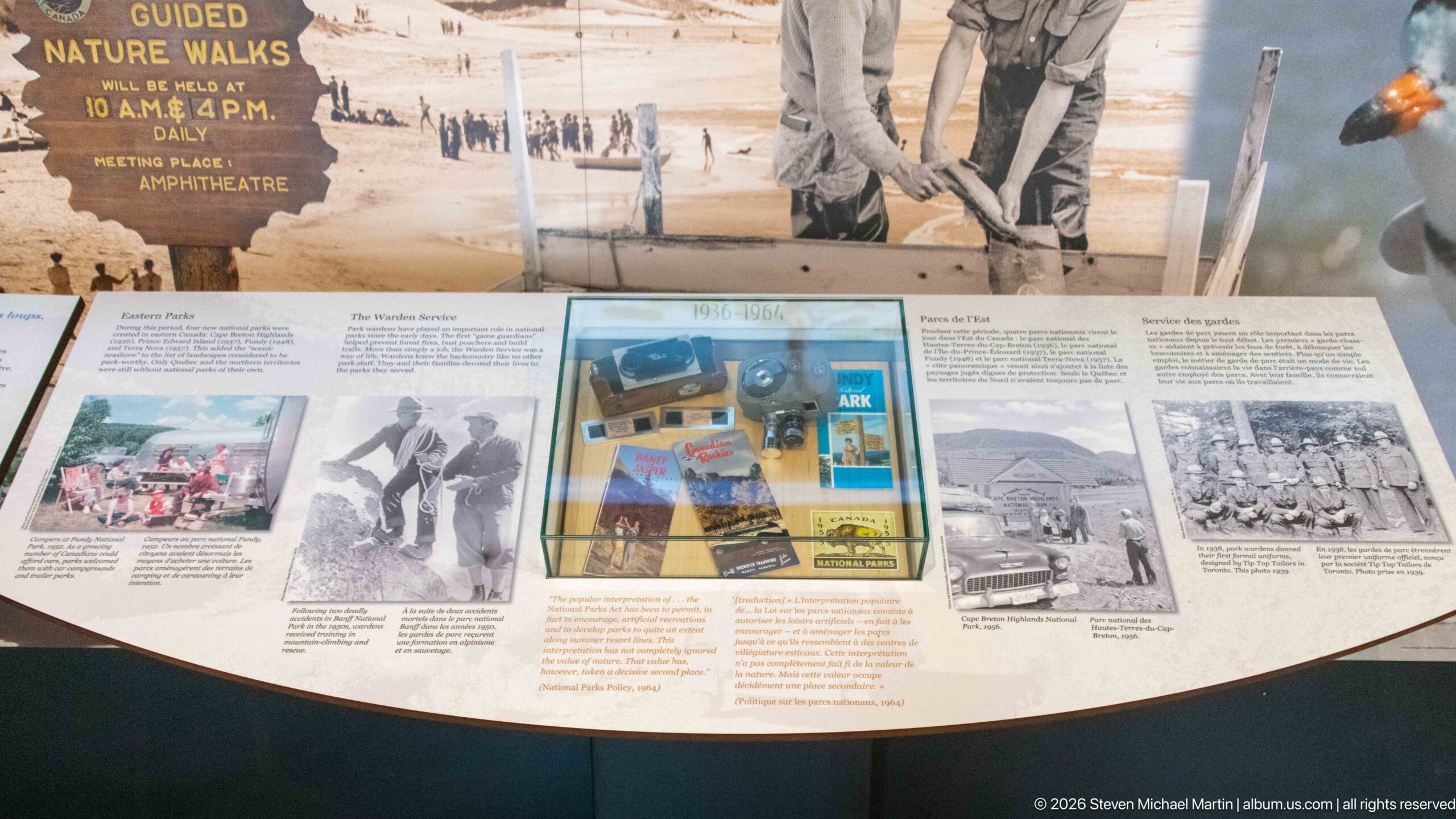
A curved bilingual history panel combines black-and-white photographs, explanatory text, and a glass-topped case containing small printed objects and memorabilia. A large archival image of visitors looms above the panel, while the central case draws attention to material traces of past tourism. The composition shows how the exhibit connects personal travel records with broader site history.
Caption
A curved bilingual history panel combines black-and-white photographs, explanatory text, and a glass-topped case containing small printed objects and memorabilia. A large archival image of visitors looms above the panel, while the central case draws attention to material traces of past tourism. The composition shows how the exhibit connects personal travel records with broader site history.
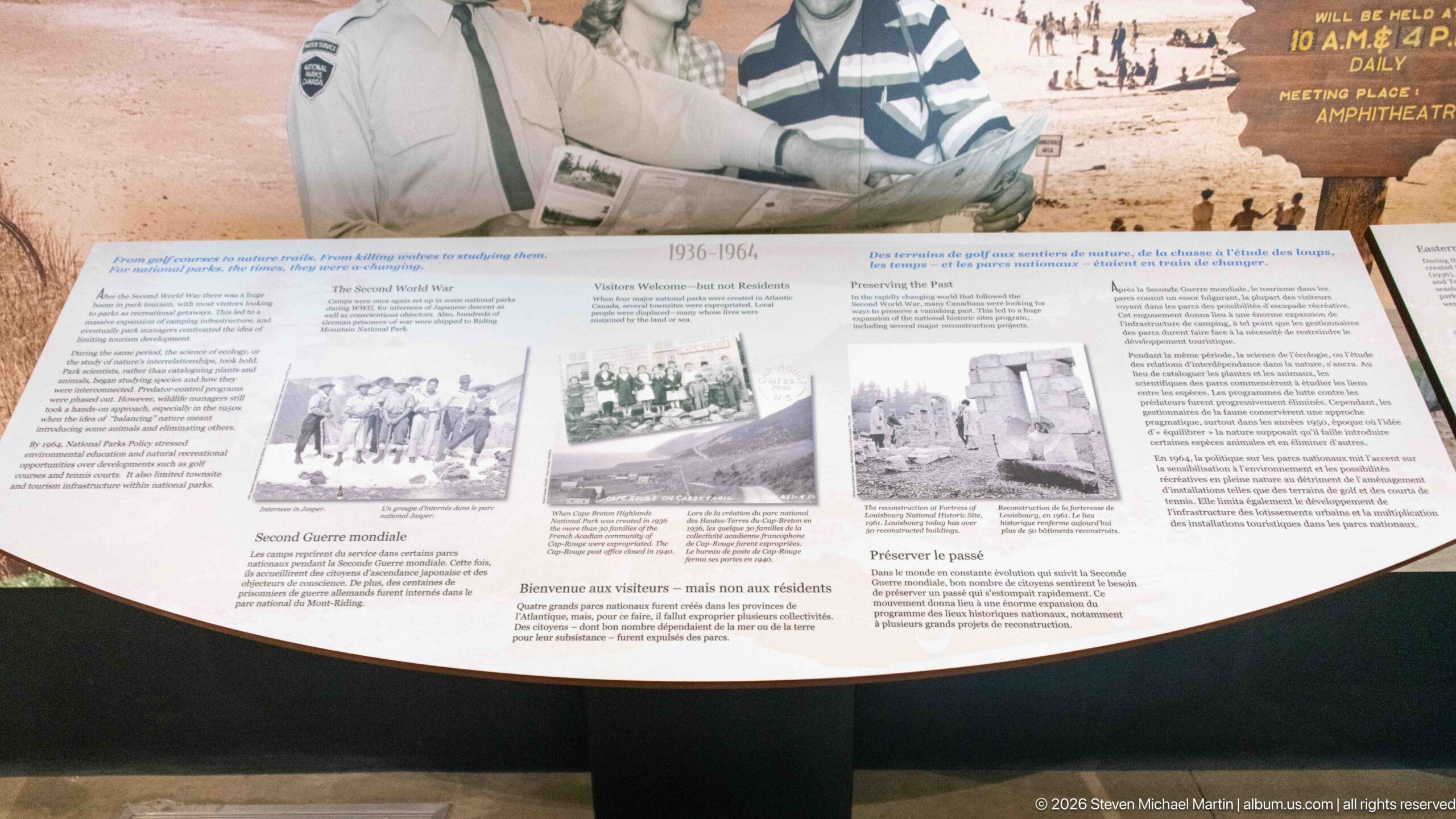
A long exhibit panel presents a sequence of archival photographs and bilingual text, with a glass case centered among the images. The headings and dated sections arrange the material chronologically, while photographs of people and buildings show changing patterns of park use. This frontal view documents the museum’s narrative design rather than attempting to identify every small image.
Caption
A long exhibit panel presents a sequence of archival photographs and bilingual text, with a glass case centered among the images. The headings and dated sections arrange the material chronologically, while photographs of people and buildings show changing patterns of park use. This frontal view documents the museum’s narrative design rather than attempting to identify every small image.
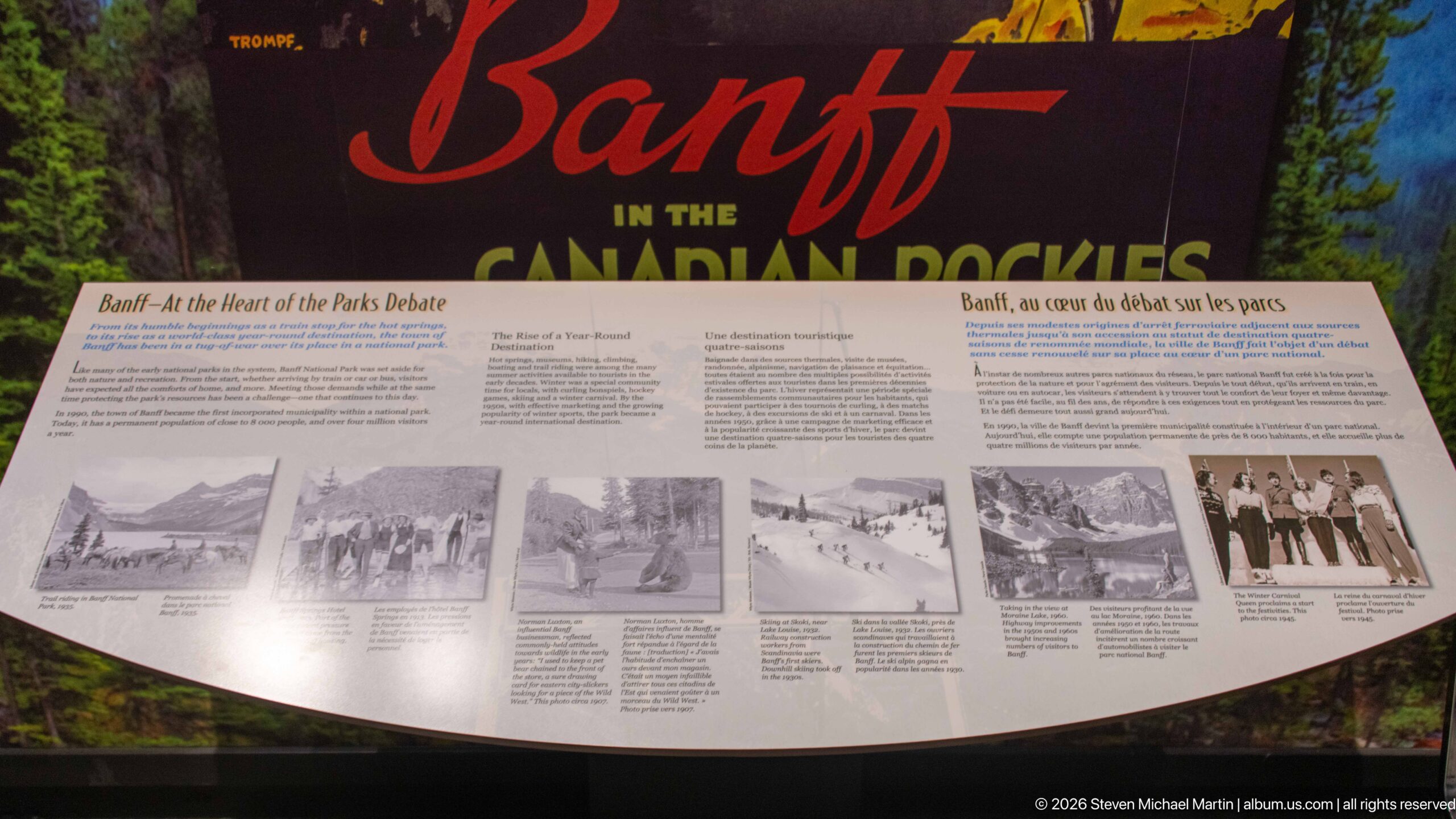
A large display headed “Banff in the Canadian Rockies” stands above a curved interpretive panel titled “Banff—At the Heart of the Parks Debate.” A row of historic photographs illustrates the text, with a forest-and-mountain graphic filling the upper backdrop. The view places the story of Banff within the wider development and debate surrounding national parks.
Caption
A large display headed “Banff in the Canadian Rockies” stands above a curved interpretive panel titled “Banff—At the Heart of the Parks Debate.” A row of historic photographs illustrates the text, with a forest-and-mountain graphic filling the upper backdrop. The view places the story of Banff within the wider development and debate surrounding national parks.
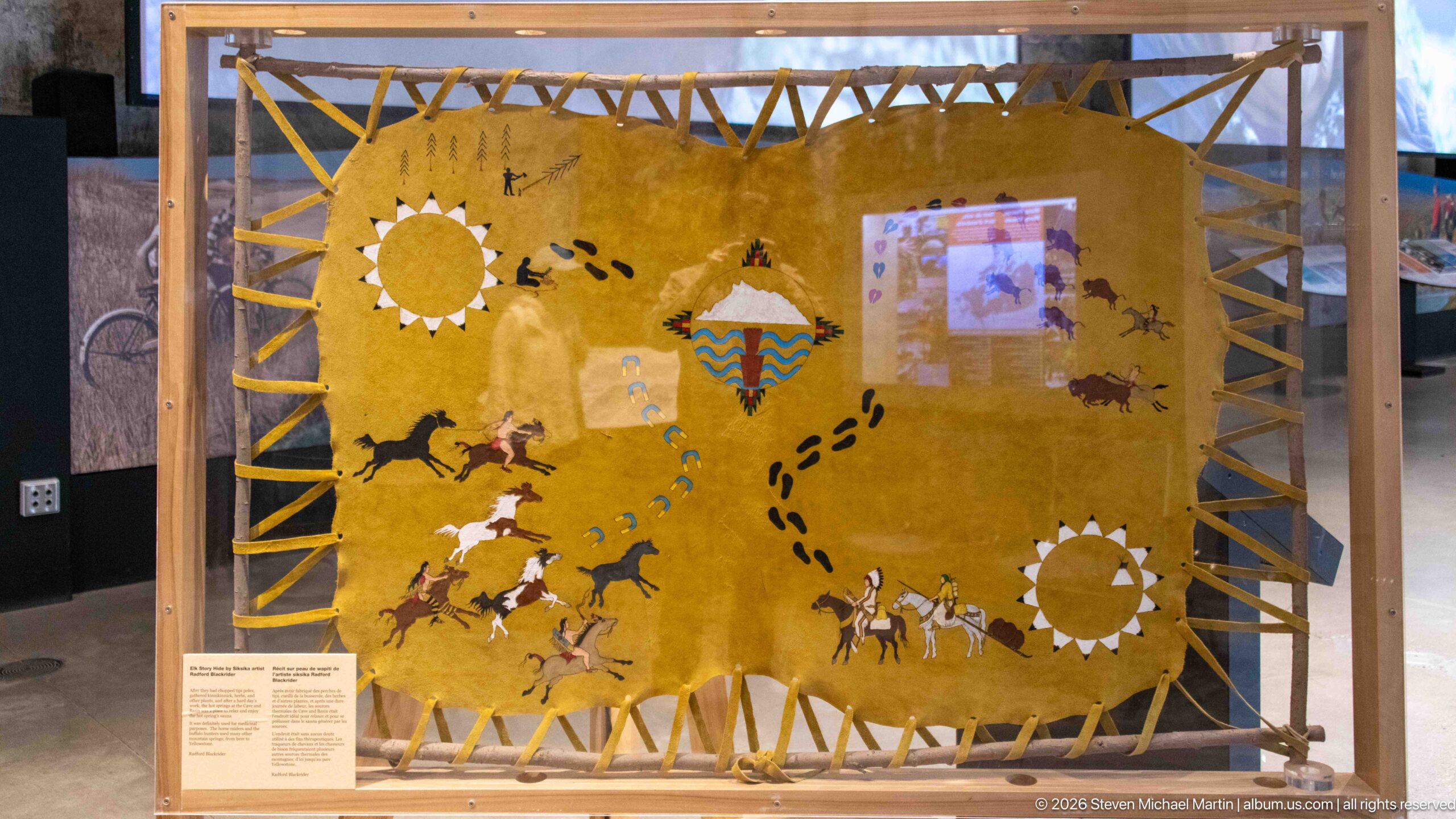
A large ochre-colored hide or hide-like surface is displayed within a timber frame. Painted forms include a central human figure, running animals, tracks, circular sun-like motifs, and a border of repeated geometric elements. A small label is mounted below the display. The image records the artifact’s surface and presentation, while its maker, age, and precise cultural attribution remain unverified.
Caption
A large ochre-colored hide or hide-like surface is displayed within a timber frame. Painted forms include a central human figure, running animals, tracks, circular sun-like motifs, and a border of repeated geometric elements. A small label is mounted below the display. The image records the artifact’s surface and presentation, while its maker, age, and precise cultural attribution remain unverified.
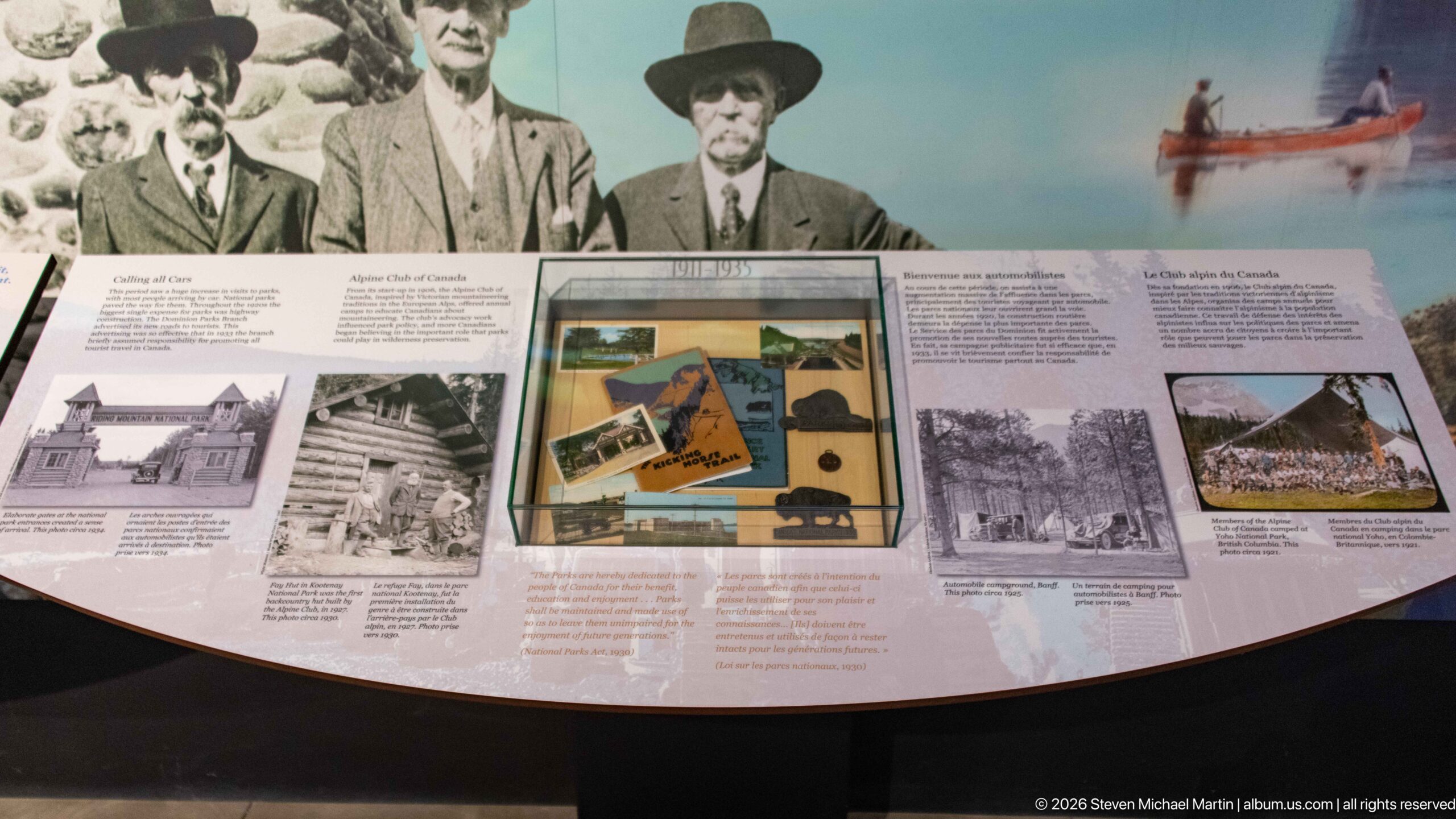
A curved history panel combines photographs of early visitors and builders with images of historic structures and a central glass case of small objects. Large portraits loom above the exhibit, including men in period clothing, while a small canoe scene appears at the upper right. The display links individual stories, material artifacts, and the changing built landscape of Banff.
Caption
A curved history panel combines photographs of early visitors and builders with images of historic structures and a central glass case of small objects. Large portraits loom above the exhibit, including men in period clothing, while a small canoe scene appears at the upper right. The display links individual stories, material artifacts, and the changing built landscape of Banff.
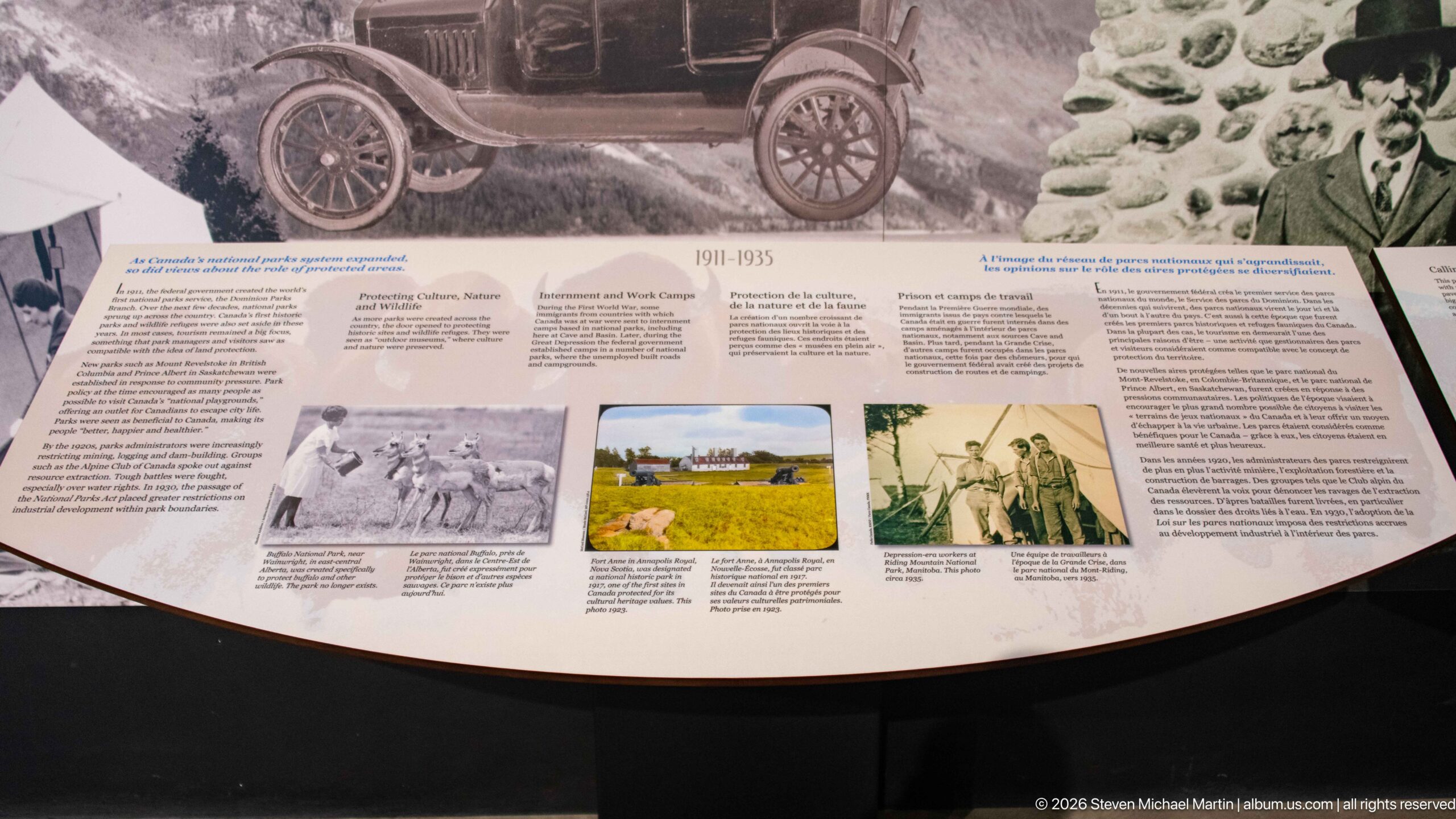
A curved exhibit panel marked “1911–1935” combines bilingual text with photographs of visitors, park landscapes, and early transportation. Above it, a mural-like archival backdrop includes an automobile and a formally dressed man. The display presents a period of park development through text and images, while its wide sweep follows the gallery wall rather than focusing on one artifact.
Caption
A curved exhibit panel marked “1911–1935” combines bilingual text with photographs of visitors, park landscapes, and early transportation. Above it, a mural-like archival backdrop includes an automobile and a formally dressed man. The display presents a period of park development through text and images, while its wide sweep follows the gallery wall rather than focusing on one artifact.
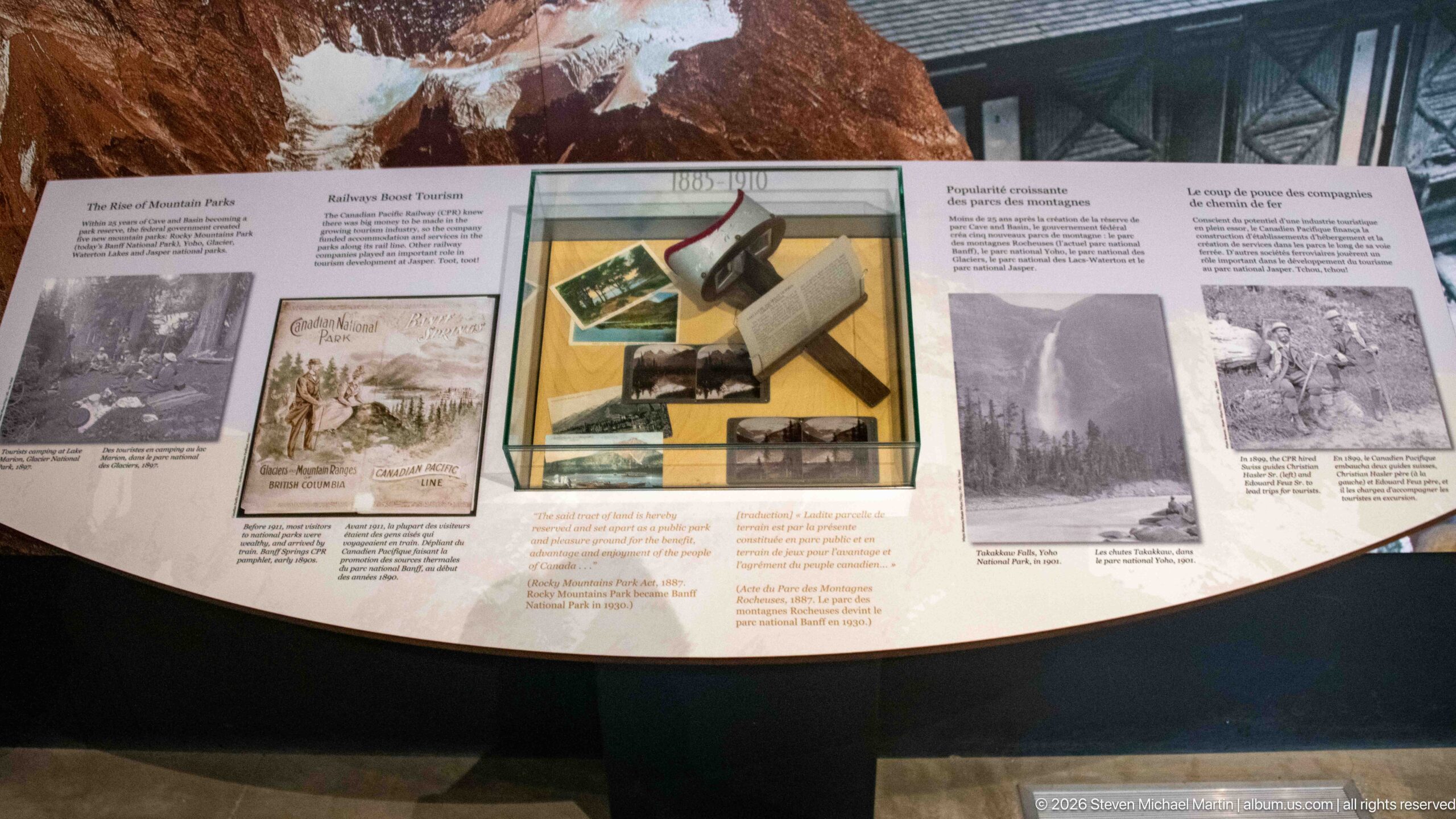
A glass case is set into a long interpretive panel beside reproduced documents, photographs, and bilingual text. Inside are small paper items and objects associated with travel and park history, arranged against a yellow backing. A large image of a mountain waterfall appears at right. The view distinguishes the display case and its contents from the surrounding narrative panel.
Caption
A glass case is set into a long interpretive panel beside reproduced documents, photographs, and bilingual text. Inside are small paper items and objects associated with travel and park history, arranged against a yellow backing. A large image of a mountain waterfall appears at right. The view distinguishes the display case and its contents from the surrounding narrative panel.
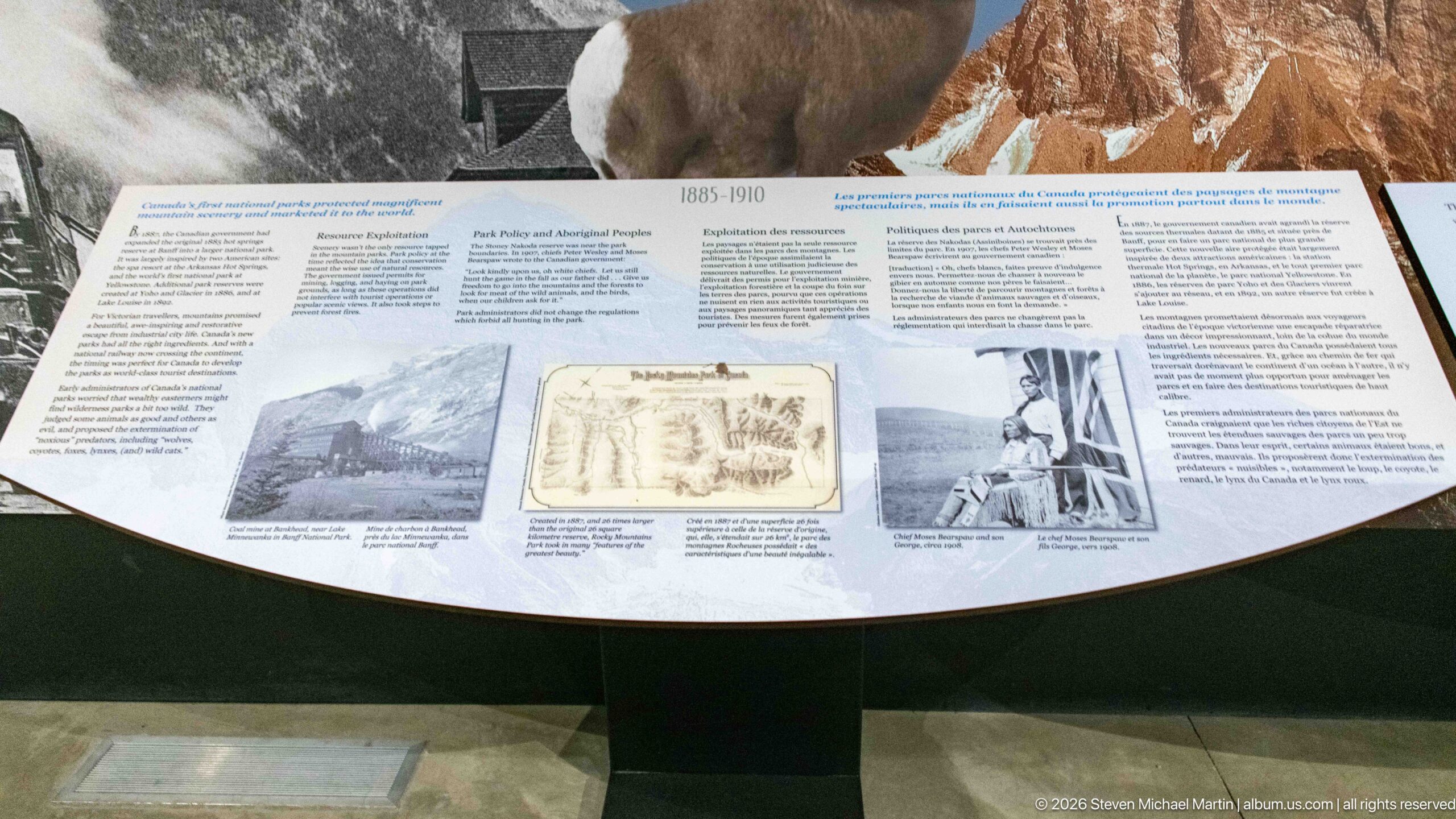
A curved gallery panel labeled “1885–1910” places a reproduced map between photographs of historic buildings and people. A large wildlife image hangs above the display, while the bilingual text follows the curve of the case. The composition connects early park planning and settlement to the interpretive gallery’s wider story without asserting the identity of the small map or photographs.
Caption
A curved gallery panel labeled “1885–1910” places a reproduced map between photographs of historic buildings and people. A large wildlife image hangs above the display, while the bilingual text follows the curve of the case. The composition connects early park planning and settlement to the interpretive gallery’s wider story without asserting the identity of the small map or photographs.
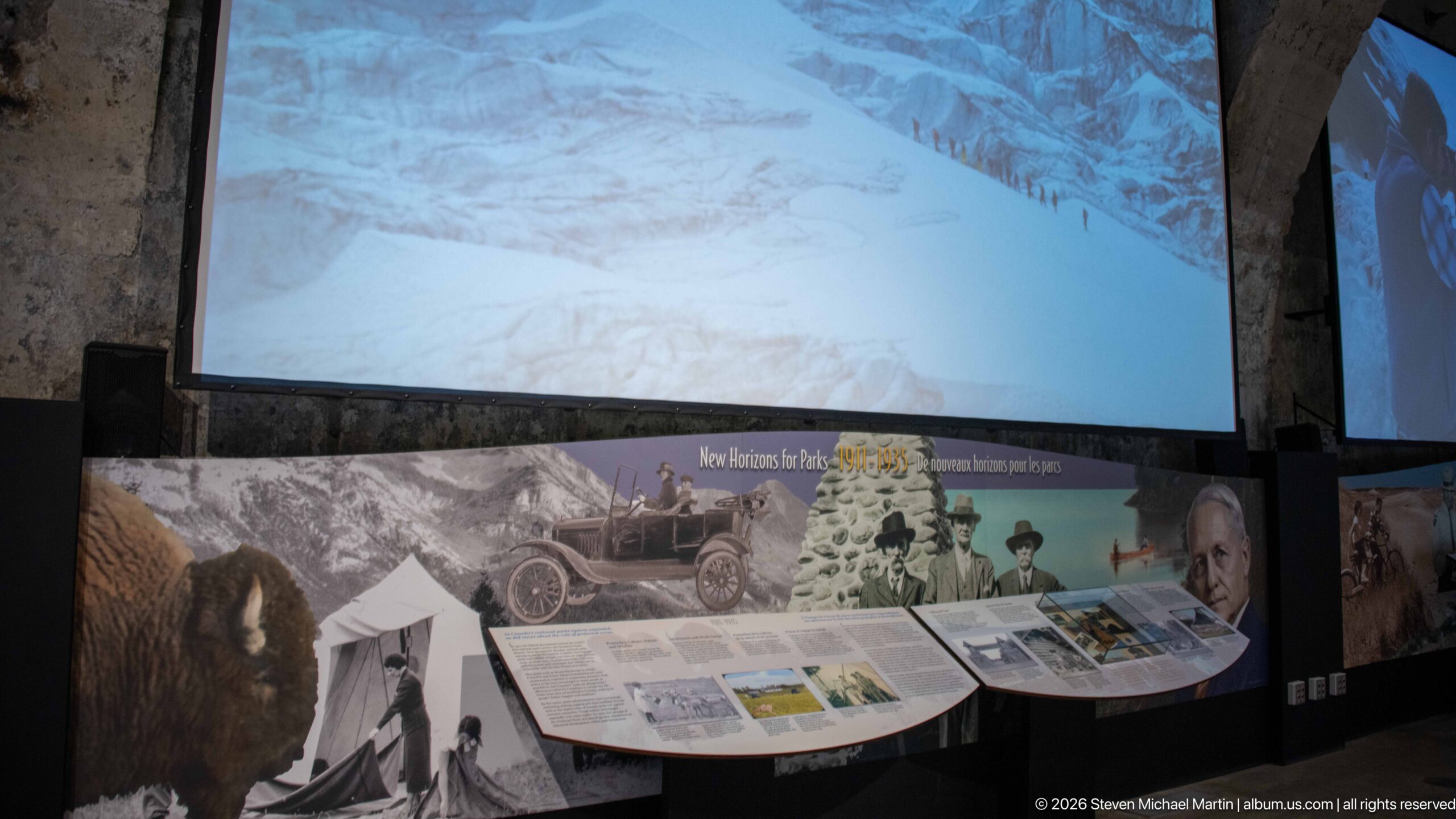
A broad gallery installation combines projected mountain imagery, wall-sized historical scenes, and a curved interpretive panel. The panel sits below a mural of an early automobile, a bison, and figures in period clothing, while a mountain landscape fills the upper screen. This wide view shows the scale of the multimedia exhibit and how images surround visitors within the gallery.
Caption
A broad gallery installation combines projected mountain imagery, wall-sized historical scenes, and a curved interpretive panel. The panel sits below a mural of an early automobile, a bison, and figures in period clothing, while a mountain landscape fills the upper screen. This wide view shows the scale of the multimedia exhibit and how images surround visitors within the gallery.
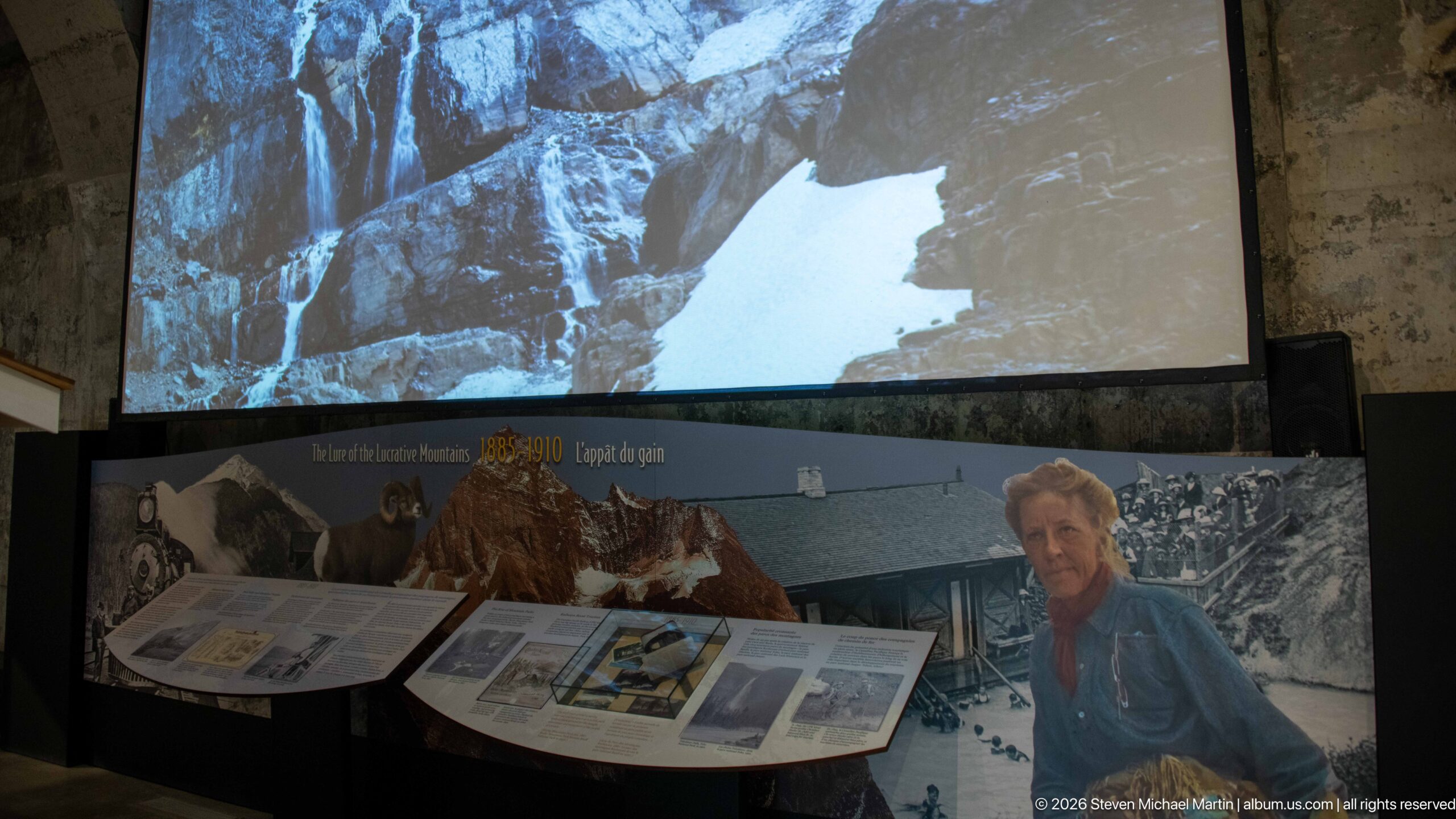
A large projected waterfall fills the upper wall above a curved interpretive panel, while a portrait of a woman appears in the mural at right. The panel’s historic photographs and text sit within a landscape-themed installation, and a visitor stands near the display. The closer angle emphasizes the dramatic projected image and its relationship to the human-scale exhibit below.
Caption
A large projected waterfall fills the upper wall above a curved interpretive panel, while a portrait of a woman appears in the mural at right. The panel’s historic photographs and text sit within a landscape-themed installation, and a visitor stands near the display. The closer angle emphasizes the dramatic projected image and its relationship to the human-scale exhibit below.
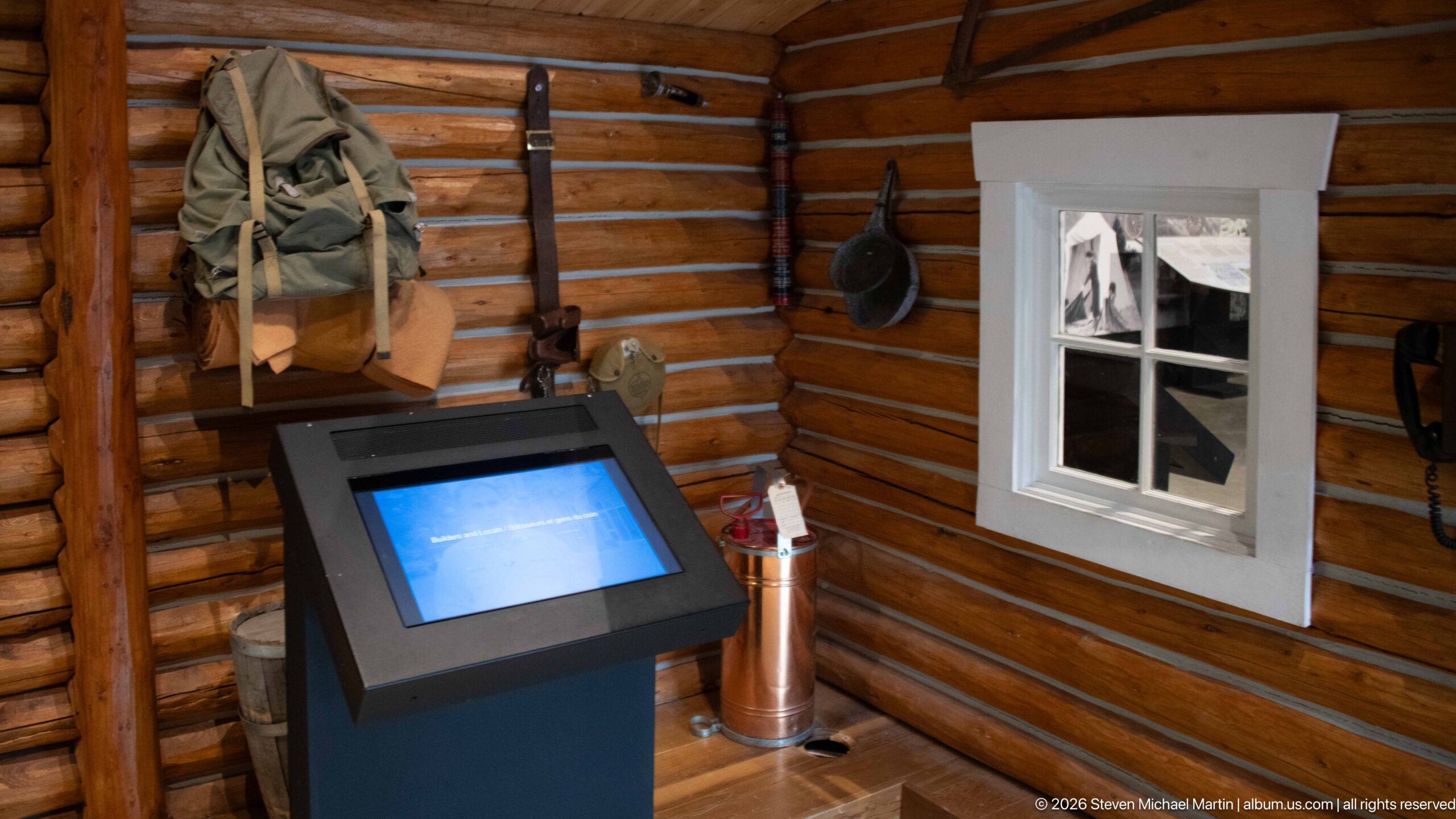
A compact log cabin exhibit stands inside the gallery, with rounded timber walls, a small-paned window, hanging clothing and equipment, and a touchscreen kiosk. A copper-colored cylindrical object rests near the window. The room recreates a furnished interior within the larger museum hall, allowing visitors to view the rough log construction and displayed belongings at close range.
Caption
A compact log cabin exhibit stands inside the gallery, with rounded timber walls, a small-paned window, hanging clothing and equipment, and a touchscreen kiosk. A copper-colored cylindrical object rests near the window. The room recreates a furnished interior within the larger museum hall, allowing visitors to view the rough log construction and displayed belongings at close range.
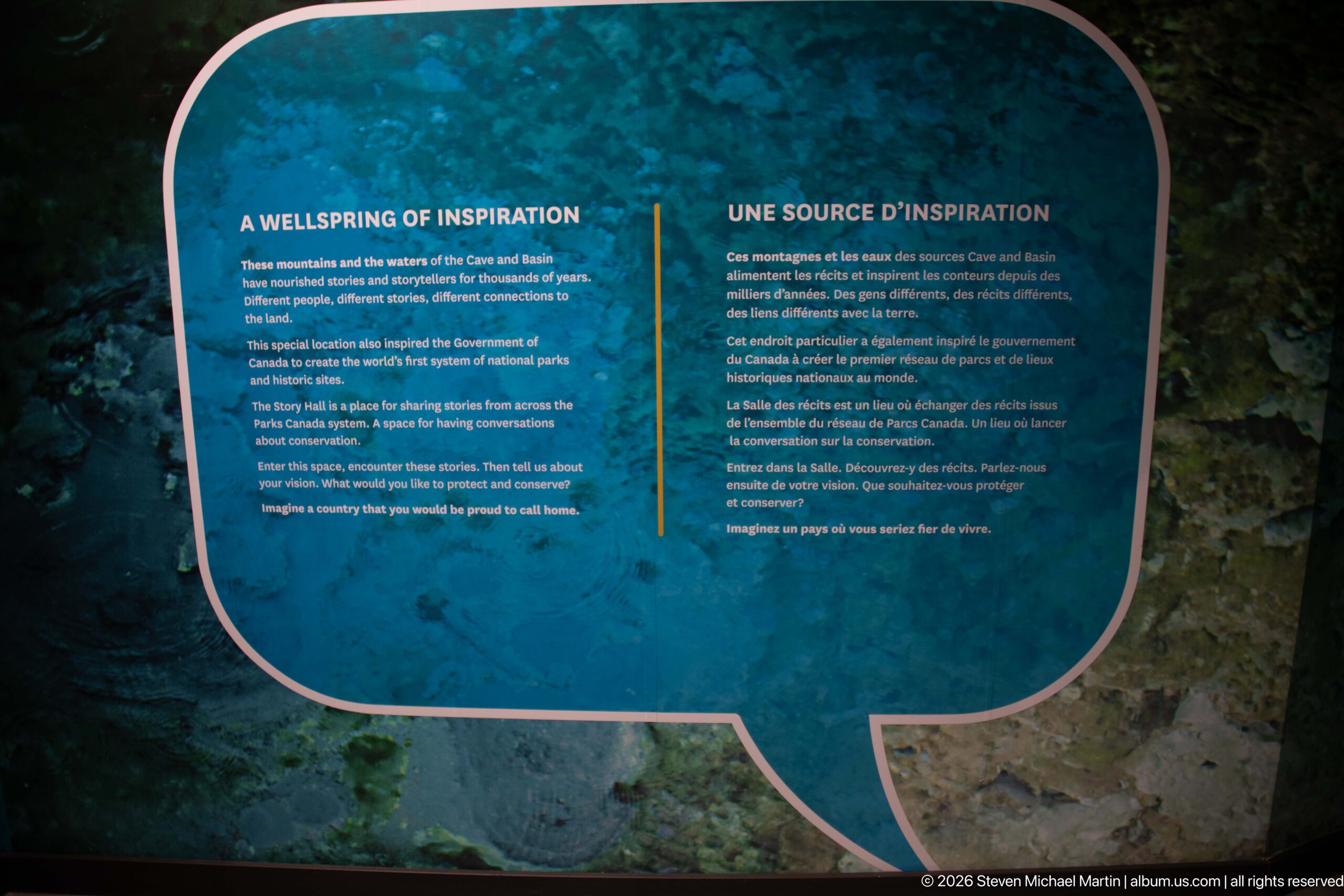
A large blue panel shaped like a speech bubble overlays an image of spring water. Its bilingual heading reads “A Wellspring of Inspiration,” followed by paragraphs about the site and its significance. The close, frontal view centers the text panel’s graphic design and translucent water background, turning the exhibit’s written interpretation into the principal subject.
Caption
A large blue panel shaped like a speech bubble overlays an image of spring water. Its bilingual heading reads “A Wellspring of Inspiration,” followed by paragraphs about the site and its significance. The close, frontal view centers the text panel’s graphic design and translucent water background, turning the exhibit’s written interpretation into the principal subject.
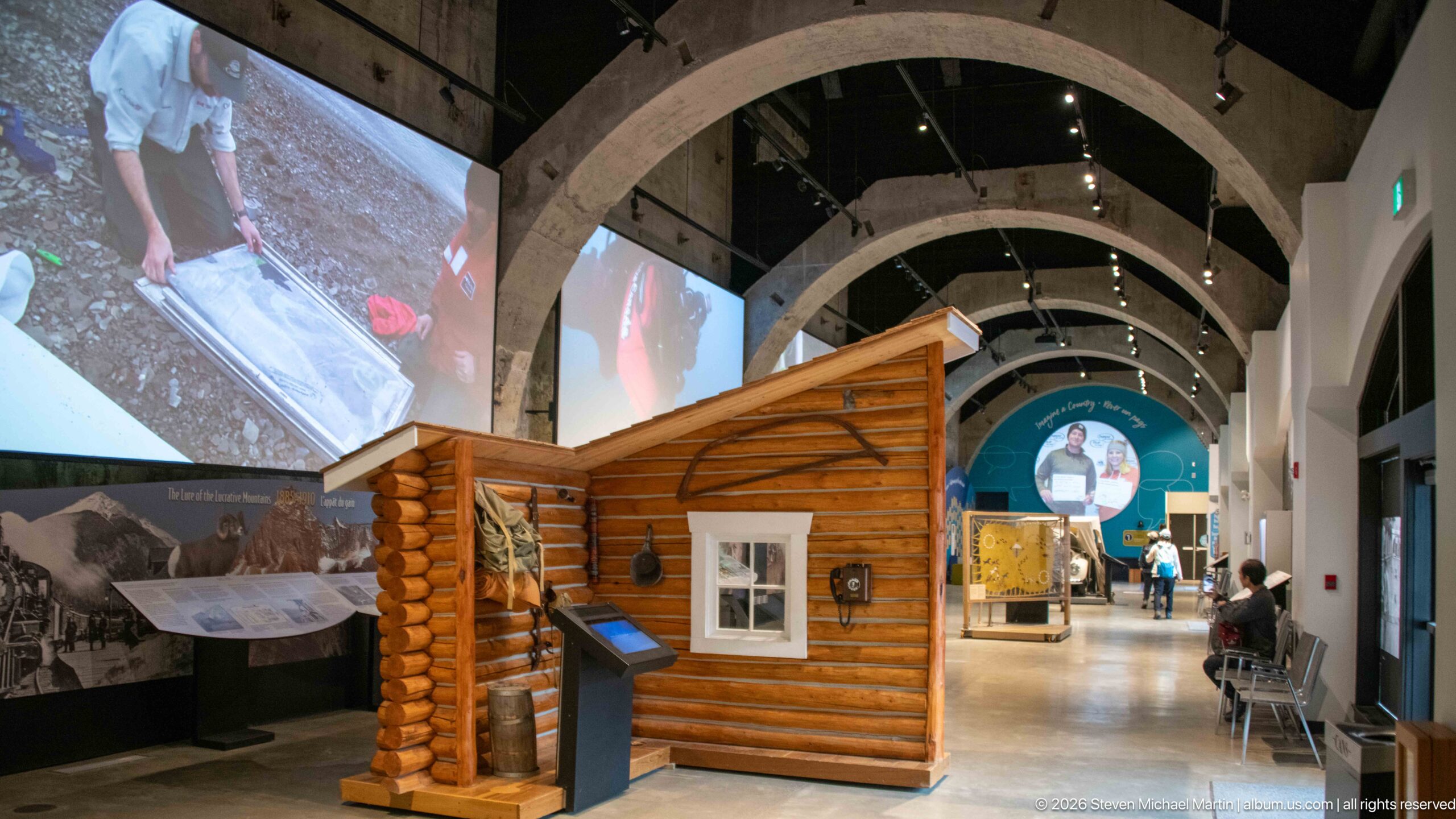
A reconstructed log cabin stands beneath a sequence of stone arches in the exhibit hall. Its rounded timber walls, small window, hanging equipment, and angled touchscreen contrast with the gallery’s masonry and polished floor. Projected images and other displays continue into the background, making the cabin a self-contained historical environment inside a larger interpretive space.
Caption
A reconstructed log cabin stands beneath a sequence of stone arches in the exhibit hall. Its rounded timber walls, small window, hanging equipment, and angled touchscreen contrast with the gallery’s masonry and polished floor. Projected images and other displays continue into the background, making the cabin a self-contained historical environment inside a larger interpretive space.
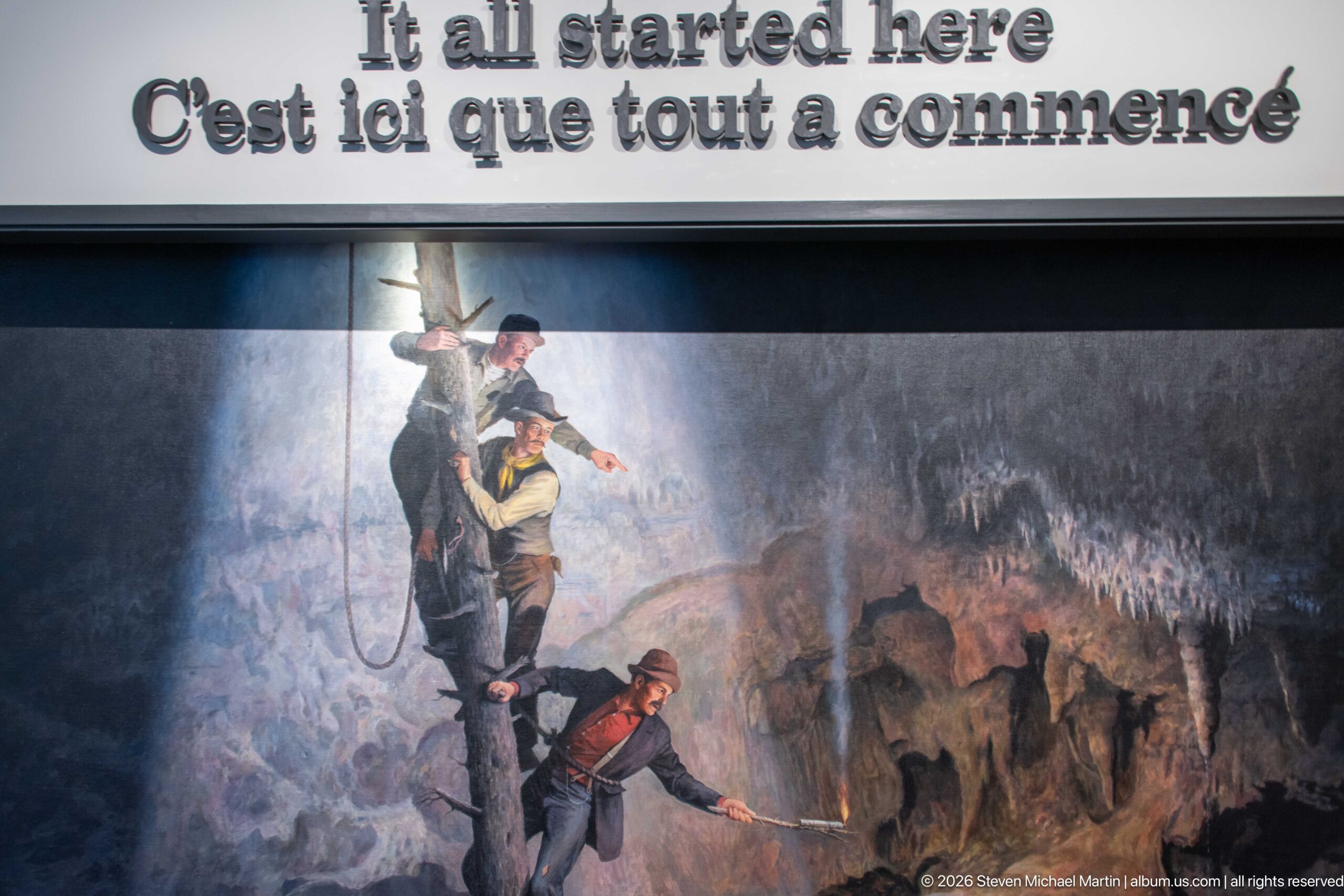
A large mural titled “It all started here” shows three men descending by rope into a dark cave, accompanied by English and French text. The painted figures are arranged vertically against the rock opening, with one man reaching downward toward the cavern floor. The image interprets the 1883 encounter with the springs as a dramatic scene rather than a documentary photograph.
Caption
A large mural titled “It all started here” shows three men descending by rope into a dark cave, accompanied by English and French text. The painted figures are arranged vertically against the rock opening, with one man reaching downward toward the cavern floor. The image interprets the 1883 encounter with the springs as a dramatic scene rather than a documentary photograph.
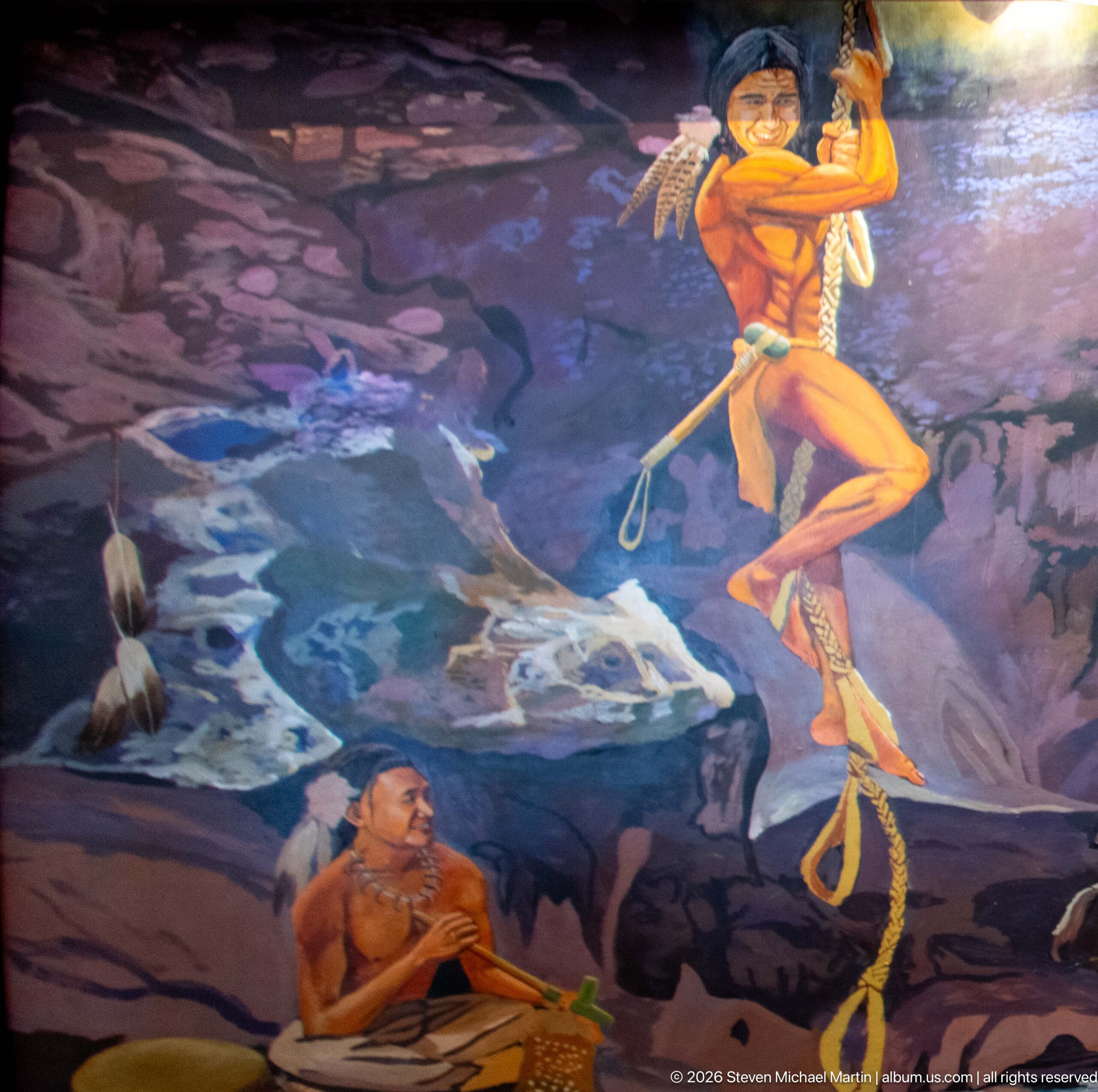
A colorful mural depicts a central Indigenous figure holding a child, with another person seated below amid a blue and violet landscape. Pale pools, rock formations, and plant-like shapes fill the surrounding scene. The composition is clearly interpretive artwork, not a documentary image; the figure’s identity and the story being represented are not specified in the visible panel.
Caption
A colorful mural depicts a central Indigenous figure holding a child, with another person seated below amid a blue and violet landscape. Pale pools, rock formations, and plant-like shapes fill the surrounding scene. The composition is clearly interpretive artwork, not a documentary image; the figure’s identity and the story being represented are not specified in the visible panel.
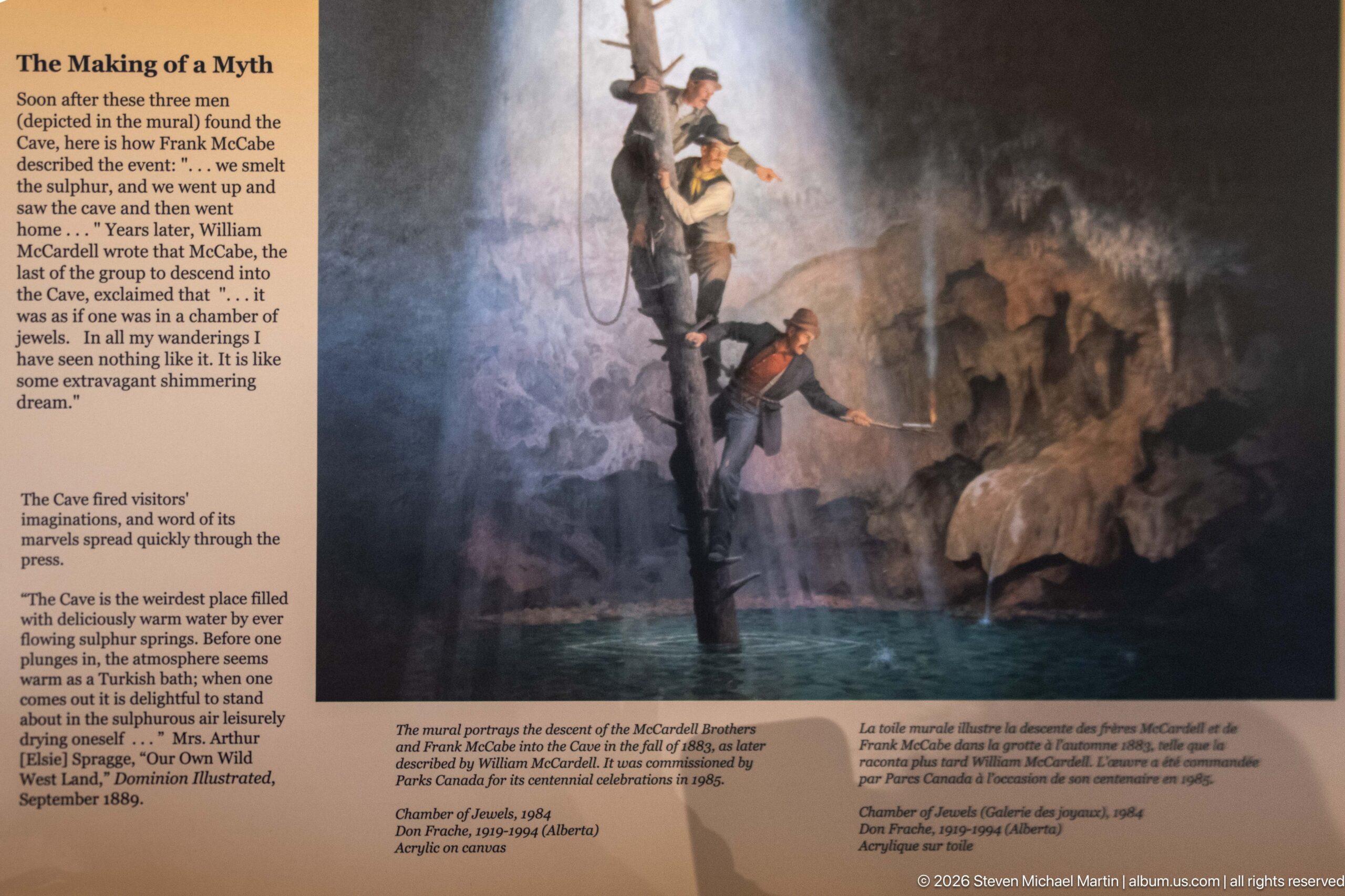
A bilingual text panel sits beside a large painted scene of men descending into a cave on ropes. The prose includes a quotation attributed to William McCardell and describes the visitors’ response to the cavern; a caption beneath the image identifies the mural’s subject. Together, the words and painting present a historical interpretation of the 1883 entry into the cave.
Caption
A bilingual text panel sits beside a large painted scene of men descending into a cave on ropes. The prose includes a quotation attributed to William McCardell and describes the visitors’ response to the cavern; a caption beneath the image identifies the mural’s subject. Together, the words and painting present a historical interpretation of the 1883 entry into the cave.
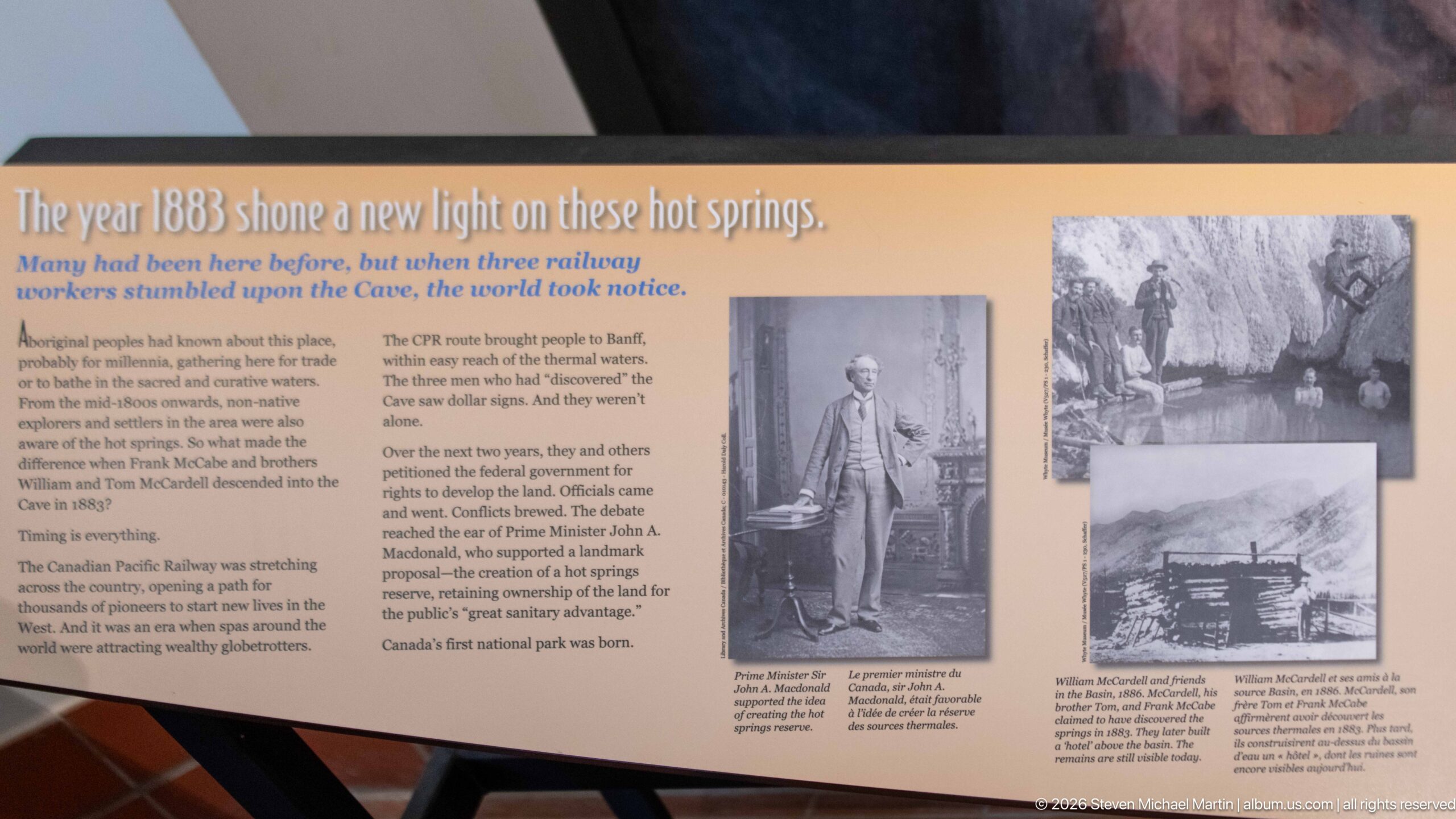
A tan interpretive panel headed “The year 1883 shone a new light on these hot springs” combines bilingual text with archival photographs of men and the springs. The layout explains the event through short text blocks and images, including a reproduced scene of early visitors. The panel offers a close view of the written historical narrative within the Cave and Basin gallery.
Caption
A tan interpretive panel headed “The year 1883 shone a new light on these hot springs” combines bilingual text with archival photographs of men and the springs. The layout explains the event through short text blocks and images, including a reproduced scene of early visitors. The panel offers a close view of the written historical narrative within the Cave and Basin gallery.
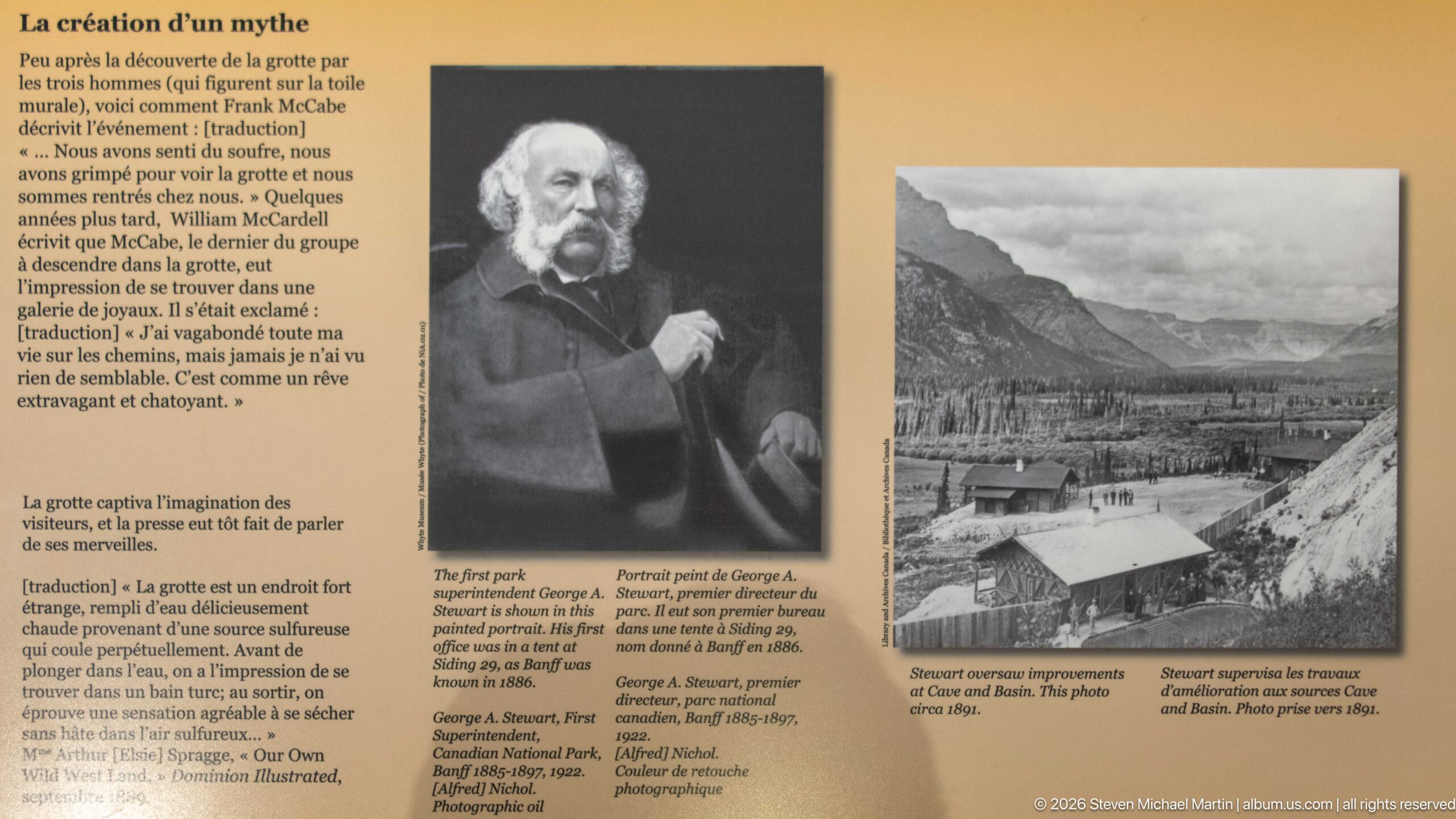
A bilingual history panel pairs a portrait of George A. Stewart with a black-and-white photograph of an early settlement in a mountain valley. The text discusses the development of the reserve and park, while small captions identify the portrait and landscape image. Their side-by-side presentation links a named historical figure with the changing built environment around Banff.
Caption
A bilingual history panel pairs a portrait of George A. Stewart with a black-and-white photograph of an early settlement in a mountain valley. The text discusses the development of the reserve and park, while small captions identify the portrait and landscape image. Their side-by-side presentation links a named historical figure with the changing built environment around Banff.
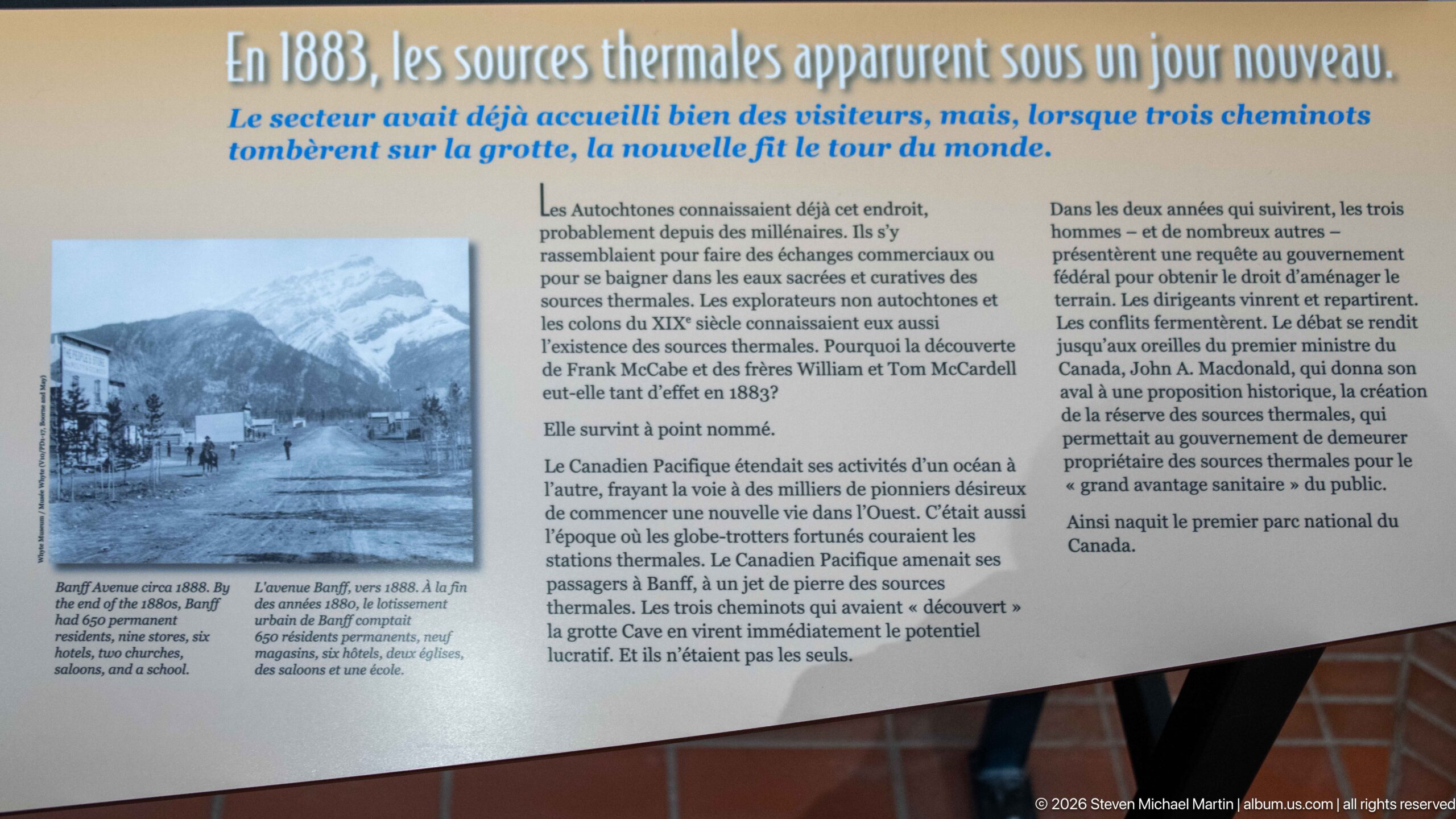
A French-language panel headed with a phrase about thermal springs becoming apparent to the world pairs paragraphs of text with a historic winter photograph of Banff. The image shows a snow-covered street and buildings below a mountain slope. The close view preserves the panel’s original language and image context rather than reducing it to a generic history display.
Caption
A French-language panel headed with a phrase about thermal springs becoming apparent to the world pairs paragraphs of text with a historic winter photograph of Banff. The image shows a snow-covered street and buildings below a mountain slope. The close view preserves the panel’s original language and image context rather than reducing it to a generic history display.
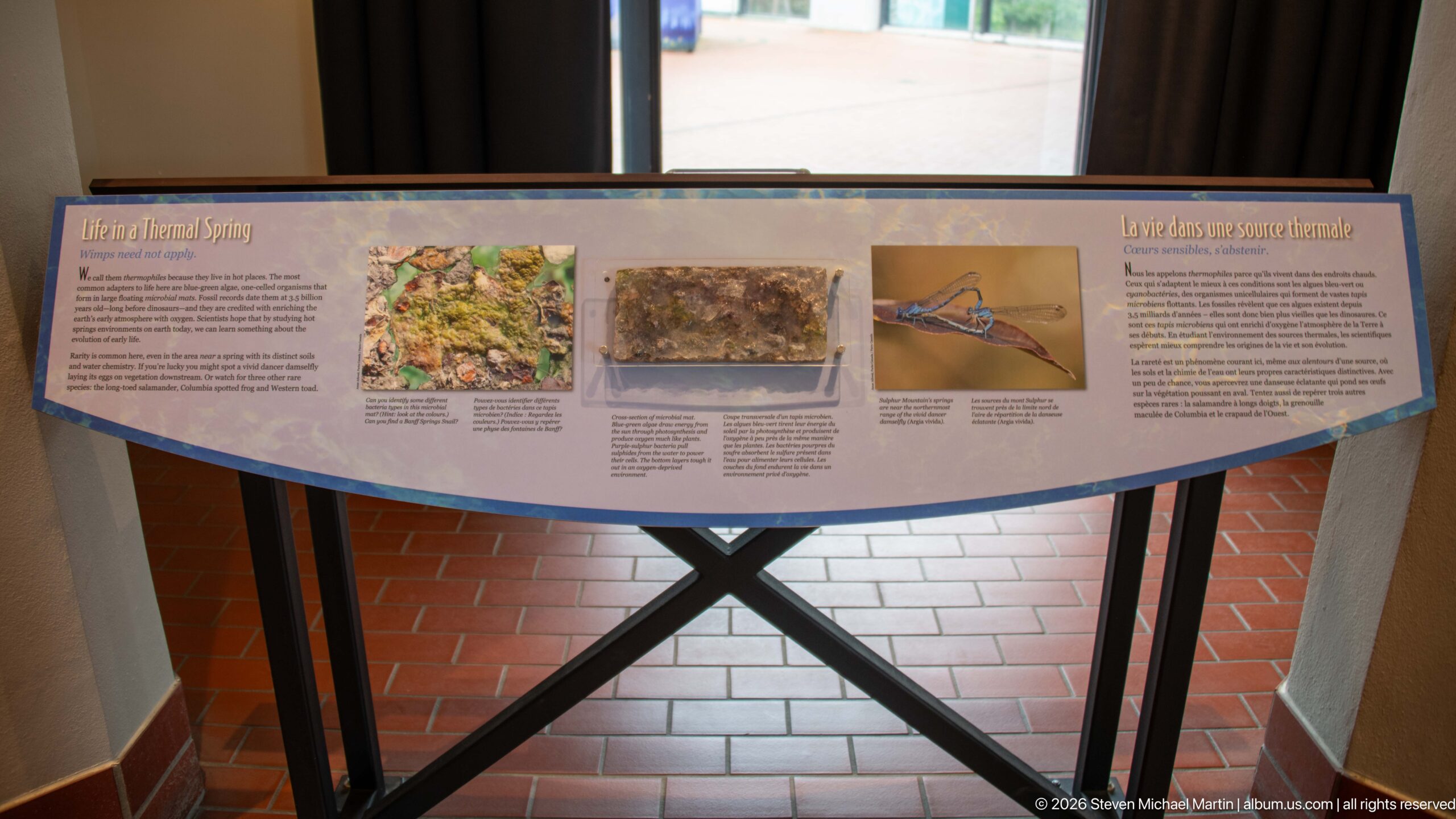
A freestanding bilingual display titled “Life in a Thermal Spring” presents photographs and illustrations of organisms associated with hot-spring water. Three image panels run across the top, while explanatory text fills the lower sections. The stand sits near a doorway on a tiled floor, distinguishing it from the wall-mounted historical exhibits in the gallery.
Caption
A freestanding bilingual display titled “Life in a Thermal Spring” presents photographs and illustrations of organisms associated with hot-spring water. Three image panels run across the top, while explanatory text fills the lower sections. The stand sits near a doorway on a tiled floor, distinguishing it from the wall-mounted historical exhibits in the gallery.
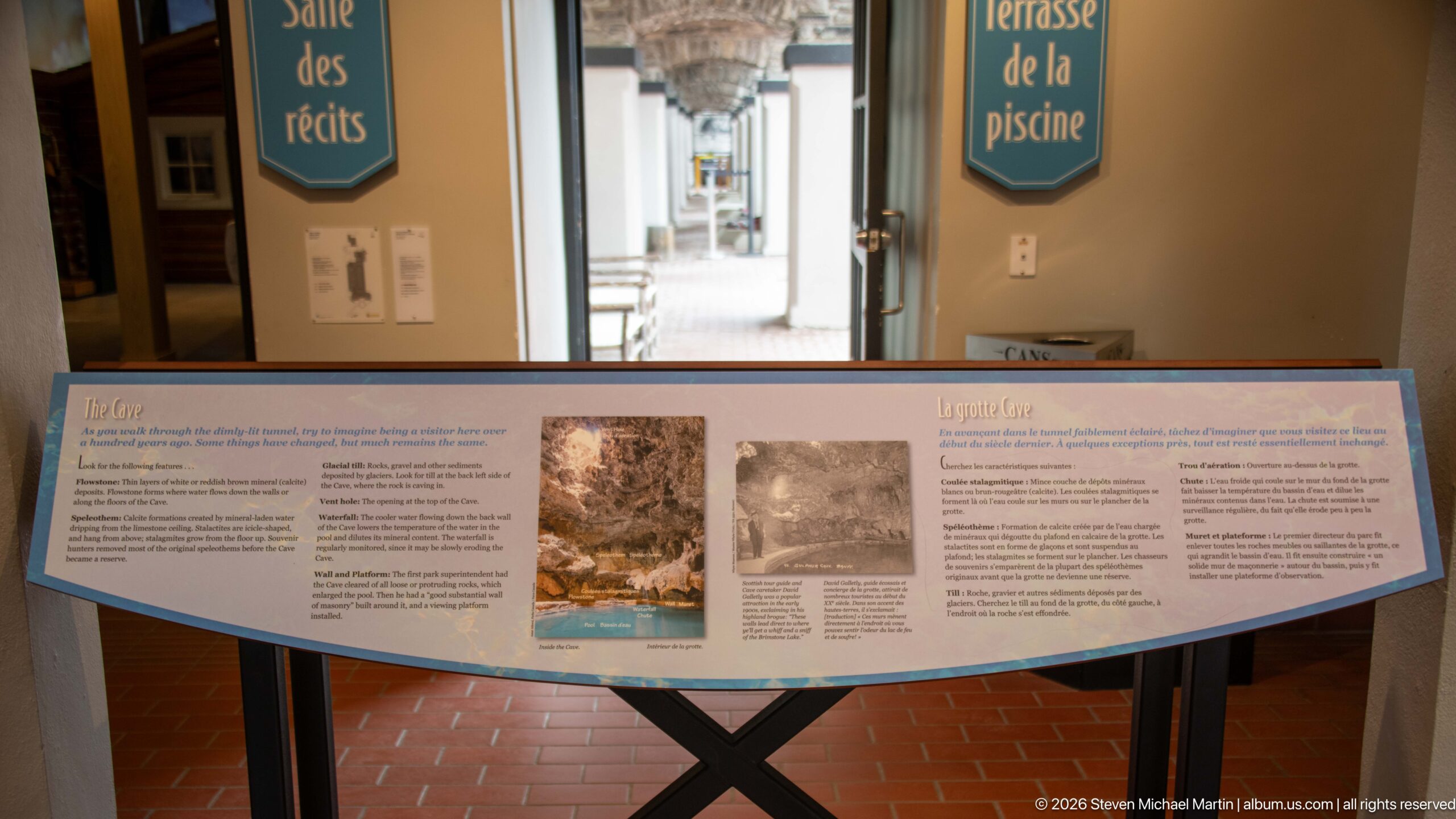
A second view of the spring-life display shows its long, blue-edged panel positioned near a doorway marked “Terrasse de la piscine.” Small photographs and diagrams run across the sign, while the room’s glazed entrance and tiled floor remain visible behind it. The wider framing establishes the panel’s location within the visitor route near the pool terrace.
Caption
A second view of the spring-life display shows its long, blue-edged panel positioned near a doorway marked “Terrasse de la piscine.” Small photographs and diagrams run across the sign, while the room’s glazed entrance and tiled floor remain visible behind it. The wider framing establishes the panel’s location within the visitor route near the pool terrace.
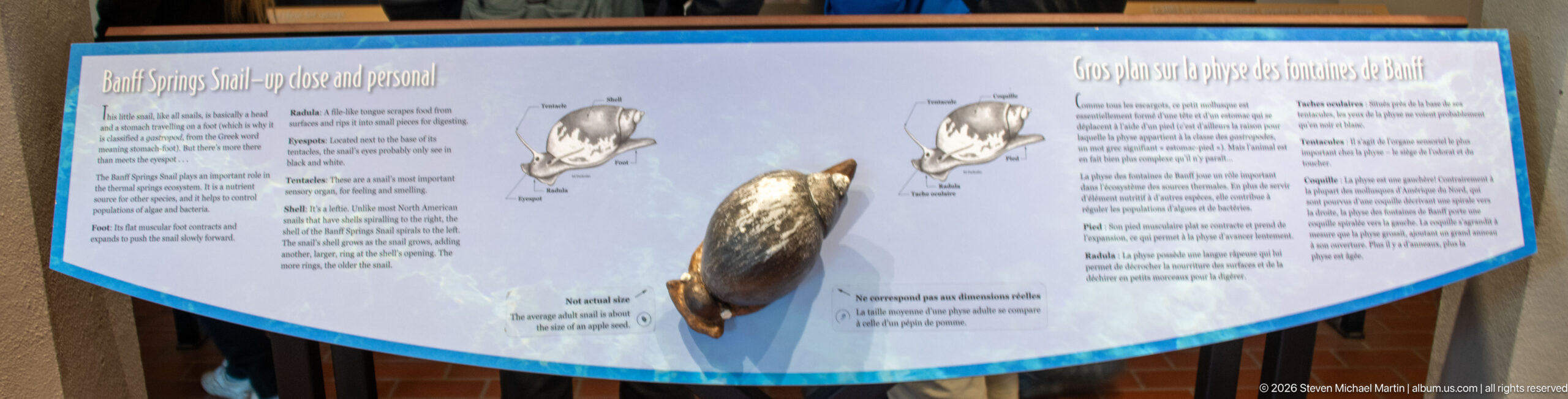
A close view of a blue-bordered interpretive sign places a raised snail model between paired anatomical diagrams and bilingual explanatory text. The model’s curved shell and extended body project from the flat panel, making it easier to distinguish from the printed illustrations. The exhibit focuses on a spring-dwelling snail, though the smaller wording is not sufficient here to confirm its full taxonomic label.
Caption
A close view of a blue-bordered interpretive sign places a raised snail model between paired anatomical diagrams and bilingual explanatory text. The model’s curved shell and extended body project from the flat panel, making it easier to distinguish from the printed illustrations. The exhibit focuses on a spring-dwelling snail, though the smaller wording is not sufficient here to confirm its full taxonomic label.
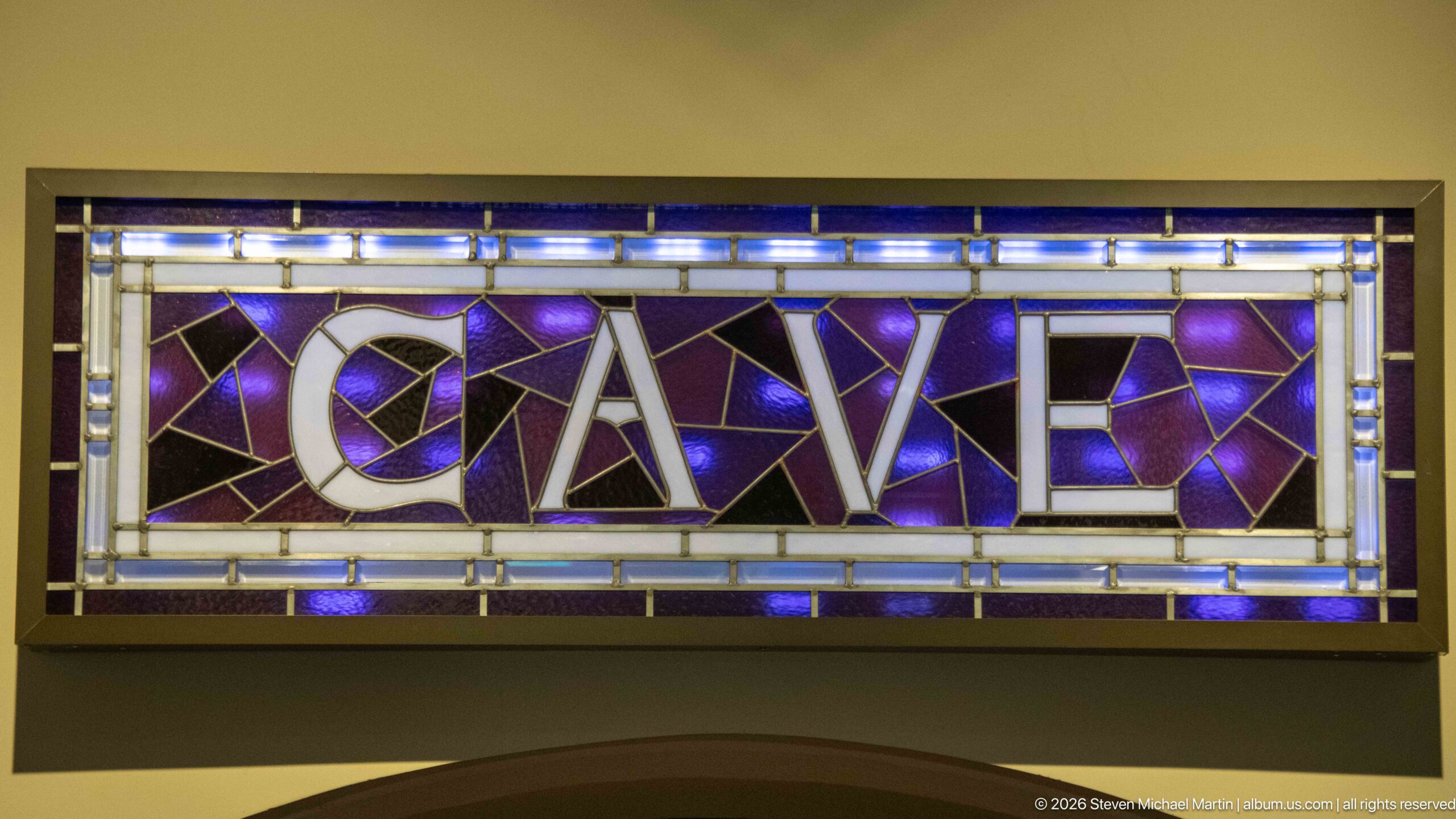
The word “CAVE” appears in large pale letters within a rectangular stained-glass panel of purple, blue, and amber pieces. A narrow border of smaller glass rectangles frames the lettering, and a warm wall surrounds the sign. The close composition emphasizes the material, color, and sign-like function of this decorative panel inside the historic-site complex.
Caption
The word “CAVE” appears in large pale letters within a rectangular stained-glass panel of purple, blue, and amber pieces. A narrow border of smaller glass rectangles frames the lettering, and a warm wall surrounds the sign. The close composition emphasizes the material, color, and sign-like function of this decorative panel inside the historic-site complex.
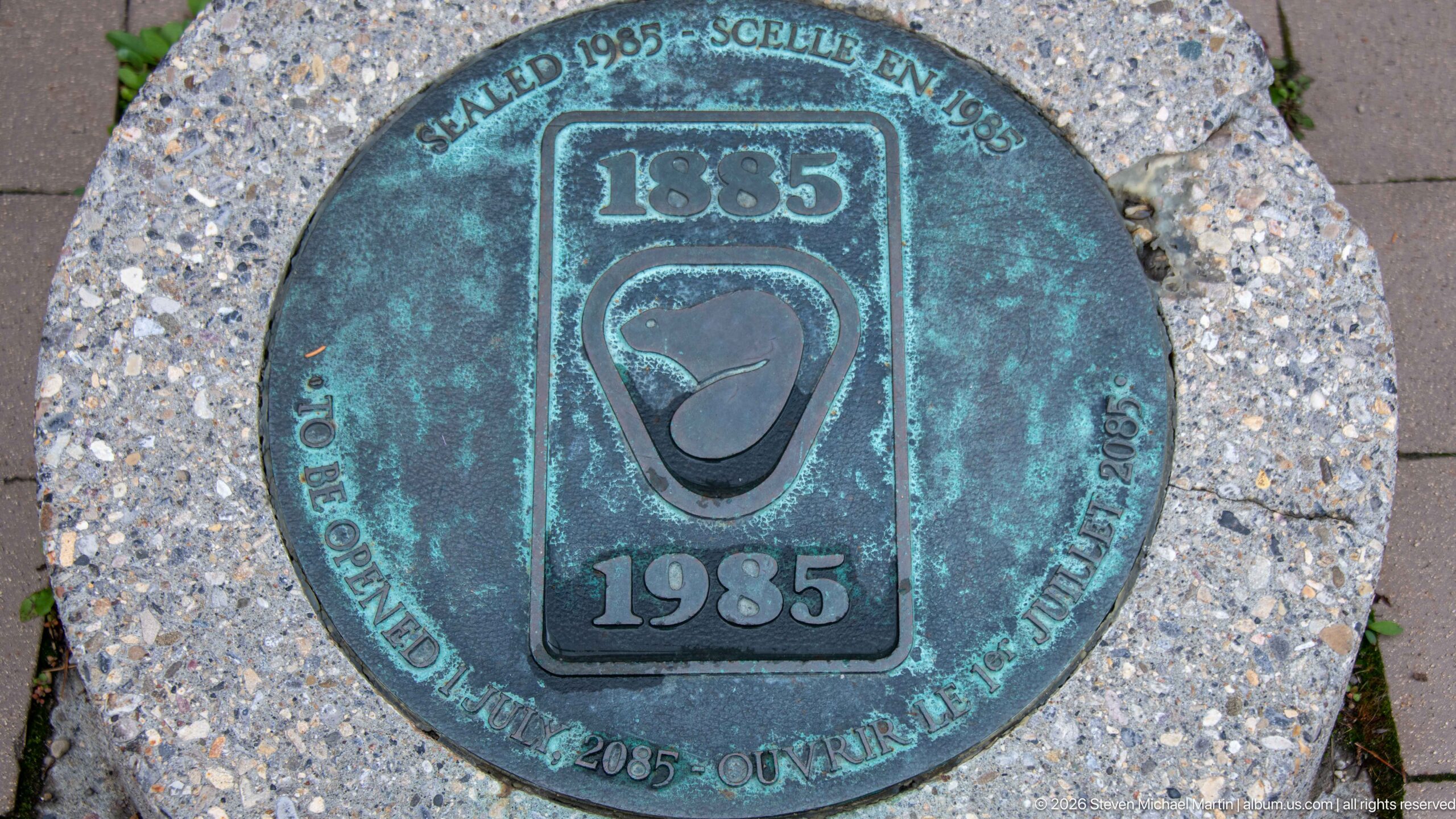
A round metal medallion is set flush into a rough aggregate concrete surround. Raised numerals “1885” and “1985” bracket a central shield-like emblem, with lettering around the rim. Weathering and blue-green patina mark the surface. The close overhead view records a commemorative marker embedded in the walking surface, distinct from the larger wall sign nearby.
Caption
A round metal medallion is set flush into a rough aggregate concrete surround. Raised numerals “1885” and “1985” bracket a central shield-like emblem, with lettering around the rim. Weathering and blue-green patina mark the surface. The close overhead view records a commemorative marker embedded in the walking surface, distinct from the larger wall sign nearby.
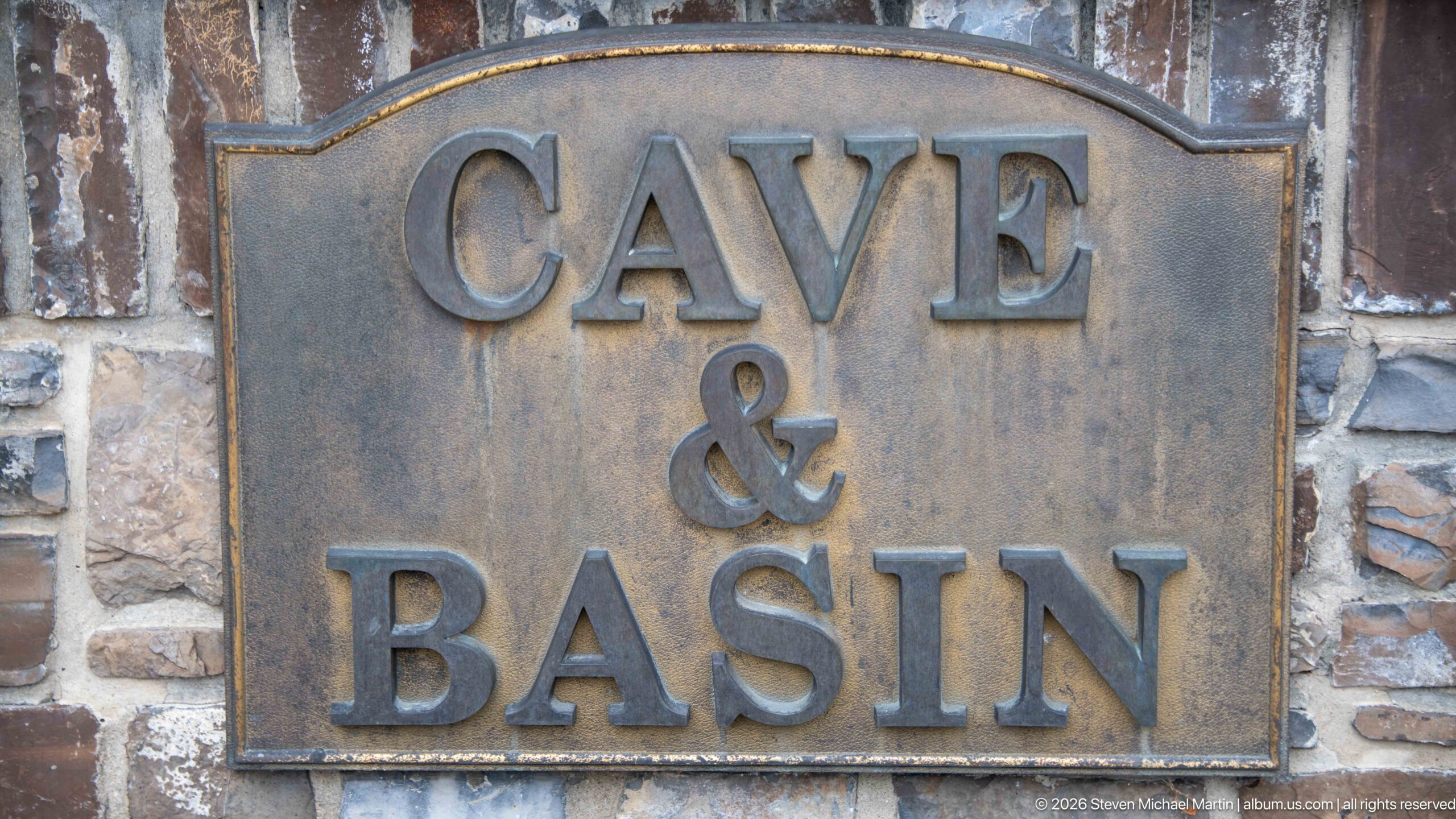
A rectangular bronze-colored plaque bears raised lettering reading “CAVE & BASIN,” mounted against a wall of irregular stone blocks. The tight framing emphasizes the cast letters, darkened recessed background, and rough masonry joints around the plaque. It functions as a clear place marker, with no additional historical claim needed to identify the site.
Caption
A rectangular bronze-colored plaque bears raised lettering reading “CAVE & BASIN,” mounted against a wall of irregular stone blocks. The tight framing emphasizes the cast letters, darkened recessed background, and rough masonry joints around the plaque. It functions as a clear place marker, with no additional historical claim needed to identify the site.
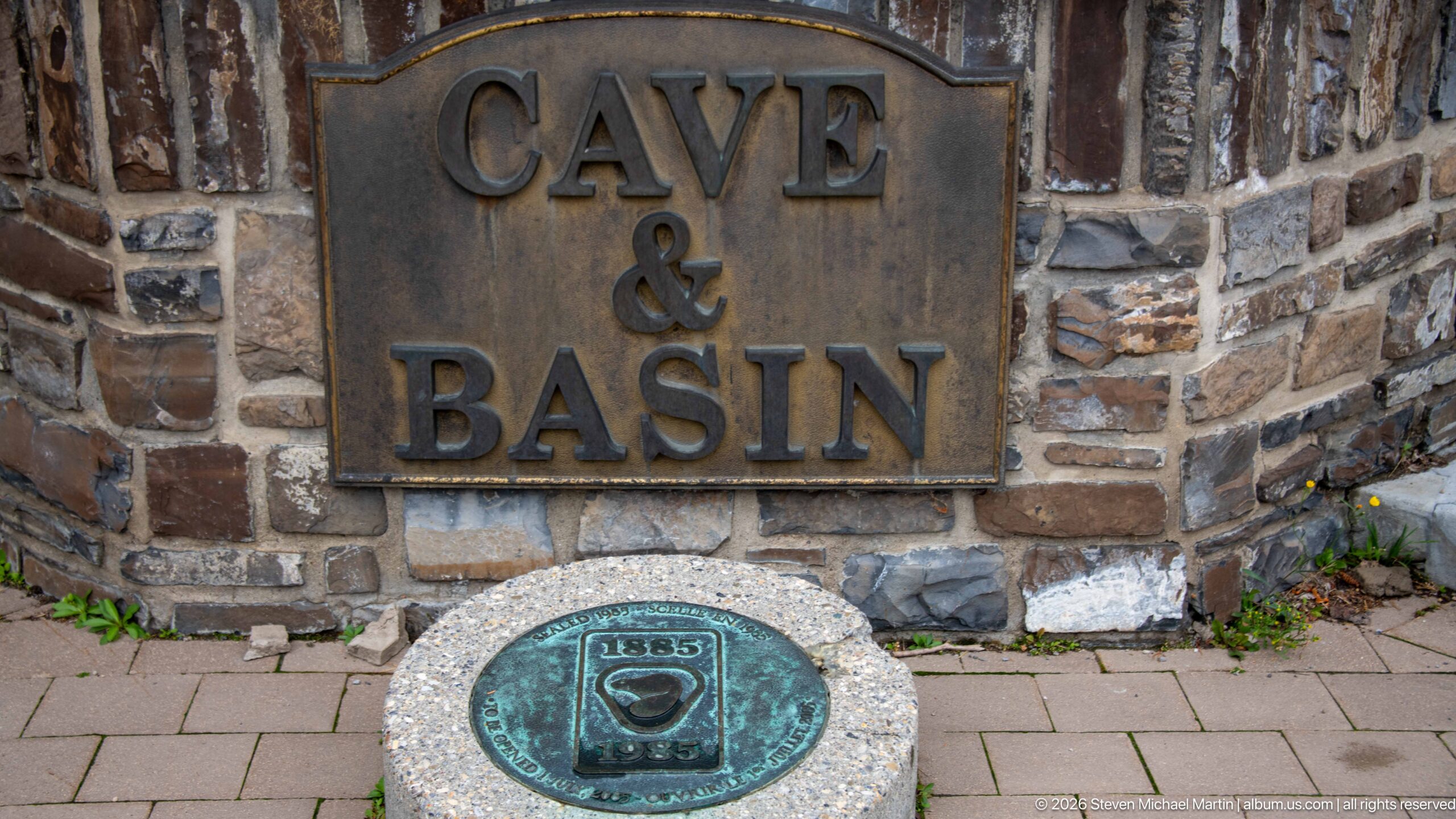
The Cave & Basin plaque is mounted on a stone façade above a circular pavement medallion bearing the dates 1885 and 1985. The wider framing shows their vertical relationship: the wall sign identifies the site while the ground marker sits directly below it in the paved approach. Stonework, a narrow ledge, and small plants complete the entrance detail.
Caption
The Cave & Basin plaque is mounted on a stone façade above a circular pavement medallion bearing the dates 1885 and 1985. The wider framing shows their vertical relationship: the wall sign identifies the site while the ground marker sits directly below it in the paved approach. Stonework, a narrow ledge, and small plants complete the entrance detail.
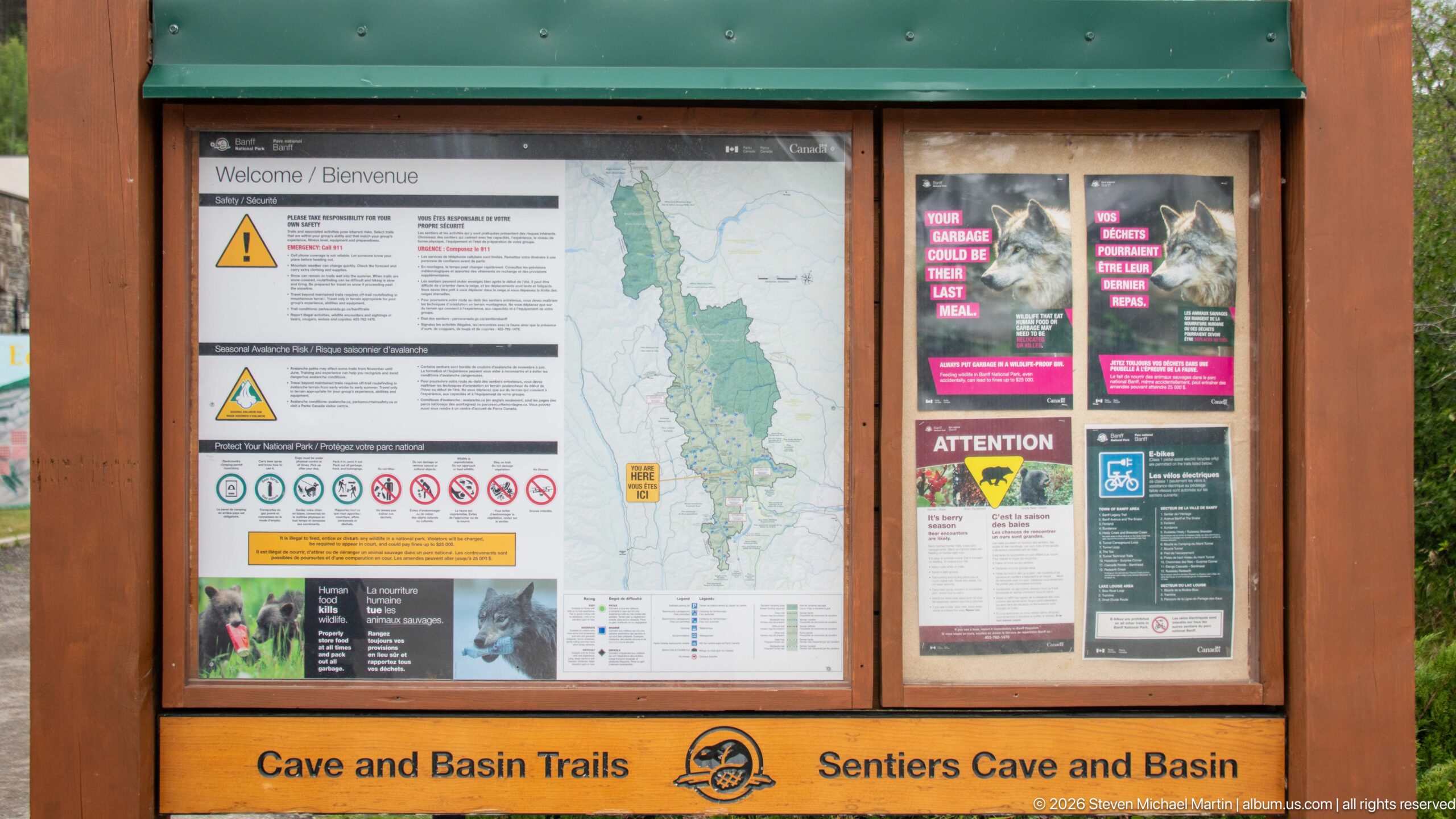
A wood-framed outdoor kiosk displays a large map, visitor warnings, trail guidance, and smaller notices beneath the heading “Cave and Basin Trails.” The bilingual welcome panel and map occupy the left section, while safety and conservation notices fill the right. The straight-on view prioritizes practical visitor information at the trailhead.
Caption
A wood-framed outdoor kiosk displays a large map, visitor warnings, trail guidance, and smaller notices beneath the heading “Cave and Basin Trails.” The bilingual welcome panel and map occupy the left section, while safety and conservation notices fill the right. The straight-on view prioritizes practical visitor information at the trailhead.
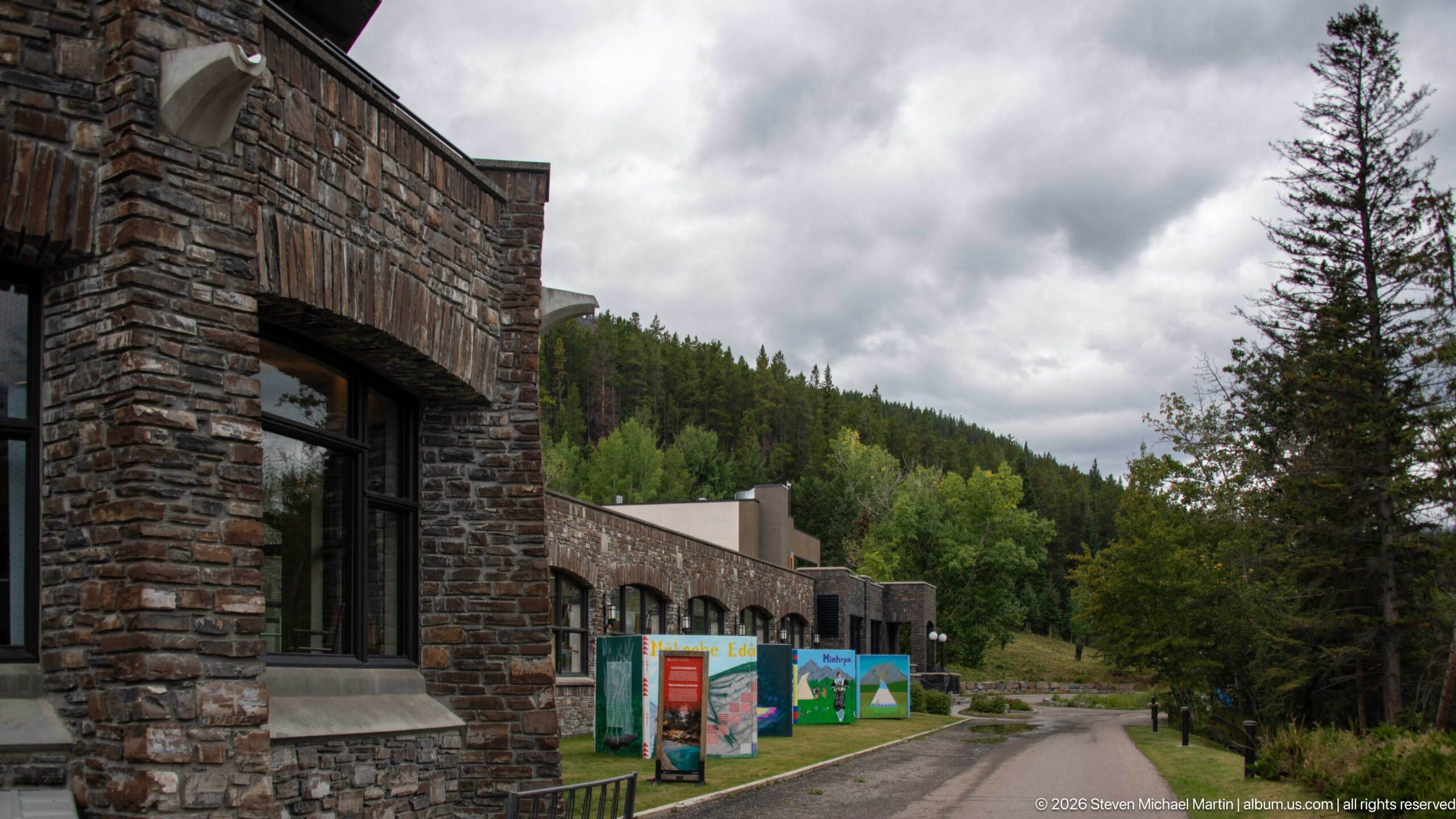
A long stone-clad visitor-center façade runs beside a paved approach, with repeated arched windows and a row of colorful interpretive panels outside. A forested slope rises behind the building, and a no-bicycles sign stands near the path. This oblique exterior view connects the gallery’s masonry architecture with its outdoor exhibits and grounds.
Caption
A long stone-clad visitor-center façade runs beside a paved approach, with repeated arched windows and a row of colorful interpretive panels outside. A forested slope rises behind the building, and a no-bicycles sign stands near the path. This oblique exterior view connects the gallery’s masonry architecture with its outdoor exhibits and grounds.
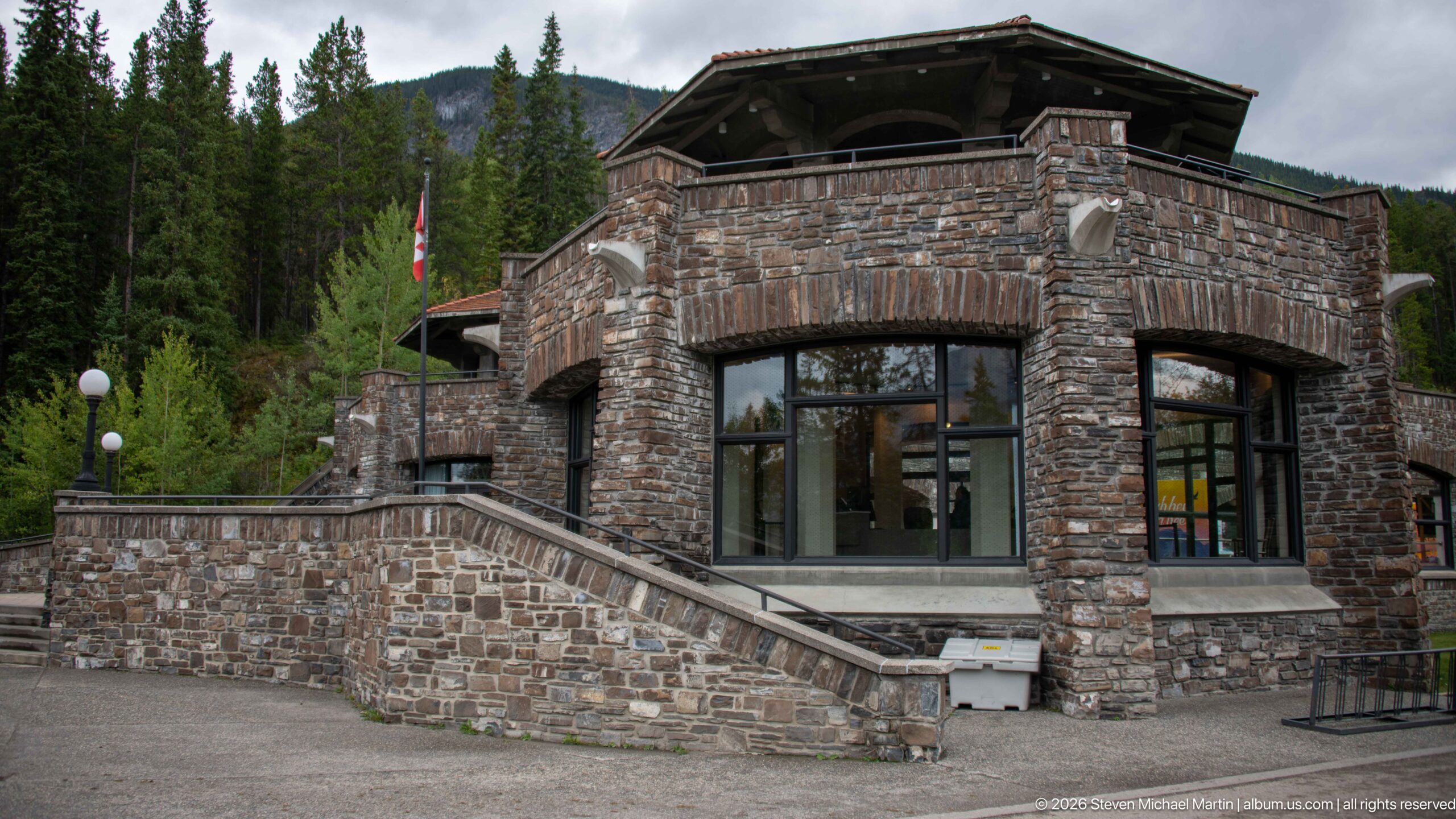
A two-level stone visitor-center building rises above a broad approach, with a covered upper balcony, large ground-floor windows, and a ramped retaining wall. A Canadian flag stands beside the structure, while conifers and a wooded hillside enclose the site. The view records the building’s stepped massing and lodge-like roof within its forest setting.
Caption
A two-level stone visitor-center building rises above a broad approach, with a covered upper balcony, large ground-floor windows, and a ramped retaining wall. A Canadian flag stands beside the structure, while conifers and a wooded hillside enclose the site. The view records the building’s stepped massing and lodge-like roof within its forest setting.
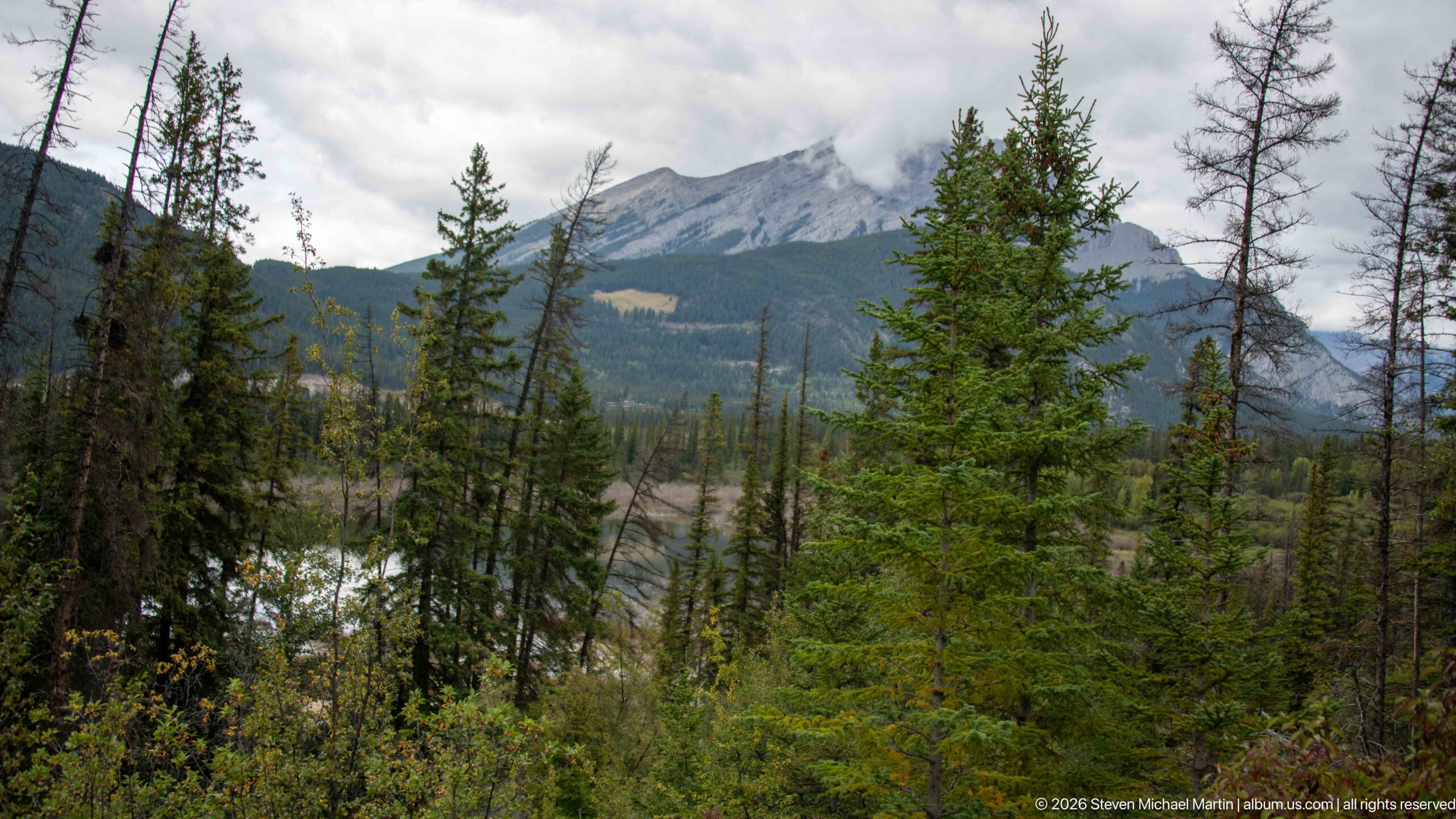
A steep gray mountain ridge rises above a dense stand of spruce and fir, with a small open patch of meadow visible through the trees. Low cloud softens the summit line, while the foreground remains dark and richly textured. This landscape view shifts attention away from the visitor buildings to the forested terrain surrounding the historic site.
Caption
A steep gray mountain ridge rises above a dense stand of spruce and fir, with a small open patch of meadow visible through the trees. Low cloud softens the summit line, while the foreground remains dark and richly textured. This landscape view shifts attention away from the visitor buildings to the forested terrain surrounding the historic site.
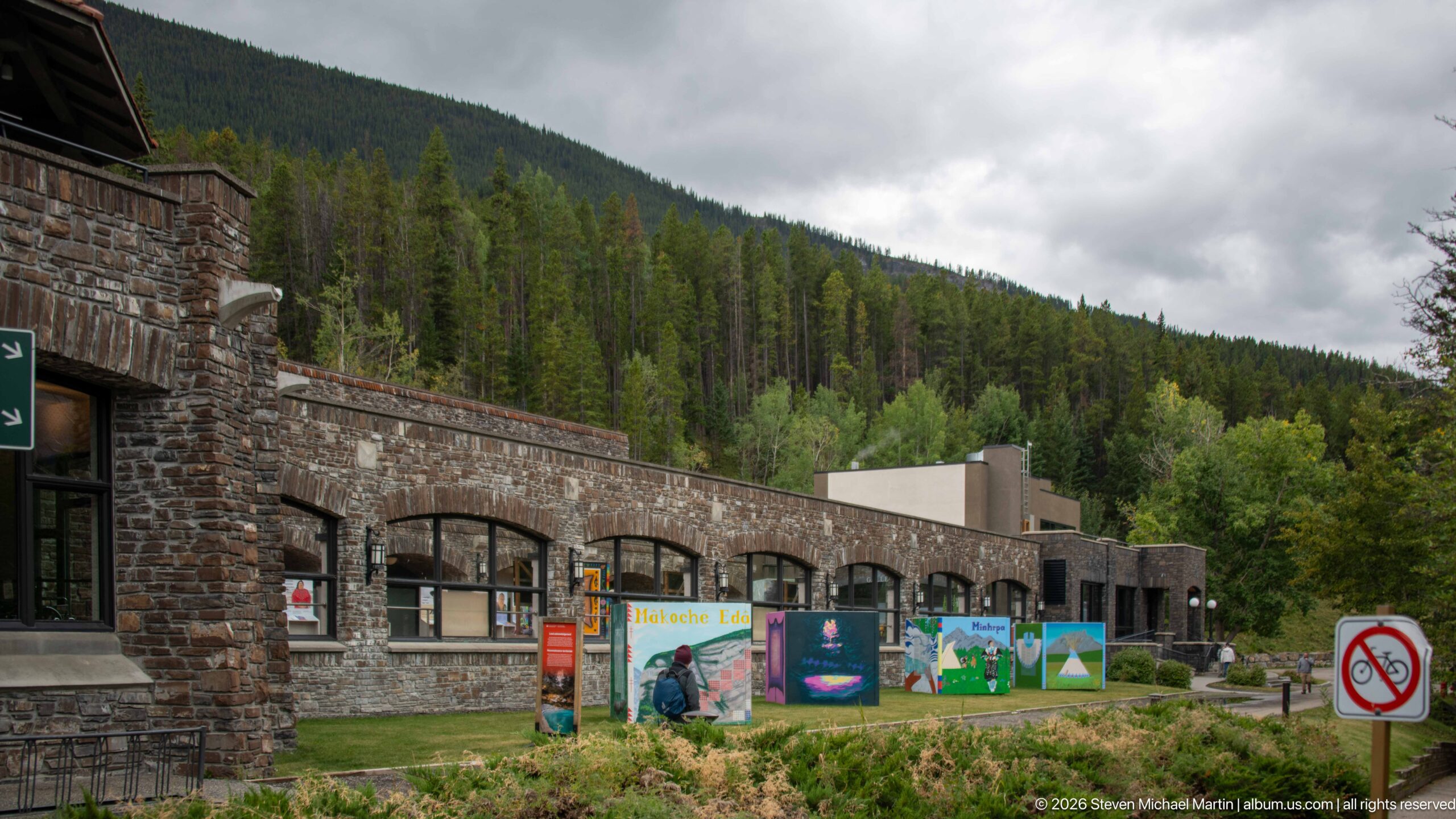
The visitor-center’s stone arcade recedes along a paved path, with colorful freestanding panels arranged near the windows. A no-bicycles sign stands prominently at right, and the wooded slope continues behind the building. The oblique composition links the site’s built visitor route to its outdoor interpretation while showing the repeated arches and long masonry wall.
Caption
The visitor-center’s stone arcade recedes along a paved path, with colorful freestanding panels arranged near the windows. A no-bicycles sign stands prominently at right, and the wooded slope continues behind the building. The oblique composition links the site’s built visitor route to its outdoor interpretation while showing the repeated arches and long masonry wall.
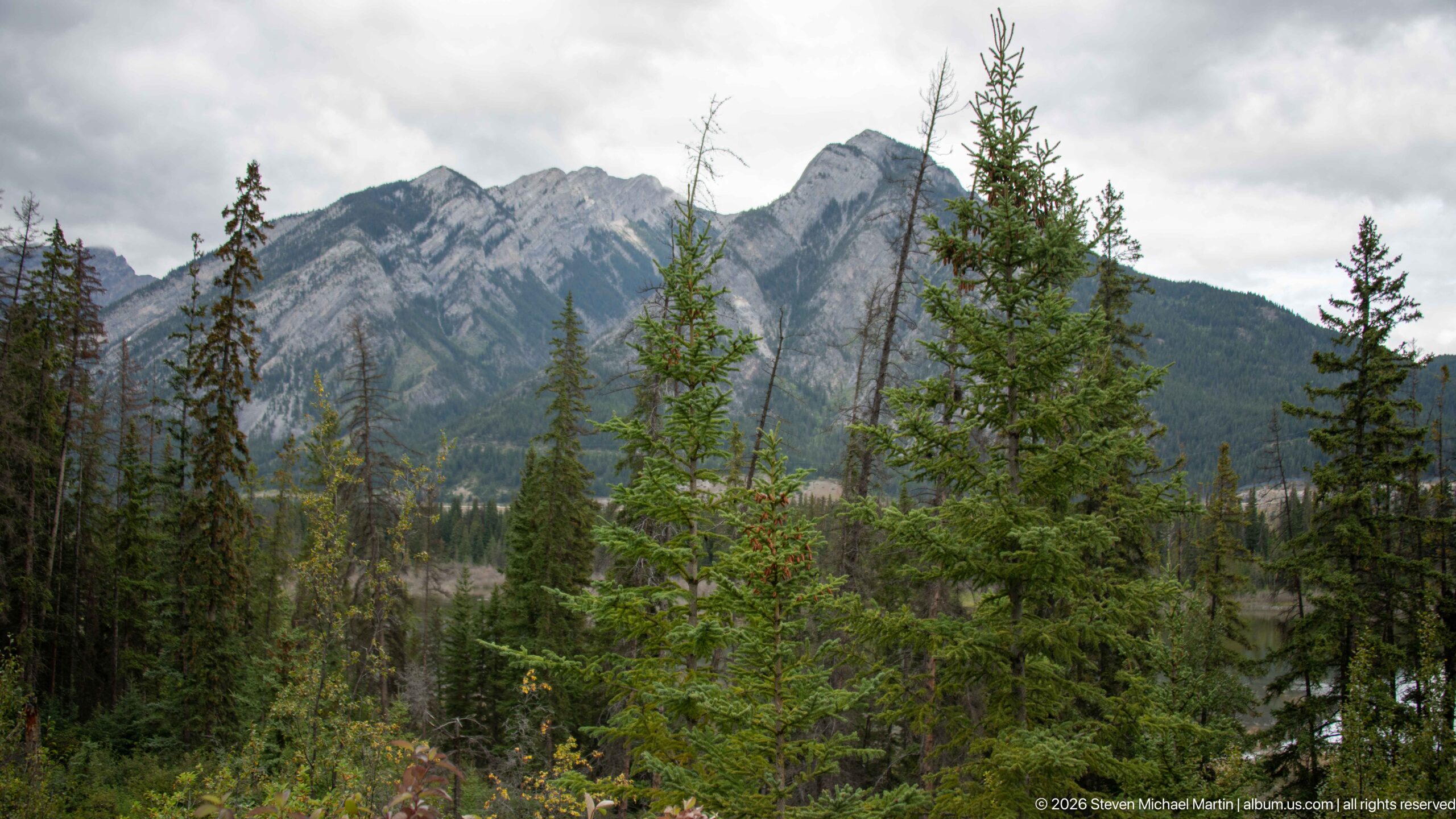
Jagged gray peaks rise behind a foreground of young conifers and mixed mountain vegetation. A dark forested slope descends toward the valley, while layered cloud hangs above the ridge. The trees partly obscure the lower mountain, creating a natural frame and emphasizing the height of the exposed rock faces.
Caption
Jagged gray peaks rise behind a foreground of young conifers and mixed mountain vegetation. A dark forested slope descends toward the valley, while layered cloud hangs above the ridge. The trees partly obscure the lower mountain, creating a natural frame and emphasizing the height of the exposed rock faces.
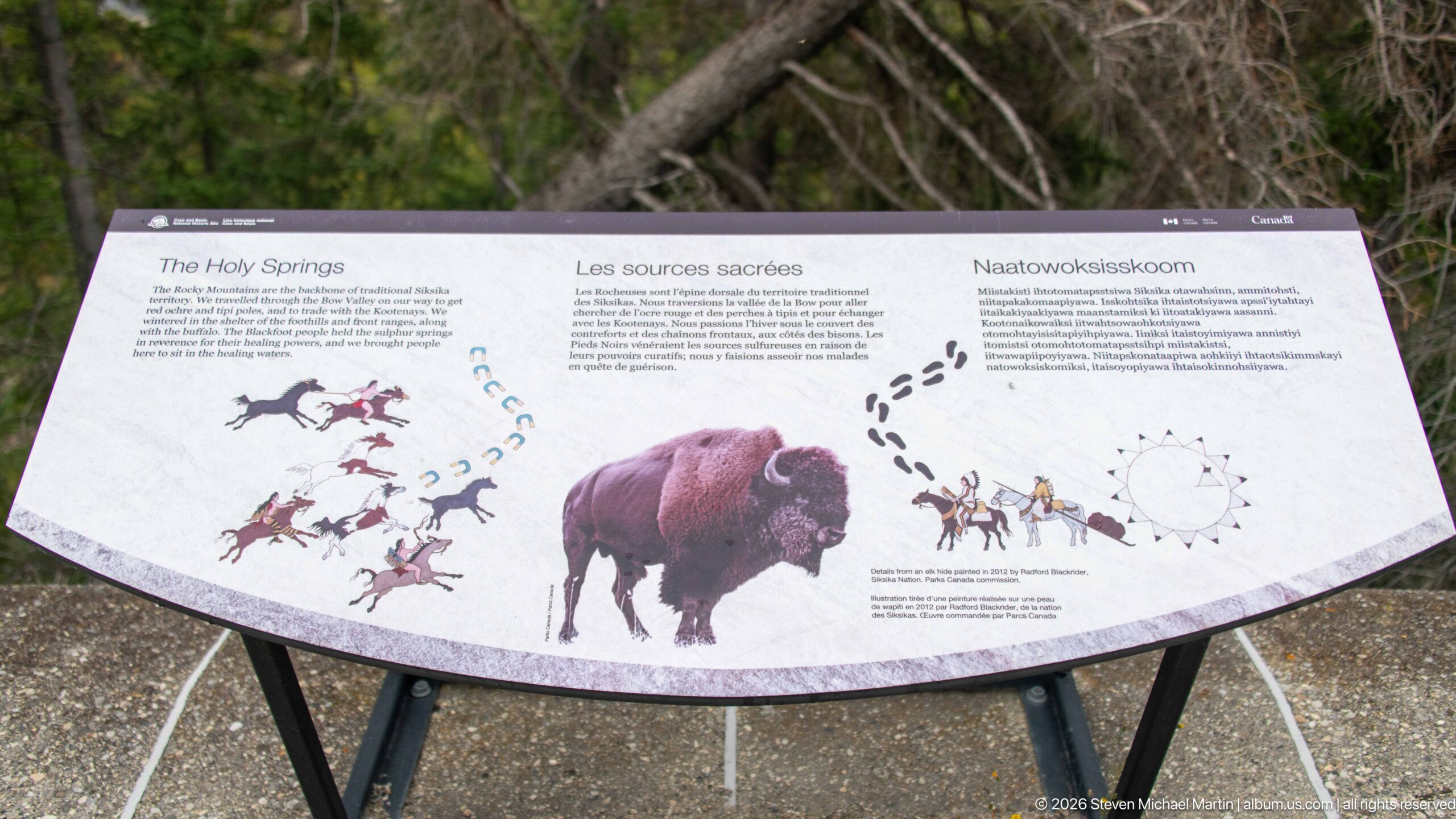
A curved outdoor panel titled “The Holy Springs” presents bilingual text beside illustrations of bison, riders, footprints, and a sun-like motif. A large bison image occupies the center, while smaller human figures move across the left and right sides. The display communicates Indigenous relationships to the springs through text and graphic imagery; the specific artists are not identified here.
Caption
A curved outdoor panel titled “The Holy Springs” presents bilingual text beside illustrations of bison, riders, footprints, and a sun-like motif. A large bison image occupies the center, while smaller human figures move across the left and right sides. The display communicates Indigenous relationships to the springs through text and graphic imagery; the specific artists are not identified here.
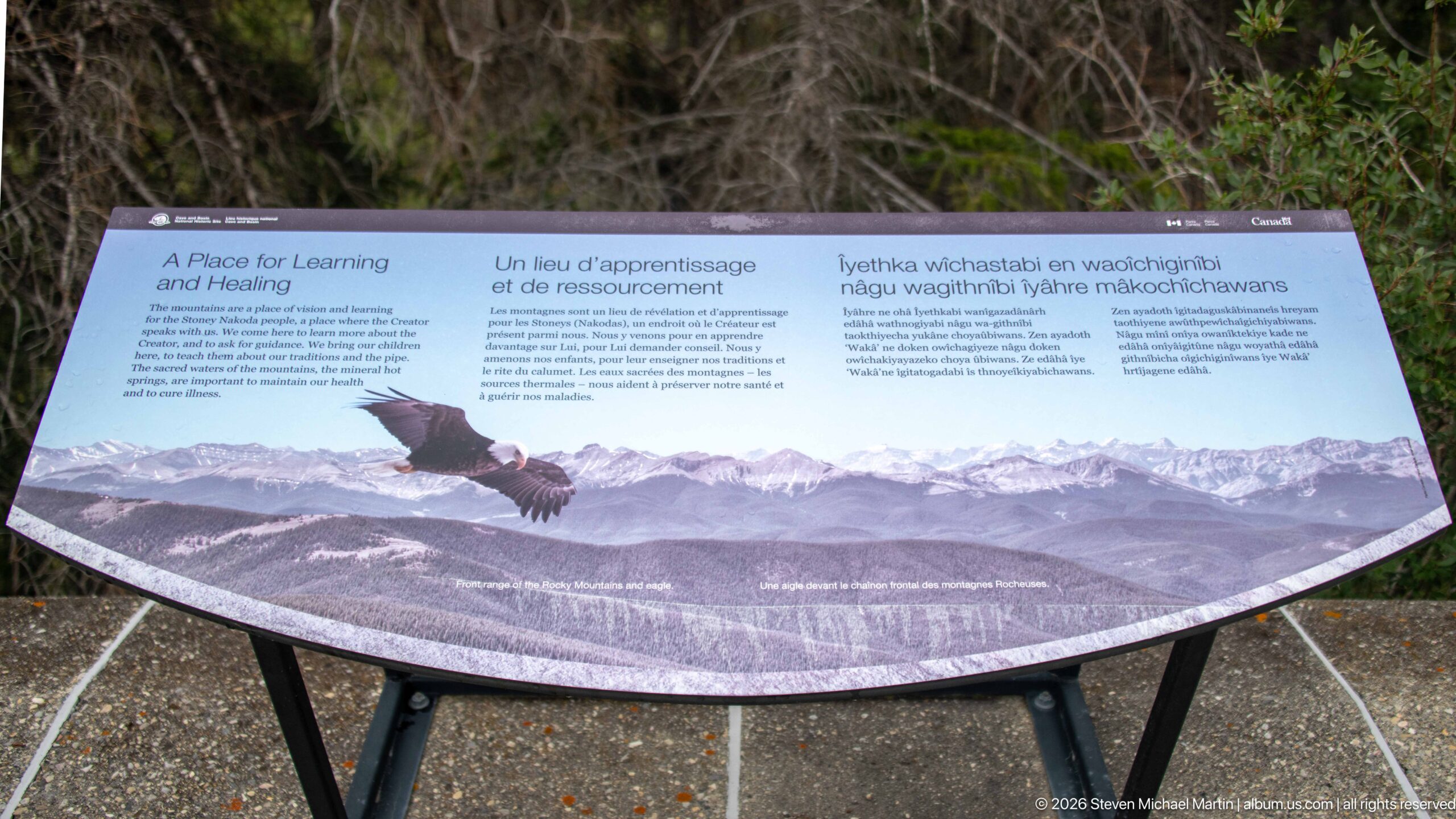
A curved interpretive panel headed “A Place for Learning and Healing” combines text in several languages with a panorama of the Rocky Mountains. A large bird with outstretched wings flies above the ridge, while a smaller figure appears near the lower edge. The sign presents the site through a cultural and healing theme, with the visible title anchoring its interpretation.
Caption
A curved interpretive panel headed “A Place for Learning and Healing” combines text in several languages with a panorama of the Rocky Mountains. A large bird with outstretched wings flies above the ridge, while a smaller figure appears near the lower edge. The sign presents the site through a cultural and healing theme, with the visible title anchoring its interpretation.
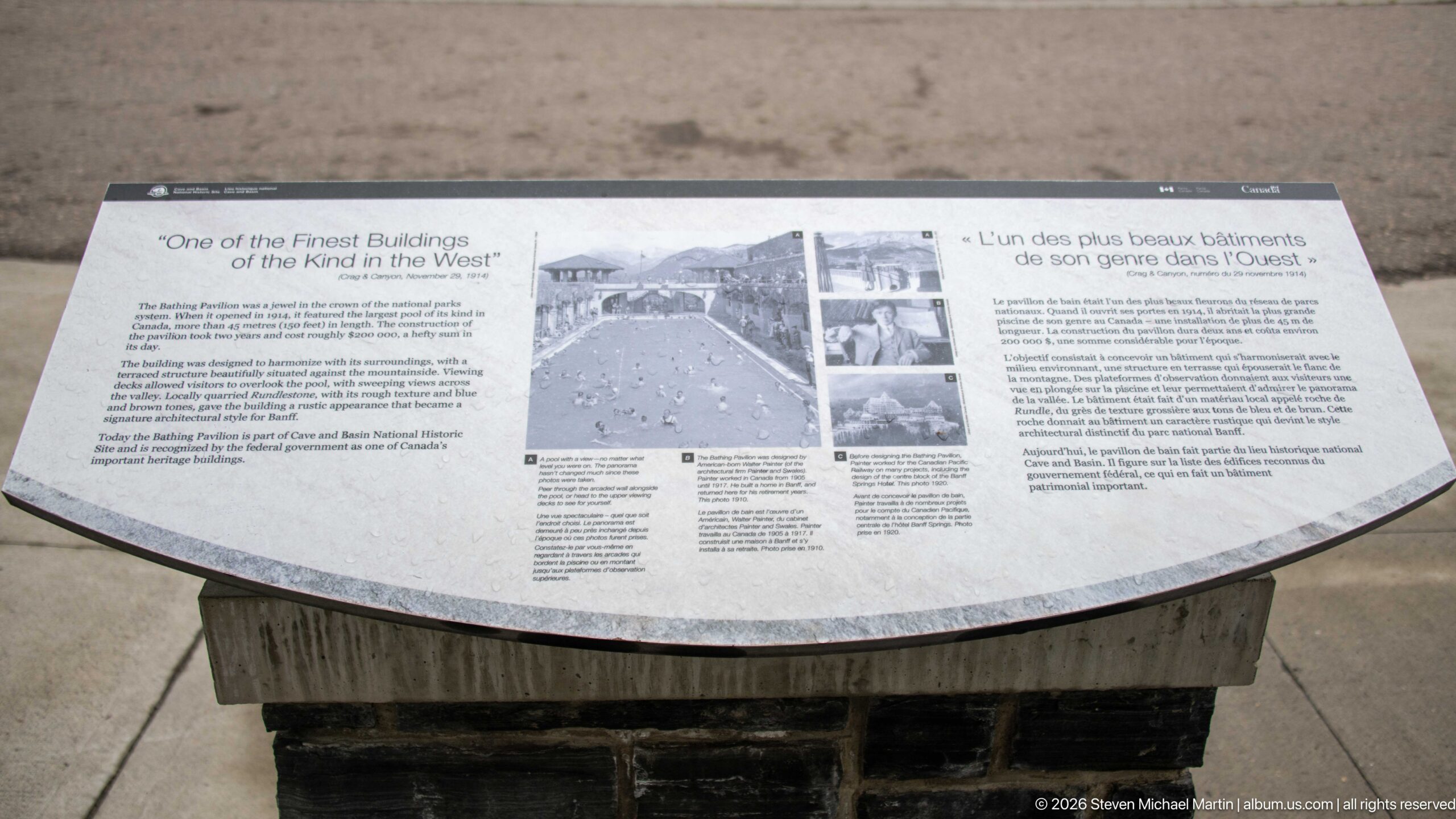
A curved outdoor interpretive panel titled “One of the Finest Buildings of the Kind in the West” presents historic photographs alongside English and French explanatory text. The display connects the site’s built history with archival views, letting visitors compare a documented structure with the place around them. Its low, angled surface is designed for reading outdoors, while the photographs and paired text make this a contextual exhibit rather than a general site map.
Caption
A curved outdoor interpretive panel titled “One of the Finest Buildings of the Kind in the West” presents historic photographs alongside English and French explanatory text. The display connects the site’s built history with archival views, letting visitors compare a documented structure with the place around them. Its low, angled surface is designed for reading outdoors, while the photographs and paired text make this a contextual exhibit rather than a general site map.
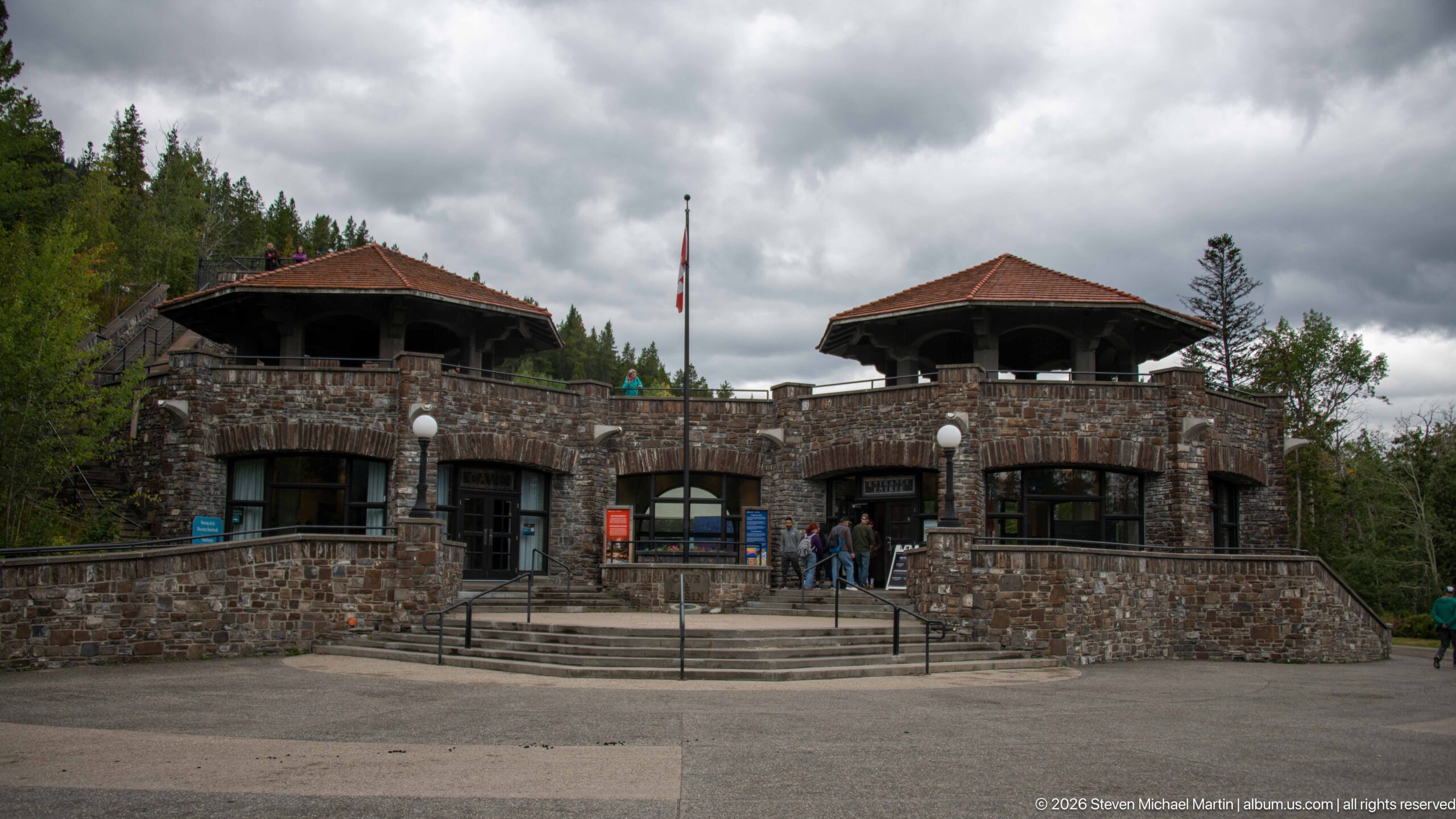
Two raised, hipped-roof pavilions crown a broad stone entrance building, framing a recessed central doorway and a short flight of steps. The symmetrical front is built in irregular courses of gray and brown stone, with dark glazed openings and modest exterior lamps. Seen from the plaza, the composition reads as a public gateway to the Cave and Basin grounds, with visitors gathered near the entrance beneath a cloudy mountain sky.
Caption
Two raised, hipped-roof pavilions crown a broad stone entrance building, framing a recessed central doorway and a short flight of steps. The symmetrical front is built in irregular courses of gray and brown stone, with dark glazed openings and modest exterior lamps. Seen from the plaza, the composition reads as a public gateway to the Cave and Basin grounds, with visitors gathered near the entrance beneath a cloudy mountain sky.
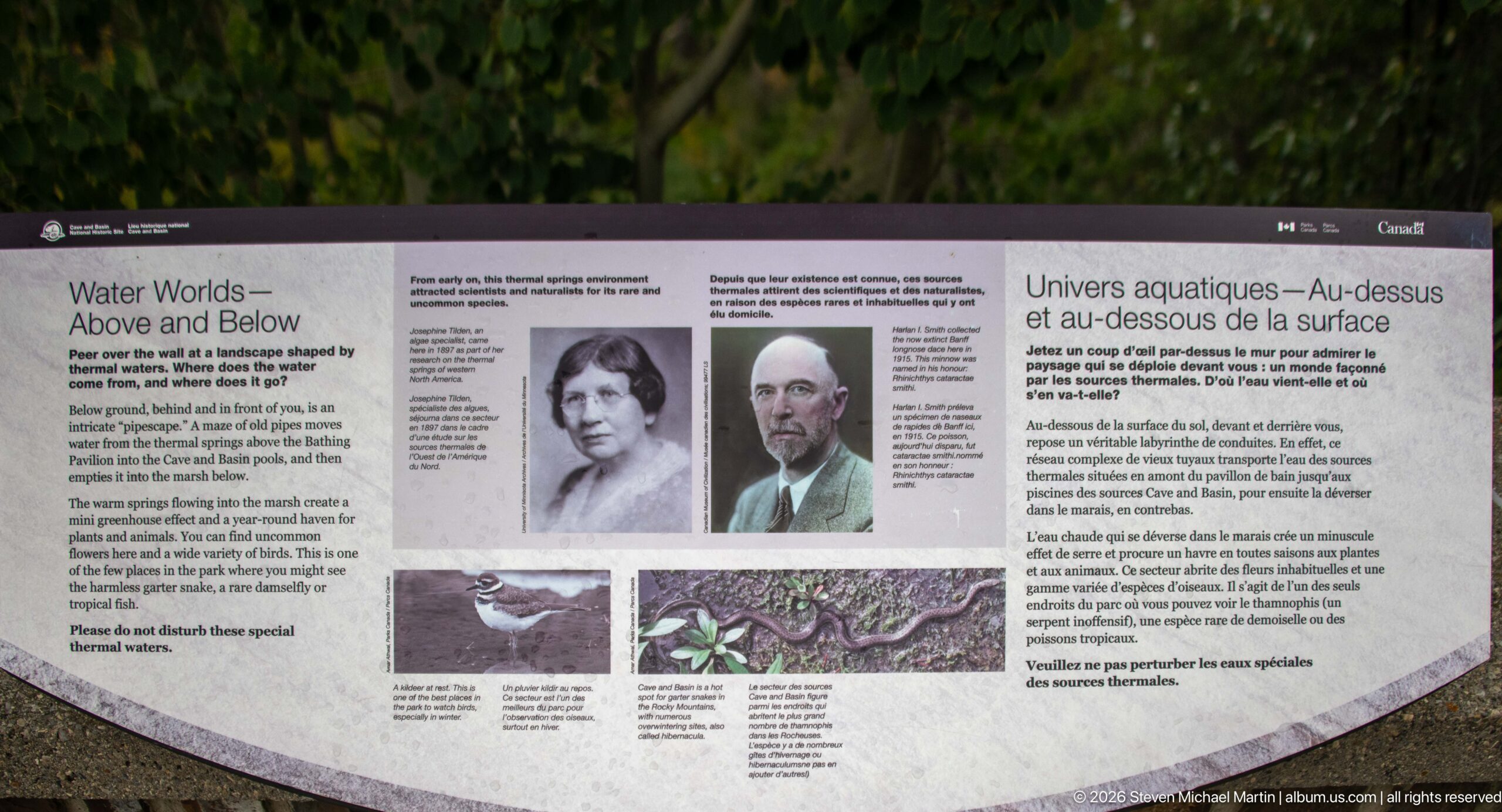
The “Water Worlds—Above and Below” panel pairs bilingual interpretation with portraits and images of aquatic life. A bird and a close view of a small aquatic animal appear beneath text about the distinctive waters and their ecology. Rather than presenting a scenic overview, the exhibit directs attention to organisms and habitats that can be overlooked beside the thermal pools, linking the visible setting to life in and around the water.
Caption
The “Water Worlds—Above and Below” panel pairs bilingual interpretation with portraits and images of aquatic life. A bird and a close view of a small aquatic animal appear beneath text about the distinctive waters and their ecology. Rather than presenting a scenic overview, the exhibit directs attention to organisms and habitats that can be overlooked beside the thermal pools, linking the visible setting to life in and around the water.
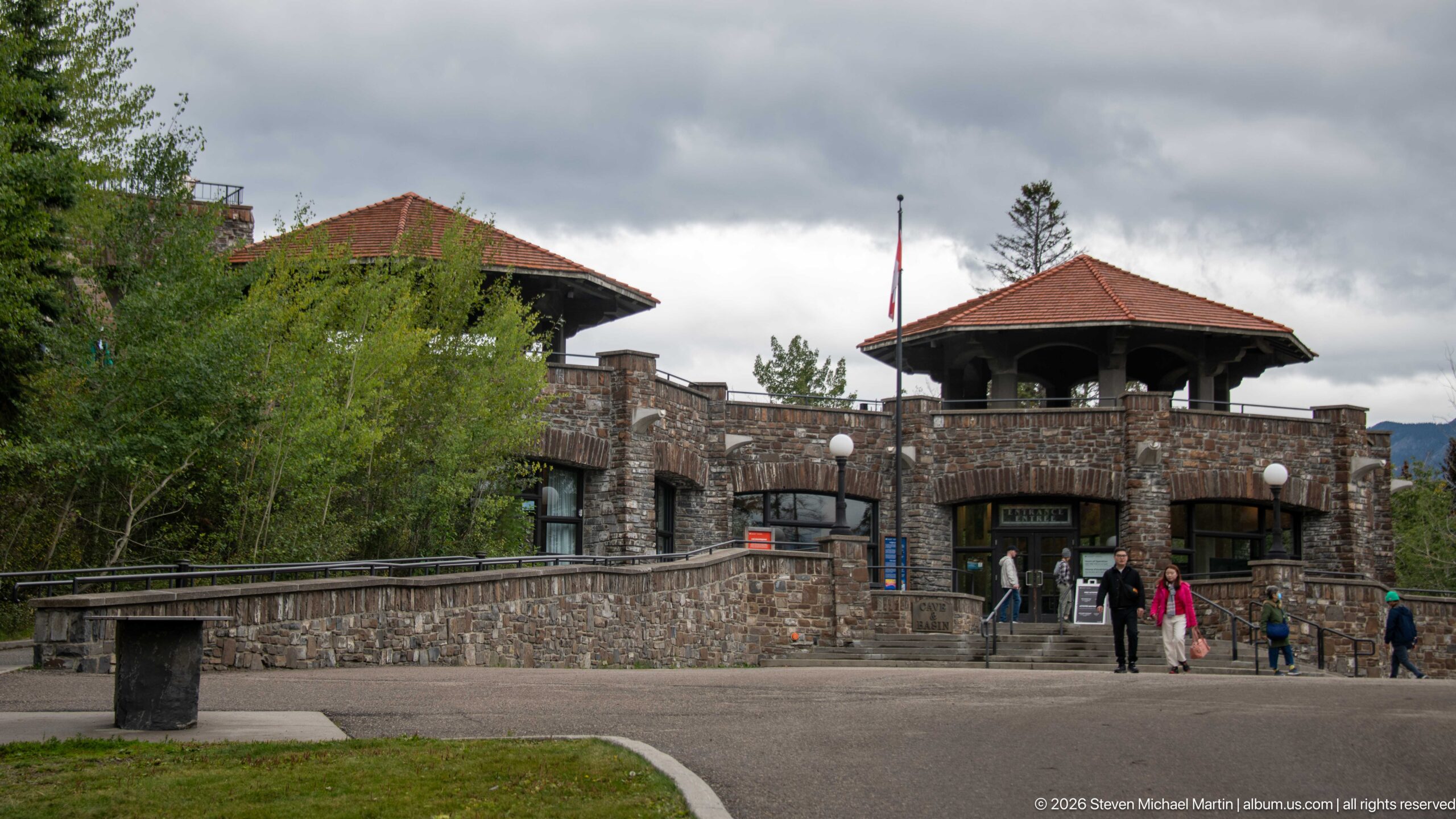
From a lower, wider viewpoint, the stone entrance building stretches across the plaza, its two roofed upper pavilions set above a central entry. Several visitors cross the approach and gather on the steps, giving the substantial masonry façade a clear human scale. Trees partly screen the left wing, while the open pavement and overcast light keep attention on the building’s broad footprint and its relationship to the public forecourt.
Caption
From a lower, wider viewpoint, the stone entrance building stretches across the plaza, its two roofed upper pavilions set above a central entry. Several visitors cross the approach and gather on the steps, giving the substantial masonry façade a clear human scale. Trees partly screen the left wing, while the open pavement and overcast light keep attention on the building’s broad footprint and its relationship to the public forecourt.
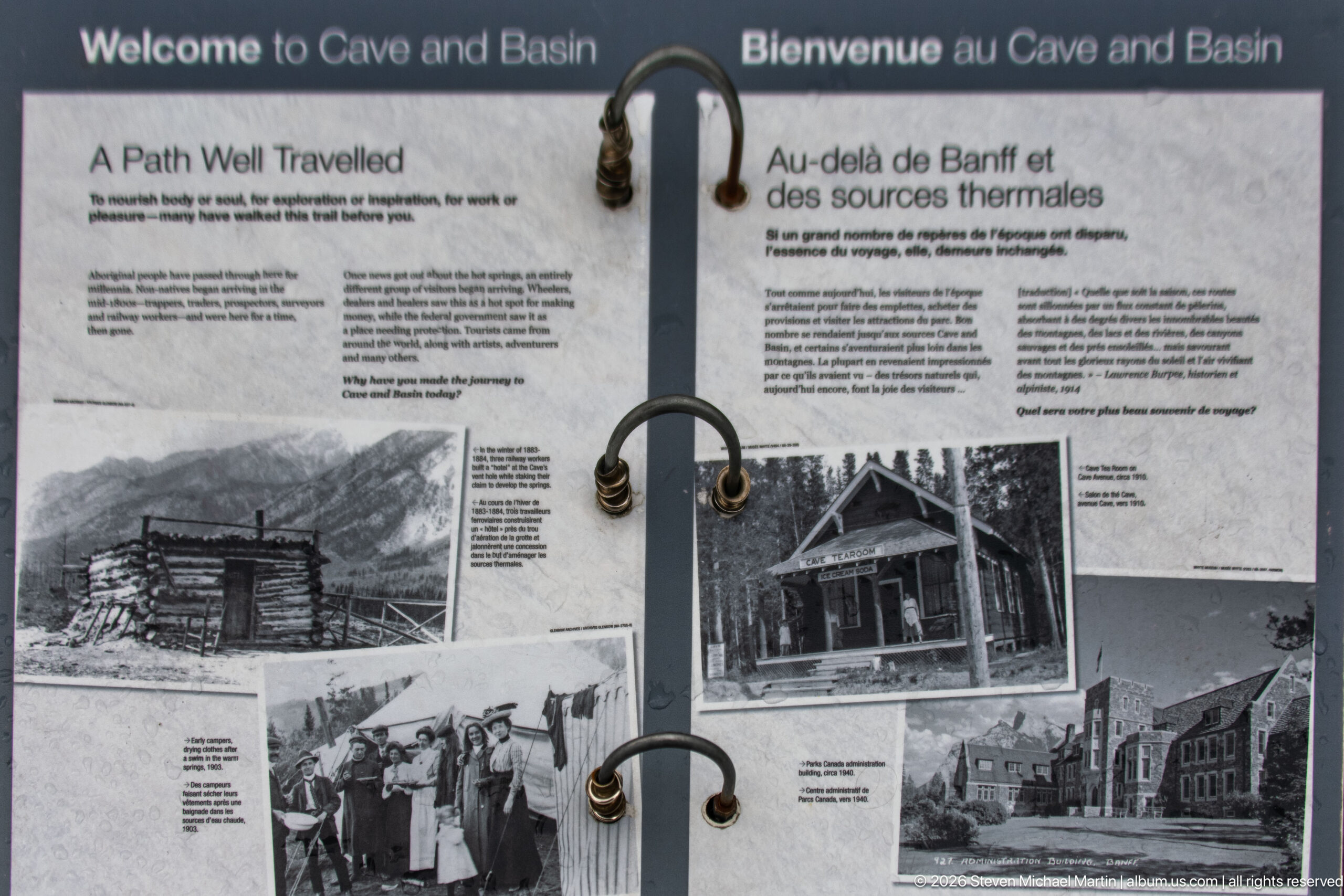
A ring-bound interpretive display opens across a large panel headed “The Cave and Basin,” combining archival black-and-white photographs with bilingual historical text. The reproduced views include early buildings and groups of people, placing the site’s development within a documentary sequence. Brass-colored binding loops and the close, frontal viewpoint make the exhibit’s physical format as prominent as its contents, distinguishing it from the freestanding signs outside.
Caption
A ring-bound interpretive display opens across a large panel headed “The Cave and Basin,” combining archival black-and-white photographs with bilingual historical text. The reproduced views include early buildings and groups of people, placing the site’s development within a documentary sequence. Brass-colored binding loops and the close, frontal viewpoint make the exhibit’s physical format as prominent as its contents, distinguishing it from the freestanding signs outside.
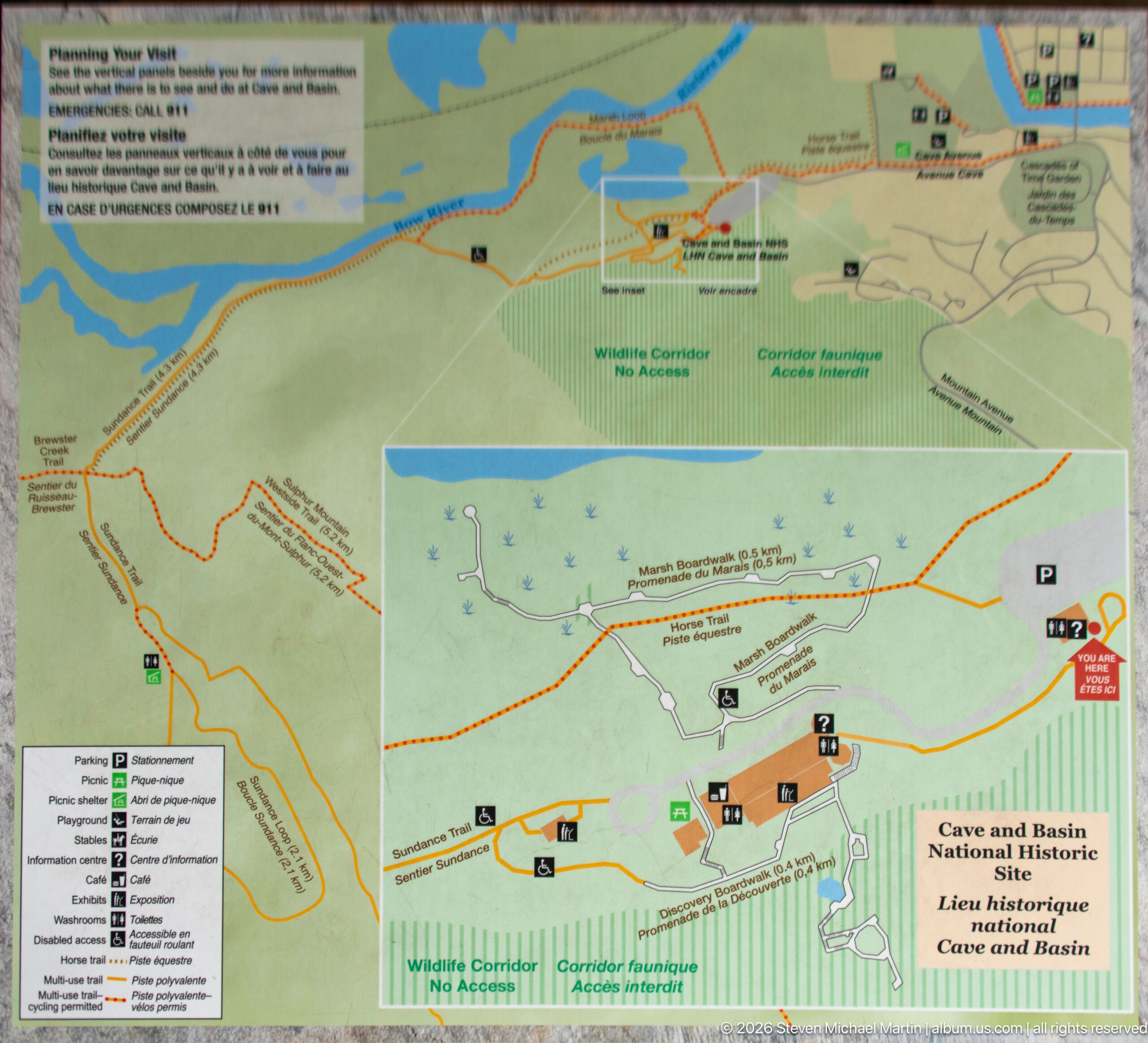
A detailed site map marks the Cave and Basin National Historic Site within its surrounding network of roads, paths, and protected land. Colored lines distinguish routes, while symbols identify visitor facilities and points of interest; a larger inset isolates the immediate grounds. The bilingual title and legend make the panel a practical orientation tool, showing how the historic site sits within a broader landscape rather than treating the springs as a single isolated stop.
Caption
A detailed site map marks the Cave and Basin National Historic Site within its surrounding network of roads, paths, and protected land. Colored lines distinguish routes, while symbols identify visitor facilities and points of interest; a larger inset isolates the immediate grounds. The bilingual title and legend make the panel a practical orientation tool, showing how the historic site sits within a broader landscape rather than treating the springs as a single isolated stop.
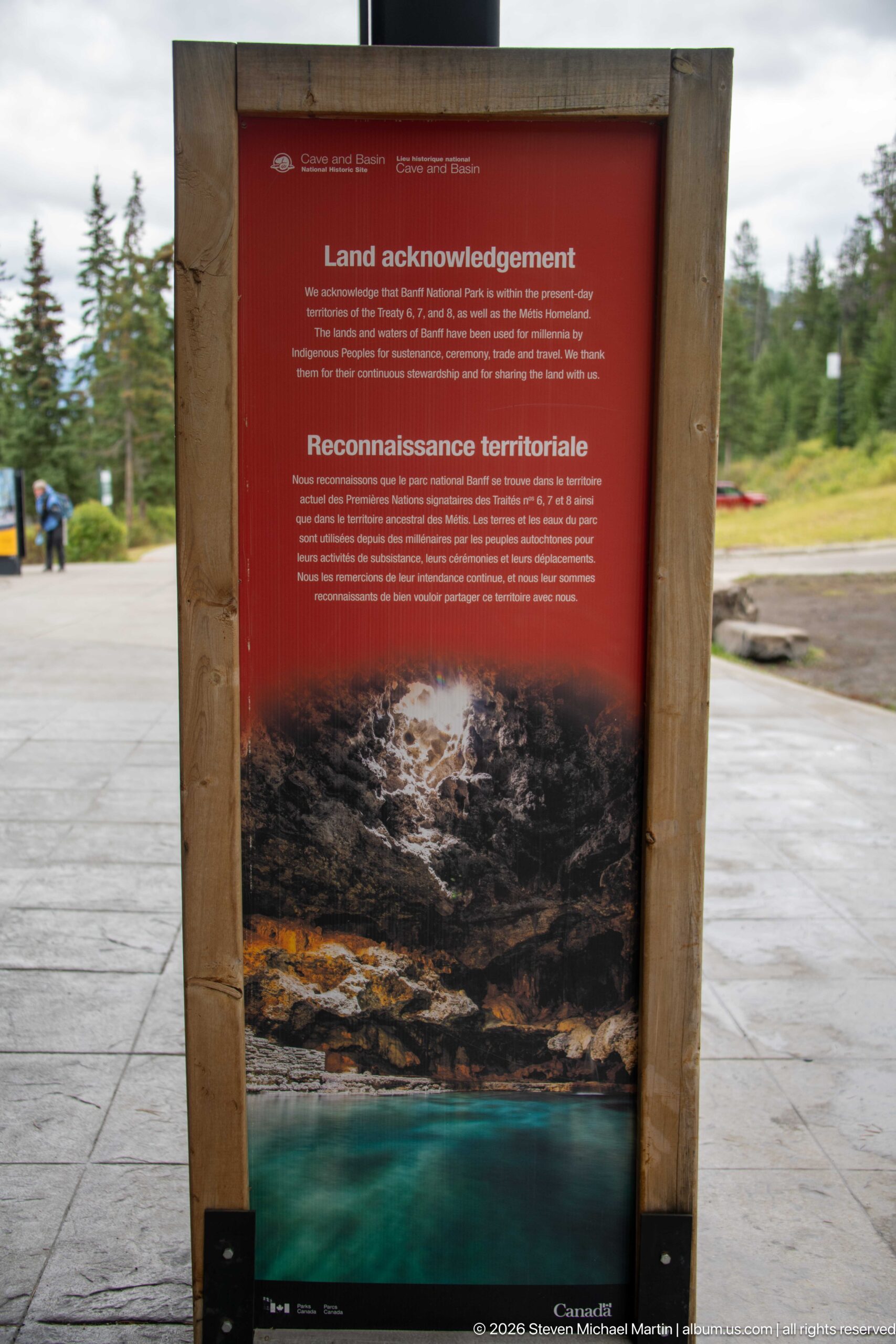
A red “Land Acknowledgement” panel stands within a heavy timber frame on a paved outdoor approach. English and French text occupies the upper field, while a landscape photograph fills the bottom; trees and visitors remain visible beyond the sign. The composition presents the acknowledgement as a distinct interpretive element at the site entrance, pairing formal text with an image of the surrounding land.
Caption
A red “Land Acknowledgement” panel stands within a heavy timber frame on a paved outdoor approach. English and French text occupies the upper field, while a landscape photograph fills the bottom; trees and visitors remain visible beyond the sign. The composition presents the acknowledgement as a distinct interpretive element at the site entrance, pairing formal text with an image of the surrounding land.
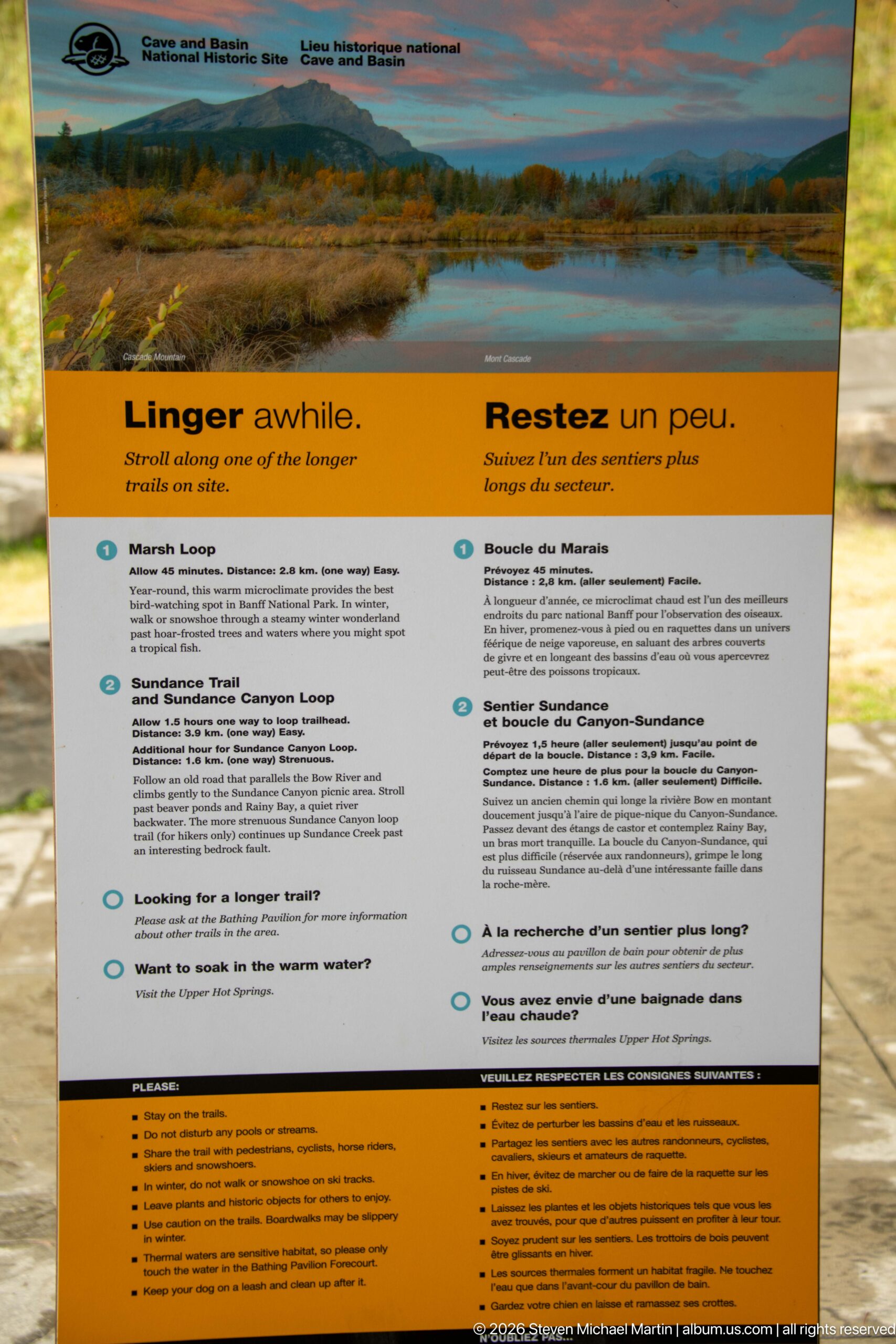
The “Linger awhile” panel presents walking routes beneath a panoramic image of water, trees, and distant mountains. Its two-column layout outlines shorter and longer walks and gives guidance for choosing a route, while an orange band carries the bilingual heading. By foregrounding time outdoors and trail options, the sign broadens the visit beyond the historic buildings and directs attention to the surrounding landscape.
Caption
The “Linger awhile” panel presents walking routes beneath a panoramic image of water, trees, and distant mountains. Its two-column layout outlines shorter and longer walks and gives guidance for choosing a route, while an orange band carries the bilingual heading. By foregrounding time outdoors and trail options, the sign broadens the visit beyond the historic buildings and directs attention to the surrounding landscape.
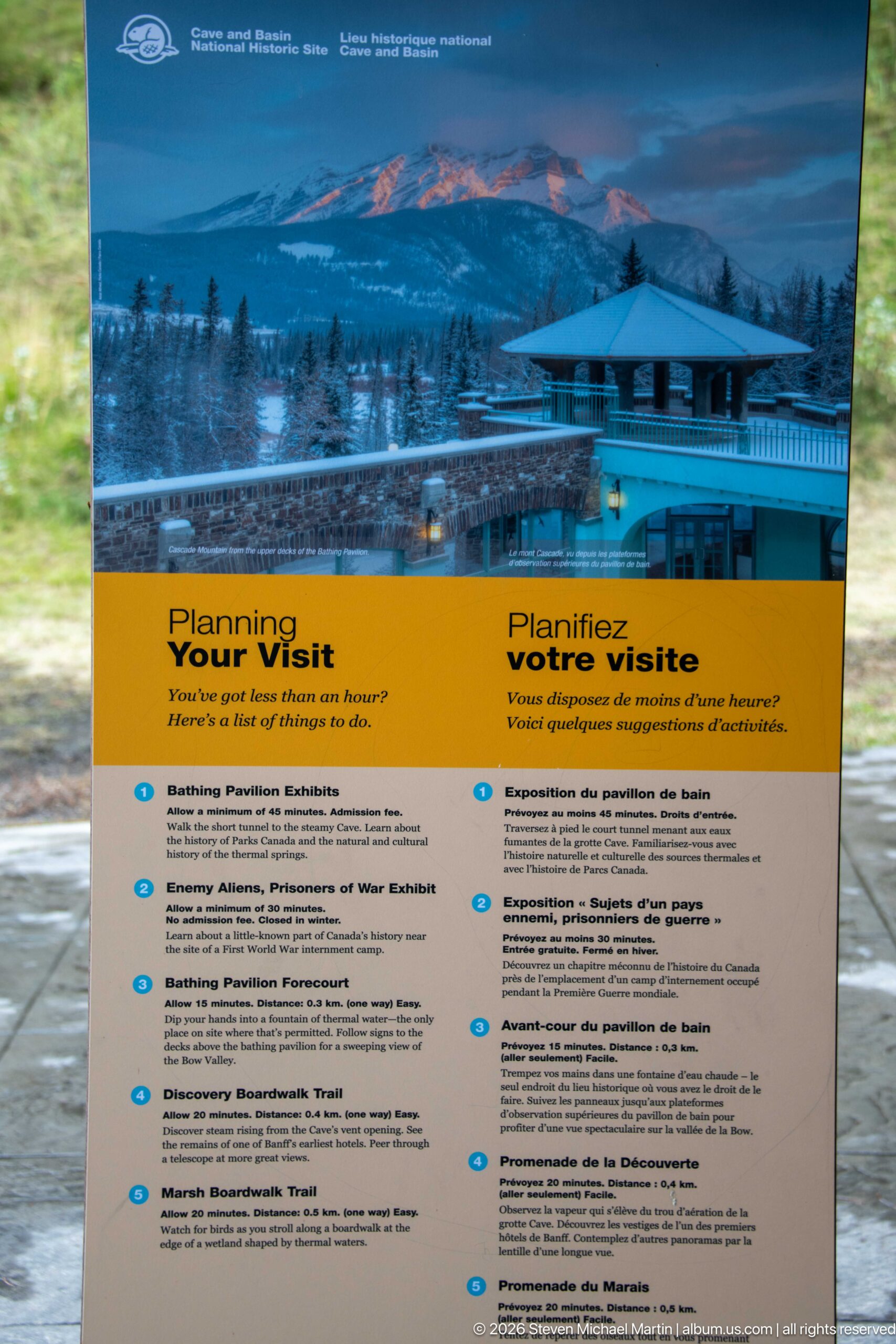
“Planning Your Visit” heads a bilingual orientation panel set against a blue-toned image of the site in winter. Two columns organize visitor information into short topics, with turquoise markers separating entries and a bright orange title band across the middle. The practical layout is designed for quick scanning: it helps visitors decide what to see and how to use their time before entering the historic site.
Caption
“Planning Your Visit” heads a bilingual orientation panel set against a blue-toned image of the site in winter. Two columns organize visitor information into short topics, with turquoise markers separating entries and a bright orange title band across the middle. The practical layout is designed for quick scanning: it helps visitors decide what to see and how to use their time before entering the historic site.
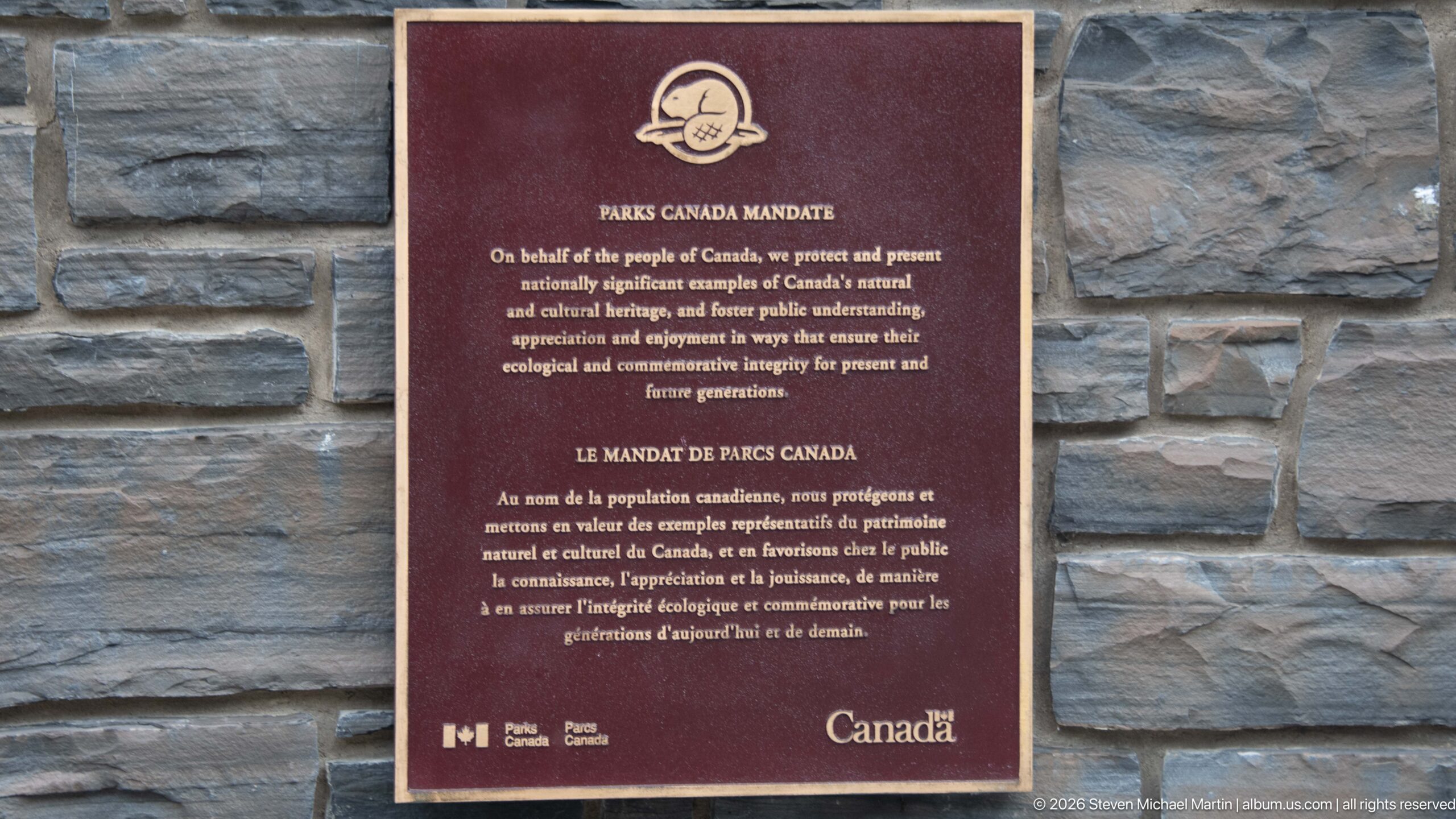
A bronze-colored plaque mounted on a gray stone wall states the Parks Canada mandate in English and French. Its centered beaver emblem, compact paragraphs, and federal wordmark establish the plaque as an institutional statement rather than a site-specific historical marker. The close, straight-on view makes the relationship between the official text and the carefully coursed masonry visible, with no surrounding entrance context competing for attention.
Caption
A bronze-colored plaque mounted on a gray stone wall states the Parks Canada mandate in English and French. Its centered beaver emblem, compact paragraphs, and federal wordmark establish the plaque as an institutional statement rather than a site-specific historical marker. The close, straight-on view makes the relationship between the official text and the carefully coursed masonry visible, with no surrounding entrance context competing for attention.
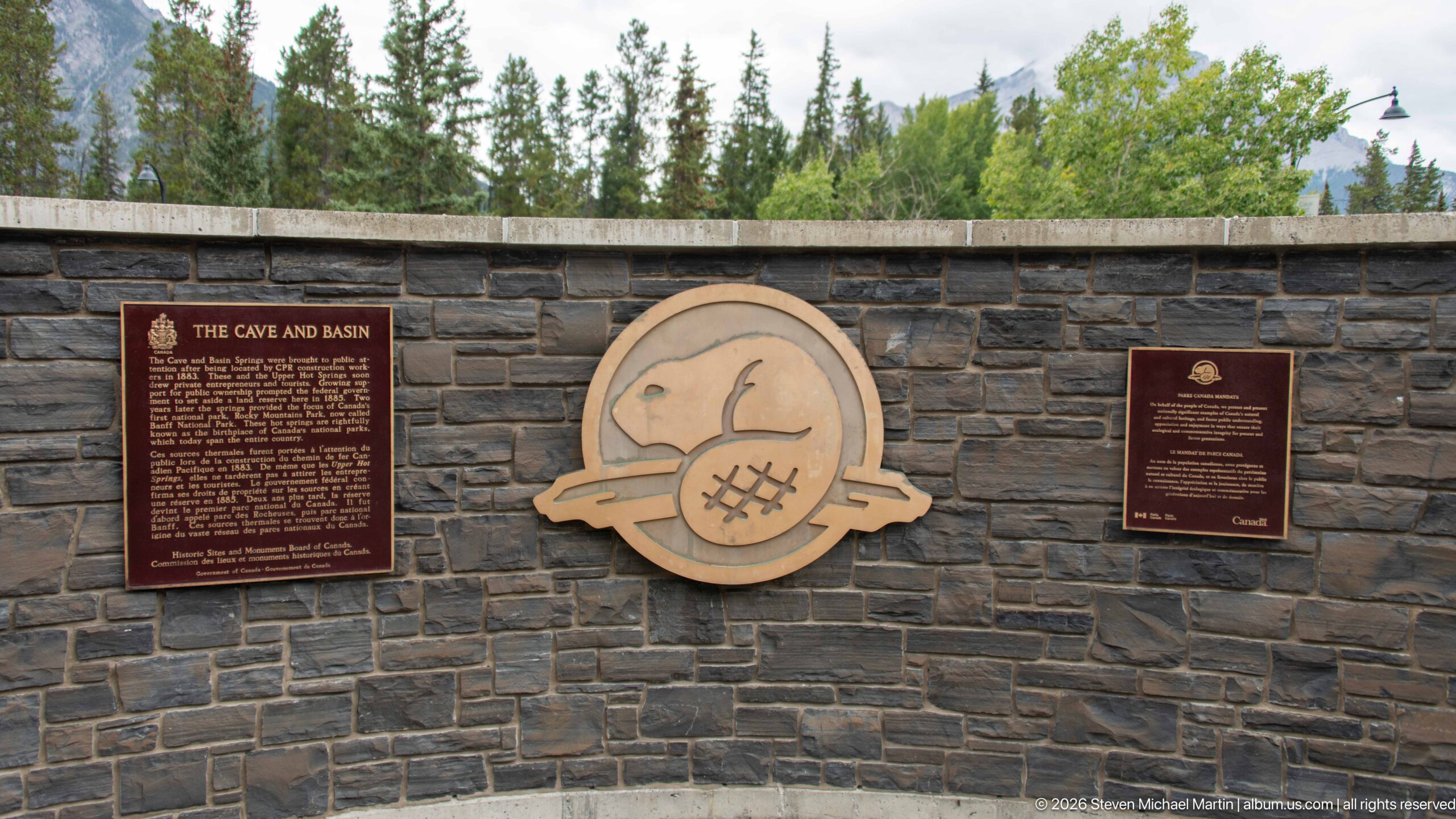
A curved stone wall carries two dark red historical plaques on either side of a large circular Parks Canada emblem. The wide view reveals the display as an integrated entrance feature: the central beaver mark anchors the arrangement, while the plaques provide the written context. Trees rise behind the wall, connecting this formal institutional display to the wooded setting of the national historic site.
Caption
A curved stone wall carries two dark red historical plaques on either side of a large circular Parks Canada emblem. The wide view reveals the display as an integrated entrance feature: the central beaver mark anchors the arrangement, while the plaques provide the written context. Trees rise behind the wall, connecting this formal institutional display to the wooded setting of the national historic site.
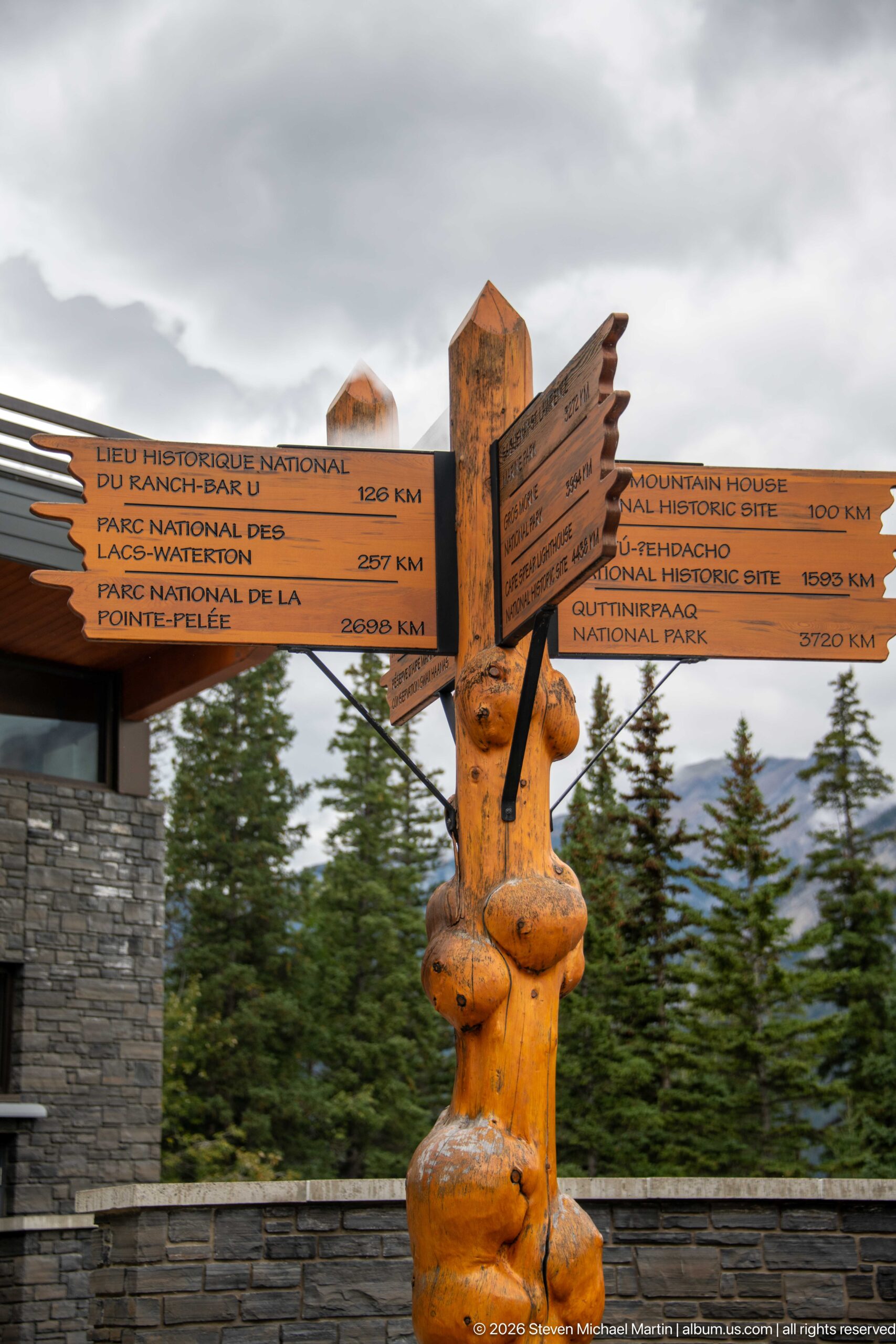
A carved wooden direction post fans out into multiple arrow boards, each naming a destination and giving a distance. The weathered orange-brown timber stands against evergreen trees and a low stone wall, turning wayfinding into a prominent feature of the site approach. Several arrows point in opposing directions, signaling the Cave and Basin’s connection to a wider network of parks and heritage places across the region.
Caption
A carved wooden direction post fans out into multiple arrow boards, each naming a destination and giving a distance. The weathered orange-brown timber stands against evergreen trees and a low stone wall, turning wayfinding into a prominent feature of the site approach. Several arrows point in opposing directions, signaling the Cave and Basin’s connection to a wider network of parks and heritage places across the region.
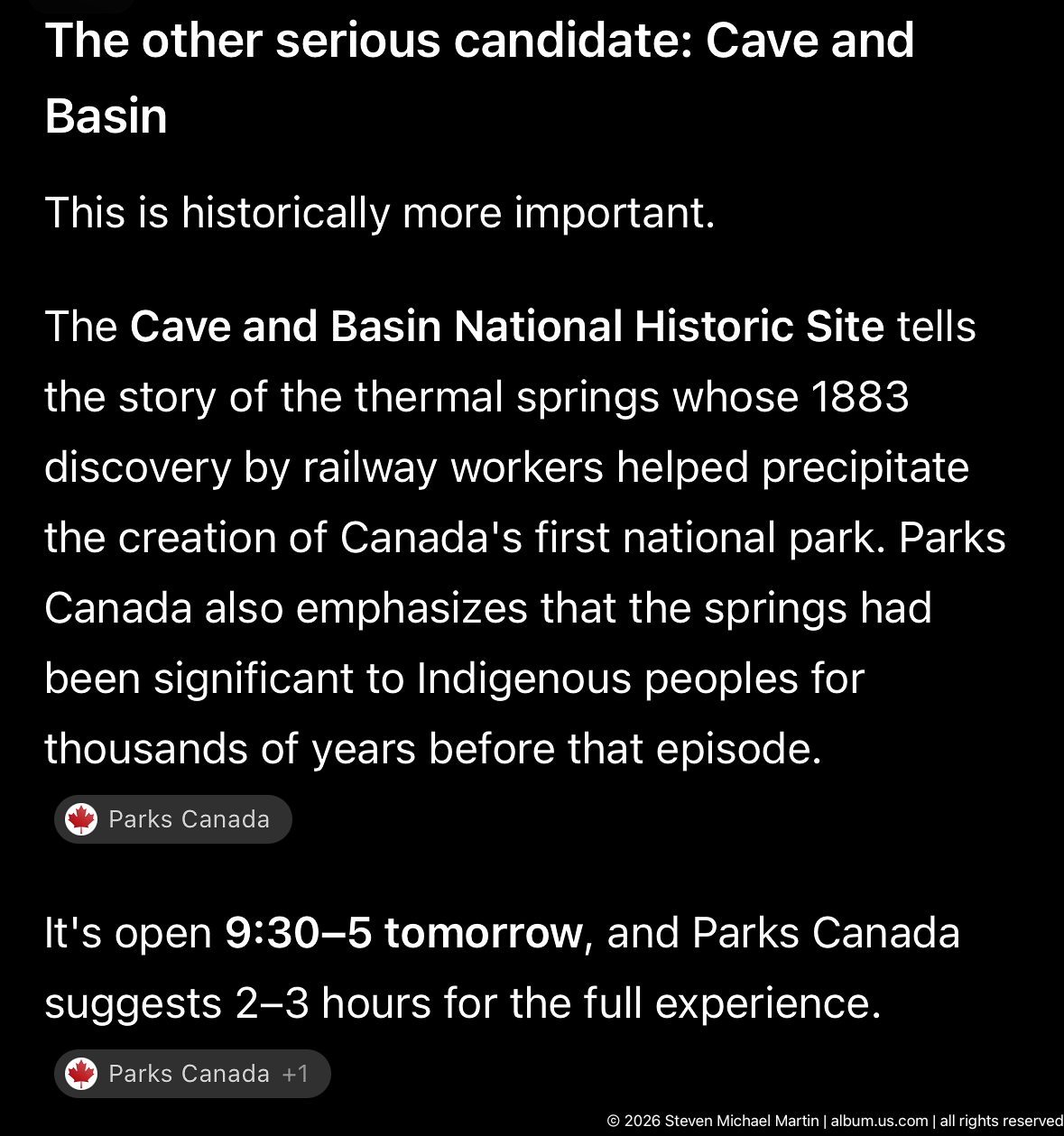
A black-background text graphic summarizes the Cave and Basin’s historical significance, describing the thermal springs, their 1883 discovery by railway workers, and their role in the creation of Canada’s first national park. It also notes the springs’ earlier significance to Indigenous peoples and includes practical opening-hour and visit-duration information. The frame is text-led, with no physical site view; its content functions as an editorial summary rather than a documentary photograph.
Caption
A black-background text graphic summarizes the Cave and Basin’s historical significance, describing the thermal springs, their 1883 discovery by railway workers, and their role in the creation of Canada’s first national park. It also notes the springs’ earlier significance to Indigenous peoples and includes practical opening-hour and visit-duration information. The frame is text-led, with no physical site view; its content functions as an editorial summary rather than a documentary photograph.
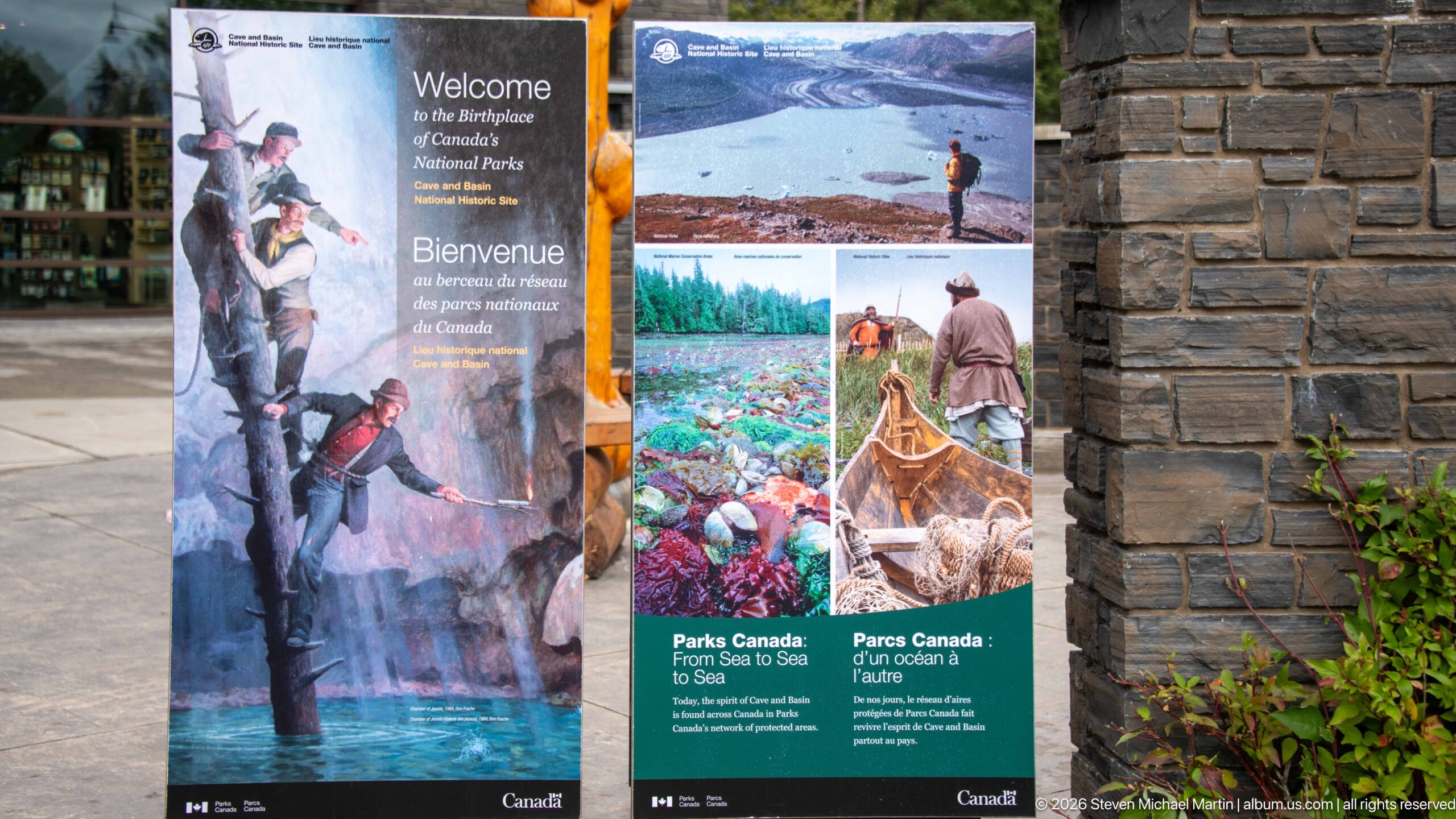
Two freestanding Parks Canada banners stand beside a stone wall, their illustrated panels presenting national parks through people, wildlife, water, and mountain settings. The banner at left shows visitors near water; the paired display includes a sequence of outdoor scenes and the “From Sea to Sea” wording. Their portable format and repeated national branding distinguish this broad conservation message from the permanent interpretive plaques nearby.
Caption
Two freestanding Parks Canada banners stand beside a stone wall, their illustrated panels presenting national parks through people, wildlife, water, and mountain settings. The banner at left shows visitors near water; the paired display includes a sequence of outdoor scenes and the “From Sea to Sea” wording. Their portable format and repeated national branding distinguish this broad conservation message from the permanent interpretive plaques nearby.
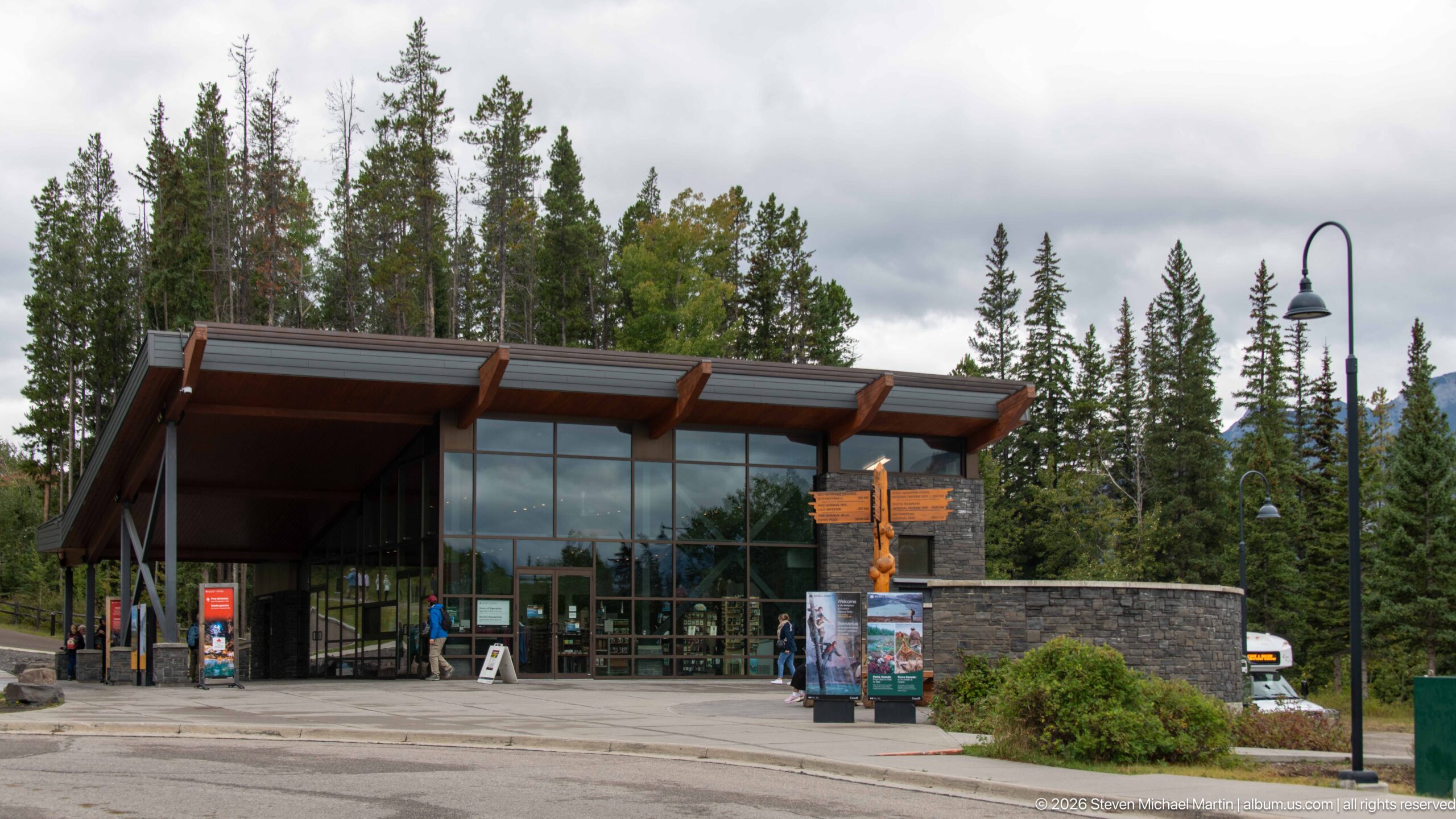
The visitor center presents a low, contemporary profile, with a broad projecting roof above a glass entrance wall and stone-clad side elements. The transparent façade reveals the interior while reflecting trees and the gray sky; a wooden direction post and public display stand near the entrance. Framed by conifers and a paved forecourt, the building forms a modern visitor service hub within the historic site landscape.
Caption
The visitor center presents a low, contemporary profile, with a broad projecting roof above a glass entrance wall and stone-clad side elements. The transparent façade reveals the interior while reflecting trees and the gray sky; a wooden direction post and public display stand near the entrance. Framed by conifers and a paved forecourt, the building forms a modern visitor service hub within the historic site landscape.
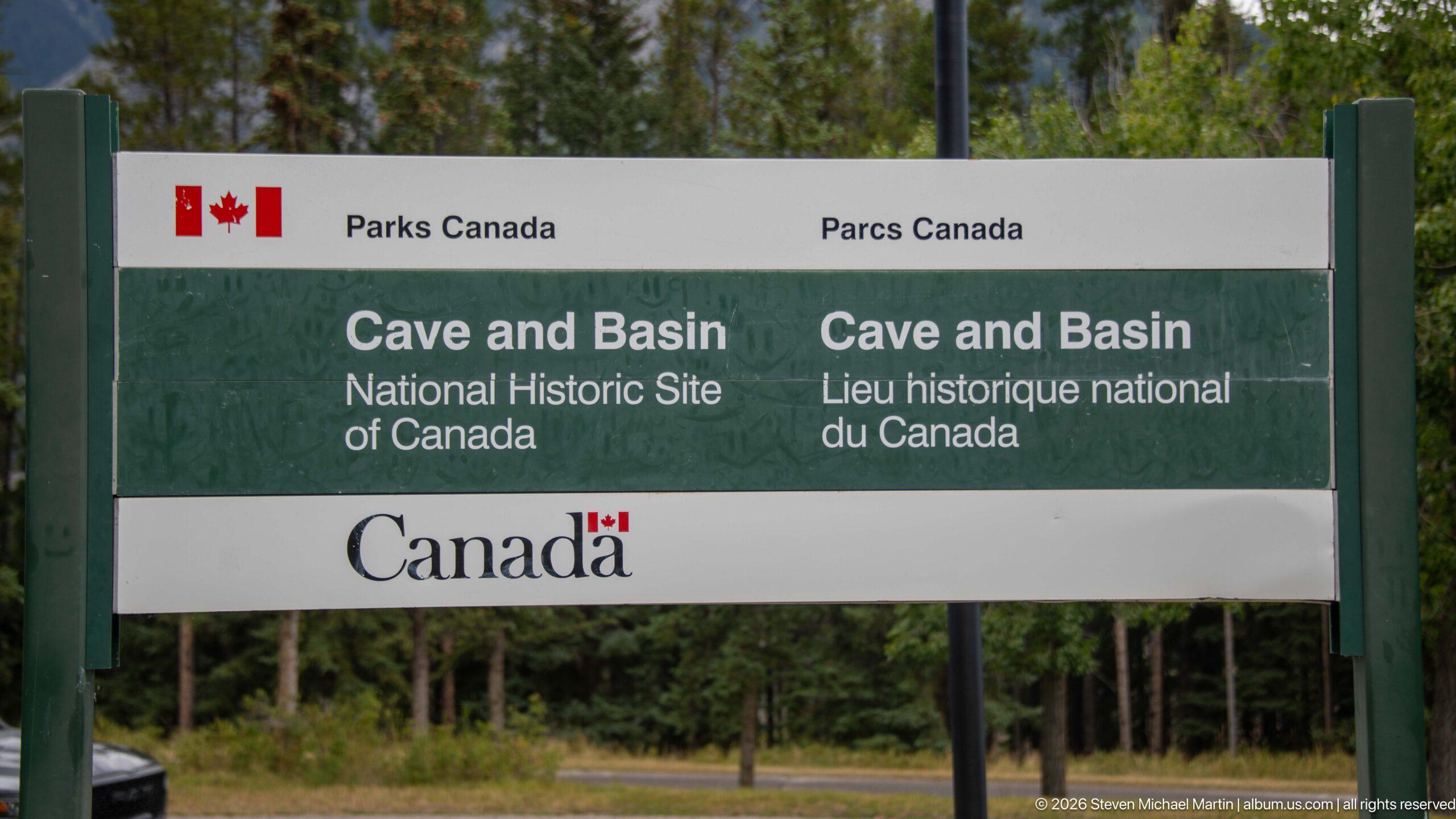
A close view isolates the bilingual Parks Canada entrance sign: a green field names Cave and Basin National Historic Site of Canada beneath the agency’s red maple leaf symbols, with “Canada” printed on a white lower band. The cropped forest background gives the sign clear contrast and removes most surrounding architecture, making the official site identification the defining evidence in this image.
Caption
A close view isolates the bilingual Parks Canada entrance sign: a green field names Cave and Basin National Historic Site of Canada beneath the agency’s red maple leaf symbols, with “Canada” printed on a white lower band. The cropped forest background gives the sign clear contrast and removes most surrounding architecture, making the official site identification the defining evidence in this image.
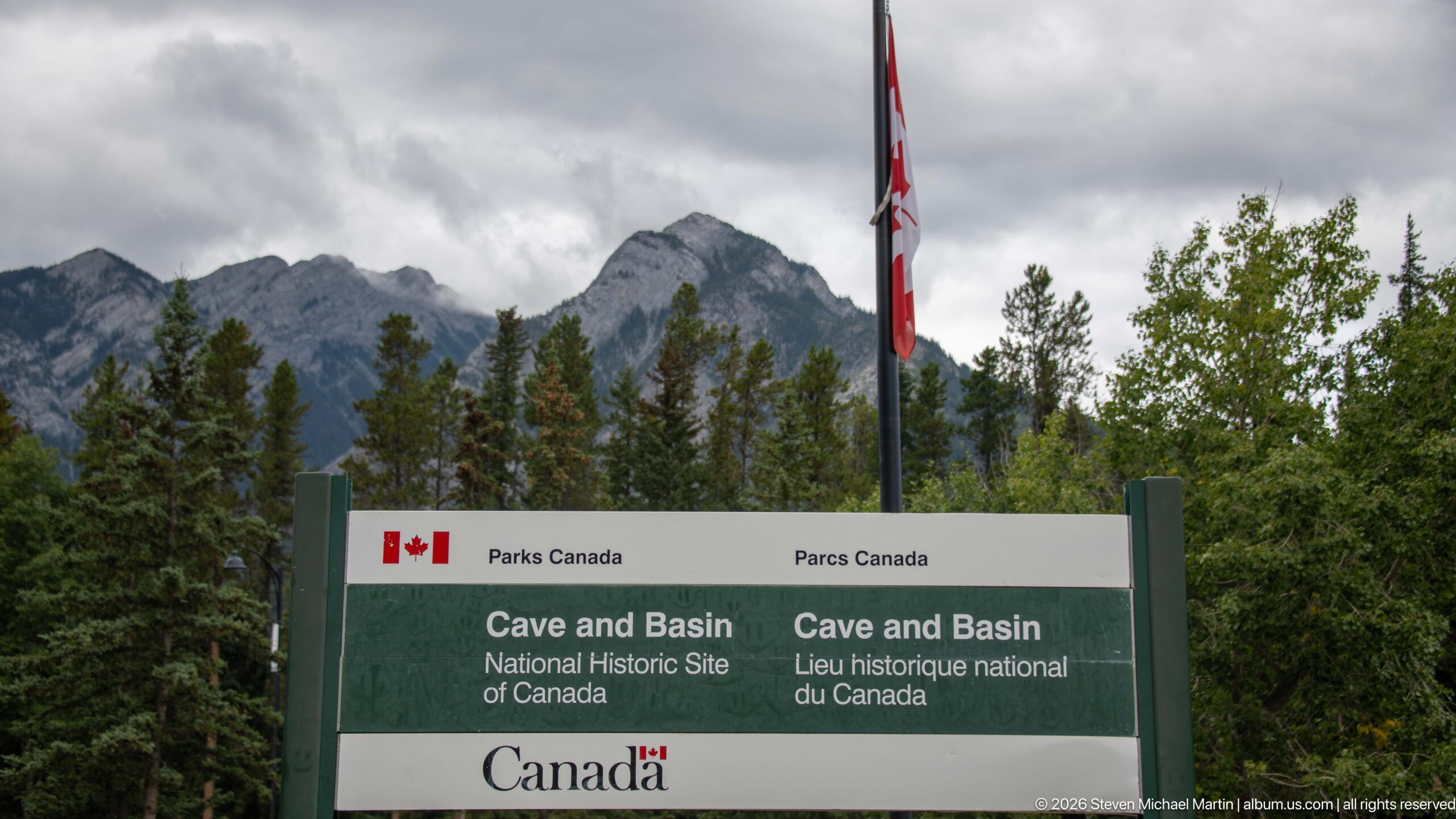
The bilingual green Parks Canada sign sits in the foreground beneath a Canadian flag, with steep gray mountain peaks rising behind the trees. This wider framing ties the formal site designation to its Rocky Mountain setting and adds depth absent from a close sign view. The low cloud and forested middle ground place the entrance within a rugged alpine landscape without requiring identification of a particular peak.
Caption
The bilingual green Parks Canada sign sits in the foreground beneath a Canadian flag, with steep gray mountain peaks rising behind the trees. This wider framing ties the formal site designation to its Rocky Mountain setting and adds depth absent from a close sign view. The low cloud and forested middle ground place the entrance within a rugged alpine landscape without requiring identification of a particular peak.
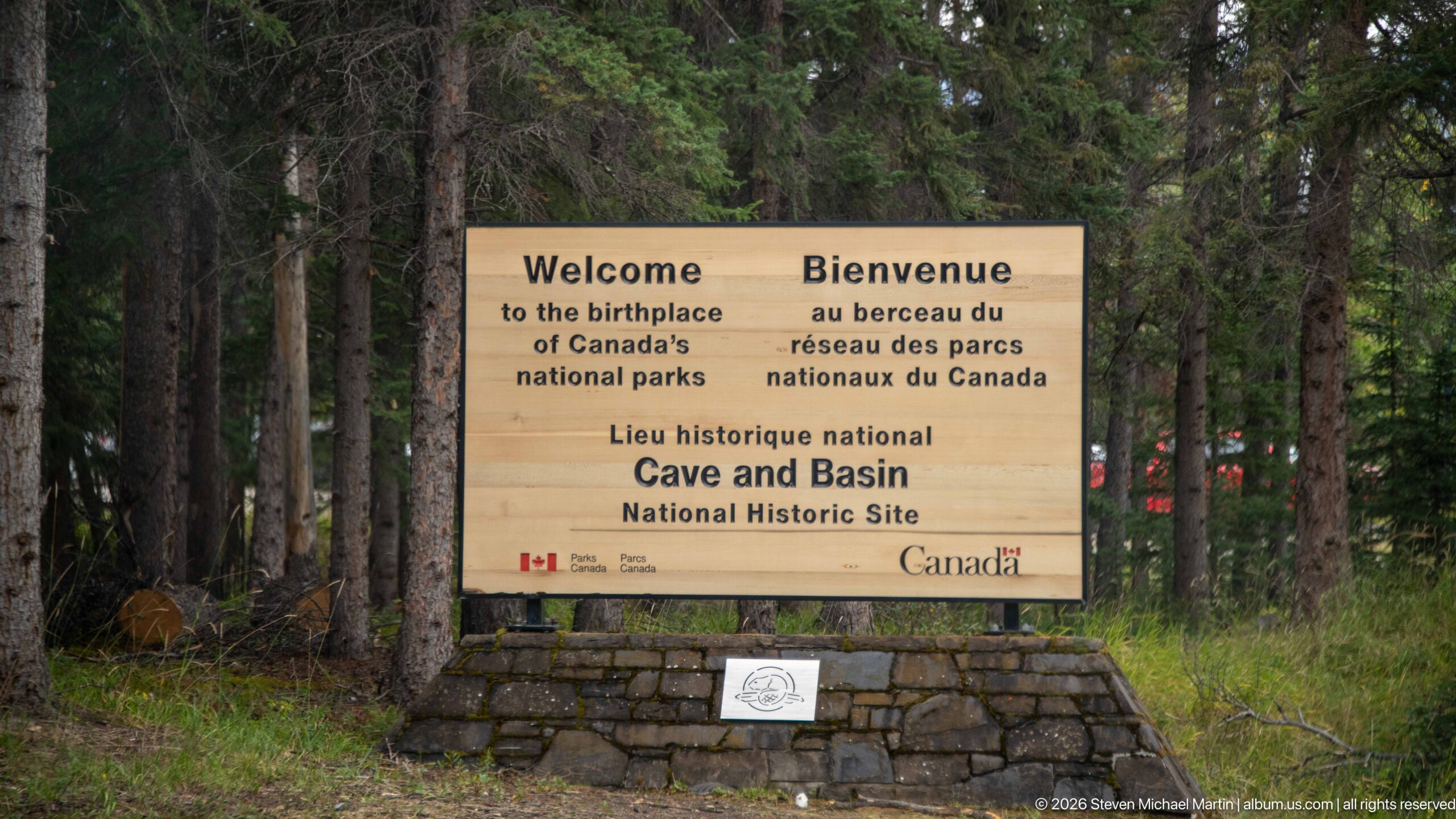
A pale timber welcome sign stands on a low stone base among tall conifers. English and French lettering identifies the birthplace of Canada’s national parks and names Cave and Basin National Historic Site; the centered layout is framed by small Parks Canada and Canada marks. Set back from the road, the sign uses wood, stone, and forest to make the site’s entrance legible within its wooded surroundings.
Caption
A pale timber welcome sign stands on a low stone base among tall conifers. English and French lettering identifies the birthplace of Canada’s national parks and names Cave and Basin National Historic Site; the centered layout is framed by small Parks Canada and Canada marks. Set back from the road, the sign uses wood, stone, and forest to make the site’s entrance legible within its wooded surroundings.
🏞️ National Park Field Guide
📍 Overview
At Cave and Basin National Historic Site, the story of the land is visible in the meeting of thermal water, mineral-coated rock, and a low limestone cave. The Living Geology perspective begins with these close details, then widens to the forested slopes and mountain ridges around the site. The springs also connect geological features to human history: railway workers encountered them in 1883, and their discovery helped lead to the creation of Canada’s first national park. Exhibits add Indigenous perspectives and explain the springs’ ecological importance, placing the familiar landmark within a much longer relationship between people, water, and place.
🏔️ Landscape
The site brings together an enclosed spring basin, a cave passage, wooded grounds, and a mountain setting. Inside, pale limestone ceilings hang close above blue-green water; outside, conifers and rocky ridges frame the visitor buildings and paths. Stone arcades, paved courtyards, and the modern visitor center mark the transition between the protected spring features and the broader landscape. Views alternate between intimate surfaces—water, rock, and mineral deposits—and expansive mountain scenery. That change in scale is central to understanding Cave and Basin: a compact place where geological features sit within the larger terrain of the Canadian Rockies.
🪨 Geology
Geology here is encountered at close range. The cave’s uneven limestone ceiling forms pockets, ledges, and recesses above the spring pool, while pale mineral crusts and ochre staining mark the rock around the water. Shallow areas reveal a textured bed beneath the rippling surface; reflections and changing light make some details appear and disappear. Together, the cave and basin show how water and rock shape the site’s distinctive forms and colors. Looking from the broad pool to the smallest mineral-coated edge helps make the relationship between the thermal spring and its rocky setting visible.
🌿 Ecology
The thermal waters are also presented as habitat. Interpretive displays introduce life associated with spring water, including the Banff Springs snail, and frame its survival as a conservation concern. These panels encourage attention to the small organisms and conditions that can be easy to overlook beside the cave and pools. The surrounding conifer forest and mountain terrain provide a contrasting ecological setting, with the site’s maps and trail signs connecting the springs to the wider landscape. The photographs document this ecological story primarily through the water, its mineral surfaces, and the interpretive material that explains their significance.
🦌 Wildlife
Wildlife should be interpreted in relation to habitat, behavior, seasonality, and conservation.
🧭 Human History
The springs’ history includes relationships that long predate the site’s familiar national-park story. Parks Canada interpretation acknowledges their significance to Indigenous peoples for thousands of years and presents Indigenous perspectives through language, portraits, and themes of land, community, knowledge, and healing. In 1883, railway workers encountered the springs, an event that helped spur the creation of a reserve and, later, Canada’s first national park. Plaques, archival photographs, and gallery displays trace this transition while showing how the place has been interpreted and visited. The historical record is layered: geological landmark, longstanding cultural place, and milestone in Canada’s national-park history.
🥾 Visitor Experience
A visit moves between the cave’s close, illuminated rock surfaces and the open courtyards, galleries, and forest paths around it. Handrails and a gently sloping boardwalk guide visitors through the low passage, while museum displays provide historical and ecological context beyond the spring basin. Outdoor maps and trail panels orient visitors to nearby routes, and the entrance signs connect the site to the surrounding mountain landscape. The shift from the enclosed cave to the wooded grounds changes both the scale and pace of observation: details in water and limestone give way to views of trees, ridges, and open sky.
📷 Photography Notes
Photographs can follow the site’s changing scale: begin with mineral crusts and ripples at the water’s edge, then include the cave ceiling and pool together to show their close relationship. A view along the boardwalk conveys the passage’s low profile and the route visitors follow. Outside, the stone arcades and visitor buildings provide architectural context, while mountain peaks behind the entrance sign establish the broader setting. Reflections and warm interior lighting alter the appearance of water and limestone, so details may read differently from one viewpoint to another. Interpretive panels and historic markers add human context when framed clearly enough to distinguish their text and images.