Carthage – Tunisia
The ancient city of Carthage lies along the Mediterranean coast just north of Tunis. Founded by Phoenician settlers in the 9th century BCE, Carthage grew into one of the most powerful cities of the ancient Mediterranean world.
As the center of the Carthaginian Empire, the city controlled extensive trade networks across North Africa, Spain, and the western Mediterranean. Its power eventually brought it into conflict with Rome during the Punic Wars, which culminated in the destruction of the city in 146 BCE.
Today the archaeological remains of Carthage include Roman baths, villas, harbors, and temples that illustrate the long history of settlement at this remarkable site. The ruins are recognized as a UNESCO World Heritage Site.
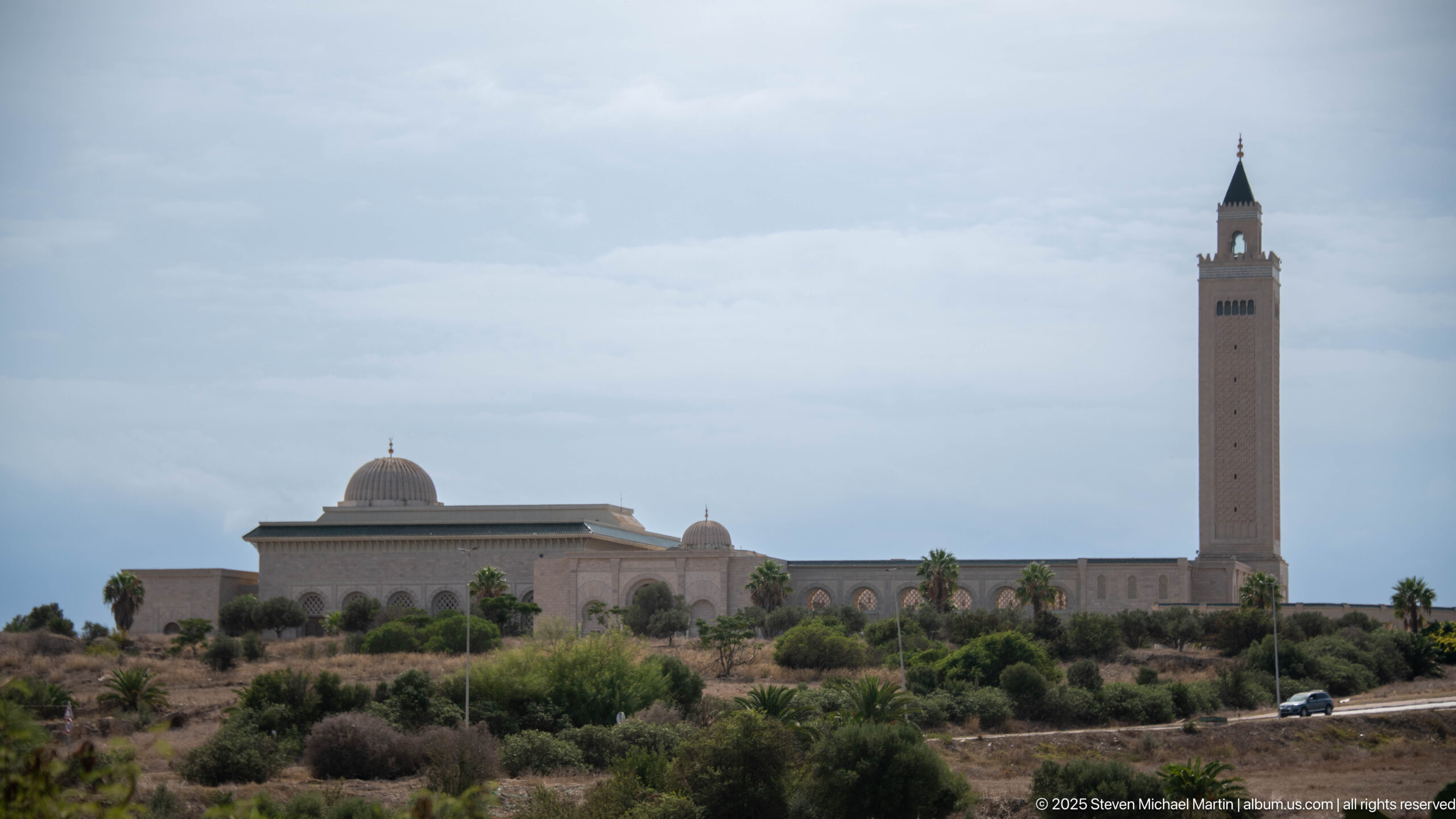
The Malik ibn Anas Mosque rises above landscaped ground in Carthage, its long, low prayer-hall mass balanced by a tall square minaret and a central dome. The restrained stone-colored exterior and repeated arcades create a strong horizontal rhythm, while palms and scrub frame the complex against an overcast sky. This establishing view records the mosque in its broader setting rather than isolating architectural details.
Caption
The Malik ibn Anas Mosque rises above landscaped ground in Carthage, its long, low prayer-hall mass balanced by a tall square minaret and a central dome. The restrained stone-colored exterior and repeated arcades create a strong horizontal rhythm, while palms and scrub frame the complex against an overcast sky. This establishing view records the mosque in its broader setting rather than isolating architectural details.
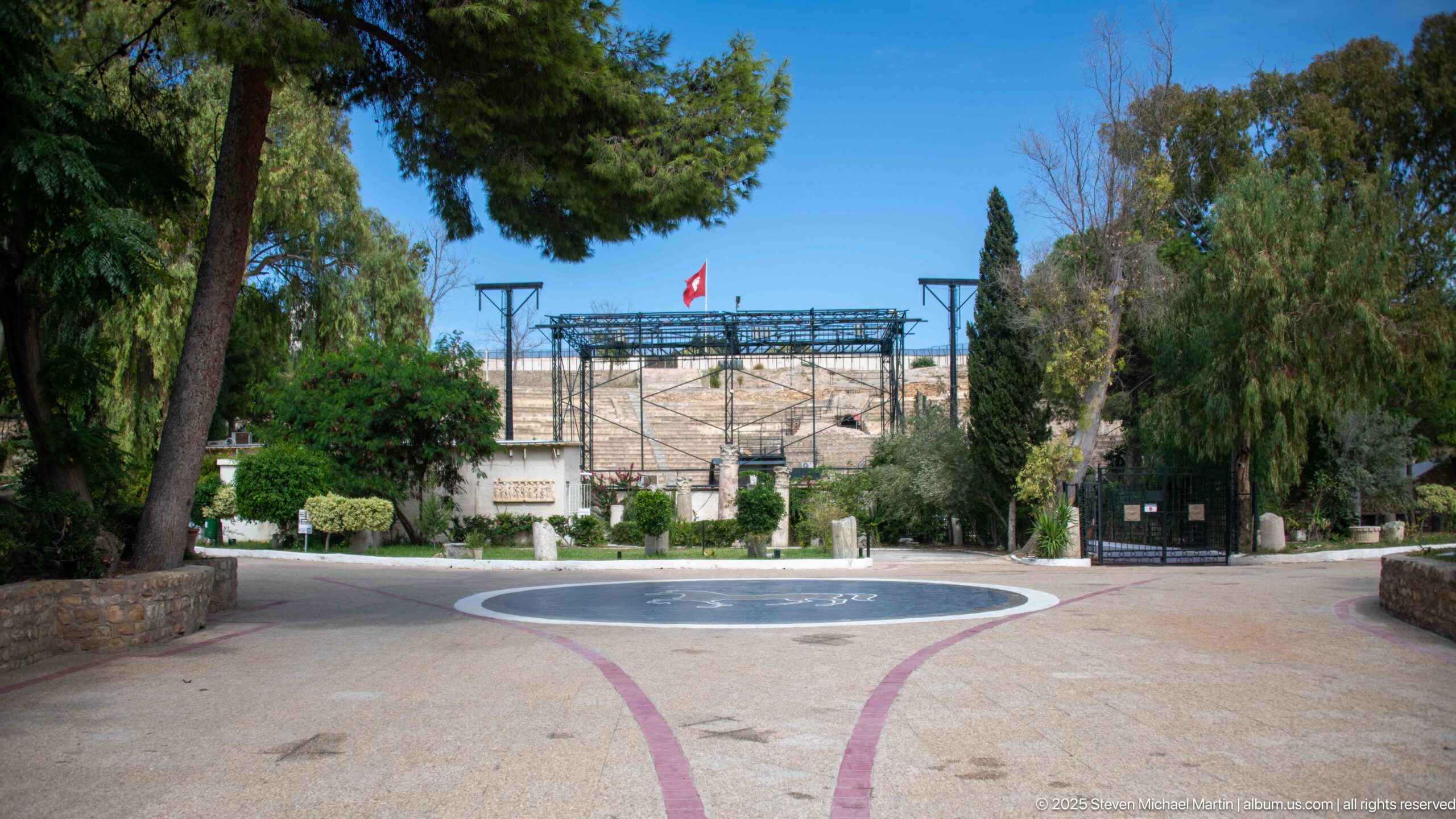
The approach to the Roman Theatre of Carthage leads through a landscaped forecourt toward the rising stone seating, partly framed by modern stage infrastructure. A Tunisian flag flies above the cavea, while clipped shrubs, mature trees, and paved paths mark the contemporary visitor environment. The composition functions as an arrival view, showing the ancient venue as it is encountered today rather than concentrating on the surviving masonry alone.
Caption
The approach to the Roman Theatre of Carthage leads through a landscaped forecourt toward the rising stone seating, partly framed by modern stage infrastructure. A Tunisian flag flies above the cavea, while clipped shrubs, mature trees, and paved paths mark the contemporary visitor environment. The composition functions as an arrival view, showing the ancient venue as it is encountered today rather than concentrating on the surviving masonry alone.
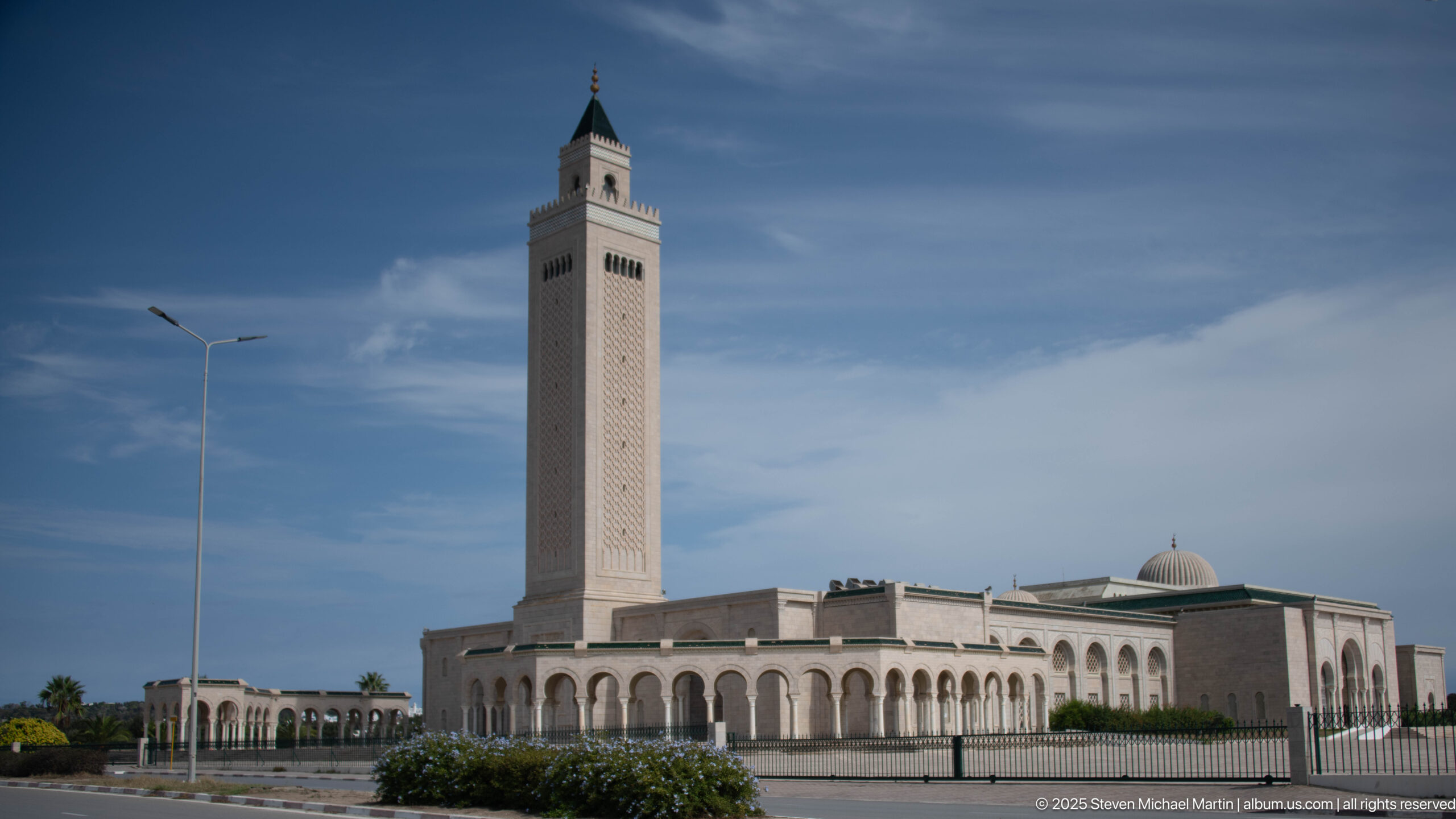
Seen from the roadside, the Malik ibn Anas Mosque stretches laterally behind a perimeter fence, with its tall square minaret dominating the skyline and a low dome visible toward the right. Repeated arches unify the exterior elevations, while a streetlight and roadway place the religious complex within contemporary Carthage. The broad composition emphasizes the mosque’s urban presence and scale rather than a single decorative feature.
Caption
Seen from the roadside, the Malik ibn Anas Mosque stretches laterally behind a perimeter fence, with its tall square minaret dominating the skyline and a low dome visible toward the right. Repeated arches unify the exterior elevations, while a streetlight and roadway place the religious complex within contemporary Carthage. The broad composition emphasizes the mosque’s urban presence and scale rather than a single decorative feature.
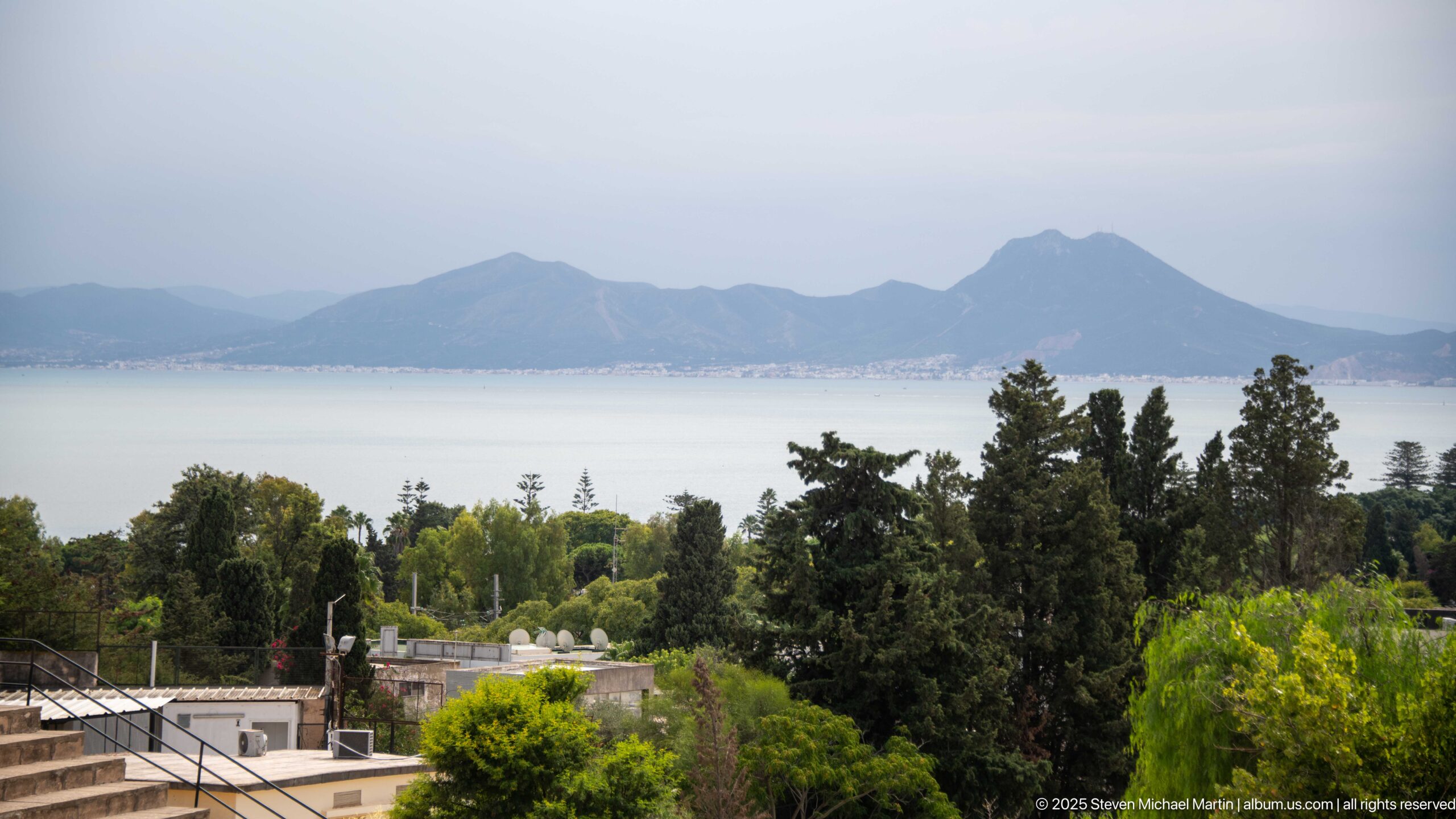
An elevated view from Carthage looks beyond trees and low buildings toward the Gulf of Tunis, where calm water meets a hazy chain of hills and mountain ridges. The layered composition shifts the portfolio temporarily from archaeology to landscape, showing the coastal setting that shaped ancient Carthage’s maritime orientation. Atmospheric haze softens the distant shore while dark foreground trees provide scale and depth.
Caption
An elevated view from Carthage looks beyond trees and low buildings toward the Gulf of Tunis, where calm water meets a hazy chain of hills and mountain ridges. The layered composition shifts the portfolio temporarily from archaeology to landscape, showing the coastal setting that shaped ancient Carthage’s maritime orientation. Atmospheric haze softens the distant shore while dark foreground trees provide scale and depth.
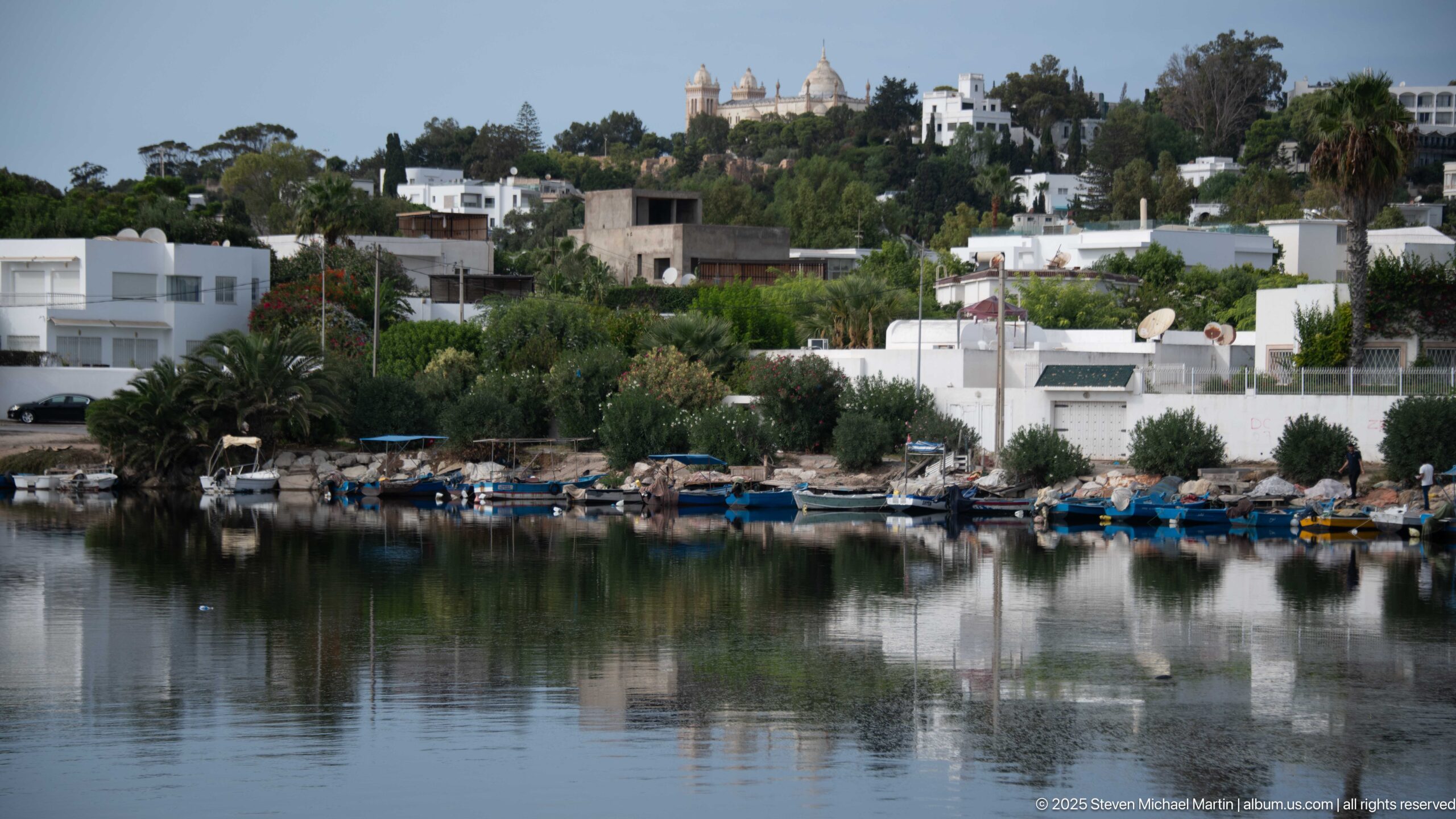
The Punic port basin reflects a dense band of fishing boats, white houses, palms, and greenery along the modern Carthage shoreline. A prominent domed building crowns the hill in the distance, while the still water merges the contemporary residential landscape with the ancient harbor setting. This layered view is especially effective at showing how archaeological geography and modern urban life occupy the same waterfront.
Caption
The Punic port basin reflects a dense band of fishing boats, white houses, palms, and greenery along the modern Carthage shoreline. A prominent domed building crowns the hill in the distance, while the still water merges the contemporary residential landscape with the ancient harbor setting. This layered view is especially effective at showing how archaeological geography and modern urban life occupy the same waterfront.
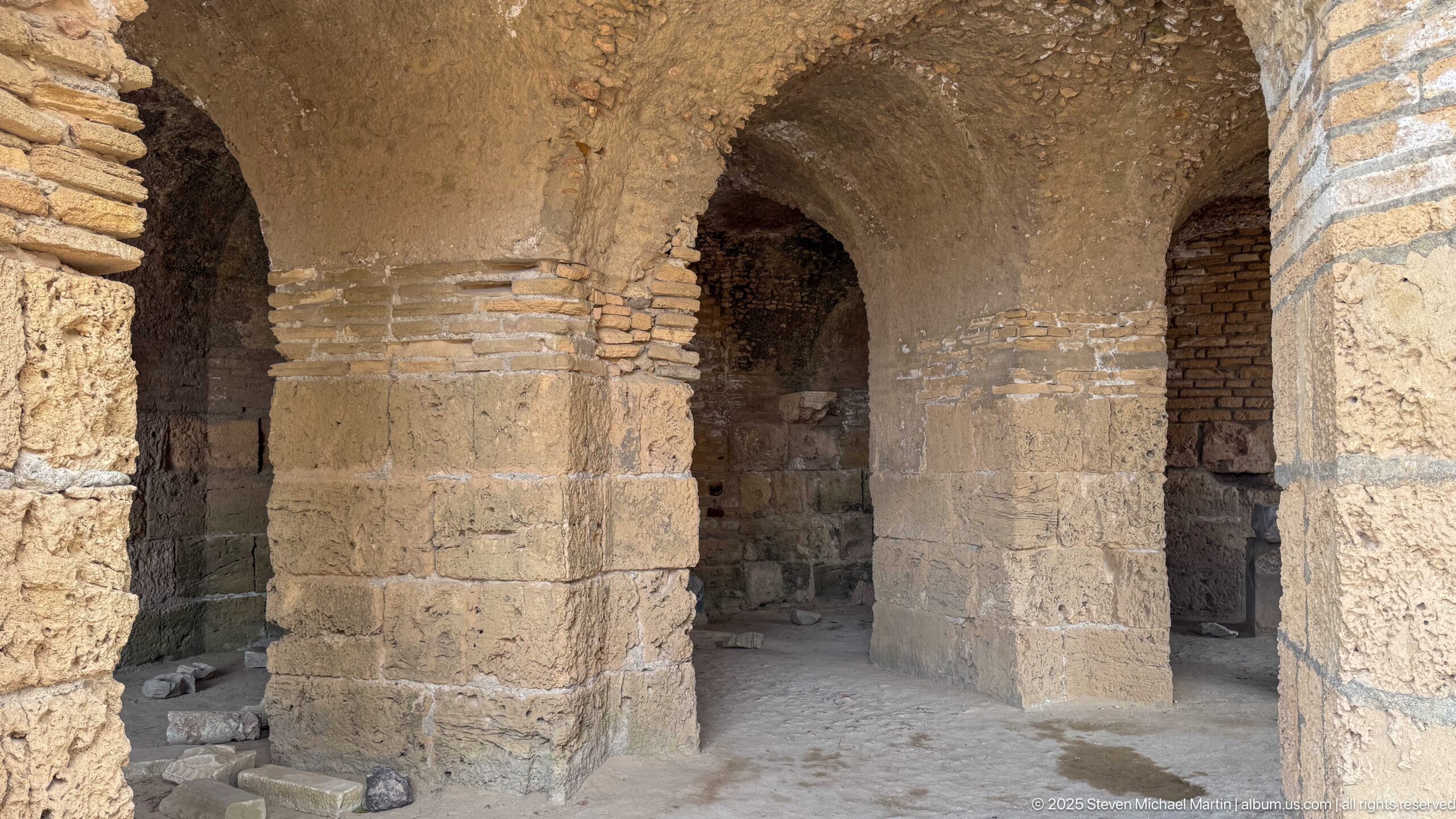
A sheltered interior passage is formed by massive masonry piers supporting rounded arches and vaults. Brick courses remain visible within several arch rings, contrasting with larger squared stone blocks in the lower supports. Light entering from adjoining openings reveals the thickness of the construction and the interconnected character of the surviving spaces, offering a close study of Roman-era building technique at Carthage.
Caption
A sheltered interior passage is formed by massive masonry piers supporting rounded arches and vaults. Brick courses remain visible within several arch rings, contrasting with larger squared stone blocks in the lower supports. Light entering from adjoining openings reveals the thickness of the construction and the interconnected character of the surviving spaces, offering a close study of Roman-era building technique at Carthage.
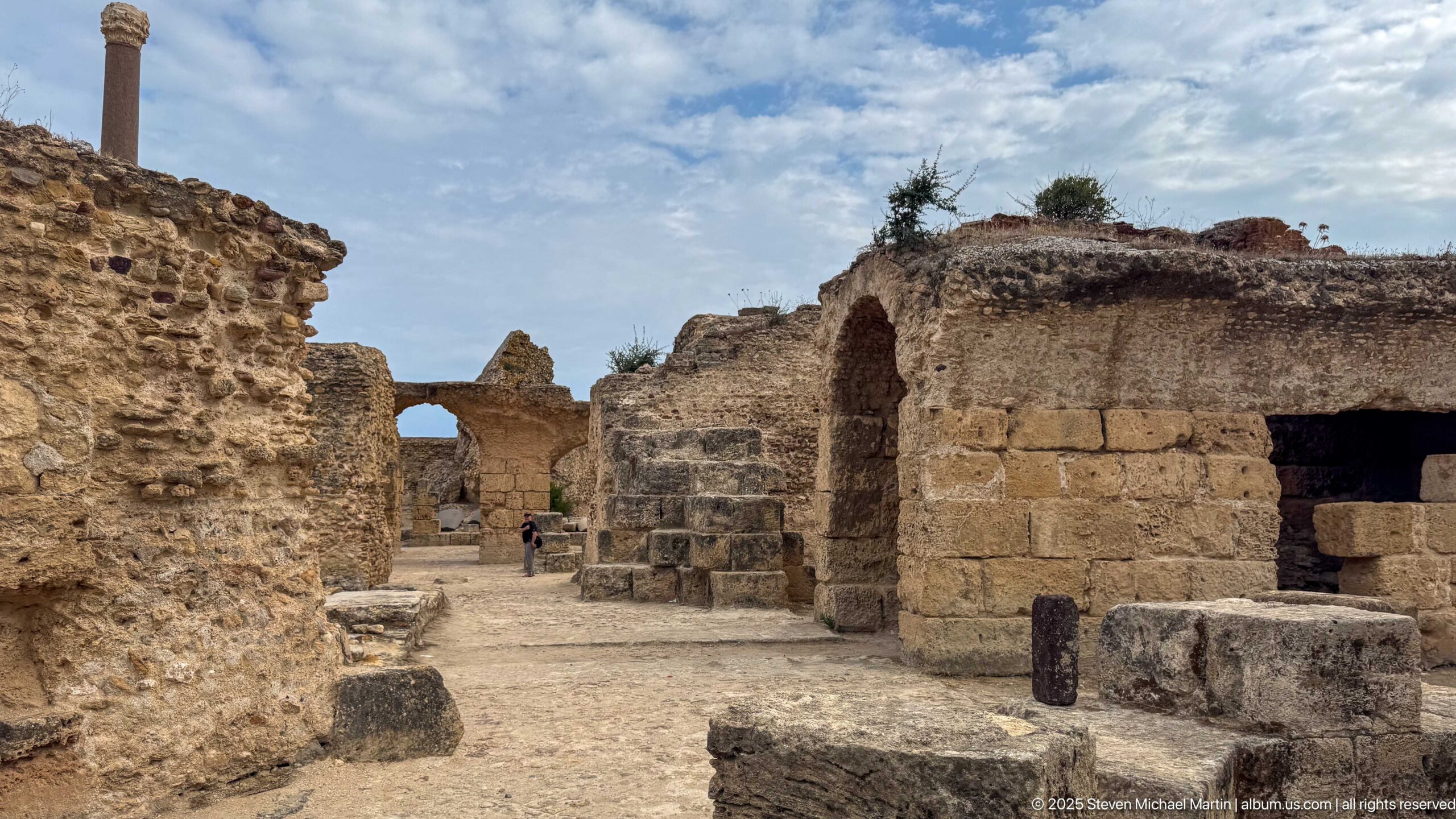
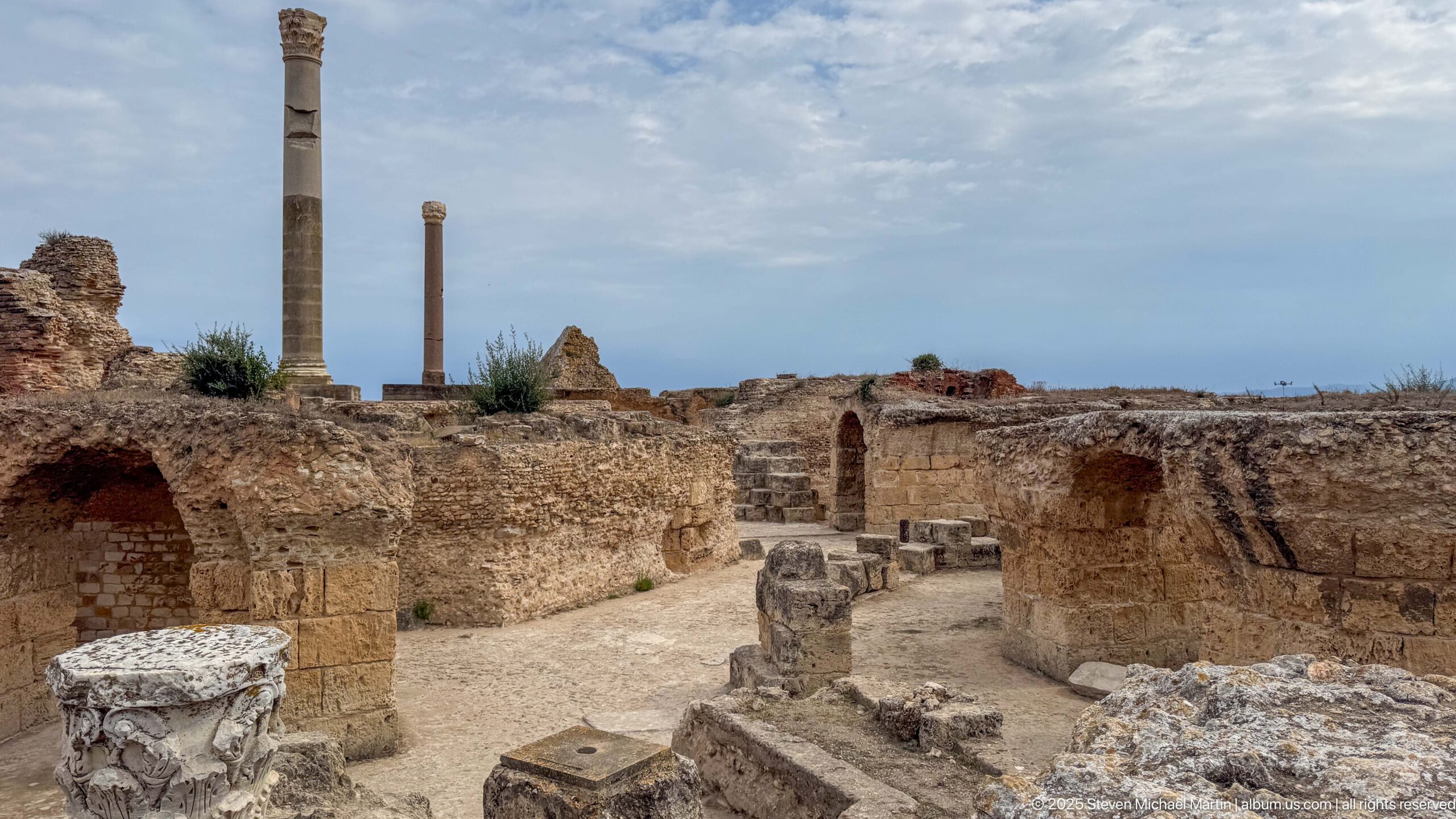
An open route threads between massive wall remnants and vaulted chambers in the Baths of Antoninus. Different masonry textures—large squared blocks, smaller rubble, and patched surfaces—record the fragmentary survival of the complex, while distant arches draw the eye through the ruins. The view emphasizes the human-scale experience of walking through spaces that once functioned as the structural underside of monumental bath halls.
Caption
An open route threads between massive wall remnants and vaulted chambers in the Baths of Antoninus. Different masonry textures—large squared blocks, smaller rubble, and patched surfaces—record the fragmentary survival of the complex, while distant arches draw the eye through the ruins. The view emphasizes the human-scale experience of walking through spaces that once functioned as the structural underside of monumental bath halls.
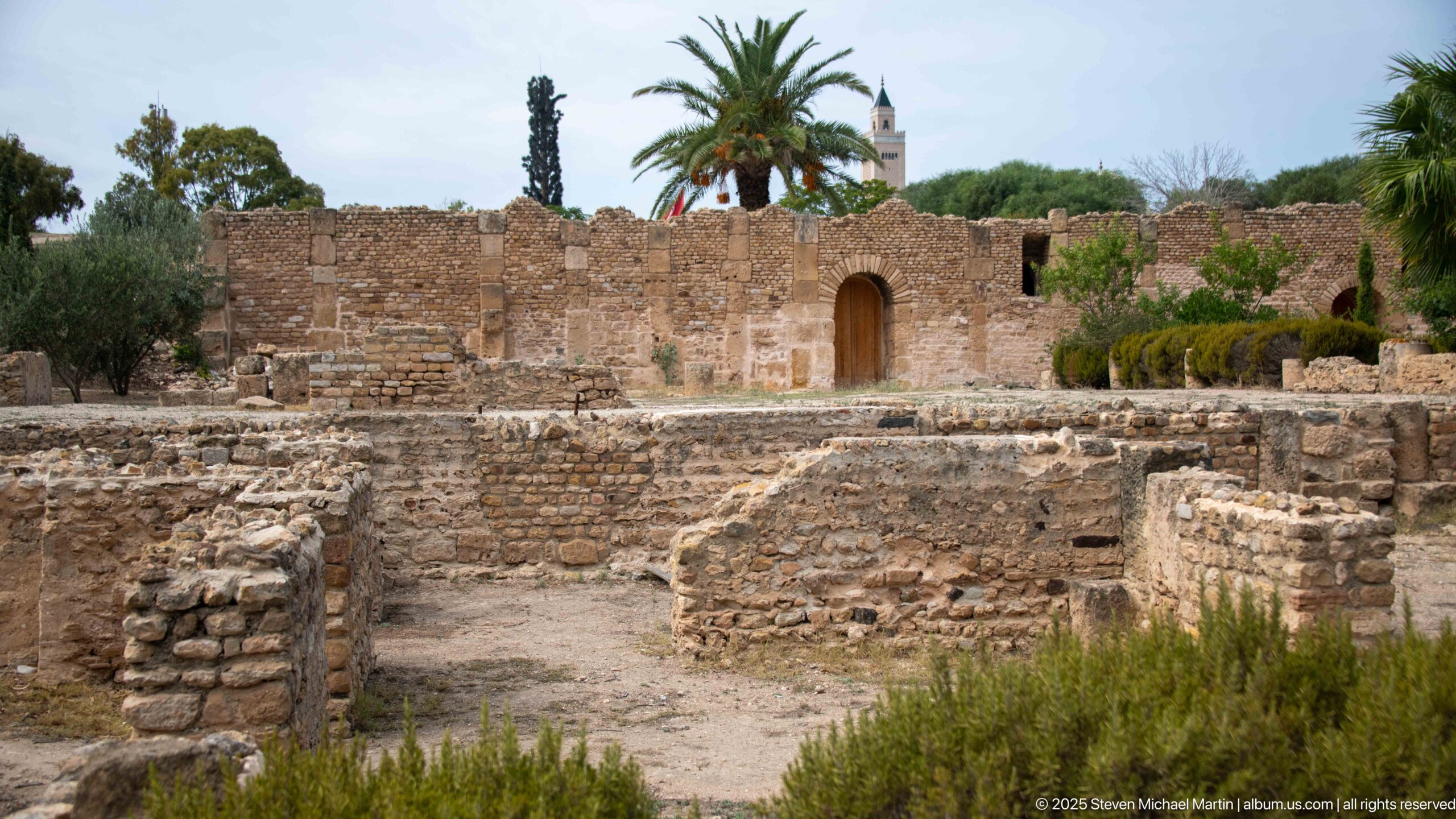
Low stone walls outline a series of rooms within the Roman residential ruins of Carthage. A higher standing wall with an arched doorway closes the middle distance, while palms, cypresses, and garden planting soften the excavated masonry. The broad view emphasizes the plan of the surviving domestic complex and the contrast between fragmentary room foundations and more substantial standing architecture.
Caption
Low stone walls outline a series of rooms within the Roman residential ruins of Carthage. A higher standing wall with an arched doorway closes the middle distance, while palms, cypresses, and garden planting soften the excavated masonry. The broad view emphasizes the plan of the surviving domestic complex and the contrast between fragmentary room foundations and more substantial standing architecture.
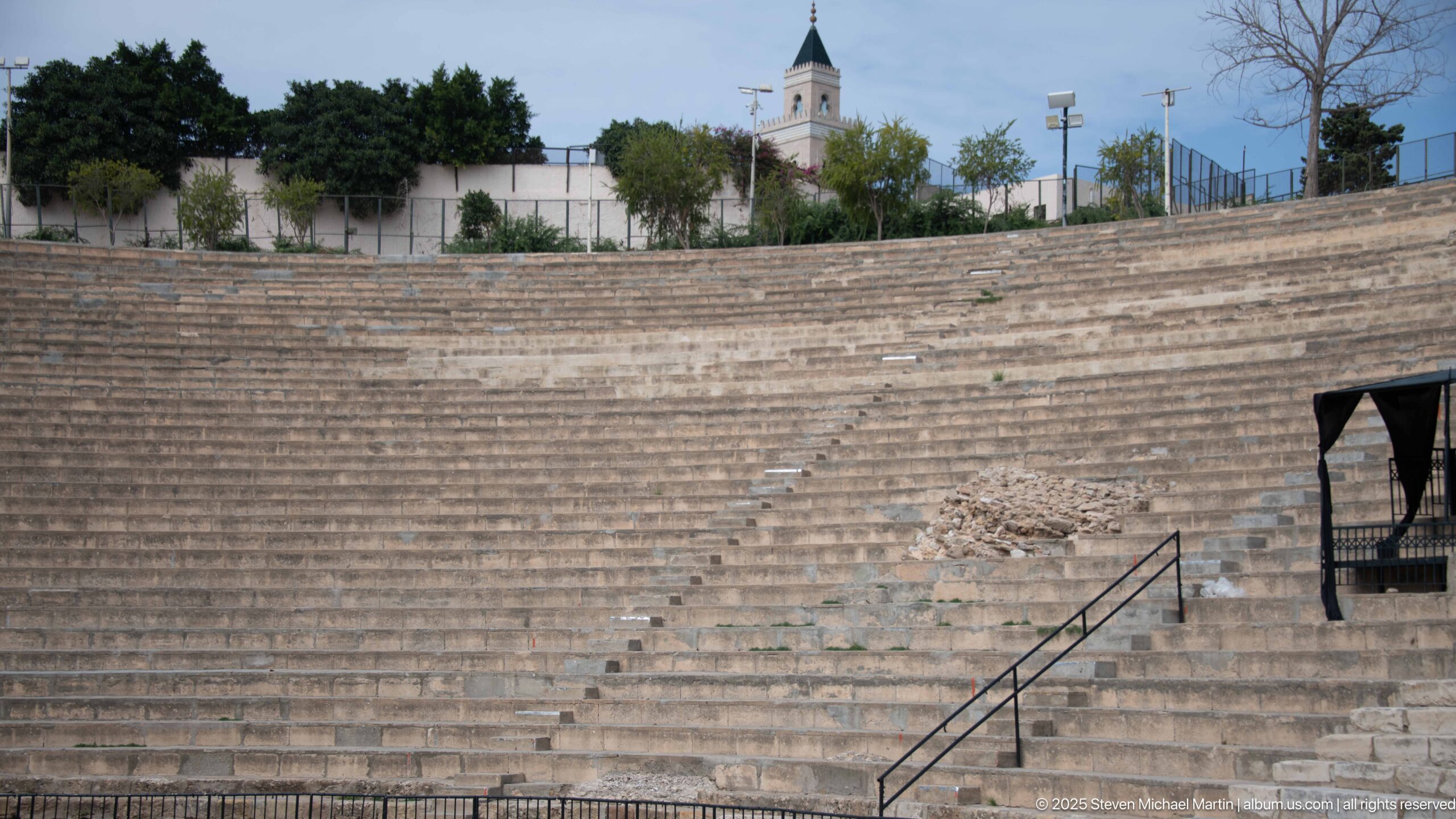
An oblique close view of the Roman Theatre of Carthage concentrates on the upper cavea, where regular stepped seating is interrupted by a patch of irregular masonry and restoration. Metal handrails trace the access route in the foreground, while trees and the distant minaret of the Malik ibn Anas Mosque rise beyond the theatre rim. The layered view connects the ancient venue with the modern Carthage skyline.
Caption
An oblique close view of the Roman Theatre of Carthage concentrates on the upper cavea, where regular stepped seating is interrupted by a patch of irregular masonry and restoration. Metal handrails trace the access route in the foreground, while trees and the distant minaret of the Malik ibn Anas Mosque rise beyond the theatre rim. The layered view connects the ancient venue with the modern Carthage skyline.
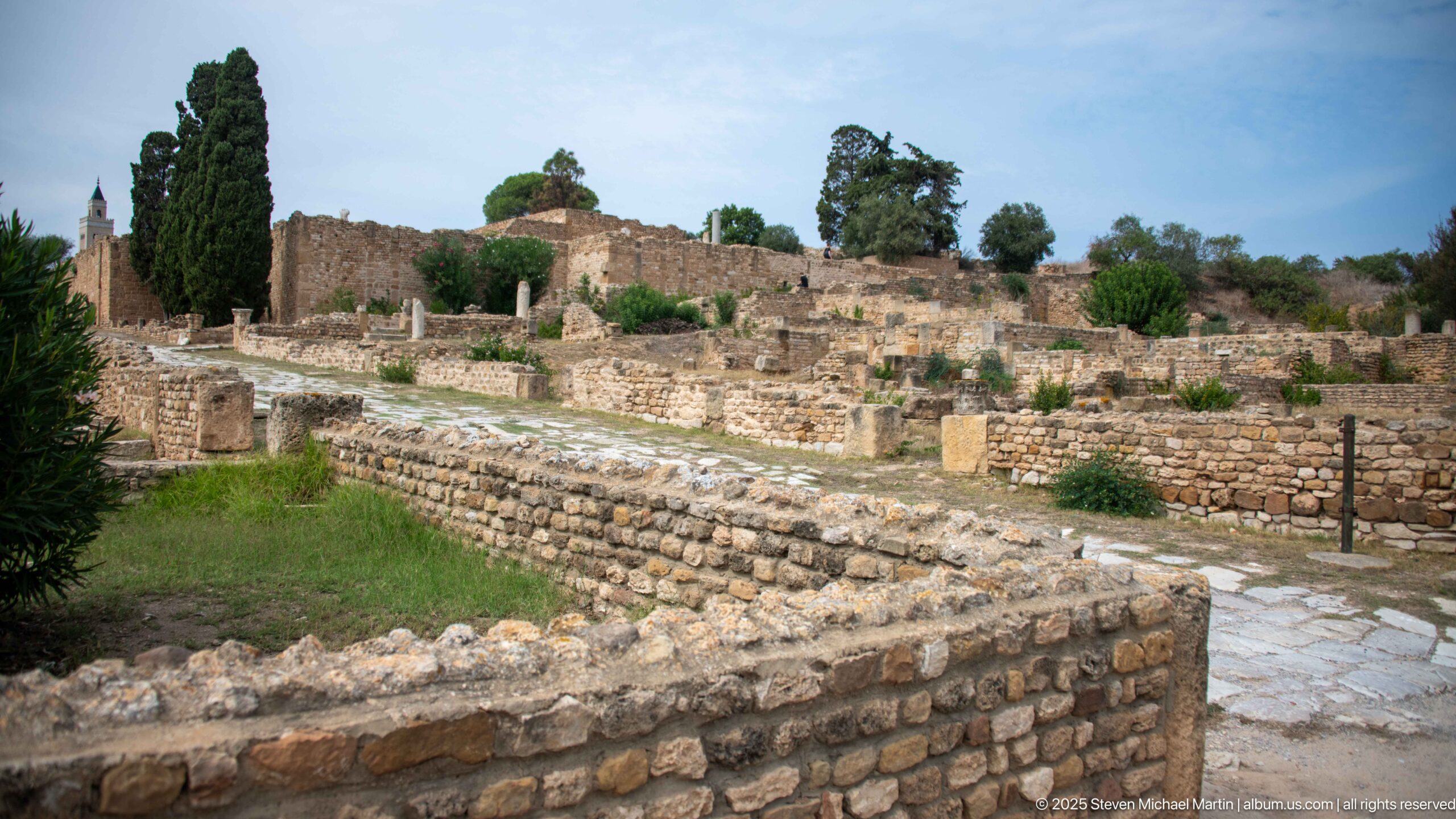
Low stone walls define a compact sequence of rooms and corridors in Carthage's Roman residential quarter. Pale surviving paving and masonry surfaces thread between the foundations, while shrubs and trees occupy the spaces left open by excavation. The oblique viewpoint makes the relationship between walls, paths, and room compartments especially clear, documenting the surviving ground plan rather than a single decorative feature.
Caption
Low stone walls define a compact sequence of rooms and corridors in Carthage's Roman residential quarter. Pale surviving paving and masonry surfaces thread between the foundations, while shrubs and trees occupy the spaces left open by excavation. The oblique viewpoint makes the relationship between walls, paths, and room compartments especially clear, documenting the surviving ground plan rather than a single decorative feature.
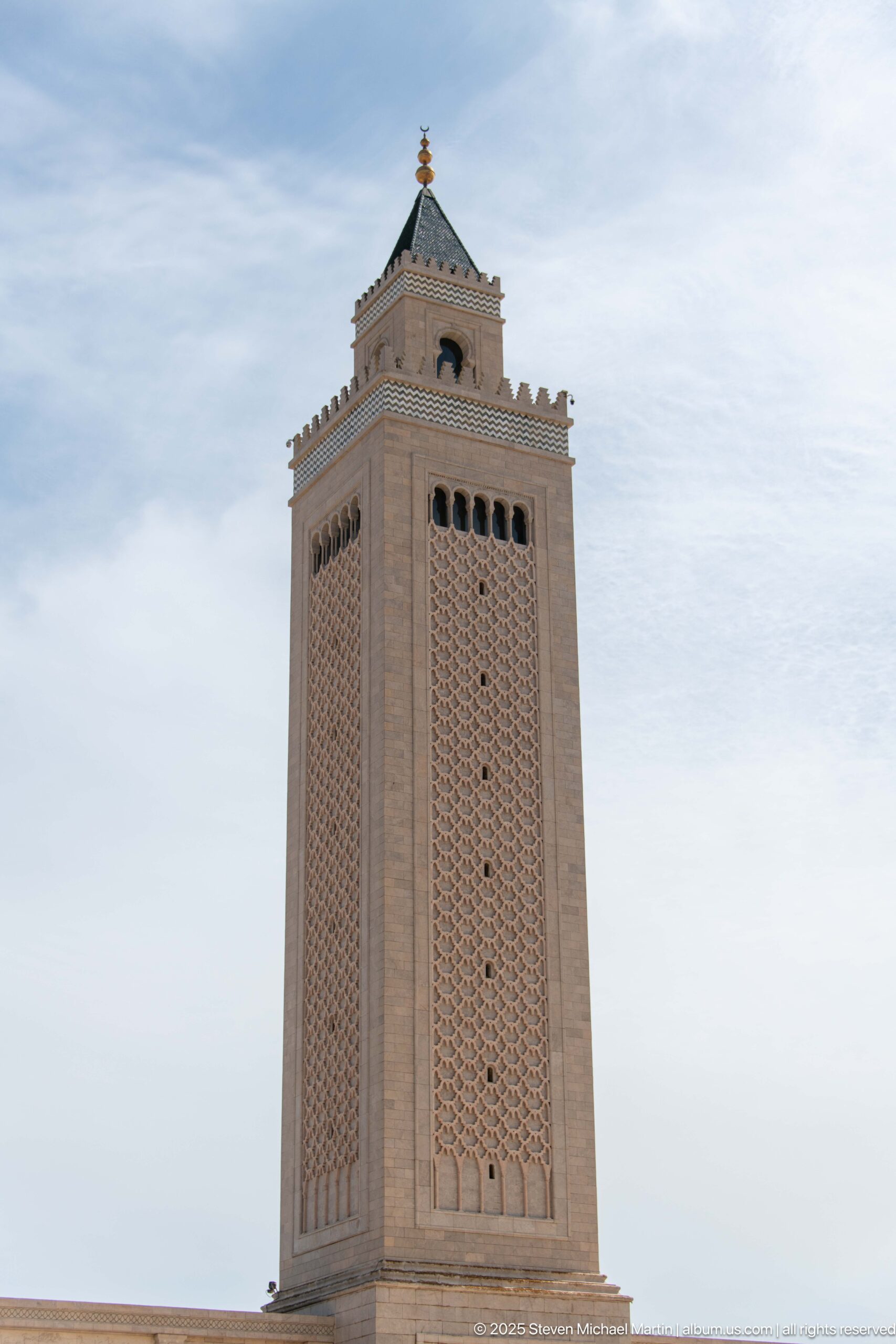
The upper stage of the Malik ibn Anas Mosque minaret is shown nearly in isolation, revealing patterned wall panels, a band of small arched openings, and the steep green-tiled pyramidal cap. Fine masonry articulation and geometric surface treatment become legible at this scale. The photograph concentrates on the tower’s decorative and structural vocabulary rather than the larger mosque complex, making the minaret itself the principal architectural subject.
Caption
The upper stage of the Malik ibn Anas Mosque minaret is shown nearly in isolation, revealing patterned wall panels, a band of small arched openings, and the steep green-tiled pyramidal cap. Fine masonry articulation and geometric surface treatment become legible at this scale. The photograph concentrates on the tower’s decorative and structural vocabulary rather than the larger mosque complex, making the minaret itself the principal architectural subject.
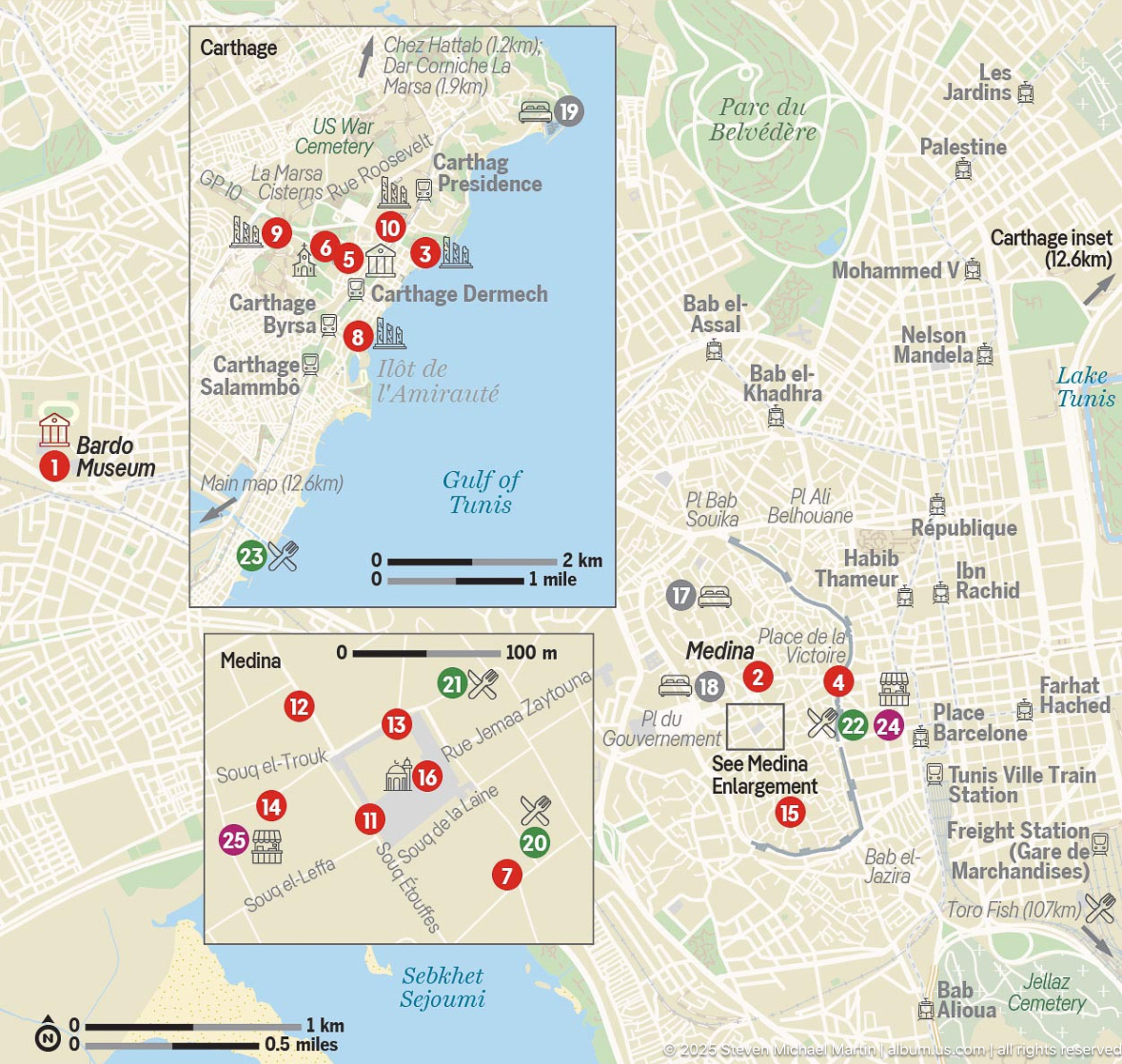
A visitor map situates Carthage within the Tunis metropolitan area and marks major archaeological and cultural stops with numbered symbols. Insets provide closer street-level orientation around Carthage and central Tunis, while the Gulf of Tunis and surrounding suburbs establish the wider geographic setting. The map serves as an orientation image for the portfolio rather than documentation of a single monument.
Caption
A visitor map situates Carthage within the Tunis metropolitan area and marks major archaeological and cultural stops with numbered symbols. Insets provide closer street-level orientation around Carthage and central Tunis, while the Gulf of Tunis and surrounding suburbs establish the wider geographic setting. The map serves as an orientation image for the portfolio rather than documentation of a single monument.
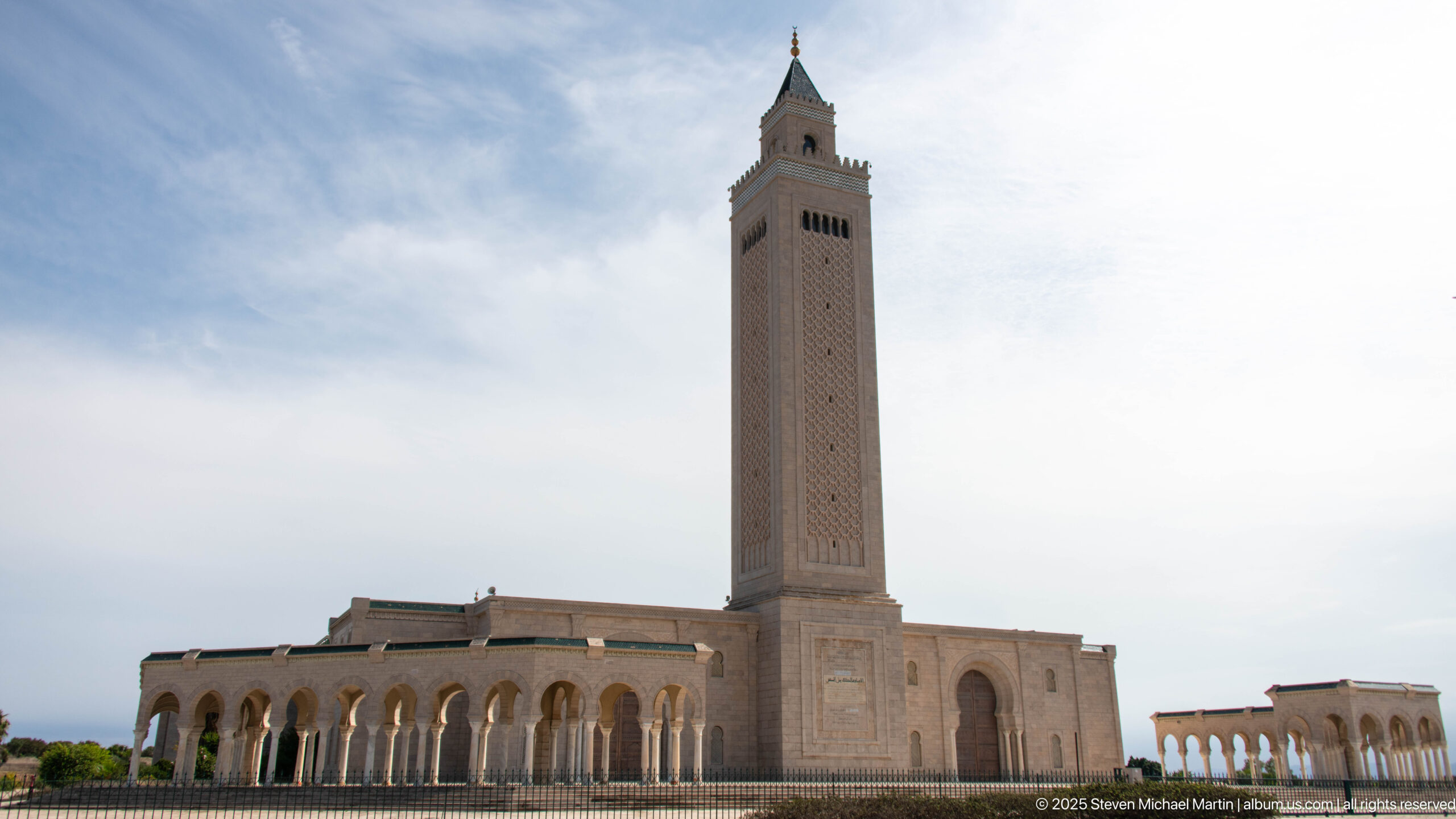
A closer architectural view emphasizes the square minaret of the Malik ibn Anas Mosque and the long arcade running across the lower façade. The minaret’s pale masonry, narrow openings, patterned surface panels, and green pyramidal cap contrast with the open arches below. By tightening the composition, the photograph shifts attention from the mosque’s overall setting to the vertical-horizonal relationship of tower and colonnaded frontage.
Caption
A closer architectural view emphasizes the square minaret of the Malik ibn Anas Mosque and the long arcade running across the lower façade. The minaret’s pale masonry, narrow openings, patterned surface panels, and green pyramidal cap contrast with the open arches below. By tightening the composition, the photograph shifts attention from the mosque’s overall setting to the vertical-horizonal relationship of tower and colonnaded frontage.
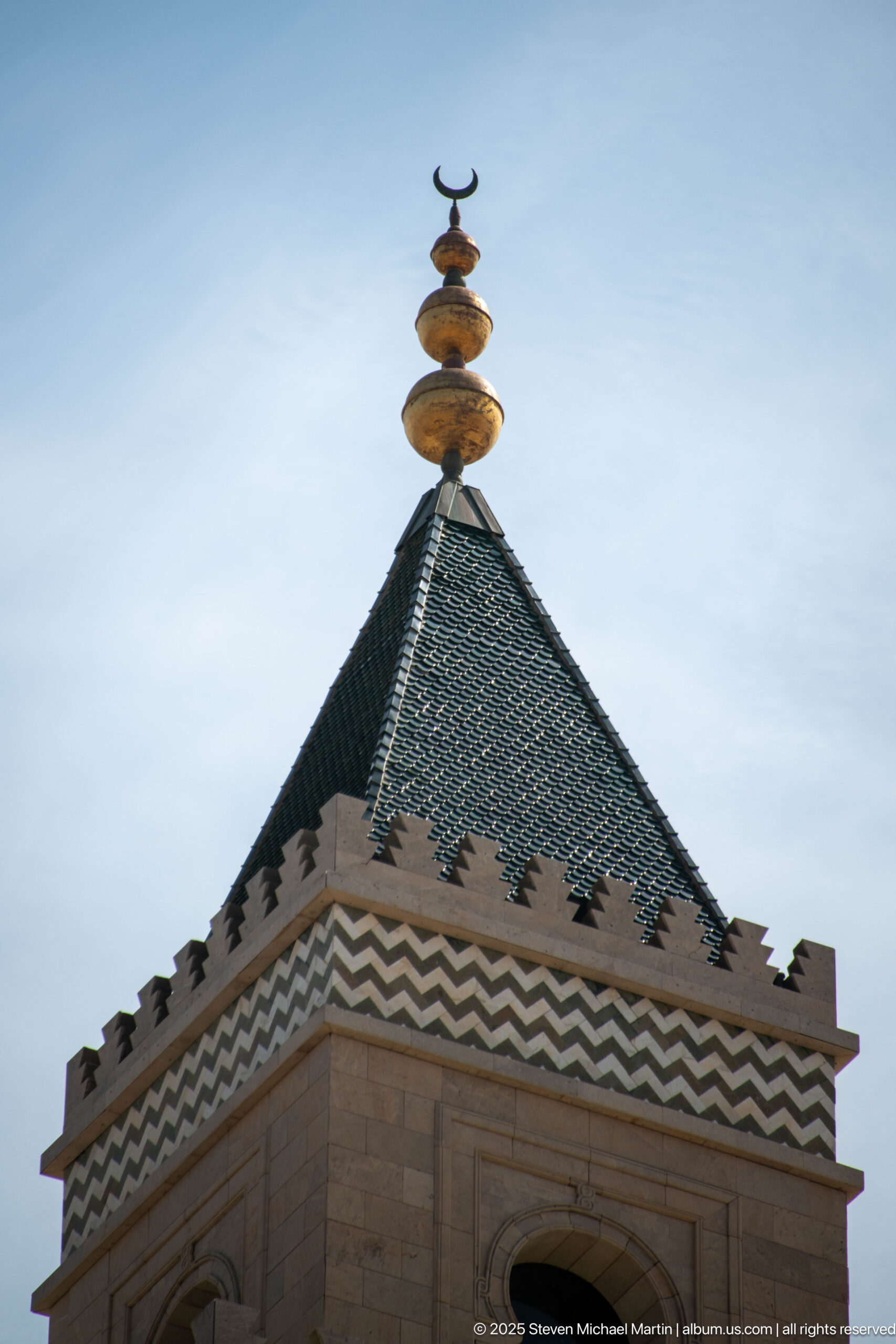
A green-tiled pyramidal roof on the Malik ibn Anas Mosque is crowned by a stacked golden finial ending in a crescent. Zigzag bands and small crenellation-like projections animate the pale masonry beneath the roofline, while the tight upward viewpoint isolates the ornamental summit against the sky. The image records how color, geometry, and metalwork combine at the roof apex to provide a distinctive decorative accent.
Caption
A green-tiled pyramidal roof on the Malik ibn Anas Mosque is crowned by a stacked golden finial ending in a crescent. Zigzag bands and small crenellation-like projections animate the pale masonry beneath the roofline, while the tight upward viewpoint isolates the ornamental summit against the sky. The image records how color, geometry, and metalwork combine at the roof apex to provide a distinctive decorative accent.
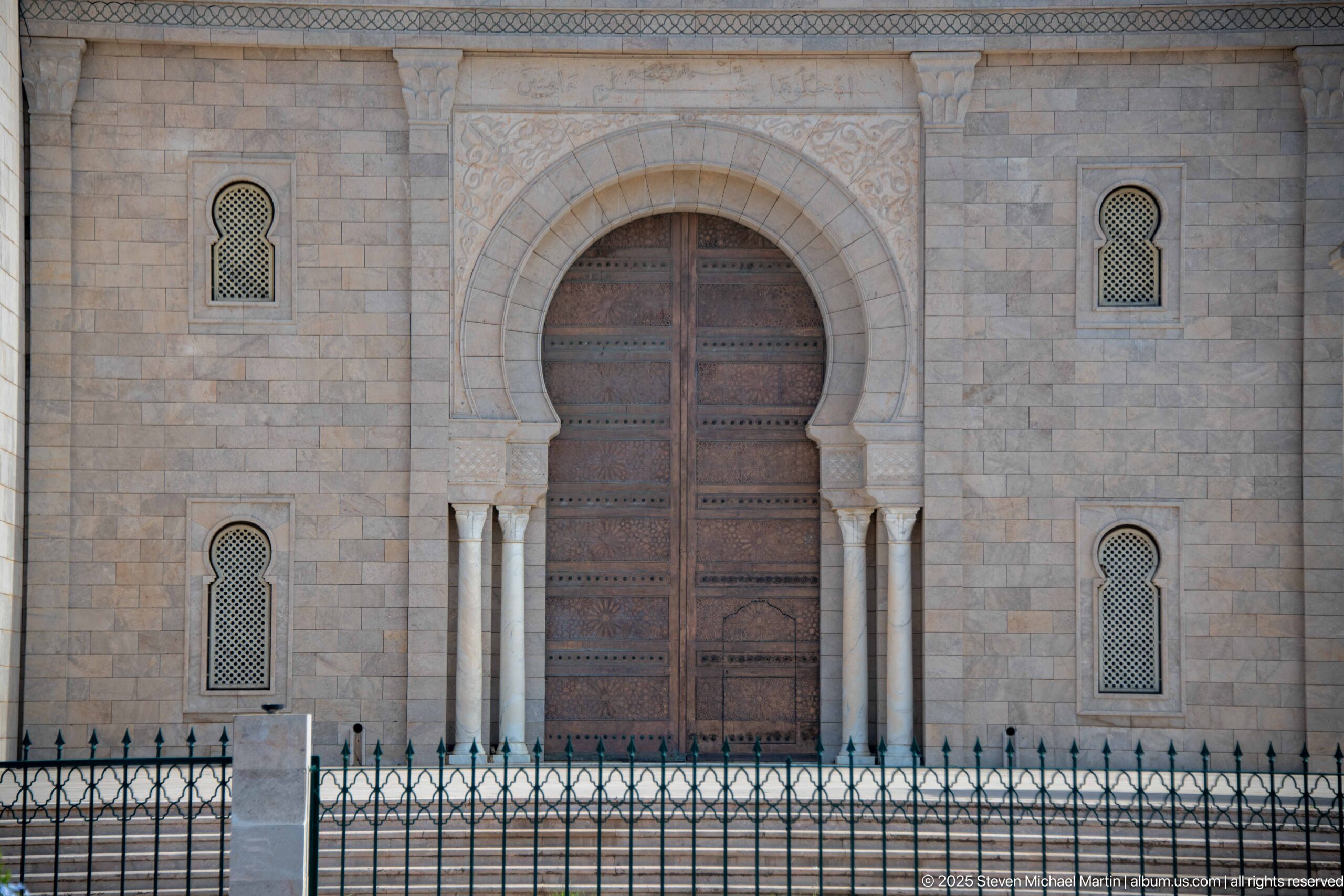
The monumental entrance of the Malik ibn Anas Mosque centers on a large wooden door set within a broad horseshoe arch. Slender paired columns, carved pale-stone framing, and small screened windows create a symmetrical façade, while the iron fence establishes a clear foreground boundary. This frontal view concentrates on the mosque’s entrance composition and ornamental masonry, complementing the wider views of the minaret and arcades.
Caption
The monumental entrance of the Malik ibn Anas Mosque centers on a large wooden door set within a broad horseshoe arch. Slender paired columns, carved pale-stone framing, and small screened windows create a symmetrical façade, while the iron fence establishes a clear foreground boundary. This frontal view concentrates on the mosque’s entrance composition and ornamental masonry, complementing the wider views of the minaret and arcades.
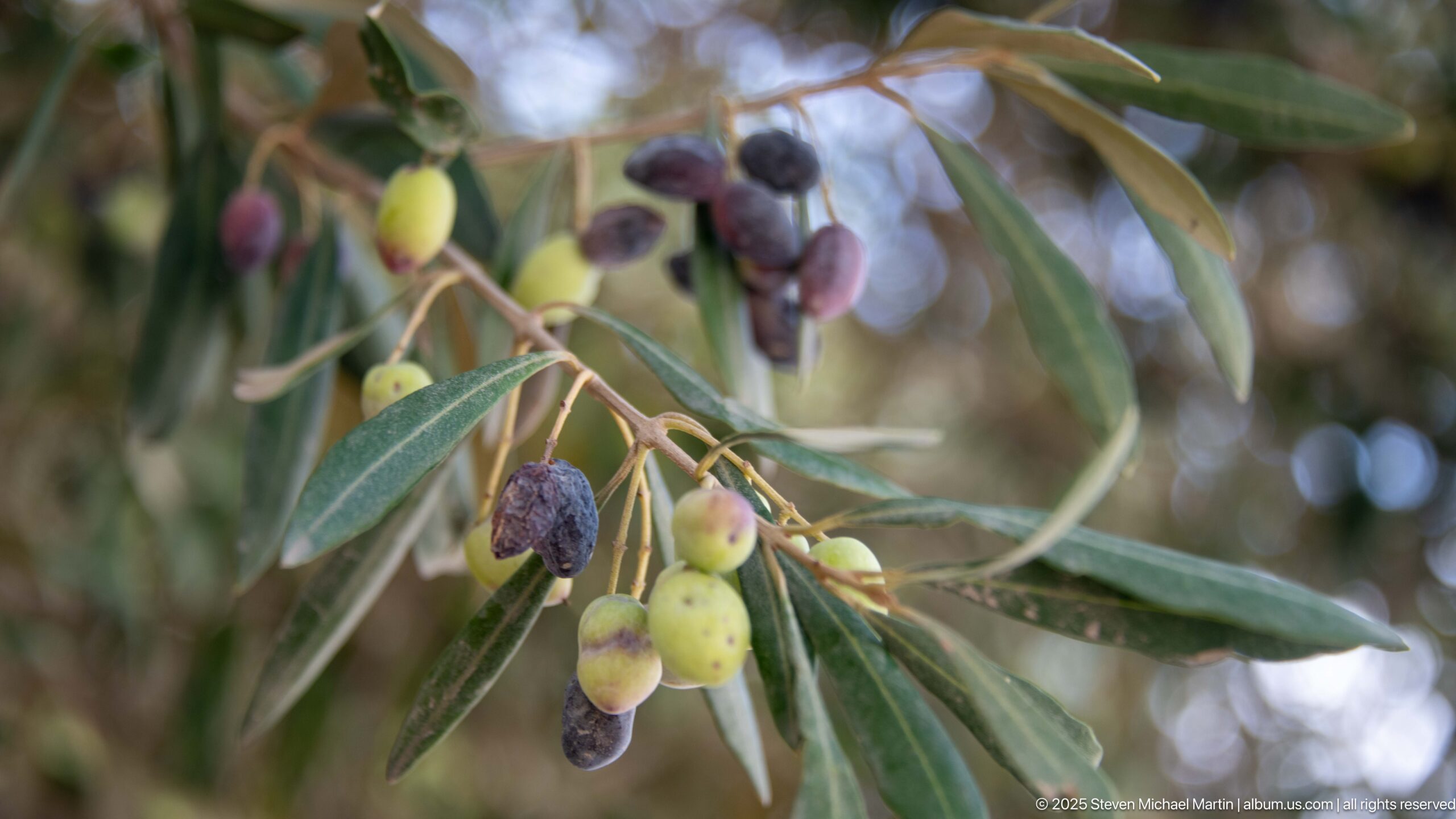
A fruiting olive branch fills the frame, with olives at several stages of ripeness ranging from pale green to purple and nearly black. Narrow, leathery gray-green leaves identify the characteristic Mediterranean tree, while the shallow depth of field separates the fruit clusters from the surrounding foliage. The photograph introduces the cultivated vegetation of the Carthage landscape through a close botanical detail rather than an archaeological subject.
Caption
A fruiting olive branch fills the frame, with olives at several stages of ripeness ranging from pale green to purple and nearly black. Narrow, leathery gray-green leaves identify the characteristic Mediterranean tree, while the shallow depth of field separates the fruit clusters from the surrounding foliage. The photograph introduces the cultivated vegetation of the Carthage landscape through a close botanical detail rather than an archaeological subject.
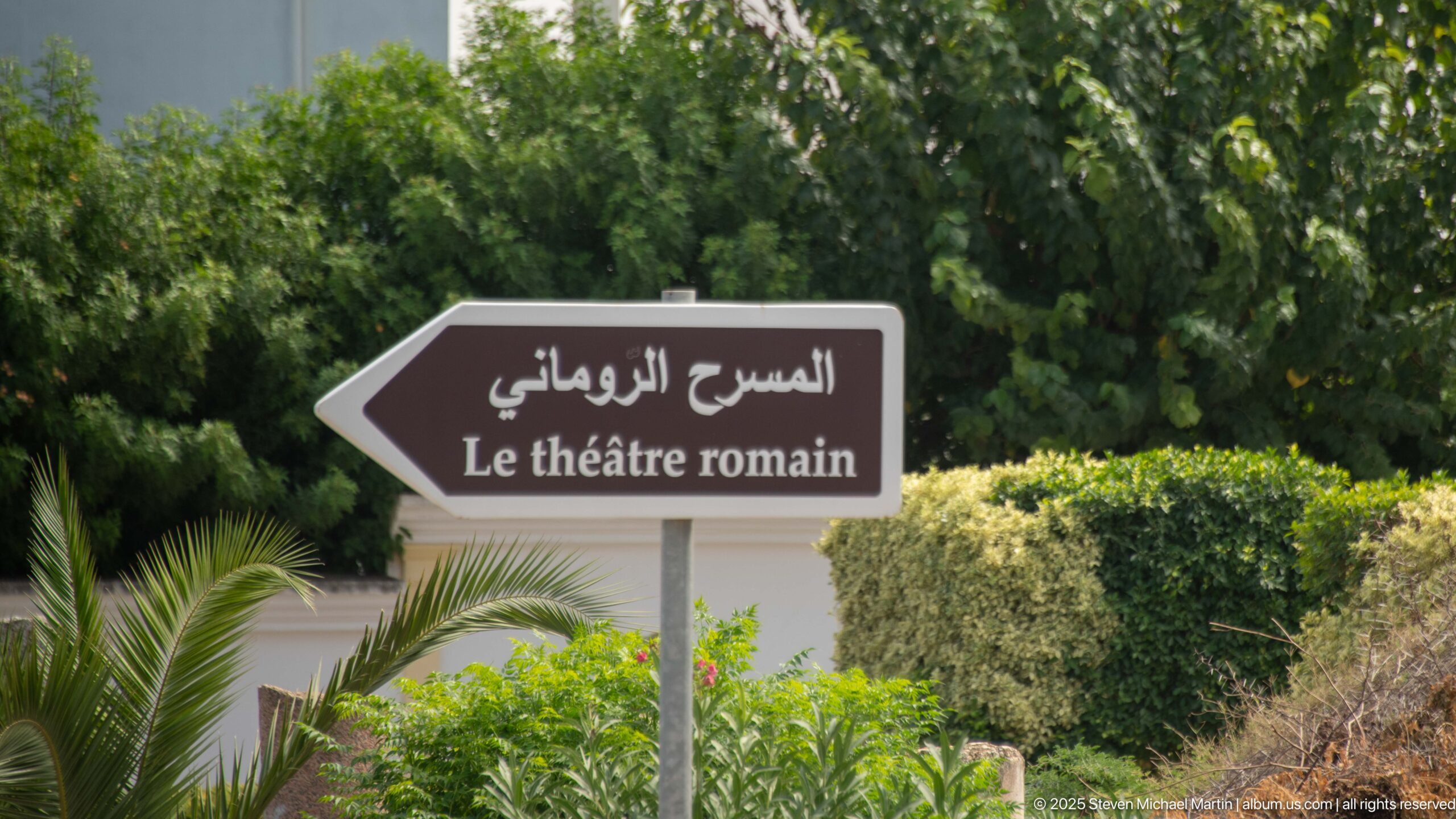
A bilingual directional sign points visitors toward the Roman Theatre of Carthage. Arabic script appears above the French words “Le théâtre romain,” with a left-pointing arrow set against landscaped greenery. As an orientation photograph, the image documents how the archaeological site is interpreted and navigated on the ground, bridging the modern visitor infrastructure with the ancient performance venue shown in the following photographs.
Caption
A bilingual directional sign points visitors toward the Roman Theatre of Carthage. Arabic script appears above the French words “Le théâtre romain,” with a left-pointing arrow set against landscaped greenery. As an orientation photograph, the image documents how the archaeological site is interpreted and navigated on the ground, bridging the modern visitor infrastructure with the ancient performance venue shown in the following photographs.
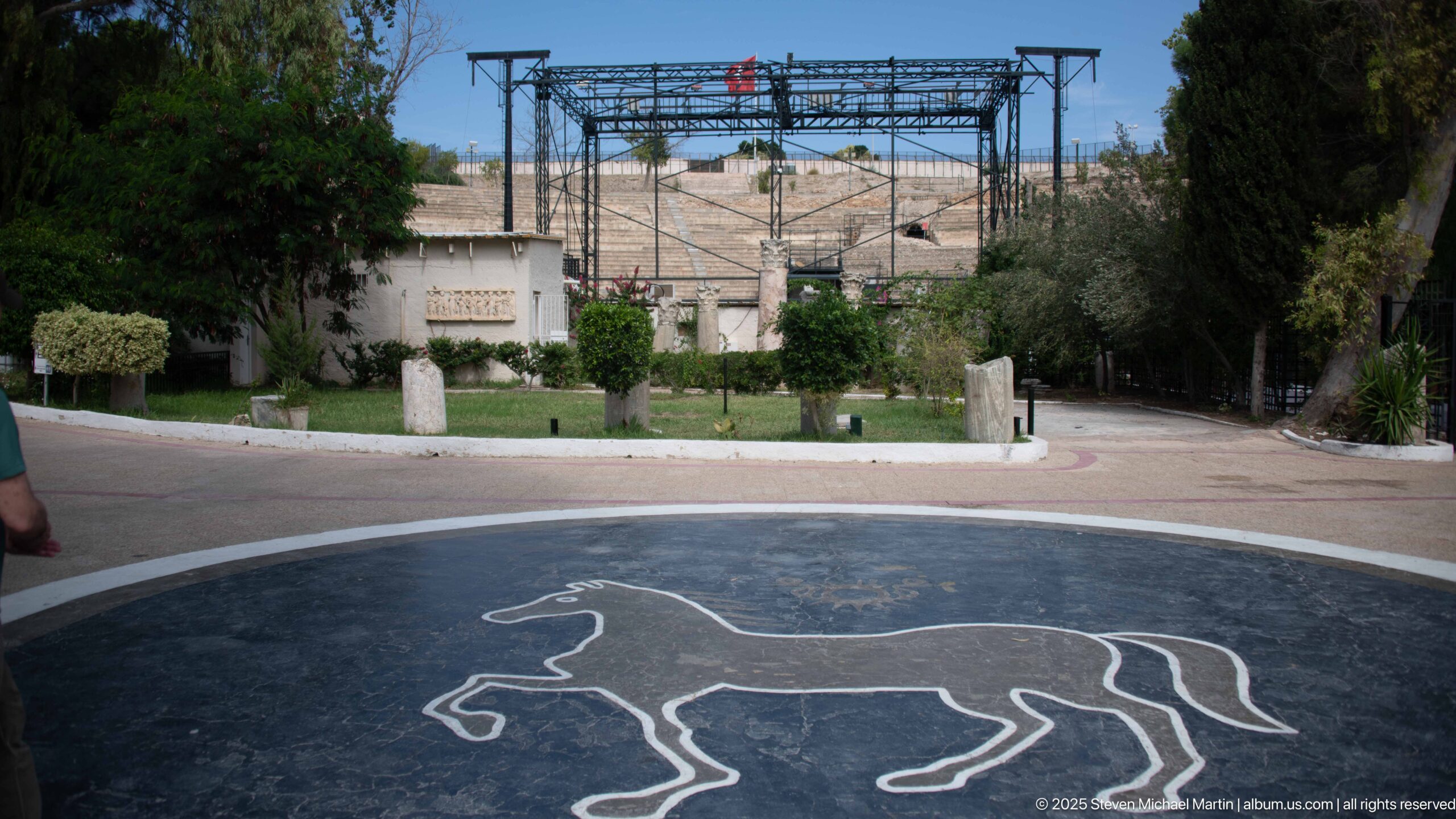
A stylized white horse is outlined within a dark circular pavement feature on the approach to the Roman Theatre of Carthage. The ancient theatre seating and modern stage framework rise beyond it, placing the emblem within the visitor route. Rather than an ancient artifact, the motif appears to be a modern interpretive or decorative element, visually linking the forecourt to Carthage through an equine symbol.
Caption
A stylized white horse is outlined within a dark circular pavement feature on the approach to the Roman Theatre of Carthage. The ancient theatre seating and modern stage framework rise beyond it, placing the emblem within the visitor route. Rather than an ancient artifact, the motif appears to be a modern interpretive or decorative element, visually linking the forecourt to Carthage through an equine symbol.
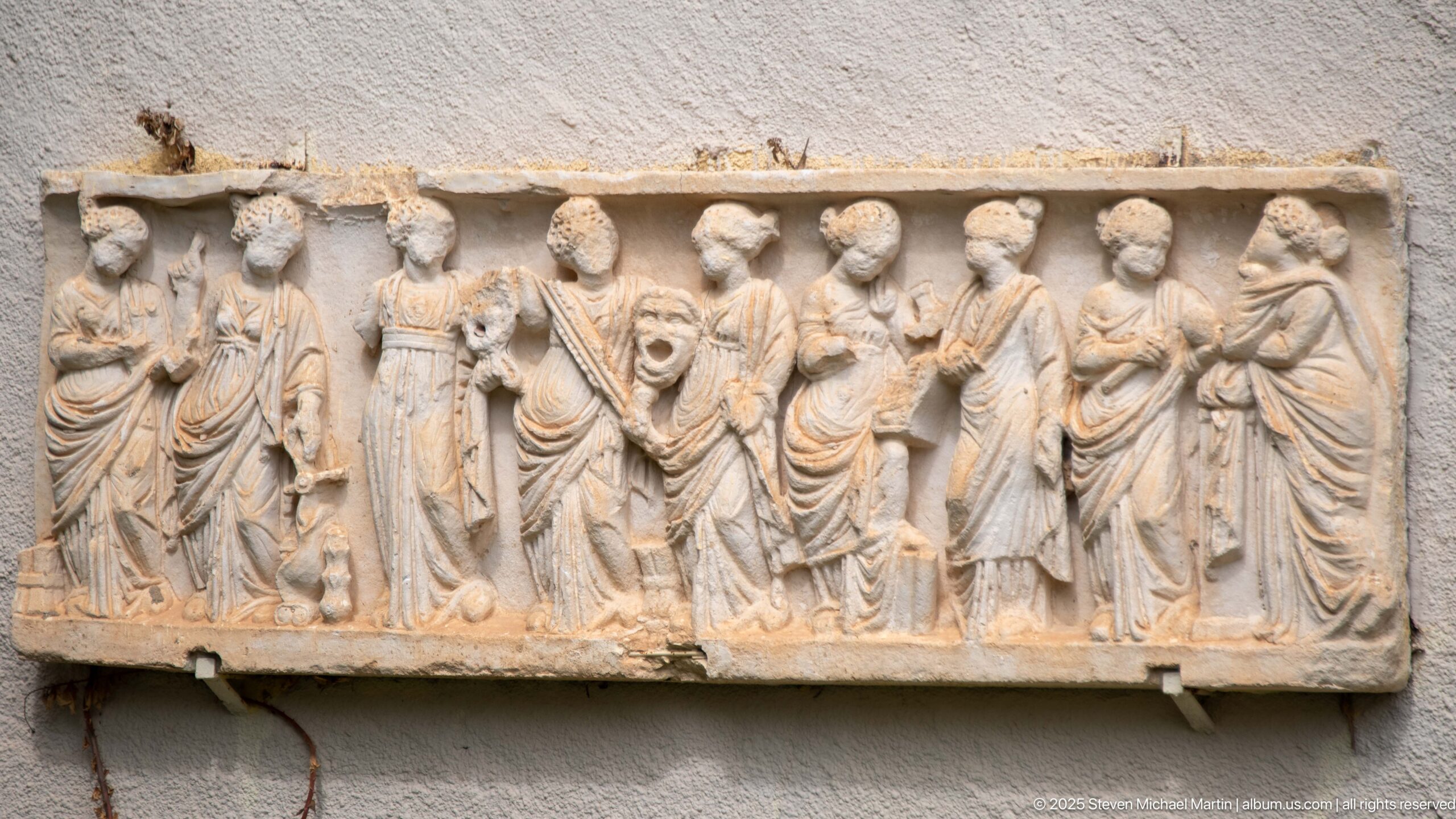
A rectangular stone relief presents a tightly spaced procession of draped human figures in shallow carving. Variations in gesture, head position, and clothing distinguish the individual participants, while the pale stone surface shows wear consistent with display outdoors or in an archaeological setting. The proof sheet does not provide enough evidence to identify the exact mythological or ceremonial subject, so the scene is best described through its visible figural composition.
Caption
A rectangular stone relief presents a tightly spaced procession of draped human figures in shallow carving. Variations in gesture, head position, and clothing distinguish the individual participants, while the pale stone surface shows wear consistent with display outdoors or in an archaeological setting. The proof sheet does not provide enough evidence to identify the exact mythological or ceremonial subject, so the scene is best described through its visible figural composition.
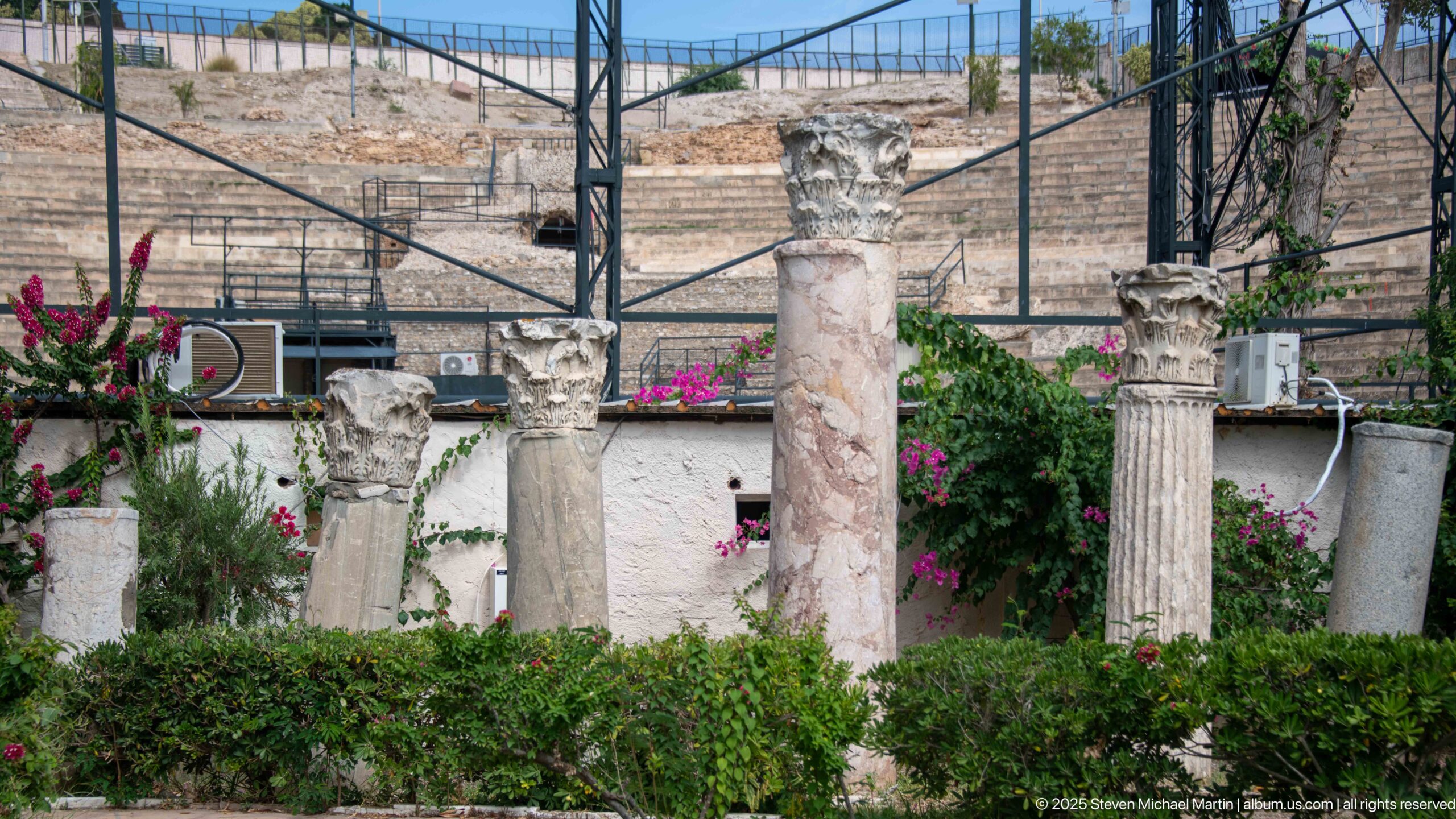
A group of ancient architectural fragments stands in front of the Roman Theatre of Carthage, including shafts, fluted columns, and weathered Corinthian-style capitals. Their varied stone colors and conditions suggest a display assembled from surviving site material rather than an intact colonnade. With the theatre seating rising behind, the image foregrounds the vocabulary of classical architecture while preserving the archaeological context of the fragments.
Caption
A group of ancient architectural fragments stands in front of the Roman Theatre of Carthage, including shafts, fluted columns, and weathered Corinthian-style capitals. Their varied stone colors and conditions suggest a display assembled from surviving site material rather than an intact colonnade. With the theatre seating rising behind, the image foregrounds the vocabulary of classical architecture while preserving the archaeological context of the fragments.
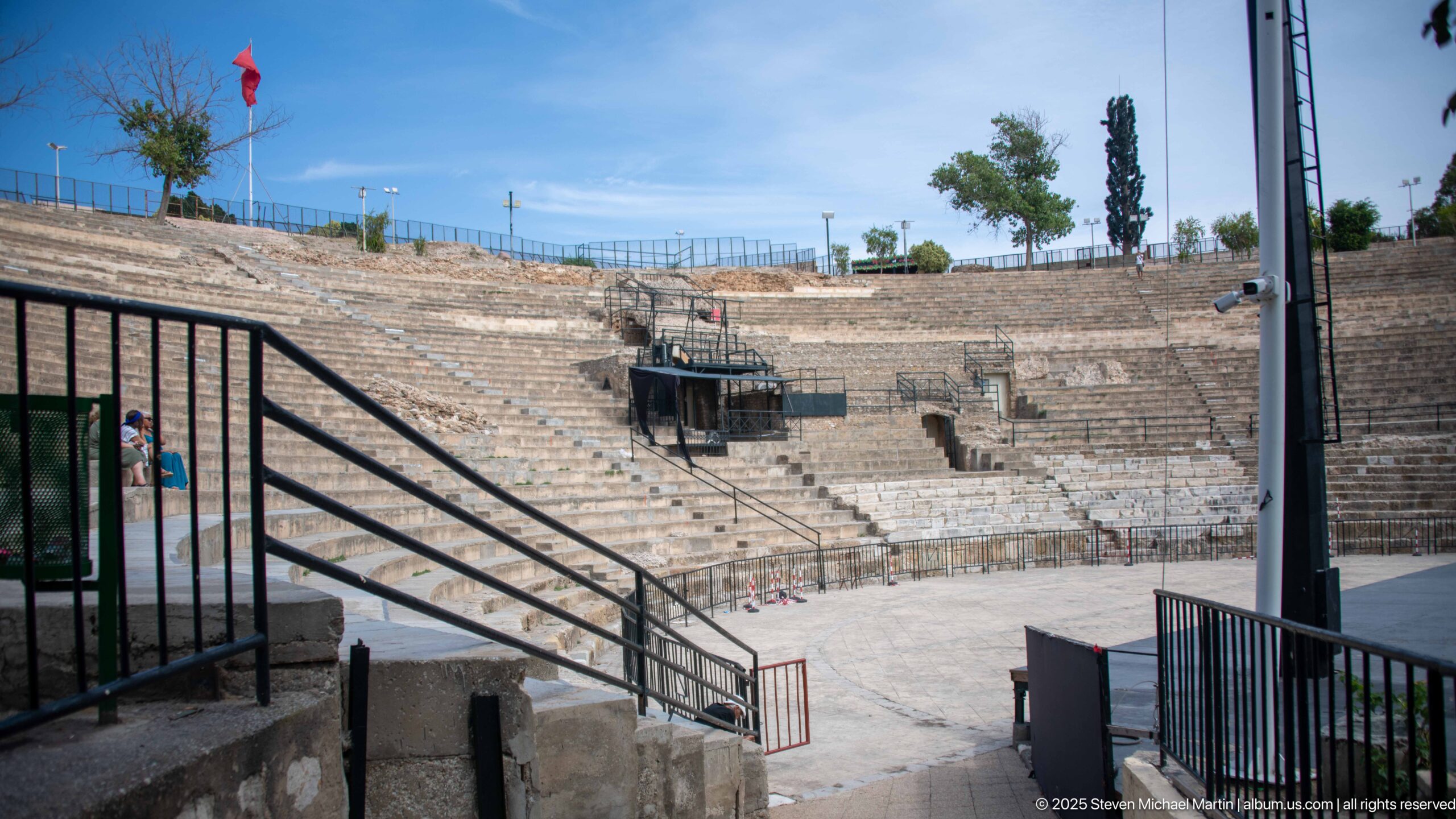
Inside the Roman Theatre of Carthage, broad curving tiers of stone seating descend toward the performance area. Modern railings, barriers, and stage equipment occupy the foreground, documenting the venue’s continued adaptation for contemporary use. The surviving cavea remains the dominant visual element, while trees and open sky above the rim reinforce the theatre’s bowl-like form and its integration into the surrounding landscape.
Caption
Inside the Roman Theatre of Carthage, broad curving tiers of stone seating descend toward the performance area. Modern railings, barriers, and stage equipment occupy the foreground, documenting the venue’s continued adaptation for contemporary use. The surviving cavea remains the dominant visual element, while trees and open sky above the rim reinforce the theatre’s bowl-like form and its integration into the surrounding landscape.
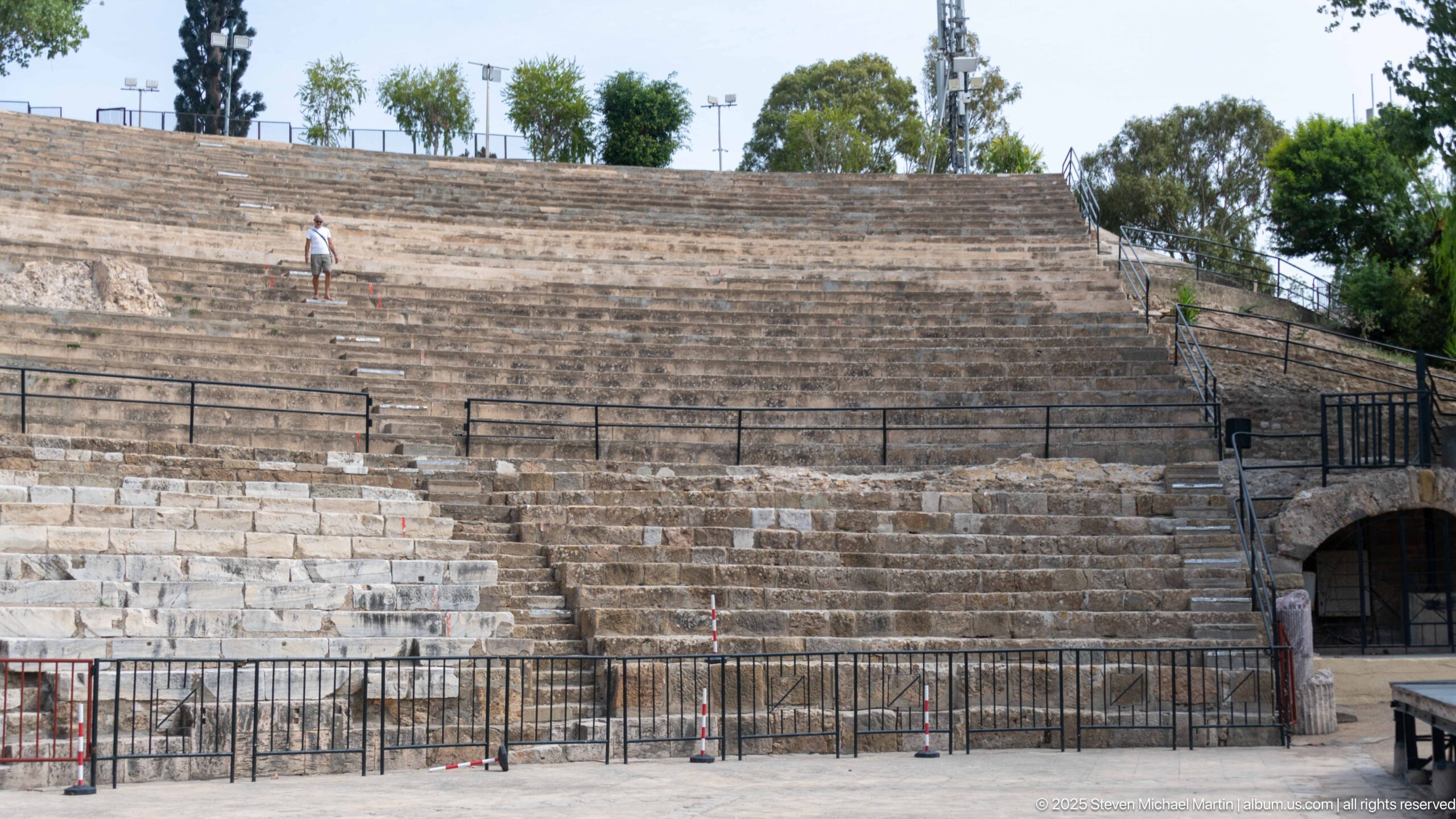
A close section of the Roman Theatre of Carthage shows the stepped seating in detail, revealing variations in stone size, color, and repair. Darker weathered courses alternate with lighter reconstructed areas, making the distinction between ancient fabric and later restoration visually apparent without requiring a precise dating of each block. Railings and a lone visitor provide scale for the steep rise of the cavea.
Caption
A close section of the Roman Theatre of Carthage shows the stepped seating in detail, revealing variations in stone size, color, and repair. Darker weathered courses alternate with lighter reconstructed areas, making the distinction between ancient fabric and later restoration visually apparent without requiring a precise dating of each block. Railings and a lone visitor provide scale for the steep rise of the cavea.
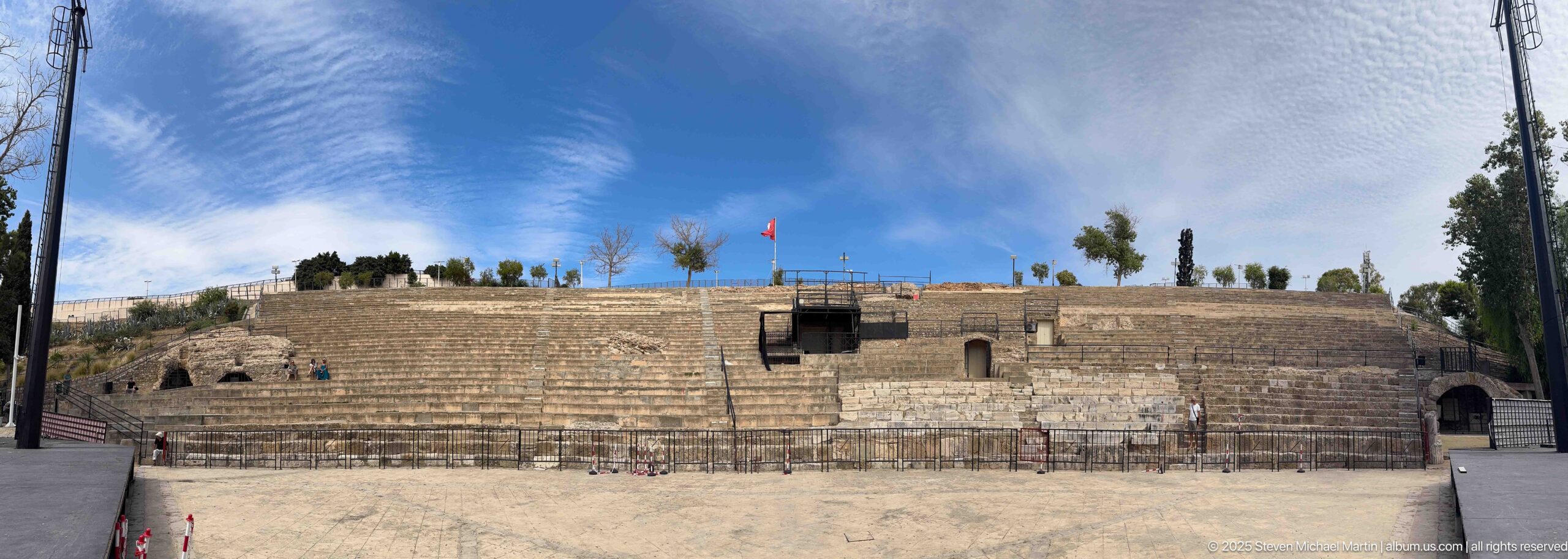
A wide frontal view of the Roman Theatre of Carthage places the open performance area beneath the sweeping curve of the cavea. Horizontal bands of stone seating are interrupted by access openings and modern technical installations, while the Tunisian flag stands on the upper rim. The expansive sky and symmetrical composition emphasize the theatre’s scale and spatial organization more strongly than the preceding close masonry study.
Caption
A wide frontal view of the Roman Theatre of Carthage places the open performance area beneath the sweeping curve of the cavea. Horizontal bands of stone seating are interrupted by access openings and modern technical installations, while the Tunisian flag stands on the upper rim. The expansive sky and symmetrical composition emphasize the theatre’s scale and spatial organization more strongly than the preceding close masonry study.
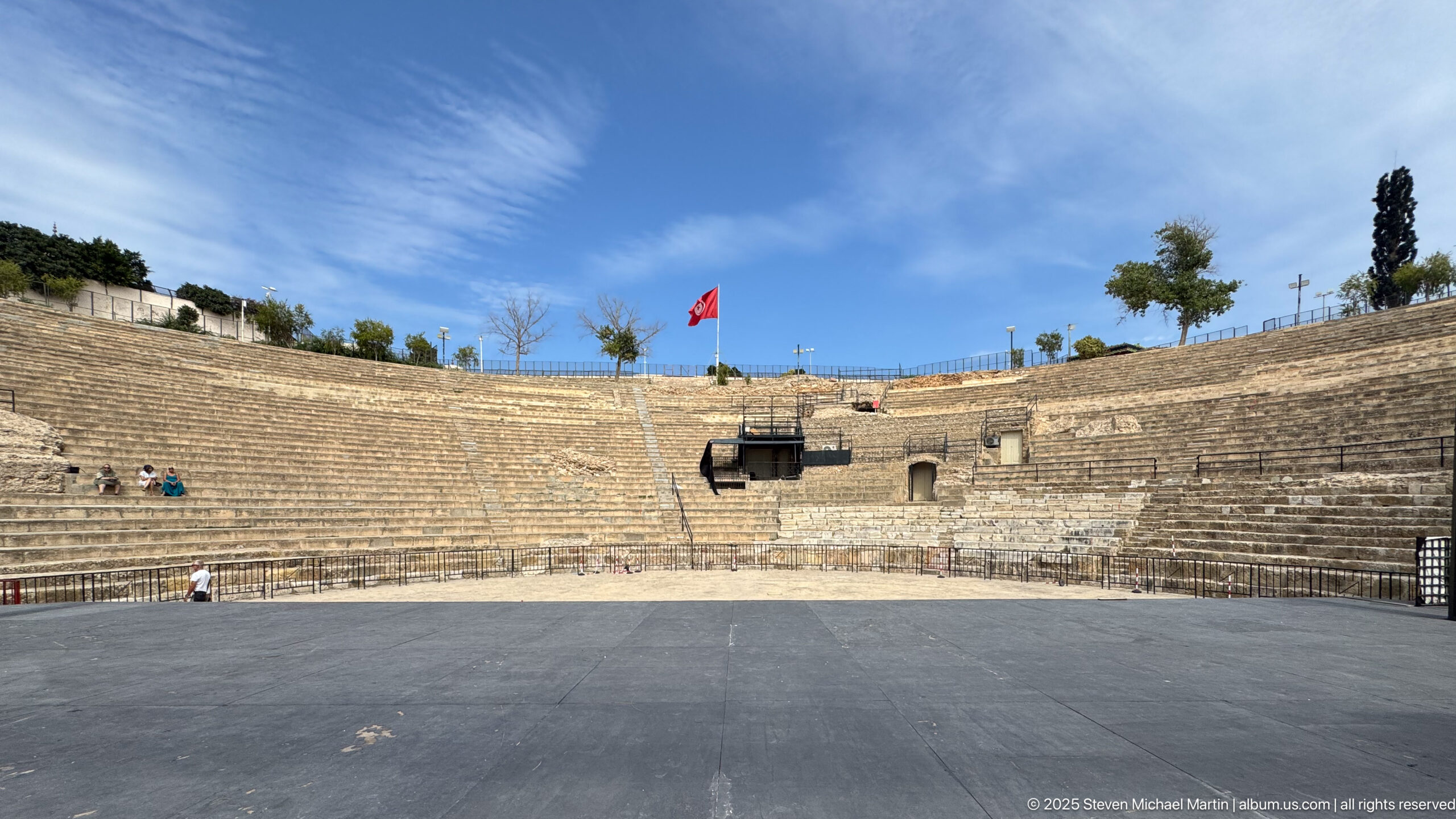
From the performance area, the Roman Theatre of Carthage opens into a broad semicircle of stepped seating. The low vantage point makes the cavea appear especially expansive, while scattered visitors and technical structures indicate the scale and present-day use of the monument. The Tunisian flag at the upper edge provides a modern national marker above the ancient venue, and the clear sky sharpens the geometry of the seating tiers.
Caption
From the performance area, the Roman Theatre of Carthage opens into a broad semicircle of stepped seating. The low vantage point makes the cavea appear especially expansive, while scattered visitors and technical structures indicate the scale and present-day use of the monument. The Tunisian flag at the upper edge provides a modern national marker above the ancient venue, and the clear sky sharpens the geometry of the seating tiers.

The national flag of Tunisia fills the frame above the Roman Theatre area, its red field carrying the white disk, crescent, and five-pointed star. Wind pulls the fabric outward from the flagpole, making the emblem clearly legible against a blue sky. Within the archaeological sequence, the image provides a contemporary national marker and a visual transition between close architectural studies and broader views from the theatre’s upper levels.
Caption
The national flag of Tunisia fills the frame above the Roman Theatre area, its red field carrying the white disk, crescent, and five-pointed star. Wind pulls the fabric outward from the flagpole, making the emblem clearly legible against a blue sky. Within the archaeological sequence, the image provides a contemporary national marker and a visual transition between close architectural studies and broader views from the theatre’s upper levels.
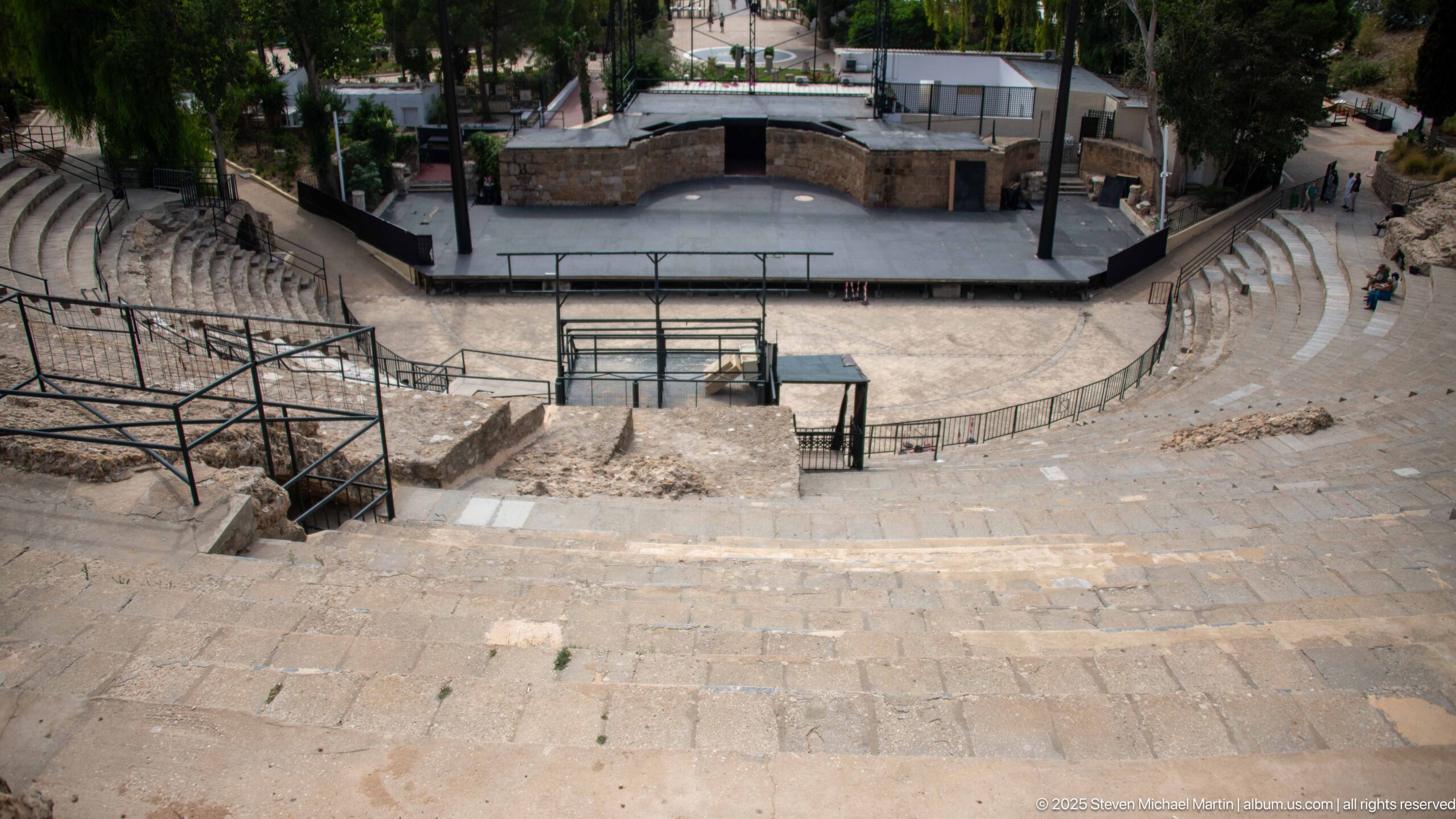
From high in the cavea, the Roman Theatre of Carthage is viewed down a central descent toward the performance area and modern stage. Stone seating curves away on both sides, while handrails, barriers, and contemporary structures reveal the adaptation of the archaeological monument for events. The elevated perspective makes the theatre’s radial organization particularly clear and contrasts with earlier photographs taken from the lower performance level.
Caption
From high in the cavea, the Roman Theatre of Carthage is viewed down a central descent toward the performance area and modern stage. Stone seating curves away on both sides, while handrails, barriers, and contemporary structures reveal the adaptation of the archaeological monument for events. The elevated perspective makes the theatre’s radial organization particularly clear and contrasts with earlier photographs taken from the lower performance level.
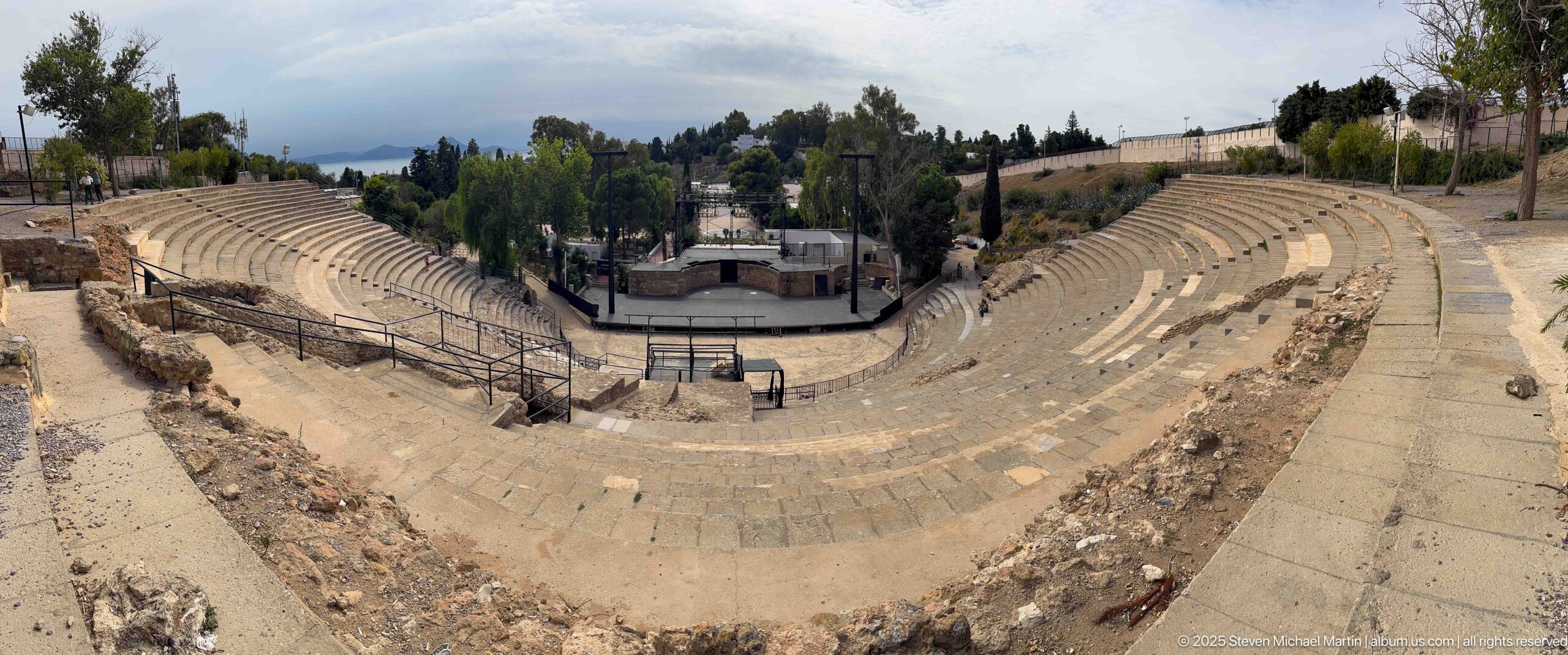
A wide elevated overview reveals the bowl-like form of the Roman Theatre of Carthage, with restored stone seating wrapping around a central performance area. The broad perspective includes the upper paths, vegetation, and modern structures that now frame the monument. Compared with the tighter seating studies, this image is especially useful for understanding the theatre’s overall plan, scale, and relationship between the cavea and stage zone.
Caption
A wide elevated overview reveals the bowl-like form of the Roman Theatre of Carthage, with restored stone seating wrapping around a central performance area. The broad perspective includes the upper paths, vegetation, and modern structures that now frame the monument. Compared with the tighter seating studies, this image is especially useful for understanding the theatre’s overall plan, scale, and relationship between the cavea and stage zone.
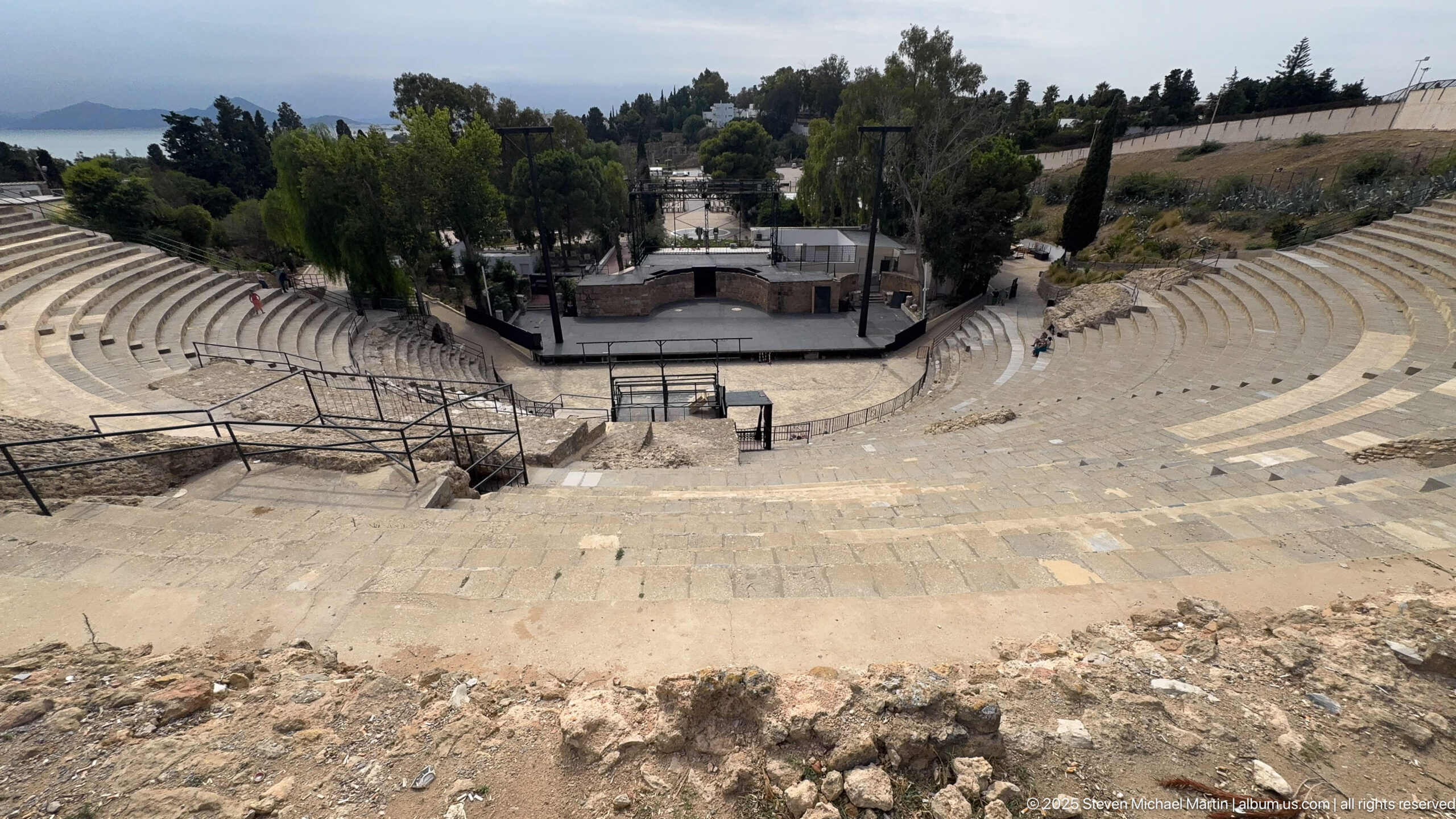
A nearly symmetrical high-angle view looks into the Roman Theatre of Carthage from the upper seating, where restored tiers sweep around the central stage area. Railings and access routes cut through the ancient form, and trees create a green backdrop beyond the stage. The centered composition emphasizes the theatre’s axial organization and curved geometry, providing a strong spatial record of how the surviving monument is arranged for visitors and performances.
Caption
A nearly symmetrical high-angle view looks into the Roman Theatre of Carthage from the upper seating, where restored tiers sweep around the central stage area. Railings and access routes cut through the ancient form, and trees create a green backdrop beyond the stage. The centered composition emphasizes the theatre’s axial organization and curved geometry, providing a strong spatial record of how the surviving monument is arranged for visitors and performances.

The upper seating of the Roman Theatre of Carthage curves across the foreground while the Gulf of Tunis and distant mountain ridges open beyond the trees. This elevated composition links the archaeological monument directly to its coastal setting, combining the theatre’s restored stone tiers with a broad maritime horizon. The view is especially valuable for showing how the ancient site occupies high ground within the modern and natural landscape of Carthage.
Caption
The upper seating of the Roman Theatre of Carthage curves across the foreground while the Gulf of Tunis and distant mountain ridges open beyond the trees. This elevated composition links the archaeological monument directly to its coastal setting, combining the theatre’s restored stone tiers with a broad maritime horizon. The view is especially valuable for showing how the ancient site occupies high ground within the modern and natural landscape of Carthage.
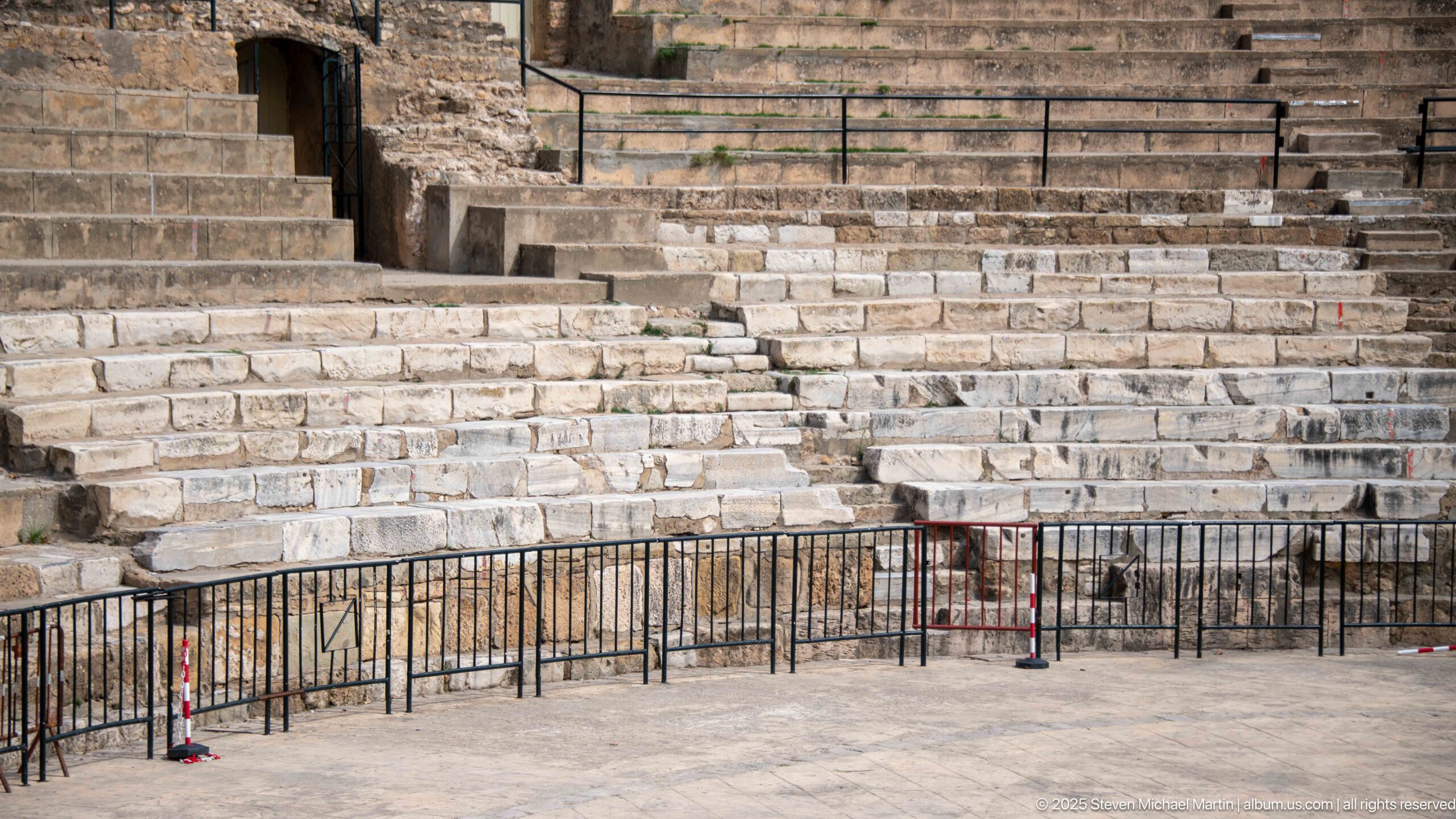
A close architectural study of the Roman Theatre of Carthage shows stepped seating built from blocks of varying size, tone, and condition. A small access opening and modern protective railings interrupt the masonry, revealing how ancient fabric, reconstruction, and visitor management coexist in the present monument. The tight framing removes the broader theatre bowl and instead highlights texture, construction, and visible phases of repair.
Caption
A close architectural study of the Roman Theatre of Carthage shows stepped seating built from blocks of varying size, tone, and condition. A small access opening and modern protective railings interrupt the masonry, revealing how ancient fabric, reconstruction, and visitor management coexist in the present monument. The tight framing removes the broader theatre bowl and instead highlights texture, construction, and visible phases of repair.
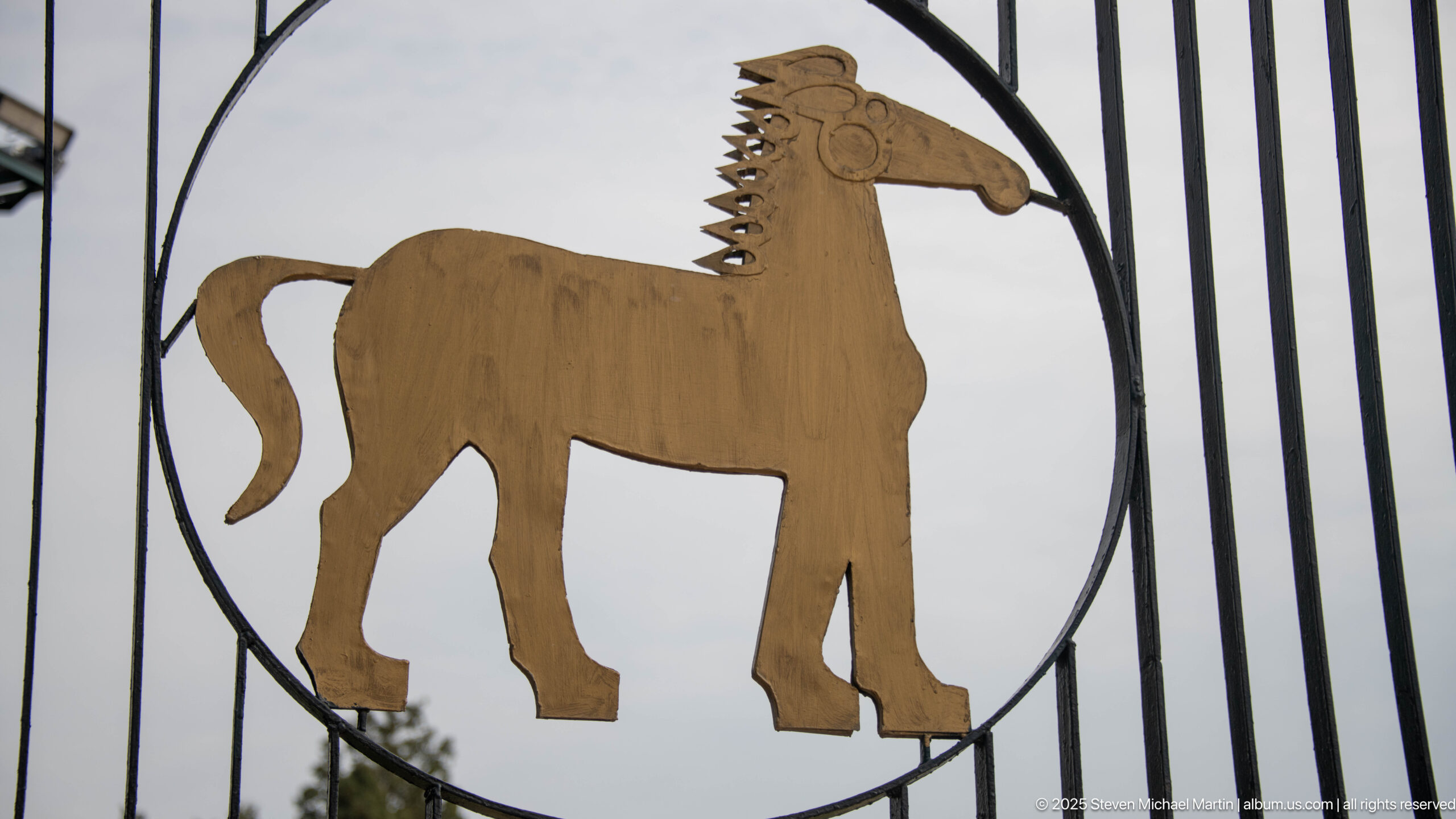
A stylized horse cutout is mounted within a circular black metal frame, its simplified body paired with a highly decorative head and mane. The golden-brown figure stands out against the pale sky and functions as modern site ornament or signage rather than an excavated object. Its repeated equine imagery echoes the horse motif seen earlier on the theatre forecourt, though the exact official symbolism is not established by the proof sheet.
Caption
A stylized horse cutout is mounted within a circular black metal frame, its simplified body paired with a highly decorative head and mane. The golden-brown figure stands out against the pale sky and functions as modern site ornament or signage rather than an excavated object. Its repeated equine imagery echoes the horse motif seen earlier on the theatre forecourt, though the exact official symbolism is not established by the proof sheet.
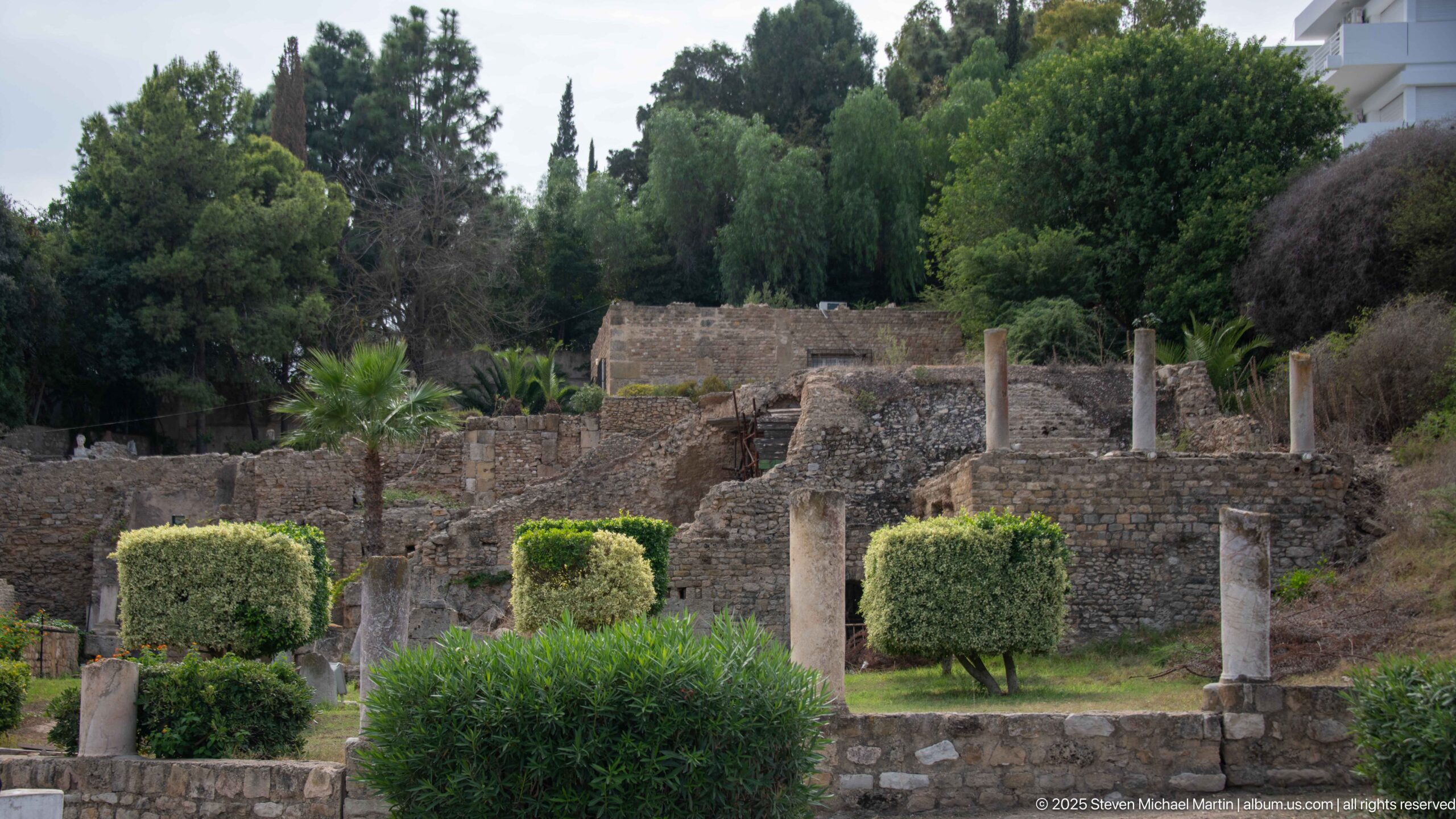
Low ancient walls and several freestanding stone columns occupy a landscaped archaeological area at Carthage. Dense trees, clipped shrubs, and palms surround the masonry, softening the transition between excavated remains and the modern garden-like setting. The proof sheet does not provide enough visual evidence to assign these ruins to a specific named complex, so the image is best treated as a contextual view of surviving Roman-era architectural remains.
Caption
Low ancient walls and several freestanding stone columns occupy a landscaped archaeological area at Carthage. Dense trees, clipped shrubs, and palms surround the masonry, softening the transition between excavated remains and the modern garden-like setting. The proof sheet does not provide enough visual evidence to assign these ruins to a specific named complex, so the image is best treated as a contextual view of surviving Roman-era architectural remains.
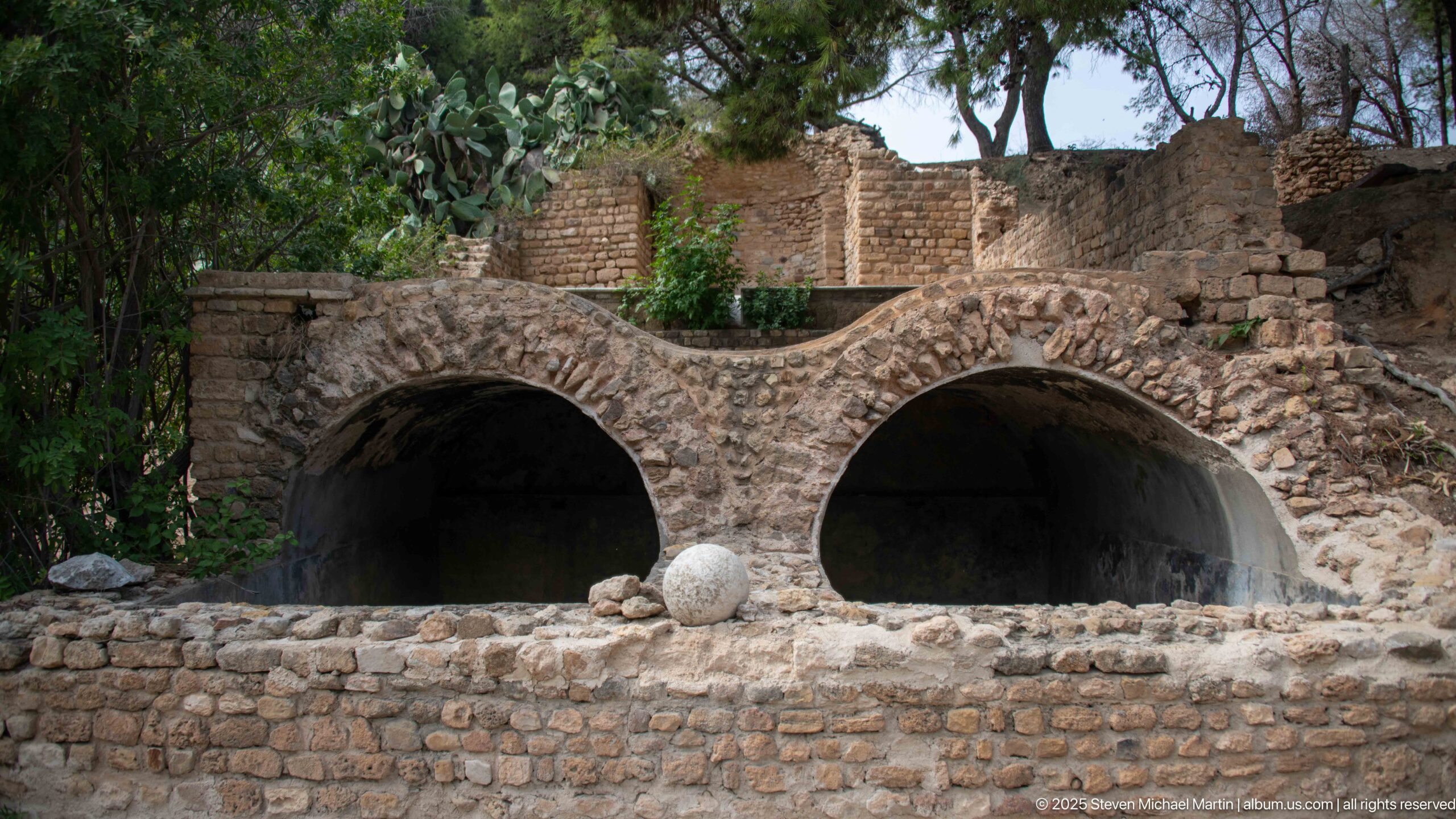
Two adjacent barrel-vaulted chambers open through rough stone masonry in an archaeological area at Carthage. Their rounded concrete- or masonry-lined interiors contrast with the irregular rubble construction of the surrounding walls, while vegetation and additional ruins rise behind. The photograph clearly documents subsurface or service-like vaulted spaces, but the proof sheet does not provide enough evidence to determine whether they belonged to cisterns, baths, drainage, or another installation.
Caption
Two adjacent barrel-vaulted chambers open through rough stone masonry in an archaeological area at Carthage. Their rounded concrete- or masonry-lined interiors contrast with the irregular rubble construction of the surrounding walls, while vegetation and additional ruins rise behind. The photograph clearly documents subsurface or service-like vaulted spaces, but the proof sheet does not provide enough evidence to determine whether they belonged to cisterns, baths, drainage, or another installation.
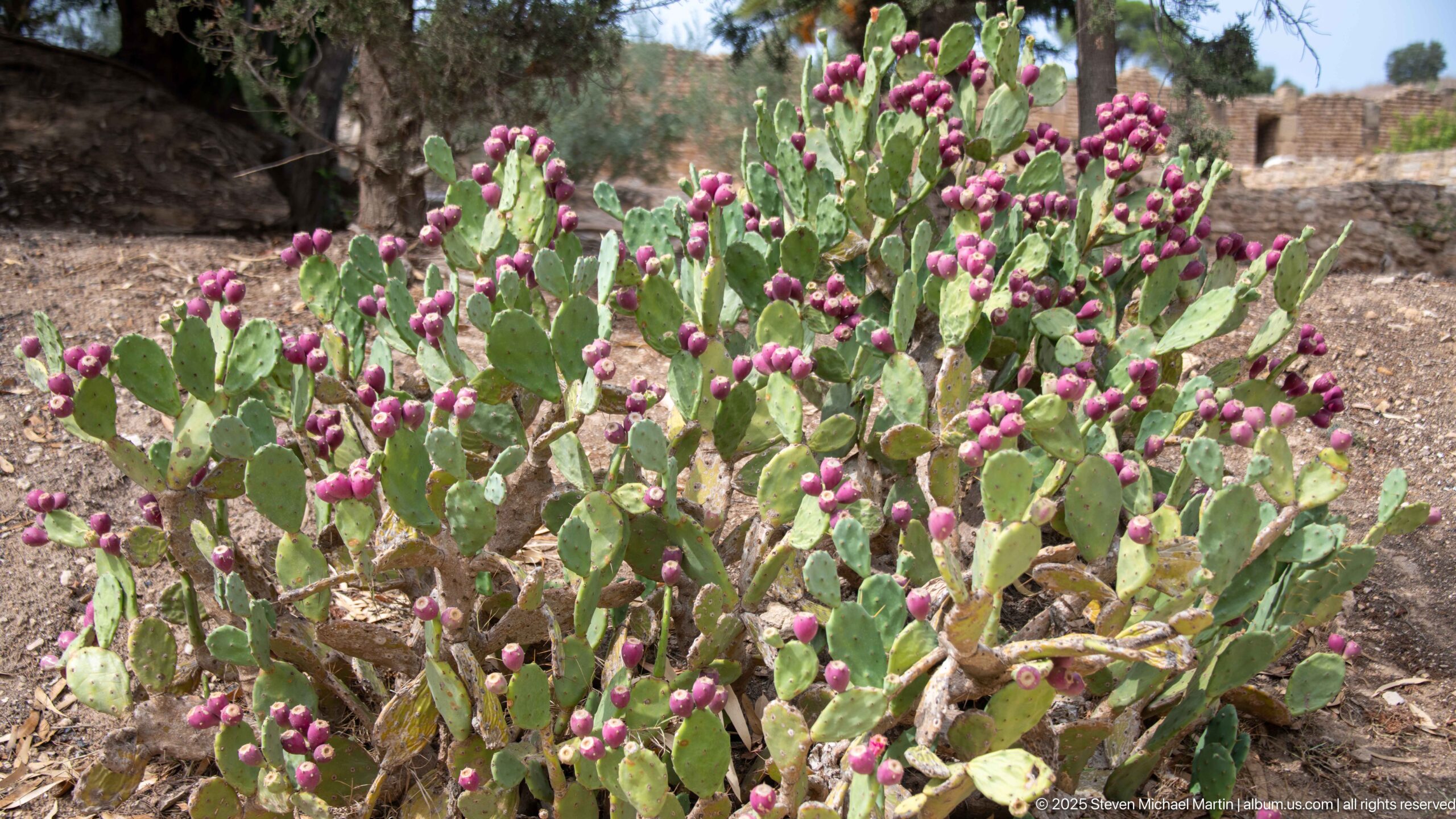
A mature prickly pear cactus grows among the archaeological landscape, its flattened green pads carrying clusters of purple-red fruit. The dense fruiting habit and segmented pads are characteristic of Opuntia, a plant now common across Mediterranean environments despite its American origin. Framed at medium distance, the photograph records the living vegetation that shares the Carthage site with ancient masonry and dry ground.
Caption
A mature prickly pear cactus grows among the archaeological landscape, its flattened green pads carrying clusters of purple-red fruit. The dense fruiting habit and segmented pads are characteristic of Opuntia, a plant now common across Mediterranean environments despite its American origin. Framed at medium distance, the photograph records the living vegetation that shares the Carthage site with ancient masonry and dry ground.
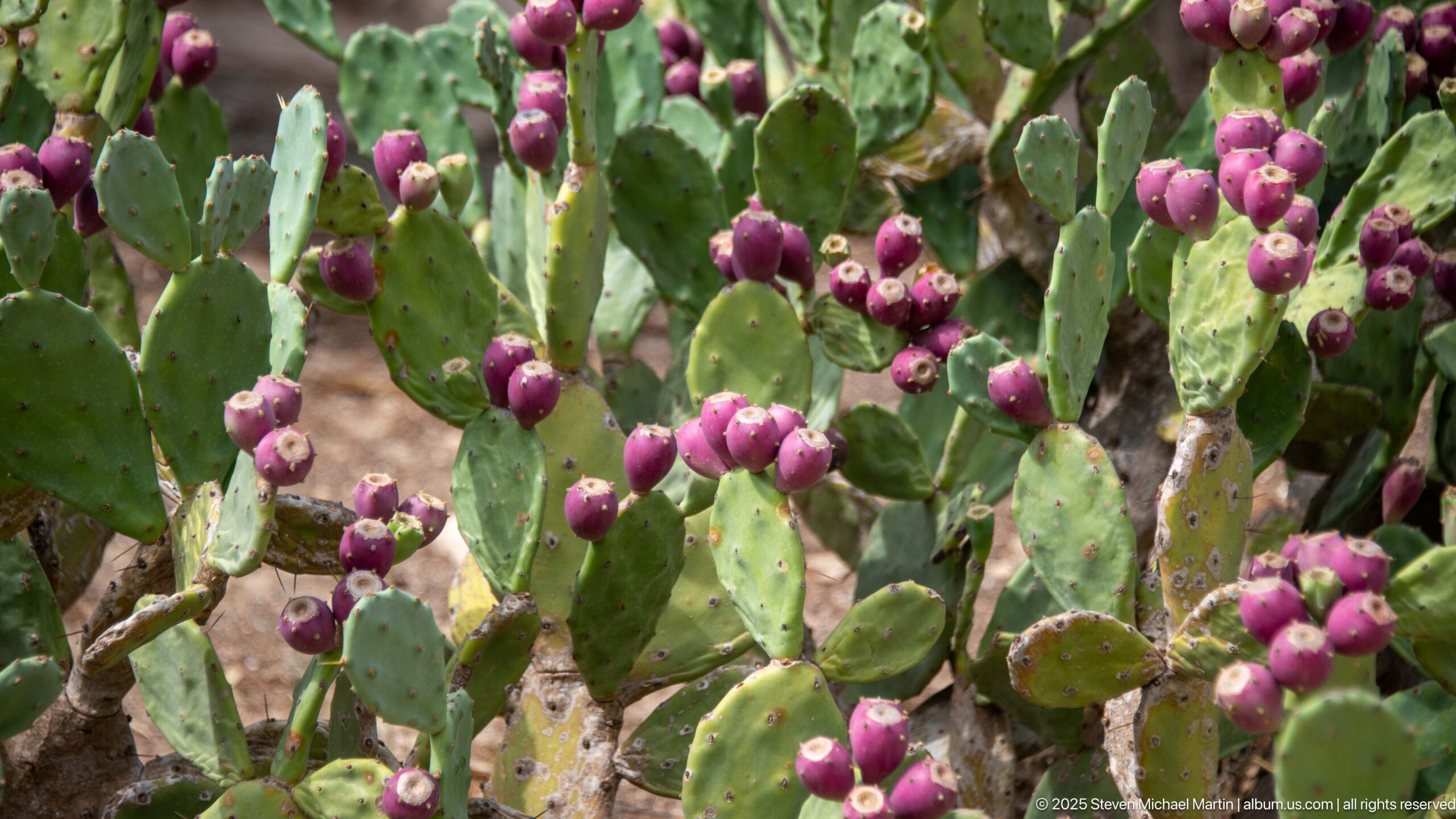
A close botanical view isolates clusters of ripe purple-red prickly pear fruit along green Opuntia pads. Small areoles and surface blemishes are visible on the flattened segments, while the tight framing removes most of the archaeological setting and concentrates on texture, color, and fruiting pattern. The image complements the wider cactus portrait by documenting individual fruits and pads at a scale useful for botanical recognition.
Caption
A close botanical view isolates clusters of ripe purple-red prickly pear fruit along green Opuntia pads. Small areoles and surface blemishes are visible on the flattened segments, while the tight framing removes most of the archaeological setting and concentrates on texture, color, and fruiting pattern. The image complements the wider cactus portrait by documenting individual fruits and pads at a scale useful for botanical recognition.
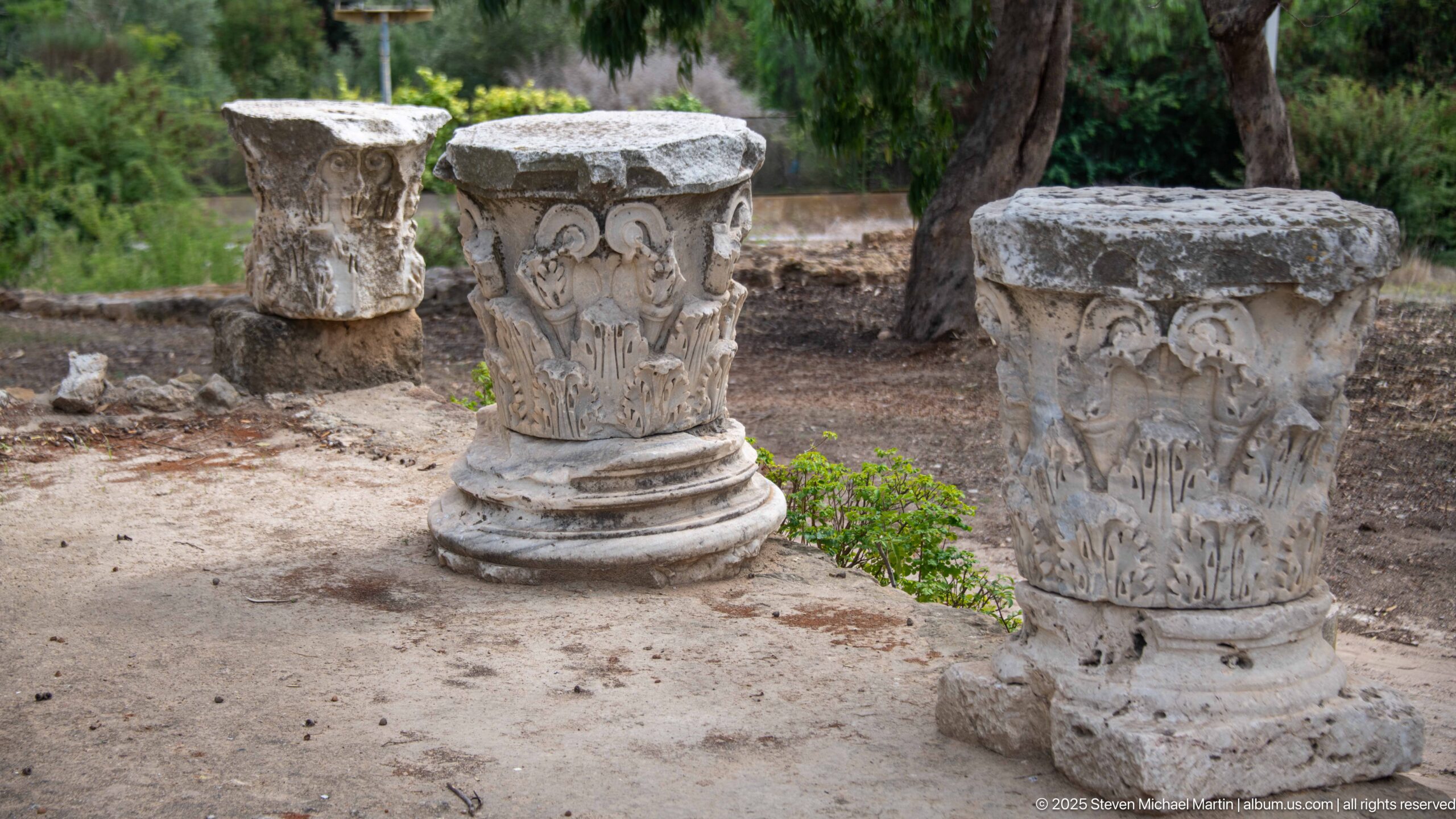
Three weathered stone capitals stand beside the Roman remains at Carthage, their carved acanthus leaves and volutes still legible despite erosion and loss. Each survives in a different state of preservation, allowing the changing depth and clarity of the ornamental carving to be compared directly. The grouping functions as an architectural study of reused or displayed classical fragments rather than an intact colonnade.
Caption
Three weathered stone capitals stand beside the Roman remains at Carthage, their carved acanthus leaves and volutes still legible despite erosion and loss. Each survives in a different state of preservation, allowing the changing depth and clarity of the ornamental carving to be compared directly. The grouping functions as an architectural study of reused or displayed classical fragments rather than an intact colonnade.
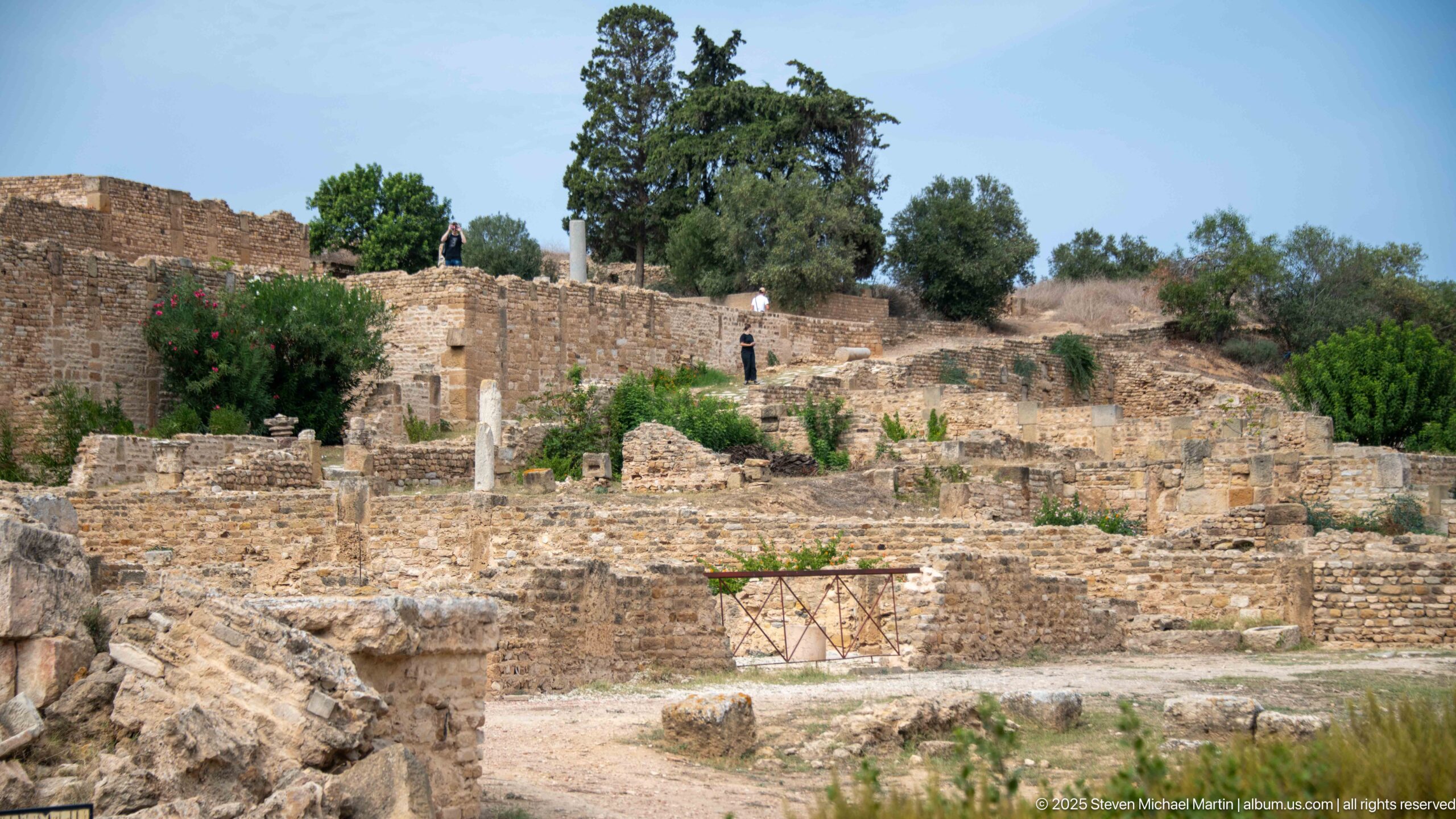
Excavated walls and terraces step across the Roman Villas area of Carthage, revealing successive room foundations, retaining walls, and scattered upright columns. The irregular archaeological layers make the former domestic plan only partly legible, while mature trees and modern vegetation mark the site's present landscape. The image works as a contextual overview of the density and extent of the residential remains.
Caption
Excavated walls and terraces step across the Roman Villas area of Carthage, revealing successive room foundations, retaining walls, and scattered upright columns. The irregular archaeological layers make the former domestic plan only partly legible, while mature trees and modern vegetation mark the site's present landscape. The image works as a contextual overview of the density and extent of the residential remains.
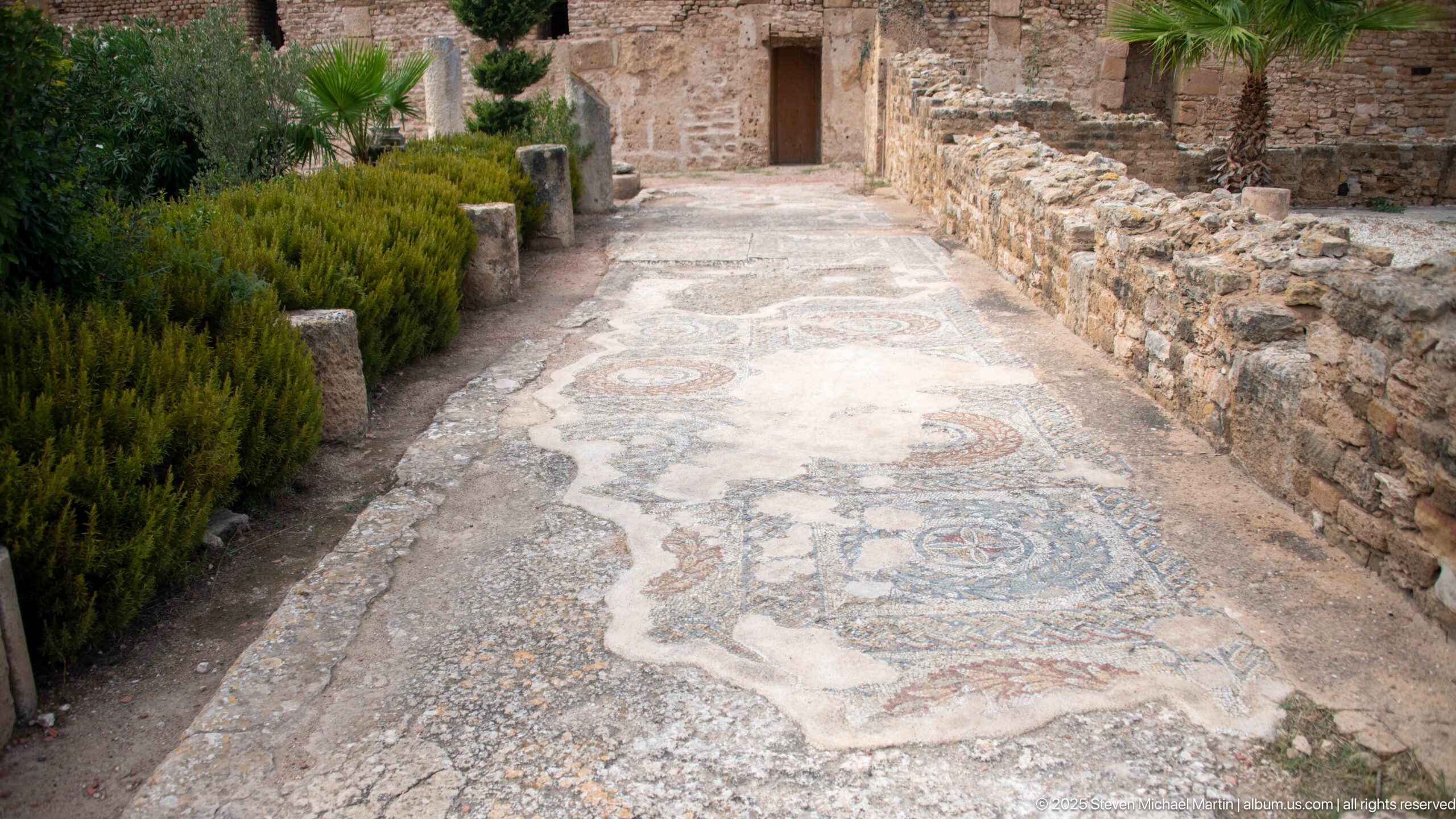
A long strip of mosaic pavement survives between low masonry walls in the Roman Villas area of Carthage. Circular medallions and geometric bands repeat along the walkway-like surface, while worn patches reveal the age and fragmentary condition of the floor. The photograph places the decorative pavement within its architectural setting, showing how mosaic ornament once structured movement through the residential complex.
Caption
A long strip of mosaic pavement survives between low masonry walls in the Roman Villas area of Carthage. Circular medallions and geometric bands repeat along the walkway-like surface, while worn patches reveal the age and fragmentary condition of the floor. The photograph places the decorative pavement within its architectural setting, showing how mosaic ornament once structured movement through the residential complex.
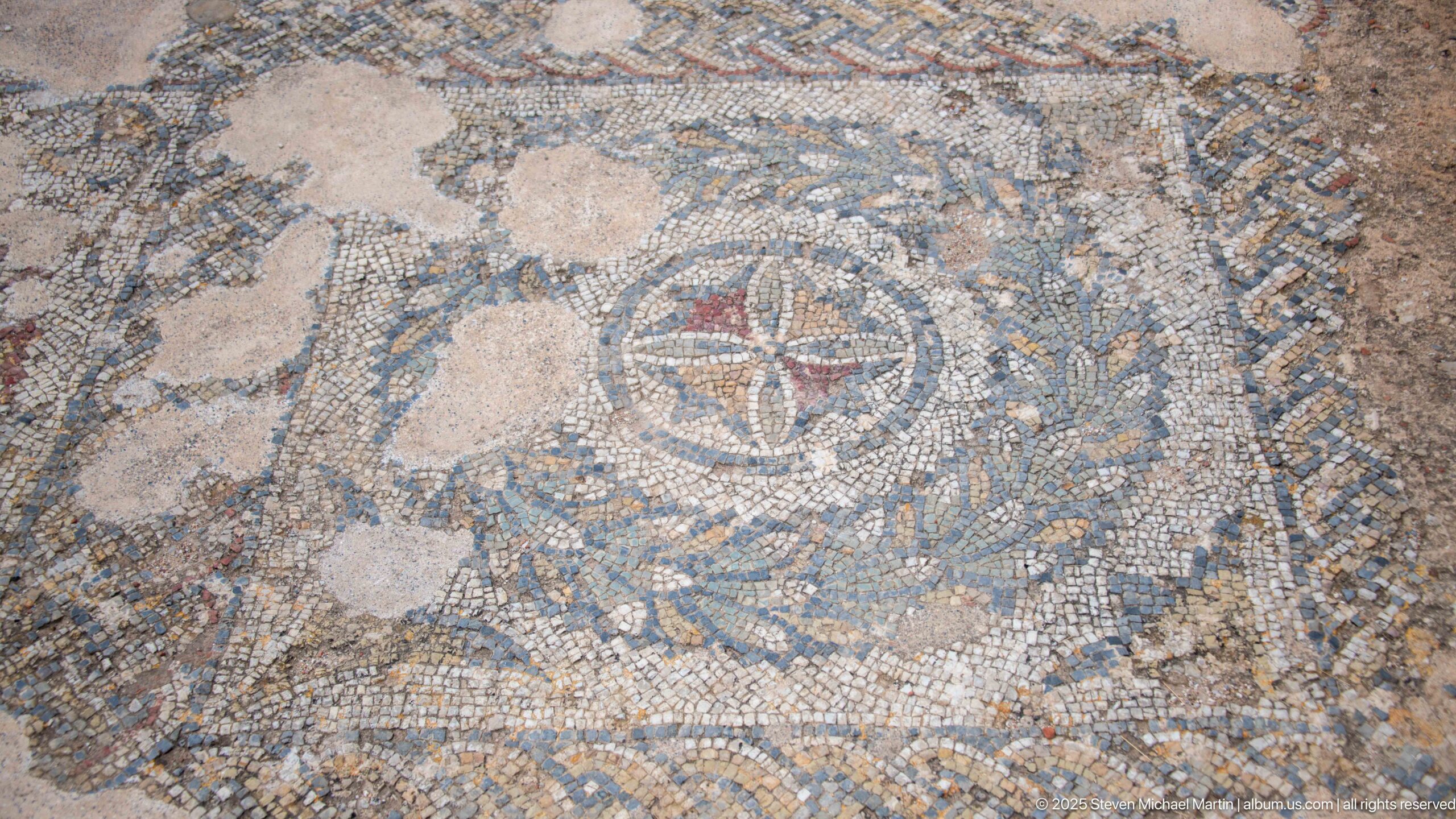
A close view isolates one circular medallion from the Roman villa mosaic pavement. At its center, a four-petal motif is framed by concentric bands of interlace, chevrons, and small tesserae in muted blue-gray, cream, and red. Weathering and losses interrupt parts of the design, but the surviving geometry remains legible enough to show the precision of the original floor decoration.
Caption
A close view isolates one circular medallion from the Roman villa mosaic pavement. At its center, a four-petal motif is framed by concentric bands of interlace, chevrons, and small tesserae in muted blue-gray, cream, and red. Weathering and losses interrupt parts of the design, but the surviving geometry remains legible enough to show the precision of the original floor decoration.
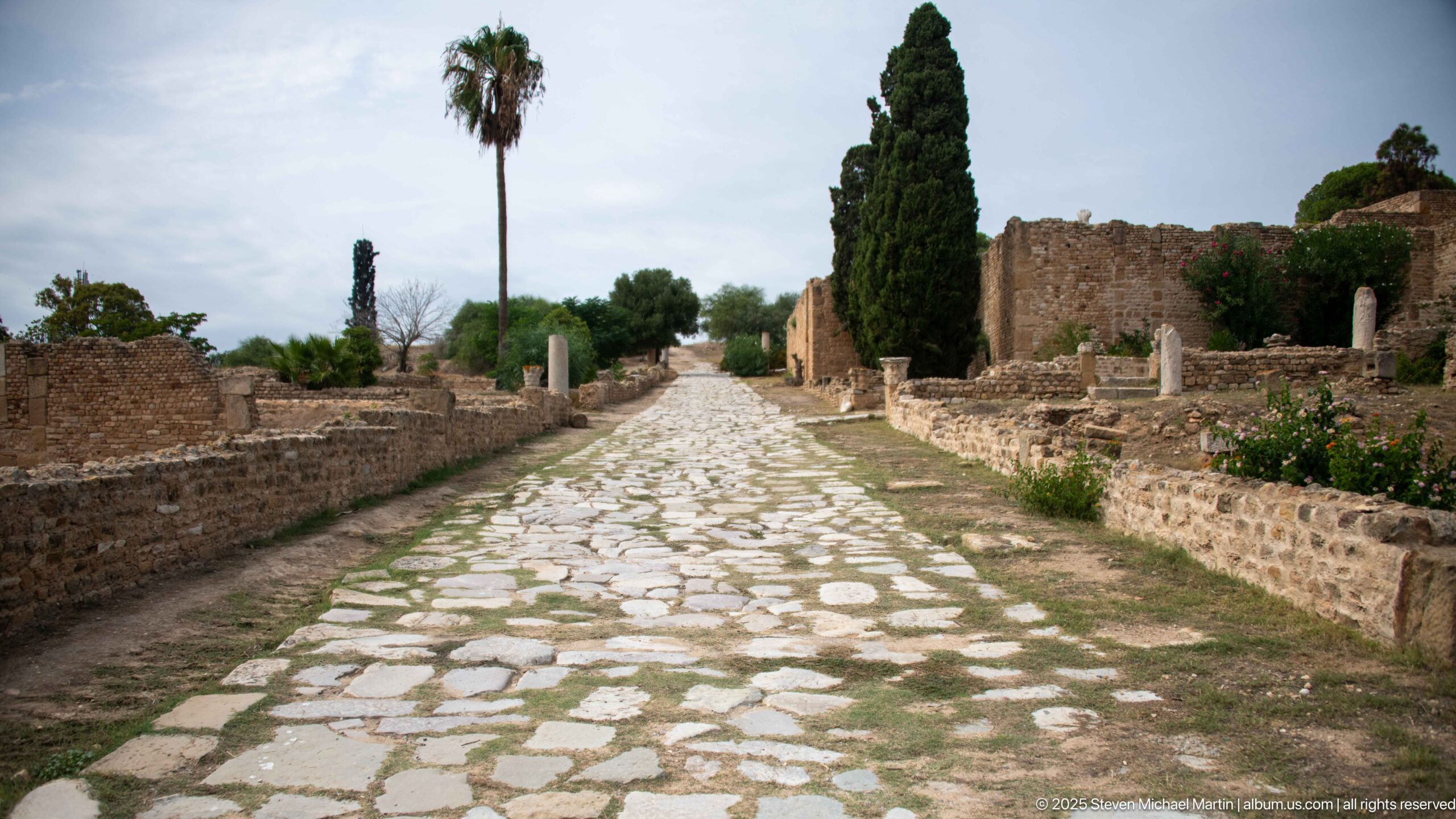
A long stone-paved route runs between low masonry walls in the Roman residential quarter at Carthage. Large irregular paving slabs create a durable central surface, while columns, cypresses, palms, and surviving walls guide the eye toward the distance. Whether interpreted as a street or major passage, the image records the circulation network that organized movement through the excavated neighborhood.
Caption
A long stone-paved route runs between low masonry walls in the Roman residential quarter at Carthage. Large irregular paving slabs create a durable central surface, while columns, cypresses, palms, and surviving walls guide the eye toward the distance. Whether interpreted as a street or major passage, the image records the circulation network that organized movement through the excavated neighborhood.
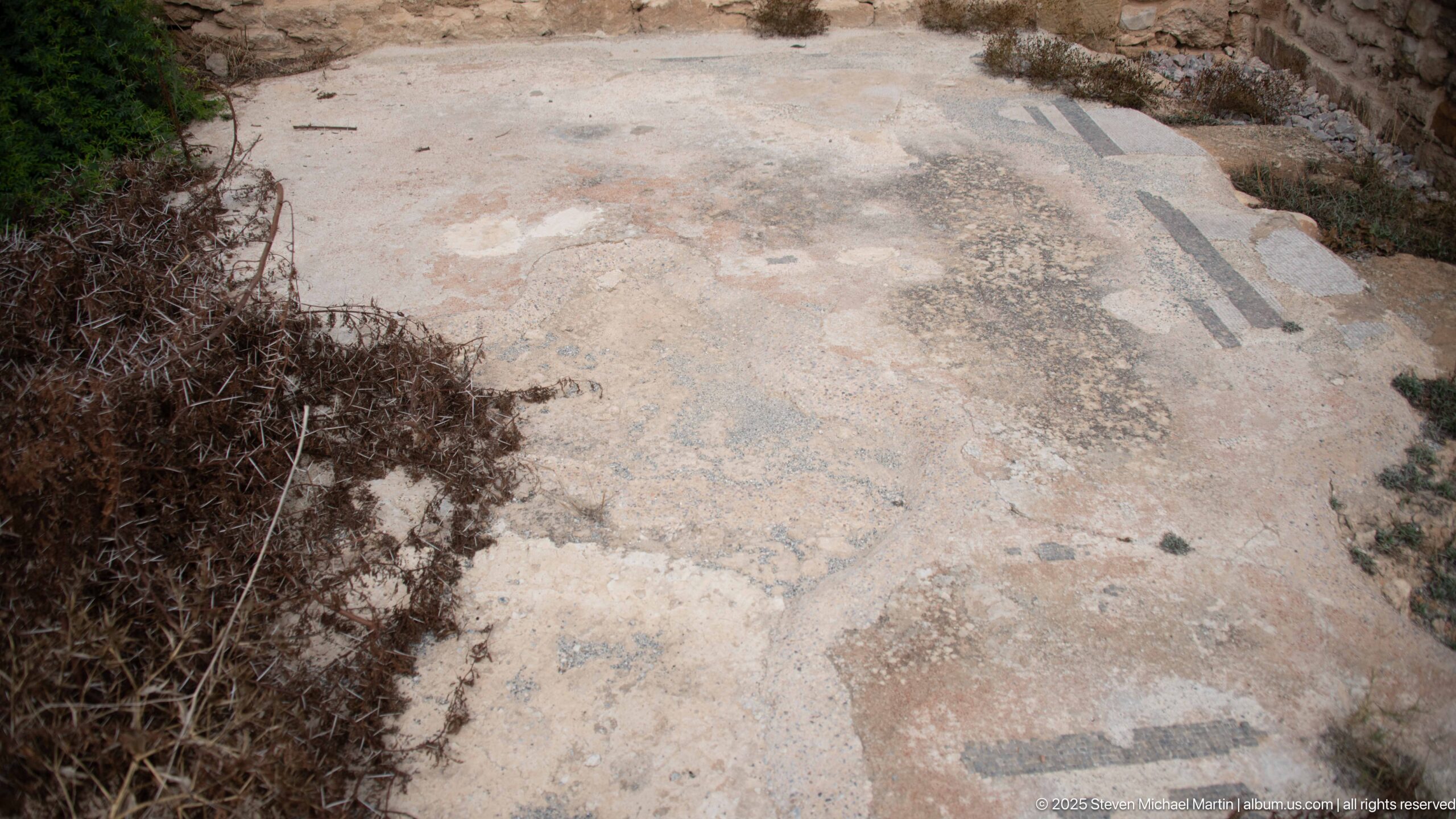
A heavily worn mosaic pavement survives only in fragments, with narrow dark bands and faint colored fields still visible across the pale surface. Soil, weathering, and plant debris obscure much of the original design, making the remaining geometric lines more important than any lost central motif. The photograph documents preservation condition as much as decoration, showing how little of some Roman floors remains legible in situ.
Caption
A heavily worn mosaic pavement survives only in fragments, with narrow dark bands and faint colored fields still visible across the pale surface. Soil, weathering, and plant debris obscure much of the original design, making the remaining geometric lines more important than any lost central motif. The photograph documents preservation condition as much as decoration, showing how little of some Roman floors remains legible in situ.
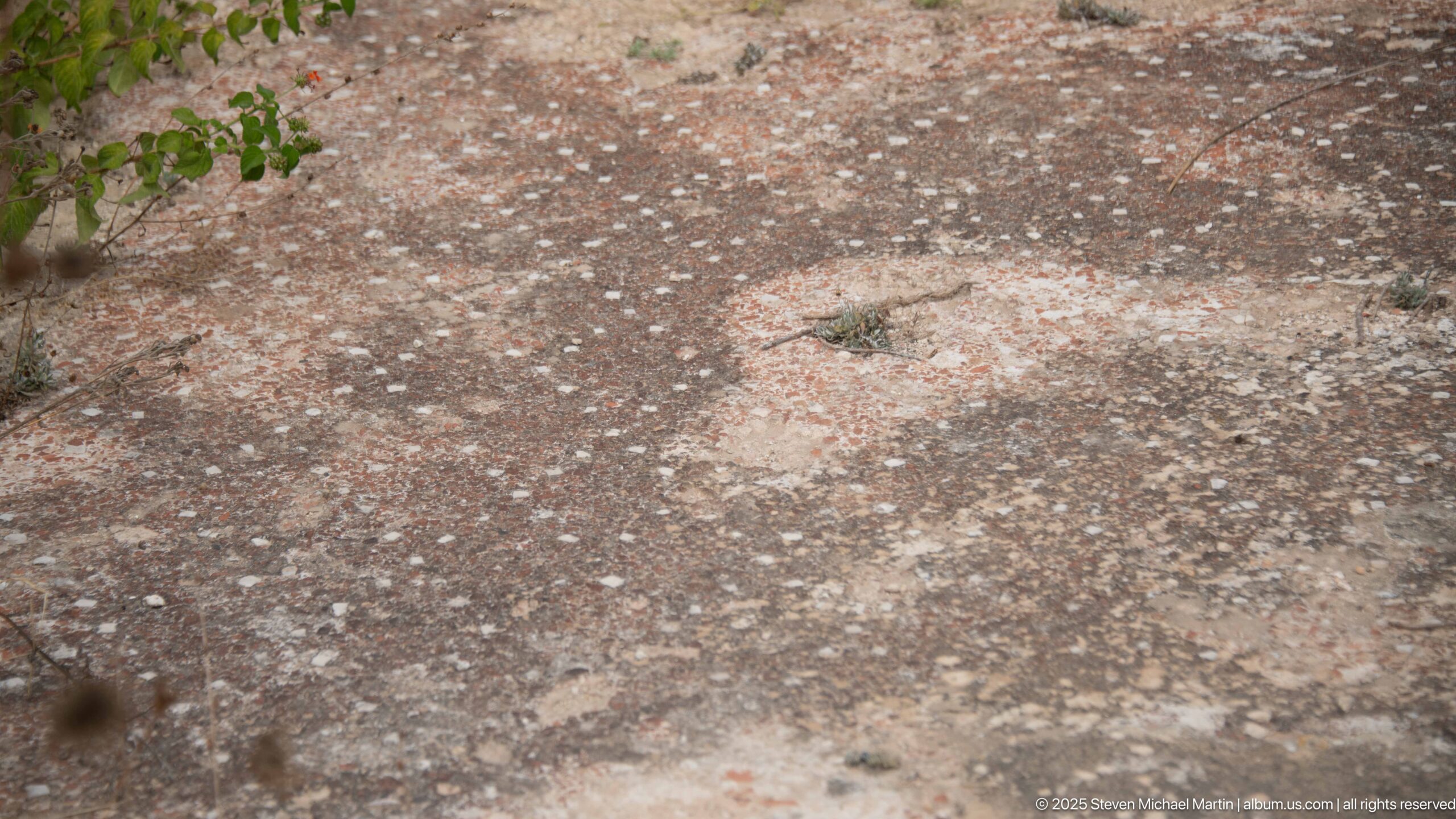
An extensively abraded floor surface preserves scattered mosaic tesserae and traces of reddish and pale geometric patterning. The original composition has largely disappeared, leaving texture and isolated color changes as evidence of the former decorative pavement. This close study is valuable for recording condition and material loss rather than iconography, since no specific figured subject remains legible.
Caption
An extensively abraded floor surface preserves scattered mosaic tesserae and traces of reddish and pale geometric patterning. The original composition has largely disappeared, leaving texture and isolated color changes as evidence of the former decorative pavement. This close study is valuable for recording condition and material loss rather than iconography, since no specific figured subject remains legible.
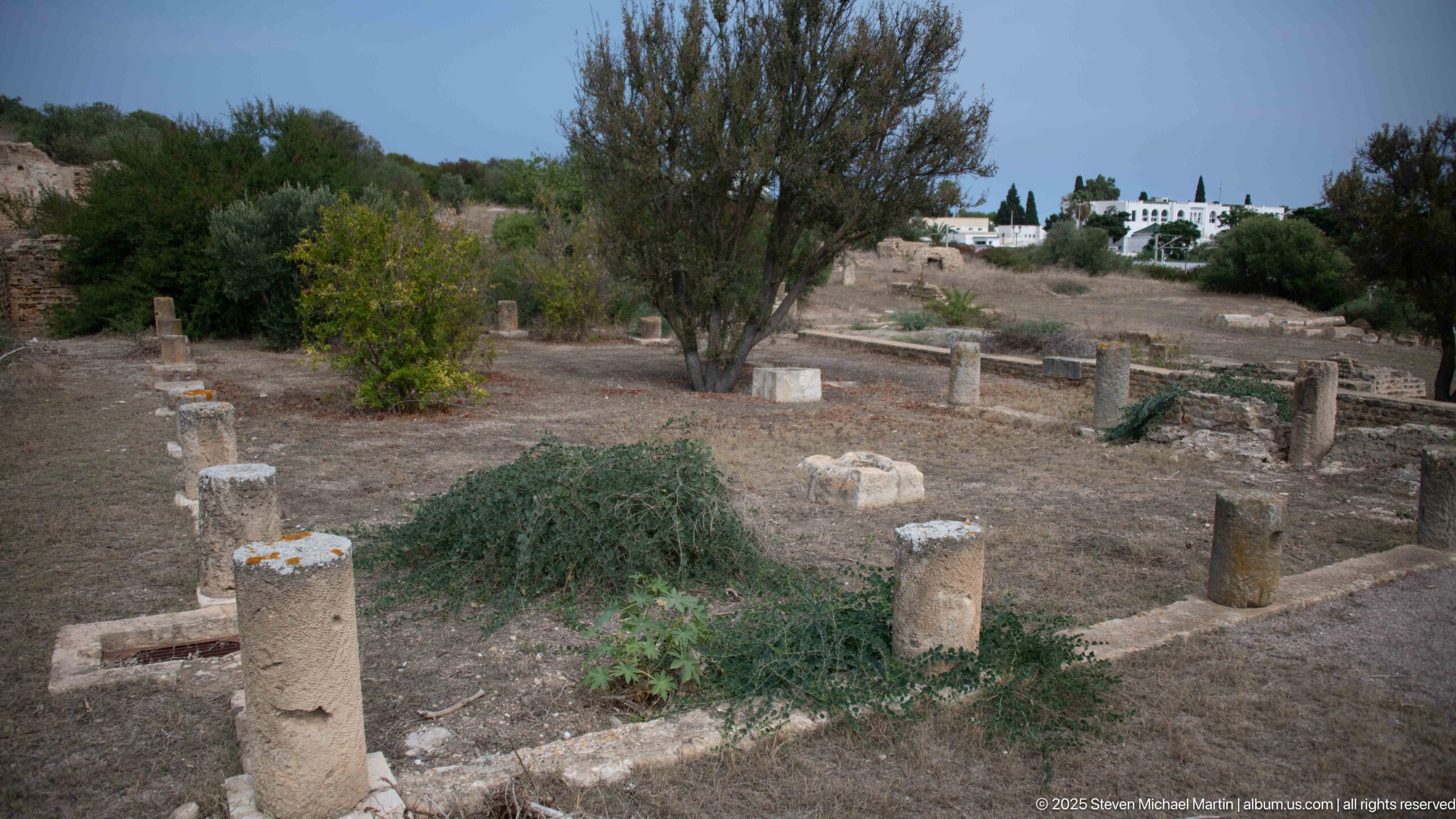
A rectangular court within Carthage's Roman residential ruins is marked by short surviving columns set around low masonry boundaries. Mature trees and shrubs now occupy the interior, while modern white houses appear on the ridge beyond. The arrangement suggests a once-architectural garden or courtyard space, but the proof sheet does not provide enough evidence to assign an exact room name or villa identity.
Caption
A rectangular court within Carthage's Roman residential ruins is marked by short surviving columns set around low masonry boundaries. Mature trees and shrubs now occupy the interior, while modern white houses appear on the ridge beyond. The arrangement suggests a once-architectural garden or courtyard space, but the proof sheet does not provide enough evidence to assign an exact room name or villa identity.
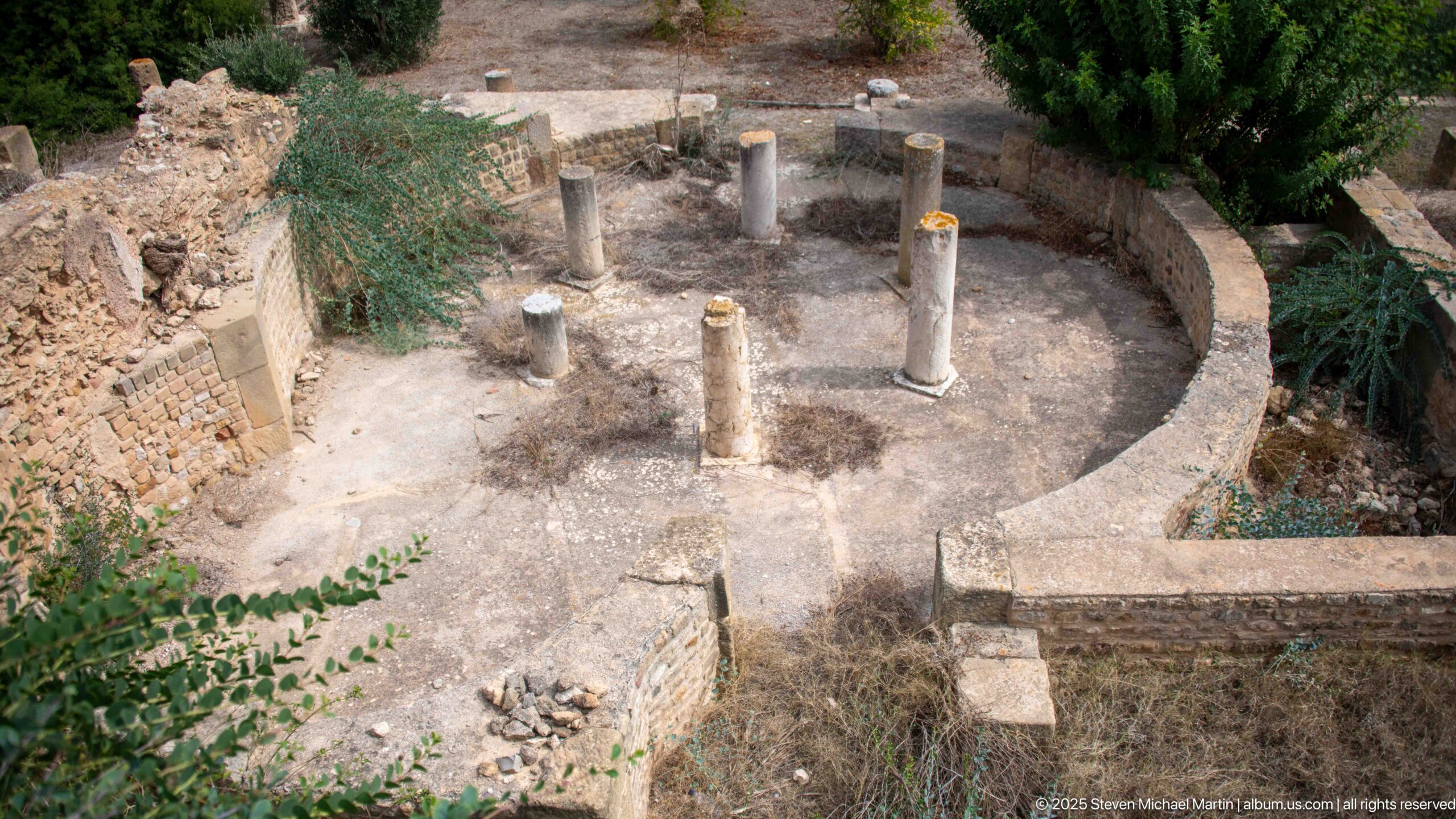
Several short column shafts stand within a curved masonry enclosure in the Roman Villas area of Carthage. Viewed from above, the semicircular plan and central paved surface become particularly clear, while surrounding walls and vegetation show the feature embedded within a larger domestic complex. The unusual geometry is architecturally distinctive, although the proof sheet does not establish the room's original function.
Caption
Several short column shafts stand within a curved masonry enclosure in the Roman Villas area of Carthage. Viewed from above, the semicircular plan and central paved surface become particularly clear, while surrounding walls and vegetation show the feature embedded within a larger domestic complex. The unusual geometry is architecturally distinctive, although the proof sheet does not establish the room's original function.
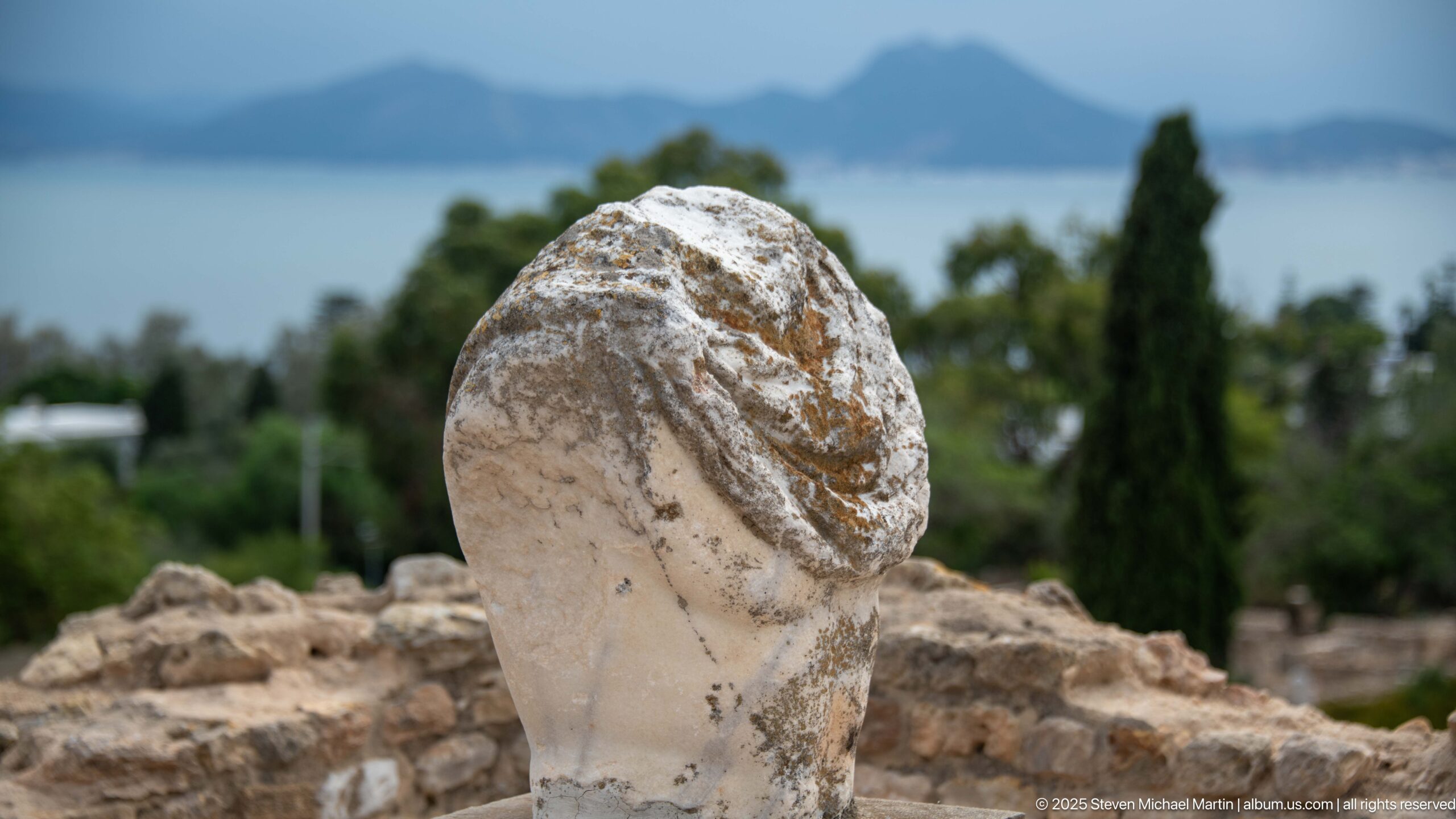
A fragmentary white marble head survives with its facial features largely lost but its thick, deeply carved hair still visible. The neck and lower head remain intact enough to preserve the sculptural volume, while the Gulf of Tunis and distant hills blur in the background. The image isolates the object as a sculptural fragment without enough evidence to identify the represented person or deity.
Caption
A fragmentary white marble head survives with its facial features largely lost but its thick, deeply carved hair still visible. The neck and lower head remain intact enough to preserve the sculptural volume, while the Gulf of Tunis and distant hills blur in the background. The image isolates the object as a sculptural fragment without enough evidence to identify the represented person or deity.
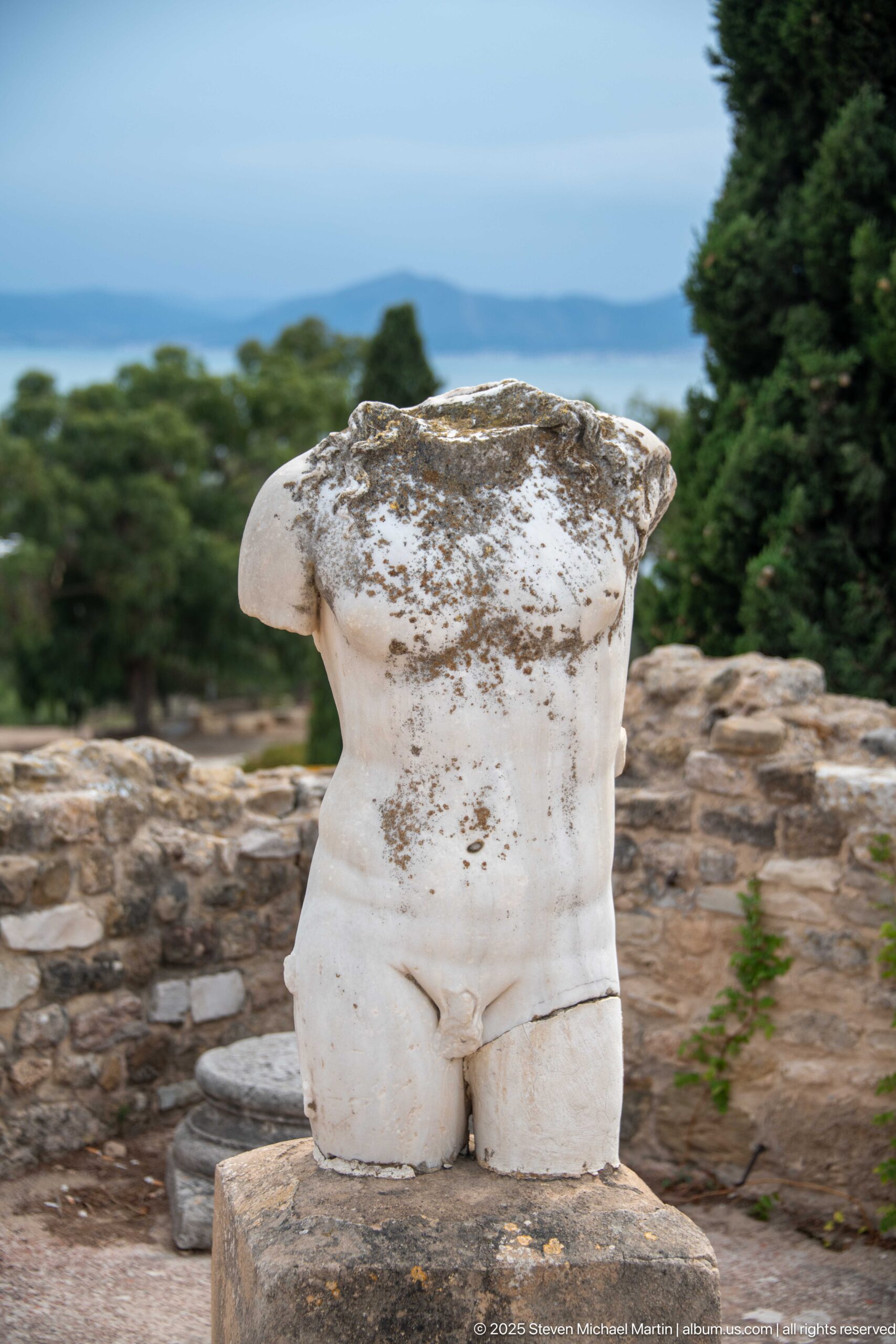
A headless and armless male torso in white marble stands on a stone base above the Roman ruins of Carthage. The chest and abdomen are modeled with restrained anatomical definition, while the broken shoulders and lower body expose the sculpture's fragmentary condition. The distant Gulf of Tunis provides an atmospheric backdrop, but the surviving anatomy alone does not establish a specific mythological or portrait identity.
Caption
A headless and armless male torso in white marble stands on a stone base above the Roman ruins of Carthage. The chest and abdomen are modeled with restrained anatomical definition, while the broken shoulders and lower body expose the sculpture's fragmentary condition. The distant Gulf of Tunis provides an atmospheric backdrop, but the surviving anatomy alone does not establish a specific mythological or portrait identity.
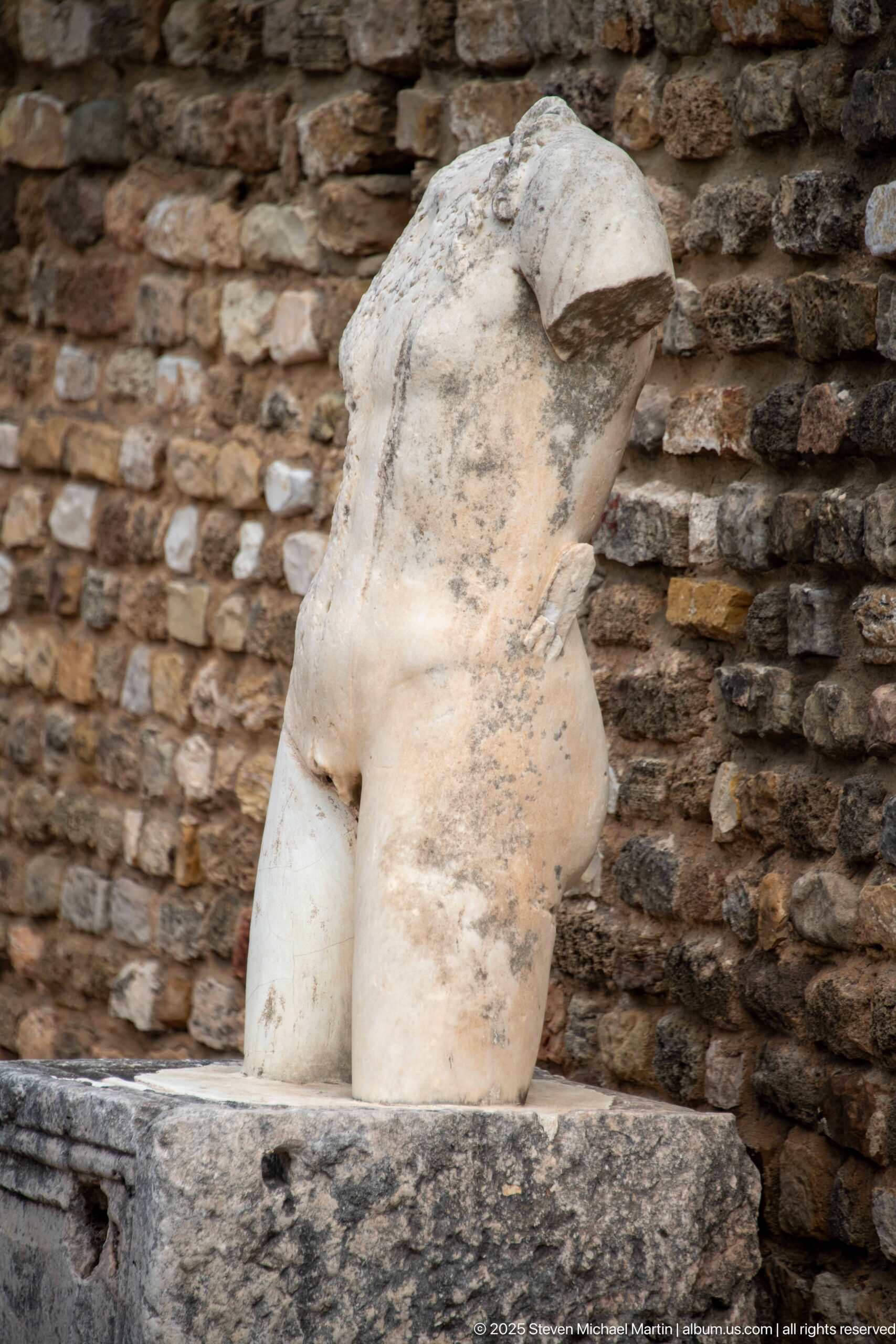
A fragmentary white marble torso, probably representing a female figure, survives from the shoulders to the upper thighs. The head and arms are missing, and weathering softens the modeling of the torso, while a broken mass of stone remains attached along one side. The sculpture is displayed against rough ancient masonry, but the surviving form does not permit a secure identification of a deity or named subject.
Caption
A fragmentary white marble torso, probably representing a female figure, survives from the shoulders to the upper thighs. The head and arms are missing, and weathering softens the modeling of the torso, while a broken mass of stone remains attached along one side. The sculpture is displayed against rough ancient masonry, but the surviving form does not permit a secure identification of a deity or named subject.
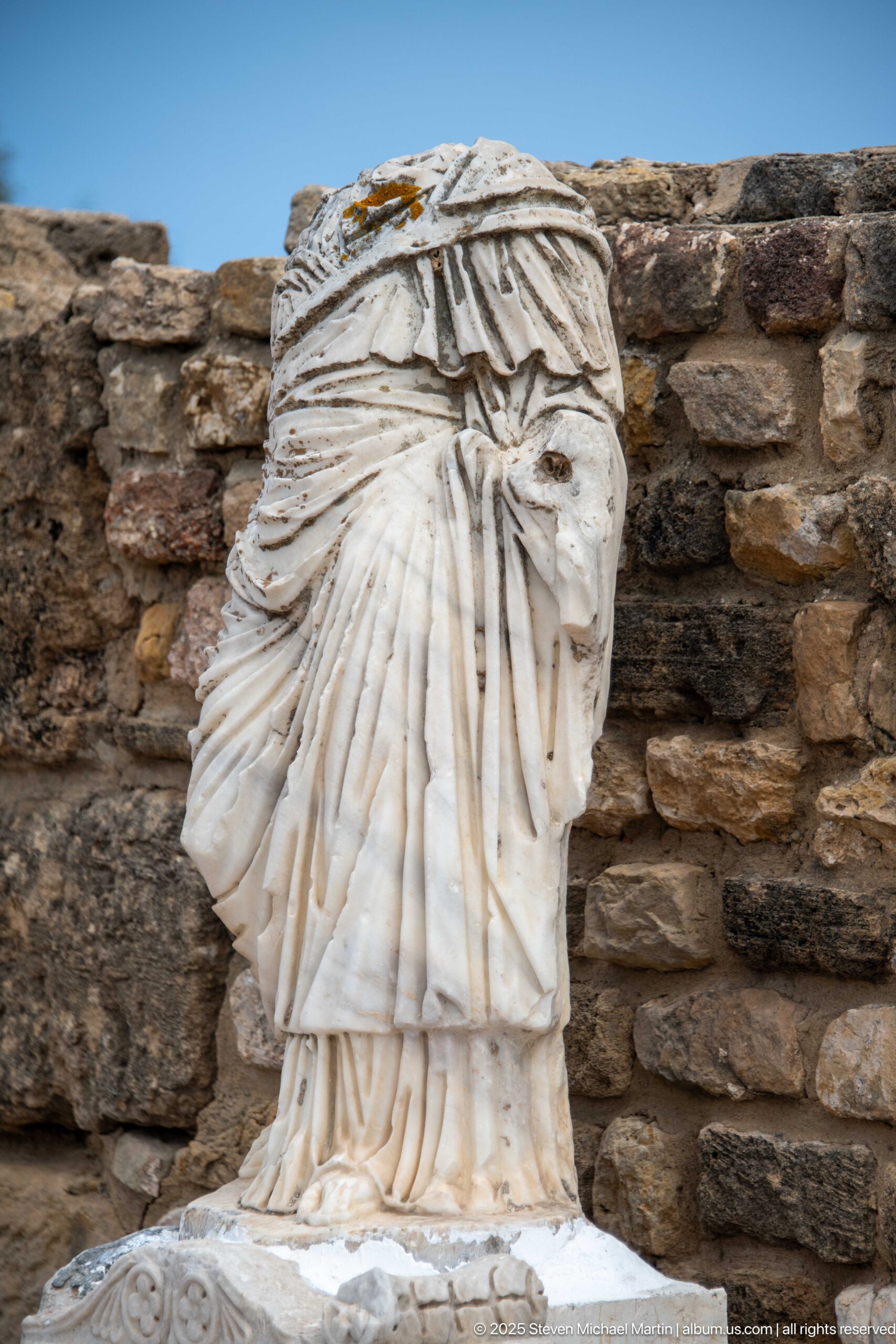
The surviving lower body of a marble statue is wrapped in deeply carved folds that cascade diagonally across the figure before gathering near the feet. The head and upper torso are missing, leaving the drapery as the principal source of visual information. Displayed against a rough stone wall, the fragment demonstrates the sculptor's handling of layered cloth but does not support a specific identification of the original figure.
Caption
The surviving lower body of a marble statue is wrapped in deeply carved folds that cascade diagonally across the figure before gathering near the feet. The head and upper torso are missing, leaving the drapery as the principal source of visual information. Displayed against a rough stone wall, the fragment demonstrates the sculptor's handling of layered cloth but does not support a specific identification of the original figure.
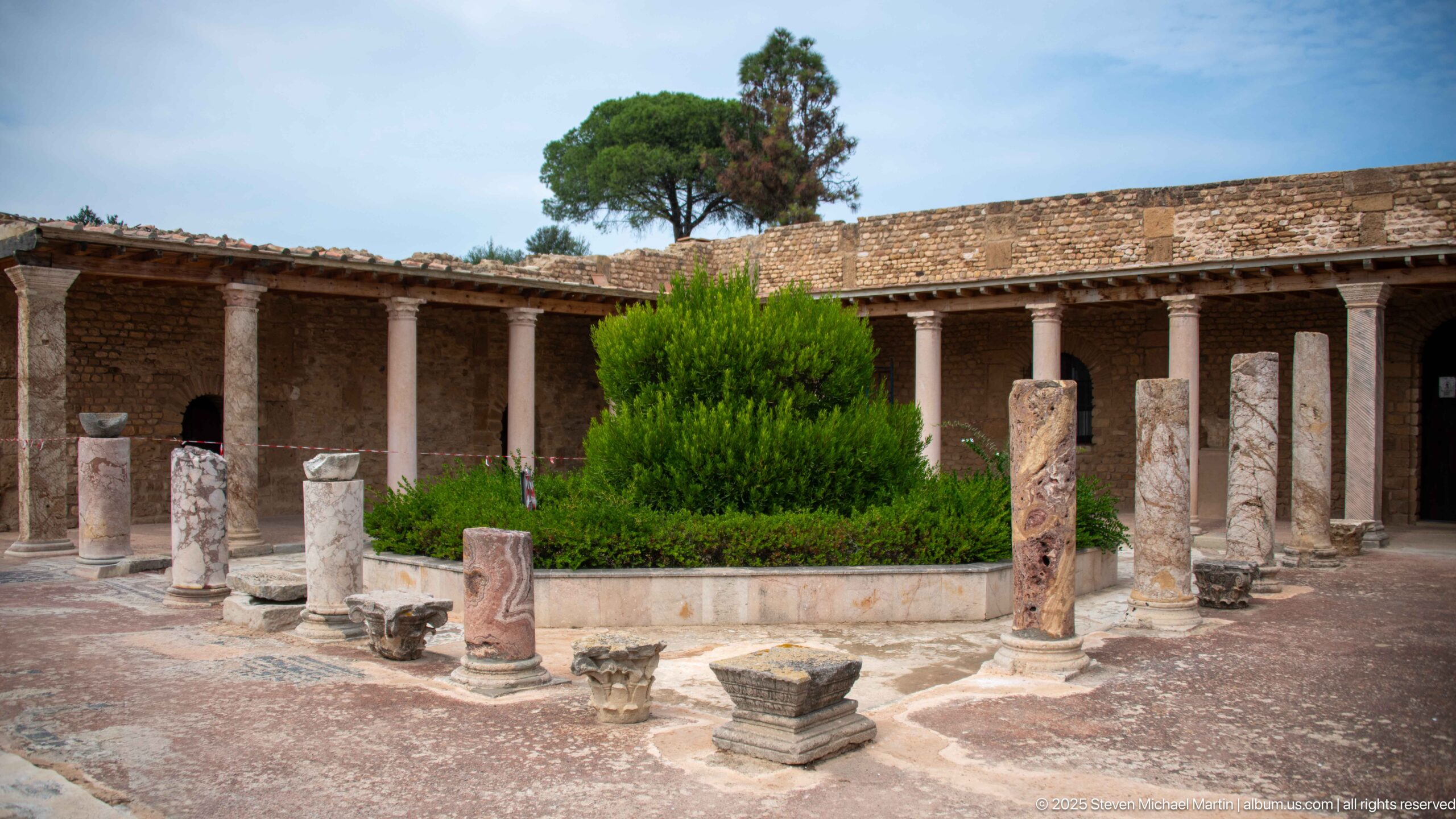
A reconstructed peristyle courtyard in Carthage's Roman Villas area is arranged around a central planted bed, with marble and stone columns supporting a covered portico. Different shaft colors and materials create a deliberately varied colonnade, while scattered architectural fragments remain on the paved court. The restored setting evokes the spatial organization of an elite Roman residence more clearly than the surrounding excavated foundations.
Caption
A reconstructed peristyle courtyard in Carthage's Roman Villas area is arranged around a central planted bed, with marble and stone columns supporting a covered portico. Different shaft colors and materials create a deliberately varied colonnade, while scattered architectural fragments remain on the paved court. The restored setting evokes the spatial organization of an elite Roman residence more clearly than the surrounding excavated foundations.
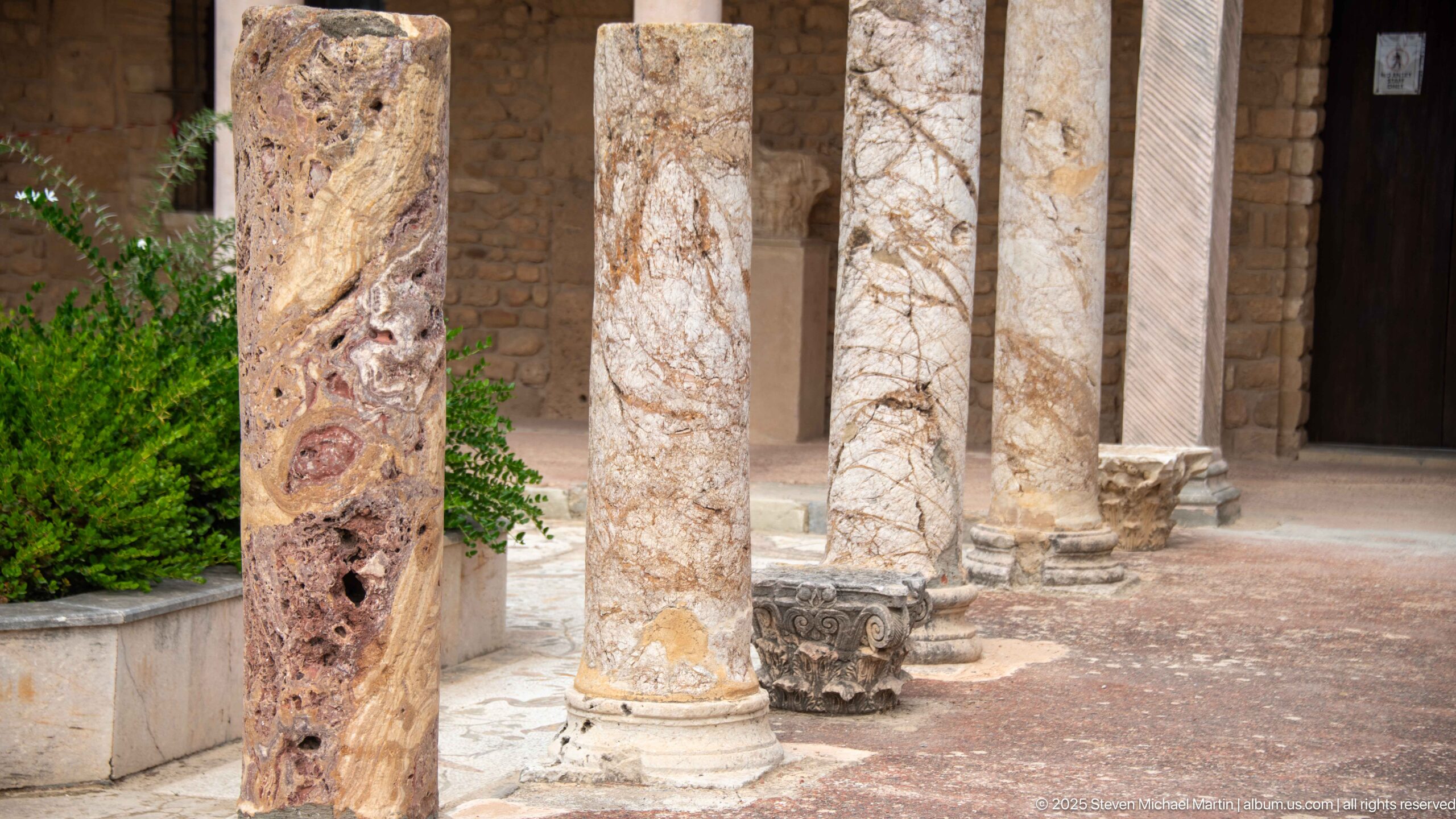
Variegated marble and stone columns line the reconstructed peristyle of a Roman villa at Carthage. One reddish shaft with dramatic mottling contrasts with paler veined columns behind, while bases and capitals reveal differences in surviving condition and restoration. The close framing shifts attention from the courtyard plan to the materials and visual richness of the colonnade itself.
Caption
Variegated marble and stone columns line the reconstructed peristyle of a Roman villa at Carthage. One reddish shaft with dramatic mottling contrasts with paler veined columns behind, while bases and capitals reveal differences in surviving condition and restoration. The close framing shifts attention from the courtyard plan to the materials and visual richness of the colonnade itself.
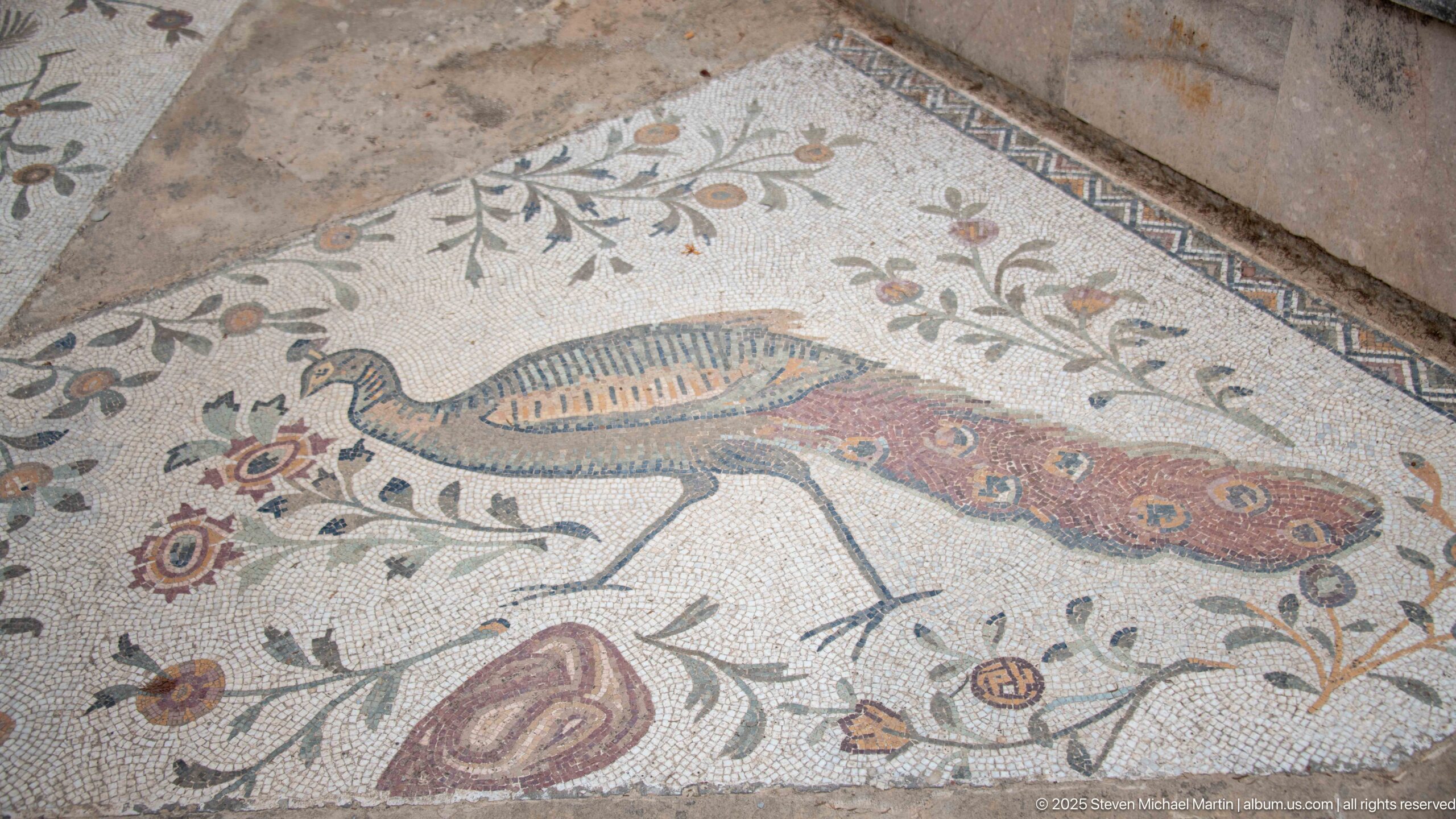
A polychrome floor mosaic centers on a peacock shown in profile, its blue-green neck and patterned tail framed by curling vines, flowers, and fruit. The bird's slender legs and elongated body are rendered with small tesserae, while a geometric border defines the surviving panel. The naturalistic avian subject and lush vegetation fit the decorative repertoire of elite Roman domestic mosaics at Carthage.
Caption
A polychrome floor mosaic centers on a peacock shown in profile, its blue-green neck and patterned tail framed by curling vines, flowers, and fruit. The bird's slender legs and elongated body are rendered with small tesserae, while a geometric border defines the surviving panel. The naturalistic avian subject and lush vegetation fit the decorative repertoire of elite Roman domestic mosaics at Carthage.
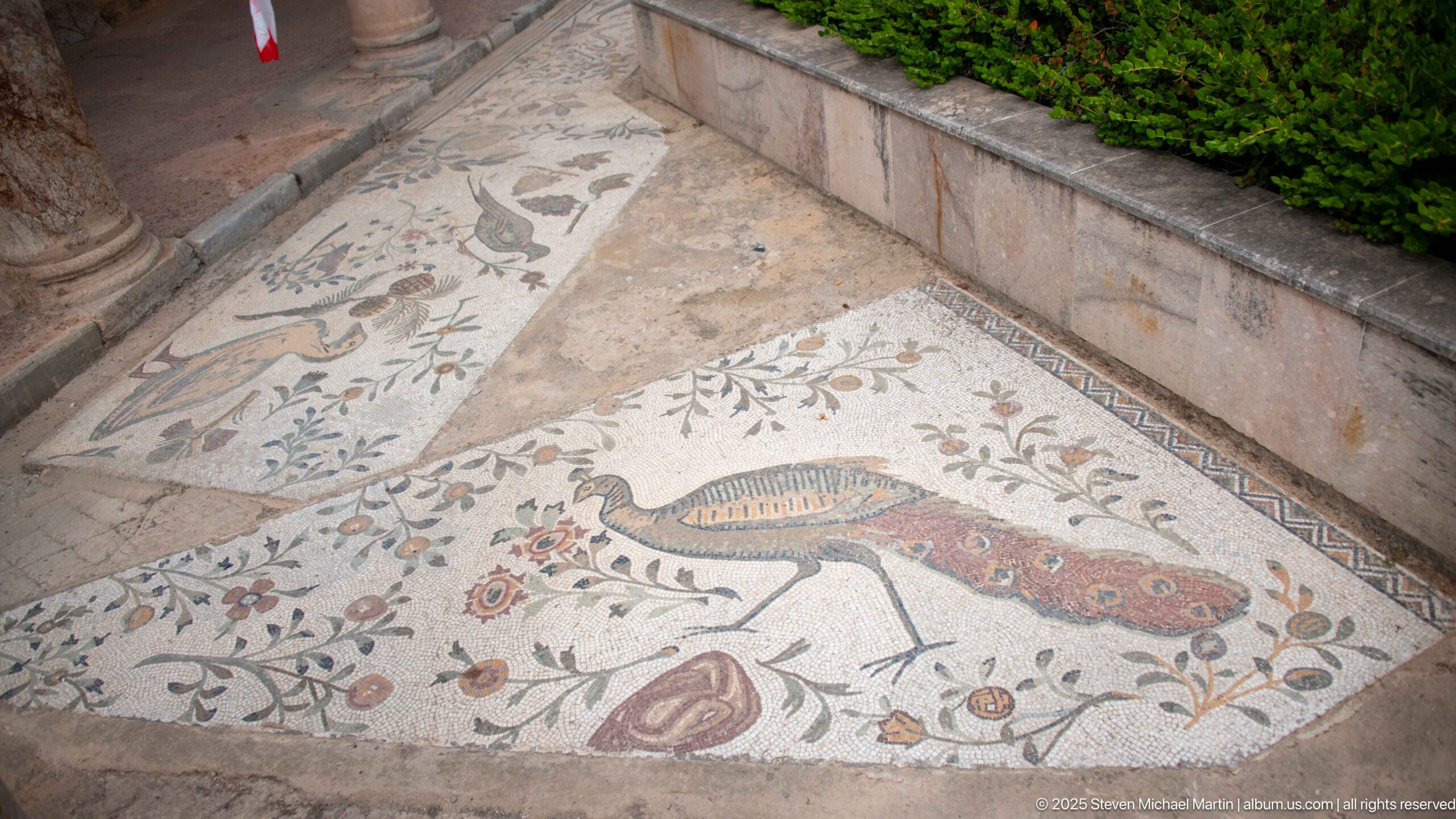
Two surviving mosaic panels decorate the floor beside the reconstructed Roman villa courtyard at Carthage. The larger panel features a peacock among flowering and fruiting branches, while the smaller panel carries another bird-and-vegetation composition. Seen together, the mosaics reveal how avian and garden imagery was repeated across the domestic decorative program rather than confined to a single isolated scene.
Caption
Two surviving mosaic panels decorate the floor beside the reconstructed Roman villa courtyard at Carthage. The larger panel features a peacock among flowering and fruiting branches, while the smaller panel carries another bird-and-vegetation composition. Seen together, the mosaics reveal how avian and garden imagery was repeated across the domestic decorative program rather than confined to a single isolated scene.
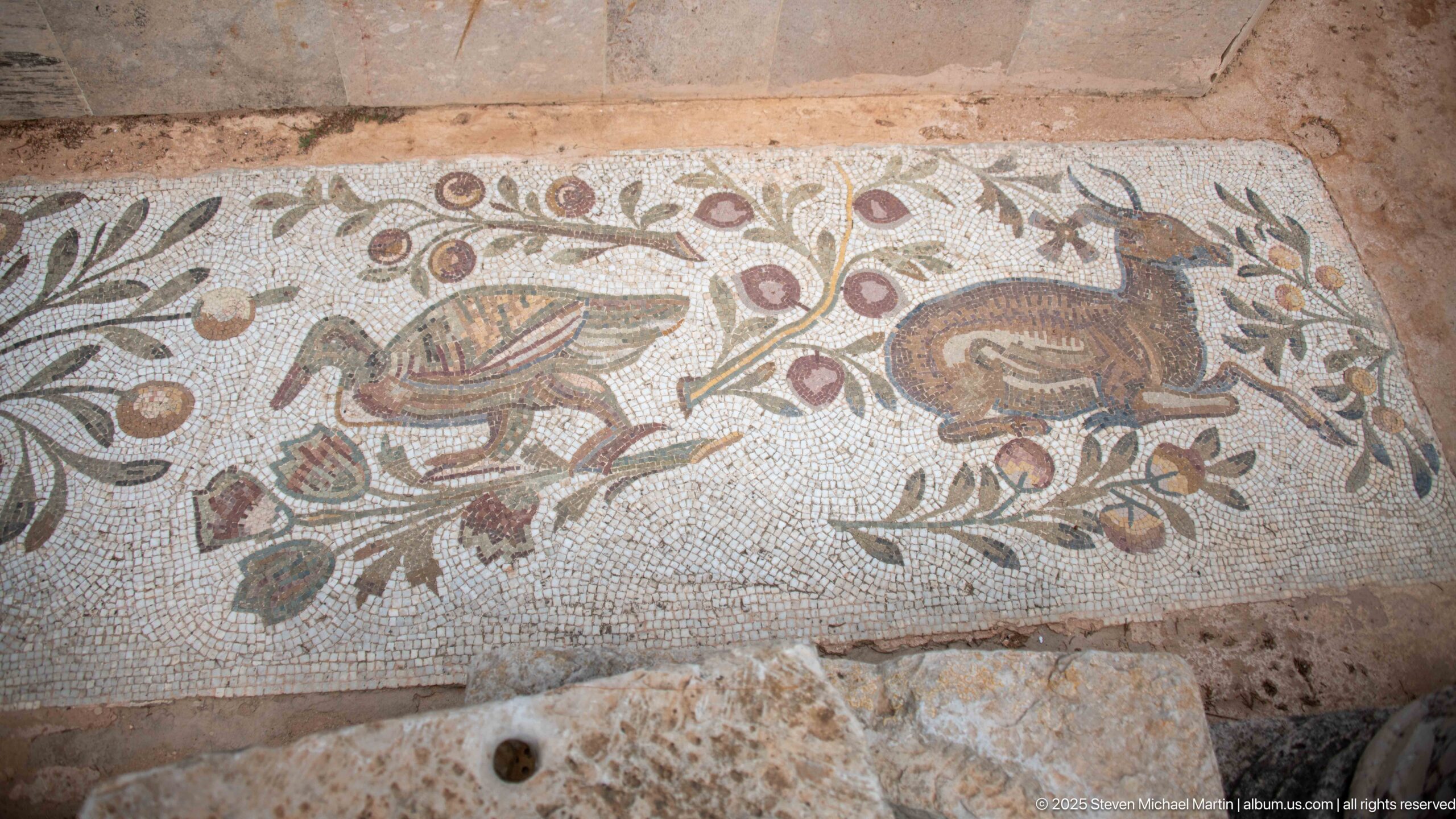
A rectangular Roman mosaic panel depicts two birds moving through a dense arrangement of branches, leaves, and fruit. One bird bends forward as if pecking or feeding, while the other turns within a rounded floral enclosure. Muted greens, browns, reds, and creams create a naturalistic garden scene, continuing the avian decorative theme seen across the reconstructed villa at Carthage.
Caption
A rectangular Roman mosaic panel depicts two birds moving through a dense arrangement of branches, leaves, and fruit. One bird bends forward as if pecking or feeding, while the other turns within a rounded floral enclosure. Muted greens, browns, reds, and creams create a naturalistic garden scene, continuing the avian decorative theme seen across the reconstructed villa at Carthage.
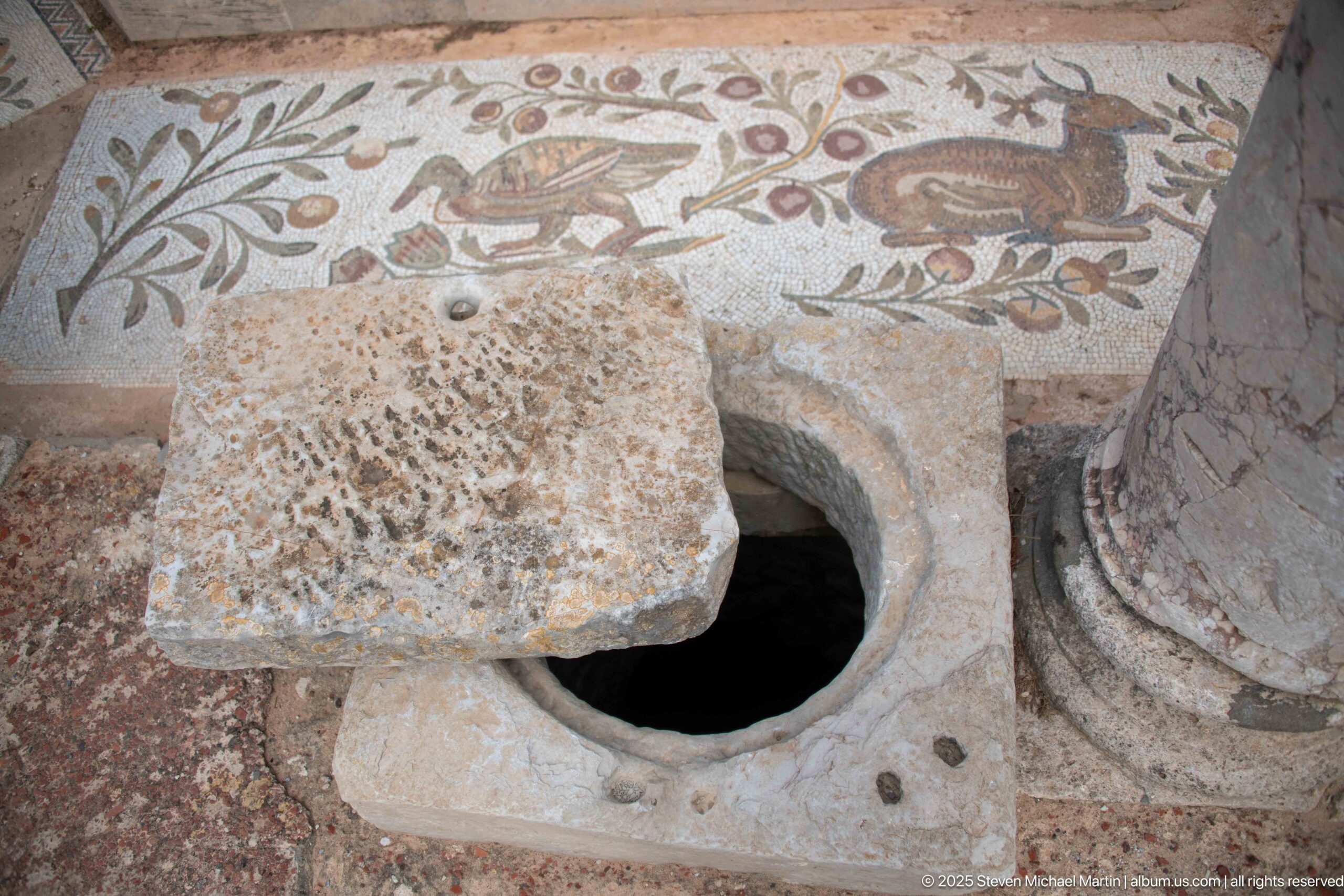
A circular stone-lined opening interrupts the floor beside a Roman bird mosaic in the villa complex. A thick fitted slab lies partly over the aperture, exposing the dark cavity below, while a column base and tessellated pavement establish the architectural setting. The feature may have served a practical domestic function, but the proof sheet does not provide enough evidence to determine whether it was a well, cistern access, drain, or another installation.
Caption
A circular stone-lined opening interrupts the floor beside a Roman bird mosaic in the villa complex. A thick fitted slab lies partly over the aperture, exposing the dark cavity below, while a column base and tessellated pavement establish the architectural setting. The feature may have served a practical domestic function, but the proof sheet does not provide enough evidence to determine whether it was a well, cistern access, drain, or another installation.
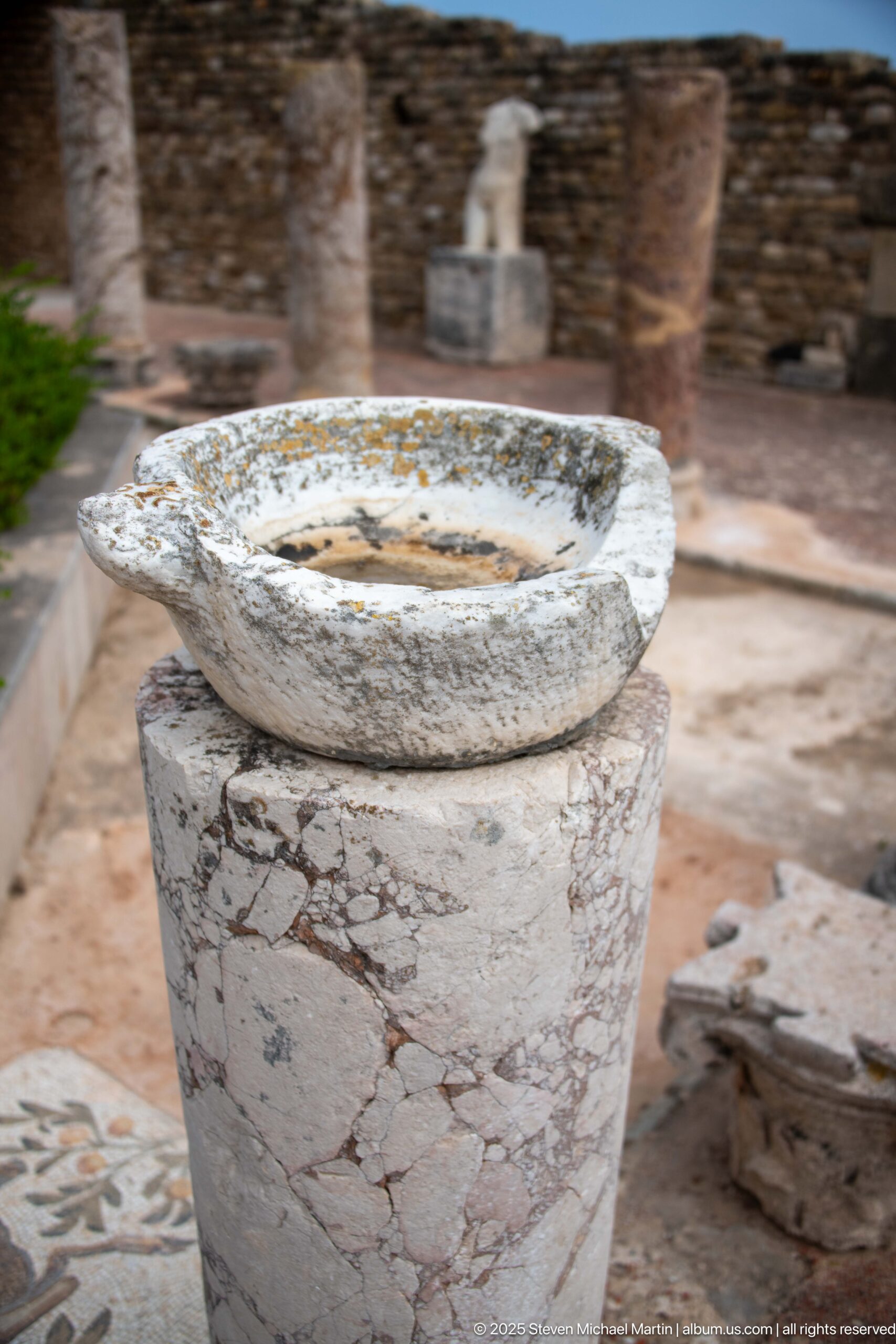
A shallow circular stone basin rests on a short veined marble column support within the reconstructed villa courtyard. Its broad rim and central depression suggest use with water or as a decorative furnishing, while weathering and surface deposits attest to long exposure. The isolated object is framed against columns and masonry, making its form clear even though its exact ancient function and original placement are not confirmed.
Caption
A shallow circular stone basin rests on a short veined marble column support within the reconstructed villa courtyard. Its broad rim and central depression suggest use with water or as a decorative furnishing, while weathering and surface deposits attest to long exposure. The isolated object is framed against columns and masonry, making its form clear even though its exact ancient function and original placement are not confirmed.
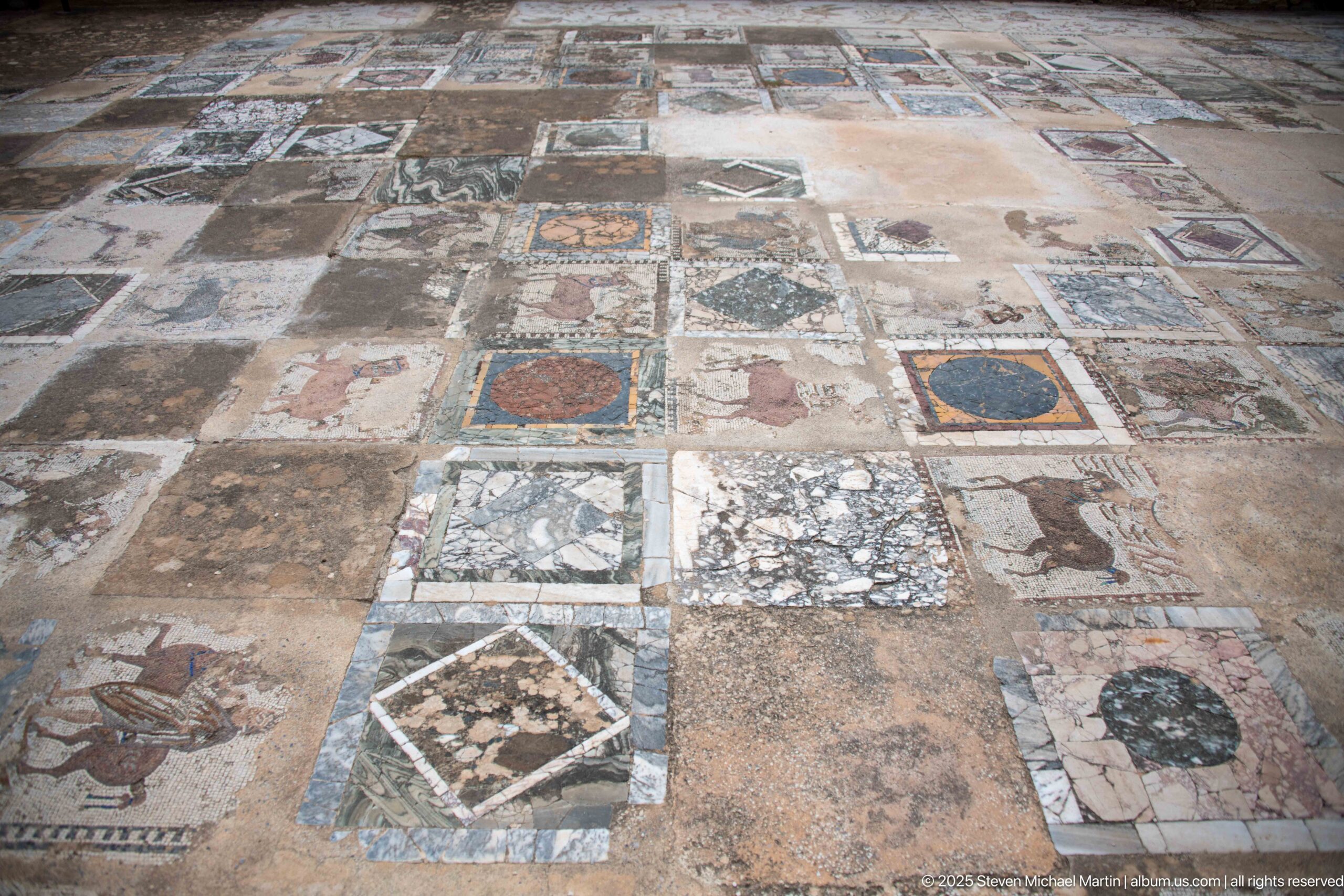
A broad floor display at the Roman villa complex brings together numerous square and rectangular panels of mosaic and colored stone. Geometric designs, circular medallions, birds, foliage, and marbled surfaces create a patchwork of surviving ancient pavement traditions. Viewed obliquely, the installation emphasizes variety in material, motif, and preservation rather than reconstructing a single continuous floor design.
Caption
A broad floor display at the Roman villa complex brings together numerous square and rectangular panels of mosaic and colored stone. Geometric designs, circular medallions, birds, foliage, and marbled surfaces create a patchwork of surviving ancient pavement traditions. Viewed obliquely, the installation emphasizes variety in material, motif, and preservation rather than reconstructing a single continuous floor design.
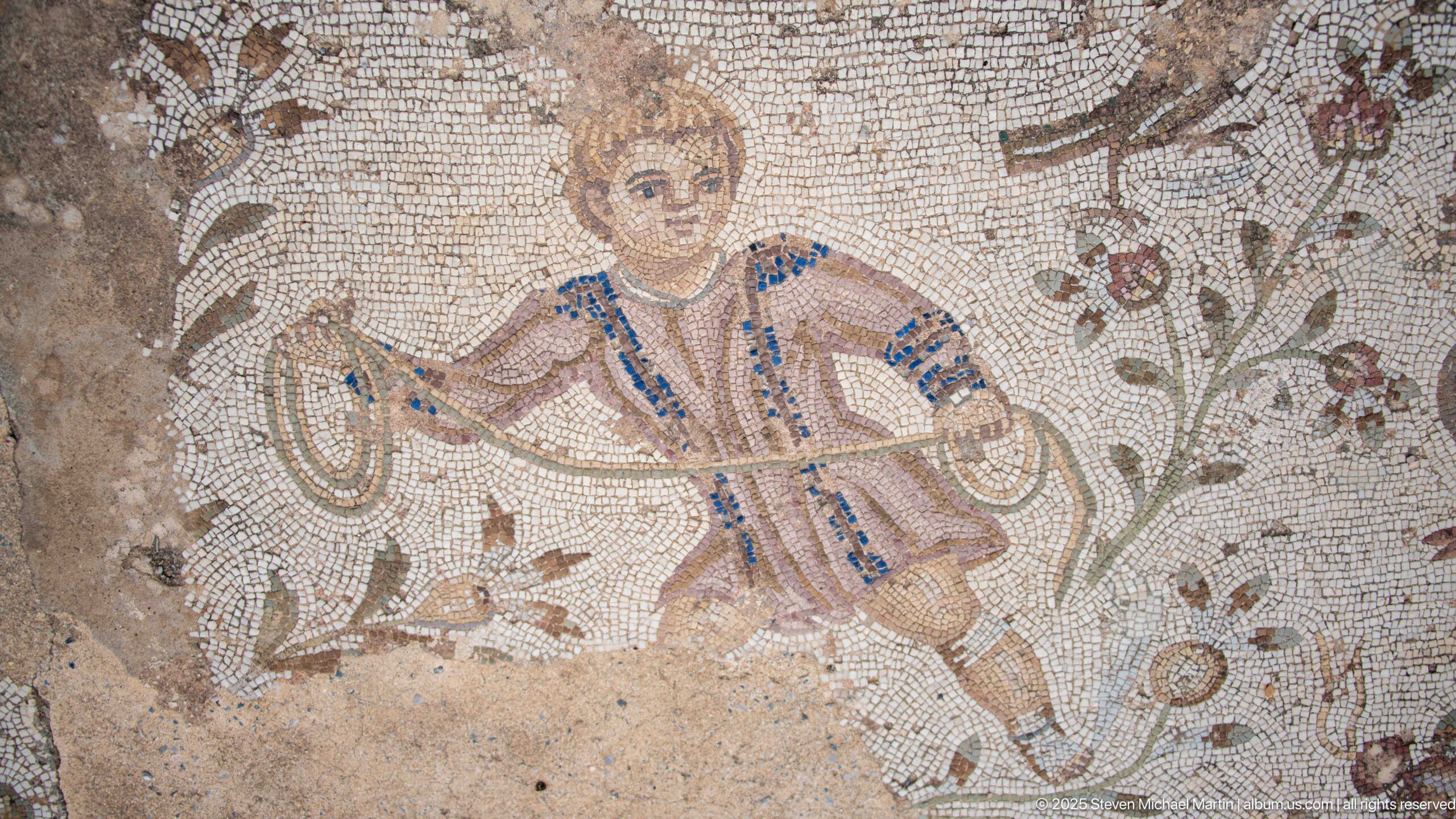
A youthful figure in a patterned tunic dominates this Roman mosaic panel, holding a bird while surrounded by branches and smaller animals. Blue tesserae accent the clothing, and the pale background sets off the figure's face and gestures. The scene belongs to the villa's broader world of garden and animal imagery, although the precise narrative, season, or allegorical identity of the youth cannot be established from the proof sheet.
Caption
A youthful figure in a patterned tunic dominates this Roman mosaic panel, holding a bird while surrounded by branches and smaller animals. Blue tesserae accent the clothing, and the pale background sets off the figure's face and gestures. The scene belongs to the villa's broader world of garden and animal imagery, although the precise narrative, season, or allegorical identity of the youth cannot be established from the proof sheet.
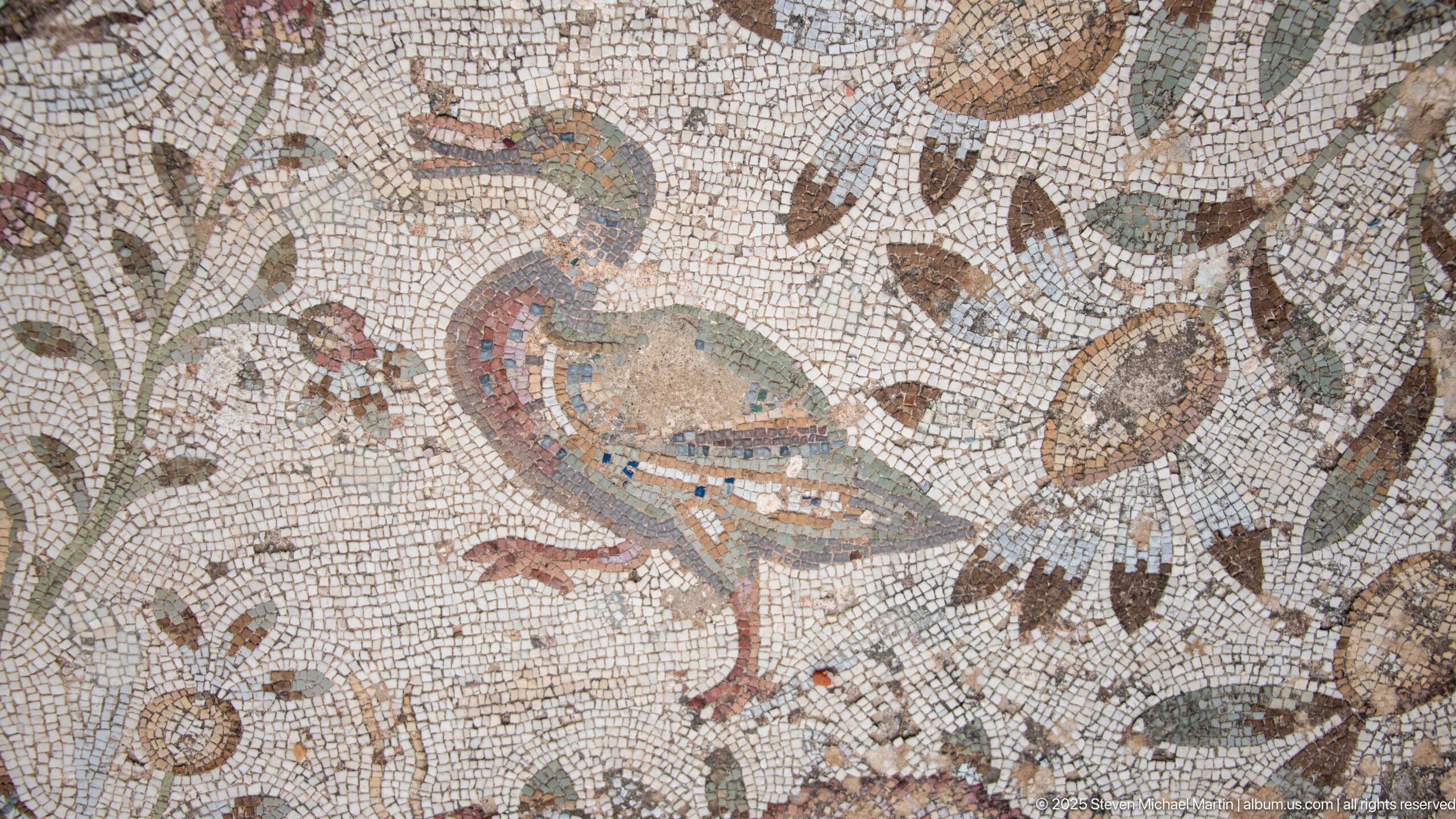
A peacock stands amid a dense garden of flowering stems, leaves, fruit, and smaller birds in this Roman mosaic panel. The long neck, patterned plumage, and carefully articulated legs make the central bird immediately recognizable, while the surrounding motifs create a lively natural setting. The panel forms part of the villa's recurring decorative program of birds and cultivated abundance.
Caption
A peacock stands amid a dense garden of flowering stems, leaves, fruit, and smaller birds in this Roman mosaic panel. The long neck, patterned plumage, and carefully articulated legs make the central bird immediately recognizable, while the surrounding motifs create a lively natural setting. The panel forms part of the villa's recurring decorative program of birds and cultivated abundance.
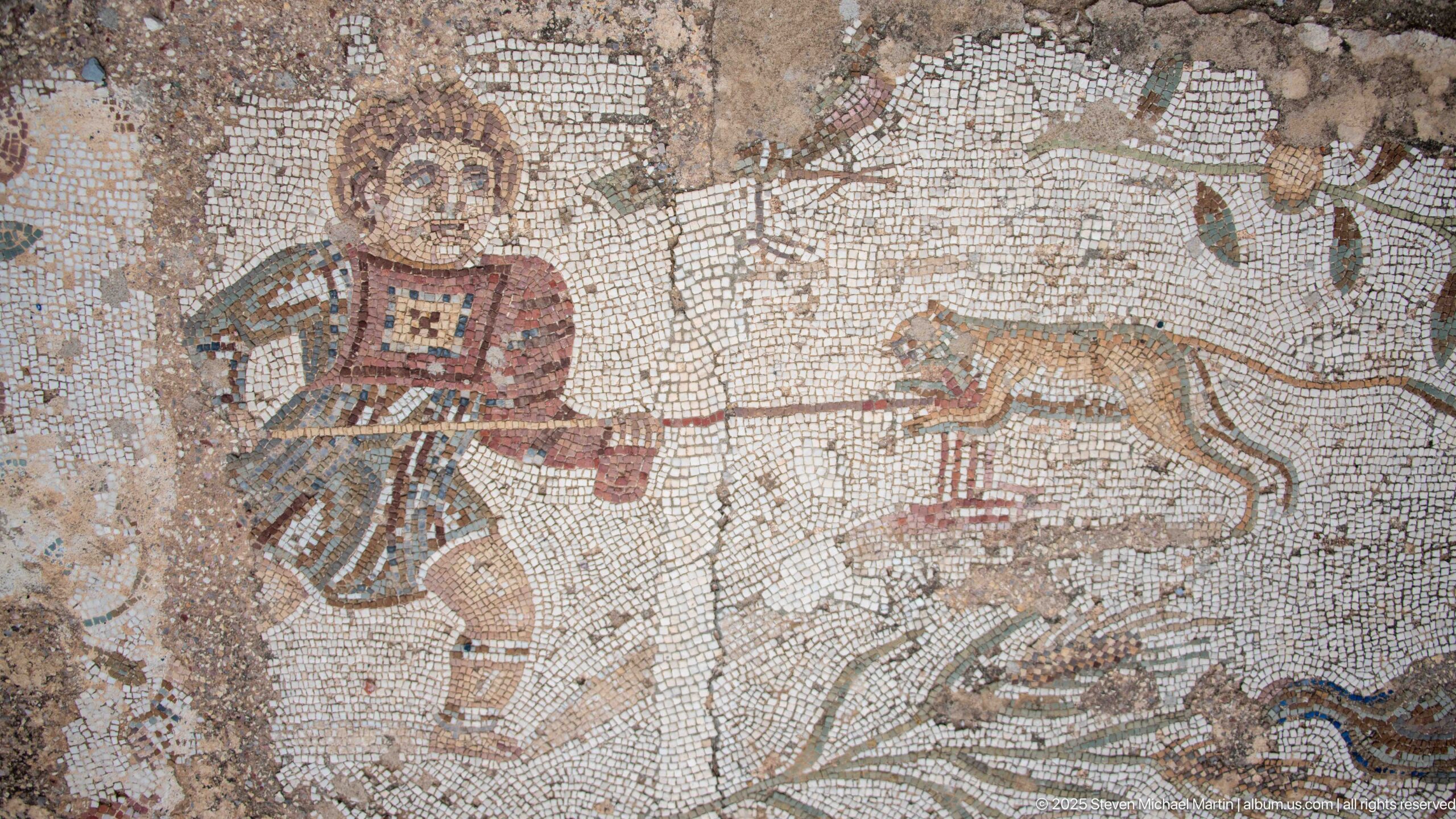
A tunic-clad figure faces a spotted animal in a Roman mosaic scene, holding a long pole or spear across the composition. The animal lunges or twists toward the figure, creating a strong sense of action, while surrounding plant motifs place the encounter in a stylized outdoor setting. The damaged panel preserves the dramatic relationship clearly, but the exact activity and species cannot be identified with confidence from the proof sheet.
Caption
A tunic-clad figure faces a spotted animal in a Roman mosaic scene, holding a long pole or spear across the composition. The animal lunges or twists toward the figure, creating a strong sense of action, while surrounding plant motifs place the encounter in a stylized outdoor setting. The damaged panel preserves the dramatic relationship clearly, but the exact activity and species cannot be identified with confidence from the proof sheet.
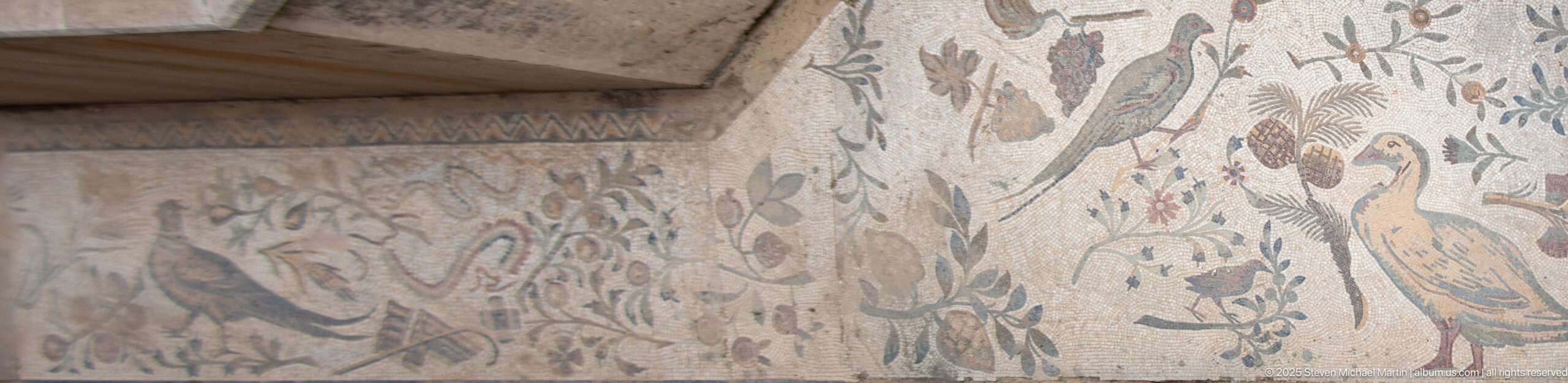
An oblique view along the villa's decorated pavement brings several bird mosaics into a single composition. Peacocks and other birds appear among flowering stems, fruit, and leafy branches, while a geometric border runs along the edge of the installation. The angled perspective demonstrates how the individual panels related spatially to one another within the reconstructed domestic setting.
Caption
An oblique view along the villa's decorated pavement brings several bird mosaics into a single composition. Peacocks and other birds appear among flowering stems, fruit, and leafy branches, while a geometric border runs along the edge of the installation. The angled perspective demonstrates how the individual panels related spatially to one another within the reconstructed domestic setting.
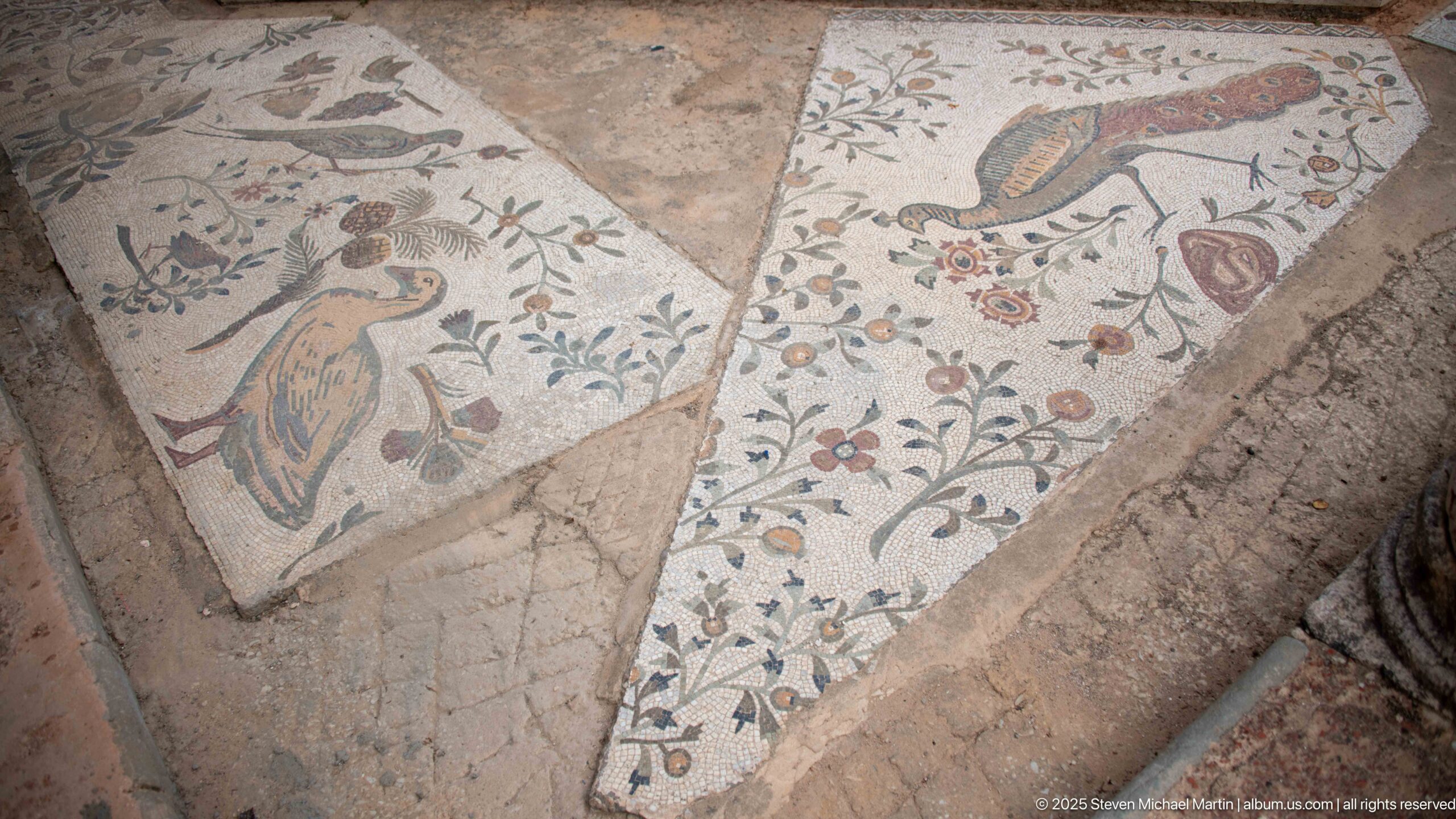
Two rectangular floor mosaics lie side by side in the Roman villa complex at Carthage, each centered on a large bird surrounded by flowers, leaves, and fruit. One bird displays a long patterned tail, while the other is rendered with shorter plumage and a rounded body. The paired view highlights variation within a coordinated decorative theme and shows the panels in their architectural setting.
Caption
Two rectangular floor mosaics lie side by side in the Roman villa complex at Carthage, each centered on a large bird surrounded by flowers, leaves, and fruit. One bird displays a long patterned tail, while the other is rendered with shorter plumage and a rounded body. The paired view highlights variation within a coordinated decorative theme and shows the panels in their architectural setting.
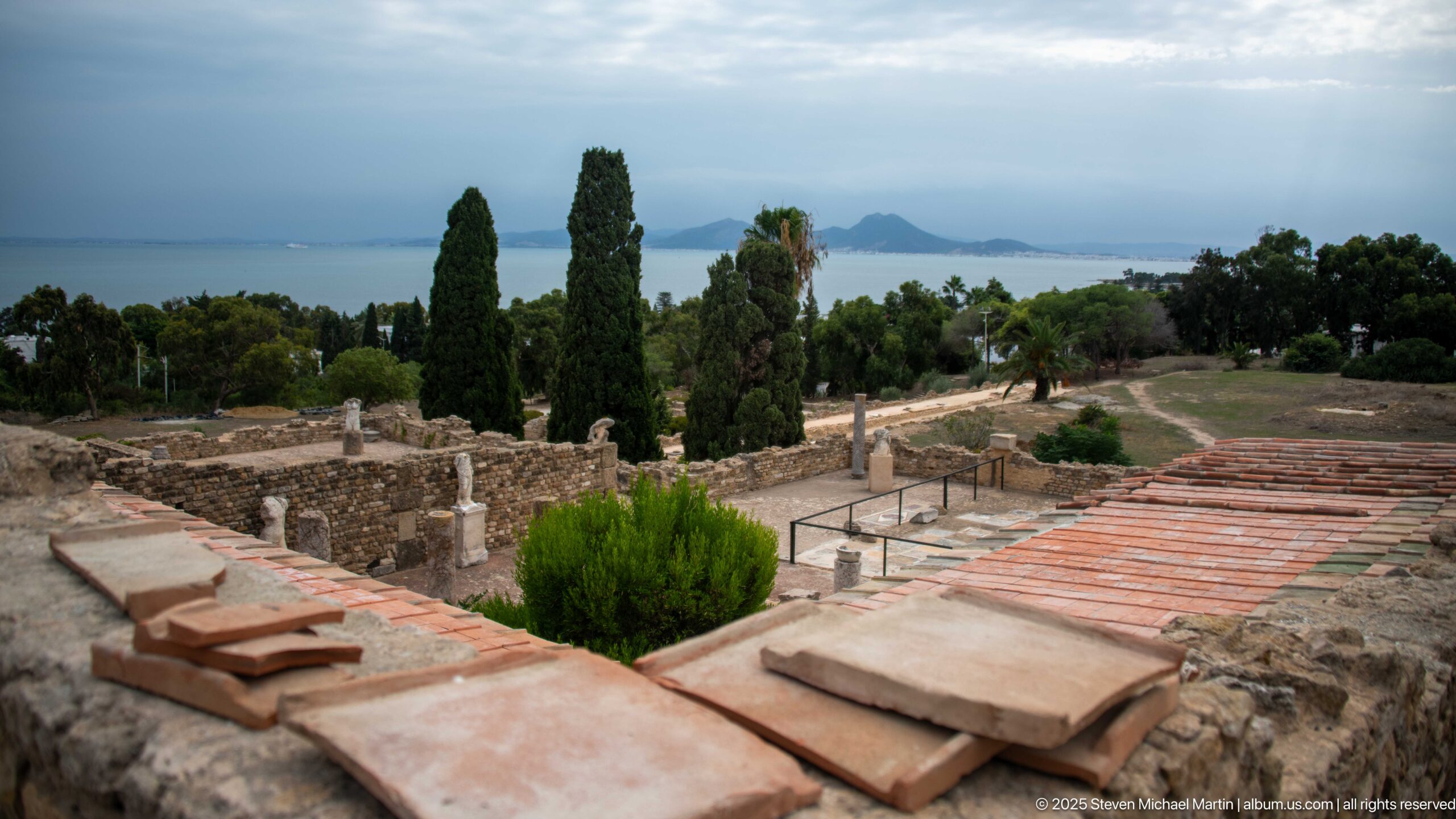
The Roman villa complex spreads across the foreground in an elevated view toward the Gulf of Tunis. Reconstructed roofing, columns, low walls, and excavated rooms occupy the slope, while cypresses and other trees frame the blue water and distant hills beyond. The composition connects elite domestic architecture with the commanding coastal landscape that formed part of ancient Carthage's setting.
Caption
The Roman villa complex spreads across the foreground in an elevated view toward the Gulf of Tunis. Reconstructed roofing, columns, low walls, and excavated rooms occupy the slope, while cypresses and other trees frame the blue water and distant hills beyond. The composition connects elite domestic architecture with the commanding coastal landscape that formed part of ancient Carthage's setting.
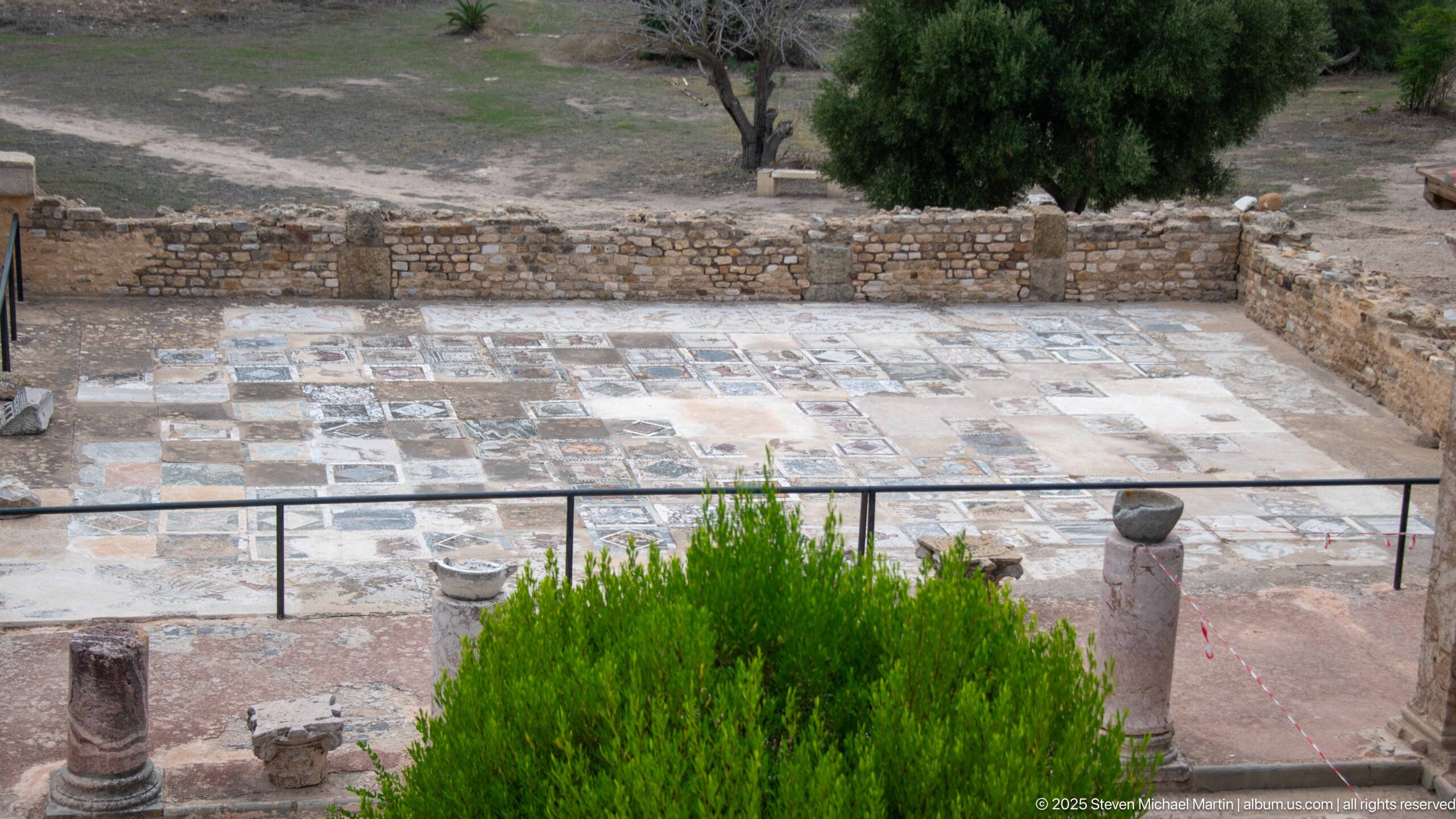
From above, a broad rectangular court in the Roman villa complex reveals a dense arrangement of mosaic and colored-stone pavement panels. Geometric fields, medallions, and differently toned stone sections form a patchwork across the floor, bounded by low walls and modern protective railings. The high viewpoint clarifies the overall scale of the pavement display and its relationship to the surrounding excavated architecture.
Caption
From above, a broad rectangular court in the Roman villa complex reveals a dense arrangement of mosaic and colored-stone pavement panels. Geometric fields, medallions, and differently toned stone sections form a patchwork across the floor, bounded by low walls and modern protective railings. The high viewpoint clarifies the overall scale of the pavement display and its relationship to the surrounding excavated architecture.
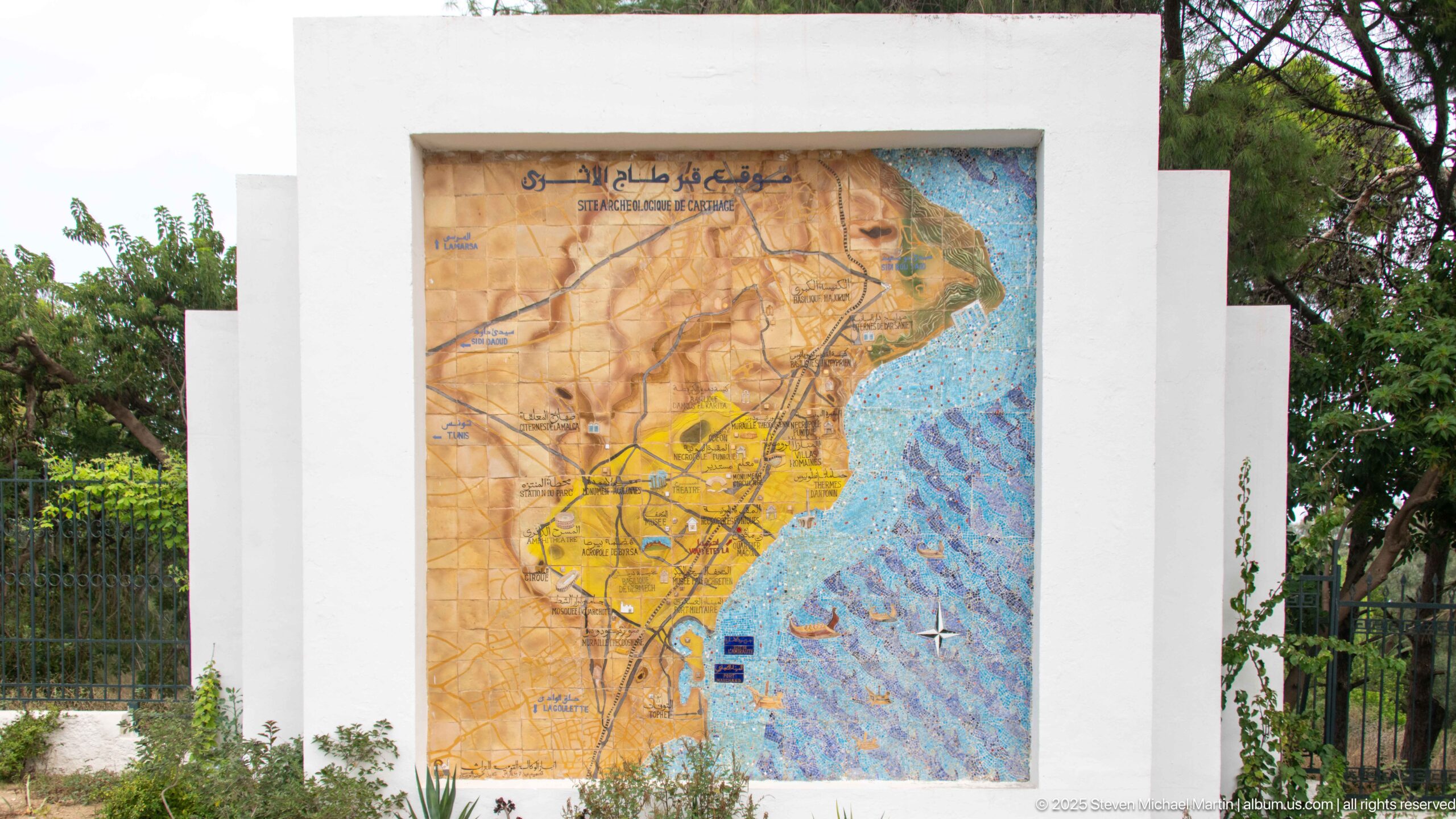
A large visitor map introduces the archaeological park of the Baths of Antoninus at Carthage, plotting paths, excavated sectors, the shoreline, and surrounding streets. Mounted outdoors near the entrance, it provides the spatial framework for the ruins that follow in the sequence. The plan is most useful as orientation evidence, showing how the bath complex and neighboring archaeological areas relate to the Mediterranean coast.
Caption
A large visitor map introduces the archaeological park of the Baths of Antoninus at Carthage, plotting paths, excavated sectors, the shoreline, and surrounding streets. Mounted outdoors near the entrance, it provides the spatial framework for the ruins that follow in the sequence. The plan is most useful as orientation evidence, showing how the bath complex and neighboring archaeological areas relate to the Mediterranean coast.
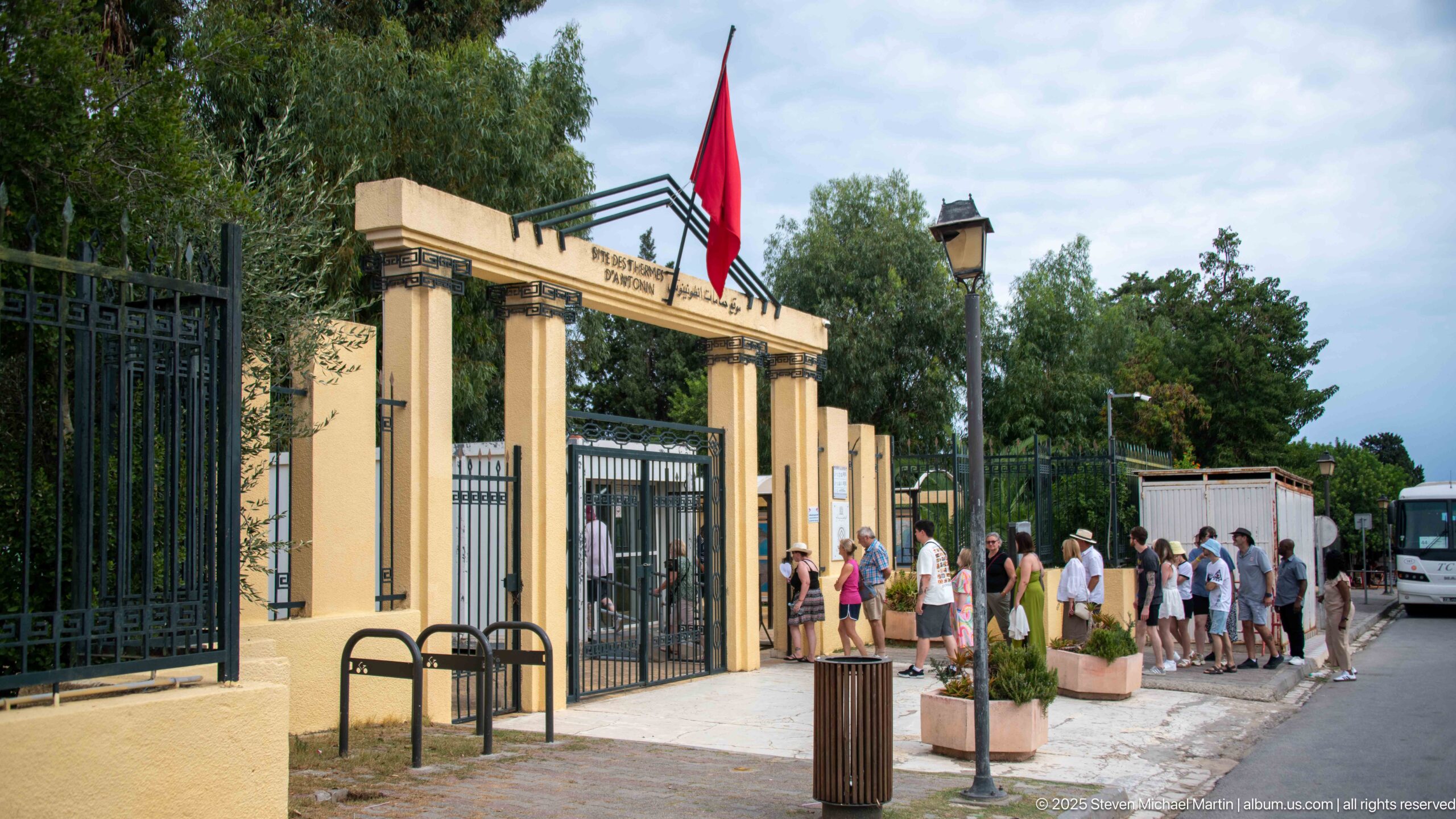
Visitors gather at the main entrance to the Baths of Antoninus, where a pale stone gateway and black iron fencing mark access to the archaeological park. A Tunisian flag rises above the entrance, and the site name is mounted across the gate structure. The image records the contemporary arrival experience before the sequence moves into interpretive panels and excavated remains.
Caption
Visitors gather at the main entrance to the Baths of Antoninus, where a pale stone gateway and black iron fencing mark access to the archaeological park. A Tunisian flag rises above the entrance, and the site name is mounted across the gate structure. The image records the contemporary arrival experience before the sequence moves into interpretive panels and excavated remains.
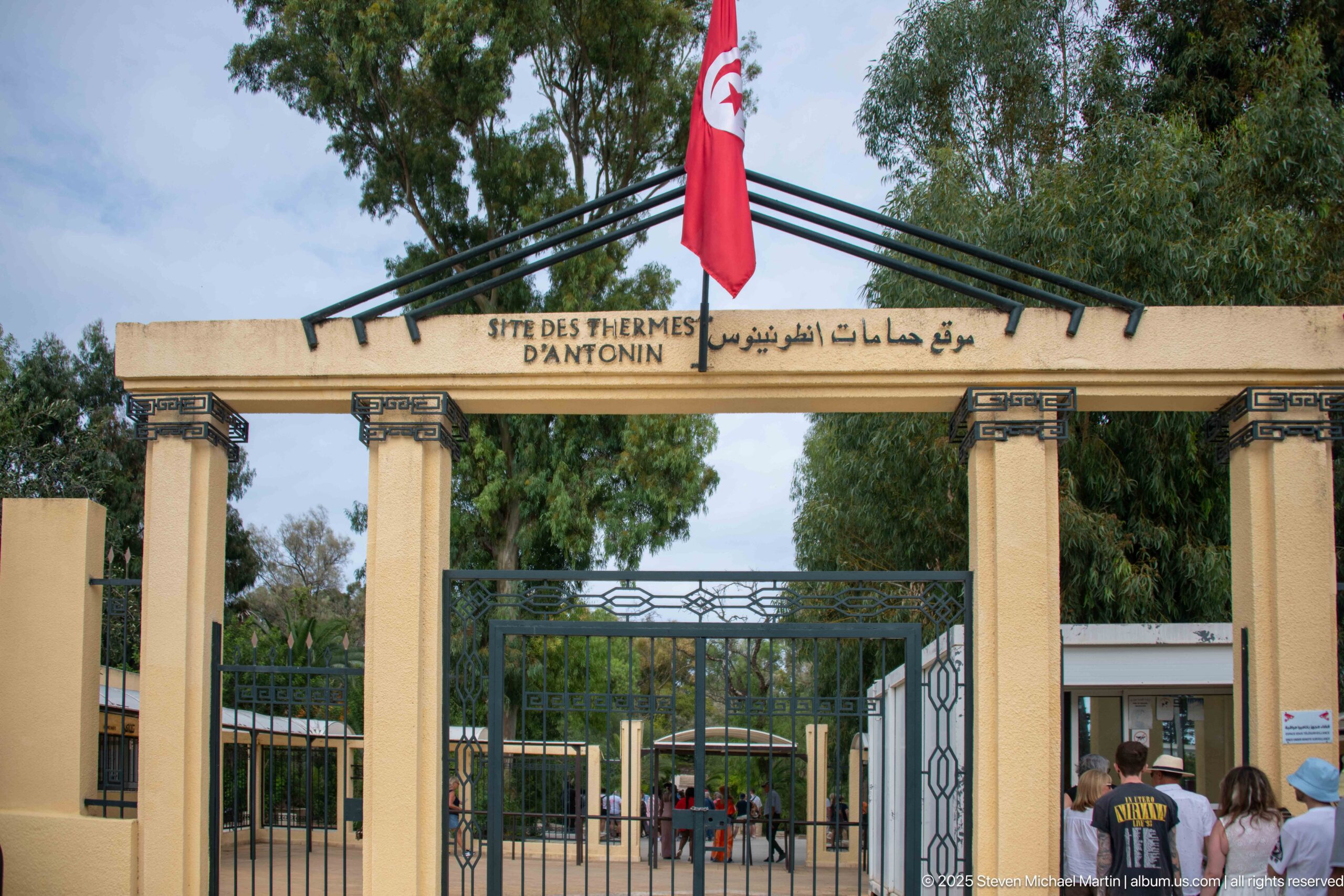
The entrance gateway bears the site name “Site des Thermes d’Antonin” in French alongside Arabic lettering, providing direct on-site confirmation of the archaeological complex. Classical-style columns support the horizontal entablature, while the Tunisian flag rises from the center. The tighter framing emphasizes the bilingual identification and formal gateway architecture rather than the visitor activity seen in the preceding image.
Caption
The entrance gateway bears the site name “Site des Thermes d’Antonin” in French alongside Arabic lettering, providing direct on-site confirmation of the archaeological complex. Classical-style columns support the horizontal entablature, while the Tunisian flag rises from the center. The tighter framing emphasizes the bilingual identification and formal gateway architecture rather than the visitor activity seen in the preceding image.
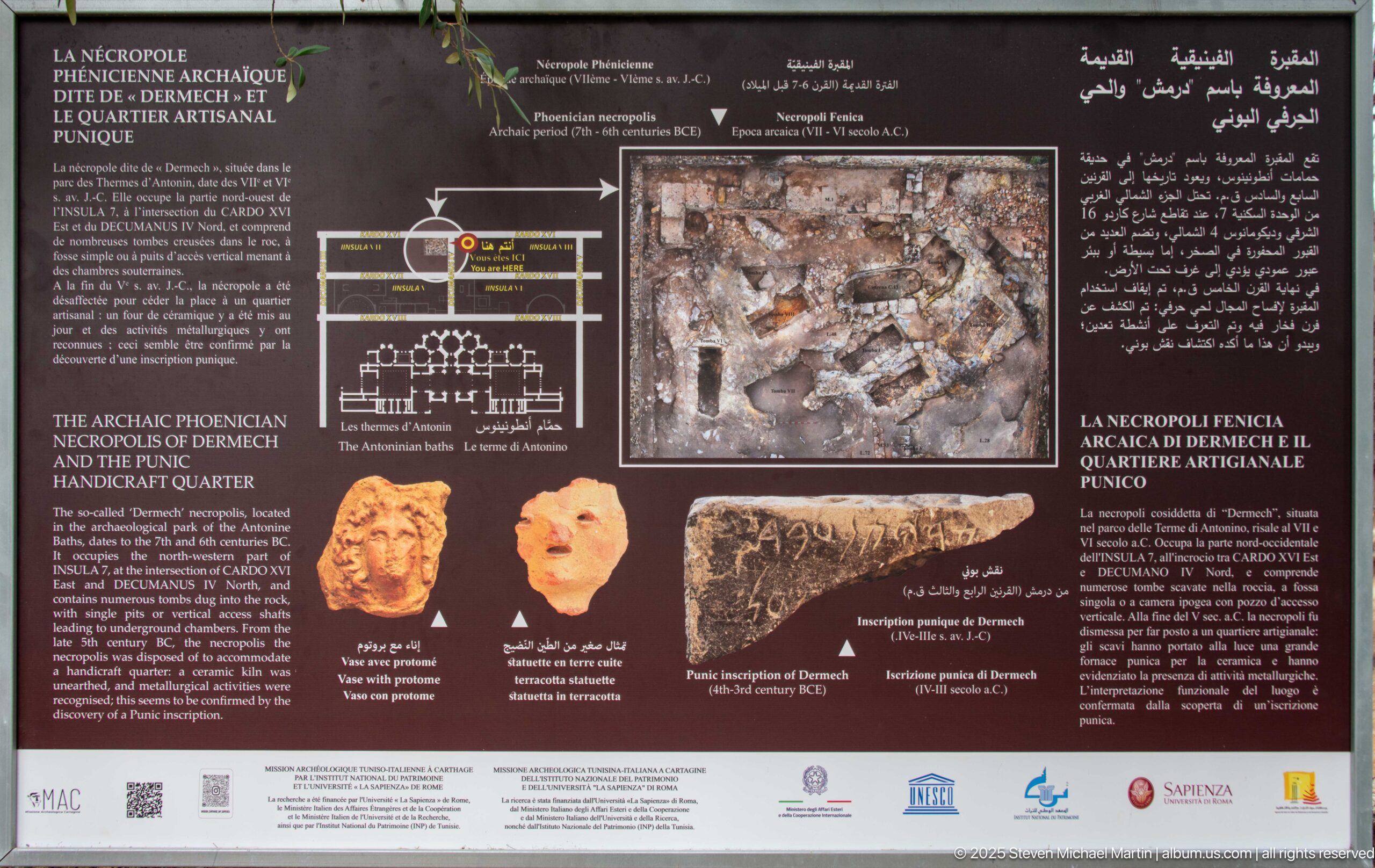
A multilingual interpretive panel presents the archaic Phoenician necropolis excavated within the Carthage archaeological area. Text, plans, artifact photographs, and burial imagery explain the cemetery and its archaeological context in Arabic, French, English, and other languages. The panel establishes that funerary remains form part of the visitor route near the Baths of Antoninus rather than every visible ruin belonging to the Roman bath complex.
Caption
A multilingual interpretive panel presents the archaic Phoenician necropolis excavated within the Carthage archaeological area. Text, plans, artifact photographs, and burial imagery explain the cemetery and its archaeological context in Arabic, French, English, and other languages. The panel establishes that funerary remains form part of the visitor route near the Baths of Antoninus rather than every visible ruin belonging to the Roman bath complex.
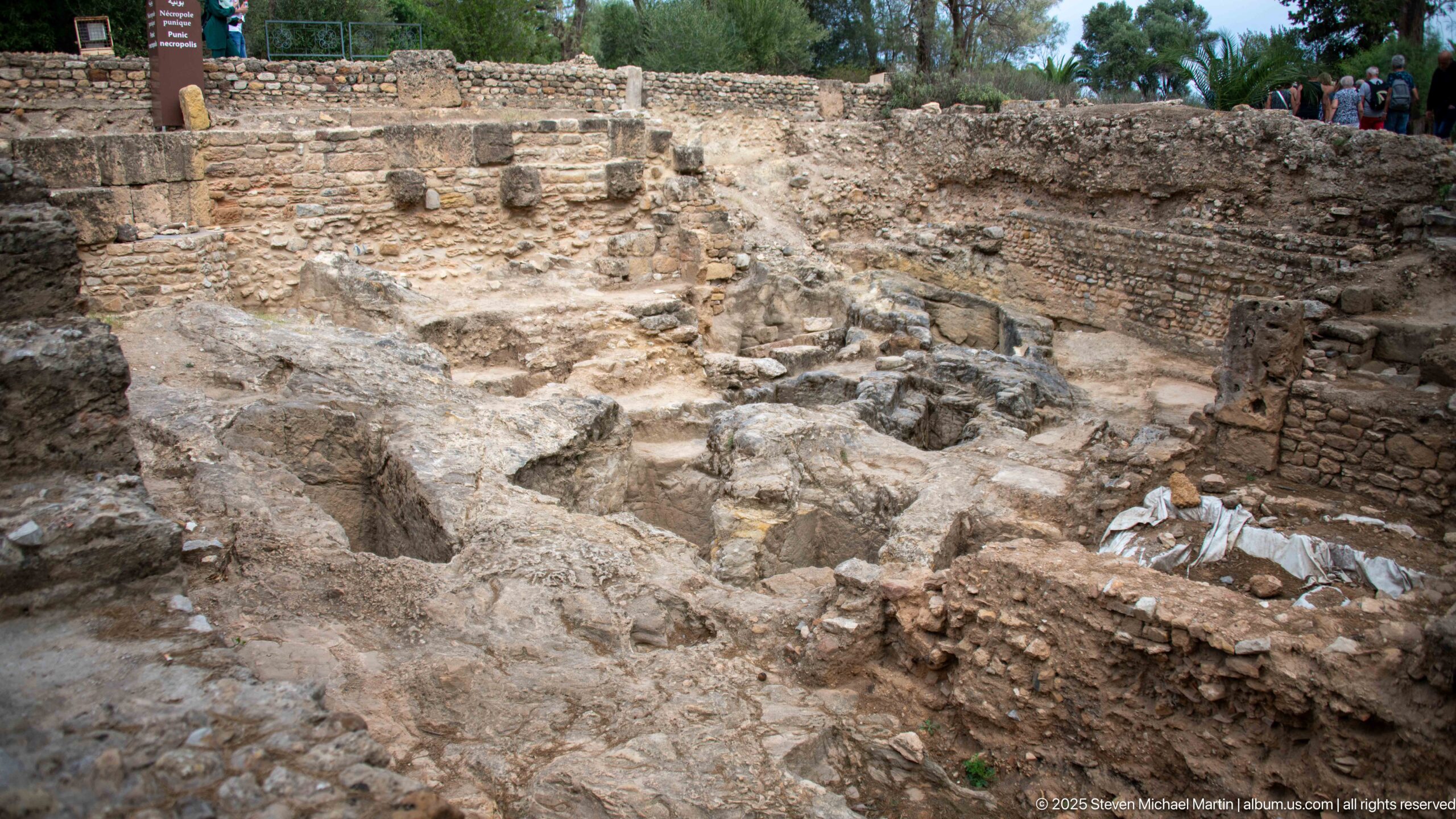
Excavated burial features occupy a dense area of cut bedrock and low masonry near the Baths of Antoninus. Rectangular and irregular shafts descend into the ground, while brick and stone walls define parts of the surrounding archaeological layers. Following the necropolis interpretation panel, the scene is best understood as a view of the archaic Phoenician funerary area rather than as rooms of the Roman baths.
Caption
Excavated burial features occupy a dense area of cut bedrock and low masonry near the Baths of Antoninus. Rectangular and irregular shafts descend into the ground, while brick and stone walls define parts of the surrounding archaeological layers. Following the necropolis interpretation panel, the scene is best understood as a view of the archaic Phoenician funerary area rather than as rooms of the Roman baths.
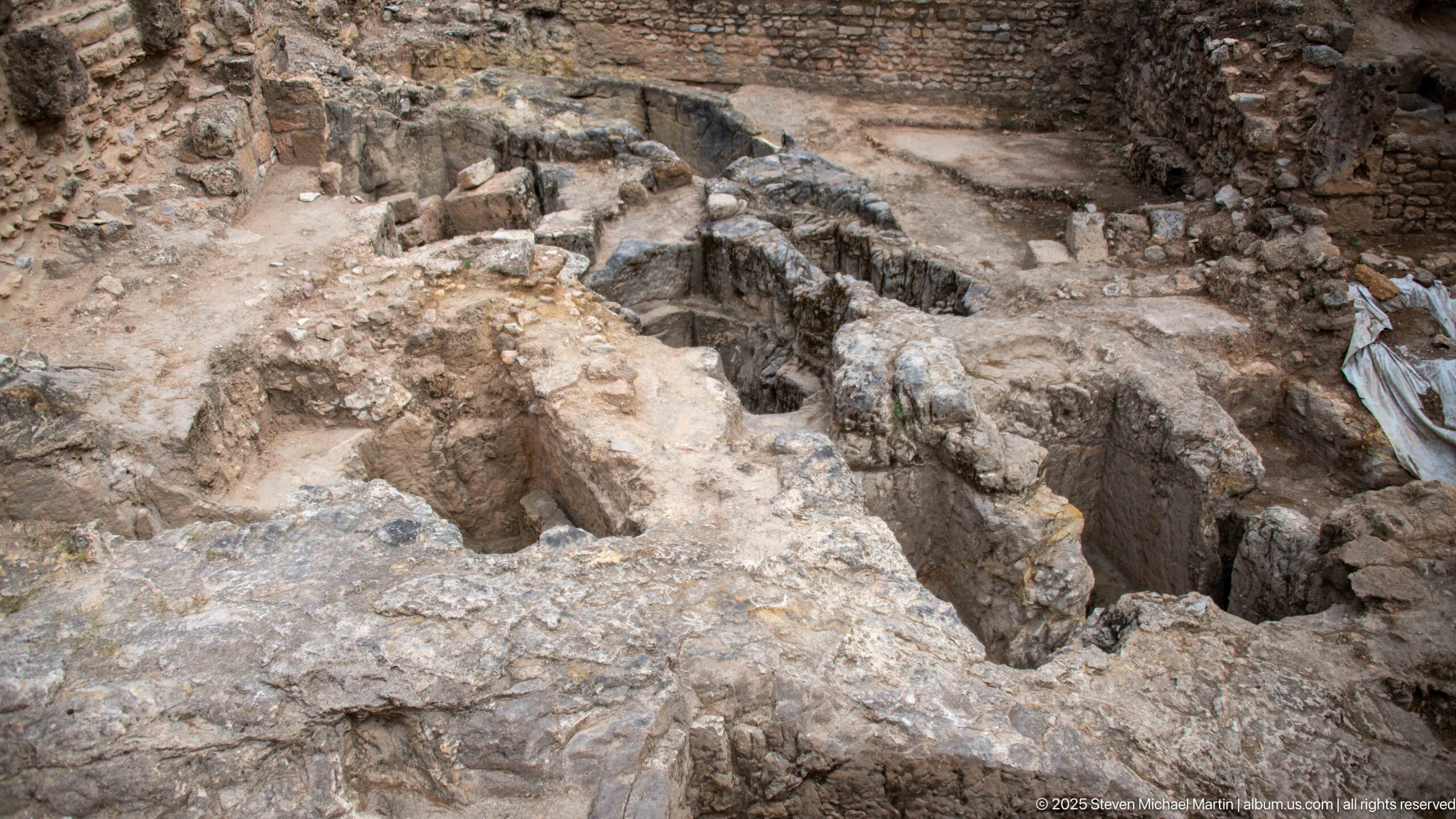
A closer elevated view isolates several rectangular shafts cut into the bedrock of the Phoenician necropolis at Carthage. Rough stone and brickwork survive between the openings, exposing the compact arrangement of burial features within the excavated cemetery. The tighter composition makes the depth and geometry of the graves more legible than the preceding overview while avoiding unsupported identification of individual tomb occupants.
Caption
A closer elevated view isolates several rectangular shafts cut into the bedrock of the Phoenician necropolis at Carthage. Rough stone and brickwork survive between the openings, exposing the compact arrangement of burial features within the excavated cemetery. The tighter composition makes the depth and geometry of the graves more legible than the preceding overview while avoiding unsupported identification of individual tomb occupants.
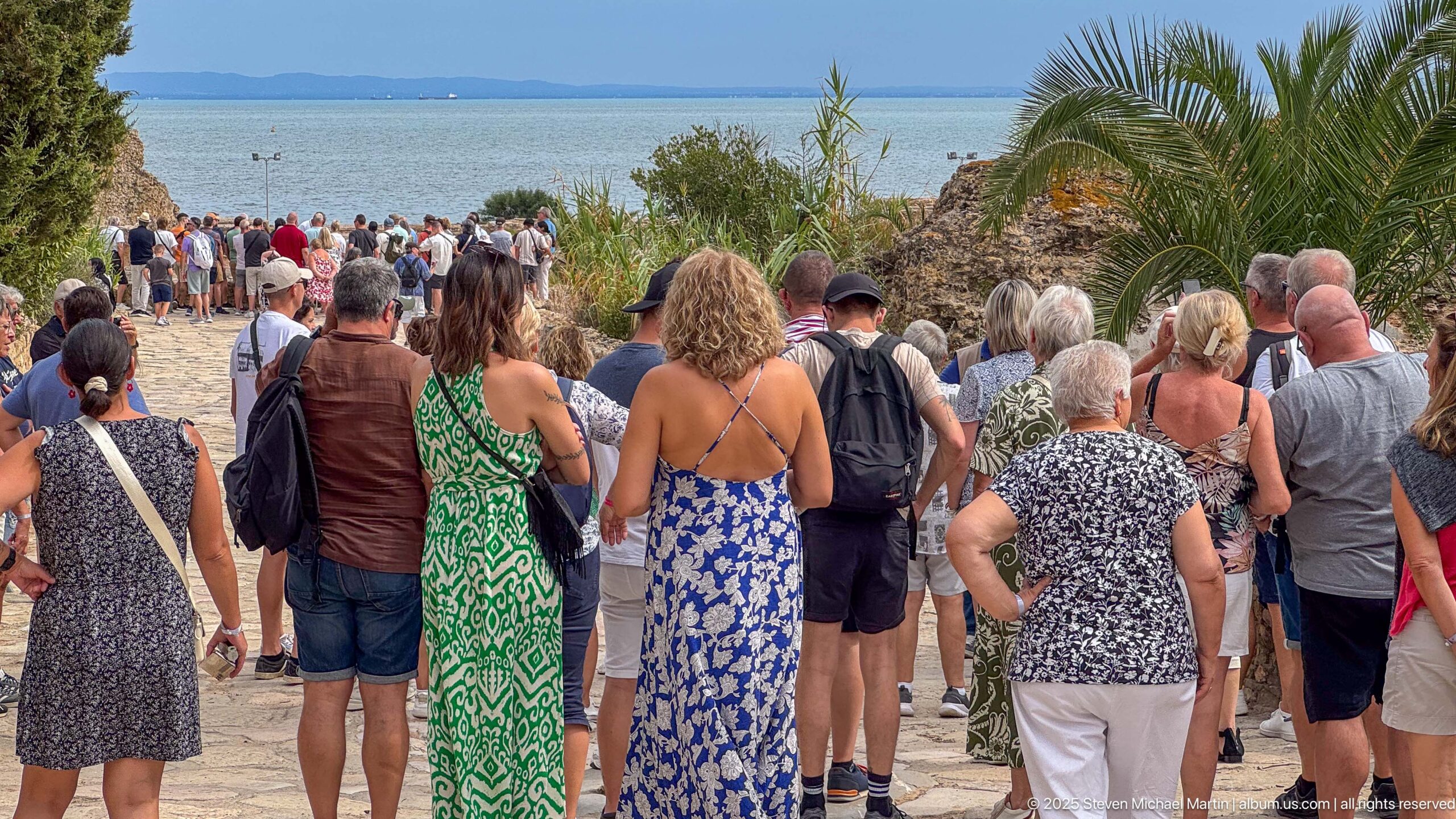
A large tour group moves downhill through the archaeological park toward the coastal ruins of the Baths of Antoninus. The Mediterranean fills the horizon beyond palms and masonry, making the site's relationship to the shoreline immediately apparent. Rather than isolating ancient architecture, the image records visitor circulation and the dramatic descent from the entrance area toward the monumental bath complex.
Caption
A large tour group moves downhill through the archaeological park toward the coastal ruins of the Baths of Antoninus. The Mediterranean fills the horizon beyond palms and masonry, making the site's relationship to the shoreline immediately apparent. Rather than isolating ancient architecture, the image records visitor circulation and the dramatic descent from the entrance area toward the monumental bath complex.
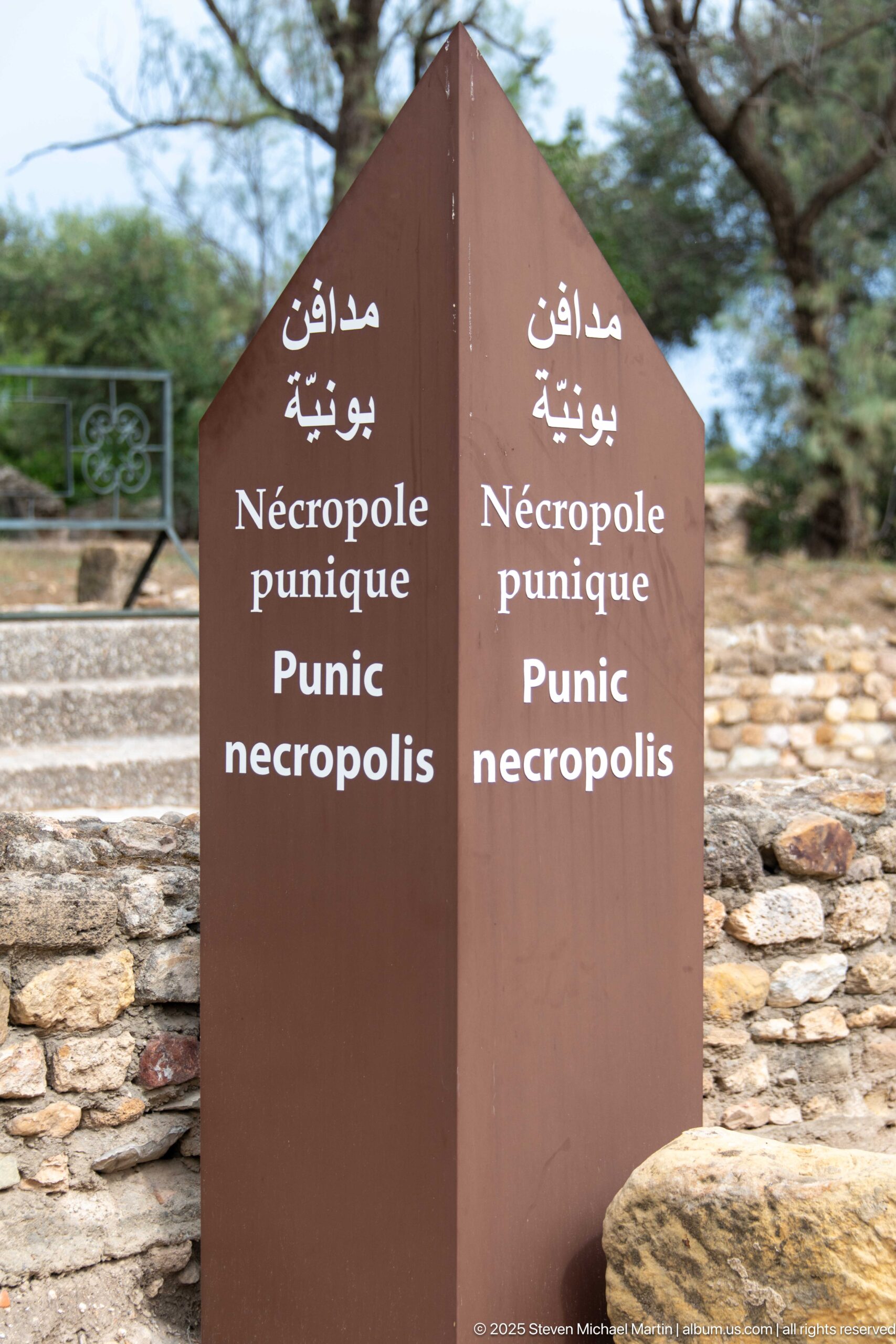
A brown wayfinding sign identifies the “Nécropole punique” and “Punic necropolis” in French and English, with Arabic above. Set among stone paving and archaeological remains, it confirms a distinct funerary zone within the wider Carthage site. The sign is important for separating Punic-period cemetery remains from the nearby Roman architecture of the Baths of Antoninus.
Caption
A brown wayfinding sign identifies the “Nécropole punique” and “Punic necropolis” in French and English, with Arabic above. Set among stone paving and archaeological remains, it confirms a distinct funerary zone within the wider Carthage site. The sign is important for separating Punic-period cemetery remains from the nearby Roman architecture of the Baths of Antoninus.
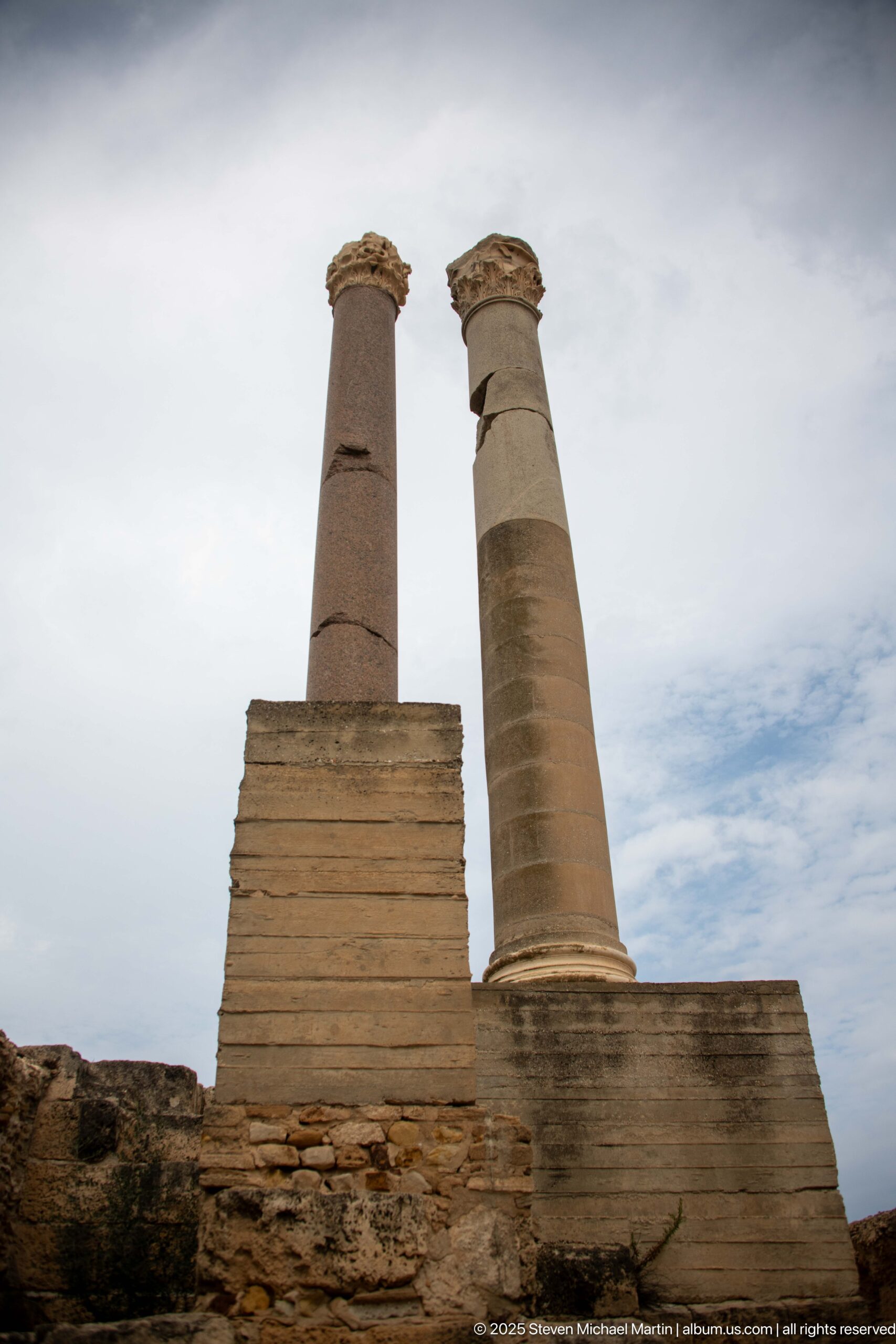
Two tall columns rise from a stepped reconstructed base at the Baths of Antoninus, preserving a sense of the vertical scale of the vanished upper architecture. One shaft appears more tapered and irregular than the other, and both retain simple capitals or upper moldings. Viewed from below against the sky, the pair becomes a sculptural landmark within the much lower field of surviving bath ruins.
Caption
Two tall columns rise from a stepped reconstructed base at the Baths of Antoninus, preserving a sense of the vertical scale of the vanished upper architecture. One shaft appears more tapered and irregular than the other, and both retain simple capitals or upper moldings. Viewed from below against the sky, the pair becomes a sculptural landmark within the much lower field of surviving bath ruins.
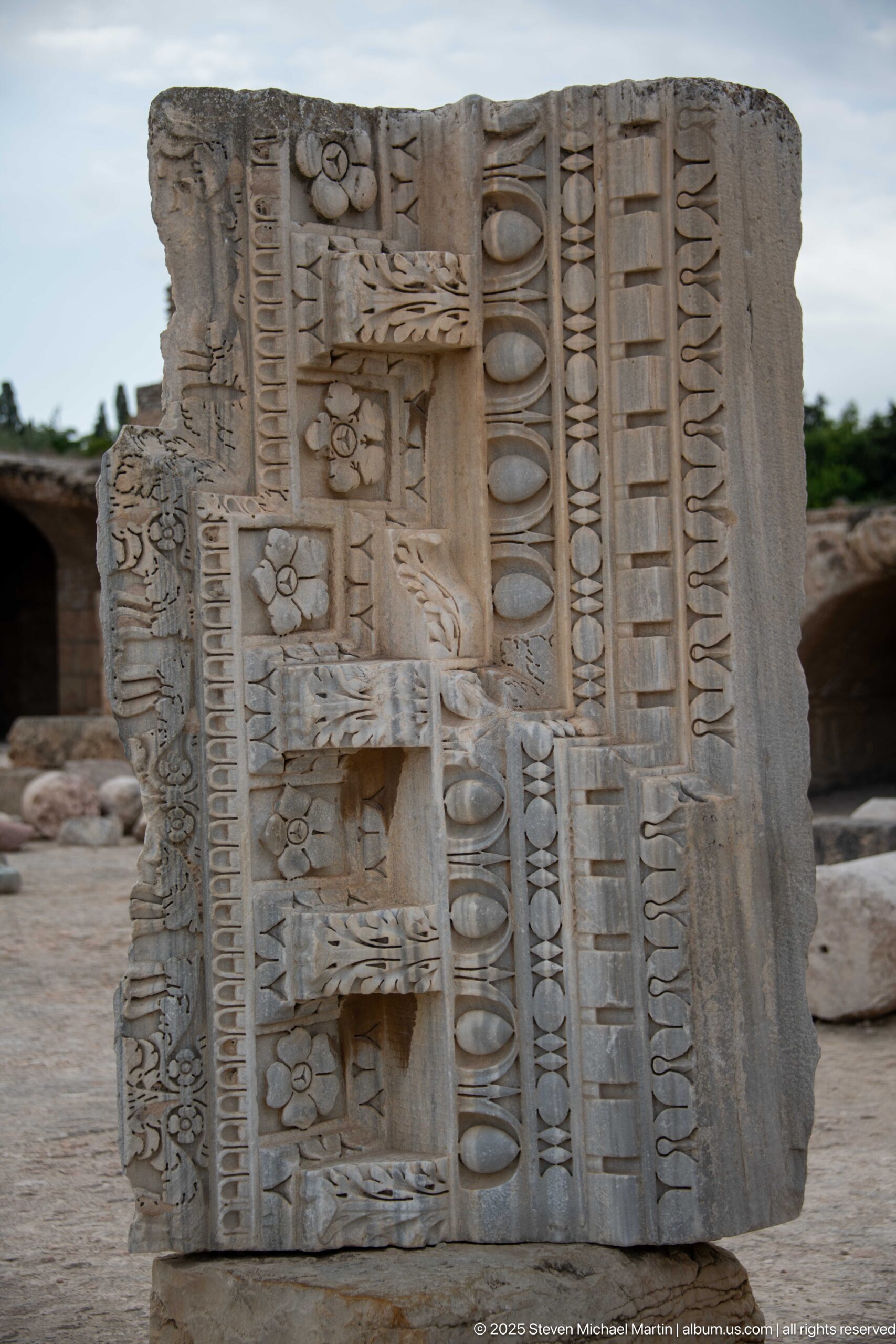
A large marble architectural fragment preserves a dense arrangement of classical moldings in crisp relief. Egg-and-dart bands, bead-and-reel patterns, rosettes, rectangular coffers, and other geometric motifs cover the surviving face, while broken edges expose its fragmentary condition. Displayed among the Antonine Baths ruins, the block offers a close material record of the elaborate decorative program once applied to the monumental complex.
Caption
A large marble architectural fragment preserves a dense arrangement of classical moldings in crisp relief. Egg-and-dart bands, bead-and-reel patterns, rosettes, rectangular coffers, and other geometric motifs cover the surviving face, while broken edges expose its fragmentary condition. Displayed among the Antonine Baths ruins, the block offers a close material record of the elaborate decorative program once applied to the monumental complex.
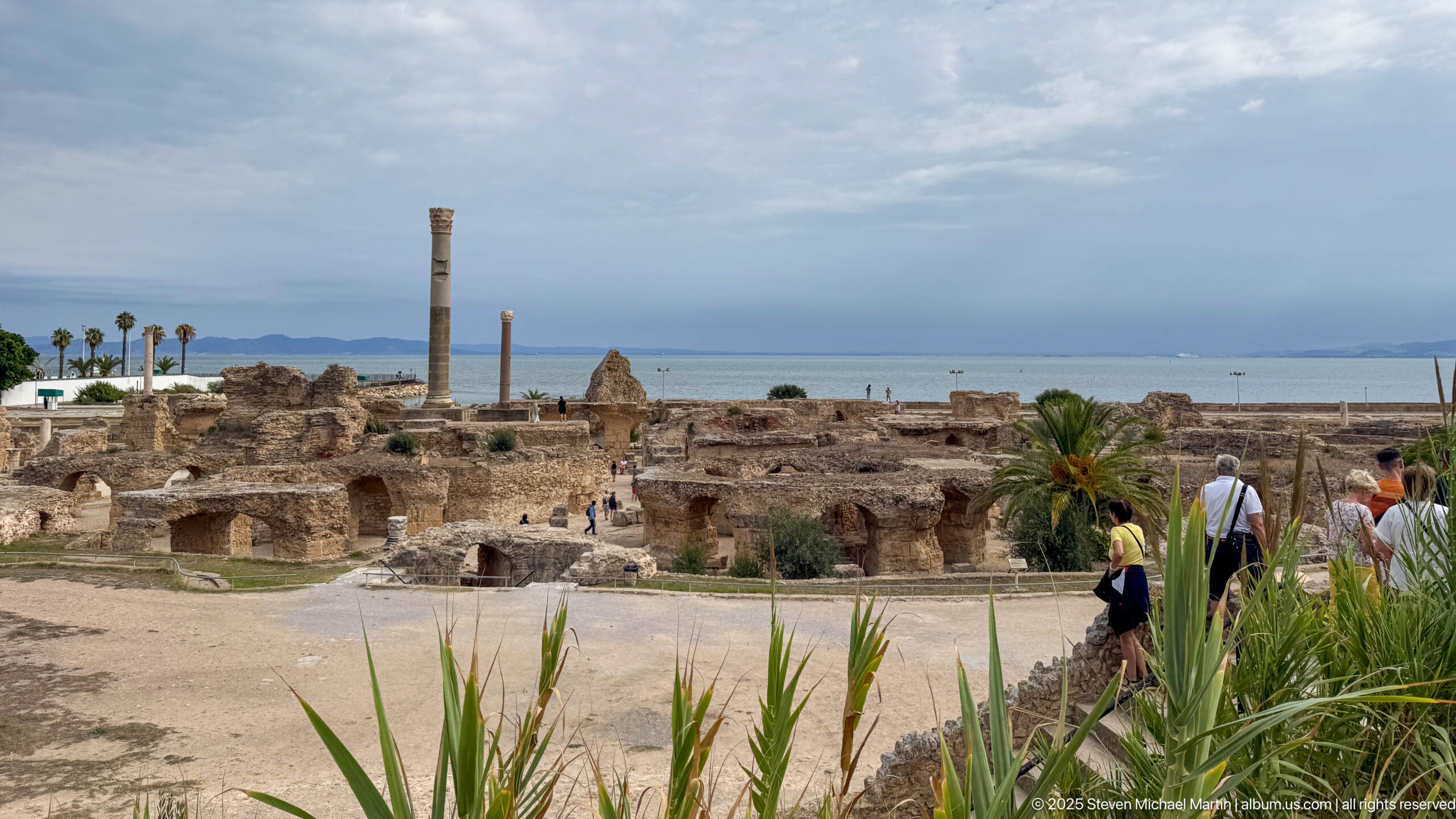
The Baths of Antoninus spread across the coastal terrace at Carthage, their massive foundations, vaulted substructures, and isolated columns extending toward the Mediterranean. The wide elevated view reveals the scale of the complex and its immediate relationship to the sea, while visitors moving through the ruins provide a sense of proportion. This is an establishing image of one of the site's most extensive Roman architectural ensembles.
Caption
The Baths of Antoninus spread across the coastal terrace at Carthage, their massive foundations, vaulted substructures, and isolated columns extending toward the Mediterranean. The wide elevated view reveals the scale of the complex and its immediate relationship to the sea, while visitors moving through the ruins provide a sense of proportion. This is an establishing image of one of the site's most extensive Roman architectural ensembles.
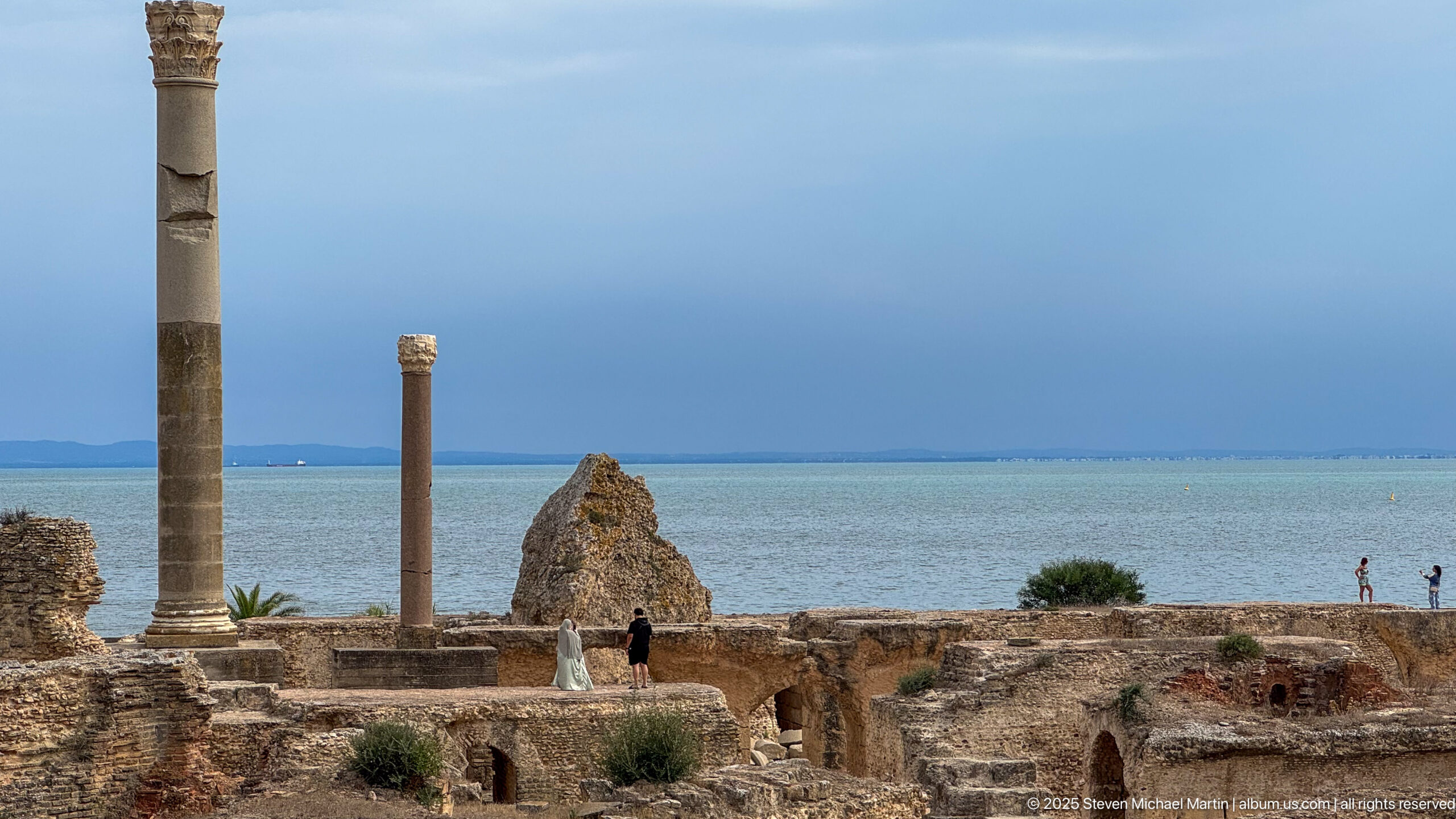
Two tall columns rise above the lower masonry of the Baths of Antoninus, forming prominent vertical markers against the Mediterranean. One carries a surviving capital, while the other is more slender and plain. Their height suggests the monumental scale of the vanished upper architecture, while the surrounding vaulted foundations preserve the dense structural core of the bath complex at ground level.
Caption
Two tall columns rise above the lower masonry of the Baths of Antoninus, forming prominent vertical markers against the Mediterranean. One carries a surviving capital, while the other is more slender and plain. Their height suggests the monumental scale of the vanished upper architecture, while the surrounding vaulted foundations preserve the dense structural core of the bath complex at ground level.
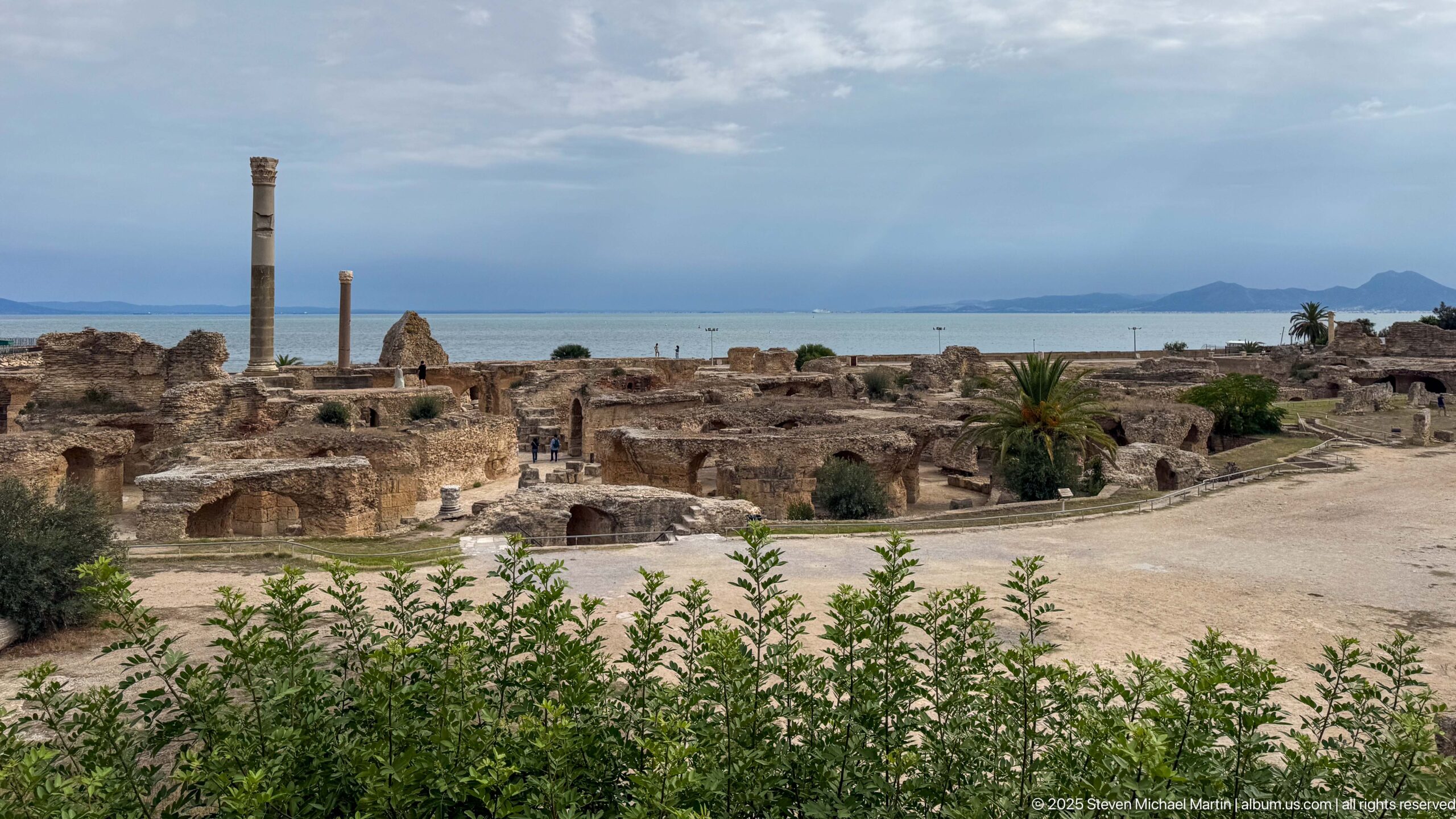
A broad panorama looks across the low vaulted remains of the Baths of Antoninus toward the Mediterranean and distant hills. The surviving substructures form a dense field of arches, chambers, and wall masses, with isolated columns punctuating the skyline. The composition gives priority to the bath complex's coastal setting and horizontal extent rather than any single architectural fragment.
Caption
A broad panorama looks across the low vaulted remains of the Baths of Antoninus toward the Mediterranean and distant hills. The surviving substructures form a dense field of arches, chambers, and wall masses, with isolated columns punctuating the skyline. The composition gives priority to the bath complex's coastal setting and horizontal extent rather than any single architectural fragment.
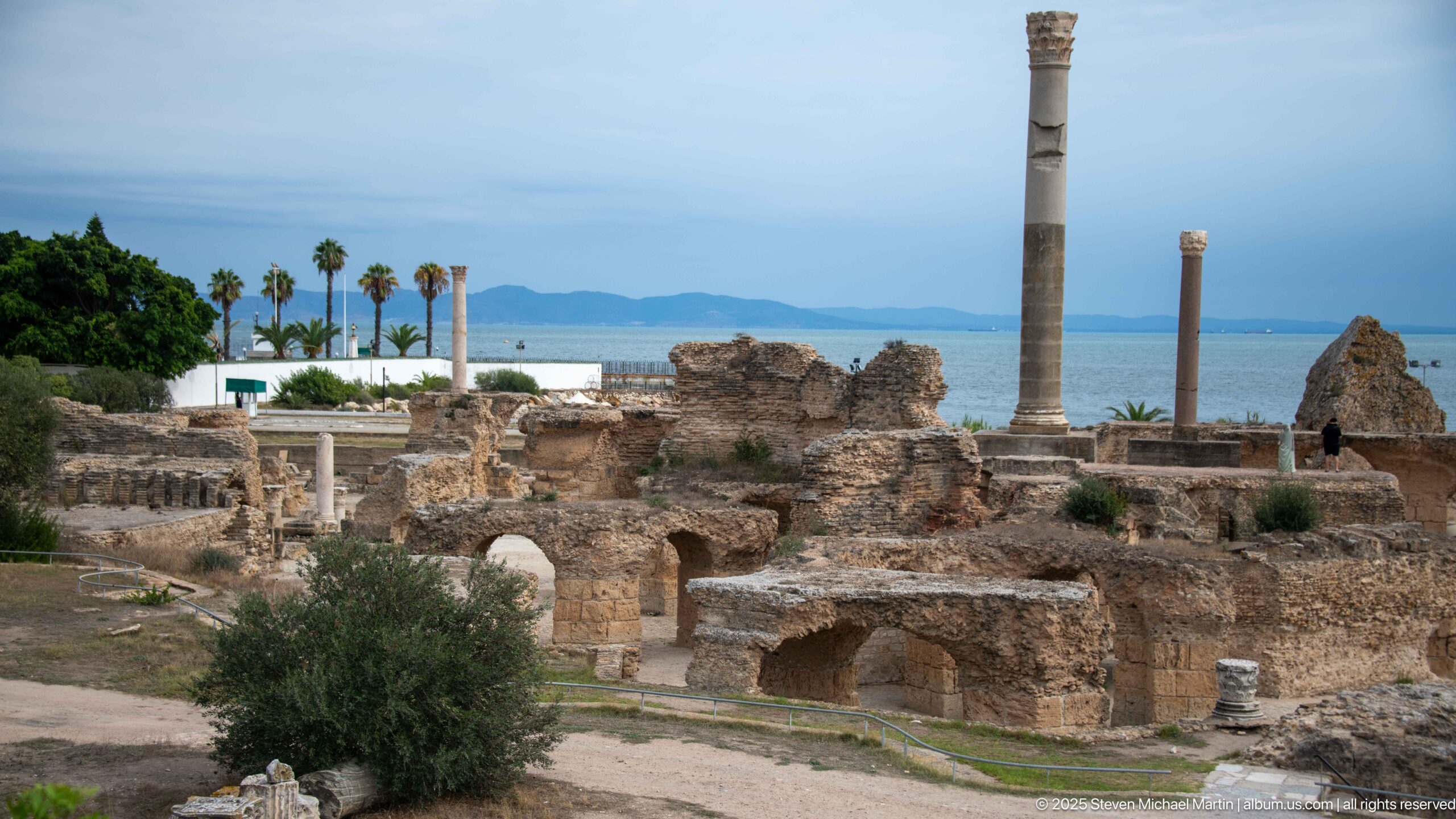
Massive vaulted foundations dominate this view of the Baths of Antoninus, with tall columns rising behind the broken walls. Arched openings lead through thick masonry that once supported the upper bath halls, while palms and the Mediterranean establish the coastal environment. The image is particularly effective at showing the contrast between the surviving lower structural system and the largely vanished monumental superstructure.
Caption
Massive vaulted foundations dominate this view of the Baths of Antoninus, with tall columns rising behind the broken walls. Arched openings lead through thick masonry that once supported the upper bath halls, while palms and the Mediterranean establish the coastal environment. The image is particularly effective at showing the contrast between the surviving lower structural system and the largely vanished monumental superstructure.
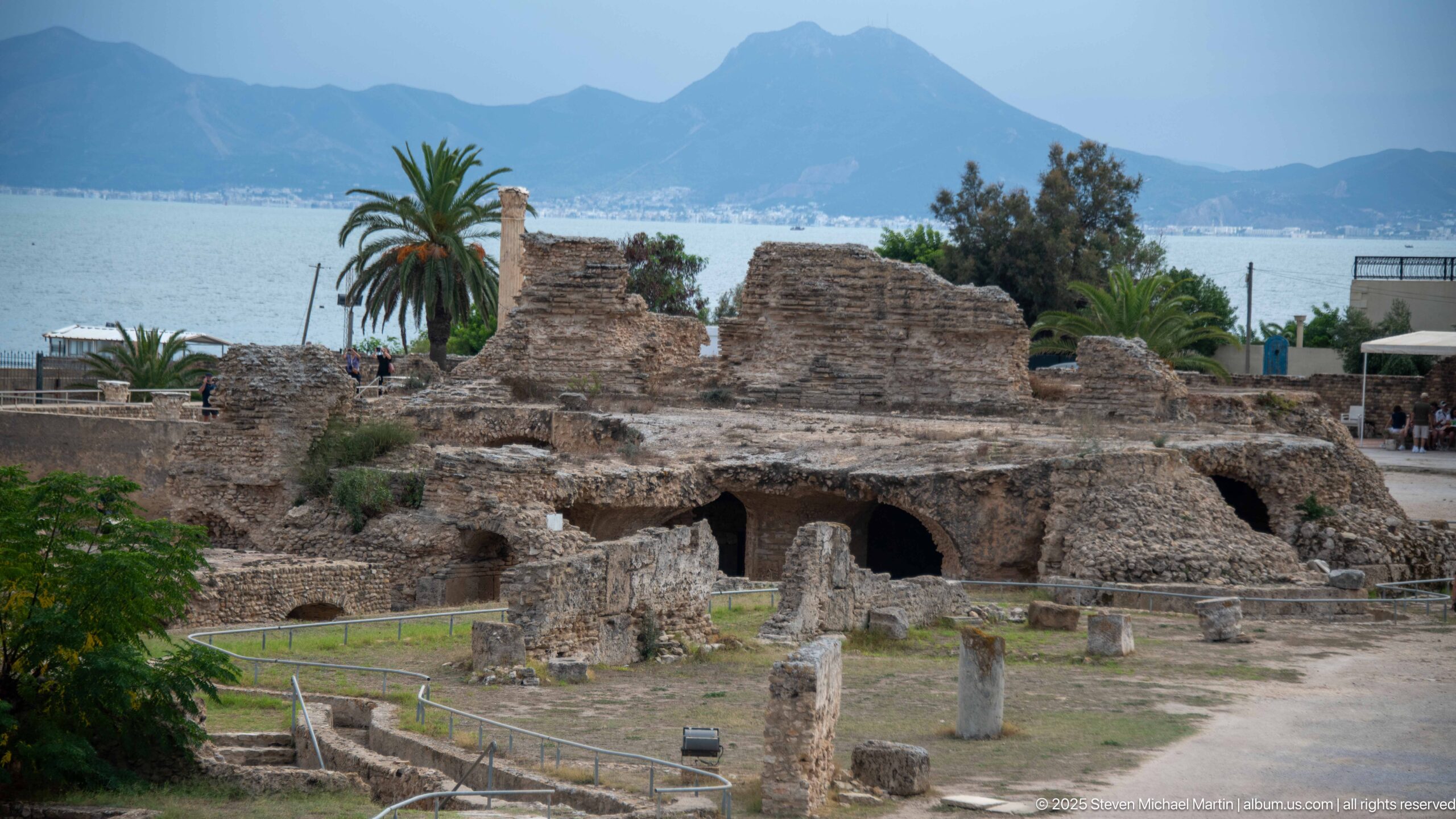
The vaulted substructures of the Baths of Antoninus fill the foreground while the Gulf of Tunis and the twin-peaked profile of Bou Kornine rise beyond. Palms and modern buildings occupy the narrow coastal strip between archaeology and mountain. The composition places the Roman complex within a much larger geographic setting, connecting the monumental baths to the landscape of the Gulf of Tunis.
Caption
The vaulted substructures of the Baths of Antoninus fill the foreground while the Gulf of Tunis and the twin-peaked profile of Bou Kornine rise beyond. Palms and modern buildings occupy the narrow coastal strip between archaeology and mountain. The composition places the Roman complex within a much larger geographic setting, connecting the monumental baths to the landscape of the Gulf of Tunis.
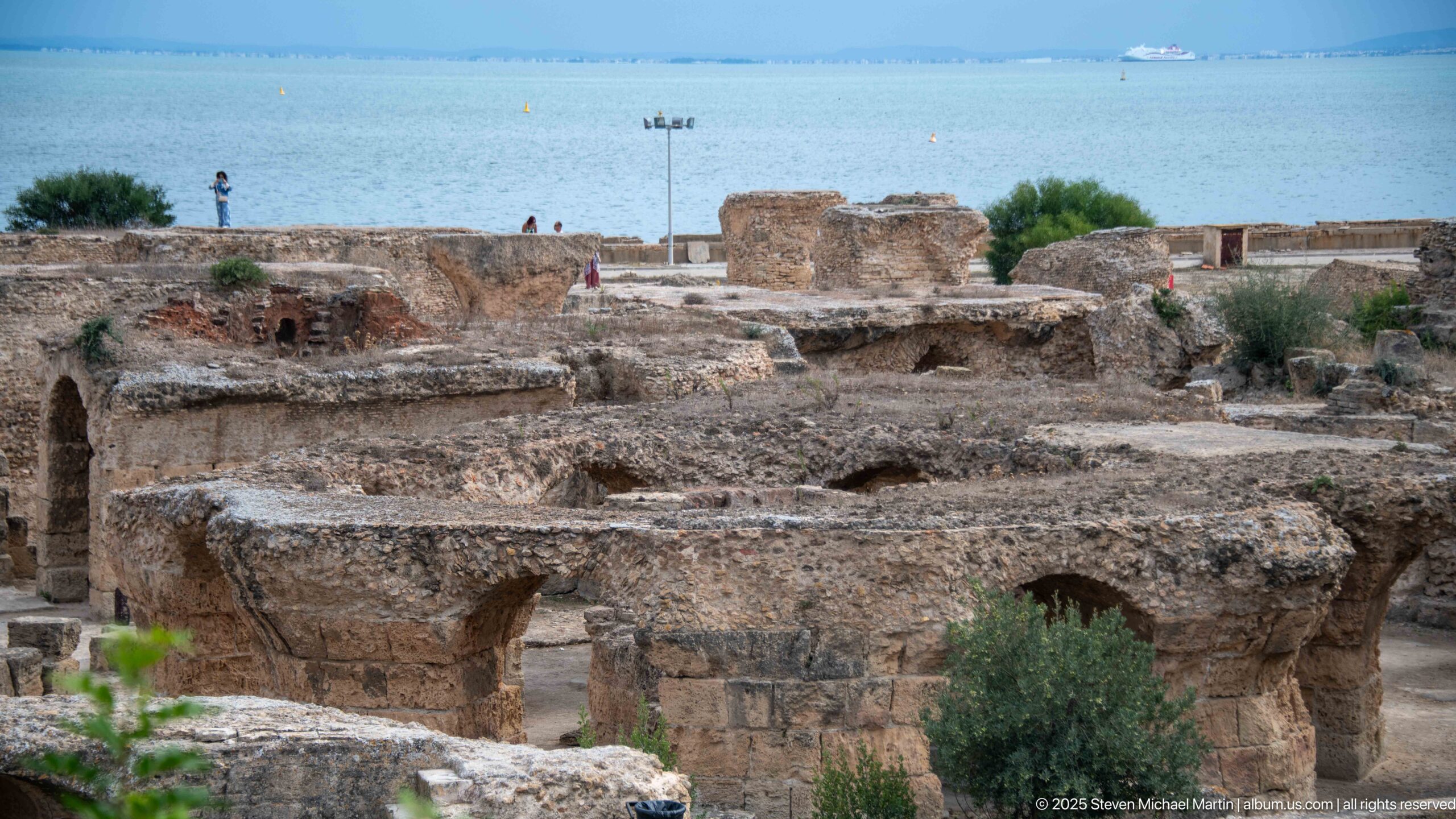
A dense network of arches and wall masses survives in the lower levels of the Baths of Antoninus. Repeated barrel-vaulted openings create overlapping passages through the ruins, while the sea appears just beyond the archaeological terrace. The view emphasizes the complexity of the bath's support spaces and foundations, where substantial Roman engineering remains far more complete than the vanished upper halls.
Caption
A dense network of arches and wall masses survives in the lower levels of the Baths of Antoninus. Repeated barrel-vaulted openings create overlapping passages through the ruins, while the sea appears just beyond the archaeological terrace. The view emphasizes the complexity of the bath's support spaces and foundations, where substantial Roman engineering remains far more complete than the vanished upper halls.
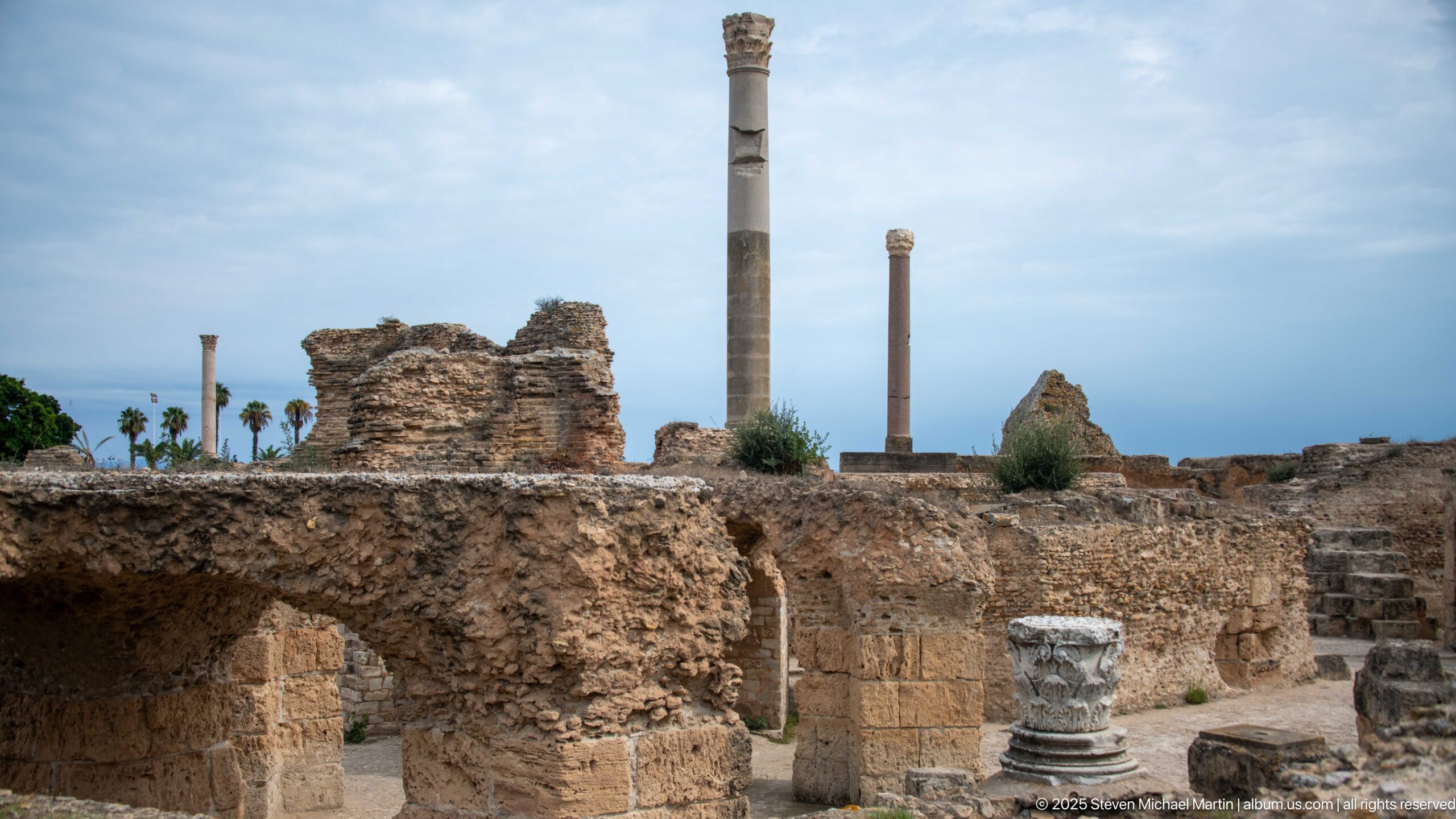
Two tall columns dominate the skyline above the Baths of Antoninus, while a carved capital fragment sits low in the foreground among arched masonry. Their survival provides a vertical measure of the original bath architecture against the much lower remains of the supporting chambers. The layered composition brings together structural ruins and decorative stonework within a single view of the monumental Roman complex.
Caption
Two tall columns dominate the skyline above the Baths of Antoninus, while a carved capital fragment sits low in the foreground among arched masonry. Their survival provides a vertical measure of the original bath architecture against the much lower remains of the supporting chambers. The layered composition brings together structural ruins and decorative stonework within a single view of the monumental Roman complex.
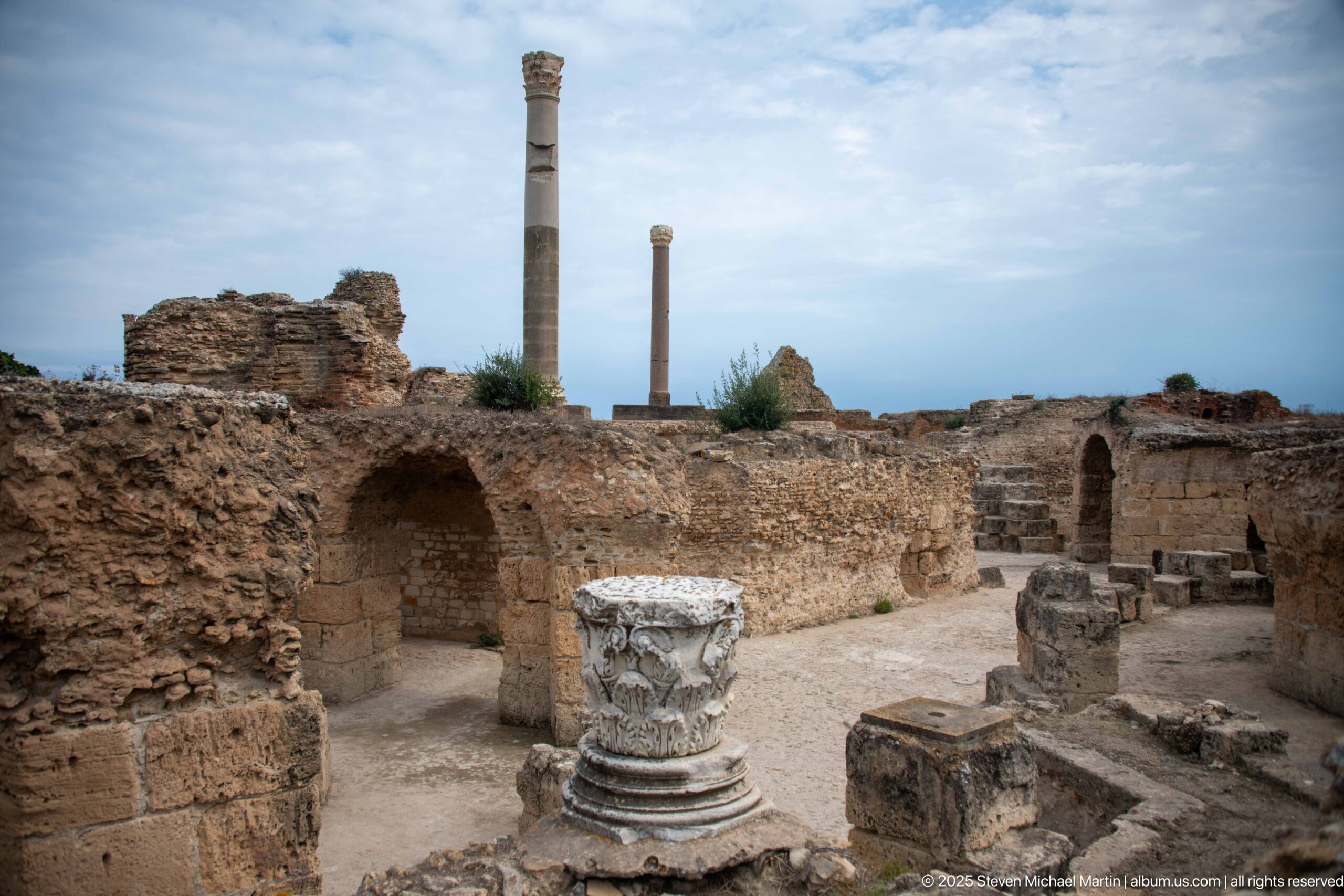
A large carved capital occupies the foreground of the Baths of Antoninus, its weathered acanthus leaves and classical moldings still visible above a rounded base. Behind it, arched chambers and tall standing columns place the fragment within the monumental bath complex. The image combines decorative detail with architectural context, showing the scale and refinement of stone elements once incorporated into the baths.
Caption
A large carved capital occupies the foreground of the Baths of Antoninus, its weathered acanthus leaves and classical moldings still visible above a rounded base. Behind it, arched chambers and tall standing columns place the fragment within the monumental bath complex. The image combines decorative detail with architectural context, showing the scale and refinement of stone elements once incorporated into the baths.
A corridor-like passage runs between thick stone walls in the lower levels of the Baths of Antoninus. Arched openings lead into adjacent chambers, while scattered blocks and a carved capital fragment remain along the route. The low viewpoint conveys how visitors move through the surviving structural core of the baths and makes the thickness of the Roman masonry particularly apparent.
Caption
A corridor-like passage runs between thick stone walls in the lower levels of the Baths of Antoninus. Arched openings lead into adjacent chambers, while scattered blocks and a carved capital fragment remain along the route. The low viewpoint conveys how visitors move through the surviving structural core of the baths and makes the thickness of the Roman masonry particularly apparent.
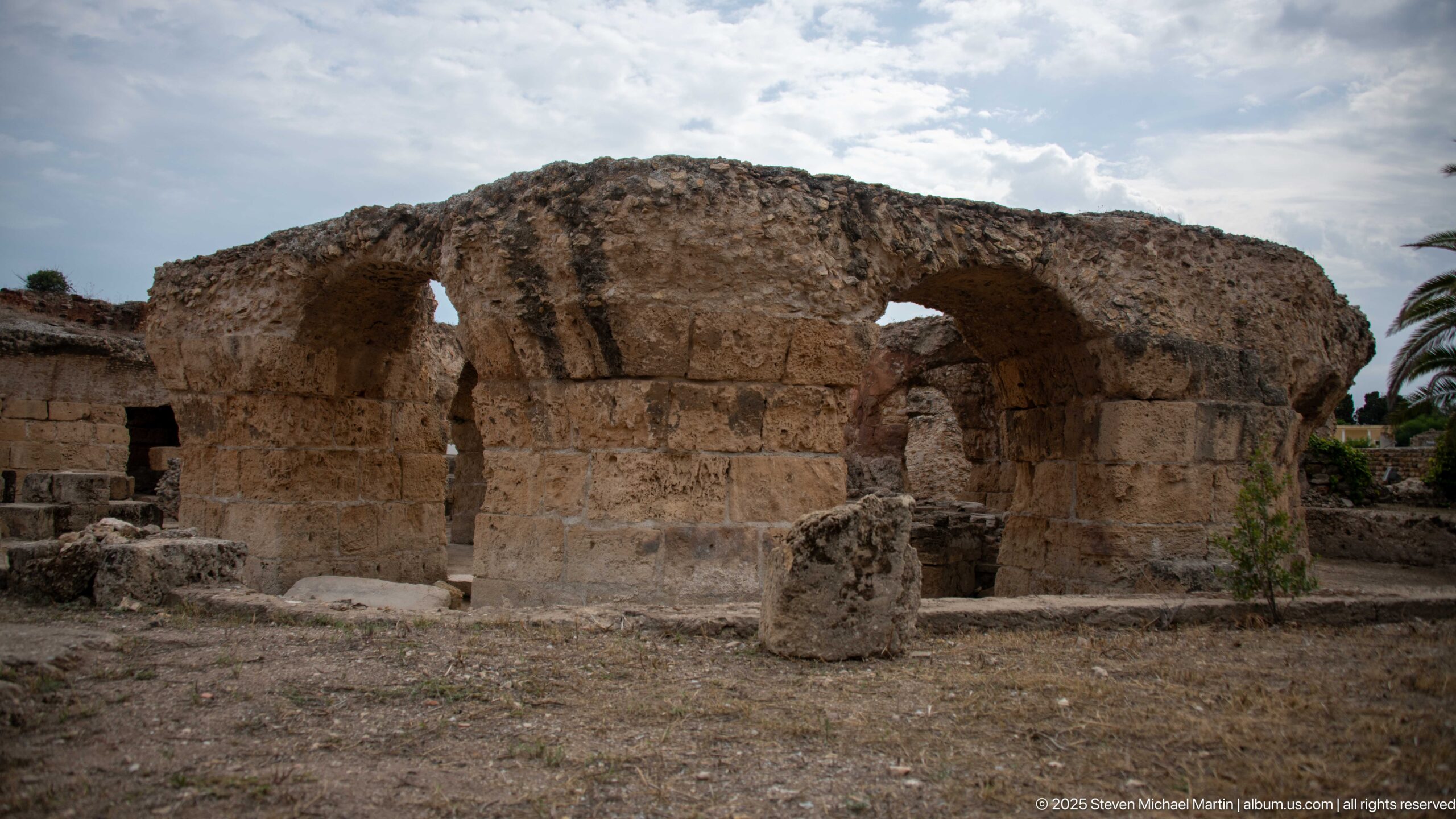
Massive masonry piers support a sequence of rounded arches within the Baths of Antoninus, creating a powerful rhythm of openings through the surviving substructure. Irregular rubble construction caps larger squared stone blocks at the lower levels, revealing different textures within the Roman fabric. The close architectural view strips away most of the coastal context to focus on load-bearing form and spatial repetition.
Caption
Massive masonry piers support a sequence of rounded arches within the Baths of Antoninus, creating a powerful rhythm of openings through the surviving substructure. Irregular rubble construction caps larger squared stone blocks at the lower levels, revealing different textures within the Roman fabric. The close architectural view strips away most of the coastal context to focus on load-bearing form and spatial repetition.
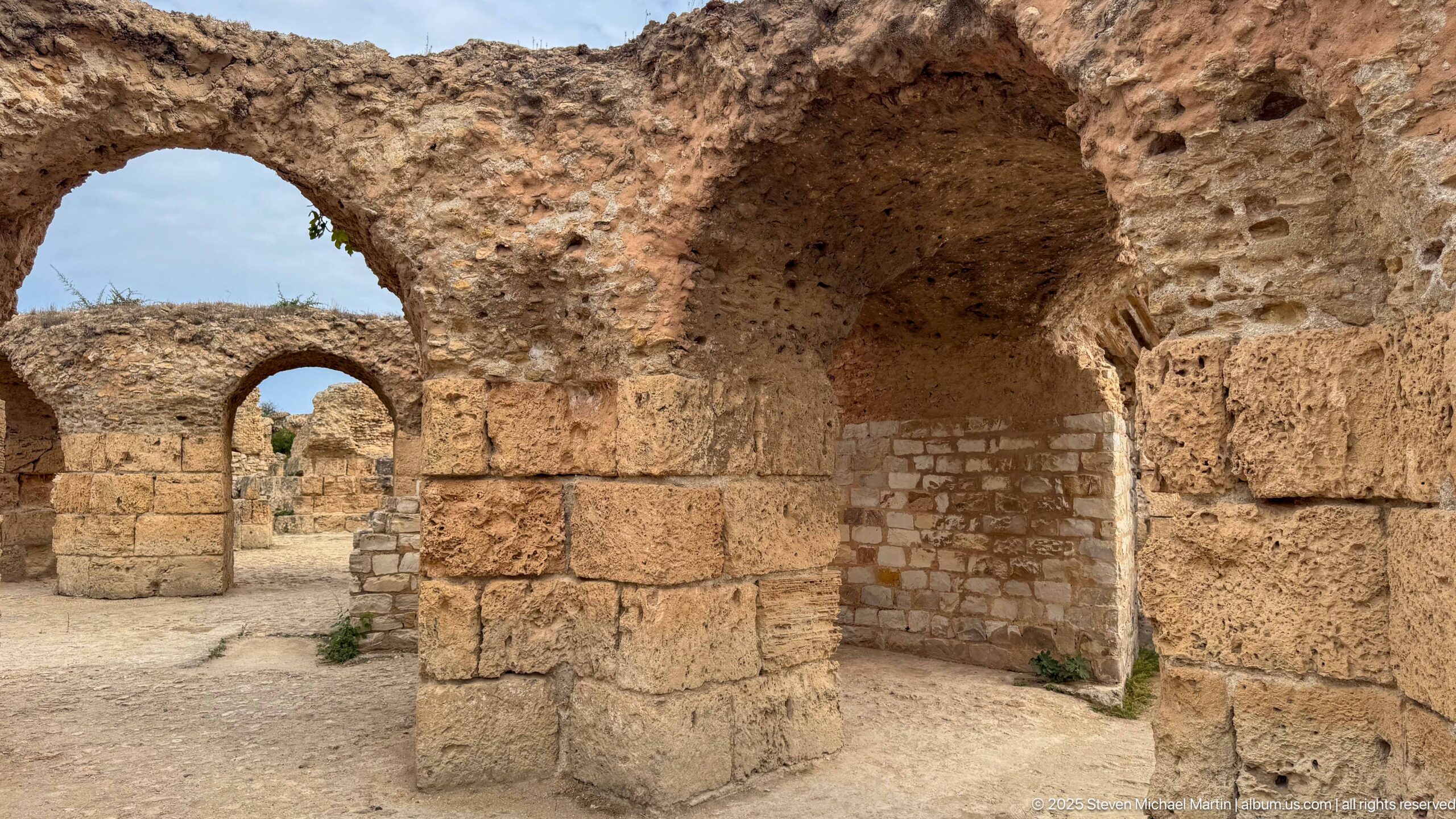
Rounded arches open through thick stone piers in the lower levels of the Baths of Antoninus, forming a sequence of connected bays. The foreground arch frames a second opening beyond, emphasizing the depth and repetition of the surviving substructure. Large squared blocks at the pier bases contrast with rougher rubble masonry above, making the Roman construction technique especially legible.
Caption
Rounded arches open through thick stone piers in the lower levels of the Baths of Antoninus, forming a sequence of connected bays. The foreground arch frames a second opening beyond, emphasizing the depth and repetition of the surviving substructure. Large squared blocks at the pier bases contrast with rougher rubble masonry above, making the Roman construction technique especially legible.
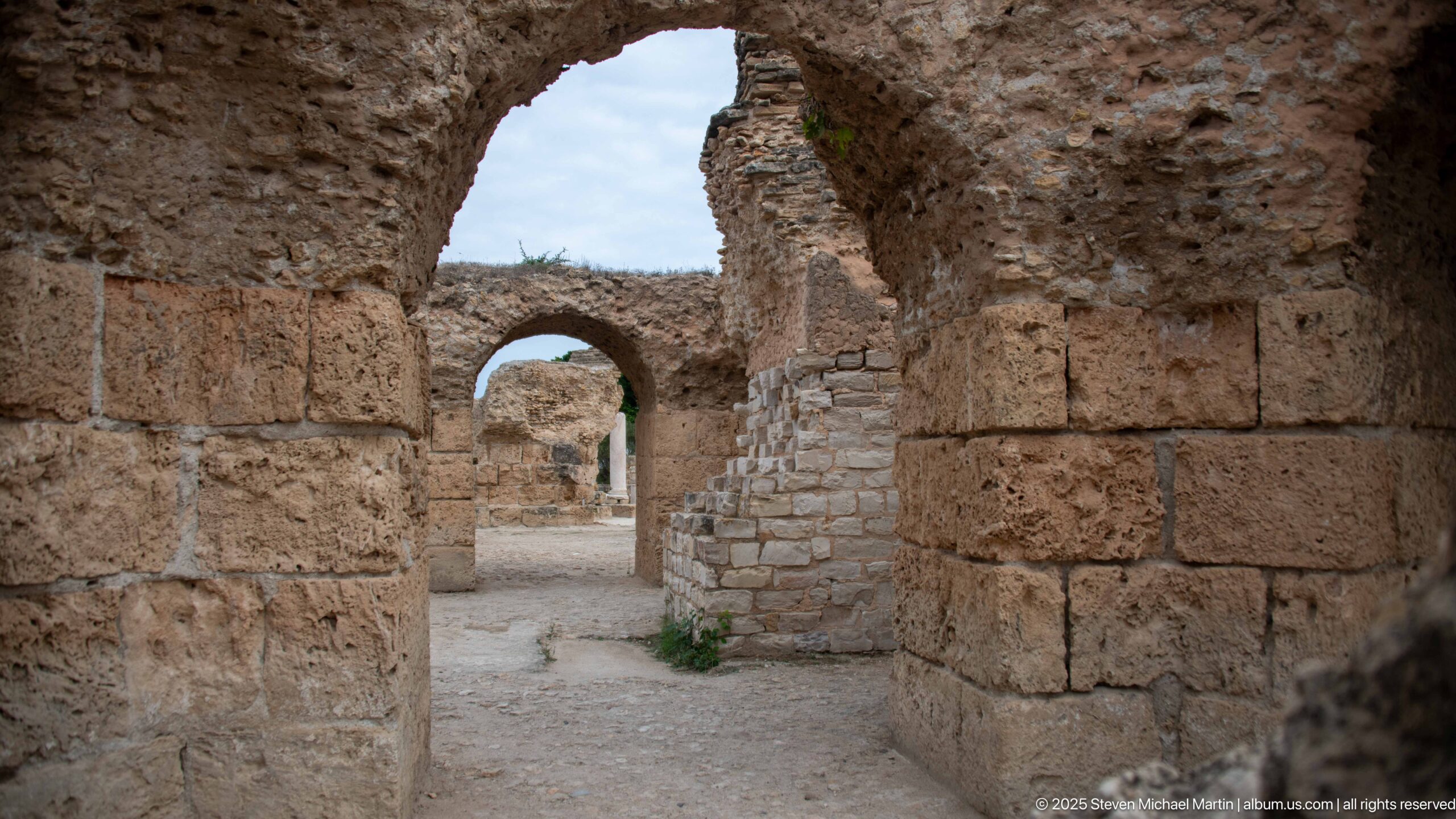
A large arched opening frames a succession of smaller arches deeper inside the Baths of Antoninus. The layered sightline reveals how the surviving lower spaces connect across several bays, while the heavy block masonry conveys the enormous load these structures once carried. The photograph uses the architecture itself as a visual frame, highlighting depth and circulation rather than individual fragments.
Caption
A large arched opening frames a succession of smaller arches deeper inside the Baths of Antoninus. The layered sightline reveals how the surviving lower spaces connect across several bays, while the heavy block masonry conveys the enormous load these structures once carried. The photograph uses the architecture itself as a visual frame, highlighting depth and circulation rather than individual fragments.
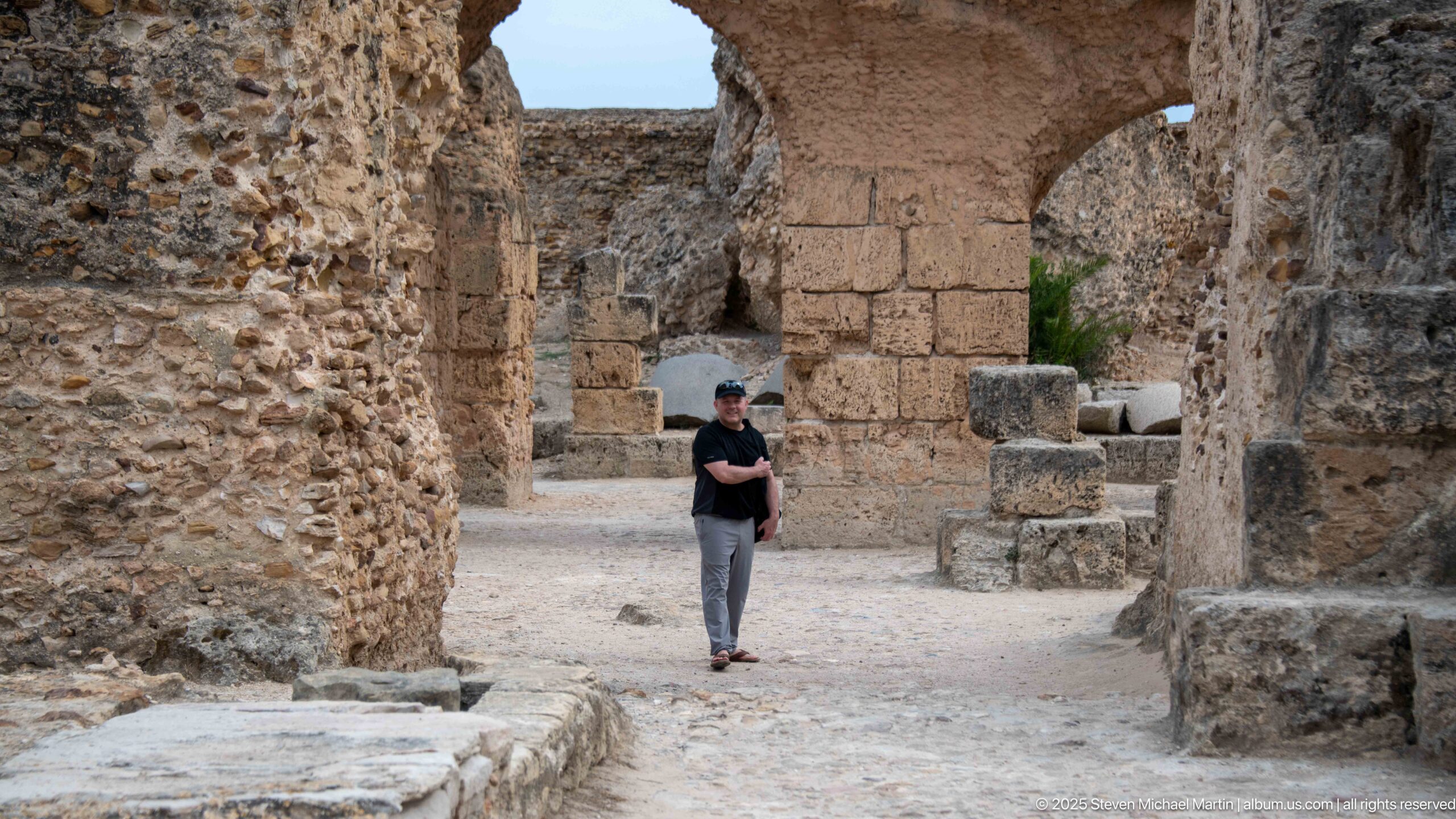
A visitor walks beneath the massive arches and piers of the Baths of Antoninus, providing an immediate sense of scale for the surviving Roman substructures. The figure is dwarfed by the heavy masonry, while additional arches and stone fragments recede into the background. The photograph is less about a specific room than about experiencing the monument's surviving structural spaces at ground level.
Caption
A visitor walks beneath the massive arches and piers of the Baths of Antoninus, providing an immediate sense of scale for the surviving Roman substructures. The figure is dwarfed by the heavy masonry, while additional arches and stone fragments recede into the background. The photograph is less about a specific room than about experiencing the monument's surviving structural spaces at ground level.
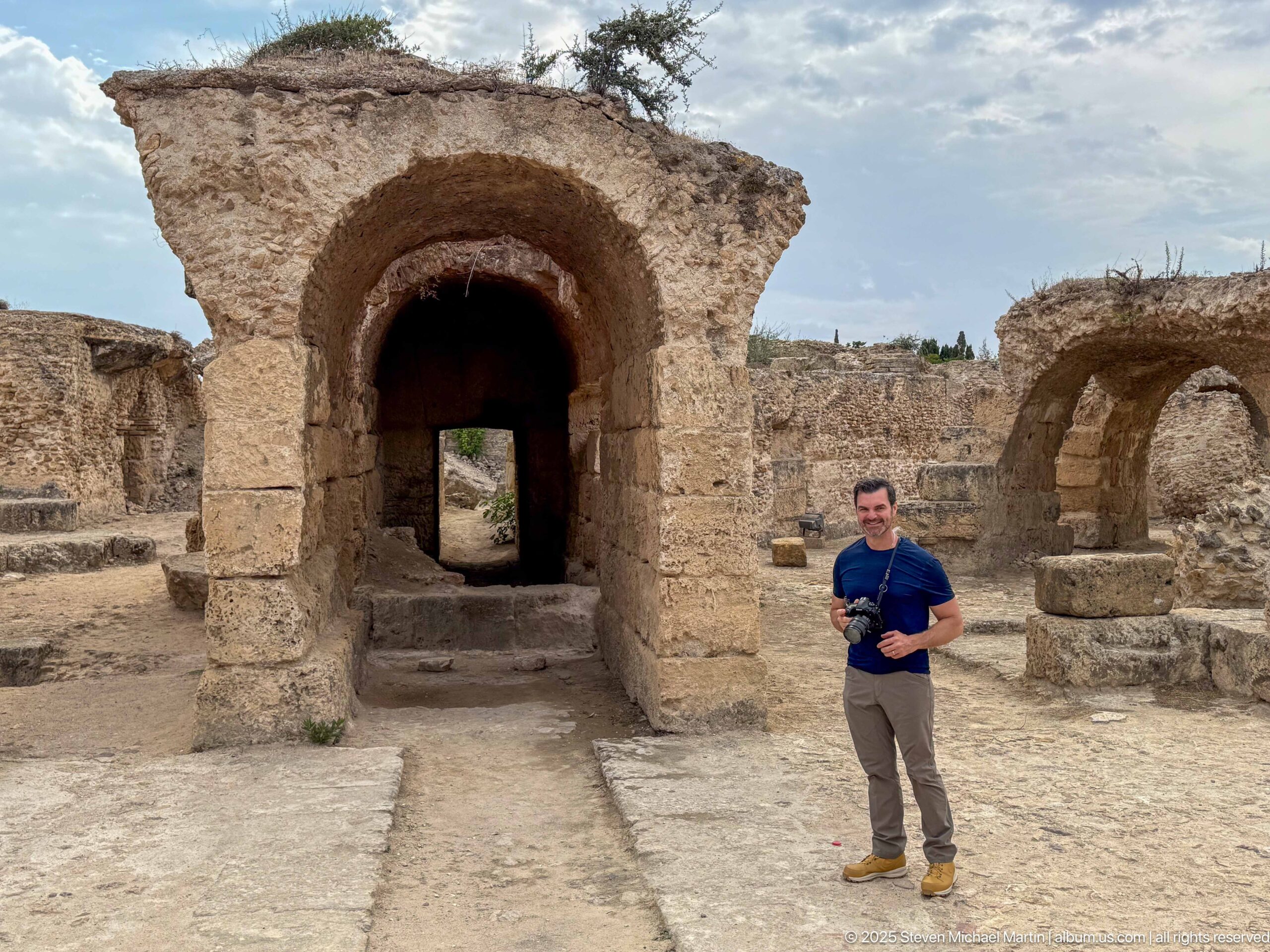
A deep rounded arch opens into a darker passage within the Baths of Antoninus, its thick masonry revealing the depth of the Roman structure. A visitor standing nearby gives scale to the entrance, while additional arches and low stone features extend across the surrounding ruins. The strong contrast between sunlit exterior and shadowed interior makes the vaulted chamber the dominant architectural element.
Caption
A deep rounded arch opens into a darker passage within the Baths of Antoninus, its thick masonry revealing the depth of the Roman structure. A visitor standing nearby gives scale to the entrance, while additional arches and low stone features extend across the surrounding ruins. The strong contrast between sunlit exterior and shadowed interior makes the vaulted chamber the dominant architectural element.
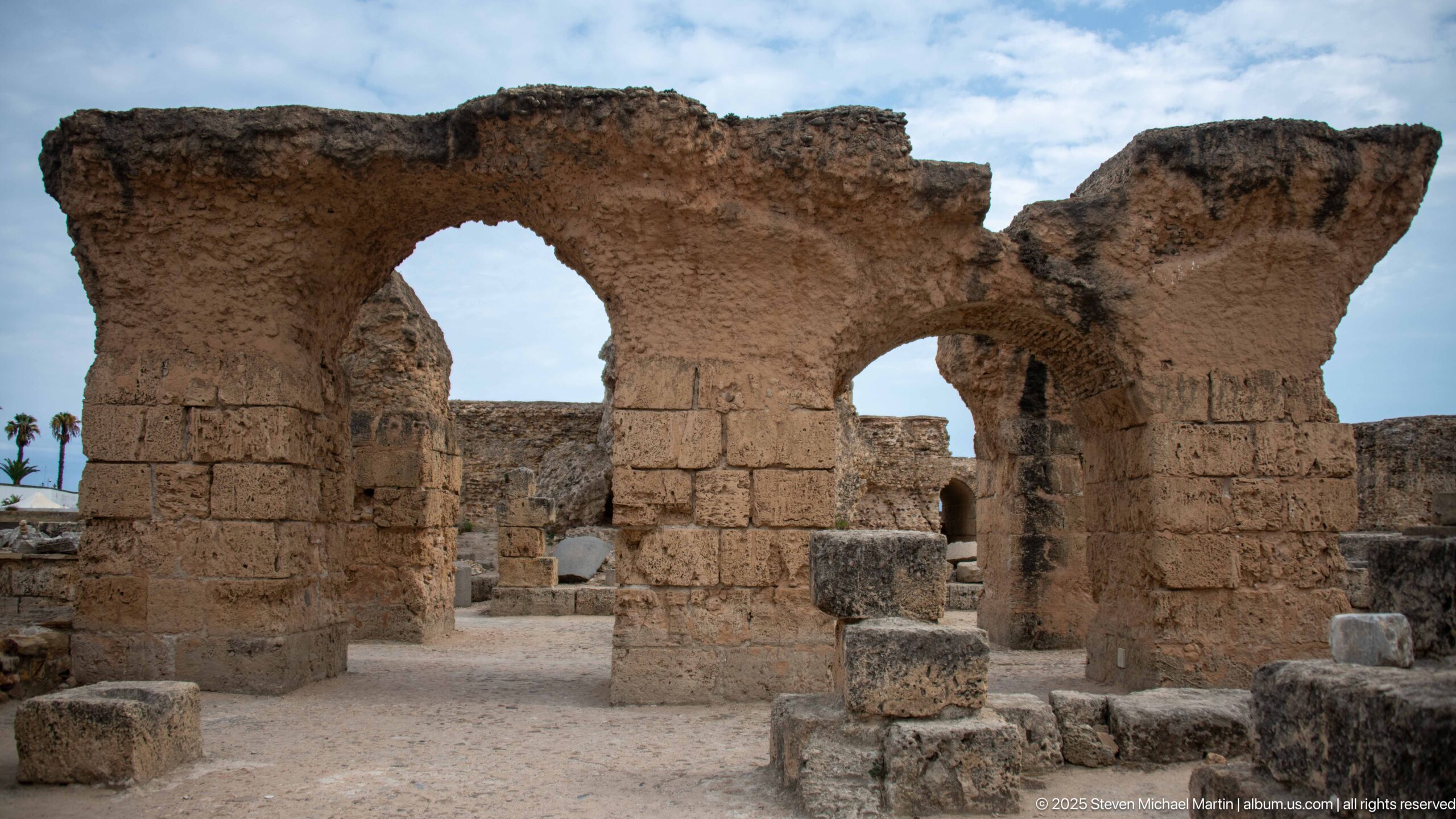
Two large adjoining arches rise from massive piers in the Baths of Antoninus, preserving one of the most visually imposing sections of the lower structure. Broken vaulting and irregular rubble crown the squared stone supports, while smaller architectural fragments surround the bases. The frontal composition emphasizes symmetry, span, and the engineering scale of the Roman bath complex.
Caption
Two large adjoining arches rise from massive piers in the Baths of Antoninus, preserving one of the most visually imposing sections of the lower structure. Broken vaulting and irregular rubble crown the squared stone supports, while smaller architectural fragments surround the bases. The frontal composition emphasizes symmetry, span, and the engineering scale of the Roman bath complex.
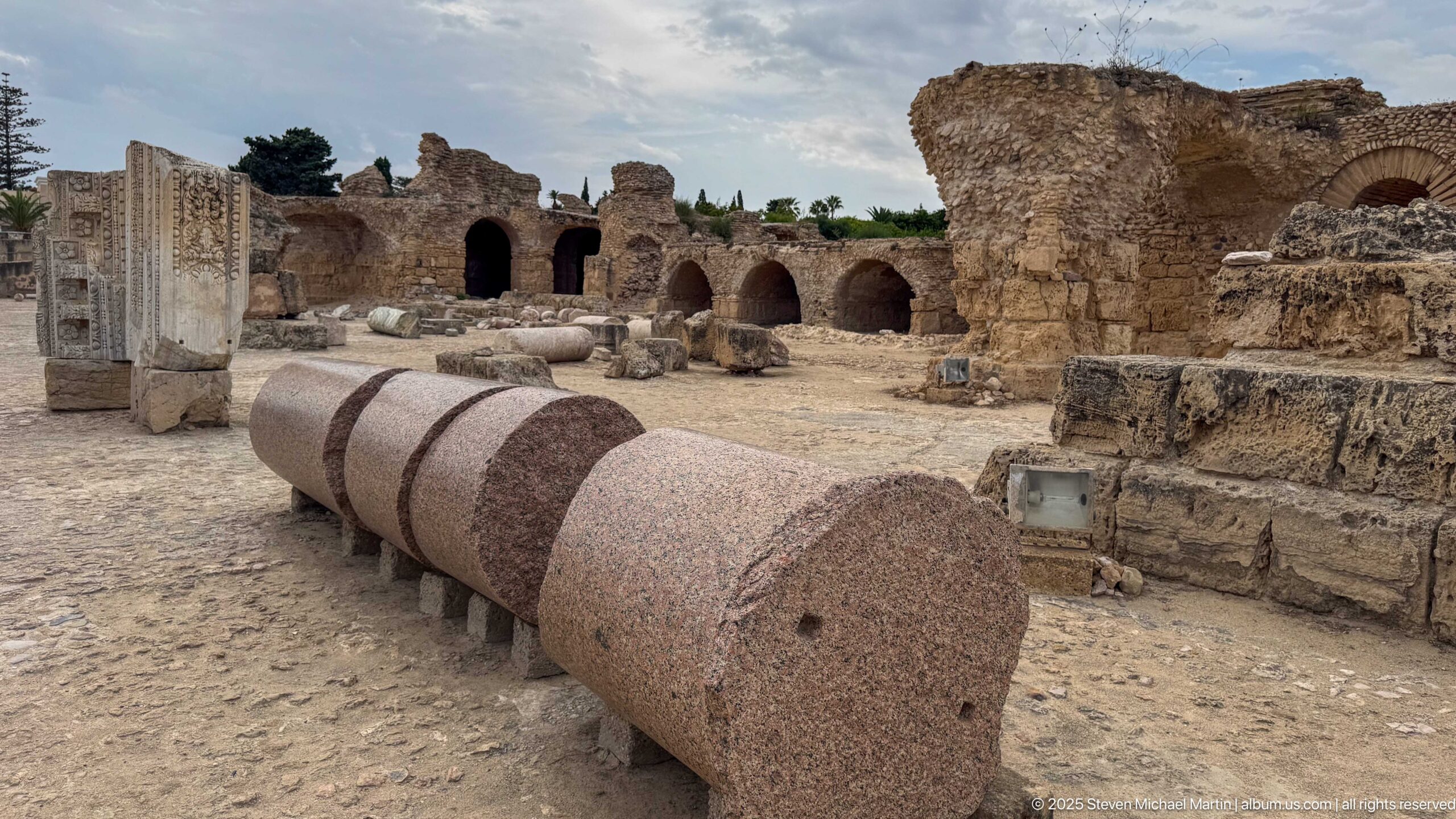
A massive pink-granite column shaft lies horizontally on supports within the Baths of Antoninus. Separate drums or shaft sections show dark encircling bands, and the broad circular end face reveals the scale of the original architectural element. Carved marble fragments and vaulted chambers surround the display, underscoring the variety of prestigious stone materials once used in the monumental Roman complex.
Caption
A massive pink-granite column shaft lies horizontally on supports within the Baths of Antoninus. Separate drums or shaft sections show dark encircling bands, and the broad circular end face reveals the scale of the original architectural element. Carved marble fragments and vaulted chambers surround the display, underscoring the variety of prestigious stone materials once used in the monumental Roman complex.
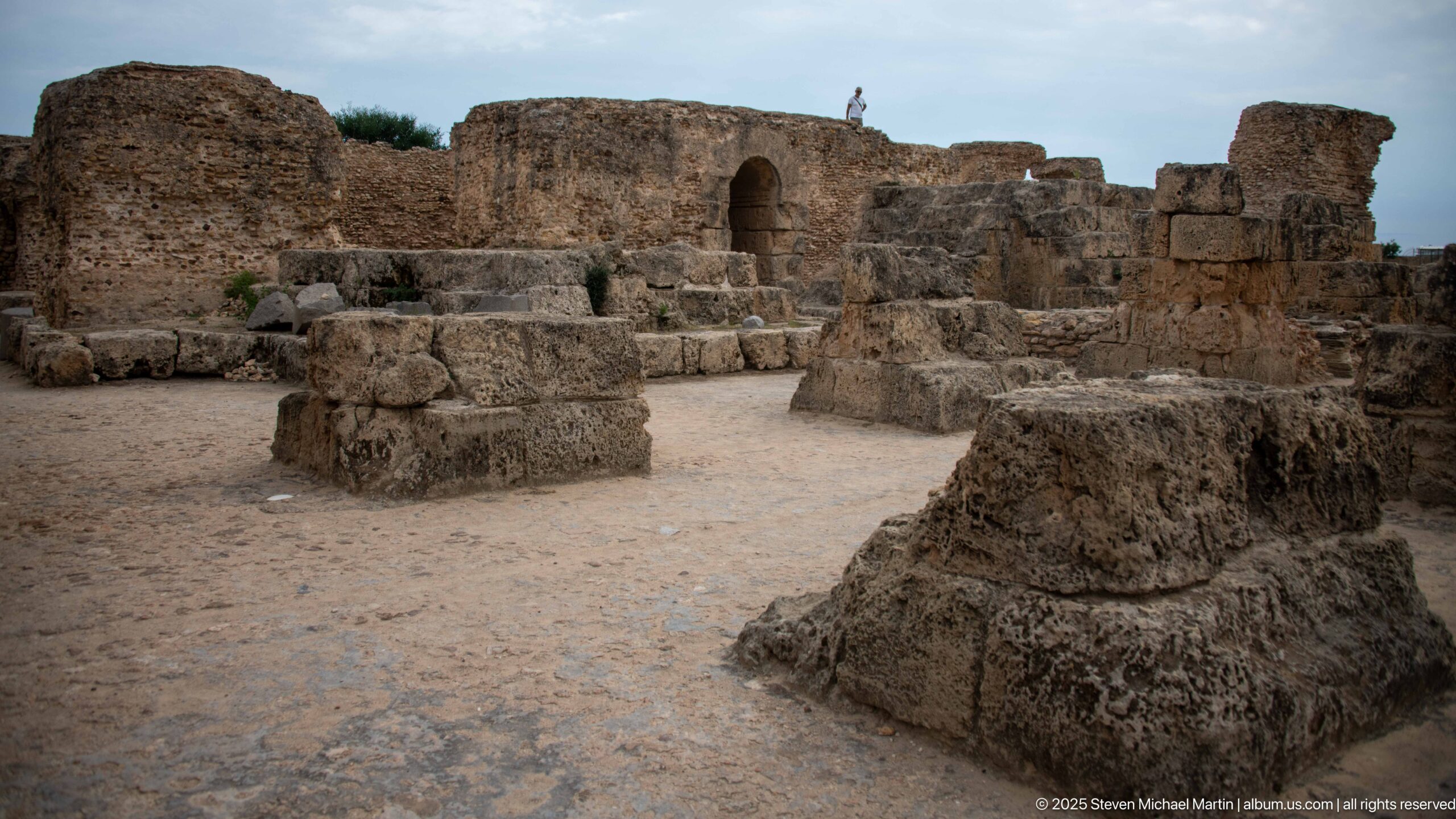
Massive squared stone bases and low piers stand across an open area of the Baths of Antoninus, preserving the footprint of an architectural zone whose upper elements have disappeared. Their repeated spacing suggests a formerly organized column or support system, while arched masonry survives along the perimeter. The photograph is valuable for understanding plan and structural rhythm rather than decorative detail.
Caption
Massive squared stone bases and low piers stand across an open area of the Baths of Antoninus, preserving the footprint of an architectural zone whose upper elements have disappeared. Their repeated spacing suggests a formerly organized column or support system, while arched masonry survives along the perimeter. The photograph is valuable for understanding plan and structural rhythm rather than decorative detail.
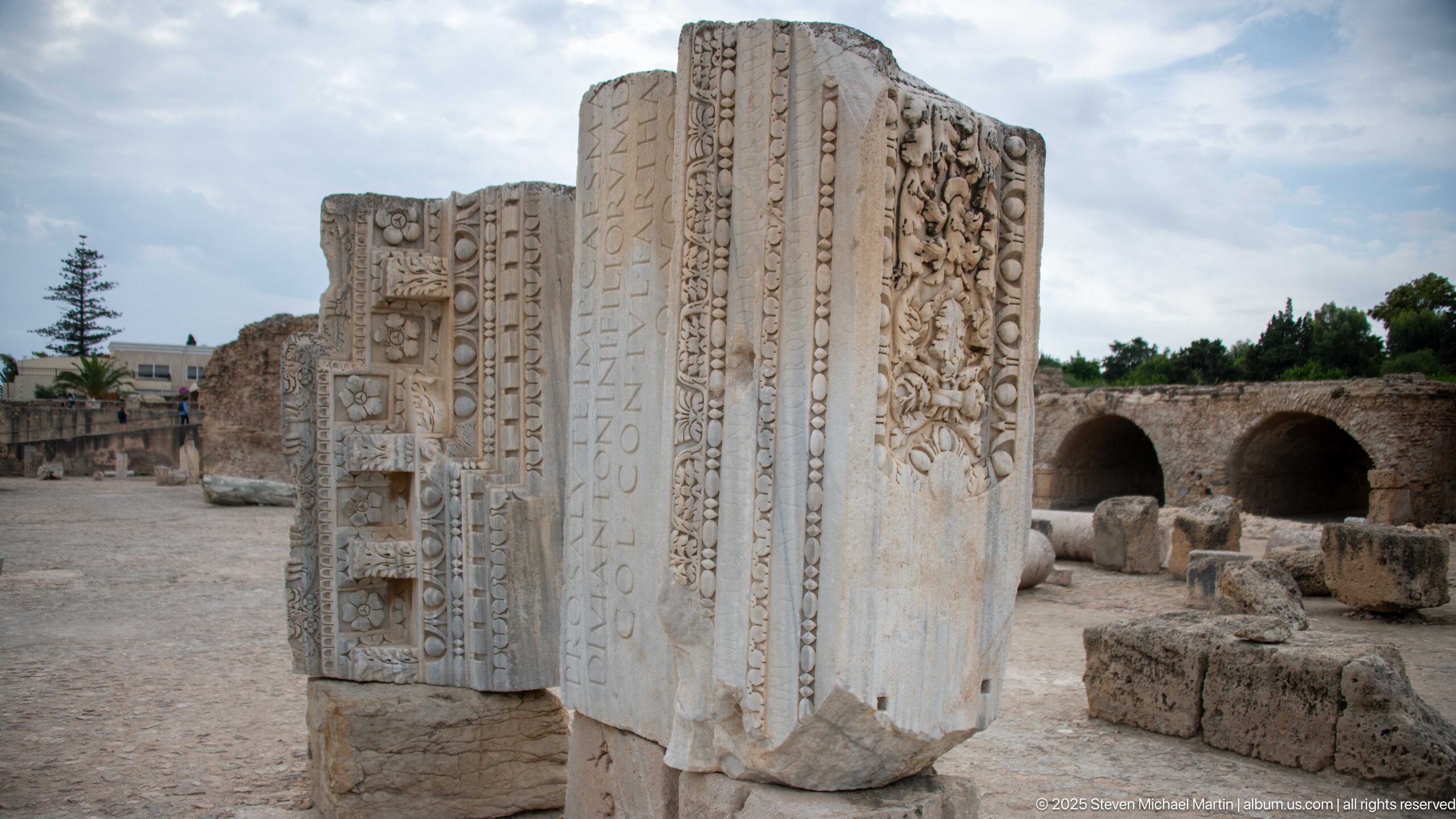
Several tall marble architectural blocks stand upright among the Baths of Antoninus ruins, preserving dense bands of classical ornament and partial Latin inscriptions. Rosettes, bead-and-reel forms, egg-like moldings, and vegetal carving cover the surfaces, contrasting strongly with the rough masonry behind. Their fragmentary state prevents a secure reconstruction of original placement, but the workmanship demonstrates the decorative richness of the bath complex.
Caption
Several tall marble architectural blocks stand upright among the Baths of Antoninus ruins, preserving dense bands of classical ornament and partial Latin inscriptions. Rosettes, bead-and-reel forms, egg-like moldings, and vegetal carving cover the surfaces, contrasting strongly with the rough masonry behind. Their fragmentary state prevents a secure reconstruction of original placement, but the workmanship demonstrates the decorative richness of the bath complex.
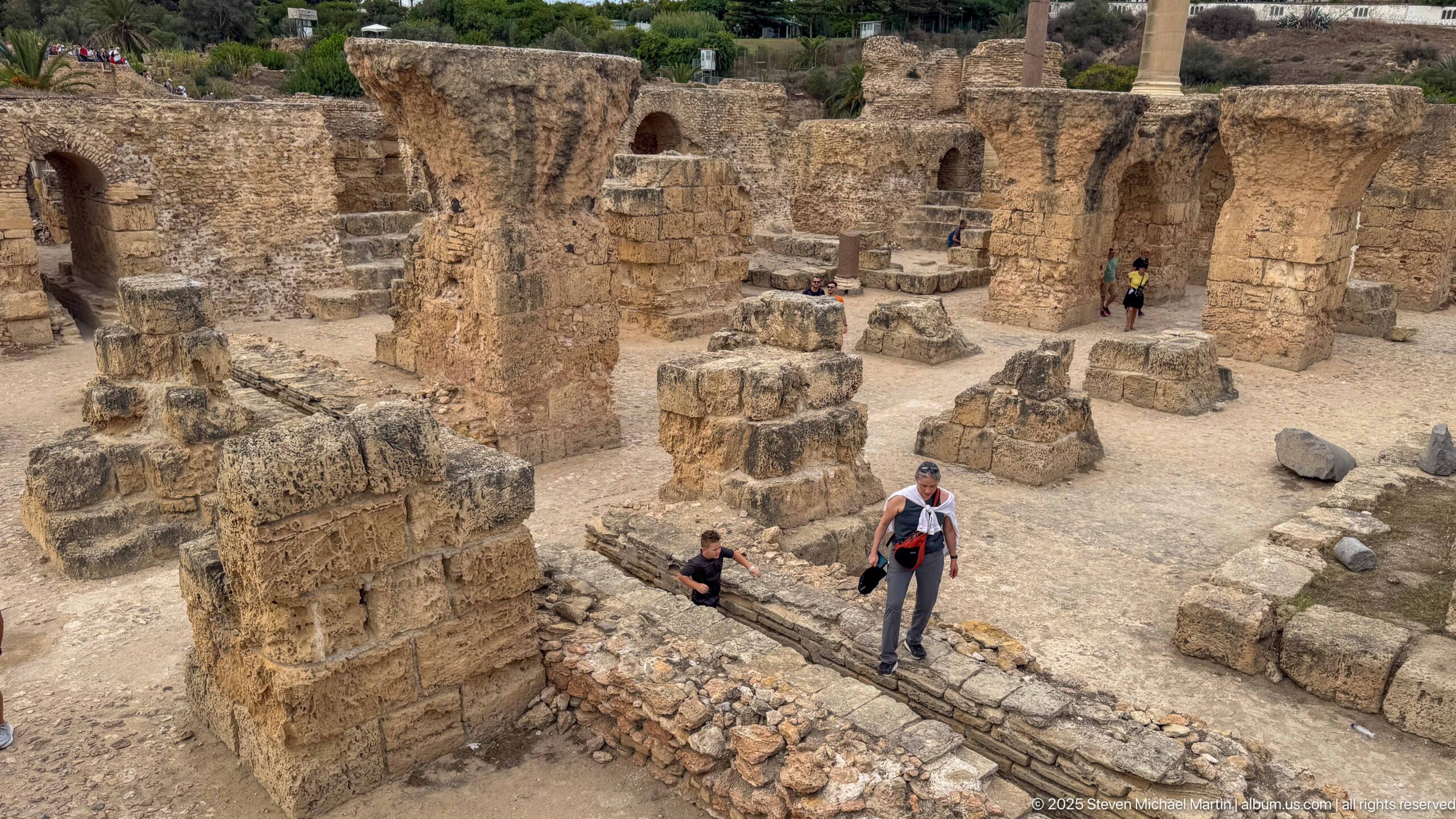
An elevated view looks across the structural grid of the Baths of Antoninus, where massive piers and bases organize the open archaeological floor below. Large arches line the background, and visitors moving through the complex provide scale for the surviving masonry. The viewpoint clarifies how repeated supports and corridors once formed an extensive substructure beneath the monumental Roman baths.
Caption
An elevated view looks across the structural grid of the Baths of Antoninus, where massive piers and bases organize the open archaeological floor below. Large arches line the background, and visitors moving through the complex provide scale for the surviving masonry. The viewpoint clarifies how repeated supports and corridors once formed an extensive substructure beneath the monumental Roman baths.
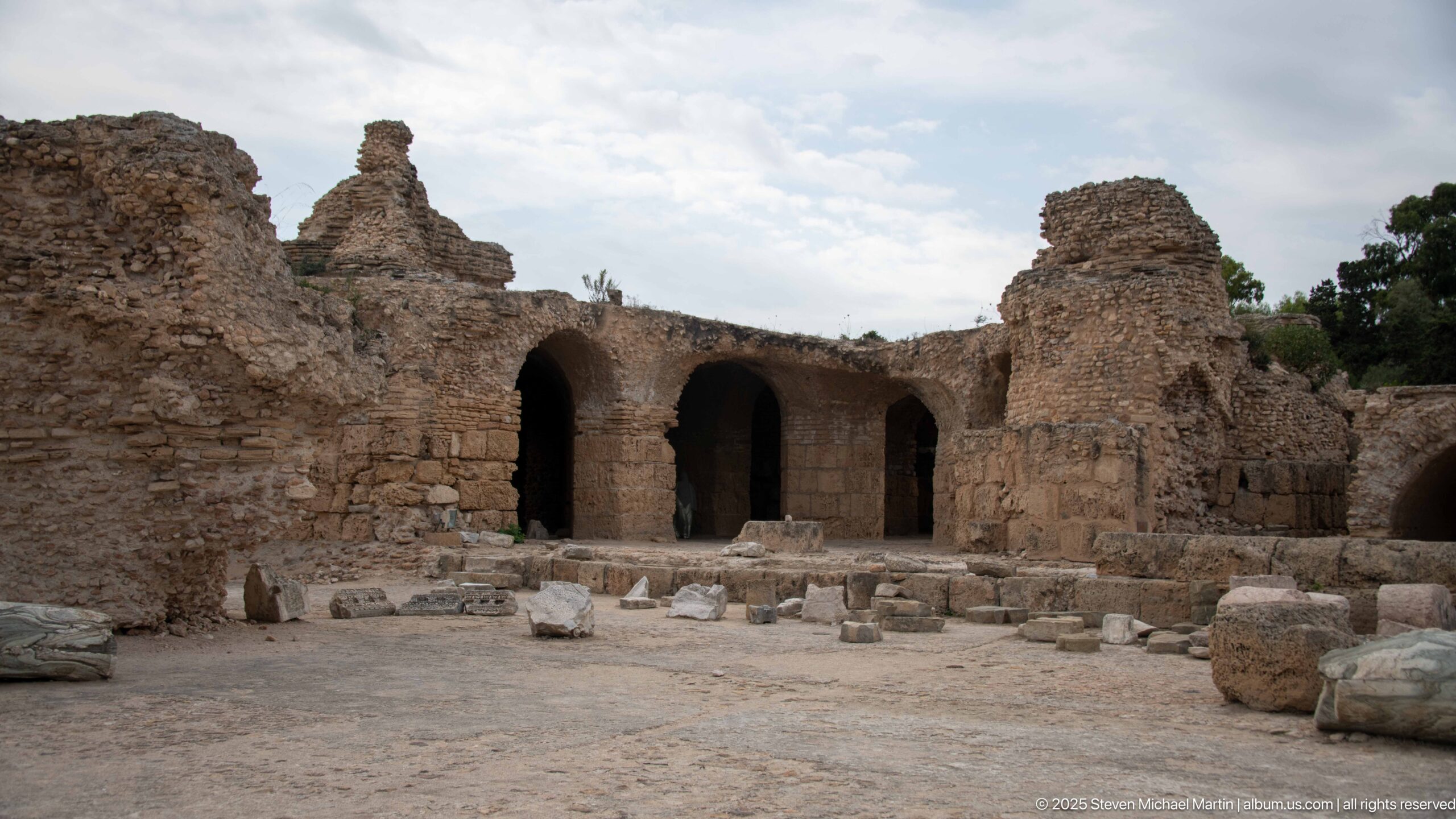
A group of vaulted masonry rooms survives within the archaeological landscape of Carthage, their rough stone walls pierced by tall arched openings. Fallen blocks and architectural fragments lie across the open foreground, while the irregular upper wall lines reveal the ruinous condition of the structure. The view emphasizes construction, circulation, and surviving mass rather than identifying a specific room function not established by the proof sheet.
Caption
A group of vaulted masonry rooms survives within the archaeological landscape of Carthage, their rough stone walls pierced by tall arched openings. Fallen blocks and architectural fragments lie across the open foreground, while the irregular upper wall lines reveal the ruinous condition of the structure. The view emphasizes construction, circulation, and surviving mass rather than identifying a specific room function not established by the proof sheet.
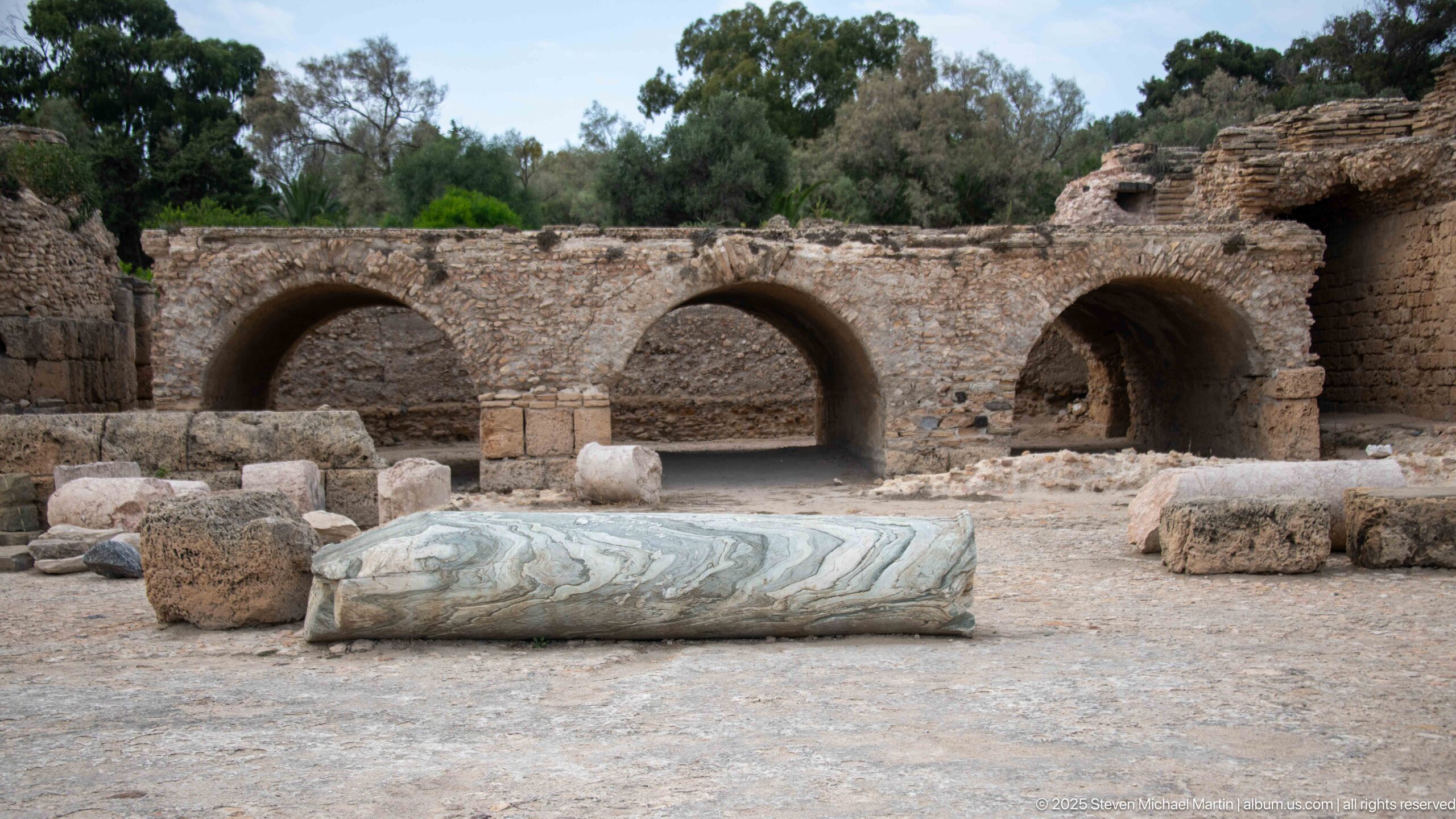
Three broad arches form a continuous masonry wall behind a large fallen column shaft of strongly veined marble. Additional blocks and fragments occupy the excavated ground, creating a layered view of standing architecture and displaced decoration. The contrast between coarse wall masonry and the polished stone shaft suggests the coexistence of structural fabric and higher-status architectural material within the same archaeological complex.
Caption
Three broad arches form a continuous masonry wall behind a large fallen column shaft of strongly veined marble. Additional blocks and fragments occupy the excavated ground, creating a layered view of standing architecture and displaced decoration. The contrast between coarse wall masonry and the polished stone shaft suggests the coexistence of structural fabric and higher-status architectural material within the same archaeological complex.
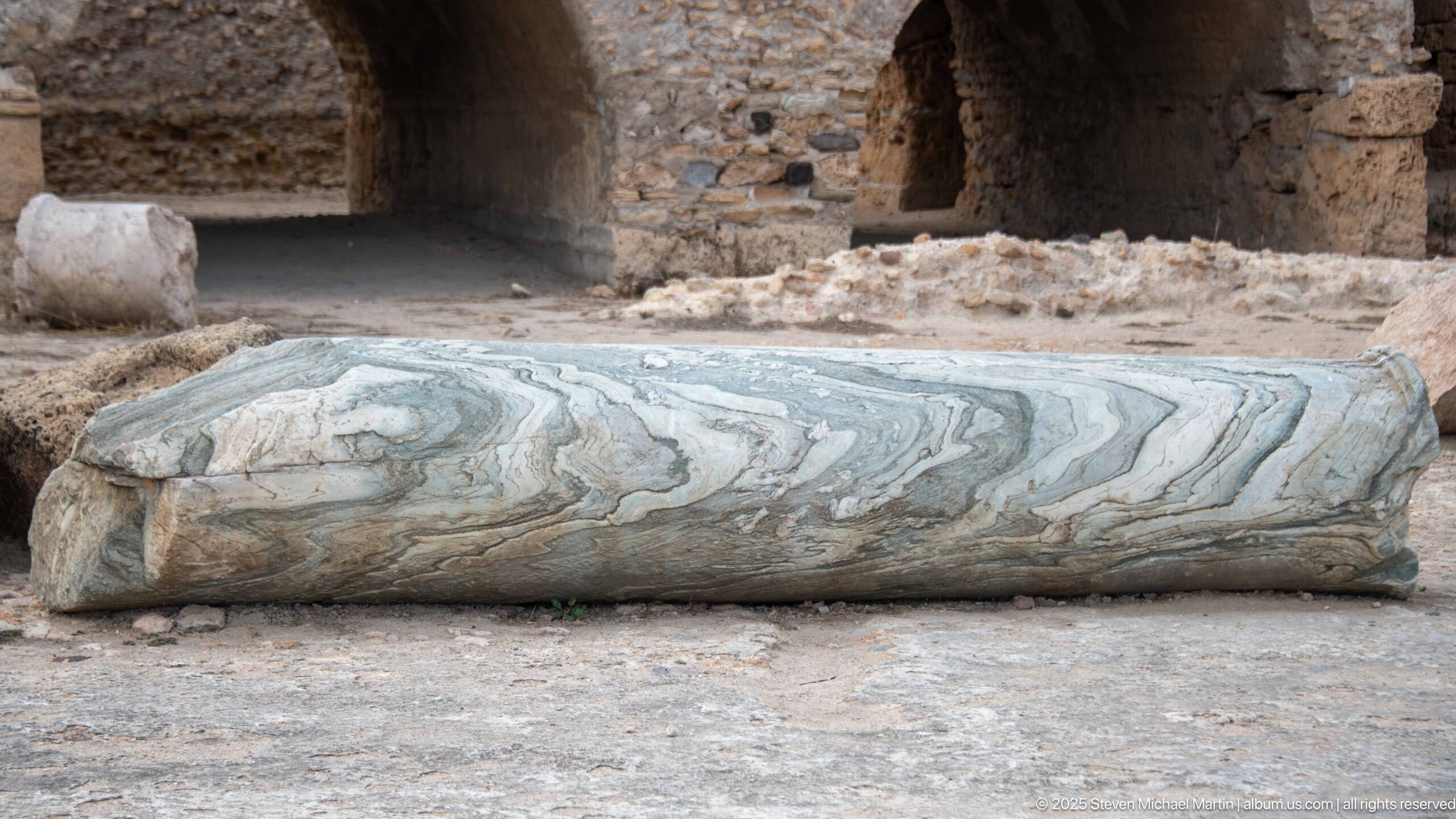
A fallen marble column shaft fills the frame, its pale surface crossed by dramatic gray-green veining. Chips and abrasions along the edges reveal the fragmentary state of the ancient architectural element, while the tight composition isolates the stone’s material character from the surrounding ruins. This detail records the quality and visual richness of decorative stone once incorporated into monumental architecture at Carthage.
Caption
A fallen marble column shaft fills the frame, its pale surface crossed by dramatic gray-green veining. Chips and abrasions along the edges reveal the fragmentary state of the ancient architectural element, while the tight composition isolates the stone’s material character from the surrounding ruins. This detail records the quality and visual richness of decorative stone once incorporated into monumental architecture at Carthage.
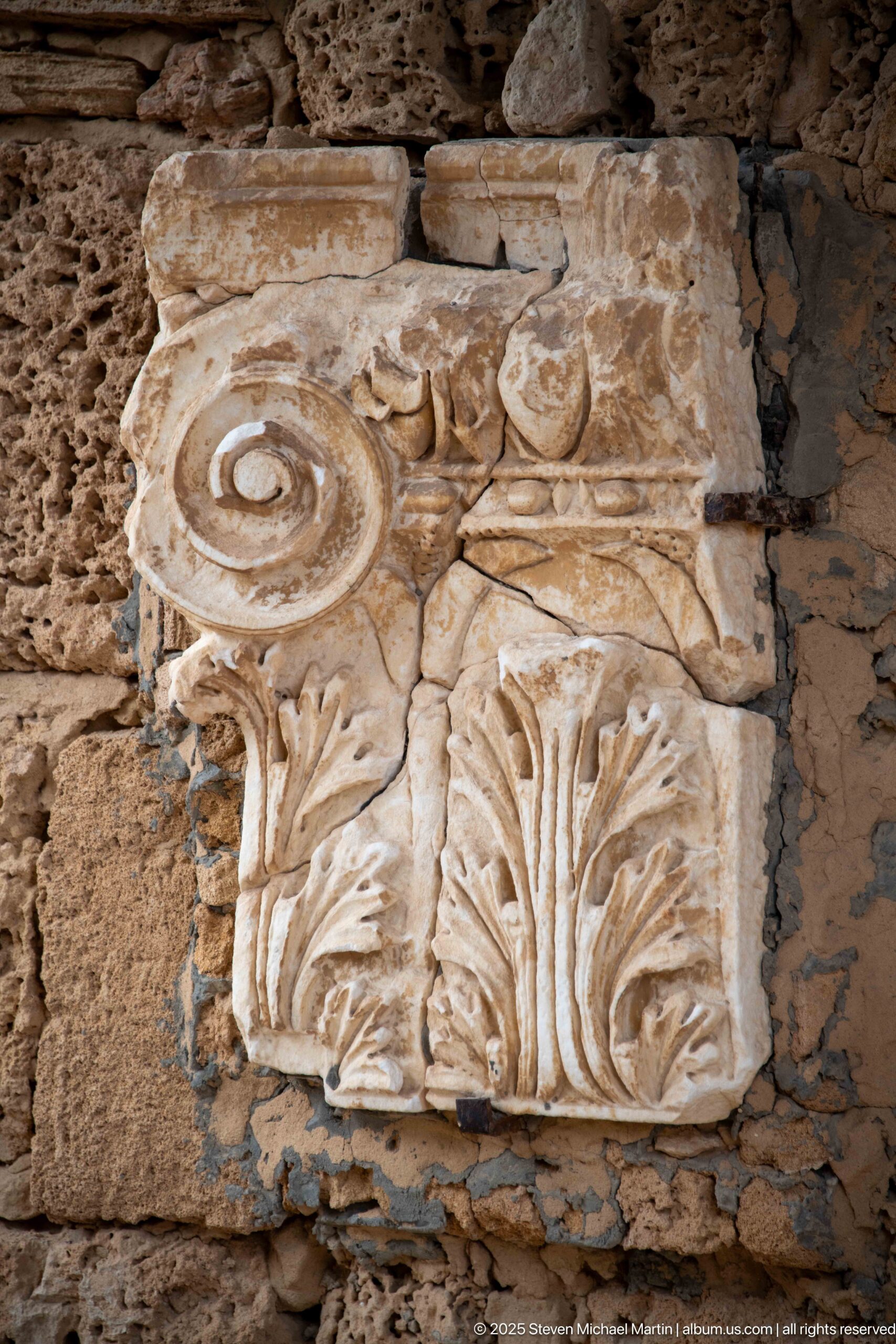
A pale stone architectural fragment is carved with deeply modeled acanthus leaves, curling stems, and circular ornamental forms. The relief remains crisp in places despite breakage along the edges, allowing the layered vegetal carving to be read clearly. Mounted or resting against rough masonry, the fragment preserves a decorative component from monumental classical architecture without enough evidence to assign it to a specific original position.
Caption
A pale stone architectural fragment is carved with deeply modeled acanthus leaves, curling stems, and circular ornamental forms. The relief remains crisp in places despite breakage along the edges, allowing the layered vegetal carving to be read clearly. Mounted or resting against rough masonry, the fragment preserves a decorative component from monumental classical architecture without enough evidence to assign it to a specific original position.
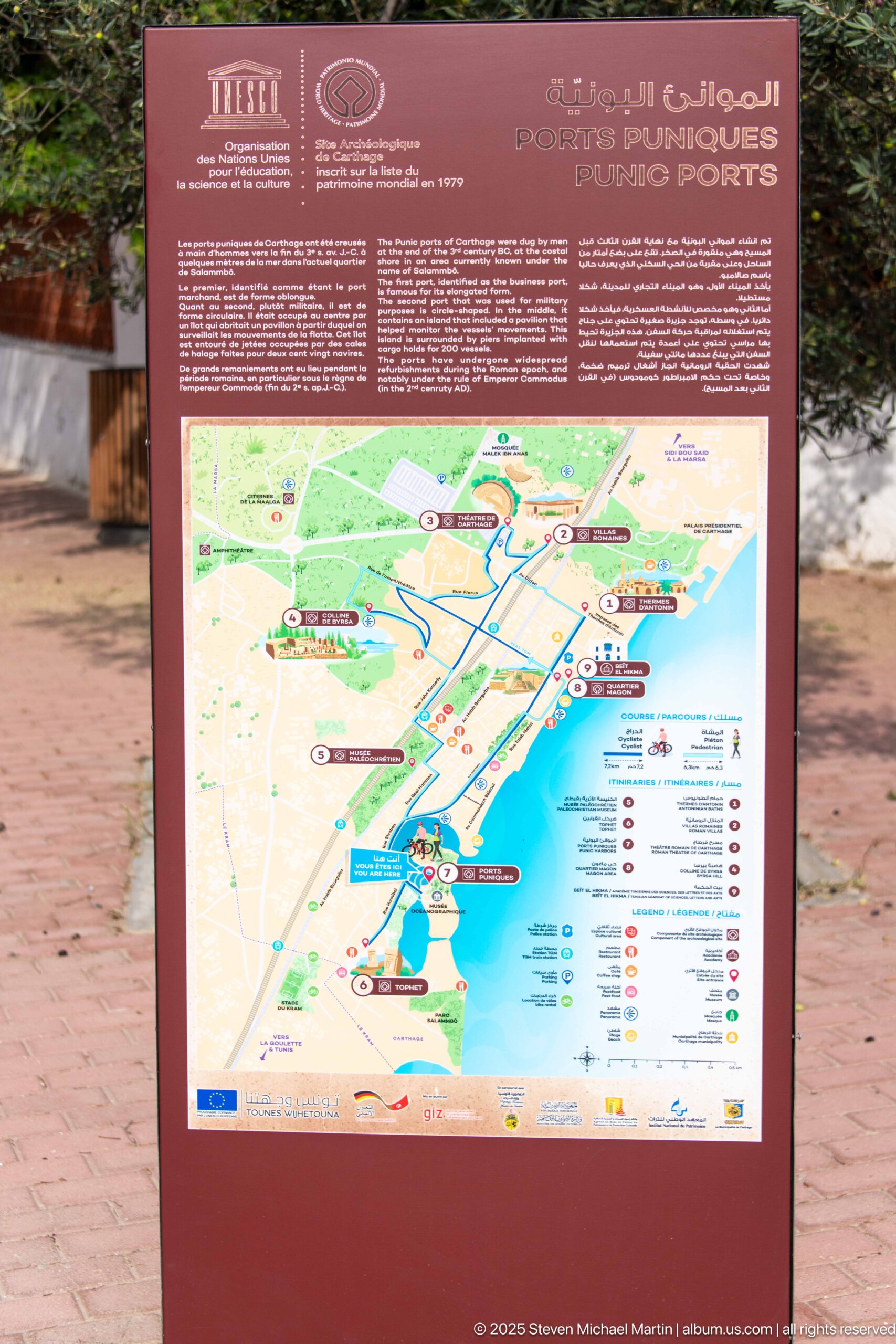
An interpretive panel introduces the Punic Ports of Carthage through a detailed map of the waterfront archaeological area. Routes, numbered points of interest, modern streets, shoreline, and harbor basins help visitors understand the relationship between surviving remains and the ancient maritime landscape. The panel serves as a geographic transition from inland monuments to the port complex that was central to Carthage’s seaborne connections.
Caption
An interpretive panel introduces the Punic Ports of Carthage through a detailed map of the waterfront archaeological area. Routes, numbered points of interest, modern streets, shoreline, and harbor basins help visitors understand the relationship between surviving remains and the ancient maritime landscape. The panel serves as a geographic transition from inland monuments to the port complex that was central to Carthage’s seaborne connections.
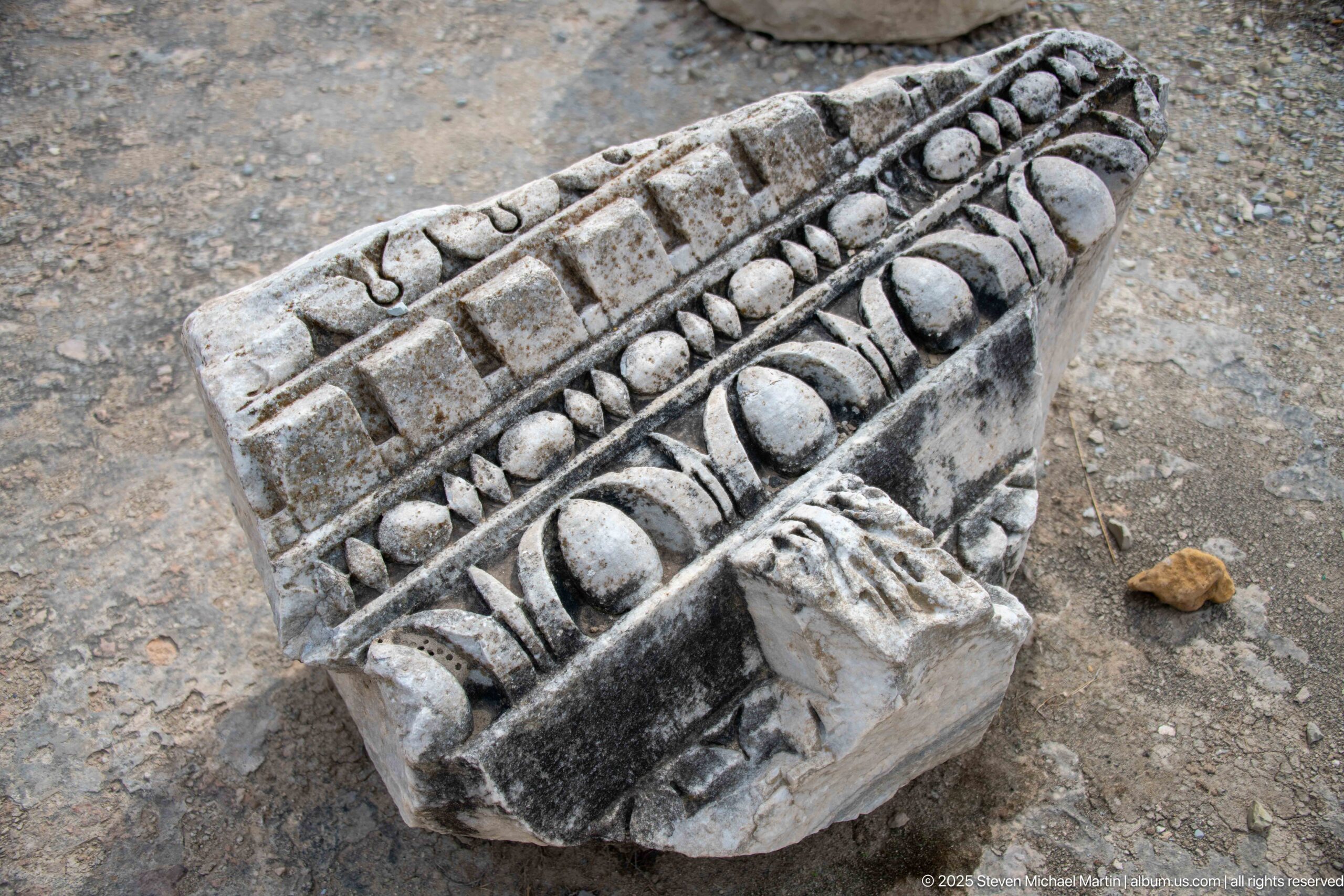
A broken architectural block preserves several bands of classical ornament, including egg-and-dart forms, bead-like molding, squared dentils, and a lower band of leaf carving. Weathering and darkened surfaces accentuate the depth of the relief. The fragment demonstrates the layered decorative vocabulary once used on monumental buildings at Carthage, while its detached state prevents a secure reconstruction of its original architectural position.
Caption
A broken architectural block preserves several bands of classical ornament, including egg-and-dart forms, bead-like molding, squared dentils, and a lower band of leaf carving. Weathering and darkened surfaces accentuate the depth of the relief. The fragment demonstrates the layered decorative vocabulary once used on monumental buildings at Carthage, while its detached state prevents a secure reconstruction of its original architectural position.
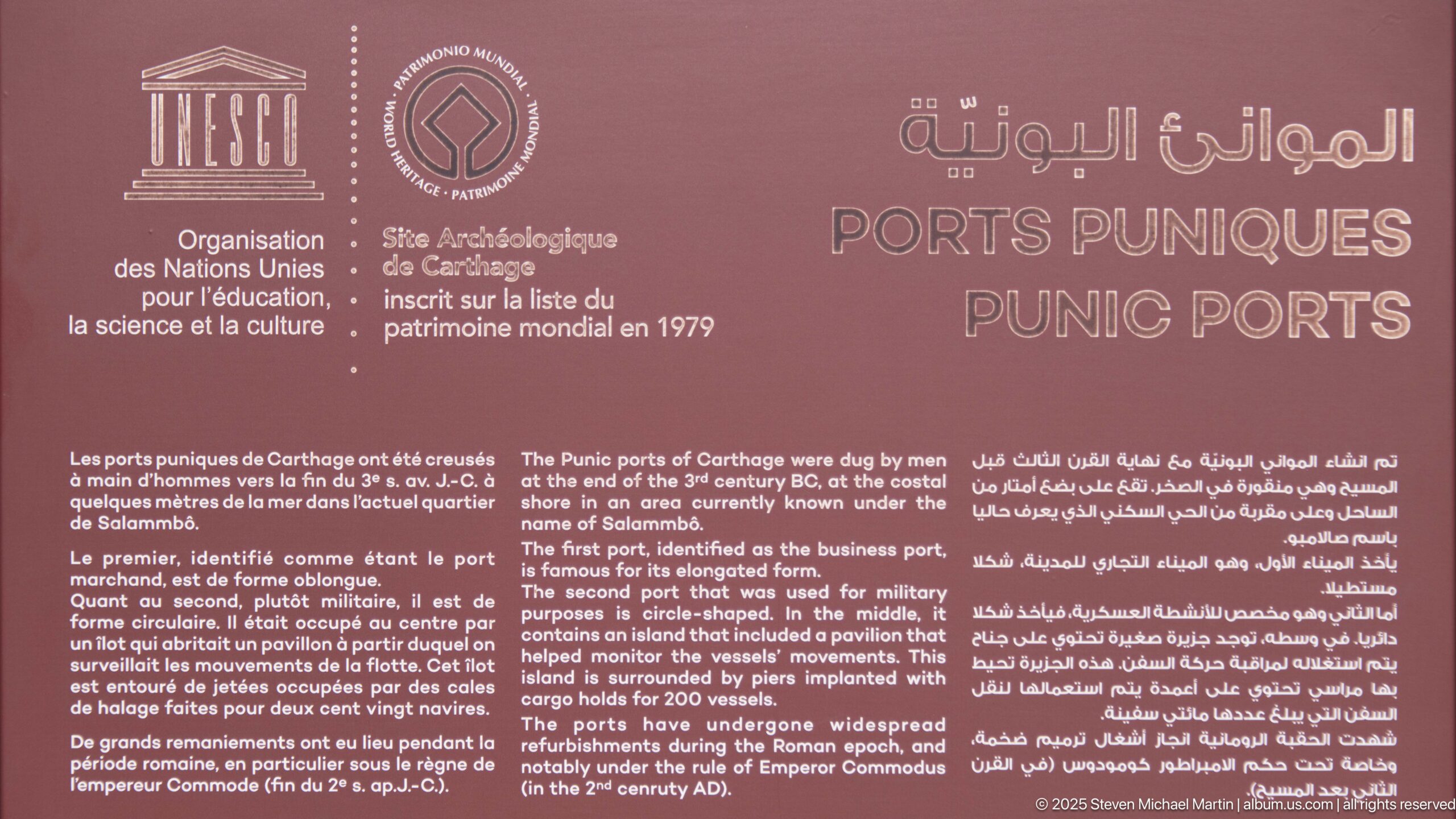
A multilingual UNESCO information panel explains the Punic Ports of Carthage, describing a rectangular commercial harbor linked to a circular military harbor. Arabic, French, and English text connects the visible basins with the maritime organization of the ancient city and notes later alteration. The sign provides authoritative on-site interpretation for understanding the water features photographed immediately afterward.
Caption
A multilingual UNESCO information panel explains the Punic Ports of Carthage, describing a rectangular commercial harbor linked to a circular military harbor. Arabic, French, and English text connects the visible basins with the maritime organization of the ancient city and notes later alteration. The sign provides authoritative on-site interpretation for understanding the water features photographed immediately afterward.
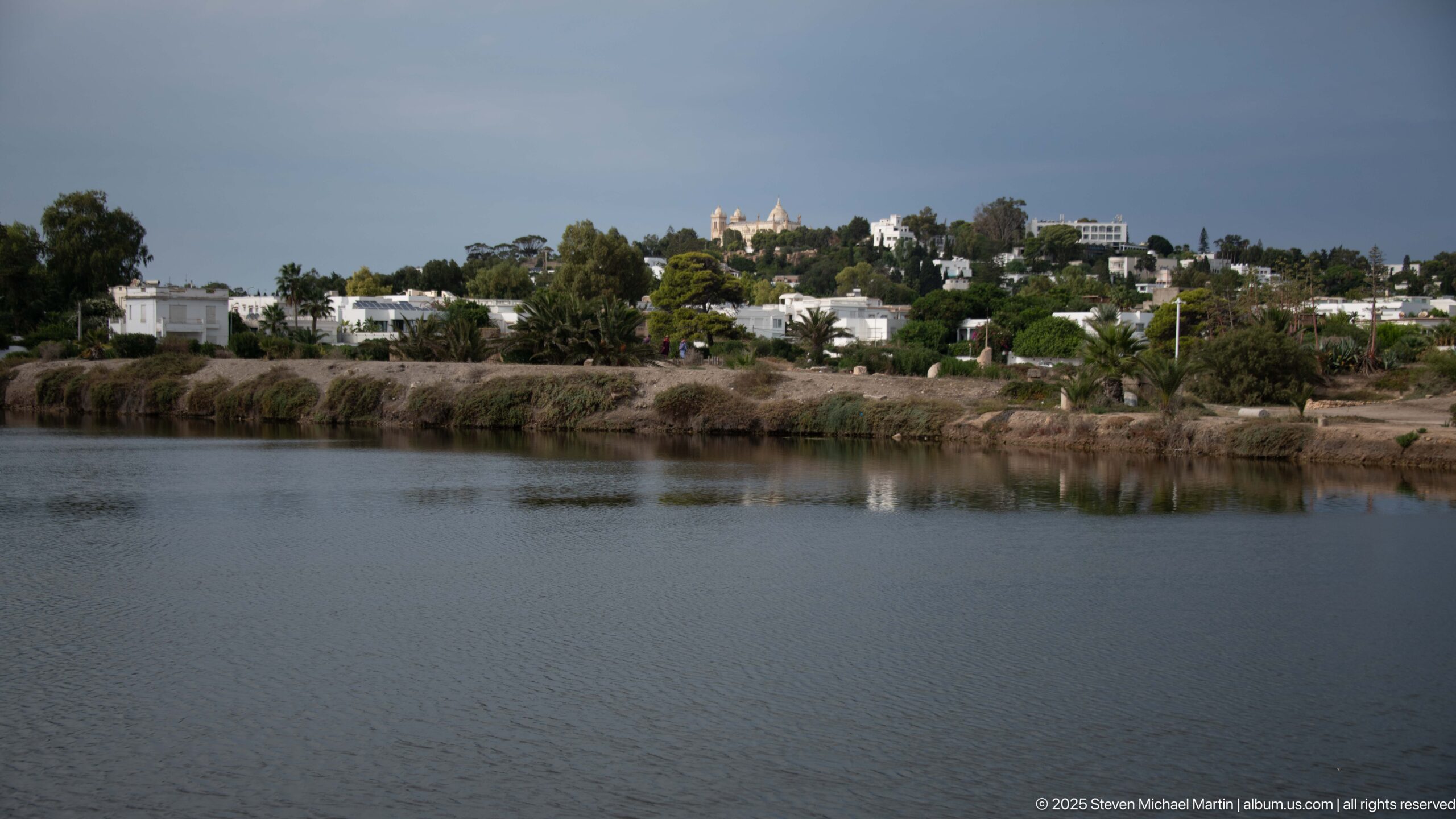
Calm water fills one of the Punic port basins at Carthage, with reeds and a low shoreline separating the archaeological water feature from modern residential development beyond. White buildings and a prominent domed structure rise on the hillside, showing how the ancient maritime landscape is embedded within present-day Carthage. The still surface and broad composition emphasize the basin’s surviving scale rather than excavated masonry.
Caption
Calm water fills one of the Punic port basins at Carthage, with reeds and a low shoreline separating the archaeological water feature from modern residential development beyond. White buildings and a prominent domed structure rise on the hillside, showing how the ancient maritime landscape is embedded within present-day Carthage. The still surface and broad composition emphasize the basin’s surviving scale rather than excavated masonry.
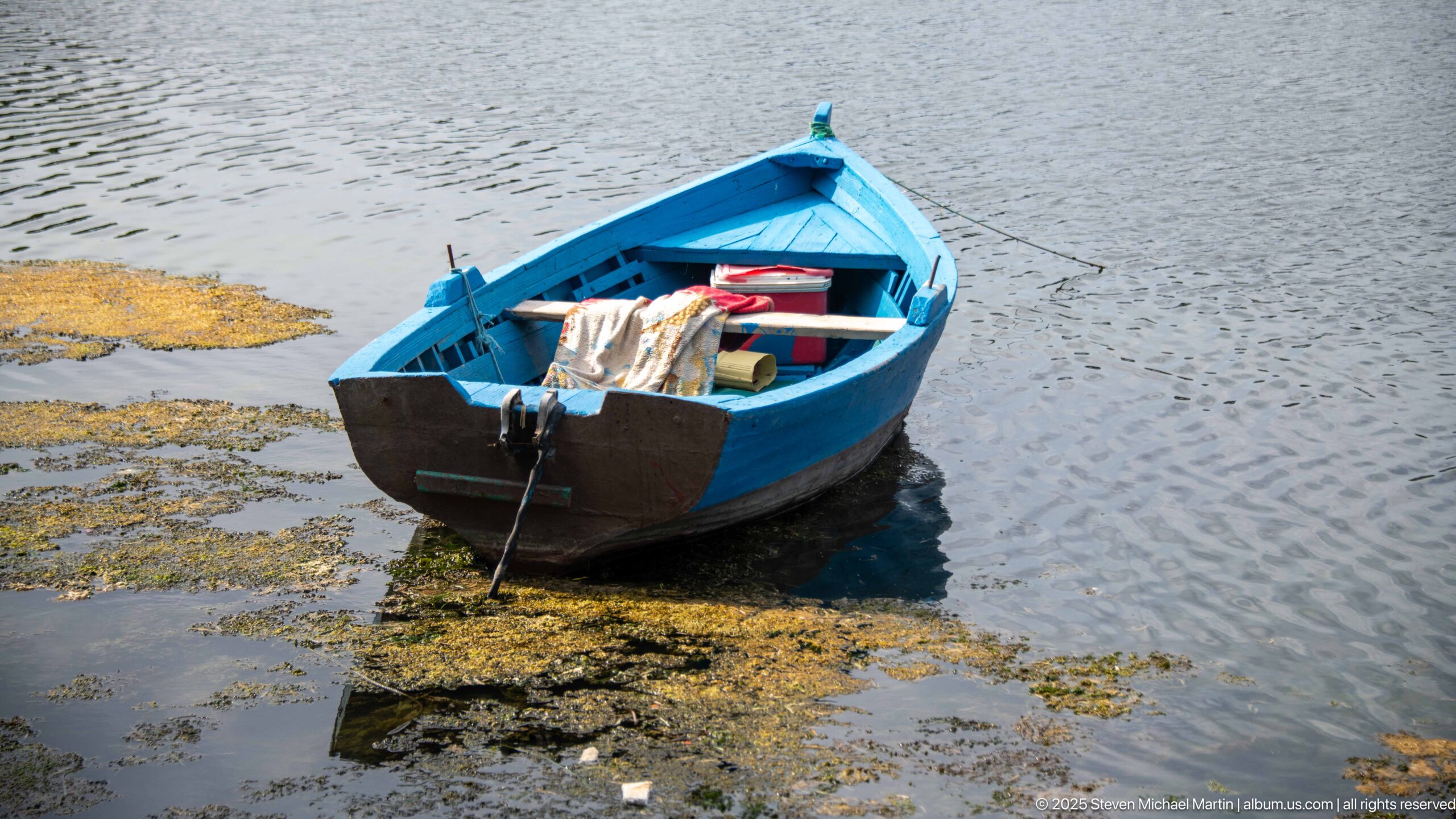
A small blue wooden fishing boat rests in the shallow water of the Punic port area, carrying nets, containers, and other working gear. Floating vegetation gathers around the hull while a mooring line secures the vessel near shore. The intimate view contrasts the monumental history of Carthage’s ancient harbors with their continued everyday use as sheltered water for small local craft.
Caption
A small blue wooden fishing boat rests in the shallow water of the Punic port area, carrying nets, containers, and other working gear. Floating vegetation gathers around the hull while a mooring line secures the vessel near shore. The intimate view contrasts the monumental history of Carthage’s ancient harbors with their continued everyday use as sheltered water for small local craft.
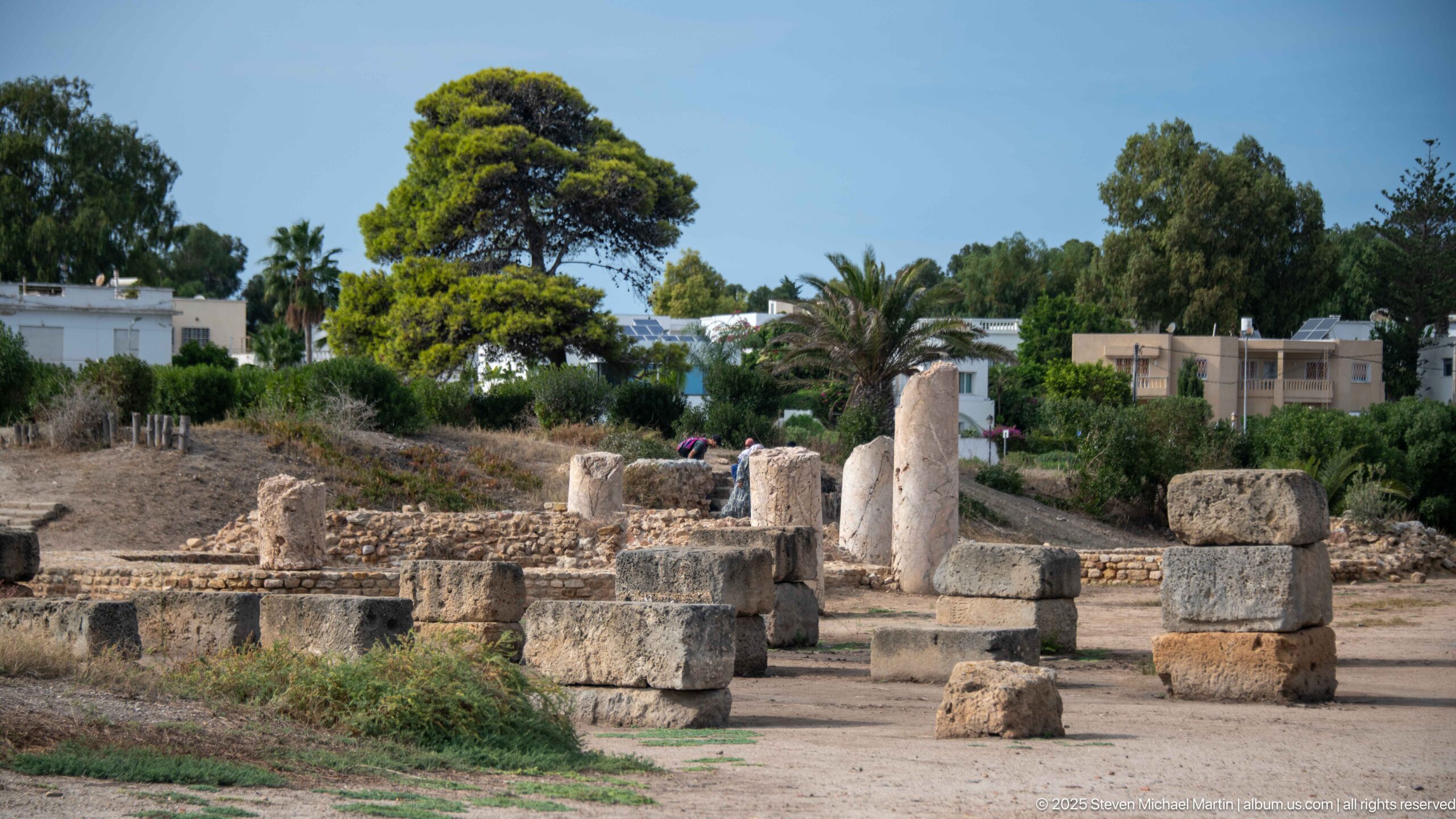
Low masonry walls, column drums, and upright stone fragments survive beside the Punic Ports, creating a compact archaeological field amid modern vegetation and nearby houses. The photograph records the architectural remains at ground level rather than the harbor basin itself. Because the proof sheet does not identify a specific ancient structure here, the scene is best treated as part of the broader port-side archaeological landscape.
Caption
Low masonry walls, column drums, and upright stone fragments survive beside the Punic Ports, creating a compact archaeological field amid modern vegetation and nearby houses. The photograph records the architectural remains at ground level rather than the harbor basin itself. Because the proof sheet does not identify a specific ancient structure here, the scene is best treated as part of the broader port-side archaeological landscape.
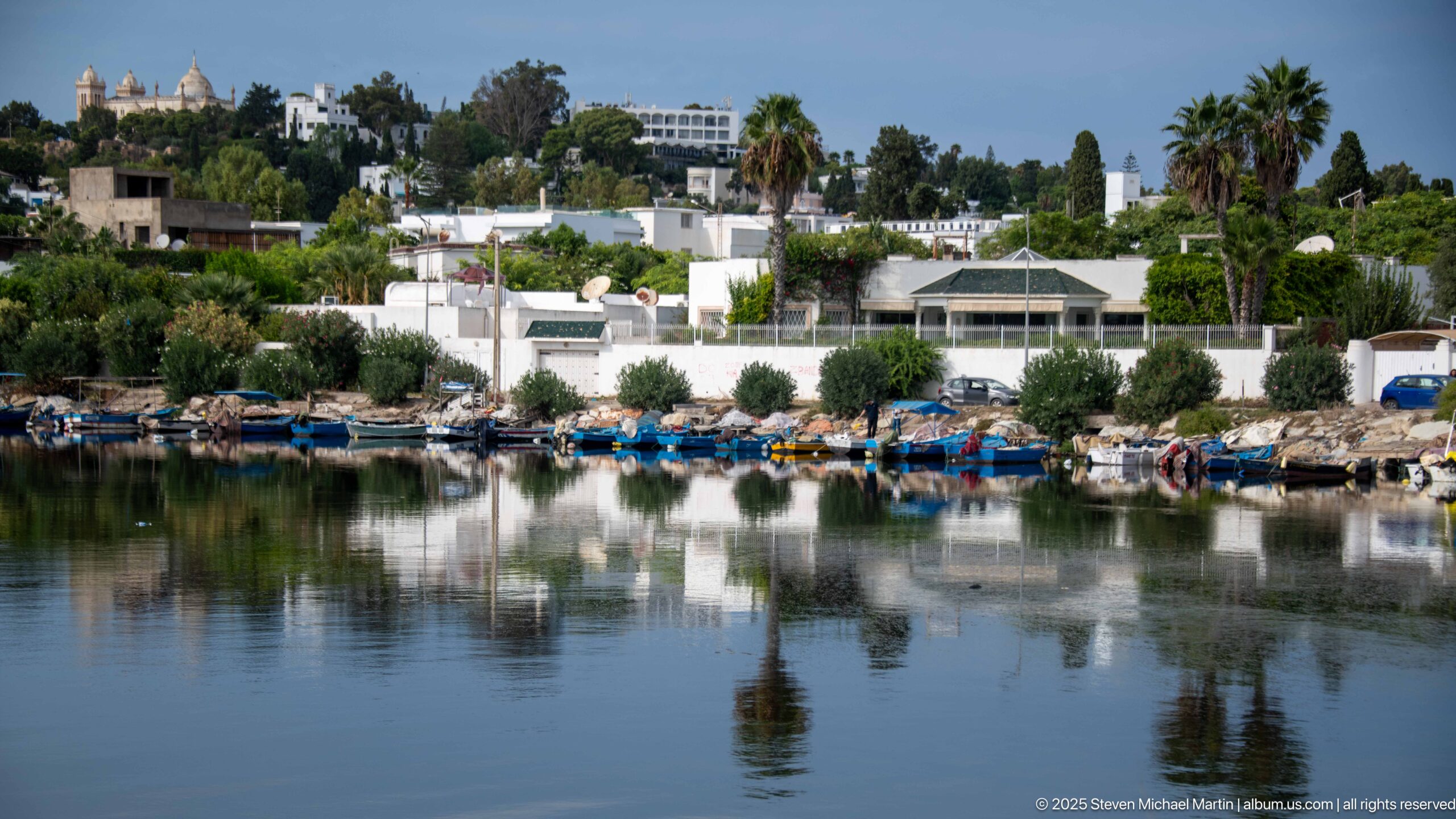
Small fishing boats line the edge of the Punic port basin beneath white houses, palms, and dense greenery. Their blue hulls form a narrow band along the shoreline, while the still water produces broad reflections of buildings and vegetation. The view demonstrates the present-day residential and working waterfront layered directly over the ancient maritime setting of Carthage.
Caption
Small fishing boats line the edge of the Punic port basin beneath white houses, palms, and dense greenery. Their blue hulls form a narrow band along the shoreline, while the still water produces broad reflections of buildings and vegetation. The view demonstrates the present-day residential and working waterfront layered directly over the ancient maritime setting of Carthage.
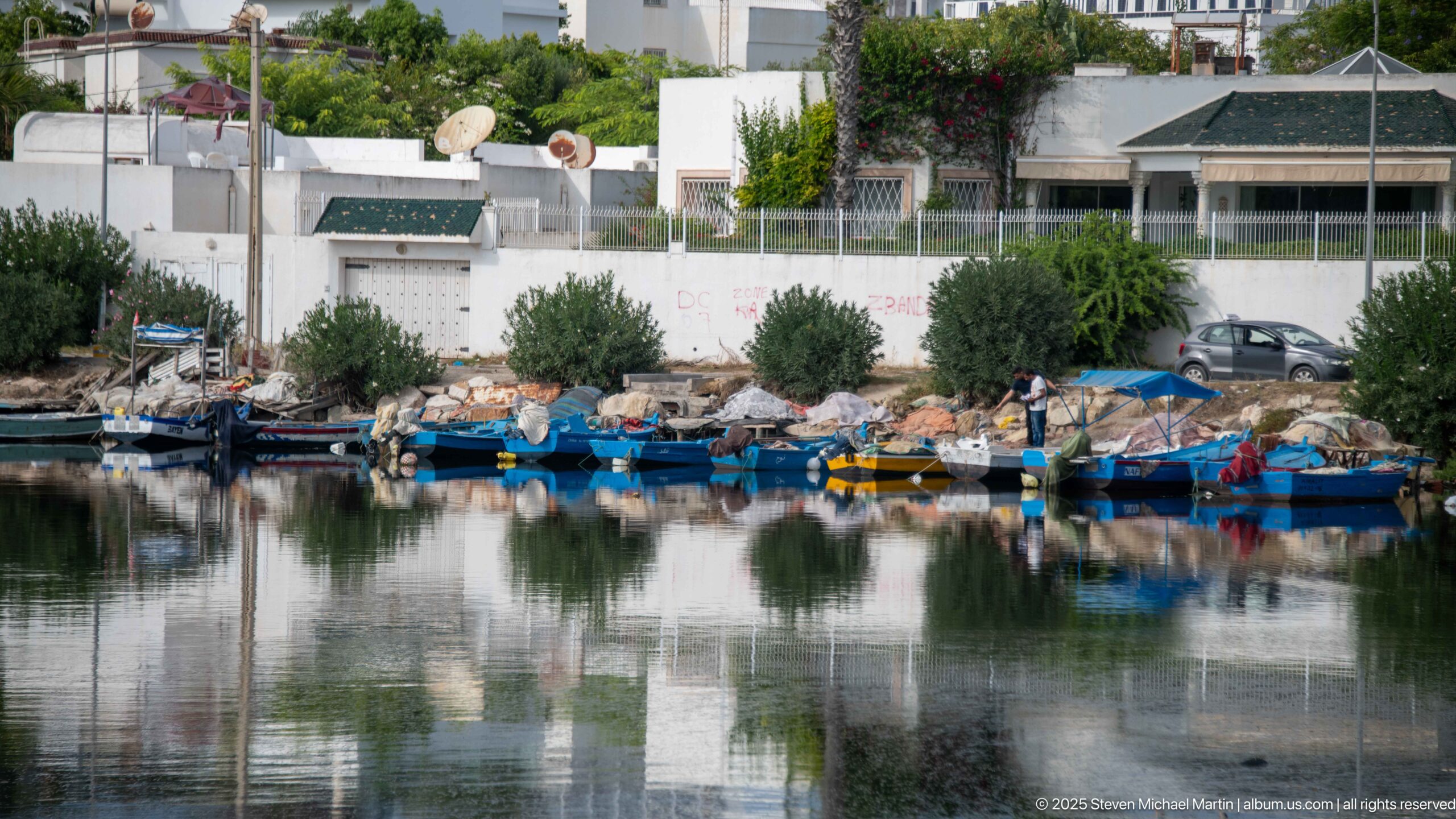
A dense line of small working boats, nets, tarps, and fishing gear occupies the shoreline of the Punic port basin. White houses with green roof details rise immediately behind, underscoring the close relationship between present-day residential life and the ancient harbor landscape. Reflections on the calm water soften the busy shoreline, while the photograph documents contemporary use more than archaeological remains.
Caption
A dense line of small working boats, nets, tarps, and fishing gear occupies the shoreline of the Punic port basin. White houses with green roof details rise immediately behind, underscoring the close relationship between present-day residential life and the ancient harbor landscape. Reflections on the calm water soften the busy shoreline, while the photograph documents contemporary use more than archaeological remains.
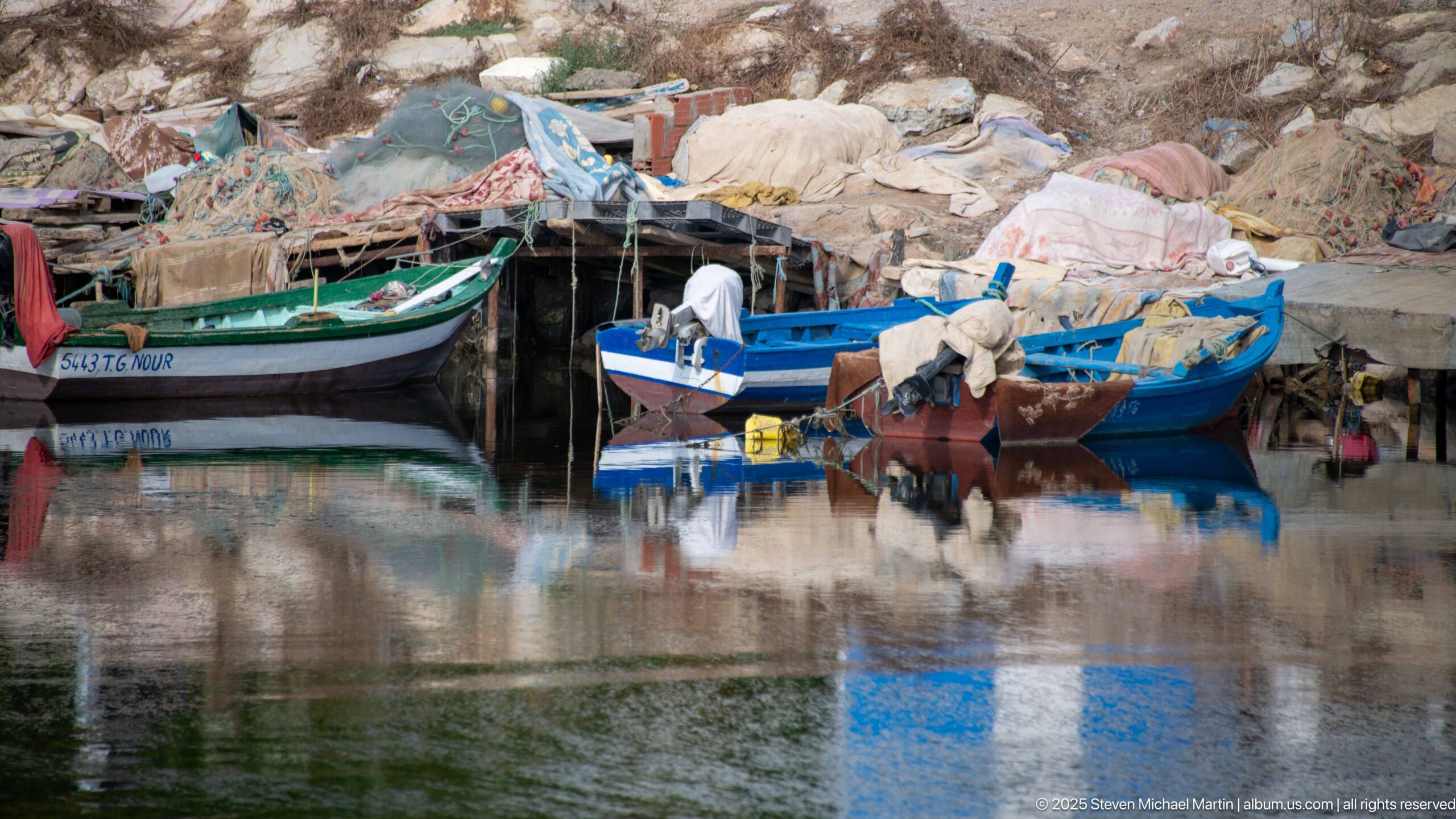
Several small wooden fishing boats are moored tightly against a cluttered harbor edge where nets, tarps, crates, and other working materials have been piled. One person tends a blue boat at the waterline, adding a human scale to the scene. The close view emphasizes the practical, lived use of the Punic port basin as a contemporary fishing space rather than its archaeological character.
Caption
Several small wooden fishing boats are moored tightly against a cluttered harbor edge where nets, tarps, crates, and other working materials have been piled. One person tends a blue boat at the waterline, adding a human scale to the scene. The close view emphasizes the practical, lived use of the Punic port basin as a contemporary fishing space rather than its archaeological character.
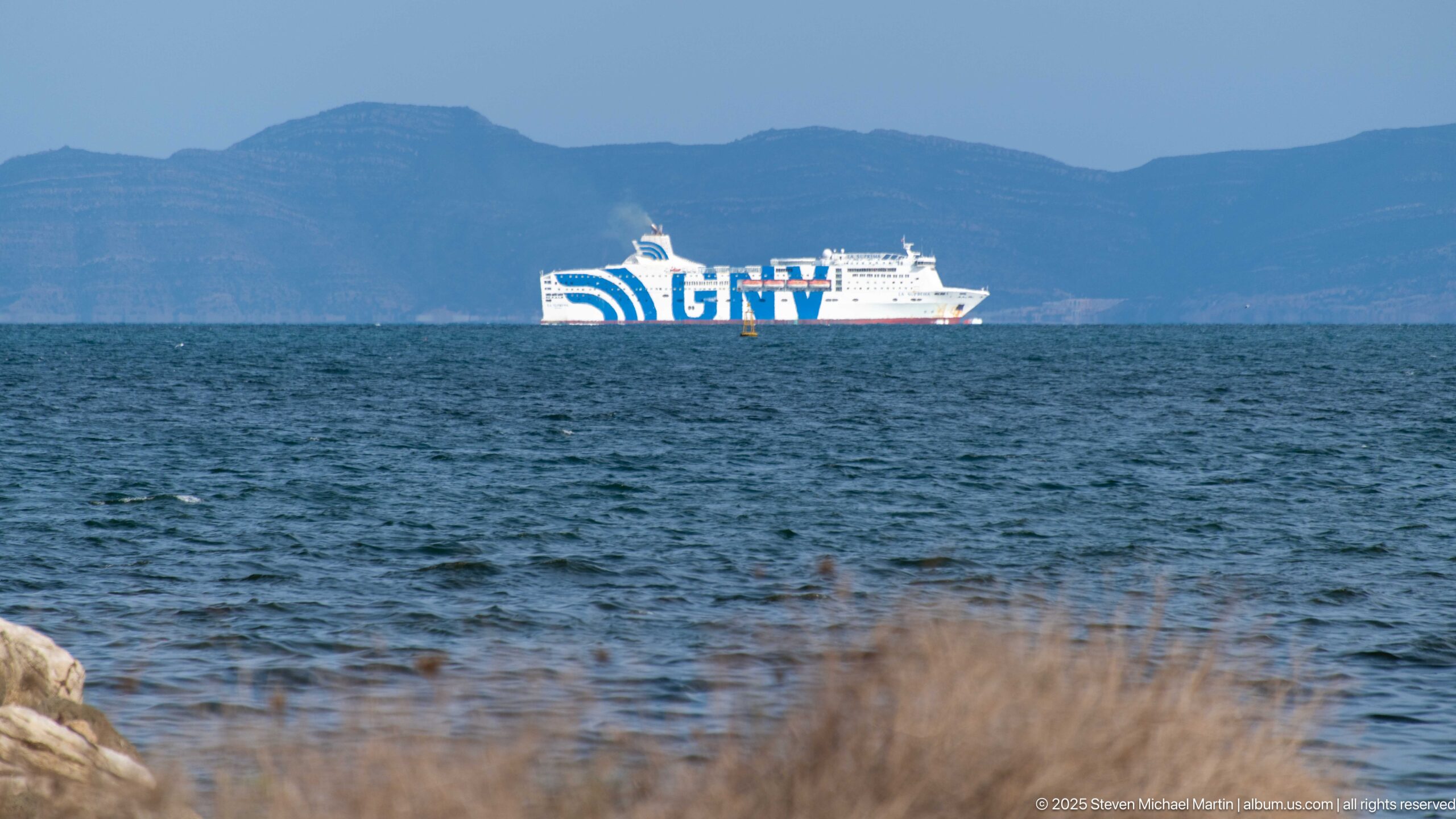
A large white-and-blue passenger ferry crosses the Gulf of Tunis beyond the Carthage shoreline, its high superstructure and enclosed vehicle-and-passenger profile standing out against distant mountain ridges. The open-water view broadens the portfolio from the ancient Punic harbor to modern regional maritime traffic, reinforcing the continuing importance of the Gulf as a transportation corridor.
Caption
A large white-and-blue passenger ferry crosses the Gulf of Tunis beyond the Carthage shoreline, its high superstructure and enclosed vehicle-and-passenger profile standing out against distant mountain ridges. The open-water view broadens the portfolio from the ancient Punic harbor to modern regional maritime traffic, reinforcing the continuing importance of the Gulf as a transportation corridor.
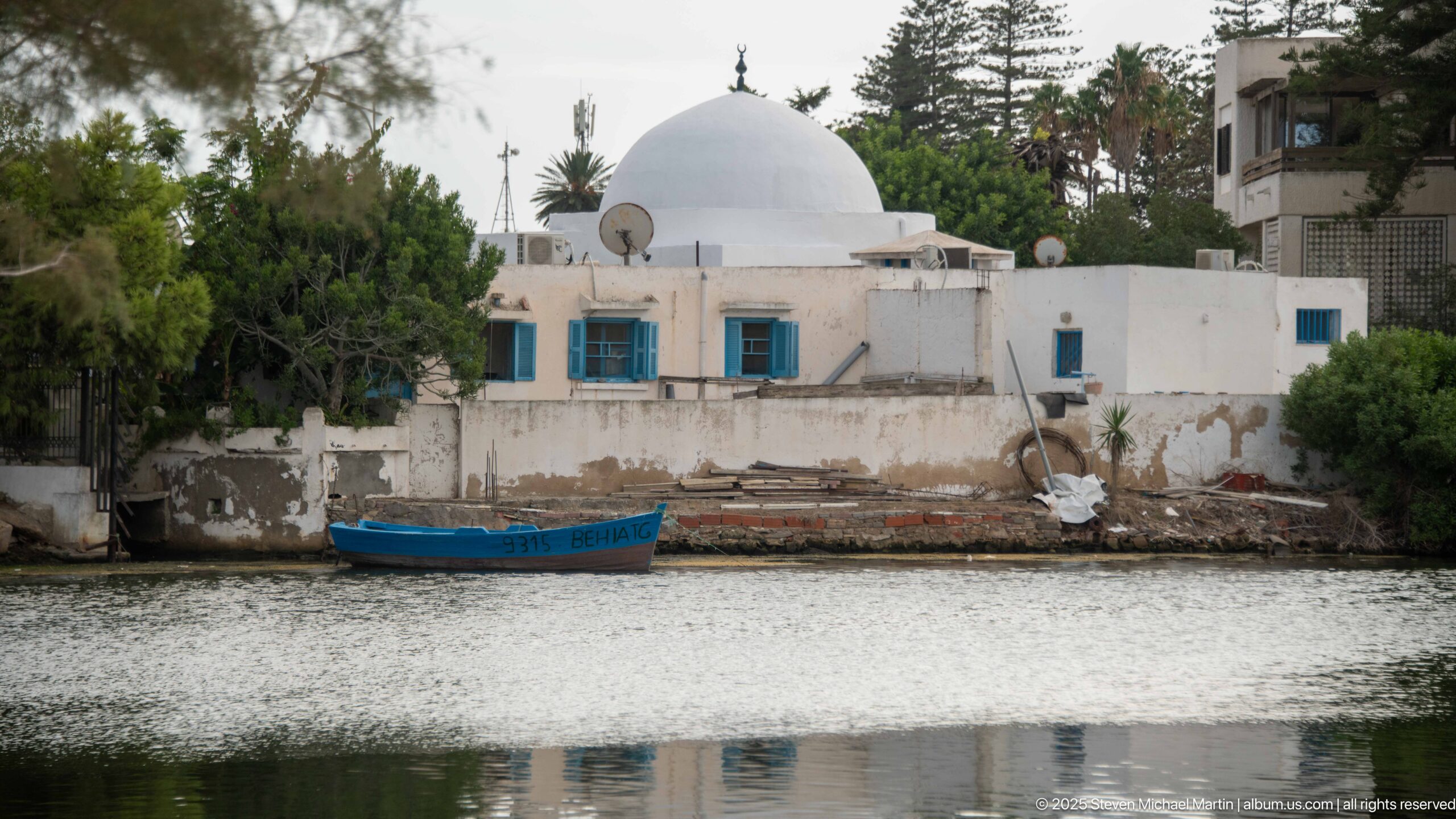
A white waterfront residence with bright blue shutters stands directly beside the Punic port basin, while a large white dome rises behind the roofline among trees. A small blue boat is moored against the weathered quay below. The final photograph in the sequence closes on the intimate modern shoreline of Carthage, where domestic architecture and everyday boating sit immediately beside the ancient harbor waters.
Caption
A white waterfront residence with bright blue shutters stands directly beside the Punic port basin, while a large white dome rises behind the roofline among trees. A small blue boat is moored against the weathered quay below. The final photograph in the sequence closes on the intimate modern shoreline of Carthage, where domestic architecture and everyday boating sit immediately beside the ancient harbor waters.
⭐ Highlights
- Phoenician Origins: Founded in the 9th century BC as a major trading colony.
- Mediterranean Power: Capital of a vast maritime empire dominating trade routes.
- Punic Wars: One of the central rivals of Rome in ancient history.
- Roman Reconstruction: Rebuilt after destruction and became a major Roman city.
- UNESCO World Heritage Site: Recognized for its global historical importance.
- Dispersed Ruins: Archaeological remains spread across a large coastal landscape.
🏛️ Carthage Field Guide
Major features observed during this visit:
Carthage is one of the most important archaeological sites in the world, located on the coast of modern-day Tunisia near Tunis. Founded by Phoenician settlers, it grew into a powerful maritime empire controlling trade across much of the Mediterranean. At its height, Carthage was one of the wealthiest and most influential cities of the ancient world.
The city’s history is defined by its conflict with Rome during the Punic Wars. After centuries of rivalry, Carthage was destroyed in 146 BC. A new Roman city was later built on the same site, transforming it into one of the most important urban centers in Roman Africa. Today, the remains of both civilizations coexist across a wide archaeological landscape.
🏛️ Signature Landmarks
- Antonine Baths – Massive Roman bath complex overlooking the sea.
- Punic Ports – Remains of the ancient harbor system that supported Carthage’s navy and trade.
- Byrsa Hill – The historic center of the ancient city and later Roman settlement.
- Roman Villas – Residential areas with mosaics and architectural remains.
- Amphitheatre – A Roman-era structure reflecting the city’s later development.
🧠 Historical Significance
- Phoenician Foundation – Established as a trading colony from Tyre.
- Commercial Empire – Controlled key Mediterranean trade routes for centuries.
- Rival to Rome – One of the greatest powers of the ancient world.
- Destruction and Rebirth – Destroyed in war, then rebuilt as a Roman capital.
🌄 Landscape & Setting
- Coastal Promontory – Positioned to control maritime routes along the Mediterranean.
- Wide Archaeological Zone – Ruins are spread across multiple sites rather than one central location.
- Sea and City Integration – The harbor and coastline were central to the city’s identity.
- Layered Civilizations – Punic and Roman remains exist side by side.