Djemila Museum – Algeria
The Djemila Museum preserves many of the remarkable artifacts discovered during archaeological excavations of the ancient city of Djemila. The museum’s collection provides insight into the artistic and cultural life of the Roman settlement.
Among the highlights are beautifully preserved Roman mosaics, sculptures, and architectural fragments that once decorated the city’s temples and public buildings. These works of art illustrate the wealth and sophistication of Roman provincial life in North Africa.
Together with the ruins of the city itself, the museum helps bring the history of Djemila and the Roman presence in Algeria to life.
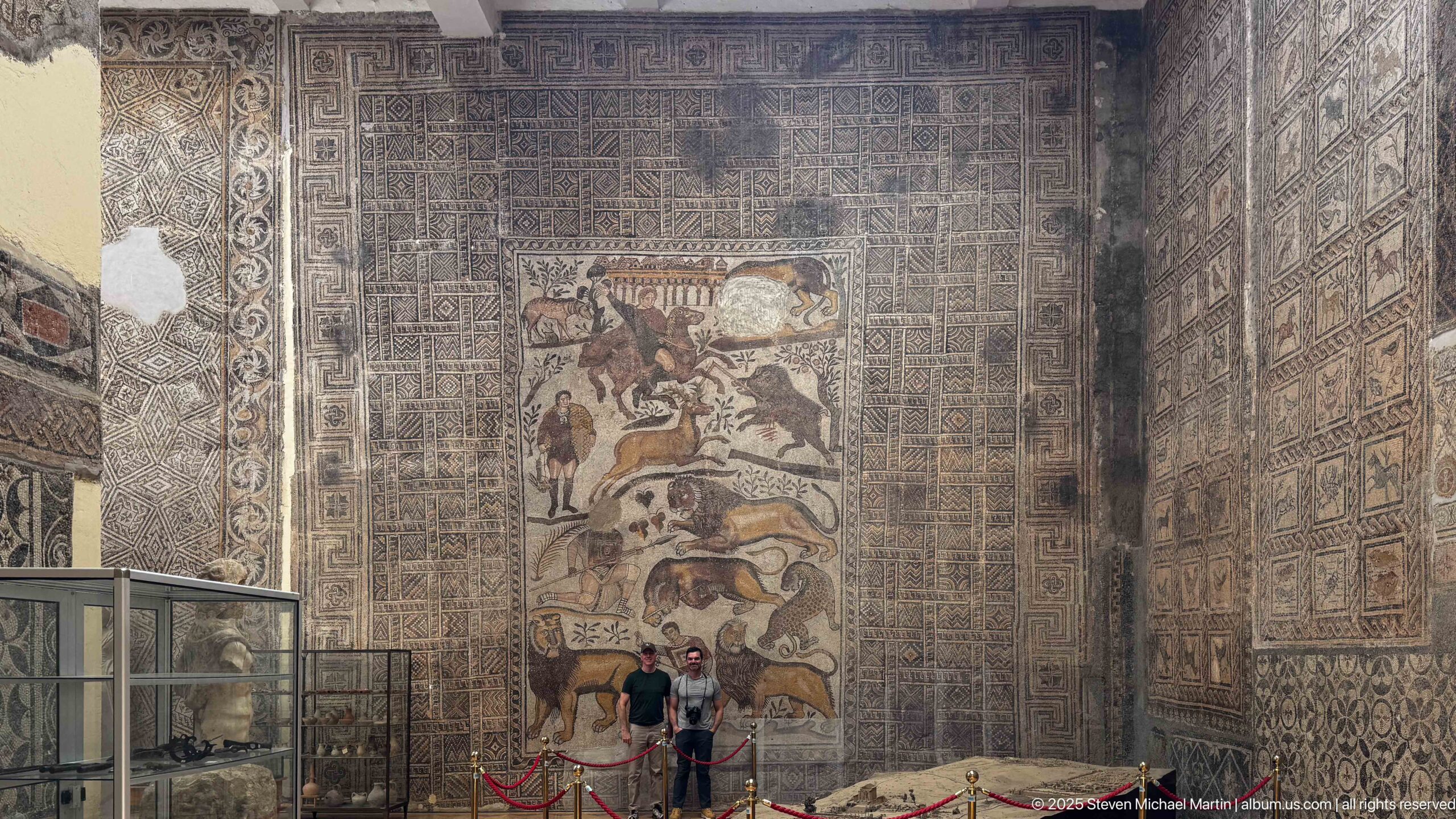
The Great Hunt Mosaic from the House of Bacchus forms the figurative centerpiece of this frontal gallery view. Created in the mid-4th century CE for a grand dining hall, it depicts a venatio-like hunt populated by lions, leopard, boar, deer, and armed hunters. The flanking geometric mosaics emphasize how dramatically the narrative panel differs from the patterned pavements surrounding it.
Caption
The Great Hunt Mosaic from the House of Bacchus forms the figurative centerpiece of this frontal gallery view. Created in the mid-4th century CE for a grand dining hall, it depicts a venatio-like hunt populated by lions, leopard, boar, deer, and armed hunters. The flanking geometric mosaics emphasize how dramatically the narrative panel differs from the patterned pavements surrounding it.
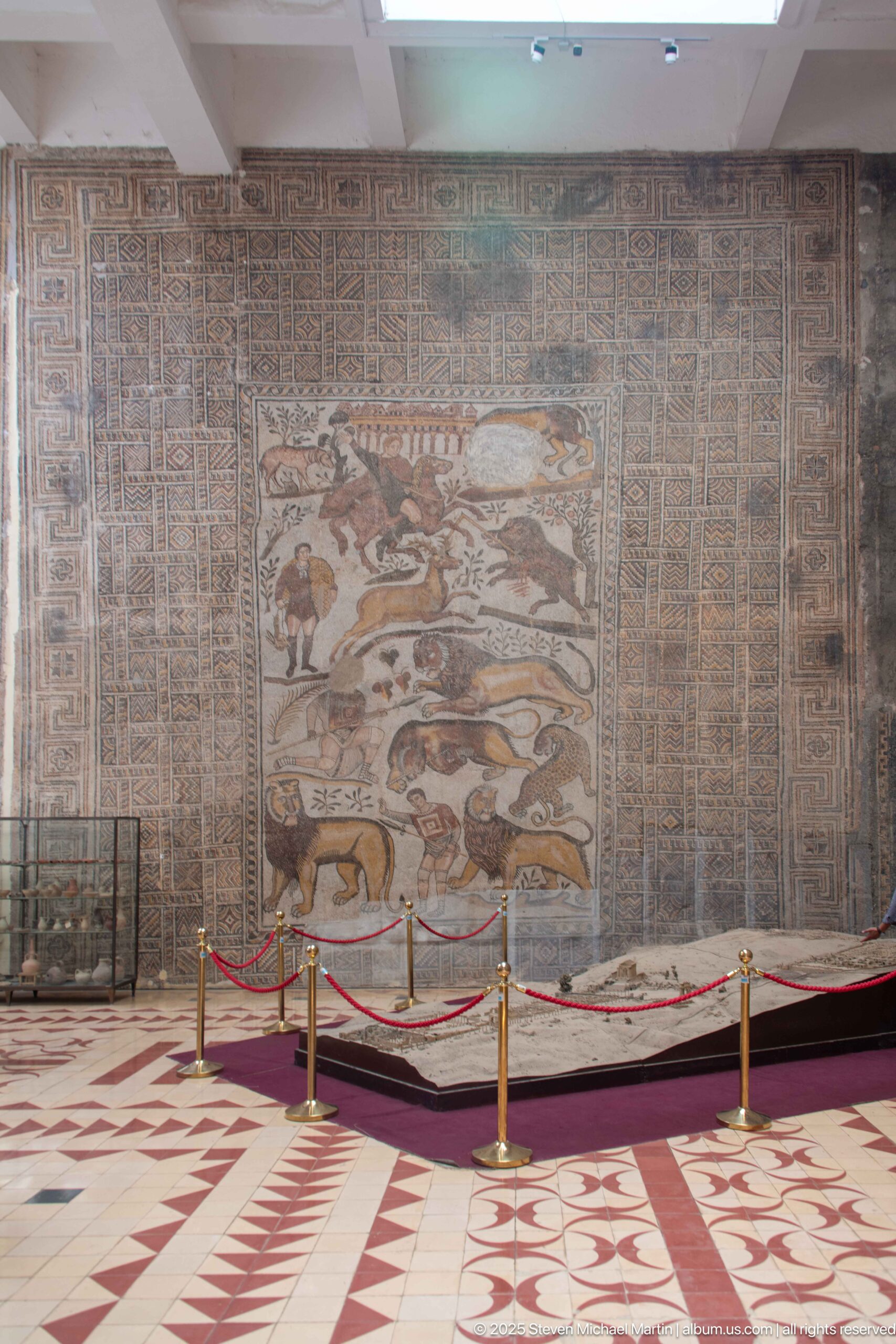
The Great Hunt Mosaic from the House of Bacchus dominates the far wall of this gallery. Made for a grand banqueting hall in the mid-4th century CE, the pavement presents an arena-like hunt with hunters and wild beasts arranged in successive registers. The red-carpeted barrier and surrounding geometric mosaics make this wide view particularly useful for understanding the work’s monumental size and its modern installation.
Caption
The Great Hunt Mosaic from the House of Bacchus dominates the far wall of this gallery. Made for a grand banqueting hall in the mid-4th century CE, the pavement presents an arena-like hunt with hunters and wild beasts arranged in successive registers. The red-carpeted barrier and surrounding geometric mosaics make this wide view particularly useful for understanding the work’s monumental size and its modern installation.
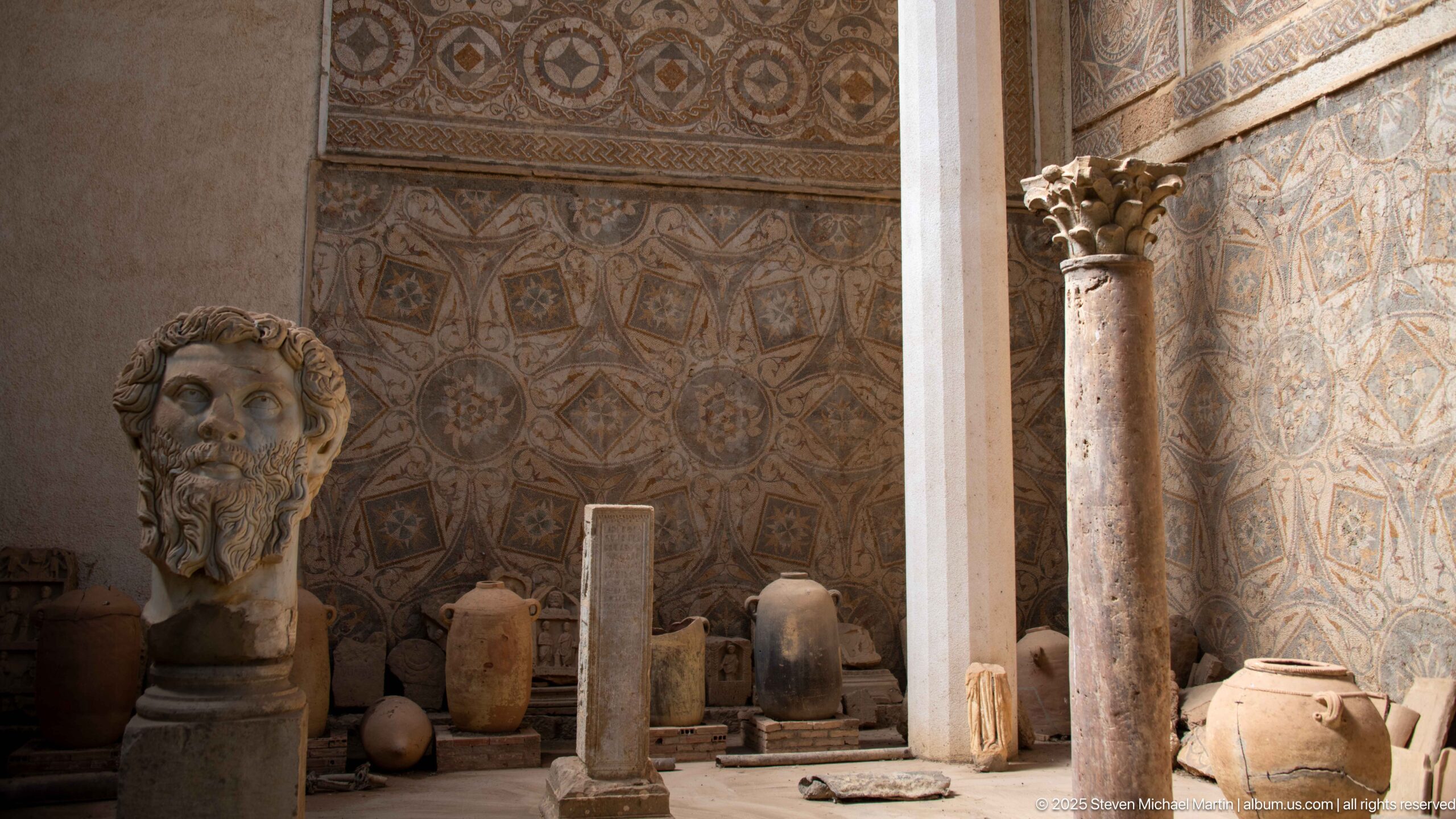
The colossal portrait head of Emperor Septimius Severus stands among amphorae, a column, and mosaic-covered walls in this Djemila Museum display. The emperor’s distinctive mass of curls and long divided beard make the portrait identifiable even in profile. The head is associated with Cuicul’s Severan monumental complex, where colossal portraits of Septimius Severus and Julia Domna were found.
Caption
The colossal portrait head of Emperor Septimius Severus stands among amphorae, a column, and mosaic-covered walls in this Djemila Museum display. The emperor’s distinctive mass of curls and long divided beard make the portrait identifiable even in profile. The head is associated with Cuicul’s Severan monumental complex, where colossal portraits of Septimius Severus and Julia Domna were found.
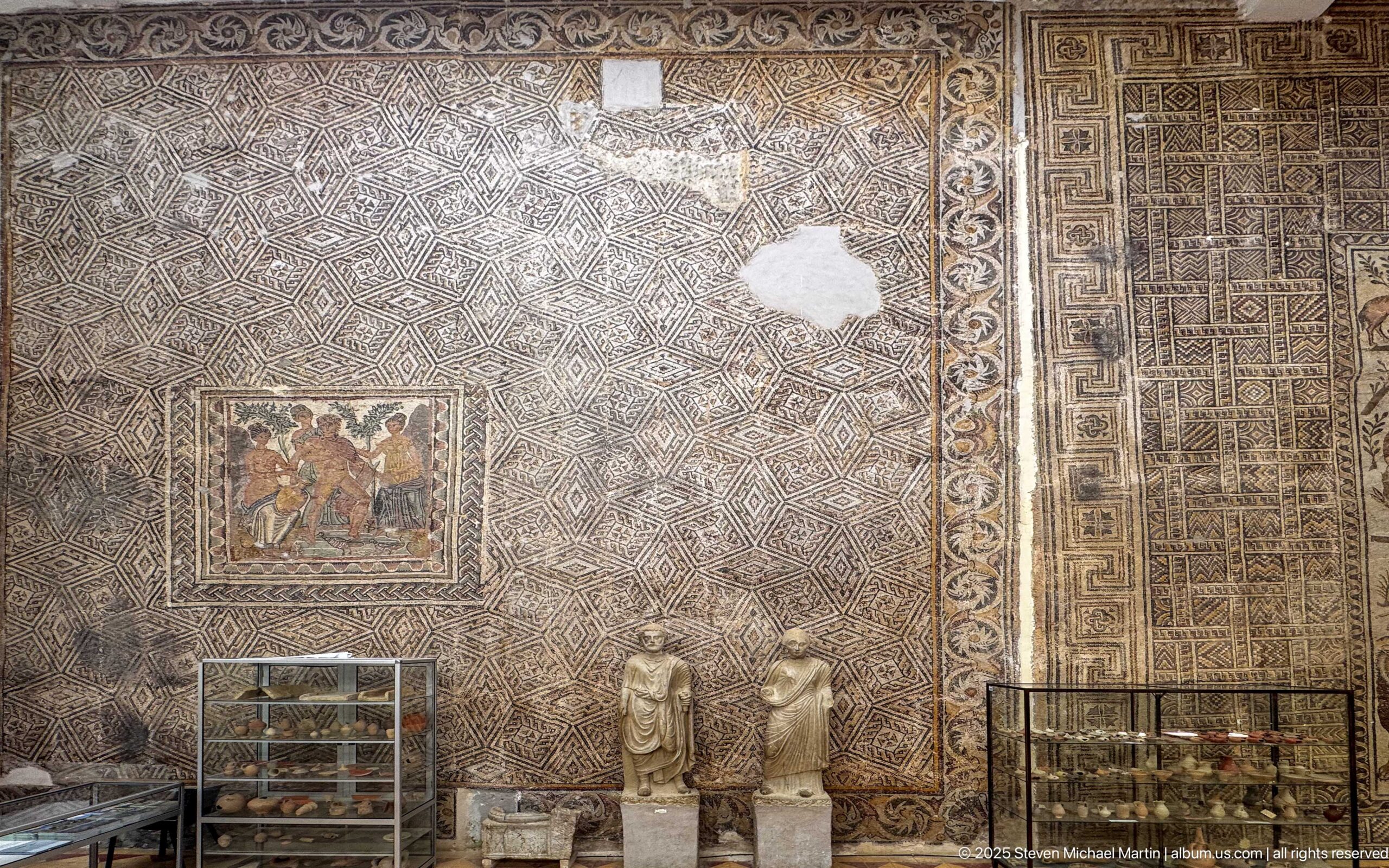
A broad gallery view shows monumental Roman mosaics mounted across the walls, with sculpture and archaeological objects arranged in cases below. The central wall combines an extensive geometric field with a smaller figurative panel, while a second densely patterned mosaic occupies the adjoining wall. The photograph documents the museum’s distinctive presentation of large mosaics as architectural-scale displays rather than isolated fragments.
Caption
A broad gallery view shows monumental Roman mosaics mounted across the walls, with sculpture and archaeological objects arranged in cases below. The central wall combines an extensive geometric field with a smaller figurative panel, while a second densely patterned mosaic occupies the adjoining wall. The photograph documents the museum’s distinctive presentation of large mosaics as architectural-scale displays rather than isolated fragments.

This skylit gallery view is anchored by the Great Hunt Mosaic from the House of Bacchus at the far end. The mid-4th-century hunting pavement is surrounded by an extraordinary concentration of geometric and figurative mosaics transferred from ancient Cuicul. Seen within the full room, the museum’s wall-to-wall installation conveys both the scale of the individual works and the breadth of Djemila’s mosaic tradition.
Caption
This skylit gallery view is anchored by the Great Hunt Mosaic from the House of Bacchus at the far end. The mid-4th-century hunting pavement is surrounded by an extraordinary concentration of geometric and figurative mosaics transferred from ancient Cuicul. Seen within the full room, the museum’s wall-to-wall installation conveys both the scale of the individual works and the breadth of Djemila’s mosaic tradition.
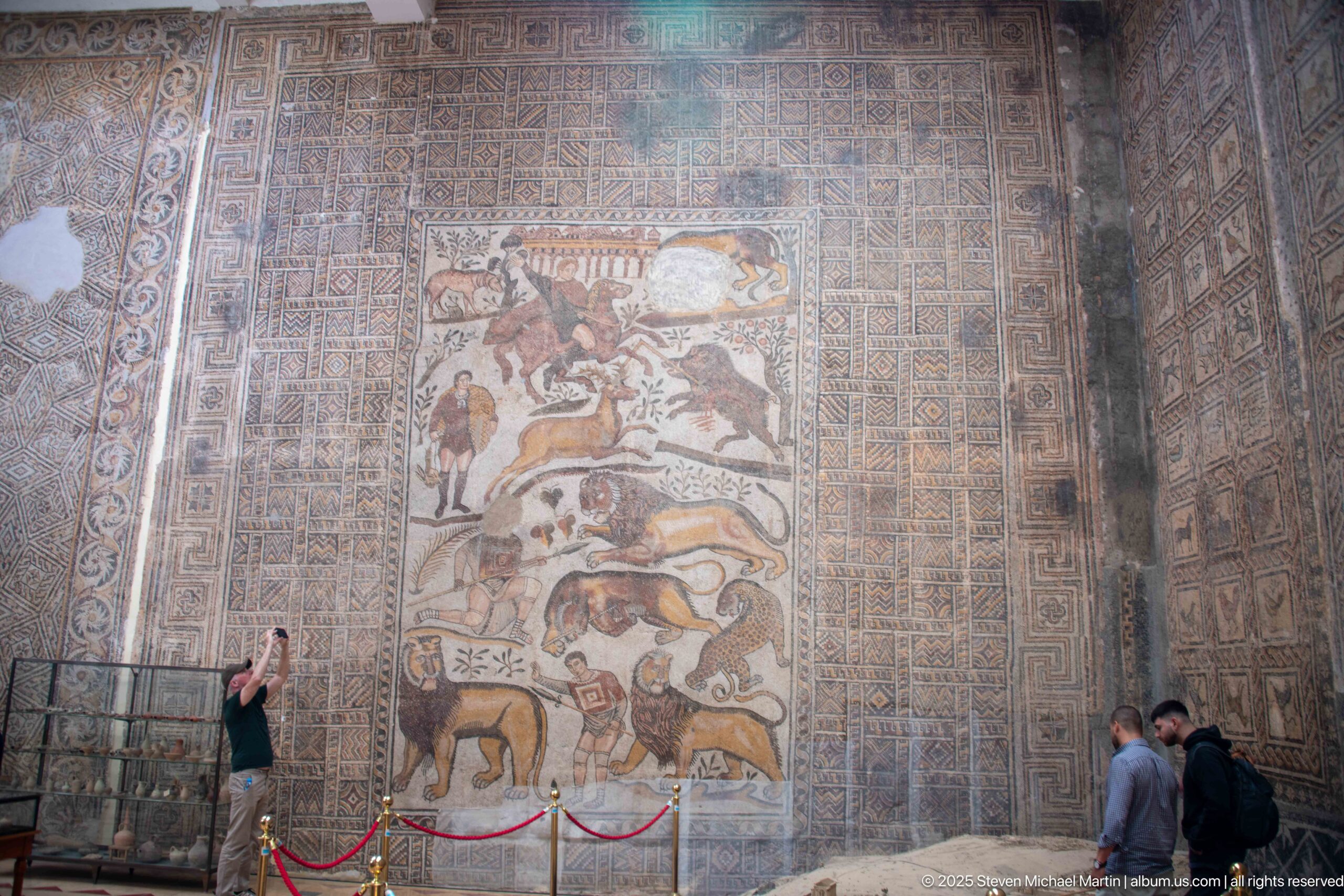
The Great Hunt Mosaic from the House of Bacchus rises as the centerpiece of this Djemila Museum wall. The mid-4th-century pavement originally decorated the residence’s grand banqueting hall and depicts an arena-like venatio populated by hunters and wild animals. Visitors at its base reveal the enormous scale of the mosaic, which is surrounded in the gallery by extensive geometric pavements from ancient Cuicul.
Caption
The Great Hunt Mosaic from the House of Bacchus rises as the centerpiece of this Djemila Museum wall. The mid-4th-century pavement originally decorated the residence’s grand banqueting hall and depicts an arena-like venatio populated by hunters and wild animals. Visitors at its base reveal the enormous scale of the mosaic, which is surrounded in the gallery by extensive geometric pavements from ancient Cuicul.

A close view isolates the monumental word “MVSEE,” rendered in widely spaced serif capitals against pale stone. The spelling reflects a classicalizing treatment of the French word musée, visually linking the museum entrance to the Roman antiquities preserved inside. Cropping away the doorway turns the inscription itself into the subject, emphasizing letterform, surface, and museum identity.
Caption
A close view isolates the monumental word “MVSEE,” rendered in widely spaced serif capitals against pale stone. The spelling reflects a classicalizing treatment of the French word musée, visually linking the museum entrance to the Roman antiquities preserved inside. Cropping away the doorway turns the inscription itself into the subject, emphasizing letterform, surface, and museum identity.
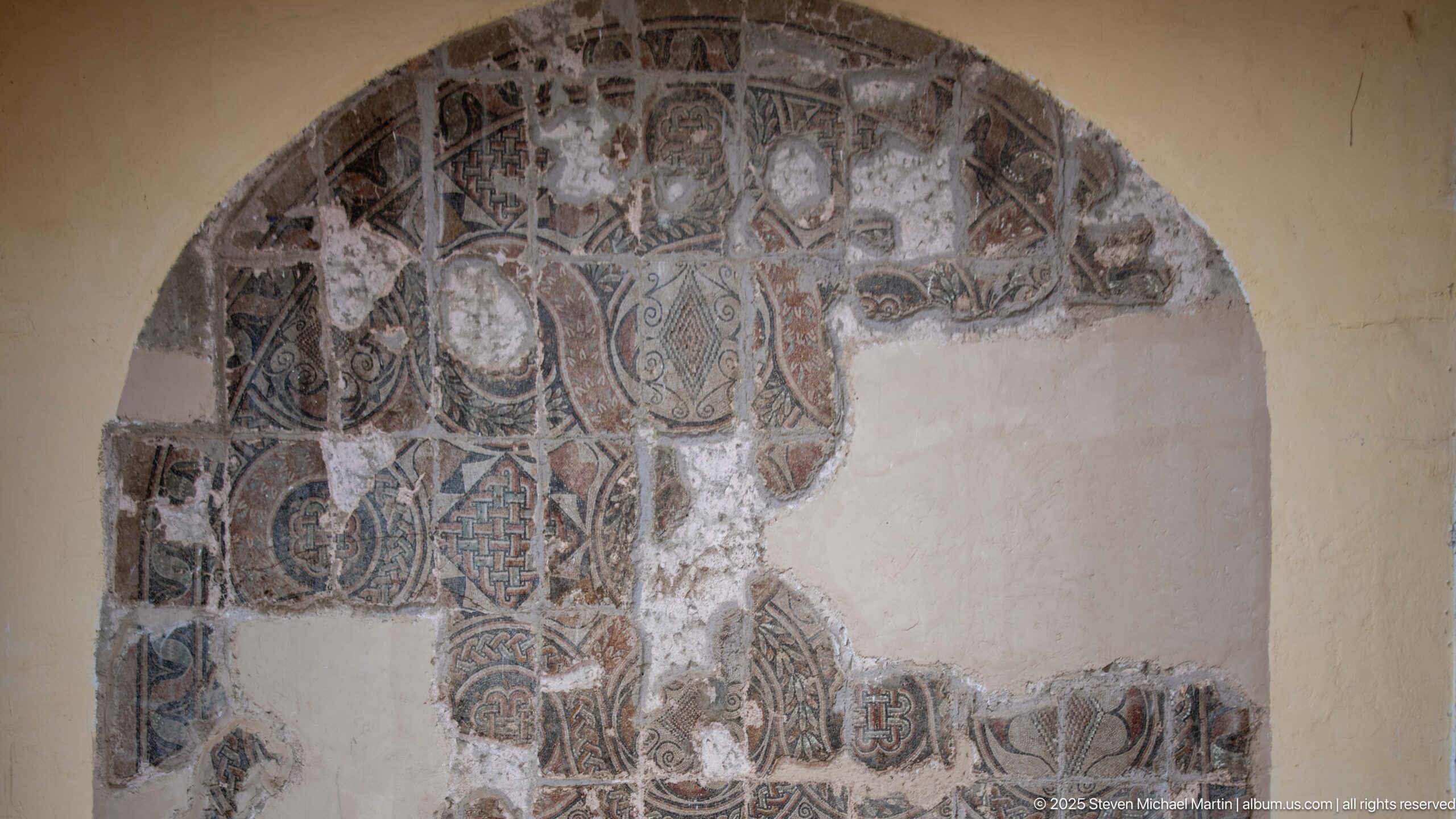
A fragmentary Roman mosaic survives within an arched wall field, its remaining tesserae forming curling bands, medallion-like shapes, and interlaced geometric ornament. Large losses expose the pale backing and make the panel’s incomplete condition especially clear. Rather than reconstructing the missing imagery, the museum preserves the surviving sections as evidence of the original decorative scheme and its complex border vocabulary.
Caption
A fragmentary Roman mosaic survives within an arched wall field, its remaining tesserae forming curling bands, medallion-like shapes, and interlaced geometric ornament. Large losses expose the pale backing and make the panel’s incomplete condition especially clear. Rather than reconstructing the missing imagery, the museum preserves the surviving sections as evidence of the original decorative scheme and its complex border vocabulary.
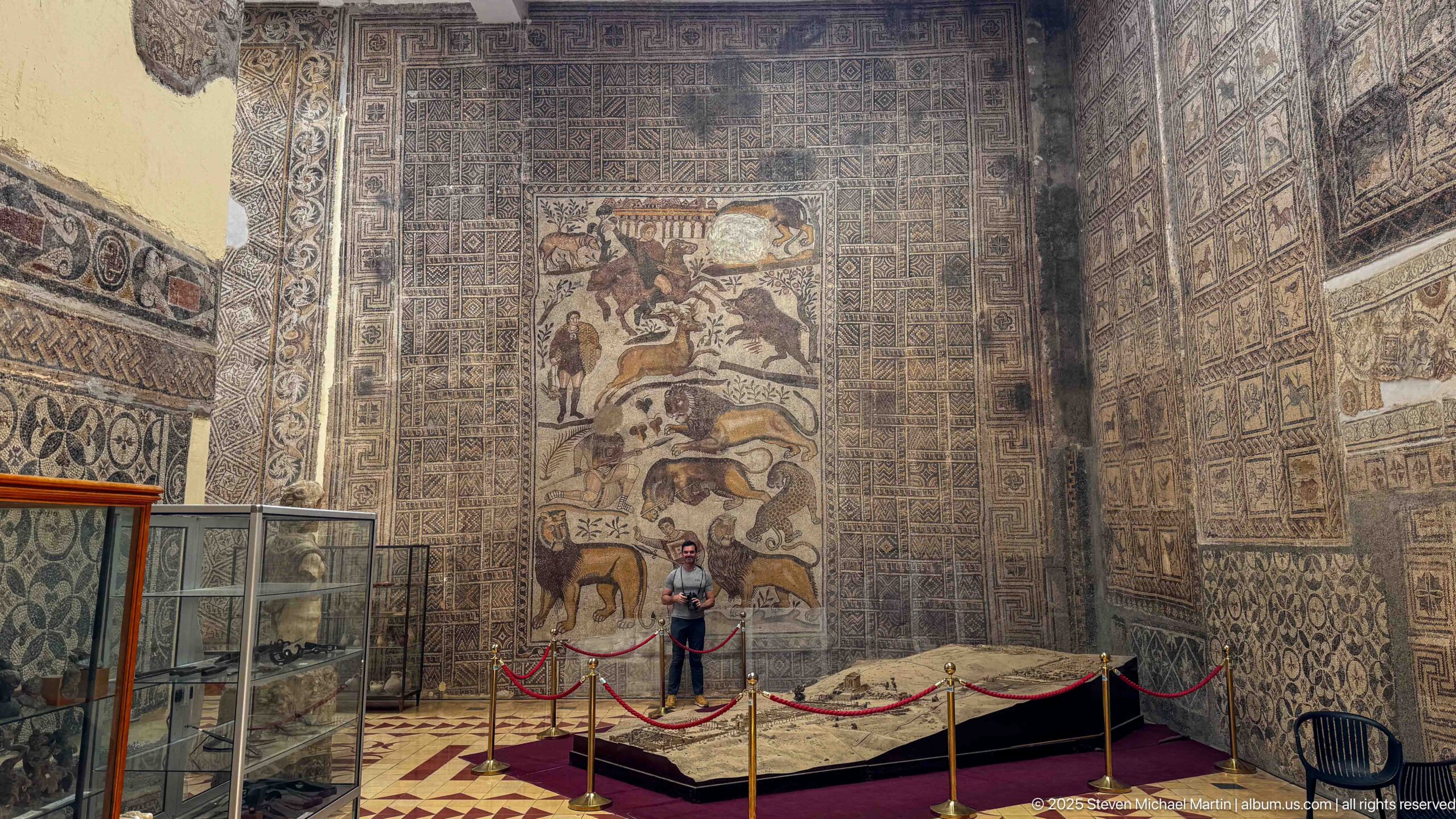
At the center of the far wall is Djemila’s Great Hunt Mosaic from the House of Bacchus, a mid-4th-century pavement created for a grand banqueting hall. Its stacked scenes of hunters and wild animals distinguish the figurative panel from the dense geometric mosaics covering the surrounding walls. A visitor standing below gives an immediate measure of the work’s exceptional vertical scale.
Caption
At the center of the far wall is Djemila’s Great Hunt Mosaic from the House of Bacchus, a mid-4th-century pavement created for a grand banqueting hall. Its stacked scenes of hunters and wild animals distinguish the figurative panel from the dense geometric mosaics covering the surrounding walls. A visitor standing below gives an immediate measure of the work’s exceptional vertical scale.
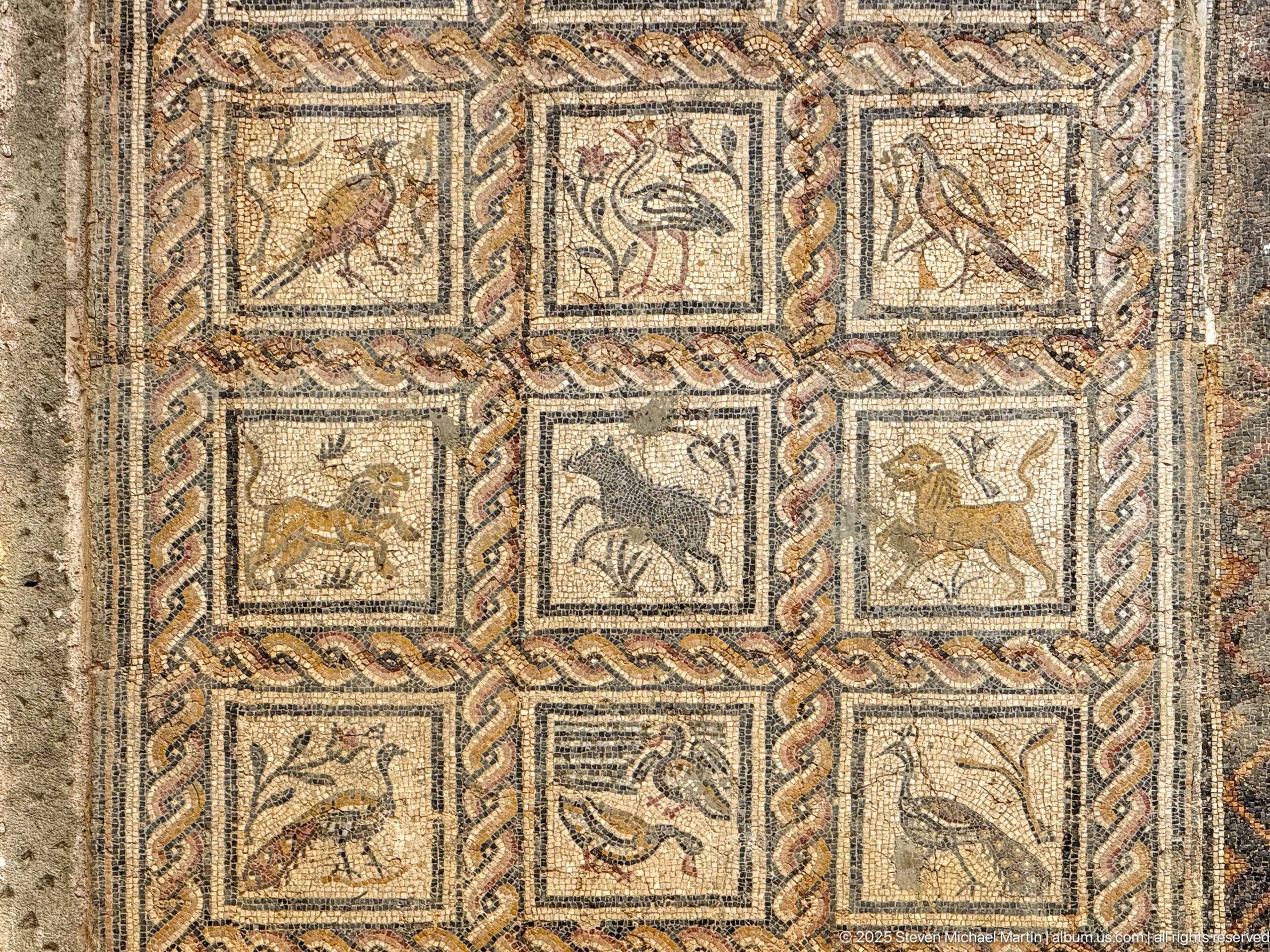
Nine framed compartments form a compact animal mosaic, each square containing a different bird, mammal, or other creature rendered in small tesserae. Braided borders separate the panels and unify the grid. The individual animals vary in pose and orientation, turning the floor decoration into a miniature catalog of fauna while preserving a highly controlled geometric structure.
Caption
Nine framed compartments form a compact animal mosaic, each square containing a different bird, mammal, or other creature rendered in small tesserae. Braided borders separate the panels and unify the grid. The individual animals vary in pose and orientation, turning the floor decoration into a miniature catalog of fauna while preserving a highly controlled geometric structure.
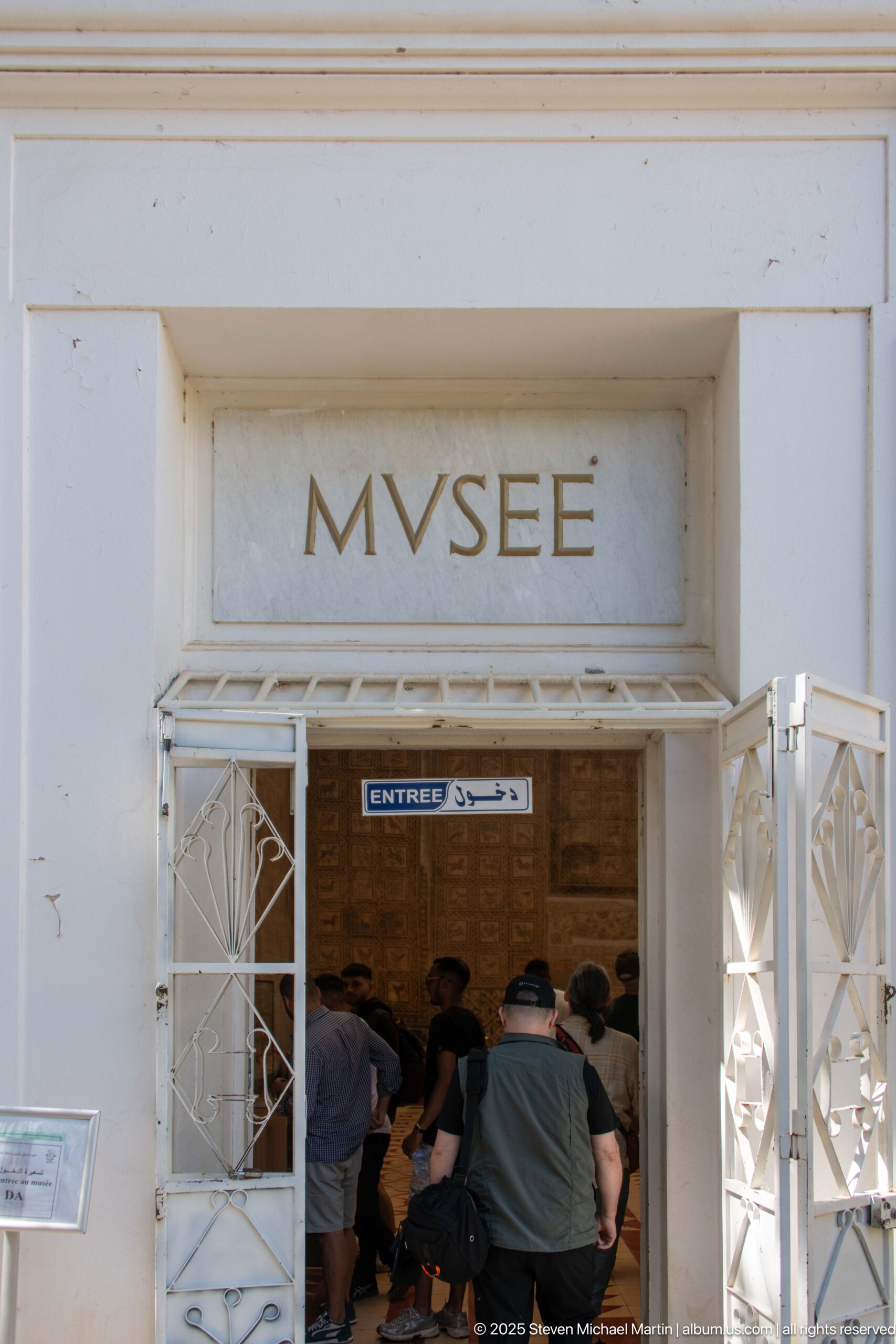
Visitors enter Djemila Museum through a white-painted doorway marked “MVSEE,” the classical Latin-style spelling of musée. The compact entrance introduces the museum collection associated with the Roman city of Djemila, while the open metal gates and directional sign make this a clear documentary view of the visitor approach rather than an archaeological object.
Caption
Visitors enter Djemila Museum through a white-painted doorway marked “MVSEE,” the classical Latin-style spelling of musée. The compact entrance introduces the museum collection associated with the Roman city of Djemila, while the open metal gates and directional sign make this a clear documentary view of the visitor approach rather than an archaeological object.
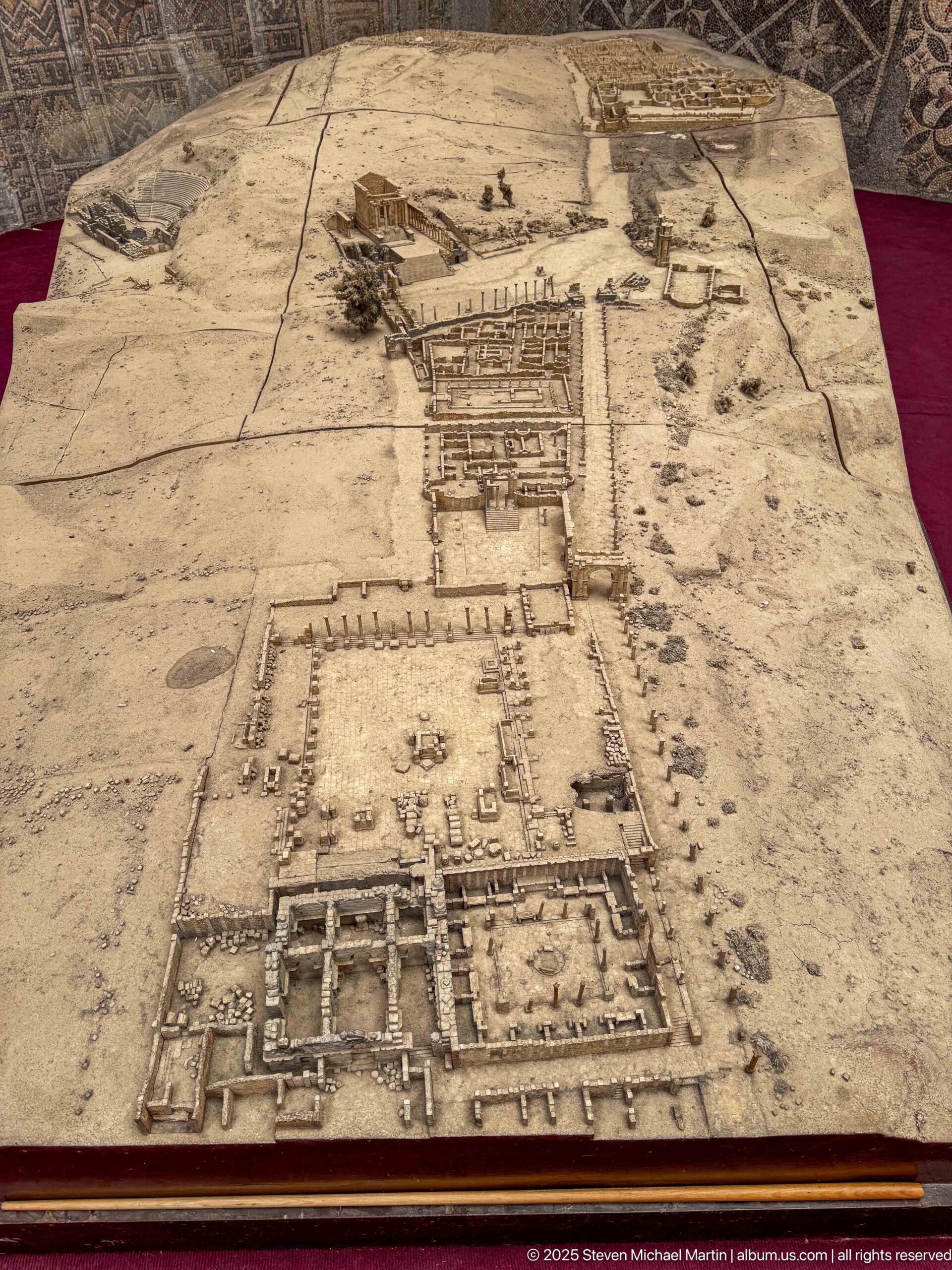
A raised relief model presents the excavated urban fabric of ancient Djemila as a connected archaeological landscape. Streets, building footprints, terraces, and larger architectural complexes are modeled in low relief, allowing the site’s dense plan and topographic setting to be read at a glance. The museum display provides spatial context for monuments that can be difficult to understand from ground level.
Caption
A raised relief model presents the excavated urban fabric of ancient Djemila as a connected archaeological landscape. Streets, building footprints, terraces, and larger architectural complexes are modeled in low relief, allowing the site’s dense plan and topographic setting to be read at a glance. The museum display provides spatial context for monuments that can be difficult to understand from ground level.
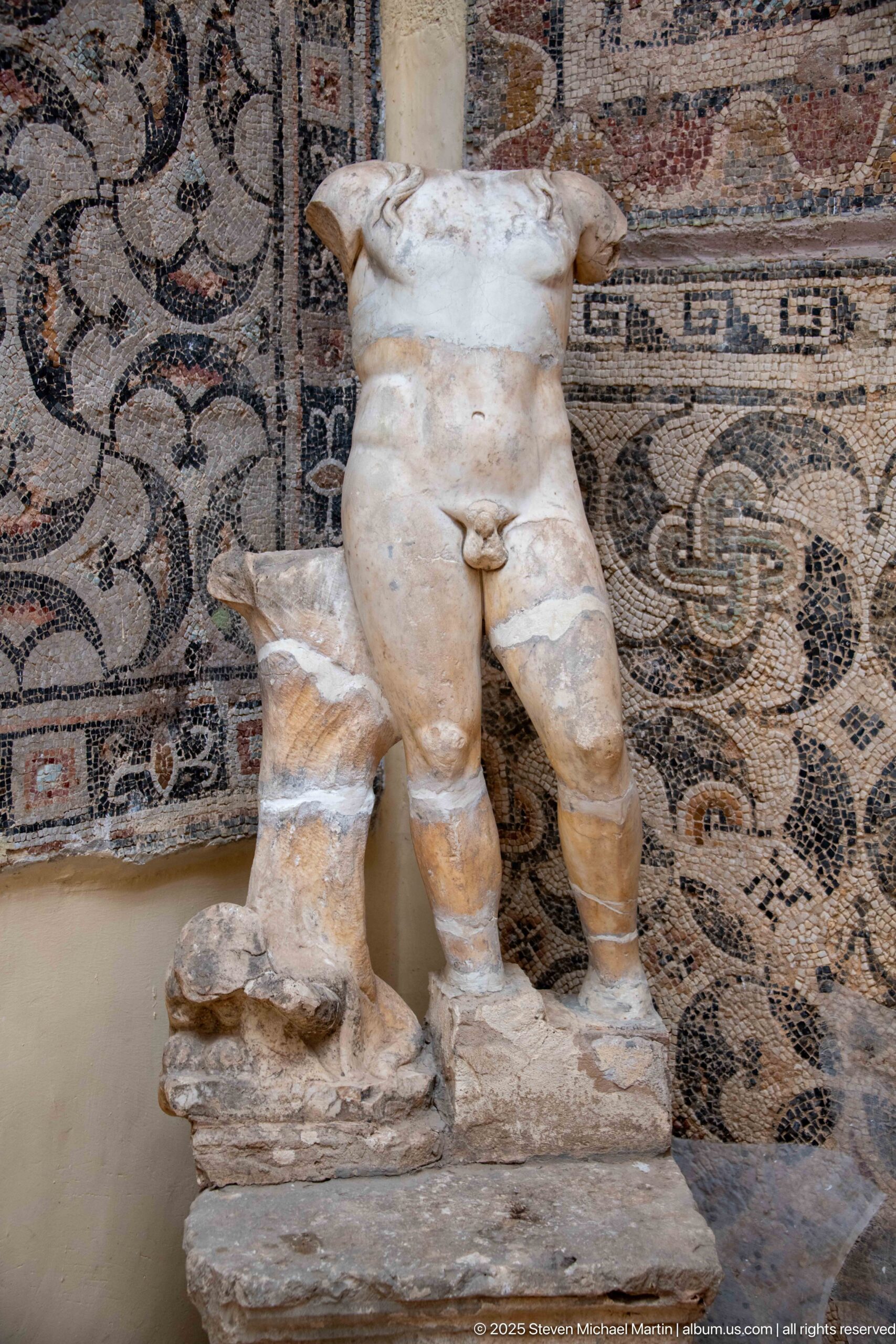
A fragmentary marble statue of a nude male figure stands before a geometric mosaic, preserving the torso, upper legs, and part of a supporting element at the figure’s side. The missing head and arms shift attention to anatomy, stance, and the surviving stone surface. The juxtaposition with the mosaic behind it creates a layered museum view of two distinct Roman artistic media.
Caption
A fragmentary marble statue of a nude male figure stands before a geometric mosaic, preserving the torso, upper legs, and part of a supporting element at the figure’s side. The missing head and arms shift attention to anatomy, stance, and the surviving stone surface. The juxtaposition with the mosaic behind it creates a layered museum view of two distinct Roman artistic media.
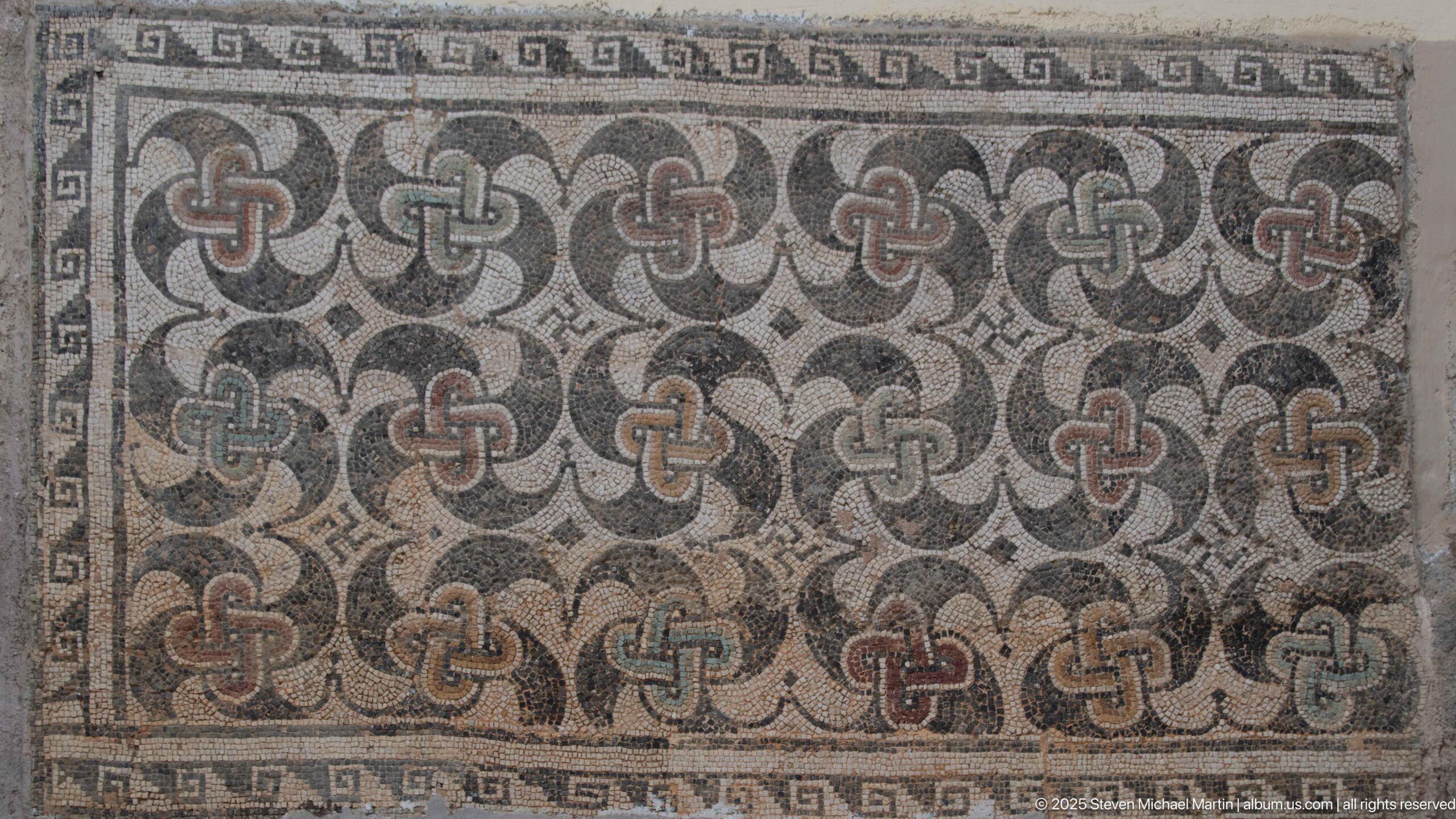
This Roman mosaic is organized as a dense repeat of interlaced quatrefoil-like knots, each set within a dark geometric field and accented with muted red, cream, and gray tesserae. A meander border frames the surviving panel. The photograph concentrates on pattern and craftsmanship, showing how small stone cubes create continuous rhythm without relying on a figurative scene.
Caption
This Roman mosaic is organized as a dense repeat of interlaced quatrefoil-like knots, each set within a dark geometric field and accented with muted red, cream, and gray tesserae. A meander border frames the surviving panel. The photograph concentrates on pattern and craftsmanship, showing how small stone cubes create continuous rhythm without relying on a figurative scene.
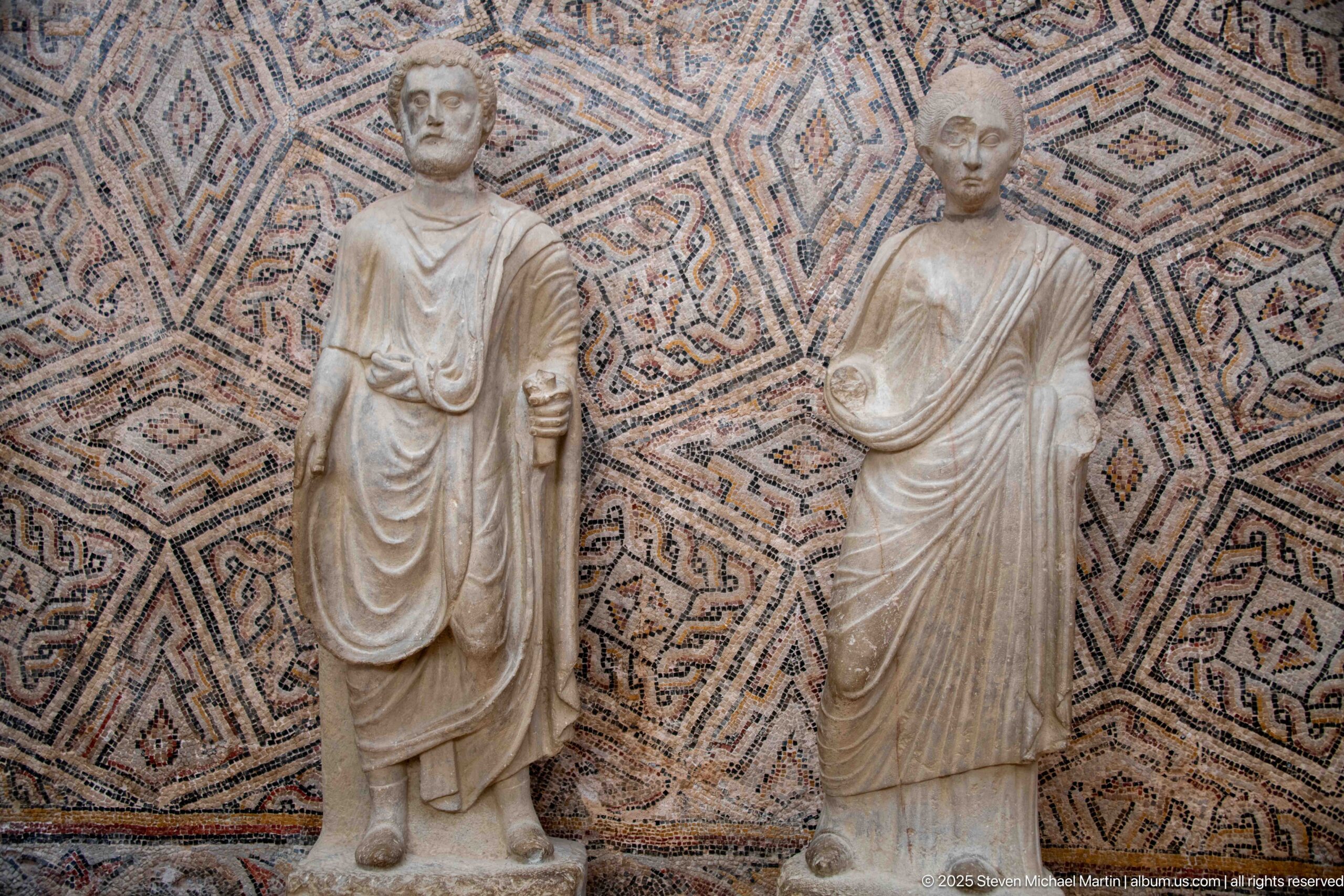
Two standing Roman marble figures, both heavily draped, are displayed against a richly patterned mosaic wall. Their different scale, stance, and garment folds are clearly visible despite losses to the heads and extremities. By pairing freestanding sculpture with mosaic decoration, the museum installation emphasizes the range of materials and decorative arts recovered from the ancient city.
Caption
Two standing Roman marble figures, both heavily draped, are displayed against a richly patterned mosaic wall. Their different scale, stance, and garment folds are clearly visible despite losses to the heads and extremities. By pairing freestanding sculpture with mosaic decoration, the museum installation emphasizes the range of materials and decorative arts recovered from the ancient city.
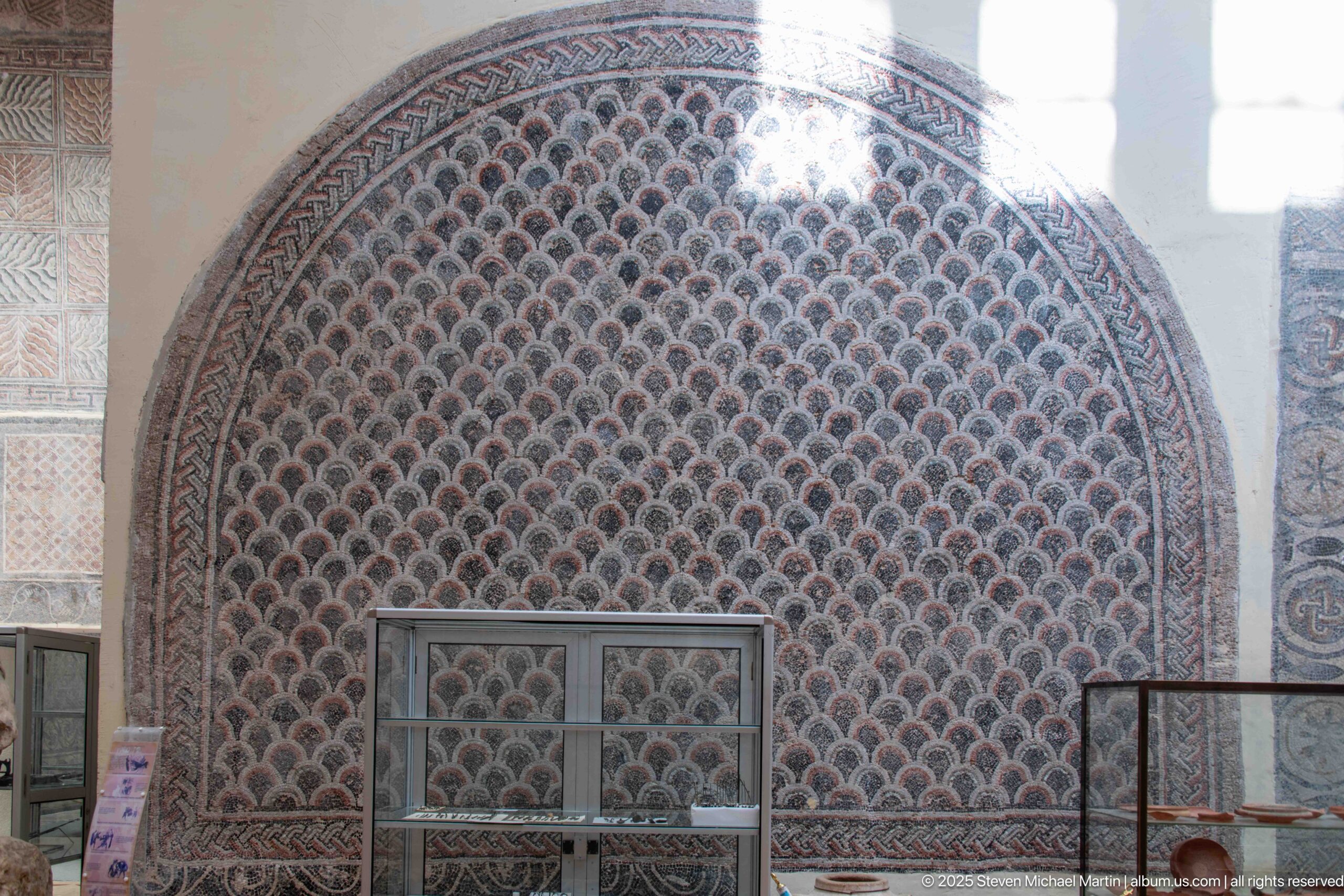
Hundreds of overlapping scallop or scale motifs fill this large arched Roman mosaic, each unit outlined in dark tesserae and accented with warm red tones. The disciplined repetition produces a textured surface that reads almost like masonry or textile patterning at a distance. Its scale and intact field make this panel a strong example of nonfigurative decoration in the Djemila Museum collection.
Caption
Hundreds of overlapping scallop or scale motifs fill this large arched Roman mosaic, each unit outlined in dark tesserae and accented with warm red tones. The disciplined repetition produces a textured surface that reads almost like masonry or textile patterning at a distance. Its scale and intact field make this panel a strong example of nonfigurative decoration in the Djemila Museum collection.
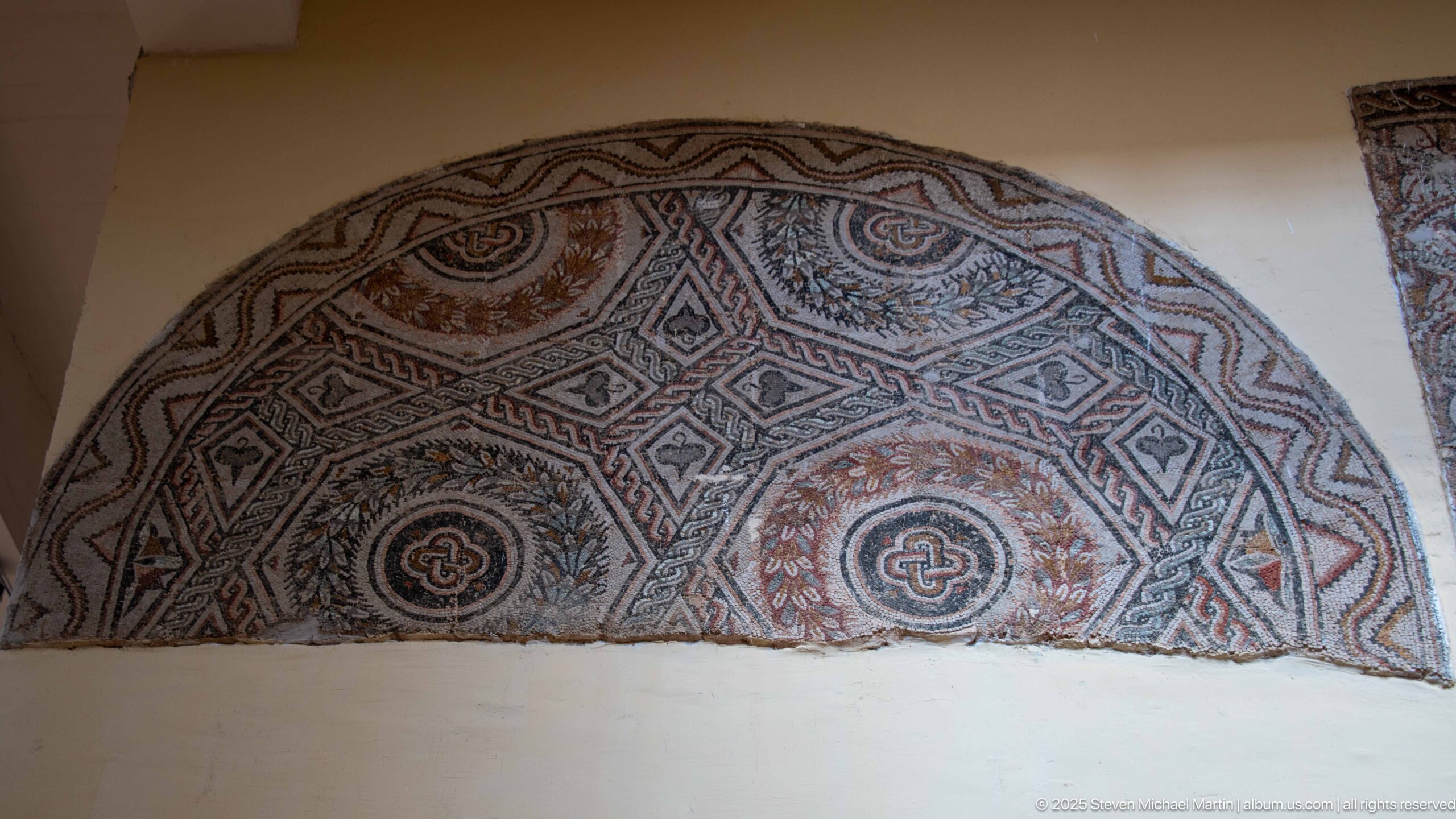
A semicircular Roman mosaic is divided into patterned compartments containing rosettes, circular medallions, interlace, and angular bands. Dark outlines, cream grounds, and red accents articulate the design, while the curved outer border follows the architectural shape of the surviving panel. The composition demonstrates how geometric ornament could be adapted to a half-round space rather than a conventional rectangular floor field.
Caption
A semicircular Roman mosaic is divided into patterned compartments containing rosettes, circular medallions, interlace, and angular bands. Dark outlines, cream grounds, and red accents articulate the design, while the curved outer border follows the architectural shape of the surviving panel. The composition demonstrates how geometric ornament could be adapted to a half-round space rather than a conventional rectangular floor field.
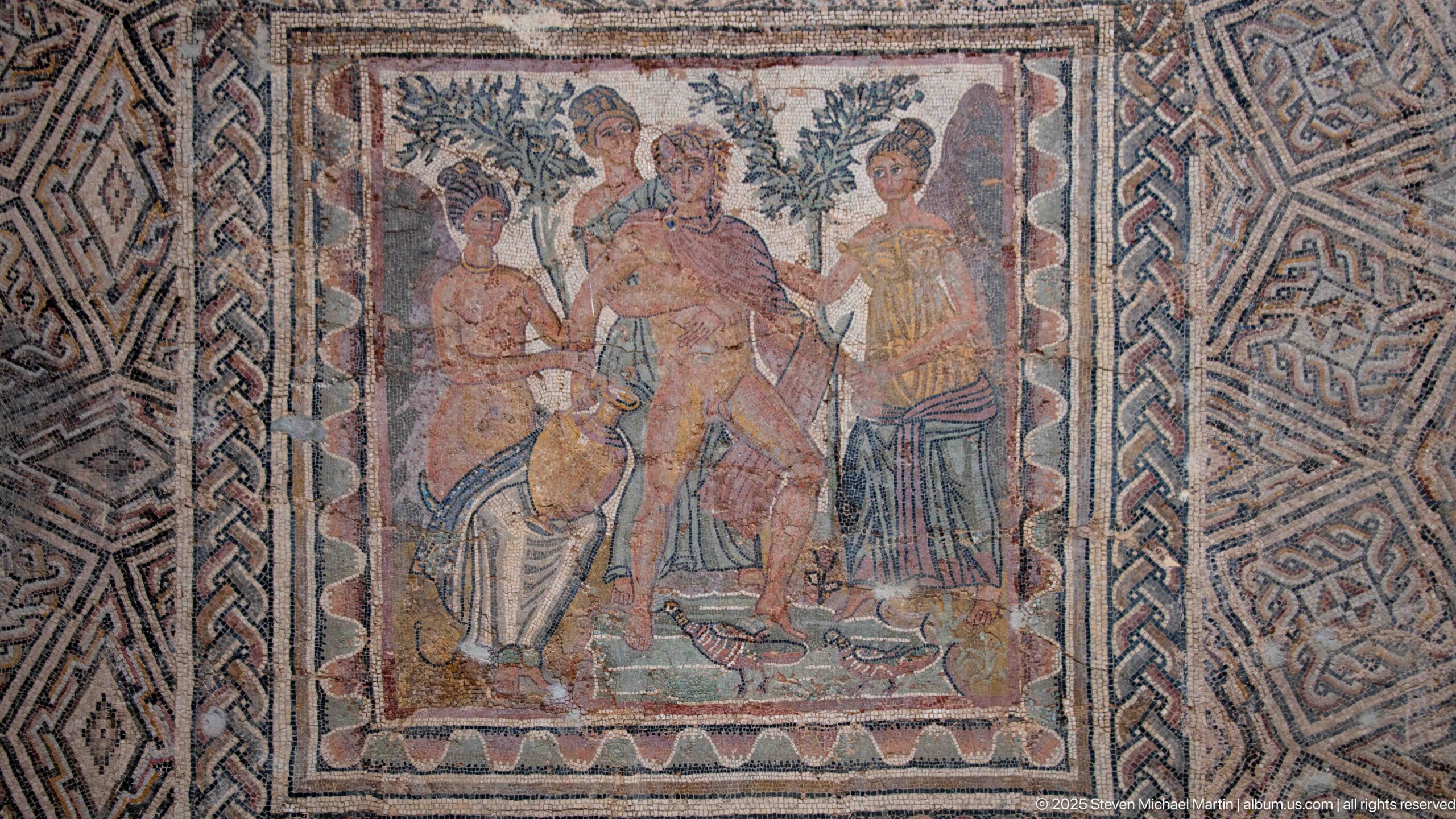
A framed figurative mosaic shows a central standing male figure accompanied by several women, one seated at the left and others standing nearby. The scene is set within an elaborate geometric border of interlaced bands. Facial features, garments, and gestures remain readable, but the proof sheet does not securely establish the episode’s mythological identity, so the caption preserves the observable composition without assigning a specific story.
Caption
A framed figurative mosaic shows a central standing male figure accompanied by several women, one seated at the left and others standing nearby. The scene is set within an elaborate geometric border of interlaced bands. Facial features, garments, and gestures remain readable, but the proof sheet does not securely establish the episode’s mythological identity, so the caption preserves the observable composition without assigning a specific story.
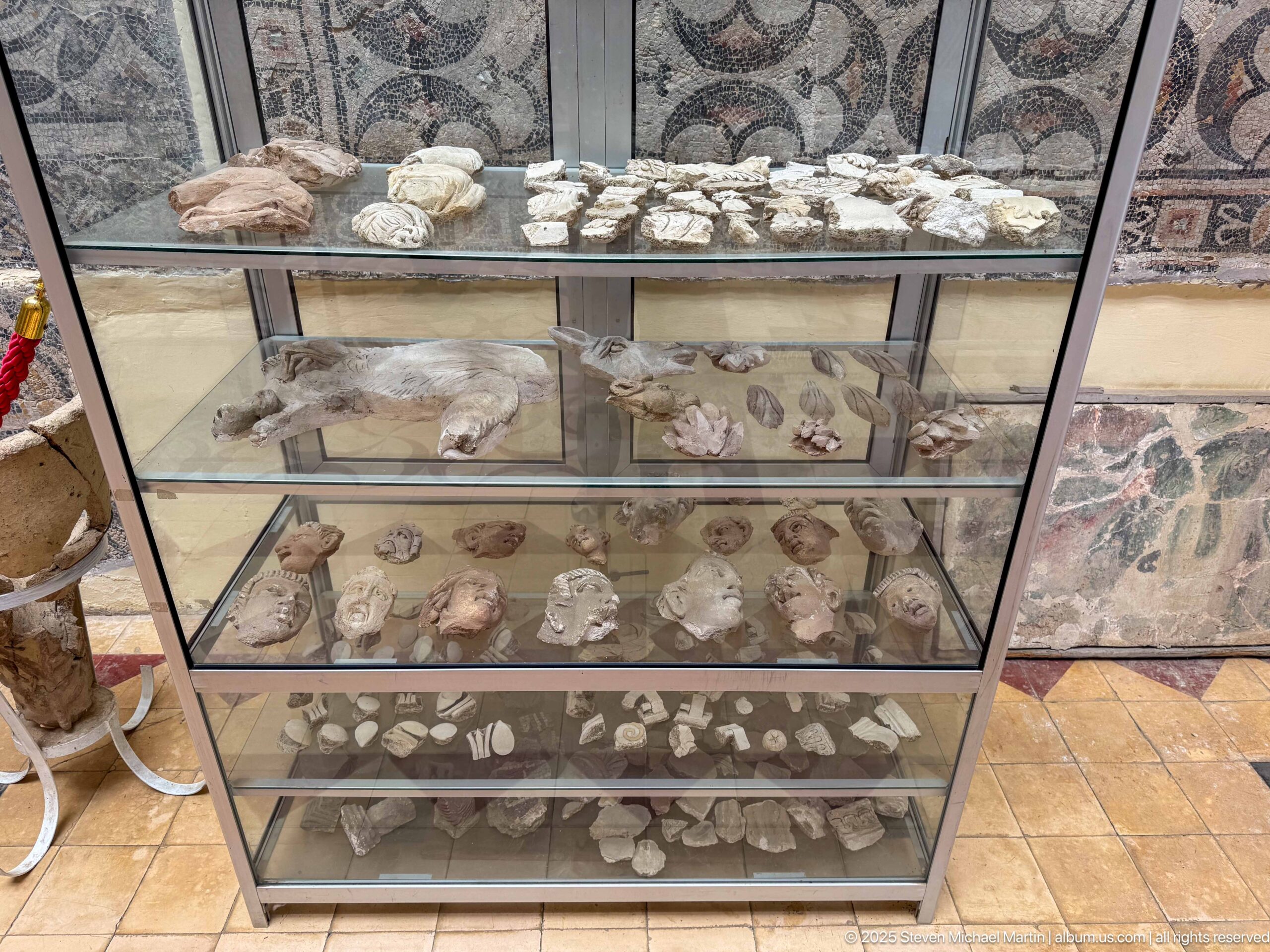
A glass case gathers small archaeological finds of varied form and material, including carved fragments, pottery pieces, and other excavated objects arranged on several shelves. Large wall mosaics remain visible behind the case, situating these modest artifacts within the museum’s broader Roman collection. The photograph records the contrast between monumental decorative works and the smaller objects used to interpret daily life and material culture.
Caption
A glass case gathers small archaeological finds of varied form and material, including carved fragments, pottery pieces, and other excavated objects arranged on several shelves. Large wall mosaics remain visible behind the case, situating these modest artifacts within the museum’s broader Roman collection. The photograph records the contrast between monumental decorative works and the smaller objects used to interpret daily life and material culture.
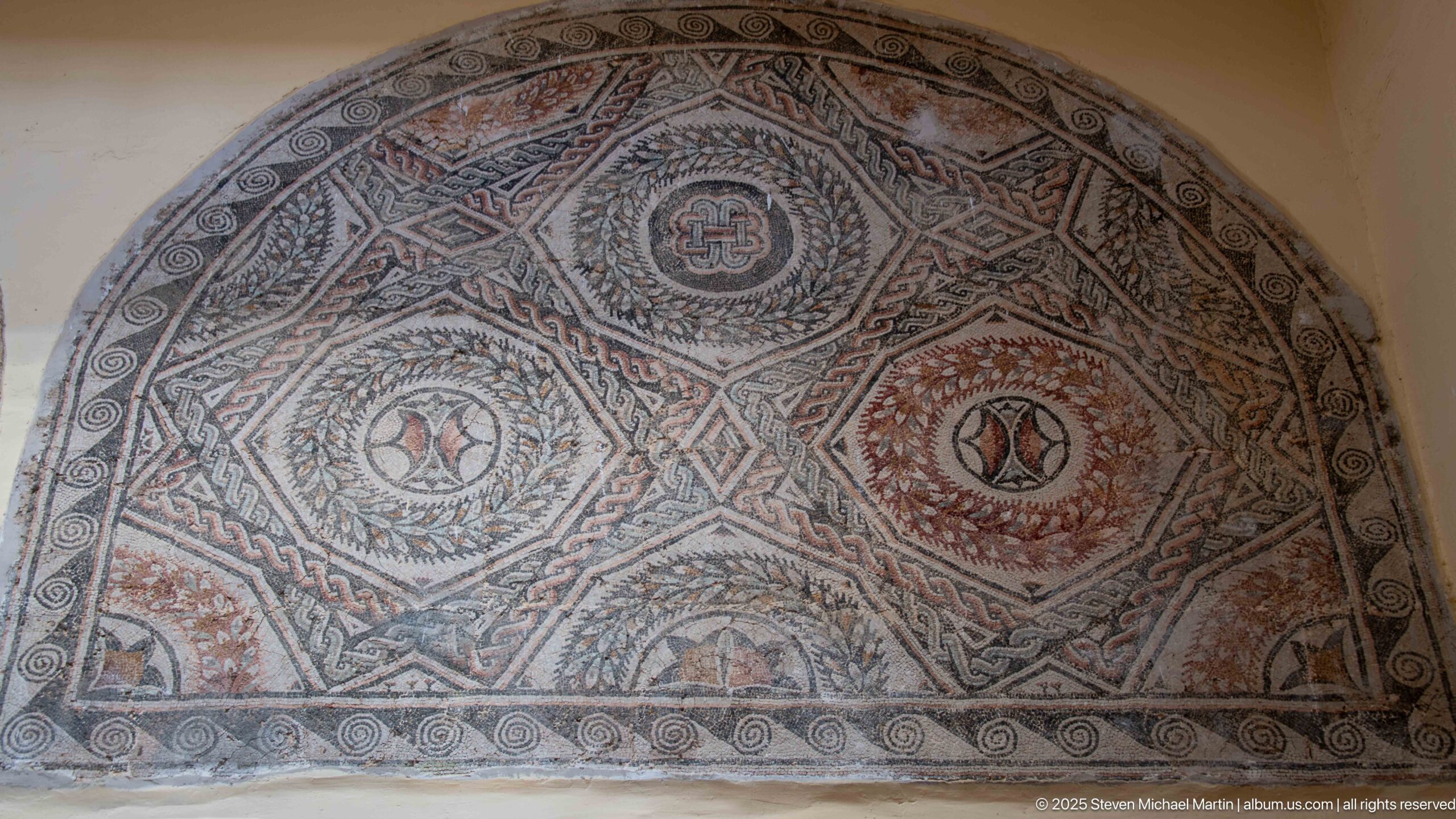
This semicircular Roman mosaic arranges circular medallions within a network of diamonds, braided bands, and smaller geometric compartments. Several medallions preserve stylized floral or emblematic motifs in red, black, cream, and muted green. The half-round format and layered framing create a compact decorative composition whose symmetry remains legible despite wear and localized losses.
Caption
This semicircular Roman mosaic arranges circular medallions within a network of diamonds, braided bands, and smaller geometric compartments. Several medallions preserve stylized floral or emblematic motifs in red, black, cream, and muted green. The half-round format and layered framing create a compact decorative composition whose symmetry remains legible despite wear and localized losses.
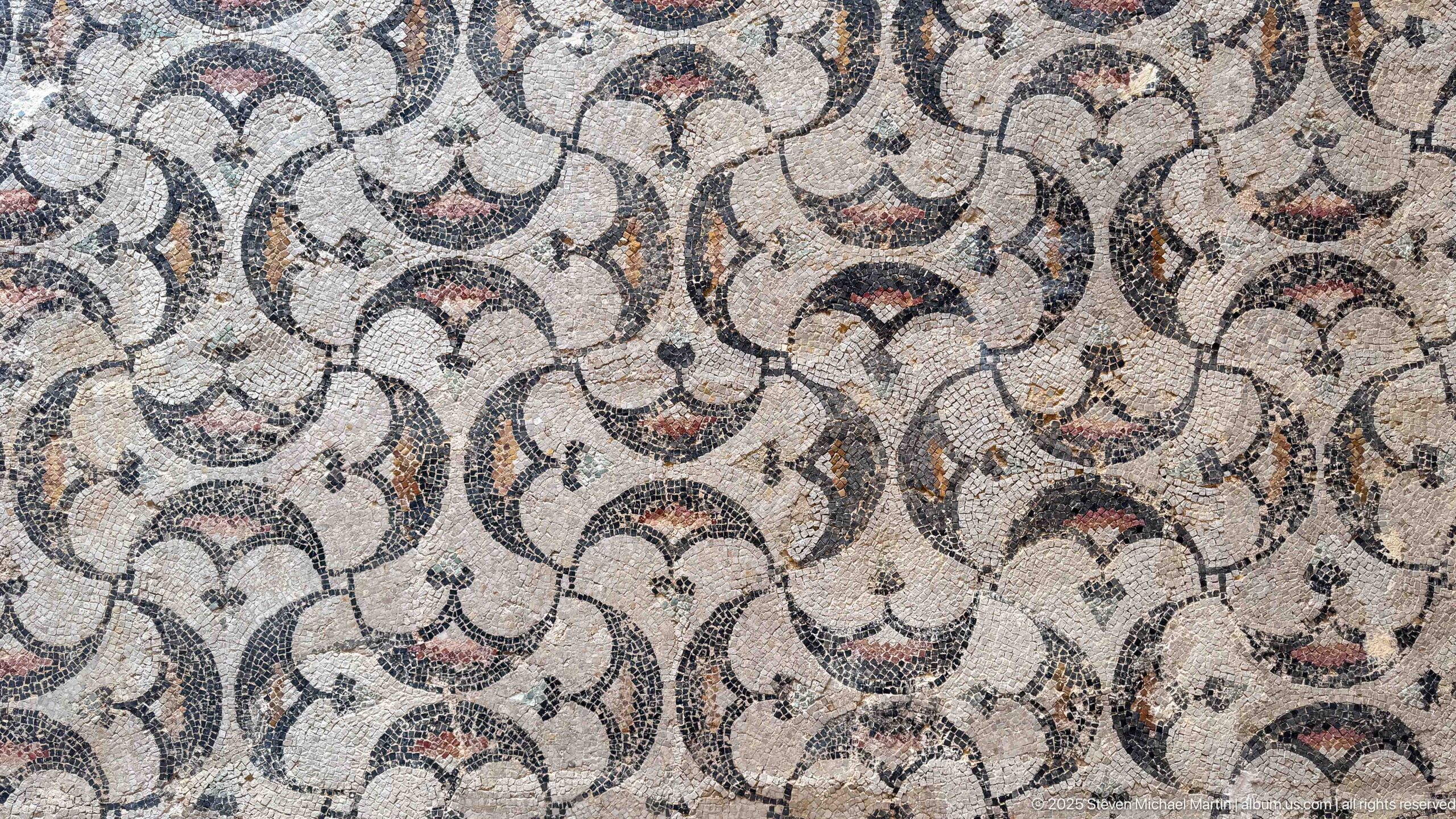
A close detail reveals a repeating fan-like motif constructed from cream fields edged in black and punctuated with small red accents. The tightly packed units interlock across the surface, producing a rhythmic allover design that becomes more evident at close range. Individual tesserae and minor losses are visible, making this image especially useful for studying technique and pattern rather than overall composition.
Caption
A close detail reveals a repeating fan-like motif constructed from cream fields edged in black and punctuated with small red accents. The tightly packed units interlock across the surface, producing a rhythmic allover design that becomes more evident at close range. Individual tesserae and minor losses are visible, making this image especially useful for studying technique and pattern rather than overall composition.
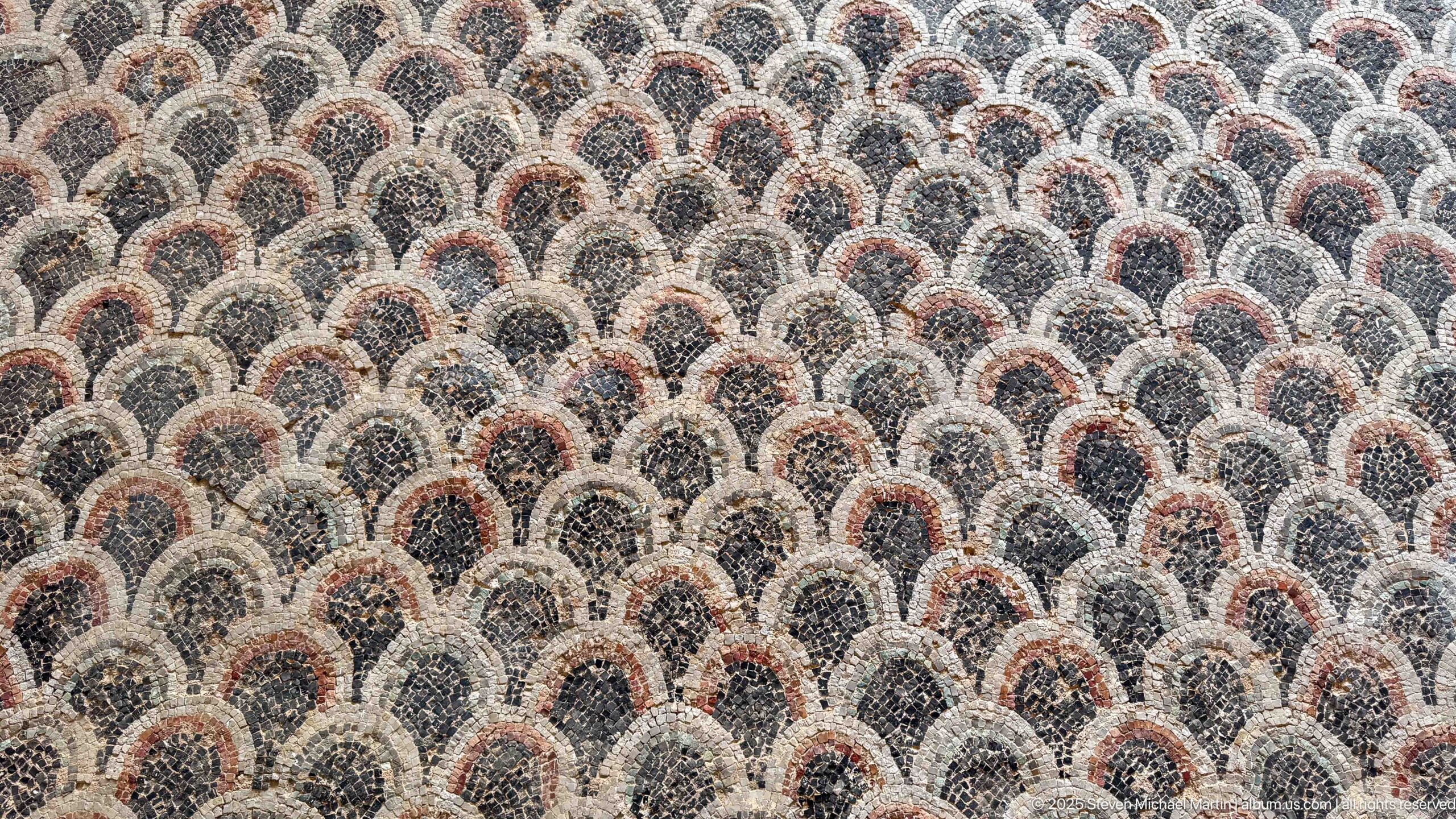
Overlapping semicircular units create a dense scallop or feather-scale pattern across this Roman mosaic detail. Dark outlines separate cream arcs filled with red-brown centers, producing depth through simple repeated geometry. The close viewpoint emphasizes the precision of the tesserae and the slight irregularities that give the handmade surface its texture, distinguishing this detail from the larger arched field shown elsewhere in the gallery.
Caption
Overlapping semicircular units create a dense scallop or feather-scale pattern across this Roman mosaic detail. Dark outlines separate cream arcs filled with red-brown centers, producing depth through simple repeated geometry. The close viewpoint emphasizes the precision of the tesserae and the slight irregularities that give the handmade surface its texture, distinguishing this detail from the larger arched field shown elsewhere in the gallery.
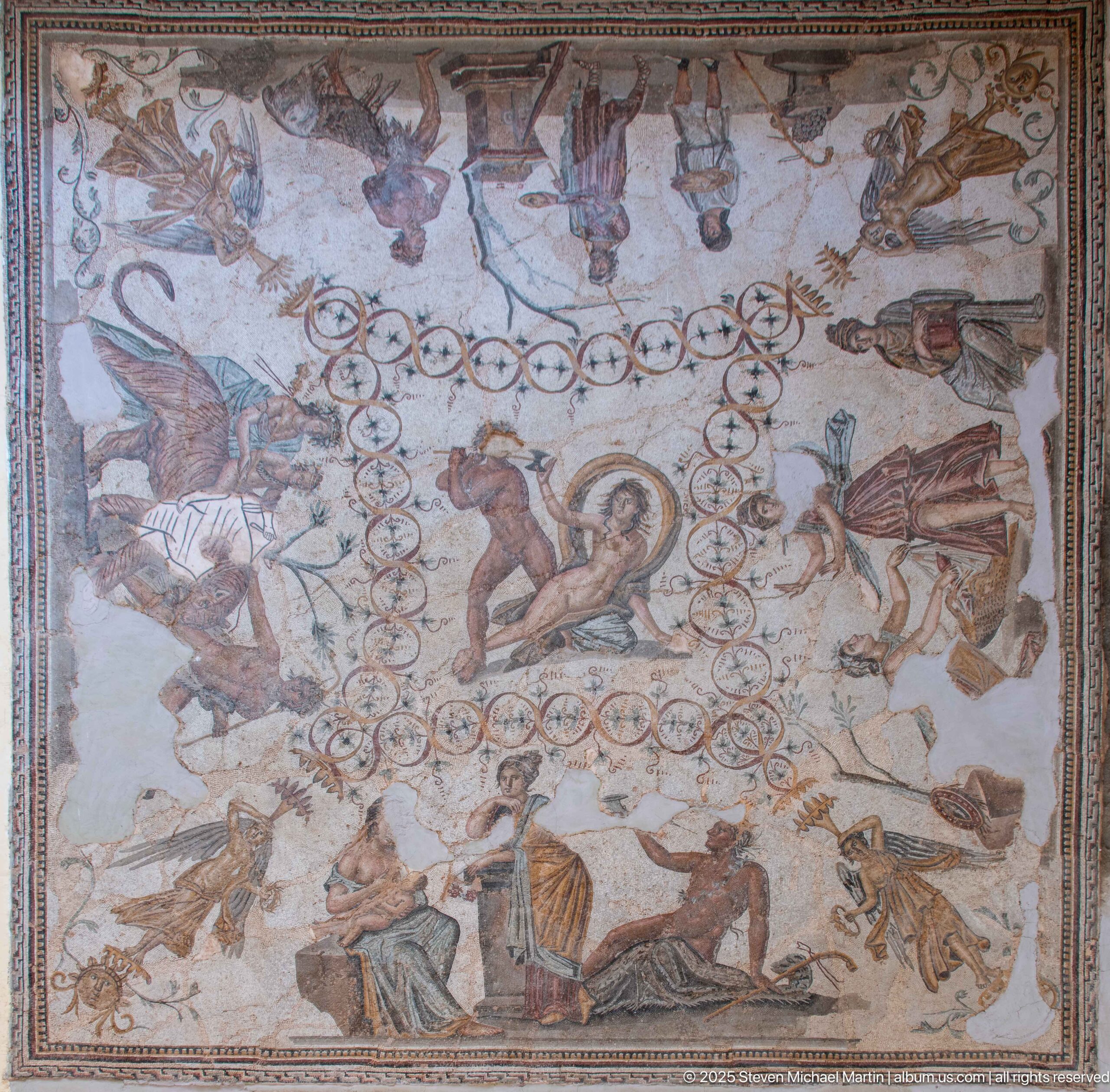
This is the celebrated Dionysiac mosaic of Djemila, often called the Bacchus Mosaic. Excavated in rooms south of the Great Baths in 1930–31 and installed in the expanded museum by 1934, the pavement assembles episodes from the Dionysiac mythic cycle around a central scene. Its complex program is one of the museum’s most important examples of Roman North African mythological mosaic art.
Caption
This is the celebrated Dionysiac mosaic of Djemila, often called the Bacchus Mosaic. Excavated in rooms south of the Great Baths in 1930–31 and installed in the expanded museum by 1934, the pavement assembles episodes from the Dionysiac mythic cycle around a central scene. Its complex program is one of the museum’s most important examples of Roman North African mythological mosaic art.
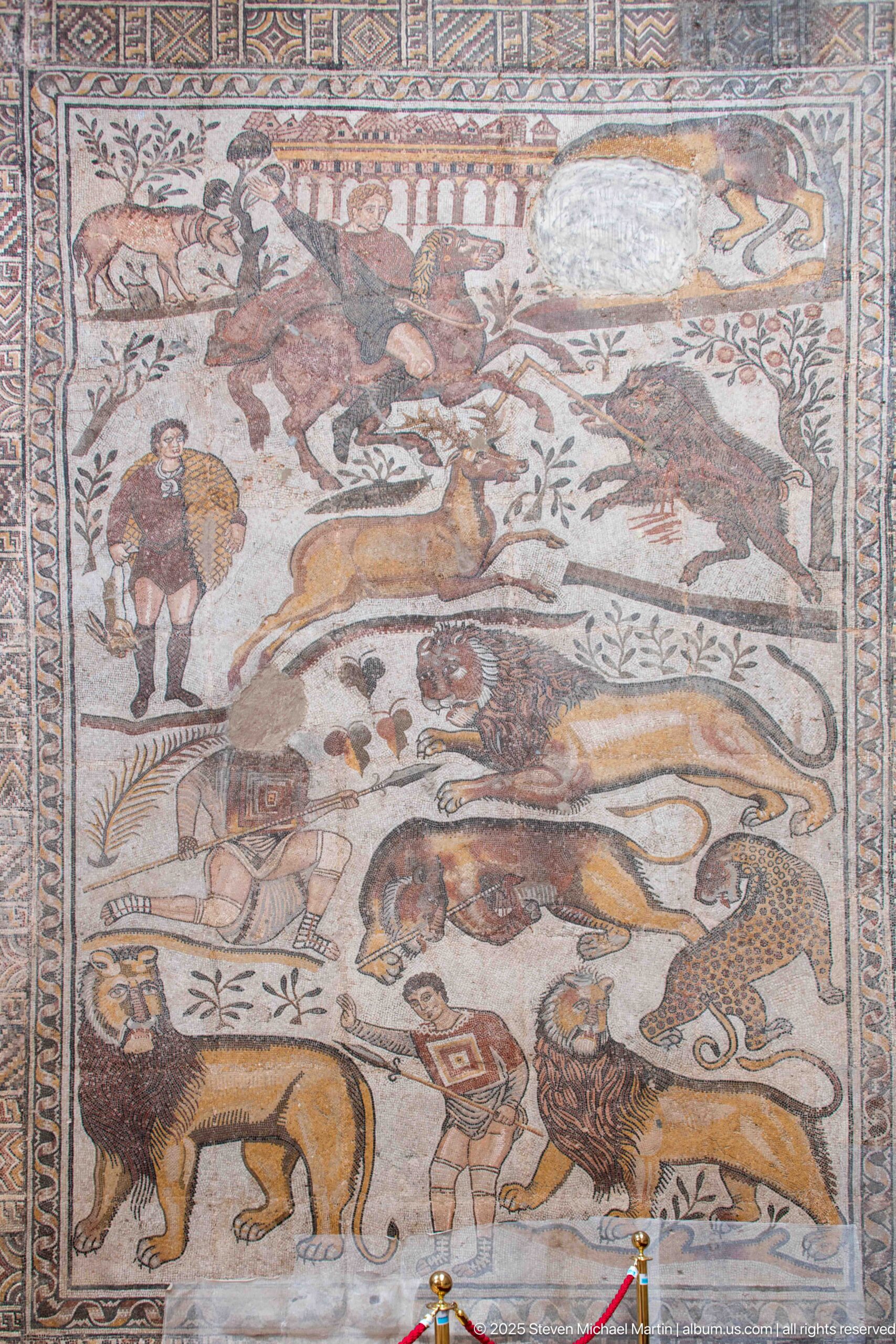
The Great Hunt Mosaic from the House of Bacchus is one of Djémila’s major late Roman pavements. Created for the residence’s grand banqueting hall in the mid-4th century CE, it stages a venatio-like hunt across stacked registers, with hunters confronting lions, a leopard, boar, deer, and other game. The composition belongs to the distinctive late antique mosaic tradition of Roman North Africa.
Caption
The Great Hunt Mosaic from the House of Bacchus is one of Djémila’s major late Roman pavements. Created for the residence’s grand banqueting hall in the mid-4th century CE, it stages a venatio-like hunt across stacked registers, with hunters confronting lions, a leopard, boar, deer, and other game. The composition belongs to the distinctive late antique mosaic tradition of Roman North Africa.
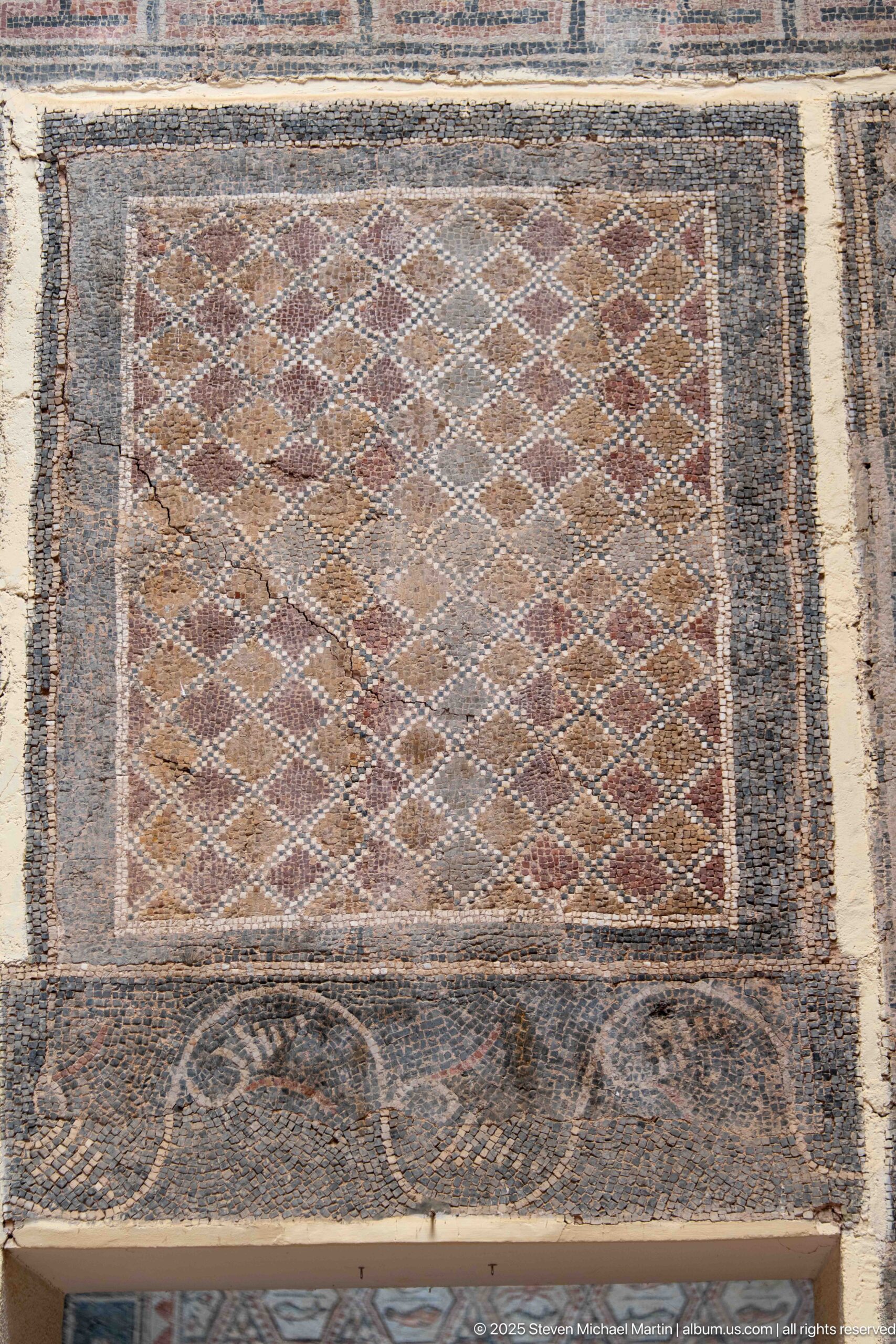
This rectangular mosaic uses a fine diagonal lattice across its central field, creating a restrained diamond pattern that contrasts with the broader dark border. A circular medallion or wreath-like motif appears along the lower band, while narrow geometric strips frame the composition. The worn surface and muted palette give the panel a more subdued character than the museum’s strongly colored figurative mosaics.
Caption
This rectangular mosaic uses a fine diagonal lattice across its central field, creating a restrained diamond pattern that contrasts with the broader dark border. A circular medallion or wreath-like motif appears along the lower band, while narrow geometric strips frame the composition. The worn surface and muted palette give the panel a more subdued character than the museum’s strongly colored figurative mosaics.
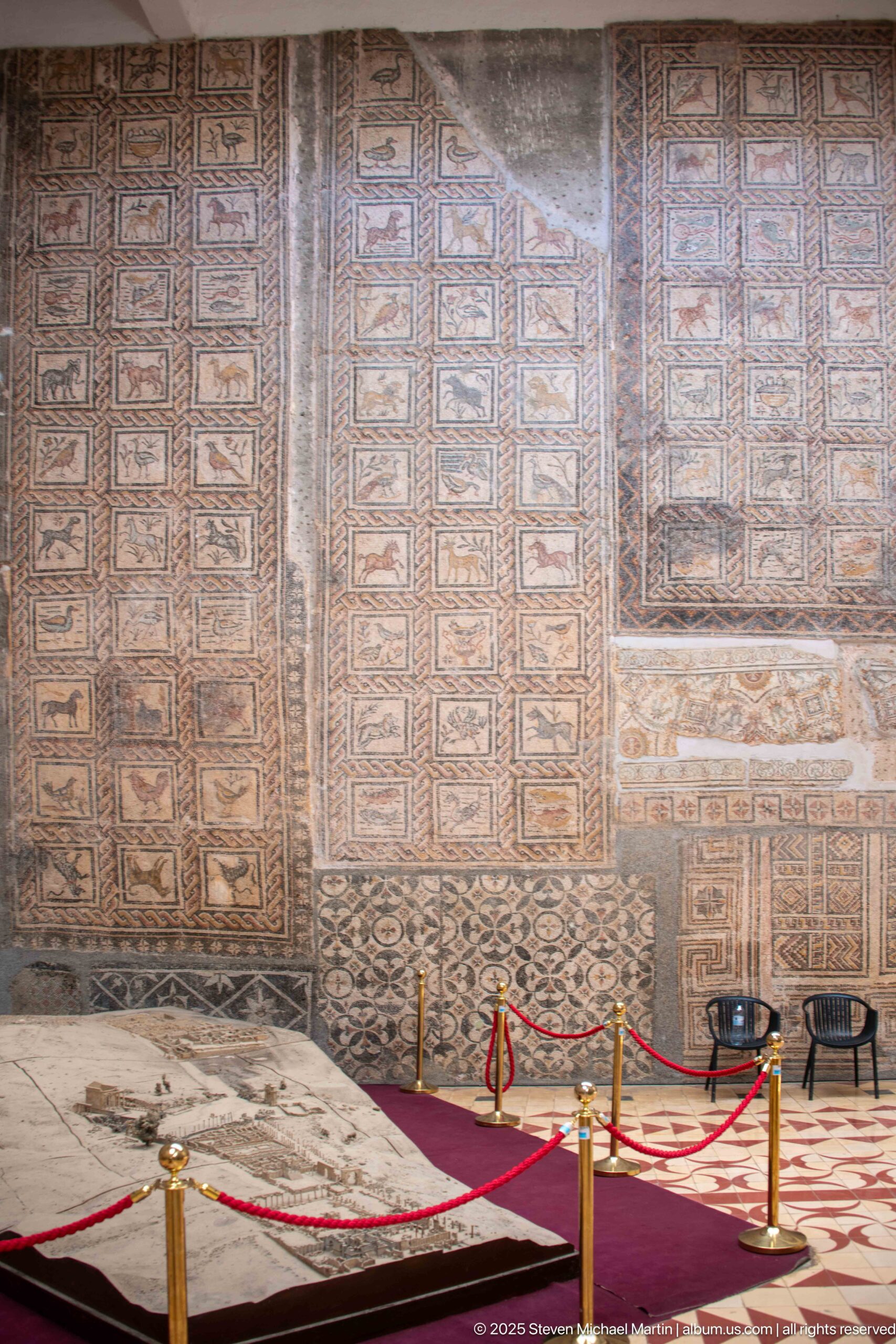
A corner of the Djemila Museum gallery is almost completely lined with geometric Roman mosaics, from tall wall panels to additional sections displayed near floor level. Rectangular grids, repeated linear motifs, and patterned borders dominate the installation. Rope barriers and seating in the foreground clarify the modern museum setting, while the density of surviving mosaics conveys the extraordinary decorative richness represented in the collection.
Caption
A corner of the Djemila Museum gallery is almost completely lined with geometric Roman mosaics, from tall wall panels to additional sections displayed near floor level. Rectangular grids, repeated linear motifs, and patterned borders dominate the installation. Rope barriers and seating in the foreground clarify the modern museum setting, while the density of surviving mosaics conveys the extraordinary decorative richness represented in the collection.
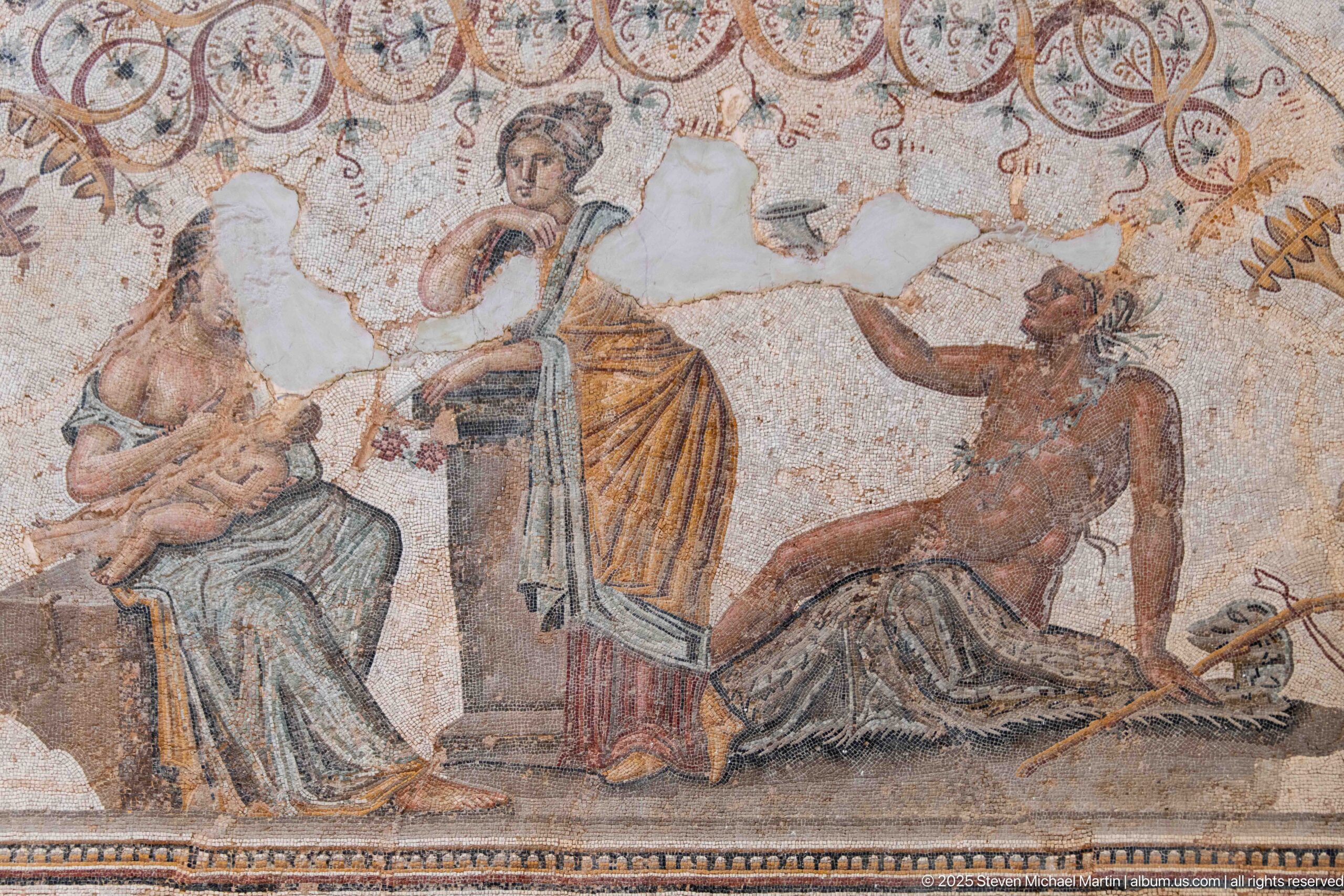
A lower episode from Djemila’s Dionysiac or Bacchus Mosaic shows three interacting mythological figures beneath the pavement’s encircling ornamental program. The seated woman at left, standing draped woman at center, and reclining male at right belong to the larger Dionysiac narrative documented in the celebrated mosaic excavated south of the Great Baths. This closer view makes the figures’ gestures and drapery especially legible.
Caption
A lower episode from Djemila’s Dionysiac or Bacchus Mosaic shows three interacting mythological figures beneath the pavement’s encircling ornamental program. The seated woman at left, standing draped woman at center, and reclining male at right belong to the larger Dionysiac narrative documented in the celebrated mosaic excavated south of the Great Baths. This closer view makes the figures’ gestures and drapery especially legible.
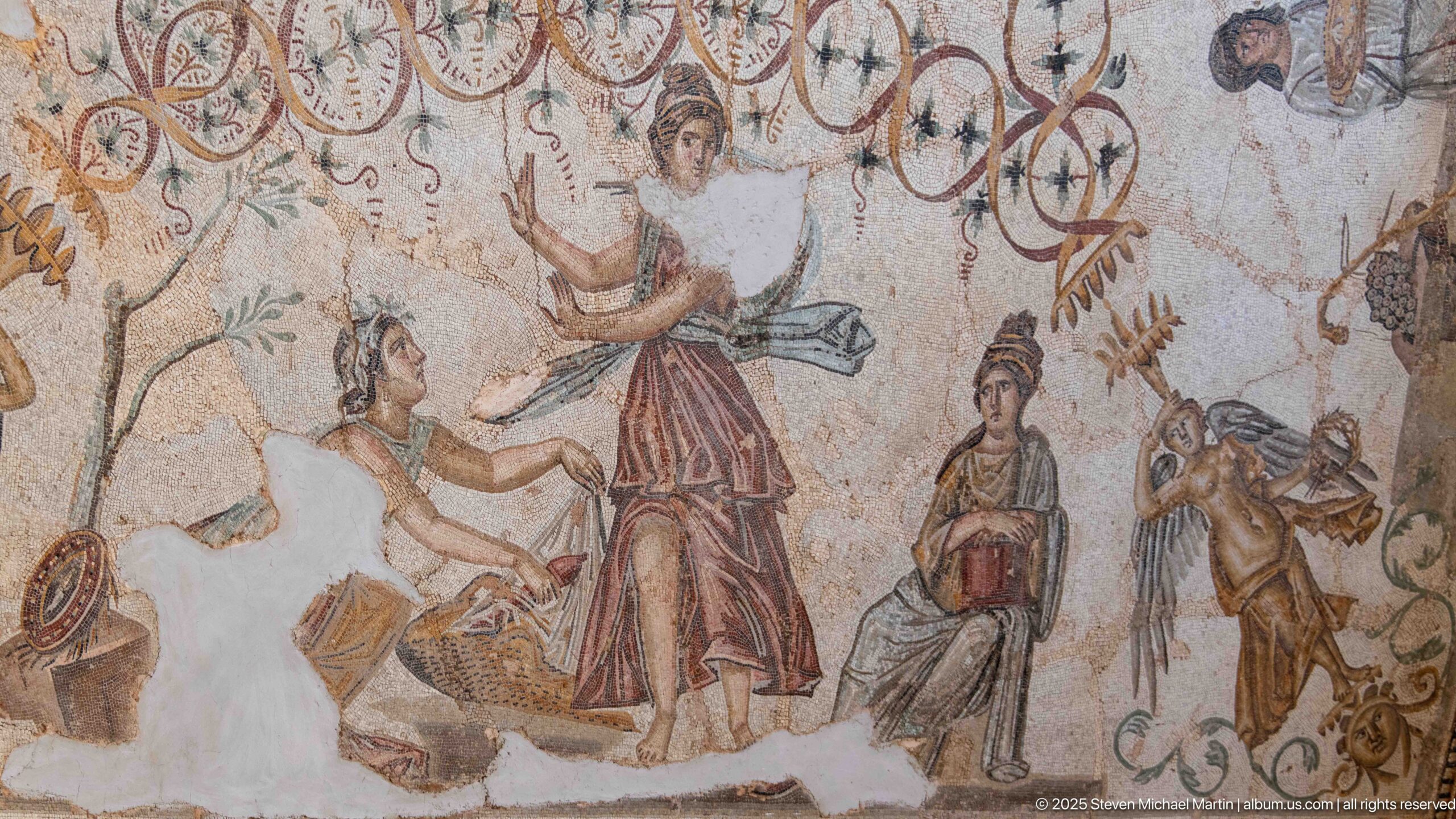
This detail belongs to Djemila’s Dionysiac or Bacchus Mosaic, a major mythological pavement excavated in 1930–31 and transferred to the museum during its early-1930s expansion. Several richly dressed figures occupy the scene beneath looping vegetal and circular ornament. Identifying the parent mosaic adds essential context while leaving the individual figures unnamed where the photographed attributes do not securely support a more specific attribution.
Caption
This detail belongs to Djemila’s Dionysiac or Bacchus Mosaic, a major mythological pavement excavated in 1930–31 and transferred to the museum during its early-1930s expansion. Several richly dressed figures occupy the scene beneath looping vegetal and circular ornament. Identifying the parent mosaic adds essential context while leaving the individual figures unnamed where the photographed attributes do not securely support a more specific attribution.
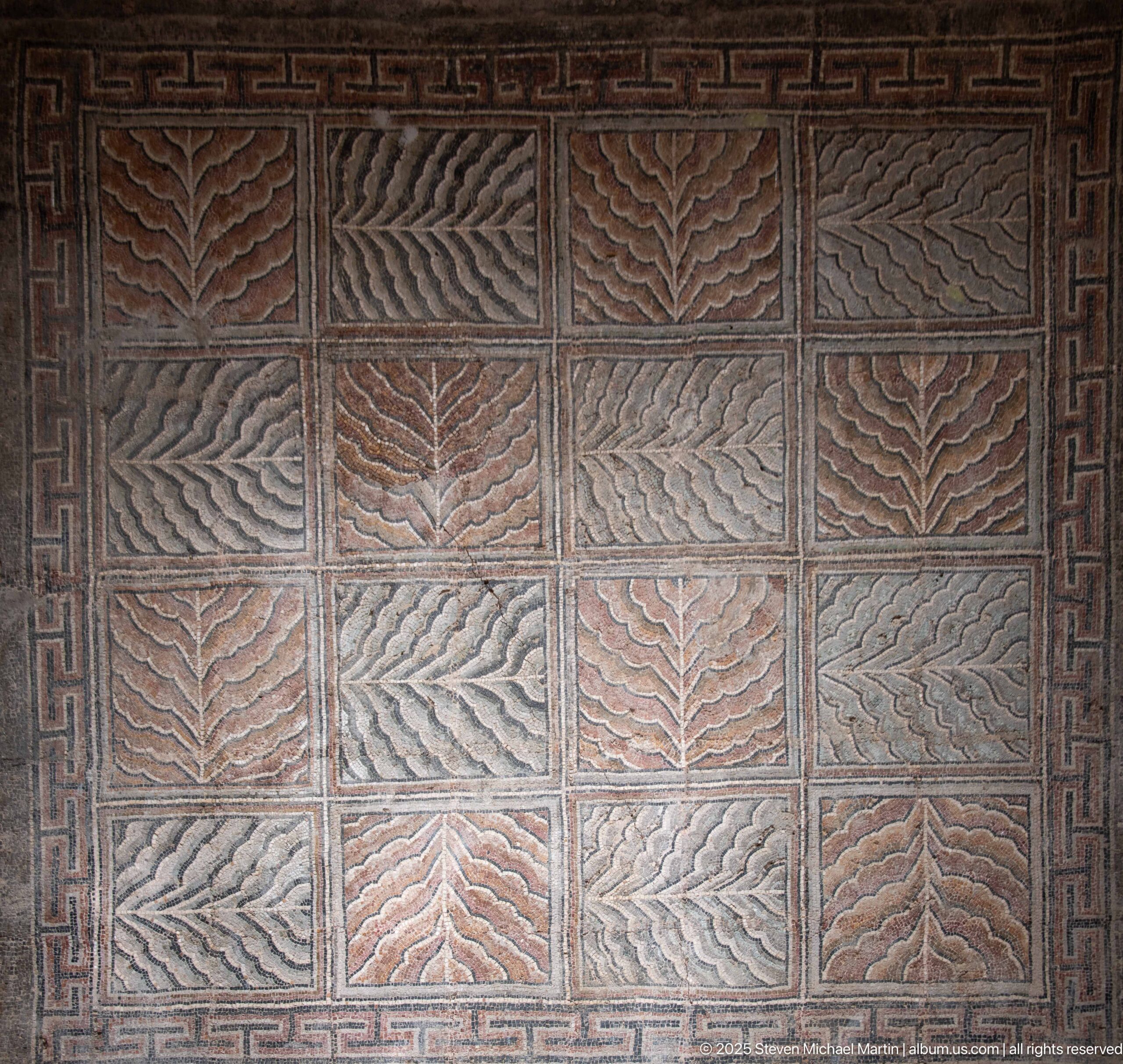
A rectangular Roman mosaic is divided into a regular grid of square panels, each containing a stylized leaf, feather, or chevron-like motif. Alternating orientations create a subtle woven rhythm across the field, while a dark meander border encloses the design. The limited palette of cream, black, and earthy red emphasizes structure and repetition rather than pictorial imagery.
Caption
A rectangular Roman mosaic is divided into a regular grid of square panels, each containing a stylized leaf, feather, or chevron-like motif. Alternating orientations create a subtle woven rhythm across the field, while a dark meander border encloses the design. The limited palette of cream, black, and earthy red emphasizes structure and repetition rather than pictorial imagery.
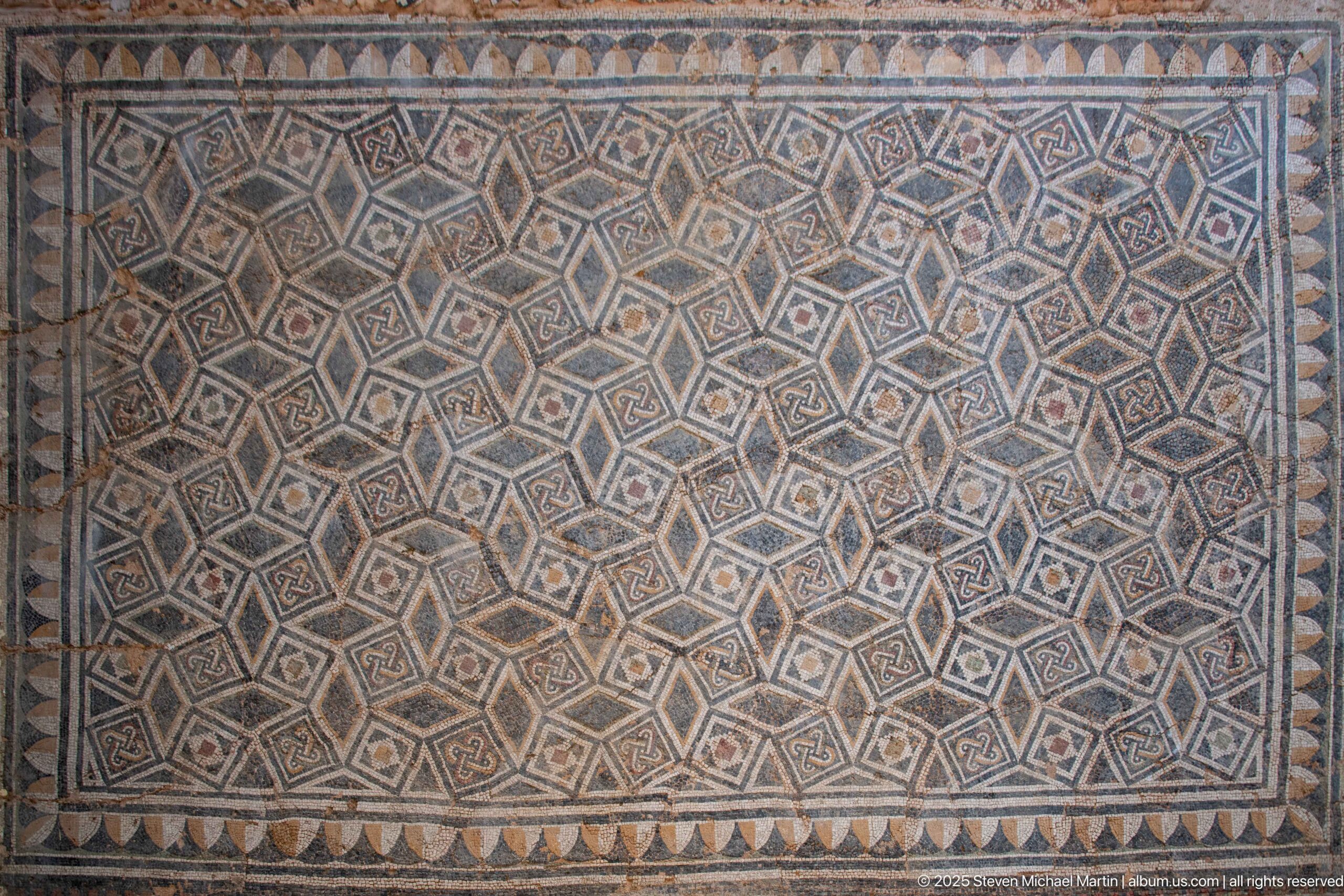
A dense diamond grid fills this Roman mosaic panel, each compartment defined by dark and cream tesserae and many containing small abstract or floral motifs. A triangular border runs along one edge, adding a second geometric rhythm. The repeated lozenges create an intricate textile-like surface that rewards close viewing and shows the precision of Roman mosaic design at Djemila.
Caption
A dense diamond grid fills this Roman mosaic panel, each compartment defined by dark and cream tesserae and many containing small abstract or floral motifs. A triangular border runs along one edge, adding a second geometric rhythm. The repeated lozenges create an intricate textile-like surface that rewards close viewing and shows the precision of Roman mosaic design at Djemila.
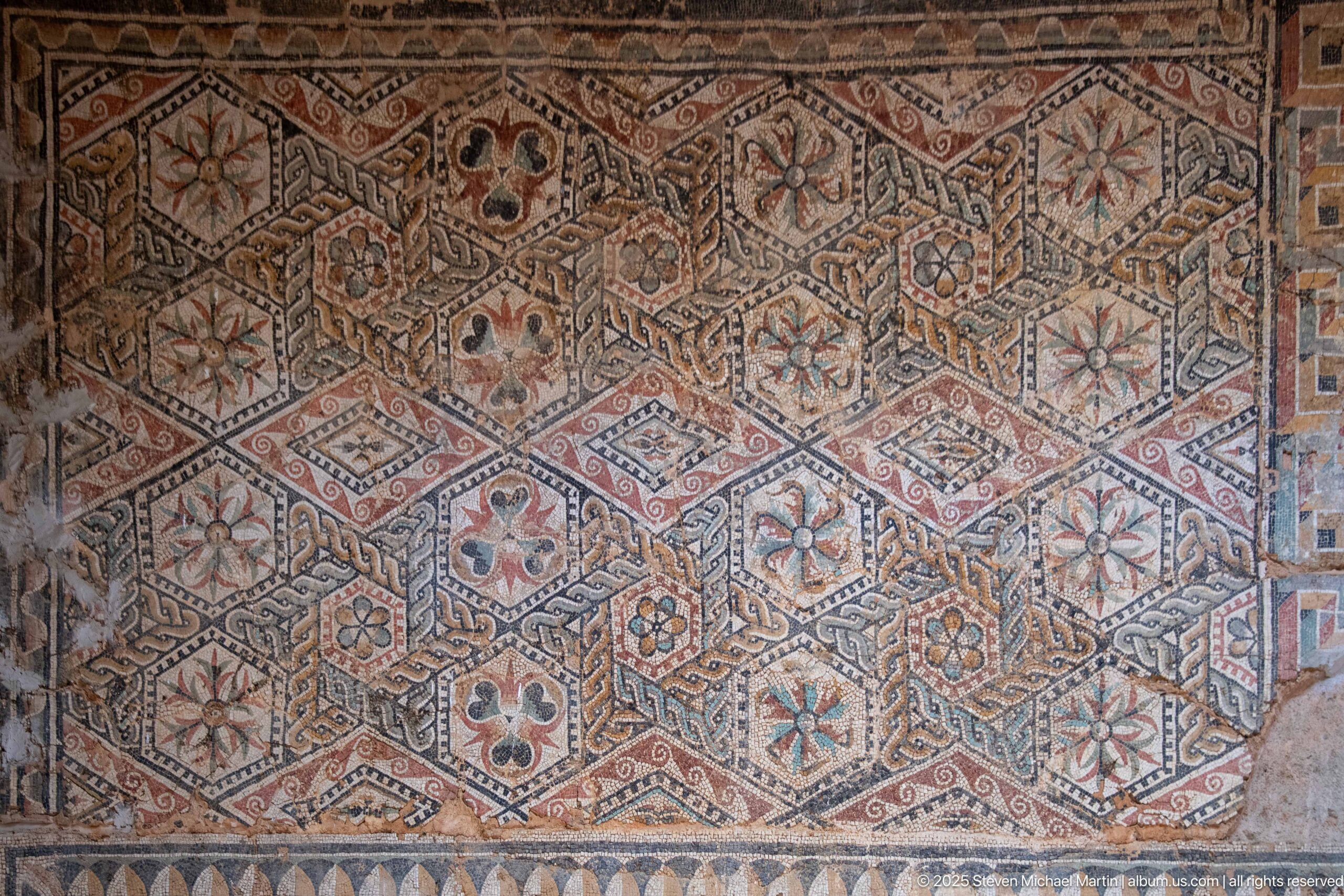
This richly colored Roman mosaic combines illusionistic cube-like forms, rosettes, floral ornaments, and small framed motifs within a tightly ordered geometric field. Cream, red, black, and greenish tesserae create depth and variation without abandoning the overall grid. The panel demonstrates how Roman mosaicists could make a nonfigurative design visually complex through color, shading, and repeated changes of motif.
Caption
This richly colored Roman mosaic combines illusionistic cube-like forms, rosettes, floral ornaments, and small framed motifs within a tightly ordered geometric field. Cream, red, black, and greenish tesserae create depth and variation without abandoning the overall grid. The panel demonstrates how Roman mosaicists could make a nonfigurative design visually complex through color, shading, and repeated changes of motif.
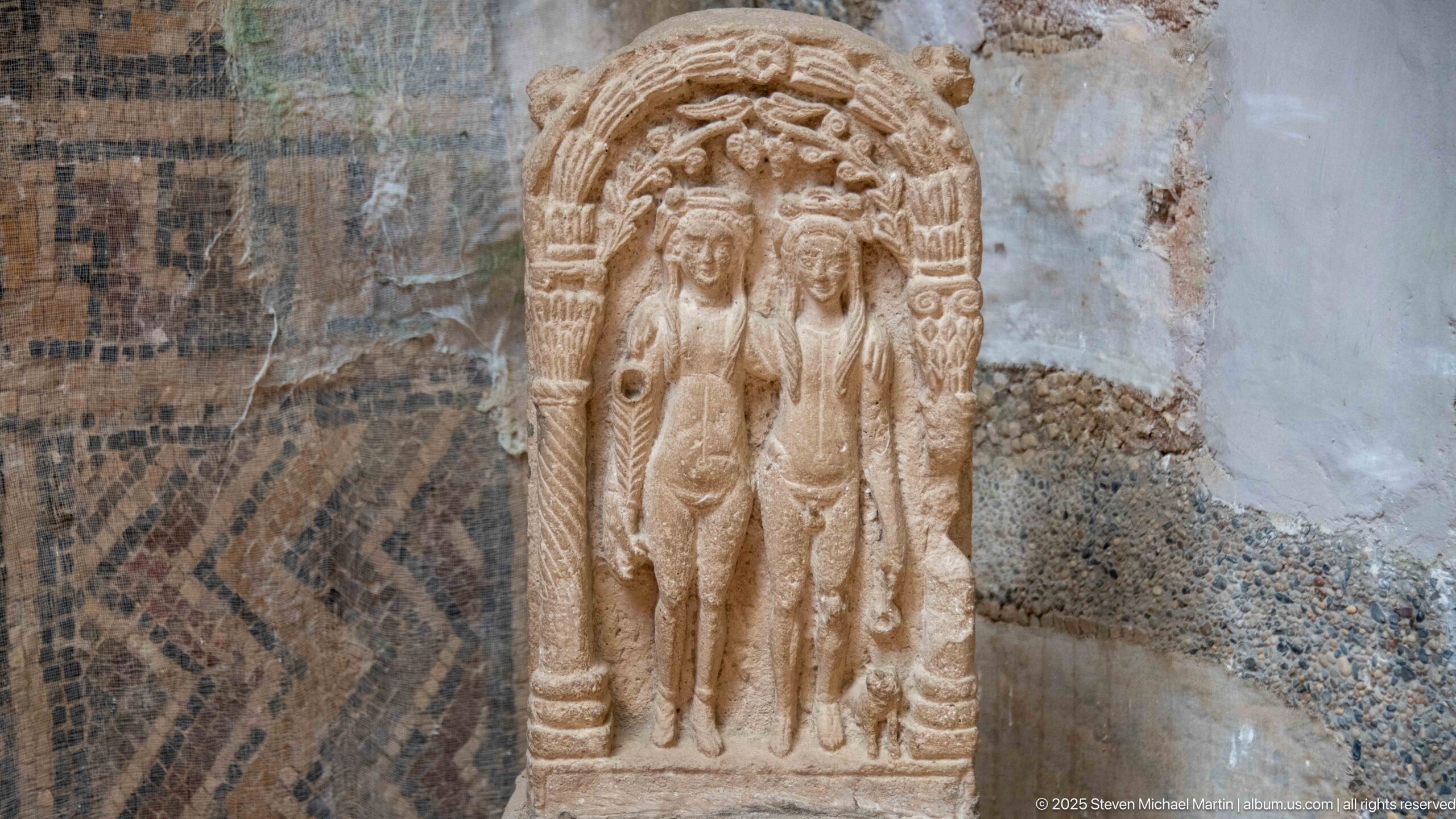
A carved stone relief depicts the Three Graces as three nude female figures standing closely together beneath a rounded architectural or vegetal frame. Their linked poses and symmetrical grouping make the classical subject readily recognizable even though the surface is weathered. Displayed against mosaics and ancient masonry, the relief adds a sculptural counterpart to the museum’s extensive collection of Roman pictorial decoration.
Caption
A carved stone relief depicts the Three Graces as three nude female figures standing closely together beneath a rounded architectural or vegetal frame. Their linked poses and symmetrical grouping make the classical subject readily recognizable even though the surface is weathered. Displayed against mosaics and ancient masonry, the relief adds a sculptural counterpart to the museum’s extensive collection of Roman pictorial decoration.
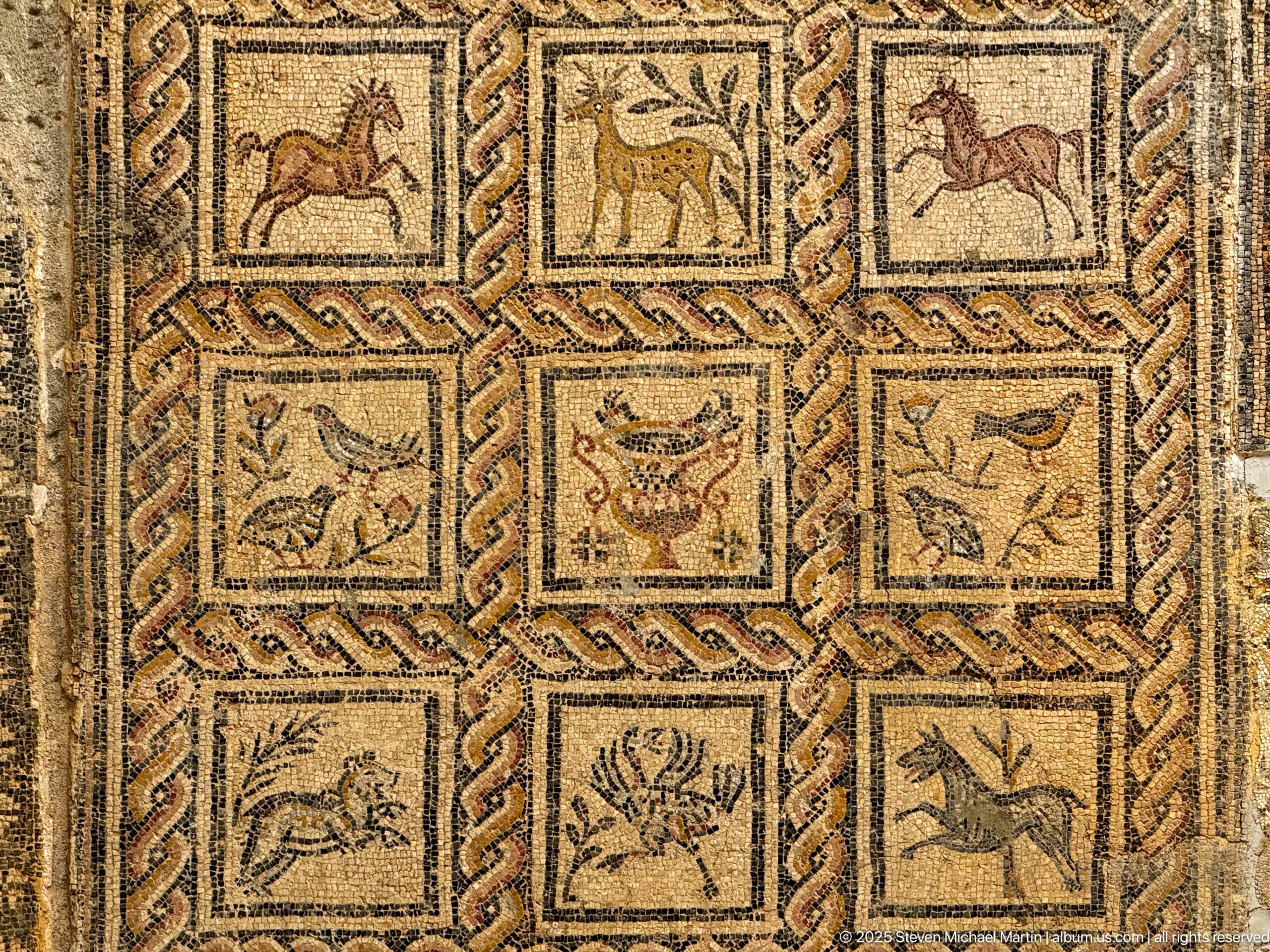
A second nine-panel Roman mosaic combines animals and birds with a central decorative vessel, each image enclosed in a square compartment and linked by braided borders. A grazing quadruped, running animal, birds, and other creatures occupy the surrounding panels. The orderly grid contrasts with the lively poses, creating a collection-like presentation of natural and decorative motifs.
Caption
A second nine-panel Roman mosaic combines animals and birds with a central decorative vessel, each image enclosed in a square compartment and linked by braided borders. A grazing quadruped, running animal, birds, and other creatures occupy the surrounding panels. The orderly grid contrasts with the lively poses, creating a collection-like presentation of natural and decorative motifs.
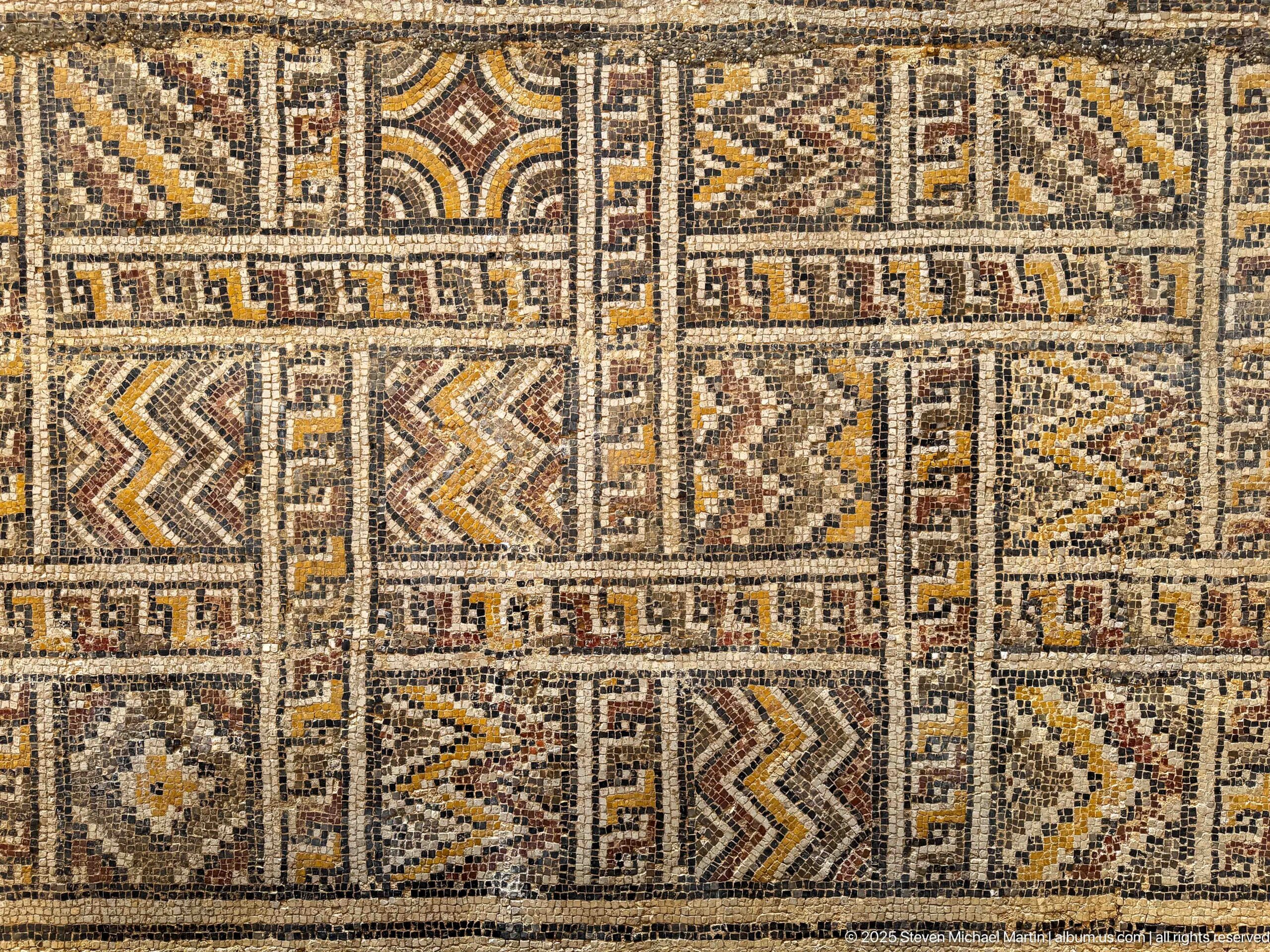
A close view of a Roman mosaic reveals a patchwork of rectangular compartments filled with zigzags, diamonds, stepped motifs, and alternating bands. Meander-like borders separate the units, while cream, black, ocher, and muted red tesserae create strong graphic contrast. The crop emphasizes the variety that Roman mosaicists could achieve by recombining a limited vocabulary of geometric forms.
Caption
A close view of a Roman mosaic reveals a patchwork of rectangular compartments filled with zigzags, diamonds, stepped motifs, and alternating bands. Meander-like borders separate the units, while cream, black, ocher, and muted red tesserae create strong graphic contrast. The crop emphasizes the variety that Roman mosaicists could achieve by recombining a limited vocabulary of geometric forms.
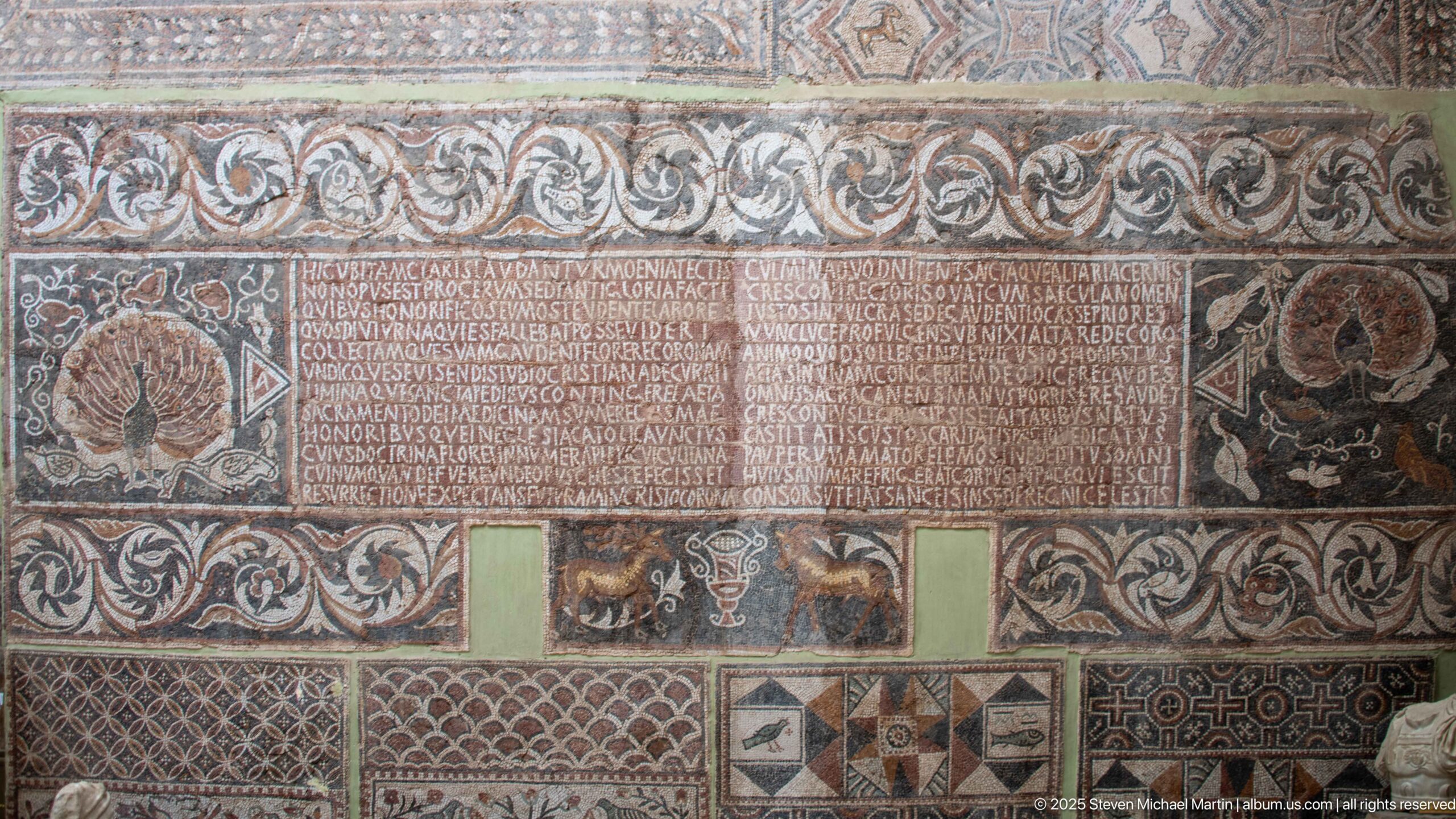
An unusually complex mosaic combines a long Latin inscription with multiple decorative registers, including scrolling foliage, framed animal and vessel motifs, and geometric borders. The central text block dominates the composition, while smaller panels below introduce distinct pictorial elements. This arrangement suggests a commemorative or dedicatory function, but the inscription is not sufficiently legible here for a secure translation.
Caption
An unusually complex mosaic combines a long Latin inscription with multiple decorative registers, including scrolling foliage, framed animal and vessel motifs, and geometric borders. The central text block dominates the composition, while smaller panels below introduce distinct pictorial elements. This arrangement suggests a commemorative or dedicatory function, but the inscription is not sufficiently legible here for a secure translation.
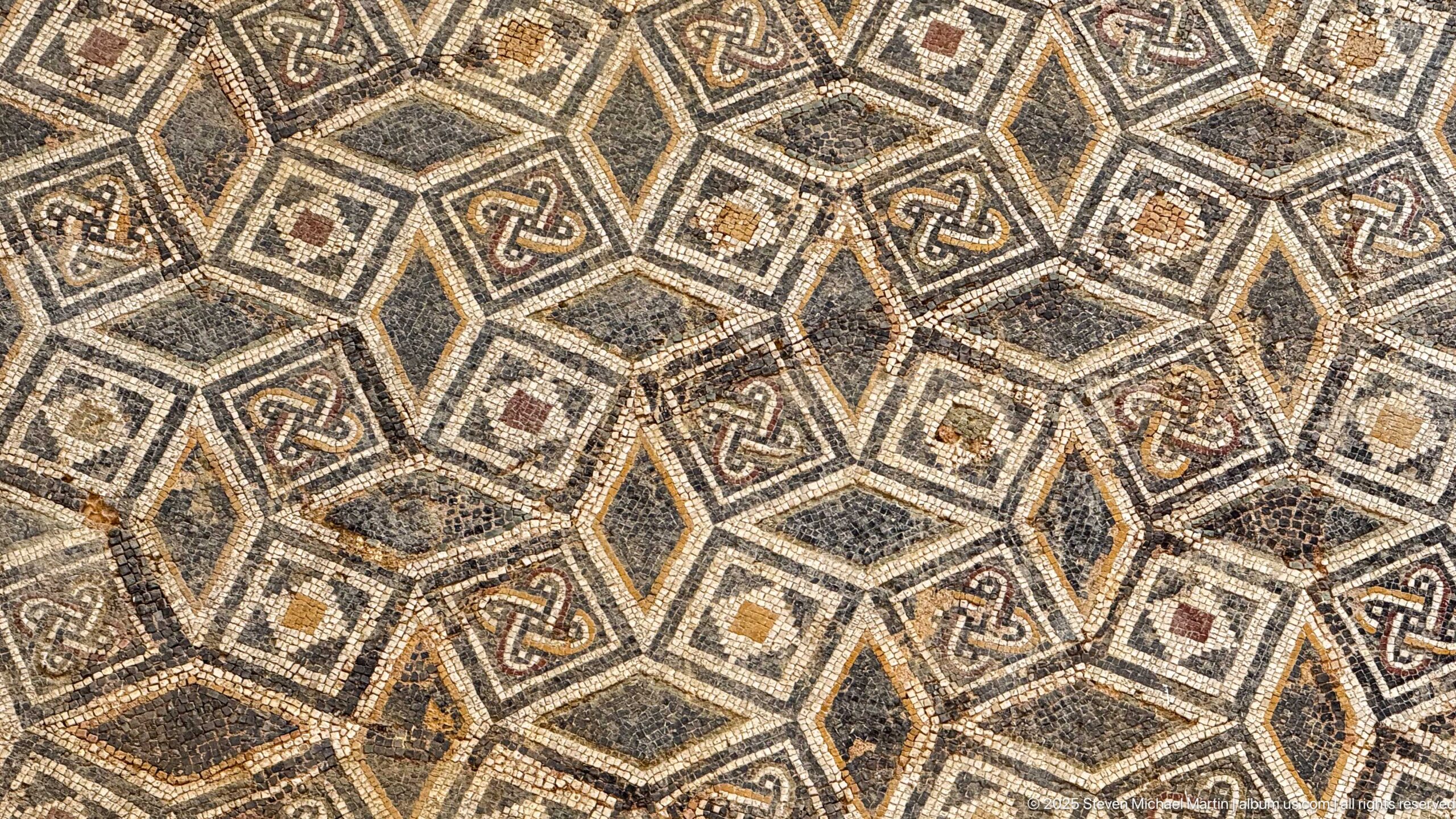
Interlocking octagons and smaller square compartments create a dense geometric field in this Roman mosaic. Many cells contain compact knot-like or floral motifs, while dark outlines and cream bands produce a strong lattice effect. The close view emphasizes the precision of the tesserae and the mathematical rhythm of the design rather than any narrative subject.
Caption
Interlocking octagons and smaller square compartments create a dense geometric field in this Roman mosaic. Many cells contain compact knot-like or floral motifs, while dark outlines and cream bands produce a strong lattice effect. The close view emphasizes the precision of the tesserae and the mathematical rhythm of the design rather than any narrative subject.
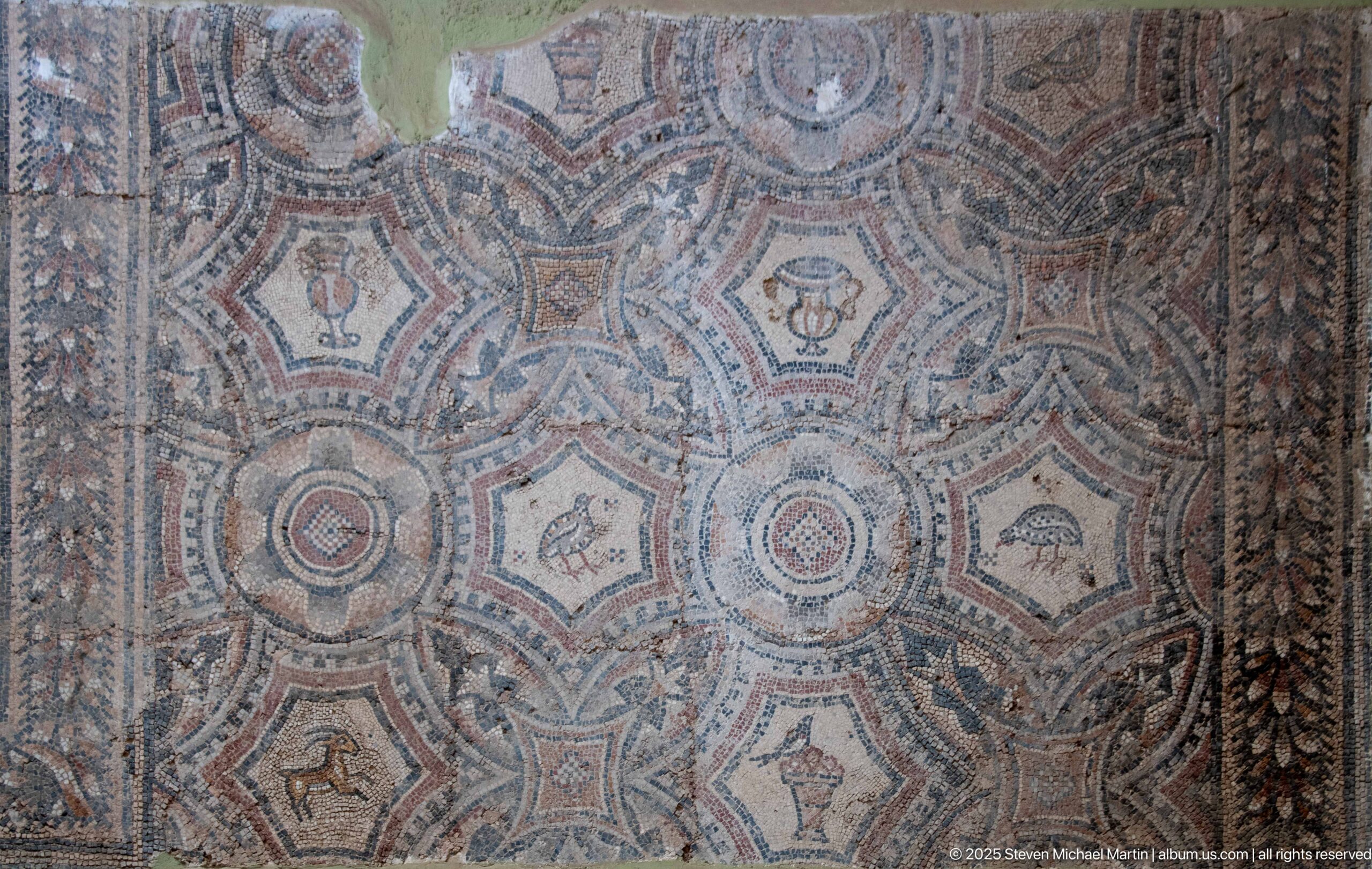
Polygonal compartments frame a varied series of small motifs, including vessels, birds, animals, and circular ornaments. The design alternates hexagonal and round forms within a larger geometric network, giving each emblem its own framed space. The panel reads like a decorative anthology in which modest figurative motifs are embedded within a rigorously ordered field.
Caption
Polygonal compartments frame a varied series of small motifs, including vessels, birds, animals, and circular ornaments. The design alternates hexagonal and round forms within a larger geometric network, giving each emblem its own framed space. The panel reads like a decorative anthology in which modest figurative motifs are embedded within a rigorously ordered field.
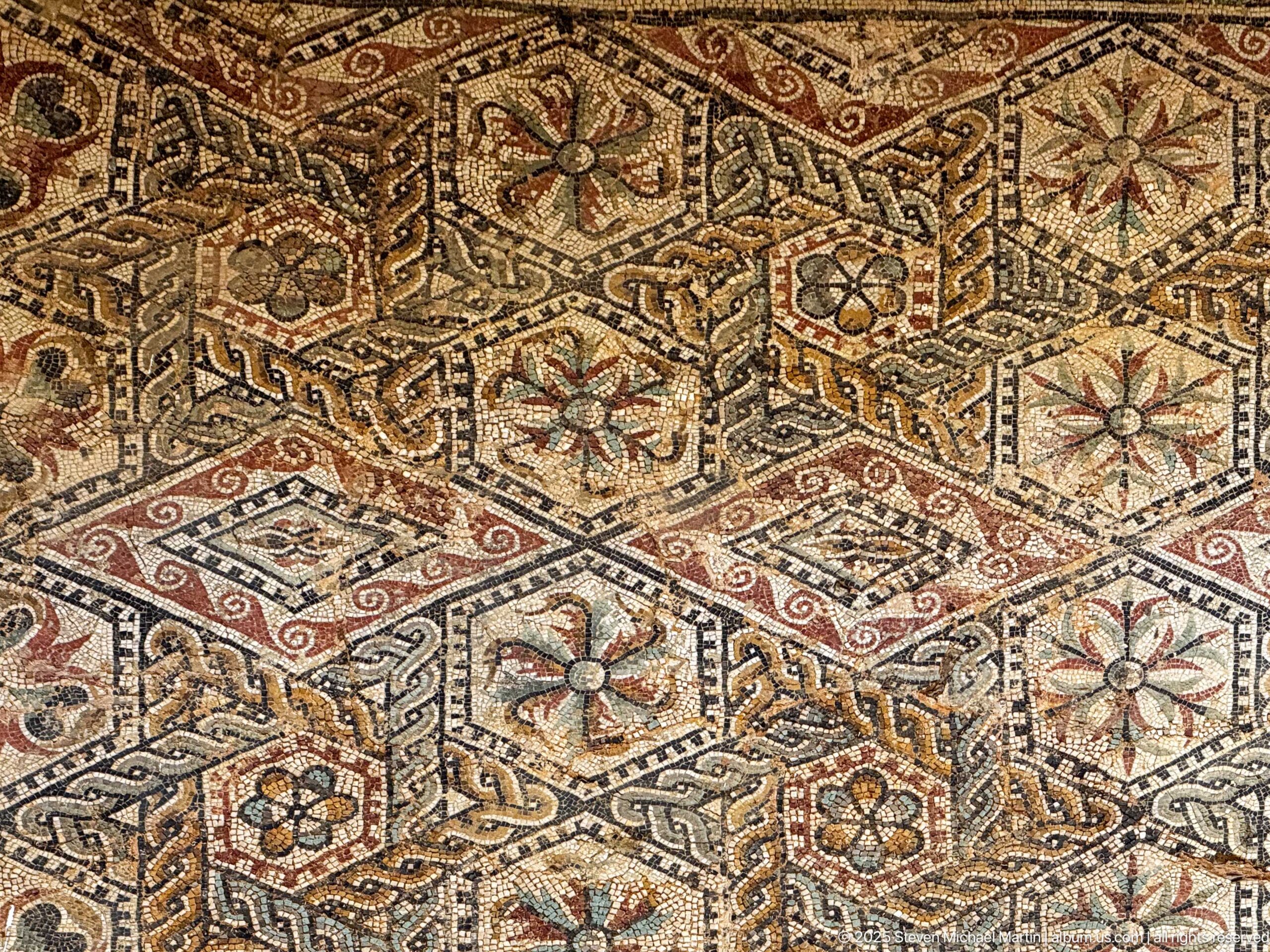
A richly colored geometric mosaic alternates hexagonal floral panels with interlaced knotwork and smaller decorative compartments. Red, ocher, cream, and dark tesserae create strong contrast, while repeating flowers soften the otherwise angular structure. The close framing makes the craftsmanship of the interlace especially legible and distinguishes this panel from the museum’s more restrained black-and-white geometric floors.
Caption
A richly colored geometric mosaic alternates hexagonal floral panels with interlaced knotwork and smaller decorative compartments. Red, ocher, cream, and dark tesserae create strong contrast, while repeating flowers soften the otherwise angular structure. The close framing makes the craftsmanship of the interlace especially legible and distinguishes this panel from the museum’s more restrained black-and-white geometric floors.
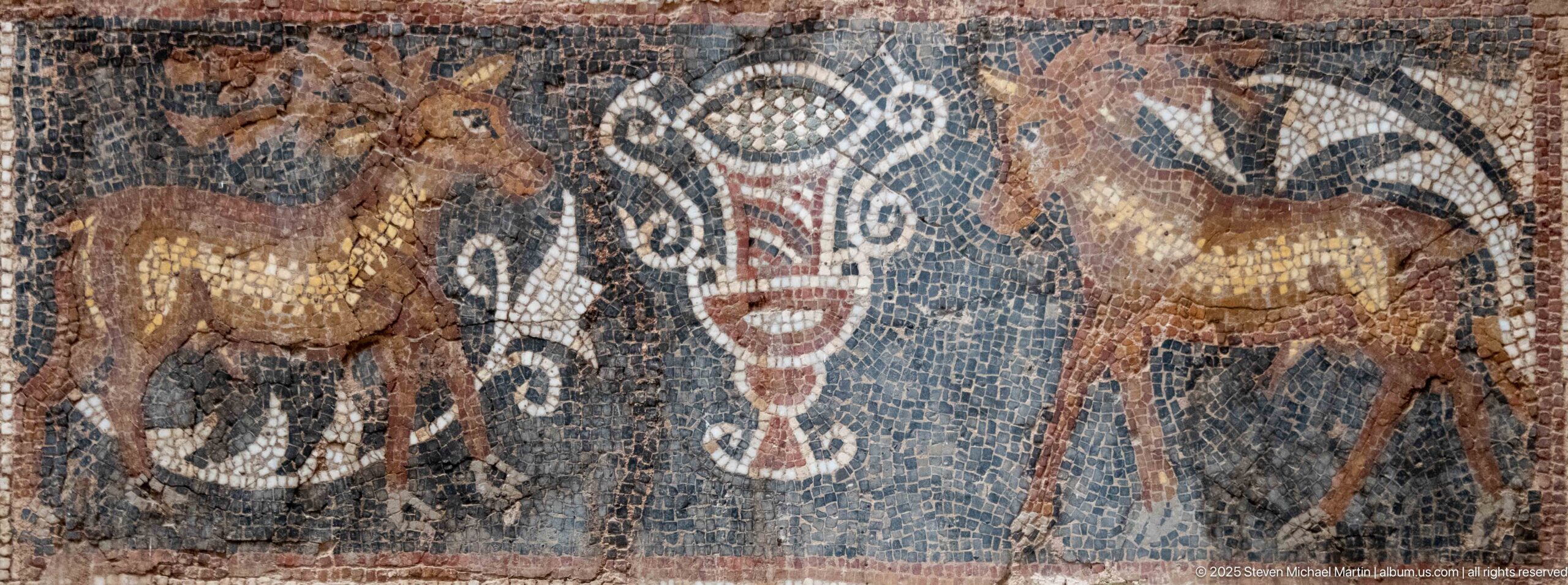
Two slender hoofed animals face inward toward a tall central vessel or ornamental form in this compact Roman mosaic panel. Dark scrolling foliage fills the ground around the animals, while their warm ocher bodies stand out against the darker background. The symmetrical pairing gives the composition a heraldic quality, though the exact species cannot be confirmed from the proof sheet.
Caption
Two slender hoofed animals face inward toward a tall central vessel or ornamental form in this compact Roman mosaic panel. Dark scrolling foliage fills the ground around the animals, while their warm ocher bodies stand out against the darker background. The symmetrical pairing gives the composition a heraldic quality, though the exact species cannot be confirmed from the proof sheet.
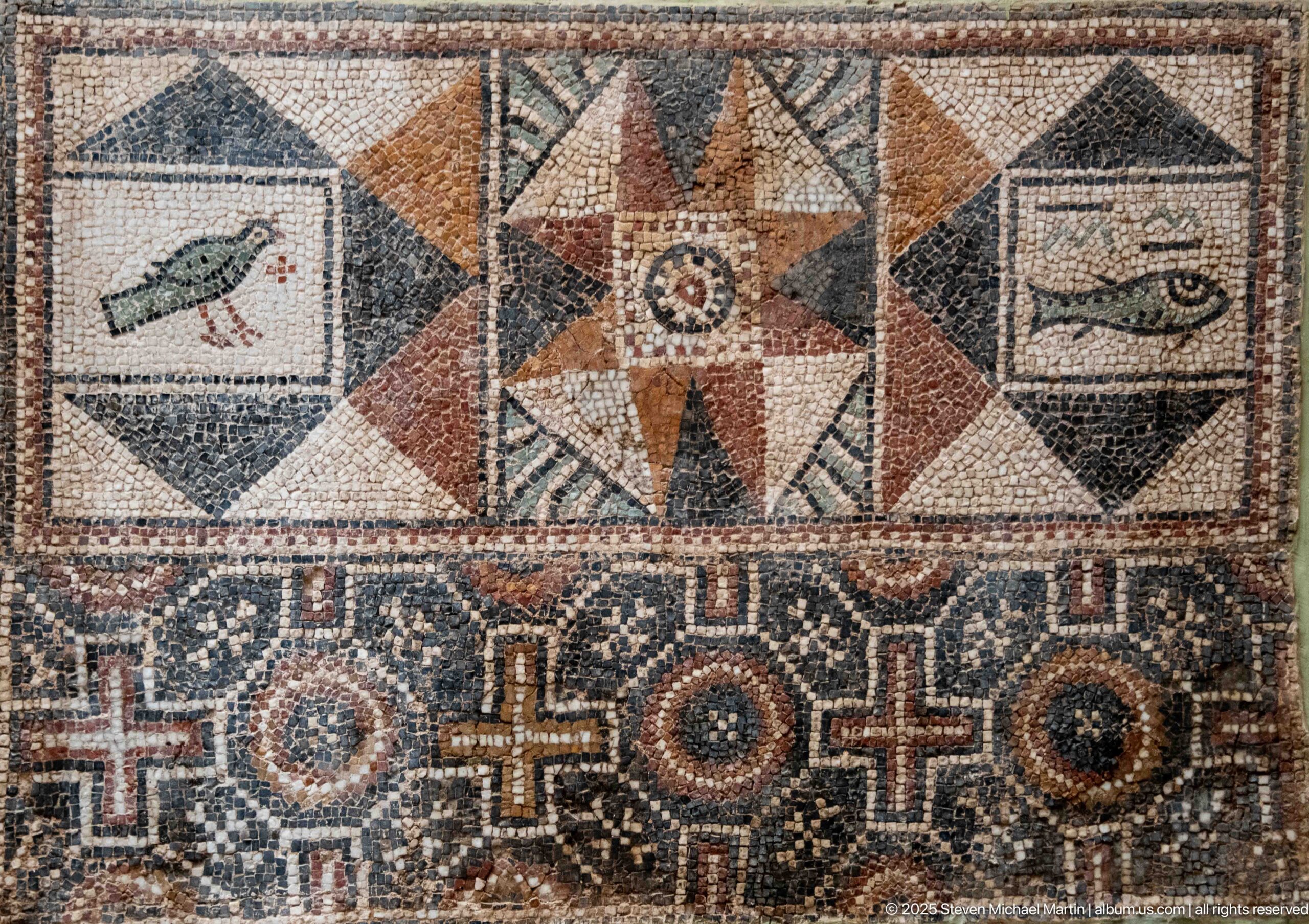
A decorative mosaic strip juxtaposes several small framed emblems: a bird, an eight-pointed star, and a fish-like motif appear above a darker band of circular and cross-shaped designs. The compact panel demonstrates how Roman mosaicists combined recognizable creatures with abstract geometry within a single ornamental program.
Caption
A decorative mosaic strip juxtaposes several small framed emblems: a bird, an eight-pointed star, and a fish-like motif appear above a darker band of circular and cross-shaped designs. The compact panel demonstrates how Roman mosaicists combined recognizable creatures with abstract geometry within a single ornamental program.
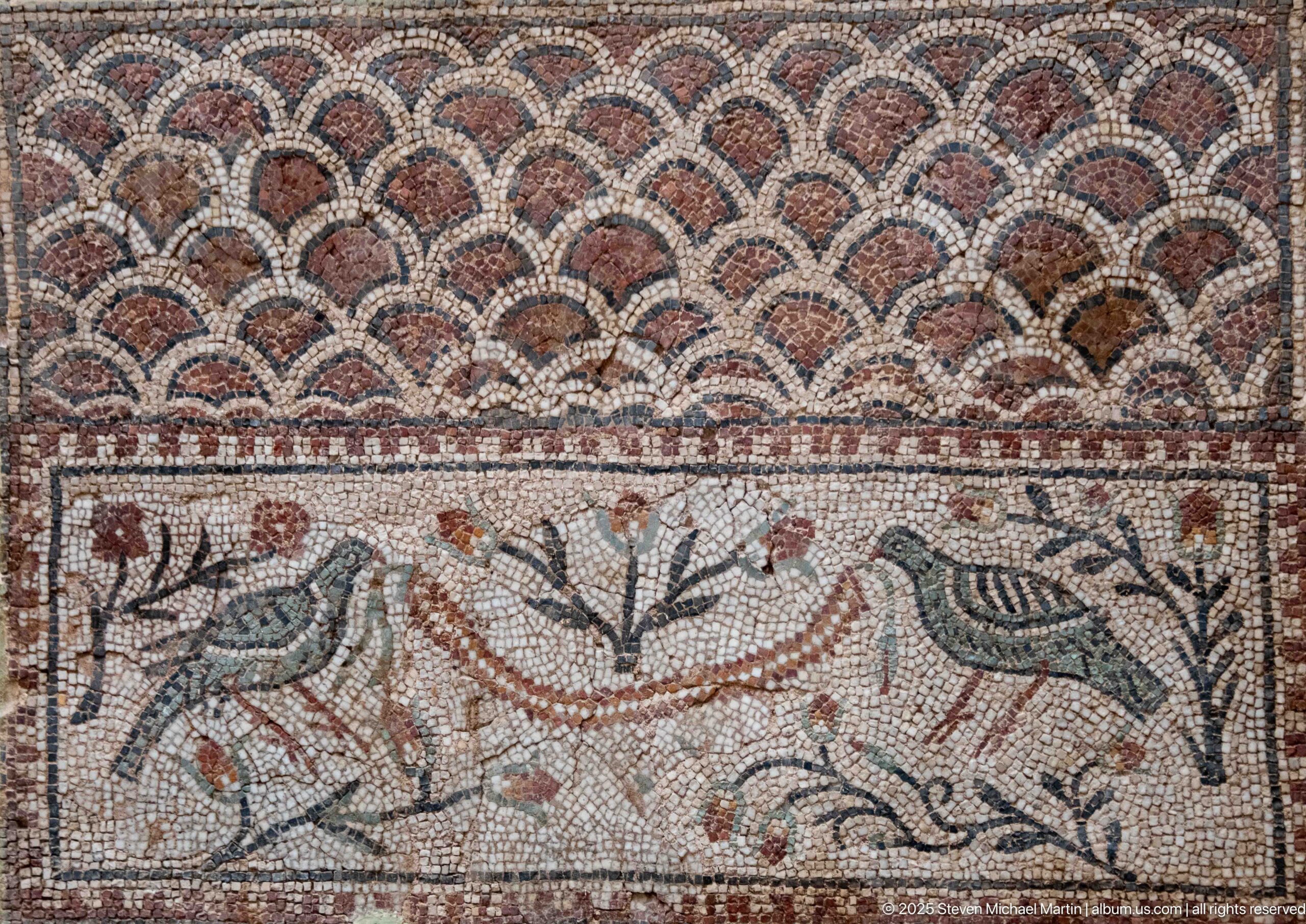
Two birds face one another across a beaded garland or necklace-like element, framed by flowering branches and small red blossoms. Above them, a broad scalloped band creates a strongly contrasting geometric register. The combination of naturalistic birds and repetitive ornament illustrates the ease with which Roman floor mosaics moved between figurative and abstract decoration.
Caption
Two birds face one another across a beaded garland or necklace-like element, framed by flowering branches and small red blossoms. Above them, a broad scalloped band creates a strongly contrasting geometric register. The combination of naturalistic birds and repetitive ornament illustrates the ease with which Roman floor mosaics moved between figurative and abstract decoration.
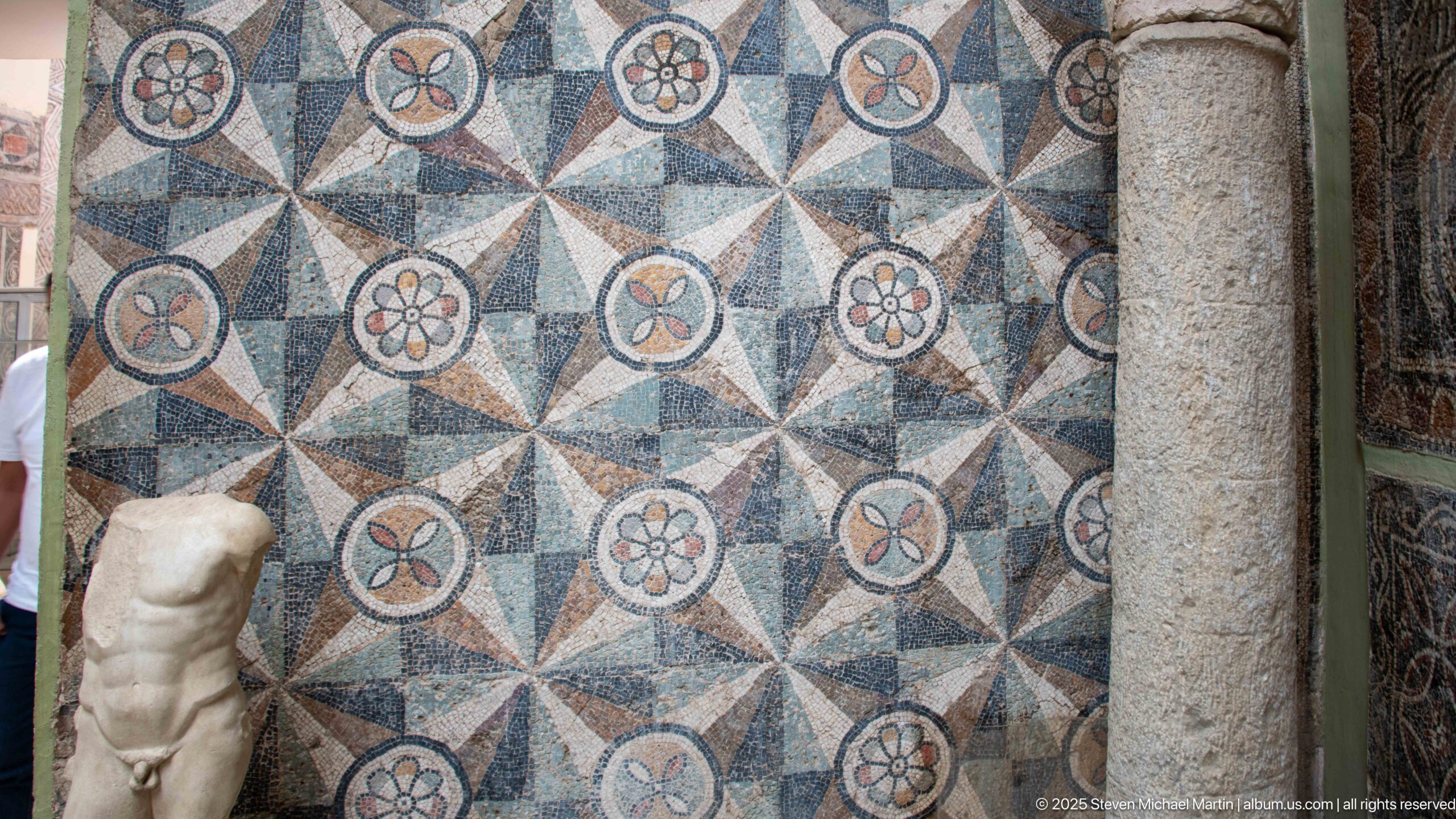
Large eight-pointed star forms repeat across this Roman mosaic, their triangular points arranged around circular floral medallions. Alternating dark and pale tesserae create a crisp pinwheel effect, while the roundels introduce softer botanical motifs. A nearby marble torso and column edge reveal that the panel is displayed as part of a larger gallery installation.
Caption
Large eight-pointed star forms repeat across this Roman mosaic, their triangular points arranged around circular floral medallions. Alternating dark and pale tesserae create a crisp pinwheel effect, while the roundels introduce softer botanical motifs. A nearby marble torso and column edge reveal that the panel is displayed as part of a larger gallery installation.
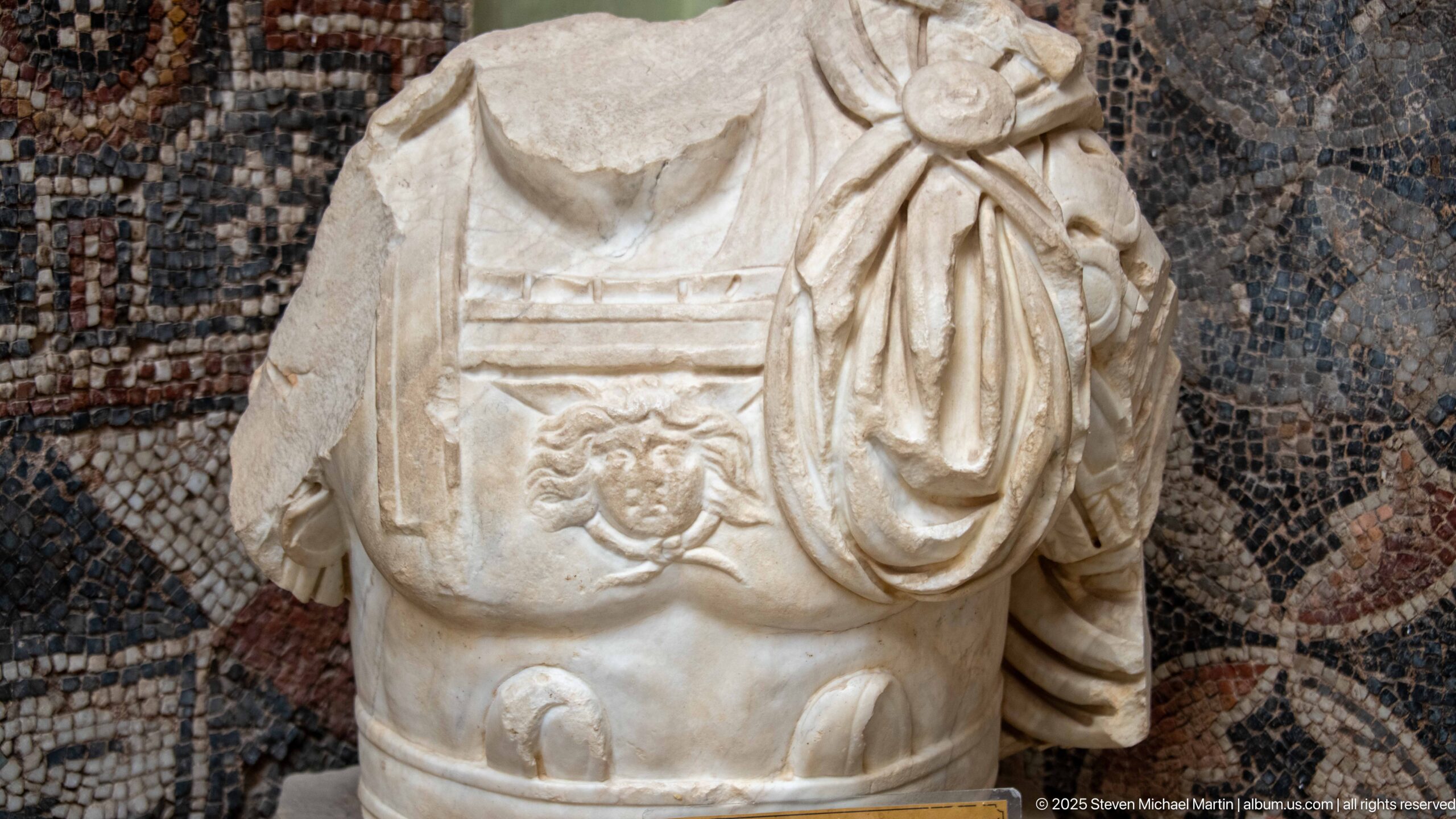
This fragment preserves the armored torso of a Roman male figure, with a sculpted cuirass, draped garment, and a prominent central emblem on the breastplate. The head and lower body are missing, focusing attention on the armor’s relief decoration and folds of cloth. Such cuirassed statues commonly represented military or imperial authority, although the individual portrayed cannot be identified from this fragment alone.
Caption
This fragment preserves the armored torso of a Roman male figure, with a sculpted cuirass, draped garment, and a prominent central emblem on the breastplate. The head and lower body are missing, focusing attention on the armor’s relief decoration and folds of cloth. Such cuirassed statues commonly represented military or imperial authority, although the individual portrayed cannot be identified from this fragment alone.
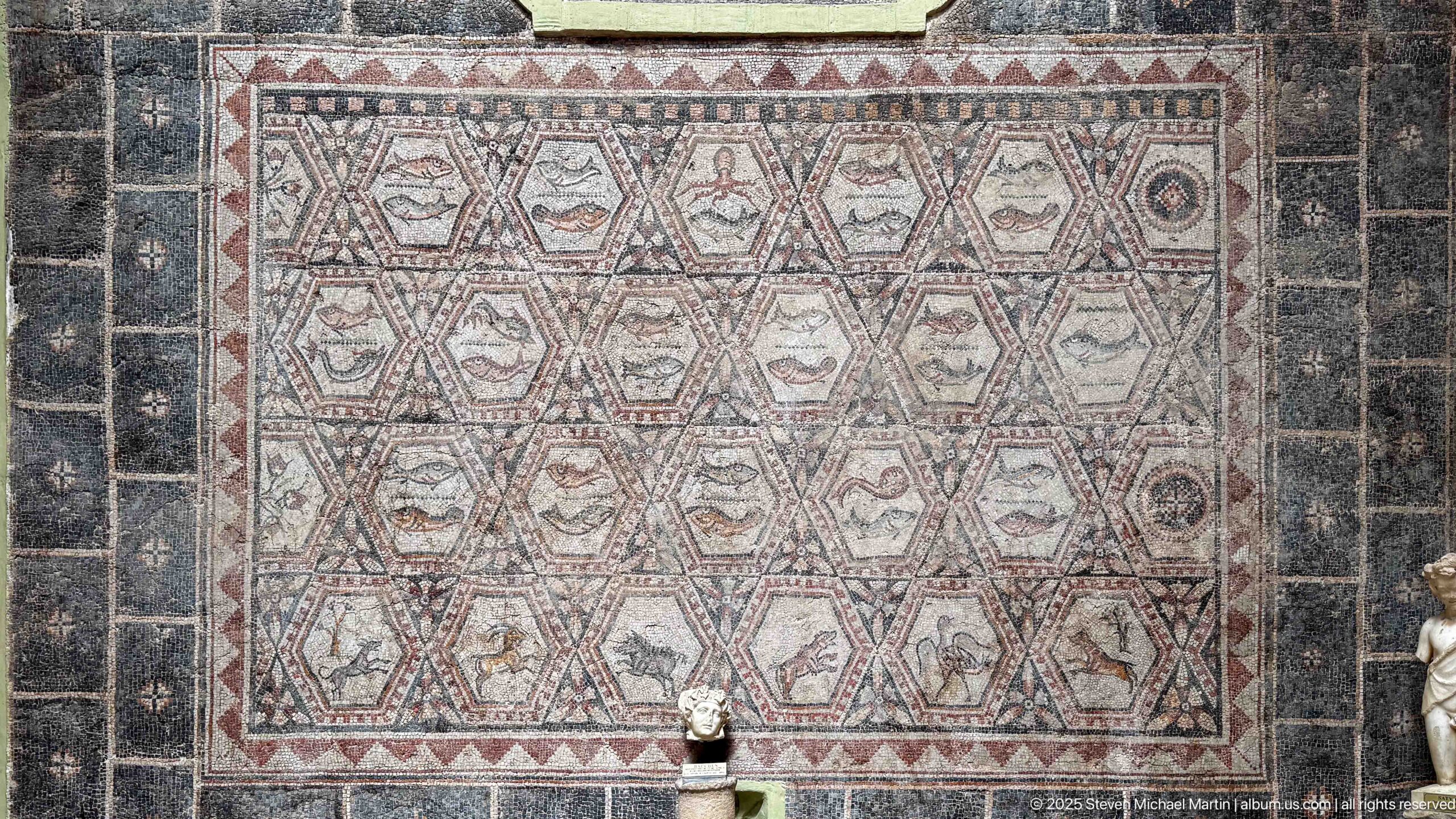
A large rectangular mosaic is divided into repeated hexagonal compartments, many of which contain vessels, animals, birds, or small emblematic designs. Narrow braided bands connect the compartments into a disciplined grid, while triangular borders frame the outer edge. The variety within each cell turns a rigid geometric structure into a lively catalog of small motifs.
Caption
A large rectangular mosaic is divided into repeated hexagonal compartments, many of which contain vessels, animals, birds, or small emblematic designs. Narrow braided bands connect the compartments into a disciplined grid, while triangular borders frame the outer edge. The variety within each cell turns a rigid geometric structure into a lively catalog of small motifs.
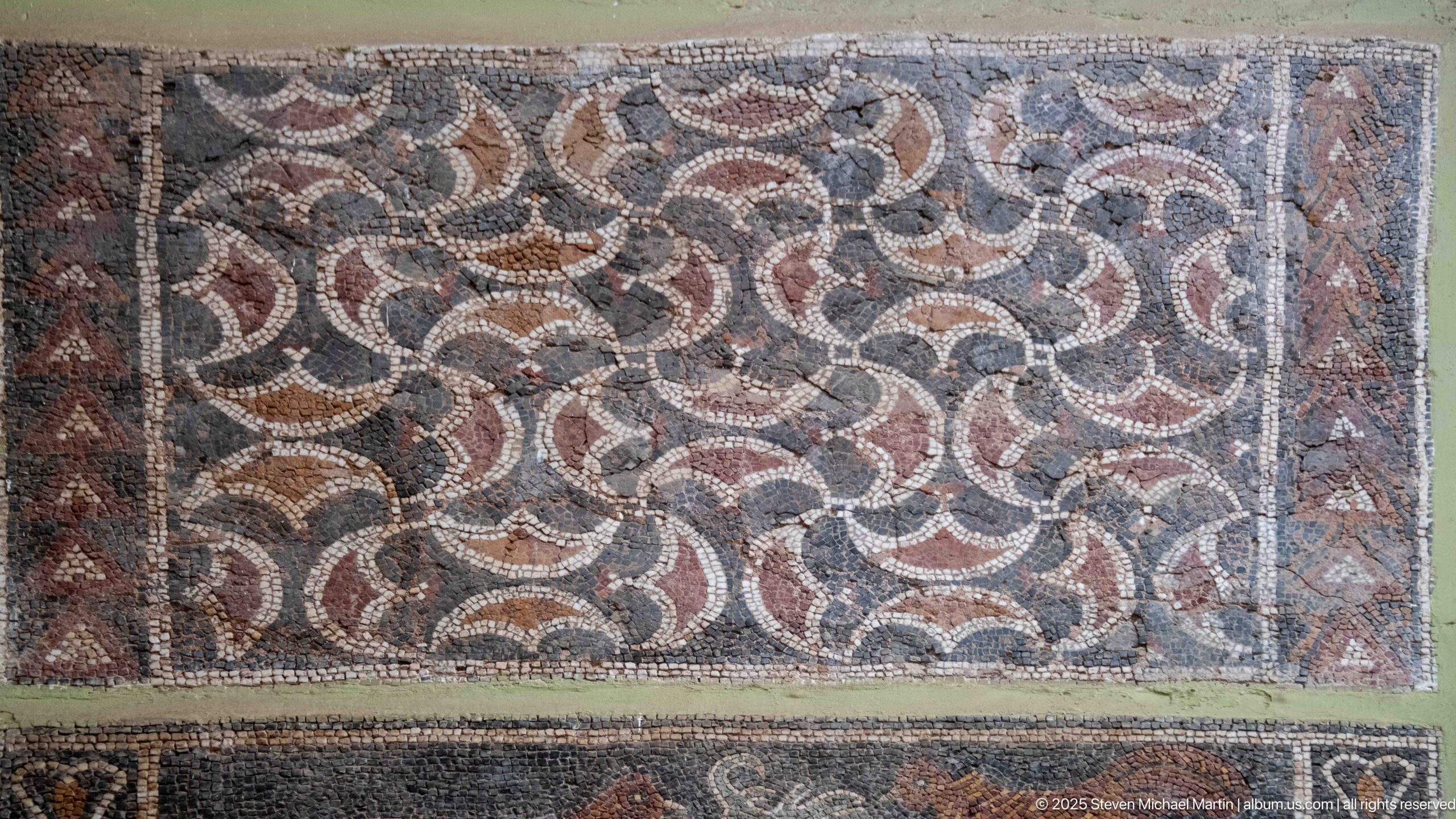
Overlapping circular bands form a dense chain of petal-like and quatrefoil shapes across this Roman mosaic. Red, cream, black, and gray tesserae alternate within the loops, creating a layered pattern that appears to rotate across the surface. A narrow border containing triangular forms completes the panel and reinforces its strongly geometric character.
Caption
Overlapping circular bands form a dense chain of petal-like and quatrefoil shapes across this Roman mosaic. Red, cream, black, and gray tesserae alternate within the loops, creating a layered pattern that appears to rotate across the surface. A narrow border containing triangular forms completes the panel and reinforces its strongly geometric character.
A dynamic Roman mosaic centers on a mounted or striding male figure who raises an arm while surrounded by large wild animals, including a lion and other quadrupeds. The narrative scene is enclosed by elaborate geometric and floral borders. The interaction suggests hunting or heroic combat, but the proof sheet does not securely reveal the figure’s identity or the precise mythological episode.
Caption
A dynamic Roman mosaic centers on a mounted or striding male figure who raises an arm while surrounded by large wild animals, including a lion and other quadrupeds. The narrative scene is enclosed by elaborate geometric and floral borders. The interaction suggests hunting or heroic combat, but the proof sheet does not securely reveal the figure’s identity or the precise mythological episode.
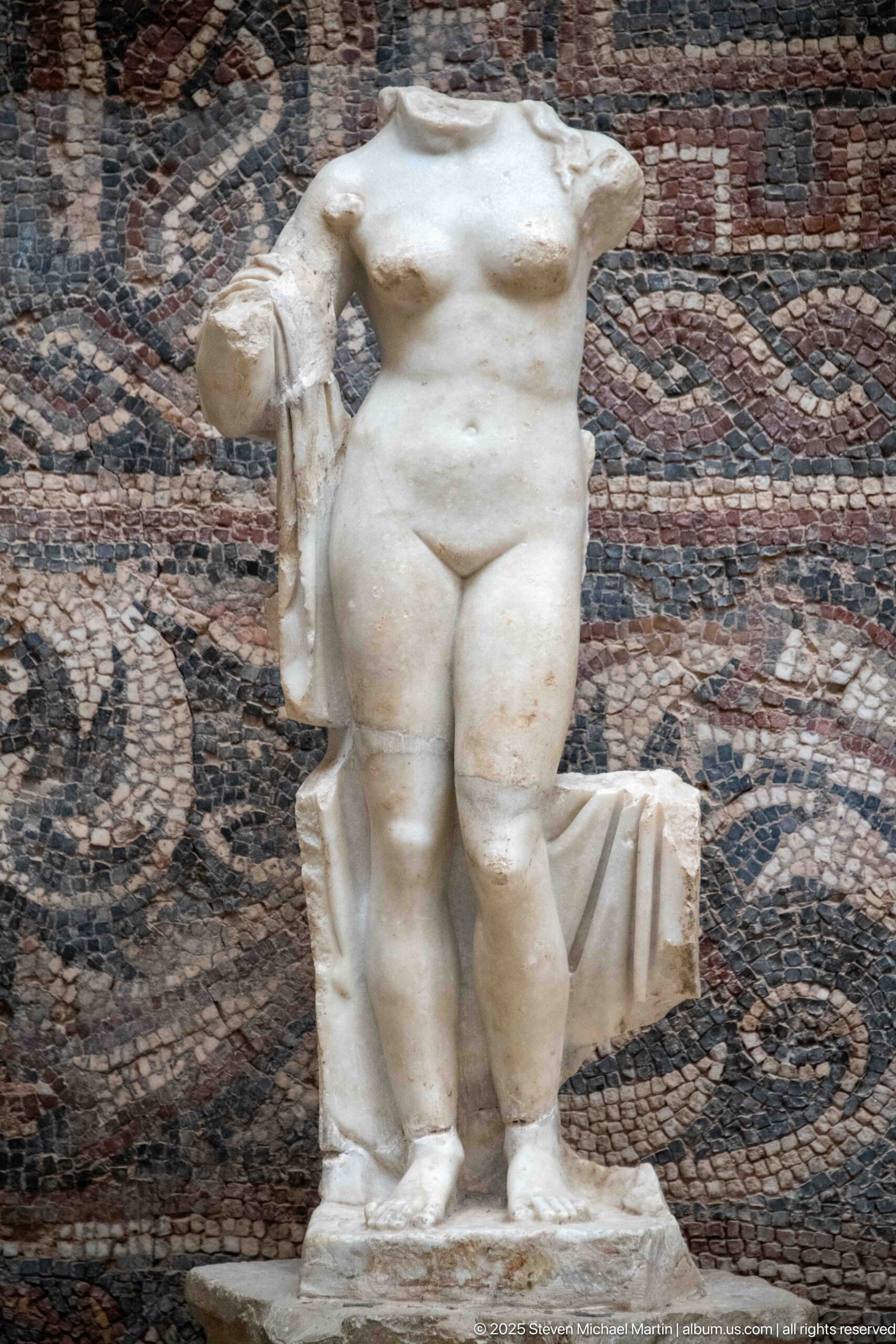
A headless marble figure preserves a full, softly modeled torso and legs, with drapery gathered at the side and a supporting element behind the body. The pose and nudity suggest a classical female figure, possibly a goddess type, but the missing head and attributes prevent a secure identification. The sculpture is displayed directly against a richly patterned mosaic wall.
Caption
A headless marble figure preserves a full, softly modeled torso and legs, with drapery gathered at the side and a supporting element behind the body. The pose and nudity suggest a classical female figure, possibly a goddess type, but the missing head and attributes prevent a secure identification. The sculpture is displayed directly against a richly patterned mosaic wall.
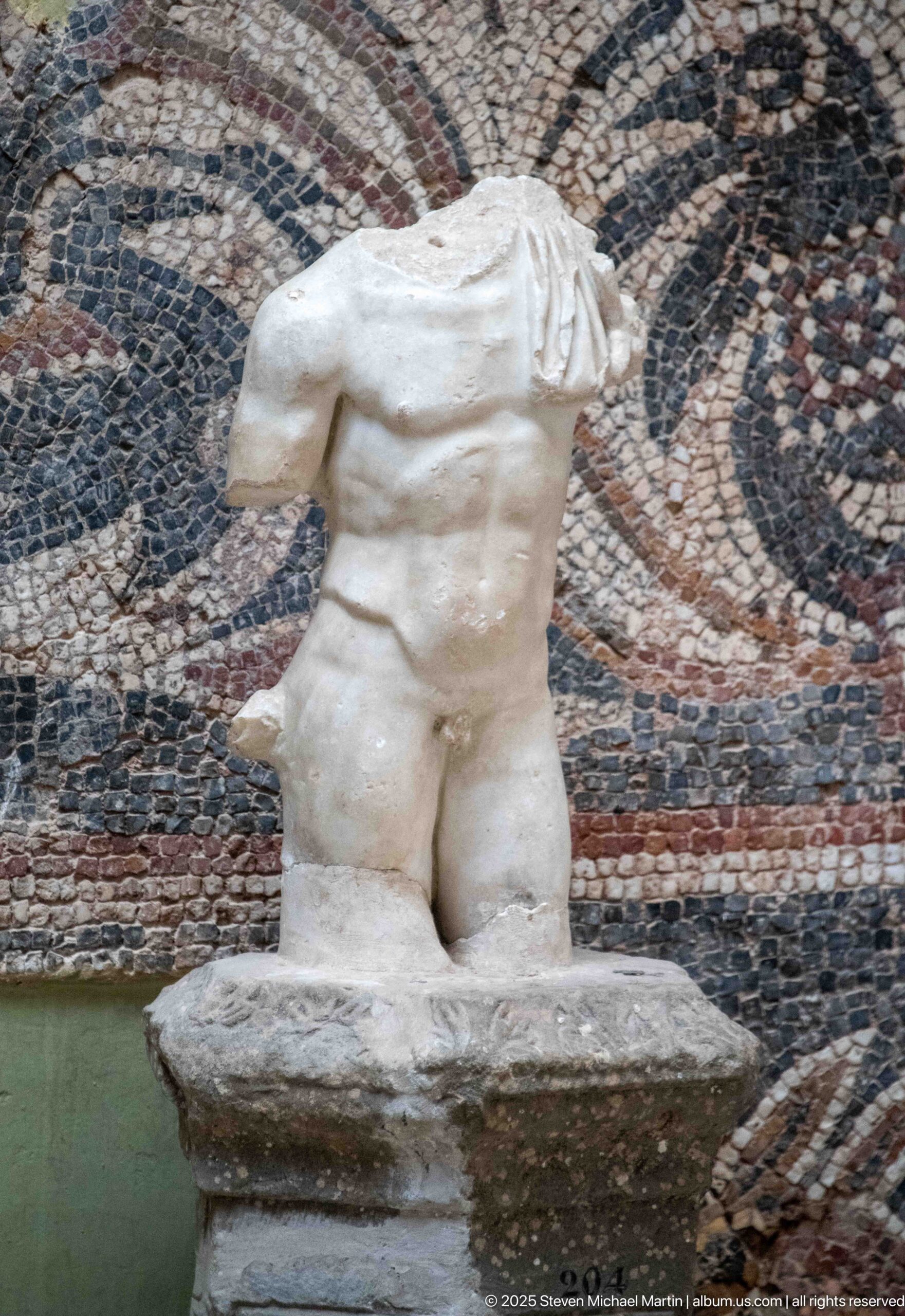
A fragmentary marble male nude preserves the chest, abdomen, hips, and upper thighs while the head and arms are lost. The compact torso is mounted on a stone base against an elaborate mosaic background. The close view emphasizes anatomical modeling and the surviving surface, but no attributes remain to support identification as a particular deity, athlete, or historical figure.
Caption
A fragmentary marble male nude preserves the chest, abdomen, hips, and upper thighs while the head and arms are lost. The compact torso is mounted on a stone base against an elaborate mosaic background. The close view emphasizes anatomical modeling and the surviving surface, but no attributes remain to support identification as a particular deity, athlete, or historical figure.
An immersive gallery view shows walls almost entirely covered by Roman mosaics in geometric, floral, and figurative designs. A large marble statue stands in the center foreground, with smaller sculptures and display cases arranged around the room. The installation makes the mosaics read as architectural surfaces and conveys their monumental scale more effectively than isolated close-ups.
Caption
An immersive gallery view shows walls almost entirely covered by Roman mosaics in geometric, floral, and figurative designs. A large marble statue stands in the center foreground, with smaller sculptures and display cases arranged around the room. The installation makes the mosaics read as architectural surfaces and conveys their monumental scale more effectively than isolated close-ups.
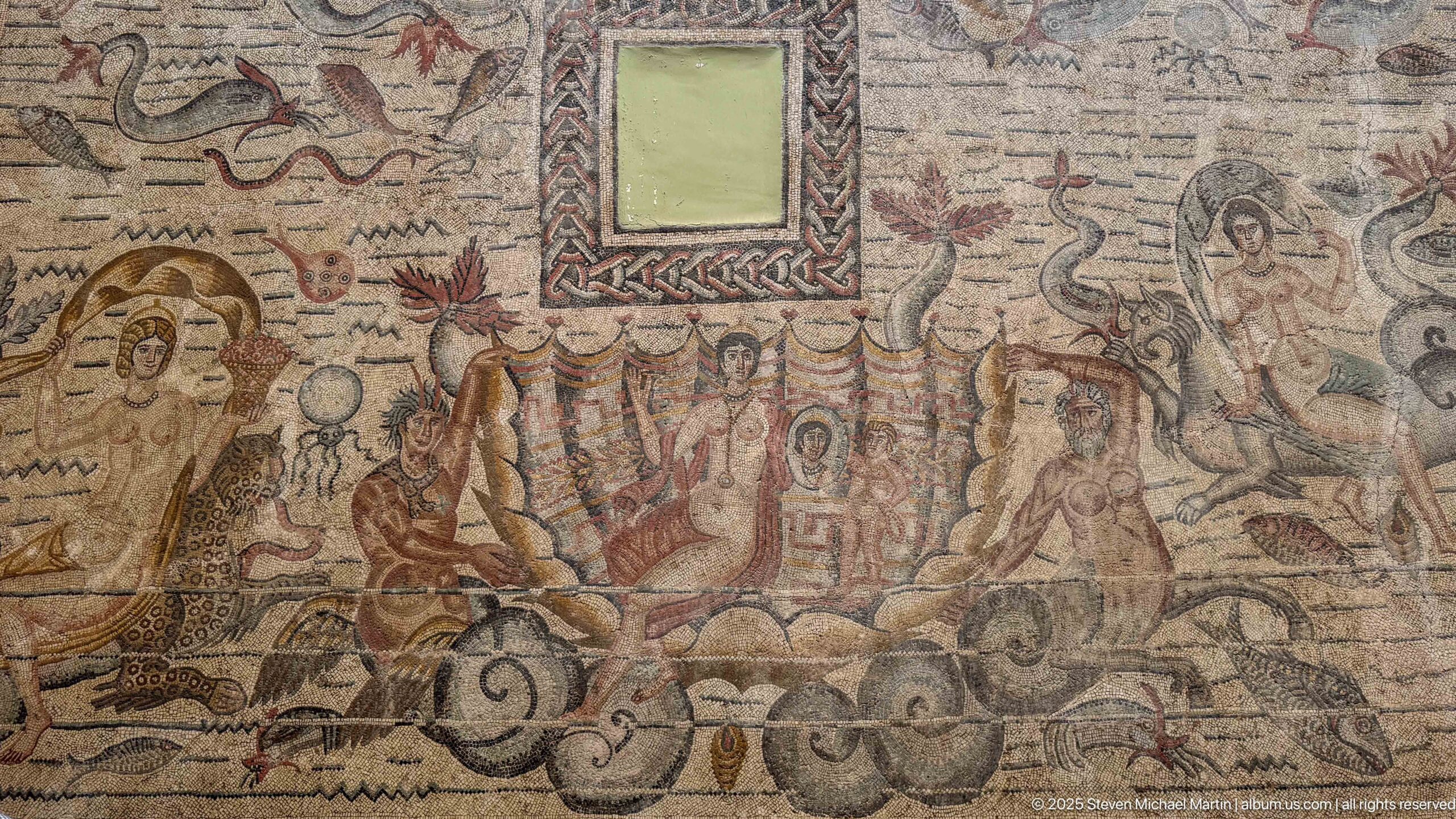
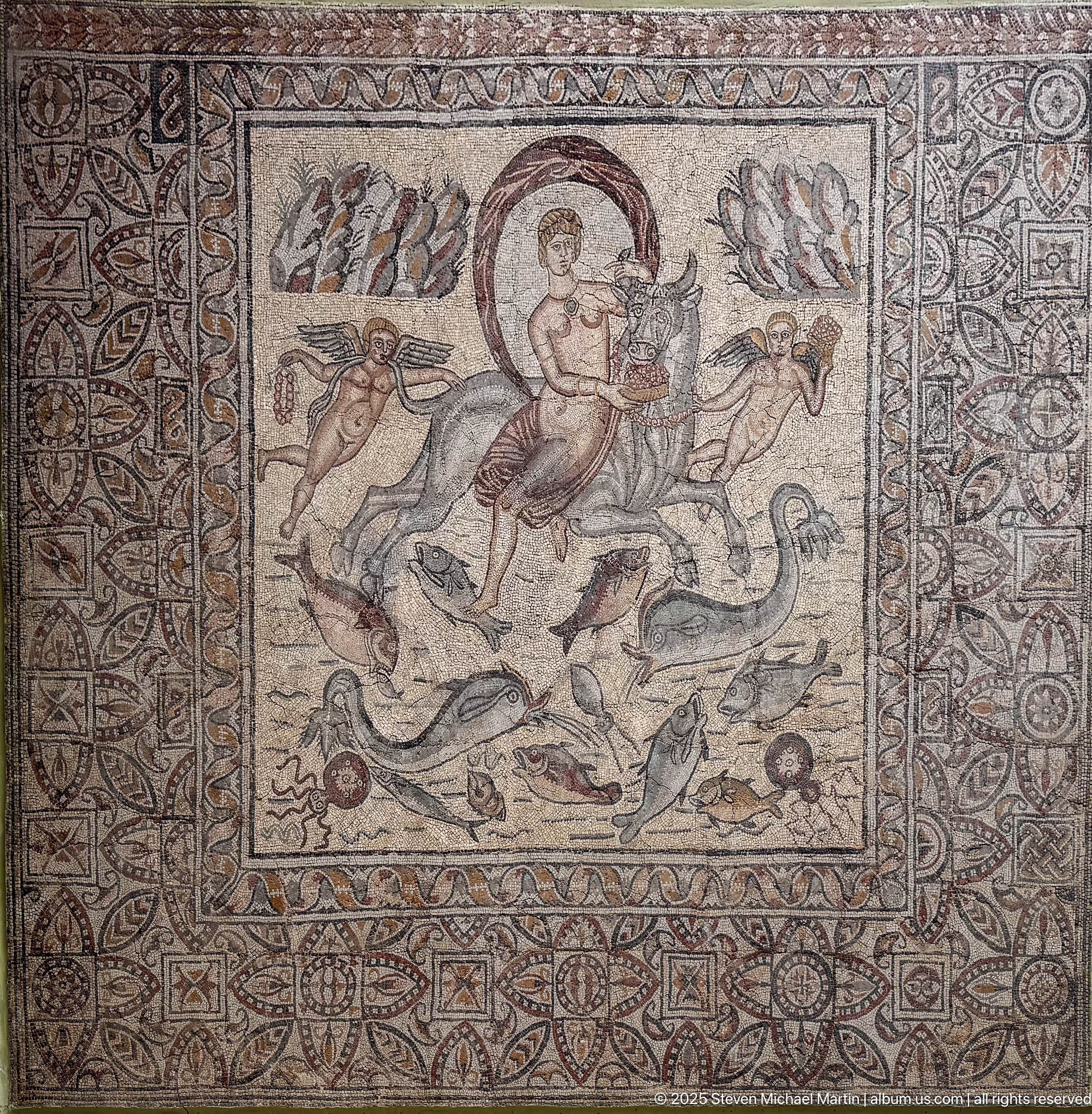
The Toilet of Venus Mosaic, from the House of the Ass at ancient Cuicul, dates to the late 4th or early 5th century CE. Venus sits within a shell and regards her reflection in a mirror while Tritons support the shell and marine beings animate the surrounding sea. The work is one of the named masterpieces specifically highlighted in the Djemila Museum collection.
Caption
The Toilet of Venus Mosaic, from the House of the Ass at ancient Cuicul, dates to the late 4th or early 5th century CE. Venus sits within a shell and regards her reflection in a mirror while Tritons support the shell and marine beings animate the surrounding sea. The work is one of the named masterpieces specifically highlighted in the Djemila Museum collection.
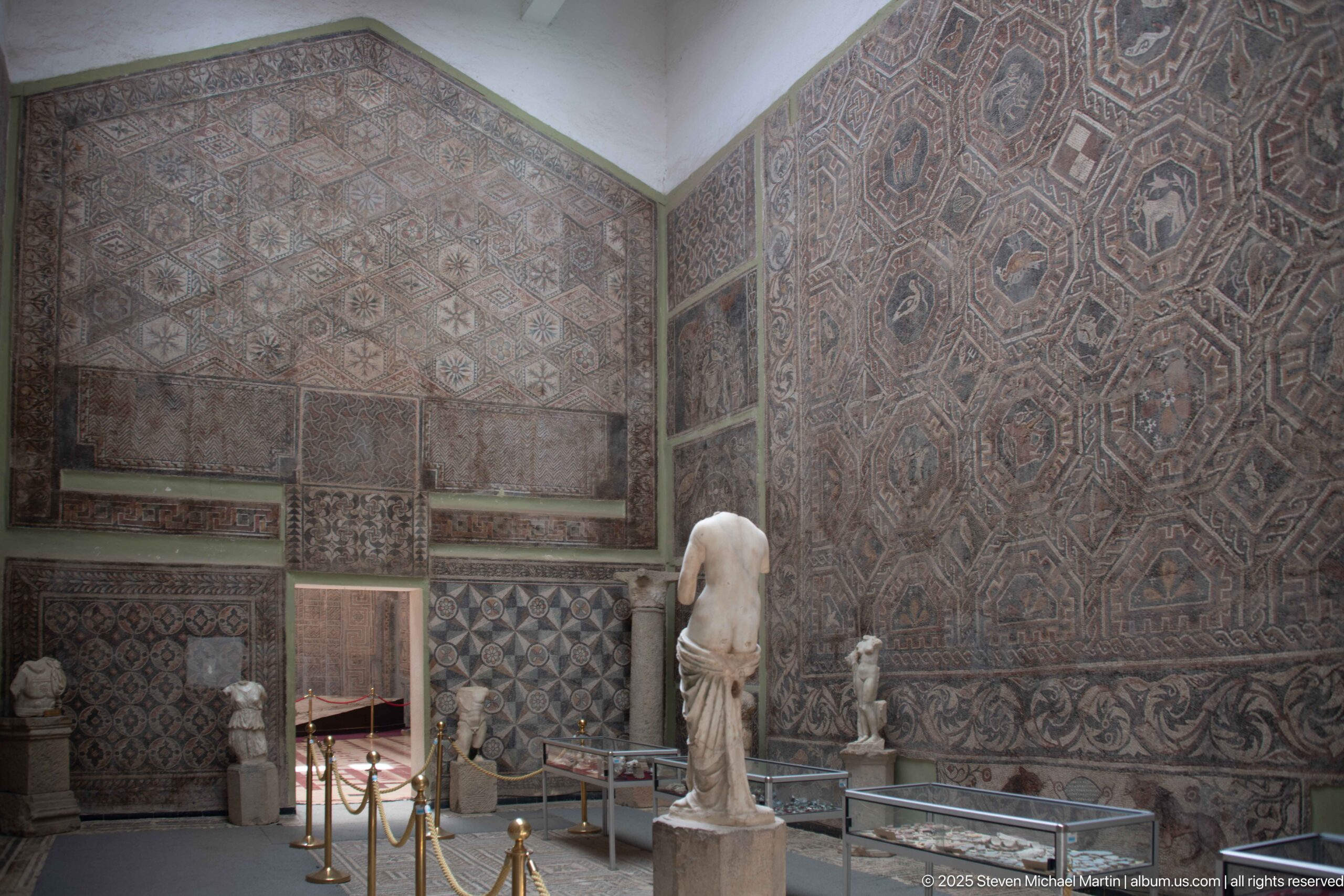
A quieter corner view emphasizes the museum’s monumental geometric mosaics, which extend across two adjoining walls in dense fields of octagons, rosettes, and interlace. A marble statue stands near the center, while smaller sculptures and a glass display case occupy the lower level. The composition highlights the relationship between freestanding sculpture and mosaic as complementary forms of Roman decoration.
Caption
A quieter corner view emphasizes the museum’s monumental geometric mosaics, which extend across two adjoining walls in dense fields of octagons, rosettes, and interlace. A marble statue stands near the center, while smaller sculptures and a glass display case occupy the lower level. The composition highlights the relationship between freestanding sculpture and mosaic as complementary forms of Roman decoration.
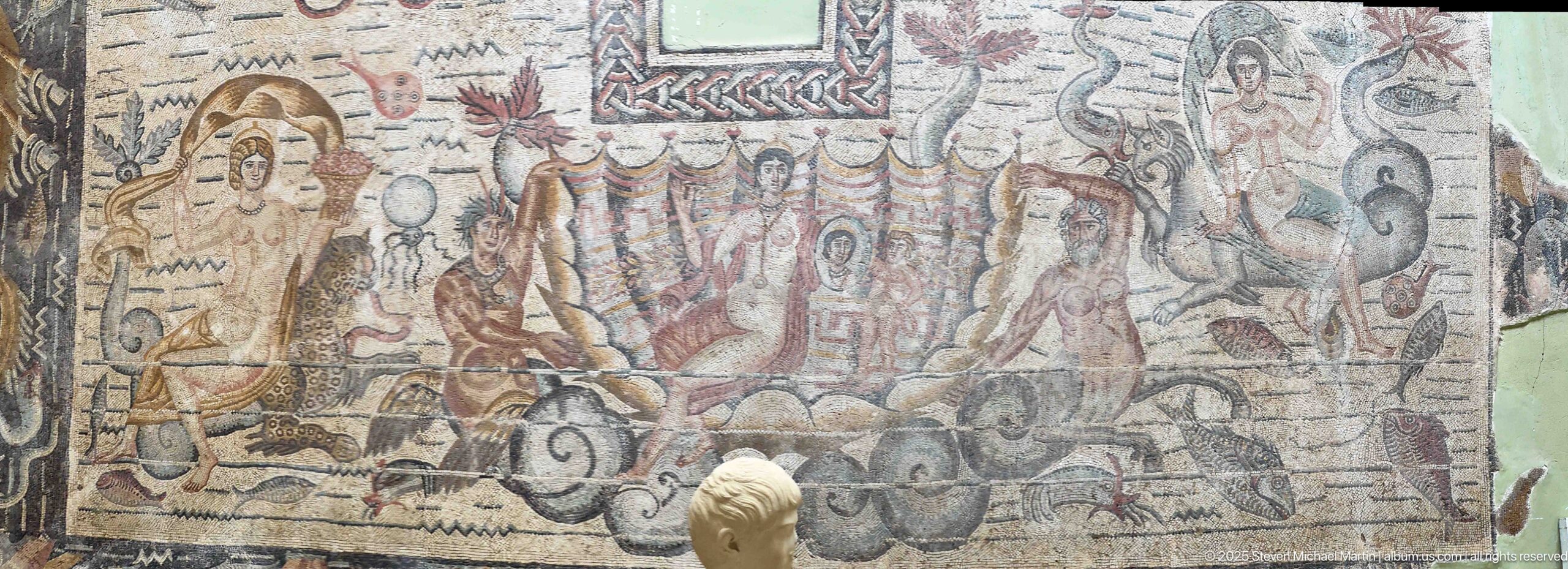
A closer view of the Toilet of Venus Mosaic isolates the goddess at the center of the marine composition. Venus sits in a shell and looks into a mirror, while Tritons and other sea figures flank the scene. The pavement came from the House of the Ass and is dated to the late 4th or beginning of the 5th century CE, making it one of Djemila Museum’s best-known mythological mosaics.
Caption
A closer view of the Toilet of Venus Mosaic isolates the goddess at the center of the marine composition. Venus sits in a shell and looks into a mirror, while Tritons and other sea figures flank the scene. The pavement came from the House of the Ass and is dated to the late 4th or beginning of the 5th century CE, making it one of Djemila Museum’s best-known mythological mosaics.
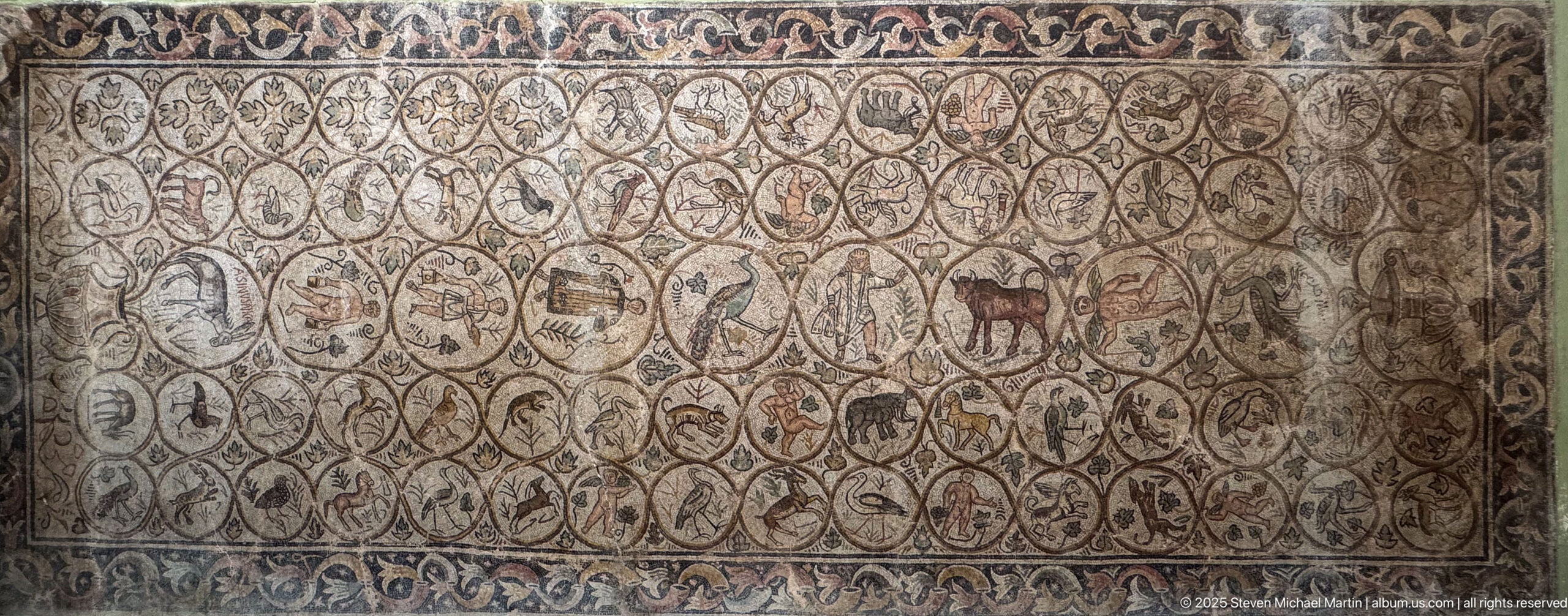
Rows of curling vine stems form oval and circular compartments occupied by birds, quadrupeds, and other small creatures. The repeated vegetal framework organizes the fauna into a decorative field, while a foliate border encloses the entire panel. The design blends natural imagery with disciplined geometry, creating one of the collection’s clearest examples of an animal-filled vine-scroll pattern.
Caption
Rows of curling vine stems form oval and circular compartments occupied by birds, quadrupeds, and other small creatures. The repeated vegetal framework organizes the fauna into a decorative field, while a foliate border encloses the entire panel. The design blends natural imagery with disciplined geometry, creating one of the collection’s clearest examples of an animal-filled vine-scroll pattern.
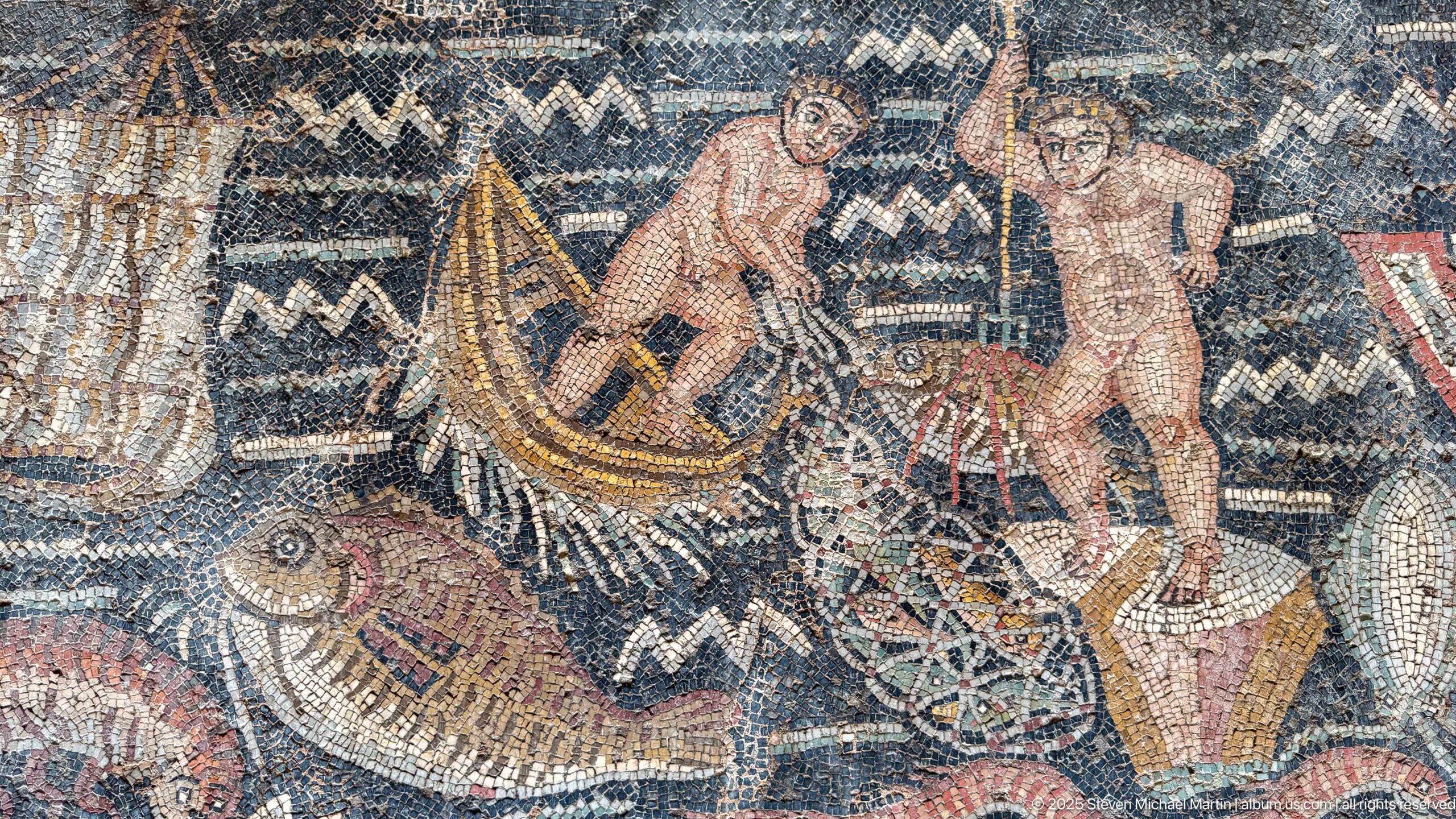
This fishing scene belongs to the marine imagery associated with Djemila’s Toilet of Venus Mosaic from the House of the Ass. Two fishermen work among abundant fish, one handling a net while the other stands beside fishing gear, as stylized zigzags animate the dark water. The detail expands the mosaic beyond its central goddess, showing the busy maritime world that surrounds the mythological scene.
Caption
This fishing scene belongs to the marine imagery associated with Djemila’s Toilet of Venus Mosaic from the House of the Ass. Two fishermen work among abundant fish, one handling a net while the other stands beside fishing gear, as stylized zigzags animate the dark water. The detail expands the mosaic beyond its central goddess, showing the busy maritime world that surrounds the mythological scene.
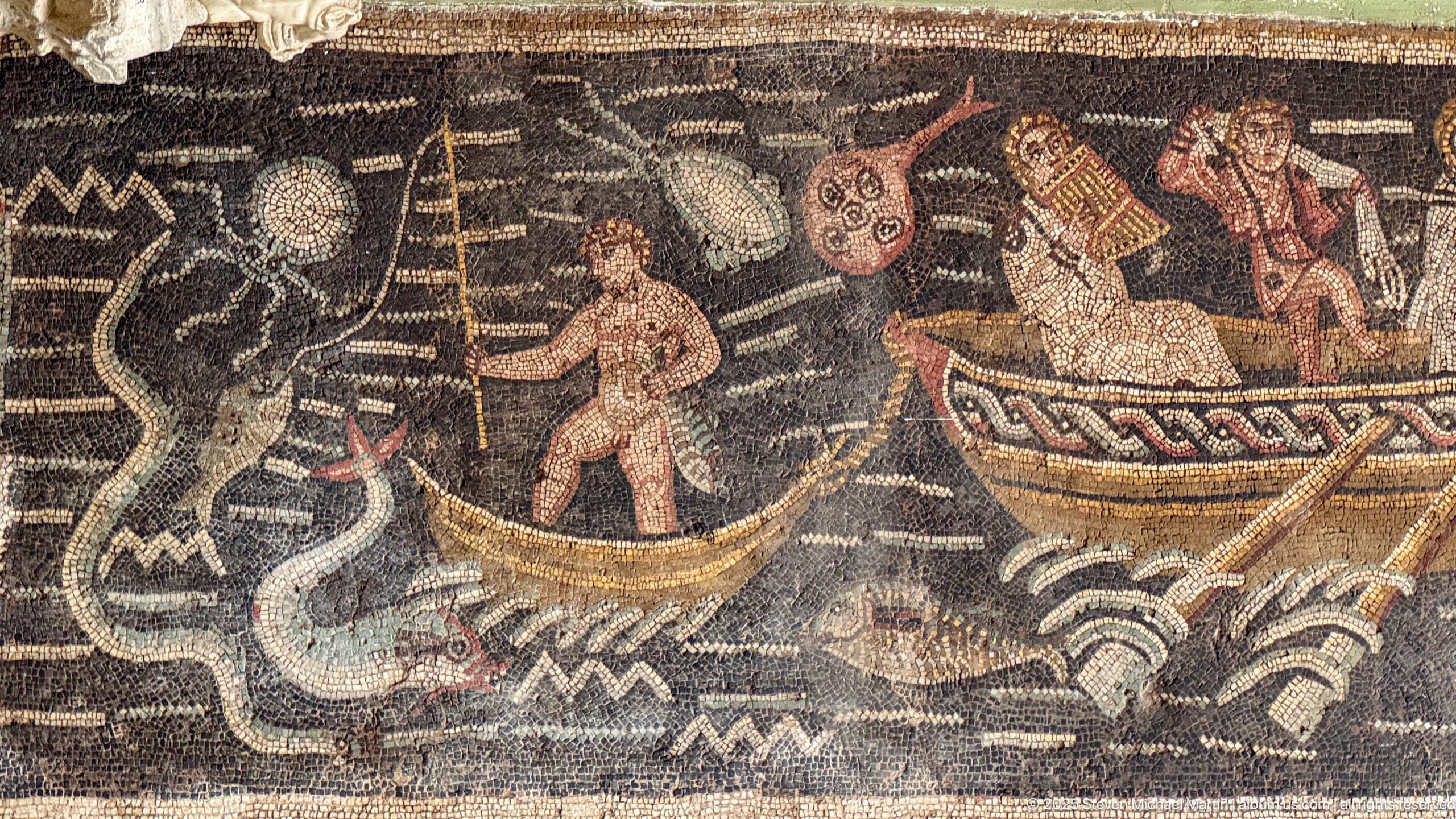
Another marine detail from the Toilet of Venus Mosaic shows small boats moving through a dark sea crowded with fish and fantastical marine creatures. The lively lower register complements the central image of Venus in her shell, surrounding the goddess with an expansive aquatic setting. The mosaic came from the House of the Ass and belongs to the late 4th or early 5th century CE.
Caption
Another marine detail from the Toilet of Venus Mosaic shows small boats moving through a dark sea crowded with fish and fantastical marine creatures. The lively lower register complements the central image of Venus in her shell, surrounding the goddess with an expansive aquatic setting. The mosaic came from the House of the Ass and belongs to the late 4th or early 5th century CE.
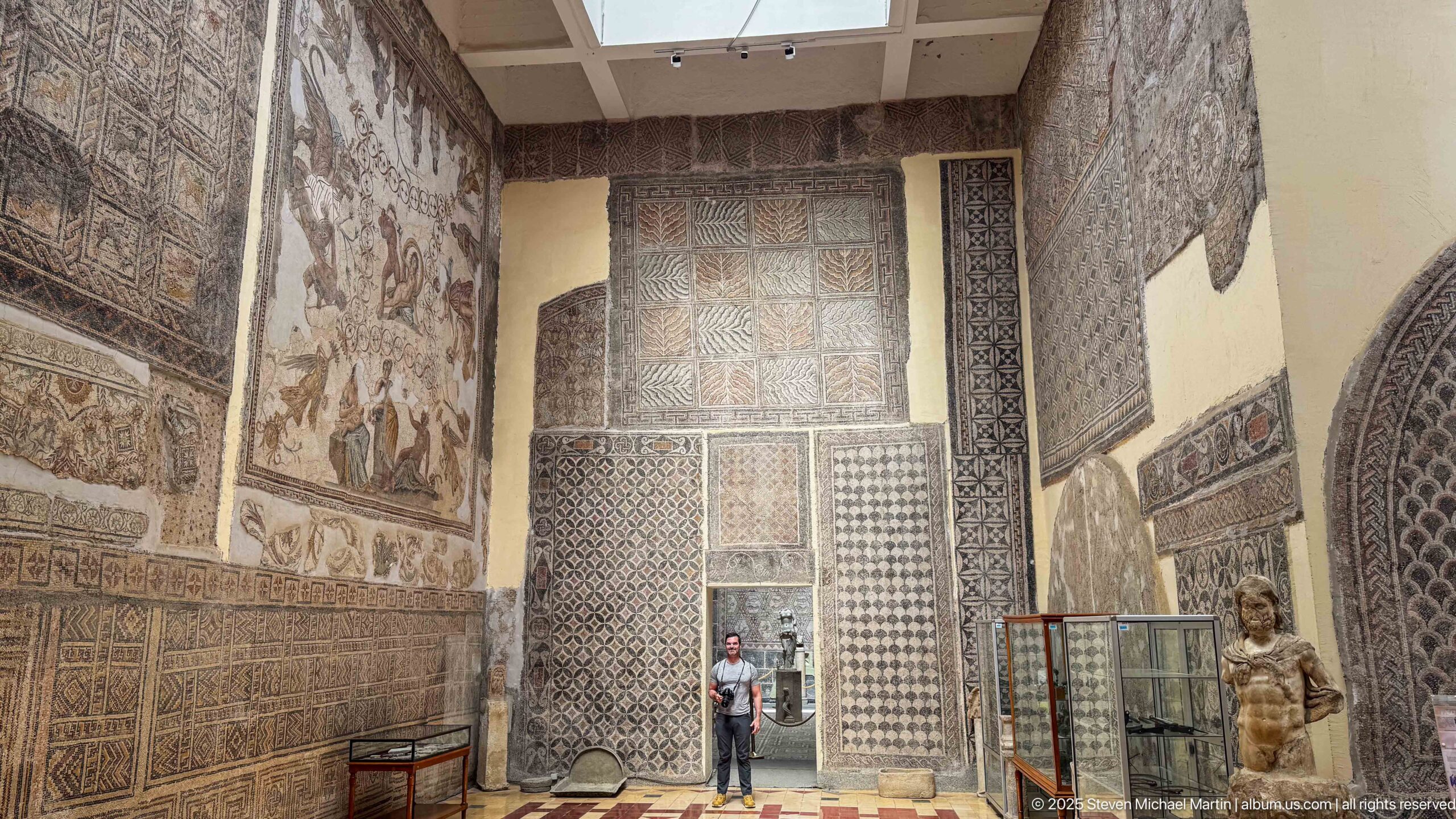
A visitor stands in a tall opening framed by mosaics, connecting two sections of the Djemila Museum gallery. Large figurative and geometric panels cover the surrounding walls, while narrow vertical mosaic strips emphasize the height of the passage. The photograph is less about a single artwork than about how the collection has been installed to create continuous mosaic-lined architectural space.
Caption
A visitor stands in a tall opening framed by mosaics, connecting two sections of the Djemila Museum gallery. Large figurative and geometric panels cover the surrounding walls, while narrow vertical mosaic strips emphasize the height of the passage. The photograph is less about a single artwork than about how the collection has been installed to create continuous mosaic-lined architectural space.
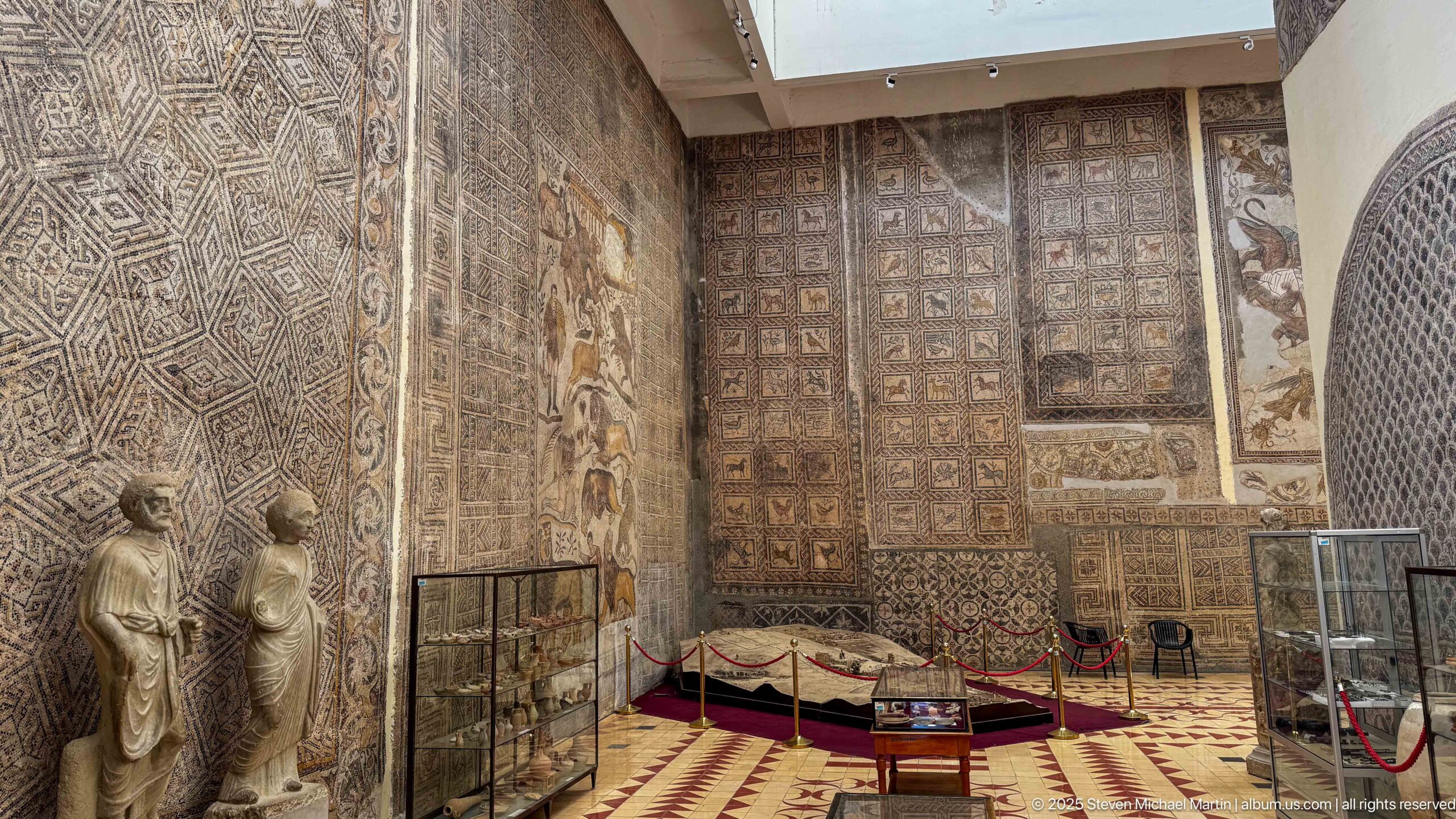
Two draped Roman statues stand at the left of a mosaic-lined gallery, facing an arrangement of large geometric and figurative panels. A low platform and cases occupy the center of the room, while overhead lighting reveals the scale of the installation. The juxtaposition of sculpture and mosaic creates a strong summary view of the museum’s archaeological display.
Caption
Two draped Roman statues stand at the left of a mosaic-lined gallery, facing an arrangement of large geometric and figurative panels. A low platform and cases occupy the center of the room, while overhead lighting reveals the scale of the installation. The juxtaposition of sculpture and mosaic creates a strong summary view of the museum’s archaeological display.
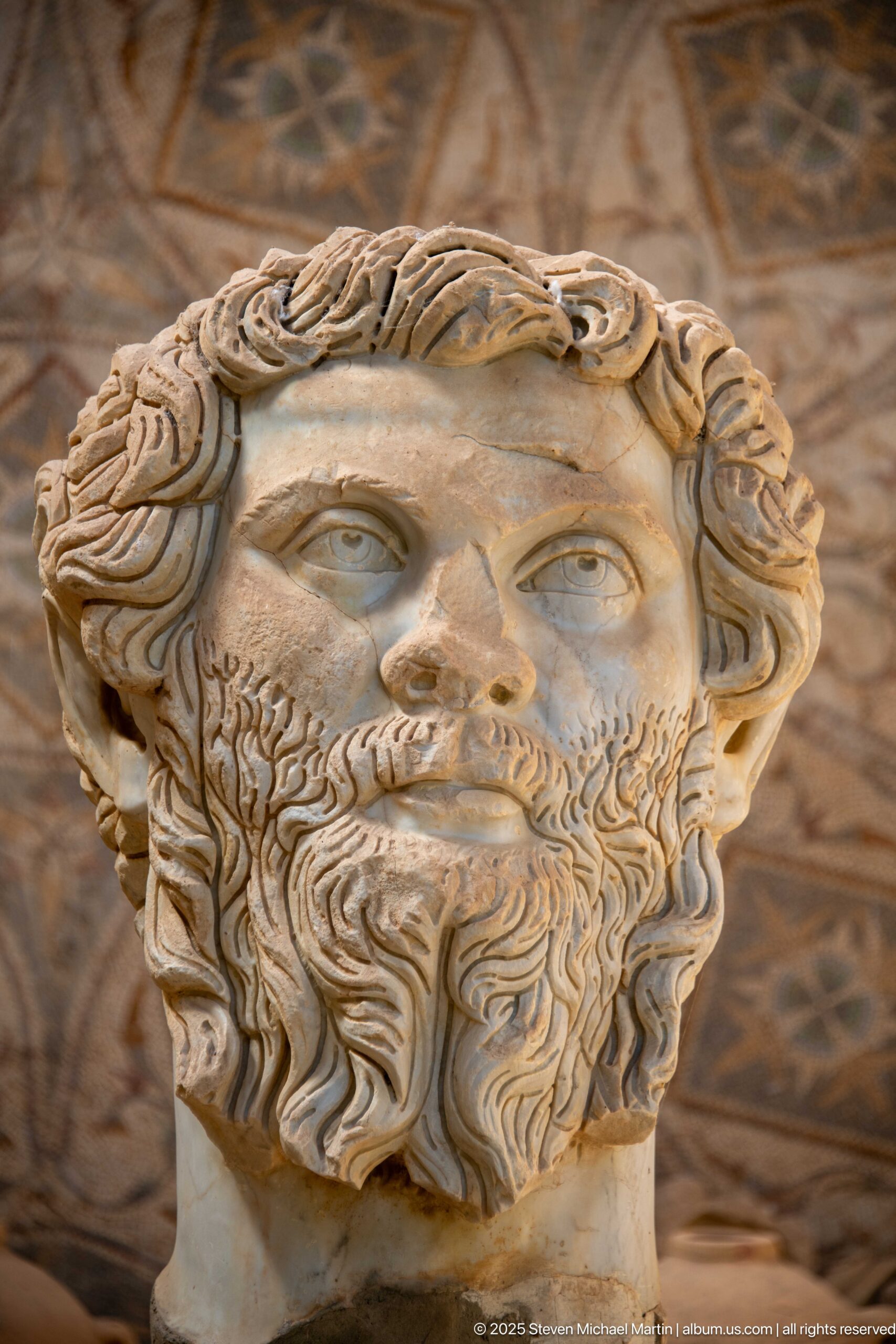
This colossal marble head portrays the Roman emperor Septimius Severus, who ruled from 193 to 211 CE. The deeply carved corkscrew curls and divided beard are characteristic features of his imperial portraiture. The head was found at Cuicul and is preserved at Djemila Museum; Algerian heritage documentation specifically lists Septimius Severus among the important marble portraits in the museum’s fourth gallery.
Caption
This colossal marble head portrays the Roman emperor Septimius Severus, who ruled from 193 to 211 CE. The deeply carved corkscrew curls and divided beard are characteristic features of his imperial portraiture. The head was found at Cuicul and is preserved at Djemila Museum; Algerian heritage documentation specifically lists Septimius Severus among the important marble portraits in the museum’s fourth gallery.
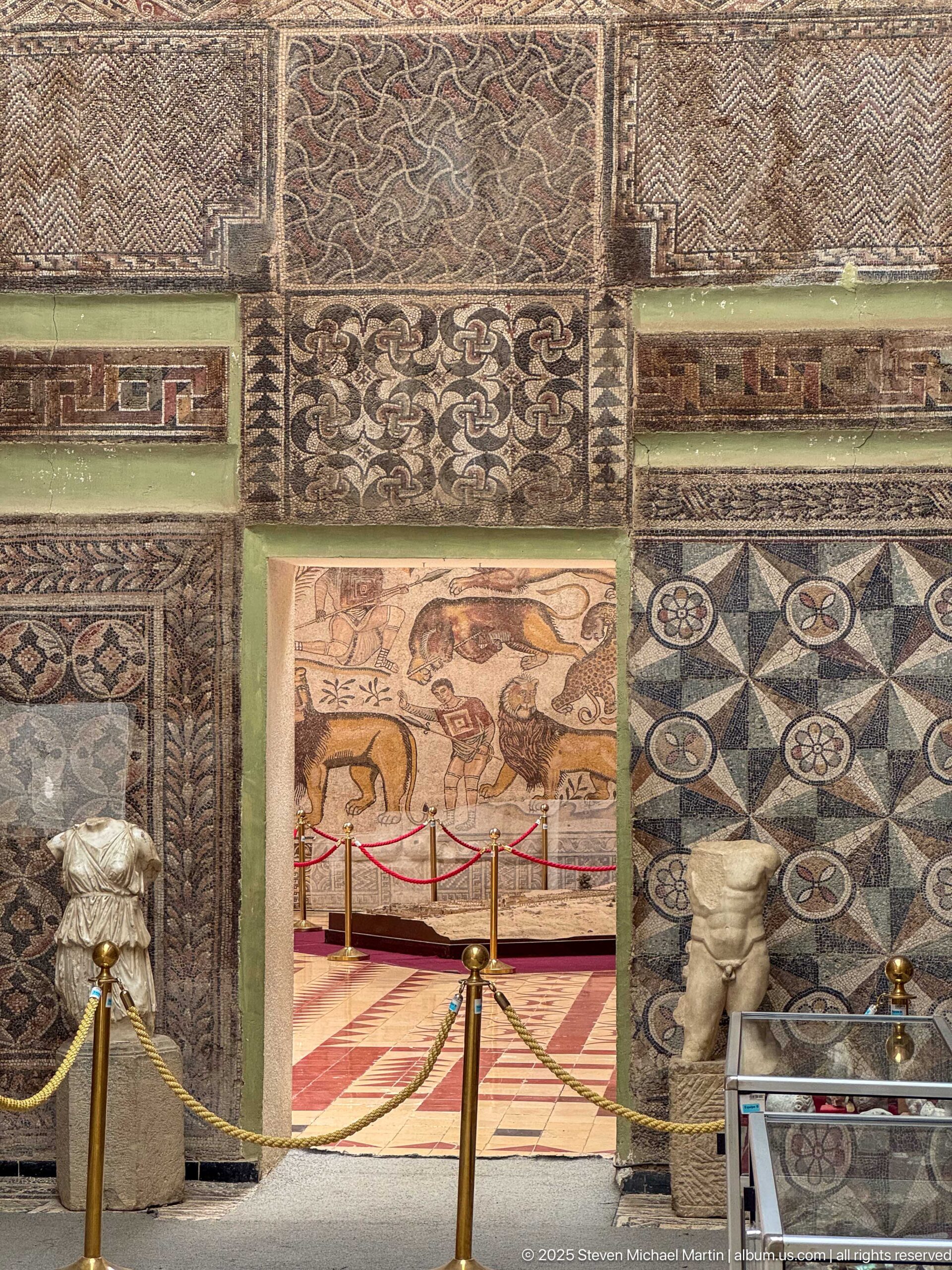
A doorway framed by bands of Roman mosaic opens from one richly decorated gallery into another. Geometric panels, wave-like borders, and floral scrolls surround the opening, while additional figurative mosaics are visible beyond it. Fragmentary marble sculpture at floor level reinforces the sense that the architecture itself has become part of the museum display system.
Caption
A doorway framed by bands of Roman mosaic opens from one richly decorated gallery into another. Geometric panels, wave-like borders, and floral scrolls surround the opening, while additional figurative mosaics are visible beyond it. Fragmentary marble sculpture at floor level reinforces the sense that the architecture itself has become part of the museum display system.
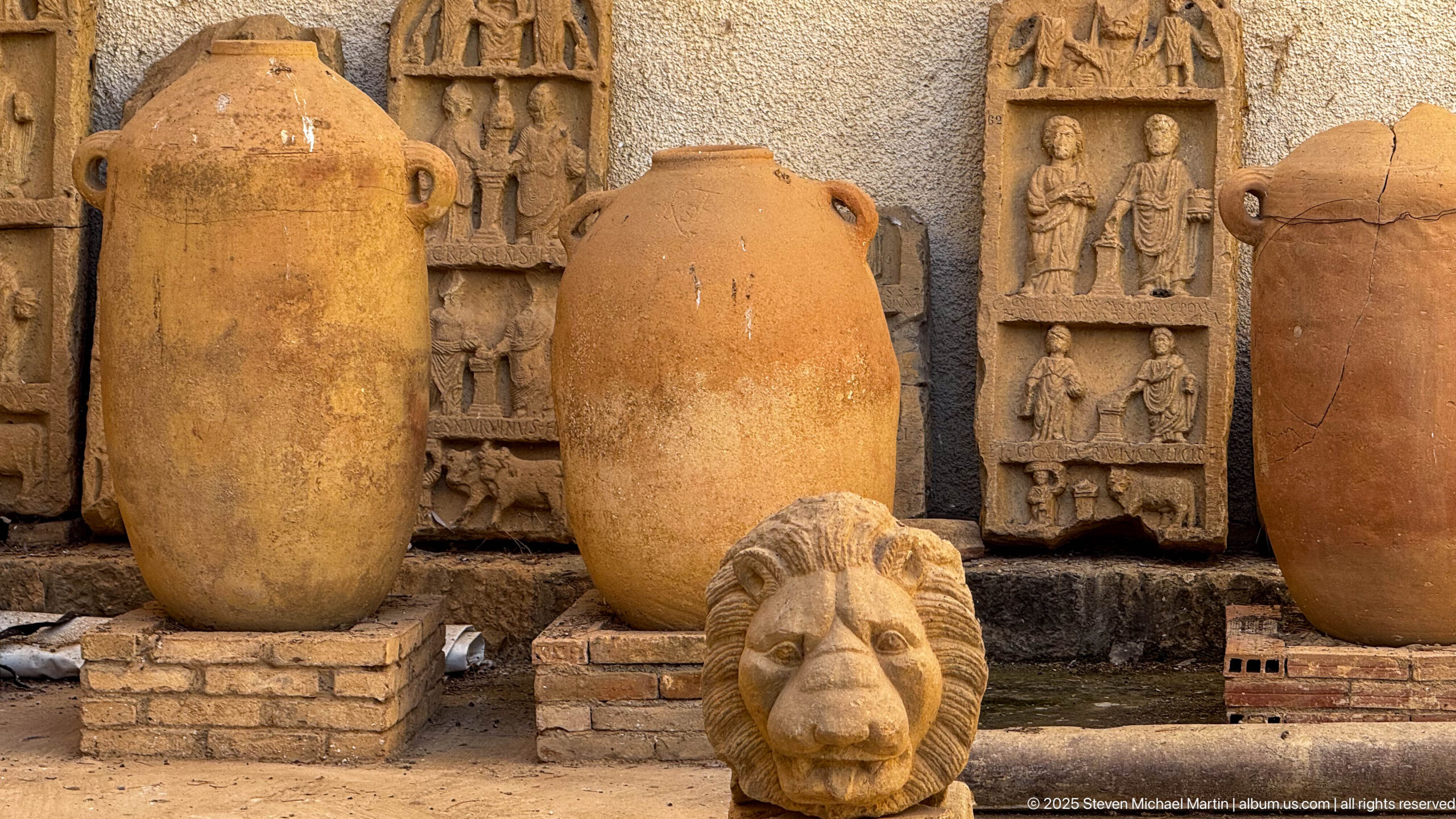
Several large ceramic amphorae stand before carved stone relief plaques, while a sculpted lion head occupies the foreground. The display combines transport or storage vessels with figurative stonework, giving a compact view of different categories of Roman material culture. The warm, worn surfaces of the pottery contrast strongly with the more sharply modeled sculpture.
Caption
Several large ceramic amphorae stand before carved stone relief plaques, while a sculpted lion head occupies the foreground. The display combines transport or storage vessels with figurative stonework, giving a compact view of different categories of Roman material culture. The warm, worn surfaces of the pottery contrast strongly with the more sharply modeled sculpture.
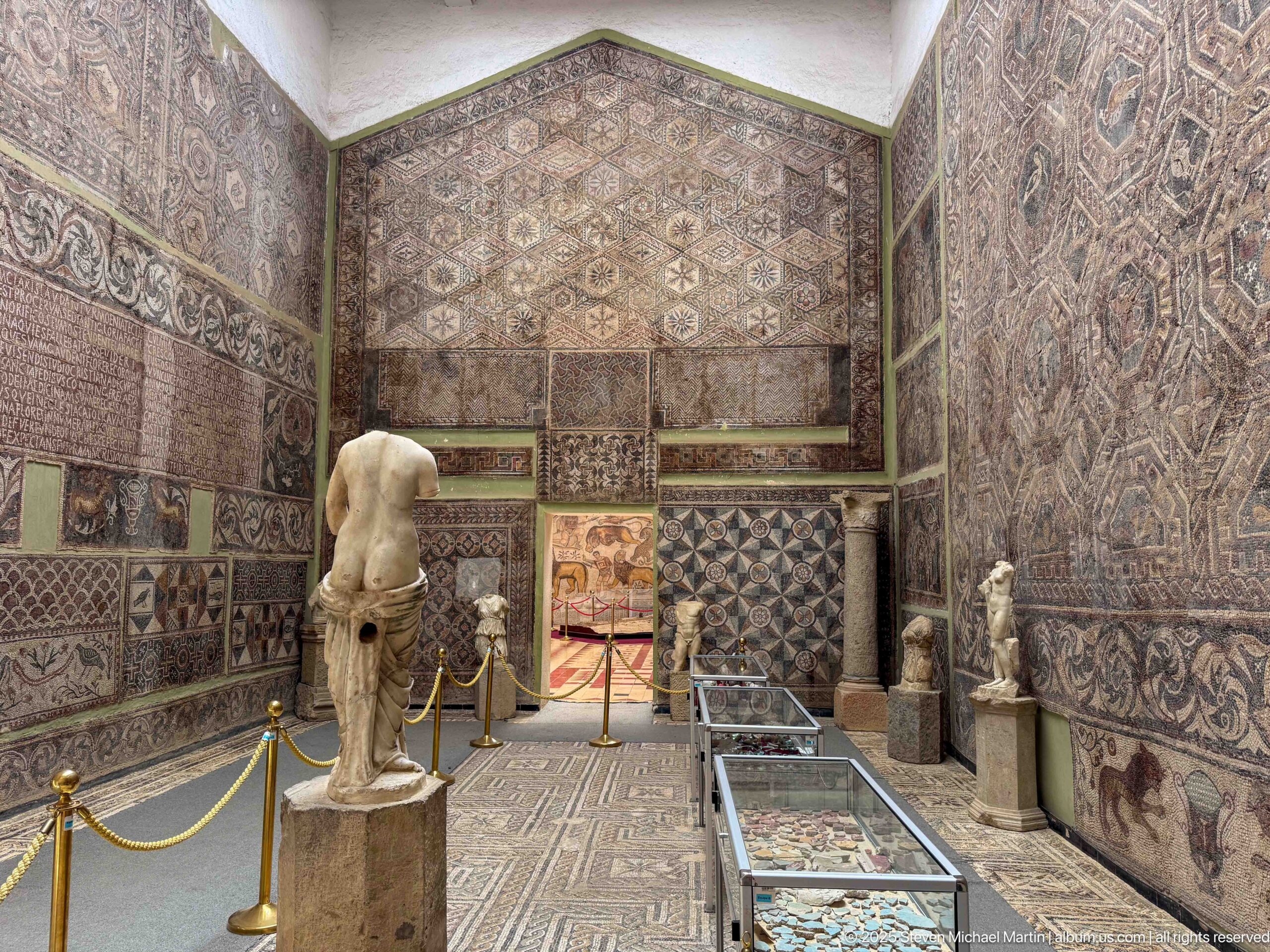
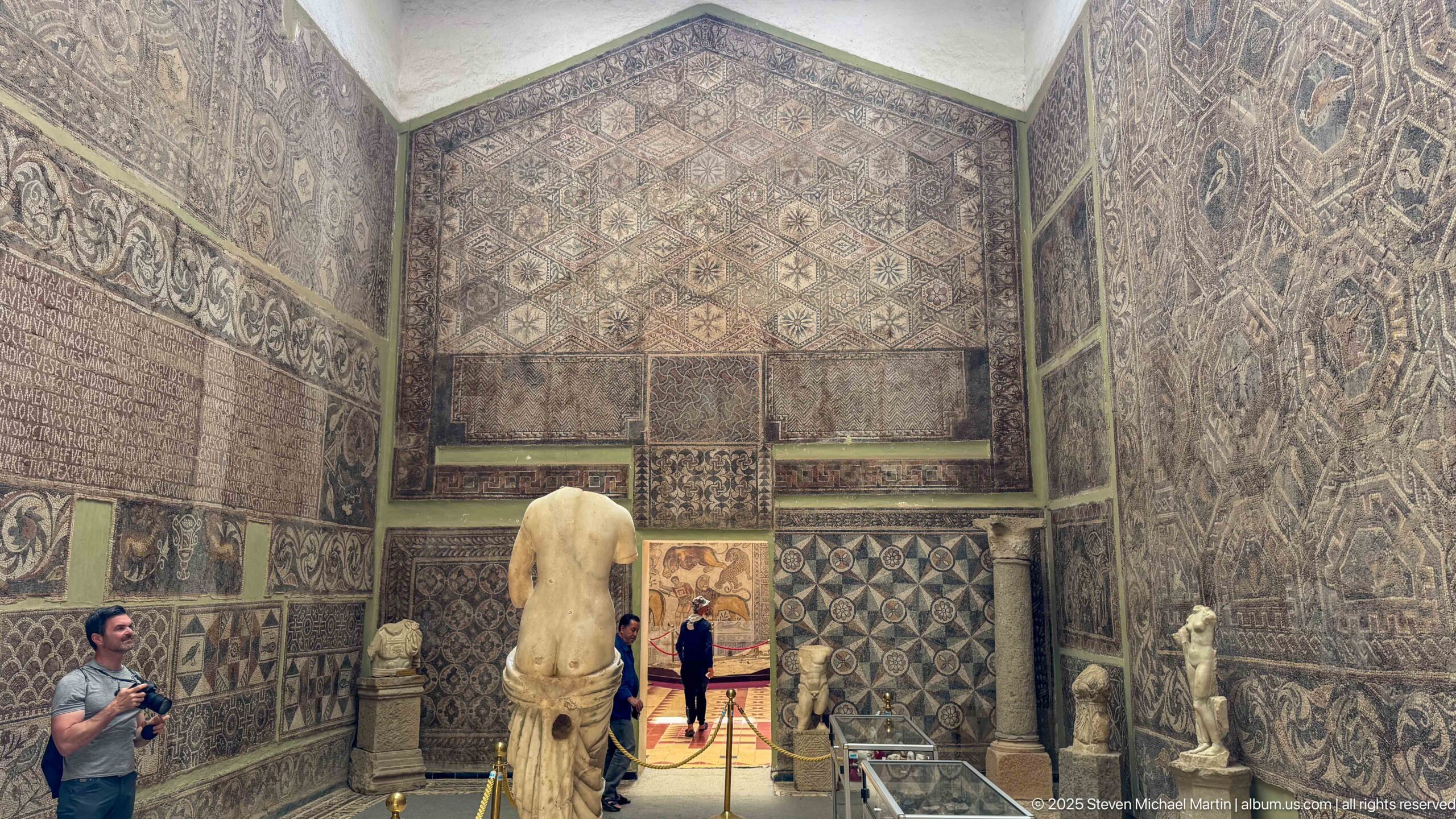
A richly installed gallery at Djemila Museum brings together monumental Roman mosaics, freestanding sculpture, and archaeological display cases within a single room. Geometric and figurative mosaic panels cover nearly every wall surface, while a headless marble torso stands prominently in the foreground. The view conveys the exceptional density of the museum’s mosaic collection and the architectural scale at which many works are presented.
Caption
A richly installed gallery at Djemila Museum brings together monumental Roman mosaics, freestanding sculpture, and archaeological display cases within a single room. Geometric and figurative mosaic panels cover nearly every wall surface, while a headless marble torso stands prominently in the foreground. The view conveys the exceptional density of the museum’s mosaic collection and the architectural scale at which many works are presented.
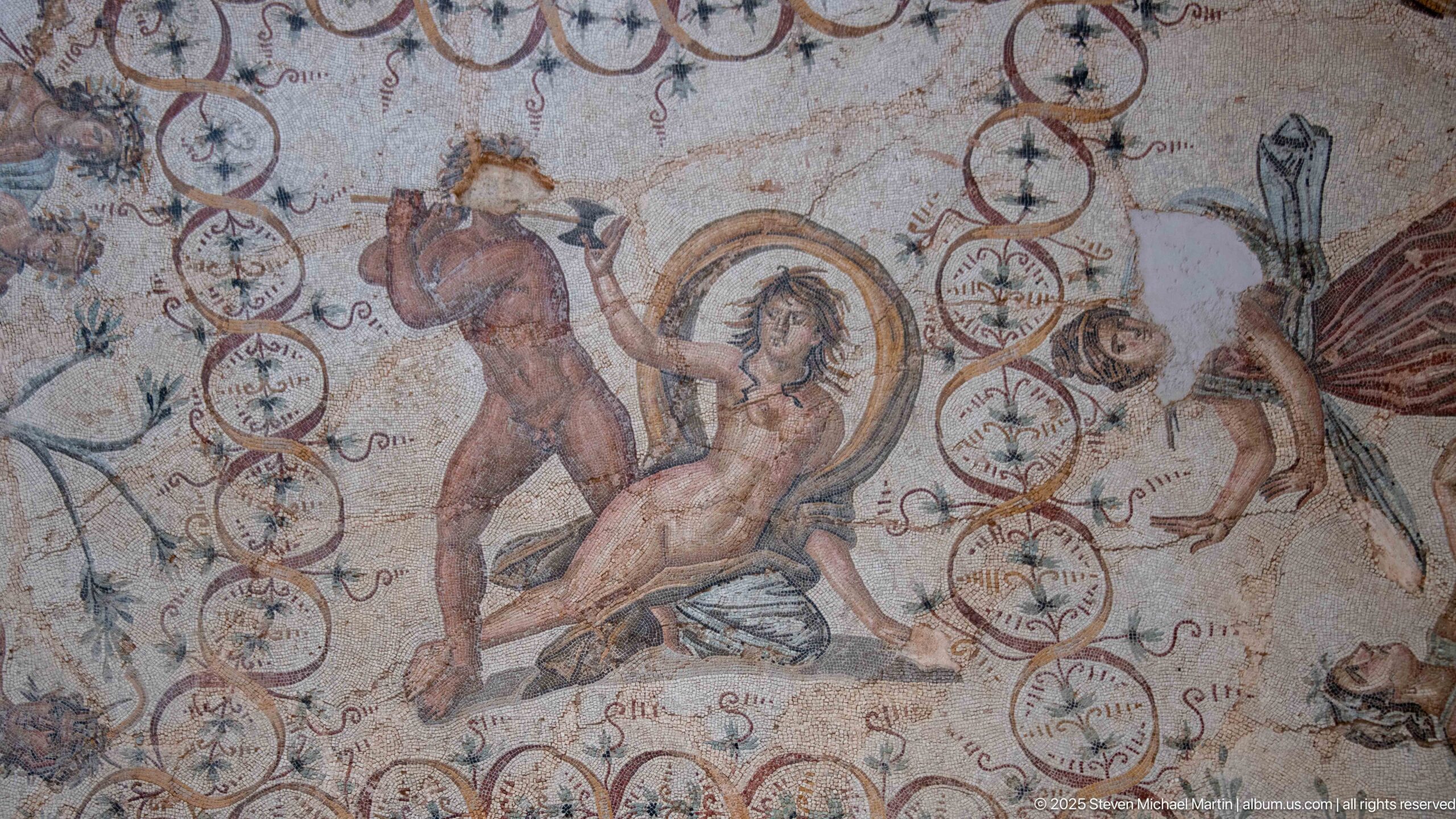
This dramatic scene is not an isolated unidentified combat mosaic but the central episode of Djemila’s celebrated Dionysiac or Bacchus Mosaic. A standing figure attacks or threatens the reclining central figure inside a frame of linked circular motifs, while additional mythological figures occupy the surrounding field. Naming the parent pavement places the action within the larger Dionysiac program documented by archaeologist Louis Leschi.
Caption
This dramatic scene is not an isolated unidentified combat mosaic but the central episode of Djemila’s celebrated Dionysiac or Bacchus Mosaic. A standing figure attacks or threatens the reclining central figure inside a frame of linked circular motifs, while additional mythological figures occupy the surrounding field. Naming the parent pavement places the action within the larger Dionysiac program documented by archaeologist Louis Leschi.
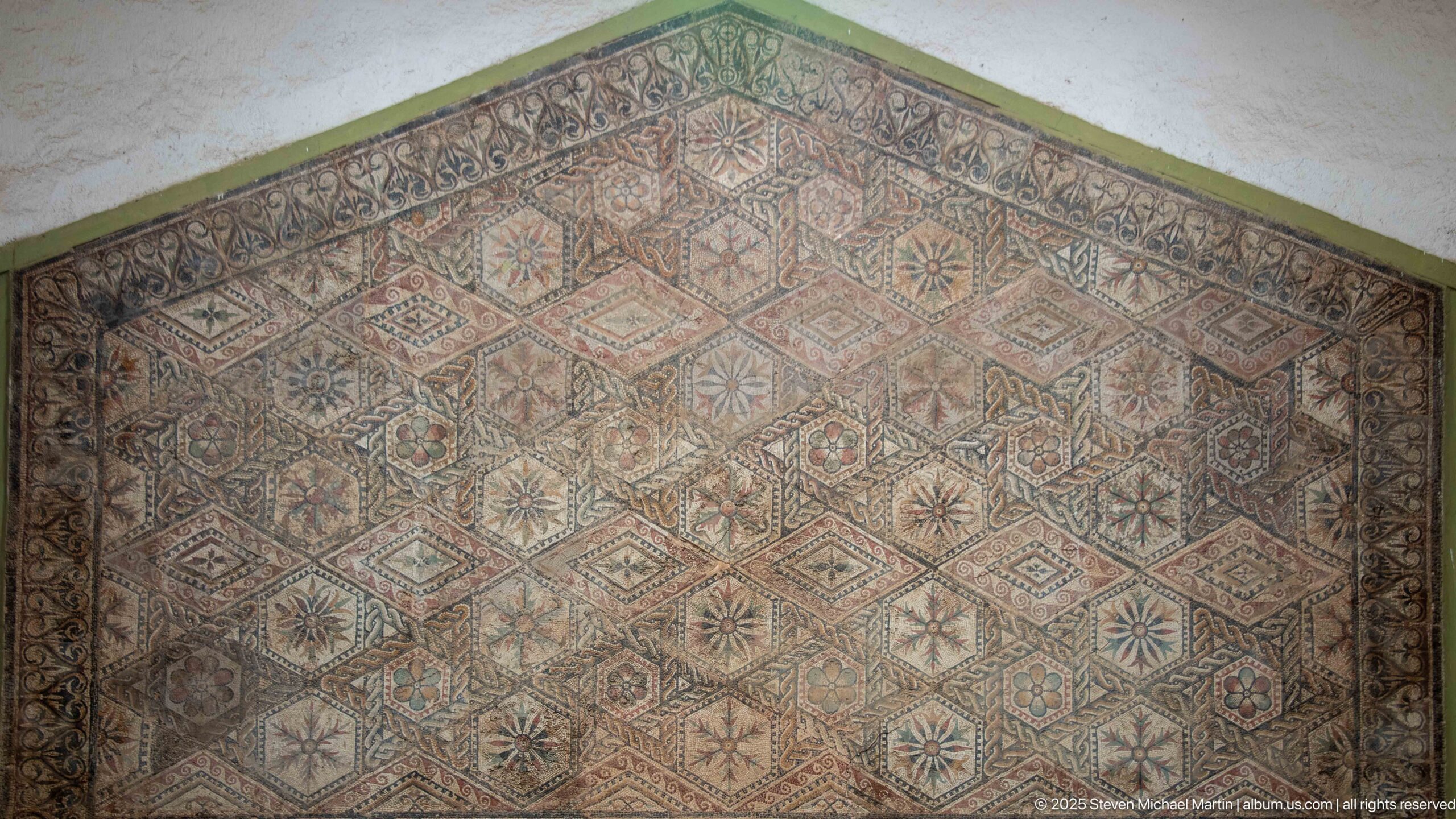
A dense polychrome geometric mosaic fills the frame with interlocking octagons, diamonds, stars, and floral rosettes. Repeated medallions are linked by angular bands in cream, ocher, muted red, green, and black, producing an intricate textile-like rhythm across the surface. The close, nearly frontal view emphasizes pattern organization and tesserae work rather than the museum setting.
Caption
A dense polychrome geometric mosaic fills the frame with interlocking octagons, diamonds, stars, and floral rosettes. Repeated medallions are linked by angular bands in cream, ocher, muted red, green, and black, producing an intricate textile-like rhythm across the surface. The close, nearly frontal view emphasizes pattern organization and tesserae work rather than the museum setting.
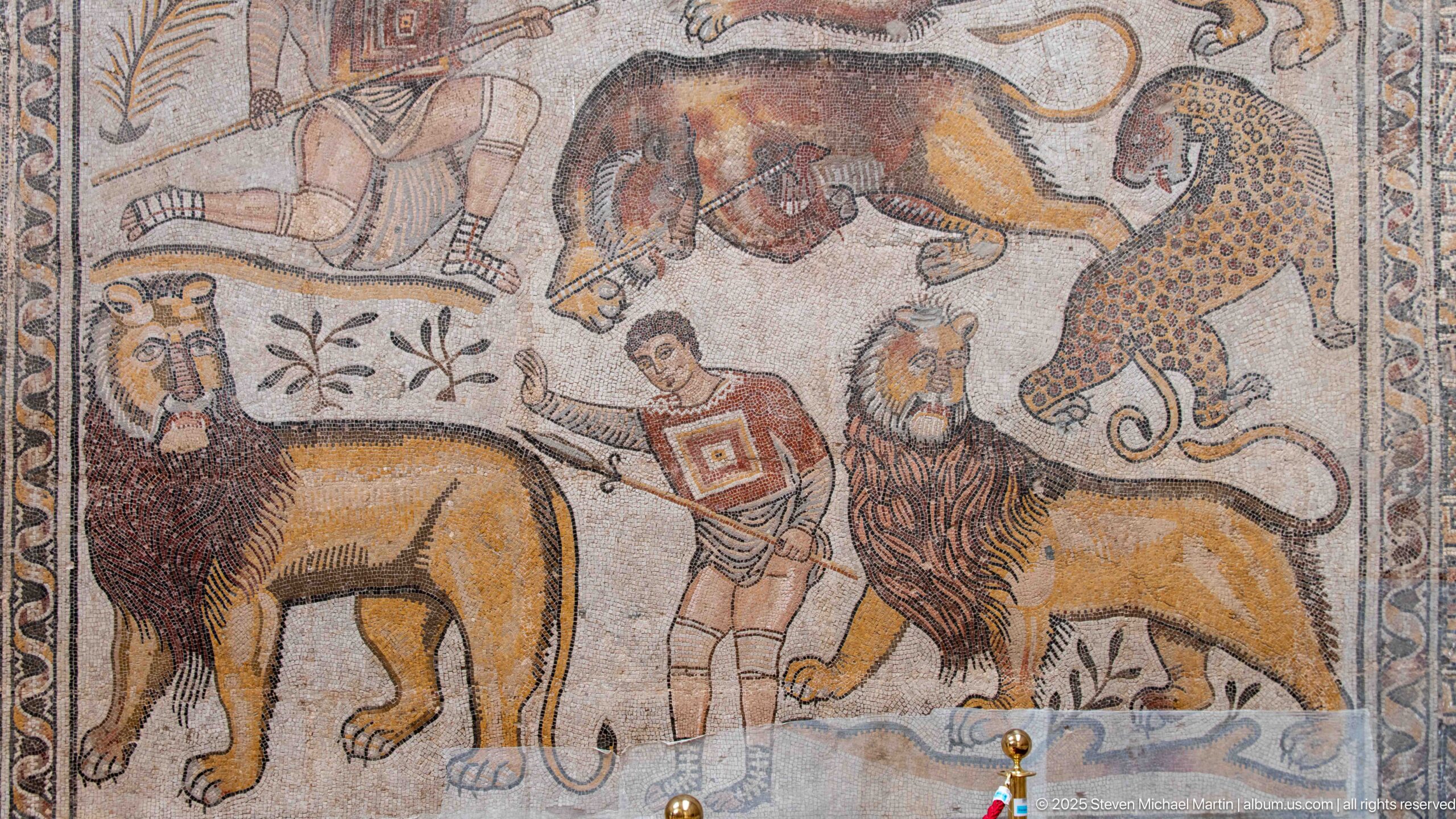
A close detail of the Great Hunt Mosaic from the House of Bacchus shows two hunters confronting a dense cluster of wild animals, including lions and a spotted leopard. The mid-4th-century pavement originally decorated a grand banqueting hall and evokes the staged animal hunts, or venationes, of Roman spectacle. At this scale, the patterned coats, manes, weapons, and individualized animal poses become especially vivid.
Caption
A close detail of the Great Hunt Mosaic from the House of Bacchus shows two hunters confronting a dense cluster of wild animals, including lions and a spotted leopard. The mid-4th-century pavement originally decorated a grand banqueting hall and evokes the staged animal hunts, or venationes, of Roman spectacle. At this scale, the patterned coats, manes, weapons, and individualized animal poses become especially vivid.