
Dar Mustapha Pacha – Algiers, Algeria
Dar Mustapha Pacha is a historic palace located within the old quarters of Algiers. Built in the late 18th century, the residence once belonged to Mustapha Pacha, an influential Ottoman governor of the city.
The palace reflects the refined architectural traditions of the Ottoman period, featuring interior courtyards, carved wooden ceilings, decorative tiles, and intricate plasterwork. These elements illustrate the artistic and cultural influences that shaped Algiers while it was part of the Ottoman Empire.
Today the palace stands as an important historical monument that offers insight into the lifestyle and architecture of Algiers during the Ottoman era.
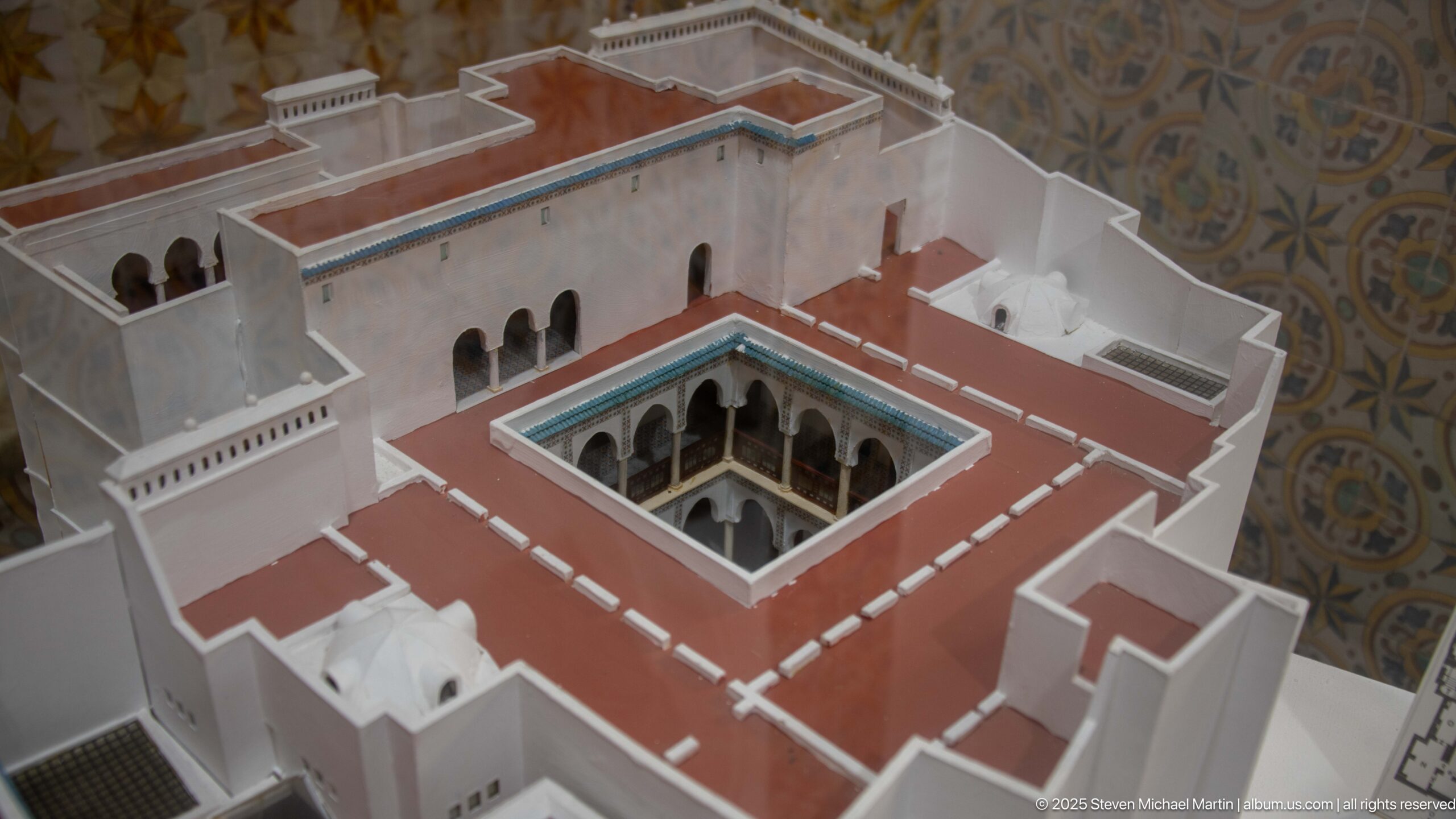
An oblique view of the palace model emphasizes the stepped massing around Dar Mustapha Pacha’s central courtyard. Arcaded openings line the inner court, while red roof terraces and white exterior walls reveal how upper and lower levels interlock. The model serves as a compact spatial guide to the residence’s inward-oriented architecture.
Caption
An oblique view of the palace model emphasizes the stepped massing around Dar Mustapha Pacha’s central courtyard. Arcaded openings line the inner court, while red roof terraces and white exterior walls reveal how upper and lower levels interlock. The model serves as a compact spatial guide to the residence’s inward-oriented architecture.
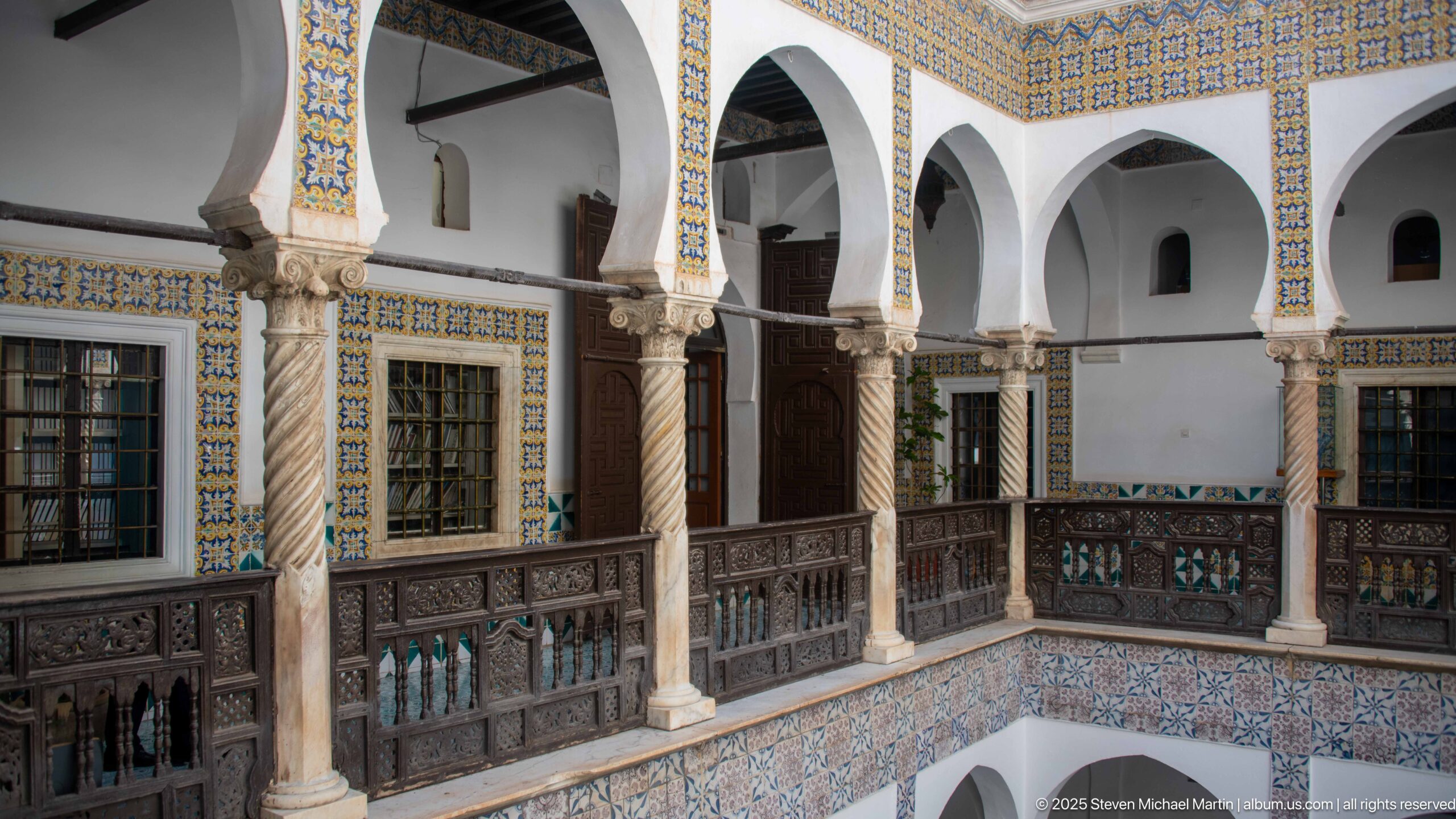
A corner of Dar Mustapha Pacha’s upper courtyard gallery brings two arcaded elevations together above the open court. White arches rest on spiral-fluted columns, blue-and-yellow tile bands outline windows and piers, and dark carved balustrades wrap the gallery edge. The angled view makes the courtyard’s inward-facing plan and continuous circulation especially legible.
Caption
A corner of Dar Mustapha Pacha’s upper courtyard gallery brings two arcaded elevations together above the open court. White arches rest on spiral-fluted columns, blue-and-yellow tile bands outline windows and piers, and dark carved balustrades wrap the gallery edge. The angled view makes the courtyard’s inward-facing plan and continuous circulation especially legible.
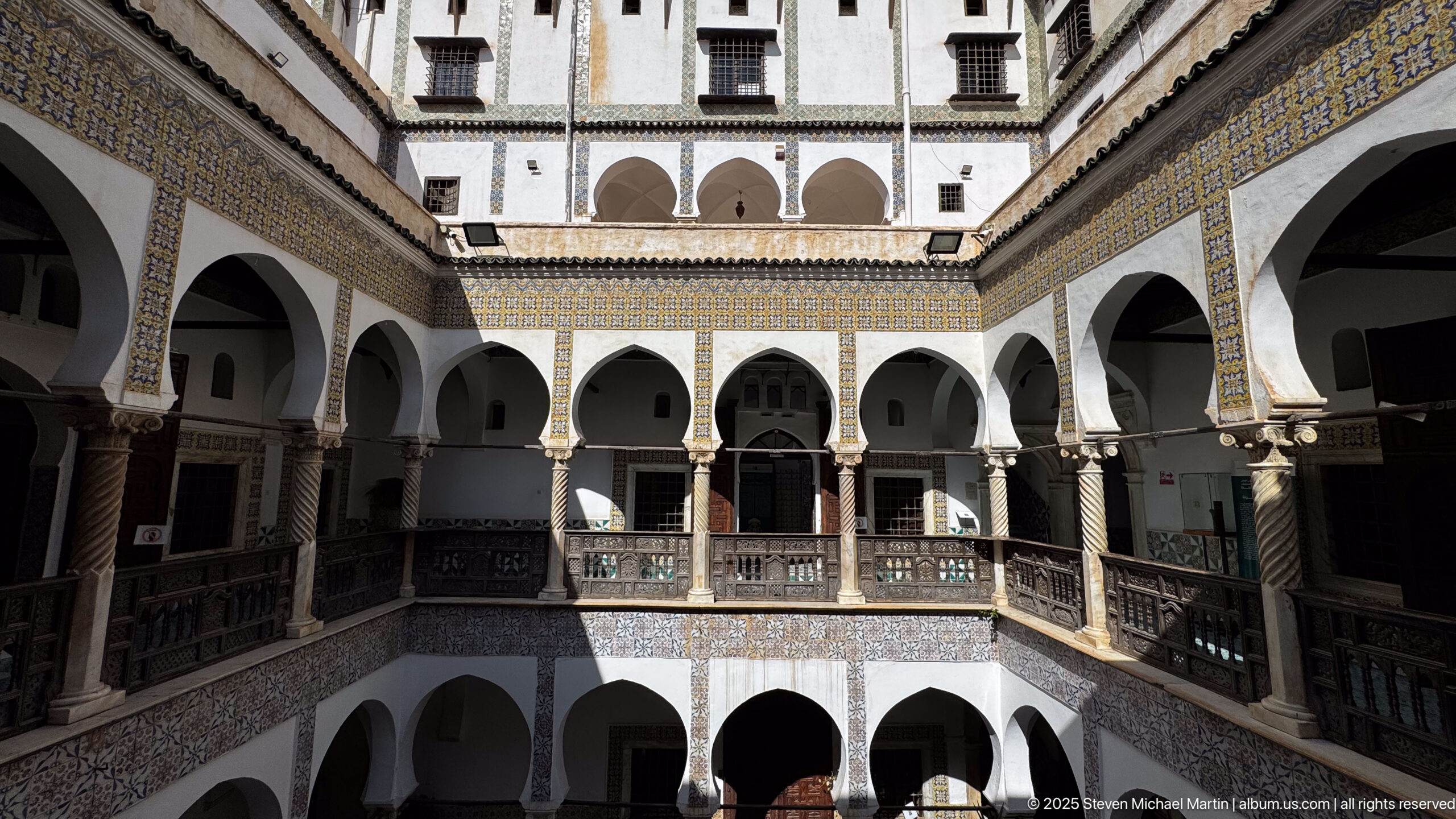
An elevated frontal view looks across the central void of Dar Mustapha Pacha toward a layered courtyard elevation. White arcades stack above and below dark wooden balustrades, while yellow-and-blue tile bands outline the arches and upper wall. The centered composition makes the palace’s repeated bays and vertical organization especially easy to read.
Caption
An elevated frontal view looks across the central void of Dar Mustapha Pacha toward a layered courtyard elevation. White arcades stack above and below dark wooden balustrades, while yellow-and-blue tile bands outline the arches and upper wall. The centered composition makes the palace’s repeated bays and vertical organization especially easy to read.
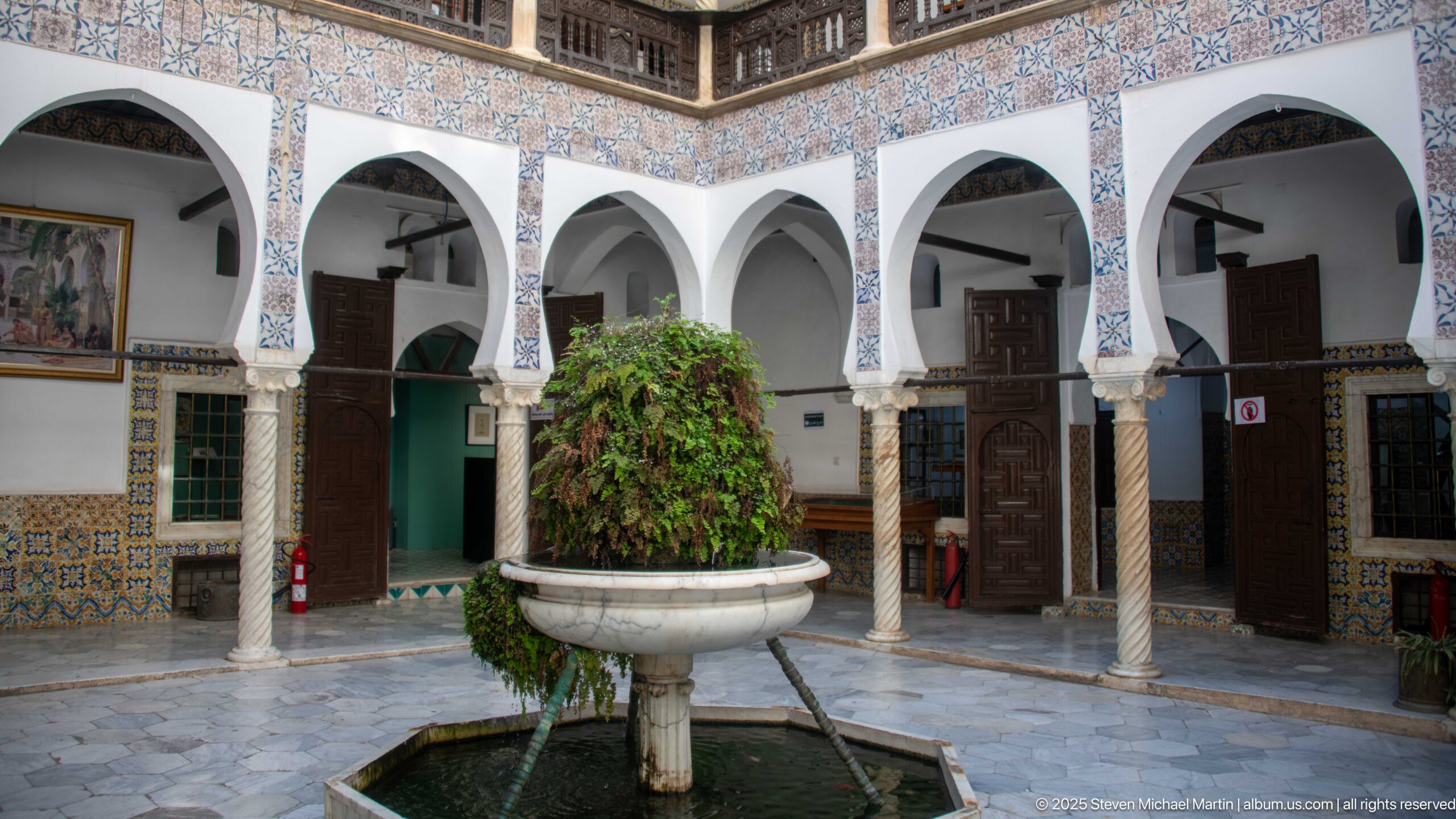
The courtyard of Dar Mustapha Pacha centers on a raised stone fountain and basin surrounded by white arcades, slender spiral columns, patterned tilework, and dark wooden doors. A leafy plant softens the geometric enclosure, while the ground-level view shows how water, shade, ceramic decoration, and circulation converge in the palace’s principal interior court.
Caption
The courtyard of Dar Mustapha Pacha centers on a raised stone fountain and basin surrounded by white arcades, slender spiral columns, patterned tilework, and dark wooden doors. A leafy plant softens the geometric enclosure, while the ground-level view shows how water, shade, ceramic decoration, and circulation converge in the palace’s principal interior court.
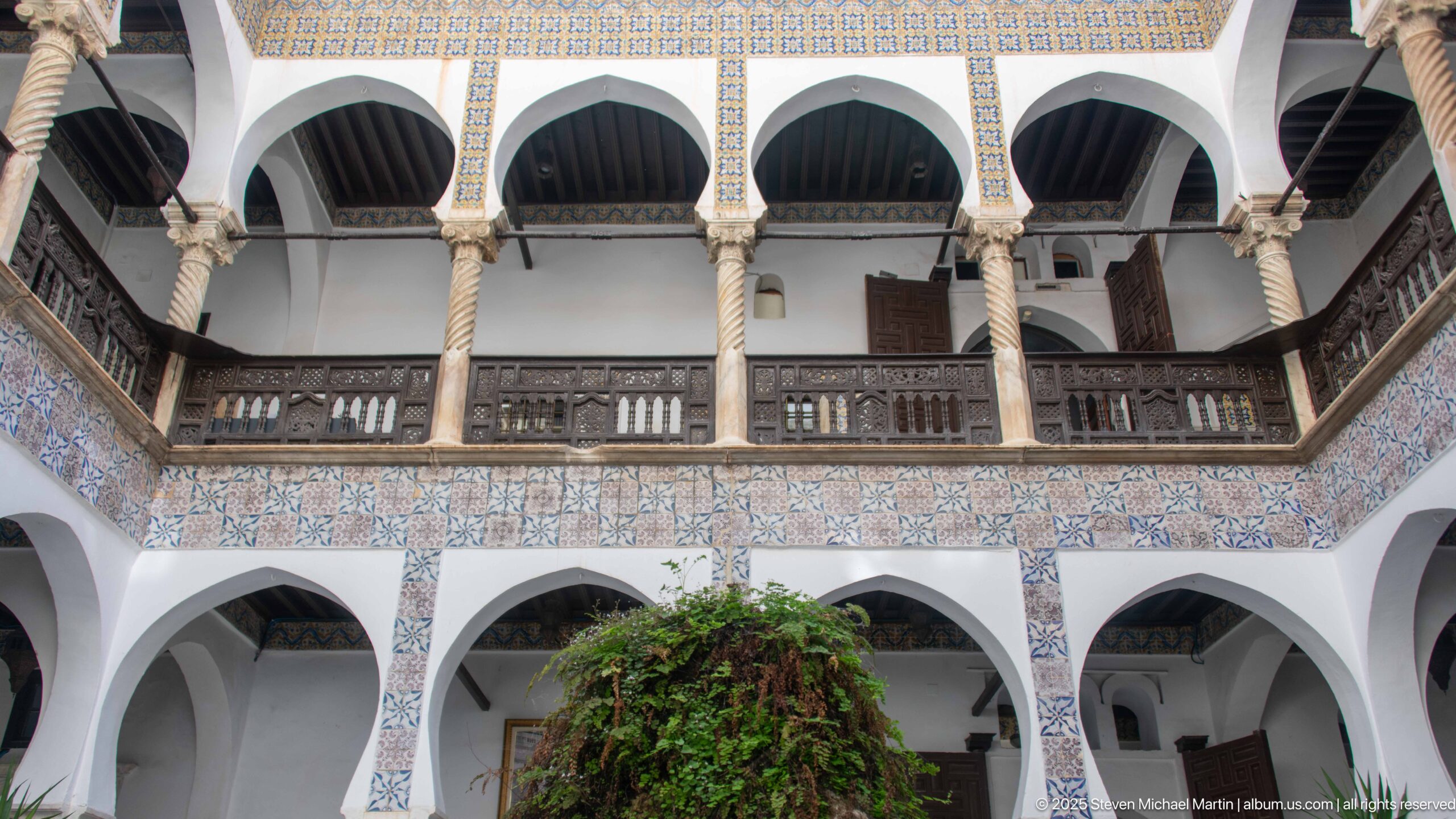
Looking upward across the courtyard, two levels of arcaded galleries frame Dar Mustapha Pacha’s open interior space. Spiral-fluted columns support white arches on both stories, while patterned ceramic bands and dark carved wooden balustrades articulate the upper gallery. The composition makes the palace’s vertical organization and inward-facing circulation especially clear.
Caption
Looking upward across the courtyard, two levels of arcaded galleries frame Dar Mustapha Pacha’s open interior space. Spiral-fluted columns support white arches on both stories, while patterned ceramic bands and dark carved wooden balustrades articulate the upper gallery. The composition makes the palace’s vertical organization and inward-facing circulation especially clear.
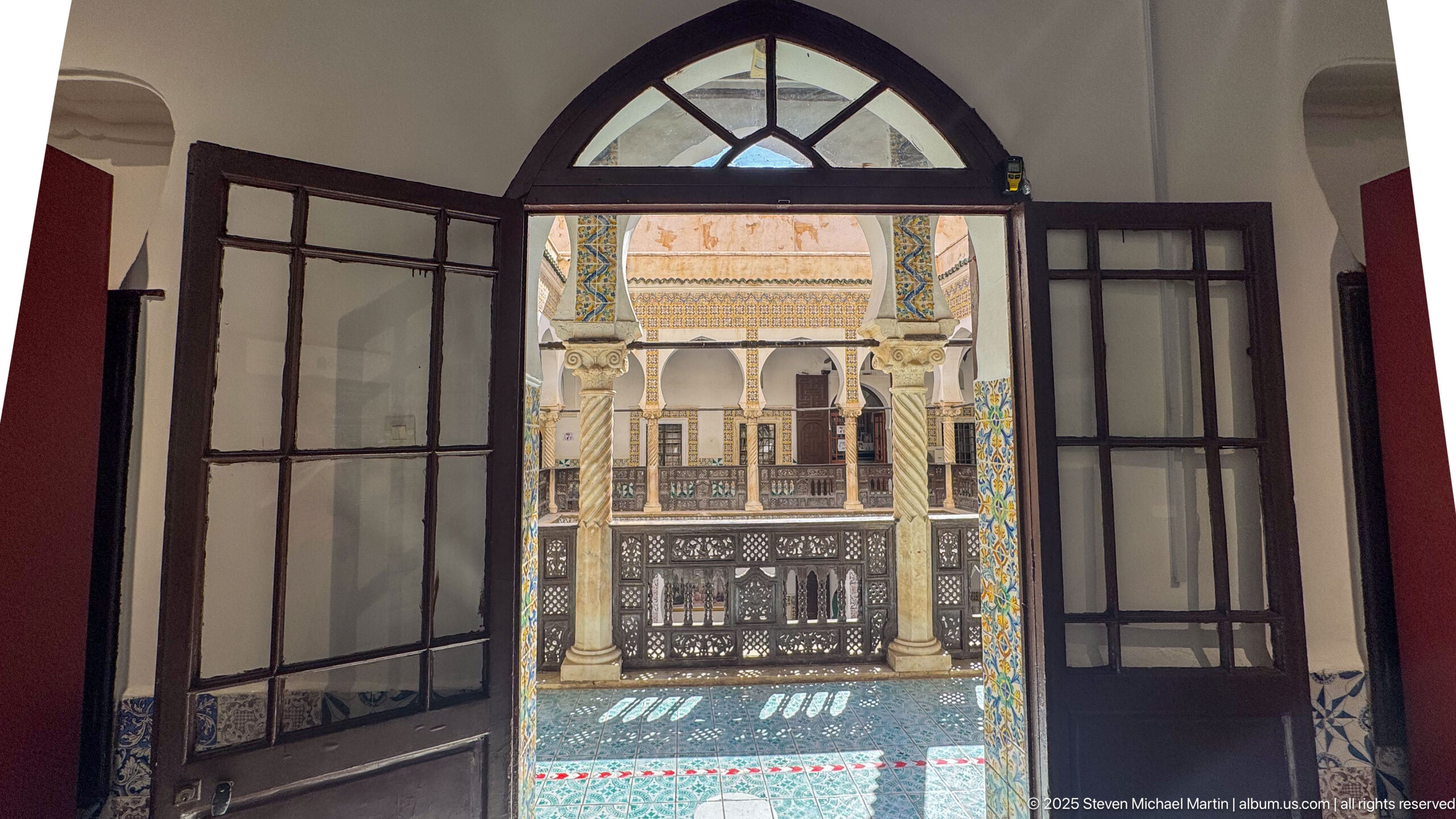
A tall arched transom and open glazed door leaves frame a centered view into Dar Mustapha Pacha’s upper courtyard gallery. Spiral columns rise behind a dark carved balustrade, with tiled arches and upper woodwork aligned beyond. The more vertical composition concentrates attention on the doorway’s geometry and the symmetrical architectural view outside.
Caption
A tall arched transom and open glazed door leaves frame a centered view into Dar Mustapha Pacha’s upper courtyard gallery. Spiral columns rise behind a dark carved balustrade, with tiled arches and upper woodwork aligned beyond. The more vertical composition concentrates attention on the doorway’s geometry and the symmetrical architectural view outside.
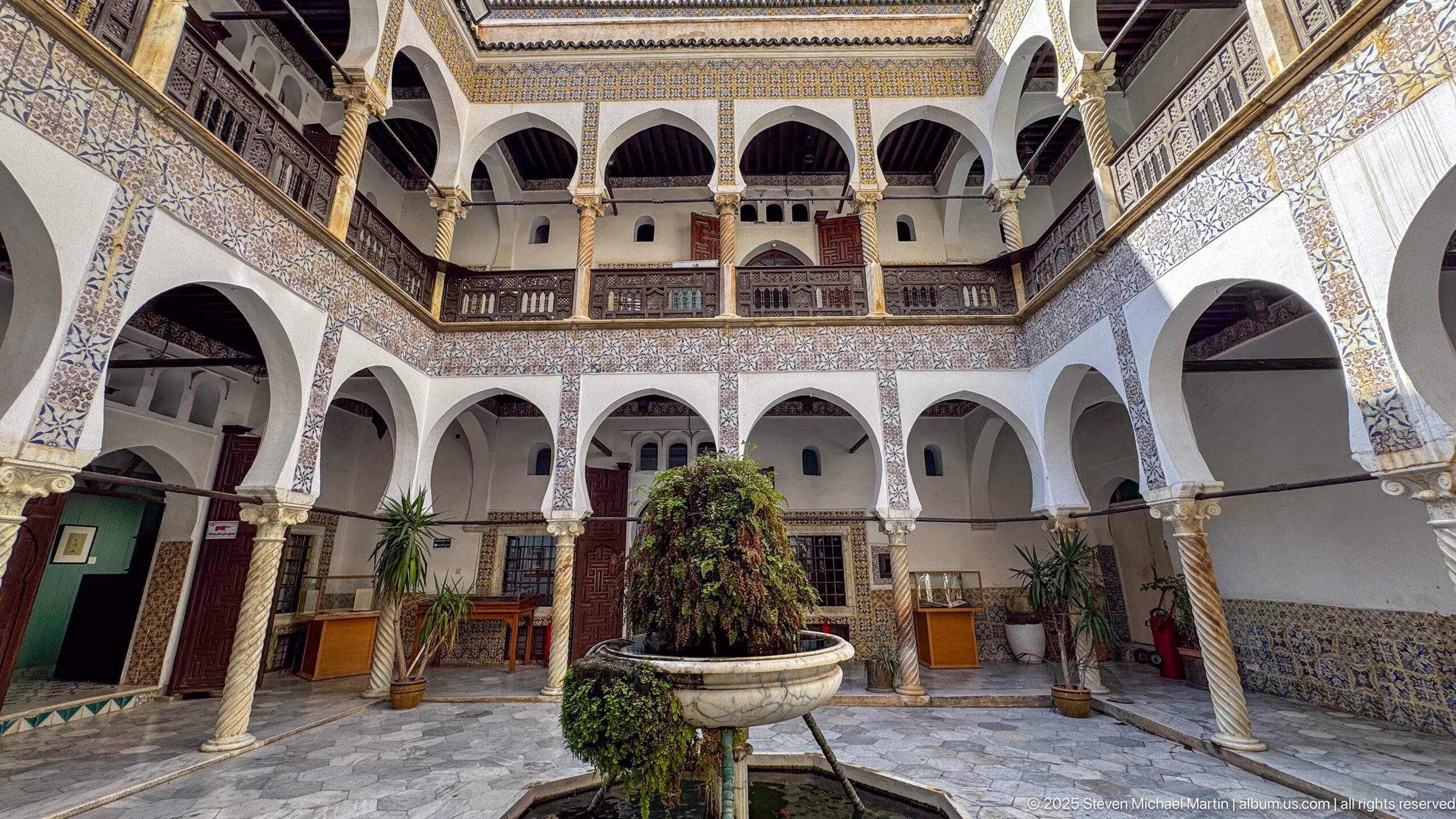
A wide ground-level view opens across Dar Mustapha Pacha’s central courtyard, where a raised fountain and leafy planting stand beneath two tiers of white arcades. Spiral columns, patterned ceramic bands, dark wooden galleries, and doors encircle the court, providing one of the portfolio’s clearest establishing views of the palace’s inward-facing architecture.
Caption
A wide ground-level view opens across Dar Mustapha Pacha’s central courtyard, where a raised fountain and leafy planting stand beneath two tiers of white arcades. Spiral columns, patterned ceramic bands, dark wooden galleries, and doors encircle the court, providing one of the portfolio’s clearest establishing views of the palace’s inward-facing architecture.
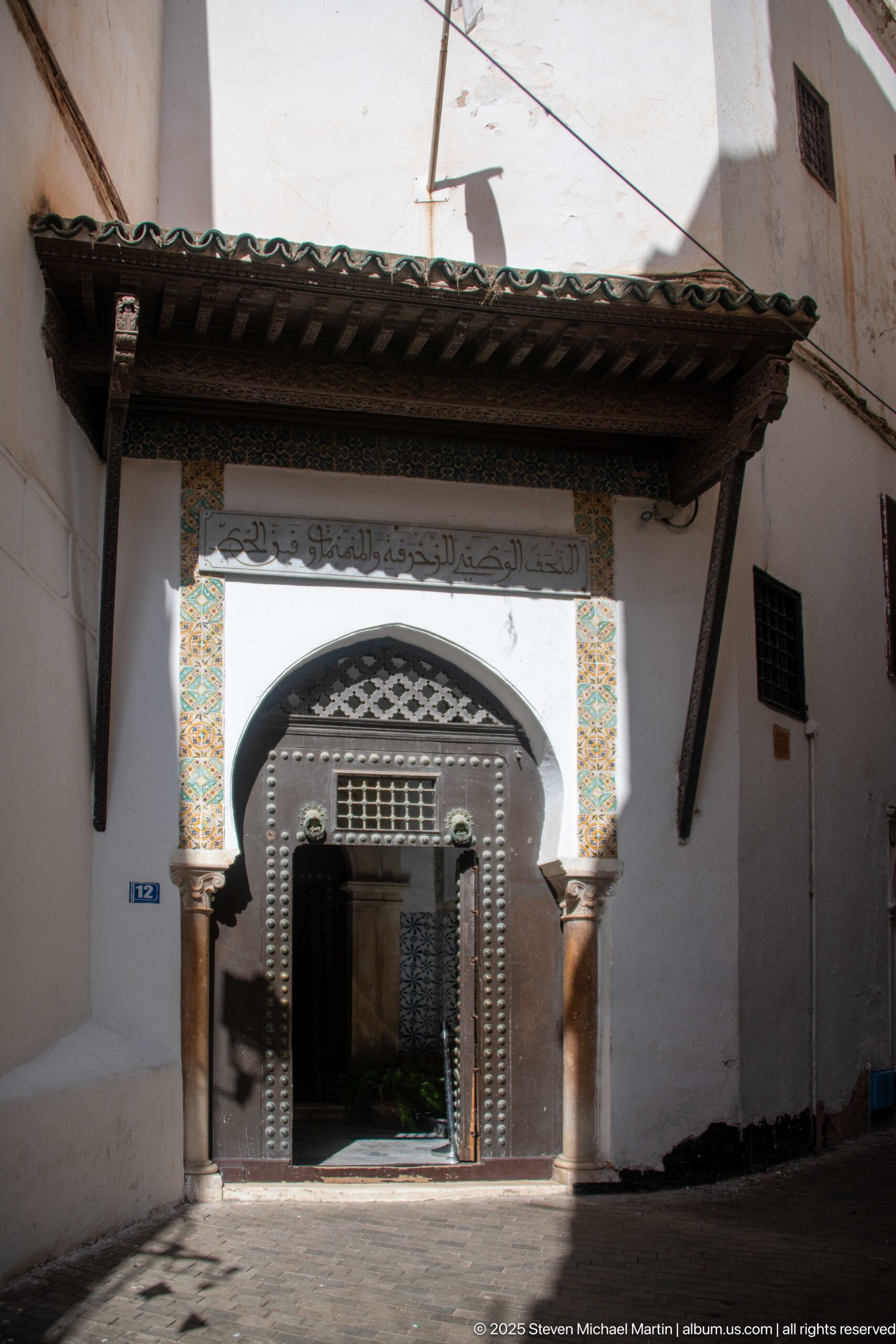
An arched entrance at Dar Mustapha Pacha is framed by a projecting timber canopy, slender columns, carved woodwork, and bands of colorful ceramic tile. The recessed doorway and layered ornament distinguish the palace threshold from the plain white surrounding walls, introducing the combination of masonry, wood, and glazed decoration that recurs throughout the residence.
Caption
An arched entrance at Dar Mustapha Pacha is framed by a projecting timber canopy, slender columns, carved woodwork, and bands of colorful ceramic tile. The recessed doorway and layered ornament distinguish the palace threshold from the plain white surrounding walls, introducing the combination of masonry, wood, and glazed decoration that recurs throughout the residence.
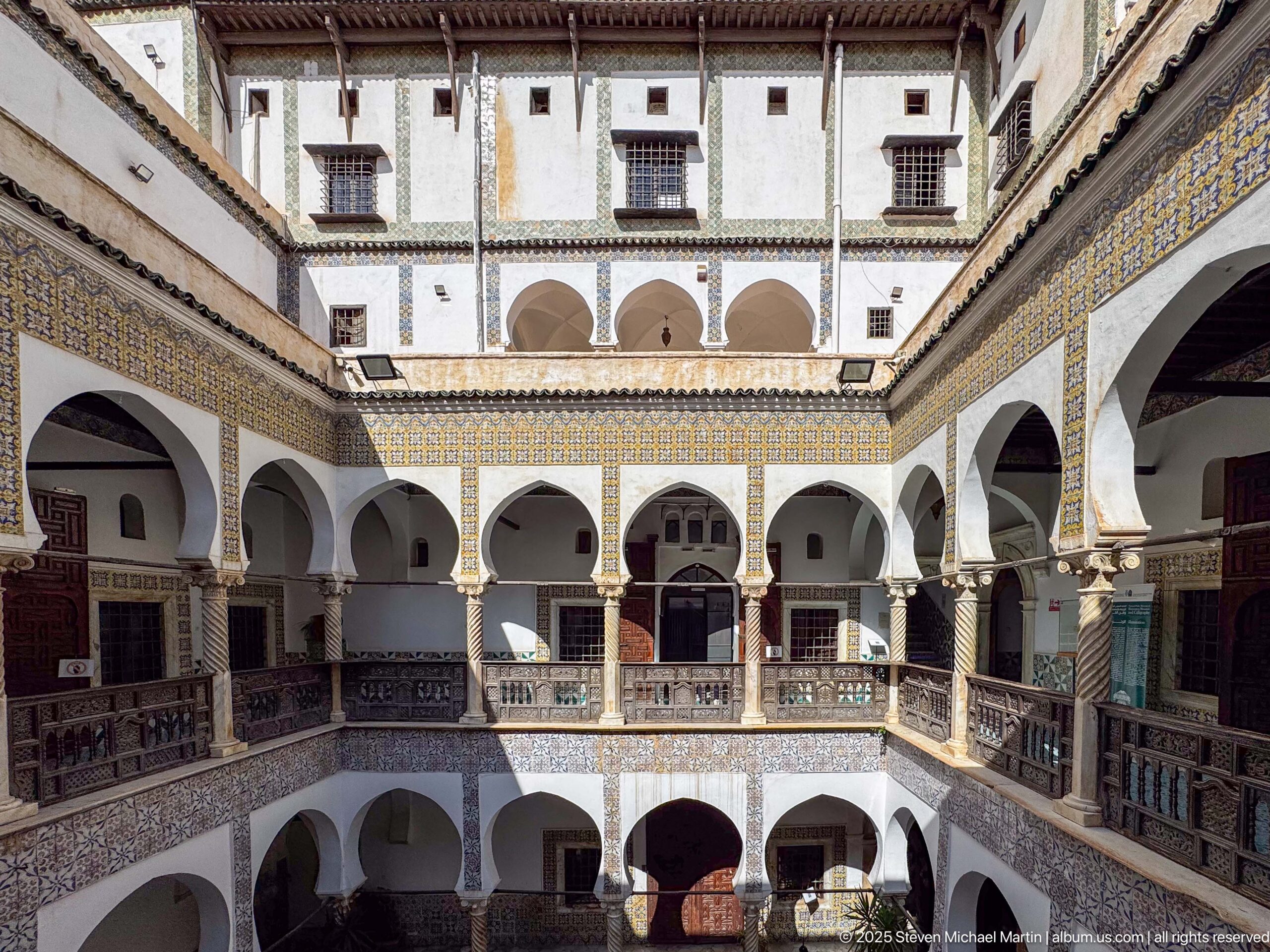
From an elevated position, the courtyard reveals stacked arcades, wooden balustrades, tile bands, and the taller upper walls of Dar Mustapha Pacha. Strong sunlight divides the architecture into bright and shadowed zones, while the high viewpoint clarifies the vertical relationship between the lower court, surrounding galleries, and upper residential levels.
Caption
From an elevated position, the courtyard reveals stacked arcades, wooden balustrades, tile bands, and the taller upper walls of Dar Mustapha Pacha. Strong sunlight divides the architecture into bright and shadowed zones, while the high viewpoint clarifies the vertical relationship between the lower court, surrounding galleries, and upper residential levels.
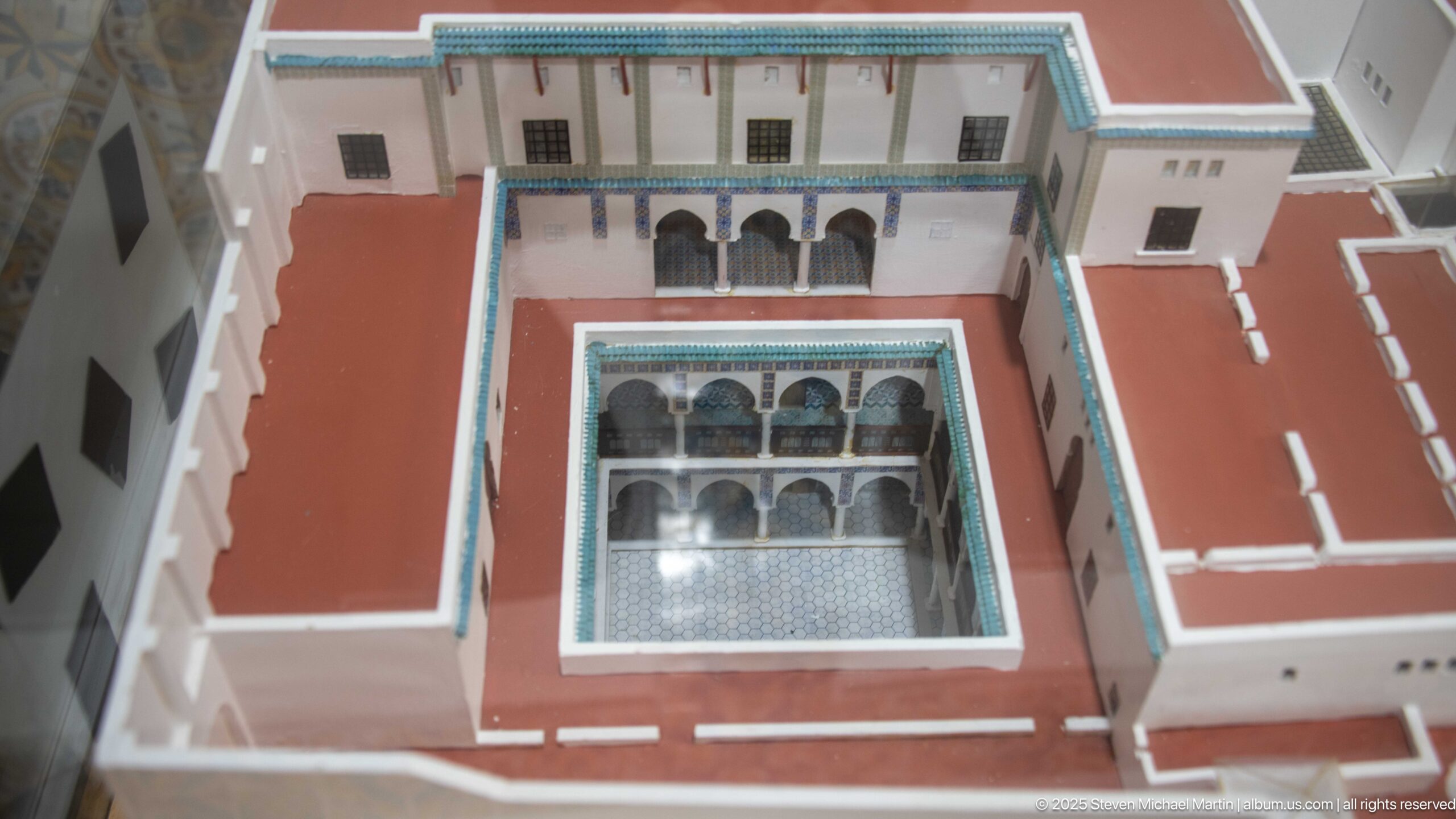
An architectural model presents Dar Mustapha Pacha from above, revealing a central open courtyard enclosed by arcaded galleries and surrounding rooms. White walls, red roof surfaces, turquoise trim, and dark arches clarify the building’s nested circulation and inward-facing plan in a way that cannot be seen from a single ground-level viewpoint.
Caption
An architectural model presents Dar Mustapha Pacha from above, revealing a central open courtyard enclosed by arcaded galleries and surrounding rooms. White walls, red roof surfaces, turquoise trim, and dark arches clarify the building’s nested circulation and inward-facing plan in a way that cannot be seen from a single ground-level viewpoint.
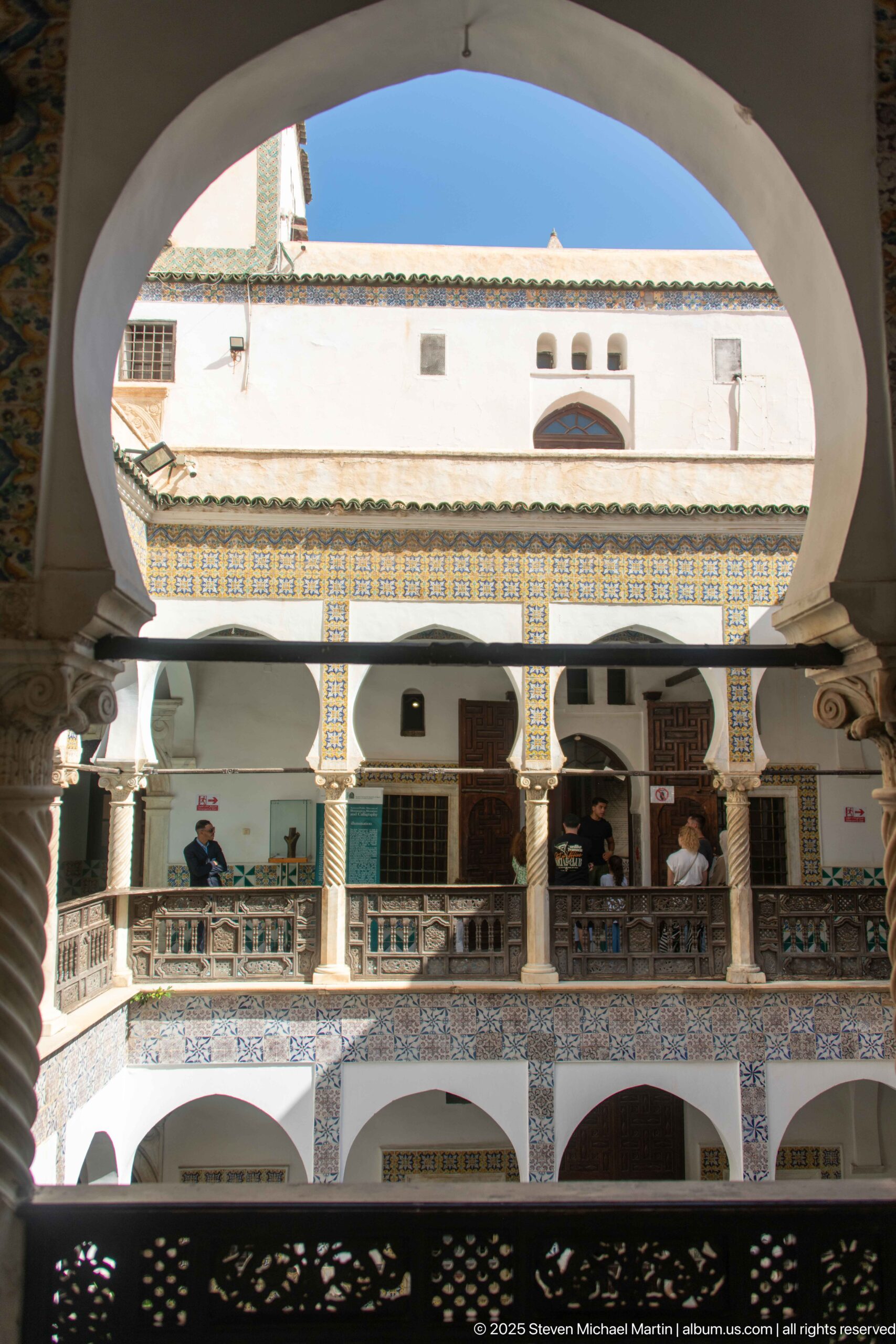
A broad white arch frames the opposite side of Dar Mustapha Pacha’s courtyard from an upper-level gallery. Across the open court, visitors stand behind a dark wooden balustrade beneath white arches and patterned tile bands. Blue sky above the roofline and the deep foreground shadow emphasize the transition from enclosed gallery to open courtyard.
Caption
A broad white arch frames the opposite side of Dar Mustapha Pacha’s courtyard from an upper-level gallery. Across the open court, visitors stand behind a dark wooden balustrade beneath white arches and patterned tile bands. Blue sky above the roofline and the deep foreground shadow emphasize the transition from enclosed gallery to open courtyard.
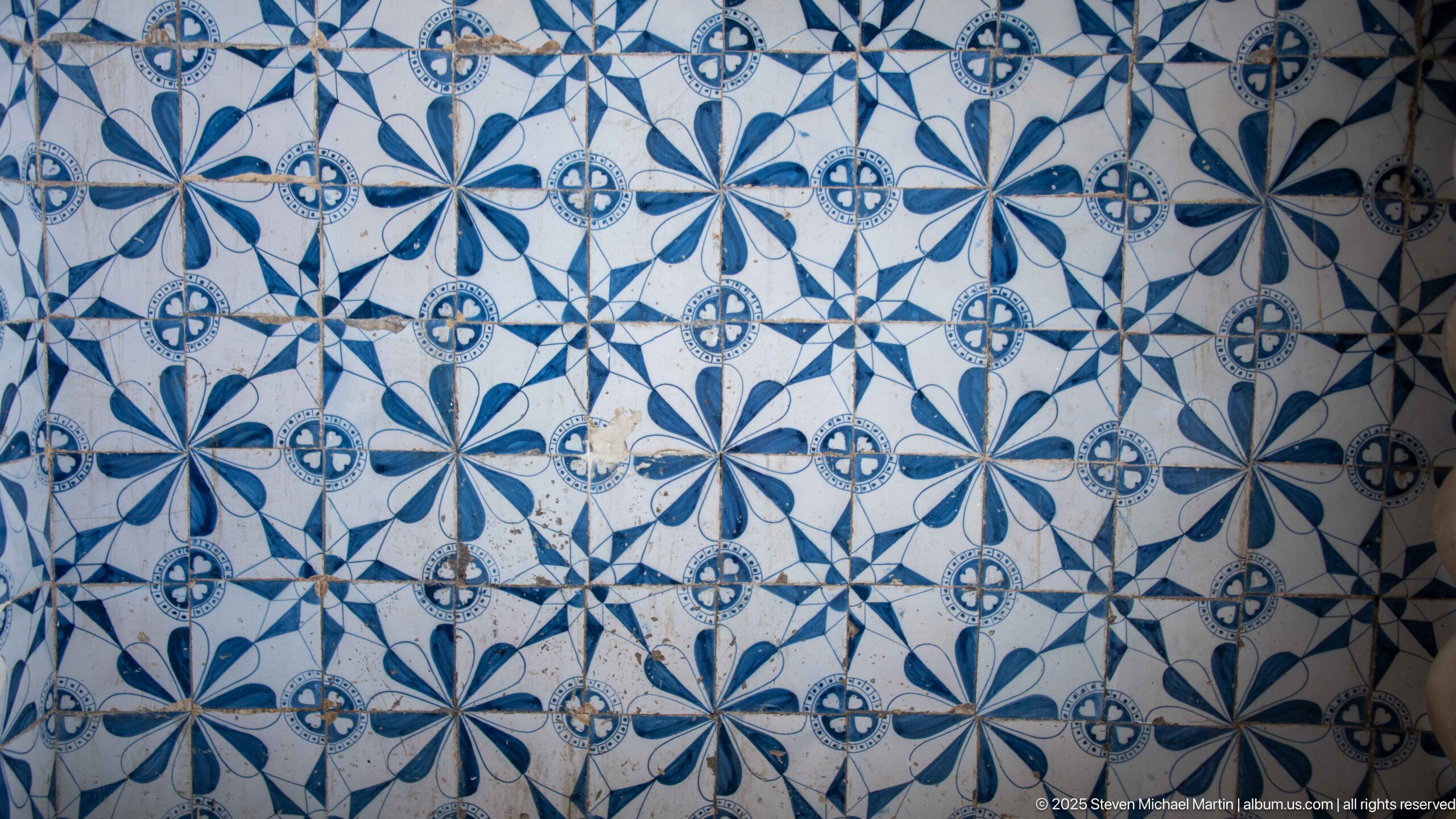
A wall surface at Dar Mustapha Pacha is covered with repeating blue-and-white ceramic tiles arranged as interlocking floral and geometric medallions. Small variations, stains, and worn areas reveal the tiled surface as an architectural finish rather than a modern graphic pattern, while the tight framing records the repeating decorative system in detail.
Caption
A wall surface at Dar Mustapha Pacha is covered with repeating blue-and-white ceramic tiles arranged as interlocking floral and geometric medallions. Small variations, stains, and worn areas reveal the tiled surface as an architectural finish rather than a modern graphic pattern, while the tight framing records the repeating decorative system in detail.
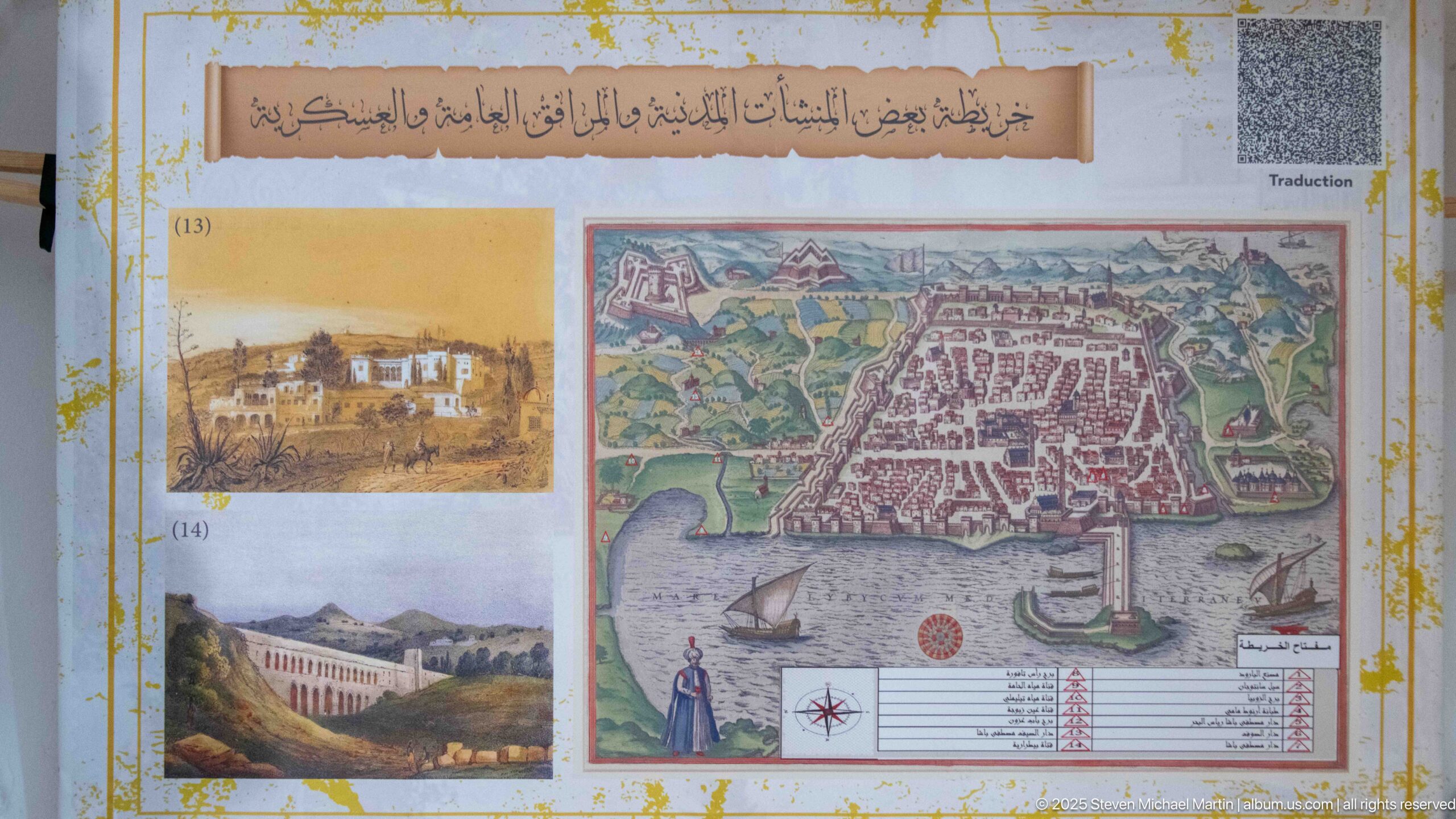
An interpretive panel inside Dar Mustapha Pacha combines Arabic text with historical illustrations, including a large colored plan or map of the fortified coastal city and smaller views of buildings and landscape. The display places the palace within a broader visual history of Algiers while preserving reproductions of earlier urban imagery for visitors.
Caption
An interpretive panel inside Dar Mustapha Pacha combines Arabic text with historical illustrations, including a large colored plan or map of the fortified coastal city and smaller views of buildings and landscape. The display places the palace within a broader visual history of Algiers while preserving reproductions of earlier urban imagery for visitors.
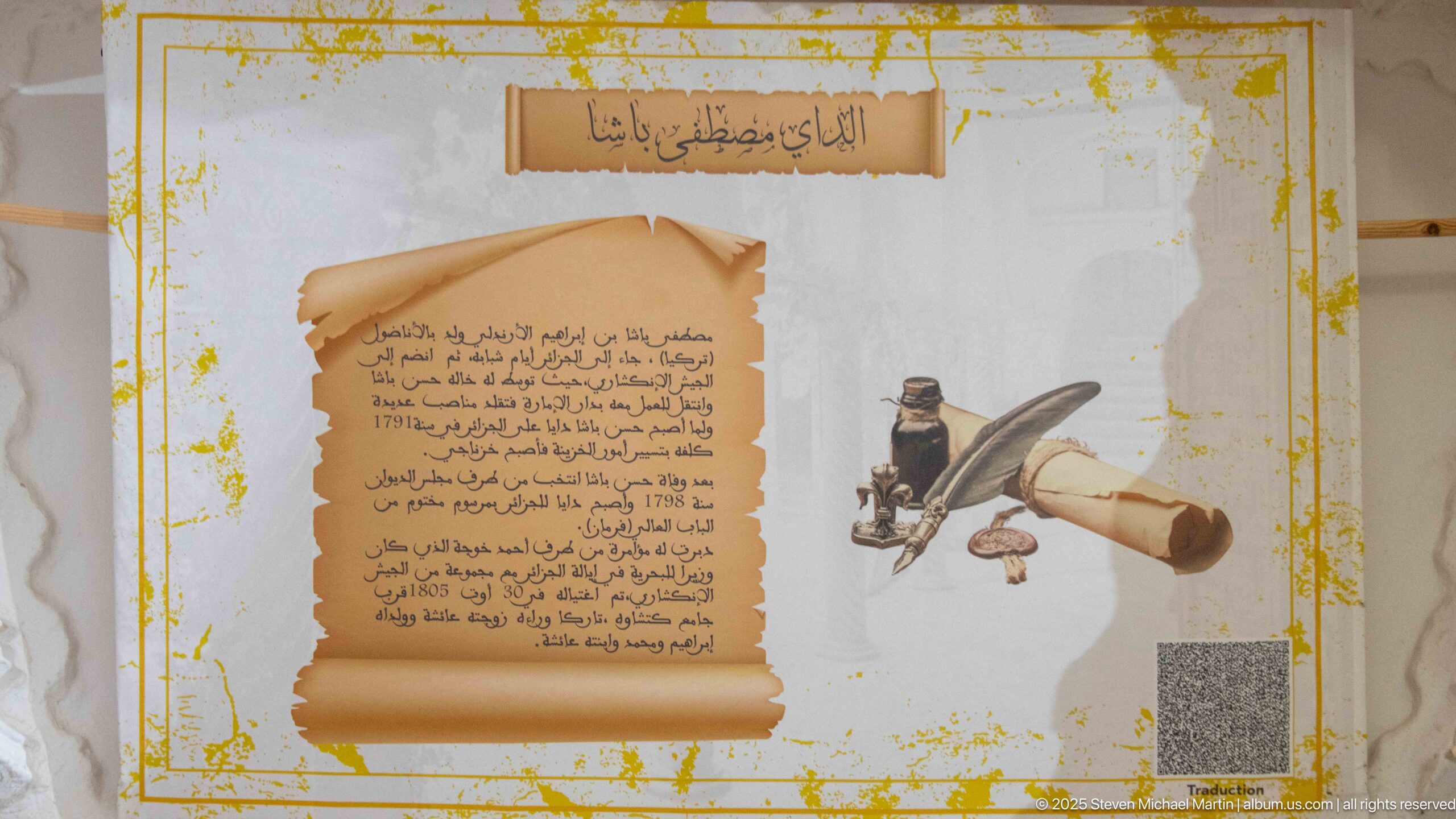
An Arabic-language interpretive panel presents a parchment-like text block beside an illustration of an ink vessel, quill, rolled document, and writing implements. Installed within the palace exhibition, the display evokes documentary and scribal culture through objects associated with written correspondence rather than through an original manuscript shown in isolation.
Caption
An Arabic-language interpretive panel presents a parchment-like text block beside an illustration of an ink vessel, quill, rolled document, and writing implements. Installed within the palace exhibition, the display evokes documentary and scribal culture through objects associated with written correspondence rather than through an original manuscript shown in isolation.
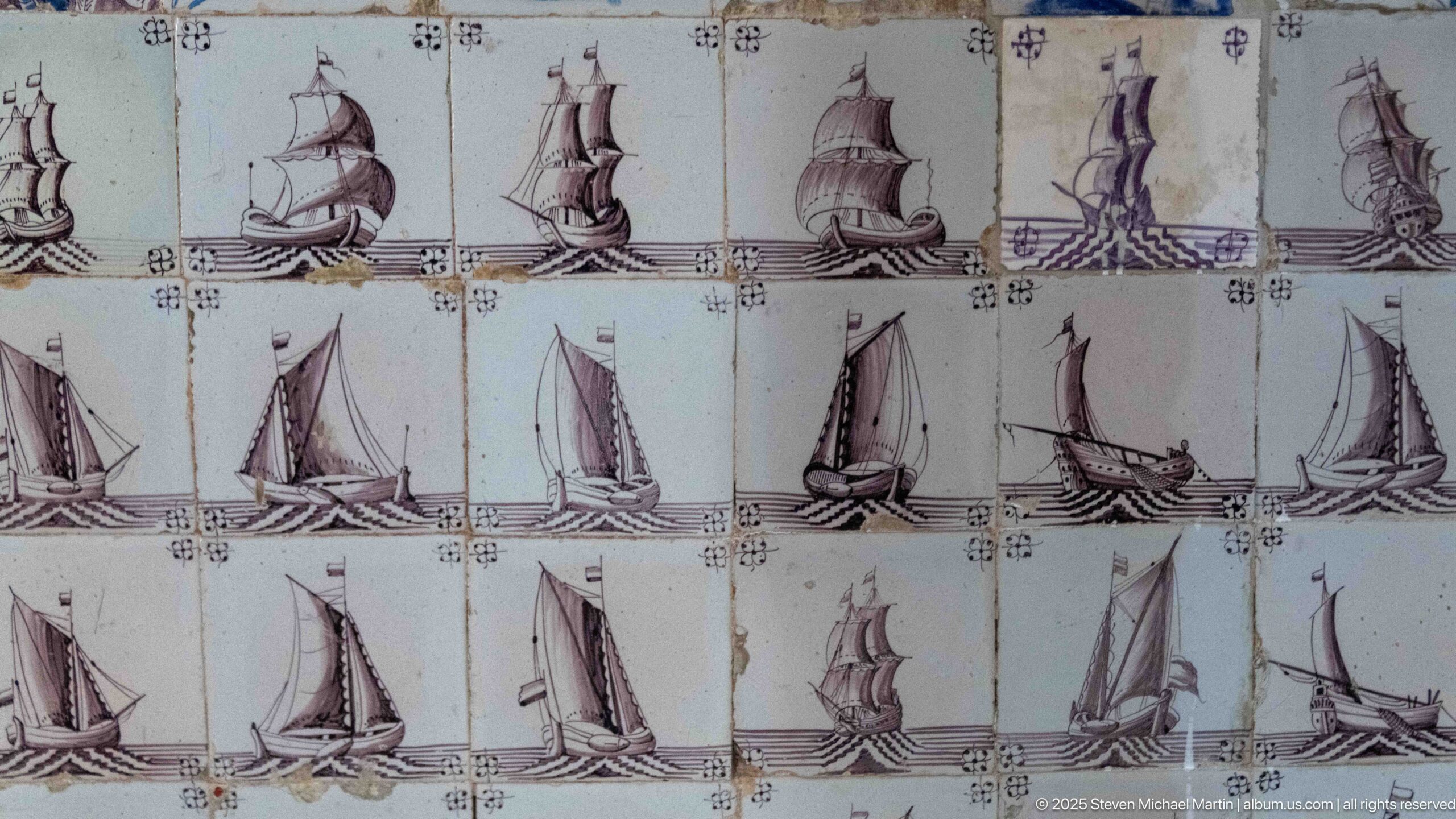
Rows of ceramic tiles depict sailing vessels in profile, each ship rendered with masts, rigging, sails, and hull details against a pale ground. The repeated maritime imagery forms a decorative wall pattern at Dar Mustapha Pacha and reflects the visual importance of seafaring subjects within the palace’s tile decoration.
Caption
Rows of ceramic tiles depict sailing vessels in profile, each ship rendered with masts, rigging, sails, and hull details against a pale ground. The repeated maritime imagery forms a decorative wall pattern at Dar Mustapha Pacha and reflects the visual importance of seafaring subjects within the palace’s tile decoration.
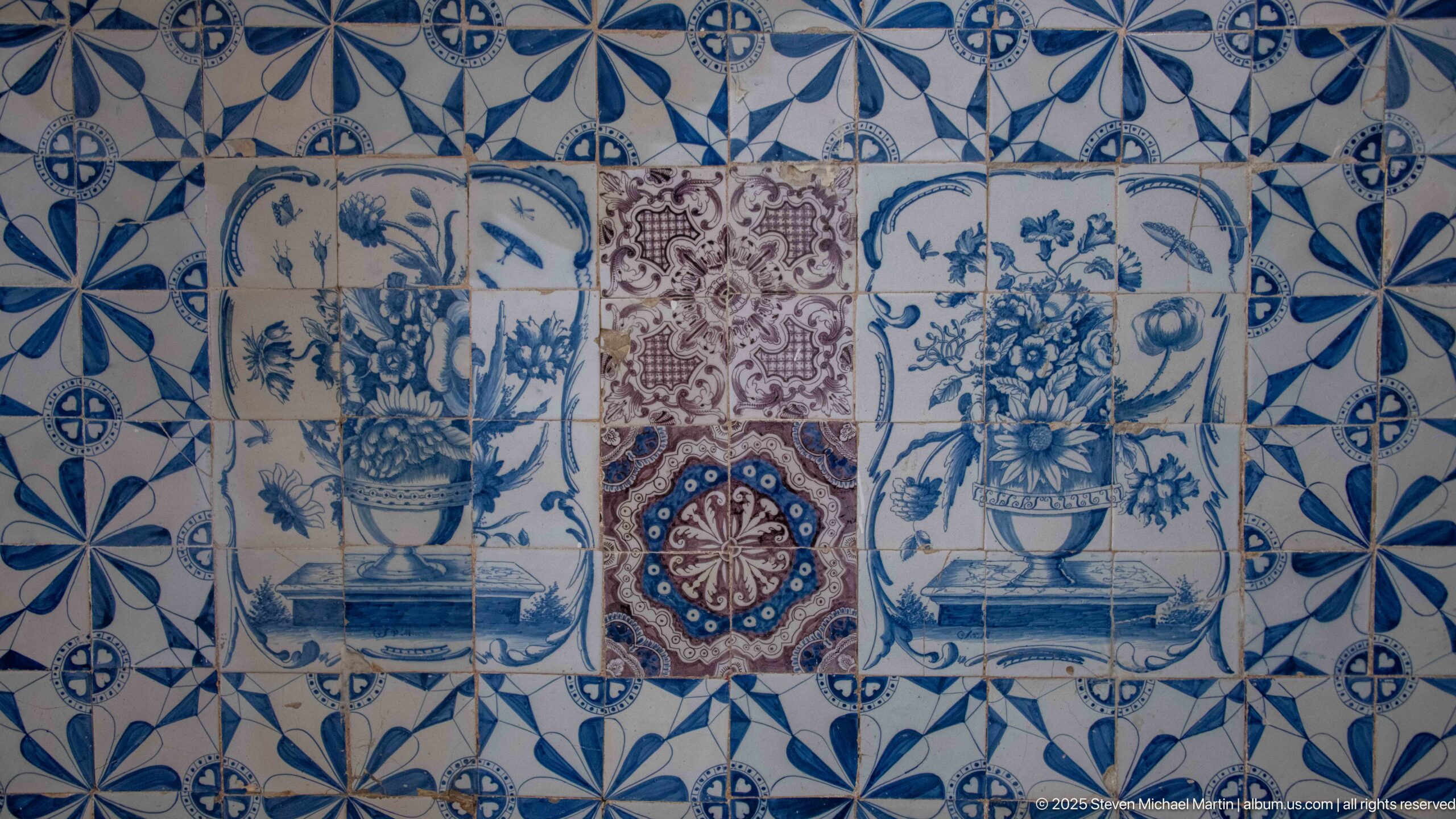
A decorative tile composition pairs blue-and-white floral-patterned fields with larger vase panels and a richly colored central medallion. Two tall urns filled with flowering branches create a symmetrical focal arrangement, while the surrounding geometric tiles integrate the pictorial panels into the palace’s broader ceramic wall decoration.
Caption
A decorative tile composition pairs blue-and-white floral-patterned fields with larger vase panels and a richly colored central medallion. Two tall urns filled with flowering branches create a symmetrical focal arrangement, while the surrounding geometric tiles integrate the pictorial panels into the palace’s broader ceramic wall decoration.
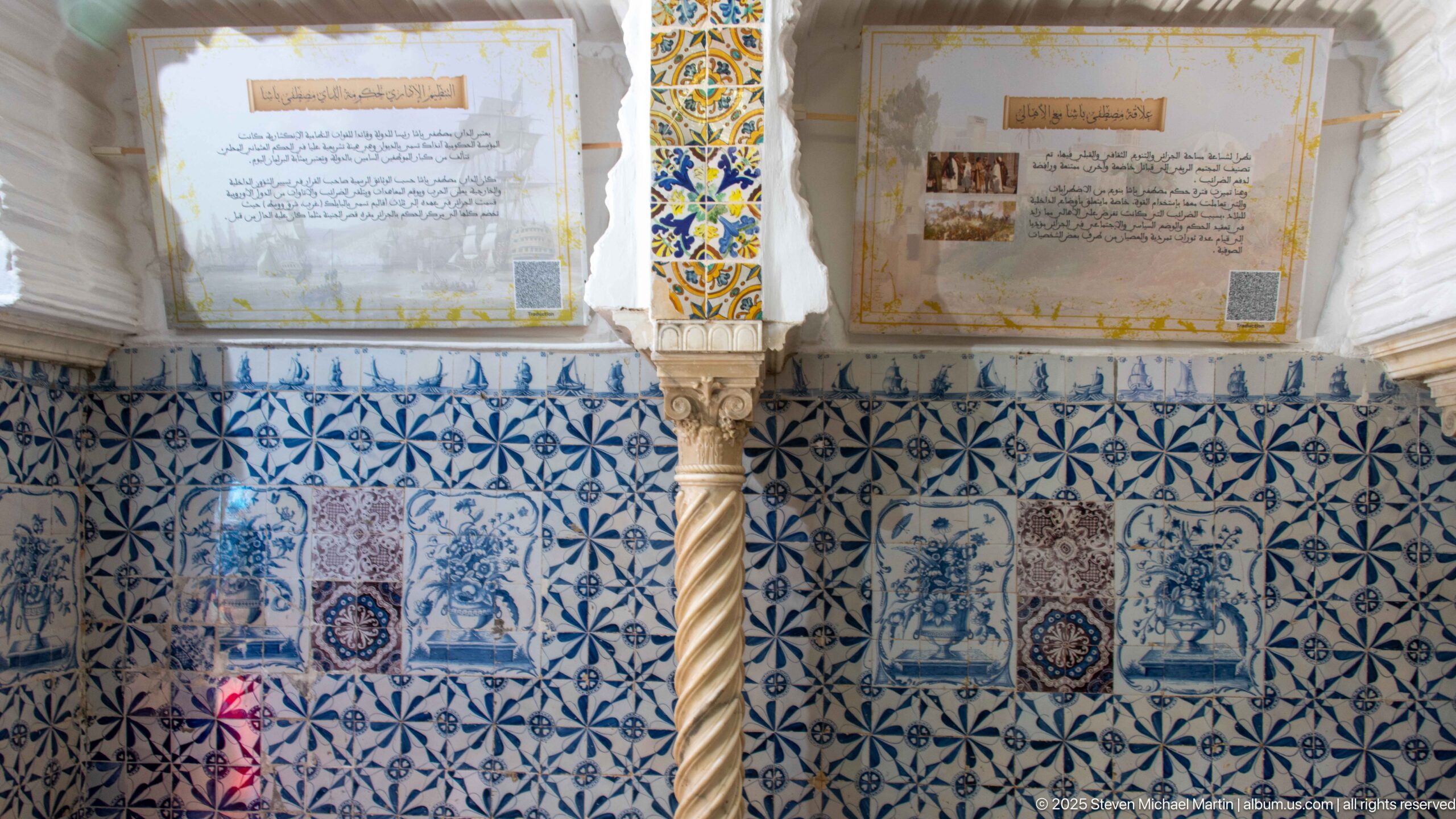
Interpretive panels are mounted above dense blue-and-white wall tiles in an interior gallery of Dar Mustapha Pacha, divided by a spiral-fluted stone column. The view connects the palace’s historic decorative fabric with its present museum presentation, showing modern explanatory material installed directly above patterned ceramic revetment.
Caption
Interpretive panels are mounted above dense blue-and-white wall tiles in an interior gallery of Dar Mustapha Pacha, divided by a spiral-fluted stone column. The view connects the palace’s historic decorative fabric with its present museum presentation, showing modern explanatory material installed directly above patterned ceramic revetment.
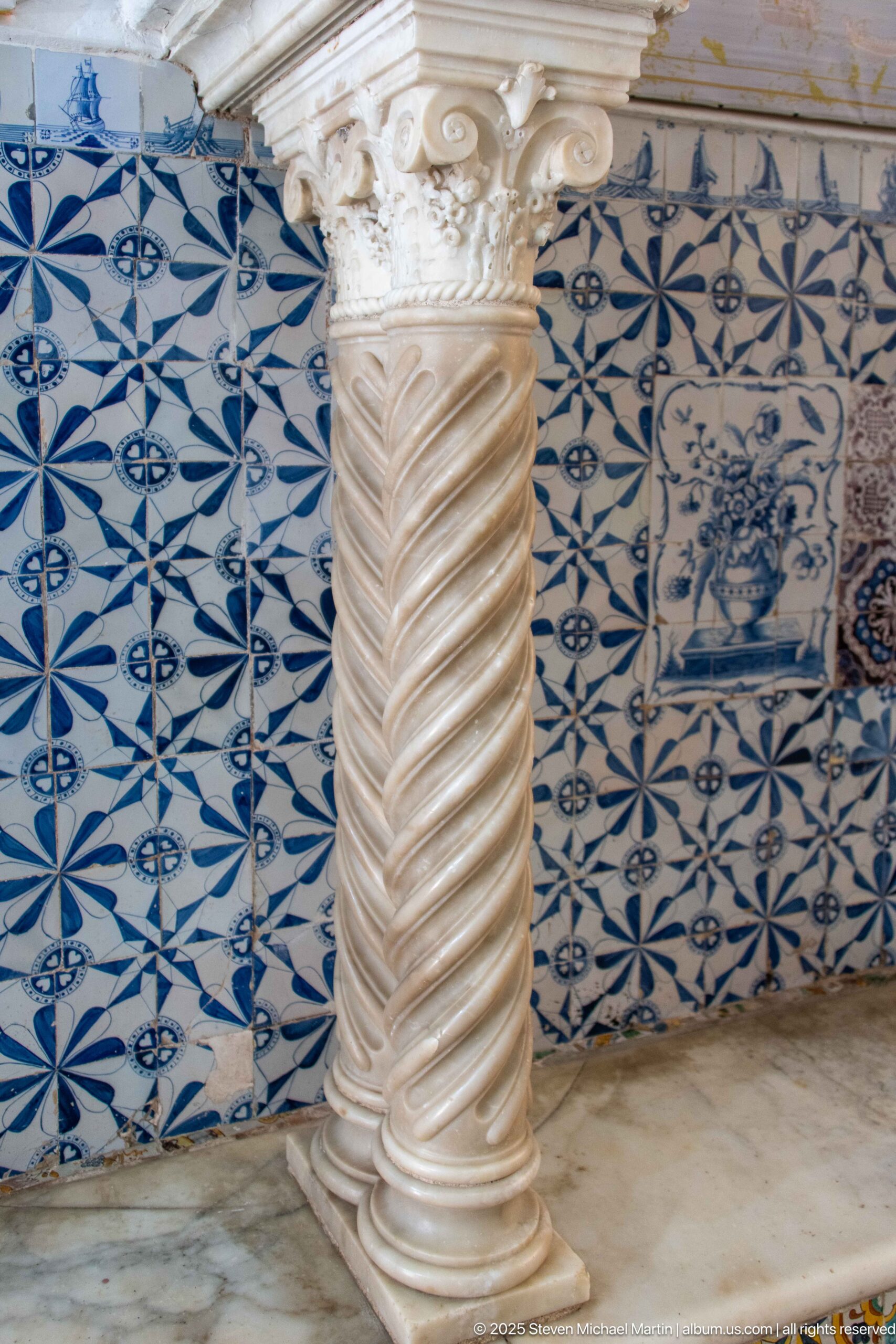
A pale stone column with pronounced spiral fluting stands before a wall of blue-and-white tiles at Dar Mustapha Pacha. Its carved capital introduces scrolling vegetal forms above the twisted shaft, while the adjacent ceramic panels combine repeating geometric motifs with a larger pictorial tile composition, demonstrating the palace interior’s layered decorative vocabulary.
Caption
A pale stone column with pronounced spiral fluting stands before a wall of blue-and-white tiles at Dar Mustapha Pacha. Its carved capital introduces scrolling vegetal forms above the twisted shaft, while the adjacent ceramic panels combine repeating geometric motifs with a larger pictorial tile composition, demonstrating the palace interior’s layered decorative vocabulary.
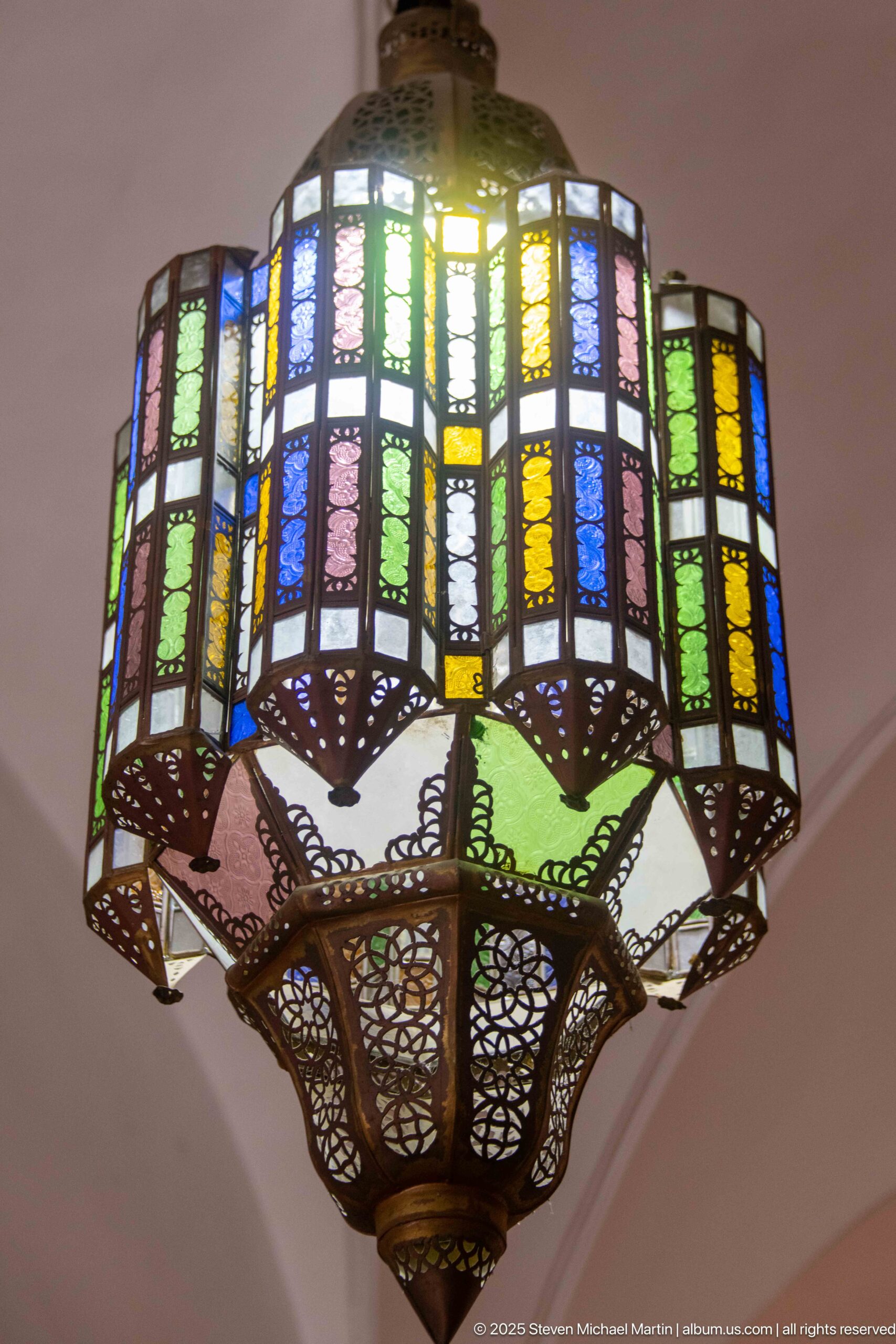
A large hanging lantern is assembled from faceted panels of colored glass set into an intricate dark metal framework. Greens, yellows, blues, pinks, and clear textured panes create a jewel-like geometric surface, while pierced metalwork below the glass forms a broad basket-shaped base and emphasizes the fixture’s handcrafted construction.
Caption
A large hanging lantern is assembled from faceted panels of colored glass set into an intricate dark metal framework. Greens, yellows, blues, pinks, and clear textured panes create a jewel-like geometric surface, while pierced metalwork below the glass forms a broad basket-shaped base and emphasizes the fixture’s handcrafted construction.
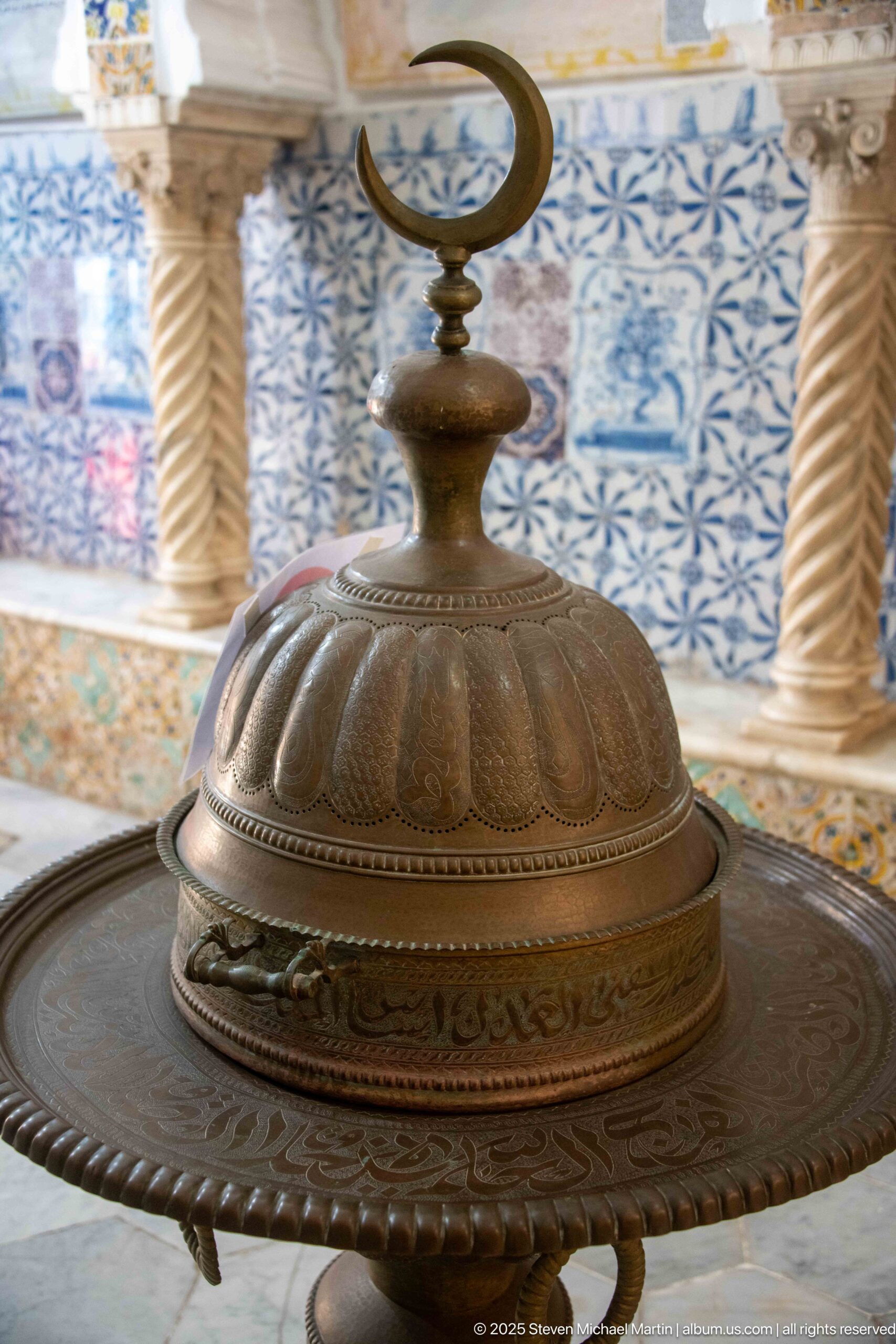
An ornate domed metal object is displayed against the tiled interior of Dar Mustapha Pacha. Its lobed cover rises to a crescent finial, while chased and incised bands decorate both the dome and circular base. The close view isolates the object’s Islamic decorative vocabulary without enough evidence to determine its original function with certainty.
Caption
An ornate domed metal object is displayed against the tiled interior of Dar Mustapha Pacha. Its lobed cover rises to a crescent finial, while chased and incised bands decorate both the dome and circular base. The close view isolates the object’s Islamic decorative vocabulary without enough evidence to determine its original function with certainty.
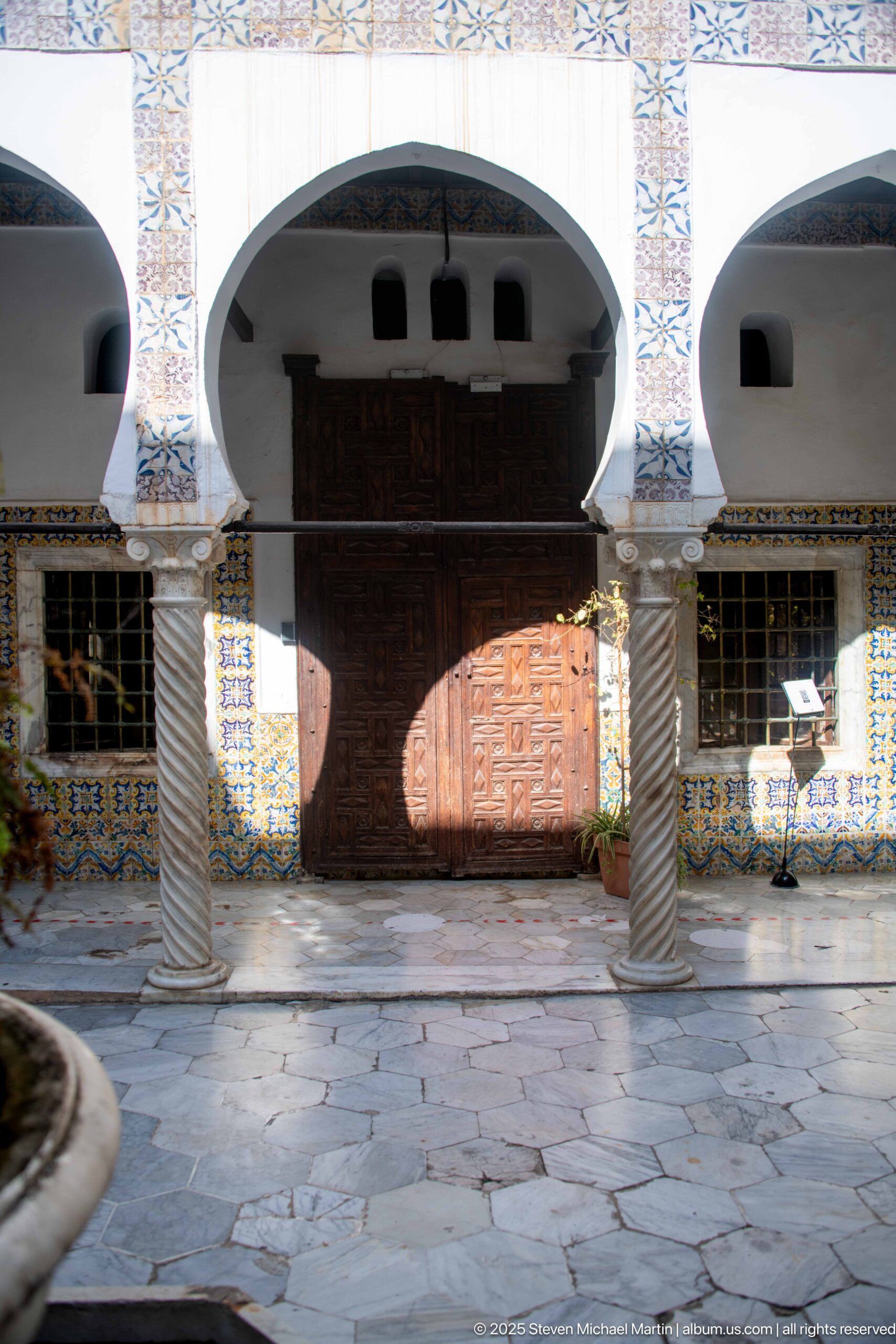
A broad dark wooden doorway occupies the center of a ground-floor arcade at Dar Mustapha Pacha, framed by white arches, spiral columns, and patterned tile bands. Sunlight falls across the carved door leaves, drawing attention to their geometric relief while the surrounding architecture establishes the entrance as part of the courtyard circulation.
Caption
A broad dark wooden doorway occupies the center of a ground-floor arcade at Dar Mustapha Pacha, framed by white arches, spiral columns, and patterned tile bands. Sunlight falls across the carved door leaves, drawing attention to their geometric relief while the surrounding architecture establishes the entrance as part of the courtyard circulation.
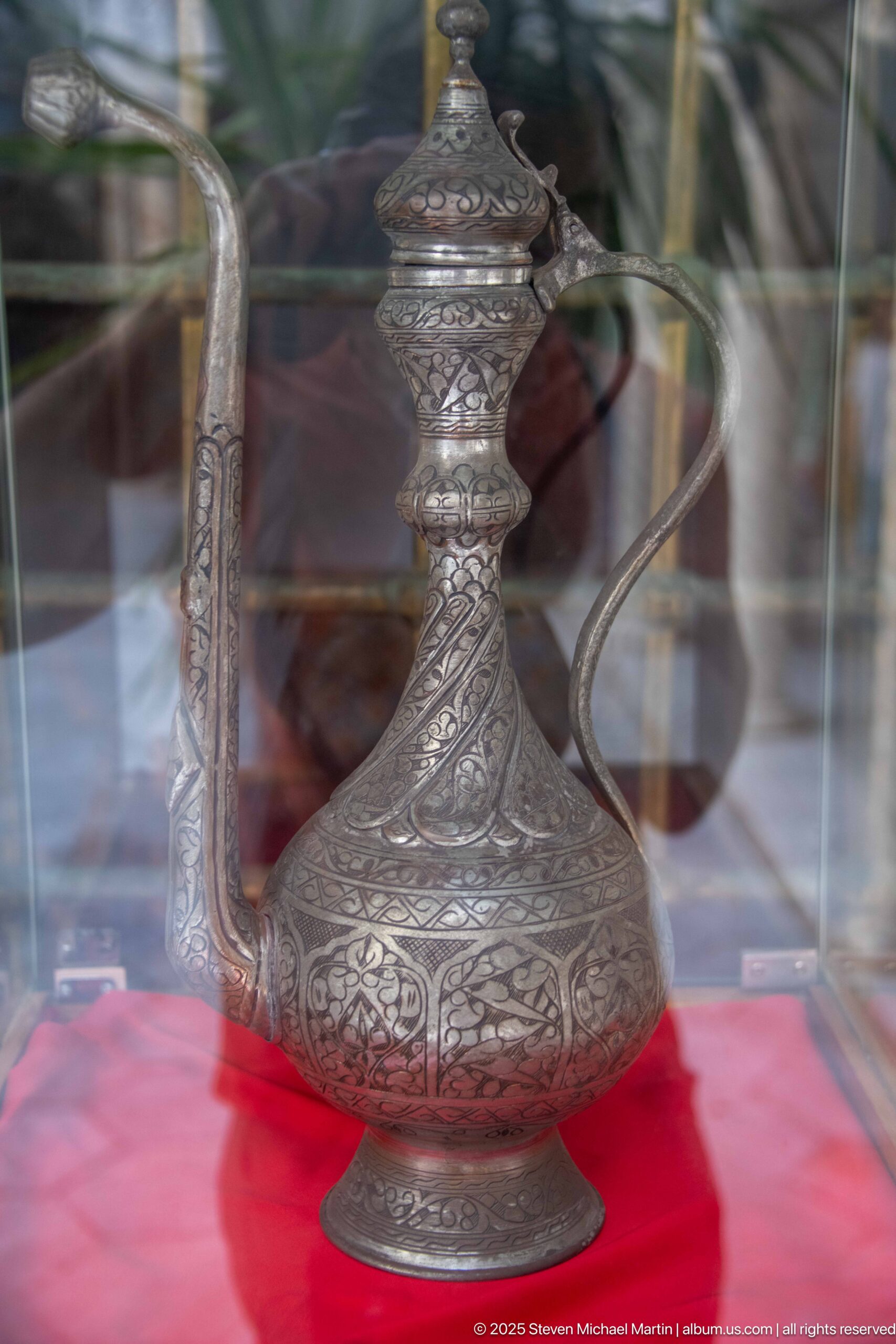
A long-spouted metal ewer displayed in a glass case is covered with dense engraved ornament. Its bulbous body rises through a narrow neck to a small finial, while a high curved handle balances the projecting spout. Reflections from the display case partially obscure the surface but leave the vessel’s silhouette and extensive metal decoration legible.
Caption
A long-spouted metal ewer displayed in a glass case is covered with dense engraved ornament. Its bulbous body rises through a narrow neck to a small finial, while a high curved handle balances the projecting spout. Reflections from the display case partially obscure the surface but leave the vessel’s silhouette and extensive metal decoration legible.
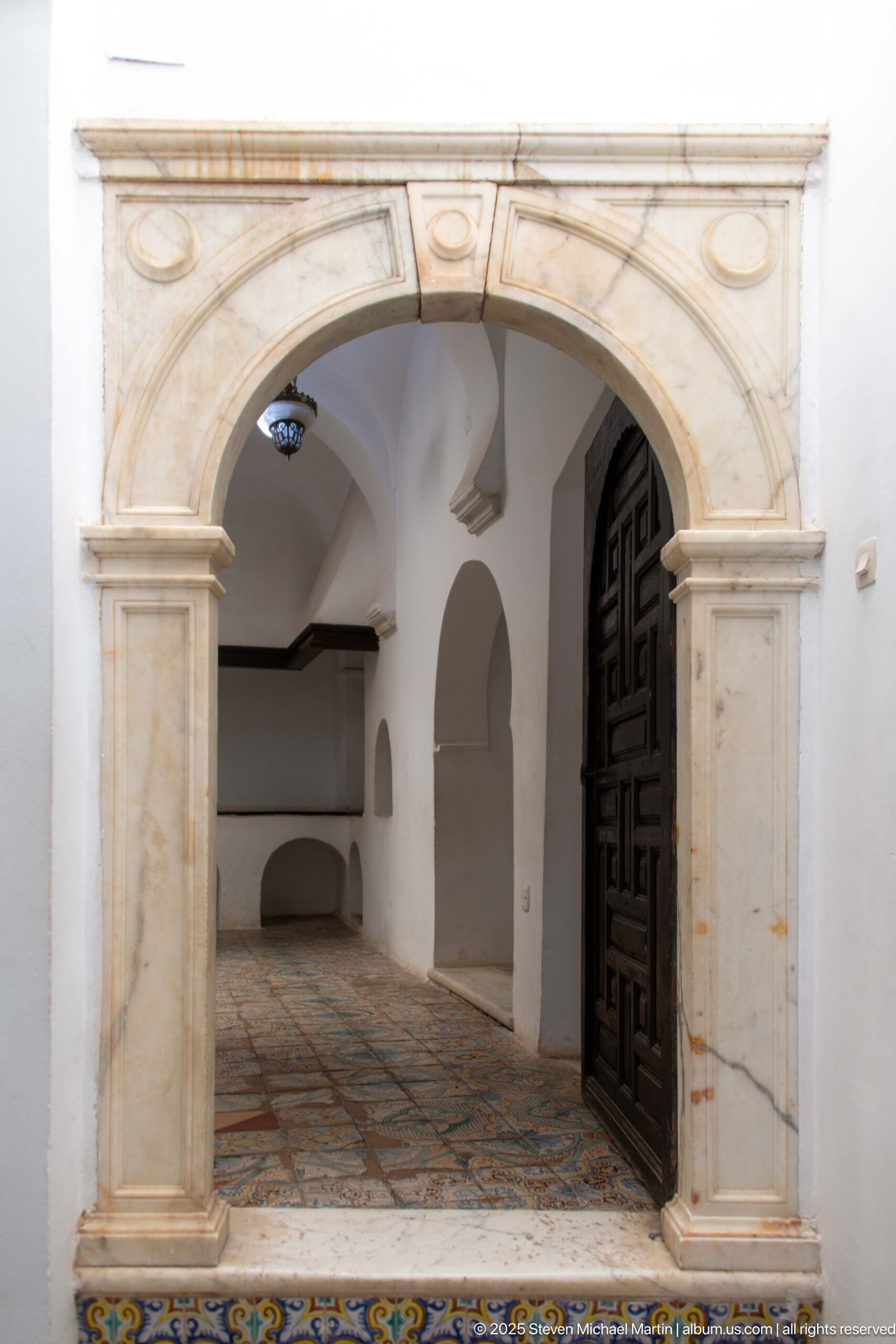
A pale stone portal with a broad rounded arch opens into a spare white interior at Dar Mustapha Pacha. Beyond the threshold, shallow arches, built-in wall forms, a tiled floor, and a heavy dark wooden door create a restrained contrast with the more richly tiled courtyard spaces elsewhere in the palace.
Caption
A pale stone portal with a broad rounded arch opens into a spare white interior at Dar Mustapha Pacha. Beyond the threshold, shallow arches, built-in wall forms, a tiled floor, and a heavy dark wooden door create a restrained contrast with the more richly tiled courtyard spaces elsewhere in the palace.
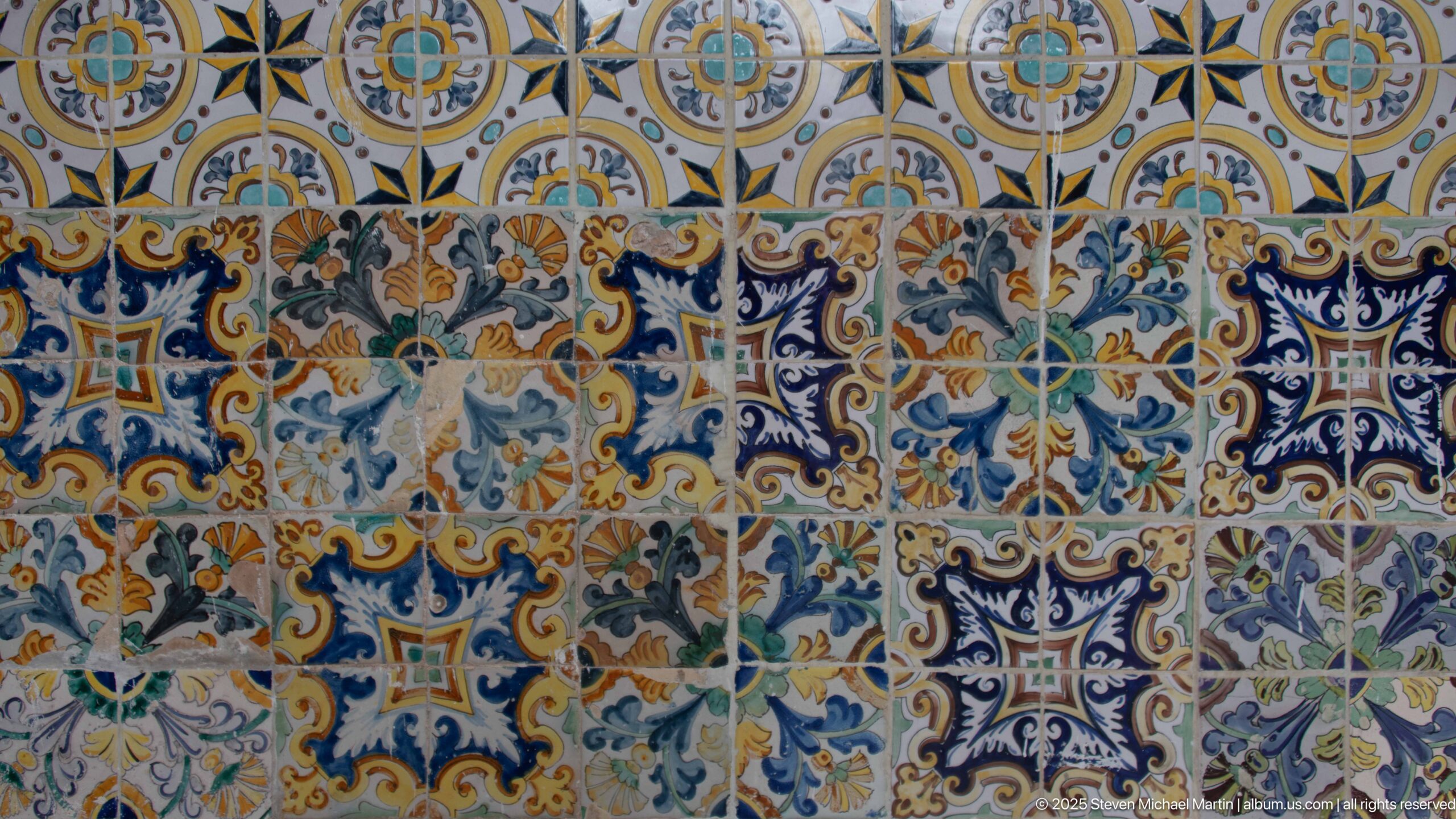
A dense patchwork of polychrome ceramic tiles combines scrolling foliage, stylized blossoms, geometric compartments, and repeated ornamental units. Blue dominates the palette, accented by yellow, green, orange, and white. The close framing reveals how individual square tiles join into larger rhythmic patterns across the palace wall.
Caption
A dense patchwork of polychrome ceramic tiles combines scrolling foliage, stylized blossoms, geometric compartments, and repeated ornamental units. Blue dominates the palette, accented by yellow, green, orange, and white. The close framing reveals how individual square tiles join into larger rhythmic patterns across the palace wall.
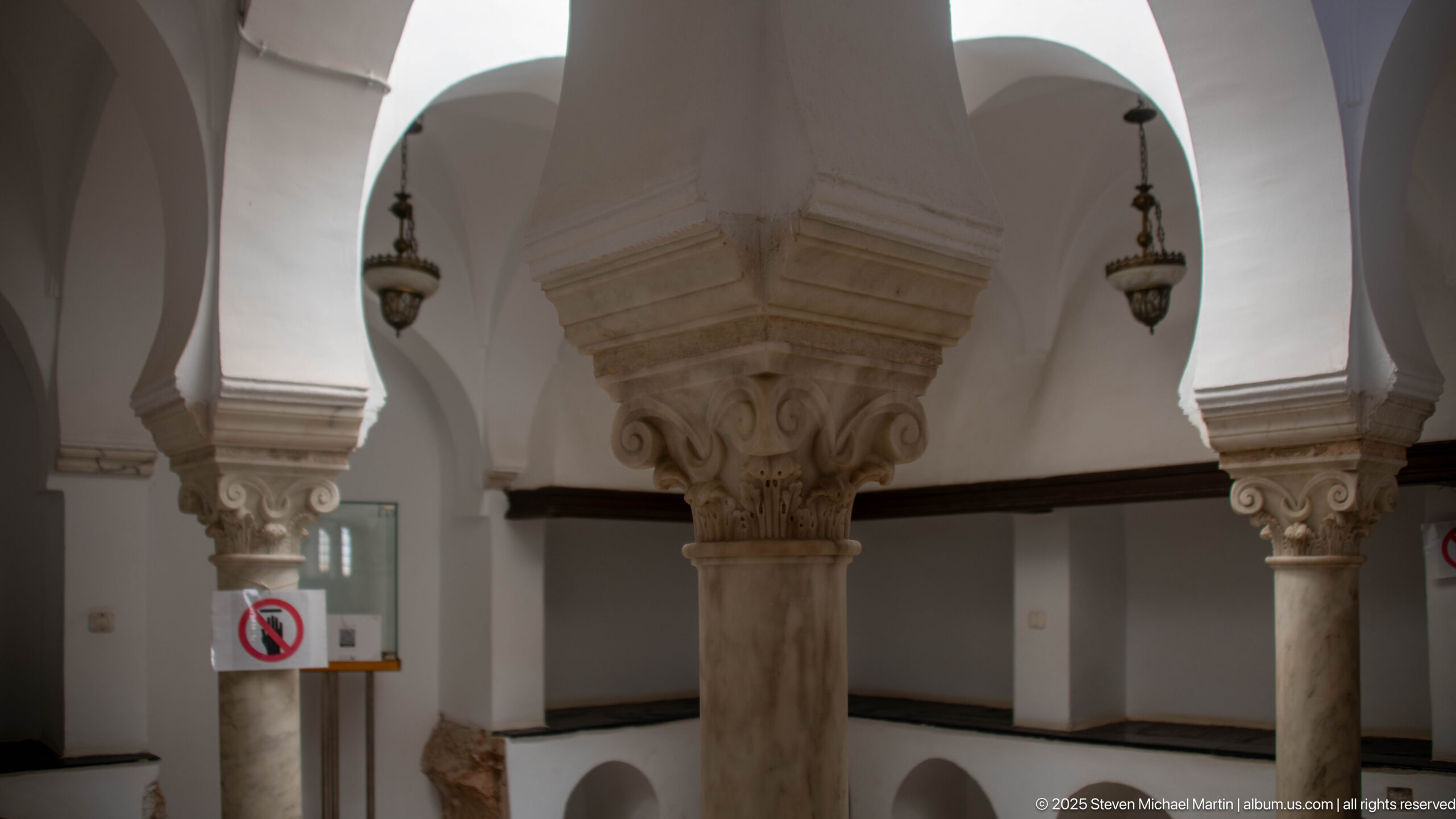
A massive pale stone column and carved capital dominate this interior view of Dar Mustapha Pacha, where multiple white arches spring from the support in different directions. Hanging lamps punctuate the shadowed arcade behind it, while the close perspective emphasizes the structural transition between column, capital, and plastered vaults.
Caption
A massive pale stone column and carved capital dominate this interior view of Dar Mustapha Pacha, where multiple white arches spring from the support in different directions. Hanging lamps punctuate the shadowed arcade behind it, while the close perspective emphasizes the structural transition between column, capital, and plastered vaults.
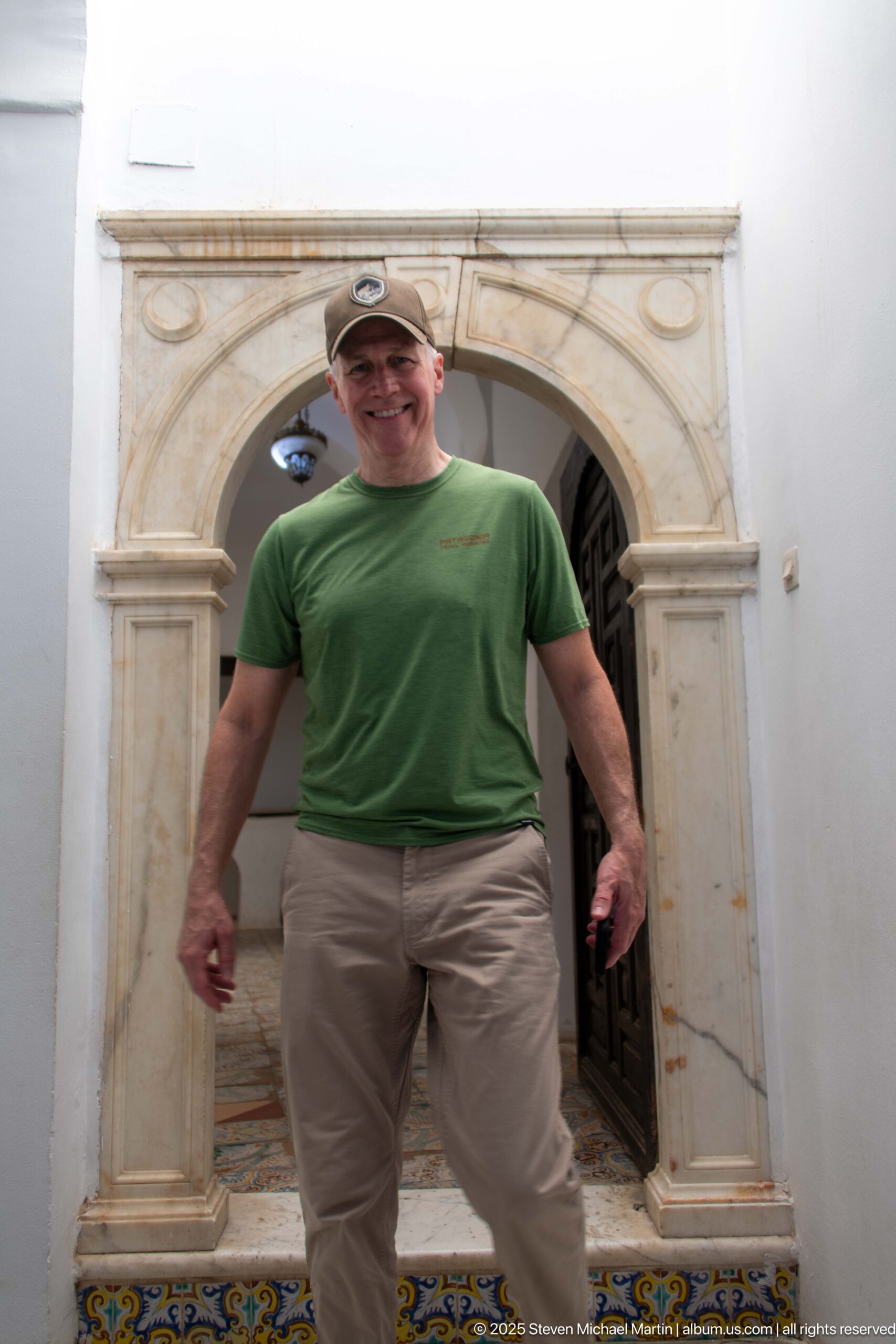
A visitor stands beneath the pale stone archway of an interior doorway at Dar Mustapha Pacha, providing a human scale for the broad portal and surrounding white walls. The portrait shifts attention from architectural detail to the experience of moving through the palace, with patterned floor tiles visible at the threshold.
Caption
A visitor stands beneath the pale stone archway of an interior doorway at Dar Mustapha Pacha, providing a human scale for the broad portal and surrounding white walls. The portrait shifts attention from architectural detail to the experience of moving through the palace, with patterned floor tiles visible at the threshold.
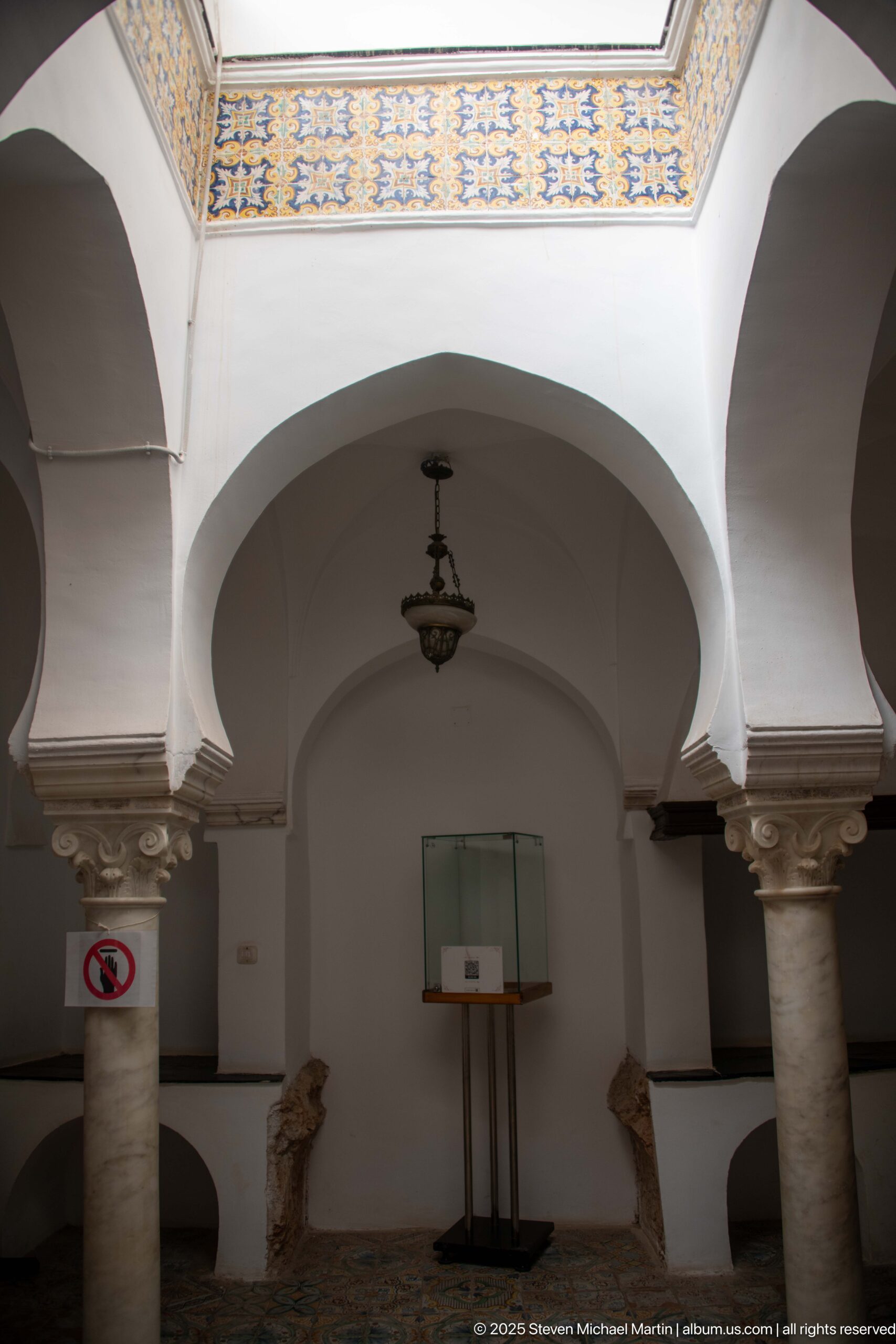
A sequence of broad white plaster arches spans an interior gallery of Dar Mustapha Pacha, supported by pale stone columns with carved capitals. A hanging lamp marks the central bay, while a glass display case and fragmentary object along the back wall indicate the palace’s current museum use without overwhelming the architecture.
Caption
A sequence of broad white plaster arches spans an interior gallery of Dar Mustapha Pacha, supported by pale stone columns with carved capitals. A hanging lamp marks the central bay, while a glass display case and fragmentary object along the back wall indicate the palace’s current museum use without overwhelming the architecture.
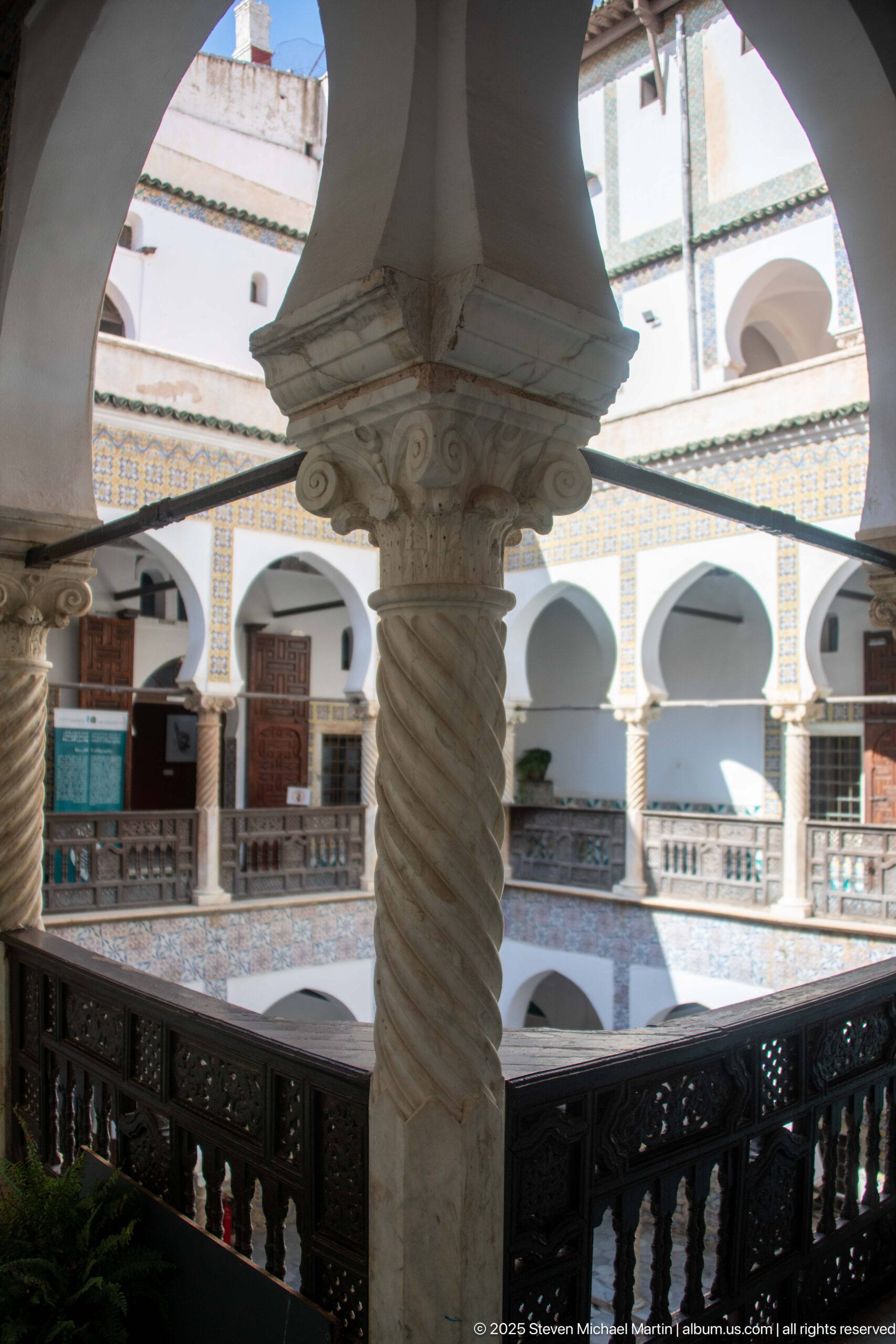
A spiral-fluted stone column fills the foreground of an upper gallery at Dar Mustapha Pacha, its carved capital silhouetted against the brighter courtyard beyond. The close architectural view sets the column’s twisting shaft against repeated white arches and tiled bands across the court, emphasizing depth and the rhythm of the gallery supports.
Caption
A spiral-fluted stone column fills the foreground of an upper gallery at Dar Mustapha Pacha, its carved capital silhouetted against the brighter courtyard beyond. The close architectural view sets the column’s twisting shaft against repeated white arches and tiled bands across the court, emphasizing depth and the rhythm of the gallery supports.
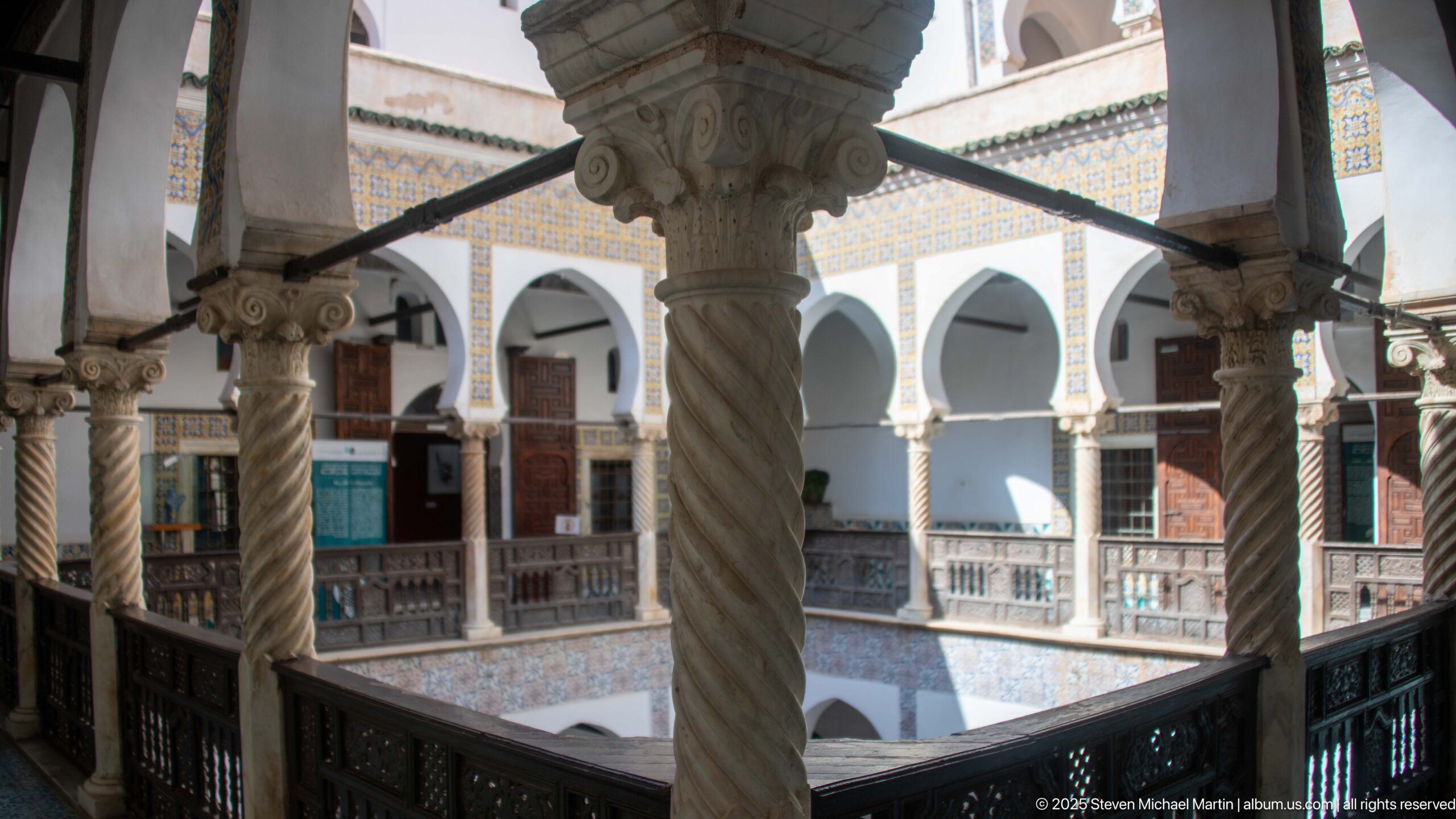
From an upper gallery, spiral-fluted columns and a dark wooden balustrade frame a view across Dar Mustapha Pacha’s courtyard. Opposite arcades, tiled bands, wooden doors, and upper railings align in layered planes, revealing the visual connections between the palace’s two stories and the circulation around the open court.
Caption
From an upper gallery, spiral-fluted columns and a dark wooden balustrade frame a view across Dar Mustapha Pacha’s courtyard. Opposite arcades, tiled bands, wooden doors, and upper railings align in layered planes, revealing the visual connections between the palace’s two stories and the circulation around the open court.
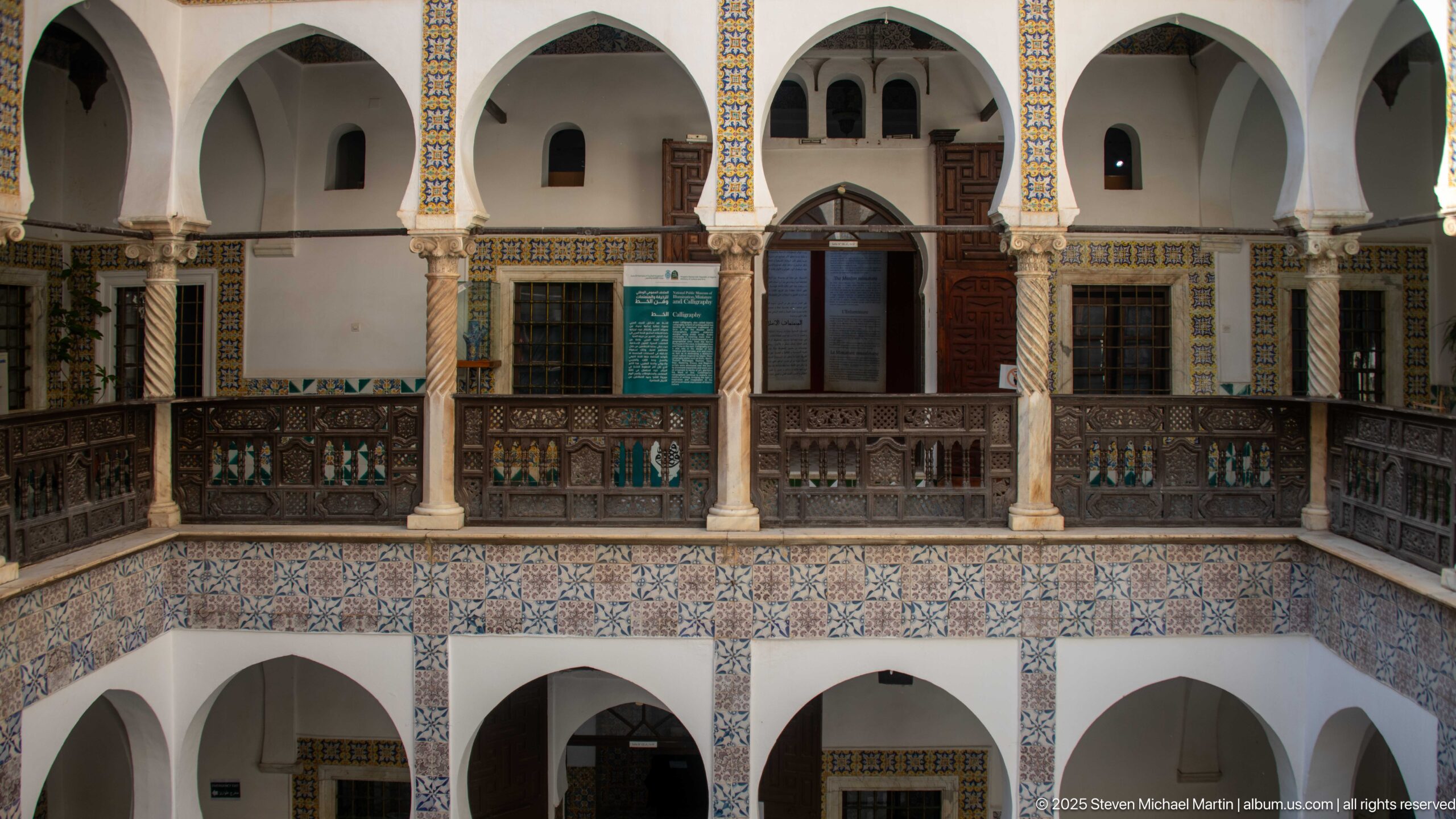
The upper courtyard gallery of Dar Mustapha Pacha stretches across the frame with pointed white arches, slender columns, dark wooden railings, and doors set above a dense band of patterned tiles. The elevated composition isolates the second-story circulation while still revealing the lower arcade at the bottom edge.
Caption
The upper courtyard gallery of Dar Mustapha Pacha stretches across the frame with pointed white arches, slender columns, dark wooden railings, and doors set above a dense band of patterned tiles. The elevated composition isolates the second-story circulation while still revealing the lower arcade at the bottom edge.
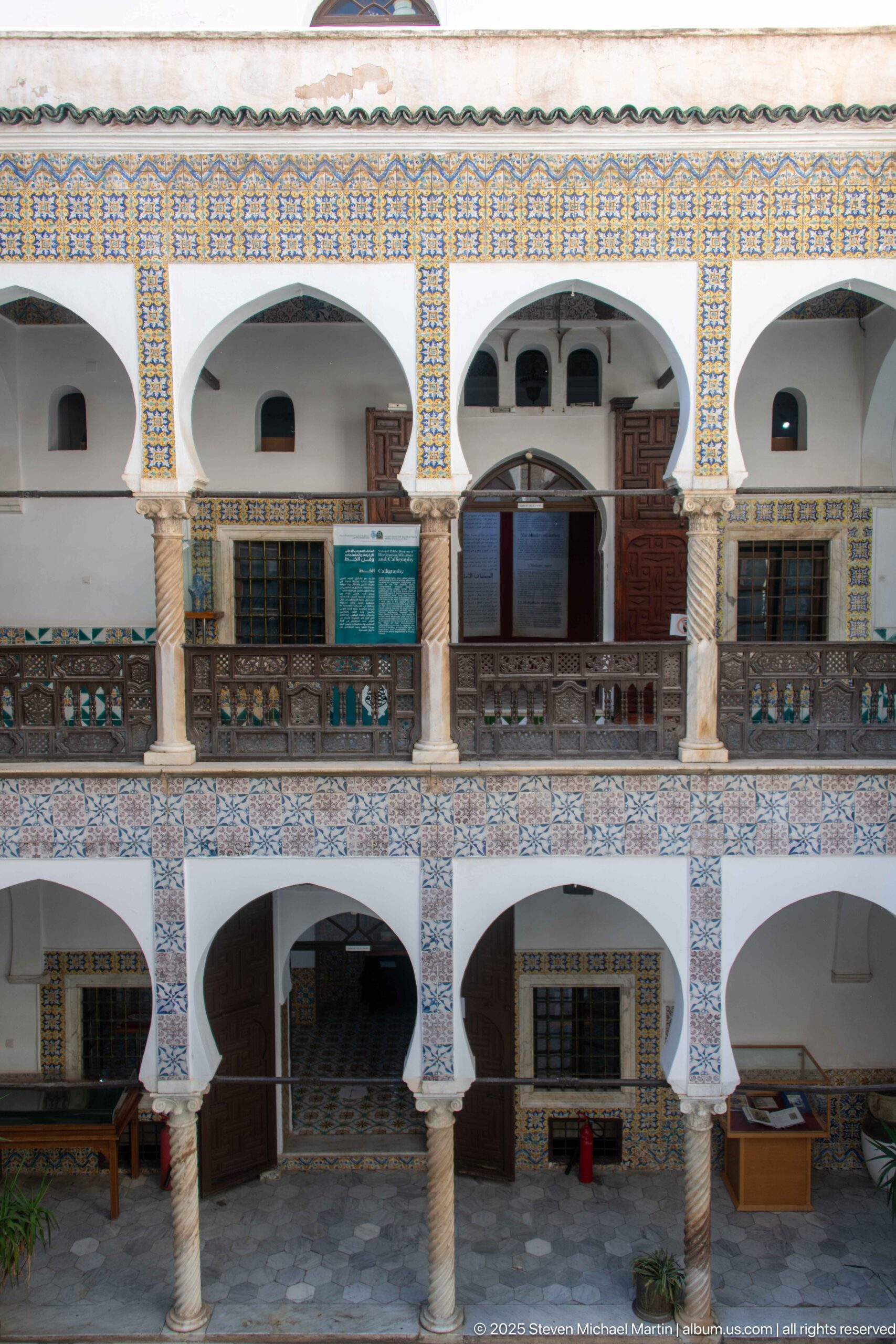
A frontal courtyard elevation at Dar Mustapha Pacha shows stacked arcades organized by slender columns, dark wooden balustrades, doors, and continuous bands of patterned ceramic tile. The nearly symmetrical view clarifies the relationship between ground-floor openings and the upper gallery, turning the courtyard wall into a measured study of the palace’s decorative architecture.
Caption
A frontal courtyard elevation at Dar Mustapha Pacha shows stacked arcades organized by slender columns, dark wooden balustrades, doors, and continuous bands of patterned ceramic tile. The nearly symmetrical view clarifies the relationship between ground-floor openings and the upper gallery, turning the courtyard wall into a measured study of the palace’s decorative architecture.
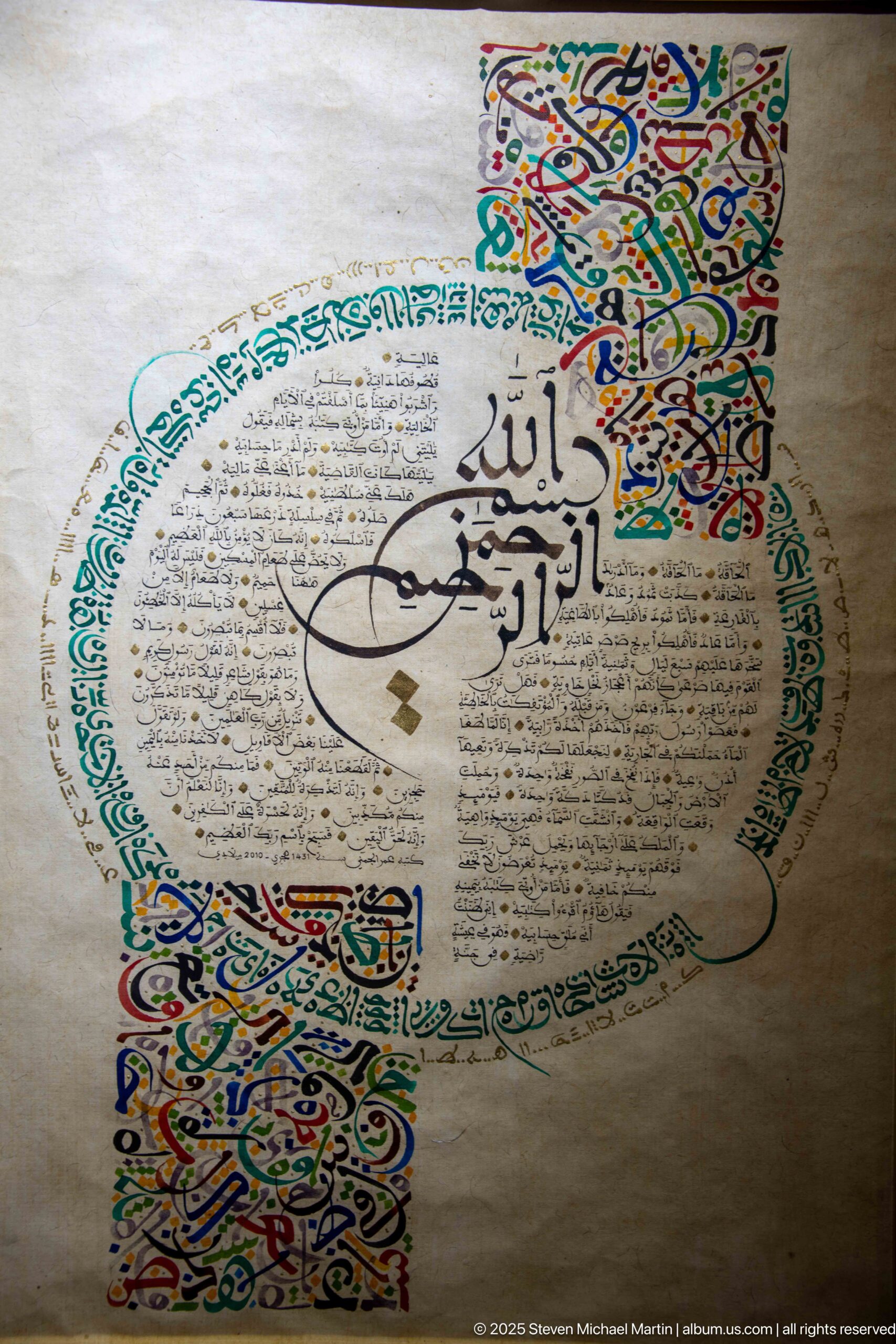
An illuminated Arabic calligraphic composition combines a large circular field of fine script with bold black central lettering and turquoise calligraphy around the perimeter. Multicolored interlace and floral ornament extend vertically along one side, recalling manuscript illumination while functioning here as a framed or displayed work of calligraphic art.
Caption
An illuminated Arabic calligraphic composition combines a large circular field of fine script with bold black central lettering and turquoise calligraphy around the perimeter. Multicolored interlace and floral ornament extend vertically along one side, recalling manuscript illumination while functioning here as a framed or displayed work of calligraphic art.
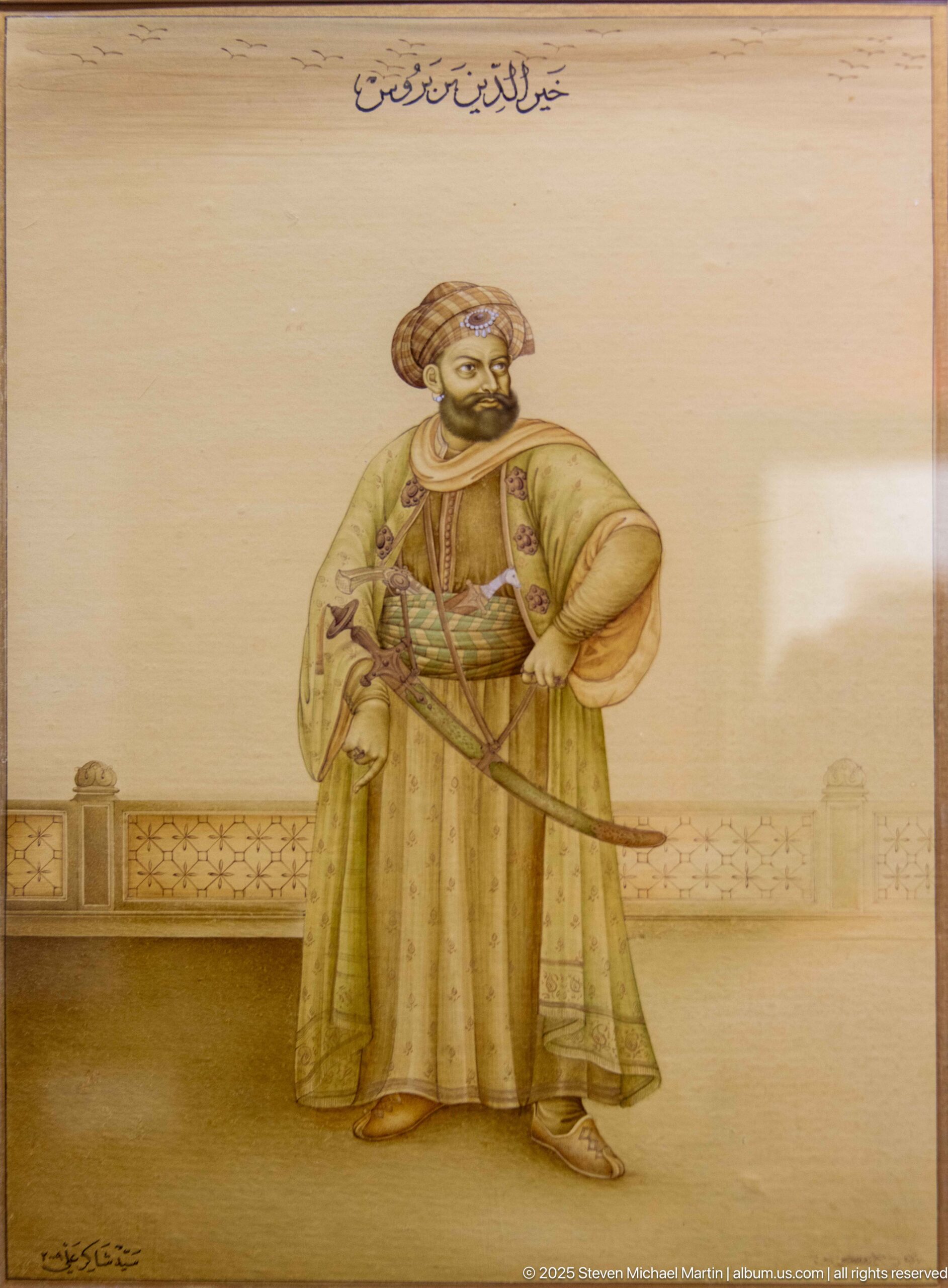
A painted or drawn portrait shows a standing man in a turban and long robe, posed with one hand at his waist and a curved sword suspended at his side. Arabic script appears above and below the figure. His dress suggests an Ottoman-period official or notable, but the proof sheet does not permit a secure identification of the individual.
Caption
A painted or drawn portrait shows a standing man in a turban and long robe, posed with one hand at his waist and a curved sword suspended at his side. Arabic script appears above and below the figure. His dress suggests an Ottoman-period official or notable, but the proof sheet does not permit a secure identification of the individual.
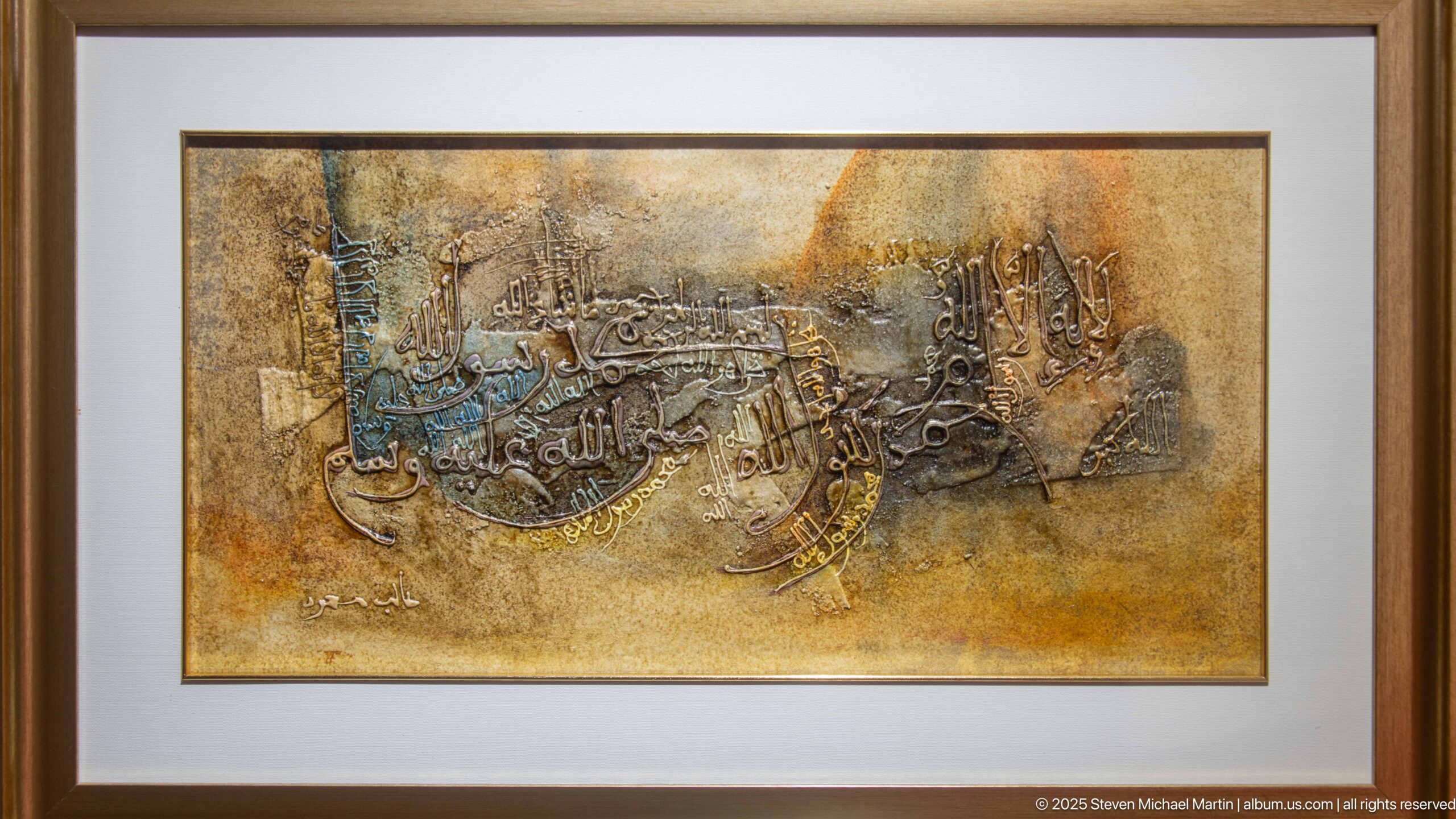
A framed contemporary-looking calligraphic work presents flowing Arabic script across a mottled gold and brown field. Raised or heavily textured letterforms overlap in an abstract horizontal composition, with lighter and darker passages creating depth. The proof sheet supports identification as Arabic calligraphy but not a reliable reading, title, or attribution.
Caption
A framed contemporary-looking calligraphic work presents flowing Arabic script across a mottled gold and brown field. Raised or heavily textured letterforms overlap in an abstract horizontal composition, with lighter and darker passages creating depth. The proof sheet supports identification as Arabic calligraphy but not a reliable reading, title, or attribution.
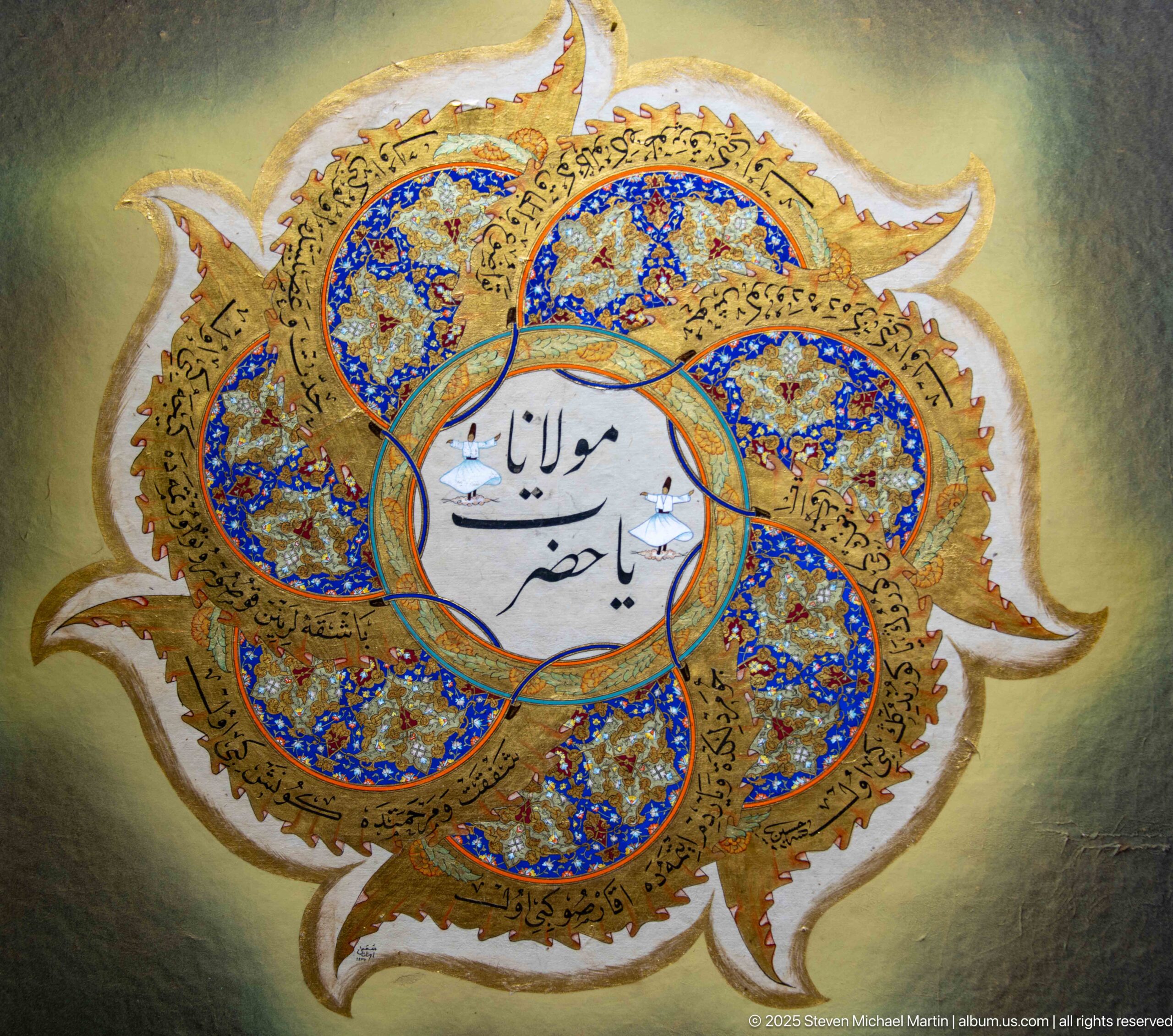
A flower-like illuminated medallion radiates from a central white circle containing bold Arabic calligraphy. Six rounded lobes filled with blue, gold, and floral ornament interlock around the inscription, while pointed outer extensions give the composition a rotating, star-like silhouette. Fine script also follows portions of the gold perimeter.
Caption
A flower-like illuminated medallion radiates from a central white circle containing bold Arabic calligraphy. Six rounded lobes filled with blue, gold, and floral ornament interlock around the inscription, while pointed outer extensions give the composition a rotating, star-like silhouette. Fine script also follows portions of the gold perimeter.
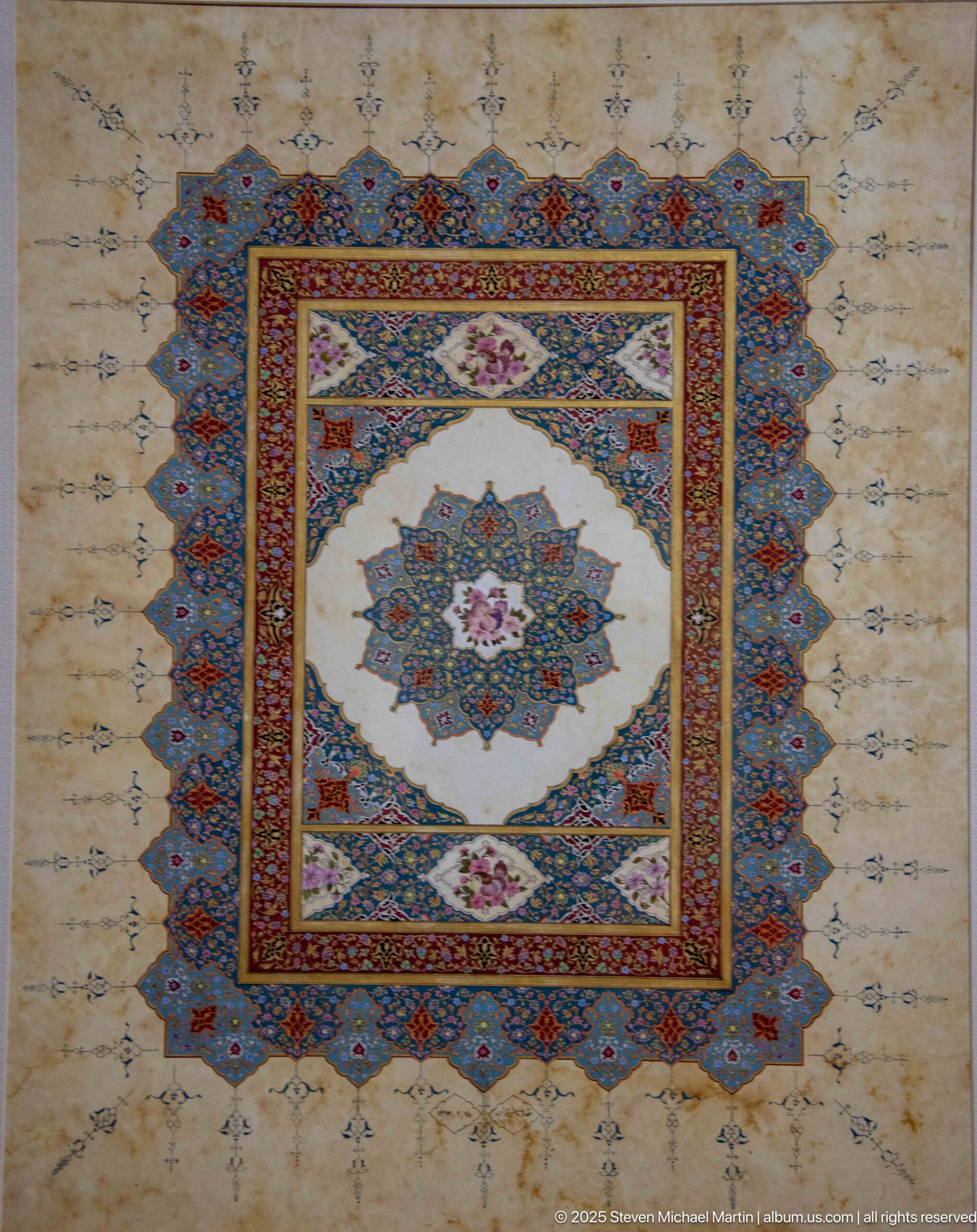
A square illuminated composition builds outward from a blue-and-pink star-shaped medallion through nested geometric borders filled with fine floral ornament. The central panel is set against a pale marbled or mottled ground, and the careful symmetry, minute patterning, and jewel-like palette evoke traditions of manuscript illumination and decorative design.
Caption
A square illuminated composition builds outward from a blue-and-pink star-shaped medallion through nested geometric borders filled with fine floral ornament. The central panel is set against a pale marbled or mottled ground, and the careful symmetry, minute patterning, and jewel-like palette evoke traditions of manuscript illumination and decorative design.
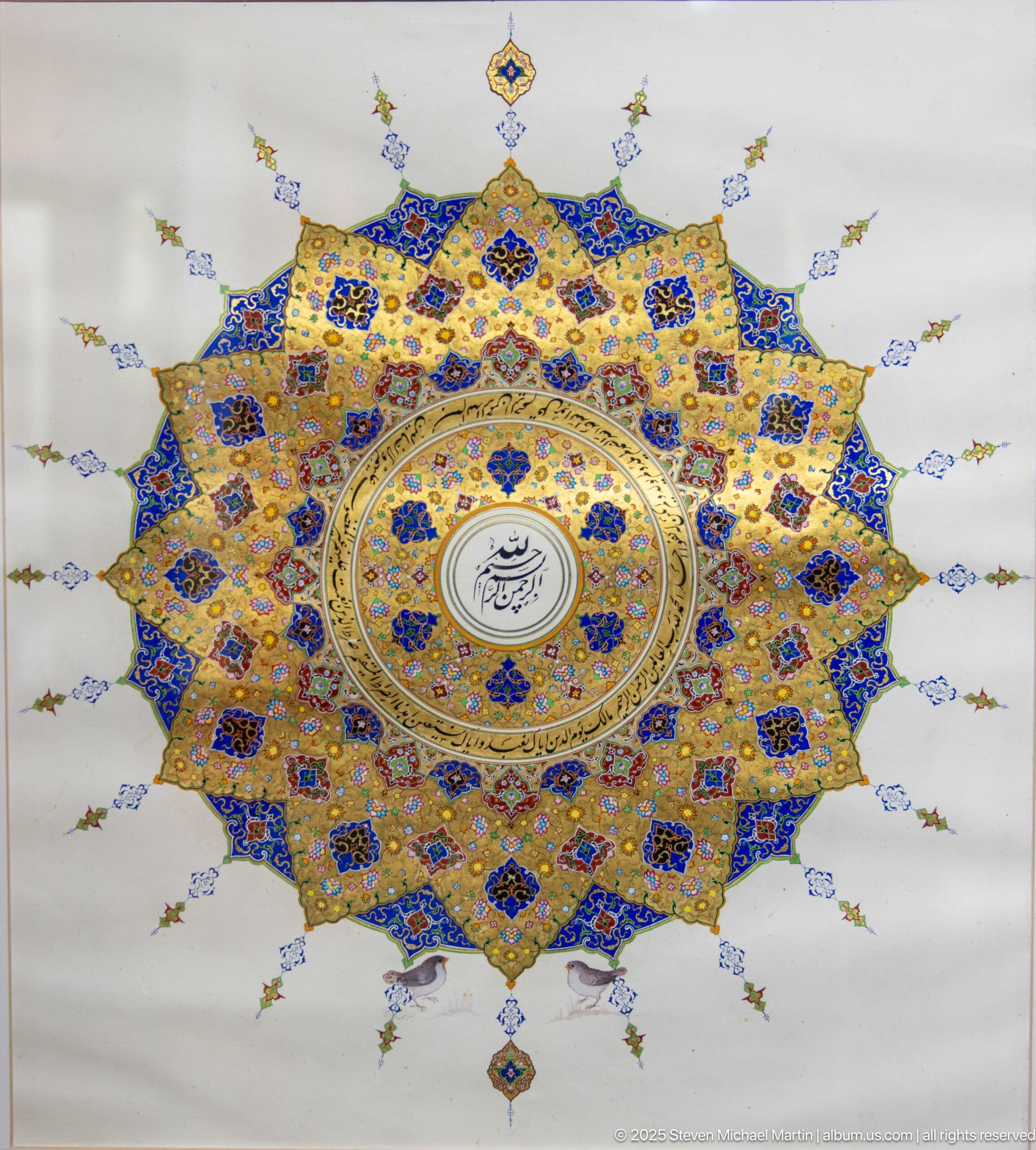
A large radial medallion spreads across a white field in concentric rings of blue, gold, orange, and violet ornament. Fine geometric and floral units build a starburst around a central circular cartouche containing Arabic calligraphy, creating a highly symmetrical composition that combines script with manuscript-style illumination.
Caption
A large radial medallion spreads across a white field in concentric rings of blue, gold, orange, and violet ornament. Fine geometric and floral units build a starburst around a central circular cartouche containing Arabic calligraphy, creating a highly symmetrical composition that combines script with manuscript-style illumination.
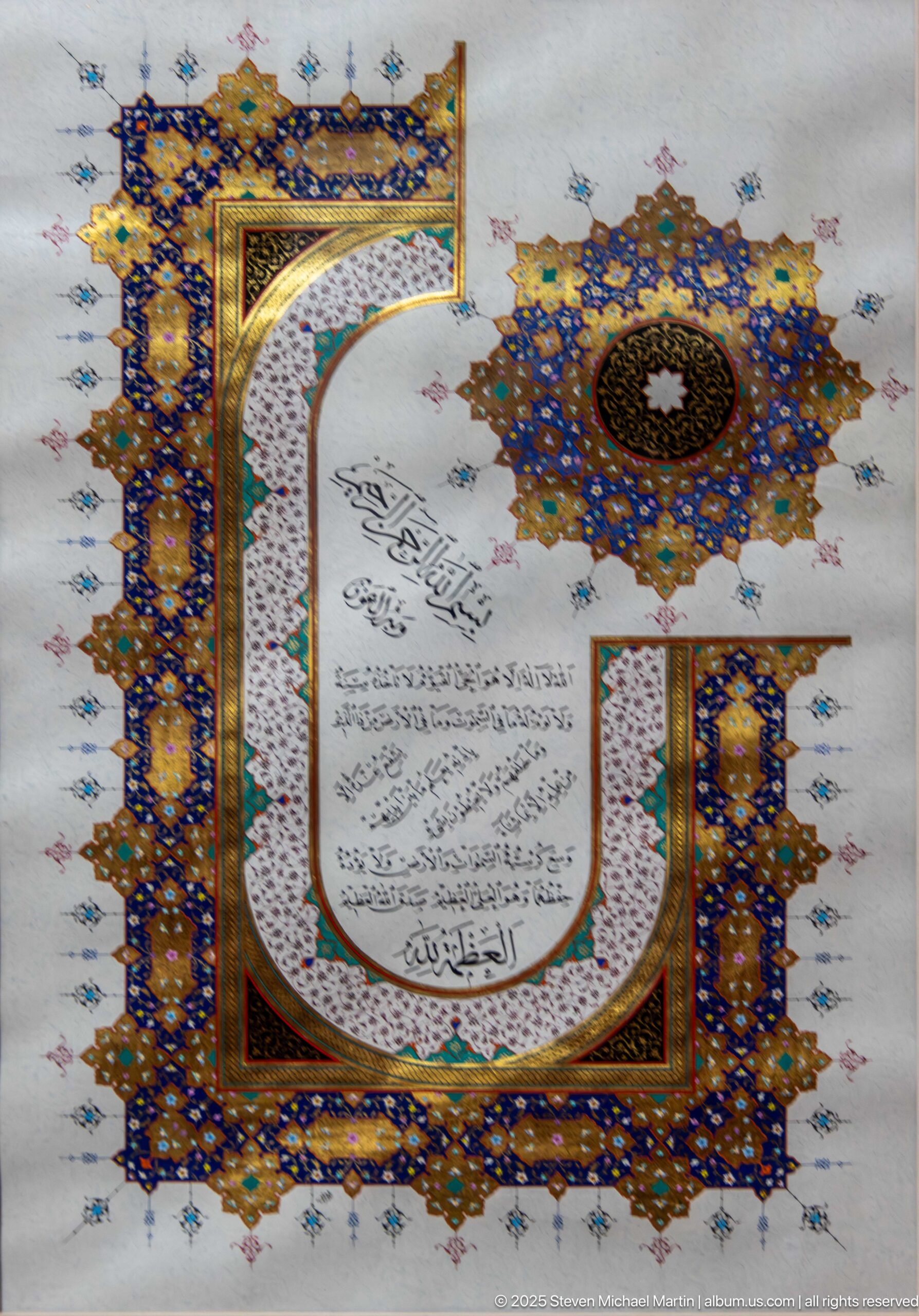
An illuminated calligraphic composition surrounds a curving white text field with dense Arabic script, framed by intricate blue, gold, green, and brown ornament. A large radial medallion occupies the upper right while smaller floral and geometric devices extend around the borders, combining calligraphy with manuscript-style illumination in an intentionally asymmetrical design.
Caption
An illuminated calligraphic composition surrounds a curving white text field with dense Arabic script, framed by intricate blue, gold, green, and brown ornament. A large radial medallion occupies the upper right while smaller floral and geometric devices extend around the borders, combining calligraphy with manuscript-style illumination in an intentionally asymmetrical design.
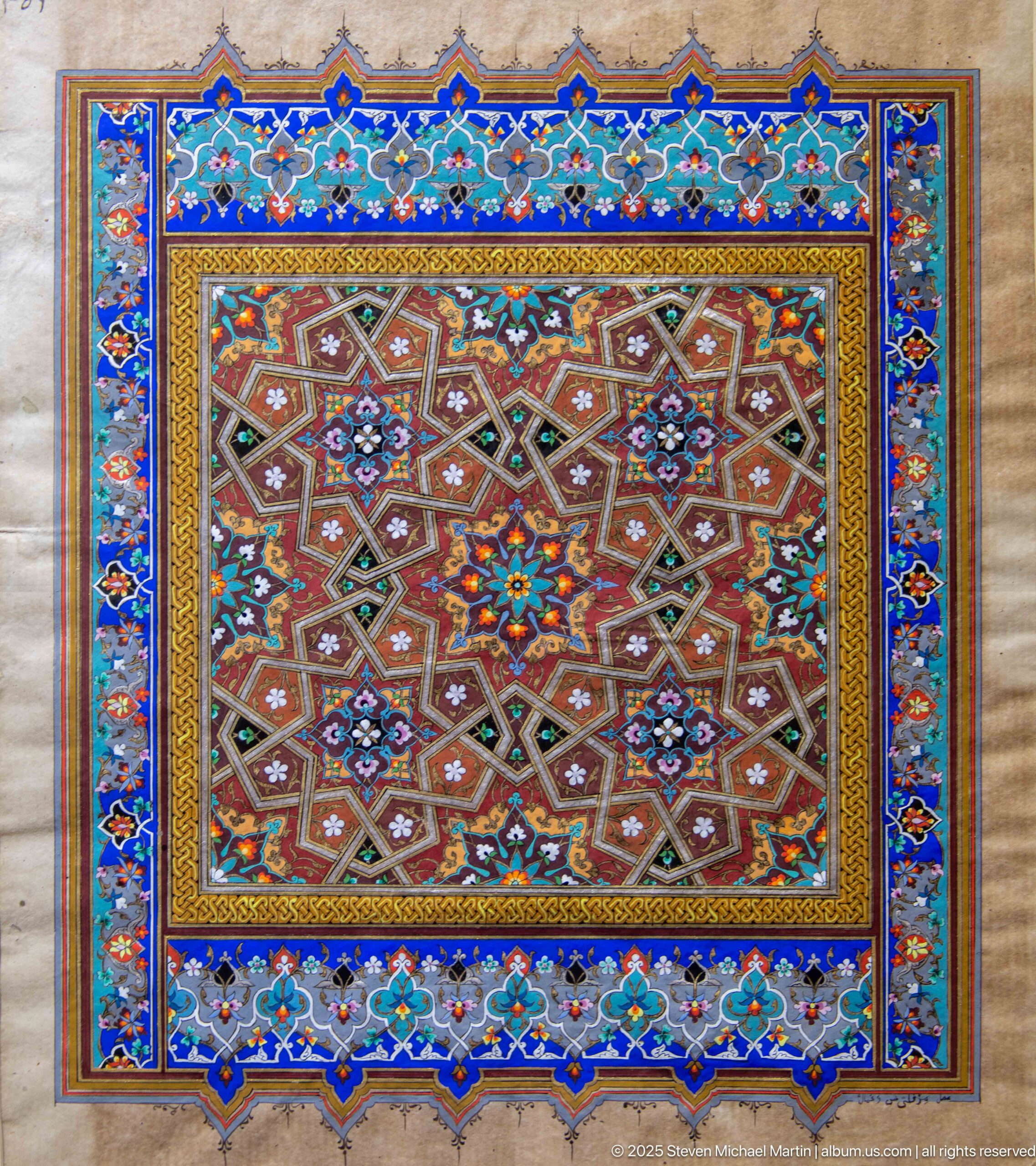
A rectangular illuminated panel is organized around an intricate field of interlaced stars, polygons, and floral rosettes. Broad blue, turquoise, gold, and red borders enclose the central brown-and-gold lattice, creating a carpet-like composition whose strict symmetry and repeated geometry showcase the precision of ornamental design.
Caption
A rectangular illuminated panel is organized around an intricate field of interlaced stars, polygons, and floral rosettes. Broad blue, turquoise, gold, and red borders enclose the central brown-and-gold lattice, creating a carpet-like composition whose strict symmetry and repeated geometry showcase the precision of ornamental design.
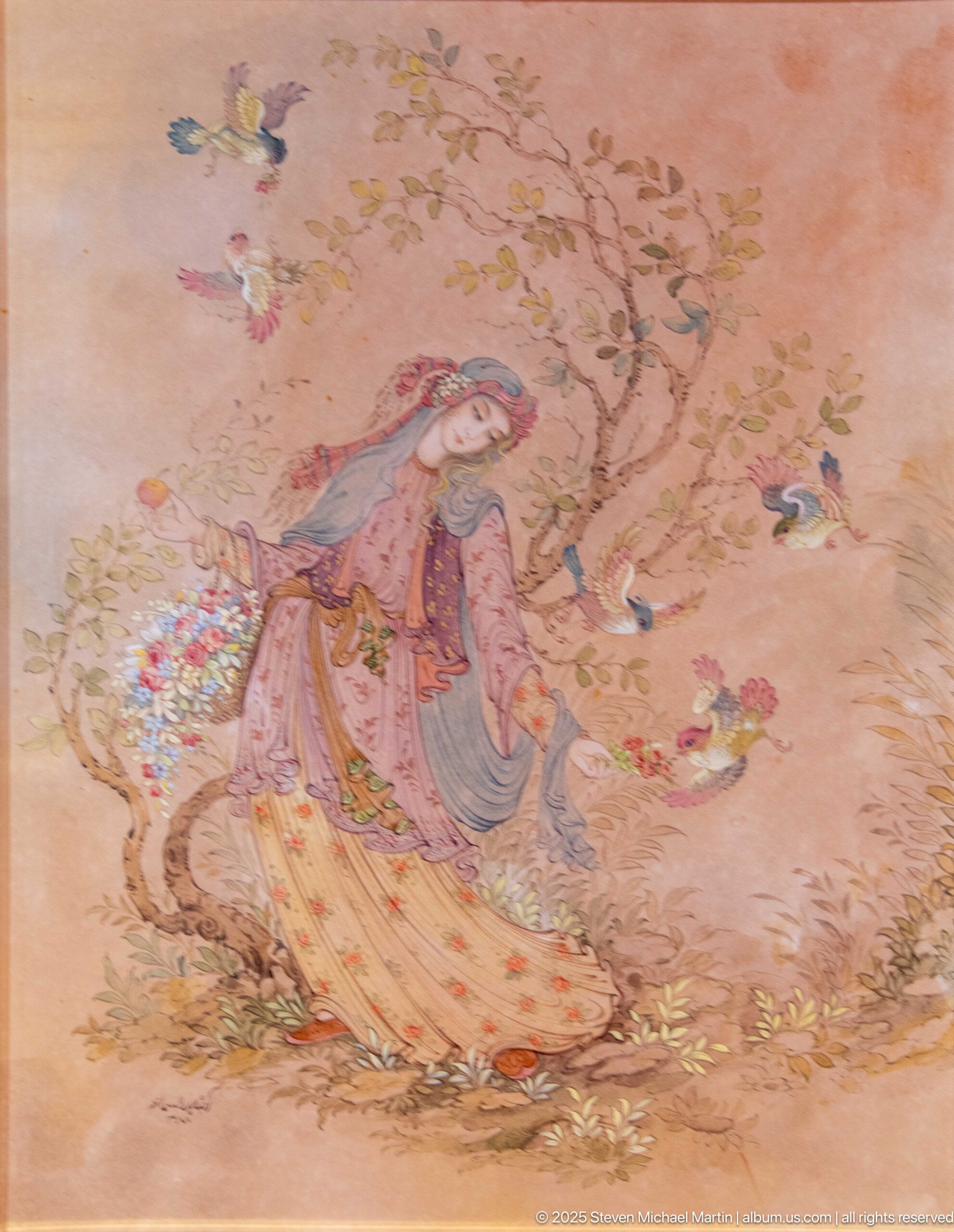
A miniature-style painting shows a richly dressed woman bending toward flowers beneath a slender flowering tree. Birds perch and flutter among the branches while blossoms scatter across a warm pink ground. Her patterned garments, delicately rendered foliage, and intimate garden setting make the human figure and natural motifs the focus of the composition.
Caption
A miniature-style painting shows a richly dressed woman bending toward flowers beneath a slender flowering tree. Birds perch and flutter among the branches while blossoms scatter across a warm pink ground. Her patterned garments, delicately rendered foliage, and intimate garden setting make the human figure and natural motifs the focus of the composition.
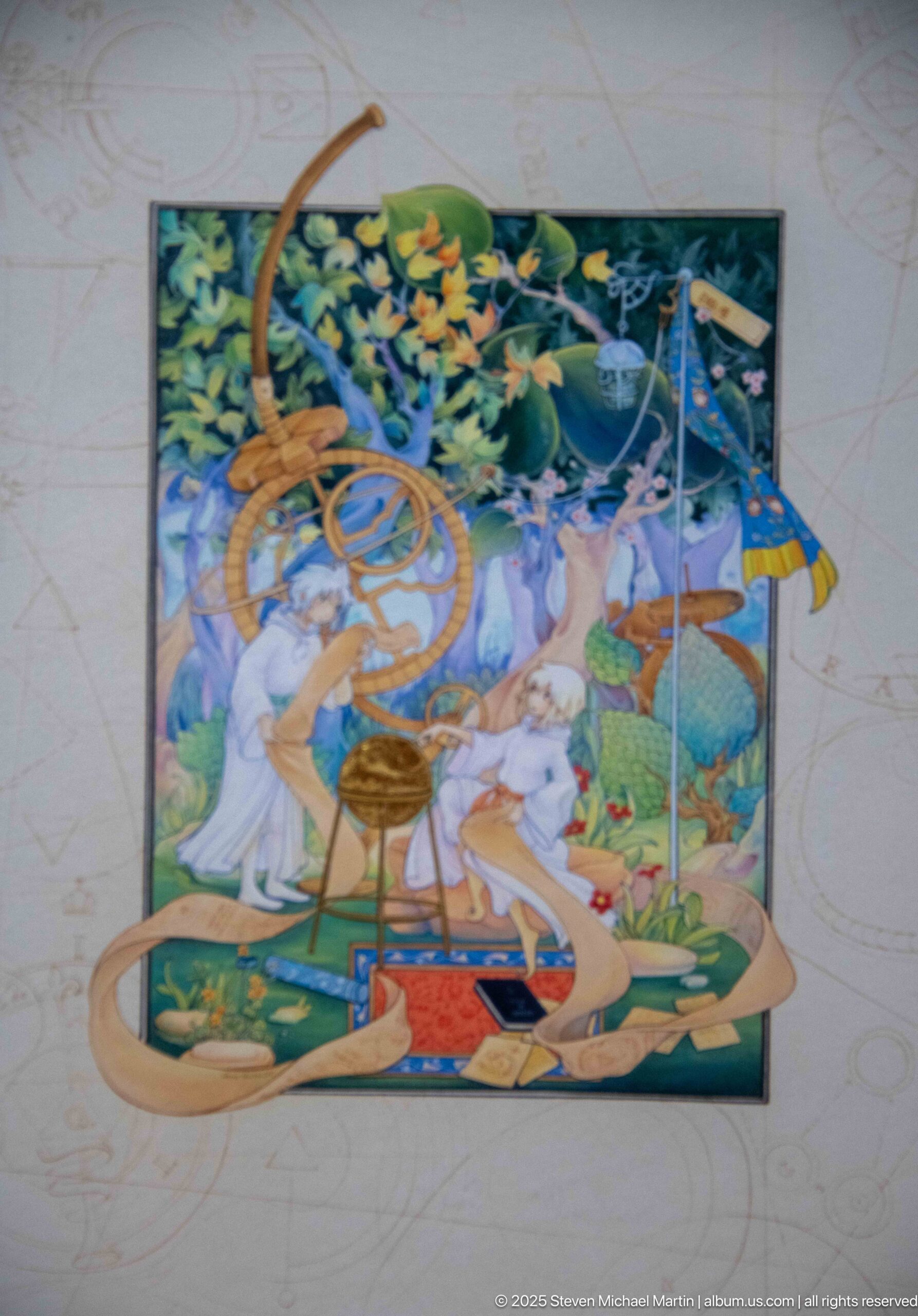
A colorful miniature combines seated figures in a garden-like setting with large looping tan forms that sweep across and beyond the painted rectangle. Trees, foliage, vessels, and small human figures occupy the detailed interior scene, while the oversized linear elements transform the composition into a hybrid of figuration and calligraphic or ornamental design.
Caption
A colorful miniature combines seated figures in a garden-like setting with large looping tan forms that sweep across and beyond the painted rectangle. Trees, foliage, vessels, and small human figures occupy the detailed interior scene, while the oversized linear elements transform the composition into a hybrid of figuration and calligraphic or ornamental design.
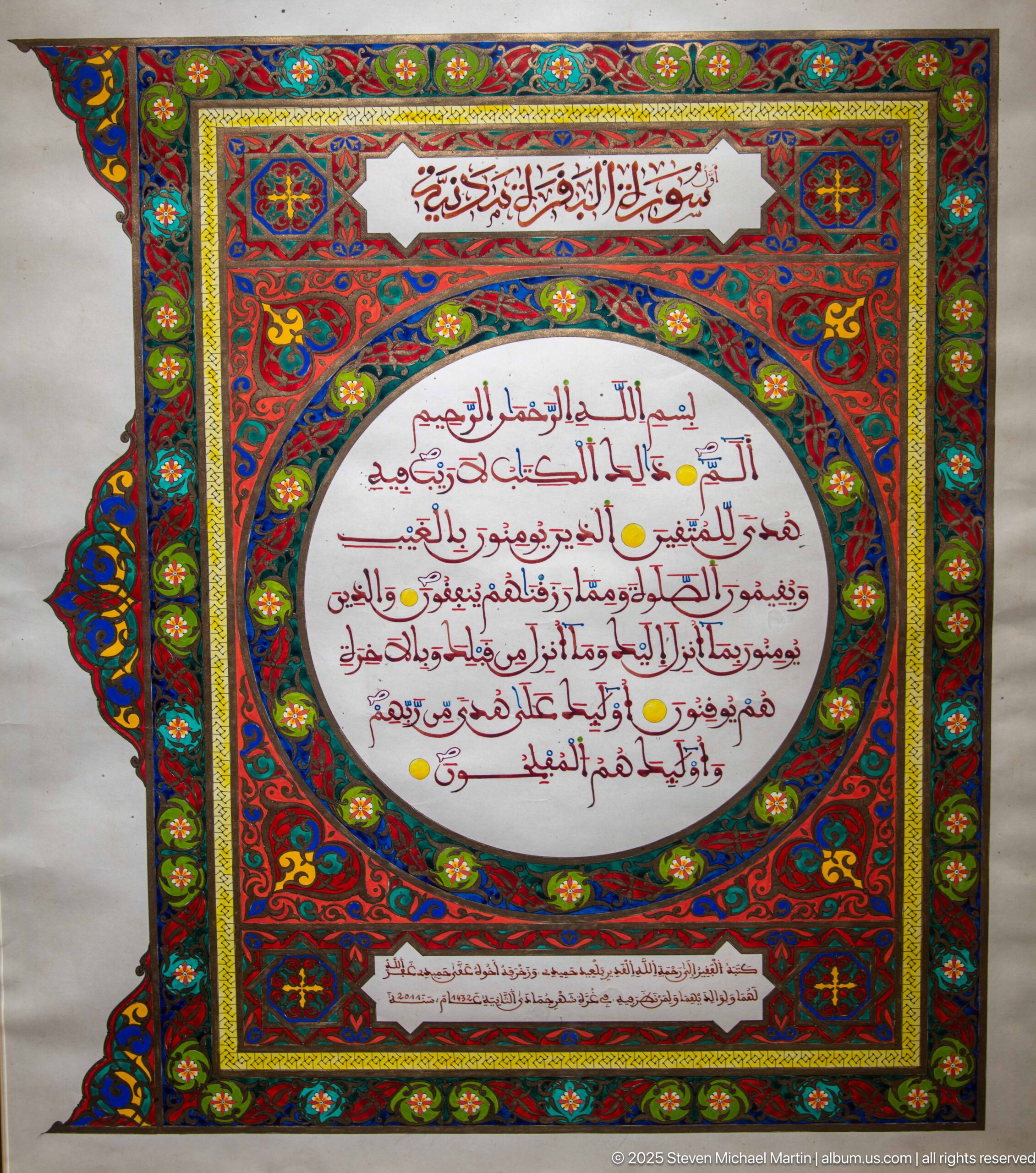
A manuscript-style page presents multiple lines of Arabic text inside a large white oval field, enclosed by dense red, blue, green, and gold illumination. A smaller calligraphic heading sits above the central panel, while layered floral and geometric borders create a vivid architectural frame around the writing.
Caption
A manuscript-style page presents multiple lines of Arabic text inside a large white oval field, enclosed by dense red, blue, green, and gold illumination. A smaller calligraphic heading sits above the central panel, while layered floral and geometric borders create a vivid architectural frame around the writing.
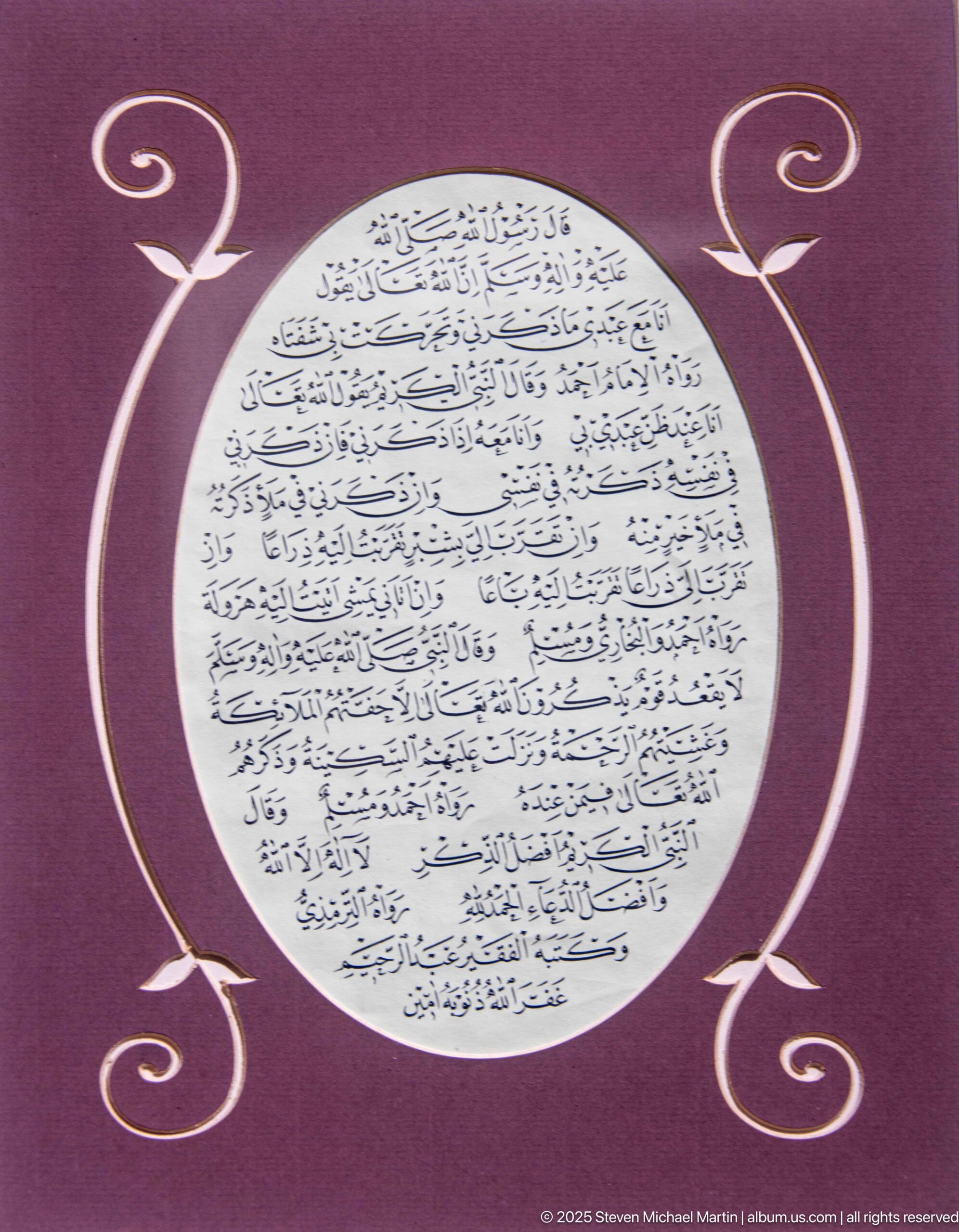
A dense block of Arabic writing fills a large white circle set against a deep purple field. Thin pale lines curve around the circle and terminate in elegant spirals and pointed flourishes, creating a restrained decorative frame that contrasts with the compact handwritten text at the center.
Caption
A dense block of Arabic writing fills a large white circle set against a deep purple field. Thin pale lines curve around the circle and terminate in elegant spirals and pointed flourishes, creating a restrained decorative frame that contrasts with the compact handwritten text at the center.
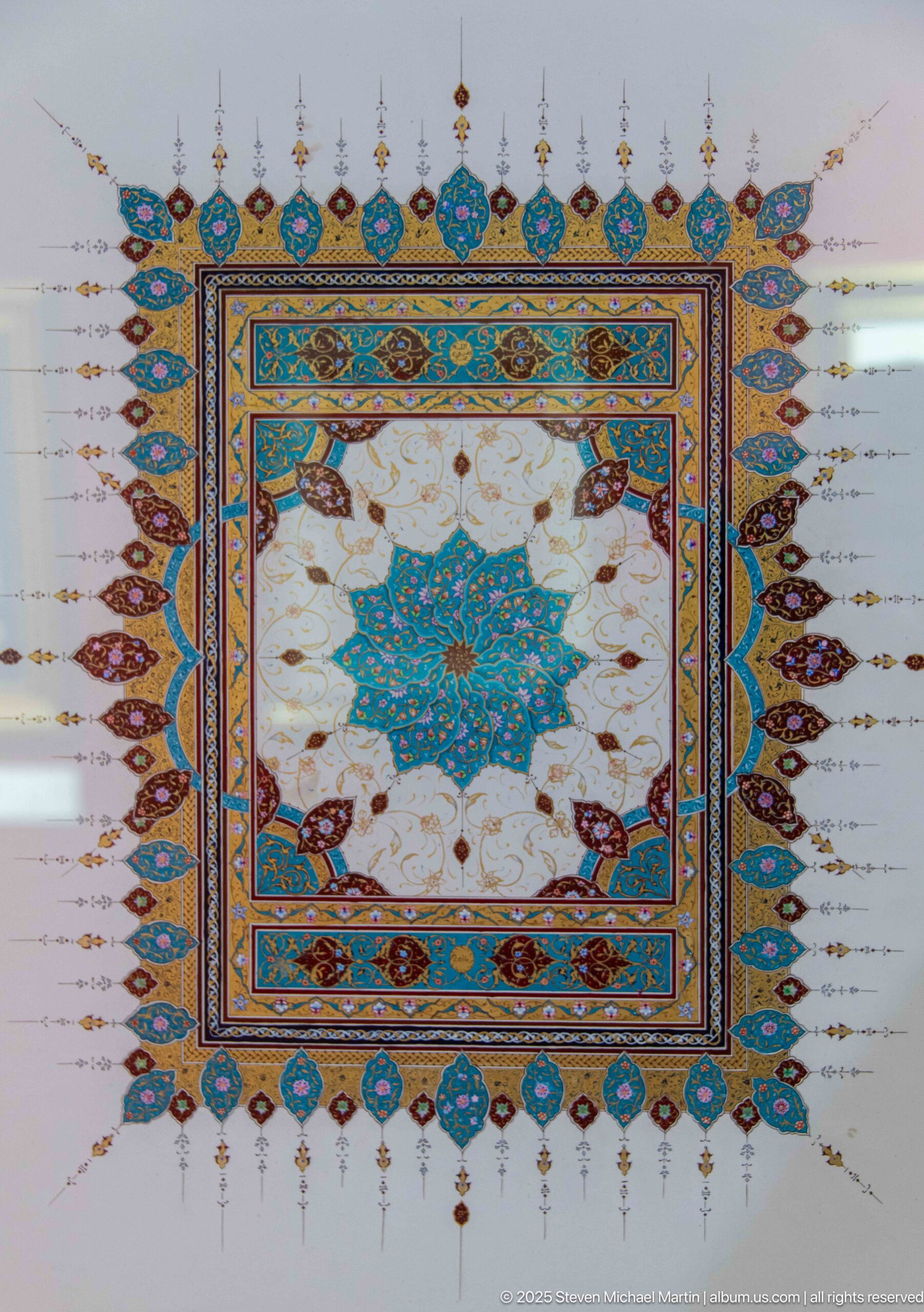
A square illuminated composition centers on a turquoise starburst or floral medallion surrounded by pale scrolling vines and small blossoms. Multiple rectangular borders in turquoise, blue, gold, red, and brown frame the central field, while pendant-like motifs project rhythmically from all four sides to extend the design beyond its main square.
Caption
A square illuminated composition centers on a turquoise starburst or floral medallion surrounded by pale scrolling vines and small blossoms. Multiple rectangular borders in turquoise, blue, gold, red, and brown frame the central field, while pendant-like motifs project rhythmically from all four sides to extend the design beyond its main square.
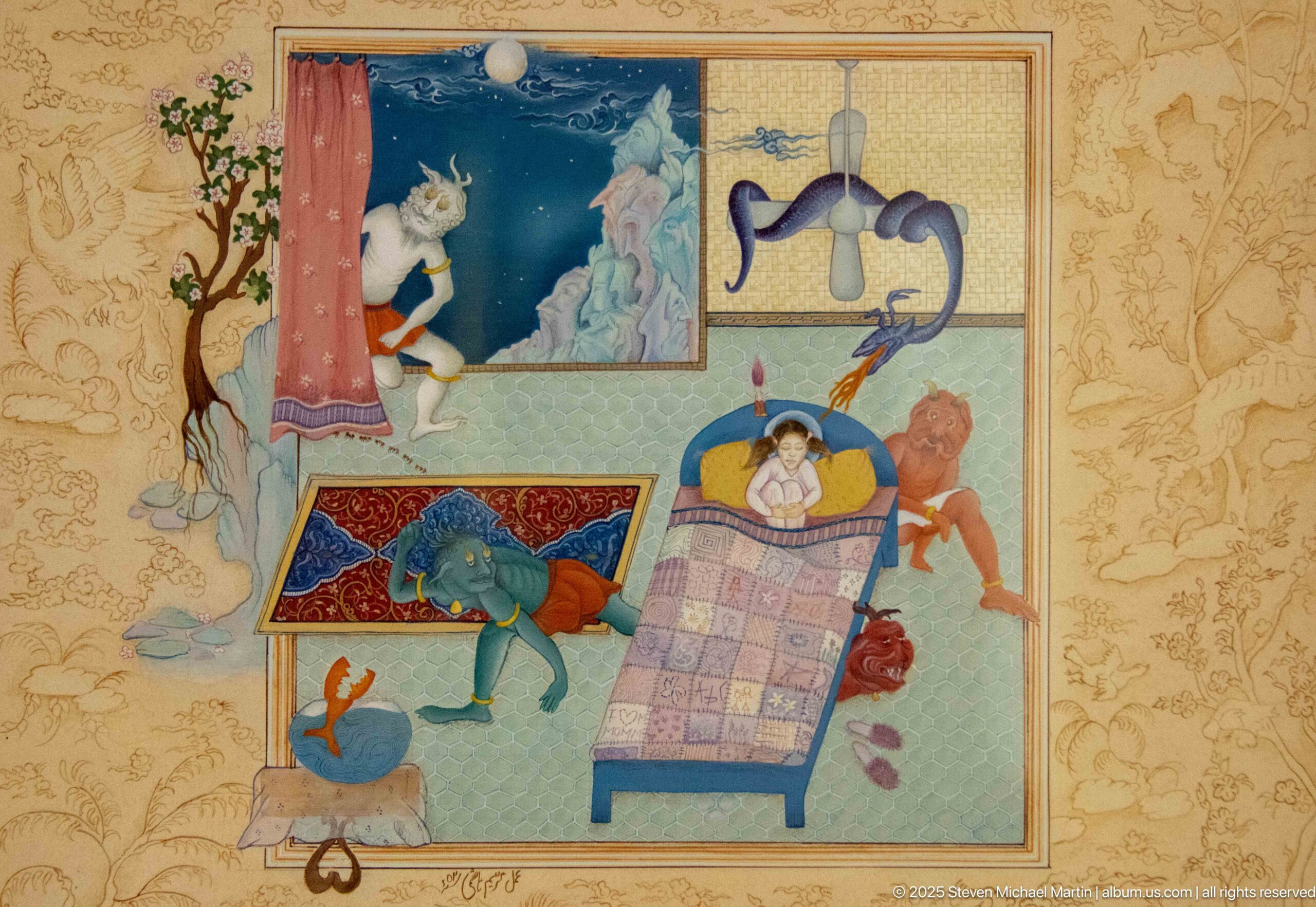
A miniature-style narrative scene places a sleeping figure in a patterned bed within a fantastical interior populated by vividly colored creatures. Animal-like and humanlike beings approach from several directions, while a moonlit mountainous landscape appears through an opening at upper left. The composition reads as an illustrated story rather than a documentary scene.
Caption
A miniature-style narrative scene places a sleeping figure in a patterned bed within a fantastical interior populated by vividly colored creatures. Animal-like and humanlike beings approach from several directions, while a moonlit mountainous landscape appears through an opening at upper left. The composition reads as an illustrated story rather than a documentary scene.
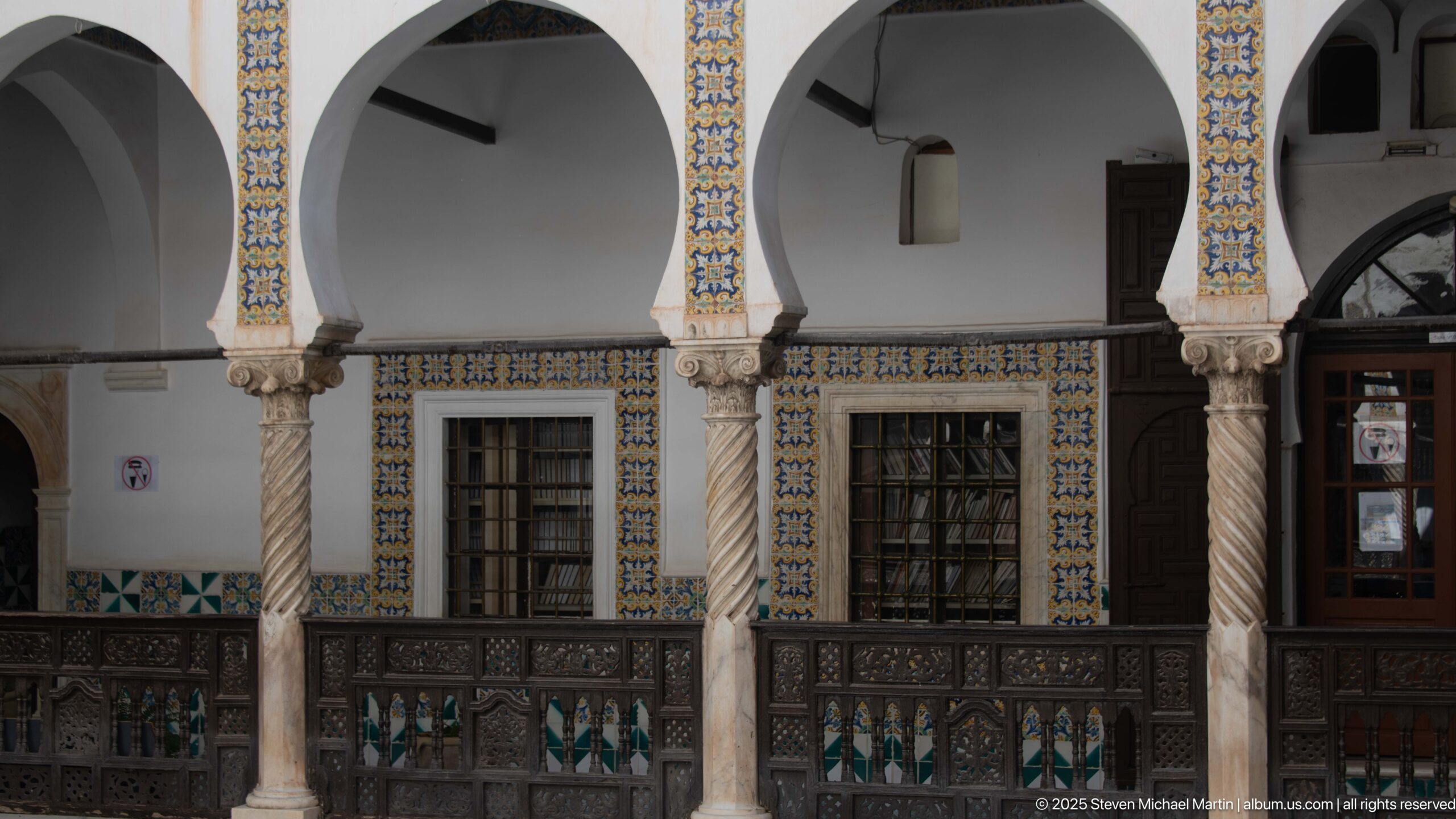
Two spiral-fluted columns divide an upper gallery wall at Dar Mustapha Pacha, where barred windows are surrounded by blue-and-yellow patterned tile borders. A dark carved wooden balustrade runs across the foreground, layering geometric woodwork against the tiled masonry and white arches above.
Caption
Two spiral-fluted columns divide an upper gallery wall at Dar Mustapha Pacha, where barred windows are surrounded by blue-and-yellow patterned tile borders. A dark carved wooden balustrade runs across the foreground, layering geometric woodwork against the tiled masonry and white arches above.
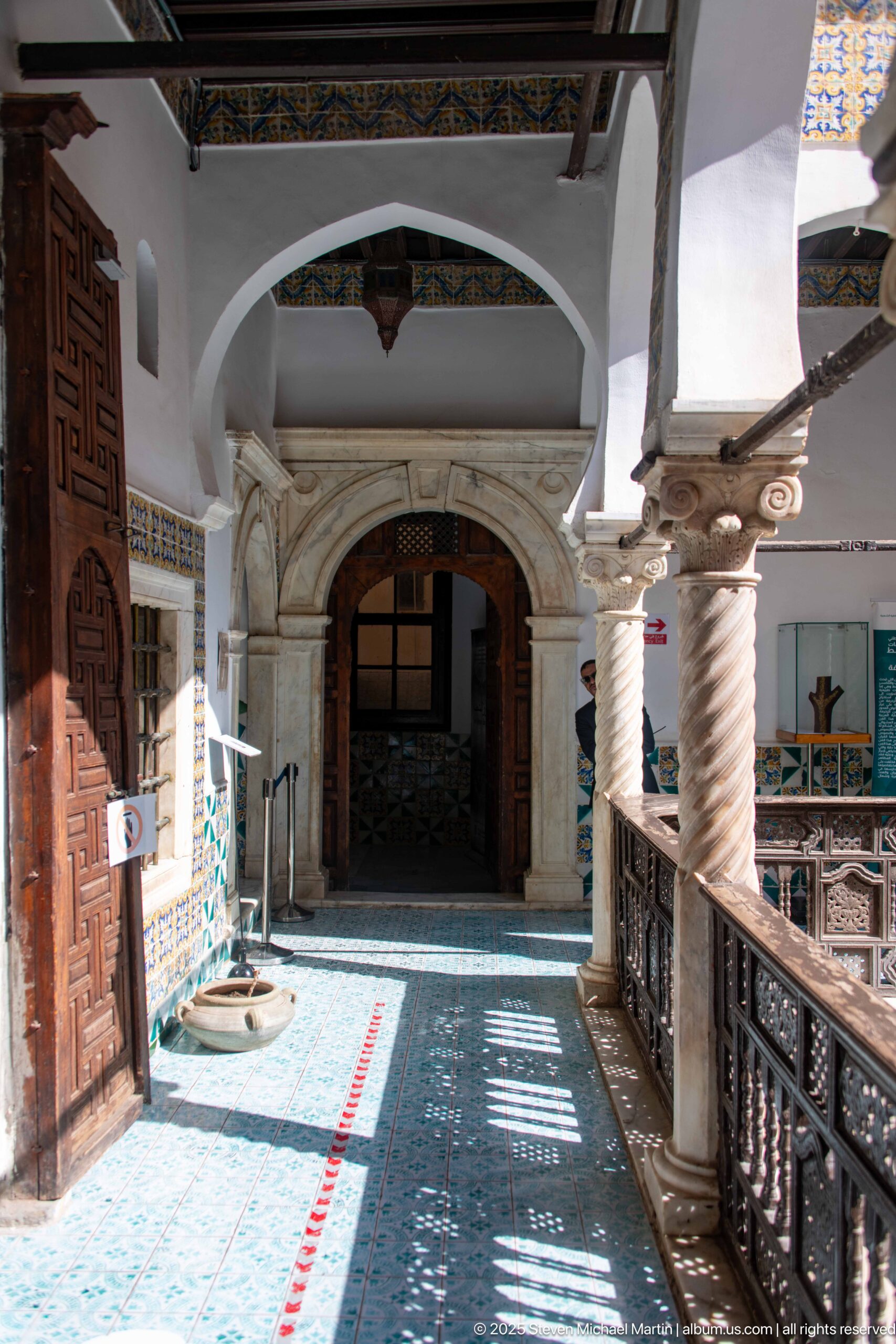
A sunlit upper-level passage at Dar Mustapha Pacha leads toward a large arched doorway framed in pale stone. Spiral columns and a carved wooden balustrade line the open courtyard side, while patterned floor tiles and a narrow red guide line draw the eye toward the shadowed doorway at the far end.
Caption
A sunlit upper-level passage at Dar Mustapha Pacha leads toward a large arched doorway framed in pale stone. Spiral columns and a carved wooden balustrade line the open courtyard side, while patterned floor tiles and a narrow red guide line draw the eye toward the shadowed doorway at the far end.
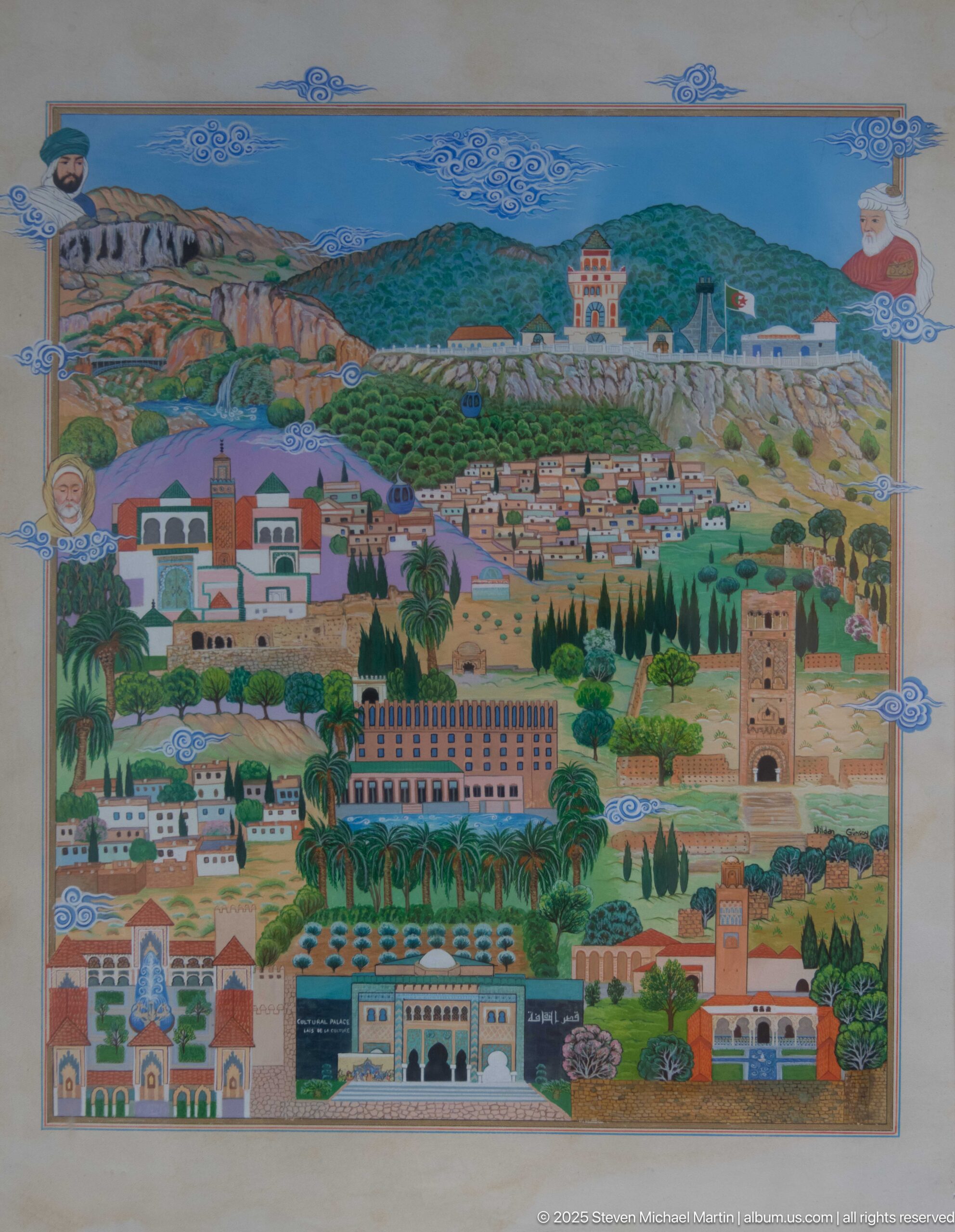
A panoramic miniature-style landscape assembles gardens, tree-lined avenues, towers, villas, and larger institutional buildings across a broad hillside. Mountains rise in the distance beneath stylized clouds, while carefully differentiated architecture and vegetation create a topographic overview that appears intended to describe a specific place rather than an imaginary garden alone.
Caption
A panoramic miniature-style landscape assembles gardens, tree-lined avenues, towers, villas, and larger institutional buildings across a broad hillside. Mountains rise in the distance beneath stylized clouds, while carefully differentiated architecture and vegetation create a topographic overview that appears intended to describe a specific place rather than an imaginary garden alone.
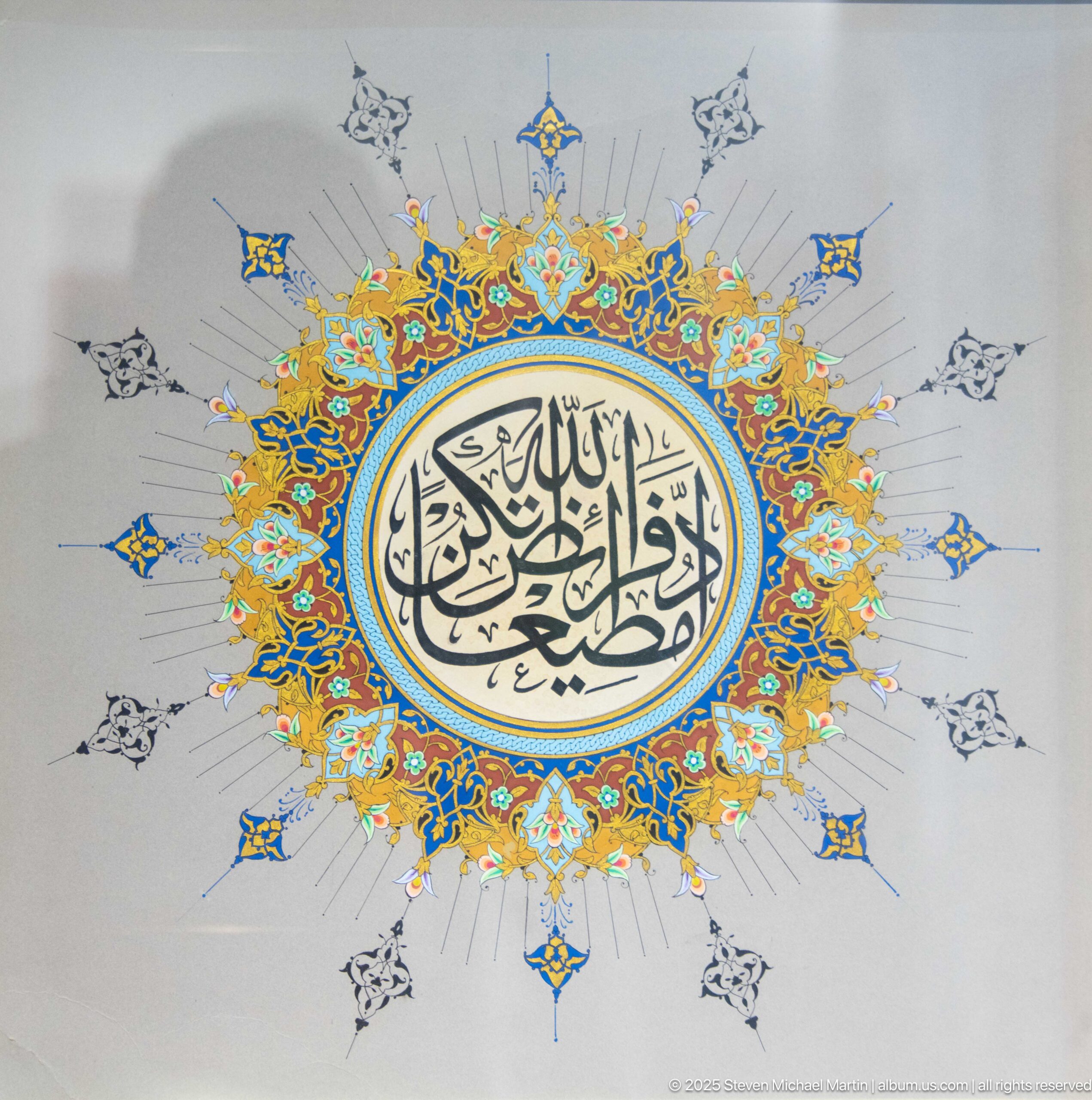
Bold Arabic calligraphy fills a central white oval surrounded by an elaborate turquoise, gold, orange, and blue illuminated medallion. Fine rays and small satellite ornaments extend outward across the pale ground, giving the compact central inscription a luminous, star-like presence and balancing dense ornament with generous negative space.
Caption
Bold Arabic calligraphy fills a central white oval surrounded by an elaborate turquoise, gold, orange, and blue illuminated medallion. Fine rays and small satellite ornaments extend outward across the pale ground, giving the compact central inscription a luminous, star-like presence and balancing dense ornament with generous negative space.
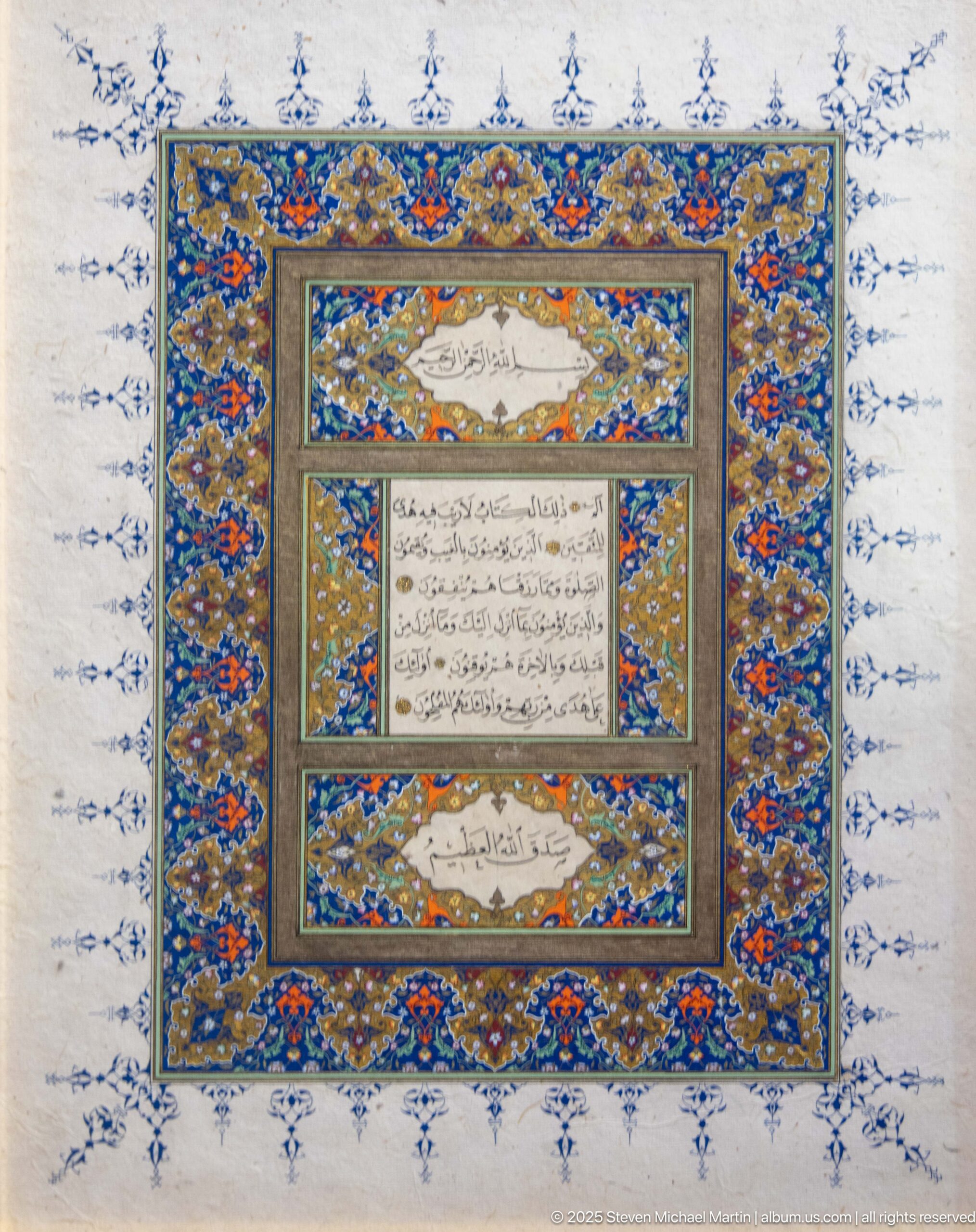
A manuscript-style composition places a rectangular Arabic text panel between smaller calligraphic cartouches, all enclosed by dense blue, gold, red, and green floral illumination. Delicate blue motifs continue beyond the main border onto the pale surrounding field, creating a layered page design in which text and ornament are carefully integrated.
Caption
A manuscript-style composition places a rectangular Arabic text panel between smaller calligraphic cartouches, all enclosed by dense blue, gold, red, and green floral illumination. Delicate blue motifs continue beyond the main border onto the pale surrounding field, creating a layered page design in which text and ornament are carefully integrated.
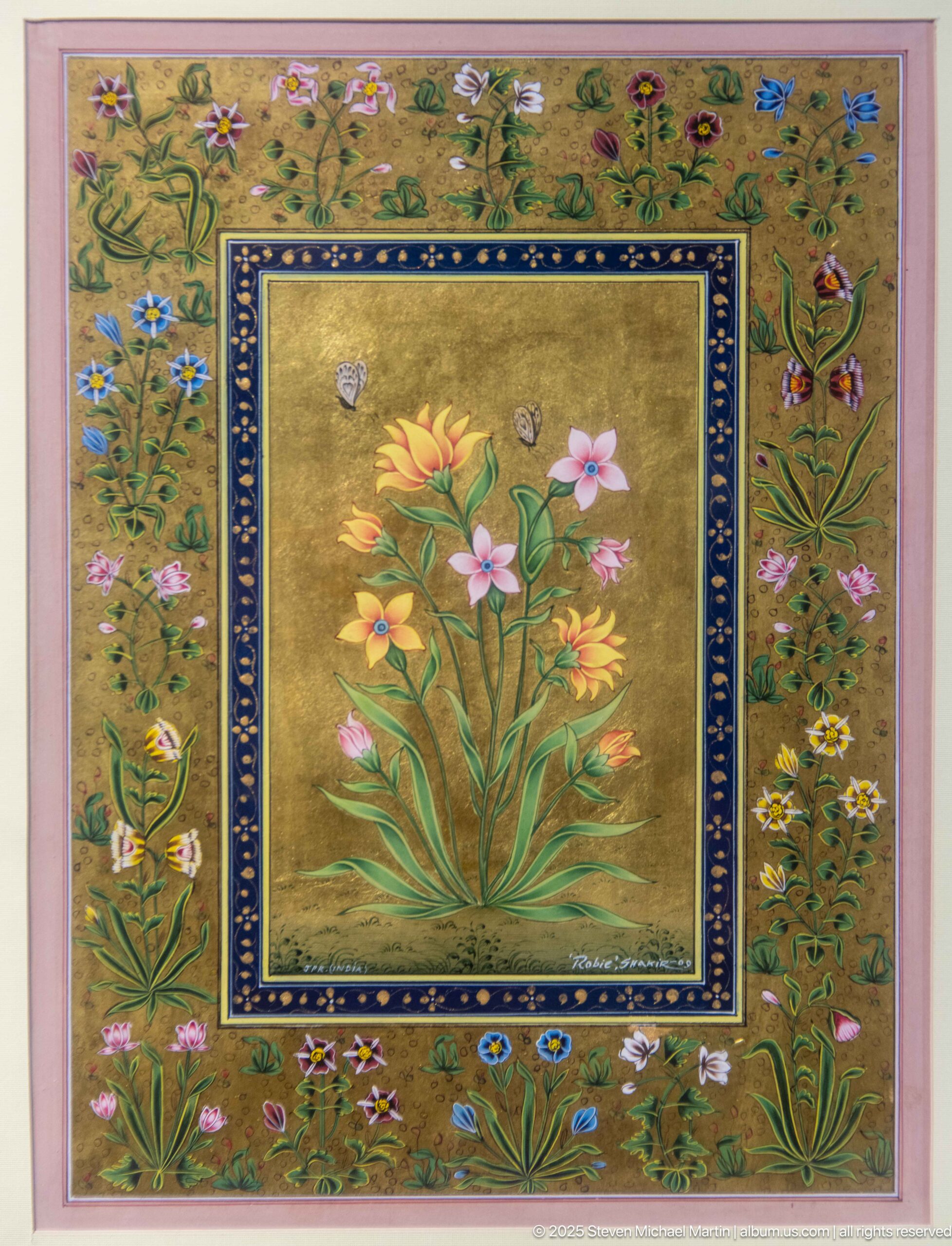
A delicate botanical painting centers a bouquet of orange, pink, yellow, and blue flowers against a muted gold field. The dark inner frame is surrounded by a wider brown border planted with individually rendered flowering stems, buds, leaves, and small birds or insects, turning the entire composition into a layered study of garden imagery.
Caption
A delicate botanical painting centers a bouquet of orange, pink, yellow, and blue flowers against a muted gold field. The dark inner frame is surrounded by a wider brown border planted with individually rendered flowering stems, buds, leaves, and small birds or insects, turning the entire composition into a layered study of garden imagery.
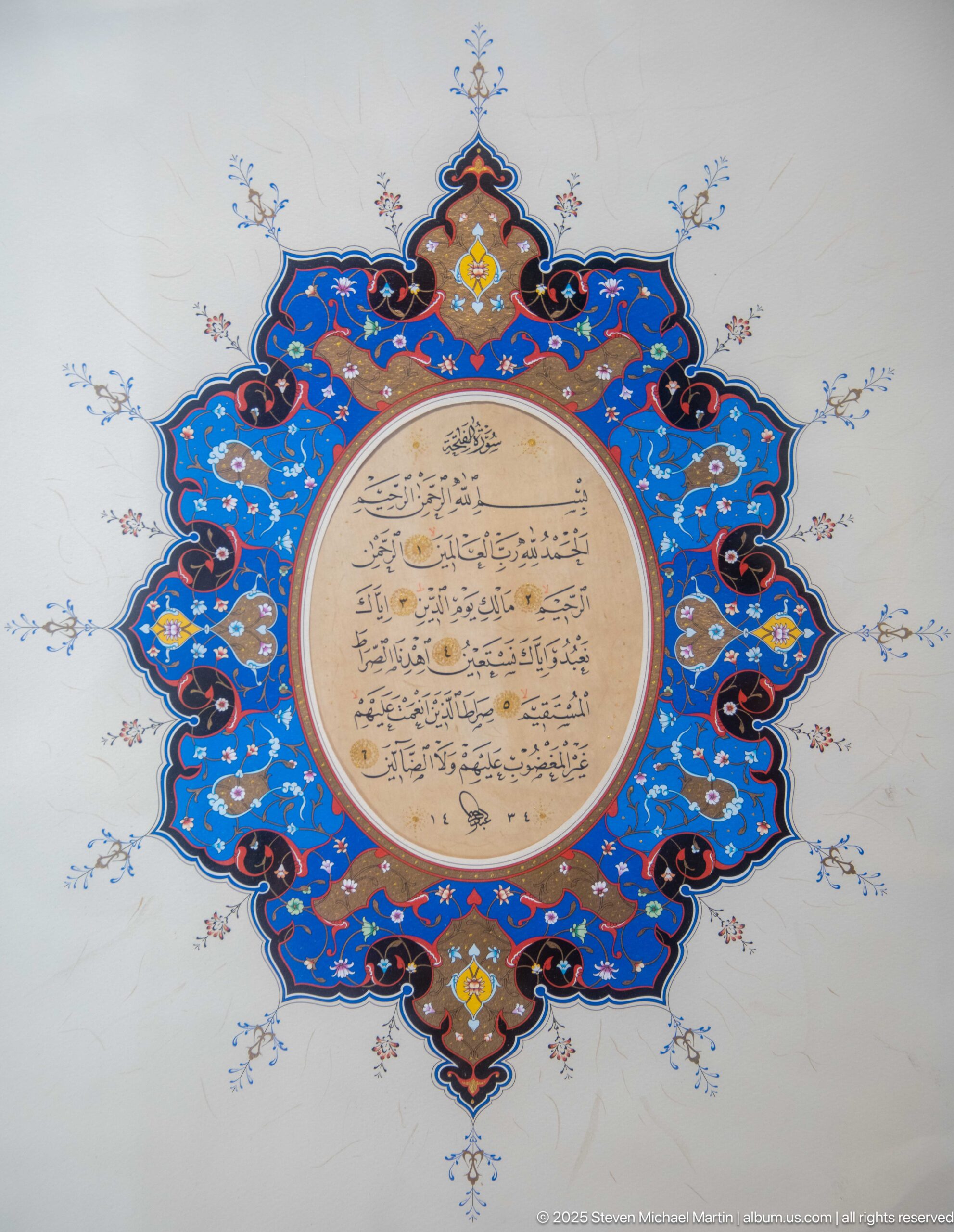
A circular field of fine Arabic writing is enclosed by an elaborate blue, red, gold, and turquoise illuminated surround. Four larger ornamental lobes punctuate the cardinal points while smaller blue forms build a scalloped perimeter, producing a balanced medallion that sets restrained script against dense decorative color.
Caption
A circular field of fine Arabic writing is enclosed by an elaborate blue, red, gold, and turquoise illuminated surround. Four larger ornamental lobes punctuate the cardinal points while smaller blue forms build a scalloped perimeter, producing a balanced medallion that sets restrained script against dense decorative color.
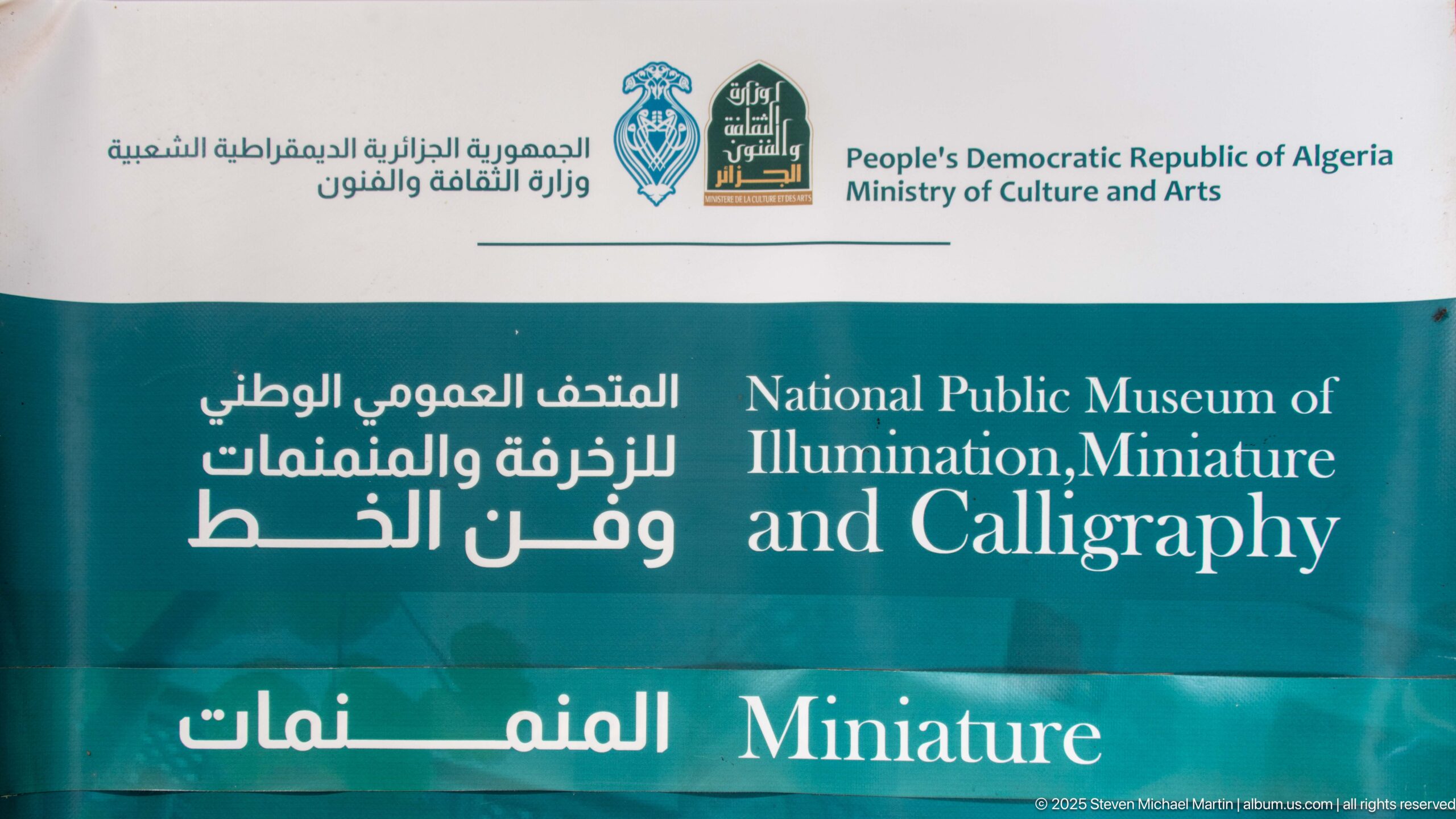
A bilingual Arabic-and-English sign identifies Algeria’s National Public Museum of Illumination, Miniature and Calligraphy, with the People’s Democratic Republic of Algeria and Ministry of Culture and Arts named above. The sign provides direct institutional context for the calligraphic and miniature works displayed within Dar Mustapha Pacha.
Caption
A bilingual Arabic-and-English sign identifies Algeria’s National Public Museum of Illumination, Miniature and Calligraphy, with the People’s Democratic Republic of Algeria and Ministry of Culture and Arts named above. The sign provides direct institutional context for the calligraphic and miniature works displayed within Dar Mustapha Pacha.
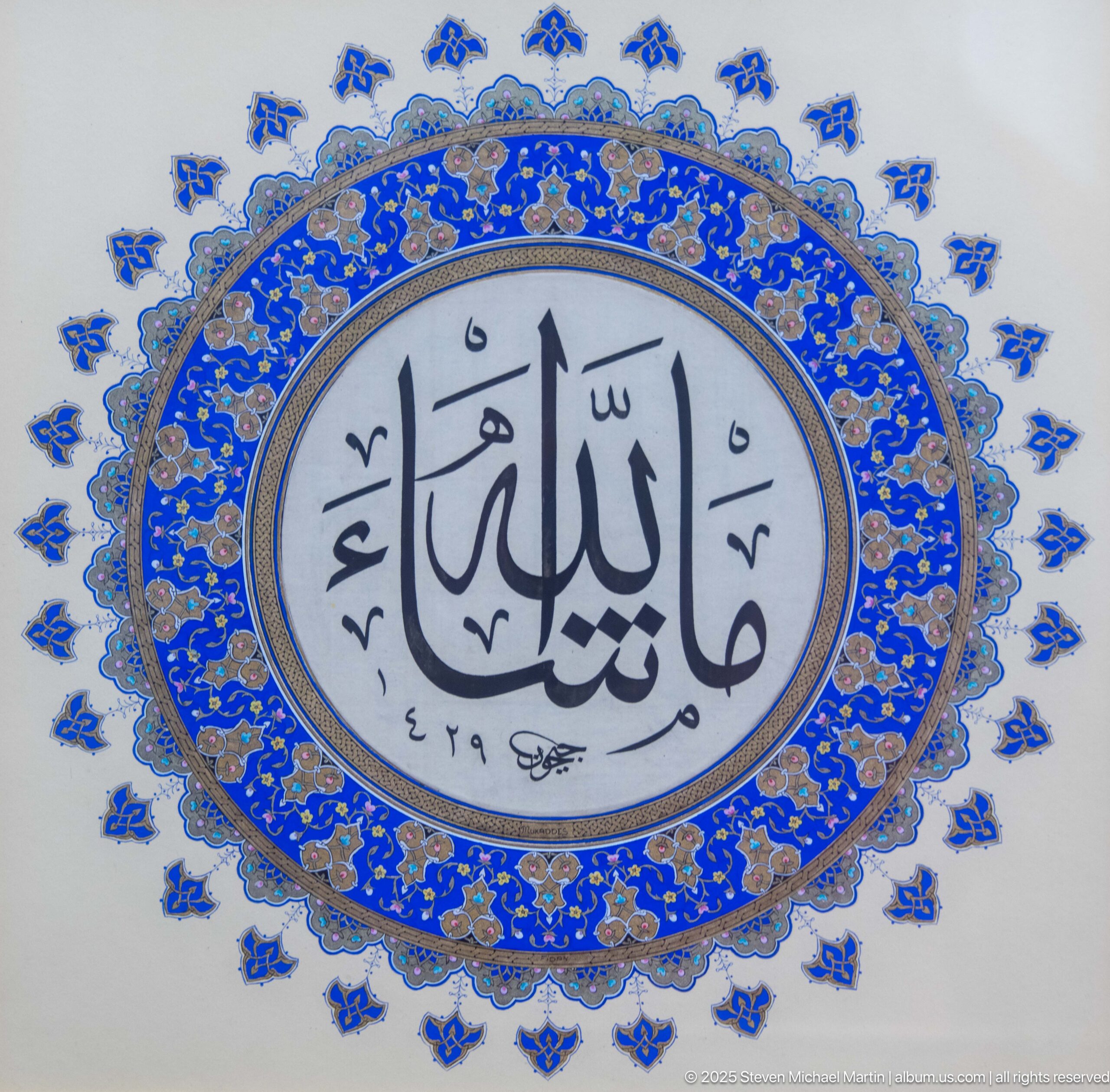
A bold Arabic inscription fills a pale oval cartouche encircled by dense cobalt-blue and gold illumination. Repeating small blue motifs ring the outer edge, while scrolling vegetal ornament within the broad border creates a rich frame for the restrained black calligraphy at the center.
Caption
A bold Arabic inscription fills a pale oval cartouche encircled by dense cobalt-blue and gold illumination. Repeating small blue motifs ring the outer edge, while scrolling vegetal ornament within the broad border creates a rich frame for the restrained black calligraphy at the center.
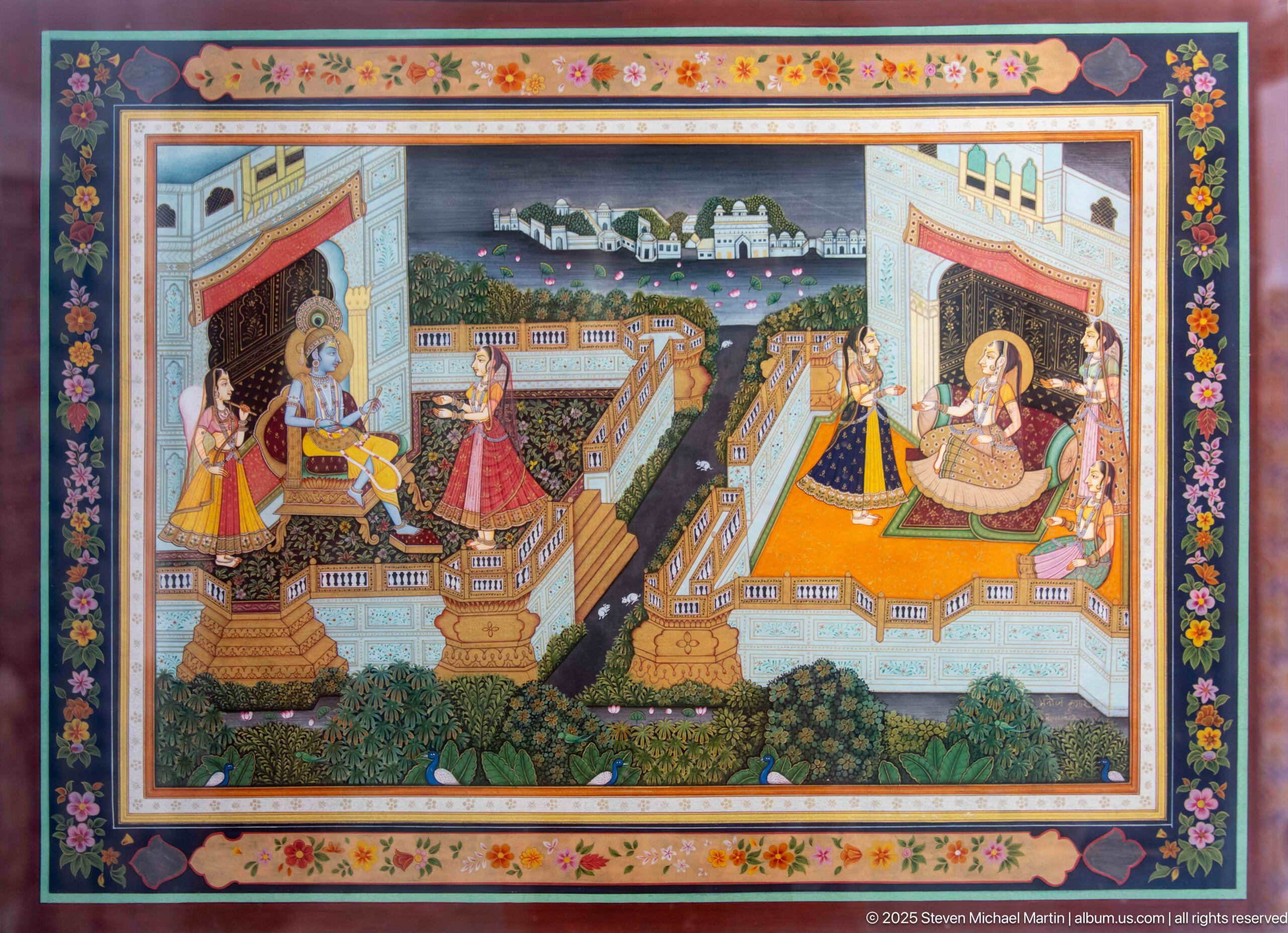
A richly detailed miniature presents several courtly figures within and around an ornate palace complex. Figures occupy balconies and chambers on both sides of a central garden or watercourse, while terraces, patterned textiles, trees, and distant white buildings create multiple layers of space. A floral border encloses the narrative scene like an illuminated manuscript page.
Caption
A richly detailed miniature presents several courtly figures within and around an ornate palace complex. Figures occupy balconies and chambers on both sides of a central garden or watercourse, while terraces, patterned textiles, trees, and distant white buildings create multiple layers of space. A floral border encloses the narrative scene like an illuminated manuscript page.
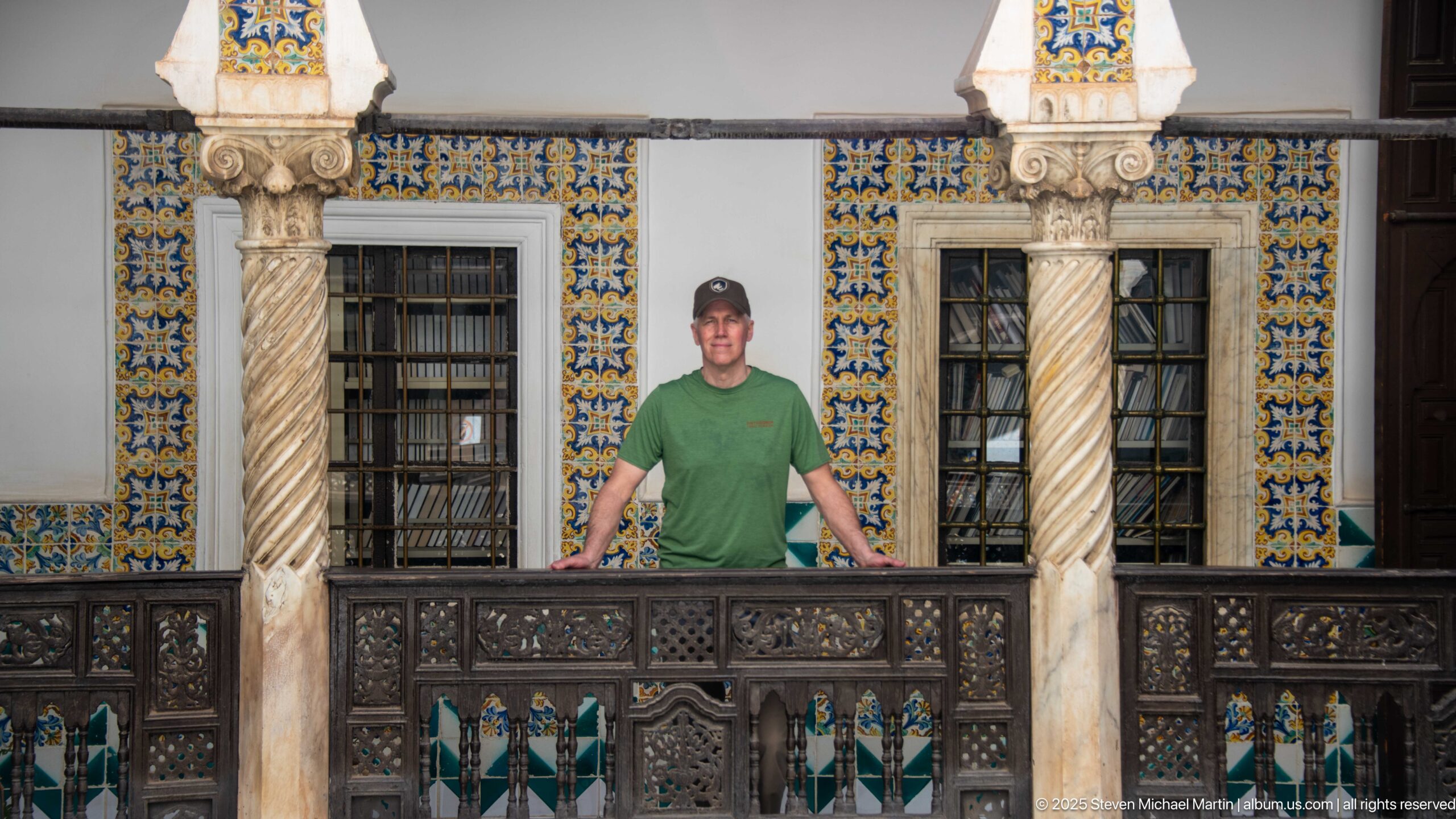
A visitor stands behind the carved wooden balustrade of an upper gallery at Dar Mustapha Pacha, centered between two spiral-fluted stone columns. Blue-and-yellow tile borders frame the barred windows behind him, while the symmetrical architecture turns the informal portrait into a useful record of human scale within the palace gallery.
Caption
A visitor stands behind the carved wooden balustrade of an upper gallery at Dar Mustapha Pacha, centered between two spiral-fluted stone columns. Blue-and-yellow tile borders frame the barred windows behind him, while the symmetrical architecture turns the informal portrait into a useful record of human scale within the palace gallery.
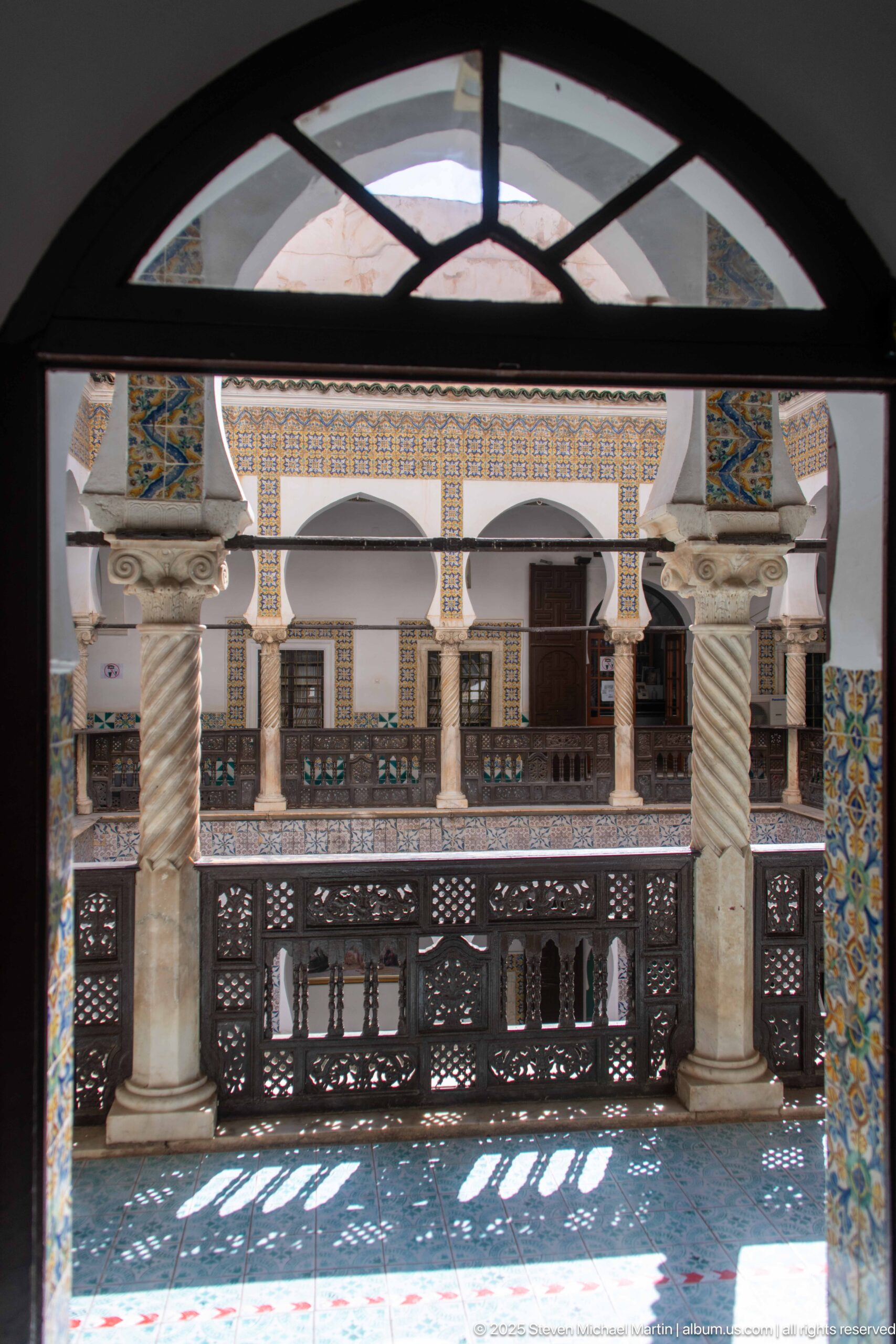
An upper gallery at Dar Mustapha Pacha is viewed from deep shade, with a dark overhead arch framing spiral columns, carved wooden balustrades, and the opposite tiled courtyard wall. Bright patterned light falls across the floor, turning the open gallery into a study of contrast between shaded circulation space and the sunlit court.
Caption
An upper gallery at Dar Mustapha Pacha is viewed from deep shade, with a dark overhead arch framing spiral columns, carved wooden balustrades, and the opposite tiled courtyard wall. Bright patterned light falls across the floor, turning the open gallery into a study of contrast between shaded circulation space and the sunlit court.
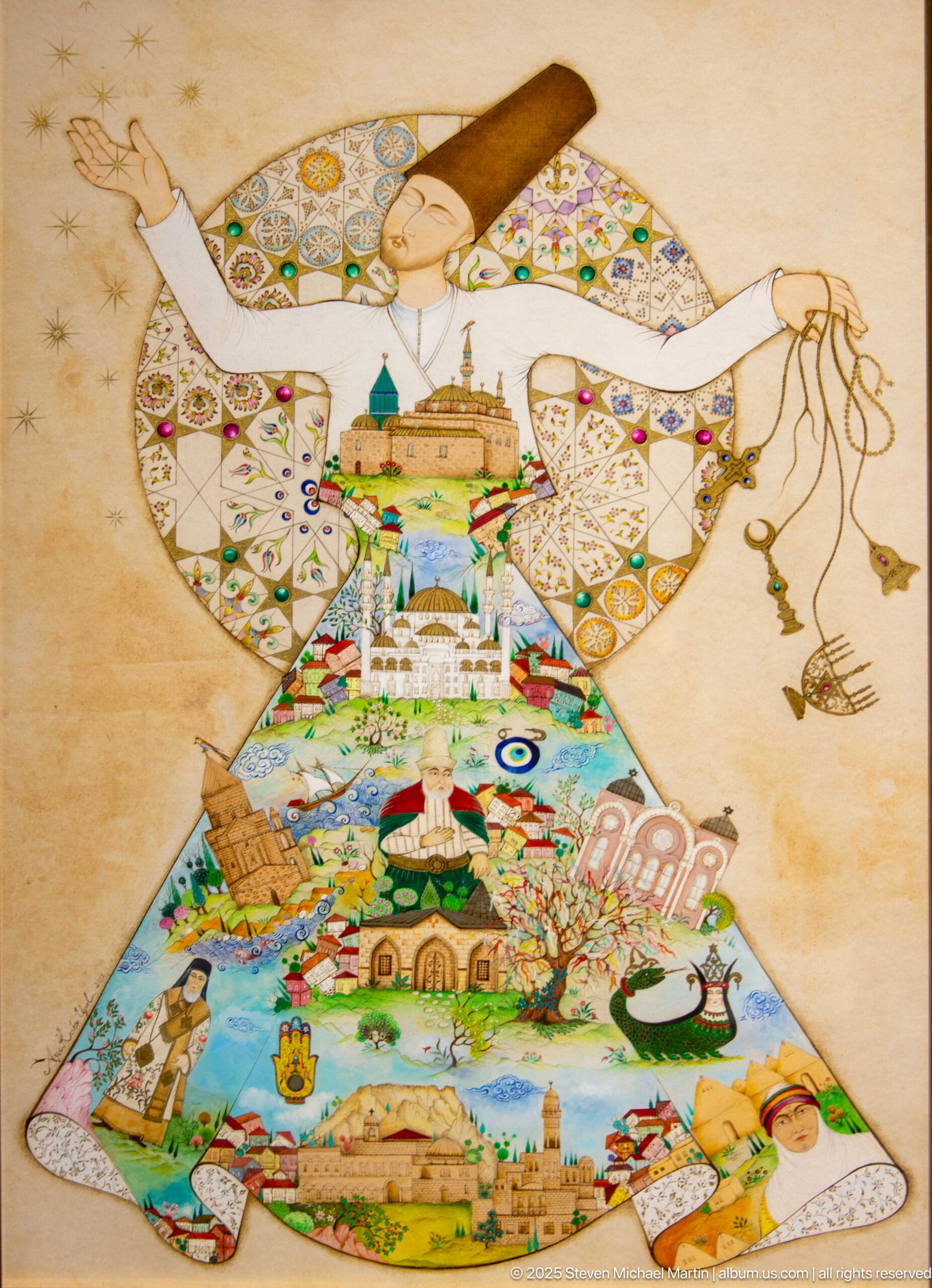
A garment-shaped decorative composition is filled with miniature architectural and landscape scenes. Domes, towers, gardens, monuments, and figures spread across the flared lower section, while patterned panels and a hand-like form occupy the upper area. Loose cords and tassels extend to the right, reinforcing the work’s textile or costume-inspired silhouette.
Caption
A garment-shaped decorative composition is filled with miniature architectural and landscape scenes. Domes, towers, gardens, monuments, and figures spread across the flared lower section, while patterned panels and a hand-like form occupy the upper area. Loose cords and tassels extend to the right, reinforcing the work’s textile or costume-inspired silhouette.
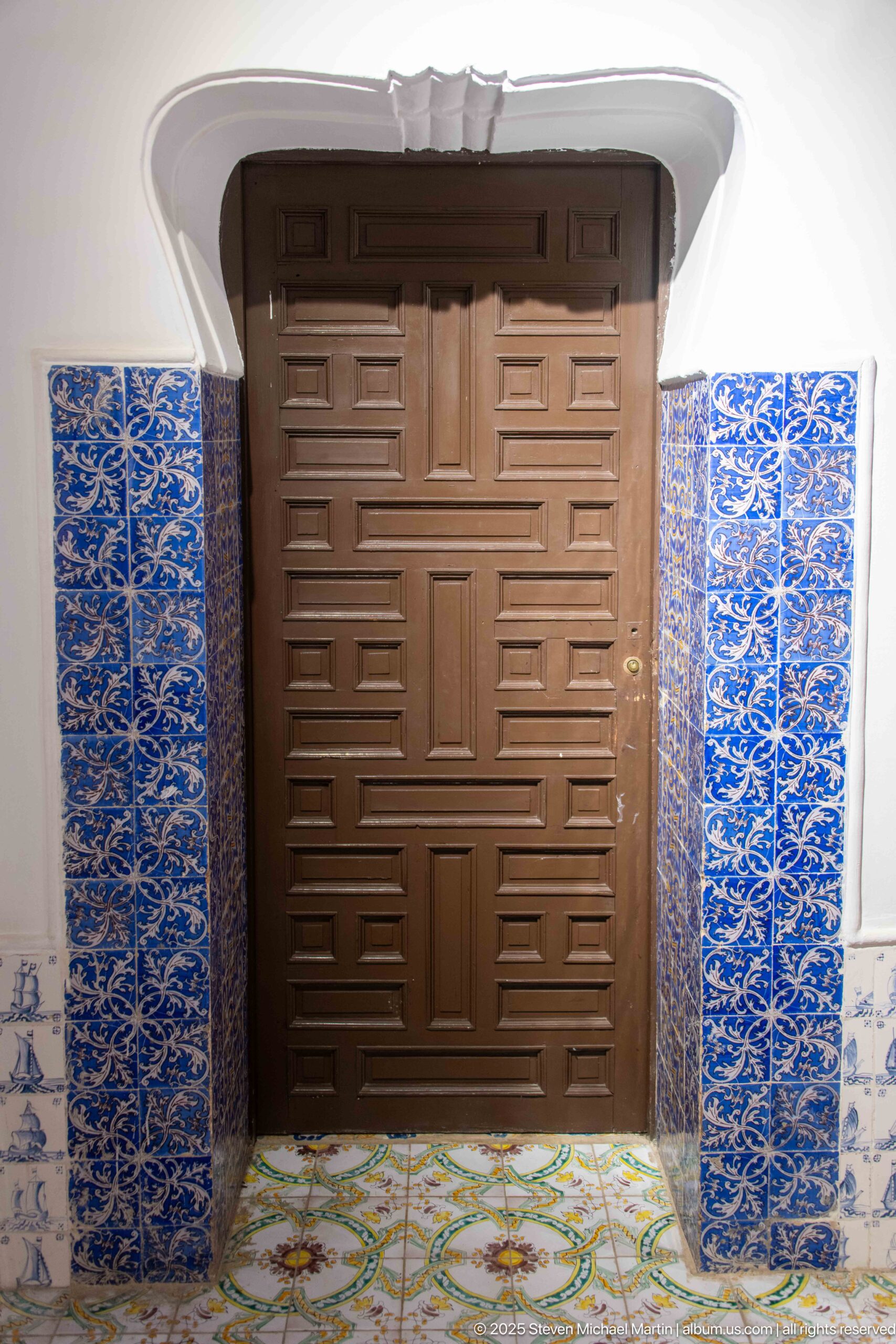
A broad brown wooden door at Dar Mustapha Pacha is constructed from repeating recessed rectangular panels arranged in a strong geometric grid. Tall bands of cobalt-blue patterned tiles flank the doorway, while multicolored floor tiles meet the threshold, creating a concentrated study of wood, ceramic decoration, and architectural symmetry.
Caption
A broad brown wooden door at Dar Mustapha Pacha is constructed from repeating recessed rectangular panels arranged in a strong geometric grid. Tall bands of cobalt-blue patterned tiles flank the doorway, while multicolored floor tiles meet the threshold, creating a concentrated study of wood, ceramic decoration, and architectural symmetry.
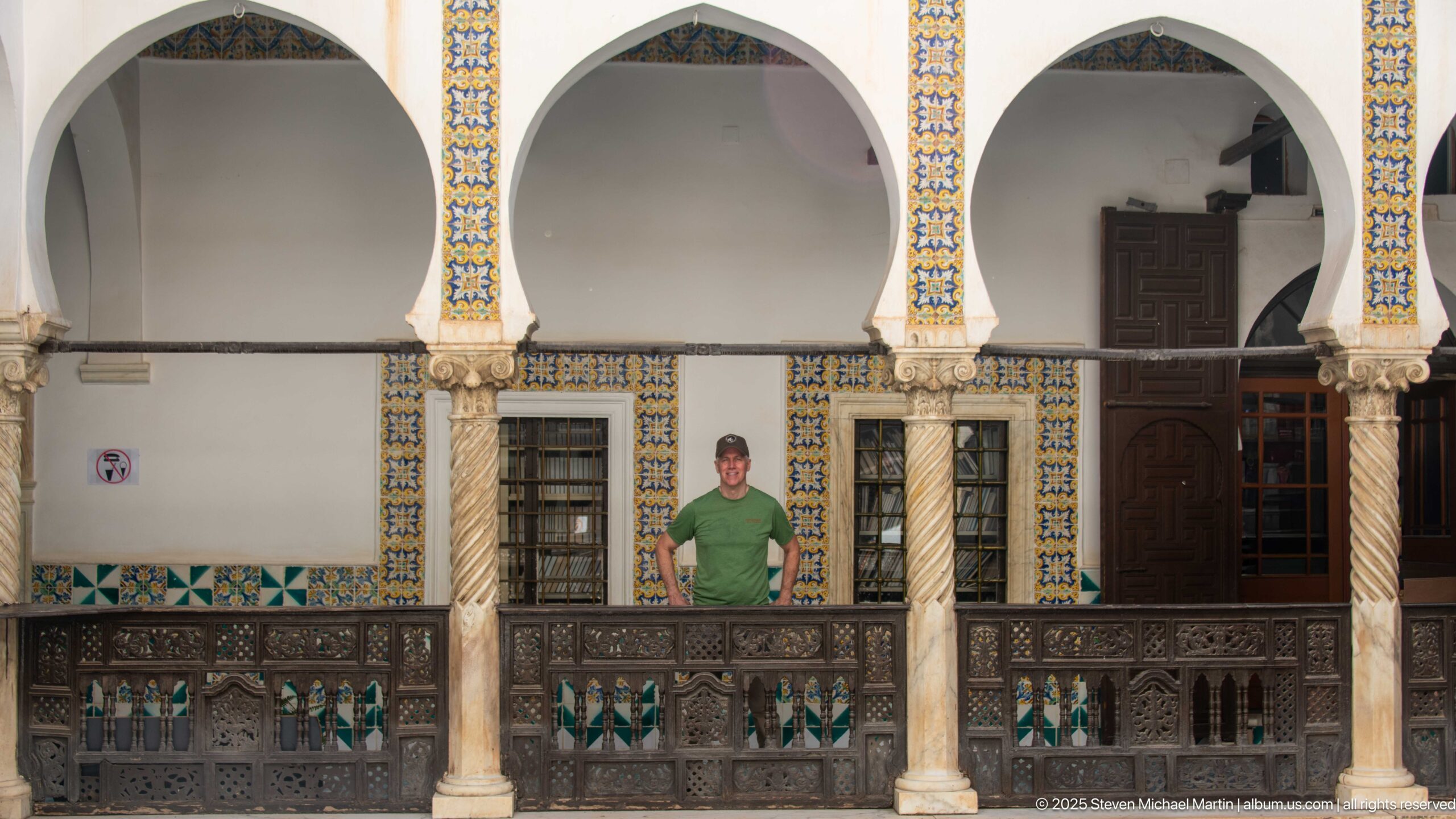
A wider courtyard view places a lone visitor behind the upper wooden balustrade beneath three tall white arches. Spiral columns divide the bays, blue-and-yellow tiles outline the windows and piers, and a dark wooden door anchors the right side. The expanded framing emphasizes the scale and repetition of the gallery rather than the portrait itself.
Caption
A wider courtyard view places a lone visitor behind the upper wooden balustrade beneath three tall white arches. Spiral columns divide the bays, blue-and-yellow tiles outline the windows and piers, and a dark wooden door anchors the right side. The expanded framing emphasizes the scale and repetition of the gallery rather than the portrait itself.
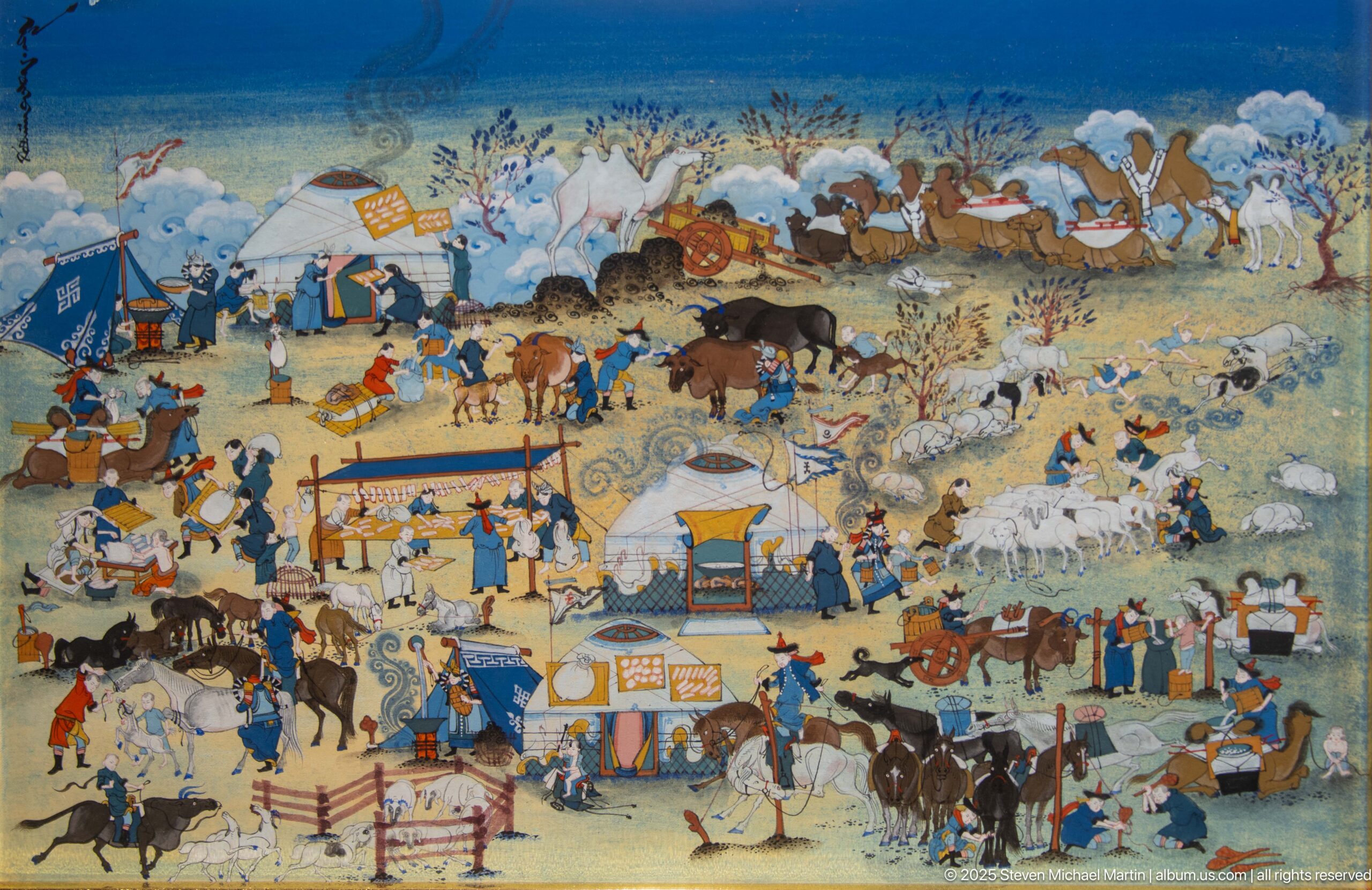
A crowded miniature-style scene portrays a mobile encampment spread across an open landscape, with horses, camels, tents, carts, livestock, and numerous figures engaged in travel and camp activities. Groups move across the upper horizon while denser activity gathers around tents below, creating a panoramic narrative of pastoral or caravan life.
Caption
A crowded miniature-style scene portrays a mobile encampment spread across an open landscape, with horses, camels, tents, carts, livestock, and numerous figures engaged in travel and camp activities. Groups move across the upper horizon while denser activity gathers around tents below, creating a panoramic narrative of pastoral or caravan life.
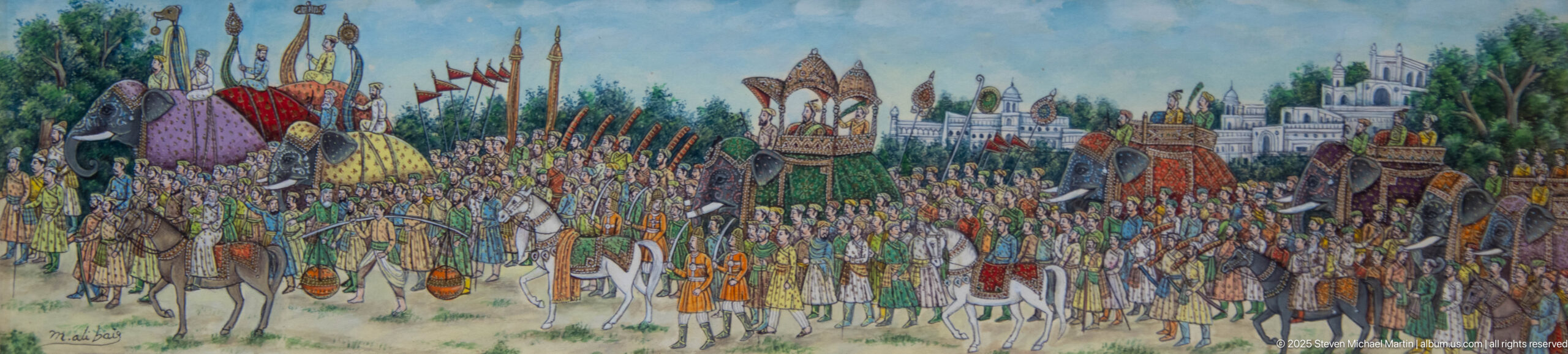
A large historical painting fills the foreground with mounted figures, standards, long weapons, and a dense crowd extending toward a distant city. Elaborately dressed riders and horses form the principal line across the front, while the massed procession behind them suggests a ceremonial or military gathering on a monumental scale.
Caption
A large historical painting fills the foreground with mounted figures, standards, long weapons, and a dense crowd extending toward a distant city. Elaborately dressed riders and horses form the principal line across the front, while the massed procession behind them suggests a ceremonial or military gathering on a monumental scale.
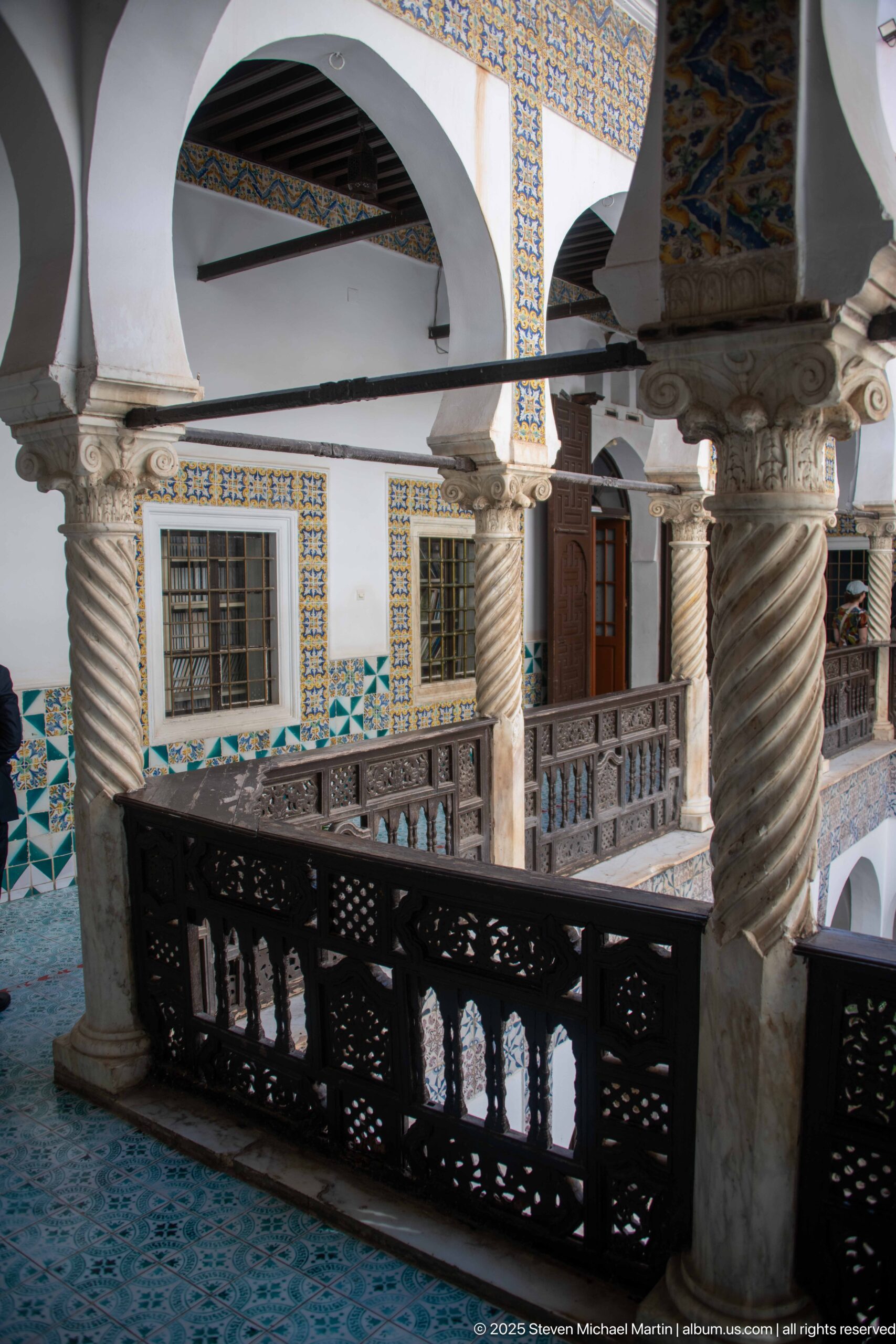
An oblique upper-level view follows the carved wooden balustrade around Dar Mustapha Pacha’s courtyard. Spiral-fluted columns rise beside the railing to support white arches, while tile-framed windows and a dark wooden door line the opposite wall. The angled viewpoint emphasizes the gallery’s circulation path and depth.
Caption
An oblique upper-level view follows the carved wooden balustrade around Dar Mustapha Pacha’s courtyard. Spiral-fluted columns rise beside the railing to support white arches, while tile-framed windows and a dark wooden door line the opposite wall. The angled viewpoint emphasizes the gallery’s circulation path and depth.
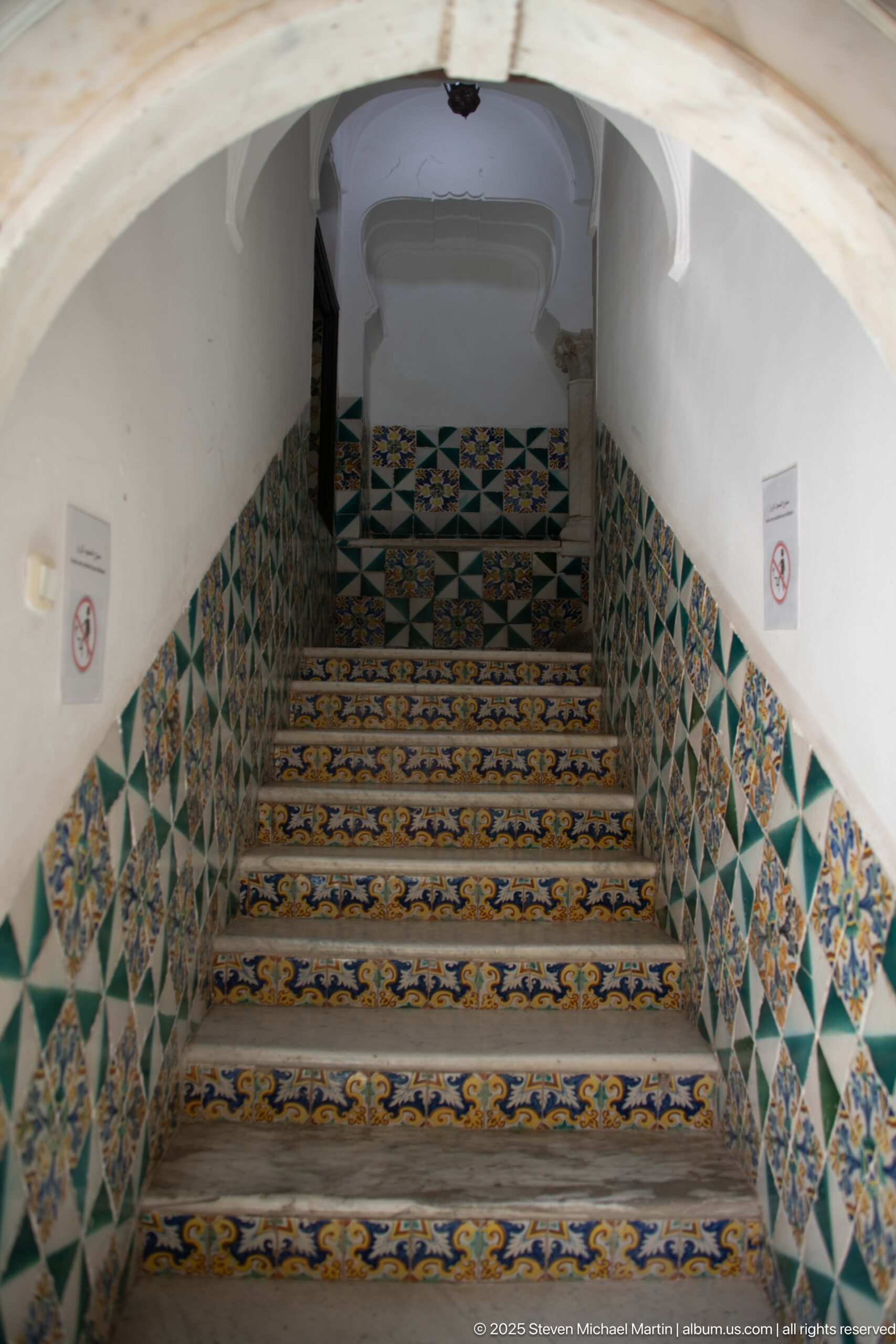
A narrow staircase rises beneath a low white vault at Dar Mustapha Pacha, its risers and side walls covered with contrasting ceramic patterns. Blue, yellow, green, and white tiles shift from scrolling motifs on the steps to bold triangular geometry along the walls, turning a functional passage into a richly decorated architectural transition.
Caption
A narrow staircase rises beneath a low white vault at Dar Mustapha Pacha, its risers and side walls covered with contrasting ceramic patterns. Blue, yellow, green, and white tiles shift from scrolling motifs on the steps to bold triangular geometry along the walls, turning a functional passage into a richly decorated architectural transition.
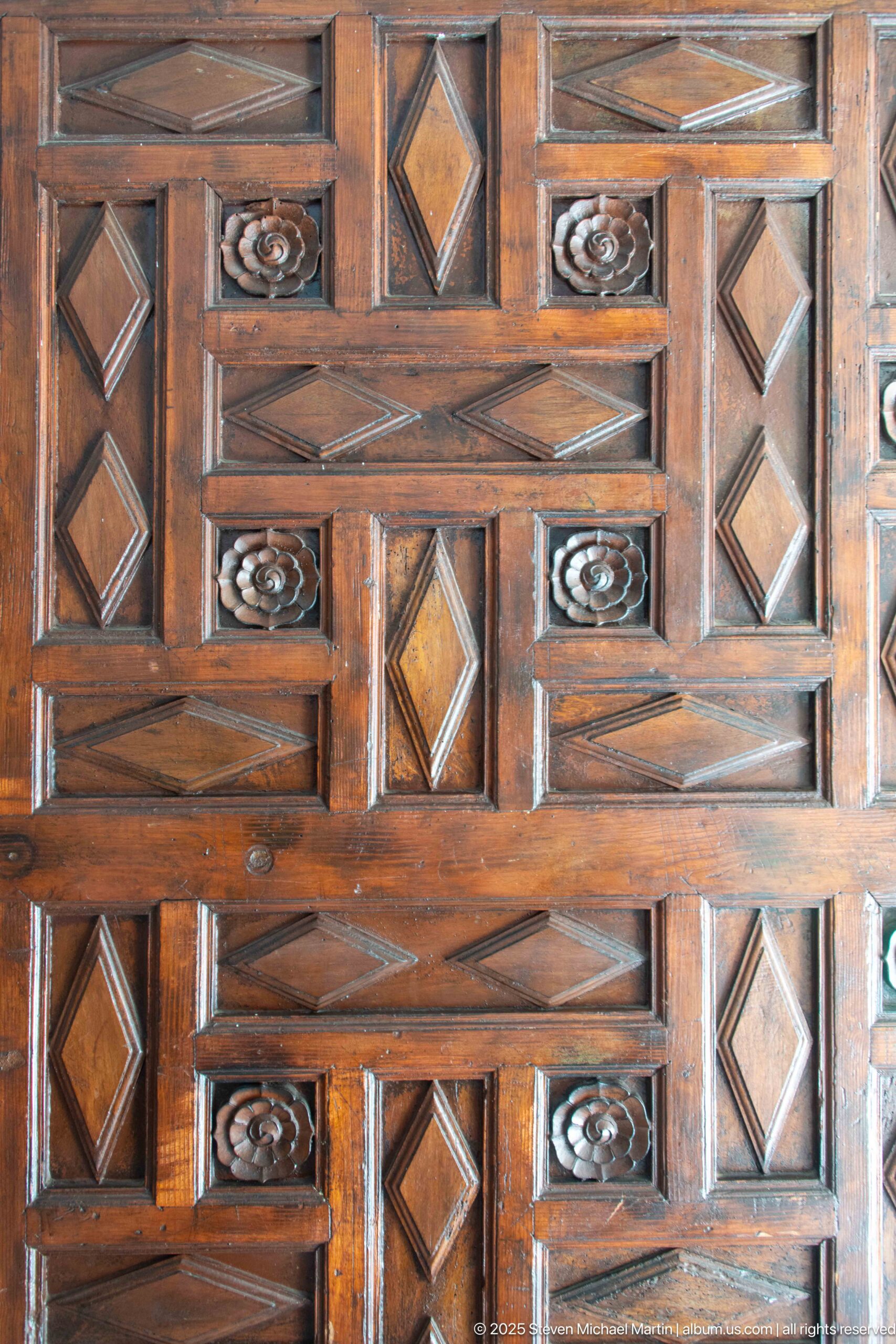
A close study of dark wooden joinery reveals a dense grid of raised rectangles, diamonds, diagonal bands, and small carved rosettes. Contrasting grain and inset pieces animate the surface, while the repeated modular construction demonstrates how geometric ornament is built directly into the palace’s wooden architectural fabric.
Caption
A close study of dark wooden joinery reveals a dense grid of raised rectangles, diamonds, diagonal bands, and small carved rosettes. Contrasting grain and inset pieces animate the surface, while the repeated modular construction demonstrates how geometric ornament is built directly into the palace’s wooden architectural fabric.
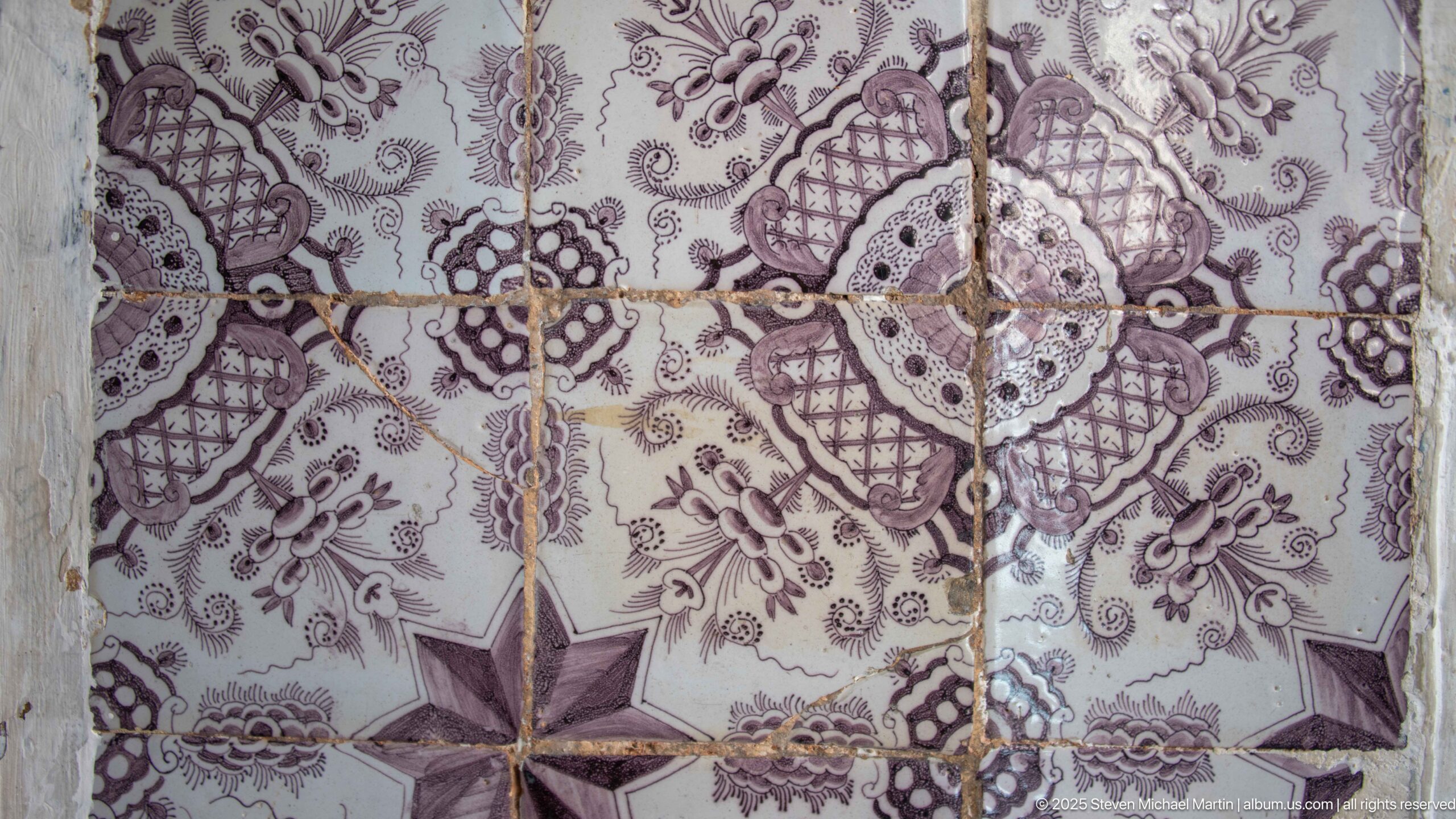
A close view records a ceramic tile pattern in muted purple on a pale ground. Large circular floral medallions, leafy sprays, lace-like borders, and pointed star forms repeat across square tiles, while cracks, worn grout, and surface irregularities reveal the age and physical condition of the architectural finish.
Caption
A close view records a ceramic tile pattern in muted purple on a pale ground. Large circular floral medallions, leafy sprays, lace-like borders, and pointed star forms repeat across square tiles, while cracks, worn grout, and surface irregularities reveal the age and physical condition of the architectural finish.
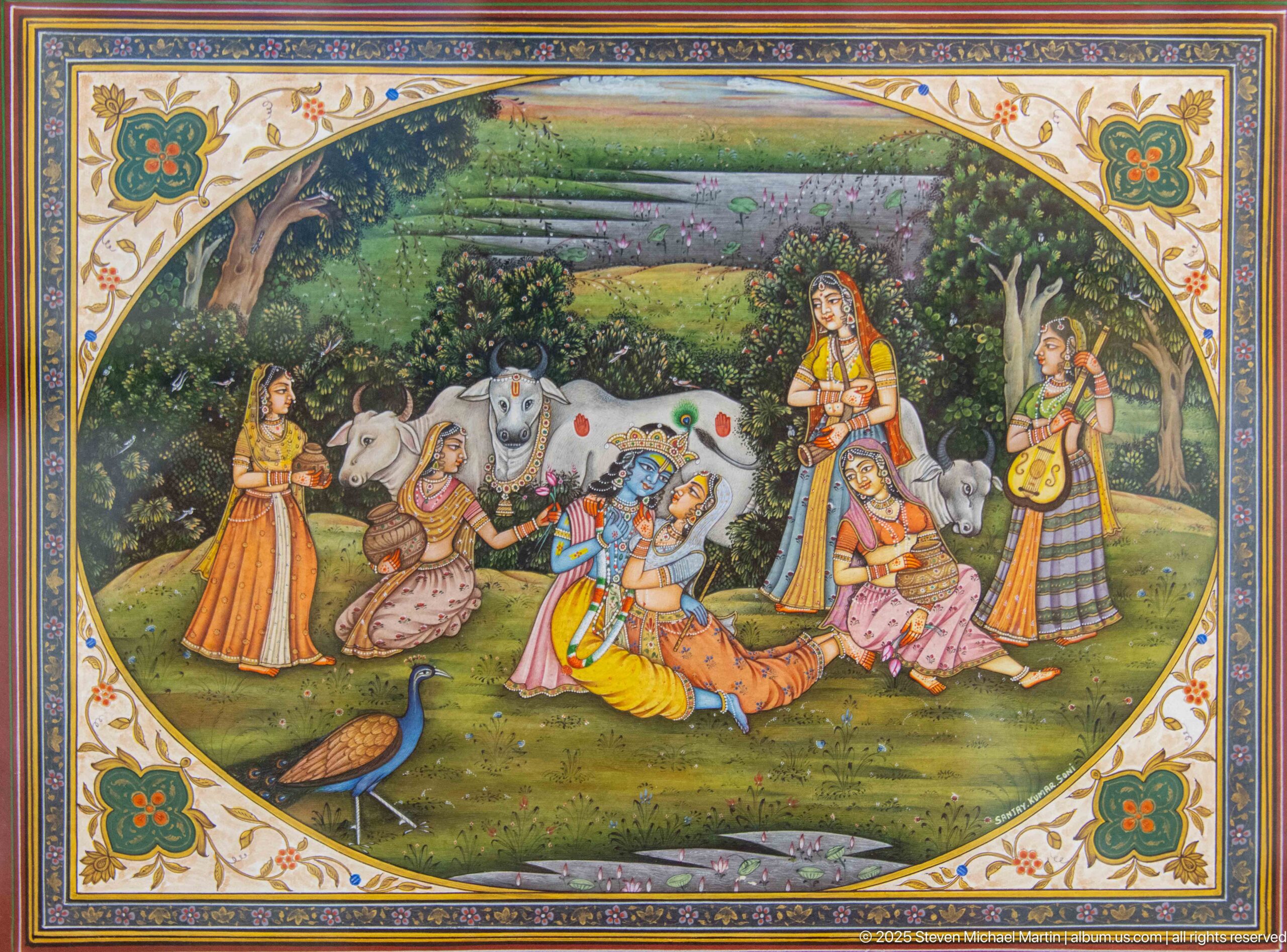
A finely bordered miniature presents a group of richly dressed figures gathered around cattle in a lush pastoral landscape. One central blue-skinned figure plays or holds a flute-like instrument while companions sit and stand nearby; a peacock occupies the foreground. The scene’s specific religious narrative is visually suggestive but is not identified here without catalog evidence.
Caption
A finely bordered miniature presents a group of richly dressed figures gathered around cattle in a lush pastoral landscape. One central blue-skinned figure plays or holds a flute-like instrument while companions sit and stand nearby; a peacock occupies the foreground. The scene’s specific religious narrative is visually suggestive but is not identified here without catalog evidence.
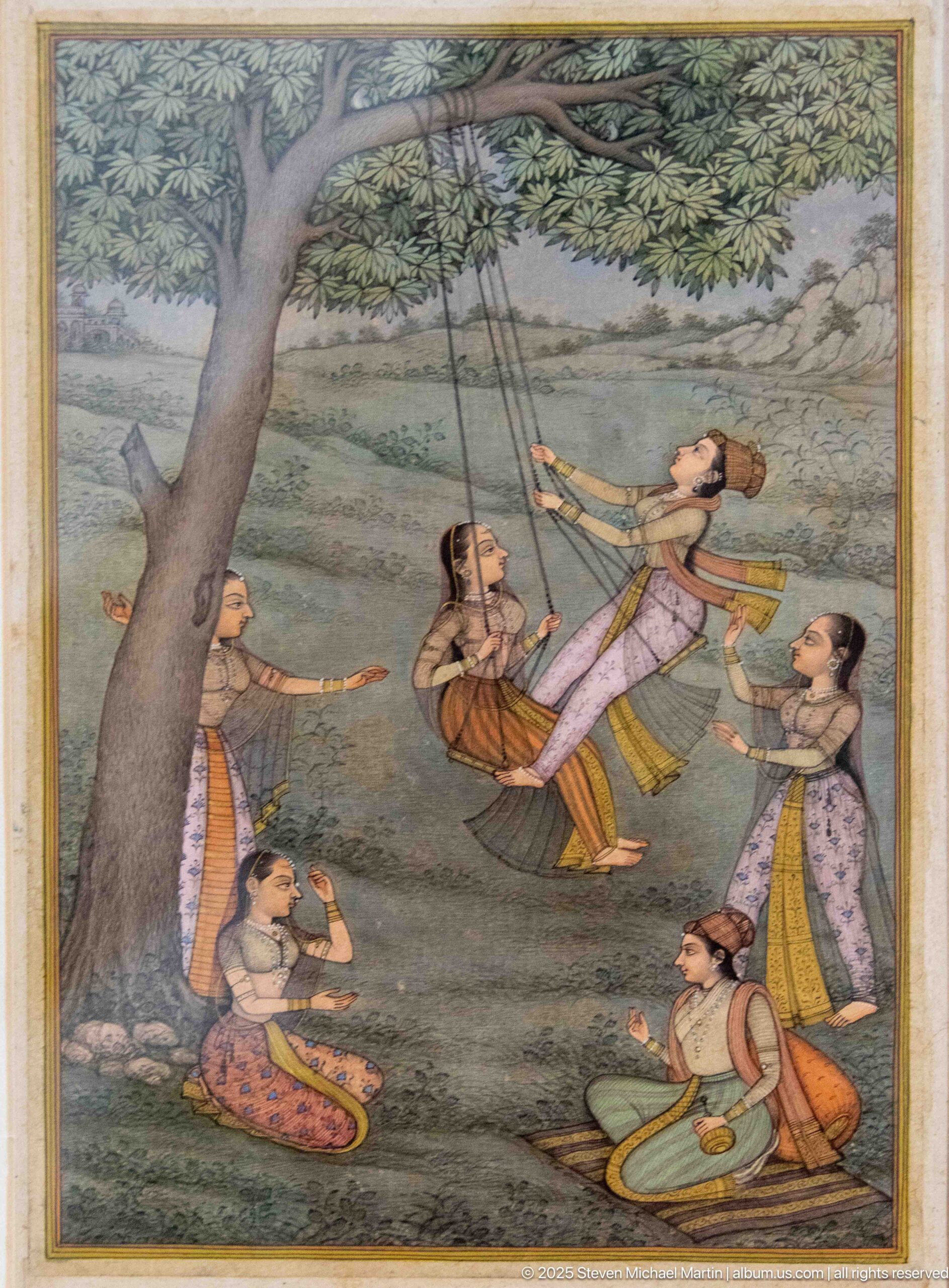
A miniature-style painting shows two figures sharing a suspended swing beneath a broad tree while attendants gather around them. One companion pulls a rope at left, seated figures watch from below, and a musician with a drum occupies the lower right. The intimate garden setting and coordinated gestures make the swing the narrative center of the composition.
Caption
A miniature-style painting shows two figures sharing a suspended swing beneath a broad tree while attendants gather around them. One companion pulls a rope at left, seated figures watch from below, and a musician with a drum occupies the lower right. The intimate garden setting and coordinated gestures make the swing the narrative center of the composition.
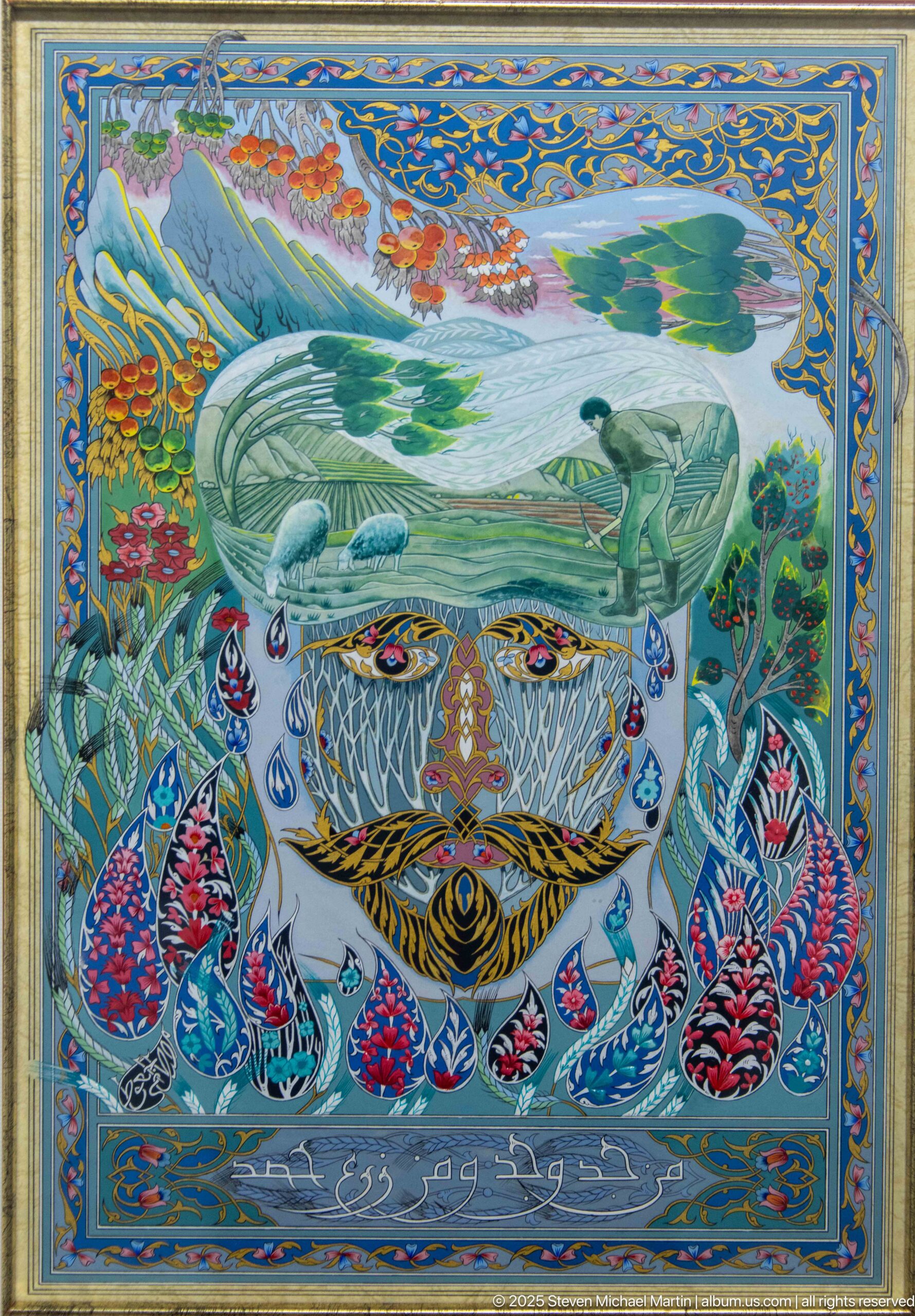
A highly decorative composition combines a large pale bird, fish-like creatures, shell or vessel forms, and curling green shapes within a blue-and-gold ornamental border. The imagery appears deliberately fantastic rather than naturalistic, with repeated teardrop forms and mirrored elements creating a dense symbolic or imaginative scene.
Caption
A highly decorative composition combines a large pale bird, fish-like creatures, shell or vessel forms, and curling green shapes within a blue-and-gold ornamental border. The imagery appears deliberately fantastic rather than naturalistic, with repeated teardrop forms and mirrored elements creating a dense symbolic or imaginative scene.
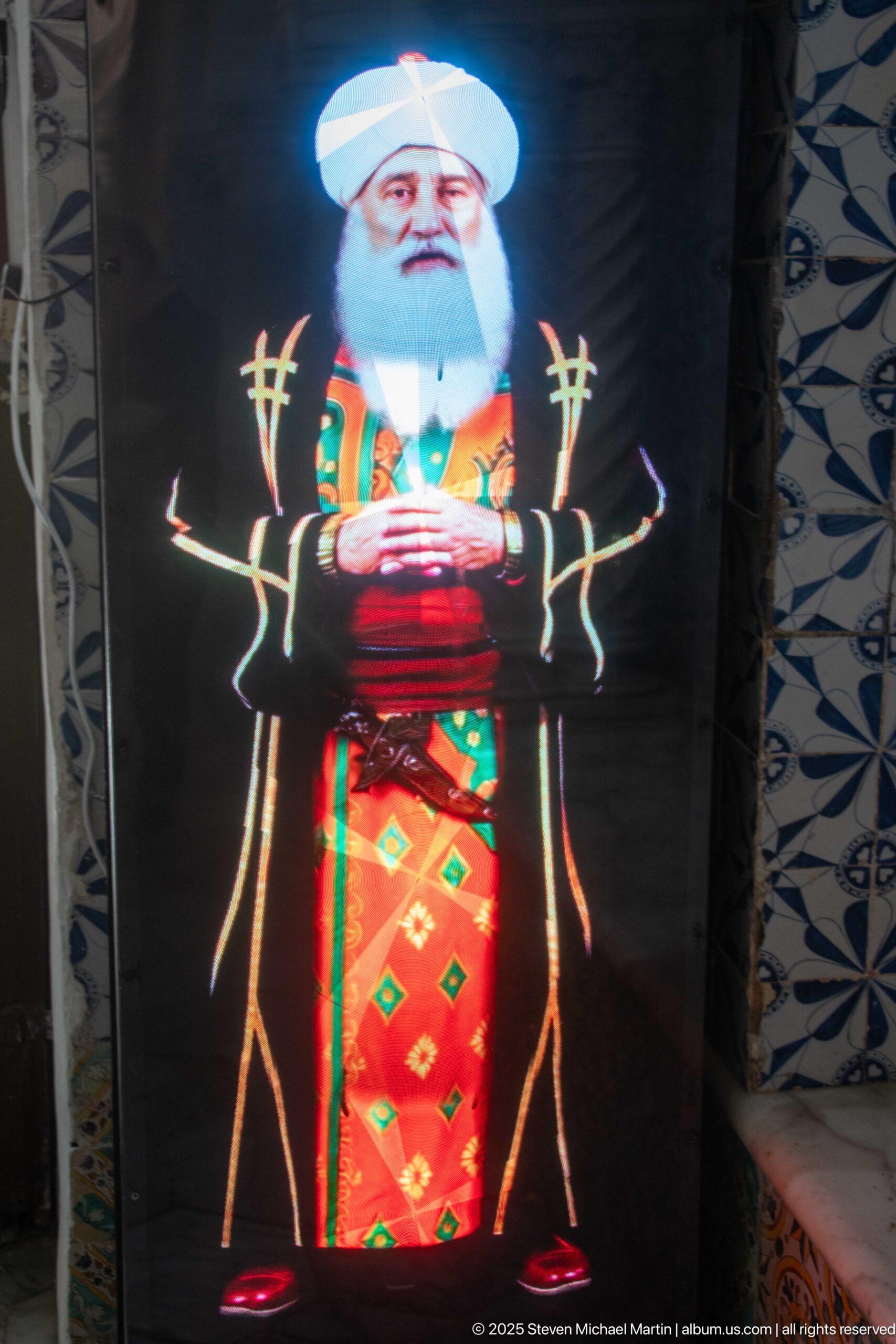
A luminous digital or projected figure of an elderly bearded man appears against a dark display, dressed in a white turban and brightly colored patterned robes. Light outlines his body and clothing, giving the museum presentation a theatrical, animated quality distinct from the surrounding historic tilework visible at the edge of the frame.
Caption
A luminous digital or projected figure of an elderly bearded man appears against a dark display, dressed in a white turban and brightly colored patterned robes. Light outlines his body and clothing, giving the museum presentation a theatrical, animated quality distinct from the surrounding historic tilework visible at the edge of the frame.
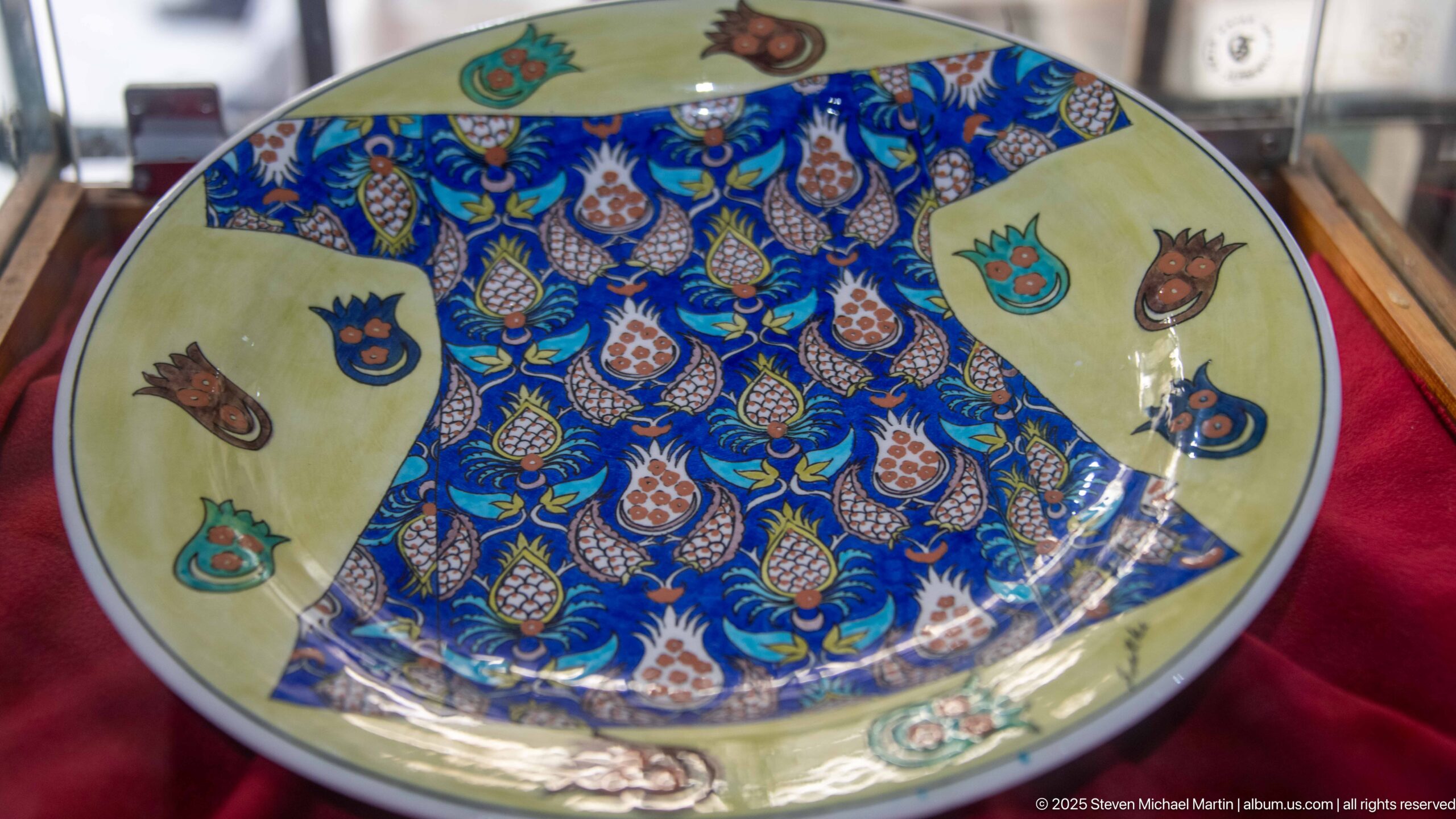
A shallow decorative dish displayed behind glass combines a deep cobalt-blue central field with repeated stylized buds or palmettes in white, turquoise, brown, and green. Pale cream sections interrupt the blue pattern around the rim, each carrying isolated floral emblems, while additional small motifs circle the outer edge.
Caption
A shallow decorative dish displayed behind glass combines a deep cobalt-blue central field with repeated stylized buds or palmettes in white, turquoise, brown, and green. Pale cream sections interrupt the blue pattern around the rim, each carrying isolated floral emblems, while additional small motifs circle the outer edge.
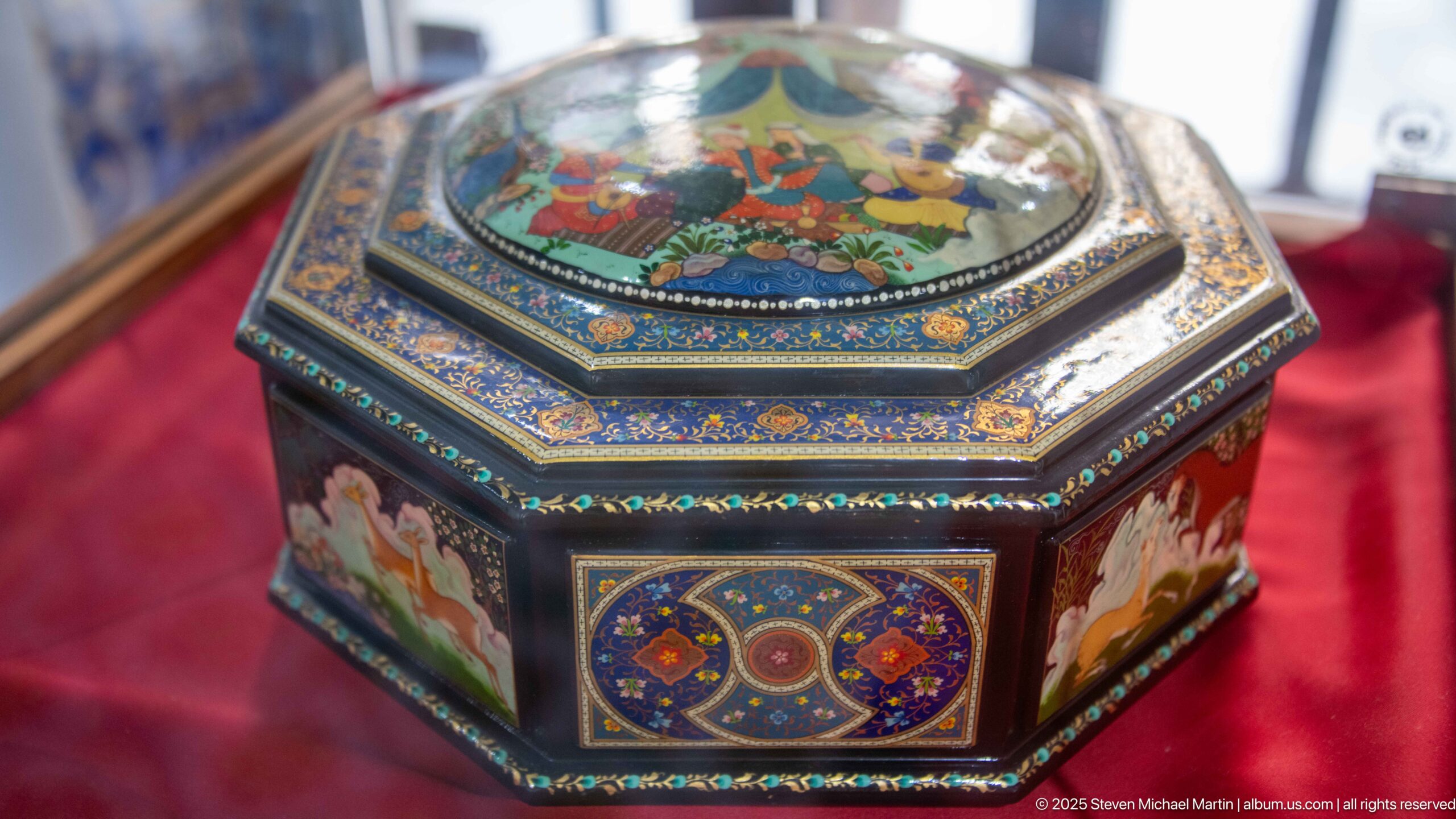
An octagonal lidded box rests on red display fabric, its dark sides divided into panels of miniature figures, floral geometry, and intricate border work. The raised lid carries a circular figurative scene under glass or a glossy finish, while fine multicolored ornament traces the edges and emphasizes the object’s carefully constructed polygonal form.
Caption
An octagonal lidded box rests on red display fabric, its dark sides divided into panels of miniature figures, floral geometry, and intricate border work. The raised lid carries a circular figurative scene under glass or a glossy finish, while fine multicolored ornament traces the edges and emphasizes the object’s carefully constructed polygonal form.
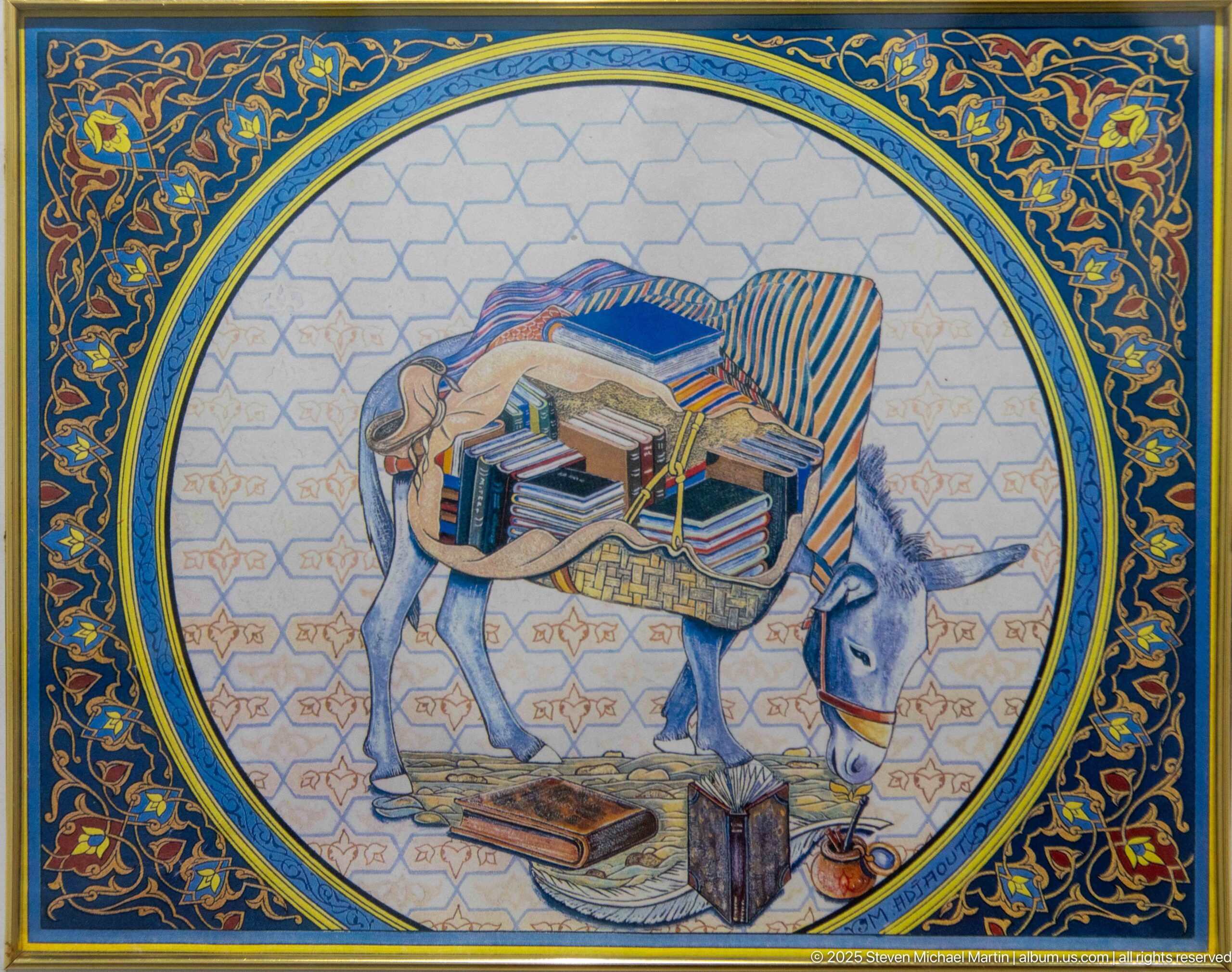
A circular illustration depicts a saddled donkey laden with books or bound volumes, accompanied by writing-related objects arranged at its feet. The animal is enclosed by a broad blue-and-gold floral border, transforming a practical scene of transport and learning into a carefully ornamented manuscript-style composition.
Caption
A circular illustration depicts a saddled donkey laden with books or bound volumes, accompanied by writing-related objects arranged at its feet. The animal is enclosed by a broad blue-and-gold floral border, transforming a practical scene of transport and learning into a carefully ornamented manuscript-style composition.
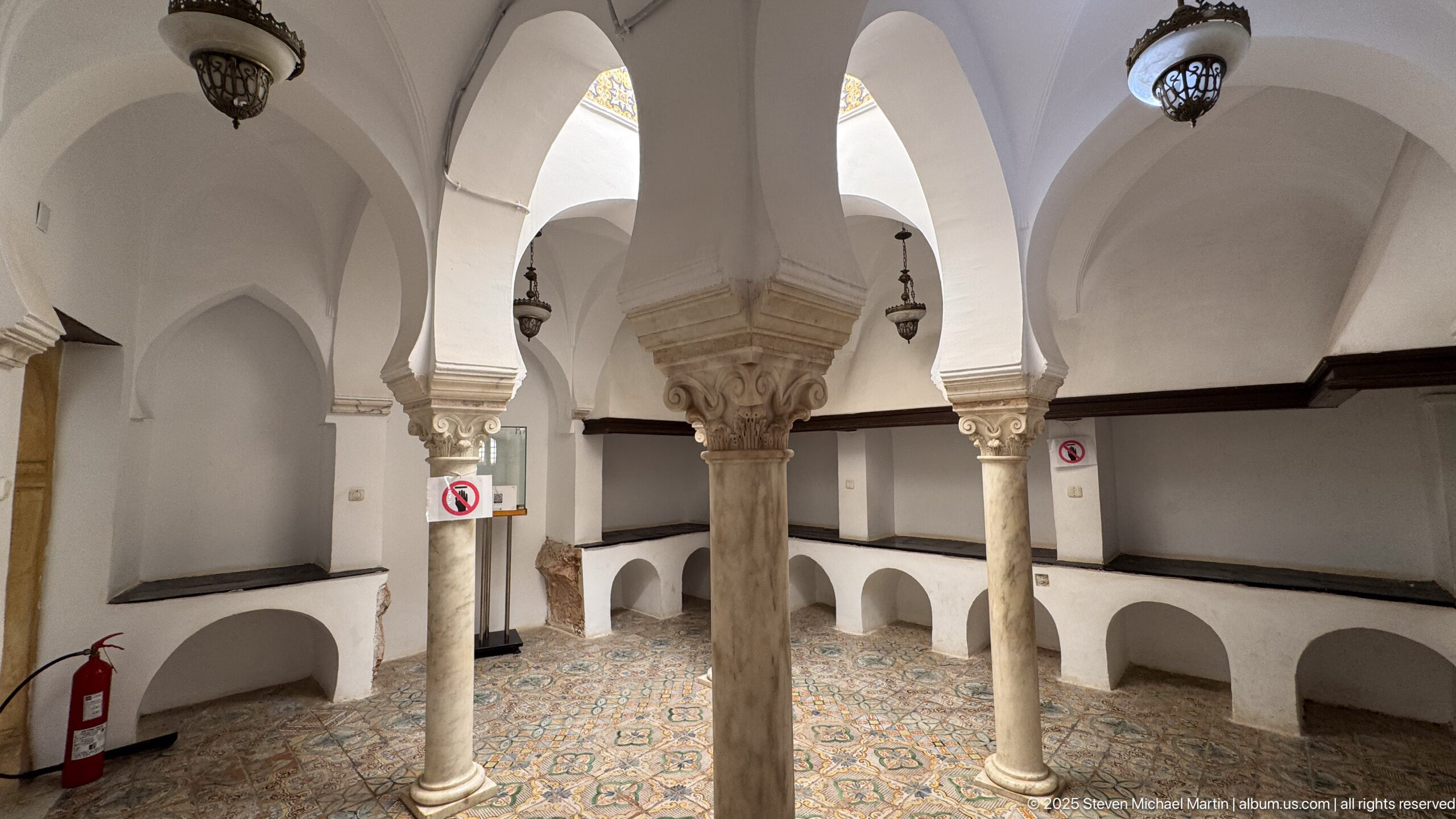
A white interior chamber is divided by pale stone columns with carved capitals that support intersecting arches and shallow vaults. Continuous built-in benches or wall niches line the perimeter above a patterned tiled floor, while hanging lamps and sparse museum fixtures leave the room’s architectural structure largely unobstructed.
Caption
A white interior chamber is divided by pale stone columns with carved capitals that support intersecting arches and shallow vaults. Continuous built-in benches or wall niches line the perimeter above a patterned tiled floor, while hanging lamps and sparse museum fixtures leave the room’s architectural structure largely unobstructed.
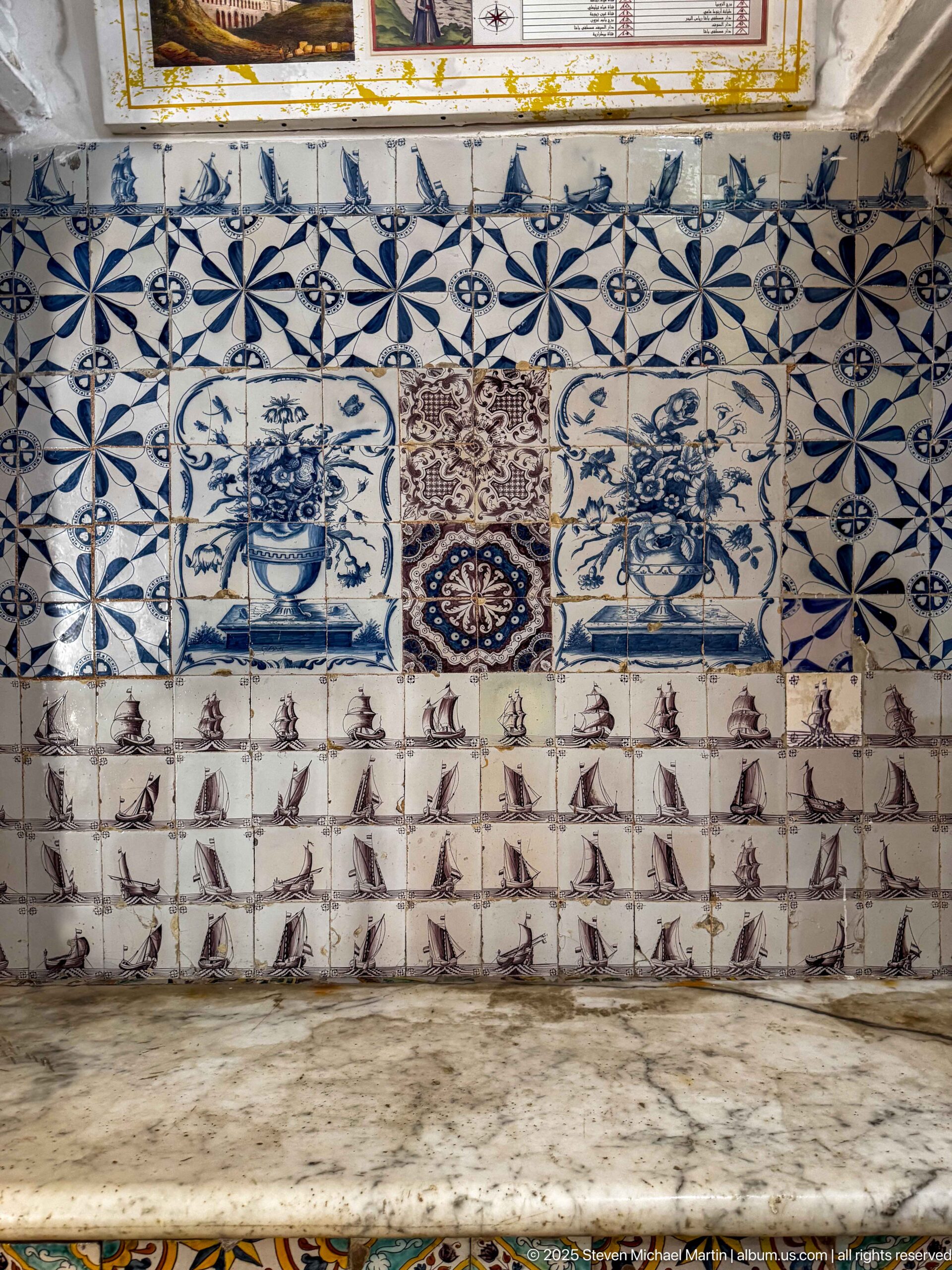
A marble ledge runs beneath a wall assembled from several distinct tile groups: large blue-and-white floral vase panels above, a central ornamental tile, and multiple rows of small sailing-ship tiles below. The juxtaposition records how different ceramic motifs coexist within the palace interior rather than forming a single uniform pattern.
Caption
A marble ledge runs beneath a wall assembled from several distinct tile groups: large blue-and-white floral vase panels above, a central ornamental tile, and multiple rows of small sailing-ship tiles below. The juxtaposition records how different ceramic motifs coexist within the palace interior rather than forming a single uniform pattern.
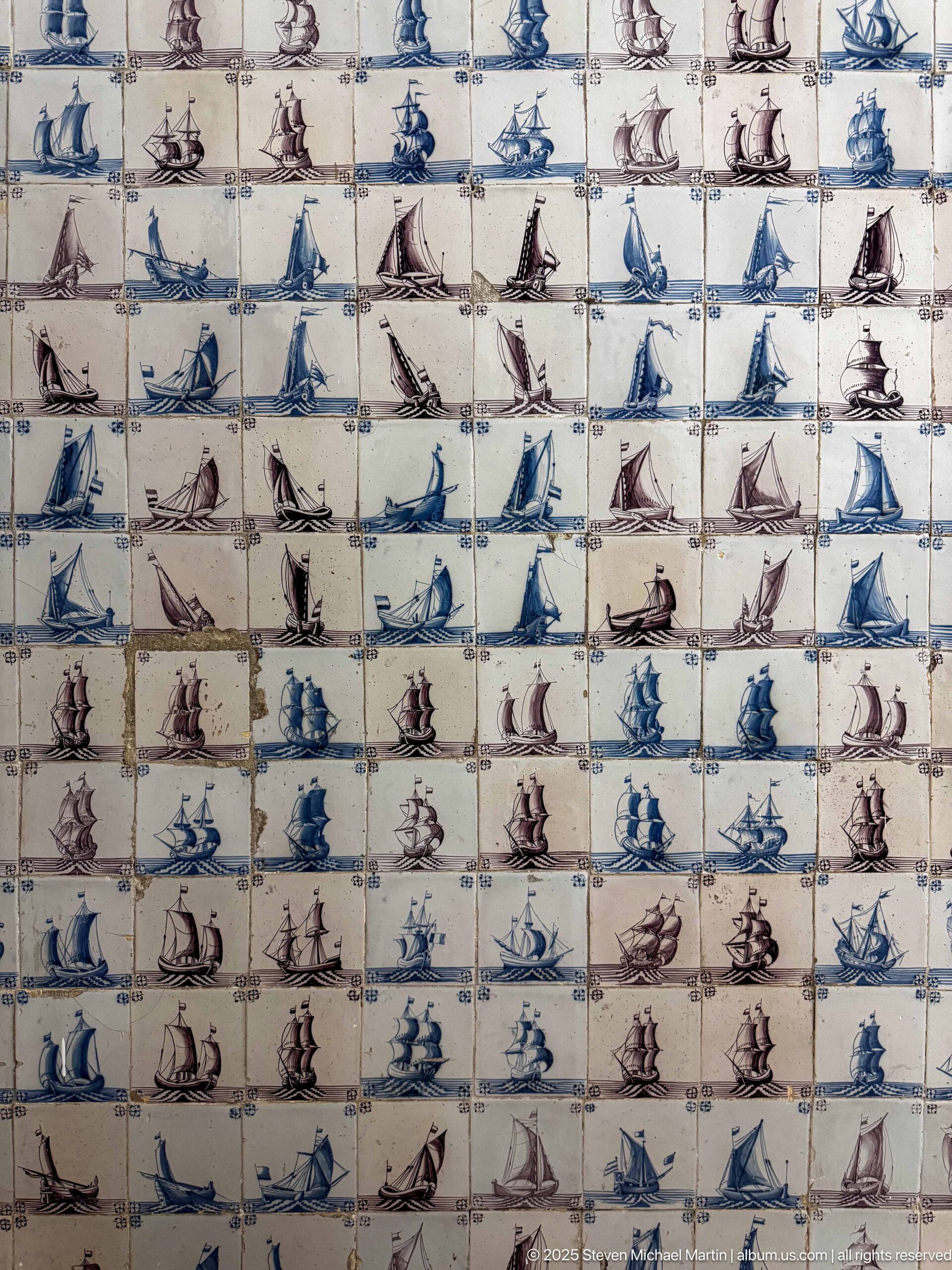
A closer section of the maritime tile wall isolates individual sailing vessels and their changing silhouettes. Blue and purple ships alternate across the grid, ranging from compact single-masted craft to larger multi-sailed forms. Cracked glaze, stained grout, and uneven surfaces make the physical condition of the historic tile assemblage especially visible.
Caption
A closer section of the maritime tile wall isolates individual sailing vessels and their changing silhouettes. Blue and purple ships alternate across the grid, ranging from compact single-masted craft to larger multi-sailed forms. Cracked glaze, stained grout, and uneven surfaces make the physical condition of the historic tile assemblage especially visible.
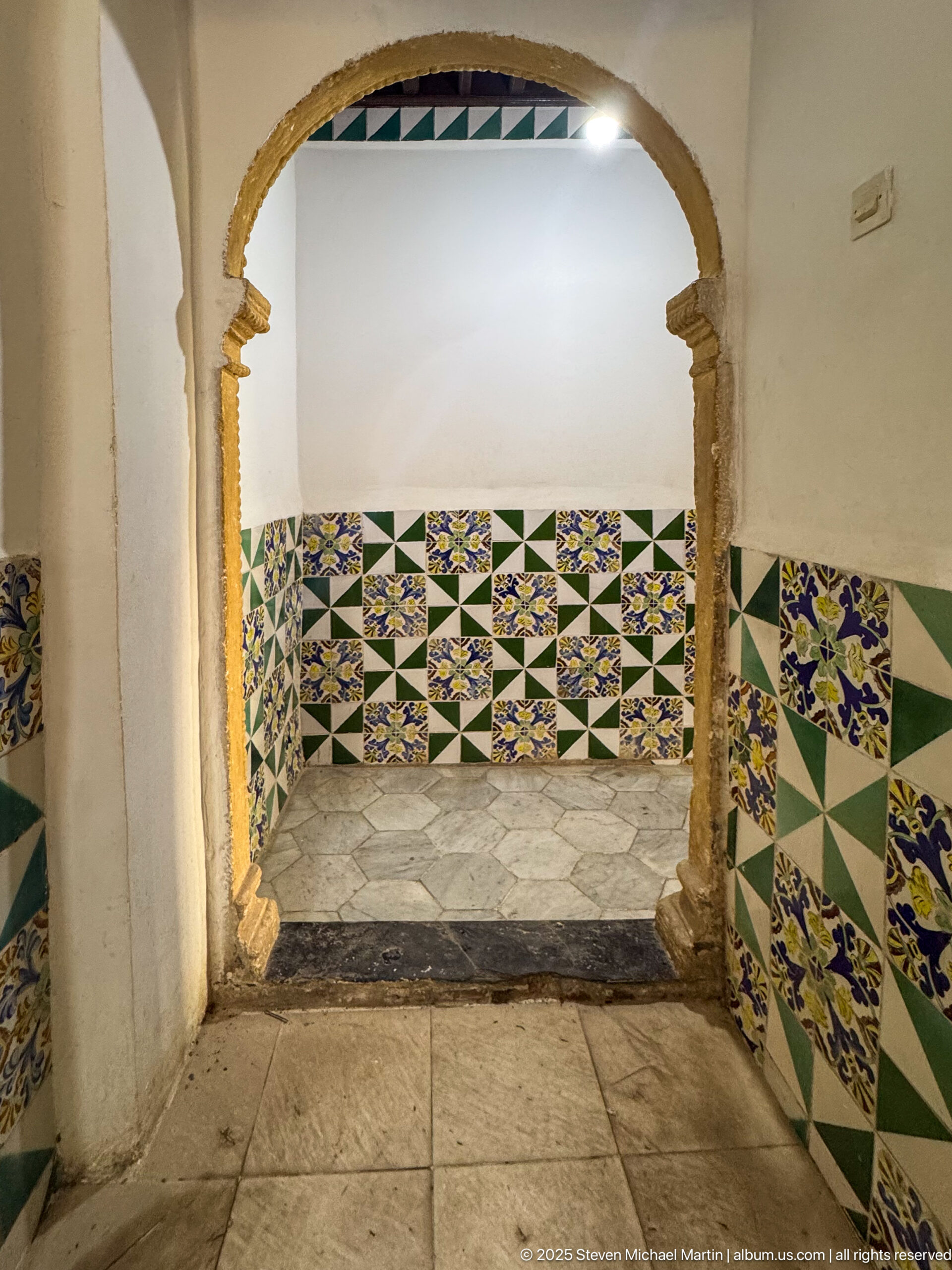
A scalloped or lobed stone arch opens into a small white room lined with bold green, blue, yellow, and white geometric tiles. The pale stone threshold and floor contrast with the triangular wall pattern, while the intimate framing records a transitional doorway between palace spaces rather than a grand courtyard entrance.
Caption
A scalloped or lobed stone arch opens into a small white room lined with bold green, blue, yellow, and white geometric tiles. The pale stone threshold and floor contrast with the triangular wall pattern, while the intimate framing records a transitional doorway between palace spaces rather than a grand courtyard entrance.
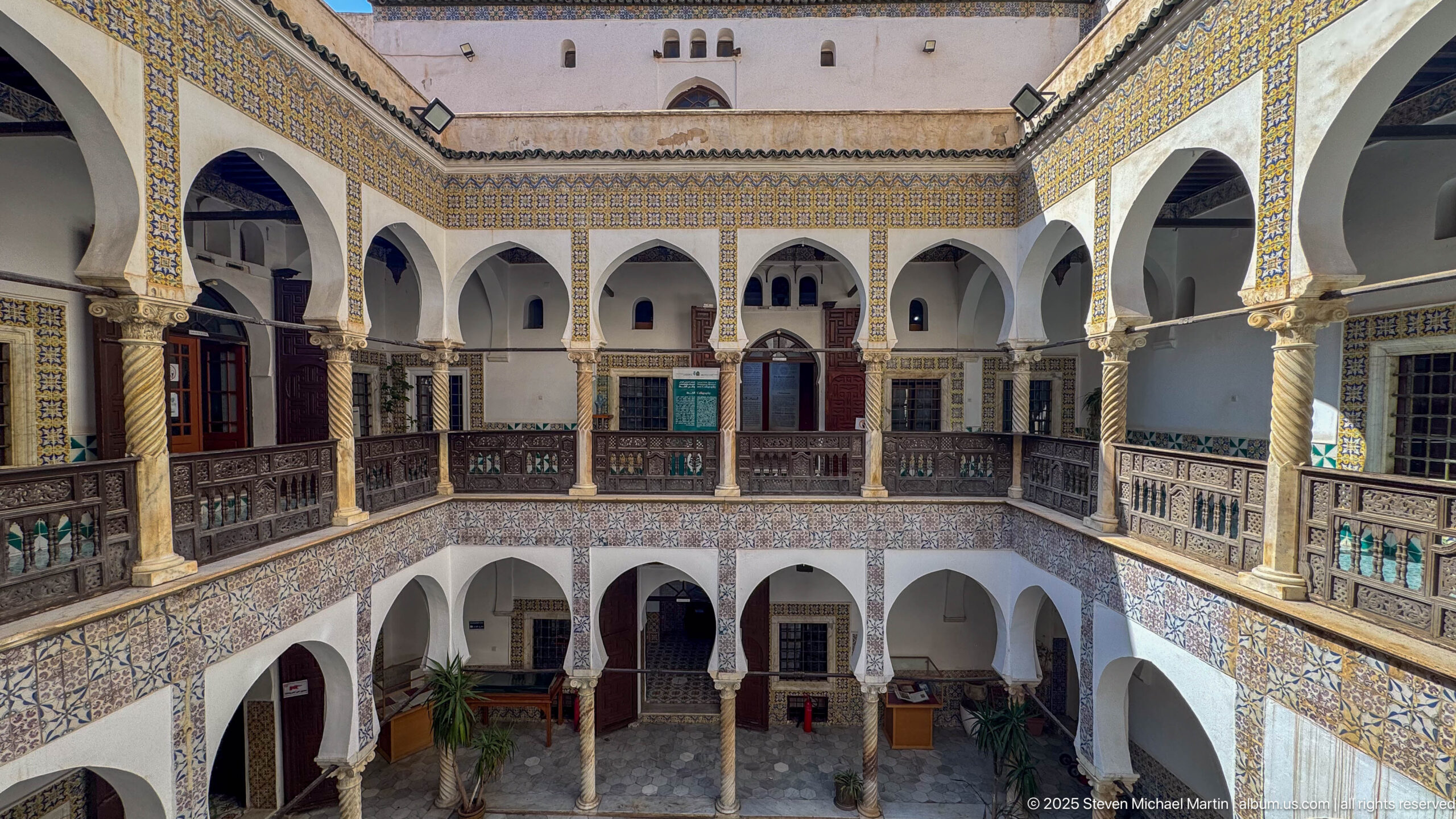
Seen diagonally from an upper gallery, Dar Mustapha Pacha’s courtyard unfolds through repeated white arches, spiral columns, tiled spandrels, and dark wooden balustrades. The oblique viewpoint reveals both the opposite elevation and a lower corner of the court, emphasizing how galleries wrap continuously around the central open space.
Caption
Seen diagonally from an upper gallery, Dar Mustapha Pacha’s courtyard unfolds through repeated white arches, spiral columns, tiled spandrels, and dark wooden balustrades. The oblique viewpoint reveals both the opposite elevation and a lower corner of the court, emphasizing how galleries wrap continuously around the central open space.
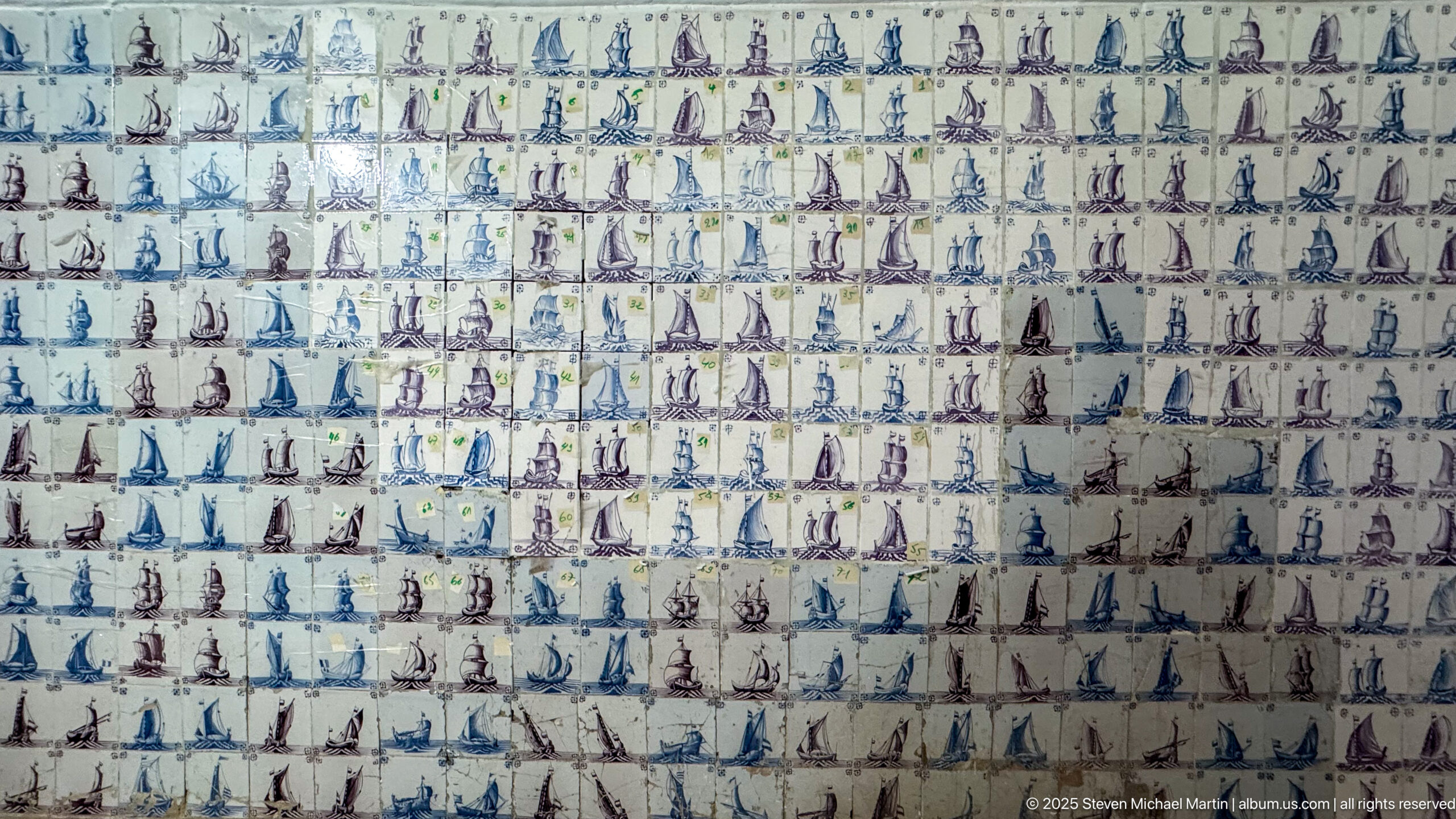
Hundreds of small ceramic tiles create a broad maritime wall field, each square carrying a sailing vessel rendered in blue, purple, or muted brown. Variations in hulls, sails, and rigging prevent the repeated motif from becoming uniform, while wear and irregular alignment reveal the tiled surface as an assembled architectural decoration.
Caption
Hundreds of small ceramic tiles create a broad maritime wall field, each square carrying a sailing vessel rendered in blue, purple, or muted brown. Variations in hulls, sails, and rigging prevent the repeated motif from becoming uniform, while wear and irregular alignment reveal the tiled surface as an assembled architectural decoration.
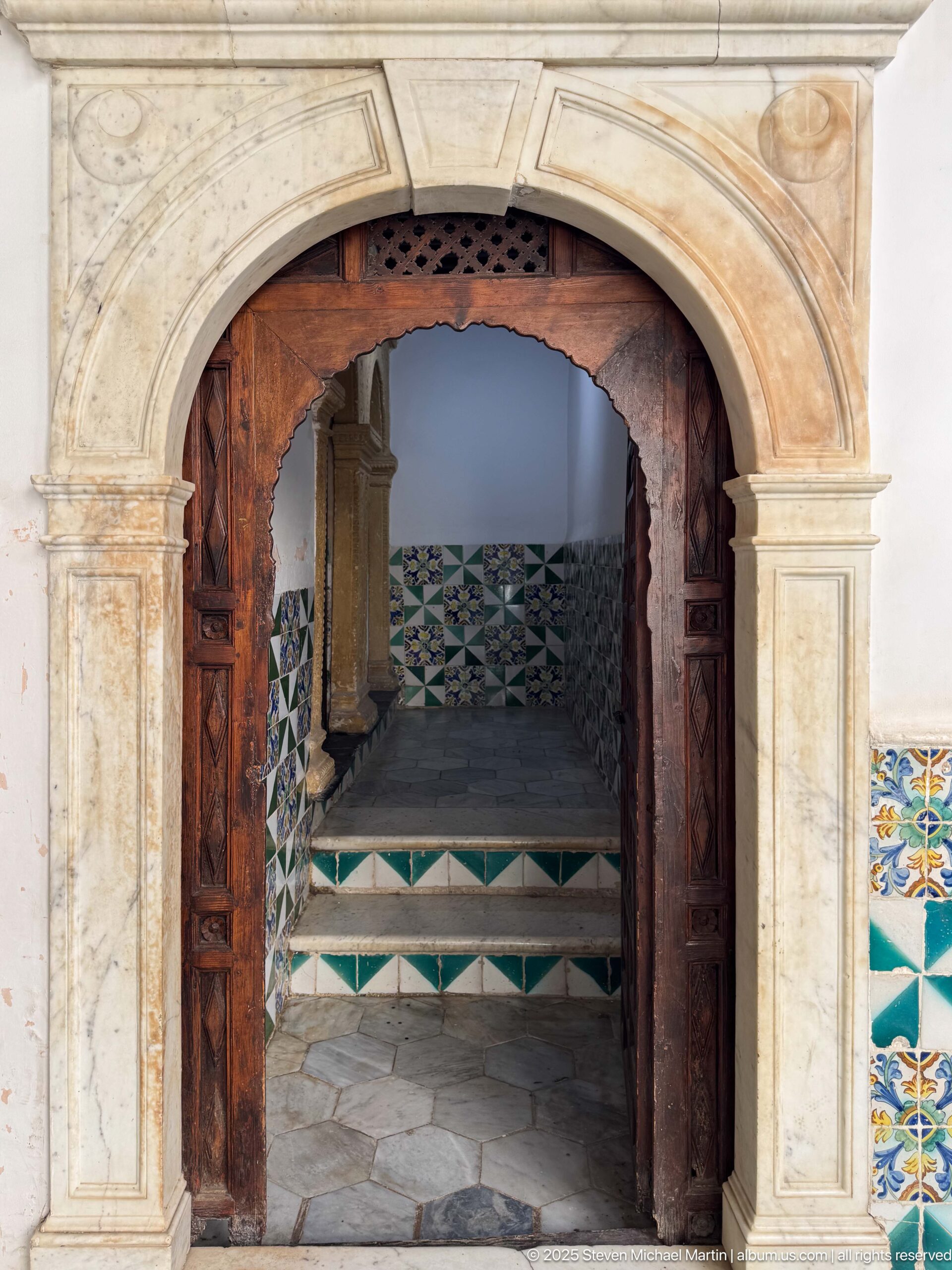
A pale stone arched portal encloses a heavy dark wooden doorway that opens directly onto a short tiled stair. Green-and-white triangular tiles line the passage beyond, and carved wooden leaves remain visible at both sides of the opening. The view connects the palace’s monumental door treatment with a compact internal circulation route.
Caption
A pale stone arched portal encloses a heavy dark wooden doorway that opens directly onto a short tiled stair. Green-and-white triangular tiles line the passage beyond, and carved wooden leaves remain visible at both sides of the opening. The view connects the palace’s monumental door treatment with a compact internal circulation route.
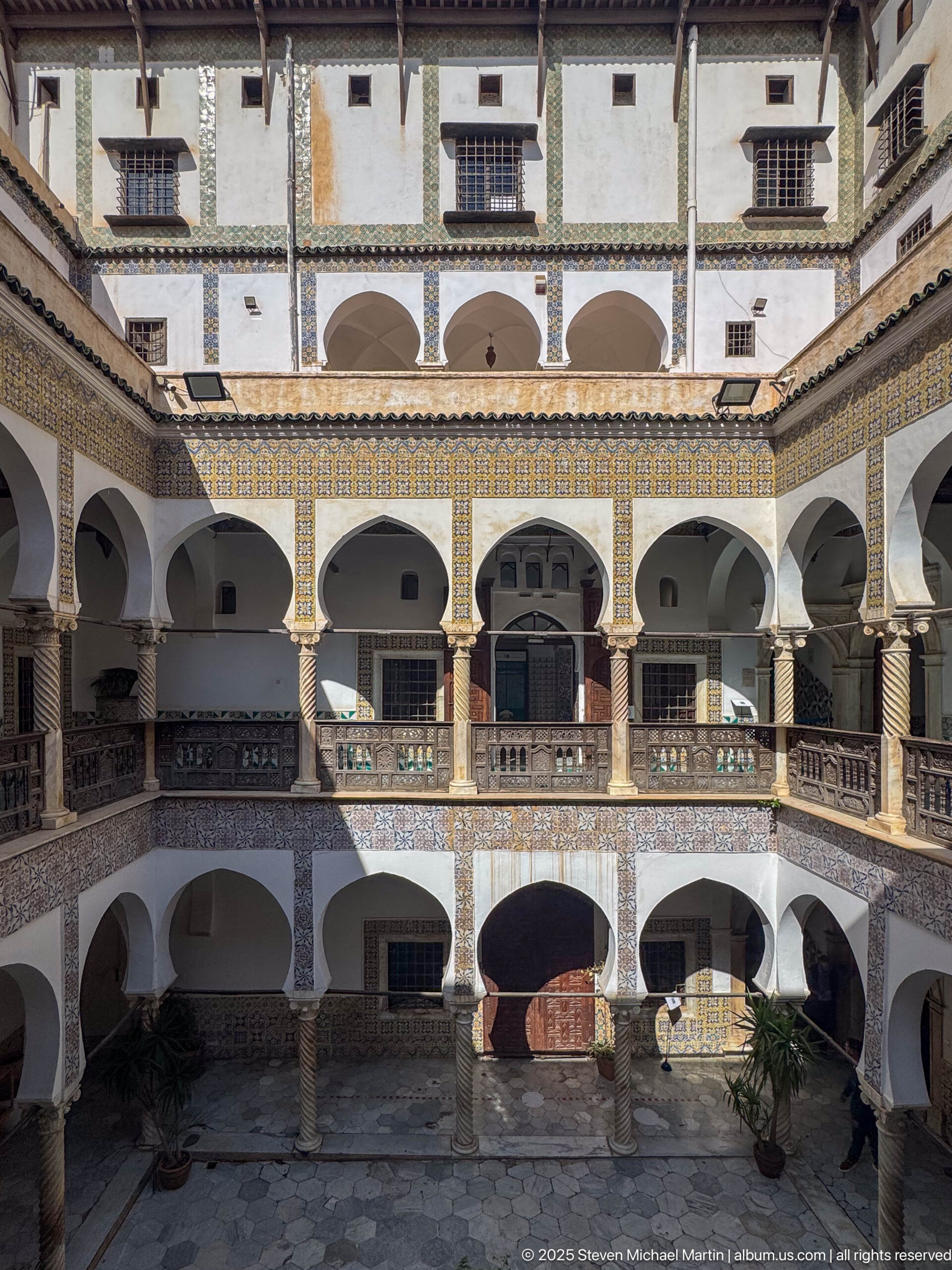
A broad elevated view spans nearly the full width of Dar Mustapha Pacha’s courtyard, showing lower arcades, the principal wooden gallery, and taller upper walls with small windows. Continuous blue-and-yellow tile bands stitch the levels together, while alternating sun and shade reveal the depth of the arcades and the scale of the central open court.
Caption
A broad elevated view spans nearly the full width of Dar Mustapha Pacha’s courtyard, showing lower arcades, the principal wooden gallery, and taller upper walls with small windows. Continuous blue-and-yellow tile bands stitch the levels together, while alternating sun and shade reveal the depth of the arcades and the scale of the central open court.
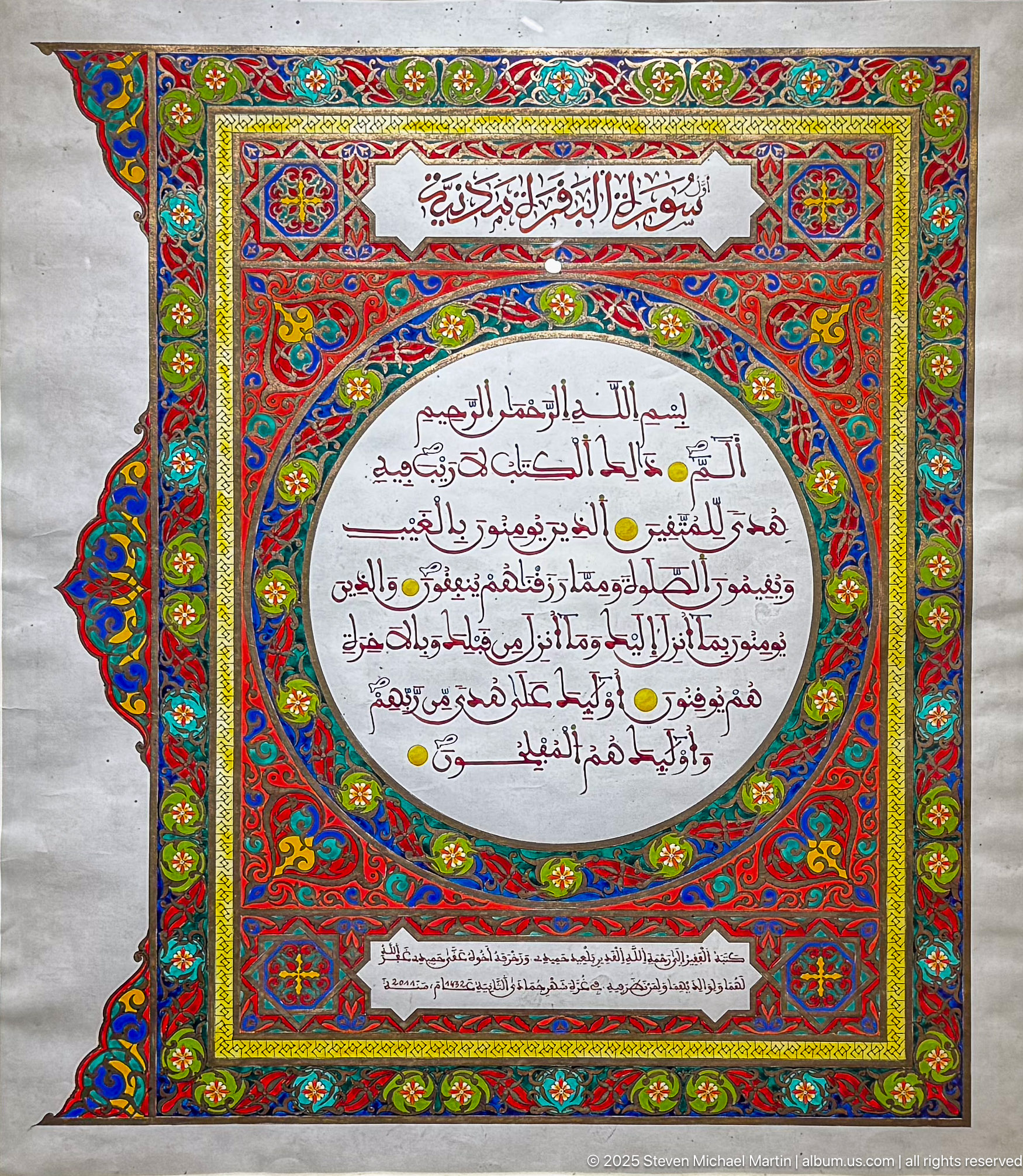
A richly illuminated manuscript-style page places lines of Arabic script within a large white oval, surrounded by dense red, blue, green, and gold floral and geometric ornament. A separate calligraphic heading sits above, while a narrow text panel below completes the layered design and emphasizes the formal hierarchy of the written page.
Caption
A richly illuminated manuscript-style page places lines of Arabic script within a large white oval, surrounded by dense red, blue, green, and gold floral and geometric ornament. A separate calligraphic heading sits above, while a narrow text panel below completes the layered design and emphasizes the formal hierarchy of the written page.
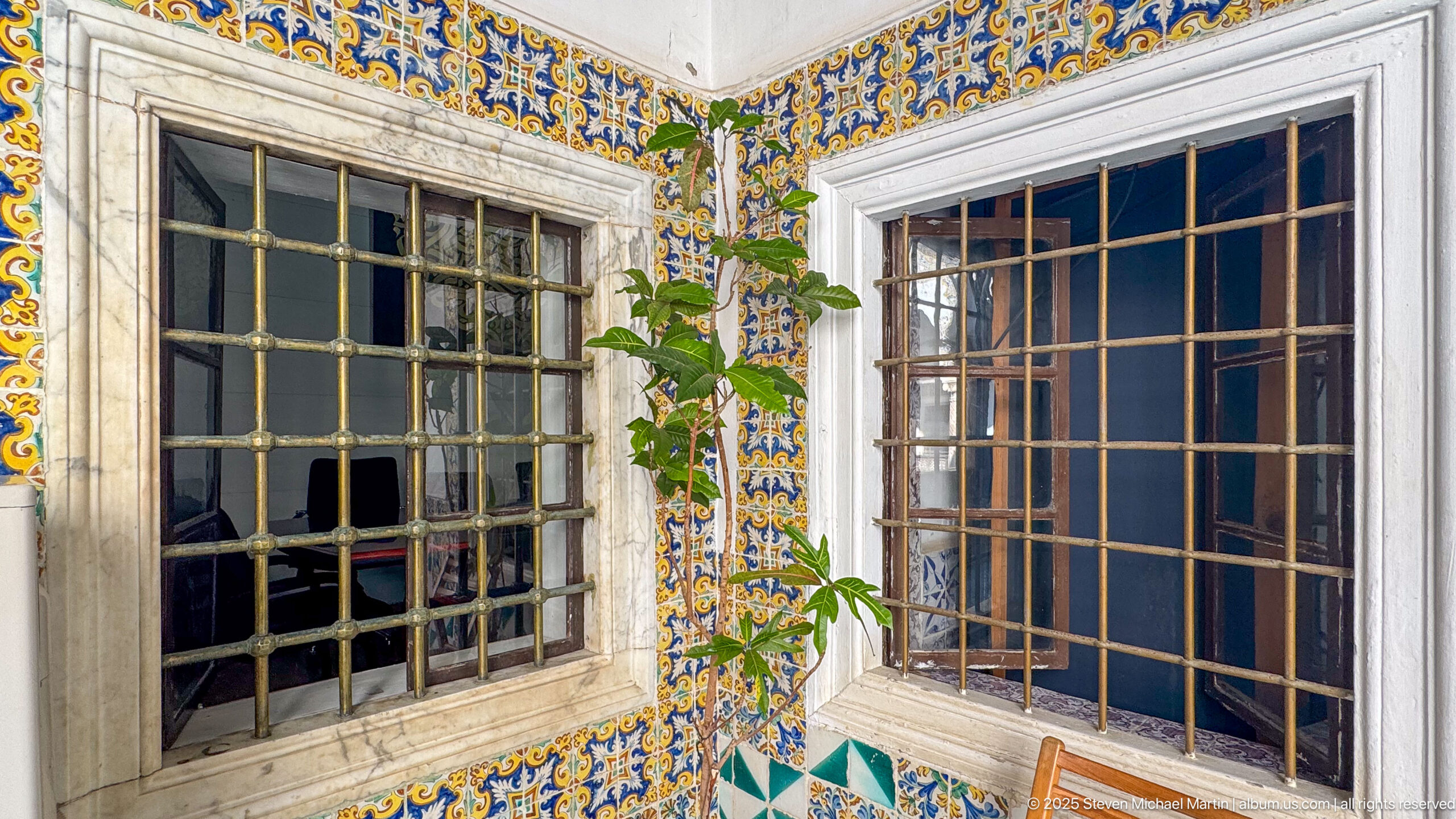
Two adjacent windows with square metal grilles are set into a corner richly bordered with blue, yellow, green, and white ceramic tiles. A leafy plant climbs between the openings, introducing an organic vertical accent against the rigid grids of the bars and repeating tile motifs.
Caption
Two adjacent windows with square metal grilles are set into a corner richly bordered with blue, yellow, green, and white ceramic tiles. A leafy plant climbs between the openings, introducing an organic vertical accent against the rigid grids of the bars and repeating tile motifs.
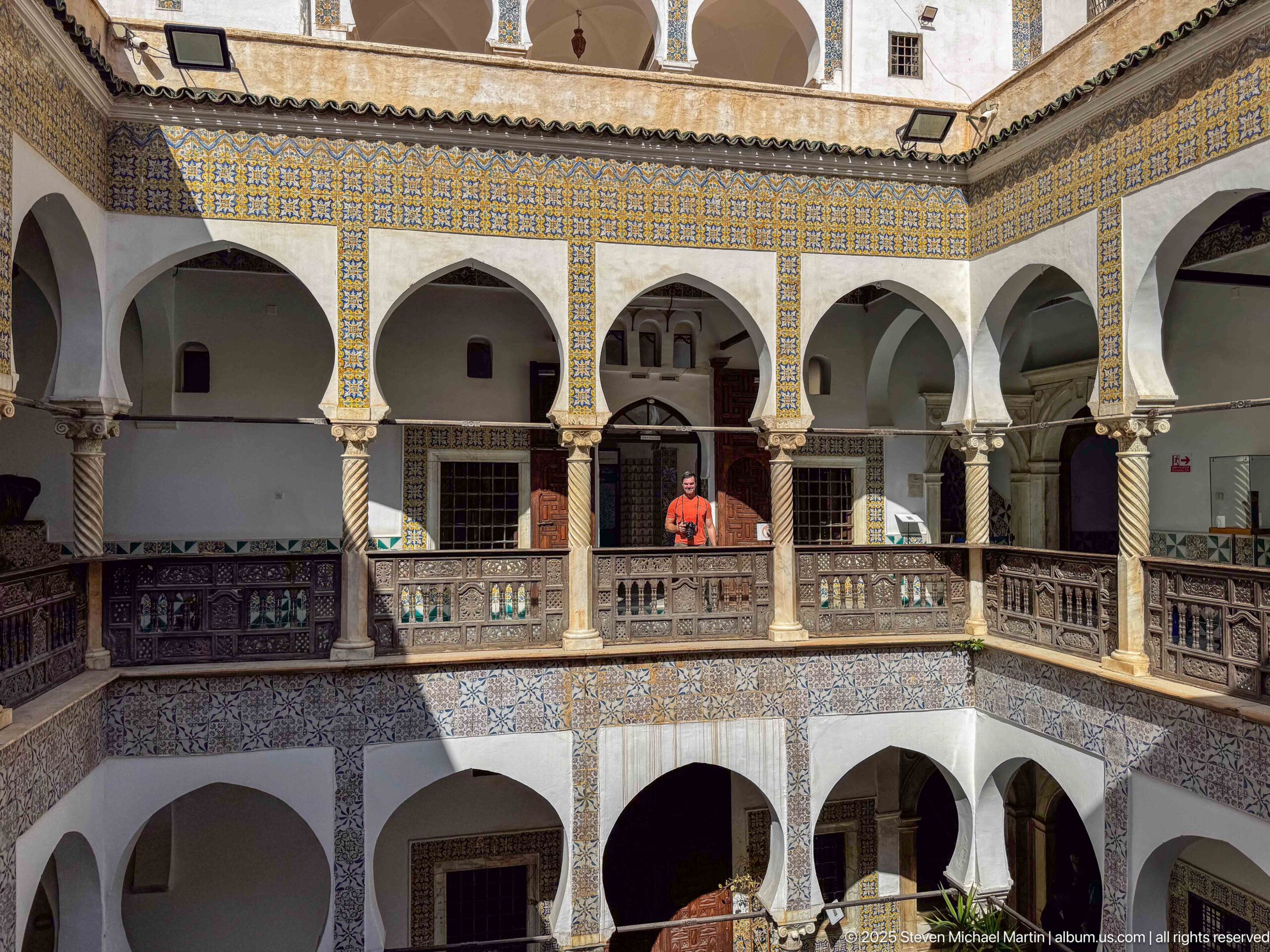
A small figure in an orange shirt stands at the center of an upper gallery across Dar Mustapha Pacha’s courtyard. Seen from a distance, the visitor becomes a scale marker within a much larger composition of white arches, spiral columns, carved wooden balustrades, patterned tile bands, and lower arcades.
Caption
A small figure in an orange shirt stands at the center of an upper gallery across Dar Mustapha Pacha’s courtyard. Seen from a distance, the visitor becomes a scale marker within a much larger composition of white arches, spiral columns, carved wooden balustrades, patterned tile bands, and lower arcades.
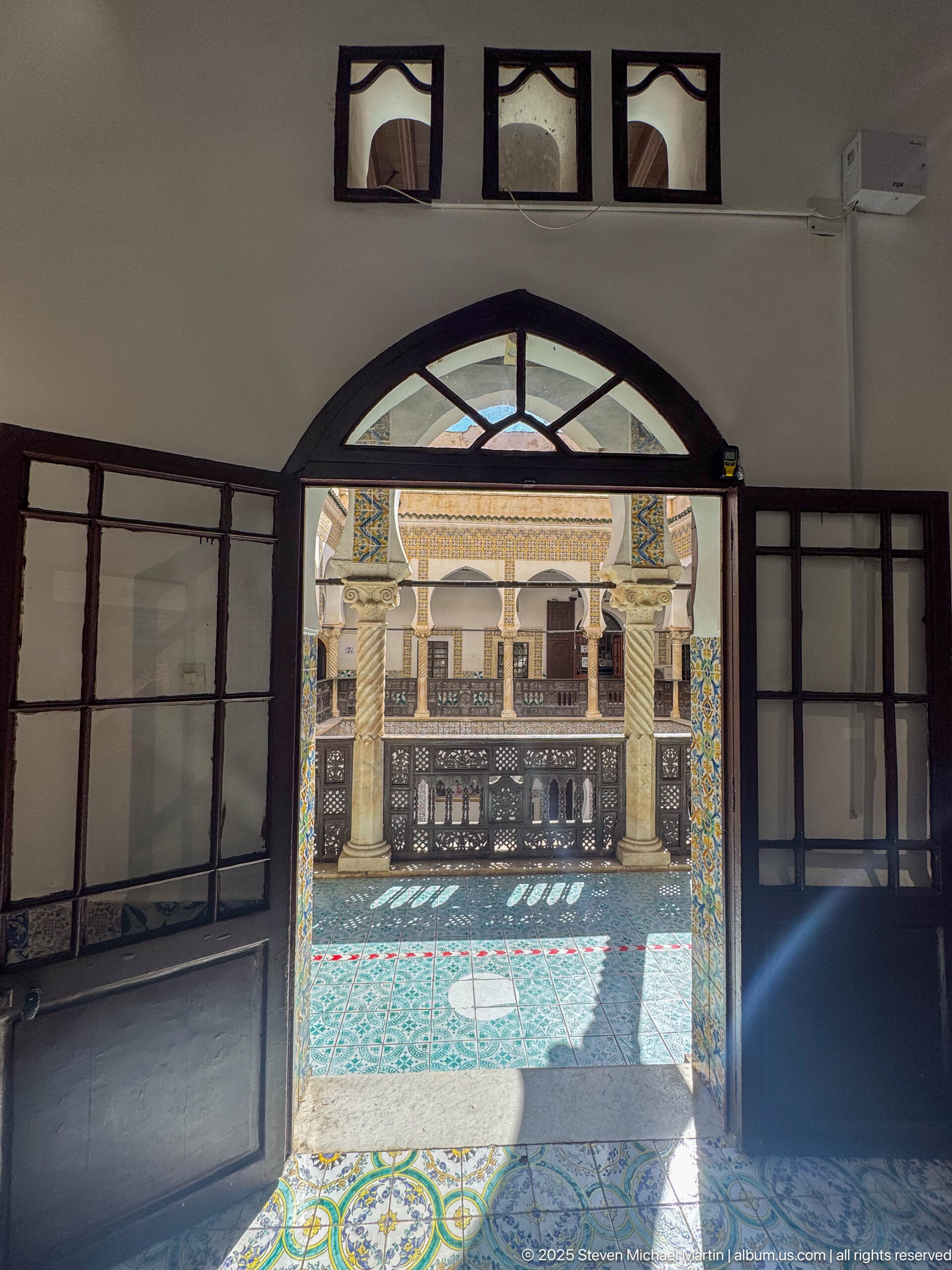
An open glazed doorway creates a dark interior frame around the bright upper gallery of Dar Mustapha Pacha. Beyond the threshold, a carved wooden balustrade, spiral columns, patterned floor tiles, and the opposite courtyard elevation are washed in sunlight, emphasizing the visual transition from enclosed room to open circulation space.
Caption
An open glazed doorway creates a dark interior frame around the bright upper gallery of Dar Mustapha Pacha. Beyond the threshold, a carved wooden balustrade, spiral columns, patterned floor tiles, and the opposite courtyard elevation are washed in sunlight, emphasizing the visual transition from enclosed room to open circulation space.
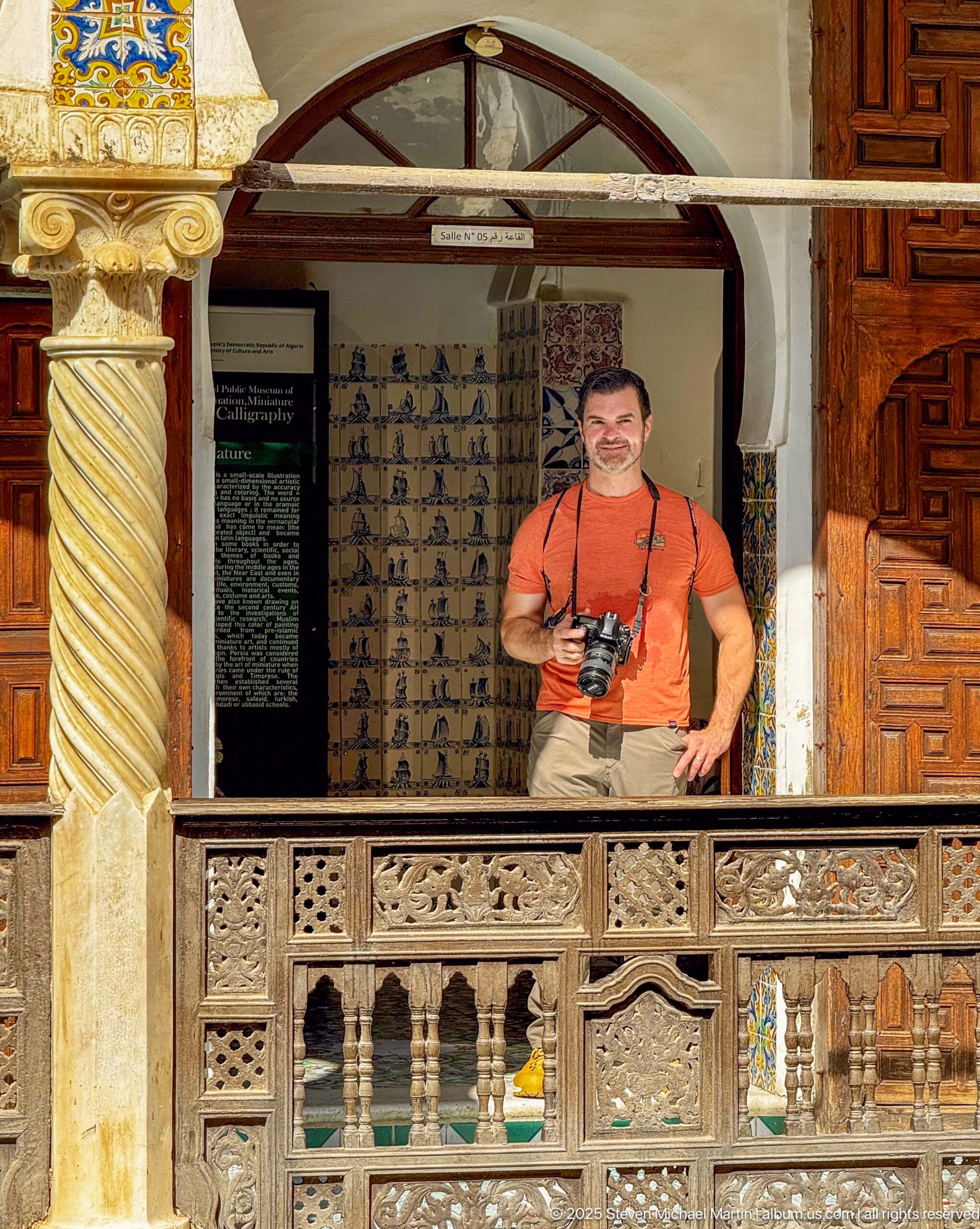
A visitor holding a camera stands behind the carved wooden balustrade of Dar Mustapha Pacha’s upper gallery. A spiral-fluted stone column rises at left, while a heavy geometric wooden door and ship-pattern tiles fill the background. The close portrait places the museum visitor directly among the palace’s distinctive wood, stone, and ceramic surfaces.
Caption
A visitor holding a camera stands behind the carved wooden balustrade of Dar Mustapha Pacha’s upper gallery. A spiral-fluted stone column rises at left, while a heavy geometric wooden door and ship-pattern tiles fill the background. The close portrait places the museum visitor directly among the palace’s distinctive wood, stone, and ceramic surfaces.
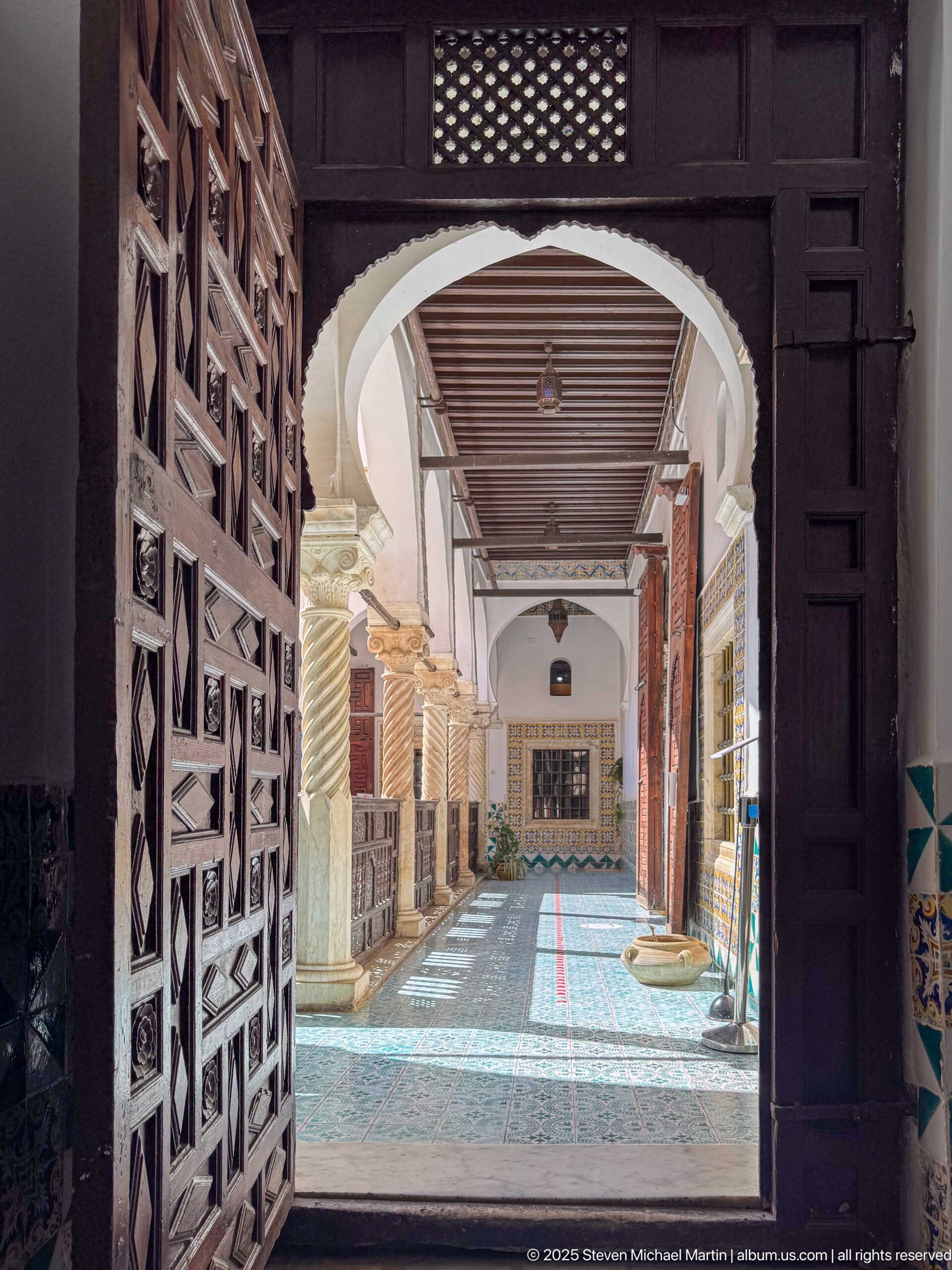
A dark geometric wooden doorway frames a long upper-level gallery extending into bright daylight. Repeated spiral columns and wooden railings recede along the left side, while a patterned tiled floor and red guide line lead toward a distant window. The strong depth makes this one of the clearest views of circulation through the palace galleries.
Caption
A dark geometric wooden doorway frames a long upper-level gallery extending into bright daylight. Repeated spiral columns and wooden railings recede along the left side, while a patterned tiled floor and red guide line lead toward a distant window. The strong depth makes this one of the clearest views of circulation through the palace galleries.
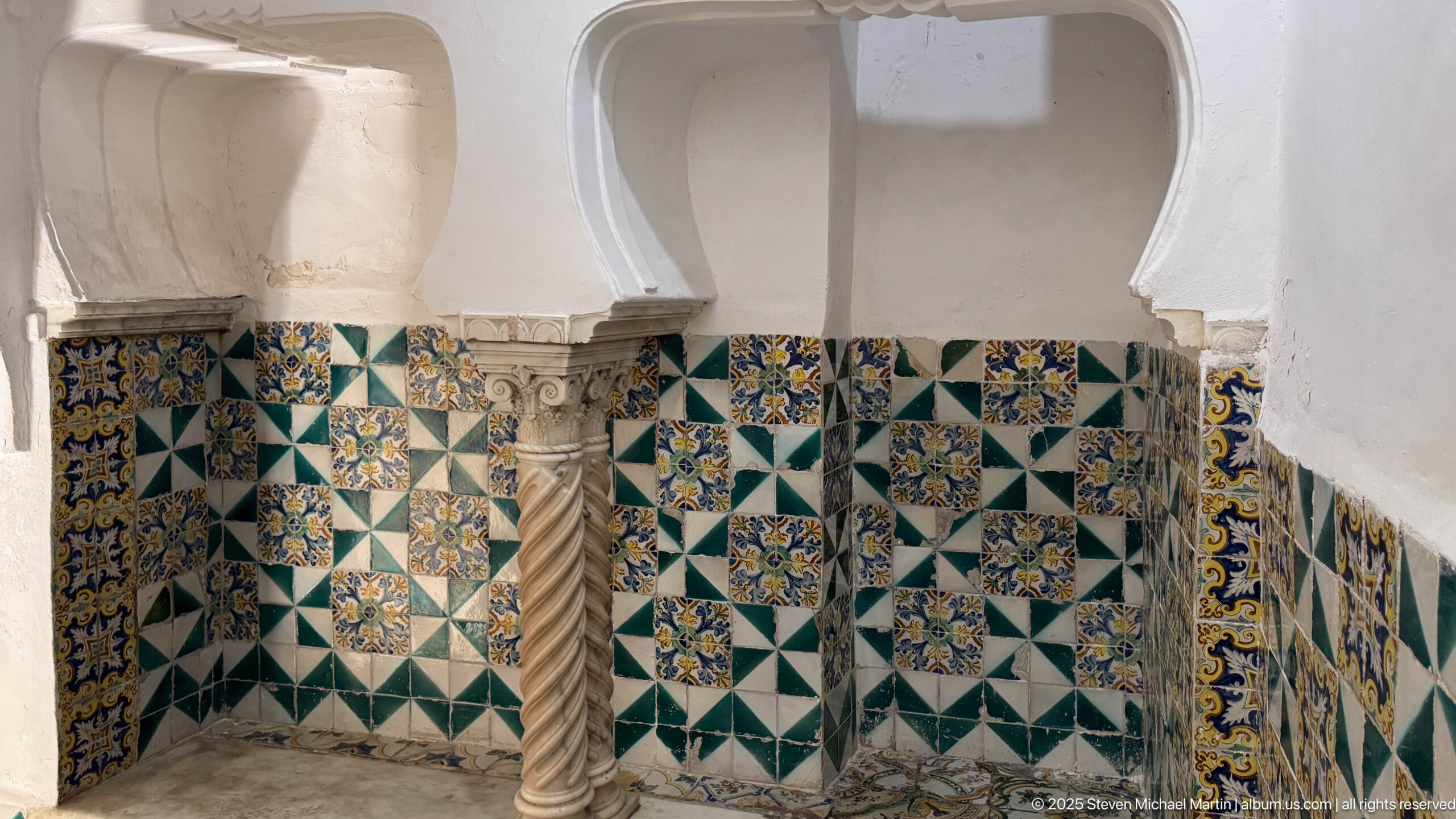
A slender spiral-fluted stone column stands against a lower wall faced with green-and-white triangular tiles interspersed with blue-and-yellow floral squares. Above, a white plaster arch and shallow niche soften the strong geometry of the tiled dado, while worn edges and uneven surfaces preserve evidence of the interior’s material history.
Caption
A slender spiral-fluted stone column stands against a lower wall faced with green-and-white triangular tiles interspersed with blue-and-yellow floral squares. Above, a white plaster arch and shallow niche soften the strong geometry of the tiled dado, while worn edges and uneven surfaces preserve evidence of the interior’s material history.
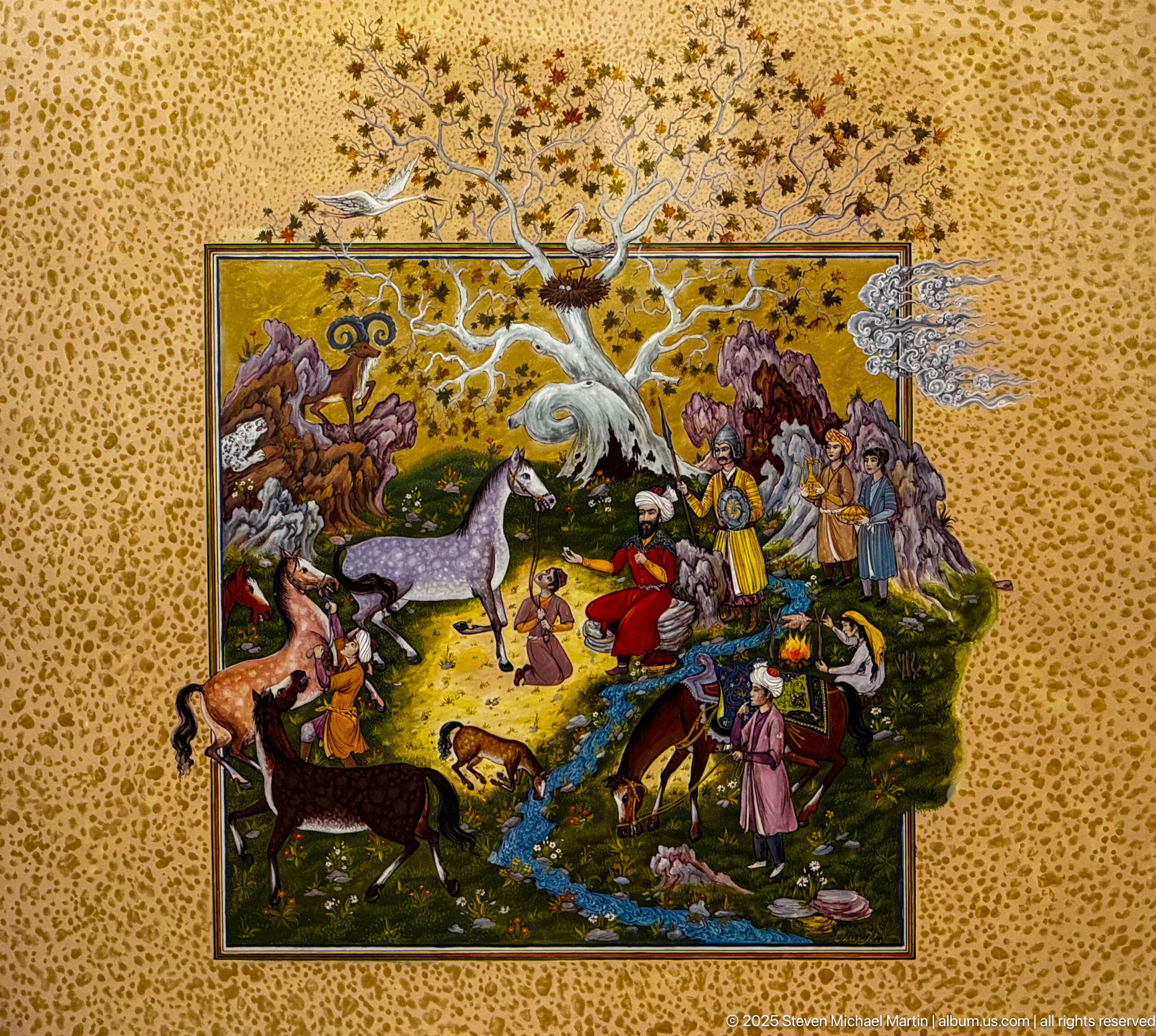
A vivid miniature-style hunting scene gathers mounted and standing figures around deer-like animals in a rocky landscape crossed by a stream. Trees spread across the upper field, birds or small animals punctuate the scene, and the central painted rectangle is surrounded by a stippled gold ground that visually separates narrative action from the decorative margin.
Caption
A vivid miniature-style hunting scene gathers mounted and standing figures around deer-like animals in a rocky landscape crossed by a stream. Trees spread across the upper field, birds or small animals punctuate the scene, and the central painted rectangle is surrounded by a stippled gold ground that visually separates narrative action from the decorative margin.
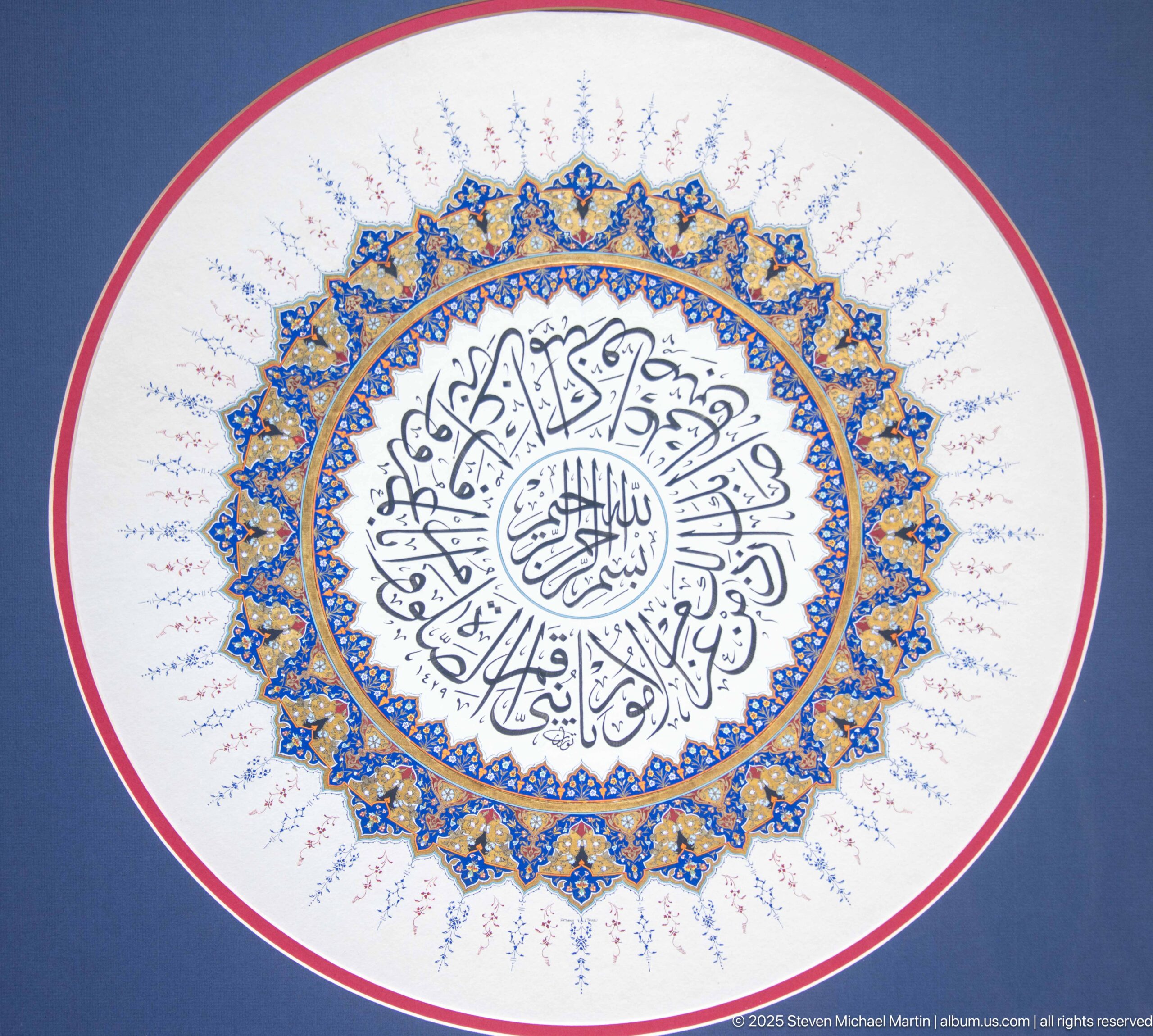
A circular calligraphic composition arranges black Arabic script in a radiating ring around a smaller central inscription. A broad blue-and-gold illuminated band encloses the text, with delicate blue and red flourishes extending outward across the white field. The restrained outer oval and dark surround give the intricate center a medallion-like presentation.
Caption
A circular calligraphic composition arranges black Arabic script in a radiating ring around a smaller central inscription. A broad blue-and-gold illuminated band encloses the text, with delicate blue and red flourishes extending outward across the white field. The restrained outer oval and dark surround give the intricate center a medallion-like presentation.
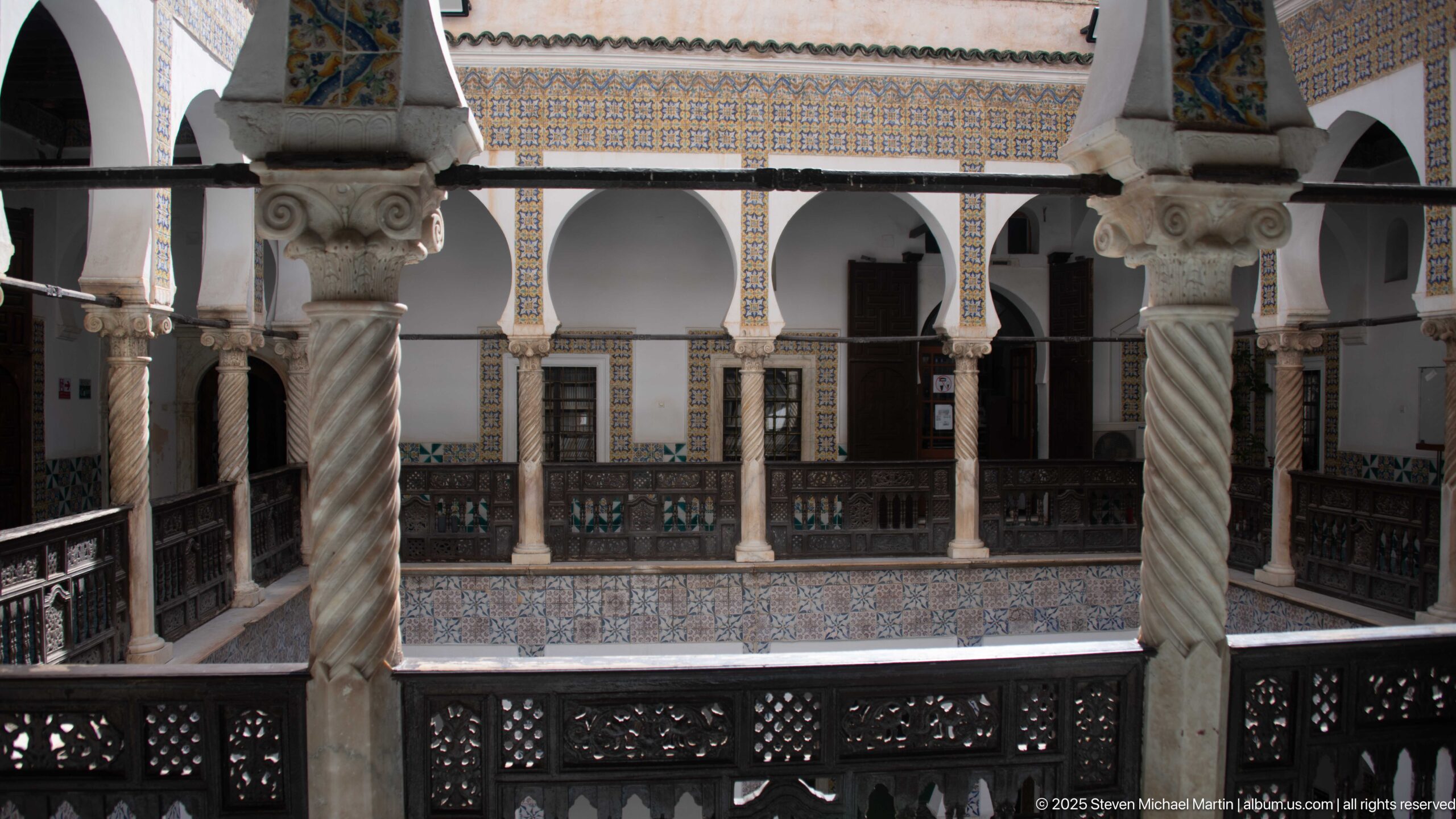
Spiral-fluted stone columns and carved wooden balustrades frame an upper gallery overlooking the interior courtyard. Across the open space, a rhythmic arcade of white arches is edged with blue-and-yellow ceramic tilework, while dark doors and railings punctuate the surrounding elevation. The close foreground columns give this view unusual depth and emphasize the layered circulation galleries of the palace.
Caption
Spiral-fluted stone columns and carved wooden balustrades frame an upper gallery overlooking the interior courtyard. Across the open space, a rhythmic arcade of white arches is edged with blue-and-yellow ceramic tilework, while dark doors and railings punctuate the surrounding elevation. The close foreground columns give this view unusual depth and emphasize the layered circulation galleries of the palace.


