Rudaki Historical Museum
The Rudaki Historical Museum is dedicated to the cultural legacy of Abu Abdallah Rudaki, a tenth-century Persian poet widely regarded as one of the founders of classical Persian literature. His works reflect the intellectual environment that developed in Central Asia following the spread of Islam along Silk Road routes. Literary traditions played an important role in shaping cultural identity across the Persian-speaking world.
The museum presents materials illustrating the development of poetry, scholarship, and artistic expression during a period of flourishing intellectual exchange. Cultural centers supported translation, preservation of knowledge, and transmission of philosophical ideas across regions connected by trade. Literary traditions influenced artistic and intellectual life far beyond Central Asia.
The Rudaki Historical Museum illustrates the role of literature in shaping cultural identity along Silk Road corridors. Its collections reflect the intellectual exchange facilitated by connections across Eurasia.

The main facade of the Rudaki Historical Museum presents a symmetrical white entrance block with a columned portico, tall arched windows, and the Tajik national flag above the pediment. Linear murals across the outer walls introduce historical and cultural themes associated with the museum's collections.
Caption
The main facade of the Rudaki Historical Museum presents a symmetrical white entrance block with a columned portico, tall arched windows, and the Tajik national flag above the pediment. Linear murals across the outer walls introduce historical and cultural themes associated with the museum's collections.

The museum’s natural-history gallery presents antlers, mounted birds, and other wildlife specimens from Tajikistan. The display broadens the museum’s scope beyond human history to include the region’s biodiversity and mountain environments.
Caption
The museum’s natural-history gallery presents antlers, mounted birds, and other wildlife specimens from Tajikistan. The display broadens the museum’s scope beyond human history to include the region’s biodiversity and mountain environments.

A fragmentary Sogdian-style wall painting presents a human figure beside a horse amid swirling blue, red, and ocher forms. The worn surface and incomplete figures convey the condition of murals recovered from ancient Panjikent, where painted interiors preserved complex narrative scenes.
Caption
A fragmentary Sogdian-style wall painting presents a human figure beside a horse amid swirling blue, red, and ocher forms. The worn surface and incomplete figures convey the condition of murals recovered from ancient Panjikent, where painted interiors preserved complex narrative scenes.
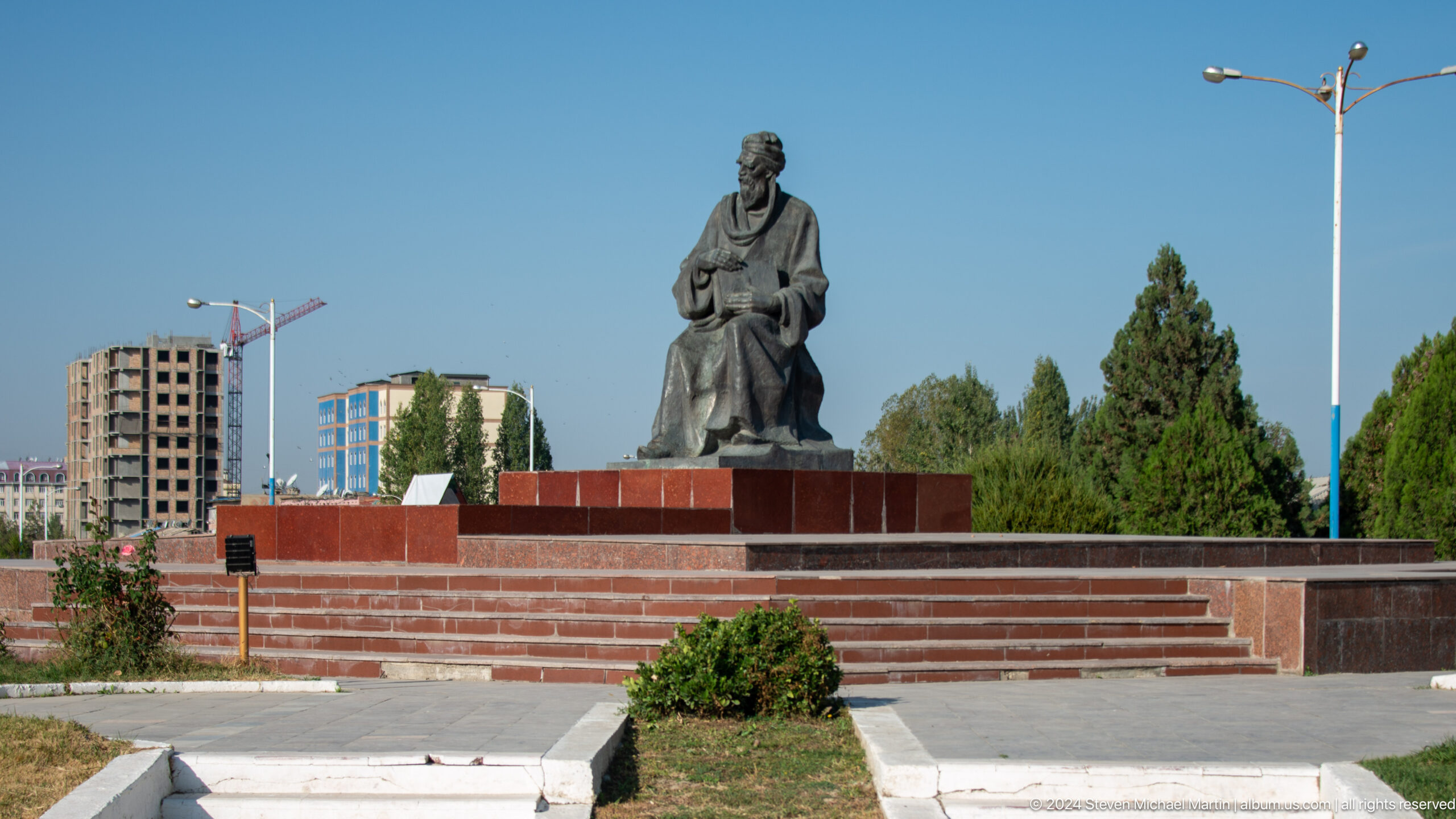
A monumental seated statue of Abu Abdallah Rudaki stands on a broad, stepped red-stone platform outside the museum. The poet is shown in long robes with expressive hands, a formal presentation that emphasizes his enduring cultural importance within the Persian-speaking world and Tajik national heritage.
Caption
A monumental seated statue of Abu Abdallah Rudaki stands on a broad, stepped red-stone platform outside the museum. The poet is shown in long robes with expressive hands, a formal presentation that emphasizes his enduring cultural importance within the Persian-speaking world and Tajik national heritage.

This portrait presents Rudaki as a learned elder in a white turban and rose-colored robe. Framed by manuscript-style floral ornament, the image connects the poet’s legacy with the visual traditions of Persian book culture.
Caption
This portrait presents Rudaki as a learned elder in a white turban and rose-colored robe. Framed by manuscript-style floral ornament, the image connects the poet’s legacy with the visual traditions of Persian book culture.

A standing statue of Rudaki presents the poet in a long robe with one arm extended, suggesting recitation or public address. The sculpture emphasizes his role as a foundational figure in classical Persian literary culture.
Caption
A standing statue of Rudaki presents the poet in a long robe with one arm extended, suggesting recitation or public address. The sculpture emphasizes his role as a foundational figure in classical Persian literary culture.

A modern historical painting imagines a Sogdian courtly gathering, with musicians and attendants assembled around a central ruler. Its vivid theatrical style translates themes found in ancient murals into a contemporary visual reconstruction of ceremonial life.
Caption
A modern historical painting imagines a Sogdian courtly gathering, with musicians and attendants assembled around a central ruler. Its vivid theatrical style translates themes found in ancient murals into a contemporary visual reconstruction of ceremonial life.

This case traces the scholarly study of Sarazm through excavation reports, site photographs, plans, journals, and public-facing publications. The display shows how archaeological knowledge is built not only from objects in cases, but also through documentation, interpretation, and international research exchange.
Caption
This case traces the scholarly study of Sarazm through excavation reports, site photographs, plans, journals, and public-facing publications. The display shows how archaeological knowledge is built not only from objects in cases, but also through documentation, interpretation, and international research exchange.

Displayed at full height, this carved wooden column reveals the proportions and decorative rhythm of a traditional architectural support. Ornament at the capital and shaft demonstrates how craftsmanship transformed structural elements into prominent visual features.
Caption
Displayed at full height, this carved wooden column reveals the proportions and decorative rhythm of a traditional architectural support. Ornament at the capital and shaft demonstrates how craftsmanship transformed structural elements into prominent visual features.

A modern historical painting depicts mounted warriors advancing beneath raised banners. The dramatic composition evokes the military and political history of Central Asia without identifying a specific episode in the surviving proof-sheet view.
Caption
A modern historical painting depicts mounted warriors advancing beneath raised banners. The dramatic composition evokes the military and political history of Central Asia without identifying a specific episode in the surviving proof-sheet view.

A close detail of the outdoor monument to Rudaki emphasizes the seated poet's layered robe and carefully modeled hand gestures. The cropped composition shifts attention from the monument's scale to the sculptor's treatment of posture, drapery, and contemplative expression.
Caption
A close detail of the outdoor monument to Rudaki emphasizes the seated poet's layered robe and carefully modeled hand gestures. The cropped composition shifts attention from the monument's scale to the sculptor's treatment of posture, drapery, and contemplative expression.

Polychrome interior panels combine interlocking star patterns, floral forms, and narrow vegetal borders in a dense decorative field. Set between white architectural strips, the repeated panels create a rhythmic surface that reflects the continuing importance of geometric and plant-based ornament in Persianate and Central Asian design.
Caption
Polychrome interior panels combine interlocking star patterns, floral forms, and narrow vegetal borders in a dense decorative field. Set between white architectural strips, the repeated panels create a rhythmic surface that reflects the continuing importance of geometric and plant-based ornament in Persianate and Central Asian design.

A long interior corridor at the Rudaki Historical Museum links exhibition areas through a sequence of white arched openings. Display cases, photographs, and interpretive panels line the walls, while the red patterned carpet and receding arches create a strong visual axis through the museum.
Caption
A long interior corridor at the Rudaki Historical Museum links exhibition areas through a sequence of white arched openings. Display cases, photographs, and interpretive panels line the walls, while the red patterned carpet and receding arches create a strong visual axis through the museum.

The formal approach to the Rudaki Historical Museum is organized along a central landscaped axis leading directly to the entrance portico. Paved forecourts, low ornamental lamps, and a narrow planted median reinforce the symmetry of the white facade and create a ceremonial arrival sequence.
Caption
The formal approach to the Rudaki Historical Museum is organized along a central landscaped axis leading directly to the entrance portico. Paved forecourts, low ornamental lamps, and a narrow planted median reinforce the symmetry of the white facade and create a ceremonial arrival sequence.

A linear mural on the museum exterior depicts mounted figures riding through a dense narrative scene of horses, animals, and curling forms. Rendered in brown lines against a pale wall, the frieze-like composition evokes the movement and courtly imagery associated with Central Asian historical traditions.
Caption
A linear mural on the museum exterior depicts mounted figures riding through a dense narrative scene of horses, animals, and curling forms. Rendered in brown lines against a pale wall, the frieze-like composition evokes the movement and courtly imagery associated with Central Asian historical traditions.

This exterior line mural centers on a large seated figure surrounded by attendants, vessels, birds, and smaller participants. The use of hierarchical scale and formal poses gives the scene a courtly or ceremonial character, while the monochrome drawing links it visually with the museum's other historical facade murals.
Caption
This exterior line mural centers on a large seated figure surrounded by attendants, vessels, birds, and smaller participants. The use of hierarchical scale and formal poses gives the scene a courtly or ceremonial character, while the monochrome drawing links it visually with the museum's other historical facade murals.

A brightly painted narrative panel presents a crowned central figure in red above a reclining lion, surrounded by attendants, birds, musicians, and smaller scenes. The dense composition and hierarchical scale draw on Persianate and Central Asian visual traditions while functioning as a modern decorative interpretation of historical culture.
Caption
A brightly painted narrative panel presents a crowned central figure in red above a reclining lion, surrounded by attendants, birds, musicians, and smaller scenes. The dense composition and hierarchical scale draw on Persianate and Central Asian visual traditions while functioning as a modern decorative interpretation of historical culture.

A museum wall installation gathers numerous geometric and floral panel designs into a comparative grid. Repeating stars, rosettes, interlace, and medallions vary from panel to panel while maintaining a shared palette, demonstrating the diversity possible within Persianate and Central Asian ornamental systems.
Caption
A museum wall installation gathers numerous geometric and floral panel designs into a comparative grid. Repeating stars, rosettes, interlace, and medallions vary from panel to panel while maintaining a shared palette, demonstrating the diversity possible within Persianate and Central Asian ornamental systems.

A compact archaeological gallery uses a symmetrical arrangement of three glass display cases to present pottery and small artifacts. The narrow central vitrine establishes the room's visual axis, while two side cases and a decorative panel complete the carefully balanced installation.
Caption
A compact archaeological gallery uses a symmetrical arrangement of three glass display cases to present pottery and small artifacts. The narrow central vitrine establishes the room's visual axis, while two side cases and a decorative panel complete the carefully balanced installation.

An English-language museum panel introduces the ancient settlement of Sarazm, discovered in 1976 by archaeologist Abdullo Isakov. The text outlines its long chronology, agricultural and craft economy, metallurgy, broad cultural contacts, and later recognition as an important archaeological heritage site of Tajikistan.
Caption
An English-language museum panel introduces the ancient settlement of Sarazm, discovered in 1976 by archaeologist Abdullo Isakov. The text outlines its long chronology, agricultural and craft economy, metallurgy, broad cultural contacts, and later recognition as an important archaeological heritage site of Tajikistan.

A multilingual museum board presents the Proto-urban Site of Sarazm through excavation photographs, official documents, a site emblem, and a detailed historical summary. The display connects the settlement's archaeological discovery and long chronology with its recognition as a major cultural heritage site of Tajikistan.
Caption
A multilingual museum board presents the Proto-urban Site of Sarazm through excavation photographs, official documents, a site emblem, and a detailed historical summary. The display connects the settlement's archaeological discovery and long chronology with its recognition as a major cultural heritage site of Tajikistan.

A museum staff member or guide stands beside a tiered display of archaeological objects associated with the Sarazm section. Pottery vessels, stone tools, and grinding implements form the backdrop, connecting the modern museum setting with evidence of early settlement and craft activity.
Caption
A museum staff member or guide stands beside a tiered display of archaeological objects associated with the Sarazm section. Pottery vessels, stone tools, and grinding implements form the backdrop, connecting the modern museum setting with evidence of early settlement and craft activity.

A circular decorative emblem associated with Sarazm centers an orange multi-petaled flower around a small site image, framed by a wreath-like border and the name SARAZM. The textile-like design serves as a modern commemorative identity for the archaeological site.
Caption
A circular decorative emblem associated with Sarazm centers an orange multi-petaled flower around a small site image, framed by a wreath-like border and the name SARAZM. The textile-like design serves as a modern commemorative identity for the archaeological site.

A large reconstructed ceramic vessel from the archaeological display has a globular body, narrow neck, and dark surface marked by faint incised lines. Broad pale fills show where missing sections were restored, making the object useful for understanding both ancient vessel form and modern conservation practice.
Caption
A large reconstructed ceramic vessel from the archaeological display has a globular body, narrow neck, and dark surface marked by faint incised lines. Broad pale fills show where missing sections were restored, making the object useful for understanding both ancient vessel form and modern conservation practice.

An interpretive map places Sarazm at the center of a broad network of regional relationships. Color-coded arrows connect the settlement with Central Asia, Iran, India, Mesopotamia, and Anatolia, illustrating the museum's presentation of Sarazm as an active node in long-distance exchange and cultural interaction.
Caption
An interpretive map places Sarazm at the center of a broad network of regional relationships. Color-coded arrows connect the settlement with Central Asia, Iran, India, Mesopotamia, and Anatolia, illustrating the museum's presentation of Sarazm as an active node in long-distance exchange and cultural interaction.

Painted archaeological fragments in the Sarazm display preserve distinct geometric schemes, including black bands, stepped or zigzag patterns, and bold triangular forms on orange and pale surfaces. Presented together in a glass case, the fragments demonstrate the varied decorative practices represented in the site's material record.
Caption
Painted archaeological fragments in the Sarazm display preserve distinct geometric schemes, including black bands, stepped or zigzag patterns, and bold triangular forms on orange and pale surfaces. Presented together in a glass case, the fragments demonstrate the varied decorative practices represented in the site's material record.

A large ceramic jar from Sarazm is displayed with its reconstructed fracture lines left visible. The vessel’s rounded body and broad mouth illustrate the substantial domestic pottery used by early communities in the Zeravshan Valley, while the conservation work makes its archaeological history legible to museum visitors.
Caption
A large ceramic jar from Sarazm is displayed with its reconstructed fracture lines left visible. The vessel’s rounded body and broad mouth illustrate the substantial domestic pottery used by early communities in the Zeravshan Valley, while the conservation work makes its archaeological history legible to museum visitors.

Fragments of ceramic vessels from Sarazm preserve traces of banded decoration and varied firing colors. Although incomplete, the sherds allow archaeologists to reconstruct vessel forms, production methods, and decorative practices within one of Central Asia’s earliest urban settlements.
Caption
Fragments of ceramic vessels from Sarazm preserve traces of banded decoration and varied firing colors. Although incomplete, the sherds allow archaeologists to reconstruct vessel forms, production methods, and decorative practices within one of Central Asia’s earliest urban settlements.

This perforated stone artifact from the Sarazm collection was deliberately shaped and worn through use. Its exact function is not certain from the photograph, but the large opening and worked surface indicate a practical tool or weight associated with ancient daily life.
Caption
This perforated stone artifact from the Sarazm collection was deliberately shaped and worn through use. Its exact function is not certain from the photograph, but the large opening and worked surface indicate a practical tool or weight associated with ancient daily life.

This display reunites bead ornaments with photographs and drawings of their archaeological context. Arranged as necklaces beneath a skeletal reconstruction, the objects show how personal adornment and burial evidence can be studied together to recover aspects of identity and social practice at ancient Sarazm.
Caption
This display reunites bead ornaments with photographs and drawings of their archaeological context. Arranged as necklaces beneath a skeletal reconstruction, the objects show how personal adornment and burial evidence can be studied together to recover aspects of identity and social practice at ancient Sarazm.

Bronze tools and weapon fragments from Sarazm, dated by the museum to the third and second millennia B.C., demonstrate early metalworking in the Zeravshan Valley. Their varied blade, point, and pin forms reflect the practical technologies available to the settlement’s inhabitants.
Caption
Bronze tools and weapon fragments from Sarazm, dated by the museum to the third and second millennia B.C., demonstrate early metalworking in the Zeravshan Valley. Their varied blade, point, and pin forms reflect the practical technologies available to the settlement’s inhabitants.

A museum case brings together ornaments from Sarazm with excavation photographs and burial diagrams. By presenting bracelets, beads, and related finds beside their archaeological documentation, the display emphasizes that the meaning of an artifact depends on the context in which it was recovered.
Caption
A museum case brings together ornaments from Sarazm with excavation photographs and burial diagrams. By presenting bracelets, beads, and related finds beside their archaeological documentation, the display emphasizes that the meaning of an artifact depends on the context in which it was recovered.

Two reconstructed vessels from Sarazm demonstrate contrasting ceramic forms: a rounded jar with a narrow opening and a broad, shallow bowl. The visible joins preserve evidence of archaeological recovery while revealing the everyday containers used by the settlement’s inhabitants.
Caption
Two reconstructed vessels from Sarazm demonstrate contrasting ceramic forms: a rounded jar with a narrow opening and a broad, shallow bowl. The visible joins preserve evidence of archaeological recovery while revealing the everyday containers used by the settlement’s inhabitants.

Women’s ornaments from the Dashti Kozi burial, dated to the second millennium B.C., include substantial bracelets, small fittings, and a strand of beads. The assemblage provides material evidence for personal adornment and funerary practice in prehistoric Central Asia.
Caption
Women’s ornaments from the Dashti Kozi burial, dated to the second millennium B.C., include substantial bracelets, small fittings, and a strand of beads. The assemblage provides material evidence for personal adornment and funerary practice in prehistoric Central Asia.

Close detail reveals the varied beads and corroded fittings of ornaments associated with the Dashti Kozi burial. Their irregular forms and mineralized surfaces preserve both the craftsmanship of ancient personal jewelry and the physical effects of long burial.
Caption
Close detail reveals the varied beads and corroded fittings of ornaments associated with the Dashti Kozi burial. Their irregular forms and mineralized surfaces preserve both the craftsmanship of ancient personal jewelry and the physical effects of long burial.

Photographs, grave plans, and reconstruction drawings document the excavation of ancient burials. Together they record the position of human remains and associated objects, demonstrating how archaeologists preserve spatial evidence before a grave is disturbed and its contents enter a museum collection.
Caption
Photographs, grave plans, and reconstruction drawings document the excavation of ancient burials. Together they record the position of human remains and associated objects, demonstrating how archaeologists preserve spatial evidence before a grave is disturbed and its contents enter a museum collection.

The archaeological gallery of the Rudaki Historical Museum presents large ceramic vessels, stone objects, and smaller finds in a sequence of glass cases. A painted frieze above the displays evokes ancient visual culture while the central jar establishes the monumental scale of some excavated ceramics.
Caption
The archaeological gallery of the Rudaki Historical Museum presents large ceramic vessels, stone objects, and smaller finds in a sequence of glass cases. A painted frieze above the displays evokes ancient visual culture while the central jar establishes the monumental scale of some excavated ceramics.

Three cases of archaeological ceramics line a gallery beneath a reproduction of a painted mural associated with ancient Panjikent. The arrangement connects excavated objects with the visual world of Sogdian Central Asia, placing everyday vessels within a broader artistic and historical setting.
Caption
Three cases of archaeological ceramics line a gallery beneath a reproduction of a painted mural associated with ancient Panjikent. The arrangement connects excavated objects with the visual world of Sogdian Central Asia, placing everyday vessels within a broader artistic and historical setting.

A mounted figure in patterned armor rides a red horse across the vivid blue ground of a Sogdian mural scene. The detailed costume, harness, and flowing ribbons illustrate the importance of elite dress and equestrian imagery in the painted interiors of ancient Panjikent.
Caption
A mounted figure in patterned armor rides a red horse across the vivid blue ground of a Sogdian mural scene. The detailed costume, harness, and flowing ribbons illustrate the importance of elite dress and equestrian imagery in the painted interiors of ancient Panjikent.

This Sogdian mural detail arranges a standing warrior, a richly harnessed horse, and a fallen figure into a compact narrative of conflict. Weapons, costume, and equestrian equipment are emphasized, preserving clues to elite identity and heroic storytelling in ancient Panjikent.
Caption
This Sogdian mural detail arranges a standing warrior, a richly harnessed horse, and a fallen figure into a compact narrative of conflict. Weapons, costume, and equestrian equipment are emphasized, preserving clues to elite identity and heroic storytelling in ancient Panjikent.

A fragmentary mural scene combines a mounted figure, overlapping horses, and smaller animals within a blue field. Although much of the paint has been lost, the surviving forms reveal the crowded, episodic storytelling characteristic of Sogdian wall painting from ancient Panjikent.
Caption
A fragmentary mural scene combines a mounted figure, overlapping horses, and smaller animals within a blue field. Although much of the paint has been lost, the surviving forms reveal the crowded, episodic storytelling characteristic of Sogdian wall painting from ancient Panjikent.

Large feline figures, weapons, and fallen bodies animate this dramatic Sogdian mural scene from the Panjikent display. The surviving fragments suggest a battle, hunt, or heroic episode, but the damaged composition no longer permits a secure reading of the original narrative.
Caption
Large feline figures, weapons, and fallen bodies animate this dramatic Sogdian mural scene from the Panjikent display. The surviving fragments suggest a battle, hunt, or heroic episode, but the damaged composition no longer permits a secure reading of the original narrative.

A fragmentary mural from the ancient Panjikent display shows richly dressed figures gathered around a low table. Vessels, costume, and architectural details offer a rare visual record of elite social life and ceremonial dining in Sogdian Central Asia.
Caption
A fragmentary mural from the ancient Panjikent display shows richly dressed figures gathered around a low table. Vessels, costume, and architectural details offer a rare visual record of elite social life and ceremonial dining in Sogdian Central Asia.

An introductory panel outlines the discovery and archaeological investigation of ancient Pendjikent, a major Sogdian center of the fifth through eighth centuries. It also connects the site’s history with documentary finds from nearby Mount Mugh and the successive expeditions that studied the ruins.
Caption
An introductory panel outlines the discovery and archaeological investigation of ancient Pendjikent, a major Sogdian center of the fifth through eighth centuries. It also connects the site’s history with documentary finds from nearby Mount Mugh and the successive expeditions that studied the ruins.

This archaeological plan maps the fortified settlement of ancient Panjakent during the fifth through eighth centuries. Gates, a bridge, palace areas, streets, and tightly packed residential quarters reveal the organized urban form of one of Sogdiana’s principal Silk Road cities.
Caption
This archaeological plan maps the fortified settlement of ancient Panjakent during the fifth through eighth centuries. Gates, a bridge, palace areas, streets, and tightly packed residential quarters reveal the organized urban form of one of Sogdiana’s principal Silk Road cities.

This large reconstruction gathers numerous Sogdian figures and narrative episodes into an architectural setting of arches and compartments. The scale of the display helps visitors imagine how painted stories once covered the walls of elite and religious interiors at ancient Panjikent.
Caption
This large reconstruction gathers numerous Sogdian figures and narrative episodes into an architectural setting of arches and compartments. The scale of the display helps visitors imagine how painted stories once covered the walls of elite and religious interiors at ancient Panjikent.

A weathered architectural fragment preserves a deeply carved rosette framed by triangular openings. The compact floral geometry demonstrates how stone carving contributed ornamental detail to buildings associated with the ancient Panjikent cultural tradition.
Caption
A weathered architectural fragment preserves a deeply carved rosette framed by triangular openings. The compact floral geometry demonstrates how stone carving contributed ornamental detail to buildings associated with the ancient Panjikent cultural tradition.

A reconstructed interior evokes the richly painted rooms of ancient Panjikent. Columns frame a central mural and surrounding narrative panels, helping visitors understand how Sogdian wall painting functioned within complete architectural spaces rather than as isolated fragments.
Caption
A reconstructed interior evokes the richly painted rooms of ancient Panjikent. Columns frame a central mural and surrounding narrative panels, helping visitors understand how Sogdian wall painting functioned within complete architectural spaces rather than as isolated fragments.

This fragment of painted plaster preserves only a narrow band of the original composition. Its worn pigments and broken edges reveal the fragile archaeological condition of Sogdian murals recovered from ancient Panjikent.
Caption
This fragment of painted plaster preserves only a narrow band of the original composition. Its worn pigments and broken edges reveal the fragile archaeological condition of Sogdian murals recovered from ancient Panjikent.

A broad fragment of painted plaster retains faint reddish-brown forms despite extensive abrasion. The surviving traces demonstrate both the scale of Panjikent’s decorated interiors and the conservation challenges posed by excavated wall paintings.
Caption
A broad fragment of painted plaster retains faint reddish-brown forms despite extensive abrasion. The surviving traces demonstrate both the scale of Panjikent’s decorated interiors and the conservation challenges posed by excavated wall paintings.

This rectangular mural fragment preserves a faint horizontal register of small painted forms. Although the original narrative is no longer legible, the structured band shows how Panjikent artists organized scenes across architectural walls.
Caption
This rectangular mural fragment preserves a faint horizontal register of small painted forms. Although the original narrative is no longer legible, the structured band shows how Panjikent artists organized scenes across architectural walls.

Small worked objects from ancient Panjikent include cylindrical pieces, beads, and other compact implements. Such finds provide evidence for everyday activities that are often less visible than monumental architecture or wall painting.
Caption
Small worked objects from ancient Panjikent include cylindrical pieces, beads, and other compact implements. Such finds provide evidence for everyday activities that are often less visible than monumental architecture or wall painting.

A varied assemblage of bowls, jars, lamps, and small containers represents the domestic pottery of ancient Panjikent. Differences in shape and size reflect the many everyday functions served by ceramic vessels in Sogdian urban life.
Caption
A varied assemblage of bowls, jars, lamps, and small containers represents the domestic pottery of ancient Panjikent. Differences in shape and size reflect the many everyday functions served by ceramic vessels in Sogdian urban life.

This tall ceramic ewer combines a dark neck and handle with a pale, sharply faceted body. Its elongated pouring form and contrasting surface treatment make it a distinctive example of Central Asian ceramic design.
Caption
This tall ceramic ewer combines a dark neck and handle with a pale, sharply faceted body. Its elongated pouring form and contrasting surface treatment make it a distinctive example of Central Asian ceramic design.

Raised scrolling motifs encircle the shoulder of this ceramic vessel. The modeled decoration transforms a functional container into a visually expressive object, demonstrating the ornamental possibilities of molded or applied clay.
Caption
Raised scrolling motifs encircle the shoulder of this ceramic vessel. The modeled decoration transforms a functional container into a visually expressive object, demonstrating the ornamental possibilities of molded or applied clay.

This carved wooden column combines structural purpose with sculptural detail. Its bulbous transition and faceted shaft reflect the long Central Asian tradition of enriching architectural supports through skilled wood carving.
Caption
This carved wooden column combines structural purpose with sculptural detail. Its bulbous transition and faceted shaft reflect the long Central Asian tradition of enriching architectural supports through skilled wood carving.

A profile portrait is set within dense vegetal carving on this commemorative wooden panel. The combination of image, inscription, and ornament demonstrates how traditional woodwork can serve both decorative and memorial purposes.
Caption
A profile portrait is set within dense vegetal carving on this commemorative wooden panel. The combination of image, inscription, and ornament demonstrates how traditional woodwork can serve both decorative and memorial purposes.

A central floral rosette anchors the decoration of this shallow terracotta dish. Symmetrical scrolling motifs spread toward the rim, showing how geometric planning and vegetal ornament enriched utilitarian ceramics.
Caption
A central floral rosette anchors the decoration of this shallow terracotta dish. Symmetrical scrolling motifs spread toward the rim, showing how geometric planning and vegetal ornament enriched utilitarian ceramics.

This heavy rectangular ceramic basin was made for practical use rather than delicate display. Thick walls, a worn rim, and incised exterior marks preserve traces of repeated handling within a domestic or workshop setting.
Caption
This heavy rectangular ceramic basin was made for practical use rather than delicate display. Thick walls, a worn rim, and incised exterior marks preserve traces of repeated handling within a domestic or workshop setting.

Decorated ceramic sherds preserve bold black, white, green, and red patterns from vessels that no longer survive intact. Their curved profiles and painted surfaces allow archaeologists to reconstruct aspects of form, ornament, and ceramic production.
Caption
Decorated ceramic sherds preserve bold black, white, green, and red patterns from vessels that no longer survive intact. Their curved profiles and painted surfaces allow archaeologists to reconstruct aspects of form, ornament, and ceramic production.

This regional map places Panjakent within the wider geography of the Zeravshan Valley and neighboring Central Asian territories. Its Cyrillic place names and marked boundaries provide geographic context for the museum’s archaeological and historical collections.
Caption
This regional map places Panjakent within the wider geography of the Zeravshan Valley and neighboring Central Asian territories. Its Cyrillic place names and marked boundaries provide geographic context for the museum’s archaeological and historical collections.

An open manuscript combines dense handwritten text with elaborate border ornament. The display highlights the close relationship between literary culture, calligraphy, and decorative book arts in the Persian-speaking world.
Caption
An open manuscript combines dense handwritten text with elaborate border ornament. The display highlights the close relationship between literary culture, calligraphy, and decorative book arts in the Persian-speaking world.

This globular earthenware jug combines a practical pouring form with incised or impressed decoration around the shoulder. Its textured surface and substantial body illustrate the balance between utility and ornament in regional ceramic traditions.
Caption
This globular earthenware jug combines a practical pouring form with incised or impressed decoration around the shoulder. Its textured surface and substantial body illustrate the balance between utility and ornament in regional ceramic traditions.

This compact earthenware ewer is shaped for pouring, with a sturdy handle, open mouth, and projecting spout. Incised geometric decoration enriches the vessel’s dark surface while preserving its practical character.
Caption
This compact earthenware ewer is shaped for pouring, with a sturdy handle, open mouth, and projecting spout. Incised geometric decoration enriches the vessel’s dark surface while preserving its practical character.

A group of medieval coins from the Panjakent region illustrates the monetary systems that supported trade and administration in Central Asia. Differences in size, patina, and design point to varied issues circulating within regional exchange networks.
Caption
A group of medieval coins from the Panjakent region illustrates the monetary systems that supported trade and administration in Central Asia. Differences in size, patina, and design point to varied issues circulating within regional exchange networks.

Beads, pendants, and other small finds reveal the personal scale of medieval life in the Panjakent region. Their varied colors, materials, and forms suggest adornment, exchange, and everyday use alongside the museum’s larger architectural and ceramic objects.
Caption
Beads, pendants, and other small finds reveal the personal scale of medieval life in the Panjakent region. Their varied colors, materials, and forms suggest adornment, exchange, and everyday use alongside the museum’s larger architectural and ceramic objects.

Blue-and-white glazed bowls and fragments display a range of floral and geometric designs. By showing complete vessels beside broken sherds, the museum connects finished ceramic artistry with the archaeological evidence from which regional pottery traditions are reconstructed.
Caption
Blue-and-white glazed bowls and fragments display a range of floral and geometric designs. By showing complete vessels beside broken sherds, the museum connects finished ceramic artistry with the archaeological evidence from which regional pottery traditions are reconstructed.

This decorated metal ewer combines a rounded body, curved spout, domed lid, and engraved ornament. Functional vessels of this type also served as showcases for metalworking skill, linking everyday use with the refined decorative traditions of Central Asia.
Caption
This decorated metal ewer combines a rounded body, curved spout, domed lid, and engraved ornament. Functional vessels of this type also served as showcases for metalworking skill, linking everyday use with the refined decorative traditions of Central Asia.

Long embroidered robes and coats display the rich textile traditions of Tajik and Central Asian dress. Striped fabrics, patterned borders, and carefully worked trim transformed clothing into an important expression of regional identity and craftsmanship.
Caption
Long embroidered robes and coats display the rich textile traditions of Tajik and Central Asian dress. Striped fabrics, patterned borders, and carefully worked trim transformed clothing into an important expression of regional identity and craftsmanship.

Close detail reveals the engraved floral medallions and patterned bands covering this metal ewer. The repeated ornament demonstrates how Central Asian metalworkers combined functional vessel forms with densely worked decorative surfaces.
Caption
Close detail reveals the engraved floral medallions and patterned bands covering this metal ewer. The repeated ornament demonstrates how Central Asian metalworkers combined functional vessel forms with densely worked decorative surfaces.

Traditional Tajik necklaces, pendants, and amulets are arranged across red velvet to reveal their elaborate construction. Large silver-toned elements combined adornment with symbolic and protective functions, making jewelry an important marker of identity and social tradition.
Caption
Traditional Tajik necklaces, pendants, and amulets are arranged across red velvet to reveal their elaborate construction. Large silver-toned elements combined adornment with symbolic and protective functions, making jewelry an important marker of identity and social tradition.

A vivid orange field is framed by dense floral and geometric embroidery in this traditional textile. The carefully balanced border shows how color and needlework transformed cloth into a prominent decorative element of dress or interior display.
Caption
A vivid orange field is framed by dense floral and geometric embroidery in this traditional textile. The carefully balanced border shows how color and needlework transformed cloth into a prominent decorative element of dress or interior display.

This reconstructed Tajik interior brings clothing, furnishings, textiles, and architecture into a single social setting. Mannequins in striped robes gather around a low table, illustrating how domestic space, hospitality, and regional dress were experienced together.
Caption
This reconstructed Tajik interior brings clothing, furnishings, textiles, and architecture into a single social setting. Mannequins in striped robes gather around a low table, illustrating how domestic space, hospitality, and regional dress were experienced together.

A recreated Tajik room uses patterned wall hangings, embroidered cushions, and low seating to demonstrate the central role of textiles in domestic life. The arrangement around a low table reflects traditions of hospitality and communal gathering.
Caption
A recreated Tajik room uses patterned wall hangings, embroidered cushions, and low seating to demonstrate the central role of textiles in domestic life. The arrangement around a low table reflects traditions of hospitality and communal gathering.

This coordinated jewelry ensemble combines a turquoise-studded head ornament with necklaces, earrings, and pendant chains. Such elaborate sets were associated with formal female dress and expressed status, identity, and regional craftsmanship.
Caption
This coordinated jewelry ensemble combines a turquoise-studded head ornament with necklaces, earrings, and pendant chains. Such elaborate sets were associated with formal female dress and expressed status, identity, and regional craftsmanship.

A group of embroidered robes reveals the variety of formal dress traditions in Central Asia. Richly colored fabrics, metallic trim, and decorated borders distinguish individual garments while demonstrating shared traditions of textile craftsmanship.
Caption
A group of embroidered robes reveals the variety of formal dress traditions in Central Asia. Richly colored fabrics, metallic trim, and decorated borders distinguish individual garments while demonstrating shared traditions of textile craftsmanship.

A traditional Tajik headdress frames the face with patterned cloth, tassels, and metal ornaments. The layered construction demonstrates how regional costume combined textile design and jewelry into a unified expression of female identity.
Caption
A traditional Tajik headdress frames the face with patterned cloth, tassels, and metal ornaments. The layered construction demonstrates how regional costume combined textile design and jewelry into a unified expression of female identity.

Dense embroidery covers these ceremonial robes with circular motifs, floral panels, and bright borders. The garments show how formal Central Asian dress could become a mobile display of color, pattern, and skilled needlework.
Caption
Dense embroidery covers these ceremonial robes with circular motifs, floral panels, and bright borders. The garments show how formal Central Asian dress could become a mobile display of color, pattern, and skilled needlework.

This multilingual panel introduces Chakan, a traditional Tajik embroidery practice recognized by UNESCO as intangible cultural heritage. The text places the museum’s embroidered garments within a living tradition transmitted through skill, community practice, and cultural memory.
Caption
This multilingual panel introduces Chakan, a traditional Tajik embroidery practice recognized by UNESCO as intangible cultural heritage. The text places the museum’s embroidered garments within a living tradition transmitted through skill, community practice, and cultural memory.

A modern historical painting imagines mounted warriors in the chaos of battle. Dust, diagonal movement, and fallen figures create a dramatic reconstruction of Central Asia’s military past without identifying a specific event in the visible image.
Caption
A modern historical painting imagines mounted warriors in the chaos of battle. Dust, diagonal movement, and fallen figures create a dramatic reconstruction of Central Asia’s military past without identifying a specific event in the visible image.

This modern landscape painting presents a compact Tajik mountain settlement from an elevated viewpoint. Blue-gray roofs, narrow lanes, and surrounding peaks emphasize the close relationship between urban life and the rugged geography of the region.
Caption
This modern landscape painting presents a compact Tajik mountain settlement from an elevated viewpoint. Blue-gray roofs, narrow lanes, and surrounding peaks emphasize the close relationship between urban life and the rugged geography of the region.

Rendered in embroidery, the national emblem of Tajikistan combines a crown and seven stars with mountains, a rising sun, wheat, and cotton. The textile interpretation joins state symbolism with the country’s strong traditions of decorative needlework.
Caption
Rendered in embroidery, the national emblem of Tajikistan combines a crown and seven stars with mountains, a rising sun, wheat, and cotton. The textile interpretation joins state symbolism with the country’s strong traditions of decorative needlework.

This embroidered map transforms the outline of Tajikistan into a decorative national image. Regional divisions occupy the center while dense floral needlework surrounds the map, merging geographic identity with traditional textile artistry.
Caption
This embroidered map transforms the outline of Tajikistan into a decorative national image. Regional divisions occupy the center while dense floral needlework surrounds the map, merging geographic identity with traditional textile artistry.

A bird surrounded by scrolling vegetal forms fills this embossed metal medallion. The compact circular design demonstrates how animal imagery and ornamental relief were combined in Central Asian decorative metalwork.
Caption
A bird surrounded by scrolling vegetal forms fills this embossed metal medallion. The compact circular design demonstrates how animal imagery and ornamental relief were combined in Central Asian decorative metalwork.

An official-style portrait presents a Tajik statesman in a dark suit and orange tie, framed by elaborate decorative ornament. The display connects modern political history with the museum’s broader emphasis on national identity and visual culture.
Caption
An official-style portrait presents a Tajik statesman in a dark suit and orange tie, framed by elaborate decorative ornament. The display connects modern political history with the museum’s broader emphasis on national identity and visual culture.

A wall display of archaeological photographs connects the museum’s collections with the landscapes and ruins from which regional history is studied. Views of exposed walls, settlement remains, and arid terrain emphasize the importance of place in archaeological interpretation.
Caption
A wall display of archaeological photographs connects the museum’s collections with the landscapes and ruins from which regional history is studied. Views of exposed walls, settlement remains, and arid terrain emphasize the importance of place in archaeological interpretation.