Waterton Lakes NP Visitor Center Introduction
The Waterton Lakes National Park Visitor Centre stands in the heart of Waterton village as a contemporary gateway to one of the Canadian Rockies’ most distinctive landscapes. The new facility brings together visitor services, interpretation, and gathering spaces in a design inspired by the natural materials and architectural traditions long associated with Canada’s national parks. Stone, timber, expansive windows, and a broad sheltering roof connect the building visually with the surrounding mountains, while three structures arranged around a protected plaza provide a welcome refuge from Waterton’s famously persistent winds.
Inside, the exhibits introduce the remarkable convergence that defines Waterton Lakes: Rocky Mountain peaks meeting open prairie, forests giving way to grasslands, and an unusually diverse collection of plants and wildlife occupying the boundaries between ecosystems. Interpretation also places the landscape within the much longer human history of Paahtómahksikimi, the Blackfoot name associated with Waterton Lakes. Developed with Indigenous partners, exhibits incorporate Blackfoot language, stories, songs, and perspectives, including the “thirteen moons” experience, while other displays explore subjects ranging from nocturnal wildlife and dark skies to the powerful roles of wind and wildfire in shaping the park.
The experience continues outside, where native vegetation, wildlife sculptures, maps, and interactive displays transform the grounds into an extension of the exhibits within. Visitors can trace the movement of water from the Continental Divide, explore a miniature interpretation of Red Rock Canyon, or simply use the plaza as a starting point before venturing farther into the park. More than an information desk, the Visitor Centre is conceived as a meeting place—between mountains and prairie, people and landscape, and contemporary visitors and the cultures and natural forces that have shaped Waterton for generations.
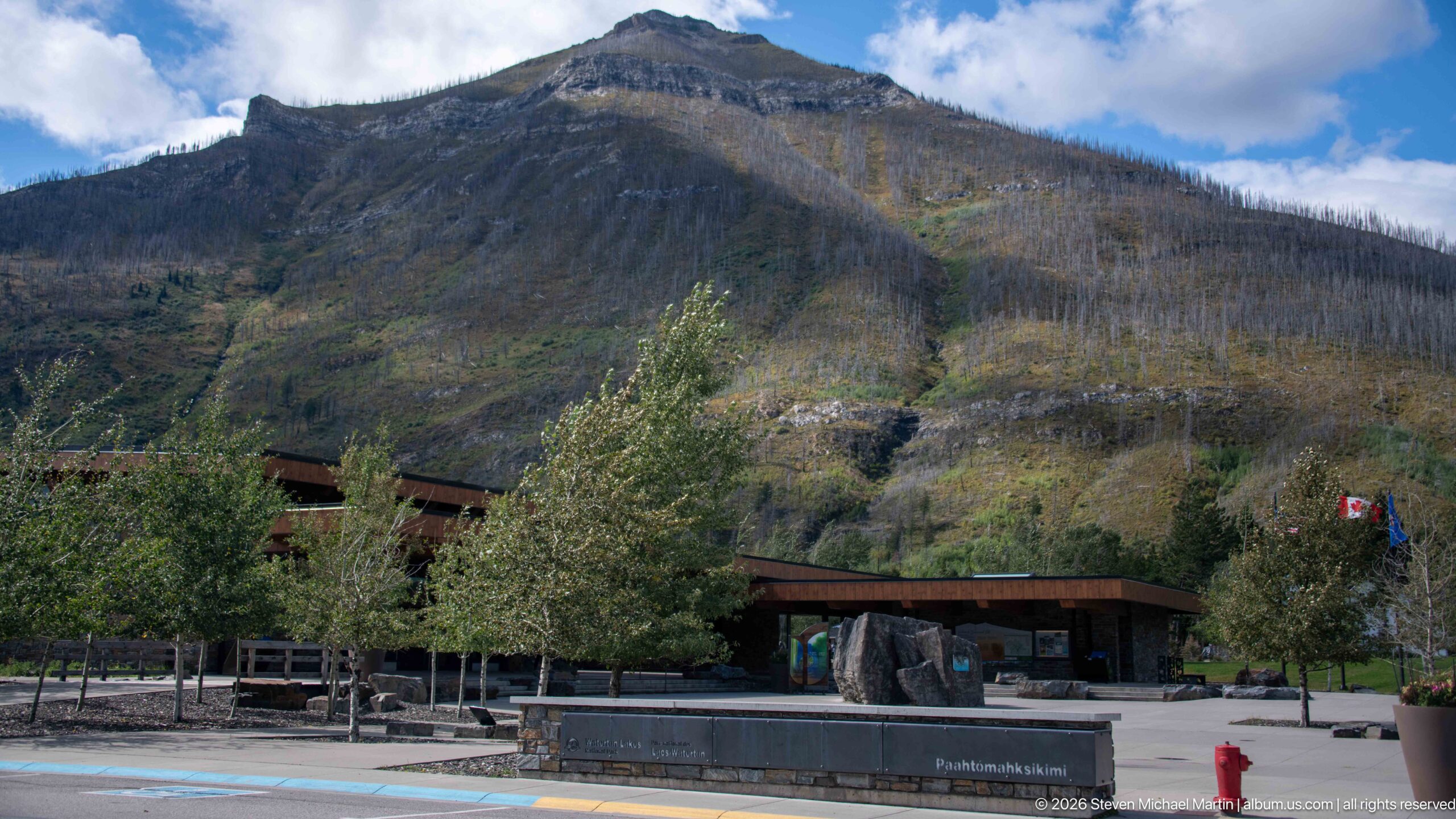
A wider view places the Waterton Lakes National Park Visitor Centre beneath a rugged mountain slope marked by sparse post-fire forest. The low, horizontal visitor complex is partially screened by young trees, while Canadian and other flags punctuate the plaza at right. The composition emphasizes how deliberately the contemporary building remains subordinate to the scale of the surrounding Rockies.
Caption
A wider view places the Waterton Lakes National Park Visitor Centre beneath a rugged mountain slope marked by sparse post-fire forest. The low, horizontal visitor complex is partially screened by young trees, while Canadian and other flags punctuate the plaza at right. The composition emphasizes how deliberately the contemporary building remains subordinate to the scale of the surrounding Rockies.
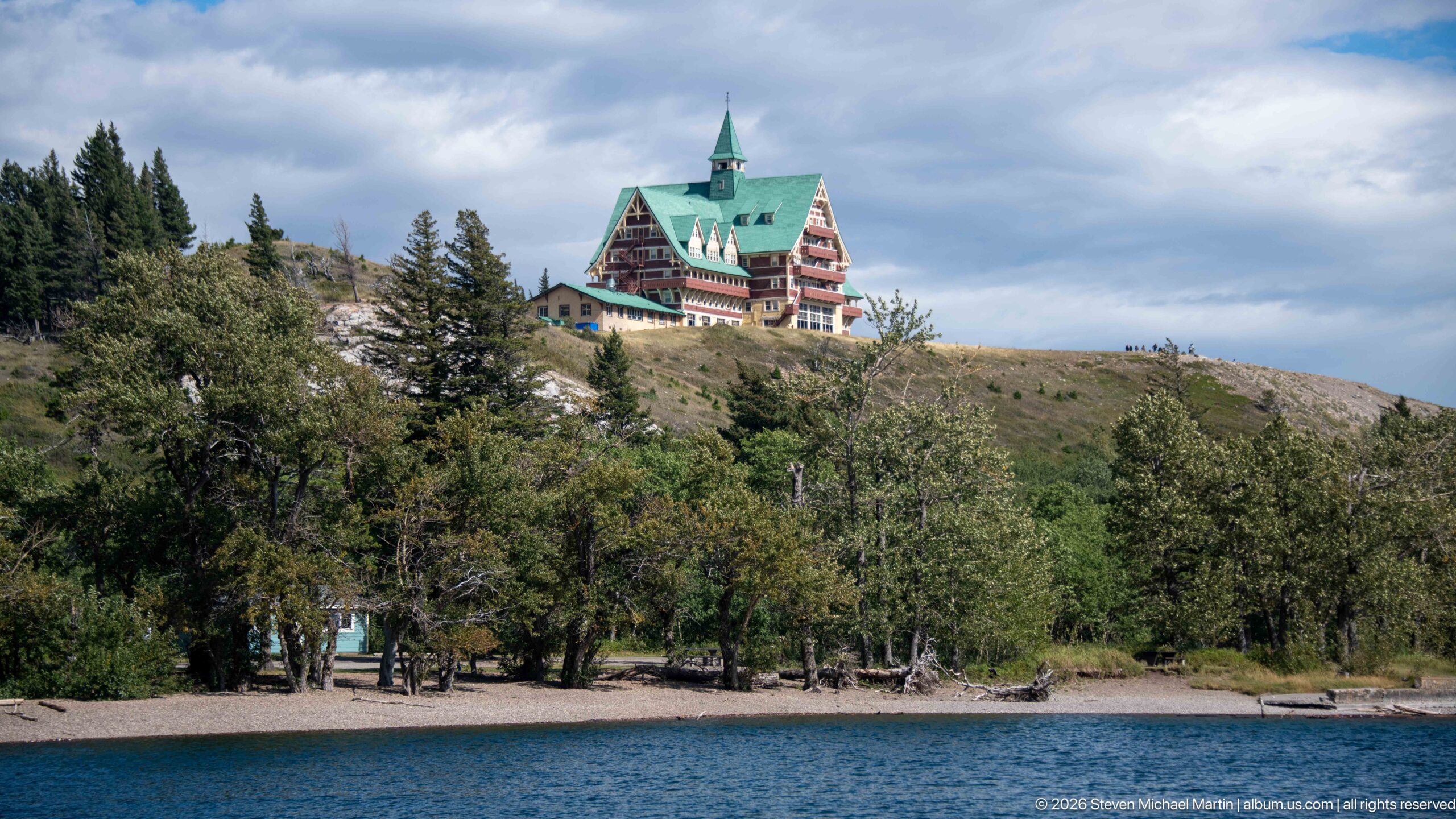
The Prince of Wales Hotel rises above the lakeshore on its exposed bluff, its steep green roof, central tower, and red-and-white gabled façade immediately distinguishing the landmark from the surrounding trees. Seen across blue water, the composition emphasizes the hotel’s elevated relationship to the lake and the dramatic openness of its Waterton setting.
Caption
The Prince of Wales Hotel rises above the lakeshore on its exposed bluff, its steep green roof, central tower, and red-and-white gabled façade immediately distinguishing the landmark from the surrounding trees. Seen across blue water, the composition emphasizes the hotel’s elevated relationship to the lake and the dramatic openness of its Waterton setting.
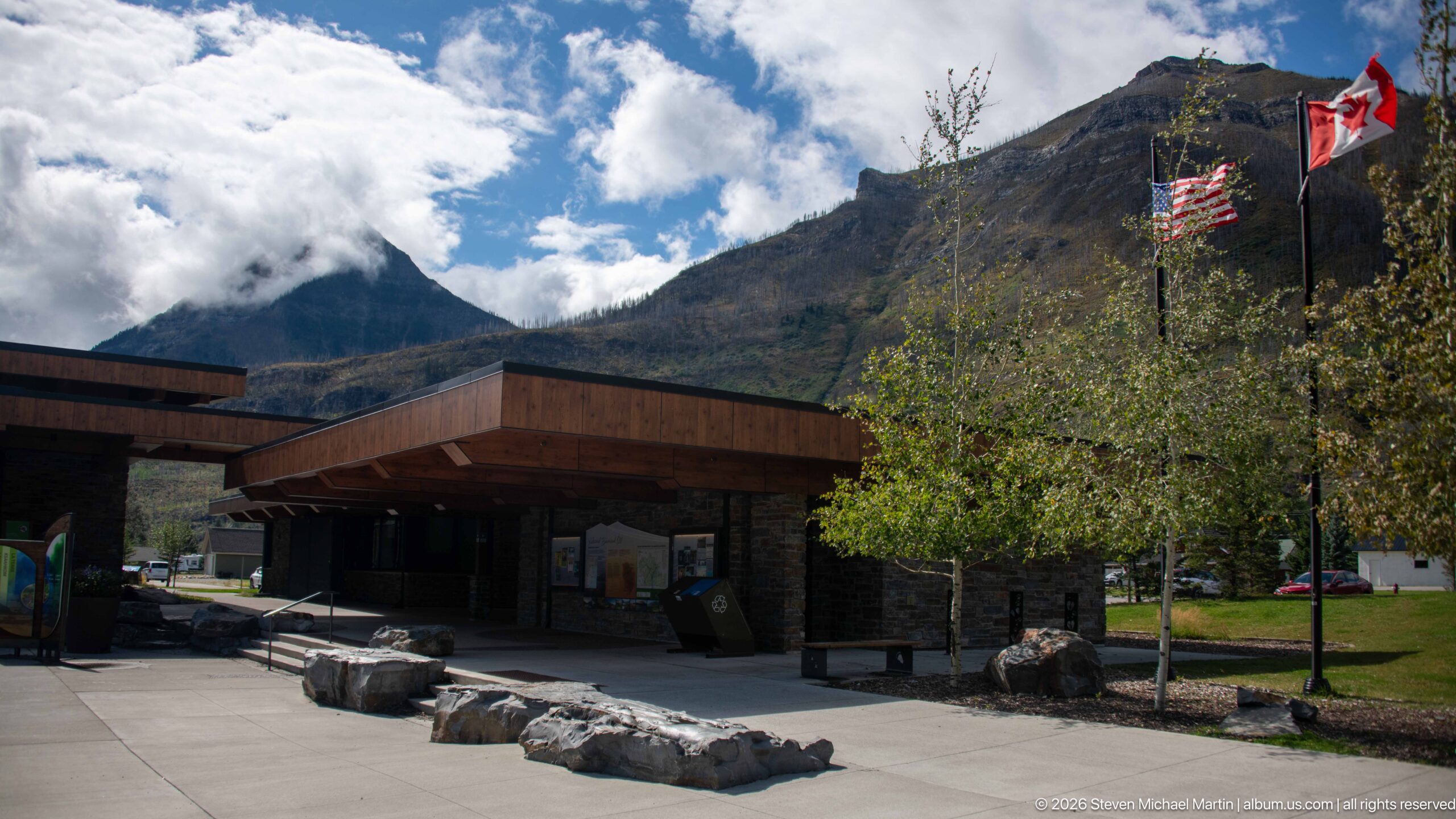
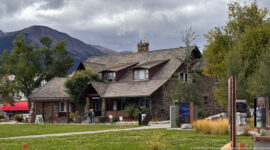
A sheltered wing of the visitor centre projects toward the plaza beneath layered timber rooflines. Rough boulders edge the walkway, while Canadian and United States flags rise beside young trees at right. Behind the building, sharply rising mountain slopes and drifting clouds reinforce Waterton’s position where an international park landscape meets the Canadian Rockies.
Caption
A sheltered wing of the visitor centre projects toward the plaza beneath layered timber rooflines. Rough boulders edge the walkway, while Canadian and United States flags rise beside young trees at right. Behind the building, sharply rising mountain slopes and drifting clouds reinforce Waterton’s position where an international park landscape meets the Canadian Rockies.
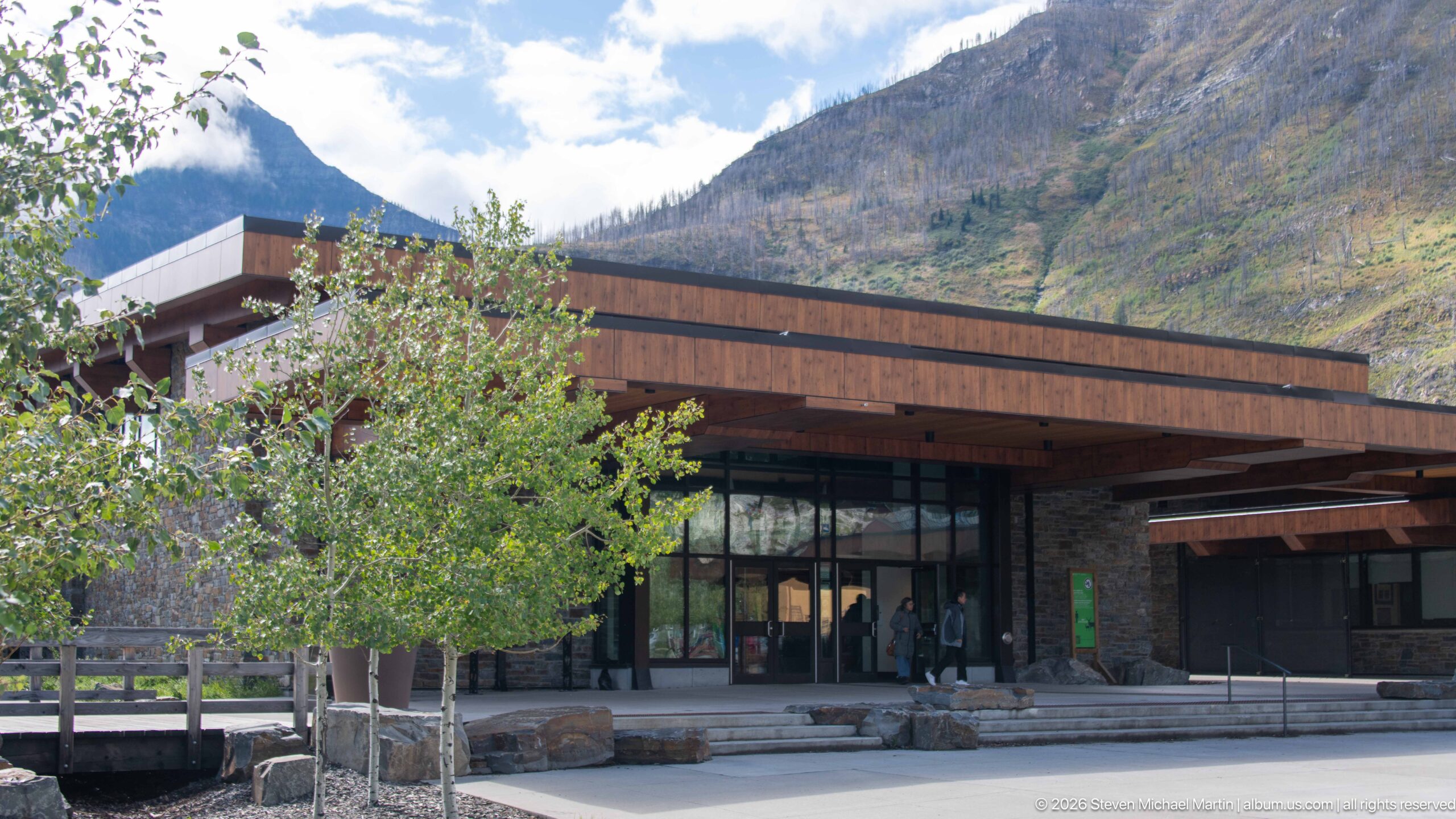
The main entrance combines a broad timber canopy with a tall glazed doorway set between stone-clad walls. Heavy wood beams project outward to shelter the approach, while scattered boulders and a young tree continue the landscape vocabulary into the plaza. Visitors near the doors provide a useful sense of scale for the substantial roof structure.
Caption
The main entrance combines a broad timber canopy with a tall glazed doorway set between stone-clad walls. Heavy wood beams project outward to shelter the approach, while scattered boulders and a young tree continue the landscape vocabulary into the plaza. Visitors near the doors provide a useful sense of scale for the substantial roof structure.
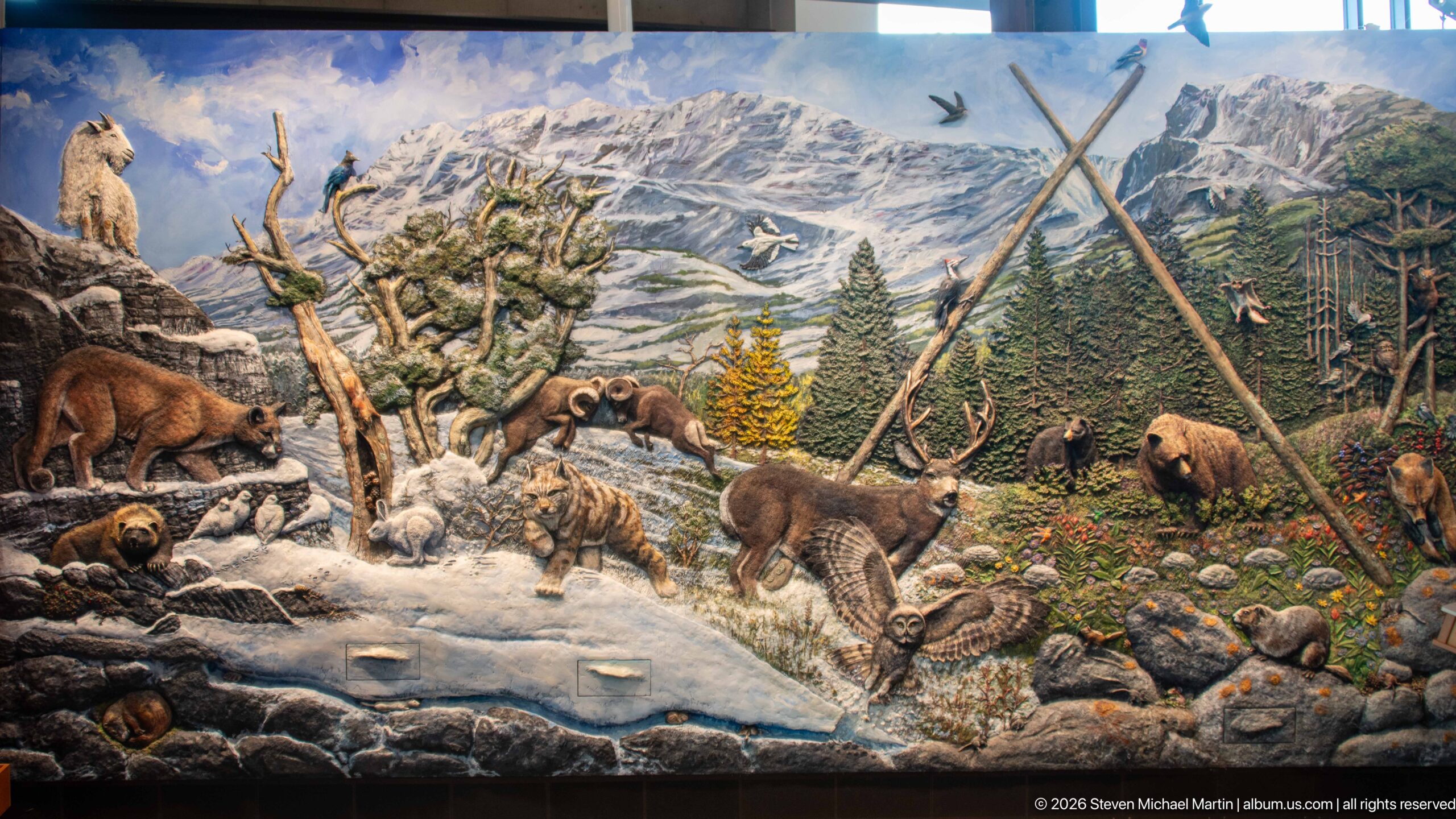
A richly detailed mural assembles numerous mountain animals within a single Rocky Mountain ecosystem scene. Bears, ungulates, birds, small mammals, and aquatic life occupy different elevations from stream edge to forest and alpine slopes, turning the wall into a visual survey of biodiversity. The deliberately crowded composition rewards close viewing and introduces ecological relationships through recognizable wildlife rather than text alone.
Caption
A richly detailed mural assembles numerous mountain animals within a single Rocky Mountain ecosystem scene. Bears, ungulates, birds, small mammals, and aquatic life occupy different elevations from stream edge to forest and alpine slopes, turning the wall into a visual survey of biodiversity. The deliberately crowded composition rewards close viewing and introduces ecological relationships through recognizable wildlife rather than text alone.
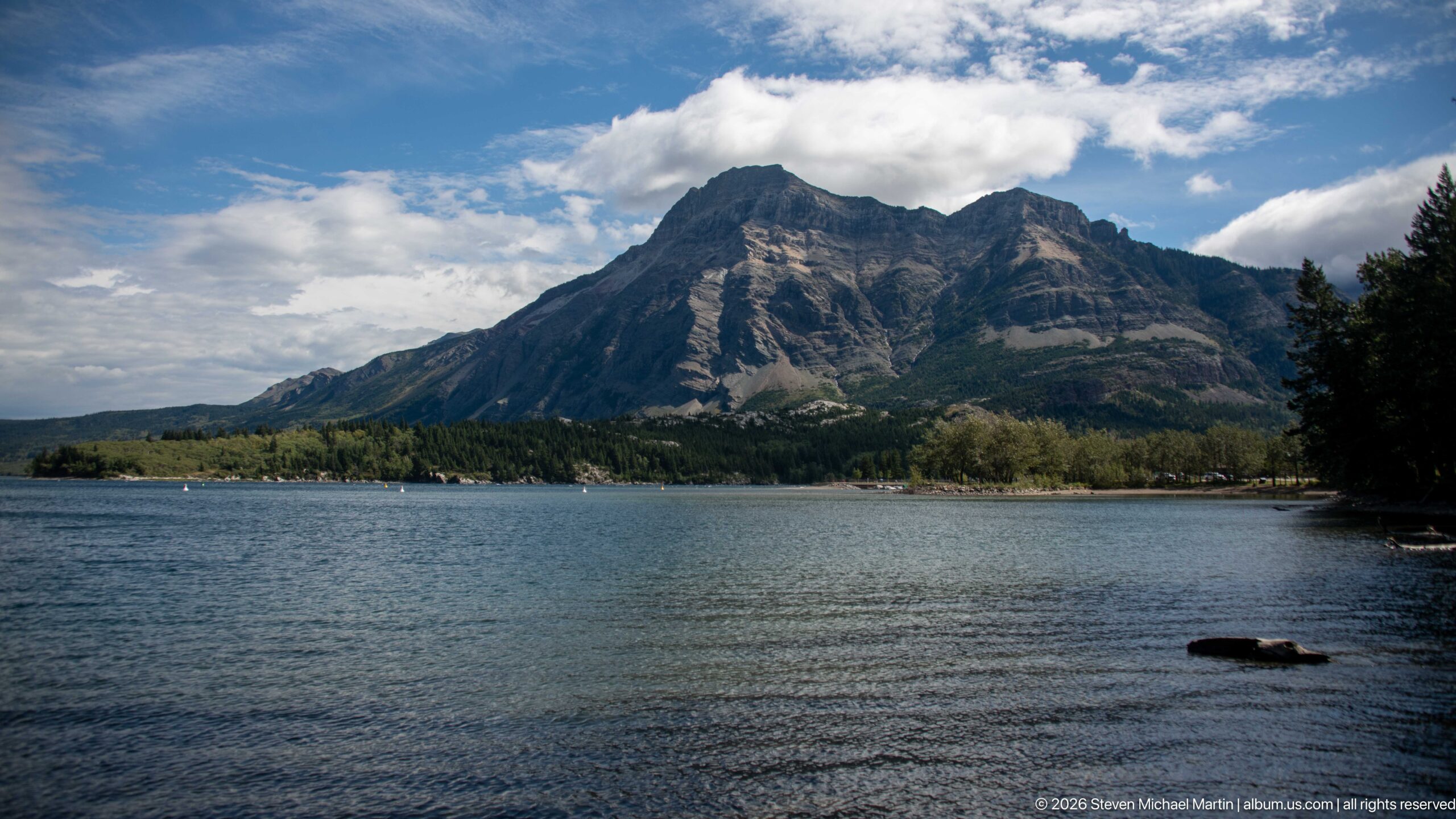
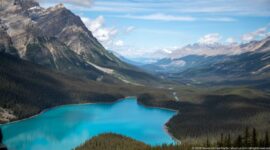
A broad mountain massif dominates the far shore of a Waterton lake, its exposed gray rock faces and layered ridges rising abruptly above forested lower slopes. Open water fills the foreground beneath broken clouds, producing a landscape study centered on the park’s characteristic meeting of deep glacially shaped basins, steep mountain relief, and wooded shoreline.
Caption
A broad mountain massif dominates the far shore of a Waterton lake, its exposed gray rock faces and layered ridges rising abruptly above forested lower slopes. Open water fills the foreground beneath broken clouds, producing a landscape study centered on the park’s characteristic meeting of deep glacially shaped basins, steep mountain relief, and wooded shoreline.
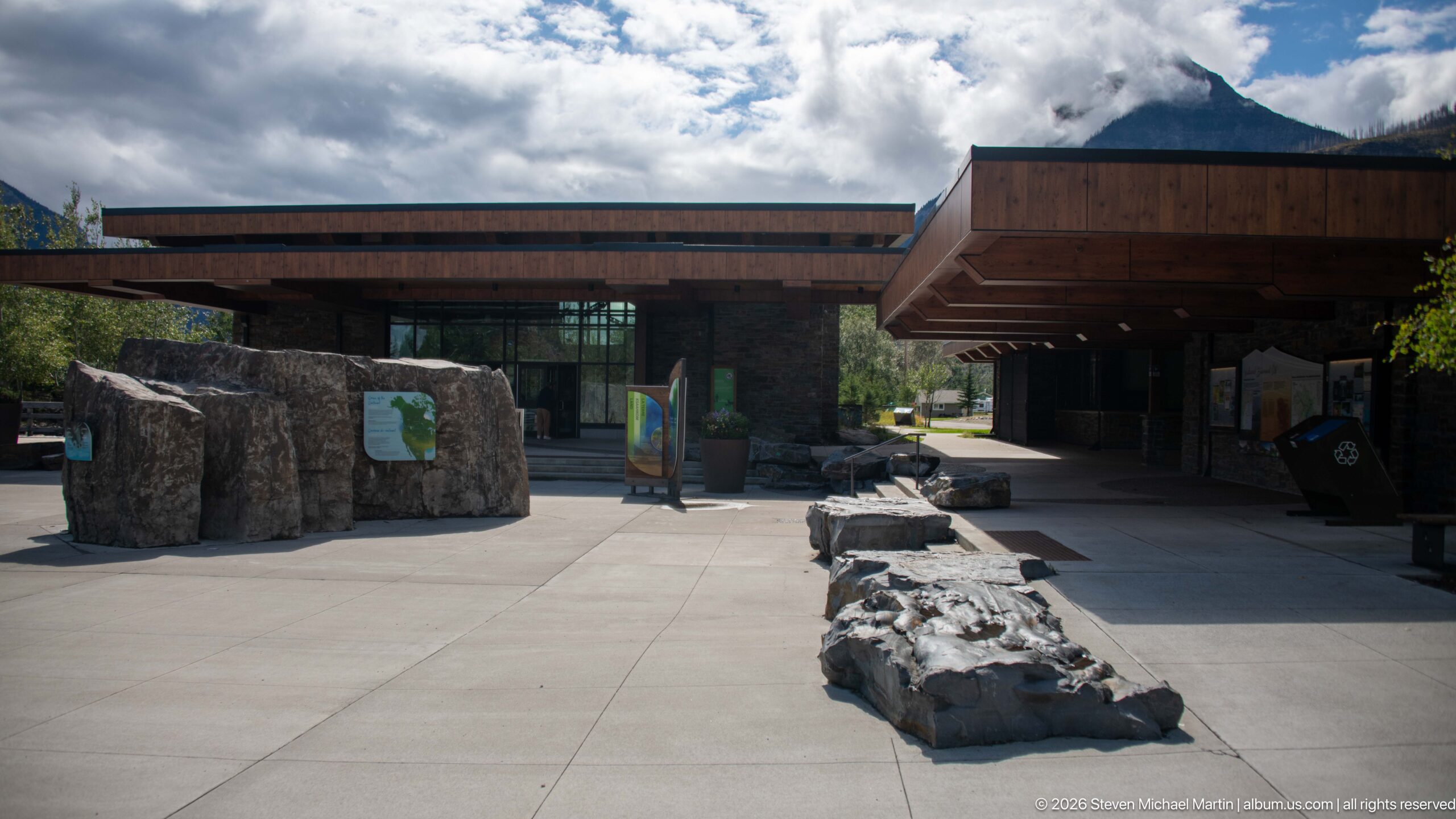
The visitor centre’s central plaza is organized as a sequence of stone, timber, and open pavement. A large interpretive boulder stands to the left, while a low line of natural rock guides visitors toward the shaded building wing on the right. Glazed doors and connecting roof forms close the far side, creating an outdoor room within the larger mountain setting.
Caption
The visitor centre’s central plaza is organized as a sequence of stone, timber, and open pavement. A large interpretive boulder stands to the left, while a low line of natural rock guides visitors toward the shaded building wing on the right. Glazed doors and connecting roof forms close the far side, creating an outdoor room within the larger mountain setting.
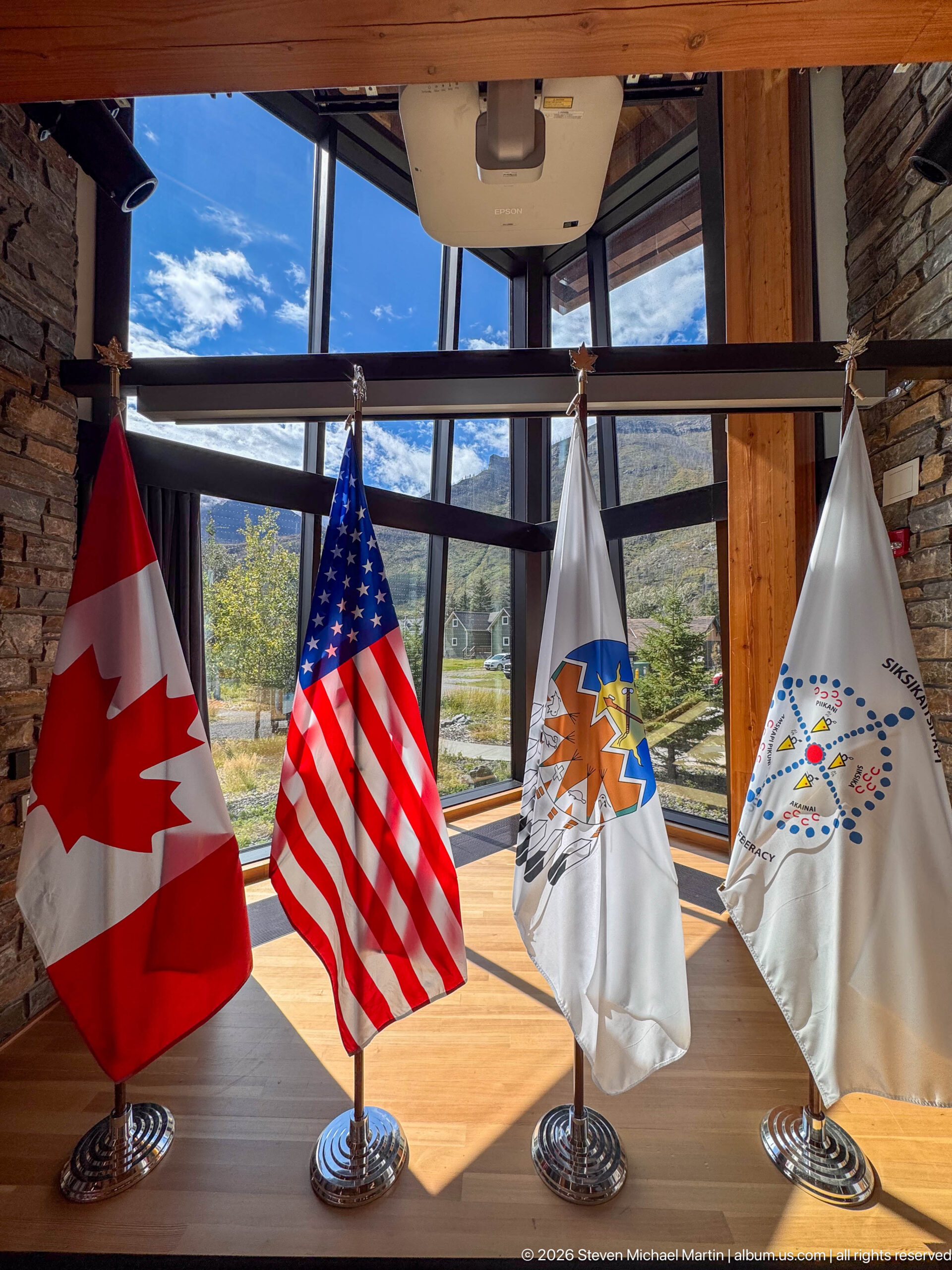
Four freestanding flags are arranged across a wooden surface beneath the visitor center’s timber roof and expansive glazing. Canada and the United States occupy the left side, joined by two white emblem-bearing standards. The wider composition shows how the display sits within the building’s warm wood-and-stone interior and mountain-facing windows.
Caption
Four freestanding flags are arranged across a wooden surface beneath the visitor center’s timber roof and expansive glazing. Canada and the United States occupy the left side, joined by two white emblem-bearing standards. The wider composition shows how the display sits within the building’s warm wood-and-stone interior and mountain-facing windows.

Seen at close range, the visitor centre’s beaver mascot wears a bright yellow ranger hat and a green vest filled with molded pockets and Parks-themed details. The smiling figure is mounted on a circular base at the edge of the landscaped plaza. This tighter composition records the character itself rather than its broader setting and makes the costume details especially legible.
Caption
Seen at close range, the visitor centre’s beaver mascot wears a bright yellow ranger hat and a green vest filled with molded pockets and Parks-themed details. The smiling figure is mounted on a circular base at the edge of the landscaped plaza. This tighter composition records the character itself rather than its broader setting and makes the costume details especially legible.
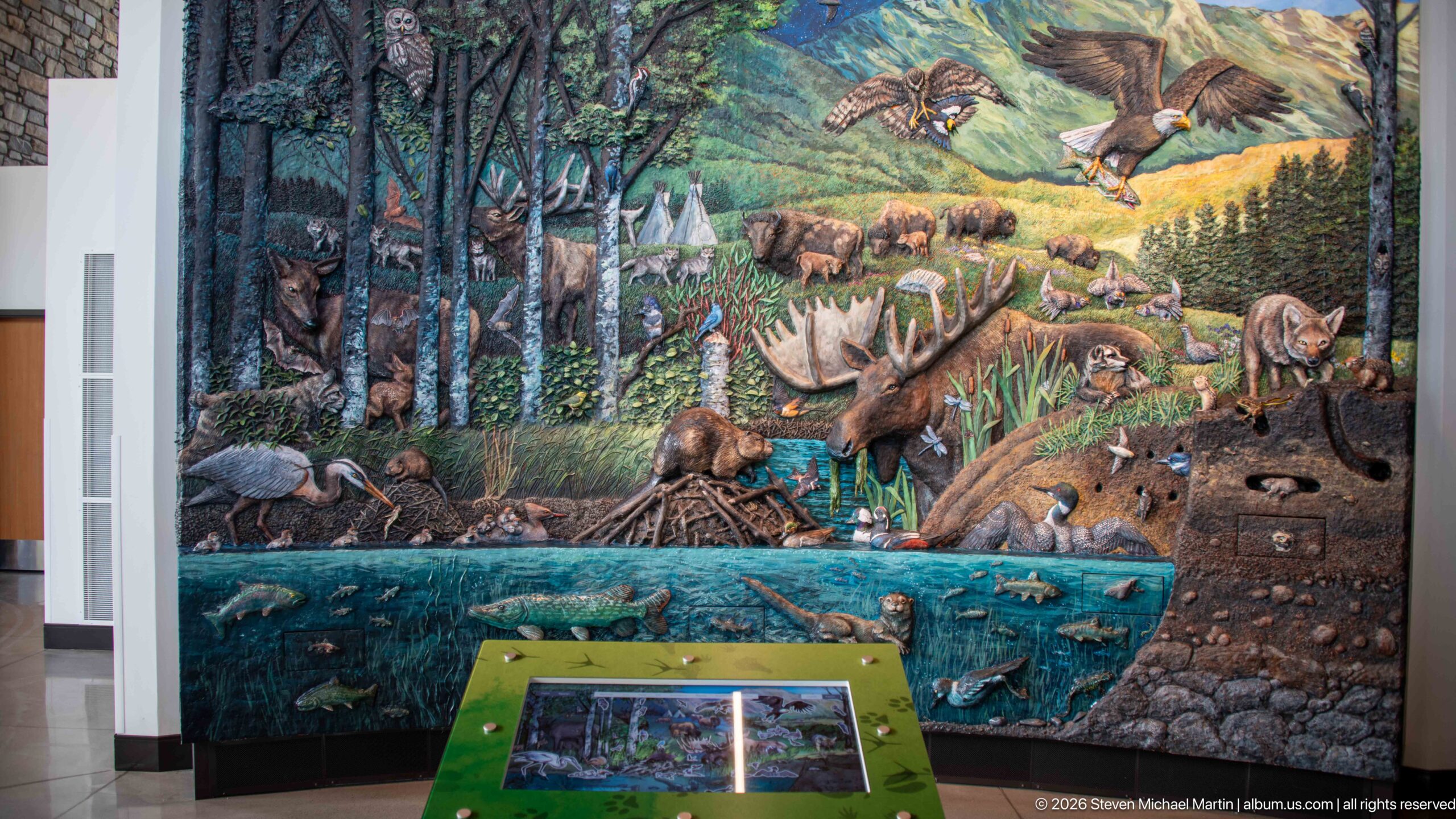
A floor-to-ceiling wildlife mural assembles forest, wetland, stream, and grassland animals into a single ecosystem scene. Bears, ungulates, birds, small mammals, and aquatic life occupy distinct habitat zones, creating a dense visual survey of the species and ecological relationships interpreted inside the visitor center. A low interactive station extends the display into the gallery floor.
Caption
A floor-to-ceiling wildlife mural assembles forest, wetland, stream, and grassland animals into a single ecosystem scene. Bears, ungulates, birds, small mammals, and aquatic life occupy distinct habitat zones, creating a dense visual survey of the species and ecological relationships interpreted inside the visitor center. A low interactive station extends the display into the gallery floor.
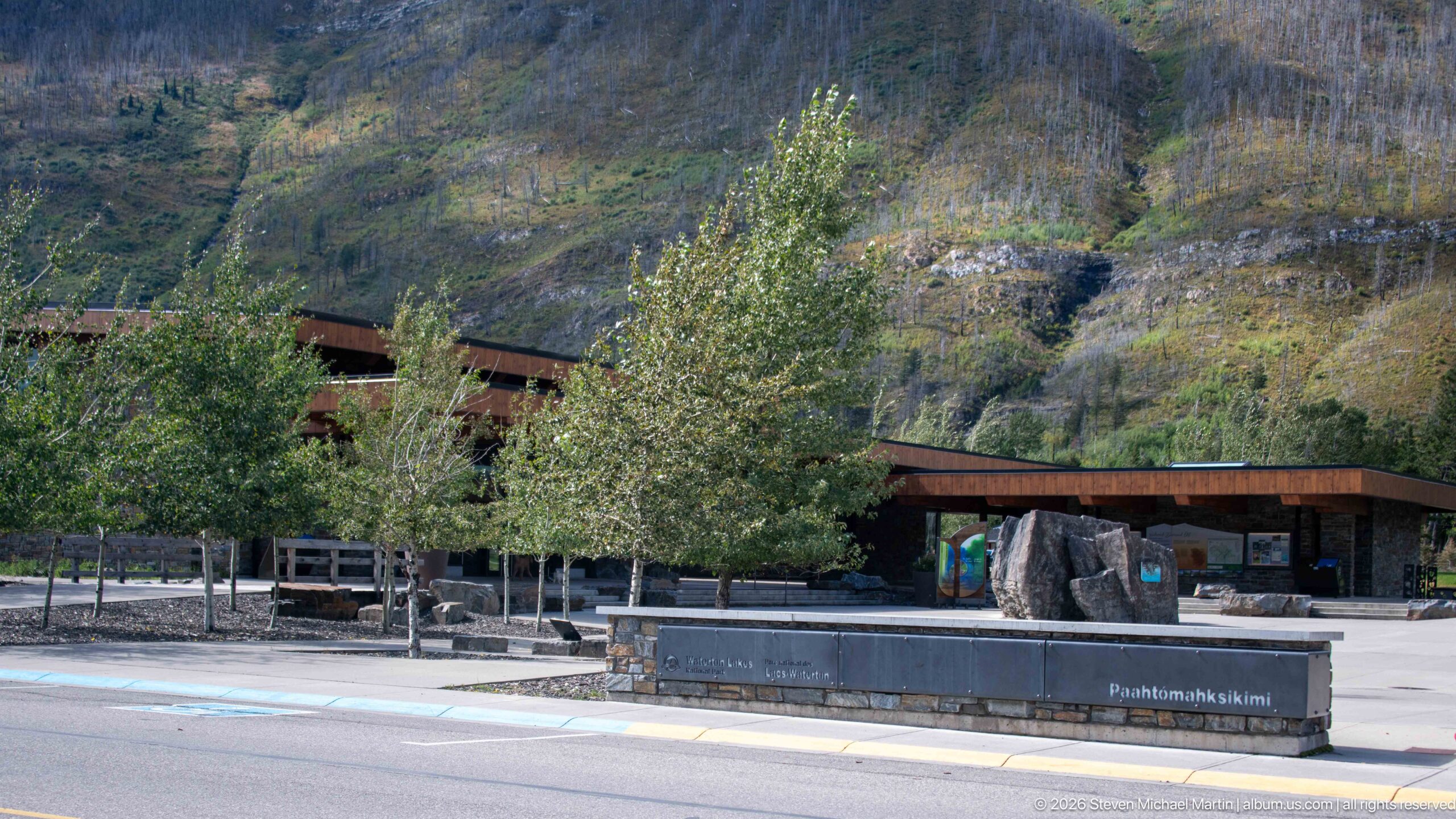
The Waterton Lakes National Park Visitor Centre sits low against the steep mountain wall, its timber rooflines and stonework framing a broad public plaza. Young trees soften the foreground while a long stone-and-metal sign identifies the site with the Blackfoot name Paahtómahksikimi. The view establishes the building’s close physical relationship with Waterton’s mountain landscape.
Caption
The Waterton Lakes National Park Visitor Centre sits low against the steep mountain wall, its timber rooflines and stonework framing a broad public plaza. Young trees soften the foreground while a long stone-and-metal sign identifies the site with the Blackfoot name Paahtómahksikimi. The view establishes the building’s close physical relationship with Waterton’s mountain landscape.
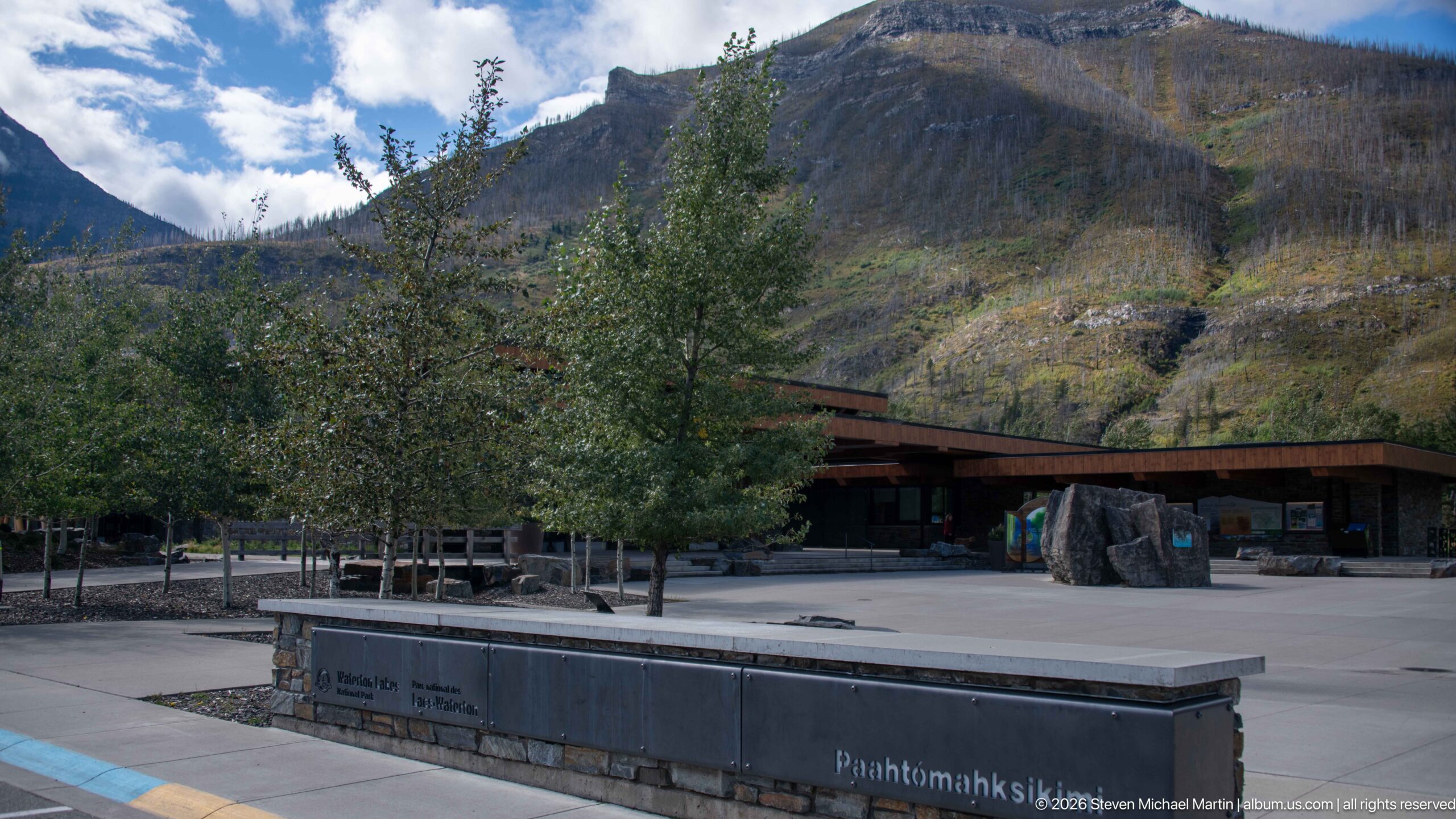
From the edge of the forecourt, the visitor centre appears as a sequence of sheltered timber volumes around an open paved space. A large boulder interpretive feature stands near the entrance, while the foreground wall carries the name Paahtómahksikimi. Trees and the immense mountain face beyond create layers from civic arrival space to natural landscape.
Caption
From the edge of the forecourt, the visitor centre appears as a sequence of sheltered timber volumes around an open paved space. A large boulder interpretive feature stands near the entrance, while the foreground wall carries the name Paahtómahksikimi. Trees and the immense mountain face beyond create layers from civic arrival space to natural landscape.
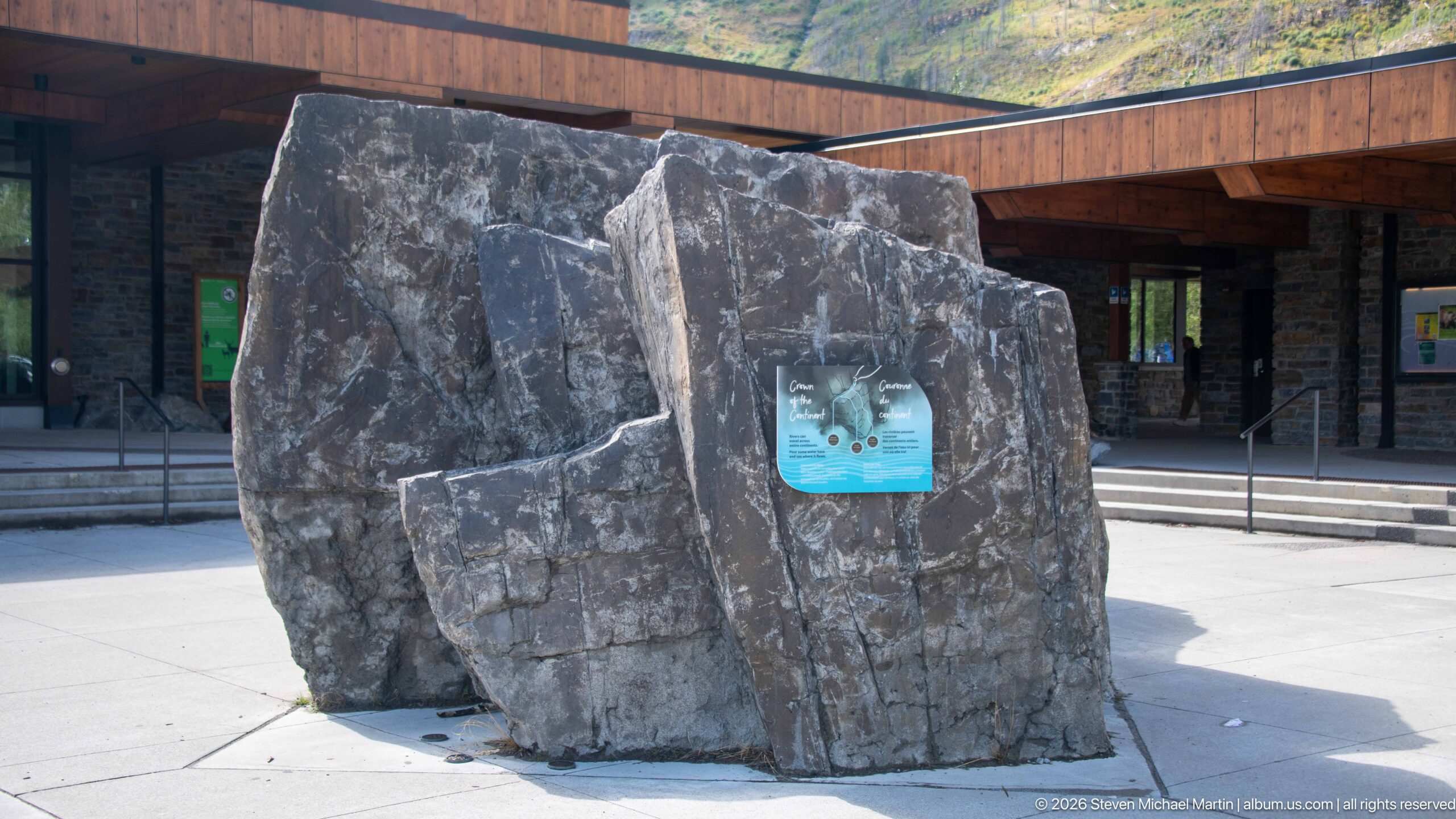
A massive split-rock feature anchors the visitor centre plaza beneath the sheltering timber roof. Its rough, stratified surfaces echo the exposed geology of the surrounding mountains, while a small mounted interpretive panel introduces information at pedestrian height. The close view isolates the sculptural installation from the broader forecourt and highlights its deliberately rugged texture.
Caption
A massive split-rock feature anchors the visitor centre plaza beneath the sheltering timber roof. Its rough, stratified surfaces echo the exposed geology of the surrounding mountains, while a small mounted interpretive panel introduces information at pedestrian height. The close view isolates the sculptural installation from the broader forecourt and highlights its deliberately rugged texture.
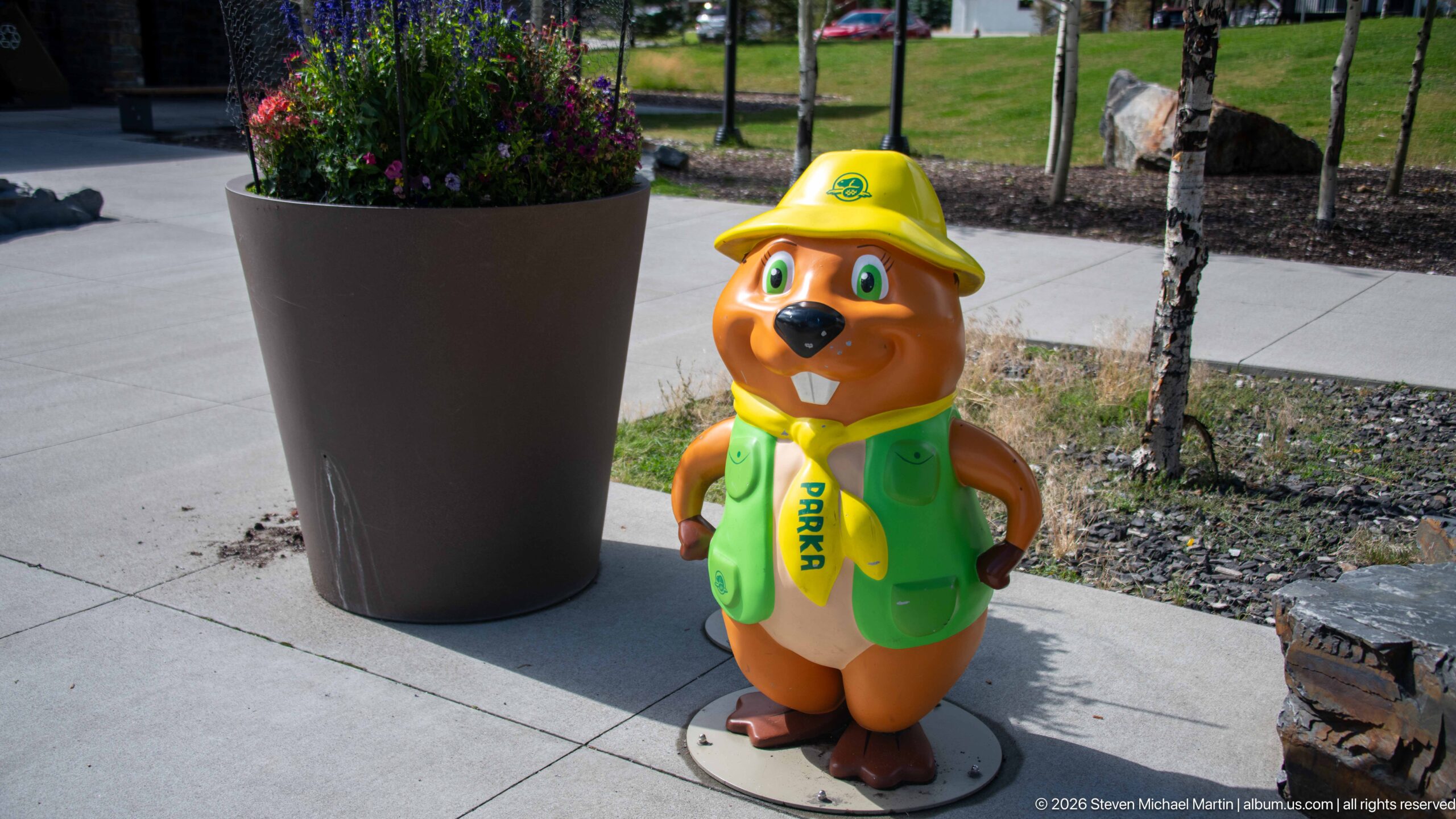
A cheerful beaver mascot in a yellow ranger hat and green vest stands beside a large planter outside the visitor centre. The figure’s uniform prominently carries the word “PARKS,” making it an unmistakable piece of visitor-oriented Parks Canada interpretation. Its playful scale and bright finish contrast with the subdued paving, birch trunks, and natural stone used throughout the grounds.
Caption
A cheerful beaver mascot in a yellow ranger hat and green vest stands beside a large planter outside the visitor centre. The figure’s uniform prominently carries the word “PARKS,” making it an unmistakable piece of visitor-oriented Parks Canada interpretation. Its playful scale and bright finish contrast with the subdued paving, birch trunks, and natural stone used throughout the grounds.
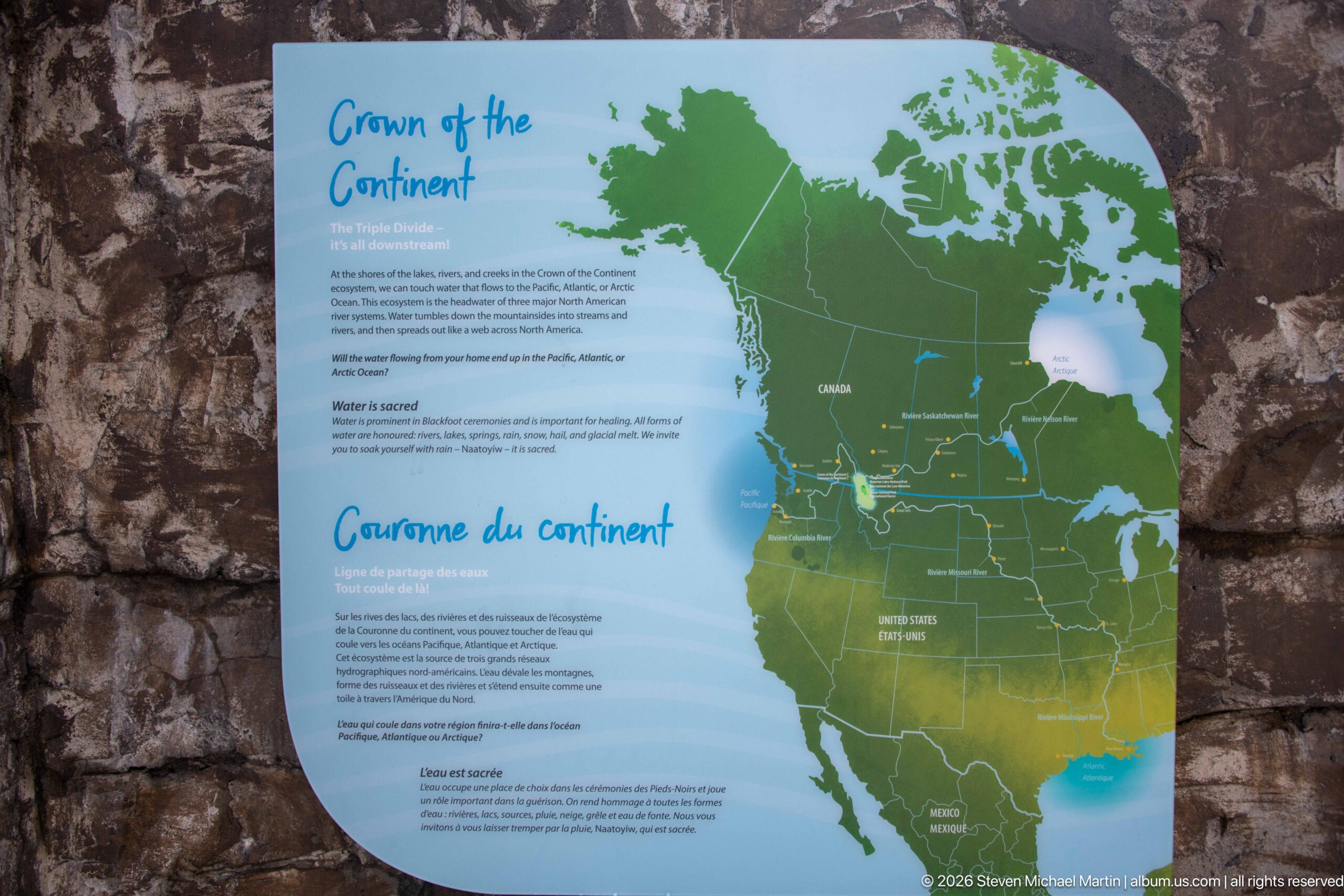
An outdoor bilingual panel titled “Crown of the Continent” maps the larger transboundary landscape surrounding Waterton Lakes. The map traces major waterways across western Canada and the United States, pairing geographic context with text about water moving across the Continental Divide. Mounted against a rock-textured surround, the exhibit expands the visitor centre story beyond park boundaries.
Caption
An outdoor bilingual panel titled “Crown of the Continent” maps the larger transboundary landscape surrounding Waterton Lakes. The map traces major waterways across western Canada and the United States, pairing geographic context with text about water moving across the Continental Divide. Mounted against a rock-textured surround, the exhibit expands the visitor centre story beyond park boundaries.
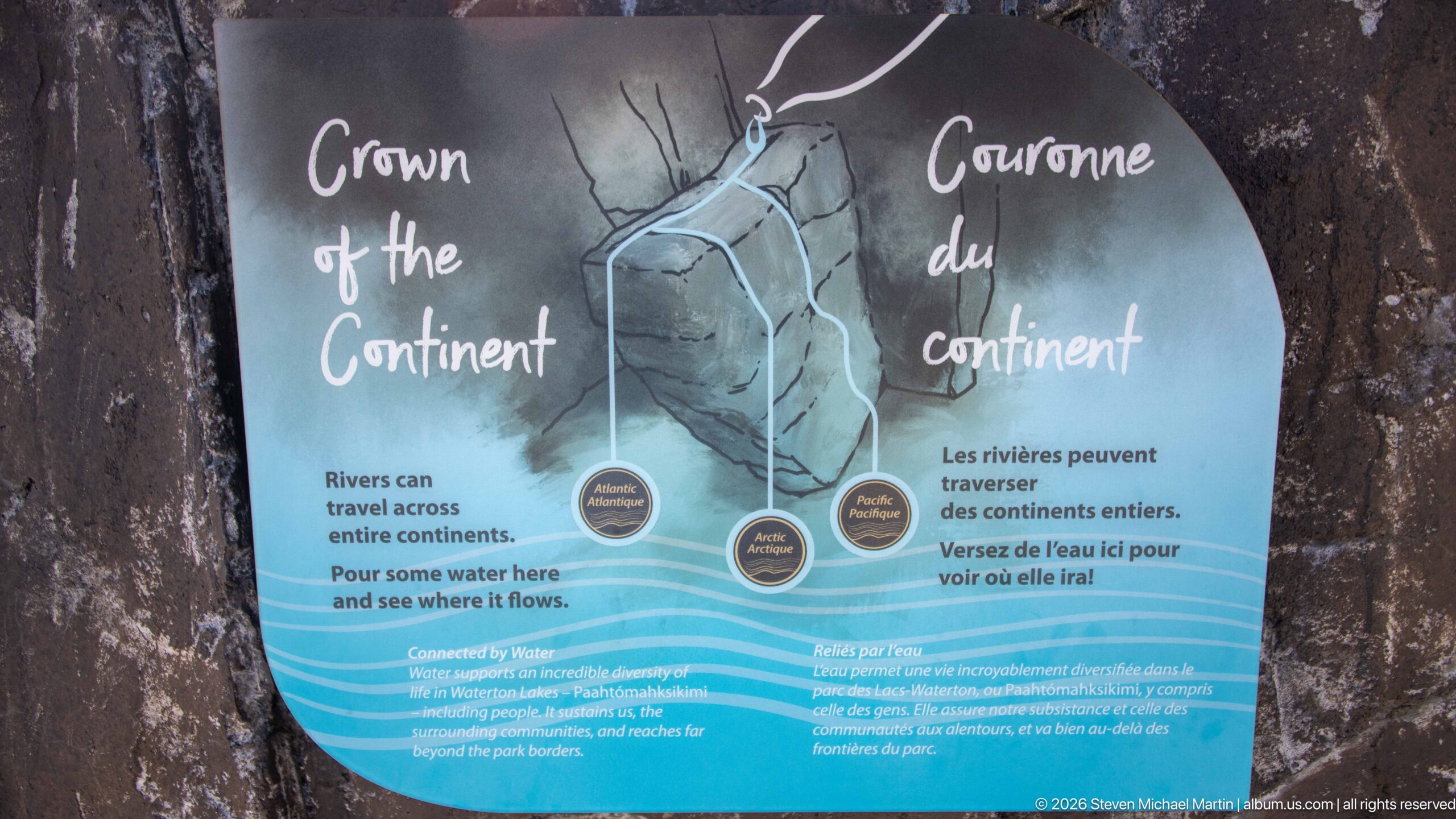
This detail from the “Crown of the Continent” exhibit focuses on how rivers can cross continental boundaries. A simplified diagram links the Atlantic, Arctic, and Pacific drainage systems around a central mountain divide, accompanied by English and French text. The graphic turns an immense geographic concept into a compact explanation of Waterton’s place within interconnected western watersheds.
Caption
This detail from the “Crown of the Continent” exhibit focuses on how rivers can cross continental boundaries. A simplified diagram links the Atlantic, Arctic, and Pacific drainage systems around a central mountain divide, accompanied by English and French text. The graphic turns an immense geographic concept into a compact explanation of Waterton’s place within interconnected western watersheds.
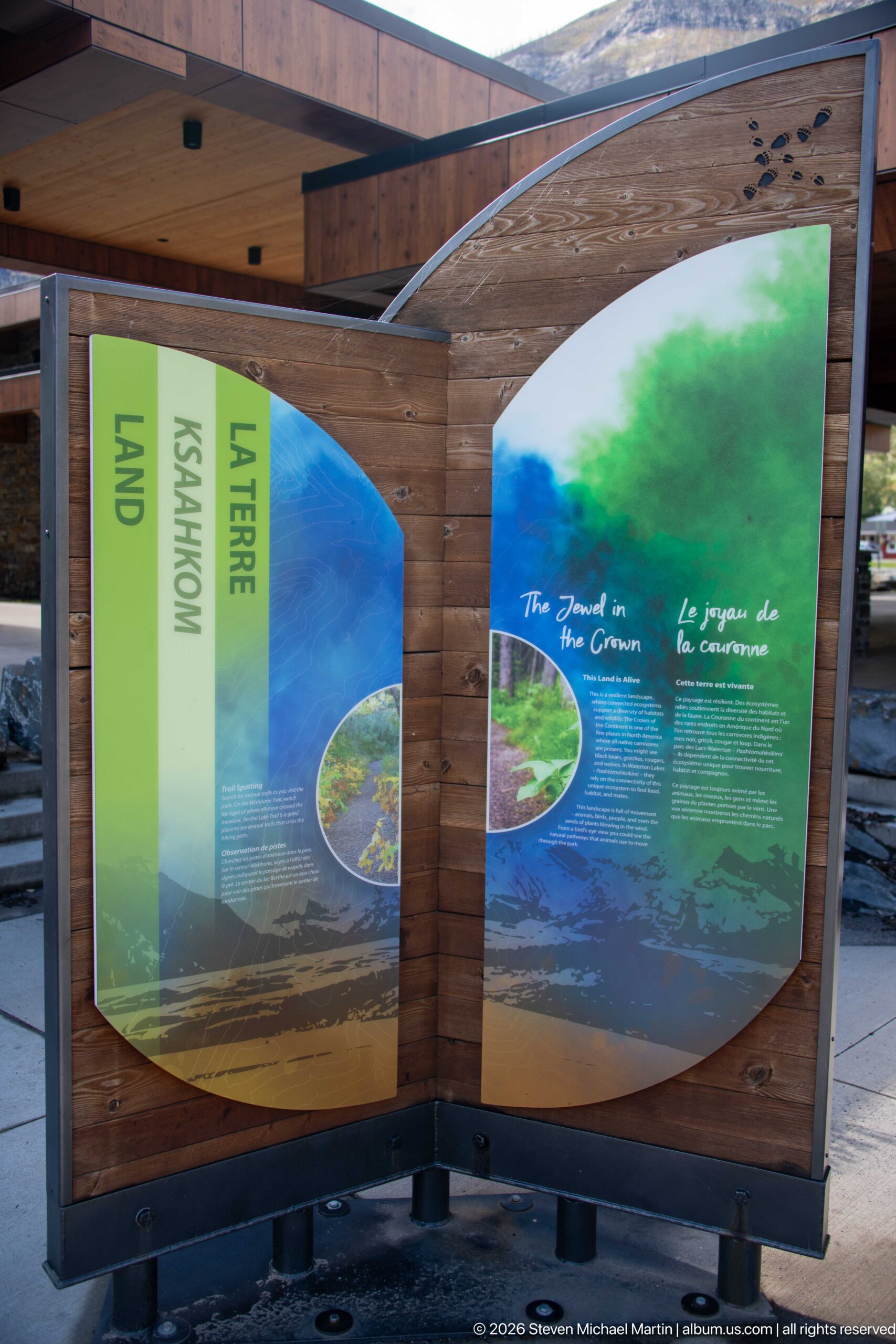
Curved wooden exhibit panels introduce themes of land and water through layered maps, landscape imagery, and bilingual interpretation. The right panel is headed “The Jewel in the Crown,” while vertical labels on the left include LAND and WATER. Set directly in the visitor centre plaza, the freestanding installation invites visitors to read the park landscape before entering the building.
Caption
Curved wooden exhibit panels introduce themes of land and water through layered maps, landscape imagery, and bilingual interpretation. The right panel is headed “The Jewel in the Crown,” while vertical labels on the left include LAND and WATER. Set directly in the visitor centre plaza, the freestanding installation invites visitors to read the park landscape before entering the building.
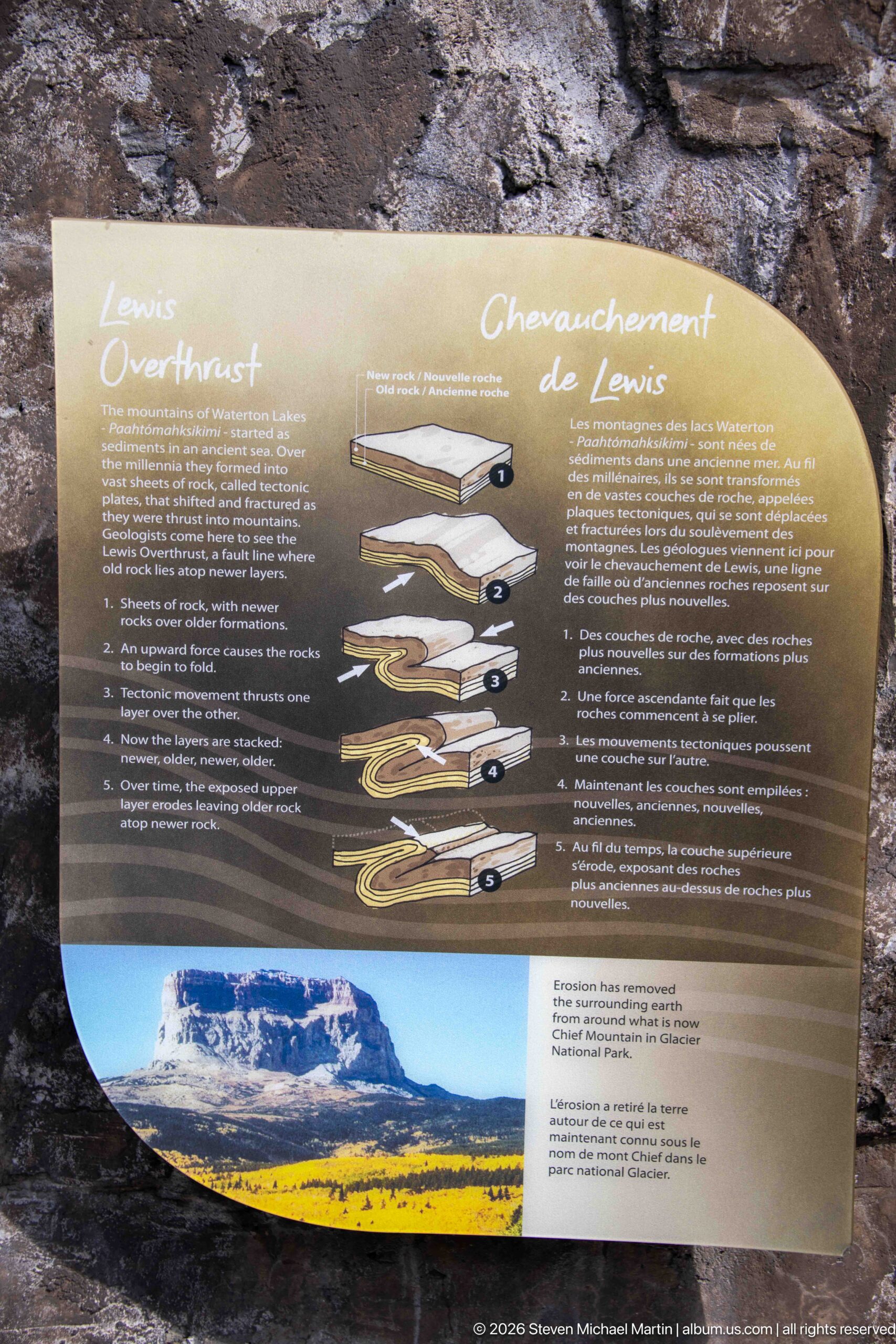
A bilingual panel explains the Lewis Overthrust with a sequence of cross-sectional diagrams showing rock layers folding and sliding over one another. A landscape photograph beneath the diagrams connects the geologic process to the mountain scenery visitors encounter in Waterton. The focused composition makes the structural geology—rather than the surrounding exhibit architecture—the principal subject.
Caption
A bilingual panel explains the Lewis Overthrust with a sequence of cross-sectional diagrams showing rock layers folding and sliding over one another. A landscape photograph beneath the diagrams connects the geologic process to the mountain scenery visitors encounter in Waterton. The focused composition makes the structural geology—rather than the surrounding exhibit architecture—the principal subject.
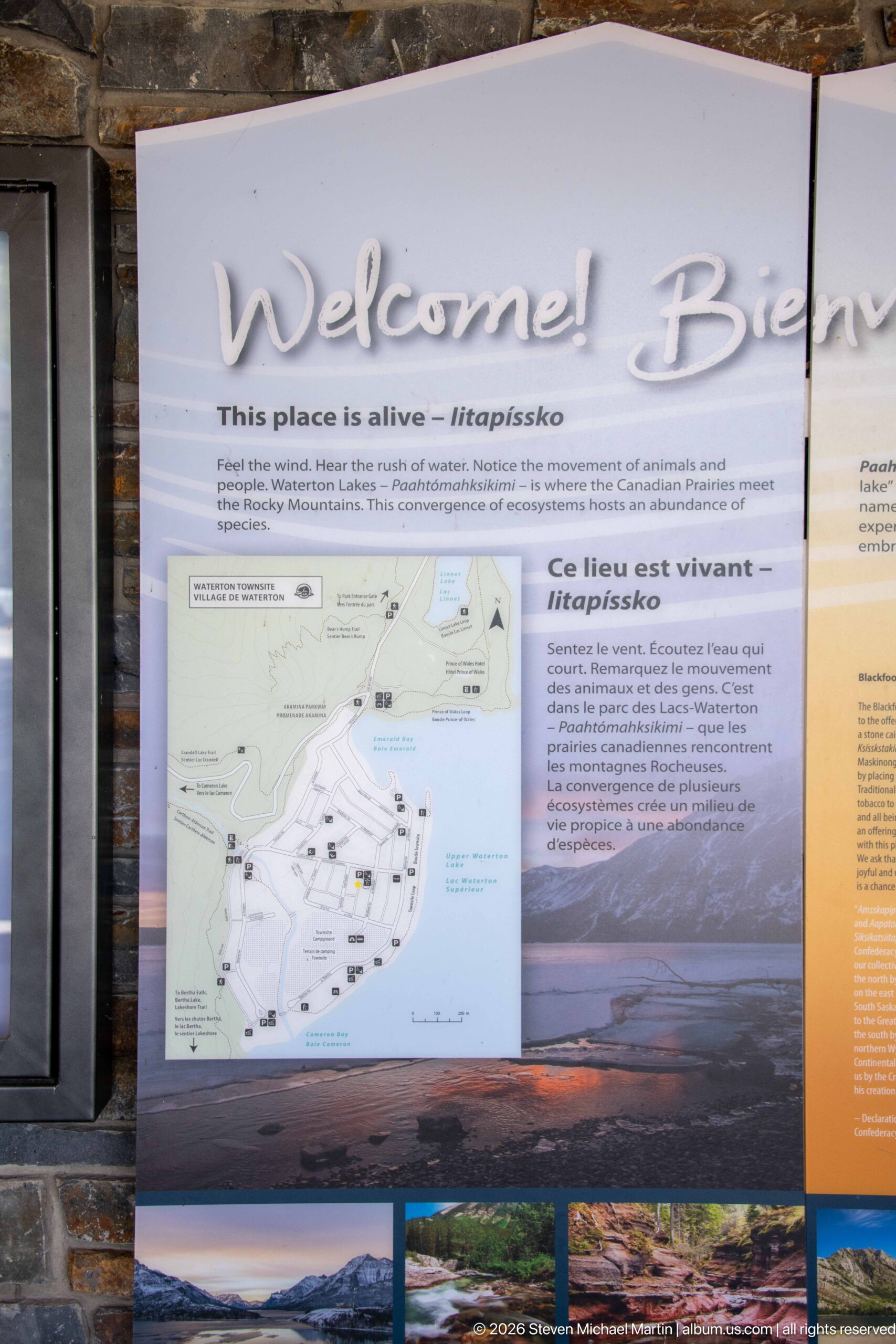
The left side of the welcome display pairs the greeting “Welcome! Bienvenue!” with the statement “This place is alive” and a local orientation map. Bilingual text introduces Waterton as an active landscape shaped by natural processes, while small photographs along the base preview scenery and wildlife. This closer view records the introductory section visitors encounter before the broader park map.
Caption
The left side of the welcome display pairs the greeting “Welcome! Bienvenue!” with the statement “This place is alive” and a local orientation map. Bilingual text introduces Waterton as an active landscape shaped by natural processes, while small photographs along the base preview scenery and wildlife. This closer view records the introductory section visitors encounter before the broader park map.
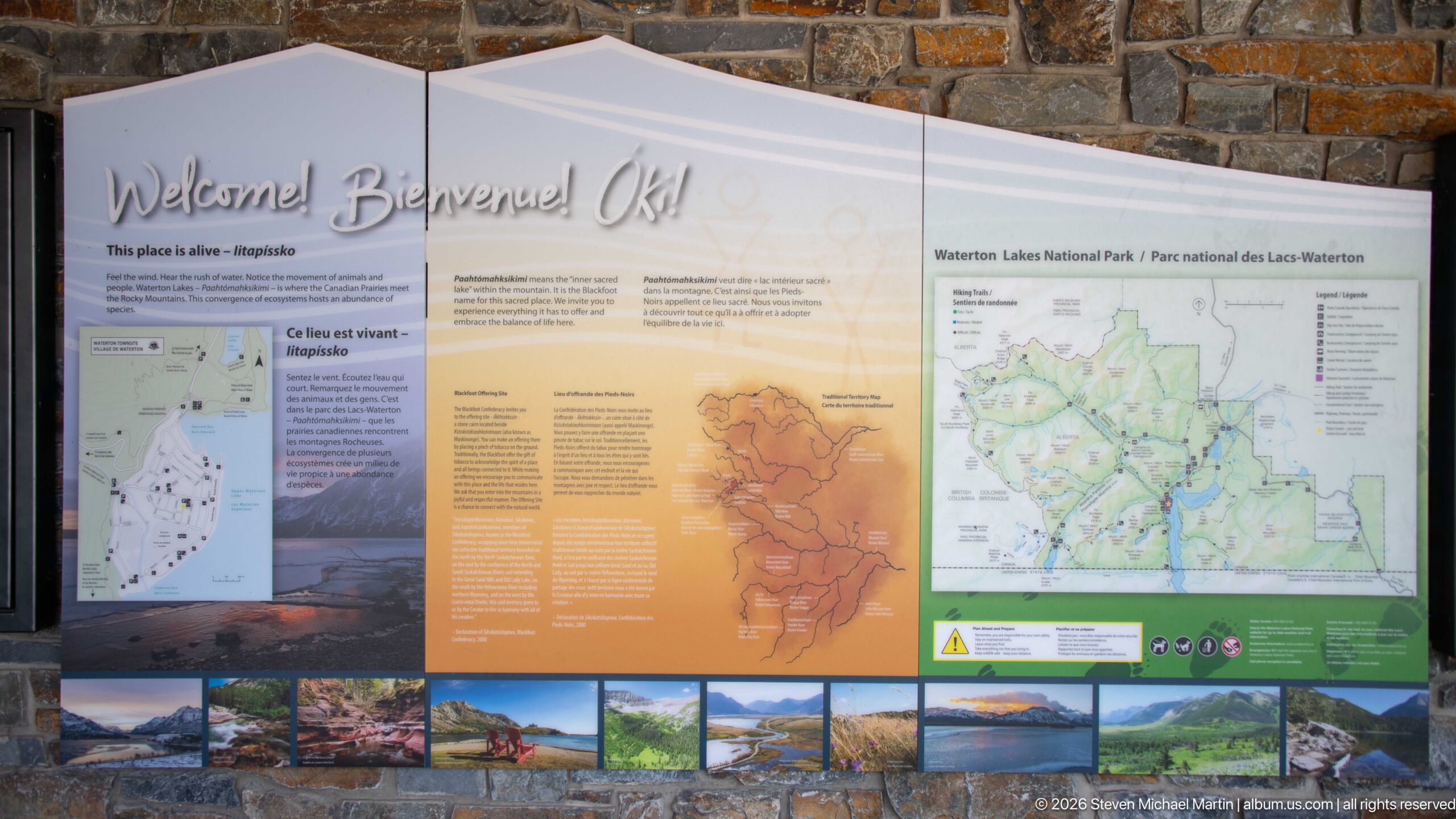
A large outdoor welcome board combines visitor orientation, park interpretation, and a detailed map of Waterton Lakes National Park. The bilingual display opens with “Welcome! Bienvenue! Oki!” and spreads information across several thematic panels, with a strip of landscape photographs along the bottom. Its breadth makes this the principal wayfinding overview among the exterior exhibits.
Caption
A large outdoor welcome board combines visitor orientation, park interpretation, and a detailed map of Waterton Lakes National Park. The bilingual display opens with “Welcome! Bienvenue! Oki!” and spreads information across several thematic panels, with a strip of landscape photographs along the bottom. Its breadth makes this the principal wayfinding overview among the exterior exhibits.
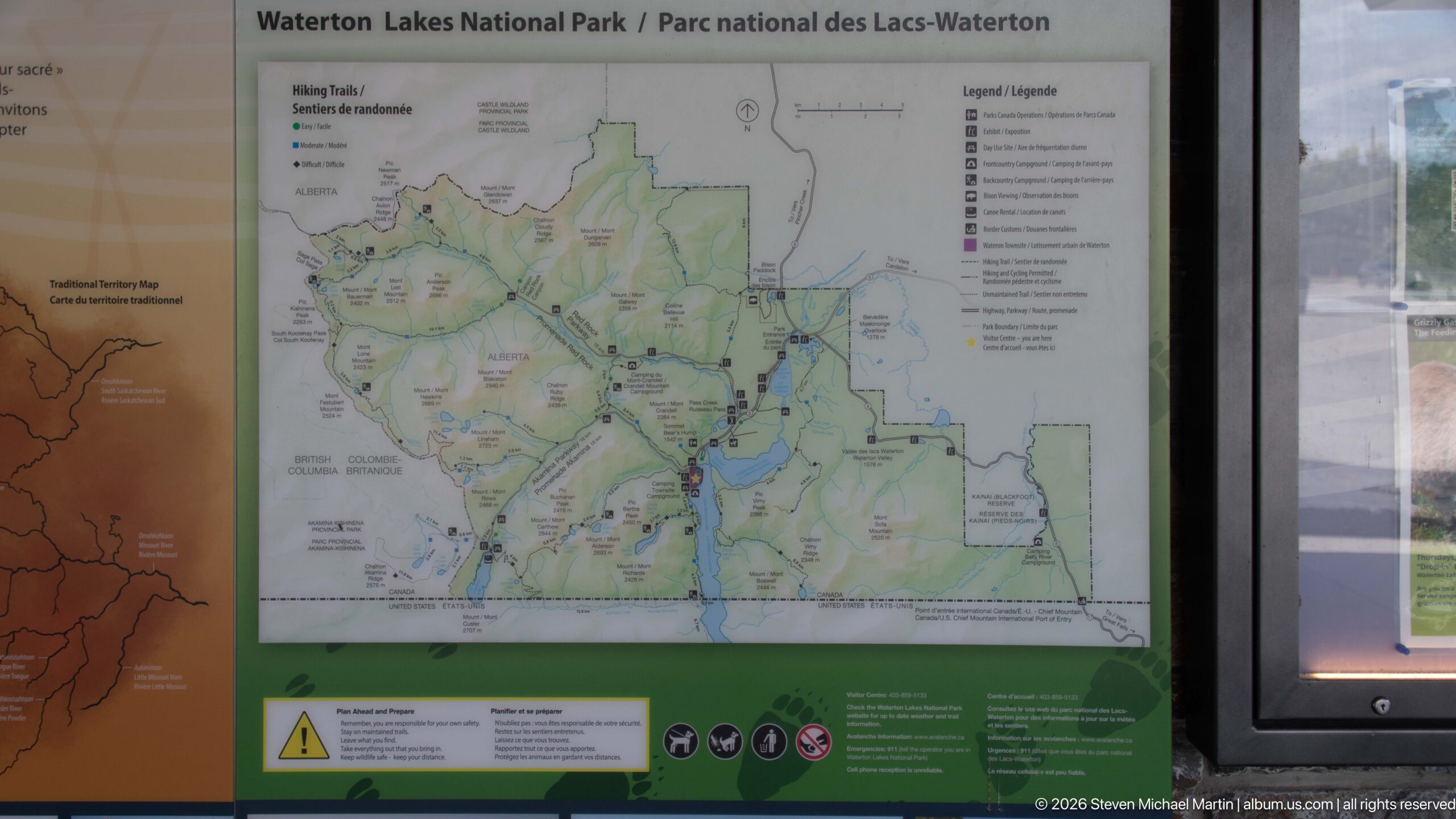
A detailed map of Waterton Lakes National Park fills the right side of the welcome display, showing roads, lakes, trails, facilities, and the park boundary through a dense symbol system. A legend runs beside the mapped terrain, while safety and regulation icons line the green band below. The close framing preserves the practical wayfinding function of this visitor-centre exhibit.
Caption
A detailed map of Waterton Lakes National Park fills the right side of the welcome display, showing roads, lakes, trails, facilities, and the park boundary through a dense symbol system. A legend runs beside the mapped terrain, while safety and regulation icons line the green band below. The close framing preserves the practical wayfinding function of this visitor-centre exhibit.
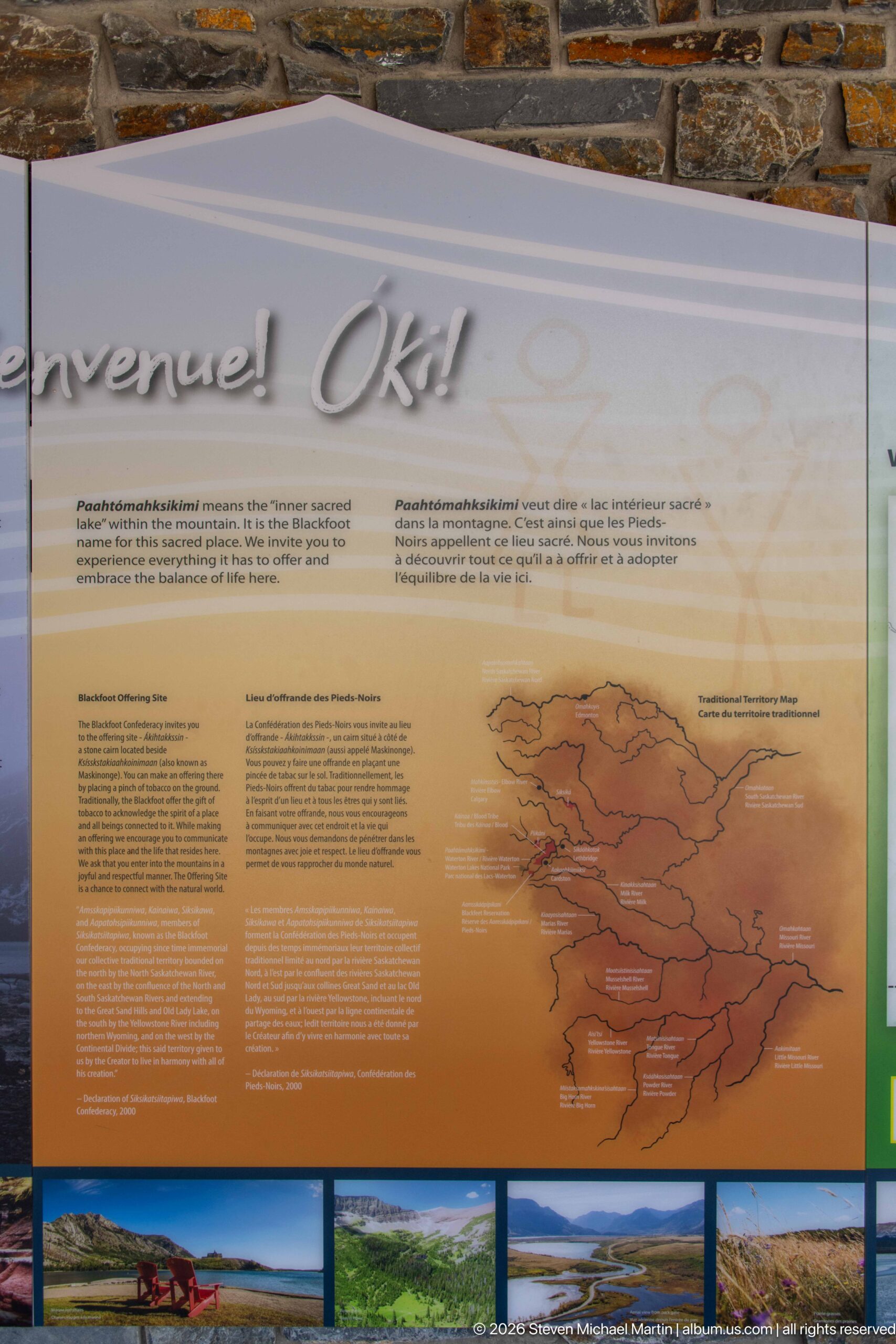
The central orange section of the welcome display explains Waterton through a branching watershed diagram. English and French text flank the map, while labeled drainage lines spread across the panel like a network of veins. Photographs along the bottom edge keep the abstract hydrology connected to recognizable park landscapes and visitor experiences.
Caption
The central orange section of the welcome display explains Waterton through a branching watershed diagram. English and French text flank the map, while labeled drainage lines spread across the panel like a network of veins. Photographs along the bottom edge keep the abstract hydrology connected to recognizable park landscapes and visitor experiences.
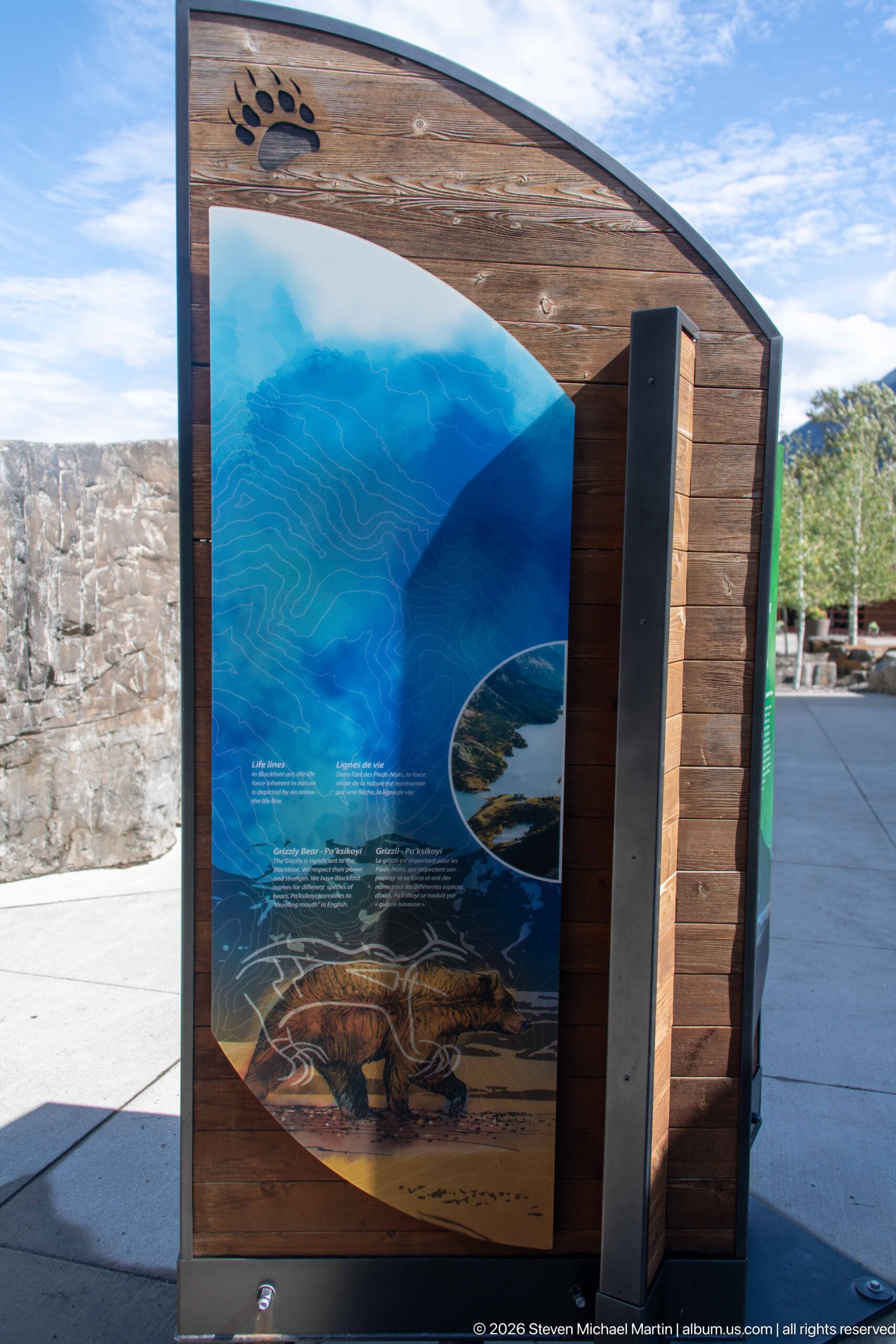
A curved, wood-framed outdoor panel uses deep blue graphics, contour-like lines, and landscape imagery to interpret water within the Waterton environment. A circular inset photograph and layered illustration draw attention to connections between terrain and aquatic systems. The side view also shows the sculpted timber enclosure that unifies this exhibit with the visitor centre’s architectural materials.
Caption
A curved, wood-framed outdoor panel uses deep blue graphics, contour-like lines, and landscape imagery to interpret water within the Waterton environment. A circular inset photograph and layered illustration draw attention to connections between terrain and aquatic systems. The side view also shows the sculpted timber enclosure that unifies this exhibit with the visitor centre’s architectural materials.
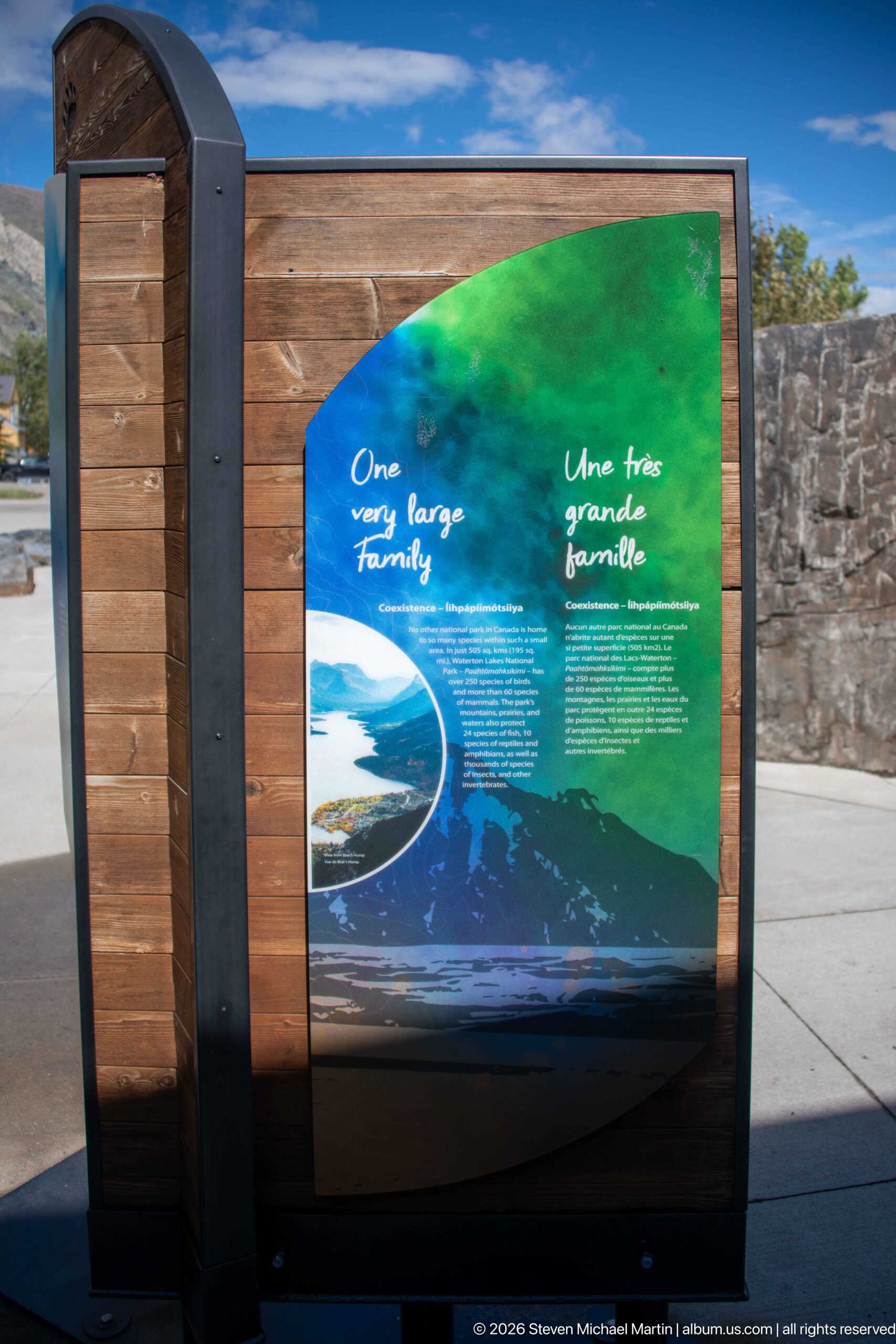
The outdoor exhibit panel titled “One very large family” presents a bilingual introduction to ecological relationships in Waterton. Blue and green graphics divide the panel between water and land imagery, with a circular shoreline photograph anchoring the lower left. Its placement in a heavy wood frame continues the visitor centre’s integration of interpretation with natural-looking materials.
Caption
The outdoor exhibit panel titled “One very large family” presents a bilingual introduction to ecological relationships in Waterton. Blue and green graphics divide the panel between water and land imagery, with a circular shoreline photograph anchoring the lower left. Its placement in a heavy wood frame continues the visitor centre’s integration of interpretation with natural-looking materials.
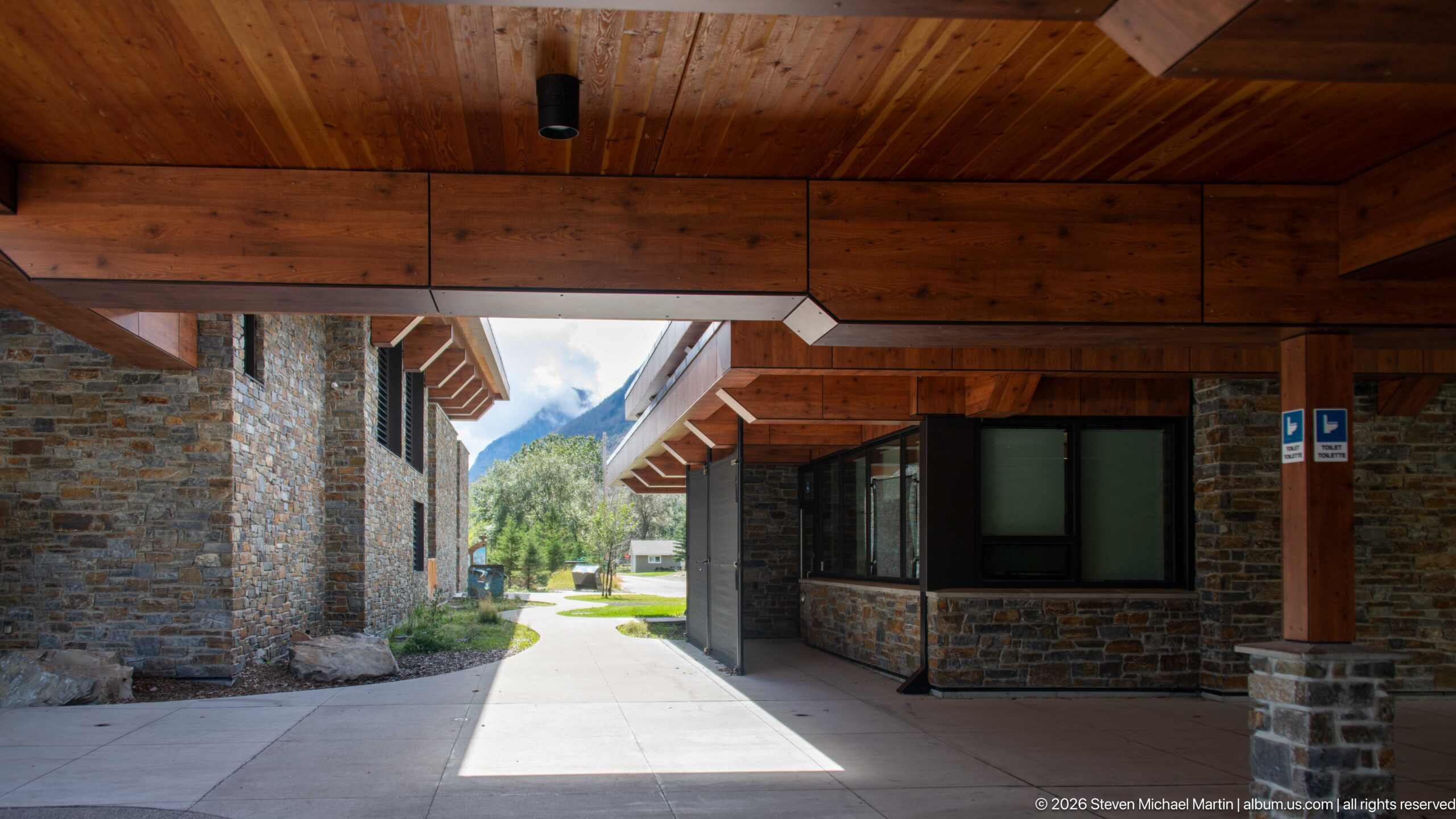
A covered passage reveals the visitor centre’s material palette at close range: heavy laminated timber beams overhead, warm wood decking beneath the roof, and irregular stone masonry wrapping the walls and column bases. Sunlight pours through the opening ahead toward landscaped grounds. The view emphasizes circulation and shelter rather than the building’s public façade.
Caption
A covered passage reveals the visitor centre’s material palette at close range: heavy laminated timber beams overhead, warm wood decking beneath the roof, and irregular stone masonry wrapping the walls and column bases. Sunlight pours through the opening ahead toward landscaped grounds. The view emphasizes circulation and shelter rather than the building’s public façade.
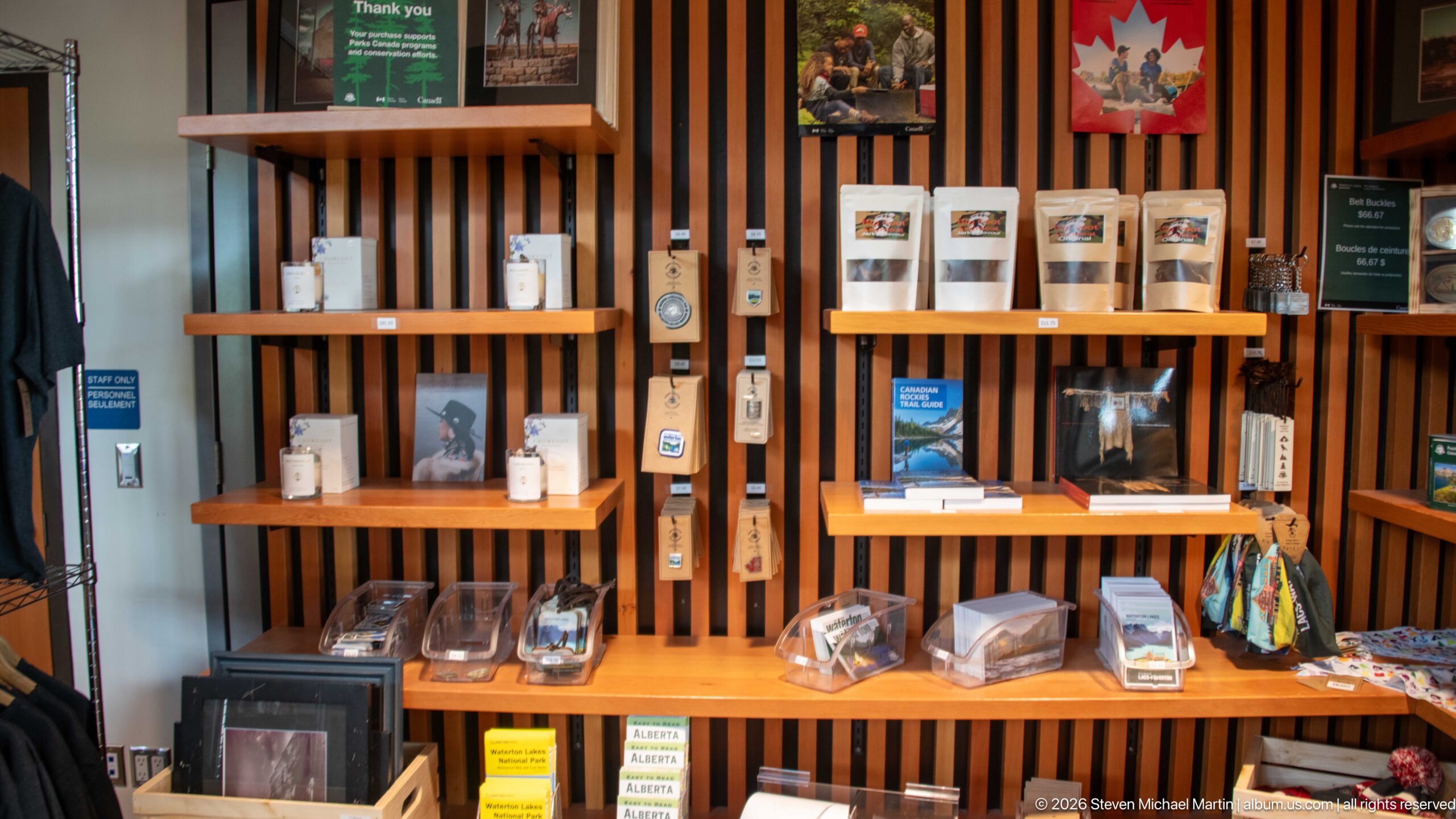
Wooden shelving in the visitor centre shop holds a carefully arranged selection of books, cards, small boxed items, souvenirs, and branded accessories. Vertical slats behind the shelves echo the timber architecture elsewhere in the building, while small price labels and product groupings reveal the practical retail function of this corner. The view documents visitor services rather than an interpretive exhibit.
Caption
Wooden shelving in the visitor centre shop holds a carefully arranged selection of books, cards, small boxed items, souvenirs, and branded accessories. Vertical slats behind the shelves echo the timber architecture elsewhere in the building, while small price labels and product groupings reveal the practical retail function of this corner. The view documents visitor services rather than an interpretive exhibit.
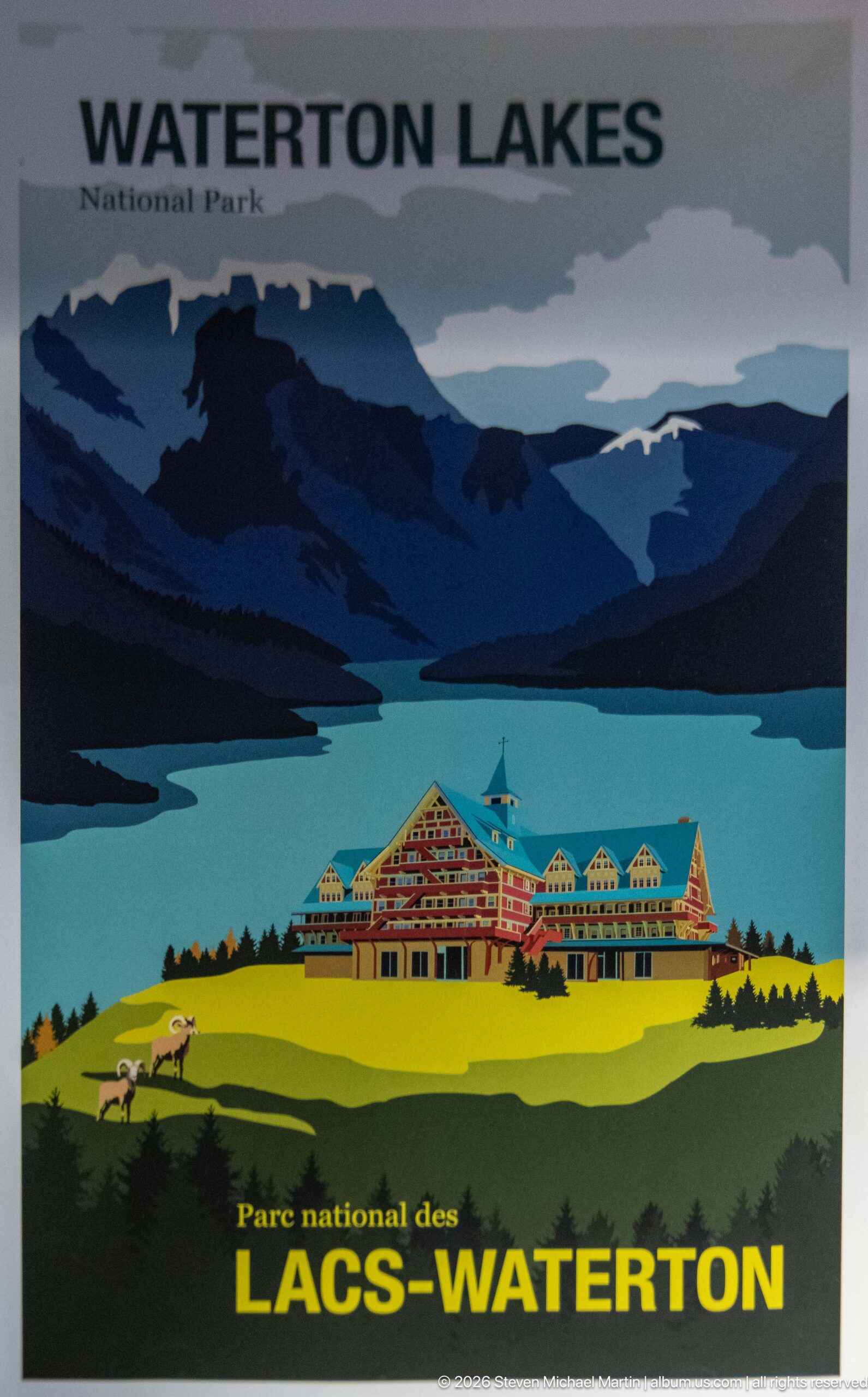
A stylized Waterton Lakes poster presents the Prince of Wales Hotel on a green bluff above turquoise water, backed by layered blue mountain silhouettes. The simplified geometric treatment recalls historic tourism graphics and places the landmark hotel at the center of an idealized park landscape. Bold bilingual lettering at the bottom identifies Parc national des Lacs-Waterton.
Caption
A stylized Waterton Lakes poster presents the Prince of Wales Hotel on a green bluff above turquoise water, backed by layered blue mountain silhouettes. The simplified geometric treatment recalls historic tourism graphics and places the landmark hotel at the center of an idealized park landscape. Bold bilingual lettering at the bottom identifies Parc national des Lacs-Waterton.
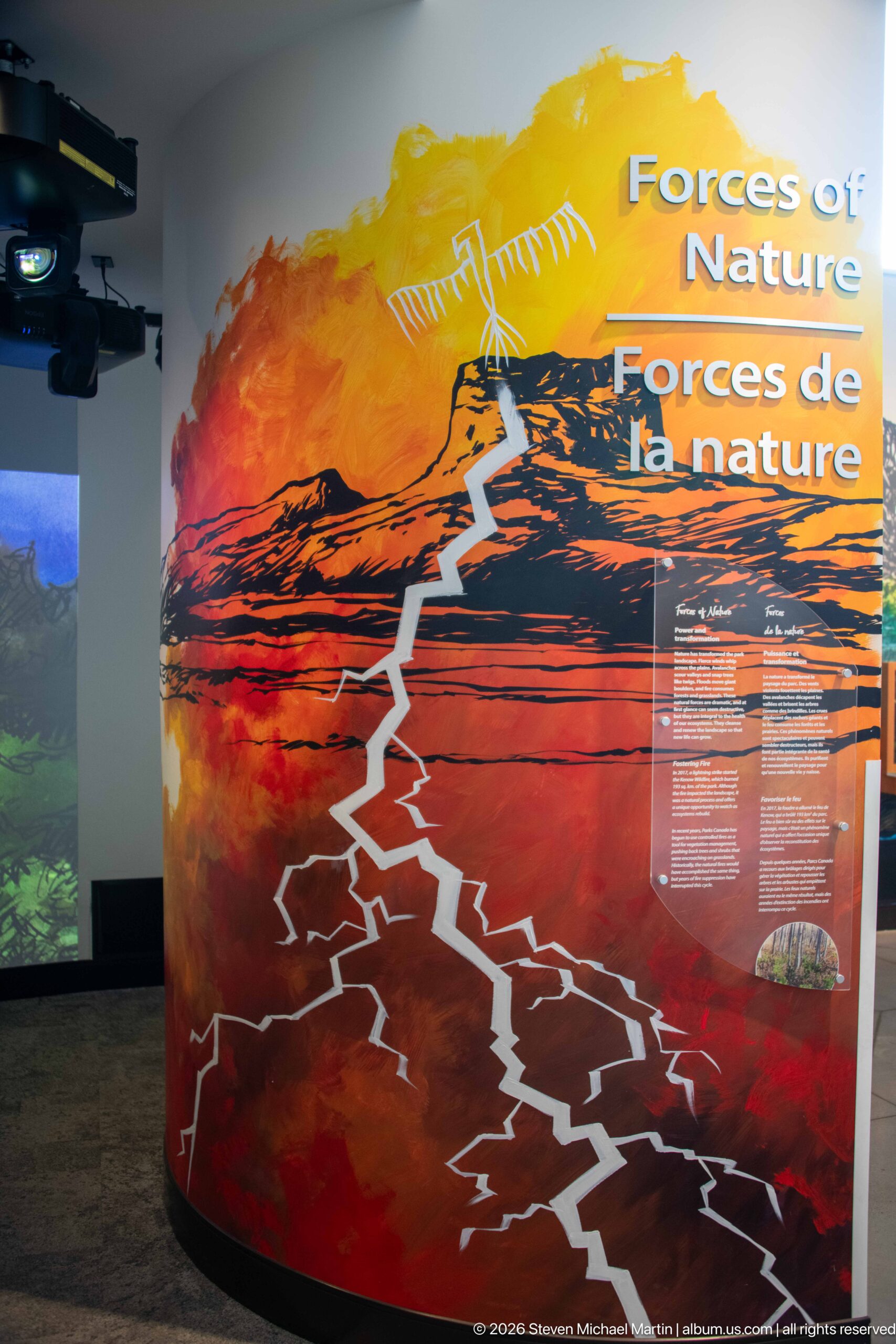
A sweeping curved wall titled “Forces of Nature / Forces de la nature” uses fiery orange and red graphics to introduce the powerful processes that shape Waterton. A jagged white line cuts through a dark mountain silhouette, while bilingual text blocks occupy the right side. The dramatic graphic treatment creates a transition from orientation displays toward exhibits about landscape change and disturbance.
Caption
A sweeping curved wall titled “Forces of Nature / Forces de la nature” uses fiery orange and red graphics to introduce the powerful processes that shape Waterton. A jagged white line cuts through a dark mountain silhouette, while bilingual text blocks occupy the right side. The dramatic graphic treatment creates a transition from orientation displays toward exhibits about landscape change and disturbance.
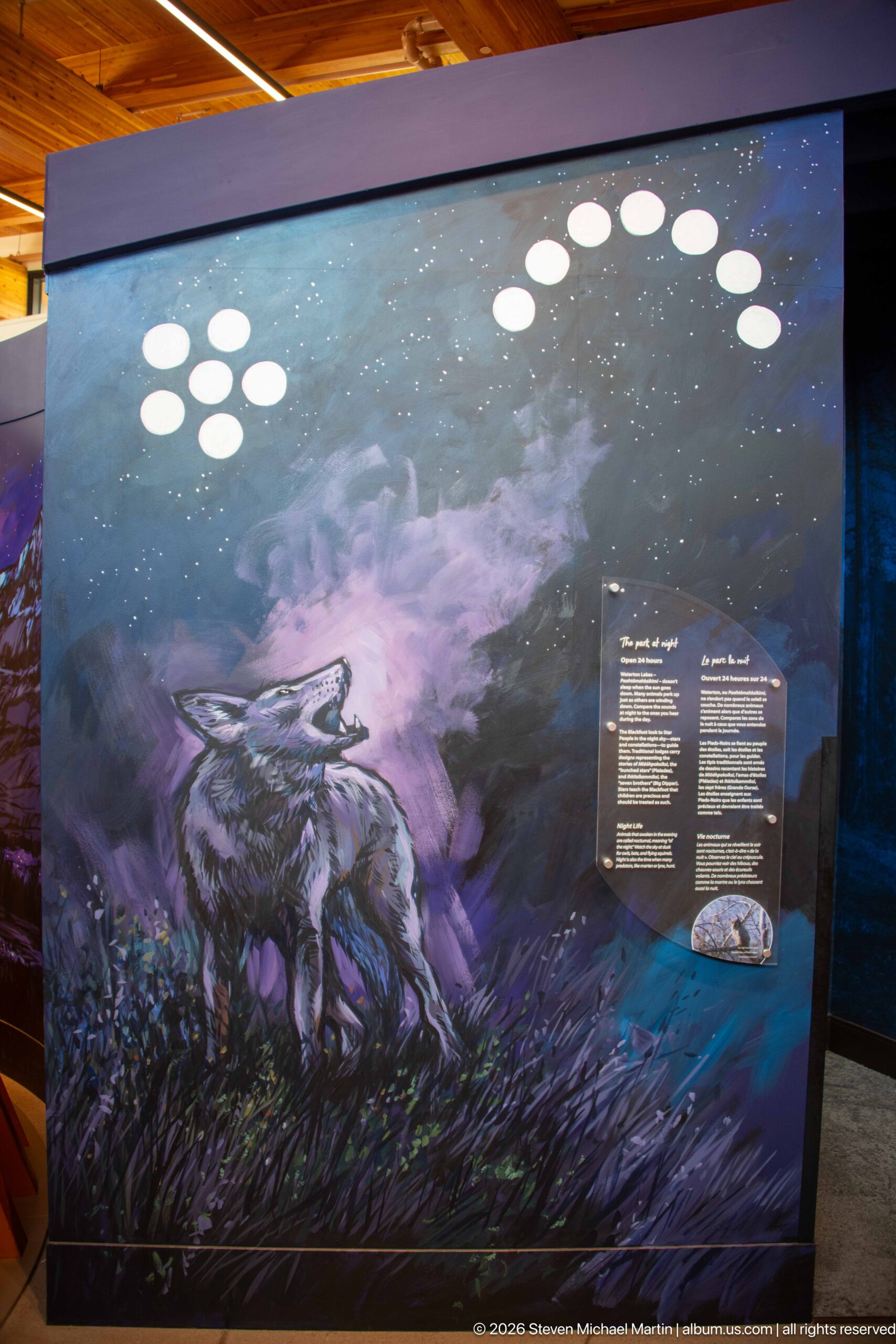
A large illustrated panel immerses visitors in a nocturnal mountain landscape rendered in deep violet and blue. A ring of white moon-like circles arcs across the upper portion, while bilingual text and a small rock specimen or model occupy the right side. The composition links darkness, celestial cycles, and mountain terrain within the visitor centre’s natural-history interpretation.
Caption
A large illustrated panel immerses visitors in a nocturnal mountain landscape rendered in deep violet and blue. A ring of white moon-like circles arcs across the upper portion, while bilingual text and a small rock specimen or model occupy the right side. The composition links darkness, celestial cycles, and mountain terrain within the visitor centre’s natural-history interpretation.
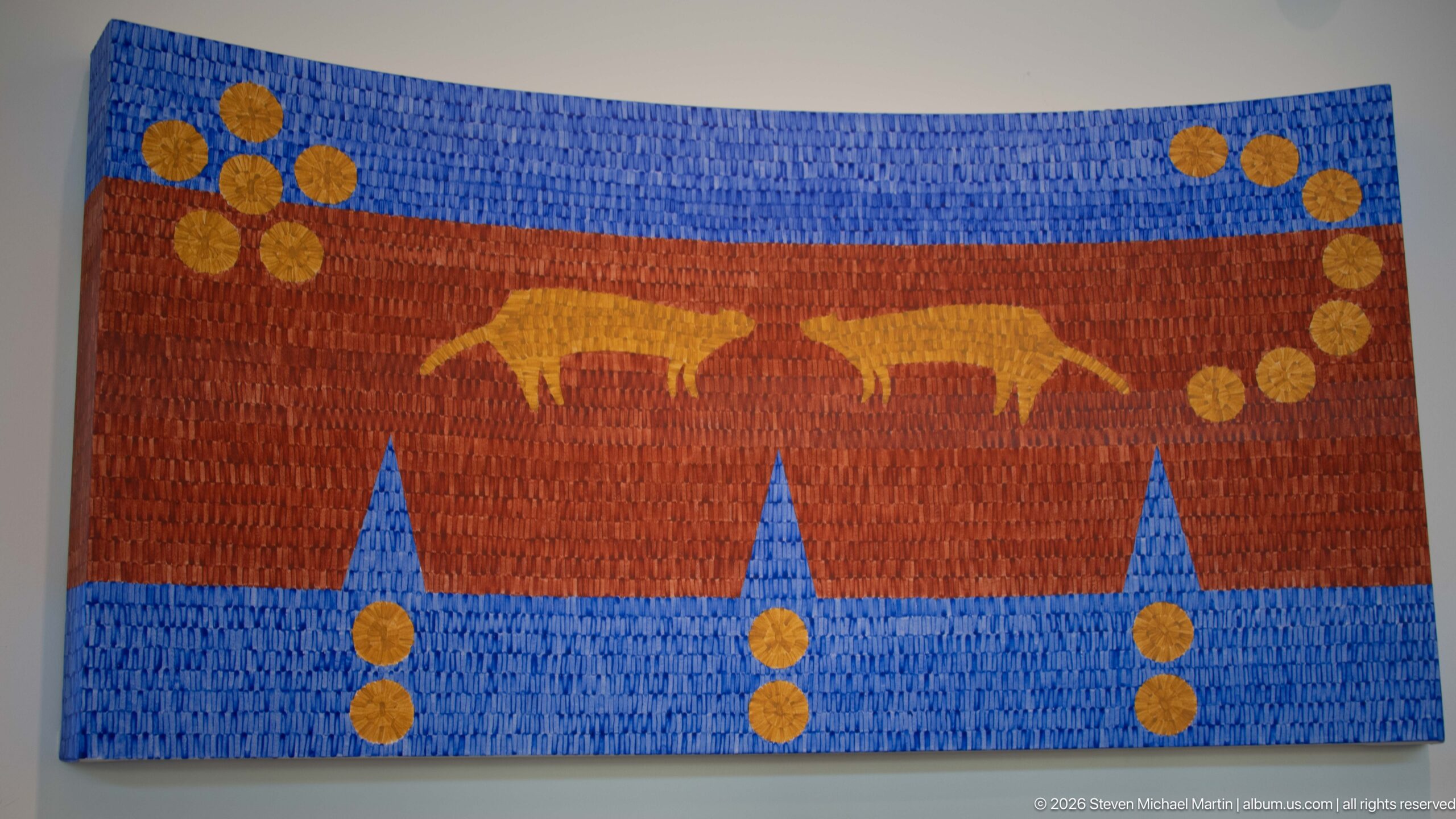
A large woven or textile wall hanging uses bands of blue and rust-red to frame two golden bison silhouettes. Repeating circular motifs and pointed blue forms create a strong geometric rhythm across the composition. Displayed without visible explanatory text in this view, the artwork introduces bison imagery through a contemporary decorative treatment rather than a naturalistic wildlife representation.
Caption
A large woven or textile wall hanging uses bands of blue and rust-red to frame two golden bison silhouettes. Repeating circular motifs and pointed blue forms create a strong geometric rhythm across the composition. Displayed without visible explanatory text in this view, the artwork introduces bison imagery through a contemporary decorative treatment rather than a naturalistic wildlife representation.
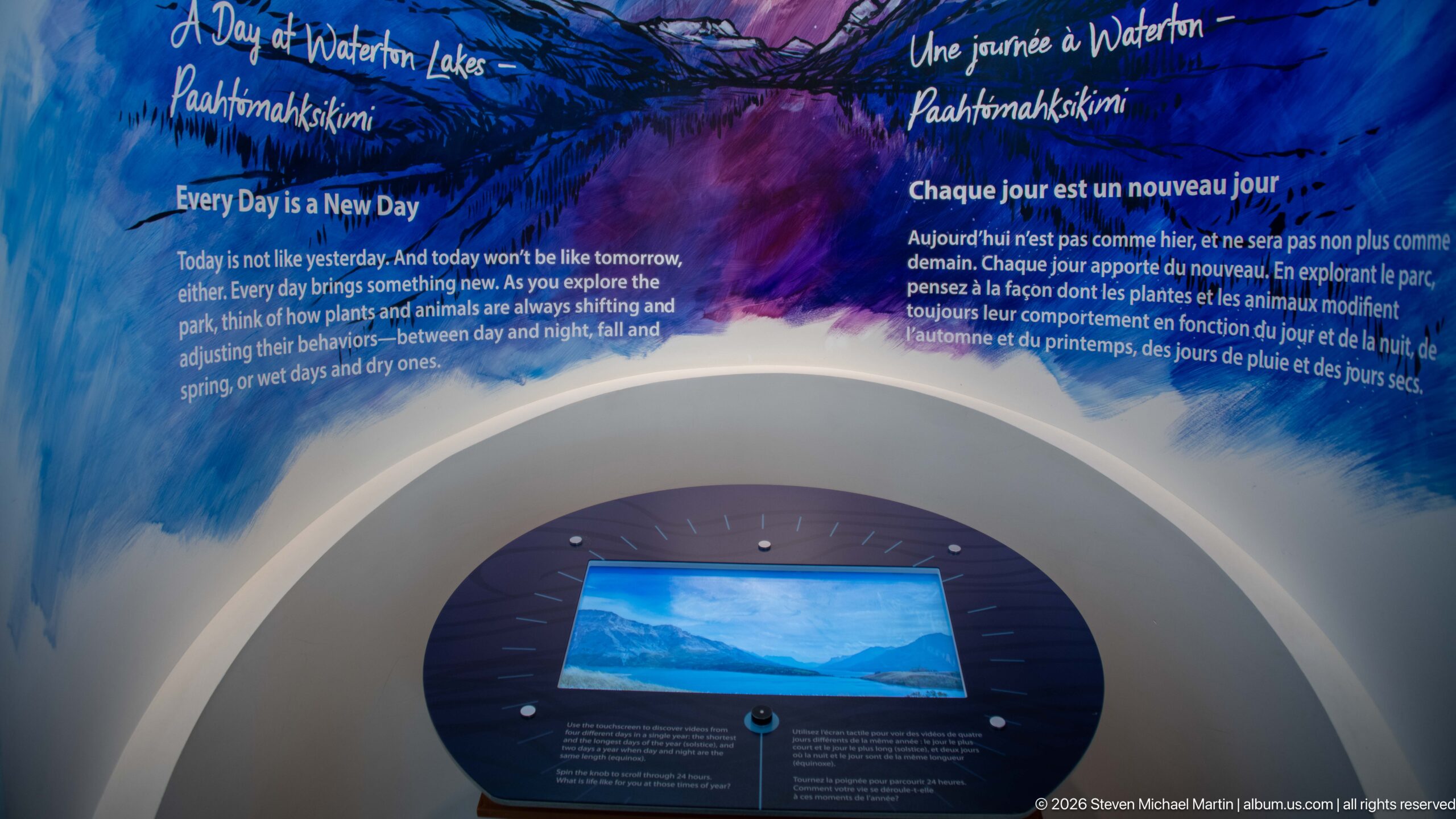
The bilingual exhibit “Every Day is a New Day” frames Waterton as a landscape of continual seasonal and daily change. Blue and purple atmospheric graphics sweep across the wall above a recessed circular interactive station, where a landscape screen invites closer engagement. The text encourages visitors to notice how plants, animals, weather, and light alter the experience of the park from one visit to another.
Caption
The bilingual exhibit “Every Day is a New Day” frames Waterton as a landscape of continual seasonal and daily change. Blue and purple atmospheric graphics sweep across the wall above a recessed circular interactive station, where a landscape screen invites closer engagement. The text encourages visitors to notice how plants, animals, weather, and light alter the experience of the park from one visit to another.
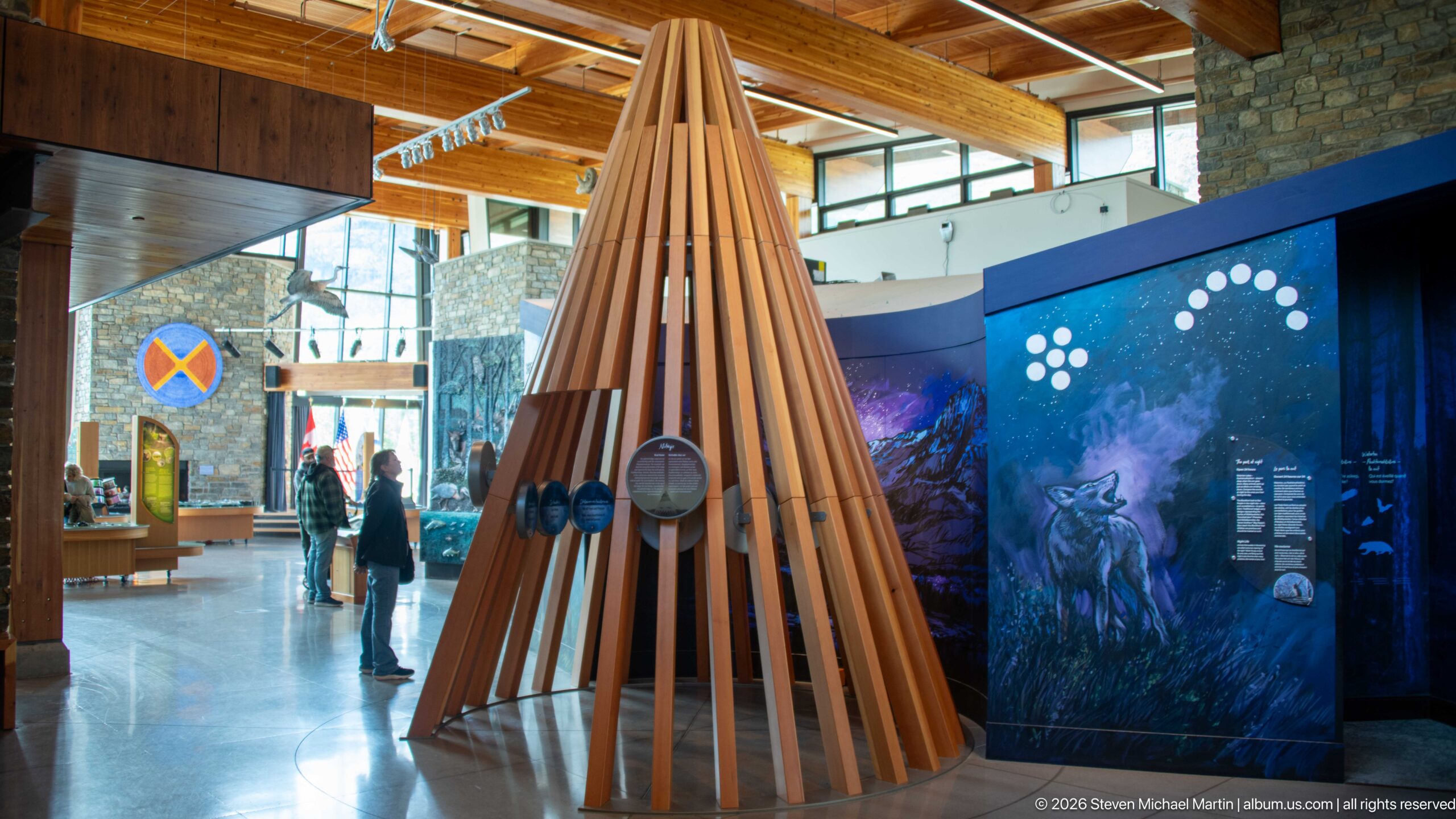
A tall cone-shaped installation of vertical wooden slats rises in the middle of the visitor centre gallery, surrounded by colorful natural-history exhibits. Circular listening or interpretive elements are mounted around its lower portion, while visitors and large windows appear beyond. The open timber structure acts as both an interactive object and a sculptural focal point within the airy interior.
Caption
A tall cone-shaped installation of vertical wooden slats rises in the middle of the visitor centre gallery, surrounded by colorful natural-history exhibits. Circular listening or interpretive elements are mounted around its lower portion, while visitors and large windows appear beyond. The open timber structure acts as both an interactive object and a sculptural focal point within the airy interior.
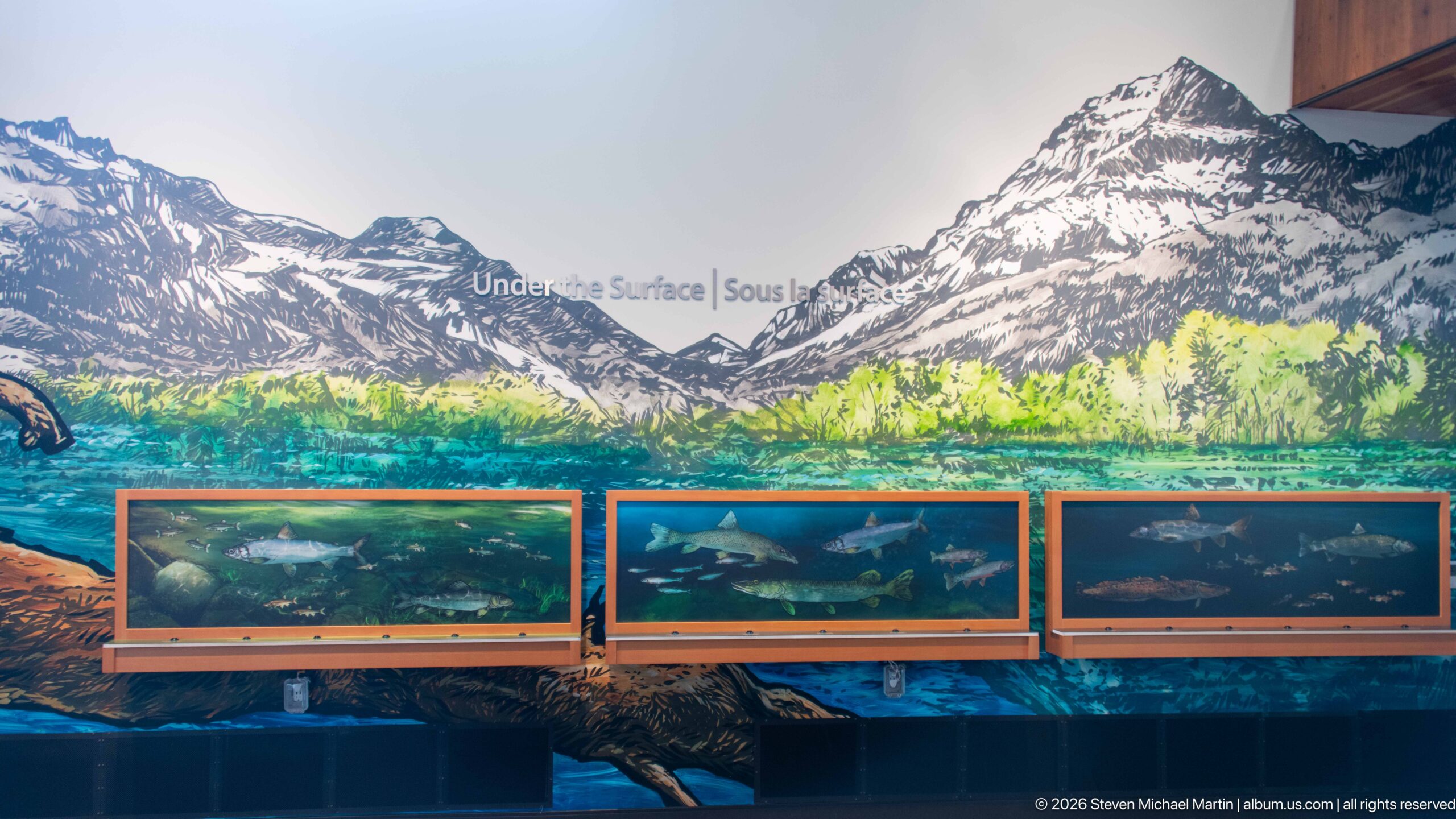
The “Under the Surface / Sous la surface” exhibit shifts attention below Waterton’s lakes. A painted mountain-and-water backdrop surrounds three horizontal viewing windows or display cases containing aquatic scenes, suggesting fish and underwater habitat beneath the familiar alpine landscape. The arrangement visually connects the lake surface seen by visitors with the less visible ecosystem below it.
Caption
The “Under the Surface / Sous la surface” exhibit shifts attention below Waterton’s lakes. A painted mountain-and-water backdrop surrounds three horizontal viewing windows or display cases containing aquatic scenes, suggesting fish and underwater habitat beneath the familiar alpine landscape. The arrangement visually connects the lake surface seen by visitors with the less visible ecosystem below it.
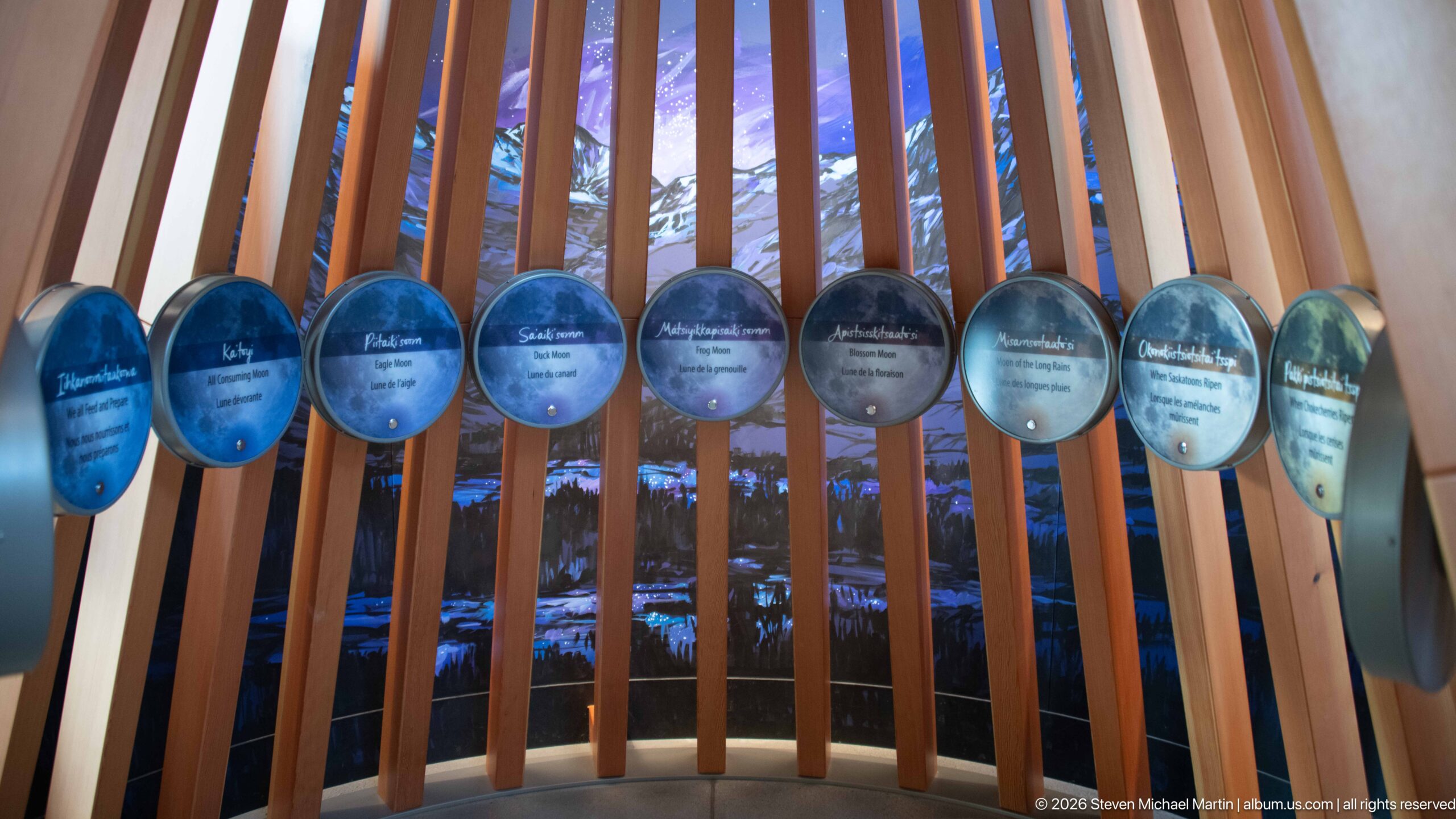
A close view of the gallery’s timber installation reveals a row of circular interpretive discs attached to vertical wooden slats. Each disc carries a short bilingual word or phrase, encouraging visitors to move around the structure and encounter multiple concepts in sequence. Mountain scenery visible through the gaps keeps the tactile indoor feature visually connected to the park outside.
Caption
A close view of the gallery’s timber installation reveals a row of circular interpretive discs attached to vertical wooden slats. Each disc carries a short bilingual word or phrase, encouraging visitors to move around the structure and encounter multiple concepts in sequence. Mountain scenery visible through the gaps keeps the tactile indoor feature visually connected to the park outside.
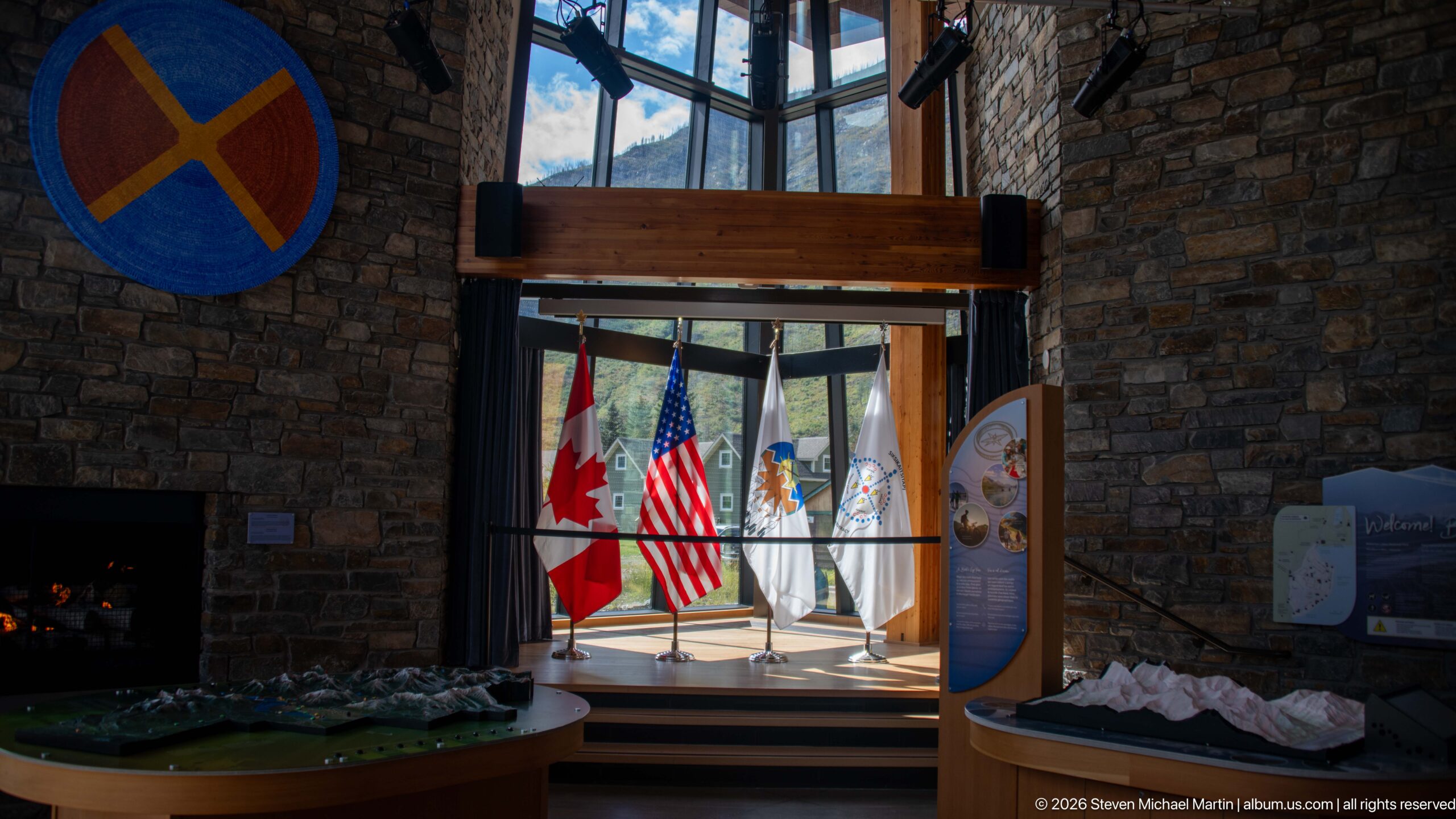
Stone walls, heavy timber beams, and tall glazing frame an interior passage where four ceremonial flags stand in bright window light. The view places the flag display within the visitor center’s architecture, with exhibit furniture and interpretive panels in the foreground and mountains faintly visible through the glass beyond.
Caption
Stone walls, heavy timber beams, and tall glazing frame an interior passage where four ceremonial flags stand in bright window light. The view places the flag display within the visitor center’s architecture, with exhibit furniture and interpretive panels in the foreground and mountains faintly visible through the glass beyond.
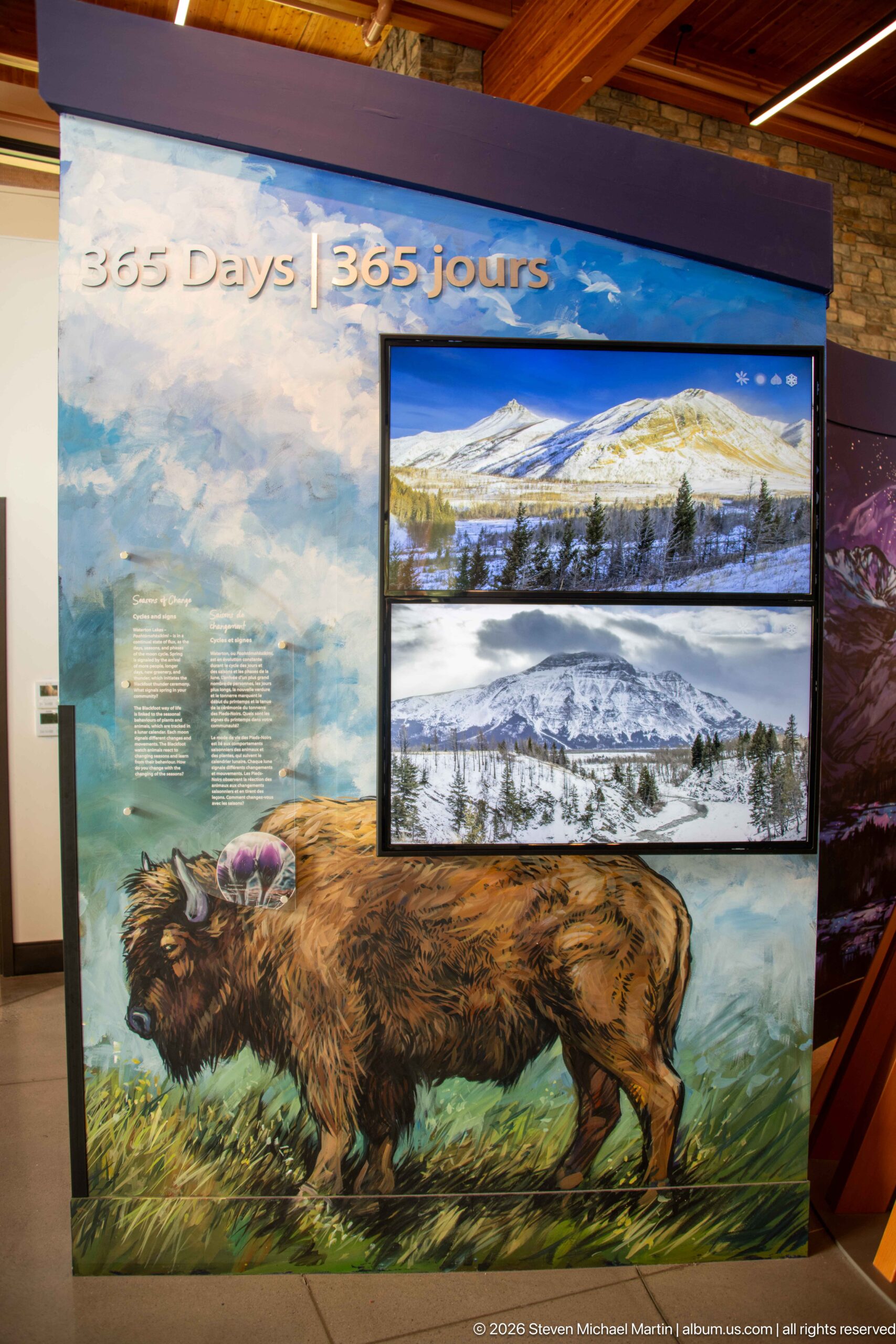
A large indoor panel uses a bison in the foreground and four seasonal landscape views to interpret change across the Waterton region through the year. The bold “365 Days / 365 jours” heading and layered mountain imagery turn seasonal cycles into an immediate visual introduction, while the life-size animal illustration anchors the display in the park’s grassland and wildlife themes.
Caption
A large indoor panel uses a bison in the foreground and four seasonal landscape views to interpret change across the Waterton region through the year. The bold “365 Days / 365 jours” heading and layered mountain imagery turn seasonal cycles into an immediate visual introduction, while the life-size animal illustration anchors the display in the park’s grassland and wildlife themes.
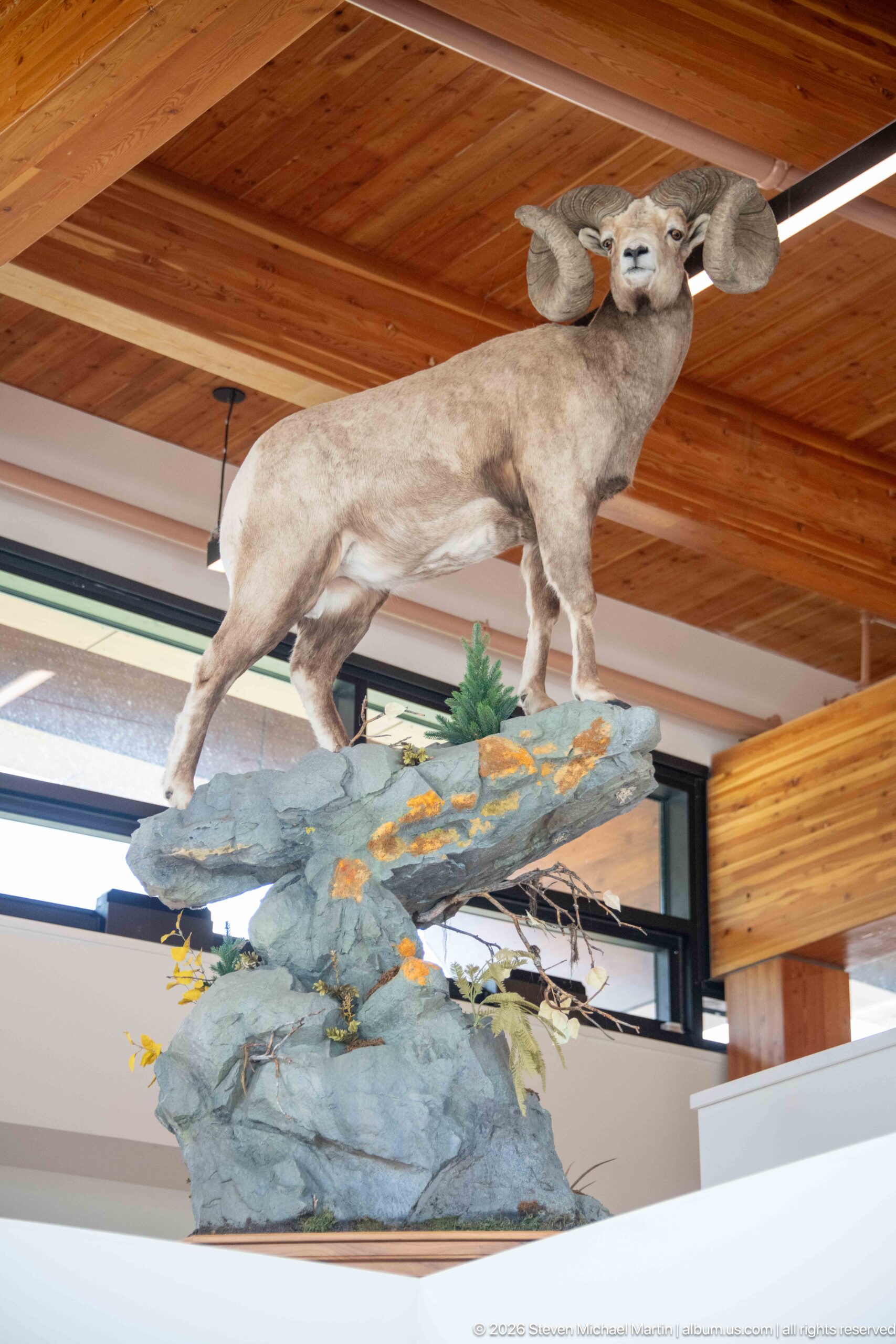
A mounted bighorn sheep stands high above the gallery on a simulated rocky ledge, its massive curled horns forming the dominant feature of the specimen. Elevated against the visitor center’s timber ceiling and windows, the display presents the animal at near life scale and draws attention to the specialized mountain ungulates of the Canadian Rockies.
Caption
A mounted bighorn sheep stands high above the gallery on a simulated rocky ledge, its massive curled horns forming the dominant feature of the specimen. Elevated against the visitor center’s timber ceiling and windows, the display presents the animal at near life scale and draws attention to the specialized mountain ungulates of the Canadian Rockies.
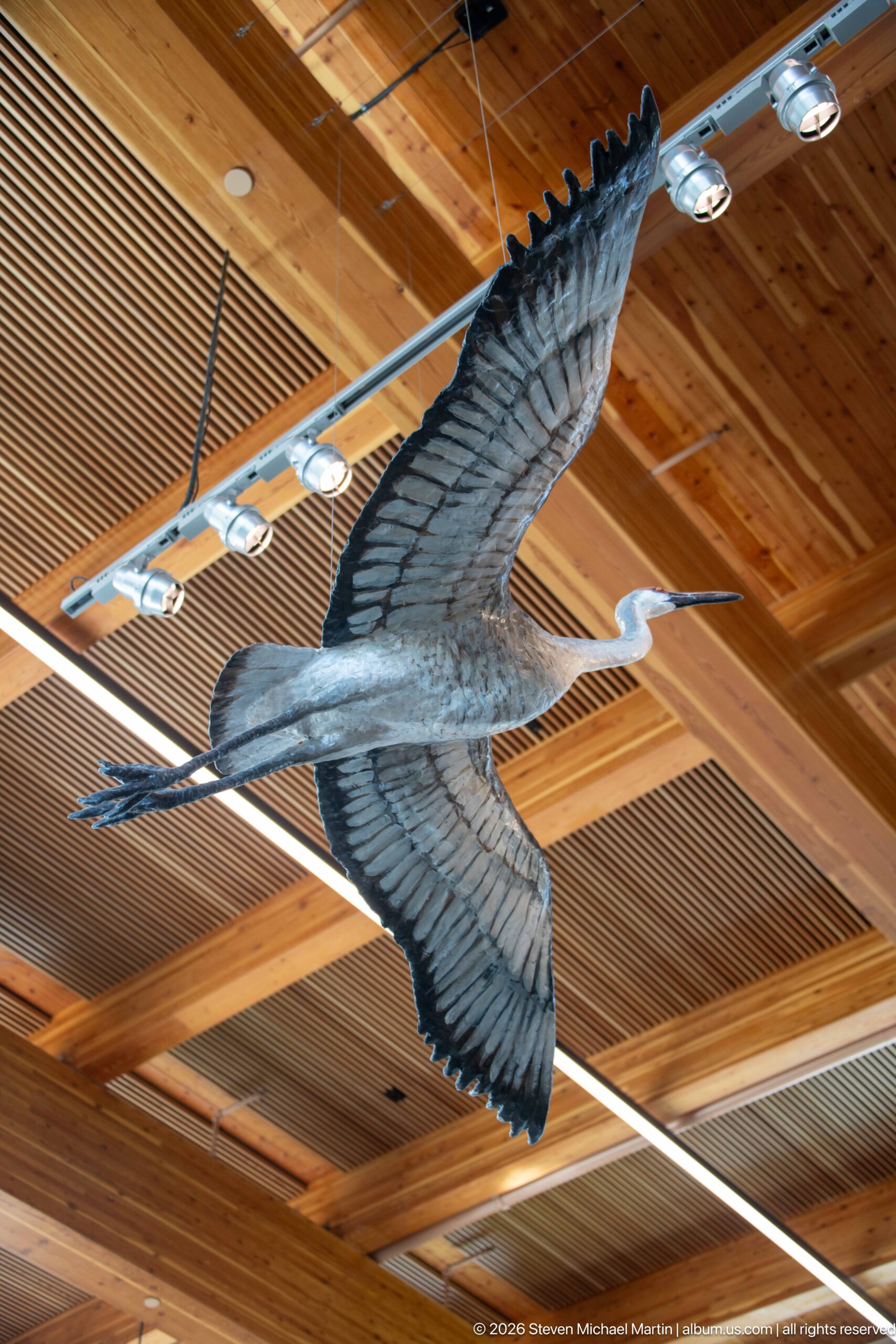
A large raptor model hangs beneath the visitor center’s wood ceiling with wings fully spread, presenting the underside of the bird in a soaring posture. Long primary feathers, a broad tail, and outstretched wings are emphasized by the upward camera angle, turning the ceiling installation into an overhead wildlife encounter.
Caption
A large raptor model hangs beneath the visitor center’s wood ceiling with wings fully spread, presenting the underside of the bird in a soaring posture. Long primary feathers, a broad tail, and outstretched wings are emphasized by the upward camera angle, turning the ceiling installation into an overhead wildlife encounter.

A large circular fiber artwork hangs against the visitor center’s rough stone wall. Concentric blue and rust-colored fields are divided by a strong yellow X-shaped geometry, creating a graphic focal point whose woven surface contrasts with the irregular masonry behind it.
Caption
A large circular fiber artwork hangs against the visitor center’s rough stone wall. Concentric blue and rust-colored fields are divided by a strong yellow X-shaped geometry, creating a graphic focal point whose woven surface contrasts with the irregular masonry behind it.
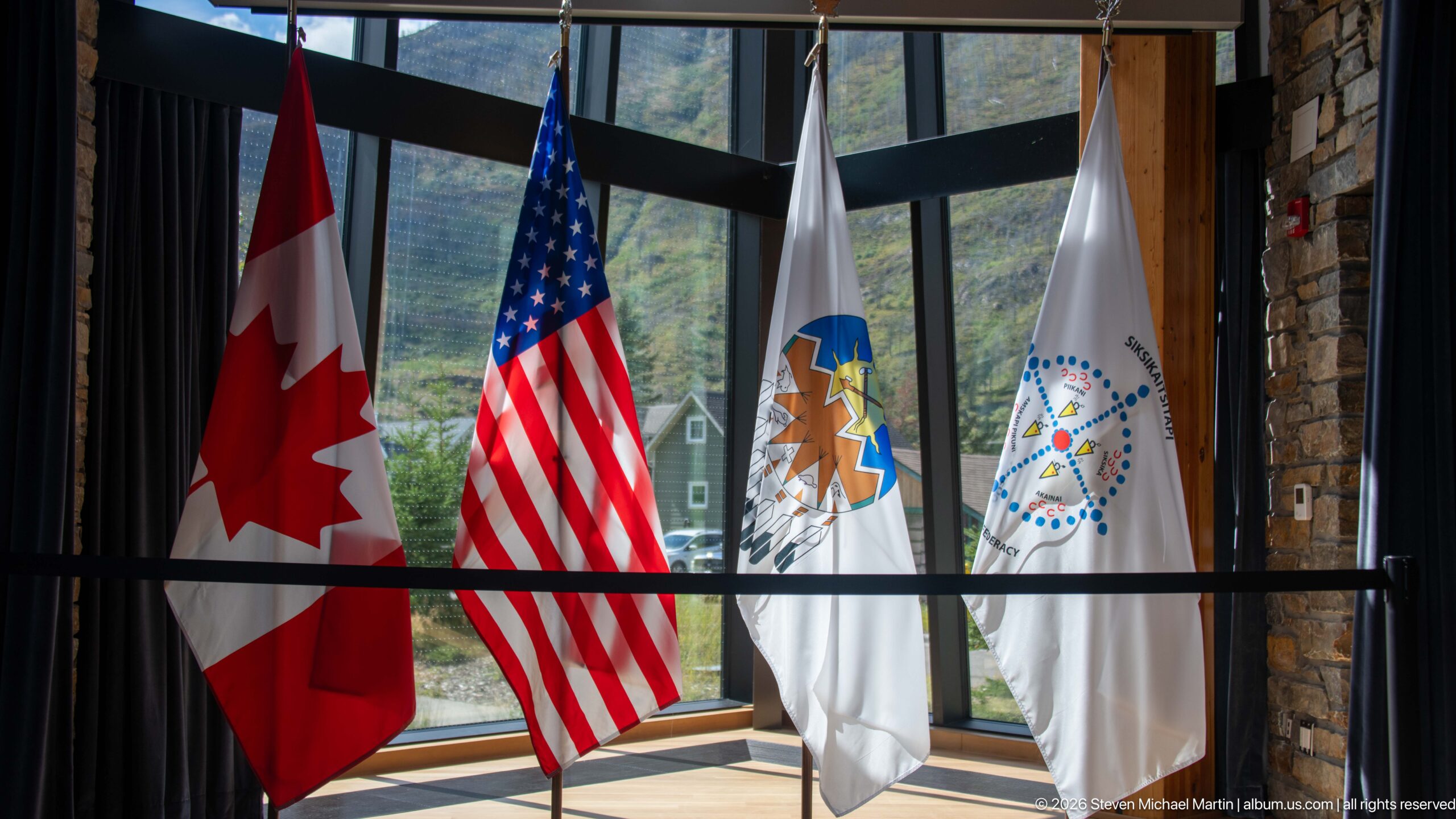
Four flags stand before tall visitor-center windows: the Canadian and United States flags at left and two white emblem-bearing flags at right. Close framing isolates the standards from the surrounding gallery, while the mountain landscape outside reinforces the building’s cross-border Waterton setting.
Caption
Four flags stand before tall visitor-center windows: the Canadian and United States flags at left and two white emblem-bearing flags at right. Close framing isolates the standards from the surrounding gallery, while the mountain landscape outside reinforces the building’s cross-border Waterton setting.
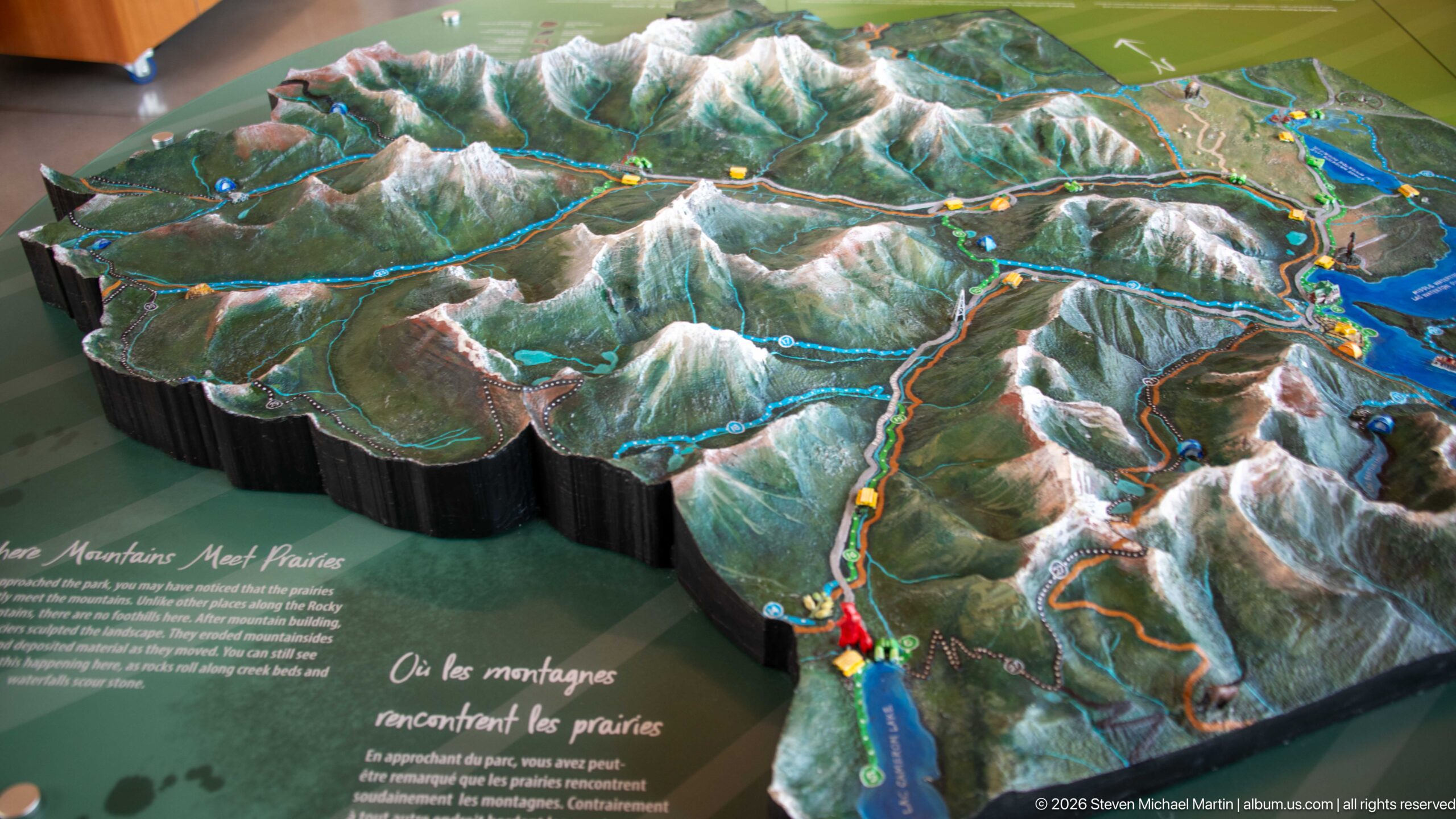
A three-dimensional relief map translates the steep mountain-and-valley terrain around Waterton into a tactile landscape of ridges, lakes, roads, and colored routes. Viewed obliquely, the model emphasizes the abrupt meeting of mountain topography and prairie, a relationship reinforced by the bilingual interpretive text printed along its base.
Caption
A three-dimensional relief map translates the steep mountain-and-valley terrain around Waterton into a tactile landscape of ridges, lakes, roads, and colored routes. Viewed obliquely, the model emphasizes the abrupt meeting of mountain topography and prairie, a relationship reinforced by the bilingual interpretive text printed along its base.
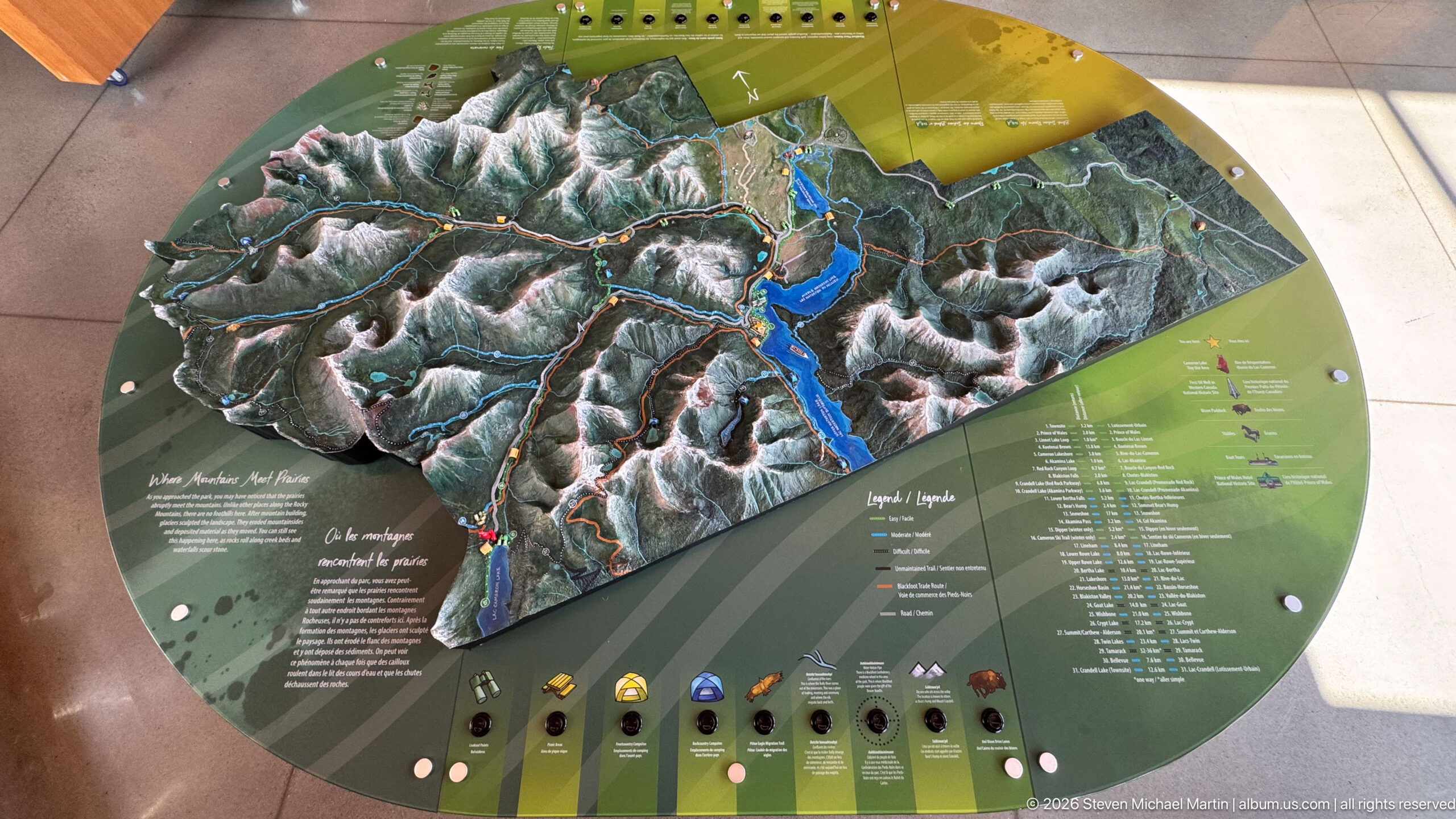
Seen from above, the visitor center’s circular relief-map table places the mountainous Waterton landscape within a broader interpretive field of labels, legends, and push-button stations. The overhead perspective clarifies the model’s full footprint and shows how roads, lakes, valleys, and peaks are organized for orientation before visitors explore the park.
Caption
Seen from above, the visitor center’s circular relief-map table places the mountainous Waterton landscape within a broader interpretive field of labels, legends, and push-button stations. The overhead perspective clarifies the model’s full footprint and shows how roads, lakes, valleys, and peaks are organized for orientation before visitors explore the park.
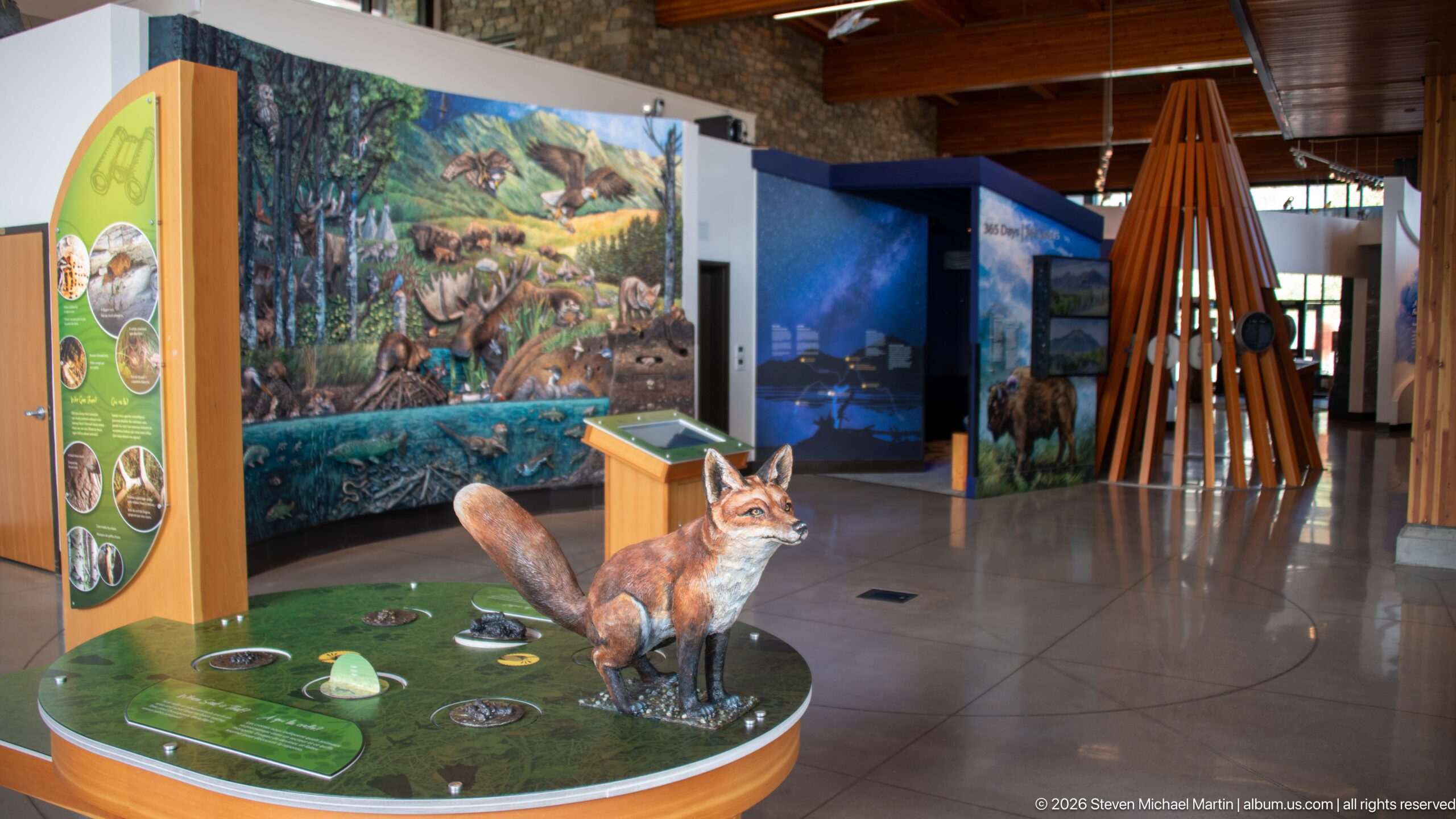
A red fox specimen stands on a low circular habitat table at the edge of the natural-history gallery. Tracks, objects, and small interpretive elements surround the animal, while the large ecosystem mural and additional exhibits recede into the background, showing how individual species displays are integrated into a broader account of Waterton’s wildlife.
Caption
A red fox specimen stands on a low circular habitat table at the edge of the natural-history gallery. Tracks, objects, and small interpretive elements surround the animal, while the large ecosystem mural and additional exhibits recede into the background, showing how individual species displays are integrated into a broader account of Waterton’s wildlife.
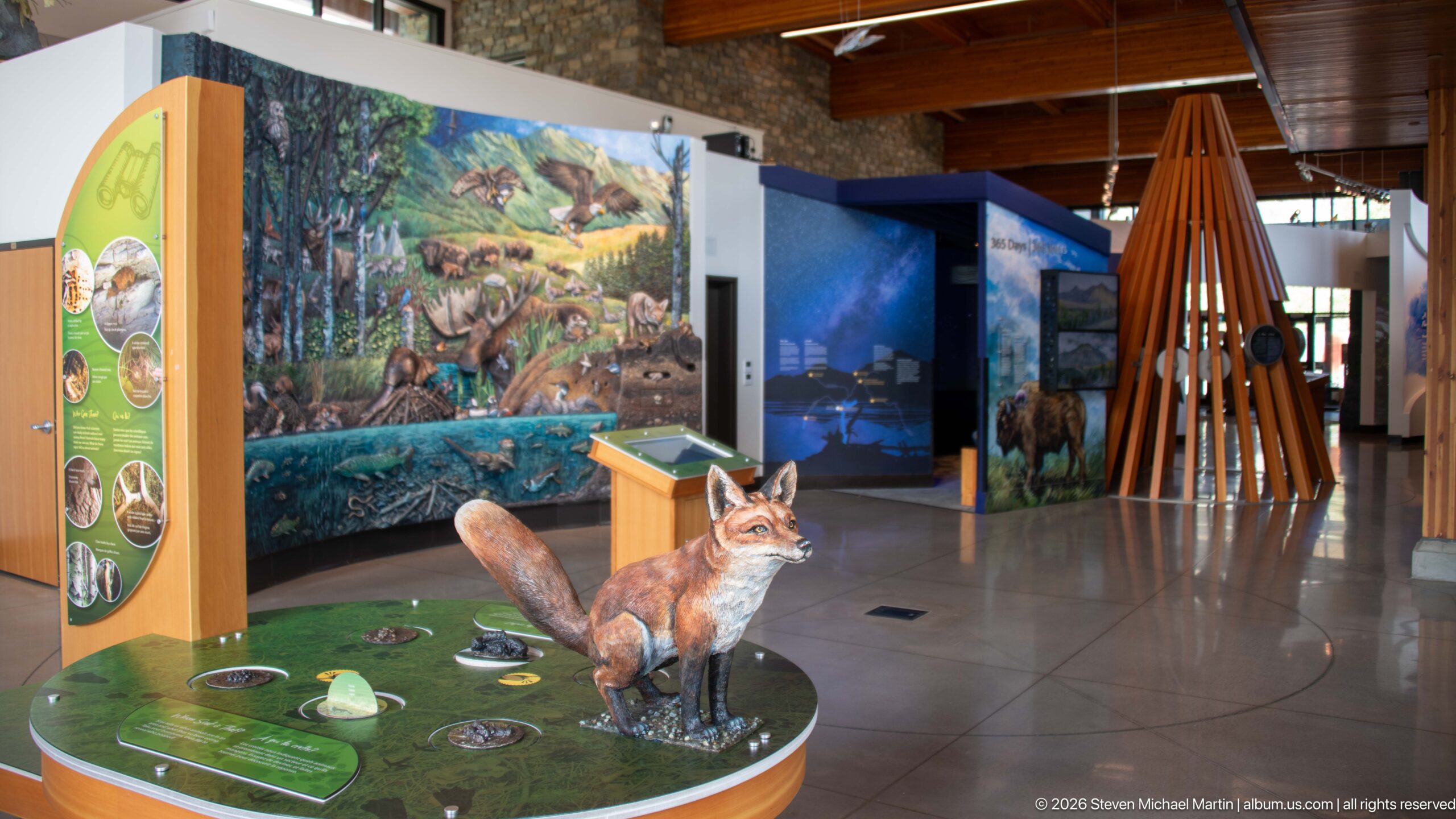
The red fox display is viewed from slightly farther back, placing the specimen within the visitor center’s sequence of wildlife interpretation. Its circular table occupies the foreground while a multi-species mural, darkened exhibit alcove, and tall timber installation create successive layers through the gallery, emphasizing the spatial organization of the natural-history displays.
Caption
The red fox display is viewed from slightly farther back, placing the specimen within the visitor center’s sequence of wildlife interpretation. Its circular table occupies the foreground while a multi-species mural, darkened exhibit alcove, and tall timber installation create successive layers through the gallery, emphasizing the spatial organization of the natural-history displays.
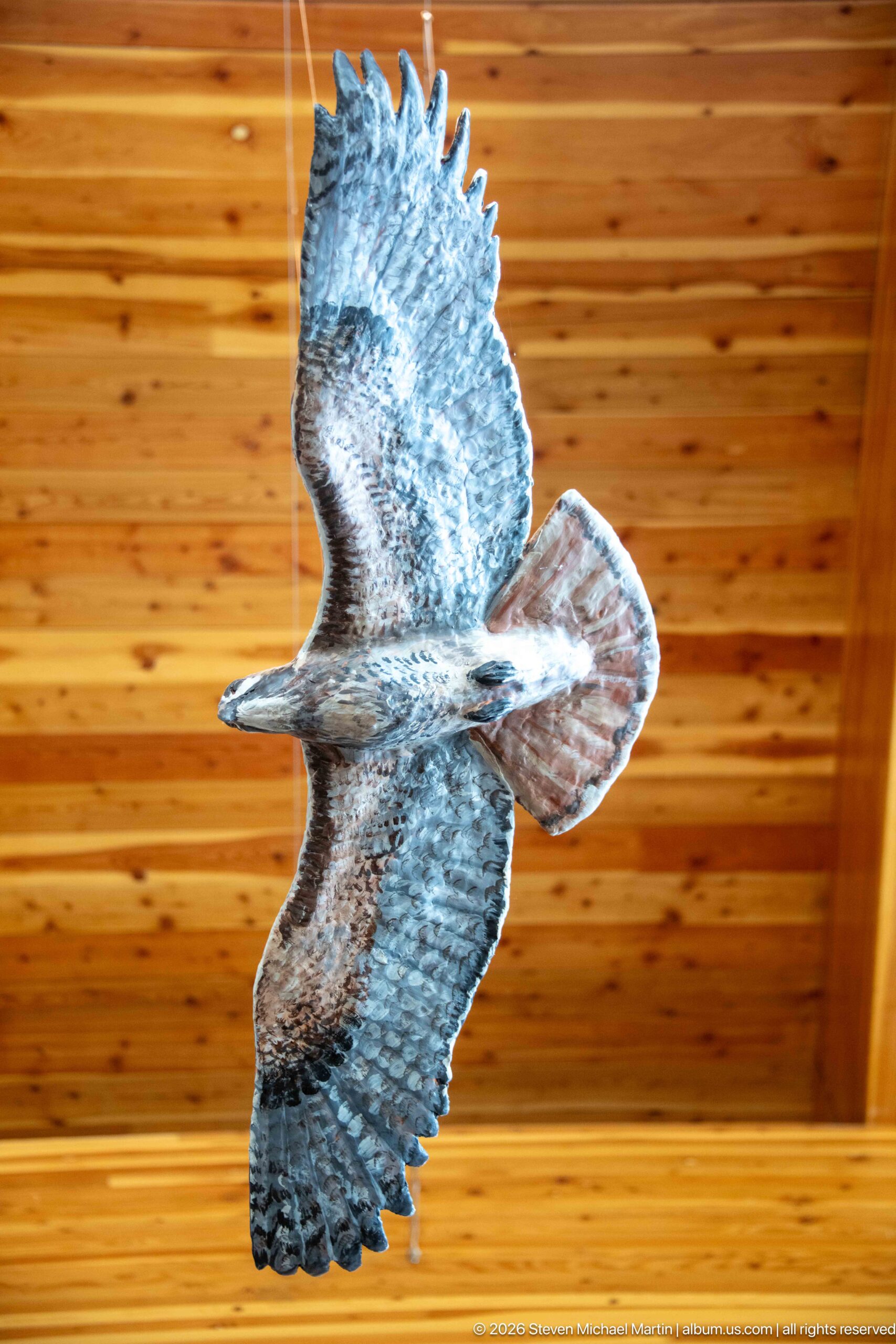
Directly beneath the suspended bird, the camera isolates its spread wings and fanned tail against the warm wood ceiling. This closer underside view reveals the layered flight feathers and mottled plumage pattern more clearly than the preceding photograph, emphasizing anatomy and the mechanics suggested by the model’s soaring pose.
Caption
Directly beneath the suspended bird, the camera isolates its spread wings and fanned tail against the warm wood ceiling. This closer underside view reveals the layered flight feathers and mottled plumage pattern more clearly than the preceding photograph, emphasizing anatomy and the mechanics suggested by the model’s soaring pose.
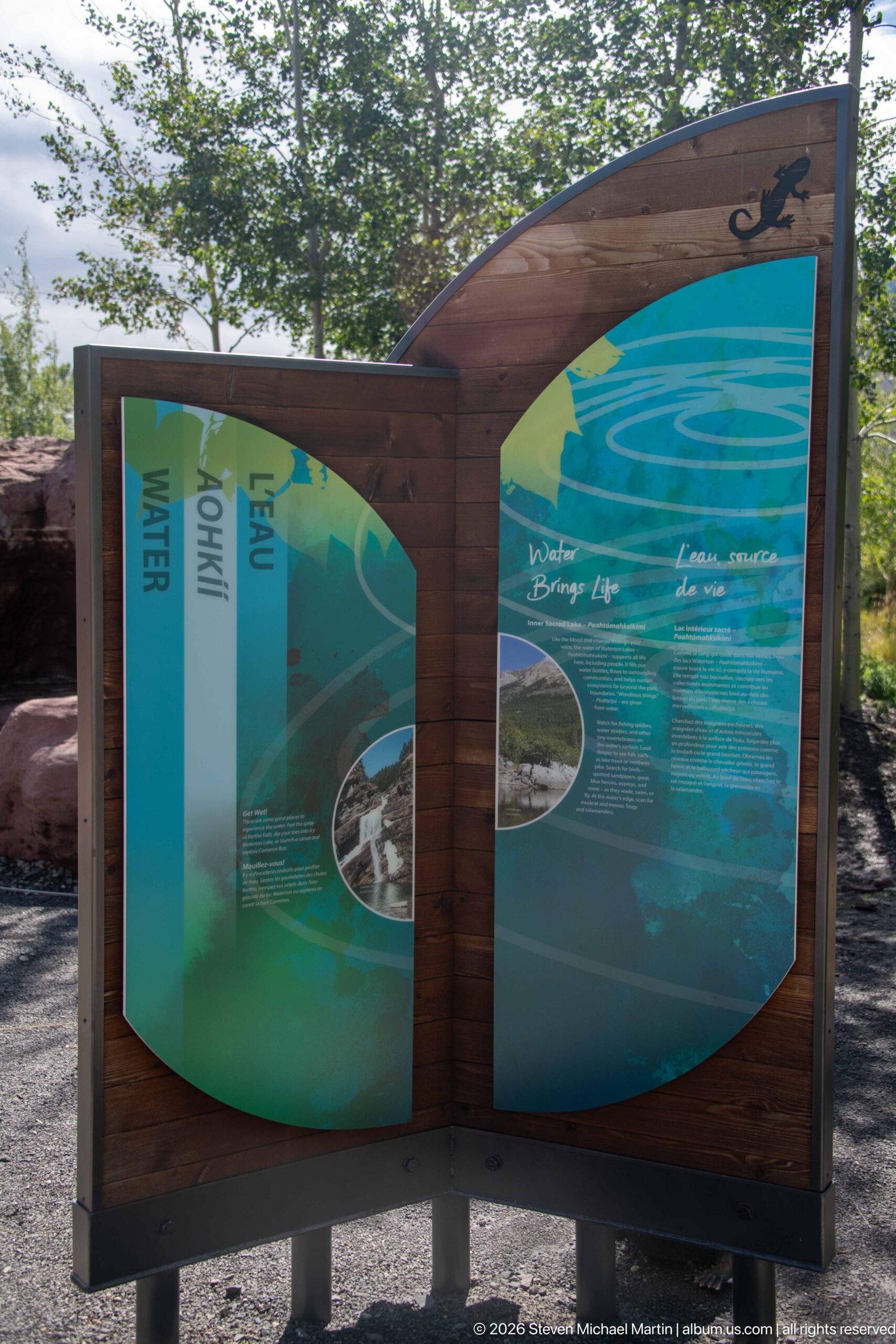
A freestanding outdoor interpretive structure uses layered blue and green graphics to introduce water as a defining element of the Waterton landscape. Curved wooden framing echoes the flowing design of the panels, while bilingual text and inset photographs connect the visitor center grounds to lakes, streams, and the broader movement of water through the park.
Caption
A freestanding outdoor interpretive structure uses layered blue and green graphics to introduce water as a defining element of the Waterton landscape. Curved wooden framing echoes the flowing design of the panels, while bilingual text and inset photographs connect the visitor center grounds to lakes, streams, and the broader movement of water through the park.
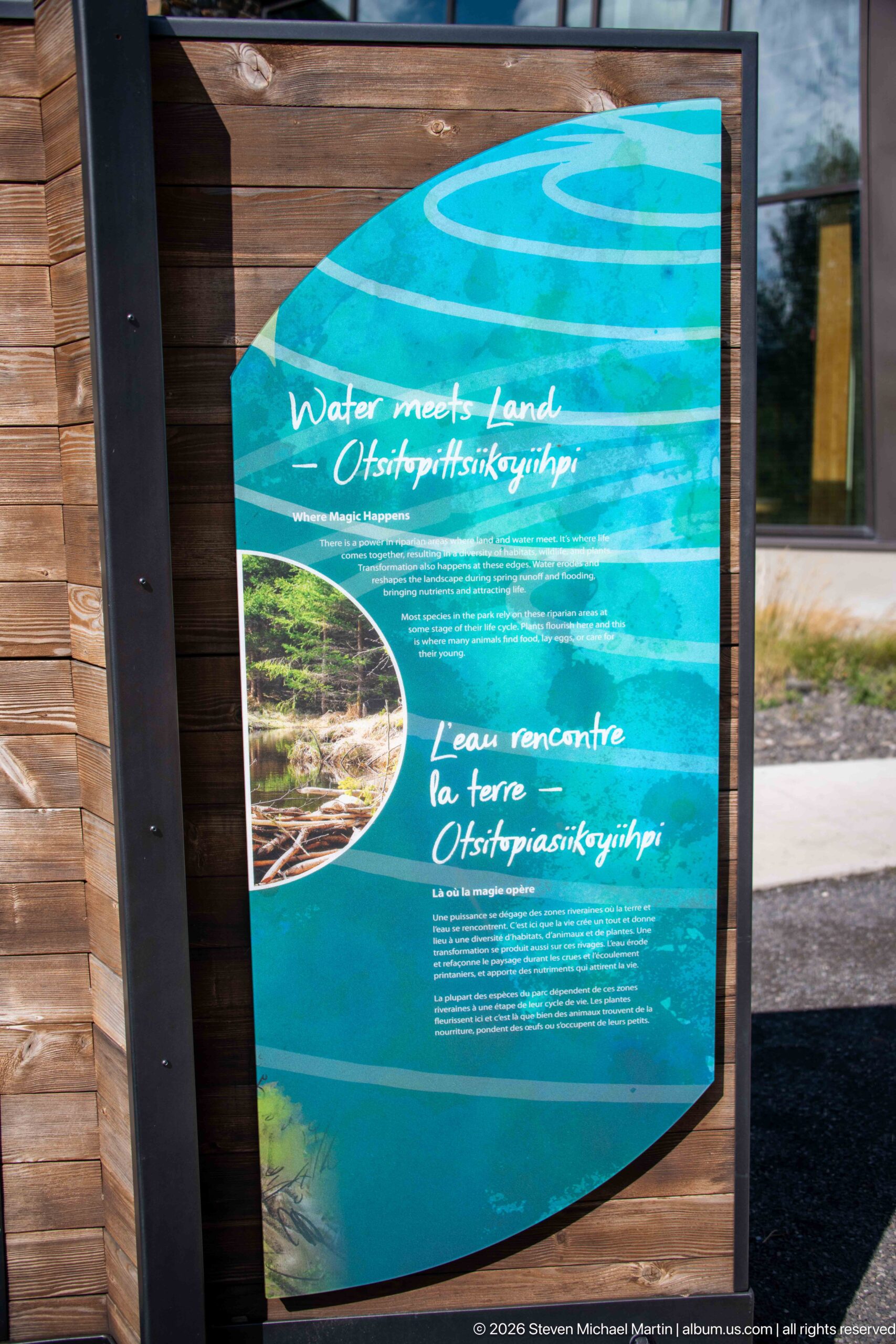
The “Water meets Land” panel focuses on the meeting of aquatic and terrestrial environments through turquoise graphics, bilingual text, and a circular landscape photograph. Mounted in a substantial timber frame beside the visitor center, the sign extends the building’s natural-history interpretation outdoors and invites close reading at pedestrian scale.
Caption
The “Water meets Land” panel focuses on the meeting of aquatic and terrestrial environments through turquoise graphics, bilingual text, and a circular landscape photograph. Mounted in a substantial timber frame beside the visitor center, the sign extends the building’s natural-history interpretation outdoors and invites close reading at pedestrian scale.
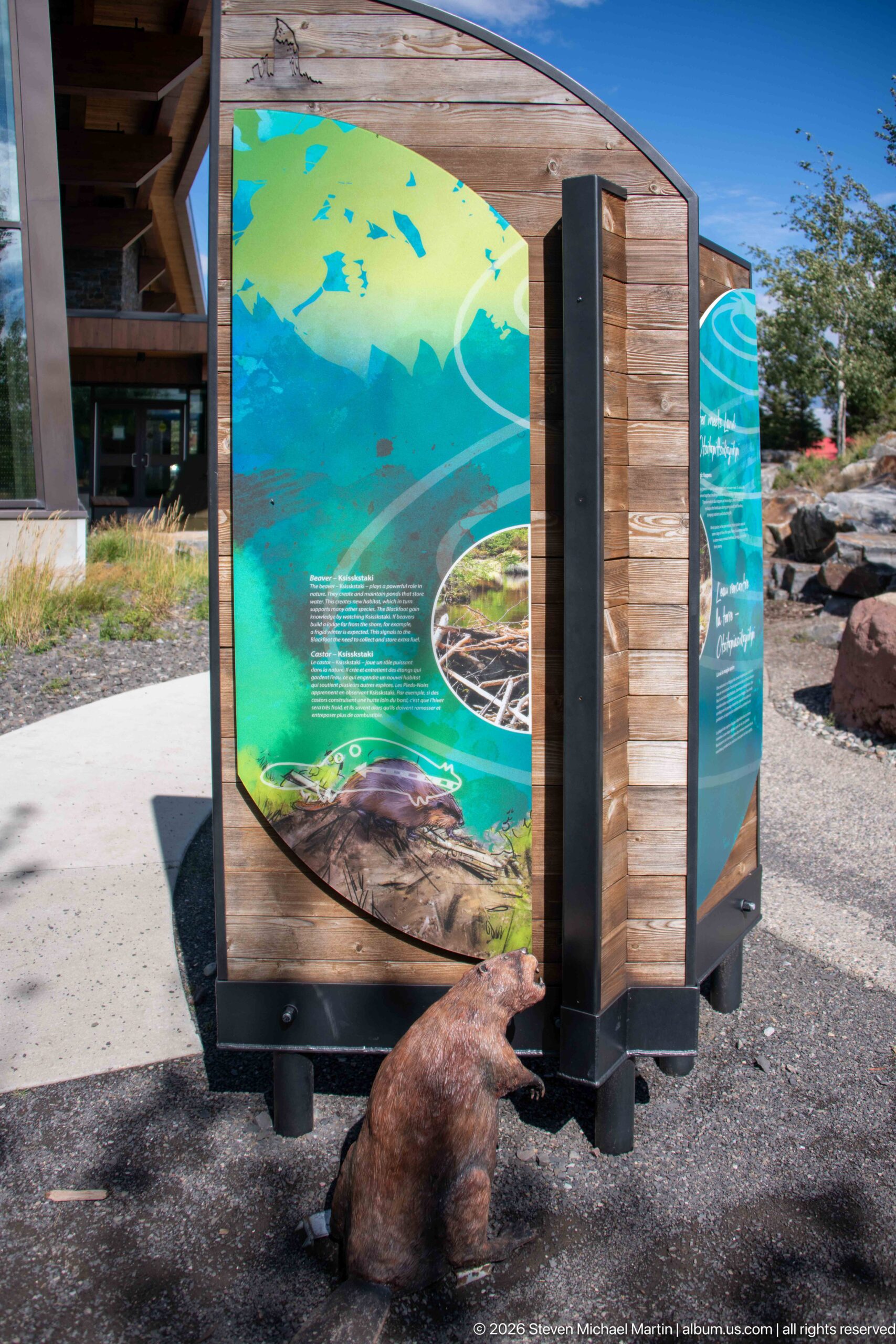
A sculpted beaver occupies the base of a freestanding interpretive panel outside the visitor center, linking a three-dimensional animal figure with brightly colored ecological graphics. The low viewpoint brings the beaver into the foreground while the timber-framed panel and building entrance behind establish the display as part of the landscaped interpretive grounds.
Caption
A sculpted beaver occupies the base of a freestanding interpretive panel outside the visitor center, linking a three-dimensional animal figure with brightly colored ecological graphics. The low viewpoint brings the beaver into the foreground while the timber-framed panel and building entrance behind establish the display as part of the landscaped interpretive grounds.
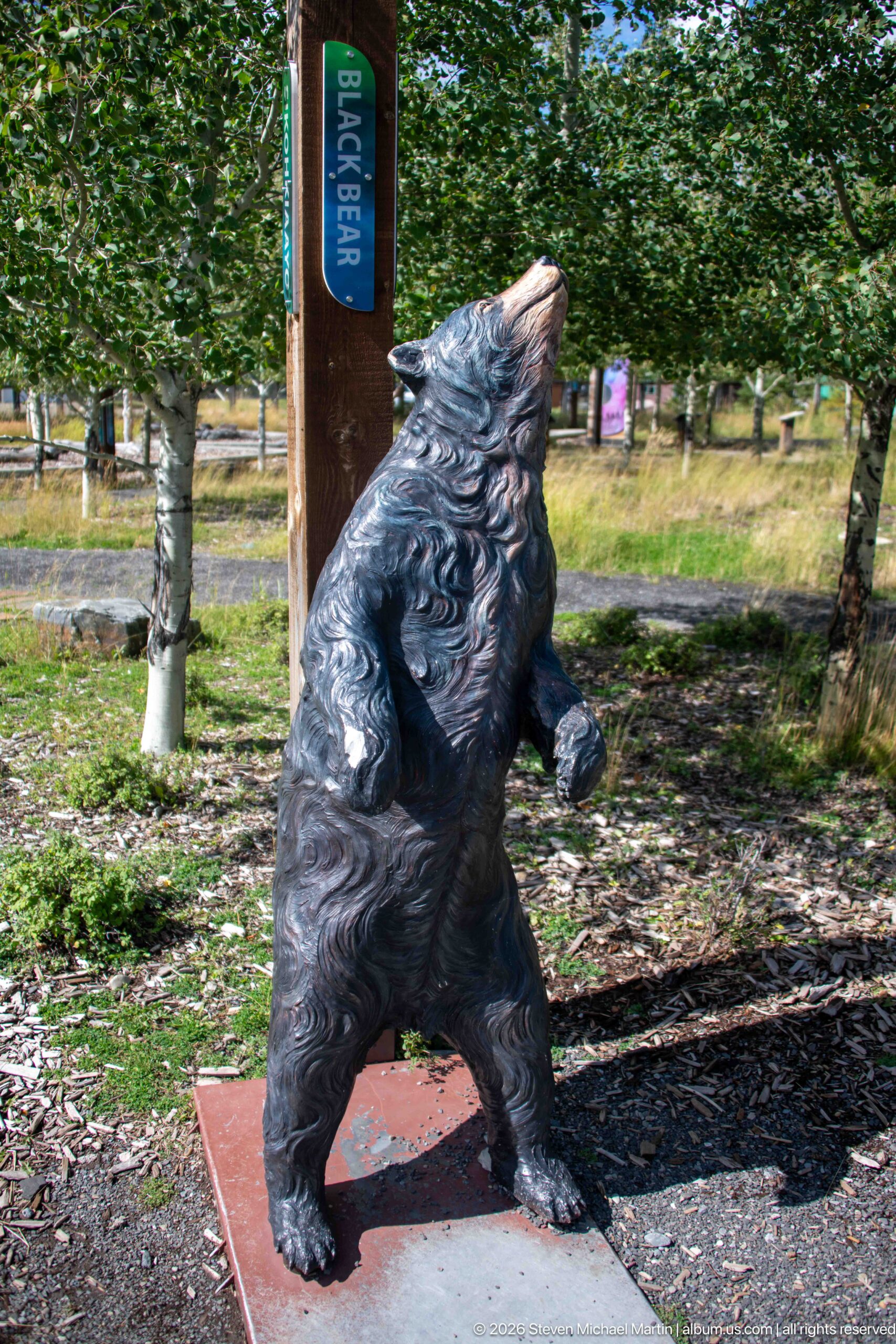
A black bear sculpture rises on its hind legs beside a wooden species marker in the visitor center grounds. The upright pose, rounded ears, heavy body, and textured dark coat create a close, life-size wildlife encounter, while the adjacent marker identifies the display as part of a sequence devoted to characteristic Waterton animals.
Caption
A black bear sculpture rises on its hind legs beside a wooden species marker in the visitor center grounds. The upright pose, rounded ears, heavy body, and textured dark coat create a close, life-size wildlife encounter, while the adjacent marker identifies the display as part of a sequence devoted to characteristic Waterton animals.
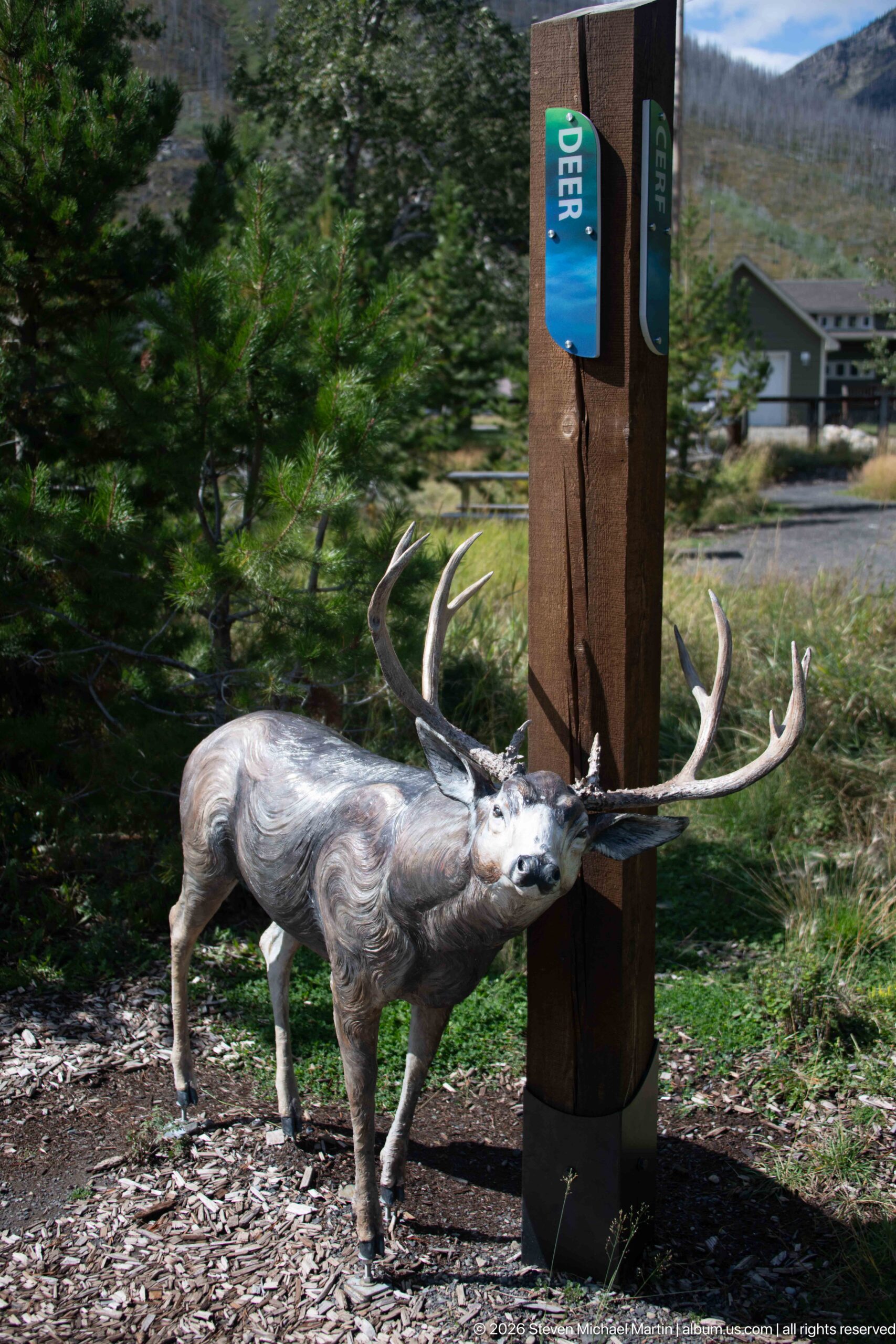
An antlered deer sculpture stands beside a tall wooden marker labeled for deer, its head turned toward the sign and branching antlers silhouetted against the landscaped grounds. The life-size figure forms part of the visitor center’s outdoor wildlife sequence, where sculpted animals and vertical labels create an accessible species-identification trail.
Caption
An antlered deer sculpture stands beside a tall wooden marker labeled for deer, its head turned toward the sign and branching antlers silhouetted against the landscaped grounds. The life-size figure forms part of the visitor center’s outdoor wildlife sequence, where sculpted animals and vertical labels create an accessible species-identification trail.
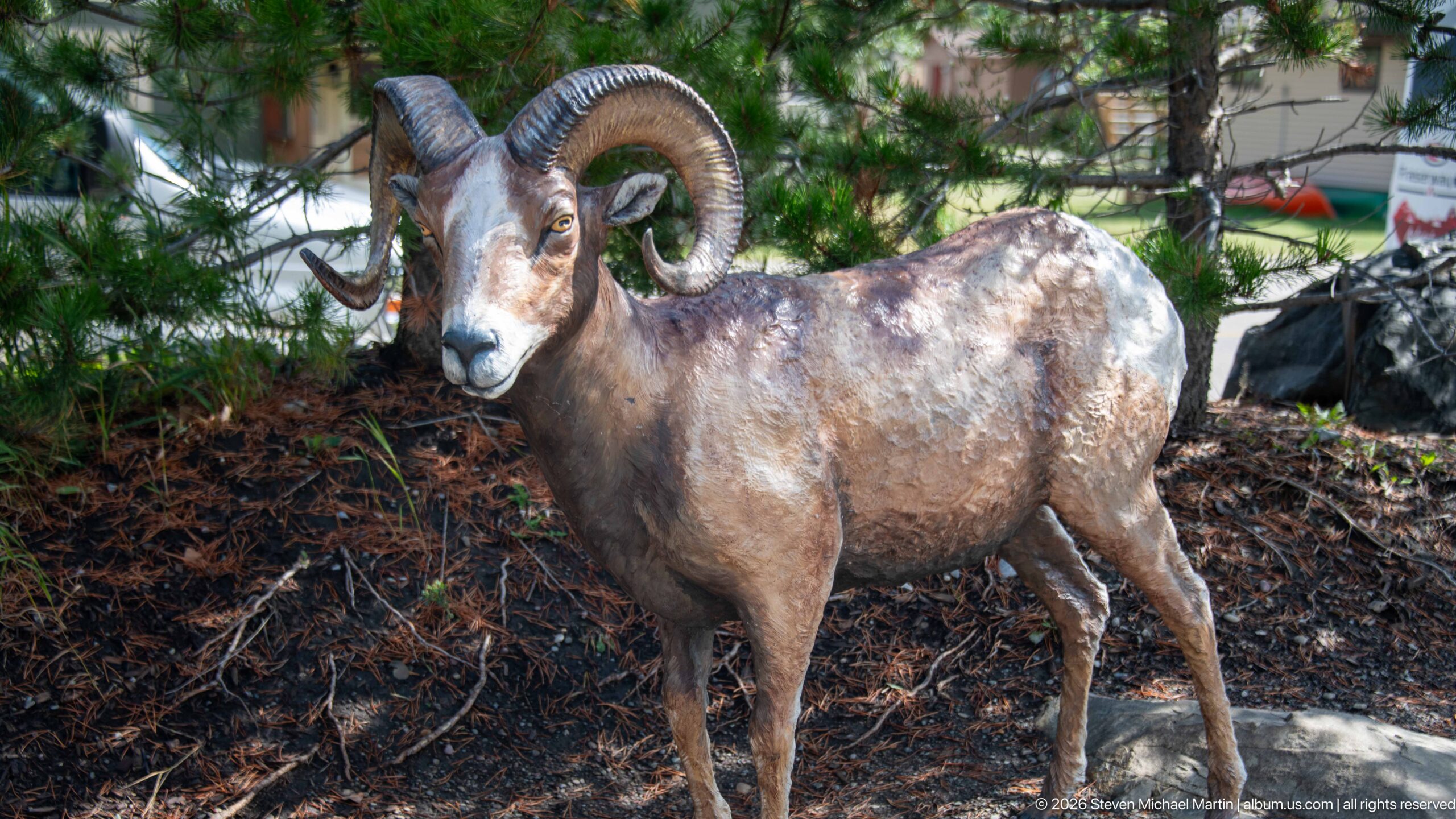
A life-size bighorn ram sculpture stands among trees and groundcover near the visitor center, its heavy curled horns and compact body modeled in close detail. Unlike the indoor taxidermy specimen, this outdoor figure is presented at ground level, allowing visitors to encounter the animal’s scale and distinctive horn structure within a landscaped setting.
Caption
A life-size bighorn ram sculpture stands among trees and groundcover near the visitor center, its heavy curled horns and compact body modeled in close detail. Unlike the indoor taxidermy specimen, this outdoor figure is presented at ground level, allowing visitors to encounter the animal’s scale and distinctive horn structure within a landscaped setting.
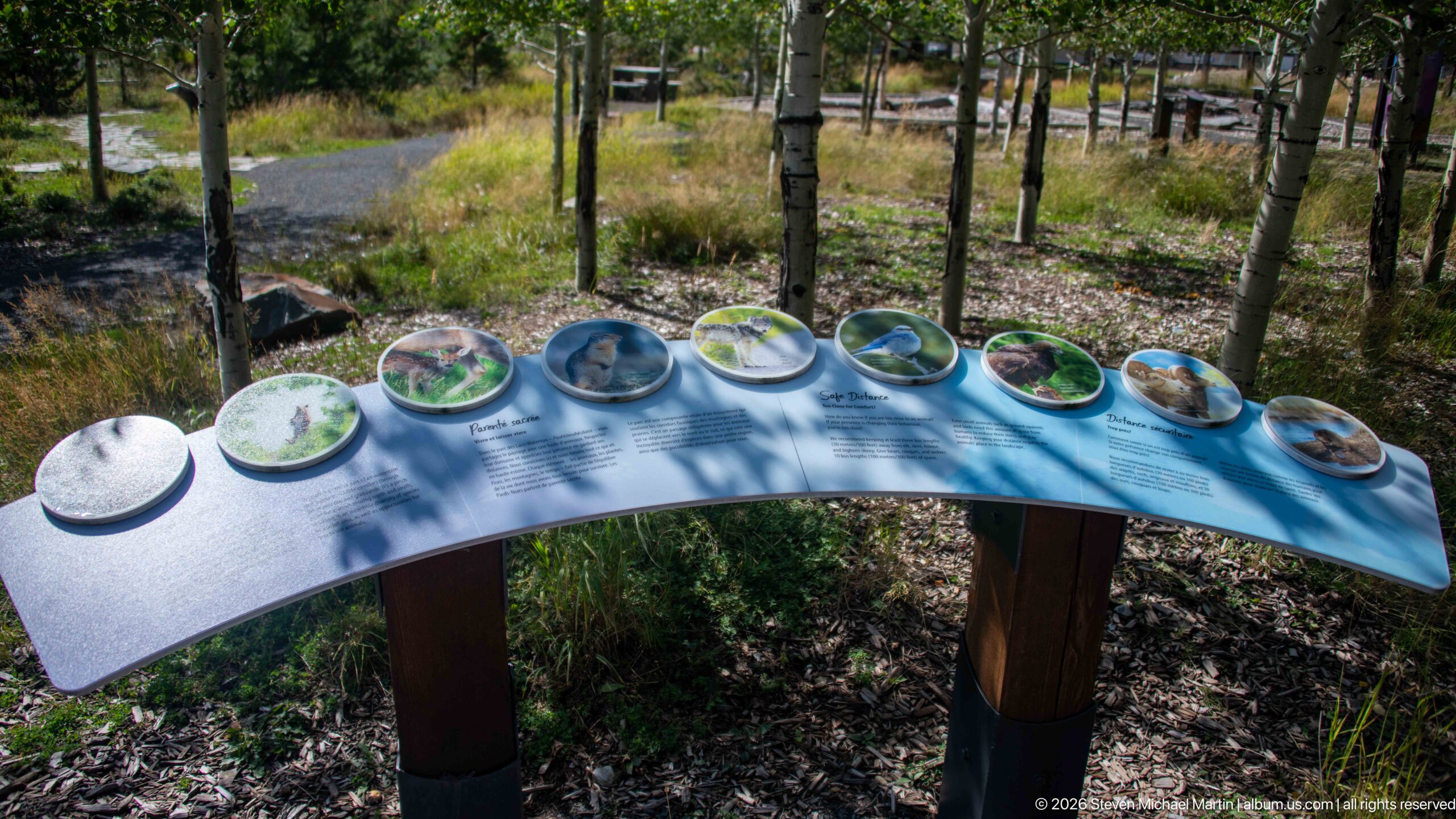
A curved outdoor interpretation table presents a row of circular, lens-like or tactile stations above explanatory text. Set among young trees and native-looking groundcover, the low installation encourages hands-on inspection and makes the landscaped grounds themselves part of the visitor center’s interpretive experience.
Caption
A curved outdoor interpretation table presents a row of circular, lens-like or tactile stations above explanatory text. Set among young trees and native-looking groundcover, the low installation encourages hands-on inspection and makes the landscaped grounds themselves part of the visitor center’s interpretive experience.
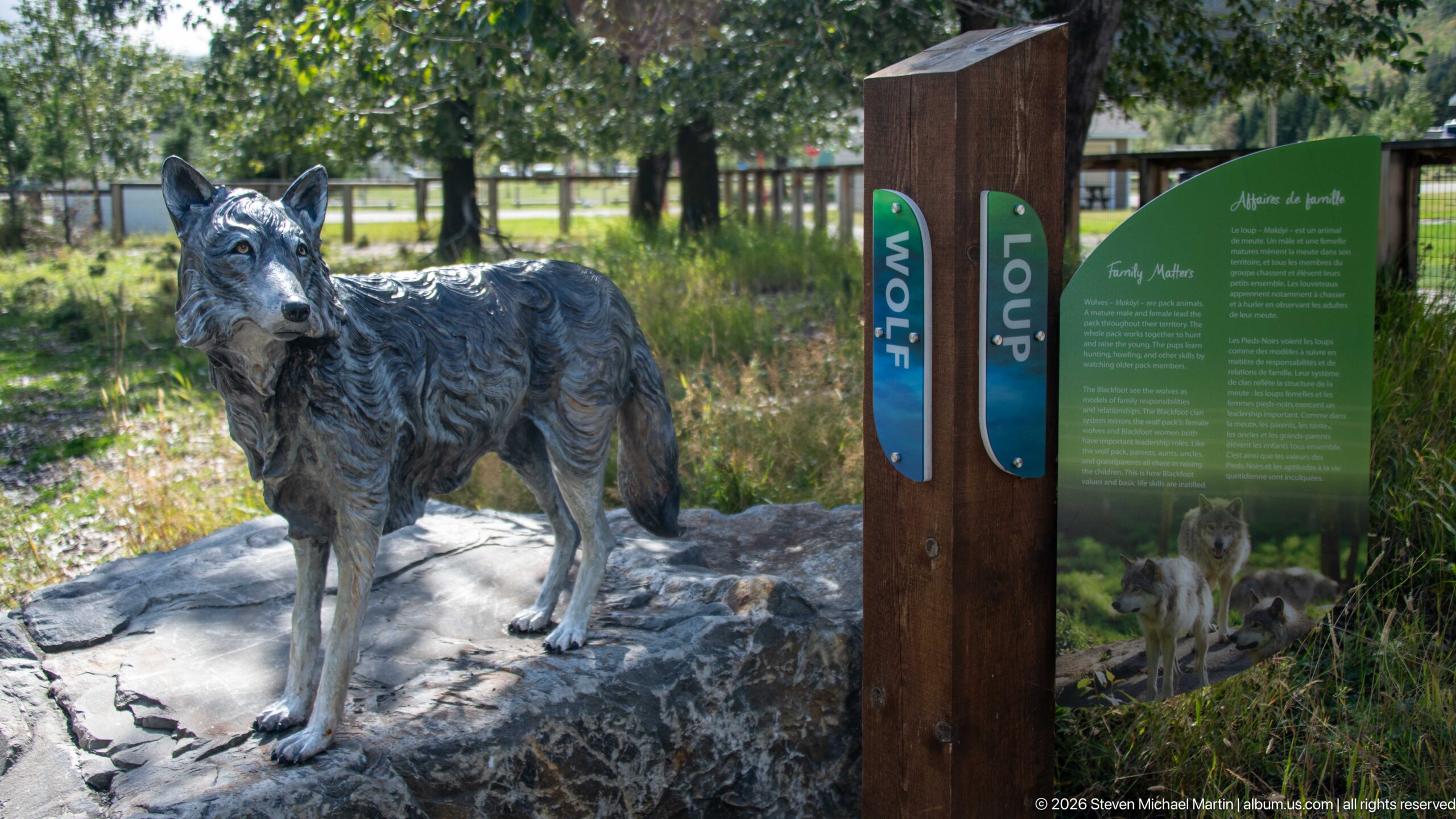
A gray wolf sculpture stands alert on a low rock beside a bilingual wooden species marker. Upright ears, long legs, narrow muzzle, and a lowered bushy tail give the figure a recognizable canid profile, while the adjacent interpretive panel places the animal within the visitor center’s outdoor sequence of Waterton wildlife.
Caption
A gray wolf sculpture stands alert on a low rock beside a bilingual wooden species marker. Upright ears, long legs, narrow muzzle, and a lowered bushy tail give the figure a recognizable canid profile, while the adjacent interpretive panel places the animal within the visitor center’s outdoor sequence of Waterton wildlife.
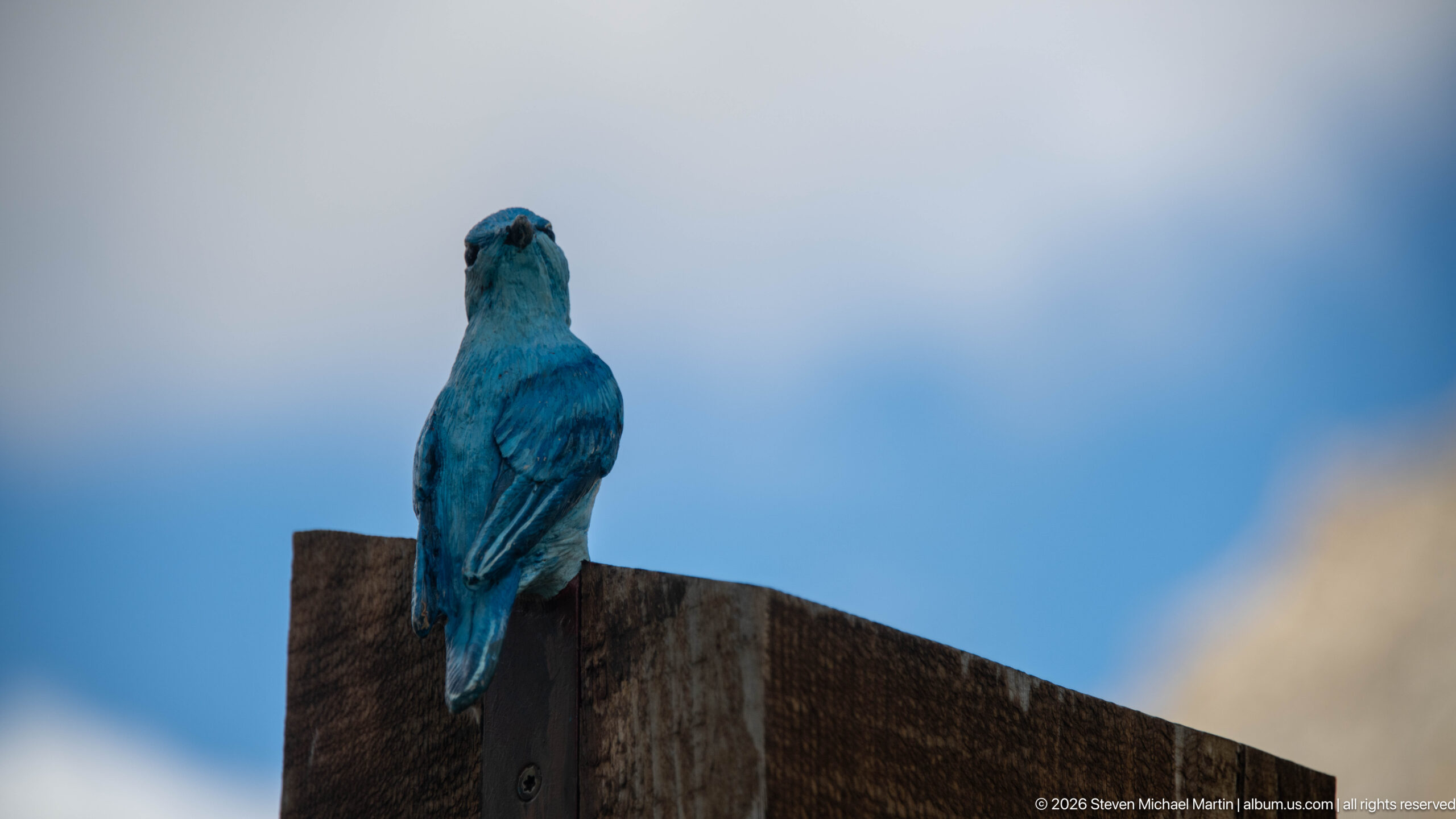
A blue bird figure perches on the top edge of a wooden outdoor marker, isolated against soft sky and mountain tones. The compact composition emphasizes the saturated blue plumage and upright posture, visually linking the sculpted bird to the nearby mountain bluebird species marker without relying on the broader exhibit setting.
Caption
A blue bird figure perches on the top edge of a wooden outdoor marker, isolated against soft sky and mountain tones. The compact composition emphasizes the saturated blue plumage and upright posture, visually linking the sculpted bird to the nearby mountain bluebird species marker without relying on the broader exhibit setting.
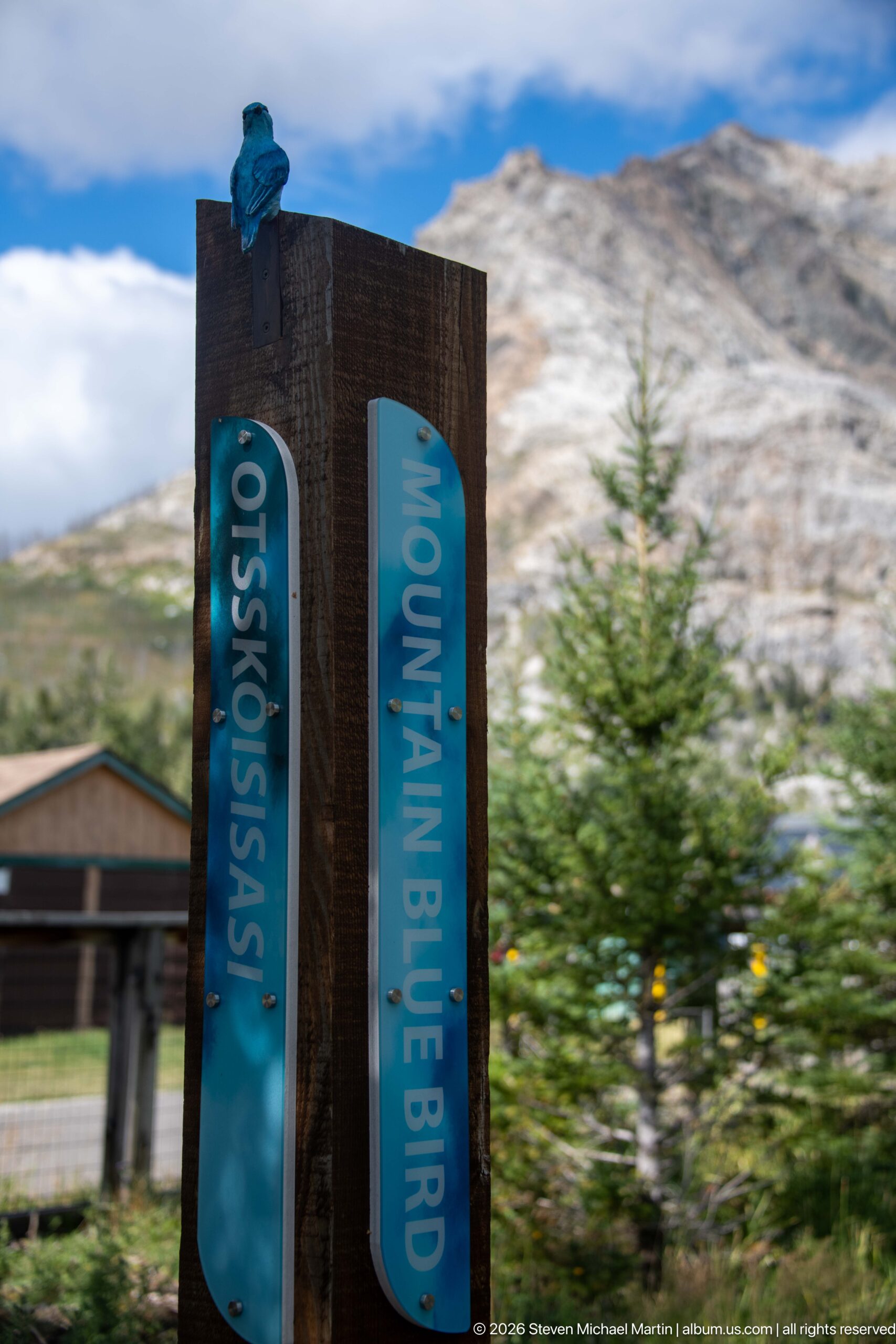
A tall wooden marker identifies the mountain bluebird in English and an Indigenous-language label, with pale mountain slopes rising behind it. Cropped tightly around the sign, the composition shifts attention from animal sculpture to language and species naming, highlighting the multilingual approach used throughout the visitor center’s outdoor interpretation.
Caption
A tall wooden marker identifies the mountain bluebird in English and an Indigenous-language label, with pale mountain slopes rising behind it. Cropped tightly around the sign, the composition shifts attention from animal sculpture to language and species naming, highlighting the multilingual approach used throughout the visitor center’s outdoor interpretation.
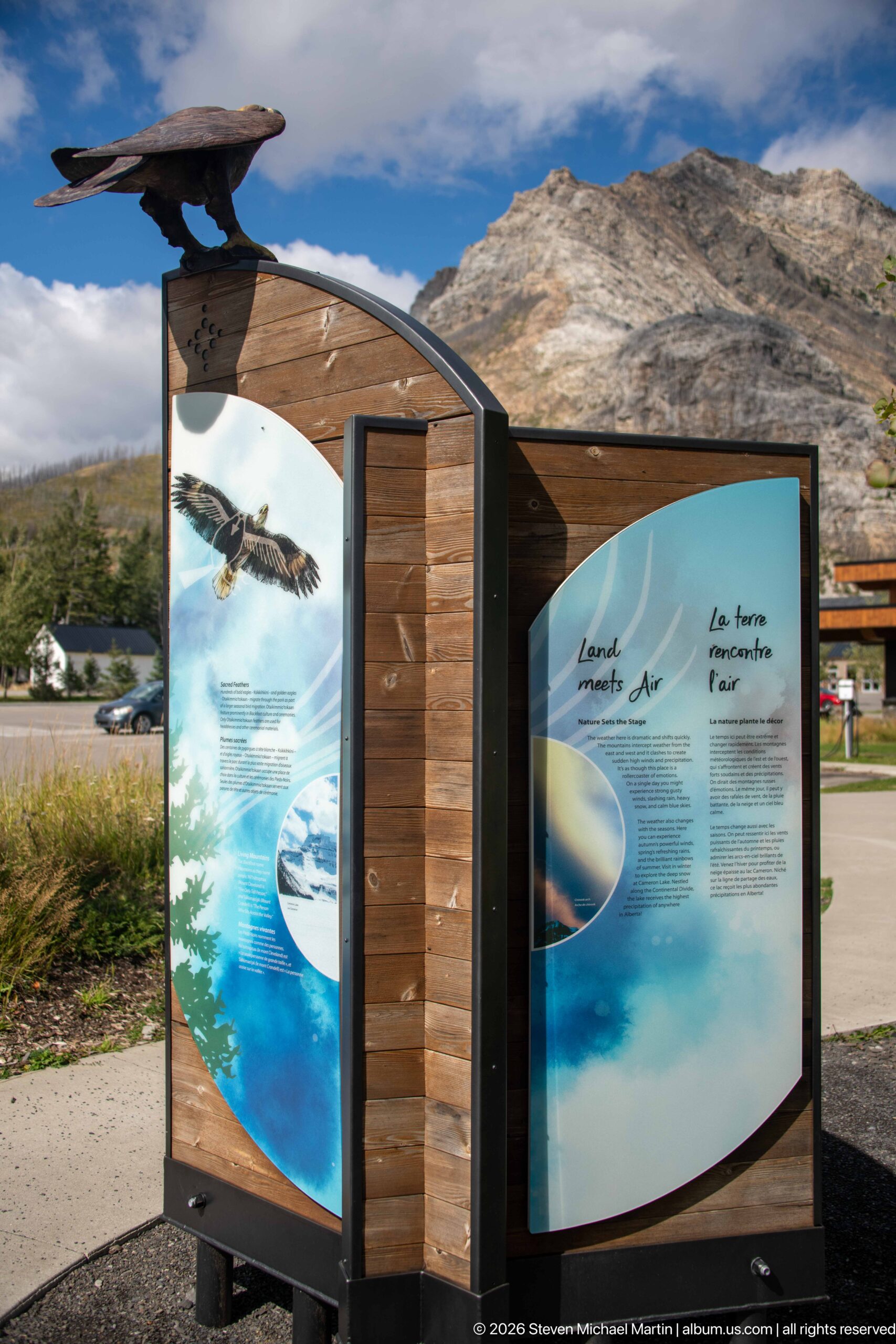
A timber-framed outdoor panel uses sky-blue graphics and soaring bird imagery to interpret air and wind in the Waterton landscape. The bilingual “Learn from Air” heading anchors the display, while the pale mountain ridge behind the structure visually connects the exhibit’s atmospheric theme to the exposed terrain surrounding the visitor center.
Caption
A timber-framed outdoor panel uses sky-blue graphics and soaring bird imagery to interpret air and wind in the Waterton landscape. The bilingual “Learn from Air” heading anchors the display, while the pale mountain ridge behind the structure visually connects the exhibit’s atmospheric theme to the exposed terrain surrounding the visitor center.
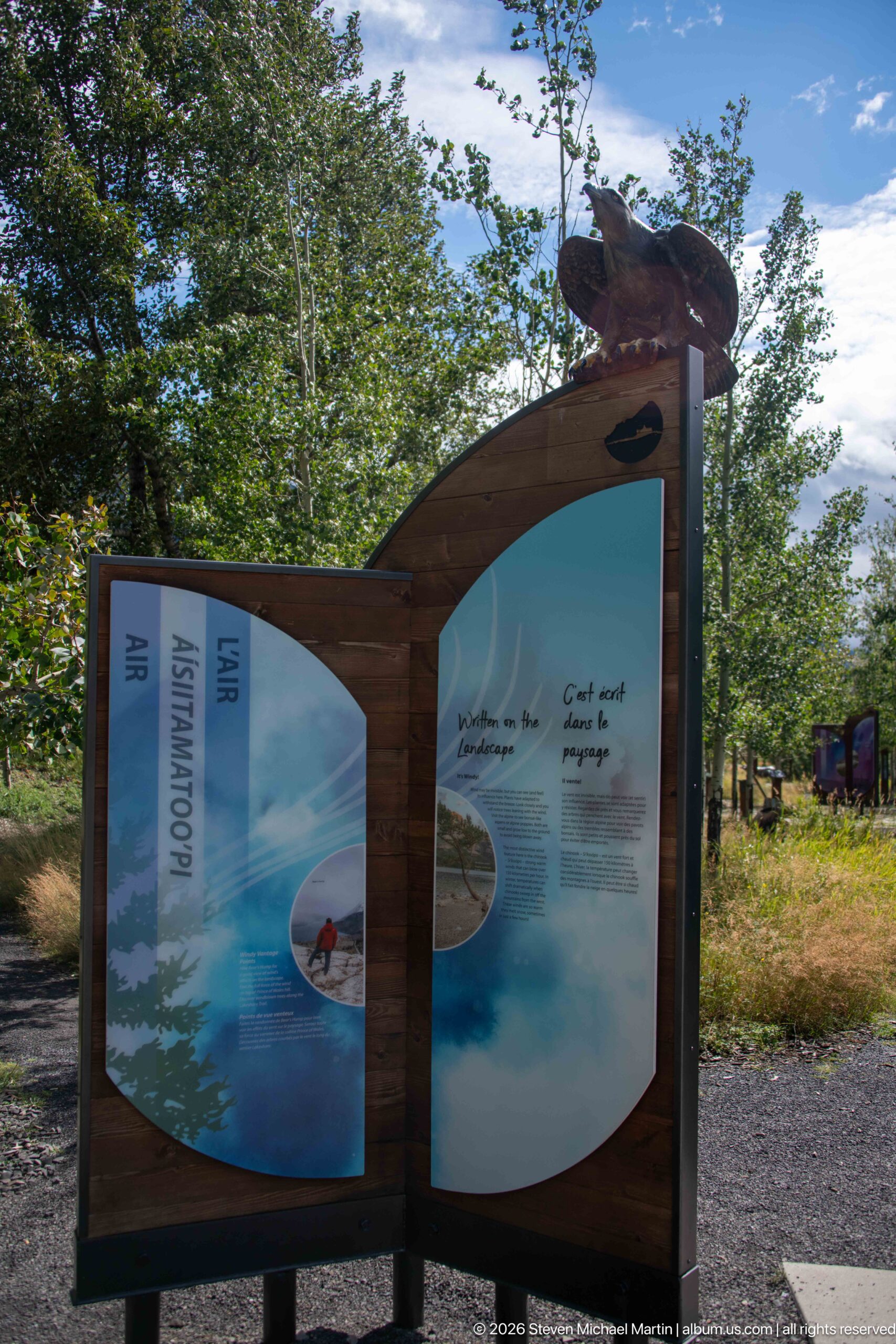
A curved timber interpretive structure combines pale blue atmospheric graphics with vertical references to air and aspen, extending the visitor center’s elemental themes into the surrounding grove. A sculpted bird mounted along the top edge adds a three-dimensional accent, while bilingual text invites visitors to connect wind, vegetation, and the mountain environment.
Caption
A curved timber interpretive structure combines pale blue atmospheric graphics with vertical references to air and aspen, extending the visitor center’s elemental themes into the surrounding grove. A sculpted bird mounted along the top edge adds a three-dimensional accent, while bilingual text invites visitors to connect wind, vegetation, and the mountain environment.
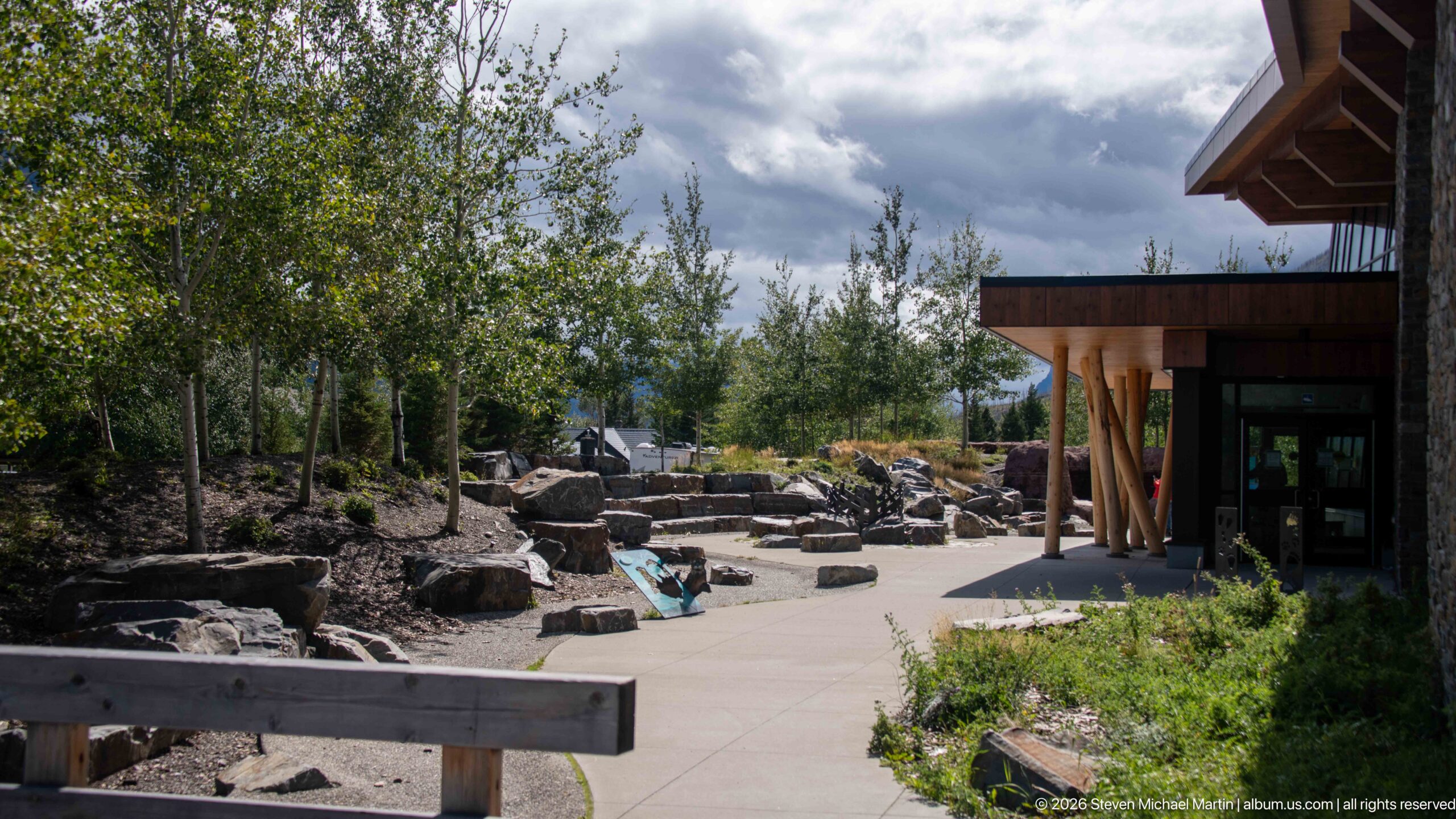
A paved path winds through boulders, young trees, and planted beds beside the visitor center, creating an outdoor interpretive courtyard rather than a conventional building forecourt. Low features among the rocks invite exploration, while the timber canopy and stone-edged landscape continue the natural materials and mountain setting of the facility.
Caption
A paved path winds through boulders, young trees, and planted beds beside the visitor center, creating an outdoor interpretive courtyard rather than a conventional building forecourt. Low features among the rocks invite exploration, while the timber canopy and stone-edged landscape continue the natural materials and mountain setting of the facility.
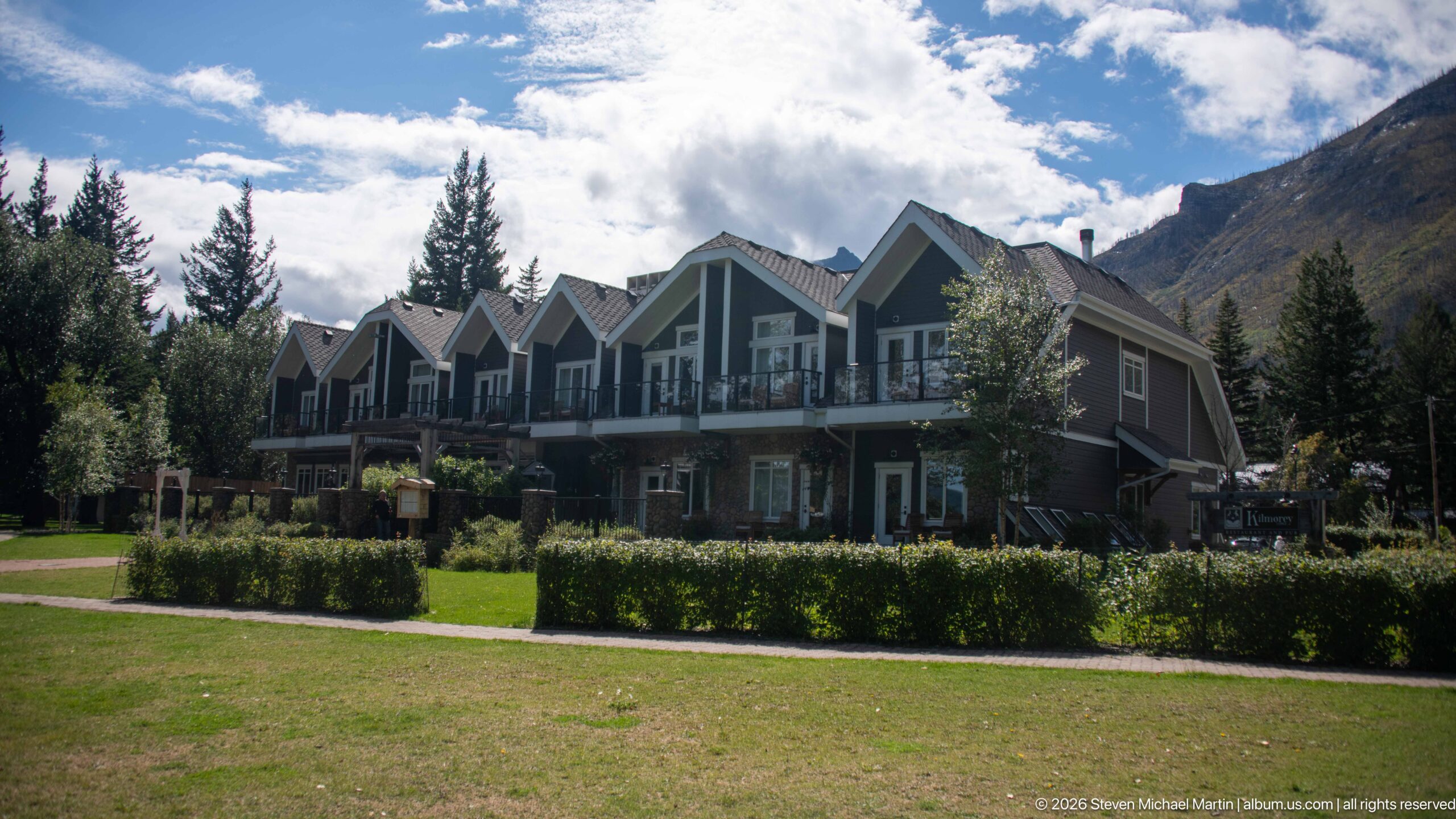
A long two-story lodging building faces a broad lawn in Waterton village, its repeated steep gables, balconies, and dark siding creating a strong rhythmic façade. Mountains rise immediately behind the structure, situating the architecture within the compact settlement near the visitor center while preserving a clear distinction from the visitor center itself.
Caption
A long two-story lodging building faces a broad lawn in Waterton village, its repeated steep gables, balconies, and dark siding creating a strong rhythmic façade. Mountains rise immediately behind the structure, situating the architecture within the compact settlement near the visitor center while preserving a clear distinction from the visitor center itself.
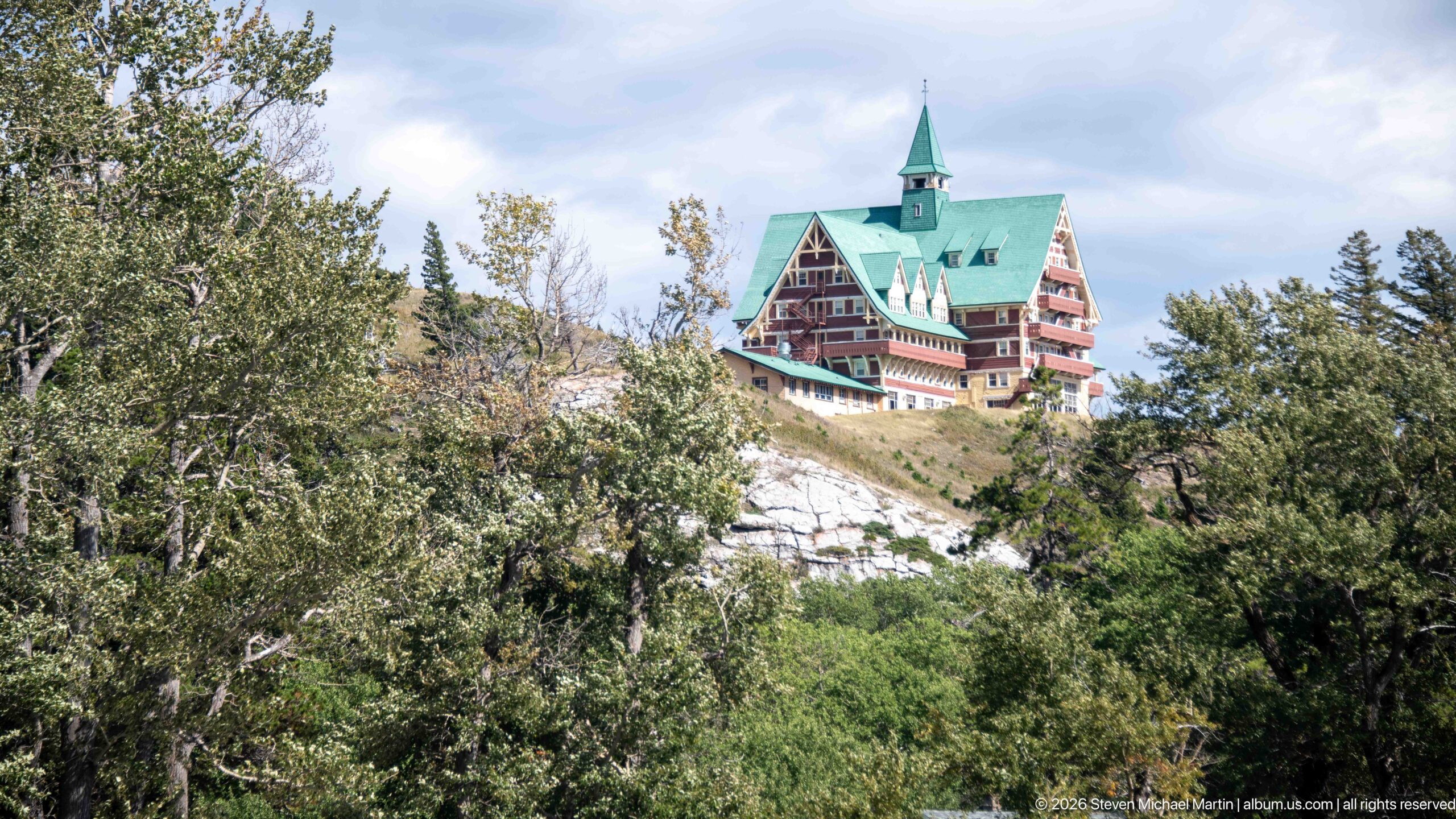
The Prince of Wales Hotel appears above a screen of leafy trees, its green roof, central tower, and sharply pitched gables emerging from the bluff. This closer, partially obscured view contrasts with the open lakeside perspective by emphasizing how the landmark rises above the surrounding vegetation and steep terrain.
Caption
The Prince of Wales Hotel appears above a screen of leafy trees, its green roof, central tower, and sharply pitched gables emerging from the bluff. This closer, partially obscured view contrasts with the open lakeside perspective by emphasizing how the landmark rises above the surrounding vegetation and steep terrain.
🏞️ National Park Field Guide
📍 Overview
Waterton Lakes National Park Visitor Centre introduces the park through the meeting of mountains, water, prairie, wildlife, and human history. The building itself reinforces that relationship: low timber-and-stone forms sit beneath steep Rocky Mountain slopes, while the entrance plaza, relief maps, watershed displays, natural-history galleries, and broad windows continually direct attention back to the landscape. Interpretation moves from the immediate setting to the wider Crown of the Continent, giving visitors a framework for understanding Waterton before exploring the park.
🏔️ Landscape
Waterton is presented as a landscape of unusually strong transitions. Steep mountain walls rise above lakes and forested shorelines, while relief-map interpretation emphasizes the abrupt meeting of Rocky Mountain topography and prairie. Exhibits trace water through the Crown of the Continent and across the Continental Divide, connecting Waterton to larger western drainage systems. Views beyond the visitor centre reinforce these themes directly, pairing mountain massifs, open water, wooded slopes, and the distinctive bluff occupied by the Prince of Wales Hotel.
🪨 Geology
The visitor centre makes the structure of the Canadian Rockies legible through both landscape views and interpretation. A dedicated Lewis Overthrust panel uses cross-sectional diagrams to show rock layers folding and sliding over one another, linking structural geology to the mountains visible around Waterton. Three-dimensional relief maps add another scale of understanding by translating ridges, valleys, lakes, and routes into tactile topography. Together these exhibits help explain why the park’s terrain feels so abrupt and why geology remains visible in nearly every outward view.
🌿 Ecology
Ecological interpretation moves across water, grassland, forest, wetland, stream, and alpine environments rather than treating the park as a single habitat. The visitor centre’s ecosystem mural gathers mammals, birds, aquatic life, and other organisms into a layered mountain scene, while the “Under the Surface” display shifts attention to lake habitat below the waterline. Seasonal interpretation emphasizes that these communities change through the year, and the surrounding landscape provides the physical context for those relationships.
🦌 Wildlife
Wildlife is a major interpretive theme inside the visitor centre. Bison imagery anchors seasonal and artistic displays, a mounted bighorn sheep represents the mountain ungulates of the Rockies, and a red fox specimen is incorporated into an interactive habitat table. A suspended raptor model and the multi-species ecosystem mural broaden the story to birds and other animals across different habitats. These are interpretive and specimen displays rather than records of live wildlife encounters, but they provide a useful visual introduction to the park’s natural history.
🧭 Human History
Human presence is woven into the visitor centre from the arrival plaza onward. The name Paahtómahksikimi appears prominently at the site, and the outdoor orientation display welcomes visitors with “Welcome! Bienvenue! Oki!” alongside English- and French-language interpretation. Flags, artwork, maps, visitor services, and the historic Prince of Wales Hotel visible in the surrounding landscape add further layers to the story. Rather than separating culture from nature, the visitor centre presents Waterton as a place understood through both landscape and the ways people have named, interpreted, visited, and represented it.
🥾 Visitor Experience
The visitor centre works as both an orientation point and an interpretive destination. Outdoors, visitors encounter maps, boulder-like geology features, bilingual panels, landscaped plazas, and sheltered timber walkways before entering the main galleries. Inside, relief maps, wildlife specimens, murals, interactive stations, seasonal displays, aquatic interpretation, artwork, and large mountain-facing windows reward close observation. Moving through the building repeatedly shifts the scale of attention—from individual objects and species to watersheds, mountain systems, and the broader park landscape.
📷 Photography Notes
The strongest photographic sequence combines architecture, interpretation, and the landscape beyond the visitor centre. Wide exterior views establish the low timber-and-stone complex beneath the mountains, while closer frames isolate entrance details, interpretive panels, artwork, maps, specimens, and interactive displays. Interior compositions benefit from using the building’s timber beams, stone walls, and windows as framing devices, especially where mountain scenery remains visible outside. Lakeside and distant views then extend the visual story beyond the building to Waterton’s water, mountain relief, vegetation, and the Prince of Wales Hotel.