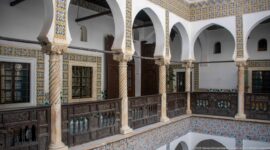
Mosaics of the Bardo Museum – Tunis, Tunisia
The mosaics of the Bardo National Museum represent one of the most extensive and important collections of Roman mosaic art in the world. Removed from ancient villas, baths, and public spaces across North Africa, these works preserve a visual record of life in the Roman provinces—where artistic traditions blended local influences with the broader language of the empire. What remains is not a single style, but a wide-ranging archive of narrative, decoration, and identity expressed through stone.
Seen together, the mosaics move beyond ornament. Hunting scenes, mythological figures, agricultural imagery, and geometric compositions reveal how these surfaces functioned as both storytelling devices and structured design. Many were originally part of lived environments—floors walked upon daily, courtyards filled with light, and architectural features integrated into baths and fountains. In this context, the imagery reflects not only artistic skill, but the rhythms, values, and aspirations of those who commissioned them.
Over time, the collection also traces a cultural shift. Pagan mythological scenes give way to symbolic imagery and eventually early Christian figures, while inscriptions—often in Latin—anchor the works to specific individuals, households, or communities. Together, these mosaics form a layered narrative of Roman North Africa: a region defined not by uniformity, but by continuity, adaptation, and enduring visual expression.
Seen collectively, the mosaics of the Bardo transform individual fragments into a continuous visual narrative—one that reflects both the reach of Rome and the distinct character of North Africa.
Highlights
Mythology & Narrative
Mythological scenes appear throughout the collection, often drawn from Greco-Roman traditions and adapted to local settings. Figures from legend, sea deities, and allegorical characters are rendered within structured compositions, turning floors into narrative spaces. These scenes were not isolated decorations—they reflected shared cultural stories while reinforcing status, education, and identity.
Hunting & Power
Hunting mosaics are among the most dynamic works in the gallery. Riders, animals, and moments of pursuit are captured with movement and intensity, often framed by intricate borders. Beyond their visual appeal, these scenes conveyed themes of control, skill, and dominance—qualities closely tied to Roman ideals of authority and prestige.
Daily Life in Roman North Africa
Alongside myth and spectacle, many mosaics depict quieter aspects of life. Agricultural scenes, domestic settings, and interactions between figures reveal a more grounded perspective—one tied to land, labor, and routine. These images offer a rare visual connection to the lived experience of the region, balancing grandeur with familiarity.
Geometry & Design
Geometric mosaics demonstrate a different kind of mastery. Repeating patterns, interlocking shapes, and radial symmetry create compositions that are both precise and expansive. In many spaces, these designs served as the structural foundation of a room, guiding movement and framing more detailed narrative panels.
Inscriptions & Identity
Text plays a significant role across the collection. Latin inscriptions—often including names, blessings, or dedications—anchor the mosaics to specific people and places. Words like Felix (“fortunate” or “blessed”) reflect personal aspirations, while longer texts preserve fragments of ownership, commemoration, and memory within the fabric of the design.
Christian Influence & Transition
Later works introduce a shift in imagery, with haloed figures and symbolic motifs reflecting the rise of Christianity in the region. These mosaics retain the technical precision of earlier works while signaling a change in meaning and belief. Together, they illustrate a gradual transformation rather than a break—where artistic continuity carries new ideas forward.
Mosaics as Architecture
Many of these works were never intended to stand alone. They were integral to the spaces they occupied—floors, thresholds, courtyards, and baths. Curved installations, basins, and integrated panels show how mosaics shaped entire environments, combining function and design into a unified experience.
Scale & Preservation
Displayed today within the museum, the mosaics reveal their full scale in ways rarely possible in their original settings. Large wall-mounted panels and expansive floor installations emphasize both the ambition of their creators and the effort required to preserve them. The collection not only reflects the past—it represents the continued work of conservation and interpretation.