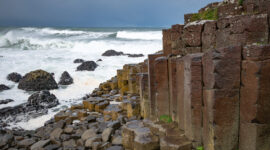
Cliffs of Moher – County Clare, Ireland
The Cliffs of Moher rise dramatically above the Atlantic Ocean along the western coast of County Clare. Stretching for nearly 14 kilometers, the cliffs soar to heights of more than 200 meters above the sea, making them among the most impressive coastal cliffs in Europe.
The cliffs form part of the rugged Atlantic landscape shaped by centuries of wind and waves. From the cliff tops visitors can see sweeping views of the ocean, the Aran Islands, and the distant mountains of Connemara.
The Cliffs of Moher are one of Ireland’s most famous natural landmarks and a powerful symbol of the island’s dramatic Atlantic coastline.

The Cliffs of Moher rise in a sequence of dark, near-vertical rock faces that step away into mist along the Atlantic coast. Green turf caps the plateau while white surf breaks at the foot of the cliffs, and wind-flattened grass fills the immediate foreground. This broad view presents the defining landform at landscape scale, emphasizing the repeated headlands, sheer drops, and exposure to the open ocean under a heavy gray sky.
Caption
The Cliffs of Moher rise in a sequence of dark, near-vertical rock faces that step away into mist along the Atlantic coast. Green turf caps the plateau while white surf breaks at the foot of the cliffs, and wind-flattened grass fills the immediate foreground. This broad view presents the defining landform at landscape scale, emphasizing the repeated headlands, sheer drops, and exposure to the open ocean under a heavy gray sky.

O'Brien's Tower stands near the edge of a broad green promontory, its compact stone silhouette rising above the cliff-top path. Wind drives a pale veil of spray or rain across the grass below, while the Atlantic drops away to the left. The composition connects the nineteenth-century observation tower to its exposed cliff-top setting, showing both the built landmark and the severe weather that can sweep across the plateau.
Caption
O'Brien's Tower stands near the edge of a broad green promontory, its compact stone silhouette rising above the cliff-top path. Wind drives a pale veil of spray or rain across the grass below, while the Atlantic drops away to the left. The composition connects the nineteenth-century observation tower to its exposed cliff-top setting, showing both the built landmark and the severe weather that can sweep across the plateau.

Wind-shaped grass occupies much of the foreground before the land breaks abruptly into the sheer faces of the Cliffs of Moher. Beyond the nearest promontory, additional cliff walls diminish toward a gray, mist-obscured horizon. This broader viewpoint places the monumental rock faces within their exposed cliff-top grassland setting and shows how weather can rapidly reduce visibility along the Atlantic coast.
Caption
Wind-shaped grass occupies much of the foreground before the land breaks abruptly into the sheer faces of the Cliffs of Moher. Beyond the nearest promontory, additional cliff walls diminish toward a gray, mist-obscured horizon. This broader viewpoint places the monumental rock faces within their exposed cliff-top grassland setting and shows how weather can rapidly reduce visibility along the Atlantic coast.

A man in a black jacket smiles toward the camera from a stone viewpoint above the Cliffs of Moher. Wind lifts his hair, while the dark cliff wall, a narrow sea stack, and white Atlantic surf blur into the background. The tighter portrait retains enough landscape to establish place while emphasizing the human response to the exposed conditions, contrasting the visitor’s face and dark clothing with the pale, stormy coast behind.
Caption
A man in a black jacket smiles toward the camera from a stone viewpoint above the Cliffs of Moher. Wind lifts his hair, while the dark cliff wall, a narrow sea stack, and white Atlantic surf blur into the background. The tighter portrait retains enough landscape to establish place while emphasizing the human response to the exposed conditions, contrasting the visitor’s face and dark clothing with the pale, stormy coast behind.

Successive headlands of the Cliffs of Moher recede into Atlantic haze beyond a foreground wall of horizontally bedded rock. Grass crowns the sheer cliff edge, while pale surf traces the narrow boundary between rock and sea far below. The oblique viewpoint makes the coastline’s repeated projections and recesses especially legible, with each distant cliff progressively softened by mist.
Caption
Successive headlands of the Cliffs of Moher recede into Atlantic haze beyond a foreground wall of horizontally bedded rock. Grass crowns the sheer cliff edge, while pale surf traces the narrow boundary between rock and sea far below. The oblique viewpoint makes the coastline’s repeated projections and recesses especially legible, with each distant cliff progressively softened by mist.

A long wall of grass-topped cliffs runs from the near left toward a succession of distant promontories, its dark rock faces broken by vertical seams and ledges. White water gathers along the base while the Atlantic stretches across the right half of the frame. Compared with the neighboring panorama, this composition gives more space to the sea, reinforcing the scale of the cliffs against the broad gray water and rain-softened horizon.
Caption
A long wall of grass-topped cliffs runs from the near left toward a succession of distant promontories, its dark rock faces broken by vertical seams and ledges. White water gathers along the base while the Atlantic stretches across the right half of the frame. Compared with the neighboring panorama, this composition gives more space to the sea, reinforcing the scale of the cliffs against the broad gray water and rain-softened horizon.

Two men in dark outerwear stand side by side at a cliff-top viewpoint, framed by a high stone barrier and the dramatic Cliffs of Moher behind them. One wears dark trousers and the other tan trousers, while strong wind ruffles clothing and hair. The portrait shifts attention from geology to visitor experience, preserving the scale and weather of the cliffs as a recognizable backdrop without making unsupported personal identifications.
Caption
Two men in dark outerwear stand side by side at a cliff-top viewpoint, framed by a high stone barrier and the dramatic Cliffs of Moher behind them. One wears dark trousers and the other tan trousers, while strong wind ruffles clothing and hair. The portrait shifts attention from geology to visitor experience, preserving the scale and weather of the cliffs as a recognizable backdrop without making unsupported personal identifications.

An isolated sea stack rises from turbulent Atlantic water beneath the dark, stratified face of the Cliffs of Moher. White surf curls around the rock and along the recessed cliff base, while the elevated viewpoint compresses the scene into layers of stone and moving water. The detached stack records the same persistent marine erosion that shapes this exposed stretch of Ireland’s western coast.
Caption
An isolated sea stack rises from turbulent Atlantic water beneath the dark, stratified face of the Cliffs of Moher. White surf curls around the rock and along the recessed cliff base, while the elevated viewpoint compresses the scene into layers of stone and moving water. The detached stack records the same persistent marine erosion that shapes this exposed stretch of Ireland’s western coast.

A narrow sea stack rises from foaming water below the Cliffs of Moher, set against a series of dark headlands receding into mist. The leftmost cliff face dominates the foreground, while smaller projections and the isolated rock sharpen the sense of erosion along the coast. By concentrating on the lower cliff line and offshore remnant, the image highlights the continually weathered boundary between the Atlantic and the layered rock mass.
Caption
A narrow sea stack rises from foaming water below the Cliffs of Moher, set against a series of dark headlands receding into mist. The leftmost cliff face dominates the foreground, while smaller projections and the isolated rock sharpen the sense of erosion along the coast. By concentrating on the lower cliff line and offshore remnant, the image highlights the continually weathered boundary between the Atlantic and the layered rock mass.

A white sheep stands on rough pasture broken by broad slabs of exposed limestone, with pale blue Atlantic water beyond. The animal is set within the stony, wind-shaped landscape characteristic of western Ireland, where thin turf fills the fissures between rock outcrops. The photograph balances the grazing sheep against the hard geology and marine horizon, establishing the pastoral setting encountered on the approach to the Cliffs of Moher.
Caption
A white sheep stands on rough pasture broken by broad slabs of exposed limestone, with pale blue Atlantic water beyond. The animal is set within the stony, wind-shaped landscape characteristic of western Ireland, where thin turf fills the fissures between rock outcrops. The photograph balances the grazing sheep against the hard geology and marine horizon, establishing the pastoral setting encountered on the approach to the Cliffs of Moher.

Flat limestone shelves and a low dry-stone boundary cross a damp, scrubby landscape under mist. Rust-colored bracken and green shrubs occupy pockets between the rock, while a small white building appears through haze in the distance. The scene records the austere karst countryside of County Clare on the driving route toward the Cliffs of Moher, emphasizing how settlement and vegetation adapt to shallow soils and exposed stone.
Caption
Flat limestone shelves and a low dry-stone boundary cross a damp, scrubby landscape under mist. Rust-colored bracken and green shrubs occupy pockets between the rock, while a small white building appears through haze in the distance. The scene records the austere karst countryside of County Clare on the driving route toward the Cliffs of Moher, emphasizing how settlement and vegetation adapt to shallow soils and exposed stone.

A low shelf of bare limestone extends toward a nearly colorless Atlantic horizon beneath dense fog. Sparse grasses and dark fissures interrupt the pale rock, while the sea and sky merge into a muted band at the edge of visibility. The restrained composition documents the exposed coastal geology and wet weather of western Ireland, with few vertical elements to break the broad horizontal relationship between stone, water, and mist.
Caption
A low shelf of bare limestone extends toward a nearly colorless Atlantic horizon beneath dense fog. Sparse grasses and dark fissures interrupt the pale rock, while the sea and sky merge into a muted band at the edge of visibility. The restrained composition documents the exposed coastal geology and wet weather of western Ireland, with few vertical elements to break the broad horizontal relationship between stone, water, and mist.

Broad, fractured slabs of limestone form an irregular foreground patterned by seams, shallow depressions, and patches of moss. Dense shrubs and low brush occupy the middle ground, rising toward a dark ridge softened by fog. The photograph focuses on the texture and scale of the karst terrain rather than a distant landmark, showing how exposed bedrock, limited soil, and hardy vegetation combine in the County Clare landscape.
Caption
Broad, fractured slabs of limestone form an irregular foreground patterned by seams, shallow depressions, and patches of moss. Dense shrubs and low brush occupy the middle ground, rising toward a dark ridge softened by fog. The photograph focuses on the texture and scale of the karst terrain rather than a distant landmark, showing how exposed bedrock, limited soil, and hardy vegetation combine in the County Clare landscape.

A steep, treeless shoreline slopes from exposed gray rock and brown winter grass into cold blue-green Atlantic water. Scattered boulders line the water’s edge, and a rounded headland curves away beneath a low, cloud-filled sky. The oblique viewpoint follows the coast rather than looking outward to open sea, giving a clear sense of the thin soils, rocky substrate, and wind-exposed terrain along western County Clare.
Caption
A steep, treeless shoreline slopes from exposed gray rock and brown winter grass into cold blue-green Atlantic water. Scattered boulders line the water’s edge, and a rounded headland curves away beneath a low, cloud-filled sky. The oblique viewpoint follows the coast rather than looking outward to open sea, giving a clear sense of the thin soils, rocky substrate, and wind-exposed terrain along western County Clare.

A low dry-stone wall runs across the foreground of a rough hillside scattered with angular limestone boulders and patches of yellow-green grass. A tangled mass of brown brambles gathers behind the wall, while the open slope rises toward a bare ridge. The image concentrates on traditional field boundaries and the stony agricultural terrain of County Clare, where locally gathered rock is stacked without mortar to divide grazing land.
Caption
A low dry-stone wall runs across the foreground of a rough hillside scattered with angular limestone boulders and patches of yellow-green grass. A tangled mass of brown brambles gathers behind the wall, while the open slope rises toward a bare ridge. The image concentrates on traditional field boundaries and the stony agricultural terrain of County Clare, where locally gathered rock is stacked without mortar to divide grazing land.

A red Renault crossover is paused or moving slowly along a rain-darkened two-lane road bordered by rough limestone walls and a stony hillside. Wet pavement reflects the overcast light, reinforcing the blustery driving conditions. The car provides scale and a sense of travel through the exposed County Clare countryside, where narrow roads pass immediately beside rock-strewn grazing slopes on the route toward the Cliffs of Moher.
Caption
A red Renault crossover is paused or moving slowly along a rain-darkened two-lane road bordered by rough limestone walls and a stony hillside. Wet pavement reflects the overcast light, reinforcing the blustery driving conditions. The car provides scale and a sense of travel through the exposed County Clare countryside, where narrow roads pass immediately beside rock-strewn grazing slopes on the route toward the Cliffs of Moher.

Several white sheep graze across thin green pasture broken by sheets of exposed limestone, with the Atlantic occupying the upper right of the frame. A low rocky point and foaming water define the shoreline beyond the animals. The broader view places livestock within the coastal karst environment, contrasting soft pasture and grazing sheep with the hard, fissured bedrock and windswept sea edge of western Ireland.
Caption
Several white sheep graze across thin green pasture broken by sheets of exposed limestone, with the Atlantic occupying the upper right of the frame. A low rocky point and foaming water define the shoreline beyond the animals. The broader view places livestock within the coastal karst environment, contrasting soft pasture and grazing sheep with the hard, fissured bedrock and windswept sea edge of western Ireland.

A single white sheep faces the camera from a narrow strip of pasture amid wet, fissured limestone slabs. A dark, lichen-marked rock sits behind the animal, while the Atlantic forms a soft turquoise backdrop. Tighter than the preceding flock view, the photograph isolates the sheep as an individual presence within the exposed coastal terrain, emphasizing its wool, upright stance, and direct gaze against the cold marine setting.
Caption
A single white sheep faces the camera from a narrow strip of pasture amid wet, fissured limestone slabs. A dark, lichen-marked rock sits behind the animal, while the Atlantic forms a soft turquoise backdrop. Tighter than the preceding flock view, the photograph isolates the sheep as an individual presence within the exposed coastal terrain, emphasizing its wool, upright stance, and direct gaze against the cold marine setting.

A white sheep stands squarely toward the camera behind a low, pale limestone shelf, its fleece filling much of the center of the frame. The blue-gray Atlantic and a dark rock outcrop sit softly out of focus behind it. The shallow visual field separates the animal from the broader landscape, producing a straightforward livestock portrait while retaining enough coastal context to situate the sheep in County Clare’s rocky shoreline pasture.
Caption
A white sheep stands squarely toward the camera behind a low, pale limestone shelf, its fleece filling much of the center of the frame. The blue-gray Atlantic and a dark rock outcrop sit softly out of focus behind it. The shallow visual field separates the animal from the broader landscape, producing a straightforward livestock portrait while retaining enough coastal context to situate the sheep in County Clare’s rocky shoreline pasture.

Two white sheep appear widely separated across a broad expanse of wet limestone pavement patched with short grass and shallow pools. Angular rocks and a low ledge punctuate the foreground, while the Atlantic is visible at the top left. The wide composition makes the animals secondary to the patterned geology, showing grazing activity within a rain-soaked karst landscape rather than presenting a close livestock portrait.
Caption
Two white sheep appear widely separated across a broad expanse of wet limestone pavement patched with short grass and shallow pools. Angular rocks and a low ledge punctuate the foreground, while the Atlantic is visible at the top left. The wide composition makes the animals secondary to the patterned geology, showing grazing activity within a rain-soaked karst landscape rather than presenting a close livestock portrait.

A wet two-lane road descends gently through low stone walls and rocky moorland toward a distant bend beside the Atlantic. Broken limestone terraces and brown vegetation line the route, while a heavy gray sky compresses the horizon. The strong central perspective turns the roadway into the main subject, documenting the exposed driving landscape of County Clare and the subdued winter weather encountered en route to the Cliffs of Moher.
Caption
A wet two-lane road descends gently through low stone walls and rocky moorland toward a distant bend beside the Atlantic. Broken limestone terraces and brown vegetation line the route, while a heavy gray sky compresses the horizon. The strong central perspective turns the roadway into the main subject, documenting the exposed driving landscape of County Clare and the subdued winter weather encountered en route to the Cliffs of Moher.

A long slab of dark limestone tilts upward from the surrounding pavement, creating a strong diagonal across otherwise low, horizontal terrain. Thin grass and shallow fissures spread toward the blue-gray Atlantic beyond. With no people or livestock present, the image functions as a geological detail of the coastal karst, emphasizing fractured bedding, erosion, and the isolated sculptural form of a rock plate raised above the surface.
Caption
A long slab of dark limestone tilts upward from the surrounding pavement, creating a strong diagonal across otherwise low, horizontal terrain. Thin grass and shallow fissures spread toward the blue-gray Atlantic beyond. With no people or livestock present, the image functions as a geological detail of the coastal karst, emphasizing fractured bedding, erosion, and the isolated sculptural form of a rock plate raised above the surface.

A white sheep grazes with its head lowered beside reddish bracken and pale gray limestone slabs. Its thick fleece fills the lower center, while the mottled rock-and-grass terrain stretches softly into the background. The close perspective focuses on feeding behavior rather than the wider coastal setting, offering a detailed view of livestock using the sparse vegetation that grows between the exposed limestone surfaces of County Clare.
Caption
A white sheep grazes with its head lowered beside reddish bracken and pale gray limestone slabs. Its thick fleece fills the lower center, while the mottled rock-and-grass terrain stretches softly into the background. The close perspective focuses on feeding behavior rather than the wider coastal setting, offering a detailed view of livestock using the sparse vegetation that grows between the exposed limestone surfaces of County Clare.

A painted emblem on a blue wall shows a large stylized fish curling around a black pint glass marked with the gold harp associated with Guinness. The circular white field and radiating tan bars create a bold graphic sign, while black outlines and pale blue scales give the fish a cartoon-like character. The close view isolates the decorative pub imagery from the building, preserving a distinctive piece of vernacular commercial art.
Caption
A painted emblem on a blue wall shows a large stylized fish curling around a black pint glass marked with the gold harp associated with Guinness. The circular white field and radiating tan bars create a bold graphic sign, while black outlines and pale blue scales give the fish a cartoon-like character. The close view isolates the decorative pub imagery from the building, preserving a distinctive piece of vernacular commercial art.

A small herd of cattle grazes in a green enclosure surrounded by low scrub, with white limestone pavement and a long rubble-like stone boundary extending behind them. Brown, black, and piebald animals are scattered across the pasture, some feeding and others standing broadside. The image documents livestock husbandry in the rocky County Clare landscape, where small grassy pockets lie immediately beside exposed karst terrain.
Caption
A small herd of cattle grazes in a green enclosure surrounded by low scrub, with white limestone pavement and a long rubble-like stone boundary extending behind them. Brown, black, and piebald animals are scattered across the pasture, some feeding and others standing broadside. The image documents livestock husbandry in the rocky County Clare landscape, where small grassy pockets lie immediately beside exposed karst terrain.

Two brown cattle walk in parallel across a narrow strip of green pasture, their bodies silhouetted against a broad field of pale limestone and dark shoreline rocks. The Atlantic sits beyond the upper edge of the karst. Unlike the grouped herd view, this frame isolates movement: the animals stride from left to right across the sparse grazing ground, emphasizing the relationship between livestock routes and the exposed coastal terrain.
Caption
Two brown cattle walk in parallel across a narrow strip of green pasture, their bodies silhouetted against a broad field of pale limestone and dark shoreline rocks. The Atlantic sits beyond the upper edge of the karst. Unlike the grouped herd view, this frame isolates movement: the animals stride from left to right across the sparse grazing ground, emphasizing the relationship between livestock routes and the exposed coastal terrain.

A narrow rain-slick road bends through a treeless coastal landscape hemmed in by low dry-stone walls. The hillside at right is almost entirely armored in exposed gray limestone, while the left side falls toward the Atlantic under low cloud. The roadway’s sheen and repeated curves convey the wet, windy conditions of the drive, while the stone walls and bare rock give the route a distinctly County Clare character.
Caption
A narrow rain-slick road bends through a treeless coastal landscape hemmed in by low dry-stone walls. The hillside at right is almost entirely armored in exposed gray limestone, while the left side falls toward the Atlantic under low cloud. The roadway’s sheen and repeated curves convey the wet, windy conditions of the drive, while the stone walls and bare rock give the route a distinctly County Clare character.

A weathered dry-stone wall fills the foreground, its irregular limestone blocks partly draped in glossy green ivy. Behind it lies flat, brown-green pasture with more exposed rock and a low ridge beneath overcast light. The close composition reveals the varied shapes, textures, and gaps of mortarless field construction, showing a traditional rural boundary in detail rather than using it simply as a framing element within the landscape.
Caption
A weathered dry-stone wall fills the foreground, its irregular limestone blocks partly draped in glossy green ivy. Behind it lies flat, brown-green pasture with more exposed rock and a low ridge beneath overcast light. The close composition reveals the varied shapes, textures, and gaps of mortarless field construction, showing a traditional rural boundary in detail rather than using it simply as a framing element within the landscape.

A wide expanse of fractured limestone pavement slopes gently toward the Atlantic, its surface broken by scattered boulders, low plants, and narrow green seams. The sea forms a calm blue-gray band beneath an overcast sky. This establishing view gives priority to the scale of the karst landscape, showing continuous exposed bedrock from the foreground toward the coast and only limited vegetation occupying cracks and shallow pockets.
Caption
A wide expanse of fractured limestone pavement slopes gently toward the Atlantic, its surface broken by scattered boulders, low plants, and narrow green seams. The sea forms a calm blue-gray band beneath an overcast sky. This establishing view gives priority to the scale of the karst landscape, showing continuous exposed bedrock from the foreground toward the coast and only limited vegetation occupying cracks and shallow pockets.

A dark metal sculpture rises against a blank gray sky, beginning as a vertical support before turning into a long diagonal beam and a sequence of sharp stepped bends. The low-angle composition removes nearly all surrounding context and emphasizes silhouette, geometry, and the weathered surface of the metal. Without a legible plaque or recognizable setting, the work is best cataloged descriptively rather than assigned an artist or title.
Caption
A dark metal sculpture rises against a blank gray sky, beginning as a vertical support before turning into a long diagonal beam and a sequence of sharp stepped bends. The low-angle composition removes nearly all surrounding context and emphasizes silhouette, geometry, and the weathered surface of the metal. Without a legible plaque or recognizable setting, the work is best cataloged descriptively rather than assigned an artist or title.

A vivid blue roadside public house bears the painted name “O'Donohue's” high on its façade, with “EST. 1911” below a central emblem. Yellow trim accents the entrance and windows, while dark chimney stacks rise above the pitched roof. The strong color, hand-painted signage, and attached lower structures distinguish the building from the muted weather around it, documenting a recognizable local stop on the County Clare driving route.
Caption
A vivid blue roadside public house bears the painted name “O'Donohue's” high on its façade, with “EST. 1911” below a central emblem. Yellow trim accents the entrance and windows, while dark chimney stacks rise above the pitched roof. The strong color, hand-painted signage, and attached lower structures distinguish the building from the muted weather around it, documenting a recognizable local stop on the County Clare driving route.

A rough wet lane curves between a dark rock face on the left and an open Atlantic shoreline on the right. Puddles and reflective patches mark the pavement, while low surf and distant headlands fade into mist. The composition conveys an exposed, utilitarian coastal route rather than a scenic overlook, with the steep rock wall, treeless ground, and damp road surface emphasizing the raw conditions of the County Clare coast.
Caption
A rough wet lane curves between a dark rock face on the left and an open Atlantic shoreline on the right. Puddles and reflective patches mark the pavement, while low surf and distant headlands fade into mist. The composition conveys an exposed, utilitarian coastal route rather than a scenic overlook, with the steep rock wall, treeless ground, and damp road surface emphasizing the raw conditions of the County Clare coast.

A small triangular warning sign mounted on a dark concrete wall shows a black figure tumbling from a cliff or steep edge, with falling rocks or debris below. Pale lichen colonies mark the wall around it, and windblown grass rises behind. The stark red-bordered symbol provides a compact visual reminder of cliff-edge danger, using universal pictography rather than text to warn visitors about a potentially severe fall hazard.
Caption
A small triangular warning sign mounted on a dark concrete wall shows a black figure tumbling from a cliff or steep edge, with falling rocks or debris below. Pale lichen colonies mark the wall around it, and windblown grass rises behind. The stark red-bordered symbol provides a compact visual reminder of cliff-edge danger, using universal pictography rather than text to warn visitors about a potentially severe fall hazard.

A smiling visitor in a black weatherproof jacket stands near the cliff-top viewpoint with the Cliffs of Moher receding behind him. Shallow focus separates the figure from the mist-softened rock walls and Atlantic surf, turning the final landscape view into an environmental portrait. Wind-tousled hair, heavy outerwear, and the muted gray background convey the exposed weather conditions along the cliff edge.
Caption
A smiling visitor in a black weatherproof jacket stands near the cliff-top viewpoint with the Cliffs of Moher receding behind him. Shallow focus separates the figure from the mist-softened rock walls and Atlantic surf, turning the final landscape view into an environmental portrait. Wind-tousled hair, heavy outerwear, and the muted gray background convey the exposed weather conditions along the cliff edge.