Black Forest – Baden-Württemberg, Germany
The Black Forest (Schwarzwald) stretches across southwestern Germany along the eastern side of the Upper Rhine Valley, forming one of the most famous mountain landscapes in the country. Dense evergreen forests, rolling hills, and small villages define this region, which lies just east of Freiburg.
During the winter months the forested mountains are often dusted with snow, creating a classic Central European winter landscape. Many traditional holiday customs associated with Christmas—such as hand-carved wooden decorations, cuckoo clocks, and festive pastries—have deep roots in the villages of the Black Forest.
Travel through the region reveals quiet valleys, timber-framed houses, and small towns that preserve the cultural traditions of southwestern Germany.
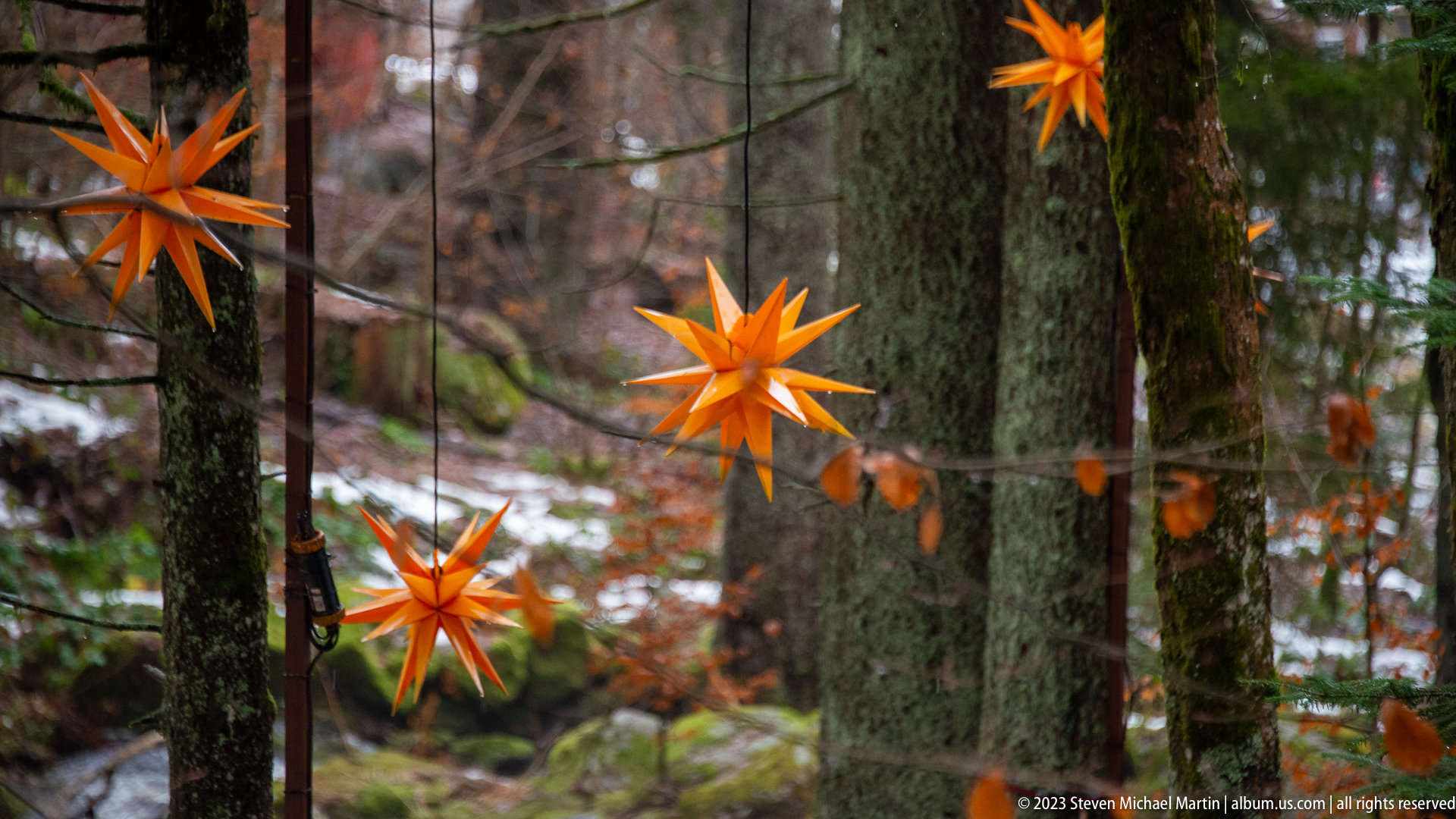
Several orange many-pointed Advent stars hang at different depths among tall tree trunks, turning a section of winter forest into a seasonal display. Their warm geometric forms punctuate the vertical gray-brown trunks and patches of snow beyond. The composition integrates Christmas decoration with the wooded approach to Triberg’s waterfall landscape.
Caption
Several orange many-pointed Advent stars hang at different depths among tall tree trunks, turning a section of winter forest into a seasonal display. Their warm geometric forms punctuate the vertical gray-brown trunks and patches of snow beyond. The composition integrates Christmas decoration with the wooded approach to Triberg’s waterfall landscape.

Snowfields sweep across a narrow valley between dark conifer-covered slopes, with a small cluster of buildings and a winding road visible near the valley floor. Low cloud obscures the upper ridges and softens the distant forest. The scene emphasizes winter topography and land use, showing open meadows cut into the surrounding woodland rather than an uninterrupted forest canopy.
Caption
Snowfields sweep across a narrow valley between dark conifer-covered slopes, with a small cluster of buildings and a winding road visible near the valley floor. Low cloud obscures the upper ridges and softens the distant forest. The scene emphasizes winter topography and land use, showing open meadows cut into the surrounding woodland rather than an uninterrupted forest canopy.
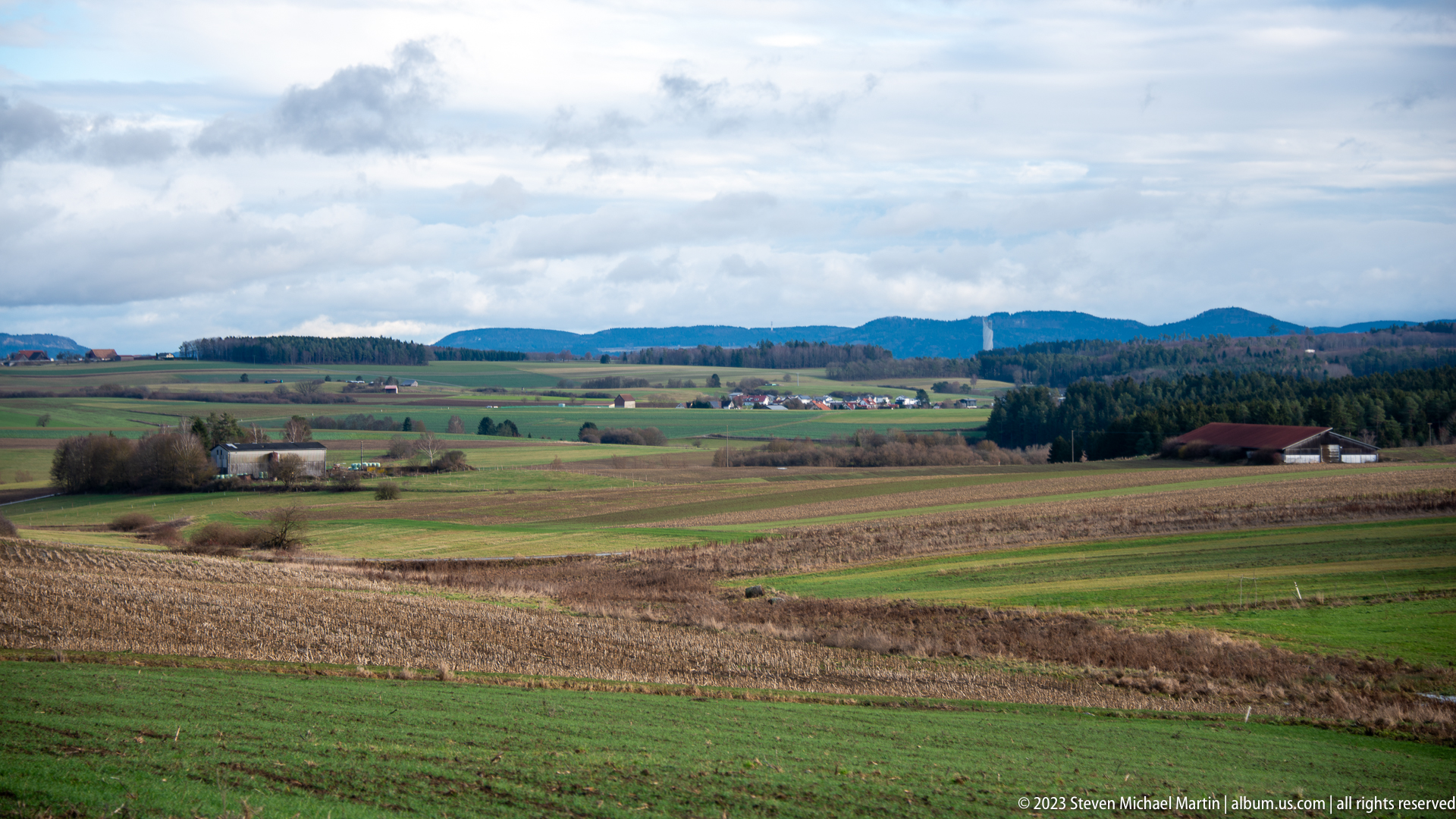
Patchwork fields spread across gently rolling country at the edge of the Black Forest, with scattered farm buildings and villages set between cultivated ground and dark conifer-covered ridges. The wide view distinguishes the region’s settled agricultural margins from the denser forest interior, showing how open farmland and wooded uplands meet across the landscape.
Caption
Patchwork fields spread across gently rolling country at the edge of the Black Forest, with scattered farm buildings and villages set between cultivated ground and dark conifer-covered ridges. The wide view distinguishes the region’s settled agricultural margins from the denser forest interior, showing how open farmland and wooded uplands meet across the landscape.
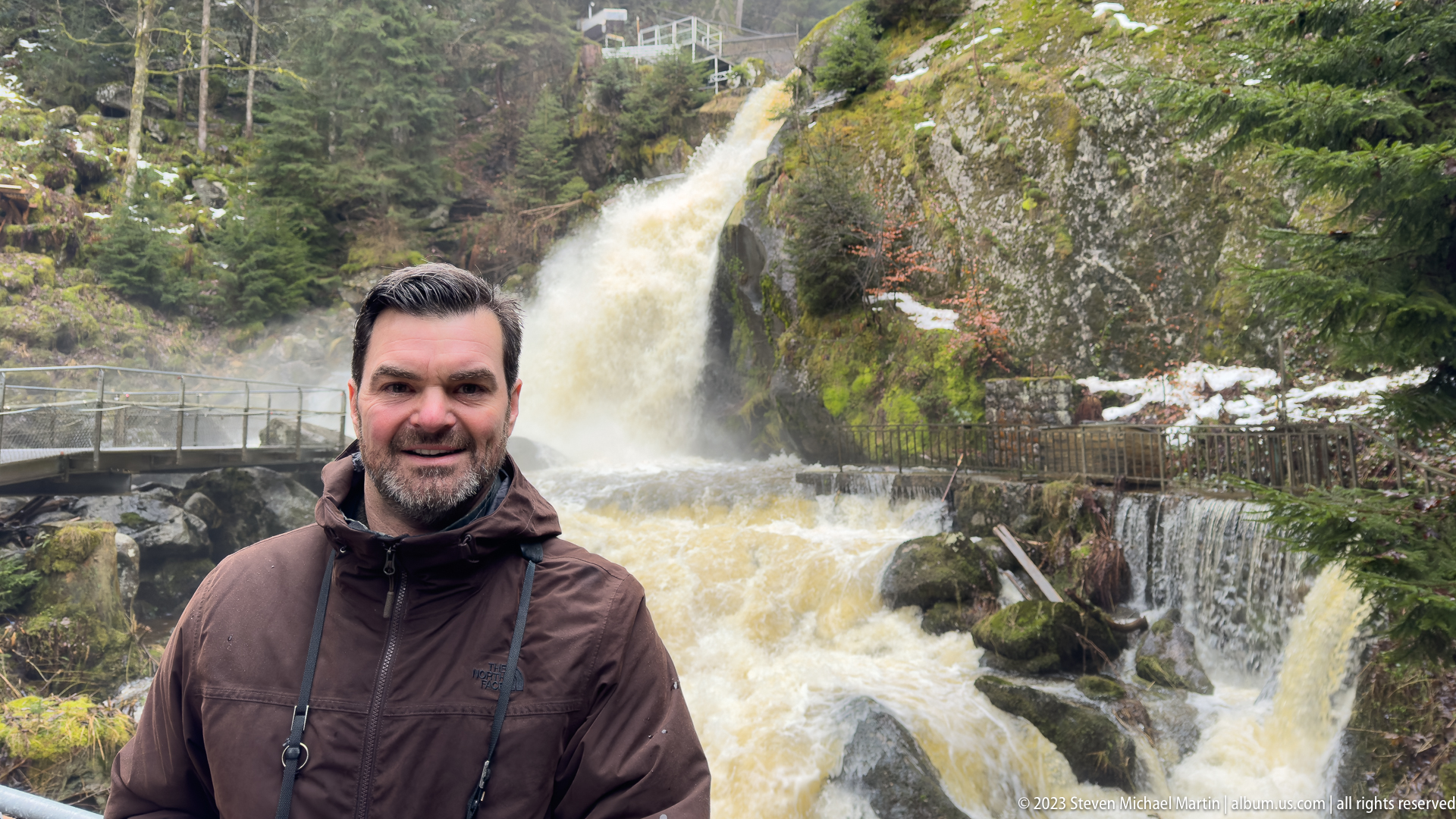
A visitor stands in the foreground while a powerful waterfall drops through a rocky, wooded channel behind him. Foaming water divides around moss-covered boulders and built railings edge the viewing area. The portrait combines human scale with the force of the cascade, while patches of snow and wet stone establish the cold-season Black Forest setting.
Caption
A visitor stands in the foreground while a powerful waterfall drops through a rocky, wooded channel behind him. Foaming water divides around moss-covered boulders and built railings edge the viewing area. The portrait combines human scale with the force of the cascade, while patches of snow and wet stone establish the cold-season Black Forest setting.
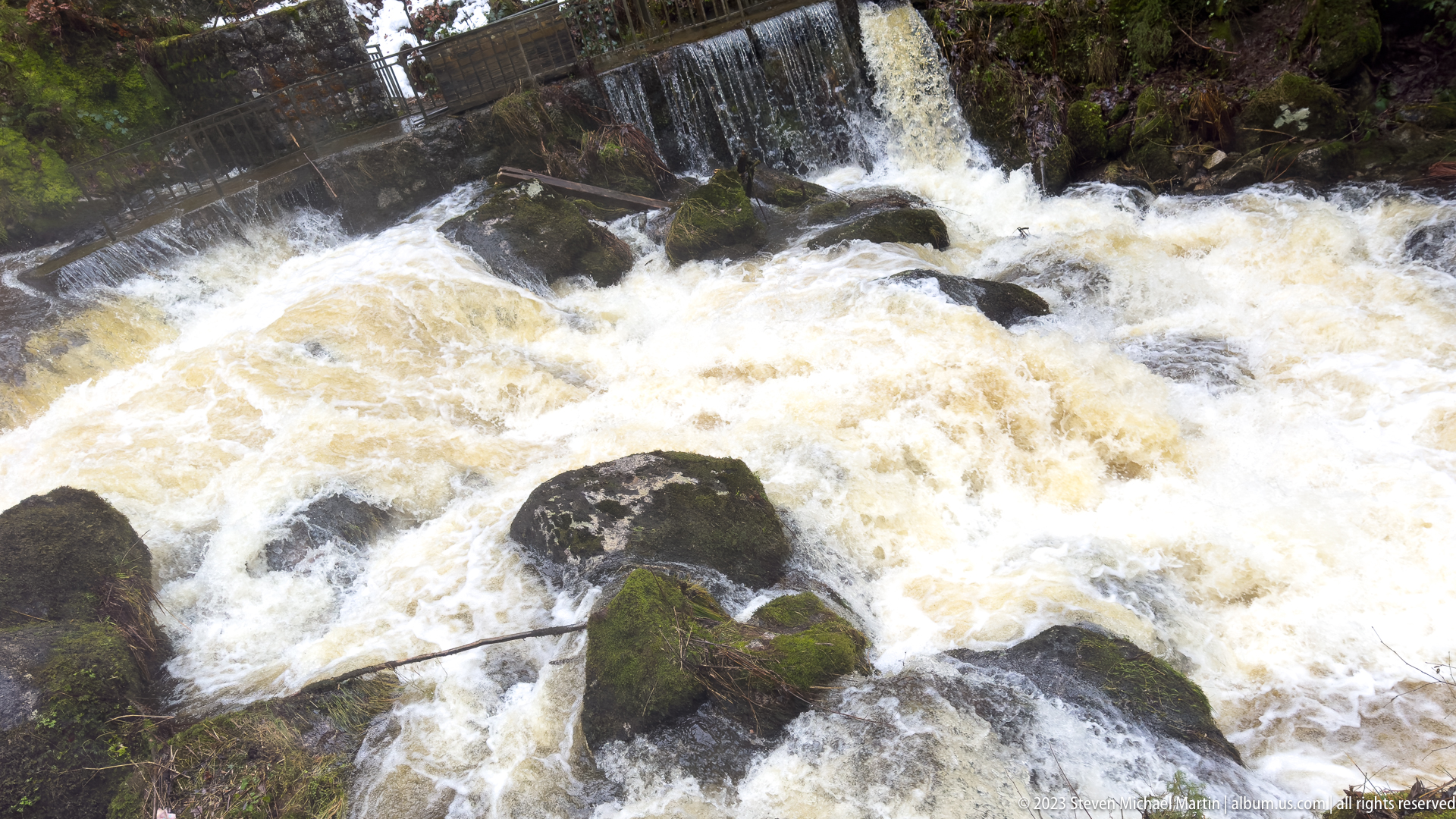
Turbulent pale water surges through dark boulders below a low straight-edged weir or drop structure at the top of the frame. The close view focuses on the force and texture of the flow rather than the wider waterfall landscape. Mossy rock and forest-edge vegetation remain visible around the channel, placing the rapids within a developed Black Forest watercourse.
Caption
Turbulent pale water surges through dark boulders below a low straight-edged weir or drop structure at the top of the frame. The close view focuses on the force and texture of the flow rather than the wider waterfall landscape. Mossy rock and forest-edge vegetation remain visible around the channel, placing the rapids within a developed Black Forest watercourse.
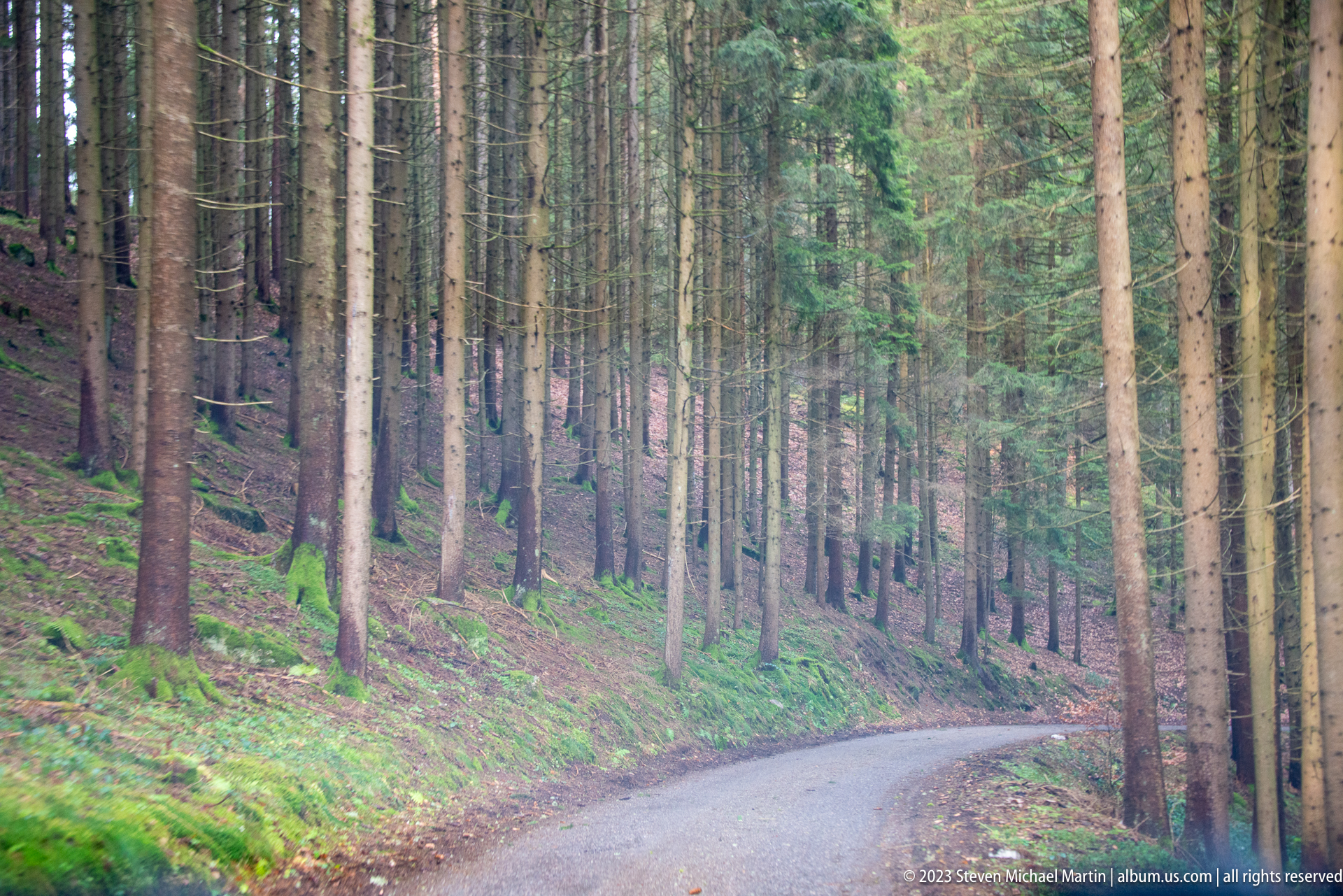
A narrow paved road bends through a steeply sloping conifer forest, disappearing between tall, evenly spaced trunks. Moss and low green groundcover soften the forest floor while the repeated verticals reveal a managed woodland structure. The composition uses the road as a visual path into the dense interior characteristic of the Black Forest landscape.
Caption
A narrow paved road bends through a steeply sloping conifer forest, disappearing between tall, evenly spaced trunks. Moss and low green groundcover soften the forest floor while the repeated verticals reveal a managed woodland structure. The composition uses the road as a visual path into the dense interior characteristic of the Black Forest landscape.
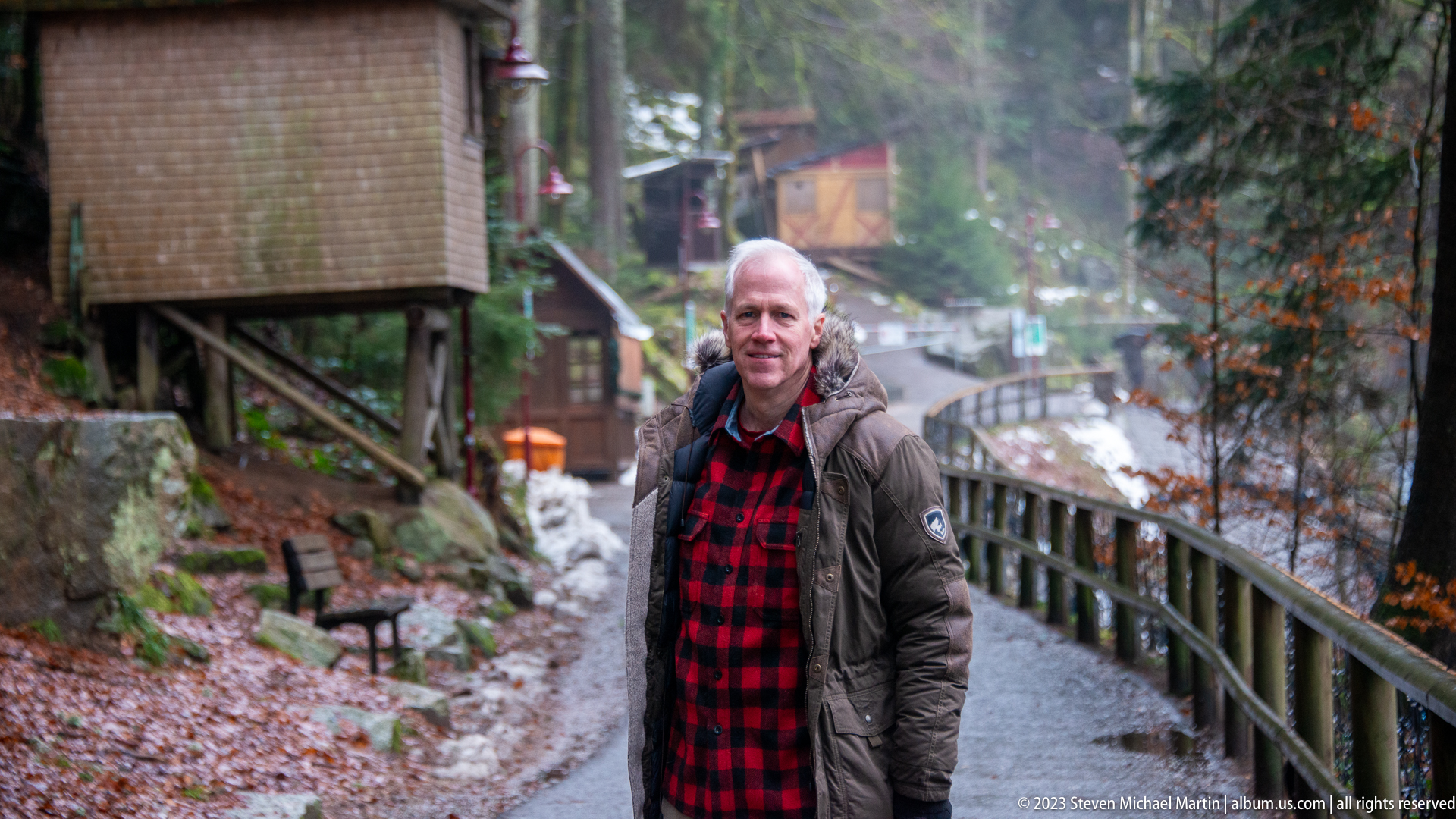
A visitor in a dark parka and red-and-black plaid shirt stands on a wet paved walkway bordered by a wooden railing. Forest structures and a rushing watercourse recede behind him, while lingering snow and damp leaves mark winter conditions. The portrait places human scale within a developed Black Forest attraction without obscuring the steep, wooded setting.
Caption
A visitor in a dark parka and red-and-black plaid shirt stands on a wet paved walkway bordered by a wooden railing. Forest structures and a rushing watercourse recede behind him, while lingering snow and damp leaves mark winter conditions. The portrait places human scale within a developed Black Forest attraction without obscuring the steep, wooded setting.
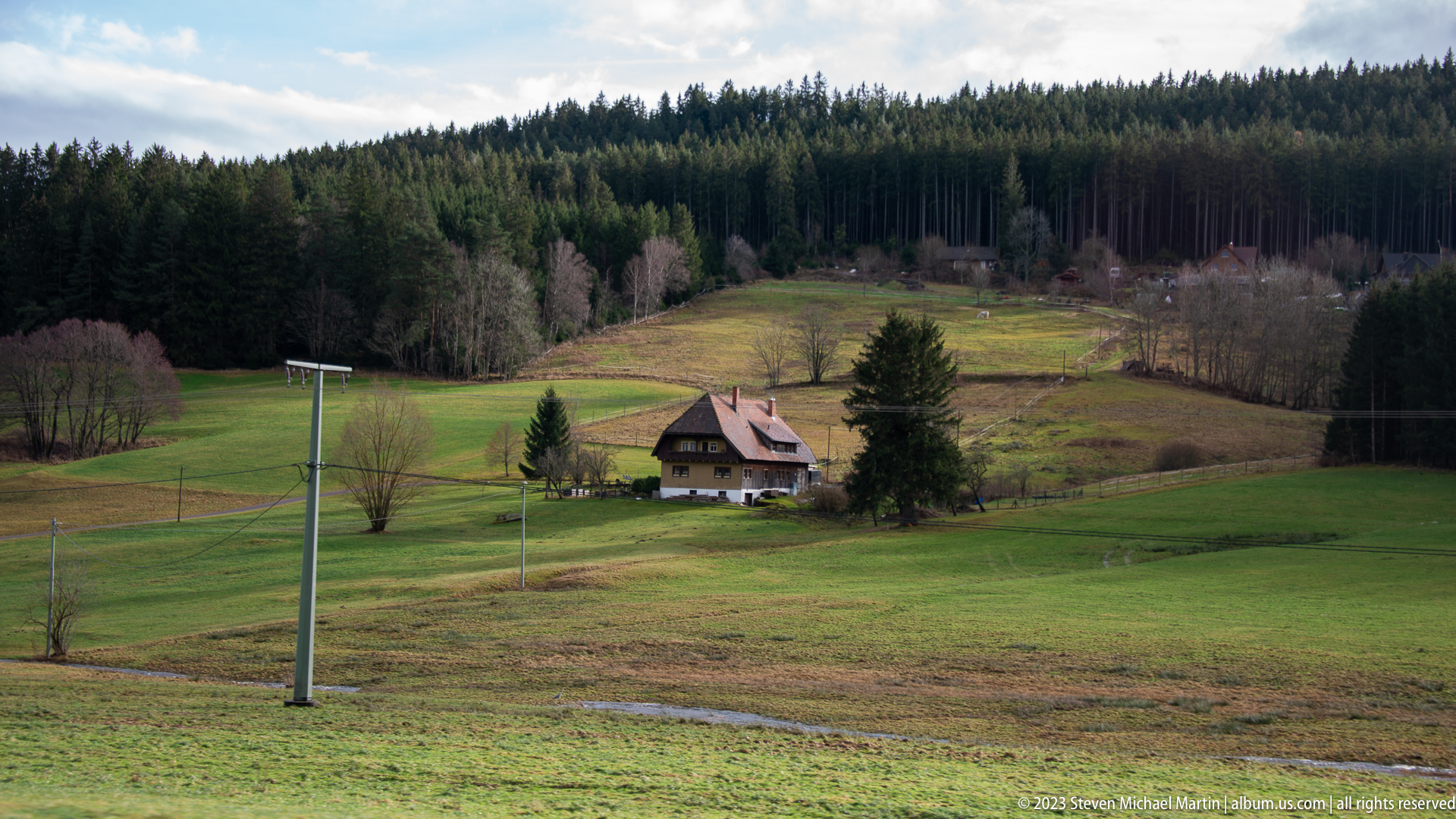
A solitary farmhouse sits amid broad green winter meadows at the foot of a densely wooded slope. Utility poles cross the foreground, adding a contemporary working-landscape element to the traditional rural scene. Alternating pasture, leafless hedgerows, scattered conifers, and the dark forest margin show the layered land use typical of settled Black Forest valleys.
Caption
A solitary farmhouse sits amid broad green winter meadows at the foot of a densely wooded slope. Utility poles cross the foreground, adding a contemporary working-landscape element to the traditional rural scene. Alternating pasture, leafless hedgerows, scattered conifers, and the dark forest margin show the layered land use typical of settled Black Forest valleys.
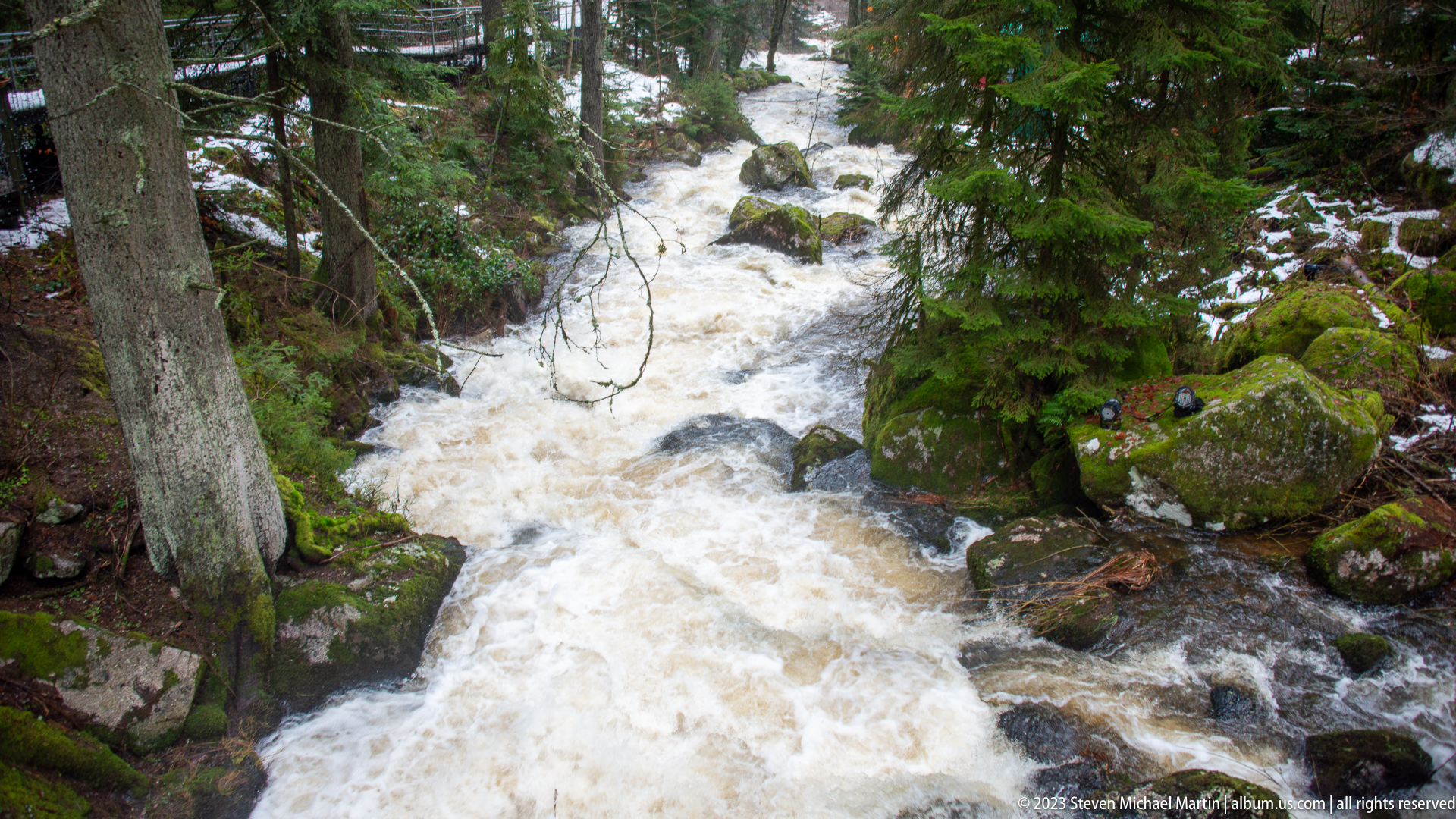
A narrow torrent races downhill between conifer trunks and moss-covered boulders, carrying pale, aerated water through the forest below the main Triberg cascades. Snow lingers in small patches along the banks. The elevated viewpoint looks directly into the channel, emphasizing the stream’s confinement by trees and rock rather than a single vertical fall.
Caption
A narrow torrent races downhill between conifer trunks and moss-covered boulders, carrying pale, aerated water through the forest below the main Triberg cascades. Snow lingers in small patches along the banks. The elevated viewpoint looks directly into the channel, emphasizing the stream’s confinement by trees and rock rather than a single vertical fall.
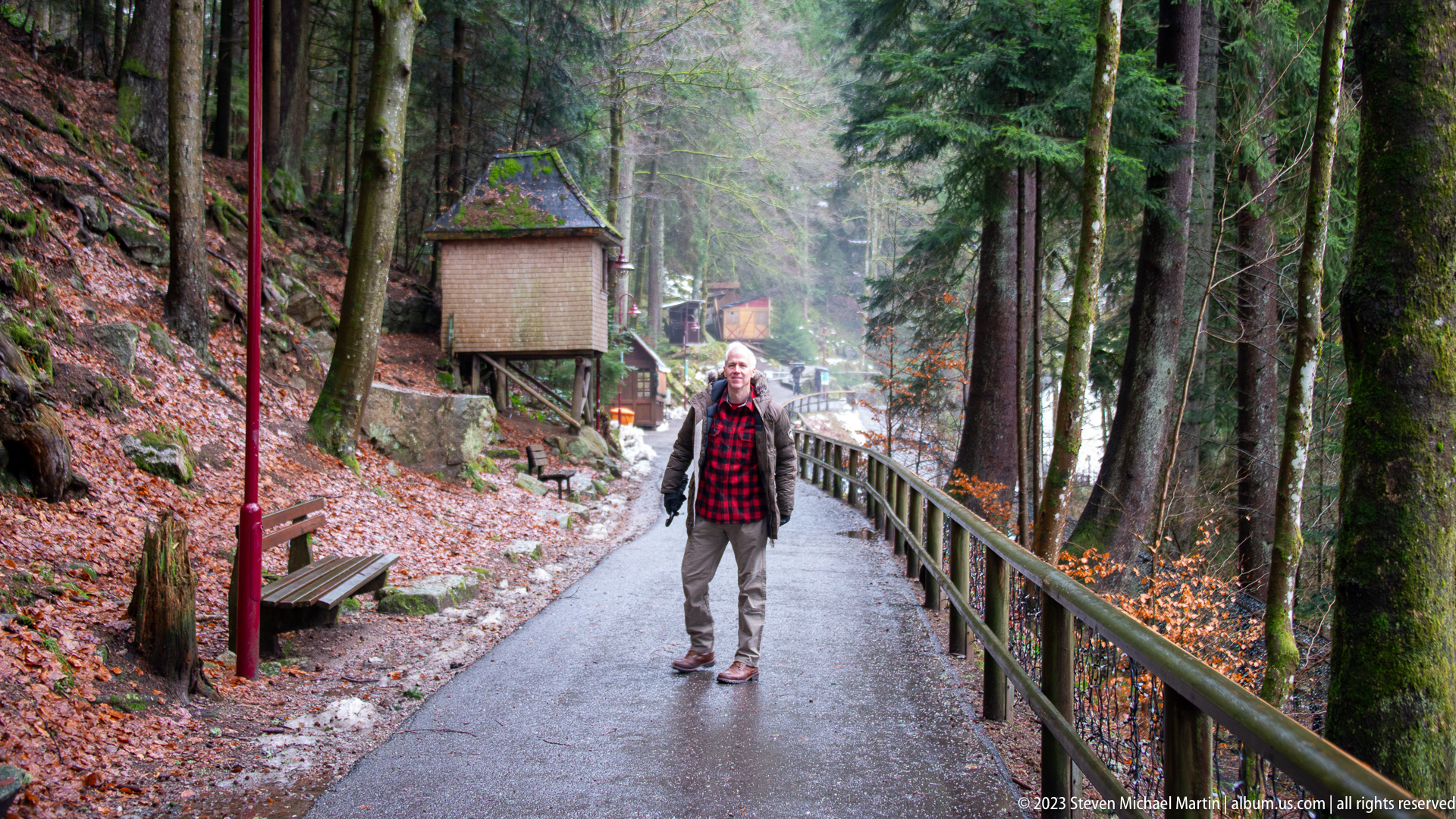
A full-length view shows a visitor walking toward the camera along a paved path cut into the forested slope. Benches, red posts, a wooden guardrail, and small structures line the route, while patches of snow remain at the margins. The broader composition gives more context than the preceding portrait, emphasizing the engineered visitor corridor through the steep, damp Black Forest terrain.
Caption
A full-length view shows a visitor walking toward the camera along a paved path cut into the forested slope. Benches, red posts, a wooden guardrail, and small structures line the route, while patches of snow remain at the margins. The broader composition gives more context than the preceding portrait, emphasizing the engineered visitor corridor through the steep, damp Black Forest terrain.

A broad-roofed Black Forest farmhouse combines a timber-framed lower façade with a deep, sheltering upper roof and wooden gallery. Bare deciduous trees and winter light expose the building’s structural pattern, while the large roof volume reflects the practical scale of rural farmsteads designed to gather domestic and agricultural functions beneath one envelope.
Caption
A broad-roofed Black Forest farmhouse combines a timber-framed lower façade with a deep, sheltering upper roof and wooden gallery. Bare deciduous trees and winter light expose the building’s structural pattern, while the large roof volume reflects the practical scale of rural farmsteads designed to gather domestic and agricultural functions beneath one envelope.
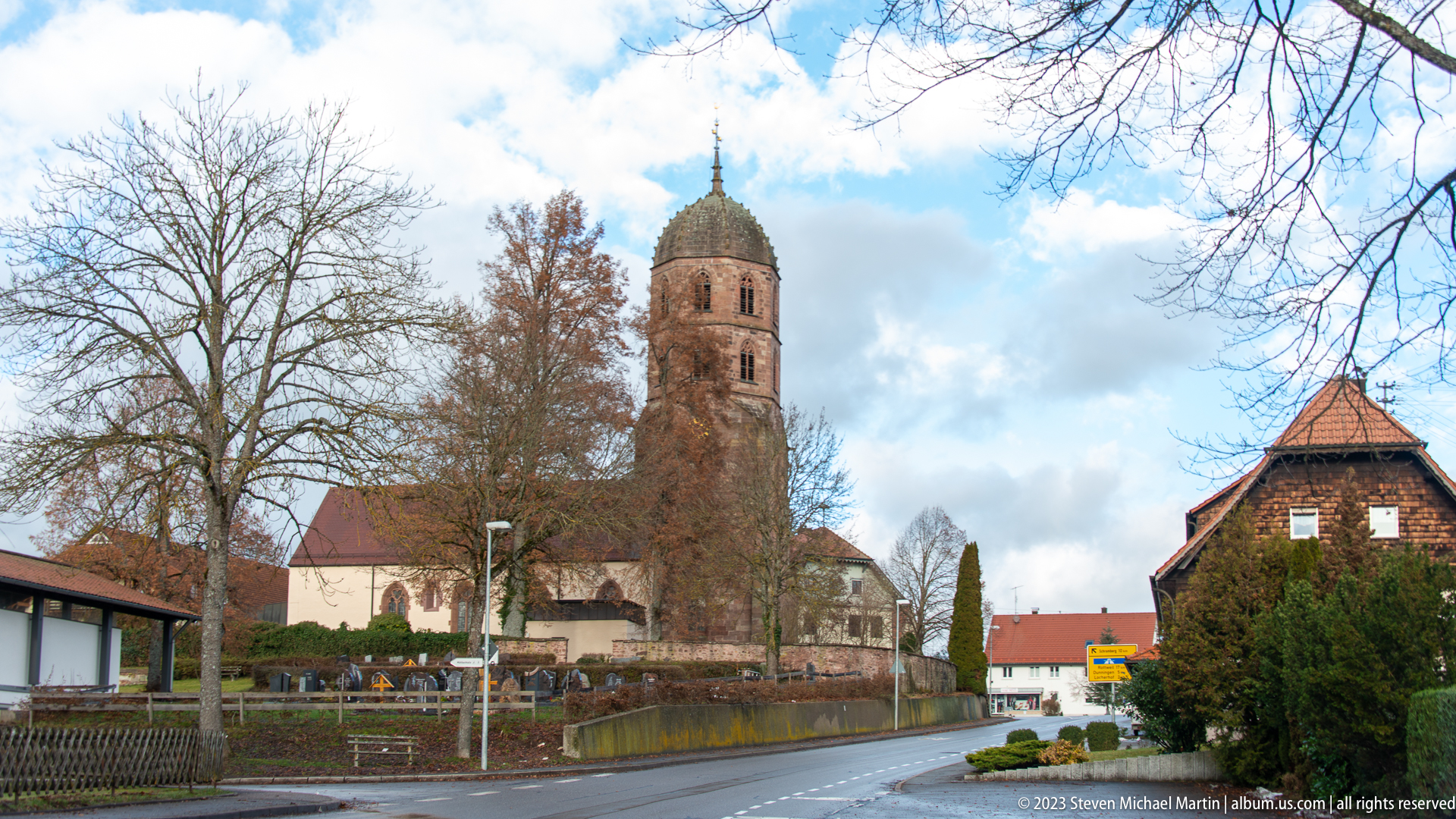
A tall reddish masonry bell tower anchors a village church beside a wet road and winter-bare trees. Round-arched belfry openings and a steep, dark roof give the tower a Romanesque character, while neighboring houses and roadside signs place the church firmly within a lived Black Forest settlement rather than an isolated ecclesiastical site.
Caption
A tall reddish masonry bell tower anchors a village church beside a wet road and winter-bare trees. Round-arched belfry openings and a steep, dark roof give the tower a Romanesque character, while neighboring houses and roadside signs place the church firmly within a lived Black Forest settlement rather than an isolated ecclesiastical site.
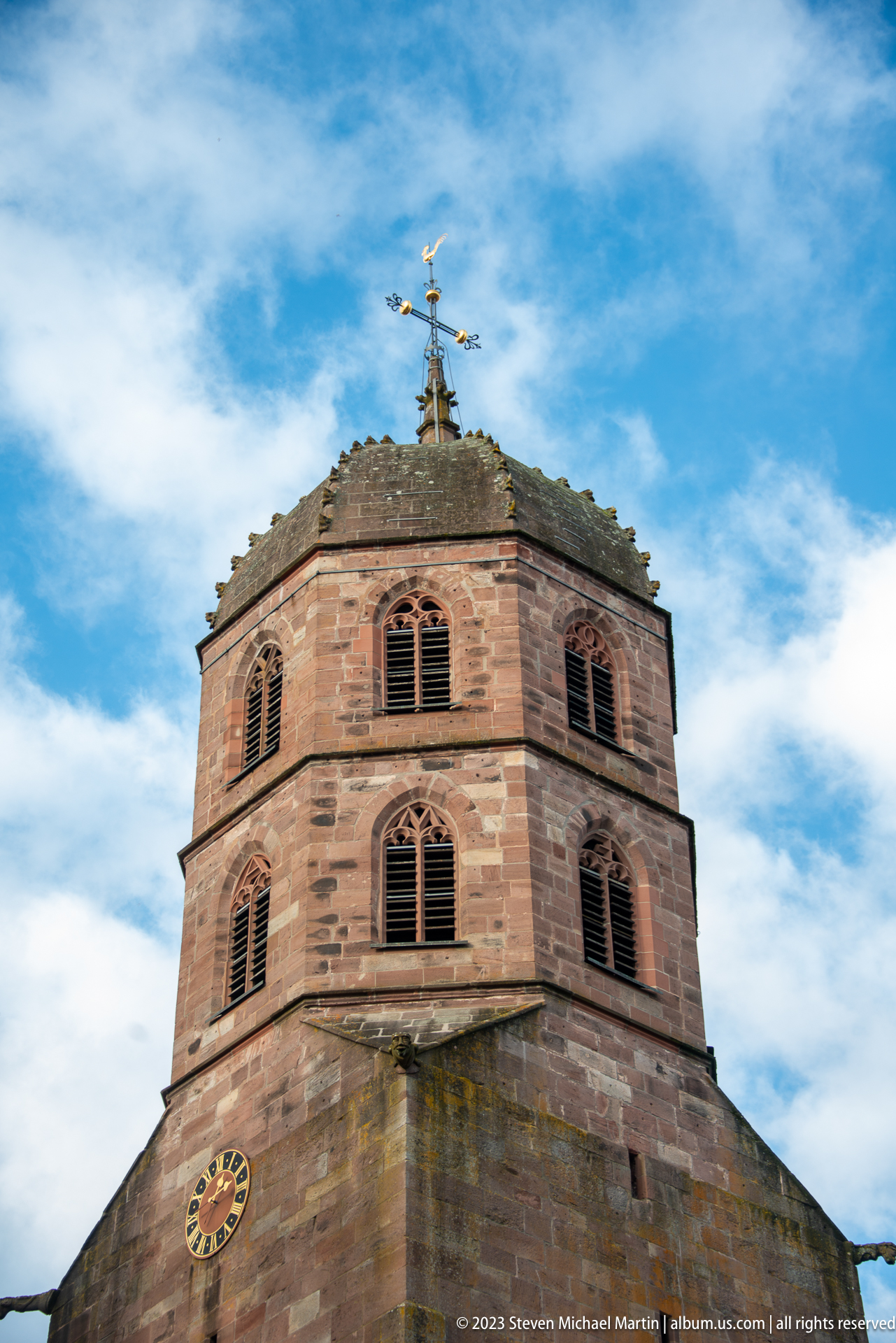
An octagonal sandstone church tower rises against a bright winter sky, its upper stages articulated by paired pointed-arch louvered openings. A small clock face sits below the belfry level, while the low pyramidal roof and metal finial give the tower a compact silhouette. The close upward viewpoint concentrates attention on masonry, openings, and roofline rather than the surrounding church.
Caption
An octagonal sandstone church tower rises against a bright winter sky, its upper stages articulated by paired pointed-arch louvered openings. A small clock face sits below the belfry level, while the low pyramidal roof and metal finial give the tower a compact silhouette. The close upward viewpoint concentrates attention on masonry, openings, and roofline rather than the surrounding church.
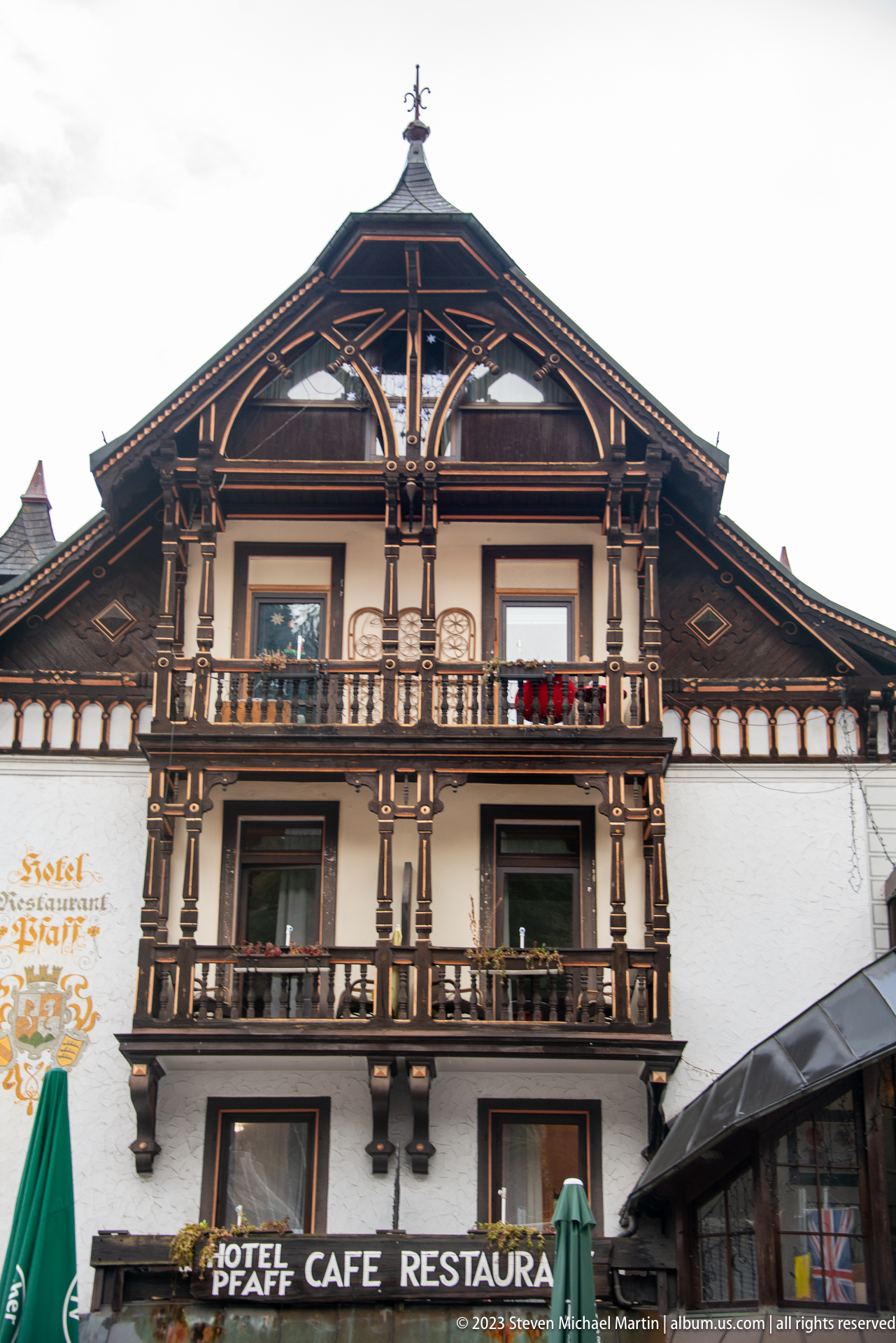
Hotel Pfaff presents an elaborately timbered gable façade with stacked balconies, carved supports, and dark ornamental framing against white plaster. The name “HOTEL PFAFF CAFE RESTAURANT” is visible across the ground floor, allowing a secure identification. Its richly decorated frontage stands in Triberg near the celebrated waterfalls.
Caption
Hotel Pfaff presents an elaborately timbered gable façade with stacked balconies, carved supports, and dark ornamental framing against white plaster. The name “HOTEL PFAFF CAFE RESTAURANT” is visible across the ground floor, allowing a secure identification. Its richly decorated frontage stands in Triberg near the celebrated waterfalls.
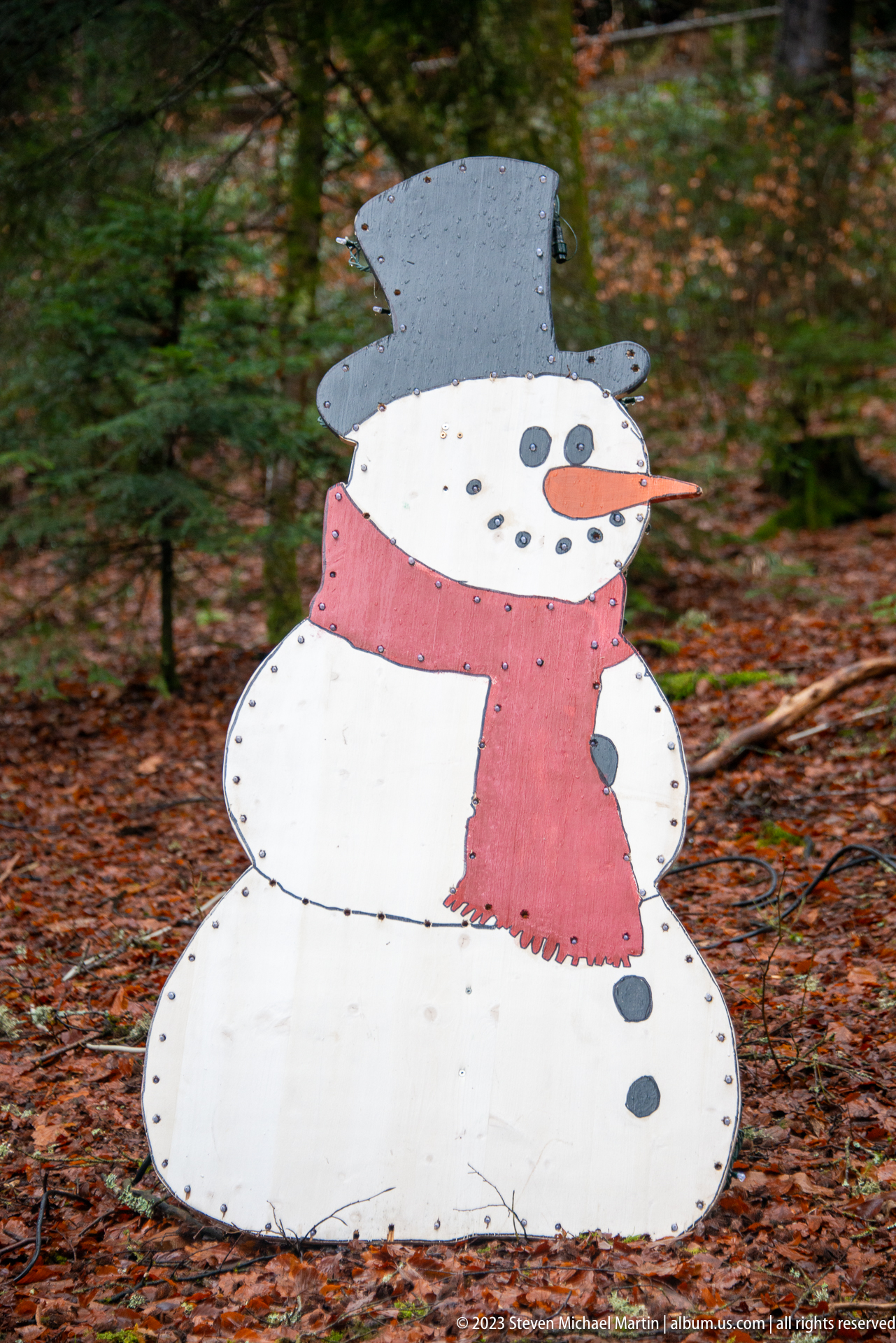
A flat painted snowman stands directly on the leaf-covered forest floor, its black top hat, red scarf, carrot nose, and coal-like buttons rendered as cheerful seasonal decoration. Damp woodland and evergreen growth form a subdued background, making the white figure conspicuous. The handmade sign introduces Christmas-season imagery into the natural forest setting.
Caption
A flat painted snowman stands directly on the leaf-covered forest floor, its black top hat, red scarf, carrot nose, and coal-like buttons rendered as cheerful seasonal decoration. Damp woodland and evergreen growth form a subdued background, making the white figure conspicuous. The handmade sign introduces Christmas-season imagery into the natural forest setting.
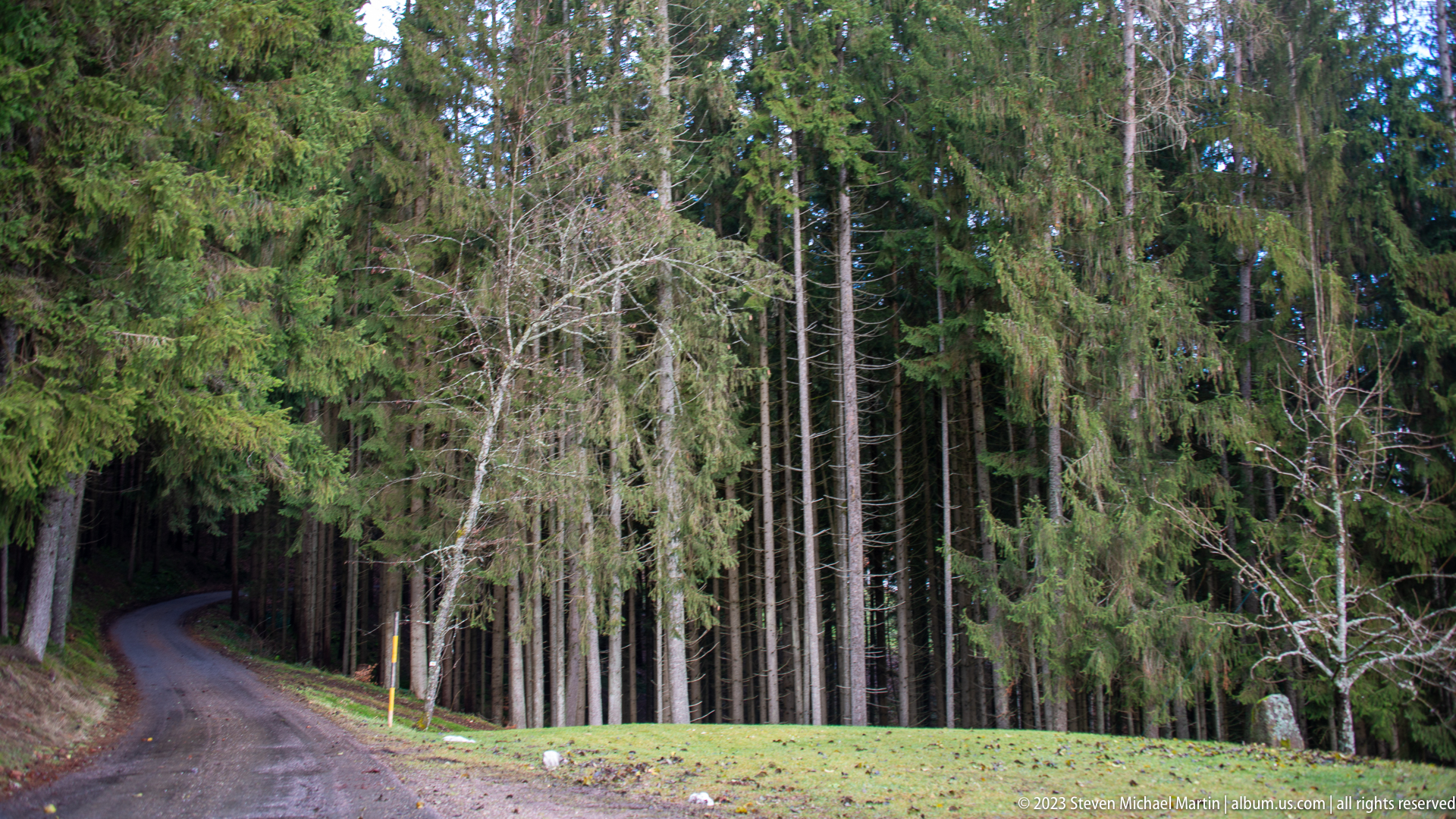
A single-lane road slips from an open grassy verge into dense evergreen woodland, where closely spaced trunks create a dark interior. A bare deciduous tree at the forest edge contrasts with drooping conifer branches overhead. The transitional viewpoint records the threshold between cleared ground and the enclosed forest rather than a distant scenic panorama.
Caption
A single-lane road slips from an open grassy verge into dense evergreen woodland, where closely spaced trunks create a dark interior. A bare deciduous tree at the forest edge contrasts with drooping conifer branches overhead. The transitional viewpoint records the threshold between cleared ground and the enclosed forest rather than a distant scenic panorama.
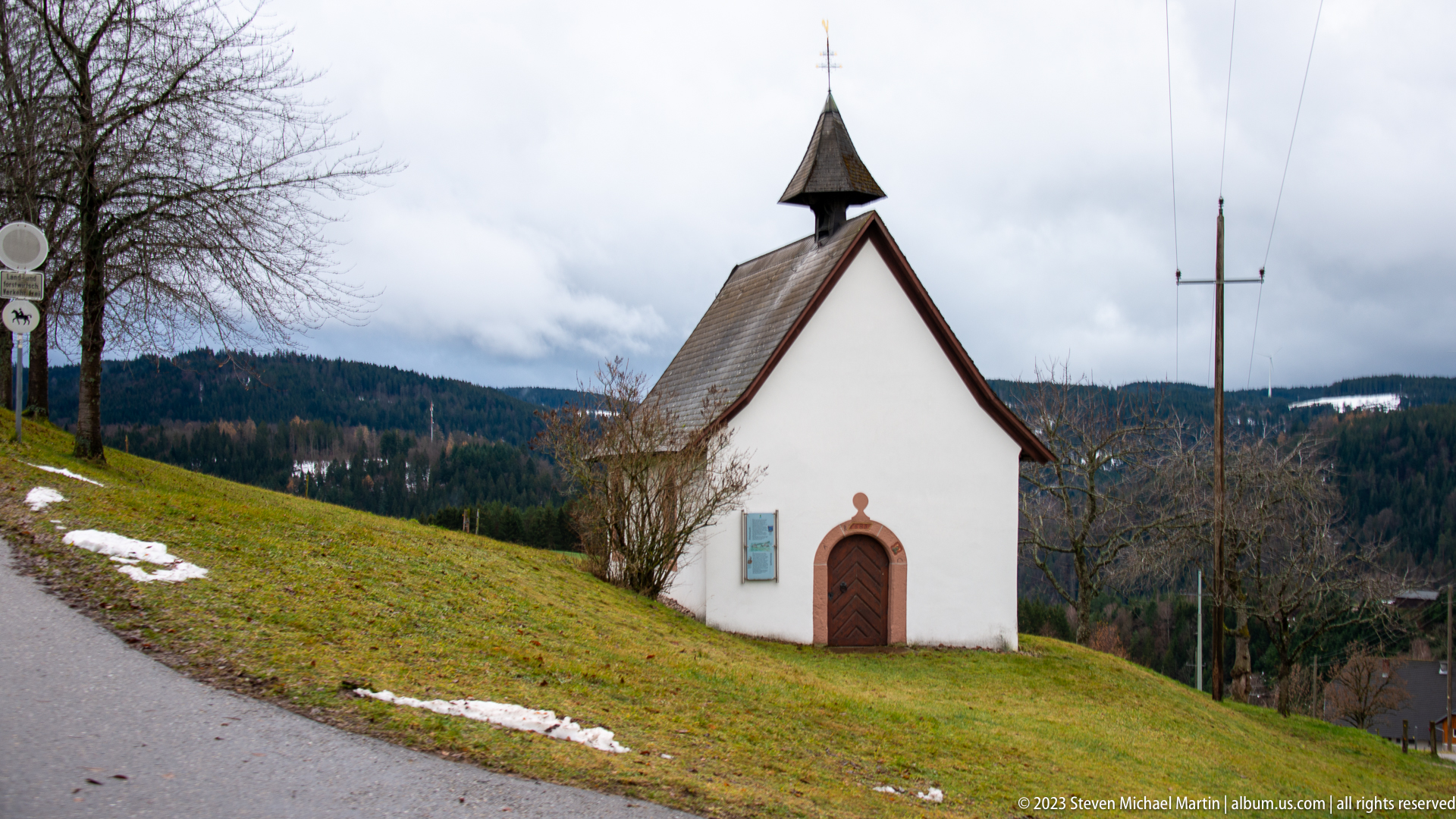
A small whitewashed chapel stands on a grassy hillside with patches of lingering snow. Its simple rectangular body, arched wooden doorway, steep roof, and tiny bell turret form a compact devotional landmark overlooking the wooded valley beyond. The restrained scale distinguishes it from the larger village churches elsewhere in the sequence.
Caption
A small whitewashed chapel stands on a grassy hillside with patches of lingering snow. Its simple rectangular body, arched wooden doorway, steep roof, and tiny bell turret form a compact devotional landmark overlooking the wooded valley beyond. The restrained scale distinguishes it from the larger village churches elsewhere in the sequence.
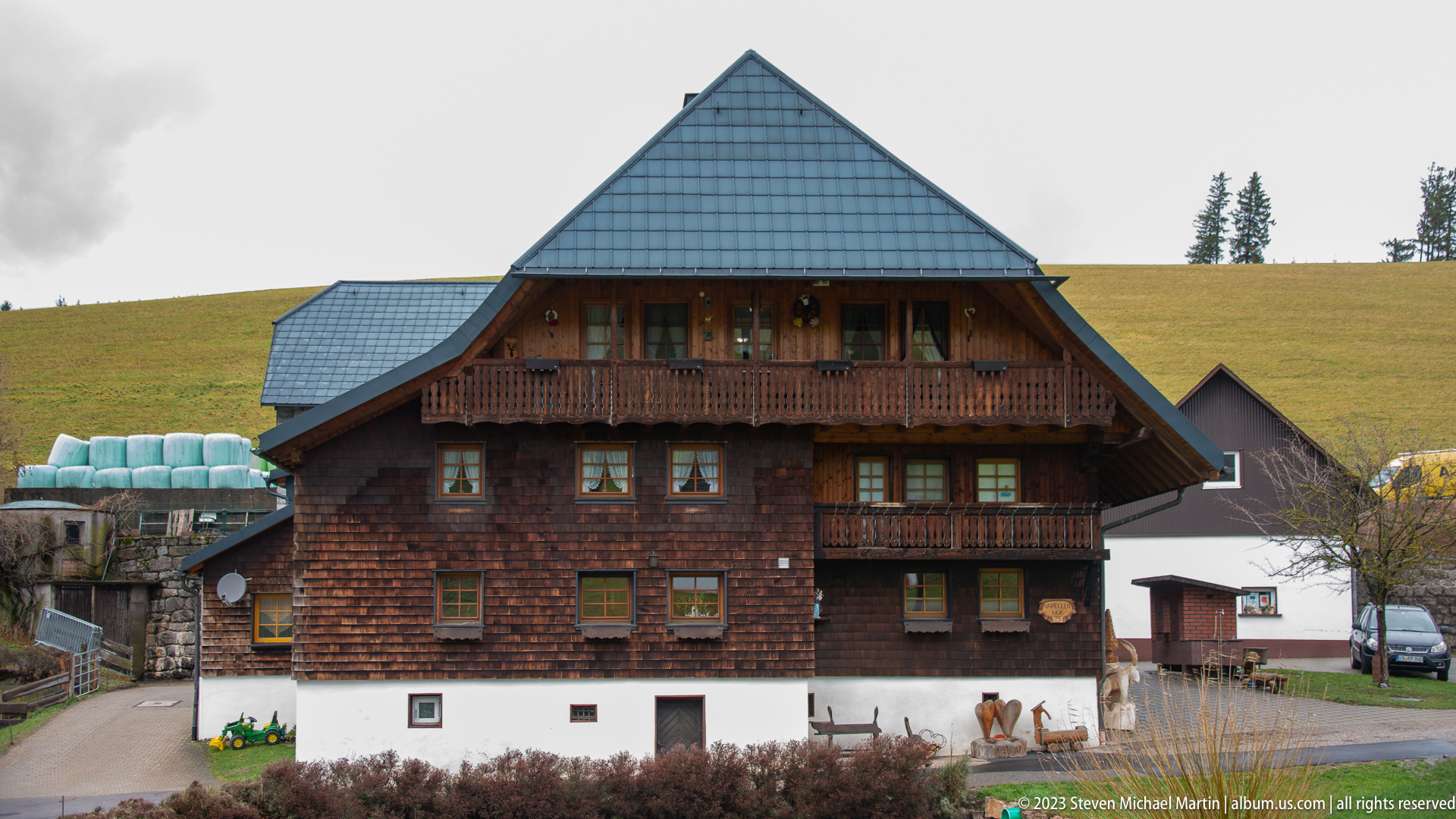
A substantial Black Forest house presents a broad shingled façade beneath a steep hipped-gable roof, with two long wooden balconies stacked across the upper stories. Rows of small windows, dark timber cladding, and a white masonry base create a strong horizontal rhythm. Agricultural buildings and wrapped hay bales in the background reinforce its rural setting.
Caption
A substantial Black Forest house presents a broad shingled façade beneath a steep hipped-gable roof, with two long wooden balconies stacked across the upper stories. Rows of small windows, dark timber cladding, and a white masonry base create a strong horizontal rhythm. Agricultural buildings and wrapped hay bales in the background reinforce its rural setting.

A formal town building is articulated in white plaster and deep red trim, with arched ground-floor openings and regularly spaced tall windows above. A small clock turret rises from the tiled roof, giving the façade a civic character. The adjoining commercial frontage and parked cars place the building within a compact Black Forest town center.
Caption
A formal town building is articulated in white plaster and deep red trim, with arched ground-floor openings and regularly spaced tall windows above. A small clock turret rises from the tiled roof, giving the façade a civic character. The adjoining commercial frontage and parked cars place the building within a compact Black Forest town center.
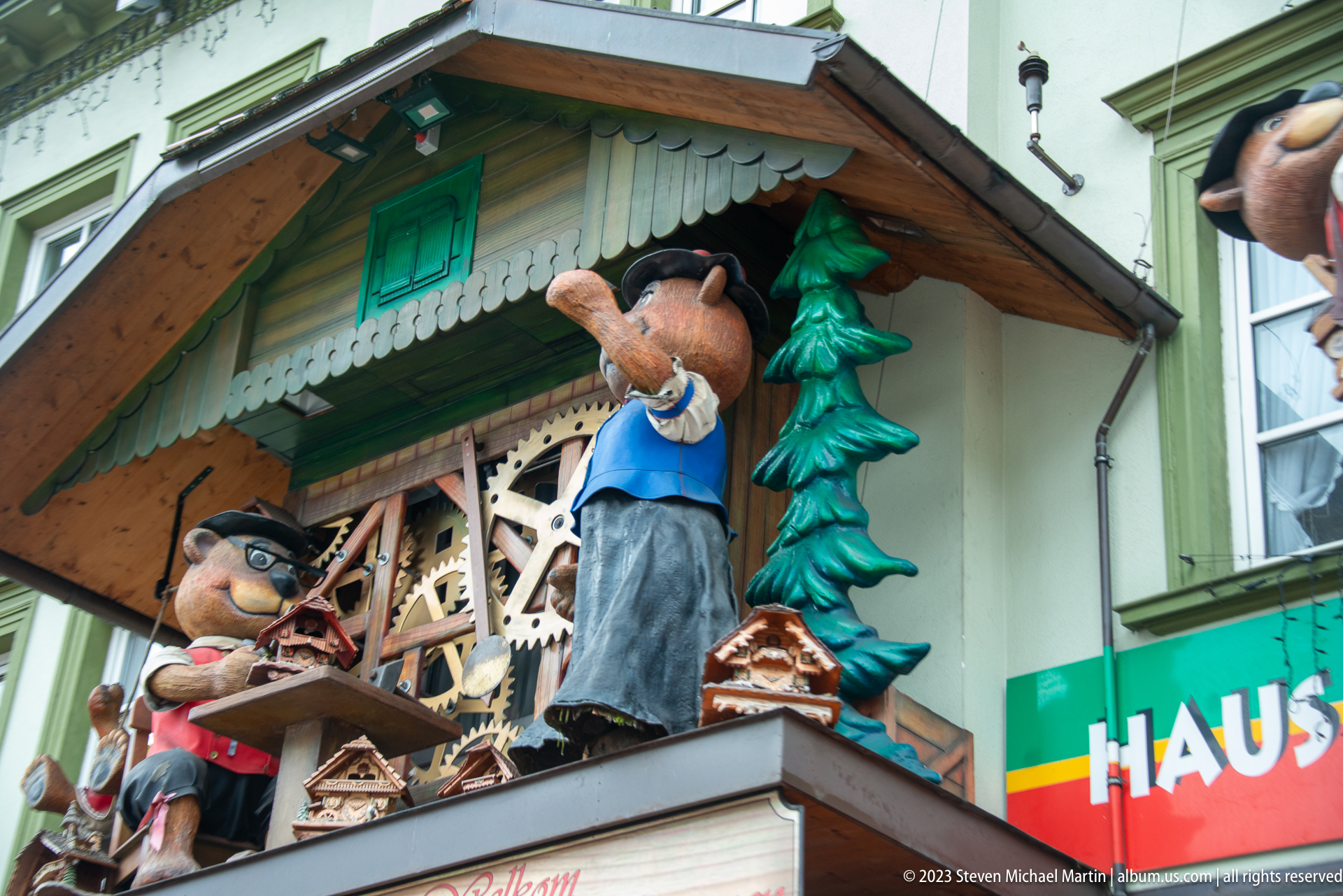
Oversized carved figures and miniature chalet motifs animate the projecting wooden front of a Black Forest shop. A bespectacled character and a second figure stand among stylized evergreen trees above the storefront, turning regional woodcarving traditions into conspicuous commercial display. Bright painted details contrast with the pale building façade behind them.
Caption
Oversized carved figures and miniature chalet motifs animate the projecting wooden front of a Black Forest shop. A bespectacled character and a second figure stand among stylized evergreen trees above the storefront, turning regional woodcarving traditions into conspicuous commercial display. Bright painted details contrast with the pale building façade behind them.
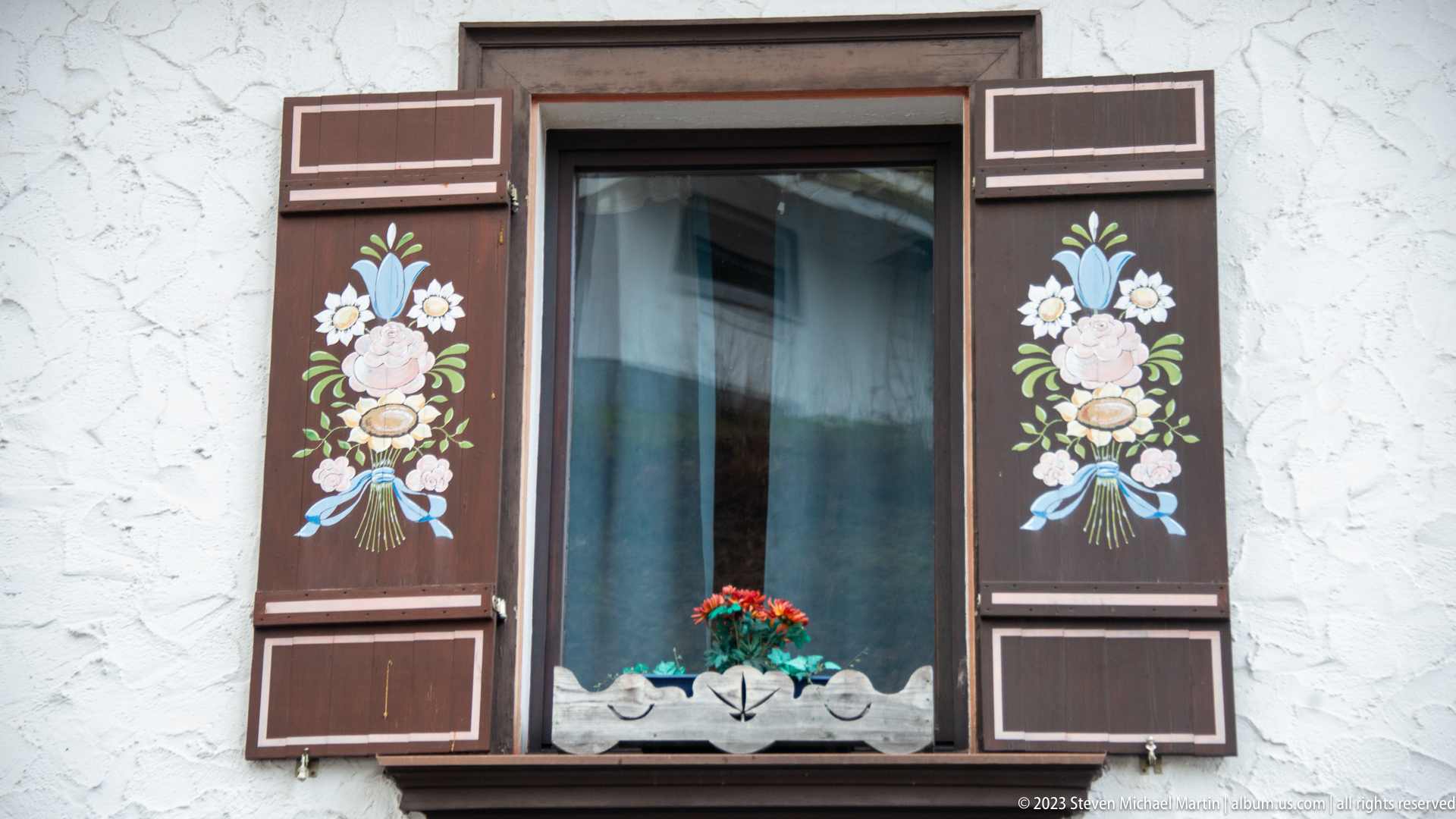
A single window is framed by dark brown wooden shutters painted with symmetrical bouquets of flowers. The floral panels, small red blossoms on the sill, and textured white stucco create an intimate architectural detail that contrasts with the larger streetscapes in the sequence. The ornament reflects a decorative domestic tradition rather than structural half-timbering.
Caption
A single window is framed by dark brown wooden shutters painted with symmetrical bouquets of flowers. The floral panels, small red blossoms on the sill, and textured white stucco create an intimate architectural detail that contrasts with the larger streetscapes in the sequence. The ornament reflects a decorative domestic tradition rather than structural half-timbering.

A curving street in Triberg climbs between closely packed hotels, shops, and traditional façades, with seasonal decorations and commercial signs projecting over the roadway. The steep wooded slope behind the buildings situates the town within the Black Forest terrain. Tourist-oriented storefronts and dense hillside development mark the approach to Triberg’s waterfall district.
Caption
A curving street in Triberg climbs between closely packed hotels, shops, and traditional façades, with seasonal decorations and commercial signs projecting over the roadway. The steep wooded slope behind the buildings situates the town within the Black Forest terrain. Tourist-oriented storefronts and dense hillside development mark the approach to Triberg’s waterfall district.
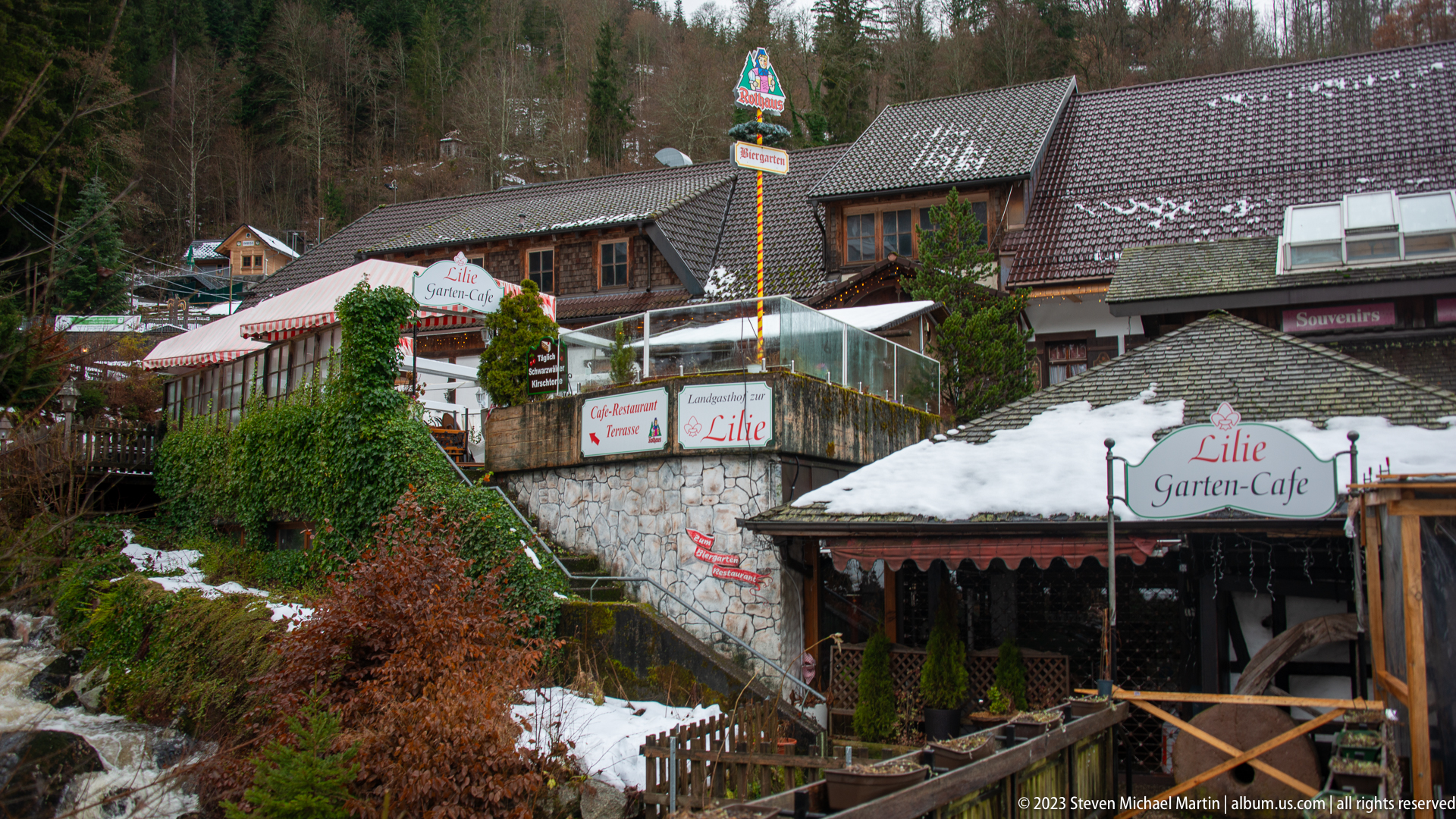
The Lilie Garten-Café occupies a terraced hillside setting where rustic wooden buildings, stone retaining walls, outdoor seating structures, and lingering snow step up the slope. Painted “Lilie Garten-Café” signage identifies the establishment, while dense woodland behind the roofs links the commercial terrace to Triberg’s steep forested terrain.
Caption
The Lilie Garten-Café occupies a terraced hillside setting where rustic wooden buildings, stone retaining walls, outdoor seating structures, and lingering snow step up the slope. Painted “Lilie Garten-Café” signage identifies the establishment, while dense woodland behind the roofs links the commercial terrace to Triberg’s steep forested terrain.
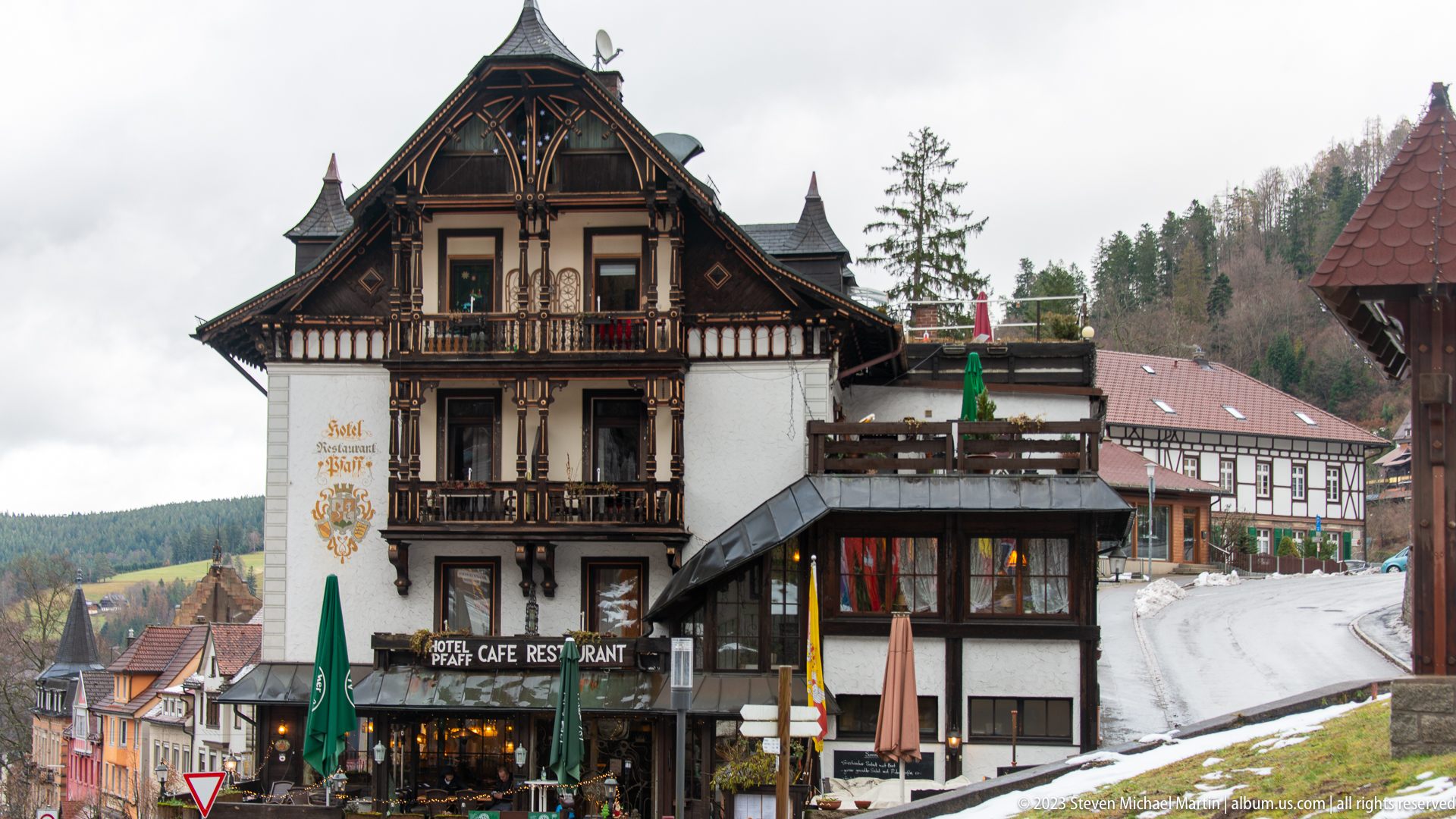
Seen from farther back, Hotel Pfaff rises above Triberg’s sloping street with its narrow gabled façade, ornate timber balconies, and café-restaurant frontage. Neighboring half-timbered buildings and snow-dusted roofs extend the view into the surrounding townscape. This contextual perspective shows the hotel’s vertical form and its close relationship to the hillside settlement near the waterfalls.
Caption
Seen from farther back, Hotel Pfaff rises above Triberg’s sloping street with its narrow gabled façade, ornate timber balconies, and café-restaurant frontage. Neighboring half-timbered buildings and snow-dusted roofs extend the view into the surrounding townscape. This contextual perspective shows the hotel’s vertical form and its close relationship to the hillside settlement near the waterfalls.
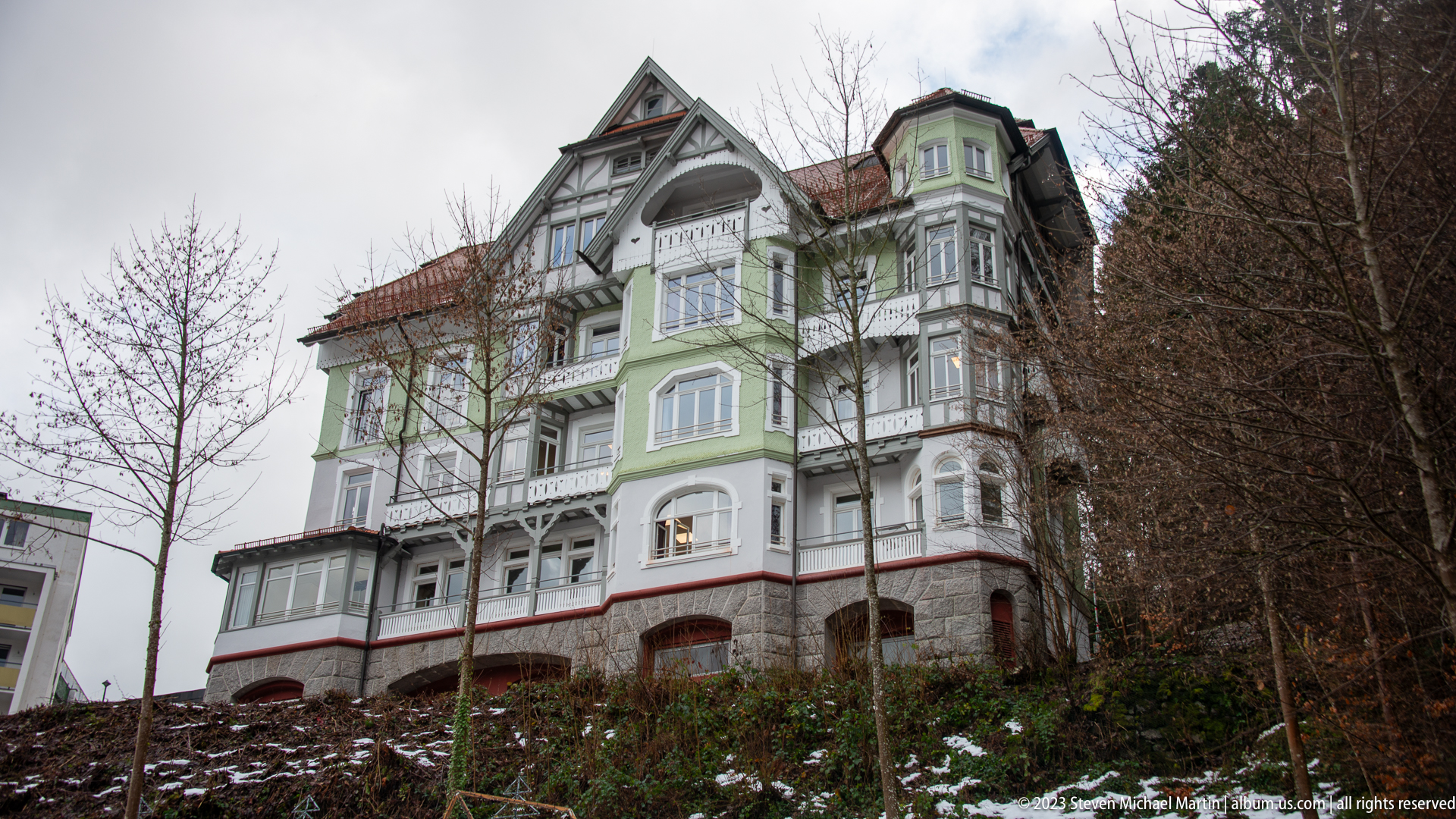
An ornate multi-story villa rises against a wooded slope, combining pale green wall surfaces with white timber ornament, projecting bays, enclosed balconies, and steep gables. The asymmetrical massing and layered verandas give the building a picturesque resort-era character. Bare trees and small patches of snow emphasize its elevated hillside position above Triberg.
Caption
An ornate multi-story villa rises against a wooded slope, combining pale green wall surfaces with white timber ornament, projecting bays, enclosed balconies, and steep gables. The asymmetrical massing and layered verandas give the building a picturesque resort-era character. Bare trees and small patches of snow emphasize its elevated hillside position above Triberg.
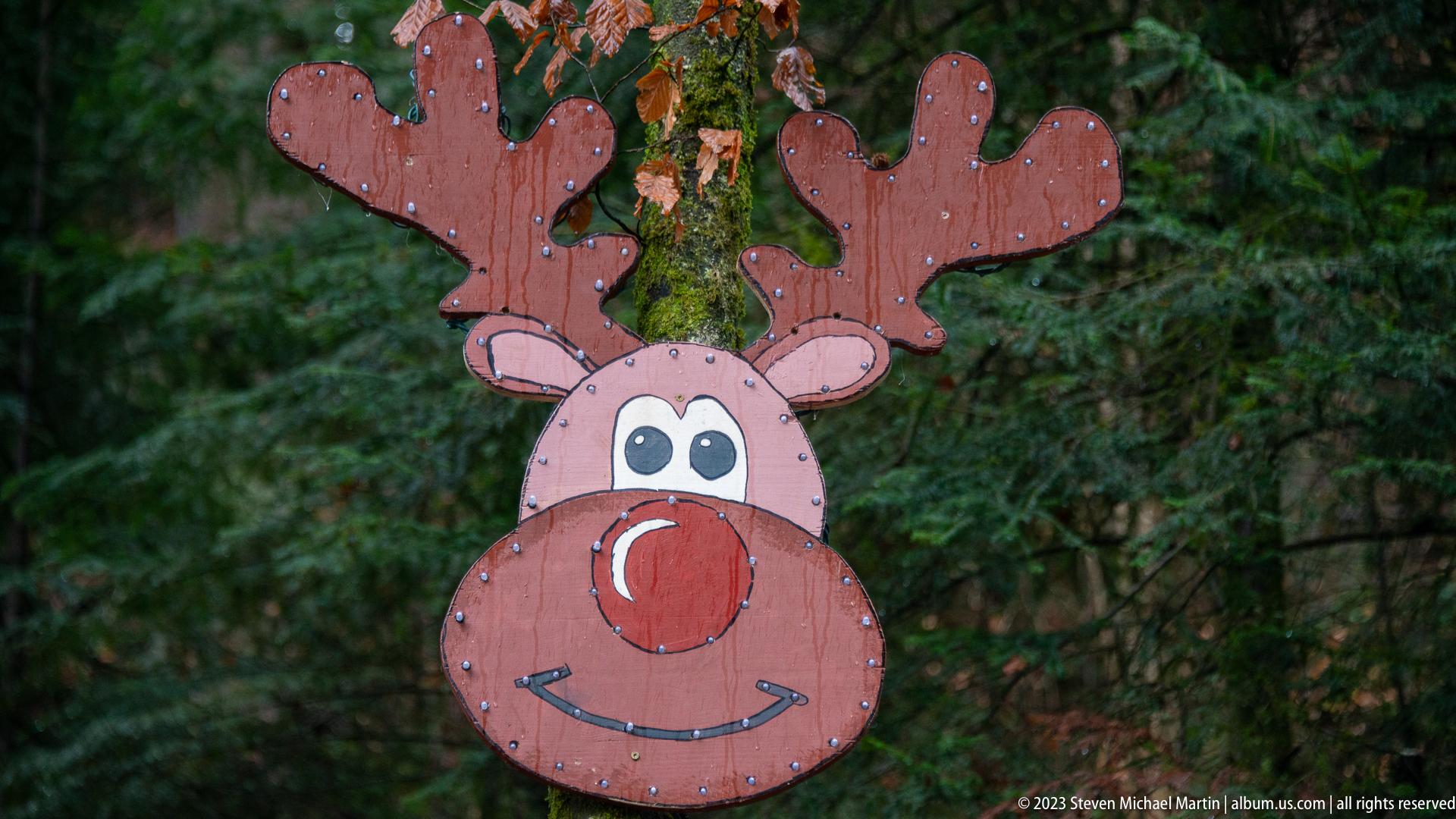
A whimsical reindeer face, cut from painted wood and fastened with visible metal studs, hangs against the dark evergreen forest. Broad antlers, oversized eyes, a red nose, and a simple smile reduce the animal to a graphic Christmas motif. Moss on the wood above reinforces the contrast between handmade decoration and the damp woodland setting.
Caption
A whimsical reindeer face, cut from painted wood and fastened with visible metal studs, hangs against the dark evergreen forest. Broad antlers, oversized eyes, a red nose, and a simple smile reduce the animal to a graphic Christmas motif. Moss on the wood above reinforces the contrast between handmade decoration and the damp woodland setting.
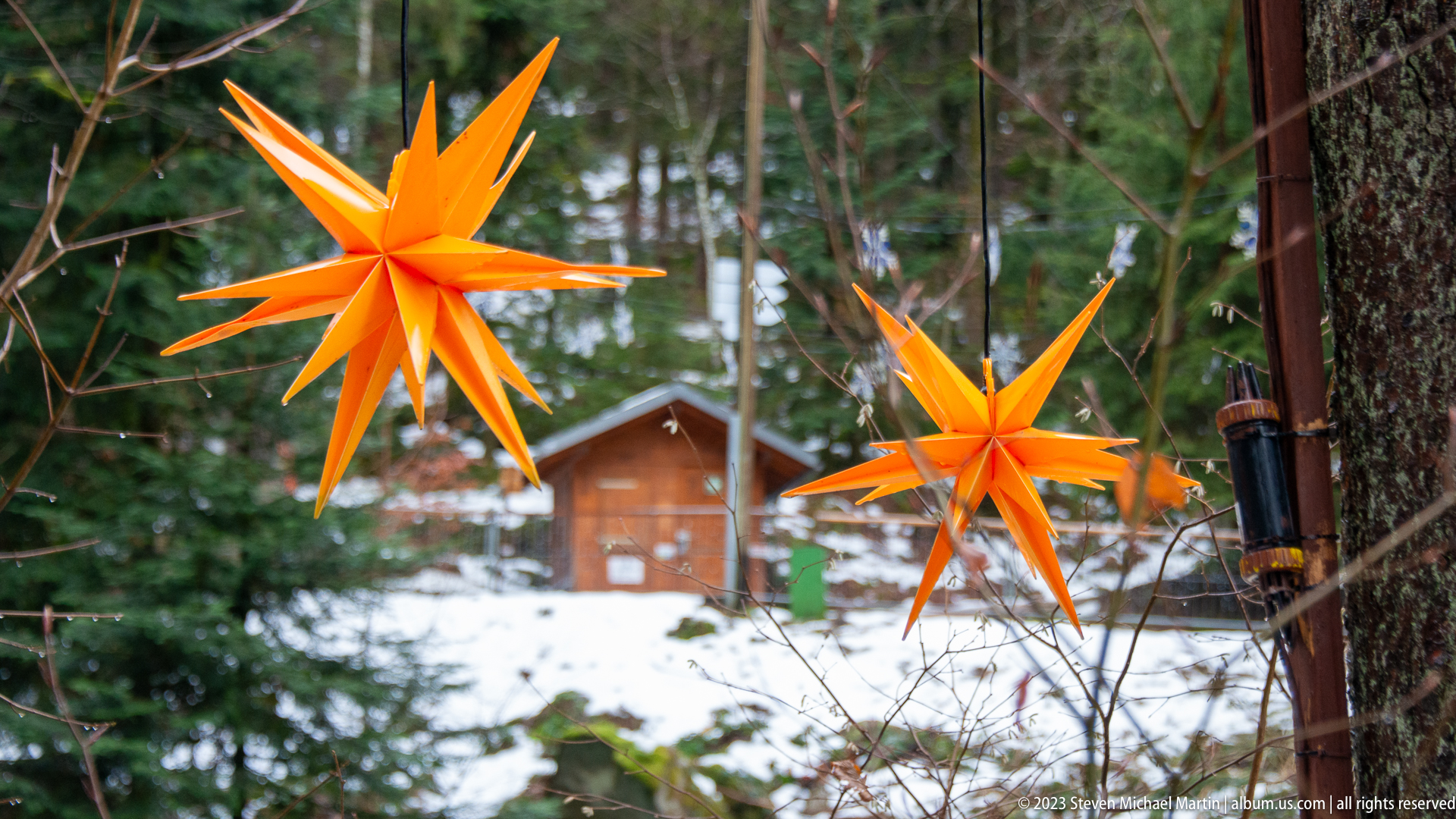
Two vivid orange many-pointed stars hang between tree trunks above a snowy forest slope, with a small wooden cabin beyond. Their folded geometric forms resemble traditional Advent or Moravian star decorations commonly displayed during the Christmas season. The shallow depth of field isolates the bright ornaments against muted woodland browns, greens, and snow.
Caption
Two vivid orange many-pointed stars hang between tree trunks above a snowy forest slope, with a small wooden cabin beyond. Their folded geometric forms resemble traditional Advent or Moravian star decorations commonly displayed during the Christmas season. The shallow depth of field isolates the bright ornaments against muted woodland browns, greens, and snow.

White water rushes through a narrow rocky channel, splitting around large moss-covered boulders beneath the forest canopy. The close view emphasizes turbulence, wet stone, and saturated green moss rather than the full height of the falls. Within the Triberg sequence, this is a smaller cascade associated with the waterfall system rather than a complete establishing view.
Caption
White water rushes through a narrow rocky channel, splitting around large moss-covered boulders beneath the forest canopy. The close view emphasizes turbulence, wet stone, and saturated green moss rather than the full height of the falls. Within the Triberg sequence, this is a smaller cascade associated with the waterfall system rather than a complete establishing view.
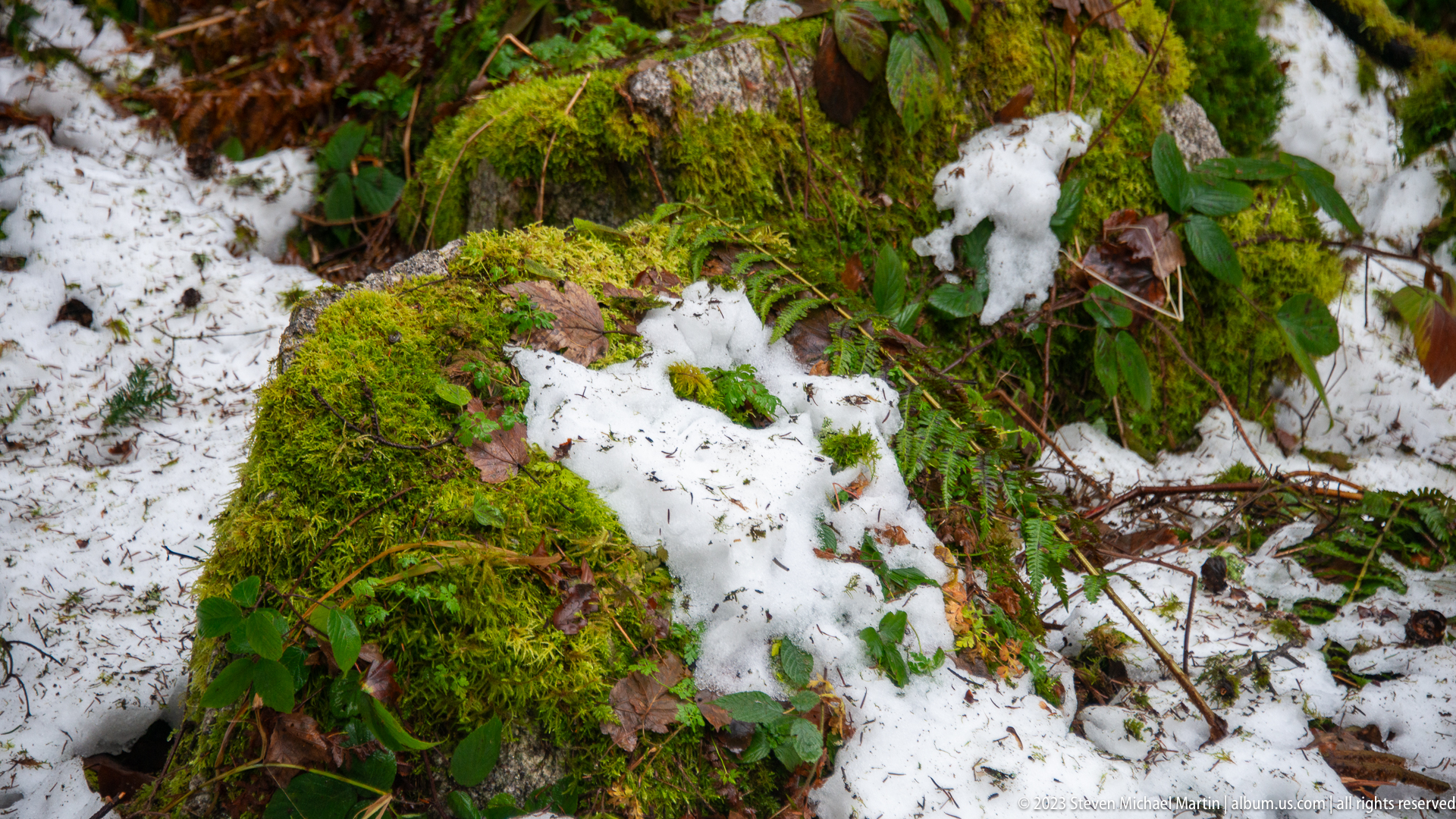
Bright green moss blankets roots and low mounds where irregular patches of melting snow remain among brown leaves and evergreen groundcover. The close ground-level study records a winter transition in the Black Forest, contrasting saturated vegetation with granular white snow. No single landmark dominates; texture, moisture, and seasonal change are the principal subjects.
Caption
Bright green moss blankets roots and low mounds where irregular patches of melting snow remain among brown leaves and evergreen groundcover. The close ground-level study records a winter transition in the Black Forest, contrasting saturated vegetation with granular white snow. No single landmark dominates; texture, moisture, and seasonal change are the principal subjects.
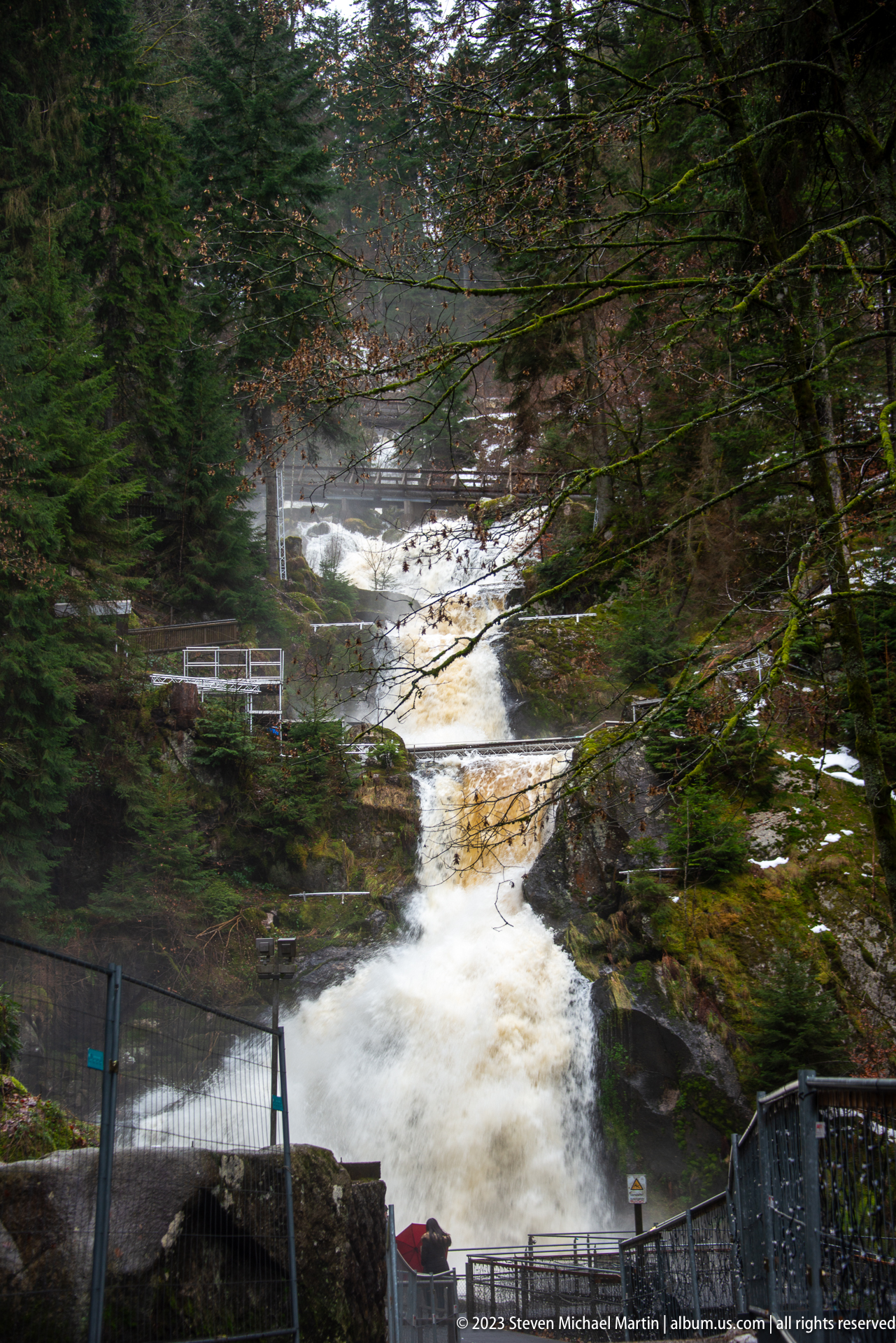
Triberg Waterfalls descend through a steep forested ravine in a succession of broad, foaming cascades. Viewed through evergreen branches, the water occupies the center of the wooded channel while railings and visitor infrastructure trace the slopes beside it. The partially screened viewpoint conveys the falls as a long sequence integrated into dense Black Forest woodland.
Caption
Triberg Waterfalls descend through a steep forested ravine in a succession of broad, foaming cascades. Viewed through evergreen branches, the water occupies the center of the wooded channel while railings and visitor infrastructure trace the slopes beside it. The partially screened viewpoint conveys the falls as a long sequence integrated into dense Black Forest woodland.
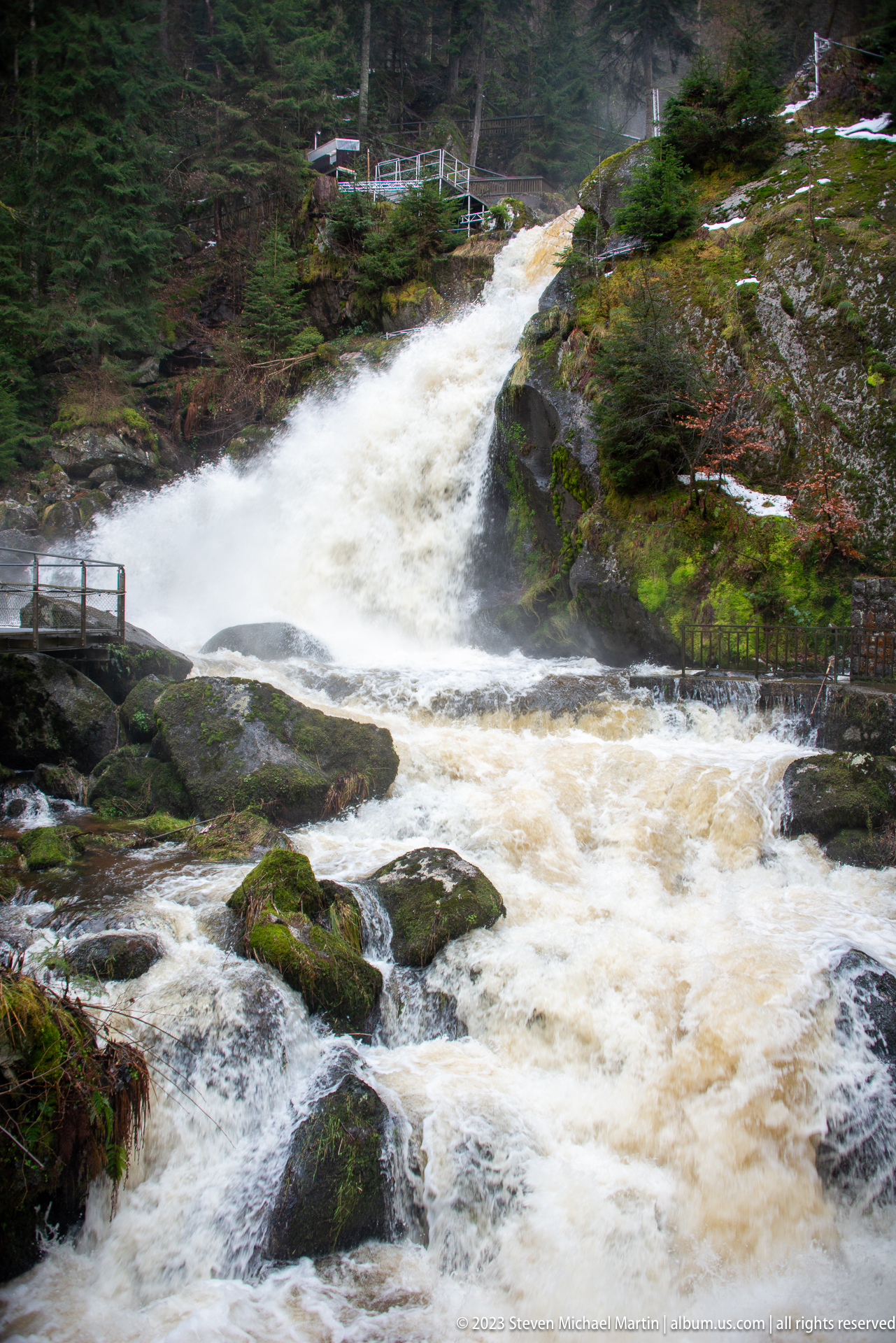
A broad stepped section of Triberg Waterfalls sweeps diagonally through the ravine before spreading into churning water around foreground boulders. Moss-covered rock shelves, evergreen woodland, lingering snow, and metal railings frame the cascade. The wider view reveals both the natural channel and the visitor paths built alongside the falls.
Caption
A broad stepped section of Triberg Waterfalls sweeps diagonally through the ravine before spreading into churning water around foreground boulders. Moss-covered rock shelves, evergreen woodland, lingering snow, and metal railings frame the cascade. The wider view reveals both the natural channel and the visitor paths built alongside the falls.
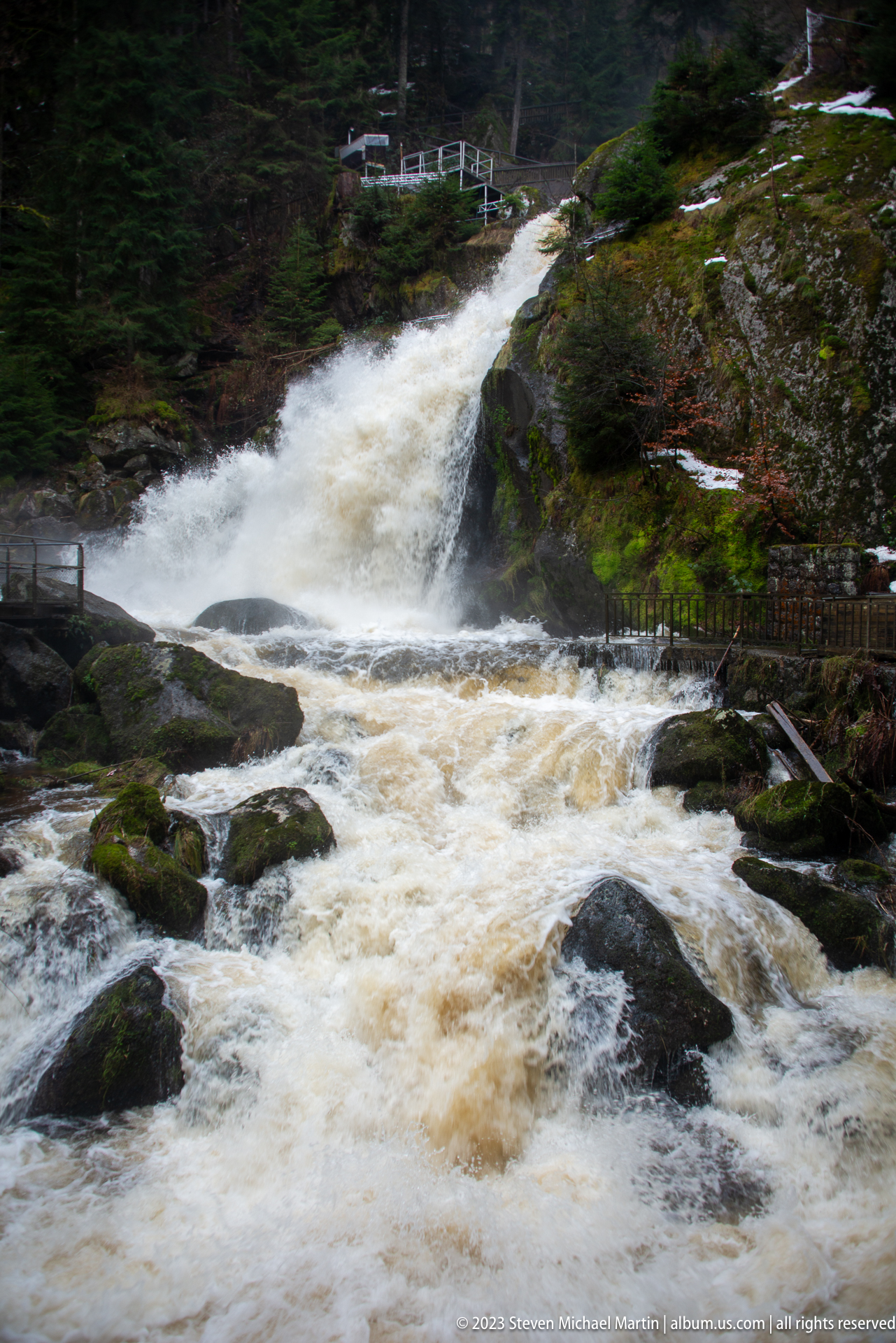
Triberg Waterfalls pour over a low rocky ledge into a wide, turbulent channel, with dark boulders breaking the flow across the foreground. A wooded bank and visitor railing run along the far side. Compared with the preceding view, this lower angle emphasizes the breadth of the rushing water and the layered rock steps rather than the height of the drop.
Caption
Triberg Waterfalls pour over a low rocky ledge into a wide, turbulent channel, with dark boulders breaking the flow across the foreground. A wooded bank and visitor railing run along the far side. Compared with the preceding view, this lower angle emphasizes the breadth of the rushing water and the layered rock steps rather than the height of the drop.
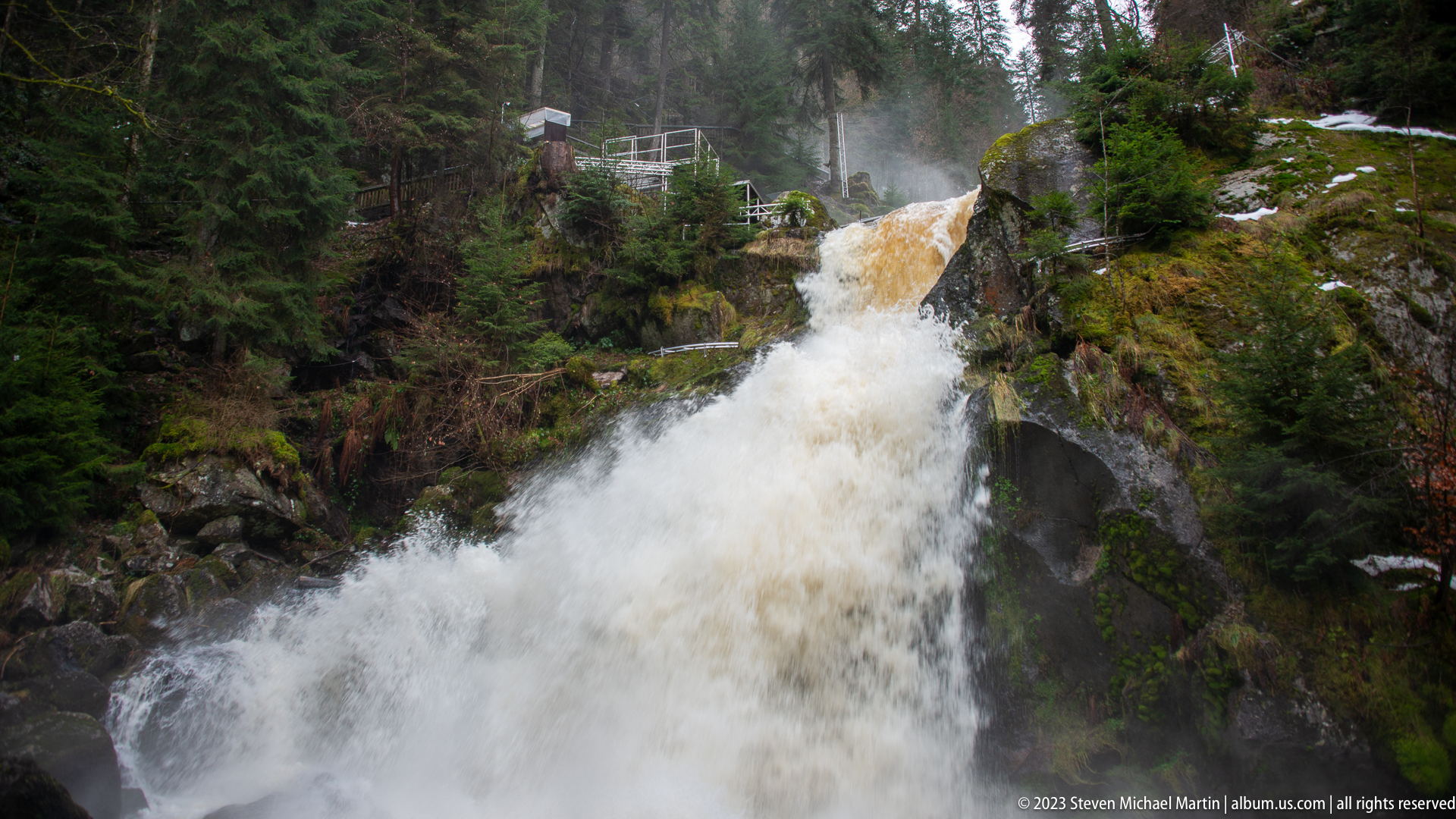
A powerful section of Triberg Waterfalls plunges between dark rock walls, exploding into white spray as it drops through the forested ravine. Moss clings to exposed stone and patches of snow remain on the banks, while a railing and path above reveal the visitor route. The close perspective stresses the force and vertical drop of the cascade.
Caption
A powerful section of Triberg Waterfalls plunges between dark rock walls, exploding into white spray as it drops through the forested ravine. Moss clings to exposed stone and patches of snow remain on the banks, while a railing and path above reveal the visitor route. The close perspective stresses the force and vertical drop of the cascade.
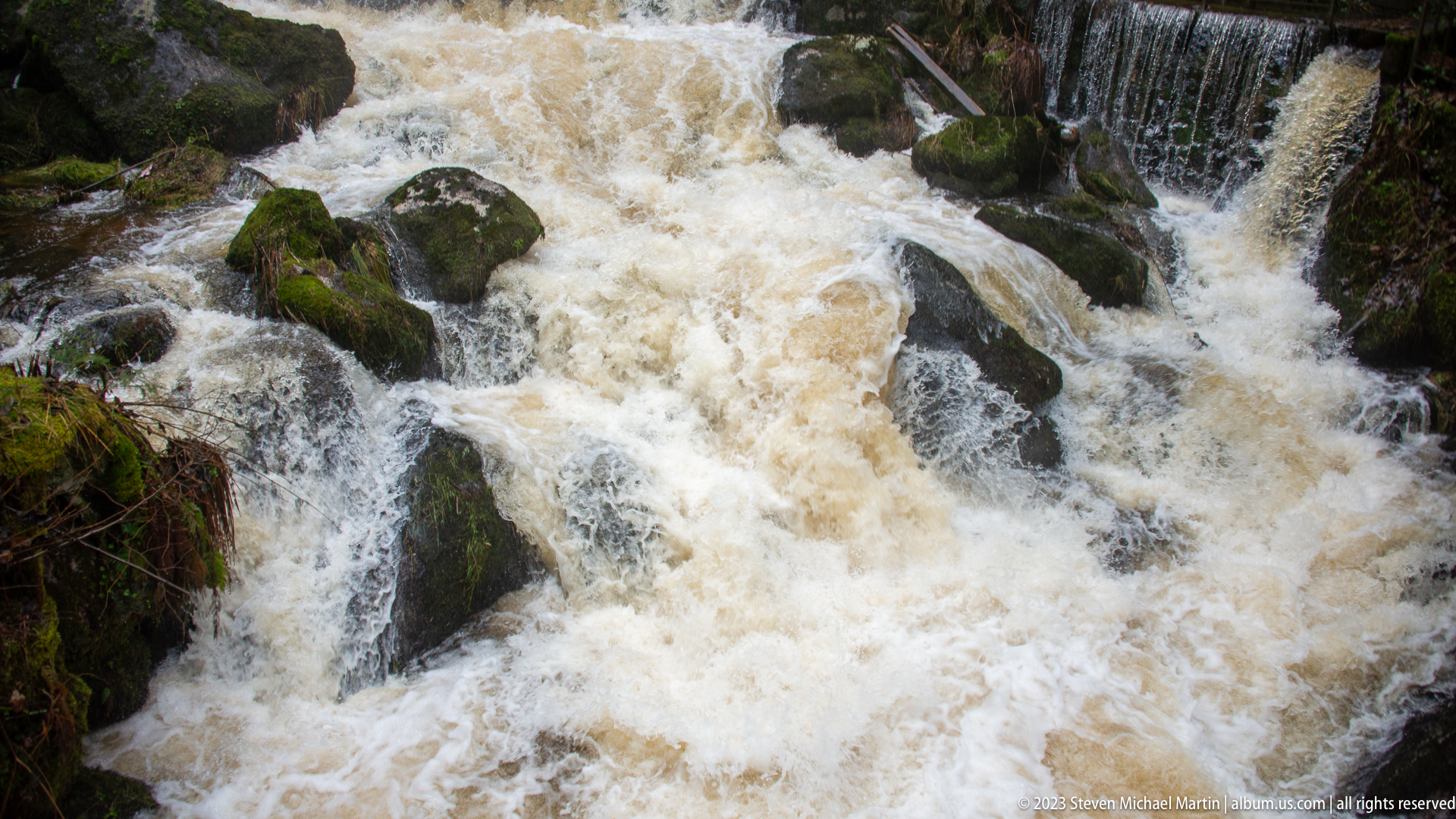
Foaming water surges through a jumble of dark, moss-edged boulders at Triberg Waterfalls, filling nearly the entire frame. A smaller curtain of water enters at upper right, adding a second flow to the turbulent channel. The tight composition removes most surrounding landscape and concentrates on water movement, rock texture, and winter runoff.
Caption
Foaming water surges through a jumble of dark, moss-edged boulders at Triberg Waterfalls, filling nearly the entire frame. A smaller curtain of water enters at upper right, adding a second flow to the turbulent channel. The tight composition removes most surrounding landscape and concentrates on water movement, rock texture, and winter runoff.
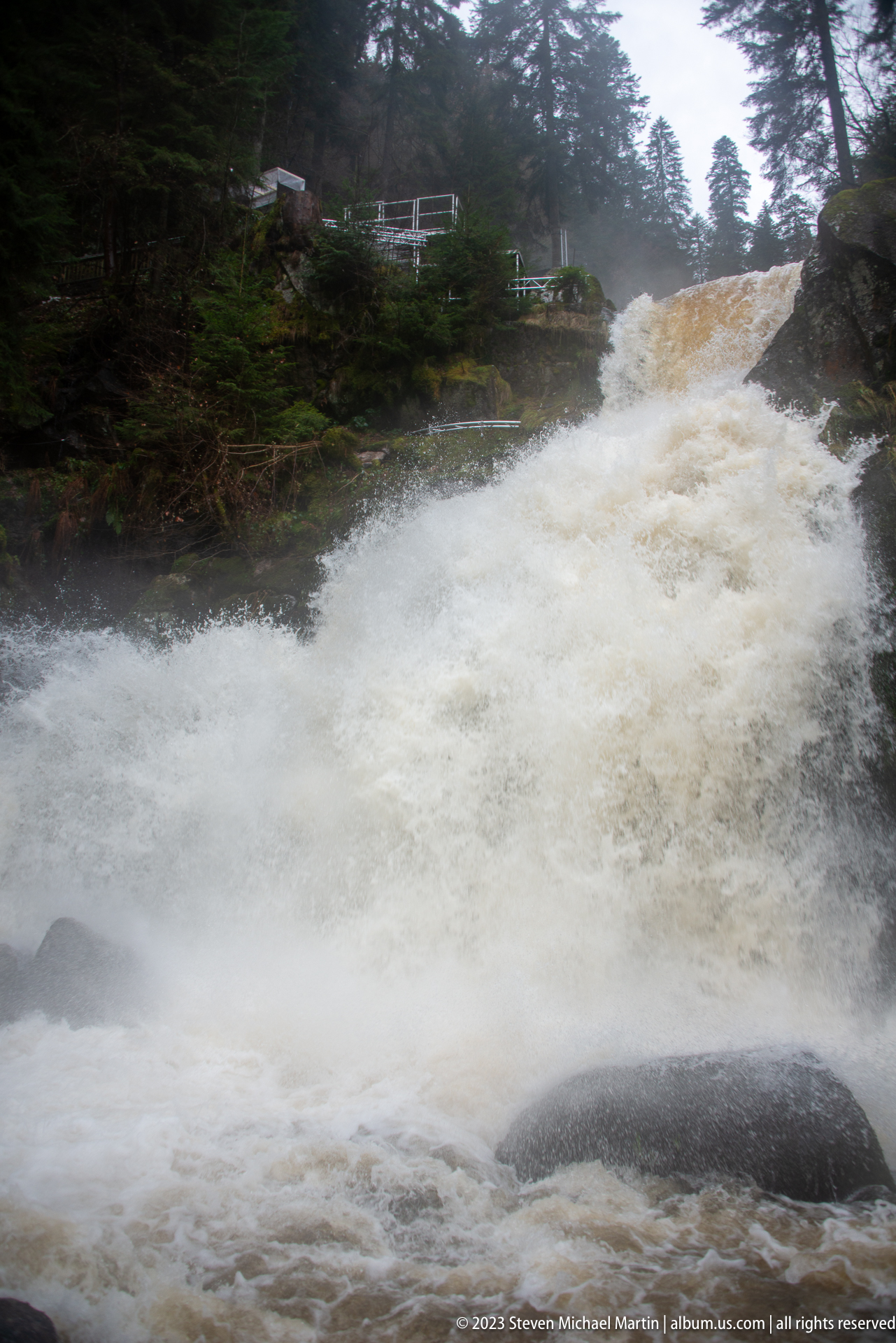
A wide rush of water fills the lower Triberg cascade, its surface blurred by speed and a veil of misty spray. Dark rock margins and a forested bank frame the pale torrent, while a railing high in the background marks the visitor path. Moisture in the air softens distant detail and conveys the force of the winter flow.
Caption
A wide rush of water fills the lower Triberg cascade, its surface blurred by speed and a veil of misty spray. Dark rock margins and a forested bank frame the pale torrent, while a railing high in the background marks the visitor path. Moisture in the air softens distant detail and conveys the force of the winter flow.
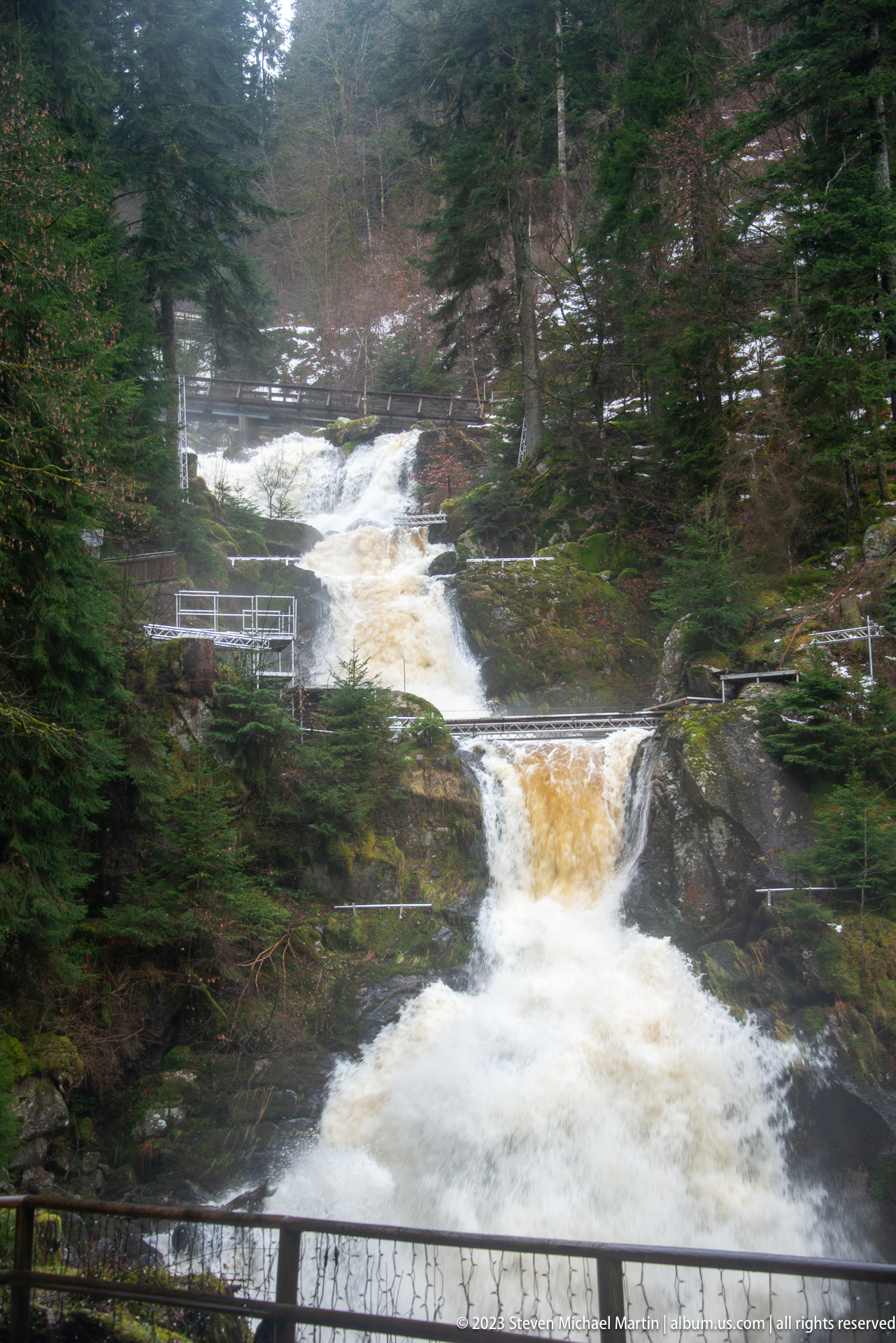
Whitewater drops through several rocky tiers in dense evergreen forest, with railings and a footbridge marking a developed visitor route. The high flow turns the cascade pale with foam, while dark conifers and wet rock frame the falls. The view emphasizes the stepped character of the watercourse and the close relationship between the waterfall and the Black Forest trail infrastructure.
Caption
Whitewater drops through several rocky tiers in dense evergreen forest, with railings and a footbridge marking a developed visitor route. The high flow turns the cascade pale with foam, while dark conifers and wet rock frame the falls. The view emphasizes the stepped character of the watercourse and the close relationship between the waterfall and the Black Forest trail infrastructure.
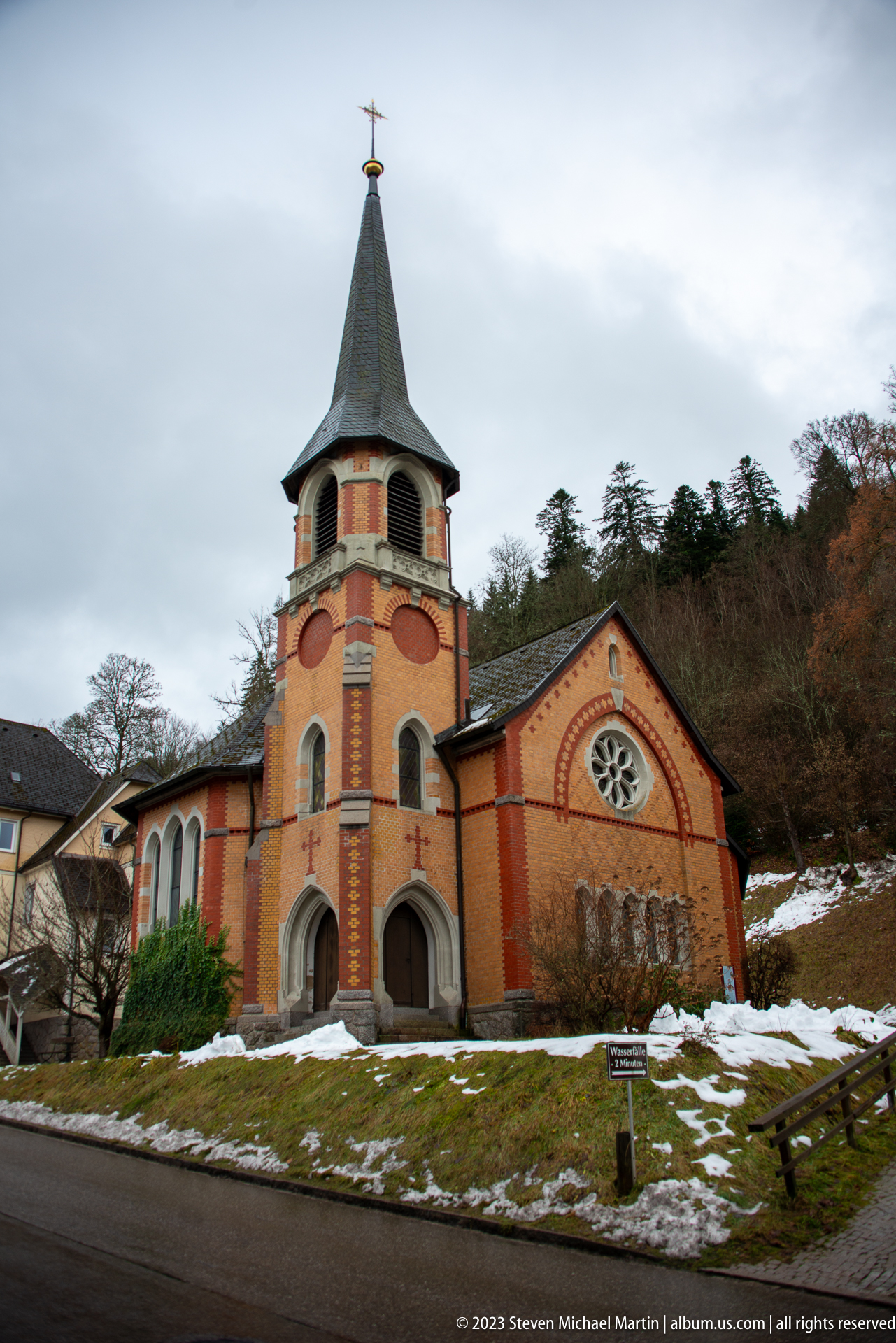
A compact brick church stands against a wooded hillside with patchy snow in the foreground. Its square bell tower rises to a steep pyramidal roof, while the adjoining gable is organized around a circular rose window and a row of arched openings. Contrasting brick bands, pale stone trim, and paired arches give the façade a strongly articulated historic character without requiring a specific church identification.
Caption
A compact brick church stands against a wooded hillside with patchy snow in the foreground. Its square bell tower rises to a steep pyramidal roof, while the adjoining gable is organized around a circular rose window and a row of arched openings. Contrasting brick bands, pale stone trim, and paired arches give the façade a strongly articulated historic character without requiring a specific church identification.
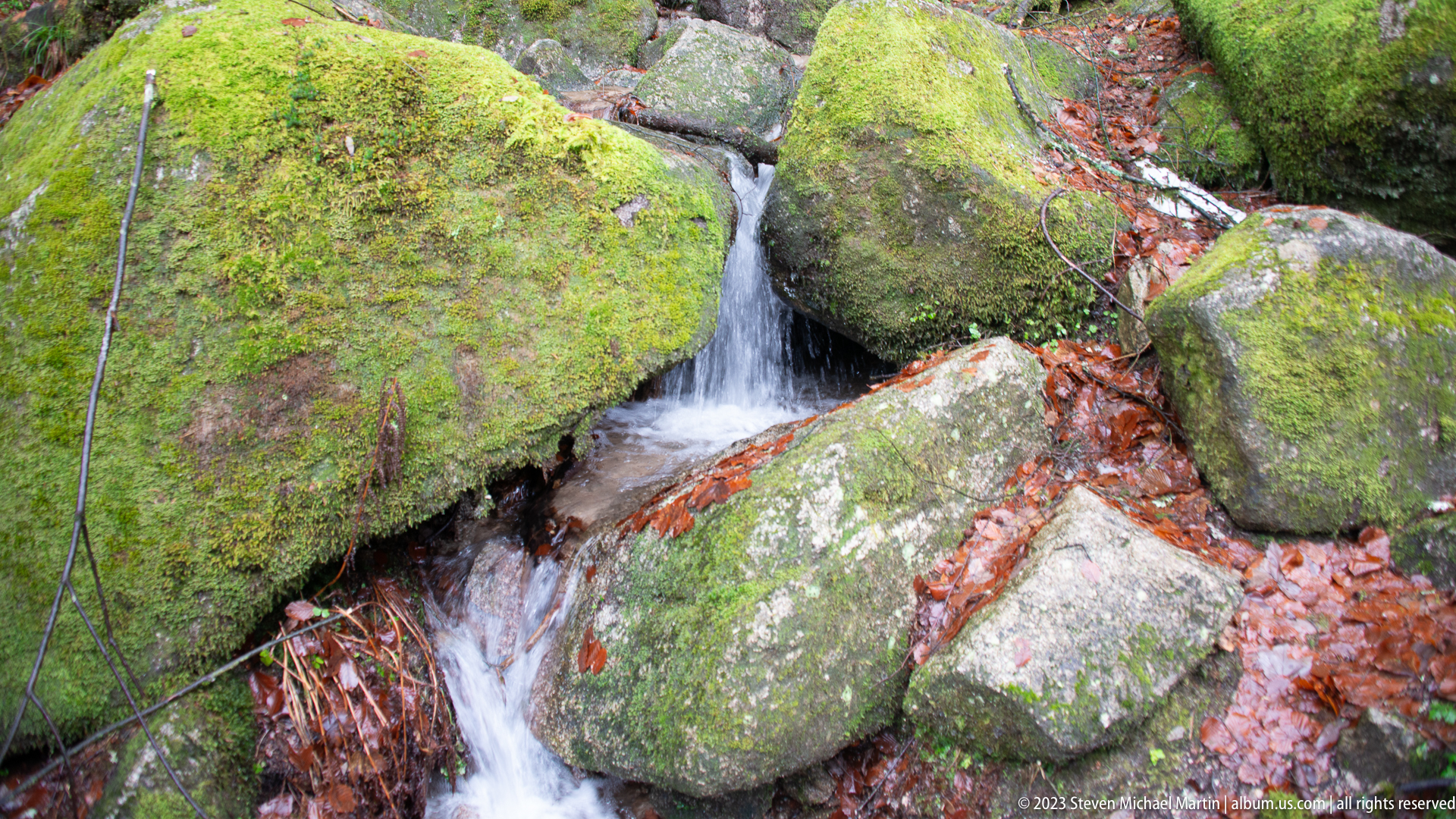
A narrow rush of water squeezes between large rounded boulders coated in vivid green moss, then spills toward the foreground through leaf litter and wet stone. The close viewpoint removes most surrounding landscape, concentrating attention on texture: saturated moss, orange-brown leaves, gray rock, and the bright ribbon of moving water characteristic of a shaded Black Forest stream.
Caption
A narrow rush of water squeezes between large rounded boulders coated in vivid green moss, then spills toward the foreground through leaf litter and wet stone. The close viewpoint removes most surrounding landscape, concentrating attention on texture: saturated moss, orange-brown leaves, gray rock, and the bright ribbon of moving water characteristic of a shaded Black Forest stream.
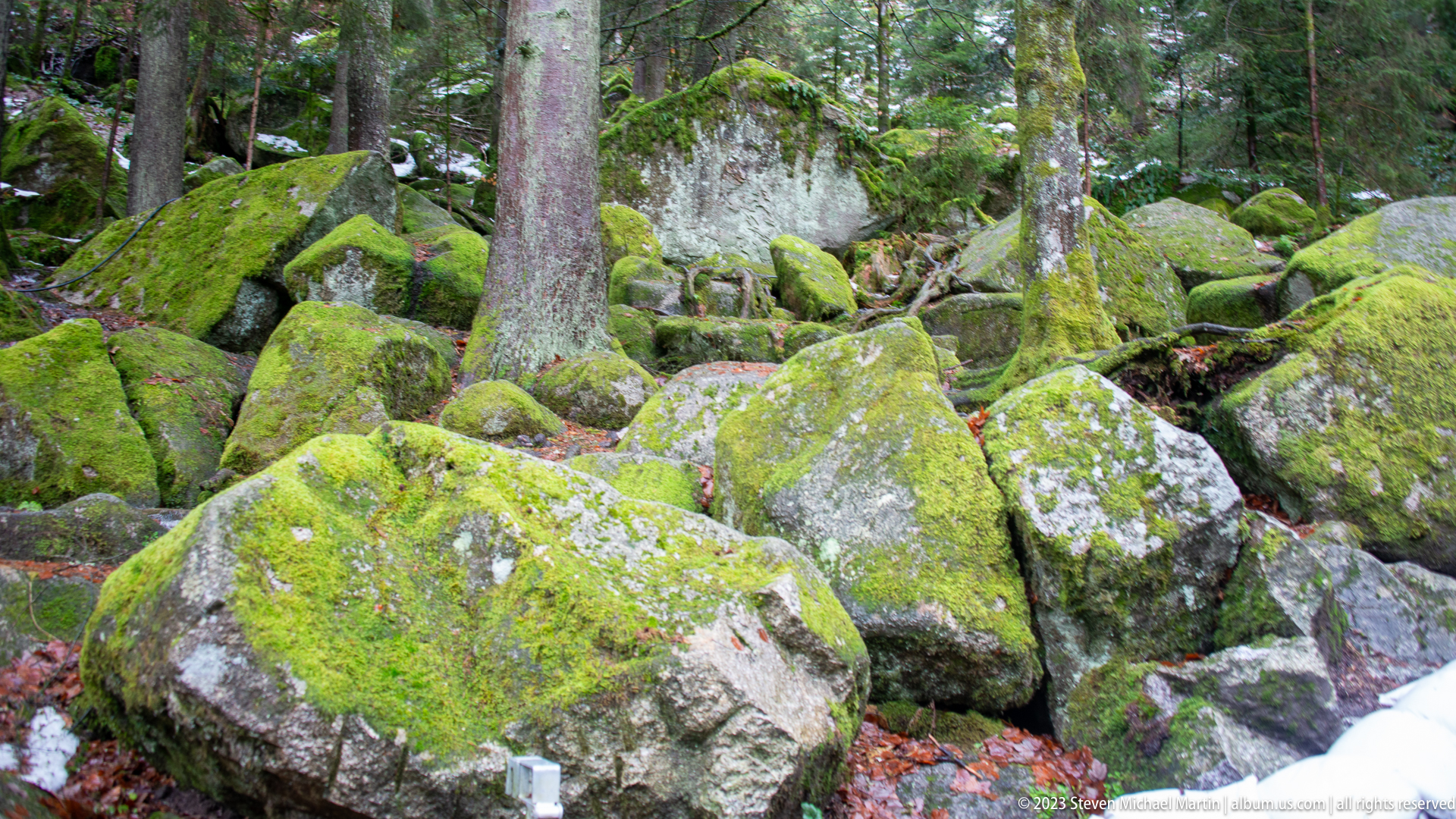
Large angular and rounded boulders carpeted with thick green moss fill the forest floor beneath mature conifers. Trunks rise among the rocks while patches of snow and damp leaves remain in the shaded gaps. The photograph reads as a natural-history detail of the Black Forest understory, where moisture and limited winter light support dense moss growth across exposed stone.
Caption
Large angular and rounded boulders carpeted with thick green moss fill the forest floor beneath mature conifers. Trunks rise among the rocks while patches of snow and damp leaves remain in the shaded gaps. The photograph reads as a natural-history detail of the Black Forest understory, where moisture and limited winter light support dense moss growth across exposed stone.
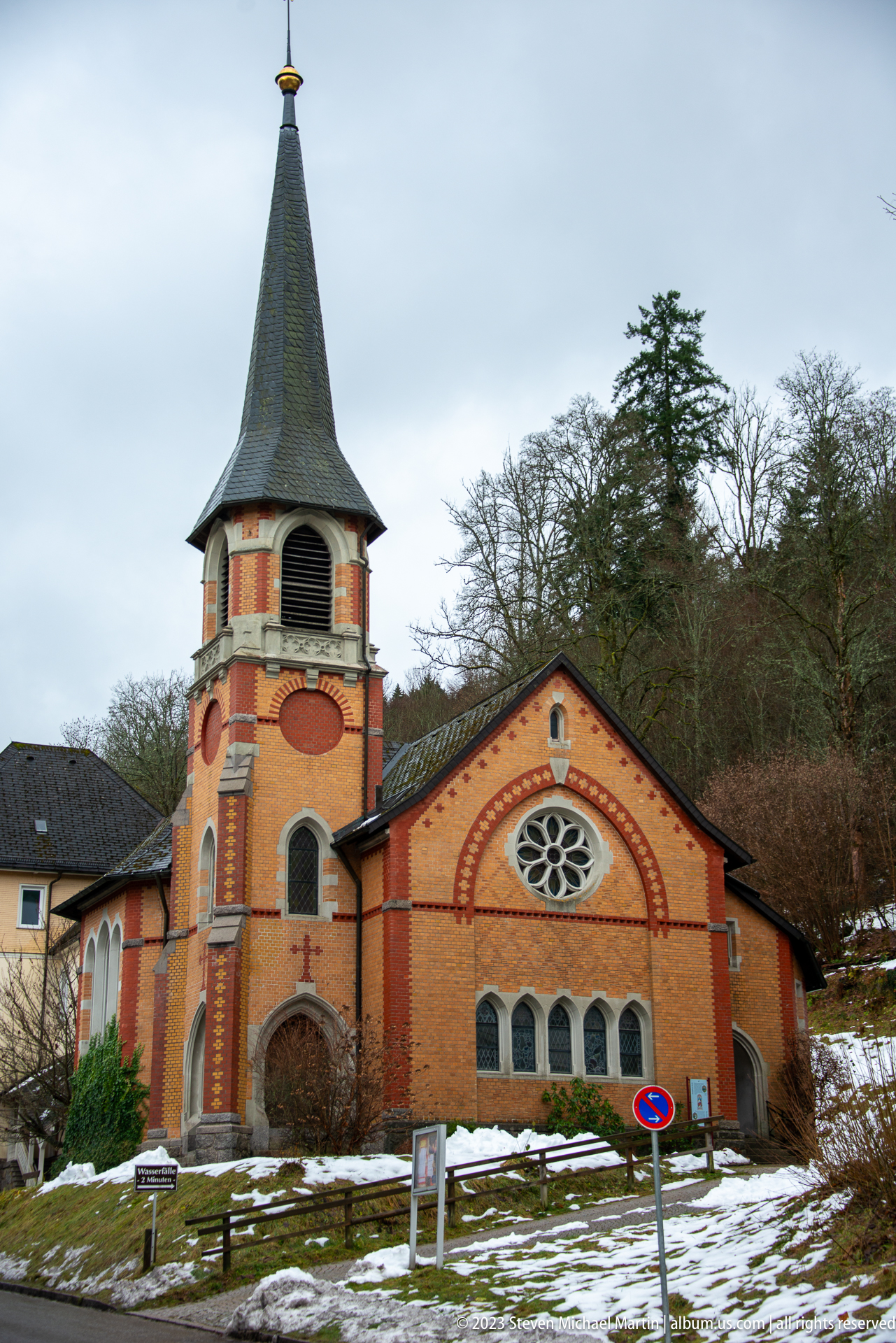
The church is seen more frontally across a snow-edged roadside, clarifying the relationship between its square tower and broad gabled nave. A circular rose window centers the main gable above a row of arched openings, while the tower is capped by a steep slate-colored roof. This wider winter view records the complete façade composition and its wooded Black Forest setting.
Caption
The church is seen more frontally across a snow-edged roadside, clarifying the relationship between its square tower and broad gabled nave. A circular rose window centers the main gable above a row of arched openings, while the tower is capped by a steep slate-colored roof. This wider winter view records the complete façade composition and its wooded Black Forest setting.
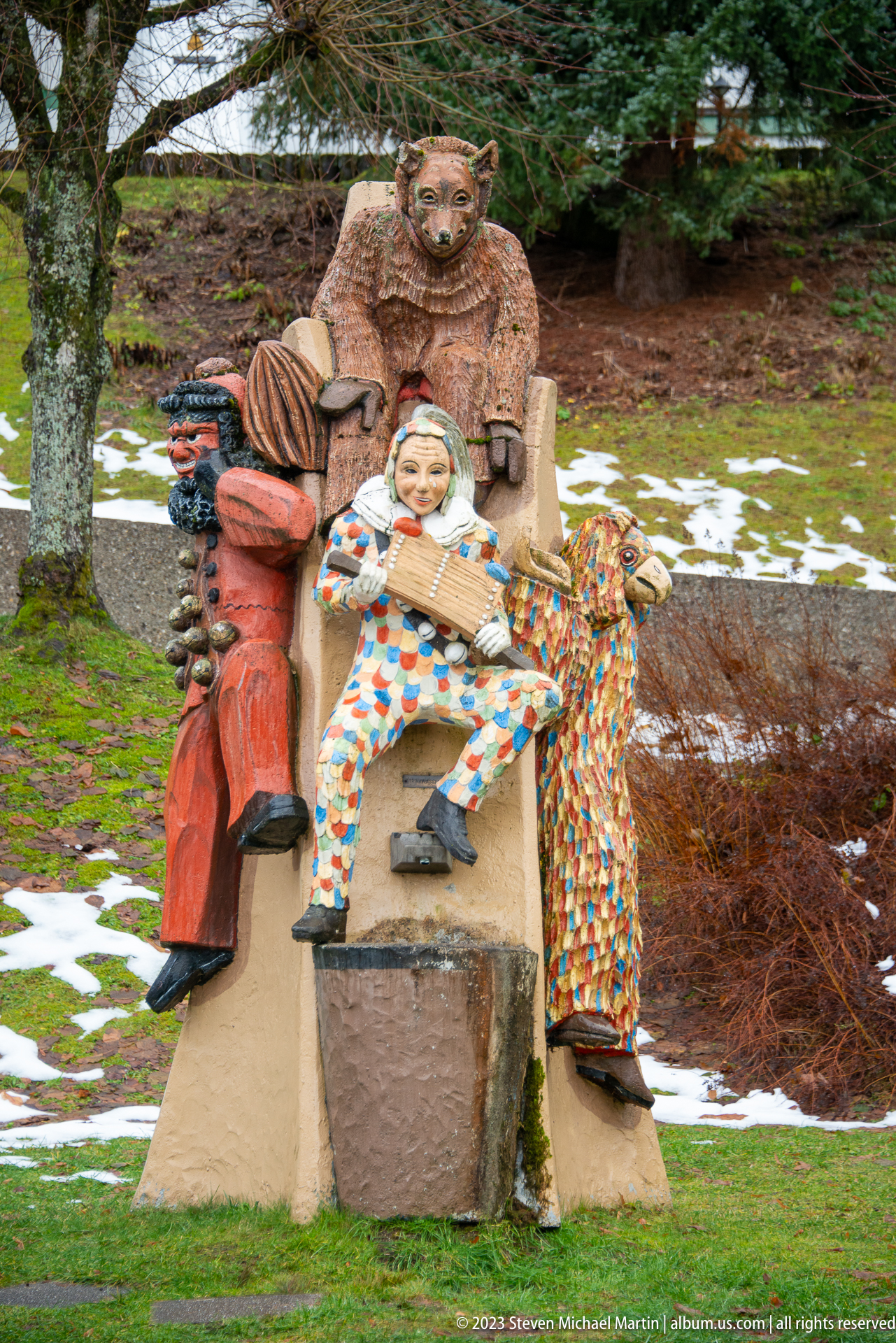
A group of carved or modeled figures sits outdoors on a low sculptural base: a bearded adult at the rear and smaller figures in brightly patterned, carnival-like clothing in front. Snow lingers on the surrounding lawn beneath evergreens. The playful costume colors and exaggerated forms suggest a local folkloric or festive display, though the precise characters cannot be determined from the proof sheet alone.
Caption
A group of carved or modeled figures sits outdoors on a low sculptural base: a bearded adult at the rear and smaller figures in brightly patterned, carnival-like clothing in front. Snow lingers on the surrounding lawn beneath evergreens. The playful costume colors and exaggerated forms suggest a local folkloric or festive display, though the precise characters cannot be determined from the proof sheet alone.
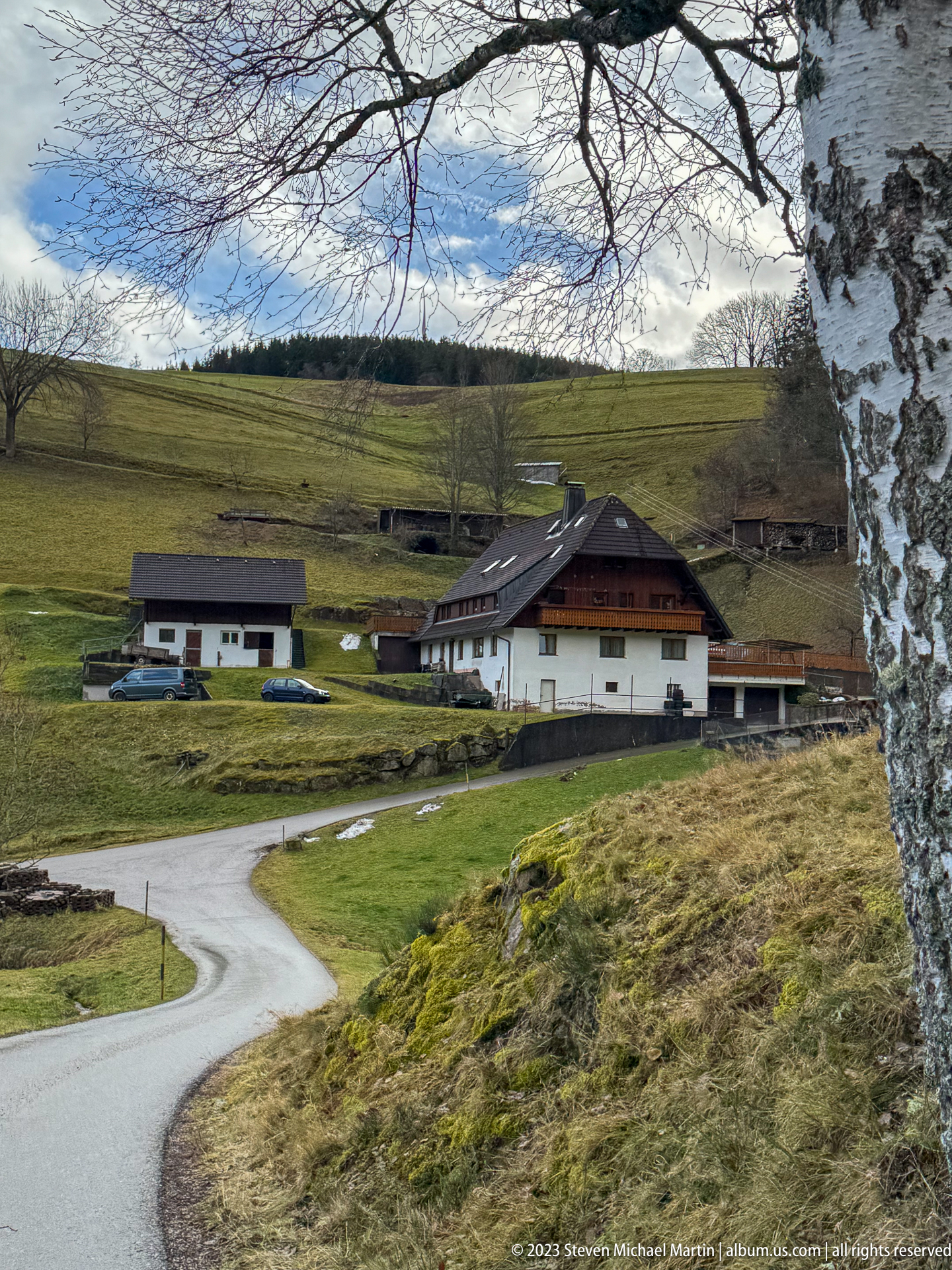
A white farmhouse and long low outbuilding sit beside a curving country road amid open pasture. A birch trunk frames the right foreground, while leafless trees and dark evergreen woodland line the distant horizon. The low winter light and muted grass create a transitional landscape between working farmland and the forested uplands characteristic of the Black Forest region.
Caption
A white farmhouse and long low outbuilding sit beside a curving country road amid open pasture. A birch trunk frames the right foreground, while leafless trees and dark evergreen woodland line the distant horizon. The low winter light and muted grass create a transitional landscape between working farmland and the forested uplands characteristic of the Black Forest region.
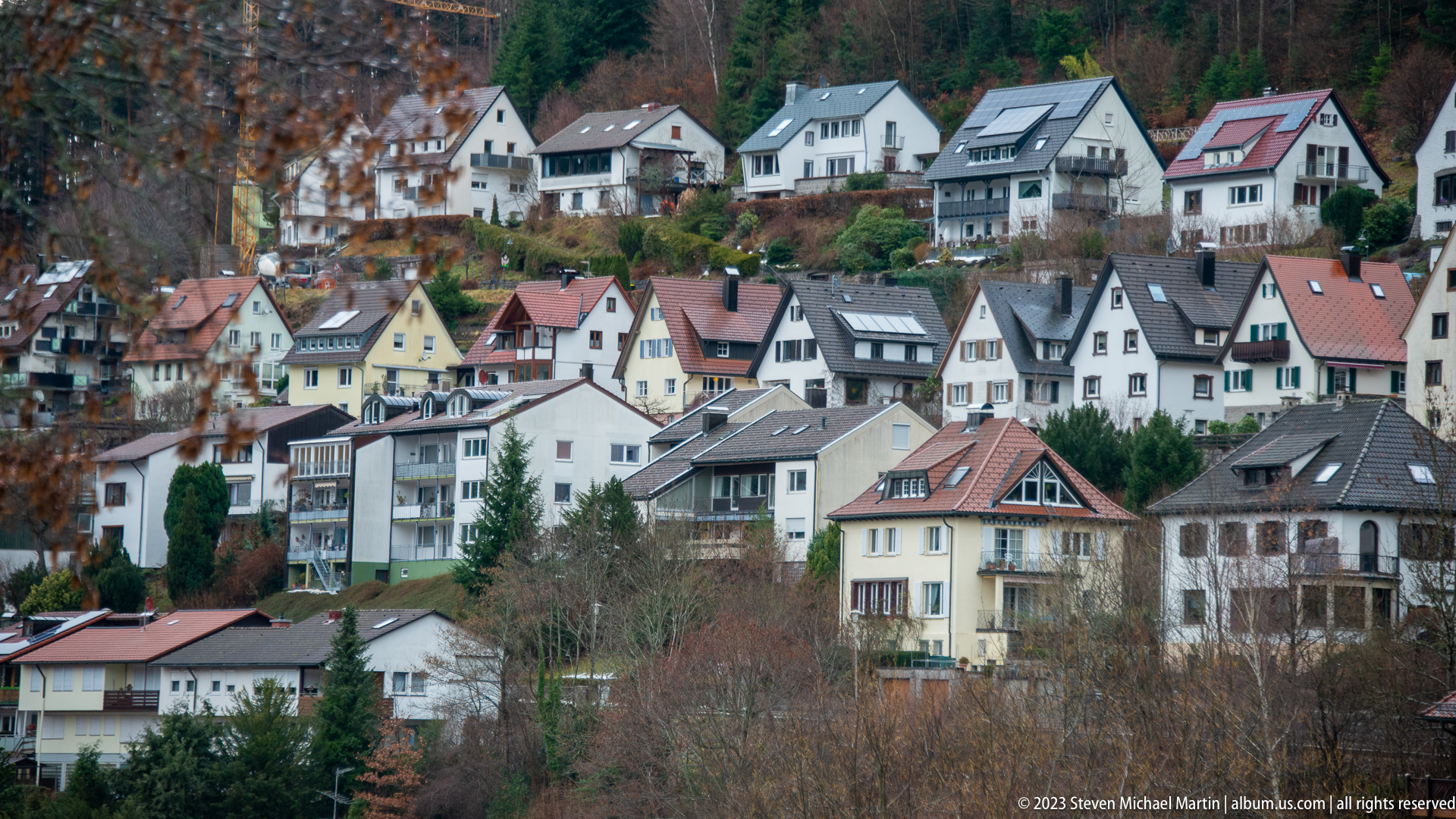
Rows of closely spaced houses climb a steep hillside, their pale façades and red, gray, and dark roofs stepping upward toward the forest edge. Balconies, dormers, and varied roof pitches create a dense village texture rather than a single landmark view. The compressed perspective emphasizes how settlement occupies the lower slopes beneath the wooded Black Forest uplands.
Caption
Rows of closely spaced houses climb a steep hillside, their pale façades and red, gray, and dark roofs stepping upward toward the forest edge. Balconies, dormers, and varied roof pitches create a dense village texture rather than a single landmark view. The compressed perspective emphasizes how settlement occupies the lower slopes beneath the wooded Black Forest uplands.
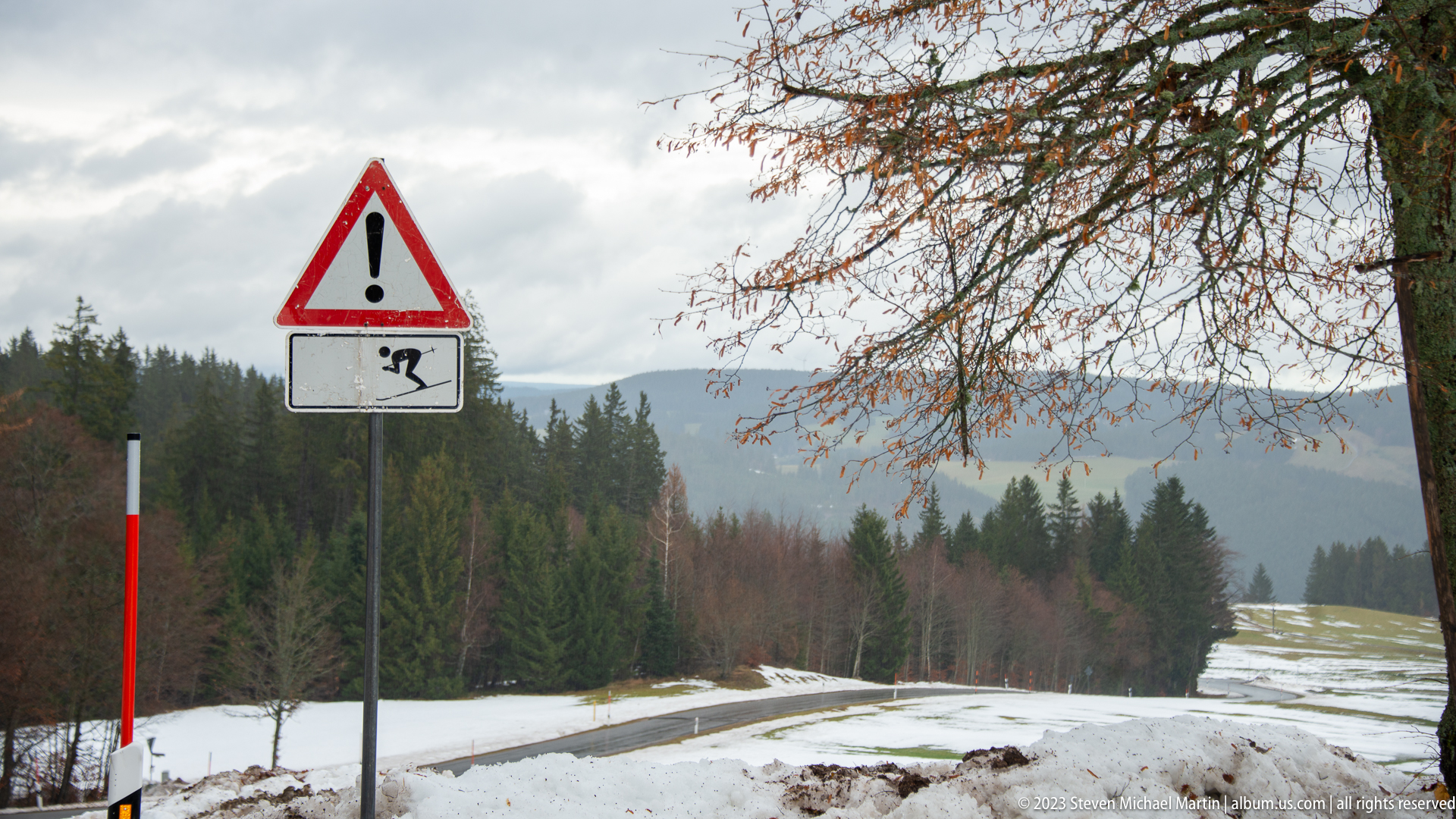
A triangular warning sign with an exclamation mark stands beside a narrow road bordered by snow. A supplementary panel below depicts a skidding figure or vehicle hazard, while red-and-white roadside markers punctuate the edge. Beyond, dark conifers and a hazy ridge recede under a gray winter sky, underscoring the variable driving conditions of the higher Black Forest landscape.
Caption
A triangular warning sign with an exclamation mark stands beside a narrow road bordered by snow. A supplementary panel below depicts a skidding figure or vehicle hazard, while red-and-white roadside markers punctuate the edge. Beyond, dark conifers and a hazy ridge recede under a gray winter sky, underscoring the variable driving conditions of the higher Black Forest landscape.
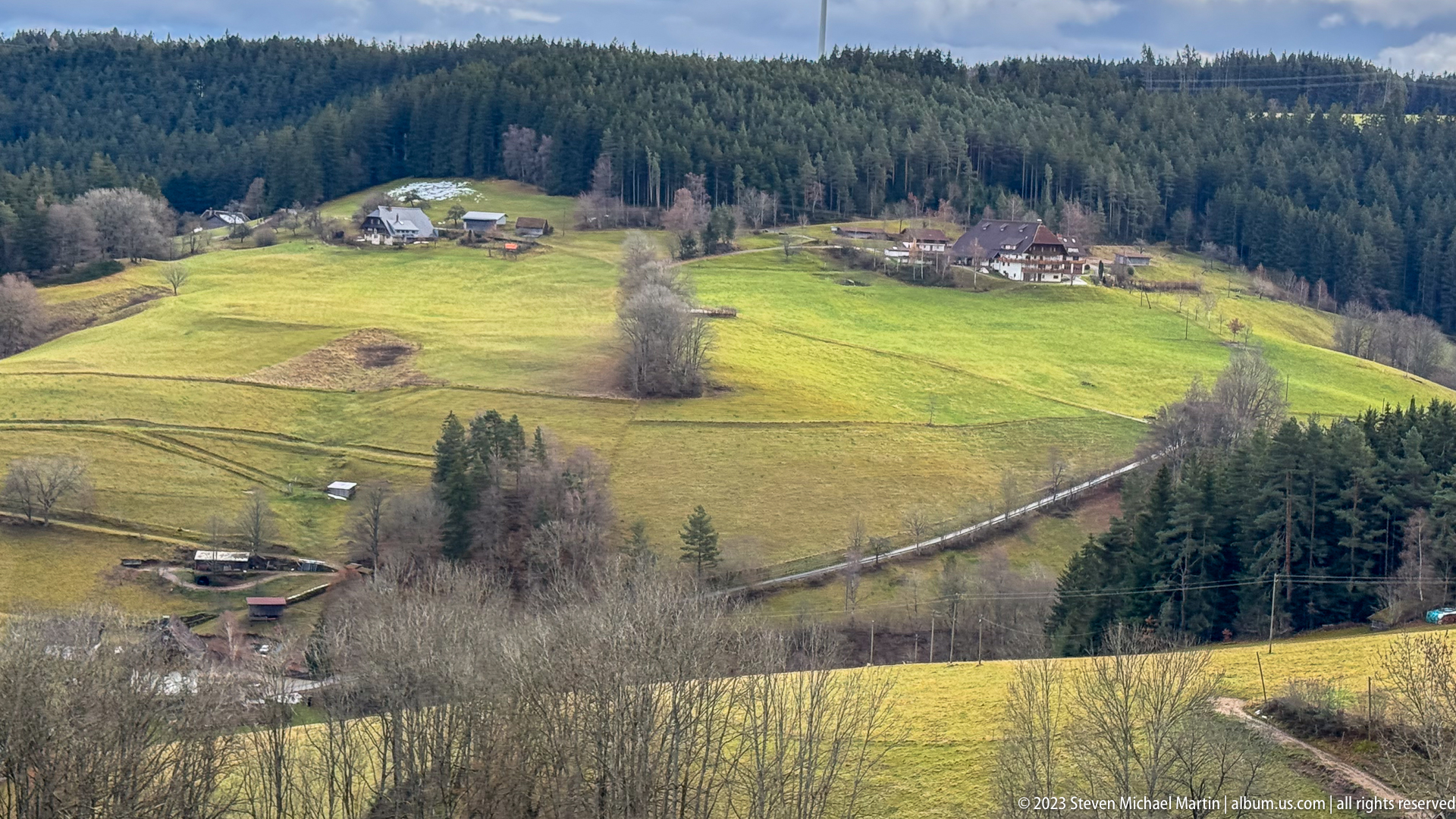
Rolling fields spread across a shallow valley, divided by lanes, hedges, and scattered farmsteads before rising into dense conifer woodland. The vivid green pasture contrasts with leafless deciduous trees and the darker forest boundary. Seen from an elevated viewpoint, the composition records the mosaic of agriculture, settlement, and managed woodland that shapes much of the inhabited Black Forest countryside.
Caption
Rolling fields spread across a shallow valley, divided by lanes, hedges, and scattered farmsteads before rising into dense conifer woodland. The vivid green pasture contrasts with leafless deciduous trees and the darker forest boundary. Seen from an elevated viewpoint, the composition records the mosaic of agriculture, settlement, and managed woodland that shapes much of the inhabited Black Forest countryside.
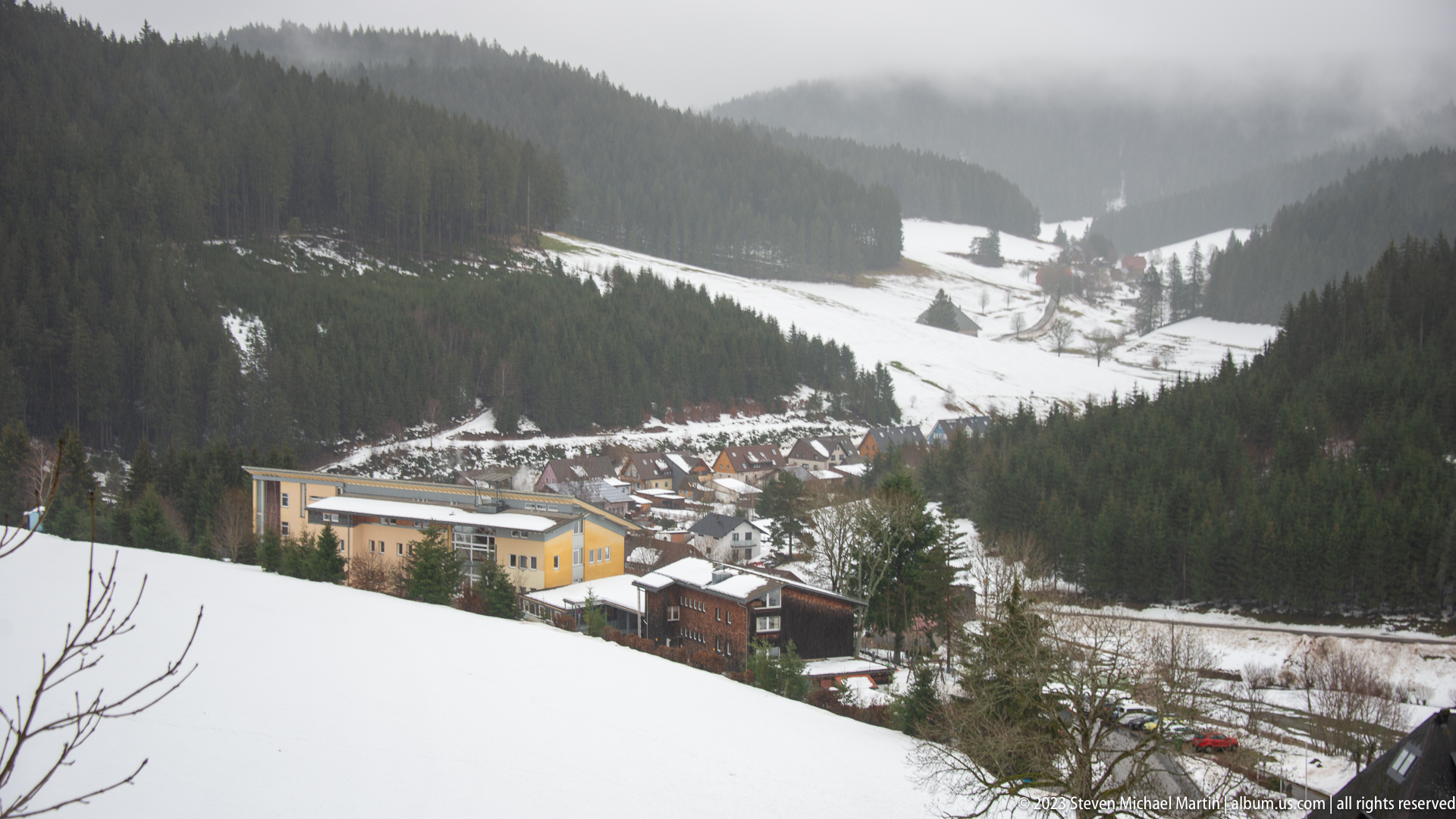
A compact group of village buildings occupies the lower slope beneath broad snow-covered meadows and dark evergreen forest. A large pale-yellow building and several steep-roofed houses anchor the foreground, while mist closes in around the upper valley. This closer view shifts attention from the overall valley form to the settlement’s position between cleared winter fields and dense Black Forest woodland.
Caption
A compact group of village buildings occupies the lower slope beneath broad snow-covered meadows and dark evergreen forest. A large pale-yellow building and several steep-roofed houses anchor the foreground, while mist closes in around the upper valley. This closer view shifts attention from the overall valley form to the settlement’s position between cleared winter fields and dense Black Forest woodland.
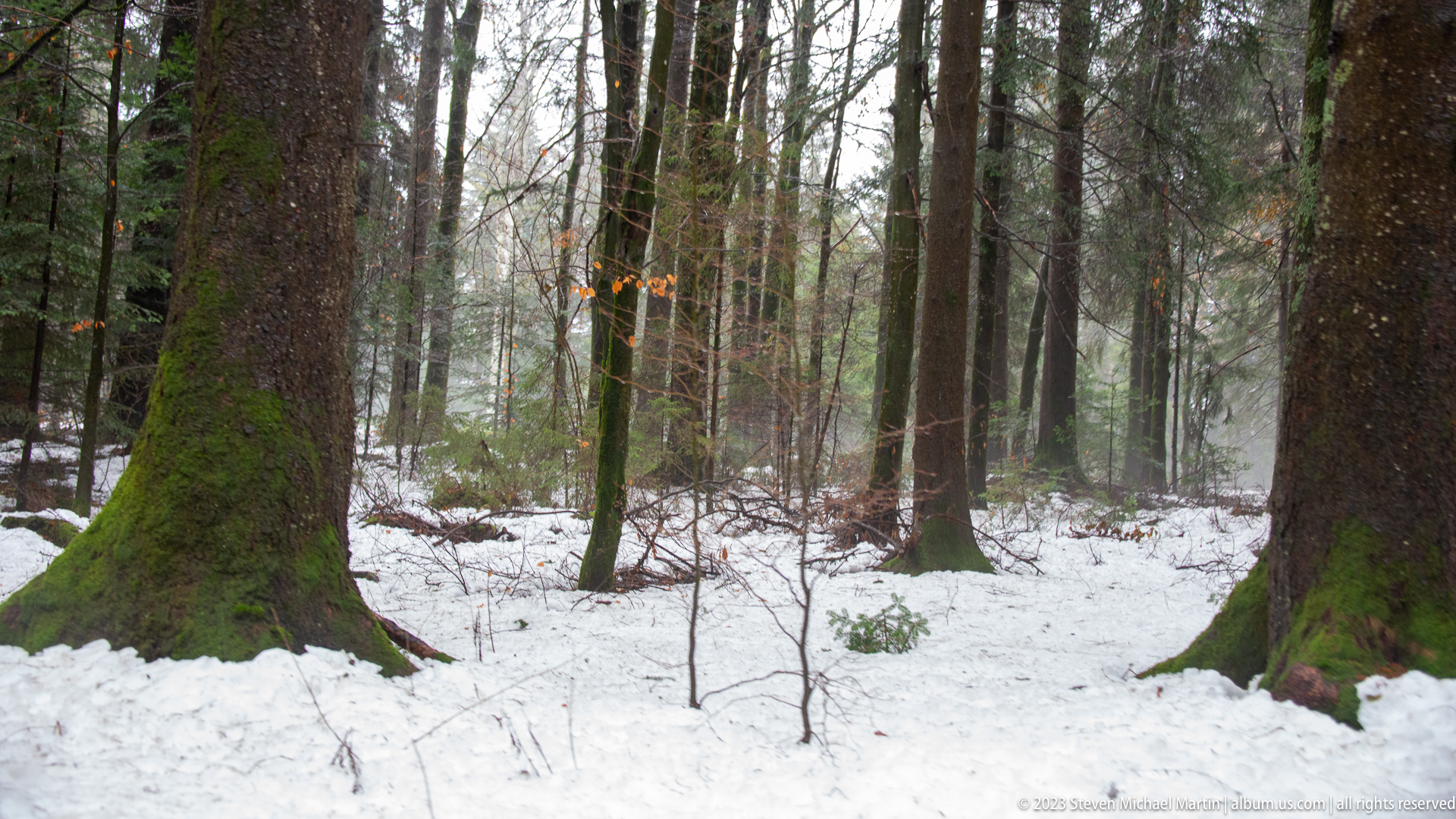
Snow blankets the forest floor between mature trunks, while moss climbs the bases of several large trees. Sparse orange leaves remain on smaller deciduous branches, adding color to the otherwise subdued winter palette. The eye is drawn into the evenly spaced woodland interior, where the combination of snow, moss, conifers, and bare understory conveys a damp, cold-season Black Forest environment.
Caption
Snow blankets the forest floor between mature trunks, while moss climbs the bases of several large trees. Sparse orange leaves remain on smaller deciduous branches, adding color to the otherwise subdued winter palette. The eye is drawn into the evenly spaced woodland interior, where the combination of snow, moss, conifers, and bare understory conveys a damp, cold-season Black Forest environment.
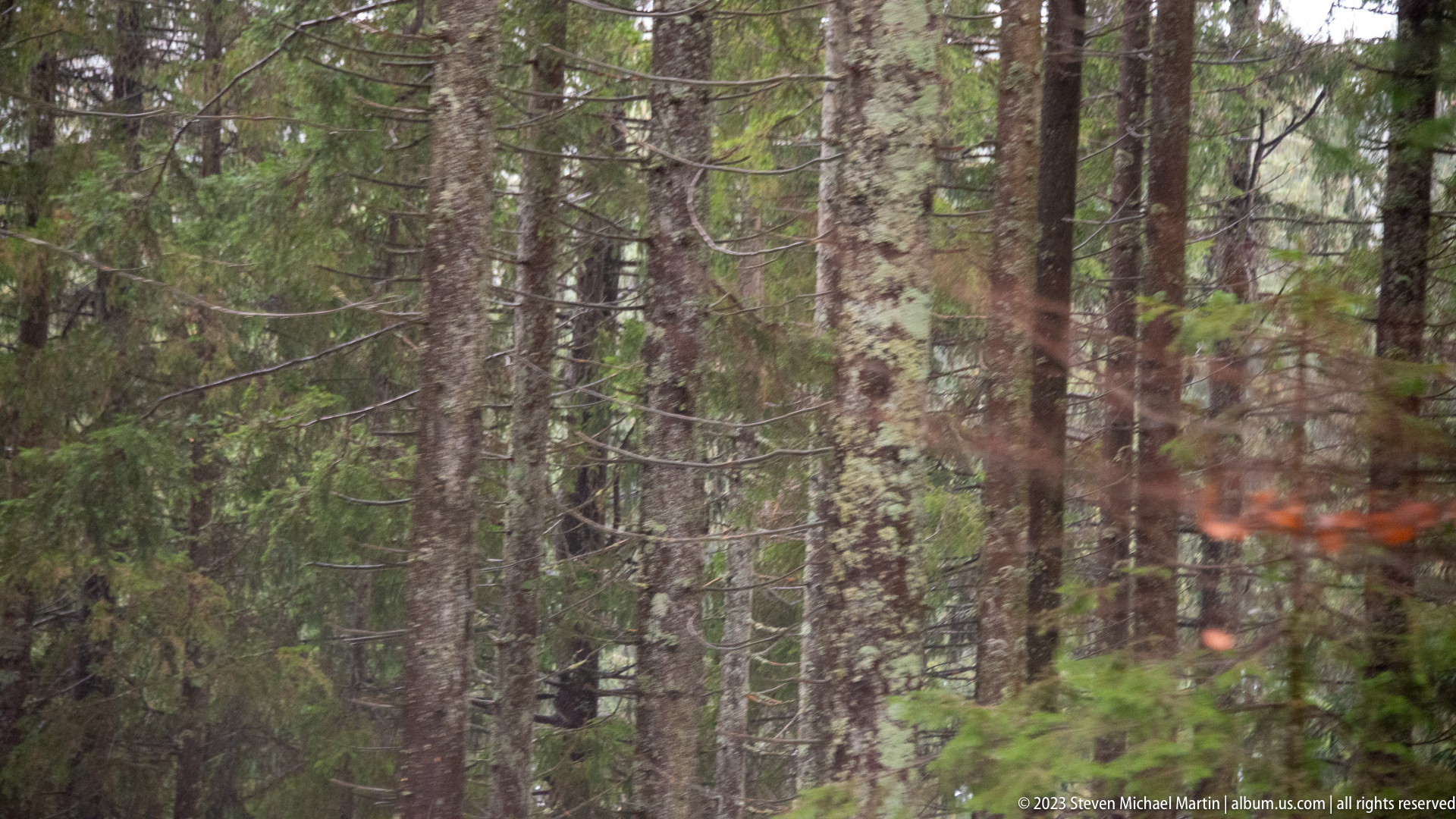
Straight evergreen trunks rise in close succession through a dense forest stand, their lower branches sparse beneath a high, shaded canopy. Moss and lichen soften some bark surfaces, while isolated orange-brown leaves from deciduous understory plants break the green-gray palette. The tight framing concentrates on vertical rhythm and stand density rather than on a broader landscape or landmark.
Caption
Straight evergreen trunks rise in close succession through a dense forest stand, their lower branches sparse beneath a high, shaded canopy. Moss and lichen soften some bark surfaces, while isolated orange-brown leaves from deciduous understory plants break the green-gray palette. The tight framing concentrates on vertical rhythm and stand density rather than on a broader landscape or landmark.
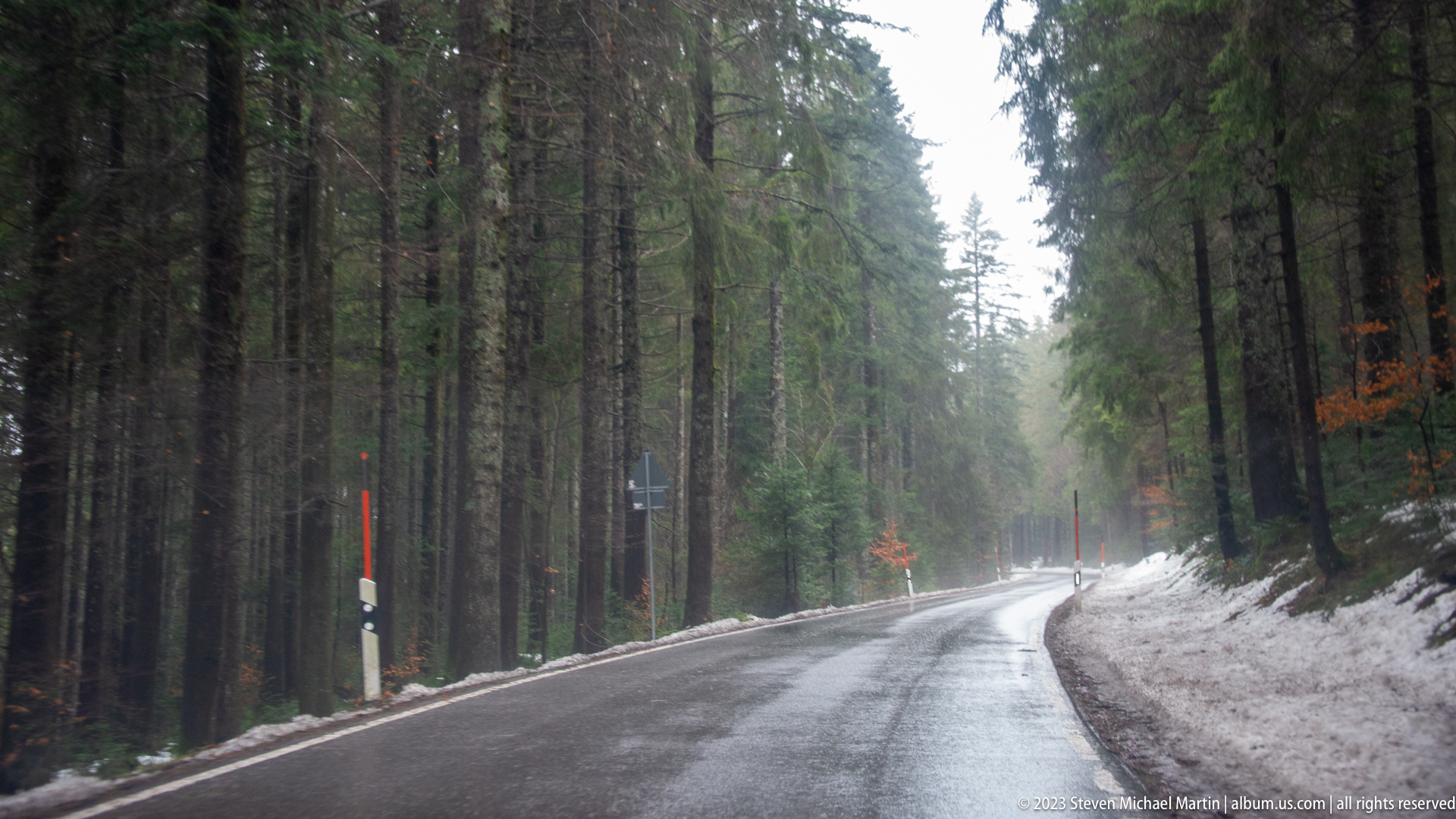
A wet two-lane road curves gently through tall conifers, its dark pavement reflecting the overcast sky. Snow remains along both shoulders and climbs the wooded banks, while red-and-white roadside markers repeat into the distance. The road provides a strong linear passage through the forest and conveys the winter travel conditions of the higher Black Forest.
Caption
A wet two-lane road curves gently through tall conifers, its dark pavement reflecting the overcast sky. Snow remains along both shoulders and climbs the wooded banks, while red-and-white roadside markers repeat into the distance. The road provides a strong linear passage through the forest and conveys the winter travel conditions of the higher Black Forest.
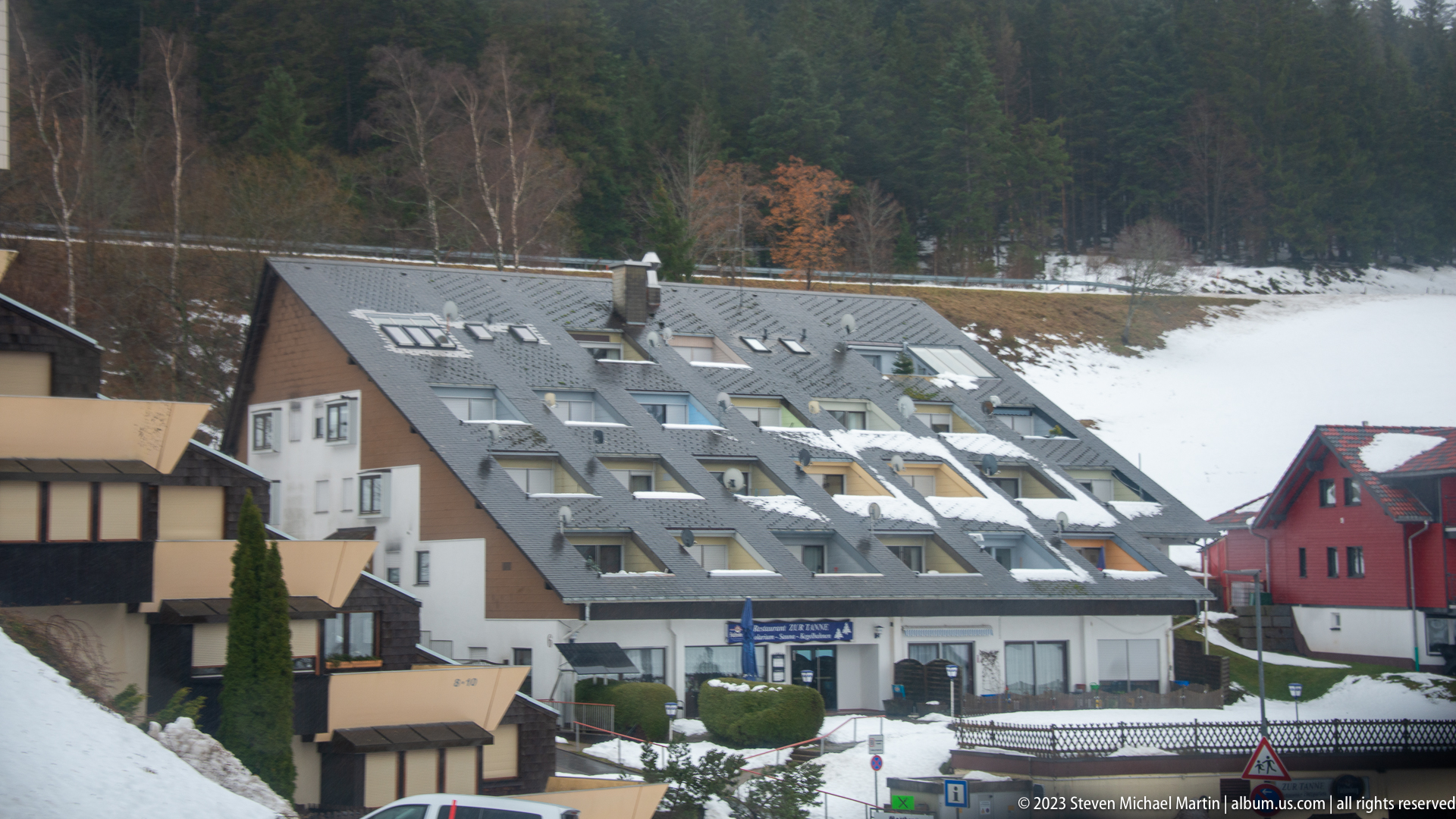
A broad multi-story building with a steep gray roof occupies the center of a small snow-covered settlement. Repeated dormer windows step across the roof, while adjacent houses and a forested hillside frame the scene. The architecture suggests lodging or a guesthouse adapted to snowy conditions, but the proof sheet does not provide enough legible signage to confirm the establishment’s name or exact use.
Caption
A broad multi-story building with a steep gray roof occupies the center of a small snow-covered settlement. Repeated dormer windows step across the roof, while adjacent houses and a forested hillside frame the scene. The architecture suggests lodging or a guesthouse adapted to snowy conditions, but the proof sheet does not provide enough legible signage to confirm the establishment’s name or exact use.
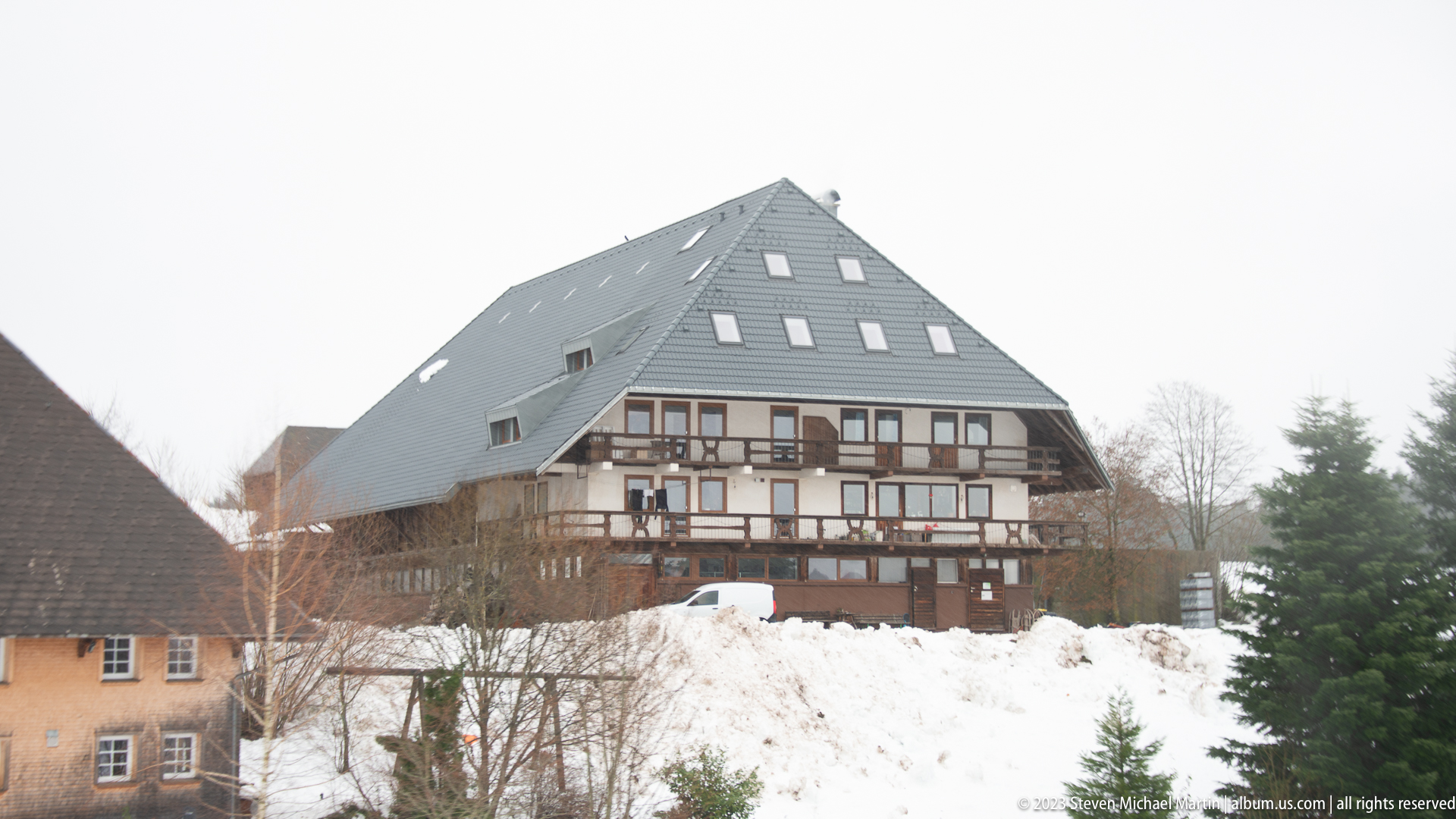
A substantial rural building rises above deep snow with a broad, steep roof descending over several stories. The upper façade combines timber framing, balconies, and regularly spaced windows, while nearby structures cluster at a lower level. Its massive roof form is characteristic of traditional Black Forest farm architecture, designed to shelter living and working spaces under a single dominant volume.
Caption
A substantial rural building rises above deep snow with a broad, steep roof descending over several stories. The upper façade combines timber framing, balconies, and regularly spaced windows, while nearby structures cluster at a lower level. Its massive roof form is characteristic of traditional Black Forest farm architecture, designed to shelter living and working spaces under a single dominant volume.
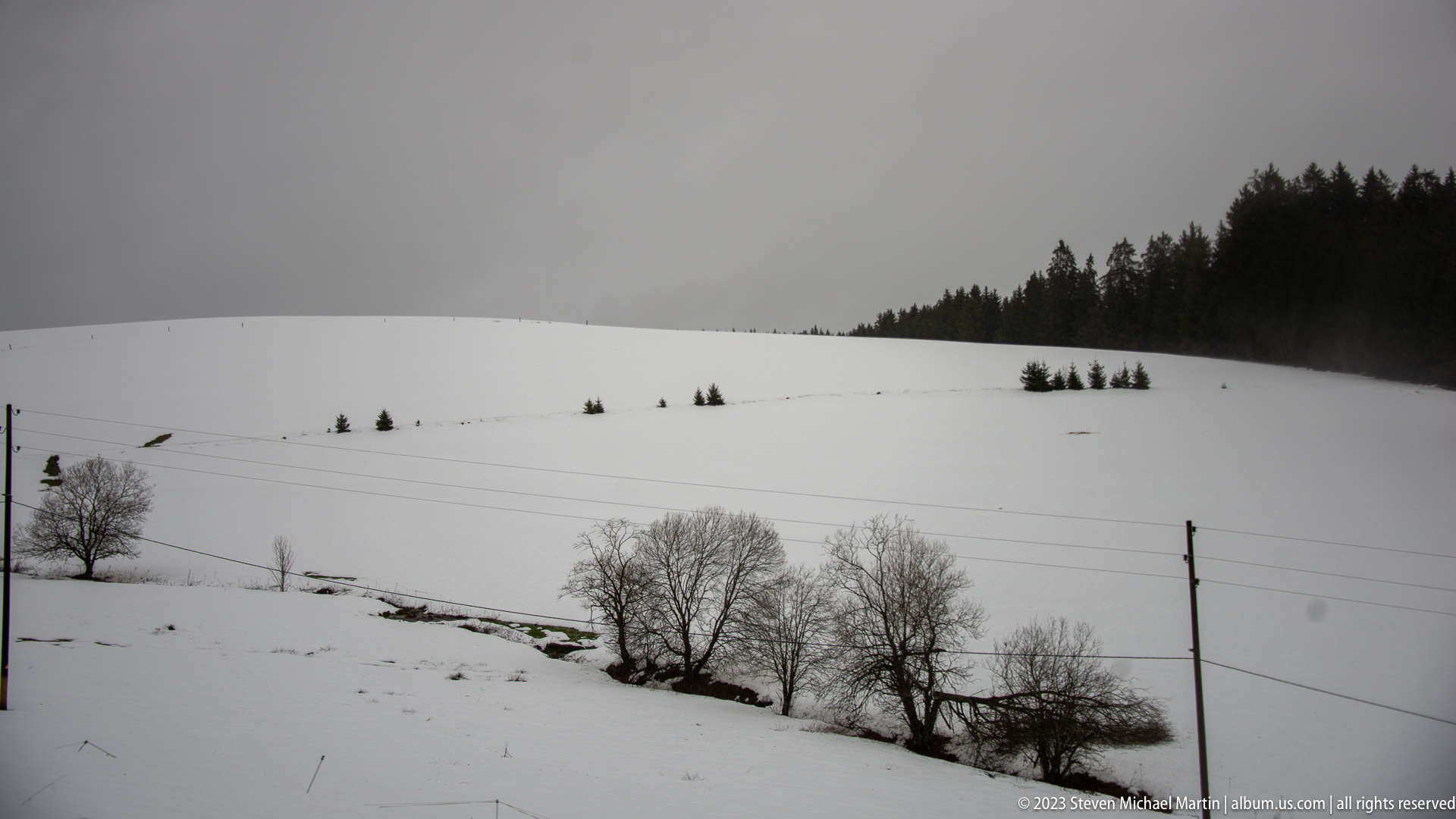
A smooth white hillside rises toward a dark forest edge beneath a heavy gray sky. Bare deciduous trees punctuate the lower slope, while a few small evergreens stand isolated against the snow. Utility lines and a pole cross the scene, introducing a subtle human presence into an otherwise spare winter landscape of pasture and woodland.
Caption
A smooth white hillside rises toward a dark forest edge beneath a heavy gray sky. Bare deciduous trees punctuate the lower slope, while a few small evergreens stand isolated against the snow. Utility lines and a pole cross the scene, introducing a subtle human presence into an otherwise spare winter landscape of pasture and woodland.

A dark ribbon of road curves through a broad white field toward a small group of farm buildings set against evergreen woodland. Bare trees and utility poles break the snowfield at intervals, while the compact farmstead forms the visual anchor near the center. The sweeping road gives the composition depth and connects the isolated agricultural buildings to the wider Black Forest countryside.
Caption
A dark ribbon of road curves through a broad white field toward a small group of farm buildings set against evergreen woodland. Bare trees and utility poles break the snowfield at intervals, while the compact farmstead forms the visual anchor near the center. The sweeping road gives the composition depth and connects the isolated agricultural buildings to the wider Black Forest countryside.
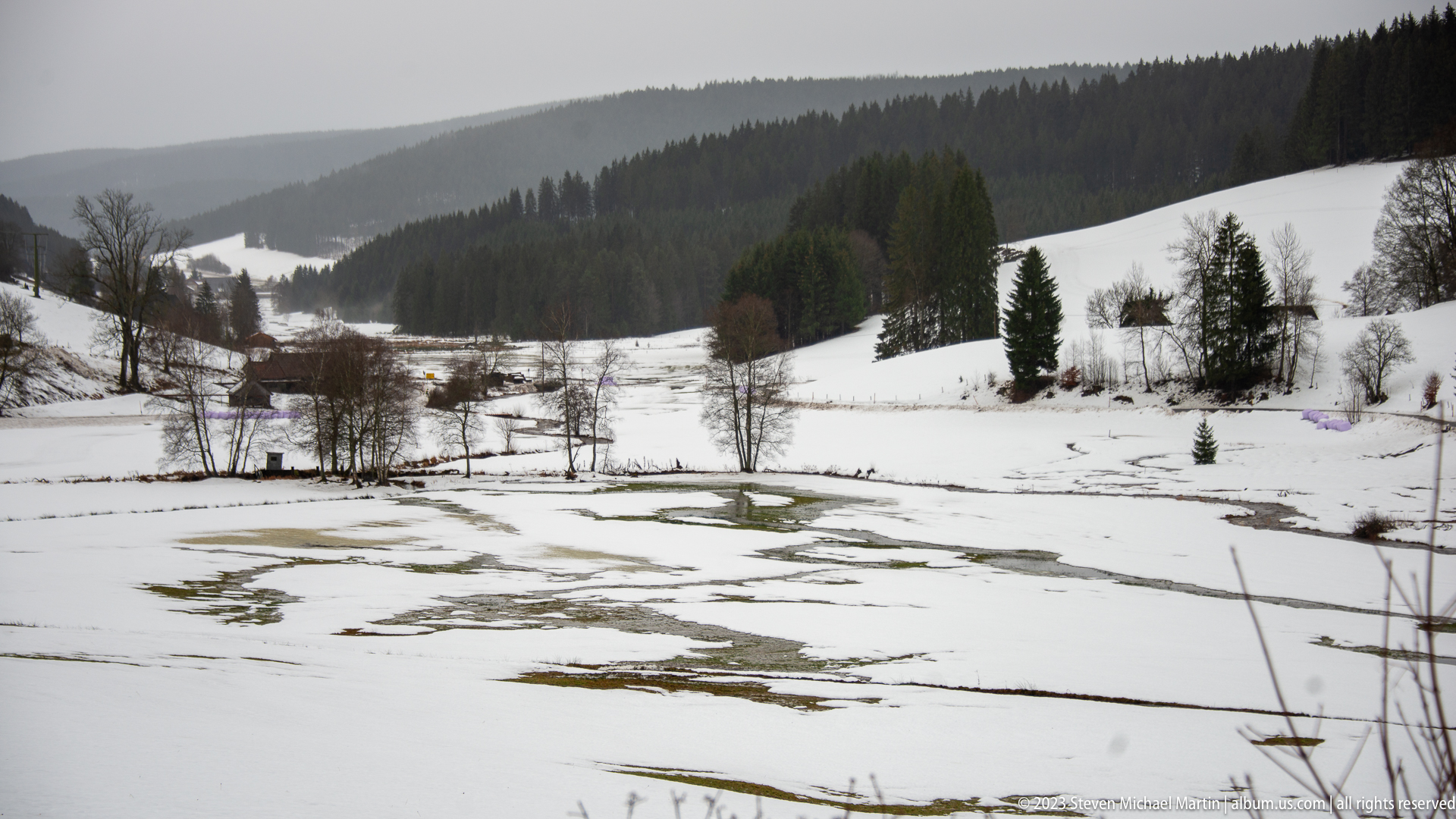
Patchy snow covers a shallow valley of open meadows, revealing winding strips of grass and drainage lines beneath the white surface. Leafless trees stand across the low ground, while scattered evergreens and a continuous conifer forest rise on the slopes beyond. The irregular thaw pattern adds texture to an otherwise broad, quiet winter landscape.
Caption
Patchy snow covers a shallow valley of open meadows, revealing winding strips of grass and drainage lines beneath the white surface. Leafless trees stand across the low ground, while scattered evergreens and a continuous conifer forest rise on the slopes beyond. The irregular thaw pattern adds texture to an otherwise broad, quiet winter landscape.
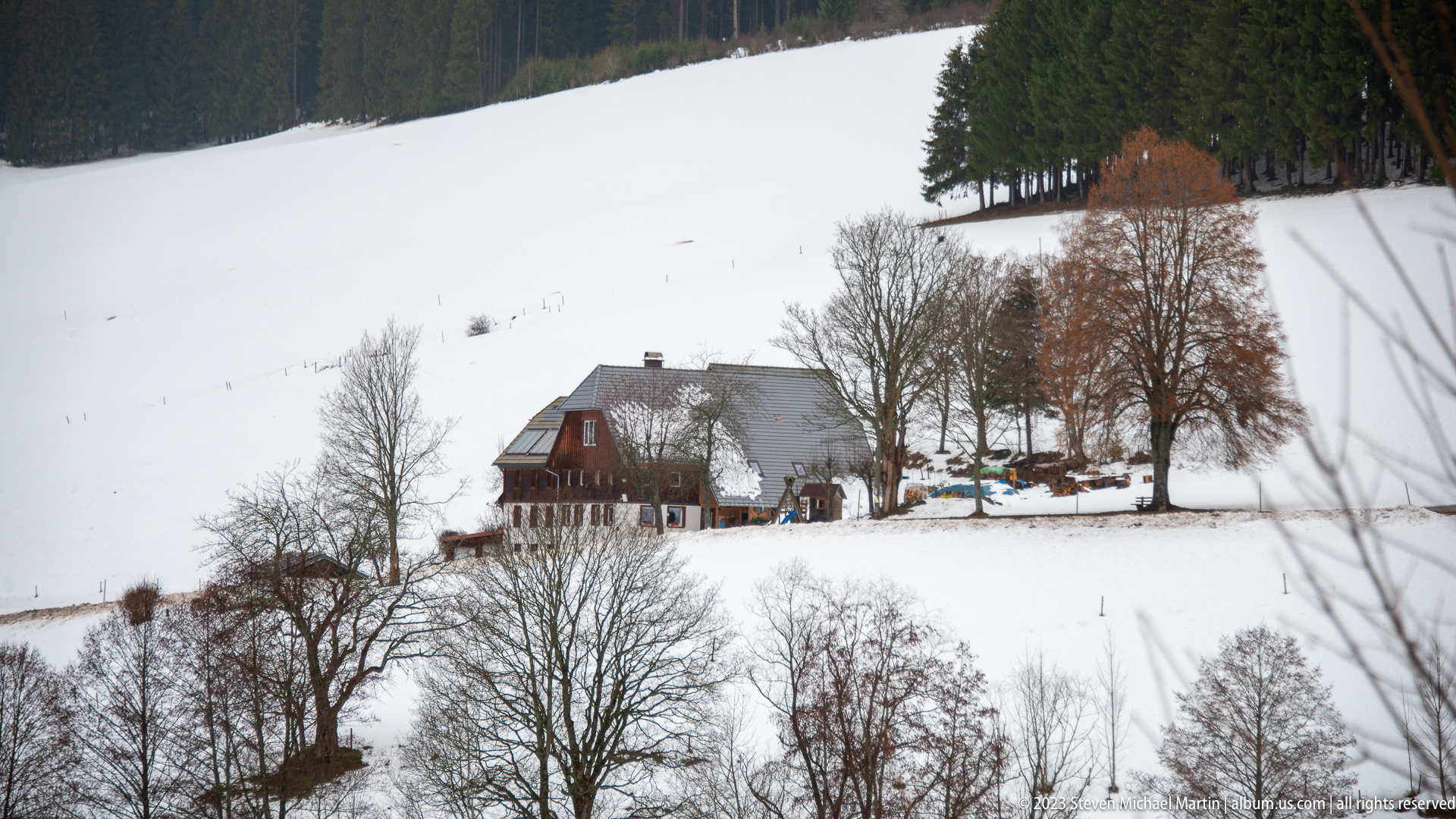
A solitary rural house sits midway up a snow-covered slope among leafless trees. Above it, a dense block of evergreens forms a crisp dark boundary against the white hillside, while a few brown-leaved trees retain autumn color around the building. The layered composition separates dwelling, open field, and managed forest into distinct bands across the Black Forest landscape.
Caption
A solitary rural house sits midway up a snow-covered slope among leafless trees. Above it, a dense block of evergreens forms a crisp dark boundary against the white hillside, while a few brown-leaved trees retain autumn color around the building. The layered composition separates dwelling, open field, and managed forest into distinct bands across the Black Forest landscape.
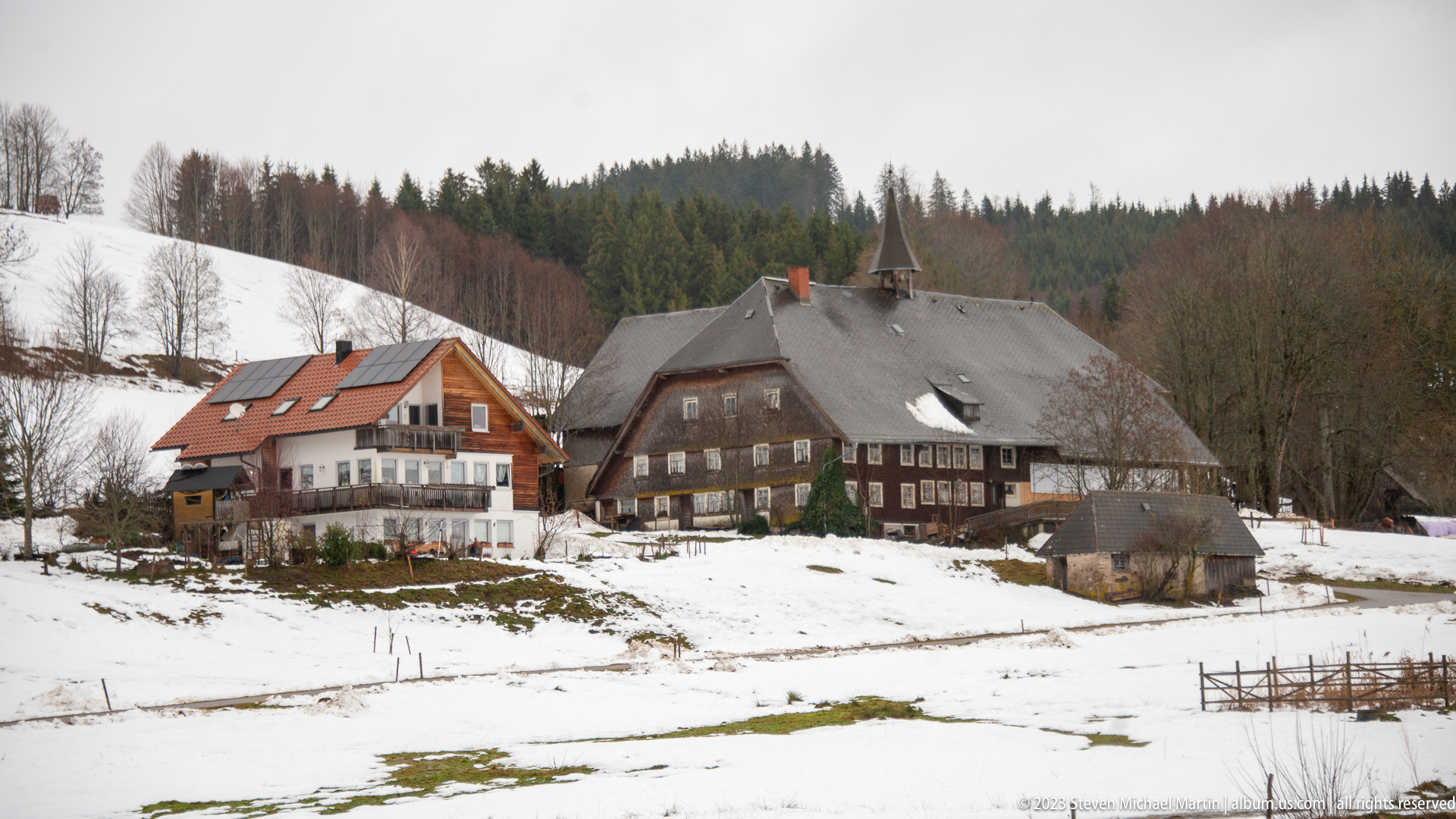
A large dark farmhouse with a deep sweeping roof stands beside a newer, lighter chalet-style residence on a snowy slope. Rows of small windows and the farmhouse’s massive roof volume contrast with the adjacent building’s balconies and bright timber cladding. Together they show two generations of rural architecture set against open fields and the forested hills of the Black Forest.
Caption
A large dark farmhouse with a deep sweeping roof stands beside a newer, lighter chalet-style residence on a snowy slope. Rows of small windows and the farmhouse’s massive roof volume contrast with the adjacent building’s balconies and bright timber cladding. Together they show two generations of rural architecture set against open fields and the forested hills of the Black Forest.
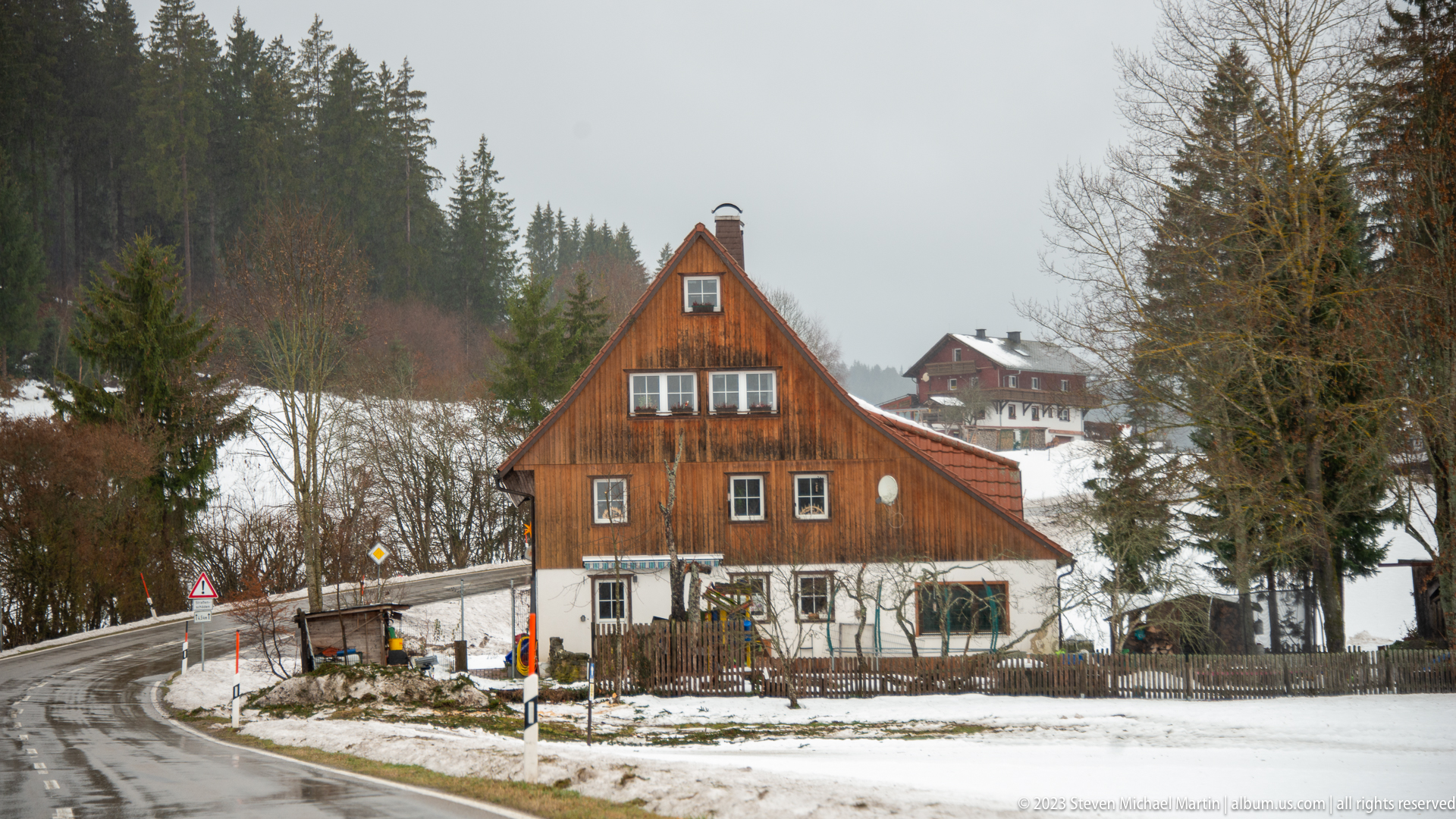
A steep-roofed timber-clad house stands at a bend or junction in a wet winter road, with snow piled along the verges. Additional hillside buildings rise behind it against dark evergreen forest. The modest roadside scene combines vernacular domestic architecture with the practical infrastructure of a Black Forest settlement in thawing winter conditions.
Caption
A steep-roofed timber-clad house stands at a bend or junction in a wet winter road, with snow piled along the verges. Additional hillside buildings rise behind it against dark evergreen forest. The modest roadside scene combines vernacular domestic architecture with the practical infrastructure of a Black Forest settlement in thawing winter conditions.
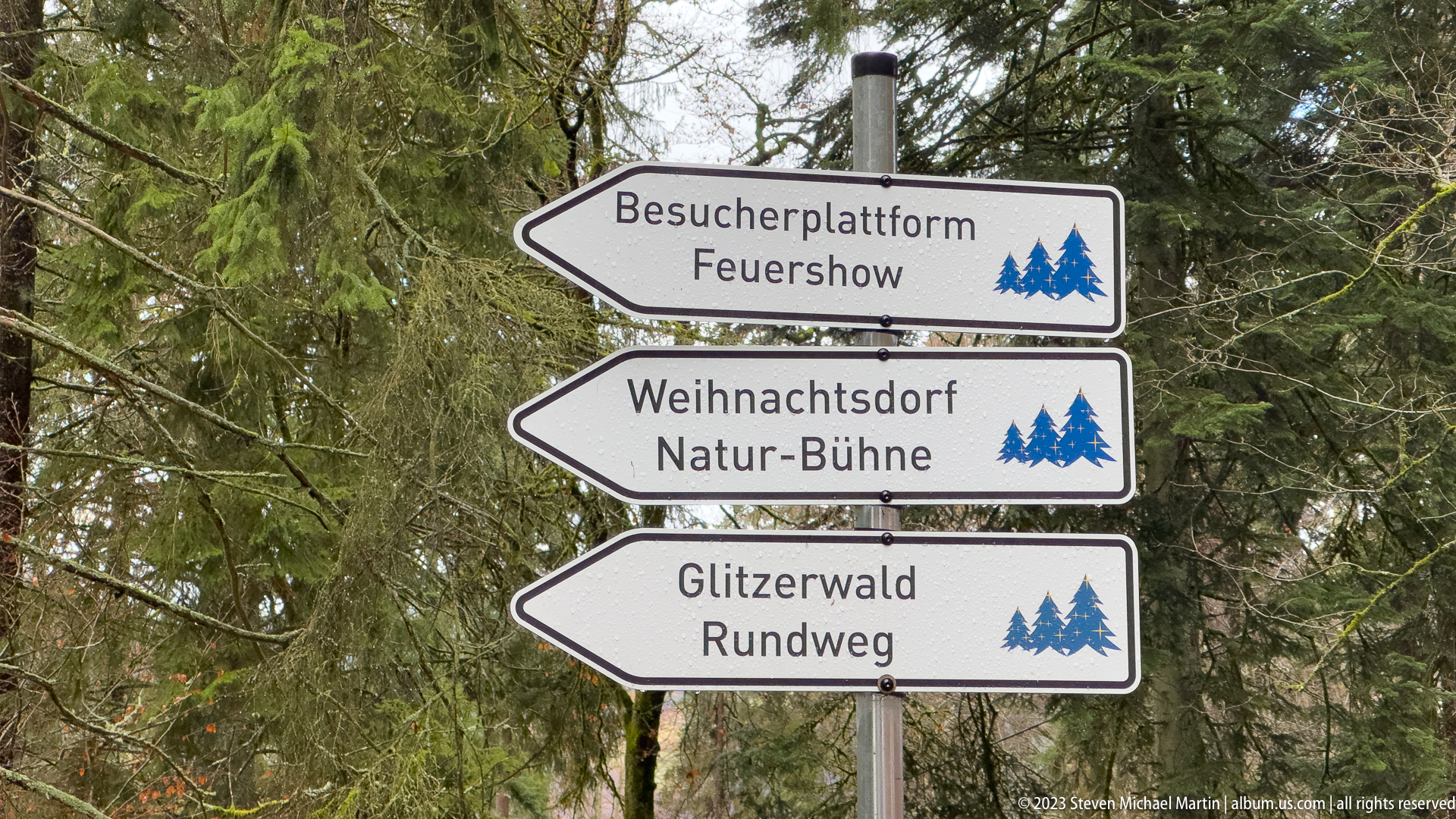
Three white directional signs point left through the forest. Their German text reads “Besucherplattform Feuershow,” “Weihnachtsdorf Natur-Bühne,” and “Glitzerwald Rundweg,” linking the woodland route to a visitor platform, Christmas-village stage, and themed loop trail. Evergreen branches and lingering snow surround the signpost, making the seasonal event context visually explicit.
Caption
Three white directional signs point left through the forest. Their German text reads “Besucherplattform Feuershow,” “Weihnachtsdorf Natur-Bühne,” and “Glitzerwald Rundweg,” linking the woodland route to a visitor platform, Christmas-village stage, and themed loop trail. Evergreen branches and lingering snow surround the signpost, making the seasonal event context visually explicit.
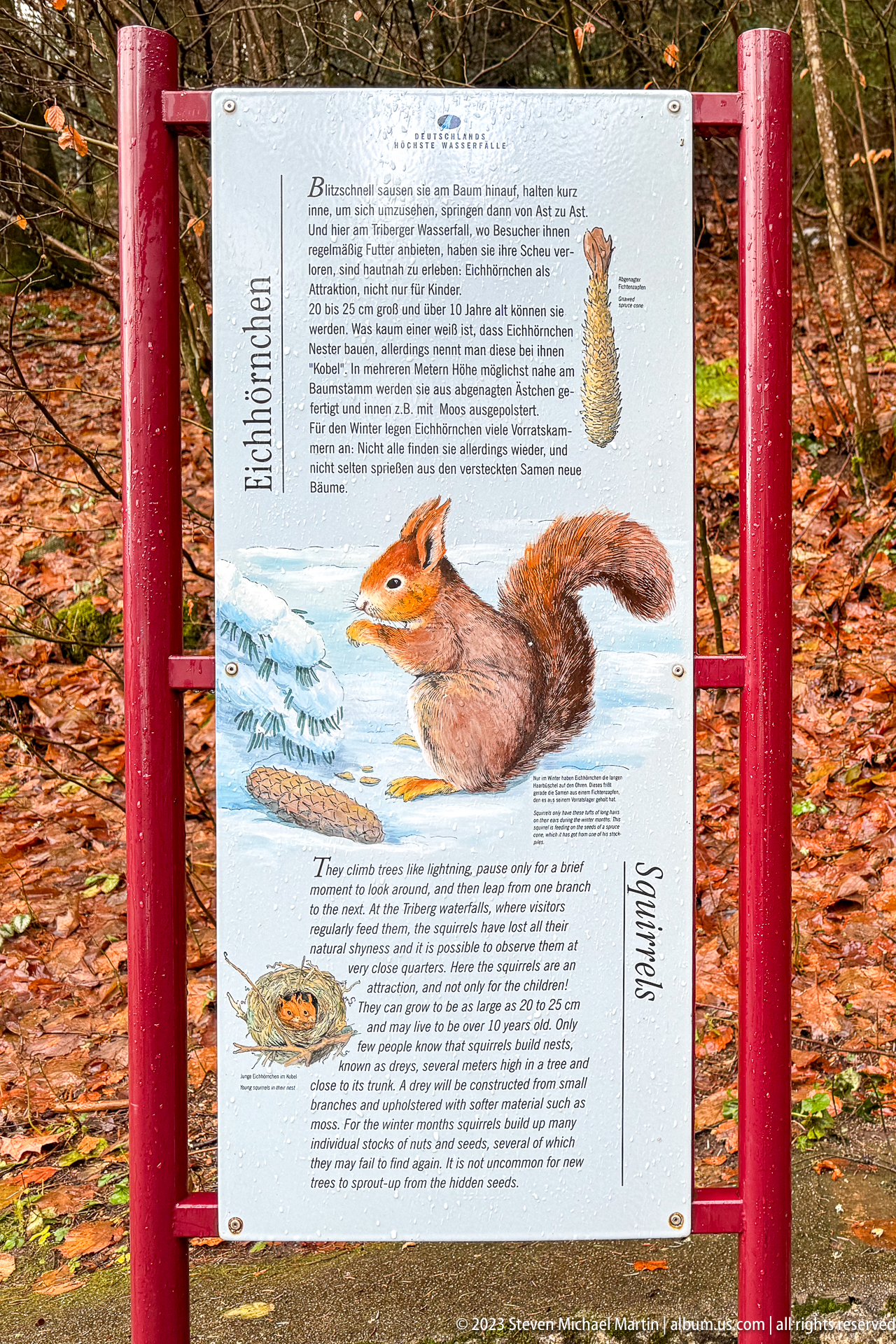
A German-language interpretive panel mounted in a red frame features a large illustration of a red squirrel, smaller natural-history drawings, and explanatory text. The sign stands on a leaf-covered forest floor and appears intended to introduce local wildlife to visitors. The squirrel illustration supports identification of the featured animal, while the smaller text is not fully legible at proof-sheet scale.
Caption
A German-language interpretive panel mounted in a red frame features a large illustration of a red squirrel, smaller natural-history drawings, and explanatory text. The sign stands on a leaf-covered forest floor and appears intended to introduce local wildlife to visitors. The squirrel illustration supports identification of the featured animal, while the smaller text is not fully legible at proof-sheet scale.
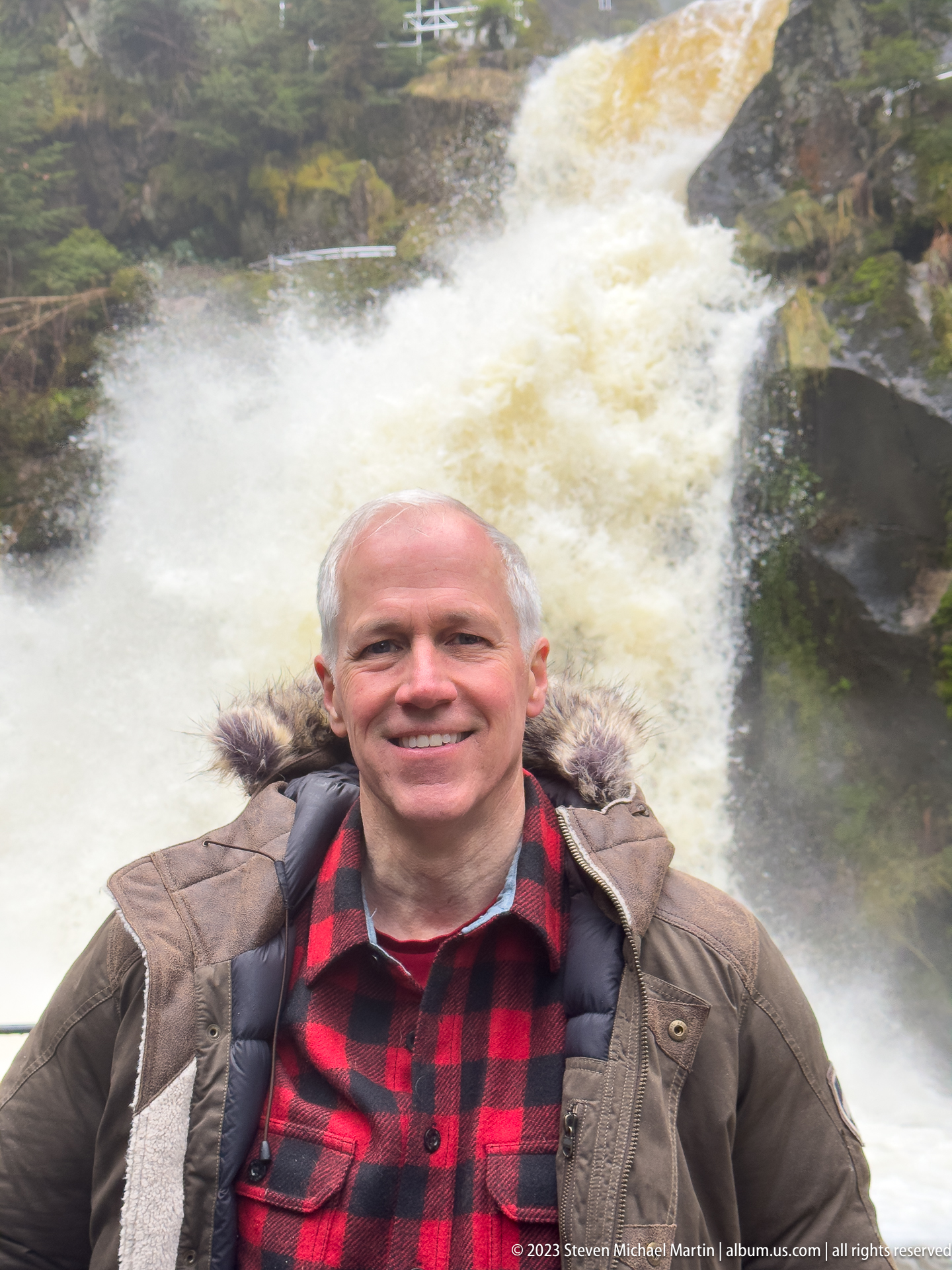
A smiling visitor in a red-and-black plaid shirt and winter jacket fills the foreground, with a broad rush of pale, turbulent water descending immediately behind him. The close viewpoint compresses the person and cascade into a single plane, making the waterfall a dramatic backdrop rather than a separate landscape subject. Wet rock at the margins reinforces the active watercourse setting.
Caption
A smiling visitor in a red-and-black plaid shirt and winter jacket fills the foreground, with a broad rush of pale, turbulent water descending immediately behind him. The close viewpoint compresses the person and cascade into a single plane, making the waterfall a dramatic backdrop rather than a separate landscape subject. Wet rock at the margins reinforces the active watercourse setting.
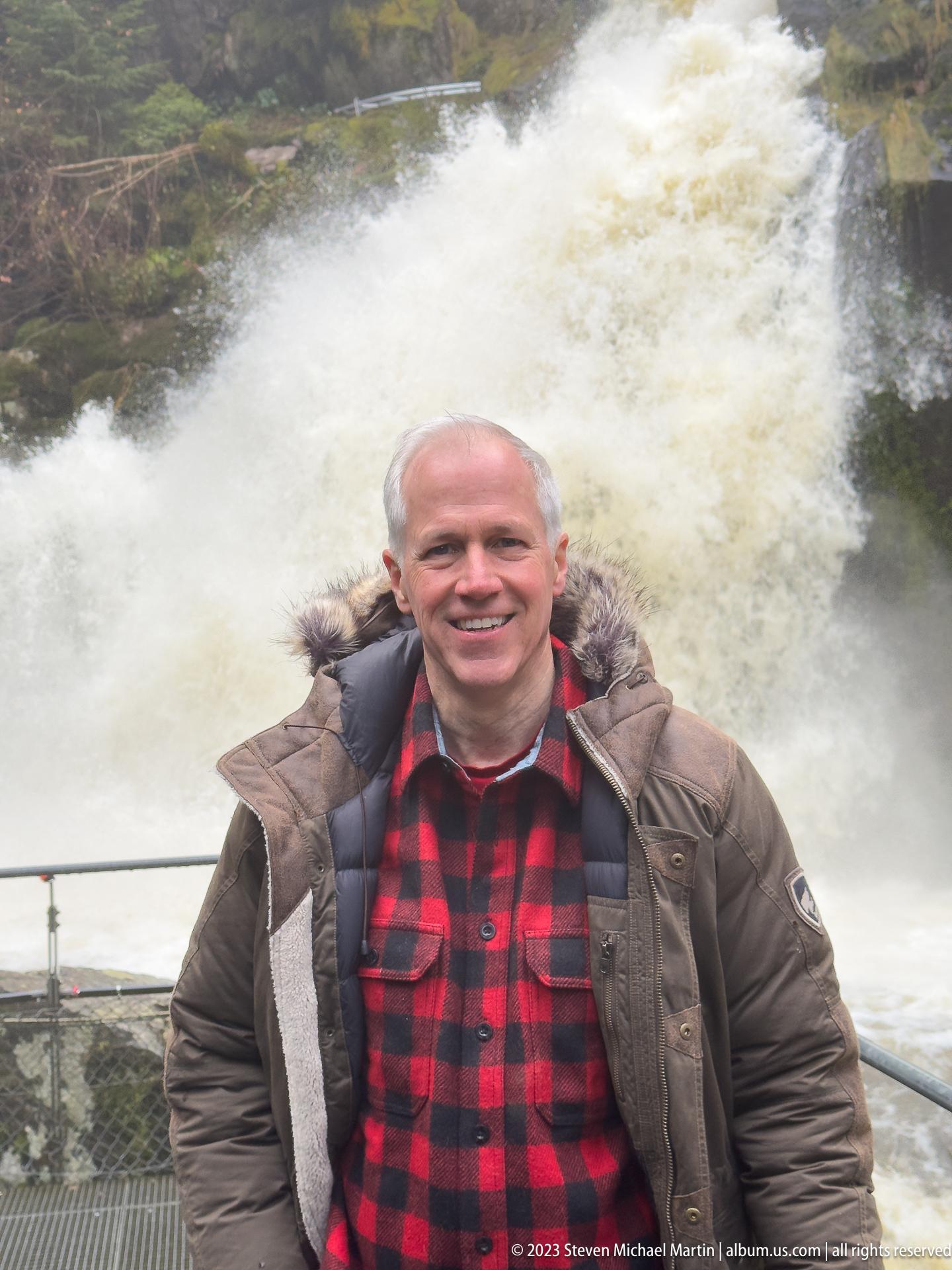
A visitor in a red-and-black plaid shirt and brown winter jacket stands beside a broad foaming cascade, with part of a metal viewing railing visible at lower left. The slightly wider framing shows more of the waterfall’s width and visitor infrastructure than the preceding close portrait. Pale rushing water dominates the background while the figure provides scale and seasonal context.
Caption
A visitor in a red-and-black plaid shirt and brown winter jacket stands beside a broad foaming cascade, with part of a metal viewing railing visible at lower left. The slightly wider framing shows more of the waterfall’s width and visitor infrastructure than the preceding close portrait. Pale rushing water dominates the background while the figure provides scale and seasonal context.
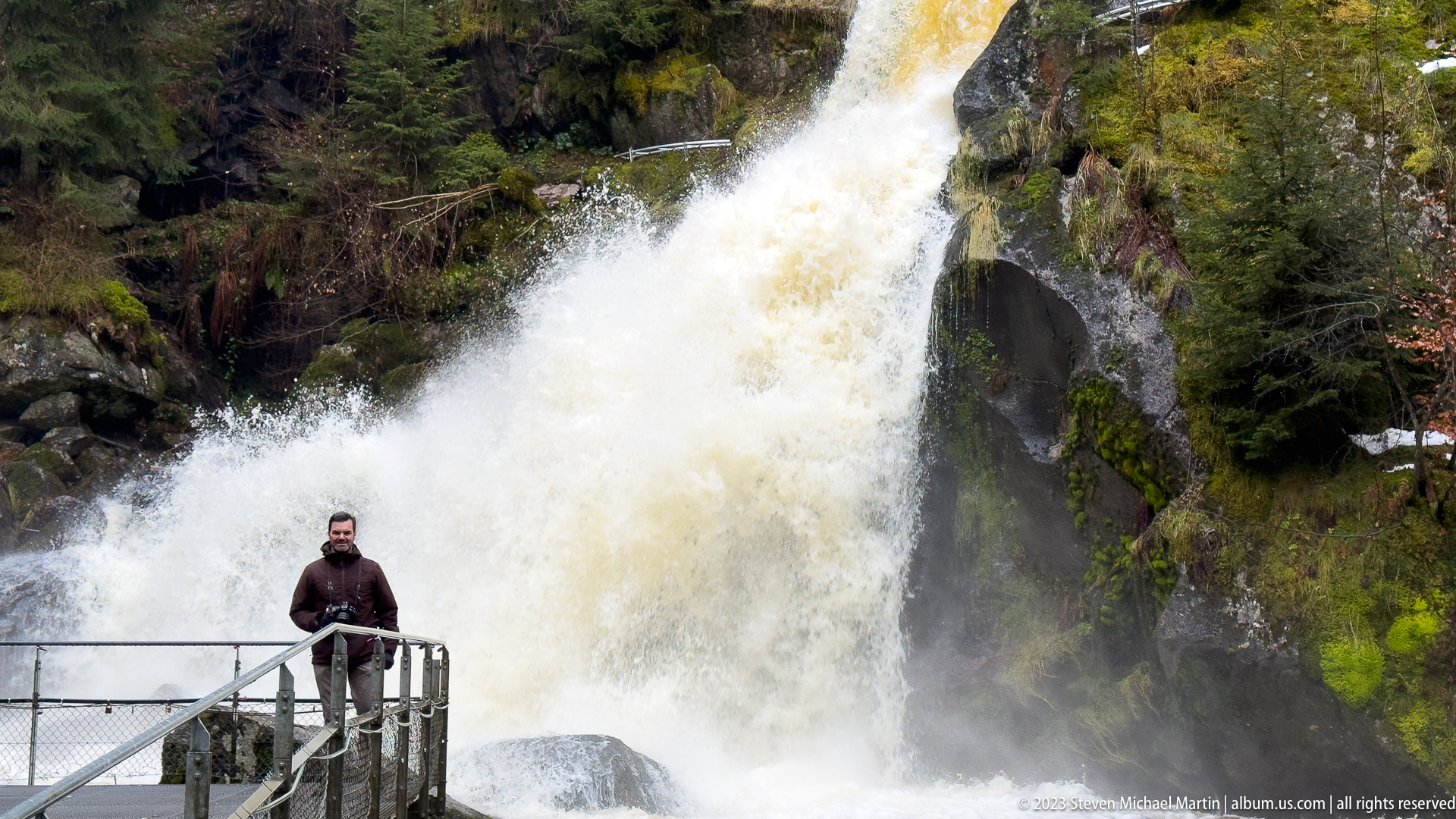
A powerful sheet of water plunges down a steep rocky chute beside a metal visitor platform, where a single visitor provides scale. Spray and pale foam dominate the center of the frame, while dark wet rock and moss line the channel. The developed railing shows how closely the visitor route approaches the waterfall, turning the natural feature into an immersive viewing experience.
Caption
A powerful sheet of water plunges down a steep rocky chute beside a metal visitor platform, where a single visitor provides scale. Spray and pale foam dominate the center of the frame, while dark wet rock and moss line the channel. The developed railing shows how closely the visitor route approaches the waterfall, turning the natural feature into an immersive viewing experience.
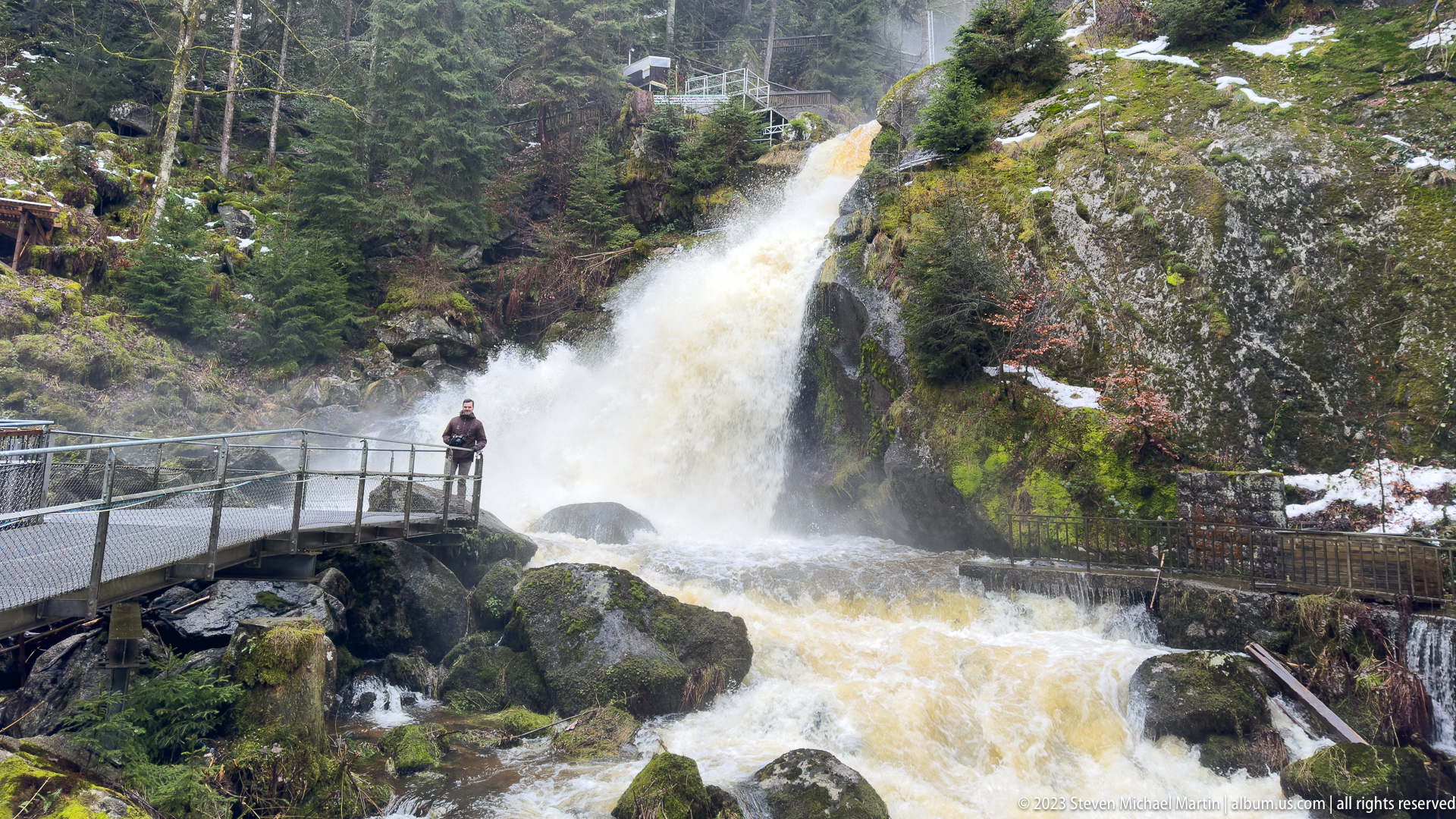
A broad waterfall descends through a steep, wooded rock channel behind a metal walkway and observation platform. A visitor standing on the bridge gives scale to the drop, while turbulent water continues through mossy boulders in the foreground. This wider composition reveals more of the engineered visitor access and the waterfall’s rocky setting than the preceding close view.
Caption
A broad waterfall descends through a steep, wooded rock channel behind a metal walkway and observation platform. A visitor standing on the bridge gives scale to the drop, while turbulent water continues through mossy boulders in the foreground. This wider composition reveals more of the engineered visitor access and the waterfall’s rocky setting than the preceding close view.

Whitewater surges through a steep rocky channel, dividing around large moss-covered boulders before spilling across the foreground. Metal viewing railings occupy the left bank, while a smaller controlled drop descends beside a rustic barrier on the right. The broad composition records both the natural force of the waterfall and the visitor infrastructure built closely around it.
Caption
Whitewater surges through a steep rocky channel, dividing around large moss-covered boulders before spilling across the foreground. Metal viewing railings occupy the left bank, while a smaller controlled drop descends beside a rustic barrier on the right. The broad composition records both the natural force of the waterfall and the visitor infrastructure built closely around it.
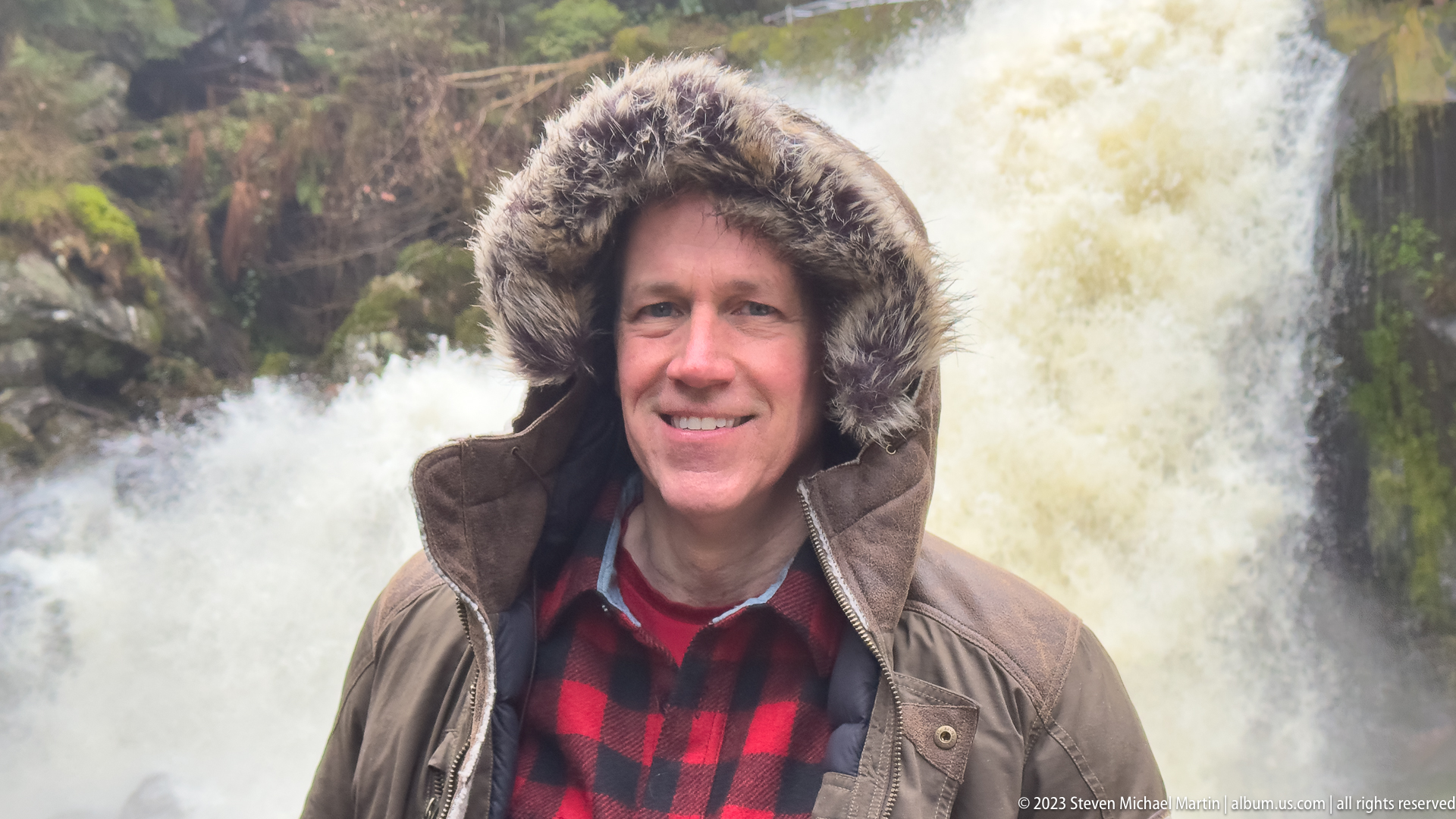
A hooded visitor stands close to a plunging waterfall, the fur-trimmed hood and layered winter clothing signaling cold conditions. Behind him, a dense sheet of pale water drops vertically beside dark wet rock and green moss. The tight framing reduces the surrounding landscape and emphasizes proximity to the cascade, spray, and the visitor’s winter attire.
Caption
A hooded visitor stands close to a plunging waterfall, the fur-trimmed hood and layered winter clothing signaling cold conditions. Behind him, a dense sheet of pale water drops vertically beside dark wet rock and green moss. The tight framing reduces the surrounding landscape and emphasizes proximity to the cascade, spray, and the visitor’s winter attire.
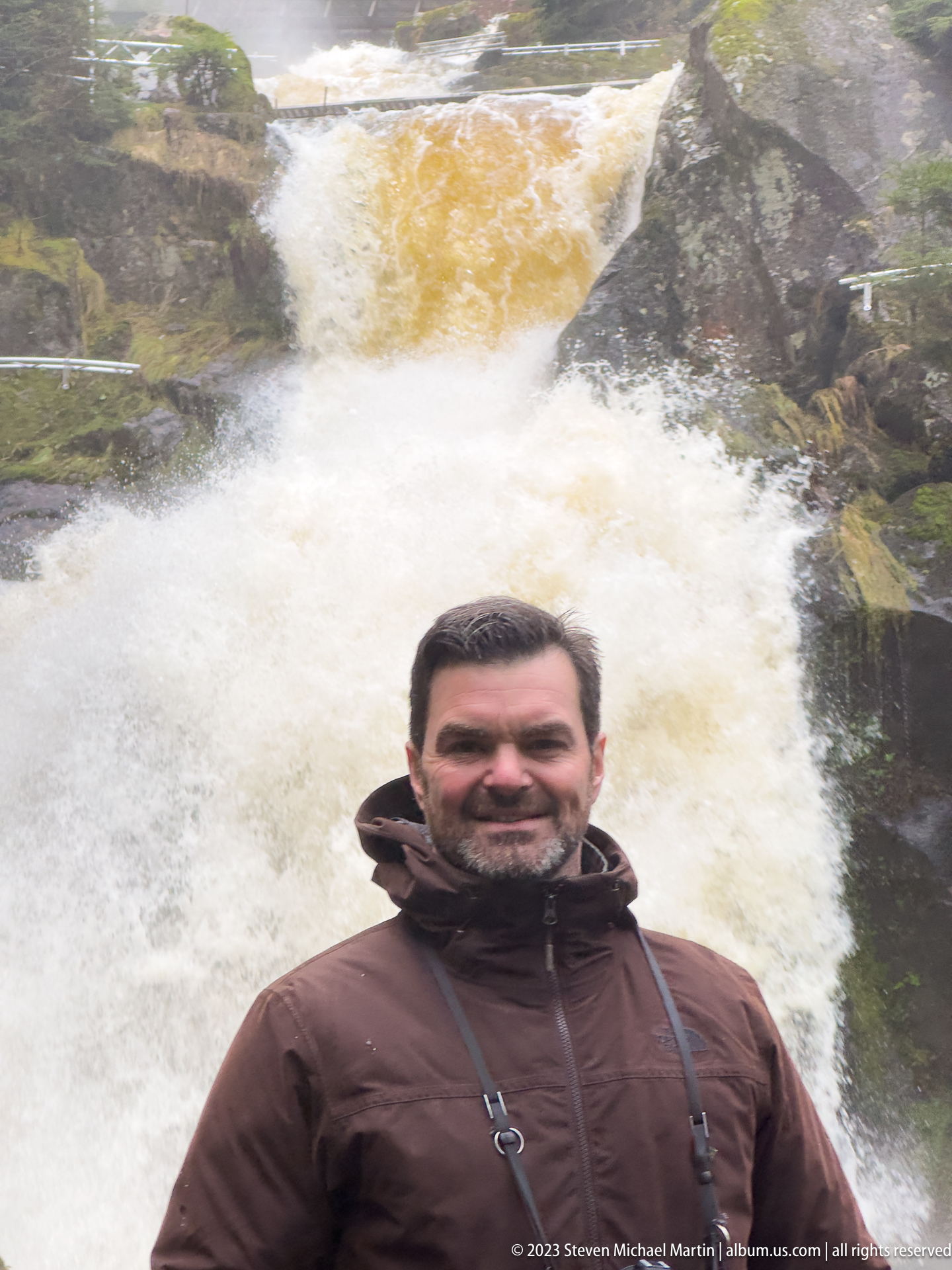
A bearded visitor in a brown jacket stands centered against a steep torrent of white and amber-tinted water. Dark rock edges the upper cascade, but the close crop largely replaces the forest setting with moving water. The composition uses the waterfall as a textured backdrop, distinguishing this portrait through its centered pose and unusually expansive field of turbulent flow.
Caption
A bearded visitor in a brown jacket stands centered against a steep torrent of white and amber-tinted water. Dark rock edges the upper cascade, but the close crop largely replaces the forest setting with moving water. The composition uses the waterfall as a textured backdrop, distinguishing this portrait through its centered pose and unusually expansive field of turbulent flow.
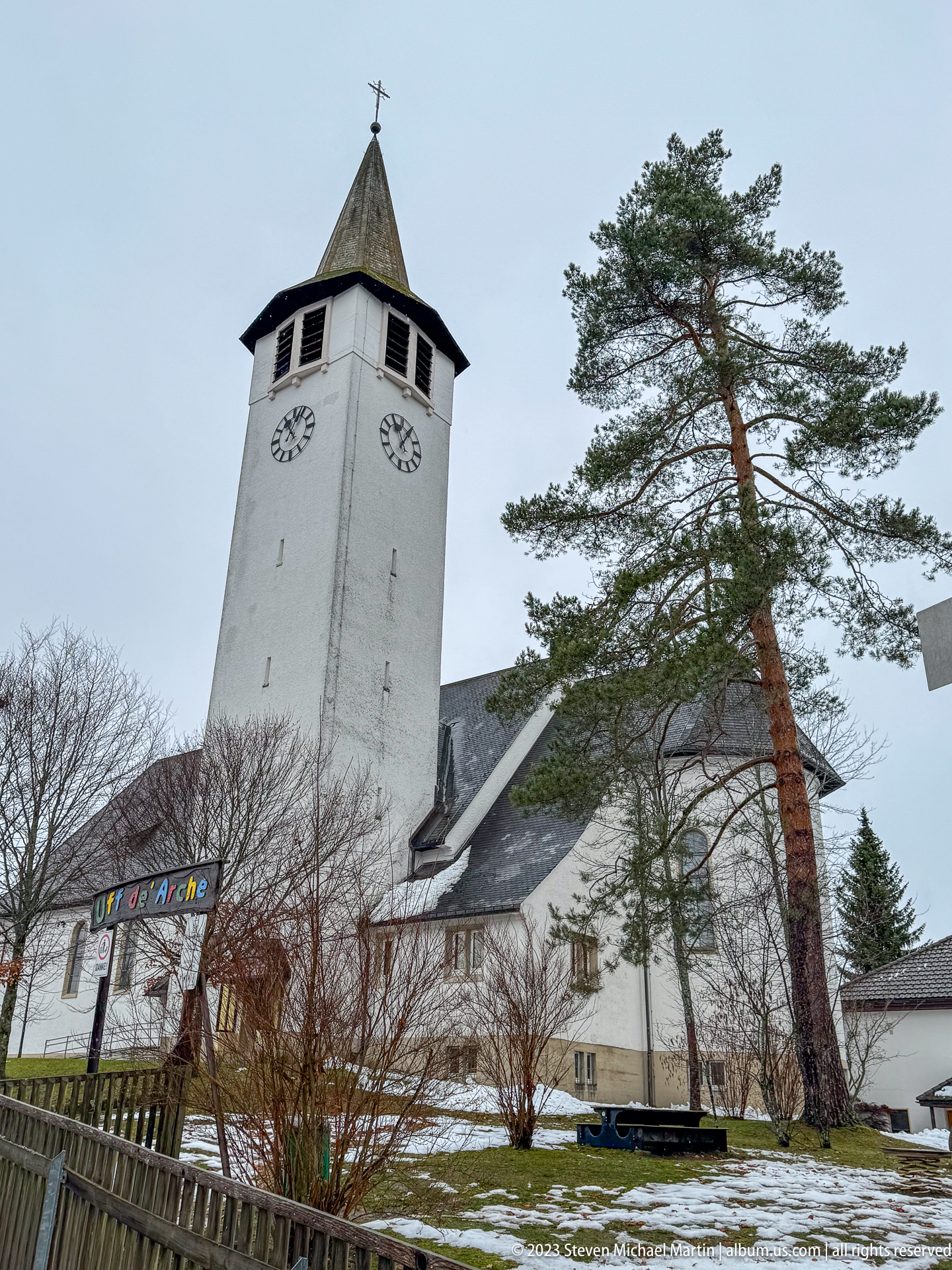
A white church rises on a snowy slope beneath a tall square clock tower capped by a dark hipped roof and small finial. Two clock faces are visible near the tower’s upper stage, while a mature pine leans dramatically beside the nave. The oblique approach view emphasizes the tower as a local vertical landmark without supplying enough evidence to assign the church’s exact name.
Caption
A white church rises on a snowy slope beneath a tall square clock tower capped by a dark hipped roof and small finial. Two clock faces are visible near the tower’s upper stage, while a mature pine leans dramatically beside the nave. The oblique approach view emphasizes the tower as a local vertical landmark without supplying enough evidence to assign the church’s exact name.
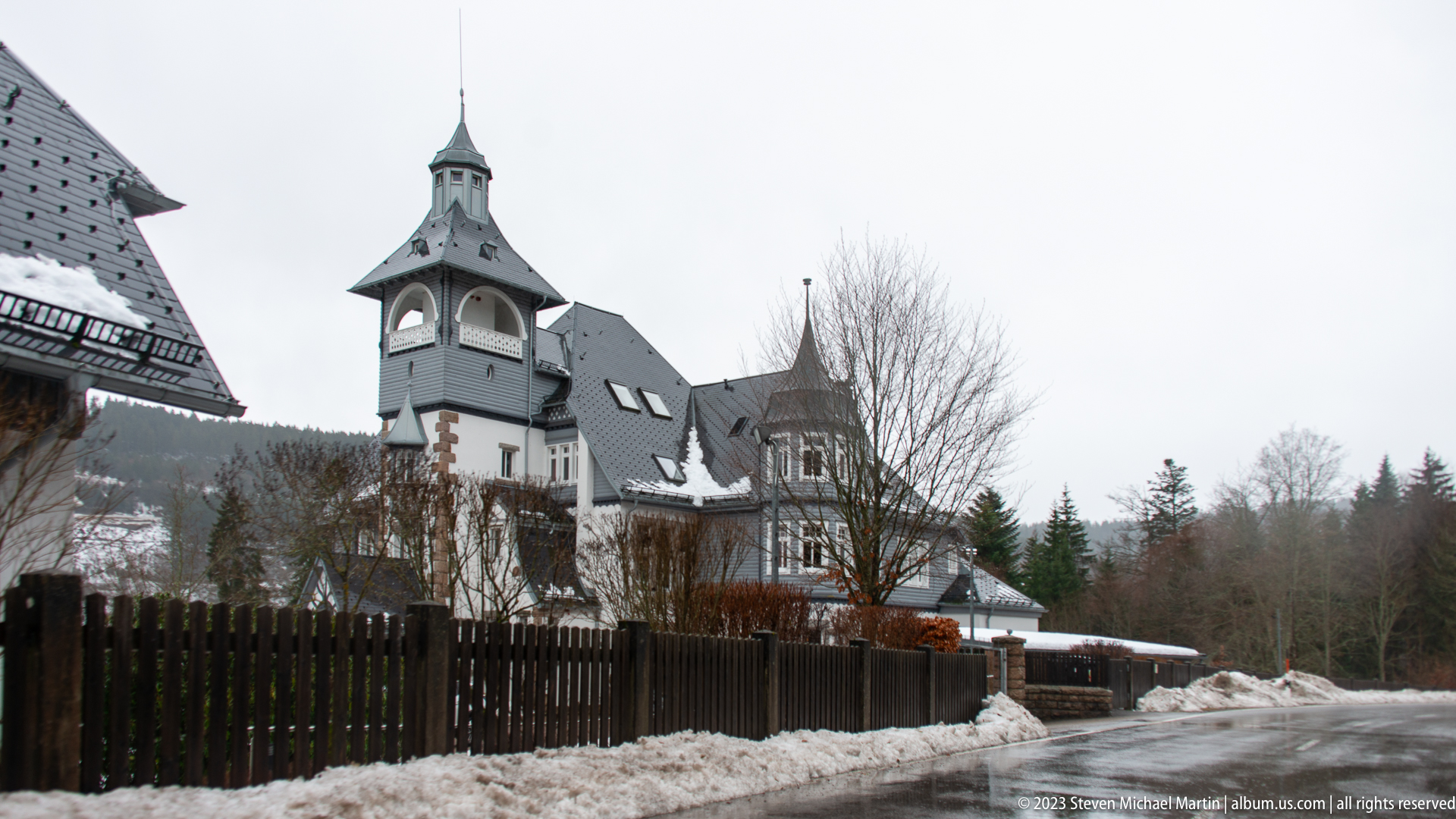
An ornate pale residence rises beside a snow-lined road, distinguished by a square tower with an open upper stage and pointed roof. Steep slate-colored roofs, projecting bays, decorative trim, and varied window forms give the building a picturesque historic character. A dark picket fence and bare winter trees frame the property, while snowbanks place the architecture firmly in the season.
Caption
An ornate pale residence rises beside a snow-lined road, distinguished by a square tower with an open upper stage and pointed roof. Steep slate-colored roofs, projecting bays, decorative trim, and varied window forms give the building a picturesque historic character. A dark picket fence and bare winter trees frame the property, while snowbanks place the architecture firmly in the season.
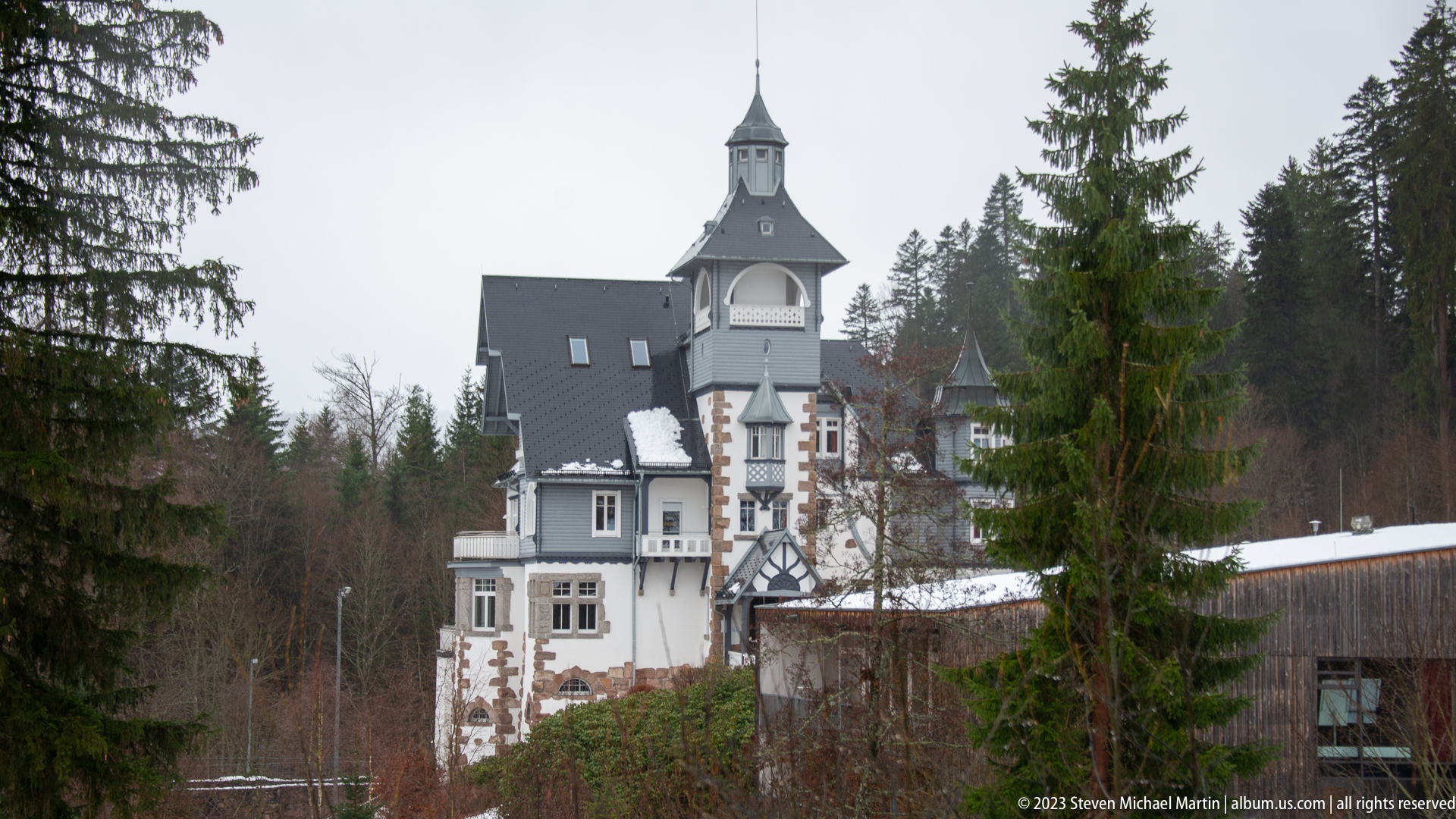
A tall, irregularly massed villa emerges between evergreen and leafless trees, its square tower capped by a pointed roof and small lantern-like upper stage. White walls are accented by darker trim and exposed masonry details, while snow remains on roof surfaces and the surrounding ground. This oblique view emphasizes the tower’s verticality and the building’s layered elevations within a wooded setting.
Caption
A tall, irregularly massed villa emerges between evergreen and leafless trees, its square tower capped by a pointed roof and small lantern-like upper stage. White walls are accented by darker trim and exposed masonry details, while snow remains on roof surfaces and the surrounding ground. This oblique view emphasizes the tower’s verticality and the building’s layered elevations within a wooded setting.
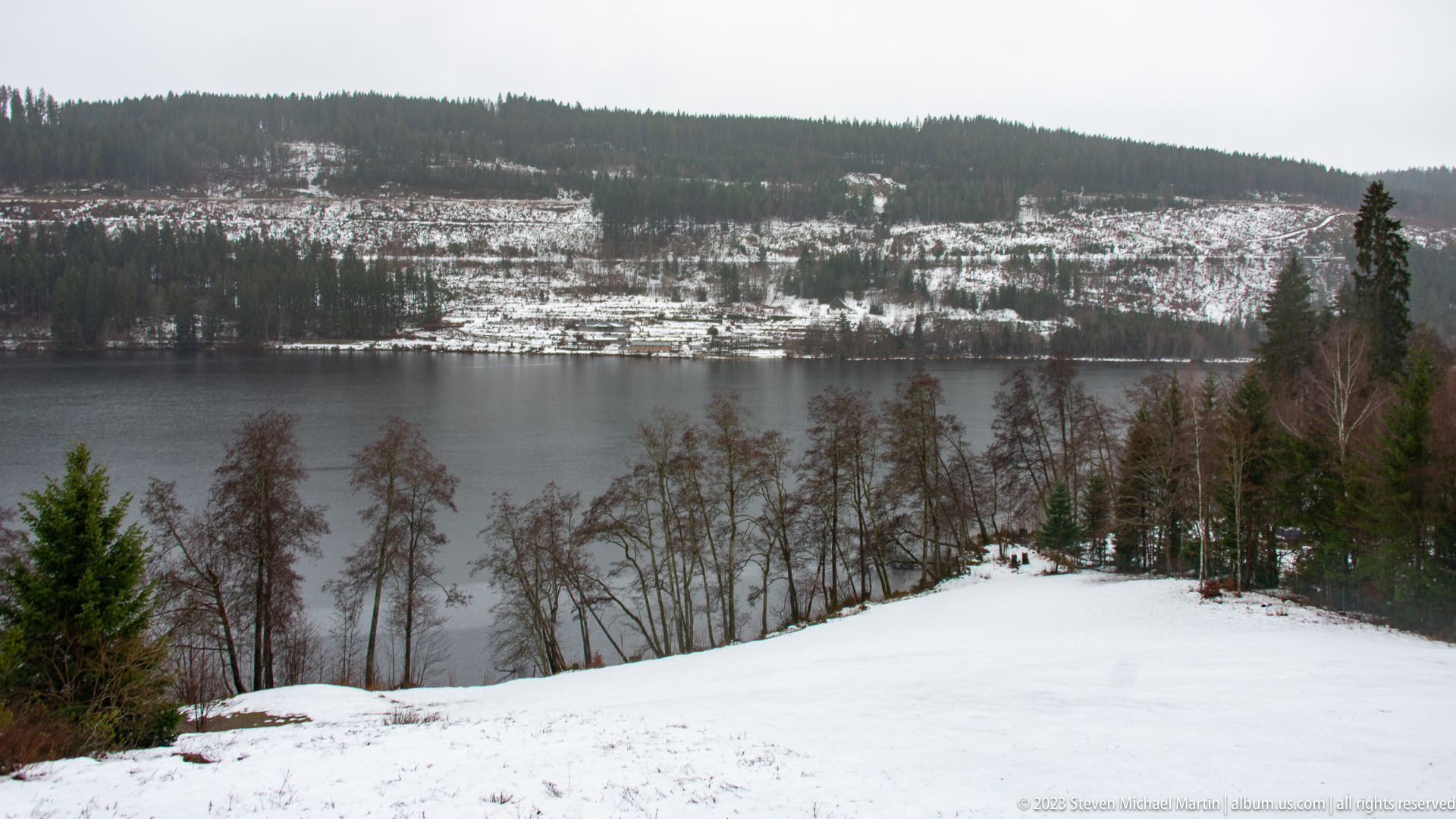
A broad lake fills the middle ground beneath low, forested hills streaked with snow. Bare deciduous trees line the near shore, while a smooth white slope descends toward the water in the foreground. The subdued gray surface and overcast sky create a quiet winter panorama, emphasizing the meeting of open water, cleared shoreline, and Black Forest woodland.
Caption
A broad lake fills the middle ground beneath low, forested hills streaked with snow. Bare deciduous trees line the near shore, while a smooth white slope descends toward the water in the foreground. The subdued gray surface and overcast sky create a quiet winter panorama, emphasizing the meeting of open water, cleared shoreline, and Black Forest woodland.
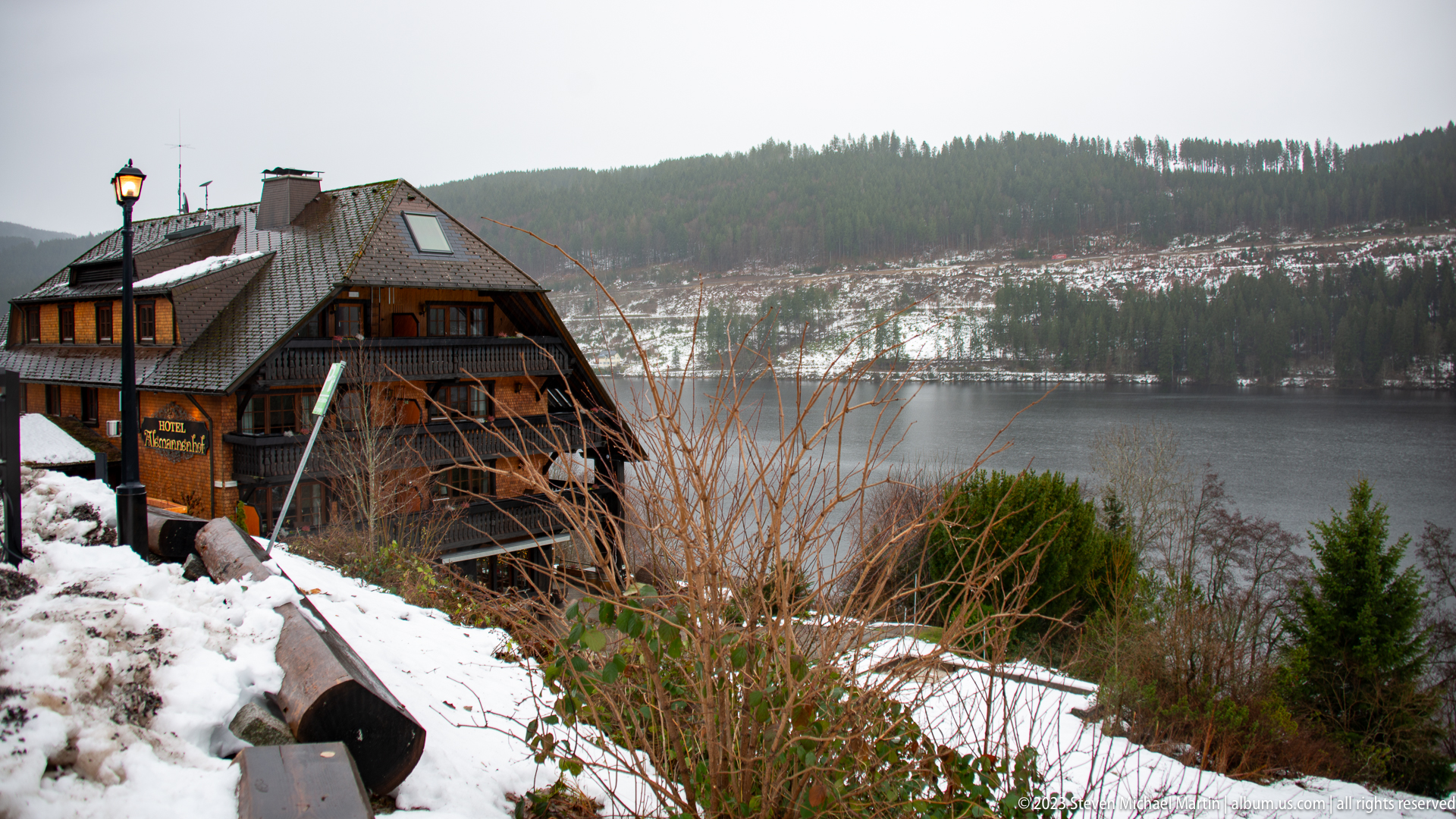
A substantial timber-clad chalet or lodge stands on a snowy slope above a lake, its steep roof, balconies, and layered wooden façades facing the water. Across the lake, forested hills retain irregular bands of snow. The composition connects regional mountain architecture with the winter landscape, using the building as a foreground anchor against the broad water and wooded opposite shore.
Caption
A substantial timber-clad chalet or lodge stands on a snowy slope above a lake, its steep roof, balconies, and layered wooden façades facing the water. Across the lake, forested hills retain irregular bands of snow. The composition connects regional mountain architecture with the winter landscape, using the building as a foreground anchor against the broad water and wooded opposite shore.
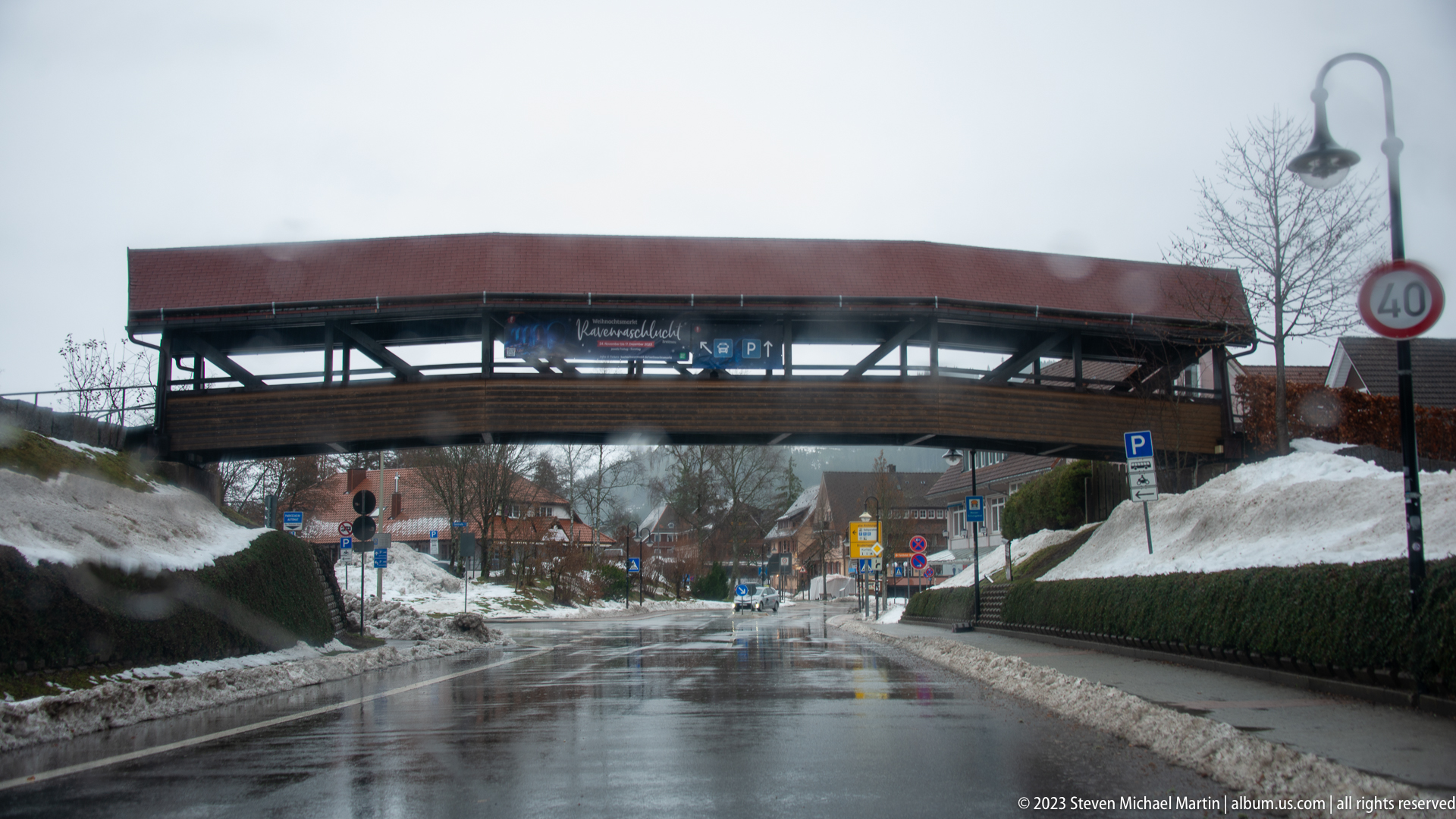
A covered timber pedestrian bridge crosses above a wet roadway bordered by dirty snowbanks. Its dark structural frame and reddish roof form a strong horizontal band across the street, while traffic signs, lamps, and buildings continue into the settlement beyond. The scene records practical winter infrastructure and pedestrian circulation rather than a landmark façade or natural landscape.
Caption
A covered timber pedestrian bridge crosses above a wet roadway bordered by dirty snowbanks. Its dark structural frame and reddish roof form a strong horizontal band across the street, while traffic signs, lamps, and buildings continue into the settlement beyond. The scene records practical winter infrastructure and pedestrian circulation rather than a landmark façade or natural landscape.
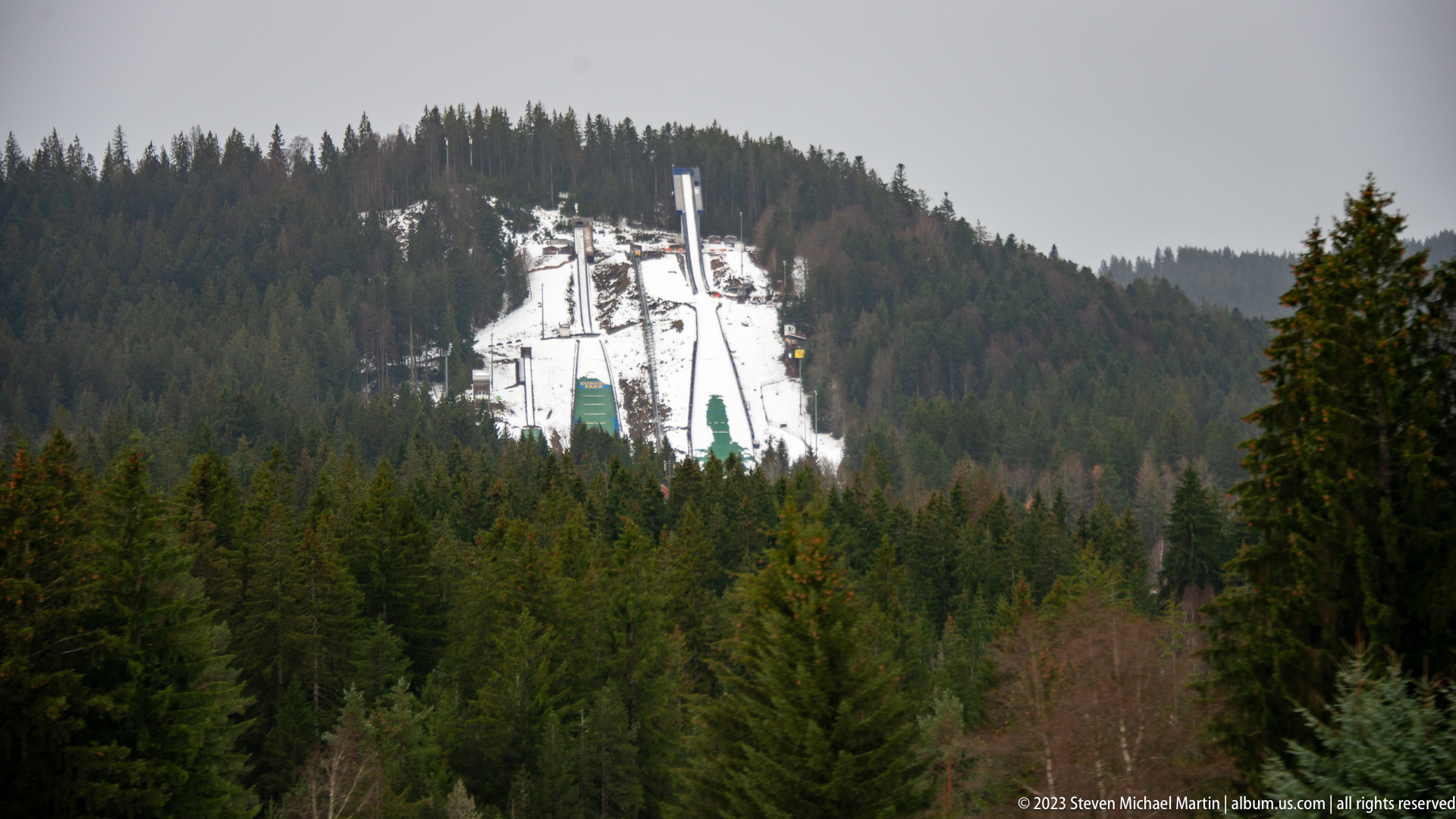
Several parallel snow-covered ski-jump or training ramps descend a cleared corridor through dense evergreen forest. Tall takeoff structures rise near the crest, while narrower groomed tracks run down the slope toward the unseen landing area. The distant view emphasizes the engineered winter-sports complex as a bright geometric interruption in the otherwise continuous Black Forest canopy.
Caption
Several parallel snow-covered ski-jump or training ramps descend a cleared corridor through dense evergreen forest. Tall takeoff structures rise near the crest, while narrower groomed tracks run down the slope toward the unseen landing area. The distant view emphasizes the engineered winter-sports complex as a bright geometric interruption in the otherwise continuous Black Forest canopy.
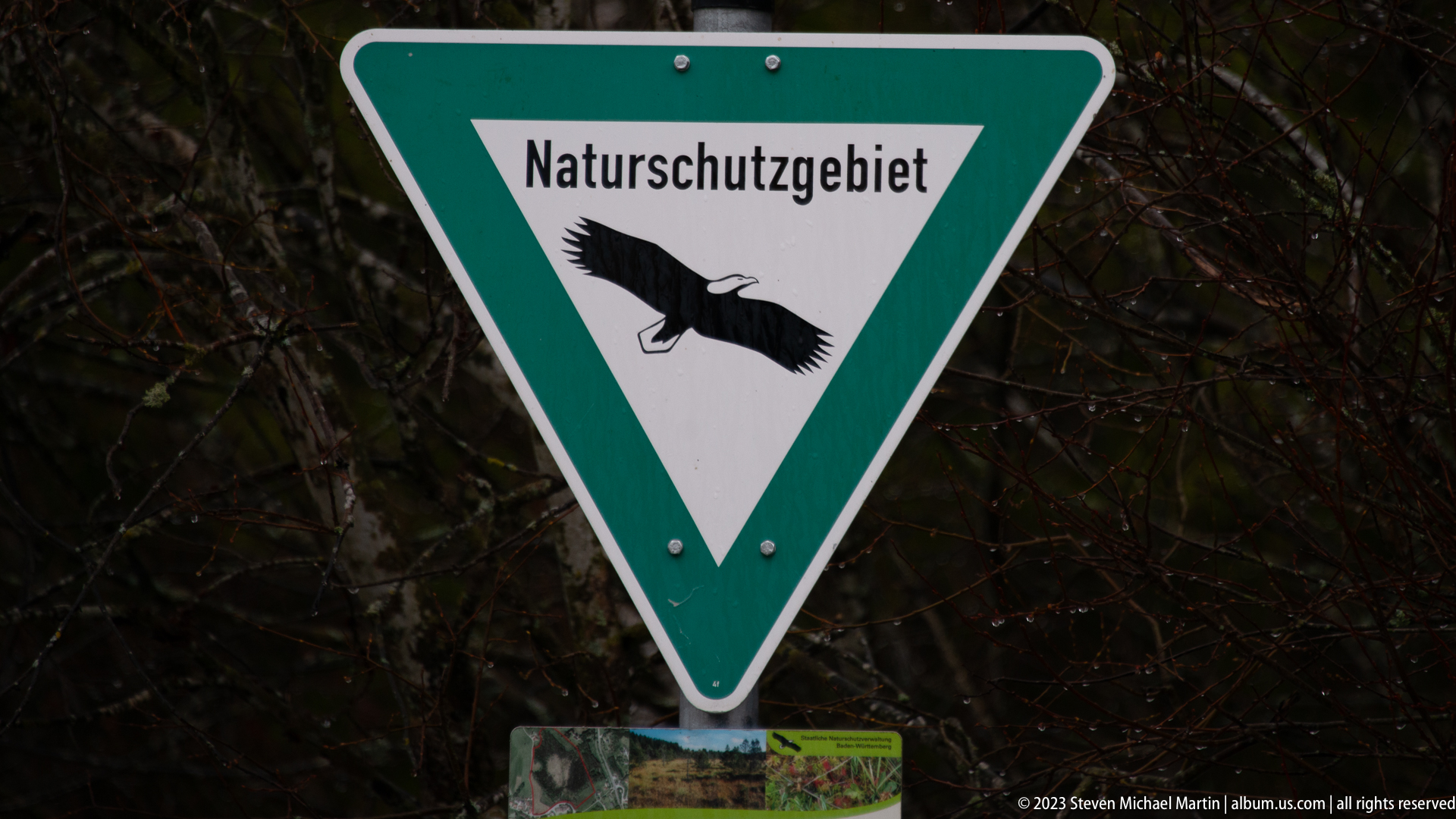
A green-bordered triangular sign marked “Naturschutzgebiet” identifies a protected nature area in Germany. A black silhouette of a large bird in flight occupies the white center, making the conservation purpose immediately legible even before reading the text. Mounted against dense bare branches, the sign shifts the portfolio from scenic observation to the formal protection of Black Forest habitat.
Caption
A green-bordered triangular sign marked “Naturschutzgebiet” identifies a protected nature area in Germany. A black silhouette of a large bird in flight occupies the white center, making the conservation purpose immediately legible even before reading the text. Mounted against dense bare branches, the sign shifts the portfolio from scenic observation to the formal protection of Black Forest habitat.
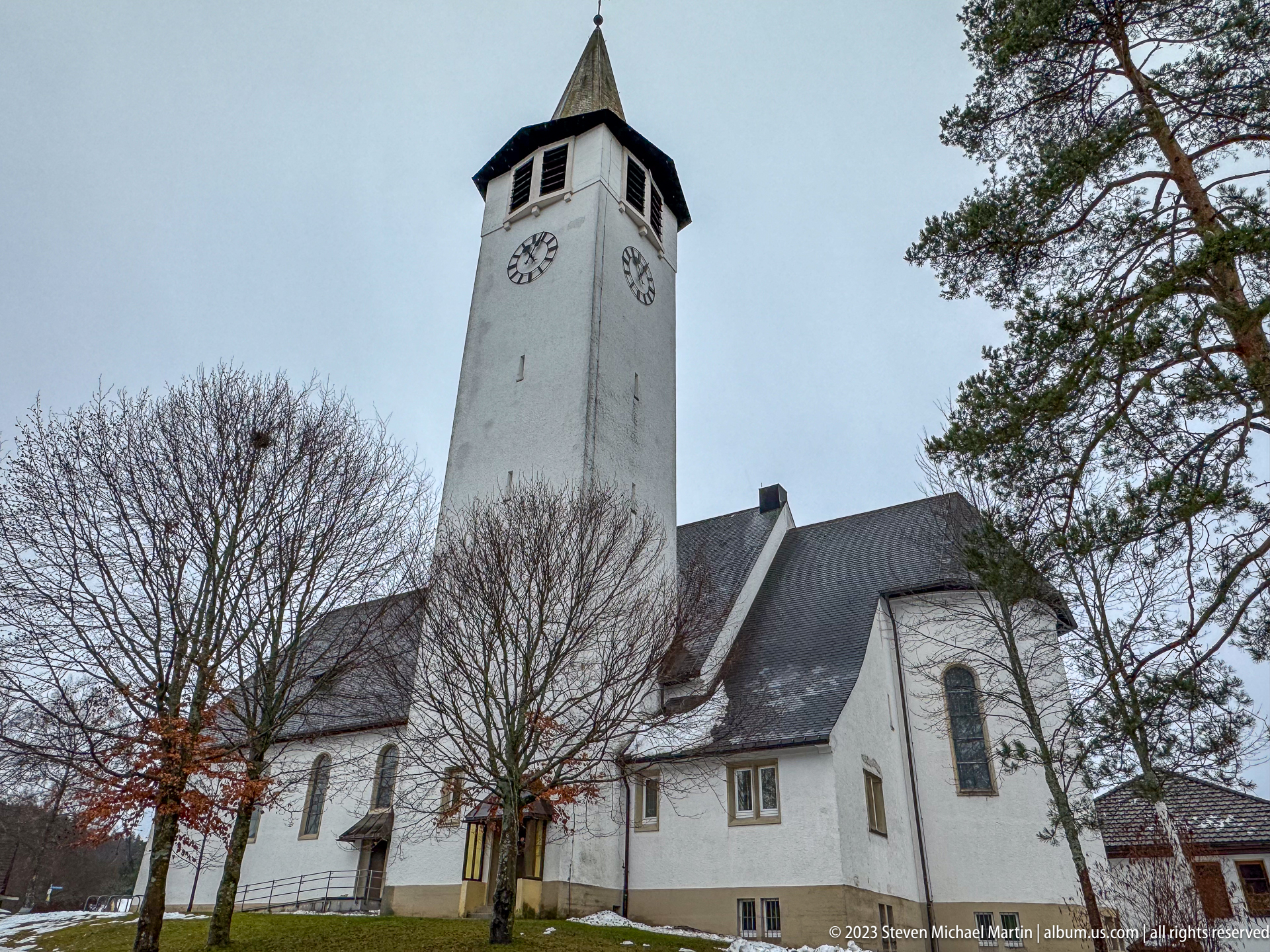
Seen from a lower and closer angle, the white church’s square clock tower dominates above the nave and leafless trees. The tower terminates in a dark polygonal roof, with clock faces set high on adjacent sides, while tall narrow windows articulate the church walls below. Patchy winter snow remains around the grounds, reinforcing the seasonal setting.
Caption
Seen from a lower and closer angle, the white church’s square clock tower dominates above the nave and leafless trees. The tower terminates in a dark polygonal roof, with clock faces set high on adjacent sides, while tall narrow windows articulate the church walls below. Patchy winter snow remains around the grounds, reinforcing the seasonal setting.
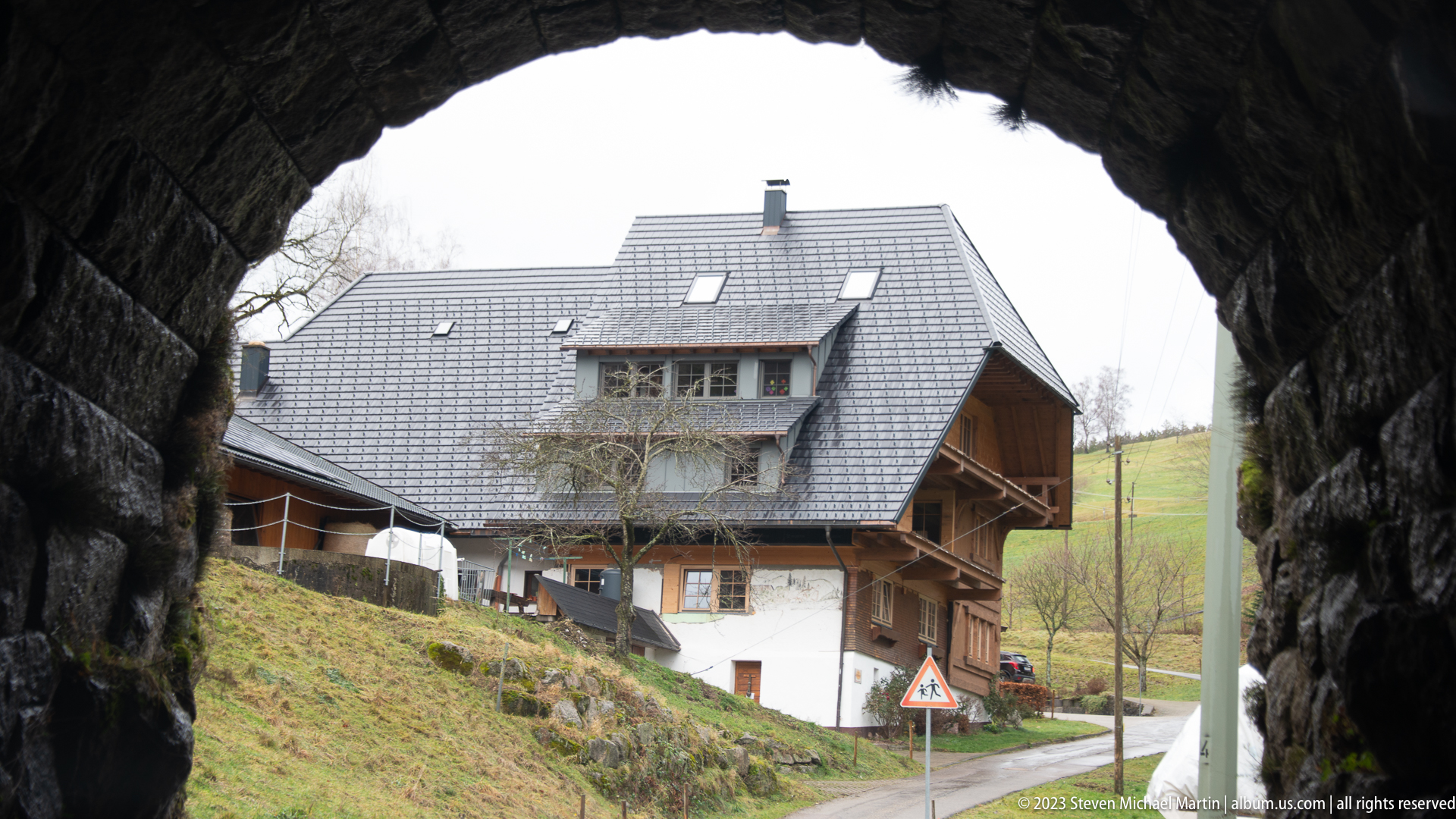
A large rural house is framed through the dark opening of a rough stone arch, creating a strong contrast between masonry foreground and the pale building beyond. The house combines a broad tiled roof, projecting dormer, timber balconies, and white lower walls on a grassy slope. The framing turns vernacular Black Forest architecture into the final subject while preserving its immediate rural setting.
Caption
A large rural house is framed through the dark opening of a rough stone arch, creating a strong contrast between masonry foreground and the pale building beyond. The house combines a broad tiled roof, projecting dormer, timber balconies, and white lower walls on a grassy slope. The framing turns vernacular Black Forest architecture into the final subject while preserving its immediate rural setting.