Athens Epigraphical Museum
The Athens Epigraphical Museum preserves one of the largest collections of ancient Greek inscriptions in the world. Stone slabs, statues, and fragments display texts carved in Greek that document laws, public decrees, treaties, and dedications. These inscriptions provide direct evidence of how language and communication functioned within ancient civic life.
Many of the inscriptions originate from Athens and surrounding regions, offering insight into political organization, religious practice, and social structure. The carved texts illustrate how public information was shared in permanent form, allowing citizens to observe decisions that shaped their community. The collection demonstrates the importance of written language in the development of democratic institutions.
The museum allows visitors to examine original examples of ancient writing that record historical events and everyday transactions. These artifacts contribute to understanding how communication and record keeping supported the functioning of classical Greek society.
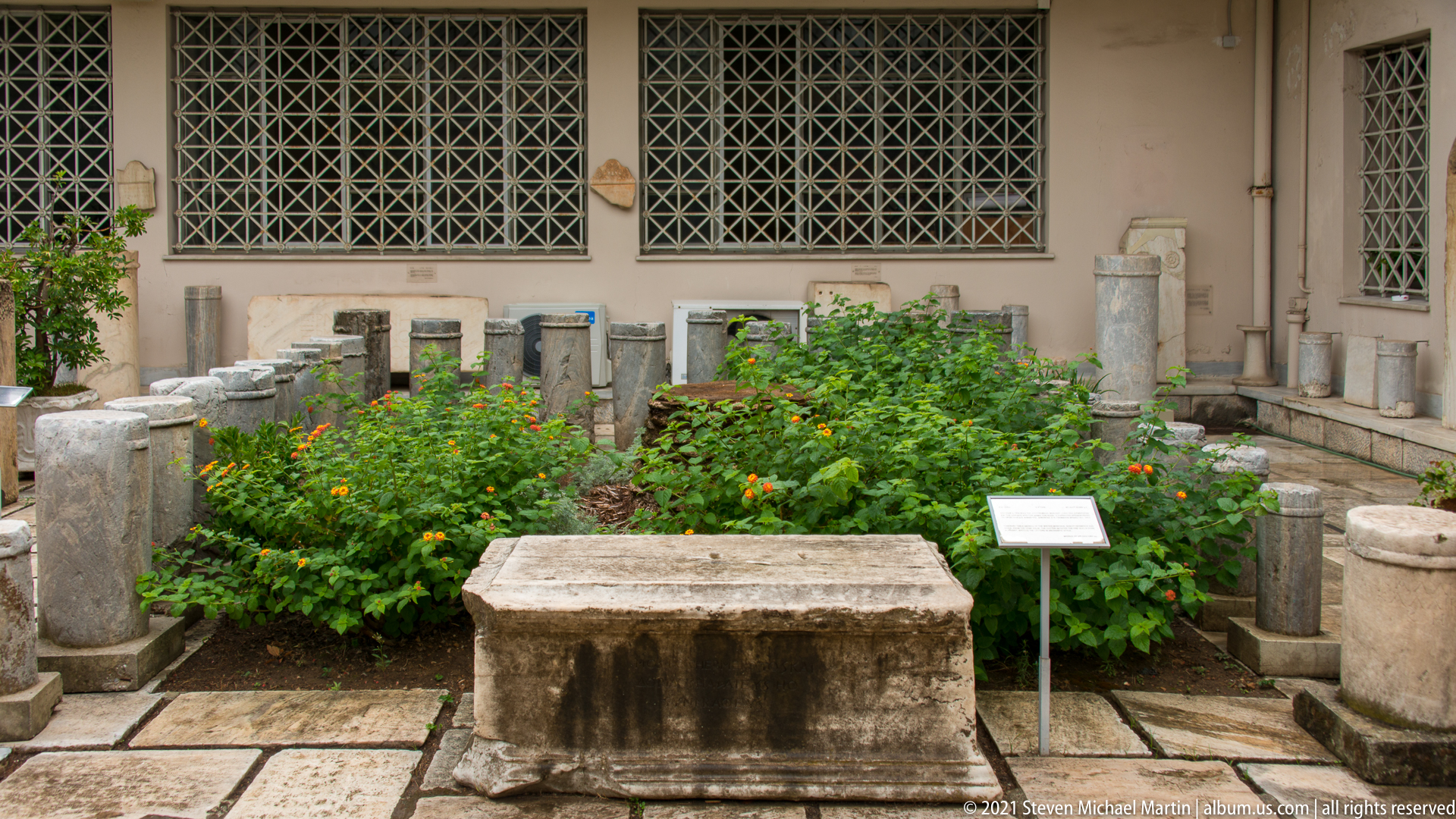
A planted courtyard is ringed by inscribed stone monuments, including low blocks, stelae, and cylindrical supports. The garden setting places weathered epigraphic material in natural light, while the varied shapes demonstrate the range of architectural and commemorative surfaces on which ancient texts survive.
Caption
A planted courtyard is ringed by inscribed stone monuments, including low blocks, stelae, and cylindrical supports. The garden setting places weathered epigraphic material in natural light, while the varied shapes demonstrate the range of architectural and commemorative surfaces on which ancient texts survive.
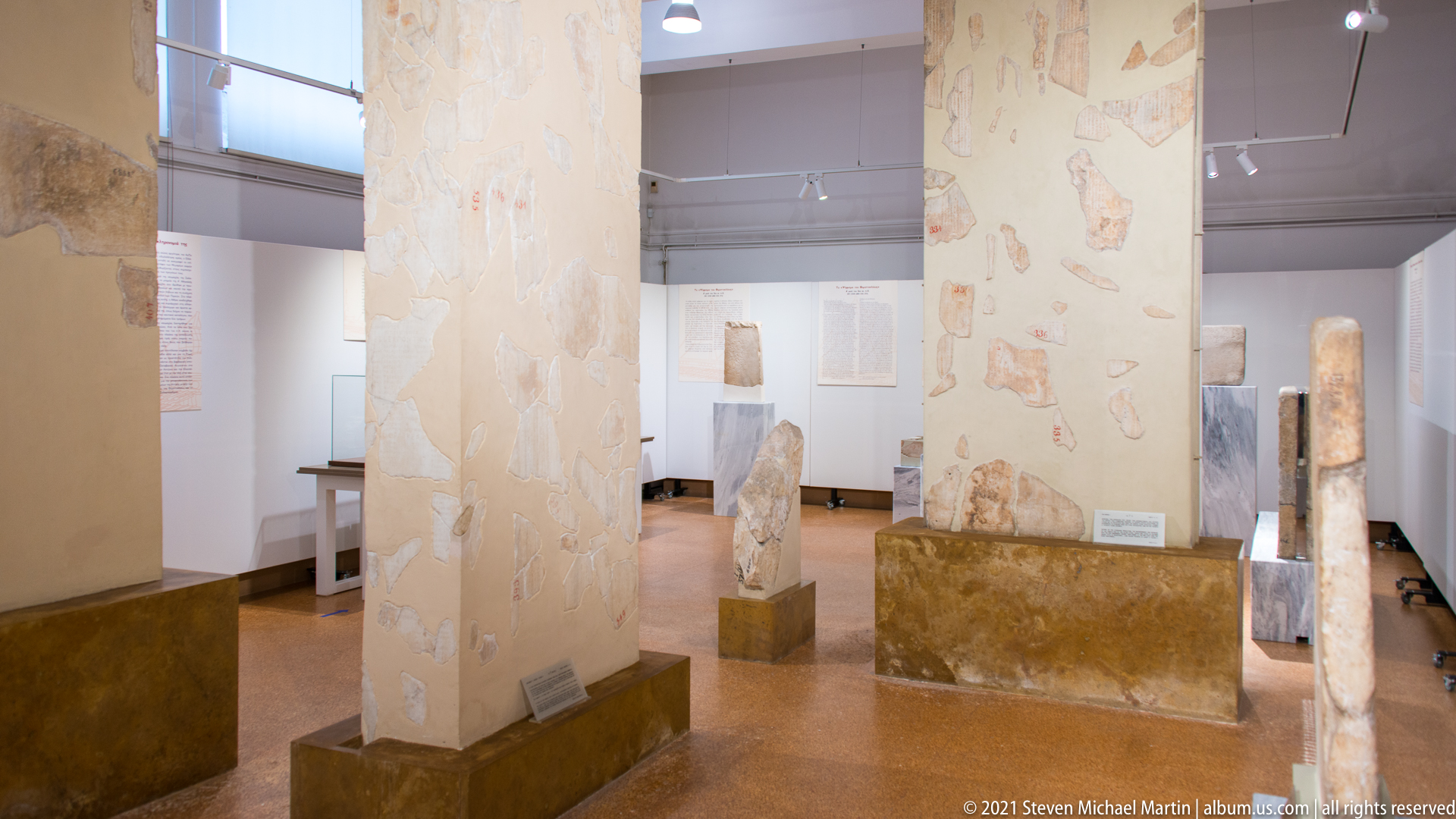
A gallery view shows inscribed slabs, stelae, and architectural fragments arranged around the Athens Epigraphical Museum. Tall masonry piers divide the room while freestanding stones create layered sightlines, revealing how inscriptions of different dimensions are displayed for close study rather than as a single reconstructed monument.
Caption
A gallery view shows inscribed slabs, stelae, and architectural fragments arranged around the Athens Epigraphical Museum. Tall masonry piers divide the room while freestanding stones create layered sightlines, revealing how inscriptions of different dimensions are displayed for close study rather than as a single reconstructed monument.

An elevated courtyard view surveys a group of cylindrical and rectangular stone monuments arranged individually on modern bases. Their differing heights, diameters, and surface conditions create an open-air study collection, while trees and the museum building frame the dense array of epigraphic material.
Caption
An elevated courtyard view surveys a group of cylindrical and rectangular stone monuments arranged individually on modern bases. Their differing heights, diameters, and surface conditions create an open-air study collection, while trees and the museum building frame the dense array of epigraphic material.
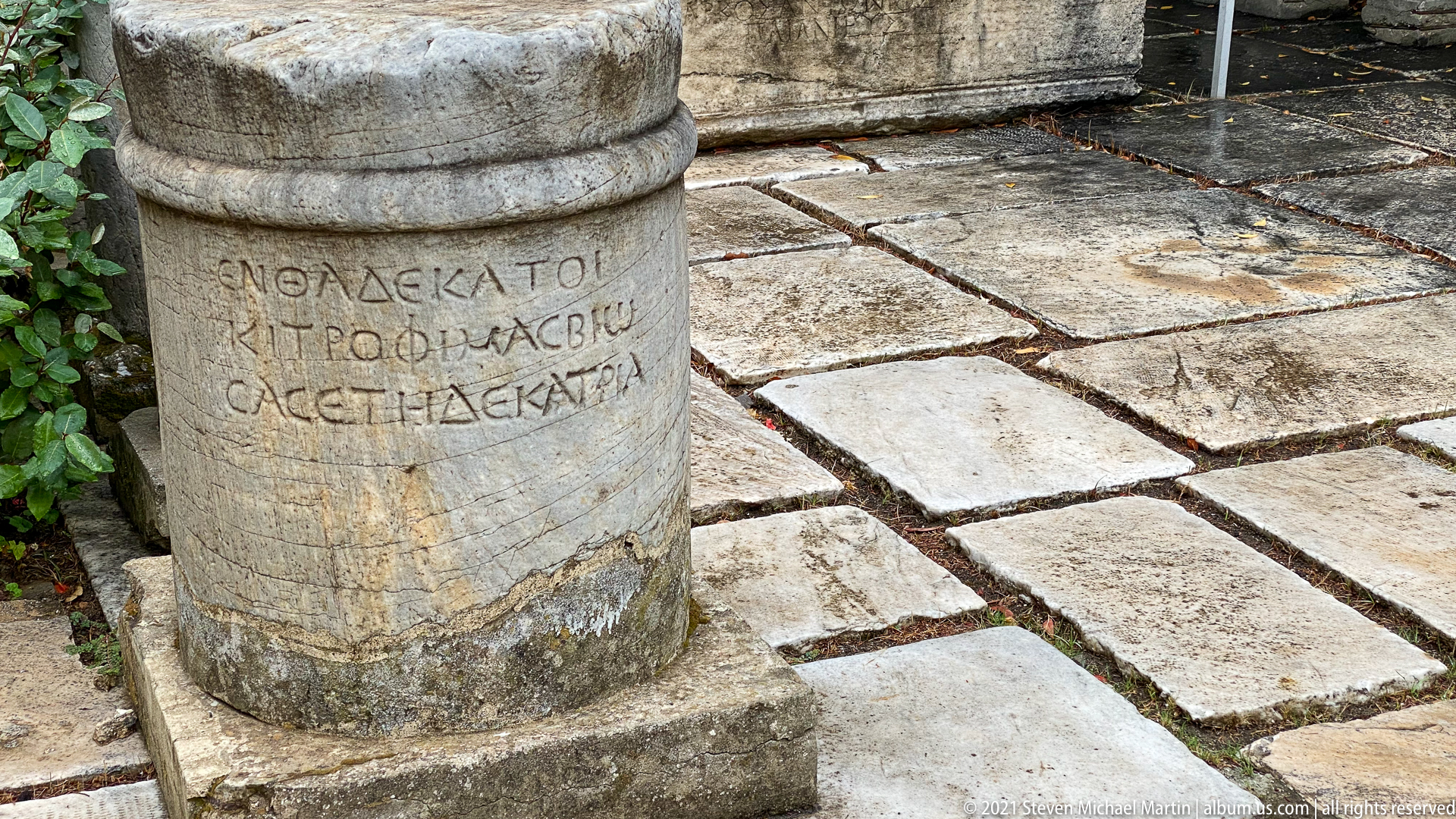
A short cylindrical stone monument stands beside the paved courtyard, its upper surface formed by a rounded molding and its shaft carved with several lines of Greek capitals. Weathering and dark staining near the base indicate long exposure, while the curved support forces the inscription to wrap around the monument rather than occupy a flat field.
Caption
A short cylindrical stone monument stands beside the paved courtyard, its upper surface formed by a rounded molding and its shaft carved with several lines of Greek capitals. Weathering and dark staining near the base indicate long exposure, while the curved support forces the inscription to wrap around the monument rather than occupy a flat field.
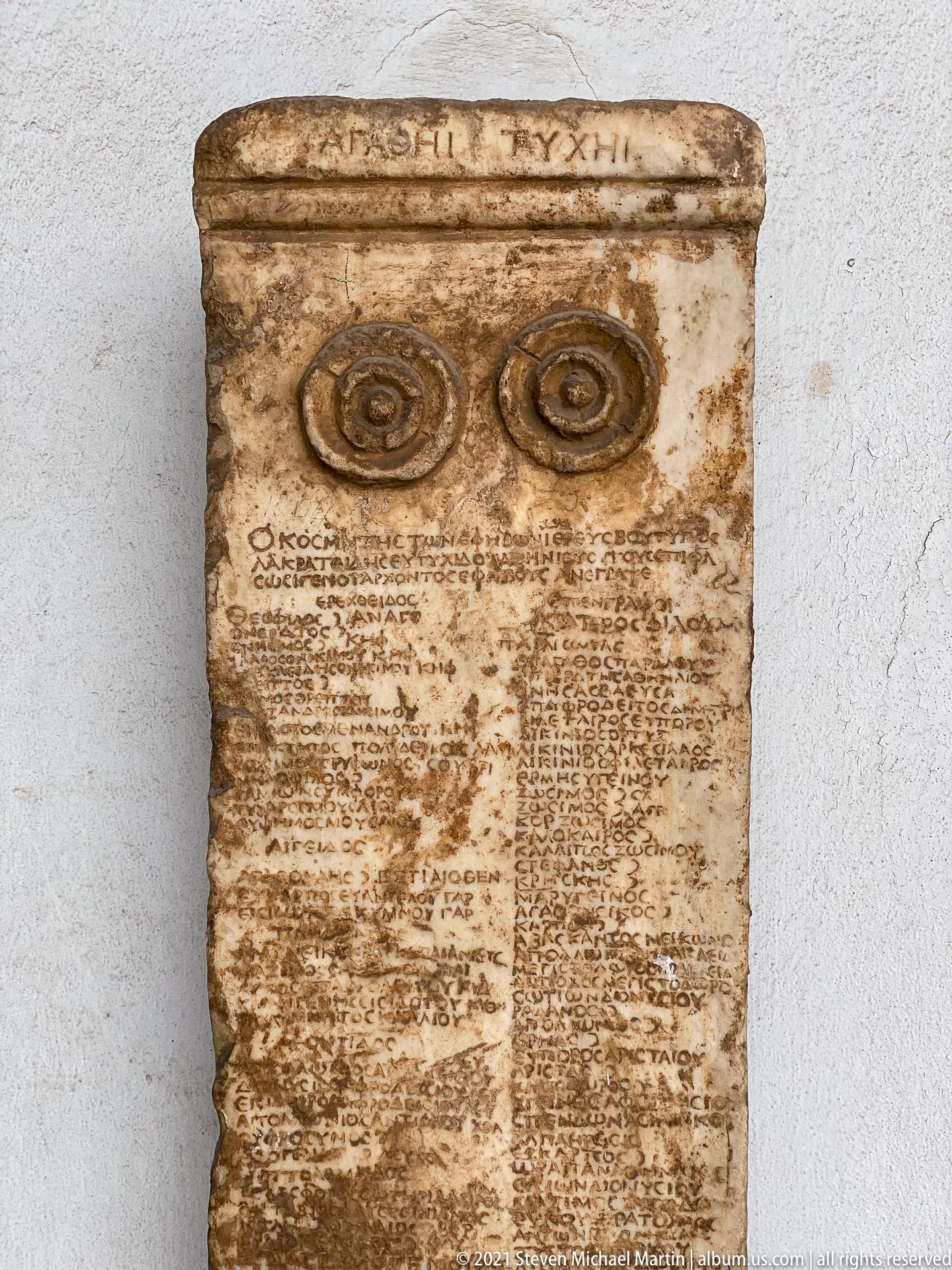
Dense lines of Greek text cover most of this narrow marble stele beneath two circular carved ornaments. The lettering varies in size and spacing across the surface, suggesting a complex epigraphic record rather than a purely decorative monument. A short additional inscription is visible near the top molding, while staining and surface wear soften portions of the text.
Caption
Dense lines of Greek text cover most of this narrow marble stele beneath two circular carved ornaments. The lettering varies in size and spacing across the surface, suggesting a complex epigraphic record rather than a purely decorative monument. A short additional inscription is visible near the top molding, while staining and surface wear soften portions of the text.
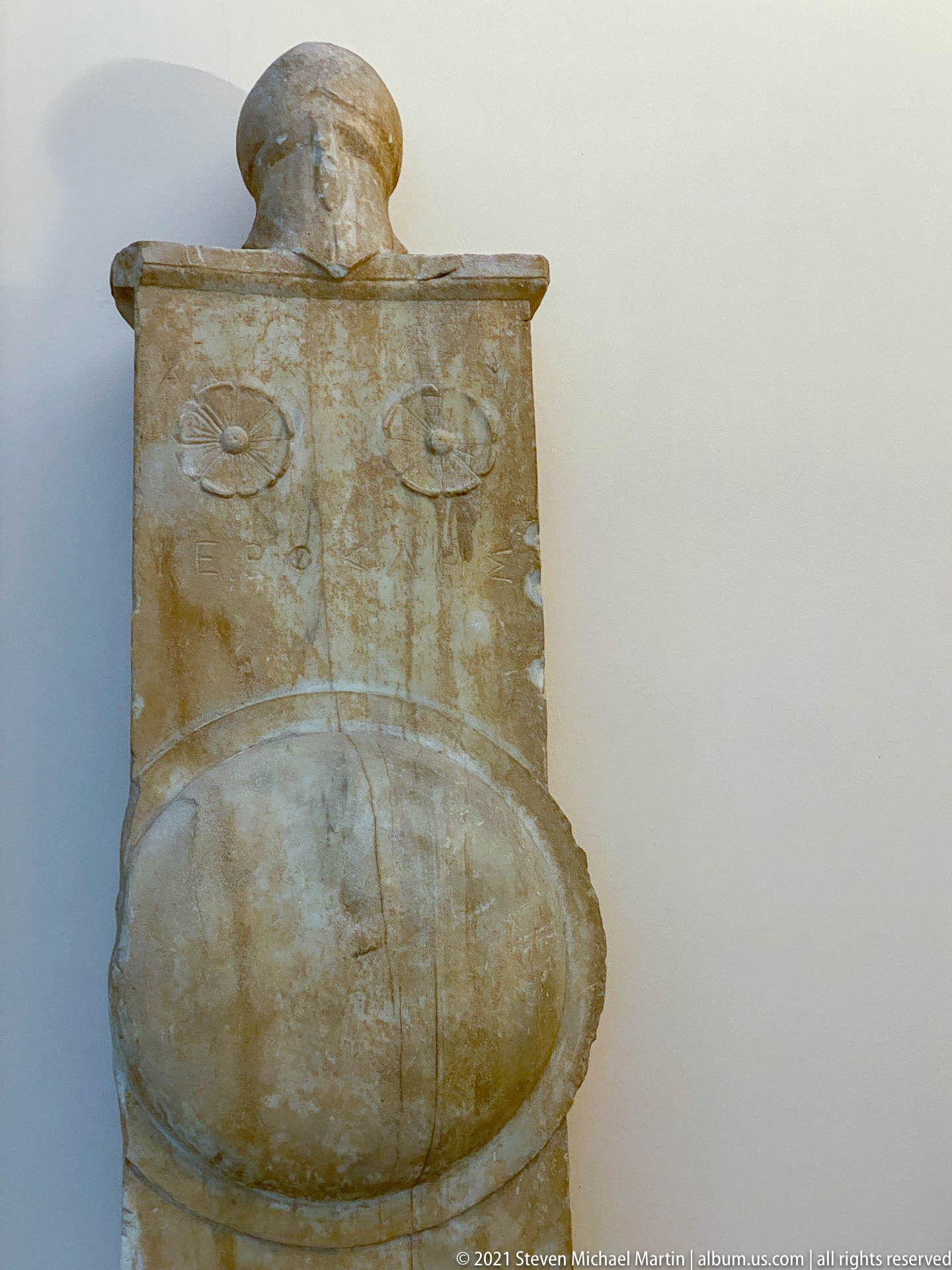
This unusual marble monument combines a rounded, vessel-like lower body with a squared neck and projecting rim. Two shallow circular ornaments appear on the front of the upper section, while vertical seams, fractures, and heavy surface wear mark the swelling lower form. Its hybrid silhouette distinguishes it from the flat stelae displayed elsewhere in the collection.
Caption
This unusual marble monument combines a rounded, vessel-like lower body with a squared neck and projecting rim. Two shallow circular ornaments appear on the front of the upper section, while vertical seams, fractures, and heavy surface wear mark the swelling lower form. Its hybrid silhouette distinguishes it from the flat stelae displayed elsewhere in the collection.
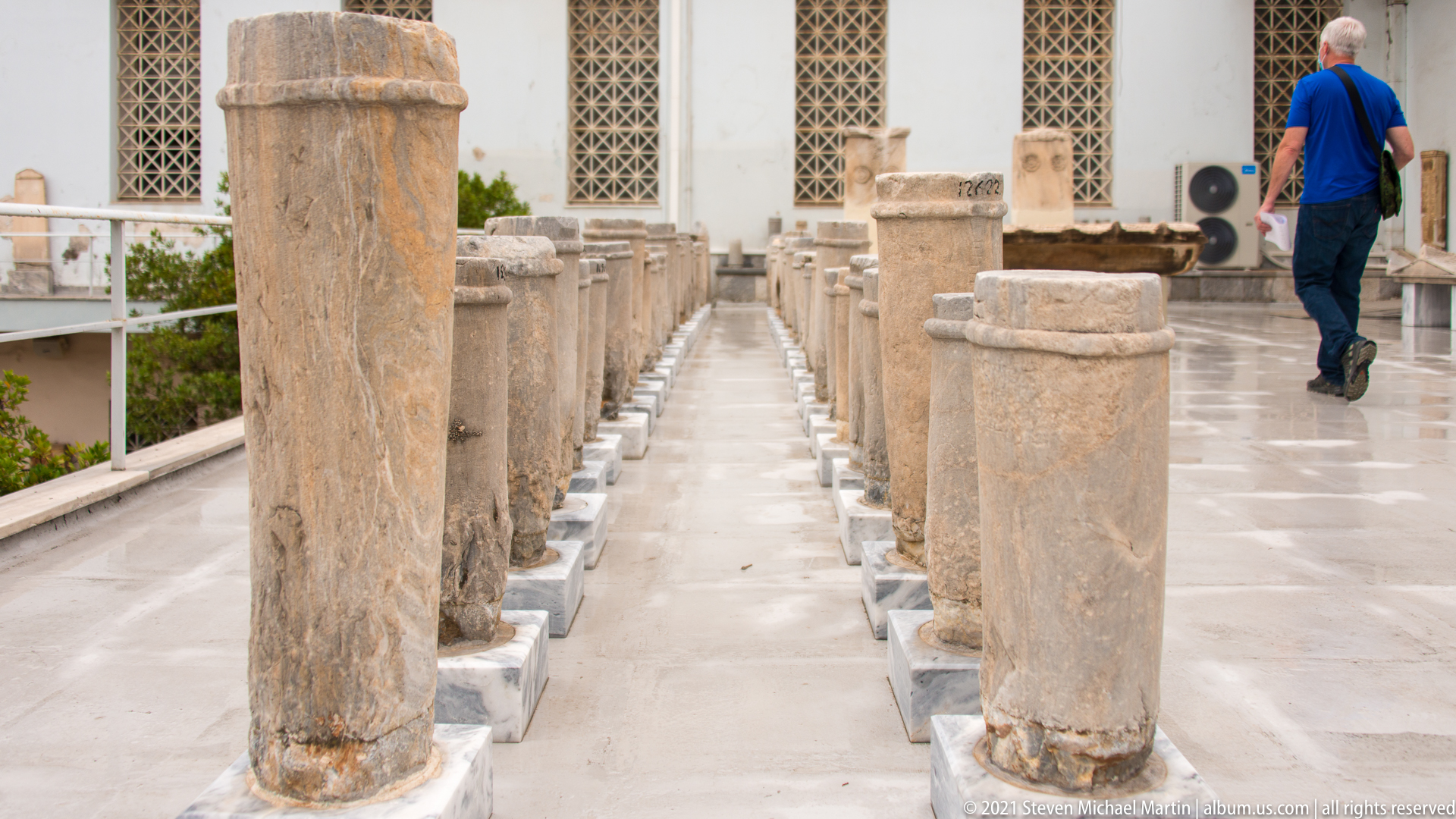
Parallel rows of upright stone stelae create a long perspective through the museum’s outdoor collection. Cylindrical and rectangular monuments stand on individual bases, allowing their surfaces and proportions to be examined from close range while also conveying the remarkable quantity of inscribed material preserved by the museum.
Caption
Parallel rows of upright stone stelae create a long perspective through the museum’s outdoor collection. Cylindrical and rectangular monuments stand on individual bases, allowing their surfaces and proportions to be examined from close range while also conveying the remarkable quantity of inscribed material preserved by the museum.
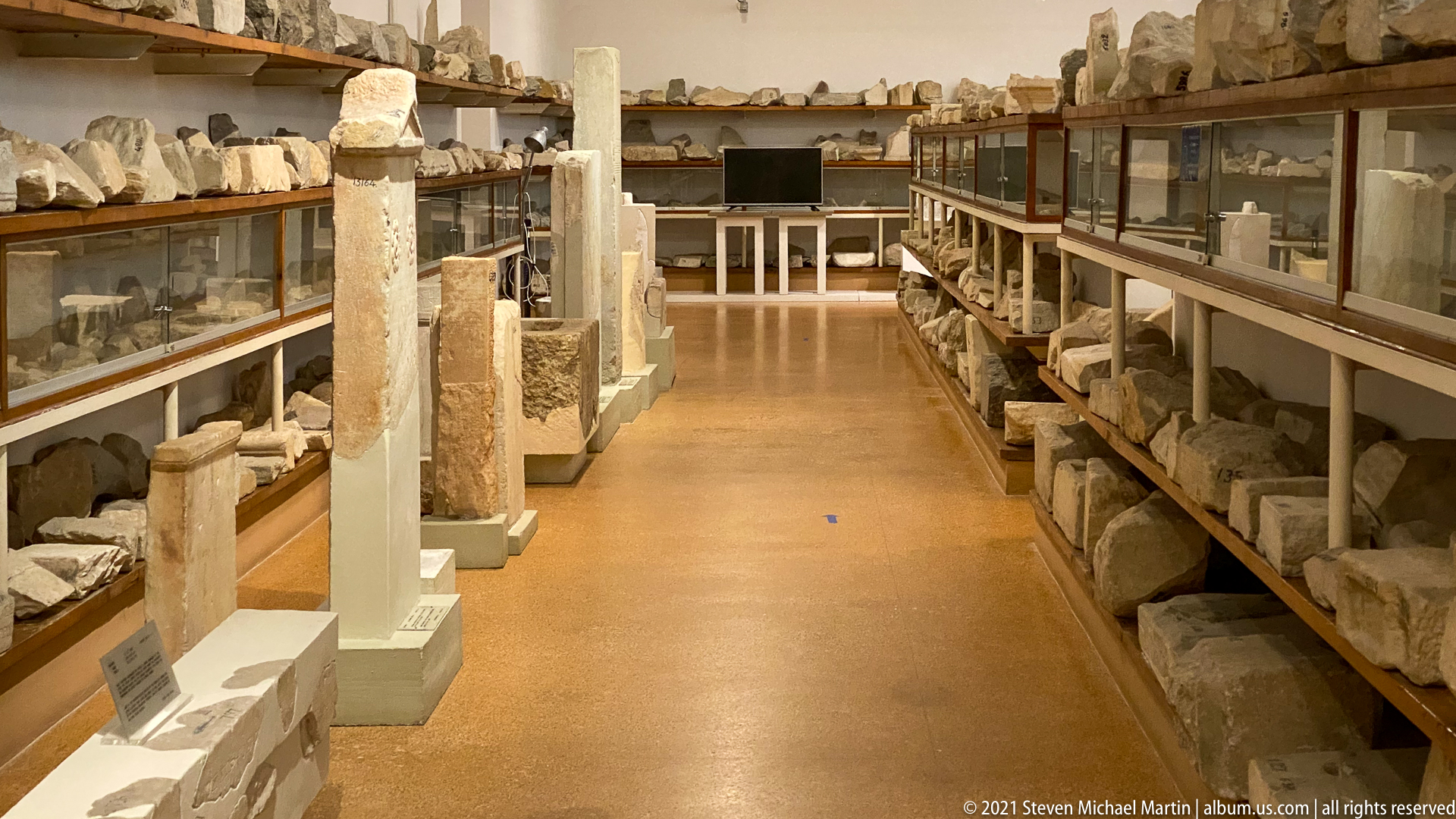
Rows of inscribed blocks, stelae, and architectural fragments fill a long study-storage gallery at the Athens Epigraphical Museum. Upright monuments stand on white bases down the center aisle, while open shelving and glazed cases preserve smaller fragments along both walls. The view reveals the collection as a working epigraphic archive as well as a public museum display.
Caption
Rows of inscribed blocks, stelae, and architectural fragments fill a long study-storage gallery at the Athens Epigraphical Museum. Upright monuments stand on white bases down the center aisle, while open shelving and glazed cases preserve smaller fragments along both walls. The view reveals the collection as a working epigraphic archive as well as a public museum display.
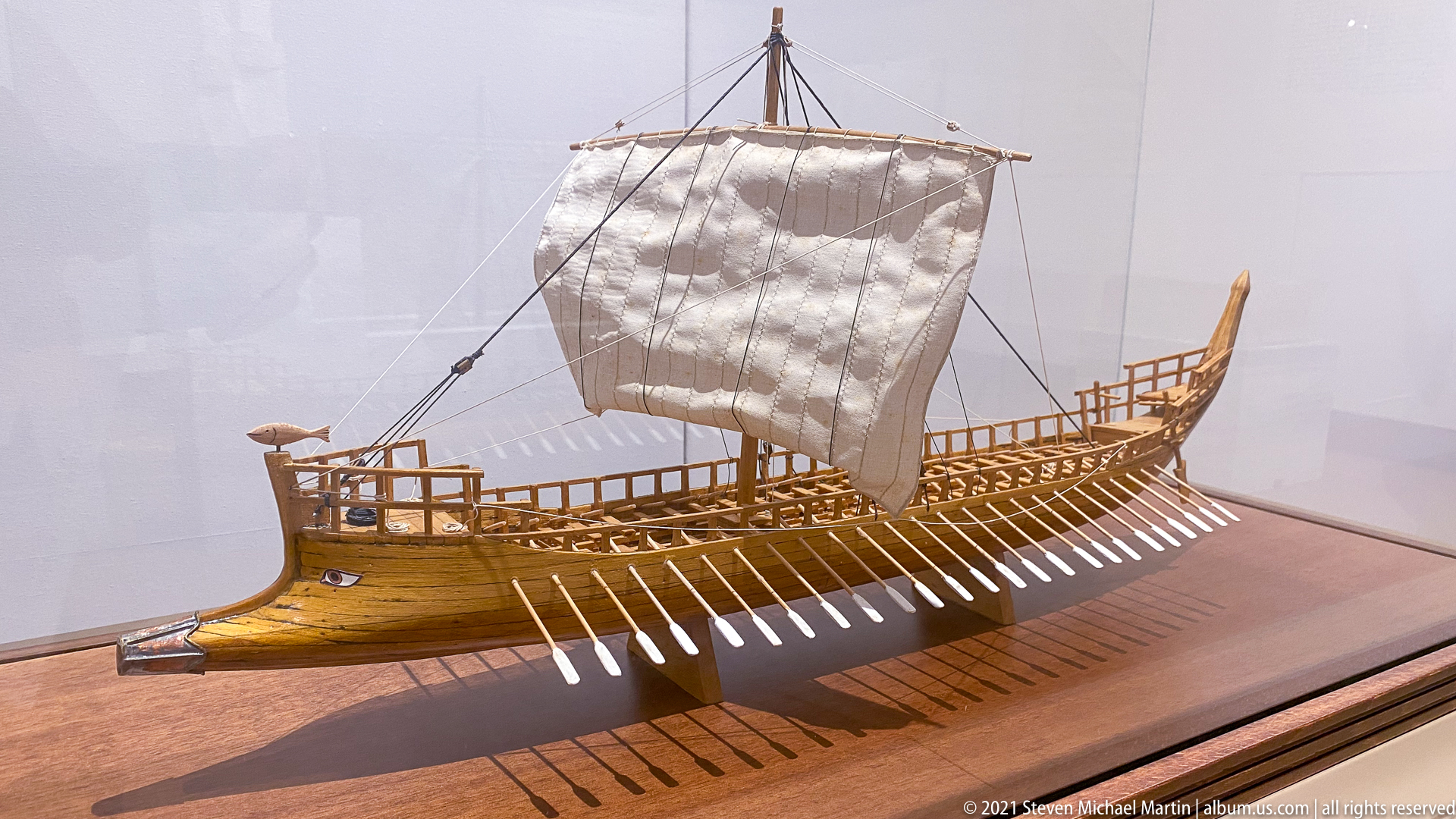
A detailed model reconstructs an ancient Mediterranean oared vessel with a single square sail, long banks of oars, raised stern, and narrow hull. Within an epigraphic museum, the model provides material context for inscriptions connected with maritime administration, crews, trade, or naval activity without requiring the original wooden ships to survive.
Caption
A detailed model reconstructs an ancient Mediterranean oared vessel with a single square sail, long banks of oars, raised stern, and narrow hull. Within an epigraphic museum, the model provides material context for inscriptions connected with maritime administration, crews, trade, or naval activity without requiring the original wooden ships to survive.
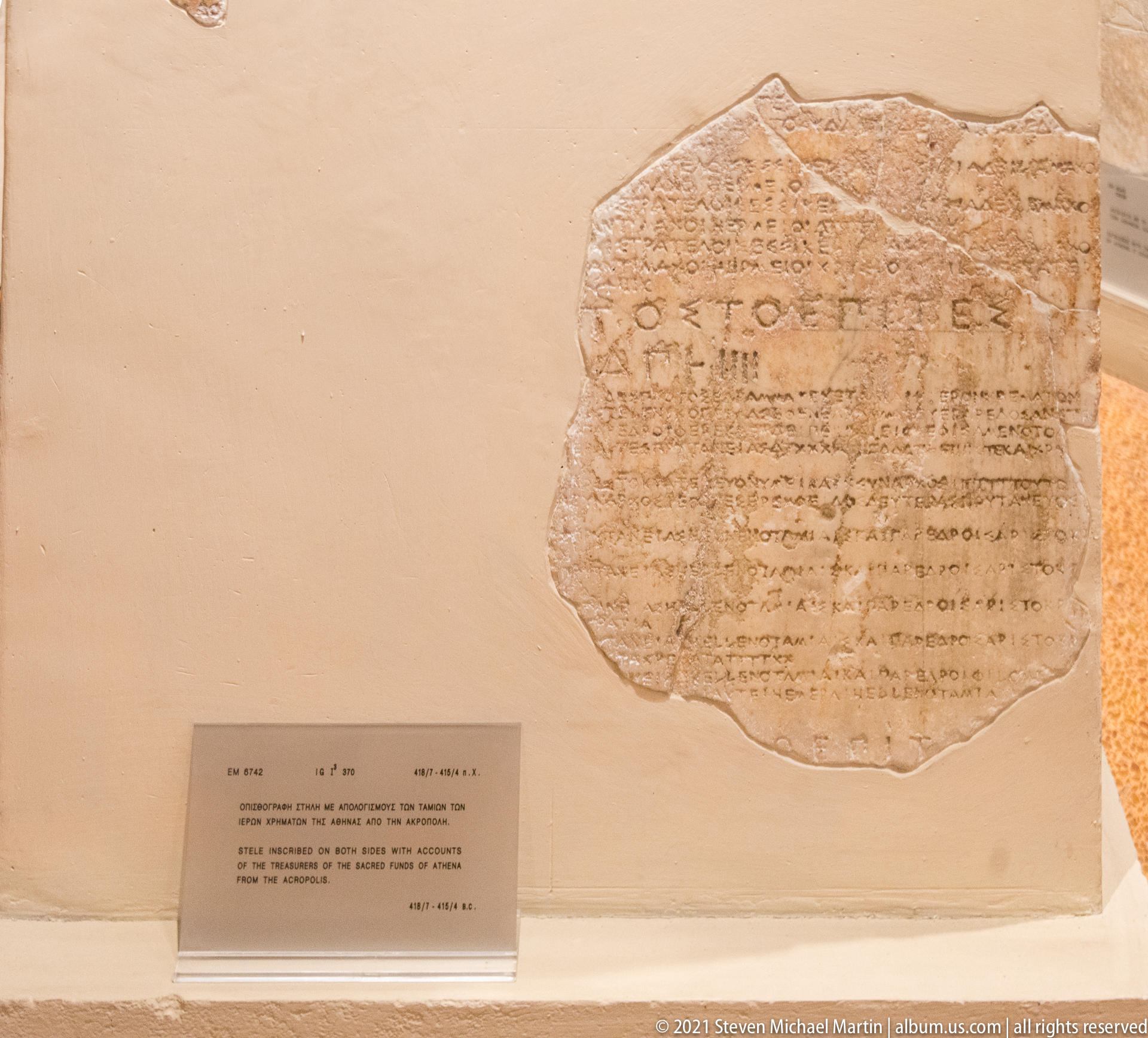
A broken stone fragment preserves closely spaced lines of ancient Greek lettering across an irregular surface. The surviving text and fractured perimeter make the piece a compact example of how epigraphers work with incomplete monuments, reading letter forms and line structure while accounting for losses at the edges.
Caption
A broken stone fragment preserves closely spaced lines of ancient Greek lettering across an irregular surface. The surviving text and fractured perimeter make the piece a compact example of how epigraphers work with incomplete monuments, reading letter forms and line structure while accounting for losses at the edges.
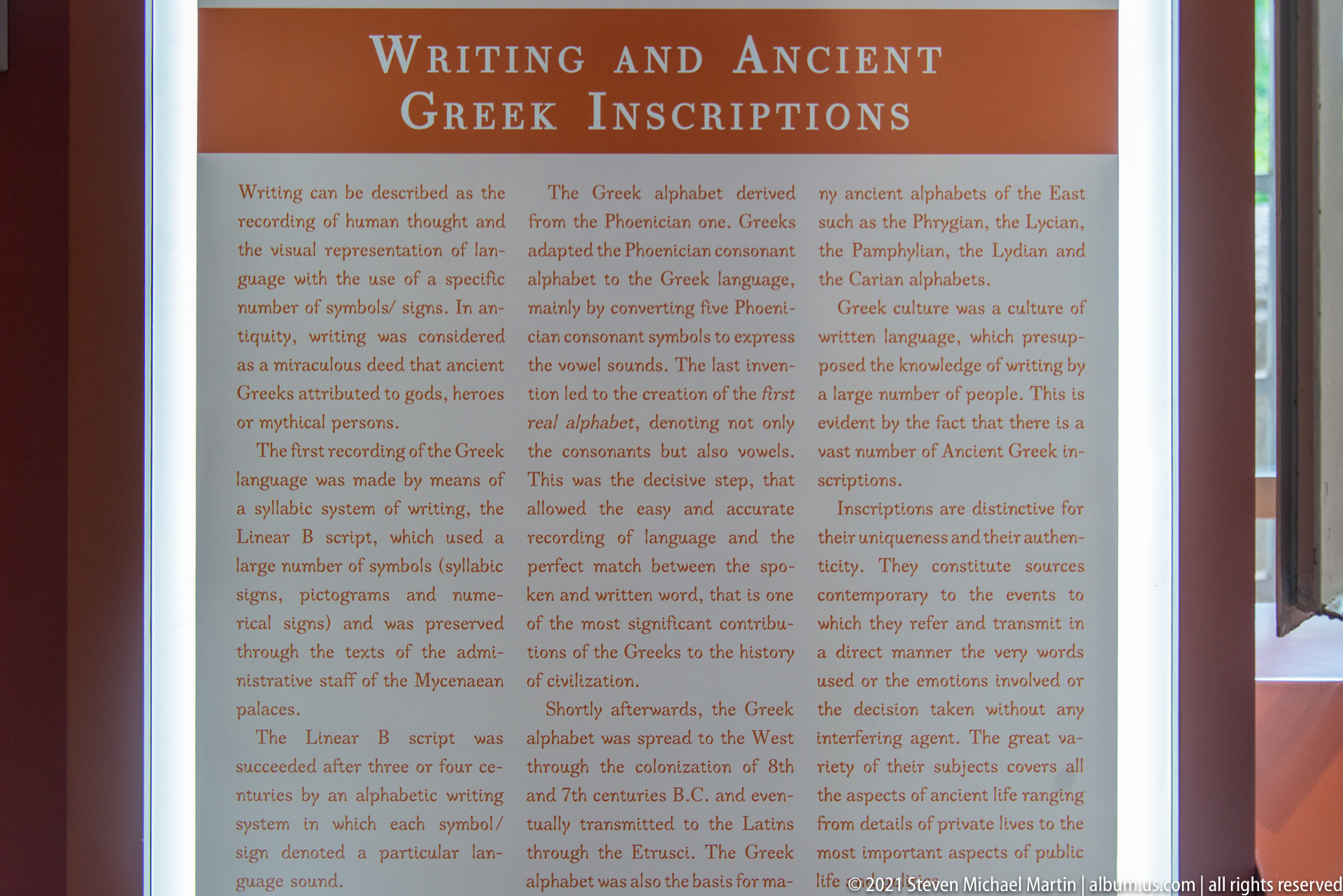
An introductory museum panel explains the development and public uses of writing and ancient Greek inscriptions. Its dense bilingual-style display text provides interpretive context for the inscribed objects nearby, linking alphabetic writing with civic, religious, legal, and commemorative practices represented in the museum collection.
Caption
An introductory museum panel explains the development and public uses of writing and ancient Greek inscriptions. Its dense bilingual-style display text provides interpretive context for the inscribed objects nearby, linking alphabetic writing with civic, religious, legal, and commemorative practices represented in the museum collection.
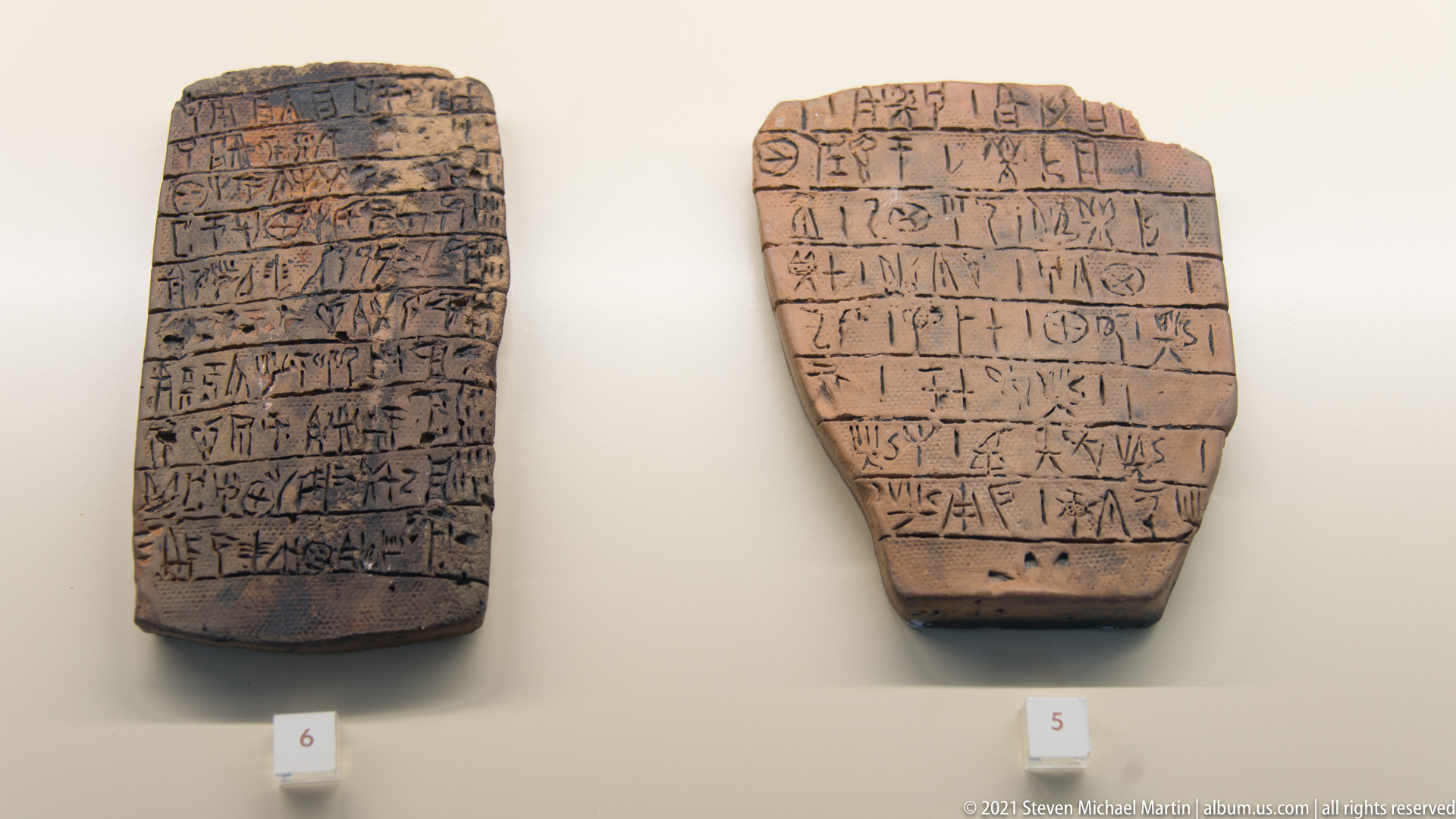
Two clay tablets displayed side by side carry rows of incised signs arranged in ruled lines. Their compact format and repeated symbols illustrate administrative writing on portable clay supports before the widespread use of alphabetic Greek inscriptions on stone, contrasting sharply with the monumental texts elsewhere in the museum.
Caption
Two clay tablets displayed side by side carry rows of incised signs arranged in ruled lines. Their compact format and repeated symbols illustrate administrative writing on portable clay supports before the widespread use of alphabetic Greek inscriptions on stone, contrasting sharply with the monumental texts elsewhere in the museum.
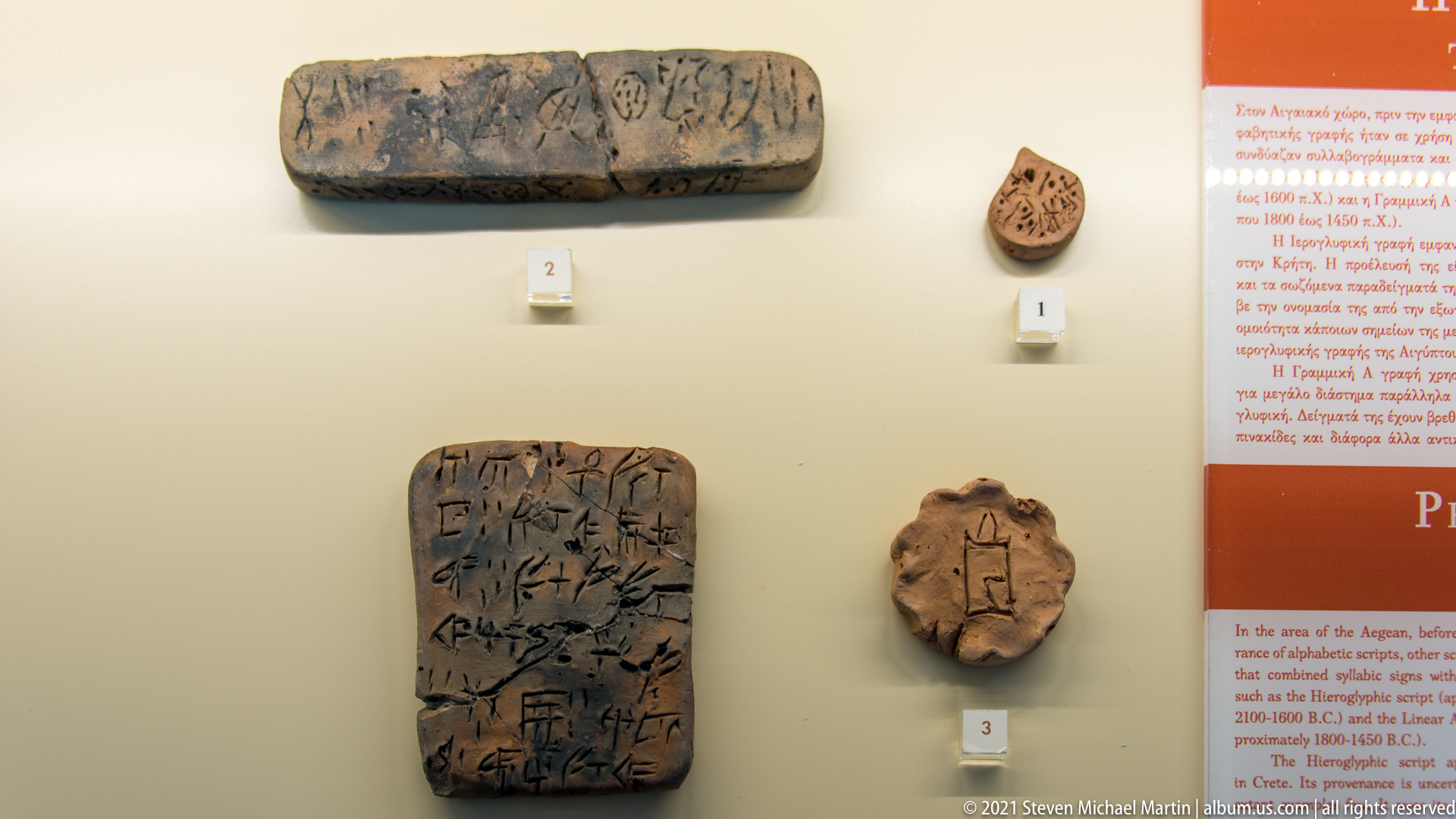
Four small clay objects present several forms of early Aegean writing, from elongated and rectangular tablets to smaller seal-like pieces. Displayed together beside an explanatory panel, they emphasize the variety of portable surfaces used for recording information before alphabetic inscriptions became dominant in the Greek world.
Caption
Four small clay objects present several forms of early Aegean writing, from elongated and rectangular tablets to smaller seal-like pieces. Displayed together beside an explanatory panel, they emphasize the variety of portable surfaces used for recording information before alphabetic inscriptions became dominant in the Greek world.
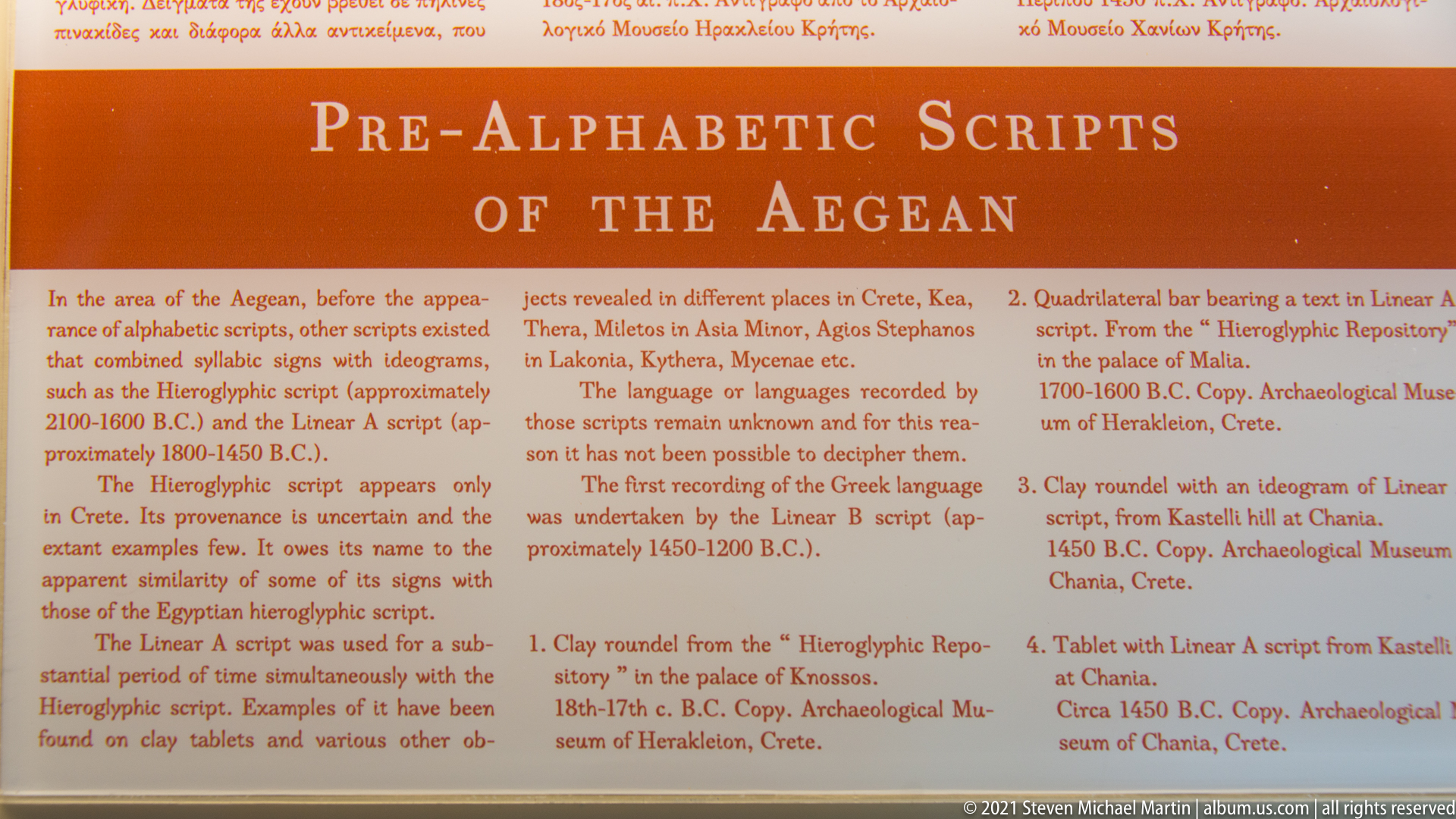
A museum panel surveys pre-alphabetic scripts of the Aegean, discussing systems used before the Greek alphabet and illustrating them with labeled archaeological examples. The display situates clay tablets and other inscribed objects within the broader history of writing in Crete, the Greek mainland, and neighboring Aegean regions.
Caption
A museum panel surveys pre-alphabetic scripts of the Aegean, discussing systems used before the Greek alphabet and illustrating them with labeled archaeological examples. The display situates clay tablets and other inscribed objects within the broader history of writing in Crete, the Greek mainland, and neighboring Aegean regions.
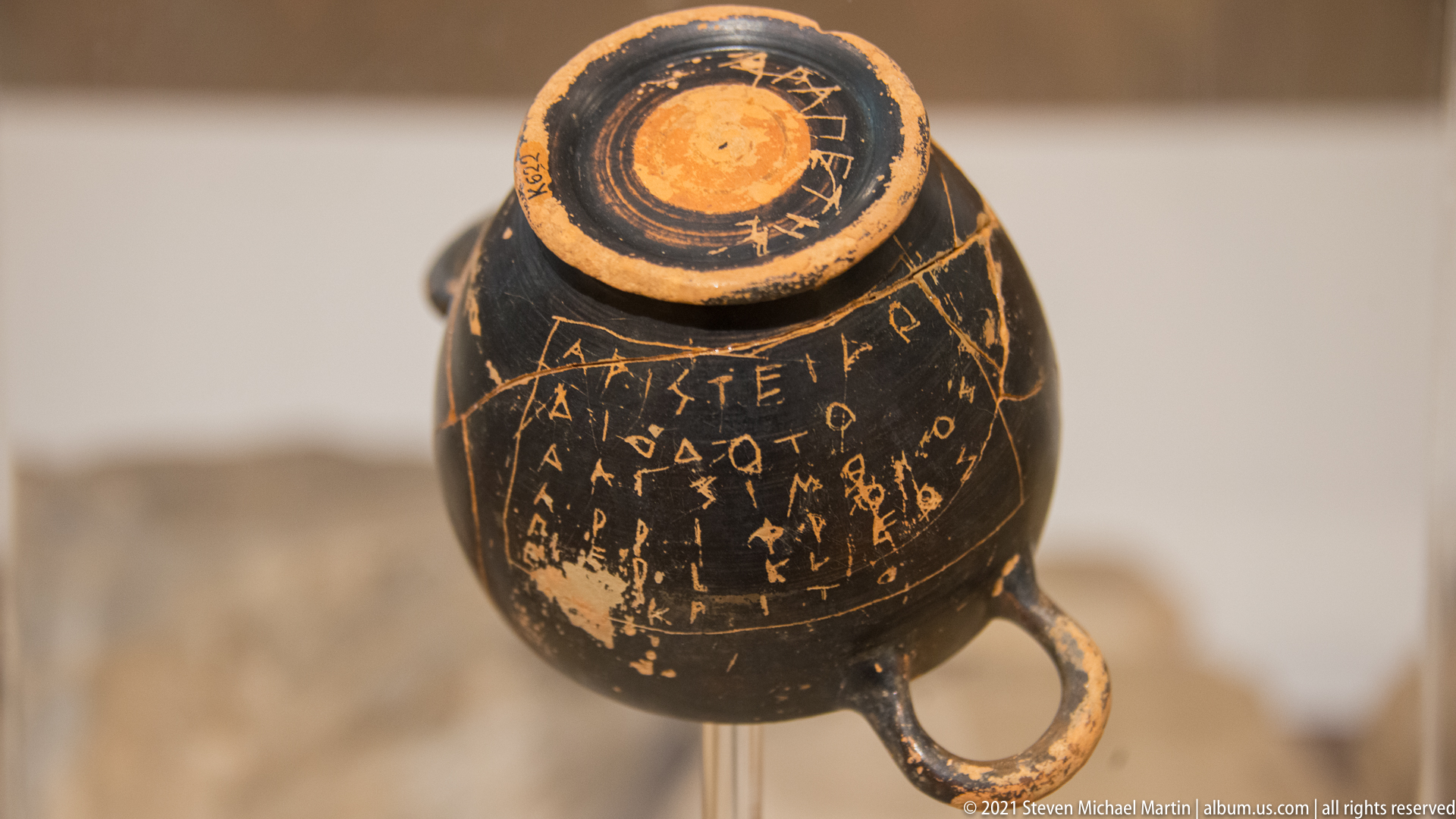
A small black-glazed ceramic vessel bears scratched Greek letters across its rounded body, turning an everyday portable object into an epigraphic document. The close view shows how inscriptions were not confined to monumental stone: writing could also be added to pottery, where the curved surface and vessel form shaped the arrangement of the text.
Caption
A small black-glazed ceramic vessel bears scratched Greek letters across its rounded body, turning an everyday portable object into an epigraphic document. The close view shows how inscriptions were not confined to monumental stone: writing could also be added to pottery, where the curved surface and vessel form shaped the arrangement of the text.
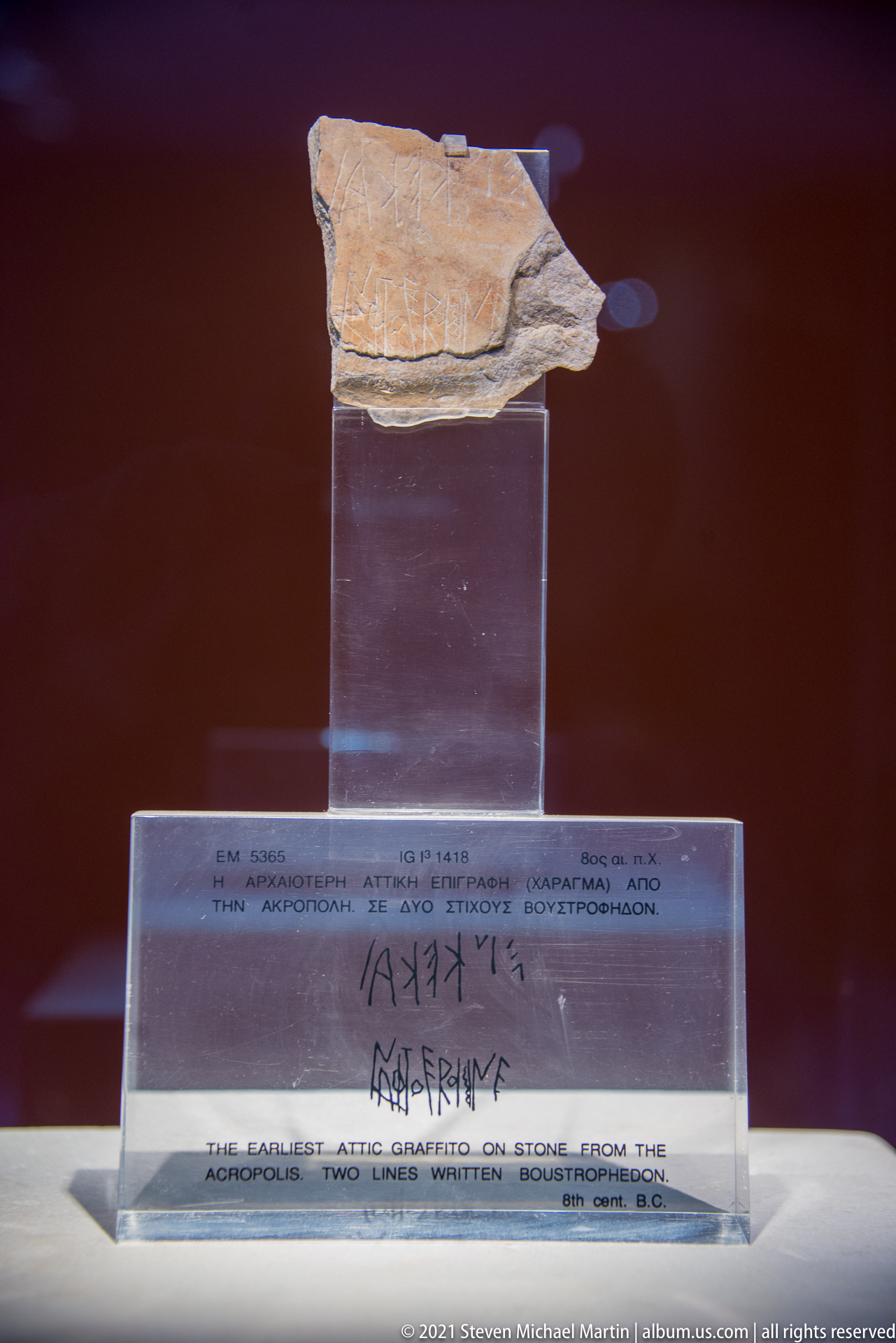
A small stone fragment is mounted above a transparent transcription panel that reproduces two lines of early Greek lettering. The display calls attention to boustrophedon writing, in which successive lines reverse direction, allowing visitors to compare the surviving stone surface with a clearer rendering of its inscription.
Caption
A small stone fragment is mounted above a transparent transcription panel that reproduces two lines of early Greek lettering. The display calls attention to boustrophedon writing, in which successive lines reverse direction, allowing visitors to compare the surviving stone surface with a clearer rendering of its inscription.
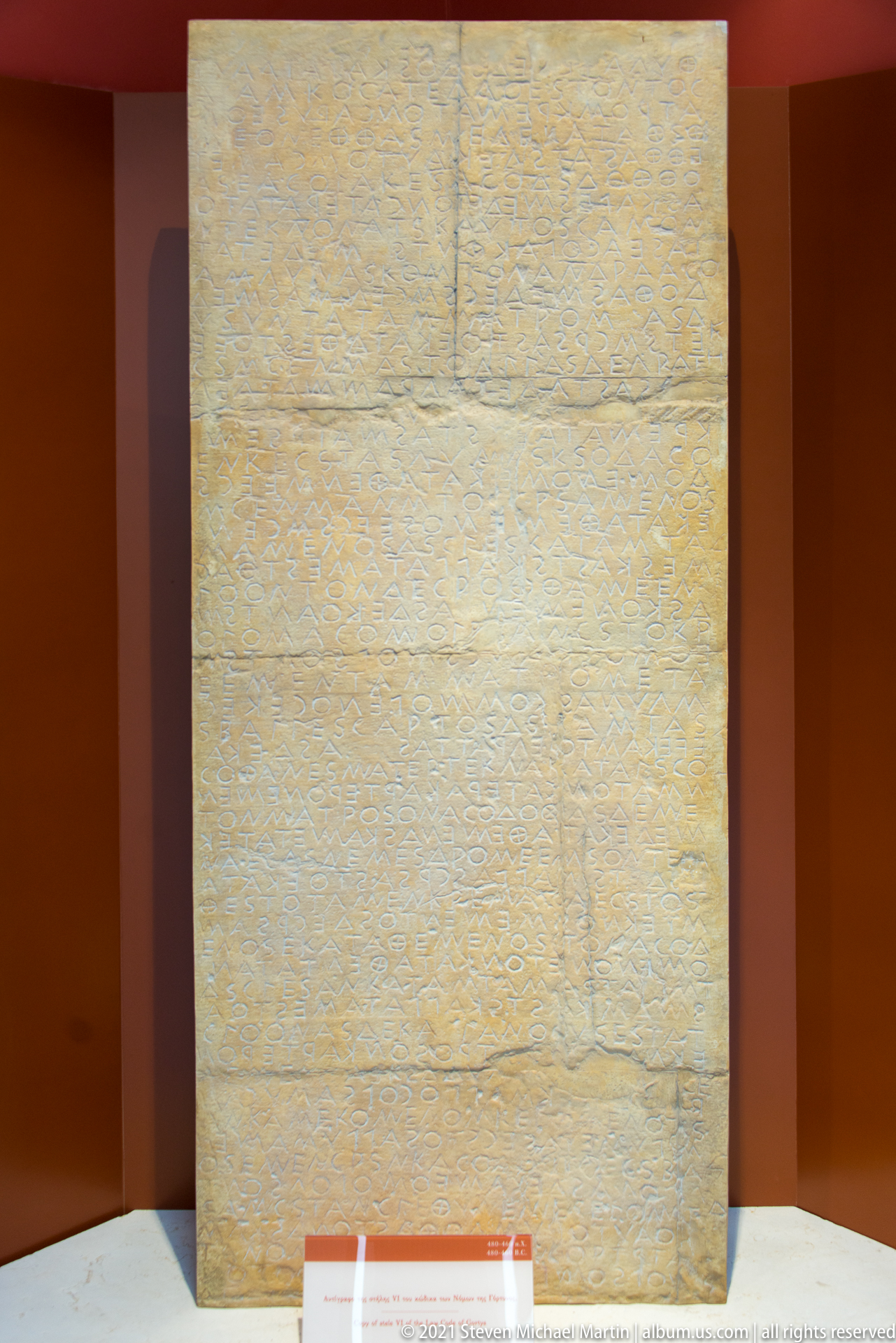
A broad rectangular slab carries a dense field of shallow, weathered lettering that becomes visible through subtle changes in surface texture and raking light. Its scale suggests the monumental character of many public inscriptions, where extensive texts were laid out across carefully prepared stone faces for durable display.
Caption
A broad rectangular slab carries a dense field of shallow, weathered lettering that becomes visible through subtle changes in surface texture and raking light. Its scale suggests the monumental character of many public inscriptions, where extensive texts were laid out across carefully prepared stone faces for durable display.
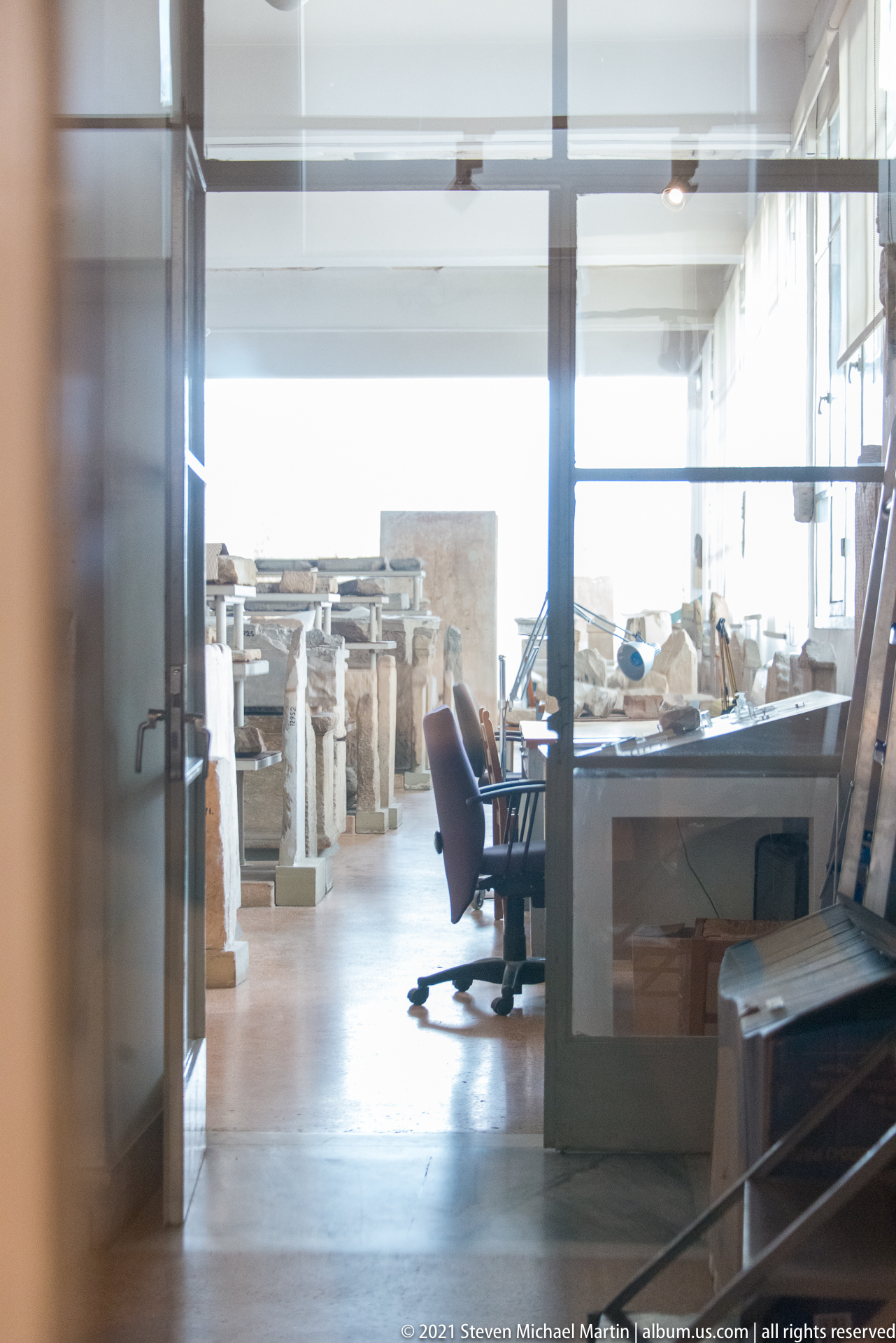
A view through a glass partition looks into a working or study area filled with stone inscriptions, tables, shelving, and office equipment. The scene highlights the museum’s research function alongside public display, with numerous carved fragments accessible for documentation, comparison, and scholarly examination.
Caption
A view through a glass partition looks into a working or study area filled with stone inscriptions, tables, shelving, and office equipment. The scene highlights the museum’s research function alongside public display, with numerous carved fragments accessible for documentation, comparison, and scholarly examination.
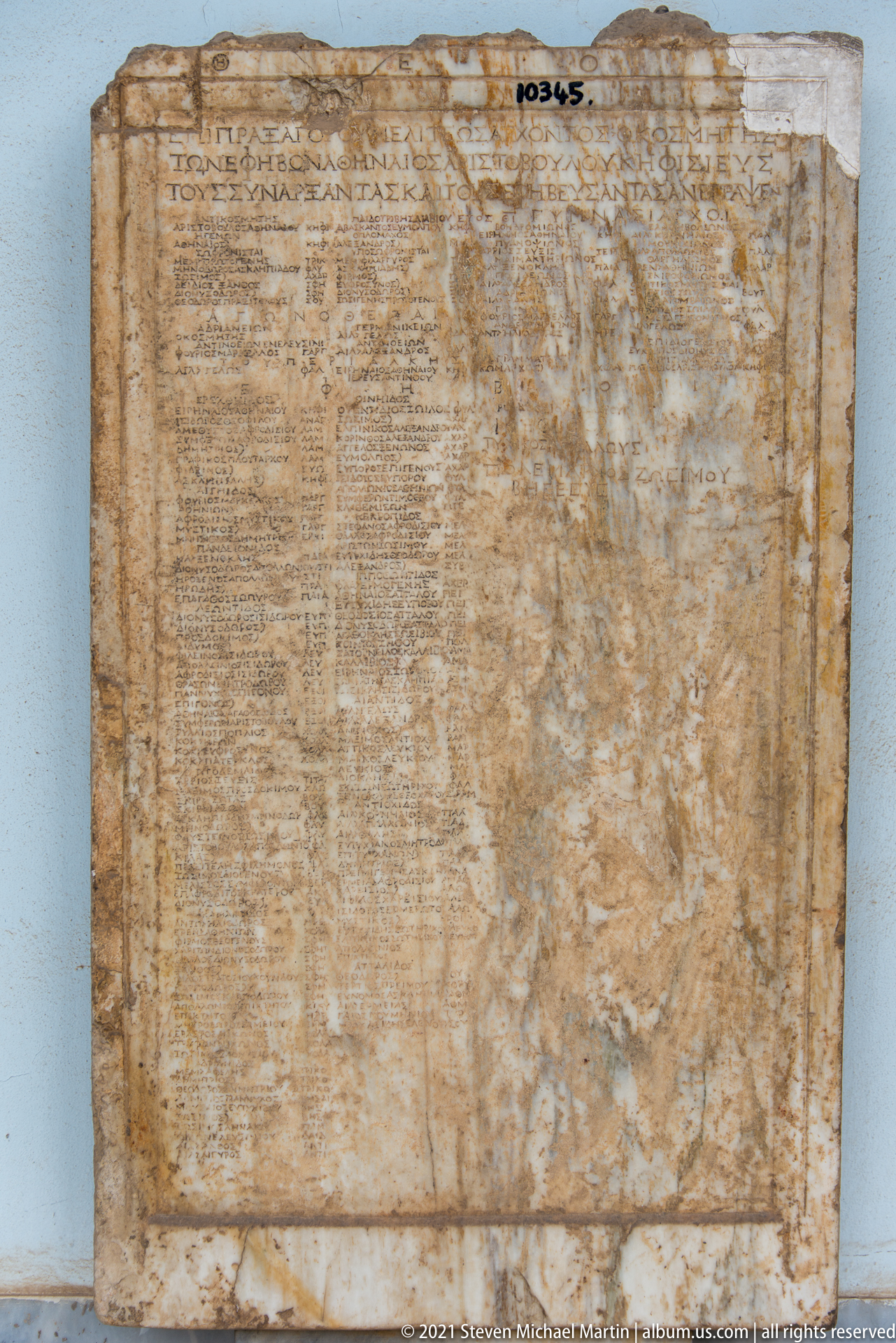
A large rectangular marble slab preserves an extensive inscription across most of its face, though abrasion and discoloration make portions difficult to read. A ruled border frames the text field, and the surviving lines reveal the disciplined layout used for a substantial public or official document carved in stone.
Caption
A large rectangular marble slab preserves an extensive inscription across most of its face, though abrasion and discoloration make portions difficult to read. A ruled border frames the text field, and the surviving lines reveal the disciplined layout used for a substantial public or official document carved in stone.
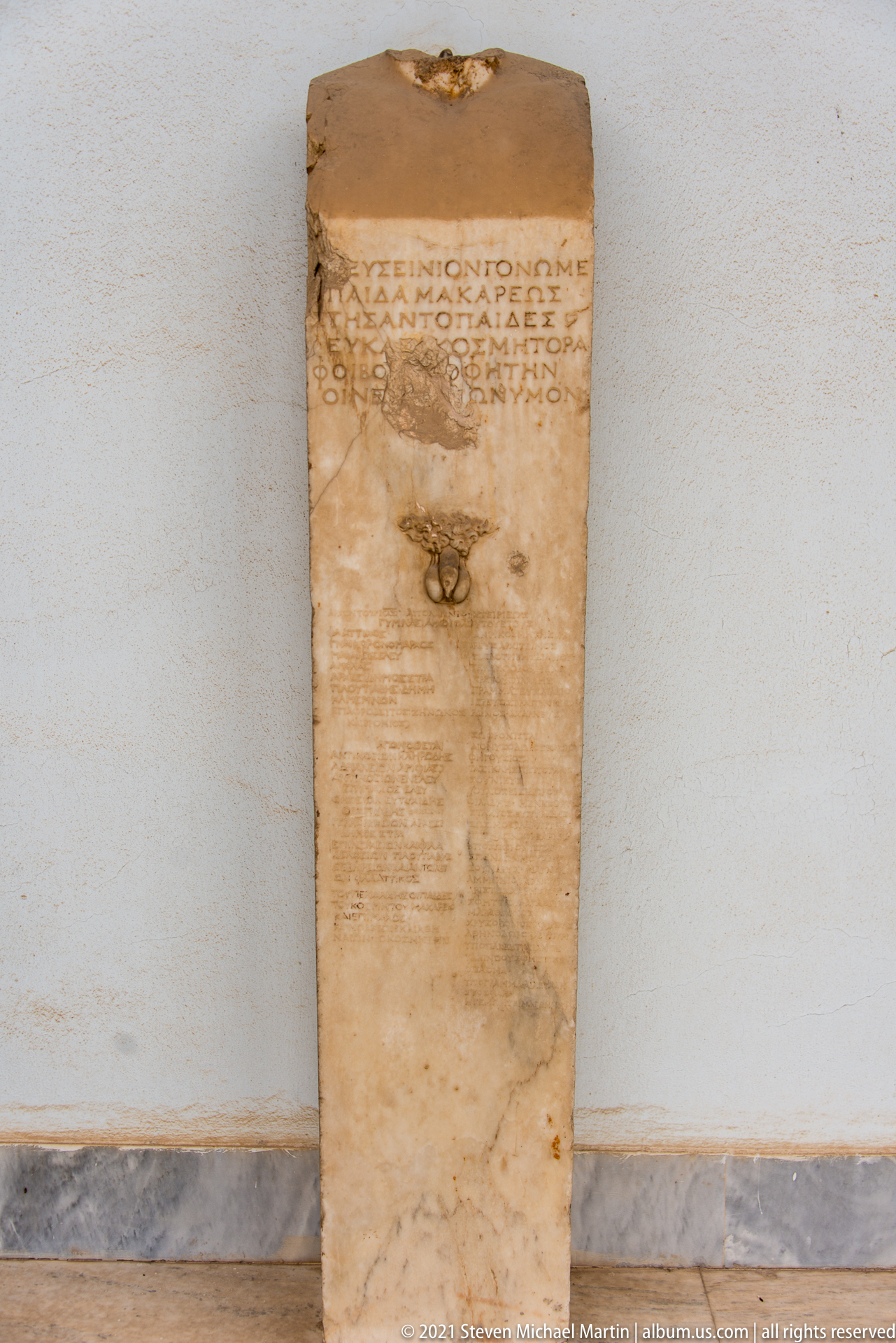
A narrow marble stele carries several lines of large Greek lettering near the top and a much denser block of smaller text below. Metal mounting hardware attached to the face interrupts the ancient surface, making this view especially useful for documenting both the inscription’s layout and the practical history of its display.
Caption
A narrow marble stele carries several lines of large Greek lettering near the top and a much denser block of smaller text below. Metal mounting hardware attached to the face interrupts the ancient surface, making this view especially useful for documenting both the inscription’s layout and the practical history of its display.
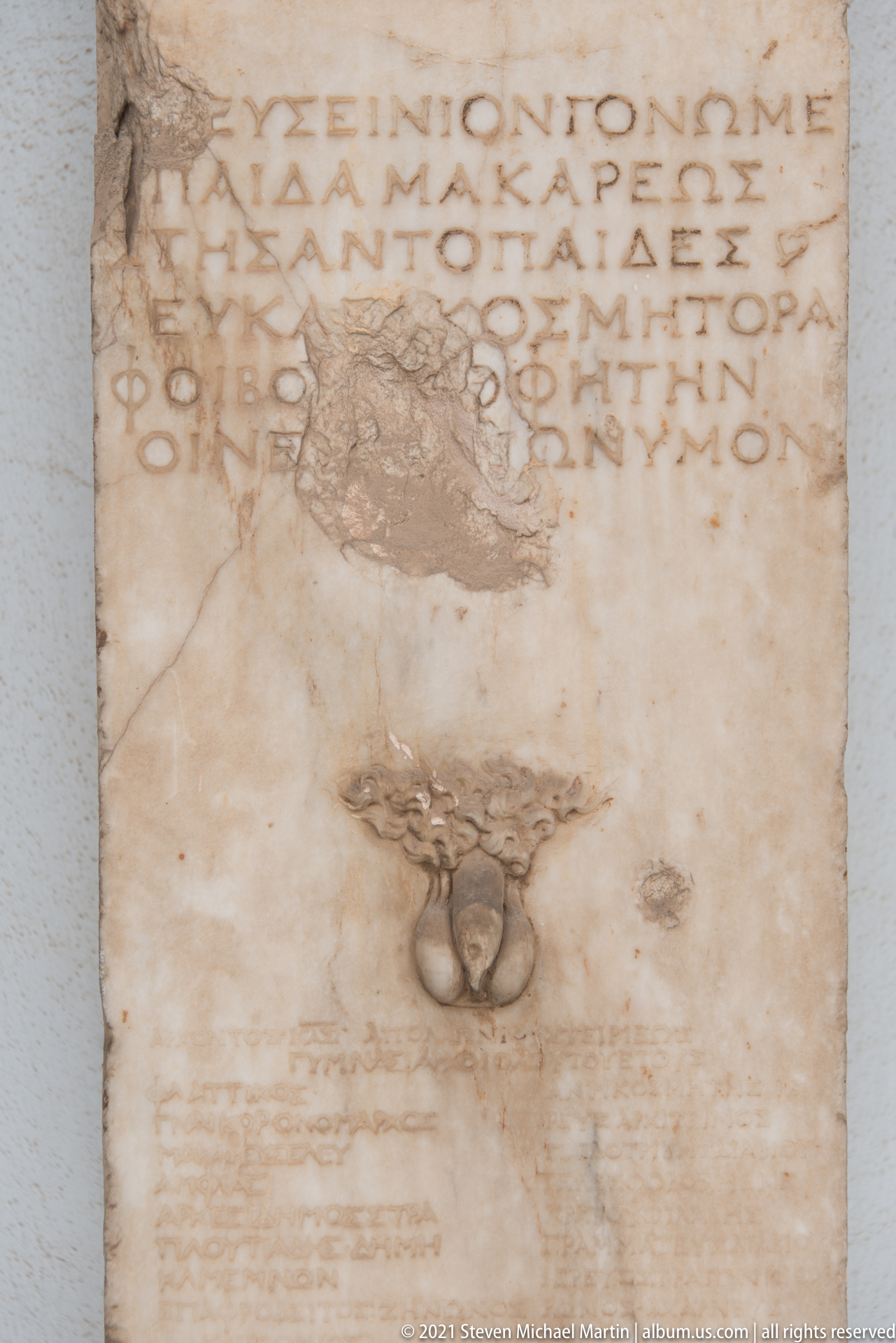
A close view isolates the upper section of an inscribed marble stele, where deeply cut Greek capitals stand above a corroded metal fitting. The tighter framing makes individual letter forms and spacing easier to inspect while also recording surface staining, losses, and later hardware that affect the monument’s present appearance.
Caption
A close view isolates the upper section of an inscribed marble stele, where deeply cut Greek capitals stand above a corroded metal fitting. The tighter framing makes individual letter forms and spacing easier to inspect while also recording surface staining, losses, and later hardware that affect the monument’s present appearance.
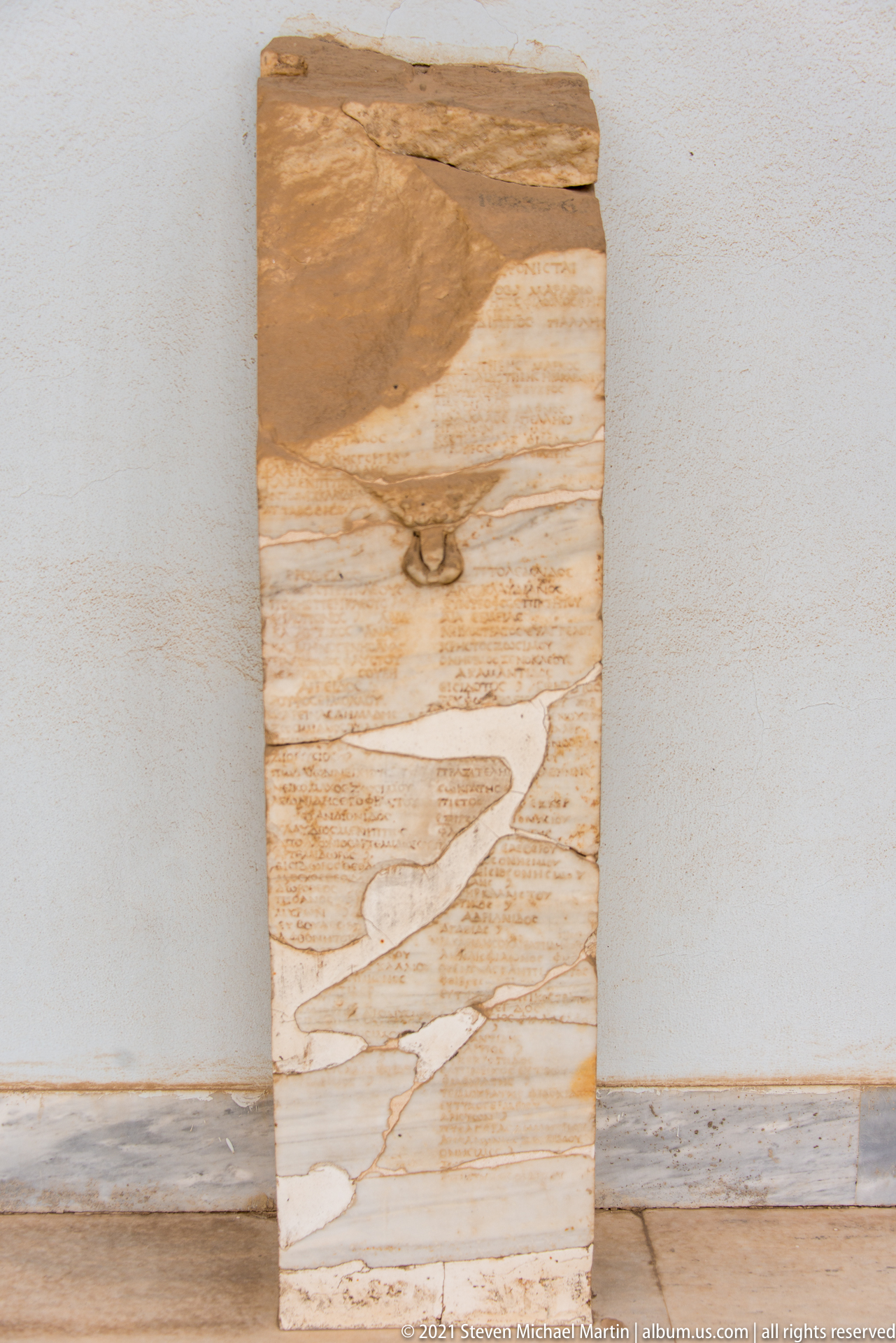
The reverse face of a tall marble monument shows the stone’s natural veining, weathering, and irregular upper edge rather than a prominent text field. A small metal fitting remains near the upper center. Seen from this side, the object reads as a worked stone support as much as an inscription-bearing document.
Caption
The reverse face of a tall marble monument shows the stone’s natural veining, weathering, and irregular upper edge rather than a prominent text field. A small metal fitting remains near the upper center. Seen from this side, the object reads as a worked stone support as much as an inscription-bearing document.
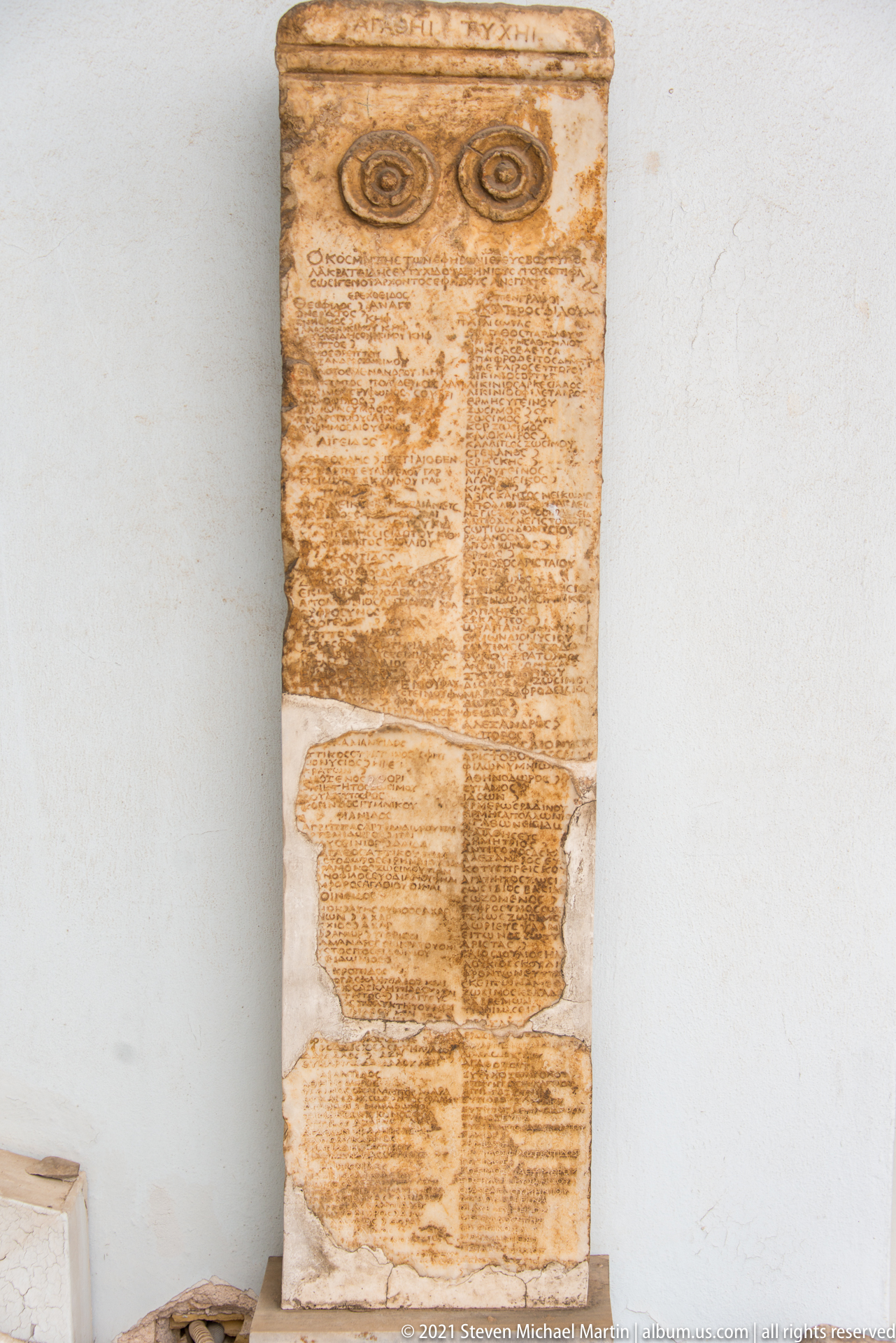
A full-length view of a tall stone stele shows paired concentric circular motifs crowning a surface divided into several areas of inscription. Weathering, staining, and a large repaired or damaged zone interrupt the text, making the monument a strong example of how preservation condition shapes the legibility of epigraphic evidence.
Caption
A full-length view of a tall stone stele shows paired concentric circular motifs crowning a surface divided into several areas of inscription. Weathering, staining, and a large repaired or damaged zone interrupt the text, making the monument a strong example of how preservation condition shapes the legibility of epigraphic evidence.
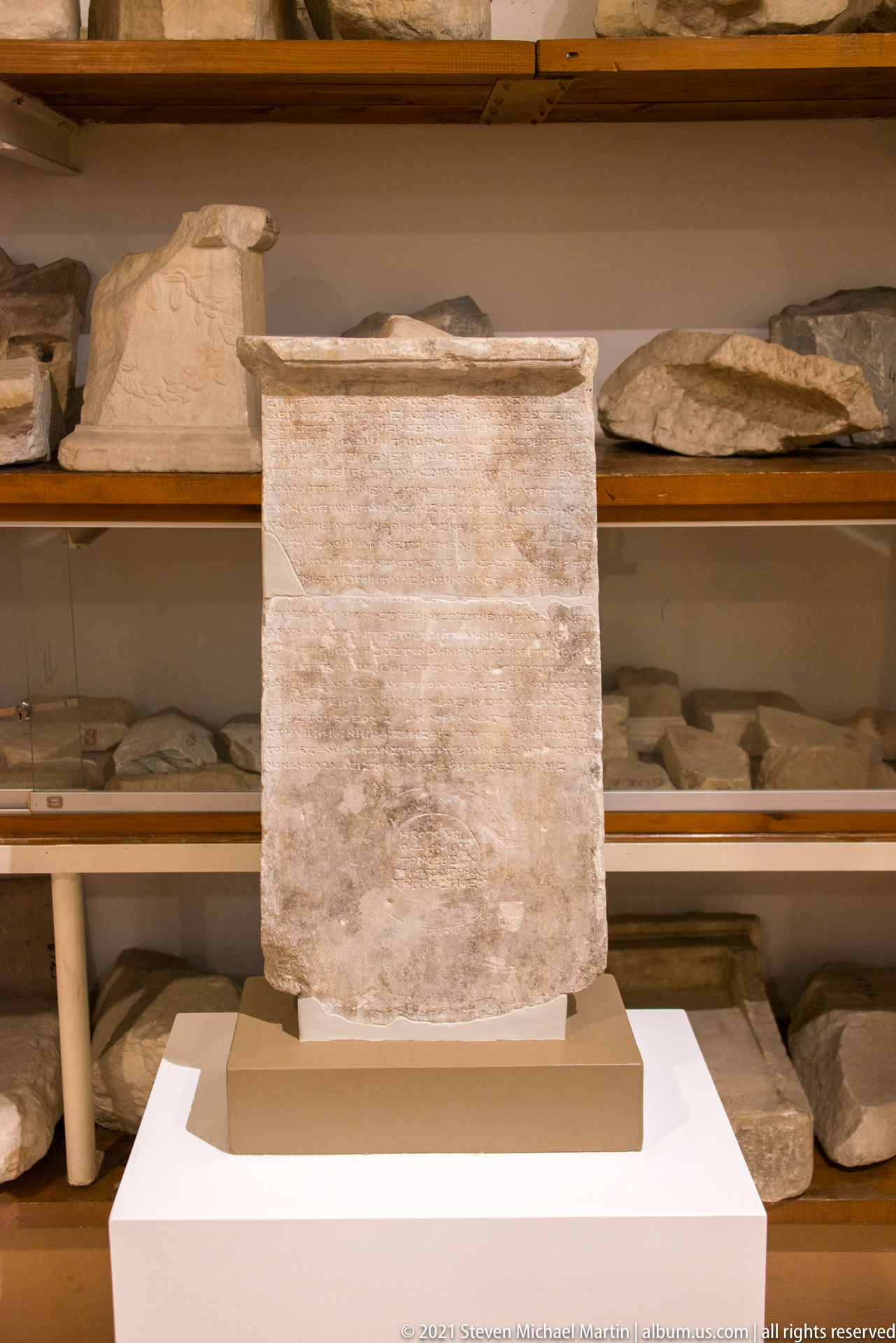
A substantial rectangular stone block stands on a pedestal in front of shelves filled with additional fragments. Its broad face carries faint horizontal inscription lines, now softened by wear. The storage-like surroundings underscore the museum’s role as a repository for a much larger epigraphic corpus than can be presented in formal gallery displays.
Caption
A substantial rectangular stone block stands on a pedestal in front of shelves filled with additional fragments. Its broad face carries faint horizontal inscription lines, now softened by wear. The storage-like surroundings underscore the museum’s role as a repository for a much larger epigraphic corpus than can be presented in formal gallery displays.
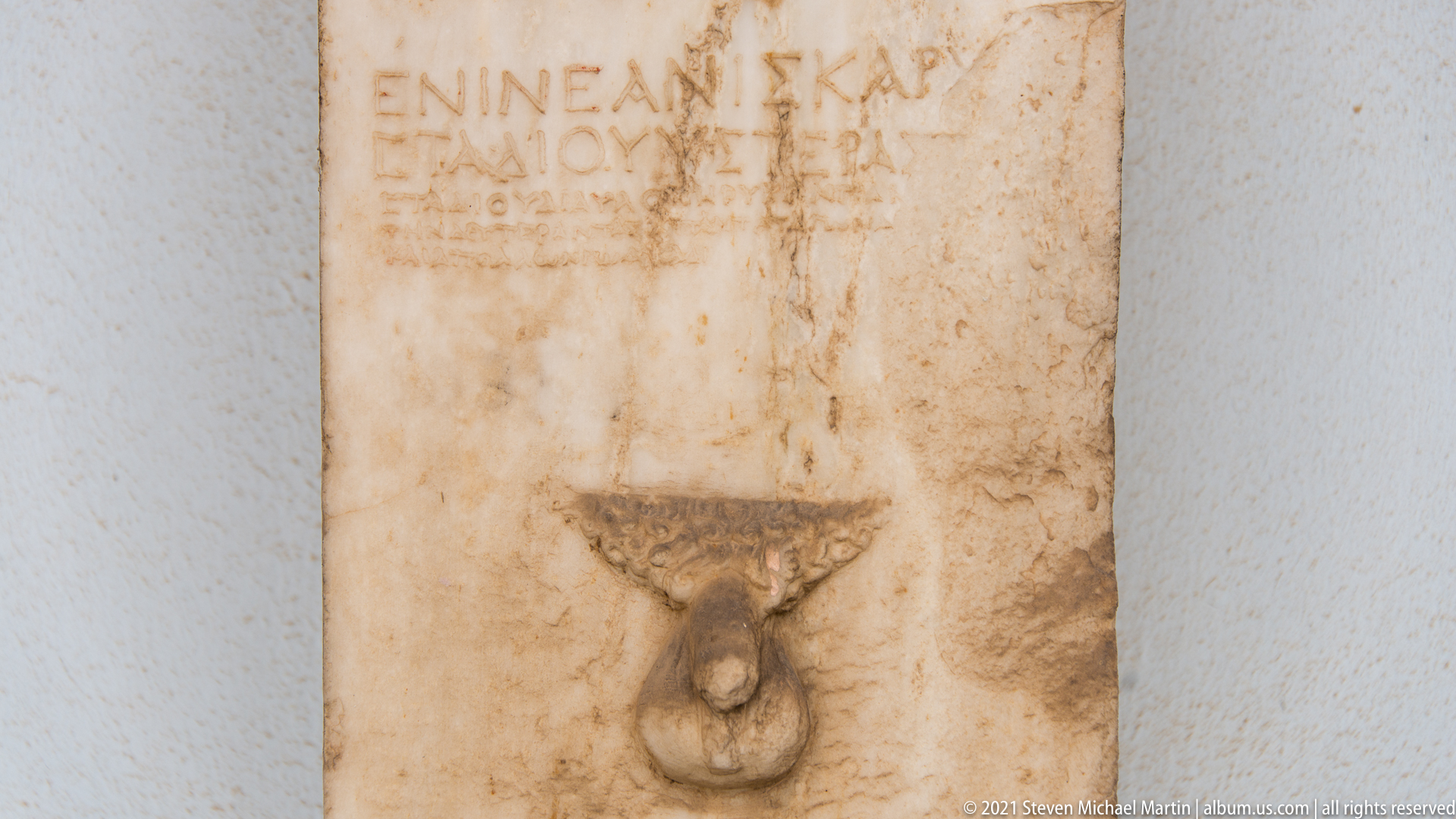
The upper portion of a narrow marble stele preserves several lines of Greek capitals above a dark, ring-shaped metal fitting. Surface abrasion and staining soften parts of the lettering, while the close framing records the contrast between the carefully cut ancient text and later hardware attached to the stone.
Caption
The upper portion of a narrow marble stele preserves several lines of Greek capitals above a dark, ring-shaped metal fitting. Surface abrasion and staining soften parts of the lettering, while the close framing records the contrast between the carefully cut ancient text and later hardware attached to the stone.
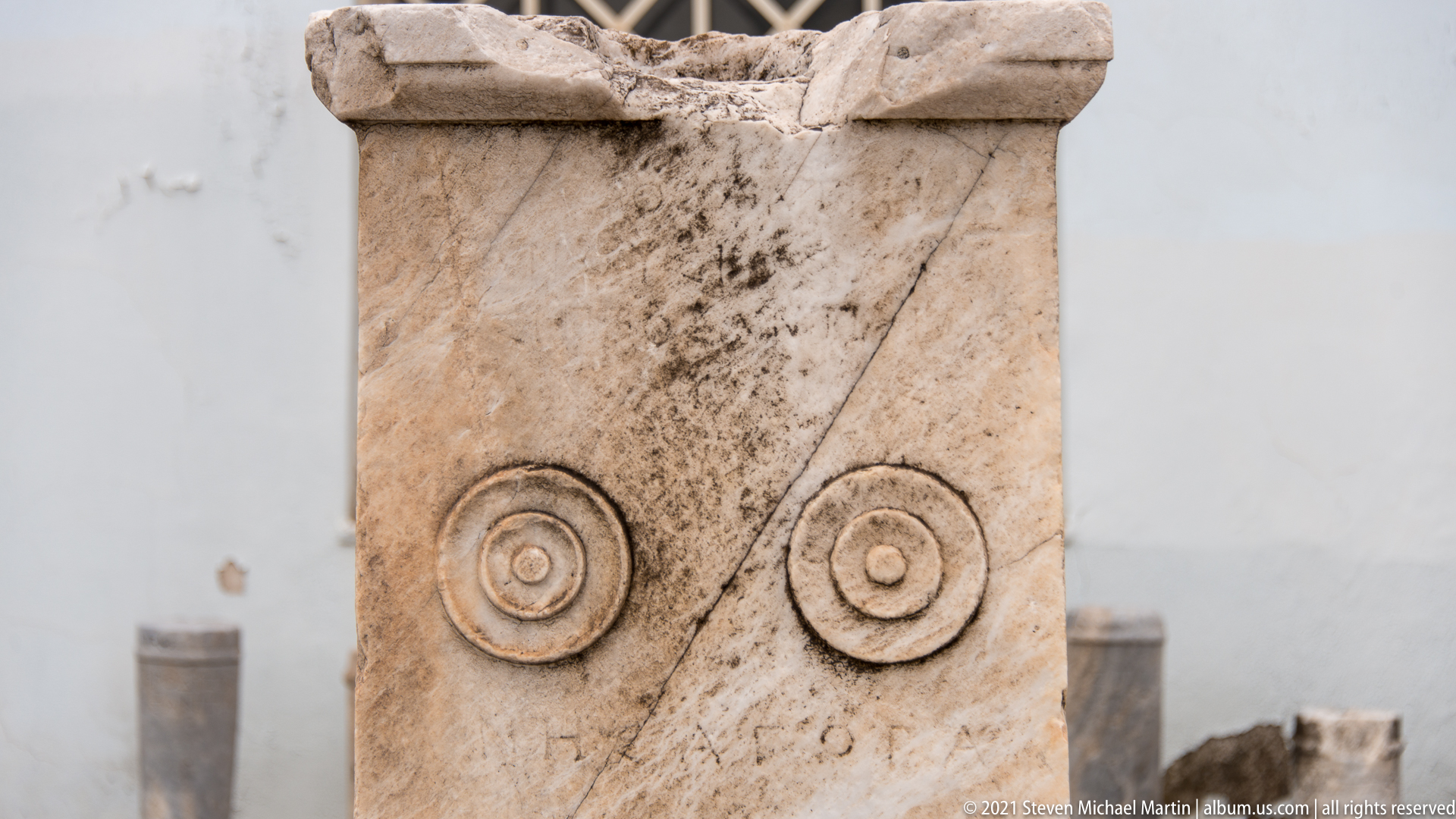
A weathered stone stele is distinguished by two concentric circular motifs carved side by side near its upper face. Below them, faint traces of inscription and diagonal surface damage survive. The unusual relief details provide a visual marker that separates this monument from the more text-dominated stelae around it.
Caption
A weathered stone stele is distinguished by two concentric circular motifs carved side by side near its upper face. Below them, faint traces of inscription and diagonal surface damage survive. The unusual relief details provide a visual marker that separates this monument from the more text-dominated stelae around it.
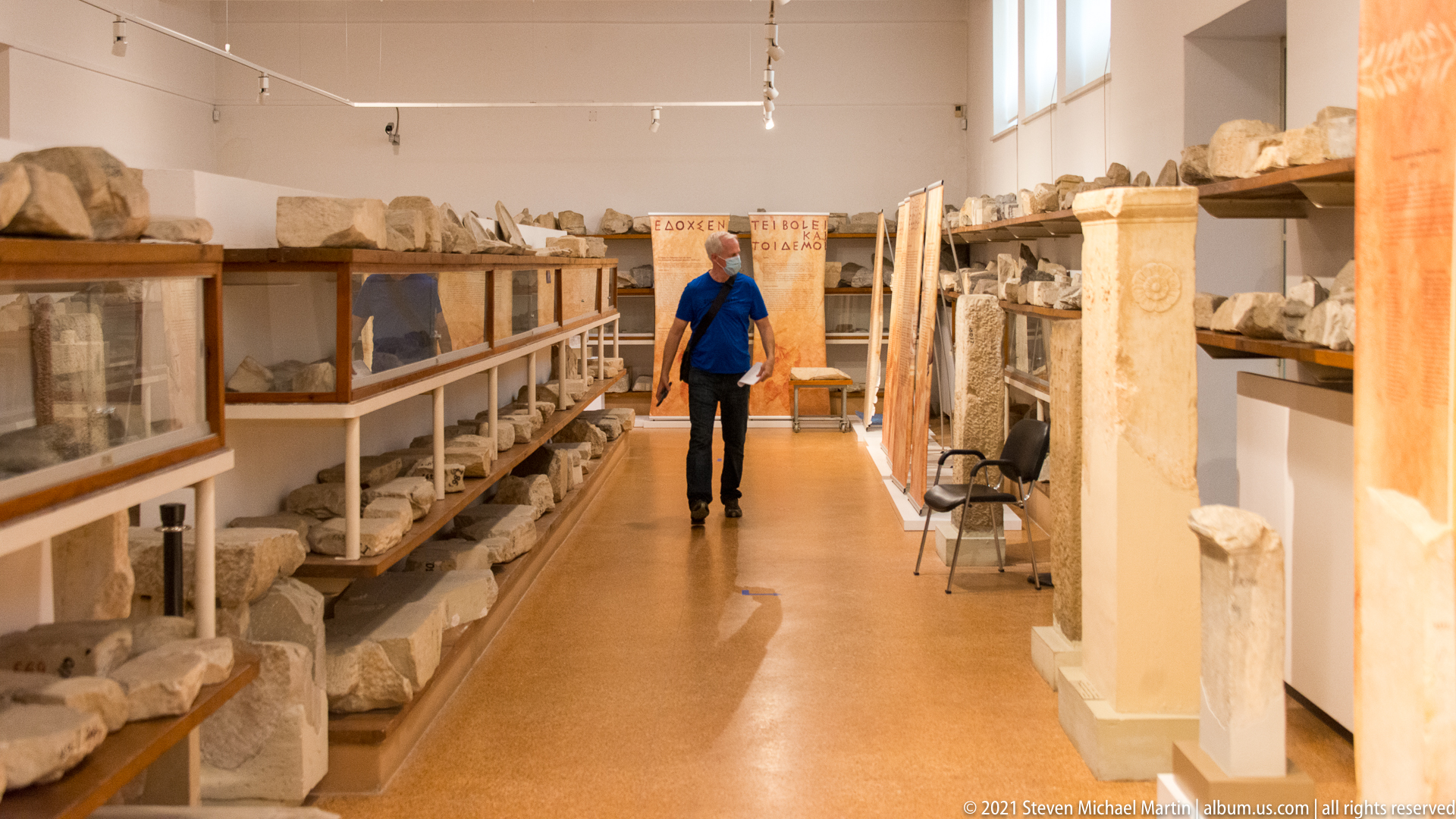
A visitor walks down a narrow aisle lined with shelves, cases, and upright inscribed stones in a dense museum collection area. The perspective reveals the working scale of the Epigraphical Museum’s holdings, where fragments and monuments are stored closely for preservation and scholarly access beyond the more spacious public displays.
Caption
A visitor walks down a narrow aisle lined with shelves, cases, and upright inscribed stones in a dense museum collection area. The perspective reveals the working scale of the Epigraphical Museum’s holdings, where fragments and monuments are stored closely for preservation and scholarly access beyond the more spacious public displays.
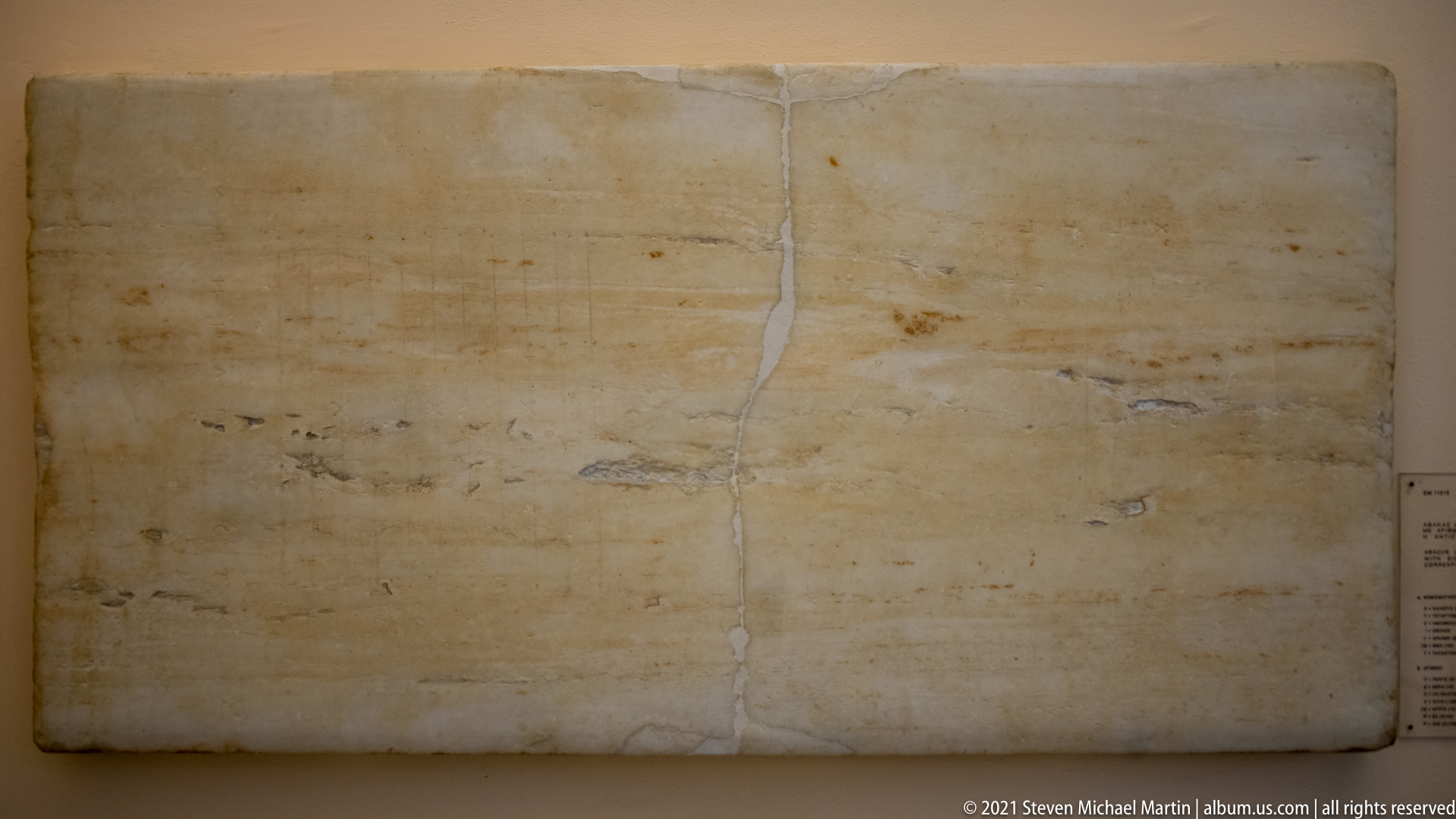
A broad marble slab fills the frame, its inscription reduced to exceptionally faint lines by wear and the pale stone surface. A vertical repair or join runs near the center. The subdued visibility of the lettering demonstrates how lighting, surface condition, and conservation history can determine whether an ancient text is readily legible.
Caption
A broad marble slab fills the frame, its inscription reduced to exceptionally faint lines by wear and the pale stone surface. A vertical repair or join runs near the center. The subdued visibility of the lettering demonstrates how lighting, surface condition, and conservation history can determine whether an ancient text is readily legible.
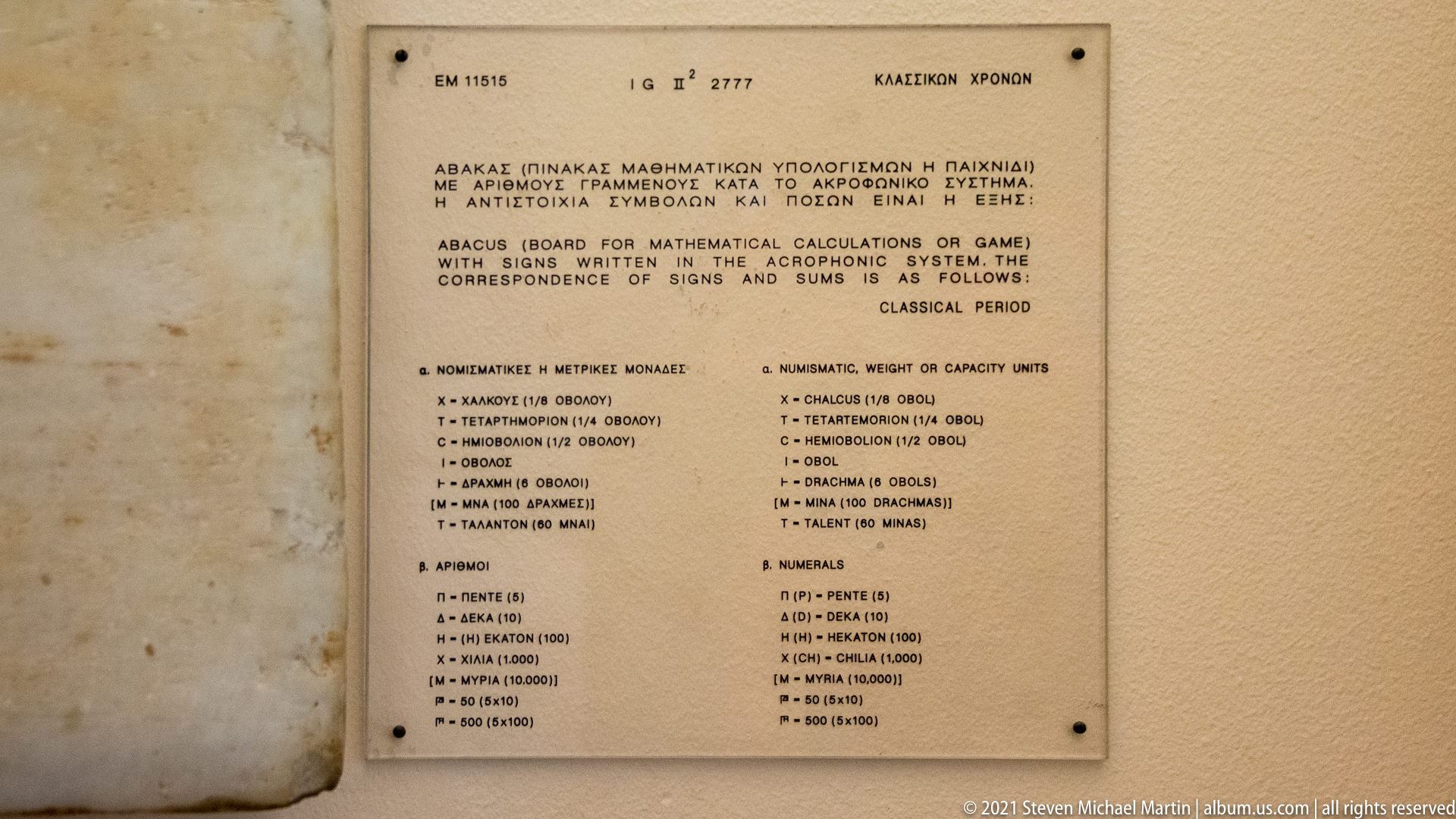
A museum label presents a chart of Attic monetary, metrological, and accounting notation used in inscriptions of the Classical period. Greek signs are paired with English explanations and numerical values, giving visitors a key for interpreting the abbreviated symbols and sums that appear in ancient financial and administrative texts.
Caption
A museum label presents a chart of Attic monetary, metrological, and accounting notation used in inscriptions of the Classical period. Greek signs are paired with English explanations and numerical values, giving visitors a key for interpreting the abbreviated symbols and sums that appear in ancient financial and administrative texts.
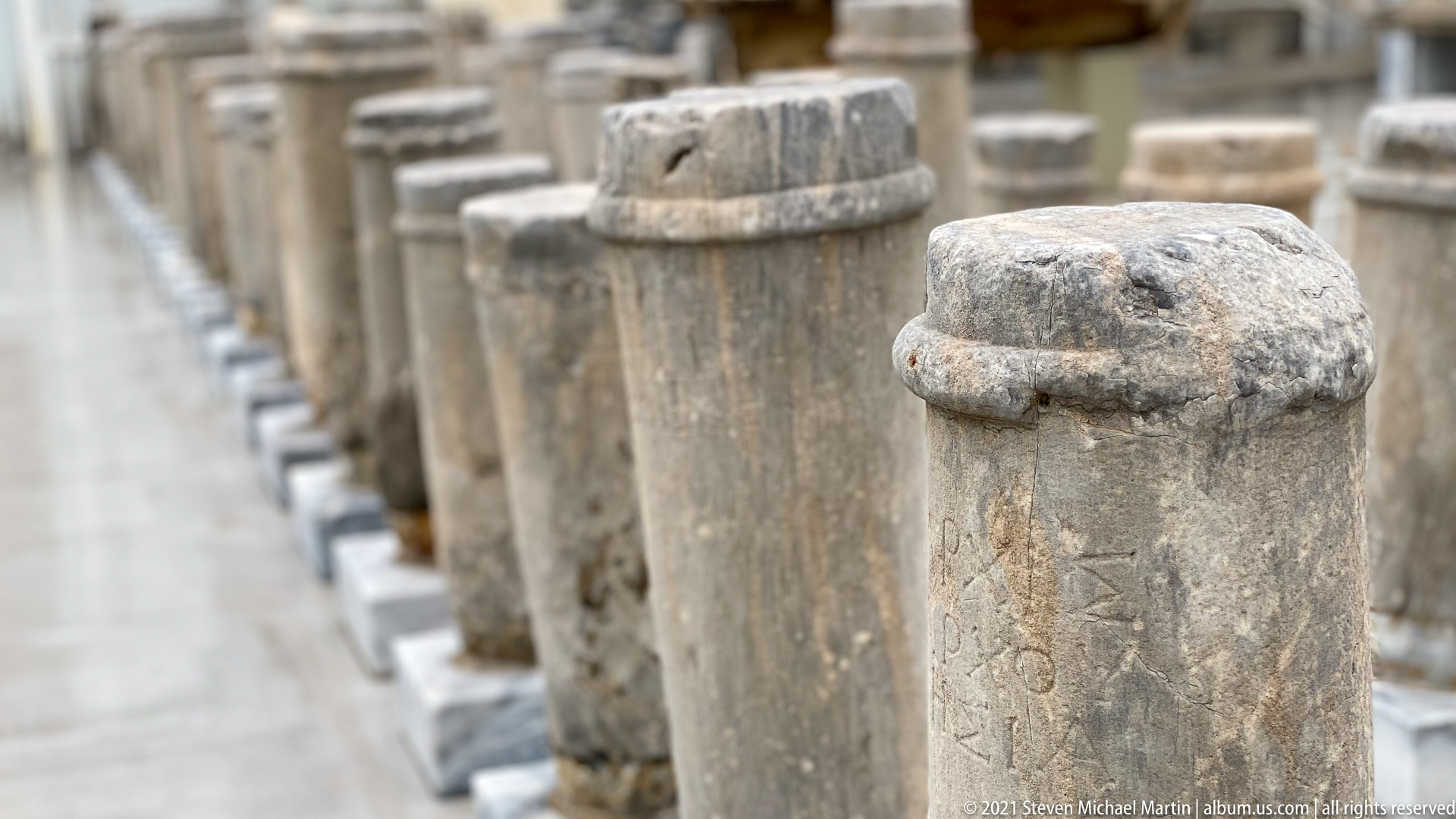
A shallow-focus view looks along a row of upright stone monuments, bringing the nearest rounded shaft into prominence while similar pieces recede behind it. The varied profiles, worn tops, and traces of carving emphasize the physical diversity of the museum’s outdoor epigraphic collection as much as the texts themselves.
Caption
A shallow-focus view looks along a row of upright stone monuments, bringing the nearest rounded shaft into prominence while similar pieces recede behind it. The varied profiles, worn tops, and traces of carving emphasize the physical diversity of the museum’s outdoor epigraphic collection as much as the texts themselves.
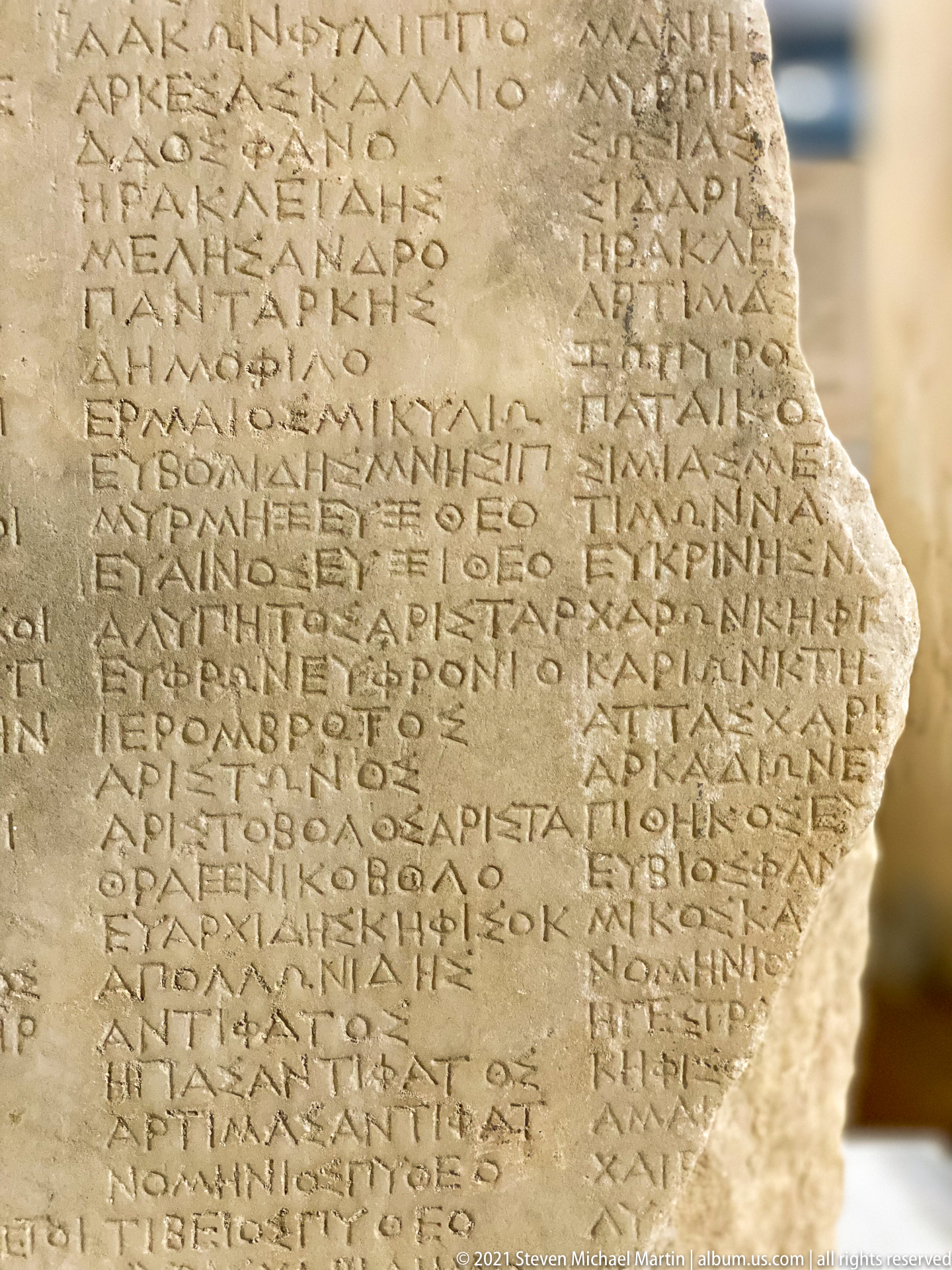
A broken marble slab preserves tightly packed columns and lines of Greek capitals across most of its surviving face. The irregular right edge cuts through the text, while the crisp letter forms remain comparatively legible. The close framing emphasizes the inscription as a physical document, shaped by both deliberate layout and later loss.
Caption
A broken marble slab preserves tightly packed columns and lines of Greek capitals across most of its surviving face. The irregular right edge cuts through the text, while the crisp letter forms remain comparatively legible. The close framing emphasizes the inscription as a physical document, shaped by both deliberate layout and later loss.
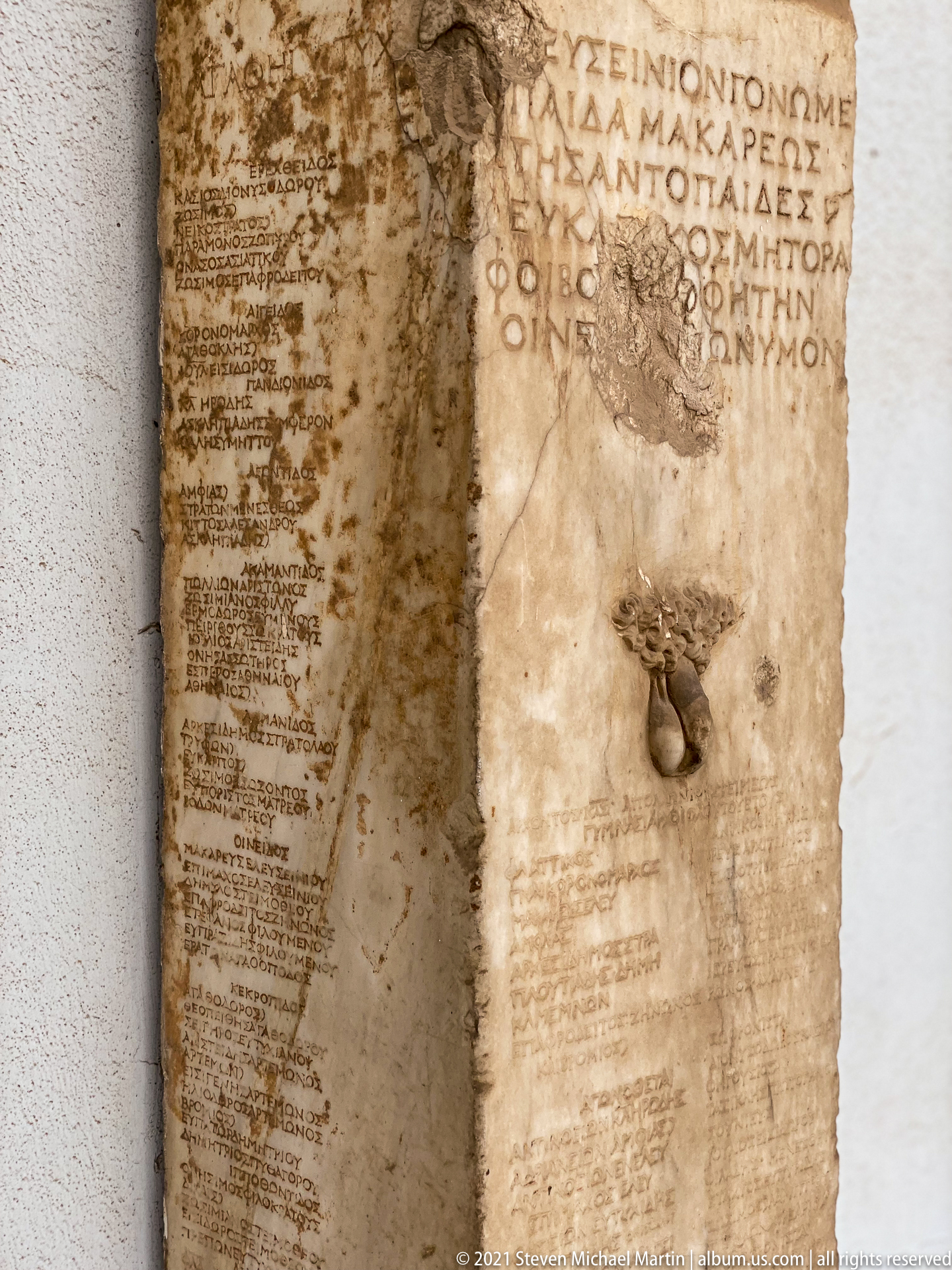
A fuller view of the narrow marble stele shows how its inscription is distributed from large capitals near the top to much smaller, denser lines below. Dark metal fittings punctuate the pale surface, and the stone’s stained, uneven condition records the long physical history of an object now preserved as epigraphic evidence.
Caption
A fuller view of the narrow marble stele shows how its inscription is distributed from large capitals near the top to much smaller, denser lines below. Dark metal fittings punctuate the pale surface, and the stone’s stained, uneven condition records the long physical history of an object now preserved as epigraphic evidence.
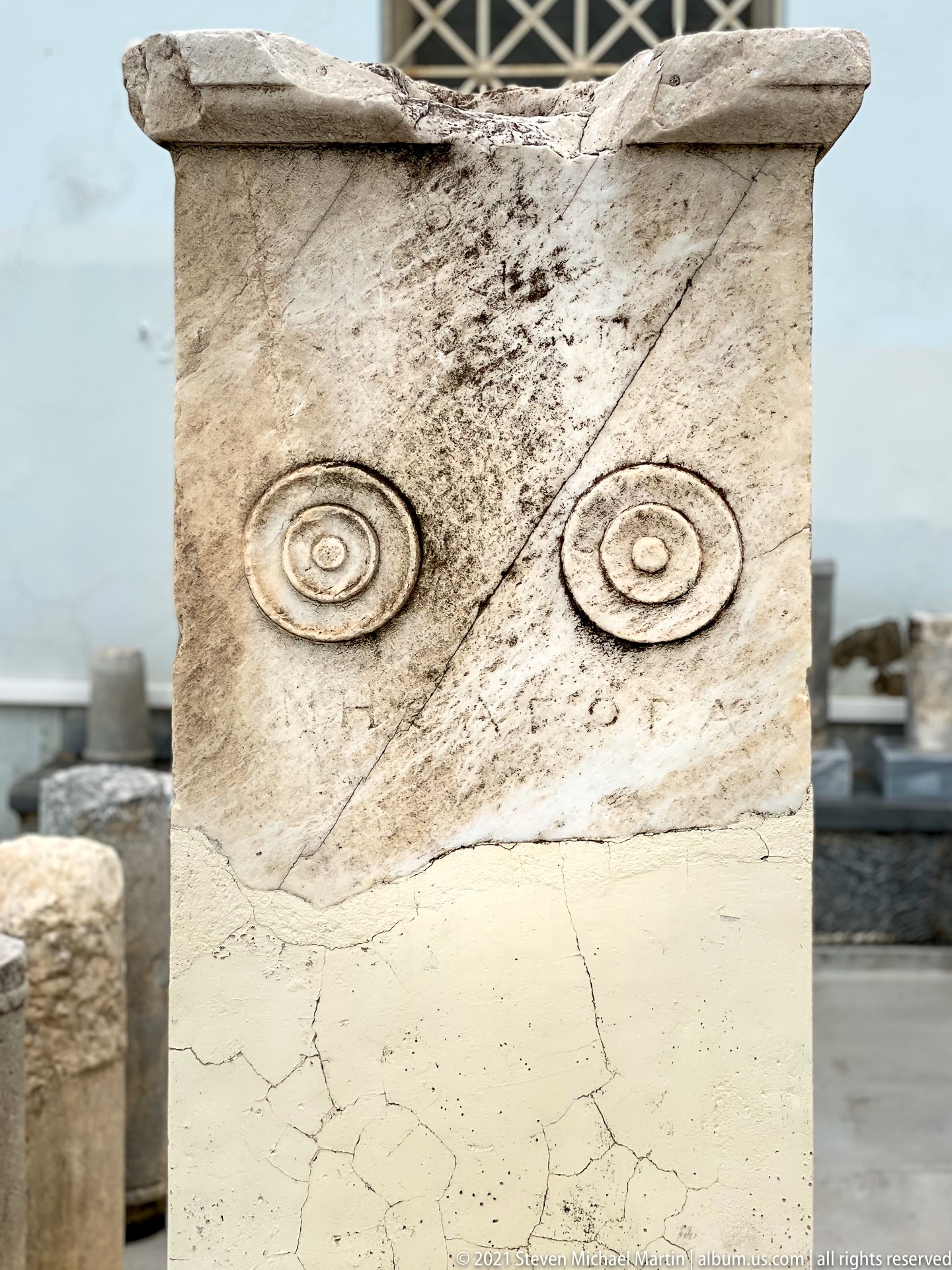
Two concentric circular ornaments punctuate the upper face of this marble stele, while a diagonal fracture crosses the weathered surface between them. The restrained carving and block-like form contrast with more elaborate floral examples nearby, making the paired discs the principal surviving decorative feature. Repairs or modern support material are visible along the lower edge of the displayed fragment.
Caption
Two concentric circular ornaments punctuate the upper face of this marble stele, while a diagonal fracture crosses the weathered surface between them. The restrained carving and block-like form contrast with more elaborate floral examples nearby, making the paired discs the principal surviving decorative feature. Repairs or modern support material are visible along the lower edge of the displayed fragment.
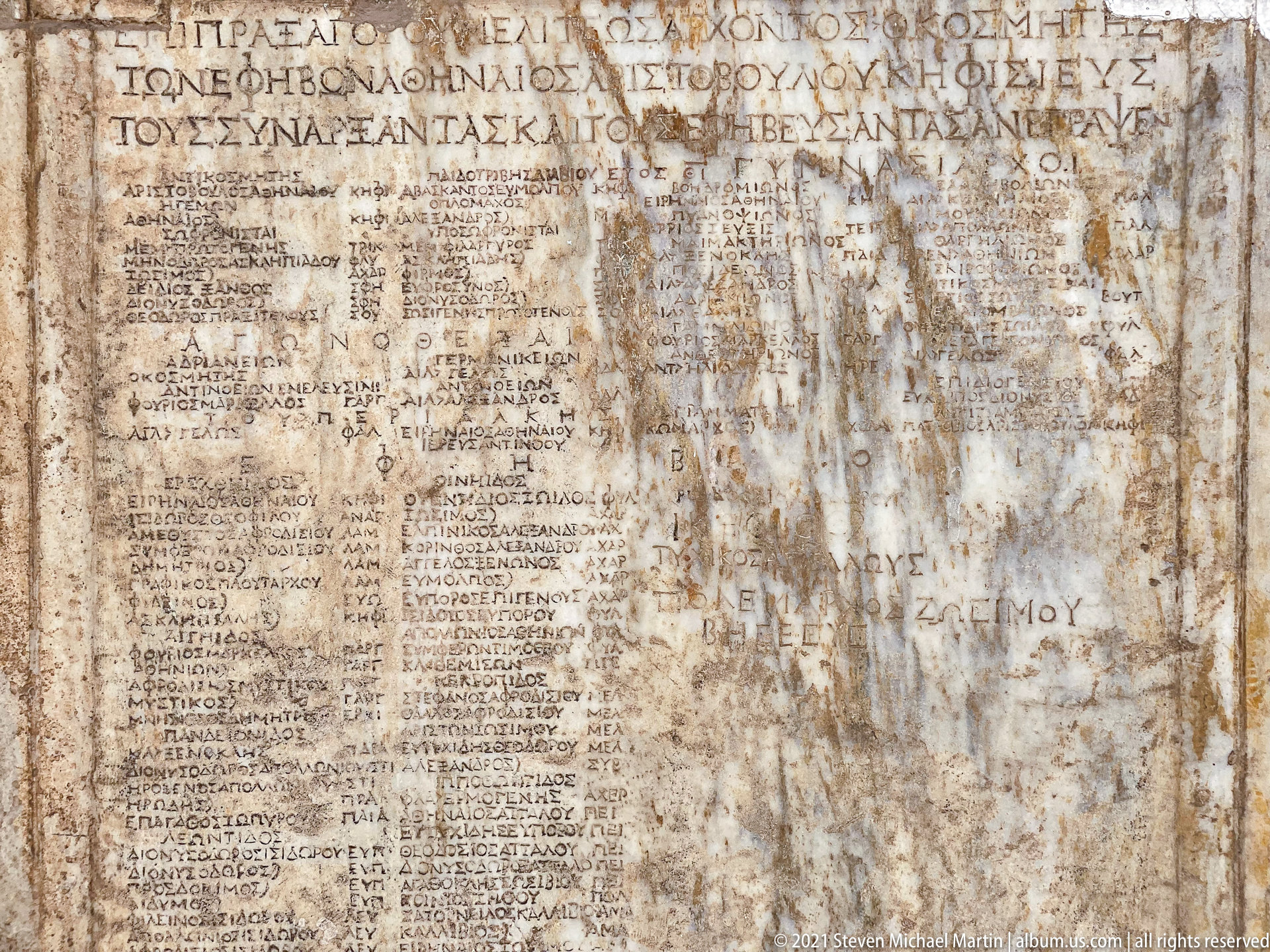
A large weathered marble slab is covered by dense Greek text arranged in multiple sections, with larger headings or lines standing out above and among smaller lettering. Staining and abrasion obscure portions of the surface, yet the extensive surviving text conveys the scale and complexity of a substantial public or administrative inscription.
Caption
A large weathered marble slab is covered by dense Greek text arranged in multiple sections, with larger headings or lines standing out above and among smaller lettering. Staining and abrasion obscure portions of the surface, yet the extensive surviving text conveys the scale and complexity of a substantial public or administrative inscription.
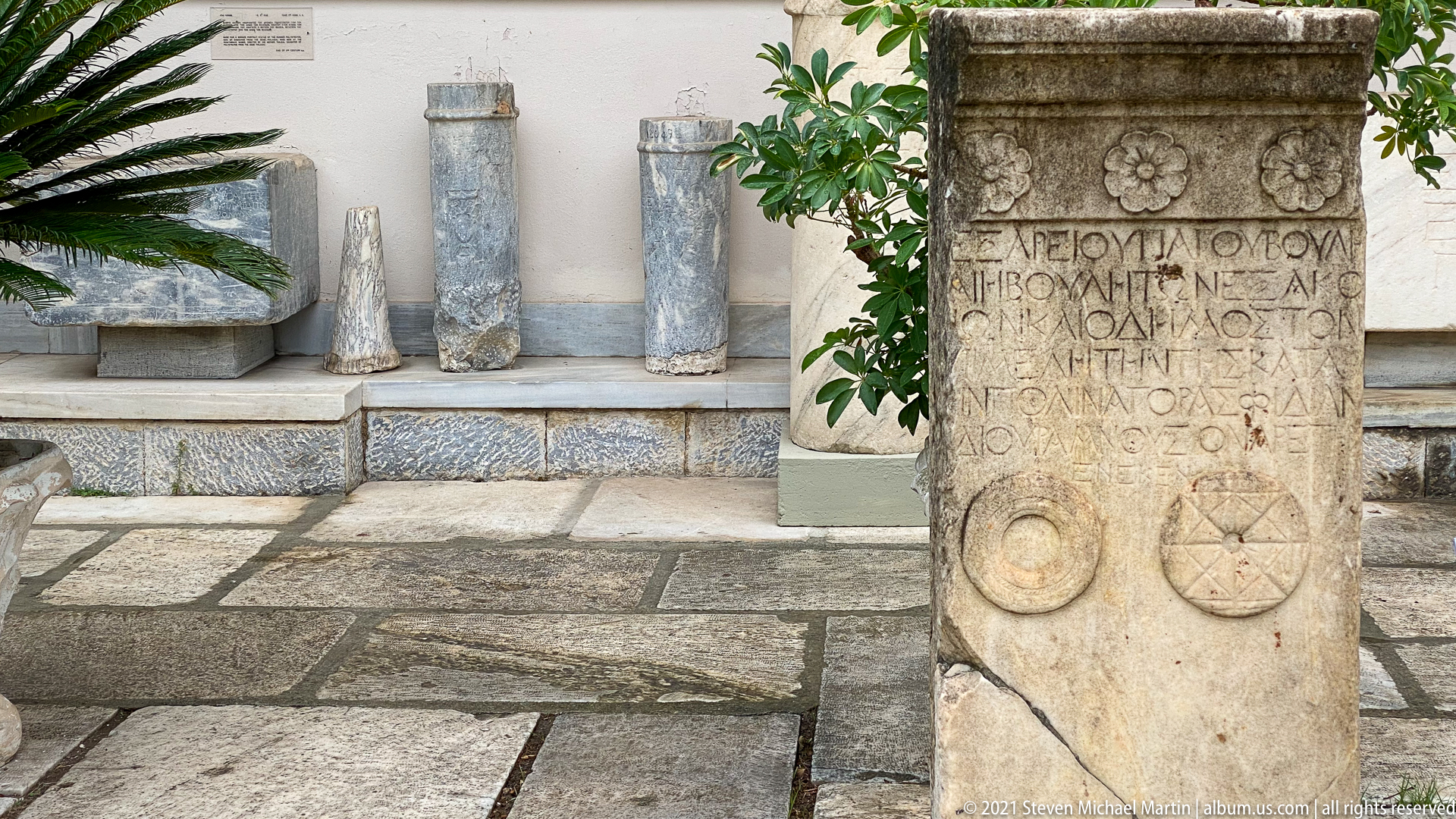
A framed Greek inscription occupies the central face of this marble stele, beneath a row of carved floral rosettes. Lower on the monument, two circular devices—one plain and one divided by intersecting lines—form a second decorative register. The combination of text and repeated geometric ornament gives the upright stone a strongly ordered, commemorative appearance.
Caption
A framed Greek inscription occupies the central face of this marble stele, beneath a row of carved floral rosettes. Lower on the monument, two circular devices—one plain and one divided by intersecting lines—form a second decorative register. The combination of text and repeated geometric ornament gives the upright stone a strongly ordered, commemorative appearance.
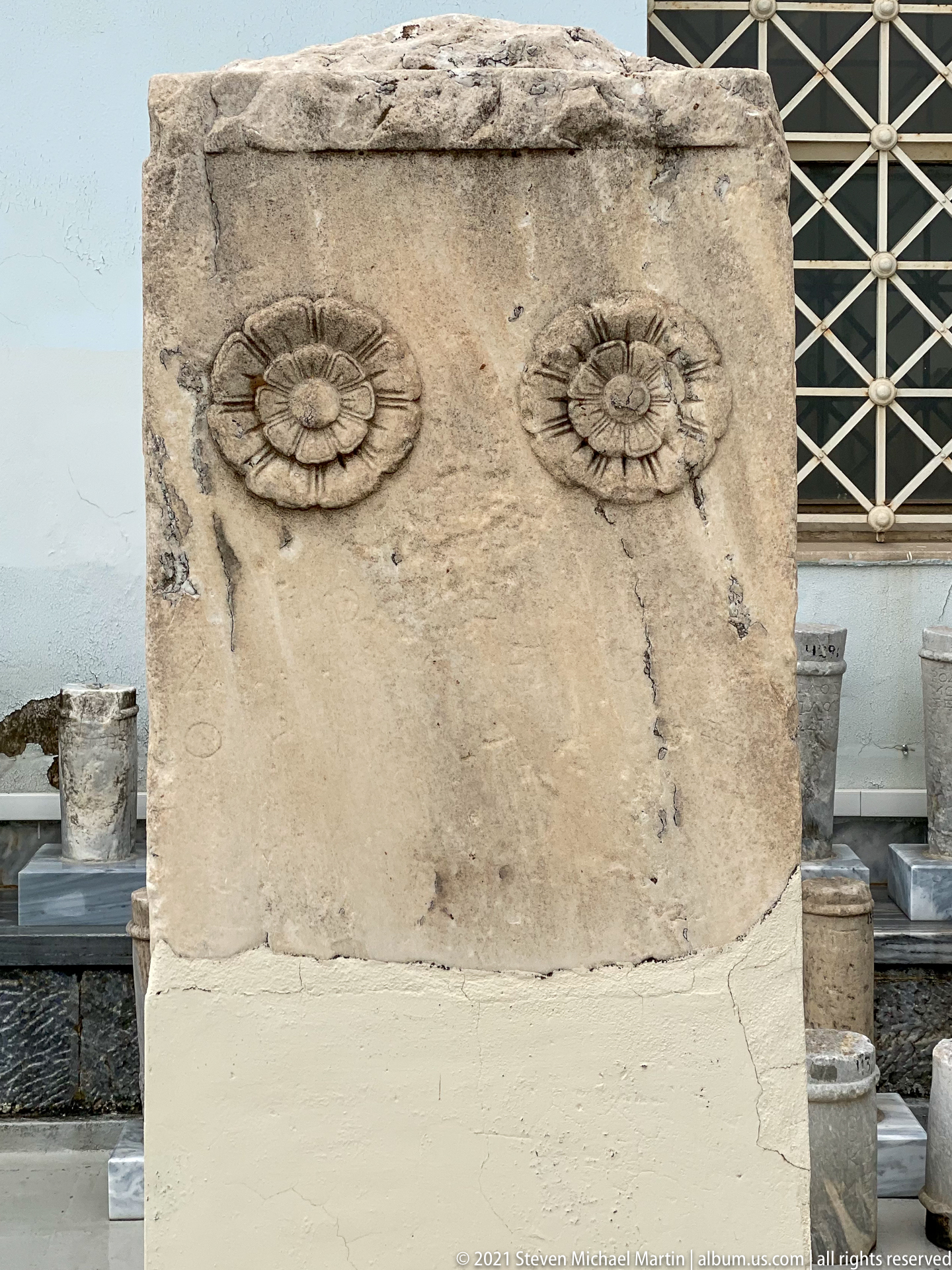
A pair of deeply carved, multi-petaled rosettes fills the upper register of this marble stele. Their layered petals remain legible despite abrasion and discoloration across the stone, while the broad undecorated field below emphasizes the symmetry of the design. The fragment is displayed upright among other inscribed and sculpted stones in the museum collection.
Caption
A pair of deeply carved, multi-petaled rosettes fills the upper register of this marble stele. Their layered petals remain legible despite abrasion and discoloration across the stone, while the broad undecorated field below emphasizes the symmetry of the design. The fragment is displayed upright among other inscribed and sculpted stones in the museum collection.
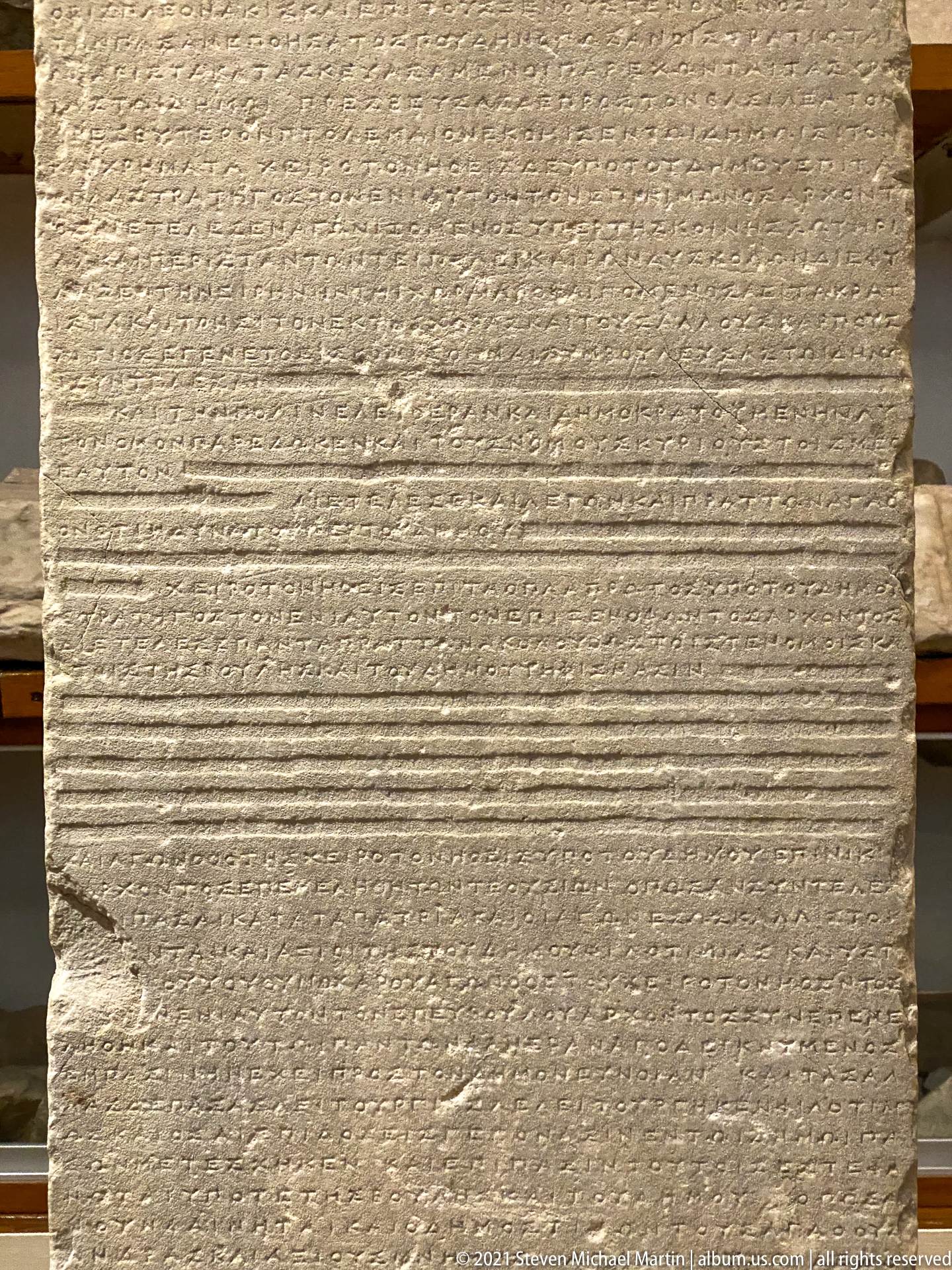
Closely spaced lines of Greek lettering cover nearly the entire face of this large marble slab, interrupted only by shallow horizontal bands across its middle. The disciplined arrangement of the text creates a striking visual field in which the inscription itself becomes the dominant surface pattern. Chips and abrasions along the edges reveal the stone's fragmentary condition.
Caption
Closely spaced lines of Greek lettering cover nearly the entire face of this large marble slab, interrupted only by shallow horizontal bands across its middle. The disciplined arrangement of the text creates a striking visual field in which the inscription itself becomes the dominant surface pattern. Chips and abrasions along the edges reveal the stone's fragmentary condition.
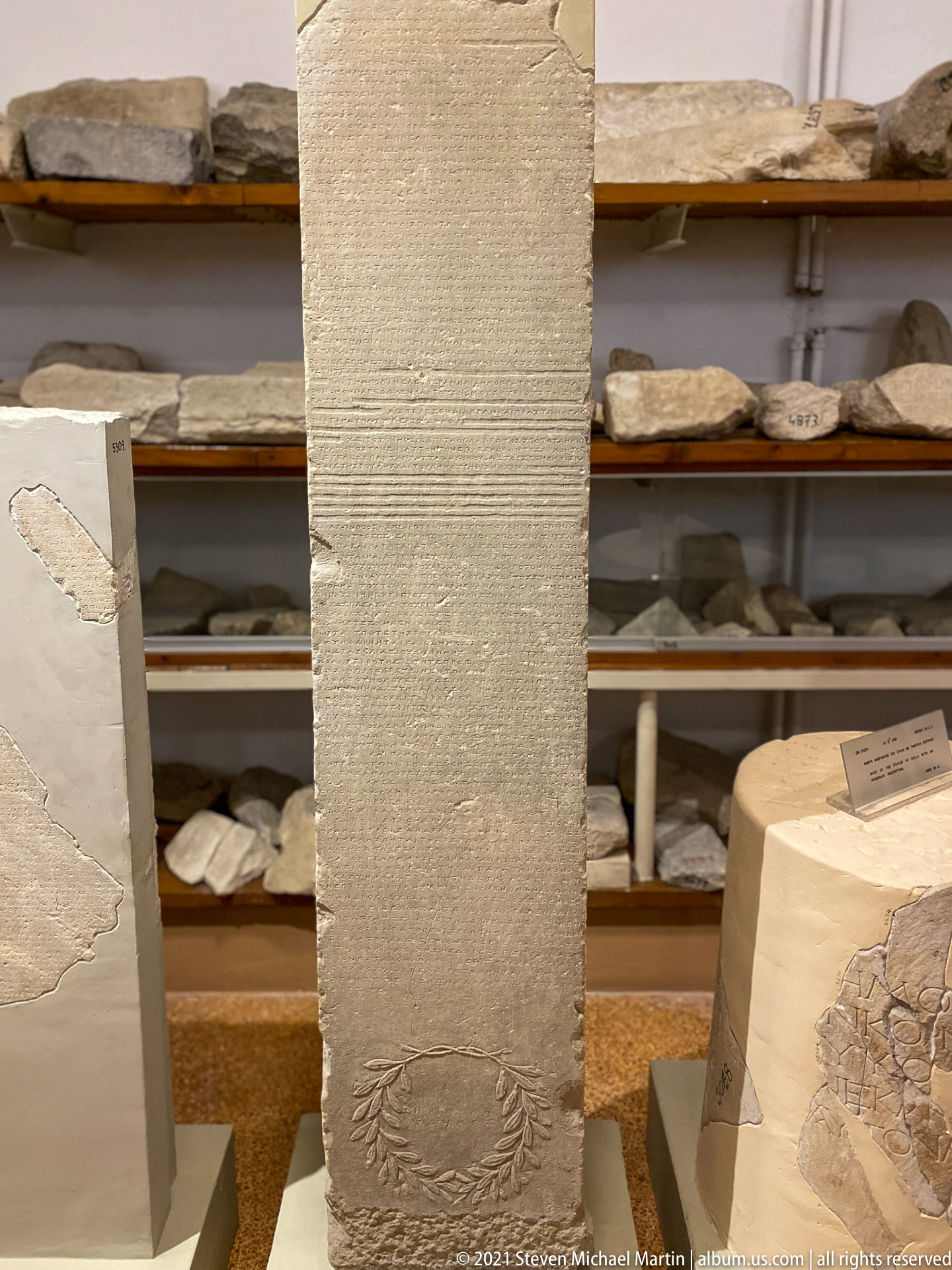
A tall, narrow marble stele carries compact lines of Greek text across most of its face, ending above a carved wreath near the base. The wreath forms a distinct concluding emblem beneath the inscription, while the monument's unusually slender proportions emphasize its vertical format. Shelved stone fragments behind it place the stele within the museum's study collection.
Caption
A tall, narrow marble stele carries compact lines of Greek text across most of its face, ending above a carved wreath near the base. The wreath forms a distinct concluding emblem beneath the inscription, while the monument's unusually slender proportions emphasize its vertical format. Shelved stone fragments behind it place the stele within the museum's study collection.
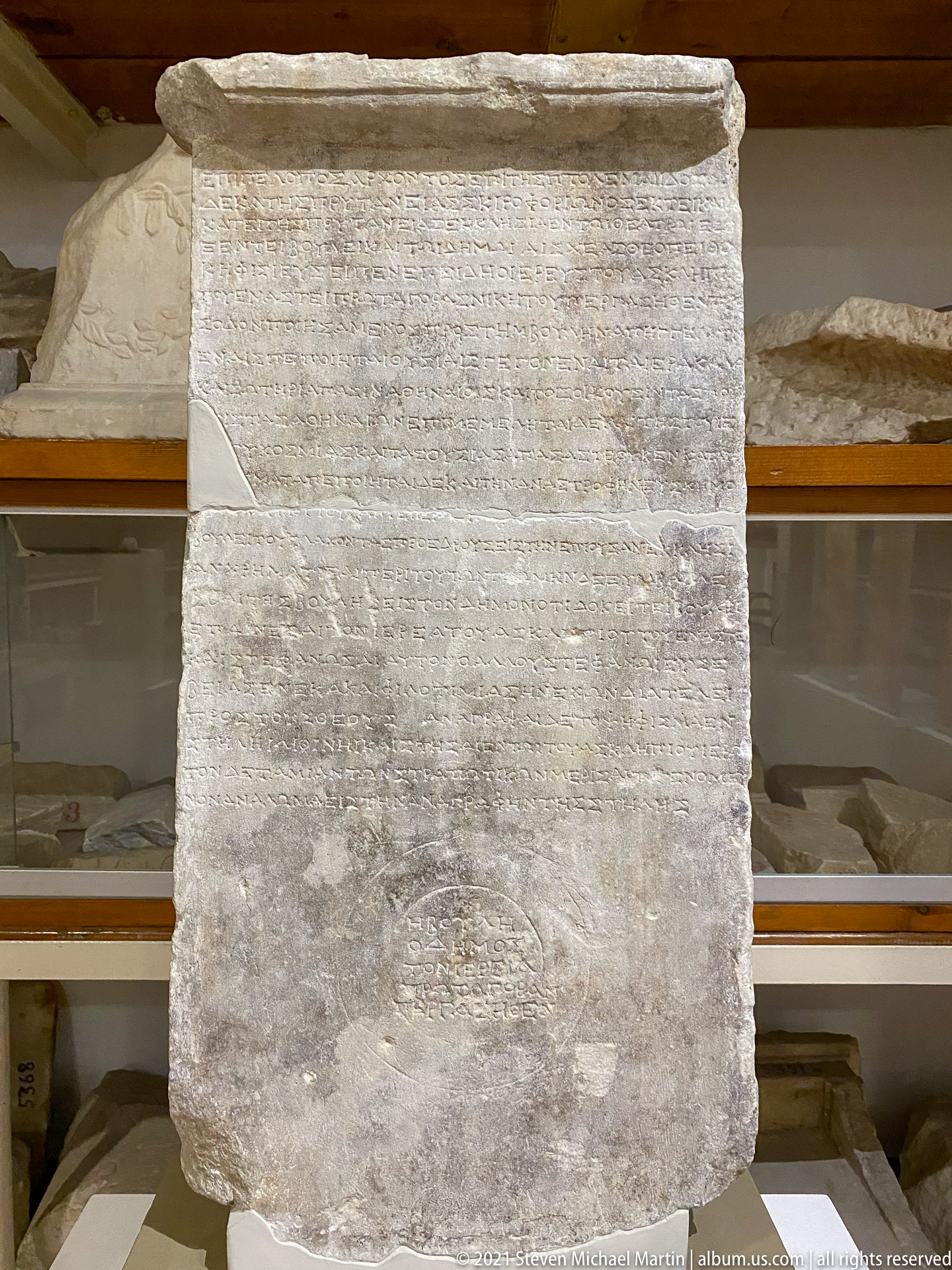
Time and surface erosion have reduced much of the lettering on this marble stele to a faint, uneven field. A projecting top molding remains intact, while the lower half shows heavier abrasion and discoloration than the upper register. The surviving traces of text are most legible near the top, illustrating the variable preservation common to exposed inscribed stone.
Caption
Time and surface erosion have reduced much of the lettering on this marble stele to a faint, uneven field. A projecting top molding remains intact, while the lower half shows heavier abrasion and discoloration than the upper register. The surviving traces of text are most legible near the top, illustrating the variable preservation common to exposed inscribed stone.
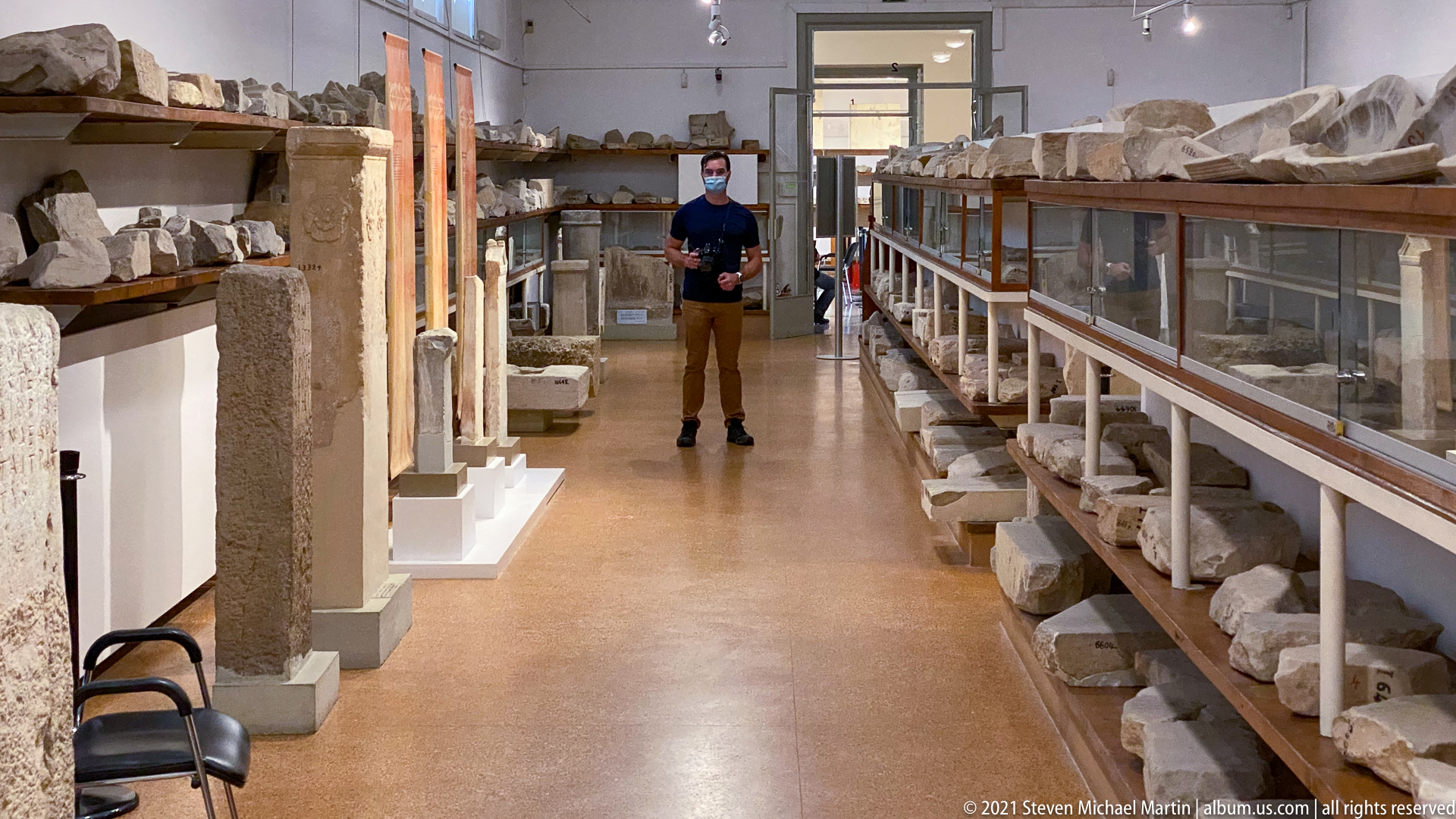
A visitor stands at the center of a long gallery lined with inscribed stones, architectural fragments, and museum shelving. Upright stelae and blocks occupy bases along the aisle, while larger fragments rest on shelves and glazed cases to either side. The human figure provides scale for the dense, archival character of the museum's epigraphic storage displays.
Caption
A visitor stands at the center of a long gallery lined with inscribed stones, architectural fragments, and museum shelving. Upright stelae and blocks occupy bases along the aisle, while larger fragments rest on shelves and glazed cases to either side. The human figure provides scale for the dense, archival character of the museum's epigraphic storage displays.
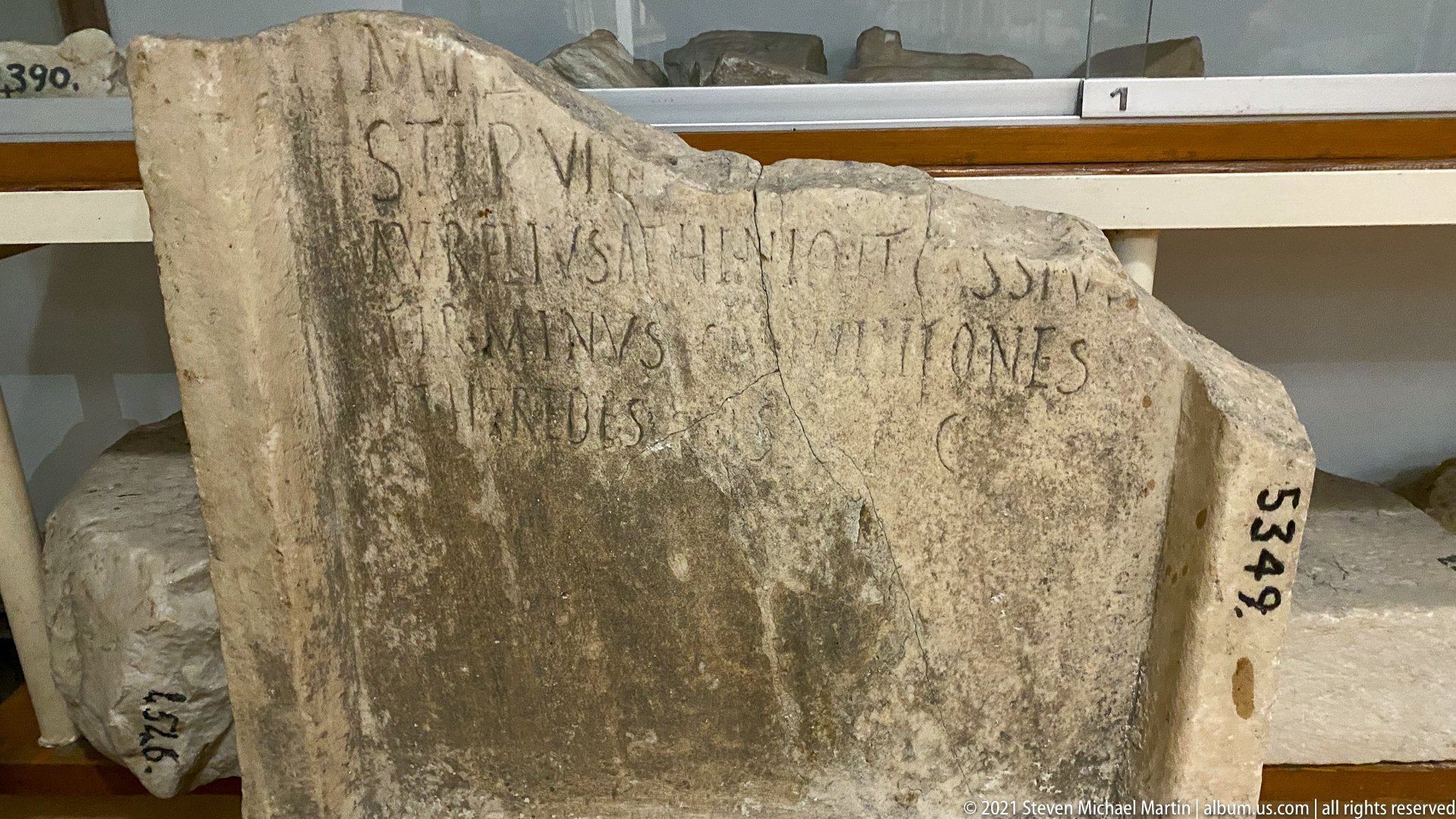
Several lines of large capital letters survive on this irregular stone fragment, whose broken upper edge and heavily stained surface make the text incomplete. The inscription is cut more boldly and at a larger scale than many of the densely lettered stelae nearby. Museum inventory numbers marked on the stone and adjacent supports underscore its fragmentary archaeological context.
Caption
Several lines of large capital letters survive on this irregular stone fragment, whose broken upper edge and heavily stained surface make the text incomplete. The inscription is cut more boldly and at a larger scale than many of the densely lettered stelae nearby. Museum inventory numbers marked on the stone and adjacent supports underscore its fragmentary archaeological context.
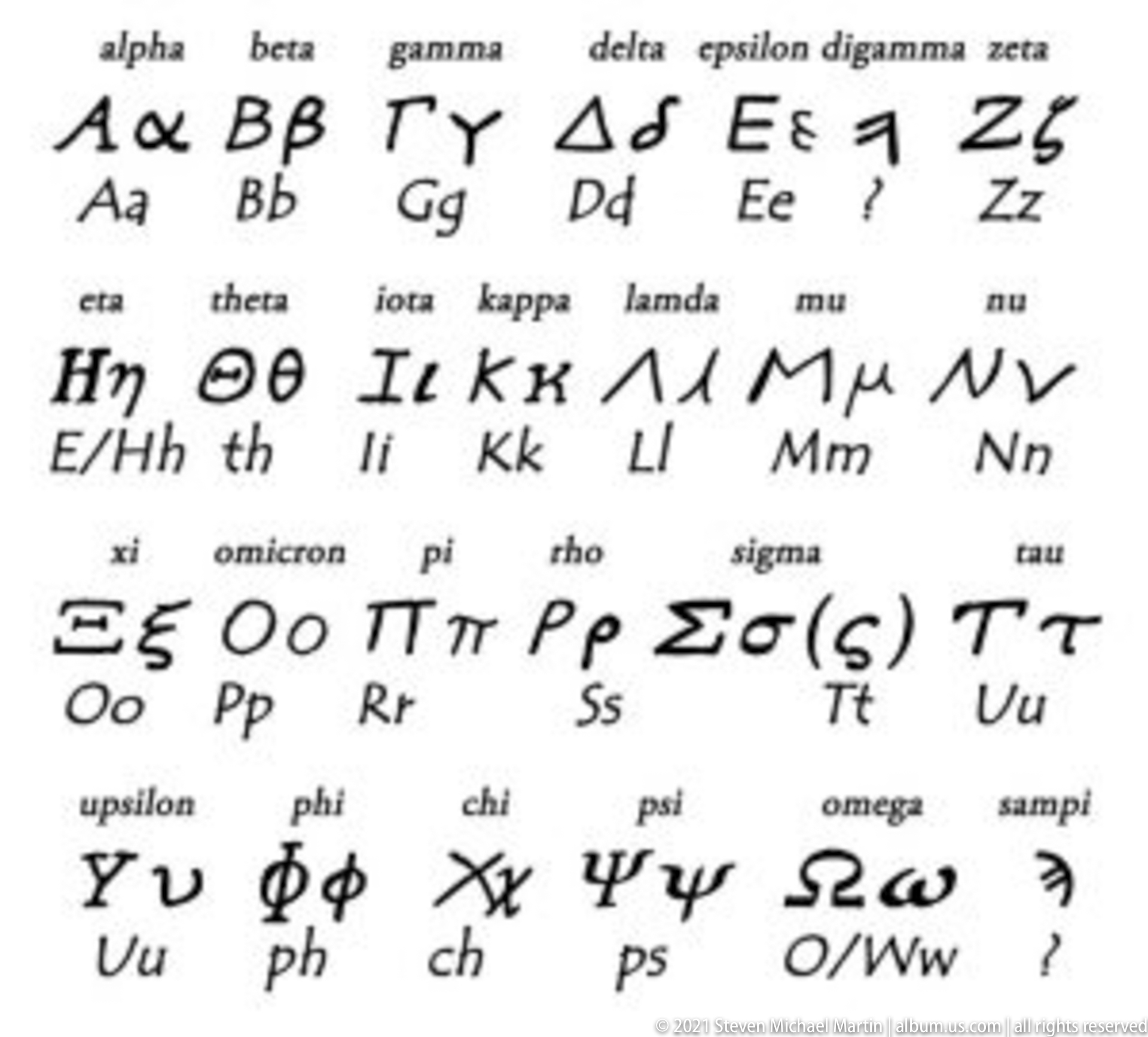
A reference chart presents the Greek alphabet with multiple letterforms arranged by name, including variants for alpha through omega and sampi. Printed labels sit above examples that resemble manuscript or epigraphic forms, allowing comparison of changing shapes for individual letters. In the context of an epigraphical museum, such a chart helps visitors recognize the visual diversity of Greek lettering.
Caption
A reference chart presents the Greek alphabet with multiple letterforms arranged by name, including variants for alpha through omega and sampi. Printed labels sit above examples that resemble manuscript or epigraphic forms, allowing comparison of changing shapes for individual letters. In the context of an epigraphical museum, such a chart helps visitors recognize the visual diversity of Greek lettering.