
National Archaeological Museum of Athens
The National Archaeological Museum of Athens contains one of the most comprehensive collections of ancient Greek artifacts, spanning prehistoric, classical, and Hellenistic periods. Sculptures, bronze works, ceramics, and funerary objects illustrate the artistic development of Greek civilization across many centuries. The museum provides context for archaeological sites located throughout the country.
Among the most notable works are large-scale statues and finely detailed objects that demonstrate technical skill and aesthetic refinement. The collection includes examples of artistic innovation that influenced later Roman and European traditions. These works reveal how Greek artists represented the human form, mythology, and religious practice.
The museum serves as an important resource for understanding the cultural achievements of ancient Greece. Its collections allow visitors to observe the continuity of artistic and intellectual traditions that shaped the classical world.

The circular interior of a red-figure drinking cup presents two standing male figures against a black ground. One extends an arm toward the other while a sword or long object crosses the lower part of the composition. The tondo format, reserved contour drawing, and meander border concentrate the narrative within the center of the vessel.
Caption
The circular interior of a red-figure drinking cup presents two standing male figures against a black ground. One extends an arm toward the other while a sword or long object crosses the lower part of the composition. The tondo format, reserved contour drawing, and meander border concentrate the narrative within the center of the vessel.

A broad sheet-gold mask presents an elongated male face with strongly arched brows, a long projecting nose, large ears, and a narrow mouth. Creases and tears remain visible across the thin metal sheet, making the manufacturing process and archaeological damage part of the object’s appearance. The frontal symmetry gives the mask a severe, highly stylized presence.
Caption
A broad sheet-gold mask presents an elongated male face with strongly arched brows, a long projecting nose, large ears, and a narrow mouth. Creases and tears remain visible across the thin metal sheet, making the manufacturing process and archaeological damage part of the object’s appearance. The frontal symmetry gives the mask a severe, highly stylized presence.

A muscular Archaic male figure is preserved from head to thighs, with one lower leg missing and the forearms partly broken. The forward-facing stance, patterned hair, squared shoulders, and idealized torso identify it as a kouros, while the losses interrupt the otherwise strongly symmetrical composition.
Caption
A muscular Archaic male figure is preserved from head to thighs, with one lower leg missing and the forearms partly broken. The forward-facing stance, patterned hair, squared shoulders, and idealized torso identify it as a kouros, while the losses interrupt the otherwise strongly symmetrical composition.

A life-size Archaic marble youth stands rigidly frontal with arms held close to the sides and one leg advanced. Long patterned hair falls behind the shoulders, while the torso and limbs are rendered with simplified, balanced anatomy. The formal pose, nudity, and symmetrical presentation identify the figure as a kouros type associated with early Greek monumental sculpture.
Caption
A life-size Archaic marble youth stands rigidly frontal with arms held close to the sides and one leg advanced. Long patterned hair falls behind the shoulders, while the torso and limbs are rendered with simplified, balanced anatomy. The formal pose, nudity, and symmetrical presentation identify the figure as a kouros type associated with early Greek monumental sculpture.

A marble relief brings together seated and standing figures in a compact domestic or commemorative scene. A seated woman at left extends her hand toward a standing male, while other adults and smaller attendants fill the background and right side. The shallow relief, carefully arranged gestures, and intimate scale are characteristic of Greek funerary or votive sculpture, though the exact dedication is not legible here.
Caption
A marble relief brings together seated and standing figures in a compact domestic or commemorative scene. A seated woman at left extends her hand toward a standing male, while other adults and smaller attendants fill the background and right side. The shallow relief, carefully arranged gestures, and intimate scale are characteristic of Greek funerary or votive sculpture, though the exact dedication is not legible here.

A black-figure vase scene centers on a muscular hero grappling with a large lion while armed and draped figures stand nearby. Incised lines articulate the lion’s mane, anatomy, and the surrounding figures against the orange clay ground. The struggle strongly suggests the well-known myth of Herakles and the Nemean Lion, though the complete vessel context is not shown.
Caption
A black-figure vase scene centers on a muscular hero grappling with a large lion while armed and draped figures stand nearby. Incised lines articulate the lion’s mane, anatomy, and the surrounding figures against the orange clay ground. The struggle strongly suggests the well-known myth of Herakles and the Nemean Lion, though the complete vessel context is not shown.

A carved sphinx combines a serene female head and patterned hair with a lion-like body and broad feathered wings. One wing spreads horizontally across the composition while the seated feline body turns beneath it, creating the hybrid form used in Archaic Greek funerary and sanctuary sculpture.
Caption
A carved sphinx combines a serene female head and patterned hair with a lion-like body and broad feathered wings. One wing spreads horizontally across the composition while the seated feline body turns beneath it, creating the hybrid form used in Archaic Greek funerary and sanctuary sculpture.

Zeus or Poseidon of Artemision stands in a wide, perfectly balanced throwing stance, both arms extended as the body pivots between the planted legs. Recovered from the sea off Cape Artemision on Euboea, the Early Classical bronze is one of the rare surviving monumental Greek bronzes. Its lost attribute prevents a final identification: the figure may be Zeus casting a thunderbolt or Poseidon wielding a trident.
Caption
Zeus or Poseidon of Artemision stands in a wide, perfectly balanced throwing stance, both arms extended as the body pivots between the planted legs. Recovered from the sea off Cape Artemision on Euboea, the Early Classical bronze is one of the rare surviving monumental Greek bronzes. Its lost attribute prevents a final identification: the figure may be Zeus casting a thunderbolt or Poseidon wielding a trident.

A large black-figure vessel carries a complex narrative in which a long scaled serpent or sea creature curls across the lower field while human figures and a chariot occupy the surrounding space. The creature’s coiled body and patterned scales dominate the composition. The mythological subject is apparent, but the exact episode is difficult to determine from this partial view.
Caption
A large black-figure vessel carries a complex narrative in which a long scaled serpent or sea creature curls across the lower field while human figures and a chariot occupy the surrounding space. The creature’s coiled body and patterned scales dominate the composition. The mythological subject is apparent, but the exact episode is difficult to determine from this partial view.

A bronze wheeled model is displayed behind glass, with a box-like chariot body set over four wheels and a team of small cast horses or draft animals arranged toward the front. Additional miniature figures and fittings create a complex mechanical tableau, preserving a rare small-scale representation of ancient transport or ceremonial procession.
Caption
A bronze wheeled model is displayed behind glass, with a box-like chariot body set over four wheels and a team of small cast horses or draft animals arranged toward the front. Additional miniature figures and fittings create a complex mechanical tableau, preserving a rare small-scale representation of ancient transport or ceremonial procession.

A long gold ornament forms a broad U-shaped curve of linked elements from which repeated pendant figures or plaques project. Each pendant is individually modeled yet visually unified by the continuous chain, producing a rhythmic border of small forms. The isolated dark display background highlights the warm metal surface and the complexity of the linked construction.
Caption
A long gold ornament forms a broad U-shaped curve of linked elements from which repeated pendant figures or plaques project. Each pendant is individually modeled yet visually unified by the continuous chain, producing a rhythmic border of small forms. The isolated dark display background highlights the warm metal surface and the complexity of the linked construction.

Two muscular male figures appear side by side in a heavily weathered stone block, their torsos, legs, and squared shoulders rendered in a frontal, compact manner. Damage and surface loss obscure facial and identifying details, but the paired composition remains striking, emphasizing symmetry and the physical mass of the figures.
Caption
Two muscular male figures appear side by side in a heavily weathered stone block, their torsos, legs, and squared shoulders rendered in a frontal, compact manner. Damage and surface loss obscure facial and identifying details, but the paired composition remains striking, emphasizing symmetry and the physical mass of the figures.

The Hellenic National Archaeological Museum stands behind its landscaped forecourt on Patission Street in Athens. The present neoclassical building was begun to designs by Ludwig Lange and later shaped in its final façade by Ernst Ziller. The central columned portico and long symmetrical wings introduce Greece’s principal archaeological museum, whose collections range from prehistory through late antiquity.
Caption
The Hellenic National Archaeological Museum stands behind its landscaped forecourt on Patission Street in Athens. The present neoclassical building was begun to designs by Ludwig Lange and later shaped in its final façade by Ernst Ziller. The central columned portico and long symmetrical wings introduce Greece’s principal archaeological museum, whose collections range from prehistory through late antiquity.

The main entrance of the Hellenic National Archaeological Museum is framed by the central neoclassical portico of its nineteenth-century Athens building. Broad steps rise to the recessed doorway between pale columns and the museum’s characteristic red wall panels. The closer view emphasizes the ceremonial entrance composition that anchors the long symmetrical façade formed from Ludwig Lange’s design and Ernst Ziller’s later modifications.
Caption
The main entrance of the Hellenic National Archaeological Museum is framed by the central neoclassical portico of its nineteenth-century Athens building. Broad steps rise to the recessed doorway between pale columns and the museum’s characteristic red wall panels. The closer view emphasizes the ceremonial entrance composition that anchors the long symmetrical façade formed from Ludwig Lange’s design and Ernst Ziller’s later modifications.

From beneath the entrance portico of the Hellenic National Archaeological Museum, fluted columns rise toward carved capitals, a coffered ceiling, and the heavy entablature above. The upward viewpoint isolates the classical vocabulary of the museum’s neoclassical façade, whose final nineteenth-century form reflects Ludwig Lange’s design and Ernst Ziller’s modifications.
Caption
From beneath the entrance portico of the Hellenic National Archaeological Museum, fluted columns rise toward carved capitals, a coffered ceiling, and the heavy entablature above. The upward viewpoint isolates the classical vocabulary of the museum’s neoclassical façade, whose final nineteenth-century form reflects Ludwig Lange’s design and Ernst Ziller’s modifications.

Three ancient stone heads are displayed in a row on metal supports, each preserving a different degree of surface wear. Two retain tall cap-like or helmet-like headgear, while the third is more fragmentary, creating a compact comparative display of facial style, coiffure, and archaeological preservation.
Caption
Three ancient stone heads are displayed in a row on metal supports, each preserving a different degree of surface wear. Two retain tall cap-like or helmet-like headgear, while the third is more fragmentary, creating a compact comparative display of facial style, coiffure, and archaeological preservation.

A large fragmentary stone figure of a male occupies the gallery, preserved from the shoulders through the torso and upper legs while the head and parts of the limbs are missing. Its massive block-like proportions and worn surface contrast with the small fragment displayed behind it, drawing attention to survival, loss, and reconstruction in archaeological sculpture.
Caption
A large fragmentary stone figure of a male occupies the gallery, preserved from the shoulders through the torso and upper legs while the head and parts of the limbs are missing. Its massive block-like proportions and worn surface contrast with the small fragment displayed behind it, drawing attention to survival, loss, and reconstruction in archaeological sculpture.

A monumental painted ceramic vessel fills the frame, its swelling body covered with dense horizontal bands of geometric ornament and a prominent figured frieze around the shoulder. Twin horizontal handles project from the sides, while the tall neck carries repeated meander patterns, creating a highly ordered decorative scheme typical of early Greek painted pottery.
Caption
A monumental painted ceramic vessel fills the frame, its swelling body covered with dense horizontal bands of geometric ornament and a prominent figured frieze around the shoulder. Twin horizontal handles project from the sides, while the tall neck carries repeated meander patterns, creating a highly ordered decorative scheme typical of early Greek painted pottery.

A freestanding nude male figure stands rigidly front-facing with one leg advanced, arms held close to the sides, and long patterned hair falling behind the shoulders. The broad chest, simplified anatomy, and formal stance identify the sculpture as a kouros-type figure, while missing portions of the arms and weathered surface reveal its archaeological condition.
Caption
A freestanding nude male figure stands rigidly front-facing with one leg advanced, arms held close to the sides, and long patterned hair falling behind the shoulders. The broad chest, simplified anatomy, and formal stance identify the sculpture as a kouros-type figure, while missing portions of the arms and weathered surface reveal its archaeological condition.

A close view concentrates on the surviving torso and upper legs of a monumental nude male statue. The abdominal modeling, narrow waist, and powerful thighs remain intact while the head, arms, and lower legs are lost, making the fragment useful for studying the idealized anatomy and carving conventions of early Greek monumental sculpture.
Caption
A close view concentrates on the surviving torso and upper legs of a monumental nude male statue. The abdominal modeling, narrow waist, and powerful thighs remain intact while the head, arms, and lower legs are lost, making the fragment useful for studying the idealized anatomy and carving conventions of early Greek monumental sculpture.

A headless nude male statue stands on a low museum base, preserving the chest, abdomen, hips, and much of the legs despite extensive losses to the arms and lower limbs. Its upright frontal pose, broad shoulders, and idealized anatomy place it within the kouros tradition of Archaic Greek sculpture.
Caption
A headless nude male statue stands on a low museum base, preserving the chest, abdomen, hips, and much of the legs despite extensive losses to the arms and lower limbs. Its upright frontal pose, broad shoulders, and idealized anatomy place it within the kouros tradition of Archaic Greek sculpture.

A close detail shows the face of an Archaic male figure framed by long, carefully patterned hair. The almond-shaped eyes, restrained expression, braided or beaded hair treatment, and smooth idealized features preserve the formalized visual language associated with early Greek monumental sculpture.
Caption
A close detail shows the face of an Archaic male figure framed by long, carefully patterned hair. The almond-shaped eyes, restrained expression, braided or beaded hair treatment, and smooth idealized features preserve the formalized visual language associated with early Greek monumental sculpture.

A nearly complete kouros stands frontally on a rectangular base, with the left leg advanced and the arms held alongside the body. Long patterned hair frames the head, while the broad shoulders, narrow waist, and deliberately symmetrical anatomy exemplify the idealized male type developed in Archaic Greek sculpture.
Caption
A nearly complete kouros stands frontally on a rectangular base, with the left leg advanced and the arms held alongside the body. Long patterned hair frames the head, while the broad shoulders, narrow waist, and deliberately symmetrical anatomy exemplify the idealized male type developed in Archaic Greek sculpture.

This kouros presents a compact, powerful version of the Archaic male ideal, standing rigidly frontal with one leg slightly advanced and both arms lowered beside the body. The broad torso, thick thighs, patterned hair, and restrained facial expression give the figure a distinctly monumental presence despite its comparatively simple pose.
Caption
This kouros presents a compact, powerful version of the Archaic male ideal, standing rigidly frontal with one leg slightly advanced and both arms lowered beside the body. The broad torso, thick thighs, patterned hair, and restrained facial expression give the figure a distinctly monumental presence despite its comparatively simple pose.

Seen from the side, the same sphinx reveals the sweep of its large carved wing, textured body, and crouched feline hindquarters. The profile makes the hybrid construction especially legible, showing how the human head, avian wings, and animal body were integrated into a single monumental sculptural form.
Caption
Seen from the side, the same sphinx reveals the sweep of its large carved wing, textured body, and crouched feline hindquarters. The profile makes the hybrid construction especially legible, showing how the human head, avian wings, and animal body were integrated into a single monumental sculptural form.

A front-facing kouros stands with clenched hands at the thighs, a broad chest, and heavily modeled legs. Long hair falls in patterned masses around the head, while damage to one lower leg and the weathered stone surface make the statue’s archaeological history visible alongside its formal Archaic pose.
Caption
A front-facing kouros stands with clenched hands at the thighs, a broad chest, and heavily modeled legs. Long hair falls in patterned masses around the head, while damage to one lower leg and the weathered stone surface make the statue’s archaeological history visible alongside its formal Archaic pose.

A powerful nude male statue stands upright with broad shoulders, deeply modeled chest and abdomen, and thick legs planted on a low base. Unlike the long-haired kouroi nearby, this figure has shorter curled hair and a more compact bodily treatment, suggesting a transition toward more naturalistic sculptural conventions.
Caption
A powerful nude male statue stands upright with broad shoulders, deeply modeled chest and abdomen, and thick legs planted on a low base. Unlike the long-haired kouroi nearby, this figure has shorter curled hair and a more compact bodily treatment, suggesting a transition toward more naturalistic sculptural conventions.

A tall, irregular stone stele stands upright on a museum base, its face preserving faint incised or inscribed markings that are difficult to read at this scale. An adjacent modern interpretive panel with a painted human figure provides contextual contrast, but the photograph keeps the ancient slab itself as the primary archaeological object.
Caption
A tall, irregular stone stele stands upright on a museum base, its face preserving faint incised or inscribed markings that are difficult to read at this scale. An adjacent modern interpretive panel with a painted human figure provides contextual contrast, but the photograph keeps the ancient slab itself as the primary archaeological object.

The bronze known as Zeus or Poseidon of Artemision was recovered from the sea off Cape Artemision on Euboea and dates to the Early Classical period. This close view concentrates on the bearded head and powerful torso of the over-life-size nude figure. Because the original attribute is lost, the National Archaeological Museum preserves the identification as either Zeus holding a thunderbolt or Poseidon wielding a trident.
Caption
The bronze known as Zeus or Poseidon of Artemision was recovered from the sea off Cape Artemision on Euboea and dates to the Early Classical period. This close view concentrates on the bearded head and powerful torso of the over-life-size nude figure. Because the original attribute is lost, the National Archaeological Museum preserves the identification as either Zeus holding a thunderbolt or Poseidon wielding a trident.

Seen from three quarters, Zeus or Poseidon of Artemision reveals how the sculptor organized a monumental bronze body around a single suspended action. The torso turns across the hips while the outstretched arms establish the direction of the missing weapon. Recovered from the sea off Cape Artemision, the Early Classical statue remains conventionally identified as either Zeus with a thunderbolt or Poseidon with a trident.
Caption
Seen from three quarters, Zeus or Poseidon of Artemision reveals how the sculptor organized a monumental bronze body around a single suspended action. The torso turns across the hips while the outstretched arms establish the direction of the missing weapon. Recovered from the sea off Cape Artemision, the Early Classical statue remains conventionally identified as either Zeus with a thunderbolt or Poseidon with a trident.

A rectangular stone relief preserves a shallow carved scene centered on a standing human figure, with additional forms and vertical elements arranged around it. Heavy surface wear has softened faces and details, yet the framed composition and traces of drapery remain visible, offering a glimpse of narrative or commemorative imagery despite substantial erosion.
Caption
A rectangular stone relief preserves a shallow carved scene centered on a standing human figure, with additional forms and vertical elements arranged around it. Heavy surface wear has softened faces and details, yet the framed composition and traces of drapery remain visible, offering a glimpse of narrative or commemorative imagery despite substantial erosion.

Two ancient male marble figures stand side by side, both missing major portions of their limbs and one lacking its head. The surviving torsos show contrasting treatments of musculature and posture, while the broken surfaces and modern supports emphasize the fragmentary condition in which much ancient sculpture reaches the museum.
Caption
Two ancient male marble figures stand side by side, both missing major portions of their limbs and one lacking its head. The surviving torsos show contrasting treatments of musculature and posture, while the broken surfaces and modern supports emphasize the fragmentary condition in which much ancient sculpture reaches the museum.

A small painted panel shaped like a miniature architectural façade presents a dense mythological scene in black, red, and added light pigment. A triangular pediment crowns the composition, while multiple human figures overlap within the framed field below, combining ceramic painting with an object format that recalls a tiny shrine or funerary monument.
Caption
A small painted panel shaped like a miniature architectural façade presents a dense mythological scene in black, red, and added light pigment. A triangular pediment crowns the composition, while multiple human figures overlap within the framed field below, combining ceramic painting with an object format that recalls a tiny shrine or funerary monument.

A carved marble relief gathers several men, women, and children into a compact scene of seated and standing figures. Drapery, gestures, and differences in scale organize the group across the shallow field, suggesting a commemorative, votive, or funerary context while preserving a vivid impression of social interaction in Greek relief sculpture.
Caption
A carved marble relief gathers several men, women, and children into a compact scene of seated and standing figures. Drapery, gestures, and differences in scale organize the group across the shallow field, suggesting a commemorative, votive, or funerary context while preserving a vivid impression of social interaction in Greek relief sculpture.

A small bronze fitting combines a reclining nude male figure with a smaller standing figure at one end, the group projecting from a curved support. Green patination and surviving attachment elements emphasize its function as a worked metal component rather than a free-standing sculpture, while the close museum view reveals the compact modeling of bodies and gesture.
Caption
A small bronze fitting combines a reclining nude male figure with a smaller standing figure at one end, the group projecting from a curved support. Green patination and surviving attachment elements emphasize its function as a worked metal component rather than a free-standing sculpture, while the close museum view reveals the compact modeling of bodies and gesture.

A standing youthful male dominates this relief fragment, turning in profile with one arm extended while a mantle falls in heavy folds over his shoulder and torso. Below him, a smaller figure appears beside a carved architectural or offering element, creating a hierarchical composition that may belong to a funerary or votive monument.
Caption
A standing youthful male dominates this relief fragment, turning in profile with one arm extended while a mantle falls in heavy folds over his shoulder and torso. Below him, a smaller figure appears beside a carved architectural or offering element, creating a hierarchical composition that may belong to a funerary or votive monument.

A small bronze nude male stands with one hand resting at the hip and the other arm lowered, his rounded body and relaxed asymmetry contrasting with the rigid stone kouroi seen earlier. The mottled green patina records the metal’s long burial and aging history, while the compact figure retains a lively sculptural presence.
Caption
A small bronze nude male stands with one hand resting at the hip and the other arm lowered, his rounded body and relaxed asymmetry contrasting with the rigid stone kouroi seen earlier. The mottled green patina records the metal’s long burial and aging history, while the compact figure retains a lively sculptural presence.

An elaborate bronze object combines a central human head or bust with dense vegetal ornament, a flaring upper vessel-like element, and broad wing- or leaf-shaped projections. The layered construction and green patina create a visually complex silhouette, suggesting a decorative vessel, attachment, or ceremonial furnishing rather than a simple freestanding figure.
Caption
An elaborate bronze object combines a central human head or bust with dense vegetal ornament, a flaring upper vessel-like element, and broad wing- or leaf-shaped projections. The layered construction and green patina create a visually complex silhouette, suggesting a decorative vessel, attachment, or ceremonial furnishing rather than a simple freestanding figure.

A heavily mineralized bronze assembly preserves an irregular network of rods, plates, and projecting elements. The encrusted surfaces and distorted geometry point to long burial or underwater corrosion, making the object’s engineering character more immediately legible than its exact original function. The display invites attention to survival, corrosion, and the fragmentary nature of archaeological metalwork.
Caption
A heavily mineralized bronze assembly preserves an irregular network of rods, plates, and projecting elements. The encrusted surfaces and distorted geometry point to long burial or underwater corrosion, making the object’s engineering character more immediately legible than its exact original function. The display invites attention to survival, corrosion, and the fragmentary nature of archaeological metalwork.

A circular bronze element is edged with a beaded border and centered by a projecting human or mask-like face. Concentric molding and the rich green patina create a strong frontal composition, while the close view isolates the applied ornament from its larger original context. The object demonstrates the decorative use of cast and chased bronze in ancient metalwork.
Caption
A circular bronze element is edged with a beaded border and centered by a projecting human or mask-like face. Concentric molding and the rich green patina create a strong frontal composition, while the close view isolates the applied ornament from its larger original context. The object demonstrates the decorative use of cast and chased bronze in ancient metalwork.

A rectangular stone relief centers a stylized vertical motif resembling a vessel or floral emblem, flanked by large curling volutes. A shallow inscription runs along the upper and lower borders, framing the symmetrical design. The weathered carving preserves a strong ornamental rhythm while leaving the precise dedicatory or architectural function dependent on inscriptional context.
Caption
A rectangular stone relief centers a stylized vertical motif resembling a vessel or floral emblem, flanked by large curling volutes. A shallow inscription runs along the upper and lower borders, framing the symmetrical design. The weathered carving preserves a strong ornamental rhythm while leaving the precise dedicatory or architectural function dependent on inscriptional context.

The Jockey of Artemision unites a large bronze racehorse with its remarkably small young rider in a composition driven by speed. The horse stretches into a gallop as the boy leans forward over its back, making the contrast between the animal’s power and the rider’s slight body especially dramatic. The National Archaeological Museum records that the bronze group was recovered from the sea off Cape Artemision on Euboea.
Caption
The Jockey of Artemision unites a large bronze racehorse with its remarkably small young rider in a composition driven by speed. The horse stretches into a gallop as the boy leans forward over its back, making the contrast between the animal’s power and the rider’s slight body especially dramatic. The National Archaeological Museum records that the bronze group was recovered from the sea off Cape Artemision on Euboea.

A brightly painted anthropoid coffin dominates a case of Egyptian funerary material, its frontal decoration organized in dense horizontal registers of deities, symbols, and ritual imagery. Smaller objects, including figurines and vessel forms, are arranged around it. The display contrasts the coffin’s elaborate painted surface with the compact scale of accompanying burial goods.
Caption
A brightly painted anthropoid coffin dominates a case of Egyptian funerary material, its frontal decoration organized in dense horizontal registers of deities, symbols, and ritual imagery. Smaller objects, including figurines and vessel forms, are arranged around it. The display contrasts the coffin’s elaborate painted surface with the compact scale of accompanying burial goods.

A standing bronze female figure is modeled frontally with one arm bent across the torso and the other lowered at her side. Her close-fitting garment and patterned cap or coiffure create a compact, columnar silhouette, while the dark patina preserves incised surface detail. The isolated display emphasizes costume, stance, and the statuette’s carefully worked proportions.
Caption
A standing bronze female figure is modeled frontally with one arm bent across the torso and the other lowered at her side. Her close-fitting garment and patterned cap or coiffure create a compact, columnar silhouette, while the dark patina preserves incised surface detail. The isolated display emphasizes costume, stance, and the statuette’s carefully worked proportions.

An idealized marble female head wears a close-fitting helmet whose rounded crown and lateral elements frame the face. The smooth cheeks, almond-shaped eyes, and controlled expression contrast with the textured treatment below the neck. The attributes suggest a martial or divine identity, but the proof sheet does not establish a specific named figure.
Caption
An idealized marble female head wears a close-fitting helmet whose rounded crown and lateral elements frame the face. The smooth cheeks, almond-shaped eyes, and controlled expression contrast with the textured treatment below the neck. The attributes suggest a martial or divine identity, but the proof sheet does not establish a specific named figure.

A monumental nude male figure stands with both arms lifted outward, their forearms broken away, while a draped support rises beside one leg. The broad torso, weight shift, and idealized anatomy place the work within the vocabulary of Greek heroic or athletic sculpture. Losses to the limbs remain visually prominent and make the statue’s restored museum setting part of its present appearance.
Caption
A monumental nude male figure stands with both arms lifted outward, their forearms broken away, while a draped support rises beside one leg. The broad torso, weight shift, and idealized anatomy place the work within the vocabulary of Greek heroic or athletic sculpture. Losses to the limbs remain visually prominent and make the statue’s restored museum setting part of its present appearance.

A broad stone bowl with deep vertical fluting is raised above a richly carved support of curling leaves and volutes. Two animal- or serpent-like projections rise from the rim, adding a sculptural silhouette to the vessel form. The combination of basin, vegetal ornament, and heraldic projections suggests a ceremonial or architectural function rather than an everyday container.
Caption
A broad stone bowl with deep vertical fluting is raised above a richly carved support of curling leaves and volutes. Two animal- or serpent-like projections rise from the rim, adding a sculptural silhouette to the vessel form. The combination of basin, vegetal ornament, and heraldic projections suggests a ceremonial or architectural function rather than an everyday container.

A tall monumental vessel rises from a narrow foot into a ribbed ovoid body, above which two elongated handles curl into large open spirals beneath a broad horizontal top. The exaggerated handle architecture transforms the amphora-like form into a display object of striking verticality. Its scale and elaborate construction distinguish it from ordinary utilitarian pottery.
Caption
A tall monumental vessel rises from a narrow foot into a ribbed ovoid body, above which two elongated handles curl into large open spirals beneath a broad horizontal top. The exaggerated handle architecture transforms the amphora-like form into a display object of striking verticality. Its scale and elaborate construction distinguish it from ordinary utilitarian pottery.

A close view isolates the young rider of the Jockey of Artemision, the bronze group recovered from the sea off Cape Artemision. His tousled hair, turned head, parted lips, and forward-reaching arm intensify the impression of a race already in motion. Cropping away most of the horse shifts attention to the expressive modeling of the boy who forms the human half of one of the museum’s best-known Hellenistic bronzes.
Caption
A close view isolates the young rider of the Jockey of Artemision, the bronze group recovered from the sea off Cape Artemision. His tousled hair, turned head, parted lips, and forward-reaching arm intensify the impression of a race already in motion. Cropping away most of the horse shifts attention to the expressive modeling of the boy who forms the human half of one of the museum’s best-known Hellenistic bronzes.

A marble grave stele frames an intimate encounter beneath a small pediment: a seated figure reaches toward a standing man in military dress, while another figure stands behind. The shallow architectural frame turns the scene into a compact domestic tableau. Gesture, clothing, and hierarchy of scale give the relief a commemorative character typical of Greek funerary sculpture.
Caption
A marble grave stele frames an intimate encounter beneath a small pediment: a seated figure reaches toward a standing man in military dress, while another figure stands behind. The shallow architectural frame turns the scene into a compact domestic tableau. Gesture, clothing, and hierarchy of scale give the relief a commemorative character typical of Greek funerary sculpture.

A crowded marble relief brings together draped women, a central nude male, smaller figures, and animals within a shallow rocky setting. The dense narrative arrangement and varied scales suggest a mythological or cult scene rather than a simple portrait group. Weathering softens individual attributes, so the scene is best read through its visible ensemble rather than a forced identification of the myth.
Caption
A crowded marble relief brings together draped women, a central nude male, smaller figures, and animals within a shallow rocky setting. The dense narrative arrangement and varied scales suggest a mythological or cult scene rather than a simple portrait group. Weathering softens individual attributes, so the scene is best read through its visible ensemble rather than a forced identification of the myth.

Three large ceramic vessels are grouped on museum plinths, each combining a tall neck with broad shoulders and densely painted bands. Figural panels, geometric borders, and dark slip create distinct decorative programs across the group. Seen together, the vessels foreground differences in shape, handle treatment, and painted composition within ancient Greek ceramic production.
Caption
Three large ceramic vessels are grouped on museum plinths, each combining a tall neck with broad shoulders and densely painted bands. Figural panels, geometric borders, and dark slip create distinct decorative programs across the group. Seen together, the vessels foreground differences in shape, handle treatment, and painted composition within ancient Greek ceramic production.

A tall bronze attachment rises from a modeled mask-like lower terminal into a ribbed vertical stem, capped by a transverse element with projecting ends. The carefully patterned surface and figural base turn a functional component into a decorative object. Green-gray patination and the isolated case display make the casting and chased details especially visible.
Caption
A tall bronze attachment rises from a modeled mask-like lower terminal into a ribbed vertical stem, capped by a transverse element with projecting ends. The carefully patterned surface and figural base turn a functional component into a decorative object. Green-gray patination and the isolated case display make the casting and chased details especially visible.

A green-patinated bronze plaque is worked in relief with an armed male figure occupying the center. Around him are overlapping forms that include animals, a shield-like disk, and other equipment, creating a compressed narrative field. The irregular broken edges reveal that the plaque survives as a fragment from a larger decorated object or covering.
Caption
A green-patinated bronze plaque is worked in relief with an armed male figure occupying the center. Around him are overlapping forms that include animals, a shield-like disk, and other equipment, creating a compressed narrative field. The irregular broken edges reveal that the plaque survives as a fragment from a larger decorated object or covering.

A large rounded ceramic vessel is encircled by multiple horizontal bands of incised and impressed ornament. Repeating wavy lines alternate with textured borders, while small lug-like projections sit near the base. The close frontal view emphasizes the disciplined organization of surface pattern across the vessel’s substantial body.
Caption
A large rounded ceramic vessel is encircled by multiple horizontal bands of incised and impressed ornament. Repeating wavy lines alternate with textured borders, while small lug-like projections sit near the base. The close frontal view emphasizes the disciplined organization of surface pattern across the vessel’s substantial body.

The Antelope Fresco from prehistoric Akrotiri on Thera reduces the animals to long, fluid dark contours moving across a pale plaster field. The National Archaeological Museum presents this celebrated wall painting in its Collection of Antiquities of Thera, alongside the Spring Fresco and the Boxing Children Fresco. Its economical line and elongated bodies make the pair one of the most distinctive surviving images from the Bronze Age settlement.
Caption
The Antelope Fresco from prehistoric Akrotiri on Thera reduces the animals to long, fluid dark contours moving across a pale plaster field. The National Archaeological Museum presents this celebrated wall painting in its Collection of Antiquities of Thera, alongside the Spring Fresco and the Boxing Children Fresco. Its economical line and elongated bodies make the pair one of the most distinctive surviving images from the Bronze Age settlement.

The Spring Fresco from Akrotiri is displayed as a continuous painted environment across adjoining walls, restoring the composition’s relationship to the Bronze Age room it once decorated. Stylized lilies grow among jagged red rock formations while small birds cross the pale ground. The National Archaeological Museum identifies the Spring Fresco as one of the signature wall paintings in its Collection of Antiquities of Thera.
Caption
The Spring Fresco from Akrotiri is displayed as a continuous painted environment across adjoining walls, restoring the composition’s relationship to the Bronze Age room it once decorated. Stylized lilies grow among jagged red rock formations while small birds cross the pale ground. The National Archaeological Museum identifies the Spring Fresco as one of the signature wall paintings in its Collection of Antiquities of Thera.

Two young boxers face one another in the Boxing Children Fresco from Akrotiri on Thera. Their slim reddish bodies, shaved heads with surviving locks of hair, and raised gloved hands are defined by spare dark contours against the light plaster. The National Archaeological Museum lists the work among the celebrated wall paintings of its Thera collection, preserving a vivid Bronze Age scene of youthful athletic activity.
Caption
Two young boxers face one another in the Boxing Children Fresco from Akrotiri on Thera. Their slim reddish bodies, shaved heads with surviving locks of hair, and raised gloved hands are defined by spare dark contours against the light plaster. The National Archaeological Museum lists the work among the celebrated wall paintings of its Thera collection, preserving a vivid Bronze Age scene of youthful athletic activity.

From a second corner, the Spring Fresco from Akrotiri wraps continuously around the reconstructed room, joining red volcanic-looking rock forms, flowering lilies, and small birds into a single landscape. This viewpoint makes the wall painting’s architectural function especially clear: the imagery was conceived to surround an interior rather than to operate as an isolated framed picture. The work is a centerpiece of the National Archaeological Museum’s Thera collection.
Caption
From a second corner, the Spring Fresco from Akrotiri wraps continuously around the reconstructed room, joining red volcanic-looking rock forms, flowering lilies, and small birds into a single landscape. This viewpoint makes the wall painting’s architectural function especially clear: the imagery was conceived to surround an interior rather than to operate as an isolated framed picture. The work is a centerpiece of the National Archaeological Museum’s Thera collection.

Four ancient heads are aligned on a museum shelf, ranging from short-haired male types to women with longer coiffures or veil-like framing. Differences in facial modeling, hair treatment, and proportion make the group useful for comparison, while the uniform display height encourages attention to style rather than original body or architectural context.
Caption
Four ancient heads are aligned on a museum shelf, ranging from short-haired male types to women with longer coiffures or veil-like framing. Differences in facial modeling, hair treatment, and proportion make the group useful for comparison, while the uniform display height encourages attention to style rather than original body or architectural context.

A dark exhibition gallery pairs a tall inscribed stone monument with a freestanding spiral or twisted column element, backed by interpretive graphics and a landscape photograph. The installation emphasizes epigraphy and monumental form rather than a single isolated artifact, showing how text, reconstruction, and archaeological context are brought together in museum interpretation.
Caption
A dark exhibition gallery pairs a tall inscribed stone monument with a freestanding spiral or twisted column element, backed by interpretive graphics and a landscape photograph. The installation emphasizes epigraphy and monumental form rather than a single isolated artifact, showing how text, reconstruction, and archaeological context are brought together in museum interpretation.

A small painted female figurine lifts both hands to her head in a dramatic gesture of grief or lamentation. The red face and arms contrast with a dark, bell-shaped garment, and the simplified body gives the figure a strongly emblematic presence. Such gestures are associated with mourning imagery, though the exact archaeological context is not visible here.
Caption
A small painted female figurine lifts both hands to her head in a dramatic gesture of grief or lamentation. The red face and arms contrast with a dark, bell-shaped garment, and the simplified body gives the figure a strongly emblematic presence. Such gestures are associated with mourning imagery, though the exact archaeological context is not visible here.

An Archaic-style female statue stands frontally with one arm extended and the other bent at the waist. A fitted upper garment and pleated lower drapery create a clear division of the body, while the stylized hair and formal smile-like expression recall the kore tradition. Losses to the lower body and hand reveal the sculpture’s fragmentary preservation.
Caption
An Archaic-style female statue stands frontally with one arm extended and the other bent at the waist. A fitted upper garment and pleated lower drapery create a clear division of the body, while the stylized hair and formal smile-like expression recall the kore tradition. Losses to the lower body and hand reveal the sculpture’s fragmentary preservation.

A dynamic bronze male figure bends at the knees and twists forward, one arm reaching outward while the other crosses the body. Shaggy hair, animated facial features, and the energetic stance suggest a satyr or Silenus-type figure associated with Dionysiac imagery. The dark case lighting heightens the sculpture’s movement and irregular ancient surface.
Caption
A dynamic bronze male figure bends at the knees and twists forward, one arm reaching outward while the other crosses the body. Shaggy hair, animated facial features, and the energetic stance suggest a satyr or Silenus-type figure associated with Dionysiac imagery. The dark case lighting heightens the sculpture’s movement and irregular ancient surface.

A richly armed female deity stands frontally in a crested helmet and long garment, holding a large shield while a small winged or standing figure appears beside her on a column. The combination of helmet, aegis-like chest ornament, shield, and attendant figure identifies Athena in a formal cult-image type. The compact statuette echoes monumental representations of the goddess.
Caption
A richly armed female deity stands frontally in a crested helmet and long garment, holding a large shield while a small winged or standing figure appears beside her on a column. The combination of helmet, aegis-like chest ornament, shield, and attendant figure identifies Athena in a formal cult-image type. The compact statuette echoes monumental representations of the goddess.

A colossal bearded male face fills the frame, with deeply cut eyes, heavy brows, parted hair, and a full curling beard. The enlarged scale and idealized treatment suggest a divine, heroic, or theatrical image rather than an individual portrait. Dramatic lighting across the modeled features accentuates the mask-like frontality and surviving surface.
Caption
A colossal bearded male face fills the frame, with deeply cut eyes, heavy brows, parted hair, and a full curling beard. The enlarged scale and idealized treatment suggest a divine, heroic, or theatrical image rather than an individual portrait. Dramatic lighting across the modeled features accentuates the mask-like frontality and surviving surface.

A muscular male figure in marble turns his head in profile beneath a narrow headband while one arm rises behind him. The torso projects strongly from the relief ground, but the surviving composition is fragmentary and the original narrative is no longer apparent in this close view. Modeling of chest, abdomen, and face gives the figure a forceful physical presence.
Caption
A muscular male figure in marble turns his head in profile beneath a narrow headband while one arm rises behind him. The torso projects strongly from the relief ground, but the surviving composition is fragmentary and the original narrative is no longer apparent in this close view. Modeling of chest, abdomen, and face gives the figure a forceful physical presence.

A museum panel presents diagrams, reconstructed imagery, and explanatory text concerning an ancient geared astronomical device. Graphic elements include a portrait-like head, mechanism reconstructions, and technical illustrations arranged beside bilingual text. The display functions as interpretive context rather than as an artifact photograph, emphasizing the scientific reconstruction and study of complex ancient technology.
Caption
A museum panel presents diagrams, reconstructed imagery, and explanatory text concerning an ancient geared astronomical device. Graphic elements include a portrait-like head, mechanism reconstructions, and technical illustrations arranged beside bilingual text. The display functions as interpretive context rather than as an artifact photograph, emphasizing the scientific reconstruction and study of complex ancient technology.

A life-size bronze nude male stands in a balanced pose with one arm extended outward and the other lowered beside the body. The youthful face, short textured hair, and carefully modeled torso are set off by the dark patinated surface. The open gesture and contrapposto stance make the figure readable from across the gallery as a complete three-dimensional bronze.
Caption
A life-size bronze nude male stands in a balanced pose with one arm extended outward and the other lowered beside the body. The youthful face, short textured hair, and carefully modeled torso are set off by the dark patinated surface. The open gesture and contrapposto stance make the figure readable from across the gallery as a complete three-dimensional bronze.

A bearded marble man stands with one arm extended while a heavy mantle wraps diagonally across the shoulder and lower body. The exposed chest contrasts with deeply folded drapery gathered at the hip. His mature features and authoritative stance suggest a divine, heroic, or civic figure, but the proof sheet does not preserve enough attribute detail for a secure named identification.
Caption
A bearded marble man stands with one arm extended while a heavy mantle wraps diagonally across the shoulder and lower body. The exposed chest contrasts with deeply folded drapery gathered at the hip. His mature features and authoritative stance suggest a divine, heroic, or civic figure, but the proof sheet does not preserve enough attribute detail for a secure named identification.

A marble group pairs a nude female figure with a much smaller male companion who presses close to her side while reaching upward. A small creature or attribute appears near the woman’s shoulder, adding to the mythological character of the scene. The contrasting scales and intertwined poses create a compact narrative group whose exact subject requires label confirmation.
Caption
A marble group pairs a nude female figure with a much smaller male companion who presses close to her side while reaching upward. A small creature or attribute appears near the woman’s shoulder, adding to the mythological character of the scene. The contrasting scales and intertwined poses create a compact narrative group whose exact subject requires label confirmation.

Rows of ancient portrait heads and busts stand on tall white pedestals in a dense museum installation. The varying hairstyles, beards, facial types, and scales encourage comparison across many individual works, while the dark wall behind them creates a unified field. The view records the curatorial arrangement as much as any single portrait, emphasizing serial display and typological study.
Caption
Rows of ancient portrait heads and busts stand on tall white pedestals in a dense museum installation. The varying hairstyles, beards, facial types, and scales encourage comparison across many individual works, while the dark wall behind them creates a unified field. The view records the curatorial arrangement as much as any single portrait, emphasizing serial display and typological study.

A powerful marble male stands nude with his weight shifted onto one leg, a mass of drapery gathered over a support beside him. One arm is preserved differently from the other, making the statue’s fragmentary restoration conspicuous. The broad torso and formal stance belong to the idealized vocabulary of Greek male sculpture, though the specific identity remains uncertain.
Caption
A powerful marble male stands nude with his weight shifted onto one leg, a mass of drapery gathered over a support beside him. One arm is preserved differently from the other, making the statue’s fragmentary restoration conspicuous. The broad torso and formal stance belong to the idealized vocabulary of Greek male sculpture, though the specific identity remains uncertain.

A marble head of a mature man is characterized by a thick curling beard, swept hair, heavy brow, and deep-set eyes. The close crop isolates the forceful facial modeling from any original body or monument. Weathering softens the surface but preserves the strongly individualized treatment that distinguishes the head from idealized youthful types elsewhere in the collection.
Caption
A marble head of a mature man is characterized by a thick curling beard, swept hair, heavy brow, and deep-set eyes. The close crop isolates the forceful facial modeling from any original body or monument. Weathering softens the surface but preserves the strongly individualized treatment that distinguishes the head from idealized youthful types elsewhere in the collection.

A standing bronze woman is shown frontally with one forearm held across her torso and the other hanging at her side. Her rounded, patterned coiffure and long close-fitting garment create a compact silhouette, while subtle incised details remain visible across the dark patinated surface. The figure is displayed alone, allowing its stance and costume to be read clearly.
Caption
A standing bronze woman is shown frontally with one forearm held across her torso and the other hanging at her side. Her rounded, patterned coiffure and long close-fitting garment create a compact silhouette, while subtle incised details remain visible across the dark patinated surface. The figure is displayed alone, allowing its stance and costume to be read clearly.

An alternate angle across the portrait gallery brings several bearded and clean-shaven heads into the foreground while additional busts recede behind them. The circular arrangement of tall pedestals produces a layered field of faces, making differences in hair, age, and physiognomy especially apparent. Warm gallery lighting distinguishes this view from the cooler, more frontal installation photograph.
Caption
An alternate angle across the portrait gallery brings several bearded and clean-shaven heads into the foreground while additional busts recede behind them. The circular arrangement of tall pedestals produces a layered field of faces, making differences in hair, age, and physiognomy especially apparent. Warm gallery lighting distinguishes this view from the cooler, more frontal installation photograph.

An idealized youthful male survives from the chest upward, his head tilted slightly downward beneath thick curls. The smooth face and carefully modeled torso contrast with the broken shoulders and missing arms. The restrained expression and polished marble surface create a calm presence, while the fragmentary edges reveal the sculpture’s incomplete archaeological survival.
Caption
An idealized youthful male survives from the chest upward, his head tilted slightly downward beneath thick curls. The smooth face and carefully modeled torso contrast with the broken shoulders and missing arms. The restrained expression and polished marble surface create a calm presence, while the fragmentary edges reveal the sculpture’s incomplete archaeological survival.

The so-called Mask of Agamemnon is a hammered gold funerary mask from Grave Circle A at Mycenae, distinguished by its prominent ears, closed almond-shaped eyes, long nose, moustache, and engraved beard. Heinrich Schliemann famously associated the face with Agamemnon, but the National Archaeological Museum notes that the Grave Circle A rulers belong to the sixteenth century BC—centuries earlier than the archaeological horizon traditionally connected with the Trojan War.
Caption
The so-called Mask of Agamemnon is a hammered gold funerary mask from Grave Circle A at Mycenae, distinguished by its prominent ears, closed almond-shaped eyes, long nose, moustache, and engraved beard. Heinrich Schliemann famously associated the face with Agamemnon, but the National Archaeological Museum notes that the Grave Circle A rulers belong to the sixteenth century BC—centuries earlier than the archaeological horizon traditionally connected with the Trojan War.

A circular sheet-gold funerary mask preserves a rounded male face with modeled cheeks, closed or narrow eyes, and a broad mouth. The hammered surface retains creases and shallow relief, while the uneven perimeter shows how the thin metal was cut around the facial form. Compared with more stylized masks nearby, this example appears especially broad and fleshy.
Caption
A circular sheet-gold funerary mask preserves a rounded male face with modeled cheeks, closed or narrow eyes, and a broad mouth. The hammered surface retains creases and shallow relief, while the uneven perimeter shows how the thin metal was cut around the facial form. Compared with more stylized masks nearby, this example appears especially broad and fleshy.

A museum case assembles numerous gold grave goods in carefully ordered groups: floral ornaments, articulated human-like plaques, round disks, pointed pieces, and long decorative strips. The arrangement makes repetition and modular design easy to compare across the display. Differences in shape, scale, and repoussé decoration show the range of precious-metal objects associated with elite Bronze Age burials.
Caption
A museum case assembles numerous gold grave goods in carefully ordered groups: floral ornaments, articulated human-like plaques, round disks, pointed pieces, and long decorative strips. The arrangement makes repetition and modular design easy to compare across the display. Differences in shape, scale, and repoussé decoration show the range of precious-metal objects associated with elite Bronze Age burials.

Several elongated gold plaques taper to points and are covered with repeated raised circles, spirals, and border motifs. A broader oval element below carries related repoussé ornament, linking the pieces visually as a coordinated group. Their thin hammered construction and repeated geometry emphasize both precious material and patterned surface rather than figural imagery.
Caption
Several elongated gold plaques taper to points and are covered with repeated raised circles, spirals, and border motifs. A broader oval element below carries related repoussé ornament, linking the pieces visually as a coordinated group. Their thin hammered construction and repeated geometry emphasize both precious material and patterned surface rather than figural imagery.

A smaller hammered gold mask centers a rounded face within a narrow irregular border. Large almond-shaped eyes, a slender nose, arched brows, and a subtly smiling mouth are raised from the sheet, while stippled or textured details survive around the forehead and hairline. Its compact proportions distinguish it from the larger masks in the surrounding display sequence.
Caption
A smaller hammered gold mask centers a rounded face within a narrow irregular border. Large almond-shaped eyes, a slender nose, arched brows, and a subtly smiling mouth are raised from the sheet, while stippled or textured details survive around the forehead and hairline. Its compact proportions distinguish it from the larger masks in the surrounding display sequence.

A broad oval funerary mask is worked from thin gold sheet into a simplified frontal face. Heavy arched brows meet a long narrow nose, while the large ears and compressed mouth create a strongly geometric expression. Cracks and joins across the sheet show extensive ancient damage or modern stabilization, contrasting with the clarity of the mask’s basic facial design.
Caption
A broad oval funerary mask is worked from thin gold sheet into a simplified frontal face. Heavy arched brows meet a long narrow nose, while the large ears and compressed mouth create a strongly geometric expression. Cracks and joins across the sheet show extensive ancient damage or modern stabilization, contrasting with the clarity of the mask’s basic facial design.

A densely arranged display case brings together dozens of gold objects in distinct formal groups, including rosettes, disks, elongated plaques, strips, and small figural or animal-like ornaments. Their careful alignment turns the case into a visual catalogue of repeated motifs and manufacturing techniques. The broad view emphasizes the diversity of Mycenaean precious-metal grave goods rather than a single masterpiece.
Caption
A densely arranged display case brings together dozens of gold objects in distinct formal groups, including rosettes, disks, elongated plaques, strips, and small figural or animal-like ornaments. Their careful alignment turns the case into a visual catalogue of repeated motifs and manufacturing techniques. The broad view emphasizes the diversity of Mycenaean precious-metal grave goods rather than a single masterpiece.

Rows of small gold appliqués repeat a compact, symmetrical motif of curling loops around a central body. Minor differences in bending and preservation reveal that each is a separate thin-metal object, yet the repeated form creates a textile-like pattern across the display board. The close view highlights serial production, repoussé detail, and the ornamental vocabulary of Mycenaean goldwork.
Caption
Rows of small gold appliqués repeat a compact, symmetrical motif of curling loops around a central body. Minor differences in bending and preservation reveal that each is a separate thin-metal object, yet the repeated form creates a textile-like pattern across the display board. The close view highlights serial production, repoussé detail, and the ornamental vocabulary of Mycenaean goldwork.

A set of small gold plaques varies between diamond, oval, and rounded forms, each enriched with raised bosses and incised or repoussé patterning. The objects are spaced individually across a dark backing, making differences in border treatment and central motifs easy to compare. Their perforated or projecting edges suggest attachment as decorative appliqués rather than independent jewelry.
Caption
A set of small gold plaques varies between diamond, oval, and rounded forms, each enriched with raised bosses and incised or repoussé patterning. The objects are spaced individually across a dark backing, making differences in border treatment and central motifs easy to compare. Their perforated or projecting edges suggest attachment as decorative appliqués rather than independent jewelry.

A tall marble kouros dominates the gallery, its nude body organized along a strict frontal axis. Long segmented locks fall beside the head, the left leg advances, and the arms descend stiffly along the thighs. The figure’s proportions and formal symmetry emphasize the conventions of Archaic male sculpture, while surrounding fragments provide scale and museum context.
Caption
A tall marble kouros dominates the gallery, its nude body organized along a strict frontal axis. Long segmented locks fall beside the head, the left leg advances, and the arms descend stiffly along the thighs. The figure’s proportions and formal symmetry emphasize the conventions of Archaic male sculpture, while surrounding fragments provide scale and museum context.

A black-figure amphora carries a procession of male figures across its orange clay body beneath a band of repeating leaf-like ornament. The men stand in profile, some holding long staffs or spears, while incised details articulate clothing and anatomy. The close view focuses on the narrative frieze and the contrast between glossy black slip and warm ceramic ground.
Caption
A black-figure amphora carries a procession of male figures across its orange clay body beneath a band of repeating leaf-like ornament. The men stand in profile, some holding long staffs or spears, while incised details articulate clothing and anatomy. The close view focuses on the narrative frieze and the contrast between glossy black slip and warm ceramic ground.

A black-figure vase scene centers on a team of dark horses harnessed to a chariot, with human figures positioned above and behind them. Incised lines pick out reins, legs, and tack against the orange clay ground. The compact overlapping silhouettes create a dense narrative composition, while the vessel’s curved body bends the action around the painted surface.
Caption
A black-figure vase scene centers on a team of dark horses harnessed to a chariot, with human figures positioned above and behind them. Incised lines pick out reins, legs, and tack against the orange clay ground. The compact overlapping silhouettes create a dense narrative composition, while the vessel’s curved body bends the action around the painted surface.

A monumental bronze nude male stands with legs apart and both arms stretched horizontally across the gallery. The broad stance and expansive gesture give the figure a commanding silhouette, while the dark patina contrasts with the pale museum walls and surrounding visitors. The image emphasizes scale and spatial presence rather than a close reading of individual surface details.
Caption
A monumental bronze nude male stands with legs apart and both arms stretched horizontally across the gallery. The broad stance and expansive gesture give the figure a commanding silhouette, while the dark patina contrasts with the pale museum walls and surrounding visitors. The image emphasizes scale and spatial presence rather than a close reading of individual surface details.

A glass case displays several tall bronze objects built around circular disks and figurative supports, accompanied by smaller vessels or fittings. Human and animal-like figures animate the stems and bases, turning functional objects into elaborate sculptural compositions. The grouped presentation highlights ancient bronze casting, balance, and decorative construction across related object types.
Caption
A glass case displays several tall bronze objects built around circular disks and figurative supports, accompanied by smaller vessels or fittings. Human and animal-like figures animate the stems and bases, turning functional objects into elaborate sculptural compositions. The grouped presentation highlights ancient bronze casting, balance, and decorative construction across related object types.

A fragmentary marble bovine fills the frame, its broad muzzle, curling horn base, heavy neck folds, and powerful shoulder rendered at large scale. Breaks across the torso and missing lower body expose the sculpture’s archaeological condition. Despite the losses, the animal’s mass and anatomical modeling remain forceful, suggesting a monumental votive, funerary, or architectural context.
Caption
A fragmentary marble bovine fills the frame, its broad muzzle, curling horn base, heavy neck folds, and powerful shoulder rendered at large scale. Breaks across the torso and missing lower body expose the sculpture’s archaeological condition. Despite the losses, the animal’s mass and anatomical modeling remain forceful, suggesting a monumental votive, funerary, or architectural context.

A close crop of a red-figure vase isolates an armed or helmeted figure whose body is drawn in reserved orange clay against a glossy black ground. Fine contour lines describe armor, clothing, and equipment, while the curvature of the vessel distorts the scene at the edges. The detail foregrounds the painter’s linework more than the complete narrative.
Caption
A close crop of a red-figure vase isolates an armed or helmeted figure whose body is drawn in reserved orange clay against a glossy black ground. Fine contour lines describe armor, clothing, and equipment, while the curvature of the vessel distorts the scene at the edges. The detail foregrounds the painter’s linework more than the complete narrative.

A red-figure vessel presents a dense group of armed and draped figures across its rounded body. Helmets, shields, spears, and layered garments are picked out with fine internal lines, while large horizontal handles frame the scene. The composition suggests a martial or mythological episode, but the proof sheet does not provide enough complete context for a reliable narrative identification.
Caption
A red-figure vessel presents a dense group of armed and draped figures across its rounded body. Helmets, shields, spears, and layered garments are picked out with fine internal lines, while large horizontal handles frame the scene. The composition suggests a martial or mythological episode, but the proof sheet does not provide enough complete context for a reliable narrative identification.

A bronze-toned armillary sphere is formed from intersecting graduated rings surrounding a small blue globe. The instrument visualizes celestial circles through a compact geometric framework, with engraved markings visible around the outer band. Displayed as a complete object rather than an excavated fragment, it emphasizes the long history of astronomical observation and geometrical modeling.
Caption
A bronze-toned armillary sphere is formed from intersecting graduated rings surrounding a small blue globe. The instrument visualizes celestial circles through a compact geometric framework, with engraved markings visible around the outer band. Displayed as a complete object rather than an excavated fragment, it emphasizes the long history of astronomical observation and geometrical modeling.

A curved bronze support is crowded with small modeled human figures in varied poses, including a reclining figure at the center and standing figures along the arch. The group combines structural and sculptural functions, turning a practical fitting into a miniature narrative composition. Dark green patina and surviving joins reveal both the casting technique and the object’s archaeological age.
Caption
A curved bronze support is crowded with small modeled human figures in varied poses, including a reclining figure at the center and standing figures along the arch. The group combines structural and sculptural functions, turning a practical fitting into a miniature narrative composition. Dark green patina and surviving joins reveal both the casting technique and the object’s archaeological age.

A large cylindrical reconstruction occupies the center of the gallery, combining a wooden drum-like body with bronze-toned mechanical fittings and small sculptural figures across its upper edge. Additional curved components project from the sides. The display appears to visualize the working arrangement of an ancient device rather than present an excavated object in its original material.
Caption
A large cylindrical reconstruction occupies the center of the gallery, combining a wooden drum-like body with bronze-toned mechanical fittings and small sculptural figures across its upper edge. Additional curved components project from the sides. The display appears to visualize the working arrangement of an ancient device rather than present an excavated object in its original material.

Four Egyptian canopic jars stand together in a museum case, each formed as a tall rounded vessel with a separately carved human-headed lid. Their pale stone surfaces and restrained facial features contrast with the vividly painted coffin visible behind. The grouped presentation emphasizes their role as a coordinated funerary set rather than as isolated containers.
Caption
Four Egyptian canopic jars stand together in a museum case, each formed as a tall rounded vessel with a separately carved human-headed lid. Their pale stone surfaces and restrained facial features contrast with the vividly painted coffin visible behind. The grouped presentation emphasizes their role as a coordinated funerary set rather than as isolated containers.

Three protective figures are displayed side by side: a small green-patinated dwarf-like deity at left, a heavier stone figure in the center, and a reddish terracotta figure at right. Their exaggerated faces, compact bodies, and frontal poses recall protective or apotropaic imagery, especially the Egyptian god Bes and related forms. Variations in material and style show how similar motifs could circulate across cultures.
Caption
Three protective figures are displayed side by side: a small green-patinated dwarf-like deity at left, a heavier stone figure in the center, and a reddish terracotta figure at right. Their exaggerated faces, compact bodies, and frontal poses recall protective or apotropaic imagery, especially the Egyptian god Bes and related forms. Variations in material and style show how similar motifs could circulate across cultures.

A rectangular stone slab contains a deeply carved circular diagram filled with concentric bands, small figures, symbols, and a surrounding inscription. The dense central field appears astronomical or astrological in character, with repeated signs arranged around a radial composition. Weathering obscures finer details, making the object’s exact interpretive scheme dependent on its museum label.
Caption
A rectangular stone slab contains a deeply carved circular diagram filled with concentric bands, small figures, symbols, and a surrounding inscription. The dense central field appears astronomical or astrological in character, with repeated signs arranged around a radial composition. Weathering obscures finer details, making the object’s exact interpretive scheme dependent on its museum label.

A set of Egyptian canopic jars is distinguished by lids shaped as human and animal heads, including falcon-, jackal-, and baboon-like forms. The pale stone vessels stand upright in a compact group, their painted eyes and facial details making each lid immediately distinct. The set illustrates the personified guardians associated with the preservation of the dead.
Caption
A set of Egyptian canopic jars is distinguished by lids shaped as human and animal heads, including falcon-, jackal-, and baboon-like forms. The pale stone vessels stand upright in a compact group, their painted eyes and facial details making each lid immediately distinct. The set illustrates the personified guardians associated with the preservation of the dead.

A vividly painted male face is rendered with large dark-outlined eyes, short tight curls, and a narrow beard tracing the jaw. Warm reddish flesh tones remain across the cheeks and forehead, while the frontal presentation gives the head a direct, almost portrait-like presence. The surviving polychromy is the image’s defining feature and preserves details often lost from ancient sculpture.
Caption
A vividly painted male face is rendered with large dark-outlined eyes, short tight curls, and a narrow beard tracing the jaw. Warm reddish flesh tones remain across the cheeks and forehead, while the frontal presentation gives the head a direct, almost portrait-like presence. The surviving polychromy is the image’s defining feature and preserves details often lost from ancient sculpture.

A bronze helmet is presented frontally, its rounded crown descending into long side plates that would have protected the cheeks. A raised vertical ridge or reinforced strip runs over the crown, and the green patina records centuries of oxidation. The severe, functional form is isolated on a modern mount, emphasizing construction rather than battlefield context.
Caption
A bronze helmet is presented frontally, its rounded crown descending into long side plates that would have protected the cheeks. A raised vertical ridge or reinforced strip runs over the crown, and the green patina records centuries of oxidation. The severe, functional form is isolated on a modern mount, emphasizing construction rather than battlefield context.

A bronze relief face confronts the viewer with bulging eyes, a broad nose, and an exaggerated mouth lined with visible teeth. The mask-like features and frontal symmetry evoke the apotropaic Gorgon or related grotesque imagery used to ward off harm. Surface corrosion and missing areas interrupt the face, but the forceful expression remains unmistakable.
Caption
A bronze relief face confronts the viewer with bulging eyes, a broad nose, and an exaggerated mouth lined with visible teeth. The mask-like features and frontal symmetry evoke the apotropaic Gorgon or related grotesque imagery used to ward off harm. Surface corrosion and missing areas interrupt the face, but the forceful expression remains unmistakable.

A small bronze male figure sits frontally with knees apart and both hands lowered toward the groin. The compact body, simplified anatomy, and rigid frontal pose give the statuette a direct, almost emblematic quality. The dark patina and isolated glass-case display make the figure’s unusual seated posture the principal identifying feature.
Caption
A small bronze male figure sits frontally with knees apart and both hands lowered toward the groin. The compact body, simplified anatomy, and rigid frontal pose give the statuette a direct, almost emblematic quality. The dark patina and isolated glass-case display make the figure’s unusual seated posture the principal identifying feature.

A bearded bronze mask has hollow eye openings, thick brows, a straight nose, and a fringe of rounded curls around the forehead. The lower face is framed by a short modeled beard and moustache, while projecting side elements suggest attachment or suspension. Its exaggerated yet controlled features are consistent with theatrical or decorative mask traditions.
Caption
A bearded bronze mask has hollow eye openings, thick brows, a straight nose, and a fringe of rounded curls around the forehead. The lower face is framed by a short modeled beard and moustache, while projecting side elements suggest attachment or suspension. Its exaggerated yet controlled features are consistent with theatrical or decorative mask traditions.

Two bronze griffin protomes rise in profile with long arched necks, hooked beaks, pointed ears, and open jaws. The paired display makes their mirrored construction especially apparent, while spiral ornaments and dark green patina enrich the surfaces. Such projecting animal heads served as dramatic attachments on elite metal vessels and related ceremonial objects.
Caption
Two bronze griffin protomes rise in profile with long arched necks, hooked beaks, pointed ears, and open jaws. The paired display makes their mirrored construction especially apparent, while spiral ornaments and dark green patina enrich the surfaces. Such projecting animal heads served as dramatic attachments on elite metal vessels and related ceremonial objects.

A rectangular bronze tablet is filled with tightly spaced lines of incised Greek text and framed by a raised architectural border. A small pediment-like top and side moldings give the document a monumental presentation despite its modest scale. Green-brown corrosion darkens the lower half, contrasting with the clearer inscription preserved above.
Caption
A rectangular bronze tablet is filled with tightly spaced lines of incised Greek text and framed by a raised architectural border. A small pediment-like top and side moldings give the document a monumental presentation despite its modest scale. Green-brown corrosion darkens the lower half, contrasting with the clearer inscription preserved above.

A standing male figure reaches toward the head of a large black horse, his arm extended as if leading, calming, or restraining the animal. The horse’s powerful neck and carefully incised mane occupy much of the vessel surface. The close framing concentrates attention on human-animal interaction rather than a larger mythological episode.
Caption
A standing male figure reaches toward the head of a large black horse, his arm extended as if leading, calming, or restraining the animal. The horse’s powerful neck and carefully incised mane occupy much of the vessel surface. The close framing concentrates attention on human-animal interaction rather than a larger mythological episode.

A stocky nude male statue stands frontally with one hand resting at the hip and drapery gathered over the opposite shoulder and forearm. The broad torso, closely cropped hair, and individualized facial treatment contrast with the more idealized athletic bodies elsewhere in the gallery. The figure’s exact identity is not established by the proof sheet, but its substantial physique and formal stance are unmistakable.
Caption
A stocky nude male statue stands frontally with one hand resting at the hip and drapery gathered over the opposite shoulder and forearm. The broad torso, closely cropped hair, and individualized facial treatment contrast with the more idealized athletic bodies elsewhere in the gallery. The figure’s exact identity is not established by the proof sheet, but its substantial physique and formal stance are unmistakable.

A large black wild boar dominates the orange ground of an ancient ceramic vessel, its lowered head, bristling back, tusk, and heavy body rendered in a bold silhouette. Fine incised lines define the eye, shoulder, and leg joints. The isolated animal occupies most of the field, making species and movement more important than a broader narrative scene.
Caption
A large black wild boar dominates the orange ground of an ancient ceramic vessel, its lowered head, bristling back, tusk, and heavy body rendered in a bold silhouette. Fine incised lines define the eye, shoulder, and leg joints. The isolated animal occupies most of the field, making species and movement more important than a broader narrative scene.

Two black-figure warriors clash at close range, their large round shields overlapping at the center while spears and helmets frame the action. Incised details describe armor and shield devices against the orange clay. The compressed composition gives the scene a strong sense of combat and is typical of the martial imagery favored in Archaic Greek vase painting.
Caption
Two black-figure warriors clash at close range, their large round shields overlapping at the center while spears and helmets frame the action. Incised details describe armor and shield devices against the orange clay. The compressed composition gives the scene a strong sense of combat and is typical of the martial imagery favored in Archaic Greek vase painting.

A helmeted warrior dominates the black-figure composition, raising one arm while a large round shield fills the center of the scene. Other armed figures press in from both sides, their spears and armor creating a dense wall of overlapping forms. Incised ornament on garments and equipment brings fine detail to the otherwise bold silhouettes.
Caption
A helmeted warrior dominates the black-figure composition, raising one arm while a large round shield fills the center of the scene. Other armed figures press in from both sides, their spears and armor creating a dense wall of overlapping forms. Incised ornament on garments and equipment brings fine detail to the otherwise bold silhouettes.

The circular tondo of a red-figure cup shows a nude youth crouching deeply over a large basin-like vessel. His bent knees and forward-reaching arms create a compact composition that closely follows the circle of the cup interior. A surrounding inscription and black ground further isolate the figure, emphasizing gesture and bodily movement.
Caption
The circular tondo of a red-figure cup shows a nude youth crouching deeply over a large basin-like vessel. His bent knees and forward-reaching arms create a compact composition that closely follows the circle of the cup interior. A surrounding inscription and black ground further isolate the figure, emphasizing gesture and bodily movement.

Two small terracotta female figures stand side by side, one darker and reddish and the other pale. Both have elongated faces and simplified bodies, with arms folded or held across the chest. Their contrasting surfaces show differences in firing or preservation, while the paired display invites comparison of facial modeling, proportion, and hand-made or molded construction.
Caption
Two small terracotta female figures stand side by side, one darker and reddish and the other pale. Both have elongated faces and simplified bodies, with arms folded or held across the chest. Their contrasting surfaces show differences in firing or preservation, while the paired display invites comparison of facial modeling, proportion, and hand-made or molded construction.

A stylized terracotta horse is modeled with a long muzzle, pointed ears, and painted bands along the neck. A small human-like figure rises beside its back with both arms extended, creating a compact figural group. Traces of red and dark pigment survive across the pale clay surface, preserving the object’s original decorative character.
Caption
A stylized terracotta horse is modeled with a long muzzle, pointed ears, and painted bands along the neck. A small human-like figure rises beside its back with both arms extended, creating a compact figural group. Traces of red and dark pigment survive across the pale clay surface, preserving the object’s original decorative character.

A large painted ceramic lid is crowned by three standing horses modeled in the round. Dense geometric bands of lines, dots, and repeating patterns cover the domed surface below, while the horses form a sculptural finial above the painted decoration. The combination of modeled animals and disciplined geometric ornament is characteristic of early Greek funerary pottery traditions.
Caption
A large painted ceramic lid is crowned by three standing horses modeled in the round. Dense geometric bands of lines, dots, and repeating patterns cover the domed surface below, while the horses form a sculptural finial above the painted decoration. The combination of modeled animals and disciplined geometric ornament is characteristic of early Greek funerary pottery traditions.

Two terracotta masks present exaggerated human faces with wide open mouths and staring eyes. One has swept, flame-like hair, while the other wears a heavier cap or mass of curls and retains more reddish pigment. Their expressive features and pierced openings suggest theatrical, ritual, or decorative use, while the surviving color adds to their dramatic presence.
Caption
Two terracotta masks present exaggerated human faces with wide open mouths and staring eyes. One has swept, flame-like hair, while the other wears a heavier cap or mass of curls and retains more reddish pigment. Their expressive features and pierced openings suggest theatrical, ritual, or decorative use, while the surviving color adds to their dramatic presence.

A delicate gold wreath is formed from a thin circular stem carrying numerous individually worked leaves and small acorn-like fruits. The lightweight foliage spreads irregularly around the ring, creating the appearance of a natural branch translated into precious metal. Such wreaths were ceremonial or funerary objects, valued for their symbolic association with honor, status, and commemoration.
Caption
A delicate gold wreath is formed from a thin circular stem carrying numerous individually worked leaves and small acorn-like fruits. The lightweight foliage spreads irregularly around the ring, creating the appearance of a natural branch translated into precious metal. Such wreaths were ceremonial or funerary objects, valued for their symbolic association with honor, status, and commemoration.

Dozens of small circular gold ornaments are clustered together on a neutral display surface. Each thin disk carries a raised central motif, many appearing figural or emblematic, framed by a beaded or patterned edge. Their repeated size and lightweight construction suggest appliqués or dress ornaments intended to be attached to fabric, funerary equipment, or other surfaces.
Caption
Dozens of small circular gold ornaments are clustered together on a neutral display surface. Each thin disk carries a raised central motif, many appearing figural or emblematic, framed by a beaded or patterned edge. Their repeated size and lightweight construction suggest appliqués or dress ornaments intended to be attached to fabric, funerary equipment, or other surfaces.

A green-patinated bronze helmet has the unmistakable enclosed form of the Corinthian type: a smooth rounded crown, sharply cut eye openings, and a long central nose guard descending between them. The close frontal view emphasizes the severe geometry of the face opening, while the surviving patina records the helmet’s archaeological age.
Caption
A green-patinated bronze helmet has the unmistakable enclosed form of the Corinthian type: a smooth rounded crown, sharply cut eye openings, and a long central nose guard descending between them. The close frontal view emphasizes the severe geometry of the face opening, while the surviving patina records the helmet’s archaeological age.
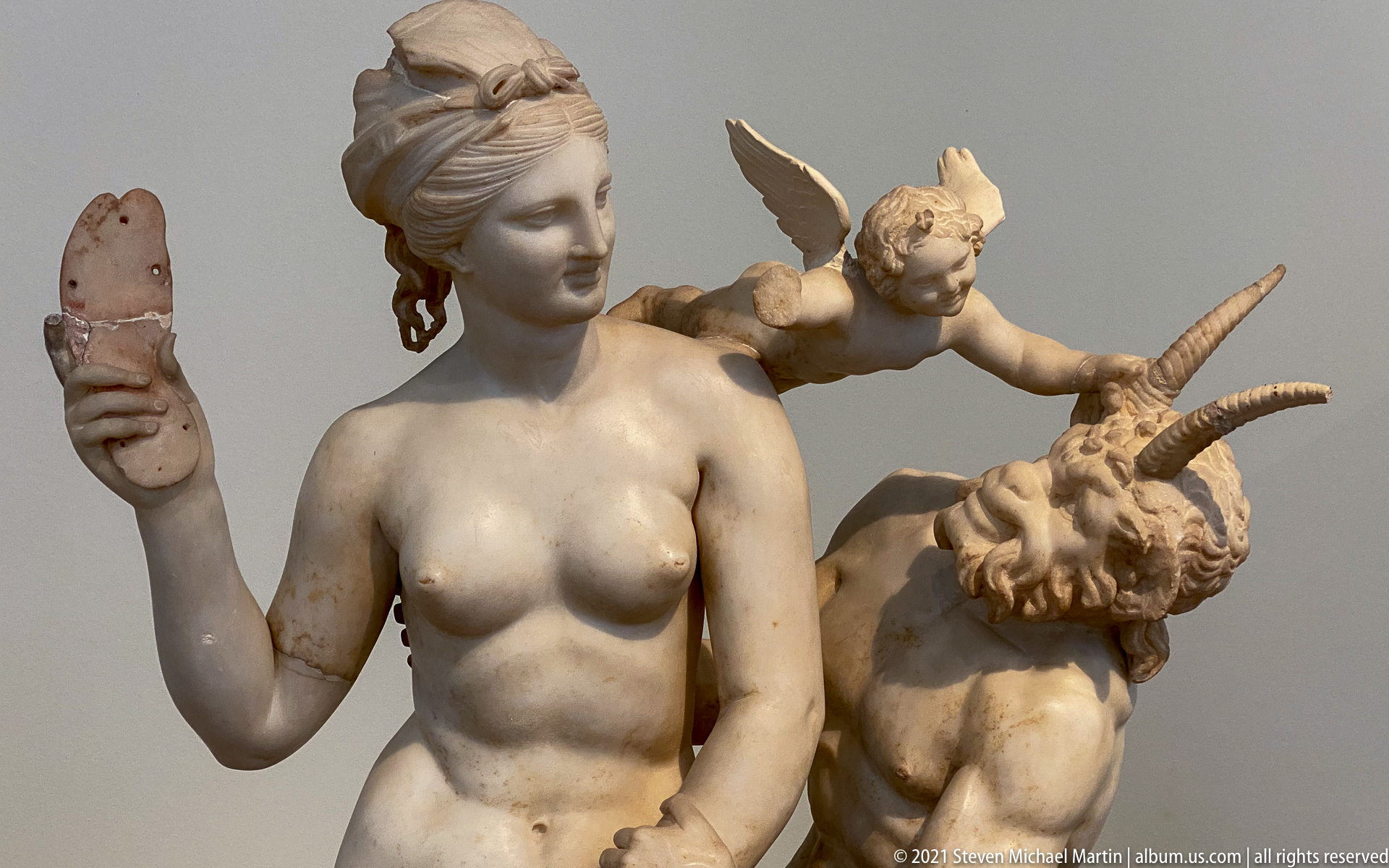
In the marble group of Aphrodite, Pan and Eros from Delos, Aphrodite raises a sandal against the advancing goat-legged Pan while the winged Eros intervenes above them. The National Archaeological Museum identifies the work as no. 3335 and notes that it may have been dedicated by a man named Dionysios from Beirut. The playful, tightly interlocked group is a characteristic work of Hellenistic mythological sculpture.
Caption
In the marble group of Aphrodite, Pan and Eros from Delos, Aphrodite raises a sandal against the advancing goat-legged Pan while the winged Eros intervenes above them. The National Archaeological Museum identifies the work as no. 3335 and notes that it may have been dedicated by a man named Dionysios from Beirut. The playful, tightly interlocked group is a characteristic work of Hellenistic mythological sculpture.

A circular marble relief encloses a standing youthful male in profile, framed by a broad wreath-like border of overlapping leaves. The figure carries a long object over one shoulder and wears a short patterned garment, giving the image a ceremonial or martial character. The medallion format and carefully carved border make the object read as a self-contained commemorative emblem.
Caption
A circular marble relief encloses a standing youthful male in profile, framed by a broad wreath-like border of overlapping leaves. The figure carries a long object over one shoulder and wears a short patterned garment, giving the image a ceremonial or martial character. The medallion format and carefully carved border make the object read as a self-contained commemorative emblem.

A museum case gathers gold drinking and serving vessels at several heights, with stemmed cups, handled bowls, and smaller circular ornaments arranged around them. The warm metal surfaces and repeated vessel forms create a concentrated display of elite Bronze Age craftsmanship. Seen as an assemblage, the objects emphasize the ceremonial and funerary importance of precious-metal tableware in Mycenaean Greece.
Caption
A museum case gathers gold drinking and serving vessels at several heights, with stemmed cups, handled bowls, and smaller circular ornaments arranged around them. The warm metal surfaces and repeated vessel forms create a concentrated display of elite Bronze Age craftsmanship. Seen as an assemblage, the objects emphasize the ceremonial and funerary importance of precious-metal tableware in Mycenaean Greece.

A large globular ceramic vessel is covered with dense dark-painted ornament arranged in vertical panels across the pale body. Spirals, curling tendrils, and marine- or plant-like motifs radiate around a central zone, while a darker neck and foot anchor the composition. The close display view emphasizes the painter's adaptation of flowing organic designs to the vessel's rounded surface.
Caption
A large globular ceramic vessel is covered with dense dark-painted ornament arranged in vertical panels across the pale body. Spirals, curling tendrils, and marine- or plant-like motifs radiate around a central zone, while a darker neck and foot anchor the composition. The close display view emphasizes the painter's adaptation of flowing organic designs to the vessel's rounded surface.

One of the celebrated gold Vapheio cups carries a continuous repoussé scene of bulls, men, and landscape around its thin vessel wall. The National Archaeological Museum displays the cups among the treasures from the tholos tomb at Vapheio in Laconia, where they exemplify the exceptional precious-metal work associated with the Mycenaean world. The raised figures and vegetation transform the cup’s surface into a miniature narrative relief.
Caption
One of the celebrated gold Vapheio cups carries a continuous repoussé scene of bulls, men, and landscape around its thin vessel wall. The National Archaeological Museum displays the cups among the treasures from the tholos tomb at Vapheio in Laconia, where they exemplify the exceptional precious-metal work associated with the Mycenaean world. The raised figures and vegetation transform the cup’s surface into a miniature narrative relief.

A second view of the Vapheio gold cups concentrates on a bull moving through a densely worked landscape of trees and curling vegetation. Hammered from thin gold in repoussé, the raised forms continue around the curved wall so that vessel and relief become a single object. The National Archaeological Museum displays the pair among the major treasures recovered from the tholos tomb at Vapheio in Laconia.
Caption
A second view of the Vapheio gold cups concentrates on a bull moving through a densely worked landscape of trees and curling vegetation. Hammered from thin gold in repoussé, the raised forms continue around the curved wall so that vessel and relief become a single object. The National Archaeological Museum displays the pair among the major treasures recovered from the tholos tomb at Vapheio in Laconia.

A broad sheet of gold is worked with tightly packed repoussé spirals and two prominent circular bosses positioned like nipples across the upper field. The thin metal has been shaped to follow the contour of a chest, while tears, folds, and losses record its fragile archaeological survival. The object appears to be a funerary body covering or breast ornament rather than wearable armor.
Caption
A broad sheet of gold is worked with tightly packed repoussé spirals and two prominent circular bosses positioned like nipples across the upper field. The thin metal has been shaped to follow the contour of a chest, while tears, folds, and losses record its fragile archaeological survival. The object appears to be a funerary body covering or breast ornament rather than wearable armor.

A low box-like terracotta vessel stands on four short feet and supports a broad domed lid pierced by a large central opening. Painted horizontal bands encircle the body, while modeled animal-head projections extend from the lid and corners. The unusual combination of container, opening, and zoomorphic attachments suggests a specialized ritual or household function rather than ordinary tableware.
Caption
A low box-like terracotta vessel stands on four short feet and supports a broad domed lid pierced by a large central opening. Painted horizontal bands encircle the body, while modeled animal-head projections extend from the lid and corners. The unusual combination of container, opening, and zoomorphic attachments suggests a specialized ritual or household function rather than ordinary tableware.


