Asian Art Museum of Corfu – Greece
The Museum of Asian Art of Corfu is located within the grand Palace of St. Michael and St. George overlooking the harbor of Corfu. Established in 1928, it remains the only museum in Greece dedicated exclusively to the art and antiquities of Asia.
The collection includes thousands of objects from civilizations across China, Japan, India, and Southeast Asia, ranging from ceramics and sculptures to lacquerware and religious artifacts. Many pieces were donated by diplomats and collectors who helped establish the museum during the early 20th century.
Housed within an elegant neoclassical palace built during the period of British rule in the Ionian Islands, the museum presents a fascinating cultural contrast within the historic setting of Corfu.
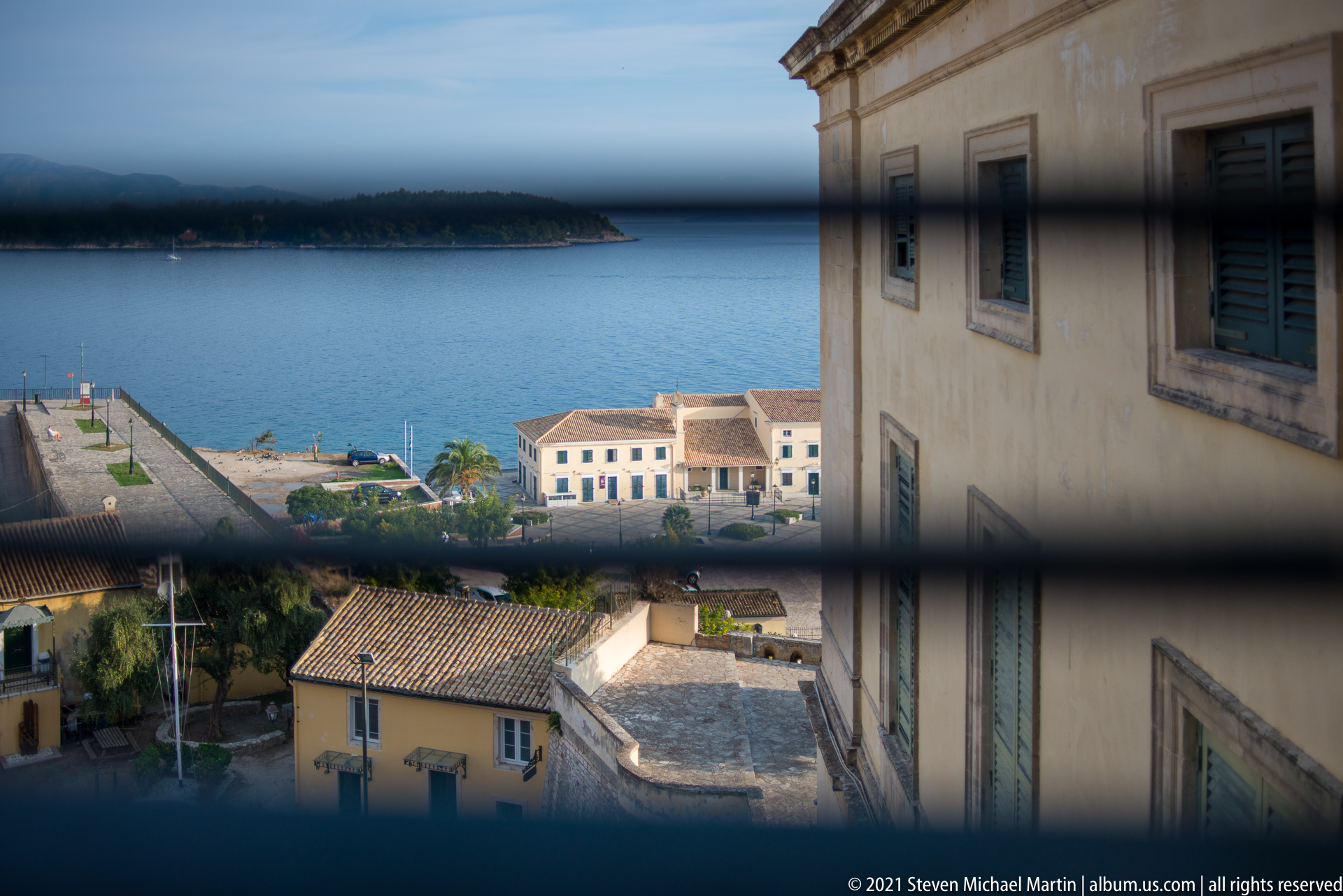
Seen through horizontal window bars, the view from the museum looks across tiled roofs and the waterfront toward the blue Ionian Sea. The pale stone exterior of the palace fills the right edge, linking the Asian Art Museum's historic setting directly to the harbor landscape of Corfu.
Caption
Seen through horizontal window bars, the view from the museum looks across tiled roofs and the waterfront toward the blue Ionian Sea. The pale stone exterior of the palace fills the right edge, linking the Asian Art Museum's historic setting directly to the harbor landscape of Corfu.
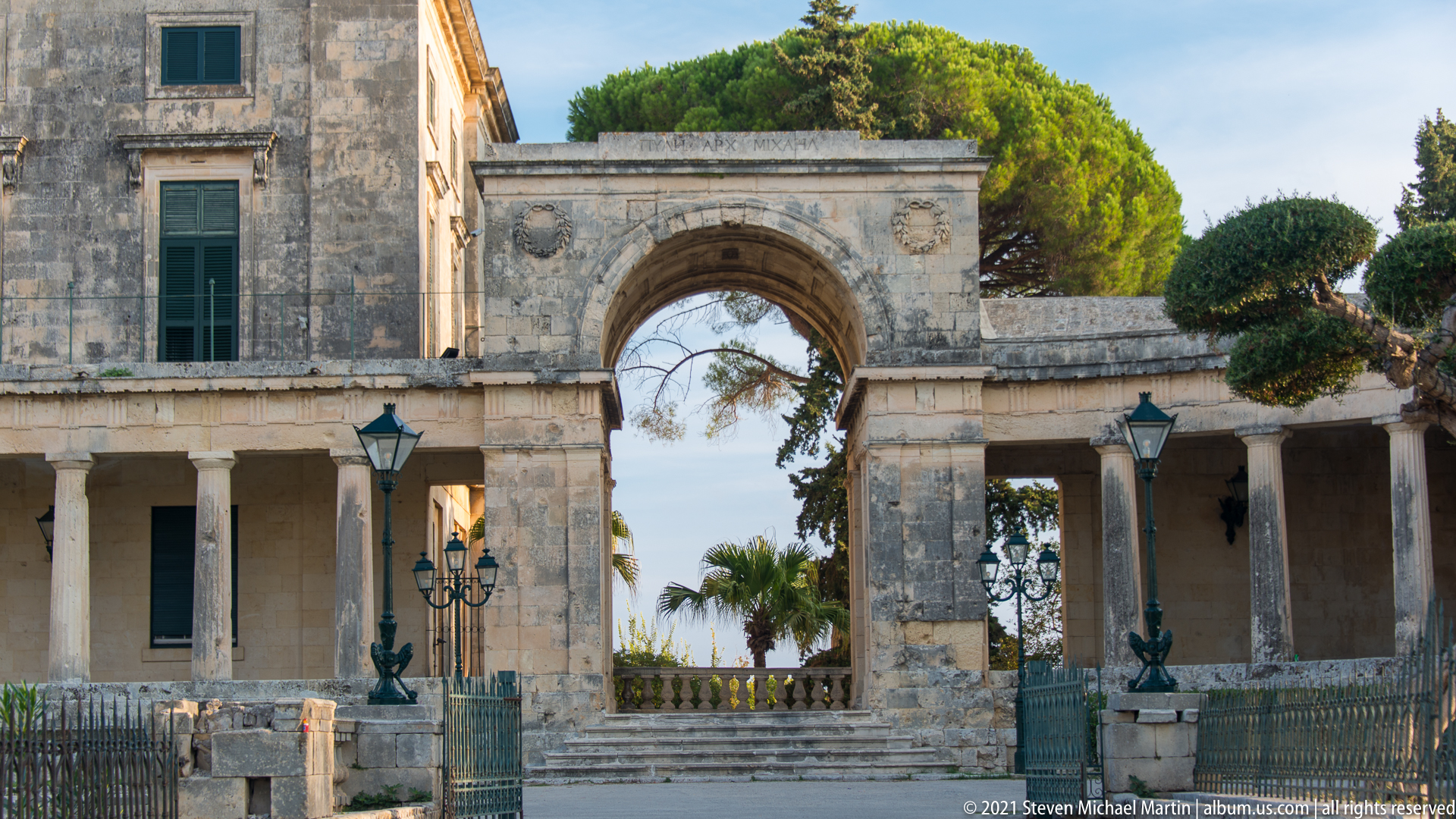
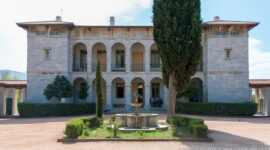
The Palace of Saints Michael and George presents its formal entrance through a tall stone arch framed by low colonnades and clipped garden trees. Weathered limestone, green shutters, iron lamps, and the glimpse of palms beyond the gateway place the neoclassical complex in its Mediterranean setting. The palace, built during the British Protectorate of the Ionian Islands, now houses the Museum of Asian Art of Corfu.
Caption
The Palace of Saints Michael and George presents its formal entrance through a tall stone arch framed by low colonnades and clipped garden trees. Weathered limestone, green shutters, iron lamps, and the glimpse of palms beyond the gateway place the neoclassical complex in its Mediterranean setting. The palace, built during the British Protectorate of the Ionian Islands, now houses the Museum of Asian Art of Corfu.
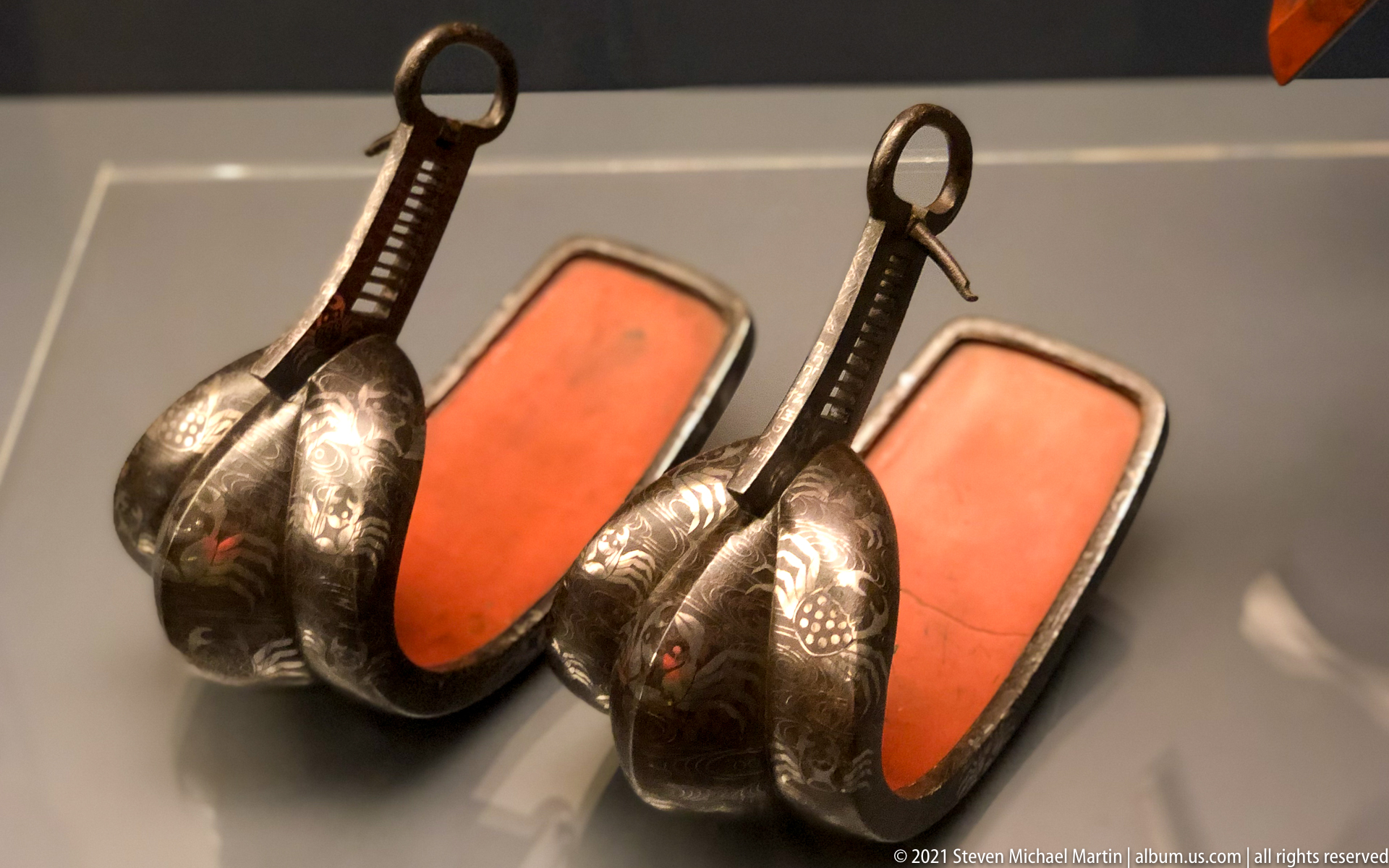
A matched pair of metal stirrups combines deep, shoe-like foot supports with tall narrow suspension loops. Engraved or inlaid floral and scrolling decoration covers the dark exterior surfaces, while vivid orange-red footbeds create a strong interior contrast. Their paired display makes the mirrored construction and repeated ornamental program especially easy to compare.
Caption
A matched pair of metal stirrups combines deep, shoe-like foot supports with tall narrow suspension loops. Engraved or inlaid floral and scrolling decoration covers the dark exterior surfaces, while vivid orange-red footbeds create a strong interior contrast. Their paired display makes the mirrored construction and repeated ornamental program especially easy to compare.

A broad gold-ground folding screen presents a quiet landscape of layered mountains, pine-covered slopes, clustered buildings, and a winding watercourse. The low settlement occupies the middle distance while blue-green ridges recede into mist, creating a spacious panoramic setting across the articulated screen panels.
Caption
A broad gold-ground folding screen presents a quiet landscape of layered mountains, pine-covered slopes, clustered buildings, and a winding watercourse. The low settlement occupies the middle distance while blue-green ridges recede into mist, creating a spacious panoramic setting across the articulated screen panels.

Inside the palace, a broad red-carpeted staircase rises on axis through a columned entrance hall. White columns, gray-and-white stone flooring, iron balustrades, and a suspended blue-toned lantern create a restrained ceremonial setting, while paired stair flights continue upward beyond the landing. The symmetrical view highlights the building's adaptation as a museum without obscuring the formal circulation and decorative character of the former palace interior.
Caption
Inside the palace, a broad red-carpeted staircase rises on axis through a columned entrance hall. White columns, gray-and-white stone flooring, iron balustrades, and a suspended blue-toned lantern create a restrained ceremonial setting, while paired stair flights continue upward beyond the landing. The symmetrical view highlights the building's adaptation as a museum without obscuring the formal circulation and decorative character of the former palace interior.
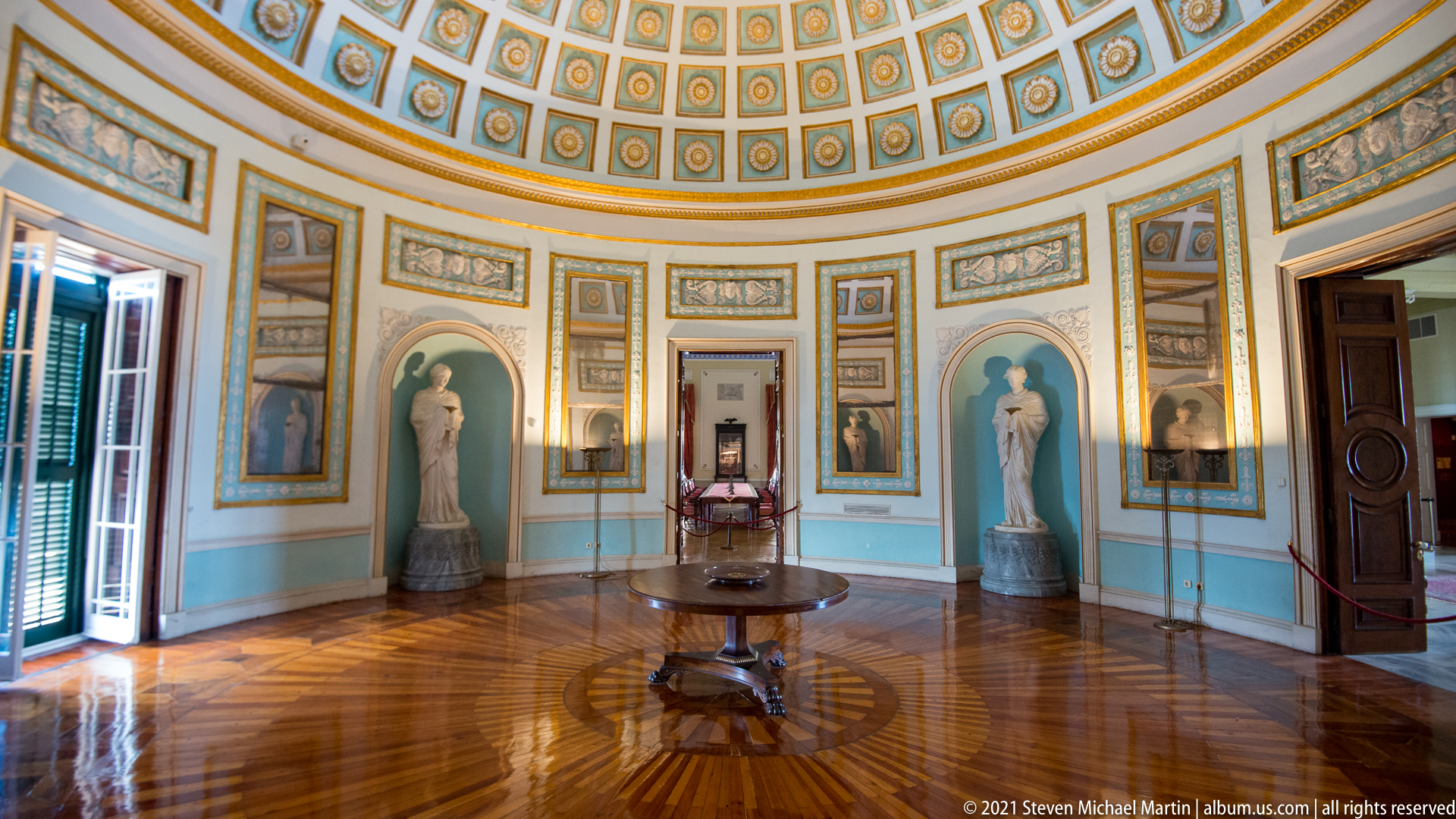
A wider view of the palace Rotunda connects its coffered dome to the circular Reception Hall below. Mirrors and niches containing Vestal lamp-statues alternate around the walls, while the elaborate parquet floor radiates from the center in contrasting woods. Sunlight from the open shutters sharpens the room’s geometry and makes the coordinated relationship between dome, wall decoration, sculpture, and floor especially clear.
Caption
A wider view of the palace Rotunda connects its coffered dome to the circular Reception Hall below. Mirrors and niches containing Vestal lamp-statues alternate around the walls, while the elaborate parquet floor radiates from the center in contrasting woods. Sunlight from the open shutters sharpens the room’s geometry and makes the coordinated relationship between dome, wall decoration, sculpture, and floor especially clear.
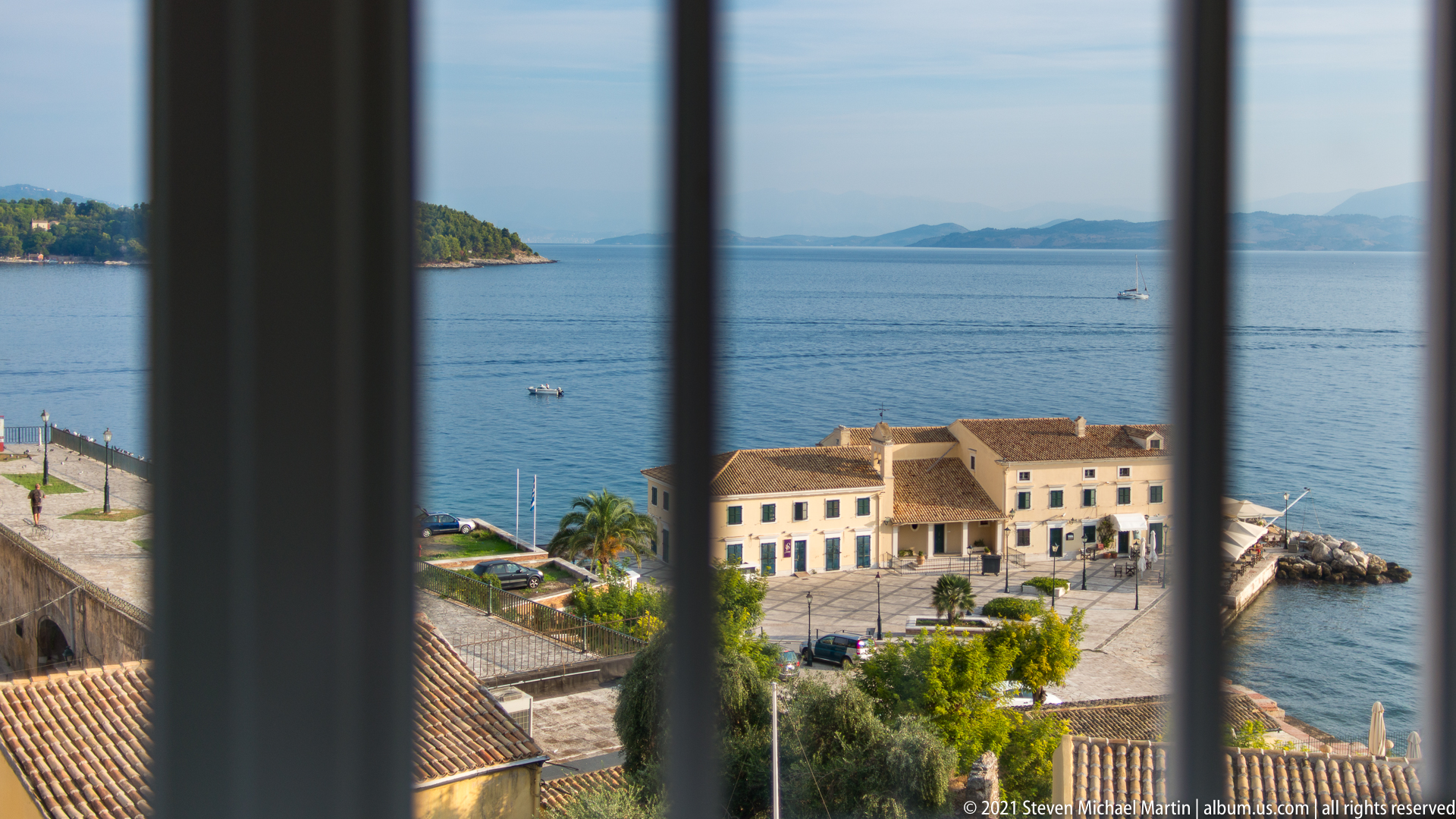
Vertical window bars frame a clear view from the museum toward Corfu's waterfront, where a pale neoclassical building stands beside the blue Ionian Sea. Terracotta roofs and greenery fill the foreground, while boats and distant landforms extend the view beyond the harbor.
Caption
Vertical window bars frame a clear view from the museum toward Corfu's waterfront, where a pale neoclassical building stands beside the blue Ionian Sea. Terracotta roofs and greenery fill the foreground, while boats and distant landforms extend the view beyond the harbor.
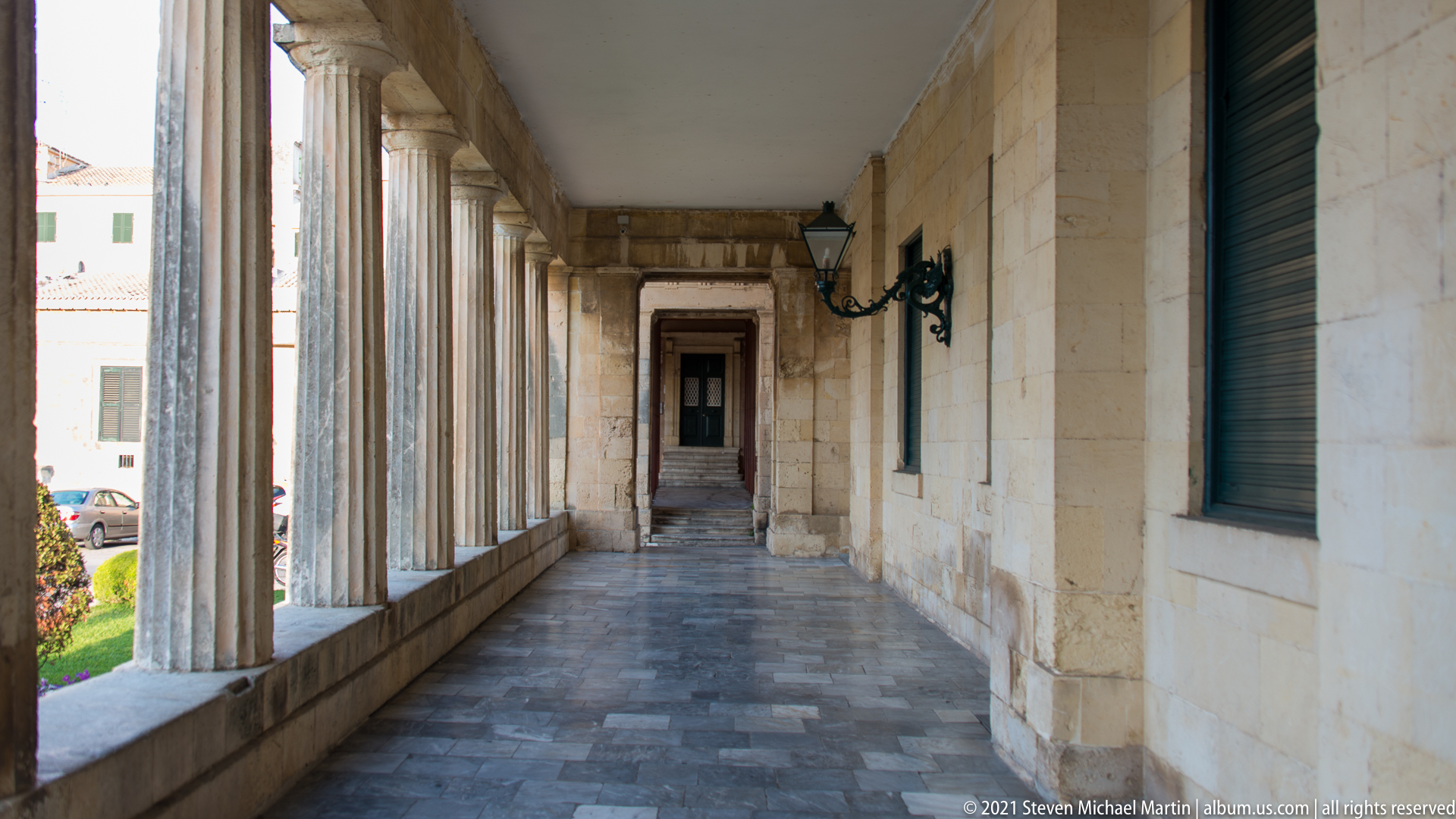
A long covered colonnade runs along the Palace of Saints Michael and George, its repeated stone columns opening toward the garden while shuttered windows and wall-mounted lamps line the inner wall. The worn paving and deep perspective emphasize the palace's circulation spaces rather than its monumental front. Light entering between the columns creates alternating bands of brightness and shade across the corridor and draws the eye toward the distant doorway.
Caption
A long covered colonnade runs along the Palace of Saints Michael and George, its repeated stone columns opening toward the garden while shuttered windows and wall-mounted lamps line the inner wall. The worn paving and deep perspective emphasize the palace's circulation spaces rather than its monumental front. Light entering between the columns creates alternating bands of brightness and shade across the corridor and draws the eye toward the distant doorway.
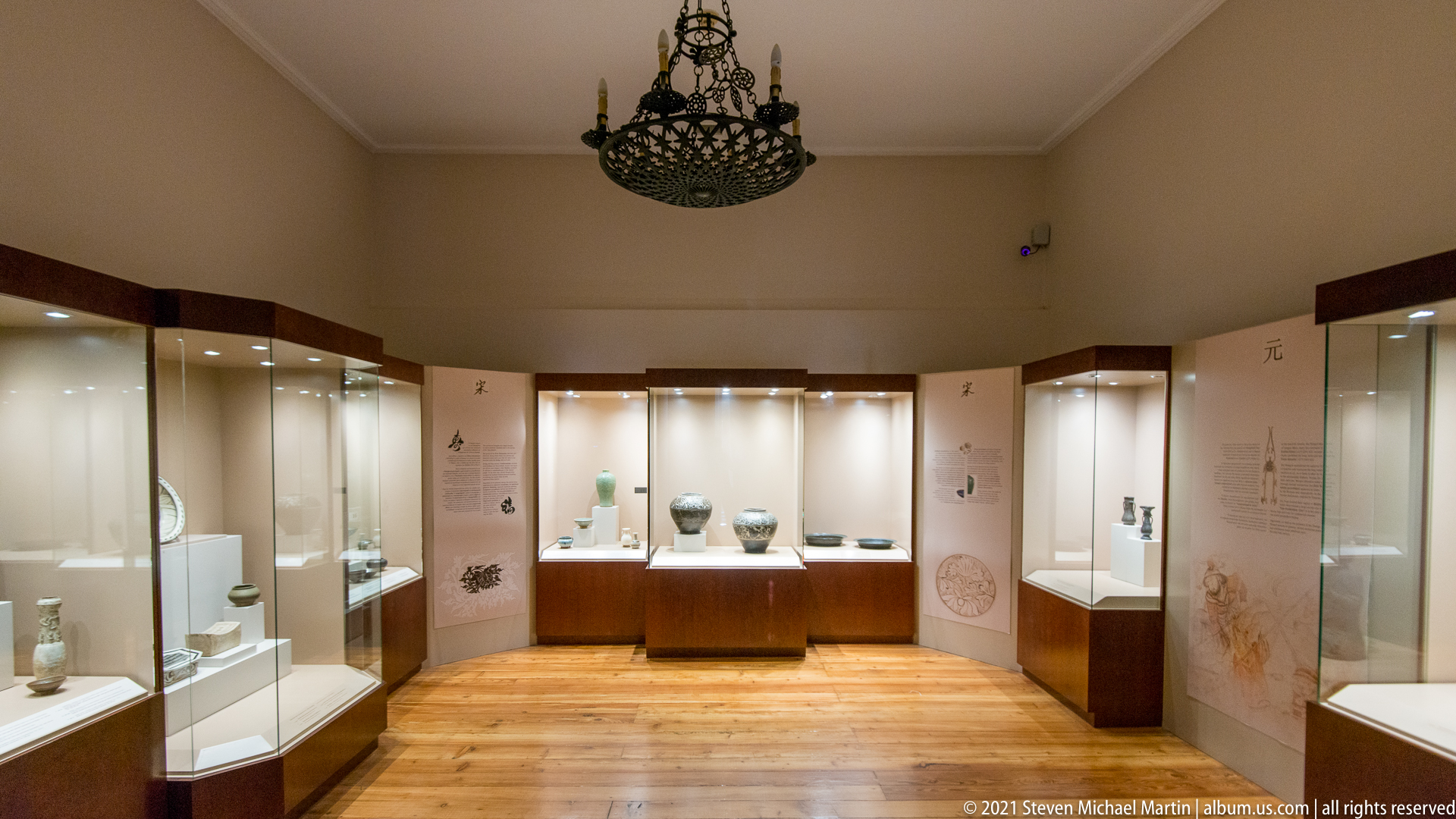
A modern gallery within the historic palace uses illuminated glass cases to present small Asian objects against pale walls and warm wooden flooring. Display cases line both sides and the far wall, where ceramics and sculptural pieces are spaced individually for close viewing. A dark pierced-metal hanging lantern provides a decorative counterpoint overhead, while the uncluttered layout shifts attention from the palace architecture to the museum's collection displays.
Caption
A modern gallery within the historic palace uses illuminated glass cases to present small Asian objects against pale walls and warm wooden flooring. Display cases line both sides and the far wall, where ceramics and sculptural pieces are spaced individually for close viewing. A dark pierced-metal hanging lantern provides a decorative counterpoint overhead, while the uncluttered layout shifts attention from the palace architecture to the museum's collection displays.

A painted seated religious figure is shown frontally against a vivid red display background. The figure sits cross-legged with hands folded at the lap, wearing layered robes and a flat-topped head covering; traces of ochre, red, black, and pale pigment survive across the worn surface. The close view emphasizes the rounded face, lowered eyes, and symmetrical meditative posture while also recording abrasion and pigment loss accumulated over time.
Caption
A painted seated religious figure is shown frontally against a vivid red display background. The figure sits cross-legged with hands folded at the lap, wearing layered robes and a flat-topped head covering; traces of ochre, red, black, and pale pigment survive across the worn surface. The close view emphasizes the rounded face, lowered eyes, and symmetrical meditative posture while also recording abrasion and pigment loss accumulated over time.
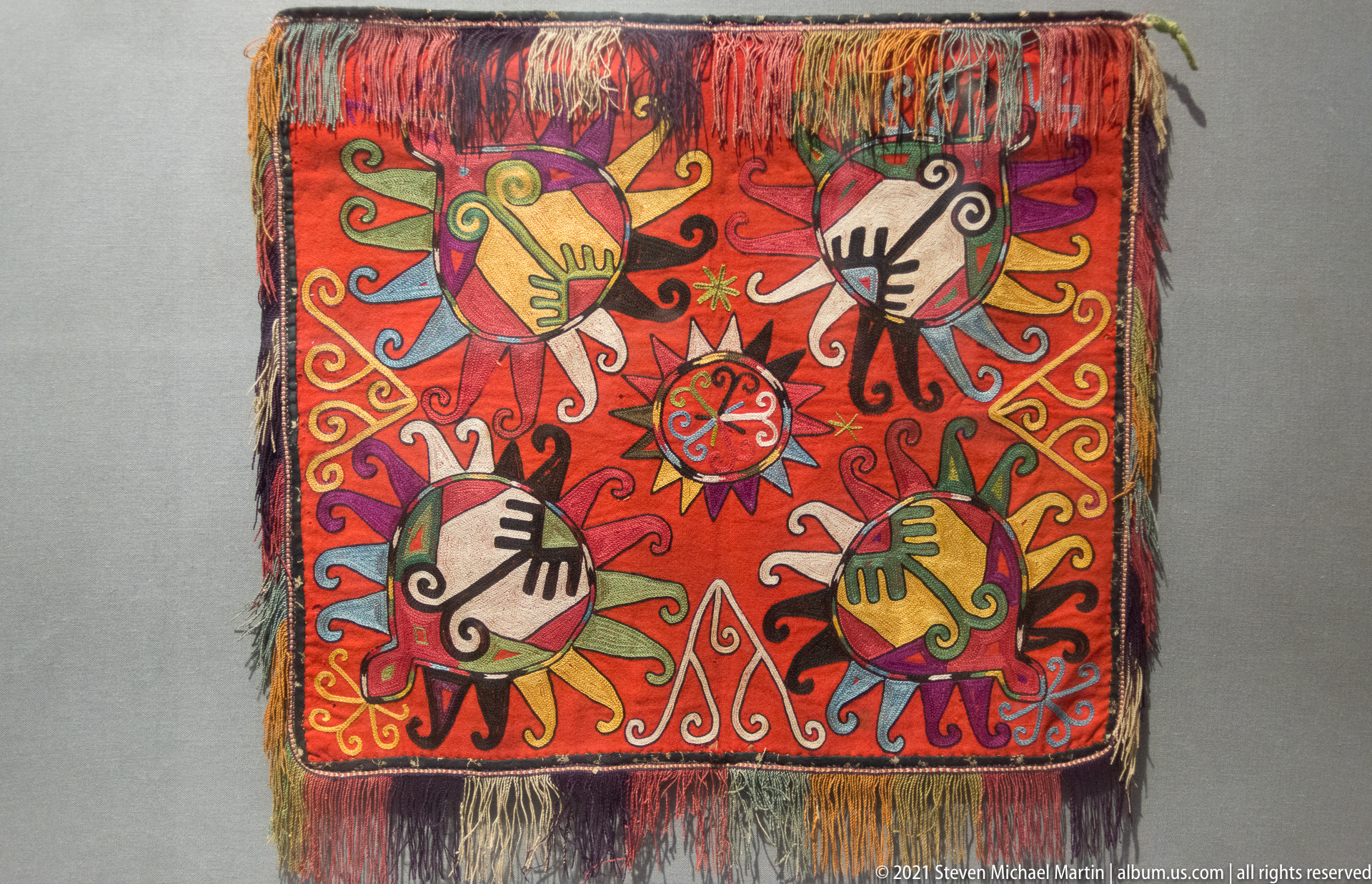
Four stylized human figures occupy the corners of this square red textile, arranged around a central rosette or sun-like medallion. Strong black outlines, green and yellow garments, curling red-and-yellow ornament, and a multicolored fringe create a vivid, nearly heraldic composition.
Caption
Four stylized human figures occupy the corners of this square red textile, arranged around a central rosette or sun-like medallion. Strong black outlines, green and yellow garments, curling red-and-yellow ornament, and a multicolored fringe create a vivid, nearly heraldic composition.

A seated bronze figure of Sir Frederick Adam occupies the foreground outside the Palace of Saints Michael and George. Draped in classical-style robes, the figure extends one arm while resting the other beside a scroll-like object, giving the monument a deliberately civic and commemorative character. The green patina contrasts with the pale stone palace behind it, linking the sculpture visually to the former seat of British administration on Corfu.
Caption
A seated bronze figure of Sir Frederick Adam occupies the foreground outside the Palace of Saints Michael and George. Draped in classical-style robes, the figure extends one arm while resting the other beside a scroll-like object, giving the monument a deliberately civic and commemorative character. The green patina contrasts with the pale stone palace behind it, linking the sculpture visually to the former seat of British administration on Corfu.
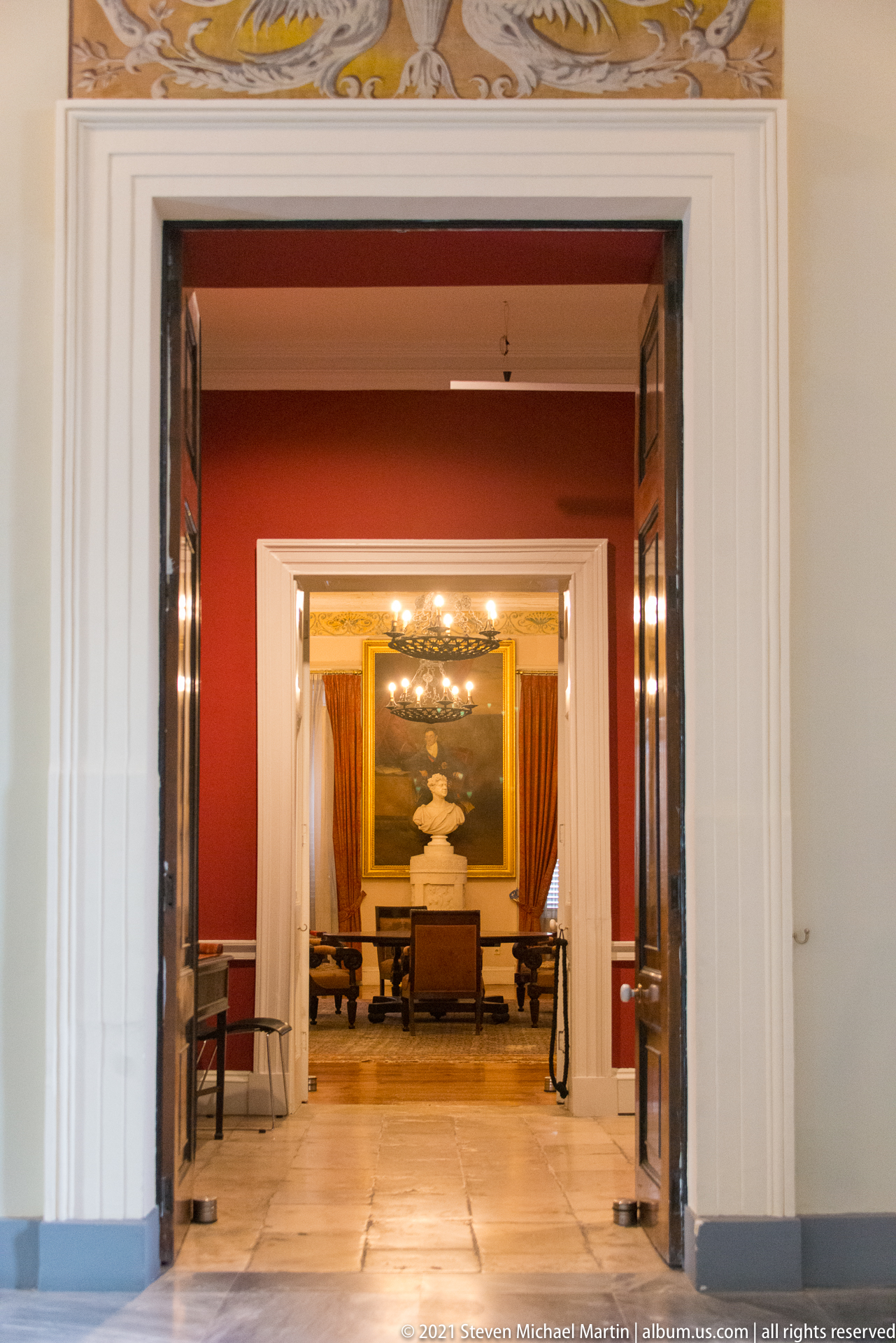
Open double doors frame an enfilade of ceremonial rooms inside the Palace of Saints Michael and George. A warm red chamber leads to a brighter room beyond, where a pale sculptural bust stands centered beneath a large wall painting or decorative panel. Marble flooring, gilded details, draperies, and painted ceiling ornament preserve the residence's formal character, while the aligned doorways create a carefully staged progression through the historic interior.
Caption
Open double doors frame an enfilade of ceremonial rooms inside the Palace of Saints Michael and George. A warm red chamber leads to a brighter room beyond, where a pale sculptural bust stands centered beneath a large wall painting or decorative panel. Marble flooring, gilded details, draperies, and painted ceiling ornament preserve the residence's formal character, while the aligned doorways create a carefully staged progression through the historic interior.
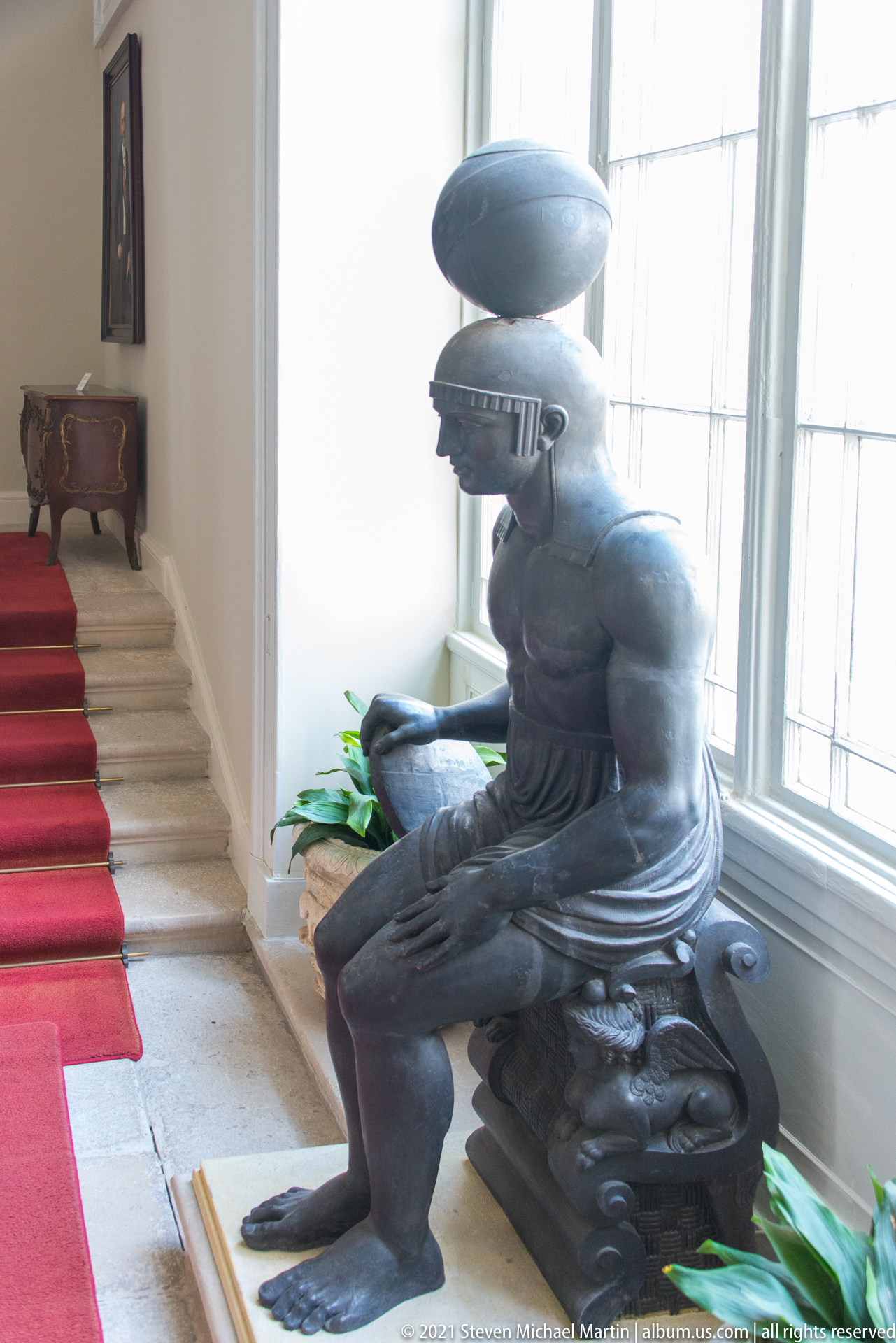
Beside a palace staircase, a large dark sculptural figure sits on a low ornamental base near tall windows. The muscular male figure bends forward beneath a cushion-like form balanced above his head, turning an architectural circulation space into a dramatic display setting. Strong backlighting silhouettes the sculpture's modeled torso, bent legs, and extended foot while the adjacent red stair runner and pale stone steps establish its scale.
Caption
Beside a palace staircase, a large dark sculptural figure sits on a low ornamental base near tall windows. The muscular male figure bends forward beneath a cushion-like form balanced above his head, turning an architectural circulation space into a dramatic display setting. Strong backlighting silhouettes the sculpture's modeled torso, bent legs, and extended foot while the adjacent red stair runner and pale stone steps establish its scale.
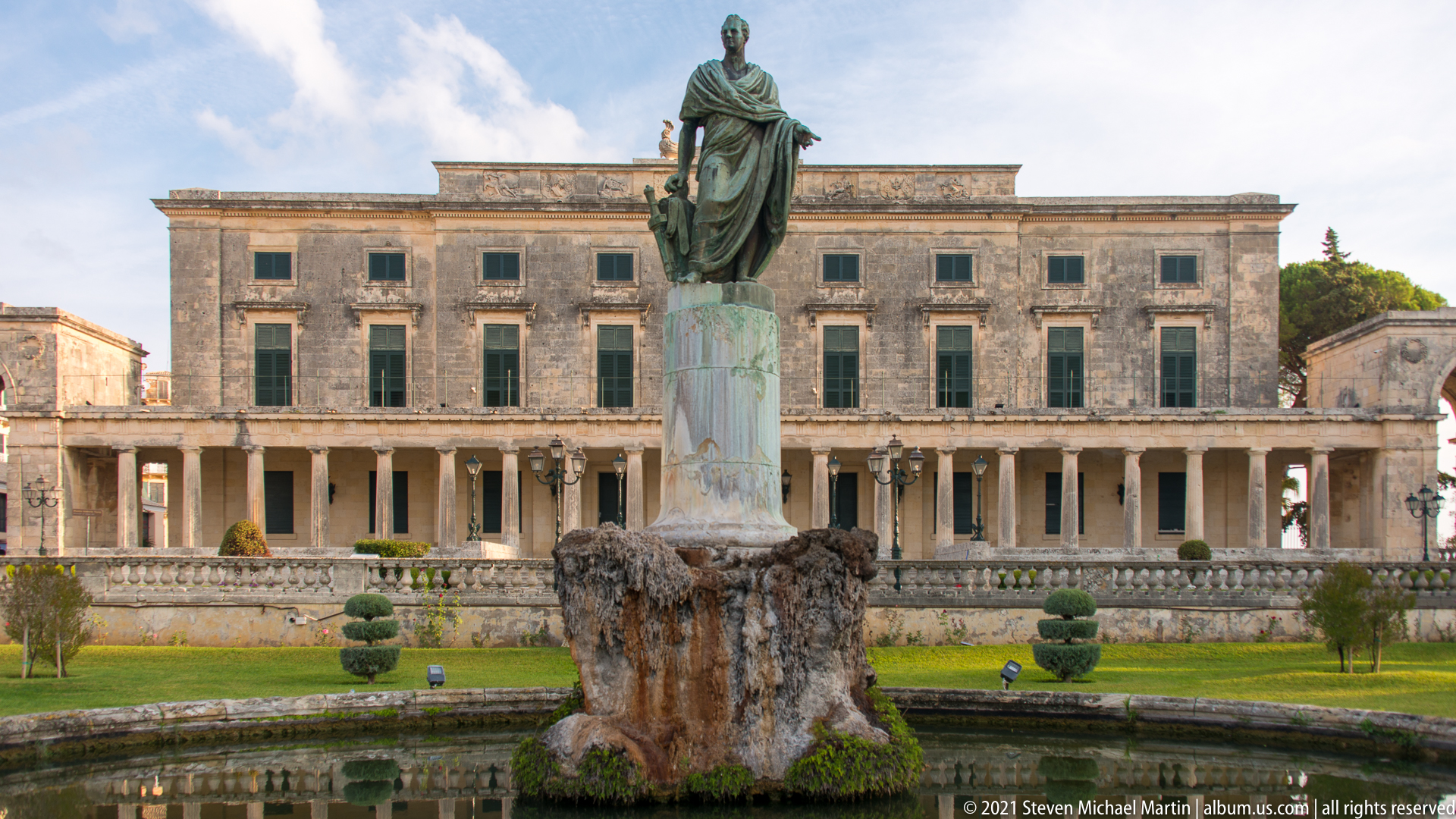
Across a formal garden and reflecting pool, the long neoclassical façade of the Palace of Saints Michael and George forms a symmetrical backdrop to the seated bronze monument in front. The wider view reveals the building's two-story rhythm of windows, ground-floor colonnade, balustrades, and carefully clipped plantings. The composition shows how sculpture, garden design, and architecture structure the ceremonial approach to the present-day Museum of Asian Art.
Caption
Across a formal garden and reflecting pool, the long neoclassical façade of the Palace of Saints Michael and George forms a symmetrical backdrop to the seated bronze monument in front. The wider view reveals the building's two-story rhythm of windows, ground-floor colonnade, balustrades, and carefully clipped plantings. The composition shows how sculpture, garden design, and architecture structure the ceremonial approach to the present-day Museum of Asian Art.
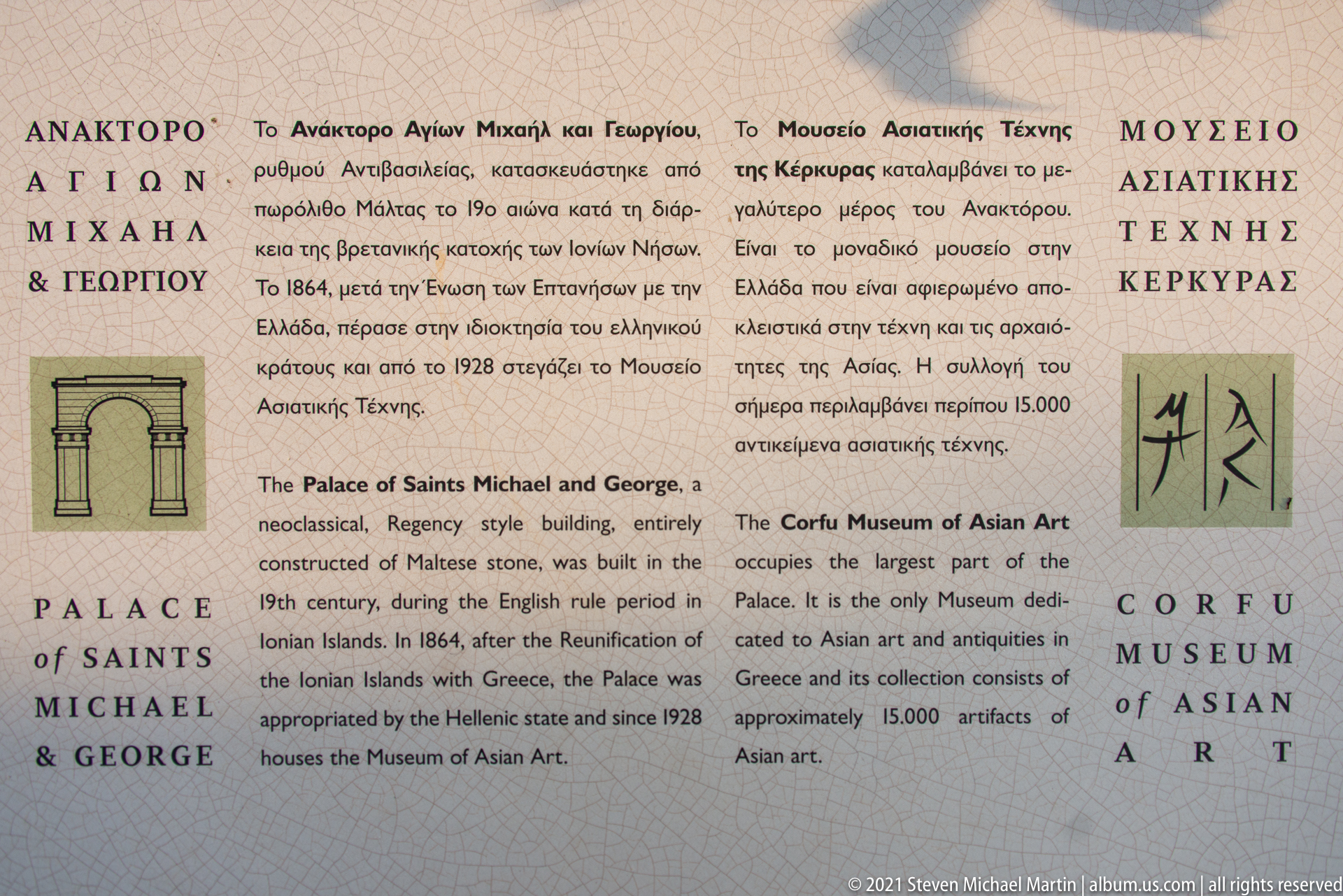
A bilingual Greek-and-English introductory panel explains the dual identity of the site: the Palace of Saints Michael and George and the Museum of Asian Art of Corfu. Text describes the Regency-style palace, its nineteenth-century construction and later museum use, alongside a brief introduction to the collection. Simple graphic emblems and vertically arranged titles frame the dense interpretive text, marking the transition from the historic building to its Asian art displays.
Caption
A bilingual Greek-and-English introductory panel explains the dual identity of the site: the Palace of Saints Michael and George and the Museum of Asian Art of Corfu. Text describes the Regency-style palace, its nineteenth-century construction and later museum use, alongside a brief introduction to the collection. Simple graphic emblems and vertically arranged titles frame the dense interpretive text, marking the transition from the historic building to its Asian art displays.

A tall interior gallery of the Palace of Saints Michael and George is organized by paired white columns and a high, glazed clerestory-like ceiling. A large hanging lantern occupies the centerline above polished stone flooring, while dark wooden doors, scattered period chairs, red rugs, and a small bench furnish the edges. The view emphasizes the vertical scale and restrained neoclassical order of the palace spaces now used by the museum.
Caption
A tall interior gallery of the Palace of Saints Michael and George is organized by paired white columns and a high, glazed clerestory-like ceiling. A large hanging lantern occupies the centerline above polished stone flooring, while dark wooden doors, scattered period chairs, red rugs, and a small bench furnish the edges. The view emphasizes the vertical scale and restrained neoclassical order of the palace spaces now used by the museum.
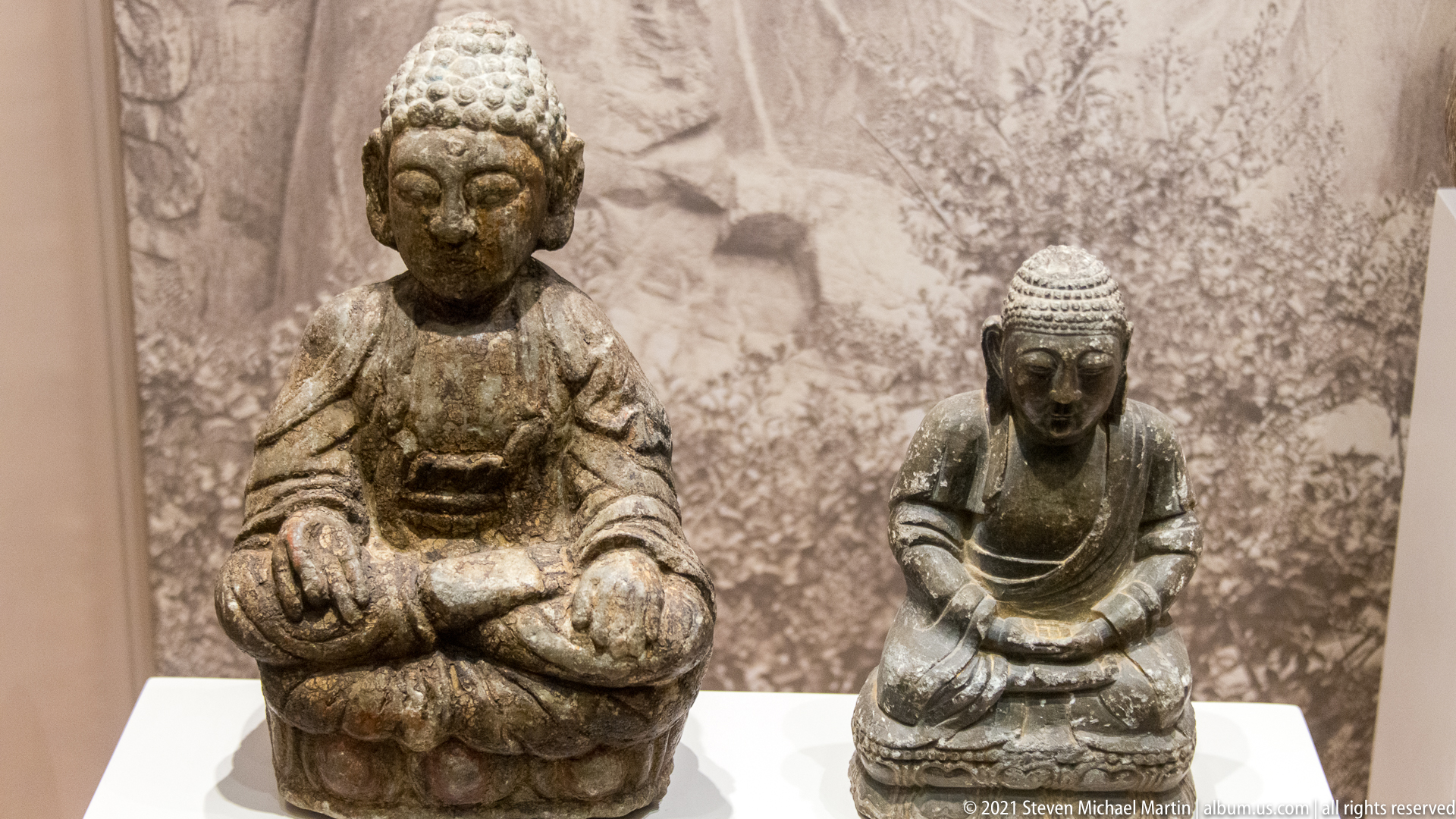
Two seated Buddha figures are presented side by side, allowing differences in scale, surface, and carving to be compared directly. Both adopt meditative postures with patterned hair and elongated ears, but the larger figure has a rougher, heavily weathered surface while the smaller retains smoother, darker modeling and more sharply defined robe folds. Their paired display foregrounds variation within Buddhist sculptural traditions rather than treating the figures as identical examples.
Caption
Two seated Buddha figures are presented side by side, allowing differences in scale, surface, and carving to be compared directly. Both adopt meditative postures with patterned hair and elongated ears, but the larger figure has a rougher, heavily weathered surface while the smaller retains smoother, darker modeling and more sharply defined robe folds. Their paired display foregrounds variation within Buddhist sculptural traditions rather than treating the figures as identical examples.
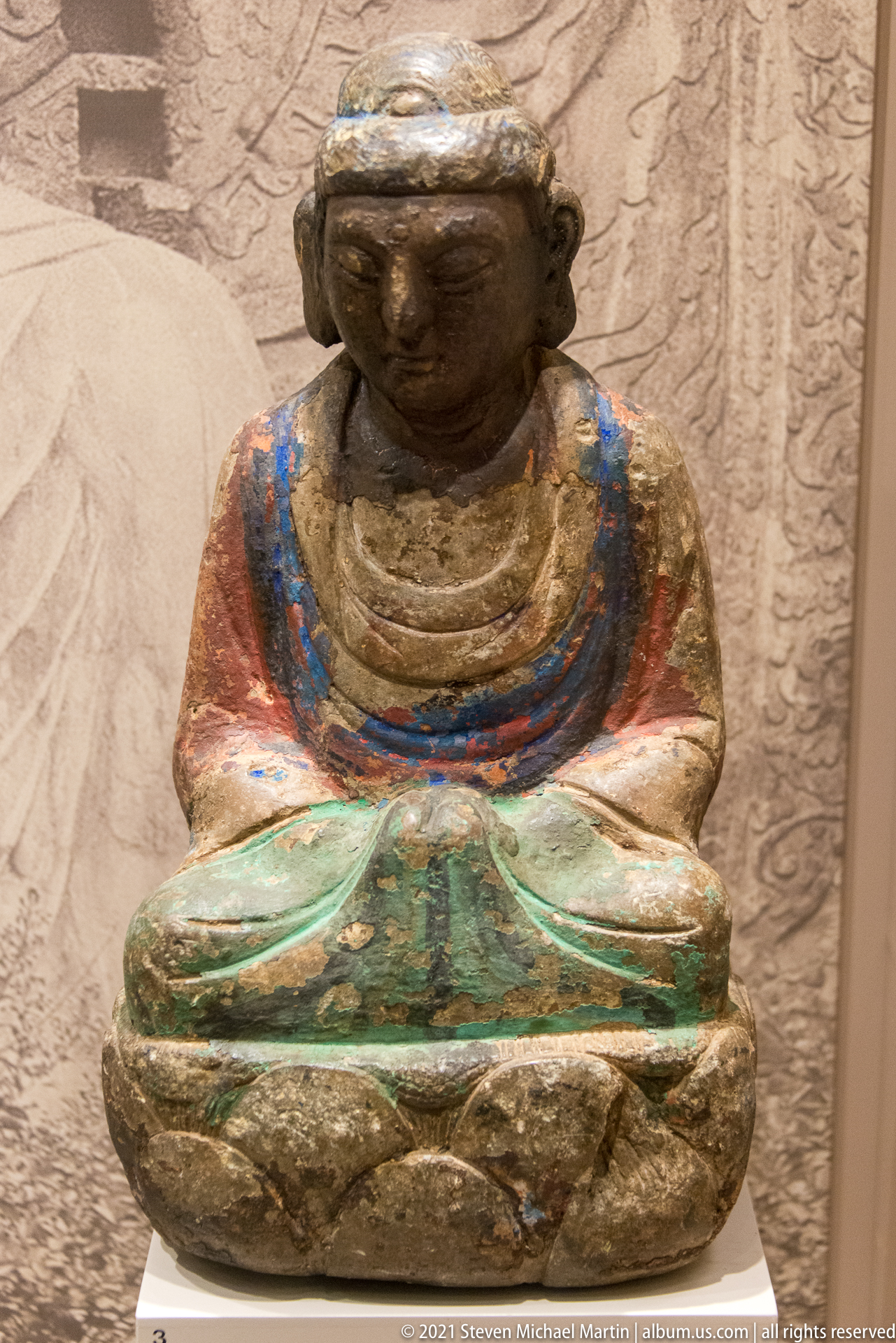
A compact polychrome Buddhist figure sits cross-legged in meditation, hands resting together at the lap. Traces of red, blue, green, and gold pigment remain across the layered robes, while the softly modeled face is framed by a low headdress or hair arrangement. Surface wear and losses reveal the object's age and material history, making the surviving color as visually significant as the serene frontal pose.
Caption
A compact polychrome Buddhist figure sits cross-legged in meditation, hands resting together at the lap. Traces of red, blue, green, and gold pigment remain across the layered robes, while the softly modeled face is framed by a low headdress or hair arrangement. Surface wear and losses reveal the object's age and material history, making the surviving color as visually significant as the serene frontal pose.
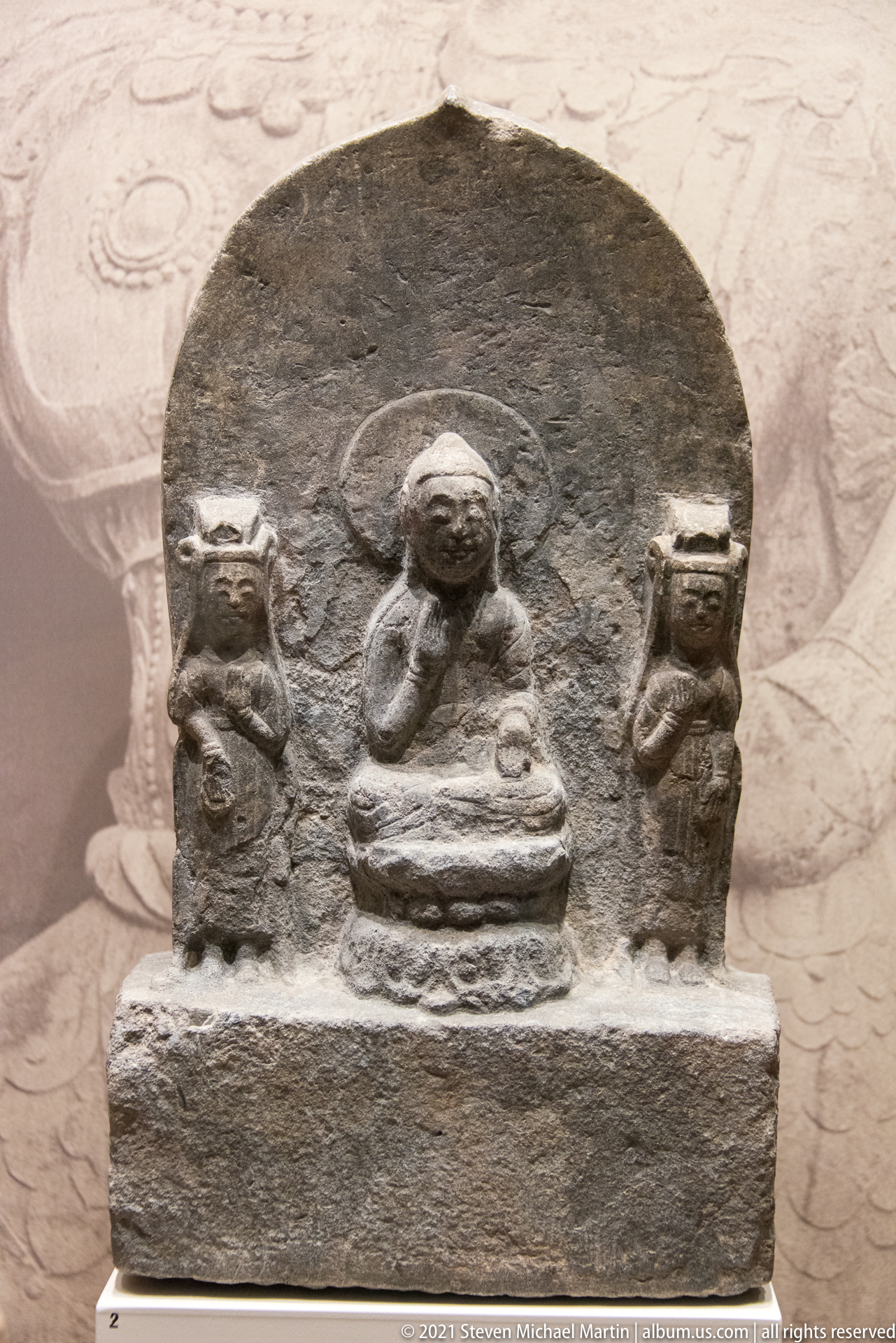
A dark stone relief stele centers a seated Buddha beneath a broad rounded halo, flanked symmetrically by two smaller standing attendants. The Buddha sits on a raised pedestal with one hand lifted near the chest, while the attendants occupy shallower niches to either side. The compact, frontal arrangement creates a devotional triad whose hierarchy is communicated through scale, central placement, and the encircling halo rather than elaborate architectural framing.
Caption
A dark stone relief stele centers a seated Buddha beneath a broad rounded halo, flanked symmetrically by two smaller standing attendants. The Buddha sits on a raised pedestal with one hand lifted near the chest, while the attendants occupy shallower niches to either side. The compact, frontal arrangement creates a devotional triad whose hierarchy is communicated through scale, central placement, and the encircling halo rather than elaborate architectural framing.
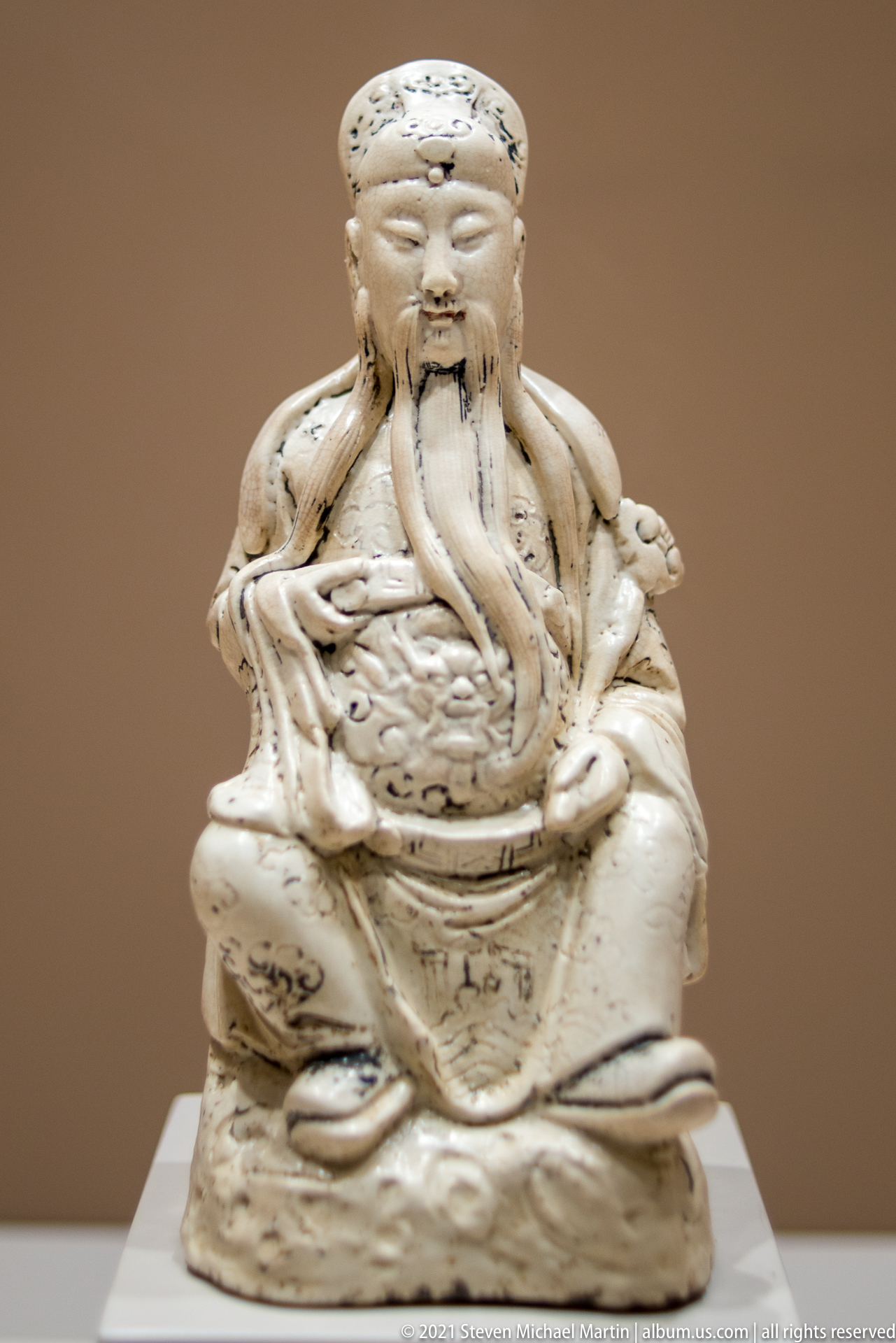
Guandi, the Chinese God of War, sits frontally in this white-glazed porcelain figurine from the Ming dynasty, dated by the Museum of Asian Art of Corfu to the 16th–17th century. His long moustache and beard, official headgear, and elaborately modeled robes establish the commanding identity of the figure, while the monochrome glaze brings the deeply worked garment folds and relief decoration into sharp focus.
Caption
Guandi, the Chinese God of War, sits frontally in this white-glazed porcelain figurine from the Ming dynasty, dated by the Museum of Asian Art of Corfu to the 16th–17th century. His long moustache and beard, official headgear, and elaborately modeled robes establish the commanding identity of the figure, while the monochrome glaze brings the deeply worked garment folds and relief decoration into sharp focus.
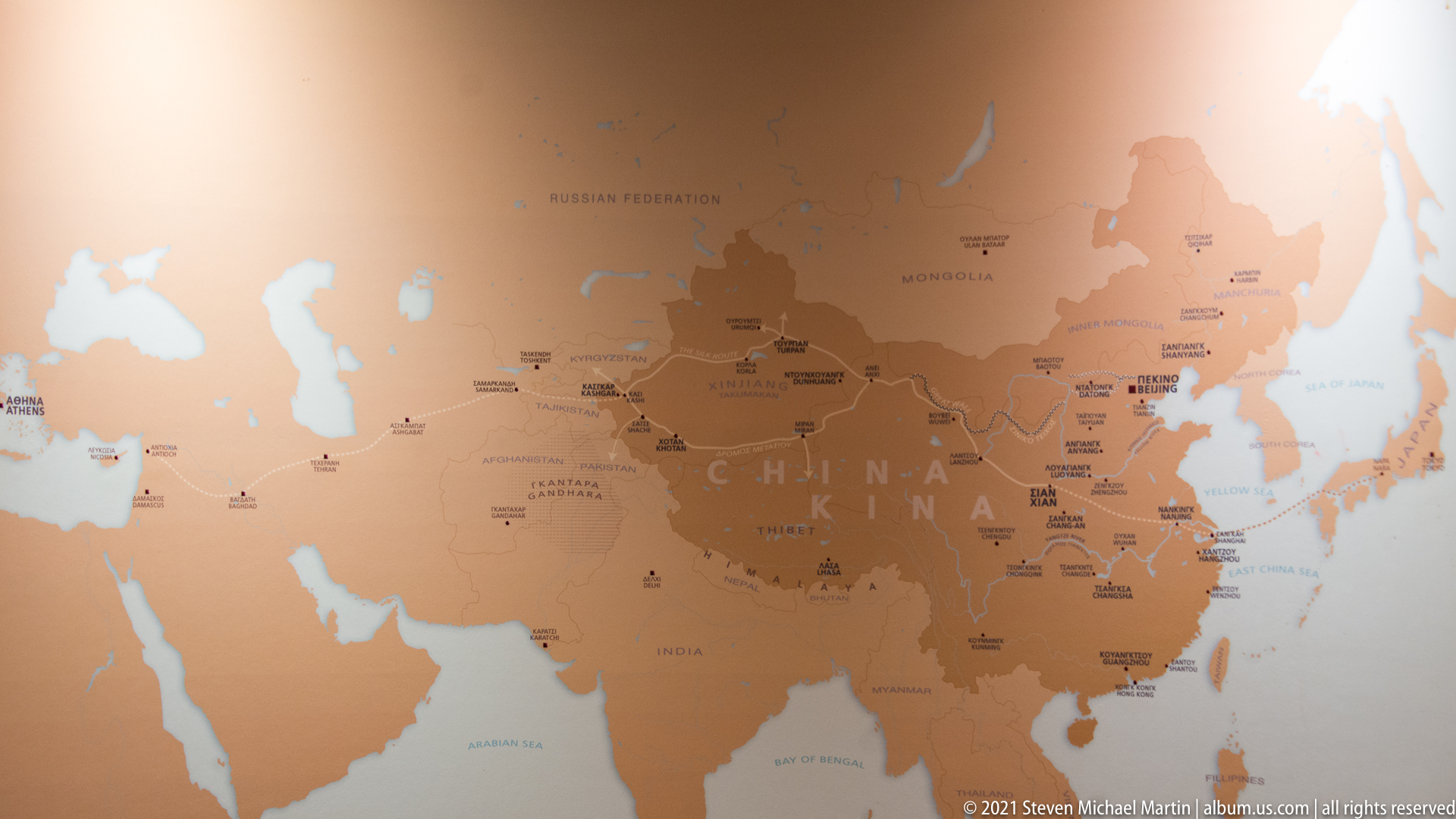
A wall map introduces the geographic scope of the museum's Asian collections, extending from the eastern Mediterranean across Central and South Asia to China, Korea, and Japan. China dominates the center of the composition, with numerous place names and site markers distributed across the continent. The restrained earth-toned design functions as an orientation device, placing individual works encountered in the galleries within a much broader network of Asian regions and cultures.
Caption
A wall map introduces the geographic scope of the museum's Asian collections, extending from the eastern Mediterranean across Central and South Asia to China, Korea, and Japan. China dominates the center of the composition, with numerous place names and site markers distributed across the continent. The restrained earth-toned design functions as an orientation device, placing individual works encountered in the galleries within a much broader network of Asian regions and cultures.
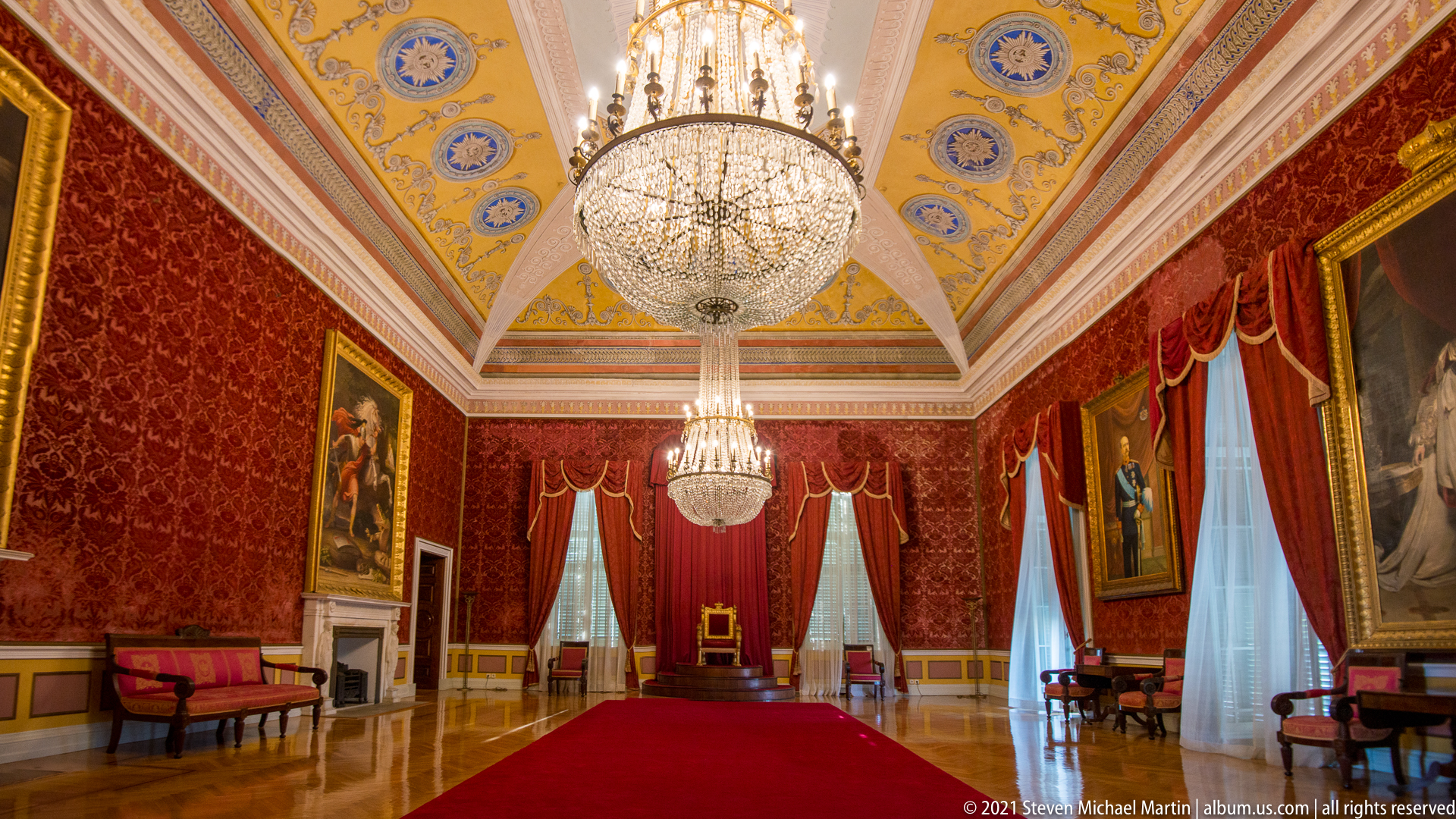
The Throne Room of the Palace of Saint Michael and Saint George preserves the ceremonial setting used for the Lord High Commissioner’s audiences and functions of the Order of Saint Michael and Saint George. Red wall coverings, gilded ornament, portraits, tall draperies, and paired chandeliers lead the eye toward the original gilded throne on the eastern wall, designed, like the palace furniture, by Sir George Whitmore.
Caption
The Throne Room of the Palace of Saint Michael and Saint George preserves the ceremonial setting used for the Lord High Commissioner’s audiences and functions of the Order of Saint Michael and Saint George. Red wall coverings, gilded ornament, portraits, tall draperies, and paired chandeliers lead the eye toward the original gilded throne on the eastern wall, designed, like the palace furniture, by Sir George Whitmore.
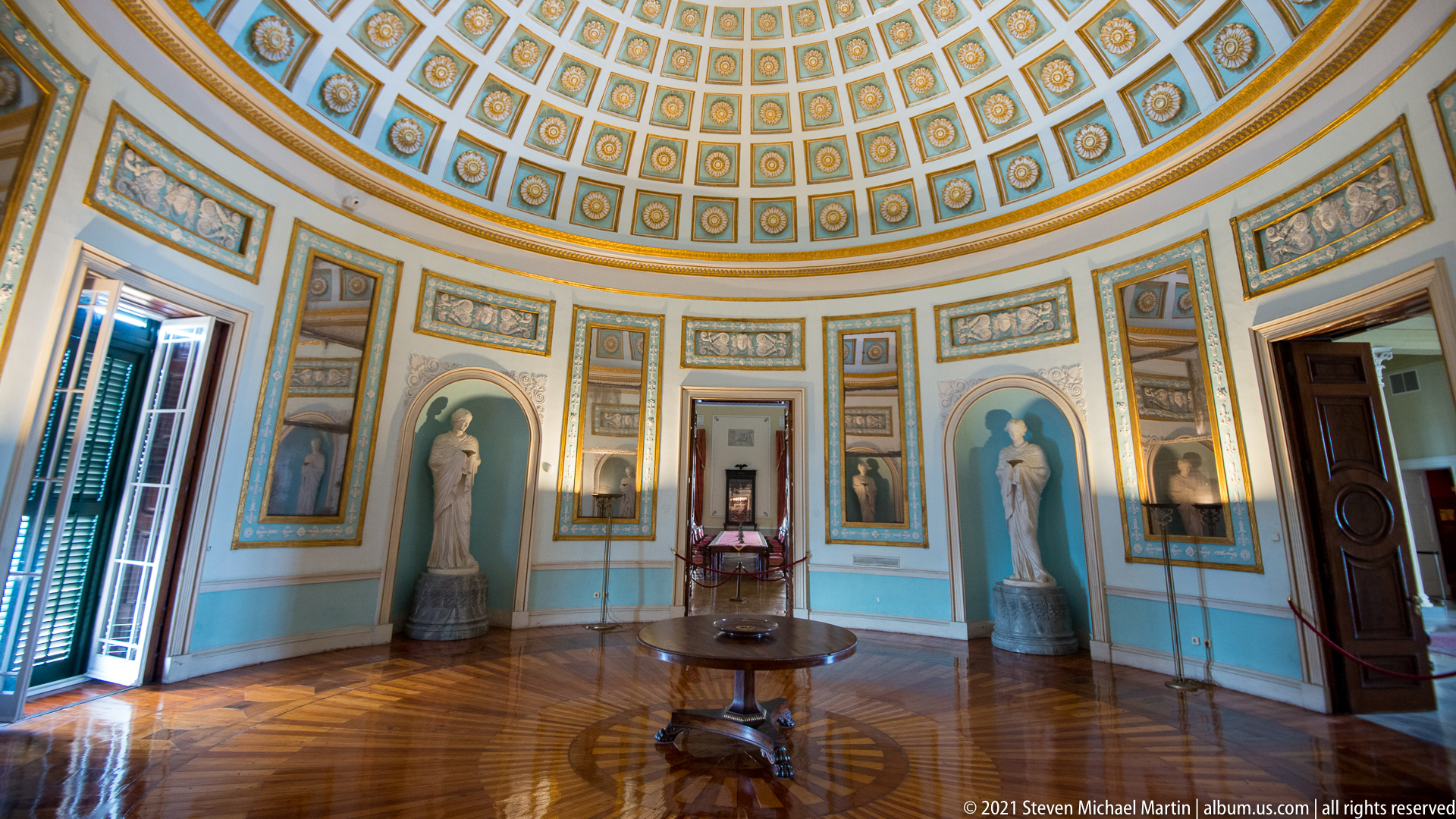
The palace’s Reception Hall, known as the Rotunda, is a circular chamber capped by a coffered dome modeled on the Roman Pantheon. Pale blue walls alternate mirrors with niches containing Vestal lamp-statues, while the parquet floor radiates outward in a geometric pattern. The room’s circular plan, dome, niches, and radial floor create one of the palace’s most distinctive surviving ceremonial interiors.
Caption
The palace’s Reception Hall, known as the Rotunda, is a circular chamber capped by a coffered dome modeled on the Roman Pantheon. Pale blue walls alternate mirrors with niches containing Vestal lamp-statues, while the parquet floor radiates outward in a geometric pattern. The room’s circular plan, dome, niches, and radial floor create one of the palace’s most distinctive surviving ceremonial interiors.
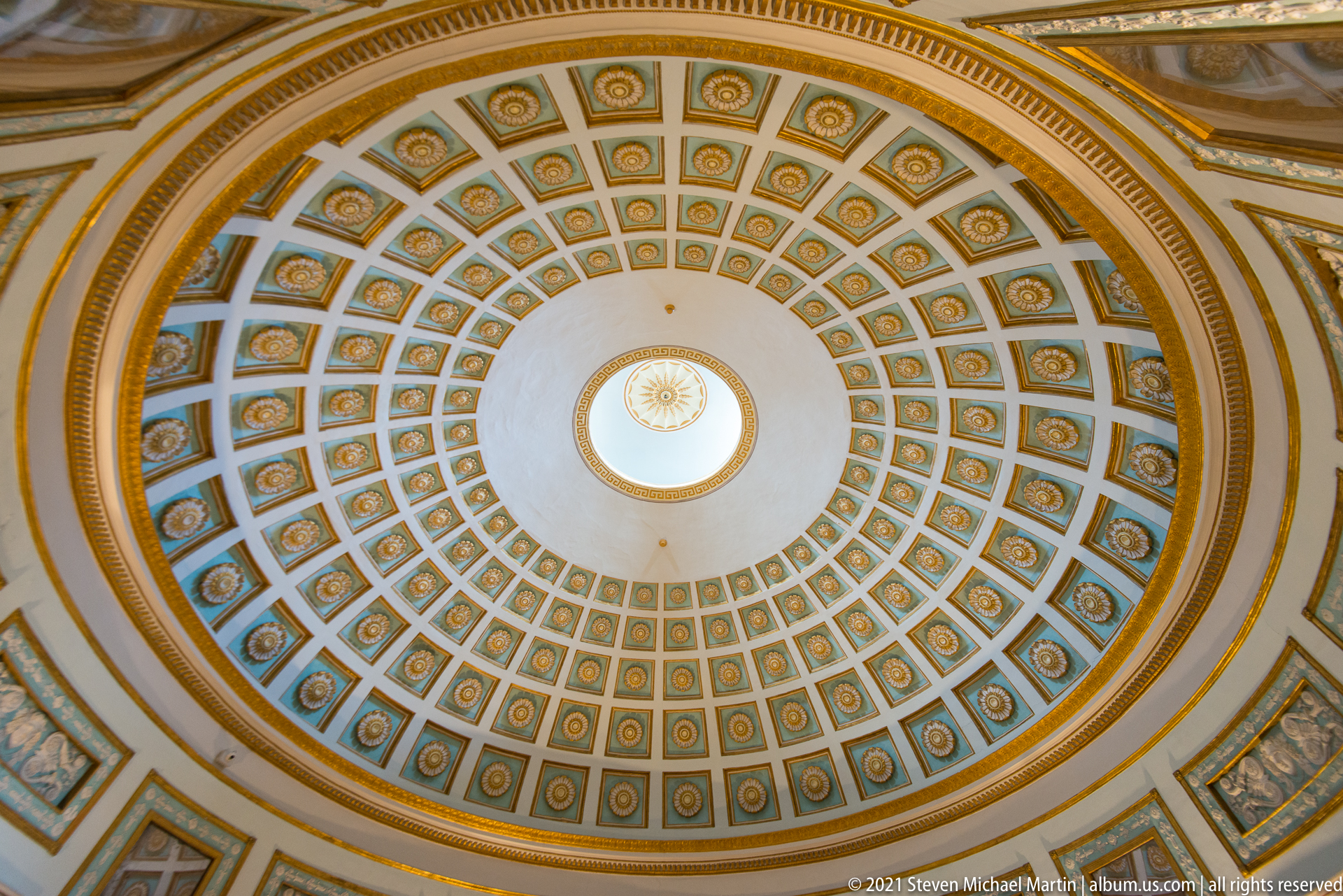
Looking directly into the dome of the palace Rotunda reveals the Reception Hall’s Pantheon-inspired ceiling as a disciplined sequence of concentric coffers. Blue-and-gold square panels radiate toward the circular opening at the center, while painted and gilded ornament continues around the lower ring. The upward view isolates the geometry of the dome that defines the circular ceremonial room below.
Caption
Looking directly into the dome of the palace Rotunda reveals the Reception Hall’s Pantheon-inspired ceiling as a disciplined sequence of concentric coffers. Blue-and-gold square panels radiate toward the circular opening at the center, while painted and gilded ornament continues around the lower ring. The upward view isolates the geometry of the dome that defines the circular ceremonial room below.
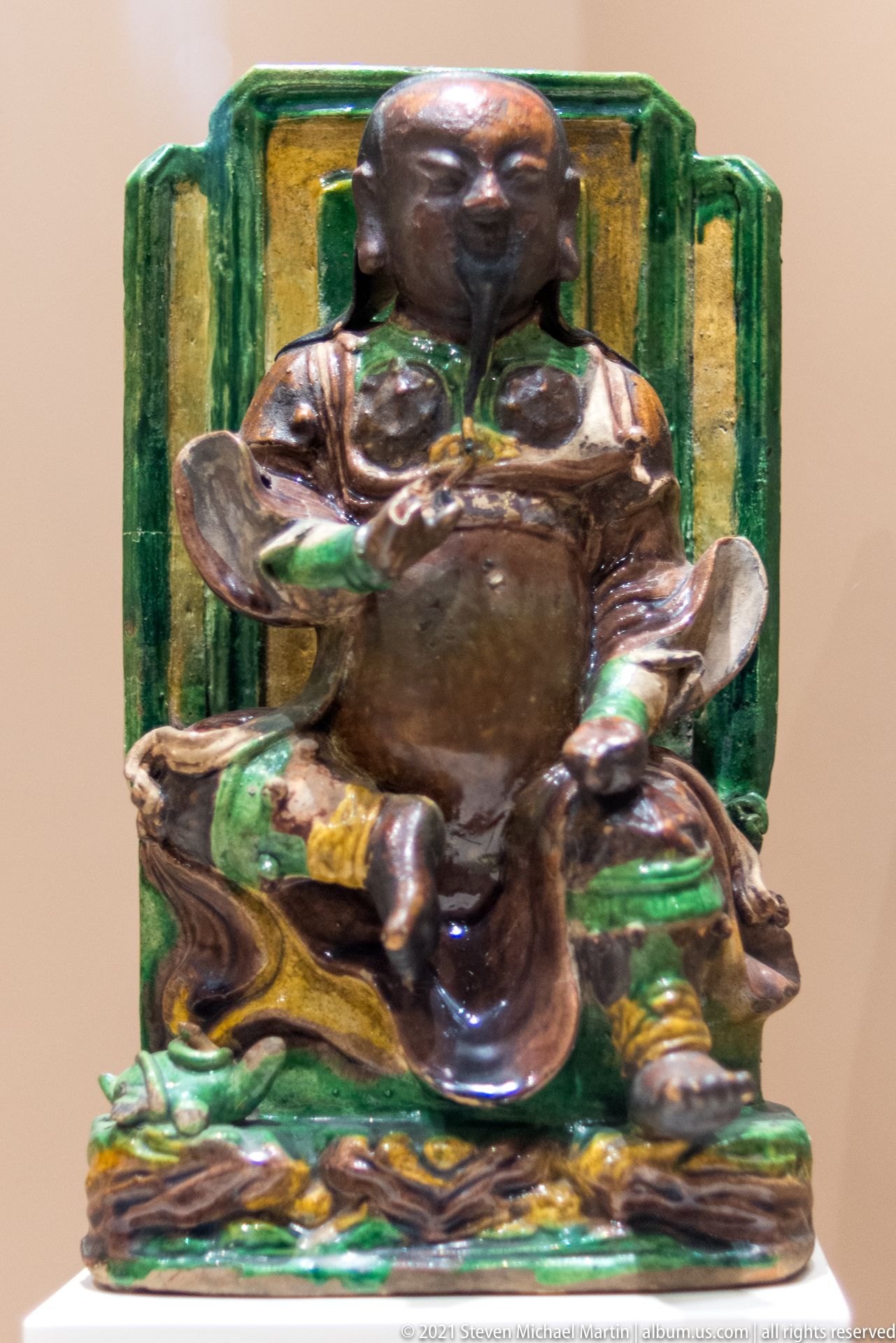
A robust seated warrior or guardian is modeled in dark brown and green glaze against a tall green backrest. The figure's bald head, layered armor or heavy robes, broad sleeves, and planted stance create a compact, forceful silhouette, while yellow and green accents pick out details at the cuffs and base. The strongly pooled glaze and sculptural modeling make this object as much a study in ceramic surface as in figural iconography.
Caption
A robust seated warrior or guardian is modeled in dark brown and green glaze against a tall green backrest. The figure's bald head, layered armor or heavy robes, broad sleeves, and planted stance create a compact, forceful silhouette, while yellow and green accents pick out details at the cuffs and base. The strongly pooled glaze and sculptural modeling make this object as much a study in ceramic surface as in figural iconography.
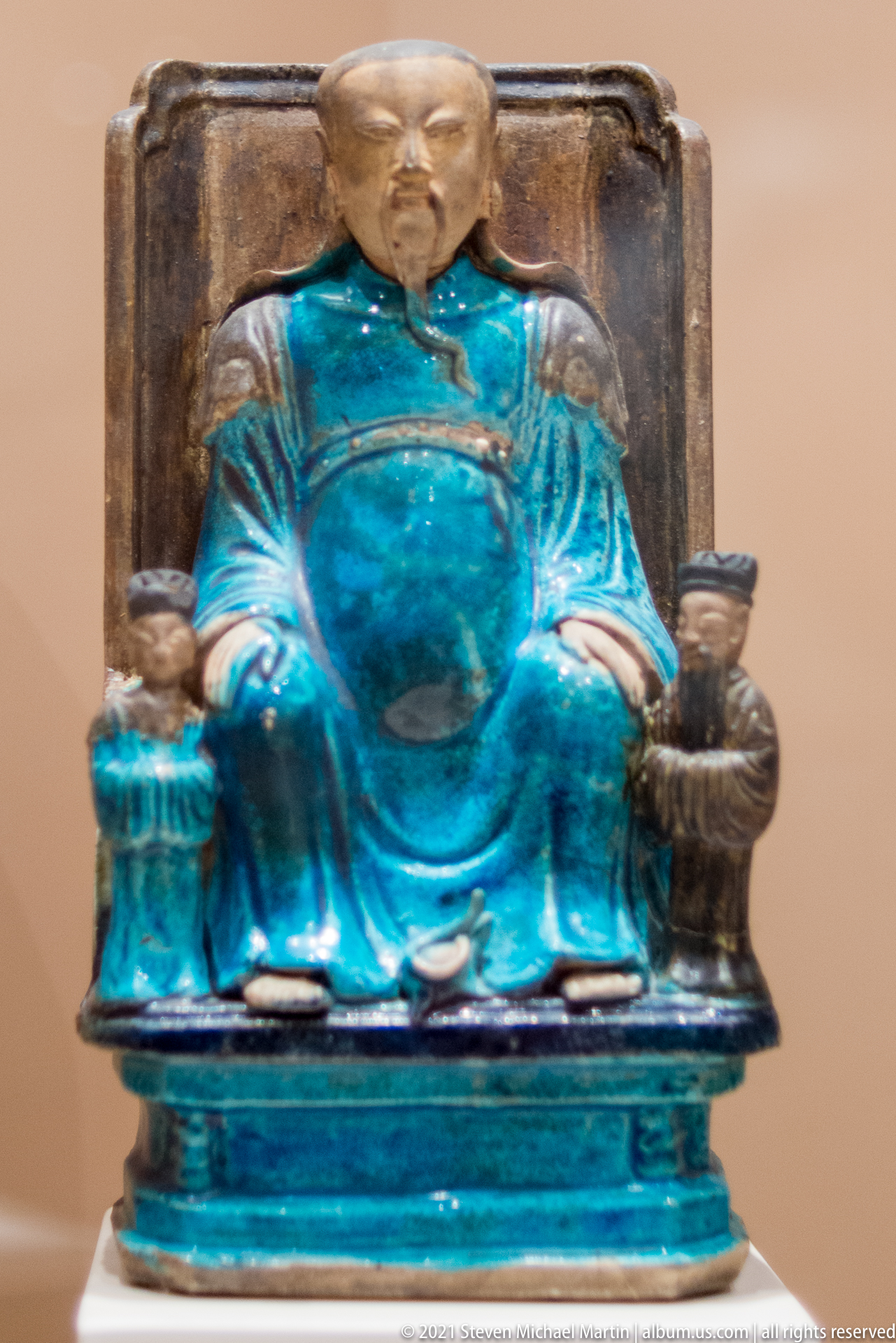
A seated male figure in brilliant turquoise glaze occupies a chair-like throne, accompanied by a small vessel or container at his right side. The face, hands, and parts of the seat retain brown tones that contrast with the saturated blue-green robe. Broad sleeves, a rounded belly, and the formal frontal pose give the figure a dignified presence, while glaze pooling along the folds and base accentuates the ceramic modeling.
Caption
A seated male figure in brilliant turquoise glaze occupies a chair-like throne, accompanied by a small vessel or container at his right side. The face, hands, and parts of the seat retain brown tones that contrast with the saturated blue-green robe. Broad sleeves, a rounded belly, and the formal frontal pose give the figure a dignified presence, while glaze pooling along the folds and base accentuates the ceramic modeling.
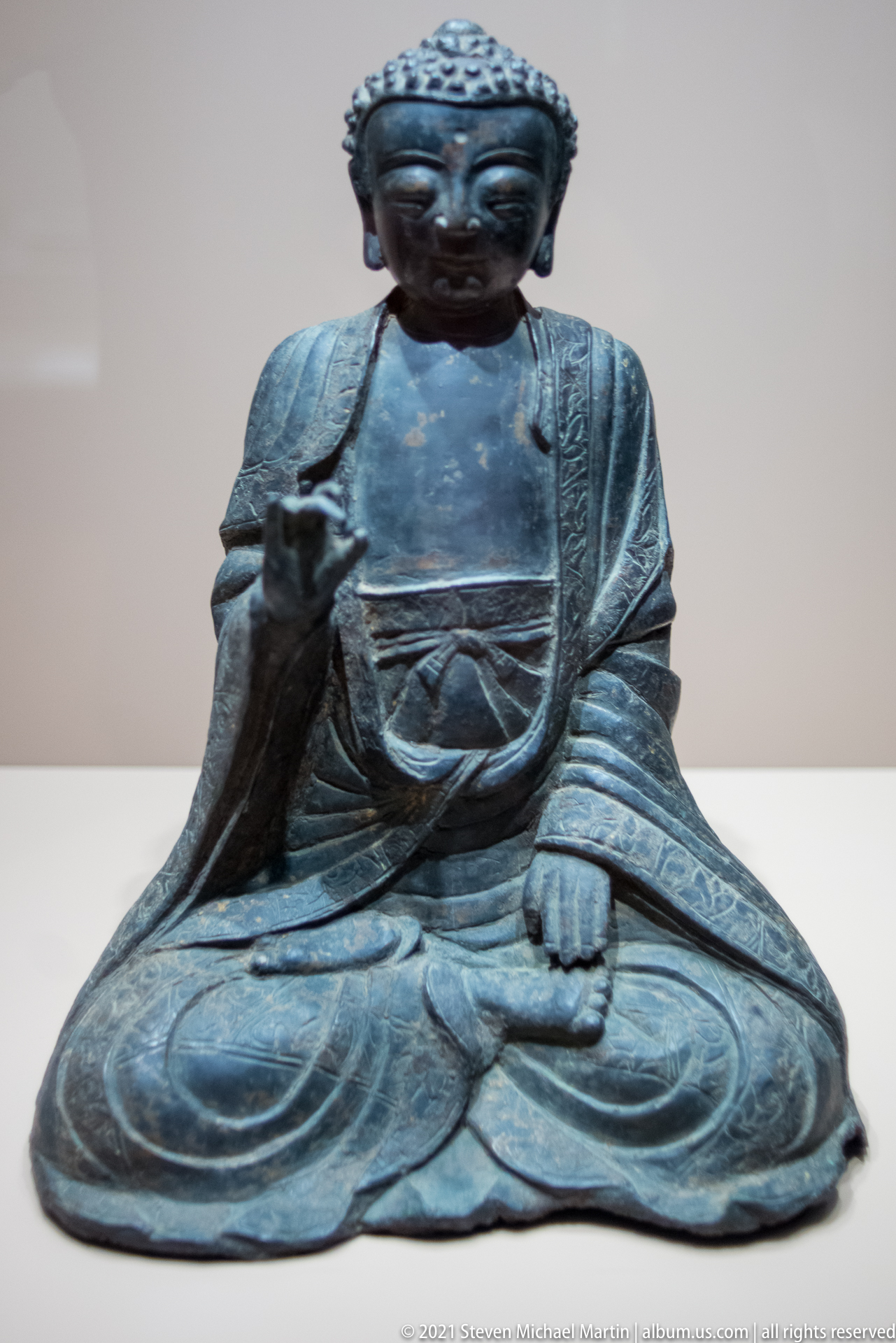
A dark bronze Buddha sits cross-legged on a low base, the right hand raised in a teaching or reassurance gesture and the left resting near the knee. Rows of tight curls cover the head, elongated earlobes frame the composed face, and incised borders articulate the layered robe. The broad triangular spread of the garment and restrained modeling give the figure a stable, frontal presence suited to devotional viewing.
Caption
A dark bronze Buddha sits cross-legged on a low base, the right hand raised in a teaching or reassurance gesture and the left resting near the knee. Rows of tight curls cover the head, elongated earlobes frame the composed face, and incised borders articulate the layered robe. The broad triangular spread of the garment and restrained modeling give the figure a stable, frontal presence suited to devotional viewing.
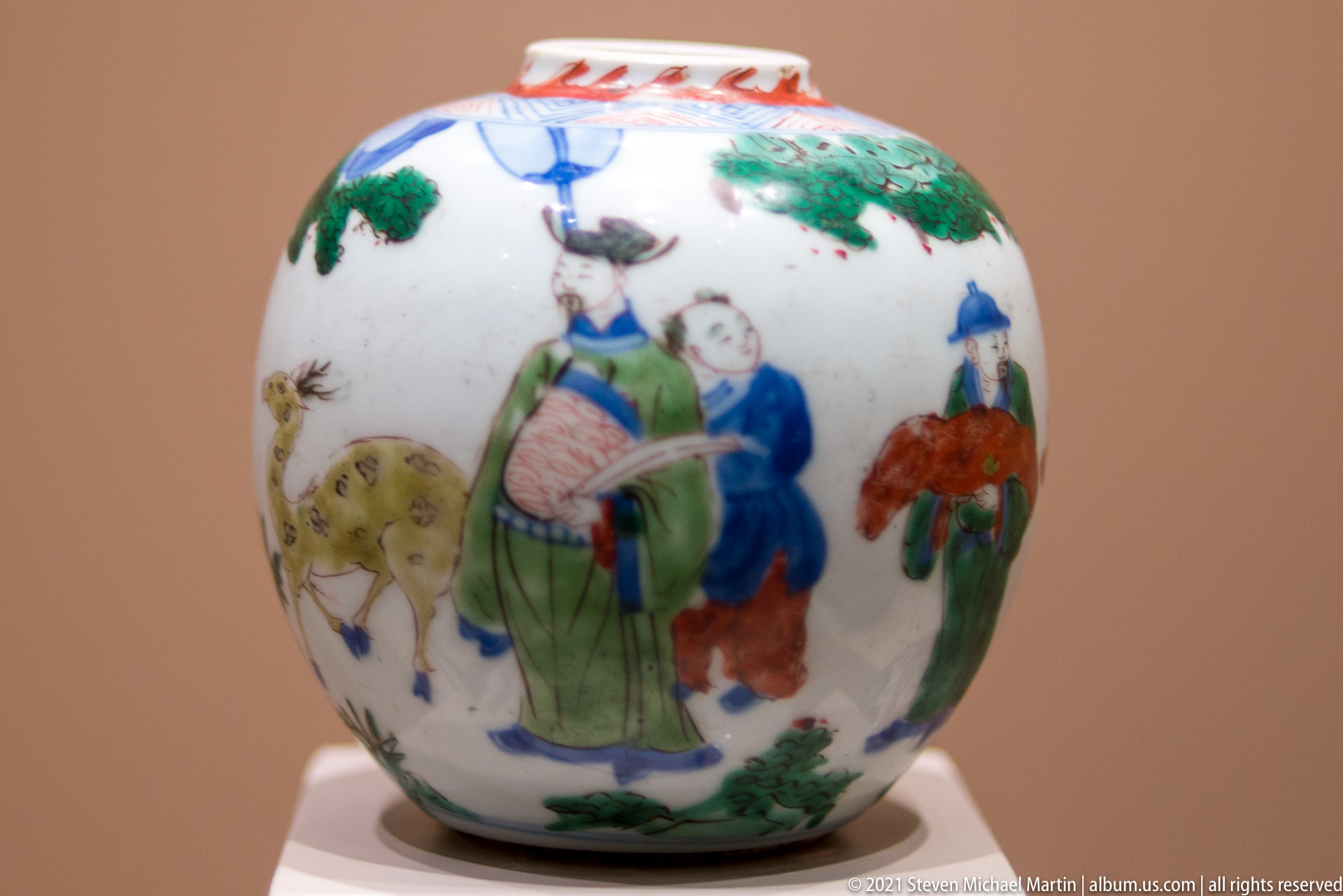
A small rounded Chinese porcelain jar is painted with a lively figural scene in green, red, blue, yellow, and iron-toned enamels. Several elaborately dressed figures gather outdoors beside rocks and foliage, their garments and gestures wrapping around the vessel's curved body. Decorative bands at the shoulder and foot frame the narrative scene, while the close frontal view makes the contrast between white porcelain ground and saturated overglaze colors especially clear.
Caption
A small rounded Chinese porcelain jar is painted with a lively figural scene in green, red, blue, yellow, and iron-toned enamels. Several elaborately dressed figures gather outdoors beside rocks and foliage, their garments and gestures wrapping around the vessel's curved body. Decorative bands at the shoulder and foot frame the narrative scene, while the close frontal view makes the contrast between white porcelain ground and saturated overglaze colors especially clear.
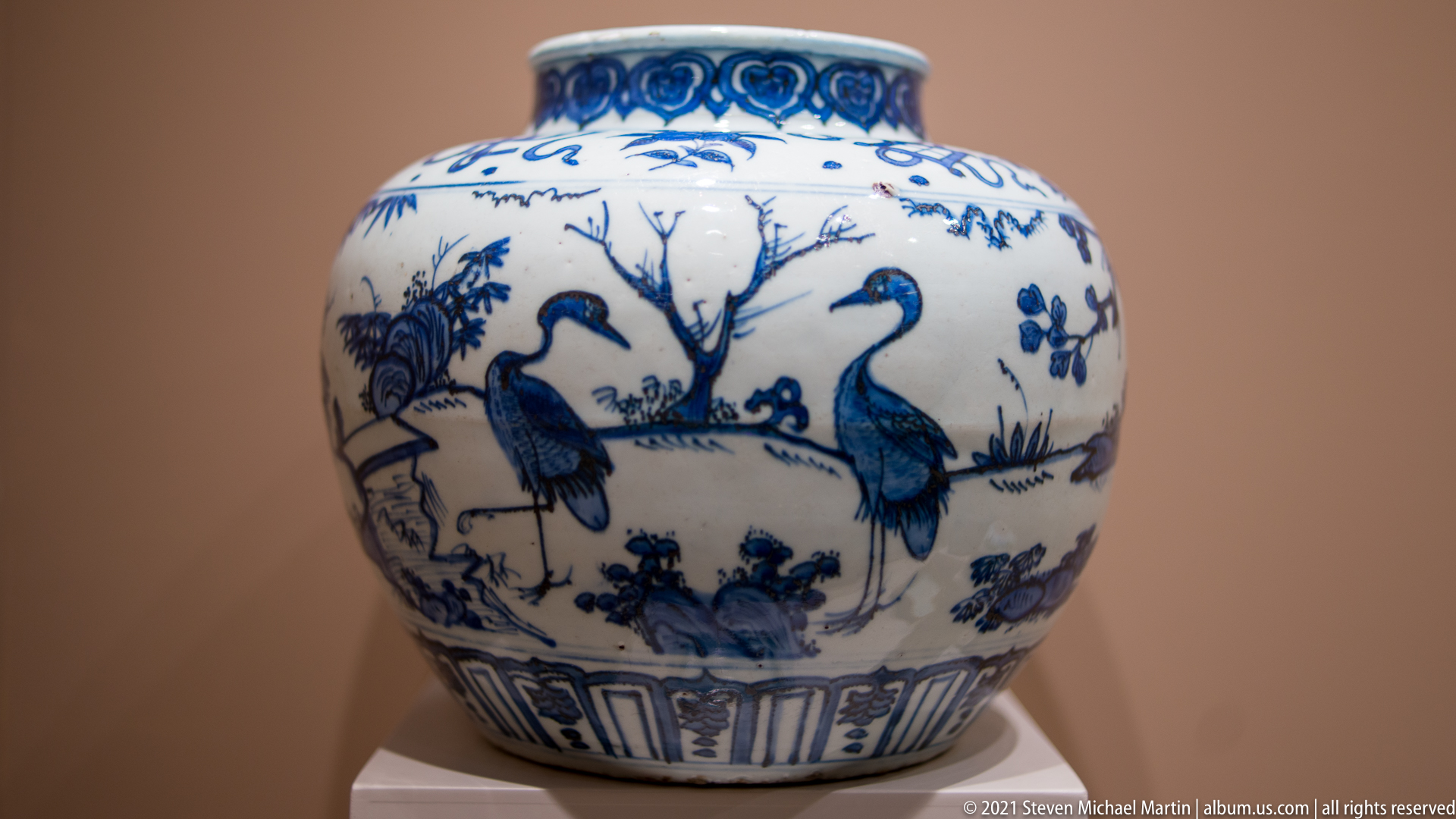
A blue-and-white porcelain jar is decorated with long-legged birds standing among rocks, plants, and a leafless tree. Cobalt painting wraps continuously around the rounded body, while a darker ornamental band circles the short neck and a paneled border anchors the foot. The restrained two-color palette emphasizes brushwork and silhouette, especially the birds' curved necks and the branching tree that structures the central landscape scene.
Caption
A blue-and-white porcelain jar is decorated with long-legged birds standing among rocks, plants, and a leafless tree. Cobalt painting wraps continuously around the rounded body, while a darker ornamental band circles the short neck and a paneled border anchors the foot. The restrained two-color palette emphasizes brushwork and silhouette, especially the birds' curved necks and the branching tree that structures the central landscape scene.
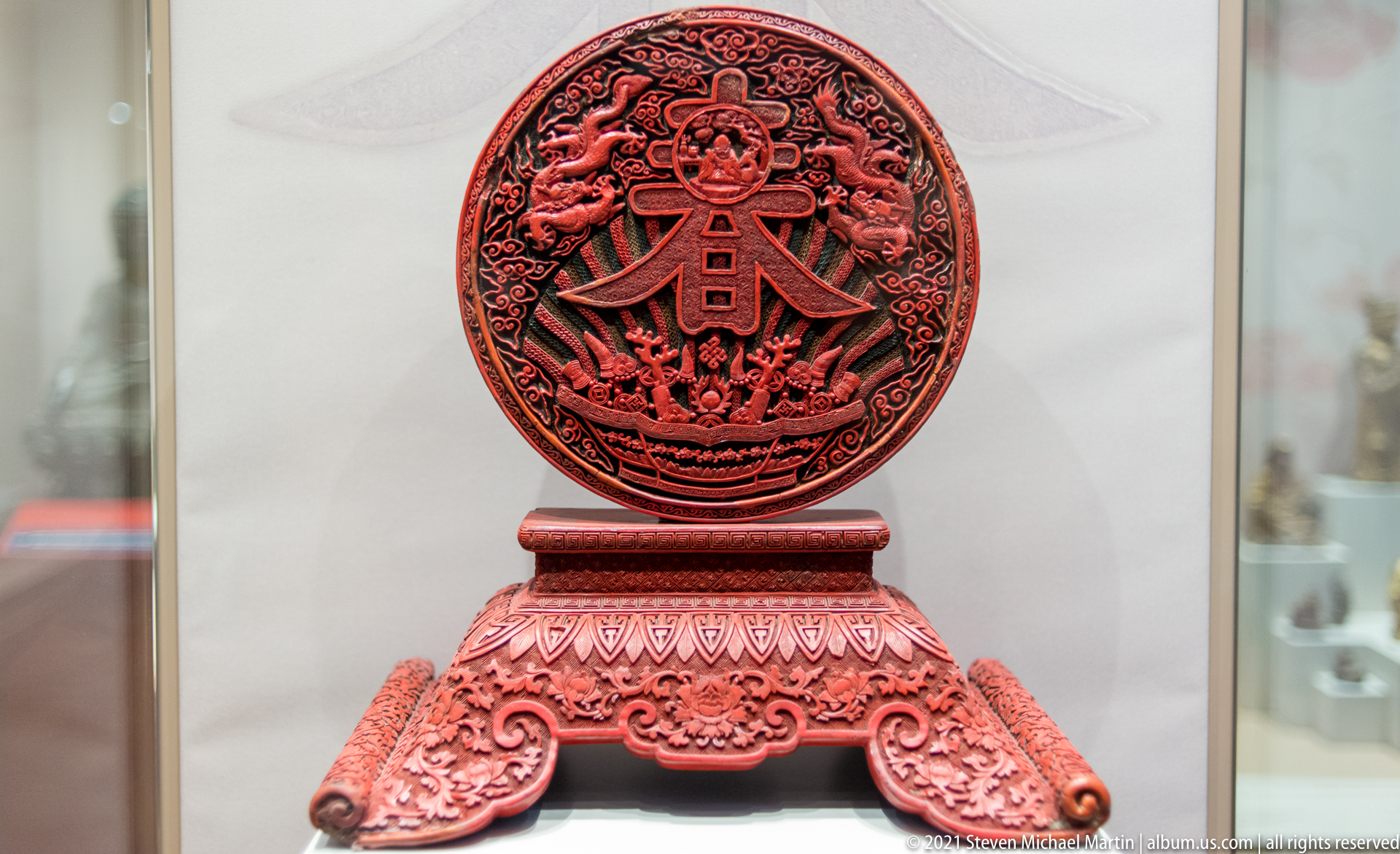
A circular Chinese carved-lacquer plaque rises on an elaborate matching stand, its dense red surface cut into layered figures, foliage, and architectural motifs against a dark ground. The symmetrical composition is organized around a large central character-like emblem, with smaller figures and scrolling ornament packed into the surrounding field. Repeated carved borders and the richly decorated pedestal extend the same intricate surface treatment beyond the roundel itself.
Caption
A circular Chinese carved-lacquer plaque rises on an elaborate matching stand, its dense red surface cut into layered figures, foliage, and architectural motifs against a dark ground. The symmetrical composition is organized around a large central character-like emblem, with smaller figures and scrolling ornament packed into the surrounding field. Repeated carved borders and the richly decorated pedestal extend the same intricate surface treatment beyond the roundel itself.
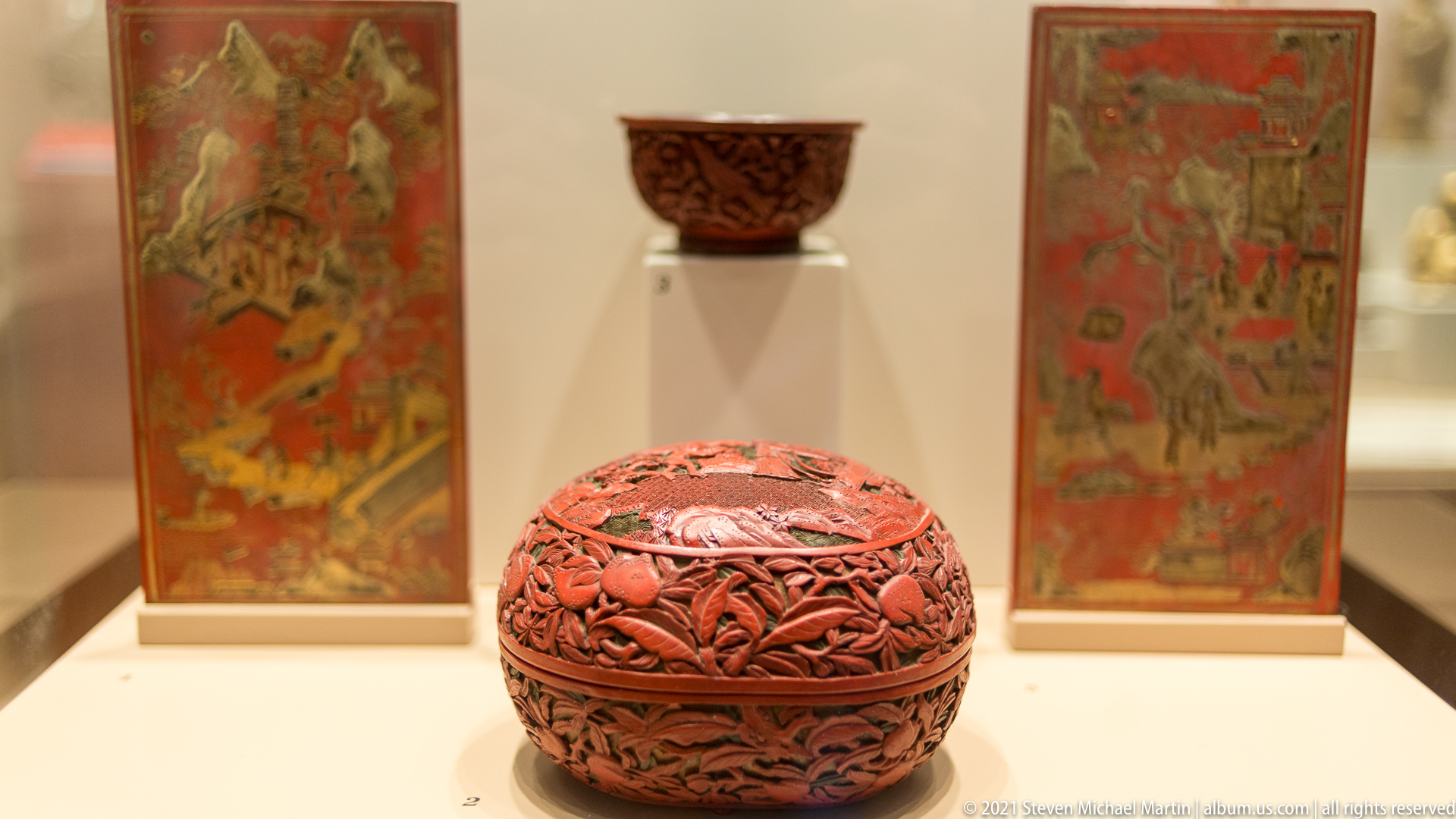
A rounded Chinese lidded box is covered in deep red carved lacquer, with layered floral and scrolling motifs cut across both lid and body. The dense relief catches the display light along raised edges while darker recesses create strong depth. Behind it, two tall painted panels and a small cup provide contextual contrast, but the close focus remains on the box's compact spherical form and exceptionally busy carved surface.
Caption
A rounded Chinese lidded box is covered in deep red carved lacquer, with layered floral and scrolling motifs cut across both lid and body. The dense relief catches the display light along raised edges while darker recesses create strong depth. Behind it, two tall painted panels and a small cup provide contextual contrast, but the close focus remains on the box's compact spherical form and exceptionally busy carved surface.
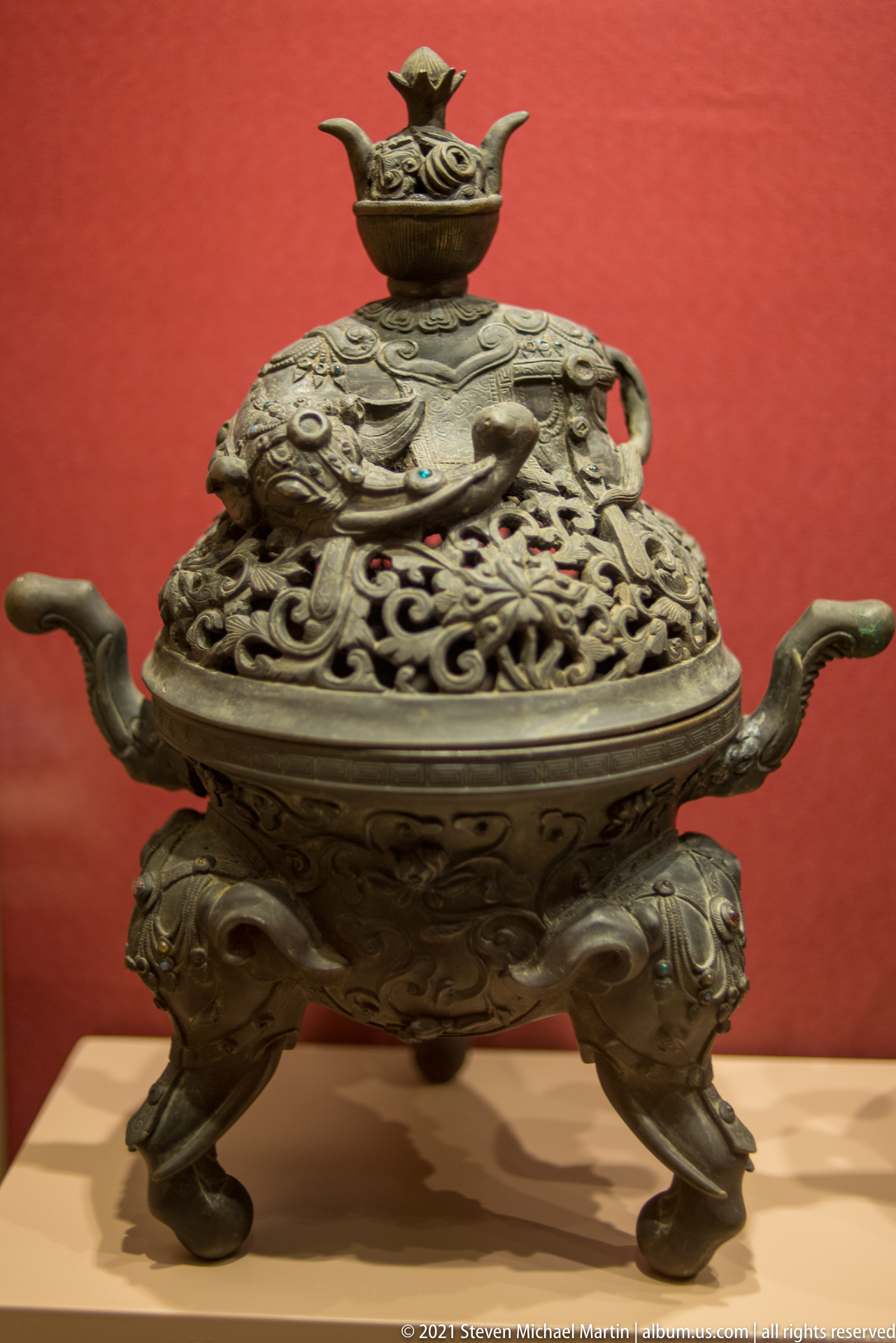
An elaborate Chinese bronze incense burner stands on three sculptural legs, with sinuous side handles projecting from the rounded body. Its high domed cover is pierced with dense scrolling openwork and topped by a small bird-shaped finial above a lotus-like knop. Relief ornament continues across the vessel and supports, creating a layered silhouette designed to remain visually active from base to lid while allowing incense smoke to escape through the cover.
Caption
An elaborate Chinese bronze incense burner stands on three sculptural legs, with sinuous side handles projecting from the rounded body. Its high domed cover is pierced with dense scrolling openwork and topped by a small bird-shaped finial above a lotus-like knop. Relief ornament continues across the vessel and supports, creating a layered silhouette designed to remain visually active from base to lid while allowing incense smoke to escape through the cover.
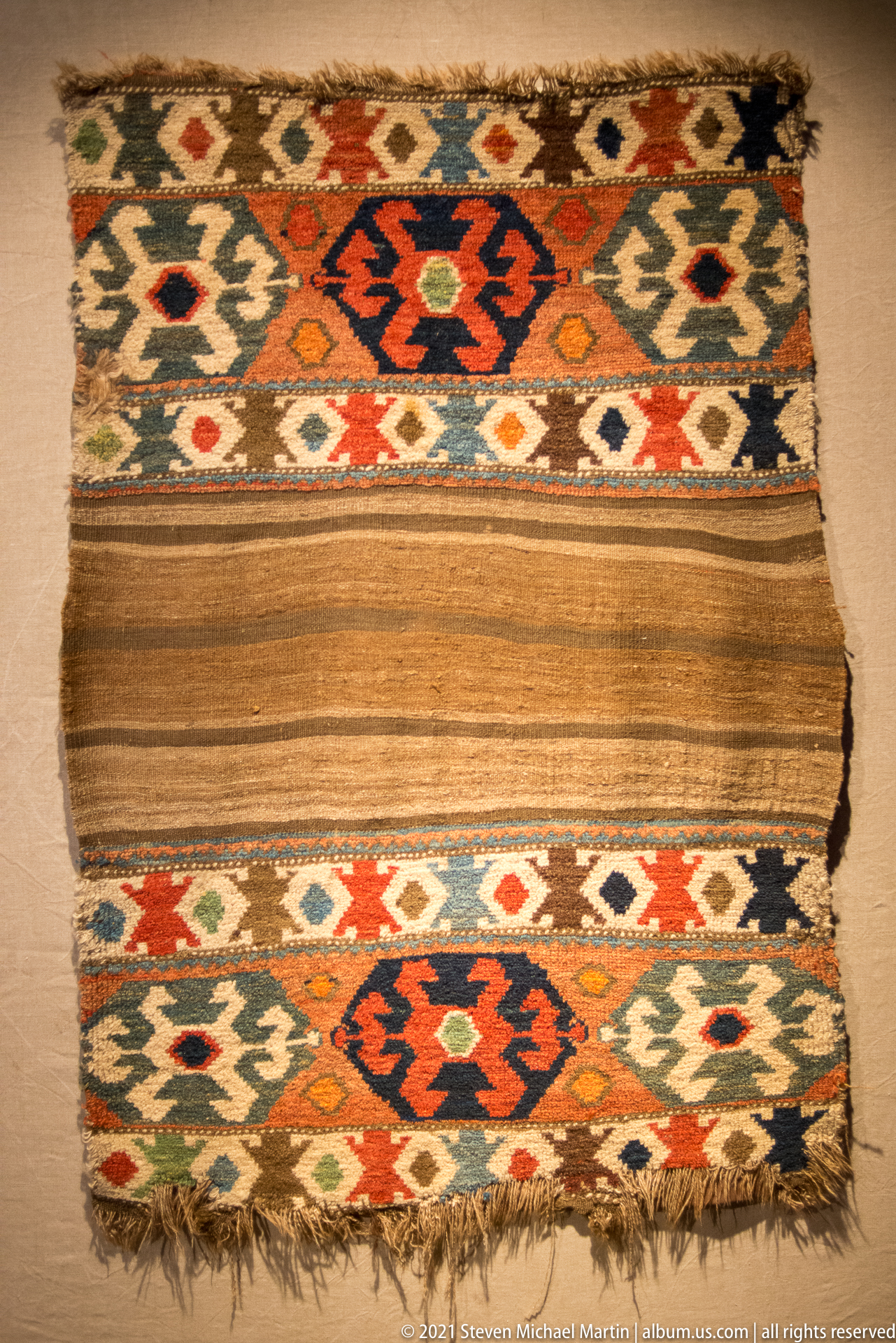
A rectangular woven textile is organized around a broad, largely plain brown central field bordered at top and bottom by vivid geometric bands. Interlocking diamonds, stepped hooks, chevrons, and angular medallions appear in red, blue-green, cream, orange, black, and yellow, with short fringe surviving along the edges. The contrast between dense patterned borders and the quiet center makes structure and weaving rhythm the principal visual features.
Caption
A rectangular woven textile is organized around a broad, largely plain brown central field bordered at top and bottom by vivid geometric bands. Interlocking diamonds, stepped hooks, chevrons, and angular medallions appear in red, blue-green, cream, orange, black, and yellow, with short fringe surviving along the edges. The contrast between dense patterned borders and the quiet center makes structure and weaving rhythm the principal visual features.
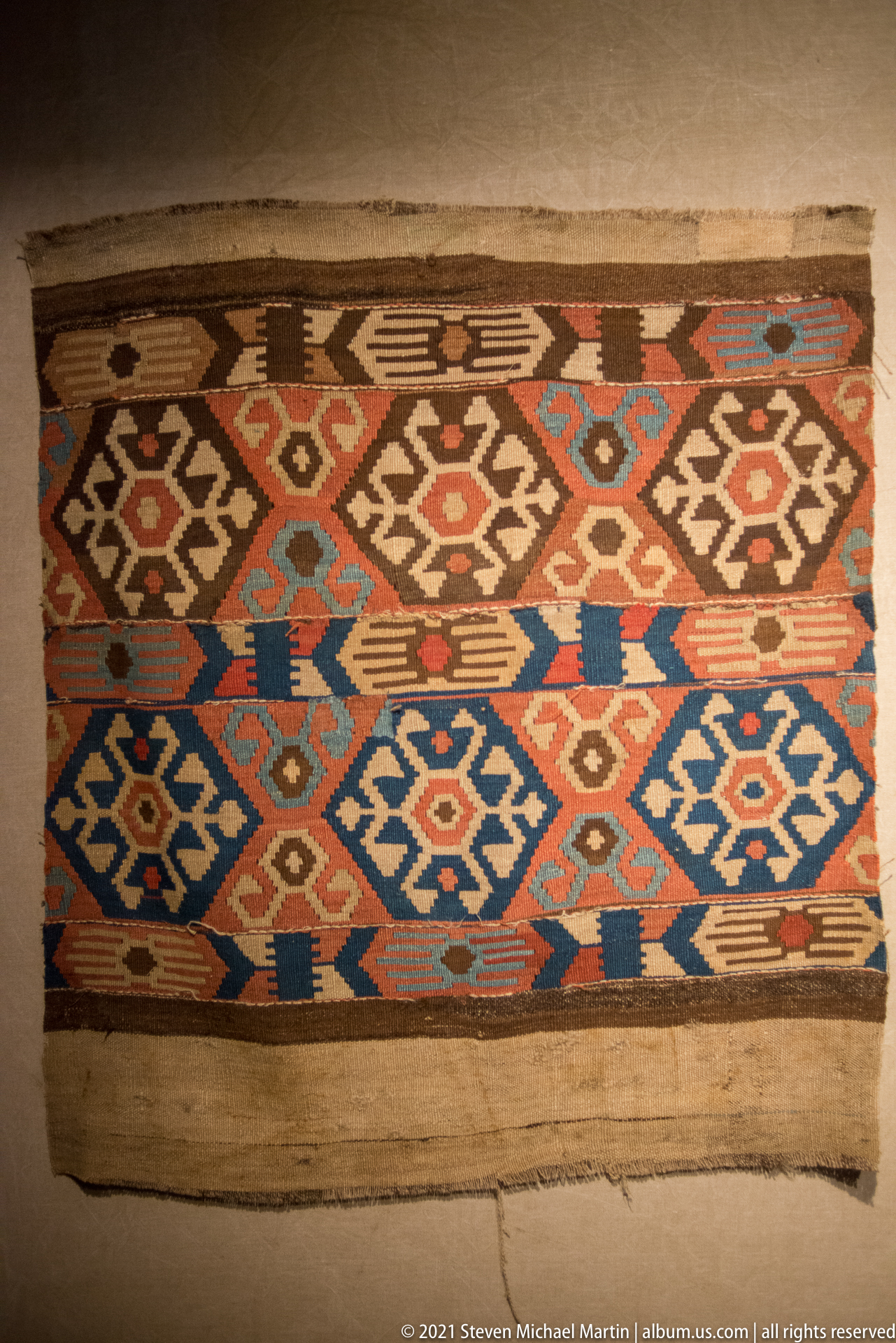
A rectangular woven textile is organized in horizontal bands of bold hooked diamonds and angular motifs in red, blue, cream, brown, and black. The strong bilateral patterning and visible fringe make the structure of the weaving especially clear, while the restrained museum mounting allows the dense geometric design to dominate the view.
Caption
A rectangular woven textile is organized in horizontal bands of bold hooked diamonds and angular motifs in red, blue, cream, brown, and black. The strong bilateral patterning and visible fringe make the structure of the weaving especially clear, while the restrained museum mounting allows the dense geometric design to dominate the view.
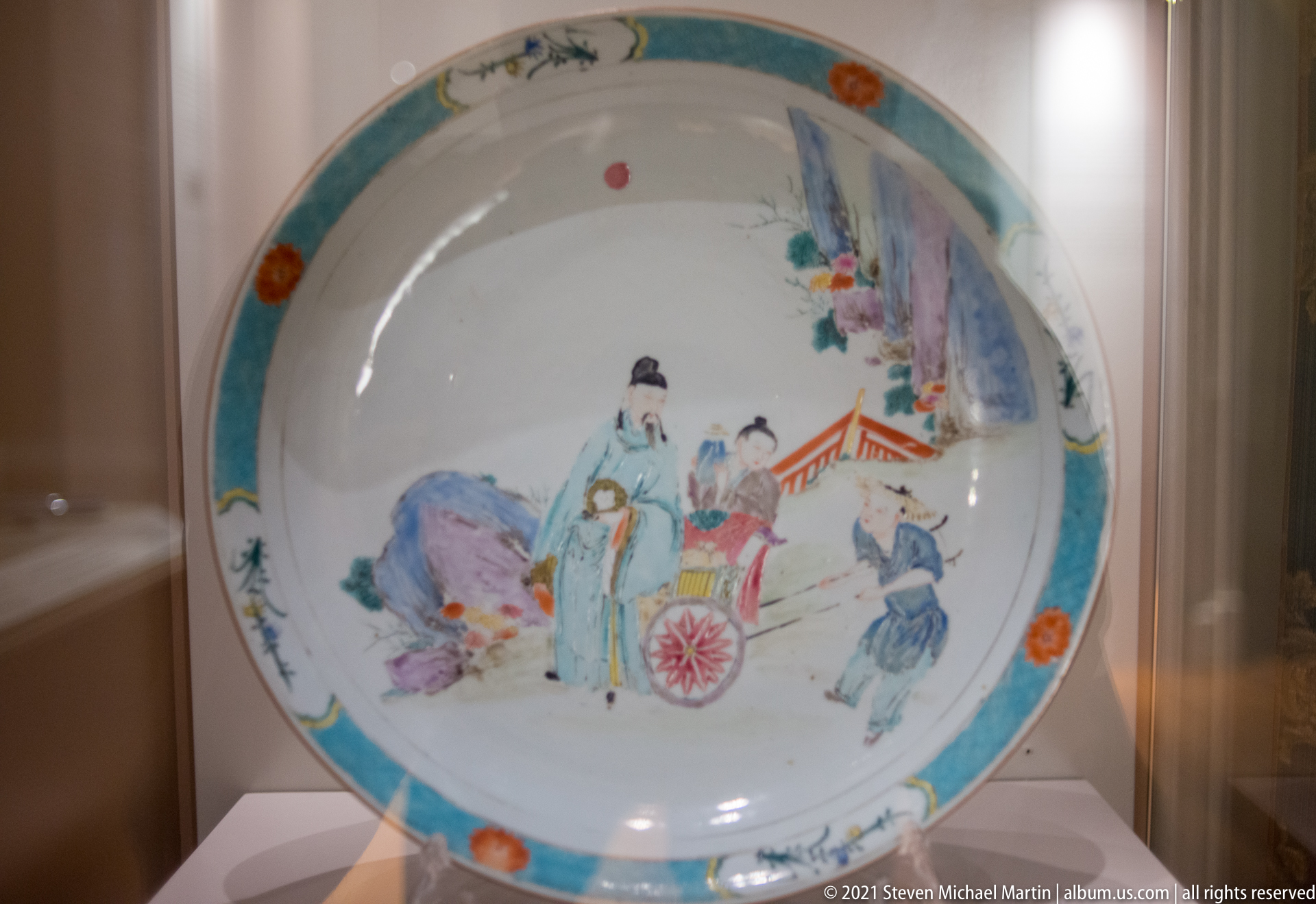
A shallow Chinese porcelain dish frames a polychrome garden scene within a broad pale turquoise border. Several robed figures gather near a pavilion and wheeled cart or chair, with rocks, flowering plants, and architectural elements arranged around them. Small floral sprays punctuate the rim, keeping the central narrative distinct from the border. The angled display reveals both the painted interior and the dish's gently rising sides.
Caption
A shallow Chinese porcelain dish frames a polychrome garden scene within a broad pale turquoise border. Several robed figures gather near a pavilion and wheeled cart or chair, with rocks, flowering plants, and architectural elements arranged around them. Small floral sprays punctuate the rim, keeping the central narrative distinct from the border. The angled display reveals both the painted interior and the dish's gently rising sides.
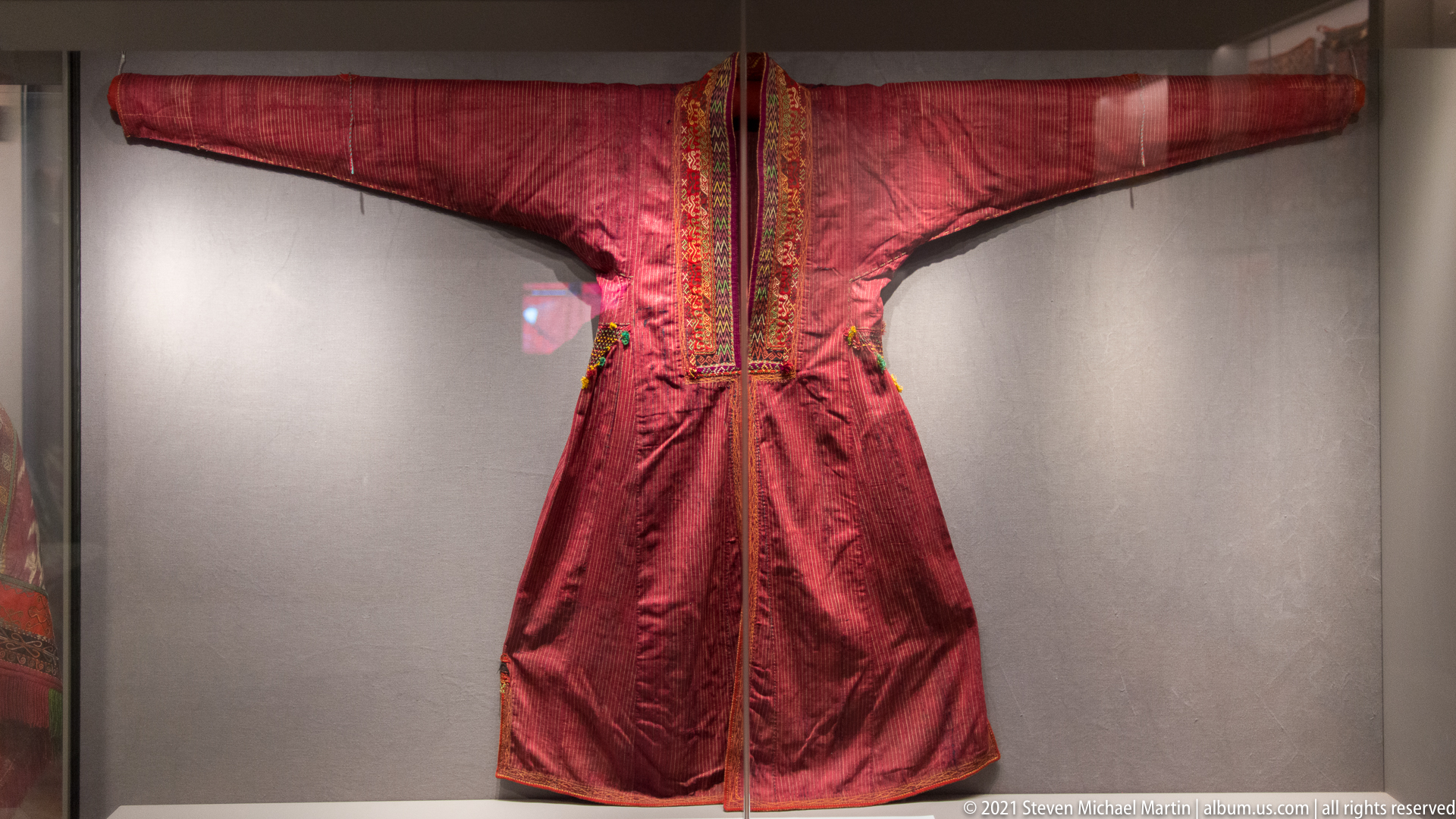
A long red robe is displayed with its sleeves fully extended, emphasizing the garment's broad silhouette and lustrous textile. Dense multicolored embroidery follows the neck and front opening, contrasting with the comparatively plain red body and drawing attention to the carefully finished central panel.
Caption
A long red robe is displayed with its sleeves fully extended, emphasizing the garment's broad silhouette and lustrous textile. Dense multicolored embroidery follows the neck and front opening, contrasting with the comparatively plain red body and drawing attention to the carefully finished central panel.
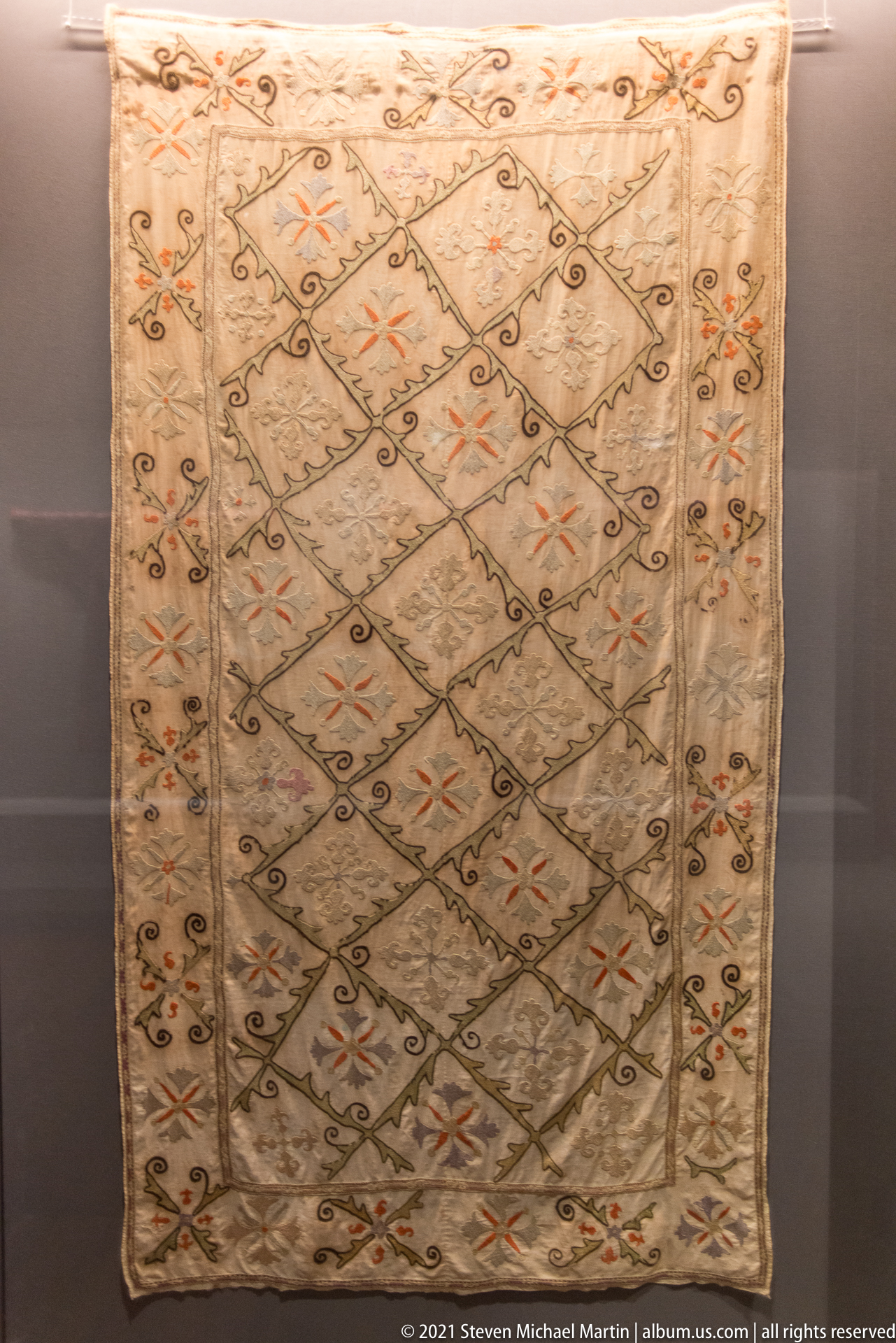
Fine embroidery spreads across this pale textile in a repeating diagonal lattice, each compartment enlivened by small floral and scrolling motifs. Muted gray-green stitching is punctuated by orange-red accents, creating a delicate contrast with the cream ground and the narrow ornamental border framing the cloth.
Caption
Fine embroidery spreads across this pale textile in a repeating diagonal lattice, each compartment enlivened by small floral and scrolling motifs. Muted gray-green stitching is punctuated by orange-red accents, creating a delicate contrast with the cream ground and the narrow ornamental border framing the cloth.
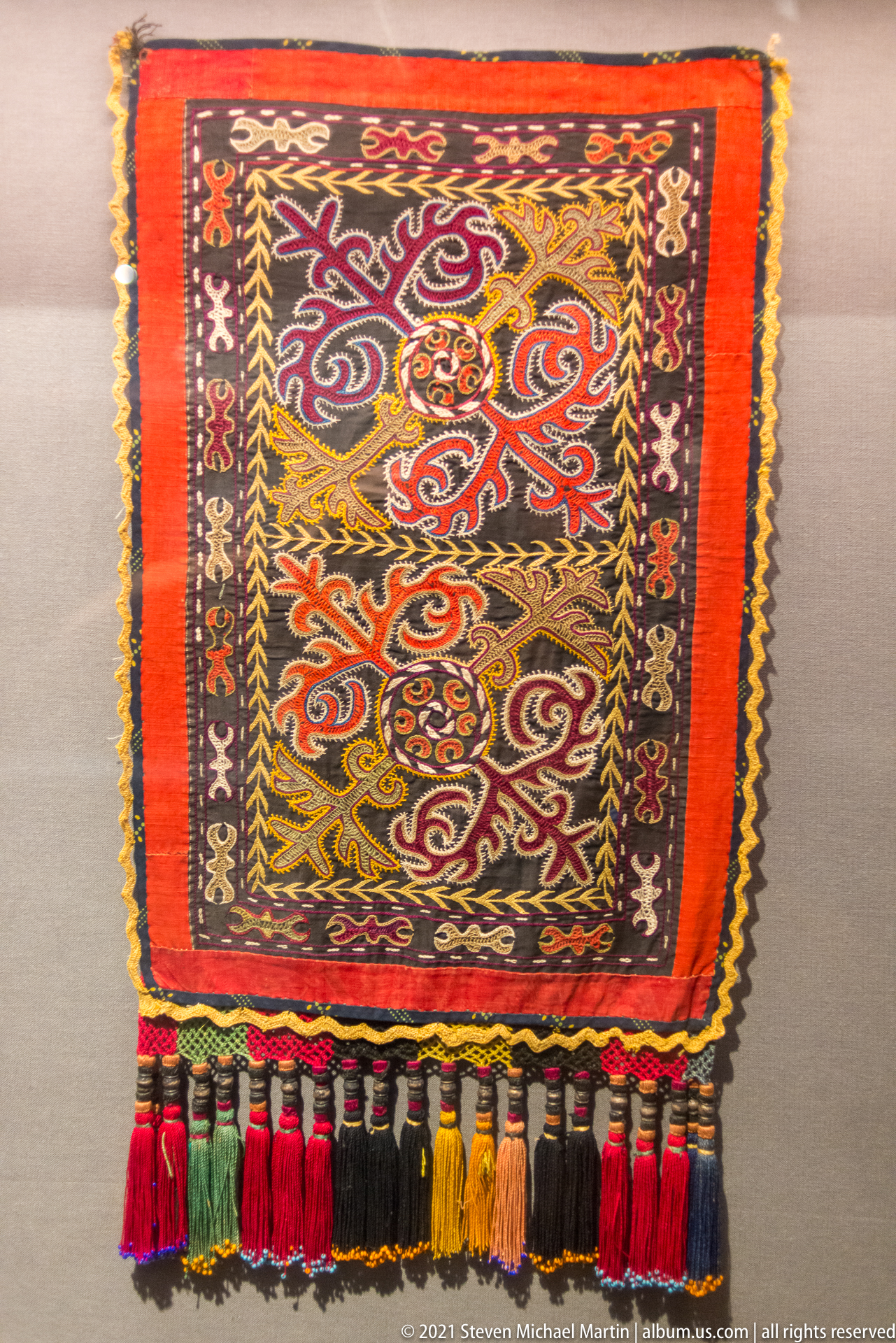
A brilliant red textile hanging combines a dense central field of curving, interlocking motifs with narrow geometric borders. A row of long multicolored tassels along the lower edge gives the piece a strongly finished silhouette, while yellow, green, purple, black, and white details animate the red ground.
Caption
A brilliant red textile hanging combines a dense central field of curving, interlocking motifs with narrow geometric borders. A row of long multicolored tassels along the lower edge gives the piece a strongly finished silhouette, while yellow, green, purple, black, and white details animate the red ground.
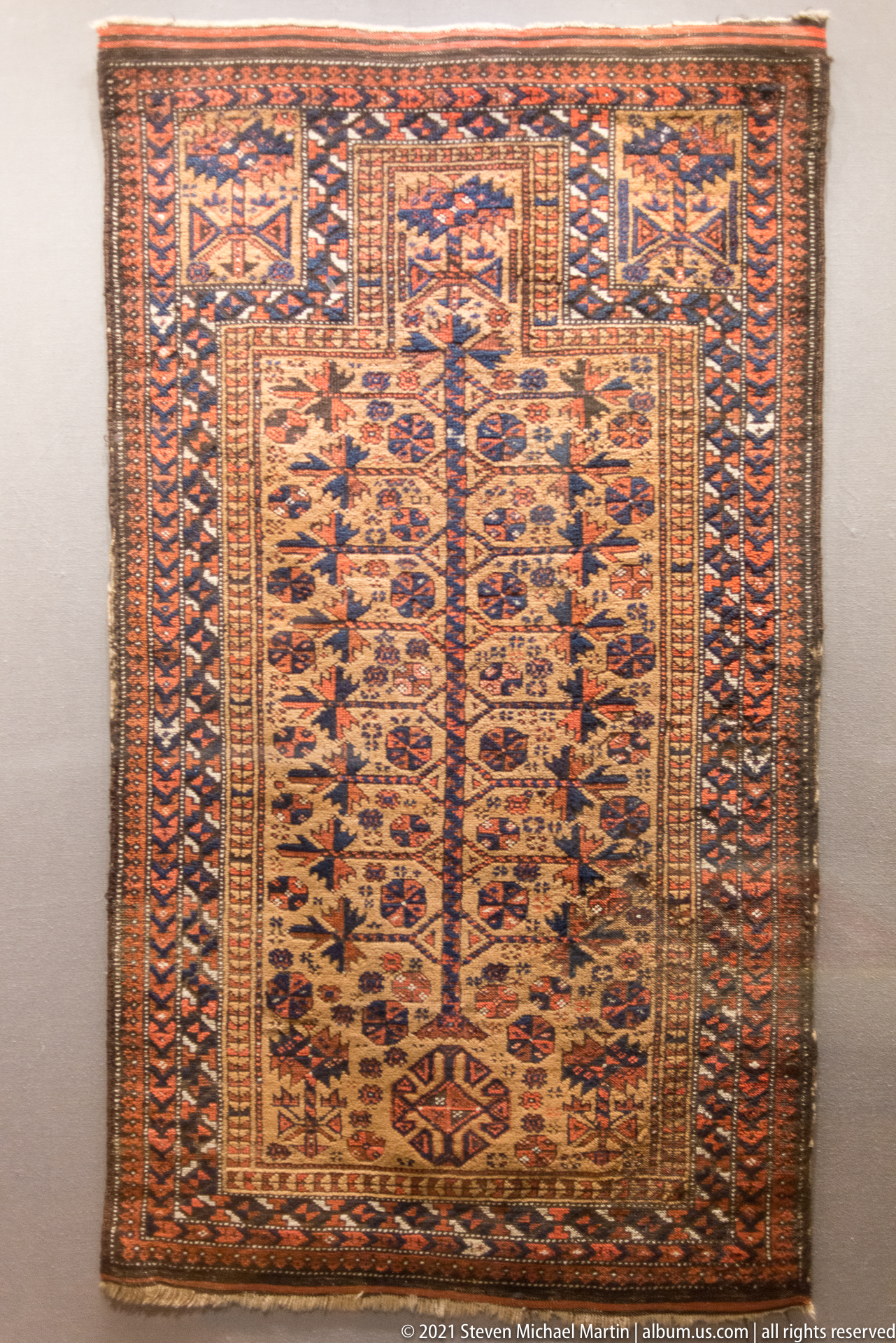
A finely patterned rug is structured around a central field filled with small repeating motifs and a stepped, niche-like form near the upper edge. Multiple narrow borders in rust, blue, cream, and brown frame the composition, producing a dense surface in which directional design and repeated ornament are closely integrated.
Caption
A finely patterned rug is structured around a central field filled with small repeating motifs and a stepped, niche-like form near the upper edge. Multiple narrow borders in rust, blue, cream, and brown frame the composition, producing a dense surface in which directional design and repeated ornament are closely integrated.
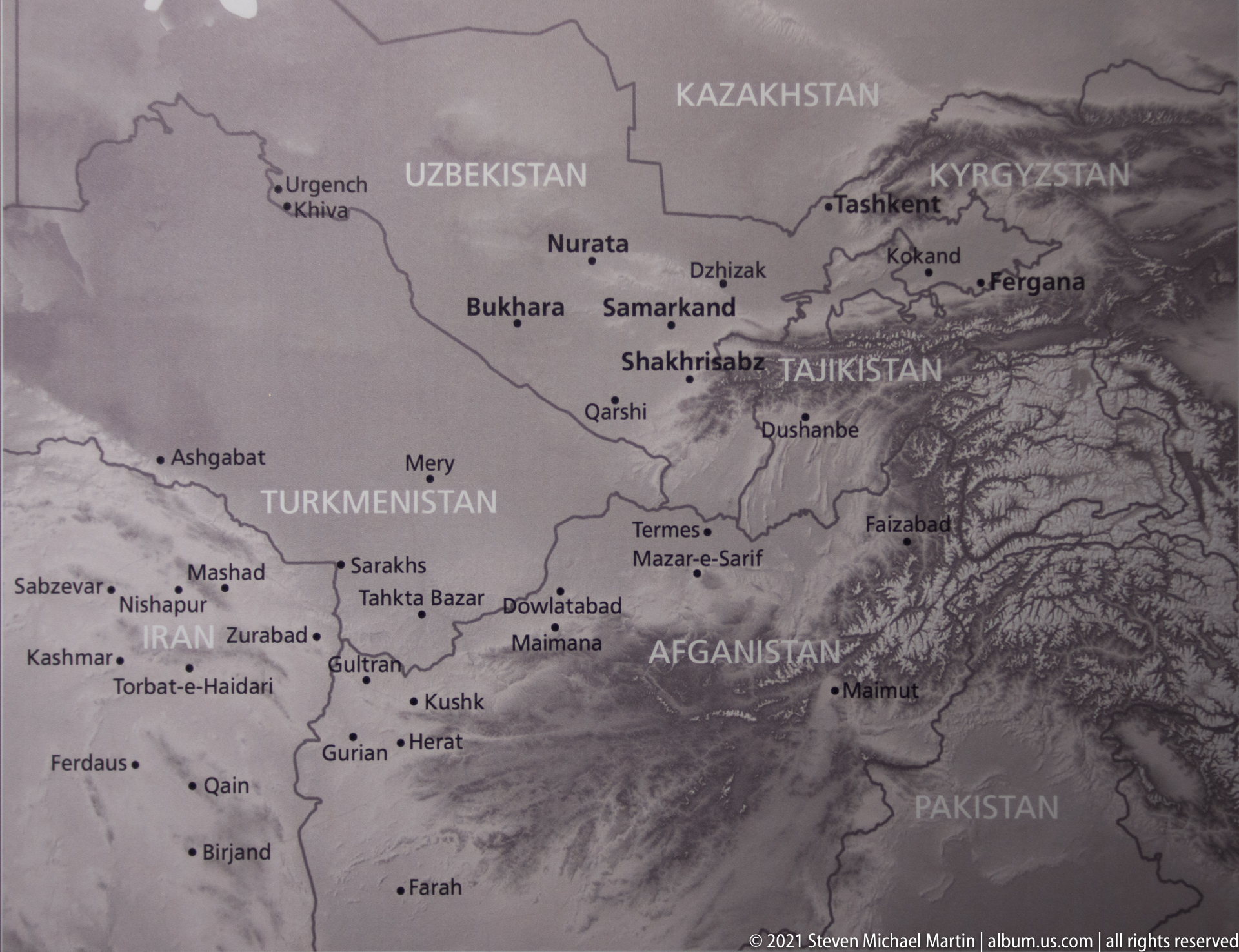
This museum map situates major Central Asian cities and regions across present-day Uzbekistan, Turkmenistan, Tajikistan, Afghanistan, Kyrgyzstan, Kazakhstan, and neighboring areas. Place names including Bukhara, Samarkand, Tashkent, Herat, and Kabul provide geographic context for cultural routes represented in the surrounding galleries.
Caption
This museum map situates major Central Asian cities and regions across present-day Uzbekistan, Turkmenistan, Tajikistan, Afghanistan, Kyrgyzstan, Kazakhstan, and neighboring areas. Place names including Bukhara, Samarkand, Tashkent, Herat, and Kabul provide geographic context for cultural routes represented in the surrounding galleries.
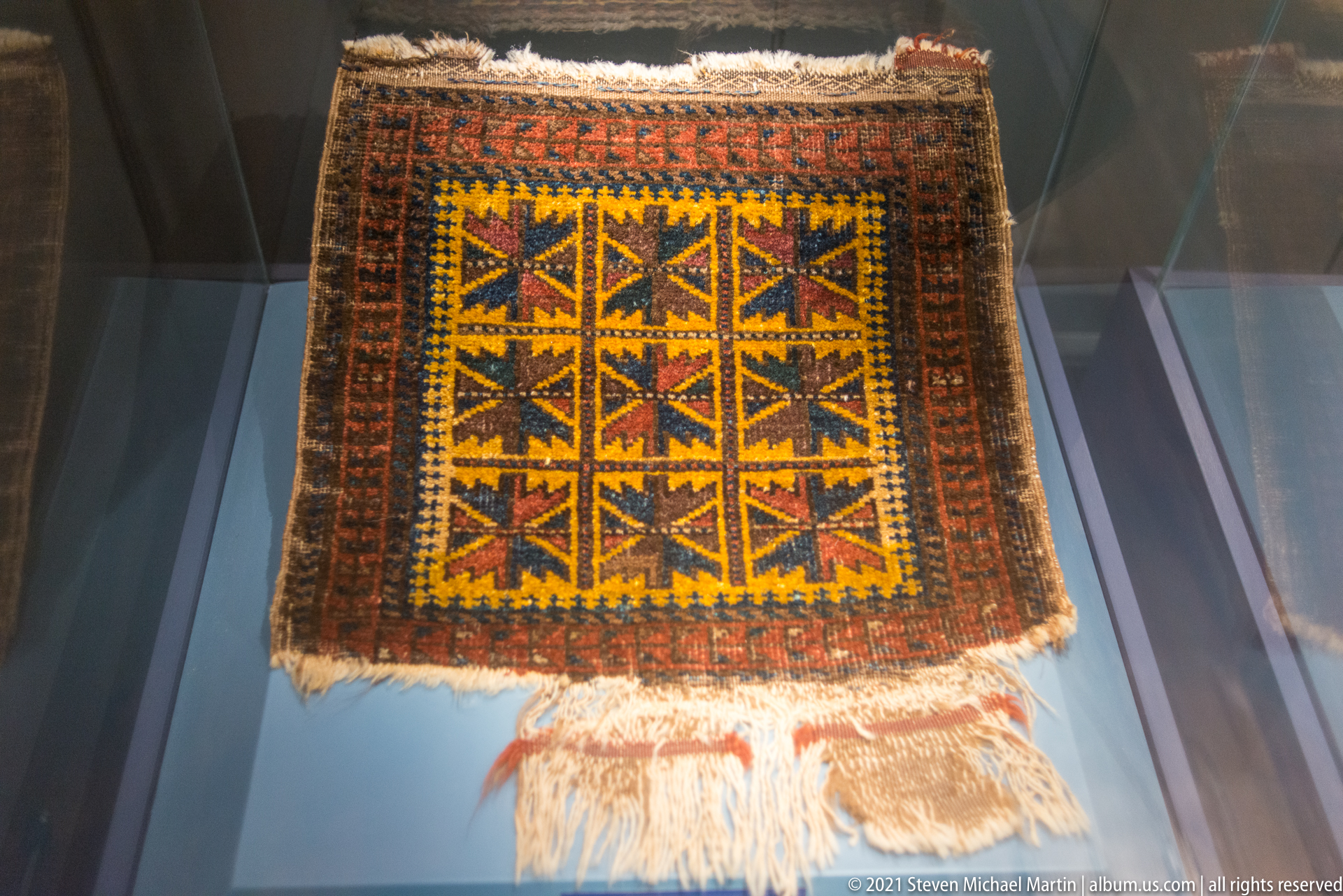
A compact rug presents a bright yellow central field divided into a grid of nine angular motifs, surrounded by darker rust and brown borders. Thick pile and fringe remain visible at the edges, and the elevated display reveals the textile's small scale and tactile construction.
Caption
A compact rug presents a bright yellow central field divided into a grid of nine angular motifs, surrounded by darker rust and brown borders. Thick pile and fringe remain visible at the edges, and the elevated display reveals the textile's small scale and tactile construction.
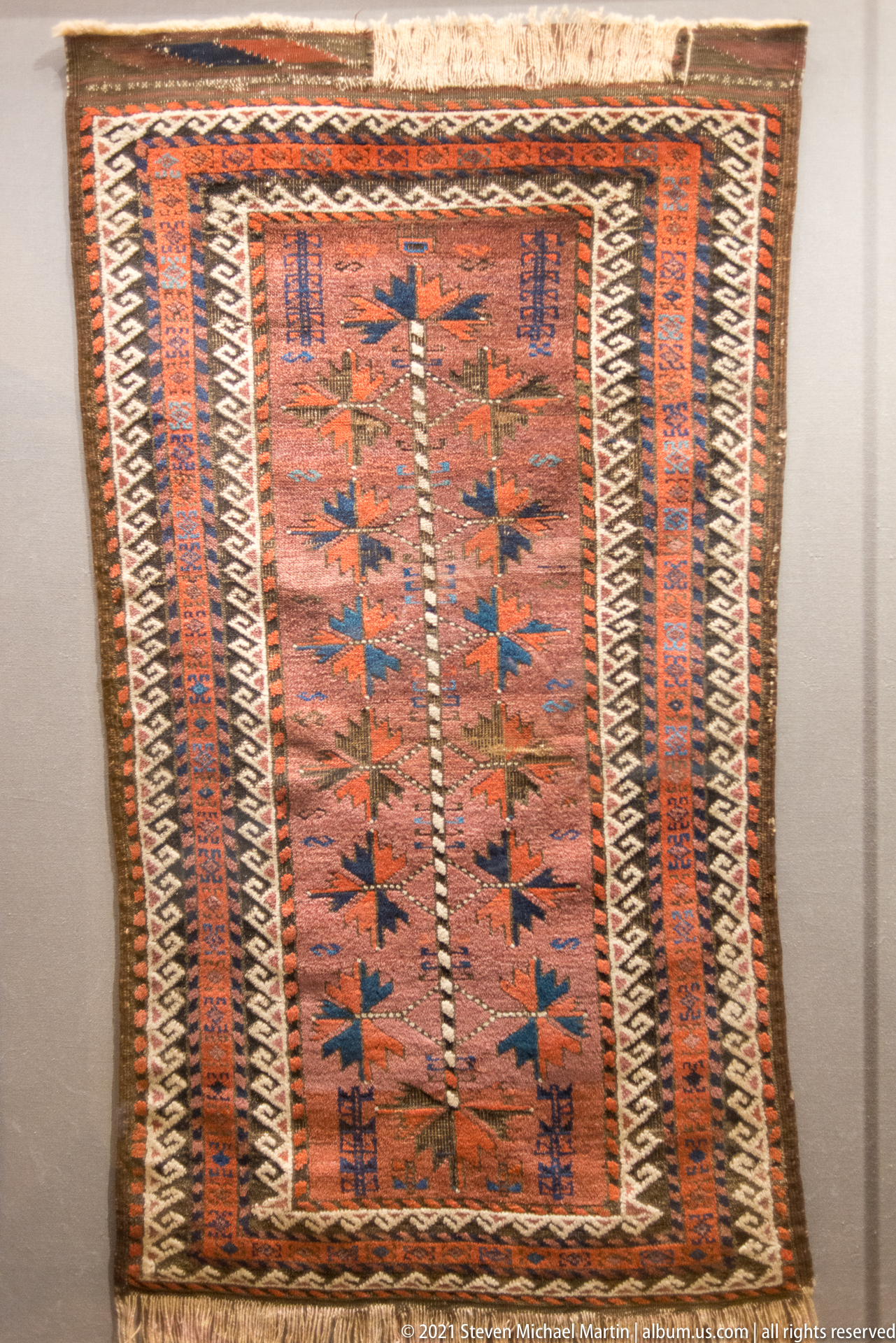
Long and narrow in format, this rug uses a warm rust field punctuated by repeated dark angular forms arranged along its length. Contrasting striped and zigzag borders run parallel to the central panel, reinforcing the textile's elongated proportions and rhythmic, highly geometric design.
Caption
Long and narrow in format, this rug uses a warm rust field punctuated by repeated dark angular forms arranged along its length. Contrasting striped and zigzag borders run parallel to the central panel, reinforcing the textile's elongated proportions and rhythmic, highly geometric design.
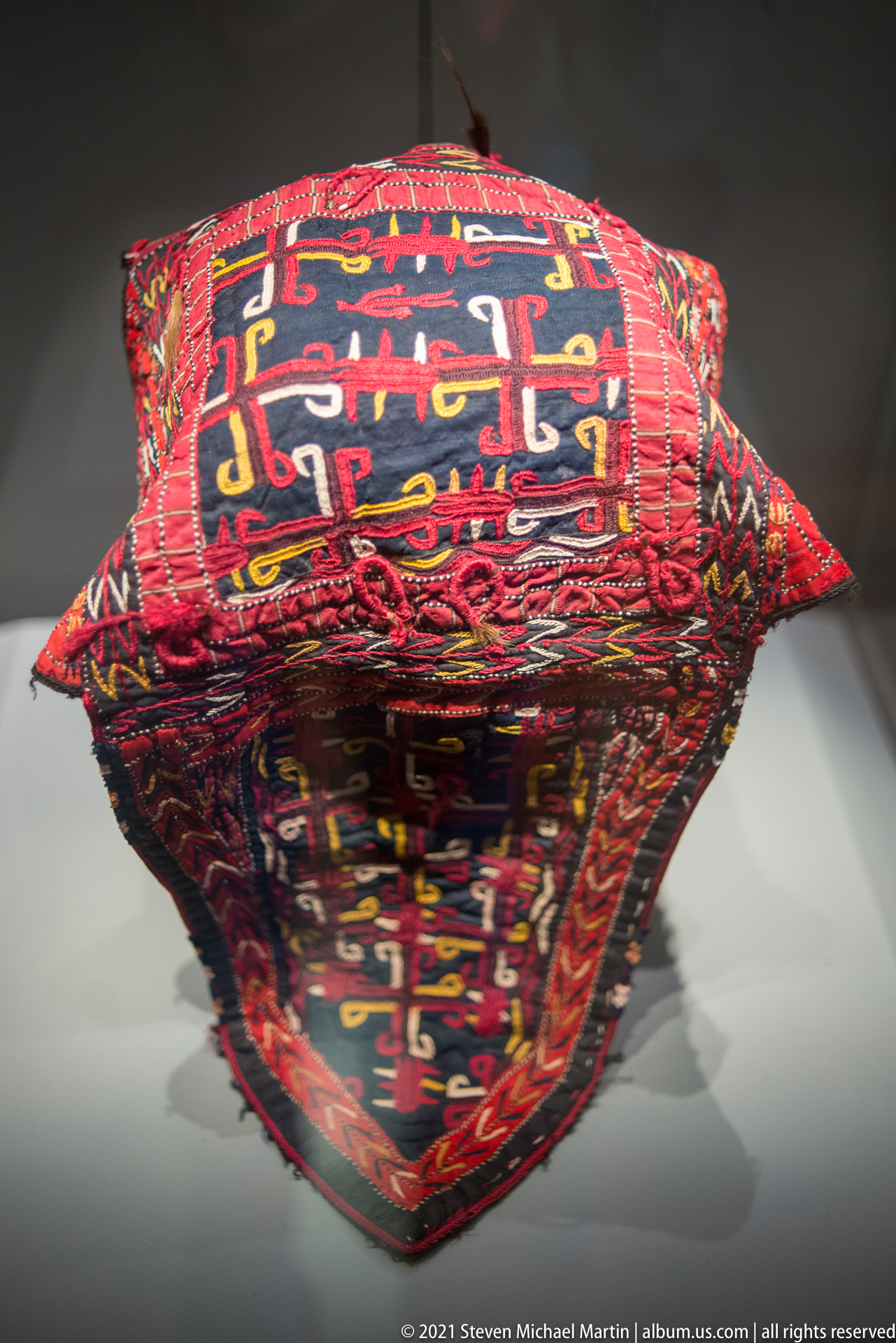
This three-dimensional textile object is wrapped in vivid red fabric densely patterned with black, yellow, white, and green curvilinear motifs. Its padded central body and pointed projecting ends distinguish it from the flat rugs nearby, while the mirrored display surface reveals additional ornament on the underside.
Caption
This three-dimensional textile object is wrapped in vivid red fabric densely patterned with black, yellow, white, and green curvilinear motifs. Its padded central body and pointed projecting ends distinguish it from the flat rugs nearby, while the mirrored display surface reveals additional ornament on the underside.
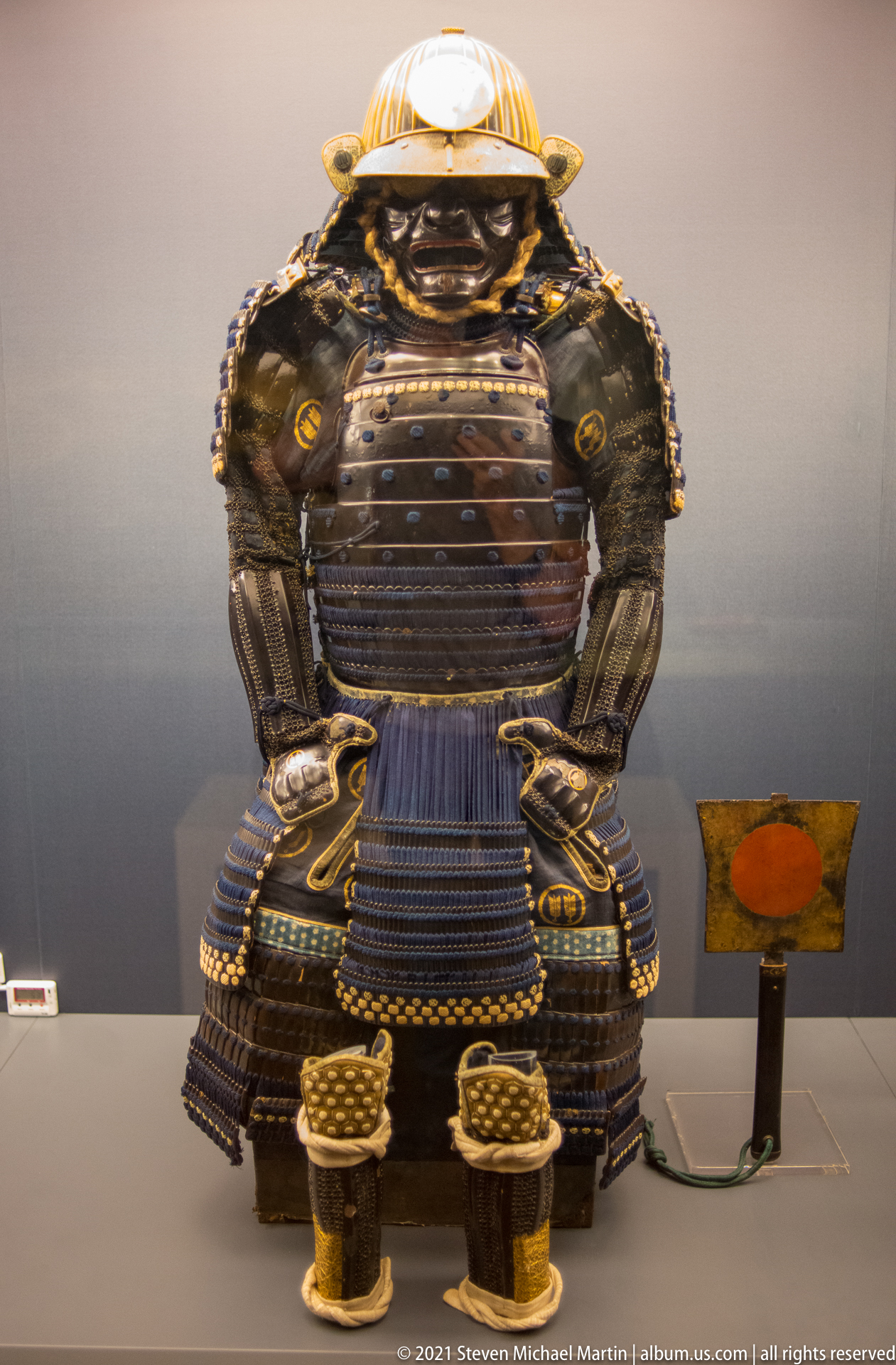
A complete Japanese suit of armor stands frontally in the gallery, its dark lamellar plates edged and laced in blue and gold. The helmet, shoulder guards, cuirass, skirt defenses, and separate armored footwear form a coherent ensemble, while small gilded fittings and patterned cords provide controlled decorative accents.
Caption
A complete Japanese suit of armor stands frontally in the gallery, its dark lamellar plates edged and laced in blue and gold. The helmet, shoulder guards, cuirass, skirt defenses, and separate armored footwear form a coherent ensemble, while small gilded fittings and patterned cords provide controlled decorative accents.
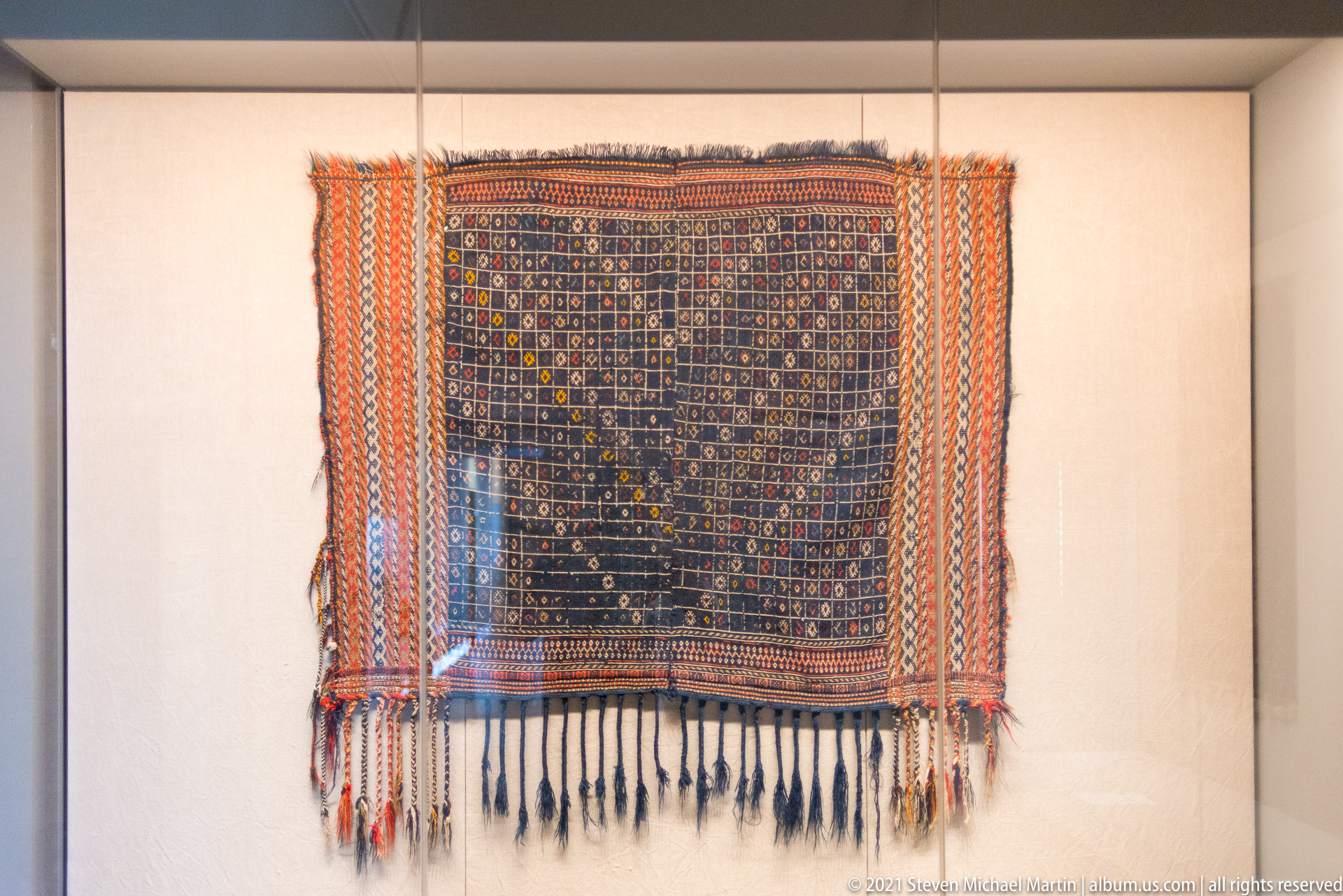
A large hanging textile combines a dark, tightly patterned central rectangle with brighter orange-and-blue side bands. Long dark tassels descend from the lower edge, giving the otherwise rectilinear composition a pronounced vertical finish and highlighting the contrast between the dense center and decorative borders.
Caption
A large hanging textile combines a dark, tightly patterned central rectangle with brighter orange-and-blue side bands. Long dark tassels descend from the lower edge, giving the otherwise rectilinear composition a pronounced vertical finish and highlighting the contrast between the dense center and decorative borders.
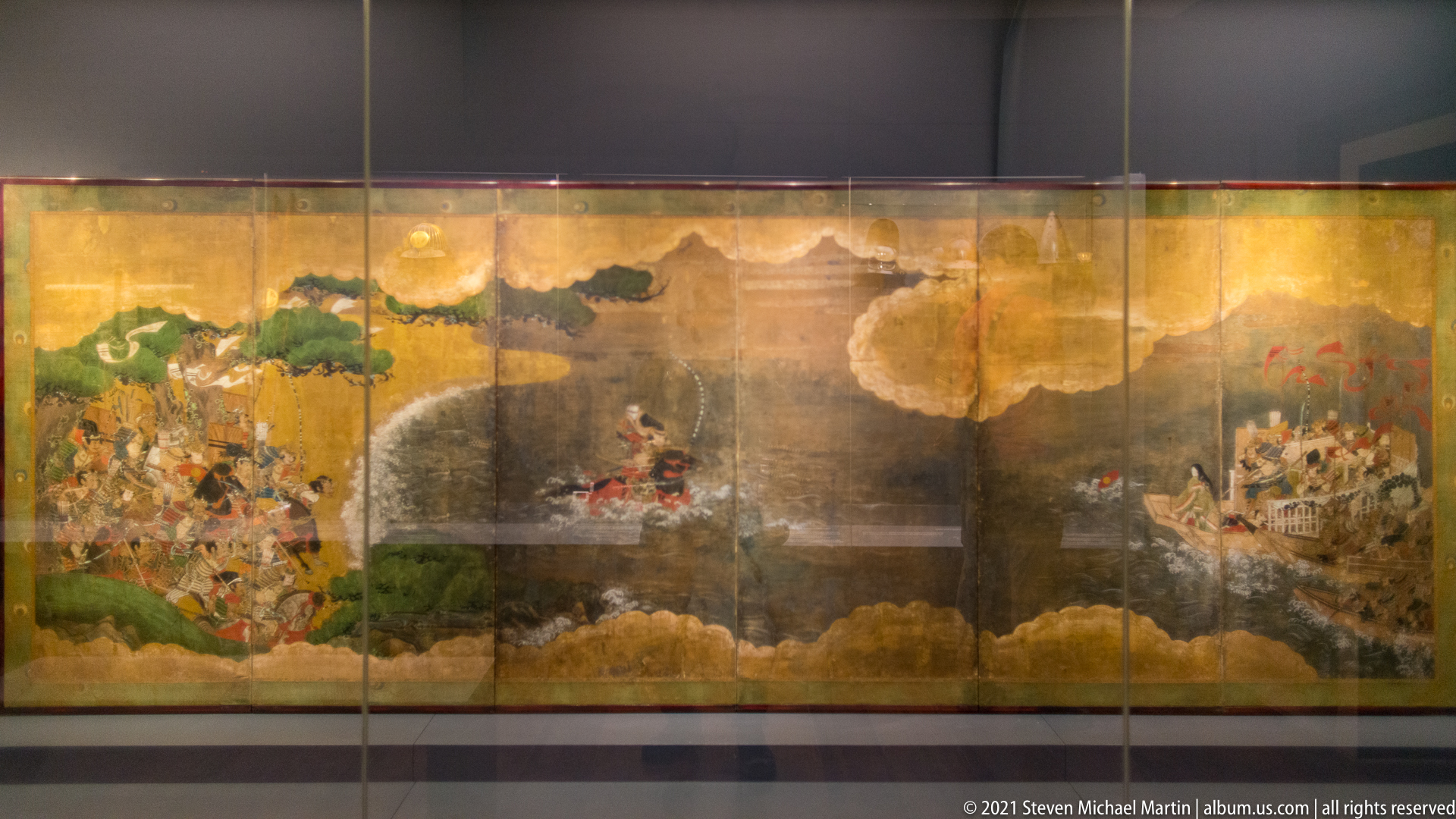
A multi-panel Japanese folding screen unfolds across a gold ground, with groups of figures and architectural settings separated by broad areas of cloud and landscape. Pine trees and clustered activity anchor the outer sections, while the reflective gold surface unifies the episodic narrative across the screen's vertical folds.
Caption
A multi-panel Japanese folding screen unfolds across a gold ground, with groups of figures and architectural settings separated by broad areas of cloud and landscape. Pine trees and clustered activity anchor the outer sections, while the reflective gold surface unifies the episodic narrative across the screen's vertical folds.
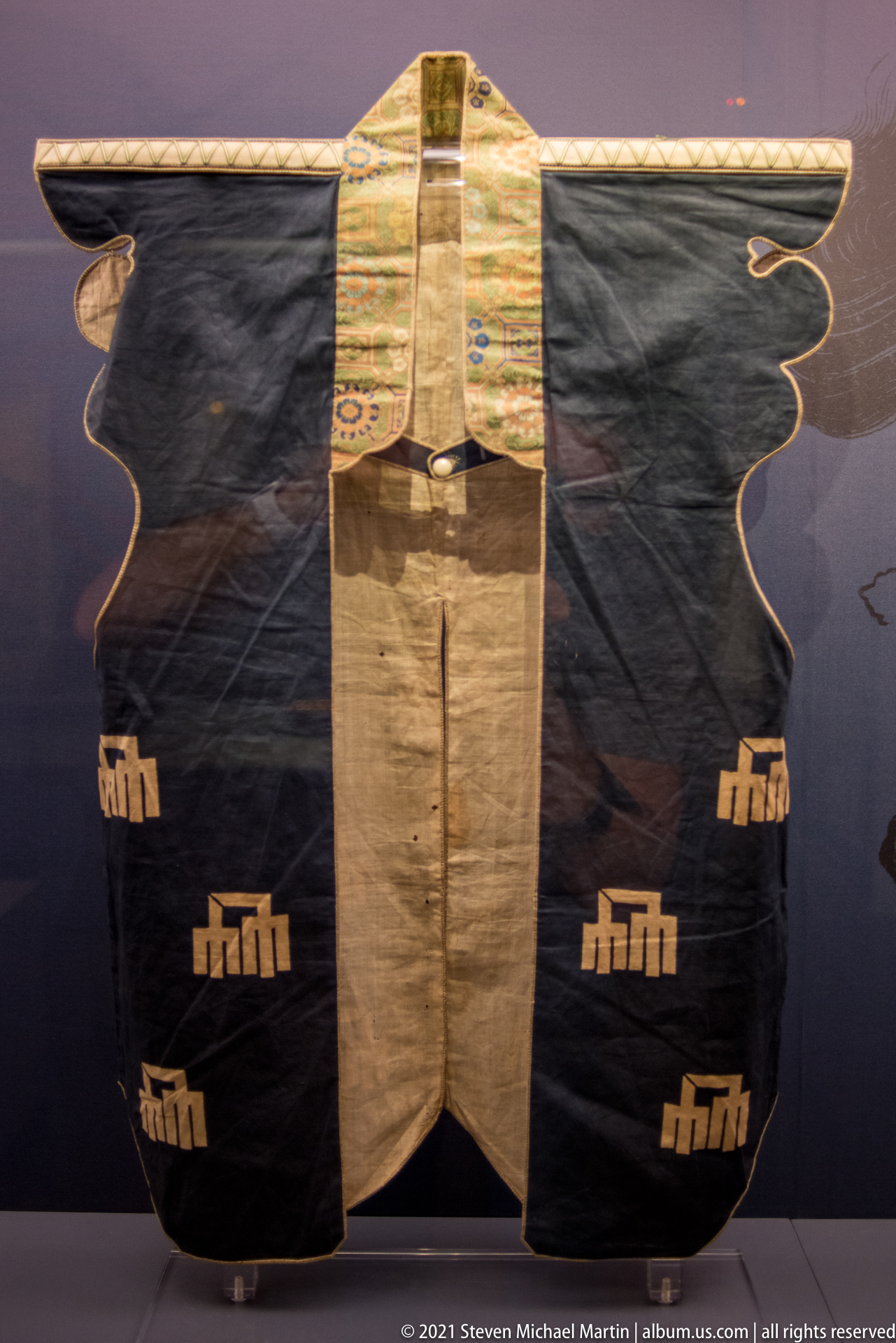
A dark formal robe is displayed fully spread, revealing broad sleeves, a pale vertical center, and repeated light motifs across the lower side panels. Subtle patterned bands at the collar and shoulders contrast with the deep blue-black fabric, making the garment's symmetrical construction especially legible.
Caption
A dark formal robe is displayed fully spread, revealing broad sleeves, a pale vertical center, and repeated light motifs across the lower side panels. Subtle patterned bands at the collar and shoulders contrast with the deep blue-black fabric, making the garment's symmetrical construction especially legible.

A tall Japanese archery ensemble is arranged vertically in the case, dominated by a long asymmetrical bow and a rigid dark quiver with red bindings. Several arrows stand beside it, allowing the equipment's contrasting lengths, lacquered surfaces, and carefully bound fittings to be compared at a glance.
Caption
A tall Japanese archery ensemble is arranged vertically in the case, dominated by a long asymmetrical bow and a rigid dark quiver with red bindings. Several arrows stand beside it, allowing the equipment's contrasting lengths, lacquered surfaces, and carefully bound fittings to be compared at a glance.
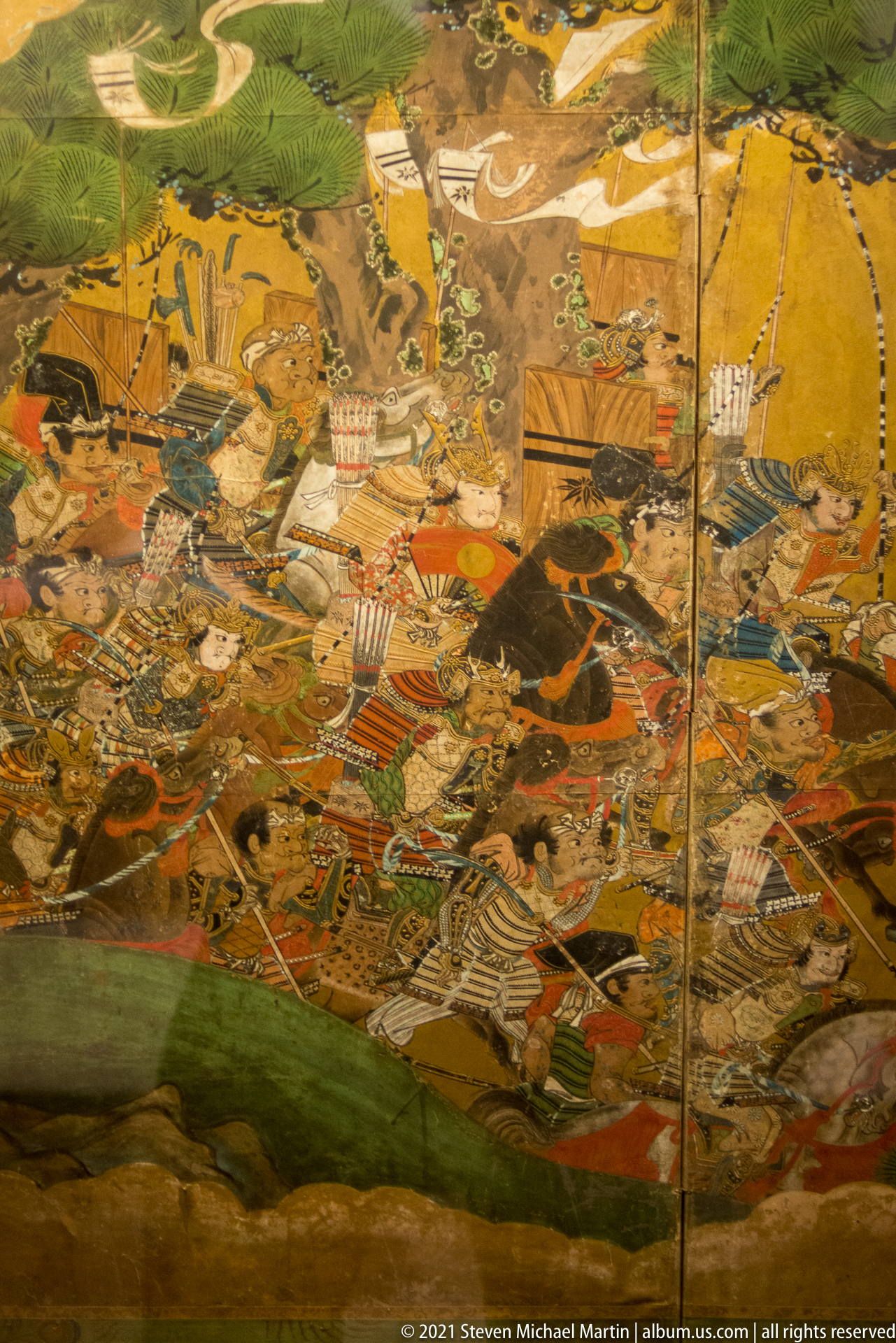
Armored warriors surge across this gold-ground Japanese screen in a densely packed battle scene. Mounted and standing figures, banners, weapons, and richly patterned armor overlap across the panels, while green landscape forms at the edges frame the energetic concentration of combatants.
Caption
Armored warriors surge across this gold-ground Japanese screen in a densely packed battle scene. Mounted and standing figures, banners, weapons, and richly patterned armor overlap across the panels, while green landscape forms at the edges frame the energetic concentration of combatants.
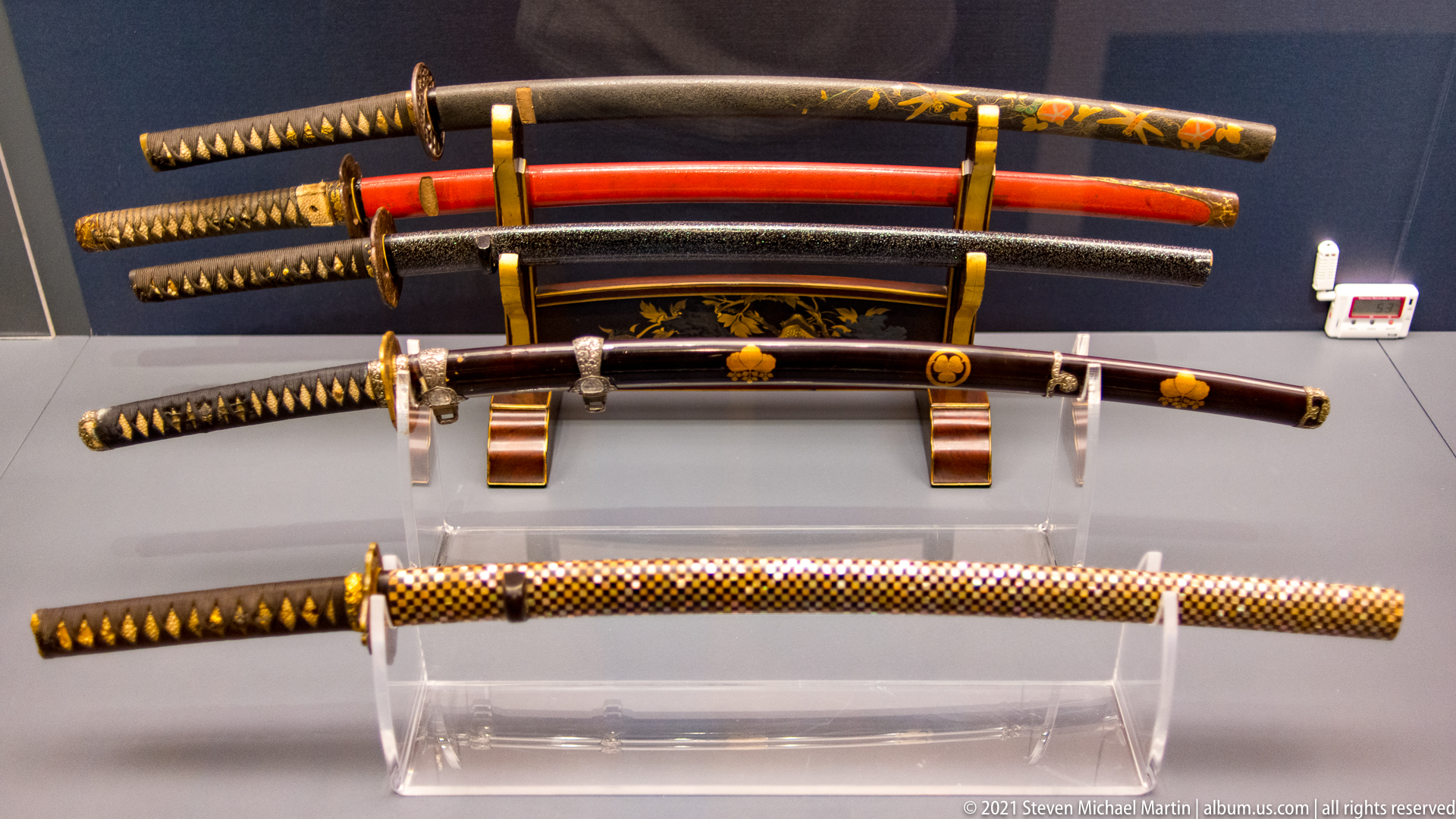
Several Japanese swords and scabbards are displayed horizontally, showing contrasting black and red lacquer finishes, patterned grips, guards, and metal fittings. The grouped presentation highlights the refined decorative treatment of weapons and their mounts as well as differences in blade and scabbard length.
Caption
Several Japanese swords and scabbards are displayed horizontally, showing contrasting black and red lacquer finishes, patterned grips, guards, and metal fittings. The grouped presentation highlights the refined decorative treatment of weapons and their mounts as well as differences in blade and scabbard length.
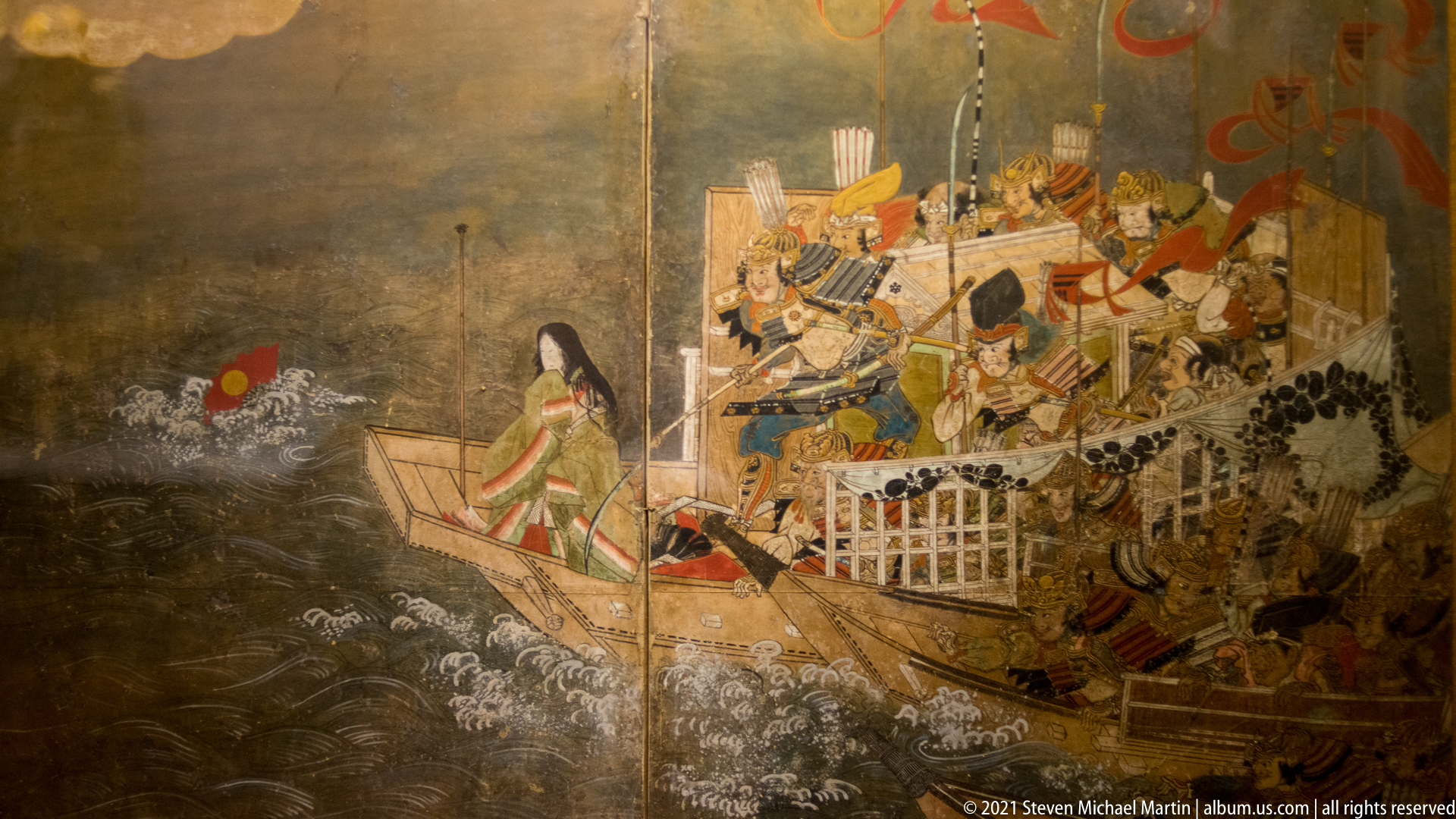
A crowded boat carrying armored warriors pushes through stylized dark waves in this Japanese screen painting. A seated woman at the bow provides a striking counterpoint to the mass of helmets, weapons, and patterned armor behind her, while white wave crests animate the surrounding water.
Caption
A crowded boat carrying armored warriors pushes through stylized dark waves in this Japanese screen painting. A seated woman at the bow provides a striking counterpoint to the mass of helmets, weapons, and patterned armor behind her, while white wave crests animate the surrounding water.
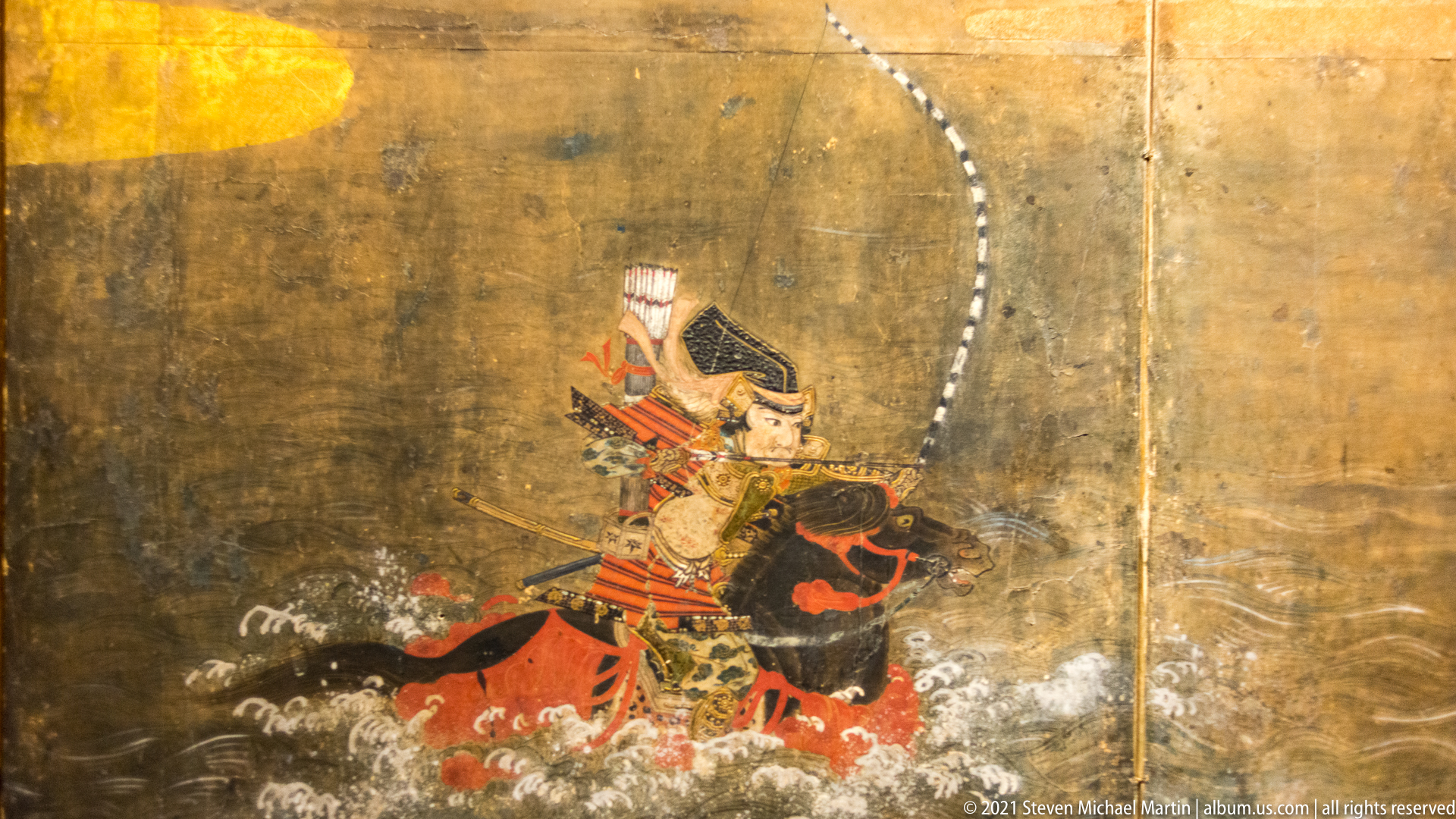
An armored mounted warrior advances through churning water against an expansive gold ground. The horse's dark body and the rider's patterned armor stand out sharply from the pale wave crests, while a long curved bow rises above the compact figure group and gives the composition a strong upward sweep.
Caption
An armored mounted warrior advances through churning water against an expansive gold ground. The horse's dark body and the rider's patterned armor stand out sharply from the pale wave crests, while a long curved bow rises above the compact figure group and gives the composition a strong upward sweep.
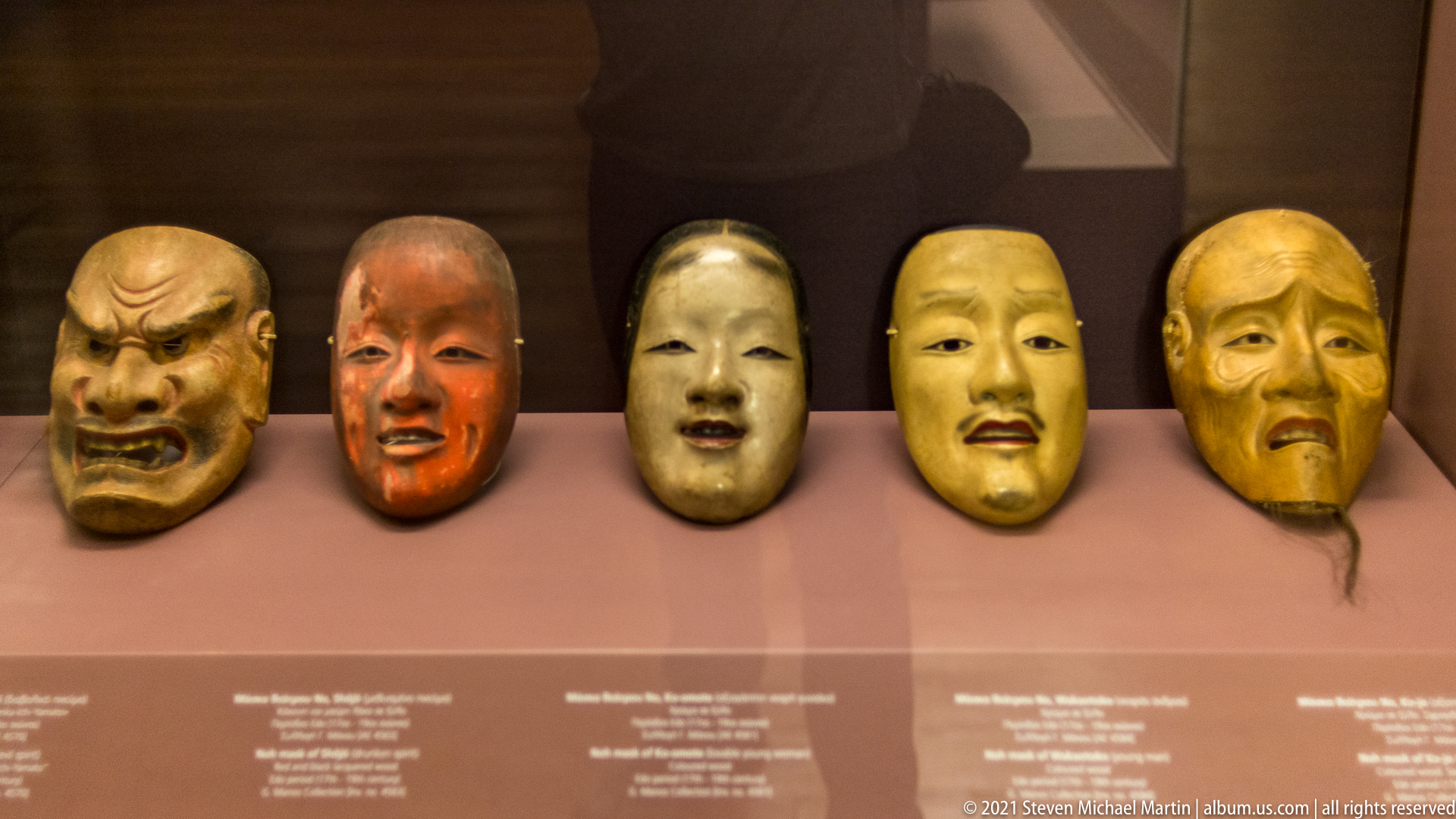
Five Japanese theatrical masks are aligned in a single case, ranging from a fierce grimacing face to calm, youthful, and aged expressions. Differences in color, brow shape, mouth, and modeling demonstrate how subtle changes in facial form create sharply distinct dramatic characters.
Caption
Five Japanese theatrical masks are aligned in a single case, ranging from a fierce grimacing face to calm, youthful, and aged expressions. Differences in color, brow shape, mouth, and modeling demonstrate how subtle changes in facial form create sharply distinct dramatic characters.
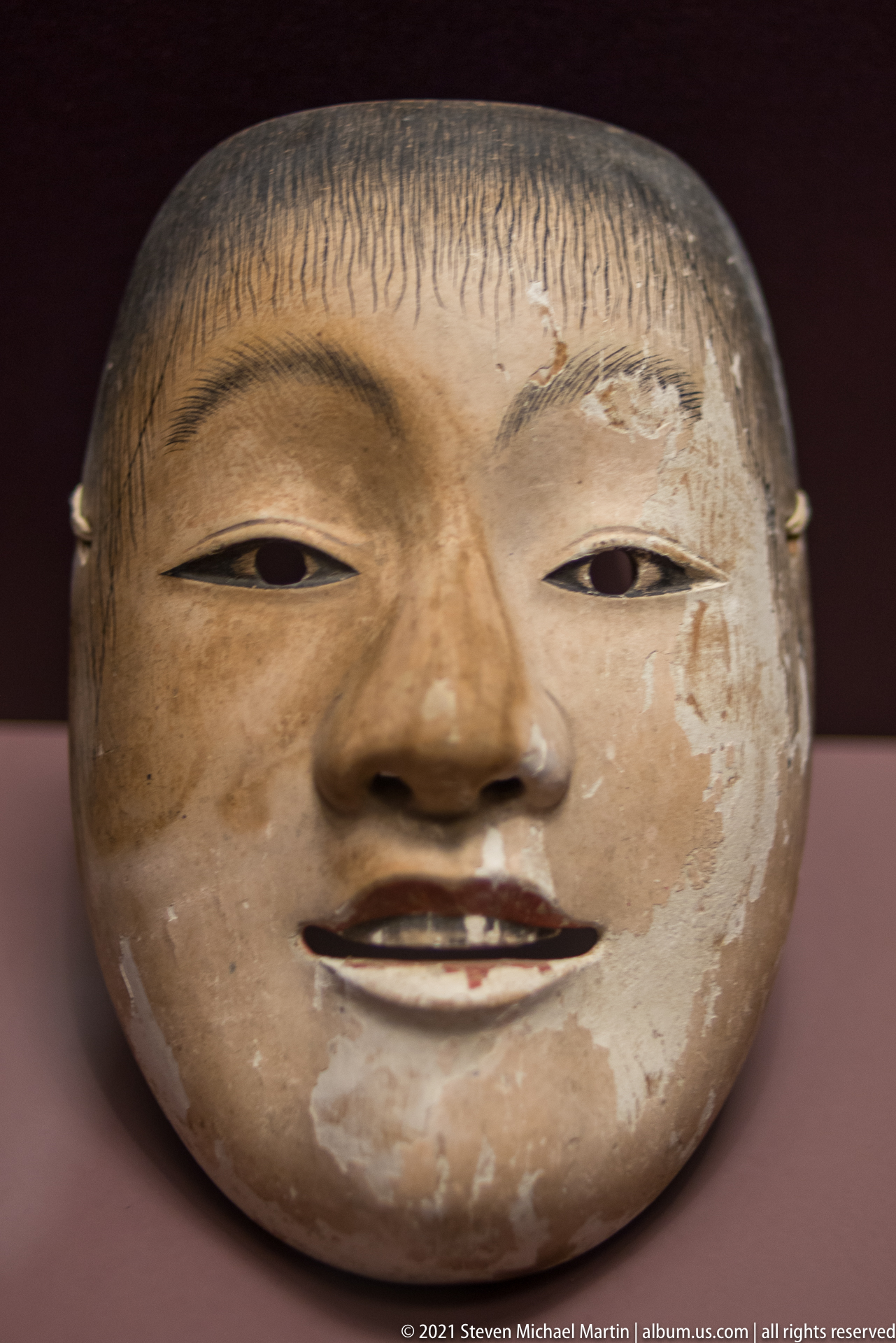
This pale Japanese theatrical mask presents a restrained human face with narrow eyes, small parted lips, and finely painted hair along the forehead. Areas of worn or flaking surface expose the object's age and material history, adding texture to an otherwise controlled and symmetrical expression.
Caption
This pale Japanese theatrical mask presents a restrained human face with narrow eyes, small parted lips, and finely painted hair along the forehead. Areas of worn or flaking surface expose the object's age and material history, adding texture to an otherwise controlled and symmetrical expression.
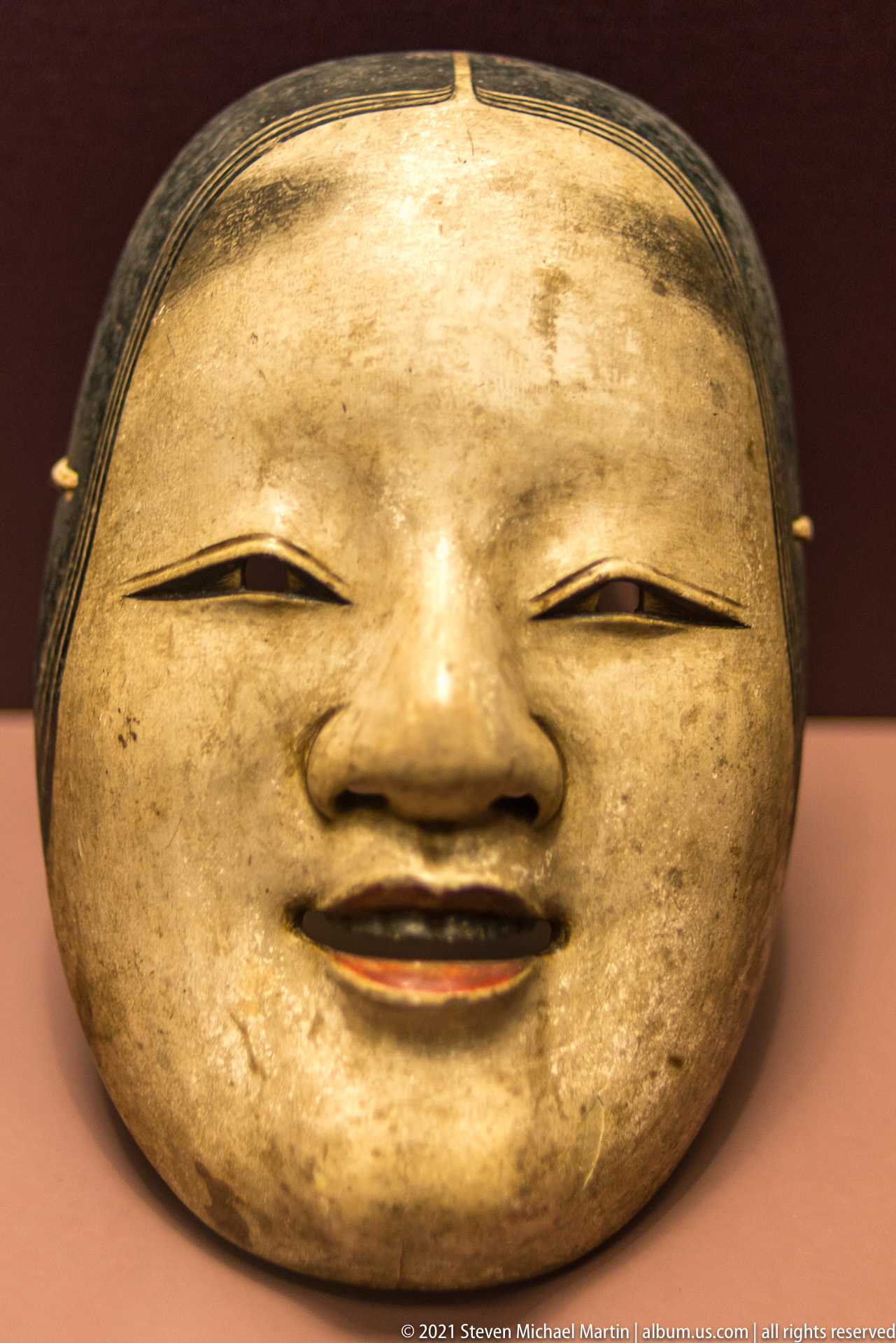
A softly rounded Japanese theatrical mask is covered in a warm gold-toned finish, with narrow eyes and a small smiling mouth picked out in darker color. Its polished surface and gently modeled cheeks distinguish it from the more visibly weathered mask displayed nearby.
Caption
A softly rounded Japanese theatrical mask is covered in a warm gold-toned finish, with narrow eyes and a small smiling mouth picked out in darker color. Its polished surface and gently modeled cheeks distinguish it from the more visibly weathered mask displayed nearby.

A large map of Japan fills the display panel, its islands densely covered with place names and route or regional markings. The surrounding blue field clearly defines the archipelago and provides geographic orientation for the Japanese collections presented in the adjacent galleries.
Caption
A large map of Japan fills the display panel, its islands densely covered with place names and route or regional markings. The surrounding blue field clearly defines the archipelago and provides geographic orientation for the Japanese collections presented in the adjacent galleries.
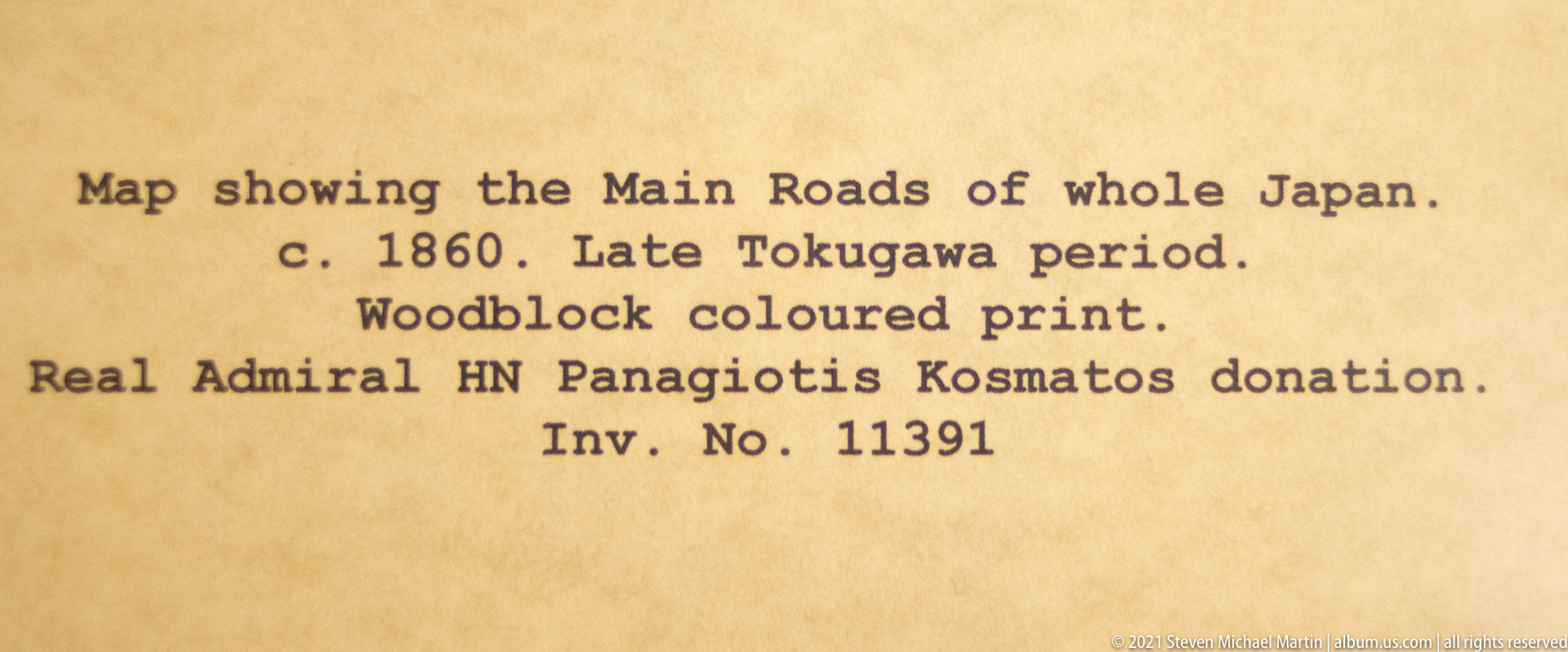
The museum label identifies a colored woodblock map showing the main roads of Japan, dated about 1860 in the late Tokugawa period. It also records the donation of Rear Admiral H. N. Panagiotis Kosmatos and the inventory number 11391, providing unusually specific documentation for the adjacent cartographic object.
Caption
The museum label identifies a colored woodblock map showing the main roads of Japan, dated about 1860 in the late Tokugawa period. It also records the donation of Rear Admiral H. N. Panagiotis Kosmatos and the inventory number 11391, providing unusually specific documentation for the adjacent cartographic object.
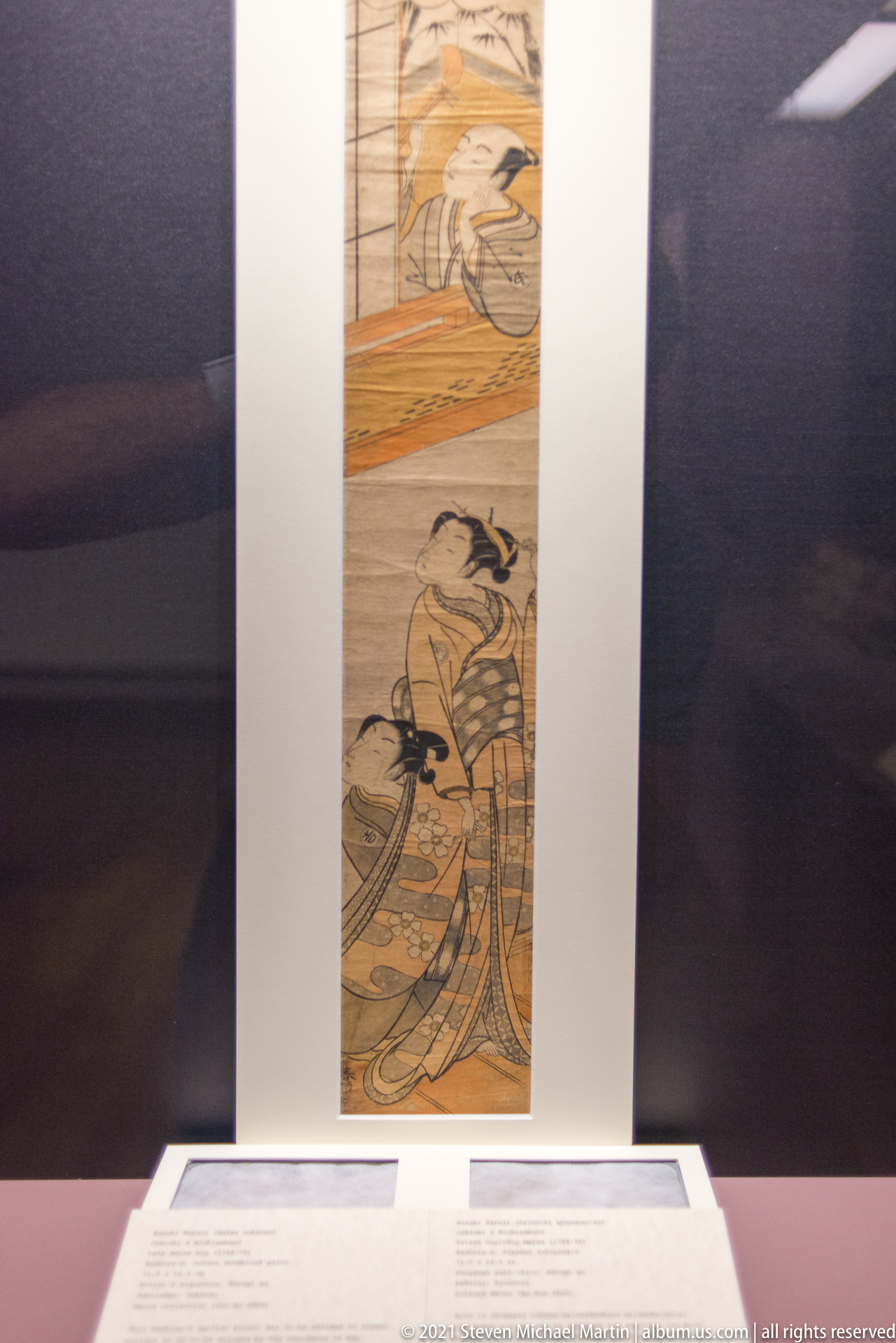
A narrow Japanese hanging scroll presents two seated figures in vertically separated scenes, each rendered with flowing black outlines and subdued color. The tall format and broad pale mounting isolate the figures against the dark museum case, emphasizing the controlled brushwork and intimate scale of the painted episodes.
Caption
A narrow Japanese hanging scroll presents two seated figures in vertically separated scenes, each rendered with flowing black outlines and subdued color. The tall format and broad pale mounting isolate the figures against the dark museum case, emphasizing the controlled brushwork and intimate scale of the painted episodes.
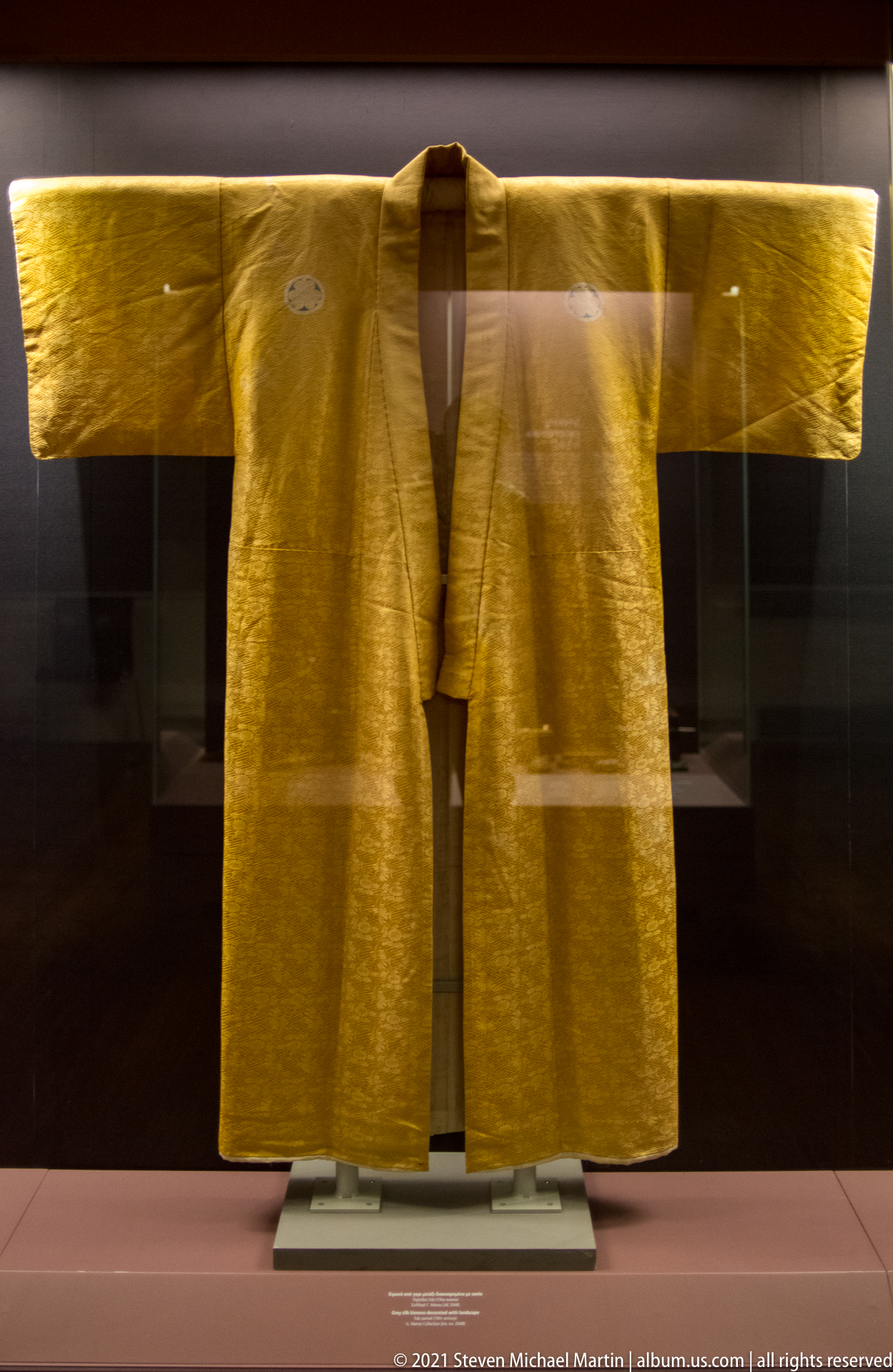
A luminous gold-colored Japanese robe is displayed with broad sleeves extended, allowing the subtle woven or embroidered decoration across its surface to catch the gallery light. Small circular crests near the shoulders and restrained linear motifs stand out against the otherwise unified golden field.
Caption
A luminous gold-colored Japanese robe is displayed with broad sleeves extended, allowing the subtle woven or embroidered decoration across its surface to catch the gallery light. Small circular crests near the shoulders and restrained linear motifs stand out against the otherwise unified golden field.
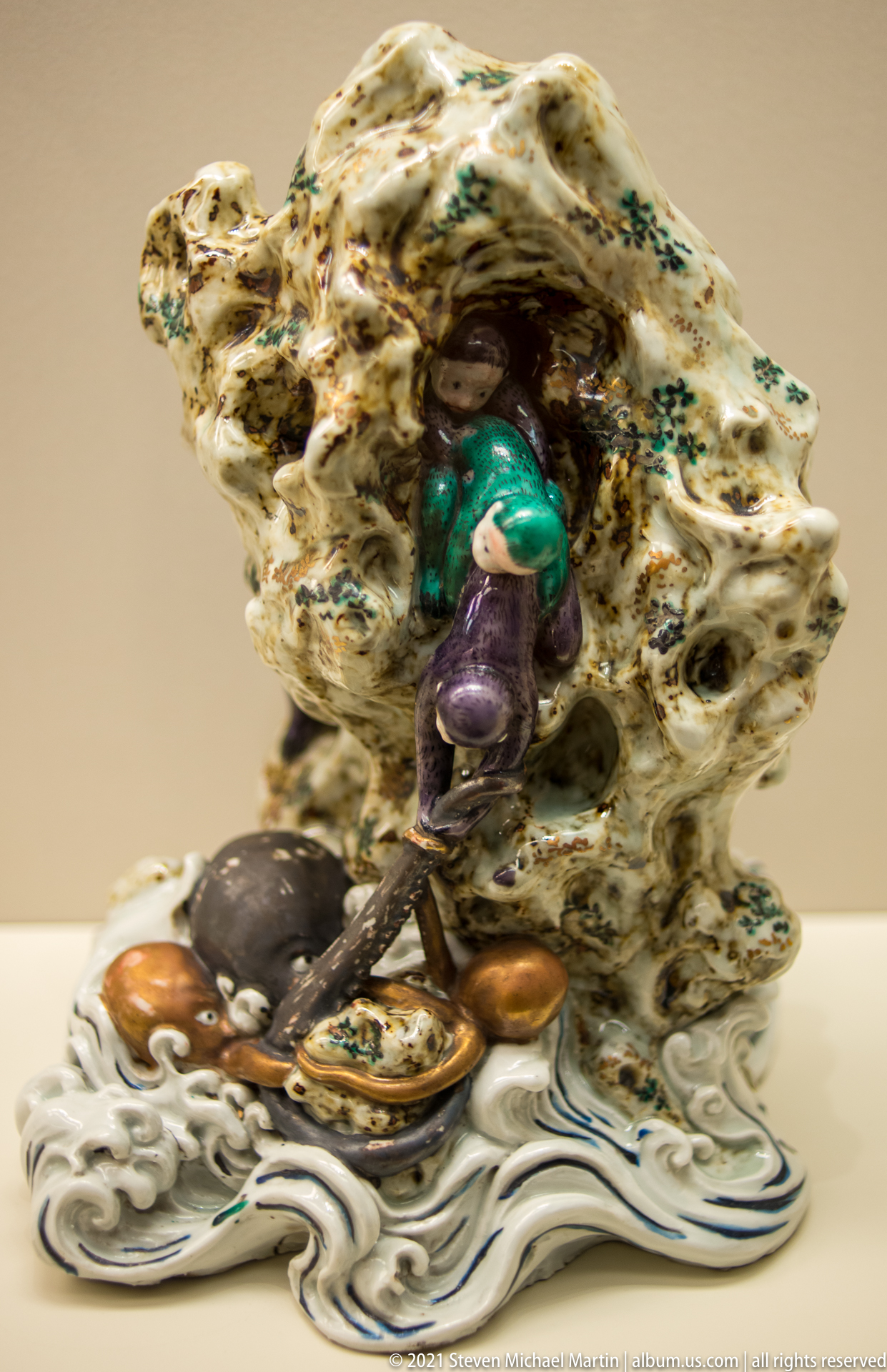
A small glazed ceramic group combines a brightly colored human figure with a dramatically pierced, rock-like formation rising above stylized curling waves. Pools of green, purple, brown, and turquoise glaze accent the irregular surface, creating strong contrasts between the modeled figure, craggy mass, and fluid base.
Caption
A small glazed ceramic group combines a brightly colored human figure with a dramatically pierced, rock-like formation rising above stylized curling waves. Pools of green, purple, brown, and turquoise glaze accent the irregular surface, creating strong contrasts between the modeled figure, craggy mass, and fluid base.
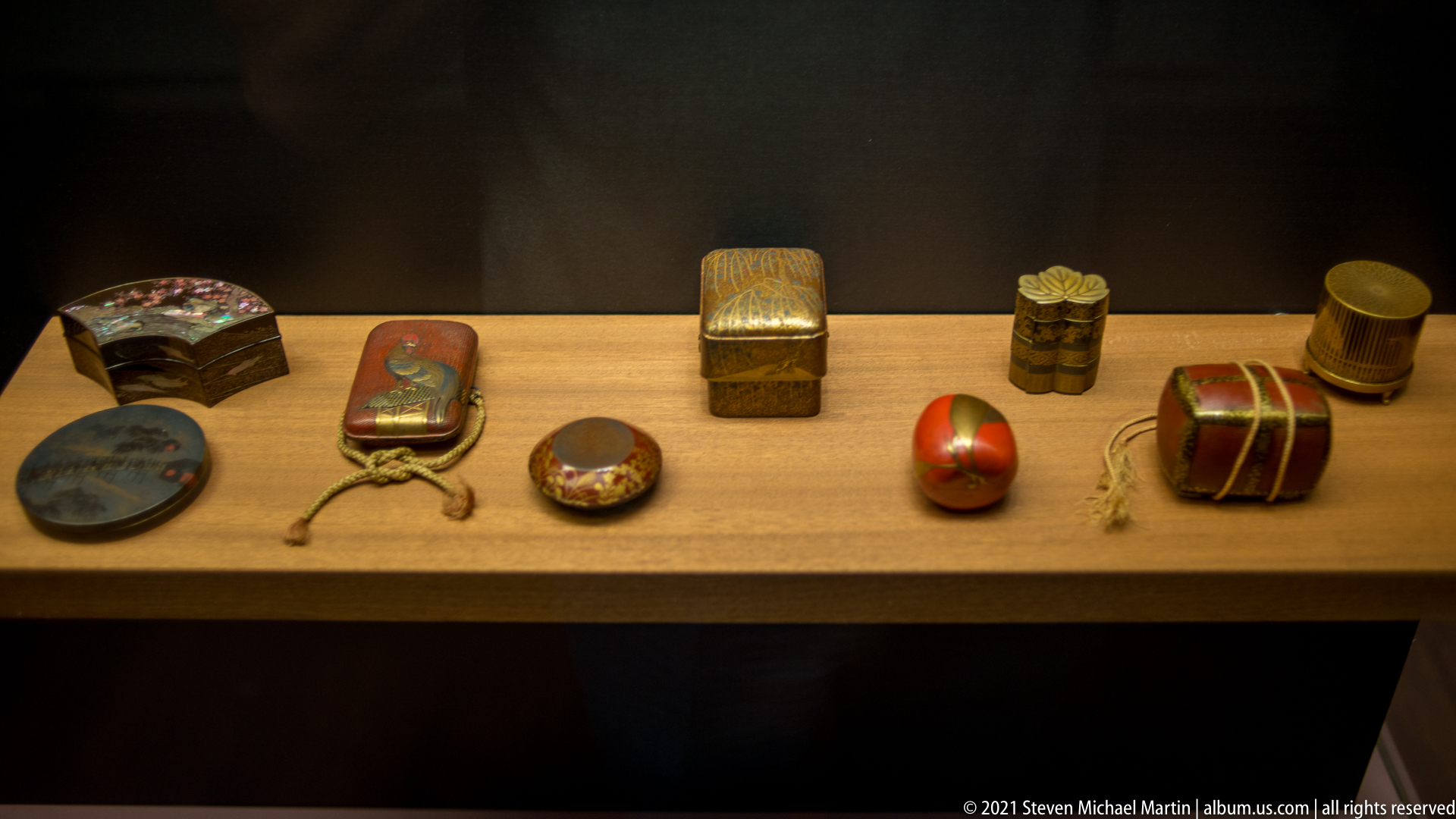
Small Japanese lacquer objects are arranged across a low display shelf, including rounded, cylindrical, lobed, and rectangular boxes or containers. Red, black, gold, and patterned surfaces vary from piece to piece, demonstrating the decorative range possible within compact personal and domestic objects.
Caption
Small Japanese lacquer objects are arranged across a low display shelf, including rounded, cylindrical, lobed, and rectangular boxes or containers. Red, black, gold, and patterned surfaces vary from piece to piece, demonstrating the decorative range possible within compact personal and domestic objects.
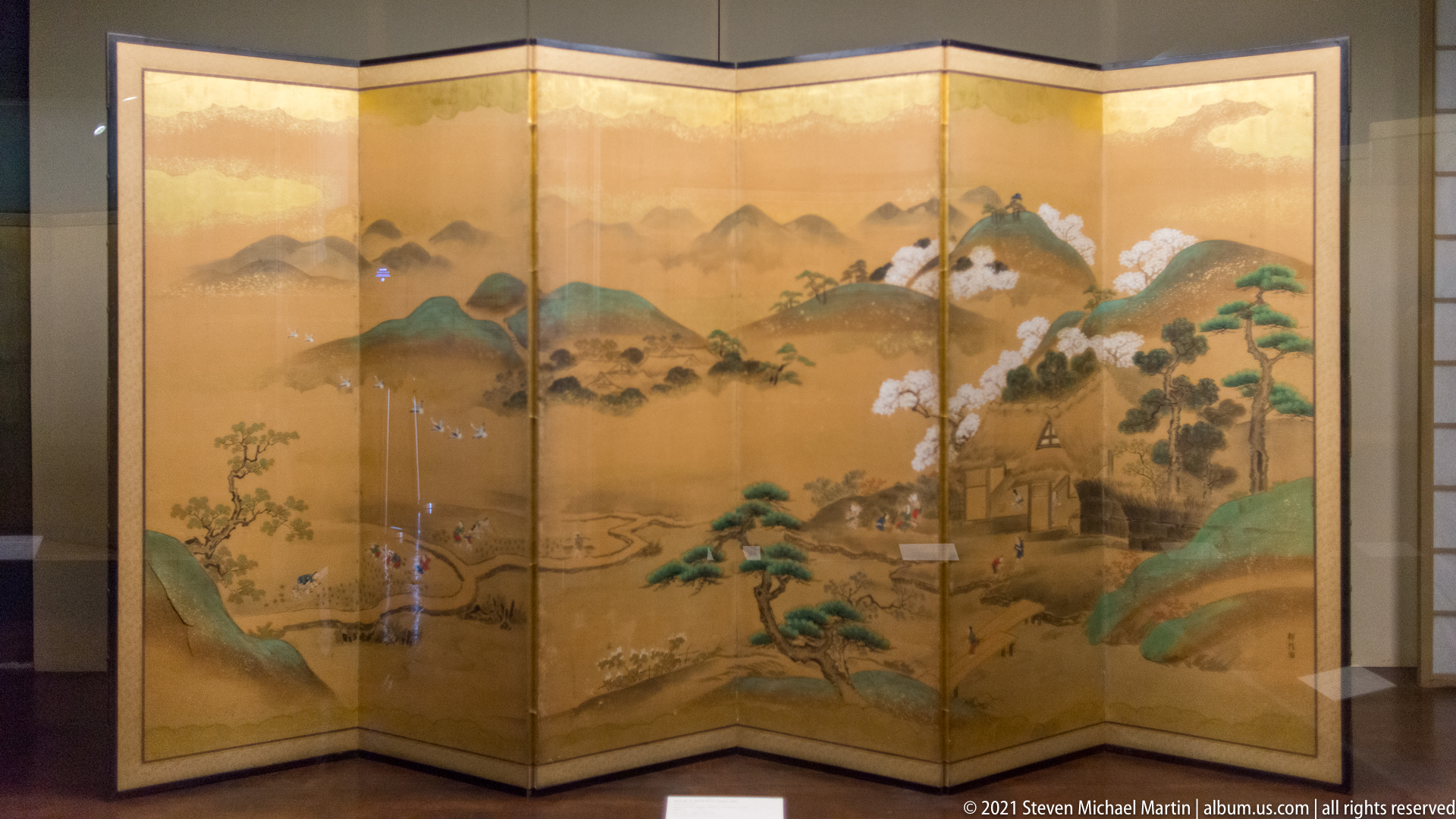
Rocky hills and pine trees frame a small cluster of buildings in this gold-ground folding screen, while distant mountains fade into a pale atmospheric background. The composition shifts its visual weight toward the right, where trees, architecture, and white cloud-like forms create a denser counterpoint to the open left side.
Caption
Rocky hills and pine trees frame a small cluster of buildings in this gold-ground folding screen, while distant mountains fade into a pale atmospheric background. The composition shifts its visual weight toward the right, where trees, architecture, and white cloud-like forms create a denser counterpoint to the open left side.
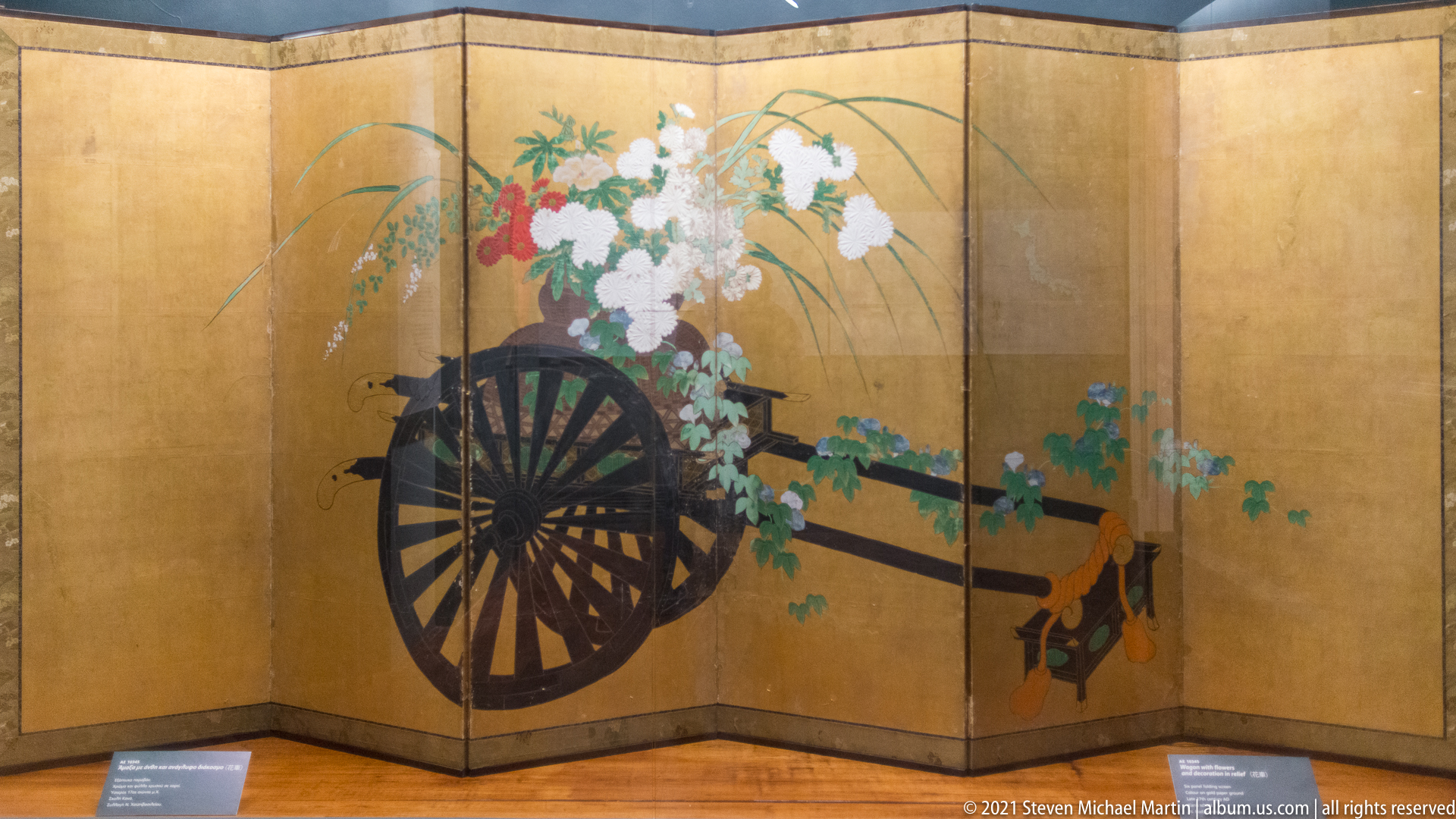
A large wooden cart filled with flowering plants dominates this gold-ground screen. White and red blossoms rise above the dark wheel and long cart shafts, while trailing greenery softens the mechanical geometry of the vehicle. The subject is isolated against the reflective background, making the botanical arrangement the principal decorative focus.
Caption
A large wooden cart filled with flowering plants dominates this gold-ground screen. White and red blossoms rise above the dark wheel and long cart shafts, while trailing greenery softens the mechanical geometry of the vehicle. The subject is isolated against the reflective background, making the botanical arrangement the principal decorative focus.
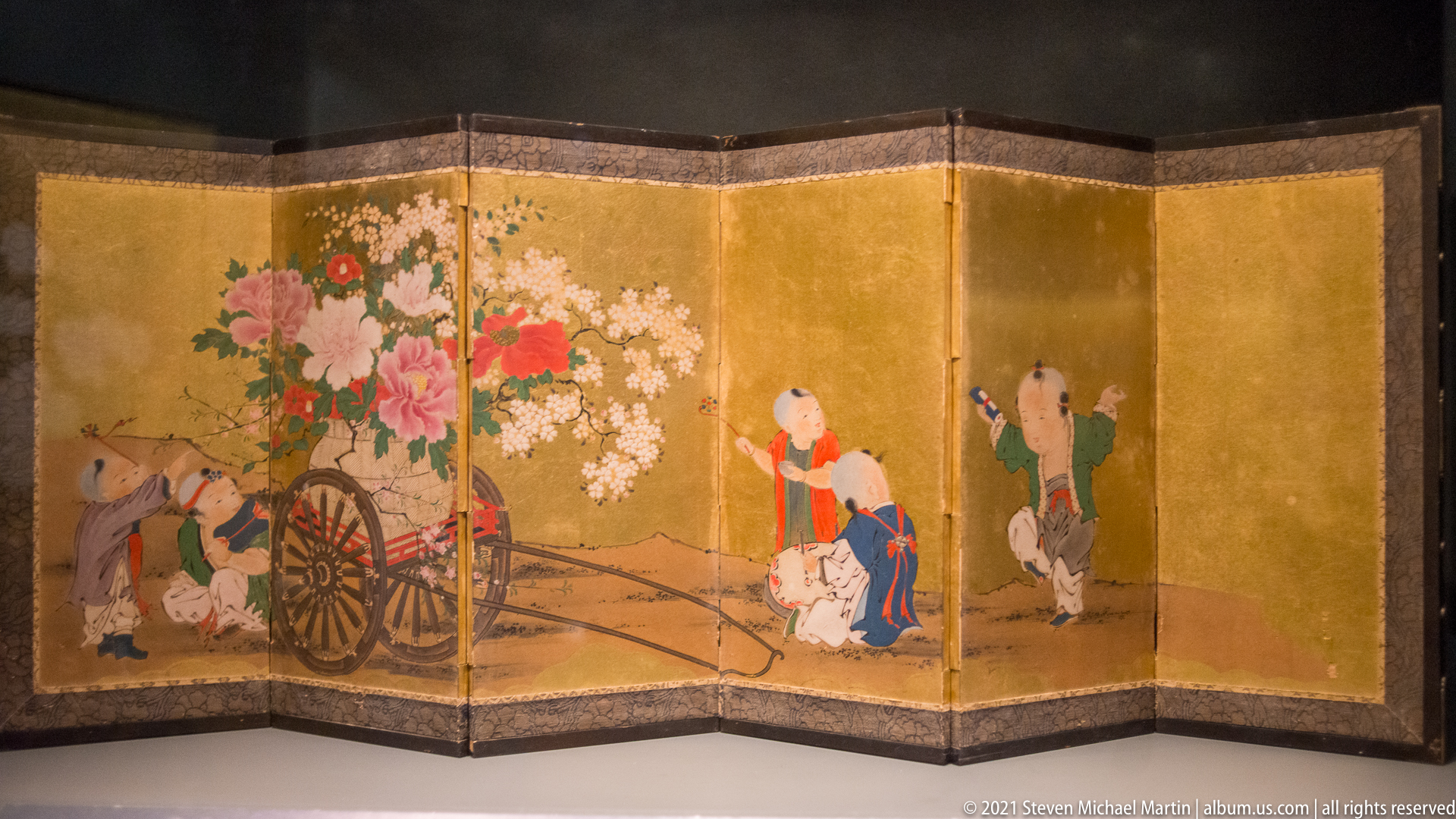
Figures gather around a flower-laden cart on this smaller gold-ground screen, turning the floral motif into a lively narrative scene. Several people pull or attend the cart while another figure gestures at the right, and dense pink, red, and white blossoms form a bright canopy above the dark wheels and shafts.
Caption
Figures gather around a flower-laden cart on this smaller gold-ground screen, turning the floral motif into a lively narrative scene. Several people pull or attend the cart while another figure gestures at the right, and dense pink, red, and white blossoms form a bright canopy above the dark wheels and shafts.
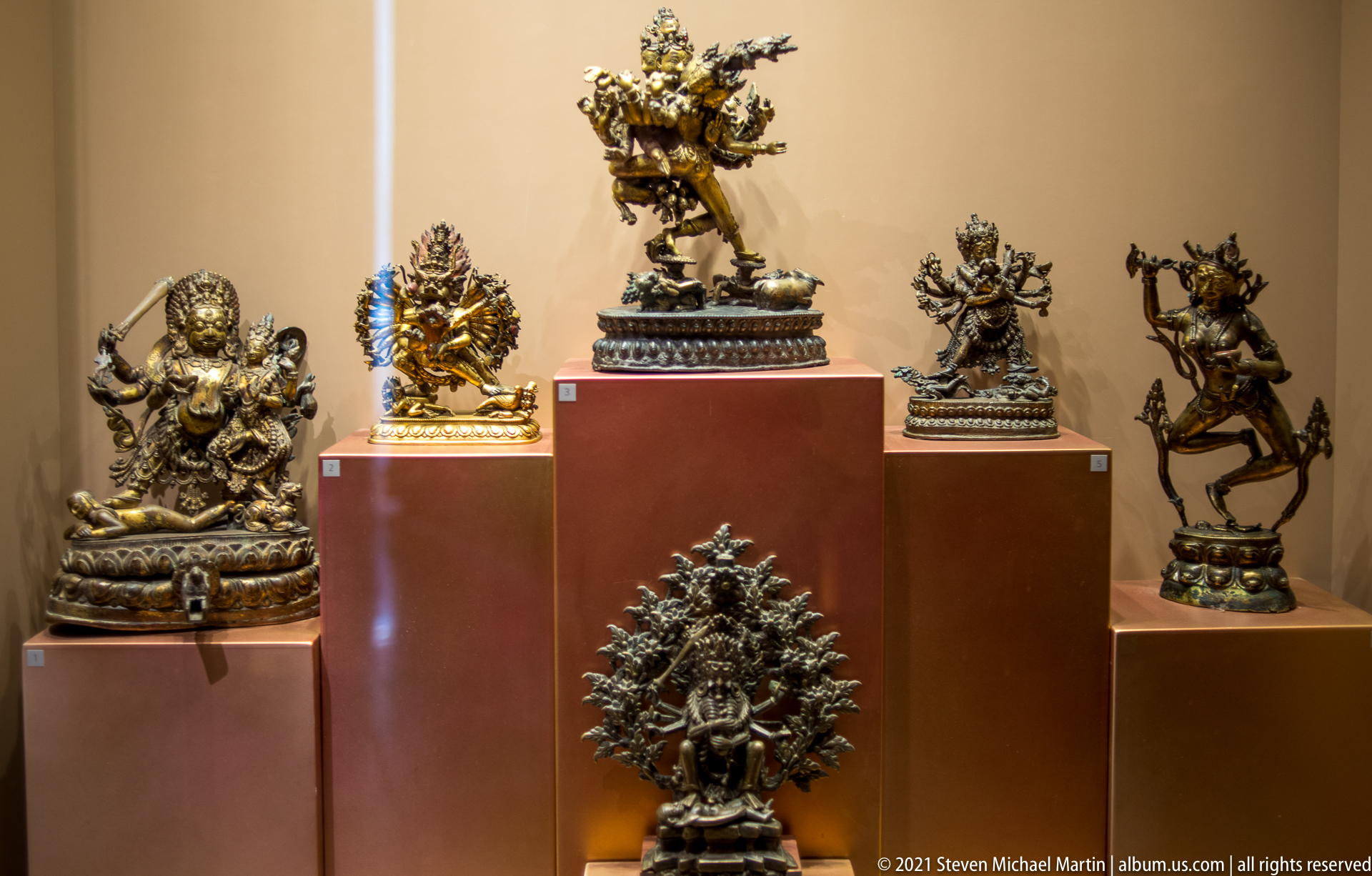
A stepped museum display brings together several small metal devotional sculptures, including seated and dancing figures with elaborate crowns, multiple arms, and aureole-like backplates. Their varied postures and attributes indicate a group drawn from Buddhist and Hindu religious traditions, presented here for comparison of iconography and casting style.
Caption
A stepped museum display brings together several small metal devotional sculptures, including seated and dancing figures with elaborate crowns, multiple arms, and aureole-like backplates. Their varied postures and attributes indicate a group drawn from Buddhist and Hindu religious traditions, presented here for comparison of iconography and casting style.
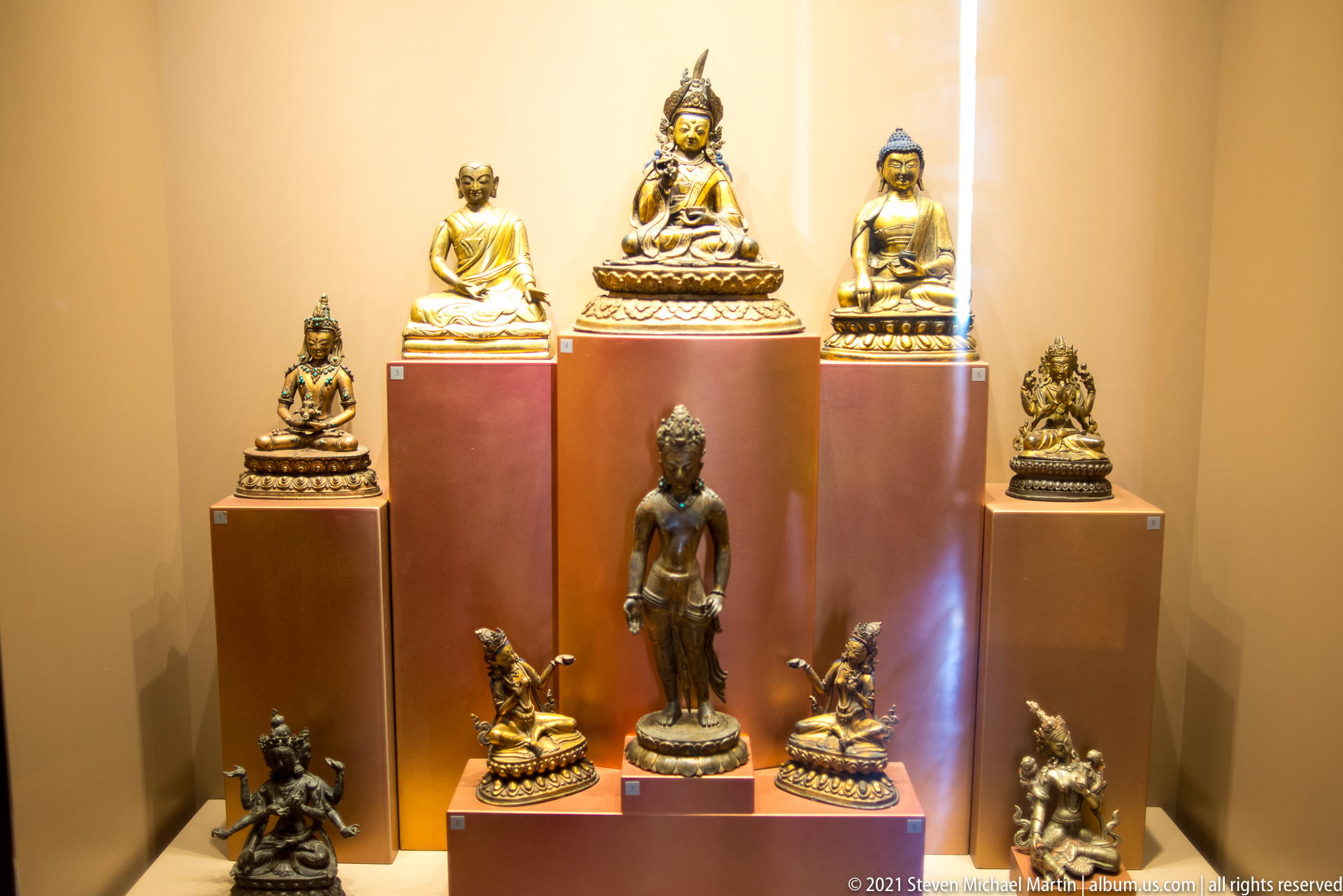
Bronze Buddhist figures are arranged symmetrically on stepped plinths, with larger seated images elevated behind a central standing figure. Lotus bases, calm frontal postures, and hand gestures unify the ensemble, while smaller attendant images at the lower corners extend the display across several scales and sculptural types.
Caption
Bronze Buddhist figures are arranged symmetrically on stepped plinths, with larger seated images elevated behind a central standing figure. Lotus bases, calm frontal postures, and hand gestures unify the ensemble, while smaller attendant images at the lower corners extend the display across several scales and sculptural types.
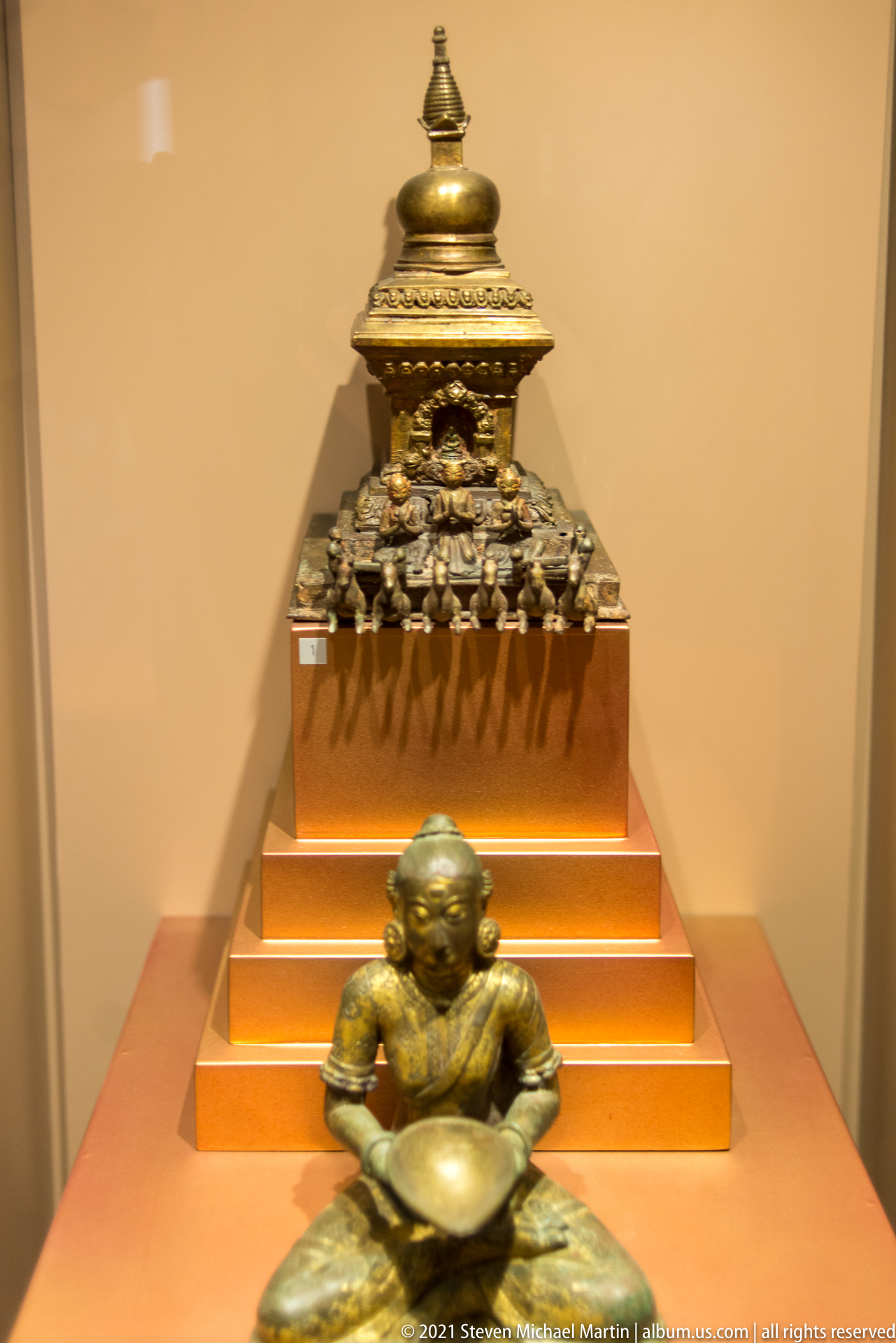
A small seated bronze figure occupies the foreground before a richly ornamented, tiered metal shrine or reliquary. The raised structure is crowned by a finial and supported above a row of projecting decorative elements, creating a strong vertical contrast with the compact human figure below.
Caption
A small seated bronze figure occupies the foreground before a richly ornamented, tiered metal shrine or reliquary. The raised structure is crowned by a finial and supported above a row of projecting decorative elements, creating a strong vertical contrast with the compact human figure below.
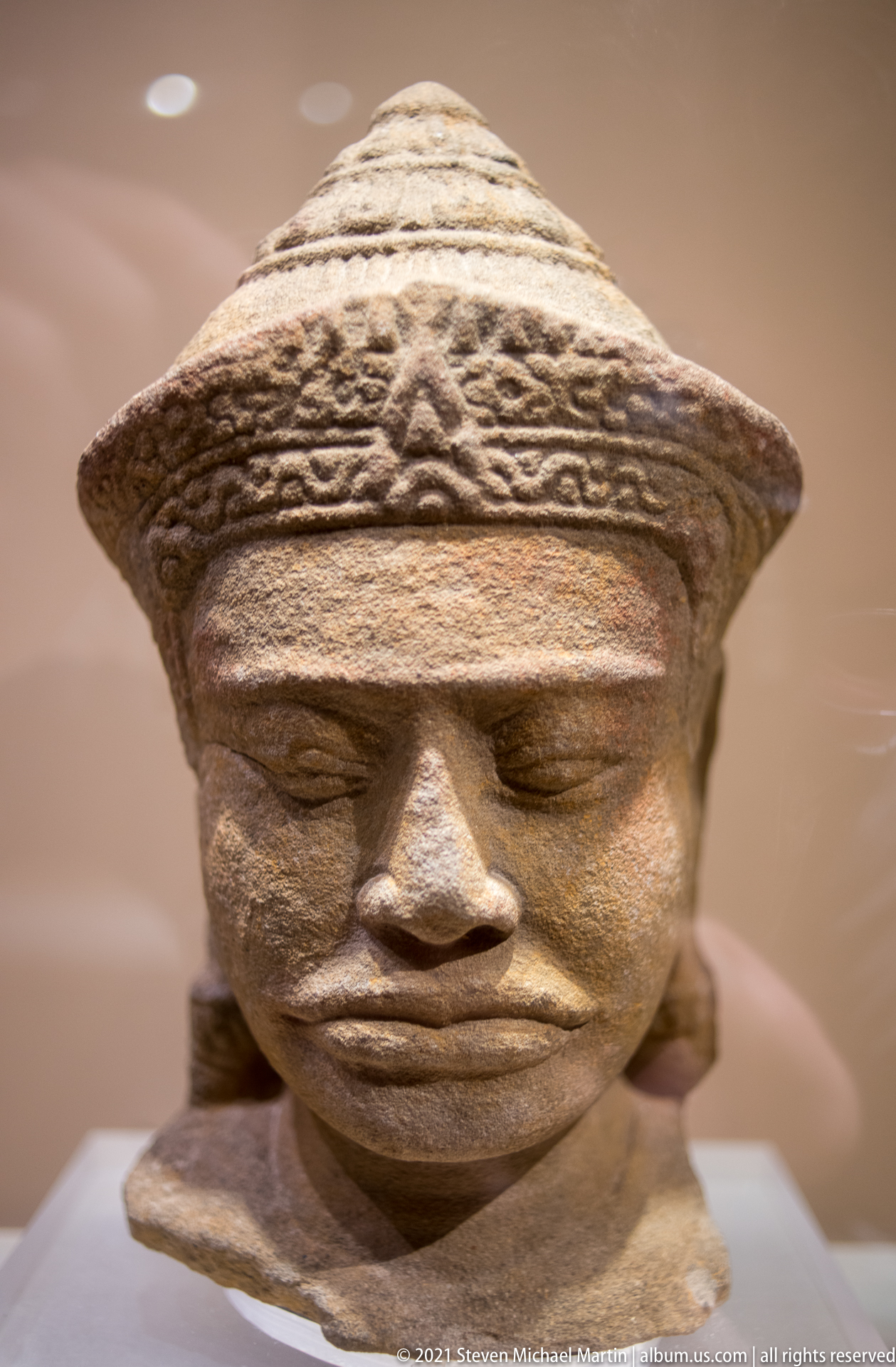
This stone Buddha head belongs to the Khmer tradition of Cambodia’s Angkor period, dated by the Museum of Asian Art of Corfu to the 12th–13th century. Broad facial planes, downcast eyes, full lips, and the patterned headdress create the composed, frontal expression characteristic of the museum’s Cambodian Buddha heads. Weathering softens the carved surface without obscuring the sculpture’s strong symmetry.
Caption
This stone Buddha head belongs to the Khmer tradition of Cambodia’s Angkor period, dated by the Museum of Asian Art of Corfu to the 12th–13th century. Broad facial planes, downcast eyes, full lips, and the patterned headdress create the composed, frontal expression characteristic of the museum’s Cambodian Buddha heads. Weathering softens the carved surface without obscuring the sculpture’s strong symmetry.
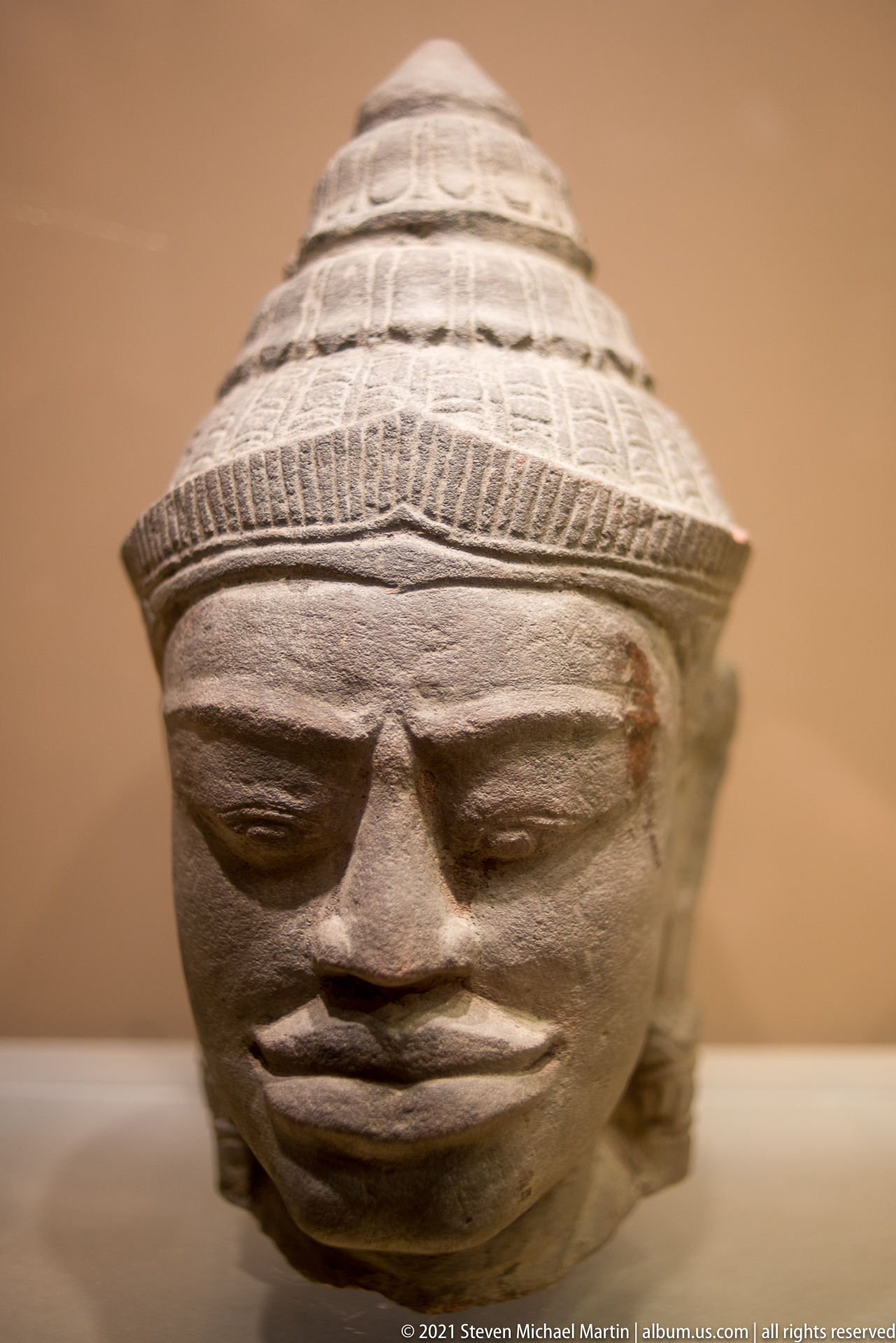
A second stone Buddha head from Cambodia’s Angkor period presents a more elongated profile beneath a high, tiered headdress. The Museum of Asian Art of Corfu dates its Khmer Buddha heads to the 12th–13th century. Heavy-lidded eyes, a broad nose, gently smiling lips, and the crisply patterned crown survive clearly despite abrasion to the stone surface.
Caption
A second stone Buddha head from Cambodia’s Angkor period presents a more elongated profile beneath a high, tiered headdress. The Museum of Asian Art of Corfu dates its Khmer Buddha heads to the 12th–13th century. Heavy-lidded eyes, a broad nose, gently smiling lips, and the crisply patterned crown survive clearly despite abrasion to the stone surface.
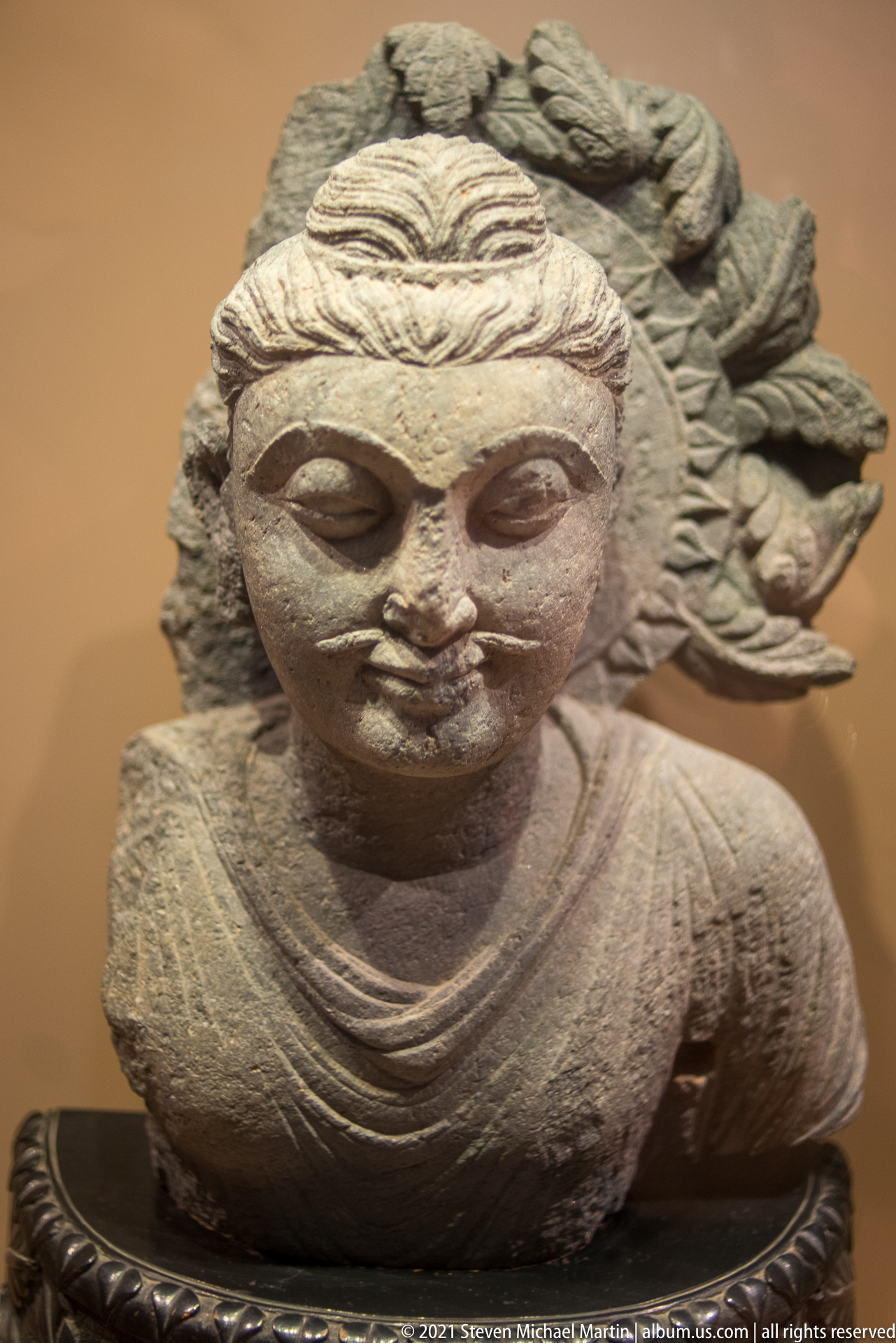
The goddess Hariti appears in this Gandharan grey-schist sculpture from Peshawar, dated by the Museum of Asian Art of Corfu to the 1st–2nd century AD. Her softly modeled face, wavy hair, abundant floral headdress, necklace, and draped garment reflect the Hellenistic vocabulary that shaped Gandharan Buddhist art. The surviving bust preserves the refined carving of the face and ornament despite losses around the outer edges.
Caption
The goddess Hariti appears in this Gandharan grey-schist sculpture from Peshawar, dated by the Museum of Asian Art of Corfu to the 1st–2nd century AD. Her softly modeled face, wavy hair, abundant floral headdress, necklace, and draped garment reflect the Hellenistic vocabulary that shaped Gandharan Buddhist art. The surviving bust preserves the refined carving of the face and ornament despite losses around the outer edges.
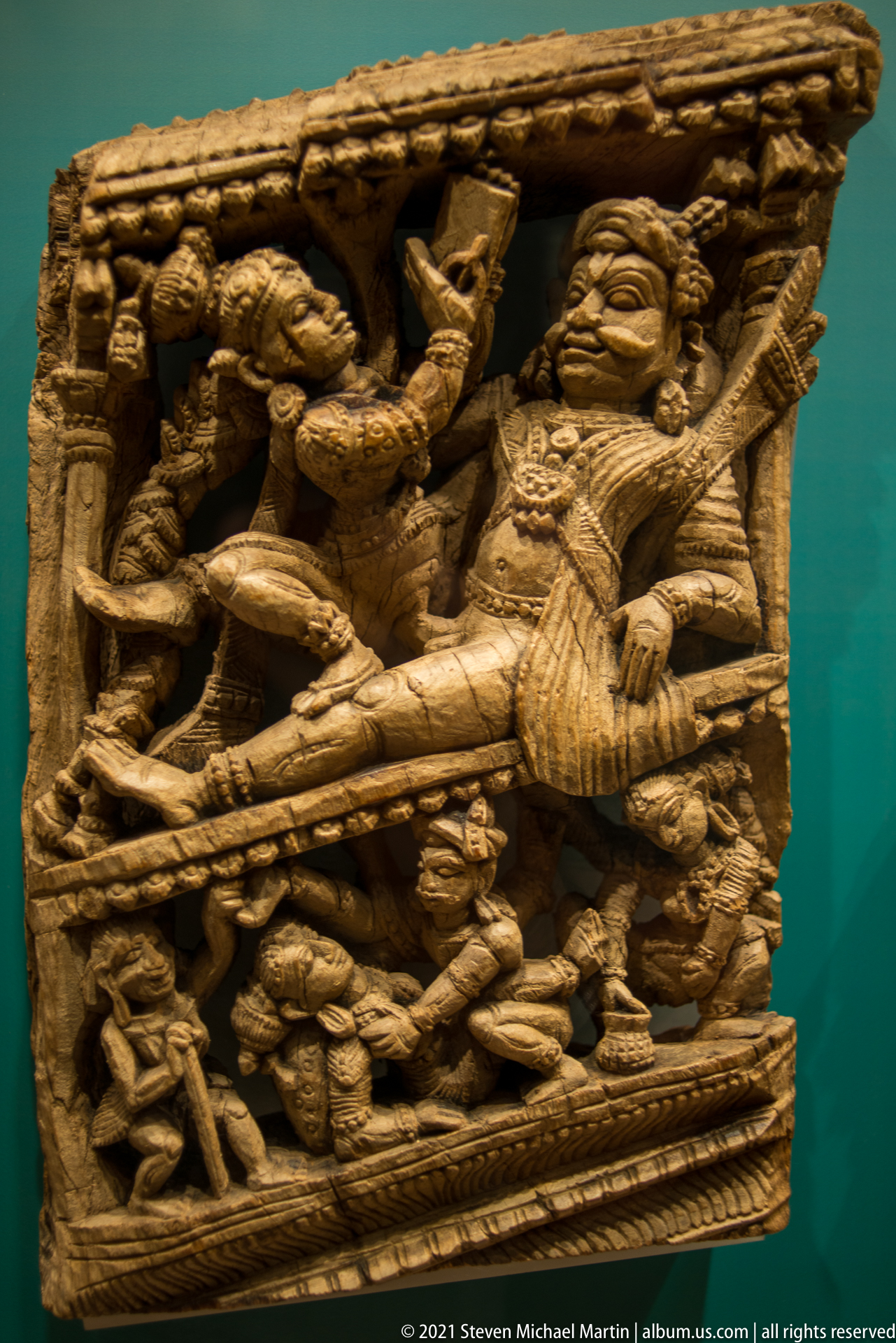
Carved for a processional chariot in Southern India, this 17th–18th-century Hindu fretwork compresses an animated figural scene into a deep wooden relief. Interlocking bodies, emphatic gestures, jewelry, and vigorously undercut limbs create strong shadow and movement across the panel. The Museum of Asian Art of Corfu identifies this class of chariot carving as erotic Hindu imagery, part of the sculptural decoration carried in religious procession.
Caption
Carved for a processional chariot in Southern India, this 17th–18th-century Hindu fretwork compresses an animated figural scene into a deep wooden relief. Interlocking bodies, emphatic gestures, jewelry, and vigorously undercut limbs create strong shadow and movement across the panel. The Museum of Asian Art of Corfu identifies this class of chariot carving as erotic Hindu imagery, part of the sculptural decoration carried in religious procession.
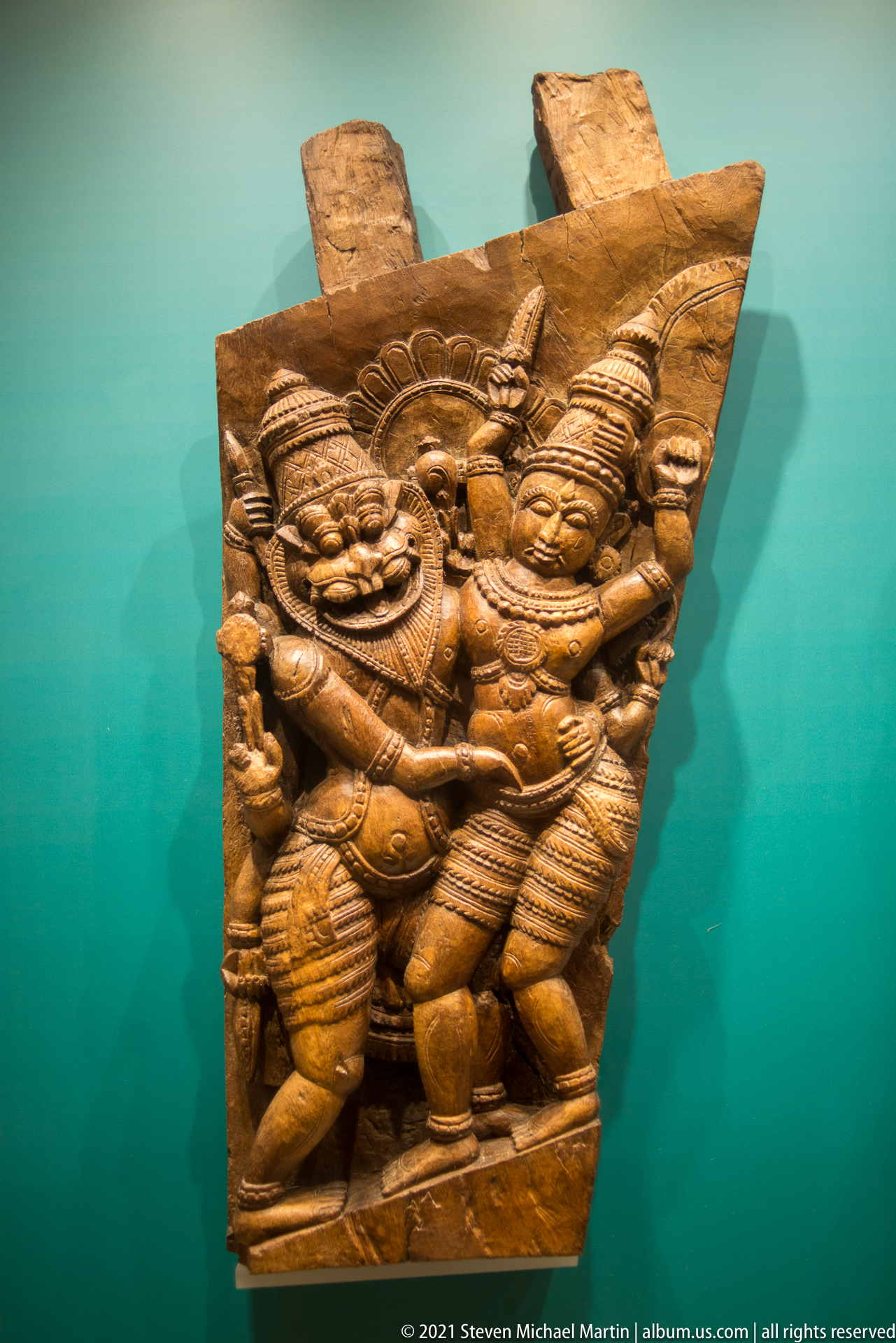
Two richly adorned figures stand side by side in a compact wooden relief, their bodies modeled in high relief beneath pointed headdresses. Jewelry, patterned garments, bent knees, and surrounding ornamental forms create a dense sculptural surface, suggesting the panel formed part of a larger decorative or religious ensemble.
Caption
Two richly adorned figures stand side by side in a compact wooden relief, their bodies modeled in high relief beneath pointed headdresses. Jewelry, patterned garments, bent knees, and surrounding ornamental forms create a dense sculptural surface, suggesting the panel formed part of a larger decorative or religious ensemble.
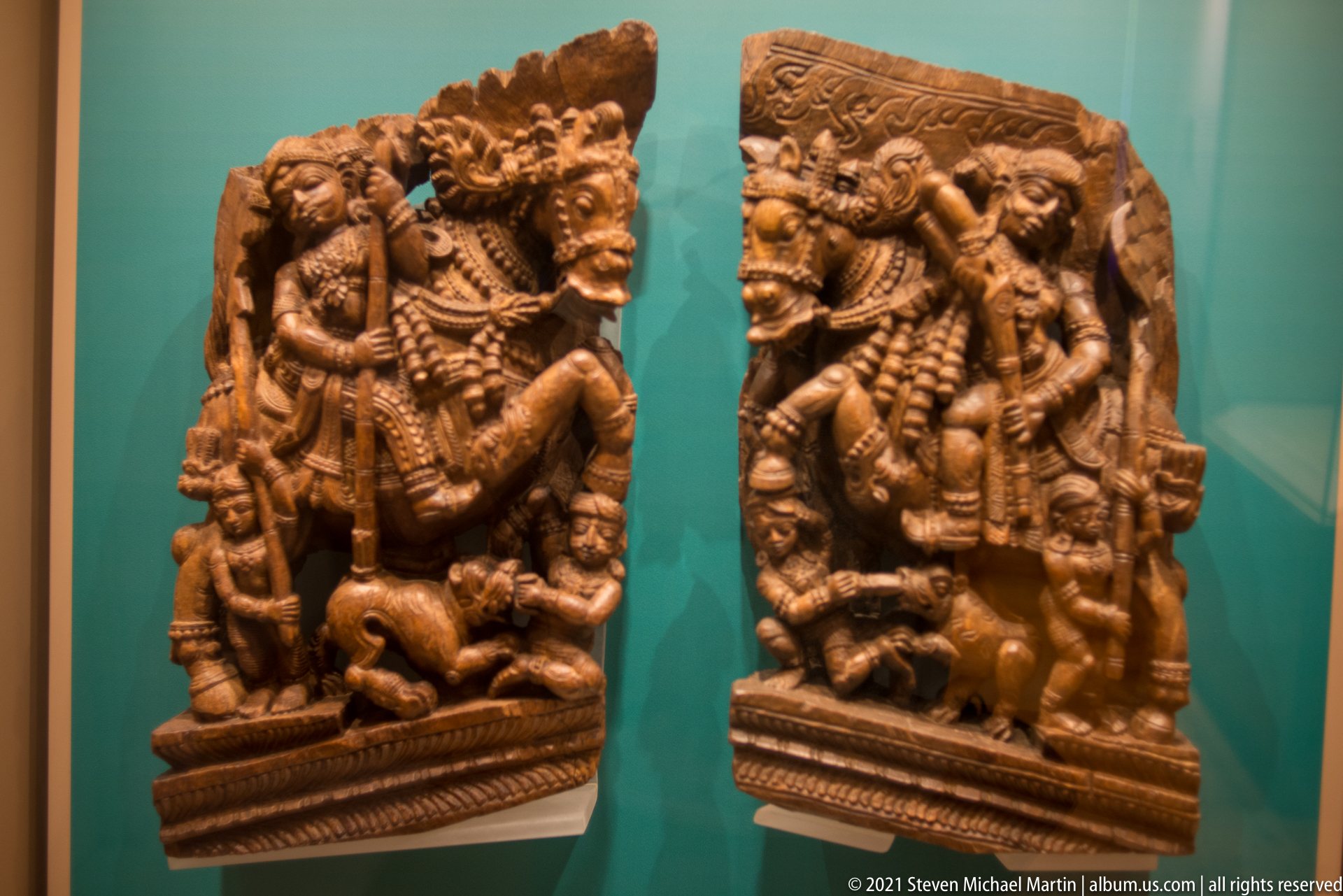
Two carved wooden panels are displayed as a pair, each centered on a richly ornamented standing figure accompanied by smaller attendants and animals. Their closely related scale, framing, and dense jewelry suggest companion architectural or devotional reliefs, while differences in pose and surrounding figures distinguish the two compositions.
Caption
Two carved wooden panels are displayed as a pair, each centered on a richly ornamented standing figure accompanied by smaller attendants and animals. Their closely related scale, framing, and dense jewelry suggest companion architectural or devotional reliefs, while differences in pose and surrounding figures distinguish the two compositions.
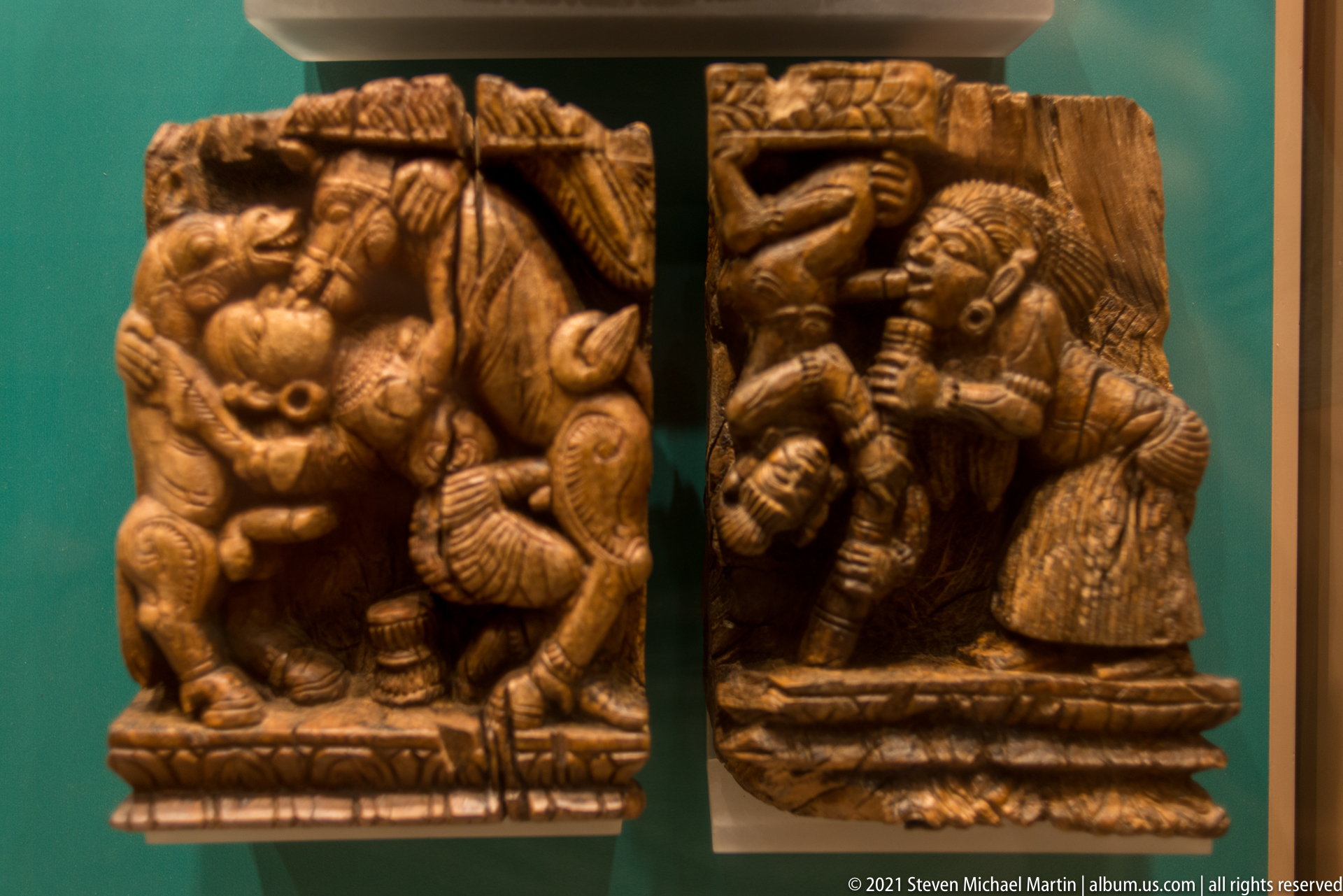
Two compact wooden reliefs present forceful, deeply modeled deities within narrow frames. The left figure stands frontally with an emphatic stance and rounded torso, while the right figure turns more dynamically amid smaller carved elements, making the pair useful for comparing posture and sculptural depth.
Caption
Two compact wooden reliefs present forceful, deeply modeled deities within narrow frames. The left figure stands frontally with an emphatic stance and rounded torso, while the right figure turns more dynamically amid smaller carved elements, making the pair useful for comparing posture and sculptural depth.
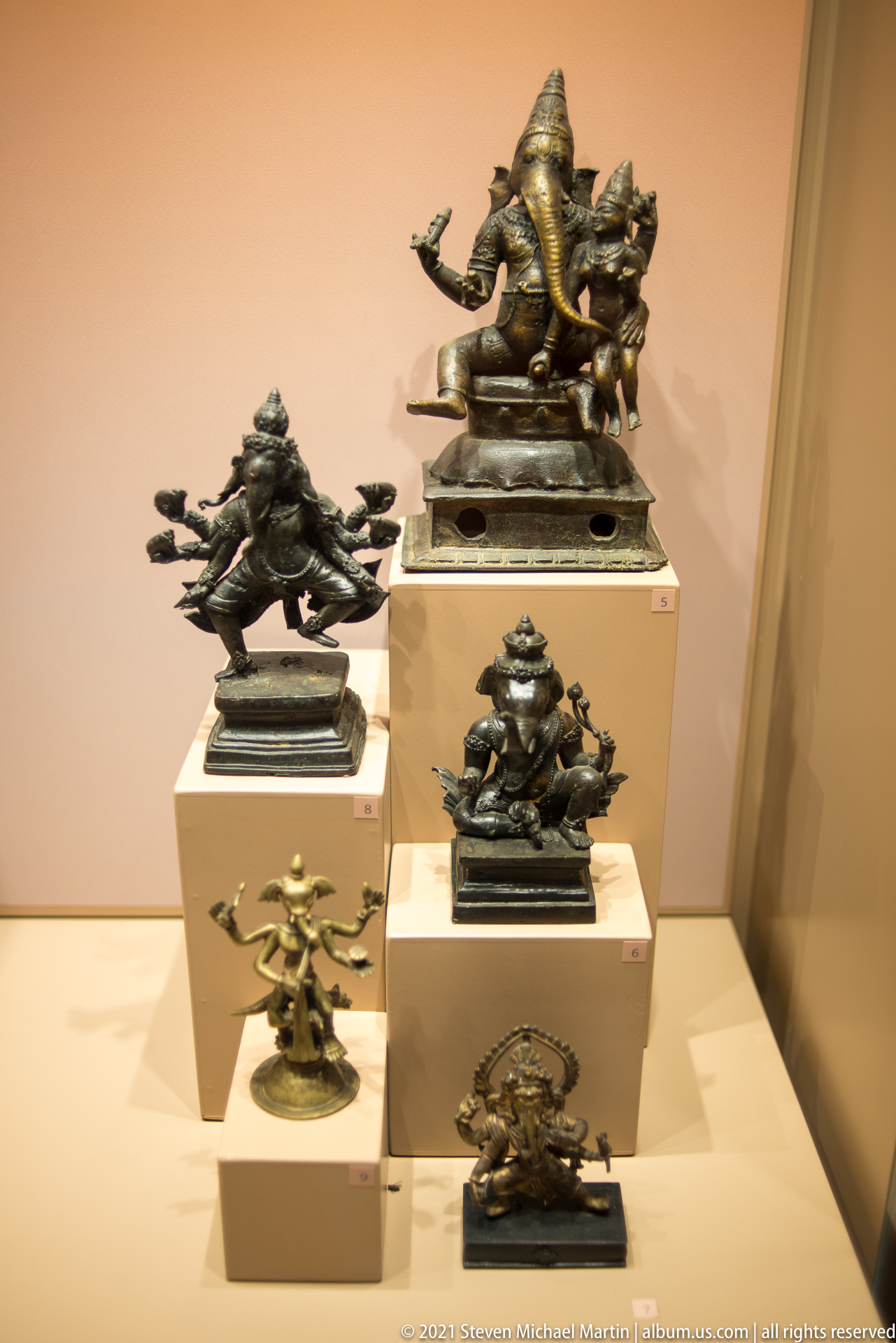
A tiered display groups several small metal Hindu devotional images, with an elephant-headed Ganesha seated prominently at the upper right. Other figures occupy separate plinths in seated, dancing, or reclining poses, allowing their silhouettes, attributes, and varied casting traditions to be compared within a single case.
Caption
A tiered display groups several small metal Hindu devotional images, with an elephant-headed Ganesha seated prominently at the upper right. Other figures occupy separate plinths in seated, dancing, or reclining poses, allowing their silhouettes, attributes, and varied casting traditions to be compared within a single case.
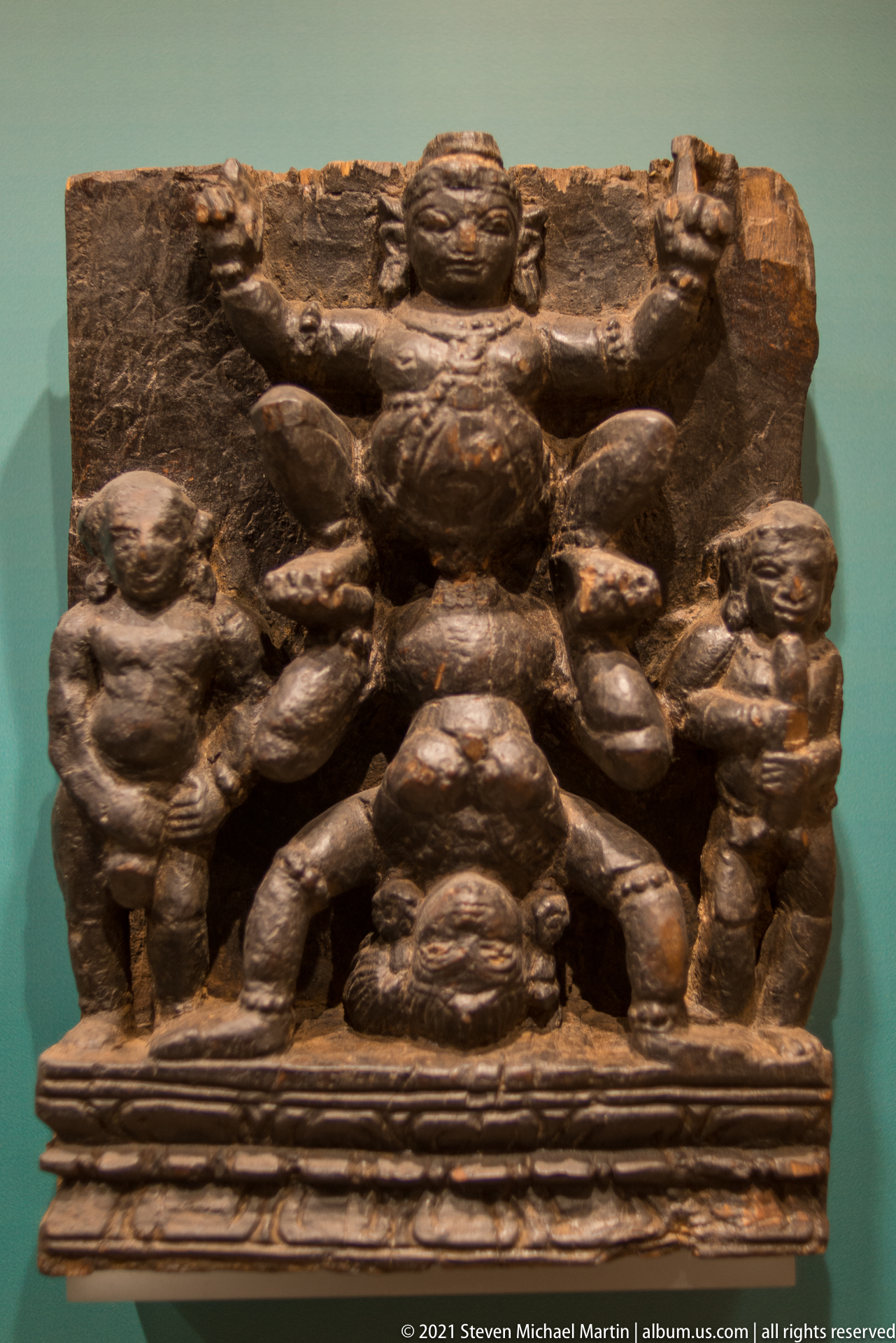
A horizontal wooden relief centers on a large figure whose limbs spread across the composition, surrounded by smaller attendants on both sides and above. The crowded arrangement, deeply carved bodies, and narrow ornamental base create a compact narrative scene whose precise mythological subject cannot be confirmed from the proof sheet alone.
Caption
A horizontal wooden relief centers on a large figure whose limbs spread across the composition, surrounded by smaller attendants on both sides and above. The crowded arrangement, deeply carved bodies, and narrow ornamental base create a compact narrative scene whose precise mythological subject cannot be confirmed from the proof sheet alone.
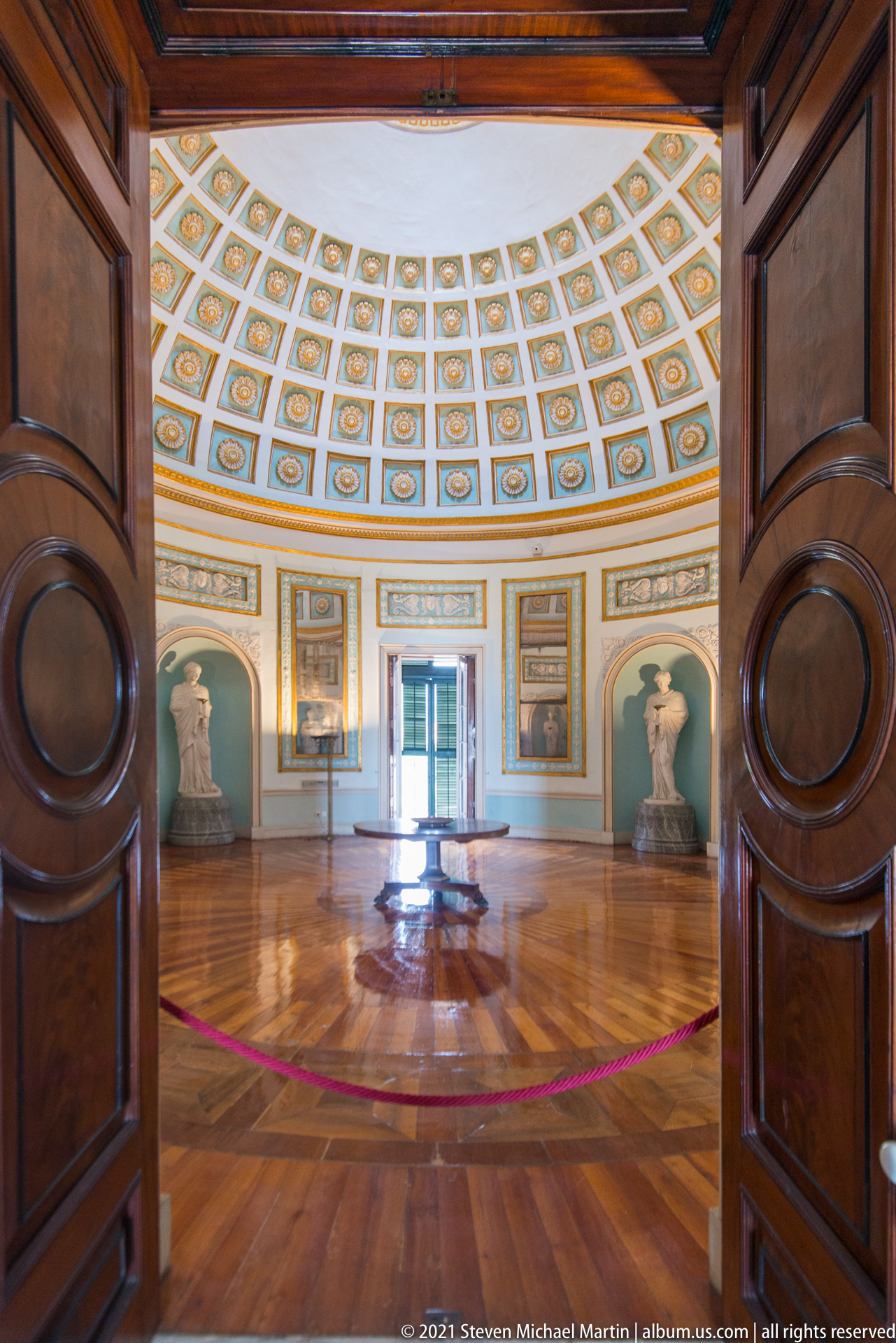
Tall wooden doors open onto a circular neoclassical rotunda crowned by a coffered dome. Repeated painted coffers radiate around the central oculus, while classical busts stand in arched wall niches above a highly polished parquet floor. The centered doorway frames the room’s symmetry and ceremonial scale.
Caption
Tall wooden doors open onto a circular neoclassical rotunda crowned by a coffered dome. Repeated painted coffers radiate around the central oculus, while classical busts stand in arched wall niches above a highly polished parquet floor. The centered doorway frames the room’s symmetry and ceremonial scale.
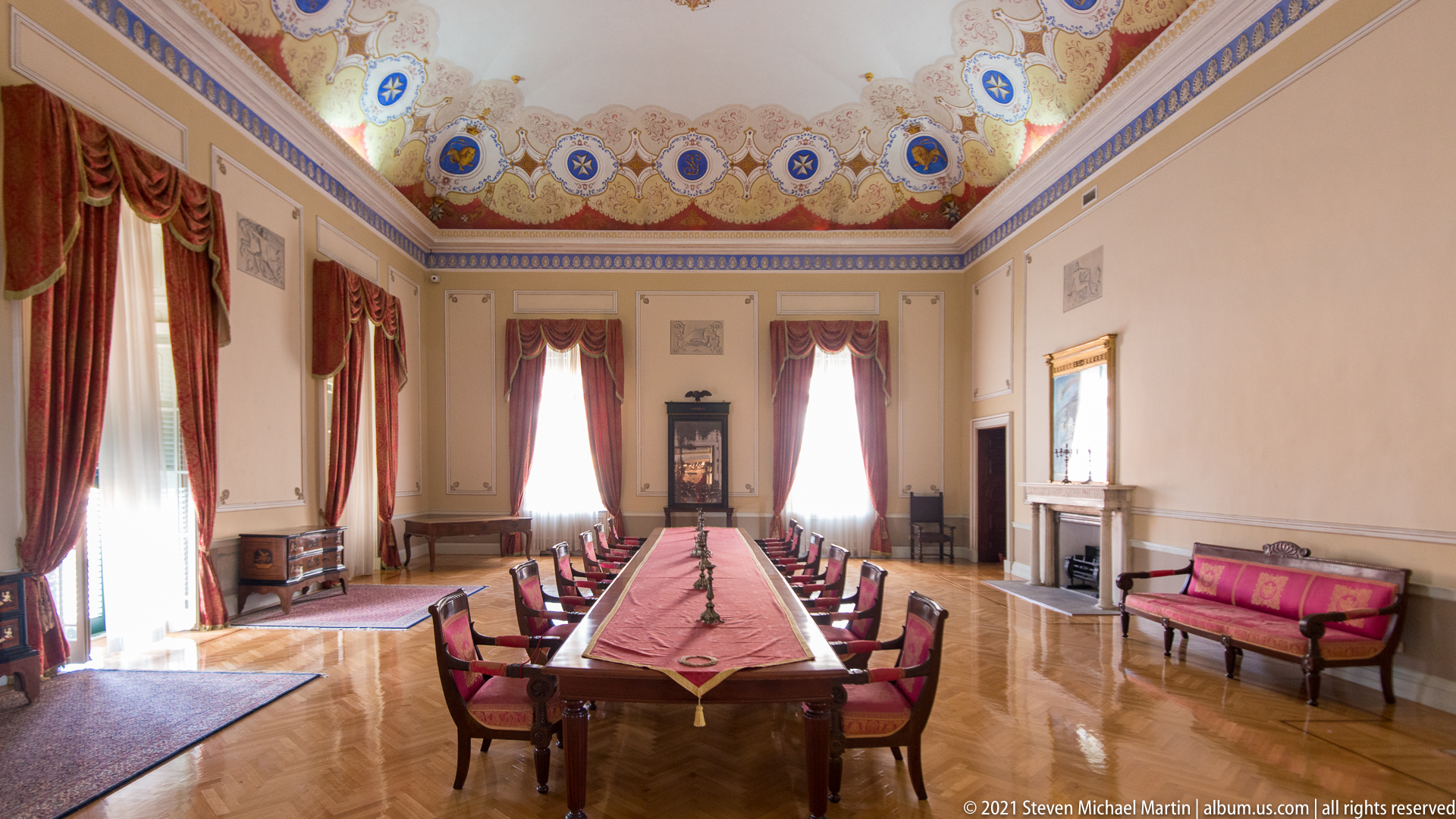
A long table runs through a high-ceilinged formal room in the Palace of St. Michael and St. George, surrounded by red-upholstered chairs and framed by tall windows with red draperies. Gilded and painted ceiling ornament, polished parquet flooring, and period furnishings preserve the ceremonial character of the museum’s historic setting.
Caption
A long table runs through a high-ceilinged formal room in the Palace of St. Michael and St. George, surrounded by red-upholstered chairs and framed by tall windows with red draperies. Gilded and painted ceiling ornament, polished parquet flooring, and period furnishings preserve the ceremonial character of the museum’s historic setting.
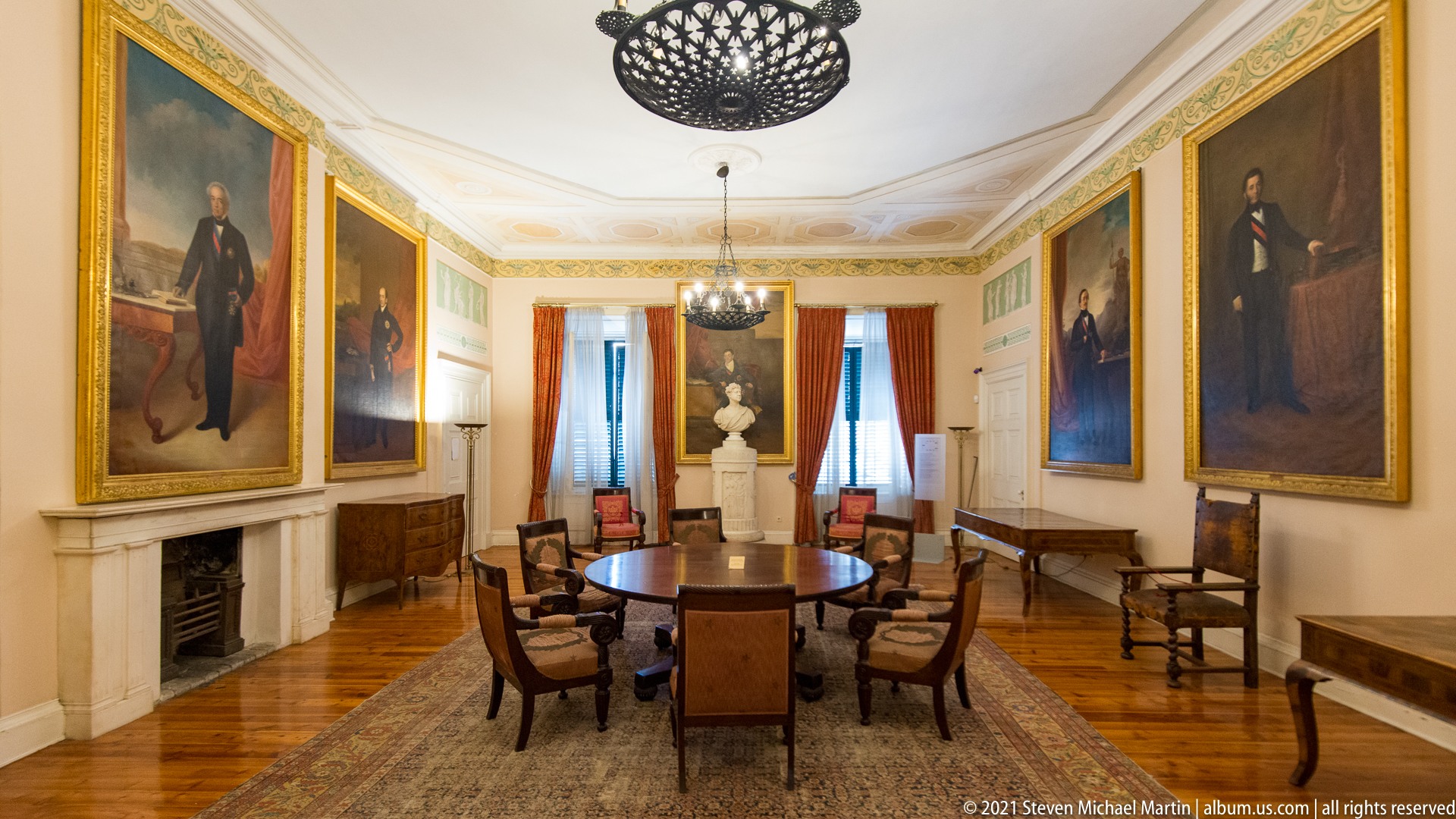
The Ionian Senate Meetings Hall retains much of its original official character, centered on the authentic round meeting table and Senators’ chairs designed by Sir George Whitmore. Large portraits of Senate chairmen line the walls, while a marble fireplace and sculptural bust reinforce the room’s civic function. The Museum of Asian Art of Corfu identifies this western ground-floor chamber as one of the palace’s best-preserved historic interiors.
Caption
The Ionian Senate Meetings Hall retains much of its original official character, centered on the authentic round meeting table and Senators’ chairs designed by Sir George Whitmore. Large portraits of Senate chairmen line the walls, while a marble fireplace and sculptural bust reinforce the room’s civic function. The Museum of Asian Art of Corfu identifies this western ground-floor chamber as one of the palace’s best-preserved historic interiors.
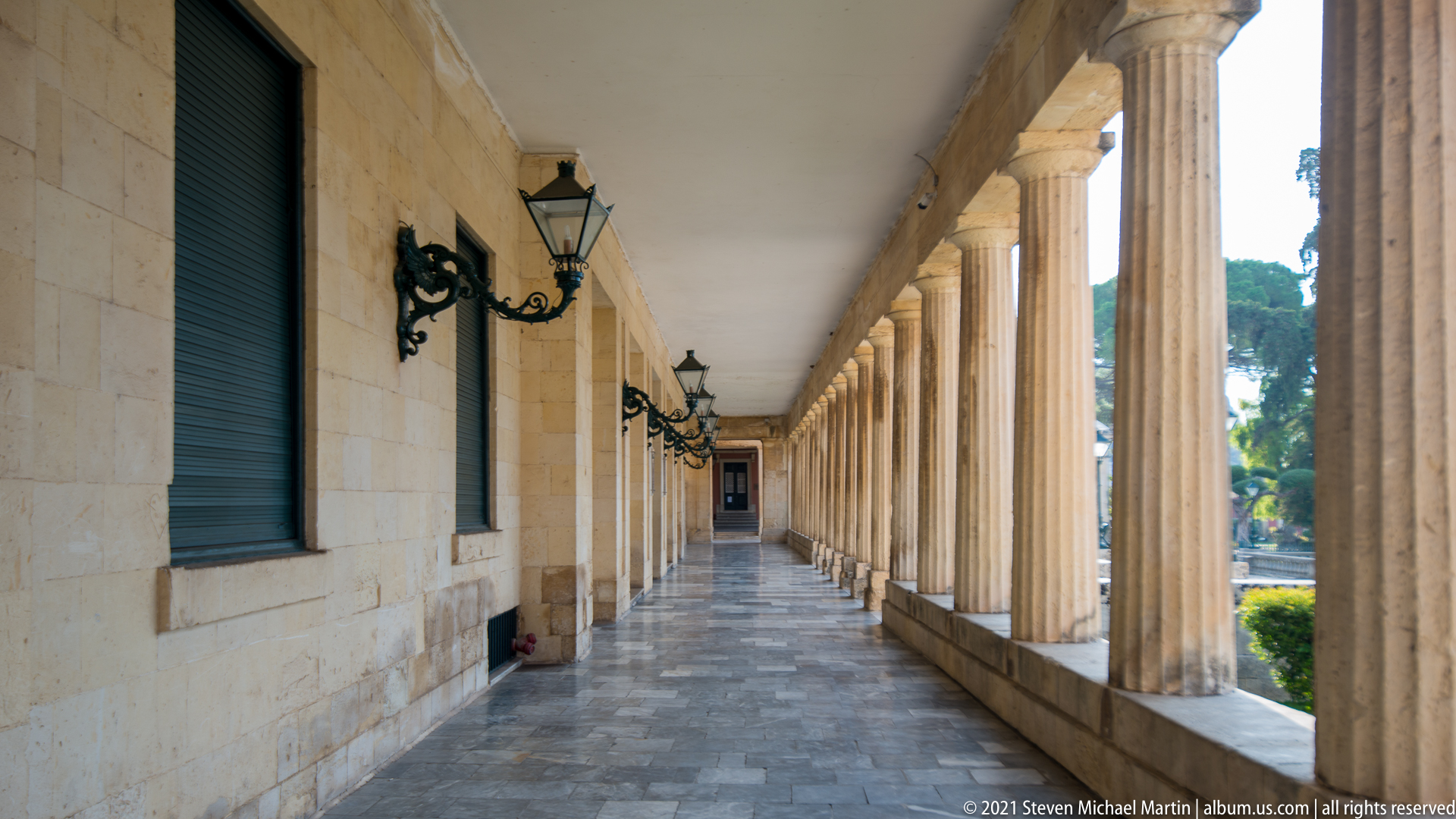
A long covered colonnade recedes toward a distant doorway along the exterior of the Palace of St. Michael and St. George. Repeated stone columns and wall-mounted lanterns establish a strong linear rhythm, while the open right side admits views of greenery and bright Mediterranean daylight.
Caption
A long covered colonnade recedes toward a distant doorway along the exterior of the Palace of St. Michael and St. George. Repeated stone columns and wall-mounted lanterns establish a strong linear rhythm, while the open right side admits views of greenery and bright Mediterranean daylight.
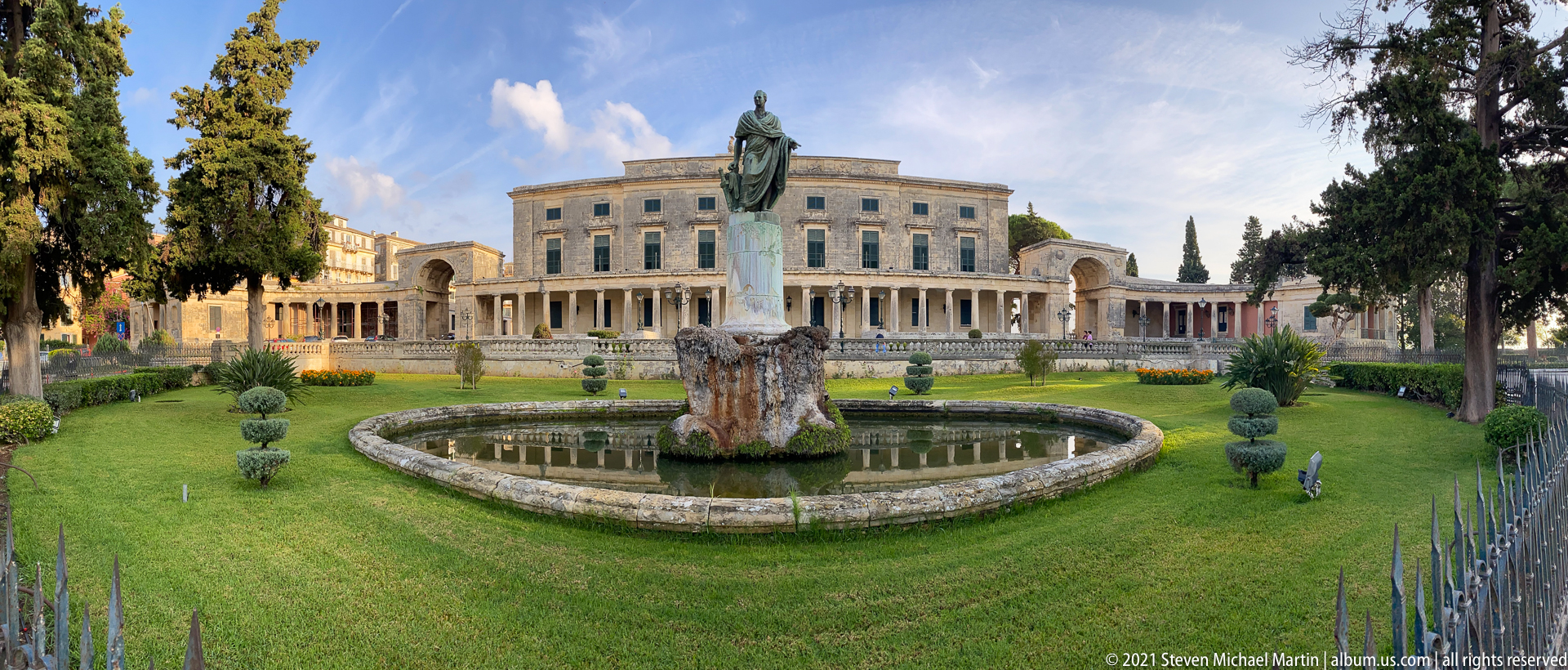
The pale neoclassical façade of the Palace of St. Michael and St. George rises behind a formal garden and circular basin. A bronze standing figure on a tall rough-stone pedestal anchors the foreground, while clipped shrubs, lawns, and trees frame the museum building and its flanking colonnades.
Caption
The pale neoclassical façade of the Palace of St. Michael and St. George rises behind a formal garden and circular basin. A bronze standing figure on a tall rough-stone pedestal anchors the foreground, while clipped shrubs, lawns, and trees frame the museum building and its flanking colonnades.
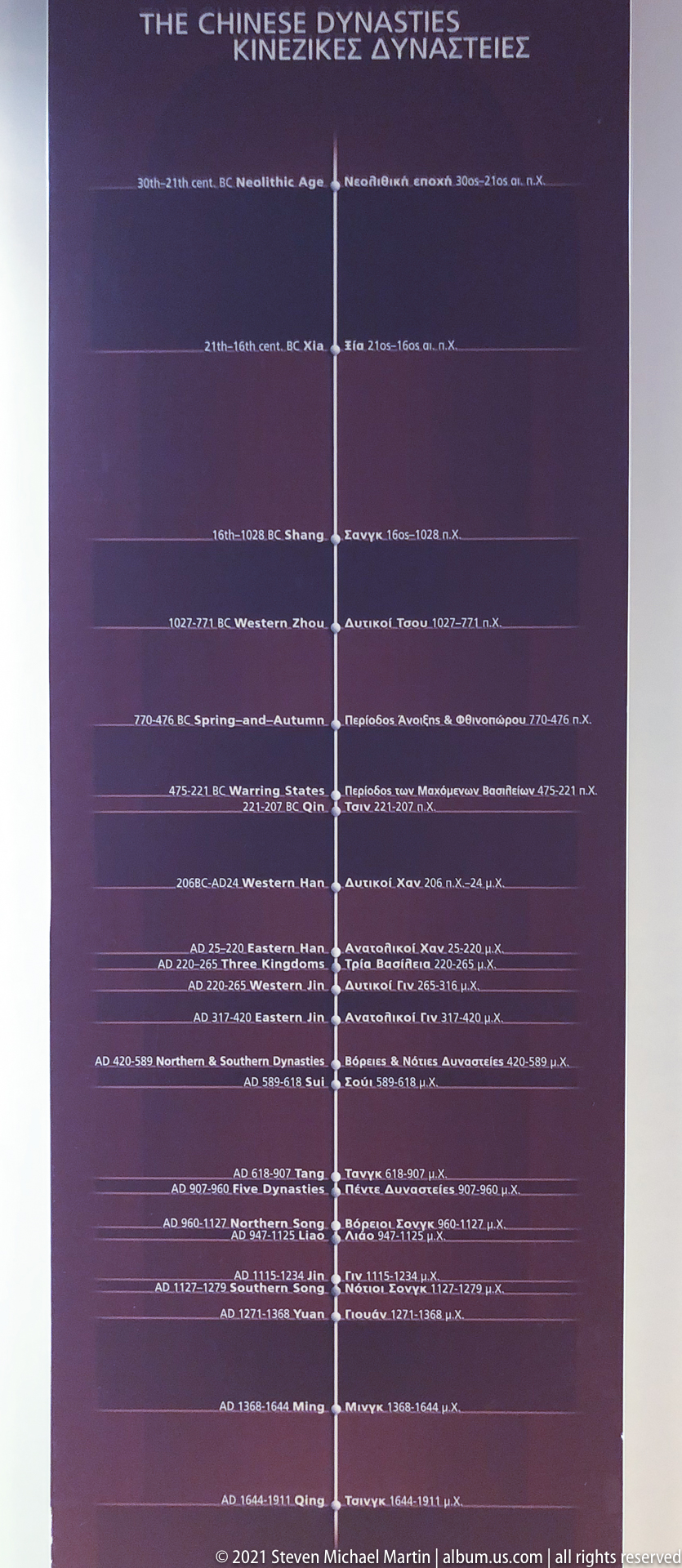
A tall interpretive panel titled “The Chinese Dynasties” presents a vertical chronology of successive periods in Chinese history. A central timeline organizes numerous dynasty and date labels, providing historical orientation for the Chinese objects displayed in the surrounding galleries rather than functioning as an art object itself.
Caption
A tall interpretive panel titled “The Chinese Dynasties” presents a vertical chronology of successive periods in Chinese history. A central timeline organizes numerous dynasty and date labels, providing historical orientation for the Chinese objects displayed in the surrounding galleries rather than functioning as an art object itself.
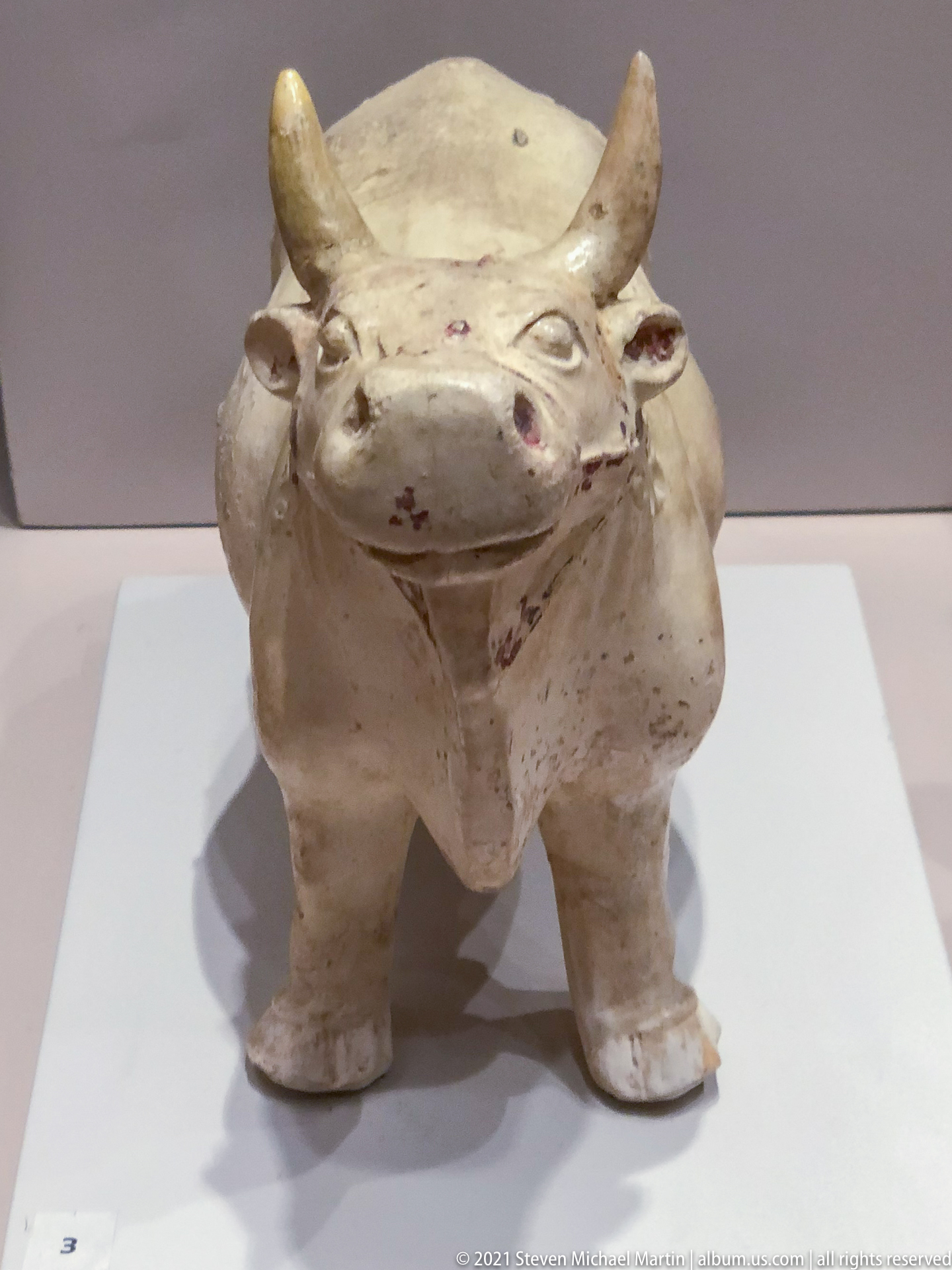
A squat white-glazed ceramic animal stands on four short legs with an opening in its back, combining sculptural form with vessel function. Projecting horns, rounded muzzle, modeled eyes, and a broad body give the creature a bovine appearance, while scattered dark marks and glaze wear remain visible across the pale surface.
Caption
A squat white-glazed ceramic animal stands on four short legs with an opening in its back, combining sculptural form with vessel function. Projecting horns, rounded muzzle, modeled eyes, and a broad body give the creature a bovine appearance, while scattered dark marks and glaze wear remain visible across the pale surface.
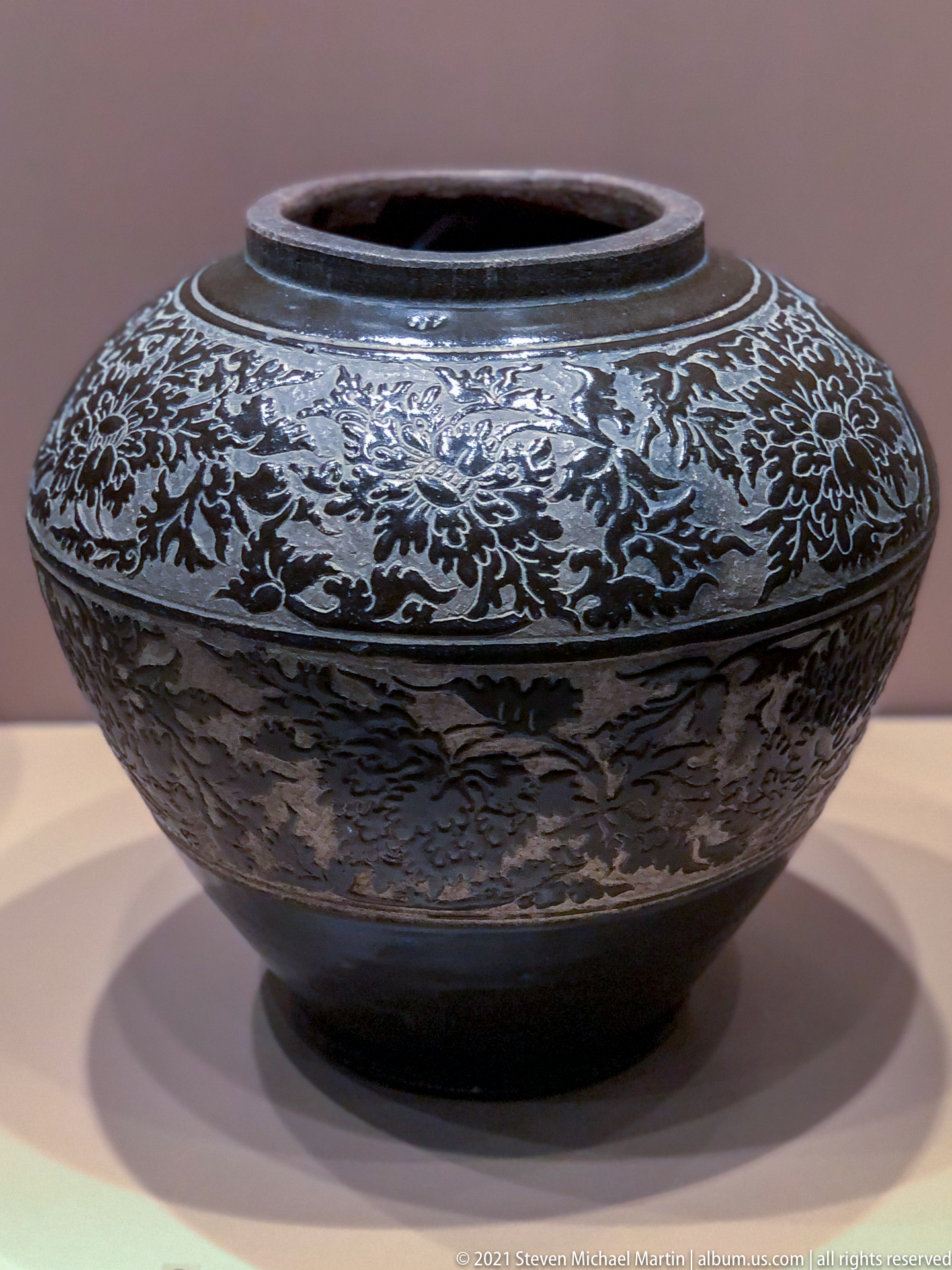
A broad, low vessel with a short foot and wide mouth is covered in a glossy dark glaze, overlaid by dense pale floral and scrolling decoration. The ornament wraps continuously around the shoulder and body, while the open neck and compressed profile emphasize the vessel’s horizontal, rounded silhouette.
Caption
A broad, low vessel with a short foot and wide mouth is covered in a glossy dark glaze, overlaid by dense pale floral and scrolling decoration. The ornament wraps continuously around the shoulder and body, while the open neck and compressed profile emphasize the vessel’s horizontal, rounded silhouette.
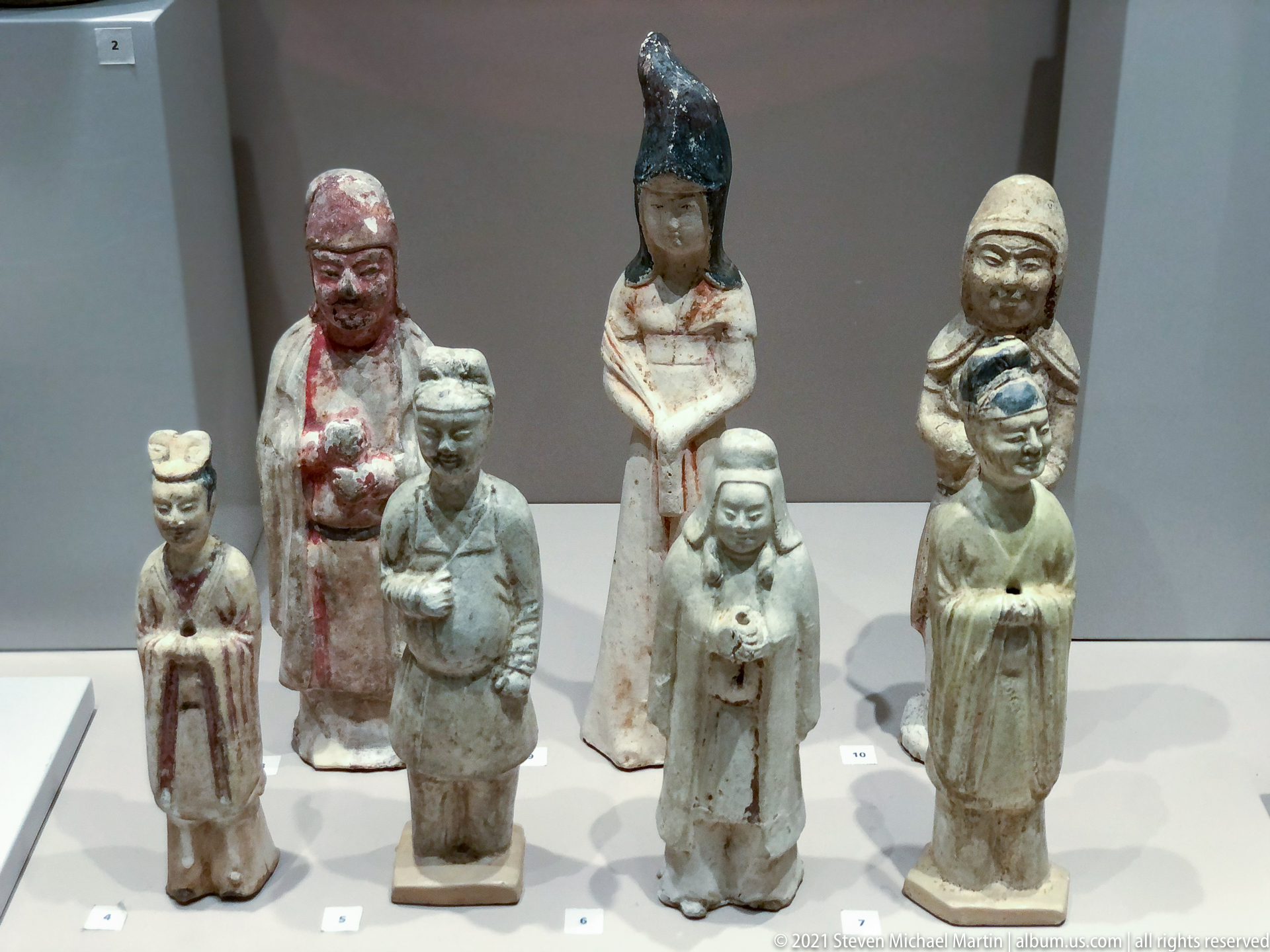
Six small ceramic figures stand together in a display case, each modeled in long robes and retaining traces of colored pigment. Their varied hats, hairstyles, gestures, and body proportions create an ensemble of distinct human types, with red, green, black, and cream surfaces surviving unevenly across the group.
Caption
Six small ceramic figures stand together in a display case, each modeled in long robes and retaining traces of colored pigment. Their varied hats, hairstyles, gestures, and body proportions create an ensemble of distinct human types, with red, green, black, and cream surfaces surviving unevenly across the group.

A circular bronze mirror is shown with its decorated back facing outward, organized in concentric ornamental zones around a raised central boss. Dense relief motifs fill the inner and outer rings, and the dark aged patina accentuates the crisp cast patterning against the plain display background.
Caption
A circular bronze mirror is shown with its decorated back facing outward, organized in concentric ornamental zones around a raised central boss. Dense relief motifs fill the inner and outer rings, and the dark aged patina accentuates the crisp cast patterning against the plain display background.
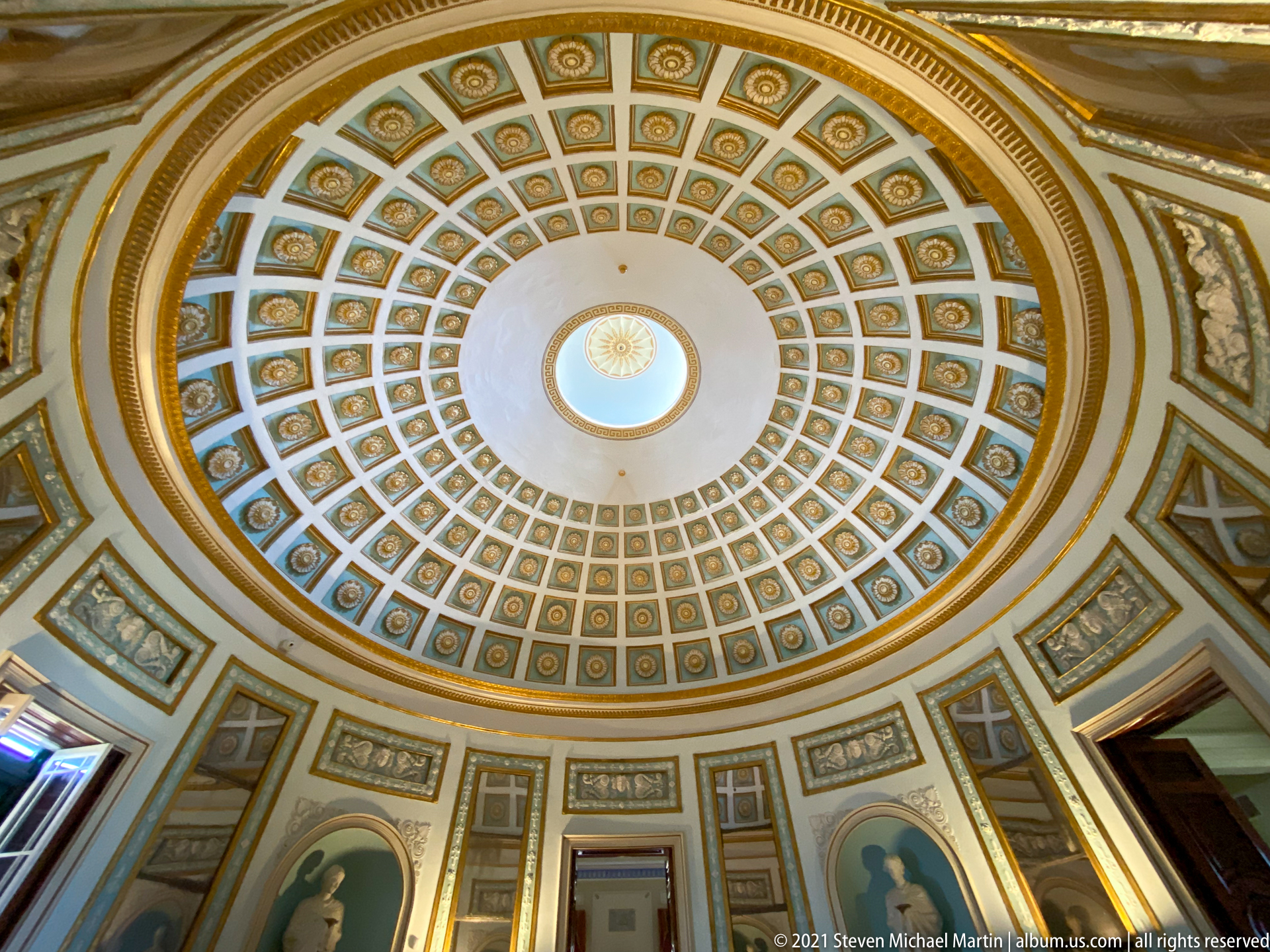
The coffered dome of the palace Rotunda rises above the circular Reception Hall in concentric rings of blue, white, and gold ornament. The Museum of Asian Art of Corfu describes the dome as inspired by the Roman Pantheon and terminating in a round oculus. Seen together with the niches and wall panels below, the ceiling’s radial geometry reinforces the perfectly circular organization of the room.
Caption
The coffered dome of the palace Rotunda rises above the circular Reception Hall in concentric rings of blue, white, and gold ornament. The Museum of Asian Art of Corfu describes the dome as inspired by the Roman Pantheon and terminating in a round oculus. Seen together with the niches and wall panels below, the ceiling’s radial geometry reinforces the perfectly circular organization of the room.
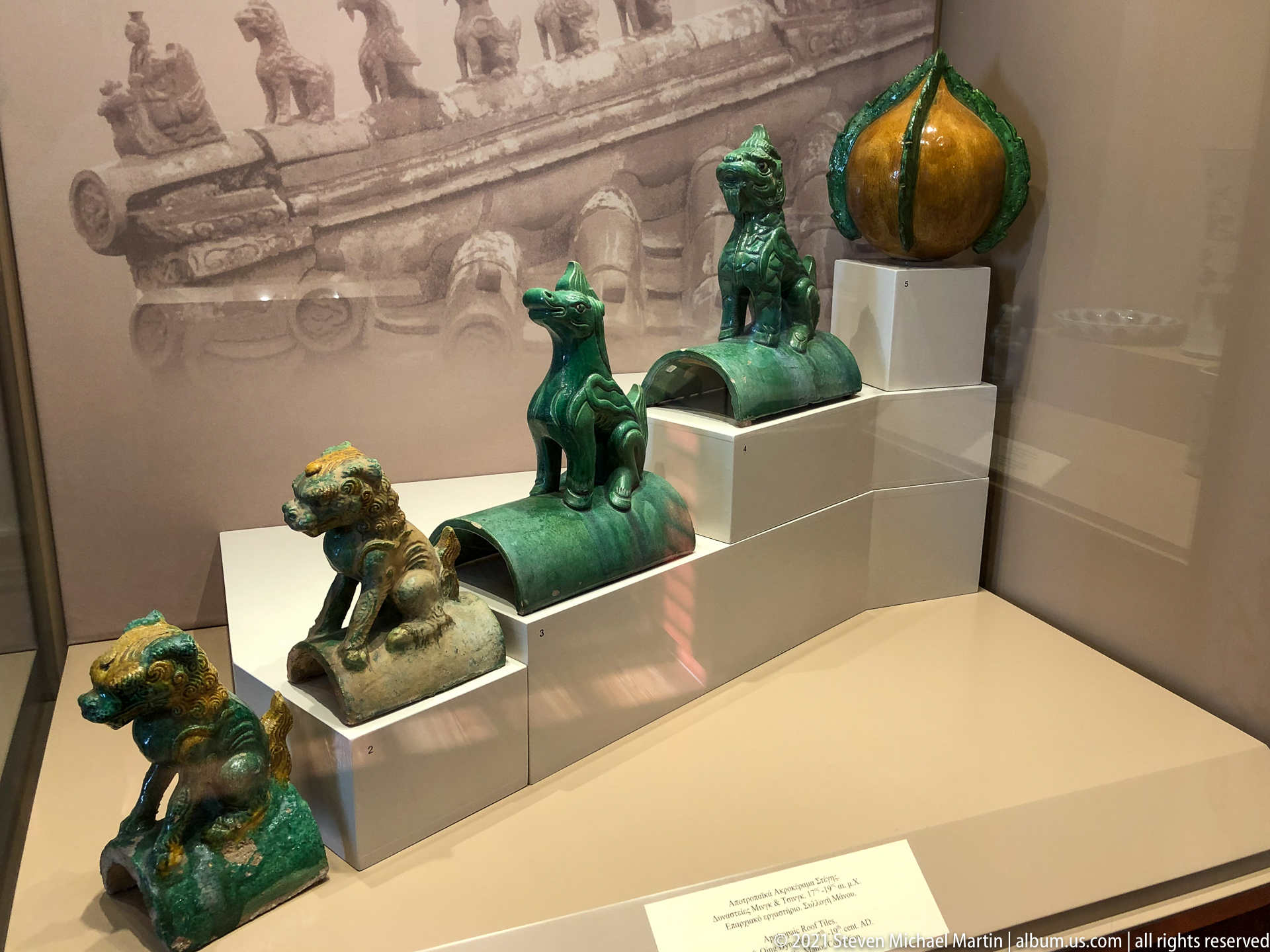
A stepped display presents several green-glazed ceramic architectural ornaments, including crouching guardian animals, upright mythical creatures, and a bulbous finial. Their vivid glaze and hollow or socketed bases suggest elements intended for placement along roof ridges or architectural surfaces rather than freestanding devotional sculpture.
Caption
A stepped display presents several green-glazed ceramic architectural ornaments, including crouching guardian animals, upright mythical creatures, and a bulbous finial. Their vivid glaze and hollow or socketed bases suggest elements intended for placement along roof ridges or architectural surfaces rather than freestanding devotional sculpture.
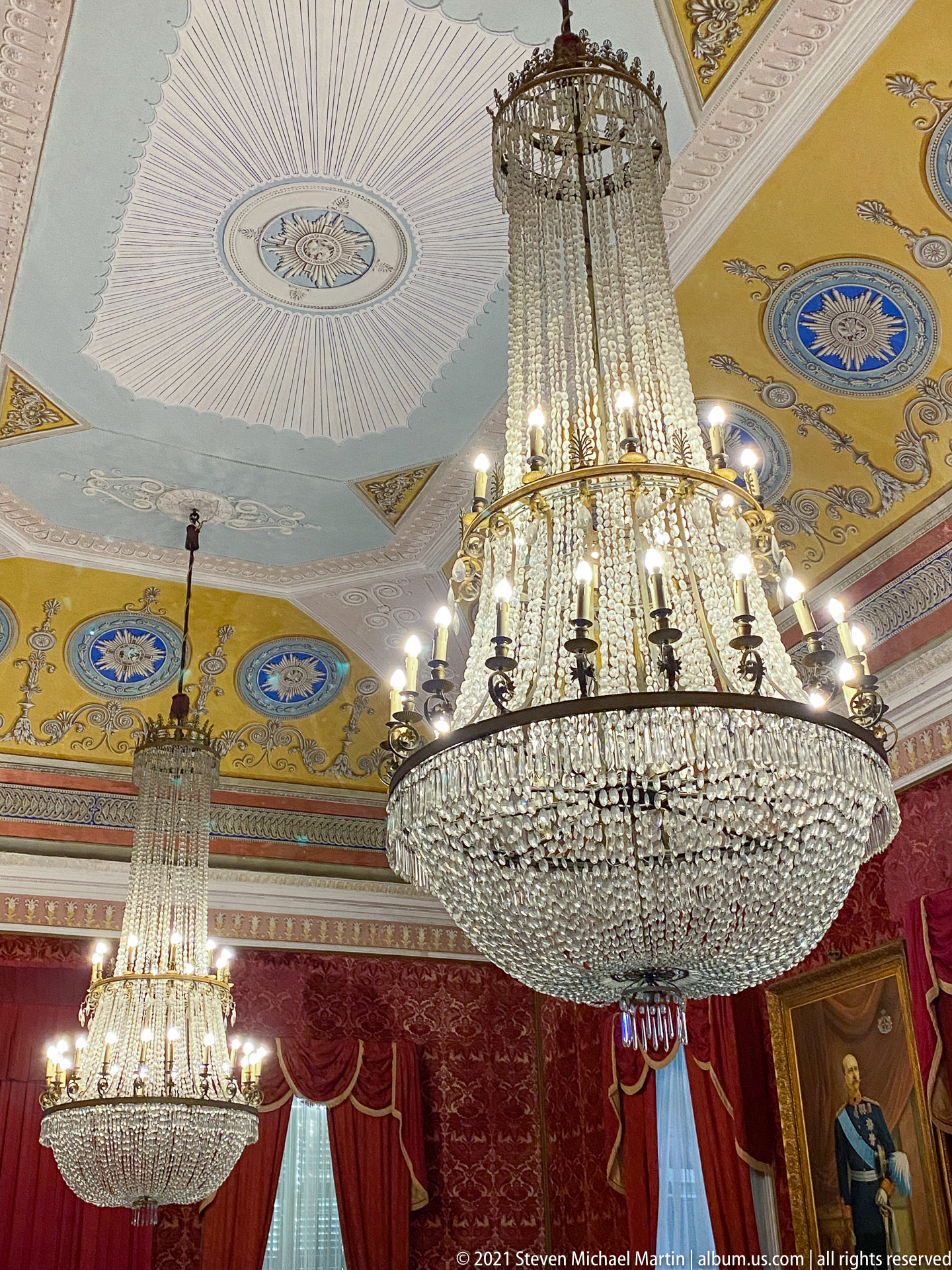
Two immense crystal chandeliers dominate this upward view of the palace Throne Room, suspended beneath a richly restored ceiling decorated for the Order of Saint Michael and Saint George. Red draperies and portraits remain visible below the cornice, tying the lighting fixtures to the ceremonial chamber. The official palace history identifies the Throne Room as the former setting for the Lord High Commissioner’s audiences and the Order’s formal ceremonies.
Caption
Two immense crystal chandeliers dominate this upward view of the palace Throne Room, suspended beneath a richly restored ceiling decorated for the Order of Saint Michael and Saint George. Red draperies and portraits remain visible below the cornice, tying the lighting fixtures to the ceremonial chamber. The official palace history identifies the Throne Room as the former setting for the Lord High Commissioner’s audiences and the Order’s formal ceremonies.
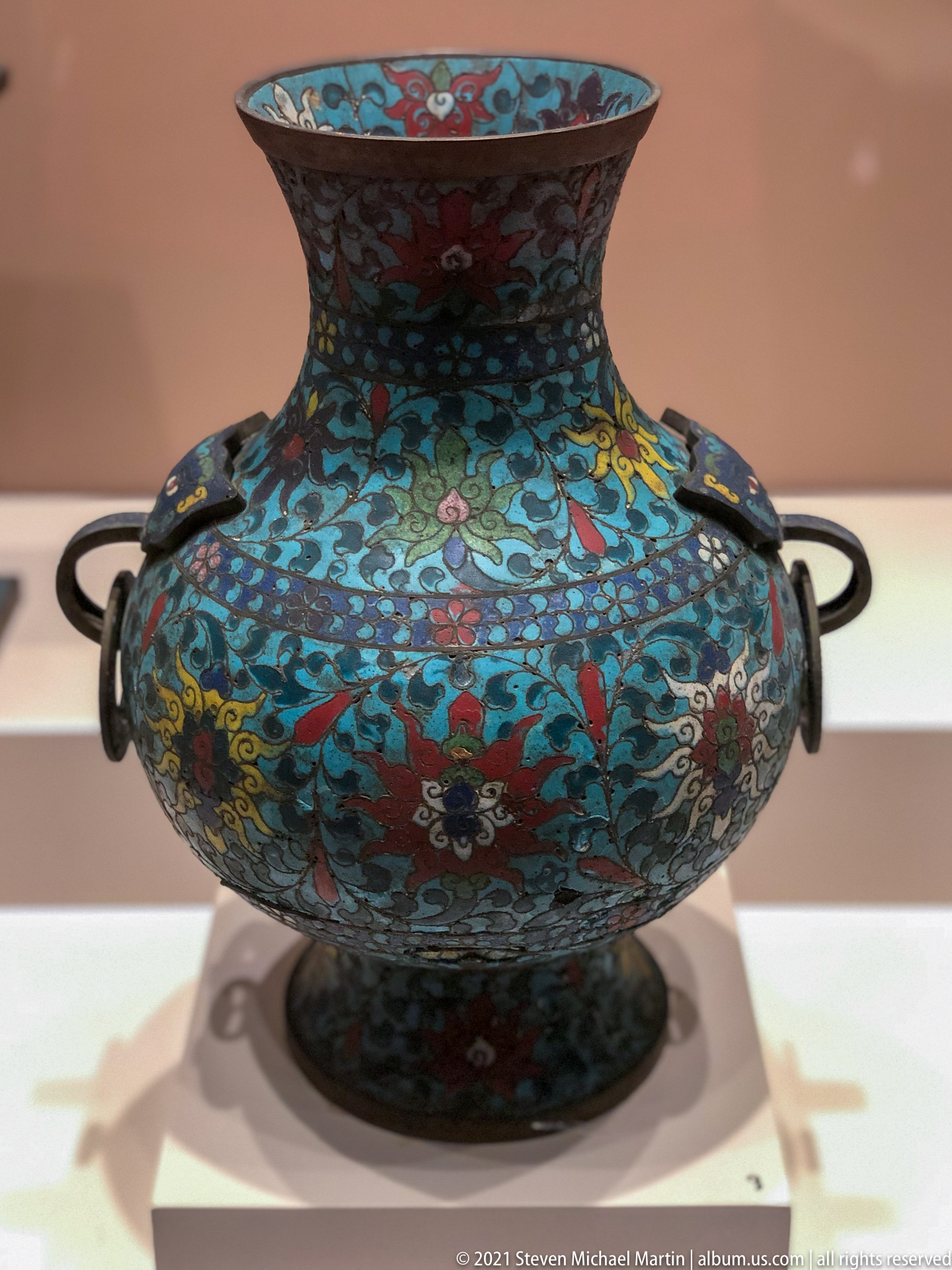
A broad-shouldered cloisonné vessel combines a flaring neck, rounded body, and paired dark handles. Turquoise enamel forms the dominant ground for dense scrolling foliage and multicolored blossoms, while dark wire outlines separate the intricate motifs and define the vessel’s decorative structure.
Caption
A broad-shouldered cloisonné vessel combines a flaring neck, rounded body, and paired dark handles. Turquoise enamel forms the dominant ground for dense scrolling foliage and multicolored blossoms, while dark wire outlines separate the intricate motifs and define the vessel’s decorative structure.
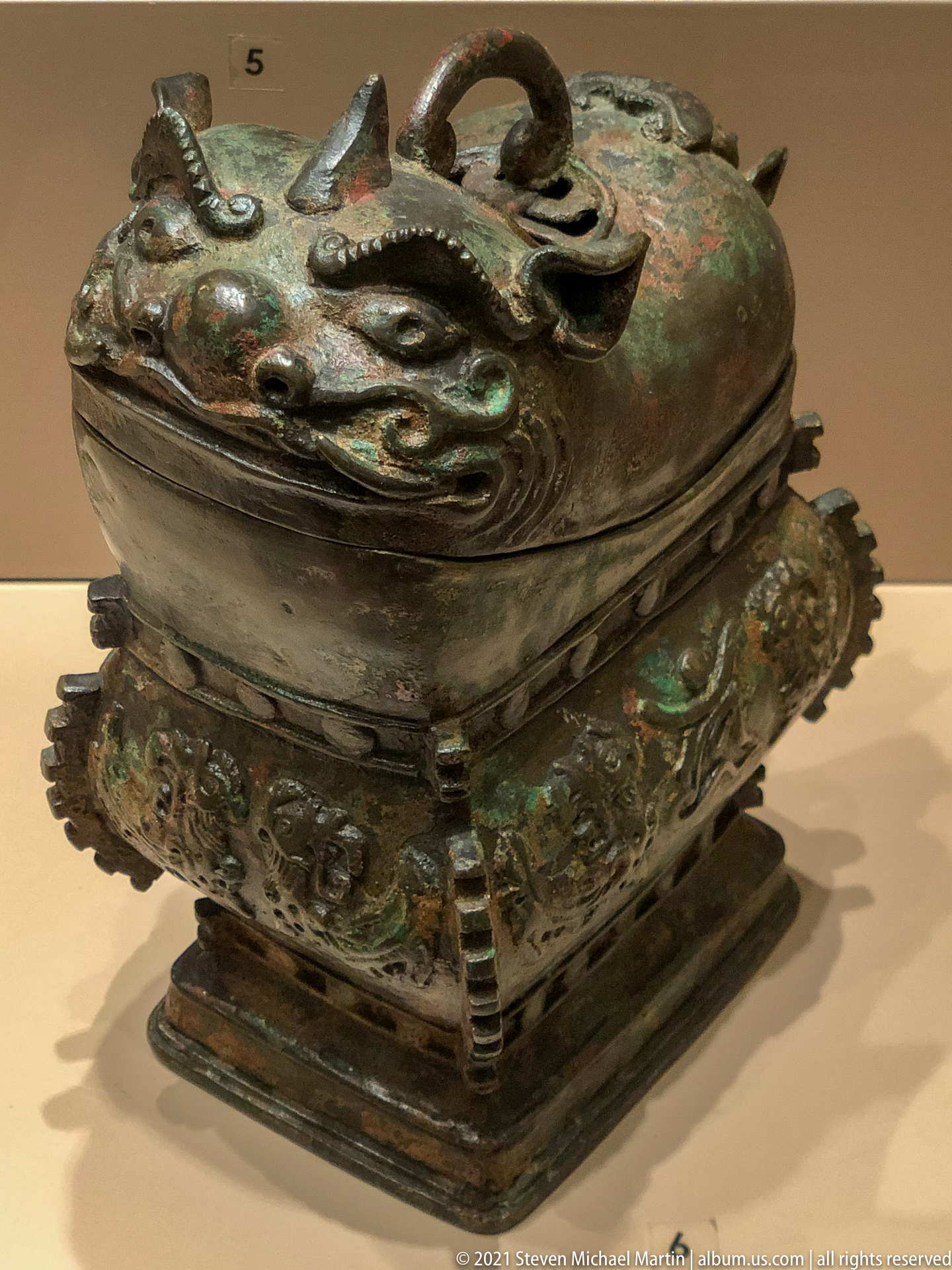
A substantial square bronze vessel rests on a high decorated base beneath a domed lid crowded with modeled animal forms. A prominent horned or dragon-like creature projects across the lid, while relief ornament and turquoise-green corrosion enliven the dark metal surfaces. The complex silhouette and richly worked base distinguish the vessel as an elaborate ceremonial or decorative object.
Caption
A substantial square bronze vessel rests on a high decorated base beneath a domed lid crowded with modeled animal forms. A prominent horned or dragon-like creature projects across the lid, while relief ornament and turquoise-green corrosion enliven the dark metal surfaces. The complex silhouette and richly worked base distinguish the vessel as an elaborate ceremonial or decorative object.
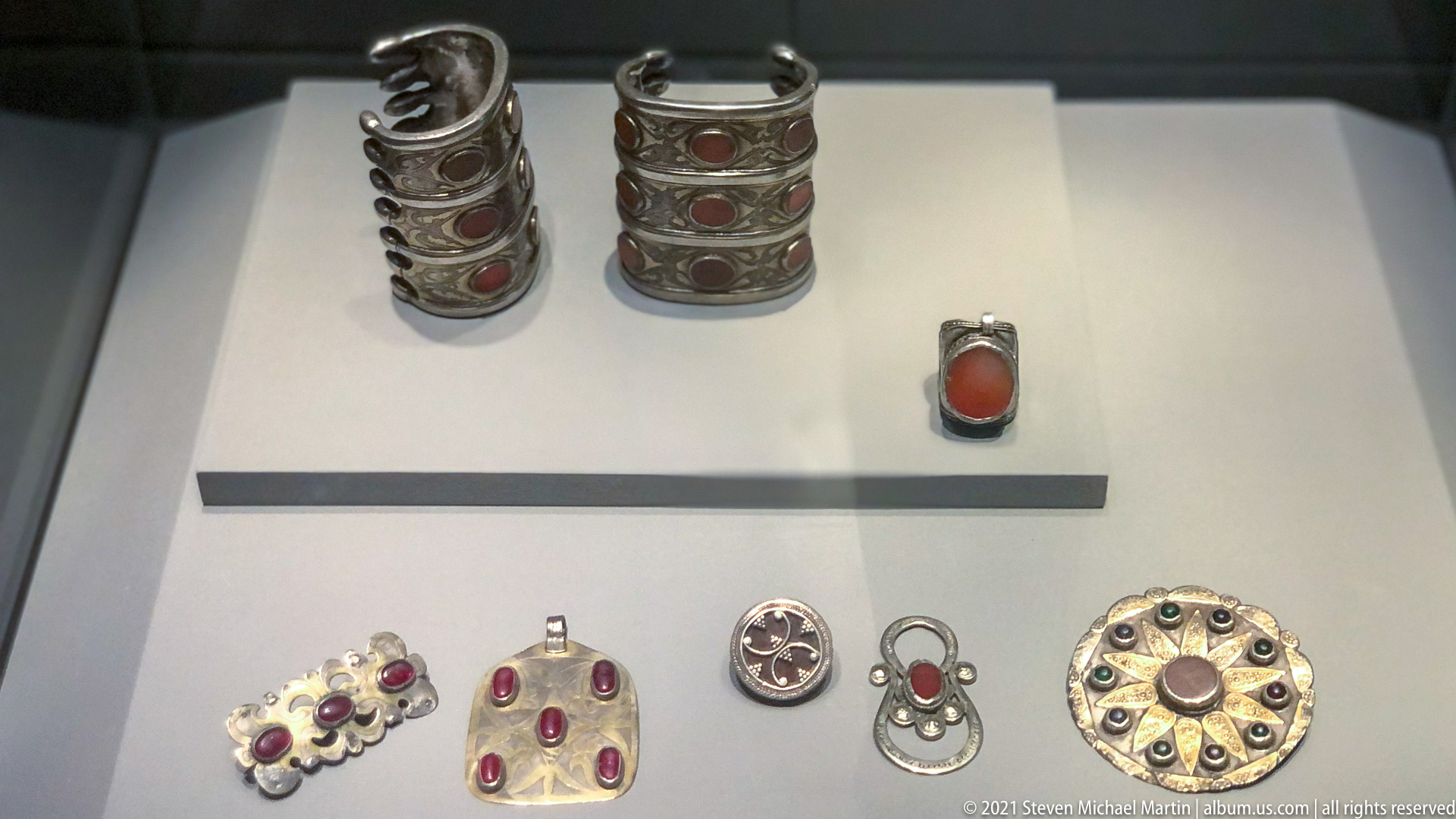
Silver-colored jewelry and personal ornaments are arranged as a small ensemble, many set with oval red cabochons. Two cylindrical openwork pieces rise at the rear, while pendants and circular fittings occupy the foreground. Repeated red stones and scrolling metalwork visually unite objects of different forms and possible functions.
Caption
Silver-colored jewelry and personal ornaments are arranged as a small ensemble, many set with oval red cabochons. Two cylindrical openwork pieces rise at the rear, while pendants and circular fittings occupy the foreground. Repeated red stones and scrolling metalwork visually unite objects of different forms and possible functions.
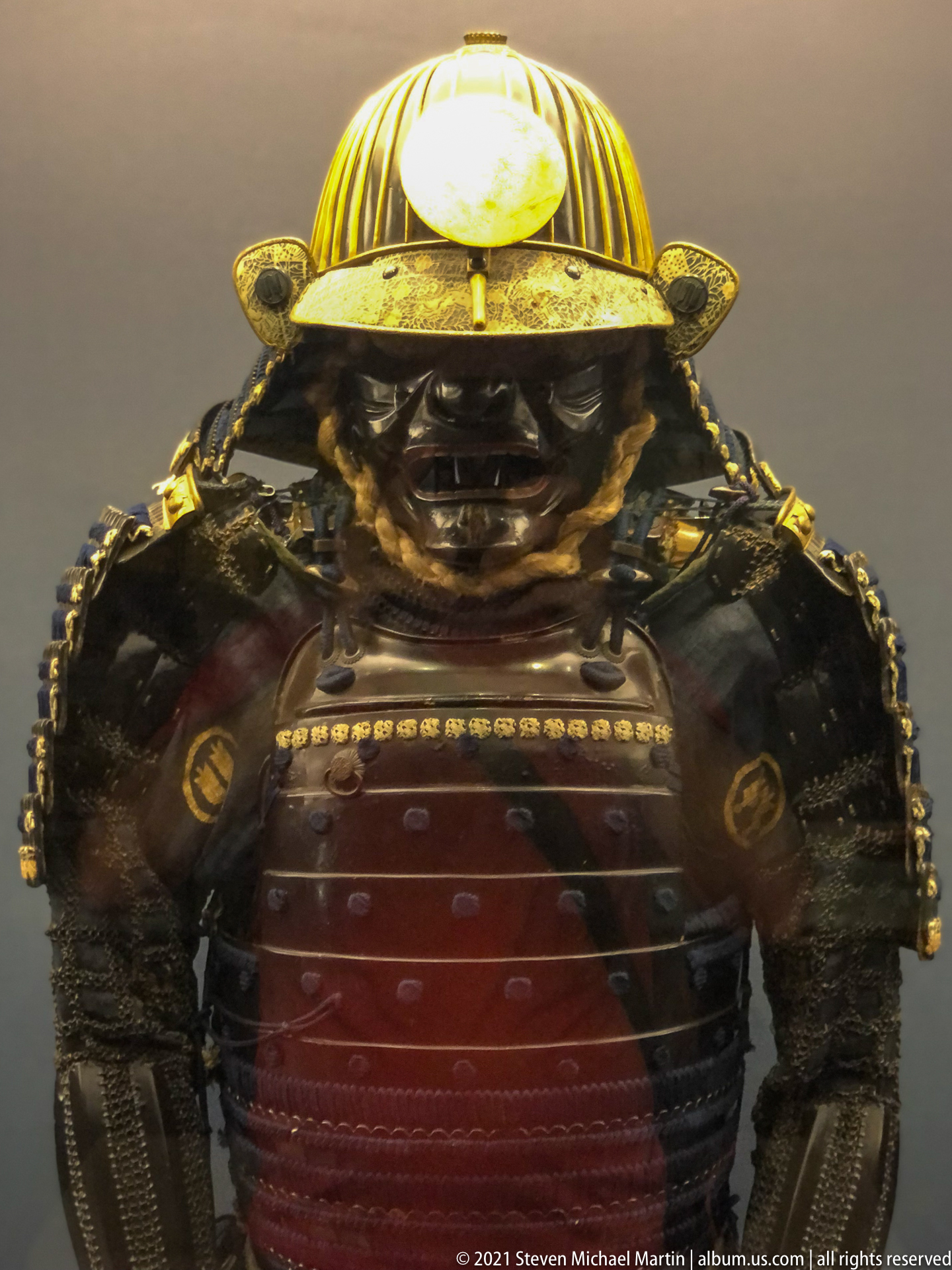
A close frontal view concentrates on the upper half of a Japanese suit of samurai armor. The helmet's striped bowl and broad gilded fittings rise above a dark face guard, while layered shoulder defenses frame a red-brown cuirass assembled in horizontal bands. Gold crests, lacing, and small metal fittings provide controlled accents against the predominantly dark armor.
Caption
A close frontal view concentrates on the upper half of a Japanese suit of samurai armor. The helmet's striped bowl and broad gilded fittings rise above a dark face guard, while layered shoulder defenses frame a red-brown cuirass assembled in horizontal bands. Gold crests, lacing, and small metal fittings provide controlled accents against the predominantly dark armor.
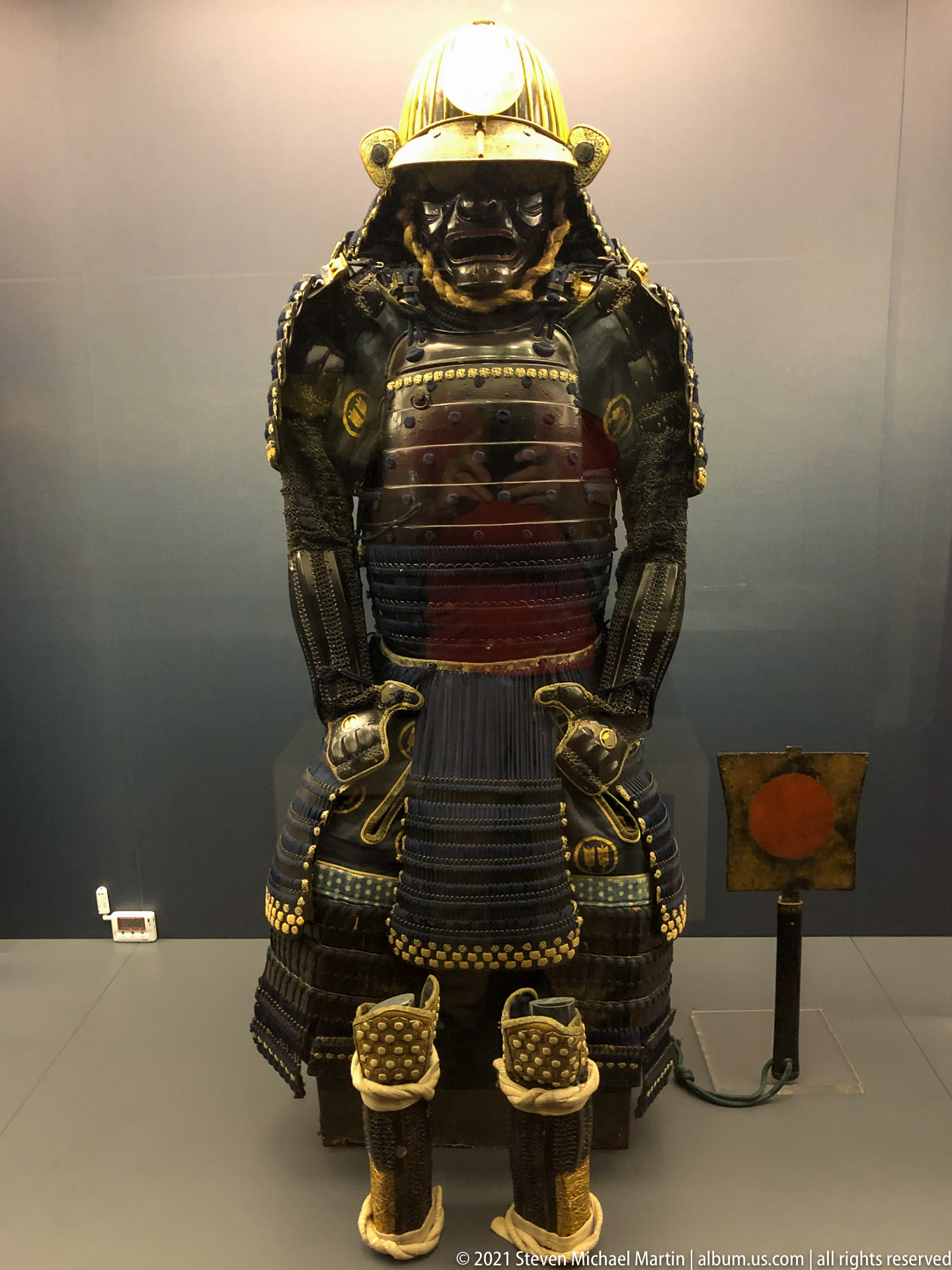
Displayed as a complete ensemble, this Japanese suit of samurai armor combines a helmet and face guard with layered shoulder defenses, a dark cuirass crossed by red bands, skirt armor, and separate shin or foot protection. Gold-colored fittings and lacing articulate the black surfaces, while the full-length presentation reveals how the individual defensive components were organized around the body.
Caption
Displayed as a complete ensemble, this Japanese suit of samurai armor combines a helmet and face guard with layered shoulder defenses, a dark cuirass crossed by red bands, skirt armor, and separate shin or foot protection. Gold-colored fittings and lacing articulate the black surfaces, while the full-length presentation reveals how the individual defensive components were organized around the body.
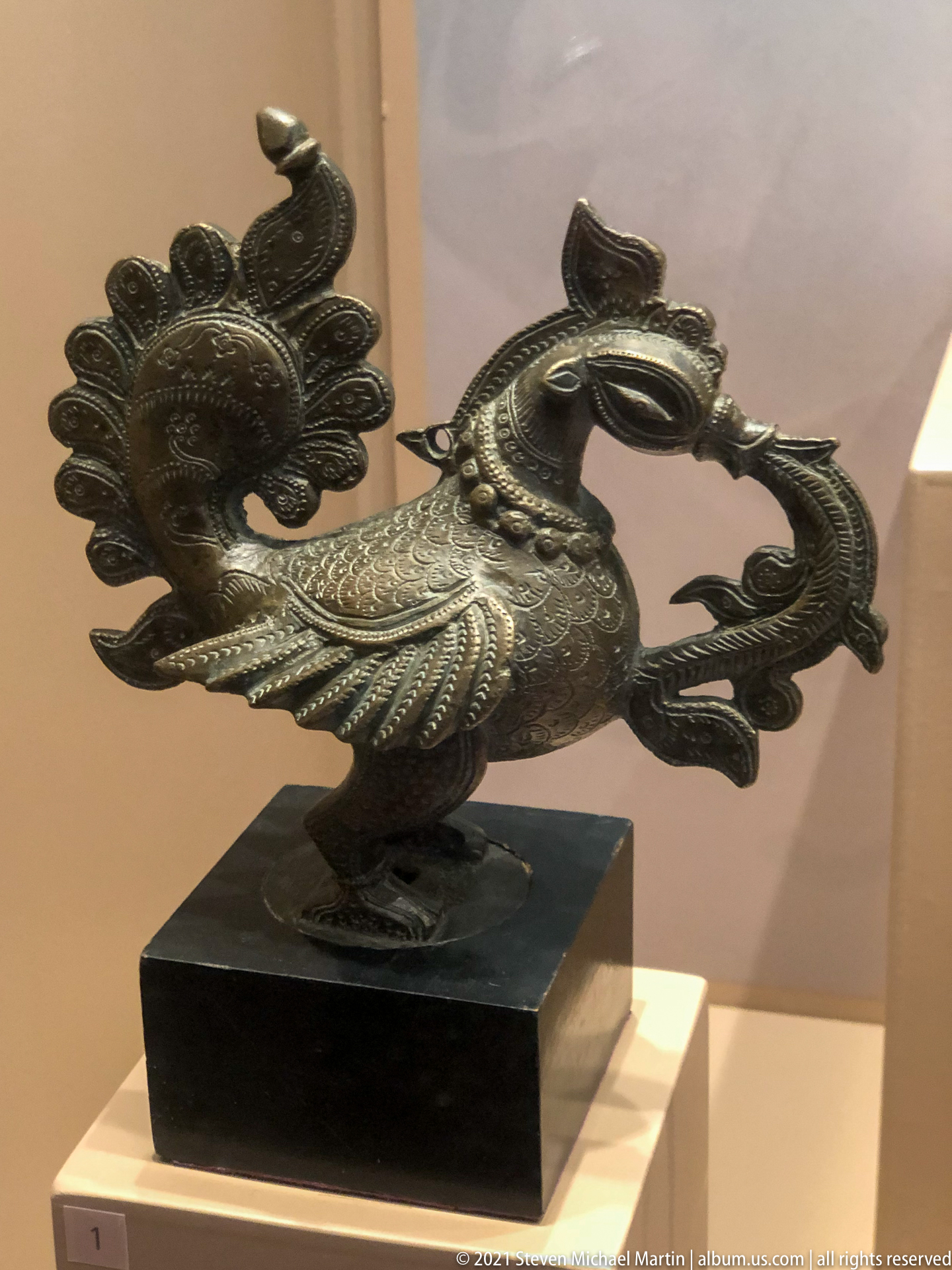
A bronze bird from India, dated by the Museum of Asian Art of Corfu to the 17th–19th century, stands in profile with wings raised and its long neck curling back toward the body. Layered feathers, a high crest, scrolling tail, and dense incised surface pattern transform the compact figure into an elaborate piece of Indian metalwork. The museum’s identification supports reading it as a bird rather than assigning a more speculative phoenix identity.
Caption
A bronze bird from India, dated by the Museum of Asian Art of Corfu to the 17th–19th century, stands in profile with wings raised and its long neck curling back toward the body. Layered feathers, a high crest, scrolling tail, and dense incised surface pattern transform the compact figure into an elaborate piece of Indian metalwork. The museum’s identification supports reading it as a bird rather than assigning a more speculative phoenix identity.