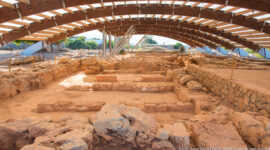
Pella – Greece
The ancient city of Pella served as the capital of the Kingdom of Macedon during the 4th century BCE. Located in northern Greece, the city became the political and cultural center of the Macedonian kingdom during the reigns of Philip II of Macedon and his son Alexander the Great.
Archaeological excavations have revealed the remains of large houses, public buildings, and elaborate floor mosaics that decorated the homes of wealthy citizens. These mosaics, depicting mythological scenes and hunting imagery, represent some of the finest examples of ancient Greek decorative art.
Pella offers a remarkable glimpse into the royal capital where Alexander the Great spent his early years.

The low, modern entrance complex of the Archaeological Museum of Pella stands beneath a broad blue sky, with Greek and European Union flags beside the building. The museum name is visibly mounted on the pale stone façade in Greek. Horizontal canopies, white walls, and a recessed approach give the institution a restrained contemporary profile at the gateway to the collections of ancient Pella.
Caption
The low, modern entrance complex of the Archaeological Museum of Pella stands beneath a broad blue sky, with Greek and European Union flags beside the building. The museum name is visibly mounted on the pale stone façade in Greek. Horizontal canopies, white walls, and a recessed approach give the institution a restrained contemporary profile at the gateway to the collections of ancient Pella.

A deep cantilevered canopy shades the approach to the Archaeological Museum of Pella, where a gently sloping ramp leads toward glass entrance doors. Pale stone cladding, white concrete walls, and broad horizontal roof planes create a cool, geometric transition between the exterior plaza and interior galleries. The composition focuses on accessibility and the layered thresholds of the museum’s contemporary architecture.
Caption
A deep cantilevered canopy shades the approach to the Archaeological Museum of Pella, where a gently sloping ramp leads toward glass entrance doors. Pale stone cladding, white concrete walls, and broad horizontal roof planes create a cool, geometric transition between the exterior plaza and interior galleries. The composition focuses on accessibility and the layered thresholds of the museum’s contemporary architecture.

A red tractor hauls a tall open trailer heaped with freshly harvested cotton along a road near Pella. The brilliant white crop rises above the trailer’s red framework, making the agricultural load immediately legible against the blue sky. This close roadside view foregrounds the machinery and scale of cotton production on the fertile plain around the ancient city.
Caption
A red tractor hauls a tall open trailer heaped with freshly harvested cotton along a road near Pella. The brilliant white crop rises above the trailer’s red framework, making the agricultural load immediately legible against the blue sky. This close roadside view foregrounds the machinery and scale of cotton production on the fertile plain around the ancient city.

An elevated aerial view places the excavated remains of Pella within the broad agricultural plain that surrounds the ancient city. Rectilinear excavation areas, modern roads, museum or service buildings, and cultivated fields reveal both the scale of the archaeological landscape and its relationship to the present-day settlement.
Caption
An elevated aerial view places the excavated remains of Pella within the broad agricultural plain that surrounds the ancient city. Rectilinear excavation areas, modern roads, museum or service buildings, and cultivated fields reveal both the scale of the archaeological landscape and its relationship to the present-day settlement.

Low stone walls define a rectangular interior with stepped masonry along the far side, preserving the ground plan of an excavated building. Strong sunlight throws sharp shadows across the foundations, making changes in wall height, construction technique, and internal divisions especially legible.
Caption
Low stone walls define a rectangular interior with stepped masonry along the far side, preserving the ground plan of an excavated building. Strong sunlight throws sharp shadows across the foundations, making changes in wall height, construction technique, and internal divisions especially legible.

A row of reconstructed and surviving columns rises above low stone foundations at Pella, restoring part of the vertical rhythm of an ancient colonnaded space. Varied shaft heights and capital forms distinguish the reconstructed elements from the surrounding masonry, while the broad excavation beyond situates the columns within the larger urban site.
Caption
A row of reconstructed and surviving columns rises above low stone foundations at Pella, restoring part of the vertical rhythm of an ancient colonnaded space. Varied shaft heights and capital forms distinguish the reconstructed elements from the surrounding masonry, while the broad excavation beyond situates the columns within the larger urban site.
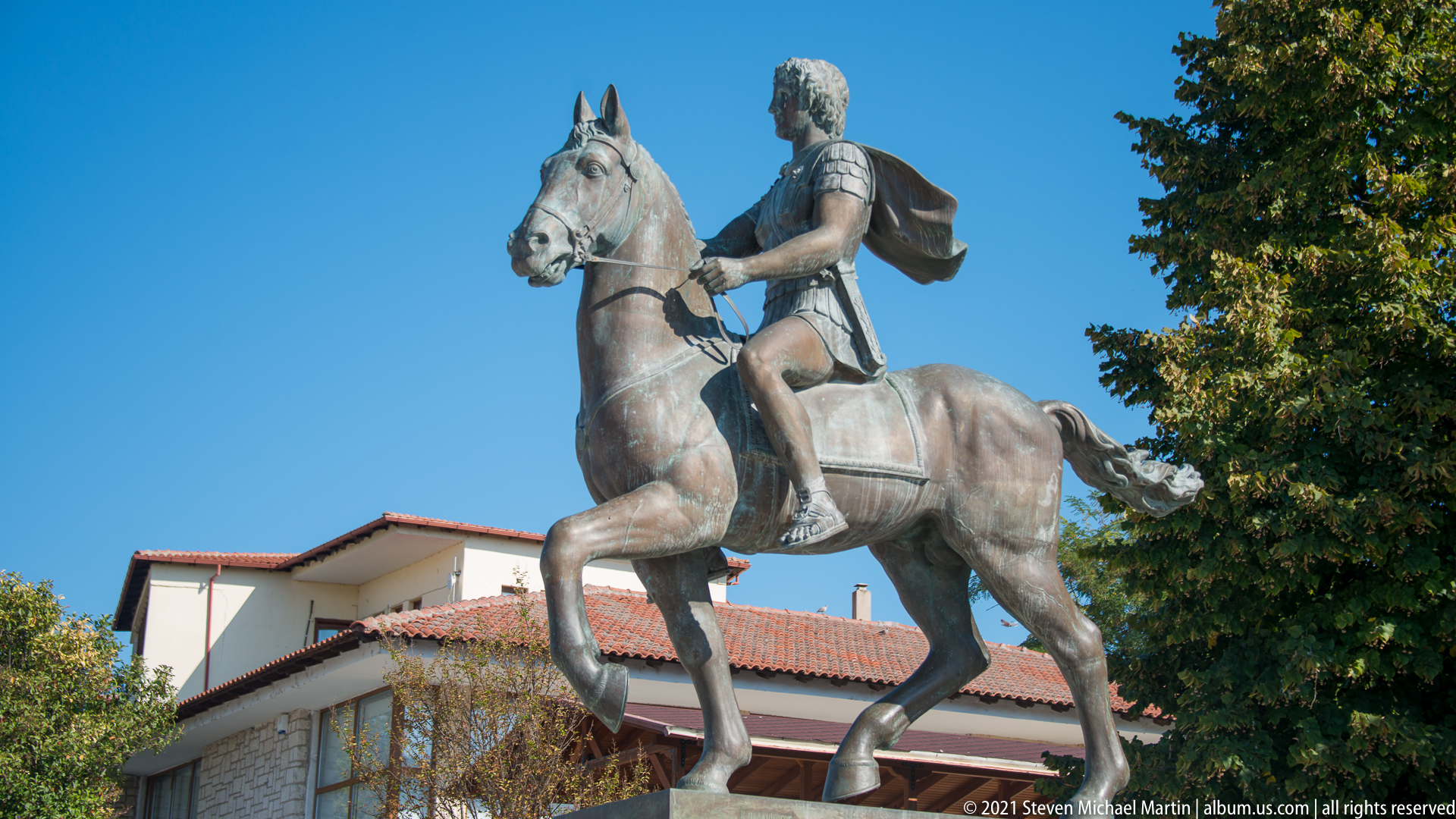
A modern equestrian monument to Alexander the Great rises in Pella, presenting the Macedonian king in armor on a striding horse. Alexander extends one arm outward while controlling the reins with the other, combining military authority with the dynamic pose of the mount. The monument translates Pella’s association with the ancient Macedonian dynasty into contemporary civic commemoration.
Caption
A modern equestrian monument to Alexander the Great rises in Pella, presenting the Macedonian king in armor on a striding horse. Alexander extends one arm outward while controlling the reins with the other, combining military authority with the dynamic pose of the mount. The monument translates Pella’s association with the ancient Macedonian dynasty into contemporary civic commemoration.

A modern bronze equestrian monument rises against trees and a clear sky in Pella, showing a mounted male figure gesturing outward while his horse steps forward. Strong backlighting silhouettes the rider and emphasizes the raised foreleg and animated pose. The monument evokes the city’s enduring association with the Macedonian royal past without requiring the figure’s identity to carry the composition.
Caption
A modern bronze equestrian monument rises against trees and a clear sky in Pella, showing a mounted male figure gesturing outward while his horse steps forward. Strong backlighting silhouettes the rider and emphasizes the raised foreleg and animated pose. The monument evokes the city’s enduring association with the Macedonian royal past without requiring the figure’s identity to carry the composition.

A shaped gold plaque is decorated with raised teardrop forms above a row of circular bosses, all surrounded by densely punched dots and fine linear borders. The scalloped upper edge and complex geometry distinguish it from the floral plaques nearby, suggesting a deliberately varied repertoire of gold ornament used on the helmet ensemble.
Caption
A shaped gold plaque is decorated with raised teardrop forms above a row of circular bosses, all surrounded by densely punched dots and fine linear borders. The scalloped upper edge and complex geometry distinguish it from the floral plaques nearby, suggesting a deliberately varied repertoire of gold ornament used on the helmet ensemble.

A museum panel pairs an aerial photograph of Pella’s excavated urban blocks with a simplified plan above. Rectangular building foundations, streets, courtyards, and excavation trenches are visible from overhead, making the regular organization of the ancient city easier to understand than from ground level alone.
Caption
A museum panel pairs an aerial photograph of Pella’s excavated urban blocks with a simplified plan above. Rectangular building foundations, streets, courtyards, and excavation trenches are visible from overhead, making the regular organization of the ancient city easier to understand than from ground level alone.

Long illuminated cases line both sides of a gallery in the Archaeological Museum of Pella, presenting small finds in a carefully ordered sequence. Pottery, metal objects, jewelry, and other excavated material are arranged against pale backdrops beneath repeated arched display elements. The central aisle and symmetrical perspective emphasize the museum’s role in assembling the material culture of the ancient Macedonian capital.
Caption
Long illuminated cases line both sides of a gallery in the Archaeological Museum of Pella, presenting small finds in a carefully ordered sequence. Pottery, metal objects, jewelry, and other excavated material are arranged against pale backdrops beneath repeated arched display elements. The central aisle and symmetrical perspective emphasize the museum’s role in assembling the material culture of the ancient Macedonian capital.

Three expressive heads are displayed together on a glass shelf, each with exaggerated facial features suited to theatrical imagery. Their contrasting expressions—from open-mouthed intensity to a more restrained central face—show the visual vocabulary used to make character legible at small scale.
Caption
Three expressive heads are displayed together on a glass shelf, each with exaggerated facial features suited to theatrical imagery. Their contrasting expressions—from open-mouthed intensity to a more restrained central face—show the visual vocabulary used to make character legible at small scale.

The circular pebble mosaic from the House of Dionysus at Pella centers on Dionysus riding a panther, surrounded by luxuriant vegetal scrollwork and smaller animal forms. Naturally colored pebbles create subtle modeling and strong tonal contrast, demonstrating the pictorial ambition of Pella’s late Classical mosaic workshops. The oblique museum view also preserves the relationship between the figural center and its elaborate ornamental surround.
Caption
The circular pebble mosaic from the House of Dionysus at Pella centers on Dionysus riding a panther, surrounded by luxuriant vegetal scrollwork and smaller animal forms. Naturally colored pebbles create subtle modeling and strong tonal contrast, demonstrating the pictorial ambition of Pella’s late Classical mosaic workshops. The oblique museum view also preserves the relationship between the figural center and its elaborate ornamental surround.

A high-sided farm trailer packed with loose white cotton travels through modern Pella, its orange mesh frame exposing the bulky harvested crop. Utility poles, low buildings, and roadside vegetation place the agricultural load within the contemporary townscape. The view connects the archaeological destination with the productive plain surrounding it, where large-scale farming remains a prominent part of the landscape.
Caption
A high-sided farm trailer packed with loose white cotton travels through modern Pella, its orange mesh frame exposing the bulky harvested crop. Utility poles, low buildings, and roadside vegetation place the agricultural load within the contemporary townscape. The view connects the archaeological destination with the productive plain surrounding it, where large-scale farming remains a prominent part of the landscape.

Ancient Macedonian helmet and funerary weapons with gold ornament. The museum arrangement separates the surviving armor, ornaments, vessels, or other grave goods so their materials and functions can be read individually while retaining their association as a funerary assemblage from Pella. Differences in bronze patina, corroded iron, ceramic surfaces, and bright goldwork make the burial display’s material range especially clear.
Caption
Ancient Macedonian helmet and funerary weapons with gold ornament. The museum arrangement separates the surviving armor, ornaments, vessels, or other grave goods so their materials and functions can be read individually while retaining their association as a funerary assemblage from Pella. Differences in bronze patina, corroded iron, ceramic surfaces, and bright goldwork make the burial display’s material range especially clear.

Corroded iron weapons are mounted diagonally in a museum case, their rough dark surfaces interrupted by surviving gold fittings. A long blade-like element and adjacent fragment retain traces of precious-metal decoration, highlighting the contrast between perishable iron and durable funerary ornament. The display belongs to the broader group of martial grave goods preserved from ancient Pella.
Caption
Corroded iron weapons are mounted diagonally in a museum case, their rough dark surfaces interrupted by surviving gold fittings. A long blade-like element and adjacent fragment retain traces of precious-metal decoration, highlighting the contrast between perishable iron and durable funerary ornament. The display belongs to the broader group of martial grave goods preserved from ancient Pella.

Gold-decorated weaponry and rows of gold ornaments. The museum arrangement separates the surviving armor, ornaments, vessels, or other grave goods so their materials and functions can be read individually while retaining their association as a funerary assemblage from Pella. Differences in bronze patina, corroded iron, ceramic surfaces, and bright goldwork make the burial display’s material range especially clear.
Caption
Gold-decorated weaponry and rows of gold ornaments. The museum arrangement separates the surviving armor, ornaments, vessels, or other grave goods so their materials and functions can be read individually while retaining their association as a funerary assemblage from Pella. Differences in bronze patina, corroded iron, ceramic surfaces, and bright goldwork make the burial display’s material range especially clear.

A green-patinated bronze helmet is displayed above a large circular bronze shield with concentric raised rings and a central boss. A gold sheet element hangs beneath the helmet, while a small gold fitting appears nearby. The pairing emphasizes defensive equipment and the technical sophistication of Macedonian metalwork, with corrosion and patina preserving the long archaeological history of the objects.
Caption
A green-patinated bronze helmet is displayed above a large circular bronze shield with concentric raised rings and a central boss. A gold sheet element hangs beneath the helmet, while a small gold fitting appears nearby. The pairing emphasizes defensive equipment and the technical sophistication of Macedonian metalwork, with corrosion and patina preserving the long archaeological history of the objects.

Helmet, weapons, gold bands, and ornaments from an elite grave display. The museum arrangement separates the surviving armor, ornaments, vessels, or other grave goods so their materials and functions can be read individually while retaining their association as a funerary assemblage from Pella. Differences in bronze patina, corroded iron, ceramic surfaces, and bright goldwork make the burial display’s material range especially clear.
Caption
Helmet, weapons, gold bands, and ornaments from an elite grave display. The museum arrangement separates the surviving armor, ornaments, vessels, or other grave goods so their materials and functions can be read individually while retaining their association as a funerary assemblage from Pella. Differences in bronze patina, corroded iron, ceramic surfaces, and bright goldwork make the burial display’s material range especially clear.

A marble portrait head associated with Alexander the Great presents a youthful, idealized face framed by thick, upswept waves of hair. The broken neck shows that the head survives apart from its original statue, while focused museum lighting accentuates the softly modeled cheeks, parted lips, and animated locks that became characteristic of Alexander’s ruler imagery.
Caption
A marble portrait head associated with Alexander the Great presents a youthful, idealized face framed by thick, upswept waves of hair. The broken neck shows that the head survives apart from its original statue, while focused museum lighting accentuates the softly modeled cheeks, parted lips, and animated locks that became characteristic of Alexander’s ruler imagery.

A weathered stone sculpture stands beneath the Greek lettering for the Archaeological Museum of Pella, set against the museum’s pale stone wall. The fragmentary carving appears monumental despite its worn surface and incomplete form. By placing an archaeological object directly below the institutional name, the entrance display visually links the modern museum with the ancient material it preserves.
Caption
A weathered stone sculpture stands beneath the Greek lettering for the Archaeological Museum of Pella, set against the museum’s pale stone wall. The fragmentary carving appears monumental despite its worn surface and incomplete form. By placing an archaeological object directly below the institutional name, the entrance display visually links the modern museum with the ancient material it preserves.

An interpretive map labeled “Ancient Pella” diagrams the archaeological city and its surrounding topography. A dense orthogonal street grid dominates the plan, while colored zones and lines distinguish excavated or interpreted areas from the wider landscape. The map provides essential spatial context for understanding Pella as a planned urban center rather than a collection of isolated ruins.
Caption
An interpretive map labeled “Ancient Pella” diagrams the archaeological city and its surrounding topography. A dense orthogonal street grid dominates the plan, while colored zones and lines distinguish excavated or interpreted areas from the wider landscape. The map provides essential spatial context for understanding Pella as a planned urban center rather than a collection of isolated ruins.

Bronze helmet with gold face fitting and decorated weapon fragments. The museum arrangement separates the surviving armor, ornaments, vessels, or other grave goods so their materials and functions can be read individually while retaining their association as a funerary assemblage from Pella. Differences in bronze patina, corroded iron, ceramic surfaces, and bright goldwork make the burial display’s material range especially clear.
Caption
Bronze helmet with gold face fitting and decorated weapon fragments. The museum arrangement separates the surviving armor, ornaments, vessels, or other grave goods so their materials and functions can be read individually while retaining their association as a funerary assemblage from Pella. Differences in bronze patina, corroded iron, ceramic surfaces, and bright goldwork make the burial display’s material range especially clear.

A large red interpretive panel in the Pella museum is headed “Alexander III the Great” and summarizes the Macedonian king’s reign, conquests, and historical legacy. Dense English text and a quotation occupy the display, making this photograph primarily documentary rather than object-focused. The panel situates Pella’s archaeological remains within the political world of the kingdom that produced Alexander.
Caption
A large red interpretive panel in the Pella museum is headed “Alexander III the Great” and summarizes the Macedonian king’s reign, conquests, and historical legacy. Dense English text and a quotation occupy the display, making this photograph primarily documentary rather than object-focused. The panel situates Pella’s archaeological remains within the political world of the kingdom that produced Alexander.

Bronze helmet with gold fittings and decorated iron blade. The museum arrangement separates the surviving armor, ornaments, vessels, or other grave goods so their materials and functions can be read individually while retaining their association as a funerary assemblage from Pella. Differences in bronze patina, corroded iron, ceramic surfaces, and bright goldwork make the burial display’s material range especially clear.
Caption
Bronze helmet with gold fittings and decorated iron blade. The museum arrangement separates the surviving armor, ornaments, vessels, or other grave goods so their materials and functions can be read individually while retaining their association as a funerary assemblage from Pella. Differences in bronze patina, corroded iron, ceramic surfaces, and bright goldwork make the burial display’s material range especially clear.

Helmet with gold ornament, weapons, and crossed gold bands. The museum arrangement separates the surviving armor, ornaments, vessels, or other grave goods so their materials and functions can be read individually while retaining their association as a funerary assemblage from Pella. Differences in bronze patina, corroded iron, ceramic surfaces, and bright goldwork make the burial display’s material range especially clear.
Caption
Helmet with gold ornament, weapons, and crossed gold bands. The museum arrangement separates the surviving armor, ornaments, vessels, or other grave goods so their materials and functions can be read individually while retaining their association as a funerary assemblage from Pella. Differences in bronze patina, corroded iron, ceramic surfaces, and bright goldwork make the burial display’s material range especially clear.

A text panel headed “History of Pella” outlines the modern archaeological investigation of the ancient city, including excavations, research programs, and discoveries. The photograph concentrates on the written interpretation rather than artifacts, preserving the museum’s account of how Pella emerged through systematic fieldwork. Such institutional history complements the adjacent displays by explaining the process through which the site became known archaeologically.
Caption
A text panel headed “History of Pella” outlines the modern archaeological investigation of the ancient city, including excavations, research programs, and discoveries. The photograph concentrates on the written interpretation rather than artifacts, preserving the museum’s account of how Pella emerged through systematic fieldwork. Such institutional history complements the adjacent displays by explaining the process through which the site became known archaeologically.

A large circular bronze shield with concentric ridges dominates a martial display at the Pella museum. Above it hangs a bronze helmet with gold facing; a long spearhead stands to the right, while corroded iron weapon fragments angle across the lower left. The grouped defensive and offensive equipment creates a particularly clear overview of the forms and materials associated with an elite armed burial.
Caption
A large circular bronze shield with concentric ridges dominates a martial display at the Pella museum. Above it hangs a bronze helmet with gold facing; a long spearhead stands to the right, while corroded iron weapon fragments angle across the lower left. The grouped defensive and offensive equipment creates a particularly clear overview of the forms and materials associated with an elite armed burial.

A museum interpretation panel combines extensive explanatory text with an excavation photograph showing a human burial and associated objects in the soil. The documentary image preserves archaeological context that is lost when finds are removed for conservation and display. Presented beside the text, the in-situ burial view helps explain how Pella’s graves and artifacts were recorded during excavation.
Caption
A museum interpretation panel combines extensive explanatory text with an excavation photograph showing a human burial and associated objects in the soil. The documentary image preserves archaeological context that is lost when finds are removed for conservation and display. Presented beside the text, the in-situ burial view helps explain how Pella’s graves and artifacts were recorded during excavation.

A small ancient coin is enlarged in close view, revealing a standing human figure within the circular field. Wear and surface toning soften the finer details, but the figure’s upright pose and surrounding border remain visible. Isolated against a textured background, the coin is presented as an individual numismatic object rather than as part of a larger hoard or display.
Caption
A small ancient coin is enlarged in close view, revealing a standing human figure within the circular field. Wear and surface toning soften the finer details, but the figure’s upright pose and surrounding border remain visible. Isolated against a textured background, the coin is presented as an individual numismatic object rather than as part of a larger hoard or display.

Helmet, decorated blade, and broad metal fittings. The museum arrangement separates the surviving armor, ornaments, vessels, or other grave goods so their materials and functions can be read individually while retaining their association as a funerary assemblage from Pella. Differences in bronze patina, corroded iron, ceramic surfaces, and bright goldwork make the burial display’s material range especially clear.
Caption
Helmet, decorated blade, and broad metal fittings. The museum arrangement separates the surviving armor, ornaments, vessels, or other grave goods so their materials and functions can be read individually while retaining their association as a funerary assemblage from Pella. Differences in bronze patina, corroded iron, ceramic surfaces, and bright goldwork make the burial display’s material range especially clear.

Bronze helmet and gold-decorated iron weapon. The museum arrangement separates the surviving armor, ornaments, vessels, or other grave goods so their materials and functions can be read individually while retaining their association as a funerary assemblage from Pella. Differences in bronze patina, corroded iron, ceramic surfaces, and bright goldwork make the burial display’s material range especially clear.
Caption
Bronze helmet and gold-decorated iron weapon. The museum arrangement separates the surviving armor, ornaments, vessels, or other grave goods so their materials and functions can be read individually while retaining their association as a funerary assemblage from Pella. Differences in bronze patina, corroded iron, ceramic surfaces, and bright goldwork make the burial display’s material range especially clear.

Gold face covering, necklace, ornaments, and appliqués. The museum arrangement separates the surviving armor, ornaments, vessels, or other grave goods so their materials and functions can be read individually while retaining their association as a funerary assemblage from Pella. Differences in bronze patina, corroded iron, ceramic surfaces, and bright goldwork make the burial display’s material range especially clear.
Caption
Gold face covering, necklace, ornaments, and appliqués. The museum arrangement separates the surviving armor, ornaments, vessels, or other grave goods so their materials and functions can be read individually while retaining their association as a funerary assemblage from Pella. Differences in bronze patina, corroded iron, ceramic surfaces, and bright goldwork make the burial display’s material range especially clear.

A silver-toned ancient coin fills the frame with a right-facing male head rendered in high relief. Wavy hair or a headdress frames the profile, while the worn metallic surface preserves the strong nose, brow, and jaw. The close magnification records the portrait side clearly, but the absence of readable legend or catalog information makes a precise ruler or issue attribution unsafe.
Caption
A silver-toned ancient coin fills the frame with a right-facing male head rendered in high relief. Wavy hair or a headdress frames the profile, while the worn metallic surface preserves the strong nose, brow, and jaw. The close magnification records the portrait side clearly, but the absence of readable legend or catalog information makes a precise ruler or issue attribution unsafe.

A silver-toned ancient coin shows a mounted rider in profile, the horse standing or moving laterally across the circular field. The rider’s upper body and the horse’s legs remain legible despite wear around the edge. This enlarged numismatic view emphasizes the equestrian type, a potent visual motif in Macedonian coinage, while leaving the exact issue to catalog verification.
Caption
A silver-toned ancient coin shows a mounted rider in profile, the horse standing or moving laterally across the circular field. The rider’s upper body and the horse’s legs remain legible despite wear around the edge. This enlarged numismatic view emphasizes the equestrian type, a potent visual motif in Macedonian coinage, while leaving the exact issue to catalog verification.

A dark silver-toned ancient coin is shown in close-up with a sharply incised geometric design occupying the reverse. Rectangular compartments, angular strokes, and a circular element form a compact emblem or schematic motif within the coin’s field. Because the proof-sheet view does not preserve a readable legend, the design is best documented visually without assigning a specific ruler, mint, or symbol.
Caption
A dark silver-toned ancient coin is shown in close-up with a sharply incised geometric design occupying the reverse. Rectangular compartments, angular strokes, and a circular element form a compact emblem or schematic motif within the coin’s field. Because the proof-sheet view does not preserve a readable legend, the design is best documented visually without assigning a specific ruler, mint, or symbol.

Gold coin bearing a sharply modeled helmeted profile, displayed against a textured museum backing. The compact relief concentrates attention on the sitter’s facial features, crested headgear, and the crisp circular border, illustrating the fine-scale metalwork represented among finds associated with ancient Pella.
Caption
Gold coin bearing a sharply modeled helmeted profile, displayed against a textured museum backing. The compact relief concentrates attention on the sitter’s facial features, crested headgear, and the crisp circular border, illustrating the fine-scale metalwork represented among finds associated with ancient Pella.

Gold face covering, diadem, necklaces, and appliqués. The museum arrangement separates the surviving armor, ornaments, vessels, or other grave goods so their materials and functions can be read individually while retaining their association as a funerary assemblage from Pella. Differences in bronze patina, corroded iron, ceramic surfaces, and bright goldwork make the burial display’s material range especially clear.
Caption
Gold face covering, diadem, necklaces, and appliqués. The museum arrangement separates the surviving armor, ornaments, vessels, or other grave goods so their materials and functions can be read individually while retaining their association as a funerary assemblage from Pella. Differences in bronze patina, corroded iron, ceramic surfaces, and bright goldwork make the burial display’s material range especially clear.

A hammered gold face covering presides over an assemblage of personal ornaments, including two necklaces, long crossed gold bands, pins, and smaller fittings. Displayed together, the objects emphasize the variety of forms and techniques represented in precious-metal adornment associated with ancient Macedonia, from thin worked sheet and articulated chains to delicately shaped dress accessories.
Caption
A hammered gold face covering presides over an assemblage of personal ornaments, including two necklaces, long crossed gold bands, pins, and smaller fittings. Displayed together, the objects emphasize the variety of forms and techniques represented in precious-metal adornment associated with ancient Macedonia, from thin worked sheet and articulated chains to delicately shaped dress accessories.

A small marble male figure survives without its arms and lower legs, its weight shifted through the torso in a relaxed stance. Weathering and surface discoloration soften the anatomical modeling, while the preserved head, chest, abdomen, and hips retain enough detail to convey the sculptor’s treatment of the nude body.
Caption
A small marble male figure survives without its arms and lower legs, its weight shifted through the torso in a relaxed stance. Weathering and surface discoloration soften the anatomical modeling, while the preserved head, chest, abdomen, and hips retain enough detail to convey the sculptor’s treatment of the nude body.

Embossed gold rosettes and circular plaques form a carefully mounted set of personal ornaments, with a larger oval plaque displayed separately below. Repeated petal patterns, concentric borders, and raised central bosses create a unified decorative vocabulary across pieces of differing scale.
Caption
Embossed gold rosettes and circular plaques form a carefully mounted set of personal ornaments, with a larger oval plaque displayed separately below. Repeated petal patterns, concentric borders, and raised central bosses create a unified decorative vocabulary across pieces of differing scale.

A deeply carved marble palmette rises above a rectangular architectural block decorated with bead-like molding and paired rosettes. Drilled recesses and curling leaf forms create strong shadow across the ornament, making the surviving fragment a clear example of the decorative stone carving used in monumental architecture.
Caption
A deeply carved marble palmette rises above a rectangular architectural block decorated with bead-like molding and paired rosettes. Drilled recesses and curling leaf forms create strong shadow across the ornament, making the surviving fragment a clear example of the decorative stone carving used in monumental architecture.

Large embossed rosettes anchor a curved band of gold fittings, accompanied by a separate central ornament below. Their repeated radial petals and raised bosses catch the display lighting dramatically, while the open mounting reveals the individual construction of the components rather than presenting them as a single solid object.
Caption
Large embossed rosettes anchor a curved band of gold fittings, accompanied by a separate central ornament below. Their repeated radial petals and raised bosses catch the display lighting dramatically, while the open mounting reveals the individual construction of the components rather than presenting them as a single solid object.

An archaeological jewelry display combines embossed gold rosettes and patterned bands with a necklace of pale shell-like beads. The symmetrical arrangement makes the contrast between precious metal and organic ornament especially clear, while the repeated floral forms connect the separate gold components visually.
Caption
An archaeological jewelry display combines embossed gold rosettes and patterned bands with a necklace of pale shell-like beads. The symmetrical arrangement makes the contrast between precious metal and organic ornament especially clear, while the repeated floral forms connect the separate gold components visually.

Close viewing isolates the upper portion of a gold jewelry assemblage: circular rosette plaques crown a curved band, while elongated leaf-shaped elements below carry dense embossed patterns. Fine borders and repeated motifs show how thin sheet gold could be worked into richly textured personal ornaments.
Caption
Close viewing isolates the upper portion of a gold jewelry assemblage: circular rosette plaques crown a curved band, while elongated leaf-shaped elements below carry dense embossed patterns. Fine borders and repeated motifs show how thin sheet gold could be worked into richly textured personal ornaments.

Small ceramic vessels are arranged across stepped wooden shelves, ranging from open bowls and cups to jugs and larger closed forms. Differences in clay color, surface finish, profile, and handle design make the display useful for comparing everyday vessel shapes represented in the archaeological collections from Pella.
Caption
Small ceramic vessels are arranged across stepped wooden shelves, ranging from open bowls and cups to jugs and larger closed forms. Differences in clay color, surface finish, profile, and handle design make the display useful for comparing everyday vessel shapes represented in the archaeological collections from Pella.

Three silver coins are presented side by side against a dark background, allowing their portrait heads and surrounding inscriptions to be compared directly. Variations in wear, centering, and relief distinguish the individual pieces while demonstrating the importance of coinage as both an economic object and a bearer of official imagery.
Caption
Three silver coins are presented side by side against a dark background, allowing their portrait heads and surrounding inscriptions to be compared directly. Variations in wear, centering, and relief distinguish the individual pieces while demonstrating the importance of coinage as both an economic object and a bearer of official imagery.

A large stemmed drinking cup carries a black-figure narrative frieze across its orange clay body. Human figures, horses, and a wheeled vehicle unfold between the horizontal handles, while the vessel’s broad bowl and foot remain clearly visible in the museum mounting.
Caption
A large stemmed drinking cup carries a black-figure narrative frieze across its orange clay body. Human figures, horses, and a wheeled vehicle unfold between the horizontal handles, while the vessel’s broad bowl and foot remain clearly visible in the museum mounting.

A rectangular figural panel is set within a broad field of closely packed light and dark pebbles. The surviving scene contains human and animal figures modeled through subtle changes in stone color, demonstrating how Pella’s mosaicists used naturally colored pebbles to achieve pictorial detail without cut tesserae.
Caption
A rectangular figural panel is set within a broad field of closely packed light and dark pebbles. The surviving scene contains human and animal figures modeled through subtle changes in stone color, demonstrating how Pella’s mosaicists used naturally colored pebbles to achieve pictorial detail without cut tesserae.

Viewed from below and at an angle, this stemmed cup reveals a black-figure scene of human figures framed by large palmettes. The unusual viewpoint highlights the vessel’s flaring bowl, horizontal handles, and foot as strongly as its painted decoration, linking imagery and ceramic form.
Caption
Viewed from below and at an angle, this stemmed cup reveals a black-figure scene of human figures framed by large palmettes. The unusual viewpoint highlights the vessel’s flaring bowl, horizontal handles, and foot as strongly as its painted decoration, linking imagery and ceramic form.

A dramatic pebble mosaic shows two hunters converging on a lion, whose body occupies the center of the composition. Carefully graded light and dark stones model anatomy, garments, and movement, while the compressed arrangement of figures creates the immediacy of a close encounter.
Caption
A dramatic pebble mosaic shows two hunters converging on a lion, whose body occupies the center of the composition. Carefully graded light and dark stones model anatomy, garments, and movement, while the compressed arrangement of figures creates the immediacy of a close encounter.

Architectural terracottas are arranged in two rows, with upright palmette forms above and projecting lion heads below. The display separates roofline ornament into recognizable types, showing how molded vegetal and animal motifs gave color, rhythm, and sculptural emphasis to ancient buildings.
Caption
Architectural terracottas are arranged in two rows, with upright palmette forms above and projecting lion heads below. The display separates roofline ornament into recognizable types, showing how molded vegetal and animal motifs gave color, rhythm, and sculptural emphasis to ancient buildings.

A fragmentary pebble mosaic preserves portions of a dynamic equestrian scene, including a pale horse and traces of adjacent figures. Losses interrupt much of the composition, but the remaining contours and tonal contrasts still convey motion across the narrow rectangular panel.
Caption
A fragmentary pebble mosaic preserves portions of a dynamic equestrian scene, including a pale horse and traces of adjacent figures. Losses interrupt much of the composition, but the remaining contours and tonal contrasts still convey motion across the narrow rectangular panel.

A long geometric mosaic floor stretches through an excavated room at Pella, its dark central field patterned with a repeating pale lattice and framed by ornamental borders. Seen in situ under open sky, the pavement retains its architectural scale and demonstrates how mosaic decoration organized the interior surfaces of elite buildings.
Caption
A long geometric mosaic floor stretches through an excavated room at Pella, its dark central field patterned with a repeating pale lattice and framed by ornamental borders. Seen in situ under open sky, the pavement retains its architectural scale and demonstrates how mosaic decoration organized the interior surfaces of elite buildings.

A winged human figure strides rapidly across a dark pebble-mosaic ground, carrying a long red-brown object in one hand. Layered feathers, bent limbs, and the streaming pose create a strong sense of motion, while restrained color accents sharpen the figure against the nearly monochrome background.
Caption
A winged human figure strides rapidly across a dark pebble-mosaic ground, carrying a long red-brown object in one hand. Layered feathers, bent limbs, and the streaming pose create a strong sense of motion, while restrained color accents sharpen the figure against the nearly monochrome background.

A fantastic winged quadruped advances across a pale pebble field, combining an animal body with large feathered wings and a long curling tail. Dark outlines and limited reddish accents define the creature’s anatomy, preserving a striking example of imaginary animal imagery in mosaic decoration.
Caption
A fantastic winged quadruped advances across a pale pebble field, combining an animal body with large feathered wings and a long curling tail. Dark outlines and limited reddish accents define the creature’s anatomy, preserving a striking example of imaginary animal imagery in mosaic decoration.

A nude or lightly draped rider sits astride a spotted feline in a dark-ground pebble mosaic, holding a long staff or thyrsus-like attribute. The animal’s extended stride and curling tail give the scene forward momentum, while pale stones model the rider against the darker field.
Caption
A nude or lightly draped rider sits astride a spotted feline in a dark-ground pebble mosaic, holding a long staff or thyrsus-like attribute. The animal’s extended stride and curling tail give the scene forward momentum, while pale stones model the rider against the darker field.

A small marble statuette preserves a horse in profile with the lower body of a rider seated on its back. The rider’s upper body and parts of the horse are missing, leaving the surviving saddle-like drapery and compact equine form as the principal clues to the original composition.
Caption
A small marble statuette preserves a horse in profile with the lower body of a rider seated on its back. The rider’s upper body and parts of the horse are missing, leaving the surviving saddle-like drapery and compact equine form as the principal clues to the original composition.

Painted architectural plaster survives in horizontal zones of red, blue, yellow, and white, divided by raised or painted bands that imitate dressed masonry. Areas of loss expose the fragmentary condition of the surface, while the remaining color blocks preserve the intended rhythm of an elaborately finished interior wall.
Caption
Painted architectural plaster survives in horizontal zones of red, blue, yellow, and white, divided by raised or painted bands that imitate dressed masonry. Areas of loss expose the fragmentary condition of the surface, while the remaining color blocks preserve the intended rhythm of an elaborately finished interior wall.

A closer view of the hunting panel isolates two human figures converging on a spotted animal, with weapons or staffs crossing the composition. The reduced framing brings the figures’ gestures, patterned animal hide, and subtle pebble shading into focus, while a fragmentary inscription remains visible along the upper edge.
Caption
A closer view of the hunting panel isolates two human figures converging on a spotted animal, with weapons or staffs crossing the composition. The reduced framing brings the figures’ gestures, patterned animal hide, and subtle pebble shading into focus, while a fragmentary inscription remains visible along the upper edge.

A large red-figure hydria from Pella carries a complex mythological composition across its dark glazed body. Multiple figures and horses are distributed around the vessel beneath the high neck and between the handles, turning the ceramic surface into a continuous narrative field. Its substantial scale and elaborate figural painting reflect the cosmopolitan material culture represented in the Macedonian capital.
Caption
A large red-figure hydria from Pella carries a complex mythological composition across its dark glazed body. Multiple figures and horses are distributed around the vessel beneath the high neck and between the handles, turning the ceramic surface into a continuous narrative field. Its substantial scale and elaborate figural painting reflect the cosmopolitan material culture represented in the Macedonian capital.

A circular molded object is organized around a central rosette, surrounded by radiating palmette-like petals and an outer band of scrolling ornament. Its strongly symmetrical relief and concentric design make the piece read almost like an architectural medallion, although the proof sheet alone does not establish its precise function.
Caption
A circular molded object is organized around a central rosette, surrounded by radiating palmette-like petals and an outer band of scrolling ornament. Its strongly symmetrical relief and concentric design make the piece read almost like an architectural medallion, although the proof sheet alone does not establish its precise function.

Coiled animal-shaped terracotta object. The vessel’s profile, handles or terminals, painted decoration, and preserved surface give it a distinctive presence in the museum display. These visible features support the object type while avoiding a narrower functional or iconographic attribution that is not securely established by the photograph.
Caption
Coiled animal-shaped terracotta object. The vessel’s profile, handles or terminals, painted decoration, and preserved surface give it a distinctive presence in the museum display. These visible features support the object type while avoiding a narrower functional or iconographic attribution that is not securely established by the photograph.

Two terracotta female figures stand side by side wearing tall, elaborate headgear and belted garments. Their raised and extended arms differ slightly in pose, allowing comparison of repeated figurine types while the surviving traces of surface color and modeling remain visible.
Caption
Two terracotta female figures stand side by side wearing tall, elaborate headgear and belted garments. Their raised and extended arms differ slightly in pose, allowing comparison of repeated figurine types while the surviving traces of surface color and modeling remain visible.

A long curved metal fitting terminates in a richly modeled animal head, with a smaller human or mask-like face projecting from the opposite end. Incised and relief decoration follows the arcing body, turning a functional attachment into an elaborate sculptural object.
Caption
A long curved metal fitting terminates in a richly modeled animal head, with a smaller human or mask-like face projecting from the opposite end. Incised and relief decoration follows the arcing body, turning a functional attachment into an elaborate sculptural object.

A central hunting scene occupies a rectangular panel surrounded by broad bands of scrolling vegetal ornament. Human figures and an animal are rendered in pale and reddish pebbles against a dark field, while the expansive border demonstrates how figural and ornamental zones were integrated into a larger floor design.
Caption
A central hunting scene occupies a rectangular panel surrounded by broad bands of scrolling vegetal ornament. Human figures and an animal are rendered in pale and reddish pebbles against a dark field, while the expansive border demonstrates how figural and ornamental zones were integrated into a larger floor design.

Two female or deity busts with elaborate headdresses. Drapery, pose, headdress, and surviving surface detail distinguish the figures within Pella’s rich coroplastic tradition. The close museum presentation makes differences in scale and modeling readily visible without assigning a more specific deity, mortal identity, or workshop than the surviving evidence securely supports.
Caption
Two female or deity busts with elaborate headdresses. Drapery, pose, headdress, and surviving surface detail distinguish the figures within Pella’s rich coroplastic tradition. The close museum presentation makes differences in scale and modeling readily visible without assigning a more specific deity, mortal identity, or workshop than the surviving evidence securely supports.

Two bearded male terracotta or stone heads with distinctive headgear. Surviving contours, carved folds, and broken edges reveal both the original sculptural treatment and the object’s fragmentary archaeological condition. The identification is intentionally limited to features visible in the museum display where the exact figure or narrative cannot be established securely.
Caption
Two bearded male terracotta or stone heads with distinctive headgear. Surviving contours, carved folds, and broken edges reveal both the original sculptural treatment and the object’s fragmentary archaeological condition. The identification is intentionally limited to features visible in the museum display where the exact figure or narrative cannot be established securely.

Group of standing and seated human figurines. Drapery, pose, headdress, and surviving surface detail distinguish the figures within Pella’s rich coroplastic tradition. The close museum presentation makes differences in scale and modeling readily visible without assigning a more specific deity, mortal identity, or workshop than the surviving evidence securely supports.
Caption
Group of standing and seated human figurines. Drapery, pose, headdress, and surviving surface detail distinguish the figures within Pella’s rich coroplastic tradition. The close museum presentation makes differences in scale and modeling readily visible without assigning a more specific deity, mortal identity, or workshop than the surviving evidence securely supports.

Rows of shallow bowls and cups fill a brightly lit museum case, arranged by size and profile across stepped shelves. Their warm clay colors and repeated open forms make subtle differences in rim shape, depth, and fabric easy to compare, presenting a broad sample of ceramic tableware recovered from the archaeological record at Pella.
Caption
Rows of shallow bowls and cups fill a brightly lit museum case, arranged by size and profile across stepped shelves. Their warm clay colors and repeated open forms make subtle differences in rim shape, depth, and fabric easy to compare, presenting a broad sample of ceramic tableware recovered from the archaeological record at Pella.

A long glass case displays a sequence of tall amphorae and related storage vessels, each with narrow neck, paired handles, and pointed or rounded lower body. Differences in proportions, clay color, and surface condition are visible from vessel to vessel, allowing the row to function as a comparative study of ancient ceramic container forms.
Caption
A long glass case displays a sequence of tall amphorae and related storage vessels, each with narrow neck, paired handles, and pointed or rounded lower body. Differences in proportions, clay color, and surface condition are visible from vessel to vessel, allowing the row to function as a comparative study of ancient ceramic container forms.

A broken stone slab preserves several lines of carefully cut Greek lettering across an irregular, repaired surface. The fracture divides the inscription through its center, while missing edges interrupt the text at left and right. Despite these losses, the regular letter forms and line spacing remain prominent, emphasizing the document-like character of the archaeological fragment.
Caption
A broken stone slab preserves several lines of carefully cut Greek lettering across an irregular, repaired surface. The fracture divides the inscription through its center, while missing edges interrupt the text at left and right. Despite these losses, the regular letter forms and line spacing remain prominent, emphasizing the document-like character of the archaeological fragment.

A large circular pebble mosaic combines a densely patterned central medallion with surrounding animal and human figures. Spiraling ornament dominates the center, while creatures arranged around the outer field enliven the composition. The broad pebble border and complex internal zones show how figured and geometric decoration were integrated within a single floor design at Pella.
Caption
A large circular pebble mosaic combines a densely patterned central medallion with surrounding animal and human figures. Spiraling ornament dominates the center, while creatures arranged around the outer field enliven the composition. The broad pebble border and complex internal zones show how figured and geometric decoration were integrated within a single floor design at Pella.

Two female busts retain traces of painted surface and elaborate head coverings, preserving details that would have made these small sculptures more vivid when new. The left figure wears a broad, darker headdress and draped garment, while the right has a decorated band across her hair. Cracks and losses reveal their archaeological condition without obscuring the modeled faces.
Caption
Two female busts retain traces of painted surface and elaborate head coverings, preserving details that would have made these small sculptures more vivid when new. The left figure wears a broad, darker headdress and draped garment, while the right has a decorated band across her hair. Cracks and losses reveal their archaeological condition without obscuring the modeled faces.

A compact display combines several pointed animal-head fittings with circular rosettes and small modeled faces. The pieces differ in material tone and scale but share strong relief carving or molding, suggesting their use as decorative attachments rather than freestanding sculpture. Their grouped presentation emphasizes recurring floral, animal, and human motifs in ancient ornamental design.
Caption
A compact display combines several pointed animal-head fittings with circular rosettes and small modeled faces. The pieces differ in material tone and scale but share strong relief carving or molding, suggesting their use as decorative attachments rather than freestanding sculpture. Their grouped presentation emphasizes recurring floral, animal, and human motifs in ancient ornamental design.

Human skeletal remains lie within the broken body of a large ceramic container, preserved as part of an archaeological burial display. The skull, ribs, and long bones remain visible inside the curved vessel walls, making the relationship between body and container immediately legible while also showing the fragmentary condition of both burial and pottery.
Caption
Human skeletal remains lie within the broken body of a large ceramic container, preserved as part of an archaeological burial display. The skull, ribs, and long bones remain visible inside the curved vessel walls, making the relationship between body and container immediately legible while also showing the fragmentary condition of both burial and pottery.

A narrow gilded relief frieze compresses a violent battle into a continuous band of horsemen, fallen warriors, and overlapping combatants. Figures and horses emerge in warm gold against the dark ground, while intersecting limbs and weapons intensify the sense of movement. The close view makes the fine modeling and crowded narrative organization of this luxury decorative element especially legible.
Caption
A narrow gilded relief frieze compresses a violent battle into a continuous band of horsemen, fallen warriors, and overlapping combatants. Figures and horses emerge in warm gold against the dark ground, while intersecting limbs and weapons intensify the sense of movement. The close view makes the fine modeling and crowded narrative organization of this luxury decorative element especially legible.

An extended human burial is reconstructed or preserved within a long rectangular grave, with the skeleton laid on its back and small objects positioned around the body. The display makes burial orientation, body placement, and associated grave goods visible together, providing archaeological context that isolated artifacts cannot convey on their own.
Caption
An extended human burial is reconstructed or preserved within a long rectangular grave, with the skeleton laid on its back and small objects positioned around the body. The display makes burial orientation, body placement, and associated grave goods visible together, providing archaeological context that isolated artifacts cannot convey on their own.

Fragmentary relief of reclining or seated draped figures. Surviving contours, carved folds, and broken edges reveal both the original sculptural treatment and the object’s fragmentary archaeological condition. The identification is intentionally limited to features visible in the museum display where the exact figure or narrative cannot be established securely.
Caption
Fragmentary relief of reclining or seated draped figures. Surviving contours, carved folds, and broken edges reveal both the original sculptural treatment and the object’s fragmentary archaeological condition. The identification is intentionally limited to features visible in the museum display where the exact figure or narrative cannot be established securely.

A compact bronze object with green patina surrounds a bright gold oval medallion set within a rectangular opening. Beaded edging and traces of red surface color enrich the contrast between materials. Its curved form and elaborate construction indicate a decorative fitting or component, although the precise object type is not established by the proof sheet alone.
Caption
A compact bronze object with green patina surrounds a bright gold oval medallion set within a rectangular opening. Beaded edging and traces of red surface color enrich the contrast between materials. Its curved form and elaborate construction indicate a decorative fitting or component, although the precise object type is not established by the proof sheet alone.

Two draped female busts with elaborate headdresses. Drapery, pose, headdress, and surviving surface detail distinguish the figures within Pella’s rich coroplastic tradition. The close museum presentation makes differences in scale and modeling readily visible without assigning a more specific deity, mortal identity, or workshop than the surviving evidence securely supports.
Caption
Two draped female busts with elaborate headdresses. Drapery, pose, headdress, and surviving surface detail distinguish the figures within Pella’s rich coroplastic tradition. The close museum presentation makes differences in scale and modeling readily visible without assigning a more specific deity, mortal identity, or workshop than the surviving evidence securely supports.

A dense pile of extremely thin gold strips and fragments rests on a dark display surface, with longer cut pieces radiating around the central mass. Their lightness, irregular curling, and reflective surfaces reveal the delicacy of the sheet metal. Without catalogue information, the photograph supports identification as worked gold fragments rather than a more specific reconstructed object.
Caption
A dense pile of extremely thin gold strips and fragments rests on a dark display surface, with longer cut pieces radiating around the central mass. Their lightness, irregular curling, and reflective surfaces reveal the delicacy of the sheet metal. Without catalogue information, the photograph supports identification as worked gold fragments rather than a more specific reconstructed object.

Dionysus rides a spotted panther in this pebble mosaic from Pella, the god seated upright as the feline advances in profile. Subtle changes in naturally colored pebbles define the panther’s spotted coat, the rider’s body, and the sweeping contours of the composition. The scene belongs to the celebrated tradition of figural pebble mosaics associated with Pella’s elite houses.
Caption
Dionysus rides a spotted panther in this pebble mosaic from Pella, the god seated upright as the feline advances in profile. Subtle changes in naturally colored pebbles define the panther’s spotted coat, the rider’s body, and the sweeping contours of the composition. The scene belongs to the celebrated tradition of figural pebble mosaics associated with Pella’s elite houses.

A fragmentary painted architectural panel preserves a chariot scene with several horses, human figures, and an inscription across the upper field. Despite losses and discoloration, reins, garments, equine bodies, and the framing border remain readable. The surviving polychromy provides an uncommon glimpse of the painted decoration that once accompanied the more durable stone, ceramic, and mosaic furnishings of ancient Pella.
Caption
A fragmentary painted architectural panel preserves a chariot scene with several horses, human figures, and an inscription across the upper field. Despite losses and discoloration, reins, garments, equine bodies, and the framing border remain readable. The surviving polychromy provides an uncommon glimpse of the painted decoration that once accompanied the more durable stone, ceramic, and mosaic furnishings of ancient Pella.

Display of bronze, gold, ceramic, and iron grave goods. The museum arrangement separates the surviving armor, ornaments, vessels, or other grave goods so their materials and functions can be read individually while retaining their association as a funerary assemblage from Pella. Differences in bronze patina, corroded iron, ceramic surfaces, and bright goldwork make the burial display’s material range especially clear.
Caption
Display of bronze, gold, ceramic, and iron grave goods. The museum arrangement separates the surviving armor, ornaments, vessels, or other grave goods so their materials and functions can be read individually while retaining their association as a funerary assemblage from Pella. Differences in bronze patina, corroded iron, ceramic surfaces, and bright goldwork make the burial display’s material range especially clear.

Embossed gold rosettes of several sizes surround narrow leaf-shaped gold bands and a necklace of pale beads. The balanced arrangement separates each ornament clearly while preserving their visual relationship as a set. Repeated floral motifs and fine sheet-metal work create a strong contrast with the matte, lighter-colored beads suspended below.
Caption
Embossed gold rosettes of several sizes surround narrow leaf-shaped gold bands and a necklace of pale beads. The balanced arrangement separates each ornament clearly while preserving their visual relationship as a set. Repeated floral motifs and fine sheet-metal work create a strong contrast with the matte, lighter-colored beads suspended below.

A curved band of embossed gold disks crowns a small jewelry assemblage, with a larger oval plaque suspended below and paired ornaments extending toward either side. The sparse installation gives each element room to register individually, emphasizing radial rosette patterns, thin worked sheet, and the visual balance of a coordinated set of personal adornments.
Caption
A curved band of embossed gold disks crowns a small jewelry assemblage, with a larger oval plaque suspended below and paired ornaments extending toward either side. The sparse installation gives each element room to register individually, emphasizing radial rosette patterns, thin worked sheet, and the visual balance of a coordinated set of personal adornments.

A long museum case presents a sequence of funerary assemblages, each organized vertically around head ornaments, jewelry, weapons, vessels, and other grave goods. Repetition across the case allows differences in object combinations to be compared from burial to burial while the unified installation conveys the richness and variety of material recovered from Pella’s cemeteries.
Caption
A long museum case presents a sequence of funerary assemblages, each organized vertically around head ornaments, jewelry, weapons, vessels, and other grave goods. Repetition across the case allows differences in object combinations to be compared from burial to burial while the unified installation conveys the richness and variety of material recovered from Pella’s cemeteries.

A broad gallery view follows another section of the archaeological display, where gold jewelry, necklaces, vessels, metal fittings, and small personal objects are mounted in repeated vertical groups. The wider perspective emphasizes curatorial organization as much as individual artifacts, showing how multiple burials or assemblages are visually compared within a single continuous case.
Caption
A broad gallery view follows another section of the archaeological display, where gold jewelry, necklaces, vessels, metal fittings, and small personal objects are mounted in repeated vertical groups. The wider perspective emphasizes curatorial organization as much as individual artifacts, showing how multiple burials or assemblages are visually compared within a single continuous case.

A compact jewelry display centers on a curved row of embossed gold rosettes above a larger shaped plaque and a necklace of warm-colored beads. Smaller circular ornaments and pendant-like fittings flank the lower group. The deliberate symmetry highlights how separate pieces could form a coordinated ensemble of head, neck, and dress adornment.
Caption
A compact jewelry display centers on a curved row of embossed gold rosettes above a larger shaped plaque and a necklace of warm-colored beads. Smaller circular ornaments and pendant-like fittings flank the lower group. The deliberate symmetry highlights how separate pieces could form a coordinated ensemble of head, neck, and dress adornment.

A close view isolates a band composed of embossed gold disks, dominated by a larger central rosette and flanked by smaller circular elements. Raised petals, concentric borders, and central bosses catch the light across each thin sheet-metal piece, making the construction and repeated floral vocabulary more legible than in the wider assemblage views.
Caption
A close view isolates a band composed of embossed gold disks, dominated by a larger central rosette and flanked by smaller circular elements. Raised petals, concentric borders, and central bosses catch the light across each thin sheet-metal piece, making the construction and repeated floral vocabulary more legible than in the wider assemblage views.

A thin sheet of hammered gold forms a stylized human face with modeled brows, eyes, nose, and mouth. Wrinkles and creases across the surface reveal the extreme delicacy of the metal and its archaeological deformation, while the broad rectangular outline preserves the simple construction of the covering around its central facial relief.
Caption
A thin sheet of hammered gold forms a stylized human face with modeled brows, eyes, nose, and mouth. Wrinkles and creases across the surface reveal the extreme delicacy of the metal and its archaeological deformation, while the broad rectangular outline preserves the simple construction of the covering around its central facial relief.

A gold face covering is displayed beneath a broad embossed sheet and a row of circular rosettes, creating a vertically ordered funerary ensemble. The face itself is formed from thin wrinkled sheet with simplified features, while the upper elements introduce repeated floral ornament and linear repoussé patterns. Together they demonstrate several approaches to shaping and decorating precious metal.
Caption
A gold face covering is displayed beneath a broad embossed sheet and a row of circular rosettes, creating a vertically ordered funerary ensemble. The face itself is formed from thin wrinkled sheet with simplified features, while the upper elements introduce repeated floral ornament and linear repoussé patterns. Together they demonstrate several approaches to shaping and decorating precious metal.

A hammered gold face covering anchors a richer assemblage of personal ornaments, including a curved necklace of rounded gold elements, floral rosettes, and paired dress fittings. The arrangement expands beyond the face mask to show how different categories of adornment could be presented together, while repeated gold surfaces unify objects of markedly different shape and scale.
Caption
A hammered gold face covering anchors a richer assemblage of personal ornaments, including a curved necklace of rounded gold elements, floral rosettes, and paired dress fittings. The arrangement expands beyond the face mask to show how different categories of adornment could be presented together, while repeated gold surfaces unify objects of markedly different shape and scale.

A larger, more naturalistically modeled gold face covering occupies the center of a funerary display, framed by long narrow ornaments and circular embossed disks. The eyes, nose, and lips project strongly from the wrinkled sheet, while flanking elements and rosettes establish a symmetrical arrangement around the face. The grouping emphasizes both portrait-like modeling and coordinated precious-metal adornment.
Caption
A larger, more naturalistically modeled gold face covering occupies the center of a funerary display, framed by long narrow ornaments and circular embossed disks. The eyes, nose, and lips project strongly from the wrinkled sheet, while flanking elements and rosettes establish a symmetrical arrangement around the face. The grouping emphasizes both portrait-like modeling and coordinated precious-metal adornment.

A large curved sheet of gold is covered with dense repoussé ornament centered on a human or mask-like face, while two smaller spiral-ended fittings flank it. Creases, tears, and uneven edges preserve the panel’s archaeological condition, but the strongly modeled central motif and repeated stamped decoration remain clearly legible.
Caption
A large curved sheet of gold is covered with dense repoussé ornament centered on a human or mask-like face, while two smaller spiral-ended fittings flank it. Creases, tears, and uneven edges preserve the panel’s archaeological condition, but the strongly modeled central motif and repeated stamped decoration remain clearly legible.

Gold ornaments and dark metal accessories are arranged as a coordinated funerary assemblage, with embossed circular plaques at the top and sides, paired long pins, small pendants, and several looped bracelets below. The display makes differences in material, scale, and workmanship immediately visible while preserving the objects as an archaeological group rather than as isolated pieces.
Caption
Gold ornaments and dark metal accessories are arranged as a coordinated funerary assemblage, with embossed circular plaques at the top and sides, paired long pins, small pendants, and several looped bracelets below. The display makes differences in material, scale, and workmanship immediately visible while preserving the objects as an archaeological group rather than as isolated pieces.

A richly worked set of gold ornaments combines a long embossed band, a broad central plaque, circular rosettes, small fittings, and two long pins. Repeated vegetal and floral motifs unify objects of very different shapes, while the thin hammered sheet catches the gallery light and reveals the delicacy of the metalwork.
Caption
A richly worked set of gold ornaments combines a long embossed band, a broad central plaque, circular rosettes, small fittings, and two long pins. Repeated vegetal and floral motifs unify objects of very different shapes, while the thin hammered sheet catches the gallery light and reveals the delicacy of the metalwork.

A green-patinated bronze helmet is fitted with a rectangular face opening edged by beaded trim and a large embossed gold plaque below. The contrast between corroded bronze and bright gold makes the composite construction especially clear, while the plaque’s radiating floral design adds ceremonial richness to an otherwise defensive form.
Caption
A green-patinated bronze helmet is fitted with a rectangular face opening edged by beaded trim and a large embossed gold plaque below. The contrast between corroded bronze and bright gold makes the composite construction especially clear, while the plaque’s radiating floral design adds ceremonial richness to an otherwise defensive form.

A narrow embossed gold band curves above a lozenge-shaped central plaque and two smaller matching terminals. Floral and geometric repoussé patterns fill each piece, allowing the ensemble to be read as a coordinated set of decorative fittings. The sparse mounting emphasizes the symmetry and careful relationship between the individual components.
Caption
A narrow embossed gold band curves above a lozenge-shaped central plaque and two smaller matching terminals. Floral and geometric repoussé patterns fill each piece, allowing the ensemble to be read as a coordinated set of decorative fittings. The sparse mounting emphasizes the symmetry and careful relationship between the individual components.

Face-decorated two-handled ceramic bowl or cup. The vessel’s profile, handles or terminals, painted decoration, and preserved surface give it a distinctive presence in the museum display. These visible features support the object type while avoiding a narrower functional or iconographic attribution that is not securely established by the photograph.
Caption
Face-decorated two-handled ceramic bowl or cup. The vessel’s profile, handles or terminals, painted decoration, and preserved surface give it a distinctive presence in the museum display. These visible features support the object type while avoiding a narrower functional or iconographic attribution that is not securely established by the photograph.

A second bronze helmet carries several sheet-gold appliqués around its lower front, including a broad central plaque and two smaller disks above. The openings and curved cheek areas remain exposed around the gold decoration, showing how ornamental plates were attached to the underlying bronze shell rather than forming the helmet itself.
Caption
A second bronze helmet carries several sheet-gold appliqués around its lower front, including a broad central plaque and two smaller disks above. The openings and curved cheek areas remain exposed around the gold decoration, showing how ornamental plates were attached to the underlying bronze shell rather than forming the helmet itself.

Broad gold sheets frame the front opening of this green-patinated bronze helmet, including a horizontal band, vertical side plates, and a decorated lower panel. The surviving gold preserves dense stamped and repoussé patterns, creating a striking contrast with the darker bronze and making the helmet’s composite construction especially easy to examine.
Caption
Broad gold sheets frame the front opening of this green-patinated bronze helmet, including a horizontal band, vertical side plates, and a decorated lower panel. The surviving gold preserves dense stamped and repoussé patterns, creating a striking contrast with the darker bronze and making the helmet’s composite construction especially easy to examine.

A broad, irregular sheet of gold spans the lower front opening of a bronze helmet whose shell retains heavy green patina. A small projecting bronze stud sits above the opening, while the gold plate itself is creased and partially folded. The combination suggests an elaborate funerary or ceremonial treatment rather than a purely utilitarian surface.
Caption
A broad, irregular sheet of gold spans the lower front opening of a bronze helmet whose shell retains heavy green patina. A small projecting bronze stud sits above the opening, while the gold plate itself is creased and partially folded. The combination suggests an elaborate funerary or ceremonial treatment rather than a purely utilitarian surface.

A rectangular gold border frames the face opening of this bronze helmet, while a large oval embossed plaque hangs below. Smaller gold patches survive on the sides of the green-patinated shell, preserving evidence for a once more extensive decorative program. The broad central plaque carries dense floral relief that contrasts sharply with the dark bronze.
Caption
A rectangular gold border frames the face opening of this bronze helmet, while a large oval embossed plaque hangs below. Smaller gold patches survive on the sides of the green-patinated shell, preserving evidence for a once more extensive decorative program. The broad central plaque carries dense floral relief that contrasts sharply with the dark bronze.

Two vertical gold strips and a broad upper band outline the open front of a heavily patinated bronze helmet. The restrained decoration differs from nearby examples with larger hanging plaques, drawing attention instead to the architectural framing of the opening and to the contrast between thin gold sheet and solid bronze shell.
Caption
Two vertical gold strips and a broad upper band outline the open front of a heavily patinated bronze helmet. The restrained decoration differs from nearby examples with larger hanging plaques, drawing attention instead to the architectural framing of the opening and to the contrast between thin gold sheet and solid bronze shell.

Vertical embossed gold strips descend across the front of a rounded bronze helmet, meeting a large rectangular gold sheet that covers much of the lower opening. The decoration is less symmetrical than on other examples, and its wrinkles and losses make the burial condition especially visible while still preserving the original contrast of precious metal against bronze.
Caption
Vertical embossed gold strips descend across the front of a rounded bronze helmet, meeting a large rectangular gold sheet that covers much of the lower opening. The decoration is less symmetrical than on other examples, and its wrinkles and losses make the burial condition especially visible while still preserving the original contrast of precious metal against bronze.

Gold side strips frame the opening of this bronze helmet, where two smaller embossed elements sit above a larger floral plaque. Areas of reddish and green patina remain across the shell, creating a mottled surface that emphasizes age and burial history. The stacked gold components show a layered approach to decorating the helmet’s frontal zone.
Caption
Gold side strips frame the opening of this bronze helmet, where two smaller embossed elements sit above a larger floral plaque. Areas of reddish and green patina remain across the shell, creating a mottled surface that emphasizes age and burial history. The stacked gold components show a layered approach to decorating the helmet’s frontal zone.

A large round bronze shield with concentric raised rings dominates this funerary display, accompanied by heavily corroded iron weapons laid diagonally below. The shield’s central boss and ringed surface remain well preserved, while the iron blades survive in fragmentary condition, making the contrast between materials and states of preservation particularly clear.
Caption
A large round bronze shield with concentric raised rings dominates this funerary display, accompanied by heavily corroded iron weapons laid diagonally below. The shield’s central boss and ringed surface remain well preserved, while the iron blades survive in fragmentary condition, making the contrast between materials and states of preservation particularly clear.

Bronze helmet with sword, dagger, gold fitting, and small gold disks. The museum arrangement separates the surviving armor, ornaments, vessels, or other grave goods so their materials and functions can be read individually while retaining their association as a funerary assemblage from Pella. Differences in bronze patina, corroded iron, ceramic surfaces, and bright goldwork make the burial display’s material range especially clear.
Caption
Bronze helmet with sword, dagger, gold fitting, and small gold disks. The museum arrangement separates the surviving armor, ornaments, vessels, or other grave goods so their materials and functions can be read individually while retaining their association as a funerary assemblage from Pella. Differences in bronze patina, corroded iron, ceramic surfaces, and bright goldwork make the burial display’s material range especially clear.

Helmet, gold bands, corroded iron objects, pottery, and small ornaments. The museum arrangement separates the surviving armor, ornaments, vessels, or other grave goods so their materials and functions can be read individually while retaining their association as a funerary assemblage from Pella. Differences in bronze patina, corroded iron, ceramic surfaces, and bright goldwork make the burial display’s material range especially clear.
Caption
Helmet, gold bands, corroded iron objects, pottery, and small ornaments. The museum arrangement separates the surviving armor, ornaments, vessels, or other grave goods so their materials and functions can be read individually while retaining their association as a funerary assemblage from Pella. Differences in bronze patina, corroded iron, ceramic surfaces, and bright goldwork make the burial display’s material range especially clear.

Helmet, gold ornaments, weapons, bead strands, and pottery. The museum arrangement separates the surviving armor, ornaments, vessels, or other grave goods so their materials and functions can be read individually while retaining their association as a funerary assemblage from Pella. Differences in bronze patina, corroded iron, ceramic surfaces, and bright goldwork make the burial display’s material range especially clear.
Caption
Helmet, gold ornaments, weapons, bead strands, and pottery. The museum arrangement separates the surviving armor, ornaments, vessels, or other grave goods so their materials and functions can be read individually while retaining their association as a funerary assemblage from Pella. Differences in bronze patina, corroded iron, ceramic surfaces, and bright goldwork make the burial display’s material range especially clear.

Helmet with crossed gold bands and terracotta figurines. The museum arrangement separates the surviving armor, ornaments, vessels, or other grave goods so their materials and functions can be read individually while retaining their association as a funerary assemblage from Pella. Differences in bronze patina, corroded iron, ceramic surfaces, and bright goldwork make the burial display’s material range especially clear.
Caption
Helmet with crossed gold bands and terracotta figurines. The museum arrangement separates the surviving armor, ornaments, vessels, or other grave goods so their materials and functions can be read individually while retaining their association as a funerary assemblage from Pella. Differences in bronze patina, corroded iron, ceramic surfaces, and bright goldwork make the burial display’s material range especially clear.

Gold ornaments above terracotta figures, miniature vessels, and metal objects. The museum arrangement separates the surviving armor, ornaments, vessels, or other grave goods so their materials and functions can be read individually while retaining their association as a funerary assemblage from Pella. Differences in bronze patina, corroded iron, ceramic surfaces, and bright goldwork make the burial display’s material range especially clear.
Caption
Gold ornaments above terracotta figures, miniature vessels, and metal objects. The museum arrangement separates the surviving armor, ornaments, vessels, or other grave goods so their materials and functions can be read individually while retaining their association as a funerary assemblage from Pella. Differences in bronze patina, corroded iron, ceramic surfaces, and bright goldwork make the burial display’s material range especially clear.

A close view isolates a gold panel attached to the front of a bronze helmet. Dense repoussé work fills the surface with floral rosettes, curved borders, and repeated linear motifs around a central opening. The magnified view makes the thinness of the sheet and the precision of the stamped decoration especially apparent.
Caption
A close view isolates a gold panel attached to the front of a bronze helmet. Dense repoussé work fills the surface with floral rosettes, curved borders, and repeated linear motifs around a central opening. The magnified view makes the thinness of the sheet and the precision of the stamped decoration especially apparent.

A broad gold plaque fills the lower opening of a bronze helmet with a bold, symmetrical floral design. Long radiating petals or leaves converge at the center, enclosed by a dense stippled border. The tight framing reveals the hammered relief and subtle wrinkles of the thin sheet with unusual clarity.
Caption
A broad gold plaque fills the lower opening of a bronze helmet with a bold, symmetrical floral design. Long radiating petals or leaves converge at the center, enclosed by a dense stippled border. The tight framing reveals the hammered relief and subtle wrinkles of the thin sheet with unusual clarity.

An embossed gold medallion suspended between the bronze sides of a helmet carries a compact figural composition within an oval field. Multiple human forms appear in shallow relief beneath a vertical central motif, surrounded by a radiating border. Wear and creasing soften the details but leave the medallion’s narrative character visible.
Caption
An embossed gold medallion suspended between the bronze sides of a helmet carries a compact figural composition within an oval field. Multiple human forms appear in shallow relief beneath a vertical central motif, surrounded by a radiating border. Wear and creasing soften the details but leave the medallion’s narrative character visible.

A large oval gold appliqué carries a frontal mask-like face at its center, framed by layered scallop or petal forms and enclosed by a rounded outer border. The face’s staring eyes and curling features give the ornament an apotropaic appearance, while the surrounding hammered relief creates a radiating, shield-like design.
Caption
A large oval gold appliqué carries a frontal mask-like face at its center, framed by layered scallop or petal forms and enclosed by a rounded outer border. The face’s staring eyes and curling features give the ornament an apotropaic appearance, while the surrounding hammered relief creates a radiating, shield-like design.

A close study of the helmet’s lower front shows a large sheet of gold folded and creased around the opening, with embossed ornament surviving mainly along the upper zone and side borders. The irregular surface records deformation after burial and distinguishes this piece from the more rigid, medallion-like appliqués mounted on neighboring helmets.
Caption
A close study of the helmet’s lower front shows a large sheet of gold folded and creased around the opening, with embossed ornament surviving mainly along the upper zone and side borders. The irregular surface records deformation after burial and distinguishes this piece from the more rigid, medallion-like appliqués mounted on neighboring helmets.

A fan-shaped palmette rises from a compact base, its central lobe flanked by deeply grooved, curling leaves. The symmetrical form and layered relief give the ornament a strong architectural character, while the warm surface and surviving edges make the repeated leaf pattern easy to read as a single decorative unit.
Caption
A fan-shaped palmette rises from a compact base, its central lobe flanked by deeply grooved, curling leaves. The symmetrical form and layered relief give the ornament a strong architectural character, while the warm surface and surviving edges make the repeated leaf pattern easy to read as a single decorative unit.

An interpretive panel presents a plan of the Archaeological Site of Pella above a regional map locating the ancient city within the surrounding landscape. Numbered points, roads, excavation zones, and place names translate the site into a navigable diagram and provide geographic context for the remains visible on the ground.
Caption
An interpretive panel presents a plan of the Archaeological Site of Pella above a regional map locating the ancient city within the surrounding landscape. Numbered points, roads, excavation zones, and place names translate the site into a navigable diagram and provide geographic context for the remains visible on the ground.

A delicate gold wreath is constructed from thin branches carrying individually cut leaves, buds, and small blossoms. The lightweight elements overlap in dense clusters, recreating the irregular abundance of living foliage in precious metal. Fragile bends and losses remain visible, underscoring both the naturalistic craftsmanship and the object’s archaeological condition.
Caption
A delicate gold wreath is constructed from thin branches carrying individually cut leaves, buds, and small blossoms. The lightweight elements overlap in dense clusters, recreating the irregular abundance of living foliage in precious metal. Fragile bends and losses remain visible, underscoring both the naturalistic craftsmanship and the object’s archaeological condition.

A close view of the wreath reveals narrow hammered leaves attached along a thin stem, with a small multi-petaled rosette suspended below. Individual leaf veins, folded edges, and wire-like attachments become visible at this scale, showing how the botanical effect was assembled from many separately fashioned gold components.
Caption
A close view of the wreath reveals narrow hammered leaves attached along a thin stem, with a small multi-petaled rosette suspended below. Individual leaf veins, folded edges, and wire-like attachments become visible at this scale, showing how the botanical effect was assembled from many separately fashioned gold components.

Seen from the side, the wreath forms a dense band of pointed leaves and layered floral clusters around a slender supporting branch. The low angle emphasizes its three-dimensional construction and the way overlapping elements project outward rather than lying flat, giving the ceremonial object the volume of fresh foliage.
Caption
Seen from the side, the wreath forms a dense band of pointed leaves and layered floral clusters around a slender supporting branch. The low angle emphasizes its three-dimensional construction and the way overlapping elements project outward rather than lying flat, giving the ceremonial object the volume of fresh foliage.

A carved stone capital preserves prominent spiral volutes on both sides and a central band of vegetal ornament beneath a weathered abacus. Broken edges reveal that the block is incomplete, but the surviving volutes and leaf carving securely identify the Ionic architectural vocabulary used in monumental construction.
Caption
A carved stone capital preserves prominent spiral volutes on both sides and a central band of vegetal ornament beneath a weathered abacus. Broken edges reveal that the block is incomplete, but the surviving volutes and leaf carving securely identify the Ionic architectural vocabulary used in monumental construction.

A finely carved Ionic capital preserves large spiral volutes at either side, a row of egg-like elements beneath the abacus, and stylized palmettes centered between the spirals. Surface wear and chipped edges reveal its archaeological condition, but the architectural vocabulary remains exceptionally clear, allowing the capital’s structural and decorative components to be read together.
Caption
A finely carved Ionic capital preserves large spiral volutes at either side, a row of egg-like elements beneath the abacus, and stylized palmettes centered between the spirals. Surface wear and chipped edges reveal its archaeological condition, but the architectural vocabulary remains exceptionally clear, allowing the capital’s structural and decorative components to be read together.

A marble lion head projects forcefully from the dark museum background, its mane carved into thick radiating locks around a broad muzzle and open mouth. Deeply cut eyes, nostrils, and facial folds create strong shadow, while the isolated display makes the sculptural treatment of the animal’s head more legible than its original architectural function.
Caption
A marble lion head projects forcefully from the dark museum background, its mane carved into thick radiating locks around a broad muzzle and open mouth. Deeply cut eyes, nostrils, and facial folds create strong shadow, while the isolated display makes the sculptural treatment of the animal’s head more legible than its original architectural function.

Seen from a slightly different angle, the same lion head emphasizes the asymmetry of its surviving surface and the depth of the carving around the mane, brow, and open jaws. The raking museum light accentuates the layered locks along the cheeks and crown, giving this view a more sculptural sense of volume than the frontal presentation.
Caption
Seen from a slightly different angle, the same lion head emphasizes the asymmetry of its surviving surface and the depth of the carving around the mane, brow, and open jaws. The raking museum light accentuates the layered locks along the cheeks and crown, giving this view a more sculptural sense of volume than the frontal presentation.

A narrow palmette is carved or molded into a compact upright ornament, with elongated side leaves curling around a prominent central teardrop-shaped lobe. The tighter proportions distinguish it from the broader example nearby and emphasize how a shared vegetal motif could be adapted to different architectural fittings.
Caption
A narrow palmette is carved or molded into a compact upright ornament, with elongated side leaves curling around a prominent central teardrop-shaped lobe. The tighter proportions distinguish it from the broader example nearby and emphasize how a shared vegetal motif could be adapted to different architectural fittings.

Seen from below, Pella’s equestrian monument to Alexander the Great brings the horse’s head, the king’s armor, and the small winged Nike held on his outstretched hand into a compact composition. The steep viewpoint magnifies the monument’s scale and clarifies symbolic details that are less prominent in the full view, including the bridle, modeled mane, and victory figure.
Caption
Seen from below, Pella’s equestrian monument to Alexander the Great brings the horse’s head, the king’s armor, and the small winged Nike held on his outstretched hand into a compact composition. The steep viewpoint magnifies the monument’s scale and clarifies symbolic details that are less prominent in the full view, including the bridle, modeled mane, and victory figure.

A tight low-angle detail of the Alexander the Great monument isolates the armored rider, the horse’s expressive head, and the winged Nike balanced on Alexander’s extended hand. Close framing reveals the modeled armor, reins, mane, and facial features, while the uninterrupted blue sky separates the bronze forms from their urban surroundings.
Caption
A tight low-angle detail of the Alexander the Great monument isolates the armored rider, the horse’s expressive head, and the winged Nike balanced on Alexander’s extended hand. Close framing reveals the modeled armor, reins, mane, and facial features, while the uninterrupted blue sky separates the bronze forms from their urban surroundings.

A rust-colored entrance sign identifies the Archaeological Site of Pella in Greek and English, though leafy branches obscure much of the upper lettering. The photograph records the modern visitor infrastructure at the edge of the ancient city rather than an archaeological feature itself.
Caption
A rust-colored entrance sign identifies the Archaeological Site of Pella in Greek and English, though leafy branches obscure much of the upper lettering. The photograph records the modern visitor infrastructure at the edge of the ancient city rather than an archaeological feature itself.

A bilingual site panel combines an aerial view, archaeological plan, reconstruction drawing, and explanatory text introducing Pella’s excavated urban remains. Labels identify major sectors across the aerial photograph, while the plan and reconstruction help visitors relate foundations on the ground to the organization and architecture of the ancient city.
Caption
A bilingual site panel combines an aerial view, archaeological plan, reconstruction drawing, and explanatory text introducing Pella’s excavated urban remains. Labels identify major sectors across the aerial photograph, while the plan and reconstruction help visitors relate foundations on the ground to the organization and architecture of the ancient city.

A broad in-situ pebble pavement spreads across an excavated room, organized into large geometric fields of light and dark stones. Angular bands and repeated diamond-like forms create a strong all-over pattern, while the open archaeological setting preserves the relationship between the decorated floor and the surrounding building foundations.
Caption
A broad in-situ pebble pavement spreads across an excavated room, organized into large geometric fields of light and dark stones. Angular bands and repeated diamond-like forms create a strong all-over pattern, while the open archaeological setting preserves the relationship between the decorated floor and the surrounding building foundations.

A long rectangular pebble mosaic extends through an excavated room, its repeated dark-and-light geometric pattern enclosed by a scrolling border at the near edge. The low viewpoint emphasizes the pavement’s scale and axial alignment, while surrounding foundations preserve the floor within its original architectural setting.
Caption
A long rectangular pebble mosaic extends through an excavated room, its repeated dark-and-light geometric pattern enclosed by a scrolling border at the near edge. The low viewpoint emphasizes the pavement’s scale and axial alignment, while surrounding foundations preserve the floor within its original architectural setting.

Several freestanding stone columns punctuate the excavated foundations of Pella, including a taller fluted shaft at right and shorter plain shafts across the center. Their spacing suggests the footprint of a former colonnaded architectural zone, while the exposed walls and open landscape emphasize the fragmentary condition of the ancient city.
Caption
Several freestanding stone columns punctuate the excavated foundations of Pella, including a taller fluted shaft at right and shorter plain shafts across the center. Their spacing suggests the footprint of a former colonnaded architectural zone, while the exposed walls and open landscape emphasize the fragmentary condition of the ancient city.

A close view of an in-situ mosaic corner reveals tightly set black, white, and greenish pebbles forming spirals, triangular borders, and a larger colored field. The magnified perspective exposes the irregular natural stones that create the design and shows how precise curves and corners were achieved without cut tesserae.
Caption
A close view of an in-situ mosaic corner reveals tightly set black, white, and greenish pebbles forming spirals, triangular borders, and a larger colored field. The magnified perspective exposes the irregular natural stones that create the design and shows how precise curves and corners were achieved without cut tesserae.

Massive rectangular masonry encloses a sunken excavated area beside two modern interpretive signs. The walls are built from large dressed blocks with smaller infill, and the stepped interior reveals successive levels of preserved architecture. The visitor panels make clear that this is a formally interpreted sector of the archaeological site.
Caption
Massive rectangular masonry encloses a sunken excavated area beside two modern interpretive signs. The walls are built from large dressed blocks with smaller infill, and the stepped interior reveals successive levels of preserved architecture. The visitor panels make clear that this is a formally interpreted sector of the archaeological site.

A close architectural study isolates a wall built from large rectangular stone blocks interlocked with smaller pieces and narrow inserts. Weathered surfaces, recessed joints, and irregular repairs create a patchwork appearance, making the masonry technique itself the principal subject rather than the wider building.
Caption
A close architectural study isolates a wall built from large rectangular stone blocks interlocked with smaller pieces and narrow inserts. Weathered surfaces, recessed joints, and irregular repairs create a patchwork appearance, making the masonry technique itself the principal subject rather than the wider building.

Column drums, fluted shafts, blocks, and other architectural fragments lie grouped beneath a protective shelter at the archaeological site. Some pieces stand upright while others remain scattered across the ground, creating a study collection of structural elements removed from their original positions but retained close to the excavation.
Caption
Column drums, fluted shafts, blocks, and other architectural fragments lie grouped beneath a protective shelter at the archaeological site. Some pieces stand upright while others remain scattered across the ground, creating a study collection of structural elements removed from their original positions but retained close to the excavation.

A site panel combines historic excavation photographs, a modern aerial view, artifact drawings, and a reconstruction of a building interior or façade. The layered presentation links archaeological fieldwork, recovered objects, and architectural interpretation, helping visitors understand how fragmentary remains are used to reconstruct Pella’s urban houses.
Caption
A site panel combines historic excavation photographs, a modern aerial view, artifact drawings, and a reconstruction of a building interior or façade. The layered presentation links archaeological fieldwork, recovered objects, and architectural interpretation, helping visitors understand how fragmentary remains are used to reconstruct Pella’s urban houses.

A large in-situ pebble mosaic at Pella preserves a complex figural composition within broad geometric and ornamental borders. Human and animal forms occupy the central field, although weathering and distance make the precise episode difficult to resolve. Its survival within the excavated building is especially valuable, retaining the relationship between pictorial pavement, room proportions, and the architecture of the ancient house.
Caption
A large in-situ pebble mosaic at Pella preserves a complex figural composition within broad geometric and ornamental borders. Human and animal forms occupy the central field, although weathering and distance make the precise episode difficult to resolve. Its survival within the excavated building is especially valuable, retaining the relationship between pictorial pavement, room proportions, and the architecture of the ancient house.

Two nude or lightly draped hunters converge on a large antlered stag in one of Pella’s celebrated pebble mosaics. Their extended weapons and the animal’s twisting body create a tightly compressed hunting drama, while the dark field and pale stone figures demonstrate the sophisticated pictorial effects achieved with naturally colored pebbles.
Caption
Two nude or lightly draped hunters converge on a large antlered stag in one of Pella’s celebrated pebble mosaics. Their extended weapons and the animal’s twisting body create a tightly compressed hunting drama, while the dark field and pale stone figures demonstrate the sophisticated pictorial effects achieved with naturally colored pebbles.

A weathered figural pebble mosaic survives in situ at Pella, with pale human and animal forms emerging from a dark central field. Surface loss has obscured much of the original episode, but the rectangular panel and surviving border still reveal the careful integration of narrative imagery into a larger decorative pavement. The photograph records both the mosaic’s imagery and its archaeological condition.
Caption
A weathered figural pebble mosaic survives in situ at Pella, with pale human and animal forms emerging from a dark central field. Surface loss has obscured much of the original episode, but the rectangular panel and surviving border still reveal the careful integration of narrative imagery into a larger decorative pavement. The photograph records both the mosaic’s imagery and its archaeological condition.

Two terracotta female figures stand side by side in long draped garments, each wearing an elaborate headdress. The larger reddish figure at left preserves a high-backed or veiled form, while the paler figure at right is more compact and symmetrically posed. Their juxtaposition highlights variation within related types of small-scale female sculpture.
Caption
Two terracotta female figures stand side by side in long draped garments, each wearing an elaborate headdress. The larger reddish figure at left preserves a high-backed or veiled form, while the paler figure at right is more compact and symmetrically posed. Their juxtaposition highlights variation within related types of small-scale female sculpture.

A green-patinated bronze helmet is displayed above a large circular bronze shield with concentric raised rings, accompanied by smaller gold and metal grave goods. The vertically arranged ensemble brings armor and precious-metal objects into a single funerary context, while the contrasting bronze patina and gold surfaces make the range of materials especially vivid.
Caption
A green-patinated bronze helmet is displayed above a large circular bronze shield with concentric raised rings, accompanied by smaller gold and metal grave goods. The vertically arranged ensemble brings armor and precious-metal objects into a single funerary context, while the contrasting bronze patina and gold surfaces make the range of materials especially vivid.

A green-patinated bronze helmet frames a broad rectangular opening edged with gold and bronze beading, while a large embossed gold medallion projects across the lower front. The medallion’s layered floral or radiating relief stands out against traces of red and green corrosion on the shell, emphasizing the helmet’s elaborate precious-metal decoration.
Caption
A green-patinated bronze helmet frames a broad rectangular opening edged with gold and bronze beading, while a large embossed gold medallion projects across the lower front. The medallion’s layered floral or radiating relief stands out against traces of red and green corrosion on the shell, emphasizing the helmet’s elaborate precious-metal decoration.

A broad, creased sheet of gold covers much of the rectangular opening of this bronze helmet, bordered by vertical gold strips and a decorated upper band. The contrast between smooth precious metal and the dark green, mottled bronze shell makes the composite construction especially clear, while the deformed gold records the object’s archaeological condition.
Caption
A broad, creased sheet of gold covers much of the rectangular opening of this bronze helmet, bordered by vertical gold strips and a decorated upper band. The contrast between smooth precious metal and the dark green, mottled bronze shell makes the composite construction especially clear, while the deformed gold records the object’s archaeological condition.

A distinctive zoomorphic ceramic vessel curves upward from a pale, horn-like body into dark-painted terminals, including an elongated animal head. Painted ornament survives on the taller element, reinforcing the object’s sculptural character. The museum display makes the unusual silhouette and combination of modeled animal form and painted surface decoration more legible than its precise ancient use.
Caption
A distinctive zoomorphic ceramic vessel curves upward from a pale, horn-like body into dark-painted terminals, including an elongated animal head. Painted ornament survives on the taller element, reinforcing the object’s sculptural character. The museum display makes the unusual silhouette and combination of modeled animal form and painted surface decoration more legible than its precise ancient use.

A museum case brings together an extensive funerary assemblage of gold rosettes and bands, necklaces, pins, small fittings, bronze vessels, and other personal objects. Gold elements occupy the upper and central display while darker metal vessels and implements anchor the lower shelf, creating a clear visual hierarchy across the varied grave goods.
Caption
A museum case brings together an extensive funerary assemblage of gold rosettes and bands, necklaces, pins, small fittings, bronze vessels, and other personal objects. Gold elements occupy the upper and central display while darker metal vessels and implements anchor the lower shelf, creating a clear visual hierarchy across the varied grave goods.