Panathenaic Stadium
The Panathenaic Stadium occupies the site of an ancient athletic venue used during the Panathenaic Games, festivals held in honor of the goddess Athena. Reconstructed in marble during the modern era, the stadium reflects the design of classical Greek athletic spaces while accommodating contemporary use. Its elongated shape follows the natural contours of the surrounding landscape.
The stadium gained renewed significance when it hosted events during the first modern Olympic Games in 1896. Its design illustrates continuity between ancient athletic traditions and modern international sporting events. The structure demonstrates how historical forms can be adapted to new cultural purposes.
Visitors can observe how architecture was used to organize large public gatherings in both ancient and modern contexts. The preserved form of the stadium reflects the enduring importance of athletic competition within Greek cultural identity.

A cluster of Greek flags rises beside the dark running surface at the Panathenaic Stadium, with modern apartment buildings and trees beyond the stadium boundary. Three low cylindrical forms occupy the tan infield foreground. The composition shifts attention from the ancient-inspired marble stands to the contemporary ceremonial and urban setting surrounding the arena.
Caption
A cluster of Greek flags rises beside the dark running surface at the Panathenaic Stadium, with modern apartment buildings and trees beyond the stadium boundary. Three low cylindrical forms occupy the tan infield foreground. The composition shifts attention from the ancient-inspired marble stands to the contemporary ceremonial and urban setting surrounding the arena.

Greek national flags alternate with white Olympic flags in front of the Panathenaic Stadium’s marble seating. The close framing makes the flagpoles and emblems the principal subject, with the regular horizontal courses of the grandstand providing a strongly patterned backdrop and linking the modern Olympic symbolism to the historic stadium setting.
Caption
Greek national flags alternate with white Olympic flags in front of the Panathenaic Stadium’s marble seating. The close framing makes the flagpoles and emblems the principal subject, with the regular horizontal courses of the grandstand providing a strongly patterned backdrop and linking the modern Olympic symbolism to the historic stadium setting.
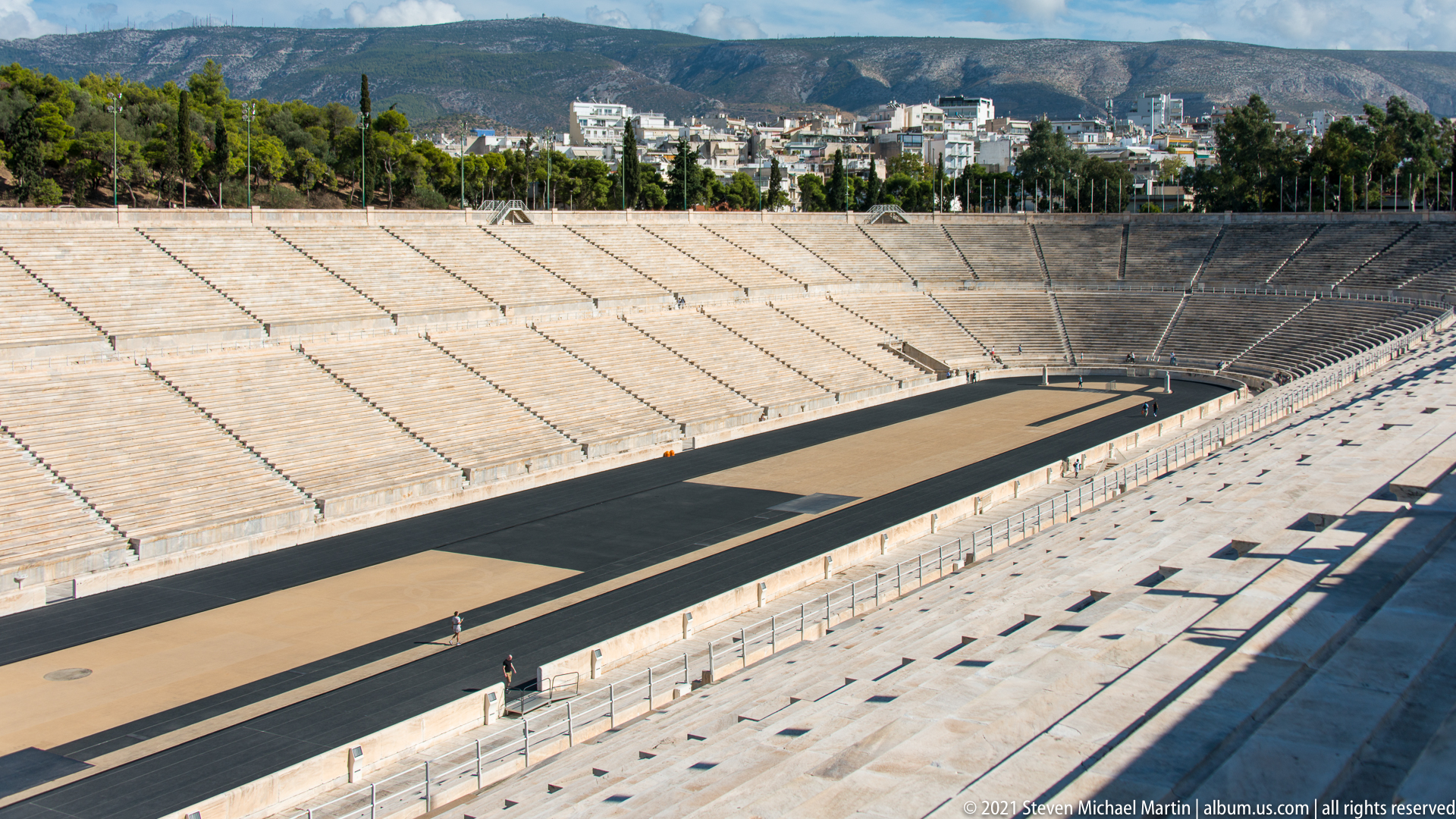
From the upper grandstand, the Panathenaic Stadium’s elongated arena is seen almost in full, with black running lanes bordering a tan central strip and marble seating sweeping around the far curve. Small visitors on the track convey scale, while the hills and buildings beyond the rim situate the monumental bowl within the Athens basin.
Caption
From the upper grandstand, the Panathenaic Stadium’s elongated arena is seen almost in full, with black running lanes bordering a tan central strip and marble seating sweeping around the far curve. Small visitors on the track convey scale, while the hills and buildings beyond the rim situate the monumental bowl within the Athens basin.

An elevated view links the Panathenaic Stadium to the surrounding city, with the black-and-tan track and marble seating occupying the foreground and Mount Lycabettus rising beyond dense Athens neighborhoods. Greek and Olympic flags cluster near the arena entrance, adding a ceremonial focal point within the broad urban panorama.
Caption
An elevated view links the Panathenaic Stadium to the surrounding city, with the black-and-tan track and marble seating occupying the foreground and Mount Lycabettus rising beyond dense Athens neighborhoods. Greek and Olympic flags cluster near the arena entrance, adding a ceremonial focal point within the broad urban panorama.

Mount Lycabettus rises sharply above the dense white cityscape of Athens, viewed from the Panathenaic Stadium area. The rocky summit and its small hilltop structures form a distinct landmark above apartment blocks, cypress trees, and streets in the foreground, placing the stadium within the broader topography of central Athens.
Caption
Mount Lycabettus rises sharply above the dense white cityscape of Athens, viewed from the Panathenaic Stadium area. The rocky summit and its small hilltop structures form a distinct landmark above apartment blocks, cypress trees, and streets in the foreground, placing the stadium within the broader topography of central Athens.

Seen across the open forecourt, opposing banks of marble seating frame the entrance-side end of the Panathenaic Stadium. Rows of Greek and Olympic-related flags create a ceremonial axis in the center, while the curved distortion of the wide-angle view accentuates the steep rise of the stands and the stadium’s enclosed, amphitheatrical form.
Caption
Seen across the open forecourt, opposing banks of marble seating frame the entrance-side end of the Panathenaic Stadium. Rows of Greek and Olympic-related flags create a ceremonial axis in the center, while the curved distortion of the wide-angle view accentuates the steep rise of the stands and the stadium’s enclosed, amphitheatrical form.

The curved end of the Panathenaic Stadium is organized by dark radial stair aisles that fan upward through the marble seating. A few visitors scattered across the vast stand provide scale, while the frontal viewpoint emphasizes the bowl’s symmetry and the strong contrast between pale benches and the darker circulation routes.
Caption
The curved end of the Panathenaic Stadium is organized by dark radial stair aisles that fan upward through the marble seating. A few visitors scattered across the vast stand provide scale, while the frontal viewpoint emphasizes the bowl’s symmetry and the strong contrast between pale benches and the darker circulation routes.

A low viewpoint runs along the base of the Panathenaic Stadium’s marble grandstand, turning the long seat courses into converging bands that climb toward the skyline. Scattered visitors provide scale for the steep seating bank, while access steps, railings, light standards, and vegetation along the upper rim reveal the working details of the restored stadium.
Caption
A low viewpoint runs along the base of the Panathenaic Stadium’s marble grandstand, turning the long seat courses into converging bands that climb toward the skyline. Scattered visitors provide scale for the steep seating bank, while access steps, railings, light standards, and vegetation along the upper rim reveal the working details of the restored stadium.

A broad side view of the Panathenaic Stadium sets its pale marble seating above the paved forecourt, where a line of Greek flags introduces the ceremonial character of the site. The steep tiers rise behind a retaining wall and stair aisle, emphasizing the stadium’s monumental geometry while keeping the open arena edge and surrounding trees in view.
Caption
A broad side view of the Panathenaic Stadium sets its pale marble seating above the paved forecourt, where a line of Greek flags introduces the ceremonial character of the site. The steep tiers rise behind a retaining wall and stair aisle, emphasizing the stadium’s monumental geometry while keeping the open arena edge and surrounding trees in view.

Greek flags stand in front of one steep marble grandstand of the Panathenaic Stadium, their blue-and-white stripes contrasting with the warm, weathered stone. A massive stair and retaining structure anchors the left side, while the repeated horizontal seating courses climb toward a line of cypress trees above the stadium rim.
Caption
Greek flags stand in front of one steep marble grandstand of the Panathenaic Stadium, their blue-and-white stripes contrasting with the warm, weathered stone. A massive stair and retaining structure anchors the left side, while the repeated horizontal seating courses climb toward a line of cypress trees above the stadium rim.
From track level, the Panathenaic Stadium opens as a long symmetrical corridor between steep marble seating banks. The tan central surface and dark running lanes draw the eye toward the far curve, while a wide-angle perspective exaggerates the bowl’s sweeping sides and conveys the unusually narrow, elongated plan of the arena.
Caption
From track level, the Panathenaic Stadium opens as a long symmetrical corridor between steep marble seating banks. The tan central surface and dark running lanes draw the eye toward the far curve, while a wide-angle perspective exaggerates the bowl’s sweeping sides and conveys the unusually narrow, elongated plan of the arena.

The closed end of the Panathenaic Stadium fills this track-level view, where the marble seating sweeps around the curve in a continuous horseshoe. Broad tan and black surfaces occupy the arena floor, and the largely empty stands allow the radial stair aisles and tiered construction to read clearly against trees and a bright Athenian sky.
Caption
The closed end of the Panathenaic Stadium fills this track-level view, where the marble seating sweeps around the curve in a continuous horseshoe. Broad tan and black surfaces occupy the arena floor, and the largely empty stands allow the radial stair aisles and tiered construction to read clearly against trees and a bright Athenian sky.

A narrow stair aisle cuts vertically through tightly spaced marble seating at the Panathenaic Stadium. The frontal composition reduces the grandstand to a precise pattern of horizontal benches and a single irregular vertical seam, making the circulation route, weathering, and modular construction of the restored seating especially legible.
Caption
A narrow stair aisle cuts vertically through tightly spaced marble seating at the Panathenaic Stadium. The frontal composition reduces the grandstand to a precise pattern of horizontal benches and a single irregular vertical seam, making the circulation route, weathering, and modular construction of the restored seating especially legible.

Two diagonal stair runs interrupt the repetitive marble benches of the Panathenaic Stadium, creating a zigzag rhythm across the seating field. Tight framing isolates the functional geometry of the grandstand: shallow seat courses, compact steps, and weather-stained stone surfaces that together show how spectators move through the steeply tiered bowl.
Caption
Two diagonal stair runs interrupt the repetitive marble benches of the Panathenaic Stadium, creating a zigzag rhythm across the seating field. Tight framing isolates the functional geometry of the grandstand: shallow seat courses, compact steps, and weather-stained stone surfaces that together show how spectators move through the steeply tiered bowl.

A visitor adopts a sprinter’s starting pose on the dark running lane of the Panathenaic Stadium while a companion kneels behind with a camera. The playful reenactment brings human scale and activity to the arena, contrasting the smooth modern track surface with the monumental marble stadium that lies outside this tight composition.
Caption
A visitor adopts a sprinter’s starting pose on the dark running lane of the Panathenaic Stadium while a companion kneels behind with a camera. The playful reenactment brings human scale and activity to the arena, contrasting the smooth modern track surface with the monumental marble stadium that lies outside this tight composition.

Blue-painted numerals “5” and “4” mark adjacent marble blocks beside a short access stair in the Panathenaic Stadium. The close view records practical seating organization as well as the veining, joints, and wear of the stone, turning a small circulation detail into evidence of how the monumental grandstand is subdivided for use.
Caption
Blue-painted numerals “5” and “4” mark adjacent marble blocks beside a short access stair in the Panathenaic Stadium. The close view records practical seating organization as well as the veining, joints, and wear of the stone, turning a small circulation detail into evidence of how the monumental grandstand is subdivided for use.

Long marble benches sweep around the Panathenaic Stadium in a layered curve, their edges alternating between bright sunlight and deep shadow. The oblique viewpoint looks along the seating rather than across it, emphasizing the continuous arc of the bowl and the narrow passage channels that follow the grandstand’s contour.
Caption
Long marble benches sweep around the Panathenaic Stadium in a layered curve, their edges alternating between bright sunlight and deep shadow. The oblique viewpoint looks along the seating rather than across it, emphasizing the continuous arc of the bowl and the narrow passage channels that follow the grandstand’s contour.

A shallow-focus view isolates the sweeping edge of the Panathenaic Stadium’s marble seating, where repeated bench lines bend through the frame beside a recessed passage. Sunlit stone surfaces and dark shadow bands create an almost abstract study of the stadium’s curvature, emphasizing material and rhythm rather than the full scale of the arena.
Caption
A shallow-focus view isolates the sweeping edge of the Panathenaic Stadium’s marble seating, where repeated bench lines bend through the frame beside a recessed passage. Sunlit stone surfaces and dark shadow bands create an almost abstract study of the stadium’s curvature, emphasizing material and rhythm rather than the full scale of the arena.

From high in the seating, the Panathenaic Stadium unfolds toward its closed end, with marble benches and a metal handrail leading the eye around the horseshoe. The elevated perspective reveals the relationship between upper circulation, steep spectator tiers, and the black-and-tan track below, while the city edge appears beyond the stadium rim.
Caption
From high in the seating, the Panathenaic Stadium unfolds toward its closed end, with marble benches and a metal handrail leading the eye around the horseshoe. The elevated perspective reveals the relationship between upper circulation, steep spectator tiers, and the black-and-tan track below, while the city edge appears beyond the stadium rim.

A tighter view centers the rocky upper slopes of Mount Lycabettus above Athens. White buildings crowd the lower hillside, while the summit complex stands against a blue, cloud-filled sky. The compressed perspective emphasizes the abrupt transition from dense urban development to the exposed rock and vegetation of one of the city’s most recognizable hills.
Caption
A tighter view centers the rocky upper slopes of Mount Lycabettus above Athens. White buildings crowd the lower hillside, while the summit complex stands against a blue, cloud-filled sky. The compressed perspective emphasizes the abrupt transition from dense urban development to the exposed rock and vegetation of one of the city’s most recognizable hills.

The summit of Mount Lycabettus fills the frame, its exposed rock and scrub rising to a cluster of white hilltop structures. Seen from the Panathenaic Stadium vicinity, the telephoto composition strips away most of the surrounding city and concentrates on the steep natural profile and built crown that make the hill a prominent Athenian landmark.
Caption
The summit of Mount Lycabettus fills the frame, its exposed rock and scrub rising to a cluster of white hilltop structures. Seen from the Panathenaic Stadium vicinity, the telephoto composition strips away most of the surrounding city and concentrates on the steep natural profile and built crown that make the hill a prominent Athenian landmark.

A white Olympic flag bearing the five colored rings billows among Greek national flags beside the Panathenaic Stadium. Viewed from above, the close grouping emphasizes the intertwined Olympic and national symbolism of the site, while a street, parked cars, and trees beyond the flagpoles locate the ceremonial display within contemporary Athens.
Caption
A white Olympic flag bearing the five colored rings billows among Greek national flags beside the Panathenaic Stadium. Viewed from above, the close grouping emphasizes the intertwined Olympic and national symbolism of the site, while a street, parked cars, and trees beyond the flagpoles locate the ceremonial display within contemporary Athens.

A marble male athlete bends deeply forward, one hand braced near his knee as he attends to his lower leg or foot. Set against dense green foliage, the pale sculpture emphasizes anatomy, balance, and concentrated movement. The athletic subject complements the sporting monuments and Olympic symbolism displayed around the Panathenaic Stadium precinct.
Caption
A marble male athlete bends deeply forward, one hand braced near his knee as he attends to his lower leg or foot. Set against dense green foliage, the pale sculpture emphasizes anatomy, balance, and concentrated movement. The athletic subject complements the sporting monuments and Olympic symbolism displayed around the Panathenaic Stadium precinct.

Greek flags stream strongly from a row of white poles, with a white Olympic flag and its colored rings partly visible among them. The upward-looking composition removes most of the stadium from view and concentrates on motion, color, and repetition, presenting the flags as a modern ceremonial emblem of the Panathenaic Stadium.
Caption
Greek flags stream strongly from a row of white poles, with a white Olympic flag and its colored rings partly visible among them. The upward-looking composition removes most of the stadium from view and concentrates on motion, color, and repetition, presenting the flags as a modern ceremonial emblem of the Panathenaic Stadium.

A bronze athletic figure twists dynamically with a discus raised above his head, displayed on a pale stone pedestal amid trees near the Panathenaic Stadium. The sculpture’s extended arms, bent knees, and strongly modeled torso evoke the physical exertion of competitive sport, connecting the landscaped setting around the stadium with its athletic identity.
Caption
A bronze athletic figure twists dynamically with a discus raised above his head, displayed on a pale stone pedestal amid trees near the Panathenaic Stadium. The sculpture’s extended arms, bent knees, and strongly modeled torso evoke the physical exertion of competitive sport, connecting the landscaped setting around the stadium with its athletic identity.

The bronze discus thrower is seen more closely against open sky and foliage, revealing the forceful twist of the torso and the broad arc formed by the raised arms and discus. Weathered green patina accentuates the modeled musculature, while the low viewpoint gives the athletic figure a monumental presence appropriate to the Panathenaic Stadium setting.
Caption
The bronze discus thrower is seen more closely against open sky and foliage, revealing the forceful twist of the torso and the broad arc formed by the raised arms and discus. Weathered green patina accentuates the modeled musculature, while the low viewpoint gives the athletic figure a monumental presence appropriate to the Panathenaic Stadium setting.