Hohensalzburg Fortress – Salzburg, Austria
The Hohensalzburg Fortress stands high above the city of Salzburg on the rocky hill known as the Festungsberg. Built beginning in the 11th century by the powerful prince-archbishops of Salzburg, the fortress served as both a defensive stronghold and a symbol of their authority.
Its massive stone walls, towers, and courtyards stretch across the hilltop, making it one of the largest and best-preserved medieval fortresses in Europe. From the ramparts, sweeping views extend across the rooftops of Salzburg and the surrounding valleys.
The fortress dominates the skyline of the city and reflects the long political and religious power once held by Salzburg’s archbishops.

From the fortress heights, Salzburg Cathedral anchors a dense panorama of the historic center with its pale façade, twin green-capped towers, and large copper-green dome. Church spires, tiled roofs, and the curving Salzach River extend beyond it, showing the commanding urban outlook that made Fortress Hohensalzburg both a defensive stronghold and a dominant presence above the city.
Caption
From the fortress heights, Salzburg Cathedral anchors a dense panorama of the historic center with its pale façade, twin green-capped towers, and large copper-green dome. Church spires, tiled roofs, and the curving Salzach River extend beyond it, showing the commanding urban outlook that made Fortress Hohensalzburg both a defensive stronghold and a dominant presence above the city.

A sweeping panorama from Fortress Hohensalzburg looks across Salzburg’s southern districts and broad green open spaces toward a jagged Alpine skyline. Roads and paths divide the foreground fields, while dense residential areas spread outward through autumn-colored vegetation. The brilliant sun and exceptionally wide field of view make the fortress’s commanding position over both city and surrounding mountain landscape the defining subject of the final photograph.
Caption
A sweeping panorama from Fortress Hohensalzburg looks across Salzburg’s southern districts and broad green open spaces toward a jagged Alpine skyline. Roads and paths divide the foreground fields, while dense residential areas spread outward through autumn-colored vegetation. The brilliant sun and exceptionally wide field of view make the fortress’s commanding position over both city and surrounding mountain landscape the defining subject of the final photograph.

Whitewashed buildings of Fortress Hohensalzburg step across the foreground, anchored by a square defensive tower with a crenellated-looking roofline. Beyond the walls, the view opens dramatically across the Salzburg basin to dark mountain ridges. The elevated viewpoint makes the fortress’s commanding topographic position legible, linking its compact defensive architecture to the broad territory visible below.
Caption
Whitewashed buildings of Fortress Hohensalzburg step across the foreground, anchored by a square defensive tower with a crenellated-looking roofline. Beyond the walls, the view opens dramatically across the Salzburg basin to dark mountain ridges. The elevated viewpoint makes the fortress’s commanding topographic position legible, linking its compact defensive architecture to the broad territory visible below.

The view from Fortress Hohensalzburg extends beyond the historic center to modern Salzburg, where dense blocks of commercial and residential development meet green fields and wooded hills. A pale hilltop complex stands in the middle distance, while the broad panorama demonstrates the fortress’s commanding position over both the old city and later urban expansion.
Caption
The view from Fortress Hohensalzburg extends beyond the historic center to modern Salzburg, where dense blocks of commercial and residential development meet green fields and wooded hills. A pale hilltop complex stands in the middle distance, while the broad panorama demonstrates the fortress’s commanding position over both the old city and later urban expansion.

Whitewashed masonry walls and towers rise around an interior passage of Fortress Hohensalzburg, their small windows and irregular massing reflecting the layered defensive complex. Strong sunlight throws a sharp geometric shadow across the nearest wall, while a crenellated tower and round stone structure close the view deeper inside the fortress.
Caption
Whitewashed masonry walls and towers rise around an interior passage of Fortress Hohensalzburg, their small windows and irregular massing reflecting the layered defensive complex. Strong sunlight throws a sharp geometric shadow across the nearest wall, while a crenellated tower and round stone structure close the view deeper inside the fortress.

A white clock tower with a steep green-patinated spire rises among the interior buildings of Hohensalzburg Fortress. The compact composition layers pale fortified walls, dark metal roofs, a red-and-white Austrian flag, and the wooded Salzburg hills beyond. Rather than presenting the citadel from a distance, this view records the architectural variety encountered inside the hilltop complex.
Caption
A white clock tower with a steep green-patinated spire rises among the interior buildings of Hohensalzburg Fortress. The compact composition layers pale fortified walls, dark metal roofs, a red-and-white Austrian flag, and the wooded Salzburg hills beyond. Rather than presenting the citadel from a distance, this view records the architectural variety encountered inside the hilltop complex.

Fortress Hohensalzburg crowns the steep hillside above a small paved service court and lower urban buildings. The pale outer walls form a long horizontal band high across the frame, visually separated from the street-level structures by the wooded slope. This ground-level perspective reverses the elevated panoramas elsewhere in the portfolio, showing how decisively the fortress dominates the cityscape from below.
Caption
Fortress Hohensalzburg crowns the steep hillside above a small paved service court and lower urban buildings. The pale outer walls form a long horizontal band high across the frame, visually separated from the street-level structures by the wooded slope. This ground-level perspective reverses the elevated panoramas elsewhere in the portfolio, showing how decisively the fortress dominates the cityscape from below.

From Hohensalzburg Fortress, Salzburg Cathedral dominates the old city below with its large green dome and twin towers. Dense gray and red roofs spread around the cathedral toward the Salzach and the modern city beyond. The elevated viewpoint makes the cathedral the visual hinge between Salzburg’s Baroque core and the broader urban basin.
Caption
From Hohensalzburg Fortress, Salzburg Cathedral dominates the old city below with its large green dome and twin towers. Dense gray and red roofs spread around the cathedral toward the Salzach and the modern city beyond. The elevated viewpoint makes the cathedral the visual hinge between Salzburg’s Baroque core and the broader urban basin.

A detailed scale model reconstructs Hohensalzburg Fortress as a dense complex of courtyards, towers, red-tiled roofs, curtain walls, and projecting defensive works. Viewed from above, the model clarifies relationships that are difficult to read at full scale, especially the way successive enclosures and building ranges occupy the summit. The object functions as an interpretive overview of the fortress’s compact plan.
Caption
A detailed scale model reconstructs Hohensalzburg Fortress as a dense complex of courtyards, towers, red-tiled roofs, curtain walls, and projecting defensive works. Viewed from above, the model clarifies relationships that are difficult to read at full scale, especially the way successive enclosures and building ranges occupy the summit. The object functions as an interpretive overview of the fortress’s compact plan.

An elaborate museum diorama stages a courtly gathering in a formal garden, with richly dressed figures arranged around a sculptural fountain before a painted architectural and landscape backdrop. The miniature setting emphasizes theatrical storytelling rather than the fortress itself, adding a cultural-history dimension to the visitor displays inside Fortress Hohensalzburg.
Caption
An elaborate museum diorama stages a courtly gathering in a formal garden, with richly dressed figures arranged around a sculptural fountain before a painted architectural and landscape backdrop. The miniature setting emphasizes theatrical storytelling rather than the fortress itself, adding a cultural-history dimension to the visitor displays inside Fortress Hohensalzburg.

Fortress Hohensalzburg steps down the slope in a sequence of pale defensive towers, dark roofs, and heavy stone walls, framed by a wooded mountain rising behind. The oblique view emphasizes how the stronghold’s architecture follows the steep terrain, combining vertical towers with layered walls that overlook the lower city and surrounding Alpine landscape.
Caption
Fortress Hohensalzburg steps down the slope in a sequence of pale defensive towers, dark roofs, and heavy stone walls, framed by a wooded mountain rising behind. The oblique view emphasizes how the stronghold’s architecture follows the steep terrain, combining vertical towers with layered walls that overlook the lower city and surrounding Alpine landscape.

A massive round tower and battered stone curtain wall dominate this upward-looking view of Fortress Hohensalzburg. The sloping masonry base, narrow openings, and elevated wall walk convey the scale of the defensive works at close range, while the clear sky isolates the pale fortress fabric and makes changes in stonework and plaster especially legible.
Caption
A massive round tower and battered stone curtain wall dominate this upward-looking view of Fortress Hohensalzburg. The sloping masonry base, narrow openings, and elevated wall walk convey the scale of the defensive works at close range, while the clear sky isolates the pale fortress fabric and makes changes in stonework and plaster especially legible.
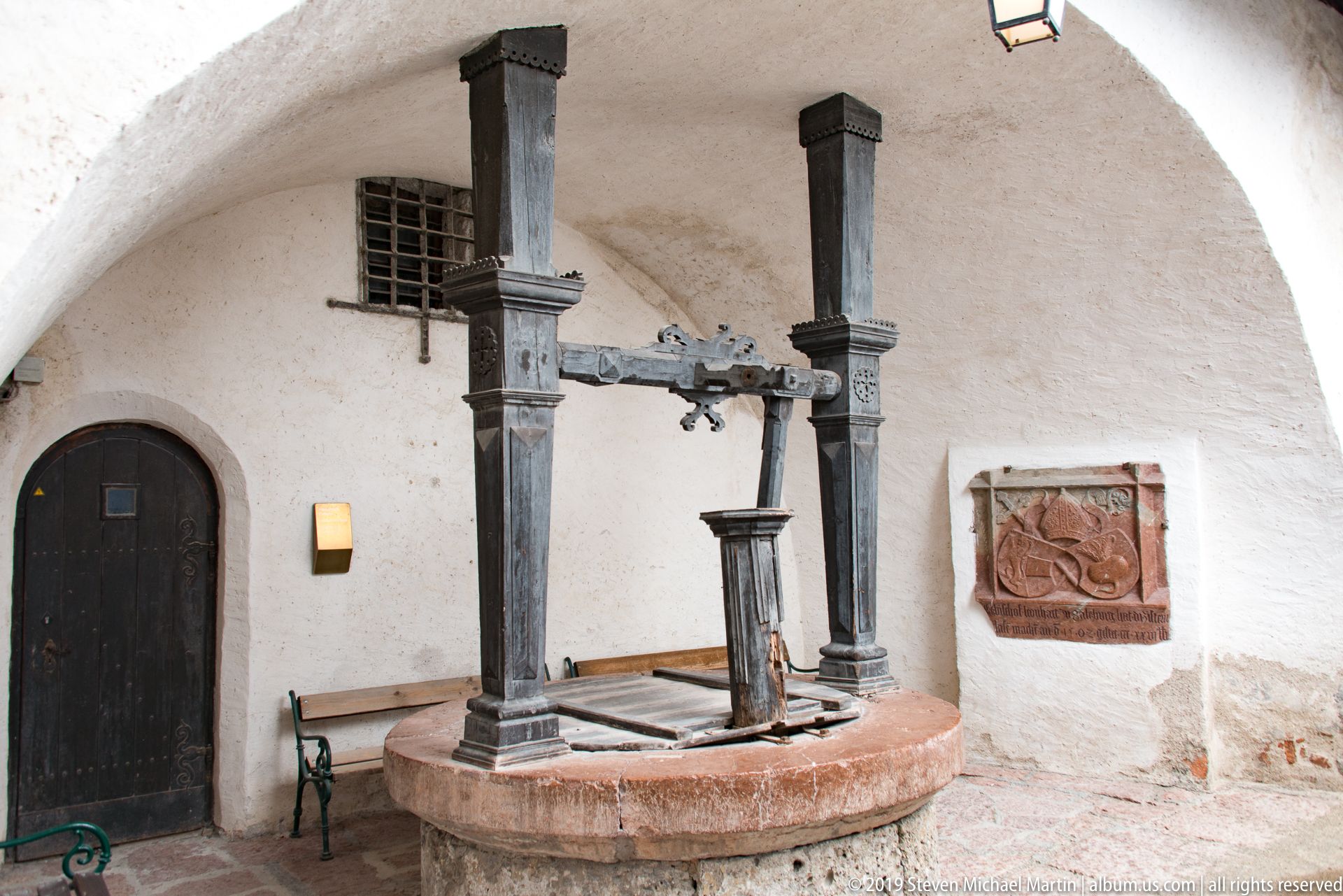
A heavy timber frame spans a circular stone basin inside a vaulted fortress room, suggesting a historic lifting or well mechanism preserved as part of the site interpretation. Four upright posts, crossbeams, and a central wooden assembly stand over the deep masonry rim, while a carved stone plaque on the wall provides an additional historic detail.
Caption
A heavy timber frame spans a circular stone basin inside a vaulted fortress room, suggesting a historic lifting or well mechanism preserved as part of the site interpretation. Four upright posts, crossbeams, and a central wooden assembly stand over the deep masonry rim, while a carved stone plaque on the wall provides an additional historic detail.
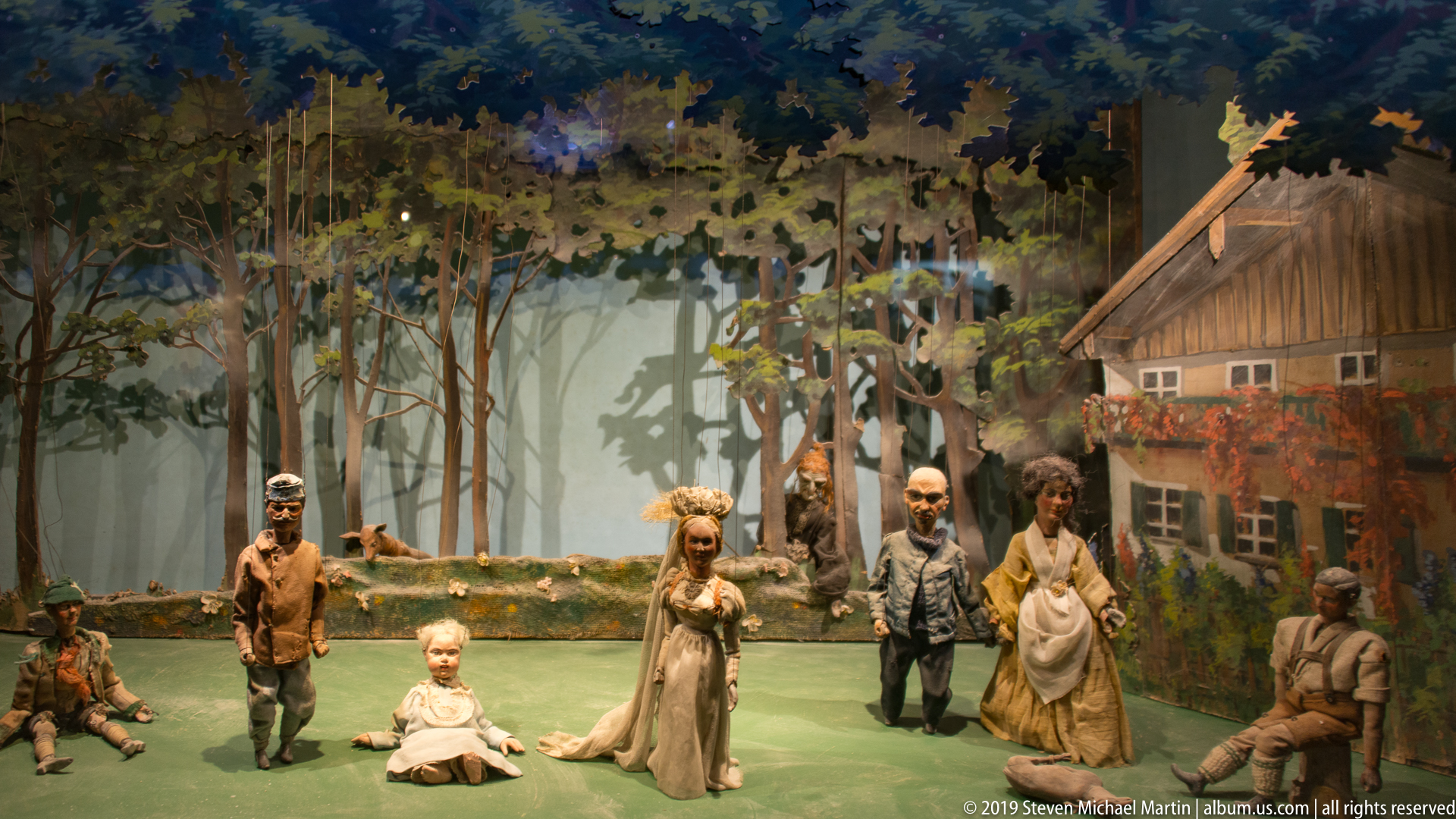
A museum display uses articulated figures to stage a rural scene before a wooded painted backdrop and rustic house. Adults and children are spaced across a grassy foreground, with individualized clothing and expressive carved faces giving the tableau the character of puppet theater. The installation illustrates the storytelling traditions presented within Fortress Hohensalzburg’s visitor exhibits.
Caption
A museum display uses articulated figures to stage a rural scene before a wooded painted backdrop and rustic house. Adults and children are spaced across a grassy foreground, with individualized clothing and expressive carved faces giving the tableau the character of puppet theater. The installation illustrates the storytelling traditions presented within Fortress Hohensalzburg’s visitor exhibits.

Armed puppet figures confront one another across a rocky stage while a model fortress rises dramatically behind them. Swords, period-style clothing, and mounted figures create a compact historical theater, with the stronghold’s towers and red roofs serving as the visual backdrop. The display translates episodes associated with the fortress into an accessible miniature performance scene.
Caption
Armed puppet figures confront one another across a rocky stage while a model fortress rises dramatically behind them. Swords, period-style clothing, and mounted figures create a compact historical theater, with the stronghold’s towers and red roofs serving as the visual backdrop. The display translates episodes associated with the fortress into an accessible miniature performance scene.

A group of finely dressed puppet figures gathers before the façade of a large residence, with adults and children posed as if in a social or ceremonial scene. Bright regional-style clothing, carefully modeled faces, and varied gestures distinguish each character, demonstrating the detailed craftsmanship of the theatrical figures displayed at Fortress Hohensalzburg.
Caption
A group of finely dressed puppet figures gathers before the façade of a large residence, with adults and children posed as if in a social or ceremonial scene. Bright regional-style clothing, carefully modeled faces, and varied gestures distinguish each character, demonstrating the detailed craftsmanship of the theatrical figures displayed at Fortress Hohensalzburg.

An ornate red-and-gold carriage, harnessed horse, and elaborately dressed figures form the centerpiece of this theatrical museum tableau. Powdered wigs and formal clothing evoke an aristocratic setting, while the painted palace façade and trees create stage-like depth. The display focuses on courtly spectacle and transport through the detailed language of puppet and miniature theater.
Caption
An ornate red-and-gold carriage, harnessed horse, and elaborately dressed figures form the centerpiece of this theatrical museum tableau. Powdered wigs and formal clothing evoke an aristocratic setting, while the painted palace façade and trees create stage-like depth. The display focuses on courtly spectacle and transport through the detailed language of puppet and miniature theater.

A dense display of arms and armor combines helmets, shields, polearms, and bladed weapons beneath a row of heraldic escutcheons. The arrangement presents the visual vocabulary of European martial equipment and heraldry in a compact museum setting, contrasting polished metal defenses with brightly colored coats of arms associated with the fortress’s military interpretation.
Caption
A dense display of arms and armor combines helmets, shields, polearms, and bladed weapons beneath a row of heraldic escutcheons. The arrangement presents the visual vocabulary of European martial equipment and heraldry in a compact museum setting, contrasting polished metal defenses with brightly colored coats of arms associated with the fortress’s military interpretation.
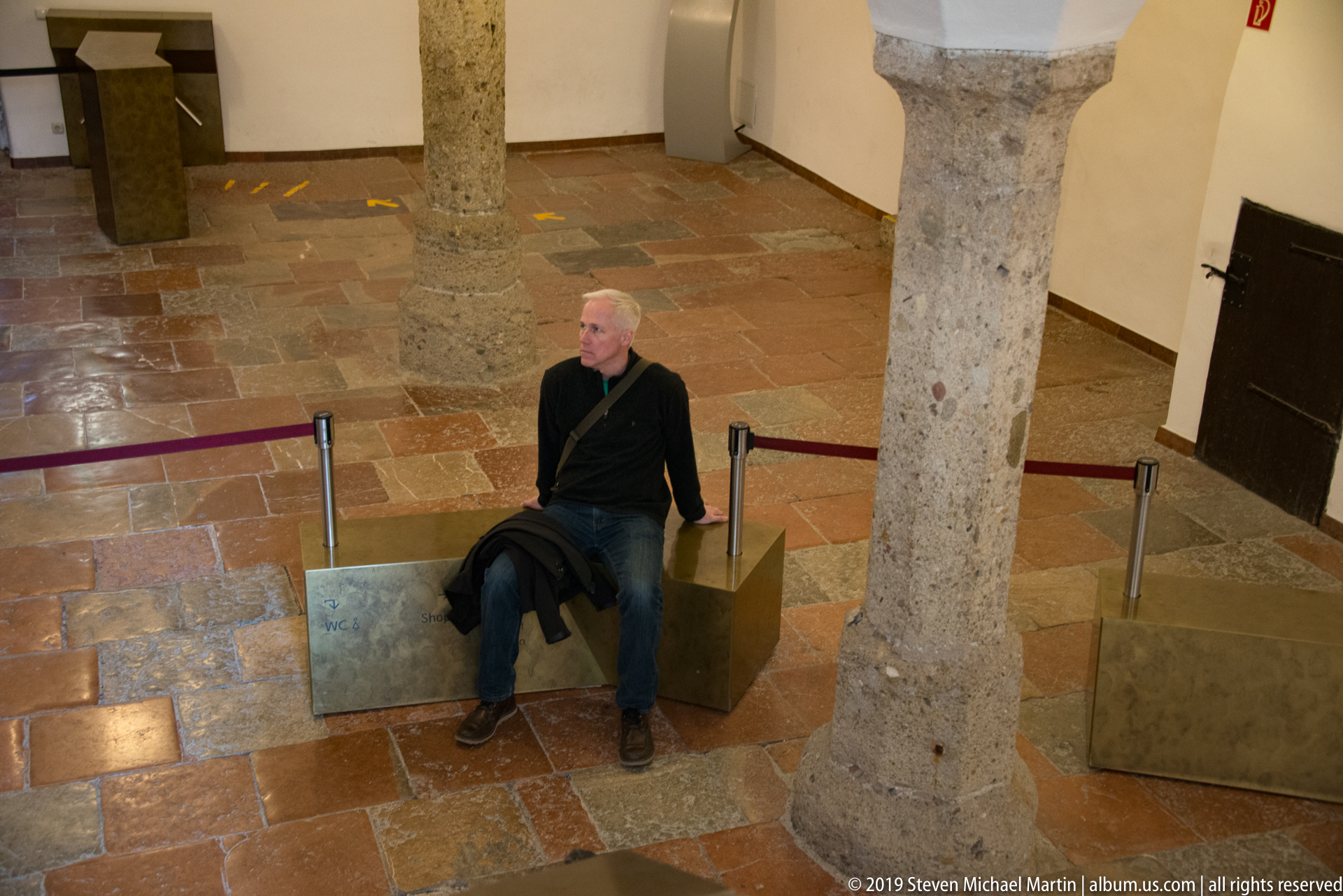
A visitor rests on a simple bench within a spare fortress interior defined by thick stone columns, white plaster walls, and a floor of warm rectangular tiles. Seen from above, the composition emphasizes the scale and solidity of the structural supports while preserving a quiet moment of human presence within the historic complex.
Caption
A visitor rests on a simple bench within a spare fortress interior defined by thick stone columns, white plaster walls, and a floor of warm rectangular tiles. Seen from above, the composition emphasizes the scale and solidity of the structural supports while preserving a quiet moment of human presence within the historic complex.
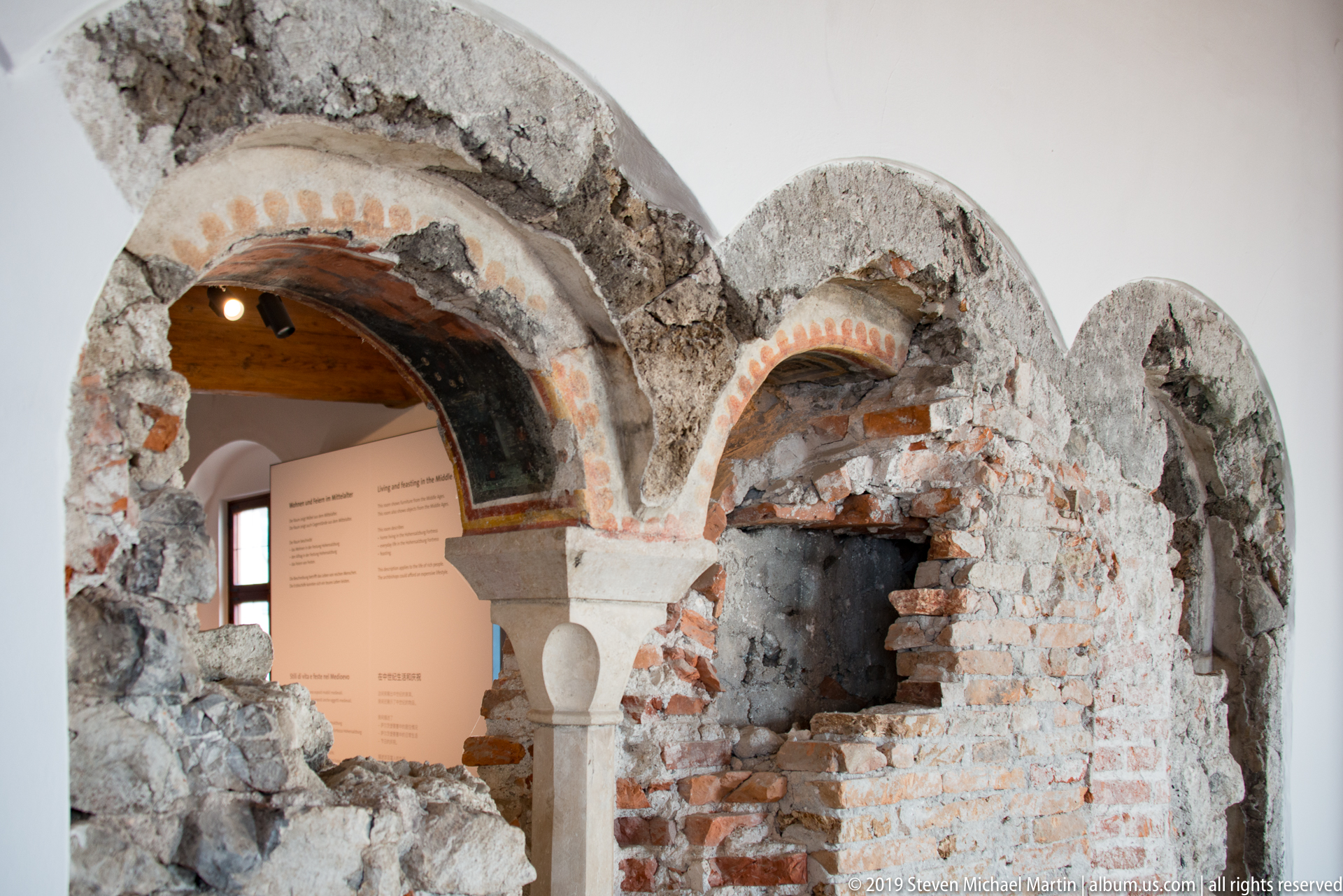
Exposed masonry reveals a sequence of rounded brick arches built into the fortress fabric, with rough stone, surviving plaster, and a small column left visible for interpretation. The partially opened wall makes construction phases legible and contrasts sharply with the finished museum gallery beyond, turning the building itself into an archaeological exhibit.
Caption
Exposed masonry reveals a sequence of rounded brick arches built into the fortress fabric, with rough stone, surviving plaster, and a small column left visible for interpretation. The partially opened wall makes construction phases legible and contrasts sharply with the finished museum gallery beyond, turning the building itself into an archaeological exhibit.
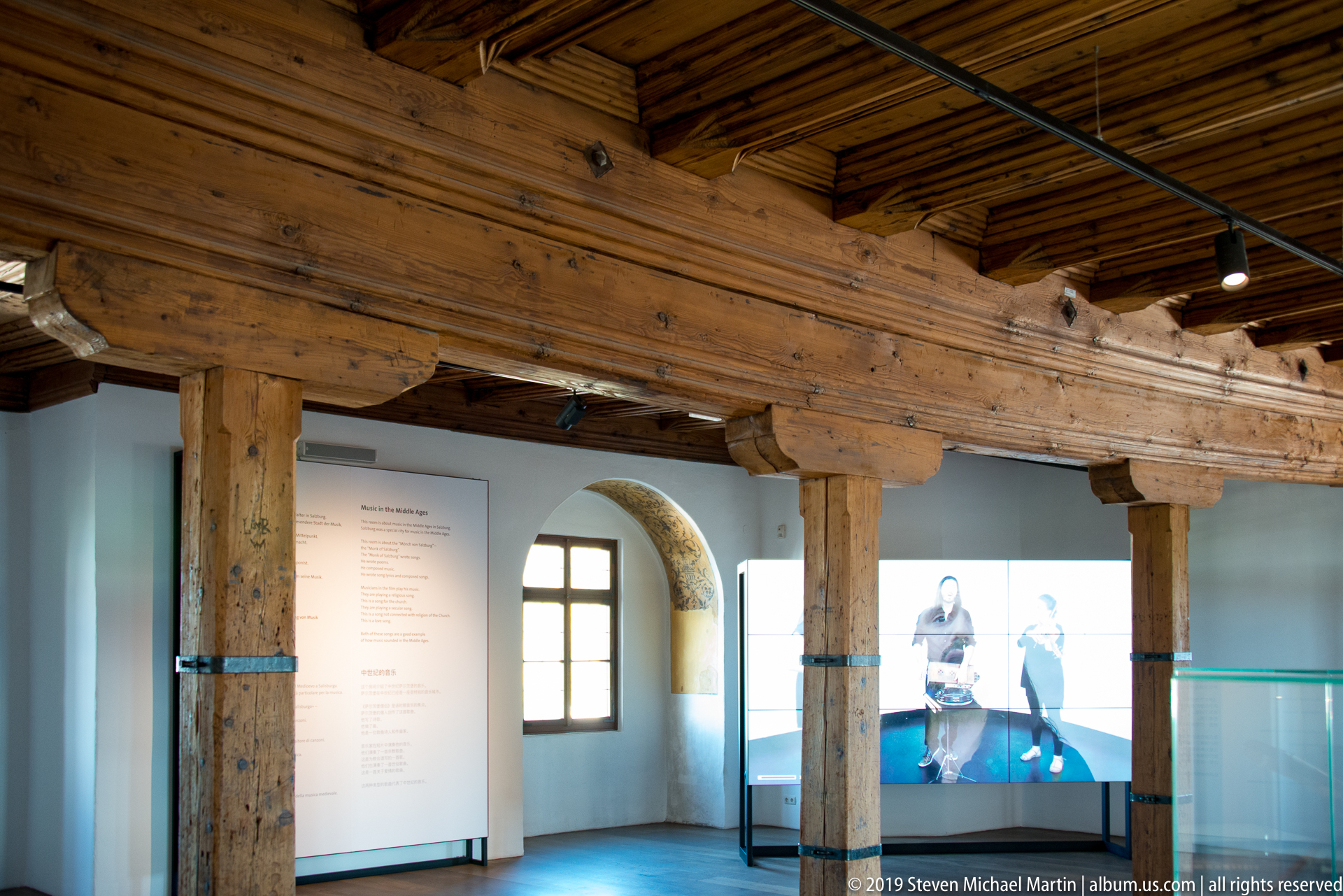
Massive timber posts, beams, and closely spaced ceiling members remain exposed within a modern museum gallery at Fortress Hohensalzburg. Their rough surfaces, joinery, and substantial dimensions contrast with glass barriers and contemporary interpretation panels, allowing visitors to read the historic structural system while moving through the adapted interior.
Caption
Massive timber posts, beams, and closely spaced ceiling members remain exposed within a modern museum gallery at Fortress Hohensalzburg. Their rough surfaces, joinery, and substantial dimensions contrast with glass barriers and contemporary interpretation panels, allowing visitors to read the historic structural system while moving through the adapted interior.

A tall arched opening preserves painted architectural decoration along its inner face, including bands of circular and scroll-like motifs in muted red, gray, and ocher. Areas of loss expose brick and rough masonry beneath, making the doorway both a decorative survivor and a record of the fortress’s changing finishes and construction layers.
Caption
A tall arched opening preserves painted architectural decoration along its inner face, including bands of circular and scroll-like motifs in muted red, gray, and ocher. Areas of loss expose brick and rough masonry beneath, making the doorway both a decorative survivor and a record of the fortress’s changing finishes and construction layers.

A monumental polychrome ceramic stove stands as an ornate furnishing within the fortress museum, its two-tiered body covered with architectural panels, figures, floral ornament, and vivid green, orange, blue, and cream glazes. The elaborate tilework demonstrates how heating equipment in elite interiors could also function as a major decorative centerpiece.
Caption
A monumental polychrome ceramic stove stands as an ornate furnishing within the fortress museum, its two-tiered body covered with architectural panels, figures, floral ornament, and vivid green, orange, blue, and cream glazes. The elaborate tilework demonstrates how heating equipment in elite interiors could also function as a major decorative centerpiece.

A polished suit of plate armor is presented frontally on a museum mount, revealing the overlapping metal plates that protect the torso, shoulders, arms, hips, and upper legs. Fluted and articulated surfaces combine mobility with defense, while the isolated display allows close study of the armor’s engineered construction rather than presenting it as part of a crowded weapons ensemble.
Caption
A polished suit of plate armor is presented frontally on a museum mount, revealing the overlapping metal plates that protect the torso, shoulders, arms, hips, and upper legs. Fluted and articulated surfaces combine mobility with defense, while the isolated display allows close study of the armor’s engineered construction rather than presenting it as part of a crowded weapons ensemble.

A heavy wooden door sits within a pointed painted arch beneath an exposed timber ceiling, while carved and painted corbels project at intervals along the white wall. The restrained room preserves several layers of historic interior finish at once—woodwork, plaster, decorative painting, and structural timber—within the fortress museum route.
Caption
A heavy wooden door sits within a pointed painted arch beneath an exposed timber ceiling, while carved and painted corbels project at intervals along the white wall. The restrained room preserves several layers of historic interior finish at once—woodwork, plaster, decorative painting, and structural timber—within the fortress museum route.
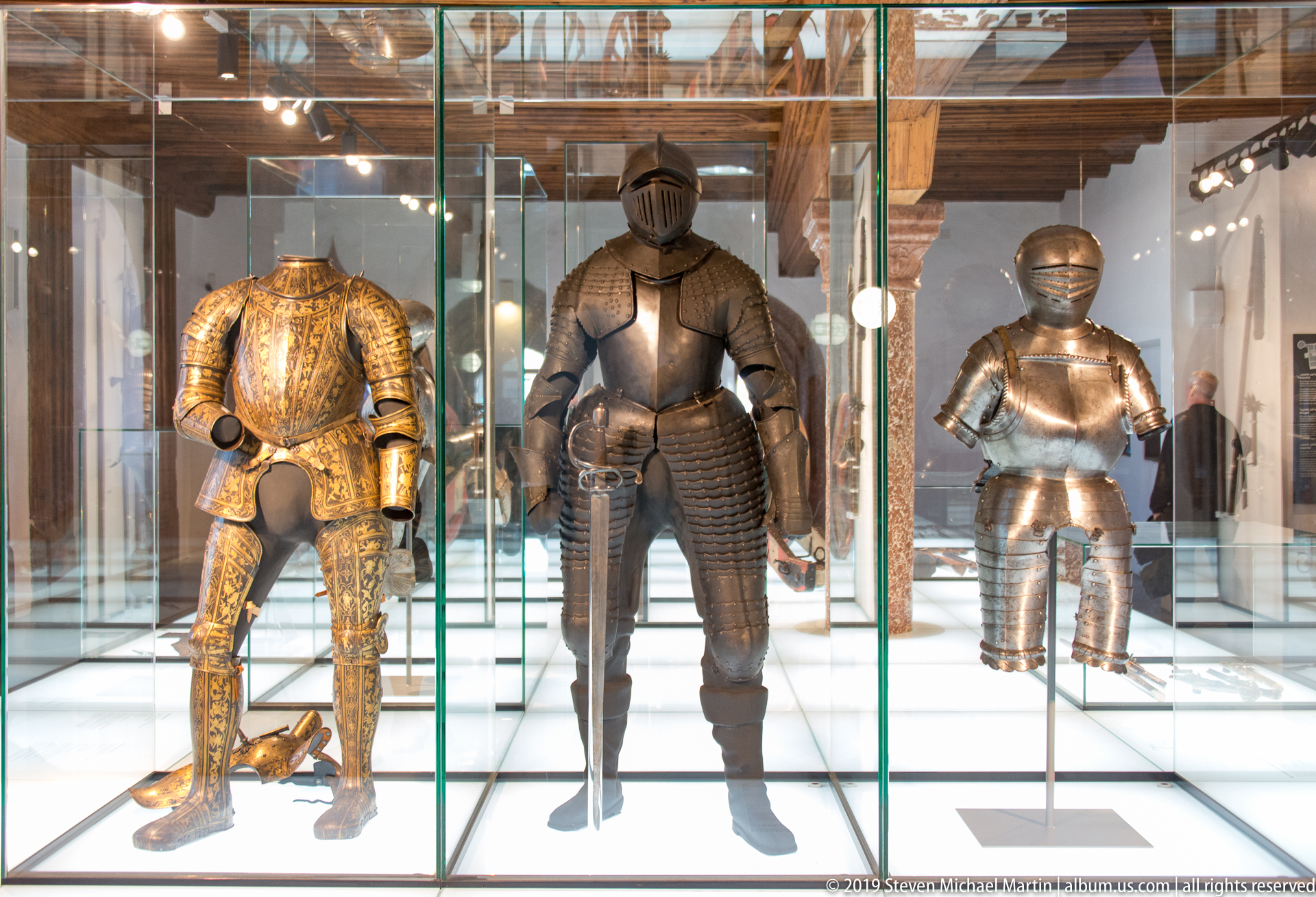
Three armored figures stand in adjacent glass cases, allowing direct comparison of different forms and proportions of European plate defenses. The central dark suit contrasts with a richly reflective armor at left and a smaller suit at right, while the transparent cases and timber interior create a focused gallery devoted to martial material culture.
Caption
Three armored figures stand in adjacent glass cases, allowing direct comparison of different forms and proportions of European plate defenses. The central dark suit contrasts with a richly reflective armor at left and a smaller suit at right, while the transparent cases and timber interior create a focused gallery devoted to martial material culture.

Salzburg Cathedral fills the frame from the fortress viewpoint, its pale stone mass articulated by a large green copper dome, twin façade towers, and rounded eastern volumes. Seen from above, the cathedral’s roof geometry and monumental scale become especially clear against the compact urban fabric of the historic center.
Caption
Salzburg Cathedral fills the frame from the fortress viewpoint, its pale stone mass articulated by a large green copper dome, twin façade towers, and rounded eastern volumes. Seen from above, the cathedral’s roof geometry and monumental scale become especially clear against the compact urban fabric of the historic center.

A vivid red banner embroidered “Rainerbund” and “Salzburg” centers a stylized green-and-white image of Fortress Hohensalzburg above a crowned monogram. Gold fringe and decorative lettering give the textile a ceremonial character, while the fortress emblem ties the regimental association directly to Salzburg’s most recognizable fortified landmark.
Caption
A vivid red banner embroidered “Rainerbund” and “Salzburg” centers a stylized green-and-white image of Fortress Hohensalzburg above a crowned monogram. Gold fringe and decorative lettering give the textile a ceremonial character, while the fortress emblem ties the regimental association directly to Salzburg’s most recognizable fortified landmark.

A carved wooden figure of a uniformed soldier crosses his arms over his chest while holding a cluster of bright red objects that stand out against the warm brown sculpture. The cap, insignia, and stylized facial features give the work a commemorative military character, linking it visually to the regimental material displayed nearby in the fortress museum.
Caption
A carved wooden figure of a uniformed soldier crosses his arms over his chest while holding a cluster of bright red objects that stand out against the warm brown sculpture. The cap, insignia, and stylized facial features give the work a commemorative military character, linking it visually to the regimental material displayed nearby in the fortress museum.

A close view of a printed visitor guide presents long columns of Salzburg sights in multiple languages, marked by national flags and numbered entries. The dense list functions as practical orientation material rather than a historic artifact, contrasting with the fortress’s museum displays and documenting the broader network of monuments, museums, churches, and attractions available to visitors.
Caption
A close view of a printed visitor guide presents long columns of Salzburg sights in multiple languages, marked by national flags and numbered entries. The dense list functions as practical orientation material rather than a historic artifact, contrasting with the fortress’s museum displays and documenting the broader network of monuments, museums, churches, and attractions available to visitors.

A historical illustration depicts two uniformed soldiers in white coats with dark headgear and red-orange facings, one standing with a long firearm and the other carrying a large drum. Handwritten German text beneath the figures includes a clearly visible red date, 1789, making the sheet a useful visual record of late-18th-century military dress and instrumentation.
Caption
A historical illustration depicts two uniformed soldiers in white coats with dark headgear and red-orange facings, one standing with a long firearm and the other carrying a large drum. Handwritten German text beneath the figures includes a clearly visible red date, 1789, making the sheet a useful visual record of late-18th-century military dress and instrumentation.

A carved and painted commemorative emblem bears the inscription “RAINER-BUND 1914–18” above a central shield, flanked by heraldic panels and military-style decorative elements. The dates explicitly connect the object to the First World War era, while the layered coats of arms and crowned ornament frame it as a memorial or association insignia within the fortress’s regimental displays.
Caption
A carved and painted commemorative emblem bears the inscription “RAINER-BUND 1914–18” above a central shield, flanked by heraldic panels and military-style decorative elements. The dates explicitly connect the object to the First World War era, while the layered coats of arms and crowned ornament frame it as a memorial or association insignia within the fortress’s regimental displays.

An elaborate double-headed imperial eagle spreads its wings around a densely quartered heraldic shield, with crowns, scepters, orb, and pendant insignia enriching the composition. The object evokes the heraldic language of the Habsburg monarchy and provides a concentrated display of dynastic symbolism within the military-history galleries at Fortress Hohensalzburg.
Caption
An elaborate double-headed imperial eagle spreads its wings around a densely quartered heraldic shield, with crowns, scepters, orb, and pendant insignia enriching the composition. The object evokes the heraldic language of the Habsburg monarchy and provides a concentrated display of dynastic symbolism within the military-history galleries at Fortress Hohensalzburg.

Five uniformed soldier figures are displayed in a row of illuminated glass cases, each wearing a distinct combination of coat, headgear, equipment, and weapon. The side-by-side arrangement turns changes in military dress into a visual sequence, supporting the fortress museum’s presentation of Salzburg’s regimental and martial history.
Caption
Five uniformed soldier figures are displayed in a row of illuminated glass cases, each wearing a distinct combination of coat, headgear, equipment, and weapon. The side-by-side arrangement turns changes in military dress into a visual sequence, supporting the fortress museum’s presentation of Salzburg’s regimental and martial history.

A carved, crowned ruler stands frontally with hands clasped over the hilt or pommel of a vertical object. The long beard, patterned robe, and crown give the figure a deliberately archaic, dynastic character. Displayed against a plain interior wall at Fortress Hohensalzburg, the sculpture belongs to the fortress’s museum presentation of authority and historical memory rather than to its defensive architecture.
Caption
A carved, crowned ruler stands frontally with hands clasped over the hilt or pommel of a vertical object. The long beard, patterned robe, and crown give the figure a deliberately archaic, dynastic character. Displayed against a plain interior wall at Fortress Hohensalzburg, the sculpture belongs to the fortress’s museum presentation of authority and historical memory rather than to its defensive architecture.

A wheeled historic cannon occupies a vaulted museum room, its dark barrel aimed across the tiled floor toward the viewer’s right. Behind it rises a monumental crowned, bearded figure holding a sword, creating a striking juxtaposition of military technology and princely authority. Heavy timber doors, stone-framed openings, and the low vault retain the fortress character of the exhibition setting.
Caption
A wheeled historic cannon occupies a vaulted museum room, its dark barrel aimed across the tiled floor toward the viewer’s right. Behind it rises a monumental crowned, bearded figure holding a sword, creating a striking juxtaposition of military technology and princely authority. Heavy timber doors, stone-framed openings, and the low vault retain the fortress character of the exhibition setting.

An elevated view looks across the tightly grouped whitewashed buildings of Fortress Hohensalzburg toward a tall square tower. Roofs at several levels reveal how the complex grew as a dense assemblage of defensive, residential, and service structures rather than as a single building. The broad valley and mountain backdrop beyond the walls underscores the strategic height of the fortress above Salzburg.
Caption
An elevated view looks across the tightly grouped whitewashed buildings of Fortress Hohensalzburg toward a tall square tower. Roofs at several levels reveal how the complex grew as a dense assemblage of defensive, residential, and service structures rather than as a single building. The broad valley and mountain backdrop beyond the walls underscores the strategic height of the fortress above Salzburg.

A broad stone arch frames a descending interior passage within Fortress Hohensalzburg. An iron lattice fills the upper part of the arch, while a lantern hangs above a smaller, dark stone-framed doorway at the foot of the steps. Whitewashed walls and restrained iron handrails emphasize the contrast between the fortress’s massive masonry envelope and later visitor circulation through the historic interior.
Caption
A broad stone arch frames a descending interior passage within Fortress Hohensalzburg. An iron lattice fills the upper part of the arch, while a lantern hangs above a smaller, dark stone-framed doorway at the foot of the steps. Whitewashed walls and restrained iron handrails emphasize the contrast between the fortress’s massive masonry envelope and later visitor circulation through the historic interior.

Heavy iron hardware spreads across the dark surface of a historic timber door at Fortress Hohensalzburg. A long horizontal latch, lock housing, straps, fasteners, and decorative curled elements form a dense mechanical composition against the wood grain. The close view isolates the practical craftsmanship of securing a fortified building, where robust metalwork was integral to controlling movement through doors and passages.
Caption
Heavy iron hardware spreads across the dark surface of a historic timber door at Fortress Hohensalzburg. A long horizontal latch, lock housing, straps, fasteners, and decorative curled elements form a dense mechanical composition against the wood grain. The close view isolates the practical craftsmanship of securing a fortified building, where robust metalwork was integral to controlling movement through doors and passages.

Seen through a dark stone arch, the white façade of a small chapel stands inside Hohensalzburg Fortress. A clock tower rises above the gabled roof, while a relief panel and arched doorway mark the entrance. The framing emphasizes the enclosed character of the fortress courtyards, with the chapel appearing as a compact sacred building embedded within the defensive complex.
Caption
Seen through a dark stone arch, the white façade of a small chapel stands inside Hohensalzburg Fortress. A clock tower rises above the gabled roof, while a relief panel and arched doorway mark the entrance. The framing emphasizes the enclosed character of the fortress courtyards, with the chapel appearing as a compact sacred building embedded within the defensive complex.

Viewed from a lower oblique angle, this scale model emphasizes the massive outer enclosure of Fortress Hohensalzburg. Tall pale curtain walls and projecting towers dominate the foreground, while a compact group of red-roofed residential and ecclesiastical-looking buildings rises within. The model clarifies the vertical separation between the fortified perimeter and the more varied architecture protected inside it.
Caption
Viewed from a lower oblique angle, this scale model emphasizes the massive outer enclosure of Fortress Hohensalzburg. Tall pale curtain walls and projecting towers dominate the foreground, while a compact group of red-roofed residential and ecclesiastical-looking buildings rises within. The model clarifies the vertical separation between the fortified perimeter and the more varied architecture protected inside it.

An interpretive display pairs a chronological band with a simplified topographic drawing of Fortress Hohensalzburg and the wooded Mönchsberg ridge. Small date markers run across the upper portion, while the lower diagram places the fortress in relation to the surrounding high ground and includes an orientation symbol. The panel provides visitors with a schematic rather than pictorial explanation of the site’s development and setting.
Caption
An interpretive display pairs a chronological band with a simplified topographic drawing of Fortress Hohensalzburg and the wooded Mönchsberg ridge. Small date markers run across the upper portion, while the lower diagram places the fortress in relation to the surrounding high ground and includes an orientation symbol. The panel provides visitors with a schematic rather than pictorial explanation of the site’s development and setting.

A stone column supports intersecting white vaults in this interior hall of Fortress Hohensalzburg. Terracotta-colored paving, hanging lanterns, recessed displays, and a stair rising toward daylight reveal the adaptation of the historic space for modern visitors. The composition centers on the sturdy column and branching vaults, architectural elements that convey the weight and compartmentalized character of the fortress interior.
Caption
A stone column supports intersecting white vaults in this interior hall of Fortress Hohensalzburg. Terracotta-colored paving, hanging lanterns, recessed displays, and a stair rising toward daylight reveal the adaptation of the historic space for modern visitors. The composition centers on the sturdy column and branching vaults, architectural elements that convey the weight and compartmentalized character of the fortress interior.

A long, whitewashed vaulted passage recedes toward a bright opening inside Fortress Hohensalzburg. Repeated hanging lanterns and iron rings rhythmically mark the ceiling, while deep wall recesses and a small artillery piece or carriage occupy the right side. The rough floor and thick masonry convey the utilitarian character of circulation and storage spaces embedded within the fortress’s defensive fabric.
Caption
A long, whitewashed vaulted passage recedes toward a bright opening inside Fortress Hohensalzburg. Repeated hanging lanterns and iron rings rhythmically mark the ceiling, while deep wall recesses and a small artillery piece or carriage occupy the right side. The rough floor and thick masonry convey the utilitarian character of circulation and storage spaces embedded within the fortress’s defensive fabric.

Looking steeply upward, the photograph isolates an angular oriel window projecting from the whitewashed courtyard wall of Fortress Hohensalzburg. Its faceted underside, narrow glazed openings, and stepped stone corbel contrast with simpler shuttered windows nearby. A painted relief panel at lower left and the tight upward perspective reveal the decorative architectural details tucked into the otherwise austere fortress elevations.
Caption
Looking steeply upward, the photograph isolates an angular oriel window projecting from the whitewashed courtyard wall of Fortress Hohensalzburg. Its faceted underside, narrow glazed openings, and stepped stone corbel contrast with simpler shuttered windows nearby. A painted relief panel at lower left and the tight upward perspective reveal the decorative architectural details tucked into the otherwise austere fortress elevations.

Closely packed whitewashed buildings fill this quiet interior view of Fortress Hohensalzburg. Dark pitched roofs overlap at several levels, while small rectangular windows, dormers, tall chimneys, and a flower box provide domestic-scale details within the fortified complex. Unlike the monumental walls and towers seen elsewhere, this composition records the more intimate roofscape of the fortress’s internal residential and service ranges.
Caption
Closely packed whitewashed buildings fill this quiet interior view of Fortress Hohensalzburg. Dark pitched roofs overlap at several levels, while small rectangular windows, dormers, tall chimneys, and a flower box provide domestic-scale details within the fortified complex. Unlike the monumental walls and towers seen elsewhere, this composition records the more intimate roofscape of the fortress’s internal residential and service ranges.

The principal whitewashed courtyard façade rises beneath a deep blue sky, punctuated by tall pointed-arched windows and a clock tower. Large painted and relief panels animate the otherwise plain wall, while a sculpted stone feature projects above the entrance area. The combination of ecclesiastical-looking openings, heraldic or commemorative decoration, and fortified surroundings gives this inner elevation a ceremonial character distinct from the fortress’s outer defenses.
Caption
The principal whitewashed courtyard façade rises beneath a deep blue sky, punctuated by tall pointed-arched windows and a clock tower. Large painted and relief panels animate the otherwise plain wall, while a sculpted stone feature projects above the entrance area. The combination of ecclesiastical-looking openings, heraldic or commemorative decoration, and fortified surroundings gives this inner elevation a ceremonial character distinct from the fortress’s outer defenses.

Visitors cross the courtyard in front of a broad whitewashed façade crowned by a small clock tower. A large colored mural, reddish relief panels, arched openings, and tall pointed windows break up the long wall, while benches and a wooden stall occupy the foreground. Human scale makes the substantial height of this inner fortress range especially apparent and distinguishes the court from the more confined passages nearby.
Caption
Visitors cross the courtyard in front of a broad whitewashed façade crowned by a small clock tower. A large colored mural, reddish relief panels, arched openings, and tall pointed windows break up the long wall, while benches and a wooden stall occupy the foreground. Human scale makes the substantial height of this inner fortress range especially apparent and distinguishes the court from the more confined passages nearby.
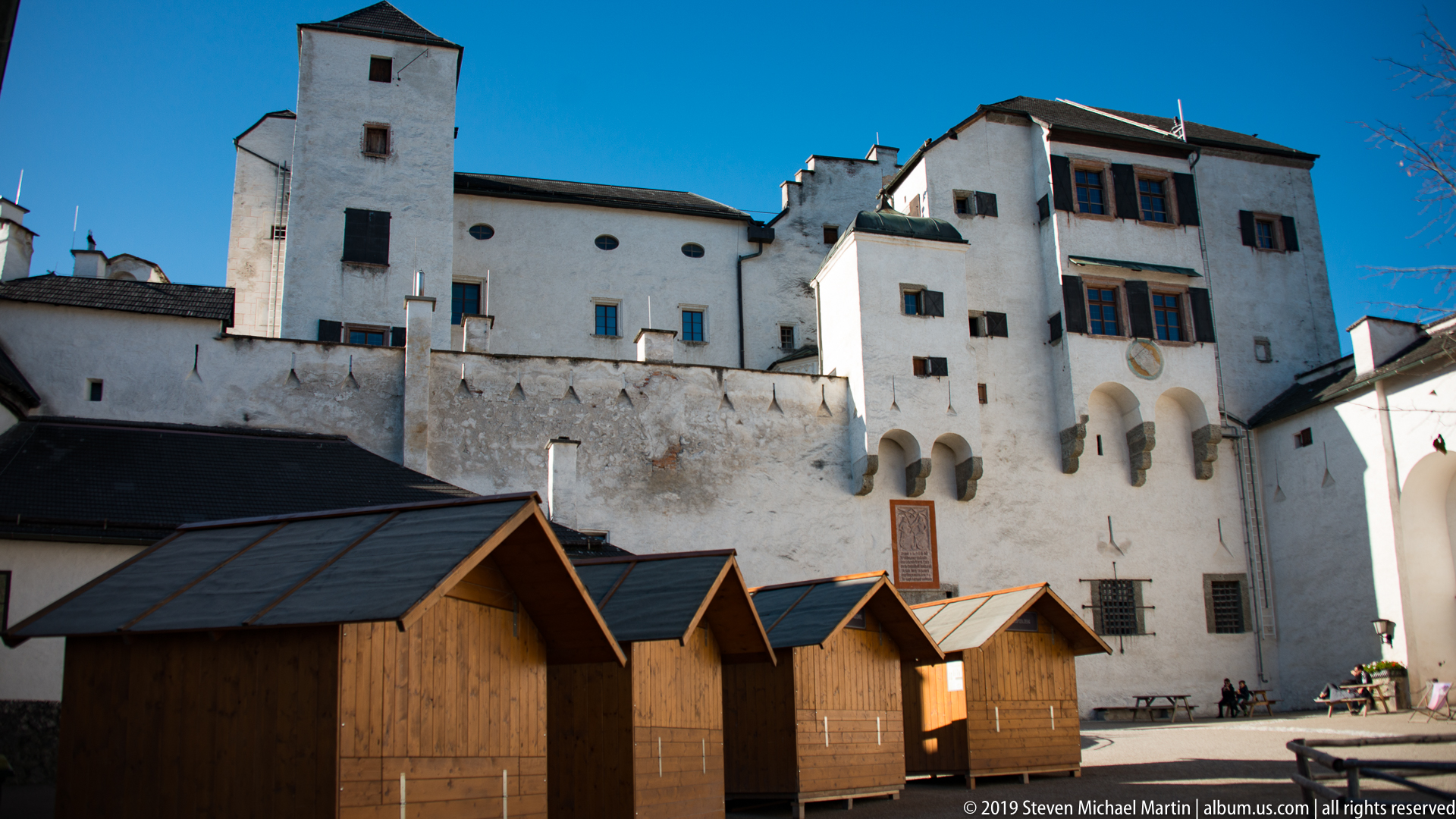
Wooden stalls line the foreground of an inner courtyard at Fortress Hohensalzburg, dwarfed by tall whitewashed masonry ranges rising behind them. Irregular windows, projecting bays, arched supports, and a square tower-like mass reveal the layered construction of the complex. The temporary stalls introduce a contemporary visitor function while leaving the vertical, enclosed character of the historic court dominant.
Caption
Wooden stalls line the foreground of an inner courtyard at Fortress Hohensalzburg, dwarfed by tall whitewashed masonry ranges rising behind them. Irregular windows, projecting bays, arched supports, and a square tower-like mass reveal the layered construction of the complex. The temporary stalls introduce a contemporary visitor function while leaving the vertical, enclosed character of the historic court dominant.

A leafless courtyard tree rises in front of the whitewashed inner façade of Fortress Hohensalzburg, partially screening a painted mural and the base of the clock tower. Three tall pointed-arched windows form the strongest vertical rhythm on the right. The slightly oblique viewpoint shifts attention from the entrance to the wall’s mixture of functional openings and decorative panels beneath the vivid blue sky.
Caption
A leafless courtyard tree rises in front of the whitewashed inner façade of Fortress Hohensalzburg, partially screening a painted mural and the base of the clock tower. Three tall pointed-arched windows form the strongest vertical rhythm on the right. The slightly oblique viewpoint shifts attention from the entrance to the wall’s mixture of functional openings and decorative panels beneath the vivid blue sky.

A slender white clock tower with a green pyramidal roof appears tightly framed between the walls of neighboring fortress buildings. Twin clock faces and dark openings beneath the roof stand out against the saturated blue sky. The compressed view turns the surrounding masonry into a visual frame, emphasizing how towers emerge above the dense, irregularly arranged structures of Fortress Hohensalzburg’s inner complex.
Caption
A slender white clock tower with a green pyramidal roof appears tightly framed between the walls of neighboring fortress buildings. Twin clock faces and dark openings beneath the roof stand out against the saturated blue sky. The compressed view turns the surrounding masonry into a visual frame, emphasizing how towers emerge above the dense, irregularly arranged structures of Fortress Hohensalzburg’s inner complex.

An upward view into a narrow court concentrates on the irregular massing of Fortress Hohensalzburg’s whitewashed walls and towers. Small shuttered windows puncture broad expanses of masonry, while several roofless-looking or flat-topped vertical blocks step upward against the dark blue sky. Weathering and discoloration on the lower walls make the age and exposure of these utilitarian fortress surfaces especially visible.
Caption
An upward view into a narrow court concentrates on the irregular massing of Fortress Hohensalzburg’s whitewashed walls and towers. Small shuttered windows puncture broad expanses of masonry, while several roofless-looking or flat-topped vertical blocks step upward against the dark blue sky. Weathering and discoloration on the lower walls make the age and exposure of these utilitarian fortress surfaces especially visible.

From the height of Fortress Hohensalzburg, the view stretches across autumn-colored neighborhoods, fields, and wooded hills toward a layered wall of mountains. The city thins into a patchwork of green open land before the terrain rises sharply in the distance. This broad outlook demonstrates the fortress’s exceptional visual command of the Salzburg basin without relying on a close view of its own architecture.
Caption
From the height of Fortress Hohensalzburg, the view stretches across autumn-colored neighborhoods, fields, and wooded hills toward a layered wall of mountains. The city thins into a patchwork of green open land before the terrain rises sharply in the distance. This broad outlook demonstrates the fortress’s exceptional visual command of the Salzburg basin without relying on a close view of its own architecture.

Far below the fortress, a large pale institutional complex with a central green-roofed tower stands amid autumn trees. In the foreground field, a white geometric outline traces a simplified bastioned or fortress-like plan, creating a graphic counterpoint to the architecture beyond. The steep downward viewpoint emphasizes the dramatic elevation of Fortress Hohensalzburg above the developed landscape at the foot of the hill.
Caption
Far below the fortress, a large pale institutional complex with a central green-roofed tower stands amid autumn trees. In the foreground field, a white geometric outline traces a simplified bastioned or fortress-like plan, creating a graphic counterpoint to the architecture beyond. The steep downward viewpoint emphasizes the dramatic elevation of Fortress Hohensalzburg above the developed landscape at the foot of the hill.

A lower stone fortification projects from the wooded slope beneath Fortress Hohensalzburg, its crenellated-looking parapet and small roofed tower partly concealed by autumn foliage. Beyond it, the Salzburg basin spreads toward a prominent mountain ridge. The composition links an isolated defensive element on the hillside with the much broader field of view controlled from the fortress heights.
Caption
A lower stone fortification projects from the wooded slope beneath Fortress Hohensalzburg, its crenellated-looking parapet and small roofed tower partly concealed by autumn foliage. Beyond it, the Salzburg basin spreads toward a prominent mountain ridge. The composition links an isolated defensive element on the hillside with the much broader field of view controlled from the fortress heights.
⭐ Highlights
- Hilltop Fortress: Hohensalzburg rises above Salzburg on the Festungsberg, dominating the city skyline.
- Medieval Stronghold: Built beginning in the 11th century, it remains one of Europe’s great fortified complexes.
- Prince-Archbishop Power: The fortress reflects the political and religious authority once held by Salzburg’s rulers.
- Massive Stone Walls: Towers, courtyards, and defensive walls give the site its monumental scale.
- Panoramic Views: The ramparts provide sweeping views across Salzburg and the surrounding valleys.
- Preserved Character: Its survival and condition make it one of the best-preserved medieval fortresses in Europe.
🏰 Fortress Hohensalzburg Field Guide
Major features observed during this visit:
Fortress Hohensalzburg stands high above the city of Salzburg on the rocky hill known as the Festungsberg. Built beginning in the 11th century by the powerful prince-archbishops of Salzburg, the fortress served as both a defensive stronghold and a symbol of their authority. Its stone walls, towers, and courtyards stretch across the hilltop, creating one of the most impressive fortified silhouettes in Europe.
🏛️ Signature Features
- Hilltop Position – The elevated setting gives the fortress its commanding presence above the city.
- Defensive Walls – Thick masonry and fortified edges emphasize its military purpose.
- Towers and Courtyards – The interior spaces reveal the scale and complexity of the stronghold.
- City Overlook – Views from the fortress connect it visually to the rooftops, churches, and streets below.
- Fortress Silhouette – Its outline has become one of Salzburg’s defining visual landmarks.
🧠 Historical Significance
- 11th-Century Origins – The fortress began as a medieval stronghold during the rule of Salzburg’s prince-archbishops.
- Symbol of Authority – It functioned not only as a defensive structure but also as a visible expression of power.
- Religious and Political Center – Its history is closely tied to the long rule of ecclesiastical leaders in Salzburg.
- Exceptional Preservation – Its scale and condition make it one of the most important surviving medieval fortresses in Europe.
🌄 Landscape & Setting
- Festungsberg Hill – The rocky hill gives the fortress a naturally defensive setting.
- Salzburg Skyline – The fortress dominates the city’s skyline from nearly every direction.
- Valley Views – Broad views extend beyond the city into the surrounding landscape.
- Urban Connection – The relationship between fortress and city is one of Salzburg’s defining visual themes.