Ljubljana – Slovenia
Ljubljana, the capital of Slovenia, lies along the Ljubljanica River in a broad basin surrounded by forested hills at the edge of the Julian Alps. Though relatively small in size, the city has long served as an important crossroads between the Alpine regions, the Balkans, and the Adriatic coast.
The historic center is dominated by Ljubljana Castle, which rises on a wooded hill above the old town. Below the castle, the river flows through a series of elegant bridges and public squares lined with colorful Baroque and Art Nouveau buildings.
Much of the city’s distinctive appearance comes from the work of architect Jože Plečnik, whose designs helped shape many of Ljubljana’s bridges, markets, and riverfront spaces, giving the city its unique architectural character.

The Slovenian Philharmonic occupies the foreground of this city view, its pale historic façade and arched central windows facing the square while Ljubljana Castle rises on the wooded hill behind. The layered composition connects one of the city’s principal cultural institutions with the medieval fortification that anchors Ljubljana’s skyline.
Caption
The Slovenian Philharmonic occupies the foreground of this city view, its pale historic façade and arched central windows facing the square while Ljubljana Castle rises on the wooded hill behind. The layered composition connects one of the city’s principal cultural institutions with the medieval fortification that anchors Ljubljana’s skyline.

Ljubljana Castle stretches across the wooded crest of Castle Hill, its long masonry walls and prominent clock tower visible above autumn foliage. This telephoto view compresses the complex into a continuous fortified profile and emphasizes the strategic elevation that allows the castle to dominate the historic city below.
Caption
Ljubljana Castle stretches across the wooded crest of Castle Hill, its long masonry walls and prominent clock tower visible above autumn foliage. This telephoto view compresses the complex into a continuous fortified profile and emphasizes the strategic elevation that allows the castle to dominate the historic city below.

From Castle Hill, Ljubljana’s center spreads beneath a gray, misty sky, combining red-tiled roofs, mid-rise modern buildings, and a dark high-rise tower. Two rounded hills emerge faintly through the haze in the distance, giving the urban panorama a strong sense of the basin landscape surrounding the Slovenian capital.
Caption
From Castle Hill, Ljubljana’s center spreads beneath a gray, misty sky, combining red-tiled roofs, mid-rise modern buildings, and a dark high-rise tower. Two rounded hills emerge faintly through the haze in the distance, giving the urban panorama a strong sense of the basin landscape surrounding the Slovenian capital.

Stone walls frame an elevated view into Ljubljana Castle’s courtyard, where historic masonry, white arcaded buildings, modern glazed additions, landscaped terraces, and café seating meet within the fortified enclosure. The photograph makes the castle’s successive layers especially visible, combining defensive fabric with later architectural interventions and present-day visitor spaces.
Caption
Stone walls frame an elevated view into Ljubljana Castle’s courtyard, where historic masonry, white arcaded buildings, modern glazed additions, landscaped terraces, and café seating meet within the fortified enclosure. The photograph makes the castle’s successive layers especially visible, combining defensive fabric with later architectural interventions and present-day visitor spaces.

A wider courtyard composition places Ljubljana Castle’s clock tower between long whitewashed wings beneath an overcast sky. Bare and late-autumn trees punctuate the lawn and paved court, while the tower’s clock face and flags anchor the otherwise restrained architecture of the interior complex.
Caption
A wider courtyard composition places Ljubljana Castle’s clock tower between long whitewashed wings beneath an overcast sky. Bare and late-autumn trees punctuate the lawn and paved court, while the tower’s clock face and flags anchor the otherwise restrained architecture of the interior complex.

The central courtyard of Ljubljana Castle is framed by whitewashed ranges, arcades, steep roofs, and the square clock tower rising above the complex. Outdoor seating and visitors emphasize the space’s present-day civic and cultural use, while the enclosed plan still reads as the interior court of a fortified hilltop residence.
Caption
The central courtyard of Ljubljana Castle is framed by whitewashed ranges, arcades, steep roofs, and the square clock tower rising above the complex. Outdoor seating and visitors emphasize the space’s present-day civic and cultural use, while the enclosed plan still reads as the interior court of a fortified hilltop residence.

Two slab-like modernist office towers face the broad open expanse of Republic Square, their repetitive window grids and rooftop structures defining one of Ljubljana’s most recognizable postwar civic spaces. The nearly empty plaza and overcast light accentuate the severe geometry and monumental scale of the complex.
Caption
Two slab-like modernist office towers face the broad open expanse of Republic Square, their repetitive window grids and rooftop structures defining one of Ljubljana’s most recognizable postwar civic spaces. The nearly empty plaza and overcast light accentuate the severe geometry and monumental scale of the complex.

A long view from Castle Hill looks across Ljubljana toward a cluster of distinctive white high-rise residential towers, with lower red-roofed neighborhoods and modern commercial blocks spread across the foreground. Haze softens the wooded hills beyond, underscoring the city’s position in a broad basin ringed by elevated terrain.
Caption
A long view from Castle Hill looks across Ljubljana toward a cluster of distinctive white high-rise residential towers, with lower red-roofed neighborhoods and modern commercial blocks spread across the foreground. Haze softens the wooded hills beyond, underscoring the city’s position in a broad basin ringed by elevated terrain.

Looking outward from Castle Hill, the view layers autumn trees, red-roofed historic blocks, larger modern buildings, and a wooded ridge beyond. The elevated perspective shows how Ljubljana’s compact center transitions quickly into greener terrain, with the castle hill functioning as both landmark and panoramic overlook.
Caption
Looking outward from Castle Hill, the view layers autumn trees, red-roofed historic blocks, larger modern buildings, and a wooded ridge beyond. The elevated perspective shows how Ljubljana’s compact center transitions quickly into greener terrain, with the castle hill functioning as both landmark and panoramic overlook.

The central courtyard of Ljubljana Castle opens between thick historic walls, arcaded ranges, and steeply roofed buildings adapted for contemporary use. Café seating and clipped plantings occupy the lower terrace while visitors cross the broad paved court, showing how the hilltop fortress now functions as both a preserved architectural complex and an active public venue.
Caption
The central courtyard of Ljubljana Castle opens between thick historic walls, arcaded ranges, and steeply roofed buildings adapted for contemporary use. Café seating and clipped plantings occupy the lower terrace while visitors cross the broad paved court, showing how the hilltop fortress now functions as both a preserved architectural complex and an active public venue.

The Ljubljana Castle funicular plunges steeply down the wooded hillside toward the old city, its rails centered between high side barriers. Seen from the upper station area, the dramatic downward perspective reveals rooftops and streets far below, illustrating the direct transport link between Castle Hill and the historic center.
Caption
The Ljubljana Castle funicular plunges steeply down the wooded hillside toward the old city, its rails centered between high side barriers. Seen from the upper station area, the dramatic downward perspective reveals rooftops and streets far below, illustrating the direct transport link between Castle Hill and the historic center.

A rough stone opening in Ljubljana Castle frames the city below like a natural picture window. The dark masonry foreground sharply encloses a distant panorama of rooftops and modern towers, turning a defensive architectural feature into a controlled viewpoint over the capital and emphasizing the castle’s commanding position above Ljubljana.
Caption
A rough stone opening in Ljubljana Castle frames the city below like a natural picture window. The dark masonry foreground sharply encloses a distant panorama of rooftops and modern towers, turning a defensive architectural feature into a controlled viewpoint over the capital and emphasizing the castle’s commanding position above Ljubljana.
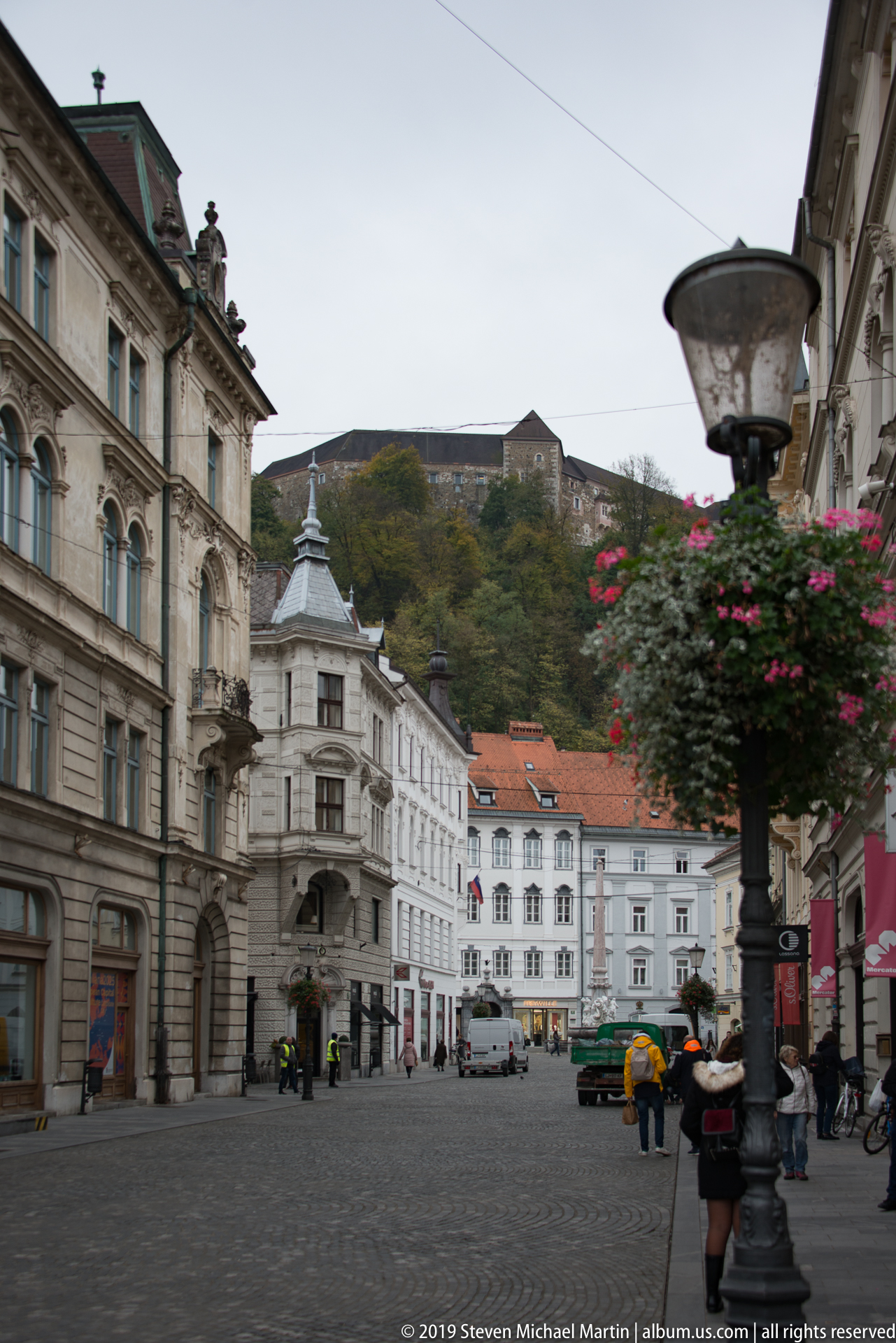
A quiet cobbled street in central Ljubljana opens toward the wooded Castle Hill, where the long profile of Ljubljana Castle rises above historic façades. The view links the pedestrian scale of the old city with its dominant hilltop landmark, while hanging flowers, a cast-iron streetlamp, and ornate nineteenth-century buildings frame the approach.
Caption
A quiet cobbled street in central Ljubljana opens toward the wooded Castle Hill, where the long profile of Ljubljana Castle rises above historic façades. The view links the pedestrian scale of the old city with its dominant hilltop landmark, while hanging flowers, a cast-iron streetlamp, and ornate nineteenth-century buildings frame the approach.
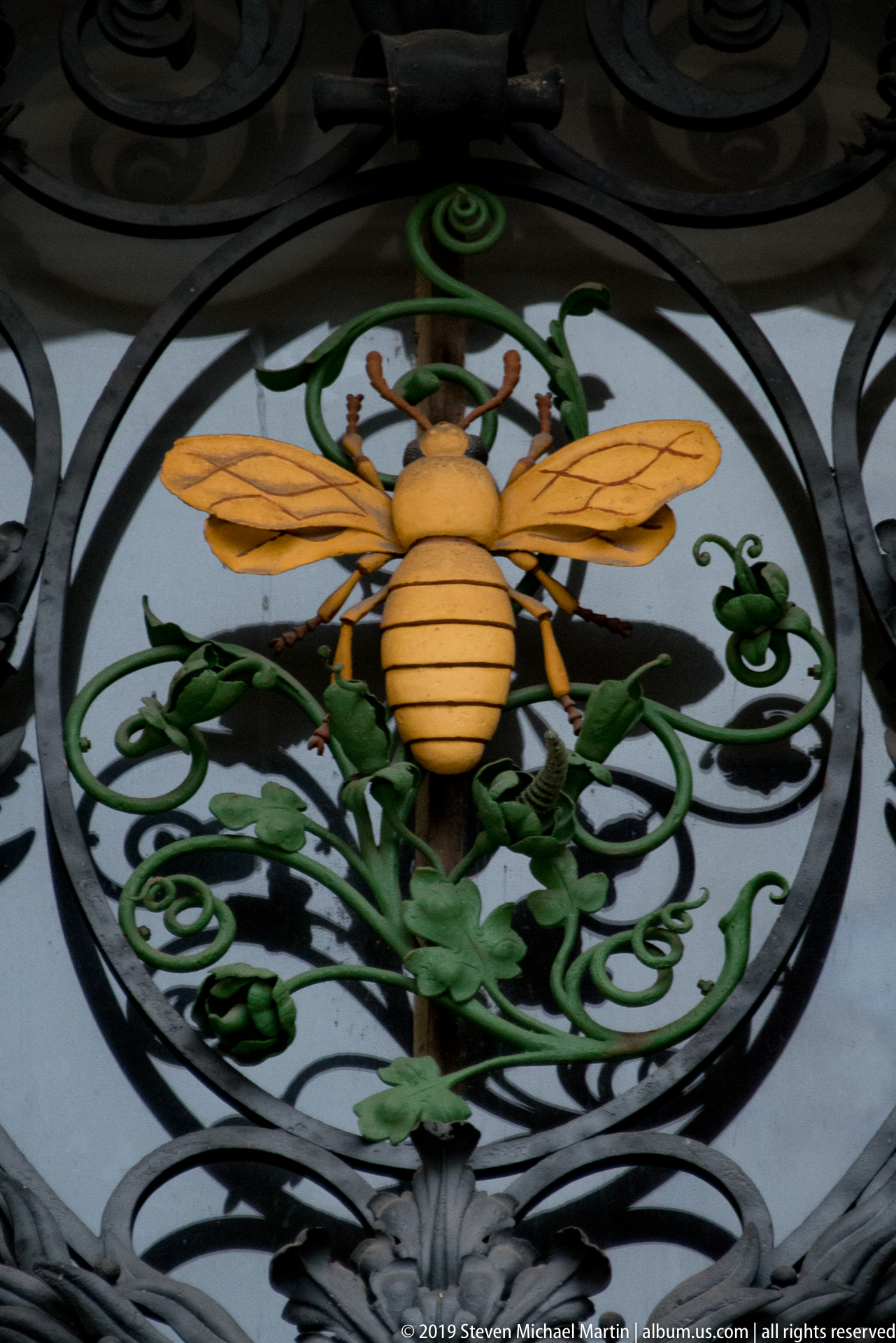
A brightly painted bee forms the center of an elaborate wrought-iron composition, its yellow body and wings surrounded by curling green foliage and smaller insect motifs. The close view isolates the craftsmanship and playful natural imagery of the metalwork, emphasizing the contrast between the sculpted insect and the dark architectural frame.
Caption
A brightly painted bee forms the center of an elaborate wrought-iron composition, its yellow body and wings surrounded by curling green foliage and smaller insect motifs. The close view isolates the craftsmanship and playful natural imagery of the metalwork, emphasizing the contrast between the sculpted insect and the dark architectural frame.

The upper sculptural group of the Holy Trinity Column rises on a richly carved capital, crowned by a gilded dove and radiating sunburst. Seen from below, the composition brings together animated stone drapery, clustered figures, and luminous metalwork, with the neighboring church façade and clock partially entering the frame.
Caption
The upper sculptural group of the Holy Trinity Column rises on a richly carved capital, crowned by a gilded dove and radiating sunburst. Seen from below, the composition brings together animated stone drapery, clustered figures, and luminous metalwork, with the neighboring church façade and clock partially entering the frame.

The entrance to the Embassy of the United States of America in Ljubljana is seen through a black security fence, with the embassy seal and bilingual lettering mounted against the pale façade. The composition emphasizes the controlled perimeter and official identity of the diplomatic mission rather than the building as a whole.
Caption
The entrance to the Embassy of the United States of America in Ljubljana is seen through a black security fence, with the embassy seal and bilingual lettering mounted against the pale façade. The composition emphasizes the controlled perimeter and official identity of the diplomatic mission rather than the building as a whole.

An ornate historic villa rises behind clipped trees and a perimeter fence, combining projecting rounded bays, timber balcony work, patterned friezes, and a narrow turret. The eclectic façade is especially distinctive for its layered roofline and decorative woodwork, creating a richly articulated residential silhouette against the overcast sky.
Caption
An ornate historic villa rises behind clipped trees and a perimeter fence, combining projecting rounded bays, timber balcony work, patterned friezes, and a narrow turret. The eclectic façade is especially distinctive for its layered roofline and decorative woodwork, creating a richly articulated residential silhouette against the overcast sky.

A tightly clustered bronze group of standing figures forms a somber public memorial, the elongated bodies modeled with rough, deeply textured surfaces. Viewed at close range, the sculpture’s irregular silhouettes and compressed spacing create a strong sense of collective presence, while the surrounding trees and urban setting remain secondary.
Caption
A tightly clustered bronze group of standing figures forms a somber public memorial, the elongated bodies modeled with rough, deeply textured surfaces. Viewed at close range, the sculpture’s irregular silhouettes and compressed spacing create a strong sense of collective presence, while the surrounding trees and urban setting remain secondary.
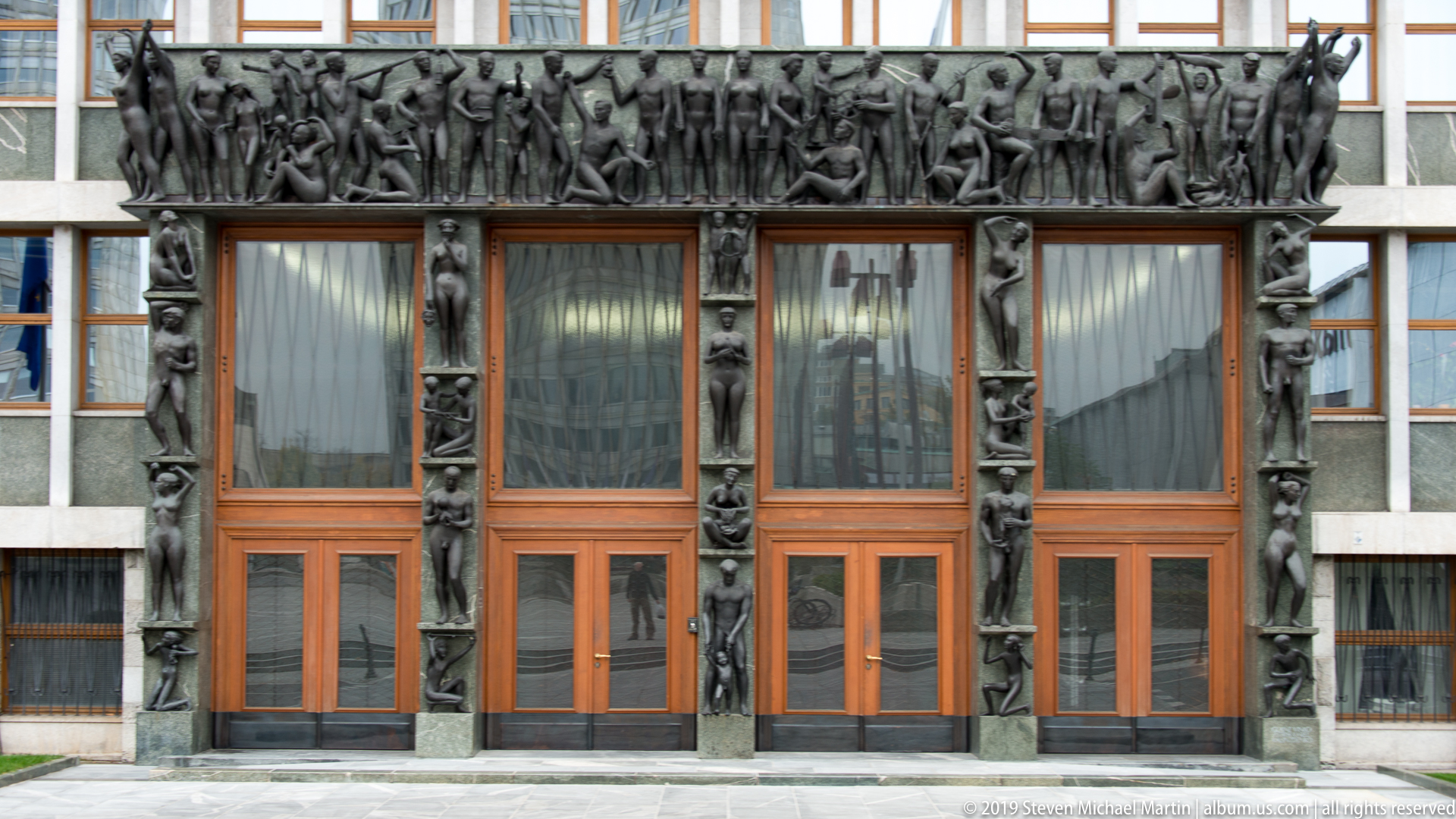
The ceremonial entrance of Slovenia’s National Assembly is framed by dense bronze relief sculpture, with elongated human figures and symbolic scenes surrounding a grid of glazed wooden doors. The strongly modeled portal contrasts with the restrained stone-and-window façade, making the entrance an emphatic work of public art as well as an architectural threshold.
Caption
The ceremonial entrance of Slovenia’s National Assembly is framed by dense bronze relief sculpture, with elongated human figures and symbolic scenes surrounding a grid of glazed wooden doors. The strongly modeled portal contrasts with the restrained stone-and-window façade, making the entrance an emphatic work of public art as well as an architectural threshold.

A gilded dove with outstretched wings radiates from a burst of golden rays above a sculptural group of saints or sacred figures. The upward-looking detail isolates the dramatic crown of Ljubljana’s Holy Trinity Column, where luminous metalwork contrasts with dark stone figures against the pale sky.
Caption
A gilded dove with outstretched wings radiates from a burst of golden rays above a sculptural group of saints or sacred figures. The upward-looking detail isolates the dramatic crown of Ljubljana’s Holy Trinity Column, where luminous metalwork contrasts with dark stone figures against the pale sky.

The Ursuline Church of the Holy Trinity presents its formal Baroque façade to Congress Square, with paired giant pilasters, arched openings, a triangular gable, and a central sculptural niche. The Holy Trinity Column stands on axis in front, while surrounding civic buildings and pedestrians place the church within the open urban space of the square.
Caption
The Ursuline Church of the Holy Trinity presents its formal Baroque façade to Congress Square, with paired giant pilasters, arched openings, a triangular gable, and a central sculptural niche. The Holy Trinity Column stands on axis in front, while surrounding civic buildings and pedestrians place the church within the open urban space of the square.

A crowned heraldic shield fills the center of an ornate architectural pediment, flanked by two sculpted putti. The pale stone relief, framed by scrolls and a steep triangular surround, provides a close study of civic or institutional ornament and the highly modeled Baroque-revival decoration used on Ljubljana’s historic façades.
Caption
A crowned heraldic shield fills the center of an ornate architectural pediment, flanked by two sculpted putti. The pale stone relief, framed by scrolls and a steep triangular surround, provides a close study of civic or institutional ornament and the highly modeled Baroque-revival decoration used on Ljubljana’s historic façades.

The Slovenian Philharmonic’s historic façade bears the inscription “ACADEMIA PHILHARMONICORUM” above tall arched windows and a rusticated lower story. Its restrained classical composition faces the square at the foot of Castle Hill, with flags and neighboring buildings reinforcing the civic character of the setting.
Caption
The Slovenian Philharmonic’s historic façade bears the inscription “ACADEMIA PHILHARMONICORUM” above tall arched windows and a rusticated lower story. Its restrained classical composition faces the square at the foot of Castle Hill, with flags and neighboring buildings reinforcing the civic character of the setting.

The main building of the University of Ljubljana presents an imposing historicist façade with a steep green roof, central pediment, symmetrical wings, and formal entrance court. Students and visitors gather near the gate, emphasizing the building’s continuing academic role at the edge of Congress Square.
Caption
The main building of the University of Ljubljana presents an imposing historicist façade with a steep green roof, central pediment, symmetrical wings, and formal entrance court. Students and visitors gather near the gate, emphasizing the building’s continuing academic role at the edge of Congress Square.

The Ljubljanica River curves through the old city toward the pink façade of the Franciscan Church of the Annunciation, which rises beyond riverside buildings and bridges. A small tour boat and café terraces animate the foreground, showing how the river functions as both a historic urban corridor and a lively public space.
Caption
The Ljubljanica River curves through the old city toward the pink façade of the Franciscan Church of the Annunciation, which rises beyond riverside buildings and bridges. A small tour boat and café terraces animate the foreground, showing how the river functions as both a historic urban corridor and a lively public space.

A calm reach of the Ljubljanica reflects the muted façades and autumn trees of central Ljubljana, with the pink Franciscan church partly visible farther upstream. Stone embankments, willow branches, and café structures create an intimate canal-like cityscape centered on the river’s role as the organizing spine of the historic center.
Caption
A calm reach of the Ljubljanica reflects the muted façades and autumn trees of central Ljubljana, with the pink Franciscan church partly visible farther upstream. Stone embankments, willow branches, and café structures create an intimate canal-like cityscape centered on the river’s role as the organizing spine of the historic center.

A quieter stretch of the Ljubljanica runs between tree-lined stone embankments and historic residential façades. Overhanging willows soften the formal river walls, while the narrow perspective draws the eye toward the denser old-city architecture in the distance, emphasizing the green character of Ljubljana’s central waterfront.
Caption
A quieter stretch of the Ljubljanica runs between tree-lined stone embankments and historic residential façades. Overhanging willows soften the formal river walls, while the narrow perspective draws the eye toward the denser old-city architecture in the distance, emphasizing the green character of Ljubljana’s central waterfront.

The Ljubljanica flows beside a raised riverside promenade lined with tall poplars, café structures, flowered railings, and pastel façades. The view emphasizes the engineered stone embankment and the close relationship between the river and pedestrian life in Ljubljana’s historic center.
Caption
The Ljubljanica flows beside a raised riverside promenade lined with tall poplars, café structures, flowered railings, and pastel façades. The view emphasizes the engineered stone embankment and the close relationship between the river and pedestrian life in Ljubljana’s historic center.

Carved pumpkins, bottles of sparkling wine, fresh herbs, and handwritten blackboard menus decorate the exterior of a Ljubljana restaurant. The seasonal display gives a close street-level glimpse of café culture in the historic center, with the orange façade and chalk lettering creating a warm counterpoint to the autumn weather.
Caption
Carved pumpkins, bottles of sparkling wine, fresh herbs, and handwritten blackboard menus decorate the exterior of a Ljubljana restaurant. The seasonal display gives a close street-level glimpse of café culture in the historic center, with the orange façade and chalk lettering creating a warm counterpoint to the autumn weather.

An open printed menu stands on a small restaurant table beside a glass candle holder and decorative gourds. The intimate still life shifts attention from Ljubljana’s monuments to the details of local hospitality, with the subdued tabletop arrangement suggesting an autumn dining setting.
Caption
An open printed menu stands on a small restaurant table beside a glass candle holder and decorative gourds. The intimate still life shifts attention from Ljubljana’s monuments to the details of local hospitality, with the subdued tabletop arrangement suggesting an autumn dining setting.

A busy street in Ljubljana’s old center leads toward the twin bell towers of Ljubljana Cathedral, visible above the historic façades. Pedestrians fill the foreground while a tall stone monument rises near the center of the view, creating a layered urban perspective that connects the civic streetscape with the cathedral skyline.
Caption
A busy street in Ljubljana’s old center leads toward the twin bell towers of Ljubljana Cathedral, visible above the historic façades. Pedestrians fill the foreground while a tall stone monument rises near the center of the view, creating a layered urban perspective that connects the civic streetscape with the cathedral skyline.

The obelisk of the Robba Fountain rises in the foreground while the twin green-capped bell towers of Ljubljana Cathedral frame the background. This compressed view brings together two of the old town’s defining Baroque landmarks, emphasizing the vertical rhythm of fountain, roofs, and church towers around Town Square.
Caption
The obelisk of the Robba Fountain rises in the foreground while the twin green-capped bell towers of Ljubljana Cathedral frame the background. This compressed view brings together two of the old town’s defining Baroque landmarks, emphasizing the vertical rhythm of fountain, roofs, and church towers around Town Square.

A large visitor map presents Ljubljana Castle and the wooded Castle Hill as a network of paths, viewpoints, attractions, and access routes. The diagram places the fortified summit at the center while tracing walking circuits and connections down the slope, giving a practical overview of how the castle relates to the surrounding urban landscape.
Caption
A large visitor map presents Ljubljana Castle and the wooded Castle Hill as a network of paths, viewpoints, attractions, and access routes. The diagram places the fortified summit at the center while tracing walking circuits and connections down the slope, giving a practical overview of how the castle relates to the surrounding urban landscape.

A small wrought-metal dragon clings to the castle masonry, its wings, claws, coiled tail, and textured body formed from forged iron. The dragon is Ljubljana’s emblematic creature, and this compact decorative interpretation translates the city symbol into a playful piece of metalwork set directly against the fortress wall.
Caption
A small wrought-metal dragon clings to the castle masonry, its wings, claws, coiled tail, and textured body formed from forged iron. The dragon is Ljubljana’s emblematic creature, and this compact decorative interpretation translates the city symbol into a playful piece of metalwork set directly against the fortress wall.

Two street musicians perform against a shopfront in central Ljubljana, one playing saxophone while the other bows or plucks a double bass beside a music stand. The informal performance adds a human-scale cultural scene to the historic center, with pedestrians passing along the narrow street beyond.
Caption
Two street musicians perform against a shopfront in central Ljubljana, one playing saxophone while the other bows or plucks a double bass beside a music stand. The informal performance adds a human-scale cultural scene to the historic center, with pedestrians passing along the narrow street beyond.

A small Pietà group occupies a white ornamental wall niche, showing the Virgin Mary supporting the body of Christ. A hanging flower basket and traditional streetlamp share the foreground, placing the devotional image within the everyday streetscape of Ljubljana’s historic center rather than in a formal church interior.
Caption
A small Pietà group occupies a white ornamental wall niche, showing the Virgin Mary supporting the body of Christ. A hanging flower basket and traditional streetlamp share the foreground, placing the devotional image within the everyday streetscape of Ljubljana’s historic center rather than in a formal church interior.

A row of mitred bishops emerges in high relief from the monumental bronze doors of Ljubljana Cathedral. Their heads and vestments project dramatically from the rough textured surface, creating a tactile, almost sculptural wall that contrasts with the more conventional architecture surrounding the portal.
Caption
A row of mitred bishops emerges in high relief from the monumental bronze doors of Ljubljana Cathedral. Their heads and vestments project dramatically from the rough textured surface, creating a tactile, almost sculptural wall that contrasts with the more conventional architecture surrounding the portal.

A painted wall sundial uses Roman numerals and radiating hour lines against a blue field, with the motto “NESCITIS DIEM NEQUE HORAM” displayed on a ribbon below. The close study emphasizes both the functional geometry of the timepiece and its moralizing Latin inscription.
Caption
A painted wall sundial uses Roman numerals and radiating hour lines against a blue field, with the motto “NESCITIS DIEM NEQUE HORAM” displayed on a ribbon below. The close study emphasizes both the functional geometry of the timepiece and its moralizing Latin inscription.

Ljubljana Cathedral is seen obliquely from the surrounding old-town street, revealing its pale Baroque walls, green copper dome, and one of the twin bell towers. The side elevation is articulated by pilasters, arched openings, devotional niches, and decorative panels that show the church as part of a dense urban block rather than as an isolated monument.
Caption
Ljubljana Cathedral is seen obliquely from the surrounding old-town street, revealing its pale Baroque walls, green copper dome, and one of the twin bell towers. The side elevation is articulated by pilasters, arched openings, devotional niches, and decorative panels that show the church as part of a dense urban block rather than as an isolated monument.

From Castle Hill, the view looks down across red-tiled roofs toward the pale façade and triangular gable of the Ursuline Church of the Holy Trinity. Modern office blocks rise behind the historic center, making the composition a compact study in Ljubljana’s layered urban fabric from Baroque church architecture to twentieth-century development.
Caption
From Castle Hill, the view looks down across red-tiled roofs toward the pale façade and triangular gable of the Ursuline Church of the Holy Trinity. Modern office blocks rise behind the historic center, making the composition a compact study in Ljubljana’s layered urban fabric from Baroque church architecture to twentieth-century development.

Rough stone masonry, arched openings, and a projecting tower define this exterior section of Ljubljana Castle. The irregular wall fabric contrasts with the large glazed arches inserted into the historic envelope, showing how the hilltop fortress combines surviving defensive architecture with later adaptations for contemporary use.
Caption
Rough stone masonry, arched openings, and a projecting tower define this exterior section of Ljubljana Castle. The irregular wall fabric contrasts with the large glazed arches inserted into the historic envelope, showing how the hilltop fortress combines surviving defensive architecture with later adaptations for contemporary use.

Rows of white and colored awnings fill Ljubljana’s market area below Castle Hill, with shoppers moving between tightly packed outdoor stalls. Seen from above, the market reads as a dense patchwork of canopies set among historic roofs and streets, documenting the everyday commercial life of the city center.
Caption
Rows of white and colored awnings fill Ljubljana’s market area below Castle Hill, with shoppers moving between tightly packed outdoor stalls. Seen from above, the market reads as a dense patchwork of canopies set among historic roofs and streets, documenting the everyday commercial life of the city center.

A tightly wound spiral staircase is seen from above, with tubular metal supports encircling wedge-shaped perforated steps. The steep downward view turns the stair into an abstract pattern of repeated curves and verticals, revealing a contemporary circulation element inserted within the historic castle complex.
Caption
A tightly wound spiral staircase is seen from above, with tubular metal supports encircling wedge-shaped perforated steps. The steep downward view turns the stair into an abstract pattern of repeated curves and verticals, revealing a contemporary circulation element inserted within the historic castle complex.

Two adjoining stone structures at Ljubljana Castle show contrasting phases of the complex: a tall building with a large glazed opening stands beside an older masonry range with a timber-covered gallery and arched doorway. The layered materials and rooflines reveal the castle as an evolved ensemble rather than a single-period fortress.
Caption
Two adjoining stone structures at Ljubljana Castle show contrasting phases of the complex: a tall building with a large glazed opening stands beside an older masonry range with a timber-covered gallery and arched doorway. The layered materials and rooflines reveal the castle as an evolved ensemble rather than a single-period fortress.

The square clock tower dominates this courtyard view at Ljubljana Castle, rising above low whitewashed ranges and steep brown roofs. Flags crown the crenellated top, while trimmed trees and a small chapel-like roofline soften the enclosed space below, balancing the fortress’s civic monumentality with its landscaped interior court.
Caption
The square clock tower dominates this courtyard view at Ljubljana Castle, rising above low whitewashed ranges and steep brown roofs. Flags crown the crenellated top, while trimmed trees and a small chapel-like roofline soften the enclosed space below, balancing the fortress’s civic monumentality with its landscaped interior court.

An interpretive drawing reconstructs an early fortified settlement on the Ljubljana Castle hill, with a central tower, palisade-like defenses, and several small buildings arranged within an enclosing perimeter. The simplified bird’s-eye rendering helps visitors visualize a predecessor phase of the more substantial castle architecture standing on the hill today.
Caption
An interpretive drawing reconstructs an early fortified settlement on the Ljubljana Castle hill, with a central tower, palisade-like defenses, and several small buildings arranged within an enclosing perimeter. The simplified bird’s-eye rendering helps visitors visualize a predecessor phase of the more substantial castle architecture standing on the hill today.

A life-size bird modeled from fine metal mesh stands on a dark plinth, its hooked beak, folded wings, and talons built from layered wire. Strong side lighting throws a sharply articulated shadow onto the wall, doubling the sculpture’s presence and emphasizing the open, skeletal quality of the metalwork.
Caption
A life-size bird modeled from fine metal mesh stands on a dark plinth, its hooked beak, folded wings, and talons built from layered wire. Strong side lighting throws a sharply articulated shadow onto the wall, doubling the sculpture’s presence and emphasizing the open, skeletal quality of the metalwork.

A narrow historic building with a glazed upper pavilion and rhythmic arched openings faces a modern, metal-clad structure across a central Ljubljana street. The juxtaposition compresses two architectural eras into one view, with the older façade retaining its vertical proportions and ornamental window framing beside contemporary urban fabric.
Caption
A narrow historic building with a glazed upper pavilion and rhythmic arched openings faces a modern, metal-clad structure across a central Ljubljana street. The juxtaposition compresses two architectural eras into one view, with the older façade retaining its vertical proportions and ornamental window framing beside contemporary urban fabric.

A glass-sided funicular car sits on its steep inclined track beside the stone retaining walls of Castle Hill. The view concentrates on the modern transport infrastructure serving Ljubljana Castle, where the angular vehicle, rails, and transparent station elements form a sharp technological contrast with the historic masonry around them.
Caption
A glass-sided funicular car sits on its steep inclined track beside the stone retaining walls of Castle Hill. The view concentrates on the modern transport infrastructure serving Ljubljana Castle, where the angular vehicle, rails, and transparent station elements form a sharp technological contrast with the historic masonry around them.
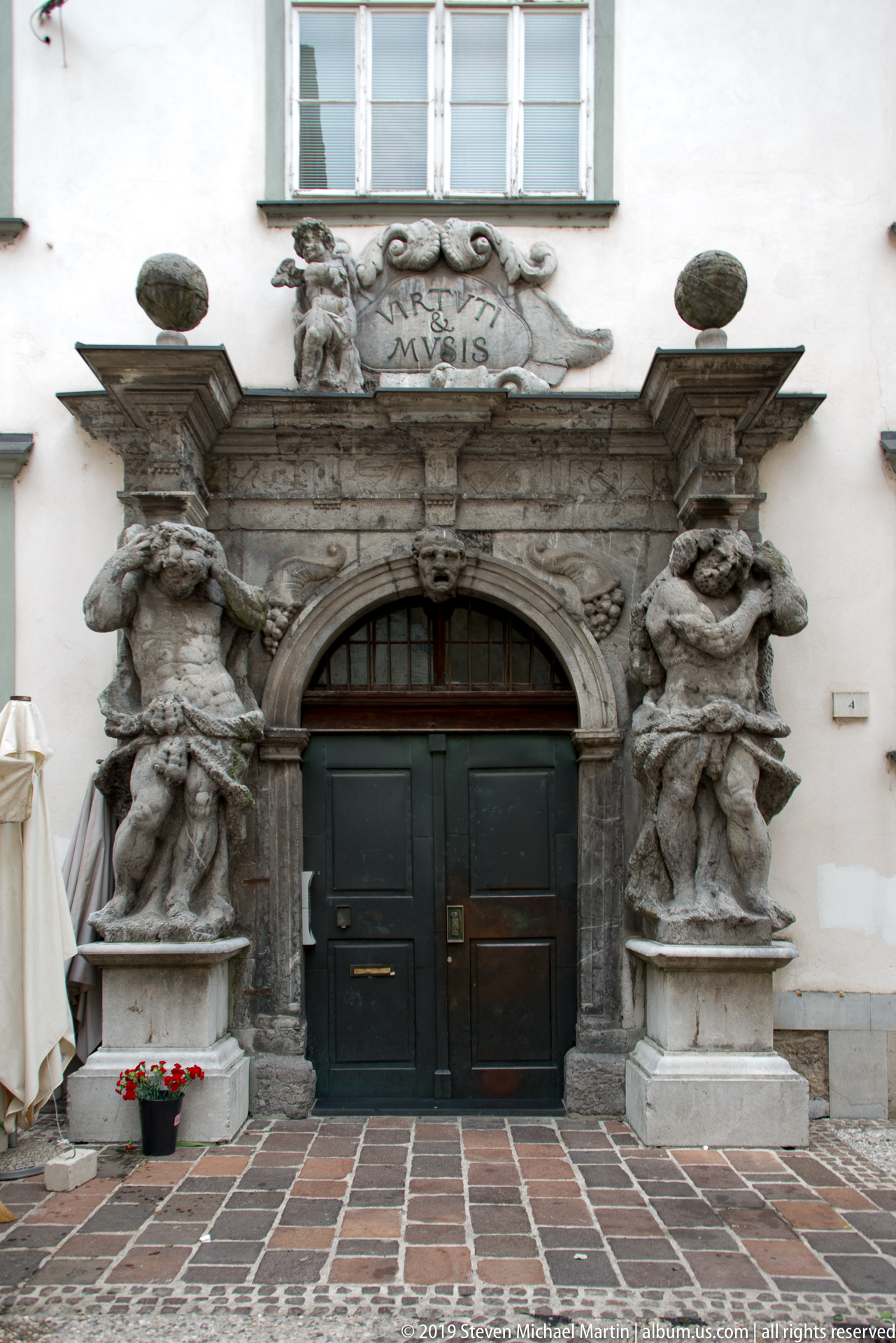
An elaborate stone portal frames a dark double door with a richly carved surround, heraldic ornament, and large sculptural figures positioned on either side. The symmetrical composition combines architecture and sculpture into a ceremonial entrance, while the contrasting gray stone and pale wall make the portal stand out sharply from the surrounding façade.
Caption
An elaborate stone portal frames a dark double door with a richly carved surround, heraldic ornament, and large sculptural figures positioned on either side. The symmetrical composition combines architecture and sculpture into a ceremonial entrance, while the contrasting gray stone and pale wall make the portal stand out sharply from the surrounding façade.

Flower stalls stretch diagonally across a cobbled market space, their wreaths, cut flowers, and greenery forming a long ribbon of color through the foreground. A slow shutter or panning effect softens some figures and details, giving the scene a sense of movement while retaining the structure of Ljubljana’s outdoor market.
Caption
Flower stalls stretch diagonally across a cobbled market space, their wreaths, cut flowers, and greenery forming a long ribbon of color through the foreground. A slow shutter or panning effect softens some figures and details, giving the scene a sense of movement while retaining the structure of Ljubljana’s outdoor market.

An ornate dark rooftop tower with a round clock and decorative metal crest rises in the foreground, while Ljubljana Castle appears on the wooded hill behind it. A funicular car and track climb the slope to the fortress, creating a layered urban view that links city-center architecture with the castle’s hilltop position.
Caption
An ornate dark rooftop tower with a round clock and decorative metal crest rises in the foreground, while Ljubljana Castle appears on the wooded hill behind it. A funicular car and track climb the slope to the fortress, creating a layered urban view that links city-center architecture with the castle’s hilltop position.

Tightly packed heads of Romanesco broccoli display their characteristic lime-green spirals and pointed, fractal-like florets. Surrounded by broad blue-green leaves, the produce becomes a study in natural geometry as well as a record of the fresh vegetables offered at Ljubljana’s outdoor market.
Caption
Tightly packed heads of Romanesco broccoli display their characteristic lime-green spirals and pointed, fractal-like florets. Surrounded by broad blue-green leaves, the produce becomes a study in natural geometry as well as a record of the fresh vegetables offered at Ljubljana’s outdoor market.

A split pomegranate exposes clusters of glossy crimson seeds against the fruit’s pale inner membranes, with whole fruits surrounding it on the market display. The close-up isolates texture and color, turning an ordinary produce stall into a vivid study of the fruit’s jewel-like arils and irregular interior structure.
Caption
A split pomegranate exposes clusters of glossy crimson seeds against the fruit’s pale inner membranes, with whole fruits surrounding it on the market display. The close-up isolates texture and color, turning an ordinary produce stall into a vivid study of the fruit’s jewel-like arils and irregular interior structure.

A market display groups several small red-orange winter squash around a pale butternut squash, with one speckled gourd adding contrasting texture. Their varied shapes and colors create a seasonal still life while documenting the range of autumn produce sold in Ljubljana’s open-air market.
Caption
A market display groups several small red-orange winter squash around a pale butternut squash, with one speckled gourd adding contrasting texture. Their varied shapes and colors create a seasonal still life while documenting the range of autumn produce sold in Ljubljana’s open-air market.

A dense pile of oval blue-purple plums fills the frame, their matte skins marked by natural bloom and scattered reddish patches. Short green stems and slight surface variation distinguish individual fruits, giving the market close-up a tactile quality while documenting fresh seasonal produce in Ljubljana.
Caption
A dense pile of oval blue-purple plums fills the frame, their matte skins marked by natural bloom and scattered reddish patches. Short green stems and slight surface variation distinguish individual fruits, giving the market close-up a tactile quality while documenting fresh seasonal produce in Ljubljana.

Shoppers move among produce tables and canvas awnings at Ljubljana’s open-air market, where vendors display fruit and vegetables beneath autumn trees. The scene shifts from close studies of individual foods to the social setting in which they are sold, showing the market as an active public space in the center of the city.
Caption
Shoppers move among produce tables and canvas awnings at Ljubljana’s open-air market, where vendors display fruit and vegetables beneath autumn trees. The scene shifts from close studies of individual foods to the social setting in which they are sold, showing the market as an active public space in the center of the city.

An orange pincushion-type flower fills the frame with a dense burst of slender, curling styles tipped by rounded knobs. Cream-colored inner structures and warm orange filaments create a complex radial pattern, highlighting the exotic cut flowers available alongside produce at Ljubljana’s market.
Caption
An orange pincushion-type flower fills the frame with a dense burst of slender, curling styles tipped by rounded knobs. Cream-colored inner structures and warm orange filaments create a complex radial pattern, highlighting the exotic cut flowers available alongside produce at Ljubljana’s market.

A red-orange pincushion flower is photographed at very close range, its long styles radiating outward from a pale central disk and ending in bright rounded tips. Against a dark background, the flower’s structure becomes almost graphic, emphasizing the sculptural form of this distinctive market bloom.
Caption
A red-orange pincushion flower is photographed at very close range, its long styles radiating outward from a pale central disk and ending in bright rounded tips. Against a dark background, the flower’s structure becomes almost graphic, emphasizing the sculptural form of this distinctive market bloom.

Rosette-like ornamental cabbages fill the frame in shades of purple, magenta, and green. Their overlapping, ruffled leaves resemble large flowers, showing how edible brassicas can also be cultivated and sold for decorative display during the cool-season market period.
Caption
Rosette-like ornamental cabbages fill the frame in shades of purple, magenta, and green. Their overlapping, ruffled leaves resemble large flowers, showing how edible brassicas can also be cultivated and sold for decorative display during the cool-season market period.

A second display of ornamental cabbages shifts to warm yellow-green leaves surrounding orange and coral centers. Repeated rosettes create a dense floral effect, with each plant combining the layered structure of a cabbage head and the bright coloration of a decorative market flower.
Caption
A second display of ornamental cabbages shifts to warm yellow-green leaves surrounding orange and coral centers. Repeated rosettes create a dense floral effect, with each plant combining the layered structure of a cabbage head and the bright coloration of a decorative market flower.

Several dramatic protea blooms are grouped together, including white-centered, pink-bracted flowers and a larger cream-and-rose head at right. Thick dark-green leaves and rigid bracts give the arrangement a sculptural quality, contrasting strongly with the softer ornamental cabbages shown elsewhere in the market display.
Caption
Several dramatic protea blooms are grouped together, including white-centered, pink-bracted flowers and a larger cream-and-rose head at right. Thick dark-green leaves and rigid bracts give the arrangement a sculptural quality, contrasting strongly with the softer ornamental cabbages shown elsewhere in the market display.

A tightly framed cluster of pink protea flower heads shows thick pointed bracts wrapped around dark burgundy centers. Repetition across the display makes the architectural structure of each bloom especially clear, from the overlapping outer bracts to the compact central flower mass.
Caption
A tightly framed cluster of pink protea flower heads shows thick pointed bracts wrapped around dark burgundy centers. Repetition across the display makes the architectural structure of each bloom especially clear, from the overlapping outer bracts to the compact central flower mass.

A low decorative arrangement combines evergreen sprigs, cream and pale-yellow flowers, dried seed pods, and elongated natural forms in a rectangular container. A smaller coordinating piece rests behind it against the paving stones, showing the market’s seasonal craft offerings alongside fresh flowers and produce.
Caption
A low decorative arrangement combines evergreen sprigs, cream and pale-yellow flowers, dried seed pods, and elongated natural forms in a rectangular container. A smaller coordinating piece rests behind it against the paving stones, showing the market’s seasonal craft offerings alongside fresh flowers and produce.

Looking upward along the side of Ljubljana Cathedral, the view brings together the pale Baroque walls, green copper dome, and one of the cathedral’s tall bell towers. The steep angle emphasizes the layered massing of the church within Ljubljana’s dense historic center, where monumental ecclesiastical architecture rises immediately beside narrow streets and neighboring façades.
Caption
Looking upward along the side of Ljubljana Cathedral, the view brings together the pale Baroque walls, green copper dome, and one of the cathedral’s tall bell towers. The steep angle emphasizes the layered massing of the church within Ljubljana’s dense historic center, where monumental ecclesiastical architecture rises immediately beside narrow streets and neighboring façades.

A heavily weathered stone figure rests its head on one hand, its softened features and pitted surface revealing long exposure to the elements. Seen at close range, the sculpture reads less as architectural ornament from a distance than as a tactile study in age, erosion, and the expressive human forms incorporated into Ljubljana’s historic façades.
Caption
A heavily weathered stone figure rests its head on one hand, its softened features and pitted surface revealing long exposure to the elements. Seen at close range, the sculpture reads less as architectural ornament from a distance than as a tactile study in age, erosion, and the expressive human forms incorporated into Ljubljana’s historic façades.

Dense clusters of glossy red berries fill the frame, their saturated color standing out against a lattice of dark stems. The tight composition removes most urban context and turns a small seasonal detail into a study of texture, repetition, and color within Ljubljana’s streetscape.
Caption
Dense clusters of glossy red berries fill the frame, their saturated color standing out against a lattice of dark stems. The tight composition removes most urban context and turns a small seasonal detail into a study of texture, repetition, and color within Ljubljana’s streetscape.

Buckets and wrapped bouquets crowd an outdoor flower stall with roses, chrysanthemums, and other cut flowers arranged in dense bands of pink, red, cream, orange, and violet. The abundance of blooms and close packing of the display convey the visual intensity of Ljubljana’s market culture at street level.
Caption
Buckets and wrapped bouquets crowd an outdoor flower stall with roses, chrysanthemums, and other cut flowers arranged in dense bands of pink, red, cream, orange, and violet. The abundance of blooms and close packing of the display convey the visual intensity of Ljubljana’s market culture at street level.

Rows of gerberas and other cut flowers form a bright, orderly market display, with bands of magenta, red, white, peach, and yellow set against darker wrapping and foliage. The front-facing arrangement highlights the commercial presentation of fresh flowers as much as their color and variety.
Caption
Rows of gerberas and other cut flowers form a bright, orderly market display, with bands of magenta, red, white, peach, and yellow set against darker wrapping and foliage. The front-facing arrangement highlights the commercial presentation of fresh flowers as much as their color and variety.

White and green chrysanthemums fill the frame in a tightly packed market display, creating a patterned field of small blossoms and button-like flower heads. The close composition emphasizes shape and color rather than the wider stall, turning an everyday market offering into an almost abstract floral surface.
Caption
White and green chrysanthemums fill the frame in a tightly packed market display, creating a patterned field of small blossoms and button-like flower heads. The close composition emphasizes shape and color rather than the wider stall, turning an everyday market offering into an almost abstract floral surface.

Large bunches of vivid magenta chrysanthemums dominate the center of this market display, edged by white daisylike blooms and rounded green flower heads. The color-blocked arrangement shows how sellers organize cut flowers for immediate visual impact, with contrasting hues separating individual varieties.
Caption
Large bunches of vivid magenta chrysanthemums dominate the center of this market display, edged by white daisylike blooms and rounded green flower heads. The color-blocked arrangement shows how sellers organize cut flowers for immediate visual impact, with contrasting hues separating individual varieties.

Wreaths and small bouquets assembled from dried and preserved flowers spread across a market table in a dense patchwork of purple, red, orange, yellow, and white. Their textures contrast with the fresh-cut flowers seen nearby, revealing another strand of Ljubljana’s market craft tradition based on long-lasting botanical materials.
Caption
Wreaths and small bouquets assembled from dried and preserved flowers spread across a market table in a dense patchwork of purple, red, orange, yellow, and white. Their textures contrast with the fresh-cut flowers seen nearby, revealing another strand of Ljubljana’s market craft tradition based on long-lasting botanical materials.

Two vendors work behind an outdoor stall filled with wreaths, dried-flower arrangements, and other small handmade goods. The scene places the decorative objects in their commercial setting, with striped market canopies and historic façades beyond, linking craft production directly to Ljubljana’s active street-market environment.
Caption
Two vendors work behind an outdoor stall filled with wreaths, dried-flower arrangements, and other small handmade goods. The scene places the decorative objects in their commercial setting, with striped market canopies and historic façades beyond, linking craft production directly to Ljubljana’s active street-market environment.

Small jars with handwritten euro prices sit beside a fresh mushroom specimen on a market table. The assortment suggests locally sold pantry goods and seasonal produce, while the close viewpoint emphasizes packaging, handwritten pricing, and the intimate scale of direct market exchange.
Caption
Small jars with handwritten euro prices sit beside a fresh mushroom specimen on a market table. The assortment suggests locally sold pantry goods and seasonal produce, while the close viewpoint emphasizes packaging, handwritten pricing, and the intimate scale of direct market exchange.

A rectangular memorial plaque on the cathedral wall centers a sculpted male head within a circular medallion. The surrounding Latin inscription includes the words “MEMORIA VETERIS” and “ECCLESI[A] CATHEDRALIS,” explicitly connecting the object with the memory of the earlier cathedral and giving the otherwise restrained wall a commemorative focus.
Caption
A rectangular memorial plaque on the cathedral wall centers a sculpted male head within a circular medallion. The surrounding Latin inscription includes the words “MEMORIA VETERIS” and “ECCLESI[A] CATHEDRALIS,” explicitly connecting the object with the memory of the earlier cathedral and giving the otherwise restrained wall a commemorative focus.

A monumental bronze door at Ljubljana Cathedral is covered with deeply modeled relief scenes and figures, set within a dark stone architectural frame. The dense sculptural surface turns the entrance into a narrative artwork in its own right, contrasting with the smooth wall around it and inviting close inspection before entry.
Caption
A monumental bronze door at Ljubljana Cathedral is covered with deeply modeled relief scenes and figures, set within a dark stone architectural frame. The dense sculptural surface turns the entrance into a narrative artwork in its own right, contrasting with the smooth wall around it and inviting close inspection before entry.

A hanging basket of red flowers and a decorative street lamp occupy the foreground while the green copper dome of Ljubljana Cathedral rises beyond. The layered composition places monumental religious architecture within the intimate furniture and planting of the historic center rather than isolating the church as a standalone landmark.
Caption
A hanging basket of red flowers and a decorative street lamp occupy the foreground while the green copper dome of Ljubljana Cathedral rises beyond. The layered composition places monumental religious architecture within the intimate furniture and planting of the historic center rather than isolating the church as a standalone landmark.

One of the Robba Fountain’s sculpted river figures leans forward with a vessel from which a thin stream of water arcs into the basin. Seen tightly cropped, the photograph emphasizes the theatrical pose, deeply carved drapery, and practical hydraulic role of the sculpture as part of the fountain’s animated Baroque ensemble.
Caption
One of the Robba Fountain’s sculpted river figures leans forward with a vessel from which a thin stream of water arcs into the basin. Seen tightly cropped, the photograph emphasizes the theatrical pose, deeply carved drapery, and practical hydraulic role of the sculpture as part of the fountain’s animated Baroque ensemble.

A narrow historic shopfront advertises porcelain above weathered wooden display windows hung with trailing flowers. Plates and decorative objects fill the window bays, while the aged storefront fabric and ornamental presentation give the small commercial façade a distinctive handcrafted character within Ljubljana’s old center.
Caption
A narrow historic shopfront advertises porcelain above weathered wooden display windows hung with trailing flowers. Plates and decorative objects fill the window bays, while the aged storefront fabric and ornamental presentation give the small commercial façade a distinctive handcrafted character within Ljubljana’s old center.

The twin towers and green dome of Ljubljana Cathedral rise above a narrow street lined with aging façades, flags, and shop signs. The compressed perspective shows how the cathedral serves as a vertical landmark within the old city, appearing and disappearing between close-set buildings as pedestrians move through the center.
Caption
The twin towers and green dome of Ljubljana Cathedral rise above a narrow street lined with aging façades, flags, and shop signs. The compressed perspective shows how the cathedral serves as a vertical landmark within the old city, appearing and disappearing between close-set buildings as pedestrians move through the center.

A muscular stone river figure twists beside the central mass of the Robba Fountain, with water issuing from a vessel into the basin below. The close view isolates one of the fountain’s dynamic Baroque figures, emphasizing carved anatomy, drapery, and the integration of flowing water with sculptural movement.
Caption
A muscular stone river figure twists beside the central mass of the Robba Fountain, with water issuing from a vessel into the basin below. The close view isolates one of the fountain’s dynamic Baroque figures, emphasizing carved anatomy, drapery, and the integration of flowing water with sculptural movement.

Two clock faces meet at the corner of Ljubljana Town Hall’s copper-clad tower, each with Roman numerals and gilded hands and ornament. The tight crop draws attention to timekeeping, metalwork, and the patinated green surface of the tower rather than the larger civic building below.
Caption
Two clock faces meet at the corner of Ljubljana Town Hall’s copper-clad tower, each with Roman numerals and gilded hands and ornament. The tight crop draws attention to timekeeping, metalwork, and the patinated green surface of the tower rather than the larger civic building below.
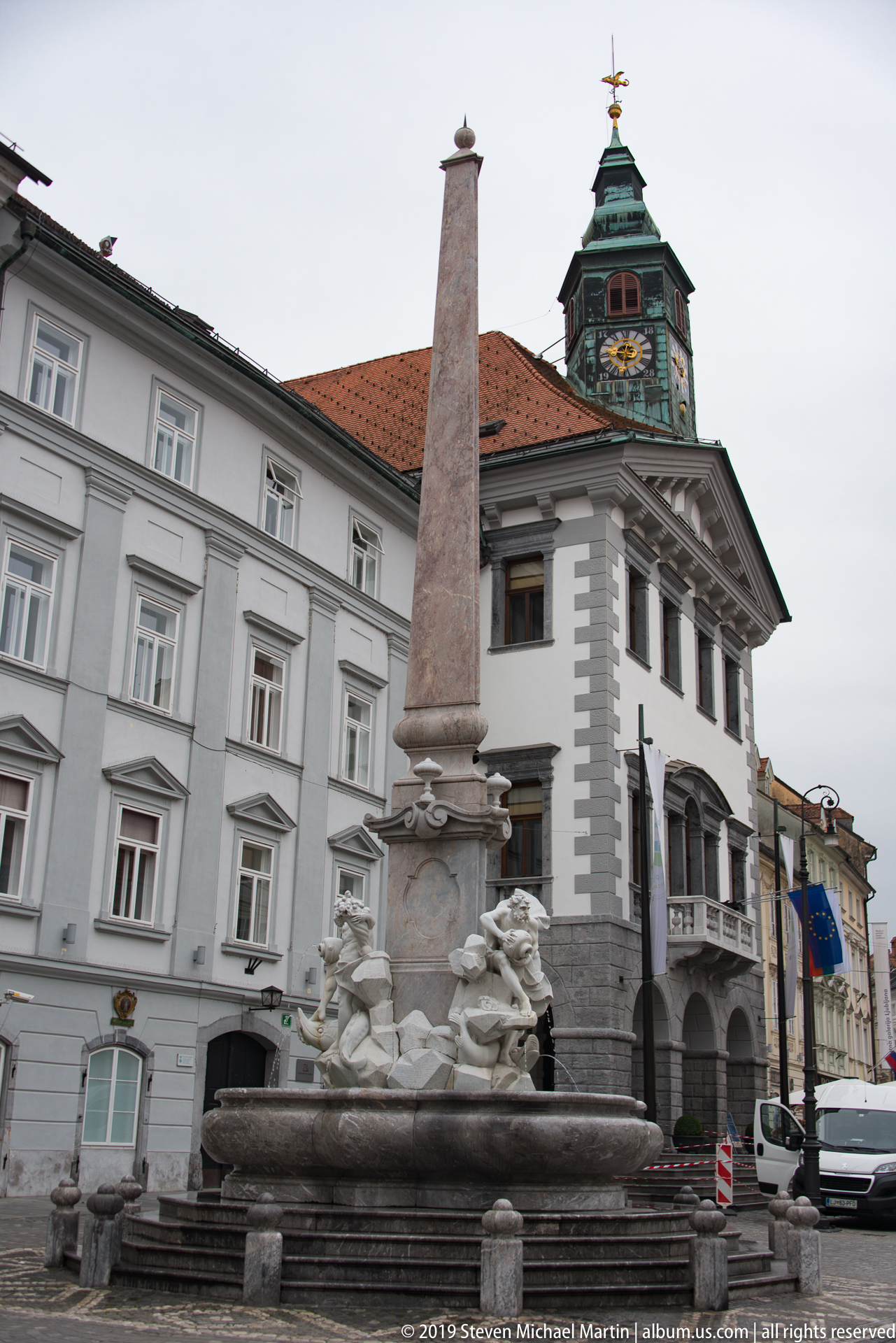
The Robba Fountain stands prominently in the square before Ljubljana Town Hall, its tall obelisk rising above the surrounding sculptural basin. Behind it, the civic building’s white façade, arcaded lower level, and clock tower create a layered view of two of the old center’s most recognizable public monuments.
Caption
The Robba Fountain stands prominently in the square before Ljubljana Town Hall, its tall obelisk rising above the surrounding sculptural basin. Behind it, the civic building’s white façade, arcaded lower level, and clock tower create a layered view of two of the old center’s most recognizable public monuments.

A gilded dragon-shaped weather vane crowns the copper roof of Ljubljana Town Hall, silhouetted against a pale sky. The close view isolates the emblematic creature above the civic tower and connects the building visually with the dragon imagery that recurs throughout Ljubljana’s public identity.
Caption
A gilded dragon-shaped weather vane crowns the copper roof of Ljubljana Town Hall, silhouetted against a pale sky. The close view isolates the emblematic creature above the civic tower and connects the building visually with the dragon imagery that recurs throughout Ljubljana’s public identity.

An ornate cream-colored urban façade rises above the street with projecting bays, carved window surrounds, pilasters, and layered cornices. The frontal composition concentrates on the building’s richly articulated upper stories, where decorative stonework and varied window shapes create a dense architectural rhythm characteristic of Ljubljana’s historic center.
Caption
An ornate cream-colored urban façade rises above the street with projecting bays, carved window surrounds, pilasters, and layered cornices. The frontal composition concentrates on the building’s richly articulated upper stories, where decorative stonework and varied window shapes create a dense architectural rhythm characteristic of Ljubljana’s historic center.

The copper-clad tower of Ljubljana Town Hall rises above red tile roofs, showing its paired clock faces, louvered openings, layered roof stages, and dragon weather vane. Framed against the wooded castle hill, the tower functions as a compact vertical marker of civic Ljubljana within the old town roofscape.
Caption
The copper-clad tower of Ljubljana Town Hall rises above red tile roofs, showing its paired clock faces, louvered openings, layered roof stages, and dragon weather vane. Framed against the wooded castle hill, the tower functions as a compact vertical marker of civic Ljubljana within the old town roofscape.
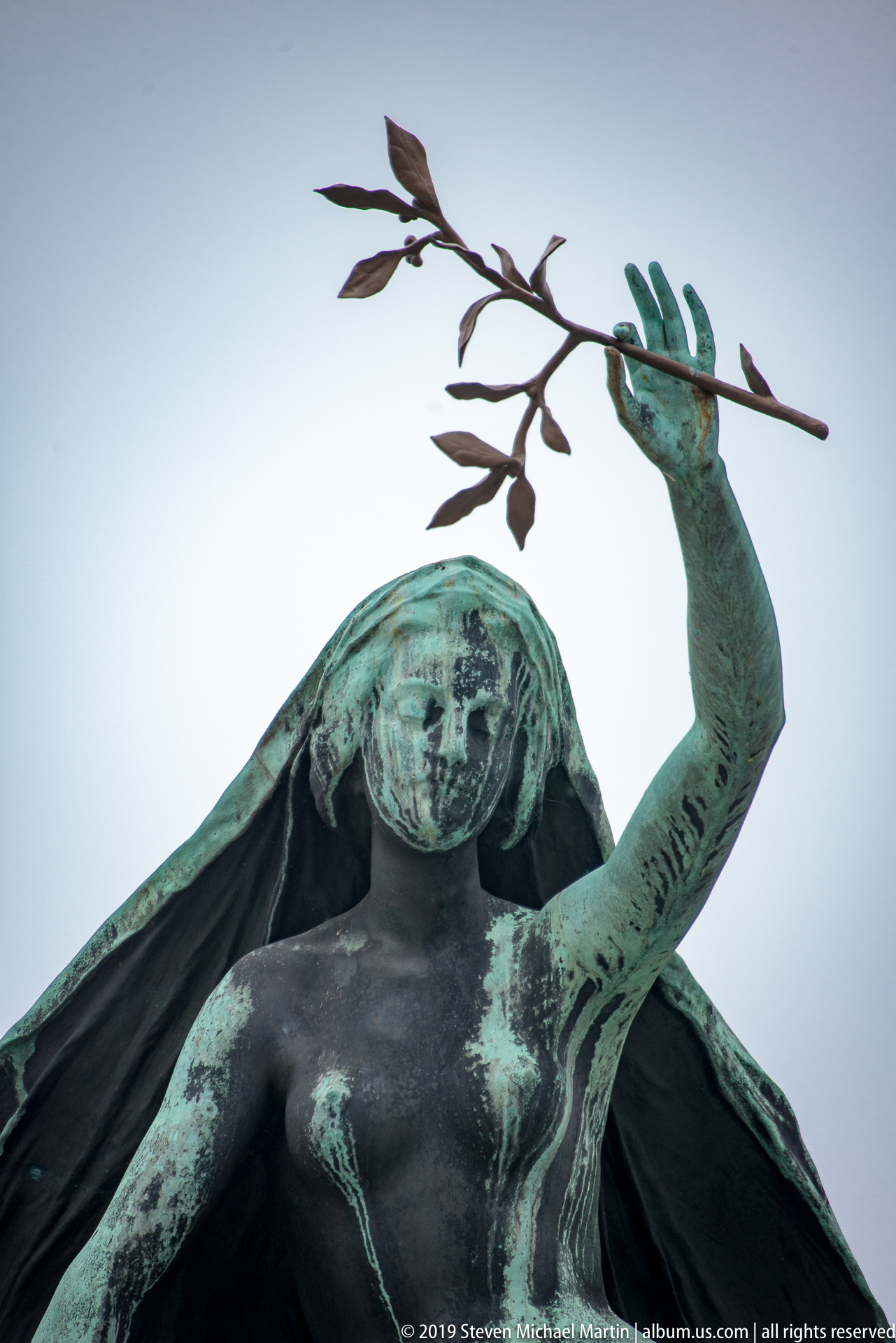
A bronze female figure rises above the Prešeren Monument holding a laurel branch aloft, her drapery spreading behind her like a dark wing. Seen from below, the sculpture becomes an expressive silhouette against the pale sky and highlights the allegorical figure that crowns Ljubljana’s principal monument to poet France Prešeren.
Caption
A bronze female figure rises above the Prešeren Monument holding a laurel branch aloft, her drapery spreading behind her like a dark wing. Seen from below, the sculpture becomes an expressive silhouette against the pale sky and highlights the allegorical figure that crowns Ljubljana’s principal monument to poet France Prešeren.

The Prešeren Monument combines a standing bronze portrait of poet France Prešeren with an elevated female muse holding a laurel branch above him. The frontal view makes the monument’s hierarchy clear: the poet occupies the foreground while the allegorical figure rises behind, creating a layered civic tribute at the center of Prešeren Square.
Caption
The Prešeren Monument combines a standing bronze portrait of poet France Prešeren with an elevated female muse holding a laurel branch above him. The frontal view makes the monument’s hierarchy clear: the poet occupies the foreground while the allegorical figure rises behind, creating a layered civic tribute at the center of Prešeren Square.
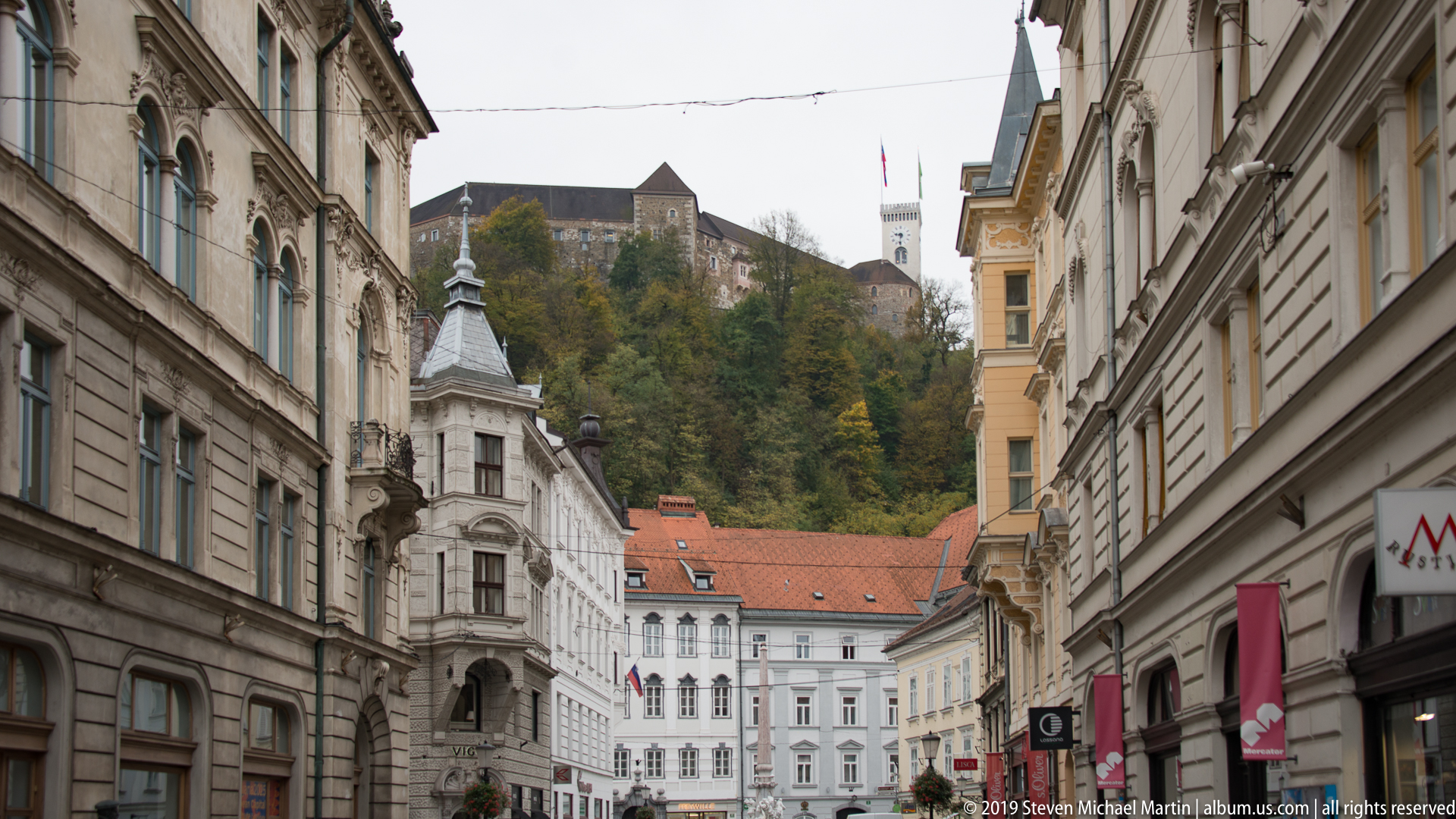
At the end of a narrow historic street, Ljubljana Castle appears high on its wooded hill above layered Baroque and nineteenth-century façades. The long street perspective links the elevated fortification with the everyday urban fabric below, showing how the castle remains visually present from within the old center.
Caption
At the end of a narrow historic street, Ljubljana Castle appears high on its wooded hill above layered Baroque and nineteenth-century façades. The long street perspective links the elevated fortification with the everyday urban fabric below, showing how the castle remains visually present from within the old center.

A richly ornamented corner building rises above the street with rounded bays, carved window surrounds, sculptural details, and a green domed turret. The upward viewpoint accentuates its verticality and corner emphasis, revealing the elaborate urban architecture that defines parts of central Ljubljana beyond the city’s Baroque monuments.
Caption
A richly ornamented corner building rises above the street with rounded bays, carved window surrounds, sculptural details, and a green domed turret. The upward viewpoint accentuates its verticality and corner emphasis, revealing the elaborate urban architecture that defines parts of central Ljubljana beyond the city’s Baroque monuments.

The Ljubljanica River runs between stone embankments lined with trees, cafés, and pastel historic buildings. A small covered boat moves along the water, while the calm surface reflects the riverfront and reinforces the close relationship between the waterway and Ljubljana’s pedestrian public realm.
Caption
The Ljubljanica River runs between stone embankments lined with trees, cafés, and pastel historic buildings. A small covered boat moves along the water, while the calm surface reflects the riverfront and reinforces the close relationship between the waterway and Ljubljana’s pedestrian public realm.

The rose-red façade of the Franciscan Church of the Annunciation anchors Prešeren Square, framed by ornate neighboring buildings and the busy pedestrian space in front. Its twin upper volutes, central pediment, and green-topped bell tower make the church a strong visual counterpoint to the lighter Secession-era façades around the square.
Caption
The rose-red façade of the Franciscan Church of the Annunciation anchors Prešeren Square, framed by ornate neighboring buildings and the busy pedestrian space in front. Its twin upper volutes, central pediment, and green-topped bell tower make the church a strong visual counterpoint to the lighter Secession-era façades around the square.

A long arcade of open arches follows the edge of the Ljubljanica River, creating a rhythmic covered passage above the water. The repeated stone openings and continuous roofline give the riverbank a strongly architectural character, integrating commercial and pedestrian functions directly into Ljubljana’s historic waterfront.
Caption
A long arcade of open arches follows the edge of the Ljubljanica River, creating a rhythmic covered passage above the water. The repeated stone openings and continuous roofline give the riverbank a strongly architectural character, integrating commercial and pedestrian functions directly into Ljubljana’s historic waterfront.

Viewed obliquely across the river, the market colonnade stretches beneath an ornate historic façade, its repeated arches and open upper gallery forming a continuous edge along the Ljubljanica. The composition shows how Jože Plečnik’s market architecture mediates between civic buildings, commerce, pedestrians, and the river itself.
Caption
Viewed obliquely across the river, the market colonnade stretches beneath an ornate historic façade, its repeated arches and open upper gallery forming a continuous edge along the Ljubljanica. The composition shows how Jože Plečnik’s market architecture mediates between civic buildings, commerce, pedestrians, and the river itself.

Plečnik’s long riverside market colonnade extends above the Ljubljanica in a measured sequence of arches and columns, with cafés and pedestrians occupying the upper gallery. The oblique view emphasizes how the structure forms a continuous architectural edge between the old city and the river, while its reflection repeats the arcade rhythm in the water below.
Caption
Plečnik’s long riverside market colonnade extends above the Ljubljanica in a measured sequence of arches and columns, with cafés and pedestrians occupying the upper gallery. The oblique view emphasizes how the structure forms a continuous architectural edge between the old city and the river, while its reflection repeats the arcade rhythm in the water below.
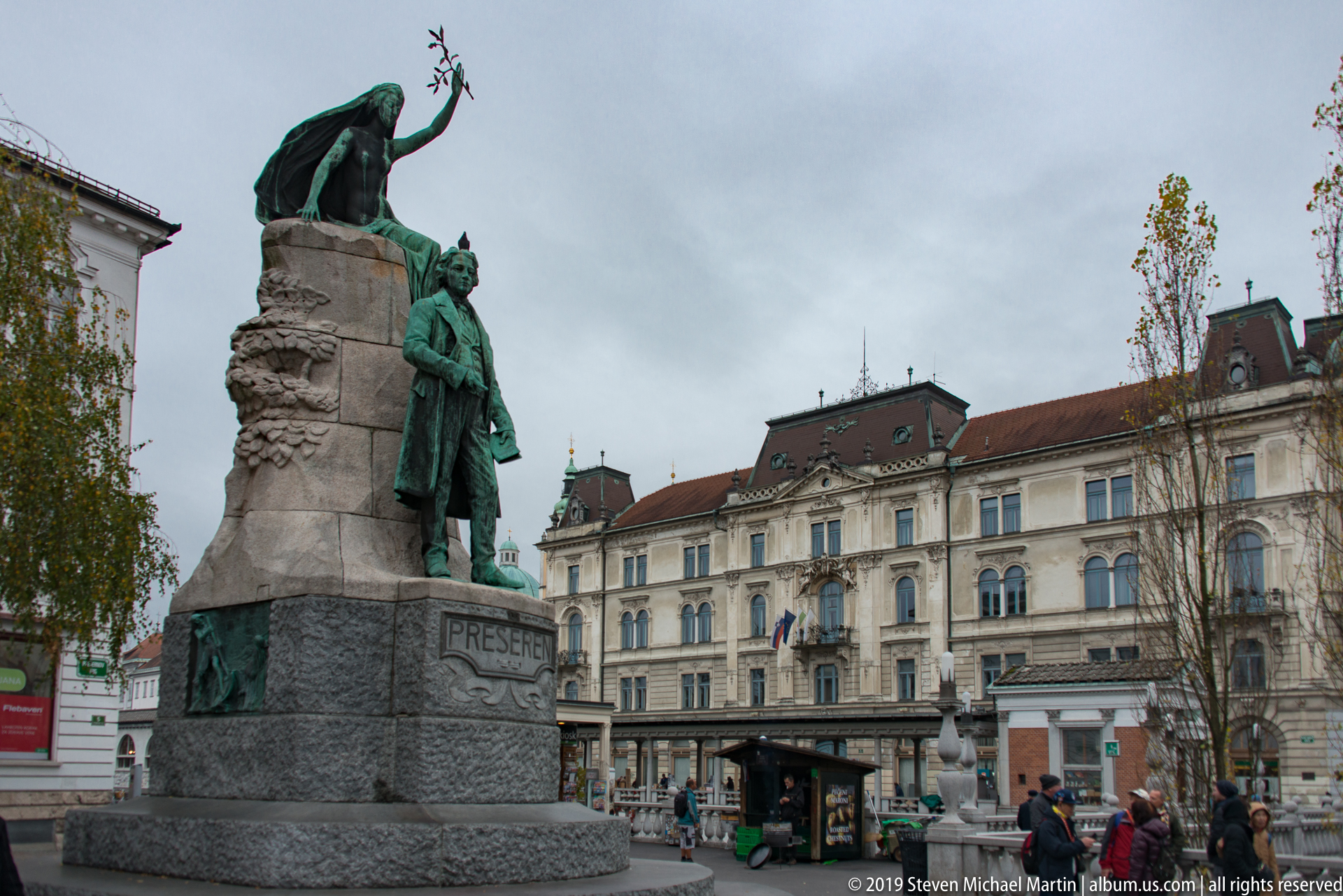
Seen from the side, the Prešeren Monument stands against a backdrop of historic façades and street activity in central Ljubljana. The bronze figure of France Prešeren and the elevated muse remain the focal point, while market kiosks, pedestrians, and surrounding buildings place the monument firmly within the everyday civic life of Prešeren Square.
Caption
Seen from the side, the Prešeren Monument stands against a backdrop of historic façades and street activity in central Ljubljana. The bronze figure of France Prešeren and the elevated muse remain the focal point, while market kiosks, pedestrians, and surrounding buildings place the monument firmly within the everyday civic life of Prešeren Square.

A rounded corner pavilion rises above an ornate pale-green façade, capped by a dark metal roof and slender weather vane. Circular windows, sculpted trim, and layered cornices concentrate decoration around the uppermost story, where the building’s silhouette becomes especially prominent against the overcast sky.
Caption
A rounded corner pavilion rises above an ornate pale-green façade, capped by a dark metal roof and slender weather vane. Circular windows, sculpted trim, and layered cornices concentrate decoration around the uppermost story, where the building’s silhouette becomes especially prominent against the overcast sky.

The grand Galerija Emporium occupies an ornate corner building whose pale stone façade is animated by pilasters, sculptural ornament, and a broad glazed entrance canopy. Seen from below, the composition emphasizes the building’s ceremonial commercial architecture and the way monumental retail façades contributed to Ljubljana’s turn-of-the-century city center.
Caption
The grand Galerija Emporium occupies an ornate corner building whose pale stone façade is animated by pilasters, sculptural ornament, and a broad glazed entrance canopy. Seen from below, the composition emphasizes the building’s ceremonial commercial architecture and the way monumental retail façades contributed to Ljubljana’s turn-of-the-century city center.

The curved façade and green metal dome of the Grand Hotel Union rise above a prominent corner in central Ljubljana. Decorative bands, sculpted details, and evenly spaced windows give the building a formal Secession-era character, while the low viewpoint concentrates attention on the rounded roofline and the word “HOTEL” set beneath the dome.
Caption
The curved façade and green metal dome of the Grand Hotel Union rise above a prominent corner in central Ljubljana. Decorative bands, sculpted details, and evenly spaced windows give the building a formal Secession-era character, while the low viewpoint concentrates attention on the rounded roofline and the word “HOTEL” set beneath the dome.

Two richly articulated historic buildings meet at a street corner, contrasting a white façade with green shutters and projecting bays against a pale-green building with a slender tower. The view captures Ljubljana’s dense late-nineteenth- and early-twentieth-century streetscape, where narrow plots, decorative façades, and distinctive rooflines define the urban character.
Caption
Two richly articulated historic buildings meet at a street corner, contrasting a white façade with green shutters and projecting bays against a pale-green building with a slender tower. The view captures Ljubljana’s dense late-nineteenth- and early-twentieth-century streetscape, where narrow plots, decorative façades, and distinctive rooflines define the urban character.
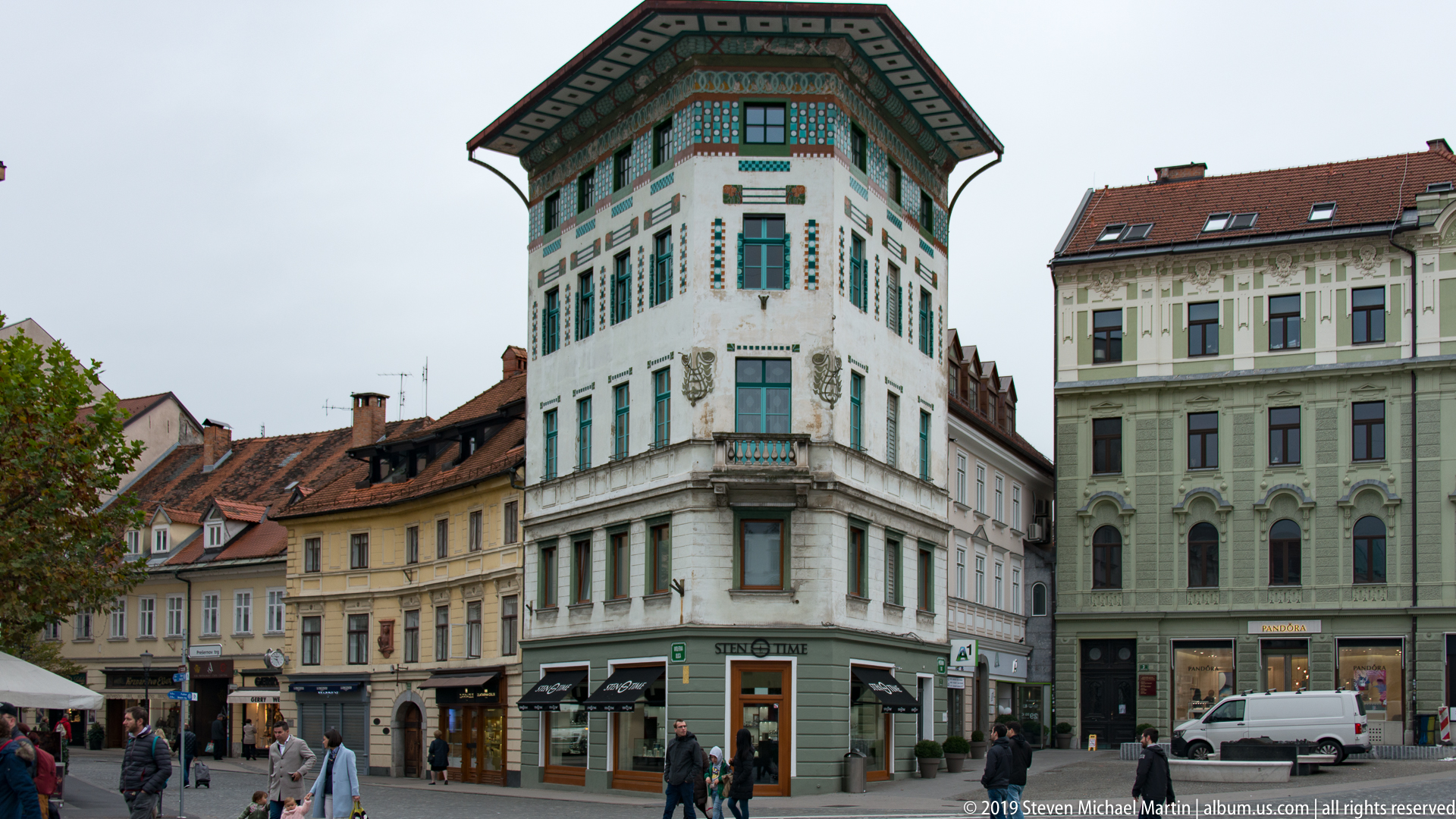
A narrow white corner building with green shutters and projecting upper stories anchors the junction of several historic streets. Its broad eaves, painted trim, and small balcony create a strong vertical accent, while adjacent lower buildings and pedestrians reveal the intimate scale of Ljubljana’s central urban fabric.
Caption
A narrow white corner building with green shutters and projecting upper stories anchors the junction of several historic streets. Its broad eaves, painted trim, and small balcony create a strong vertical accent, while adjacent lower buildings and pedestrians reveal the intimate scale of Ljubljana’s central urban fabric.

A gently curving pedestrian street passes between compact historic buildings with red-tile roofs, stucco façades, shop signs, and small balconies. The compressed perspective and scattered pedestrians convey the intimate scale of Ljubljana’s old center, where commercial life unfolds along lanes narrower than the city’s principal squares.
Caption
A gently curving pedestrian street passes between compact historic buildings with red-tile roofs, stucco façades, shop signs, and small balconies. The compressed perspective and scattered pedestrians convey the intimate scale of Ljubljana’s old center, where commercial life unfolds along lanes narrower than the city’s principal squares.

The warm red exterior of the Franciscan Church of the Annunciation fills the end of a narrow street, with its bell tower and layered rooflines rising above neighboring façades. This side view reveals the church as part of the surrounding urban block rather than only as the frontal landmark of Prešeren Square.
Caption
The warm red exterior of the Franciscan Church of the Annunciation fills the end of a narrow street, with its bell tower and layered rooflines rising above neighboring façades. This side view reveals the church as part of the surrounding urban block rather than only as the frontal landmark of Prešeren Square.

Vurnik House presents one of Ljubljana’s most distinctive painted façades, with bold blue, red, orange, white, and yellow geometric ornament surrounding the windows and projecting bays. The close view isolates the patterned surface and shows how architectural decoration becomes nearly textile-like, wrapping the pink wall in repeating national and folk-inspired motifs.
Caption
Vurnik House presents one of Ljubljana’s most distinctive painted façades, with bold blue, red, orange, white, and yellow geometric ornament surrounding the windows and projecting bays. The close view isolates the patterned surface and shows how architectural decoration becomes nearly textile-like, wrapping the pink wall in repeating national and folk-inspired motifs.

A close view isolates one of the monumental atlas figures on the Bank of Slovenia, showing the muscular torso, bent arms, and heavy architectural block supported above the figure’s shoulders. The crop reveals the sculptural treatment of the façade more clearly than a distant architectural view, emphasizing the fusion of ornament and apparent structural support.
Caption
A close view isolates one of the monumental atlas figures on the Bank of Slovenia, showing the muscular torso, bent arms, and heavy architectural block supported above the figure’s shoulders. The crop reveals the sculptural treatment of the façade more clearly than a distant architectural view, emphasizing the fusion of ornament and apparent structural support.

A grand domed corner building rises above the street with a circular upper stage, sculpted figures, balustrades, and a richly modeled cornice. The tight framing concentrates attention on the dark metal dome and the ornate transition between roof and façade, where decorative sculpture enlivens the skyline.
Caption
A grand domed corner building rises above the street with a circular upper stage, sculpted figures, balustrades, and a richly modeled cornice. The tight framing concentrates attention on the dark metal dome and the ornate transition between roof and façade, where decorative sculpture enlivens the skyline.

The full façade of Vurnik House reveals the extraordinary extent of its geometric decoration, which frames windows, balconies, cornices, and the upper roofline in dense bands of blue, red, white, yellow, and orange. The building’s striking painted surface transforms a conventional urban elevation into one of Ljubljana’s most recognizable examples of national-style modern architecture.
Caption
The full façade of Vurnik House reveals the extraordinary extent of its geometric decoration, which frames windows, balconies, cornices, and the upper roofline in dense bands of blue, red, white, yellow, and orange. The building’s striking painted surface transforms a conventional urban elevation into one of Ljubljana’s most recognizable examples of national-style modern architecture.

A small sticker reading “MORE LOVE LETTERS, PLEASE.” is fixed above the slot of a yellow postal box, turning an ordinary piece of street infrastructure into a playful urban message. A second Slovenian notice below provides collection information, grounding the humorous intervention in the practical function of the mailbox.
Caption
A small sticker reading “MORE LOVE LETTERS, PLEASE.” is fixed above the slot of a yellow postal box, turning an ordinary piece of street infrastructure into a playful urban message. A second Slovenian notice below provides collection information, grounding the humorous intervention in the practical function of the mailbox.

Small bronze horses cluster around a low fountain, with one animal elevated atop a water-covered central pedestal. The composition combines playful equestrian sculpture with moving water, and the close framing emphasizes the contrast between dark patinated metal and the pale, flowing surface of the fountain.
Caption
Small bronze horses cluster around a low fountain, with one animal elevated atop a water-covered central pedestal. The composition combines playful equestrian sculpture with moving water, and the close framing emphasizes the contrast between dark patinated metal and the pale, flowing surface of the fountain.

A yellow historic corner building is capped by a narrow cylindrical turret that rises above the roofline like a small observation tower. Projecting balconies, bay windows, and decorative stonework animate the façade, while the turret’s rounded form gives the intersection a distinctive vertical landmark.
Caption
A yellow historic corner building is capped by a narrow cylindrical turret that rises above the roofline like a small observation tower. Projecting balconies, bay windows, and decorative stonework animate the façade, while the turret’s rounded form gives the intersection a distinctive vertical landmark.

A tall slab-like office tower stands beside a lower angular building with a projecting upper volume, creating a distinctly modernist skyline within central Ljubljana. Their repetitive window grids and exposed structural geometry contrast sharply with the historic façades elsewhere in the city and document the capital’s twentieth-century architectural layer.
Caption
A tall slab-like office tower stands beside a lower angular building with a projecting upper volume, creating a distinctly modernist skyline within central Ljubljana. Their repetitive window grids and exposed structural geometry contrast sharply with the historic façades elsewhere in the city and document the capital’s twentieth-century architectural layer.

Massive sculpted male figures function as atlantes between arched openings on the façade of the Bank of Slovenia. Supporting the entablature above with raised arms, the figures turn a structural motif into monumental decoration, while the inscription “BANKA SLOVENIJE” identifies the institutional building behind the heavy grilles.
Caption
Massive sculpted male figures function as atlantes between arched openings on the façade of the Bank of Slovenia. Supporting the entablature above with raised arms, the figures turn a structural motif into monumental decoration, while the inscription “BANKA SLOVENIJE” identifies the institutional building behind the heavy grilles.

The uppermost section of the domed corner building fills the frame, revealing the circular roof drum, central medallion, balustrade, and sculpted figures poised along the parapet. The closer view emphasizes the layered silhouette and decorative roof sculpture that would be less legible from street level.
Caption
The uppermost section of the domed corner building fills the frame, revealing the circular roof drum, central medallion, balustrade, and sculpted figures poised along the parapet. The closer view emphasizes the layered silhouette and decorative roof sculpture that would be less legible from street level.

The full corner elevation of an ornate historic building reveals how its central domed tower organizes two long wings along the intersecting streets. Rusticated lower stories, arched openings, sculpted roof figures, and a richly detailed upper façade create a strongly monumental presence at the junction.
Caption
The full corner elevation of an ornate historic building reveals how its central domed tower organizes two long wings along the intersecting streets. Rusticated lower stories, arched openings, sculpted roof figures, and a richly detailed upper façade create a strongly monumental presence at the junction.

Two stacked windows are framed by unusually rich terracotta-colored ornament, including sculpted faces, pilasters, brackets, and a triangular pediment. The close crop isolates the façade’s decorative vocabulary and shows how contrasting warm-toned details stand out against the pale wall surface.
Caption
Two stacked windows are framed by unusually rich terracotta-colored ornament, including sculpted faces, pilasters, brackets, and a triangular pediment. The close crop isolates the façade’s decorative vocabulary and shows how contrasting warm-toned details stand out against the pale wall surface.

A stylized bronze female figure stands with bent knees and both hands raised beside her face, her exaggerated proportions and angular pose giving the sculpture a lively, theatrical quality. The shallow depth of field separates the dark figure from the pale building behind and keeps attention on gesture and movement.
Caption
A stylized bronze female figure stands with bent knees and both hands raised beside her face, her exaggerated proportions and angular pose giving the sculpture a lively, theatrical quality. The shallow depth of field separates the dark figure from the pale building behind and keeps attention on gesture and movement.

A dark bronze sculpture rises like a stylized tree, with a narrow trunk supporting a broad, flattened canopy of rough-textured metal. Its simplified silhouette evokes natural form without literal detail, while the adjacent planter and institutional façade place the work in a landscaped urban setting.
Caption
A dark bronze sculpture rises like a stylized tree, with a narrow trunk supporting a broad, flattened canopy of rough-textured metal. Its simplified silhouette evokes natural form without literal detail, while the adjacent planter and institutional façade place the work in a landscaped urban setting.

A pale stone figure stands quietly beneath mature trees at the end of a flower-filled lawn, with a single red candle placed at its base. The subdued setting and frontal pose give the sculpture a memorial character, while autumn foliage and low bedding plants create a contemplative frame around the monument.
Caption
A pale stone figure stands quietly beneath mature trees at the end of a flower-filled lawn, with a single red candle placed at its base. The subdued setting and frontal pose give the sculpture a memorial character, while autumn foliage and low bedding plants create a contemplative frame around the monument.

A dense bronze assemblage of elongated, spike-like human forms stands on a low stone base in a lawn beside a modern building. The clustered figures merge into a rough wall-like mass, creating a strong contrast between collective density at the center and the thin, tapering legs and heads projecting outward.
Caption
A dense bronze assemblage of elongated, spike-like human forms stands on a low stone base in a lawn beside a modern building. The clustered figures merge into a rough wall-like mass, creating a strong contrast between collective density at the center and the thin, tapering legs and heads projecting outward.

A tall, slender bronze female figure stands upright on a low plinth with one hand raised near her face. Behind her, another large abstract bronze composition appears across the lawn, placing the individual figure within a broader outdoor sculpture setting and emphasizing contrasting approaches to the human form.
Caption
A tall, slender bronze female figure stands upright on a low plinth with one hand raised near her face. Behind her, another large abstract bronze composition appears across the lawn, placing the individual figure within a broader outdoor sculpture setting and emphasizing contrasting approaches to the human form.

A broad gravel promenade extends through a landscaped park beneath mature trees, with rows of exhibition panels set along both sides and decorative lamp posts marking the central axis. Fallen leaves and the distant white building create a formal autumnal perspective typical of Ljubljana’s major public park landscapes.
Caption
A broad gravel promenade extends through a landscaped park beneath mature trees, with rows of exhibition panels set along both sides and decorative lamp posts marking the central axis. Fallen leaves and the distant white building create a formal autumnal perspective typical of Ljubljana’s major public park landscapes.

A cream-colored Orthodox church rises behind autumn trees with multiple rounded towers, dark domes, and metal crosses. The clustered cupolas and arched openings distinguish the building from Ljubljana’s Baroque Catholic churches, while the partially screened view places its monumental roofline within a leafy urban setting.
Caption
A cream-colored Orthodox church rises behind autumn trees with multiple rounded towers, dark domes, and metal crosses. The clustered cupolas and arched openings distinguish the building from Ljubljana’s Baroque Catholic churches, while the partially screened view places its monumental roofline within a leafy urban setting.

A man stands within a large circular opening edged in dark brick, the strong geometric frame isolating him against a restrained architectural background. The composition uses the opening almost as a monumental portrait surround, contrasting the precise masonry circle with the figure’s informal stance and the horizontal concrete and timber surfaces beyond.
Caption
A man stands within a large circular opening edged in dark brick, the strong geometric frame isolating him against a restrained architectural background. The composition uses the opening almost as a monumental portrait surround, contrasting the precise masonry circle with the figure’s informal stance and the horizontal concrete and timber surfaces beyond.

A dark abstract sculpture balances a broad, folded disc-like form above a tapered pedestal in a landscaped museum setting. Its irregular planes and central rounded mass shift between floral, mechanical, and figurative associations without resolving into a literal subject, while a second sculpture and institutional façade establish the work as part of an outdoor collection.
Caption
A dark abstract sculpture balances a broad, folded disc-like form above a tapered pedestal in a landscaped museum setting. Its irregular planes and central rounded mass shift between floral, mechanical, and figurative associations without resolving into a literal subject, while a second sculpture and institutional façade establish the work as part of an outdoor collection.

The cream-colored upper structure of Ljubljana’s Serbian Orthodox Church of Saints Cyril and Methodius rises behind mature trees. Rounded gables, narrow arched windows, a dark central dome, and an Orthodox cross distinguish the church’s Byzantine Revival vocabulary, while the partial screening by foliage emphasizes its setting beside Tivoli Park.
Caption
The cream-colored upper structure of Ljubljana’s Serbian Orthodox Church of Saints Cyril and Methodius rises behind mature trees. Rounded gables, narrow arched windows, a dark central dome, and an Orthodox cross distinguish the church’s Byzantine Revival vocabulary, while the partial screening by foliage emphasizes its setting beside Tivoli Park.

The Church of Saints Cyril and Methodius is seen from its entrance side, where rounded gables, layered roof forms, arched openings, and multiple crosses create a compact Byzantine Revival silhouette. Trees frame the cream-colored church and soften its monumental geometry, placing the Serbian Orthodox landmark within Ljubljana’s leafy museum and park district.
Caption
The Church of Saints Cyril and Methodius is seen from its entrance side, where rounded gables, layered roof forms, arched openings, and multiple crosses create a compact Byzantine Revival silhouette. Trees frame the cream-colored church and soften its monumental geometry, placing the Serbian Orthodox landmark within Ljubljana’s leafy museum and park district.

A large abstract sculpture dominates the foreground outside Ljubljana’s Moderna galerija, partially obscuring the building’s restrained stone entrance façade. The juxtaposition brings the museum’s modernist architecture and outdoor sculpture collection into one view, while the entrance banner identifies the institution devoted to modern art.
Caption
A large abstract sculpture dominates the foreground outside Ljubljana’s Moderna galerija, partially obscuring the building’s restrained stone entrance façade. The juxtaposition brings the museum’s modernist architecture and outdoor sculpture collection into one view, while the entrance banner identifies the institution devoted to modern art.

Slovenian flags mark the formal entrance of Moderna galerija, a low modernist building faced in pale stone and set beside Tivoli Park. The broad forecourt, simple rectangular windows, and restrained entrance portico contrast with the historicist and Baroque architecture elsewhere in central Ljubljana, documenting the city’s twentieth-century cultural institutions.
Caption
Slovenian flags mark the formal entrance of Moderna galerija, a low modernist building faced in pale stone and set beside Tivoli Park. The broad forecourt, simple rectangular windows, and restrained entrance portico contrast with the historicist and Baroque architecture elsewhere in central Ljubljana, documenting the city’s twentieth-century cultural institutions.

The ornate upper façade of Slovenia’s National Gallery is organized around tall arched windows, Corinthian columns, sculpted garlands, and figure-filled niches. The inscription “NARODNI DOM” survives high on the elevation, while “NARODNA GALERIJA” below identifies the building’s present museum function, linking its historic civic architecture with Slovenia’s national art collection.
Caption
The ornate upper façade of Slovenia’s National Gallery is organized around tall arched windows, Corinthian columns, sculpted garlands, and figure-filled niches. The inscription “NARODNI DOM” survives high on the elevation, while “NARODNA GALERIJA” below identifies the building’s present museum function, linking its historic civic architecture with Slovenia’s national art collection.

The National Gallery of Slovenia presents a symmetrical historicist façade with a central pavilion, tall arched windows, sculptural niches, and a dark mansard roof. Viewed across the forecourt, the building’s complete composition becomes legible from rusticated ground floor to richly decorated upper story, with the “NARODNA GALERIJA” inscription centered above the main entrance.
Caption
The National Gallery of Slovenia presents a symmetrical historicist façade with a central pavilion, tall arched windows, sculptural niches, and a dark mansard roof. Viewed across the forecourt, the building’s complete composition becomes legible from rusticated ground floor to richly decorated upper story, with the “NARODNA GALERIJA” inscription centered above the main entrance.

A white sculptural figure stands within a shallow arched niche on the National Gallery façade, enclosed by interlacing bands and accented with gilded details. Floral reliefs and a small mask above extend the ornament beyond the niche, demonstrating the building’s dense historicist integration of sculpture, architecture, and decorative symbolism.
Caption
A white sculptural figure stands within a shallow arched niche on the National Gallery façade, enclosed by interlacing bands and accented with gilded details. Floral reliefs and a small mask above extend the ornament beyond the niche, demonstrating the building’s dense historicist integration of sculpture, architecture, and decorative symbolism.

A closer view isolates one of the National Gallery’s unusual niche sculptures, where a pale figure is almost enveloped by broad interlacing bands beneath a gilded circular accent. The surrounding coffered niche and molded frame turn the sculpture into a concentrated decorative episode within the museum’s otherwise symmetrical façade.
Caption
A closer view isolates one of the National Gallery’s unusual niche sculptures, where a pale figure is almost enveloped by broad interlacing bands beneath a gilded circular accent. The surrounding coffered niche and molded frame turn the sculpture into a concentrated decorative episode within the museum’s otherwise symmetrical façade.

A white allegorical female figure occupies a shell-like arched niche on the Slovenian National Opera and Ballet building, raising a gilded object in one hand while holding a carved attribute at her side. The figure’s flowing drapery and theatrical pose complement the richly ornamented Neo-Renaissance façade of Ljubljana’s principal opera house.
Caption
A white allegorical female figure occupies a shell-like arched niche on the Slovenian National Opera and Ballet building, raising a gilded object in one hand while holding a carved attribute at her side. The figure’s flowing drapery and theatrical pose complement the richly ornamented Neo-Renaissance façade of Ljubljana’s principal opera house.

An oblique view of the National Gallery shows the depth of its central pavilion and long side wing, revealing the building as a substantial freestanding civic monument rather than a flat façade. Repeated arched windows, rusticated masonry, sculptural ornament, and the dark roof unify the composition as it turns along the street.
Caption
An oblique view of the National Gallery shows the depth of its central pavilion and long side wing, revealing the building as a substantial freestanding civic monument rather than a flat façade. Repeated arched windows, rusticated masonry, sculptural ornament, and the dark roof unify the composition as it turns along the street.

A stone portrait bust stands between two slender metal columns supporting a curved canopy, creating a small memorial ensemble against an ornate historic façade. Spherical finials and the canopy’s simple modern geometry contrast with the rusticated masonry, arched doorway, and carved architectural details behind the monument.
Caption
A stone portrait bust stands between two slender metal columns supporting a curved canopy, creating a small memorial ensemble against an ornate historic façade. Spherical finials and the canopy’s simple modern geometry contrast with the rusticated masonry, arched doorway, and carved architectural details behind the monument.

A dramatic sculptural group crowns the opera house roofline: a central winged female figure rises above reclining and seated figures arranged across the pediment’s apex. Seen against the sky, the ensemble functions as a theatrical silhouette and extends the building’s artistic program beyond the architectural frame of the façade.
Caption
A dramatic sculptural group crowns the opera house roofline: a central winged female figure rises above reclining and seated figures arranged across the pediment’s apex. Seen against the sky, the ensemble functions as a theatrical silhouette and extends the building’s artistic program beyond the architectural frame of the façade.

The triangular pediment of the Slovenian National Opera and Ballet is packed with high-relief figures beneath the winged group at its apex. A gilded ornamental frieze and the inscription identifying the national opera and ballet run below, combining sculpture, text, and polychrome decoration into the building’s most elaborate ceremonial elevation.
Caption
The triangular pediment of the Slovenian National Opera and Ballet is packed with high-relief figures beneath the winged group at its apex. A gilded ornamental frieze and the inscription identifying the national opera and ballet run below, combining sculpture, text, and polychrome decoration into the building’s most elaborate ceremonial elevation.

The main entrance of the Slovenian National Opera and Ballet is sheltered by a broad projecting canopy beneath three tall arched windows and an elaborate sculptural pediment. The pale pink-and-cream façade combines classical columns, statuary, gilded ornament, and a strongly centered entrance composition suited to the building’s ceremonial performing-arts function.
Caption
The main entrance of the Slovenian National Opera and Ballet is sheltered by a broad projecting canopy beneath three tall arched windows and an elaborate sculptural pediment. The pale pink-and-cream façade combines classical columns, statuary, gilded ornament, and a strongly centered entrance composition suited to the building’s ceremonial performing-arts function.

From the side, the Slovenian National Opera and Ballet reveals its rounded corner, layered roofline, statuary, and projecting entrance canopy. The oblique perspective shows how the ornate Neo-Renaissance front wraps into the longer side elevation, giving the theater a sculptural presence within the surrounding city block.
Caption
From the side, the Slovenian National Opera and Ballet reveals its rounded corner, layered roofline, statuary, and projecting entrance canopy. The oblique perspective shows how the ornate Neo-Renaissance front wraps into the longer side elevation, giving the theater a sculptural presence within the surrounding city block.
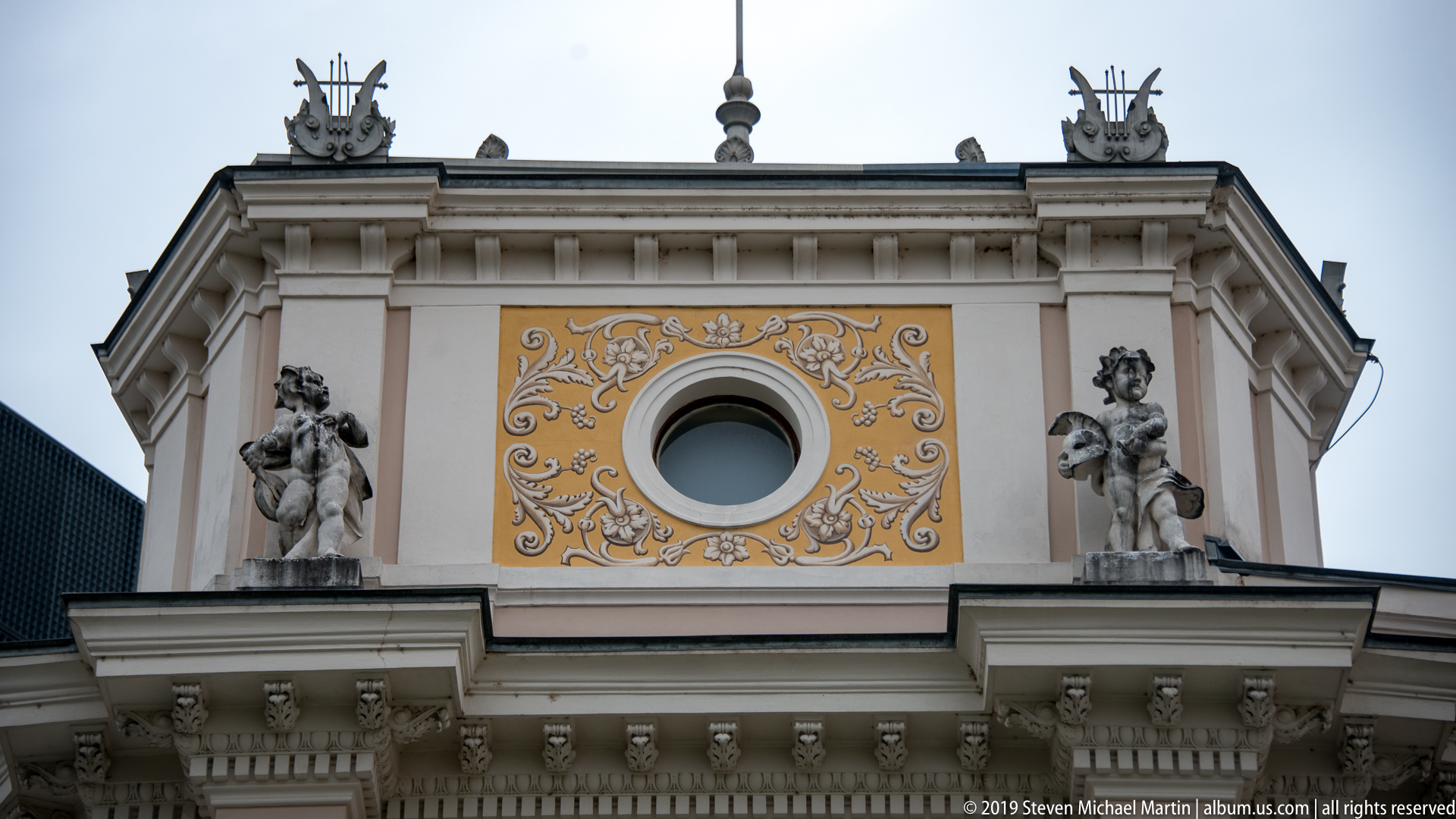
Two sculpted figures stand on projecting ledges to either side of a circular window framed by white scrolling ornament on a warm ocher panel. The compact upper-façade composition combines figural sculpture, floral arabesques, and classical cornices, creating a richly decorative architectural vignette above the street.
Caption
Two sculpted figures stand on projecting ledges to either side of a circular window framed by white scrolling ornament on a warm ocher panel. The compact upper-façade composition combines figural sculpture, floral arabesques, and classical cornices, creating a richly decorative architectural vignette above the street.

Above an arched opening on Ljubljana’s opera house, paired female figures recline beside a central cartouche beneath a gilded ornamental band dated 1892. The close view reveals the building’s sculptural richness at pedestrian scale, including expressive masks on the capitals and the contrast between white modeling, pink wall surfaces, and gold accents.
Caption
Above an arched opening on Ljubljana’s opera house, paired female figures recline beside a central cartouche beneath a gilded ornamental band dated 1892. The close view reveals the building’s sculptural richness at pedestrian scale, including expressive masks on the capitals and the contrast between white modeling, pink wall surfaces, and gold accents.

A small balustraded balcony projects from the opera house façade beneath an oval window, framed by tall pale columns and reclining sculpted figures. The close, symmetrical view emphasizes the layered architectural ornament—scrollwork, molded arches, statuary, and contrasting pink wall surfaces—that enriches the theater’s ceremonial exterior.
Caption
A small balustraded balcony projects from the opera house façade beneath an oval window, framed by tall pale columns and reclining sculpted figures. The close, symmetrical view emphasizes the layered architectural ornament—scrollwork, molded arches, statuary, and contrasting pink wall surfaces—that enriches the theater’s ceremonial exterior.

The central entrance bay of Ljubljana’s opera house stacks a dark wooden doorway, stone balcony, oval upper window, and sculptural ornament within a tall classical frame. Seen nearly straight on, the composition reveals the carefully ordered vertical hierarchy of the façade and the contrast between rusticated lower masonry and the lighter ceremonial upper story.
Caption
The central entrance bay of Ljubljana’s opera house stacks a dark wooden doorway, stone balcony, oval upper window, and sculptural ornament within a tall classical frame. Seen nearly straight on, the composition reveals the carefully ordered vertical hierarchy of the façade and the contrast between rusticated lower masonry and the lighter ceremonial upper story.

The crowned eagle is shown at close range, revealing pale blue feathers, a red beak and legs, a gold crown, and a red-and-gold collar-like band. Detached from most of the surrounding grille, the emblem becomes a study in painted heraldic detail and the craftsmanship used to animate otherwise dark architectural ironwork.
Caption
The crowned eagle is shown at close range, revealing pale blue feathers, a red beak and legs, a gold crown, and a red-and-gold collar-like band. Detached from most of the surrounding grille, the emblem becomes a study in painted heraldic detail and the craftsmanship used to animate otherwise dark architectural ironwork.

The Cooperative Business Bank building, commonly known as Vurnik House, fills the frame with its extraordinary red façade and dense bands of blue, white, yellow, and black geometric ornament. Painted and modeled patterns wrap balconies, window surrounds, and the deep roof eaves, making the building a landmark expression of Ivan Vurnik’s search for a distinctively Slovenian national architectural style.
Caption
The Cooperative Business Bank building, commonly known as Vurnik House, fills the frame with its extraordinary red façade and dense bands of blue, white, yellow, and black geometric ornament. Painted and modeled patterns wrap balconies, window surrounds, and the deep roof eaves, making the building a landmark expression of Ivan Vurnik’s search for a distinctively Slovenian national architectural style.
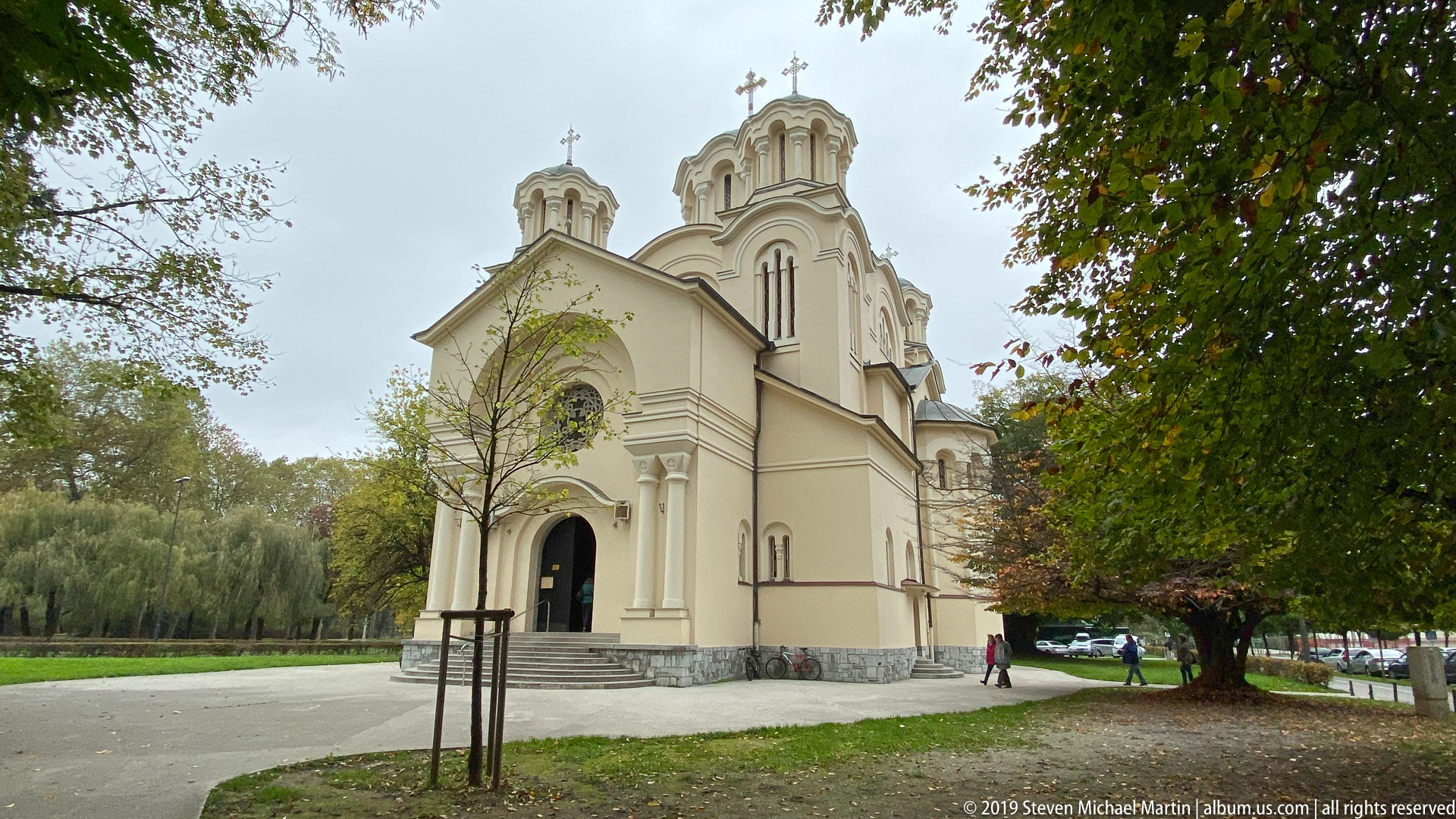
The Church of Saints Cyril and Methodius stands among mature trees near Tivoli Park, its cream walls, rounded gables, arched entrance, and clustered upper towers creating a compact Byzantine Revival profile. The wider view includes the surrounding lawn and paths, showing the Serbian Orthodox church as a freestanding landmark within Ljubljana’s museum district.
Caption
The Church of Saints Cyril and Methodius stands among mature trees near Tivoli Park, its cream walls, rounded gables, arched entrance, and clustered upper towers creating a compact Byzantine Revival profile. The wider view includes the surrounding lawn and paths, showing the Serbian Orthodox church as a freestanding landmark within Ljubljana’s museum district.

A brightly colored bee appears at the center of an elaborate black wrought-iron grille, surrounded by curling foliage and scrollwork. The small emblem provides a vivid focal point within the otherwise monochrome metalwork, combining natural imagery with highly crafted architectural decoration at an entrance in central Ljubljana.
Caption
A brightly colored bee appears at the center of an elaborate black wrought-iron grille, surrounded by curling foliage and scrollwork. The small emblem provides a vivid focal point within the otherwise monochrome metalwork, combining natural imagery with highly crafted architectural decoration at an entrance in central Ljubljana.

A closer view of the Church of Saints Cyril and Methodius emphasizes its arched entrance, layered cream façades, rounded gables, and cross-topped towers. The asymmetrical viewpoint also reveals the building’s depth and successive roof levels, while autumn trees frame the Serbian Orthodox church without obscuring its distinctive silhouette.
Caption
A closer view of the Church of Saints Cyril and Methodius emphasizes its arched entrance, layered cream façades, rounded gables, and cross-topped towers. The asymmetrical viewpoint also reveals the building’s depth and successive roof levels, while autumn trees frame the Serbian Orthodox church without obscuring its distinctive silhouette.

A painted crowned eagle with spread blue wings and red-and-gold details occupies the center of a dense wrought-iron grille. Framed by symmetrical black scrollwork and foliage, the heraldic bird transforms the entrance metalwork into a highly visible emblematic display and rewards close inspection of Ljubljana’s architectural decorative arts.
Caption
A painted crowned eagle with spread blue wings and red-and-gold details occupies the center of a dense wrought-iron grille. Framed by symmetrical black scrollwork and foliage, the heraldic bird transforms the entrance metalwork into a highly visible emblematic display and rewards close inspection of Ljubljana’s architectural decorative arts.

A monumental historic museum façade combines rusticated stonework at ground level with tall arched upper windows, paired columns, and a formal central entrance. A vertical “ROMA AETERNA” exhibition banner and Slovenian flag introduce the building’s contemporary cultural use while preserving the strong nineteenth-century civic character of the exterior.
Caption
A monumental historic museum façade combines rusticated stonework at ground level with tall arched upper windows, paired columns, and a formal central entrance. A vertical “ROMA AETERNA” exhibition banner and Slovenian flag introduce the building’s contemporary cultural use while preserving the strong nineteenth-century civic character of the exterior.
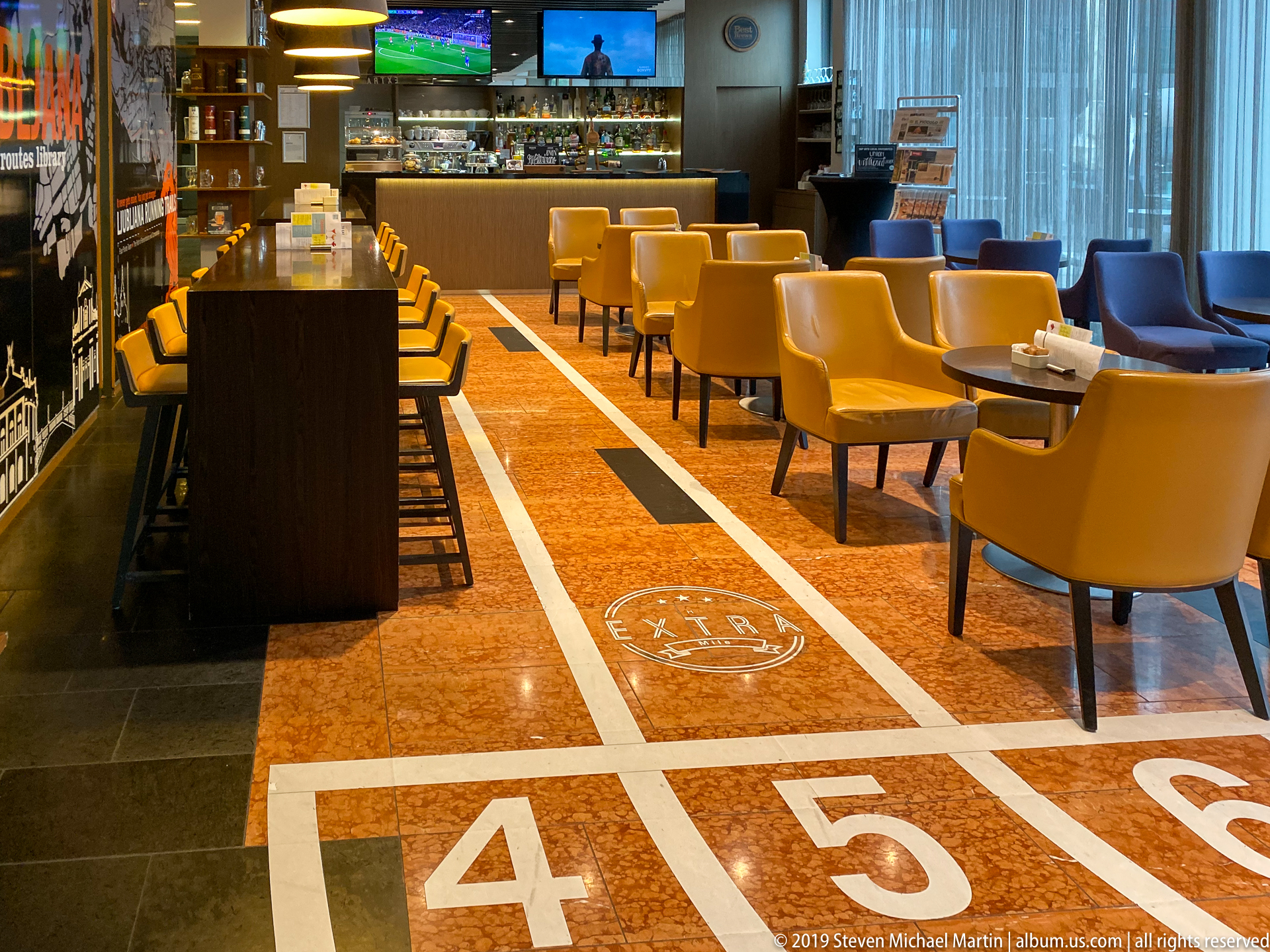
A contemporary Ljubljana hotel lounge uses an indoor running-track motif as the organizing device for its polished stone floor, complete with white lane lines, oversized numbers, and a circular emblem. Mustard-yellow and blue lounge chairs line the track beside a long communal table and bar, turning athletic graphics into a playful element of interior design.
Caption
A contemporary Ljubljana hotel lounge uses an indoor running-track motif as the organizing device for its polished stone floor, complete with white lane lines, oversized numbers, and a circular emblem. Mustard-yellow and blue lounge chairs line the track beside a long communal table and bar, turning athletic graphics into a playful element of interior design.

The National Museum of Slovenia presents a monumental historicist exterior of rusticated stonework, tall arched ground-floor windows, and a lighter upper story articulated by pilasters and classical detailing. A large “NARODNI MUZEJ SLOVENIJE / ROMA AETERNA” exhibition panel identifies the institution, while the figure in the foreground provides scale along the tree-lined museum frontage.
Caption
The National Museum of Slovenia presents a monumental historicist exterior of rusticated stonework, tall arched ground-floor windows, and a lighter upper story articulated by pilasters and classical detailing. A large “NARODNI MUZEJ SLOVENIJE / ROMA AETERNA” exhibition panel identifies the institution, while the figure in the foreground provides scale along the tree-lined museum frontage.

A monumental gold-toned column cuts diagonally through the view of a contemporary Ljubljana hotel atrium, dominating a lounge furnished with low tables, upholstered seating, and black floor lamps. Glass balustrades and upper-level walkways open the interior vertically, while a patterned floor and text-covered wall add graphic texture beneath the reflective structural centerpiece.
Caption
A monumental gold-toned column cuts diagonally through the view of a contemporary Ljubljana hotel atrium, dominating a lounge furnished with low tables, upholstered seating, and black floor lamps. Glass balustrades and upper-level walkways open the interior vertically, while a patterned floor and text-covered wall add graphic texture beneath the reflective structural centerpiece.
⭐ Highlights
- Ljubljana Castle: A hilltop fortress overlooking the city for nearly 900 years.
- Ljubljanica River: The river runs through the old town, shaping the city’s layout and atmosphere.
- Triple Bridge: A unique architectural feature connecting the historic and modern parts of the city.
- Dragon Bridge: One of the city’s most recognizable landmarks, featuring dragon statues.
- Old Town (Altstadt): A compact historic core with Baroque and Art Nouveau architecture.
- Plečnik’s Architecture: The work of architect Jože Plečnik gives Ljubljana its distinctive character.
🏙️ Ljubljana Field Guide
Major features observed during this visit:
Ljubljana, the capital of Slovenia, is a compact and walkable city built along the Ljubljanica River. Its historic center blends medieval origins with Baroque and early modern architecture, much of it shaped by architect Jože Plečnik. Today, the city is known for its human-scale design, green spaces, and lively riverfront atmosphere.
🏛️ Signature Landmarks
- Ljubljana Castle – A medieval fortress positioned on a hill above the city.
- Triple Bridge – A distinctive set of bridges connecting the old town with the central square.
- Dragon Bridge – A symbol of the city, decorated with dragon statues.
- Prešeren Square – The central gathering place at the heart of Ljubljana.
- Central Market – A lively riverside market designed as part of the city’s architectural plan.
🧠 Historical Significance
- Medieval Origins – Ljubljana developed as a town during the Middle Ages.
- Habsburg Influence – The city was shaped by centuries under Habsburg rule.
- Architectural Identity – Much of the modern cityscape reflects 20th-century planning and design.
- Capital of Slovenia – Ljubljana became the capital of an independent Slovenia in 1991.
🌄 Urban Landscape & Setting
- River-Centered Layout – The Ljubljanica River defines the structure of the old town.
- Pedestrian Core – The city center is largely car-free, enhancing walkability.
- Green City – Parks and tree-lined spaces are integrated throughout the urban environment.
- Human Scale – Buildings, streets, and public spaces create an intimate and cohesive city experience.