Iquitos Amazon River Docks – Peru
The bustling waterfront docks of Iquitos line the banks of the mighty Amazon River. Boats of all sizes gather here, from large river vessels carrying cargo and passengers to small wooden boats that navigate the narrow tributaries of the surrounding rainforest.
These docks form the primary transportation hub for the region, connecting remote river communities with the urban center of Iquitos. The constant movement of boats, goods, and travelers illustrates how life in the Amazon remains closely tied to the river.
The docks provide a vivid window into daily life along the Amazon.

A covered wooden river launch approaches across brown water, several passengers standing in the open stern beneath a simple roof. The vessel’s narrow hull and lightly built shelter suit local transport, while the wake trailing behind it conveys the constant movement of small passenger craft around the Iquitos docks.
Caption
A covered wooden river launch approaches across brown water, several passengers standing in the open stern beneath a simple roof. The vessel’s narrow hull and lightly built shelter suit local transport, while the wake trailing behind it conveys the constant movement of small passenger craft around the Iquitos docks.

Multiple riverboats, work vessels, and larger passenger or cargo craft spread across the Iquitos waterfront beneath towering clouds. Cranes rise behind the moored fleet, linking the boats to shore-based loading and repair activity. The panoramic composition presents the river port as an integrated working landscape rather than a collection of individual vessels.
Caption
Multiple riverboats, work vessels, and larger passenger or cargo craft spread across the Iquitos waterfront beneath towering clouds. Cranes rise behind the moored fleet, linking the boats to shore-based loading and repair activity. The panoramic composition presents the river port as an integrated working landscape rather than a collection of individual vessels.

Seen from the rear bench, passengers in orange flotation vests face forward while a crew member gestures near the helm of the covered launch. The perspective gives a clear sense of the boat’s narrow interior, low canopy, and open windshield. It is a functional view of river transit rather than a portrait, emphasizing movement, instruction, and navigation.
Caption
Seen from the rear bench, passengers in orange flotation vests face forward while a crew member gestures near the helm of the covered launch. The perspective gives a clear sense of the boat’s narrow interior, low canopy, and open windshield. It is a functional view of river transit rather than a portrait, emphasizing movement, instruction, and navigation.

An elevated overview looks across a cluster of corrugated-roof waterfront structures and moored passenger launches at the edge of the Iquitos river system. White and blue enclosed boats sit beneath or beside the sheds, while a blue-roofed floating structure appears farther offshore. Exposed mud and shallow margins reveal how the dock complex occupies a riverbank that changes substantially with water level.
Caption
An elevated overview looks across a cluster of corrugated-roof waterfront structures and moored passenger launches at the edge of the Iquitos river system. White and blue enclosed boats sit beneath or beside the sheds, while a blue-roofed floating structure appears farther offshore. Exposed mud and shallow margins reveal how the dock complex occupies a riverbank that changes substantially with water level.

Dark, layered storm clouds dominate this wide view of the river docks, where small craft and low floating structures sit against the reflective water. The elevated viewpoint reduces the boats to a narrow band beneath the sky, emphasizing the scale of the Amazonian weather system and the exposed character of the Iquitos waterfront.
Caption
Dark, layered storm clouds dominate this wide view of the river docks, where small craft and low floating structures sit against the reflective water. The elevated viewpoint reduces the boats to a narrow band beneath the sky, emphasizing the scale of the Amazonian weather system and the exposed character of the Iquitos waterfront.
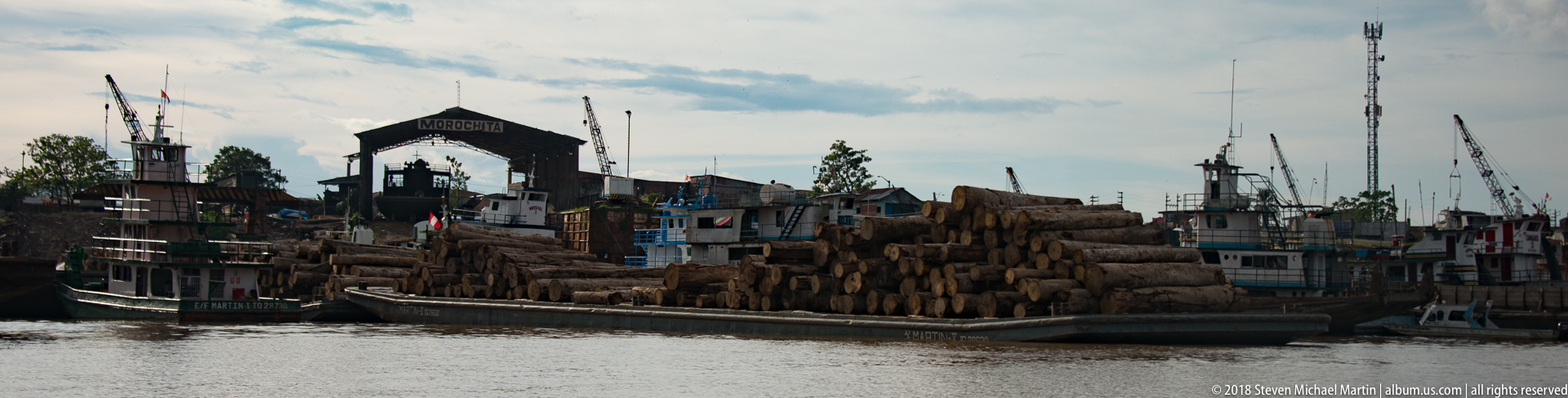
A working riverboat sits low in the water under a dense load of rough-cut timber, with the wheelhouse and rigging rising behind the stacked logs. The crowded cargo and utilitarian vessel structure show the Amazon riverfront as an active transport corridor, where bulky materials move by boat between Iquitos and communities linked by the river.
Caption
A working riverboat sits low in the water under a dense load of rough-cut timber, with the wheelhouse and rigging rising behind the stacked logs. The crowded cargo and utilitarian vessel structure show the Amazon riverfront as an active transport corridor, where bulky materials move by boat between Iquitos and communities linked by the river.

A compact, high-sided workboat moves across the river with a stacked wheelhouse and broad working deck. Its utilitarian profile suggests a tug or pushboat used for maneuvering barges and freight, part of the commercial vessel traffic that supports Iquitos as a river-dependent city.
Caption
A compact, high-sided workboat moves across the river with a stacked wheelhouse and broad working deck. Its utilitarian profile suggests a tug or pushboat used for maneuvering barges and freight, part of the commercial vessel traffic that supports Iquitos as a river-dependent city.

A large pipe releases a steady stream of water down a block-paved embankment toward the river. Tires line the lower retaining edge, while stained concrete and eroded margins emphasize the engineered drainage interface between the urban waterfront and the Amazonian river system.
Caption
A large pipe releases a steady stream of water down a block-paved embankment toward the river. Tires line the lower retaining edge, while stained concrete and eroded margins emphasize the engineered drainage interface between the urban waterfront and the Amazonian river system.

A tightly packed group of workboats and tug-like river vessels lines the Iquitos waterfront, their tall wheelhouses, masts, rails, and weathered hulls rising above the brown water. The compressed view conveys the density of a working inland port, where specialized powered craft gather beside larger vessels to support towing, maneuvering, and freight operations.
Caption
A tightly packed group of workboats and tug-like river vessels lines the Iquitos waterfront, their tall wheelhouses, masts, rails, and weathered hulls rising above the brown water. The compressed view conveys the density of a working inland port, where specialized powered craft gather beside larger vessels to support towing, maneuvering, and freight operations.

A broader view places several ornamented workboats beside smaller river craft at the Iquitos waterfront. Their stepped wheelhouses and bright trim rise above low hulls crowded with fenders and deck equipment. Seen together against the open river, the vessels illustrate the mixture of specialized powered boats that support docking, towing, and short-range operations in an Amazon port.
Caption
A broader view places several ornamented workboats beside smaller river craft at the Iquitos waterfront. Their stepped wheelhouses and bright trim rise above low hulls crowded with fenders and deck equipment. Seen together against the open river, the vessels illustrate the mixture of specialized powered boats that support docking, towing, and short-range operations in an Amazon port.

A long, low passenger boat passes the dock with a broad palm-thatch canopy sheltering seated travelers and cargo. Its open-sided construction, wooden hull, and informal boarding arrangement reflect the practical river transport used around Iquitos, where boats function as everyday links across channels and between waterfront settlements.
Caption
A long, low passenger boat passes the dock with a broad palm-thatch canopy sheltering seated travelers and cargo. Its open-sided construction, wooden hull, and informal boarding arrangement reflect the practical river transport used around Iquitos, where boats function as everyday links across channels and between waterfront settlements.

People cluster around several narrow wooden boats pulled alongside the riverbank, with baskets, buckets, and green produce arranged for transfer. The close overhead view emphasizes the small-scale commerce of the Iquitos waterfront, where passengers and goods move directly between boats and shore in a compact, busy landing area.
Caption
People cluster around several narrow wooden boats pulled alongside the riverbank, with baskets, buckets, and green produce arranged for transfer. The close overhead view emphasizes the small-scale commerce of the Iquitos waterfront, where passengers and goods move directly between boats and shore in a compact, busy landing area.

A broad view over the Iquitos riverfront shows a compact cluster of passenger and cargo boats moored near floating or low-built dock structures. Beyond them, open water spreads toward a green floodplain under a heavy sky, placing the working landing within the expansive seasonal river landscape that shapes access to the city.
Caption
A broad view over the Iquitos riverfront shows a compact cluster of passenger and cargo boats moored near floating or low-built dock structures. Beyond them, open water spreads toward a green floodplain under a heavy sky, placing the working landing within the expansive seasonal river landscape that shapes access to the city.

A narrow canoe with several occupants crosses the open water in front of a cluster of moored boats and floating structures. Seen from above, the moving craft creates a small diagonal counterpoint to the stationary waterfront, illustrating how lightweight canoes share the same river space as larger passenger and service vessels around Iquitos.
Caption
A narrow canoe with several occupants crosses the open water in front of a cluster of moored boats and floating structures. Seen from above, the moving craft creates a small diagonal counterpoint to the stationary waterfront, illustrating how lightweight canoes share the same river space as larger passenger and service vessels around Iquitos.

Three people ride in a long, narrow river canoe, with one person operating a small outboard motor at the stern. The spare hull, low freeboard, and open seating contrast with the larger docked vessels nearby, showing a common form of short-distance transport on the waters around Iquitos.
Caption
Three people ride in a long, narrow river canoe, with one person operating a small outboard motor at the stern. The spare hull, low freeboard, and open seating contrast with the larger docked vessels nearby, showing a common form of short-distance transport on the waters around Iquitos.

An elevated view looks down on a tightly packed landing where long passenger boats crowd beside roofed dock buildings and narrow gangways. Hulls, awnings, and boarding areas overlap in the confined space, conveying the density and improvised organization of river traffic at the Iquitos waterfront.
Caption
An elevated view looks down on a tightly packed landing where long passenger boats crowd beside roofed dock buildings and narrow gangways. Hulls, awnings, and boarding areas overlap in the confined space, conveying the density and improvised organization of river traffic at the Iquitos waterfront.

A rounded, multi-level concrete building rises above the riverbank, linked to lower waterfront structures by metal gangways. Its open floors and broad horizontal decks contrast with nearby timber and thatch construction, marking a more permanent piece of riverfront infrastructure within the Iquitos dock area.
Caption
A rounded, multi-level concrete building rises above the riverbank, linked to lower waterfront structures by metal gangways. Its open floors and broad horizontal decks contrast with nearby timber and thatch construction, marking a more permanent piece of riverfront infrastructure within the Iquitos dock area.

A large white multi-deck vessel lies broadside to the riverbank, its rectangular windows, open upper deck, and covered top structure giving it the appearance of a substantial passenger or service craft. The boat’s scale contrasts with smaller river traffic and demonstrates the range of vessel types operating from Iquitos.
Caption
A large white multi-deck vessel lies broadside to the riverbank, its rectangular windows, open upper deck, and covered top structure giving it the appearance of a substantial passenger or service craft. The boat’s scale contrasts with smaller river traffic and demonstrates the range of vessel types operating from Iquitos.

A row of timber dwellings stands on tall posts above the eroded, litter-strewn river margin. Corrugated-metal roofs and irregular wooden supports reveal construction adapted to fluctuating water levels, while small boats along the shore connect the settlement directly to the river transport network around Iquitos.
Caption
A row of timber dwellings stands on tall posts above the eroded, litter-strewn river margin. Corrugated-metal roofs and irregular wooden supports reveal construction adapted to fluctuating water levels, while small boats along the shore connect the settlement directly to the river transport network around Iquitos.

A weathered industrial workboat sits grounded on the exposed bank, with a rusted, partially dismantled vessel behind it. Peeling paint, exposed steel, and the absence of water around the hulls suggest a repair, storage, or abandonment area, revealing a less polished side of the working riverfront near Iquitos.
Caption
A weathered industrial workboat sits grounded on the exposed bank, with a rusted, partially dismantled vessel behind it. Peeling paint, exposed steel, and the absence of water around the hulls suggest a repair, storage, or abandonment area, revealing a less polished side of the working riverfront near Iquitos.

A large rusted vessel hulk rests on land at the edge of dense vegetation, its open decks, corroded plating, and incomplete superstructure exposing years of weathering. Isolated from active river traffic, the derelict craft records the material afterlife of boats that once served the Amazonian transport network.
Caption
A large rusted vessel hulk rests on land at the edge of dense vegetation, its open decks, corroded plating, and incomplete superstructure exposing years of weathering. Isolated from active river traffic, the derelict craft records the material afterlife of boats that once served the Amazonian transport network.

A small steel utility vessel stands on the exposed bank with its flat working deck, boxy wheelhouse, ladders, and railings fully visible above the mud. The hauled-out position provides an unusually clear view of the hull and deck arrangement, suggesting maintenance or storage along the Iquitos waterfront.
Caption
A small steel utility vessel stands on the exposed bank with its flat working deck, boxy wheelhouse, ladders, and railings fully visible above the mud. The hauled-out position provides an unusually clear view of the hull and deck arrangement, suggesting maintenance or storage along the Iquitos waterfront.

Two grounded workboats and a rusting vessel hulk occupy a broad, low bank backed by tropical trees. The wider framing places the individual craft within a rough repair or storage zone, where exposed mud and sparse infrastructure contrast with the busier passenger landings elsewhere on the Iquitos waterfront.
Caption
Two grounded workboats and a rusting vessel hulk occupy a broad, low bank backed by tropical trees. The wider framing places the individual craft within a rough repair or storage zone, where exposed mud and sparse infrastructure contrast with the busier passenger landings elsewhere on the Iquitos waterfront.

A dark-painted utility boat flying the Peruvian flag is moored below a developed riverbank with steps, railings, and low buildings. Antennas, deck equipment, and a compact wheelhouse give the craft an official or service-oriented appearance, although its exact agency or function is not identifiable from the image alone.
Caption
A dark-painted utility boat flying the Peruvian flag is moored below a developed riverbank with steps, railings, and low buildings. Antennas, deck equipment, and a compact wheelhouse give the craft an official or service-oriented appearance, although its exact agency or function is not identifiable from the image alone.

A simple timber house with a corrugated-metal roof sits directly on the water or on a low floating platform, separated from the far bank by an open channel. Its lightweight construction and water-level position illustrate one form of river-adapted architecture found around the flood-prone margins of Iquitos.
Caption
A simple timber house with a corrugated-metal roof sits directly on the water or on a low floating platform, separated from the far bank by an open channel. Its lightweight construction and water-level position illustrate one form of river-adapted architecture found around the flood-prone margins of Iquitos.

A dense line of working riverboats fills the waterfront, their wheelhouses, masts, cabins, and painted hulls overlapping in a tight mooring. The compressed view conveys the intensity of river traffic at Iquitos, where passenger and cargo vessels gather along the bank before departing into the Amazon basin.
Caption
A dense line of working riverboats fills the waterfront, their wheelhouses, masts, cabins, and painted hulls overlapping in a tight mooring. The compressed view conveys the intensity of river traffic at Iquitos, where passenger and cargo vessels gather along the bank before departing into the Amazon basin.

A large white multi-deck river vessel lies alongside the waterfront, with rows of small openings, an upper deck, and a decorated wheelhouse rising above the hull. A second vessel is tucked beside it, underscoring the scale of the passenger and freight traffic supported by the Iquitos docks.
Caption
A large white multi-deck river vessel lies alongside the waterfront, with rows of small openings, an upper deck, and a decorated wheelhouse rising above the hull. A second vessel is tucked beside it, underscoring the scale of the passenger and freight traffic supported by the Iquitos docks.

Large stacks of cut timber cover the exposed riverbank behind a low blue barge or workboat. The scene connects the river docks directly to forest-product transport and storage, with rough ground, utility poles, and industrial sheds forming a utilitarian working landscape rather than a formal port terminal.
Caption
Large stacks of cut timber cover the exposed riverbank behind a low blue barge or workboat. The scene connects the river docks directly to forest-product transport and storage, with rough ground, utility poles, and industrial sheds forming a utilitarian working landscape rather than a formal port terminal.

Small wooden buildings stand on short stilts near the river edge, with corrugated roofs and rough timber walls set against a background of stacked logs and sheds. The mix of dwellings or workshops with industrial timber storage shows how residential and working landscapes intermingle along the flood-prone margins of Iquitos.
Caption
Small wooden buildings stand on short stilts near the river edge, with corrugated roofs and rough timber walls set against a background of stacked logs and sheds. The mix of dwellings or workshops with industrial timber storage shows how residential and working landscapes intermingle along the flood-prone margins of Iquitos.

Several boats rest at uneven angles on the exposed riverbank beneath simple sheds and workshops. Their hauled-out positions, alongside a larger vessel and rough waterfront buildings, suggest a repair or maintenance zone where river craft can be worked on when water levels and shore access permit.
Caption
Several boats rest at uneven angles on the exposed riverbank beneath simple sheds and workshops. Their hauled-out positions, alongside a larger vessel and rough waterfront buildings, suggest a repair or maintenance zone where river craft can be worked on when water levels and shore access permit.

The blue-and-white river vessel Eduardo VIII moves close to the bank with a broad covered foredeck carrying barrels, containers, and other cargo. Its multi-level cabin and mixed passenger-freight arrangement illustrate the versatile boats that connect Iquitos with settlements and commercial routes throughout the surrounding river network.
Caption
The blue-and-white river vessel Eduardo VIII moves close to the bank with a broad covered foredeck carrying barrels, containers, and other cargo. Its multi-level cabin and mixed passenger-freight arrangement illustrate the versatile boats that connect Iquitos with settlements and commercial routes throughout the surrounding river network.

A small group of people stands along the cut edge of a grassy riverbank, looking toward the water below. Exposed soil, driftwood, and the abrupt bank profile reveal active erosion or seasonal scouring, while the figures provide scale for the unstable shoreline at the margins of Iquitos.
Caption
A small group of people stands along the cut edge of a grassy riverbank, looking toward the water below. Exposed soil, driftwood, and the abrupt bank profile reveal active erosion or seasonal scouring, while the figures provide scale for the unstable shoreline at the margins of Iquitos.

Several people occupy the top and face of a steep muddy bank where a pipe projects toward the river. Buildings rise behind the eroded edge, making the scene a direct record of the vulnerable interface between settlement, drainage infrastructure, and a shoreline shaped by fluctuating river conditions.
Caption
Several people occupy the top and face of a steep muddy bank where a pipe projects toward the river. Buildings rise behind the eroded edge, making the scene a direct record of the vulnerable interface between settlement, drainage infrastructure, and a shoreline shaped by fluctuating river conditions.

A small wooden riverboat crosses the open channel under a broad red-and-white canopy, throwing a low wake behind its hull. The covered deck offers shelter for passengers or cargo, a practical feature for travel through the intense sun and rain of the Amazonian river environment around Iquitos.
Caption
A small wooden riverboat crosses the open channel under a broad red-and-white canopy, throwing a low wake behind its hull. The covered deck offers shelter for passengers or cargo, a practical feature for travel through the intense sun and rain of the Amazonian river environment around Iquitos.

A steep pale river bluff rises above a small boat moored at its base, with palms and simple masonry buildings standing close to the eroded edge. The exposed soil face and elevated structures show how settlement occupies dynamic river margins where seasonal water movement continually reshapes the bank.
Caption
A steep pale river bluff rises above a small boat moored at its base, with palms and simple masonry buildings standing close to the eroded edge. The exposed soil face and elevated structures show how settlement occupies dynamic river margins where seasonal water movement continually reshapes the bank.

A long, narrow wooden riverboat rests above the waterline on a muddy bank near Iquitos, its hull propped beside a simple timber frame. The exposed shore, scattered palm debris, and vegetation at the edge of the floodplain show the working conditions of small craft along the Amazonian river system, where fluctuating water levels routinely reshape access to landing places.
Caption
A long, narrow wooden riverboat rests above the waterline on a muddy bank near Iquitos, its hull propped beside a simple timber frame. The exposed shore, scattered palm debris, and vegetation at the edge of the floodplain show the working conditions of small craft along the Amazonian river system, where fluctuating water levels routinely reshape access to landing places.

Two modest wooden houses stand on a grassy riverside clearing near Iquitos, their corrugated-metal roofs and raised construction suited to the humid Amazonian environment. Bright laundry hangs between the buildings while a narrow canoe lies nearby, linking domestic life directly to river travel. The scene records the close relationship between household space, seasonal floodplain terrain, and small-boat transportation.
Caption
Two modest wooden houses stand on a grassy riverside clearing near Iquitos, their corrugated-metal roofs and raised construction suited to the humid Amazonian environment. Bright laundry hangs between the buildings while a narrow canoe lies nearby, linking domestic life directly to river travel. The scene records the close relationship between household space, seasonal floodplain terrain, and small-boat transportation.

A long, low timber dwelling occupies a grassy strip at the edge of dense Amazonian vegetation near Iquitos. A corrugated-metal roof shelters the simple rectangular structure, while clothing hung across the foreground introduces an everyday domestic detail. The open lawn and forest backdrop emphasize the narrow band of settled ground between river access and tropical woodland.
Caption
A long, low timber dwelling occupies a grassy strip at the edge of dense Amazonian vegetation near Iquitos. A corrugated-metal roof shelters the simple rectangular structure, while clothing hung across the foreground introduces an everyday domestic detail. The open lawn and forest backdrop emphasize the narrow band of settled ground between river access and tropical woodland.
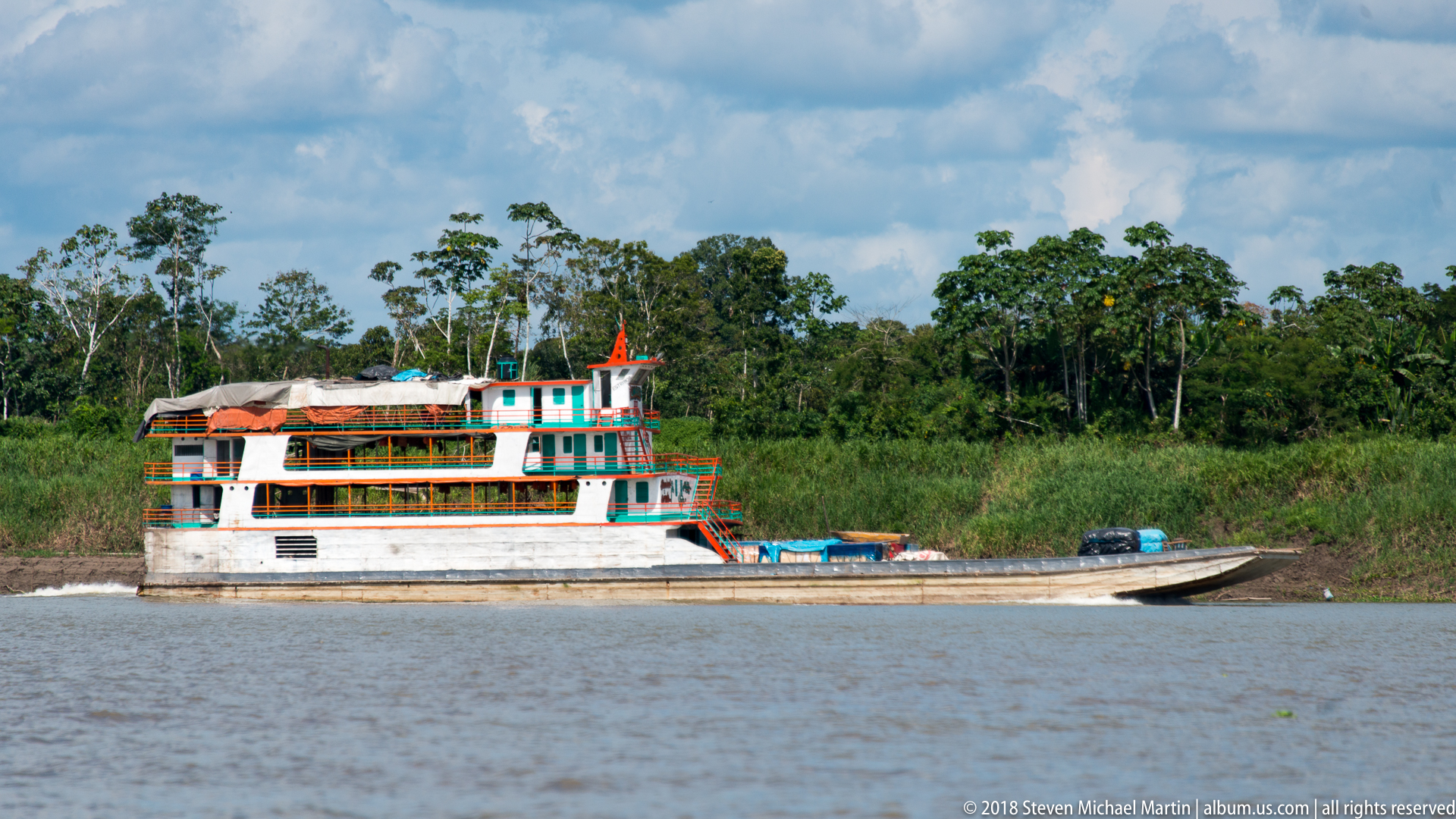
A multi-deck river vessel travels along the broad brown waters near Iquitos, combining enclosed passenger spaces, open decks, and a long forward working section. Its layered superstructure and shallow-draft profile reflect transportation adapted to the Amazon basin, where boats serve as essential links for people and goods between communities separated by waterways and forest.
Caption
A multi-deck river vessel travels along the broad brown waters near Iquitos, combining enclosed passenger spaces, open decks, and a long forward working section. Its layered superstructure and shallow-draft profile reflect transportation adapted to the Amazon basin, where boats serve as essential links for people and goods between communities separated by waterways and forest.

Two passengers sit side by side in the open-sided cabin of a small covered river launch near Iquitos, both wearing orange flotation vests. The metal roof, bench seats, and bright river light frame an informal portrait made during transit. A third passenger appears behind them, reinforcing the communal, close-quarters character of local boat travel.
Caption
Two passengers sit side by side in the open-sided cabin of a small covered river launch near Iquitos, both wearing orange flotation vests. The metal roof, bench seats, and bright river light frame an informal portrait made during transit. A third passenger appears behind them, reinforcing the communal, close-quarters character of local boat travel.

A passenger sits beneath the metal canopy of a small river launch, secured in a bright orange life jacket as the boat crosses open water near Iquitos. The close interior view shifts attention from the river landscape to the practical experience of Amazon travel: covered seating, compact quarters, and mandatory flotation gear on a fast local transport boat.
Caption
A passenger sits beneath the metal canopy of a small river launch, secured in a bright orange life jacket as the boat crosses open water near Iquitos. The close interior view shifts attention from the river landscape to the practical experience of Amazon travel: covered seating, compact quarters, and mandatory flotation gear on a fast local transport boat.

Two male passengers pose together beneath the blue canopy of a river launch traveling near Iquitos, their orange life jackets contrasting with the muted interior. The image continues the onboard sequence but with a more direct frontal composition, showing the narrow bench seating and open sides that allow passengers constant visual contact with the river.
Caption
Two male passengers pose together beneath the blue canopy of a river launch traveling near Iquitos, their orange life jackets contrasting with the muted interior. The image continues the onboard sequence but with a more direct frontal composition, showing the narrow bench seating and open sides that allow passengers constant visual contact with the river.

Passengers turn toward the camera from the rear benches of a small covered launch while crew members face forward at the helm. Orange flotation vests, worn metal seat backs, and the low roof define the utilitarian interior. The photograph places visitors and working crew in the same compact space, conveying the social arrangement of a fast Amazon river transfer near Iquitos.
Caption
Passengers turn toward the camera from the rear benches of a small covered launch while crew members face forward at the helm. Orange flotation vests, worn metal seat backs, and the low roof define the utilitarian interior. The photograph places visitors and working crew in the same compact space, conveying the social arrangement of a fast Amazon river transfer near Iquitos.

A crew member stands or braces at the front of a covered river launch, seen from behind as he looks ahead through the open windshield. The printed website on his shirt and the worn metal framing identify the practical tour-boat setting without distracting from his working posture. The close viewpoint emphasizes navigation and attention to the river ahead.
Caption
A crew member stands or braces at the front of a covered river launch, seen from behind as he looks ahead through the open windshield. The printed website on his shirt and the worn metal framing identify the practical tour-boat setting without distracting from his working posture. The close viewpoint emphasizes navigation and attention to the river ahead.

An orange flotation vest hangs against the back of a seat aboard the river launch, stenciled with the vessel marking “EXPLORADOR II 4319.” By isolating a routine piece of safety equipment, the photograph records a specific detail of the boat and its operating environment. Scuffed seating and the passenger’s white shirt complete the utilitarian onboard context.
Caption
An orange flotation vest hangs against the back of a seat aboard the river launch, stenciled with the vessel marking “EXPLORADOR II 4319.” By isolating a routine piece of safety equipment, the photograph records a specific detail of the boat and its operating environment. Scuffed seating and the passenger’s white shirt complete the utilitarian onboard context.

A passenger’s tattooed forearm rests along the top of a worn green boat seat, filling the frame with script and a circular portrait motif. The tightly cropped composition turns a fleeting onboard detail into a personal counterpoint to the wider river journey. No attempt is made to identify the person or interpret the tattoo beyond what is visibly recorded.
Caption
A passenger’s tattooed forearm rests along the top of a worn green boat seat, filling the frame with script and a circular portrait motif. The tightly cropped composition turns a fleeting onboard detail into a personal counterpoint to the wider river journey. No attempt is made to identify the person or interpret the tattoo beyond what is visibly recorded.

A broad expanse of muddy brown water stretches toward a low, nearly unbroken horizon beneath towering white cumulus clouds. The minimal composition emphasizes the scale and openness of the Amazonian river landscape near Iquitos, where water and sky dominate the view and the distant shoreline appears only as a thin dark band.
Caption
A broad expanse of muddy brown water stretches toward a low, nearly unbroken horizon beneath towering white cumulus clouds. The minimal composition emphasizes the scale and openness of the Amazonian river landscape near Iquitos, where water and sky dominate the view and the distant shoreline appears only as a thin dark band.

A long, narrow motor canoe with a simple blue canopy crosses choppy brown water near Iquitos. Its low freeboard and elongated hull are characteristic of small craft used throughout Amazonian waterways for local passenger and cargo movement. The isolated profile against the flat horizon makes the boat’s slender proportions and lightweight shelter especially clear.
Caption
A long, narrow motor canoe with a simple blue canopy crosses choppy brown water near Iquitos. Its low freeboard and elongated hull are characteristic of small craft used throughout Amazonian waterways for local passenger and cargo movement. The isolated profile against the flat horizon makes the boat’s slender proportions and lightweight shelter especially clear.

A large open-sided building stands on a sloping river landing near Iquitos, its long roof supported by repeated arches and columns. Small boats lie along the muddy shoreline below, showing the structure’s relationship to river access and transport. The broad view also records erosion-prone banks and the low, exposed terrain typical of a working Amazon waterfront.
Caption
A large open-sided building stands on a sloping river landing near Iquitos, its long roof supported by repeated arches and columns. Small boats lie along the muddy shoreline below, showing the structure’s relationship to river access and transport. The broad view also records erosion-prone banks and the low, exposed terrain typical of a working Amazon waterfront.

Several weathered riverboats sit partly beached on a muddy bank near Iquitos, including a large deteriorated wooden hull raised above smaller craft. Exposed planking, patched superstructures, ramps, and uneven ground suggest a working repair or storage area rather than a formal dock. The image documents the improvised infrastructure that supports river transportation along the Amazon.
Caption
Several weathered riverboats sit partly beached on a muddy bank near Iquitos, including a large deteriorated wooden hull raised above smaller craft. Exposed planking, patched superstructures, ramps, and uneven ground suggest a working repair or storage area rather than a formal dock. The image documents the improvised infrastructure that supports river transportation along the Amazon.

A white multi-level river vessel stands close to shore beside other boats in a muddy working area near Iquitos. Open railings, unfinished-looking deck spaces, and adjacent craft suggest maintenance, construction, or refitting activity. The vessel’s boxy shallow-draft form illustrates the practical architecture of Amazon riverboats designed for carrying people and goods on inland waterways.
Caption
A white multi-level river vessel stands close to shore beside other boats in a muddy working area near Iquitos. Open railings, unfinished-looking deck spaces, and adjacent craft suggest maintenance, construction, or refitting activity. The vessel’s boxy shallow-draft form illustrates the practical architecture of Amazon riverboats designed for carrying people and goods on inland waterways.

A covered passenger launch races across the river near Iquitos, its bow lifted as the hull throws a broad sheet of white spray. Painted lettering runs along the canopy and side, while passengers are visible through the open windows. The dynamic profile contrasts with the slower cargo and passenger vessels elsewhere on the waterfront, showing a faster mode of local river transport.
Caption
A covered passenger launch races across the river near Iquitos, its bow lifted as the hull throws a broad sheet of white spray. Painted lettering runs along the canopy and side, while passengers are visible through the open windows. The dynamic profile contrasts with the slower cargo and passenger vessels elsewhere on the waterfront, showing a faster mode of local river transport.

A large weathered riverboat sits close to a rough, debris-strewn waterfront near Iquitos. Its broad stern, stacked decks, railings, and canvas-covered upper level suggest a vessel equipped for extended river service. The surrounding piles of timber or cargo and improvised shoreline structures place the boat within the dense working economy of an Amazon port.
Caption
A large weathered riverboat sits close to a rough, debris-strewn waterfront near Iquitos. Its broad stern, stacked decks, railings, and canvas-covered upper level suggest a vessel equipped for extended river service. The surrounding piles of timber or cargo and improvised shoreline structures place the boat within the dense working economy of an Amazon port.

A broad commercial riverboat lies along the Iquitos waterfront, its upper decks wrapped by railings, tarps, and colorful advertising banners. The vessel’s layered superstructure combines open and enclosed spaces suited to long river journeys and mixed cargo. Seen against a busy shoreline, it reflects the hybrid passenger, freight, and commercial character of transportation on the Amazon.
Caption
A broad commercial riverboat lies along the Iquitos waterfront, its upper decks wrapped by railings, tarps, and colorful advertising banners. The vessel’s layered superstructure combines open and enclosed spaces suited to long river journeys and mixed cargo. Seen against a busy shoreline, it reflects the hybrid passenger, freight, and commercial character of transportation on the Amazon.

A row of large riverboats stands side by side along the Iquitos waterfront, presenting a dense wall of sterns, cabins, decks, and patched hulls. The vessels vary in age and configuration but share the tall, boxy forms common to long-distance Amazon transport. This broad port view emphasizes concentration: boats assembled for loading, repair, departure, or layover along the river edge.
Caption
A row of large riverboats stands side by side along the Iquitos waterfront, presenting a dense wall of sterns, cabins, decks, and patched hulls. The vessels vary in age and configuration but share the tall, boxy forms common to long-distance Amazon transport. This broad port view emphasizes concentration: boats assembled for loading, repair, departure, or layover along the river edge.

A long, brightly painted passenger canoe moves across the river near Iquitos under a continuous low canopy. A driver sits at the stern operating the motor while a passenger is visible beneath the shelter. The vessel’s narrow hull and simple roof maximize speed and shade with minimal structure, a practical configuration for routine travel on Amazonian waterways.
Caption
A long, brightly painted passenger canoe moves across the river near Iquitos under a continuous low canopy. A driver sits at the stern operating the motor while a passenger is visible beneath the shelter. The vessel’s narrow hull and simple roof maximize speed and shade with minimal structure, a practical configuration for routine travel on Amazonian waterways.

The brightly painted river vessel Estefani sits near the opposite bank, its blue hull and yellow upper railings carrying prominent commercial signage. Broad side openings and a flat, barge-like profile distinguish it from the narrower passenger launches nearby. The legible vessel name makes this one of the more specifically identifiable boats documented along the Iquitos riverfront.
Caption
The brightly painted river vessel Estefani sits near the opposite bank, its blue hull and yellow upper railings carrying prominent commercial signage. Broad side openings and a flat, barge-like profile distinguish it from the narrower passenger launches nearby. The legible vessel name makes this one of the more specifically identifiable boats documented along the Iquitos riverfront.

A low wooden riverboat passes the Iquitos waterfront with most of its long hull shaded by a dark, improvised canopy. Open sides reveal cargo or seating beneath the roof, while the pointed bow rides low on the brown water. Its elongated proportions and simple construction contrast with the taller multi-deck vessels gathered at the port.
Caption
A low wooden riverboat passes the Iquitos waterfront with most of its long hull shaded by a dark, improvised canopy. Open sides reveal cargo or seating beneath the roof, while the pointed bow rides low on the brown water. Its elongated proportions and simple construction contrast with the taller multi-deck vessels gathered at the port.

A compact river workboat near Iquitos combines a heavy, tire-lined hull with unusually decorative wheelhouse roofs, turquoise railings, and painted exterior details. Its robust fendering and squat profile indicate a practical working role, while the elaborate upper structure gives the vessel a distinctive local character. Other boats and port equipment crowd the background.
Caption
A compact river workboat near Iquitos combines a heavy, tire-lined hull with unusually decorative wheelhouse roofs, turquoise railings, and painted exterior details. Its robust fendering and squat profile indicate a practical working role, while the elaborate upper structure gives the vessel a distinctive local character. Other boats and port equipment crowd the background.

Three compact river workboats are moored side by side, each with a tall tiered wheelhouse, turquoise railings, and decorative roof finials. Seen together, the repeated design becomes more apparent than in the preceding single-vessel view. Heavy tire fenders line the hulls, underscoring their working function amid the visually elaborate superstructures of the Iquitos river fleet.
Caption
Three compact river workboats are moored side by side, each with a tall tiered wheelhouse, turquoise railings, and decorative roof finials. Seen together, the repeated design becomes more apparent than in the preceding single-vessel view. Heavy tire fenders line the hulls, underscoring their working function amid the visually elaborate superstructures of the Iquitos river fleet.

Several aging multi-deck riverboats lie moored in front of large open-sided waterfront sheds near Iquitos. Peeling paint, patched surfaces, exposed railings, and irregular additions reveal long service and repeated maintenance. The close grouping shows how vessels are stored and worked on directly beside shore facilities, reinforcing the industrial character of this Amazon riverfront.
Caption
Several aging multi-deck riverboats lie moored in front of large open-sided waterfront sheds near Iquitos. Peeling paint, patched surfaces, exposed railings, and irregular additions reveal long service and repeated maintenance. The close grouping shows how vessels are stored and worked on directly beside shore facilities, reinforcing the industrial character of this Amazon riverfront.

A compact orange river workboat is moored near a sloping landing on the Iquitos waterfront, its tall wheelhouse, mast, and ring of tire fenders standing out against neighboring white vessels. Harsh midday light and deep clouds sharpen the boat’s silhouette. The view shows the sturdy proportions and protective fendering expected of a craft used for maneuvering around a busy river port.
Caption
A compact orange river workboat is moored near a sloping landing on the Iquitos waterfront, its tall wheelhouse, mast, and ring of tire fenders standing out against neighboring white vessels. Harsh midday light and deep clouds sharpen the boat’s silhouette. The view shows the sturdy proportions and protective fendering expected of a craft used for maneuvering around a busy river port.
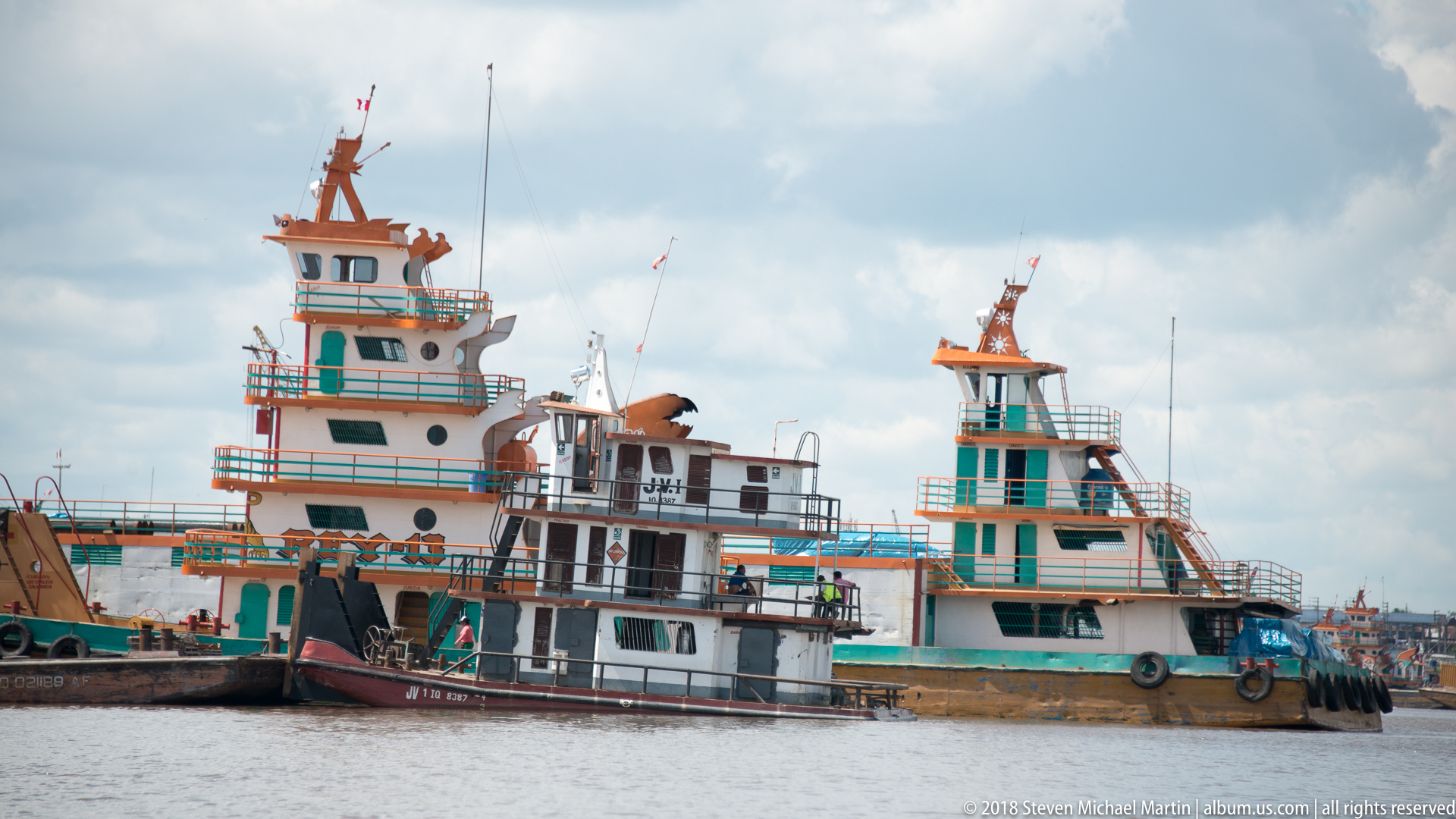
Three compact, brightly painted workboats are moored abreast at the Iquitos riverfront, their tall wheelhouses, layered decks, turquoise railings, and tire fenders forming a dense vertical rhythm. The repeated vessel type and heavy protective fendering indicate boats built for maneuvering and service around a busy inland port rather than long-distance passenger comfort.
Caption
Three compact, brightly painted workboats are moored abreast at the Iquitos riverfront, their tall wheelhouses, layered decks, turquoise railings, and tire fenders forming a dense vertical rhythm. The repeated vessel type and heavy protective fendering indicate boats built for maneuvering and service around a busy inland port rather than long-distance passenger comfort.

Weathered timber houses stand on a forest of tall wooden posts along the Iquitos riverbank, their corrugated-metal roofs and improvised extensions lifted above low, flood-prone ground. Small motorboats lie below at the water's edge. The elevated construction records a practical response to fluctuating river levels while also showing how domestic and transport spaces overlap on the Amazon waterfront.
Caption
Weathered timber houses stand on a forest of tall wooden posts along the Iquitos riverbank, their corrugated-metal roofs and improvised extensions lifted above low, flood-prone ground. Small motorboats lie below at the water's edge. The elevated construction records a practical response to fluctuating river levels while also showing how domestic and transport spaces overlap on the Amazon waterfront.

A small wooden motor canoe crosses the brown river in front of larger commercial vessels at Iquitos. Two people ride amid bundled cargo, one near the stern and another standing or bracing toward the center. The low freeboard, rough plank hull, and outboard propulsion contrast sharply with the cranes and multi-deck boats behind, emphasizing the range of vessel scales sharing the same waterfront.
Caption
A small wooden motor canoe crosses the brown river in front of larger commercial vessels at Iquitos. Two people ride amid bundled cargo, one near the stern and another standing or bracing toward the center. The low freeboard, rough plank hull, and outboard propulsion contrast sharply with the cranes and multi-deck boats behind, emphasizing the range of vessel scales sharing the same waterfront.

Three compact enclosed passenger launches are tied side by side beside a corrugated-roof waterfront shed in Iquitos. Their slanted windshields, enclosed cabins, and streamlined bows distinguish them from the open canoes and tall riverboats elsewhere in the port. The sheltered mooring suggests a base for faster local transfers across the Amazonian river network.
Caption
Three compact enclosed passenger launches are tied side by side beside a corrugated-roof waterfront shed in Iquitos. Their slanted windshields, enclosed cabins, and streamlined bows distinguish them from the open canoes and tall riverboats elsewhere in the port. The sheltered mooring suggests a base for faster local transfers across the Amazonian river network.

A small motorboat sits beneath a thick palm-thatch canopy at a rustic floating or riverside landing near Iquitos. A red-and-white Peruvian flag rises above the shelter, while people stand on the timber platform behind. The combination of outboard motor, woven thatch, and open wooden framing shows a modest river facility adapted to shade, rain, and everyday boat access.
Caption
A small motorboat sits beneath a thick palm-thatch canopy at a rustic floating or riverside landing near Iquitos. A red-and-white Peruvian flag rises above the shelter, while people stand on the timber platform behind. The combination of outboard motor, woven thatch, and open wooden framing shows a modest river facility adapted to shade, rain, and everyday boat access.

An open-sided shed of rough timber and corrugated metal stands directly at the waterline near Iquitos, with household or work materials visible inside and narrow boats tucked alongside. Uneven posts, patched roofing, and minimal separation from the river give the structure an improvised character. The scene records the informal architecture of a working Amazon waterfront where storage, repair, and daily life share the same narrow strip of shore.
Caption
An open-sided shed of rough timber and corrugated metal stands directly at the waterline near Iquitos, with household or work materials visible inside and narrow boats tucked alongside. Uneven posts, patched roofing, and minimal separation from the river give the structure an improvised character. The scene records the informal architecture of a working Amazon waterfront where storage, repair, and daily life share the same narrow strip of shore.

A small floating waterfront structure is moored below a steep, built-up bank in Iquitos, connected to shore by stairs and surrounded by larger covered landing facilities. Painted signage spans the front, but the wording is not fully legible at proof-sheet scale. Its low platform, tire fenders, and direct river access identify it as part of the local docking infrastructure rather than a freestanding house.
Caption
A small floating waterfront structure is moored below a steep, built-up bank in Iquitos, connected to shore by stairs and surrounded by larger covered landing facilities. Painted signage spans the front, but the wording is not fully legible at proof-sheet scale. Its low platform, tire fenders, and direct river access identify it as part of the local docking infrastructure rather than a freestanding house.

Two long, narrow passenger boats lie at the Iquitos riverbank, each shaded by a continuous bright canopy over rows of seating. Their elongated hulls, low profiles, and open sides are suited to carrying groups quickly while protecting them from tropical sun and rain. A red-roofed landing and wooded slope behind anchor the craft within the riverfront transport network.
Caption
Two long, narrow passenger boats lie at the Iquitos riverbank, each shaded by a continuous bright canopy over rows of seating. Their elongated hulls, low profiles, and open sides are suited to carrying groups quickly while protecting them from tropical sun and rain. A red-roofed landing and wooded slope behind anchor the craft within the riverfront transport network.

From an elevated bank, floating dock buildings and narrow passenger boats spread across a sheltered section of the Iquitos waterfront. Red and green roofs punctuate the muddy water, while long brightly painted launches lie parallel to shore. The higher viewpoint clarifies how floating structures, gangways, and small craft form a flexible landing system able to adjust to changing river levels.
Caption
From an elevated bank, floating dock buildings and narrow passenger boats spread across a sheltered section of the Iquitos waterfront. Red and green roofs punctuate the muddy water, while long brightly painted launches lie parallel to shore. The higher viewpoint clarifies how floating structures, gangways, and small craft form a flexible landing system able to adjust to changing river levels.

A long floating platform covered by repeated palm-thatch roofs hugs the muddy edge of the Iquitos waterfront. Open timber framing and narrow connecting walkways keep the structure light and adaptable, while floating vegetation gathers beside the pontoons. The extended shaded deck appears designed for embarkation, waiting, or riverside service rather than permanent habitation.
Caption
A long floating platform covered by repeated palm-thatch roofs hugs the muddy edge of the Iquitos waterfront. Open timber framing and narrow connecting walkways keep the structure light and adaptable, while floating vegetation gathers beside the pontoons. The extended shaded deck appears designed for embarkation, waiting, or riverside service rather than permanent habitation.

A narrow motorboat moves alone across the brown water near Iquitos beneath a full-length palm-thatch canopy. A small Peruvian flag flies from the stern area, and the open sides reveal a simple passenger compartment within the long low hull. The traditional-looking roof material paired with powered river transport reflects the practical blending of local materials and modern mobility on the Amazon.
Caption
A narrow motorboat moves alone across the brown water near Iquitos beneath a full-length palm-thatch canopy. A small Peruvian flag flies from the stern area, and the open sides reveal a simple passenger compartment within the long low hull. The traditional-looking roof material paired with powered river transport reflects the practical blending of local materials and modern mobility on the Amazon.

Several floating or water-edge structures cluster beside one another near Iquitos, their green and corrugated-metal roofs surrounded by small enclosed launches and narrow workboats. One white vessel carries partially legible blue lettering. The elevated viewpoint reveals a compact river-based service area in which buildings, moorings, and boats occupy the same shifting margin between shore and open water.
Caption
Several floating or water-edge structures cluster beside one another near Iquitos, their green and corrugated-metal roofs surrounded by small enclosed launches and narrow workboats. One white vessel carries partially legible blue lettering. The elevated viewpoint reveals a compact river-based service area in which buildings, moorings, and boats occupy the same shifting margin between shore and open water.

A long, narrow motor canoe cuts diagonally across the river near Iquitos, its green canopy shading the central passenger area while the bow and stern remain open. Several people are visible aboard, with engine equipment exposed toward the rear. The elevated angle makes the craft's slender hull, simple bench arrangement, and efficient river-going proportions especially clear.
Caption
A long, narrow motor canoe cuts diagonally across the river near Iquitos, its green canopy shading the central passenger area while the bow and stern remain open. Several people are visible aboard, with engine equipment exposed toward the rear. The elevated angle makes the craft's slender hull, simple bench arrangement, and efficient river-going proportions especially clear.

An isolated floating or stilt-supported structure with a bright blue roof sits in shallow water off the Iquitos riverbank. Narrow timber walkways, poles, and small service platforms extend around it, while exposed mud in the foreground indicates a low-water margin. The image emphasizes how lightweight waterfront buildings occupy transitional ground shaped by seasonal changes in river level.
Caption
An isolated floating or stilt-supported structure with a bright blue roof sits in shallow water off the Iquitos riverbank. Narrow timber walkways, poles, and small service platforms extend around it, while exposed mud in the foreground indicates a low-water margin. The image emphasizes how lightweight waterfront buildings occupy transitional ground shaped by seasonal changes in river level.

A large, brightly painted multi-deck passenger vessel passes or lies near a low riverfront settlement outside Iquitos. Its red railings, white superstructure, and yellow trim dominate the foreground, while modest sheds and boats line the shallow bank behind. The juxtaposition shows the dramatic scale difference between long-distance river vessels and the small structures that support local transport along the Amazon.
Caption
A large, brightly painted multi-deck passenger vessel passes or lies near a low riverfront settlement outside Iquitos. Its red railings, white superstructure, and yellow trim dominate the foreground, while modest sheds and boats line the shallow bank behind. The juxtaposition shows the dramatic scale difference between long-distance river vessels and the small structures that support local transport along the Amazon.

The multi-deck river vessel M/F Selva Viva II fills the frame in a close broadside view, its name and registration marking visible near the bow. Red railings, white cabin walls, yellow trim, and rows of open deck spaces define a boat configured for extended travel on inland waterways. Tire fenders hang along the hull where the vessel meets neighboring craft.
Caption
The multi-deck river vessel M/F Selva Viva II fills the frame in a close broadside view, its name and registration marking visible near the bow. Red railings, white cabin walls, yellow trim, and rows of open deck spaces define a boat configured for extended travel on inland waterways. Tire fenders hang along the hull where the vessel meets neighboring craft.

Low floating buildings and modest riverside houses line a green, forest-backed shore across the water from Iquitos. Small boats move between the structures, while broad open water fills the foreground. The distant composition places human settlement within the larger Amazonian landscape, with buildings concentrated in a narrow strip between river and dense tropical vegetation.
Caption
Low floating buildings and modest riverside houses line a green, forest-backed shore across the water from Iquitos. Small boats move between the structures, while broad open water fills the foreground. The distant composition places human settlement within the larger Amazonian landscape, with buildings concentrated in a narrow strip between river and dense tropical vegetation.

A low floating structure with broad palm-thatch roofs sits isolated near the far bank of the river, backed by a continuous wall of green Amazonian forest. Small attached platforms or boats extend along one side. The wide water foreground and generous distance from shore make the building appear almost suspended between river and forest, emphasizing the scale of the surrounding landscape.
Caption
A low floating structure with broad palm-thatch roofs sits isolated near the far bank of the river, backed by a continuous wall of green Amazonian forest. Small attached platforms or boats extend along one side. The wide water foreground and generous distance from shore make the building appear almost suspended between river and forest, emphasizing the scale of the surrounding landscape.