Frog Valley – Peru
Hidden within the forests of the Peruvian Amazon, the region known as Frog Valley is famous for its remarkable diversity of amphibians. The humid rainforest environment provides ideal conditions for numerous species of frogs that inhabit the forest floor and surrounding vegetation.
Guided night walks through the jungle reveal brightly colored poison dart frogs and other species that emerge after sunset. The sounds of insects, birds, and amphibians create a vivid nighttime atmosphere within the rainforest.
Frog Valley offers a fascinating glimpse into the smaller but equally extraordinary wildlife that thrives in the Amazon ecosystem.

A poison frog rests at the base of a vertical stem where it meets a broad leaf. Seen from behind, the frog’s red-orange dorsal stripes converge toward the head while a bright yellow band follows the side above mottled hind limbs. The stem creates a strong vertical boundary, framing a compact rear-quarter view of the animal in its understory setting.
Caption
A poison frog rests at the base of a vertical stem where it meets a broad leaf. Seen from behind, the frog’s red-orange dorsal stripes converge toward the head while a bright yellow band follows the side above mottled hind limbs. The stem creates a strong vertical boundary, framing a compact rear-quarter view of the animal in its understory setting.

A very small frog sits near the upper surface of a curled tan leaf on the forest floor. Its compact body and green-brown coloration blend with the surrounding litter, making scale and concealment central to the composition. Twigs, moss, and overlapping leaves create a dense ground-level setting, contrasting sharply with the brightly colored poison frogs seen earlier in the sequence.
Caption
A very small frog sits near the upper surface of a curled tan leaf on the forest floor. Its compact body and green-brown coloration blend with the surrounding litter, making scale and concealment central to the composition. Twigs, moss, and overlapping leaves create a dense ground-level setting, contrasting sharply with the brightly colored poison frogs seen earlier in the sequence.

A tiny striped poison frog clings to a leaf partly enclosed by vertical stems and overlapping foliage. Its red-orange back lines and yellow side stripe remain conspicuous even at this wider scale. Unlike the preceding close studies, this frame emphasizes concealment and habitat structure, showing the amphibian as a small element within dense, humid understory vegetation.
Caption
A tiny striped poison frog clings to a leaf partly enclosed by vertical stems and overlapping foliage. Its red-orange back lines and yellow side stripe remain conspicuous even at this wider scale. Unlike the preceding close studies, this frame emphasizes concealment and habitat structure, showing the amphibian as a small element within dense, humid understory vegetation.

A tiny poison dart frog pauses on a diagonal woody stem, its black body sharply patterned with yellow markings and pale, netlike limbs. The side-on composition gives a useful sense of scale against the branch and isolates the amphibian against a smooth, subdued rainforest background.
Caption
A tiny poison dart frog pauses on a diagonal woody stem, its black body sharply patterned with yellow markings and pale, netlike limbs. The side-on composition gives a useful sense of scale against the branch and isolates the amphibian against a smooth, subdued rainforest background.

A brightly patterned poison frog sits upright on a wet leaf, its black back marked by vivid red-orange longitudinal stripes and yellow along the flanks. Dark, spotted hind limbs spread across the leaf surface, giving a clear view of the frog’s contrasting warning coloration. The close perspective emphasizes both the compact body and the saturated patterning typical of poison frogs.
Caption
A brightly patterned poison frog sits upright on a wet leaf, its black back marked by vivid red-orange longitudinal stripes and yellow along the flanks. Dark, spotted hind limbs spread across the leaf surface, giving a clear view of the frog’s contrasting warning coloration. The close perspective emphasizes both the compact body and the saturated patterning typical of poison frogs.

Seen from a lower lateral angle, a small poison frog pauses near the center of a broad green leaf. Red-orange stripes run along the dark back, while a yellow lateral band and mottled hind limbs remain visible despite the shallow focus. This view places the animal at a smaller scale within its leafy microhabitat and shows how its brilliant markings contrast with rainforest vegetation.
Caption
Seen from a lower lateral angle, a small poison frog pauses near the center of a broad green leaf. Red-orange stripes run along the dark back, while a yellow lateral band and mottled hind limbs remain visible despite the shallow focus. This view places the animal at a smaller scale within its leafy microhabitat and shows how its brilliant markings contrast with rainforest vegetation.

The full body of a striped poison frog is visible against a deep green leaf, with the head oriented toward the upper left. Bright red-orange dorsal stripes and a strong yellow flank line contrast with black skin, while the extended hind legs reveal dense spotting. The composition provides one of the clearest views in the sequence of overall body proportions and coloration.
Caption
The full body of a striped poison frog is visible against a deep green leaf, with the head oriented toward the upper left. Bright red-orange dorsal stripes and a strong yellow flank line contrast with black skin, while the extended hind legs reveal dense spotting. The composition provides one of the clearest views in the sequence of overall body proportions and coloration.
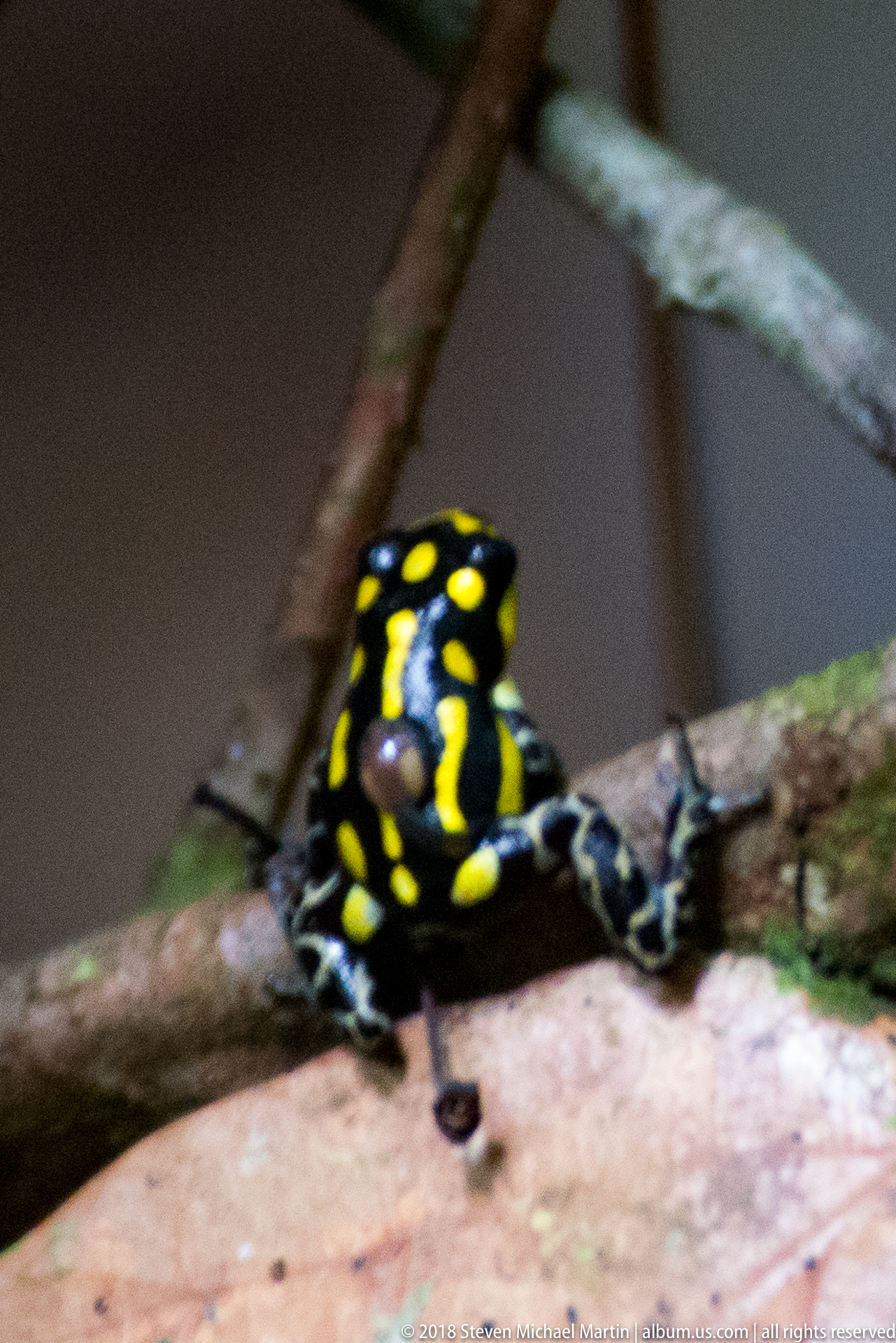
Seen from behind at close range, a poison dart frog rests across a horizontal branch with its rounded back marked by bright yellow spots and stripes against black. Mottled hind limbs extend to either side, while shallow focus separates the tiny amphibian from the dim rainforest background.
Caption
Seen from behind at close range, a poison dart frog rests across a horizontal branch with its rounded back marked by bright yellow spots and stripes against black. Mottled hind limbs extend to either side, while shallow focus separates the tiny amphibian from the dim rainforest background.

A tiny poison dart frog occupies the open end of a hollow plant tube secured with bright red tape. Its yellow-and-black pattern is visible inside the cylindrical cavity, a composition that documents the animal using—or being observed within—a confined artificial or modified plant microhabitat without implying how the arrangement was created.
Caption
A tiny poison dart frog occupies the open end of a hollow plant tube secured with bright red tape. Its yellow-and-black pattern is visible inside the cylindrical cavity, a composition that documents the animal using—or being observed within—a confined artificial or modified plant microhabitat without implying how the arrangement was created.

A lateral profile reveals the striking color pattern of a poison dart frog as it faces along a sloping branch. Yellow bands cross the dark head and back, a pale patch marks the flank, and intricately mottled legs brace against the bark, offering one of the sequence's clearest views of body proportions and markings.
Caption
A lateral profile reveals the striking color pattern of a poison dart frog as it faces along a sloping branch. Yellow bands cross the dark head and back, a pale patch marks the flank, and intricately mottled legs brace against the bark, offering one of the sequence's clearest views of body proportions and markings.

Extended along a horizontal branch, a poison dart frog displays its full side profile from snout to hind toes. The yellow-on-black dorsal pattern, pale flank, and intricately banded limbs are all visible, making this frame especially useful for comparing coloration and proportions within the Frog Valley sequence.
Caption
Extended along a horizontal branch, a poison dart frog displays its full side profile from snout to hind toes. The yellow-on-black dorsal pattern, pale flank, and intricately banded limbs are all visible, making this frame especially useful for comparing coloration and proportions within the Frog Valley sequence.

A slender, long-bodied insect rests along the midline of a glossy understory leaf in Frog Valley. Its narrow dark wings, orange legs, and projecting antennae stand out against the smooth green surface, while the shallow depth of field isolates this small forest invertebrate from surrounding foliage. The photograph records the valley’s less conspicuous arthropod life alongside its better-known amphibians.
Caption
A slender, long-bodied insect rests along the midline of a glossy understory leaf in Frog Valley. Its narrow dark wings, orange legs, and projecting antennae stand out against the smooth green surface, while the shallow depth of field isolates this small forest invertebrate from surrounding foliage. The photograph records the valley’s less conspicuous arthropod life alongside its better-known amphibians.

A tight dorsal view concentrates on the poison frog’s graphic color pattern: two red-orange lines frame the dark back, yellow flashes along the sides, and rounded dark spots cover the limbs. The frog is tucked against the edge of a green leaf, allowing the patterned skin and compact posture to dominate the frame rather than the surrounding habitat.
Caption
A tight dorsal view concentrates on the poison frog’s graphic color pattern: two red-orange lines frame the dark back, yellow flashes along the sides, and rounded dark spots cover the limbs. The frog is tucked against the edge of a green leaf, allowing the patterned skin and compact posture to dominate the frame rather than the surrounding habitat.

A small poison frog stretches along the sloping edge of a heart-shaped leaf, its body nearly parallel to the leaf margin. Red-orange stripes trace the dark back and a yellow band marks the side, while the spotted hind limbs trail behind. The wider framing shows the frog’s scale within a single rainforest leaf and the wet sheen of its immediate microhabitat.
Caption
A small poison frog stretches along the sloping edge of a heart-shaped leaf, its body nearly parallel to the leaf margin. Red-orange stripes trace the dark back and a yellow band marks the side, while the spotted hind limbs trail behind. The wider framing shows the frog’s scale within a single rainforest leaf and the wet sheen of its immediate microhabitat.
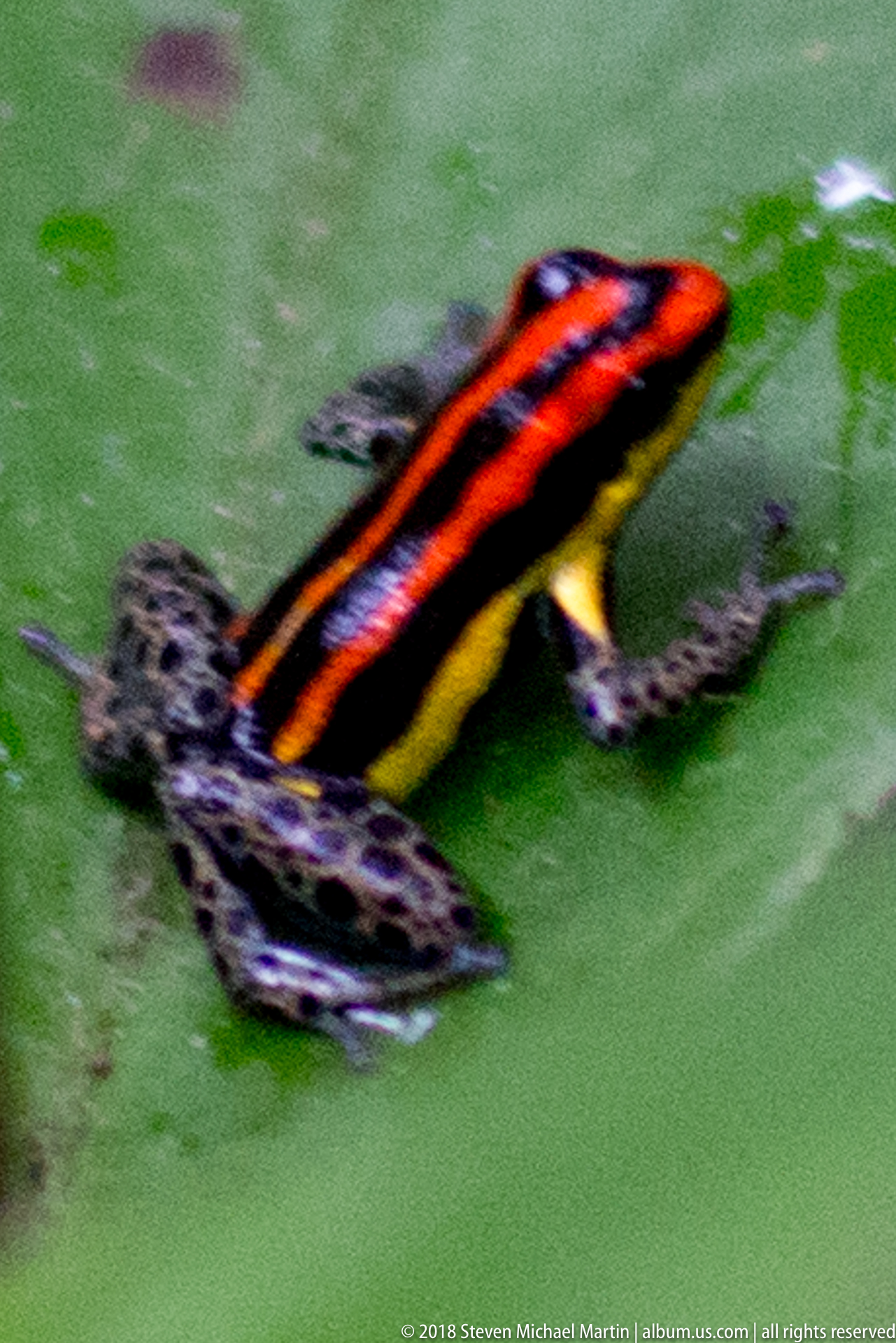
A close, motion-softened view shows a striped poison frog moving across a smooth green leaf. The elongated posture exposes the yellow lateral band, red-orange dorsal lines, and spotted hind limbs as the frog pushes forward. The slight blur conveys movement and distinguishes this frame from the more static portraits in the sequence while preserving the animal’s characteristic warning pattern.
Caption
A close, motion-softened view shows a striped poison frog moving across a smooth green leaf. The elongated posture exposes the yellow lateral band, red-orange dorsal lines, and spotted hind limbs as the frog pushes forward. The slight blur conveys movement and distinguishes this frame from the more static portraits in the sequence while preserving the animal’s characteristic warning pattern.

Several small bats roost against a rough brown wooden surface, spaced across the frame with their bodies folded into compact dark shapes. The nearest animals show pointed ears and tucked wings, while others recede into softer focus. The image shifts the portfolio from amphibians to nocturnal mammals and records a sheltered daytime roost within the forest environment.
Caption
Several small bats roost against a rough brown wooden surface, spaced across the frame with their bodies folded into compact dark shapes. The nearest animals show pointed ears and tucked wings, while others recede into softer focus. The image shifts the portfolio from amphibians to nocturnal mammals and records a sheltered daytime roost within the forest environment.

Three small bats are shown more closely against mottled brown wood, each hanging or pressed to the surface with wings folded around the body. Rounded muzzles and prominent ears are discernible on the nearer individuals. The tighter framing makes the spacing of the roosting animals easier to read while retaining the textured shelter as environmental context.
Caption
Three small bats are shown more closely against mottled brown wood, each hanging or pressed to the surface with wings folded around the body. Rounded muzzles and prominent ears are discernible on the nearer individuals. The tighter framing makes the spacing of the roosting animals easier to read while retaining the textured shelter as environmental context.

Several long-legged dark ants traverse a pale fallen leaf lying among brown leaf litter. Their separated positions and angular legs are sharply legible against the lighter leaf surface, turning a small patch of forest floor into a study of insect movement. The frame emphasizes ground-level invertebrate activity and the layered decomposing vegetation of the rainforest understory.
Caption
Several long-legged dark ants traverse a pale fallen leaf lying among brown leaf litter. Their separated positions and angular legs are sharply legible against the lighter leaf surface, turning a small patch of forest floor into a study of insect movement. The frame emphasizes ground-level invertebrate activity and the layered decomposing vegetation of the rainforest understory.

A slender lizard clings head-down to a dark tree trunk, its long tapering tail extending upward and its limbs splayed widely for purchase on the bark. Mottled olive-brown coloration blends with the trunk, while the narrow head projects into the brighter forest background. The side view highlights an arboreal posture and camouflage rather than a secure species-level identity.
Caption
A slender lizard clings head-down to a dark tree trunk, its long tapering tail extending upward and its limbs splayed widely for purchase on the bark. Mottled olive-brown coloration blends with the trunk, while the narrow head projects into the brighter forest background. The side view highlights an arboreal posture and camouflage rather than a secure species-level identity.

A cluster of dark, long-legged ants is distributed across a single pale green-brown fallen leaf on the forest floor. The overhead composition shows several individuals moving in different directions, with surrounding litter forming a darker border. Compared with the preceding view, this frame gives a broader count and spatial pattern of the ants using the leaf as a temporary pathway.
Caption
A cluster of dark, long-legged ants is distributed across a single pale green-brown fallen leaf on the forest floor. The overhead composition shows several individuals moving in different directions, with surrounding litter forming a darker border. Compared with the preceding view, this frame gives a broader count and spatial pattern of the ants using the leaf as a temporary pathway.

Seen in profile, a camouflaged lizard presses close to a broad tree trunk with its head projecting to the right. The body and tail follow the vertical bark, while long toes and splayed limbs anchor the animal to the surface. This wider view emphasizes how closely the reptile’s muted coloration matches the rough trunk within dense green understory vegetation.
Caption
Seen in profile, a camouflaged lizard presses close to a broad tree trunk with its head projecting to the right. The body and tail follow the vertical bark, while long toes and splayed limbs anchor the animal to the surface. This wider view emphasizes how closely the reptile’s muted coloration matches the rough trunk within dense green understory vegetation.

A large irregular carton-like nest is built against a rainforest tree trunk, its rough layered surface projecting outward above a dark opening beneath. The earthy structure appears integrated with the bark and occupies most of the frame. Its form is consistent with an arboreal termite nest, documenting the conspicuous architecture created by social insects in humid tropical forest.
Caption
A large irregular carton-like nest is built against a rainforest tree trunk, its rough layered surface projecting outward above a dark opening beneath. The earthy structure appears integrated with the bark and occupies most of the frame. Its form is consistent with an arboreal termite nest, documenting the conspicuous architecture created by social insects in humid tropical forest.

A closer profile isolates the forest lizard against dark bark. Its narrow head, textured scales, long toes, and extended tail are more apparent here, while mottled green-brown coloration continues to merge with the trunk. The animal’s flattened posture and widely spread feet show its secure grip on the vertical surface, offering a more anatomical view than the preceding habitat portrait.
Caption
A closer profile isolates the forest lizard against dark bark. Its narrow head, textured scales, long toes, and extended tail are more apparent here, while mottled green-brown coloration continues to merge with the trunk. The animal’s flattened posture and widely spread feet show its secure grip on the vertical surface, offering a more anatomical view than the preceding habitat portrait.

Viewed from above, the lizard’s elongated body and tail run diagonally up the tree trunk while all four limbs spread outward across the bark. Olive, tan, and darker mottling breaks up the body outline against the textured surface. This dorsal perspective provides the clearest view in the sequence of body pattern, limb placement, and the reptile’s camouflage on the trunk.
Caption
Viewed from above, the lizard’s elongated body and tail run diagonally up the tree trunk while all four limbs spread outward across the bark. Olive, tan, and darker mottling breaks up the body outline against the textured surface. This dorsal perspective provides the clearest view in the sequence of body pattern, limb placement, and the reptile’s camouflage on the trunk.

A close dorsal study shows the forest lizard flattened against coarse bark, its long tail extending toward the top of the frame and its limbs spread to either side. Fine mottling in olive, tan, and gray echoes the trunk’s irregular texture. The tight crop concentrates attention on camouflage, body proportions, and the gripping posture used on the vertical surface.
Caption
A close dorsal study shows the forest lizard flattened against coarse bark, its long tail extending toward the top of the frame and its limbs spread to either side. Fine mottling in olive, tan, and gray echoes the trunk’s irregular texture. The tight crop concentrates attention on camouflage, body proportions, and the gripping posture used on the vertical surface.

The lizard is centered vertically on the trunk, head down and tail drawn into a long straight taper above the body. Its olive-brown dorsal pattern nearly merges with the granular bark, while the limbs extend laterally in a symmetrical gripping stance. The composition is especially useful for comparing body shape and camouflage with adjacent views of the same forest reptile.
Caption
The lizard is centered vertically on the trunk, head down and tail drawn into a long straight taper above the body. Its olive-brown dorsal pattern nearly merges with the granular bark, while the limbs extend laterally in a symmetrical gripping stance. The composition is especially useful for comparing body shape and camouflage with adjacent views of the same forest reptile.

A long-tailed lizard clings diagonally to a broad tree trunk, its body held close to the bark and head angled downward. The wider composition leaves more of the textured trunk visible around the animal, showing its small scale relative to the tree. Subdued mottling makes the reptile difficult to separate from the bark except for the sharply tapering tail and spread limbs.
Caption
A long-tailed lizard clings diagonally to a broad tree trunk, its body held close to the bark and head angled downward. The wider composition leaves more of the textured trunk visible around the animal, showing its small scale relative to the tree. Subdued mottling makes the reptile difficult to separate from the bark except for the sharply tapering tail and spread limbs.
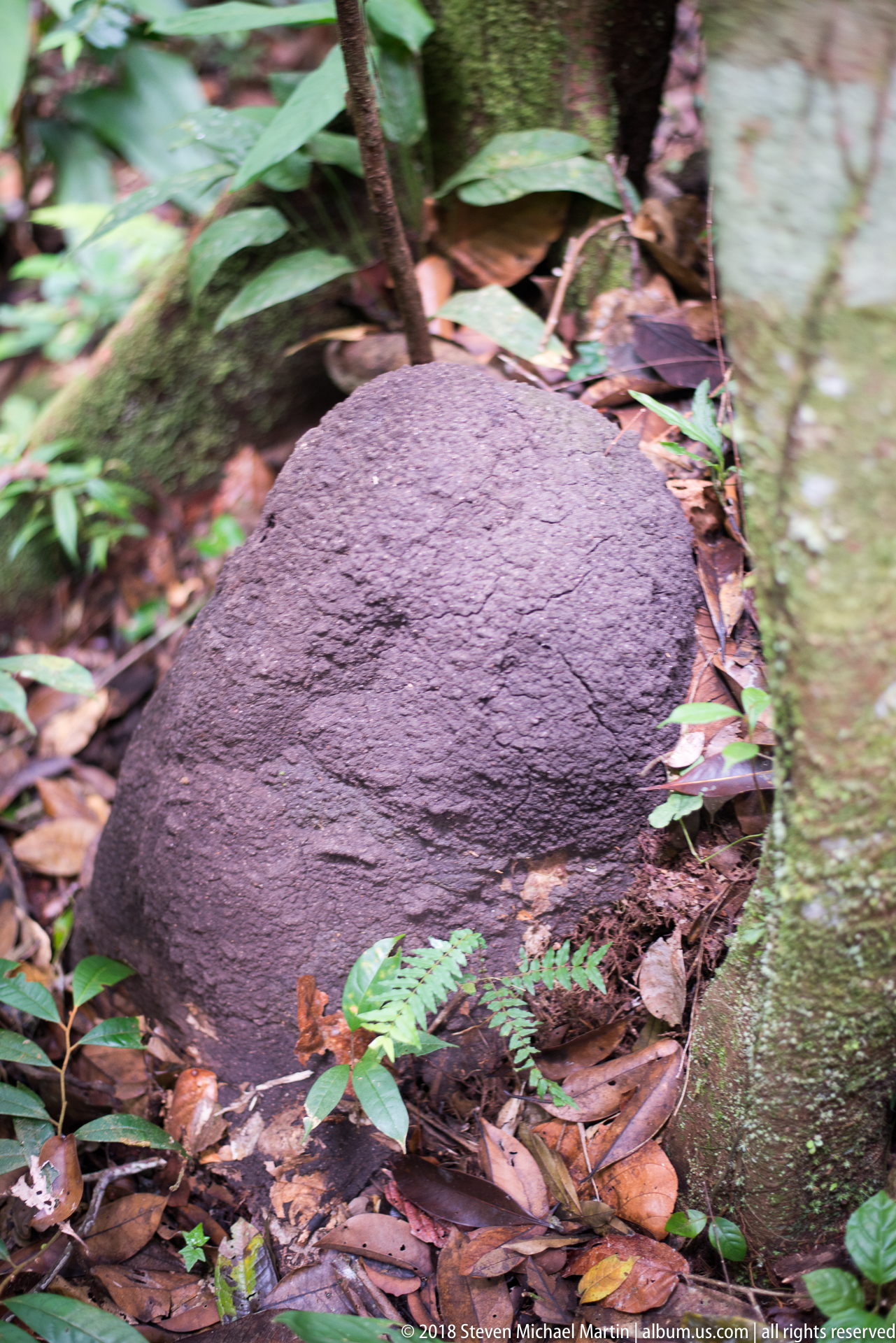
A rounded dark mound rests on the forest floor beside a tree base, surrounded by fallen leaves, small ferns, and low vegetation. Its dense, cracked surface and domed profile are clearly visible, but the proof sheet does not establish whether the feature is stone, compacted earth, or a biological construction. The frame therefore serves primarily as a natural-history context view of the rainforest floor.
Caption
A rounded dark mound rests on the forest floor beside a tree base, surrounded by fallen leaves, small ferns, and low vegetation. Its dense, cracked surface and domed profile are clearly visible, but the proof sheet does not establish whether the feature is stone, compacted earth, or a biological construction. The frame therefore serves primarily as a natural-history context view of the rainforest floor.
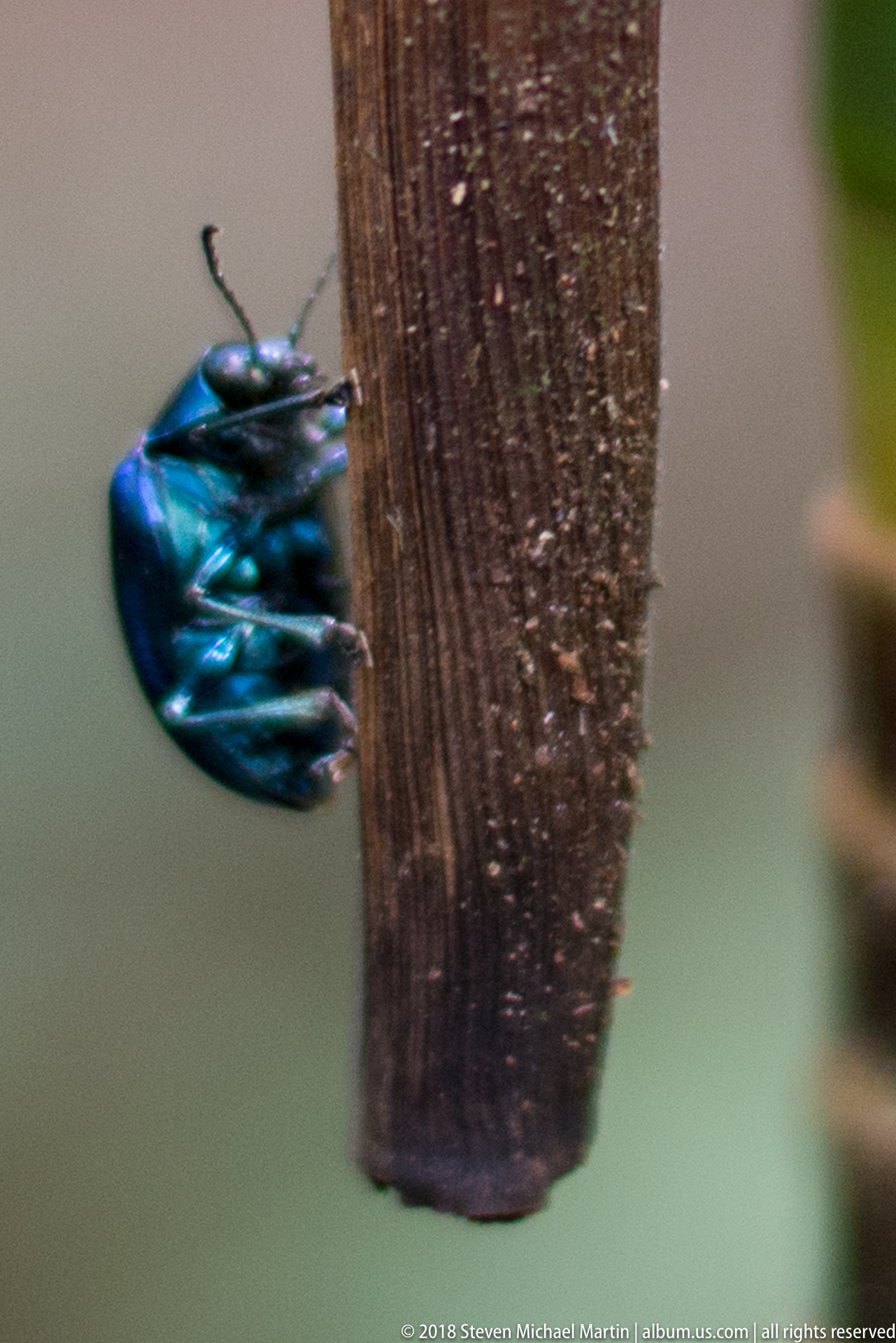
An iridescent blue beetle clings partly around a vertical brown stem, its rounded wing covers reflecting turquoise and deep cobalt highlights. The insect’s body is mostly seen from the side and rear, with legs gripping the stem’s edge. Against the softly blurred green background, the metallic surface becomes the dominant visual feature of this rainforest invertebrate portrait.
Caption
An iridescent blue beetle clings partly around a vertical brown stem, its rounded wing covers reflecting turquoise and deep cobalt highlights. The insect’s body is mostly seen from the side and rear, with legs gripping the stem’s edge. Against the softly blurred green background, the metallic surface becomes the dominant visual feature of this rainforest invertebrate portrait.

A small black frog marked with vivid yellow longitudinal stripes perches on decaying wood beside a dark cavity. Pale mottling covers the limbs, and the high-contrast body pattern stands out against the brown, moss-flecked substrate. The close view records a second conspicuous poison-frog color pattern in the portfolio, distinct from the red-orange-striped individuals shown earlier.
Caption
A small black frog marked with vivid yellow longitudinal stripes perches on decaying wood beside a dark cavity. Pale mottling covers the limbs, and the high-contrast body pattern stands out against the brown, moss-flecked substrate. The close view records a second conspicuous poison-frog color pattern in the portfolio, distinct from the red-orange-striped individuals shown earlier.

A tiny yellow-striped poison frog is perched on the top edge of a broken, hollowed piece of wood. The wider framing reduces the animal to a bright accent against brown decay, with a mossy trunk and fallen leaves behind it. This environmental view complements the preceding close-up by showing the frog’s minute scale and its use of damp woody structure on the forest floor.
Caption
A tiny yellow-striped poison frog is perched on the top edge of a broken, hollowed piece of wood. The wider framing reduces the animal to a bright accent against brown decay, with a mossy trunk and fallen leaves behind it. This environmental view complements the preceding close-up by showing the frog’s minute scale and its use of damp woody structure on the forest floor.

A hiker in a blue shirt and light cap stands beside the massive buttressed base of a rainforest tree in Frog Valley. Backpack straps and a cross-body camera or equipment strap indicate field travel, while the trunk provides a strong sense of scale. The portrait shifts attention from small wildlife to the human experience of moving through mature tropical forest.
Caption
A hiker in a blue shirt and light cap stands beside the massive buttressed base of a rainforest tree in Frog Valley. Backpack straps and a cross-body camera or equipment strap indicate field travel, while the trunk provides a strong sense of scale. The portrait shifts attention from small wildlife to the human experience of moving through mature tropical forest.
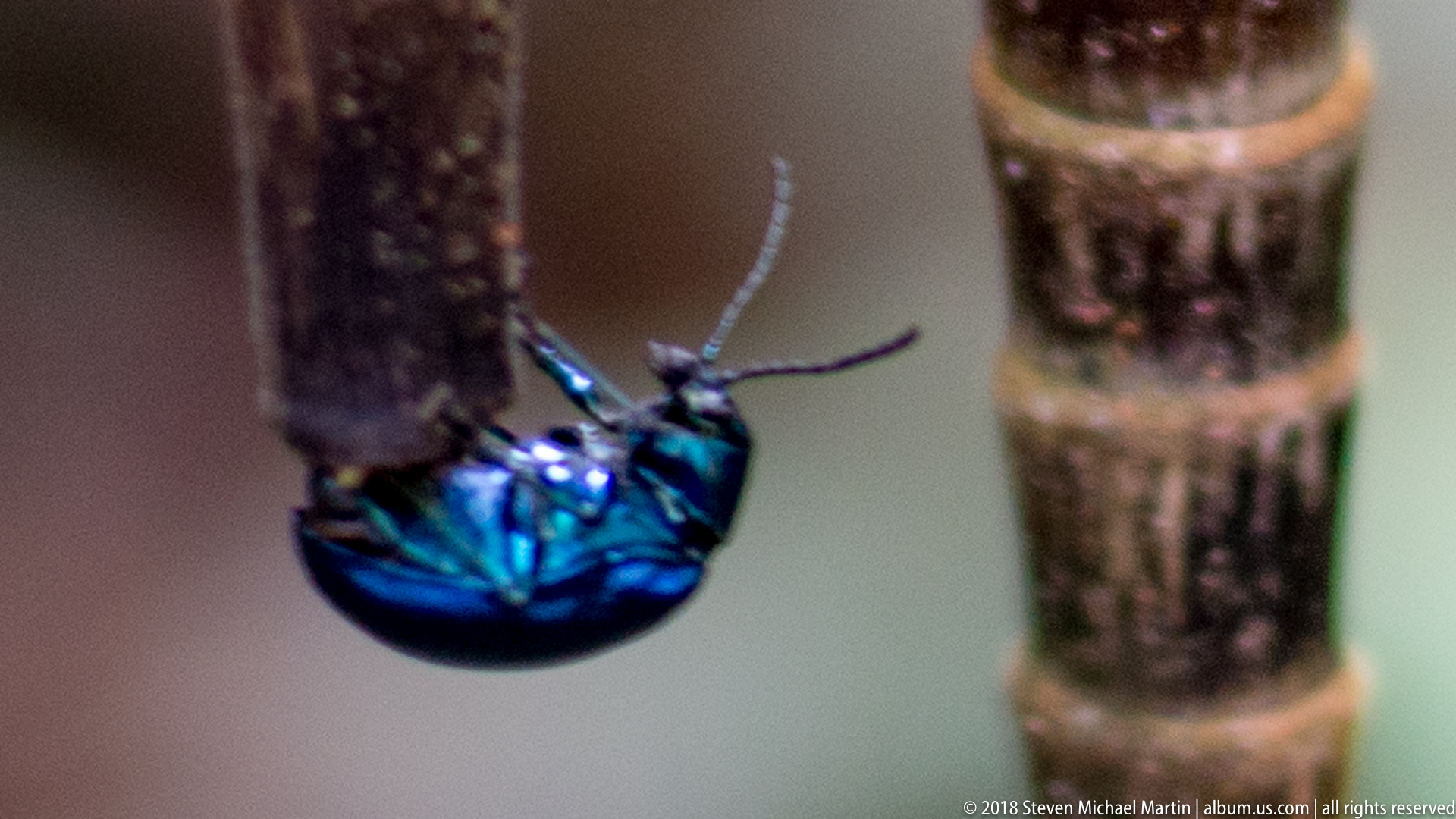
A metallic blue beetle hangs beneath the cut end of a dark plant stem, exposing the rounded underside and curved body profile. Antennae and legs project outward while blue-green reflections shift across the glossy surface. A second segmented stem in the background provides scale and habitat context, distinguishing this underside view from the adjacent side portraits.
Caption
A metallic blue beetle hangs beneath the cut end of a dark plant stem, exposing the rounded underside and curved body profile. Antennae and legs project outward while blue-green reflections shift across the glossy surface. A second segmented stem in the background provides scale and habitat context, distinguishing this underside view from the adjacent side portraits.

A small flash of metallic blue marks a beetle positioned at the lower tip of a hanging segmented stem. The wider composition surrounds the insect with soft green forest vegetation, emphasizing how easily its brilliant color can disappear at normal viewing distance. The photograph functions as a habitat-scale counterpoint to the closer beetle studies on the same page.
Caption
A small flash of metallic blue marks a beetle positioned at the lower tip of a hanging segmented stem. The wider composition surrounds the insect with soft green forest vegetation, emphasizing how easily its brilliant color can disappear at normal viewing distance. The photograph functions as a habitat-scale counterpoint to the closer beetle studies on the same page.

Two vividly patterned poison dart frogs occupy the water-holding leaf axils of a bromeliad, their black bodies marked with bright yellow spots and bands and pale mottling along the limbs. The overlapping leaves create a humid, enclosed microhabitat typical of the rainforest understory and reveal how small frogs use vegetation as shelter.
Caption
Two vividly patterned poison dart frogs occupy the water-holding leaf axils of a bromeliad, their black bodies marked with bright yellow spots and bands and pale mottling along the limbs. The overlapping leaves create a humid, enclosed microhabitat typical of the rainforest understory and reveal how small frogs use vegetation as shelter.

A side view shows the metallic blue beetle wrapped around the lower edge of a vertical stem, its elongated glossy wing covers forming a smooth cobalt arc. Long legs and antennae extend away from the body as it grips the plant surface. The tight framing emphasizes the insect’s reflective exoskeleton and elongated form more clearly than the wider habitat view.
Caption
A side view shows the metallic blue beetle wrapped around the lower edge of a vertical stem, its elongated glossy wing covers forming a smooth cobalt arc. Long legs and antennae extend away from the body as it grips the plant surface. The tight framing emphasizes the insect’s reflective exoskeleton and elongated form more clearly than the wider habitat view.

Several small dark arthropods gather along the glossy blue-black underside of a cut or broken plant stem. The tight macro view isolates their slender legs and reflective bodies against a softly blurred rainforest background, while the adjacent segmented green stem supplies scale and habitat context.
Caption
Several small dark arthropods gather along the glossy blue-black underside of a cut or broken plant stem. The tight macro view isolates their slender legs and reflective bodies against a softly blurred rainforest background, while the adjacent segmented green stem supplies scale and habitat context.

Partly concealed within a bromeliad, two poison dart frogs appear through narrow gaps between thick green leaves. Bright yellow markings break across their dark backs while patterned hind limbs remain visible below, making this a more intimate habitat view than the preceding portrait and emphasizing concealment within the plant.
Caption
Partly concealed within a bromeliad, two poison dart frogs appear through narrow gaps between thick green leaves. Bright yellow markings break across their dark backs while patterned hind limbs remain visible below, making this a more intimate habitat view than the preceding portrait and emphasizing concealment within the plant.
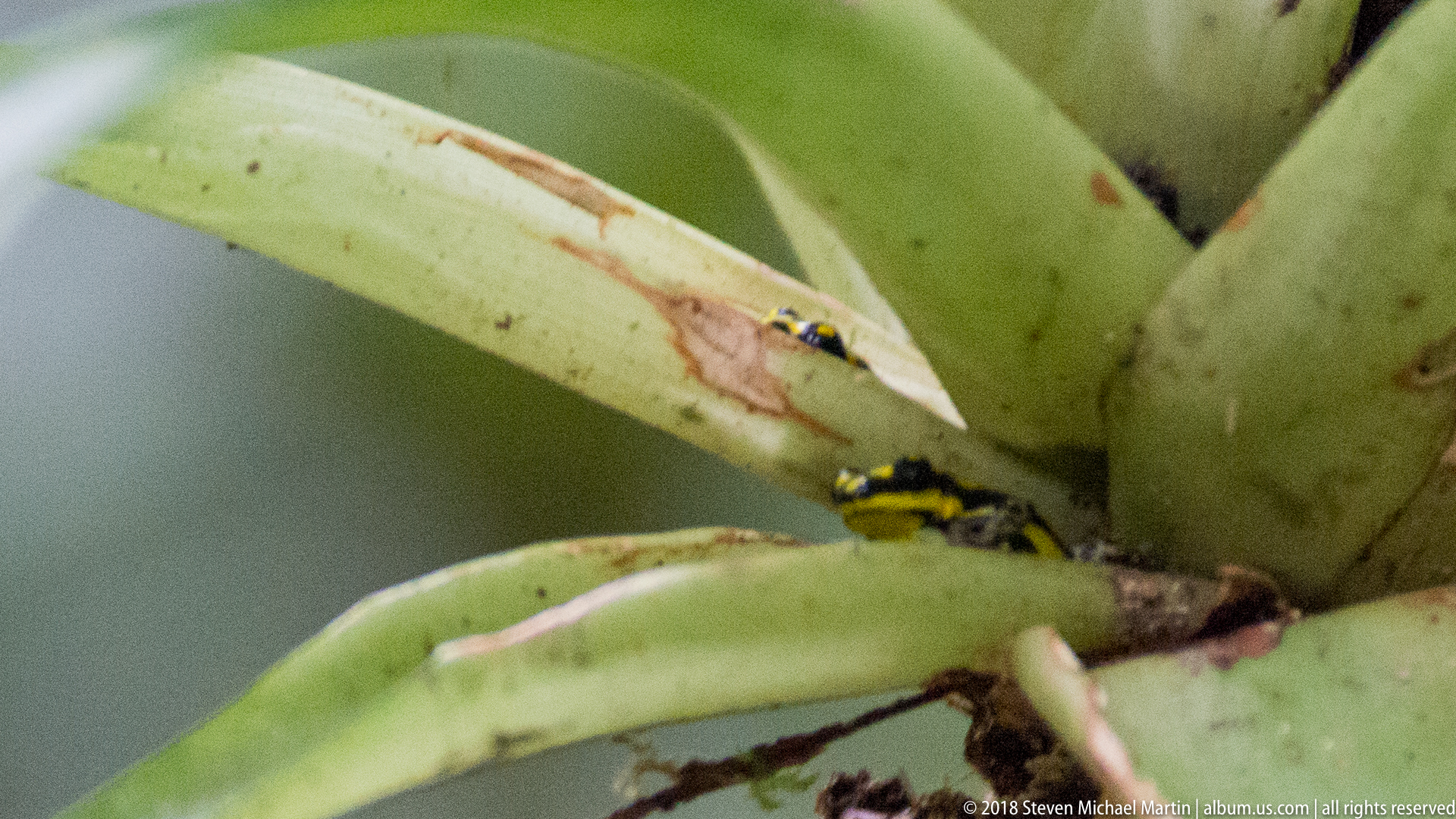
A small poison dart frog peers from the base of a bromeliad, nearly hidden where broad leaves converge around the plant's central cup. Only portions of its yellow-and-black head and patterned body are exposed, turning the frame into a contextual study of camouflage, scale, and refuge within living rainforest vegetation.
Caption
A small poison dart frog peers from the base of a bromeliad, nearly hidden where broad leaves converge around the plant's central cup. Only portions of its yellow-and-black head and patterned body are exposed, turning the frame into a contextual study of camouflage, scale, and refuge within living rainforest vegetation.

Epiphytic plants cling to the trunk and branch junctions of a large rainforest tree, sending narrow green leaves outward beneath the canopy. Vines and smaller stems rise around the trunk, creating a layered view of the humid forest's vertical structure and the abundance of plants occupying surfaces above the ground.
Caption
Epiphytic plants cling to the trunk and branch junctions of a large rainforest tree, sending narrow green leaves outward beneath the canopy. Vines and smaller stems rise around the trunk, creating a layered view of the humid forest's vertical structure and the abundance of plants occupying surfaces above the ground.

Ranks of pale shelf fungi spread across fallen, decaying wood on the shaded rainforest floor. The repeated semicircular caps follow the contours of the substrate through leaf litter and low vegetation, illustrating a conspicuous decomposer community working through woody material in the humid forest environment.
Caption
Ranks of pale shelf fungi spread across fallen, decaying wood on the shaded rainforest floor. The repeated semicircular caps follow the contours of the substrate through leaf litter and low vegetation, illustrating a conspicuous decomposer community working through woody material in the humid forest environment.

Thick woody lianas coil and loop around a standing rainforest tree, forming sculptural curves close to the forest floor. Their intertwined stems contrast with the straighter trunks behind them and provide a clear view of climbing growth in a dense tropical understory, where vines use established trees for vertical support.
Caption
Thick woody lianas coil and loop around a standing rainforest tree, forming sculptural curves close to the forest floor. Their intertwined stems contrast with the straighter trunks behind them and provide a clear view of climbing growth in a dense tropical understory, where vines use established trees for vertical support.

Bright yellow spots and broken bands stand out across the dark back of a poison dart frog crouched low on a branch. Its pale, intricately patterned legs grip the wood, while the shallow depth of field concentrates attention on dorsal coloration and posture rather than the surrounding forest.
Caption
Bright yellow spots and broken bands stand out across the dark back of a poison dart frog crouched low on a branch. Its pale, intricately patterned legs grip the wood, while the shallow depth of field concentrates attention on dorsal coloration and posture rather than the surrounding forest.

A narrow muddy stream or water-filled channel runs beneath dense low vegetation in the rainforest understory. Exposed soil and roots edge the brown water, while arching leaves crowd the bank, documenting the wet, shaded habitat associated with Frog Valley's amphibian-rich forest environment.
Caption
A narrow muddy stream or water-filled channel runs beneath dense low vegetation in the rainforest understory. Exposed soil and roots edge the brown water, while arching leaves crowd the bank, documenting the wet, shaded habitat associated with Frog Valley's amphibian-rich forest environment.

A poison dart frog advances along a slender diagonal branch, its low body and splayed toes silhouetted against a softly blurred background. Yellow markings punctuate the dark dorsum while pale patterned limbs wrap around the narrow perch, emphasizing both the frog's minute scale and agile arboreal movement.
Caption
A poison dart frog advances along a slender diagonal branch, its low body and splayed toes silhouetted against a softly blurred background. Yellow markings punctuate the dark dorsum while pale patterned limbs wrap around the narrow perch, emphasizing both the frog's minute scale and agile arboreal movement.

A poison dart frog climbs into the fork of a small tree, body angled upward as its toes grip the bark. Bright yellow markings trace the dark head and back, while patterned limbs curve around the stem; the vertical composition shifts attention from static portraiture to climbing behavior.
Caption
A poison dart frog climbs into the fork of a small tree, body angled upward as its toes grip the bark. Bright yellow markings trace the dark head and back, while patterned limbs curve around the stem; the vertical composition shifts attention from static portraiture to climbing behavior.

An unusually tight dorsal view follows a poison dart frog as it climbs beside a tree trunk. Large yellow spots and bars dominate the glossy black back, with portions of the patterned limbs visible at the margins, turning the frame into a close study of warning coloration and surface pattern.
Caption
An unusually tight dorsal view follows a poison dart frog as it climbs beside a tree trunk. Large yellow spots and bars dominate the glossy black back, with portions of the patterned limbs visible at the margins, turning the frame into a close study of warning coloration and surface pattern.

Clinging to a moss-flecked trunk, a poison dart frog is seen from above as it ascends past a horizontal branch. Yellow markings break across the dark back and the patterned hind limbs spread widely for purchase, illustrating the frog's climbing posture on rough rainforest bark.
Caption
Clinging to a moss-flecked trunk, a poison dart frog is seen from above as it ascends past a horizontal branch. Yellow markings break across the dark back and the patterned hind limbs spread widely for purchase, illustrating the frog's climbing posture on rough rainforest bark.

A poison dart frog grips the mossy junction of a small trunk and branch, its body turned almost vertically against the bark. The compact composition shows yellow dorsal markings, dark body surfaces, and patterned limbs against green moss, linking the amphibian closely to the humid texture of its forest microhabitat.
Caption
A poison dart frog grips the mossy junction of a small trunk and branch, its body turned almost vertically against the bark. The compact composition shows yellow dorsal markings, dark body surfaces, and patterned limbs against green moss, linking the amphibian closely to the humid texture of its forest microhabitat.

A massive woody liana wraps around a rainforest tree in broad, flattened coils, creating a striking spiral of weathered bark. Smaller vines cross the surface and round leaves punctuate the composition, while the close framing reveals the long-term physical relationship between climbing plants and their supporting trees.
Caption
A massive woody liana wraps around a rainforest tree in broad, flattened coils, creating a striking spiral of weathered bark. Smaller vines cross the surface and round leaves punctuate the composition, while the close framing reveals the long-term physical relationship between climbing plants and their supporting trees.

A small reddish-brown true bug stands on the surface of a broad green leaf marked by feeding damage and pale patches. Its elongated body, long antennae, and slender legs are clearly visible in the macro view, adding an invertebrate detail to the portfolio's wider survey of rainforest life.
Caption
A small reddish-brown true bug stands on the surface of a broad green leaf marked by feeding damage and pale patches. Its elongated body, long antennae, and slender legs are clearly visible in the macro view, adding an invertebrate detail to the portfolio's wider survey of rainforest life.

A bromeliad grows epiphytically from a rainforest tree, its long strap-like leaves radiating around a compact cluster of vivid red flowers or bracts. The coiled liana behind it and surrounding foliage place the plant within a densely layered forest, where epiphytes occupy trunks and branches above the ground.
Caption
A bromeliad grows epiphytically from a rainforest tree, its long strap-like leaves radiating around a compact cluster of vivid red flowers or bracts. The coiled liana behind it and surrounding foliage place the plant within a densely layered forest, where epiphytes occupy trunks and branches above the ground.

Heavy lianas cross and loop around a tree trunk at close range, their bark mottled with mosses, lichens, and weathered patches. The intertwined forms fill nearly the entire frame, emphasizing texture and the dense structural complexity created by woody climbers in a humid tropical forest.
Caption
Heavy lianas cross and loop around a tree trunk at close range, their bark mottled with mosses, lichens, and weathered patches. The intertwined forms fill nearly the entire frame, emphasizing texture and the dense structural complexity created by woody climbers in a humid tropical forest.

A large green-winged orthopteran rests on the flat blade of a machete, exposing pale body surfaces and long jointed legs. The unusual perch provides scale and a clear contrast between the insect's leaflike green wing and the worn metal, documenting a close encounter with rainforest invertebrate life.
Caption
A large green-winged orthopteran rests on the flat blade of a machete, exposing pale body surfaces and long jointed legs. The unusual perch provides scale and a clear contrast between the insect's leaflike green wing and the worn metal, documenting a close encounter with rainforest invertebrate life.

A delicate cluster of purple buds rises from a reddish, hair-covered stem above broad green leaves. The macro composition isolates the developing inflorescence and fine plant hairs against soft foliage, recording a small-scale botanical detail within Frog Valley's humid rainforest vegetation.
Caption
A delicate cluster of purple buds rises from a reddish, hair-covered stem above broad green leaves. The macro composition isolates the developing inflorescence and fine plant hairs against soft foliage, recording a small-scale botanical detail within Frog Valley's humid rainforest vegetation.

A single bright red berry stands out on a slender reddish stem among broad, prominently veined green leaves. The shallow-focus botanical portrait isolates the fruit against the shaded understory and records one of the forest's small reproductive details without assigning the plant to an unsupported species.
Caption
A single bright red berry stands out on a slender reddish stem among broad, prominently veined green leaves. The shallow-focus botanical portrait isolates the fruit against the shaded understory and records one of the forest's small reproductive details without assigning the plant to an unsupported species.

A thick woody liana curves tightly around a pale, smooth-barked tree trunk, forming a broad diagonal band across the frame. Lichens and weathered surface patches mark both stems, while the close viewpoint highlights the mechanical relationship between a climbing vine and its living support.
Caption
A thick woody liana curves tightly around a pale, smooth-barked tree trunk, forming a broad diagonal band across the frame. Lichens and weathered surface patches mark both stems, while the close viewpoint highlights the mechanical relationship between a climbing vine and its living support.

A mossy fallen trunk forms a narrow raised route through dense rainforest vegetation, its upper surface worn and scattered with leaf litter. Ferns and low plants crowd both sides, giving the view the character of a natural footbridge or trail segment through the shaded Frog Valley understory.
Caption
A mossy fallen trunk forms a narrow raised route through dense rainforest vegetation, its upper surface worn and scattered with leaf litter. Ferns and low plants crowd both sides, giving the view the character of a natural footbridge or trail segment through the shaded Frog Valley understory.

A visitor in a blue shirt and cap walks carefully toward the camera along a fallen tree trunk used as a narrow route through the forest. Dense vegetation presses close on both sides, and the person's stance and rubber boots convey the balance required to move through Frog Valley's wet, uneven rainforest terrain.
Caption
A visitor in a blue shirt and cap walks carefully toward the camera along a fallen tree trunk used as a narrow route through the forest. Dense vegetation presses close on both sides, and the person's stance and rubber boots convey the balance required to move through Frog Valley's wet, uneven rainforest terrain.

Seen from behind, a visitor proceeds along the same mossy fallen trunk deeper into the rainforest. The narrow footing disappears into dense green understory ahead, while boots, field clothing, and a small waist-carried item reinforce the practical character of movement through the humid forest rather than presenting a posed portrait.
Caption
Seen from behind, a visitor proceeds along the same mossy fallen trunk deeper into the rainforest. The narrow footing disappears into dense green understory ahead, while boots, field clothing, and a small waist-carried item reinforce the practical character of movement through the humid forest rather than presenting a posed portrait.

A visitor walks away along a narrow path through dense tropical forest, surrounded by broad leaves, saplings, vines, and layered understory growth. The rear viewpoint places the figure within the vegetation and conveys the confined, uneven character of foot travel through Frog Valley's humid forest habitat.
Caption
A visitor walks away along a narrow path through dense tropical forest, surrounded by broad leaves, saplings, vines, and layered understory growth. The rear viewpoint places the figure within the vegetation and conveys the confined, uneven character of foot travel through Frog Valley's humid forest habitat.

A visitor pauses for a portrait in the forest wearing a blue shirt, cap, backpack, and shoulder-carried camera bag. Sunlit foliage and tree trunks form a soft background, while the close framing records the practical field clothing and equipment used during the Frog Valley excursion.
Caption
A visitor pauses for a portrait in the forest wearing a blue shirt, cap, backpack, and shoulder-carried camera bag. Sunlit foliage and tree trunks form a soft background, while the close framing records the practical field clothing and equipment used during the Frog Valley excursion.
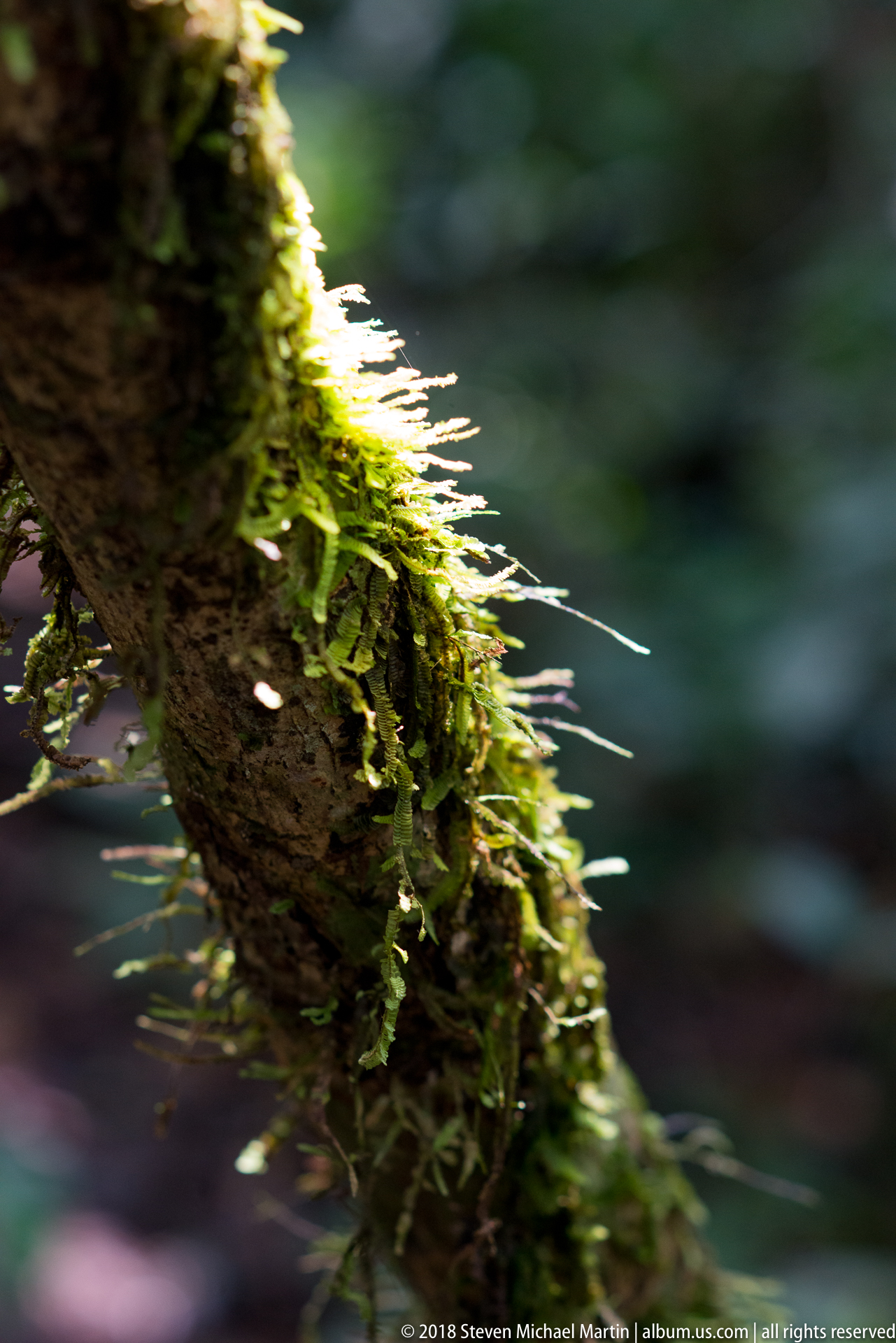
Mosses and tiny epiphytic plants form a dense green fringe along a sloping rainforest branch. Backlighting catches the projecting leaves and stems, separating them from the darker forest beyond and emphasizing the humid microhabitat created on bark surfaces above the ground.
Caption
Mosses and tiny epiphytic plants form a dense green fringe along a sloping rainforest branch. Backlighting catches the projecting leaves and stems, separating them from the darker forest beyond and emphasizing the humid microhabitat created on bark surfaces above the ground.

A person moves laterally through dense rainforest vegetation, partly screened by leaves and slender trunks. The layered foliage makes the figure less prominent than in adjacent portraits, emphasizing the visual difficulty of moving and observing wildlife within Frog Valley's thick tropical understory.
Caption
A person moves laterally through dense rainforest vegetation, partly screened by leaves and slender trunks. The layered foliage makes the figure less prominent than in adjacent portraits, emphasizing the visual difficulty of moving and observing wildlife within Frog Valley's thick tropical understory.

Two bracket fungi project downward from a decaying, green-stained log, each with a dark upper surface and pale, reddish-edged underside. Their paired form and short attachment points stand out against the rough wood, providing a close view of fungal growth on decomposing rainforest substrate.
Caption
Two bracket fungi project downward from a decaying, green-stained log, each with a dark upper surface and pale, reddish-edged underside. Their paired form and short attachment points stand out against the rough wood, providing a close view of fungal growth on decomposing rainforest substrate.

Several pale mushrooms with broad, shallowly funnel-shaped caps grow from dark decaying wood. Fine radial texture and depressed centers are visible across the cream-colored caps, while the tight composition separates this cluster from the broader fungal colonies elsewhere in the Frog Valley sequence.
Caption
Several pale mushrooms with broad, shallowly funnel-shaped caps grow from dark decaying wood. Fine radial texture and depressed centers are visible across the cream-colored caps, while the tight composition separates this cluster from the broader fungal colonies elsewhere in the Frog Valley sequence.

A loose colony of white mushrooms spreads across a moss-covered fallen log, with caps at different sizes and orientations. Patches of sunlight interrupt the dark forest-floor setting, revealing the irregular edges and depressed centers of the fruiting bodies amid moss, bark, and leaf litter.
Caption
A loose colony of white mushrooms spreads across a moss-covered fallen log, with caps at different sizes and orientations. Patches of sunlight interrupt the dark forest-floor setting, revealing the irregular edges and depressed centers of the fruiting bodies amid moss, bark, and leaf litter.

Cream-white mushrooms cluster tightly against moss-covered wood, their overlapping caps showing shallow central depressions and softly scalloped edges. The overhead view records several growth stages together and places the fruiting bodies directly within the damp, decomposing substrate of the rainforest floor.
Caption
Cream-white mushrooms cluster tightly against moss-covered wood, their overlapping caps showing shallow central depressions and softly scalloped edges. The overhead view records several growth stages together and places the fruiting bodies directly within the damp, decomposing substrate of the rainforest floor.

White mushrooms emerge at multiple levels along the side of a mossy fallen log, some projecting horizontally while smaller caps fill the shaded recess below. The oblique viewpoint reveals how the colony occupies crevices and surfaces of decaying wood rather than forming a single ground-level cluster.
Caption
White mushrooms emerge at multiple levels along the side of a mossy fallen log, some projecting horizontally while smaller caps fill the shaded recess below. The oblique viewpoint reveals how the colony occupies crevices and surfaces of decaying wood rather than forming a single ground-level cluster.

A delicate green vine extends beside a narrow tree trunk, producing tightly coiled tendrils that curl into springlike shapes. Shallow focus isolates the fine climbing structures against a blurred forest background, offering a close botanical study of how a small vine secures support in the understory.
Caption
A delicate green vine extends beside a narrow tree trunk, producing tightly coiled tendrils that curl into springlike shapes. Shallow focus isolates the fine climbing structures against a blurred forest background, offering a close botanical study of how a small vine secures support in the understory.

A visitor in a blue shirt and backpack stands close to leafy vegetation, appearing to examine the surrounding forest at short range. The side and rear viewpoint keeps attention on field observation rather than portraiture, with dense leaves and branches filling the immediate environment.
Caption
A visitor in a blue shirt and backpack stands close to leafy vegetation, appearing to examine the surrounding forest at short range. The side and rear viewpoint keeps attention on field observation rather than portraiture, with dense leaves and branches filling the immediate environment.

Broad buttress roots flare from the base of a mature rainforest tree, their ridges streaked with moss and separated by shallow recesses. Low plants gather around the trunk, while the close viewpoint emphasizes the structural transition from vertical stem to spreading support at the forest floor.
Caption
Broad buttress roots flare from the base of a mature rainforest tree, their ridges streaked with moss and separated by shallow recesses. Low plants gather around the trunk, while the close viewpoint emphasizes the structural transition from vertical stem to spreading support at the forest floor.

A narrow, weathered earthen structure rises from the leaf-littered forest floor like a small chimney, its rough layered surface contrasting with wet leaves and nearby fern fronds. Its form is consistent with a termite-built feature, though the proof sheet does not establish the builder or internal structure with certainty.
Caption
A narrow, weathered earthen structure rises from the leaf-littered forest floor like a small chimney, its rough layered surface contrasting with wet leaves and nearby fern fronds. Its form is consistent with a termite-built feature, though the proof sheet does not establish the builder or internal structure with certainty.

A flattened woody liana twists along its length above broad understory leaves, producing a rope-like spiral of pale and reddish bark. The close framing isolates the unusual torsion and flattened profile, distinguishing this climbing stem from the rounder coiled lianas documented elsewhere in Frog Valley.
Caption
A flattened woody liana twists along its length above broad understory leaves, producing a rope-like spiral of pale and reddish bark. The close framing isolates the unusual torsion and flattened profile, distinguishing this climbing stem from the rounder coiled lianas documented elsewhere in Frog Valley.

A thick mantle of mosses and small epiphytes covers a diagonal rainforest branch, softening the bark beneath a layered fringe of tiny leaves and stems. The isolated close view highlights the moisture-retaining plant community that develops on woody surfaces in the shaded forest.
Caption
A thick mantle of mosses and small epiphytes covers a diagonal rainforest branch, softening the bark beneath a layered fringe of tiny leaves and stems. The isolated close view highlights the moisture-retaining plant community that develops on woody surfaces in the shaded forest.

A vivid red bromeliad inflorescence opens at the center of a rosette of long green leaves, with small yellow flowers clustered within the star-shaped bracts. The frontal close-up isolates the reproductive structure and its contrasting colors against the softer rainforest vegetation behind it.
Caption
A vivid red bromeliad inflorescence opens at the center of a rosette of long green leaves, with small yellow flowers clustered within the star-shaped bracts. The frontal close-up isolates the reproductive structure and its contrasting colors against the softer rainforest vegetation behind it.
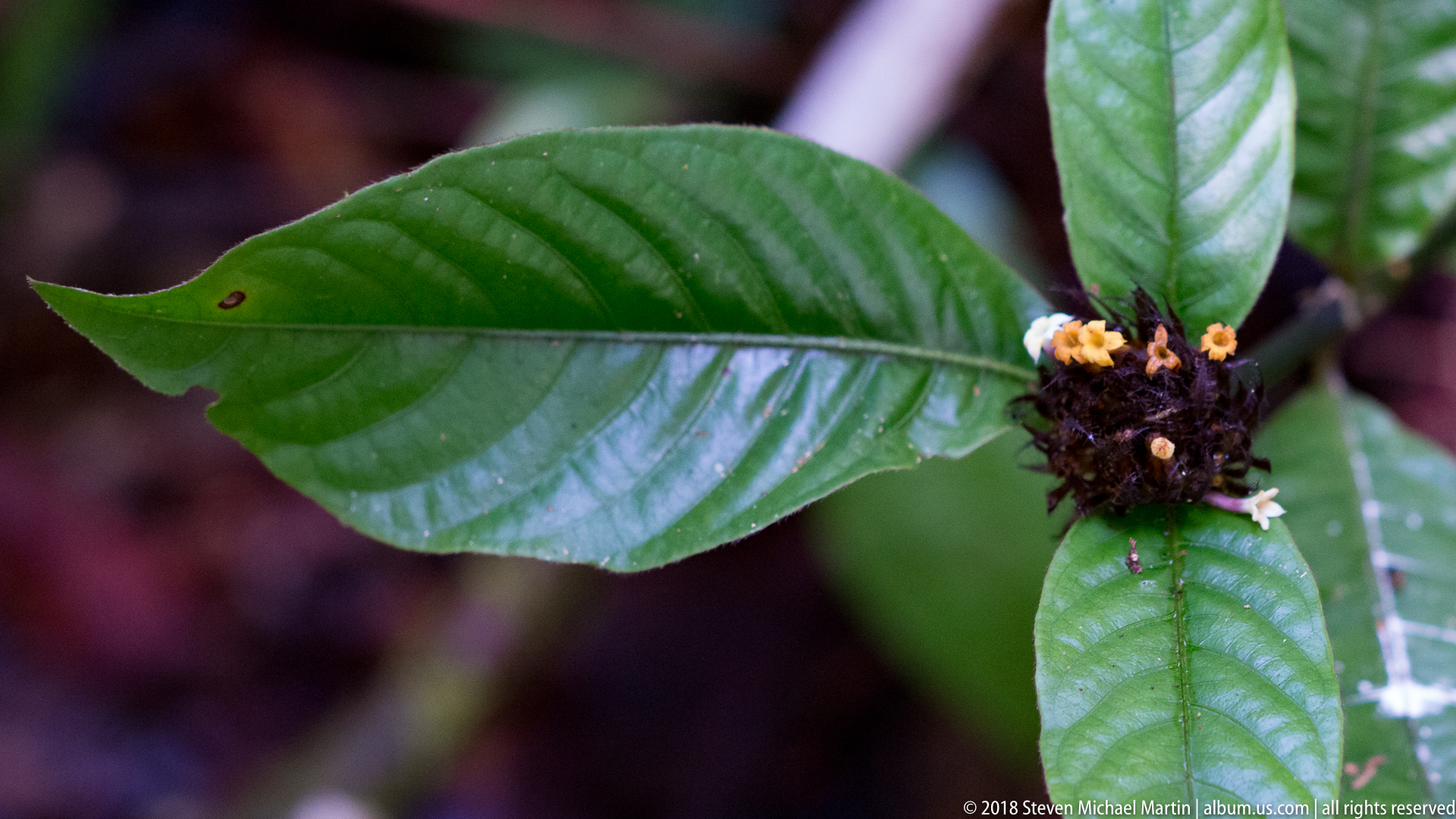
A compact dark flower cluster sits where several glossy, strongly veined leaves meet, punctuated by tiny orange and pale blossoms. The close botanical view records an unusual reproductive structure while preserving uncertainty about the plant's taxonomic identity, which cannot be established from the proof sheet alone.
Caption
A compact dark flower cluster sits where several glossy, strongly veined leaves meet, punctuated by tiny orange and pale blossoms. The close botanical view records an unusual reproductive structure while preserving uncertainty about the plant's taxonomic identity, which cannot be established from the proof sheet alone.

A developing shoot is densely covered with fine pale hairs, including the young stem, leaf margins, and compact buds at the node. Strong side light makes the pubescence conspicuous against the green leaves, turning the frame into a close study of protective plant hairs and new growth.
Caption
A developing shoot is densely covered with fine pale hairs, including the young stem, leaf margins, and compact buds at the node. Strong side light makes the pubescence conspicuous against the green leaves, turning the frame into a close study of protective plant hairs and new growth.

A narrow green leaf rises diagonally through the frame, its strongly pleated surface forming alternating bands of light and shadow. Sunlight accentuates the parallel folds and pointed tip, while the blurred forest background removes distractions and makes leaf architecture the primary subject.
Caption
A narrow green leaf rises diagonally through the frame, its strongly pleated surface forming alternating bands of light and shadow. Sunlight accentuates the parallel folds and pointed tip, while the blurred forest background removes distractions and makes leaf architecture the primary subject.

Small vivid pink flowers form a compact upright cluster above a hairy stem and broad green leaves. Several blossoms are open while darker buds remain below, allowing the macro view to record both flowering stages and the conspicuous bristles covering the plant's supporting tissues.
Caption
Small vivid pink flowers form a compact upright cluster above a hairy stem and broad green leaves. Several blossoms are open while darker buds remain below, allowing the macro view to record both flowering stages and the conspicuous bristles covering the plant's supporting tissues.

A very slender brown stick insect rests lengthwise on a broad green leaf, its narrow body aligned with the leaf's axis and exceptionally long antennae extending forward. Fine legs spread across the surface, while the twiglike form demonstrates the visual camouflage characteristic of phasmids.
Caption
A very slender brown stick insect rests lengthwise on a broad green leaf, its narrow body aligned with the leaf's axis and exceptionally long antennae extending forward. Fine legs spread across the surface, while the twiglike form demonstrates the visual camouflage characteristic of phasmids.

Viewed from above, a brown stick insect stands on a glossy green leaf marked by patches of moisture. Its elongated body, long antennae, and widely spaced legs are fully visible, providing a clearer dorsal study of the phasmid's proportions than the neighboring, more tightly aligned view.
Caption
Viewed from above, a brown stick insect stands on a glossy green leaf marked by patches of moisture. Its elongated body, long antennae, and widely spaced legs are fully visible, providing a clearer dorsal study of the phasmid's proportions than the neighboring, more tightly aligned view.

Hundreds of dark ants stream across and around a pale fallen branch, forming dense moving bands over the wood and adjacent debris. The overhead view reveals both concentrated clusters and thinner traffic lines, documenting coordinated colony movement through the rainforest's woody structure.
Caption
Hundreds of dark ants stream across and around a pale fallen branch, forming dense moving bands over the wood and adjacent debris. The overhead view reveals both concentrated clusters and thinner traffic lines, documenting coordinated colony movement through the rainforest's woody structure.

A thick mass of ants hangs beneath and around a horizontal branch where it meets a tree trunk, with additional insects spreading across the upper wood surface. The side view emphasizes the depth and density of the aggregation rather than the longer traffic patterns visible in adjacent frames.
Caption
A thick mass of ants hangs beneath and around a horizontal branch where it meets a tree trunk, with additional insects spreading across the upper wood surface. The side view emphasizes the depth and density of the aggregation rather than the longer traffic patterns visible in adjacent frames.

A stick insect bridges two green leaves, its thin brown body angled across the gap while the long antennae project beyond the upper leaf. The wider composition places the insect within surrounding understory foliage and shows how its linear shape blends among stems, petioles, and leaf edges.
Caption
A stick insect bridges two green leaves, its thin brown body angled across the gap while the long antennae project beyond the upper leaf. The wider composition places the insect within surrounding understory foliage and shows how its linear shape blends among stems, petioles, and leaf edges.

A small glossy beetle stands on a green leaf, its dark metallic body interrupted by bright orange patches on the wing covers. The compact macro portrait records the insect's rounded form, reflective surface, and contrasting coloration without assigning a family or species unsupported by the available view.
Caption
A small glossy beetle stands on a green leaf, its dark metallic body interrupted by bright orange patches on the wing covers. The compact macro portrait records the insect's rounded form, reflective surface, and contrasting coloration without assigning a family or species unsupported by the available view.

A tiny dark froglet rests on the broad surface of a fallen brown leaf, its compact body and folded hind limbs occupying only a small fraction of the frame. The leaf provides immediate scale and places the amphibian directly within the damp litter layer of the rainforest floor.
Caption
A tiny dark froglet rests on the broad surface of a fallen brown leaf, its compact body and folded hind limbs occupying only a small fraction of the frame. The leaf provides immediate scale and places the amphibian directly within the damp litter layer of the rainforest floor.

A dense aggregation of ants covers the junction where a pale branch meets a vertical tree trunk. Individuals form a dark living mass along the wood while narrower trails extend away from the concentration, showing colony traffic organized around a structural crossing point in the forest.
Caption
A dense aggregation of ants covers the junction where a pale branch meets a vertical tree trunk. Individuals form a dark living mass along the wood while narrower trails extend away from the concentration, showing colony traffic organized around a structural crossing point in the forest.

Tall buttress roots radiate from the base of a large rainforest tree, forming steep finlike ridges coated in patches of green moss. The low, close viewpoint emphasizes the scale and geometry of the root system as it spreads into the leaf-littered forest floor.
Caption
Tall buttress roots radiate from the base of a large rainforest tree, forming steep finlike ridges coated in patches of green moss. The low, close viewpoint emphasizes the scale and geometry of the root system as it spreads into the leaf-littered forest floor.
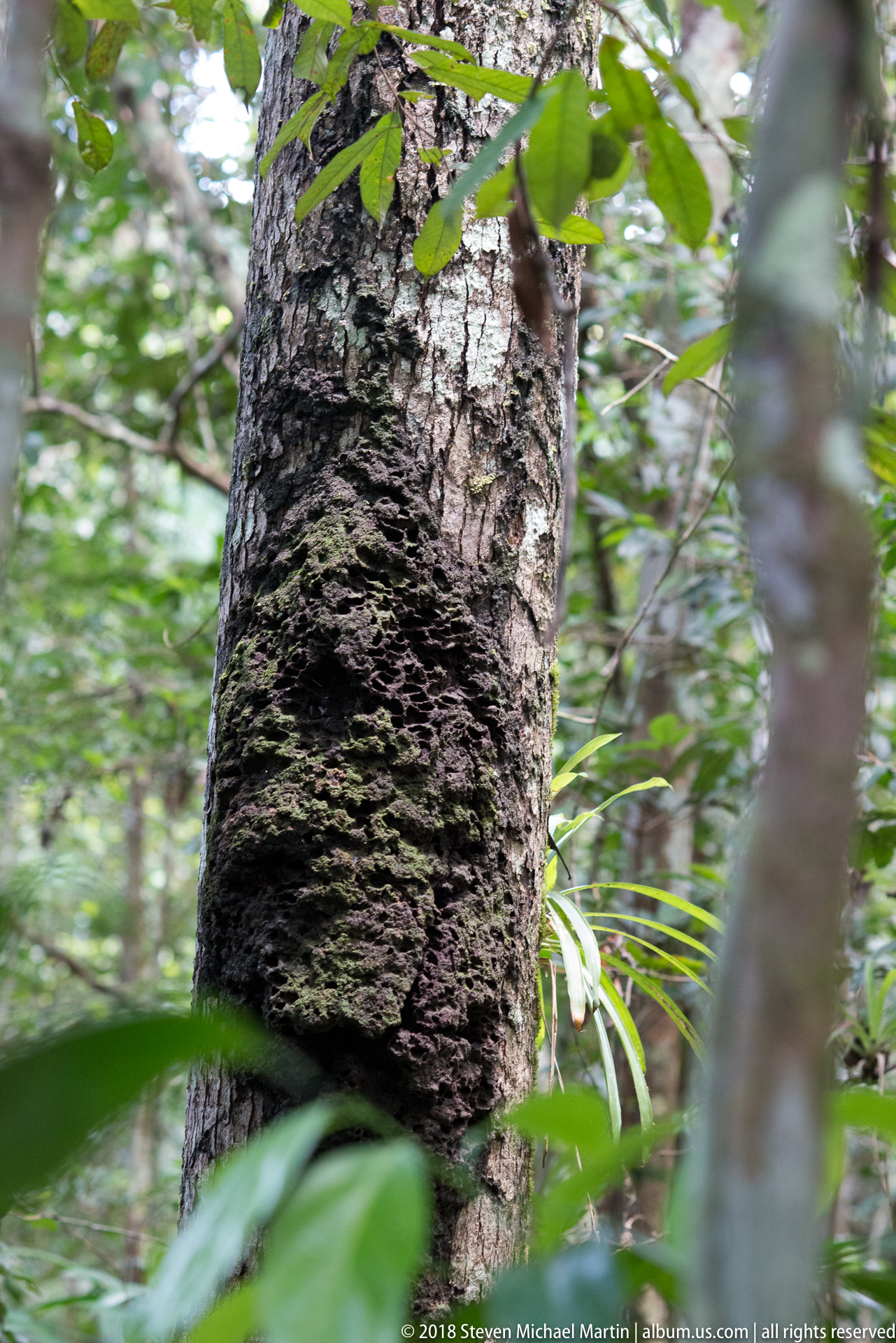
A broad, dark, layered growth wraps around the middle of a rainforest tree trunk, its rough horizontal ridges contrasting with the paler bark above and below. The surrounding foliage places the structure within dense tropical forest, while the photograph preserves its unusual form without assigning a biological origin that cannot be confirmed from the proof sheet.
Caption
A broad, dark, layered growth wraps around the middle of a rainforest tree trunk, its rough horizontal ridges contrasting with the paler bark above and below. The surrounding foliage places the structure within dense tropical forest, while the photograph preserves its unusual form without assigning a biological origin that cannot be confirmed from the proof sheet.

Dozens of thin bracket fungi project in overlapping tiers from a standing tree trunk, creating repeated shelves from near the base upward. Their dark brown caps and pale edges contrast with moss and weathered bark, making this one of the portfolio's most extensive examples of fungal colonization on living or standing woody substrate.
Caption
Dozens of thin bracket fungi project in overlapping tiers from a standing tree trunk, creating repeated shelves from near the base upward. Their dark brown caps and pale edges contrast with moss and weathered bark, making this one of the portfolio's most extensive examples of fungal colonization on living or standing woody substrate.

A dense mantle of mosses and small epiphytes drapes the lower trunk of a rainforest tree in long vertical strands. The textured green covering follows bark ridges toward the ground, while a few larger leaves interrupt the surface and reveal the layered plant community occupying the trunk.
Caption
A dense mantle of mosses and small epiphytes drapes the lower trunk of a rainforest tree in long vertical strands. The textured green covering follows bark ridges toward the ground, while a few larger leaves interrupt the surface and reveal the layered plant community occupying the trunk.

A tiny lizard is held gently between a person's fingertips for close examination, its narrow body and small limbs silhouetted against a softly blurred forest background. The tight composition records scale particularly well, with the animal occupying only the tip of the hand while its head and tail remain visible in profile.
Caption
A tiny lizard is held gently between a person's fingertips for close examination, its narrow body and small limbs silhouetted against a softly blurred forest background. The tight composition records scale particularly well, with the animal occupying only the tip of the hand while its head and tail remain visible in profile.
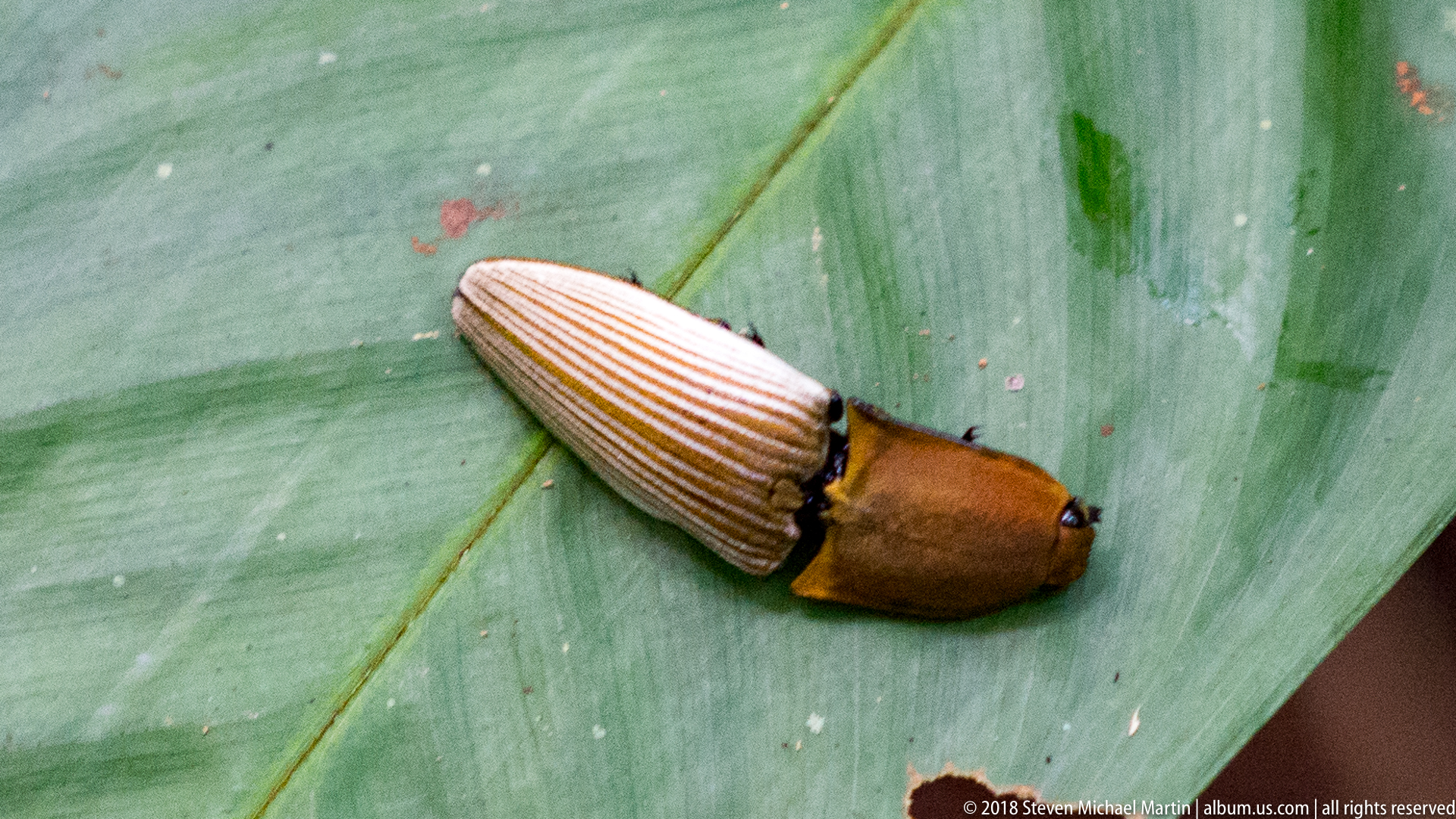
A large beetle rests on a broad green leaf, its elongated cream wing covers marked by fine orange longitudinal stripes and its darker head separated by a warm brown thoracic shield. The close view makes the contrasting pattern and hard elytra especially clear while avoiding an unsupported family or species identification.
Caption
A large beetle rests on a broad green leaf, its elongated cream wing covers marked by fine orange longitudinal stripes and its darker head separated by a warm brown thoracic shield. The close view makes the contrasting pattern and hard elytra especially clear while avoiding an unsupported family or species identification.

A small, vividly colored sap-feeding insect stands along the central vein of a dark green leaf. Metallic blue, orange, red, and pale markings run lengthwise across its narrow body, while long legs and a tapered profile distinguish it from the broader beetle in the preceding frame.
Caption
A small, vividly colored sap-feeding insect stands along the central vein of a dark green leaf. Metallic blue, orange, red, and pale markings run lengthwise across its narrow body, while long legs and a tapered profile distinguish it from the broader beetle in the preceding frame.

Several thick woody lianas loop, twist, and cross between tree trunks high in the forest, forming a dense network of suspended curves against layered green foliage. The wider composition shifts attention from individual vine texture to the structural complexity created by mature climbers within the rainforest's vertical space.
Caption
Several thick woody lianas loop, twist, and cross between tree trunks high in the forest, forming a dense network of suspended curves against layered green foliage. The wider composition shifts attention from individual vine texture to the structural complexity created by mature climbers within the rainforest's vertical space.

A slender red reproductive stem stands upright within a cluster of translucent, strongly veined leaves. Small dark rounded structures remain on several short side stalks, while the wider framing places the plant within the surrounding canopy and emphasizes the luminous leaf architecture more than the close detail seen in the previous view.
Caption
A slender red reproductive stem stands upright within a cluster of translucent, strongly veined leaves. Small dark rounded structures remain on several short side stalks, while the wider framing places the plant within the surrounding canopy and emphasizes the luminous leaf architecture more than the close detail seen in the previous view.

A vivid red upright flower spike rises between strongly veined green leaves, with short lateral stalks and several dark developing buds or fruits projecting from the stem. Backlighting reveals the leaves' venation and turns the reproductive structure into a strong silhouette against the brighter forest beyond.
Caption
A vivid red upright flower spike rises between strongly veined green leaves, with short lateral stalks and several dark developing buds or fruits projecting from the stem. Backlighting reveals the leaves' venation and turns the reproductive structure into a strong silhouette against the brighter forest beyond.

A small forest bird perches low on a diagonal branch, seen mostly from the rear. An olive back, pale-barred wings, and a bright red crown patch are visible despite partial motion blur, establishing a distinctive color combination while leaving species identification uncertain.
Caption
A small forest bird perches low on a diagonal branch, seen mostly from the rear. An olive back, pale-barred wings, and a bright red crown patch are visible despite partial motion blur, establishing a distinctive color combination while leaving species identification uncertain.

Seen directly from behind, a small olive-yellow forest bird balances on a slender horizontal branch. A vivid red crown caps the head, while barred wings and tail feathers fan slightly below, offering a clearer view of the bird's rear plumage pattern than the preceding frame.
Caption
Seen directly from behind, a small olive-yellow forest bird balances on a slender horizontal branch. A vivid red crown caps the head, while barred wings and tail feathers fan slightly below, offering a clearer view of the bird's rear plumage pattern than the preceding frame.

A small red-crowned forest bird sits on a horizontal branch against a bright, softly blurred canopy. The bird's compact form, olive body, and pale-barred folded wings are visible from behind, while the more distant framing emphasizes its minute scale within the surrounding forest.
Caption
A small red-crowned forest bird sits on a horizontal branch against a bright, softly blurred canopy. The bird's compact form, olive body, and pale-barred folded wings are visible from behind, while the more distant framing emphasizes its minute scale within the surrounding forest.

A closer rear portrait centers a small olive forest bird on a branch, with the red crown sharply visible above a yellow-green back and pale-barred folded wings. The tighter crop provides the sequence's strongest view of the crown and dorsal coloration while still withholding enough facial and bill detail to make species assignment uncertain.
Caption
A closer rear portrait centers a small olive forest bird on a branch, with the red crown sharply visible above a yellow-green back and pale-barred folded wings. The tighter crop provides the sequence's strongest view of the crown and dorsal coloration while still withholding enough facial and bill detail to make species assignment uncertain.

A small olive forest bird perches quietly on a sloping branch, its red crown visible above a rounded back and barred wings. The rear three-quarter view differs subtly from the preceding portraits by showing more of the head profile while retaining the softly luminous rainforest background.
Caption
A small olive forest bird perches quietly on a sloping branch, its red crown visible above a rounded back and barred wings. The rear three-quarter view differs subtly from the preceding portraits by showing more of the head profile while retaining the softly luminous rainforest background.

Clusters of bright yellow flowers open among glossy green leaves beside a large rainforest tree. Several blossoms face outward from a woody stem while additional buds remain above, creating a contextual view of flowering vegetation woven through the shaded forest structure.
Caption
Clusters of bright yellow flowers open among glossy green leaves beside a large rainforest tree. Several blossoms face outward from a woody stem while additional buds remain above, creating a contextual view of flowering vegetation woven through the shaded forest structure.

A yellow-flowering climbing plant threads through overlapping leaves and branches in the rainforest understory. The wider view places several flower clusters at different depths, revealing how the plant is integrated into surrounding vegetation rather than isolating a single bloom or stem.
Caption
A yellow-flowering climbing plant threads through overlapping leaves and branches in the rainforest understory. The wider view places several flower clusters at different depths, revealing how the plant is integrated into surrounding vegetation rather than isolating a single bloom or stem.

A rounded reddish earthen mound rises from the leaf-littered rainforest floor beneath scattered understory plants. Its granular surface and irregular domed form are consistent with termite construction, while dappled sunlight reveals the mound's texture against darker leaves and soil.
Caption
A rounded reddish earthen mound rises from the leaf-littered rainforest floor beneath scattered understory plants. Its granular surface and irregular domed form are consistent with termite construction, while dappled sunlight reveals the mound's texture against darker leaves and soil.

Several pale trunks or stilt roots converge near the forest floor, their surfaces armed with dense short spines. The close crop emphasizes the defensive texture and angular support structure, with moss-darkened bark on an adjacent stem providing contrast to the paler, heavily armed surfaces.
Caption
Several pale trunks or stilt roots converge near the forest floor, their surfaces armed with dense short spines. The close crop emphasizes the defensive texture and angular support structure, with moss-darkened bark on an adjacent stem providing contrast to the paler, heavily armed surfaces.

A large gray-brown oval nest is built around a substantial rainforest branch, suspended high among broad leaves. Its solid, rough exterior and complete enclosure distinguish it from open bird nests and are consistent with an arboreal social-insect colony, though the builders are not visible.
Caption
A large gray-brown oval nest is built around a substantial rainforest branch, suspended high among broad leaves. Its solid, rough exterior and complete enclosure distinguish it from open bird nests and are consistent with an arboreal social-insect colony, though the builders are not visible.
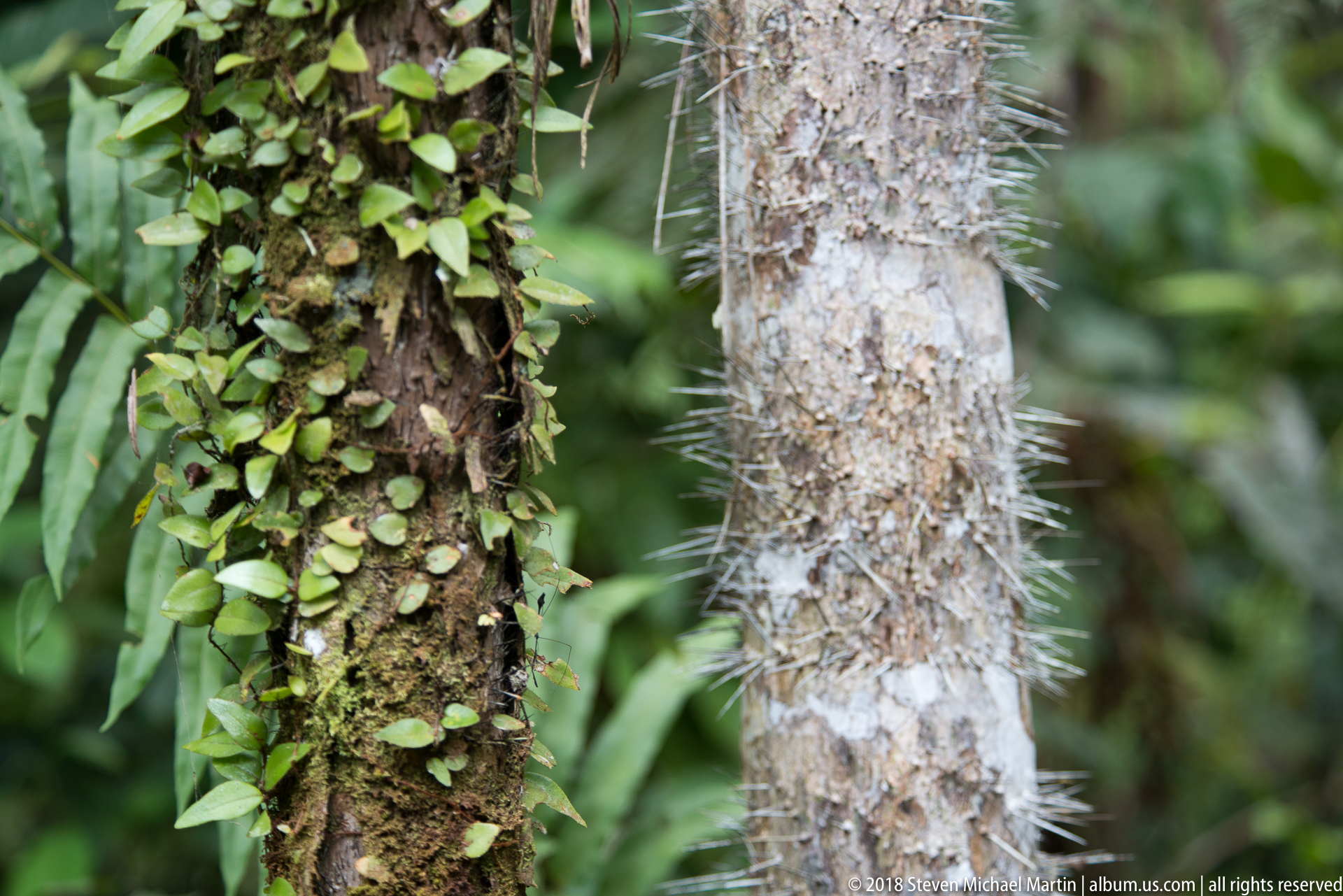
A pale trunk armed with long, widely spaced spines stands beside a darker tree densely covered with mosses and small epiphytes. The paired trunks create a comparative study of rainforest bark surfaces: one defended by rigid spines, the other supporting a layered community of plants and organic growth.
Caption
A pale trunk armed with long, widely spaced spines stands beside a darker tree densely covered with mosses and small epiphytes. The paired trunks create a comparative study of rainforest bark surfaces: one defended by rigid spines, the other supporting a layered community of plants and organic growth.