Yaxhá
Yaxhá is located between two lagoons within the protected forests of northern Guatemala, creating a distinctive setting for this Maya ceremonial center. The site includes pyramids, plazas, and causeways that illustrate the planning of a significant regional settlement. Its quieter atmosphere contrasts with larger archaeological sites while preserving important architectural features.
Elevated temples provide views across the surrounding forest and nearby lakes, demonstrating how geography influenced the placement of Maya cities. The combination of water resources and fertile land contributed to the development of the settlement. Archaeological remains reveal connections to other important cities of the Petén region.
Yaxhá offers insight into the regional network of Maya communities that supported trade and cultural exchange. The integration of architecture and natural landscape highlights the environmental context in which the civilization developed.

A broad central stairway climbs the face of a stepped Maya temple-pyramid at Yaxha, framed by mature trees and a grassy plaza. The frontal view clearly records the monument’s tiered massing, battered masonry, and strong axial approach from the open ground in front.
Caption
A broad central stairway climbs the face of a stepped Maya temple-pyramid at Yaxha, framed by mature trees and a grassy plaza. The frontal view clearly records the monument’s tiered massing, battered masonry, and strong axial approach from the open ground in front.

A visitor is photographed from an elevated viewpoint with Lake Yaxha spreading behind him beyond an unbroken canopy of tropical forest. The portrait links the archaeological site to its surrounding landscape, where the broad lake and densely wooded lowlands form a defining part of the setting.
Caption
A visitor is photographed from an elevated viewpoint with Lake Yaxha spreading behind him beyond an unbroken canopy of tropical forest. The portrait links the archaeological site to its surrounding landscape, where the broad lake and densely wooded lowlands form a defining part of the setting.

Two visitors pose on an elevated stone structure at Yaxha with the lake and forested lowlands extending behind them. Their position above the canopy provides a strong sense of the vertical scale of the ruins and the ancient city’s setting within a landscape of water, forest, plazas, and monumental architecture.
Caption
Two visitors pose on an elevated stone structure at Yaxha with the lake and forested lowlands extending behind them. Their position above the canopy provides a strong sense of the vertical scale of the ruins and the ancient city’s setting within a landscape of water, forest, plazas, and monumental architecture.

A visitor stands on the upper masonry of a Yaxha structure with the site’s green canopy, a formal plaza, and the lake spread out behind him. The elevated viewpoint conveys the commanding relationship between monumental Maya architecture and the surrounding Petén landscape, where ceremonial and civic spaces were embedded within dense tropical forest.
Caption
A visitor stands on the upper masonry of a Yaxha structure with the site’s green canopy, a formal plaza, and the lake spread out behind him. The elevated viewpoint conveys the commanding relationship between monumental Maya architecture and the surrounding Petén landscape, where ceremonial and civic spaces were embedded within dense tropical forest.

Two visitors sit near the summit of a monumental Yaxha structure, with the lake stretching across the horizon and a lower plaza framed by tropical vegetation below. The photograph combines human scale with the site’s vertical architecture and broad environmental setting, emphasizing how the ancient city rises above the Petén forest.
Caption
Two visitors sit near the summit of a monumental Yaxha structure, with the lake stretching across the horizon and a lower plaza framed by tropical vegetation below. The photograph combines human scale with the site’s vertical architecture and broad environmental setting, emphasizing how the ancient city rises above the Petén forest.

From high on a Maya structure, the view opens across the forest canopy to Lake Yaxha and low wooded shorelines under a layered sky. Rough stonework in the foreground records the archaeological vantage point, while the broad water and forest reveal the ancient city’s commanding relationship to the surrounding landscape.
Caption
From high on a Maya structure, the view opens across the forest canopy to Lake Yaxha and low wooded shorelines under a layered sky. Rough stonework in the foreground records the archaeological vantage point, while the broad water and forest reveal the ancient city’s commanding relationship to the surrounding landscape.

From farther across the plaza, the same stepped temple-pyramid appears partly framed by a large tree and surrounding forest. The wider composition places the monument within its cleared ceremonial space and shows how the surviving stone architecture rises abruptly from the low grass.
Caption
From farther across the plaza, the same stepped temple-pyramid appears partly framed by a large tree and surrounding forest. The wider composition places the monument within its cleared ceremonial space and shows how the surviving stone architecture rises abruptly from the low grass.

A narrow recessed feature runs between weathered masonry at Yaxha, with layered stone construction visible along both sides. Its form suggests a passage, drainage channel, or structural gap associated with the surrounding architecture, but the limited view does not support a more exact functional identification.
Caption
A narrow recessed feature runs between weathered masonry at Yaxha, with layered stone construction visible along both sides. Its form suggests a passage, drainage channel, or structural gap associated with the surrounding architecture, but the limited view does not support a more exact functional identification.

A low, tree-covered archaeological mound rises beside a maintained visitor path at Yaxha. Sparse exposed masonry and the gently sloping ground show how many structures at the site remain partly absorbed by the forest, contrasting with the more fully exposed temple-pyramids nearby.
Caption
A low, tree-covered archaeological mound rises beside a maintained visitor path at Yaxha. Sparse exposed masonry and the gently sloping ground show how many structures at the site remain partly absorbed by the forest, contrasting with the more fully exposed temple-pyramids nearby.

A black howler monkey moves through dense broadleaf canopy at Yaxha, using its long limbs and tail to negotiate a lattice of leafy branches. The close wildlife view places the animal within the humid lowland forest that surrounds and interweaves with the archaeological site.
Caption
A black howler monkey moves through dense broadleaf canopy at Yaxha, using its long limbs and tail to negotiate a lattice of leafy branches. The close wildlife view places the animal within the humid lowland forest that surrounds and interweaves with the archaeological site.

A black howler monkey hangs head-down among glossy leaves, its long tail extending vertically above the body as it reaches into the canopy. The unusual posture and frontal view make this frame especially useful for showing the arboreal movement of primates living in the forest around Yaxha.
Caption
A black howler monkey hangs head-down among glossy leaves, its long tail extending vertically above the body as it reaches into the canopy. The unusual posture and frontal view make this frame especially useful for showing the arboreal movement of primates living in the forest around Yaxha.
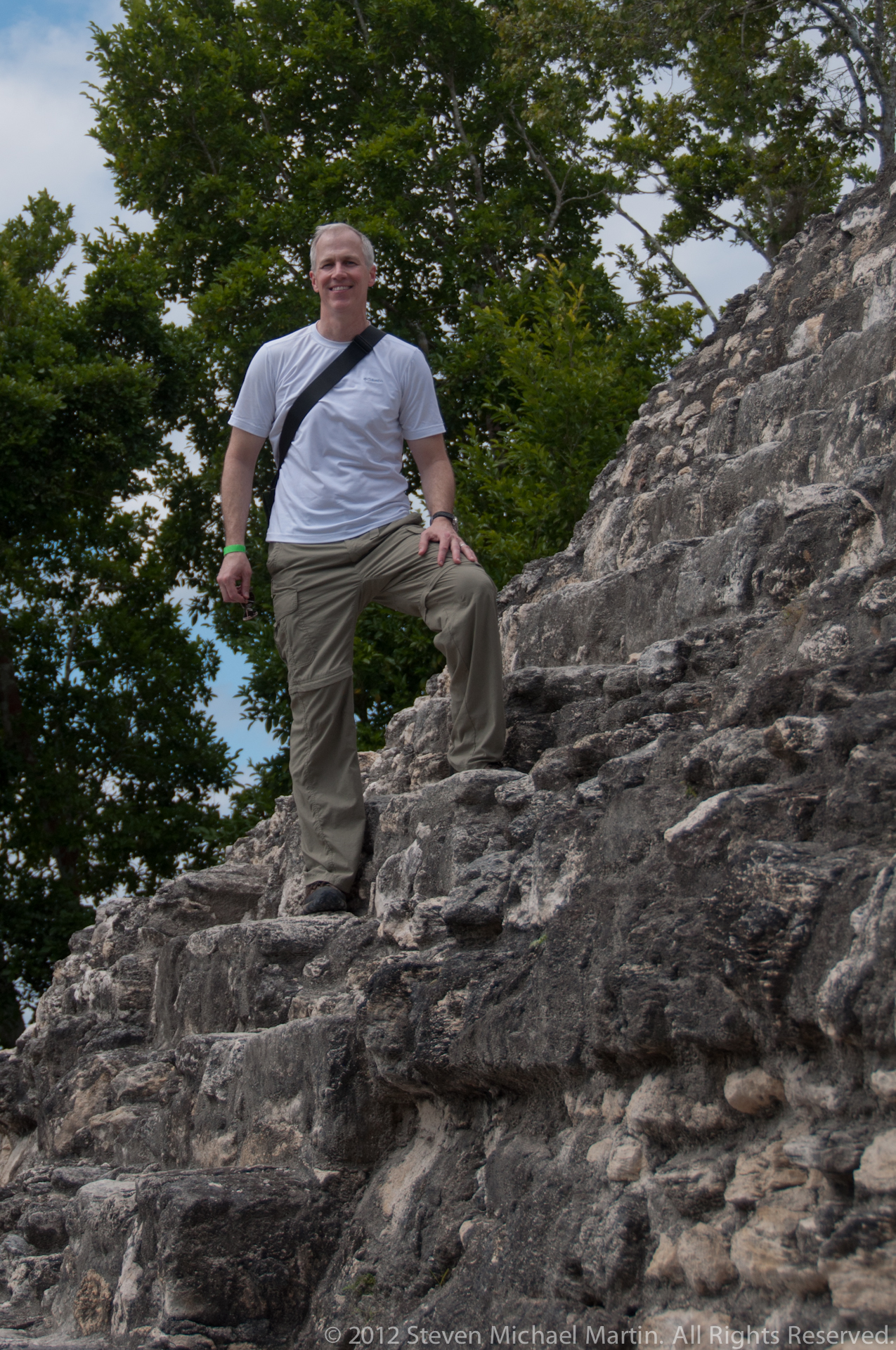
A visitor pauses on a steep run of weathered limestone steps at Yaxha, with rough masonry filling most of the frame and forest foliage visible beyond the structure. The low viewpoint emphasizes the scale, irregular surface, and accumulated wear of the ancient stairway.
Caption
A visitor pauses on a steep run of weathered limestone steps at Yaxha, with rough masonry filling most of the frame and forest foliage visible beyond the structure. The low viewpoint emphasizes the scale, irregular surface, and accumulated wear of the ancient stairway.

Seen from below, a visitor stands against a cloudy sky on the upper edge of a ruined Maya structure at Yaxha. Massive weathered blocks and broken wall lines fill the foreground, turning the human figure into a scale reference for the surviving masonry.
Caption
Seen from below, a visitor stands against a cloudy sky on the upper edge of a ruined Maya structure at Yaxha. Massive weathered blocks and broken wall lines fill the foreground, turning the human figure into a scale reference for the surviving masonry.

Partly screened by sunlit foliage, a black howler monkey looks outward from a dense cluster of leaves at Yaxha. The animal’s dark face and heavy black coat contrast strongly with the bright green canopy, producing an intimate portrait of the site’s living tropical-forest environment.
Caption
Partly screened by sunlit foliage, a black howler monkey looks outward from a dense cluster of leaves at Yaxha. The animal’s dark face and heavy black coat contrast strongly with the bright green canopy, producing an intimate portrait of the site’s living tropical-forest environment.

An oblique view traces the layered terraces and projecting stair masses of a Maya temple-pyramid at Yaxha. Sun and shade model the weathered limestone surfaces, revealing the structure’s stepped profile and the way its platformed sides meet the surrounding lawn and forest.
Caption
An oblique view traces the layered terraces and projecting stair masses of a Maya temple-pyramid at Yaxha. Sun and shade model the weathered limestone surfaces, revealing the structure’s stepped profile and the way its platformed sides meet the surrounding lawn and forest.

A pale, weathered stone monument stands upright beneath the forest canopy at Yaxha, its face covered by shallow, eroded reliefs and irregular surface marks. The close view concentrates on the surviving carving and worn stone texture rather than the monument’s wider archaeological setting.
Caption
A pale, weathered stone monument stands upright beneath the forest canopy at Yaxha, its face covered by shallow, eroded reliefs and irregular surface marks. The close view concentrates on the surviving carving and worn stone texture rather than the monument’s wider archaeological setting.

A low Maya stone platform sits within a shaded clearing, its surviving masonry forming a modest raised mass beneath spreading trees. The understated view records a less monumental part of Yaxha, where low architectural remains and forest vegetation share nearly the same visual plane.
Caption
A low Maya stone platform sits within a shaded clearing, its surviving masonry forming a modest raised mass beneath spreading trees. The understated view records a less monumental part of Yaxha, where low architectural remains and forest vegetation share nearly the same visual plane.

A steep stairway cuts upward through the center of a heavily stepped Maya monument at Yaxha. Photographed from close range and slightly off axis, the frame emphasizes the height of the stair, the layered terrace faces, and the irregular texture of exposed limestone masonry.
Caption
A steep stairway cuts upward through the center of a heavily stepped Maya monument at Yaxha. Photographed from close range and slightly off axis, the frame emphasizes the height of the stair, the layered terrace faces, and the irregular texture of exposed limestone masonry.

A small open-sided pavilion with a steep palm-thatch roof stands among coconut palms and modest buildings near Yaxha. Plastic chairs and everyday objects beneath the shelter distinguish this contemporary lived environment from the monumental archaeological architecture seen elsewhere in the portfolio.
Caption
A small open-sided pavilion with a steep palm-thatch roof stands among coconut palms and modest buildings near Yaxha. Plastic chairs and everyday objects beneath the shelter distinguish this contemporary lived environment from the monumental archaeological architecture seen elsewhere in the portfolio.

A wooden sign identifies the Reserva de la Biosfera Maya and Parque Nacional Yaxhá-Nakum-Naranjo, with CONAP named below as Guatemala’s protected-areas authority. The sign provides direct documentary evidence for Yaxha’s location within the wider conservation landscape surrounding the archaeological site.
Caption
A wooden sign identifies the Reserva de la Biosfera Maya and Parque Nacional Yaxhá-Nakum-Naranjo, with CONAP named below as Guatemala’s protected-areas authority. The sign provides direct documentary evidence for Yaxha’s location within the wider conservation landscape surrounding the archaeological site.

A site model labeled “Acrópolis Norte” presents a cluster of stepped Maya buildings arranged on an elevated platform. The miniature makes the compound’s spatial organization legible at a glance, with multiple stairways and pyramidal masses grouped around a shared architectural precinct.
Caption
A site model labeled “Acrópolis Norte” presents a cluster of stepped Maya buildings arranged on an elevated platform. The miniature makes the compound’s spatial organization legible at a glance, with multiple stairways and pyramidal masses grouped around a shared architectural precinct.

A scale model labeled “Complejo Astronómico Menor” shows a compact stepped Maya complex with opposing stairways and tiered platforms. Presented as an interpretive display, the model clarifies the architectural massing and planned relationship of structures that can be difficult to read from ground level among the ruins.
Caption
A scale model labeled “Complejo Astronómico Menor” shows a compact stepped Maya complex with opposing stairways and tiered platforms. Presented as an interpretive display, the model clarifies the architectural massing and planned relationship of structures that can be difficult to read from ground level among the ruins.

A broad Maya pyramid rises from the grass in a nearly symmetrical frontal view, its central stairway climbing toward a rounded, heavily weathered summit. The restrained composition records the monument’s overall geometry and the contrast between dark limestone courses, open sky, and encircling forest.
Caption
A broad Maya pyramid rises from the grass in a nearly symmetrical frontal view, its central stairway climbing toward a rounded, heavily weathered summit. The restrained composition records the monument’s overall geometry and the contrast between dark limestone courses, open sky, and encircling forest.

A visitor stands before a low stepped Maya platform whose broad terraces extend horizontally through the forest. Large displaced stone blocks lie in the foreground, adding evidence of collapse and reconstruction while the human figure provides a useful sense of scale for the surviving architecture.
Caption
A visitor stands before a low stepped Maya platform whose broad terraces extend horizontally through the forest. Large displaced stone blocks lie in the foreground, adding evidence of collapse and reconstruction while the human figure provides a useful sense of scale for the surviving architecture.

A brightly colored trogon perches on a slender branch in the forest at Yaxha, showing a dark head, iridescent blue-green upperparts, and vivid yellow belly. The isolated profile stands out against the soft woodland background and records the rich birdlife of the protected landscape surrounding the Maya ruins.
Caption
A brightly colored trogon perches on a slender branch in the forest at Yaxha, showing a dark head, iridescent blue-green upperparts, and vivid yellow belly. The isolated profile stands out against the soft woodland background and records the rich birdlife of the protected landscape surrounding the Maya ruins.

A visitor stands beside a tall carved Maya stela set upright on a shaded slope at Yaxha. The juxtaposition makes the monument’s human-scale proportions immediately legible while also revealing the softened, weathered relief carving that survives across the stone face.
Caption
A visitor stands beside a tall carved Maya stela set upright on a shaded slope at Yaxha. The juxtaposition makes the monument’s human-scale proportions immediately legible while also revealing the softened, weathered relief carving that survives across the stone face.

A black howler monkey moves through the upper foliage as a dark silhouette against sunlit leaves. Less intimate than the earlier portraits, this view emphasizes concealment and motion within the canopy, showing how easily large primates can disappear into the dense forest around Yaxha.
Caption
A black howler monkey moves through the upper foliage as a dark silhouette against sunlit leaves. Less intimate than the earlier portraits, this view emphasizes concealment and motion within the canopy, showing how easily large primates can disappear into the dense forest around Yaxha.

Framed behind a low stone wall, a visitor stands inside the remains of a Maya building at Yaxha. Broken masonry, an irregular doorway-like opening, and the uneven upper wall line convey the fragmentary condition of the structure more directly than the site’s restored exterior monuments.
Caption
Framed behind a low stone wall, a visitor stands inside the remains of a Maya building at Yaxha. Broken masonry, an irregular doorway-like opening, and the uneven upper wall line convey the fragmentary condition of the structure more directly than the site’s restored exterior monuments.

A narrow run of steps climbs beside a long Maya masonry wall on a forested slope at Yaxha. Vegetation grows tightly against the stonework, while the layered wall face and elevated path reveal the site’s complex adaptation to uneven terrain beyond its major plazas.
Caption
A narrow run of steps climbs beside a long Maya masonry wall on a forested slope at Yaxha. Vegetation grows tightly against the stonework, while the layered wall face and elevated path reveal the site’s complex adaptation to uneven terrain beyond its major plazas.

A tall, steep-sided Maya temple-pyramid dominates the clearing, its central stairway rising toward a high summit block between dense trees. The frontal view stresses verticality and the monument’s sharply battered terraces, with a low circular stone feature visible in the foreground lawn.
Caption
A tall, steep-sided Maya temple-pyramid dominates the clearing, its central stairway rising toward a high summit block between dense trees. The frontal view stresses verticality and the monument’s sharply battered terraces, with a low circular stone feature visible in the foreground lawn.

Two visitors stand at the base of a towering Maya temple-pyramid, providing an immediate scale comparison for the broad stair and massive stepped terraces. The front-facing composition makes the height and steep ascent especially apparent, while forest trees frame the monument on both sides.
Caption
Two visitors stand at the base of a towering Maya temple-pyramid, providing an immediate scale comparison for the broad stair and massive stepped terraces. The front-facing composition makes the height and steep ascent especially apparent, while forest trees frame the monument on both sides.

Two visitors sit in the grass before a monumental Maya temple-pyramid at Yaxha, transforming the view into both a portrait and a study of architectural scale. The vast stepped façade fills the background, while a low circular stone feature in the foreground anchors the composition.
Caption
Two visitors sit in the grass before a monumental Maya temple-pyramid at Yaxha, transforming the view into both a portrait and a study of architectural scale. The vast stepped façade fills the background, while a low circular stone feature in the foreground anchors the composition.

A visitor stands within roofless Maya masonry at Yaxha, surrounded by thick walls of irregular limestone blocks and a broken opening behind him. The close architectural setting shifts attention from monumental exterior massing to the enclosed spaces, wall thickness, and surviving fabric of the ruins.
Caption
A visitor stands within roofless Maya masonry at Yaxha, surrounded by thick walls of irregular limestone blocks and a broken opening behind him. The close architectural setting shifts attention from monumental exterior massing to the enclosed spaces, wall thickness, and surviving fabric of the ruins.

Against a softly focused backdrop of Lake Yaxha and dense green forest, a visitor poses near the summit-level viewpoint. The tighter framing emphasizes the human portrait while retaining enough of the lake and forest to establish the elevated landscape context of the archaeological site.
Caption
Against a softly focused backdrop of Lake Yaxha and dense green forest, a visitor poses near the summit-level viewpoint. The tighter framing emphasizes the human portrait while retaining enough of the lake and forest to establish the elevated landscape context of the archaeological site.

From the upper levels of a masonry structure at Yaxha, the view opens across dense tropical forest toward the lake that defines the site’s broader landscape. Lower stone platforms and a cleared plaza are visible below, showing how monumental architecture, open civic space, and the surrounding lowland environment are layered within the ancient Maya city.
Caption
From the upper levels of a masonry structure at Yaxha, the view opens across dense tropical forest toward the lake that defines the site’s broader landscape. Lower stone platforms and a cleared plaza are visible below, showing how monumental architecture, open civic space, and the surrounding lowland environment are layered within the ancient Maya city.

Weathered limestone blocks preserve shallow carved reliefs at Yaxha, including repeated geometric bands and curving motifs across their surfaces. Seen at close range, the worn carving reveals the texture of ancient masonry and decoration while also showing the effects of age, exposure, and archaeological preservation.
Caption
Weathered limestone blocks preserve shallow carved reliefs at Yaxha, including repeated geometric bands and curving motifs across their surfaces. Seen at close range, the worn carving reveals the texture of ancient masonry and decoration while also showing the effects of age, exposure, and archaeological preservation.

A low, rounded mound rises beneath mature trees at Yaxha, its surface covered with soil, leaf litter, and exposed roots rather than fully visible masonry. Such subdued forms reveal how unexcavated or partially stabilized architecture can blend into the forest floor, preserving traces of the ancient city beneath vegetation.
Caption
A low, rounded mound rises beneath mature trees at Yaxha, its surface covered with soil, leaf litter, and exposed roots rather than fully visible masonry. Such subdued forms reveal how unexcavated or partially stabilized architecture can blend into the forest floor, preserving traces of the ancient city beneath vegetation.

Massive tropical trees line a shaded clearing within the archaeological zone at Yaxha, their exposed buttress roots and dense canopy illustrating the forest environment that surrounds and often conceals Maya architecture. The scene places the ruins within the living lowland ecosystem that has reclaimed much of the ancient city.
Caption
Massive tropical trees line a shaded clearing within the archaeological zone at Yaxha, their exposed buttress roots and dense canopy illustrating the forest environment that surrounds and often conceals Maya architecture. The scene places the ruins within the living lowland ecosystem that has reclaimed much of the ancient city.

A broad curving relief motif emerges from a pale architectural surface at Yaxha, its rounded forms softened by erosion and age. The surviving decoration appears integrated into a larger architectural program, but the proof sheet does not provide enough context to identify the exact motif or structure with confidence.
Caption
A broad curving relief motif emerges from a pale architectural surface at Yaxha, its rounded forms softened by erosion and age. The surviving decoration appears integrated into a larger architectural program, but the proof sheet does not provide enough context to identify the exact motif or structure with confidence.

A visitor stands in an open grassy space at Yaxha surrounded by stepped Maya architecture rising through the forest. The scene provides human scale for the broad masonry terraces and stairways, while trees and palms show how the monumental core remains closely integrated with the surrounding tropical vegetation.
Caption
A visitor stands in an open grassy space at Yaxha surrounded by stepped Maya architecture rising through the forest. The scene provides human scale for the broad masonry terraces and stairways, while trees and palms show how the monumental core remains closely integrated with the surrounding tropical vegetation.

A monumental stepped pyramid rises above a grassy clearing at Yaxha, its broad terraces and central stairway forming a strong geometric mass between mature trees. Vegetation clings to portions of the upper structure, revealing the ongoing visual tension between conserved Maya architecture and the tropical forest that surrounds it.
Caption
A monumental stepped pyramid rises above a grassy clearing at Yaxha, its broad terraces and central stairway forming a strong geometric mass between mature trees. Vegetation clings to portions of the upper structure, revealing the ongoing visual tension between conserved Maya architecture and the tropical forest that surrounds it.

A lone visitor appears partway up the steep central stairway of a massive Maya pyramid at Yaxha, giving a vivid sense of the structure’s scale. The broad masonry face fills the frame, emphasizing the steep ascent, repetitive stone courses, and imposing geometry of the ancient architecture.
Caption
A lone visitor appears partway up the steep central stairway of a massive Maya pyramid at Yaxha, giving a vivid sense of the structure’s scale. The broad masonry face fills the frame, emphasizing the steep ascent, repetitive stone courses, and imposing geometry of the ancient architecture.

A visitor stands with arms raised on the summit of a weathered Maya structure at Yaxha as dark clouds gather overhead. The low-angle composition turns the stepped masonry and summit silhouette into a dramatic study of scale, elevation, and the exposed upper levels of monumental architecture.
Caption
A visitor stands with arms raised on the summit of a weathered Maya structure at Yaxha as dark clouds gather overhead. The low-angle composition turns the stepped masonry and summit silhouette into a dramatic study of scale, elevation, and the exposed upper levels of monumental architecture.

Closely framed stone steps create a dense pattern of horizontal lines across the face of a Maya structure at Yaxha. Weathering, discoloration, and slight irregularities in the masonry reveal the age and texture of the construction while emphasizing the steep repetitive geometry of the stairway.
Caption
Closely framed stone steps create a dense pattern of horizontal lines across the face of a Maya structure at Yaxha. Weathering, discoloration, and slight irregularities in the masonry reveal the age and texture of the construction while emphasizing the steep repetitive geometry of the stairway.

A tall stepped pyramid at Yaxha rises from a grassy base, its broad central stairway climbing toward a partially preserved summit. The frontal composition emphasizes the monument’s symmetry, stacked terraces, and steep ascent, while surrounding trees show how the architecture remains embedded within the forest.
Caption
A tall stepped pyramid at Yaxha rises from a grassy base, its broad central stairway climbing toward a partially preserved summit. The frontal composition emphasizes the monument’s symmetry, stacked terraces, and steep ascent, while surrounding trees show how the architecture remains embedded within the forest.

Seen from an elevated neighboring structure, this terraced Maya pyramid at Yaxha reveals its complex massing of stepped platforms and multiple stairways. The oblique viewpoint makes the monument’s architectural layering especially legible and shows how its upper levels rise above the surrounding forest.
Caption
Seen from an elevated neighboring structure, this terraced Maya pyramid at Yaxha reveals its complex massing of stepped platforms and multiple stairways. The oblique viewpoint makes the monument’s architectural layering especially legible and shows how its upper levels rise above the surrounding forest.

From a high neighboring vantage point, a large terraced pyramid at Yaxha fills the scene with broad stairways, projecting platforms, and tightly stacked masonry. The steep angle reveals the monument’s three-dimensional construction more clearly than a frontal view, while the forest closes around the lower levels of the ancient city.
Caption
From a high neighboring vantage point, a large terraced pyramid at Yaxha fills the scene with broad stairways, projecting platforms, and tightly stacked masonry. The steep angle reveals the monument’s three-dimensional construction more clearly than a frontal view, while the forest closes around the lower levels of the ancient city.